Media
Issue Date
1992-06-01
Volume
54
Issue Number
6
Plaintext
±ii.jl
r ;' ! • '• ,; :,ii
OfnOAl ORGAN OF THE 5WARERS INTtRMATIONAl UHIOH • ATUNTIC GUlf, UKIS AMD INUND WATERS DISTRia • AfL-OO
..--s^;i:".:'-: T'-:
Volume 54, Number 6 June 1992
>t -< /«-_ ^ 1 ^ " i"" f <- »-t / J J •' > '•
V.' •
liW"
«
'mmmJfS House Panel
OK's BHI
fm
: .
.
To Repeal
3 Gregory M. HIH
Able Bodied Seaman v, ; Abie Bodied Seaman
Reginald R. Cuffee
1 Seaman ; , ; Able Bodied Seaman
A''"''^ , • . . '•
•'' ' V 'S#ir••'
y
> <
Seaman Tax
.Page 3
edf SeaHft euls,
Mmmd ISM Tons
s..
.Page 4
The Oil Pollution Act of 1990
Has Far-Reaching Consequences
For Merchant Seamen
As the U.S. Coast Guard begins to issue rules
to put into full force and effect the many
provisions of the Oil Pollution Act of 1990,
American seamen will face a host of Changes in
procedures for obtaining licenses and docu
ments, as well as new shipboard equipment and
practices.
H Z-cards must be renewed every five years,
and the documents will not be issued until the
applicant's record with the National Driver
Register is reviewed.
H Seamen on U.S.-flag tankers cannot work
more than 15 hours in a 24-hour period or more
than 36 hours in a 72-hour period, except in an
emergency drill.
^ M Miles
Daughter of FOWT Wilbert J. Miles Jr.
The two next most senior officers can tem
porarily relieve a vessel master if they believe
he is incapable of command due to use of drugs
or alcoho
A panel of educators named three
Seafarers and four children winners of
the 1992 SlU scholarships, which
enable the recipients to pursue an un
restricted course of study. . V
• '_Pag©>,3
Eugenic Diego Hi
Of Chief CcK)k Eugohfo piego
m A traffic violation stemming from a fatal
accident or reckless driving or racing may cause
a seaman to have his license or document
suspended.
.Page 16
'•#
, i
.is .. •
Wim-
:V"''5 i:;''v^p ivv •••'
2 SOffMEOSiM --r"' •• • .
, • •.. •• K • • . JUNE 1992
i I(:4KI
-• f ••
'V- -
I: ;45-i;;
" '.-'vr
. \i J iftfy
"V.''. ry,\
: i-- •':' •'
•'I
••f'
^1?
i'
President's Report
U.S Cruise Ships: Good for America
A U.S.-flag cruise ship industry is ready to take off. In the past two
decades, foreign-flag operators have had this market to themselves. But
recently, the nation's policy makers have begun to take steps to bring
about a U.S.-flag passenger fleet, of which one initiative
was allowing American cruise ships to offer shipboard
gaming activities. The possible revival of a U.S.-flag pas
senger fleet is good news for America. It is good news
for the nation's economy and treasuiy, good news for
state governments, good news for American workers and
good news for hundreds of American coastal com
munities. It is also good news for America's defense and
security interests.
Michael Sacco Taxes paid to the federal treasury by the construction,
repair, maintenance and operation of profitable cruise ship companies
could bring the nation's badly deplet^ coffers tens of millions of dollars.
Right now, with the bulk of cruise ship operations run by so-called foreign
corporations—although the great majority of their customers are
Americans and most operate from U.S. ports—the U.S. treasury is short
changed millions of dollars of tax revenue. Imagine the benefit to the na
tional treasury if the lucrative cruise market had a host of American
companies operating U.S.-flag ships, employing thousands of American
workers and paying U.S. taxes.
State governments also have much to gain from a U.S.-flag cruise in
dustry. Cruise ship profits—from trip sales to gambling revenues—could
provide badly-ne^ed cash infusions to state and local governments.
There is every reason to believe that cruise ships, which generate billions
of dollars of revenue every year, would, if they were American com
panies, contribute substantia sums to state and local treasuries.
From a national defense point of view, cruise ships are militarily useful.
During the Falklands War in 1982, the British used three cruise ships.
The vessels transported troops and military vehicles. One ship was used as
a hospital. One served as a giant chow hall, feeding some 212,000 meals
to British troops during combat. Cruise ships build the nation's pool of
trained professional seamen, provide trooplift, housing, medical facilities,
helicopter operations and potable water production and storage.
Since Congress and the president have taken an important first step by
enacting a law that allows U.S.-flag passenger ships to offer shipboard
gaming, thereby bringing the American operator to a more level playing
Beld with foreign competition, there has been a great deal of interest
raised in investing in U.S.-flag cruise ships. However, there is more to do.
American shipyards stand ready and able to build a fleet of passenger
ships comparable ̂ d better than the foreign-built ones plying the seas
today. But with the heavy government subsidies handed over to European
and Japanese yards, American shipbuilders are handicapped severely. This
problem is not unsolvable, and the nation's elected officials, once they
have a mind to, can level this playing field as well.
Clearly, with a little leadership and some positive thinking, the
American cruise industry can take off. The last thing that is needed now is
a step backward, and that is exactly what some runaway flag groups and
their patsies are trying to do through an attempt to allow foreign cruise
ships to operate between U.S. cities. These types hope to get rid of the Pas
senger Services Act of 1886, which reserves Ae coastwise transport of pas
sengers to U.S.-flag and U.S.-built ships.
The runaway operators are seeking support for their end-around of U.S.
shipping from American ports and travel agents and tourism types, promis
ing that buckets of dough will be generated for local communities.
Biting the runaway operators bait is in effect giving up on a U.S.-flag
cruise ship industry and all of the economic benefits it can bring. When an
American-flag passenger fleet is imminently possible, with a little leader
ship from the nation's policy-makers, it does not make sense to scuttle a
bonanza for America because a few companies operating runaway flag
ships want to continually soak America and its citizens for profits without
paying a penny of U.S. taxes or hiring American seafarers.
I can tell you one thing. The SIU will fight tooth and nail to make sure
these runaway flag peddlers are shut down. We equally will work with great
vigor to bring about a vibrant U.S.-flag passenger ship fleet, employing
American se^arers, pumping taxes into the federal and state treasuries and
generating revenues for hundreds of American communities.
Volume 54. Number 6 June 1992
The Seafarers LOG (ISSN 0160-2047) is published monthly by
the Seafarers International Union; Atlantic, Gulf, Lakes and
Inland Waters District; AFL-CIO; 5201 Auth Way; Camp
Springs, Md. 20746. Telephone (301) 899-0675. Second-class
postage paid at MSG Prince Georges, Md. 20790-9998 and at
addition^ mailing offices. POSTMASTER: Send address chan
ges to the Seafarers LOG, 5201 Auth Way, Camp Springs, Md.
20746.
Communications Department Director and Editor, Jessica
Smith; Assistant Editor, Daniel Duncan; Associate Editors, Jor
dan Biscardo, Max Hall; Associate Editor/Production, Deborah
Greene; Art, Bill Brower
White House Maritime Panel
Te ftnneunce Findings in June
USDA Works to Deep-Six Bush Program
The Bush administration's recent
ly formed high-level maritime policy
working group will reveal its recom
mendations for the U.S. fleet on June
17. On that day, the administration
will present the findings of the work
ing group, which is comprised of the
heads of government departments.
White House staff and military offi
cials, to the Senate Commerce Com
mittee.
While the administration appears
to be pursuing the development of a
positive American maritime policy,
it has been learned that the U.S.
Department of Agriculture (USDA)
has been working to deep-six that
initiative.
Undermines Effort
As the LOG was going to press, it
received a copy of a May 28
memorandum being circulated by
USDA. After examination of the
document, the SIU and industry sour
ces determined that the USDA clear
ly is attempting to further its private
agenda, even if such an effort under
mines the president's directive to es
tablish a unified maritime policy.
The USDA, which doles out bil
lions of taxpayer monies to giant
agribusiness interests in the largest
government subsidy to any sector of
die economy, often has attempted to
torpedo U.S. shipping. Despite the
president's mandate, this case ap
pears to be no different.
The working group, which in ad
dition to USDA has representatives
from the departments of State,
Defense, Commerce, Labor, among
others, had originally hoped to have
the administration appear before the
Senate panel on June 4 to forward its
proposals. But recently the working
group sought and obtained a two-
week extension of its schedule.
The White House maritime policy
working group has been assigned the
task of reviewing the state of the
American merchant marine and
developing recommendations for
government programs and practices
directed at the U.S.-flag privately
owned shipping sector.
The group, which is chaired by
Secretary of Transportation Andrew
H. Card, first will report its findings
and suggestions to President George
Bush's Policy Coordinating Group,
formed in February by his chief of
staff (and former secretary of
transportation) Samuel K. Skinner,
to develop the administration's
domestic program.
While very few details of the
maritime policy group's agenda have
been made public. Secretary Card, in
his comments at a National Maritime
Memorial Day ceremony in
Alexandria, Va. last month, said the
review of U.S. shipping is a challeng
ing assignment. He warned that not
all expectations can be met, but
vowed to work "very, very hard"
toward strengthening the U.S.-flag
merchant marine.
Industry and labor have wel
comed the White House initiative. In
fact, a key factor in the
administration's interest in formulat
ing a cohesive maritime policy ap
pears to be the proclamation issued
by two giant shipping companies—
APL and Sea-Land—calling for im
mediate steps to save the U.S.-flag
fleet.
SIU President Michael Sacco
noted that the union welcomes "any
movement toward the creation of a
maritime program that is essential to
this nation's interest in carrying out
its role as the major world power."
The White House group's forma
tion was announced in April and it
has been reported that the panel met
twice weekly during May. The
maritime policy working group's
charge is to: identify and evaluate
policies that will allow the commer
cial U.S.-flag fleet engaged in
foreign trade to compete, define the
distinct roles of a commercial ship
ping sector and a sealift fleet which
is oriented strictly to meeting the
nation's defense requirements and
assess the impact on ̂ e competitive
position of the U.S. fleet caused by
numerous government regulatory
regimes that cover ocean shipping.
Financial Committee Reviews Records
Rank-and-file SIU members Inspect the union's financial records for 1991.
Elected by the membership, members of the committee Include (clockwise from
bottom left) Recertified Bosun Peter Lolk (Baltimore), Recertified Steward Curtis
Phillips (Wilmington), Recertified Steward Dana Cunningham (Baltimore),
Recertified Btosun Jamie Miller (Piney Point), QMED Kevin Conklin (Jackson
ville), Recertified Steward Francis Ostendam (Jacksonvllie) and QMED John
Hoskins (Baltimore).
.M
mi
JUNE 1992 SEAFAIt^UMS
'Work Tax' Rmeal 5/11 Ctears House Panel
A bill to repeal ^e fees that have been attached
to merchant mariner documents and licenses
sailed through an early step in the legislative
process last month.
The House Subcommittee on Coast Guard and
Navigation on May 6, during a mark-up session in
which bills are reviewed to determine if they
should be moved forward, unanimously supported
legislation strongly endorsed by the SIU that will
)rohibit the United States Coast Guard from col-
ecting monies from seamen and boatmen for their
licenses, certificates of registry and documents,
which also are known as z-cards.
As a result of the panel's recommendation, the
repeal bill moves out of the subcommittee and on
to the next step—the full conunittee, which in this
case is the House Merchant Marine and Fisheries
Committee.
The procedure of charging mariners for Coast
Guard-issued credentials, which has been labeled
a "work tax" by the SIU, was instituted by Con
gress and the administration when the Omnibus
Budget Reconciliation Act of 1990 was passed and
signed into law by the president.
Coast Guard's Proposal
That year, in an attempt to raise funds for the
nation's deficit-ridden treasury, the Congress at
tached so-called user fees to various Coast Guard
practices, under the theory that the beneficiaries of
the agency's programs should pay for services
rMdered. After the legislation was enacted, the
Coast Guard was mandated to develop the regula-
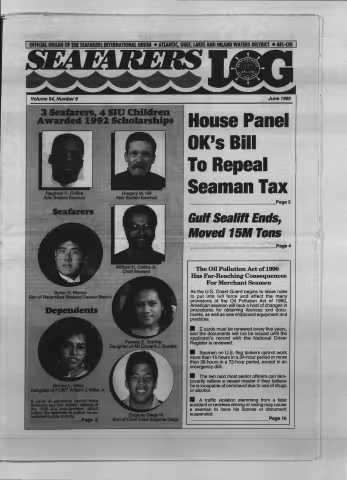
Seven SIU Sdiolarsiilps Awarded
Three Seafarers and four
children of SIU members were
granted scholarships by a panel
of educators who met last month
to review the qualifications of
each of the applicants for the
1992 awards.
The Seafarers scholarship
program, which was established
40 years ago, awarded a $15,000
scholarship to be used toward a
four-year degree to AB
Reginald R. Cuffee, 27, who
began his sea-going career
through the Lundeberg School
entry rating program in 1988.
The twenty-seven year old
Seafarer, who primarily sails on
LNG vessels, will major in
electrical engineering.
Chief Steward William H.
Collins Jr., 38, won a $6,000
Of each scholarship winner,
seepage 10.
scholarship that he intends to
apply toward the two-year de
gree program of the Culinary In
stitute of America, based in
Hyde Park, N.Y. Another two-
year scholarship was given to
Gregory M. Hill, who sails as
an Brother Hill, 37, intends
to use his scholarship to secure a
nursing certificate at Davis &
ELkins College ofElkins, W.Va.
The four children of Seafarers
who each won a $15,000
scholarship are Byron Blanco,
son of Recertified Steward
Ceasar F. Blanco; Eugenio
Diego in, son of Chief Cook
Eugenio Diego H; Pamela Ellen
Gontha, daughter of AB Ed
ward J. Gontha and Monica L.
Miles, daughter of FOWT Wil-
bert James Miles Jr.
The $15,000 scholarship
awards are paid over the course
The selection committee chose seven scholarship recipients who will
receive a combined total of $87,000 in grants to pursue their academic
degrees. Participating in the review process are (from left) Dr. Michael Glaser,
Dr. Keith Schlender, Dr. Henry Toutain and Dr. Charles D. O'Connell Jr.
of four years. The SlU's scholar
ship program is recognized
throughout the academic com
munity ^ one of the largest un
restricted grants awarded to sons
and daughters of union members.
Scholarship wiimers can pursue
four years of study at any college
or university in the Unit^ States
or its territories in whatever field
they choose to follbw.
The panel of professional
educators, which was appointed
by the Board of Trustees of the
Seafarers Welfare Plan, that
selected this year's scholarship
winners was comprised of the
following scholars and
academicians; Father David Al
bert Boileau, Loyola University;
Dr. Trevor Carpenter, Charles
County (Md.) Community Col
lege; Dr. Michael Glaser, St.
Mary's College of Maryland,
and Dr. Keith Schlender, the
Medical College of Ohio.
Also on the scholarship selec
tion committee were Dr. Charles
Lyons Jr. of the American As
sociation of Colleges and
Universities, Dr. Charles D. O'
Connell Jr. of the University of
Chicago, Dr. Gayle A. Olson of
the University of New Orleans
and Dr. Henry Toutain of Gus-
tavus Adolphus College in Min
nesota.
Applicants for the scholar
ships were judged by the
educators, who met for two
days, on the basis of scholastic
ability, character, high school
grades, college boards or
American college test scores,
letters of recommendation and
participation in extracurricular
activities.
With the seven 1992 scholarship
winners, the total number of
Seafarers scholarship awardees is
217.
tions setting the level of fees and collection proce
dures.
The Coast Guard's proposed user fees on docu
ments and licenses, which first appeared in the
Federal Register last sununer, establish charges
that range from $135 for an AB or QMED en
dorsed document to $330 for an upper level
license. The agency's proposal left the fees open-
ended, stating that they would be reviewed and
adjusted annually.
The SIU has argued, in comments submitted to
the Coast Guard and in testimony presented to
Congress, that the beneficiaries of licensed and
documented seamen are all users of waterways in
general and all who live in communities along
coastal and inland waters. The union has charged
that the work tax scheme is unfair, placing a bur
den on seamen that is not replicated among any
other group of workers.
Congressman W.J. "Billy" Tauzin (D-La.),
who chairs the Subconunittee on Coast Guard and
Navigation, noted this fact in remarks before the
panel during consideration of the work tax repeal
bill last month.
"Rail workers don't pay federal licensing fees.
Commercial airline pilots do not pay federal
licensing fees. What is more, staff has been unable
to identify a single occupation that is responsible
for paying a federal tax equivalent to the employ
ment tax that merchant mariners will have to pay
as required by the Omnibus Budget Reconciliation
Act of 1990," Tauzin said.
Offsetting Revenues
Before recommending the work tax repeal bill,
known as H.R. 4693, Ae House subcommittee
members present accepted an amendment to
clarify language in the legislation to ensure that
fees cannot be collected by the Coast Guard for
any process involved in the issuing of a mariner
license, document or certificate of registry.
The original bill prohibits the collection of a fee
for the issuance of merchant mariner documents,
licenses and certificates of registry. The amend
ment prohibits the assessment of a fee for any
procedures a seaman or boatman goes through to
get his or her Coast Guard credential—including
application, evaluation, testing, issuance, or any
other aspect of the documentation and licensing ̂
process.
The subcommittee chairman said the clarifying
amendment was necessary in order to ensure that
no one can "get around our prohibition by the
simple use of the English language."
Because the Congress and the Coast Guard
initially intended to raise some $6 million annually
Continued on page 14
Alert Deckhand Rescue Boatman
A panel of professional educators selected the 1992 winners of the
Seafarers scholarship program. Reviewing the applicants' records are (from
left) Dr. Charles Lyons Jr., Dr. Gayle A. Olson, Dr. Trevor Carpenter and
Father David A. Boileau.
Thirty-five feet above the waterline on
an empty barge in Tampa Bay (Fla.),
Seafarer Richard Tanner heard what
sounded like a person splashing near the
craft around 10:30 p.m. April 16.
"It was very dark so 1 climbed down
the pigeon holes (openings on the side of
a barge for foot and hand holds) and saw
this guy swinuning," Tanner related to
Port Representative Steve Judd who
spoke with the crew of the SlU-contracted
vessel when it recently docked in Davant,
La. "1 climbed up, secured some lines and
climbed back down to get him. The man
was badly burned, but he helped himself
up to the top of the barge," the deckhand
added.
Tanner, a 19-year veteran of the SIU,
signaled with his flashlight to his crew-
mates on the tug Ocean Star that he had a
survivor from the buming tugboat Bever
ly Anderson. The Ocean Star had
separated from the barge—leaving Tan
ner aboard as a lookout—^to help in the
rescue of the buming vessel. All but one
crewmember from the Beverly Anderson
had been accounted for by the SlU-
Tanner with the line used in the rescue.
crewed Ocean Star, a Sheridan Transpor
tation tug. However, the Anderson's
survivors feared their engineer.
Continued on page 14
., --r .
I •.7:^
v.;t'
• A' -AV;A: •" •
fer--»-fi?4^eff-';^'-;'.':
>lMrww8*S?9l®|l
'A;:.! ••„;•' '"i'sii;
liPipSwif
"lij'fM
I'
• ••> '• '.' r'h' ' \ .'• ') '•
' fp: "V
f>iii''^'liv'-% -• ;-."'iti&; 'v?»' 'f
•".•••• •• 'i' '•"•••
••-tf';:;,.. ;
• LV. .- ••
'•'aSSS::
4 SEWARBtStOG JUNE 1992
Daro-Year Gulf Seallft Ends
Persian Gulf sealift operations,
which at one point included 205 dty
cargo ships and 22 tankers, ended in
mid-April when the last vessel carry
ing U.S. military equipment was
redeployed from Ad Dammam,
Saudi Arabia, the Military Sealift
Command announced recently.
That ended a process which began
jn August 1990, immediately after
Iraq's invasion of Kuwait. Since
then, more than 15 million tons of
cargo and fuel were transported to
and from the Middle East aboard
U.S.-flag vessels including Ready
Reserve Force (RRF) ships. Military
Sealift Command (MSC) contracted
vessels and privately owned com
mercial ships.
MSC, the Defense Department's
manager for ocean transportation,
said in a written statement that nearly
900 lifts moved more than 12 million
short tons of dry cargo and fuel on
government owned or contracted
vessels during Operations Desert
Shield, Desert Storm and Desert Sor
tie. Another three million short tons
were transported on privately owned
container and breakbulk ships.
Efficient Sea Transport
All of the container loads needed
by the military were carried on U.S.-
flag vessels, with APL and Sea-Land
transporting 81 percent of those
boxes. In all, U.S. liner companies
moved 38,519 containers to the
theater.
More than 95 percent of the unit
equipment, supplies and fuel needed
to support U.S. forces in the Persian
Gulf was transported on ships under
the control of MSC, according to the
statement. This included thousands
of tanks, armored vehicles, helicop
ters, self-propelled Howitzers and
other militaiy equipment. U.S.-flag
ships carried 80 percent of the total
oceangoing cargo across 8,700 miles
of sea in record time.
U.S.-flag ships, both privately
owned and government owned, were
keystones of transportation support
during the rapid buildup of U.S.
military forces in the Persian Gulf
from August 1990 to January 1991,
MSC said. Additionally, many con
tinued their support during the 15
months following the cease fire, as
U.S. forces redeployed to their home
bsscs
By October 1990, MSC was
directing 171 ships including 12f
flying U.S. flags. Seafarers crewed
most of the American ships there
which included 44 from the RRF,
eight fast sealift ships, 2^
prepositioning ships, two aviation
logistics support ships, two hospita'
ships and several dry cargo ships anc
tankers chartered from private in
dustry.
The second phase of surge ship
ping began in early November, anc
by mid-January MSC was operating
its largest strategic sealift force ever.
Desert Sortie, the third phase o
sealift, began in March 1991 anc
marked the start of redeployment ef
forts. When the cease fire was or
dered, 44 ships were headed to the
Middle East fully laden with sustain-
ment cargo. Most of those tumec
around and headed to other ports.
Unit cargo was redeployed out of
Saudi ports to more than 40 ports
around the world.
MSC described the total opera
tions as "one of the most remarkable
military transportation accomplish
ments in history. The success .
demonstrated the nation's tremen
dous reliance on a highly responsive
U.S.-flag fleet for logistics support in
time of war."
Desert Shield/Storm/Sortie
Sealift Facts
• Ninety-five jjercent of all materiel sup-1
porting the military's operation in the Per- [
sian Gulf was transported by ship.
• Most of the military's equipment and I
stores came from the United States, re- ]
quiring that it be transported to a location
8,700 miles away.
• With more than 430,000 U.S. troops in
the Gulf, sealift deployments carried
enough supplies for a population equal in
size to that of Fort Worth, Texas or St. j
Louis, Mo.
• More than 15 million tons of cargo and I
fuel were shipped on U.S.-flag ships to |
and from the Middle East.
In October 1990, the Military Sealift |
Command (MSC) was directing 171
ships including 128 U.S.-flag vessels.
The number increased by January 1991
to a peak of 205 dry cargo ships and 22
tankers.
Approximately 900 lifts were performed I
by crewmembers on government owned
or contracted vessels. That accounted for
movement of more than 12 million tbns of
dry cargo and fuel; another three million
tons were transported on privately owned |
ships.
• On December 31, the U.S. had a "steel I
bridge" across the ocean with 132 ships
en route to Saudi Arabia and 47 returning
to the U.S. That is one ship every 50 miles |
from Savannah, Ga. to the Persian Gulf.
Remembering Those Who Went Before
Representing the SlU at the National Maritime Day memorial wreath-placing
ceremony in Washington D.C. were Seafarers Richard Sadberry, Shawna Joyce,
William Lardieri, Jeff Rothley, James Roth, John Batson, Daniel DelBuono, Ronnie
Fleming, Sara Moore, Celina Butler, Deborah Textor, Jesse Natividad, John Miller,
Noel Villanueva, Christopher Quail, Leo Yockey, Michael Jackson, Adrian Davis,
Joseph Perry, Donald MacDonald arid Dale Kirsch.
Bentley Bill Would Give U.S.-Flag Ships
Priority in Miiitary Equipment Transport
Representative Helen Delich Bentley (R-Md.) has offered a bill giving
U.S.-flag merchant vessels priority for ocean transportation of Defense
Department cargoes.
The former head of the Federal Maritime Commission followed through on
her comments made during a March congressional hearing on the Maritime
Administration budget that she intended to limit the number of government-
owned vessels transporting government cargoes in competition with the
private sector.
The legislation is designed to set into law provisions of a 1954 agreement,
known as the Wilson-Weeks Agreement, that set general guidelines for the
use, transfer and allocation of merchant ships in peace and war. TTie bill also
would limit the number of government-owned vessels that can be used in
peacetime so that a sufficient supply of merchant mariners would be available
to crew Ready Reserve Force vessels in a call-up like the conflict in the
Middle East.
Vessels Built or Repaired with Gov't Subsidy
To Be Barred from U.S. Ports under Gibbons'Bill
Legislation designed to close U.S. ports to vessels built or repaired with
government subsidies faces a strong challenge in the Senate after it passed
the House of Representatives 339-78 on May 13.
The bill, introduced by Representative Sam Gibbons (D-Fla.), was designed
to save jobs at America's dwindling shipyards. The legislation would prevent
any vessel which was built or repaired after the legislation is signed into law
and whose construction was fiinded by government subsidies from entering
a U.S. port until that subsidy is repaid.
The Senate is looking into amending the legislation to impose trade sanctions
against countries that subsidize shipyards.
American shipyards stopped receiving subsidies in 1981. Since then, 40
shipyards have closed t^ng with them 120,000 jobs. With the expected
cutback in Defense Department vessel construction, reports have estimated
another 180,000 shipyard employees could be out of work by 1998.
Breakthrough In EC Stance on Agriculture
Puts Maritime-Threatening GATT Talks on Track
The European Community late last month was hoping for a breakthrough in
the Uruguay Round of GATT trade talks. The EC oveHiauled its massive
agricultural price-support and export-subsidy system, potentially clearing the
way for resumption of global trade talks which have been stalled for about
two years.
Meanwhile, GATT chief Arthur Dunkel cautioned that the latest deadline to
conclude the talks by the end of this year might not be met. "We are already
dangerously close to missing the target of concluding the round by the end
of this year, not to speak of die implementation date of January 1,1993," he
said.
Dunkel added that an understanding between the U.S. and EC on agriculture
alone would not ensure the round's success.
With the possibility of a breakthrough, the SIU reiterated its positions that
waterbome transportation services should be excluded from the GATT talks.
Including U.S. shipping in GATT would endanger the national defense and
put America at severe risk to foreign shipping interests, the SIU maintains.
NI»
1990 Bilateral Ship Pact with USSR
Becomes a U.SJRussla Agreement
n the aftemath of the dismantling of the Soviet Union into a commonwealth
of independent states. Maritime Administrator Warren Leback and Russian
Deputy Director of Marine Transport Aleg Savin last month signed a new
pact which updates the bilateral maritime agreement reached in 1990 between
heU.S.andtheU.S.S.R.
^ Russia is the only republic included in the "memorandum of consultation."
The U.S. Department of Transportation and State Department have deter
mined that new agreements are needed for each affected republic. An
agreement with Ukraine will be negotiated next.
The latest Russian agreement fulfills an order from President Bush which
allows former Soviet shipping lines to enter the U.S. ports of New London
and Groton, Conn.; Kings Bay, Ga.; Port Hueneme, Calif.; Norfolk, Va.;
Jonolulu; Portsmouth, N.H., and the Florida harbors of Port St. Joe, Panama
City and Port Canaveral.
In return, Russia agreed to open its restricted ports to American shipping once
those harbors allow for foreign conunercial transportation. That process
started last year with the opening of Vladivostock.
"• ->W
. %
. w. •
.''•s''r''.
". k..
>"i'r',KiT...
• -n- .'i'" 5 •>> 1
-vV
•• • :r:.:;; •••.
.. ,;;y
"•. , 'V,. , . I -;•,
•IV;; ;•',;
•'i ••. -•• '".v"- ' V"'" •"
«£».
-1
:>•••-•,Y .-• •
JUHE1992 SBUWIHtSm
^ » T Sv - ^ .
Deacon Crew Braves High Seas in Rescue Operation
For the four Houston-area
Seafarers who crew The Deacon, a
G&H Towing tugboat, December 19
gave new meaning to the description
"a dark and stormy night."
On that date—with waves crash
ing over the wheelhouse—Captain
Bobby Sarvis, Chief Engineer
Jimmy Payne and ABs Ray Mc-
Guire and Walter Blume braved
gale-force winds and 17-foot seas to
tow another tugboat and a 180-foot
barge to safety. Because of the hor
rendous weather, the operation took
nearly 20 hours before ending safely
at daybreak at Westport Terminal in
Galveston (Texas) Harbor, Sarvis es
timated.
"The other tugboat (the Miss
Bobby May) was running out of
diesel," Sarvis said. "We couldn't
just leave her there.
"Everything went safely and there
was no damage to anyone or any
thing. But we had to take it dead slow.
It was a hairy situation."
At one point the line from the Miss
Bobby May to the b^ge parted, so
The Deacon chased the larger craft
and re-secured it. "Those people
were lucky," stated McGuire. "They
could have sunk out there.
'Determination and Courage'
The ordeal started when the Miss
Bobby May experienced fuel
problems while towing the barge.
The Deacon responded to a call for
assistance.
"We were told we had to go about
three miles [off the Galveston Sea
Buoy], but it was more like 30," said
Payne, a 20-year member of the SIU.
"Jobs like that are optional if there's
[substantial] danger, but we did it.
"These are good riding boats. It
was rough, but I wasn't worried
about sinking or anything."
"If we hadn't towed them, they
would have been on the beach," ex
plained Sarvis, also a 20-year
Seafarer. "The other tug used a smaU
line and we used a smaller line than
usual because of the weather."
"Oh, man, it was miserable," said
McGuire, who in retrospect managed
to laugh about the challenging as
signment. The AB who joined the
SIU in 1977 said he "never ex
perienced anything like that before
Members of The Deacon who braved gale-force winds and 17-foot seas to rescue
another tugboat and a 180-foot barge are, from left, ABs Ray "Mugsy" McGuire and
Walter Blume, Chief Engineer Jimmy "Indiana" Payne and Capt. Bobby San/is.
and I don't want another! But we
finally got a line on him and got them
m.
Sarvis, Payne, McGuire and
Blume received thank-you letters
from Roland Harrington, vice presi
dent of Suderman & Young Towing,
which owns The Deacon. "The men
of The Deacon displayed determina
tion, courage and devotion to duty
that is a credit to your profession,"
the letter reads. "We conunend you
gentlemen and thank you for a job
well done."
Swift Aid to Overboard Shipmato Earns Rhodes an Award
Seafarer Daniel J. Rhodes recent
ly was recognized by Sea-Land for
his quick response to an emergency
on board the Sea-Land Tacoma.
Brother Rhodes, who sails as a
deck/engine utility, won praise after
he helped save another mariner who
had fallen overboard.
Tacoma Master Richard Brooks
described the rescue in a letter to Bob
Hall, SIU assistant vice president
based in Seattle: "When (AB) Don
McFarland fell over the side of the
ship while rigginglhe gangway net on
the dock in Ko^ak, Alaska, Daniel
was one of the first on the scene. When
he saw that the ship's life ring tossed
to Don was drifting away, he immedi
ately ran to a life ring on the dock,
tossed it to the man in the water and
held on to the line until we rigged a
ladder to the man and put someone
down in the water to hook a harness on
Don. Daniel Rhodes didn't have to be
asked to do the right thing.
"We are very proud of seaman
Rhodes," the letter continues. "He is
a good worker and an excellent ship
mate."
"That's the first time I've ever ex
perienced anything like that,"
Rhodes told the Seafarers LOG. "It
happened so fast, I guess you just act
on instinct.
"Don wasn't panicked, but he was
in shock because it was so cold."
Rhodes, 27, received the ship's
Crewmember of the Month Award,
along with a T-shirt and certificate.
The certificate lists the criteria for
winning the award: "the licensed or
unlicensed crewmember of the ship
who demonstrates the best qualities
of job performance, including
resourcefulness, initiative and
motivation. This person has done his
job, got along with his shipmates and
lent a hand when needed—above and
beyond what has been expected of
every crewmember."
Bom in Seattle, Brother Rhodes
graduated from the Lundeberg
School in July 1990. He also served
for five years in the Marine Corps.
"I had read about the merchant
marine when I was in the service,"
Rhodes said. "It sounded interesting.
Then one day I met a merchant
mariner at a bus stop. I asked him
about the field, and he told me to go
to the Seafarers Harry Lundeberg
School of Seamanship.
"So I called (Lundeberg School
Vice President) Ken Conklin, and a
week and a half after I was out of the
Marines, I was at the Lundeberg
School."
Rhodes said he likes the travel and
earning a fair wage as a Seafarer.
Overall, he has been quite happy
with his career choice. "I love it, and
I want to move up to third engineer,"
he said.
Seafarer's Son Saves Swimmer
Daniel J. Rhodes receives the ship's
Crewmember of the Month Award.
Mariners Honored for Rescue of Fishermen
OS Daniel Arnold (left) and Third Mate Greg Musk receive plaques from the
Women's Propeller Club Port of New York during an April 9 ceremony for their
roies in rescuing two fishermen whose boat caught fire and sank 50 miles oU the
North Carolina coast February 18, 1991. Arnold and Musk, who were sailing
aboard the 88 Buyer at that time, dove into the ocean to assist the two fishermen
who had been drifting for more than six hours.
Like his father and grandfather,
17-year-old Shannon Edward
Mooney knows a thing or two about
safety at sea.
Mooney proved that April 2 when
he rescued a tired boogie boarder
who was in danger of drowning about
500 feet offshore at Francis State
(Calif.) Beach. Mooney carried 16-
year-old Billy Kaufusi ashore, where
Kaufusi was treated by paramedics
for a mild case of hypothermia.
Mooney is the son of retired
QMED Steven Mooney and retired
SIU official Ed Mooney. Shannon, a
junior in high school, used to be a
lifeguard at China Beach in San Fran
cisco. Currently he is a standout on
his school's track team.
On the day of the rescue. Shannon
and Kaufusi were among a large
group of surfers and boogie boarders.
(A boogie board looks like a minia
ture surfboard and is ridden lying
rather than standing.) Kaufusi be
came cold and tired and realized he
could not get back to shore on his
own, so he paddled toward Mooney
and asked for help.
Mooney later told a local
newspaper that he instructed Kaufusi
to remain calm and stay where he
was. Mooney then paddled to land,
took off his wetsuit to afford him
greater mobility and plunged back
into the water wearing a pair of
trunks.
Mooney, who is considering a
career widi the Seafarers, brought
Kaufusi ashore without incident.
II
8hannon Mooney comes from seafaring
family and knows about safety at sea.
'••tm: • •- •' -i-i
; i V
i ?;
; i-
, ..w -vi
•' ' ^ , S'".. I
" ' •-t'-L
j; •If''®'
yi- "
-K:^-
• -I >' 6 SEAFARERS LOG JUNE 1992
Lundeberg School Prepares Seamen in Use
CN Masks to Prevent Benzene Expesure
• ••
r.••
f '
>
JV
In the series of photos above, pumpman
course student Leonardo Papa dons a
mask which is designed to protect the
seaman from benzene exposure. First, he
prepares to put the mask on. Next, he puts
the straps over his head. He then secures
the side straps, chin straps and temple
straps.
j'- . ,--.;i ; •...
rrMf':- .
Upgrader John Beard subjec
the positive pressure test (in top^hoto) and
the negative
photo).
pressure test (in bottom
Proper use of anti-benzene ex
posure equipment that soon will be
carried on many carriers transporting
either the substance itself or products
containing the substance is now a
part of the curriculum offered by the
Lundeberg School to Seafarers
taking the tankerman, pumproom
maintenance and operations, and oil
spill prevention and containment
courses.
Two days of the pumpman course
are devoted to benzene safety proce
dures, explains Lundeberg School in
structor Jim Shaffer. Seafarers learn
of the various kinds of masks—in
cluding model numbers, sizes,
manufacturers—^that have been ap
proved by the federal government s
industrial safety-monitoring agen
cies.
The masks prevent seamen from
being subjected to quantities of ben
zene that go over the level of ex
posure allowed by the Coast Guard
regulation covering the dangerous
chemical. Masks are one kind of
protective gear that shipowners can
utilize to ensure that seamen
employed on their vessels are not
exposed to the toxic chemical.
All companies employing mer
chant seamen who may be exposed
to the chemical were required by the
Coast Guard to have in place an ex
posure monitoring plan by April 15.
This was one of the provisions man
dated by the Coast Guard's hazard
ous material regulations regarding
benzene exposure for merchant
mariners which were issued in final
form on January 15. These regula
tions cover a host of benzene-related
matters—from exposure levels to
shipboard training to testing for the
substance in a seaman's blood. in a seaman
among other things.
As part of the January 15-issued
regulations, the federal agency set
exposure limits at one part of ben
zene per million parts of air (1 ppm)
averaged over an eight-hour period.
The short term exposure limit, which
cannot be repeated over four times a
day, is 5 ppm averaged over a 15-
minute period. An hour wait must be
taken by a seaman between such ex
posure periods.
Course Covers Tests
Lundeberg School students learn
to don the equipment properly and
get accustomed to the fit. Additional
ly, the students conduct positive
pressure tests and negative pressure
tests once the mask is on to ensure
against any openings in the protec
tive gear. Once those tests are con
duct^, a final examination of the
equipment is executed through the
use of irritant smoke.
In a positive pressure test, the
Seafarer holds the palm of his or her
hand under the chin thereby blocking
off the exhalation valve and causing
pressure inside the mask to build. If
no pressure builds, the student deter
mines there is leakage and the equip
ment should not be relied on to
prevent exposure.
Conversely, the negative pressure
test requires tihe Serfarer to cover
with the palms of his or her hands the
canisters which serve as the mask's
intake system. If the mask collapses,
the Seafarer knows there is a le^; if
pressure is maintained, the protective
equipment is ready to wear.
The final equipment test utilizes a
tube of irritant smoke. A student, out
fitted in a mask, stands in a pl^tic
chamber. The capsule of irritant
smoke is released in Ae chamber. If
the student feels nothing, the mask is
doing its job. Instructor Shaffer notes
the irritant smoke test provides the
most secure results. "There is no way
around this one. If the mask has a leak
you are going to feel the irritant
smoke. It will make someone
cough."
The regulations allow employers
to establish procedures between
March 14 and mid-September by
which all shipboard employees who
can be exposed to benzene and ben
zene-carrying properties will under
go a blood test and pulmonary exam
required by the agency. After mid-
September, all crewmembers must
have undergone this procedure.
Currently, the SIU, the Seafarers
Welfare Plan and the union's con
tracted operators are refining a
process by which all deep sea
Seafarers will meet the testing re
quirements. Many SlU-contracted
companies have programs in place.
Instructor Jim Shaffer (left) emits the irritant smoke into a chamber where Seafarer Eric
Sutton wiii check his mask for leaks.
House Panel te Censlder BUI
Te Close Rivers' Safety Leephele
A bill designed to make all in
dividuals employed on towing ves
sels of more than five gross tons hold
Coast Guard documents may clear
the House Merchant Marine and
Fisheries Committee by the end of
the month.
Presently, the safety of an entire
shipboard crew is jeopardized by a
loophole in the law that allows a
majority of crewmembers aboard in
land water vessels to be exempt from
holding Coast Guard merchant
mariner documents.
Document holders must submit to
drug testing, undergo a criminal in
vestigation, allow for a cheek of the
National Driver Register for
evidence of alcohol abuse and take an
oath to follow all applicable federal
laws.
The SIU strongly supports the
Merchant Mariner Document Ex
pansion Bill (H.R. 4394), introduced
by the conunittee chairman, Walter
B. Jones (D-N.C.).
The legislation first must clear a
mark-up session by the House Sub
committee on Coast Guard and
Navigation. (A mark-up session
jrepares a bill for its next step in the
egislative process.) That meeting
could be held as early as mid-June. If
approved, H.R. 4394 would go
before the whole committee.
If passed there, the bill could be
debated and voted on by the full
House of Representatives before the
summer recess in mid-July. H.R.
4394 then would go to the Senate for
approval.
When the SIU testified before the
subcommittee in March, Executive
Vice President Joseph Sacco told the
Congress there is a "lack of unifor
mity between the r^uirements that
must be met by individuals employed
on various vessels." The union also
argued that implementation of the
legislation would improve the lives
and working conditions for crew
members aboard tugs and towboats.
as well as safety conditions for the
communities and their residents
living along the waterways.
As federal law now reads, crew
members aboard tugs and tows on the
inland waterways and on boats of less
than 100 gross tons that sail the coas
tal waters are not required to have
Coast Guard documents. Of these
vessels, if they are more than 26 feet
in length, the Coast Guard requires
only &e vessel operator to have a
license.
Research recently conducted by
the SIU demonstrated that inland
water vessels are less safe than deep
sea and Great Lakes ships, which
cany fully documented crews. Using
information from the Coast Guard
database on casualties and marine ac
cidents, the SIU learned that human
enor is a much larger factor in the
total number of accidents involving
tugs and towboats than in accidents
involving ocean-going and Great
Lakes vessels.
In fact, the data suggest that
human factors are the primary cause
of accidents involving tugs and tows,
whereas on Great Lakes and deep sea
ships, the human factor accounts for
only one-third of all accidents.
The Coast Guard defines human
factors as the following; bypass of
available safety devices, inattention
to duty, intoxication by alcohol or
drugs, calculated risk, carelessness,
lack of training, error in judgement,
lack of knowledge, operator error,
fatigue, stress, physical or
psychological impairment, failure to
comply with the rules of the road or
regulations and inadequate super
vision.
The bill, if enacted, would help
protect the crewmembers of 3,300
tugs and tows operating on the
nation's 25,777 miles of navigable
waterways whose lives and
livelihoods are endangered by this
safety loophole.
i?»SI
MME1992 SEAFARERS UIG
.-I-; > Vft'-- •-. ••
•1^1 ••••
Dnfelve Bosuns Pass Rigonus Recertification Course
Twelve SIU members who have
continued honing their skills to the
finest edge graduated last month as
recertifi^ bosuns during the May
membership meeting at the Paul Hall
Center for Maritime Training. The
Crane and several fellow bosuns
noted that the group featured a wide
variety of ethnic and geographic
backgrounds but was very cohesive.
During the five-week course.
Crane and his fellow bosuns finished
his brother Lawrence is a recertified
bosun and their father, Mario, com
pleted the recertification course
years ago. Both still are active
Seafarers. Another brother, John,
also sails with the union in the deck
themselves."
Pereira said he was elated to wit
ness the late SIU President Paul
Hall's vision of "creating a school
that would make the best seamen in
the world, to put on American-flag
vessels" come true.
Good Learning Environment
Pat Rankin, 43, commended the
Lundeberg School instructors and
said he was grateful to have the
chance to bolster his career. "You
can move up in the SIU," Rankin,
who joined the union 25 years ago in
the port of Mobile, Ala.,, told the
trainees in the audience.
"You're treated very well here,"
Recertified bosuns join SIU President Michael Sacco and Executive Vice President Joseph Sacco for a group graduation picture.
They are, from left: Jim Crane, Bill Dean, Bill Csapo, Domingo Leon, Michael Sacco, Robert Zepeda, Pat Rankin, Steve Argay,
Jim Jowers, Ron Dailey, Bill Stoltz, Monte Pereira and Joseph Sacco.
bosuns completed the highest cur
riculum available to SIU members
who sail in the deck department.
"We had a melting pot of per
sonalities, people from all over," said
Bosun James Crane. "The classes
were interesting and we had a great
bunch of guys. The fact that everyone
got along so well helped make the
time here fun and interesting."
Jim Jowers practices shiphandling pro
cedures in the School's simulator.
advanced classes in firefighting,
safety and first aid as well as deck
skill courses in wire-splicing, knot-
tying and navigation. TTiey also prac
ticed ship-handling procedures in the
Seafarers Harry Lundeberg School's
simulator, which reproduces sailing
conditions at sea and in ports
worldwide.
One important aspect of the
bosuns' curriculum focused on
workings of the union and its various
plans. The recertification program
brought the bosuns into contact with
every department of the SIU for
question-and-answer sessions.
For example, they met with offi
cials from the union's governmental
affairs department, from the collec
tive bargaining department, from the
welfare, vacation, training and pen
sion funds and from the Seafarers
LOG.
Additionally, the bosuns practiced
communication methods and leader-
Ship skills in workshop-like sessions
wiA Lundeberg School instructors.
A Zepeda Family Tradition
For 33-year-old Robert Zepeda,
completing the recertification course
seemed like a logical step. After all.
Instructor John Smith (left) tells students how to operate a fire extinguisher correctly.
department.
Robert, who joined the union in
1976 in the port of Houston, said his
favorite part of the course was the
firefighting training.
Stephen Argay said he was "im
pressed with how the union filters out
any incoming (legislative) proposals
that could affect the SIU. Nothing
slips by." Argay, 45, joined the
Seafarers in 1971 in the port of New
York. He described upgrading as "a
necessity. You realize that more so
when you leave the school and return
to a ship."
It has been 16 years since BUI
Stoltz first attended the Lundeberg
School as a trainee, and he marvelled
at how "modernized" the facilities
have become. Stoltz said he believes
"upgrading your knowledge and
skills on basics is important. CPR,
firefighting ... you forget a lot of it
over time, because hopefully you
haven't had to use it."
Rafael **Monte" Pereira gave a
stirring speech during the member
ship meeting. A 30-year member of
the union, Pereira told a rapt
audience, "Tlie only reason I'm here
is [the SIU's drug and alcohol
rehabilitation program]. Fifteen
years ago, I came to Piney Point and
I was in a lot of trouble.
"But I learned that the SIU is 100
percent behind anybody who's inter
ested in doing something to better
Domingo Leon Jr. (right) helps Patrick
Rankin put on his firefighting gear.
noted BiU Csapo. "Any problems are
taken care of immediately. The staff
makes sure your only concern is the
course you're taking, so you can get
the most out of it."
Csapo joined the Seafarers in 1978
in the port of New York. He said his
favorite part of the recertification
course was the advanced firefighting
class.
Domingo Leon, Jr. said he
learned a lot in the sealift classes.
Leon, 38, joined the SIU in 1970
in the port of New York. He added
that he enjoyed the effective com
munications class. "When you're on
a ship, diplomacy with the crew is
important."
Continued on page 12
A course in sealift damage control was part of the recertified bosuns' curriculum.
i-1.
f-f
• iS
• >
,
I .. . .\ht '
• I '
, 'I
if.,'., , •i.'^''S>:
feS/v -II:' : ,
II'SV! 8 SEOFAKERSiM JURE 1992
•iV'"
r-v-'V•.' 1 1, mmm
•^Jnr
: i:'"
i,''-y" ̂ '''• •"•*''
A 'T: .
'7,..' ' ..«> • •• • '••• ::•
•• ^7,: •'•' ,.-v
'•fe : •'
Cornelius Crew Prepares Laker for Fifout inspection
One ritual the crewmembers of ail
Great Lakes vessels, like the Adam E.
Cornelius, must go through is an an
nual inspection by the Coast Guard. All
departments pitch in to prepare the
bulker for the day-long inspection
which has to be passed before die Cor
nelius can set sail.
For the Cornelius crew, this annual
ritual took place on April 13, the day a
LOG reporter was on board. Here is
how the LOG reporter saw the day's
events unfolding:
Although the deck department just
has signed on, there is no time to get
reacquainted at a leisurely pace with
the ship, which has spent the winter in
AB John Hurley tightens hatch cover
clamps on deck of Adam E. Comellus.
Toledo, Ohio. Life vests and preser
vers must be repositioned across the
ship, flares must be checked and fire-
fighting equipment must be tested to
pass the safety inspection.
Then it is on to the deck itself. Some
crewmembers inspect hatch covers to
make sure they have not been
damaged. Others work with the
lifeboats and landing craft to verify
they are operational. A couple more
head for the windlass to make sure the
anchors have survived the winter.
"When it's time to report to the ship,
the guys know it is time to go to work,"
Bosun William Mulcahy told the
reporter. "We only have a few days
before we have to be underway. Every
thing has to be done now."
The gateman and conveyormen
have been aboard for nearly a week
removing ice and examining the
hatches and conveyors for damage.
Meanwhile, the QMEDs, oilers and
wipers have been refurbishing and
cleaning the giant diesels that operate
the American Steamship Company
vessel for the upcoming season.
QMED James Rilly, an SIU member
for 23 years, stated, "There is plenty to
do down here to get her ready for the
inspection, but we're ready for the
[shipping] season."
After reporting with the first ar
rivals and making sure everything in
the galley is in working order, the
steward department stays busy taking
on stores and feeding the crew.
The crew of the Cornelius passes
the Coast Guard inspection for 1992.
The posted sailing time is mere hours
away.
QMED Bud Schroder searches for a part
needed In the englneroom.
•• .• •••
'.V|; '
With a pipe wrench in hand. Wiper Nor- Preparing for Inspection are (In photo left) Gateman Roger Lorenz, left, and Conveyor- AB Mike Bensman releases the anchor
man FIttahey Is ready to work. man Myron Johnston and (In photo right) maintenance team member Wayne Bucher. chain brake.
'C^ --
> • • - •• •
7'" •
'Ol'S"?;'.
wti.n III iilm ir ••'^11 rn I - law
•• . ' • • '.•••.• ..-'^^V' ^i'-•-V-V i'--=\'' . -0-.-v.. •-• • w V'"'V
JUME1992
'Jiii
r^v-•'
'•V>.r"'.'i„"i'
5? JS:rS.
Fiirryv" ••.•
SEAFARERS LOG
&vton's Crew Rescues 2Hhm Bianhm nmrio'
Seamen aboard the
S!IU-contracted ITB
Groton rescued 21
crewmembers from a
burning Taiwanese
fishing vessel April
14. There were no
serious injuries and
the Groton mariners,
who performed with
precision throughout
the operation, even
managed to save the
Taiwanese crew's
dog.
The rescue took
place northeast of St.
Croix, starting around
9:30 p.m. and ending
at about midnight. An
hour later, a Coast
Guard cutter picked
up the rescued
Taiwanese fishermen.
"It was a pretty
smooth operation,"
said AB Phil Poole.
"Everyone chipped in
and everyone seemed
to know what they
were doing."
The Groton had
taken on cargo at the A Coast Guard emergency medical technican Is lowered from a helicopter to the burning Taiwanese boat.
Hess Oil terminal in St.
Croix and was headed
to New York when a Coast Guard
cutter relayed a distress call from the
Chen Homg 3, a 140-foot fishing
trawler.
The Groton arrived at the scene
two hours later, where a Coast Guard
diver/emergency medical technician,
who had been lowered from a
helicopter to the Chen Homg 3,
report^ that a fire was buming out
of control in the Taiwanese boat's
engineroom. Parts of the engine were
flooded, and the tuna boat was com
pletely inunobile.
Moreover, the Chen Homg 3 had
no lifeboats, rafts or lifejackets.
"We could see the boat was listing,
and smoke was visible," recalled AB
Mark Carpenter. "Luckily, the seas
weren't bad."
Bosun Nell Matthey, Pumpman
Rich Natoli, Chief Officer Nick
The captain of the rescued fishing boat stands at left with his grateful crew (seated).
Next to the Taiwanese captain are Groton crewmembers Chief Steward Marvin
DeLoatch, Chief Engineer Joe Knizewski, First Assistant Engineer Mike Frew and
Captain Charles Duncan.
AB Charles M. Corley Sr., an SlU mem
ber since 1988, said the rescue operation
"couldn't have gone better."
Colavito, Third Officer Ken Curtin,
Second Assistant Engineer Rick
Coughlin and Third Assistant En
gineer Rick Demaiinis immediately
manned and launched the port
lifeboat. On the first trip they rescued
16 crewmembers from the buming
fishing boat, while a handful stayed
behind with the Coast Guard diver to
make a last-minute assessment.
Realizing their vessel could not be
saved, the other Taiwanese fisher
men soon headed for the Groton on
its lifeboat's second trip.
With ABs Poole, Carpenter and
Charles Corley Sr. manning the
lines and taking turns at the wheel,
everyone returned safely to the
Groton. Chief Steward Marvin De
Loatch and Chief Cook Frank Cor-
dero then prepared food and
beverages for the distraught fisher-
"When you see a situation like
that, the (unsafe) condition of their
boat and the way they were dressed.
it honestly makes you
thankful to be in the SIU.
Foreign-flag ships let a
lot of things go."
"It was kind of like
culture shock for them to
come on board our ship,"
said Poole. "A lot of
them didn't even have
shoes. None of them
spoke English."
Corley concurred
with the other ABs and
added, "The rescue
couldn't have gone any
better. Everyone knew
their job and did it. I'm
just glad no one got
(seriously) hurt."
The Taiwanese boat's
captain received treat
ment for minor facial
bums which he sustained
while trying to determine
the severity of the blaze.
The cause of the fire is
unknown.
Groton crewmem
bers, including Wiper
Ahmed Salim, who also
took part in the rescue,
received a letter of com
mendation from Sheridan
Transportation, the
operator of the integrated
tug-barge. Joe Gehegan,
Sheridan's vice president of marine
operations, wrote, "Your quick
response in assisting the crew of the
stricken fishing vessel is viewed with
pride. The leadership abilities dis
played in coordinating the rescue ef
fort and the seamanship exhibited by
all hands is conunended."
Groton Captain Charles Duncan
also sent a letter praising the crew to
Sheridan Transportation. "I would
like to commend the crew of the
Groton for their performance in the
rescue operation," Duncan wrote.
"From launching and recovering the
lifeboat, feeding the rescued crew,
helicopter transfer of the Coast
Guard EMT, embarkation of fisher
men to Coast Guard motor launch, to
having engines ready to answer all
requested speeds, all hands
responded to the emergency."
Photos of the rescue operation
were sent to the Seafarers LOG by
Carpenter and Corley.
men.
"They really chowed down," said
Carpenter. "It looked like they hadn't
eaten in a while.
Chief Mate Nick Colavito (left) and AB Mark Carpenter oined their shipmates in
responding to the distress call which saved the lives of 21 Taiwanese fishermen and
their dog after a fire rendered their tuna boat useless.
/.-J" •
• -m
, ; -r, ;/ I,./
mm..
••v.'-'"-'^^•••-''p '•• •--••• :••" '' •'
l:~^'ylW'tTft''
||||;&^g^
. • V
10 SEAFARERS LOG ' JIW£l«g2
mm..
'• prr> •..
' '
f¥.-'-:-'
#
Scholarship Winners Work to Bolter Selves and Communities
The seven winners of the Seafarers'
1992 scholarships have much in com
mon—each one is determined to better
himself or herself and to use acquired
skills to assist other people realize their
goals.
What follow are brief descriptions
of the backgrounds and goals of each of
the 1992 Seafarers scholarship winners.
Reginald R. Cuffee
Reginald R. Cuf-
fee of Norfolk, Va.
is the recipient of
the four-year
Seafarer scholar
ship of $15,000.
Cuffee, 27, entered
the trainee program
at the Harry Lundeberg School of
Seamanship in 1988 and completed the
able bodied seaman course in 1990. He
has been sailing on Energy Transpor
tation Corp. vessels as an AB, most
recently aboard the LNG Aries.
Cuffee plans to attend either Old
Dominion University (Norfolk, Va.) or
Virginia Tech (Blacksburg, Va.),
majoring in electronic engineering.
His plans after graduation are to work
for a computer engineering firm while
attending graduate school part-time to
obtain a master's degree in business
administration—^and then to start his
own electronic system design com
pany.
The deep sea member is proud of his
seafaring career in that it has allowed
him the chance to see the world and to
experience other cultures. His observa
tions of the poverty and abject condi
tions in which some persons live has
made him realize that "! must avail
William H. Collins Jr.
William H. Col
lins Jr. is a man with
a specific goal—to
be a certified execu
tive chef. And as a
recipient of a two-
year scholarship for
$6,000, he is well on
his way to attending the prestigious
Culinary Institute of America in Hyde
Park, N.Y. in January 1993.
Following high school graduation
in Evansville, Ind., Collins Joined the
U.S. Navy in 1971 and was shipped off
to Vietnam. Upon his return to the
States with an honorable discharge in
1973 and several Jobs in the food ser
vice industry under his belt, he Joined
the SIU in 1988, starting as a dish
washer on board the Mississippi
Queen (Delta Queen Steamboat Co.).
Collins continually upgraded at the
Lundeberg School, and it was a steady
move up the ladder—first to cook, then
City Park Department's Shakespeare
Company.
Pamela Gontha will use her four-
year scholarship stipend to advance
herself in the medical field at the State
University of New York at Buffalo.
Her father, Edward J. Gontha, sails
as an AB. He has been an SIU member
since 1961, most recently sailing
aboard the LNG Leo.
ByronBlanco
Byron Blanco's
ambition is to be
come a physical
therapist. He already
has b^n accepted to
The University of the
Pacific in Stockton,
Calif, and will use his
$15,000 four-year scholarship toward
his studies in the fall.
The 17-year-old Blanco is not only
a superior student, but he also has
balanced his academics with a very
stated.
Blanco's
father is
Ceasar F.
Blanco, a
member of
the SIU
since
1966. He
sails in the
deep sea
division,
most
recently
aboard the
Sea-Land
Hawaii
and the
Byron Blanco's father,
Ceasar F. Blanco, com
pleted the steward recer-
tlficatlon course In 1982 at
the Lundeberg School.
Sugar Islander as a recertified steward.
Eugenio Diego III
myself of the opportunities which
America afforded me as a citizen." To
this end, when he owns his own com
pany, he has a plan to assist under
privileged children by starting a
program that will allow engineering
students a place to work, thus provid
ing them with the necessary experience
needed to succeed in their chosen
profession.
Greg Hill has many Interests, among them canoeing. Hill will use his scholarship
award to get a nursing certificate.
Gregory M. HIM
Gregory M. Hill, an AB, has been
an SIU member for more than 20 years.
Upon graduating from the trainee pro
gram at the Lundeberg School in 1972
and completing his GED at that time,
the Elkins, W.Va. native started his
sailing career aboard SIU ships, tugs
and towboats. He has returned to the
school many times, completing the
tankerman, firefighting, able bodied
seaman, welding and sealift operations
courses.
But Hill, 37, has other interests as
well, and the $6,000, 2-year scholar
ship will help him realize his goal of
obtaining a nursing certificate at Davis
& Elkins College in his hometown.
Working as an SIU member. Hill
has been able to earn the money needed
to purchase land and build his own
home in the mountains of West Vir
ginia. He also has worked with the
Department of Agriculture's Forest
Service in wildfire suppression and as
a volunteer with the Randolph County
Emergency Squad, based in Elkins. In
1991 Hill completed a one-year course
of study to obtain the highest pre
hospital care rating, that of paramedic.
He found his EMT-parame^c training
has enriched his personal life and has
been very valuable on the Job as well.
"I provide training and care as needed
at sea, and found my shipmates ap
preciate having trained medical per
sonnel working alongside them."
Eugenio Diego m is graduating this
year from Loyola High School in Los
Angeles, Calif. The 17-year-old stu
dent plans to use his four-year scholar
ship award to major in business at Cal
State Northridge or Cal State Los An
geles in the fall. He believes a college
degree in business is a "means to my
goal." He would like to provide train
ing and employment opportunities for
others. "In helping others to grow, I
also will grow," he states.
Diego participated in intramural
sports at school in addition to working
with the minority students association
and Christian youth activities. He also
has volunteered his time at the
Shriner's Hospital in Los Angeles and
the Salvation Army.
Diego's father, Eugenio Diego Jr.,
Joined the Seafarers International
Union in 1980. He began his deep sea
career aboard the Sea-Lwd Explorer. He
sails as a chief cook, most recently
aboard APL's President Lincoln.
Pamela Gontha and her family—Jrom the left are her brother. Glenn, currently enrolled
In the University at Buffalo; her mother; her sister, who will attend high school In the
fall, Pamela, and her father, Edward, an SIU member.
to porter and eventually to supervisor.
He then started shipping deep sea as a
steward assistant, and was promoted to
chief cook and finally to chief steward.
"Being an SIU member for the rest
of my life and using all opportunities
to better myself through continuing my
education" is what the 38-year-old
Collins wants to do—^and he is well on
his way.
Pamela E. Gontha
Pamela Ellen Gontha would like to
be a doctor. As an honors student in a
very comfretitive high school, Brook
lyn Technical High School in Brook
lyn, N.Y., the 18-year-old has shown
that hard work pays off in achieve
ment. She already has been involved in
college programs through Long Island
University Summer Honors Program
and college-level courses at Pratt In
stitute. In school activities, Pamela has
been an active member of the math
team and has offered much service to
her class and the school, working in the
areas of publicity, the newsletter and
fundraising. The well-rounded high
school senior has been an active church
member and took part in the New York
Eugenio Diego III. left, with his mother and
father, Chief Cook Eugenio Diego Jr.
active record at Bishop Riordan High
School in San Francisco: four years on
the football team, a discus thrower on
the track team and involvement in the
California Mathematics League and the
California Scholastic Federation. He
also finds time to volunteer as a worker
at the Glide Memorial Church in San
Francisco, directing the food line and
helping people. 'Throughout my life,
I've always enjoyed working with
other people and helping them," he
Monica L. Miles
Monica L. Miles
42§S chosen Florida
A&M in Tallahas
see, Fla. or Xavier
University in New
Orleans, La. to fur
ther her education.
Using her four-year
scholarship award, she plans to major
in the field of pharmacy with a minor
in psychology.
The 18-year-old is one of eight
senior class representatives at McGill-
Toolen High School in Mobile, Ala.
She is a consistent honor roll student
and ranks within the top 30 percent of
her graduating class. She also is social
ly involved in the Afro-American
Club, the Key Club, the chorus and the
Ambassador Club, as well as with
several religious organizations. She
serves her community as a Sunday
school teacher and has volunteered her
time as hostess of the Little Sisters of
the Poor Festival and organized dona
tions for the needy at Christmas. One
special honor was being chosen for
inclusion in "Who's Who Among
American Students."
Monica Miles is the daughter of
Wilbert
a m e s
Miles Jr.,
an SIU
member
since 1973.
Miles, who
sails as an
F O W T ,
most
recently
was aboard
I'uertoRico
Vlarine's
Mayaguez.
Monica L. Miles' father, Wil
bert J. Miles Jr., sails as an
FOWT.
J.
'i
•'f •• • '
-•r
• >_.s.'V-' v/';/• v":
JUHE1992 SEAfARHSUG
Diego Garcia-Based Seafarers Handle Unique Duties
t, ^ ^ f ^ V
? • , -r >• :• ^ >•-•,; to: ;'.•••
If; :=«,:: • -
iffSisw
Painting pipes is one of the general main
tenance tasks for DEU Jayne Brown
aboard the Hauge.
•• -rtK- "- •: • "•• •••;v
SM
I.-?-.,
Diego Garcia—called the Americanmilitary forces if they are
"footprint of freedom" because of its ever needed in that part of the world,
footprint shape—^is a small island in In 1990 and 1991, for example, the
the British Indian Ocean Territories, maritime prepositioning ships sta-
Home to a U.S. Navy support tioned in Diego Garcia helped the
facility, there are usually dozens of United States in its early rapid
American-flag ships under charter to deployment of materiel to the Persian
the Military Sealift Command Gulf.
anchored off the island's shores. As When not involved in wartime ac-
a result, hundreds of Seafarers who tivities, the ships remain at the ready,
man mjuiy of the military ships sta- often going out for military exer-
tioned at Diego Garcia can be found cises, including the practice of under-
in this remote and often-unknown way replishment, helicopter landings
territory at any given time. and man overboard ̂ lls. In port, the
Amongyhe MSG ships bas^ in
Diego Garcia are nailitary
prepositiomng ships which are ,5^
mann^ by Seafar^. from the equator, so it can get bratal-
allowforraprfmih^^pl^ment , ^
complete with supphes^vepnta^ available to hdp krep cool
from tanks and animtmuon to and provide relmiation.
and water and fuel—to supply Continued on p^e 21
» ^ V- '
:"r. •
S-
"f. ' «
AB isham Dixon keeps in touch with the mate aboard
the Phillips as the ship offloads.
DEU Anthony Stallone (left) and QMED Ernest
Lacunza Jr. check the injectors on the Gianella.
. r
A
I
Chief Steward Robert Mensch-
ing types the next day's menu
for the crew aboard the Hauge.
h: \
5 w:
x^u mm •\""sr y-X'
FT
:Ji>rV
"k -i-
••ft.-*:
in
miwm
Z
DEU Pete Zeschke and AB
Joe Dean work aboard the
Gianella.
,• y Z-Z'?'to'T'F^Fv:
V. T" •" •'''•••• "•'F-l ;
"I
;F •'
m..
T F-'(-
•I,
F '. ! •, V,'
' -v
) ;|
v'::.%,y
•W^\. s- .-•'••
m.-
:•_• i-y ••
'.- yK
' '>^'':'"-.v. '.
•:S'^-
12 SEAFJUIBIS LOG JUNE 1992
Jinfelve Seafarers Cemplele Tep Decl( ffepb Curriculum
Continued from page 7
Jim Jowers spent 21 years in the
Navy before joining the SIU10 years
ago in the port of Wilmington, Calif.
"I went through a lot of schooling in
the Navy, and let me just say F m very
impressed with the school and
programs here at Piney Point," said
Jowers, 49. 'The best part was under
standing how the SIU works. Every
man in the Seafarers ought to come
here and learn what's going on in his
umon.
Bill Dean, 33, was one of the
many bosuns who expressed ap
preciation for the instructors. Dean
had not been to the Lundeberg
School since he graduated from the
trainee program in 1978. "The
progress here is remarkable," he said
with a smile. "I don't think too many
other unions have what we have."
For 15-year Seafarer Ron Dalley,
the Lundeberg School never has dis
appointed. "IJiis is my fourth time
here, so that should say something,"
Dailey said. "The courses are always
great and I intend to continue coming
here."
yyyyyfir-i
jj'
I.-
I,. .St..";::;',
Inquiring Seafarer
Question: What did you do this
winter?
(Asked of SIU members on the
GreatLakes.)
Mike
Bensman,
Wheelsman —
I was a honey-
do. "Honey, do
this. Honey, do
that."
Bud Schroder, I
QMED — l
David Grann,
Second Cook—
I spent time
with my kids in
Duluth, Minn.
Tom Hocking,
Watchman — I
wentsnow-
mobiling in
Amherst, Ohio.
Other than that,
ain did was
relax.
took very little
time off. I
worked as an
engineer on
tugs.
Ray Buzwah,
Porter—I had
Roger Lorenz,
Gateman — I
hunted coyote
and fox all
winter. I got
four fox.
Scott Hill,
Gateman —
Ice fishing, but
I didn't have
any luck. I also
got married
and bought a
house in Supe
rior (Wis.).
a good winter
in Hot Springs,
Ark. I went to
the race track a
lot and took a
few mineral
baths.
Mark Wyman,
QMED — l
went snow-
mobiling in Al-
)ena, Mich, a
ot. Other than
that, I did a
whole lot of
nothing —just
relaxed.
Allan
Johnson, Deck
hand — I don't
BohHedine,
AB —I
do much in the
winter except
stay home (in
Frankfort,
Mich.).
remodelled two
bedrooms and
went ice fish
ing in northern
Minnesota. I
filled out on
trout within
two hours every time I went out.
Jason Beck,
QMED
Went on vaca
tion in Florida
and just
relaxed. Basi
cally, I eiyoyed
the sunshine
and hung out.
Ahmed
Nasser,
Second Cook —
I went overseas
to visit my
family near
Saudi Arabia. I
had a good
time, but I also
missed it here.
Correction: In last
month's Inquir
ing Seafarer, an
inconect photo ap
peared widi the
response of QMED
MOke LaBar. The
correct photo is
shown hoe.
Summarizing the recertification
course, Dailey said, "It's kind of like
if your father gives you your first
what is there to say? It seems car
like words are inadequate to express
your appreciation."
Jack Cooper, who served in the
Coast Guard from 1950 to 1979 and
then joined the Seafarers in 1980 in
the port of Norfolk, Va. also com
pleted the recertification course. The
61-year-old Virginia native could not
be reached for comment, as he had to
leave the Lundeberg School before
the graduation ceremony.
Jack Cooper, who joined the SIU in 1980,
was one of 12 bosuns to complete the
recent recertification curriculum.
Dailey Used CPR to Save a Life
While being interviewed by the
Seafarers LOG about the bosun
recertification class, Ron Dailey
noted that his Lundeberg School
training had been invaluable in the
past, as he knew it would be in the
future. Specifically, he pointed out
that his CPR class, taken in the late
1970s, helped him save a man's life.
"It happened on a Waterman ship,
the Alex Stephens," Dailey recalled.
The ship was docked in Sri Lanka
when "they brought a guy up from
the engineroom in a gumey. He was
turning gray, his lips were purple and
he had no heartbeat or pulse.
'I gave him CPR until the doctor
got there, then I continued as we went
down the gangway. In the am
bulance, I took turns with someone
else."
Dailey recently got a refresher
course on life-saving techniques,
during the five-week bosun recer
tification program. "CPR, firefight-
ing, it's always good to take those
classes," he said. "You learn some
things you may not have known, and
you improve on other things."
For Dailey—not to mention the
man he saved—the Lundeberg
School training certainly paid off.
Bosun Canales' Knotty Surprise
Bosun Caries H. Canales (front row, right) was surprised by the gift of a knot board,
presented to him by the deck gang during a recent shipboard meeting on board
the Gulf Trader. Crewmembers in the photo include ABs Jeff Mangold, Harry
Dowling, Joe Conlin and Jonny Gatton and OSs Walt Oswald and Ronnie
Lambert. The photo was snapped by steward member Antionette Canales.
Showing Support for Free Unionism in Africa
While watched by uniformed and armed Secret Service agents, SIU and UIW
members picket in front of the Malawi embassy, urging freedom for that African
natiori s trade union movement leader, Chakufwa Chihana. More than 200 trade
unionists demonstrated May 6 in front of the embassy In Washington, D.C.
• y.
/•ai
'^1
m-sSsM
JUNE 1992
Slif-':
•.'V- •• rh;-i •.
,.''• ''A;: .
SEAFARERS LOG 13
Mew War SenMce Mtedab fosued HR" IMartuers
Mariner's Medal
(World War 11)
Awarded to a seaman who, while
serving on a ship from December 7,
1941 and July 25, 1947, was
wounded or suffered physical injury
as a result of an act of an enemy of
the United States. The bar and rib
bon are red, white and blue; the
medal is bronze colored with a silver
relief.
Mediterranean-Middle East
War Zone Medal
(VVorldWarll)
Awarded for service in the zone In
cluding the Mediterranean Sea, Red
Sea, Arabian Sea and Indian Ocean
west of 80 degrees east longitude,
during the period December 7,1941
to November 8,1945. The bar and
ribbon are blue, white, red, yellow
and green; the medal is bronze
colored.
Honorable Service Button
(World War II)
Awarded to members of the crews
of ships who served for 30 days
during the period December 7,1941
to September 3,1945. The button is
bronze.
New medals for merchant
mariners who served in
World War II, Korea and
Vietnam are being issued to
supplement war zone ribbon
bars previously awarded to
civilian mariners who sup
ported America's armed for
ces during those wars.
Secretary of Transporta
tion Andrew Card Jr. recent
ly announced the availability
of the new medals.
Pictured on this page are
photos of these medals (ac
tual size) and descriptions
provided by the Maritime
Administration (MarAd). On
page 18 are reproductions of
other MarAd merchant
marine medals.
Eligible Mariners
According to the
Maritime Administration,
more than 12,400 mariners
were awarded the Merchant
Marine Defense Bar for ser
vice between September 8,
1939 and December 7,1941.
Those mariners are eligible
for the Merchant Marine
Defense Medal.
Roughly 143,000 seamen
received the Atlantic War
Zone Bar for service during
World War II between
December 7, 1941 and
March 2, 1946^ while
111,000 received the Pacific
War Zone Bar for similar
service. Those mariners are
eligible for the Atlantic War
Zone Medal and the Pacific
War Zone Medal, respec
tively.
Approximately 94,000
bars for service in the
Mediterranean-Middle East
War Zone between Decem
ber 7,1941 and November 8,
1945 were presented.
Mariners who received those
bars now may receive the
corresponding medal.
More than 2,000 mariners
received the Korean Service
Atlantic War Zone Medal
(WolfdWarll)
Awarded for service In the Atlantic
War Zone, Including the Nortfi Attan-
tiCi South Atlantic, Gulf of Mexico,
Caribbean, Barents Sea and the
Greenland Sea during the period
December 7, 1941 to IMovember 8,
1945. The bar and ribbon are redeind
white; the medal is bronze colored.
Victory Medal
(World War II)
Awarded to members of the crews
of ships who senred for 30 days or
more during the period December 7,
1941 to September3,1945. The bar
and ribbon are white, yellow, red,
blue and green; the medal Is bronze
colored.
Bar for sailing between June
30, 1950 and September 30,
1953 in waters adjacent to
Korea. They are eligible for
the Korean Service Medal.
Finally, 5,000 seamen
were given the Vietnam Ser
vice Bar for sailing between
July 4, 1965 and August 15,
1973 in waters adjacent to
Vietnam. They are eligible
for the corresponding medal.
All of these recipients of
the war zone bars are eligible
to obtain the new cor
responding medal. The im
mediate families of deceased
mariners also are eligible to
receive the medal in behalf
of the seaman. These
mariners or family members
should contact directly the
vendors listed on page 18.
Desert Shield^torm
Additionally, the Mer
chant Marine Expeditionary
Medal is available to those
seamen who served in
Operations Desert Shield
and Desert Storm. This
medal was approved last
year and announced pre
viously.
Continued on page 18
Merchant Marine Defense Medal
(World War 11)
Awarded for service In the U.S. Mer
chant Marine prior to Pearl Harbor.
It may be worn by all merchant
seamen who served as members of
the crews of U.S. merchant ships
from September 8, 1939 and
December 7,1941. The bar and rib
bon are green, white, red and black;
the medal Is bronze colored.
Pacific War Zone Medal
(WoridWarll)
Awarded for service In the Pacific
War Zone, Incuding the North
Pacific, South Pacific and Indian
Ocean east of 80 degrees east lon
gitude, during the period December
7,1941 to March 2,1946. The bar
and ribtion are gold, yellow, red,
blue, orange and white; the medal Is
bronze colored.
Merchant Marine Combat Bar
(WoridWarll)
Awarded to merchant seamen who
served on a ship which at the same
time of such sendee was attacked or
damaged by an Instrumentality of
war from Decemtier 7, 1941 and
July 25,1947. A star Is attached If
the seaman was forced to abandon
ship. For each additional abandon
ment, a star Is added. The bar Is light
blue, red, dark blue and white.
Merchant Marine Emblem
(WoridWarll)
The emblem Is an identifying insig
nia that was issued to active mer
chant seamen for service from
December 7,1941 to July 25,1947.
It Is bronze and blue.
Korean Service Medal
Awarded for service in the merchant
marine from June 30,1950 and Sep
tember 30,1953 in waters adjacent
to Korea. The bar and ribbon are
red, iight blue, dark blue and white;
the medal is bronze colored.
[ mmm
1
Vietnam Service Medal
Awarded for service In the merchant
marine from July 4, 1965 and
August 15,1973 in waters adjacent
to Vietnam. The bar and ribbon are
royal blue, yellow and red. The
medal is bronze colored.
Gallant Ship Citation Ribbon
Awarded to officers and seamen
who served on a ship which, at the
time of senrice, was cited for gal
lantry by the Maritime Administra
tion. Colors are white and green.
Gallant Ship Citation Plaque
Bronze plaque awarded to a ship
cited for gallantry by the Maritime
Administration.
• ' V'
.I.;
1 w " '
•: )r
, j'r'
1
i.
•(:
r;:=v:^r
-.t-
m M -t^'r •;.
'"' :i '
Vb-i '^M :/ :• .
-•b '•"•^^?b,fw-'i •
; - v iie .11'. ' ,' ' , • :/ ",
^;r;;v:-|^;;-y^',, • :
- ;.f •'•-c-r>
''.*• - r ' •. . Ji- • -•••' : . .*• •' '"•'
-, ^•
-' -I-,, '
:^';4:'' r';' /;";S'
t:',|;.;;;,...:,:-r; j. .
i
/ir r-'^i,...•;.
^v '. • '
W •,' ..'
V'-/'-' &• •• -,
a'.v', ^
ft...
14 SEAFARERS IM JUKE 1992
Seaman Tax Repeal Bill
Passes First Hunlle In Reuse
The Route H.R. 4693 Musf Follow Bepome
USCG Proposes Fees
June 20,1991
Continuedfrom page 3
from user fees attached to mariner
documents, licenses and certificates
of registry, any repeal of such a
scheme must offer an alternative
measure that will raise comparable
funds.
While no alternative funds have
been identifled as yet, Tauzin said, "I
am optimistically moving the bill at
this time with the hope that we can,
indeed, find such offset before we
report the bill from the full commit
tee. The strength of Our struggling
merchant marine is just too important
to delay this bill any longer."
Rep. Tauzin also noted the user
fee scheme would "discourage mer
chant mariners, who are already un
deremployed, from renewing their
licenses." He added, "This, of
course, threatens our national
security."
The repeal bill was introduced in
March, shortly after the SIU and
other marine labor organizations
made a strong case before the Sub
committee on Coast Guard and
Navigation for repeal of the proposed
seaman tax.
The union has been waging a fuU-
Seafarers—Write the House Panel
Show Your Support
For the Work Tax Repeal Bill
Seafarers ara urged to contact mem
bers of the House Merchant Marine
and Fisheries Committee to advise the
legislators of their support for the
repeal of the fees for merchant
mariner documents and licenses.
Where to write:
The Honorable
U. 8. House of Representatives
Washington, DC 20515
Whom to write:
Walter B. Jones, Chairman (D-N.C.)
Gerry E. Studds (D-Mass.)
Carroll Hubbard Jr. (D-Ky.)
William J. Hughes (D-N.J.)
Earl Hutto (D-Fla.)
W.J. "Billy" Tauzin (D-La.)
Thomas M. Foglietta (D-Pa.)
Dennis M. Hertel (D-Mich.)
William O. Lipinski (D-lll.)
Robert A. Borski (D-Pa.)
Thomas R. Carper (D-Del.)
Robin M. Tallon (D-S.C.)
Solomon P. Ortiz (D-Texas)
Charles E. Bennett (D-Fla.)
Thomas J. Manton (D-N.Y.)
Owen B. Pickett (D-Va.)
George J. Hochbrueckner (D-N.Y.)
Stephen J. Solarz (D-N.Y.)
Frank Pallone Jr. (D-N.J.)
Greg Laughlin (D-Texas)
Nita M. Lowey (D-N.Y.)
Jolene Unsoeld (D-Wash.)
Gene Taylor (D-Miss.)
Glenn M. Anderson (D-Calif.)
Jack Reed (D-R.l.)
William J. Jefferson (D-La.)
H. Martin Lancaster (D-N.C.)
Lucien E. Blackwell (D-Pa.)
Robert W. Davis, (R-Mich.)
Don Young (R-Alaska)
Norman F. Lent (R-N.Y.)
Jack Fields (R-Texas)
Herbert H. Bateman (R-Va.)
H. James Saxton (R-N.J.)
Helen Delich Bentiey (R-Md.)
Howard Coble (R-N.C.)
Curt Weldon (R-Pa.)
Wally Herger (R-Calif.)
James M. Inhofe (R-Okla.)
Porter J. Goss (R-Fla.)
Arthur Ravenel Jr. (R-S.C.)
Sonny Callahan (R-Ala.)
Wayne T. Gilchrest (R-Md.)
John T. Doolittle (R-Calif.)
Randy "Duke" Cunningham (R-Calif.)
scale attack on the proposed work tax
on all fronts. Last year, the SIU filed
a lawsuit, charging that the dis
criminatory fees are unconstitution
al. The tax, which masquerades as
user fee, is actually a thinly-dis
guised revenue raising ploy designed
to bring monies into the nation's
general treasury, the SIU states in its
court documents.
The SIU's lawsuit also points out
that the manner in which the Coast
Guard established the fees was
chock-full of guesswork and inac
curate calculations, thus a violation
of statutes governing the manner in
which federal agencies can promul
gate regulations.
In March, the judge assigned to the
case ruled that the SIU's lawsuit
could not be considered by the court
in light of the fact that the Coast
Guard had not determined a date as
to when the fees would be instituted.
Without showing inunediate harm,
the court held, the case could not go
forward.
However, the Coast Guard is due
to issue a final rulemaking on the user
fees, which will establish a date for
implementation. At that point, the
SIU's lawsuit attempting to block the
Coast Guard Subcommittee Holds Hearings
February 25,1992
H.R. 4693 Introduced
March 26,1992
Coast Guard Subcommittee Marks Up H.R. 4693
May 6,1992
Merchant Marine Committee Mark-Up Session
(Amendments can be offered)
June 1992 (estimated)
House Rules Committee Sets Date for Floor DetMte
Floor Debate of H.R. 4693
(Amendments can be offered)
Summer 1992 (estimated)
Upon passage, H.R. 4693 goes to the Senate.
It gets a new number and SenatQ sponsor.
It goes through committee and floor debate.
Amendments can be offered. If passed by the Senate with
changes, both versions of the bill go to a conference com
mittee composed of House and Senate members. When a
compromise Is reached, both chambers vote again on the
bill.
Upon final passage by both the House and Senate, the I
goes to the president for his signature.
fees becomes germane.
Meanwhile, the legislative
strategy moves forward to undo the
fees originally set by Congress. The
Tauzin bill to repeal the work tax
scheme must come up with a
mechanism for raising the funds it
was anticipated the user fee on docu
ments and licenses would bring the
federal treasury. Once that require
ment is met, it is believed die bill will
face little opposition in the Merchant
Marine and Fisheries Committee and
in the House in general.
Tanner Brings Burned Beatman to Safely
Continuedfrom page 3
Stephen Bodden, had died in the fire.
bstead the severely burned en
gineer jumped overboard and started
swimming. Despite' third degree
bums over one third of his body,
Bodden swam through the rough
chop on the bay approximately one
quarter mile to the barge. According
to Tanner, Bodden told him he had
no idea the barge was there, he just
was trying to leave the burning tug.
Once on board. Tanner walked
Bodden around to keep him from
going into shock. He also gave his
shirt to Bodden to warm him after the
swim Mid protect him from the ele
ments.
"I just stayed and talked with him
to calm him down," Tanner said. "I
saw that he was extremely bumed."
Loaded with the rest of the crew
of the Beverly Anderson, the Ocean
Star returned to its barge after seeing
Tanner's signal. Mate Don Reese ap
plied ftrst aid until a medical helicop
ter arrived to transport Bodden to a
nearby hospital, where he continues
to recover. The Ocean Star then car
ried the remaining survivors to port
as flames completely consumed the
Beverly Anderson.
While Tanner shmgs off any men
tion that he was a hero, ere wmembers
credit his being alert with saving
Bodden's life. "If he hadn't been out
there, that engineer probably
wouldn't be alive today," Captain
Arnold Deagle said.
Others serving aboard the Ocean
Star on the night of the rescue in
cluded Deckhands James Benham
and William Morris, Cook Earl
Withee and Engineers Buster
Nichols and James Hopkins.
The Ocean Star primarily carries
petroleum products between
Louisiana and Tampa through the
Gulf of Mexico.
Crewmembers of the tug Ocean Star are (from left, front row) Chief Engineer Buster
Nichols, Mate Rocky Upton, AB Jim Benham, Captain Amold Deagle, AB William Mom's,
AB Richard Tanner, (back row) Engineer Jessie Chasteen and Cook Earl Withee.
Tanner climbed down these pigeon holes to find a survivor from a burning tugboat.
•J
•1
- , '' • V •• '
•••^''''v.
>yrS7:;-:-T-r-
JUNE 1992
mm:
•• ....rv-' r
' "' 'f:. X'' _••'. •
SEAFARERS LOG IS
All Aspiscts of FIreiiglitIng Covered in School's Advanced Course
Students in the Seafarers Harry
Lundeberg School's combined
basic-advanced Hrefighting course
do much more than just learn how to
use an extinguisher.
When finished, they have studied
the chemistry of fire and different
extinguishing agents, participated in
hands-on training in firefighting at
sea and ashore, learned how to chart
the layout and key areas on a ship and
practiced organizing and instructing
others for emergency situations. In
fact, those are only some of the mat
ters covered in the nine-day course,
which also includes training in CPR
and first aid.
"We take Seafarers from being
students to being instructors," ex
plained Byran Cummings, a
seasoned firefighter and param^ic
who teaches at the Lundeberg
School. "They have to learn manage
ment, because they may not be the
ones on a hose line during an emer
gency, they may be the ones directing
the firefighting operations."
Cummings and fellow veteran in
structor John Smith teach the course,
which is offered at the Seafarers Lun
deberg School, part of the Paul Hall
Center for Maritime Training and
Education. The next classes are
scheduled for June 16-26 and Oc
tober 20-30. There is no maximum
enrollment, but there is a minimum
of six students.
New Smoke Simulator
The basic-advanced firefighting
course is required for Seafarers who
are obtaining, upgrading or renewing
a license. It is offered in conjunction
with courses for third mates and for
a limited license, but is available to
other Seafarers upgrading their
Captain Ralph Hawkins (right) receives his certificate of achievement from Instructor
Byran Cummings for completing the advanced firefighting curriculum.
The most recent group of Lundeberg School upgraders to complete the advanced
firefighting course are (from left, front row) John Smith (instructor), John Carr, Ralph
Hawkins, Dannie K. Cord Jr., Richard Fleague, (second row) Bemard De Repentigny,
Michael Feazell, Edmund Putro, Daniel Van Sliver and Byran Cummings (instructor).
skills. The school still offers a
separate basic firefighting course for
all trainees and upgraders.
In the combined class, students
receive 24 hours in basic firefighting,
35 in advanced and 14 in CPR and
first aid.
Basic includes lessons on the
chemistry and classes of fire,
chemistry of different extinguishing
agents and study of different extin
guishing appliances.
Early stages of the advanced por
tion emphasize pre-planning. Par
ticipants learn the emergency role of
each person on a ship. They design
charts showing vessel layout, includ
ing escapes and extinguishers. And
they practice inspection servicing of
various extinguishing systems.
The hands-on training features use
of the school's new smoke simulator,
which affords students a realistic prac
tice without danger. Participants also
fight fires of different types and sizes,
under controlled circumstances.
Pre-BaUoSng Report Submitted to Membership
At May membership meetings.
Seafarers were present^ a pre-bal-
loting report by SIU President
Michael Sacco. The pre-balloting
report also will be submitted to the
SltJ membership at the June meet
ings.
The report—which was prepared
in accordance with the terms of the
constitution of the Seafarers Interna
tional Union; Atlantic, Gulf, Lakes &
Inland Waters District—sets forth
certain terms and conditions of the
balloting for the union's general elec
tion of officers for the 1993-1996
term. The balloting will take place
from November 2 until December
31,1992.
Sacco pointed out in his report that
the submission to the membership
took into consideration the changes
that have taken place in the industry
over the last few years. The pre-bal-
loting report lists Sacco's recom
mendations for offices to be placed
on the ballot in the 1992 gener^ elec
tion of SIU officers.
The full text of the 1992 pre-bal-
loting report follows:
May 4,1992
Pursuant to Article X, Section 1(e) of
our Constitution, I am submitting at thjs
regular May memlrership meeting of this
election year, my Pre-Balloting Report.
The balloting for our General Election
of Officers for the term 1993-1996 will
commence on Monday, November 2 and
continue through Decemlrer 31, 1992.
The election will be conducted under the
provisions of our Constitution, as
amended and effective July 13, 1989,
and such other voting procedures as our
Secretary-Treasurer may direct.
I have, in consultation with our Execu
tive Board and Port Representatives,
made a careful appraisal of the needs of
this union, its membership and its cur
rently existing constitutional ports. We
have carefully considered the changes
that have taken place in the maritime
industry over the last few years, with a
view toward meeting the ever changing
demands.
It is my recommendation, in accord
ance with our Constitution, that the fol
lowing offices be placed on the ballot in
the 1992 General Election of Officers for
the term 1993 through 1996.
Headquarters
1 President
of Government Services and Fishing In
dustries
2 Headquarters Representatives
10 Port Agents
1 Executive Vice President
1 Secretary-Treasurer
1 Vice-President in Charge of Contracts
and Contract Enforcement
1 Vice-President in Charge of the Atlan
tic Coast
1 Vice-President in Charge of the Gulf
Coast
1 Vice-President in Charge of the West
Coast
1 Vice-President in Charge of the
Southern Region, Great Lakes and In
land Waters
1 Vice-President in Charge of Govern
ment Sen/ices and Fishing Industries
1 Assistant Vice-President in Charge
of Contracts and Enforcement
1 Assistant Vice-President in Charge
of the Atlantic Coast
1 Assistant Vice-President in Charge
of the Gulf Coast
1 Assistant Vice-President in Charge
of the West Coast
1 Assistant Vice-President in Charge
of the Southern Region, Great Lakes and
Inland Waters
1 Assistant Vice-President in Charge
There shall be one port agent in each
of the 10 Constitutional ports; namely:
Piney Point, New York, Philadelphia,
Baltimore, Mobile, New Orleans, Hous
ton, San Francisco, Detroit-Algonac
and St. Louis.
In accordance with the above-men
tioned Article X, Section 1 (e) of our Con
stitution, I am required to recommend a
bank, a bonded warehouse, regular of
fice thereof, or any similar depository, to
which the baliots are to be maiied, no
later than the first regular meeting in Oc
tober of this year. I will make such recom
mendation to the membership before
such deadline.
As provided for in Article XIII, Section
1, nominations open on July 15, 1992
and close on August 15,1992.
The foregoing constitutes your
President's Pre-Balloting Report and
subject to my further recommendation as
to the depository to be made hereafter, I
recommend its adoption.
Fraternally submitted,
Michael Sacco
Correction
The president's pre-balloting
report in last month's Seafarers
LOG inadvertently omitted the as
sistant vice-president positions in
the list of officers recommended
by SIU President Michael Sacco
to be placed on the ballot in the
1992 General Election of Officers
for the term 1993 through 1996.
The corrected report is
reproduced in its entirety in the
article above.
Other topics covered include haz
ardous materials, protective equip
ment requirements, reading labels
and a "right to know" class which
highlights employees' rights to be
informed about any potential chemi
cal hazards which may be caused by
materials with which they have to
work.
Cummings described the course
as demanding and thorough, but said
he and Smith have been pleased with
the responses and test grades of their
students.
"When you challenge somebody,
if you challenge them right, they'll
respond," Cummings said.
Seafarers get lots of hands-on training in
the advanced firefighting course.
Cards from Seafarers
Could Help Hamilton,
Emerging from Coma
SIU member Steven Hamilton is
presently in Maryland General Bryn
Mawr Rehabilitation Center follow
ing a hit-and-run accident in January,
reports a family member of the
Seafarer.
The LOG was told that it is believed
cards and letters fixrm fnends and fel
low Seafarers would help in his
rdiabilitation.The stewaid/b^er, who
has been sailing for 19 years—most
recently in the Parian Gulf war—^was
in a coma for two montfis but is regain
ing consciousness slowly.
Anyone wishing to write Brother
Hamilton may send their best wishes
to: Steven Pbmilton, do Maiyland
General Bryn Mawr Rehabilitation
Crater, 827 Linden Ave., Bakimoie,
MD 21201.
; ."''i; 'V
• i '• •*
'•'•J
(y-.
•<,' • .;• - -^-.. "
r ji;?
16 SEAFARBKLOG
Life After 3IXT«*
wm
IFs a Whole New Bail Game IS^Xf
J Ai.^ For Seafarers and the industry
A
piece of legislation in
tended to keep the nation's
waters free of marine oil
spills has far-reaching con
sequences on how the ship
ping industry will conduct its business in
the future and affects the way each and
every seaman aboard a U.S.-flag vessel
goes about doing his or her job.
The Oil Pollution Act of 1990,
known as "CPA 90," was passed unani
mously by both the House and Senate
and signed into law by the administration
on August 18 of that year. Enacted after
the 1989 Exxon Valdez oil spill in Alas
kan waters and a rash of other marine
accidents involving both U.S-flag and
foreign-flag tankers off American coasts,
the legislation (P.L. 101-380) is intended
to reduce the likelihood of such disasters
to nearly nil.
OPA 90—:which has nine titles and
has spawned 90 different Coast Guard
projects, that include 45 rulemaking as
signments, 39 studies and nine reports
Additionally, federal and state crimina
penalties could result in a jail sentence to
violators of the law.
addresses a multitude of issues ranging
from double hulls on oil carriers operat
ing in U.S. waters to requiring every
vessel to have a worst-case-scenario
plan. The law establishes a new federal
liability regime and a trust fund for
financing clean-up operations thrdugh a
five cents per barrel fee on oil arriving at
U.S. ports. It sets out additional require
ments for seamen's licenses and docu
ments, mandates contingency planning
and environmental research. So exten
sive is OPA 90 that every aspect of a
shipping operation will make some sort
of accommodation with the new law and
regulations bom of its provisions.
This "new world order" in shipping
carries some heavy burdens on those who
are on the front lines of the maritime
industry—the men and women aboard
the ships.
From now on, how a seaman conducts
his or her personal life and non-work
time while ashore and on vacation will
lave an immediate impact on the Coast
Guard's decision to issue or renew a
license or document. Because of OPA
90, the manner in which a seaman
operates a motor vehicle will have reper
cussions on his Coast Guard credentials
as a mariner.
Under OPA 90 and a series of mini-
OPA 90s passed by various coastal
states, a person in charge on a vessel will
)e held directly and personally account
able by the federal and state judicial sys
tems for actions taken in the course of
marine oil spills. It is conceivable that a
seaman who breaks an operating stand
ard could personally face criminal as well
as civil charges with fines ranging from
;500 to $25,000 to $100,000 and more.
It is not only seamen on tankers anc
tugs and tows linked to petroleum-carry
ing barges that come under these statutes
Certain provisions of OPA 90 cover al
vessels, including passenger ships or
commercial cargo carriers.
OPA 90 emphasizes prevention as
the chief mechanism for eliminating or
spills. It will be seamen who translate the
written governmental and company pro
cedures in this regard into action. The
law's recognition of the role seamen play
in reducing the risk of spills is evident
when reviewing the regulations that
directly impact on seamen, the vast
majority of these are contained in the
portion of OPA 90 entitled "Prevention.
n the event of an accident, as has
Xalways been the case, it will be the
seamen aboard whose actions can make
the difference. Assessing a situation, im
plementing the correct response proce
dures swiftly can make the difference
between a spill or a raging fire. The initial
actions of those aboard a vessel can make
the difference between a leak and an
explosion. In such situations seamen
will be called upon to implement proce
dures planned by the government—
federal, state and local—and the
company.
In the critical moments just after an
accident, strict procedures laid out by
layer after layer of authorities must be put
into action, litis may involve immediate
notification of the accident to more than
one office. For example, if an accident
happens off of a certain state, not only
must the ship's person in charge com
municate with the appropriate federal
agencies, but that individual also must
contact a state environmental agency and
a county office, and each of these en
tities—by law—is to be called in
dividually. Failure to do so, can bring
criminal and civil charges.
Because the statute very often either
directly mandates or indirectly results in
change in equipment—everything
from double hulls and double bottoms on
ships to equipment on deck to handle a
small spill—there will be new materials
and devices for seamen to use. In many
cases, the law requires the equipment to
be the most technologically advanced
available. Whether changing a naviga
tion strategy to accommodate the build
of a ship or whether learning to use on
>oard lightering systems, it will be the
individuals on the vessels whose jobs
will be altered by the introduction of new
equipnient.
t is well recognized within industry
.and government that the best chance
of preventing spills and minimizing the
level of the disaster on a ship will be with
the people immediately present. More
than likely these people will be seamen
and boatmen. In short, the difference be
tween an accident and a catastrophe often
will be in the hands of the men and
women on the ships.
Some aspects of the bill went into
effect as soon as it became law in August
1990. Other sections are now in the pur
view of the Coast Guard, the agency
designated by the Secretary of Transpor
tation, who often is referred to in the law
as the party responsible for promulgating
regulations, to translate the intent of the
law into practice.
Sc. i?51' SSSv
9*. gjysH
DEPARTMENT OF TR
Coast Quard
33CFRPart 161
ICQ090-0^]
mN2l1S.A0^
Nations VassslTraffli
t Guard,
t of prop<
In some cases, the Coast Guard has
begun to issue preliminary rulemakings
on some certain provisions of OPA 90.
In the case of the provision on vessel
response plans, the agency formed an
advisory group made up of repre
sentatives of the industry, enviroiunental
groups, state government and the Coast
Guard to assist in developing the regula
tion.
The full effect of the myriad regula
tions spawned by OPA 90 as yet is
unfelt. But as the Coast Guard's rulemak
ings begin to unfold, and as the agency
advises the shipping community Of what
is in store, it is becoming increasingly
clear that the face of the industry has been
altered inexorably by OPA 90 resulting
in profound changes for those who earn
their livelihoods on ships.
tGuara
:FR Parts
391-0051
2115-AD76
indslResponslMllty
lutlon(Vs9sM8)
^ & ¥^l
for
_ OUPolli
F^oast Guai
ivesselitop
" Toaccom
EHCV: Coast Guard. DJ
nON: Tjotice of propo/
DPI
LB
On the next page, the Seafarers LOG
reviews the parts of OPA 90 that will
lave a direct impact on seamen and their
jobs.
The SIU, in behalf of its members, is
monitoring closely the OPA 90 regula
tions being developed by the Coast
Guard with a particular eye towards any
rules that affect the credentialing of mer
chant seamen and shipboard working
conditions, as well as training of
mariners. The union is corrunitted to en
suring the rights of its members are
safeguarded in this process.
Congress, which interprets the mood
of the body politic and turns that into law,
las made it clear that there is zero
tolerance in the United States for marine
oil spills. That is the mandate that created
OPA 90, a law that has changed and will
continue to change the manner in which
oil is transported in American waters. It
is this mandate, which over the course of
lie next few years, will put in place
lundreds of new procedures and prac
tices that will alter everything from Coast
Guard credentialing procedures of
mariners to the day-to-day respon
sibilities of American seamen.
CoastGuwd
33CFRP«t167
46CFRPart»31,^.35
RIN2115-AE01
- ^OptrrtlonalMt
oast Guard, DOT-
Ivance notice of pr°
^ PoUutioa ^ ^ "Oil PoUuti
It!
the (
on
JUHE1992
• .i i 'f^i. If;,,':; l^y'!''Y_ • '•• r;j.'t^',^- A J Ji V?';."'","
1
OPA 90 has had a dramatic effect on the
way American merchant mariners prac
tice their trade. The Seafarers LOG offers
this detailed explanation of some of the
sections of the law and their status in the
rulemaking process.
Sections of OPA 90 that Diroctiy Eff^ Morohant Soamon
an OPA 90 Regulation Is Developed by the Coast Guard
Review of Alcohol and Drug
Abuse and Other Matters in
Issuing Licenses, Certificates
of Registry and Merchant
Mariners Documents
UHIelV. SubtUteA, SecSon4101, Secbon4102]
The Coast Guard will check the National
Driver Register for the driving record of
any individual applying for a license, cer
tificate of registry or merchant mariner
document (known as a "z-card" or
"seaman's papers"). The law allows the
Coast Guard to review back three years
from the seaman's date of application for
a license, certificate of registry or docu
ment.
The law also gives the Secretary of
Transportation, or his agent—in this case
the Coast Guard—the latitude to review a
seaman's criminal record.
STEP 1: The Coast Guard was as
signed sonie 90 projects as a result of
the Oil Pollution Act of 1990, ap
proximately 45 of whicf) require
rulemaking. Following the OPA 90,
presidential executive order and the
Administrative Procedures Act, It is the
agency's job to develop regulations to
Implement the certain sections of
the statute.
STEP 2: The Coast Guard put into
place special staff to handle the writing
of most OPA 90 required regulations.
Some 65 staff people are promulgating
Siese rules.
STEP 3; Generally, for a given regula
tion, the staff assigned to that project
develops a regulate^ planning docu-
ment. ^
STEP 4: If a rule is believed to be highly
controversial or very tfompiicated or if
the agency determines that comments
from the parties most impacted by the
rule will improve the rulemaking, an
advanced notice of proposed
rulemaking (ANPRM) is published in
ihe Federal Register.
STEP 5: Staff writes a proposed rule
that details how the agency will put into
effect the relevant portion of the law. In
all cases, the economic and environ
mental affects of the proposal must be
considered.
STEP 6; The draft rule Is submitted to
the Coast Guard's parent agent^, foe
Department of Transpprtatton, affo the
Office of Managenront arid Budget for
'review. •
STEP TrOnce lheSe two govforrtment
agencies sign off, the Coast Guard pub
lishes the proposed rule in the Federal
Regi/sfer. This is calied a notice of
proposed rulemaking <NPRIVl).
STEP 8: The NPRM usually allow® be
tween 45 to 90 days for receipt of com
ments from interested parties-
STEPS: In certain situations, the agen
cy may determine that the interest level
wartants foe holding of hearings or #
further comffient:pi^od.'
STEP 10: The Coast Guard consldefo
all comrrients and adjusts foe rule if
points have been raised that have
rnedt. The finished product is called ttte
;finai'ruie>'''
STEP11: Anoticeoffoe finalruie(PR)
is published in the Federal Reglst^
The finej rule lists an effective date.
crewmembers aboard tankers; 3) ability of
tanker crewmembers to take emergency
action to prevent or remove oil discharge
4) adequacy of navigation equipment anc
systems and evaluation of electronic ves
sel tracking systems; 5) adequacy of
navigation procedures under different
types of operating conditions—inciuding
daylight, ice, tides, weather, amoni i
others; 6) adequacy of inspection stand
ards; 7) value of simulator training for
bridge officers and piiots on board oil and
hazardous material carriers; 8) need to
limit or prohibit the movement of tankers
in certain areas; and 9) evaluation
remote alcohol testing program for
masters and pilots aboard tankers carry
ing significant quantities of oil.
Prior to issuing the license, certificate or
document, the Coast Guard requires the
individuai to be tested for use of iliegal
drugs and alcohol. The law allows for
licenses, documents or certificates of
registry to be revoked or suspended
based on information that the applicant
has abused drugs or alcohoi.
Seamen may be required to report any
traffic violations and other offenses that
the Coast Guard deems wouid prevent
issuance of a license, document or certifi
cate of registry. The law makes it clear
that a standard of conduct pertaining to
motor vehicle operation will be taken into
consideration when a seaman renews or
applies for a merchant mariner document,
license or certificate of registry.
Suspension and Revocation of
Licenses. Certificates of
Registry and Merchant
Mariners' Documents for
Alcohol and Drug Abuse
The Coast Guard is in the process of
developing a rule. It has not yet submitted
a draft to the Department of Transporta
tion or to others in the administration.
Access to National Driver
Register
[TMe IV. Subtitle A. Section 410S]
A seaman can have access to the infor
mation on his or her record that is con
tained in the data of the National Driver
Register: Thus, a seaman independently
can learn what is on file with the National
Driver Register (NDR) that will be ob
tained by the Coast Guard when the
agency does its NDR check in conjunction
with the issuance of a new or renewed
marine license or document.
giaelV.Subme A, Section 4103]
An applicant for a z-card, license or cer
tificate must make available all offenses
recorded with the National Driver
Register. The law requires the Coast
Guard to establish programs for testing
individuals holding licenses, documents
or certificates for use of illegal drugs or
alcohol. Programs may include pre-
employment for drug scree,rfng. For both
alcohol and drug testing, the agency may
use periodic, reasonable cause, random
and post-accident testing.
OPA 90 expands In law the basis for which
a license, document or certificate of
registry may be revoked or suspended.
The Coast Guard will revise regulations in
46 CFR 5 to make conviction of the follow
ing offenses chargeable under suspen
sion and revocation proceedings: 1)
operating a motor vehicle while under the
influence of, or impaired by alcohol or
drugs; 2) a traffic violation connected with
a fatality; 3) reckless driving; 4) racing on
the highways: 5) any offense that would
prevent issuance of a merchant rnariner's
credentials.
The regulation will create procedures to
allow an applicant or holder of a license,
certificate of registry or z-card to request,
review and comment upon any data
received from the NDR.
The Coast Guard has completed a
regulatory planning document and is
developing a notice of proposed rulemak
ing.
Terms of Certificates and
Merchant Mariners' Documents
[TWe IV. Subtitle A, Section 4102 (b)(c)&(d)]
A merchant mariner document and a cer
tificate of registry is valid for five years.
The z-card may be renewed in five year
segments.
The Coast Guard is establishing renewal
requirements and an expiration schedule
for existing credentials. A proposed rule is
under development by the Coast Guard.
It is estimated that this proposal will be
published in the Federal Register betore
the end of 1992. A comment period will
follow before a final rulemaking with an
effective date is announced.
In anticipation, the Coast Guard has
begun placing an expiration date on mer
chant mariners documents and certifi
cates of registry. All upgrades of ratings
on documents also are marked with a
five-year expiration date.
The renewal plan anticipated by the Coast
Guard will provide that a seaman gets his
renewed document on the five-year incre
ment anniversary of its date of issue. For
example, if a document was issued on
June 10,1954, the renewal date would fall
on June 10, 1994. A document dated
August 30,1969 would have a five-year-
||"cremental anniversary of August 30,
The act allows the Coast Guard to imnie-
dlately suspend a license, certificate or
merchant mariner document for not more
than 45 days pending a hearing if there is
probable cause to believe the Individual
used alcohol and other dangerous drugs.
A Coast Guard credentia! also can be
suspended temporarily if the individual
has been convicted of any of the offenses
listed in the previous paragraph. In any
case of a temporarily suspended docu
ment, an expedited hearing must be held
within 30 days of when the license or
document is pulled.
OPA 90 also adds a new requirement to
existing law for re-issuance of a revoked
document. The former holder must pro
vide satisfactory proof that the basis for
revocation is no longer valid. For ex-
ampie, if the license or z-card was
revoked because of abuse of a dangerous
drug, the former holder might show that
he or she has completed a dmg treatment
program and is involved in a substance
abusers support group.
A regulatory planning document has been
completed by the Coast Guard staff as
signed to develop the rule for this section
of the iaw. At this point, the Coast Guard
is discussing the possibility of either
publishing a proposed rule in the Federal
Register or an advanced notice.
Removal of a Master
or Individual in Charge
[Tiae IV, Subtitle A, Section 4104]
Labeled "legalized mutiny" by one ship
ping executive, this part of the law allows
the two next most senior licensed officers
on a vessel to remove temporarily the
master or individual in charge of a vessel
if they have a reasonable belief that he is
rendered incapable of commanding the
vessel because of the influence of alcohol
or a dangerous drug.
A regulatory planning document Is being
developed. There is a possibility an ad
vanced notice of proposed rulemaking
may be issued before the notice of
proposed rulemaking appears.
Tank Vessel Hours of Work
and Manning
[Title IV, Subtitle A, Section 4114]
On a U.S.-flag tanker, a licensed officer or
unrated seaman may not be permitted to
work more than 15 hours in a 24-hour
period or more than 36 hours in a 72-hour
time frame, except in an emergency drill.
Work includes any administrative duties
associated with the vessei whether per
formed on board or ashore. As this is
stated clearly in the law, no regulations
are needed to expand on its implementa
tion. This part of OPA 90 went into effect
the day it was signed into law—August 18,
1990.
Specifically, the law states that any per
son who is the owner, operator, or person
in charge of any vessel from which oil or
a hazardous substance is discharged is
subject to a civil penalty in an amount up
to $25,000 per day of violation or an
amount of up to $1,000 per barrel of oil
discharged. The iaw also states that in
any case of discharge which was the
result of gross negligence or willfui mis
conduct of the above-mentioned persons,
the person will be subject to a civil penalty
of not less than $100,000 and not more
than $3,000 per barrel of oil discharged.
The Coast Guard'has contracted two seg
ments of the required study. . Other parts
of the study are being addressed through
a combination of recently completed, on
going and planned studies as well as re
search and development initiatives of the
agency.
National Planning and
Response System Removal
Equipment Requirements
and Inspection
This section of the law also directs the
Coast Guard to develop regulations set
ting out the conditions under which a tank
vessel may operate with the auto-pilot
engaged [Section 4114(a)]. OPA 90 re
quires the government to determine
waters where vessels may operate with
their auto-pilot engaged. A notice of
proposed mlemaking issued on January
6 of this year would allow operation with
auto-pilot in all U.S. waters except in traf
fic separation schemes, regulated naviga
tion areas, shipping safety fairways,
anchorage areas, or within one-half mile
of shore. The notice also calls for auto
pilots to meet IMO standards. The com
ment period closed on March 6. The
Coast Guard has drafted a final rule which
is being reviewed within the govemment
before being published in the Federal
Register.
Other Penalties
This portion of the law also asks the
government to define conditions and
designate waters where tankers may
operate with unattended enginerooms
[Section 4114(b)]. A notice of proposed
rulemaking governing the conditions and
designating the waters upon which
tankers may operate with an unattended
engineroom was released April 9, 1992
and comments are due June 8,1992. The
proposed rule would allow highly
automated tankers to operate in U.S.
waters with periodically unattended
machinery spaces.
Section 4114 also mandates the govern
ment to consider the navigation, cargo
handling, and maintenance functions of a
tanker for protection of life, property, and
the environment in determining its crew
complement and in prescribing standards
for the manning of tank vessels related to
the duties, qualifications and training of
the officers and crew of the vessels. The
government also is asked to consider
standards related to instruction in vessel
maintenance functions.
rnila IV, Subtitle a. Section 4302]
OPA 90 also amends a number of marine
transportation laws by including penalties
for dangerous operation of a vessel and
penalties under the Deepwater Port Act,
the Ports and Waterways Safety Act, the
Intervention of the High Seas Act, the Act
to Prevent Pollution from Ships and other
laws.
For example, a person operating a vesse
in a negligent manner that endangers the
life, limb or property of a person is liable
for a civil penalty of up to $1,000. A person
operating a vessel in a grossly negligent
manner that endangers the life, limb or
property of a person commits a class A
misdemeanor. Moreover, an individua
who is under the influence of alcohol or a
dangerous drug when operating a vessel
is liable for a civil penalty of up to $1,000
or commits a class A misdemeanor,
person operating a vessel is not limited
necessarily to the person in charge of the
vessel or the person giving orders..
Vessel Traffic Service Systems
[Title IV, Subtitle A. Section 4107(b)(1)(A)]
The Secretary of Transportation is
directed to conduct and report the resuits
of a study that will: 1) determine if the
Secretary should have additional
authority to direct the movement of ves
sels and 2) determine the need for new,
improved or expanded VTS.
Penalties for Violating
the Federal Water Pollution
Control,Act
[Title IV, Subtitle C, Section 4301]
This law increases five fold the penalties
for individuals. OPA 90 amends the
Federal Water Pollution Control Act and
other statutes to provide for rnore strin
gent civil and criminal penalties for dis
charges of oil and for violations of various
administrative requirements. The majority
provisions within Subtitle 0, called
Penalties and Miscellaneous," increase
both the civil and criminal penalties for
violation of the Federal Water Pollution
Control Act by vessel owners, operators
or a person In charge of a vessel.
A vessel traffic system plan would simplify
existing regulations and would con
solidate various procedures into a single
standard national traffic management
process. A completed port study shows
that significant benefits can be attained
through the installation of sound traffic
management systems. Throughout the
world, many ports have various
radar/radio approach systems and harbor
systems.
Seamen with navigation responsibilities
and pilots could be affected by programs
implemented under this section of OPA
90. The issue of what authority should be
conferred on those who assist in directing
the movement of a vessel but who are not
actually on board will be raised. There will
be a debate as to whether a land-based
guidance system has advisory or man
datory powers.
The Office of Navigation and Waterway
Services is developing a National VTS
plan which will address the congressional
meindate.
Study on Tankor Navigation
Safety Standards
[Title IV, SubtMe A, Section 4111] '
Among the issues being studied are the
following: 1) adequacy of crew size and
manning: 2) qualifications and training of
rntle IV, Subtitle B, Section 4202(a)]
The law requires periodic inspection of
containment booms, skimmers, vessels
and other major equipment used to
remove discharges. In addition, it requires
vessels operating on navigable waters
carrying oil or a hazardous substance in
bulk as cargo to have on board ap
propriate removal equipment. OPA 90
states that the equipment should use the
best technology economically possible
and be compatible with the safe operation
of a vessel.
Among the deck spill response materials
under discussion are saw dust, adsor
bents, booms and small pumps. Also
under consideration are on board lighter
ing equipment and spill tracking materials.
The advisory committee, established by
the Coast Guard to assist in deveiopinji
OPA 90 mandated regulations, provided
input to the agency on this matter. The
group made recommendations to the
Coast Guard on inspection procedures
and requirements for discharge removal
equipment. The Coast Guard is working
on a notice of proposed rulemaking.
National Planning and
Response System—Vessel
Response Plans
[Title IV, Subtitle B, Section 4202(b)(4)]
OPA 90 requires the owner or operator of
a vessel to prepare and submit a
response plan for a worst case discharge
of bii.
As a result of this section of the law, the
companies operating vessels carrying
petroleum will have to have in place a
detailed plan as to what procedures will
be implemented in a cieanup response to
a discharge.
Seamen aboard ships will be drilled in
these procedures. In most cases it will fall
to the individuals aboard a vessel to in
itiate notification procedures, assess the
situation and implement an on board
response plan which will include the use
of response equipment.
An advanced notice of proposed rulemak
ing was published August 30, 1991 and
the comment period closed October 16,
1991. A public workshop was held on
November 14, 1991. Then, the advisory
committee established by the Coast
Guard, known as the Oil Spill Response
Plan Negotiated Rulemaking Committee,
addressed five specific issues that will be
contained within the regulation. The com
mittee, which is made up of repre
sentatives of the industry, environmental
groups, state government and the Coast
Guard, came up with recommendations in
the areas of on board equipment, ap
plicability of vessei response plans to dif
ferent kinds of vesseis, contractor
certification procedures, adverse weather
conditions, defining "maximum extent
practicable."
he committee provided consensus
recommendations to the Coast Guard.
These suggestions are being taken into
consideration by the agency, which is for
mulating a notice of proposed rulemaking
to appear in the near future.
. •'v-.\
'^.•i'<:"'^*-'.r •'.'y^yfc'^^-'
\4ti •
I
1.
I' •#
6
1
¥li
: •:*:: m-:
'tf-
••f i-.
'ii?.'. V
^V' .
i
18 SEOFARBISLOG JUME1992
MarM Medals ReeaH War Smvlce, Henric Deeds
Continued from page 13
Some mariners who sailed
in these wars never applied
for the war zone ribbon bars
they had earned. MarAd's
authority to process applica
tions for the original is
suance of war zone bars
expired in 1954; however,
under a new law, MarAd
now is accepting original ap
plications for the aforemen
tioned decorations,
including the Desert
Shield/Storm medals.
Applicants must provide
proper documentation to
MarAd of their merchant
marine service in order to be
considered for the medals. In
general, such documentation
must include the mariner's
full name, Z number or book
number and copies of voyage
discharge certificates. In
quiries should be directed to
the Office of Maritime Labor
& Training, Attention;
Awards, Maritime Ad
ministration, Room 7302,
400 7th Street S.W.,
Washington, D.C. 20590.
Medal Vendors
To accommodate ex
pected demand, MarAd has
entered into agreements with
four companies to supply
these medals and decorations
to eligible mariners at cost.
Orders should be sent to any
of the following vendors:
OWNCO Marketing,
1705 S.W. Taylor Street,
Portland, OR 97205,
telephone (503) 226-3841.
The cost per set of fiill and
miniature size medals, in
cluding a ribbon slide with
bar is $16 each, plus $4 each
for shipping and handling.
(Each medal comes in a min-
iature size for wear on
uniforms, plus a fiill size for
^>^play.)
The Quartermaster
Uniform Company, P.O.
Box 829, 750 Lx)ng Beach
Blvd., Long Beach, CA
90801-0829, telephone
(800) 444-8643 (Monday-
Friday). Cost is $16 each.
For packing, shipping, han
dling and insurance add the
following: $0 to $25, add
$4.95; $25.01 to $50, add
$5.95; $50.01 to $100, add
$7.50; $100.01 to $200, add
$8.25; and $200.01 and
more, add $8.95.
Ship's Service Store,
United States Merchant
Marine Academy, Kings
Point, NY 11024, telephone
(516) 773-5000, extension
5229. Cost is $20 plus $4
each for shipping and han
dling.
Vanguard Military
Equipment Corp., 41-45
39th Street, Sunnyside, NY
11104, telephone (800) 221-
1264. Or, Vanguard In
dustries West, 6155 Conte
Del Cedro, Carlsbad, CA
92009, telephone (800) 433-
1334. Cost is $25, which in
cludes shipping and
handling.
Other Medals
MARAD also has two
medals it awards at any time
Medals for Distlnauished
And Meritorious service
These two medals are not war-specific and may be be
stowed at any time to a merchant mariner who performs a
heroic act.
Distinguished Service Medal
The merchant marine's highest
award is given by the Maritime Ad
ministration to seamen who distin
guish themselves by outstanding
conduct or service beyond the line
of duty. The bar and ribbon are royai
blue, white and red; the button is
gold and the medal is gold with a
white star.
Meritorious Service Medal
Ther Meritorious Service Medal is
awarded by the Maritime Ad
ministration to seamen for conduct
or service of a meritorious nature.
The bar and ribbon are blue, dark
blue, yellow, red and white; the
medal is gold.
for heroic acts performed by
merchant mariners. They are
the Distinguished Service
Medal and the Meritorious
Service Medal. Two
Seafarers last year received
the latter medal for their ef
forts in a rescue involving the
LNG Gemini.
U.S. merchant mariners
who sailed in the convoy
runs to Murmansk during
WWn should apply for that
medal directly to the Russian
government—not MarAd.
Requests should be sent to
Mr. Nickolay Parshenko,
First Secretary and Consul,
Russian Embassy Consular
Division, 1825 Phelps Place,
NW, Washington, D.C.
20008.
Recognition by the U.S. Department
Of Defense and Foreign Governments
Merchant Marine
Expeditionary Award
(Operation Desert Shield/Desert Storm)
Awarded to American merchant
seamen who served on U.S.-flag
ships in support of operations in
volving American and allied military
forces as authorized by the Maritime
Administration. The bar and ribbon
are white, aqua, red and royal blue.
The medal is bronze coloreid.
Prisoner of War Medal
Awarded to World War II merchant
marine veterans held prisoners of
war during the period December 7,
1941 to August 15,1945. The medal
recognizes the special service
prisoners of war gave to their
country and the suffering and an
guish they endured while incar
cerated. The ribtran is red, white and
black; the medal is gold colored.
Soviet Commemorative Medal
Awarded by what was the Soviet
Union to merchant marine veterans
who participated in convoys to Mur
mansk during World War li. The
medal now is issued by the Russian
govemment. The ribbon is red, gold,
dark blue and blue; the medal is
bronze.
Philippine Liberation Ribbon
Awarded to members of crews of
ships who served in Philippine
waters for not less than 30 days from
October 17, 1944 to September 3,
1945.
Philippine Defense Ribbon
Awarded to members of crews of
ships who served in Philippine
waters for not less than 30 days from
Decembers, 1941 to June 15,1942.
Alton Belie Members Approve
Union Health/Welfare Package
SIU members aboard
the Alton Belle Riverboat
Casino unanimously voted
for a union health and wel
fare package rather than a
company policy which had
been in effect since the ves
sel began operations in
August 1991.
The union plan allows
members to use their own
family doctor rather than
belong to an HMO as re
quired under the old com
pany coverage. Members
will save money as the in
dividual and family de
ductibles as well as
monthly payments are
reduced.
Alton Belle union mem
bers also will pick up dis
ability, dental, optical and
prescription coverage
under the new plan which
goes into effect June 1.
Members approved the
Housekeeper Beatrice Jozak
raises her hand to ask question
about the union's welfare package.
union coverage May 21
following a series of meet
ings designed to allow all
shifts to attend and become
informed about the plan.
On hand to answer ques
tions were Plans Education
Director Leo Bonser and
SIU Representatives Brian
Doherty and Bill Ellis.
The Alton Belle is the
first gambling casino boat
operating on the Mississip
pi River in the state of II-
linois. More than 150
people are employed on the
riverboat as well as two
floating barges and a reser
vations office in Alton, 111.
Crewmembers work as
deckhands, housekeepers,
reservationists, cooks, bar
tenders and restaurant, buf
fet and cocktail servers.
Patrons can play slot
machines. Black Jack and
Craps during a two-and-a-
half hour cruise on the
three-deck, 165-foot ves
sel. The riverboat operates
daily with its first cruise
shoving off at 9 a.m. and
last voyage beginning at
midnight.
p.-J?,
'r-
: V •.
f •
- ; -."i---- - •
•
m 4?:
"1#
. ? K*'v-• • . . •'s-
W'- •- ; •'vv:./-: :• -- -' .v v. w,:; ' /'• *-V''"='-'^'''-- •-r--. -•• l^r''
MTt-'ir^isrisrs.^ ^*rr^rT:^'^5'rvr'*»!:'~rr;7.^^-hr,^'^r-yj7Tr^;rr-*:*','^5r*tfs*w??i;?n:%''?'rrr::» »:r
JUNE 1992 SEAFARERS UtB 19
Dispatchers' Report for Deep Sea
APRIL 16 —MAY 15,1992
Port
NewYoric
Philadelphia
Baltimore
Norfolk
Mobile
New Orleans
Jacksonville ^
San Francisco
Wilmington
Seattie
Puerto Rico
Honolulu
Houston
St. Louis
Piney I^tint •
Algonac
Totals
Port
New York
Philadelphia ^
Baltimore v
Norfolk
Mobile
New Orleans
Jacksonville
San Francisco?;
Wilmington
Seattle
Puerto Rico
Honolulu
Houston
St. Louis
Piney Point
Algonac
Totals
Port
New York
Philadelphia
Baltimore
Norfolk
Mobile
New Orleans
Jacksonville
San Francisco
Wilmington
Seattle
Puerto Rico
Honolulu
Houston
St Louis r
Piney Point
Algonac
Totals
Port
New York
Philadelphia
Baltimore
Norfolk
Mobile
New Orleans
Jacksonville
San Francisco
WUmingtom :
Seattle
Puerto Rico
Honolulu
Houston
St. Louis
Piney Point
Algonac
Totals
•TOTAL REGISTERED
All Groups
Class A Class B Oass C ClassA
TOTAL SHIPPED
All Groups
Class B Class C
DECK DEPARTMENT
Trip
ReUefs
••REGISTERED ON BEACH
All Groups
Class A Class B Class C . . • 19 15
7 5
11 3
14 8
10 14
11 18
19
24
. 11 13
19 12
3 1
10 6
20 15
6 0
12 ;• 3:k
0
196 147
7
k
-•'k ,3k.
5 5
10 6
6 10
11
29
11 9
4 9
1 0
10 10
8 kmk
0
13-
3 0
ISl 103
8::;fe: kkm ••
, :2:,- 0
5 3
3 2
7 2
6 2
14 6
2 1
- 4 -
0 2
19 14
'• 7-k 2
0 1
10 0
0 0
93 52
»3 " p4(«i
3^? 1
7 3
19 11
14 15
21 20
19
41 19
13 8
8 11
5 4
36 133
20 • 7
4 2
45 3
3 1
291 290
21
0
4
10
9
25
19
17
13
25
6
2
24
0
0
0
175
12
4
9
11
10
14
m
16
9
13
4
8
11
4
1
0
138
6
1
5
6
6
9
9
11
14
1
5
6
0
6
6
84
6
It
'-t-
9
10
8
5
17
4
5
8
0
1
0
86
70
6
9
18
15
30
?:ft"43'.'
57
? 26
'"44^^
14
7
?::v'^44:'
s?': 2
2
387
34
6
13
24
21
22
29
34
:w2i...i
21
4
14
28
6
21
2
300
39
10
6
6
24
37
-4^
22
21
5
7
36
0
6
2
290
ENGINE DEPARTMENT
10
3
km
5
9
10
v-r ^
12
•i,5
14
3
3
14
0
2
0
97
3
1
3
7
6
11
7
9
7
7
1
8
m-
7
1
87
STEWARD DEPARTMENT
18
W2:-
... 2
9
10
5
23
7
12
1
35
8
0
0
158
- 1
2
5
6
-3^:^
8
3
1
26 m
1
10
d
82
0 -1 i 23 ol A*ru
0 f r 3 9 8
0 1 " 5 3
0
..... ^
29 20
0 2 35 19
0 12 48 • 52
0 ^ • 3 43 32'
.o- 46 53 63
0 13 26 17
0 12 11 15
0 4 7 7
0 8 54 194
-?o'; •? •;••'-•: 9 37 18
0 0 4 2
0 0 47 ?•
0 0 6 ••• "1"
0 142 495 603
Totals All Department
•
561 731 592 452 320 258 1,018 1,197 1,172
** «
'Total Registered" means the number of men who actually registered for shipping at the port last month.
"Registered on the Beach" means the total number of men registered at the port at the end of last month.
A total of 1,458jobs were shipped on SlU-contracted deep sea vessels. Of the 1,458jobs shipped, 428 jobs or about
29 percent were taken by "A" seniority members. The rest were fdied by "B" and "C seniority peopie. From March
16 to April 15,1992, a total of 258 trip relief jobs were shipped. Since the trip relief program began on April 1,1982,
a total of 16,556 jobs have been shipped.
SeaUur&s Intanallom/
Union Directory ^
MidiaelSacco
President
J«dni Fay
Secretary-Treasurer
JosefriiSacco
Executive Vice President
Angustin TeUez
Vice President Collective Bargaining
George McCartney
Vice President West Coast
Roy A. "Budi'* Mercer
Vice President Government Services
JackCaffey
Vice President Atlantic Coast
Byron Kdley
Vice President Lakes and Inland Waters
Dean Corgey
Vice President Gulf Coast
HEADQUARTERS
5201 Auth Way
Camp Springs, MD 20746
(301)899-0675
ALGONAC
520St Clair River Dr.
Algonac, MI 48001
(313)794-4988
BALTIMORE
1216 E. Baltimore St
Baltimore, MD 21202
(410) 327-4900
DULUTH
705 Medical Arts Building
Duluth,MN 55802
(218)722-4110
HONOLULU
606KalihiSt.
Honolulu, HI 96819
(808) 845-5222
HOUSTON
1221 Pierce St.
Houston, TX 77002
(713)659-5152
JACKSONVILLE
3315 Liberty St
Jacksonville, PL 32206
(904)353-0987
JERSEY CITY
99 Montgomery St
Jersey City, NJ 07302
(201)435-9424
MOBILE
1640 Dauphin Island Pkwy.
. .Mobile, AL 36605
" (205)478-0916.
NEW BEDFORD
48 Union St.
New Bedford, MA 02740
(508)997-5404
NEW ORLEANS l
630 Jackson Ave.
New Orleans, LA 70130
(504)529-7546
NEW YORK
675 Fourth Ave.
Brooklyn, NY 11232
(718)499-6600
NORFOLK
115 Third St.
Norfolk, VA 23510
(804)622-1892
PHILADELPHIA
2604 S. 4 St
Philadelphia, PA 19148
(215)336-3818
PINEY POINT
P.O. Box 75
Pinqr Point, MD 20674
(301)994-0010
SAN^NCISCO
350 Fremont St.
San FtatKisco, CA 94105
(415)543-5855
Government Service Division
(415) 861-3400
SANTURCE
1057 Fernandez Juncos St
Stop 16
Santurce, PR 00907
(809) 721-4033
SEATTLE
2505 First Ave.
Seattle, WA 98121
(206)441-1960
ST. LOUIS
4581 Gravois Ave.
St Louis, MO 63116
(314)752-6500
WILMINGTON
510 N. Broad Ave.
Wilmington, CA 90744
(310)549-4000
•
:/• k'..''
•' 'M- •, t-'.-'
•' k ,'J
; ' ' v"
20
'Mi. vj .-:•. •' >:•?'•. ••••; • • ..
•
:::*
It:*-
IT
t'" ;••'••
SEAFAKBtSLOe JUNE 1902
I
J < I
\l
f
mir
July & August
MembmhlpMseUngs
Deep Sea, LakeSi
Inland Waters
Piney Point ^
Tuesday, July 7
Monday, August 3
New York
T Tuesday, July 7
Tuesday, August 4
PhUadelphia
Wednesday, July 8
Wednesday, August 5
Baltimore
Thursday, July 9
ITiursday, August 6
Norfolk
Thursday, July 9
Thursday, August 6
Jack^nyille
Thursday, July 9
Thursday, August 6
Algonac
Friday, J^^
Friday, August 7
Houston
Mondays July 13
Monday, August 10
New Orleans
7\iesday, July 14
Tuesday, August 11
Mobile
Wednesday, July 15
Wednesday, August 12
San Francisco
Thursday, July 16
Thursday, August 137^
Wll^ngton
Monday, July 20
Monday^ August 17
Seattle
Friday, July 24
F^^
Sanjhian
Thursday, July 9
iPiursday, August 6
•*^TtSt'.LOnlSt-:-'*:,,;:tT'
Friday, July 17
Friday, August 14
Honolulu
Friday, July 17
^FWday, August 14
Duluth
Wednes^ky, July 15
Wednesday, AugtM!tl2
Jersey
Wednesday, July 22
Wednesday, August 1^
New Bedford
Tuesdays July 21
A^
Dispatchers' Report for Great Lakes
APRIL 16 — MAY 15,1992
CL—Company/Lakes L—Lakes NP—^Non Priority
*TOTAL REGISTERED
All Groups
TOTAL SHIPPED
All Groups
•^REGISTERED ON BEACH
All Groups
•"'••'A '
Eochporeonmollngotartoal Hk30a.m.
Personals
ANDREW CRESPO
Please contact your sister, Maria D.
Faircloth at 7304 N. Taliaferro Ave.,
Tampa, Fla. 33604.
JOSEPH WARREN JOHNSON
Please contact your sister as soon as
possible: Katherine Jobbs, 2077 Marion
Circle, Mayfield,Ky. 42066.
BOLLY JOE PHILIPS
Please contact Gloria Phillips in
Chickasaw, Ala.
FRANK LeGORE
Please contact Frank Jr. and Jamie
Owen at (201) 875-7987.
ALFREDO GONZALES
Anyone knowing the whereabouts of
Aliiedo Gonzales, please contact his son,
Albert Allie, at 1711 Gates Ave.,
Ridgewood,N.Y. 11385.
RAYMOND CULPEPPER
BOSUN SONNY HERRERA
Please call Jim Darden at (717) 776-
4459.
aassCL ClassL ClaasNP ClassCL OassL QassNP QassCL QassL ClassNP
DECK DEPARTMENT
0 18 0
ENGINE DEPARTMENT
i 0 16 0
STEWARD DEPARTMENT
9 0
ENTRY DEPARTMENT
Q .• ,.--o.-#i
Totals All Departments 0 58 18 0 43 0 0 107 30
• 'Total Registered" means the number of men who actually registered for shipping at the port last month.
Dispatchers' Report for Inland Waters
APRIL 16 — MAY 15,1992
•TOTAL REGISTERED TOTAL SHIPPED
Region
Atlantic Co^
Gulf Coast
All Groups
Class A Class B Class C
All Groups
Clffis A Class B Class C
DECK DEPARTMENT
••REGISTERED ON BEACH
All Groups
Class A Class B Class C
West Coast
Totals
Ri^on
Gulf Coast
West Coast
Totals
Region
0 0 0 37 0 0
1 0 2 3 12 6 22
0 0 t;; 0 • 61
0 2 0 0 2 3 1 5
1 9 1 2 5 113 7 27
1 0 3
8 0 0
0 0 0
11 0 3
ENGINE DEPARTMENT
1 G O
0 0 0
1 0 0
STEWARD DEPARTMENT
3 0
' '••"n
„ t A's-;
0
56
Lakes & Inland Wi
West Coast
Totals
0
4
0
0
0
1
0
1
0
0
0
0
1
32
0
4
0
3
i I
Totals All Departments 46 1 13 3 2 5 201 15
* 'Total Registered" means the number of men who actually registered for shipping at the port last month.
•* "Registered on die Beach" means the total number of men registered at the port at the end of last month.
33
\ 1
WWHMERCHANT
MARINERS
Any World War n era merchant
mariners who live in or near Jack
sonville, Fla. are asked to contact
Fred Sandberg, president of the
Jacksonville Maritime Museum
Society, at 1501 Jessie Street,
Jacksonville, Fla. 32204, or call
(904) 355-9011 or (904)221-4611.
MEETING DATE CHANGE
Due to the July 4 holiday, the |
date for the Piney Point member
ship meeting will be Tuesday, July
7. This was incorrectiy listed in the
May 1992 Seafarers LOG.
PORT TIME IN GUAM
Sea-Land has agreed to pay all
disputed port time in Guam dating
back to January 1, 1992. In order
to collect monies, members must
submit copies of OT sheets show
ing the disputed OT and copies of
their discharges to Bob Hall, Seat-
de port agent. The ships involved
are the Sea-Land Trader, Sea-Land
Pacific, Sea-Land Navigator, Sea-1
Land Reliance and Sea-Land i
Enterprise.
NEW BEDFORD HALL
MOVES NEXT DOOR
The Seafarers hall in New Bed-1
ford, Mass. has moved next door to j
48 Union Street. The telephone]
number and hours of operation!
remain the same.
•mmmmmmmmssmm-
EXfUBIT ANNOUNCED BY
AMERICAN MERCHANT
MARINE VETERANS
An exhibit entided "Merchant
Marine In War & Peace" is on dis
play at the Ft. Lauderdale (Fla.)
Library (1300 E. Sunrise Blvd.)
during the month of May. It will
then move to the Flanders Hotel in
Ocean City, N.J. from June 7 -12,
where the American Merchant
Marine Veterans will hold their I
sixth annual convention.
iillf
INVITATION TO FORMER
WAVES
The Anchorettes is a national
I organization dedicated to promot-
»ing continued recognition of ser
vice women. There are local units
in all cities in the United States.
Further information may be ob
tained by contacting the California
state director, Mary Bauer, at 1220
Johnson Drive, Sp. 152, Ventura,
Calif. 93003. For information
regarding units in each city or state,
^ contact Ae president of the nation
al organization, Berenice George,
P.O. Box 6064, Clearwater, Fla.
35618.
,, V
.7'
'.J /;'-T}i^' ;.V--'- • i
•' . . -]•._;?."., • ..
£'
JUNE 1992 SEOFARERSLUG 21
Diego Garcia-Based
Seafarers at Work
Continued from page 11
A launch service runs every two
hours from the base to the ships, and
free bus rides are available to the base
every 20 minutes, so there is plenty
of time to take advantage of the
facilities on shore. There is an olym-
pic-size pool, a gym complete with
nautilus equipment, a bowling alley,
movie theater and package store.
There is also a medicd clinic, library.
Post Office, barber shop and ice
cream stand, among other amenities.
On their time off, Seafarers can swim
on the beach, snorkel, windsurf and
Nick Mageed chops onions for the Ladeiing out soup is SA fish. Softball and basketball touma-
evening meal aboard the Hauge. Hamid Kaidaii on the Phillips, ments are highly competitive, and for
night life there is the Seaman's Cen
ter and a club.
There is a lot to do on Diego Gar
cia, and many SIU members have
made Diego Garcia their home, some
for as many as five years (as long as
the Maersk prepositioning ships
came on the scene).
The photos in this article were
taken by SIU Representative
Ambrose Cucinatta on a recent visit
to Diego Garcia. At that time there
were seven SIU ships at anchor; the
Cpl. Louis J. Hauge Jr., the Pfc.
James Anderson Jr., the Pfc. William
B. Baugh, the 1st Lt. Alexander Bon-
The galley crew aboard the Gianella are (from left) Steward nyman Jr., the Pvt. Franklin J. Phil-
Assistant Damon Lobei, Chief Cook Sukirman Suraredjo, YP Patriot and the
Steward/Baker Bob Dole and Steward Assistant Jimmy Cordova. Lawrence Gianella.
Bosun James Duer (left) checks out AB Lawrence Parker's
handiwork on the bosun's ladder.
AB John Zenick gives a section of the AB Isidro Soto Jr.
Phillips a new coat of paint. readies the Hague's
name board for new
coat of varnish.
Steward Assistants Osraldo Ramos
(left), Erik Marlowe (center) and Jerry DEU John Cincotta uses
Stricklen enjoy the camaraderie a needle gun in the shaft
aboard the Phillips. alley.
Flipping steaks in the Hauge's galley is Chief
Cook Vince Cruz. \
To unclog the drain pipes under the helicopter land
ing pad, AB Norman Tourteiiot has to bang on them.
The crew from the Anderson hits the launch for some
shoreside activites. They are (from left) ABs Glenn
Miller, James Keith and John Grosskurth.
A successful offload and reload calls for a
BBQ for the crew of the Phillips. Chief Freeman, AB Paul Hackney, QMED Nick Somos and
Steward Billy Gigante and Chief Cook Laura QEP Nick Somos (left) and Bosun Ralph Gibbs (right) meet with Bosun Ralph Gibbs. In the background are three Other
Cates do the honors. SIU Representative Ambrose Cucinatta aboard the Patriot. SIU ships, the Anderson, Gianella and Baugh.
Red snapper and mahi-mahi are favorite
The Phillips Is ready for the loading of amphibious vehicles, catches from the stem of the Gianella. The Rc. William B. Baugh is ready for loading of military vehicles. < • ., .
•'Kv .'-f:
k
'i:
-A"
yi'
•t;\« ,• ."" "Sfe.W" ".;• •..•
"I
|:i:-
V• i';,i ,1..
•-rv. •;•;
a •l--
"'• :'";K .r3@-::
if.
1 :'
. ''Y>I » • !..
•-•I
«ff;;V-'V.
22 SEAFARERS LOG MHE1992
The Seafarers Pension Plan an
nounces the retirement of 25
members this month. Sixteen of
those signing off sailed in the deep
sea division, while three sailed in the
inland division. Six sailed in the
Great Lakes division.
Recotified Steward John C
Reed, 73, is the oldest of the new pen
sioners. He and deck department mem
ber Michad Masek were active Sea
farers longer than any of the other new
retirees. Each joined the union in 1945.
Brief biographical sketches of
Reed, Masek and the other new pen
sioners follow.
DEEP SEA
VICTOR AR-
DOWSKI, 65,
joined the SIU in
1966 in the port
of San Francisco.
A native of South
Plainfield,N.J.,
he sailed in the
n 1979, Brother deck department.
Ardowski completed the bosun recer
tiUcation course at the Lundeberg
School. He served in the Army from
1945 to 1957. Brother Ardowski has
retired to Carson City, Nev.
GEORGE ARMSTEAD, 65,
joined the Seafarers in 1966 in the
port of Norfolk, Va. Bom in
Alabama, he sailed in the steward
department. Brother Armstead
served in the Navy from 1945 until
1965. He resides in Norfolk.
RALPH
BAKER, 65,
joined the union
in 1963 in the
port of Houston.
He was bom in
Lancaster, Ohio
and sailed in the
deck department. Brother Baker
upgraded at the Lundeberg School in
1974. He served in the Navy from
1945 to 1952. Brother Baker has
retired to New Orleans. ,
HERBERT BALLARD, 58, joined
the SIU in 1962 in the port of New
York. The native of Peterstown,
W. Va. sailed in the deck depart
ment. Brother Ballard served in the
Navy from 1951 to 1954. He lives in
Jacksonville, Fla.
LORENZO
BENNETT, 65,
joined the
Seafarers in 1947
in the port of
New Orleans.
Bom in MobUe,
Ala., he sailed in
the steward department. Brother
Bennett served in the Army from
1945 to 1947. He has retir^ to Seat
tle.
LAWRENCE
BOSCO, 61,
joined the SIU in
1956 in his native
New Orleans. He
sailed in the deck
department and
in 1976 upgraded
at the Lundeberg School. Brother
Bosco served in the Army from
1947 to 1948. He resides in Slidell,
La.
To Our New Pensioners
... Thanks for a Job Well Done
Each month in the Seafarers LOG, the names of SIU members who recently
have become pensioners appear with a brief biographical sketch. These men
and women have served the maritime industry well, and the SIU and all their
union brothers and sisters wish them happiness and health in the days ahead.
JOHN CAR-
NES, 65, joined
the Seafarers in
1966 in the port
of New York. He
was bom in Kan
sas and sailed in
the deck depart
ment. Brother Cames served in the
Army from 1952 to 1954. He has
retired to South Korea.
CHARLES DAWSON, 64, joined
the union in 1951 in the port of Seat
tle. In 1976 he completed the bosun
recertification course at the Lun
deberg School. Brother Dawson
served in the Navy from 1946 to
1949. He lives in Marysville, Wash.
ANTHONY
EVANOSICH,
63, joined the
SIU in 1957 in
his native
Philadelphia. He
sailed in the deck
and engine
departments. Brother Evanosich has
retir^ to San Francisco.
CATALINO
GONZALEZ,
68, joined the
Seafarers in 1968
in the port of
New York. Bom
in Puerto Rico,
he sailed in the
engine department Brother Gon
zalez served in the Army from 1945
until 1954. He still calls Puerto Rico
home.
MANFRED
LEUSCHNER,
57, joined the
union in 1965 in
the port of New
York. A native
of Dresden, Ger
many, he sailed
in the deck department. Brother
Leuschner has retired to New York.
MICHAEL
MASEK, 68,
joined the SIU in
1945 in the port
of New York.
The New Jersey
native sailed in
the deck depart
ment and in 1985 upgraded at the
Lundeberg School. Brother Masek
served in the Navy from 1941 to
1942. He resides in Hazlet, N.J.
JACK
PARSLEY, 56,
joined the Sea
farers in 1971 in
the port of Jack
sonville, Fla. Bom
in West Virginia,
he sailed in the
engine department. Brother Parsley
served in the Navy from 1951 to
1955. He lives in Ponte Vedra, Fla.
JOHN C. REED, 73, joined the
SIU in 1945 in the port of New
York.. A native of Montana, he com
pleted the steward recertification
course at the Lundeberg School in
1981. Brother Reed has retired to
Des Moines, Iowa.
JOSEPH SAN
FILIPPO,65,
joined the
Seafarers in 1946
in the port of
New York. Bom
in Massachusetts,
he sailed in the
deck department. Brother San Filip-
po completed the bosun recertifica
tion course at the Lundeberg School
in 1976. He served in the Navy from
1944 to 1946. Brother San Filippo
sailed during World War II, the
Korean conflict, the Vietnam War
and Operation Desert Storm. He has
retired to San Francisco.
SIDNEY WIL
SON, 63, joined
the union in 1946
in the port of
Mobile, Ala. The
Mississippi na
tive sail^ in the
steward depart
ment. Brother Wilson served in the
Army from 1951 to 1953. He resides
in Seattle.
INLAND
WILLIAM
CARTWRIGHT,
62, joined the
union in 1961 in
his native Sault
St. Marie, Mich.
He sailed in the
deck department
and was a union steward on
numerous dredges. Boatman Cart-
wright still calls Sault St. Marie home.
PAUL
LATIOLAIS,
62, joined the
Seafarers in 1964
in the port of Port
Arthur, Texas.
He was bom in
Breaux Bridge,
La. and sailed most recently as a cap
tain. Boatman Latiolais has retired
to his native Breaux Bridge.
ROBERT WATSON, 62, joined
the union in 1970 in his native
Philadelphia. He sailed as a tanker-
man. Boatman Watson still calls
Philadelphia home.
GREAT LAKES
ALTON BOYD, 65, joined the
Seafarers in 1957 in the port of
Detroit. Bom in North Carolina, he
sailed in the deck department.
Brother Boyd upgraded at the Lun
deberg School in 1980. He lives in
Elkin, N.C.
ARNOLD
HEATHERLY,
65, joined the
union in 1964 in
the port of Detroit.
A native of La-
Follette, Tenn.,
he sailed in the
deck department. Brother Heatherly
served in the Navy from 1945 to
1946. He resides in LaFollette.
MERTON LYONS, J64, joined the
Seafarers in 1949 in the port of
Detroit A native of Alpena,^ Mich., he
sailed in the deck department Brother
Lyons still calls Alpena home.
STUART
SAARI, 65,
joined the Sea- .
farers in 1971 in
the port of Buffalo,
N.Y. He sailed in
the engine dep^-
ment. Brother
Saari served in the Army from 1950
to 1952. He has retired to Detroit.
JOSEPH SCHEFKE, 55, joined the
SIU in 1960 in the port of Detroit. The
native of Michigan sailed in the
steward department Brother Schefke
has retired to Rogers City, Mich.
RODNEY
SCHULE, 65,
joined the
Seafarers in 1953
in the port of
Cleveland. A na
tive of Min
nesota, he sailed
in the deck department. Brother
Schule lives in Bradenton, Fla.
CORRECTION
The May issue
of the Seafarers
LOG contained
incorrect infor
mation about
new pensioner
Luther Myrex.
Brother Myrex
completed the
bosun recertifica
tion course at the Lundeberg School
in 1975.
When in Egypt...
On a recent stopover of the Cape Clear in Cairo, Egypt, Oiler Richard L. Rodgers
took the time to check out the local countryside... by camel.
SSif'S
J" .1
li":'
JUNE 1992
•• \. -V-'. •'%*'• V
• •^•.. r-wV r^^ '^'-VV-f/uK'.;.:, •- •:'••
SGi^fiRSIUff
Digest of Ships Meetings
The Seafamrs LOG attempts to print as many digests of union shipboard minutes
as possible. On occasion, because of space limitations, some vrill be omitted.
Ships minutes first are reviewed by the union's contract department. Those
Issues requiring attention or resolution are addressed by ttie union
upon receipt of the ships minutes. The minutes are tfien forwaded
to the Seafarers LOG.
AMERICAN FALCON (Crowley Carib
bean Transport), January 18 — Deck
Delegate Charles Quale, Engine
Delegate Kevin Gordon. No beefs or
disputed OT reported. Crew extended
vote of thanks to steward department.
CHARLESTON (Apex Marine),
February 15 — Chairman Tony Malen,
Secretary Robert Bright. Chairman an
nounced payoff. Educational director en
couraged members to upgrade at
Lundeberg School and donate to SPAD.
No beefs or disput^ OT reported. Crew
suggested contracts department look into
changing SIU pension plan to increase
maximum monthly payment for mem
bers with at least 30 years in union. Gal
ley items need repair.
CONSTELLATION (Maersk Lines),
February 25 — Chairman Salvatore
Ciciulia, Secretary B. Tyler, Education
al Director K. Jones, Deck Delegate E.
Sanders, Steward Delegate L. Packnett.
Chairman urged members to upgrade at
Lundeberg School whenever possible.
Treasurer reported $615.33 in ship's
fund. No beefs or disputed OT reported.
Crew expressed great satisfaction with
meals. Crew noted each person is respon
sible for returning exercise equipment to
proper places. Crew requests company
replace one washing machine which
keeps breaking down. Next port: Dar
win, Australia.
OVERSEAS OHIO (Maritime Over
seas), February 16 — Chairman Ben
Born, Secretary Earl Gray, Educational
Director B. Elliott, Engine Delegate
Eric Hyson, Steward Delegate A.
Langlois. Chairman discussed impor
tance of recently enacted U.S.-Flag
Cruise Ship Competitiveness law. He dis
cussed SIU loan to MEBA-PCD and
why it was right thing to do. Educational
director advised members to take ad
vantage of educational facilities at Piney
Point, Md. Deck and steward delegates
reported disputed OT. No beefs or dis
puted OT reported by engine delegate.
Crew discussed shortage of stores. Crew
thanked galley gang for good work.
Crew recommended ship be sprayed for
insects at layup.
OVERSEAS OHIO (Maritime Over
seas), February 27 — Chairman Ben
Bom, Secretary Earl Gray, Educational
Director B. Elliott, Deck Delegate
James Bishop, Engine Delegate Eric
Hyson, Steward Delegate Kedrick Jack
son. Educational director advised mem-
A Fresh Coat of Paint
II
Bosun William Jefferson keeps the
Overseas Harriette in tip-top shape
while in layup.
hers to take advantage of upgrading
facilities at Piney Point, Md. No brofs or
disputed OT reported. Crew was
reminded to put plastic trash in proper
receptacles. Crew gave vote of thanks to
steward department.
USNS SILAS BENT (Mar SMp
Operators), February 1 —Chairman
Robert Vazquez, Secretary Sharon
Ortiz, Deck Delegate Richard Holt, En
gine Delegate C. Coots, Steward
Delegate Kchard Hokanson. Treasurer
reported $280 in ship's fund. No beefs or
disputed OT reported. Steward depart
ment thanked crew for keeping messhall
clean. Chairman conveyed thanks to gal
ley gang for their efforts on Thanksgiv
ing and Christmas. Next port: Portland,
Ore.
USNS WYMAN(MaT Ship Operators),
February 9 — Chairman Larry
Winstead, Secretary Michael Pooler,
Deck Delegate Chris Maye, Engine
Delegate R, Micklos, Steward Delegate
Joseph Gallo Jr. Chairman reported
beef. Treasurer reported $200 in ship's
fund. Steward delegate thanked other
departments for help with stores in Bar
bados. No other beefs or disputed OT
reported. Chairman thanked steward
department for doing good job with
stores that were available.
AMERICAN EAGLE (Pacific Gulf
Marine), March 15 — Chairman Billy
Eastwo^, Secretary M. Baker, Educa
tional Director A. Dimas, Deck Delegate
Harold Berggren, Steward Delegate En
rique Agosto. Educational director
urged all hands to upgrade at Lundeberg
School. No beefs or disputed OT
reported. Crew asked contracts depart
ment for clarification on sanitary duties.
Crew gave vote of confidence to galley
gang.
CAPE FAREWELL (International
Marine Carriers), March 25 — Chairman
James Deano, Secretary Mohamed Ab-
delfattah. Educational Director Robert
O'Brien, Deck Delegate B. Miranda,
Engine Delegate George Thompson,
Steward Delegate R. DeMont. Secretary
reported everything running smoothly.
No beefs or ^sputed OT reported.
CHARLESTON (Apex Marine), March
8 — Chairman Tony Malen, Secretary
Robert Bright Chairman announced
payoff. Secretary reported beef. No beefs
or disputed OT reported by department
delegates. Crew asked contracts depart
ment to advise on how member may col
lect for transportation from Norfolk, Va.
to Wilmington, N.C.
DIAMOND STATE (lOM), March 29
— Chairman Steven Kastel, Secretary
Leslie Propheter, Educational Director
Chris Compton, Deck Delegate Bill
Rackley, Steward Delegate M. Ortiz.
Chairman reported crew lounge needs
new TV and new furniture. He advised
members who need to see dentist or doc
tor in Saudi Arabia to report to third
mate with passports and z-cards. Educa
tional director urged members to
upgrade at Lundeberg School, noting
that upgrading is fun as well as educa
tional. Deck and engine delegates
reported beefs. No beefs or disputed OT
reported by steward ddegate.
GUAYAMA (Puerto Rico Marine),
March 29 — Secretapr William Wil
liams. Educational director urged mem
bers to upgrade at Lundeberg School as
soon as possible. Deck delegate asked
contracts department for clarification on
payment for port time in Jacksonville,
Fla. No beefs or disputed OT reported.
Crew thanked steward department for
great meals and clean ship. Next port:
San Juan, P.R.
NEDLLOYD HOLLAND (Sea-Land
Service), March 15 — Chairman Fred
Goethe, Secretary J. McGill, Education
al Director Angel Mercado, Engine
Delegate E. Young. Chairman asked
everyone to donate to SPAD and vote in
this year's elections. No beefs or dis
puted OT reported. Crew noted VCR
needs repair or replacement.
SGT. MATEJ KOCAK(Waterman
Steamship), March 8 — Chairman An-
gelo Urti, Secretary L. Gamble, Educa
tional Director D. Peterson, Deck
SEA-LAND HAWAII (Sea-Land Ser
vice), March 15 — Chairman L.
Vasquez, Secretary G. Bronson, Educa
tional Director David Gordius, E)eck
Delegate Tar Ahmed, Engine Delegate
D. Ragucci, Steward Delegate R. De-
Witt Secretary said the time is now to
upgrade at Lundeberg School. No beefs
or disputed OT reported. Next port: Oak
land, Calif.
SEA-LANDilBERATOR (Sea-Land
Service), March 21 — Chairman Soimy
Herrera, Secretary R. Williams,
Steward Delegate L. St Julein. No
beefs or disputed OT reported. Crew
thanked steward department for good
food and good service. Next port: Oak
land, Calif.
Shipshape Silas Bent
The deck crew of the USNS Silas Bent takes a quick break while in the throes
of a recent Coast Guard vessel inspection.
Delegate George Dean Sr., Engine
Delegate Robert Hines, Steward
Delegate Audrey Brown. Chairman an
nounced payoff scheduled for Jackson
ville, Fla. Educational director stressed
importance of upgrading at Lundeberg
School. Deck delegate reported earlier
meeting of deck personnel, who dis
cussed safety, SIU constitution and other
items. Deck delegate reported disputed
OT. No beefs or disputed OT reported
by engine or steward delegates. Crew
thanked steward department for good ...
job. Crew discussed importance of read
ing SIU constitution and eyery issue of
Seafarers LOG.
LNG LIBRA (ETC), March 22 — Chair
man J. Rhodes, Secretary W. Schmale,
Educational Director B. Smith, Deck
Delegate F. Smith, Engine Delegate T.
Van Pelt. Educational director reminded
all members to upgrade at Lundeberg
School. No beefs or disputed OT
reported. Crew observed one minute of
silence in memory of departed brothers.
OMI DYNACHEM(OMl Corp.), March
31 — Chairman Larry Kune, Secretary
Steve Wagner, Educational Director O.
Jones, Deck Delegate Rodney Pence,
Engine Delegate Louis Garcia, Steward
Delegate J. Guity. Chairman discussed
double hulls being mandatory by 1995.
He noted U.S. seamen are subject to ran
dom drug testing and no-alcohol policy
while foreign ships are not subject to
same rules even while in U.S. ports. He
reminded members to keep plastics
separated from other trash. Chairman
also discussed importance of buying
American-made products. Treasurer
reported $198 in movie fund. No beefs
or disputed OT reported. Crew gave vote
of thanks to galley gang. Next port: Jack
sonville, Fla.
OMI SACRAMENTO (OMI Co^.),
March 29 — Chairman Ray Gorju,
Secretary John Darrow, Educational
Director V. Lemon, Deck Delegate
Charles Foley, Engine Delegate E.
Welch, Steward Delegate Donna D^
Cesare. Chairman noted importance of
upgrading at Lundeberg School. No
beefs or disputed OT reported. Crew
asked contracts department to have
coastwise transportation reduced to four
months instead of the six months in new
contract. Next port: Lake Charles, La.
SEA-LAND QUALITY (Sea-Land Ser
vice), March 29 — Chairman Carmine
Bova, Secretary T. Smith, Educational
Director Kenneth Linah. Deck delegate
reported one hour of disputed OT. No
b«fs or disputed OT reported by engine
or steward delegates. Crew thanked gal
ley gang for helping with trash. Next
port: Charleston, S.C.
SEA-LAND SPIRIT (Sea-Land Ser
vice), March 29 — Chairman John
Scho^tein, Secretary J. Laxamana,
Educ^ibnal Director F. Clotter, Engine
Delegate Kaleb Yafai, Steward
Delegate Jasper Jackson. Treasurer
reported $400 in ship's fund. Deck
delegate reported beef. No beefs or dis
puted OT reported by engine or steward
delegates. Next port: Long Beach, Calif.
SEA-LAND TRADER (Sea-Land Ser
vice), March 29 — Chairman L. Wat
son, Secretary J. Johnson, Educational
Director R. Risbeck. No beefs or dis
puted OT reported. Crew thanked
steward department for job well done.
USNS CLEVELAND (Sealift Inc.),
March 11 — Chairman F. Kahn,
Secretary R. DeBoissiere, Educational
Director Dale Race, Deck Delegate
David Park, Steward Delegate C. Wil-
ley. Chairman noted smooth trip. No
beefs or disputed OT reported. Crew-
members from each department ex
changed votes of thanks and expressed
satisfaction with each other's work and
conduct. Crew especially thanked "old
timers" Bosun K^n, Chief Steward De
Boissiere and Chief Cook Willey. Next
port: Lake Charles, La.
USNS WYMAN(MaT Ship Operators),
March 1 — Chairman C. Winstead,
Secretary Michael Pooler, Deck
Delegate Chris Maye, Steward Delegate
J. Gallo Jr. Chairman noted consistent
shortage of stores and thanked crew for
pulling together under trying circumstan
ces. Treasurer reported $200 in ship's
fund. No beefs or disputed OT reported.
Deck and engine delegates thanked gal
ley gang for their efforts.
AMERICAN CORMORANT(Pacmc
Gulf Marine), April 5 — Chairman V.
Huelett, Secretary D. Goggins, Deck
Continued on page 24
i
'-'i -'Sw
.-•it' '
•J'
,1' •
A:
«v • :. J:
,, .if"
1' ' ..vi".
' . 1
f' .- . .'i ' • •
ff/
"ir
• t
A
r
mm
fcf
A: 1" •*.,"••
•;^y •-
.:r.;:: v'
'i::
r • •"
»ri
24
„••• X"''.;y • -,•
J1u': ••"••. .r"' •', •
SOFARHISLOG JDWf 1992
Ships Digest '
Continued from page 23
Delegate Nick McKnett, Engine
Delegate K. Crouse. Chairman advised
all B and C books to upgrade at Lun-
deberg School. Educational director
reiterated importance of upgrading at
Piney Point. No beefs or disputed OT
reported. Crew thanked steward depart
ment — Steward Goggins, Chief Cook
Gualberto Molino and GSU Patrick
Carter — for fine job.
BUYER (OMl Corp.), April 13 —
Chairman Allan Hitt, Secretary F. Or
lando, Educational Director D. Chris
tian, Steward Delegate C. Wilson. No
beefs or disputed OT reported. Chairman
explained importance of SPAD and
MDL. Crewmembers were asked to keep
noise minimal in passageways.
CAPE CARTHAGE (AMSEA), April
9 — Chairman T. Banks, Secretary E.
Schein, Educational Director W.
Thomas. Chairman urged members to
upgrade at Lundeberg School as soon as
possible. No beefs or disputed OT
reported by department delegates, but
crew as a whole reported several beefs,
including no mail received during two-
month period which included several
weeks in port. Crew gave vote of thanks
to steward department. Next port: Sunny
Point, N.C.
CAPE HUDSON (lOM), April 5 —
Chairman Eddy Stwaeard, Secretary
Humberto Ortiz, Educational Director
L. Daniels, Deck Delegate Michael
Stern, Engine Delegate Jerry Miller.
No beefs or disputed OT reported.
Secretary noted importance of SPAD
and upgrading at Lundeberg School.
CHARLESTON (Apex Marine), April
5 — Chairman Tony Malen, Secretary
Robert Bright. Chairman announced
payoff. No beefs or disputed OT
reported by department delegates.
Secretary reported beef.
CONSTELLATION (Maersk Lines),
April 23 — Chairman Salvatore Ciciui-
la. Secretary B. Tyler, Educational
Director K. Jones, Deck Delegate
Everette Sanders, Engine Delegate K.
Jones, Steward Delegate Lionel! Pack-
nett. Treasurer reported $685.33 in
ship's fund. No beefs or disputed OT
reported. Crew requests that washing
machine be repaired or replaced in Oak
land, Calif. Dryers also need repair. Next
port: Pearl Harbor, Hawaii.
JULIUS HAMMER (Ocean Shiphold-
iiig), April 9 — Chairman B. Gordon,
Secretary J. Johnson, Educational Direc
tor R. Kurpeski. Educational director
recommended members upgrade at Lun-
Prepare for Landing
The landing team aboard the Adam
E. Cornelius prepares for docking in
Fairport Harbor, Ohio.
deberg School as soon as possible. No
beefs or disputed OT reported. Crew
thanked galley gang for great meals.
Crew sighted four Cuban refugees en
route to St. Eustache, Canada, and sub
sequently tied their raft alongside Ham
mer and waited for Coast Guard.
NEDLLOYD HOLLAND (Sea-Land
Service), April 19 — Chairman Fred
Goethe, Secretary J. McGill, Education
al Director Don Bush, Steward Delegate
C. Hendricks. Chairman welcomed Bob
Hall, Augie Tellez and Kermett
Mangram to their new posts in the union.
No beefs or disputed OT reported.
HC/AfACAO (Puerto Rico Marine),
April 5 — Chairman L. Rodrlgues,
Secretary L. Gonzalez, Educational
Director W. Turner, Steward Delegate
M. Rubles. Chairman reported smooth
trip and announced payoff. No beefs or
disputed OT report^. Crew thanked gal
ley gang for Job well done. Next port:
Elizabeth, N.J.
ITS GROTON(Shendan Transporta
tion), April 5 — Chairman Neil Mat-
they. Secretary M. DeLoatch,
Educational Director R. Natoli, Deck
Delegate Phil Poole, Engine Delegate
Ahmed Salim, Steward Delegate
Michael Hammock. Chairman an
nounced payoff scheduled lor Stapleton,
N. Y. He thanked crew for smooth
voyage. He noted importance of donat
ing to SPAD and reading Seafarers
LOG. Secretary thanked crew for keep
ing messhall clean. Educational director
urged members to upgrade at Lundeberg
School. No beefs or disputed OT
reported. Crew thanked steward depart
ment for excellent food and the best
homemade pizza.
ITS MOBILE (Sheridan Transporta-
tion), April 1 — Chairman Sonny
Finkham, Secretary Pedro Sellan,
Educational Director J. Pazos, Deck
Delegate R. Paradise, Engine Delegate
F. Talley, Steward Delegate T. Quam-
mie. Chairman thanked everyone for
cooperation. Educational director urged
members to upgrade at Lundeberg
School. He stressed importance of SPAD
and how donations help ensure a better
tomorrow in maritime industry. Engine
and steward delegates reported disputed
GT. No beefs or disputed OT reported
by deck delegate. Crew welcomed Augie
Tellez and Kermett Mangram to their
new posts in the union. Next port:
Stapleton, N.Y.
ITB NEW YORK'(Sheridan Transporta
tion), April 5 — Chairman B. Carrano,
Secretary J. Iverson, Educational Direc
tor Charles Lore. Educational director
discussed importance of reading
Seafarers LOG and upgrading at Lun
deberg School. No beefs or disputed OT
reported. Next port: St. Croix, N.Y.
LIBERTY SUN (Liberty Maritime),
April 12 — Chairman Perry Green
wood, Secretary F.L. Washington Sr.,
Educational Director Ed Mftjor, Deck
Delegate Juan Castillo, Engine
Delegate John Whitley, Steward
Delegate Nee Tran. Chairman an
nounced payoff. No beefs or disputed
OT reported.
LNG ARIES (ETC), April 5 — Chair
man R. Suy, Secretary J. Gibbons,
Educational Director R. Mclnzie. Chair
man reported ETC official visited vessel
and was pleased with ship's cleanliness.
Chairman conveyed crew's welcome to
Augie Tellez, Bob Hall and Kermett
Mangram as they assume new positions
in the union. Educational director gave
vote of thanks to LOG for being informa
tive. He pointed out upgrading applica
tion available in LOG and encouraged
all members to upgrade at Lundeberg
School. No beefs or disputed OT
reported. Crew thanked steward depart
ment. Next port: Nagasaki, Japan.
LNG CAPRICORN (ETC), April 12 —
Chairman A. Waters, Secretary F. Os-
tendarp. Educational Director Robert
Hamilton, Deck Delegate William
Rios, Engine Delegate W. Sullivan Jr.,
Steward Delegate F. Martin. Education
al director urged members to upgrade at
Lundeberg School as soon as possible.
Treasurer reported $475 in ship's fund.
No beefs or disputed OT reported. Crew
finally getting new reefer box for mes
shall.
RICHARD G. MATTHIESEN(Oceati
Shipholding), April 12 — Chairman
James Martin, Secretary James Swart,
Educational Director Donald Leight,
Deck Delegate Marc Taylor, Engine
Delegate Robert Gaglioti, Steward
Delegate Plurinsus Ordansa. No beefs
or disputed OT reported. Crew discussed
importance of SPAD and MDL. Crew
thanked galley gang for job well done.
Next port: San Diego.
NUEVO SAN JUAN (Puerto Rico
Marine), April 22 — Chairman Angel
Camacho, Secretary R. Fagan, Educa
tional Director C. Gallagher. No beefs
or disputed OT reported. Crew thanked
steward department — Chief Steward
Fagan, Chief Cook Gary Lackey and
Messmen Virgilio Rivera and Anthony
Colon — for job well done.
Junius Williams, Jr., Steward Delegate
Mohamed Hussein. Educational direc
tor encouraged members to upgrade at
Lundeberg School. No beefs or disputed
OT reported.
OVERSEAS ALASKA (Maritime
Overseas), April 5 — Chairman Dan
Teichman, Secretary Florencio Nieves
Jr., Educational Director Darrel Hunts,
Deck Delegate Jeffrey Kass, Engine
Delegate Gary Carter, Steward
Delegate Veronica Cardenas. Chairman
encouraged all members to take ad
vantage of upgrading opportunities at
Lundeberg School. He reminded mem
bers to keep vessel clean and keep plas
tics in proper containers. He conveyed
thanks in behalf of entire crew to galley
gang for job well done. No beefs or dis
puted OT reported. Ship's hot water sys
tem needs repair. Ship needs new
microwave oven and TV.
OVERSEAS AL/CE (Maritime Over
seas), April 28 — Chairman Steven
Copeland, Secretary E. Porter, Deck
Delegate Rick Wiemer, Engine
Talkin' Union on the Cornelius
Union meetings give Adam E. Comelius crewmembers an opportunity to square
away contractual matters and to discuss the SlU's policies and programs.
PFC EUGENE OBREGON(V/ateT-
man Steamship), April 11 —Chairman
Thomas Bonner, Secretary Patrick Hel
ton, Educational Director Charles
Clackley, Deck Delegate Reeves
Hornby, Engine Delegate John Mc-
Cahe, Steward Delegate Albert
Hendricks. Educational director noted
importance of upgrading at Lundeberg
School, particularly in light of postwar
shipping slow down. No beefs or dis
puted OT reported. Crew extended vote
of thanks to galley gang. Next port:
Panama City, Fla.
OMl CHAMPION (OMl Corp.), April 2
— Chairman Jim Scheck, Secretary
Alexander Reyer, Educational Director
R. Prim, Deck Delegate R. Fife, Engine
Delegate Wilbert Miles, Steward
Delegate Charles Gooch. Engine
delegate reported beef. No beefs or dis
puted OT reported by deck or steward
delegates. Refrigerator for crew mess
and mattresses have been ordered. Next,
port: Port Everglades, Fla.
OMl DYNACHEM(OMl Corp.), April
26 — Chairman Larry Kunc, Secretary
Steve Wagner, Educational Director
Ocie Jones, Deck Delegate Raymond
Snow, Engine Delegate Rick Ramirez,
Steward relegate Julio Guity. Secretary
asked contTacts department for clarifica
tion on steward department OT for room
sanitary. Treasurer reported $163 in
movie fund. No beefs or disputed OT
reported. Crew voted to restrict smoking
during meal hours. Crfcw gave vote of
thanks to steward department. Next port:
Long Beach, Calif.
OMl LEADER (OMl Coqt.), April 26
— Chairman Antonios Trikoglou,
Secretary Lee Frazier, Engine Delegate
Delegate S. Norman, Steward Delegate
G. Shinholster. Treasurer reported $200
in ship's fund. No beefs or disputed OT
reported. Order for new lounge furniture
was placed one year ago, but furniture
still has not arrived. Crew gave vote of
thanks to steward department for job
well done.
OVERSEAS ARCTIC (Maritime Over
seas), April 5 — Chairman John Little,
Jr., Secretary William Perry, Deck
Delegate Ernest Zepeda, Engine
Delegate Andrew Lopez, Steward
Delegate Daniel Payne. No beefs or dis
puted OT reported.
OVERSEAS JOYCE (Maritime Over
seas), April 4 — Chairman R. Brad
ford, Secretary Pahio Alvarez.
Chairman announced payoff scheduled
for Portland, Ore. Secretary encouraged
members to donate to SPAD and
upgrade at Lundeberg School. No beefs
or disputedOT reported. Chairman
reminded members to read contract
agreement for each ship. Crew thanked
steward department for cookout. GSU
Walter Mixon (class 493) thanked
Chief Steward Alvarez for support
during his first voyage.
OVERSEAS MARILYN (Maritime
Overseas), April 5 — Chairman M. Gal
liano, Secretary Carroll Kenny, Deck
Delegate Steve Fabritsis, Engine
Delegate Kelly Mayo, Steward Delegate
John Arvanites. Chairman reported cap
tain thanks crew for 27 trouble-free days
in Africa. He noted Voting Assistance
Guide is in crew lounge. Deck and
steward delegates reported disputed OT.
Continued on page 26
-; %j:
.Wf'K,
• " • - -'''fa • ' A.#"' - ;• •
ya-: • •
. - ...
mm
JUNei992 SEAFARBISLOG 25
r 'W- i
Varied Tasks Keep Constitution Deck Gang on the Go
Bosun Louie Zizzo makes sure
the deck gang aboard the SS Con
stitution stays busy. With main
tenance, cleaning, navigation, safety
drills and other duties, besides the al
most daily docking and undocking
details, that is not hard for Zizzo to do.
"The crew on here knows what is
expected of them," stated Zizzo, a
1972 graduate of the Seafarers Harry
Lundeberg School of Seamanship.
"We get to tie up more often than a
container (ship) or tanker, but that
does not mean more shore time.
Being on a passenger ship, we have
to constantly work to keep the Con
nie safe and beautiful," added the
bosun aboard the American Hawaii
Cruises vessel since 1985.
One member who knows about
the many duties expected of a deck
department member is AB/Main-
tenance Rene Gobico. Details for
him—and others—while the Con
stitution is docked include painting
the hull, scrubbing the stacks and
maintaining lifeboats.
The native Hawaiian is known as
a jack of all trades on the ship. Be
sides handling the thrusters during
docking and departure operations,
Gobico can be found wherever work
is to be done.
"I enjoy being aboard," Gobico
noted. "It gives me a chance to work
on all of my skills."
ABAVatchman John Hutchinson
is taking advantage of learning
everything he can after upgrading
from ordinary seaman. The job on the
cruise liner is his first as an able
bodied seaman.
Hutchinson signed on shortly
before his birthday. "This is a lot of
fun and the guys are helping me
learn," he told a reporter for the
Seafarers LOG. "A year ago, I was
on Gibraltar headed for war on my
birthday. This year, Hawaii."
The graduate of Lundeberg
School Class 446 said he much
preferred having leis thrown by pas
sengers flying over his head than to
have Iraqi SCUD missiles whistling
by as he experienced on the Cape
Horn in the Persian Gulf. "Don't get
me wrong, we work hard. It just isn't
as stressful as having missiles fly
Night lookout is an important safety job The pride of the deck gang is their 145-gallon salt water aquarium. Members capture
handled by OS Paul Fehling on board the fish off different islands for the tank. In front of it are (left to right) Bosiin Louie Zizzo,
Constitution. OS/Watchman Joe Whalen and Bosun/Mate Greg Johnson.
The deck department celebrates the birthday of Deck/Engine Yeoman Kim Parzych.
AB/Watchman Darren Bates handles the
wheel as Third Mate Chris Best issues
orders.
over.
Scrubbing the stacks while the ship Is
docked Is AB/Mafeitenance Rene Gobico.
The anchor chains remain white through OS/Hotel Painter Rick Gordon hustles AS Kevin Kellum heads for his next paint-
the efforts of OS Darin Millikan. trash from a work area. Ing assignment
r- if
''t. •
••'.i •
l :
i'
• ^ -•> "
•.•aaaa^iiiiiiilii niiai issmt^
•fi- y-
- y- fi-
r4t'
Pm:^
imk 'Mm'
WM'
. • • ^ V
>. h- '*• • ;
t;,.:..n,'-,: 7.:v.
.-••• > ':.7;
, - , , , .
•«•• .7
»v''7y>
•'i.-'-r. .%'- .
•'4' i
wp'-sm
...r
2ff SOFARBISijOe MHE1992
Ships Digest
Continued from page 24
No beefs or disputed OT reported by en
gine delegate. Crew asked contracts
department to seek increase in main
tenance and cure daily rate. Crew
thanked galley gang for excellent food
and service.
OVERSEAS NEW ORLEANS
(Maritime Overseas), April 12 — Chair
man M. Zepeda, Secretary A. Todd,
Educational Director G. C^tro, Deck
Delegate Ali Shaibi, Steward Delegate
PJ. Lambis. Chairman announced
payoff and thanked everyone for job
well done in preparing ship for dry dock.
Officers and crew thank and congratu
late steward department for job well
done. Educational director advised
everyone to take advantage of Paul Hall
Center and upgrade as often as possible.
No beefs or disputed OT reported.
SEA-LAND CHALLENGER (Sea-
Land Service), April 5 — Chairman Roy
Williams, Secret^ H. Scypes, Educa
tional Director Eddie Johnson, Deck
Delegate Fred Collins, Engine Delegate
Juan Guaris, Steward Delegate Jose
Ortie. Chairman announced payoff
scheduled for Elizabeth, N.J. No beefs or
disputed OT reported. Crew thanked gal
ley gang for good work. Steward depart
ment thanked deck and engine
departments for help with cookout
SEA-LAND DEFEiVDE/7 (Sea-Land
Service), April 12 — Chairman Joe Al
leluia, Secretary John Alamar, Educa
tional Director Dan Dean, Deck
Delegate William Murphy. No beefs or
disputed OT reported. Crew asked con
tracts department to seek increase in den
tal and optical benefits. Next port:
Oakland, Calif.
SEA-LAND ENTERPRISE (Sea-Land
Service), April 5 —Chairman Elex
Cary, Jr., Secretary Sharon Ortiz,
Educational Director Joseph Ortiz Jr.,
Deck Delegate LeRoy Cope, Engine
Delegate B. Wri^t, Steward Delegate
Paul Grier. Chairman explained proce
dures for obtaining absentee ballots.
Secretary thanked crew for helping'k'eejj''
lounges and messhalls tidy. No beefs or
disputed OT reported. Repair list has
been circulated. Crew wants ice cream
cones and more burritos. Crew thanked
steward department for job well done.
Next port: Tacoma, Wash.
SEA-LAND EXPLORER (Sea-Land
Service), April 19 — Chairman Jack
Kingsley, Secretary S. Ghani, Educa
tional Director Sonny Acosta, Deck
Delegate Jabez Pegg, Engine Delegate
Edward Jansen, Steward Delegate In-
icenco Fontelera. No beefs or disputed
OT reported. Order sent in for new mat
tresses and pillows. Next port: Long
Beach, Calif.
SEA-LAND INDEPENDENCE (Sea-
Land Service), April 12 — Chairman
Pat Gallagher, Secretary J. Weed.
Educational Director In^n Rousseau,
Deck Delegate Peter Bean, Engine
Delegate Michael Novak, Steward
Delegate Ernest Dumont. Questional
director urged members to upgrade at
Lundeberg School, read Seafarers LOG
and donate to SPAD. Treasurer reported
$124.50 in ship's fund. Engine delegate
reported dispiited OT. No beefs or dis
puted OT reported by deck or steward
delegates. Crewmembers would like
company to provide foul-weather gear
for deck department
SEA-LAND INNOVATOR (Sea-Land
Service), April 18 — Chairman Claude
Dockrey, Secretary Jose Bayanl, Educa
tional Director B. Francisco, Deck
Delegate George Fries, Engine Delegate
Robert Lee, Steward Delegate Cesar
Lago. Chairman reported smooth sailing
and thanked galley gang for serving
good, hot meals all the time. Secretary
thaiiked unlicensed crew for helping
keep ship clean. Educational director
urged members to upgrade at Lundeberg
School. No beefs or disputed OT
reported. Next port: Long Beach, Calif.
SEA-LAND NAVIGATOR (Sea-Land
Service), April 12 — Chairman Werner
Becher, Secretary Rudolf Spingat,
Educational Director W. Stevens, Deck
Delegate Richard Smith, Engine
Delegate Mohamed AnduUa, Steward
Delegate Virgillio Hoffman. Education
al director urged members to upgrade at
Lundeberg School for better jobs in the
future. No beefs or disputed OT
reported. Next port: Tacoma, Wash.
SEA-LAND PATRIOT (Sea-Land Set-
vice), April 4 — Chairman R. Garda,
Secretary J. Russell, Educational Direc
tor G. Pollard Lowsley, Engine
Delegate B. Leyva, Steward Delegate A.
Ali. Chairman urged everyone to register
and vote. He discussed Sea-Land and
APL initiative to bring about new
maritime policy. He noted importance of
SPAD dollars. Educational director
urged members to upgrade at Lundeberg
School and donate to SPAD. No beefs or
disputed OT reported. Crew thanked gal
ley gang for good work. Next port: Oak
land, Calif.
SEA-LAND RELIANCE (Sea-Land
Service), April 18 — Chairman R. Mc-
Gonagle, Secretary L. Lightfoot, Educa
tional Director M. Miller, Deck
Delegate R. Young, Engine Delegate
Lorie Christmas, Steward Delegate
Dennis Skretta. Crew reminded that oil-
soaked rags and plastic will be dropped
off in Oakland, Calif. Chairman thanked
crew for smooth voyage. Secretary noted
upgrading forms are available on vessel
and encouraged everyone to vote. Educa
tional director advised crew to think
about safety when working or walking
outside of house. No beefs or disputed
OT reported. Crew thanked galley gang
for fine food. Next port: Tacoma, Wash.
SEA-LAND VOYAGER (Sea-Land
Service), April 19 — Chairman J. Col-
son, Secret^ C. Gibson, Educational
Director W. Hatchel, Engine Delegate
Samuel Johnson, Steward Delegate
Gary Loftin. Educational director urged
members to upgrade at Lundeberg
School. No'beefs or disputed OT
reported. Next port: Tokyo.
SEALIFTANTARCTICA(lntemation-
al Marine Carriers), April 14 — Chair
man Ron Huyett, Secretary Jerome
.. Hawkins, Educational Director David
Moone, Deck Delegate Russell Higbea,
Engine Delegate James Realty, Steward
Delegate Larry Carranza. Educational
director urged members to upgrade at
Lundeberg School. Deck and steward
delegates reported disputed OT. No
beefs or disputed OT reported by engine
delegate. Mattresses are on order.
ULTRASEA (American Maritime
Transport), April 5 — Chairman Cesar
Gutierrez, Secretary J. Jackson, Educa
tional Director H. Bcrgerron, Deck
Delegate R.G. Van Brant, Engine
E>elegate G. Cooper, Steward Delegate
Isidro Santiago. Chairman noted
smooth trip. Educational director urged
members to upgrade at Lundeberg
School. Deck delegate reported disputed
OT. No beefs or disputed OT reported
by engine or steward delegates. Crew
gave vote of thanks to galley gang. Crew
observed one minute of silence in
memory of departed brothers and sisters.
Next port: New Orleans.
DSNS SILAS BENT (Mar Ship
Operators), April 5 — Oiairman Robert
Vazquez, Secretary D. Cook, Deck
Delegate Peter Poree, Engine Delegate
Fred Wrude, Steward Delegate Ron
Drew. No beefs or disputed OT
reported. Crew thanked steward depart
ment for outstanding barbecue on board
vessel April 5. Crew trying to organize
Softball game for week vessel will be in
port in Honolulu.
Letters to the Editor
Wash. State Vet Benefits
I would like to inform all or any
brother seamen that on May 17,
1991, Gov. Booth Gardner of
Washington state signed into law a
bill granting state's veterans rights
to any merchant seaman . . . who
sailed during the conflict years
December 7, 1941 to August 15,
1945. They now qualify for that
state's veterans rights. I should
know; I'm the guy who successful
ly lobbied for them.
While in 1988 and still a resident
in New Jersey, I was successful in
getting bills introduced back there,
and after just under four years of
lobbying, on January 16, 1992,
Gov. James Florio signed into law
bills from both houses, A. 1335 and
S.2754.
[It's been a] long time coming,
brothers, but well worth fighting
for. l urge all brother seamen-
both past and present and from any
and all states—to request that their
respective state governments do
the same.
We are finally being recognized
state-by-state for what we did back
then. Keep it coming.
Harold Schmidt
Sequlm, Wash.
4^ 4/
Memorial to N.H. Veterans
The Hampton Marine Memorial
at Hampton Beach, N.H.
memorializes New Hampshire
veterans who died and were lost at
sea during times of war.
The New Hampshire State
Veterans Council, in cooperation
with the New Hampshire Division
of Parks and Recreation, seeks to
identify members of the merchant
marine (now designated as
veterans) from New Hampshire
who lost their lives at sea during
World War II.
Conrad V. Moran, Director
State Veterans Council
Manchester, N.H.
Editor's note: Relatives or friends of
veterans who qualify for inclusion on the
Hampton Marine Memorial may contact
the Veterans Council, 359 Lincoln St.,
Manchester, N.H. 03103. telephone (603)
624-9230.
] ' v;!-- -fW .jl
LOG-A-RHYTHMS
To Amy, On Her Birthday-
by Joel V. Smith
Where was I when you came heire?
On a monstrous ship, at sea.
On the day of your birth, I circled the earth
And you had no knowledge of me.
What were our separate persuasions?
What All-Loving Hand held our flame?
One borne toward the east on brine passion.
One bom into air on the same.
My day roared with power. And frantic.
My turbines did swirl to create,
A foaming white line on Atlantic;
Where Ifled from the voices of hate.
And your day was late-winter rainy.
Though brightened with foy when you came.
For Mother cried softly, "It's Amy!"
And she bore you that beautiful name.
Though twenty-three years haven't freed me.
And we're left with so little to share.
In the unlikely event you might need me,
I swear now, to God, I'll be there.
(Joel V. Smith sails from the port of Algonac as an oiler. He recently sailed aboard the
J.A.W. Iglehart and the Sam Laud. His daughter. Amy, was bom March 15,1969.)
Why I Love a Sailor
by Emily A. Larson
My father was a sailor in the war of number two.
His ship was bombed, young men died, it affected quite a few.
He lived to be a ripe old age until cancer took his life.
But all my days / heard the tales of sailors and their strife.
It's no surprise to me at all, that a sailing man I chose.
From him the cloth, a brother and a father share the woes.
My father sang the sailor's chants to me 'til I was grown.
He wrote poems about the sunsets, now I sing and write alone.
There is no other man for me, but my husband for many years.
So like my mother I will wait, sometimes in misty tears.
My love will always stay with him, no matter how far apart.
It can never be replaced, it comes straight from my heart.
(Emily A. Larson is the wife of SIU member David V. Larson, wheelsman on the
Kinsman Enterprise. This poem is dedicated to her father, Robert M. Wiley, who sailed
on the USS Wasp and died March 21,1990.)
_-7,/
1^
JUNE 1992 SEAFARERS LOG 27
Lundeberg School Helps Seafarers Attain QMED Rating
The highest rating any unlicensed
member of the engine department
can reach is QMED-Any Rating. The
Seffarers Ha^ Lundeberg School
of Seamanship provides members
with all the upgra^g classes needed
to reach the p^ of the QMED ladder.
The SIIJ recognizes four clas
sifications for QMEDs: I, II, HI and
IV. A QMED IV is the lowest rating
of the group, while QMED I is die
highest.
The Coast Guard also has an en
dorsement of "QMED-Any Rating."
However, what the Coast Guard and
SIU recognize as QMEDs differ
gready.
The Coast Guard provides
the"QMED" classification on mer
chant mariner documents (z-cards)
for any engine department rating
above wiper. Thus, anyone with the
rating of fireman/watertender, oiler,
pumpman, machinist, electrician,
deck engineer, refrigeration engineer
or junior engineer is considered a
"QMED" by the federal agency.
To be considered a QN&D by the
SIU requires members to successful
ly complete three steps. First, a
Seafarer must have a minimum of
180 days rated time in the engine
department. This qualifies the mem
ber to be tested for QMED endorse
ment ratings.
Second, a Seafarer must pass a
battery of tests. The tests include
those for Coast Guard general safety
(firefighting, first aid, oil pollution
prevention and emergency equip
ment), fireman/watertender, oiler,
pumpman, machinist, electrician,
deck engineer, refrigeration engineer
and junior engineer.
Finally, a member must obtain the
deck engine mechanic rating. To ac
quire the rating, which does not in
clude a Coast Guard exam, a Seafarer
has three paths to follow. A member
may serve six months as a junior
engineer on a steam vessel of more
than 4,000 horsepower, or success
fully complete four weeks of training
in the engine department of an
automated steam vessel of more than
4,000 horsepower, or successfully
complete a deck engine mechanic
course approved by the Coast Guard.
The Lundeberg School's 12-week
QMED-Any Rating course is a Coast
Guard-approved deck engine
Sni Engine Department Career Path
SEA TIME
REQUIREMENTS
SPECIALTY COURSE
REQUIREMENTS
This Lundeberg School chart plots the conditions and steps needed to reach the top of the engine department.
mechanic course. Upon graduation
from the course, a member also
receives the Coast Guard endorse
ment of QMED-Any Rating.
The school's QMED-Any Rating
course specifically is designed to
teach the material needed to pass the
seven Coast Guard endorsement ex
aminations to qualify for the rating.
To augment the knowledge gain^
through the course and die Coast
Guard testing, the school offers ad
vanced specidty courses.
Students in some of the classes
receive hands-on training ap
proximately 80 percent of the time
with the remainder spent in class
room situations.
In 1981, the SIU through the Lun
deberg School instituted its clas
sifications for QMEDs. This system
allows a QMED to increase his en-
gineroom skills which in turn brings
higher wages.
All SIU members who have a
QMED rating but have not attained
the QMED I rating must upgrade an
nually taking one required and one
elective course until reaching the
level. This went into effect in 1990
following a Seafarers Appeals Board
ruling,.
To move from one QMED level
to another, like QMED IV to
QMED III, a member has to suc
cessfully complete one required
specialty course and one elective
specialty course. The list of all
these courses can be found on the
chart above.
Any Seafarer seeking more infor
mation on the QMED program
should call the Lundeberg School's
admissions office at (301) 994-
0010.
Plan Now for a Summer Vacation at Piney Point
Summer is fast approaching, leav
ing little time to m^e final vacation
plans. But SIU members and their
families need look no further than the
Paul Hall Center for Maritime Train
ing and Education, the complex em-
b(Sying the Harry Lundeberg School
of Seamanship in Piney Point, Md.
A vacation stay at the Lundeberg
School is limited to two weeks per
family. The cost per member is
$40.40 per day. An additional fee of
$9.45 per day is charged for the
Seafarer's spouse and for each child
(there is no charge for children under
the age of 12). This price includes all
meals.
Activities at the School
Piney Point vacationers can enjoy
comfortable accommodations, use of
the school's recreational activities
(including fishing, boating, tennis.
swimming, exercise room, sauna,
arts and crafts), three square meals
each day, and a central base from
which to take day trips.
SEAFARERS TRAINING CENTER
Vacation Reservation information
6/92
I Name:
: 88#:
Near Nation's Capital
The school is located in St. Maiy's
County, just a little more than a i Address:
hour's drive to Washington, D.C. and '
all that the nation's capital has to [
offer. But there are many activities
and events planned in southern
Maryland which are even closer-
Book#:
Telephone #:
seafood festivals, art exhibitions, an
tique and craft shows, concerts and
theater productions.
Number In party / ages of children, If applicable:
Something for Everyone
Each family member should take
away with them memories of an un
forgettable summer vacation. That
can happen this year by sending in the
completed application form now!
Date of arrival: 1st choice. 2nd choice.
3rd choice.
J Date of Departure:.
I Stay is limited to two weeks. Send completed form to Seafarers Training Gen- i
I ter, P.O. Box 75, Piney Point. Md. 20674-0075, or call (301) 994-0010. i
,|r'
•
k.
' /;
28 •Is.-,".' • . SEOFARBtSUKt
Final
DEEP SEA
FELICITOAPONTE
Pensioner
Felicito
Aponte,
80,
passed
away
April 3
due to
heart
failure. Bom in Puerto Rico, he
joined the SIU as a charter
member in 1939 in the port of
Baltimore. Brother Aponte
sailed in the deck department.
He retired in June 1974.
JULIO BERMUDEZ
Julio Bermudez, 59, died April
23. He was bom in Tampa, Fla.
and in 1971 joined the
Seafarers in the port of Hous
ton. Brother Bermudez sailed
in the deck department. He
served in the Navy from 1952
to 1955. Brother Bermudez
was an active member at the
time of his death.
ROBERT G. BLACK
Robert G.
Black,
53,
passed
away
March
26. He
joined the
union in
his native Houston in 1967.
Brother Black sailed in the
steward department. He
upgraded at the Lundeberg
School in 1979.
ADOLPHUS BROWN
Pensioner
Adolphus
Brown,
64, died
April 22.
The
Florida
native
joined the
SIU in 1965 in the port of Jack
sonville, Fla. He sailed in the
steward department and in
1982 upgraded at the Lun
deberg School. Brother Brown
retired in January 1990.
ROBERT BURNS
Pensioner
Robert
Bums,
64,
passed
away
April 12
as a result
of cancer.
Bom in Jersey City, N.J., h?
graduated from the Andrew
Fumseth Training School in
New York in 1967. Brother
Bums sailed in the deck depart
ment. He retired in June 1989.
BENNIE CRAWFORD
Pensioner
Bennie
Craw
ford, 69,
died
March
30. He
was bom
in Arkan
sas and in 1946 joined the SIU
in the port of New York.
Brother Crawford sailed in the
steward department. He served
in the Army from 1942 to
1944. Brother Crawford began
receiving his pension in July
1968.
FRANCIS DONOVAN
Pensioner
Francis
Donovan,
72,
passed
away
April 8
due to
heart dis
ease. He joined the Seafarers in
his native Boston in 1941.
Brother Donovan sailed in the
deck department. He served in
the Army from 1941 to 1946.
Brother Donovan retired in
May 1982.
CARROLL DWYER
Pensioner Carroll Dwyer, 69,
died March 8. He joined the
SIU in his native New York in
1964. Brother Dwyer sailed in
the engine and steward depart
ments. He upgraded frequently
at the Lundeberg School.
Brother Dwyer retired in
November 1987.
VINCENT GENCO
Pensioner
Vincent
Genco,
78.
passed
away
March 25
due to
heart
failure. A native of Cleveland,
he joined the union in 1945 in
the port of New York. Brother
Genco sailed in the deck
department. He upgraded at the
Lundeberg School in 1973.
Brother Genco began receiving
his pension in July 1978.
LOYDGOODALL
Pensioner
Loyd
Goodall,
71, died
January
29. He
was bom
in Ok
lahoma
and in 1966 joined the Marine
Cooks and Stewards in the port
of Los Angeles, before that
union merged with the
AGLIWD. Brother Goodall
retired in May 1980.
KEVIN GORDON
Kevin
Gordon,
33,
passed
away
April 16.
The na
tive of
Pitts
burgh joined the SIU in the
port of Jacksonville, Fla. in
1991. Brother Gordon sailed in
the engine department.
RUBEN HANSON JR.
Ruben
Hanson
Jr., 35,
died
April 18.
Bom in
Kansas
City,
Mo., he
joined the Seafarers in 1978 in
the port of San Francisco.
Brother Hanson saifed in the
steward department. He
upgraded at the Lundeberg
School in 1983.
WILLIE HARRIS
Willie
"Preacher"
Harris,
62,
passed
away
April 25
due to a
heart at
tack. A native of Georgia, he
joined the union in 1978 in the
port of Jacksonville, Fla.
Brother Harris completed the
steward recertification course
at the Lundeberg School in
1987. He served in the Air
Force from 1947 until 1957.
Brother Harris retired in 1989.
BENJAMIN JARRATT
Pensioner
Benjamin
Jarratt,
72,
passed
away
April 2.
He was
bom in
Tennessee and in 1945 joined
the SIU in the port of New
York. Brother Jarratt sailed in
the deck department. He retired
in August 1984.
RAYMOND KNOLES
Pensioner
Raymond
Knoles,
66, died
March
11. The
native of
Califor
nia joined
the Seafarers in 1951 in the
port of New York. Brother
Knoles sailed in the deck
department. He upgraded at the
Lundeberg School in 1973. He
served in the Navy from 1944
to 1946. Brother Knoles retired
in Febmary 1977.
JOSEPH A. MICHAEL
Joseph A.
Michael,
38,
passed
away
April 15.
Bom in
Bal
timore,
he graduated from the Lun
deberg School in 1973. Brother
Michael sailed in the engine
department. He upgraded fre
quently at the Lundeberg
School. Brother Michael was
an active member at the time of
his death.
HALLE MIKKELBORG
Pensioner
Halle
Mikkel-
borg,74,
died
March 9.
He was
bom in
Norway
and in 1958 joined the SIU in
the port of New York. Brother
Mikkelborg sailed in the deck
department. He served in the
Norwegian navy from 1941
until 1946. Brother Mikkelborg
retired in May 1982.
JUHEim
JUAN PEREZ
Pensioner
Juan
Perez,
65,
passed
away
March
14. A na
tive of
Puerto Rico, he joined the
Seafarers in 1967 in the port of
New York. Brother Perez
sailed in the deck department.
He served in the Army from
1944 to 1945. Brother Perez
retired in June 1986.
DONALD POOL
Pensioner
Donald
Pool, 65,
died in
April.
Bom in Il
linois, he
joined the
union in
1945 in the port of Philadel
phia. Brother Pool completed
the bosun recertification course
at the Lundeberg School in
1976. He began receiving his
pension in January 1984.
CORNELIO PRECLARO
Pensioner
Comelio
Preclaro,
86,
passed
away
April 7.
He was
bom in
the Philippine Islands and in
1939 joined the SIU as a
charter member in the port of
New York. Brother Preclaro
sailed in the deck department.
He retired in March 1974.
ROBERT RAY
Pensioner
Robert
Ray, 70,
died
March
23. The
native of
Kansas
City, Mo.
joined the Seafarers in 1962 in
the port of Wilmington, Calif.
Brother Ray sailed in the deck
department. He served in the
Navy from 1938 to 1941.
Brother Ray retired in June
1991.
ZENON RIVERA
Pensioner
Zenon
Rivera,
84,
passed
away
March 16
due to
heart
failure. Bom in Puerto Rico, he
joined the SIU as a charter
member in 1938 in the port of
New York. Brother Rivera
sailed in the deck department.
He began receiving his pension
in April 1973.
WILLIHROBERTSON
Pensioner Willie Robertson,
54, died April 6. He was bom
in Petersburg, Va. and in 1973
joined the Marine Cooks and
Stewards in the port of New
York, before that union merged
with the AGLIWD. Brother
Robotson retired in August 1990.
ALBERT SCHWARTZ
Pensioner Albert Schwartz, 73,
passed away March 23. The Il
linois native joined the
Seafarers in 1955 in the port of
New York. Brother Schwartz
completed the bosun recer
tification course at the Lun
deberg School in 1976. He
retired in October 1979.
MELVIN SKIPPER
Pensioner
Melvin
Skipper,
70, died
April 27.
A native
of
Maryland,
he joined
the SIU in 1969 in the port of
Baltimore. Brother Skipper
sailed in the deck department.
He began receiving his pension
in July 1988.
GARY L. SMITH
"WW
V'- V'- J
Gary L.
Smith,
41,
passed
away
April 18.
He was
bom in
Florida
Andrew Fumseth Training
School in New York. Brother
Smith sailed in the deck depart
ment.
HENRY SORMUNEN
Pensioner Henry Sormunen,
71, died April 1. The Michigan
native joined the Seafarers in
1963 in the port of New York.
Brother Sormunen sailed in the
engine department. He served
in the Army from 1940 to
1946. Brother Sormunen
retired in March 1986.
DALESUSBILLA
Pensioner
Dale Sus-
billa, 87,
passed
away
March 23
as a result
of pneu
monia.
He was bom in the Philippine
Islands and in 1968 joined the
SIU in the port of Wilmington,
Calif. Brother Susbilla sailed in
the engine department. He
upgraded frequently at the Lun
deberg School. Brother Susbil
la retired in May 1979.
RICHARD TREXLER
Pensioner
Richard
Trexler,
66,
passed
away
March 5.
A native
of Cum
berland, Md., he joined the
union in 1951 in the port of
Baltimore. Brother Trexler
sailed in the deck department
He upgraded at the Lundeberg
School in 1975. He served in
the Navy from 1942 to 1946.
Brother Trexler retired in April
1990.
Continued on page 29
%
¥
JDWf 1992
Final Departures
Continued from page 28
DANIEL TICER
Pensioner Daniel Ticer, 73,
died March 16. Bom in Ok
lahoma, he joined the Seafarers
in 1945 in the port of New
York. Brother Ticer completed
the bosun recertification course
at the Lundeberg School in
1974. He began receiving his
pension in December 1976.
PAUL WARD
Pensioner
Paul
Ward, 68,
died
March
31. A
Maryland
native, he
joined the
SIU in 1956 in the port of Bal
timore. Brother Ward sailed in
the deck department. He
served in the Army from 1941
to 1945. Brother Ward retired
in June 1985.
ORVILLE WHITE
served in the Navy from 1943
to 1946. Boatman Hamilton
retired in Febraary 1983.
PRESTON LONG
Pensioner
Preston
Long, 85,
died
March 20
due to
heart
failure. A
native of
Ocean View, Del., he joined
the union in 1961 in the port of
Philadelphia. Boatman Long
retired in November 1967.
GREAT LAKES
FRANCIS BUTTAS
Francis Buttas, 85, passed
away April 10. He was bom in
Pennsylvania and in 1939
joined the Seafarers as a
charter member in the port of
Detroit. Brother Buttas sailed
in the engine department.
EDWARD NALEWA JEK
Pensioner
Orville
White,
78,
passed
away
March
11. He
was bom
in Oklahoma and in 1958
joined the Marine Cooks and
Stewards in the port of San
Francisco, before that union
merged with the AGLIWD.
Brother White began receiving
his pension in September 1978.
INLAND
HERBERT BERNER
Pensioner Herbert Bemer, 79,
died April 12. The native of
Mt. Holly, N.J. joined the
union in 1947 in the port of
New York. Boatman Bemer
sailed in the engine depart
ment. He retired in December
1977.
JOHN J. HAMILTON
Pensioner
John J.
Hamil
ton, 71,
passed
away
April 3
due to
hehrt dis
ease. He joined the Seafarers in
1959 in his native Baltimore.
Boatman Hamilton sailed in
the deck department. He
Edward
Nalewa-
jek,64,
died
March 19
as a result
of cancer,
The
Chicago
native joined the union in 1973
in the port of Duluth, Minn.
Brother Nalewajek sailed in
the deck department. He
served in the Navy from 1945
to 1946.
MICHAEL NIKSICH
Pensioner Michael Niksich, 72,
passed away March 14. He was
bom in Illinois and in 1961
joined the Seafarers in the port
of Chicago. Brother Niksich
sailed in the deck department.
He served in the Marine Corps
from 1943 to 1946. Brother
Niksich retired in January 1985.
RAILROAD MARINE
JOSEPH HOWELL
Pensioner
Joseph
Howell,
76, died
March 29
as a result
of cancer.
A native
of New
port News, Va., he joined the
union in 1959 in the port of
Norfolk, Va. Brother Howell
sailed in the deck department.
He retired in March 1970.
Personals
CLIFFORD SAVAGE
Please contact the Seafarers LOG at (301) 899-0675,
extension 4315 for a message.
TONY A. HILL
Please contact Jean Chase of U.S. Marine Manage
ment at (800) 642-7224 for information on how to col
lect unclaimed wages.
RICHARD JOHN MOORE
Please contact the Seafarers LOG at (301) 899-0675,
extension 4315 for a message.
SBVARHtSUtG 29
{. •
i-,....
Know Your Rights
FINANCIAL REPORTS. The constitu
tion of the SIU Atlantic, Gulf, Lakes and Inland
Waters District makes specific provision for
safeguarding the membership's money and
Union finances. The constitution requires a
detailed audit by Certified Public Accountants
every year, which is to be submitted to the
membership by the Secretary-Treasurer. A
yearly finance committee of rank-and-file
members, elected by the membership, ieach
year examines the finances of the Union and
reports fully their findings and recommenda
tions, Members of this committee may make
dissenting reports, specific recommendations
and separate findings.
TRUST FUNDS. All trust funds of the SIU
Atlantic, Gulf, Lakes and Inland Waters Dis
trict are administered in accordance with the
provisions of various trust fund agreements.
All these agreements specify that the trustees
in charge of these funds shall equally consist of
Union and management representatives and
their alternates. All expenditures and disburse
ments of trust funds are made only upon ap
proval by a majority of the trustees. All trust
fiind financial records are available at the head
quarters of the various trust funds.
SHIPPING RIGHTS. A member's ship
ping rights and seniority are protected ex
clusively by contracts between the Union and
the employers. Members should get to know
their shipping rights. Copies of these contracts
are posted and available in all Union halls. If
members believe there have been violations of
their shipping or seniority rights as contained
in the contracts between the Union and the
employers, they should notify the Seafarers
Appeals Board by certified mail, return receipt
requested. The proper address for this is:
Augustin Tellez
Chairman
Seafarers Appeals Board
5201 Aufh Way
Camp Springs, MD 20746
Full copies of contracts as referred to are
available to members at all times, either by writ
ing directly to the Union or to the Seafarers
Appeals Board.
CONTRACTS. Copies of all SIU contracts
are available in all SIU halls. These contracts
specify the wages and conditions under which an
SIU member works and lives aboard a ship or
boat. Members should know their contract rights,
as well as their obligations, such as filing for
overtime (OT) on the proper sheets and in the
proper manner. If, at any time, a member believes
that an SIU patrolman or otliCT Union official fails
to protect their contractual rights properly, they
should contact the nearest SIU port agent.
EDITORIAL POLICY — THE SEA
FARERS LOG. The Seafarers LOG tradition
ally has refrained from publishing any article
serving the political purposes of any individual
in the Union, officer or member. It also has
refrained from publishing articles deemed
harmful to the Union or its collective member
ship. This established policy has been reaf
firmed by membership action at the September
1960 meetings in all constitutional ports. The
responsibility for Seafarers LOG policy is
vested in an editorial board which consists of
the Executive Board of the Union. The Ex
ecutive Board may delegate, from among its
ranks, one individual to carry out this respon
sibility.
PAYMENT OF MONIES. No monies are
to be paid to anyone in any official capacity in
the SIU unless an official Union receipt is given
for same. Under no circumstances should any
member pay any money for any reason unless
he is given such receipt. In the event anyone
attempts to require any such payment be made
without supplying a receipt, or if a member is
required to make a payment and is given an
official receipt, but feels that he should not have
been required to make such payment, this
should immediately be reported to Union head
quarters.
CONSTITUTIONAL RIGHTS AND
OBLIGATIONS. Copies of the SIU constitu
tion are available in all Union halls. All mem^
hers should obtain copies of this constitution so
as to familiarize themselves with its contents.
Any time a member feels any other member or
officer is attempting to deprive him of any
constitutional right or obligation by any
methods, such as dealing with charges, trials,
etc., as well as all other details, the member so
affected should immediately notify head
quarters.
EQUAL RIGHTS. All members are
guaranteed equal rights in employment and as
members of Ae SIU. These rights are clearly
set forth in the SIU constitution and in the
contracts which the Union has negotiated with
the employers. Consequently, no member may
be discriminated against because of race, creed,
color, sex, national or geographic origin. If any
member feels that he is denied the equal rights
to which he is entitled, he should notify Union
headquarters.
SEAFARERS POLITICAL ACTIVITY
DONATION — SPAD. SPAD is a separate
segregated fund. Its proceeds are used to fur
ther its objects and purposes including, but not
limited to, furthering the political, social and
economic interests of maritime workers, the
preservation and furthering of the American
merchant marine with improved employment
opportunities for seamen and boatmen and the
advancement of trade union concepts. In con
nection with such objects, SPAD supports and
contributes to political candidates for elective
office. All contributions are voluntary. No con
tribution may be solicited or received because
of force, job discrimination, financial reprisal,
or threat of such conduct, or as a condition of
membership in the Union of of employment. If
a contribution is made by reason of the above,
improper conduct, the member should notify
the Seafarers International Union or SPAD by
certified mail within 30 days of the contribution
for investigation and appropriate action and
refund, if involuntary. A member should sup
port SPAD to protect and further his
economic, political and social interests, and
American trade union concepts.
If at any time a member feels that any of
the above rights have been violated, or that
he has been denied his constitutional right of
access to Union records or information, he
should immediately notify SIU President
Michael Sacco at headquarters by certified
mail, return receipt requested. The address
is 5201 Auth Way, Camp Springs, MD
20746.
: V,
• • •
-ty '..-.yv',.'', .
•" V- l-r • • •. '• • •
-i . '• •
fw.
f-,V>
ik.-' .- •
t-' •
•J. ' -
k
l.:f;
fv
- ''
•fc' :
it
?•••••_.-
ly. v"'
ri.-'.- •
JUMEim
Trainee Lifeboat Class 496—Graduating from trainee lifeboat class 496 are
(from left, kneeling) Kyle Pratt, Kevin Spiers, Scott Van Slambrouck, Fred Vaigneur
III, Eric Cake, Lewis Darwin, Thomas Johnson, Gary Hoffman, (second row) Mark
Johnson, Joseph Bemieri, Timothy Vota, Cyrus Smith, James Roth, JayTillery, Peter
Hausmann, Alvin Pence, Robert Auletto, John Batson, Gregory Bell, Glen Johnson
and instructor Jim Moore.
Trainee Lifeboat Class 497—Recently graduating from trainee lifeboat
class 497 are (from left, kneeling) James Upton, Erin Ritchie, Mark Gage, Jose Diaz,
Corey Wooley, Bruce Nitz, Richard Russel Jr., (second row) Instructor Ben Cusic,
Donald Burroughs, Charles Perkins, Lionel Percell, Christopher Frazier, Terrow
Franks, Ivan Passapera, Edward Tully, Robert Couvillion, Brian Gelande, Richard
Sadberry, (third row) Ronnie Fleming, Allen Brock, Charles Watson, Luis Torres and
Andy Morrison.
Upgraders Lifeboat—Completing the upgraders lifetxjat class on April 7 are
HydrauUcs—Instructor Bill Foley (rigtu) joins graduates of his Aprii 7 hydraulics
K3eIf4low^?^lS Mart^adSter SnlevGri^ HairoTA sSZd '®'" Carmine Barbati, Riley Donahue III. Hal Puckelt, Phil
JmZS- Dei!, !S li^SSr Jim W«teworlh, John Tucker and Kevin DeSue.
^ ^ a a,. « aras.- -. s « . as a a Rcfrigerated Contaiiiers (Advaoced)—^Working their way up the en-
i tlird Mate Graduating from the Apnl 13 third mate course are (from left, front gj^g department ratings are (from left, front row) Instructor Eric Malzkuhn, Robert
row) Richard Roel, Philip Pansi, Michael Finnigan, Steve Bush, Pat Jacobs, (second steams, Arthur Rhymes, John Smith, George Barrett, Mark Field, (second row)
row) Nick Worrell, Tim Burke, Terence Franklin, Richard Lewis and Godfrey Gittens Robert Scrivens and Taylor Clear,
with Instructor Ron Raykowski.
Basic Electronics—Under the guidance of Instructor Mark Rainess (standing
Celestial Navigation—Completing the five-week celestial navigation course left), graduating members of the basic electronics class are (from left, seated)
are (from left) James Moore, Albert Wheeler, John Patrick Gibbons and Arthur Shafts Christopher Barry, Jay McCreary, Chris Zubowicz, (second row) Scott Morris, Jon
with Instructor Jake Karaczynski. Beard, Joe Fortuna and Ronald Celious.
JUNE 1992 ^ " SEAFARBtS LOG 31
LUHmBERG BOWOL
1992 mmumiG COVJISE SOIEDULE
The following is the current course schedule for classes beginning between July
and November 1992 at the Seafarers Harry Lundeberg School of Seamanship
located at the Paul Hall Center for Maritime Training and Education in Piney Point,
Md. All programs are geared to improve job skills of Seafarers and to promote the
American maritime industry.
The course schedule may change to reflect the needs of the membership, the
maritime industry and—in times ofconflict—the nation's security.
Course
Check-In
Date
Conipletion
Date
Able Seaman July 20 AugustlS
September 14 October 23
November 9 Dumber 18
All students must take the Oil Spill Prevention and Containment class prior to the
Sealift Operations and Maintenance course.
SaUp Handling
Radar Observer Unlimited
August 31
November 2
September 11
November 13
July 13
September 14
November 16
July 17
September 18
November 20
CdestlalNav^atkm
Third Mate
Tankerman
August 3
October 5
August 28
October 30
August 31 December 11
" £ y • -1., X
'tj, .
July6
Ociober26
July31
November 20
Course
SaMySpedatti^f^unes
Check-In
Date
Compietion
Date
Oil Spill Prevention and
Containment
:;iLjtfeboatoian ^ ^ ^
July 6
August 17
August 31
October 12
October 26
July 10
August 21
September 4
October 16
October 30
July 6
July 20
August 3
August 17
August31
September 14
September 28
October 12
October26
November 9
November 23
July 17
July 31
August 14
August 28
September 11
September 25
October 9
October 23
November 6
November 20
December4
Basic/Advanced Fire Fighting October 20 October 30
UPGGAnNG AmHMim
Name Date of Birth
Address.
(Lan) (Fim) (Middle) Monlh/Day/Ye
(SUeeO
(City) (Stale) (Zip Code)
Telephone _1 _L
(Area Code)
Deep Sea Member • Lakes Member • Inland Waters Member • Pacific •
If the following information is not filled out completely, your application will
not be processed.
Social Security # — _ Book #
Seniority Department
U.S. Citizen: DVes • No Home Port.
Endorsement(s) or License(s) now held
Are you a graduate of the SHLSS trainee program?
If yes, which program: from. tO-
• Yes DNO
Last grade of school completed
Have you attended any SHLSS upgrading courses?
If yes, course(s) taken
• Yes •NO
Have you taken any SHLSS Sealift Operations courses? • Yes • No
If yes, how many weeks have you completed?.
Do you hold the U.S. Coast GuaidLifeboalmanEiHloisement?
• Yes GNO Fiiefighliilg:DYes GNO CPRGYes GNO
Date available for training : — —-
Primary language spoken ——————— —^ ^
Course
ItocuUlleattOtt Pngnuns
Cbedc-ln
Date
Cbnipletiim
Date
Bosun Rei^rtiiication Sqrtember 28 November 2
Course
StawaMUpgnuBng Courses
Cbecfc-ln
Date
Completion
Date
•
Assistant Cook, Cook and Baker,
Chief Cook, Chief Steward
All open-ended (contact admissions
office for stardng dates)
Course
BiglnoUpgrmttng Courses
Cbeck-In
Date
Completion
Date
QMED-Any Rating
Flreman/Watertender and Oiler
September 14
July6
August31
October 26
All students must take the Oil Spill Prevention and Containment class.
December 4
August 14
October 9
December 4
• -'iiX
Pumproom Maint & Operations
Marine Electrical Malntenantx
Refrigeration MainL & Operations
Marine Electronics—Technician I
Marine Electronics—^Tecbnican U
Basic Electronics
Hydraulics
Diesel Engine Technology
Welding
Electro-Hydraulic Systems
August 31
August 17
October 26*
September 28
November 9
August 31
Augustn
November 23
July 6
August 17
October 12
November 9
October 9
October 9
December 4
November 6
December 18
September 25
September 11
December 18
July 31
September 11
November 6
December 18
IMS iURH fiAinriiM SeftMftito
The following courses are available through the Seafarers Harry Lundeberg
School. Please contact the admissions office for enrollment information.
Cbeck-In Completion
'Course ^^ Date Date
High School Equivalency (GED) All open-ended (contact
Adult Basic Education (ABE) admissions office for starting
English as a Second Language (ESL) dates)
SHLSS CoHogoPremmSohoaiaoior 1982
FULL 8-week sessions July 6 August 28
August31 October 23
October 26 December 18
With this application COPIES of your discharges must be submitted showing
sufficient time to qualify yourself for the course(s) requested. You also must submit
a COPY of each of the following: the first page of your union book indicating your
department and seniority, your clinic card and the front and back of your Lundeberg
School identification card listing the course(s) you have taken and completed. The
Admissions Office WILL NOT schedule you until all of the above are received.
RATING DATE DATE OF
VESSEL HELD SHIPPED DISCHARGE
SIGNATURE. DATE
I am inteKSted in (be following
comseCs) checked below or indi
cated here if not listed
DECK
• AB/Sealift
• 1st Class Pilot
• Third Mate
D Radar Observer Unlimited
• Master Inspected Towing
Vessel
• Towboat Operator Inland
• Olestial Navigation
• Simulator Course
• Marine Electrical
Maintenance
• Pumproom Maintenance &
Operation
• Refrigeration Systems
Maintenance & Operation
• Diesel Engine Technology
• Assistant Engineer/Chief
Engines Motor Vessel
• Original 3rd Engineer Steam
or Motor
• Refrigerated Containers
Advanced Maintenance
• Electro-Hydraulic Systems
• Automation
• Hydraulics
• Marine Electronics
Technician
ALL DEPARTMENTS
• Welding
Q Lifeboatman (must be taken
with another course)
• Oil Spill Prevention &
Containment
ADULT EDUCATION
DEPARTMENT
ENGINE
• POWT
• QMED-Any Rating
• Variable Spe^ DC Drive
Systems (Marine Electronics)
•towpoftadee we be paid la e
Ifyaa have any
STEWARD
• Assistant Cook Utility
• CookandBaker
• CliiefCbok
• ChiefSlewatd
• Towboat Inland Cordc
D Adult Basic Education (ABE)
• High School Equivalency
Program (GED)
D Developmental Studies (DVS)
• English as a Second
Language (ESL)
• ABE/ESLUfeboat
Preparation
pMeihe
RBIURN CXHdPLBraD APPUCATION Tft
COLLEGE PROGRAM
0 Associates in Arts Degree
wNh the sdMdaHag Mler aaiy V yaa praeat atltiaai laceipls aad yaeceaiAdir coai.
-d year part aceallMfcndtpartlag CM-PbaeyPslal. M p^a^ii aeww^ww -.J... .1 ^
Sertareti Hmy Lunlebai Upgndiiig Ceakr, P.O. Bos 73, Pjiwy Pbiat. MD 20674.
6m
• -Is;", v.^ , , '
A*' iiv I • •'
i ;•
vi
• - Tv- •
T'
:y
I.
E^J
k- v..
' ,•'
;^f;-
•t.; •.•
I;;.,/
SEABUtEBS Seafarers
Have you planned your
summer vacation?
The Lundeberg School can
provide you and your famiy with
an excellent vacation site. For
details and rates, see page 27.
Volume 54, Number 6 June 1992
For Seafarer 'Indiana' Payne, Travel Means Adventure
Fictional character Indiana Jones, from the
Raiders of the Lost Ark movie series, often finds
himself in precarious situations in out-of-the-way
places, due usually to his pursuit of treasures.
SIU member Jimmy "Indiana" Payne, on the
other hand, takes his adventures just for fun.
Payne, a 51-year-old chief engineer who sails
in the inland division, does not exactly head to
tourist spots when he has time on the beach. He
has driven from his Galveston County, Texas
home to El Salvador, Guatemala, Panama and
throughout Mexico, among other places. Last
November he flew to Brazil and took a trip down
the Amazon River, a venture which required
Payne to take malaria pills and yellow fever shots,
and which brought him into terrorizingly close
contact with snakes and piranha. "It was die best
trip I've ever made," Payne proclaimed.
For the Seafarer of 20 years, traveling as part of
the job has never been enough. He likes to take
vacations. When Payne says he needs only the
basics for these excursions, that doesn't mean he
stays in cheap motels. He takes a hammock, a
backpack full of food and a free spirit to wherever
he pleases.
Always a Traveler
After a four-year stint with the Coast Guard
which ended in 1961, Payne, then 21, became a
merchant mariner, sailing deep sea before working
on tugs plying the gulfs coastal waters. He knew
then that traveling was much more than an inciden
tal part of his job; it was in his blood.
At nearly every port where time permitted,
Payne explored the nearby areas and so^ed in the
culture. Instead of flying home after payoffs, he
went off to another adventure in another city or
countiy.
"One time we paid off in Africa," Payne
recalled. "I stayed there a few days, then flew to
Switzerland, then to London, ̂ o, Argentina,
Greenland, Nova Scotia—I went just about
Remote areas attract Seafarer Jimmy Payne, whose love for travel takes him to places not usually visited by the
average tourist. Photo right, "Indiana" Payne In the highlands of Guatemala, and photo left. In Mexico's San Andres
mountains.
everywhere. Every time I got off a ship, I tried to
do some traveling."
But following 10 years of sailing all over the
world, Payne wanted a break in the routine. He
found work in the SIU's inland division. "I took it
thinking it would be temporary, but I got hooked,"
he said. "I liked the hours and I had a shrimp boat
I worked on the side."
Payne also took pleasure in the travel oppor
tunities he eventually discovered as an inland
employee of G&H Towing Co. "My real travel
days were when I sailed deep sea, but I hadn't seen
any South American countries. I wanted to see the
rain forest before it was gone, so I figured I would
complete the adventure on wheels."
Five years ago, with a renewed zest for new
sites, he hopped in his pickup truck and started
trekldng sou^, across border after border. He's
made at least one trip per year by truck, plane or
boat since then, covering most of Mexico, the
Caribbean Islands and too many small towns to
list.
Recounting the experiences, Payne's voice
rises with excitement. He chuckles when describ
ing how El Salvador natives warned him to turn
back, to no avail. Disoriented by the fighting and
tanks which rumbled up and down the streets,
Payne got lost in an El S^vador jungle for several
hours. He admits he was more than slightly shaken
when he ran into a pack of machine-gun toting
natives. "And honestly, I don't scare too easy."
Then there was the time some new Mexican
fnends took him to a secret beach where no one
got tan lines. "Unbelievable."
On another journey, Payne, whose Spanish is
fair but limited, had a potentially dangerous mis-
communication with his guide. "I drew a picture
of a snake because I wondered if there were any in
the area. The guide thought I wanted to go find
some, which we did. They were biiiiig, and I didn't
stick around very long!"
But there have been frustrating trips. He has
endured more than a few bad roads, blown tires
and folks who are less than friendly towards U.S.
citizens. He once drove four hours on horrendous
roads to get to a bridge in Honduras. It was washed
out.
At borders, he has been unjustly detained by
irritable local authorities. El Sdvador authorities
swiped his CB radio and tape deck. Nicaraguan
officials delayed and harass^ him for four hours
before finally "losing interest."
With experiences like that in mind, the blonde-
haired Payne tries to look and dress incon
spicuously. He wears a cap, veiy casual clothing
and no jewelry in hopes of blending in.
Currency is another problem. "I don't take any
big bills or traveler's checks," Payne declared.
"You can't get those checks cashed down there. I
usually take a bunch of one-dollar bills. But you
can't always exchange them. One time I had to sell
my camera and two coats. Another time I sold my
truck."
Ironically, Payne's least favorite travel-related
experience took place less than an hour's drive
from his house. After flying from Costa Rica to
Houston two years ago—Payne had been all over
Central America—^he was detained for two hours
"I once met two people who were biking
through Mexico. They came all the way from
Canada. I said, 'Man, I'm having a hard enough
time in a truck!"'
Payne got his nickname from a G&H official
who marvelled at his choice of vacation sites.
Others soon picked up on the moniker.
Nowadays, Payne is musing about a trip to the
Yucatan or maybe even Borneo, near Indonesia.
He may have to eschew his truck for an airplane,
of course. Then again, Indiana Payne just might
take a boat.
"In any case," he said, "I know I'll have fun!"
at the Houston airport. "They couldn't believe that
I actually wanted to go to some of those places for
fun," he said. "They saw where I had been and
thought I must have been carrying drugs or some
thing. They handcuffed me, searched me. It was
the worst."
Affordable Adventures
Despite the drawbacks, Payne, who is single,
remains enthusiastic about his latest travel routine.
He does not plan to stop any time soon.
Maybe most of all, Payne enjoys meeting other
people and other travelers. "Everywhere I go,
there's some little town square. You meet the
locals and other travelers from all over the world;
Canada, Germany, France. That's a really fim part.
Missing ChiU Center
LoMdng for Amy Basco
The National Center for Missing and Ex
ploited Children has asked the membership of
the SIU to help locate Amy Ann Basco.
The 5 ft. 3 in. girl weighed 120 pounds at the
time of her disappearance last September from
Shreveport, La. At the time, she was 13 years
old with black hair and hazel eyes.
Amy Basco may be with an adult male com
panion. She is being considered as an en
dangered runaway.
Anyone
having infor
mation should
contact The
National Cen
ter for Missing
and Exploited
Children at
(800) 843-
5678 or the
Shreveport
(La.) Police
Department's
Missing Per
sons Unit at
(318) 226-
6051. Amy Ann Basco
•i - >j.- r. •
' r, , -f'.'
WW"-..
WW..]
' -1;. '
r ;' ! • '• ,; :,ii
OfnOAl ORGAN OF THE 5WARERS INTtRMATIONAl UHIOH • ATUNTIC GUlf, UKIS AMD INUND WATERS DISTRia • AfL-OO
..--s^;i:".:'-: T'-:
Volume 54, Number 6 June 1992
>t -< /«-_ ^ 1 ^ " i"" f <- »-t / J J •' > '•
V.' •
liW"
«
'mmmJfS House Panel
OK's BHI
fm
: .
.
To Repeal
3 Gregory M. HIH
Able Bodied Seaman v, ; Abie Bodied Seaman
Reginald R. Cuffee
1 Seaman ; , ; Able Bodied Seaman
A''"''^ , • . . '•
•'' ' V 'S#ir••'
y
> <
Seaman Tax
.Page 3
edf SeaHft euls,
Mmmd ISM Tons
s..
.Page 4
The Oil Pollution Act of 1990
Has Far-Reaching Consequences
For Merchant Seamen
As the U.S. Coast Guard begins to issue rules
to put into full force and effect the many
provisions of the Oil Pollution Act of 1990,
American seamen will face a host of Changes in
procedures for obtaining licenses and docu
ments, as well as new shipboard equipment and
practices.
H Z-cards must be renewed every five years,
and the documents will not be issued until the
applicant's record with the National Driver
Register is reviewed.
H Seamen on U.S.-flag tankers cannot work
more than 15 hours in a 24-hour period or more
than 36 hours in a 72-hour period, except in an
emergency drill.
^ M Miles
Daughter of FOWT Wilbert J. Miles Jr.
The two next most senior officers can tem
porarily relieve a vessel master if they believe
he is incapable of command due to use of drugs
or alcoho
A panel of educators named three
Seafarers and four children winners of
the 1992 SlU scholarships, which
enable the recipients to pursue an un
restricted course of study. . V
• '_Pag©>,3
Eugenic Diego Hi
Of Chief CcK)k Eugohfo piego
m A traffic violation stemming from a fatal
accident or reckless driving or racing may cause
a seaman to have his license or document
suspended.
.Page 16
'•#
, i
.is .. •
Wim-
:V"''5 i:;''v^p ivv •••'
2 SOffMEOSiM --r"' •• • .
, • •.. •• K • • . JUNE 1992
i I(:4KI
-• f ••
'V- -
I: ;45-i;;
" '.-'vr
. \i J iftfy
"V.''. ry,\
: i-- •':' •'
•'I
••f'
^1?
i'
President's Report
U.S Cruise Ships: Good for America
A U.S.-flag cruise ship industry is ready to take off. In the past two
decades, foreign-flag operators have had this market to themselves. But
recently, the nation's policy makers have begun to take steps to bring
about a U.S.-flag passenger fleet, of which one initiative
was allowing American cruise ships to offer shipboard
gaming activities. The possible revival of a U.S.-flag pas
senger fleet is good news for America. It is good news
for the nation's economy and treasuiy, good news for
state governments, good news for American workers and
good news for hundreds of American coastal com
munities. It is also good news for America's defense and
security interests.
Michael Sacco Taxes paid to the federal treasury by the construction,
repair, maintenance and operation of profitable cruise ship companies
could bring the nation's badly deplet^ coffers tens of millions of dollars.
Right now, with the bulk of cruise ship operations run by so-called foreign
corporations—although the great majority of their customers are
Americans and most operate from U.S. ports—the U.S. treasury is short
changed millions of dollars of tax revenue. Imagine the benefit to the na
tional treasury if the lucrative cruise market had a host of American
companies operating U.S.-flag ships, employing thousands of American
workers and paying U.S. taxes.
State governments also have much to gain from a U.S.-flag cruise in
dustry. Cruise ship profits—from trip sales to gambling revenues—could
provide badly-ne^ed cash infusions to state and local governments.
There is every reason to believe that cruise ships, which generate billions
of dollars of revenue every year, would, if they were American com
panies, contribute substantia sums to state and local treasuries.
From a national defense point of view, cruise ships are militarily useful.
During the Falklands War in 1982, the British used three cruise ships.
The vessels transported troops and military vehicles. One ship was used as
a hospital. One served as a giant chow hall, feeding some 212,000 meals
to British troops during combat. Cruise ships build the nation's pool of
trained professional seamen, provide trooplift, housing, medical facilities,
helicopter operations and potable water production and storage.
Since Congress and the president have taken an important first step by
enacting a law that allows U.S.-flag passenger ships to offer shipboard
gaming, thereby bringing the American operator to a more level playing
Beld with foreign competition, there has been a great deal of interest
raised in investing in U.S.-flag cruise ships. However, there is more to do.
American shipyards stand ready and able to build a fleet of passenger
ships comparable ̂ d better than the foreign-built ones plying the seas
today. But with the heavy government subsidies handed over to European
and Japanese yards, American shipbuilders are handicapped severely. This
problem is not unsolvable, and the nation's elected officials, once they
have a mind to, can level this playing field as well.
Clearly, with a little leadership and some positive thinking, the
American cruise industry can take off. The last thing that is needed now is
a step backward, and that is exactly what some runaway flag groups and
their patsies are trying to do through an attempt to allow foreign cruise
ships to operate between U.S. cities. These types hope to get rid of the Pas
senger Services Act of 1886, which reserves Ae coastwise transport of pas
sengers to U.S.-flag and U.S.-built ships.
The runaway operators are seeking support for their end-around of U.S.
shipping from American ports and travel agents and tourism types, promis
ing that buckets of dough will be generated for local communities.
Biting the runaway operators bait is in effect giving up on a U.S.-flag
cruise ship industry and all of the economic benefits it can bring. When an
American-flag passenger fleet is imminently possible, with a little leader
ship from the nation's policy-makers, it does not make sense to scuttle a
bonanza for America because a few companies operating runaway flag
ships want to continually soak America and its citizens for profits without
paying a penny of U.S. taxes or hiring American seafarers.
I can tell you one thing. The SIU will fight tooth and nail to make sure
these runaway flag peddlers are shut down. We equally will work with great
vigor to bring about a vibrant U.S.-flag passenger ship fleet, employing
American se^arers, pumping taxes into the federal and state treasuries and
generating revenues for hundreds of American communities.
Volume 54. Number 6 June 1992
The Seafarers LOG (ISSN 0160-2047) is published monthly by
the Seafarers International Union; Atlantic, Gulf, Lakes and
Inland Waters District; AFL-CIO; 5201 Auth Way; Camp
Springs, Md. 20746. Telephone (301) 899-0675. Second-class
postage paid at MSG Prince Georges, Md. 20790-9998 and at
addition^ mailing offices. POSTMASTER: Send address chan
ges to the Seafarers LOG, 5201 Auth Way, Camp Springs, Md.
20746.
Communications Department Director and Editor, Jessica
Smith; Assistant Editor, Daniel Duncan; Associate Editors, Jor
dan Biscardo, Max Hall; Associate Editor/Production, Deborah
Greene; Art, Bill Brower
White House Maritime Panel
Te ftnneunce Findings in June
USDA Works to Deep-Six Bush Program
The Bush administration's recent
ly formed high-level maritime policy
working group will reveal its recom
mendations for the U.S. fleet on June
17. On that day, the administration
will present the findings of the work
ing group, which is comprised of the
heads of government departments.
White House staff and military offi
cials, to the Senate Commerce Com
mittee.
While the administration appears
to be pursuing the development of a
positive American maritime policy,
it has been learned that the U.S.
Department of Agriculture (USDA)
has been working to deep-six that
initiative.
Undermines Effort
As the LOG was going to press, it
received a copy of a May 28
memorandum being circulated by
USDA. After examination of the
document, the SIU and industry sour
ces determined that the USDA clear
ly is attempting to further its private
agenda, even if such an effort under
mines the president's directive to es
tablish a unified maritime policy.
The USDA, which doles out bil
lions of taxpayer monies to giant
agribusiness interests in the largest
government subsidy to any sector of
die economy, often has attempted to
torpedo U.S. shipping. Despite the
president's mandate, this case ap
pears to be no different.
The working group, which in ad
dition to USDA has representatives
from the departments of State,
Defense, Commerce, Labor, among
others, had originally hoped to have
the administration appear before the
Senate panel on June 4 to forward its
proposals. But recently the working
group sought and obtained a two-
week extension of its schedule.
The White House maritime policy
working group has been assigned the
task of reviewing the state of the
American merchant marine and
developing recommendations for
government programs and practices
directed at the U.S.-flag privately
owned shipping sector.
The group, which is chaired by
Secretary of Transportation Andrew
H. Card, first will report its findings
and suggestions to President George
Bush's Policy Coordinating Group,
formed in February by his chief of
staff (and former secretary of
transportation) Samuel K. Skinner,
to develop the administration's
domestic program.
While very few details of the
maritime policy group's agenda have
been made public. Secretary Card, in
his comments at a National Maritime
Memorial Day ceremony in
Alexandria, Va. last month, said the
review of U.S. shipping is a challeng
ing assignment. He warned that not
all expectations can be met, but
vowed to work "very, very hard"
toward strengthening the U.S.-flag
merchant marine.
Industry and labor have wel
comed the White House initiative. In
fact, a key factor in the
administration's interest in formulat
ing a cohesive maritime policy ap
pears to be the proclamation issued
by two giant shipping companies—
APL and Sea-Land—calling for im
mediate steps to save the U.S.-flag
fleet.
SIU President Michael Sacco
noted that the union welcomes "any
movement toward the creation of a
maritime program that is essential to
this nation's interest in carrying out
its role as the major world power."
The White House group's forma
tion was announced in April and it
has been reported that the panel met
twice weekly during May. The
maritime policy working group's
charge is to: identify and evaluate
policies that will allow the commer
cial U.S.-flag fleet engaged in
foreign trade to compete, define the
distinct roles of a commercial ship
ping sector and a sealift fleet which
is oriented strictly to meeting the
nation's defense requirements and
assess the impact on ̂ e competitive
position of the U.S. fleet caused by
numerous government regulatory
regimes that cover ocean shipping.
Financial Committee Reviews Records
Rank-and-file SIU members Inspect the union's financial records for 1991.
Elected by the membership, members of the committee Include (clockwise from
bottom left) Recertified Bosun Peter Lolk (Baltimore), Recertified Steward Curtis
Phillips (Wilmington), Recertified Steward Dana Cunningham (Baltimore),
Recertified Btosun Jamie Miller (Piney Point), QMED Kevin Conklin (Jackson
ville), Recertified Steward Francis Ostendam (Jacksonvllie) and QMED John
Hoskins (Baltimore).
.M
mi
JUNE 1992 SEAFAIt^UMS
'Work Tax' Rmeal 5/11 Ctears House Panel
A bill to repeal ^e fees that have been attached
to merchant mariner documents and licenses
sailed through an early step in the legislative
process last month.
The House Subcommittee on Coast Guard and
Navigation on May 6, during a mark-up session in
which bills are reviewed to determine if they
should be moved forward, unanimously supported
legislation strongly endorsed by the SIU that will
)rohibit the United States Coast Guard from col-
ecting monies from seamen and boatmen for their
licenses, certificates of registry and documents,
which also are known as z-cards.
As a result of the panel's recommendation, the
repeal bill moves out of the subcommittee and on
to the next step—the full conunittee, which in this
case is the House Merchant Marine and Fisheries
Committee.
The procedure of charging mariners for Coast
Guard-issued credentials, which has been labeled
a "work tax" by the SIU, was instituted by Con
gress and the administration when the Omnibus
Budget Reconciliation Act of 1990 was passed and
signed into law by the president.
Coast Guard's Proposal
That year, in an attempt to raise funds for the
nation's deficit-ridden treasury, the Congress at
tached so-called user fees to various Coast Guard
practices, under the theory that the beneficiaries of
the agency's programs should pay for services
rMdered. After the legislation was enacted, the
Coast Guard was mandated to develop the regula-
Seven SIU Sdiolarsiilps Awarded
Three Seafarers and four
children of SIU members were
granted scholarships by a panel
of educators who met last month
to review the qualifications of
each of the applicants for the
1992 awards.
The Seafarers scholarship
program, which was established
40 years ago, awarded a $15,000
scholarship to be used toward a
four-year degree to AB
Reginald R. Cuffee, 27, who
began his sea-going career
through the Lundeberg School
entry rating program in 1988.
The twenty-seven year old
Seafarer, who primarily sails on
LNG vessels, will major in
electrical engineering.
Chief Steward William H.
Collins Jr., 38, won a $6,000
Of each scholarship winner,
seepage 10.
scholarship that he intends to
apply toward the two-year de
gree program of the Culinary In
stitute of America, based in
Hyde Park, N.Y. Another two-
year scholarship was given to
Gregory M. Hill, who sails as
an Brother Hill, 37, intends
to use his scholarship to secure a
nursing certificate at Davis &
ELkins College ofElkins, W.Va.
The four children of Seafarers
who each won a $15,000
scholarship are Byron Blanco,
son of Recertified Steward
Ceasar F. Blanco; Eugenio
Diego in, son of Chief Cook
Eugenio Diego H; Pamela Ellen
Gontha, daughter of AB Ed
ward J. Gontha and Monica L.
Miles, daughter of FOWT Wil-
bert James Miles Jr.
The $15,000 scholarship
awards are paid over the course
The selection committee chose seven scholarship recipients who will
receive a combined total of $87,000 in grants to pursue their academic
degrees. Participating in the review process are (from left) Dr. Michael Glaser,
Dr. Keith Schlender, Dr. Henry Toutain and Dr. Charles D. O'Connell Jr.
of four years. The SlU's scholar
ship program is recognized
throughout the academic com
munity ^ one of the largest un
restricted grants awarded to sons
and daughters of union members.
Scholarship wiimers can pursue
four years of study at any college
or university in the Unit^ States
or its territories in whatever field
they choose to follbw.
The panel of professional
educators, which was appointed
by the Board of Trustees of the
Seafarers Welfare Plan, that
selected this year's scholarship
winners was comprised of the
following scholars and
academicians; Father David Al
bert Boileau, Loyola University;
Dr. Trevor Carpenter, Charles
County (Md.) Community Col
lege; Dr. Michael Glaser, St.
Mary's College of Maryland,
and Dr. Keith Schlender, the
Medical College of Ohio.
Also on the scholarship selec
tion committee were Dr. Charles
Lyons Jr. of the American As
sociation of Colleges and
Universities, Dr. Charles D. O'
Connell Jr. of the University of
Chicago, Dr. Gayle A. Olson of
the University of New Orleans
and Dr. Henry Toutain of Gus-
tavus Adolphus College in Min
nesota.
Applicants for the scholar
ships were judged by the
educators, who met for two
days, on the basis of scholastic
ability, character, high school
grades, college boards or
American college test scores,
letters of recommendation and
participation in extracurricular
activities.
With the seven 1992 scholarship
winners, the total number of
Seafarers scholarship awardees is
217.
tions setting the level of fees and collection proce
dures.
The Coast Guard's proposed user fees on docu
ments and licenses, which first appeared in the
Federal Register last sununer, establish charges
that range from $135 for an AB or QMED en
dorsed document to $330 for an upper level
license. The agency's proposal left the fees open-
ended, stating that they would be reviewed and
adjusted annually.
The SIU has argued, in comments submitted to
the Coast Guard and in testimony presented to
Congress, that the beneficiaries of licensed and
documented seamen are all users of waterways in
general and all who live in communities along
coastal and inland waters. The union has charged
that the work tax scheme is unfair, placing a bur
den on seamen that is not replicated among any
other group of workers.
Congressman W.J. "Billy" Tauzin (D-La.),
who chairs the Subconunittee on Coast Guard and
Navigation, noted this fact in remarks before the
panel during consideration of the work tax repeal
bill last month.
"Rail workers don't pay federal licensing fees.
Commercial airline pilots do not pay federal
licensing fees. What is more, staff has been unable
to identify a single occupation that is responsible
for paying a federal tax equivalent to the employ
ment tax that merchant mariners will have to pay
as required by the Omnibus Budget Reconciliation
Act of 1990," Tauzin said.
Offsetting Revenues
Before recommending the work tax repeal bill,
known as H.R. 4693, Ae House subcommittee
members present accepted an amendment to
clarify language in the legislation to ensure that
fees cannot be collected by the Coast Guard for
any process involved in the issuing of a mariner
license, document or certificate of registry.
The original bill prohibits the collection of a fee
for the issuance of merchant mariner documents,
licenses and certificates of registry. The amend
ment prohibits the assessment of a fee for any
procedures a seaman or boatman goes through to
get his or her Coast Guard credential—including
application, evaluation, testing, issuance, or any
other aspect of the documentation and licensing ̂
process.
The subcommittee chairman said the clarifying
amendment was necessary in order to ensure that
no one can "get around our prohibition by the
simple use of the English language."
Because the Congress and the Coast Guard
initially intended to raise some $6 million annually
Continued on page 14
Alert Deckhand Rescue Boatman
A panel of professional educators selected the 1992 winners of the
Seafarers scholarship program. Reviewing the applicants' records are (from
left) Dr. Charles Lyons Jr., Dr. Gayle A. Olson, Dr. Trevor Carpenter and
Father David A. Boileau.
Thirty-five feet above the waterline on
an empty barge in Tampa Bay (Fla.),
Seafarer Richard Tanner heard what
sounded like a person splashing near the
craft around 10:30 p.m. April 16.
"It was very dark so 1 climbed down
the pigeon holes (openings on the side of
a barge for foot and hand holds) and saw
this guy swinuning," Tanner related to
Port Representative Steve Judd who
spoke with the crew of the SlU-contracted
vessel when it recently docked in Davant,
La. "1 climbed up, secured some lines and
climbed back down to get him. The man
was badly burned, but he helped himself
up to the top of the barge," the deckhand
added.
Tanner, a 19-year veteran of the SIU,
signaled with his flashlight to his crew-
mates on the tug Ocean Star that he had a
survivor from the buming tugboat Bever
ly Anderson. The Ocean Star had
separated from the barge—leaving Tan
ner aboard as a lookout—^to help in the
rescue of the buming vessel. All but one
crewmember from the Beverly Anderson
had been accounted for by the SlU-
Tanner with the line used in the rescue.
crewed Ocean Star, a Sheridan Transpor
tation tug. However, the Anderson's
survivors feared their engineer.
Continued on page 14
., --r .
I •.7:^
v.;t'
• A' -AV;A: •" •
fer--»-fi?4^eff-';^'-;'.':
>lMrww8*S?9l®|l
'A;:.! ••„;•' '"i'sii;
liPipSwif
"lij'fM
I'
• ••> '• '.' r'h' ' \ .'• ') '•
' fp: "V
f>iii''^'liv'-% -• ;-."'iti&; 'v?»' 'f
•".•••• •• 'i' '•"•••
••-tf';:;,.. ;
• LV. .- ••
'•'aSSS::
4 SEWARBtStOG JUNE 1992
Daro-Year Gulf Seallft Ends
Persian Gulf sealift operations,
which at one point included 205 dty
cargo ships and 22 tankers, ended in
mid-April when the last vessel carry
ing U.S. military equipment was
redeployed from Ad Dammam,
Saudi Arabia, the Military Sealift
Command announced recently.
That ended a process which began
jn August 1990, immediately after
Iraq's invasion of Kuwait. Since
then, more than 15 million tons of
cargo and fuel were transported to
and from the Middle East aboard
U.S.-flag vessels including Ready
Reserve Force (RRF) ships. Military
Sealift Command (MSC) contracted
vessels and privately owned com
mercial ships.
MSC, the Defense Department's
manager for ocean transportation,
said in a written statement that nearly
900 lifts moved more than 12 million
short tons of dry cargo and fuel on
government owned or contracted
vessels during Operations Desert
Shield, Desert Storm and Desert Sor
tie. Another three million short tons
were transported on privately owned
container and breakbulk ships.
Efficient Sea Transport
All of the container loads needed
by the military were carried on U.S.-
flag vessels, with APL and Sea-Land
transporting 81 percent of those
boxes. In all, U.S. liner companies
moved 38,519 containers to the
theater.
More than 95 percent of the unit
equipment, supplies and fuel needed
to support U.S. forces in the Persian
Gulf was transported on ships under
the control of MSC, according to the
statement. This included thousands
of tanks, armored vehicles, helicop
ters, self-propelled Howitzers and
other militaiy equipment. U.S.-flag
ships carried 80 percent of the total
oceangoing cargo across 8,700 miles
of sea in record time.
U.S.-flag ships, both privately
owned and government owned, were
keystones of transportation support
during the rapid buildup of U.S.
military forces in the Persian Gulf
from August 1990 to January 1991,
MSC said. Additionally, many con
tinued their support during the 15
months following the cease fire, as
U.S. forces redeployed to their home
bsscs
By October 1990, MSC was
directing 171 ships including 12f
flying U.S. flags. Seafarers crewed
most of the American ships there
which included 44 from the RRF,
eight fast sealift ships, 2^
prepositioning ships, two aviation
logistics support ships, two hospita'
ships and several dry cargo ships anc
tankers chartered from private in
dustry.
The second phase of surge ship
ping began in early November, anc
by mid-January MSC was operating
its largest strategic sealift force ever.
Desert Sortie, the third phase o
sealift, began in March 1991 anc
marked the start of redeployment ef
forts. When the cease fire was or
dered, 44 ships were headed to the
Middle East fully laden with sustain-
ment cargo. Most of those tumec
around and headed to other ports.
Unit cargo was redeployed out of
Saudi ports to more than 40 ports
around the world.
MSC described the total opera
tions as "one of the most remarkable
military transportation accomplish
ments in history. The success .
demonstrated the nation's tremen
dous reliance on a highly responsive
U.S.-flag fleet for logistics support in
time of war."
Desert Shield/Storm/Sortie
Sealift Facts
• Ninety-five jjercent of all materiel sup-1
porting the military's operation in the Per- [
sian Gulf was transported by ship.
• Most of the military's equipment and I
stores came from the United States, re- ]
quiring that it be transported to a location
8,700 miles away.
• With more than 430,000 U.S. troops in
the Gulf, sealift deployments carried
enough supplies for a population equal in
size to that of Fort Worth, Texas or St. j
Louis, Mo.
• More than 15 million tons of cargo and I
fuel were shipped on U.S.-flag ships to |
and from the Middle East.
In October 1990, the Military Sealift |
Command (MSC) was directing 171
ships including 128 U.S.-flag vessels.
The number increased by January 1991
to a peak of 205 dry cargo ships and 22
tankers.
Approximately 900 lifts were performed I
by crewmembers on government owned
or contracted vessels. That accounted for
movement of more than 12 million tbns of
dry cargo and fuel; another three million
tons were transported on privately owned |
ships.
• On December 31, the U.S. had a "steel I
bridge" across the ocean with 132 ships
en route to Saudi Arabia and 47 returning
to the U.S. That is one ship every 50 miles |
from Savannah, Ga. to the Persian Gulf.
Remembering Those Who Went Before
Representing the SlU at the National Maritime Day memorial wreath-placing
ceremony in Washington D.C. were Seafarers Richard Sadberry, Shawna Joyce,
William Lardieri, Jeff Rothley, James Roth, John Batson, Daniel DelBuono, Ronnie
Fleming, Sara Moore, Celina Butler, Deborah Textor, Jesse Natividad, John Miller,
Noel Villanueva, Christopher Quail, Leo Yockey, Michael Jackson, Adrian Davis,
Joseph Perry, Donald MacDonald arid Dale Kirsch.
Bentley Bill Would Give U.S.-Flag Ships
Priority in Miiitary Equipment Transport
Representative Helen Delich Bentley (R-Md.) has offered a bill giving
U.S.-flag merchant vessels priority for ocean transportation of Defense
Department cargoes.
The former head of the Federal Maritime Commission followed through on
her comments made during a March congressional hearing on the Maritime
Administration budget that she intended to limit the number of government-
owned vessels transporting government cargoes in competition with the
private sector.
The legislation is designed to set into law provisions of a 1954 agreement,
known as the Wilson-Weeks Agreement, that set general guidelines for the
use, transfer and allocation of merchant ships in peace and war. TTie bill also
would limit the number of government-owned vessels that can be used in
peacetime so that a sufficient supply of merchant mariners would be available
to crew Ready Reserve Force vessels in a call-up like the conflict in the
Middle East.
Vessels Built or Repaired with Gov't Subsidy
To Be Barred from U.S. Ports under Gibbons'Bill
Legislation designed to close U.S. ports to vessels built or repaired with
government subsidies faces a strong challenge in the Senate after it passed
the House of Representatives 339-78 on May 13.
The bill, introduced by Representative Sam Gibbons (D-Fla.), was designed
to save jobs at America's dwindling shipyards. The legislation would prevent
any vessel which was built or repaired after the legislation is signed into law
and whose construction was fiinded by government subsidies from entering
a U.S. port until that subsidy is repaid.
The Senate is looking into amending the legislation to impose trade sanctions
against countries that subsidize shipyards.
American shipyards stopped receiving subsidies in 1981. Since then, 40
shipyards have closed t^ng with them 120,000 jobs. With the expected
cutback in Defense Department vessel construction, reports have estimated
another 180,000 shipyard employees could be out of work by 1998.
Breakthrough In EC Stance on Agriculture
Puts Maritime-Threatening GATT Talks on Track
The European Community late last month was hoping for a breakthrough in
the Uruguay Round of GATT trade talks. The EC oveHiauled its massive
agricultural price-support and export-subsidy system, potentially clearing the
way for resumption of global trade talks which have been stalled for about
two years.
Meanwhile, GATT chief Arthur Dunkel cautioned that the latest deadline to
conclude the talks by the end of this year might not be met. "We are already
dangerously close to missing the target of concluding the round by the end
of this year, not to speak of die implementation date of January 1,1993," he
said.
Dunkel added that an understanding between the U.S. and EC on agriculture
alone would not ensure the round's success.
With the possibility of a breakthrough, the SIU reiterated its positions that
waterbome transportation services should be excluded from the GATT talks.
Including U.S. shipping in GATT would endanger the national defense and
put America at severe risk to foreign shipping interests, the SIU maintains.
NI»
1990 Bilateral Ship Pact with USSR
Becomes a U.SJRussla Agreement
n the aftemath of the dismantling of the Soviet Union into a commonwealth
of independent states. Maritime Administrator Warren Leback and Russian
Deputy Director of Marine Transport Aleg Savin last month signed a new
pact which updates the bilateral maritime agreement reached in 1990 between
heU.S.andtheU.S.S.R.
^ Russia is the only republic included in the "memorandum of consultation."
The U.S. Department of Transportation and State Department have deter
mined that new agreements are needed for each affected republic. An
agreement with Ukraine will be negotiated next.
The latest Russian agreement fulfills an order from President Bush which
allows former Soviet shipping lines to enter the U.S. ports of New London
and Groton, Conn.; Kings Bay, Ga.; Port Hueneme, Calif.; Norfolk, Va.;
Jonolulu; Portsmouth, N.H., and the Florida harbors of Port St. Joe, Panama
City and Port Canaveral.
In return, Russia agreed to open its restricted ports to American shipping once
those harbors allow for foreign conunercial transportation. That process
started last year with the opening of Vladivostock.
"• ->W
. %
. w. •
.''•s''r''.
". k..
>"i'r',KiT...
• -n- .'i'" 5 •>> 1
-vV
•• • :r:.:;; •••.
.. ,;;y
"•. , 'V,. , . I -;•,
•IV;; ;•',;
•'i ••. -•• '".v"- ' V"'" •"
«£».
-1
:>•••-•,Y .-• •
JUHE1992 SBUWIHtSm
^ » T Sv - ^ .
Deacon Crew Braves High Seas in Rescue Operation
For the four Houston-area
Seafarers who crew The Deacon, a
G&H Towing tugboat, December 19
gave new meaning to the description
"a dark and stormy night."
On that date—with waves crash
ing over the wheelhouse—Captain
Bobby Sarvis, Chief Engineer
Jimmy Payne and ABs Ray Mc-
Guire and Walter Blume braved
gale-force winds and 17-foot seas to
tow another tugboat and a 180-foot
barge to safety. Because of the hor
rendous weather, the operation took
nearly 20 hours before ending safely
at daybreak at Westport Terminal in
Galveston (Texas) Harbor, Sarvis es
timated.
"The other tugboat (the Miss
Bobby May) was running out of
diesel," Sarvis said. "We couldn't
just leave her there.
"Everything went safely and there
was no damage to anyone or any
thing. But we had to take it dead slow.
It was a hairy situation."
At one point the line from the Miss
Bobby May to the b^ge parted, so
The Deacon chased the larger craft
and re-secured it. "Those people
were lucky," stated McGuire. "They
could have sunk out there.
'Determination and Courage'
The ordeal started when the Miss
Bobby May experienced fuel
problems while towing the barge.
The Deacon responded to a call for
assistance.
"We were told we had to go about
three miles [off the Galveston Sea
Buoy], but it was more like 30," said
Payne, a 20-year member of the SIU.
"Jobs like that are optional if there's
[substantial] danger, but we did it.
"These are good riding boats. It
was rough, but I wasn't worried
about sinking or anything."
"If we hadn't towed them, they
would have been on the beach," ex
plained Sarvis, also a 20-year
Seafarer. "The other tug used a smaU
line and we used a smaller line than
usual because of the weather."
"Oh, man, it was miserable," said
McGuire, who in retrospect managed
to laugh about the challenging as
signment. The AB who joined the
SIU in 1977 said he "never ex
perienced anything like that before
Members of The Deacon who braved gale-force winds and 17-foot seas to rescue
another tugboat and a 180-foot barge are, from left, ABs Ray "Mugsy" McGuire and
Walter Blume, Chief Engineer Jimmy "Indiana" Payne and Capt. Bobby San/is.
and I don't want another! But we
finally got a line on him and got them
m.
Sarvis, Payne, McGuire and
Blume received thank-you letters
from Roland Harrington, vice presi
dent of Suderman & Young Towing,
which owns The Deacon. "The men
of The Deacon displayed determina
tion, courage and devotion to duty
that is a credit to your profession,"
the letter reads. "We conunend you
gentlemen and thank you for a job
well done."
Swift Aid to Overboard Shipmato Earns Rhodes an Award
Seafarer Daniel J. Rhodes recent
ly was recognized by Sea-Land for
his quick response to an emergency
on board the Sea-Land Tacoma.
Brother Rhodes, who sails as a
deck/engine utility, won praise after
he helped save another mariner who
had fallen overboard.
Tacoma Master Richard Brooks
described the rescue in a letter to Bob
Hall, SIU assistant vice president
based in Seattle: "When (AB) Don
McFarland fell over the side of the
ship while rigginglhe gangway net on
the dock in Ko^ak, Alaska, Daniel
was one of the first on the scene. When
he saw that the ship's life ring tossed
to Don was drifting away, he immedi
ately ran to a life ring on the dock,
tossed it to the man in the water and
held on to the line until we rigged a
ladder to the man and put someone
down in the water to hook a harness on
Don. Daniel Rhodes didn't have to be
asked to do the right thing.
"We are very proud of seaman
Rhodes," the letter continues. "He is
a good worker and an excellent ship
mate."
"That's the first time I've ever ex
perienced anything like that,"
Rhodes told the Seafarers LOG. "It
happened so fast, I guess you just act
on instinct.
"Don wasn't panicked, but he was
in shock because it was so cold."
Rhodes, 27, received the ship's
Crewmember of the Month Award,
along with a T-shirt and certificate.
The certificate lists the criteria for
winning the award: "the licensed or
unlicensed crewmember of the ship
who demonstrates the best qualities
of job performance, including
resourcefulness, initiative and
motivation. This person has done his
job, got along with his shipmates and
lent a hand when needed—above and
beyond what has been expected of
every crewmember."
Bom in Seattle, Brother Rhodes
graduated from the Lundeberg
School in July 1990. He also served
for five years in the Marine Corps.
"I had read about the merchant
marine when I was in the service,"
Rhodes said. "It sounded interesting.
Then one day I met a merchant
mariner at a bus stop. I asked him
about the field, and he told me to go
to the Seafarers Harry Lundeberg
School of Seamanship.
"So I called (Lundeberg School
Vice President) Ken Conklin, and a
week and a half after I was out of the
Marines, I was at the Lundeberg
School."
Rhodes said he likes the travel and
earning a fair wage as a Seafarer.
Overall, he has been quite happy
with his career choice. "I love it, and
I want to move up to third engineer,"
he said.
Seafarer's Son Saves Swimmer
Daniel J. Rhodes receives the ship's
Crewmember of the Month Award.
Mariners Honored for Rescue of Fishermen
OS Daniel Arnold (left) and Third Mate Greg Musk receive plaques from the
Women's Propeller Club Port of New York during an April 9 ceremony for their
roies in rescuing two fishermen whose boat caught fire and sank 50 miles oU the
North Carolina coast February 18, 1991. Arnold and Musk, who were sailing
aboard the 88 Buyer at that time, dove into the ocean to assist the two fishermen
who had been drifting for more than six hours.
Like his father and grandfather,
17-year-old Shannon Edward
Mooney knows a thing or two about
safety at sea.
Mooney proved that April 2 when
he rescued a tired boogie boarder
who was in danger of drowning about
500 feet offshore at Francis State
(Calif.) Beach. Mooney carried 16-
year-old Billy Kaufusi ashore, where
Kaufusi was treated by paramedics
for a mild case of hypothermia.
Mooney is the son of retired
QMED Steven Mooney and retired
SIU official Ed Mooney. Shannon, a
junior in high school, used to be a
lifeguard at China Beach in San Fran
cisco. Currently he is a standout on
his school's track team.
On the day of the rescue. Shannon
and Kaufusi were among a large
group of surfers and boogie boarders.
(A boogie board looks like a minia
ture surfboard and is ridden lying
rather than standing.) Kaufusi be
came cold and tired and realized he
could not get back to shore on his
own, so he paddled toward Mooney
and asked for help.
Mooney later told a local
newspaper that he instructed Kaufusi
to remain calm and stay where he
was. Mooney then paddled to land,
took off his wetsuit to afford him
greater mobility and plunged back
into the water wearing a pair of
trunks.
Mooney, who is considering a
career widi the Seafarers, brought
Kaufusi ashore without incident.
II
8hannon Mooney comes from seafaring
family and knows about safety at sea.
'••tm: • •- •' -i-i
; i V
i ?;
; i-
, ..w -vi
•' ' ^ , S'".. I
" ' •-t'-L
j; •If''®'
yi- "
-K:^-
• -I >' 6 SEAFARERS LOG JUNE 1992
Lundeberg School Prepares Seamen in Use
CN Masks to Prevent Benzene Expesure
• ••
r.••
f '
>
JV
In the series of photos above, pumpman
course student Leonardo Papa dons a
mask which is designed to protect the
seaman from benzene exposure. First, he
prepares to put the mask on. Next, he puts
the straps over his head. He then secures
the side straps, chin straps and temple
straps.
j'- . ,--.;i ; •...
rrMf':- .
Upgrader John Beard subjec
the positive pressure test (in top^hoto) and
the negative
photo).
pressure test (in bottom
Proper use of anti-benzene ex
posure equipment that soon will be
carried on many carriers transporting
either the substance itself or products
containing the substance is now a
part of the curriculum offered by the
Lundeberg School to Seafarers
taking the tankerman, pumproom
maintenance and operations, and oil
spill prevention and containment
courses.
Two days of the pumpman course
are devoted to benzene safety proce
dures, explains Lundeberg School in
structor Jim Shaffer. Seafarers learn
of the various kinds of masks—in
cluding model numbers, sizes,
manufacturers—^that have been ap
proved by the federal government s
industrial safety-monitoring agen
cies.
The masks prevent seamen from
being subjected to quantities of ben
zene that go over the level of ex
posure allowed by the Coast Guard
regulation covering the dangerous
chemical. Masks are one kind of
protective gear that shipowners can
utilize to ensure that seamen
employed on their vessels are not
exposed to the toxic chemical.
All companies employing mer
chant seamen who may be exposed
to the chemical were required by the
Coast Guard to have in place an ex
posure monitoring plan by April 15.
This was one of the provisions man
dated by the Coast Guard's hazard
ous material regulations regarding
benzene exposure for merchant
mariners which were issued in final
form on January 15. These regula
tions cover a host of benzene-related
matters—from exposure levels to
shipboard training to testing for the
substance in a seaman's blood. in a seaman
among other things.
As part of the January 15-issued
regulations, the federal agency set
exposure limits at one part of ben
zene per million parts of air (1 ppm)
averaged over an eight-hour period.
The short term exposure limit, which
cannot be repeated over four times a
day, is 5 ppm averaged over a 15-
minute period. An hour wait must be
taken by a seaman between such ex
posure periods.
Course Covers Tests
Lundeberg School students learn
to don the equipment properly and
get accustomed to the fit. Additional
ly, the students conduct positive
pressure tests and negative pressure
tests once the mask is on to ensure
against any openings in the protec
tive gear. Once those tests are con
duct^, a final examination of the
equipment is executed through the
use of irritant smoke.
In a positive pressure test, the
Seafarer holds the palm of his or her
hand under the chin thereby blocking
off the exhalation valve and causing
pressure inside the mask to build. If
no pressure builds, the student deter
mines there is leakage and the equip
ment should not be relied on to
prevent exposure.
Conversely, the negative pressure
test requires tihe Serfarer to cover
with the palms of his or her hands the
canisters which serve as the mask's
intake system. If the mask collapses,
the Seafarer knows there is a le^; if
pressure is maintained, the protective
equipment is ready to wear.
The final equipment test utilizes a
tube of irritant smoke. A student, out
fitted in a mask, stands in a pl^tic
chamber. The capsule of irritant
smoke is released in Ae chamber. If
the student feels nothing, the mask is
doing its job. Instructor Shaffer notes
the irritant smoke test provides the
most secure results. "There is no way
around this one. If the mask has a leak
you are going to feel the irritant
smoke. It will make someone
cough."
The regulations allow employers
to establish procedures between
March 14 and mid-September by
which all shipboard employees who
can be exposed to benzene and ben
zene-carrying properties will under
go a blood test and pulmonary exam
required by the agency. After mid-
September, all crewmembers must
have undergone this procedure.
Currently, the SIU, the Seafarers
Welfare Plan and the union's con
tracted operators are refining a
process by which all deep sea
Seafarers will meet the testing re
quirements. Many SlU-contracted
companies have programs in place.
Instructor Jim Shaffer (left) emits the irritant smoke into a chamber where Seafarer Eric
Sutton wiii check his mask for leaks.
House Panel te Censlder BUI
Te Close Rivers' Safety Leephele
A bill designed to make all in
dividuals employed on towing ves
sels of more than five gross tons hold
Coast Guard documents may clear
the House Merchant Marine and
Fisheries Committee by the end of
the month.
Presently, the safety of an entire
shipboard crew is jeopardized by a
loophole in the law that allows a
majority of crewmembers aboard in
land water vessels to be exempt from
holding Coast Guard merchant
mariner documents.
Document holders must submit to
drug testing, undergo a criminal in
vestigation, allow for a cheek of the
National Driver Register for
evidence of alcohol abuse and take an
oath to follow all applicable federal
laws.
The SIU strongly supports the
Merchant Mariner Document Ex
pansion Bill (H.R. 4394), introduced
by the conunittee chairman, Walter
B. Jones (D-N.C.).
The legislation first must clear a
mark-up session by the House Sub
committee on Coast Guard and
Navigation. (A mark-up session
jrepares a bill for its next step in the
egislative process.) That meeting
could be held as early as mid-June. If
approved, H.R. 4394 would go
before the whole committee.
If passed there, the bill could be
debated and voted on by the full
House of Representatives before the
summer recess in mid-July. H.R.
4394 then would go to the Senate for
approval.
When the SIU testified before the
subcommittee in March, Executive
Vice President Joseph Sacco told the
Congress there is a "lack of unifor
mity between the r^uirements that
must be met by individuals employed
on various vessels." The union also
argued that implementation of the
legislation would improve the lives
and working conditions for crew
members aboard tugs and towboats.
as well as safety conditions for the
communities and their residents
living along the waterways.
As federal law now reads, crew
members aboard tugs and tows on the
inland waterways and on boats of less
than 100 gross tons that sail the coas
tal waters are not required to have
Coast Guard documents. Of these
vessels, if they are more than 26 feet
in length, the Coast Guard requires
only &e vessel operator to have a
license.
Research recently conducted by
the SIU demonstrated that inland
water vessels are less safe than deep
sea and Great Lakes ships, which
cany fully documented crews. Using
information from the Coast Guard
database on casualties and marine ac
cidents, the SIU learned that human
enor is a much larger factor in the
total number of accidents involving
tugs and towboats than in accidents
involving ocean-going and Great
Lakes vessels.
In fact, the data suggest that
human factors are the primary cause
of accidents involving tugs and tows,
whereas on Great Lakes and deep sea
ships, the human factor accounts for
only one-third of all accidents.
The Coast Guard defines human
factors as the following; bypass of
available safety devices, inattention
to duty, intoxication by alcohol or
drugs, calculated risk, carelessness,
lack of training, error in judgement,
lack of knowledge, operator error,
fatigue, stress, physical or
psychological impairment, failure to
comply with the rules of the road or
regulations and inadequate super
vision.
The bill, if enacted, would help
protect the crewmembers of 3,300
tugs and tows operating on the
nation's 25,777 miles of navigable
waterways whose lives and
livelihoods are endangered by this
safety loophole.
i?»SI
MME1992 SEAFARERS UIG
.-I-; > Vft'-- •-. ••
•1^1 ••••
Dnfelve Bosuns Pass Rigonus Recertification Course
Twelve SIU members who have
continued honing their skills to the
finest edge graduated last month as
recertifi^ bosuns during the May
membership meeting at the Paul Hall
Center for Maritime Training. The
Crane and several fellow bosuns
noted that the group featured a wide
variety of ethnic and geographic
backgrounds but was very cohesive.
During the five-week course.
Crane and his fellow bosuns finished
his brother Lawrence is a recertified
bosun and their father, Mario, com
pleted the recertification course
years ago. Both still are active
Seafarers. Another brother, John,
also sails with the union in the deck
themselves."
Pereira said he was elated to wit
ness the late SIU President Paul
Hall's vision of "creating a school
that would make the best seamen in
the world, to put on American-flag
vessels" come true.
Good Learning Environment
Pat Rankin, 43, commended the
Lundeberg School instructors and
said he was grateful to have the
chance to bolster his career. "You
can move up in the SIU," Rankin,
who joined the union 25 years ago in
the port of Mobile, Ala.,, told the
trainees in the audience.
"You're treated very well here,"
Recertified bosuns join SIU President Michael Sacco and Executive Vice President Joseph Sacco for a group graduation picture.
They are, from left: Jim Crane, Bill Dean, Bill Csapo, Domingo Leon, Michael Sacco, Robert Zepeda, Pat Rankin, Steve Argay,
Jim Jowers, Ron Dailey, Bill Stoltz, Monte Pereira and Joseph Sacco.
bosuns completed the highest cur
riculum available to SIU members
who sail in the deck department.
"We had a melting pot of per
sonalities, people from all over," said
Bosun James Crane. "The classes
were interesting and we had a great
bunch of guys. The fact that everyone
got along so well helped make the
time here fun and interesting."
Jim Jowers practices shiphandling pro
cedures in the School's simulator.
advanced classes in firefighting,
safety and first aid as well as deck
skill courses in wire-splicing, knot-
tying and navigation. TTiey also prac
ticed ship-handling procedures in the
Seafarers Harry Lundeberg School's
simulator, which reproduces sailing
conditions at sea and in ports
worldwide.
One important aspect of the
bosuns' curriculum focused on
workings of the union and its various
plans. The recertification program
brought the bosuns into contact with
every department of the SIU for
question-and-answer sessions.
For example, they met with offi
cials from the union's governmental
affairs department, from the collec
tive bargaining department, from the
welfare, vacation, training and pen
sion funds and from the Seafarers
LOG.
Additionally, the bosuns practiced
communication methods and leader-
Ship skills in workshop-like sessions
wiA Lundeberg School instructors.
A Zepeda Family Tradition
For 33-year-old Robert Zepeda,
completing the recertification course
seemed like a logical step. After all.
Instructor John Smith (left) tells students how to operate a fire extinguisher correctly.
department.
Robert, who joined the union in
1976 in the port of Houston, said his
favorite part of the course was the
firefighting training.
Stephen Argay said he was "im
pressed with how the union filters out
any incoming (legislative) proposals
that could affect the SIU. Nothing
slips by." Argay, 45, joined the
Seafarers in 1971 in the port of New
York. He described upgrading as "a
necessity. You realize that more so
when you leave the school and return
to a ship."
It has been 16 years since BUI
Stoltz first attended the Lundeberg
School as a trainee, and he marvelled
at how "modernized" the facilities
have become. Stoltz said he believes
"upgrading your knowledge and
skills on basics is important. CPR,
firefighting ... you forget a lot of it
over time, because hopefully you
haven't had to use it."
Rafael **Monte" Pereira gave a
stirring speech during the member
ship meeting. A 30-year member of
the union, Pereira told a rapt
audience, "Tlie only reason I'm here
is [the SIU's drug and alcohol
rehabilitation program]. Fifteen
years ago, I came to Piney Point and
I was in a lot of trouble.
"But I learned that the SIU is 100
percent behind anybody who's inter
ested in doing something to better
Domingo Leon Jr. (right) helps Patrick
Rankin put on his firefighting gear.
noted BiU Csapo. "Any problems are
taken care of immediately. The staff
makes sure your only concern is the
course you're taking, so you can get
the most out of it."
Csapo joined the Seafarers in 1978
in the port of New York. He said his
favorite part of the recertification
course was the advanced firefighting
class.
Domingo Leon, Jr. said he
learned a lot in the sealift classes.
Leon, 38, joined the SIU in 1970
in the port of New York. He added
that he enjoyed the effective com
munications class. "When you're on
a ship, diplomacy with the crew is
important."
Continued on page 12
A course in sealift damage control was part of the recertified bosuns' curriculum.
i-1.
f-f
• iS
• >
,
I .. . .\ht '
• I '
, 'I
if.,'., , •i.'^''S>:
feS/v -II:' : ,
II'SV! 8 SEOFAKERSiM JURE 1992
•iV'"
r-v-'V•.' 1 1, mmm
•^Jnr
: i:'"
i,''-y" ̂ '''• •"•*''
A 'T: .
'7,..' ' ..«> • •• • '••• ::•
•• ^7,: •'•' ,.-v
'•fe : •'
Cornelius Crew Prepares Laker for Fifout inspection
One ritual the crewmembers of ail
Great Lakes vessels, like the Adam E.
Cornelius, must go through is an an
nual inspection by the Coast Guard. All
departments pitch in to prepare the
bulker for the day-long inspection
which has to be passed before die Cor
nelius can set sail.
For the Cornelius crew, this annual
ritual took place on April 13, the day a
LOG reporter was on board. Here is
how the LOG reporter saw the day's
events unfolding:
Although the deck department just
has signed on, there is no time to get
reacquainted at a leisurely pace with
the ship, which has spent the winter in
AB John Hurley tightens hatch cover
clamps on deck of Adam E. Comellus.
Toledo, Ohio. Life vests and preser
vers must be repositioned across the
ship, flares must be checked and fire-
fighting equipment must be tested to
pass the safety inspection.
Then it is on to the deck itself. Some
crewmembers inspect hatch covers to
make sure they have not been
damaged. Others work with the
lifeboats and landing craft to verify
they are operational. A couple more
head for the windlass to make sure the
anchors have survived the winter.
"When it's time to report to the ship,
the guys know it is time to go to work,"
Bosun William Mulcahy told the
reporter. "We only have a few days
before we have to be underway. Every
thing has to be done now."
The gateman and conveyormen
have been aboard for nearly a week
removing ice and examining the
hatches and conveyors for damage.
Meanwhile, the QMEDs, oilers and
wipers have been refurbishing and
cleaning the giant diesels that operate
the American Steamship Company
vessel for the upcoming season.
QMED James Rilly, an SIU member
for 23 years, stated, "There is plenty to
do down here to get her ready for the
inspection, but we're ready for the
[shipping] season."
After reporting with the first ar
rivals and making sure everything in
the galley is in working order, the
steward department stays busy taking
on stores and feeding the crew.
The crew of the Cornelius passes
the Coast Guard inspection for 1992.
The posted sailing time is mere hours
away.
QMED Bud Schroder searches for a part
needed In the englneroom.
•• .• •••
'.V|; '
With a pipe wrench in hand. Wiper Nor- Preparing for Inspection are (In photo left) Gateman Roger Lorenz, left, and Conveyor- AB Mike Bensman releases the anchor
man FIttahey Is ready to work. man Myron Johnston and (In photo right) maintenance team member Wayne Bucher. chain brake.
'C^ --
> • • - •• •
7'" •
'Ol'S"?;'.
wti.n III iilm ir ••'^11 rn I - law
•• . ' • • '.•••.• ..-'^^V' ^i'-•-V-V i'--=\'' . -0-.-v.. •-• • w V'"'V
JUME1992
'Jiii
r^v-•'
'•V>.r"'.'i„"i'
5? JS:rS.
Fiirryv" ••.•
SEAFARERS LOG
&vton's Crew Rescues 2Hhm Bianhm nmrio'
Seamen aboard the
S!IU-contracted ITB
Groton rescued 21
crewmembers from a
burning Taiwanese
fishing vessel April
14. There were no
serious injuries and
the Groton mariners,
who performed with
precision throughout
the operation, even
managed to save the
Taiwanese crew's
dog.
The rescue took
place northeast of St.
Croix, starting around
9:30 p.m. and ending
at about midnight. An
hour later, a Coast
Guard cutter picked
up the rescued
Taiwanese fishermen.
"It was a pretty
smooth operation,"
said AB Phil Poole.
"Everyone chipped in
and everyone seemed
to know what they
were doing."
The Groton had
taken on cargo at the A Coast Guard emergency medical technican Is lowered from a helicopter to the burning Taiwanese boat.
Hess Oil terminal in St.
Croix and was headed
to New York when a Coast Guard
cutter relayed a distress call from the
Chen Homg 3, a 140-foot fishing
trawler.
The Groton arrived at the scene
two hours later, where a Coast Guard
diver/emergency medical technician,
who had been lowered from a
helicopter to the Chen Homg 3,
report^ that a fire was buming out
of control in the Taiwanese boat's
engineroom. Parts of the engine were
flooded, and the tuna boat was com
pletely inunobile.
Moreover, the Chen Homg 3 had
no lifeboats, rafts or lifejackets.
"We could see the boat was listing,
and smoke was visible," recalled AB
Mark Carpenter. "Luckily, the seas
weren't bad."
Bosun Nell Matthey, Pumpman
Rich Natoli, Chief Officer Nick
The captain of the rescued fishing boat stands at left with his grateful crew (seated).
Next to the Taiwanese captain are Groton crewmembers Chief Steward Marvin
DeLoatch, Chief Engineer Joe Knizewski, First Assistant Engineer Mike Frew and
Captain Charles Duncan.
AB Charles M. Corley Sr., an SlU mem
ber since 1988, said the rescue operation
"couldn't have gone better."
Colavito, Third Officer Ken Curtin,
Second Assistant Engineer Rick
Coughlin and Third Assistant En
gineer Rick Demaiinis immediately
manned and launched the port
lifeboat. On the first trip they rescued
16 crewmembers from the buming
fishing boat, while a handful stayed
behind with the Coast Guard diver to
make a last-minute assessment.
Realizing their vessel could not be
saved, the other Taiwanese fisher
men soon headed for the Groton on
its lifeboat's second trip.
With ABs Poole, Carpenter and
Charles Corley Sr. manning the
lines and taking turns at the wheel,
everyone returned safely to the
Groton. Chief Steward Marvin De
Loatch and Chief Cook Frank Cor-
dero then prepared food and
beverages for the distraught fisher-
"When you see a situation like
that, the (unsafe) condition of their
boat and the way they were dressed.
it honestly makes you
thankful to be in the SIU.
Foreign-flag ships let a
lot of things go."
"It was kind of like
culture shock for them to
come on board our ship,"
said Poole. "A lot of
them didn't even have
shoes. None of them
spoke English."
Corley concurred
with the other ABs and
added, "The rescue
couldn't have gone any
better. Everyone knew
their job and did it. I'm
just glad no one got
(seriously) hurt."
The Taiwanese boat's
captain received treat
ment for minor facial
bums which he sustained
while trying to determine
the severity of the blaze.
The cause of the fire is
unknown.
Groton crewmem
bers, including Wiper
Ahmed Salim, who also
took part in the rescue,
received a letter of com
mendation from Sheridan
Transportation, the
operator of the integrated
tug-barge. Joe Gehegan,
Sheridan's vice president of marine
operations, wrote, "Your quick
response in assisting the crew of the
stricken fishing vessel is viewed with
pride. The leadership abilities dis
played in coordinating the rescue ef
fort and the seamanship exhibited by
all hands is conunended."
Groton Captain Charles Duncan
also sent a letter praising the crew to
Sheridan Transportation. "I would
like to commend the crew of the
Groton for their performance in the
rescue operation," Duncan wrote.
"From launching and recovering the
lifeboat, feeding the rescued crew,
helicopter transfer of the Coast
Guard EMT, embarkation of fisher
men to Coast Guard motor launch, to
having engines ready to answer all
requested speeds, all hands
responded to the emergency."
Photos of the rescue operation
were sent to the Seafarers LOG by
Carpenter and Corley.
men.
"They really chowed down," said
Carpenter. "It looked like they hadn't
eaten in a while.
Chief Mate Nick Colavito (left) and AB Mark Carpenter oined their shipmates in
responding to the distress call which saved the lives of 21 Taiwanese fishermen and
their dog after a fire rendered their tuna boat useless.
/.-J" •
• -m
, ; -r, ;/ I,./
mm..
••v.'-'"-'^^•••-''p '•• •--••• :••" '' •'
l:~^'ylW'tTft''
||||;&^g^
. • V
10 SEAFARERS LOG ' JIW£l«g2
mm..
'• prr> •..
' '
f¥.-'-:-'
#
Scholarship Winners Work to Bolter Selves and Communities
The seven winners of the Seafarers'
1992 scholarships have much in com
mon—each one is determined to better
himself or herself and to use acquired
skills to assist other people realize their
goals.
What follow are brief descriptions
of the backgrounds and goals of each of
the 1992 Seafarers scholarship winners.
Reginald R. Cuffee
Reginald R. Cuf-
fee of Norfolk, Va.
is the recipient of
the four-year
Seafarer scholar
ship of $15,000.
Cuffee, 27, entered
the trainee program
at the Harry Lundeberg School of
Seamanship in 1988 and completed the
able bodied seaman course in 1990. He
has been sailing on Energy Transpor
tation Corp. vessels as an AB, most
recently aboard the LNG Aries.
Cuffee plans to attend either Old
Dominion University (Norfolk, Va.) or
Virginia Tech (Blacksburg, Va.),
majoring in electronic engineering.
His plans after graduation are to work
for a computer engineering firm while
attending graduate school part-time to
obtain a master's degree in business
administration—^and then to start his
own electronic system design com
pany.
The deep sea member is proud of his
seafaring career in that it has allowed
him the chance to see the world and to
experience other cultures. His observa
tions of the poverty and abject condi
tions in which some persons live has
made him realize that "! must avail
William H. Collins Jr.
William H. Col
lins Jr. is a man with
a specific goal—to
be a certified execu
tive chef. And as a
recipient of a two-
year scholarship for
$6,000, he is well on
his way to attending the prestigious
Culinary Institute of America in Hyde
Park, N.Y. in January 1993.
Following high school graduation
in Evansville, Ind., Collins Joined the
U.S. Navy in 1971 and was shipped off
to Vietnam. Upon his return to the
States with an honorable discharge in
1973 and several Jobs in the food ser
vice industry under his belt, he Joined
the SIU in 1988, starting as a dish
washer on board the Mississippi
Queen (Delta Queen Steamboat Co.).
Collins continually upgraded at the
Lundeberg School, and it was a steady
move up the ladder—first to cook, then
City Park Department's Shakespeare
Company.
Pamela Gontha will use her four-
year scholarship stipend to advance
herself in the medical field at the State
University of New York at Buffalo.
Her father, Edward J. Gontha, sails
as an AB. He has been an SIU member
since 1961, most recently sailing
aboard the LNG Leo.
ByronBlanco
Byron Blanco's
ambition is to be
come a physical
therapist. He already
has b^n accepted to
The University of the
Pacific in Stockton,
Calif, and will use his
$15,000 four-year scholarship toward
his studies in the fall.
The 17-year-old Blanco is not only
a superior student, but he also has
balanced his academics with a very
stated.
Blanco's
father is
Ceasar F.
Blanco, a
member of
the SIU
since
1966. He
sails in the
deep sea
division,
most
recently
aboard the
Sea-Land
Hawaii
and the
Byron Blanco's father,
Ceasar F. Blanco, com
pleted the steward recer-
tlficatlon course In 1982 at
the Lundeberg School.
Sugar Islander as a recertified steward.
Eugenio Diego III
myself of the opportunities which
America afforded me as a citizen." To
this end, when he owns his own com
pany, he has a plan to assist under
privileged children by starting a
program that will allow engineering
students a place to work, thus provid
ing them with the necessary experience
needed to succeed in their chosen
profession.
Greg Hill has many Interests, among them canoeing. Hill will use his scholarship
award to get a nursing certificate.
Gregory M. HIM
Gregory M. Hill, an AB, has been
an SIU member for more than 20 years.
Upon graduating from the trainee pro
gram at the Lundeberg School in 1972
and completing his GED at that time,
the Elkins, W.Va. native started his
sailing career aboard SIU ships, tugs
and towboats. He has returned to the
school many times, completing the
tankerman, firefighting, able bodied
seaman, welding and sealift operations
courses.
But Hill, 37, has other interests as
well, and the $6,000, 2-year scholar
ship will help him realize his goal of
obtaining a nursing certificate at Davis
& Elkins College in his hometown.
Working as an SIU member. Hill
has been able to earn the money needed
to purchase land and build his own
home in the mountains of West Vir
ginia. He also has worked with the
Department of Agriculture's Forest
Service in wildfire suppression and as
a volunteer with the Randolph County
Emergency Squad, based in Elkins. In
1991 Hill completed a one-year course
of study to obtain the highest pre
hospital care rating, that of paramedic.
He found his EMT-parame^c training
has enriched his personal life and has
been very valuable on the Job as well.
"I provide training and care as needed
at sea, and found my shipmates ap
preciate having trained medical per
sonnel working alongside them."
Eugenio Diego m is graduating this
year from Loyola High School in Los
Angeles, Calif. The 17-year-old stu
dent plans to use his four-year scholar
ship award to major in business at Cal
State Northridge or Cal State Los An
geles in the fall. He believes a college
degree in business is a "means to my
goal." He would like to provide train
ing and employment opportunities for
others. "In helping others to grow, I
also will grow," he states.
Diego participated in intramural
sports at school in addition to working
with the minority students association
and Christian youth activities. He also
has volunteered his time at the
Shriner's Hospital in Los Angeles and
the Salvation Army.
Diego's father, Eugenio Diego Jr.,
Joined the Seafarers International
Union in 1980. He began his deep sea
career aboard the Sea-Lwd Explorer. He
sails as a chief cook, most recently
aboard APL's President Lincoln.
Pamela Gontha and her family—Jrom the left are her brother. Glenn, currently enrolled
In the University at Buffalo; her mother; her sister, who will attend high school In the
fall, Pamela, and her father, Edward, an SIU member.
to porter and eventually to supervisor.
He then started shipping deep sea as a
steward assistant, and was promoted to
chief cook and finally to chief steward.
"Being an SIU member for the rest
of my life and using all opportunities
to better myself through continuing my
education" is what the 38-year-old
Collins wants to do—^and he is well on
his way.
Pamela E. Gontha
Pamela Ellen Gontha would like to
be a doctor. As an honors student in a
very comfretitive high school, Brook
lyn Technical High School in Brook
lyn, N.Y., the 18-year-old has shown
that hard work pays off in achieve
ment. She already has been involved in
college programs through Long Island
University Summer Honors Program
and college-level courses at Pratt In
stitute. In school activities, Pamela has
been an active member of the math
team and has offered much service to
her class and the school, working in the
areas of publicity, the newsletter and
fundraising. The well-rounded high
school senior has been an active church
member and took part in the New York
Eugenio Diego III. left, with his mother and
father, Chief Cook Eugenio Diego Jr.
active record at Bishop Riordan High
School in San Francisco: four years on
the football team, a discus thrower on
the track team and involvement in the
California Mathematics League and the
California Scholastic Federation. He
also finds time to volunteer as a worker
at the Glide Memorial Church in San
Francisco, directing the food line and
helping people. 'Throughout my life,
I've always enjoyed working with
other people and helping them," he
Monica L. Miles
Monica L. Miles
42§S chosen Florida
A&M in Tallahas
see, Fla. or Xavier
University in New
Orleans, La. to fur
ther her education.
Using her four-year
scholarship award, she plans to major
in the field of pharmacy with a minor
in psychology.
The 18-year-old is one of eight
senior class representatives at McGill-
Toolen High School in Mobile, Ala.
She is a consistent honor roll student
and ranks within the top 30 percent of
her graduating class. She also is social
ly involved in the Afro-American
Club, the Key Club, the chorus and the
Ambassador Club, as well as with
several religious organizations. She
serves her community as a Sunday
school teacher and has volunteered her
time as hostess of the Little Sisters of
the Poor Festival and organized dona
tions for the needy at Christmas. One
special honor was being chosen for
inclusion in "Who's Who Among
American Students."
Monica Miles is the daughter of
Wilbert
a m e s
Miles Jr.,
an SIU
member
since 1973.
Miles, who
sails as an
F O W T ,
most
recently
was aboard
I'uertoRico
Vlarine's
Mayaguez.
Monica L. Miles' father, Wil
bert J. Miles Jr., sails as an
FOWT.
J.
'i
•'f •• • '
-•r
• >_.s.'V-' v/';/• v":
JUHE1992 SEAfARHSUG
Diego Garcia-Based Seafarers Handle Unique Duties
t, ^ ^ f ^ V
? • , -r >• :• ^ >•-•,; to: ;'.•••
If; :=«,:: • -
iffSisw
Painting pipes is one of the general main
tenance tasks for DEU Jayne Brown
aboard the Hauge.
•• -rtK- "- •: • "•• •••;v
SM
I.-?-.,
Diego Garcia—called the Americanmilitary forces if they are
"footprint of freedom" because of its ever needed in that part of the world,
footprint shape—^is a small island in In 1990 and 1991, for example, the
the British Indian Ocean Territories, maritime prepositioning ships sta-
Home to a U.S. Navy support tioned in Diego Garcia helped the
facility, there are usually dozens of United States in its early rapid
American-flag ships under charter to deployment of materiel to the Persian
the Military Sealift Command Gulf.
anchored off the island's shores. As When not involved in wartime ac-
a result, hundreds of Seafarers who tivities, the ships remain at the ready,
man mjuiy of the military ships sta- often going out for military exer-
tioned at Diego Garcia can be found cises, including the practice of under-
in this remote and often-unknown way replishment, helicopter landings
territory at any given time. and man overboard ̂ lls. In port, the
Amongyhe MSG ships bas^ in
Diego Garcia are nailitary
prepositiomng ships which are ,5^
mann^ by Seafar^. from the equator, so it can get bratal-
allowforraprfmih^^pl^ment , ^
complete with supphes^vepnta^ available to hdp krep cool
from tanks and animtmuon to and provide relmiation.
and water and fuel—to supply Continued on p^e 21
» ^ V- '
:"r. •
S-
"f. ' «
AB isham Dixon keeps in touch with the mate aboard
the Phillips as the ship offloads.
DEU Anthony Stallone (left) and QMED Ernest
Lacunza Jr. check the injectors on the Gianella.
. r
A
I
Chief Steward Robert Mensch-
ing types the next day's menu
for the crew aboard the Hauge.
h: \
5 w:
x^u mm •\""sr y-X'
FT
:Ji>rV
"k -i-
••ft.-*:
in
miwm
Z
DEU Pete Zeschke and AB
Joe Dean work aboard the
Gianella.
,• y Z-Z'?'to'T'F^Fv:
V. T" •" •'''•••• "•'F-l ;
"I
;F •'
m..
T F-'(-
•I,
F '. ! •, V,'
' -v
) ;|
v'::.%,y
•W^\. s- .-•'••
m.-
:•_• i-y ••
'.- yK
' '>^'':'"-.v. '.
•:S'^-
12 SEAFJUIBIS LOG JUNE 1992
Jinfelve Seafarers Cemplele Tep Decl( ffepb Curriculum
Continued from page 7
Jim Jowers spent 21 years in the
Navy before joining the SIU10 years
ago in the port of Wilmington, Calif.
"I went through a lot of schooling in
the Navy, and let me just say F m very
impressed with the school and
programs here at Piney Point," said
Jowers, 49. 'The best part was under
standing how the SIU works. Every
man in the Seafarers ought to come
here and learn what's going on in his
umon.
Bill Dean, 33, was one of the
many bosuns who expressed ap
preciation for the instructors. Dean
had not been to the Lundeberg
School since he graduated from the
trainee program in 1978. "The
progress here is remarkable," he said
with a smile. "I don't think too many
other unions have what we have."
For 15-year Seafarer Ron Dalley,
the Lundeberg School never has dis
appointed. "IJiis is my fourth time
here, so that should say something,"
Dailey said. "The courses are always
great and I intend to continue coming
here."
yyyyyfir-i
jj'
I.-
I,. .St..";::;',
Inquiring Seafarer
Question: What did you do this
winter?
(Asked of SIU members on the
GreatLakes.)
Mike
Bensman,
Wheelsman —
I was a honey-
do. "Honey, do
this. Honey, do
that."
Bud Schroder, I
QMED — l
David Grann,
Second Cook—
I spent time
with my kids in
Duluth, Minn.
Tom Hocking,
Watchman — I
wentsnow-
mobiling in
Amherst, Ohio.
Other than that,
ain did was
relax.
took very little
time off. I
worked as an
engineer on
tugs.
Ray Buzwah,
Porter—I had
Roger Lorenz,
Gateman — I
hunted coyote
and fox all
winter. I got
four fox.
Scott Hill,
Gateman —
Ice fishing, but
I didn't have
any luck. I also
got married
and bought a
house in Supe
rior (Wis.).
a good winter
in Hot Springs,
Ark. I went to
the race track a
lot and took a
few mineral
baths.
Mark Wyman,
QMED — l
went snow-
mobiling in Al-
)ena, Mich, a
ot. Other than
that, I did a
whole lot of
nothing —just
relaxed.
Allan
Johnson, Deck
hand — I don't
BohHedine,
AB —I
do much in the
winter except
stay home (in
Frankfort,
Mich.).
remodelled two
bedrooms and
went ice fish
ing in northern
Minnesota. I
filled out on
trout within
two hours every time I went out.
Jason Beck,
QMED
Went on vaca
tion in Florida
and just
relaxed. Basi
cally, I eiyoyed
the sunshine
and hung out.
Ahmed
Nasser,
Second Cook —
I went overseas
to visit my
family near
Saudi Arabia. I
had a good
time, but I also
missed it here.
Correction: In last
month's Inquir
ing Seafarer, an
inconect photo ap
peared widi the
response of QMED
MOke LaBar. The
correct photo is
shown hoe.
Summarizing the recertification
course, Dailey said, "It's kind of like
if your father gives you your first
what is there to say? It seems car
like words are inadequate to express
your appreciation."
Jack Cooper, who served in the
Coast Guard from 1950 to 1979 and
then joined the Seafarers in 1980 in
the port of Norfolk, Va. also com
pleted the recertification course. The
61-year-old Virginia native could not
be reached for comment, as he had to
leave the Lundeberg School before
the graduation ceremony.
Jack Cooper, who joined the SIU in 1980,
was one of 12 bosuns to complete the
recent recertification curriculum.
Dailey Used CPR to Save a Life
While being interviewed by the
Seafarers LOG about the bosun
recertification class, Ron Dailey
noted that his Lundeberg School
training had been invaluable in the
past, as he knew it would be in the
future. Specifically, he pointed out
that his CPR class, taken in the late
1970s, helped him save a man's life.
"It happened on a Waterman ship,
the Alex Stephens," Dailey recalled.
The ship was docked in Sri Lanka
when "they brought a guy up from
the engineroom in a gumey. He was
turning gray, his lips were purple and
he had no heartbeat or pulse.
'I gave him CPR until the doctor
got there, then I continued as we went
down the gangway. In the am
bulance, I took turns with someone
else."
Dailey recently got a refresher
course on life-saving techniques,
during the five-week bosun recer
tification program. "CPR, firefight-
ing, it's always good to take those
classes," he said. "You learn some
things you may not have known, and
you improve on other things."
For Dailey—not to mention the
man he saved—the Lundeberg
School training certainly paid off.
Bosun Canales' Knotty Surprise
Bosun Caries H. Canales (front row, right) was surprised by the gift of a knot board,
presented to him by the deck gang during a recent shipboard meeting on board
the Gulf Trader. Crewmembers in the photo include ABs Jeff Mangold, Harry
Dowling, Joe Conlin and Jonny Gatton and OSs Walt Oswald and Ronnie
Lambert. The photo was snapped by steward member Antionette Canales.
Showing Support for Free Unionism in Africa
While watched by uniformed and armed Secret Service agents, SIU and UIW
members picket in front of the Malawi embassy, urging freedom for that African
natiori s trade union movement leader, Chakufwa Chihana. More than 200 trade
unionists demonstrated May 6 in front of the embassy In Washington, D.C.
• y.
/•ai
'^1
m-sSsM
JUNE 1992
Slif-':
•.'V- •• rh;-i •.
,.''• ''A;: .
SEAFARERS LOG 13
Mew War SenMce Mtedab fosued HR" IMartuers
Mariner's Medal
(World War 11)
Awarded to a seaman who, while
serving on a ship from December 7,
1941 and July 25, 1947, was
wounded or suffered physical injury
as a result of an act of an enemy of
the United States. The bar and rib
bon are red, white and blue; the
medal is bronze colored with a silver
relief.
Mediterranean-Middle East
War Zone Medal
(VVorldWarll)
Awarded for service in the zone In
cluding the Mediterranean Sea, Red
Sea, Arabian Sea and Indian Ocean
west of 80 degrees east longitude,
during the period December 7,1941
to November 8,1945. The bar and
ribbon are blue, white, red, yellow
and green; the medal is bronze
colored.
Honorable Service Button
(World War II)
Awarded to members of the crews
of ships who served for 30 days
during the period December 7,1941
to September 3,1945. The button is
bronze.
New medals for merchant
mariners who served in
World War II, Korea and
Vietnam are being issued to
supplement war zone ribbon
bars previously awarded to
civilian mariners who sup
ported America's armed for
ces during those wars.
Secretary of Transporta
tion Andrew Card Jr. recent
ly announced the availability
of the new medals.
Pictured on this page are
photos of these medals (ac
tual size) and descriptions
provided by the Maritime
Administration (MarAd). On
page 18 are reproductions of
other MarAd merchant
marine medals.
Eligible Mariners
According to the
Maritime Administration,
more than 12,400 mariners
were awarded the Merchant
Marine Defense Bar for ser
vice between September 8,
1939 and December 7,1941.
Those mariners are eligible
for the Merchant Marine
Defense Medal.
Roughly 143,000 seamen
received the Atlantic War
Zone Bar for service during
World War II between
December 7, 1941 and
March 2, 1946^ while
111,000 received the Pacific
War Zone Bar for similar
service. Those mariners are
eligible for the Atlantic War
Zone Medal and the Pacific
War Zone Medal, respec
tively.
Approximately 94,000
bars for service in the
Mediterranean-Middle East
War Zone between Decem
ber 7,1941 and November 8,
1945 were presented.
Mariners who received those
bars now may receive the
corresponding medal.
More than 2,000 mariners
received the Korean Service
Atlantic War Zone Medal
(WolfdWarll)
Awarded for service In the Atlantic
War Zone, Including the Nortfi Attan-
tiCi South Atlantic, Gulf of Mexico,
Caribbean, Barents Sea and the
Greenland Sea during the period
December 7, 1941 to IMovember 8,
1945. The bar and ribbon are redeind
white; the medal is bronze colored.
Victory Medal
(World War II)
Awarded to members of the crews
of ships who senred for 30 days or
more during the period December 7,
1941 to September3,1945. The bar
and ribbon are white, yellow, red,
blue and green; the medal Is bronze
colored.
Bar for sailing between June
30, 1950 and September 30,
1953 in waters adjacent to
Korea. They are eligible for
the Korean Service Medal.
Finally, 5,000 seamen
were given the Vietnam Ser
vice Bar for sailing between
July 4, 1965 and August 15,
1973 in waters adjacent to
Vietnam. They are eligible
for the corresponding medal.
All of these recipients of
the war zone bars are eligible
to obtain the new cor
responding medal. The im
mediate families of deceased
mariners also are eligible to
receive the medal in behalf
of the seaman. These
mariners or family members
should contact directly the
vendors listed on page 18.
Desert Shield^torm
Additionally, the Mer
chant Marine Expeditionary
Medal is available to those
seamen who served in
Operations Desert Shield
and Desert Storm. This
medal was approved last
year and announced pre
viously.
Continued on page 18
Merchant Marine Defense Medal
(World War 11)
Awarded for service In the U.S. Mer
chant Marine prior to Pearl Harbor.
It may be worn by all merchant
seamen who served as members of
the crews of U.S. merchant ships
from September 8, 1939 and
December 7,1941. The bar and rib
bon are green, white, red and black;
the medal Is bronze colored.
Pacific War Zone Medal
(WoridWarll)
Awarded for service In the Pacific
War Zone, Incuding the North
Pacific, South Pacific and Indian
Ocean east of 80 degrees east lon
gitude, during the period December
7,1941 to March 2,1946. The bar
and ribtion are gold, yellow, red,
blue, orange and white; the medal Is
bronze colored.
Merchant Marine Combat Bar
(WoridWarll)
Awarded to merchant seamen who
served on a ship which at the same
time of such sendee was attacked or
damaged by an Instrumentality of
war from Decemtier 7, 1941 and
July 25,1947. A star Is attached If
the seaman was forced to abandon
ship. For each additional abandon
ment, a star Is added. The bar Is light
blue, red, dark blue and white.
Merchant Marine Emblem
(WoridWarll)
The emblem Is an identifying insig
nia that was issued to active mer
chant seamen for service from
December 7,1941 to July 25,1947.
It Is bronze and blue.
Korean Service Medal
Awarded for service in the merchant
marine from June 30,1950 and Sep
tember 30,1953 in waters adjacent
to Korea. The bar and ribbon are
red, iight blue, dark blue and white;
the medal is bronze colored.
[ mmm
1
Vietnam Service Medal
Awarded for service In the merchant
marine from July 4, 1965 and
August 15,1973 in waters adjacent
to Vietnam. The bar and ribbon are
royal blue, yellow and red. The
medal is bronze colored.
Gallant Ship Citation Ribbon
Awarded to officers and seamen
who served on a ship which, at the
time of senrice, was cited for gal
lantry by the Maritime Administra
tion. Colors are white and green.
Gallant Ship Citation Plaque
Bronze plaque awarded to a ship
cited for gallantry by the Maritime
Administration.
• ' V'
.I.;
1 w " '
•: )r
, j'r'
1
i.
•(:
r;:=v:^r
-.t-
m M -t^'r •;.
'"' :i '
Vb-i '^M :/ :• .
-•b '•"•^^?b,fw-'i •
; - v iie .11'. ' ,' ' , • :/ ",
^;r;;v:-|^;;-y^',, • :
- ;.f •'•-c-r>
''.*• - r ' •. . Ji- • -•••' : . .*• •' '"•'
-, ^•
-' -I-,, '
:^';4:'' r';' /;";S'
t:',|;.;;;,...:,:-r; j. .
i
/ir r-'^i,...•;.
^v '. • '
W •,' ..'
V'-/'-' &• •• -,
a'.v', ^
ft...
14 SEAFARERS IM JUKE 1992
Seaman Tax Repeal Bill
Passes First Hunlle In Reuse
The Route H.R. 4693 Musf Follow Bepome
USCG Proposes Fees
June 20,1991
Continuedfrom page 3
from user fees attached to mariner
documents, licenses and certificates
of registry, any repeal of such a
scheme must offer an alternative
measure that will raise comparable
funds.
While no alternative funds have
been identifled as yet, Tauzin said, "I
am optimistically moving the bill at
this time with the hope that we can,
indeed, find such offset before we
report the bill from the full commit
tee. The strength of Our struggling
merchant marine is just too important
to delay this bill any longer."
Rep. Tauzin also noted the user
fee scheme would "discourage mer
chant mariners, who are already un
deremployed, from renewing their
licenses." He added, "This, of
course, threatens our national
security."
The repeal bill was introduced in
March, shortly after the SIU and
other marine labor organizations
made a strong case before the Sub
committee on Coast Guard and
Navigation for repeal of the proposed
seaman tax.
The union has been waging a fuU-
Seafarers—Write the House Panel
Show Your Support
For the Work Tax Repeal Bill
Seafarers ara urged to contact mem
bers of the House Merchant Marine
and Fisheries Committee to advise the
legislators of their support for the
repeal of the fees for merchant
mariner documents and licenses.
Where to write:
The Honorable
U. 8. House of Representatives
Washington, DC 20515
Whom to write:
Walter B. Jones, Chairman (D-N.C.)
Gerry E. Studds (D-Mass.)
Carroll Hubbard Jr. (D-Ky.)
William J. Hughes (D-N.J.)
Earl Hutto (D-Fla.)
W.J. "Billy" Tauzin (D-La.)
Thomas M. Foglietta (D-Pa.)
Dennis M. Hertel (D-Mich.)
William O. Lipinski (D-lll.)
Robert A. Borski (D-Pa.)
Thomas R. Carper (D-Del.)
Robin M. Tallon (D-S.C.)
Solomon P. Ortiz (D-Texas)
Charles E. Bennett (D-Fla.)
Thomas J. Manton (D-N.Y.)
Owen B. Pickett (D-Va.)
George J. Hochbrueckner (D-N.Y.)
Stephen J. Solarz (D-N.Y.)
Frank Pallone Jr. (D-N.J.)
Greg Laughlin (D-Texas)
Nita M. Lowey (D-N.Y.)
Jolene Unsoeld (D-Wash.)
Gene Taylor (D-Miss.)
Glenn M. Anderson (D-Calif.)
Jack Reed (D-R.l.)
William J. Jefferson (D-La.)
H. Martin Lancaster (D-N.C.)
Lucien E. Blackwell (D-Pa.)
Robert W. Davis, (R-Mich.)
Don Young (R-Alaska)
Norman F. Lent (R-N.Y.)
Jack Fields (R-Texas)
Herbert H. Bateman (R-Va.)
H. James Saxton (R-N.J.)
Helen Delich Bentiey (R-Md.)
Howard Coble (R-N.C.)
Curt Weldon (R-Pa.)
Wally Herger (R-Calif.)
James M. Inhofe (R-Okla.)
Porter J. Goss (R-Fla.)
Arthur Ravenel Jr. (R-S.C.)
Sonny Callahan (R-Ala.)
Wayne T. Gilchrest (R-Md.)
John T. Doolittle (R-Calif.)
Randy "Duke" Cunningham (R-Calif.)
scale attack on the proposed work tax
on all fronts. Last year, the SIU filed
a lawsuit, charging that the dis
criminatory fees are unconstitution
al. The tax, which masquerades as
user fee, is actually a thinly-dis
guised revenue raising ploy designed
to bring monies into the nation's
general treasury, the SIU states in its
court documents.
The SIU's lawsuit also points out
that the manner in which the Coast
Guard established the fees was
chock-full of guesswork and inac
curate calculations, thus a violation
of statutes governing the manner in
which federal agencies can promul
gate regulations.
In March, the judge assigned to the
case ruled that the SIU's lawsuit
could not be considered by the court
in light of the fact that the Coast
Guard had not determined a date as
to when the fees would be instituted.
Without showing inunediate harm,
the court held, the case could not go
forward.
However, the Coast Guard is due
to issue a final rulemaking on the user
fees, which will establish a date for
implementation. At that point, the
SIU's lawsuit attempting to block the
Coast Guard Subcommittee Holds Hearings
February 25,1992
H.R. 4693 Introduced
March 26,1992
Coast Guard Subcommittee Marks Up H.R. 4693
May 6,1992
Merchant Marine Committee Mark-Up Session
(Amendments can be offered)
June 1992 (estimated)
House Rules Committee Sets Date for Floor DetMte
Floor Debate of H.R. 4693
(Amendments can be offered)
Summer 1992 (estimated)
Upon passage, H.R. 4693 goes to the Senate.
It gets a new number and SenatQ sponsor.
It goes through committee and floor debate.
Amendments can be offered. If passed by the Senate with
changes, both versions of the bill go to a conference com
mittee composed of House and Senate members. When a
compromise Is reached, both chambers vote again on the
bill.
Upon final passage by both the House and Senate, the I
goes to the president for his signature.
fees becomes germane.
Meanwhile, the legislative
strategy moves forward to undo the
fees originally set by Congress. The
Tauzin bill to repeal the work tax
scheme must come up with a
mechanism for raising the funds it
was anticipated the user fee on docu
ments and licenses would bring the
federal treasury. Once that require
ment is met, it is believed die bill will
face little opposition in the Merchant
Marine and Fisheries Committee and
in the House in general.
Tanner Brings Burned Beatman to Safely
Continuedfrom page 3
Stephen Bodden, had died in the fire.
bstead the severely burned en
gineer jumped overboard and started
swimming. Despite' third degree
bums over one third of his body,
Bodden swam through the rough
chop on the bay approximately one
quarter mile to the barge. According
to Tanner, Bodden told him he had
no idea the barge was there, he just
was trying to leave the burning tug.
Once on board. Tanner walked
Bodden around to keep him from
going into shock. He also gave his
shirt to Bodden to warm him after the
swim Mid protect him from the ele
ments.
"I just stayed and talked with him
to calm him down," Tanner said. "I
saw that he was extremely bumed."
Loaded with the rest of the crew
of the Beverly Anderson, the Ocean
Star returned to its barge after seeing
Tanner's signal. Mate Don Reese ap
plied ftrst aid until a medical helicop
ter arrived to transport Bodden to a
nearby hospital, where he continues
to recover. The Ocean Star then car
ried the remaining survivors to port
as flames completely consumed the
Beverly Anderson.
While Tanner shmgs off any men
tion that he was a hero, ere wmembers
credit his being alert with saving
Bodden's life. "If he hadn't been out
there, that engineer probably
wouldn't be alive today," Captain
Arnold Deagle said.
Others serving aboard the Ocean
Star on the night of the rescue in
cluded Deckhands James Benham
and William Morris, Cook Earl
Withee and Engineers Buster
Nichols and James Hopkins.
The Ocean Star primarily carries
petroleum products between
Louisiana and Tampa through the
Gulf of Mexico.
Crewmembers of the tug Ocean Star are (from left, front row) Chief Engineer Buster
Nichols, Mate Rocky Upton, AB Jim Benham, Captain Amold Deagle, AB William Mom's,
AB Richard Tanner, (back row) Engineer Jessie Chasteen and Cook Earl Withee.
Tanner climbed down these pigeon holes to find a survivor from a burning tugboat.
•J
•1
- , '' • V •• '
•••^''''v.
>yrS7:;-:-T-r-
JUNE 1992
mm:
•• ....rv-' r
' "' 'f:. X'' _••'. •
SEAFARERS LOG IS
All Aspiscts of FIreiiglitIng Covered in School's Advanced Course
Students in the Seafarers Harry
Lundeberg School's combined
basic-advanced Hrefighting course
do much more than just learn how to
use an extinguisher.
When finished, they have studied
the chemistry of fire and different
extinguishing agents, participated in
hands-on training in firefighting at
sea and ashore, learned how to chart
the layout and key areas on a ship and
practiced organizing and instructing
others for emergency situations. In
fact, those are only some of the mat
ters covered in the nine-day course,
which also includes training in CPR
and first aid.
"We take Seafarers from being
students to being instructors," ex
plained Byran Cummings, a
seasoned firefighter and param^ic
who teaches at the Lundeberg
School. "They have to learn manage
ment, because they may not be the
ones on a hose line during an emer
gency, they may be the ones directing
the firefighting operations."
Cummings and fellow veteran in
structor John Smith teach the course,
which is offered at the Seafarers Lun
deberg School, part of the Paul Hall
Center for Maritime Training and
Education. The next classes are
scheduled for June 16-26 and Oc
tober 20-30. There is no maximum
enrollment, but there is a minimum
of six students.
New Smoke Simulator
The basic-advanced firefighting
course is required for Seafarers who
are obtaining, upgrading or renewing
a license. It is offered in conjunction
with courses for third mates and for
a limited license, but is available to
other Seafarers upgrading their
Captain Ralph Hawkins (right) receives his certificate of achievement from Instructor
Byran Cummings for completing the advanced firefighting curriculum.
The most recent group of Lundeberg School upgraders to complete the advanced
firefighting course are (from left, front row) John Smith (instructor), John Carr, Ralph
Hawkins, Dannie K. Cord Jr., Richard Fleague, (second row) Bemard De Repentigny,
Michael Feazell, Edmund Putro, Daniel Van Sliver and Byran Cummings (instructor).
skills. The school still offers a
separate basic firefighting course for
all trainees and upgraders.
In the combined class, students
receive 24 hours in basic firefighting,
35 in advanced and 14 in CPR and
first aid.
Basic includes lessons on the
chemistry and classes of fire,
chemistry of different extinguishing
agents and study of different extin
guishing appliances.
Early stages of the advanced por
tion emphasize pre-planning. Par
ticipants learn the emergency role of
each person on a ship. They design
charts showing vessel layout, includ
ing escapes and extinguishers. And
they practice inspection servicing of
various extinguishing systems.
The hands-on training features use
of the school's new smoke simulator,
which affords students a realistic prac
tice without danger. Participants also
fight fires of different types and sizes,
under controlled circumstances.
Pre-BaUoSng Report Submitted to Membership
At May membership meetings.
Seafarers were present^ a pre-bal-
loting report by SIU President
Michael Sacco. The pre-balloting
report also will be submitted to the
SltJ membership at the June meet
ings.
The report—which was prepared
in accordance with the terms of the
constitution of the Seafarers Interna
tional Union; Atlantic, Gulf, Lakes &
Inland Waters District—sets forth
certain terms and conditions of the
balloting for the union's general elec
tion of officers for the 1993-1996
term. The balloting will take place
from November 2 until December
31,1992.
Sacco pointed out in his report that
the submission to the membership
took into consideration the changes
that have taken place in the industry
over the last few years. The pre-bal-
loting report lists Sacco's recom
mendations for offices to be placed
on the ballot in the 1992 gener^ elec
tion of SIU officers.
The full text of the 1992 pre-bal-
loting report follows:
May 4,1992
Pursuant to Article X, Section 1(e) of
our Constitution, I am submitting at thjs
regular May memlrership meeting of this
election year, my Pre-Balloting Report.
The balloting for our General Election
of Officers for the term 1993-1996 will
commence on Monday, November 2 and
continue through Decemlrer 31, 1992.
The election will be conducted under the
provisions of our Constitution, as
amended and effective July 13, 1989,
and such other voting procedures as our
Secretary-Treasurer may direct.
I have, in consultation with our Execu
tive Board and Port Representatives,
made a careful appraisal of the needs of
this union, its membership and its cur
rently existing constitutional ports. We
have carefully considered the changes
that have taken place in the maritime
industry over the last few years, with a
view toward meeting the ever changing
demands.
It is my recommendation, in accord
ance with our Constitution, that the fol
lowing offices be placed on the ballot in
the 1992 General Election of Officers for
the term 1993 through 1996.
Headquarters
1 President
of Government Services and Fishing In
dustries
2 Headquarters Representatives
10 Port Agents
1 Executive Vice President
1 Secretary-Treasurer
1 Vice-President in Charge of Contracts
and Contract Enforcement
1 Vice-President in Charge of the Atlan
tic Coast
1 Vice-President in Charge of the Gulf
Coast
1 Vice-President in Charge of the West
Coast
1 Vice-President in Charge of the
Southern Region, Great Lakes and In
land Waters
1 Vice-President in Charge of Govern
ment Sen/ices and Fishing Industries
1 Assistant Vice-President in Charge
of Contracts and Enforcement
1 Assistant Vice-President in Charge
of the Atlantic Coast
1 Assistant Vice-President in Charge
of the Gulf Coast
1 Assistant Vice-President in Charge
of the West Coast
1 Assistant Vice-President in Charge
of the Southern Region, Great Lakes and
Inland Waters
1 Assistant Vice-President in Charge
There shall be one port agent in each
of the 10 Constitutional ports; namely:
Piney Point, New York, Philadelphia,
Baltimore, Mobile, New Orleans, Hous
ton, San Francisco, Detroit-Algonac
and St. Louis.
In accordance with the above-men
tioned Article X, Section 1 (e) of our Con
stitution, I am required to recommend a
bank, a bonded warehouse, regular of
fice thereof, or any similar depository, to
which the baliots are to be maiied, no
later than the first regular meeting in Oc
tober of this year. I will make such recom
mendation to the membership before
such deadline.
As provided for in Article XIII, Section
1, nominations open on July 15, 1992
and close on August 15,1992.
The foregoing constitutes your
President's Pre-Balloting Report and
subject to my further recommendation as
to the depository to be made hereafter, I
recommend its adoption.
Fraternally submitted,
Michael Sacco
Correction
The president's pre-balloting
report in last month's Seafarers
LOG inadvertently omitted the as
sistant vice-president positions in
the list of officers recommended
by SIU President Michael Sacco
to be placed on the ballot in the
1992 General Election of Officers
for the term 1993 through 1996.
The corrected report is
reproduced in its entirety in the
article above.
Other topics covered include haz
ardous materials, protective equip
ment requirements, reading labels
and a "right to know" class which
highlights employees' rights to be
informed about any potential chemi
cal hazards which may be caused by
materials with which they have to
work.
Cummings described the course
as demanding and thorough, but said
he and Smith have been pleased with
the responses and test grades of their
students.
"When you challenge somebody,
if you challenge them right, they'll
respond," Cummings said.
Seafarers get lots of hands-on training in
the advanced firefighting course.
Cards from Seafarers
Could Help Hamilton,
Emerging from Coma
SIU member Steven Hamilton is
presently in Maryland General Bryn
Mawr Rehabilitation Center follow
ing a hit-and-run accident in January,
reports a family member of the
Seafarer.
The LOG was told that it is believed
cards and letters fixrm fnends and fel
low Seafarers would help in his
rdiabilitation.The stewaid/b^er, who
has been sailing for 19 years—most
recently in the Parian Gulf war—^was
in a coma for two montfis but is regain
ing consciousness slowly.
Anyone wishing to write Brother
Hamilton may send their best wishes
to: Steven Pbmilton, do Maiyland
General Bryn Mawr Rehabilitation
Crater, 827 Linden Ave., Bakimoie,
MD 21201.
; ."''i; 'V
• i '• •*
'•'•J
(y-.
•<,' • .;• - -^-.. "
r ji;?
16 SEAFARBKLOG
Life After 3IXT«*
wm
IFs a Whole New Bail Game IS^Xf
J Ai.^ For Seafarers and the industry
A
piece of legislation in
tended to keep the nation's
waters free of marine oil
spills has far-reaching con
sequences on how the ship
ping industry will conduct its business in
the future and affects the way each and
every seaman aboard a U.S.-flag vessel
goes about doing his or her job.
The Oil Pollution Act of 1990,
known as "CPA 90," was passed unani
mously by both the House and Senate
and signed into law by the administration
on August 18 of that year. Enacted after
the 1989 Exxon Valdez oil spill in Alas
kan waters and a rash of other marine
accidents involving both U.S-flag and
foreign-flag tankers off American coasts,
the legislation (P.L. 101-380) is intended
to reduce the likelihood of such disasters
to nearly nil.
OPA 90—:which has nine titles and
has spawned 90 different Coast Guard
projects, that include 45 rulemaking as
signments, 39 studies and nine reports
Additionally, federal and state crimina
penalties could result in a jail sentence to
violators of the law.
addresses a multitude of issues ranging
from double hulls on oil carriers operat
ing in U.S. waters to requiring every
vessel to have a worst-case-scenario
plan. The law establishes a new federal
liability regime and a trust fund for
financing clean-up operations thrdugh a
five cents per barrel fee on oil arriving at
U.S. ports. It sets out additional require
ments for seamen's licenses and docu
ments, mandates contingency planning
and environmental research. So exten
sive is OPA 90 that every aspect of a
shipping operation will make some sort
of accommodation with the new law and
regulations bom of its provisions.
This "new world order" in shipping
carries some heavy burdens on those who
are on the front lines of the maritime
industry—the men and women aboard
the ships.
From now on, how a seaman conducts
his or her personal life and non-work
time while ashore and on vacation will
lave an immediate impact on the Coast
Guard's decision to issue or renew a
license or document. Because of OPA
90, the manner in which a seaman
operates a motor vehicle will have reper
cussions on his Coast Guard credentials
as a mariner.
Under OPA 90 and a series of mini-
OPA 90s passed by various coastal
states, a person in charge on a vessel will
)e held directly and personally account
able by the federal and state judicial sys
tems for actions taken in the course of
marine oil spills. It is conceivable that a
seaman who breaks an operating stand
ard could personally face criminal as well
as civil charges with fines ranging from
;500 to $25,000 to $100,000 and more.
It is not only seamen on tankers anc
tugs and tows linked to petroleum-carry
ing barges that come under these statutes
Certain provisions of OPA 90 cover al
vessels, including passenger ships or
commercial cargo carriers.
OPA 90 emphasizes prevention as
the chief mechanism for eliminating or
spills. It will be seamen who translate the
written governmental and company pro
cedures in this regard into action. The
law's recognition of the role seamen play
in reducing the risk of spills is evident
when reviewing the regulations that
directly impact on seamen, the vast
majority of these are contained in the
portion of OPA 90 entitled "Prevention.
n the event of an accident, as has
Xalways been the case, it will be the
seamen aboard whose actions can make
the difference. Assessing a situation, im
plementing the correct response proce
dures swiftly can make the difference
between a spill or a raging fire. The initial
actions of those aboard a vessel can make
the difference between a leak and an
explosion. In such situations seamen
will be called upon to implement proce
dures planned by the government—
federal, state and local—and the
company.
In the critical moments just after an
accident, strict procedures laid out by
layer after layer of authorities must be put
into action, litis may involve immediate
notification of the accident to more than
one office. For example, if an accident
happens off of a certain state, not only
must the ship's person in charge com
municate with the appropriate federal
agencies, but that individual also must
contact a state environmental agency and
a county office, and each of these en
tities—by law—is to be called in
dividually. Failure to do so, can bring
criminal and civil charges.
Because the statute very often either
directly mandates or indirectly results in
change in equipment—everything
from double hulls and double bottoms on
ships to equipment on deck to handle a
small spill—there will be new materials
and devices for seamen to use. In many
cases, the law requires the equipment to
be the most technologically advanced
available. Whether changing a naviga
tion strategy to accommodate the build
of a ship or whether learning to use on
>oard lightering systems, it will be the
individuals on the vessels whose jobs
will be altered by the introduction of new
equipnient.
t is well recognized within industry
.and government that the best chance
of preventing spills and minimizing the
level of the disaster on a ship will be with
the people immediately present. More
than likely these people will be seamen
and boatmen. In short, the difference be
tween an accident and a catastrophe often
will be in the hands of the men and
women on the ships.
Some aspects of the bill went into
effect as soon as it became law in August
1990. Other sections are now in the pur
view of the Coast Guard, the agency
designated by the Secretary of Transpor
tation, who often is referred to in the law
as the party responsible for promulgating
regulations, to translate the intent of the
law into practice.
Sc. i?51' SSSv
9*. gjysH
DEPARTMENT OF TR
Coast Quard
33CFRPart 161
ICQ090-0^]
mN2l1S.A0^
Nations VassslTraffli
t Guard,
t of prop<
In some cases, the Coast Guard has
begun to issue preliminary rulemakings
on some certain provisions of OPA 90.
In the case of the provision on vessel
response plans, the agency formed an
advisory group made up of repre
sentatives of the industry, enviroiunental
groups, state government and the Coast
Guard to assist in developing the regula
tion.
The full effect of the myriad regula
tions spawned by OPA 90 as yet is
unfelt. But as the Coast Guard's rulemak
ings begin to unfold, and as the agency
advises the shipping community Of what
is in store, it is becoming increasingly
clear that the face of the industry has been
altered inexorably by OPA 90 resulting
in profound changes for those who earn
their livelihoods on ships.
tGuara
:FR Parts
391-0051
2115-AD76
indslResponslMllty
lutlon(Vs9sM8)
^ & ¥^l
for
_ OUPolli
F^oast Guai
ivesselitop
" Toaccom
EHCV: Coast Guard. DJ
nON: Tjotice of propo/
DPI
LB
On the next page, the Seafarers LOG
reviews the parts of OPA 90 that will
lave a direct impact on seamen and their
jobs.
The SIU, in behalf of its members, is
monitoring closely the OPA 90 regula
tions being developed by the Coast
Guard with a particular eye towards any
rules that affect the credentialing of mer
chant seamen and shipboard working
conditions, as well as training of
mariners. The union is corrunitted to en
suring the rights of its members are
safeguarded in this process.
Congress, which interprets the mood
of the body politic and turns that into law,
las made it clear that there is zero
tolerance in the United States for marine
oil spills. That is the mandate that created
OPA 90, a law that has changed and will
continue to change the manner in which
oil is transported in American waters. It
is this mandate, which over the course of
lie next few years, will put in place
lundreds of new procedures and prac
tices that will alter everything from Coast
Guard credentialing procedures of
mariners to the day-to-day respon
sibilities of American seamen.
CoastGuwd
33CFRP«t167
46CFRPart»31,^.35
RIN2115-AE01
- ^OptrrtlonalMt
oast Guard, DOT-
Ivance notice of pr°
^ PoUutioa ^ ^ "Oil PoUuti
It!
the (
on
JUHE1992
• .i i 'f^i. If;,,':; l^y'!''Y_ • '•• r;j.'t^',^- A J Ji V?';."'","
1
OPA 90 has had a dramatic effect on the
way American merchant mariners prac
tice their trade. The Seafarers LOG offers
this detailed explanation of some of the
sections of the law and their status in the
rulemaking process.
Sections of OPA 90 that Diroctiy Eff^ Morohant Soamon
an OPA 90 Regulation Is Developed by the Coast Guard
Review of Alcohol and Drug
Abuse and Other Matters in
Issuing Licenses, Certificates
of Registry and Merchant
Mariners Documents
UHIelV. SubtUteA, SecSon4101, Secbon4102]
The Coast Guard will check the National
Driver Register for the driving record of
any individual applying for a license, cer
tificate of registry or merchant mariner
document (known as a "z-card" or
"seaman's papers"). The law allows the
Coast Guard to review back three years
from the seaman's date of application for
a license, certificate of registry or docu
ment.
The law also gives the Secretary of
Transportation, or his agent—in this case
the Coast Guard—the latitude to review a
seaman's criminal record.
STEP 1: The Coast Guard was as
signed sonie 90 projects as a result of
the Oil Pollution Act of 1990, ap
proximately 45 of whicf) require
rulemaking. Following the OPA 90,
presidential executive order and the
Administrative Procedures Act, It is the
agency's job to develop regulations to
Implement the certain sections of
the statute.
STEP 2: The Coast Guard put into
place special staff to handle the writing
of most OPA 90 required regulations.
Some 65 staff people are promulgating
Siese rules.
STEP 3; Generally, for a given regula
tion, the staff assigned to that project
develops a regulate^ planning docu-
ment. ^
STEP 4: If a rule is believed to be highly
controversial or very tfompiicated or if
the agency determines that comments
from the parties most impacted by the
rule will improve the rulemaking, an
advanced notice of proposed
rulemaking (ANPRM) is published in
ihe Federal Register.
STEP 5: Staff writes a proposed rule
that details how the agency will put into
effect the relevant portion of the law. In
all cases, the economic and environ
mental affects of the proposal must be
considered.
STEP 6; The draft rule Is submitted to
the Coast Guard's parent agent^, foe
Department of Transpprtatton, affo the
Office of Managenront arid Budget for
'review. •
STEP TrOnce lheSe two govforrtment
agencies sign off, the Coast Guard pub
lishes the proposed rule in the Federal
Regi/sfer. This is calied a notice of
proposed rulemaking <NPRIVl).
STEP 8: The NPRM usually allow® be
tween 45 to 90 days for receipt of com
ments from interested parties-
STEPS: In certain situations, the agen
cy may determine that the interest level
wartants foe holding of hearings or #
further comffient:pi^od.'
STEP 10: The Coast Guard consldefo
all comrrients and adjusts foe rule if
points have been raised that have
rnedt. The finished product is called ttte
;finai'ruie>'''
STEP11: Anoticeoffoe finalruie(PR)
is published in the Federal Reglst^
The finej rule lists an effective date.
crewmembers aboard tankers; 3) ability of
tanker crewmembers to take emergency
action to prevent or remove oil discharge
4) adequacy of navigation equipment anc
systems and evaluation of electronic ves
sel tracking systems; 5) adequacy of
navigation procedures under different
types of operating conditions—inciuding
daylight, ice, tides, weather, amoni i
others; 6) adequacy of inspection stand
ards; 7) value of simulator training for
bridge officers and piiots on board oil and
hazardous material carriers; 8) need to
limit or prohibit the movement of tankers
in certain areas; and 9) evaluation
remote alcohol testing program for
masters and pilots aboard tankers carry
ing significant quantities of oil.
Prior to issuing the license, certificate or
document, the Coast Guard requires the
individuai to be tested for use of iliegal
drugs and alcohol. The law allows for
licenses, documents or certificates of
registry to be revoked or suspended
based on information that the applicant
has abused drugs or alcohoi.
Seamen may be required to report any
traffic violations and other offenses that
the Coast Guard deems wouid prevent
issuance of a license, document or certifi
cate of registry. The law makes it clear
that a standard of conduct pertaining to
motor vehicle operation will be taken into
consideration when a seaman renews or
applies for a merchant mariner document,
license or certificate of registry.
Suspension and Revocation of
Licenses. Certificates of
Registry and Merchant
Mariners' Documents for
Alcohol and Drug Abuse
The Coast Guard is in the process of
developing a rule. It has not yet submitted
a draft to the Department of Transporta
tion or to others in the administration.
Access to National Driver
Register
[TMe IV. Subtitle A. Section 410S]
A seaman can have access to the infor
mation on his or her record that is con
tained in the data of the National Driver
Register: Thus, a seaman independently
can learn what is on file with the National
Driver Register (NDR) that will be ob
tained by the Coast Guard when the
agency does its NDR check in conjunction
with the issuance of a new or renewed
marine license or document.
giaelV.Subme A, Section 4103]
An applicant for a z-card, license or cer
tificate must make available all offenses
recorded with the National Driver
Register. The law requires the Coast
Guard to establish programs for testing
individuals holding licenses, documents
or certificates for use of illegal drugs or
alcohol. Programs may include pre-
employment for drug scree,rfng. For both
alcohol and drug testing, the agency may
use periodic, reasonable cause, random
and post-accident testing.
OPA 90 expands In law the basis for which
a license, document or certificate of
registry may be revoked or suspended.
The Coast Guard will revise regulations in
46 CFR 5 to make conviction of the follow
ing offenses chargeable under suspen
sion and revocation proceedings: 1)
operating a motor vehicle while under the
influence of, or impaired by alcohol or
drugs; 2) a traffic violation connected with
a fatality; 3) reckless driving; 4) racing on
the highways: 5) any offense that would
prevent issuance of a merchant rnariner's
credentials.
The regulation will create procedures to
allow an applicant or holder of a license,
certificate of registry or z-card to request,
review and comment upon any data
received from the NDR.
The Coast Guard has completed a
regulatory planning document and is
developing a notice of proposed rulemak
ing.
Terms of Certificates and
Merchant Mariners' Documents
[TWe IV. Subtitle A, Section 4102 (b)(c)&(d)]
A merchant mariner document and a cer
tificate of registry is valid for five years.
The z-card may be renewed in five year
segments.
The Coast Guard is establishing renewal
requirements and an expiration schedule
for existing credentials. A proposed rule is
under development by the Coast Guard.
It is estimated that this proposal will be
published in the Federal Register betore
the end of 1992. A comment period will
follow before a final rulemaking with an
effective date is announced.
In anticipation, the Coast Guard has
begun placing an expiration date on mer
chant mariners documents and certifi
cates of registry. All upgrades of ratings
on documents also are marked with a
five-year expiration date.
The renewal plan anticipated by the Coast
Guard will provide that a seaman gets his
renewed document on the five-year incre
ment anniversary of its date of issue. For
example, if a document was issued on
June 10,1954, the renewal date would fall
on June 10, 1994. A document dated
August 30,1969 would have a five-year-
||"cremental anniversary of August 30,
The act allows the Coast Guard to imnie-
dlately suspend a license, certificate or
merchant mariner document for not more
than 45 days pending a hearing if there is
probable cause to believe the Individual
used alcohol and other dangerous drugs.
A Coast Guard credentia! also can be
suspended temporarily if the individual
has been convicted of any of the offenses
listed in the previous paragraph. In any
case of a temporarily suspended docu
ment, an expedited hearing must be held
within 30 days of when the license or
document is pulled.
OPA 90 also adds a new requirement to
existing law for re-issuance of a revoked
document. The former holder must pro
vide satisfactory proof that the basis for
revocation is no longer valid. For ex-
ampie, if the license or z-card was
revoked because of abuse of a dangerous
drug, the former holder might show that
he or she has completed a dmg treatment
program and is involved in a substance
abusers support group.
A regulatory planning document has been
completed by the Coast Guard staff as
signed to develop the rule for this section
of the iaw. At this point, the Coast Guard
is discussing the possibility of either
publishing a proposed rule in the Federal
Register or an advanced notice.
Removal of a Master
or Individual in Charge
[Tiae IV, Subtitle A, Section 4104]
Labeled "legalized mutiny" by one ship
ping executive, this part of the law allows
the two next most senior licensed officers
on a vessel to remove temporarily the
master or individual in charge of a vessel
if they have a reasonable belief that he is
rendered incapable of commanding the
vessel because of the influence of alcohol
or a dangerous drug.
A regulatory planning document Is being
developed. There is a possibility an ad
vanced notice of proposed rulemaking
may be issued before the notice of
proposed rulemaking appears.
Tank Vessel Hours of Work
and Manning
[Title IV, Subtitle A, Section 4114]
On a U.S.-flag tanker, a licensed officer or
unrated seaman may not be permitted to
work more than 15 hours in a 24-hour
period or more than 36 hours in a 72-hour
time frame, except in an emergency drill.
Work includes any administrative duties
associated with the vessei whether per
formed on board or ashore. As this is
stated clearly in the law, no regulations
are needed to expand on its implementa
tion. This part of OPA 90 went into effect
the day it was signed into law—August 18,
1990.
Specifically, the law states that any per
son who is the owner, operator, or person
in charge of any vessel from which oil or
a hazardous substance is discharged is
subject to a civil penalty in an amount up
to $25,000 per day of violation or an
amount of up to $1,000 per barrel of oil
discharged. The iaw also states that in
any case of discharge which was the
result of gross negligence or willfui mis
conduct of the above-mentioned persons,
the person will be subject to a civil penalty
of not less than $100,000 and not more
than $3,000 per barrel of oil discharged.
The Coast Guard'has contracted two seg
ments of the required study. . Other parts
of the study are being addressed through
a combination of recently completed, on
going and planned studies as well as re
search and development initiatives of the
agency.
National Planning and
Response System Removal
Equipment Requirements
and Inspection
This section of the law also directs the
Coast Guard to develop regulations set
ting out the conditions under which a tank
vessel may operate with the auto-pilot
engaged [Section 4114(a)]. OPA 90 re
quires the government to determine
waters where vessels may operate with
their auto-pilot engaged. A notice of
proposed mlemaking issued on January
6 of this year would allow operation with
auto-pilot in all U.S. waters except in traf
fic separation schemes, regulated naviga
tion areas, shipping safety fairways,
anchorage areas, or within one-half mile
of shore. The notice also calls for auto
pilots to meet IMO standards. The com
ment period closed on March 6. The
Coast Guard has drafted a final rule which
is being reviewed within the govemment
before being published in the Federal
Register.
Other Penalties
This portion of the law also asks the
government to define conditions and
designate waters where tankers may
operate with unattended enginerooms
[Section 4114(b)]. A notice of proposed
rulemaking governing the conditions and
designating the waters upon which
tankers may operate with an unattended
engineroom was released April 9, 1992
and comments are due June 8,1992. The
proposed rule would allow highly
automated tankers to operate in U.S.
waters with periodically unattended
machinery spaces.
Section 4114 also mandates the govern
ment to consider the navigation, cargo
handling, and maintenance functions of a
tanker for protection of life, property, and
the environment in determining its crew
complement and in prescribing standards
for the manning of tank vessels related to
the duties, qualifications and training of
the officers and crew of the vessels. The
government also is asked to consider
standards related to instruction in vessel
maintenance functions.
rnila IV, Subtitle a. Section 4302]
OPA 90 also amends a number of marine
transportation laws by including penalties
for dangerous operation of a vessel and
penalties under the Deepwater Port Act,
the Ports and Waterways Safety Act, the
Intervention of the High Seas Act, the Act
to Prevent Pollution from Ships and other
laws.
For example, a person operating a vesse
in a negligent manner that endangers the
life, limb or property of a person is liable
for a civil penalty of up to $1,000. A person
operating a vessel in a grossly negligent
manner that endangers the life, limb or
property of a person commits a class A
misdemeanor. Moreover, an individua
who is under the influence of alcohol or a
dangerous drug when operating a vessel
is liable for a civil penalty of up to $1,000
or commits a class A misdemeanor,
person operating a vessel is not limited
necessarily to the person in charge of the
vessel or the person giving orders..
Vessel Traffic Service Systems
[Title IV, Subtitle A. Section 4107(b)(1)(A)]
The Secretary of Transportation is
directed to conduct and report the resuits
of a study that will: 1) determine if the
Secretary should have additional
authority to direct the movement of ves
sels and 2) determine the need for new,
improved or expanded VTS.
Penalties for Violating
the Federal Water Pollution
Control,Act
[Title IV, Subtitle C, Section 4301]
This law increases five fold the penalties
for individuals. OPA 90 amends the
Federal Water Pollution Control Act and
other statutes to provide for rnore strin
gent civil and criminal penalties for dis
charges of oil and for violations of various
administrative requirements. The majority
provisions within Subtitle 0, called
Penalties and Miscellaneous," increase
both the civil and criminal penalties for
violation of the Federal Water Pollution
Control Act by vessel owners, operators
or a person In charge of a vessel.
A vessel traffic system plan would simplify
existing regulations and would con
solidate various procedures into a single
standard national traffic management
process. A completed port study shows
that significant benefits can be attained
through the installation of sound traffic
management systems. Throughout the
world, many ports have various
radar/radio approach systems and harbor
systems.
Seamen with navigation responsibilities
and pilots could be affected by programs
implemented under this section of OPA
90. The issue of what authority should be
conferred on those who assist in directing
the movement of a vessel but who are not
actually on board will be raised. There will
be a debate as to whether a land-based
guidance system has advisory or man
datory powers.
The Office of Navigation and Waterway
Services is developing a National VTS
plan which will address the congressional
meindate.
Study on Tankor Navigation
Safety Standards
[Title IV, SubtMe A, Section 4111] '
Among the issues being studied are the
following: 1) adequacy of crew size and
manning: 2) qualifications and training of
rntle IV, Subtitle B, Section 4202(a)]
The law requires periodic inspection of
containment booms, skimmers, vessels
and other major equipment used to
remove discharges. In addition, it requires
vessels operating on navigable waters
carrying oil or a hazardous substance in
bulk as cargo to have on board ap
propriate removal equipment. OPA 90
states that the equipment should use the
best technology economically possible
and be compatible with the safe operation
of a vessel.
Among the deck spill response materials
under discussion are saw dust, adsor
bents, booms and small pumps. Also
under consideration are on board lighter
ing equipment and spill tracking materials.
The advisory committee, established by
the Coast Guard to assist in deveiopinji
OPA 90 mandated regulations, provided
input to the agency on this matter. The
group made recommendations to the
Coast Guard on inspection procedures
and requirements for discharge removal
equipment. The Coast Guard is working
on a notice of proposed rulemaking.
National Planning and
Response System—Vessel
Response Plans
[Title IV, Subtitle B, Section 4202(b)(4)]
OPA 90 requires the owner or operator of
a vessel to prepare and submit a
response plan for a worst case discharge
of bii.
As a result of this section of the law, the
companies operating vessels carrying
petroleum will have to have in place a
detailed plan as to what procedures will
be implemented in a cieanup response to
a discharge.
Seamen aboard ships will be drilled in
these procedures. In most cases it will fall
to the individuals aboard a vessel to in
itiate notification procedures, assess the
situation and implement an on board
response plan which will include the use
of response equipment.
An advanced notice of proposed rulemak
ing was published August 30, 1991 and
the comment period closed October 16,
1991. A public workshop was held on
November 14, 1991. Then, the advisory
committee established by the Coast
Guard, known as the Oil Spill Response
Plan Negotiated Rulemaking Committee,
addressed five specific issues that will be
contained within the regulation. The com
mittee, which is made up of repre
sentatives of the industry, environmental
groups, state government and the Coast
Guard, came up with recommendations in
the areas of on board equipment, ap
plicability of vessei response plans to dif
ferent kinds of vesseis, contractor
certification procedures, adverse weather
conditions, defining "maximum extent
practicable."
he committee provided consensus
recommendations to the Coast Guard.
These suggestions are being taken into
consideration by the agency, which is for
mulating a notice of proposed rulemaking
to appear in the near future.
. •'v-.\
'^.•i'<:"'^*-'.r •'.'y^yfc'^^-'
\4ti •
I
1.
I' •#
6
1
¥li
: •:*:: m-:
'tf-
••f i-.
'ii?.'. V
^V' .
i
18 SEOFARBISLOG JUME1992
MarM Medals ReeaH War Smvlce, Henric Deeds
Continued from page 13
Some mariners who sailed
in these wars never applied
for the war zone ribbon bars
they had earned. MarAd's
authority to process applica
tions for the original is
suance of war zone bars
expired in 1954; however,
under a new law, MarAd
now is accepting original ap
plications for the aforemen
tioned decorations,
including the Desert
Shield/Storm medals.
Applicants must provide
proper documentation to
MarAd of their merchant
marine service in order to be
considered for the medals. In
general, such documentation
must include the mariner's
full name, Z number or book
number and copies of voyage
discharge certificates. In
quiries should be directed to
the Office of Maritime Labor
& Training, Attention;
Awards, Maritime Ad
ministration, Room 7302,
400 7th Street S.W.,
Washington, D.C. 20590.
Medal Vendors
To accommodate ex
pected demand, MarAd has
entered into agreements with
four companies to supply
these medals and decorations
to eligible mariners at cost.
Orders should be sent to any
of the following vendors:
OWNCO Marketing,
1705 S.W. Taylor Street,
Portland, OR 97205,
telephone (503) 226-3841.
The cost per set of fiill and
miniature size medals, in
cluding a ribbon slide with
bar is $16 each, plus $4 each
for shipping and handling.
(Each medal comes in a min-
iature size for wear on
uniforms, plus a fiill size for
^>^play.)
The Quartermaster
Uniform Company, P.O.
Box 829, 750 Lx)ng Beach
Blvd., Long Beach, CA
90801-0829, telephone
(800) 444-8643 (Monday-
Friday). Cost is $16 each.
For packing, shipping, han
dling and insurance add the
following: $0 to $25, add
$4.95; $25.01 to $50, add
$5.95; $50.01 to $100, add
$7.50; $100.01 to $200, add
$8.25; and $200.01 and
more, add $8.95.
Ship's Service Store,
United States Merchant
Marine Academy, Kings
Point, NY 11024, telephone
(516) 773-5000, extension
5229. Cost is $20 plus $4
each for shipping and han
dling.
Vanguard Military
Equipment Corp., 41-45
39th Street, Sunnyside, NY
11104, telephone (800) 221-
1264. Or, Vanguard In
dustries West, 6155 Conte
Del Cedro, Carlsbad, CA
92009, telephone (800) 433-
1334. Cost is $25, which in
cludes shipping and
handling.
Other Medals
MARAD also has two
medals it awards at any time
Medals for Distlnauished
And Meritorious service
These two medals are not war-specific and may be be
stowed at any time to a merchant mariner who performs a
heroic act.
Distinguished Service Medal
The merchant marine's highest
award is given by the Maritime Ad
ministration to seamen who distin
guish themselves by outstanding
conduct or service beyond the line
of duty. The bar and ribbon are royai
blue, white and red; the button is
gold and the medal is gold with a
white star.
Meritorious Service Medal
Ther Meritorious Service Medal is
awarded by the Maritime Ad
ministration to seamen for conduct
or service of a meritorious nature.
The bar and ribbon are blue, dark
blue, yellow, red and white; the
medal is gold.
for heroic acts performed by
merchant mariners. They are
the Distinguished Service
Medal and the Meritorious
Service Medal. Two
Seafarers last year received
the latter medal for their ef
forts in a rescue involving the
LNG Gemini.
U.S. merchant mariners
who sailed in the convoy
runs to Murmansk during
WWn should apply for that
medal directly to the Russian
government—not MarAd.
Requests should be sent to
Mr. Nickolay Parshenko,
First Secretary and Consul,
Russian Embassy Consular
Division, 1825 Phelps Place,
NW, Washington, D.C.
20008.
Recognition by the U.S. Department
Of Defense and Foreign Governments
Merchant Marine
Expeditionary Award
(Operation Desert Shield/Desert Storm)
Awarded to American merchant
seamen who served on U.S.-flag
ships in support of operations in
volving American and allied military
forces as authorized by the Maritime
Administration. The bar and ribbon
are white, aqua, red and royal blue.
The medal is bronze coloreid.
Prisoner of War Medal
Awarded to World War II merchant
marine veterans held prisoners of
war during the period December 7,
1941 to August 15,1945. The medal
recognizes the special service
prisoners of war gave to their
country and the suffering and an
guish they endured while incar
cerated. The ribtran is red, white and
black; the medal is gold colored.
Soviet Commemorative Medal
Awarded by what was the Soviet
Union to merchant marine veterans
who participated in convoys to Mur
mansk during World War li. The
medal now is issued by the Russian
govemment. The ribbon is red, gold,
dark blue and blue; the medal is
bronze.
Philippine Liberation Ribbon
Awarded to members of crews of
ships who served in Philippine
waters for not less than 30 days from
October 17, 1944 to September 3,
1945.
Philippine Defense Ribbon
Awarded to members of crews of
ships who served in Philippine
waters for not less than 30 days from
Decembers, 1941 to June 15,1942.
Alton Belie Members Approve
Union Health/Welfare Package
SIU members aboard
the Alton Belle Riverboat
Casino unanimously voted
for a union health and wel
fare package rather than a
company policy which had
been in effect since the ves
sel began operations in
August 1991.
The union plan allows
members to use their own
family doctor rather than
belong to an HMO as re
quired under the old com
pany coverage. Members
will save money as the in
dividual and family de
ductibles as well as
monthly payments are
reduced.
Alton Belle union mem
bers also will pick up dis
ability, dental, optical and
prescription coverage
under the new plan which
goes into effect June 1.
Members approved the
Housekeeper Beatrice Jozak
raises her hand to ask question
about the union's welfare package.
union coverage May 21
following a series of meet
ings designed to allow all
shifts to attend and become
informed about the plan.
On hand to answer ques
tions were Plans Education
Director Leo Bonser and
SIU Representatives Brian
Doherty and Bill Ellis.
The Alton Belle is the
first gambling casino boat
operating on the Mississip
pi River in the state of II-
linois. More than 150
people are employed on the
riverboat as well as two
floating barges and a reser
vations office in Alton, 111.
Crewmembers work as
deckhands, housekeepers,
reservationists, cooks, bar
tenders and restaurant, buf
fet and cocktail servers.
Patrons can play slot
machines. Black Jack and
Craps during a two-and-a-
half hour cruise on the
three-deck, 165-foot ves
sel. The riverboat operates
daily with its first cruise
shoving off at 9 a.m. and
last voyage beginning at
midnight.
p.-J?,
'r-
: V •.
f •
- ; -."i---- - •
•
m 4?:
"1#
. ? K*'v-• • . . •'s-
W'- •- ; •'vv:./-: :• -- -' .v v. w,:; ' /'• *-V''"='-'^'''-- •-r--. -•• l^r''
MTt-'ir^isrisrs.^ ^*rr^rT:^'^5'rvr'*»!:'~rr;7.^^-hr,^'^r-yj7Tr^;rr-*:*','^5r*tfs*w??i;?n:%''?'rrr::» »:r
JUNE 1992 SEAFARERS UtB 19
Dispatchers' Report for Deep Sea
APRIL 16 —MAY 15,1992
Port
NewYoric
Philadelphia
Baltimore
Norfolk
Mobile
New Orleans
Jacksonville ^
San Francisco
Wilmington
Seattie
Puerto Rico
Honolulu
Houston
St. Louis
Piney I^tint •
Algonac
Totals
Port
New York
Philadelphia ^
Baltimore v
Norfolk
Mobile
New Orleans
Jacksonville
San Francisco?;
Wilmington
Seattle
Puerto Rico
Honolulu
Houston
St. Louis
Piney Point
Algonac
Totals
Port
New York
Philadelphia
Baltimore
Norfolk
Mobile
New Orleans
Jacksonville
San Francisco
Wilmington
Seattle
Puerto Rico
Honolulu
Houston
St Louis r
Piney Point
Algonac
Totals
Port
New York
Philadelphia
Baltimore
Norfolk
Mobile
New Orleans
Jacksonville
San Francisco
WUmingtom :
Seattle
Puerto Rico
Honolulu
Houston
St. Louis
Piney Point
Algonac
Totals
•TOTAL REGISTERED
All Groups
Class A Class B Oass C ClassA
TOTAL SHIPPED
All Groups
Class B Class C
DECK DEPARTMENT
Trip
ReUefs
••REGISTERED ON BEACH
All Groups
Class A Class B Class C . . • 19 15
7 5
11 3
14 8
10 14
11 18
19
24
. 11 13
19 12
3 1
10 6
20 15
6 0
12 ;• 3:k
0
196 147
7
k
-•'k ,3k.
5 5
10 6
6 10
11
29
11 9
4 9
1 0
10 10
8 kmk
0
13-
3 0
ISl 103
8::;fe: kkm ••
, :2:,- 0
5 3
3 2
7 2
6 2
14 6
2 1
- 4 -
0 2
19 14
'• 7-k 2
0 1
10 0
0 0
93 52
»3 " p4(«i
3^? 1
7 3
19 11
14 15
21 20
19
41 19
13 8
8 11
5 4
36 133
20 • 7
4 2
45 3
3 1
291 290
21
0
4
10
9
25
19
17
13
25
6
2
24
0
0
0
175
12
4
9
11
10
14
m
16
9
13
4
8
11
4
1
0
138
6
1
5
6
6
9
9
11
14
1
5
6
0
6
6
84
6
It
'-t-
9
10
8
5
17
4
5
8
0
1
0
86
70
6
9
18
15
30
?:ft"43'.'
57
? 26
'"44^^
14
7
?::v'^44:'
s?': 2
2
387
34
6
13
24
21
22
29
34
:w2i...i
21
4
14
28
6
21
2
300
39
10
6
6
24
37
-4^
22
21
5
7
36
0
6
2
290
ENGINE DEPARTMENT
10
3
km
5
9
10
v-r ^
12
•i,5
14
3
3
14
0
2
0
97
3
1
3
7
6
11
7
9
7
7
1
8
m-
7
1
87
STEWARD DEPARTMENT
18
W2:-
... 2
9
10
5
23
7
12
1
35
8
0
0
158
- 1
2
5
6
-3^:^
8
3
1
26 m
1
10
d
82
0 -1 i 23 ol A*ru
0 f r 3 9 8
0 1 " 5 3
0
..... ^
29 20
0 2 35 19
0 12 48 • 52
0 ^ • 3 43 32'
.o- 46 53 63
0 13 26 17
0 12 11 15
0 4 7 7
0 8 54 194
-?o'; •? •;••'-•: 9 37 18
0 0 4 2
0 0 47 ?•
0 0 6 ••• "1"
0 142 495 603
Totals All Department
•
561 731 592 452 320 258 1,018 1,197 1,172
** «
'Total Registered" means the number of men who actually registered for shipping at the port last month.
"Registered on the Beach" means the total number of men registered at the port at the end of last month.
A total of 1,458jobs were shipped on SlU-contracted deep sea vessels. Of the 1,458jobs shipped, 428 jobs or about
29 percent were taken by "A" seniority members. The rest were fdied by "B" and "C seniority peopie. From March
16 to April 15,1992, a total of 258 trip relief jobs were shipped. Since the trip relief program began on April 1,1982,
a total of 16,556 jobs have been shipped.
SeaUur&s Intanallom/
Union Directory ^
MidiaelSacco
President
J«dni Fay
Secretary-Treasurer
JosefriiSacco
Executive Vice President
Angustin TeUez
Vice President Collective Bargaining
George McCartney
Vice President West Coast
Roy A. "Budi'* Mercer
Vice President Government Services
JackCaffey
Vice President Atlantic Coast
Byron Kdley
Vice President Lakes and Inland Waters
Dean Corgey
Vice President Gulf Coast
HEADQUARTERS
5201 Auth Way
Camp Springs, MD 20746
(301)899-0675
ALGONAC
520St Clair River Dr.
Algonac, MI 48001
(313)794-4988
BALTIMORE
1216 E. Baltimore St
Baltimore, MD 21202
(410) 327-4900
DULUTH
705 Medical Arts Building
Duluth,MN 55802
(218)722-4110
HONOLULU
606KalihiSt.
Honolulu, HI 96819
(808) 845-5222
HOUSTON
1221 Pierce St.
Houston, TX 77002
(713)659-5152
JACKSONVILLE
3315 Liberty St
Jacksonville, PL 32206
(904)353-0987
JERSEY CITY
99 Montgomery St
Jersey City, NJ 07302
(201)435-9424
MOBILE
1640 Dauphin Island Pkwy.
. .Mobile, AL 36605
" (205)478-0916.
NEW BEDFORD
48 Union St.
New Bedford, MA 02740
(508)997-5404
NEW ORLEANS l
630 Jackson Ave.
New Orleans, LA 70130
(504)529-7546
NEW YORK
675 Fourth Ave.
Brooklyn, NY 11232
(718)499-6600
NORFOLK
115 Third St.
Norfolk, VA 23510
(804)622-1892
PHILADELPHIA
2604 S. 4 St
Philadelphia, PA 19148
(215)336-3818
PINEY POINT
P.O. Box 75
Pinqr Point, MD 20674
(301)994-0010
SAN^NCISCO
350 Fremont St.
San FtatKisco, CA 94105
(415)543-5855
Government Service Division
(415) 861-3400
SANTURCE
1057 Fernandez Juncos St
Stop 16
Santurce, PR 00907
(809) 721-4033
SEATTLE
2505 First Ave.
Seattle, WA 98121
(206)441-1960
ST. LOUIS
4581 Gravois Ave.
St Louis, MO 63116
(314)752-6500
WILMINGTON
510 N. Broad Ave.
Wilmington, CA 90744
(310)549-4000
•
:/• k'..''
•' 'M- •, t-'.-'
•' k ,'J
; ' ' v"
20
'Mi. vj .-:•. •' >:•?'•. ••••; • • ..
•
:::*
It:*-
IT
t'" ;••'••
SEAFAKBtSLOe JUNE 1902
I
J < I
\l
f
mir
July & August
MembmhlpMseUngs
Deep Sea, LakeSi
Inland Waters
Piney Point ^
Tuesday, July 7
Monday, August 3
New York
T Tuesday, July 7
Tuesday, August 4
PhUadelphia
Wednesday, July 8
Wednesday, August 5
Baltimore
Thursday, July 9
ITiursday, August 6
Norfolk
Thursday, July 9
Thursday, August 6
Jack^nyille
Thursday, July 9
Thursday, August 6
Algonac
Friday, J^^
Friday, August 7
Houston
Mondays July 13
Monday, August 10
New Orleans
7\iesday, July 14
Tuesday, August 11
Mobile
Wednesday, July 15
Wednesday, August 12
San Francisco
Thursday, July 16
Thursday, August 137^
Wll^ngton
Monday, July 20
Monday^ August 17
Seattle
Friday, July 24
F^^
Sanjhian
Thursday, July 9
iPiursday, August 6
•*^TtSt'.LOnlSt-:-'*:,,;:tT'
Friday, July 17
Friday, August 14
Honolulu
Friday, July 17
^FWday, August 14
Duluth
Wednes^ky, July 15
Wednesday, AugtM!tl2
Jersey
Wednesday, July 22
Wednesday, August 1^
New Bedford
Tuesdays July 21
A^
Dispatchers' Report for Great Lakes
APRIL 16 — MAY 15,1992
CL—Company/Lakes L—Lakes NP—^Non Priority
*TOTAL REGISTERED
All Groups
TOTAL SHIPPED
All Groups
•^REGISTERED ON BEACH
All Groups
•"'••'A '
Eochporeonmollngotartoal Hk30a.m.
Personals
ANDREW CRESPO
Please contact your sister, Maria D.
Faircloth at 7304 N. Taliaferro Ave.,
Tampa, Fla. 33604.
JOSEPH WARREN JOHNSON
Please contact your sister as soon as
possible: Katherine Jobbs, 2077 Marion
Circle, Mayfield,Ky. 42066.
BOLLY JOE PHILIPS
Please contact Gloria Phillips in
Chickasaw, Ala.
FRANK LeGORE
Please contact Frank Jr. and Jamie
Owen at (201) 875-7987.
ALFREDO GONZALES
Anyone knowing the whereabouts of
Aliiedo Gonzales, please contact his son,
Albert Allie, at 1711 Gates Ave.,
Ridgewood,N.Y. 11385.
RAYMOND CULPEPPER
BOSUN SONNY HERRERA
Please call Jim Darden at (717) 776-
4459.
aassCL ClassL ClaasNP ClassCL OassL QassNP QassCL QassL ClassNP
DECK DEPARTMENT
0 18 0
ENGINE DEPARTMENT
i 0 16 0
STEWARD DEPARTMENT
9 0
ENTRY DEPARTMENT
Q .• ,.--o.-#i
Totals All Departments 0 58 18 0 43 0 0 107 30
• 'Total Registered" means the number of men who actually registered for shipping at the port last month.
Dispatchers' Report for Inland Waters
APRIL 16 — MAY 15,1992
•TOTAL REGISTERED TOTAL SHIPPED
Region
Atlantic Co^
Gulf Coast
All Groups
Class A Class B Class C
All Groups
Clffis A Class B Class C
DECK DEPARTMENT
••REGISTERED ON BEACH
All Groups
Class A Class B Class C
West Coast
Totals
Ri^on
Gulf Coast
West Coast
Totals
Region
0 0 0 37 0 0
1 0 2 3 12 6 22
0 0 t;; 0 • 61
0 2 0 0 2 3 1 5
1 9 1 2 5 113 7 27
1 0 3
8 0 0
0 0 0
11 0 3
ENGINE DEPARTMENT
1 G O
0 0 0
1 0 0
STEWARD DEPARTMENT
3 0
' '••"n
„ t A's-;
0
56
Lakes & Inland Wi
West Coast
Totals
0
4
0
0
0
1
0
1
0
0
0
0
1
32
0
4
0
3
i I
Totals All Departments 46 1 13 3 2 5 201 15
* 'Total Registered" means the number of men who actually registered for shipping at the port last month.
•* "Registered on die Beach" means the total number of men registered at the port at the end of last month.
33
\ 1
WWHMERCHANT
MARINERS
Any World War n era merchant
mariners who live in or near Jack
sonville, Fla. are asked to contact
Fred Sandberg, president of the
Jacksonville Maritime Museum
Society, at 1501 Jessie Street,
Jacksonville, Fla. 32204, or call
(904) 355-9011 or (904)221-4611.
MEETING DATE CHANGE
Due to the July 4 holiday, the |
date for the Piney Point member
ship meeting will be Tuesday, July
7. This was incorrectiy listed in the
May 1992 Seafarers LOG.
PORT TIME IN GUAM
Sea-Land has agreed to pay all
disputed port time in Guam dating
back to January 1, 1992. In order
to collect monies, members must
submit copies of OT sheets show
ing the disputed OT and copies of
their discharges to Bob Hall, Seat-
de port agent. The ships involved
are the Sea-Land Trader, Sea-Land
Pacific, Sea-Land Navigator, Sea-1
Land Reliance and Sea-Land i
Enterprise.
NEW BEDFORD HALL
MOVES NEXT DOOR
The Seafarers hall in New Bed-1
ford, Mass. has moved next door to j
48 Union Street. The telephone]
number and hours of operation!
remain the same.
•mmmmmmmmssmm-
EXfUBIT ANNOUNCED BY
AMERICAN MERCHANT
MARINE VETERANS
An exhibit entided "Merchant
Marine In War & Peace" is on dis
play at the Ft. Lauderdale (Fla.)
Library (1300 E. Sunrise Blvd.)
during the month of May. It will
then move to the Flanders Hotel in
Ocean City, N.J. from June 7 -12,
where the American Merchant
Marine Veterans will hold their I
sixth annual convention.
iillf
INVITATION TO FORMER
WAVES
The Anchorettes is a national
I organization dedicated to promot-
»ing continued recognition of ser
vice women. There are local units
in all cities in the United States.
Further information may be ob
tained by contacting the California
state director, Mary Bauer, at 1220
Johnson Drive, Sp. 152, Ventura,
Calif. 93003. For information
regarding units in each city or state,
^ contact Ae president of the nation
al organization, Berenice George,
P.O. Box 6064, Clearwater, Fla.
35618.
,, V
.7'
'.J /;'-T}i^' ;.V--'- • i
•' . . -]•._;?."., • ..
£'
JUNE 1992 SEOFARERSLUG 21
Diego Garcia-Based
Seafarers at Work
Continued from page 11
A launch service runs every two
hours from the base to the ships, and
free bus rides are available to the base
every 20 minutes, so there is plenty
of time to take advantage of the
facilities on shore. There is an olym-
pic-size pool, a gym complete with
nautilus equipment, a bowling alley,
movie theater and package store.
There is also a medicd clinic, library.
Post Office, barber shop and ice
cream stand, among other amenities.
On their time off, Seafarers can swim
on the beach, snorkel, windsurf and
Nick Mageed chops onions for the Ladeiing out soup is SA fish. Softball and basketball touma-
evening meal aboard the Hauge. Hamid Kaidaii on the Phillips, ments are highly competitive, and for
night life there is the Seaman's Cen
ter and a club.
There is a lot to do on Diego Gar
cia, and many SIU members have
made Diego Garcia their home, some
for as many as five years (as long as
the Maersk prepositioning ships
came on the scene).
The photos in this article were
taken by SIU Representative
Ambrose Cucinatta on a recent visit
to Diego Garcia. At that time there
were seven SIU ships at anchor; the
Cpl. Louis J. Hauge Jr., the Pfc.
James Anderson Jr., the Pfc. William
B. Baugh, the 1st Lt. Alexander Bon-
The galley crew aboard the Gianella are (from left) Steward nyman Jr., the Pvt. Franklin J. Phil-
Assistant Damon Lobei, Chief Cook Sukirman Suraredjo, YP Patriot and the
Steward/Baker Bob Dole and Steward Assistant Jimmy Cordova. Lawrence Gianella.
Bosun James Duer (left) checks out AB Lawrence Parker's
handiwork on the bosun's ladder.
AB John Zenick gives a section of the AB Isidro Soto Jr.
Phillips a new coat of paint. readies the Hague's
name board for new
coat of varnish.
Steward Assistants Osraldo Ramos
(left), Erik Marlowe (center) and Jerry DEU John Cincotta uses
Stricklen enjoy the camaraderie a needle gun in the shaft
aboard the Phillips. alley.
Flipping steaks in the Hauge's galley is Chief
Cook Vince Cruz. \
To unclog the drain pipes under the helicopter land
ing pad, AB Norman Tourteiiot has to bang on them.
The crew from the Anderson hits the launch for some
shoreside activites. They are (from left) ABs Glenn
Miller, James Keith and John Grosskurth.
A successful offload and reload calls for a
BBQ for the crew of the Phillips. Chief Freeman, AB Paul Hackney, QMED Nick Somos and
Steward Billy Gigante and Chief Cook Laura QEP Nick Somos (left) and Bosun Ralph Gibbs (right) meet with Bosun Ralph Gibbs. In the background are three Other
Cates do the honors. SIU Representative Ambrose Cucinatta aboard the Patriot. SIU ships, the Anderson, Gianella and Baugh.
Red snapper and mahi-mahi are favorite
The Phillips Is ready for the loading of amphibious vehicles, catches from the stem of the Gianella. The Rc. William B. Baugh is ready for loading of military vehicles. < • ., .
•'Kv .'-f:
k
'i:
-A"
yi'
•t;\« ,• ."" "Sfe.W" ".;• •..•
"I
|:i:-
V• i';,i ,1..
•-rv. •;•;
a •l--
"'• :'";K .r3@-::
if.
1 :'
. ''Y>I » • !..
•-•I
«ff;;V-'V.
22 SEAFARERS LOG MHE1992
The Seafarers Pension Plan an
nounces the retirement of 25
members this month. Sixteen of
those signing off sailed in the deep
sea division, while three sailed in the
inland division. Six sailed in the
Great Lakes division.
Recotified Steward John C
Reed, 73, is the oldest of the new pen
sioners. He and deck department mem
ber Michad Masek were active Sea
farers longer than any of the other new
retirees. Each joined the union in 1945.
Brief biographical sketches of
Reed, Masek and the other new pen
sioners follow.
DEEP SEA
VICTOR AR-
DOWSKI, 65,
joined the SIU in
1966 in the port
of San Francisco.
A native of South
Plainfield,N.J.,
he sailed in the
n 1979, Brother deck department.
Ardowski completed the bosun recer
tiUcation course at the Lundeberg
School. He served in the Army from
1945 to 1957. Brother Ardowski has
retired to Carson City, Nev.
GEORGE ARMSTEAD, 65,
joined the Seafarers in 1966 in the
port of Norfolk, Va. Bom in
Alabama, he sailed in the steward
department. Brother Armstead
served in the Navy from 1945 until
1965. He resides in Norfolk.
RALPH
BAKER, 65,
joined the union
in 1963 in the
port of Houston.
He was bom in
Lancaster, Ohio
and sailed in the
deck department. Brother Baker
upgraded at the Lundeberg School in
1974. He served in the Navy from
1945 to 1952. Brother Baker has
retired to New Orleans. ,
HERBERT BALLARD, 58, joined
the SIU in 1962 in the port of New
York. The native of Peterstown,
W. Va. sailed in the deck depart
ment. Brother Ballard served in the
Navy from 1951 to 1954. He lives in
Jacksonville, Fla.
LORENZO
BENNETT, 65,
joined the
Seafarers in 1947
in the port of
New Orleans.
Bom in MobUe,
Ala., he sailed in
the steward department. Brother
Bennett served in the Army from
1945 to 1947. He has retir^ to Seat
tle.
LAWRENCE
BOSCO, 61,
joined the SIU in
1956 in his native
New Orleans. He
sailed in the deck
department and
in 1976 upgraded
at the Lundeberg School. Brother
Bosco served in the Army from
1947 to 1948. He resides in Slidell,
La.
To Our New Pensioners
... Thanks for a Job Well Done
Each month in the Seafarers LOG, the names of SIU members who recently
have become pensioners appear with a brief biographical sketch. These men
and women have served the maritime industry well, and the SIU and all their
union brothers and sisters wish them happiness and health in the days ahead.
JOHN CAR-
NES, 65, joined
the Seafarers in
1966 in the port
of New York. He
was bom in Kan
sas and sailed in
the deck depart
ment. Brother Cames served in the
Army from 1952 to 1954. He has
retired to South Korea.
CHARLES DAWSON, 64, joined
the union in 1951 in the port of Seat
tle. In 1976 he completed the bosun
recertification course at the Lun
deberg School. Brother Dawson
served in the Navy from 1946 to
1949. He lives in Marysville, Wash.
ANTHONY
EVANOSICH,
63, joined the
SIU in 1957 in
his native
Philadelphia. He
sailed in the deck
and engine
departments. Brother Evanosich has
retir^ to San Francisco.
CATALINO
GONZALEZ,
68, joined the
Seafarers in 1968
in the port of
New York. Bom
in Puerto Rico,
he sailed in the
engine department Brother Gon
zalez served in the Army from 1945
until 1954. He still calls Puerto Rico
home.
MANFRED
LEUSCHNER,
57, joined the
union in 1965 in
the port of New
York. A native
of Dresden, Ger
many, he sailed
in the deck department. Brother
Leuschner has retired to New York.
MICHAEL
MASEK, 68,
joined the SIU in
1945 in the port
of New York.
The New Jersey
native sailed in
the deck depart
ment and in 1985 upgraded at the
Lundeberg School. Brother Masek
served in the Navy from 1941 to
1942. He resides in Hazlet, N.J.
JACK
PARSLEY, 56,
joined the Sea
farers in 1971 in
the port of Jack
sonville, Fla. Bom
in West Virginia,
he sailed in the
engine department. Brother Parsley
served in the Navy from 1951 to
1955. He lives in Ponte Vedra, Fla.
JOHN C. REED, 73, joined the
SIU in 1945 in the port of New
York.. A native of Montana, he com
pleted the steward recertification
course at the Lundeberg School in
1981. Brother Reed has retired to
Des Moines, Iowa.
JOSEPH SAN
FILIPPO,65,
joined the
Seafarers in 1946
in the port of
New York. Bom
in Massachusetts,
he sailed in the
deck department. Brother San Filip-
po completed the bosun recertifica
tion course at the Lundeberg School
in 1976. He served in the Navy from
1944 to 1946. Brother San Filippo
sailed during World War II, the
Korean conflict, the Vietnam War
and Operation Desert Storm. He has
retired to San Francisco.
SIDNEY WIL
SON, 63, joined
the union in 1946
in the port of
Mobile, Ala. The
Mississippi na
tive sail^ in the
steward depart
ment. Brother Wilson served in the
Army from 1951 to 1953. He resides
in Seattle.
INLAND
WILLIAM
CARTWRIGHT,
62, joined the
union in 1961 in
his native Sault
St. Marie, Mich.
He sailed in the
deck department
and was a union steward on
numerous dredges. Boatman Cart-
wright still calls Sault St. Marie home.
PAUL
LATIOLAIS,
62, joined the
Seafarers in 1964
in the port of Port
Arthur, Texas.
He was bom in
Breaux Bridge,
La. and sailed most recently as a cap
tain. Boatman Latiolais has retired
to his native Breaux Bridge.
ROBERT WATSON, 62, joined
the union in 1970 in his native
Philadelphia. He sailed as a tanker-
man. Boatman Watson still calls
Philadelphia home.
GREAT LAKES
ALTON BOYD, 65, joined the
Seafarers in 1957 in the port of
Detroit. Bom in North Carolina, he
sailed in the deck department.
Brother Boyd upgraded at the Lun
deberg School in 1980. He lives in
Elkin, N.C.
ARNOLD
HEATHERLY,
65, joined the
union in 1964 in
the port of Detroit.
A native of La-
Follette, Tenn.,
he sailed in the
deck department. Brother Heatherly
served in the Navy from 1945 to
1946. He resides in LaFollette.
MERTON LYONS, J64, joined the
Seafarers in 1949 in the port of
Detroit A native of Alpena,^ Mich., he
sailed in the deck department Brother
Lyons still calls Alpena home.
STUART
SAARI, 65,
joined the Sea- .
farers in 1971 in
the port of Buffalo,
N.Y. He sailed in
the engine dep^-
ment. Brother
Saari served in the Army from 1950
to 1952. He has retired to Detroit.
JOSEPH SCHEFKE, 55, joined the
SIU in 1960 in the port of Detroit. The
native of Michigan sailed in the
steward department Brother Schefke
has retired to Rogers City, Mich.
RODNEY
SCHULE, 65,
joined the
Seafarers in 1953
in the port of
Cleveland. A na
tive of Min
nesota, he sailed
in the deck department. Brother
Schule lives in Bradenton, Fla.
CORRECTION
The May issue
of the Seafarers
LOG contained
incorrect infor
mation about
new pensioner
Luther Myrex.
Brother Myrex
completed the
bosun recertifica
tion course at the Lundeberg School
in 1975.
When in Egypt...
On a recent stopover of the Cape Clear in Cairo, Egypt, Oiler Richard L. Rodgers
took the time to check out the local countryside... by camel.
SSif'S
J" .1
li":'
JUNE 1992
•• \. -V-'. •'%*'• V
• •^•.. r-wV r^^ '^'-VV-f/uK'.;.:, •- •:'••
SGi^fiRSIUff
Digest of Ships Meetings
The Seafamrs LOG attempts to print as many digests of union shipboard minutes
as possible. On occasion, because of space limitations, some vrill be omitted.
Ships minutes first are reviewed by the union's contract department. Those
Issues requiring attention or resolution are addressed by ttie union
upon receipt of the ships minutes. The minutes are tfien forwaded
to the Seafarers LOG.
AMERICAN FALCON (Crowley Carib
bean Transport), January 18 — Deck
Delegate Charles Quale, Engine
Delegate Kevin Gordon. No beefs or
disputed OT reported. Crew extended
vote of thanks to steward department.
CHARLESTON (Apex Marine),
February 15 — Chairman Tony Malen,
Secretary Robert Bright. Chairman an
nounced payoff. Educational director en
couraged members to upgrade at
Lundeberg School and donate to SPAD.
No beefs or disput^ OT reported. Crew
suggested contracts department look into
changing SIU pension plan to increase
maximum monthly payment for mem
bers with at least 30 years in union. Gal
ley items need repair.
CONSTELLATION (Maersk Lines),
February 25 — Chairman Salvatore
Ciciulia, Secretary B. Tyler, Education
al Director K. Jones, Deck Delegate E.
Sanders, Steward Delegate L. Packnett.
Chairman urged members to upgrade at
Lundeberg School whenever possible.
Treasurer reported $615.33 in ship's
fund. No beefs or disputed OT reported.
Crew expressed great satisfaction with
meals. Crew noted each person is respon
sible for returning exercise equipment to
proper places. Crew requests company
replace one washing machine which
keeps breaking down. Next port: Dar
win, Australia.
OVERSEAS OHIO (Maritime Over
seas), February 16 — Chairman Ben
Born, Secretary Earl Gray, Educational
Director B. Elliott, Engine Delegate
Eric Hyson, Steward Delegate A.
Langlois. Chairman discussed impor
tance of recently enacted U.S.-Flag
Cruise Ship Competitiveness law. He dis
cussed SIU loan to MEBA-PCD and
why it was right thing to do. Educational
director advised members to take ad
vantage of educational facilities at Piney
Point, Md. Deck and steward delegates
reported disputed OT. No beefs or dis
puted OT reported by engine delegate.
Crew discussed shortage of stores. Crew
thanked galley gang for good work.
Crew recommended ship be sprayed for
insects at layup.
OVERSEAS OHIO (Maritime Over
seas), February 27 — Chairman Ben
Bom, Secretary Earl Gray, Educational
Director B. Elliott, Deck Delegate
James Bishop, Engine Delegate Eric
Hyson, Steward Delegate Kedrick Jack
son. Educational director advised mem-
A Fresh Coat of Paint
II
Bosun William Jefferson keeps the
Overseas Harriette in tip-top shape
while in layup.
hers to take advantage of upgrading
facilities at Piney Point, Md. No brofs or
disputed OT reported. Crew was
reminded to put plastic trash in proper
receptacles. Crew gave vote of thanks to
steward department.
USNS SILAS BENT (Mar SMp
Operators), February 1 —Chairman
Robert Vazquez, Secretary Sharon
Ortiz, Deck Delegate Richard Holt, En
gine Delegate C. Coots, Steward
Delegate Kchard Hokanson. Treasurer
reported $280 in ship's fund. No beefs or
disputed OT reported. Steward depart
ment thanked crew for keeping messhall
clean. Chairman conveyed thanks to gal
ley gang for their efforts on Thanksgiv
ing and Christmas. Next port: Portland,
Ore.
USNS WYMAN(MaT Ship Operators),
February 9 — Chairman Larry
Winstead, Secretary Michael Pooler,
Deck Delegate Chris Maye, Engine
Delegate R, Micklos, Steward Delegate
Joseph Gallo Jr. Chairman reported
beef. Treasurer reported $200 in ship's
fund. Steward delegate thanked other
departments for help with stores in Bar
bados. No other beefs or disputed OT
reported. Chairman thanked steward
department for doing good job with
stores that were available.
AMERICAN EAGLE (Pacific Gulf
Marine), March 15 — Chairman Billy
Eastwo^, Secretary M. Baker, Educa
tional Director A. Dimas, Deck Delegate
Harold Berggren, Steward Delegate En
rique Agosto. Educational director
urged all hands to upgrade at Lundeberg
School. No beefs or disputed OT
reported. Crew asked contracts depart
ment for clarification on sanitary duties.
Crew gave vote of confidence to galley
gang.
CAPE FAREWELL (International
Marine Carriers), March 25 — Chairman
James Deano, Secretary Mohamed Ab-
delfattah. Educational Director Robert
O'Brien, Deck Delegate B. Miranda,
Engine Delegate George Thompson,
Steward Delegate R. DeMont. Secretary
reported everything running smoothly.
No beefs or ^sputed OT reported.
CHARLESTON (Apex Marine), March
8 — Chairman Tony Malen, Secretary
Robert Bright Chairman announced
payoff. Secretary reported beef. No beefs
or disputed OT reported by department
delegates. Crew asked contracts depart
ment to advise on how member may col
lect for transportation from Norfolk, Va.
to Wilmington, N.C.
DIAMOND STATE (lOM), March 29
— Chairman Steven Kastel, Secretary
Leslie Propheter, Educational Director
Chris Compton, Deck Delegate Bill
Rackley, Steward Delegate M. Ortiz.
Chairman reported crew lounge needs
new TV and new furniture. He advised
members who need to see dentist or doc
tor in Saudi Arabia to report to third
mate with passports and z-cards. Educa
tional director urged members to
upgrade at Lundeberg School, noting
that upgrading is fun as well as educa
tional. Deck and engine delegates
reported beefs. No beefs or disputed OT
reported by steward ddegate.
GUAYAMA (Puerto Rico Marine),
March 29 — Secretapr William Wil
liams. Educational director urged mem
bers to upgrade at Lundeberg School as
soon as possible. Deck delegate asked
contracts department for clarification on
payment for port time in Jacksonville,
Fla. No beefs or disputed OT reported.
Crew thanked steward department for
great meals and clean ship. Next port:
San Juan, P.R.
NEDLLOYD HOLLAND (Sea-Land
Service), March 15 — Chairman Fred
Goethe, Secretary J. McGill, Education
al Director Angel Mercado, Engine
Delegate E. Young. Chairman asked
everyone to donate to SPAD and vote in
this year's elections. No beefs or dis
puted OT reported. Crew noted VCR
needs repair or replacement.
SGT. MATEJ KOCAK(Waterman
Steamship), March 8 — Chairman An-
gelo Urti, Secretary L. Gamble, Educa
tional Director D. Peterson, Deck
SEA-LAND HAWAII (Sea-Land Ser
vice), March 15 — Chairman L.
Vasquez, Secretary G. Bronson, Educa
tional Director David Gordius, E)eck
Delegate Tar Ahmed, Engine Delegate
D. Ragucci, Steward Delegate R. De-
Witt Secretary said the time is now to
upgrade at Lundeberg School. No beefs
or disputed OT reported. Next port: Oak
land, Calif.
SEA-LANDilBERATOR (Sea-Land
Service), March 21 — Chairman Soimy
Herrera, Secretary R. Williams,
Steward Delegate L. St Julein. No
beefs or disputed OT reported. Crew
thanked steward department for good
food and good service. Next port: Oak
land, Calif.
Shipshape Silas Bent
The deck crew of the USNS Silas Bent takes a quick break while in the throes
of a recent Coast Guard vessel inspection.
Delegate George Dean Sr., Engine
Delegate Robert Hines, Steward
Delegate Audrey Brown. Chairman an
nounced payoff scheduled for Jackson
ville, Fla. Educational director stressed
importance of upgrading at Lundeberg
School. Deck delegate reported earlier
meeting of deck personnel, who dis
cussed safety, SIU constitution and other
items. Deck delegate reported disputed
OT. No beefs or disputed OT reported
by engine or steward delegates. Crew
thanked steward department for good ...
job. Crew discussed importance of read
ing SIU constitution and eyery issue of
Seafarers LOG.
LNG LIBRA (ETC), March 22 — Chair
man J. Rhodes, Secretary W. Schmale,
Educational Director B. Smith, Deck
Delegate F. Smith, Engine Delegate T.
Van Pelt. Educational director reminded
all members to upgrade at Lundeberg
School. No beefs or disputed OT
reported. Crew observed one minute of
silence in memory of departed brothers.
OMI DYNACHEM(OMl Corp.), March
31 — Chairman Larry Kune, Secretary
Steve Wagner, Educational Director O.
Jones, Deck Delegate Rodney Pence,
Engine Delegate Louis Garcia, Steward
Delegate J. Guity. Chairman discussed
double hulls being mandatory by 1995.
He noted U.S. seamen are subject to ran
dom drug testing and no-alcohol policy
while foreign ships are not subject to
same rules even while in U.S. ports. He
reminded members to keep plastics
separated from other trash. Chairman
also discussed importance of buying
American-made products. Treasurer
reported $198 in movie fund. No beefs
or disputed OT reported. Crew gave vote
of thanks to galley gang. Next port: Jack
sonville, Fla.
OMI SACRAMENTO (OMI Co^.),
March 29 — Chairman Ray Gorju,
Secretary John Darrow, Educational
Director V. Lemon, Deck Delegate
Charles Foley, Engine Delegate E.
Welch, Steward Delegate Donna D^
Cesare. Chairman noted importance of
upgrading at Lundeberg School. No
beefs or disputed OT reported. Crew
asked contracts department to have
coastwise transportation reduced to four
months instead of the six months in new
contract. Next port: Lake Charles, La.
SEA-LAND QUALITY (Sea-Land Ser
vice), March 29 — Chairman Carmine
Bova, Secretary T. Smith, Educational
Director Kenneth Linah. Deck delegate
reported one hour of disputed OT. No
b«fs or disputed OT reported by engine
or steward delegates. Crew thanked gal
ley gang for helping with trash. Next
port: Charleston, S.C.
SEA-LAND SPIRIT (Sea-Land Ser
vice), March 29 — Chairman John
Scho^tein, Secretary J. Laxamana,
Educ^ibnal Director F. Clotter, Engine
Delegate Kaleb Yafai, Steward
Delegate Jasper Jackson. Treasurer
reported $400 in ship's fund. Deck
delegate reported beef. No beefs or dis
puted OT reported by engine or steward
delegates. Next port: Long Beach, Calif.
SEA-LAND TRADER (Sea-Land Ser
vice), March 29 — Chairman L. Wat
son, Secretary J. Johnson, Educational
Director R. Risbeck. No beefs or dis
puted OT reported. Crew thanked
steward department for job well done.
USNS CLEVELAND (Sealift Inc.),
March 11 — Chairman F. Kahn,
Secretary R. DeBoissiere, Educational
Director Dale Race, Deck Delegate
David Park, Steward Delegate C. Wil-
ley. Chairman noted smooth trip. No
beefs or disputed OT reported. Crew-
members from each department ex
changed votes of thanks and expressed
satisfaction with each other's work and
conduct. Crew especially thanked "old
timers" Bosun K^n, Chief Steward De
Boissiere and Chief Cook Willey. Next
port: Lake Charles, La.
USNS WYMAN(MaT Ship Operators),
March 1 — Chairman C. Winstead,
Secretary Michael Pooler, Deck
Delegate Chris Maye, Steward Delegate
J. Gallo Jr. Chairman noted consistent
shortage of stores and thanked crew for
pulling together under trying circumstan
ces. Treasurer reported $200 in ship's
fund. No beefs or disputed OT reported.
Deck and engine delegates thanked gal
ley gang for their efforts.
AMERICAN CORMORANT(Pacmc
Gulf Marine), April 5 — Chairman V.
Huelett, Secretary D. Goggins, Deck
Continued on page 24
i
'-'i -'Sw
.-•it' '
•J'
,1' •
A:
«v • :. J:
,, .if"
1' ' ..vi".
' . 1
f' .- . .'i ' • •
ff/
"ir
• t
A
r
mm
fcf
A: 1" •*.,"••
•;^y •-
.:r.;:: v'
'i::
r • •"
»ri
24
„••• X"''.;y • -,•
J1u': ••"••. .r"' •', •
SOFARHISLOG JDWf 1992
Ships Digest '
Continued from page 23
Delegate Nick McKnett, Engine
Delegate K. Crouse. Chairman advised
all B and C books to upgrade at Lun-
deberg School. Educational director
reiterated importance of upgrading at
Piney Point. No beefs or disputed OT
reported. Crew thanked steward depart
ment — Steward Goggins, Chief Cook
Gualberto Molino and GSU Patrick
Carter — for fine job.
BUYER (OMl Corp.), April 13 —
Chairman Allan Hitt, Secretary F. Or
lando, Educational Director D. Chris
tian, Steward Delegate C. Wilson. No
beefs or disputed OT reported. Chairman
explained importance of SPAD and
MDL. Crewmembers were asked to keep
noise minimal in passageways.
CAPE CARTHAGE (AMSEA), April
9 — Chairman T. Banks, Secretary E.
Schein, Educational Director W.
Thomas. Chairman urged members to
upgrade at Lundeberg School as soon as
possible. No beefs or disputed OT
reported by department delegates, but
crew as a whole reported several beefs,
including no mail received during two-
month period which included several
weeks in port. Crew gave vote of thanks
to steward department. Next port: Sunny
Point, N.C.
CAPE HUDSON (lOM), April 5 —
Chairman Eddy Stwaeard, Secretary
Humberto Ortiz, Educational Director
L. Daniels, Deck Delegate Michael
Stern, Engine Delegate Jerry Miller.
No beefs or disputed OT reported.
Secretary noted importance of SPAD
and upgrading at Lundeberg School.
CHARLESTON (Apex Marine), April
5 — Chairman Tony Malen, Secretary
Robert Bright. Chairman announced
payoff. No beefs or disputed OT
reported by department delegates.
Secretary reported beef.
CONSTELLATION (Maersk Lines),
April 23 — Chairman Salvatore Ciciui-
la. Secretary B. Tyler, Educational
Director K. Jones, Deck Delegate
Everette Sanders, Engine Delegate K.
Jones, Steward Delegate Lionel! Pack-
nett. Treasurer reported $685.33 in
ship's fund. No beefs or disputed OT
reported. Crew requests that washing
machine be repaired or replaced in Oak
land, Calif. Dryers also need repair. Next
port: Pearl Harbor, Hawaii.
JULIUS HAMMER (Ocean Shiphold-
iiig), April 9 — Chairman B. Gordon,
Secretary J. Johnson, Educational Direc
tor R. Kurpeski. Educational director
recommended members upgrade at Lun-
Prepare for Landing
The landing team aboard the Adam
E. Cornelius prepares for docking in
Fairport Harbor, Ohio.
deberg School as soon as possible. No
beefs or disputed OT reported. Crew
thanked galley gang for great meals.
Crew sighted four Cuban refugees en
route to St. Eustache, Canada, and sub
sequently tied their raft alongside Ham
mer and waited for Coast Guard.
NEDLLOYD HOLLAND (Sea-Land
Service), April 19 — Chairman Fred
Goethe, Secretary J. McGill, Education
al Director Don Bush, Steward Delegate
C. Hendricks. Chairman welcomed Bob
Hall, Augie Tellez and Kermett
Mangram to their new posts in the union.
No beefs or disputed OT reported.
HC/AfACAO (Puerto Rico Marine),
April 5 — Chairman L. Rodrlgues,
Secretary L. Gonzalez, Educational
Director W. Turner, Steward Delegate
M. Rubles. Chairman reported smooth
trip and announced payoff. No beefs or
disputed OT report^. Crew thanked gal
ley gang for Job well done. Next port:
Elizabeth, N.J.
ITS GROTON(Shendan Transporta
tion), April 5 — Chairman Neil Mat-
they. Secretary M. DeLoatch,
Educational Director R. Natoli, Deck
Delegate Phil Poole, Engine Delegate
Ahmed Salim, Steward Delegate
Michael Hammock. Chairman an
nounced payoff scheduled lor Stapleton,
N. Y. He thanked crew for smooth
voyage. He noted importance of donat
ing to SPAD and reading Seafarers
LOG. Secretary thanked crew for keep
ing messhall clean. Educational director
urged members to upgrade at Lundeberg
School. No beefs or disputed OT
reported. Crew thanked steward depart
ment for excellent food and the best
homemade pizza.
ITS MOBILE (Sheridan Transporta-
tion), April 1 — Chairman Sonny
Finkham, Secretary Pedro Sellan,
Educational Director J. Pazos, Deck
Delegate R. Paradise, Engine Delegate
F. Talley, Steward Delegate T. Quam-
mie. Chairman thanked everyone for
cooperation. Educational director urged
members to upgrade at Lundeberg
School. He stressed importance of SPAD
and how donations help ensure a better
tomorrow in maritime industry. Engine
and steward delegates reported disputed
GT. No beefs or disputed OT reported
by deck delegate. Crew welcomed Augie
Tellez and Kermett Mangram to their
new posts in the union. Next port:
Stapleton, N.Y.
ITB NEW YORK'(Sheridan Transporta
tion), April 5 — Chairman B. Carrano,
Secretary J. Iverson, Educational Direc
tor Charles Lore. Educational director
discussed importance of reading
Seafarers LOG and upgrading at Lun
deberg School. No beefs or disputed OT
reported. Next port: St. Croix, N.Y.
LIBERTY SUN (Liberty Maritime),
April 12 — Chairman Perry Green
wood, Secretary F.L. Washington Sr.,
Educational Director Ed Mftjor, Deck
Delegate Juan Castillo, Engine
Delegate John Whitley, Steward
Delegate Nee Tran. Chairman an
nounced payoff. No beefs or disputed
OT reported.
LNG ARIES (ETC), April 5 — Chair
man R. Suy, Secretary J. Gibbons,
Educational Director R. Mclnzie. Chair
man reported ETC official visited vessel
and was pleased with ship's cleanliness.
Chairman conveyed crew's welcome to
Augie Tellez, Bob Hall and Kermett
Mangram as they assume new positions
in the union. Educational director gave
vote of thanks to LOG for being informa
tive. He pointed out upgrading applica
tion available in LOG and encouraged
all members to upgrade at Lundeberg
School. No beefs or disputed OT
reported. Crew thanked steward depart
ment. Next port: Nagasaki, Japan.
LNG CAPRICORN (ETC), April 12 —
Chairman A. Waters, Secretary F. Os-
tendarp. Educational Director Robert
Hamilton, Deck Delegate William
Rios, Engine Delegate W. Sullivan Jr.,
Steward Delegate F. Martin. Education
al director urged members to upgrade at
Lundeberg School as soon as possible.
Treasurer reported $475 in ship's fund.
No beefs or disputed OT reported. Crew
finally getting new reefer box for mes
shall.
RICHARD G. MATTHIESEN(Oceati
Shipholding), April 12 — Chairman
James Martin, Secretary James Swart,
Educational Director Donald Leight,
Deck Delegate Marc Taylor, Engine
Delegate Robert Gaglioti, Steward
Delegate Plurinsus Ordansa. No beefs
or disputed OT reported. Crew discussed
importance of SPAD and MDL. Crew
thanked galley gang for job well done.
Next port: San Diego.
NUEVO SAN JUAN (Puerto Rico
Marine), April 22 — Chairman Angel
Camacho, Secretary R. Fagan, Educa
tional Director C. Gallagher. No beefs
or disputed OT reported. Crew thanked
steward department — Chief Steward
Fagan, Chief Cook Gary Lackey and
Messmen Virgilio Rivera and Anthony
Colon — for job well done.
Junius Williams, Jr., Steward Delegate
Mohamed Hussein. Educational direc
tor encouraged members to upgrade at
Lundeberg School. No beefs or disputed
OT reported.
OVERSEAS ALASKA (Maritime
Overseas), April 5 — Chairman Dan
Teichman, Secretary Florencio Nieves
Jr., Educational Director Darrel Hunts,
Deck Delegate Jeffrey Kass, Engine
Delegate Gary Carter, Steward
Delegate Veronica Cardenas. Chairman
encouraged all members to take ad
vantage of upgrading opportunities at
Lundeberg School. He reminded mem
bers to keep vessel clean and keep plas
tics in proper containers. He conveyed
thanks in behalf of entire crew to galley
gang for job well done. No beefs or dis
puted OT reported. Ship's hot water sys
tem needs repair. Ship needs new
microwave oven and TV.
OVERSEAS AL/CE (Maritime Over
seas), April 28 — Chairman Steven
Copeland, Secretary E. Porter, Deck
Delegate Rick Wiemer, Engine
Talkin' Union on the Cornelius
Union meetings give Adam E. Comelius crewmembers an opportunity to square
away contractual matters and to discuss the SlU's policies and programs.
PFC EUGENE OBREGON(V/ateT-
man Steamship), April 11 —Chairman
Thomas Bonner, Secretary Patrick Hel
ton, Educational Director Charles
Clackley, Deck Delegate Reeves
Hornby, Engine Delegate John Mc-
Cahe, Steward Delegate Albert
Hendricks. Educational director noted
importance of upgrading at Lundeberg
School, particularly in light of postwar
shipping slow down. No beefs or dis
puted OT reported. Crew extended vote
of thanks to galley gang. Next port:
Panama City, Fla.
OMl CHAMPION (OMl Corp.), April 2
— Chairman Jim Scheck, Secretary
Alexander Reyer, Educational Director
R. Prim, Deck Delegate R. Fife, Engine
Delegate Wilbert Miles, Steward
Delegate Charles Gooch. Engine
delegate reported beef. No beefs or dis
puted OT reported by deck or steward
delegates. Refrigerator for crew mess
and mattresses have been ordered. Next,
port: Port Everglades, Fla.
OMl DYNACHEM(OMl Corp.), April
26 — Chairman Larry Kunc, Secretary
Steve Wagner, Educational Director
Ocie Jones, Deck Delegate Raymond
Snow, Engine Delegate Rick Ramirez,
Steward relegate Julio Guity. Secretary
asked contTacts department for clarifica
tion on steward department OT for room
sanitary. Treasurer reported $163 in
movie fund. No beefs or disputed OT
reported. Crew voted to restrict smoking
during meal hours. Crfcw gave vote of
thanks to steward department. Next port:
Long Beach, Calif.
OMl LEADER (OMl Coqt.), April 26
— Chairman Antonios Trikoglou,
Secretary Lee Frazier, Engine Delegate
Delegate S. Norman, Steward Delegate
G. Shinholster. Treasurer reported $200
in ship's fund. No beefs or disputed OT
reported. Order for new lounge furniture
was placed one year ago, but furniture
still has not arrived. Crew gave vote of
thanks to steward department for job
well done.
OVERSEAS ARCTIC (Maritime Over
seas), April 5 — Chairman John Little,
Jr., Secretary William Perry, Deck
Delegate Ernest Zepeda, Engine
Delegate Andrew Lopez, Steward
Delegate Daniel Payne. No beefs or dis
puted OT reported.
OVERSEAS JOYCE (Maritime Over
seas), April 4 — Chairman R. Brad
ford, Secretary Pahio Alvarez.
Chairman announced payoff scheduled
for Portland, Ore. Secretary encouraged
members to donate to SPAD and
upgrade at Lundeberg School. No beefs
or disputedOT reported. Chairman
reminded members to read contract
agreement for each ship. Crew thanked
steward department for cookout. GSU
Walter Mixon (class 493) thanked
Chief Steward Alvarez for support
during his first voyage.
OVERSEAS MARILYN (Maritime
Overseas), April 5 — Chairman M. Gal
liano, Secretary Carroll Kenny, Deck
Delegate Steve Fabritsis, Engine
Delegate Kelly Mayo, Steward Delegate
John Arvanites. Chairman reported cap
tain thanks crew for 27 trouble-free days
in Africa. He noted Voting Assistance
Guide is in crew lounge. Deck and
steward delegates reported disputed OT.
Continued on page 26
-; %j:
.Wf'K,
• " • - -'''fa • ' A.#"' - ;• •
ya-: • •
. - ...
mm
JUNei992 SEAFARBISLOG 25
r 'W- i
Varied Tasks Keep Constitution Deck Gang on the Go
Bosun Louie Zizzo makes sure
the deck gang aboard the SS Con
stitution stays busy. With main
tenance, cleaning, navigation, safety
drills and other duties, besides the al
most daily docking and undocking
details, that is not hard for Zizzo to do.
"The crew on here knows what is
expected of them," stated Zizzo, a
1972 graduate of the Seafarers Harry
Lundeberg School of Seamanship.
"We get to tie up more often than a
container (ship) or tanker, but that
does not mean more shore time.
Being on a passenger ship, we have
to constantly work to keep the Con
nie safe and beautiful," added the
bosun aboard the American Hawaii
Cruises vessel since 1985.
One member who knows about
the many duties expected of a deck
department member is AB/Main-
tenance Rene Gobico. Details for
him—and others—while the Con
stitution is docked include painting
the hull, scrubbing the stacks and
maintaining lifeboats.
The native Hawaiian is known as
a jack of all trades on the ship. Be
sides handling the thrusters during
docking and departure operations,
Gobico can be found wherever work
is to be done.
"I enjoy being aboard," Gobico
noted. "It gives me a chance to work
on all of my skills."
ABAVatchman John Hutchinson
is taking advantage of learning
everything he can after upgrading
from ordinary seaman. The job on the
cruise liner is his first as an able
bodied seaman.
Hutchinson signed on shortly
before his birthday. "This is a lot of
fun and the guys are helping me
learn," he told a reporter for the
Seafarers LOG. "A year ago, I was
on Gibraltar headed for war on my
birthday. This year, Hawaii."
The graduate of Lundeberg
School Class 446 said he much
preferred having leis thrown by pas
sengers flying over his head than to
have Iraqi SCUD missiles whistling
by as he experienced on the Cape
Horn in the Persian Gulf. "Don't get
me wrong, we work hard. It just isn't
as stressful as having missiles fly
Night lookout is an important safety job The pride of the deck gang is their 145-gallon salt water aquarium. Members capture
handled by OS Paul Fehling on board the fish off different islands for the tank. In front of it are (left to right) Bosiin Louie Zizzo,
Constitution. OS/Watchman Joe Whalen and Bosun/Mate Greg Johnson.
The deck department celebrates the birthday of Deck/Engine Yeoman Kim Parzych.
AB/Watchman Darren Bates handles the
wheel as Third Mate Chris Best issues
orders.
over.
Scrubbing the stacks while the ship Is
docked Is AB/Mafeitenance Rene Gobico.
The anchor chains remain white through OS/Hotel Painter Rick Gordon hustles AS Kevin Kellum heads for his next paint-
the efforts of OS Darin Millikan. trash from a work area. Ing assignment
r- if
''t. •
••'.i •
l :
i'
• ^ -•> "
•.•aaaa^iiiiiiilii niiai issmt^
•fi- y-
- y- fi-
r4t'
Pm:^
imk 'Mm'
WM'
. • • ^ V
>. h- '*• • ;
t;,.:..n,'-,: 7.:v.
.-••• > ':.7;
, - , , , .
•«•• .7
»v''7y>
•'i.-'-r. .%'- .
•'4' i
wp'-sm
...r
2ff SOFARBISijOe MHE1992
Ships Digest
Continued from page 24
No beefs or disputed OT reported by en
gine delegate. Crew asked contracts
department to seek increase in main
tenance and cure daily rate. Crew
thanked galley gang for excellent food
and service.
OVERSEAS NEW ORLEANS
(Maritime Overseas), April 12 — Chair
man M. Zepeda, Secretary A. Todd,
Educational Director G. C^tro, Deck
Delegate Ali Shaibi, Steward Delegate
PJ. Lambis. Chairman announced
payoff and thanked everyone for job
well done in preparing ship for dry dock.
Officers and crew thank and congratu
late steward department for job well
done. Educational director advised
everyone to take advantage of Paul Hall
Center and upgrade as often as possible.
No beefs or disputed OT reported.
SEA-LAND CHALLENGER (Sea-
Land Service), April 5 — Chairman Roy
Williams, Secret^ H. Scypes, Educa
tional Director Eddie Johnson, Deck
Delegate Fred Collins, Engine Delegate
Juan Guaris, Steward Delegate Jose
Ortie. Chairman announced payoff
scheduled for Elizabeth, N.J. No beefs or
disputed OT reported. Crew thanked gal
ley gang for good work. Steward depart
ment thanked deck and engine
departments for help with cookout
SEA-LAND DEFEiVDE/7 (Sea-Land
Service), April 12 — Chairman Joe Al
leluia, Secretary John Alamar, Educa
tional Director Dan Dean, Deck
Delegate William Murphy. No beefs or
disputed OT reported. Crew asked con
tracts department to seek increase in den
tal and optical benefits. Next port:
Oakland, Calif.
SEA-LAND ENTERPRISE (Sea-Land
Service), April 5 —Chairman Elex
Cary, Jr., Secretary Sharon Ortiz,
Educational Director Joseph Ortiz Jr.,
Deck Delegate LeRoy Cope, Engine
Delegate B. Wri^t, Steward Delegate
Paul Grier. Chairman explained proce
dures for obtaining absentee ballots.
Secretary thanked crew for helping'k'eejj''
lounges and messhalls tidy. No beefs or
disputed OT reported. Repair list has
been circulated. Crew wants ice cream
cones and more burritos. Crew thanked
steward department for job well done.
Next port: Tacoma, Wash.
SEA-LAND EXPLORER (Sea-Land
Service), April 19 — Chairman Jack
Kingsley, Secretary S. Ghani, Educa
tional Director Sonny Acosta, Deck
Delegate Jabez Pegg, Engine Delegate
Edward Jansen, Steward Delegate In-
icenco Fontelera. No beefs or disputed
OT reported. Order sent in for new mat
tresses and pillows. Next port: Long
Beach, Calif.
SEA-LAND INDEPENDENCE (Sea-
Land Service), April 12 — Chairman
Pat Gallagher, Secretary J. Weed.
Educational Director In^n Rousseau,
Deck Delegate Peter Bean, Engine
Delegate Michael Novak, Steward
Delegate Ernest Dumont. Questional
director urged members to upgrade at
Lundeberg School, read Seafarers LOG
and donate to SPAD. Treasurer reported
$124.50 in ship's fund. Engine delegate
reported dispiited OT. No beefs or dis
puted OT reported by deck or steward
delegates. Crewmembers would like
company to provide foul-weather gear
for deck department
SEA-LAND INNOVATOR (Sea-Land
Service), April 18 — Chairman Claude
Dockrey, Secretary Jose Bayanl, Educa
tional Director B. Francisco, Deck
Delegate George Fries, Engine Delegate
Robert Lee, Steward Delegate Cesar
Lago. Chairman reported smooth sailing
and thanked galley gang for serving
good, hot meals all the time. Secretary
thaiiked unlicensed crew for helping
keep ship clean. Educational director
urged members to upgrade at Lundeberg
School. No beefs or disputed OT
reported. Next port: Long Beach, Calif.
SEA-LAND NAVIGATOR (Sea-Land
Service), April 12 — Chairman Werner
Becher, Secretary Rudolf Spingat,
Educational Director W. Stevens, Deck
Delegate Richard Smith, Engine
Delegate Mohamed AnduUa, Steward
Delegate Virgillio Hoffman. Education
al director urged members to upgrade at
Lundeberg School for better jobs in the
future. No beefs or disputed OT
reported. Next port: Tacoma, Wash.
SEA-LAND PATRIOT (Sea-Land Set-
vice), April 4 — Chairman R. Garda,
Secretary J. Russell, Educational Direc
tor G. Pollard Lowsley, Engine
Delegate B. Leyva, Steward Delegate A.
Ali. Chairman urged everyone to register
and vote. He discussed Sea-Land and
APL initiative to bring about new
maritime policy. He noted importance of
SPAD dollars. Educational director
urged members to upgrade at Lundeberg
School and donate to SPAD. No beefs or
disputed OT reported. Crew thanked gal
ley gang for good work. Next port: Oak
land, Calif.
SEA-LAND RELIANCE (Sea-Land
Service), April 18 — Chairman R. Mc-
Gonagle, Secretary L. Lightfoot, Educa
tional Director M. Miller, Deck
Delegate R. Young, Engine Delegate
Lorie Christmas, Steward Delegate
Dennis Skretta. Crew reminded that oil-
soaked rags and plastic will be dropped
off in Oakland, Calif. Chairman thanked
crew for smooth voyage. Secretary noted
upgrading forms are available on vessel
and encouraged everyone to vote. Educa
tional director advised crew to think
about safety when working or walking
outside of house. No beefs or disputed
OT reported. Crew thanked galley gang
for fine food. Next port: Tacoma, Wash.
SEA-LAND VOYAGER (Sea-Land
Service), April 19 — Chairman J. Col-
son, Secret^ C. Gibson, Educational
Director W. Hatchel, Engine Delegate
Samuel Johnson, Steward Delegate
Gary Loftin. Educational director urged
members to upgrade at Lundeberg
School. No'beefs or disputed OT
reported. Next port: Tokyo.
SEALIFTANTARCTICA(lntemation-
al Marine Carriers), April 14 — Chair
man Ron Huyett, Secretary Jerome
.. Hawkins, Educational Director David
Moone, Deck Delegate Russell Higbea,
Engine Delegate James Realty, Steward
Delegate Larry Carranza. Educational
director urged members to upgrade at
Lundeberg School. Deck and steward
delegates reported disputed OT. No
beefs or disputed OT reported by engine
delegate. Mattresses are on order.
ULTRASEA (American Maritime
Transport), April 5 — Chairman Cesar
Gutierrez, Secretary J. Jackson, Educa
tional Director H. Bcrgerron, Deck
Delegate R.G. Van Brant, Engine
E>elegate G. Cooper, Steward Delegate
Isidro Santiago. Chairman noted
smooth trip. Educational director urged
members to upgrade at Lundeberg
School. Deck delegate reported disputed
OT. No beefs or disputed OT reported
by engine or steward delegates. Crew
gave vote of thanks to galley gang. Crew
observed one minute of silence in
memory of departed brothers and sisters.
Next port: New Orleans.
DSNS SILAS BENT (Mar Ship
Operators), April 5 — Oiairman Robert
Vazquez, Secretary D. Cook, Deck
Delegate Peter Poree, Engine Delegate
Fred Wrude, Steward Delegate Ron
Drew. No beefs or disputed OT
reported. Crew thanked steward depart
ment for outstanding barbecue on board
vessel April 5. Crew trying to organize
Softball game for week vessel will be in
port in Honolulu.
Letters to the Editor
Wash. State Vet Benefits
I would like to inform all or any
brother seamen that on May 17,
1991, Gov. Booth Gardner of
Washington state signed into law a
bill granting state's veterans rights
to any merchant seaman . . . who
sailed during the conflict years
December 7, 1941 to August 15,
1945. They now qualify for that
state's veterans rights. I should
know; I'm the guy who successful
ly lobbied for them.
While in 1988 and still a resident
in New Jersey, I was successful in
getting bills introduced back there,
and after just under four years of
lobbying, on January 16, 1992,
Gov. James Florio signed into law
bills from both houses, A. 1335 and
S.2754.
[It's been a] long time coming,
brothers, but well worth fighting
for. l urge all brother seamen-
both past and present and from any
and all states—to request that their
respective state governments do
the same.
We are finally being recognized
state-by-state for what we did back
then. Keep it coming.
Harold Schmidt
Sequlm, Wash.
4^ 4/
Memorial to N.H. Veterans
The Hampton Marine Memorial
at Hampton Beach, N.H.
memorializes New Hampshire
veterans who died and were lost at
sea during times of war.
The New Hampshire State
Veterans Council, in cooperation
with the New Hampshire Division
of Parks and Recreation, seeks to
identify members of the merchant
marine (now designated as
veterans) from New Hampshire
who lost their lives at sea during
World War II.
Conrad V. Moran, Director
State Veterans Council
Manchester, N.H.
Editor's note: Relatives or friends of
veterans who qualify for inclusion on the
Hampton Marine Memorial may contact
the Veterans Council, 359 Lincoln St.,
Manchester, N.H. 03103. telephone (603)
624-9230.
] ' v;!-- -fW .jl
LOG-A-RHYTHMS
To Amy, On Her Birthday-
by Joel V. Smith
Where was I when you came heire?
On a monstrous ship, at sea.
On the day of your birth, I circled the earth
And you had no knowledge of me.
What were our separate persuasions?
What All-Loving Hand held our flame?
One borne toward the east on brine passion.
One bom into air on the same.
My day roared with power. And frantic.
My turbines did swirl to create,
A foaming white line on Atlantic;
Where Ifled from the voices of hate.
And your day was late-winter rainy.
Though brightened with foy when you came.
For Mother cried softly, "It's Amy!"
And she bore you that beautiful name.
Though twenty-three years haven't freed me.
And we're left with so little to share.
In the unlikely event you might need me,
I swear now, to God, I'll be there.
(Joel V. Smith sails from the port of Algonac as an oiler. He recently sailed aboard the
J.A.W. Iglehart and the Sam Laud. His daughter. Amy, was bom March 15,1969.)
Why I Love a Sailor
by Emily A. Larson
My father was a sailor in the war of number two.
His ship was bombed, young men died, it affected quite a few.
He lived to be a ripe old age until cancer took his life.
But all my days / heard the tales of sailors and their strife.
It's no surprise to me at all, that a sailing man I chose.
From him the cloth, a brother and a father share the woes.
My father sang the sailor's chants to me 'til I was grown.
He wrote poems about the sunsets, now I sing and write alone.
There is no other man for me, but my husband for many years.
So like my mother I will wait, sometimes in misty tears.
My love will always stay with him, no matter how far apart.
It can never be replaced, it comes straight from my heart.
(Emily A. Larson is the wife of SIU member David V. Larson, wheelsman on the
Kinsman Enterprise. This poem is dedicated to her father, Robert M. Wiley, who sailed
on the USS Wasp and died March 21,1990.)
_-7,/
1^
JUNE 1992 SEAFARERS LOG 27
Lundeberg School Helps Seafarers Attain QMED Rating
The highest rating any unlicensed
member of the engine department
can reach is QMED-Any Rating. The
Seffarers Ha^ Lundeberg School
of Seamanship provides members
with all the upgra^g classes needed
to reach the p^ of the QMED ladder.
The SIIJ recognizes four clas
sifications for QMEDs: I, II, HI and
IV. A QMED IV is the lowest rating
of the group, while QMED I is die
highest.
The Coast Guard also has an en
dorsement of "QMED-Any Rating."
However, what the Coast Guard and
SIU recognize as QMEDs differ
gready.
The Coast Guard provides
the"QMED" classification on mer
chant mariner documents (z-cards)
for any engine department rating
above wiper. Thus, anyone with the
rating of fireman/watertender, oiler,
pumpman, machinist, electrician,
deck engineer, refrigeration engineer
or junior engineer is considered a
"QMED" by the federal agency.
To be considered a QN&D by the
SIU requires members to successful
ly complete three steps. First, a
Seafarer must have a minimum of
180 days rated time in the engine
department. This qualifies the mem
ber to be tested for QMED endorse
ment ratings.
Second, a Seafarer must pass a
battery of tests. The tests include
those for Coast Guard general safety
(firefighting, first aid, oil pollution
prevention and emergency equip
ment), fireman/watertender, oiler,
pumpman, machinist, electrician,
deck engineer, refrigeration engineer
and junior engineer.
Finally, a member must obtain the
deck engine mechanic rating. To ac
quire the rating, which does not in
clude a Coast Guard exam, a Seafarer
has three paths to follow. A member
may serve six months as a junior
engineer on a steam vessel of more
than 4,000 horsepower, or success
fully complete four weeks of training
in the engine department of an
automated steam vessel of more than
4,000 horsepower, or successfully
complete a deck engine mechanic
course approved by the Coast Guard.
The Lundeberg School's 12-week
QMED-Any Rating course is a Coast
Guard-approved deck engine
Sni Engine Department Career Path
SEA TIME
REQUIREMENTS
SPECIALTY COURSE
REQUIREMENTS
This Lundeberg School chart plots the conditions and steps needed to reach the top of the engine department.
mechanic course. Upon graduation
from the course, a member also
receives the Coast Guard endorse
ment of QMED-Any Rating.
The school's QMED-Any Rating
course specifically is designed to
teach the material needed to pass the
seven Coast Guard endorsement ex
aminations to qualify for the rating.
To augment the knowledge gain^
through the course and die Coast
Guard testing, the school offers ad
vanced specidty courses.
Students in some of the classes
receive hands-on training ap
proximately 80 percent of the time
with the remainder spent in class
room situations.
In 1981, the SIU through the Lun
deberg School instituted its clas
sifications for QMEDs. This system
allows a QMED to increase his en-
gineroom skills which in turn brings
higher wages.
All SIU members who have a
QMED rating but have not attained
the QMED I rating must upgrade an
nually taking one required and one
elective course until reaching the
level. This went into effect in 1990
following a Seafarers Appeals Board
ruling,.
To move from one QMED level
to another, like QMED IV to
QMED III, a member has to suc
cessfully complete one required
specialty course and one elective
specialty course. The list of all
these courses can be found on the
chart above.
Any Seafarer seeking more infor
mation on the QMED program
should call the Lundeberg School's
admissions office at (301) 994-
0010.
Plan Now for a Summer Vacation at Piney Point
Summer is fast approaching, leav
ing little time to m^e final vacation
plans. But SIU members and their
families need look no further than the
Paul Hall Center for Maritime Train
ing and Education, the complex em-
b(Sying the Harry Lundeberg School
of Seamanship in Piney Point, Md.
A vacation stay at the Lundeberg
School is limited to two weeks per
family. The cost per member is
$40.40 per day. An additional fee of
$9.45 per day is charged for the
Seafarer's spouse and for each child
(there is no charge for children under
the age of 12). This price includes all
meals.
Activities at the School
Piney Point vacationers can enjoy
comfortable accommodations, use of
the school's recreational activities
(including fishing, boating, tennis.
swimming, exercise room, sauna,
arts and crafts), three square meals
each day, and a central base from
which to take day trips.
SEAFARERS TRAINING CENTER
Vacation Reservation information
6/92
I Name:
: 88#:
Near Nation's Capital
The school is located in St. Maiy's
County, just a little more than a i Address:
hour's drive to Washington, D.C. and '
all that the nation's capital has to [
offer. But there are many activities
and events planned in southern
Maryland which are even closer-
Book#:
Telephone #:
seafood festivals, art exhibitions, an
tique and craft shows, concerts and
theater productions.
Number In party / ages of children, If applicable:
Something for Everyone
Each family member should take
away with them memories of an un
forgettable summer vacation. That
can happen this year by sending in the
completed application form now!
Date of arrival: 1st choice. 2nd choice.
3rd choice.
J Date of Departure:.
I Stay is limited to two weeks. Send completed form to Seafarers Training Gen- i
I ter, P.O. Box 75, Piney Point. Md. 20674-0075, or call (301) 994-0010. i
,|r'
•
k.
' /;
28 •Is.-,".' • . SEOFARBtSUKt
Final
DEEP SEA
FELICITOAPONTE
Pensioner
Felicito
Aponte,
80,
passed
away
April 3
due to
heart
failure. Bom in Puerto Rico, he
joined the SIU as a charter
member in 1939 in the port of
Baltimore. Brother Aponte
sailed in the deck department.
He retired in June 1974.
JULIO BERMUDEZ
Julio Bermudez, 59, died April
23. He was bom in Tampa, Fla.
and in 1971 joined the
Seafarers in the port of Hous
ton. Brother Bermudez sailed
in the deck department. He
served in the Navy from 1952
to 1955. Brother Bermudez
was an active member at the
time of his death.
ROBERT G. BLACK
Robert G.
Black,
53,
passed
away
March
26. He
joined the
union in
his native Houston in 1967.
Brother Black sailed in the
steward department. He
upgraded at the Lundeberg
School in 1979.
ADOLPHUS BROWN
Pensioner
Adolphus
Brown,
64, died
April 22.
The
Florida
native
joined the
SIU in 1965 in the port of Jack
sonville, Fla. He sailed in the
steward department and in
1982 upgraded at the Lun
deberg School. Brother Brown
retired in January 1990.
ROBERT BURNS
Pensioner
Robert
Bums,
64,
passed
away
April 12
as a result
of cancer.
Bom in Jersey City, N.J., h?
graduated from the Andrew
Fumseth Training School in
New York in 1967. Brother
Bums sailed in the deck depart
ment. He retired in June 1989.
BENNIE CRAWFORD
Pensioner
Bennie
Craw
ford, 69,
died
March
30. He
was bom
in Arkan
sas and in 1946 joined the SIU
in the port of New York.
Brother Crawford sailed in the
steward department. He served
in the Army from 1942 to
1944. Brother Crawford began
receiving his pension in July
1968.
FRANCIS DONOVAN
Pensioner
Francis
Donovan,
72,
passed
away
April 8
due to
heart dis
ease. He joined the Seafarers in
his native Boston in 1941.
Brother Donovan sailed in the
deck department. He served in
the Army from 1941 to 1946.
Brother Donovan retired in
May 1982.
CARROLL DWYER
Pensioner Carroll Dwyer, 69,
died March 8. He joined the
SIU in his native New York in
1964. Brother Dwyer sailed in
the engine and steward depart
ments. He upgraded frequently
at the Lundeberg School.
Brother Dwyer retired in
November 1987.
VINCENT GENCO
Pensioner
Vincent
Genco,
78.
passed
away
March 25
due to
heart
failure. A native of Cleveland,
he joined the union in 1945 in
the port of New York. Brother
Genco sailed in the deck
department. He upgraded at the
Lundeberg School in 1973.
Brother Genco began receiving
his pension in July 1978.
LOYDGOODALL
Pensioner
Loyd
Goodall,
71, died
January
29. He
was bom
in Ok
lahoma
and in 1966 joined the Marine
Cooks and Stewards in the port
of Los Angeles, before that
union merged with the
AGLIWD. Brother Goodall
retired in May 1980.
KEVIN GORDON
Kevin
Gordon,
33,
passed
away
April 16.
The na
tive of
Pitts
burgh joined the SIU in the
port of Jacksonville, Fla. in
1991. Brother Gordon sailed in
the engine department.
RUBEN HANSON JR.
Ruben
Hanson
Jr., 35,
died
April 18.
Bom in
Kansas
City,
Mo., he
joined the Seafarers in 1978 in
the port of San Francisco.
Brother Hanson saifed in the
steward department. He
upgraded at the Lundeberg
School in 1983.
WILLIE HARRIS
Willie
"Preacher"
Harris,
62,
passed
away
April 25
due to a
heart at
tack. A native of Georgia, he
joined the union in 1978 in the
port of Jacksonville, Fla.
Brother Harris completed the
steward recertification course
at the Lundeberg School in
1987. He served in the Air
Force from 1947 until 1957.
Brother Harris retired in 1989.
BENJAMIN JARRATT
Pensioner
Benjamin
Jarratt,
72,
passed
away
April 2.
He was
bom in
Tennessee and in 1945 joined
the SIU in the port of New
York. Brother Jarratt sailed in
the deck department. He retired
in August 1984.
RAYMOND KNOLES
Pensioner
Raymond
Knoles,
66, died
March
11. The
native of
Califor
nia joined
the Seafarers in 1951 in the
port of New York. Brother
Knoles sailed in the deck
department. He upgraded at the
Lundeberg School in 1973. He
served in the Navy from 1944
to 1946. Brother Knoles retired
in Febmary 1977.
JOSEPH A. MICHAEL
Joseph A.
Michael,
38,
passed
away
April 15.
Bom in
Bal
timore,
he graduated from the Lun
deberg School in 1973. Brother
Michael sailed in the engine
department. He upgraded fre
quently at the Lundeberg
School. Brother Michael was
an active member at the time of
his death.
HALLE MIKKELBORG
Pensioner
Halle
Mikkel-
borg,74,
died
March 9.
He was
bom in
Norway
and in 1958 joined the SIU in
the port of New York. Brother
Mikkelborg sailed in the deck
department. He served in the
Norwegian navy from 1941
until 1946. Brother Mikkelborg
retired in May 1982.
JUHEim
JUAN PEREZ
Pensioner
Juan
Perez,
65,
passed
away
March
14. A na
tive of
Puerto Rico, he joined the
Seafarers in 1967 in the port of
New York. Brother Perez
sailed in the deck department.
He served in the Army from
1944 to 1945. Brother Perez
retired in June 1986.
DONALD POOL
Pensioner
Donald
Pool, 65,
died in
April.
Bom in Il
linois, he
joined the
union in
1945 in the port of Philadel
phia. Brother Pool completed
the bosun recertification course
at the Lundeberg School in
1976. He began receiving his
pension in January 1984.
CORNELIO PRECLARO
Pensioner
Comelio
Preclaro,
86,
passed
away
April 7.
He was
bom in
the Philippine Islands and in
1939 joined the SIU as a
charter member in the port of
New York. Brother Preclaro
sailed in the deck department.
He retired in March 1974.
ROBERT RAY
Pensioner
Robert
Ray, 70,
died
March
23. The
native of
Kansas
City, Mo.
joined the Seafarers in 1962 in
the port of Wilmington, Calif.
Brother Ray sailed in the deck
department. He served in the
Navy from 1938 to 1941.
Brother Ray retired in June
1991.
ZENON RIVERA
Pensioner
Zenon
Rivera,
84,
passed
away
March 16
due to
heart
failure. Bom in Puerto Rico, he
joined the SIU as a charter
member in 1938 in the port of
New York. Brother Rivera
sailed in the deck department.
He began receiving his pension
in April 1973.
WILLIHROBERTSON
Pensioner Willie Robertson,
54, died April 6. He was bom
in Petersburg, Va. and in 1973
joined the Marine Cooks and
Stewards in the port of New
York, before that union merged
with the AGLIWD. Brother
Robotson retired in August 1990.
ALBERT SCHWARTZ
Pensioner Albert Schwartz, 73,
passed away March 23. The Il
linois native joined the
Seafarers in 1955 in the port of
New York. Brother Schwartz
completed the bosun recer
tification course at the Lun
deberg School in 1976. He
retired in October 1979.
MELVIN SKIPPER
Pensioner
Melvin
Skipper,
70, died
April 27.
A native
of
Maryland,
he joined
the SIU in 1969 in the port of
Baltimore. Brother Skipper
sailed in the deck department.
He began receiving his pension
in July 1988.
GARY L. SMITH
"WW
V'- V'- J
Gary L.
Smith,
41,
passed
away
April 18.
He was
bom in
Florida
Andrew Fumseth Training
School in New York. Brother
Smith sailed in the deck depart
ment.
HENRY SORMUNEN
Pensioner Henry Sormunen,
71, died April 1. The Michigan
native joined the Seafarers in
1963 in the port of New York.
Brother Sormunen sailed in the
engine department. He served
in the Army from 1940 to
1946. Brother Sormunen
retired in March 1986.
DALESUSBILLA
Pensioner
Dale Sus-
billa, 87,
passed
away
March 23
as a result
of pneu
monia.
He was bom in the Philippine
Islands and in 1968 joined the
SIU in the port of Wilmington,
Calif. Brother Susbilla sailed in
the engine department. He
upgraded frequently at the Lun
deberg School. Brother Susbil
la retired in May 1979.
RICHARD TREXLER
Pensioner
Richard
Trexler,
66,
passed
away
March 5.
A native
of Cum
berland, Md., he joined the
union in 1951 in the port of
Baltimore. Brother Trexler
sailed in the deck department
He upgraded at the Lundeberg
School in 1975. He served in
the Navy from 1942 to 1946.
Brother Trexler retired in April
1990.
Continued on page 29
%
¥
JDWf 1992
Final Departures
Continued from page 28
DANIEL TICER
Pensioner Daniel Ticer, 73,
died March 16. Bom in Ok
lahoma, he joined the Seafarers
in 1945 in the port of New
York. Brother Ticer completed
the bosun recertification course
at the Lundeberg School in
1974. He began receiving his
pension in December 1976.
PAUL WARD
Pensioner
Paul
Ward, 68,
died
March
31. A
Maryland
native, he
joined the
SIU in 1956 in the port of Bal
timore. Brother Ward sailed in
the deck department. He
served in the Army from 1941
to 1945. Brother Ward retired
in June 1985.
ORVILLE WHITE
served in the Navy from 1943
to 1946. Boatman Hamilton
retired in Febraary 1983.
PRESTON LONG
Pensioner
Preston
Long, 85,
died
March 20
due to
heart
failure. A
native of
Ocean View, Del., he joined
the union in 1961 in the port of
Philadelphia. Boatman Long
retired in November 1967.
GREAT LAKES
FRANCIS BUTTAS
Francis Buttas, 85, passed
away April 10. He was bom in
Pennsylvania and in 1939
joined the Seafarers as a
charter member in the port of
Detroit. Brother Buttas sailed
in the engine department.
EDWARD NALEWA JEK
Pensioner
Orville
White,
78,
passed
away
March
11. He
was bom
in Oklahoma and in 1958
joined the Marine Cooks and
Stewards in the port of San
Francisco, before that union
merged with the AGLIWD.
Brother White began receiving
his pension in September 1978.
INLAND
HERBERT BERNER
Pensioner Herbert Bemer, 79,
died April 12. The native of
Mt. Holly, N.J. joined the
union in 1947 in the port of
New York. Boatman Bemer
sailed in the engine depart
ment. He retired in December
1977.
JOHN J. HAMILTON
Pensioner
John J.
Hamil
ton, 71,
passed
away
April 3
due to
hehrt dis
ease. He joined the Seafarers in
1959 in his native Baltimore.
Boatman Hamilton sailed in
the deck department. He
Edward
Nalewa-
jek,64,
died
March 19
as a result
of cancer,
The
Chicago
native joined the union in 1973
in the port of Duluth, Minn.
Brother Nalewajek sailed in
the deck department. He
served in the Navy from 1945
to 1946.
MICHAEL NIKSICH
Pensioner Michael Niksich, 72,
passed away March 14. He was
bom in Illinois and in 1961
joined the Seafarers in the port
of Chicago. Brother Niksich
sailed in the deck department.
He served in the Marine Corps
from 1943 to 1946. Brother
Niksich retired in January 1985.
RAILROAD MARINE
JOSEPH HOWELL
Pensioner
Joseph
Howell,
76, died
March 29
as a result
of cancer.
A native
of New
port News, Va., he joined the
union in 1959 in the port of
Norfolk, Va. Brother Howell
sailed in the deck department.
He retired in March 1970.
Personals
CLIFFORD SAVAGE
Please contact the Seafarers LOG at (301) 899-0675,
extension 4315 for a message.
TONY A. HILL
Please contact Jean Chase of U.S. Marine Manage
ment at (800) 642-7224 for information on how to col
lect unclaimed wages.
RICHARD JOHN MOORE
Please contact the Seafarers LOG at (301) 899-0675,
extension 4315 for a message.
SBVARHtSUtG 29
{. •
i-,....
Know Your Rights
FINANCIAL REPORTS. The constitu
tion of the SIU Atlantic, Gulf, Lakes and Inland
Waters District makes specific provision for
safeguarding the membership's money and
Union finances. The constitution requires a
detailed audit by Certified Public Accountants
every year, which is to be submitted to the
membership by the Secretary-Treasurer. A
yearly finance committee of rank-and-file
members, elected by the membership, ieach
year examines the finances of the Union and
reports fully their findings and recommenda
tions, Members of this committee may make
dissenting reports, specific recommendations
and separate findings.
TRUST FUNDS. All trust funds of the SIU
Atlantic, Gulf, Lakes and Inland Waters Dis
trict are administered in accordance with the
provisions of various trust fund agreements.
All these agreements specify that the trustees
in charge of these funds shall equally consist of
Union and management representatives and
their alternates. All expenditures and disburse
ments of trust funds are made only upon ap
proval by a majority of the trustees. All trust
fiind financial records are available at the head
quarters of the various trust funds.
SHIPPING RIGHTS. A member's ship
ping rights and seniority are protected ex
clusively by contracts between the Union and
the employers. Members should get to know
their shipping rights. Copies of these contracts
are posted and available in all Union halls. If
members believe there have been violations of
their shipping or seniority rights as contained
in the contracts between the Union and the
employers, they should notify the Seafarers
Appeals Board by certified mail, return receipt
requested. The proper address for this is:
Augustin Tellez
Chairman
Seafarers Appeals Board
5201 Aufh Way
Camp Springs, MD 20746
Full copies of contracts as referred to are
available to members at all times, either by writ
ing directly to the Union or to the Seafarers
Appeals Board.
CONTRACTS. Copies of all SIU contracts
are available in all SIU halls. These contracts
specify the wages and conditions under which an
SIU member works and lives aboard a ship or
boat. Members should know their contract rights,
as well as their obligations, such as filing for
overtime (OT) on the proper sheets and in the
proper manner. If, at any time, a member believes
that an SIU patrolman or otliCT Union official fails
to protect their contractual rights properly, they
should contact the nearest SIU port agent.
EDITORIAL POLICY — THE SEA
FARERS LOG. The Seafarers LOG tradition
ally has refrained from publishing any article
serving the political purposes of any individual
in the Union, officer or member. It also has
refrained from publishing articles deemed
harmful to the Union or its collective member
ship. This established policy has been reaf
firmed by membership action at the September
1960 meetings in all constitutional ports. The
responsibility for Seafarers LOG policy is
vested in an editorial board which consists of
the Executive Board of the Union. The Ex
ecutive Board may delegate, from among its
ranks, one individual to carry out this respon
sibility.
PAYMENT OF MONIES. No monies are
to be paid to anyone in any official capacity in
the SIU unless an official Union receipt is given
for same. Under no circumstances should any
member pay any money for any reason unless
he is given such receipt. In the event anyone
attempts to require any such payment be made
without supplying a receipt, or if a member is
required to make a payment and is given an
official receipt, but feels that he should not have
been required to make such payment, this
should immediately be reported to Union head
quarters.
CONSTITUTIONAL RIGHTS AND
OBLIGATIONS. Copies of the SIU constitu
tion are available in all Union halls. All mem^
hers should obtain copies of this constitution so
as to familiarize themselves with its contents.
Any time a member feels any other member or
officer is attempting to deprive him of any
constitutional right or obligation by any
methods, such as dealing with charges, trials,
etc., as well as all other details, the member so
affected should immediately notify head
quarters.
EQUAL RIGHTS. All members are
guaranteed equal rights in employment and as
members of Ae SIU. These rights are clearly
set forth in the SIU constitution and in the
contracts which the Union has negotiated with
the employers. Consequently, no member may
be discriminated against because of race, creed,
color, sex, national or geographic origin. If any
member feels that he is denied the equal rights
to which he is entitled, he should notify Union
headquarters.
SEAFARERS POLITICAL ACTIVITY
DONATION — SPAD. SPAD is a separate
segregated fund. Its proceeds are used to fur
ther its objects and purposes including, but not
limited to, furthering the political, social and
economic interests of maritime workers, the
preservation and furthering of the American
merchant marine with improved employment
opportunities for seamen and boatmen and the
advancement of trade union concepts. In con
nection with such objects, SPAD supports and
contributes to political candidates for elective
office. All contributions are voluntary. No con
tribution may be solicited or received because
of force, job discrimination, financial reprisal,
or threat of such conduct, or as a condition of
membership in the Union of of employment. If
a contribution is made by reason of the above,
improper conduct, the member should notify
the Seafarers International Union or SPAD by
certified mail within 30 days of the contribution
for investigation and appropriate action and
refund, if involuntary. A member should sup
port SPAD to protect and further his
economic, political and social interests, and
American trade union concepts.
If at any time a member feels that any of
the above rights have been violated, or that
he has been denied his constitutional right of
access to Union records or information, he
should immediately notify SIU President
Michael Sacco at headquarters by certified
mail, return receipt requested. The address
is 5201 Auth Way, Camp Springs, MD
20746.
: V,
• • •
-ty '..-.yv',.'', .
•" V- l-r • • •. '• • •
-i . '• •
fw.
f-,V>
ik.-' .- •
t-' •
•J. ' -
k
l.:f;
fv
- ''
•fc' :
it
?•••••_.-
ly. v"'
ri.-'.- •
JUMEim
Trainee Lifeboat Class 496—Graduating from trainee lifeboat class 496 are
(from left, kneeling) Kyle Pratt, Kevin Spiers, Scott Van Slambrouck, Fred Vaigneur
III, Eric Cake, Lewis Darwin, Thomas Johnson, Gary Hoffman, (second row) Mark
Johnson, Joseph Bemieri, Timothy Vota, Cyrus Smith, James Roth, JayTillery, Peter
Hausmann, Alvin Pence, Robert Auletto, John Batson, Gregory Bell, Glen Johnson
and instructor Jim Moore.
Trainee Lifeboat Class 497—Recently graduating from trainee lifeboat
class 497 are (from left, kneeling) James Upton, Erin Ritchie, Mark Gage, Jose Diaz,
Corey Wooley, Bruce Nitz, Richard Russel Jr., (second row) Instructor Ben Cusic,
Donald Burroughs, Charles Perkins, Lionel Percell, Christopher Frazier, Terrow
Franks, Ivan Passapera, Edward Tully, Robert Couvillion, Brian Gelande, Richard
Sadberry, (third row) Ronnie Fleming, Allen Brock, Charles Watson, Luis Torres and
Andy Morrison.
Upgraders Lifeboat—Completing the upgraders lifetxjat class on April 7 are
HydrauUcs—Instructor Bill Foley (rigtu) joins graduates of his Aprii 7 hydraulics
K3eIf4low^?^lS Mart^adSter SnlevGri^ HairoTA sSZd '®'" Carmine Barbati, Riley Donahue III. Hal Puckelt, Phil
JmZS- Dei!, !S li^SSr Jim W«teworlh, John Tucker and Kevin DeSue.
^ ^ a a,. « aras.- -. s « . as a a Rcfrigerated Contaiiiers (Advaoced)—^Working their way up the en-
i tlird Mate Graduating from the Apnl 13 third mate course are (from left, front gj^g department ratings are (from left, front row) Instructor Eric Malzkuhn, Robert
row) Richard Roel, Philip Pansi, Michael Finnigan, Steve Bush, Pat Jacobs, (second steams, Arthur Rhymes, John Smith, George Barrett, Mark Field, (second row)
row) Nick Worrell, Tim Burke, Terence Franklin, Richard Lewis and Godfrey Gittens Robert Scrivens and Taylor Clear,
with Instructor Ron Raykowski.
Basic Electronics—Under the guidance of Instructor Mark Rainess (standing
Celestial Navigation—Completing the five-week celestial navigation course left), graduating members of the basic electronics class are (from left, seated)
are (from left) James Moore, Albert Wheeler, John Patrick Gibbons and Arthur Shafts Christopher Barry, Jay McCreary, Chris Zubowicz, (second row) Scott Morris, Jon
with Instructor Jake Karaczynski. Beard, Joe Fortuna and Ronald Celious.
JUNE 1992 ^ " SEAFARBtS LOG 31
LUHmBERG BOWOL
1992 mmumiG COVJISE SOIEDULE
The following is the current course schedule for classes beginning between July
and November 1992 at the Seafarers Harry Lundeberg School of Seamanship
located at the Paul Hall Center for Maritime Training and Education in Piney Point,
Md. All programs are geared to improve job skills of Seafarers and to promote the
American maritime industry.
The course schedule may change to reflect the needs of the membership, the
maritime industry and—in times ofconflict—the nation's security.
Course
Check-In
Date
Conipletion
Date
Able Seaman July 20 AugustlS
September 14 October 23
November 9 Dumber 18
All students must take the Oil Spill Prevention and Containment class prior to the
Sealift Operations and Maintenance course.
SaUp Handling
Radar Observer Unlimited
August 31
November 2
September 11
November 13
July 13
September 14
November 16
July 17
September 18
November 20
CdestlalNav^atkm
Third Mate
Tankerman
August 3
October 5
August 28
October 30
August 31 December 11
" £ y • -1., X
'tj, .
July6
Ociober26
July31
November 20
Course
SaMySpedatti^f^unes
Check-In
Date
Compietion
Date
Oil Spill Prevention and
Containment
:;iLjtfeboatoian ^ ^ ^
July 6
August 17
August 31
October 12
October 26
July 10
August 21
September 4
October 16
October 30
July 6
July 20
August 3
August 17
August31
September 14
September 28
October 12
October26
November 9
November 23
July 17
July 31
August 14
August 28
September 11
September 25
October 9
October 23
November 6
November 20
December4
Basic/Advanced Fire Fighting October 20 October 30
UPGGAnNG AmHMim
Name Date of Birth
Address.
(Lan) (Fim) (Middle) Monlh/Day/Ye
(SUeeO
(City) (Stale) (Zip Code)
Telephone _1 _L
(Area Code)
Deep Sea Member • Lakes Member • Inland Waters Member • Pacific •
If the following information is not filled out completely, your application will
not be processed.
Social Security # — _ Book #
Seniority Department
U.S. Citizen: DVes • No Home Port.
Endorsement(s) or License(s) now held
Are you a graduate of the SHLSS trainee program?
If yes, which program: from. tO-
• Yes DNO
Last grade of school completed
Have you attended any SHLSS upgrading courses?
If yes, course(s) taken
• Yes •NO
Have you taken any SHLSS Sealift Operations courses? • Yes • No
If yes, how many weeks have you completed?.
Do you hold the U.S. Coast GuaidLifeboalmanEiHloisement?
• Yes GNO Fiiefighliilg:DYes GNO CPRGYes GNO
Date available for training : — —-
Primary language spoken ——————— —^ ^
Course
ItocuUlleattOtt Pngnuns
Cbedc-ln
Date
Cbnipletiim
Date
Bosun Rei^rtiiication Sqrtember 28 November 2
Course
StawaMUpgnuBng Courses
Cbecfc-ln
Date
Completion
Date
•
Assistant Cook, Cook and Baker,
Chief Cook, Chief Steward
All open-ended (contact admissions
office for stardng dates)
Course
BiglnoUpgrmttng Courses
Cbeck-In
Date
Completion
Date
QMED-Any Rating
Flreman/Watertender and Oiler
September 14
July6
August31
October 26
All students must take the Oil Spill Prevention and Containment class.
December 4
August 14
October 9
December 4
• -'iiX
Pumproom Maint & Operations
Marine Electrical Malntenantx
Refrigeration MainL & Operations
Marine Electronics—Technician I
Marine Electronics—^Tecbnican U
Basic Electronics
Hydraulics
Diesel Engine Technology
Welding
Electro-Hydraulic Systems
August 31
August 17
October 26*
September 28
November 9
August 31
Augustn
November 23
July 6
August 17
October 12
November 9
October 9
October 9
December 4
November 6
December 18
September 25
September 11
December 18
July 31
September 11
November 6
December 18
IMS iURH fiAinriiM SeftMftito
The following courses are available through the Seafarers Harry Lundeberg
School. Please contact the admissions office for enrollment information.
Cbeck-In Completion
'Course ^^ Date Date
High School Equivalency (GED) All open-ended (contact
Adult Basic Education (ABE) admissions office for starting
English as a Second Language (ESL) dates)
SHLSS CoHogoPremmSohoaiaoior 1982
FULL 8-week sessions July 6 August 28
August31 October 23
October 26 December 18
With this application COPIES of your discharges must be submitted showing
sufficient time to qualify yourself for the course(s) requested. You also must submit
a COPY of each of the following: the first page of your union book indicating your
department and seniority, your clinic card and the front and back of your Lundeberg
School identification card listing the course(s) you have taken and completed. The
Admissions Office WILL NOT schedule you until all of the above are received.
RATING DATE DATE OF
VESSEL HELD SHIPPED DISCHARGE
SIGNATURE. DATE
I am inteKSted in (be following
comseCs) checked below or indi
cated here if not listed
DECK
• AB/Sealift
• 1st Class Pilot
• Third Mate
D Radar Observer Unlimited
• Master Inspected Towing
Vessel
• Towboat Operator Inland
• Olestial Navigation
• Simulator Course
• Marine Electrical
Maintenance
• Pumproom Maintenance &
Operation
• Refrigeration Systems
Maintenance & Operation
• Diesel Engine Technology
• Assistant Engineer/Chief
Engines Motor Vessel
• Original 3rd Engineer Steam
or Motor
• Refrigerated Containers
Advanced Maintenance
• Electro-Hydraulic Systems
• Automation
• Hydraulics
• Marine Electronics
Technician
ALL DEPARTMENTS
• Welding
Q Lifeboatman (must be taken
with another course)
• Oil Spill Prevention &
Containment
ADULT EDUCATION
DEPARTMENT
ENGINE
• POWT
• QMED-Any Rating
• Variable Spe^ DC Drive
Systems (Marine Electronics)
•towpoftadee we be paid la e
Ifyaa have any
STEWARD
• Assistant Cook Utility
• CookandBaker
• CliiefCbok
• ChiefSlewatd
• Towboat Inland Cordc
D Adult Basic Education (ABE)
• High School Equivalency
Program (GED)
D Developmental Studies (DVS)
• English as a Second
Language (ESL)
• ABE/ESLUfeboat
Preparation
pMeihe
RBIURN CXHdPLBraD APPUCATION Tft
COLLEGE PROGRAM
0 Associates in Arts Degree
wNh the sdMdaHag Mler aaiy V yaa praeat atltiaai laceipls aad yaeceaiAdir coai.
-d year part aceallMfcndtpartlag CM-PbaeyPslal. M p^a^ii aeww^ww -.J... .1 ^
Sertareti Hmy Lunlebai Upgndiiig Ceakr, P.O. Bos 73, Pjiwy Pbiat. MD 20674.
6m
• -Is;", v.^ , , '
A*' iiv I • •'
i ;•
vi
• - Tv- •
T'
:y
I.
E^J
k- v..
' ,•'
;^f;-
•t.; •.•
I;;.,/
SEABUtEBS Seafarers
Have you planned your
summer vacation?
The Lundeberg School can
provide you and your famiy with
an excellent vacation site. For
details and rates, see page 27.
Volume 54, Number 6 June 1992
For Seafarer 'Indiana' Payne, Travel Means Adventure
Fictional character Indiana Jones, from the
Raiders of the Lost Ark movie series, often finds
himself in precarious situations in out-of-the-way
places, due usually to his pursuit of treasures.
SIU member Jimmy "Indiana" Payne, on the
other hand, takes his adventures just for fun.
Payne, a 51-year-old chief engineer who sails
in the inland division, does not exactly head to
tourist spots when he has time on the beach. He
has driven from his Galveston County, Texas
home to El Salvador, Guatemala, Panama and
throughout Mexico, among other places. Last
November he flew to Brazil and took a trip down
the Amazon River, a venture which required
Payne to take malaria pills and yellow fever shots,
and which brought him into terrorizingly close
contact with snakes and piranha. "It was die best
trip I've ever made," Payne proclaimed.
For the Seafarer of 20 years, traveling as part of
the job has never been enough. He likes to take
vacations. When Payne says he needs only the
basics for these excursions, that doesn't mean he
stays in cheap motels. He takes a hammock, a
backpack full of food and a free spirit to wherever
he pleases.
Always a Traveler
After a four-year stint with the Coast Guard
which ended in 1961, Payne, then 21, became a
merchant mariner, sailing deep sea before working
on tugs plying the gulfs coastal waters. He knew
then that traveling was much more than an inciden
tal part of his job; it was in his blood.
At nearly every port where time permitted,
Payne explored the nearby areas and so^ed in the
culture. Instead of flying home after payoffs, he
went off to another adventure in another city or
countiy.
"One time we paid off in Africa," Payne
recalled. "I stayed there a few days, then flew to
Switzerland, then to London, ̂ o, Argentina,
Greenland, Nova Scotia—I went just about
Remote areas attract Seafarer Jimmy Payne, whose love for travel takes him to places not usually visited by the
average tourist. Photo right, "Indiana" Payne In the highlands of Guatemala, and photo left. In Mexico's San Andres
mountains.
everywhere. Every time I got off a ship, I tried to
do some traveling."
But following 10 years of sailing all over the
world, Payne wanted a break in the routine. He
found work in the SIU's inland division. "I took it
thinking it would be temporary, but I got hooked,"
he said. "I liked the hours and I had a shrimp boat
I worked on the side."
Payne also took pleasure in the travel oppor
tunities he eventually discovered as an inland
employee of G&H Towing Co. "My real travel
days were when I sailed deep sea, but I hadn't seen
any South American countries. I wanted to see the
rain forest before it was gone, so I figured I would
complete the adventure on wheels."
Five years ago, with a renewed zest for new
sites, he hopped in his pickup truck and started
trekldng sou^, across border after border. He's
made at least one trip per year by truck, plane or
boat since then, covering most of Mexico, the
Caribbean Islands and too many small towns to
list.
Recounting the experiences, Payne's voice
rises with excitement. He chuckles when describ
ing how El Salvador natives warned him to turn
back, to no avail. Disoriented by the fighting and
tanks which rumbled up and down the streets,
Payne got lost in an El S^vador jungle for several
hours. He admits he was more than slightly shaken
when he ran into a pack of machine-gun toting
natives. "And honestly, I don't scare too easy."
Then there was the time some new Mexican
fnends took him to a secret beach where no one
got tan lines. "Unbelievable."
On another journey, Payne, whose Spanish is
fair but limited, had a potentially dangerous mis-
communication with his guide. "I drew a picture
of a snake because I wondered if there were any in
the area. The guide thought I wanted to go find
some, which we did. They were biiiiig, and I didn't
stick around very long!"
But there have been frustrating trips. He has
endured more than a few bad roads, blown tires
and folks who are less than friendly towards U.S.
citizens. He once drove four hours on horrendous
roads to get to a bridge in Honduras. It was washed
out.
At borders, he has been unjustly detained by
irritable local authorities. El Sdvador authorities
swiped his CB radio and tape deck. Nicaraguan
officials delayed and harass^ him for four hours
before finally "losing interest."
With experiences like that in mind, the blonde-
haired Payne tries to look and dress incon
spicuously. He wears a cap, veiy casual clothing
and no jewelry in hopes of blending in.
Currency is another problem. "I don't take any
big bills or traveler's checks," Payne declared.
"You can't get those checks cashed down there. I
usually take a bunch of one-dollar bills. But you
can't always exchange them. One time I had to sell
my camera and two coats. Another time I sold my
truck."
Ironically, Payne's least favorite travel-related
experience took place less than an hour's drive
from his house. After flying from Costa Rica to
Houston two years ago—Payne had been all over
Central America—^he was detained for two hours
"I once met two people who were biking
through Mexico. They came all the way from
Canada. I said, 'Man, I'm having a hard enough
time in a truck!"'
Payne got his nickname from a G&H official
who marvelled at his choice of vacation sites.
Others soon picked up on the moniker.
Nowadays, Payne is musing about a trip to the
Yucatan or maybe even Borneo, near Indonesia.
He may have to eschew his truck for an airplane,
of course. Then again, Indiana Payne just might
take a boat.
"In any case," he said, "I know I'll have fun!"
at the Houston airport. "They couldn't believe that
I actually wanted to go to some of those places for
fun," he said. "They saw where I had been and
thought I must have been carrying drugs or some
thing. They handcuffed me, searched me. It was
the worst."
Affordable Adventures
Despite the drawbacks, Payne, who is single,
remains enthusiastic about his latest travel routine.
He does not plan to stop any time soon.
Maybe most of all, Payne enjoys meeting other
people and other travelers. "Everywhere I go,
there's some little town square. You meet the
locals and other travelers from all over the world;
Canada, Germany, France. That's a really fim part.
Missing ChiU Center
LoMdng for Amy Basco
The National Center for Missing and Ex
ploited Children has asked the membership of
the SIU to help locate Amy Ann Basco.
The 5 ft. 3 in. girl weighed 120 pounds at the
time of her disappearance last September from
Shreveport, La. At the time, she was 13 years
old with black hair and hazel eyes.
Amy Basco may be with an adult male com
panion. She is being considered as an en
dangered runaway.
Anyone
having infor
mation should
contact The
National Cen
ter for Missing
and Exploited
Children at
(800) 843-
5678 or the
Shreveport
(La.) Police
Department's
Missing Per
sons Unit at
(318) 226-
6051. Amy Ann Basco
•i - >j.- r. •
' r, , -f'.'
WW"-..
WW..]
' -1;. '