Media
Issue Date
1991-01-01
Volume
53
Issue Number
1
Plaintext
SEAmKERS
- •#
-V. : ••
S^'i^ .
Volume 53, Number 1 January 1991
SlU Crews Maintain Suppiy Lines
i:o
r-.
c.
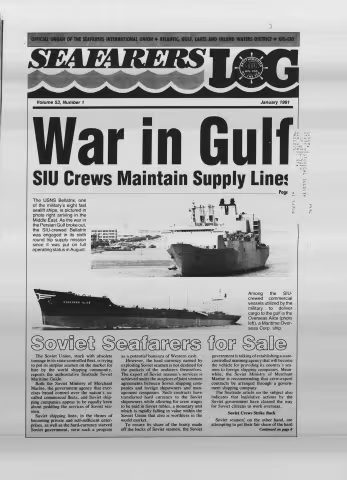
The USNS Beilatrix, one
of the military's eight fast
sealift ships, is pictured in
photo right arriving in the
Middle East. As the war in
the Persian Gulf broke out,
the SlU-crewed Beilatrix
was engaged in its sixth
round trip supply mission
since it was put on full
operating status in August.
IT'
•Jj
vO
Among the SlU-
crewed commercial
vessels utilized by the
military to deliver
cargo to the gulf is the
Overseas Alice (photo
left), a Maritime Over
seas Corp. ship.
The Soviet Union, stuck with obsolete
tonnage in its state-controlled fleet, is trying
to put its surplus seamen on the market for
hire by the world shipping community,
reports the authoritative Seatrade Soviet
Maritime Guide.
Both the Soviet Ministry of Merchant
Marine, the government agency that exer
cises broad control over the nation's so-
called commercial fleets, and Soviet ship
ping companies appear to be equally keen
about peddling the services of Soviet sea
men.
Soviet shipping lines, in the throws of
becoming private and self-sufficient enter
prises, as well as the hard-currency starved
Soviet government, view such a program
as a potential bonanza of Western cash.
However, the hard currency earned by
exploiting Soviet seamen is not destined for
the pockets of the seafarers themselves.
The export of Soviet seamen's services is
achieved under the auspices of joint venture
agreements between Soviet shipping com
panies and foreign shipowners and "man
agement companies. Such contracts have
transferred hard currency to the Soviet
shipowners while allowing for crew wages
to be paid in Soviet rubles, a monetary unit
which is rapidly falling in value within the
Soviet Union that also is worthless in the
world market.
To ensure its share of the booty made
off the backs of Soviet seamen, the Soviet
government is talking of establishing a state-
controlled manning agency that will become
the vehicle for providing its country's sea
men to foreign shipping companies. Mean
while, the Soviet Ministry of Merchant
Marine is recommending that crew-export
contracts be arranged through a govern
ment shipping company.
The Seatrade article on the subject also
indicates that legislative actions by the
Soviet government have cleared the way
for Soviet citizens to work overseas.
Soviet Crews Strike Back
Soviet seamenC on the other hand, are
attempting to get their fair share of the hard
Continued on page 6
' '• f. '' Tv' s
I- • p.?'
•••V
- .r-
;,'y.^- y:.:. -J'l:.' • .
>
•; ', ;i^-, . •;"'
-. . ..•^•' Oi ; .••
Michael
Sacco
President's Report
Liberty, Fraternity and Equality
"What happened?" "What does all this mean?"
These are some of the questions that SIU members have been putting
to us over the news of the decisive manner in which a group of marine en
gineers routed the entire slate of officers who were running for re-elec
tion as officials of the licensed division of the merged District 1
MEB A/NMU. Few events in the maritime industry over the past year
have touched off as much discussion as those election
results.
All of the principal officers of the MEBA/NMU li
censed division were replaced, according to the results
which were announced on January 2. Not one incum
bent escaped the obvious anger of the rank-and-file en
gineers at what they obviously considered to be an
unacceptable state of affairs in the merged
MEBA/NMU.
It should be pointed out that the head of the merged
union, C.E. DeFries, is still the head of the combined
MEBA/NMU. Prior to the election, he had given up his position as top of
ficer of the licensed division, but he retained the presidency of the overall
organization of licensed engineers and unlicensed seamen—a position
which now will be filled by the vote of delegates to a convention, sched
uled for 1992.
The balloting also determined who will be the delegates to the forth
coming convention. Here the opposition candidates won 11 of the 15 del
egate spots.
A Muddled Situation
To those who asked me what this means, I only can say the situation is
muddled, at the very least. Because of the complicated and peculiar na
ture of the structure by which the merged MEBA/NMU functions, the
union is being administered at the top by engineers whom the licensed
membership has repudiated. Insofar as the unlicensed NMU members are
concerned, their status really doesn't change as a result of the election be
cause they were subordinated permanently to the licensed members by a
"constitution" which assured that unlicensed members are barred from
holding the top office of the merged organization. So much for equality.
So, "what happened?" It doesn't take an exceptional student of union
affairs to understand that some grave errors must have been made by the
leadership of MEB A and the NMU when they structured the takeover op
eration.
They obviously forgot to give serious consideration to the interests
and welfare of all the people for whom unionism is all about—the rank-
and-file members. To use a line of Rodney Dangerfield's: The
MEBA/NMU officers didn't show any respect to their constituents. Both
the fact of the merger of MEB A and NMU and the manner in which it
was done should have signaled to the architects that their decisions
would be fateful ones.
Aside from the features of the merger agreement that ultimately turned
the licensed engineers against their union, it appears to me there is one
fundamental lesson that emerges from the situation: You cannot rig deals
to benefit a few and exclude the many and expect to win acceptance or
approval.
The men and women of the MEBA are professional seafaring people
with one of the longest histories as a union. They are good trade union
ists who have time and again stood up for their union's best interests,
A Union Is for All the People
It must be obvious that the sponsors and few beneficiaries of the
merger failed to recognize some fundamentals of democratic trade union
ism, among the most basic being that the union must represent all the peo
ple—equally.
Evidently, the rank-and-file licensed engineers were so concerned
with the merger's affect on their continued job security that they voted
out everybody on the ballot associated with the administration of their di
vision. What the District 1 leadership obviously forgot is that you cannot
abuse or suspend the democratic process and get away with it for long.
Volume 53, Number 1 January 1991
The Seafarers LOG (ISSN 0160-2047) is published
monthly by the Seafarers International Union; Atlantic,
Gulf, Lakes and Inland Waters District; AFL-CIO; 5201
Auth Way; Camp Springs, MD 20746. Telephone (301)
899-0675. Second-class postage paid at MSG Prince
Georges, MD 20790-9998 and at additional mailing of
fices. POSTMASTER: Send address changes to the Seafar
ers LOG, 5201 Auth Way, Camp Springs, MD 20746.
Communications Department Director and Editor, Jessica
Smith: Associate Editors, Daniel Duncan and Max Hail;
Associate Editor/Production, Deborah Greene, Art Direc
tor, Bill Brower.
SEAFARIRS LOG
The 'Brotherhood of the Sea'
Helps Stranded Brazilian Seamen
The SIU brought food to members of the Brazilian seamen's union who had run out
of stores after their ship was arrested and the operating company's accounts frozen.
Within hours of receiving a re
quest from the Brazilian seamen's
union to assist 28 of the group's
members who were running out of
food and water and confined to
their arrested container ship, the
SIU delivered a two-week supply
of stores to the crew of the M/V
Lloyd Itapage.
In his communication to the
SIU, M. Sant'Anna, president of
the Confederacao Nacional dos
Trabalhadores em Transportes
Maritimos, Aereos e Fluviais,
noted the Itapage seamen were
caught in the middle of a struggle
between the vessel's operator and
its creditors.
The Itapage, sequestered in
Jacksonville in early December, is
one of nine ships in the Compahia
de Navagacao Lloyd Brasileiro
fleet that has been arrested as a
result of court actions filed by cred
itors of the state-owned shipping
company. The nine Lloydbras
ships had been seized in Euro
pean, Canadian and American
ports.
SIU Assistant Vice President
George Ripoll and Port Represen
tative James B. Koesy brought food
and water to the 28 stranded Itap
age crewmembers. Ripoll and
Koesy were told by crewmembers
that they had not received any food,
water, fuel or wages since the
vessel's arrest. Without their pay,
the Brazilian seamen had been un
able to afford laundry services. In
addition, no mail had been for
warded to the ship since it had tied
up at the Talleyrand Avenue docks
along the St. Johns River.
Eating Flour and Oil
"When we got to the Itapage, the
seamen were down to eating flour
mixed with cooking oil," reported
Koesy. "I think they were grateful
for the food and water we sup
plied," he added.
Edd Morris, an SIU representa
tive who serves as an inspector for
the International Transport
Workers' Federation (ITF)—the
organization that brings together
rail, air and maritime unions from
all the nations in the free world—
assisted the Itapage crewmembers
by keeping in touch with the Bra
zilian seamen's union and mobiliz
ing support for the Itapage crew
within the United States.
While the Itapage crew's plight
was eased by the support of the SIU
and several church and charitable
organizations based in Jackson
ville, the fate of the Lloydbras ship
ping line remained unclear.
The Brazilian congress, meeting
in a special legislative session to
address several critical issues,
voted to extend an emergency loan
of close to $65 million to Lloydbras
in order to secure a release of the
nine arrested ships.
As the LOG went to press, the
funding allocated by the congress
had not been released, but the Bra
zilian consulates had taken over the
responsibility of looking after the
needs of crewmembers aboard the
seized Lloydbras vessels.
Jacksonville Port Representative
•r.
JANUARY 1991
'Wm:::'.
i •T' :.
Ships Keep Up Supply Line as War Erupts
As the war broke out January 16 in the Persian
Gulf, Seafarers continued to man the majority of
the 136 American-flag ships which are supplying
the U.S. forces in the Middle East combat zone.
On the eve of the war,
more than 4.2 billion
pounds of dry cargo and
8.4 billion pounds of fuel had
been delivered to the Persian
Military personnel and SlU crewmembers line the deck of the USNS
Beiiatrix as'famiiy members wave good-bye. The ship is one of the
miiitary's eight fast seaiift vessels, all of which are crewed by SiU
members. The ships, which can sail at speeds of over 30 knots, are
shuttling supplies to the Persian Gulf.
D1 MEBA Officials
Swept from Office
Licensed members of District 1
Marine Engineers Beneficial As
sociation/National Maritime
Union, running on a platform to
reform the organization, ousted all
of the incumbent division officers
and branch agents, won two out
of three patrolmen positions and
swept 11 of the 15 convention
delegate posts,according to results
of the union's recently-concluded
election.
The marine engineers, orga
nized under the banner of the
MAD Committee—initials that in
terchangeably have stood for
Members Advocating Democracy
or Members Against DeFries (C.E.
"Gene" DeFries serves as presi
dent of the District), ran on a
platform to reform the structure
of the union that had been insti
tuted when MEBA and the NMU
merged in March 1988. The struc
ture does not allow the rank-and-
file, neither of MEBA nor the
NMU, to vote directly for the top
officers of the District, who in turn
make up the District Executive
Committee.
The opposition group took issue
with the so-called severance pay
ments, totaling more than $2 mil
lion dollars, that incumbent offi
cials granted themselves at the
time of the merger. The group
stressed that those District officers
who had received the extra cash
payments actually had not severed
their positions with the unions
when MEBA and NMU became
one supposed organization.
A major point of contention
among the licensed engineers was
the attempt of District 1 MEBA
officers to merge the NMU pen
sion fund into the MEBA pension
plan. The opposition group re
portedly felt such an action would
Continued on page 6
Gulf during the buildup,
known by its military name Op
eration Desert Shield.
The eruption of fighting, in which
the armed forces of the United
States have been joined by mili
tary units of allied nations, began
with rounds of air strikes against
key Iraqi militaiy targets. With
the advent of the war, the military
code name for the engagement has
been changed to Operation Desert
Storm.
The fighting was the culmination
of a series of events that began
last August 2 when Iraq's Presi
dent Saddam Hussein initiated a
military operation to take over
Kuwait. Efforts to get Iraq to
peacefully withdraw from Kuwait
included scores of diplomatic ini
tiatives and a world economic em
bargo.
During the autumn, the United
Nations ruled that any necessary
means, including military force,
could be used to oust Iraq from
Kuwait if the aggressor had not
withdrawn by January 15. Earlier
this month, the U.S. Congress
authorized President Bush to go
to war against Iraq by a vote of
52 to 47 in the Senate and a vote
of 250 to 183 in the House.
Six-Month Buildup
While the peaceful attempts to
force Iraq out of Kuwait were
taking place throughout the last
six months, the United States and
scores of other nations were com
piling a formidable military pres
ence in the gulf that includes
460,000 American troops.
The deployment in the gulf is the
largest American military buildup
since the United States was en
gaged in the Vietnam conflict. As
of January 14, the Military Seaiift
Command (MSC) reported that the
United States had 238 ships, of
which 136 are U.S.-flag vessels,
transporting supplies to the Armed
Forces in the Middle East.
Among the vessels traversing
the oceans between the United
States and the gulf carrying cargo
to the troops are 57 Ready Reserve
Force ships that MSC has re
quested for activation, eight fast
seaiift ships, 21 prepositioning
vessels, 108 chartered commercial
ships, seven ships on loan from
foreign governments, six char
tered commercial ships that had
been in service to MSC prior to
Operation Desert Shield, 27 tank
ers, two Marine aviation support
ships known as T-AVB's and two
hospital ships.
Of the 238 ships under MSC's
direction, 90 of the commercial
chartered vessels fly foreign flags
and five of the 27 tankers are under
foreign registry.
Seafarers crews are on many of
the RRF vessels which have been
activated by the government from
the layup fleet for participation in
Operation Desert Shield. In ad
dition, SIU members are manning
many of the prepositioning ships
and the U.S.-flag compiercial ships
participating in the deployment.
All of the fast seaiift ships and the
two T-AVB's are crewed by Sea
farers. The USNS Mercy, one of
the two hospital ships in the gulf,
is crewed by members of the SIU's
Government Services Division.
Joe DiGiorgio Dies; Was Recently Retired
Joe DiGiorgio died December
26 at the age of 72. He had retired
in October from the post of SIU
secretary-treasurer. He died of
complications following heart sur
gery in a New York City hospital.
Brother DiGiorgio had been a
member of the union for 50 years
and was the union's number two
officer since 1972. DiGiorgio served
the union in a variety of capacities,
including organizer, patrolman and
port agent.
He assumed the duties of the
secretary-treasurer when A1 Kerr,
who held the post, died in January
1972. DiGiorgio was subsequently
elected to the position by the SIU's
rank-and-file membership in dis
trict-wide voting. He continued to
be re-elected to the job, only leav
ing the post when he retired.
"Joe was a one-of-a-kind char
acter. He was blessed with an
unsinkable optimism which car
ried him and the union through
many difficult times," Sacco noted.
"We will all miss him very much."
DiGiorgio also served as a union
trustee on the SIU's various trust
funds' boards, including the Sea
farers Harry Lundeberg School of
Seamanship, an institution he cared
for deeply.
Born Joseph Alloysius Di
Giorgio in 1918, he entered the
Hope Haven orphanage located
outside of New Orleans at the age
of five. Prior to shipping, Di
Giorgio tried longshore work on
the Mandeville docks in New Or
leans.
'Universally Liked'
His engaging, friendly manner
won him a wide following within
the union and the maritime indus-
Joe DiGiorgio
try in general. Michael Sacco,
president of the SIU, in remarks
made during a funeral service for
Brother DiGiorgio, described him
as "universally liked."
Shipped in WWU .
His shipping career began in
1941 when he sailed in the steward
department aboard the Del Valle.
He switched to the black gang and
continued sailing throughout World
War II. During the war, DiGiorgio
shipped'on merchant vessels as
signed to the North Atlantic and
Mediterranean theaters.
Brother DiGiorgio was buried
in the Seafarers Haven Cemetery
in Valley Lee, Md. on December
31. The cemetery overlooks the
Seafarers Hany Lundebeig School
of Seamanship. As a merchant
mariner who sailed during WWII
and thus a recognized veteran, his
casket was draped with an Amer
ican flag.
He is survived by his wife Rita
Shephard DiGiorgio, to whom he
had been married for 44 years, his
two daughters—^JoAnne Arizzi and
Renee Truelove of New Fairfield,
Conn., his brother Dominick
DiGiorgio and sisters Matilda Sacco
and Josephine Cardarella, all of
New Orleans.
DiGiorgio also is survived by
three grandchildren, John Joseph
Arizzi, Deanna M. Arizzi and Ed
ward Joseph Fitzpatrick.
•• f • LH:'
•iii
•- . '•. "'" v^ ••• .-
,.,-,0'~ J«:- • i-,- , , , ., ..•', .. , •,••. . ^ ;;
0m
m
"y^/T"?: , _ V--:,A
':^k-' • •
:
rij
.••'••:-±-.,r ' -n^'" f;';?-'
A' • 'i^jSv'S'S V i, '_'.
.
:-;:|,,::;y::;,;:;
A- y •• ' ':•>••-•, '
••:, '.. v.f •'• .' '';: _y -'
••'•• -f'V.:'•'•> •';•' •
M%yy • %..•
• ty
yy-yy
yy
"v'iC"
'--i- '•- 'v-
fs;'
•;•?- ;•
y
SUFARCRSLOe
Concern Mounts in House and Senate
Over AT&T Plan to Switch Ships' Flag
Concerns continued to mount among elected
officials in Congress over American Telephone
and Telegraph (AT«&T) Company's proposal to
operate its cable-laying vessels under a foreign
registry.
House and Senate members have been called
upon to examine AT&T's threatened switch
from the American flag to those foreign ship
registries that allow vessel operators to evade
their national taxes and safety standards and
permit the hiring of crewmembers from any
where in the world.
AT&T's indication that it was considering
abandoning the American flag on its cable-laying
ships came to light in a series of press reports
last month. Company spokesmen were quoted
as saying that "economic" considerations were
fueling AT&T's interest in a foreign-flag ship
ping operation.
Michael Sacco, president of the AFL-CIO
Maritime Trades Department, which is made
up of 43 unions representing a combined mem
bership of 85 million workers, and headed by
SIU President Michael Sacco, asked Congress
to look into AT&T's flag switch plan, noting
that it could be the beginning of a continuous
transfer of American jobs to offshore areas
where work can be performed cheaper by for
eigners.
Rinaldo, Schaefer and Callahan
In a communication addressed to AT&T's
chairman of the board, Robert E. Allen, Con
gressmen Matthew J. Rinaldo (R-N.J.), Dan
Schaefer (R-Conn.j and Sonny Callahan (R-
Ala.) urged the company to continue operating
its vessels under a U.S. flag, particularly in light
of America's defense interests.
"You are undoubtedly aware of the vital role a
strong American-flag merchant fleet has played,
and continues to play, in advancing our nation's
security interests ... In our view, every Amer
ican-flag vessel, no matter its trade, plays an
important role in such an operation," noted the
three Republican representatives.
Senator Howell Heflin (D-Ala.) said, ". . .
recent events in the Middle East point out the
necessity of this country to maintain a strong
merchant marine fleet." He suggested that op
erating AT&T vessels under a foreign flag would
"send the wrong signal to other U.S. businesses
at this time."
Nation's Security at Stake
Congressman Frank Pallone Jr. (D-N.J.) urged
the giant telecommunications company to "for
mulate a responsible corporate policy that is
mindful of our national security interests."
California representative Tom Lantos (D) told
Allen, "It troubles me greatly to hear . . . that
AT&T, one of the most respected U.S. corpo
rate leaders, may not continue its prattice of
utilizing U.S.-flag ships."
". . .1 urge you to consider the possible long
term negative effects such a decision would
have on our nation's national security inter
ests,'.' added Lantos.
Congressmen Albert G. Bustamante (D-Texas)
and Robert J. Mrazek (D-N.Y) registered their
disappointment that "a company of the stature
of AT&T would consider registering a 'runaway'
fleet of oceangoing vessels.''
If AT&T decides to operate its cable-laying
vessels under a foreign flag, "it would raise
serious questions about corporate America's
commitment to maintaining military indepen
dence in an unpredictable world environment,"
Bustamante and Mrazek added.
AT&T's two new cable ships, the Global
;fu Link and the Global Sentinel, will become fully
operational this year. The first is due out of the
shipyard in the next month. AT&T currently
has two operating cable-laying vessels—^the
Charlie Brown and the Long Lines—both of
which are crewed by SIU members.
SIU Keeps Eye on World Trade Talks
While world trade talks that could threaten
American shipping interests ended inconclu
sively last month, the Seafarers International
Union, along with others in the maritime in
dustry, continues to keep a close watch on the
MarAd Official inspects Union's School
Robert E. Martinez (center), deputy administra
tor for the Maritime Administration, reviews the
SlU's shipping procedure for crewing Ready
Reserve Force vessels needed in Operation
Desert Shield. He is pictured with Bart Rogers
(left), SIU manpower coordinator, and Ken Conk-
lln, Lundeberg School vice president. Martinez
also inspected the union's training programs
conducted at the SlU's educational facility.
attempts by various governments to bring the
process back to life.
If the current round of talks under the world's
General Agreement on Trade and Tariffs (GATT)
framework are to be resuscitated, the United
States Trade Representative (USTR) must pre
sent a completed treaty to Congress by March
1. After that date, the trade agreement will no
longer be considered under what is known as
"fast track authority," aprocess which provides
for a single up or down vote by Congress,
prohibiting amendments. While the USTR can
make a case for an extension of the fast track
authority, indications from a number of elected
House and Senate offlcials suggest that Con
gress is not likely to grant such a request.
Because of the March 1 date, it is expected
that any attempts to revive GATT will take
place over the next few weeks. Should the
various signatory nations to the trade treaty
iron out their differences on the agricultural
subsidies question, the GATT agreement will
be very much alive and the American maritime
sector will have to work hard to ensure that
waterbome transportation services are not
brought to the table.
The GATT agenda collapsed last month when
no accord was reached between nations with
significant agricultural sectors on the level of
government subsidies that farmers should re
ceive. While the failure to reach an agreement
on this issue dominated press accounts of the
GATT talks, many other sets of negotiations
also were being conducted.
It was the attempt to bring waterbome
transportation services under the auspices of
GATT that concerned the American-flag ship-
Continued on page 6
Great Lakes SIU members (from left to right)
Donald Thornton, Tim Kelley and Kevin Kelley
joined with other Seafarers and metropolitan-
Detroit trade, unionists to demonstrate support
for striking Eastern Air Lines machinists.
Easiaw Aff Liiws
IsMidBushess
Eastern Air Lines ceased operations January
18 almost two years after its management locked
out its unionized workers and tried to rebuild
the company by using scab employees and the
federal bankmptcy courts.
The folding of the airline brings to an end
months of picketing against the company by
members of the Intemational Association of
Machinists (lAM) who have been on strike at
Eastern since March 1989. Hundreds of SIU
members have provided countless hours of
picket-duty assistance to their brother and sister
unionists from Eastern since the strike began.
Upon hearing the news that Eastern was
closing down for good, Frank Ortis, a spokes-
itian for the Machinists, said, "This is a direct
effect of labor-busting. Labor peace could have
saved Eastern. We were willing to negotiate but
the company was unwilling to accept it»" he
added.
Eastern management blamed the shutdown
on the increased cost of fuel caused by the
Persian Gulf war and a steadily declining pas
senger flow.
Union Busting Does Not Pay
The beginning of Eastern's end came about
when notorious union-buster Frank Lorenzo,
then president of Eastern's parent company,
Texas Air (now called Continental Airlines
Holdings), locked out Machinists on March 3,
1989. I AM members employed by Eastern had
planned to go on strike the following day if an
agreement had not been reached. Members of
the pilots' and flight attendants' unions honored
the Machinists picket lines, effectively shutting
down the airline. Lorenzo filed for bankruptcy
protection six days later.
As the company tried to rebuild the airline
with scabs, the bankruptcy court ousted Lor
enzo from control of Eastern in April 1990. The
airline, despite its reduced size and corporate
restructuring, was losing $1 million to $2 million
daily, which it continued to do until closing.
When the court appointed Martin Shugrue to
oversee the airline, the Machinists had hoped
to negotiate an end to the labor strife. "One of
the largest problems was he did not want to
negotiate to get rid of the scabs," said Ortis.
Shugrue met with the lAM leadership once, the
Machinist spokesman noted.
Ortis said the union will continue to follow
deliberations of a New York grand jury that
indicted Eastern in August 1990 for falsifying
maintenance records before the strike, acts
which the lAM had accused the company of
practicing prior to the commencement of their
job action. "But we understand the grand jury
also is investigating Eastern for the same thing
after the strike and during Shugrue's tenure,"
Ortis added.
y'.' 'y •
:^'¥f
• ".'W-ife- •',••"• "--rv -t"' "'•"
! ' v-,-':;
;'.i' .'T. •• •-"• -••- ".;'
.•J'jgl
.'tRJSSjS:/.
t;?:/. :;V- , ^ ..
•'T. '•
A:
'i-'••
]HK..
UiS.
JANUARY 7997
Military Hails Sill Crew in Operation Steel Box
The Military Sealift Command
(MSG) acclaimed the "exceptional
performance" of the two SIU-
crewed ships that were selected for
a very critical and possibly very
dangerous mission transporting
highly sensitive materials from Eu
rope to the Pacific.
According to press reports, the
Gopher State and Flickertail State,
which are operated by the SlU-con-
See page 9 for thoughts of
two crewmembers who
participated in the historic
operation. Photos of Sea
farers in mission also ap
pear on page 9.
tracted operator Interocean Man
agement Company (lOM), picked
up more than 102,000 rounds of
nerve gas artillery shells from
Nordenham, Germany, a port city
near the North Sea and carried the
cargo to Johnston Atoll, about 850
southwest of Hawaii, where the
chemical we^ns will be destroyed
in a specially built incinerator.
In preparation for participating
in the mission, known by its mili
tary designation Operation Steel
Box, Seafarers received special ad
ditional training in fire fighting and
chemical handling, spending sev
eral weeks engaged in intensive
simulated drills and exercises.
MSG Cites 'Professionalism'
MSG Commander Vice Admiral
F.R. Donovan, in a communication
to lOM, congratulated the entire
Interocean Management team for a
job well done, citing the profession
alism, cooperation and persever
ance of all lOM hands involved in
Operation Steel Box. lOM Presi
dent William H. Lockwood Jr. ad
vised SIU President Michael Sacco
that the work of the SIU crews had
played a critical part in making the
mission a success. "lOM recog
nizes this exceptional level of effort
oh the part of the SIU and applauds
it," Lockwood said.
The nerve gas canisters, part of
the European-based arsenal built up
by the United States from 1958
through 1968, were removed as part
of an historic 1986 weapons-reduc
tion agreement between the Amer-
ican and West German
governments. Until the removal of
the deadly chemical weapons was
announced in the spring of last year,
its existence had been secret, ftess
reports noted that the removal of the
covertly bunkered deadly weapons
was a further signal of the relax
ation of tensions between the Soviet
Union and the United States along
with its NATO allies.
Heavy Security
Before the lethal cargo arrived at
the port city in Germany for loading
on the two lOM-operated ships, it
was transported first in a truck con
voy and dien by rail, accompanied
by massive U.S. military and Ger
man paramilitary security forces.
The six- to eight-inch in diameter
artillery shells which were loaded
with liquid nerve agents were
Orgulf SIU Members to Vote
On New Three-Year Pact
Balloting is taking place along
the Mississippi and Ohio rivers as
approximately 250 Seafarers vote
on a three-year extension of their
contract with Orgulf Transportation
Company.
Lead Deckhands John Russel
and Terry Tolley and Cook Jac
queline Grant worked with Byron
Keliey, SIU vice president for lakes
and inland waters, and Joe Sigler,
St. Louis port agent in the negotia
tions with the company, Kelley re
ported. He noted die four days of
negotiations last month went well
tha^s to the determined efforts of
the union negotiating team.
Orgulf operates 24 tugboats,
crewed by SIU members, along the
upper and lower Mississippi, Ohio,
Tennessee and Missouri rivers. The
company is based in Cincinnati.
Voting is expected to continue
through the month. Tony Sacco,
St. Louis Port Agent Joe Sigler (stand
ing) and union members (left to right)
John Russel, Jacqueline Grant and
Terry Tolley take a break during nego
tiations with Orgulf Transportation.
Orgulf Vice President William Ferguson
and SIU Vice President Lakes and In
land Waters Byron Kelley are pictured
above after the union and the company
had agreed on a new 3-year contract.
SIU assistant vice president, said
the effort to reach members aboard
the tugs has been hampered by bad
winter weather, but he expected all
the vessels to receive a visit from a
union official before the end of the
month.
The three members involved in
the negotiations have sailed with
Orgulf for several years. Russel
started sailing on Orgulf tugs in
1985. Tolley began in 1986 and
Grant started work in the galley in
1988.
The SIU represents the cooks,
lead deckhands and deckhands
aboard Orgulf tugs. The new con
tract would run through 1994 if it is
ratified by SIU crewmembers.
Heavily-guarded Convoys carrying American chemical weapons make their way
through Germany on the way to the port city of Nordenham. From there, the canisters
}Toa were loaded on two SlU-crewed vessels and carried to the Pacific for destruction.
sealed in air-tight magazines and
placed inside 5,000 specially-de
signed sheetmetal containers.
SIU crewmembers aboard the
Flickertail State, a ship broken out
of the U.S. government's Ready
Reserve Force for participation in
the mission, were Bosun Louis
Flade; ABs John McMurtray,
James Kutzler, John McL
aughlin, Naaman Richard, Rich
ard Barnhart; Ordinary Seamen
Christopher Caporaso, Matthew
Denesco, Noah Jones IV and Elec
trician Donald Christian.
Also on the Flickertail State were
QMED Electrician Frank
Tymcyszyn; FOWTs William
Harrington, Pete Pasienza, Kevin
Hall, Philip Zalewski, Lee Roy
Laurent; Wiper Martin Thur
ston; Steward Baker Ronald
Malozi; Chief Cook Matthew
Scott, Steward Assistants Andelair
Betties, Stephen Colestock,
Abraham Norwood Jr., Wagner
Pellerin and Neil Penaflor.
The Gopher State, another RRF
ship brought into service for Oper
ation Steel Box, was crewed by the
following Seafarers: Bosun Paul
Lewis; ABs K. Loggins, Paul Jag-
ger, John Humason, James Burt,
Tom Casey, Robert Coleman; Or
dinary Seamen Gary Stevens,
Russell Nelson, Gary Kypke;
Electrician James Laratta; Sec
ond Electrician J.A. Yarber;
QMED M.B. Aroon; FOWTs
Wayne Toole, Robert Ramsey,
Dennis Clay, Moses Mickens Jr.,
D.W. Vannatter; Wiper Kelly
Feldman; Steward/Baker John
Reed; Chief Cook Russell
Beyschau; and Steward Assistants
Donald Sneed, John McLain,
Mike Miller, Tran Nee, Timothy
Williams and Walter Schoppe IV.
60 Day Waiver of Relief Rule
instituteii Due to Gulf War
The Seafarers Appeals Board
has ruled that all requests for reliefs
including permanent ratings be
waived for a period of 60 days be
ginning December 13,1990.
The board, which consists of rep
resentatives from both the union
and its contracted companies, insti
tuted the rule as a response to the
huge surge in shipping resulting
from the current sealift to the Pers
ian Gulf.
The ruling will be reviewed after
60 days to determine what the needs
of the industry are at that time.
However, the change does not af
fect the established relief proce
dures on Military Sealift Command
and LNG vessels. Also, members
who are required by the amount of
seatime they have accrued to up
grade at the Seafarers Harry
Lundeberg School of Seamanship,
like QMEDs, will not be penalized
if they were not able to attend the
school because they could not be
relieved from their vessels.
The complete SAB ruling—^Ac
tion 353—is printed below.
SAB Action 353
The Seafarers Appeals Board
acting under and pursuant to the
Collective Bargaining Agreement
between the union and the various
Contracted Employers, hereby
takes the following action.
Whereas, by Action No. 352,
dated August 10,1990, because of
the national emergency created by
Operation Desert Shield, the Ship
ping Rules were amended for the
duration of the emergency, and
Whereas, the additional vessels
from the Ready Reserve Fleet have
been assigned by the Maritime Ad
ministration to various Contracted
Employers, and
Whereas, the additional vessels
have escalated the demands on the
Manpower Pool, the Shipping
Rules will be further modified in the
following manner.
Rule 5 A 12 (a) Trip Reliefs Per
manent Ratings shall be waived for
a period of sixty (60) days, at which
time the manpower pool capability
shall be re-evaluated to determine
the need for further modification of
the Shipping Rules to meet the
sealift commitment to the various
Armed Services. On Military Sealift
Command and LNG vessels where
established relief procedures have
been in effect, such procedures
shall continue.
EffectiveDate: December 13,1990.
•r-Vv-,-
gr:/-
A:®
hi • '
-rii
• 'y •. -f • ••
"'7
•:m •
••j
SIAFARCRSLOG
J:;-;/': •^•
•. '.-r •,: •
iSJf:
•,
i-fi-• -' '•• •
i\ .'i ." S:-'::••-•;
• •<
tSii
•it
fSM
D1MEBA Officers Ousted
Continued from page 3
have the licensed engineers, whose
pension trust is over-funded, un
derwriting the bad management of
the NMU plan, which is under
funded.
Chairman Wins by 400 Votes
Carrying the top officer position
in the licensed division by a vote
of 1,410 to 992, challenger Gordon
Ward, a chief engineer aboard
Puerto Rico Marine's Carolina,
defeated Clyde Dodson, a long
time official of the District and the
incumbent chairman of division, a
post he only had held for a few
months.
Prior to Dodson serving as
chairman of the District's licensed
division, the position had been
held by C.E. "Gene" DeFries
since the creation of the merged
union. DeFries, who also serves
as president of both the District
and National MEBA, announced
in the first half of 1990 that he was
resigning from the licensed divi
sion chairman post in order to
concentrate on his other duties.
This move exempted DeFries from
holding any position voted on by
a direct ballot of his union's mem
bership.
Joel Bern, currently a chief en
gineer on the Sea-Land Atlantic,
became the division's vice chair
man, beating Karl Landgrebe, the
incumbent, by a vote of 1,557 to
1,213. Replacing incumbent divi
sion directors C.W. Daulley, Don
ald Masingo and R. Fred Scha-
mann are Mark Austin, a first
assistant on the Alaska Marine
Highway System, Nick Hadju, who
has sailed as chief engineer on
Lykes Lines vessels and Alex
Shandrowsky, who holds a chief
steam/motor engineer's license.
The opposition slate won 11 of
the 15 convention delegate posts
that will represent the licensed
division in a district-wide conven
tion which next will be held in
March 1992 and 11 of the 15 del
egates attending the National
MEBA convention which is con
vened every four years.
Unmn Mmitots
Worid Trade Talks
Continu^ from page 4
ping community. It is felt such a
move would jeopardize existing
programs designed to promote the
American-flag merchant marine.
For example, inclusion in the world
trade agreement could nullify
American cabotage laws, super
sede existing treaties and bilateral
maritime agreements and prohibit
future government support for the
industry.
While more than 150 congress
men and a majority of members
of the Senate agree with U.S.
shipping interests that waterbome
transit should not be included in
the GATT agreement, American
government representatives in
volved in the trade talks have been
cagey about whether their nego
tiating strategy includes wheeling
and dealing with maritime serv
ices.
The election—conducted be
tween November 1, 1990 through
December 30, 1990 after the first
attempt at the balloting process
which began in October was
aborted due to election procedure
irregularities consisting primarily
of duplicate ballots—was the first
time engineers cast a vote for their
division officers since District 1
MEB A/NMU was created in March
1988 by a merger between District
1 Marine Engineers Beneficial As
sociation and the National Mari
time Union.
New Congressman Meets with Duet
SIU pensioner Duke Duet (left) Is pictured with newly-elected Louisiana
representative William Jefferson, who has been named to the House Merchant
Marine and Fisheries Committee. Behind the two men is Brother Duet's vehicle
which the Seafarer outfitted for get-out-the-vote activities In the past election.
MEBA, NMU Merger
Rankles Rank-and-File
Recently-concluded District 1
MEBA/NMU elections among the
union's licensed engineers is a
culmination of a long-simmering
discontent among both the li
censed engineers and the former
National Maritime Union (NMU)
members who are now in the or
ganization's unlicensed division.
Maritime industry observers who
have been following the course of
the union, which came about as a
result of a merger between District
1 Marine Engineers Beneficial As
sociation (MEBA) and the NMU
in March 1988, have noted the
growing rank-and-file opposition
to the governing structure crafted
by those who brought about the
joining of the two organizations.
The structure of the merged Dis
trict 1 MEBA/NMU has been crit
icized by members of both MEBA
and the NMU for having ignored
the interests of the unions' mem
bership. Examples which have
been offered as contributing to this
attitude are the issue of huge so-
called severance payments made
to MEBA and NMU officials, the
undemocratic structure of the
merged union, the barring of un
licensed members from holding
the top job in the organization and,
the ignoring of NMU members
desires for a merger with the SIU.
The severance pay beef results
from the fact that certain officers
of MEBA and NMU split between
them over $2 million dollars from
the organizations' liquid assets and
called it severance pay. The same
MEBA and NMU officers did not
sever ties with District 1 MEBA/
NMU. Instead they became offi
cials of the merged linion.
A Takeover of NMU
NMU members have voiced op
position to the manner in which
District 1 MEBA/NMU has
doomed the union's unlicensed
seamen to a life of second class
citizenship. The organization has
accomplished this by barring an
unlicensed member from the top
job of the union. The District 1
MEBA/NMU constitution says in
effect that only a member in the
licensed division can be president.
In addition, voting strength at
the District's convention, in which
delegates from both the unlicensed
and licensed divisions of the union
participate, is allocated on the ba
sis of how much dues money comes
from each section. (Most demo
cratic structures apportion votes
on the principle of orie-man-one-
vote.)
NMU Plans Thrust on MEBA
For MEBA members, the plan
of District 1 officials to merge the
trust funds of the NMU with those
of their union raised many con
cerns, particularly in the case of
the MEBA pension trust. Many
marine engineers felt that the li
censed members were being asked
to underwrite the bad management
of the NMU plan and its conse
quent under-funding.
Rank-and-file members also have
expressed concern over the man
ner in which the top District offi
cials are insulated from the secret
ballot process. The way that Dis
trict 1 MEBA/NMU was struc
tured allows members to vote di
rectly for posts in the licensed and
unlicensed divisions. But the
union's top officers—including
president, executive vice presi
dent, secretary, treasurer and two
vice president spots—are selected
at a convention.
MEBA members have noted that
this layering of authority allowed
the president of their union, C.E.
"Gene" DeFries, to escape a di
rect vote by licensed engineers.
DeFries, by resigning as chairman
of the licensed division in the spring
of 1990, did not have to face a
ballot round. However, he re
mains the president of District 1
MEBA/NMU.
According to observers, one of
the issues rankling the unlicensed
members is the manner in which
their merger wishes were ignored
by NMU leaders. In a canvass of
NMU members in 1986 on their
preference for a union with which
to merge, the great majority fa
vored joining up with the SIU.
Instead, the NMU leadership
entered into a deal with a licensed
officers' union, making an ar
rangement that turned out to be
qui|e lucrative for certain NMU
officials. According to many NMU
rank-and-file members, the pre
vailing view among the unlicensed
seamen is their leadership sold out
to the MEBA officers union.
Soviet Seamen
Up for Grabs
Continued fivm pt^e 1
currency generated by their labor.
A Journal of Commerce article
appearing last August reported a
Soviet crew on a Soviet tanker
went on strike while docked in
Italy over a demand that their
salaries be paid in hard currency
instead of rubles. That tanker crew
was replaced by other Soviet sea
men, who subsequently went on
strike over the same issue when
the vessel was in Amsterdam.
Keep Hard Currency
The Journal of Commerce piece
points out that while Soviet ship
ping companies earn hard cur
rency for handling foreign car
goes, they continue to pay their
crewmembers in rubles.
Such is also the case for Soviet
seamen manning nuclear-powered
ice-breaking vessels operated by
Murmansk Shipping Company, the
branch of the Soviet shipping ap
paratus that clears the Arctic
waters, maintaining a northern sea
route. The company's services
raise thousands of dollars of hard
currency for the state, primarily
from European and Asian shippers
using the waterway, but the sea
men are paid in rubles.
Ice-breakers Also Involved
The Soviet ice-breaking ship
crews also have engaged in a series
of job actions designed to increase
their allotment of hard currency.
To date, the Soviet seafarers on
the nuclear-powered ice-breaking
ships have won an agreement from
the government for a portion of
their wages to be paid in hard
currency.
Going into 1991, industry ob
servers believe the Soviet Minis
try of Merchant Marine and Soviet
shipping companies will increase
their efforts to hawk the labor of
their surplus mariners in exchange
for hard currency while attempting
to continue to pay Soviet seamen
in rubles.
The International Transport
Workers' Federation (ITF), a group
made up of national unions rep
resenting people engaged in var
ious transportation modes, has
'warned that failure to exact hard
currency pay for Soviet seamen
could further devalue the salary
and benefit standards for the
world's seafaring population.
•o-'.
s -= " . . '
7-.',,:.v'.7
5?'' "i;.
Edward T.RItey
Former Port Agent
Edward T. Riley Dies
Former Boston Port Agent Ed
ward T. Riley passed away October
28,1990.
The 78-year-old Riley, known
for his fiery nature and quick wit,
had served the union first as a pa
trolman in Boston, then became
port agent in 1961 succeeding John
Fay, who now serves as the SIU's
secretary-treasurer.
The Massachusetts native joined
the deep sea division of the SIU in
August 1951 in the port of Boston.
He helped organize the Atlantic
Fishermen's Union, before it
merged with the AGLIWD.
Riley worked with both the
fishermen's fleet and deep sea divi
sion as a patrolman and port agent.
He also served as the international
representative for the fishermen be
fore he retired in 1978.
Jack Caffey, SIU vice president
for the Atlantic coast, remembered
servicing vessels with Riley when
Caffey first became a patrolman.
"He was a hard worker," Caffey
recalled. "He didn't take anything
off anybody, especially from ship
owners and captains. He fought for
what the members deserved to get
under the contract."
Great Lakes Ships Lay Up for the Winter
Seafarers who sailed on the
Great Lakes had "an exceptionally
good year," according to Algonac
Port Agent Jack Allen.
The season came to an end ear
lier this month as all SlU-con-
tracted vessels were expected to be
docked by the 15th when the Soo
Locks between Lake Superior and
Lake Huron closed for the season.
and fill their contracts," the patrol
man added.
Both men noted January's
weather had not been as kind. With
the dip in the thermometer all the
lakes and rivers had ice forming on
them. Allen said the St. Clair River,
which runs past the Algonac hall,
already had frozen.
While no dates have been set for
fitout, Allen figured the shipping
companies "will start warmmg the
vessels up during the last two
weeks of March."
"We had plenty of work for all
of our members," Allen reported.
"The hall was empty most of the
year."
Friendly Weather
Both Allen and Patrolman Andy
Goulet noted weather played a key
role in allowing most of the vessels
to ply the waterways until the new
year. "The weather up here was not
as foul as the last two years," Allen
said. "We had lots of wind from all
directions for the last two months,
but we did not have the snow and
ice.
Goulet explained that rivers and
harbors along the Lakes generally
start icing in the early autumn when
the colder weather moves south
from the Arctic. "This year, we
didn't see the harbors and rivers ice
up until the end of November. We
had a mild December so our ves
sels were able to stay out longer
Safety and survival gear are itemized and stored in the crew's lounge aboard the Sam
Laud before Great Lakes members sign off the vessel for winter.
OMI Columbia's Seafarers Crew Is Praised
Bosun James L. Carter had
nothing but praise for the SIU-
crewed deck department members
who cleaned up the mess created
by winter storm damage aboard the
OMI Columbia last month.
In a letter to the Seafarers LOG
which included photographs of the
members at work. Carter said the
crew jumped right in to stabilize
the situation, then tackled the
clean-up effort once in port in
southem California. "They did a
top-notch job," he added.
Tanker Hits Storm
The Columbia left the port of
Valdez, Alaska on November 30,
1990 fully loaded when the tanker
ran into a very severe winter storm.
Captain Dimitrios Katsogiannos
noted winds on December 2 and 3
were up to 50 knots, creating a
wind chill effect of -50 degrees.
Carter reported the bow of the
vessel suffered a crack during the
storm, flooding the bosun's store
room and damaging mooring lines
and pipelines. As the crew was not
in any danger and no oil was lost,
the ship continued sailing to the
Long Beach area to offload before
it docked for inspection.
Company Thanks Crew
Brian Constable, OMI's vice
president for engineering, said SIU
crewmembers were of "^eat assis
tance in cleaning the ship and get
ting it ready to sail." The deck
department members pumped the
10- to 12-foot deep water from the
storeroom, stripped the equipment,
cleaned and repainted the area be
fore bringing the new lines aboard.
Katsogiannos and Chief Mate
David Steiner sent a letter, dated
December 7, to the SIU "to express
our thanks to (the) SIU crew under
my command and extend my
thanks and commendation to the
crew... for outstanding work and
performance lifting (the) last load
of oil from Valdez, Alaska No-
Bosun James L. Carter inspects dam
age In the OMI Columbia's bow caused
by a severe winter storm.
ABs David Williams (left) and Jerry Casugay retrieve lines damaged by the flooding
on the tanker.
vember 30 (and) during the severe
weather.... We are very proud to
have them onboard the OMI Co
lumbia."
Besides Carter, those listed in
the Katsogiannos/Steiner letter
were ABs Richard Houghton,
William R. Kleimola, David C.
Williams, Paul Sbriglio and
Josefino Casugay and Chief
Pumpman Alfonso Bombita.
Repairs were completed and the
ship was ready to sail 36 hours after
discharging its final cargo. Consta
ble noted. The Columbia has been
sailing along the Alaskan oil route
for nine years and has suffered
only two other storm-related inci
dents. "This is a great reflection
upon all the members who serve
aboard the Columbia," Ae OMI
official stated.
-i
.•i"
. - v.- •
• • a. s
i
t ^ ̂ t ' J" ;
I * ̂ --1-* ^'--' "^^''^'^•'-'ainT iii*''''!^'"^*^-^'?1'^
'i I'•'•'•
8 5^$B# — ' ^1- --—.V SSAFARCRS LOG
Candidate for Master Recalls SIU Training
. .| \- . ".v^ ,
I :%'•' .
I? %•••
St::\
"t. !. '•" -
ir-'-'.'
:t^':
ifi.-v .V'y^ V'.
i't'-'-''"• ,"-
.' J '- - •; -' • "•• '• •. :
Fraser addresses a group of upgraders
studying to become able bodied sea
men at the Lundeberg School.
Chris Fraser had no idea he
would be preparing to take his
master's licensing test 15 years
after graduating as a trainee from
the Seafarers Harry Lundeberg
School of Seamanship. But a com
bination of hard work, good sea
manship and the opportunities
provided by the SIU, and more re
cently, District 2 MEBA have al
lowed the 36-year-old member to
move up the hawsepipe at a rapid
pace.
Fraser urges all SIU members to
take advantage of the school's op
portunities so they also can reach
the peak of their abilities and po
tential. The chief mate, who sails
for American Hawaii Cruise Lines,
is a firm believer that ciewmembers
should continually leam to upgrade
themselves.
He noted his discussions with
more experienced seafarers aboard
ships were the first non-academic
learning sessions for him. "That's
where it's all at," he emphatically
stated to a Seafarers LOG reporter.
Proud of School
Fraser and his wife, Leslie, re
cently visited the school where he
talked to upgraders studying to be
come able bodied seamen. It was
his first visit in many years. "The
change in it is unbelievable," he
noted. "The crane training pro
gram is unique; there is nothing
else like it."
He had worked in the ship han
dling simulator to prepare for his
upcoming test. "The computer
simulator is a fantastic piece of
^uipment," he stated after spend
ing several hours in it.
The Massachusetts native said
he tries to speak with SIU members
about the need to upgrade when
ever possible. He had a special
message for young people entering
the industry through the
Lundeberg School's trainee pro-
gram."They should get a deep un
derstanding of all the different
programs that are now available at
this really fantastic school, which
were completely unavailable when
I came here," Fraser reflected.
"They should really understand
how their union works, what rotary
shipping is and how they go about
getting different jobs once they
leave the school. They especially
need to know what to do to get back
here to upgrade their endorsements
and be eligible for not only higher
paying jobs but also more ad
vanced jobs in the industry. These
people should be aware of all the
different programs and diversity in
terms of academic offerings in this
school. It's a wonderful environ
ment that's been created for them."
Fraser noted the reason he likes
to talk with the newer niembers is
he was not aware as a trainee that
"you could come up through the
hawsepipe and get a master's li
cense." He said trainees and up
graders can get a lot of exposure to
other people with more experience
in the industry while attending the
school. "I think that is the most
crucial thing they can get."
SIU Men on the Move
Inspired by the way Fraser has
continued to upgrade his skills and
how he did it, several of his deck
mates have been motivated to seek
their licenses. Pete Ryerson, Al
Dorflinger, Ray Baldado, Mike
Darley and Steve Baker were just
a few who have sailed with Fraser
and who started with the SIU.
After he became a licensed offi
cer, Fraser said he was helped tre-
Lundeberg School instructor Ed Boyer
(left) talks with Chris Fraser during the
former trainee's recent visit to Piney
Point.
meridously by the fact he had
worked as an unlicensed mariner.
"It's much easier to legislate a
number of people when you've al
ready done their job. Having so
much hands-on deck experience,
docking and uhdocking a ship was
a breeze. If you come out of an
academy, you don't have that type
of hands-on background."
Fraser heard about the
Limdeberg School from a class
mate at the University of Connect
icut. "I thought this would be an
interesting way to earn money
while I was continuing my educa
tion." After leaving Piney Point in
1975, Fraser worked in all three
departments at the entry level be
fore settling into the deck section
for good.
Becoming an Officer
He began studying for his third
mate's license in 1980. "I got the
information for the license during
a three- to four-week stay at the
school. Then I was able to study
while out at sea."
After obtaining his license, he
joined D2 MEBA and sailed
abo£^d American Hawaii Cruise
Line vessels. He earned his second
mate's license a short time later.
Fraser met his wife in 1985
when Leslie was a passenger
aboard the Constitution. The trip
was a present from her mother for
her 21 st birthday. Last month, Les
lie gave birth to the couple's first
child, Charlotte.
At the beginning of 1988, he sat
for his chief mate's license. Fraser
has been sailing in the position
aboard the Constitution since.
Fraser's immediate plans call
for taking the test for an unlimited
master's license early this year.
When asked if he had any last
words to give to SIU members at
tending the Lundeberg School,
Fraser said, "This place has a tre
mendous amount to offer anyone
regardless of who you are. Anyone
who hasn't taken advantage of
this school that belongs to the
SIU is simply shortchanging him
self."
Ken Conklin (left), Lundeberg School vice president, greets Leslie and Chris Fraser,
a 1975 graduate of the school.
Lundeberg School Updates
Entry Engine Course Work
In an effort to stay on top of the . • . ~~
needs of the American maritime
industry, the Seafarers Harry
Lundeberg School of Seamanship
has revised its basic engine depart
ment couree for young people enter
ing the seafaring profession.
Instructor Joe Kurley said the
changes were made so trainees
who will work at entry level jobs
as wipers, deck engine utilities or
ordinary seamen will have the
skills necessary to work skillfully
aboard today's technologically-
advanced U.S.-flag vessels.
Morning sessions in the class
consist of detailed instructions on
hand and machine tools, measur
ing instruments, piping, valves,
gaskets, pumps and the theory of
steam and diesel power plants.
Instructor Joe Kurley (right) demon
strates cutting external threads on a
rod using a hand die.
Two trainees work together to get the
feel of operating a drill press at the
Lundeberg School.
Heavy emphasis is placed on
safety practices and procedures.
in the aftemooii, the trainees ex
perience hands-on training by
working with the various tools and
machinery about which they have
studied.
Kurley said the response from
the trainees while in class, then
after they have gone to sea, has
been positive. He said former
Lundeberg School trainees report
the training they received at the
school has helped them comply
with the orders of their superi
ors.
The changes in the Lundeberg
School entry-level engine depart
ment course were made by the
institution's instructors after close
consultation with SlU-contracted
operators, SIU members who sail
in the engine department and union
officials.
V., "^ •-V:-:;,i;;-^ i/-;: .'viv; ••-;.
't -• • r:-^:::- .jp r
-
E'^s;.
• ' '"-'>1.'
I;fip'-
JANUARY 1991 :>V: »;ysl|§igftiipw
Two SlU-crewed ships oper
ated by Interocean Management
carried more than 100,000 deadly^
nerve gas shells out of Germany to
an island in the middle of the Pa
cific without an incident.
The Flickertail State and the
Gopher State took 47 days to sail
from Nordenham, a port city just
south of the North Sea along the
Weser River in Germany, to John
ston Atoll, approximately 850
miles southwest of the Hawaiian
Islands. Complete with a U.S.
Navy escort, the vessels convoyed
south across the Atlantic around
Cape Horn (at the tip of South
America), then sailed north to the
coral island, 1,800 miles east of the
Federated States of Micronesia.
the SIU for 14 years, was aboard
the Flickertail State while it was in
the yard. His function was to make
sure the Hagglund cranes installed
aboard both vessels worked prop
erly.
Nerve Gas Brought Aboard
Cape Upholds Reputation
Crewmembers aboard both ves
sels stated the roughest part of the
whole journey was the week-long
trek around Cape Horn. "It was just
like you see in the movies," said
AB Charlie Parks, 34, who sailed
aboard the Flickertail State. "The
winds were howling and the waves
were crashing."
John Humason, 38, sailed as an
AB aboard the Gopher State. "It
was kind of scary," he recalled.
"These vessels were never in
tended to make a trip like this. The
waves were 30 to 50 feet. The tem
peratures were around 30 degrees.
Everything had to be lashed down.
It's just a wasteland down there."
Humason, a 20-year SIU mem
ber, said he was not sure what to
expect when he signed on. He
stated all the members went
through almost two weeks of train
ing at the Military Sealift Com
mand firefighting center near
Earle, N.J. to learn how to deal
with a chemical leak, fire and other
possible accidents.
The vessels left Norfolk, Va. in
late August after both vessels had
been altered in a shipyard in Balti
more. Parks, who has sailed with
The vessels were docked in
Nordenham for two weeks while
the motor-and-train convoys with
the nerve gas canisters arrived
from Clausen, Germany where
some of the weapons had been
stored since the mid-'50s.
"There was intense security
throughout the port," Parks re
membered. "There were German
and American MPs everywhere.
They had bomb-sniffing dogs and
they had to sniff everything that
came aboard." .
Although crewmembers were
restricted to ship while loading op
erations took place, they were able
to visit the town in the evening.
"The townspeople were really
friendly," Parks said. "It was a nice
little village."
The day before the two ships
were to sail, demonstrators from an
environmental group showed up
in small boats to protest the trans
fer of the gas. "It was like they
were protesting just to get televi
sion coverage," Humason said.
"They held signs in three or four
different languages but made no
effort to stop us. Of course, secu
rity didn't let them get close."
The galley gang aboard the Flickertail State celebrates the end of the voyage.
Navy and Army Aid Mission!
Even with the security on the
docks and in the river, elite Navy
frogmen swam around the hulls of
the ships to make sure no explo
sives had been attached. Once the
pair cleared the sea buoys, the
Navy escort fell in to follow the
vessels through the Atlantic.
Both members reported un
eventful journeys to Ae Pacific,
except for the trip around South
America. They reported the stew
ard departments did a great job of
keeping the crews happy with good
meals and barbecues throughout
the voyage.
The two members said Army
personnel on both ships monitored
for any possible leakage from the
canisters which had been packed in
steel drums then surrounded by air
tight containers. All crewmembers
were required to carry gas masks at
all times.
Unloading Proless Smooth
Military personnel feared possi
ble trouble as the vessels neared
Johnston Atoll, ordering them to
slow down. According to Parks, the
military was worried that an envi
ronmental group was going to
launch a demonstration to prevent
the offloading at the U.S.
government's chemical agent dis
posal site. However, no action took
place and the cargo was unloaded
without a hitch.
Parks noted a couple of the
members on the Flickertail State
were sailing for the first time since
graduating from the Seafarers
Harry Lundeberg School of Sea
manship. "They adapted very well
and did a good job," he bragged.
Led by Bosun Lou Flade (seated at table), the deck department
of the Flickertail State made sure the nerve gas shipment
arrived safely at Johnston AtoIMn the Pacific.
Wilmington Port Agent Don Anderson (right) works with members
of the Gopher State during the ship's payoff at the conclusion of
their three-month voyage.
The nerve gas is scheduled to be
destroyed at an incinerator on the
island. The incineration process is
pending while court challenges on
the process from environmental
groups and neighboring islands are
being heard.
Black gang members kept thp Gopher State going despite The Gopher State's steward department kept the Deck departrnent members of the Gopher State wait
some rough seas and bad weather. crew and military personnel well fed and happy. for payoff to finish before going ashore.
• - .v' •*, ,. • •> qt"'- ; •
9 ^ -..IVJ
Engine department members aboard the Flickertail State know they will arrive soon.
Despite being at sea for 47 days,
the activities of the members were
restricted during offloading in case
of any contamination from the
chemicals. "We were looking for
ward to swimming and fishing but
we weren't allowed to do it," said
Humason. "However, we knew
when it was finished, it was only a
week to the States and a payoff,"
added Parks. "Everybody was in a
good mood then."
The ships docked near Los An
geles toward the end of November.
Confidence in Loading Skills
Although the crewmembers
were concerned about the cargo
they were carrying, neither re
called being afraid or any of the
others showing fear. "It was just
another trip," said Parks. "It was
always on tlhe back of my mind,"
stated Humason. "But I had confi
dence in the way it was packed and
the way we loaded it."
t#
•'•i ...
• • "-f" itjJfc- 'i,
w
Mri
•''i • •
•v'.j J;
' • . '• -f v..
•i- :: -i M -
'• '' '
'• ,r M
i-r T
SOFAKEItS LOG
I •- ••
li?? , • ':' "-Y'.-' "'''"' •
SIB'. "'•"YY'I
- / o.'••
k:
'JkY.'' ...
y ' ' ''k '
^1-5Y- r.,
The Curly B, above, is one of several
launches used to ferry members to and
from dredges.
At right, Deckhands John E. Parks (back)
and Willis Kingston secure a barge to the
tug Arthur F. Zeman Jr.
|-l3t|S
4'
t 'Y'YYY ,'•
I" Y
I'ilSYs-
'0§0i;
Above, Algonac Port Agent Jack Allen (left) meets with
Deckhand Bill Cartwright aboard the Curly B.
At left. Deckhand Gary Cartwright asks for information
during a union meeting.
Engineer Bob Saleika takes
part in a union meeting aboard
a Great Lakes vessel
in Waukegan, III.
Below, Deckhand John E.
Parks awaits orders from the
bridge of the Zeman.
SIU crews aboard the dredges,
barges and tugboats belonging to
the Great Lakes Dredge and Docks
can be found throughout the Great
Lakes region during the shipping
season.
Based in Cleveland, the
company's primary function is
dredging to make sure the shipping
channels remain clear for the ves
sels plying the Lakes. Another
major job is to keep the Cuyahoga
River, which empties into Lake
Erie near downtown Cleveland,
open and navigable throughout the
year. The company also is involved
in building docks and assists in the
construction and maintenance of
water intake systems.
Algonac Port Agent Jack Allen
said members who are employed
by the company are working al
most all the time. "They go where
the work is," Allen noted. "They
could be working in one location
for the whole season or could be
working out of several different
ports during a year."
40-Year Veteran
One member Allen and some of
the other SIU members pointed out
to a Seafarers LOG reporter as de
serving special recognition was
deckhand John Monaco. Fellow
deckhands Willis Kingston and
John E. Parks noted Monaco had
the longest running seniority with
the union at the company's Cleve
land base.
"He is a really good guy," the
deckhands stated. "He deserves all
the recognition he can get." Mo
naco, 57, has been working stead
ily with Great Lakes since 1951,
only interrupted once by a stint in
the Army in the mid-1950s.
At left. Deckhand Willis Kingston
gets ready to grab a line from an
other member working on a barge.
Dredgeman John Monaco, at right,
who started sailing in 1951, has the
longest seniority of any SIU mem
ber working for Great Lakes oer worKing tor
Dredge and Dock.
•• 'H
'-r
'• •'•••' ''
Vfi- :
r.'iv,-.
I :•" v "
Alice Adrift
A Sojourn to the Gulf of Oman
By Charles A. Bortz, AB
So what do you do while drifting
95 days in the Gulf of Oman? Well,
you watch a lot of movies, you read
a lot of books and, if you're lucky
enough to be on the Overseas Alice,
you work overtime every day.
You could also write a lot of
letters bearing in mind that the post
man will only take delivery every
45 days—the time which must
elapse before the ship is allowed
close enough to the shore to take
stores. Otherwise the perspective is
simply ocean, ocean and more
ocean.
After making the dash from
Diego Garcia on August 9 with the
rest of the prepositioned fleet, the
Overseas Alice was confined to a
box 80 miles off the coast of Oman
where few ships ventured and even
sea gulls shunned. Inside the box
she would steam north—or south—
or east—or west—for 20 miles and
then turn around and go the other
way, turning over just enough revs
to maintain steerage.
Unlike the Persian Gulf, which
was an oven in those months, the
Gulf of Oman was cooled by the
southwest monsoon and keeps
fairly pleasant the year round. The
waters afe full of fish including
monster sharks, ten-foot sea snakes
and some unidentifiable hybrids
that look as if they should have been
extinct a million years ago. Unfor
tunately—^and unlike Diego Gar
cia—none of them would consent
to bite on a hook. Too deep, said our
Filipino fisherman, who gave up
after a week.
The only certain visitors came by
air. The U.S. Navy and the Air
Force traded off with the RAF and
the Saudis in skimming the Alice
once or twice a day. Then there
were the hapless birds blown out to
the ship by the offshore wind. They
came in every size and variety-
finches, partridges, wrens, meadow
larks and mourning doves, all kinds
of sea, marsh and land birds looking
for sanctuary. Mostly they stayed
for a few days and then left or were
blown away. Some, however, like
the black and white shrikes on the
fantail, took up permanent resi
dence.
We had a hoopie bird for six
weeks. The hoopie, a native of
India, is the aerial equivalent of the
duck-billed platypus. It has black
and white after quarters, an amber
breast and a long, red beak sticking
out from under a bristling crest. It
also flies funny.
The hoopie bird' s disappearance
coincided with one of the periodic
visits by desert falcons. The ones
who reached the Alice had appar
ently flunked their classes in navi
gation and arrived all mad and
frustrated. For a few days there was
mass slaughter among the smaller
birds, and little mounds of feathers
appeared in the manifold trough
and other secluded places.
The hoopie bird's assassin was
stupid enough to chase a sea gull
and was last seen flapping franti
cally in the ship's w^e against a
headwind.
The only time the Alice was per
mitted off station, the crew ended
up huddled on the main deck with
men in black suits pointing machine
guns at them. Fortunately, the men
in black suits were U.S. Marines.
They were using the Alice in a train
ing exercise, preparatory to taking
over a soon-to-arrive Iraqi tanker.
The crew was urged not to make
it easy for them, and Captain Horn
did such a realistic Job of playing
the indignant Iraqi skipper that they
almost took him into custody. It was
a distraction anyway, and when
hostilities ended, the crew did get to
send some mail ashore.
At the midpoint of the Alice's
exile from port. Chief Steward
Glenn D'Ambrosio came on board
and, with the help of groceries that
the ship had not had time to pick up
in Diego Garcia, sent the crew's
morale soaring several notches.
With him was Rebecca Posgay,
who finished her AB's course in
Piney Point just in time to be cap
tured by the Marines.
The Alice is running again now
with Recertified Bosun Steve
Cppeland, who has been on the
Alice for five years, taking over
from Bill Csapo. Her hull is
sheathed in bamacles and she is
moving a little slower, but then
maybe you could say the same thing
about all those veterans of that 95-
day sojourn in the distant Gulf of
Oman.
Charles A. Bortz
Brother Charles A. Bortz is a
long-time contributor to the Sea
farers LOG. In the July 1984 Sea
farers LOG, he wrote about a
scrawny cat which boarded the
MIV Ranger as she was about to
leave Greece. In September 1985
Seafarer Bortz updated us on the
kitten left behind, and then in No
vember 1987 gave us the final
installment in the brief saga of the
ship's cat.
In the May 1986 LOG, Bortz,
then on the C.S. Long Lines,
wrote about his voyage aboard
the SIS Fairwind to Kenya
( "Kenya: A Great Place to Stop!").
And now we hear from him again,
this time onboard the Overseas
Alice in the Gulf Of Oman, his
last trip before retiring to his
hometown of Hellertown, Pa..
Chililren of Seafarer to Try Out
For U.S. Ofympic Karate Team
The son and daughter of a sec
ond generation Seafarer have been
invited to participate in karate
workouts this summer at the U.S.
Olympic Training Center in Colo
rado.
Milton and Stephanie Youmett,
the children of Frances and Milton
Yournett and grandchildren of
Francis T. DiCarlo Sr., found out
just before Christmas they had
been selected to participate at the
center.
Milton Yournett, an August
1978 graduate of the Lundeberg
School who now sails as a chief
steward, was on the beach when his
children received word of the invi
tation. Grandfather Francis Di
Carlo, a 42-year SIU member, was
serving as the chief steward aboard
the 2nd Lt. John Paul Bobo when
the family received the news.
"We are very thrilled," Mrs.
Youmett told the Seafarers LOG.
"We are so proud because they
have come so far in such a short
period of time."
Both of the children began their
karate careers in Febmary 1990.
Milton, age 8, advanced one belt in
his first week. In fact, he has caught
on so well that he only is four belts
away from the highest status in
karate—a black belt. Recently
Steward Milton Yournett, whose chil
dren aretiying out for the U .S. Olympic
team, is pictured above.
Milton became the grand cham
pion for his age and weight in Flor
ida for 1990.
Stephanie, age 6, is not far be
hind her brother. She holds a green
belt, has claimed seven first place
awards in five months of competition
and is undefeated in her division.
Mrs. Youmett said the children
competed in several toumaments
across Florida last year. She said
the family plans to attend touma
ments in Florida, Georgia and
Puerto Rico this year before the
pair heads for Colorado.
"I, don't know how we'll get
them there (the Olympic training
camp), but we're going to make it
somehow," she said.
Participating in the training
camp is the first step in qualifying
for the U.S. Olympic team. Should
the Youmetts make the squad, they
will participate in the 1992 Olym
pics which will be held in Barce
lona, Spain.
"We have no doubt they will
make it," Mrs. Youmett added.
Milton (left) and Stephanie Yournett with some of the trophies they have won in karate
competitions over the past year.
^afarers Join Dally News Strikers
Seafarers show their support for members of the Allied Printing Trades Council
of New York who are on strike against the Daily News. The rally was held in
Garden City, N.Y. The newspaper's unions have been on strike against the Daily
News since Octot>er 26,1990 following a lockout by management of more than
200 drivers at the News' Brooklyn plant, hoping to replace them with scabs.
?ri:
If;
m
;<v.,
,1.-
r-
^1'-.
:r
1:
: n,"' -S
. ^v- •
" Is •$
SUFARCRSiOe
Letters to the Editor
Karlak Receives a Reply
To His Letters to Soldiers
Having sent well over 30 letters
to the [Persian] Gulf along with
copies of pictures, postcards and
made-up cartoons, I received my
reward with a Christmas card and
a few words on the inside (which I
have enclosed).
To me, it's a rewarding feeling
knowing that strangers appreciate
my sense of humor at a time of
serious problems.
I have been sending sports
pages, homemade cribbage boards
and decks of cards. I have a system
in making many of the boards at the
same time like an assembly line.
Who said that once you're re
tired there is nothing to do with
time dragging? Get involved as I
have done if you are bored and get
the feeling of accomplishment....
There could be future members out
there by the thousands.
Walter Karlak
Woodslde,N.Y.
Editor's Note: The response from
a soldier in the Persian Gulf who
received Brother Karlak's letter
follows.
Dear Walter,
Received a copy of your letter
and it really made my day. Thanks,
Walter. I read the letter aloud to all
the soldiers that were on night shift
with me. This night, there were
eight laughing soldiers. Very good
humor, Walter. Also the photos of
New York were great. We posted
them on the board in the Tactical
Operations Center.
At this very minute, we are
closely watching the upgraded
alert status. Having endured the
hot months and then October, a
very relaxed and laid-back month. '
Now (it is) December, no one is
laughing out loud. Too close to a
coriflict. These are very tense min
utes, hours and days, at least until
January 15.
Walter, I have over 26 years in
service but was not prepared for
this. ! know you understand, from
reading your letter, that the desert
is not in love with anybody or any
thing. No one really owns these
constantly changing sand dunes.
Well, Walter, wishing you
peace, love, happiness and good
health now through the new year
and even beyond. What the world
needs now is prayers for our lead
ers.
Curtis Scott
24th Infantry Division
Member's Wife Proud
Of Welfare Plan
I would like to take time out
from a busy schedule to let it be
known just how proud I am of the
Seafarers Welfare Plan.
Every time my husband or I
have had to file a medical claim, we
have always been appreciative of
the time frame in which the Seafar
ers Welfare Plan acted in paying. I
would like to add that the Seafarers
Welfare Plan has been commended
' by our local hospitals and doctors
as being very efficient and on top
when it comes to taking care of
members'claims.
We're truly appreciative and
proud of our Seafarers Welfare
Plan. In our eyes and others you do
an excellent job of taking care of
our claims. ITianks again.
Mary Grace (Mrs. Mark A.) Freeman
Panama City, Fla.
^ ^
Engineer Thanks School
For Opportunity to Study
I'm a member of District 2
MEB A. I was a member of the SIU
for lO-plus years untiM got my
engineer's license and began sail
ing third (assistant engineer) with
your sister union.
Recently, I needed a place to
study for my second assistant's li
cense. So I asked the folks at the
school. Mr. (Ken) Conklin said no
problem.
I spent a month every moming
at your fine Paul Hall Library. The
atmosphere and reference material
were exactly what I needed. I
passed all parts of the test with high
90s for marks.
So I wanted to say thank you
again, SIU, for again helping me to
improve my life.
Joseph Souter
Tall Timbers, Md.
LOG-A-RHYTHU
A Christmas Prayer for a Seaman
— by James Gagan, AB
Only Thee walked the sea,
for all the ones that follow Thee.
This life upon the open sea,
for all the ones now with Thee,
lost their lives upon the sea.
Now and then I wish to be,
living free upon the sea. .
A Merchant Seaman / will be,
for all the time I'm close to Thee.
Mobile Hall Hosts Holiday Party
For ̂ rlklng Auto Workers
The Seafarers in the port of Mo
bile, Ala. hosted a Christmas party
for the families of union members
who are striking an aircraft parts
company.
Port Agent Dave Carter said ap
proximately 300people gathered at
the SIU hall to welcome Santa
Claus and enjoy a pot luck dinner
cooked by faniily members of the
United Automobile Workers Local
1639. The local has been on strike
against Teledyne of Mobile since
March.
"They really had a good time,"
said Carter of the celebration. "We
have been trying to help the local
The children of striking DAW Local
1639 members wait to tell Santa Claus
what they want for Christmas.
OMU Robert Pritchett helps decorate
the Christmas tree in the Mobile hall.
through donations and food banks
and by attending rallies. They don't
have a hall, so we offered the use
of ours."
Carter said the highlight of the
evening came when Santa arrived
with presents for all the children.
After the visit and dinner, the mem
bers sang carols before leaving.
The port agent noted the local
had been trying to negotiate with
Teledyne for a better contract when
the strike was called. The company
responded by placing scabs in the
union members' jobs and cutting
off talks.
AB Danzey Praises Shipmates
Aboard the Liberty Beiie
A 47-year veteran of the SIU
had nothing but praise for his
crewmates following a two-month
voyage to the Mediterranean Sea
and northem Europe.
AB Morris Danzey wrote to the
Seafarers LOG to tell of his expe
rience with the crew of the Liberty
Belle. "I would like to say that after
sailing for over 47 years in the SIU
that I could never say that I have
ever sailed with a better crew from
top to bottom," he wrote.
Danzey, 64, joined the ship in
New Orleans in late September be
fore it loaded with grain, then
sailed for Port Said, Egypt. Upon
unloading, the Liberty Belle sailed
to Algeria to load crude concen
trated oil for northem Europe. The
vessel retumed to Algeria for a sec
ond load which it offloaded in the
New Orleans area in late Novem
ber. The Liberty Belle then laid up
in Port Arthur, Texas.
Danzey joined the union in May
1943 in the port of New Orleans.
He is one of four brothers to sail
with the SIU.
The Mobile, Ala. native worked
in the deck department with Bosun
Joseph Mele; ABs Paul
Dudnikov, Dock McGuire Jr.,
Joseph Leheau, Rufino Garay
and Glenn Roy; and OSs All
Mosad and Saleh AH. Engine de
partment members on the voyage
included Chief Pumpman Charlie
Durden and QMEDs Thomas
Owen, Willie Franks and Carroll
Paul Boudreaux. Galley gang
members were Steward Baker
Grant Margett, Chief Cook Tyler
Laffitte and General Steward Util
ities Jessie Lee Andrews and
Ronald Moore.
CORRECTION
Kwan Joi Siu
In a photograph on page 7 of
the December 1990 issue of the
Seafarers LOG, the above pic
tured member was misidenti-
fied. His name is Kwan Joi Siu.
After joining the Marine Cooks
and Stewards in 1974, Brother
Siu became a member of the
Seafarers in 1978 when the
MCS merged with the
AGLIWD.
, .itt. < I.
• •• .•
, . • ' • -'•;j-.^^^',,'i'. 'v r {; i- --"J -•^•j ••,'•• i'.. •• • ,• •
4'' •;"••-•'
•--, rA : ij-T-k' J,is, r\^f
i|V-l
ii)^
';•. 'V I ••'
1,. .'-••'••
: : • •••
Galley work always Is non-stop before
any meal as shown by (left to right)
Third Cook Matthew Johnson, Execu
tive Chef Romeo Lupinacci and trainee
Steven Cunningham.
Trainee Timothy Gray makes sure the
buffet trays are spotless before the
meal begins.
v.,'.MW
.....w- - -"r
- ̂ y&i.y-Si.
Lundeberg School steward depart
ment members are ready to assist at
the buffet line.
A sample of culinary art from a baking
class. The alligator is made from bread
dough with fresh vegetables providing
a tropical theme.
Galley gang members upgrad
ing at the Seafarers Harry
Lundeberg School of Seamanship
expect to learn the basics about
food handling and food prepara
tion. But the union's steward de
partment training program does
not stop with the basics. Under the
leadership of the school's culinaiy
director, Don Nolan, Executive
Chef Romeo Lupinacci and, dur
ing the month of December, Chief
Steward Robaire "Robert" Seim,
upgrading members learn some of
the finer points of presenting good
food creatively and artistically.
While- the
Seim is a graduate of the California
Culinary Academy. The 31-year-
old started cooking aboard yachts
near his Miami home 15 years ago
and joined the SIU in 1988.
"From my heart, I can't say
enough about this school and ev
eryone in this union," Seim told a
reporter for the Seafarers LOG.
"There is nothing like this—no
competition—in the world."
Although Seim has worked on
private yachts for companies and
wealthy individuals, like Trump,
he said he enjoys cooking for the
men and women aboard merchant
vessels more.
rv"
courses at
Piney Point
provide train
ing over the
stoves and
ovens, in
classbooks
and on com
puters for nu
trition, menu
planning, food
preparation
and work or
ganization, the
culinary pro
grams include
a side of the
training that
makes the job
more enjoy
able to the men
Class 463 trainee Dwyen Ringbaur
stacks crab balls before they are
baked.
-i--
-mi
" '.'vrnj- ii •
••...si'
. •41
•'i-
and women AchaudfroidhamwithbonedisplayingtheSIU with other pro-
working in the '"S?' I''® ^ "emonstrates a way to fessionals."
^ make food look as good as It tastes. galleys.
"This is the
part of the training that teaches the
steward department students to be
creative," said Nolan. "For them,
this is the part that is the most fun
to do."
Lupinacci instructs the steward
department upgraders in advanced
cooking techniques.
"There is a great need for such
a program," Lupinacci said. "We
teach everything from A to Z be
cause we want our members—the
best in the business—to be ready
for whatever is thrown at them.'
Lupinacci noted that while the
culinary arts part of the program
may encompass less than 20 per
cent of the training, it is the part the
students look forward to tackling.
"Every chief steward wants to
know these things so he can be
prepared for any special occasion
the captain asks him to handle."
Seim is one of the people taking
advantage of the training available
from the school and Lupinacci. A
former chef for Donald Trump,
In turn,
some of the fu-
No meal is completed until clean-up is
finished as trainee Robert Darley dis- i -X -•'! • m' . :.J.
ture professionals in the SIU ap
parently appreciated the training
they received from Seim. The
trainees of class 463 sent a letter to
SIU President Michael Sacco prais
ing the education Ihey received from
the chief steward.
covers.
"During our scheduled galley
cycle, Robert stressed organiza
tion, safety and cleanliness and
showed us how to clean the galley
better and faster," the December
27, letter stated. "He helped us pass
our inspection and obtain praise
from other upgraders and instruc
tors. Robert has pulled a couple of
people to the side and showed them
how to prepare food so it is pleasing
in taste and eye appeal.
"He stressed teamwork, educa
tion and SIU Brotherhood regard
less of ethnic or social standing. He
is a man of his word and has time
for everyone. We look forward to
shipping with him in the future!'
Chief Cook Eric Manley of Seattle pre
pares hors d'oeuvres for the oven.
rA-
SIU upgrading members, trainees and Lundeberg School culinary depart
ment instructors worked together to prepare a series of mouth-watering
appetizers, entrees, side dishes and desserts for a buffet-style dinner. They
are pictured above with the fruits of their labor.
Chief Steward Robert Seim sets up a buffet table
with Executive Chef Romeo Lupinacci as class
463 trainees (left to right) Steven Cunningham,
Timothy Gray and Billy Tacker watch.
• % -W
,r »>
^ , -).¥ffl^iS*-
-^T-
j^-1-;--!;. -;j'V^_-fvk-^- ^-rfT'^r-5 ^-:-: vv-v ;v-.,^. V- v^....
M SEAMfffffS 106
Chief Cook's Photos Receive Praise at int'i Art Show
The photographic work of a
steward department member won
praise and appreciation at the Japan
Seamen's Service 16th Mariners
Art Exhibition in Tokyo during
November.
Leonard
Earl John
son, 47,
provided
the union
with 36
black-and-
white pho-
tographs
that he shot
"Over the
LeonardEarlJohnson years of
vessels and
crewmembers at sea and the Sea
farers Harry Lundeberg School of
Seamanship in Piney Point, Md.
The photographs were sent as the
SIU's contribution to the exhibi
tion, which featured 175 pieces of
artwork from 120 contributors.
K. Doi, chairman of the Japan
Seamen's Service, expressed in a
letter to the union "special appreci
ation for your sending us many
beautiful artworks made by your
member. We thank you so much
for your participation and great
contribution to our activity."
The service, a subsidiary organ
of the All Japan Seamen's Union,
holds the exhibition to offer mari
ners and their families the opportu-
nity to exchange and display
cultural activities. The service re
ceives artworks from around the
world for the show.
This was not the first show for
Johnson, who became an SIU
member in 1979. He began dis
playing his work in exhibitions in
New York City in 1982 at a show
entitled "New York, New York, a
Seaman's Point of View." He has
had other works shown in Oregon,
Illinois, Guam, the Lundeberg
School and his hometown of New
Orleans.
Two of Johnson's pieces were
selected for inclusion in the "Best
of 1985" and "Best of 1986"
editions of Photographers
Forum magazine's hardcover
editions.
Johnson, who has upgraded sev
eral times at Piney Point, sails as a
chief cook aboard the Sgt. William
R. Button.
The Japan Seamen's
Service sent Chief
Cook Leonard Earl
Johnson this certifi
cate of appreciation
for displaying his
photography at its
mariners art exhibi
tion.
Mariners from
around the world
contributed to the
Japan Seamen's
Service show in
Tokyo, pictured in
photo left.
Louisiana WWII Mariners Can Order 'U.S. Veteran' Plates
World War II veteran merchant
mariners with vehicles registered
in Louisiana now can order special
prestige tags proclaiming their ser
vice to the country like the plates
displayed on SIU retiree H. L.
"Steve" Stephens'truck.
Stephens benefited from the
work of his brother, former New
Orleans Port Agent Buck Ste
phens, to get World War Il-era
merchant mariners recognized on
Louisiana's special "U.S. Vet
eran" tags. Buck Stephens worked
with state Representatives Louis
W. Ivon and Kenneth L. Odinet
who sponsored and passed the
needed legislation last year. He
then worked with Debby Gremill-
ion of the Office of Motor Vehi
cles, Department of Public Safety
and Corrections, to set up the pro
gram .
"All of them were a great help,"
the former SIU official said. "The
representatives were instnimental
in getting, the bill passed. Debby
was very considerate with all the
phone calls we made."
Stephens also praised the work
of the SIU members from the port
of New Orleans and Henry
Johansen, New Orleans port agent
for the SIUNA-affiliated Sailors
Union of the Pacific, in calling on
state legislators to support the bill.
Buck Stephens said his brother
deserved plate number "1" be
cause of the action he saw as a
seafarer during World War II. The
younger Stephens had a 15-month
voyage on a Murmansk convoy
vessel that had to offload on ice
near Archangel. He obtained his
union book in 1940 and sailed dur
ing World War II in all zones. He
participated in many union beefs
before becoming part of the Delta
Lines shoregang in New Orleans.
He then worked for the union at the
Lundeberg School in the '70s be
fore retiring.
Buck Stephens chose number
"76" because that was his original
SIU book number when he became
a charter member in 1938. Ste
phens became a dispatcher for the
SIU in New Orleans in 1940. When
the Navy rejected him in 1944, he
went to sea, sailing in the Atlantic,
Mediterranean and Black Sea. He
returned to the New Orleans hall in
1946 and became a port agent in
1960. He held the position until
retiring in 1980.
To obtain the special plates,
which read "U.S. Veteran USMM
(for U.S. Merchant Marines) Lou
isiana," mariners should fill out an
application from the office of
motor vehicles and include a copy
of their DD214 or certificate issued
by the W^ Shipping administra
tion during the 1940s.
Applications for cars, pickup
trucks and vans can be acquired by
calling the Office of Motor Vehi
cles at (504)925-6264. Callers will
be told how much money they will
need to send. (Credit will be pro
vided for time remaining on pres
ent license plates.) The fee. will be
determined by the value of the ve
hicle. Also, those wanting a special
tag number may secure it, if it is not
taken already, by calling the Office
of Motor Vehicles.
SIU retiree H.L. "Steve" Stephens, left,
displays tag number 1 for the new Lou
isiana "U.S. Veteran" merchant marine
license plate.
Bonner's War Game Training
Put to Test in Persian Gulf
is valuable because you never
know when a hot spot will flare up.
You don't know when we'll need
ships there."
Besides his experience on
Waterman's military support ves
sels, Bonner, 57, had his SIU ca
reer interrupted by the Army from.
1953 to 1955. He has sailed from
both the ports of New Orleans and
Mobile, Ala. where he is well
known.
Bonner is proud to be a Seafarer.
"This is a real good union to my
notion. It has always provided me
with a job to support my family."
One member of the Seafarers
who was ready to react when the
crisis in the Middle East flared is
AB Thomas H. Bonner Jr.
The 39-year veteran of the deck
department has "more wheel time
during simulated war games than
any other member in the union,"
according to SIU Assistant Vice
President Augie Tellez..
Bonner gained this experience
by sailing aboard the PFC Eugene
B. Obregon on a regular basis since
March 1985. Prior to joining the
Obregon, he sailed regularly on
other Waterman vessels, including
the Stonewall Jackson for four-
and-a-half years.
The Quitman, Miss, native
listed two reasons for staying
aboard Waterman vessels in gen
eral and the Obregon in particular.
"It's good for my wife," he
noted to a reporter for the Seafarers
LOG. "She doesn't have to follow
me all over the country to meet my
ship. All she has to do is drop me
off and meet me at the airport. Sec
ond, it is a good ship and I like
working with the crew."
Bonner's experience during
military exercises has been put to
the test in the Persian Gulf theater.
He was serving aboard the vessel
when it made its first run to^he area
this fall. "It showed all this training
AB Thomas Bonner takes a break from
his activities aboard the PFC Eugene
A. Obregon.
:h I
I.. '-'',; s
• '• . ••Vv' '--
Dispatchers' Report for Deep Sea
DECEMBER 1-31, 1990
•TOTAL REGISTERED
All Groups
Class A Class B Class C
TOTAL SHIPPED
All Groups
Class A Class B Class C
••REGISTERED ON BEACH
Trip All Groups
Reliefs Class A Class B Class C
Port
New York
Philadelphia
Norfolk
Mobile
New Orleans
Jacksonville
San Francisco
Wilmington
Seattle
Puerto Rico
Honolulu
'Houston
•St. Louis
--Piney Point
Totals
DECK DEPARTMENT
30
1
13
14
12
31
28
27
18
23
10
4
-36^
12
7
3
7
10
13
15
18
8
11
0
10
^•V' 22
4
125
'29 13 '2::"' 12 2 55 •: 9 mm%
4 1 4 • -t . 6 • • . 1 4 1
, nm •mrnA 2 10 :•.•;• .4 2;,. 1
5 11 9 ~" 4 - • 0 20 7 4 '
13 8 8 13 1 16 7 8
17 22 8 16 1 48 18 15
10 28 .15" mrnmrn ̂"i35 •^••••^" rm'm,
13 24 m.M: 8 48 •mrnrn mmm..
3 16 8 2 2 28 7 ••• ' 6
15 16 1 15 3 43 ' 13 • 6
1 3 1 • •• „ 1 '• 0 14 1 1
8 3 4 9 3 7 13 1
17 31 .y 5 46 7
B3 4.; l' 0 '< 3 n U ^ 2 mm-': 0 "
5 0 •y.0 „ A • 'V • 4 0 I ..2 2
130 202 100 133 374 124 89
Port ENGINE DEPARTMENT
New York r
Philadelphia
Baltimore
Norfolk
Mobile
New Orleans
Jacksonville^
San Franciscp
Wilmington
Seattle
Puerto Rico
Honolulu
Houston
St. Louis
Piney Point
Totals
Port
'mwYoil^
STEWARD DEPARTMENT
Philadelphia
Baltimore
Norfolk
Mobile
New Orleans
•Jacksonville
San Francisco
Wilmington
Seattle
Puerto Rico
Honolulu
Houston
St. Louis
Piney Point
Totals
lA 0
7 4
a 7 2
7 1
I 3
0 0
9 5
88 50
Port
Philadelphia!
Baltimore
Norfolk
Mobile
New Orleans
"Ifabksbnville
San Francisco
Wilmington
Seattle
Puerto Rico
Honolulu
Houston
St. Louis
Piney Point
Totals
ENTRY DEPARTMENT
IS... ,2'.!-; * 17 f«l'32 ,'2 11 '•mri'.... 0 21 30
: 4 2 8 •"f\9'" 0 •:2. 2 0 """mi
£.2': 32 5 m. km 7.. 4 0 '• 6 3 2
3 5 8 3 10 8 6 4 4 • 4
1 12 11 1 8 9 0 7 31 10
10 12 25 3 14 • 22 0 20 20 30
*
r 16-
11 11' '-H mm: 10 •^' 0 0 2"" •^1022-""^ 16 *
r 16- '"n 14 28 " Fir 16 26 0 27 19 45
L. 9 9 9 . 4 .^3:.. 10 0 12 11 13
5 5 •• 8 "2 ' 5 • 4 6 • 0 8 "
...... ^
7 6 1 4 9 . 1 0 8 9 2
4 32 122 1 25 168 0 7 53 187
2;: 5 18 7 wr:m ••IF 0
0
16
• 0 0 •0'22-. 0 1 1
0
0 0 1 0
0 65 0 0 58 0 ••»•••;•• 0 0 39 1
80 213 273 46 199 312 0 130 257 360
637 476 506 490 403 540 141 930 538 555 Totals All Departments
•"Total Registered" means the number of men who actually registered for shipping at the port last month.
••"Registered on the Beach" means the total number of men registered at the port at the end of last month.
Shipping in the month of December was up from the month of November. A total of 1,574 jobs were shipped
on SlU-contracted deep sea vessels. Of the 1,574 jobs shipped, 490 jobs or about 31 percent were taken by
"A" seniority members. The rest were filled by "B" and "C" seniority people. A total of 141 trip relief jobs
were shipped. Since the trip relief program began on April 1, 1982, a total of 13,540 jobs have been shipped.
FebnaryS
Mordi
Membeiship i
Meetings Deep
SeOr takes, Maud
Waters
'Mm
k J'. mm.
mm
mm mm
mm • •
Piney Point
Monday, February 4
Monday, March 4
New York
Tuesday, February 5
Tuesday, March 5
PhOadelphia
Wednesday, February 6
Wednesday, March 6
Baltimore
Thursday, February 7
Thursday, March 7
Norfolk
Thursday, February 7
Thursday, March 7
Jacksonville
Thursday, February 7
Thursday, March 7
Algonac
Friday, February 8
Friday, March 8
Houston ,. :
Monday, February 11
Monday, March 11
New Orleans
Tuesday, February 12
Tuesday, March 12
MobHe
Wednesday, February 13
Wednesday, March 13
San Francisco
Thursday, February 14
Thursday, March 14
Wilmington
Tuesday, February 19
Monday, March 18
Seattle
Friday, February 22
Friday, March 22
San Juan
Thursday, February 7
Thursday, March 7
St. Louis
Friday, February 15
Friday, March 15
Honolulu
Friday, February 15
Friday, March 15
Duluth
Wednesday, February 13
Wednesday, March 13
Jersey City
Wednesday, February 20
Wednesday, March 20
New Bedford
Tuesday, February 19
Tuesday, March 19
Ml port's amtkm at
NOTICES
The Murmansk 50tb Anniversaiy
Reunion Committee wants to get in
touch with mariners who made those
runs during WWII for a proposed meet
ing in May 1992. For more information,
please contact Lesley A. Newman, As
sistant Chairman, Murmansk 50th Anni
versary Reunion Committee, City Hall
Room 1400, Jacksonville, FL 32202.
The Fishermen's Union of America
requests the following people contact
the San Pedro, Calif, office at (213)833-
3571 concerning WWII defense bonds:
George Omokawa
Tomoharu Togawa
Tom K. Watanabe
Kinpei Nishihata or
Eipei Yamanichi
Kumaldchi Kawaguchi
V _ .
|i|
• (
•mm-:..-
. • /•
'V
--.-.It.
"\ ' \.
»>
16 SEAFARCRS106
Dispatchers* Report for Great Lakes
CL—Company/Lakes
DEC. 1-31, 1990
L—Lakes NP—Non Priority
*TOTAL REGISTERED
All Groups
Class CL Class L Class NP
TOTAL SHIPPED
All Groups
Class CL Class L Class NP
••REGISTERED ON BEACH
All Groiups
Class CL Class L Class NP
Port DECK DEPARTMENT
T 0 20
Port
gSgonac j
ENGINE DEPARTMENT
"• 7 • 5^ 0
Port STEWARD DEPARTMENT
Port
:o 4 ^-1
ENTRY DEPARTMENT
Totals Ail Departments 0 52 15 0 31 24 0 26 31
•"Total Registered" means the number of men who actually registered for shipping at the port last month.
••"Registered on the Beach" means the total number of men registered at the port at the end of last month.
Dispatchers* Report fferiniand Waters
DECEMBER 1-31, 1990
•TOTAL REGISTERED
All Groups
Class A Class B Class C
TOTAL SHIPPED
All Groups
Class A Class B Class C
••REGISTERED ON BEACH
All Groups
Class A Class B Class C
Port DECK DEPARTMENT
New York
PhiMelphia
Baltimore
Norfolk
Mobile
New Orleans
P3ack$onvnte
San Francisco
^^Imington
Settle
0 / 0,
17 4
Puerto Rico
Houston
m
0
ij- ism
».y".
'? i.
0
0
9
•'S, . V
9
0'
0
0
0
0
0
0
m
0
5 - s
0
0
1
0
0
1
0
0
3
D
T
0
1
m
0
8
0
0
8
Louis
ihey:'^irit?
Totals
TTT"-
. 0
m w
•%0'
"15"
0
m w
3:
0 m
IT
Port ENGINE DEPARTMENT
0 0 V 0 9 0 0'.5?W" 0 0
0 0 0 0 0 0 I 0 0
0 0 0 0* 0 1 0
Norfolk
Mobile
New Orleans
St. Louis
Piney Point
Totals
^ilmini^on
Seattle
Puerto Rico
Houston
!A]gdia^
Port STEWARD DEPARTMENT
New York;
Phiiad^phia
Baltimore
Norfolk
Mobile
New Orleans
I Ikilcsonville:^
San Francisco
Wilmington
Seattle
Puerto Rico
Houston
Algonac •:
St. l^uis
Piney Point
Totals
Totals All Departments 81 33 20 15 3 6 217 85 32
•"Total Registered" means the number of men who actually registered for shipping at the port last month.
••"Registered on the Beach" means the total number of men registered at the port at the end of last month.
.yy;/;r
Intemalhiial
Uima Dbvtloiy
President' -J,:
Michael Sacco
Secretary-T reasurer
John Fay
Executive Vice President
; , Joseph Sacco
Vice President Collective Bargaining
Angus "Red" Campbell
Vice President West Coast
George McCartney
Vice President Government Services
Roy A. "Buck" Mercer
Vice President Atlantic Coast
Jack Caffey
Vice President Lakes and Inland Waters
Byron Kelley
Vice President Gulf Coast
Dean Coigey
ilS!:
|g";:
J 1640 DaU]
15'"'. .
-igs
HEADQUARTERS
5201 Auth Way
Camp Springs, MD 20746
(301)899-0675
ALGONAC
520 St. Clair River Dn
Algonac, MI 48001
(313) 794-4988
BALTIMORE
1216 E. Baltimore St.
Baltimore, MD 21202
(301)327-4900
DULUTH
705 Medical Arts Building
Duluth, MN 55802
(218)722-4110
HONOLULU
636 Cooke St.
Honolulu, HI 96813
(808) 523-5434
HOUSTON
1221 Pierce St.
Houston, TX 77002
(713) 659-5152
JACKSONVILLE
3315 Liberty St.
Jacksonville, FL 32206
(904) 353-0987
JERSEY CITY
99 Montgomery St.
Jersey City, NJ 07302
X201) 435-9424
MOBILE
in Igland Pkwjfv
Mobile, AL 36605
(205) 478-0916
NEW BEDFORD
50 Union St. .
New Bedford, MA 02740
(508) 997-5404
NEW ORLEANS
630 Jackson Ave.
New Orleans, LA 70130
(504) 529-7546
NEW YORK
675 Fourth Ave.
Brooklyn, NY 11232
(718) 499-6600
NORFOLK
115 Third St.
Norfolk, VA 23510
(804) 622-1892
PHILADELPHIA
2604 S. 4 St.
Philadelphia, PA 19148
(215) 336-3818
PINEY POINT
St. Mary's County
i Piney Point, MD 20674
(301) 994-0010
SAN FRANCISCO
350 Fremont St.
San Francisco, CA 94105
(415) 543-5855
Government Services Division
(415) 861-3400
SANTURCE
1057 Fernandez Juncos St.
Stop 16
Santurce, PR 00907
(809) 721-4033
SEATTLE ^
2505 First Ave.
Seattle, WA 98121
(206) 441-1960
ST. LOUIS
4581 Gravois Ave.
St. Louis, MO 63116
(314)752-6500
WILMINGTON
510 N. Broad Ave.
CA 90744
(213) 549-4009
L' I--/
ViM ••
m--
JANUARY 1991
The Seafarers Pension Plan an
nounces the retirement of 23
members this month. Of these, 15
shipped in the deep sea division,, five
were from the inland division and
three sailed on the Great Lakes.
Upgrading at the Seafarers Harry
' Lundeberg School of Seamanship in
Piney Point, Md. was an important
part in the lives of many of the retir
ing members. Two deck department
veterans, Clarence R. Burgo and
Teddy R. McDuffie, graduated from
the same recertified bosun class in
1980. A pair of galley gang mem
bers, Thomas Bolton and Edward
Tinsley, graduated together from a
1982 recertified steward class.
Brother Bolton also holds the
honor as being the oldest member of
this group to retire. He turned 74 on
his last birthday.
A bit of information on these
and the other retiring Seafarers fol
lows.
DEEP SEA
ARNOLD
ACKERMAN,
63, joined the
Seafarers in
March 1956 in
his native New
York City. The
deck department
veteran had sailed with the Sailors
Union of the Pacific, an SIUNA af
filiate, before signing on with the
SIU. Brother Ackerman sailed
aboard Isthmian and Cities Service
vessels early in his career. He lives
in Flushing, N.Y.
MURPHY ALLISON, 65, joined
the SIU in October 1969 in the port
of New York. Bom in Hayes, La., he
served in the Navy from 1943 to
1946. Brother Allison upgraded his
engine department rating several
times at the Lundeberg School. He
calls Oakland, Calif, home.
THOMAS BOLTON, 74, joined
the union in April 1945 in the port
of Philadelphia. The Louisiana na
tive shipped in the galley gang. He
upgraded to recertified steward in
1982 at the Lundeberg School.
Brother Bolton has retired to Kel
son, Wash.
CLARENCE R. BURGO, 64,
joined the Seafarers in May 1966 in
the port of San Francisco. The Ha
waiian-bom deck department vet
eran upgraded to recertified bosun in
1980 at the Lundeberg School.
Brother Burgo resides in Kaneoke,
Hawaii.
JAMES CAR
TER JR., 66,
joined the SIU in
1946 in his native
Mobile, Ala. He
served in the^
Navy from 1941
to 1945. Brother
Carter upgraded his galley gang rat
ing to recertified steward in 1982 at
the Lundeberg School. He continues
to live in Mobile.
.. f.-i' ,
To Our New Pensioners
... Thanks for a Job Well Done
Each month in the Seafarers LOG, the names of SIU members who
recently have become pensioners appear with a brief biographical
sketch. These men arid women have served the maritime industry
well, and the SIU and all their union brothers and sisters wish
them happiness and health in the days ahead.
GIM LUN
CHAN, 65,
joined the Marine
Cooks and Stew
ards in October
1957, prior to
that union's
merger with the
AGLIWD, in his native San Fran
cisco. He still lives in San Francisco.
LeROY T.
FANSLER, 69,
joined the union
in June 1969 in
the port of Wil
mington, Calif.
Bom in Los An
geles, he sailed
with the Sailors Union of the Pa
cific, an SIUNA affiliate, before
starting his deck department career
with the SIU. Brother Fansler up
graded in 1978 at the Lundeberg
School. He shipped aboard LNG ves
sels and the Long Lines. He calls
Dayton, Nev. home.
CHARLES E.
JAMES JR., 68,
joined the Seafar
ers in May 1947
in the port of
New York. A na
tive of Minden,
La., he sailed in
the deck department. Brother James
lives in Houston.
TEDDY R. MC
DUFFIE, 47,
graduated from
the Andrew
Fumseth Train
ing School in
New Orleans in
C^tober 1965. He
upgraded his deck department rating
to recertified bosun in 1980 at the
Lundeberg School. Brother Mc
Duffie resides in his native Mobile,
Ala.
KENNETH R.
MARSTON, 65,
joined the SIU in
January 1943 in
the port of New
York. He was
bom in Bmns-
wick, Maine.
Brother Marston upgraded to recerti
fied bosun in 1981 at the Lundeberg
School. He has retired to Booth Bay
Harbor, Maine.
CHARLES RO
MANO, 65,
joined the union
in June 1959 in
his native New
York City. He
served in the
Navy from 1943
to 1946. Among the first vessels on
which Brother Romano sailed were
those from Suwannee Steamship
Lines. He lives in Old Bridge, N.J.
ROBERT G.
SAWYER, 55,
joined the Seafar
ers in May 1957
in the port of Nor
folk, Va. The Vir
ginia native
sailed in the en
gine department. Brother Sawyer
calls Chesapeake, Va. home.
EDWARD
TINSLEY, 59,
joined the SIU in
January 1964 in
the port of Seat
tle. Bom in Kan
sas City, Mo., he
served in the the
Army from 1951 to 1955. Brother
Tinsley upgraded to recertified stew
ard at the Lundeberg School in
1982. He resides in Seattle.
EDWARD TRESNICK, 62, joined
the union in May 1948 in the port of
New York. The Pennsylvania
native's galley gang career was inter-
mpted by a stint in the Army from
1951 to 1953. Brother Tresnick
shipped as a chief cook before retir
ing to Streetsboro, Ohio.
ROBERT M.
TULLER,62,
joined the Seafar
ers in October
1951 in the port
of Wilmington,
Calif. A native of
Montpelier, Vt.,
he served in the Navy from 1945 to
1946. He upgraded to QMED in
1988 at the Lundeberg School.
Brother Tuller previously sailed
with the Sailors Union of the Pa
cific, an SIUNA affiliate. He lives in
Gaysville, Vt.
INLAND
EDWARD E.
CLINE,62,
joined the SIU in
October 1967 in
the port of Phila
delphia. Bom in
London, Ohio, he
served in the
Navy from 1946 to 1965. Boatman
Cline sailed as a deckhand aboard In
terstate Oil Transportation tugs. He
resides in Baltimore.
EUGENE O.
HOLDER, 63,
joined the union
in September
1971 in the port
of Norfolk, Va.
He served in the Navy from 1942 to
1958. Boatman Holder sailed as a
mate aboard Interstate Oil Transpor
tation tugs. He has retired to his na
tive Danville, Va. j
MICHAEL A. KISLAN, 62, joined
the Seafarers in May 1976 in his na
tive Philadelphia. He upgraded his
deck department rating in 1987 at
the Lundeberg School. Boatman
Kislan continues to reside in Phila
delphia.
JOHN L. MILLICAN, 68, joined
the SIU in September 1971 in the
port of New Orleans. The Tennessee
native sailed in the engine depart
ment. Boatman Millican calls Pu
laski, Tenn. home.
ERNEST TROTTER, 67, joined
the union in July 1968 in his native
Philadelphia. He served in the Navy
from 1943 to 1946. Boatman Trotter
upgraded his deck department rating
in 1978 and 1980 at the Lundeberg
School. He still resides in Philadel
phia.
GREAT LAKES
EDWARD J.
BAILEY, 63,
joined the Seafar
ers in July 1964
in the ^it of De
troit. A native of
Daus, Tenn. he
sailed in the deck
department. Brother Bailey has re-
tir^ to Dunlap, Tenn.
GABRIEL Le-
CLAIR, 65,
joined the SIU in
September 1960
in the port of Buf
falo, N.Y. The
Canada native
shipped in both
the steward and engine departments
during his career. He resides in Buf
falo.
ROLAND H. THORIN, 65, joined
the union in November 1960 in the
port of Detroit. Bom in Chicago, he
served in the Army from 1945 to
1946 and 1948 to 1950. Brother
Thorin sailed in the engine depart
ment. He calls Tampa, Fla. home.
1."^' -I' M V,/,.
.j'f ,
/ ^ - >''<•; •
The Seafarers LOG attempts to print as many digests of union shiptward minutes
as possible. On occasion, because of space iimhaUons, some wiii be omitted.
Shif^ minute are revieamd by the union's contract rhpartment. Those
issues requiring attention or resolution are addressed by the union
i. •'
ii'
I'"-.'-'
9'^- ,v
UJ - •• ' "• • '.' •••.'
f- • ,•••'
USNS ALTAIR (Bay Tankers), Septem
ber 2 — Chairman Larry Ambrous,
Secretary Wayne Howard. Crew asked
for information from contracts depart
ment about lack of weekly pay and trans
portation to original destination after
signing off. Chairman said crew also con
cerned about possible combat and ammu
nition pay. Secretary noted captain
talked with army representative about
bonus pay. No beefs or disputed OT re
ported. Crew asked company for televi
sions and VCRs for each department.
LAWRENCEGIANELLA (Ocean Ship-
holding), October 29 — Chairman Pete
Huisebosch, Secretary C. Mosley, Edu
cational Director H. Daniels. Chairman
asked for suggestions on what to do with
ship's fund. He reminded crew to sepa
rate plastics from garbage and not to
throw either overboard. He asked crew
to keep laundry room door closed to cut
down on noise from washer and dryer.
Educational director urged members to
upgrade at Piney Point. Treasurer aii-
nounced $442 in ship's fund. Steward
delegate reported problems with amount
of stores (coffee, sugar, creamer and oth
ers) needed for voyage. He also reported
disputed OT. No beefs or disputed OT re
ported by deck and engine delegates.
Crew asked for information on drug test
ing procedures. Members reported hav
ing difficult time getting mail. Crew
asked not to slam doors \vhile members
are sleeping.
LNG VIRGO (ETC), October 28 —
CThairman Billie B. Darley, Secretary
Francis E. Ostendarp, Vocational Di
rector Michael J. Brennen, Deck Dele
gate Carlos A. Pineda, Engine Delegate
Irmo E. Soiomons, Steward Delegate
Ronald E. Aubuchon. Chairman an
nounced he would be signing off Decem
ber 15. He noted SIU Representative
Carl Peth had left contract agreement for
crewmembers. He reminded members to
take beefs to bosun or department heads
and not go topside with them. Secretary
announced items pertaining to ship wiU
be posted in minutes. He said voyage
had gone smoothly. Educational director
urged members to upgrade at Lundeberg
School. He reiterated Carl Peth's com
ments that QMEDs must upgrade per the
new SAB ruling. Treasurer listed $150
in ship's fund after all bills were paid.
No beefs or disputed OT reported. Crew
asked company for respirators and filters
in order to safely paint aboard vessel.
Crew reminded to keep ship clean.
Those signing on are reminded to pro-
Latest LOGS Received
Two members of the USNS Hess crew
during a stopover in San Diego.
vide shipping card, LNG endorsement
and proof of other endorsements when
coming aboard. Next port: Arun, Indone
sia.
SEA-LAND PERFORMANCE (Sea-
Land Service), October 28 — Chairman
R. R. Newly, Secretary E. Porter, Edu
cational Director L. Lemm, Deck Dele
gate Freddie Goiethe, Engine Delegate
Juan Rodriguez, Steward Delegate
Gwendolyn Shinholster. Chairman
wished all those signing off a happy holi
day season. He thanked crew for trouble-
free trip. He thanked SIU President
Michael Sacco and his staff for all they
are doing for union. Educational director
urged members to upgrade at Piney
Point. No beefs or disputed OT reported.
Crew asked contracts department to re
view allowing members with 20 years of
seatime to retire no matter the age. Crew
thanked galley gang for great food
throughout voyage.
AMBASSADOR (Crowley Maritime),
November 5 — Chairman David New
man, Secretary G. E. Sinkes, Educa
tional Director Hanable Smith, Deck
Delegate Gerald Ray, Engine Delegate
Wally Spencer, Steward Delegate Felix
Camacho. Chairman requested patrol
man for payoff. He discussed contract
with crewmembers. He announced all
packages would be inspected by gang
way watch. No beefs or disputed OT re
ported. Crew requested more chairs for
crew's mess. Steward department
thanked for its good food. Next port:
Port Everglades, Fla.
CAPE CLEAR (OMl Corp.), Novem
ber 18 — Chairman Carlos Canales,
Secretary Thomas Wybo, Educational
Director H. C. Chancey. Chairman
stated old repair list is being handled and
new list is being posted. Educational di
rector advised crew to watch out for
loose wires and to not touch anything
about which crew is unsure. Deck dele
gate reported disputed OT. No beefs or
disputed OT reported by engine or stew
ard delegates. Crew asked to help keep
laundry room clean. Galley gang
thanked for good food.
CAPE CLEAR (OMI Corp.), Novem
ber 25— Chairman Carlos Canales,
Secretary Thomas Wybo, Educational
Director H. C. Chancey, Deck Delegate
Edgar Townsend, Steward Delegate Mi
chael Pooler. Chairman reported no offi
cers are going into rooms alone. He
asked crew to keep noise down. Educa
tional director asked crew to keep doors
closed to keep bugs out. He asked mem
bers to keep washer, dryer and VCR
clean and turn off television when no
one is watching. Treasurer said he would
find out what is difference between
movie and ship's funds. Beefs reported
by all three delegates. Crew noted no
night lunch on some nights and asked for
more condiments on tables.
C4P£D£/C>irO(IOM), November 11
— Chairman W. E. Lough, Secretary R.
L. Jones, Educational Director J. Grif
fith. Chairman asked crew to take it easy
on making copies as copying machine
has limited supply of paper. Secretary
asked members to sign crew list legibly.
Deck delegate reported disputed OT. En
gine delegate requested clarification if
one member is being paid oiler or OMU
wages. No beefs or disputed OT from
steward delegate. Crew stated it has not
received any communications from
union since sailing. Crew asked welfare
plan to review increasing dependents to
100 percent coverage. Crew suggested to
SEAFAROIS
contracts department that members vote
on issues rather than have SAB rulings.
Crew asked company for new movies,
cabinets for messroom storage, room an
tennae and ice cream freezer.
EQUALITY STATE (lOM), November
4 — Chairman W. C. Rice, Secretary
Wheeler M. Washington. Chairman
stated repair list distributed at meeting
after noting additional items needed re
pair. He said ship had not received any
Seafarers LOGs or other communica
tions from union. He noted beefs that
lodging was not paid and port time was
red-lined. Secretary contacted union to
increase communication. He said he did
not have hot water in his room while an
other member reported standing water in
contracts department to send contract to
vessel. He urged members to upgrade at
Lundeberg School. Secretary reiterated
need for contract aboard vessel. Educa
tional director asked members to donate
to SPAD. Steward delegate reported dis
puted OT. No beefs or disputed OT re
ported by deck and engine delegates.
Next port: Stapleton, N.Y.
PONCE (Puerto Rico Marine), Novem
ber 18 — Chairman Leon Jekot, Secre
tary R. Evans, Steward Delegate Pedro
Perez. Chairman announced vessel to
pay off November 24 in Jacksonville,
Fla. He urged all members to keep up
good work. No beefs or disputed OT re
ported. Crew requested water fountain
for bridge. Crew and captain asked for
Shipboard Meeting Held Aboard S6a-Land Enterprise
Following a meeting onboard the Sea-Land Enterprise, members get a chance to
relax and talk with Wilmington Port Agent Don Anderson (second from right). They
are (left to right) AB E. Lehz, OMU George Vistakis, Anderson, and OMU J. Bagat.
his. Engine delegate reported OT beef.
No beefs or disputed OT reported by
deck or steward delegates.
FALCON PRINCESS (Seahawk Man
agement), November 11 — Chairman
John Frazier, Secretary C. Corrent, Ed
ucational Director William L. Smith,
Deck Delegate Eugene Finley. No beefs
or disputed OT reported. Crew thanked
steward department for job well done.
1STLT. ALEXBONNYMAN(Maersk
Lines), Chairman T. Anderson, Secre
tary J. Mortinger, Deck Delegate Mi
chael Davis, Engine Delegate
Mohamed Hadwan, Steward Delegate
T. Maley. Chairman announced eco
nomic price adjustments posted on bulle
tin board. Treasurer announced $5 in
ship's fund. No beefs or disputed OT re
ported. Crew mail is slow in arriving and
allotments are late.
FRANCES HAMMER (Ocean Ship-
holding), November 4 — Chairman
Richard Wilson, Secretary Kris A.
Hopkins, Educational Director Rich
Parrish, Deck Delegate Royce Kauf
man, Engine Delegate George
Demotropolus, Steward Delegate Toyo
Gonzales. Chairman stated crew re
quested port reliefs in Jacksonville. He
reported captain will check on getting re
frigerators for crewmember's rooms as
soon as possible. He thanked crew for its
hard work after bringing vessel out of
shipyard. Secretary thanked crew for
keeping mess clean at night. He re
minded members to clean rooms before
layup in Baltimore and return keys to
chief mate. Educational director urged
members to upgrade at Lundeberg
School. Treasurer announced $75 in
ship's fund. Deck delegate reported dis
puted OT. No beefs or disputed OT re
ported by engine and steward delegates.
Seafarers LOGs received. Crew advised
vessel will lay up for 10 days before
members are recalled. Steward depart
ment thanked for job well done. Crew re
ported fishing was great off Freeport,
Bahamas. Bosun Richard Wilson
fought fish for four hours before he had
to cut line and let it go. Next port: Balti
more.
ITB GROTON (Sheridan Transporta
tion), November 25 — Chairman N.
Matthey, Secretary K. Jones, Educa
tional Director C. Rodriquez, Engine
Delegate B. Santana. Chairman asked
transportation from ship to gate. Crew
thanked galley gang for its fine work.
ITB MOBILE (Sheridan Transporta
tion), November 18 — Chairman Fred
Jensen, Secretary Gregory Lee, Deck
Delegate M. McCarthy, Engine Dele
gate Drew Brown; Steward Delegate
George Sapps. Chairman expressed con
cern about new rules and regulations. He
asked for more information on matter.
No beefs or disputed OT reported. Crew
thanked Chief Steward Gregory Lee
and Chief Cook George Sapps for their
fine job in galley. Next port: New York.
ITB MOBILE (Hess Sheridan Transpor
tation), November 25 — Chairman Fred
Jensen, Secretary Gregory Lee. Chair
man reported need for patrolman to visit
vessel. Secretary reported questions con
cerning food handling and cleaning. No
beefs or disputed OT reported.
Crewmembers are forced to pay to leave
Hess property and want this investigated
by contracts department. Next port: St.
Croix.
MOKU PAHU (Pacific Gulf Marine),
November 16 — Chairman Pete Loik,
Secretary John Pratt, Educational Direc
tor Woodrow Heslip. Chairman re
ported OT problems onboard. He told
crew vessel is going into San Francisco
or Portland yard. Secretaiy asked those
needing new mattresses to let him know.
Educational director urged members to
upgrade at Piney Point. Deck and engine
delegates reported disputed OT. No
beefs or disputed OT reported by stew
ard delegate. Crew asked to keep mess
hall and recreation room clean. Crew
thanked galley gang for great cookouts.
Next ports: Hilo, Hawaii and Crockett,
Calif.
NEDLLOYD HOLLAND (Sea-Land
Service), November 4 — Chairman R.
Darvills, Secretary J. Speller. Chairman
stated everything was going okay and
urged crew to keep up good work. Edu
cational director reminded members to
upgrade at Lundeberg School. Treasurer
announced $43 in ship's fund. Engine
delegate reported chief engineer said this
was best SIU crew with whom he had
sailed. No beefs or disputed OT re
ported. Crew thanked steward depart
ment for food and clean ship.
Continued on page 19
'/J ...V'.v. '• ; , ..i- •
'•v.":- ,, v;:
- • ' -' \ff-
Continued from page IS
OMI CHARGER (OMI Corp .), Novem
ber 4 — Chairman E. K. Bryan, Secre
tary D. Velandra, Educational Director
M. L. Israel. Chairman discussed vari
ous welfare forms onboard for members
and situation in Persian Gulf involving
shipping rules changes. He asked com
pany for new spreads and mattresses for
crew. No beefs or disputed OT reported.
Crew requested domestic water tanks be
cleaned because of rust in lines. Next
port: Texas City, Texas.
OMI SACRAMENTO (OMI Corp.), No
vember 11 — Chairman S. M. Mc-
Gowan, Secretary David Der,
Educational Director Ronald Gordon,
Engine Delegate Wiimer McCants.
Treasurer reported no money in ship's
fund. No beefs or disputed OT reported.
Payoff announced for November 12 in
Mobile, Ala. Crew thanked steward de
partment for job well done. Deck and en
gine departments thanked for keeping
ship clean. Next port: Mobile.
OVERSEAS CHICAGO {Mantime
Overseas), November 27 — Chairman
George A. Giraud, Secretary R. E.
Reffitt, Deck Delegate Dale McNeeiy,
Engine Delegate Felipe A. Torres, Stew
ard Delegate Roderick Gorden. Chair
man advised crew of report from captain
that injuries sustained by member t^en
ashore were not life threatening. He an
nounced vessel will be docking Novem
ber 28 in Nederland, Texas before
sailing back to Panama. No beefs or dis
puted OT reported. Crew asked that one
washer be replaced as it is not working.
Next port: Nederland.
OVERSEAS OHIO (Maritime Over
seas), November 18 — Chairman Pat
Gallagher, Secretary Ray Garcia, Edu
cational Director F. Durand Jr., Deck
Delegate John Ellis, Engine Delegate G.
Banda, Steward Delegate Lionel St. Ju-
lien. Chairman announced payoff set for
Long Beach, Calif. He asked company
to repair washer. No beefs or disputed
OT reported. Crew asked for new televi
sion antenna. Next port: Long Beach.
PRIDE OF TEXAS (Seahawk Manage
ment), November 17 — Chairman
Henry E. Jones, Secretary David B.
Smith, Educational Director Ali Rashid,
Deck Delegate S. Cordero, Engine Dele
gate M. Lambeth, Steward Delegate
Louis Lopez. Chairman noted every
thing running smoothly. Educational di
rector reminded members to upgrade at
Piney Point. No beefs or disputed OT re
ported. Crew thanked steward depart
ment for job well done. Next port:
Norfolk, Va.
SEA'LAND ATLANTIC {Sea Land Ser
vice), November 13 — Chairman
Marco A. Galliano, Secretary T. J.
Smith, Educational Director Everett A.
Richman Jr., Deck Delegate Floyd D.
Vincent, Engine Delegate R^elio
Yharra, Steward Delegate Sisto
Deanda. Chairman announced vessel
scheduled to arrive in Charleston, S.C.
on November 15. He said ship wijl be
Meeting Held Aboard Hess
While on a stopover In San Diego,
crewmembers from the DSNS Hess
hold a shipboard meeting
running to France next year. Steward del
egate reported disputed OT. No beefs or
disputed OT reported by deck or engine
delegates. Crew asked contracts depart
ment to review emergency reliefs for per
manent and rotary jobs to be used for
sickness, accident or home emergency;
pension benefits to keep pace with infla
tion for all pensioners; and increase in
dental and optical benefits. Crew asked
company to repair radio antenna. Galley
gang thanked for fine job. Next ports:
Charleston, Hquston, Jacksonville and
Port Everglades, Fla.
SEA-LAND DEVELOPER {Sea-Land
Service), November 19 — Chairman R.
Pinkham, Secretary R. Castello, Educa
tional Director A. Bell. Chairman said he
had no new information whether meiii-
bers must leave vessel when their time is
up. Secretary announced payoff for No
vember 25 in Tacoma, Wash. Educa
tional director urged members to
upgrade at Piney Point and donate to
SPAD. No beefs or disputed OT re
ported. Crew asked contracts department
to review allowing permanent members
to work two-on, two-off shifts.
SEA-LAND EXPEDITION {Sea-Land
Service), November 5 — Chairman Mar
vin Zimbro, Secret^ W. Reid, Educa
tional Director David Dukehart, Deck
Delegate Kenneth Blair, Engine Dele
gate David Ballard, Steward Delegate
John M. Flatts. No beefs or disputed
OT reported. Crew advised to read the
Seafarers LOG. Crew asked contracts de
partment to review addition of AB and
steward assistant for ship. Crew told two
new couches would be brought aboard in
Elizabeth, N J. Next port: Elizabeth.
SEA-LAND HAWAII {Sea-Land Ser
vice), November 17 — Chairman J. B.
Lundborg, Secretary C. M. Modellas,
Educational Director R. C. Weeden,
Deck Delegate Larry R. Viola, Engine
Delegate James Brown, Steward Dele
gate Harold B. Pittillo. Chairman an
nounced payoff set for November 18 in
Long Beach, Calif. No beefs or disputed
OT reported. Crew reminded to keep fid-
ley door to engineroom closed except in
emergencies. Crew requested full size
color television for lounge. Crew asked
to not play VCR during meals. Key du
plications will be made by chief mate as
soon as possible. Steward department
thanked for fine job. Next port: Long
Beach.
SEA-LAND INTEGRITY {Sea-Land
Service), November 25 — Chairman E.
Wallace, Secretary P. Laboy, Engine
Delegate Joseph Spell, Steward Dele
gate James P. O'Reilly. Crew advised
reliefs would be available after payoff in
Houston. He said ship had good crew.
No beefs or disputed OT reported. Crew
reminded not to place garbage in laun
dry. Crew reported transporting 10 tigers
and four lions for Ringling Brothers Cir
cus from England to Florida. Next port:
Houston.
SEA-LAND NA VIGATOR (Sea-Land
Service), November 18 — Chairman
Werner H. Becher, Secretary S. Ghani,
Educational Director Walter C. Ste
vens, Deck Delegate John T. Thomp
son, Engine Delegate James B.
Spranza, Steward Delegate Hussain A.
Bubkar. Chairman announced payoff
set for November 26 in Long Beach,
Calif., then ship is going to Portland,
Ore. for three-month layup. Hp noted
need for new dryer in crew laundry. Edu
cational director reminded crew to up
grade at Lundeberg School. No disputed
OT or beefs reported. Members re
quested clarification regarding reliefs at
Long Beach and if they could claim their
jobs after layup. Next ports: Long Beach
and Portland
SEA-LAND PATRIOT {Sea-Land Ser
vice), November 17 — Chairman R. F.
Garcia, Secretary J. Russell, Educa
tional Director G. Pollard-Lowsley,
Deck Delegate John T. Carnes, Engine
Delegate Dean Dobbins, Steward Dele
gate Leonardo SInlsi. Chairman an
nounced ship to dock in Oakland, Calif,
on November 20. He reported on mov
ing service by Captain G. J. Cordes for
cremated remains of Brother Scott E.
Anderson who was buried at sea No
vember 5. Educational director posted
class dates for Lundeberg School and
urged members who know of people
wanting to go to sea to have them con
tact Piney Point. No beefs or disputed
OT reported. Crew asked contracts de
partment for clarification of duties of
DEU. Members reminded to clean up
after themselves, to keep television off
during coffee time and not to use lounge
as area to leave clothes and gloves. Crew
thanked steward department for good
food and clean ship. Next ports: Wil
mington, Calif, and Oakland.
SEA-LAND PRODUCER {Sea-Land
Service), November 25 — Chairman
Jack Edwards, Secretary John
Bulawan, Deck Delegate Troy Smith,
Engine (Delegate M. Velgel, Steward
Delegate John Shaw. Chairman said
steward and chief cook looked into run
ning television into each cabin. The cost
was between $5(K) and $600 and they
had heard no response from company.
Chairman also announced crew still wait
ing for information regarding shuttles for
Long Beach, Calif, and Honolulu. He
told crew Coast Guard would hold in
spection and boat drill November 26 in
Long Beach. Treasurer listed $70 in -
ship's fund. Bosun said he had scrap to
sell and money would be given to fund.
No beefs or disputed OT reported. Crew
discussed excessive charges of some
items in slop chest.
SPIRIT OF TEXAS (Seahawk Manage
ment), November 4 — Chairman S. W.
Parr, Secretary J. Melendez, Educa
tional Director J. J. Jourdan, Deck Del
egate G. Warren, Engine Delegate C.
Cooper, Steward Delegate. Chairman
told by captain deck department mem
bers will required to work minimum
of four hours maintenance per day per
member as ship is not able to keep up
with critical maintenance with one
watchstander turning to voluntarily. Edu
cational director urged members to up
grade at Lundeberg School. He noted
vessel had more than 600 movies on
board. No beefs or disputed OT reported.
Deck department members asked con
tracts department for clarification of criti
cal maintenance.
SPIRIT OF TEX/lS (Seahawk Manage
ment), November 25 — Chairman S. W.
Parr, Secretary J. Melendez, Educa
tional Director J. J. Jourdan, Deck Del
egate G. Warren, Engine Delegate G.
Cooper, Steward Delegate S. A.
SInsuangco. Chairman said ship will lay
up in Jacksonville, Fla. He urged mem
bers to follow rules to reclaim jobs. Sec
retary reminded members to turn in keys
and linens. Educational director advised
members to upgrade at Piney Point.
Deck delegate reported beef over manda
tory OT. No beefs or disputed OT re
ported by engine and steward delegates.
Crew recommended steward notify port
agent of shortages before vessel sails.
Next port; Jacksonville.
STAR OF TEXAS (Seahawk Manage
ment), November 25 — Chairman J. J.
Williams, Secretary H. Jones Jr., Deck
Delegate Arthur Machado, Engine Del
egate Stanley Sporna, Stev.'ard Delegate
Lonnle Bettis Jr. Chairman announced
ship would lay up December 1 and pay
off December 2. Secretary asked mem
bers to remove all linen and trash from
rooms. Engine delegate reported dis
puted OT. No beefs or disputed OT re
ported by deck and steward delegates.
Crew thanked steward department for
job well done and best Thanksgiving din
ner aboard ship. Next port: Jacksonville,
Fla.
USNS SILAS BENT {Mai Ship Co.),
November 25— Chairman R.
Vazquez, Secretary S. Ortiz, Educa
tional Director B. Johnson. Minutes
from last meeting read. Treasurer listed
$200 in ship's fund. Engine delegate re
ported disputed OT. No beefs or dis
puted OT reported by deck and steward
delegates. Payoff set for November 30.
Crew congratulated for good job during
inspection.
CAPE ANN{Ainsea), December 9 -
Chairman William Dawson, Secretary
Ivan Sail, Educational Director Carl
Painter, Deck Delegate H. Cham
pagne, Engine Delegate Clarence Mos-
ley. Chairman asked members to make
sure they have life jackets and survival
suits. He said members should put any
problems in writing and they will be pre
sented to captain. He added he would
send letters to union headquarters. Secre
tary announced ship's minutes would be
sent certified mail to headquarters as re
quested by crew. All delegates reported
disputed OT concerning feeding hours.
Steward delegate reported beef about
members having to carry trash, to dock
Safety Inspection Aboard Ship
AB Dennis "Mac" McGuinness of Jack
sonville prepares to Inspect a line
aboard an RRF i ship.
with no OT and launch service not being
available to galley gang. Crew had not
yet received communications fi-om
union. Crew requested contracts depart
ment look into increase for maintenance
and cure and launch service reimburse
ment. Crew also asked for clarification
of OS duties. Crew thanked steward de
partment for great work under hard con
ditions.
CAPE CLEAR {OMI Corp.), December
2 — Chairman Carlos Canales, Secre
tary Thomas Wybo, Educational Direc
tor H. C. Chancey, Deck Delegate
Edgar Townsend, Steward Delegate Mi
chael Pooler. Chairman reported dart-
board missing. He said captain asked it
be replaced, money put up to buy an
other or investigation and search for old
one would be held. No beefs or disputed
OT reported. Galley gang reminded
members to clean up after themselves.
Crew asked smokers to be considerate of
those still eating. Crew received three
months of back issues of Seafarers LOG.
Crew reminded to use proper washing
machines determined by clothing.
CAPE EDM0NT{10M), December 3
— Chairman Jamie Miller, Secretary
Beverly A. Lee, Educational Director
Dan Manthei, Deck Delegate Jeff
Morrill, Engine Delegate C. L. Ear-
hart. Chairman asked no smoking take
place during meals. He said he is work
ing on obtaining subsistence pay because
of lack of hot water for two weeks. He
also advised members that manpower of
fice is trying its best to find reliefs be
cause of Operation Desert Shield, so
hang in there. Educational director urged
members to take advantage of upgrading
facilities at Piney Point. No beefs or dis
puted OT reported. Crew asked com
pany to get mail to ship faster, replace
old mattresses, provide CPR equipment
for training and place fans in all rooms.
Crew thanked Bosun Jamie Miller for
building barbecue grill and picnic tables.
Crew also thanked steward department
for job well done.
DEL VALLE{Py/C Engineering, Inc.),
December 9 — Chairman E. Ford, Sec
retary C. Loper Jr., Educational Direc
tor H. Tolehin, Deck Delegate Claude
Gordon, Engine Delegate James Viera,
Steward Delegate Peter Mazzitelli.
Deck and engine delegates reported
beefs. No beefs or disputed OT reported
by steward delegate. Crew said all was
going well aboard vessel. • -
• • ---i, 1^. ?.
;#-ir;
r.%.;
•il';
•ft-
i\ .m
m.
my
••'•"I],.' ••''•'••••
, ::p. y:^. • r-''i^:,"' -
ur-.'
H^Prr;y
lM::r '•:••:
'••Tyf'. ••
"i i'• i'..^'•,'' '
-.'I .-
, it'S'
:•
20 SOfAKiRS LOG
Bonus Pay Due to Seafarers on Ready Reserve Force Ships
Seafarers sailing on the govern
ment's Ready Reserve Force (RRF)
vessels will be paid ammunition
and imminent danger bonuses, the
Maritime Administration (MarAd)
announced last month. MarAd's
action comes on the heels of strong
efforts on the part of the SIU and
its contracted operators to secure
the bonus payments for Seafarers
on RRF vessels.
The bonuses are similar to those
already being paid to civilian mar
iners working on Military Sealift
Command (MSG) ships.
The ammunition bonus will be
paid to any Seafarer aboard an
RRF ship carrying 50 tons or more
of ammunition. The bonus will be
paid at the 10 percent rate called
for in the union's standard deep
sea freightship agreement (Article
II—General Rules, Section 29—
enter geographic areas designated
by the Military Sealift Command
as ones of' imminent danger'' will
receive a bonus of $ 130 per month.
Eligibility for the bonus begins
when the vessel enters waters
classified as areas of imminent
danger. (It should be noted that
an imminent danger area is not the
same as a "war zone." To date,
the military has not designated any
geographic areas as war zones.)
MSG requires as a qualification
for the imminent danger zone bo
nus that a seaman must sail in the
zone for six consecutive days.
Explosives). The ammunition bo
nus of 10 percent per month of the
regular monthly wage begins ac
cruing from the time the loading
of the explosive cargo is started
until the explosive cargo is com
pletely discharged.
Bonuses Are Retroactive
Seafarers sailing on RRF ves
sels activated for Operation De
sert Shield are eligible for retro
active ammunition bonuses if their
vessel carried 50 tons or more of
ammunition.
Seafarers on RRF ships that I
The bonus for sailing in immi
nent danger zones is retroactive
to the date the military established
the designation for the area. What
follows is a list of the imminent
danger zones established by the
military to date, and the day such
a designation began:
Bonuses
Retroactive
To—
Imminent Danger
Areas Designated
By Military —
Sept. 17 The territory and
territorial waters of
Iraq and the airspace
above.
Sept. 19 The Persian Gulf.
Sept. 19 The Red Sea.
Sept. 19 The Gulf of Oman.
Sept. 19 The Arabian Sea that
lies north of 10
degrees latitude and
Know Your Rights
FINANCIAL REPORTS. The
constitution of the SIU Atlantic, Gulf,
Lakes and Inland Waters District
makes specific provision for safe
guarding the membership's money
and Union finances. The constitution
requires a detailed audit by Certi^ed
Public Accountants every year^ which
is to be submitted to the membership
by the Secretary-Treasurer. A yearly
finance committee of rank and file
members, elected by the membership,
makes examination each year of the
finances of the Union and reports fully
their findings and recommendations.
Members of this conunittee may make
dissenting reports, specific recom
mendations and separate findings.
TRUST FUNDS. All trust funds of
the SIU Atlantic, Gulf, Lakes and In
land Waters District are administered
in accordance with the provisions of
various trust fund agreements. All
these agreements specify that the trust
ees in charge of these funds shall
equally consist of Union and manage
ment representatives and their alter
nates. All expenditures and
disbursements of trust funds are made
only upon approval by a majority of
the trustees. All trust fund ^ancial
records are available at the headquar
ters of the various trust fimds.
SHIPPING RIGHTS. A
member's shipping rights and senior
ity are protected exclusively by con
tracts between the Union and the
employers. Members should get to
know their shipping rights. Copies of
these contracts are posted and avail
able in all Union halls. If members
believe there have been violations of
their shipping or seniority rights as
contained in ^e contracts between the
Union and the employers, they should
notify the Seafarers Appeals Board by
certified mail, return receipt re
quested. The proper address for this is:
Angus "Red" Campbell
Chairman, Seafarers Appeals
Board
5201 Auth Way
Camp Springs, Md. 20746
Full copies of contracts as referred
to are available to members at all
times, either by writing directly to the
Union or to the Seafarers Appeals
Board.
CONTRACTS. Copies of all SIU
contracts are available in all SIU halls.
These contracts specify the wages and
conditions under which an SIU mem
ber works and lives aboard a ship or
boat. Members should know their con
tract rights, as well as their obligations,
such as filing for overtime (OT) on the
proper sheets and in the proper man
ner. If, at any time, a member believes
that an SIU patrolman or other Union
official fails to protect their contrac
tual rights properly, they should con
tact the nearest SIU port agent.
EDITORIAL POLICY—THE
SEAFARERS LOG. The Seafarers
LOG traditionally has refrained hrom
publishing any article serving the po
litical purposes of any individual in the
Union, officer or member. It also hais
refrained from publishing articles
deemed harmful to the Union or its
collective membership. This estab
lished policy has been reaffirmed by
membership action at the September
1960 meetings in all constitutional
ports. The responsibility for Seafarers
LOG policy is vested in an editorial
board which consists of the Executive
Board of the Union. The Executive
Board may delegate, from among its
Sept. 19
west of 68 degrees
east longitude.
The Gulf of Aden.
Sept. 19 The total land areas of
Saudi Arabia, Yemen,
Oman, Bahrain, Qatar
and the jUnited Arab
Emirates. «
(Airspace over each
location is included.)
If a Seafarer has left his RRF
ranks, one individual to carry out this
responsibility.
PAYMENT OF MONIES. No
monies are to be paid to anyone in any
official capacity in the SIU unless an
official Union receipt is given for
same. Under no circumstances should
any member pay any money for any
: reason unless he is given such receipt.
In the event anyone attempts to require
any such payment be made without
supplying a receipt, or if a member is
r^uired to make a payment and is
given an official receipt, but feels that
he should not have been required to
make such payment, this should im
mediately be reported to Union head
quarters.
CONSTITUTIONAL RIGHTS
AND OBLIGATIONS. Copies of the
SIU constitution are available in all
Union halls. All members should ob
tain copies of this constitution so as to
familiarize themselves with its con
tents. Any time a member feels any
other member or officer is attempting
to deprive him of any constitutional
right or obligation by any methods
such as dealing with charges, trials,
etc., as well as all other details, the
member so affected should immedi
ately notify headquarters.
EQUAL RIGHTS. All members
are guaranteed equal rights in employ
ment and as members of the SIU.
These rights are clearly set forth in the
SIU constitution and in the contracts
which the Union has negotiated with
the employers. Consequently, no
member may be discriminated against
because of race, creed, color, sex and
national or geographic origin. If any
member feels that he is denied the
equal rights to which he is entitled, he
should notify Union headquarters.
ship and desires to secure his
retroactive bonus pay he should
submit his request to the ship's
operating company, along with his
name, social security number, rat
ing, name of vessel and off dates.
Questions concerning the am
munition bonus or the extra pay
for sailing in imminent danger zones
should be directed to the union's
contract department at 5201 Auth
Way, Camp Springs, MD 20746.
Seafarers
Scholarship
Program
Deeidline for
1991 submissions
is April 15,
Four scholarships are to be awarded
to children of SIU members, and three
scholarships are reserved annually for
SIU memters themselves.
The scholarship materials are avail
able at any SIU union hall. Prospective
applicants also may request a copy by
writing to:
SIU Scholarship Program
Seafarers Welfare Plan
5201 Auth Way
Camp Springs, Maryland 20746
SEAFARERS POLITICAL AC
TIVITY DONATION—SPAD.
SPAD is a separate segregated fund.
Its proceeds are used to further its ob
jects and purposes including, but not
limited to, furthering the political, so
cial and economic interests of mari
time workers, the preservation and
furthering of the American Merchant
Marine with improved employment
opporiunities for seamen and boatmen
and the advancement of trade union
concepts. In connection with such ob
jects, SPAD supports and contributes
to political candidates for elective of
fice. All contributions are voluntary.
No contribution may be solicited or
received because of force, job discrim
ination, financial reprisal, or threat of
such conduct, or as a condition of
membership in the Union or of em
ployment. If a contribution is made by
reason of the above improper conduct,
the member should notify the Seafar
ers Union or SPAD by certified mail
within 30 days of the contribution for
investigation and appropriate action
and refund, if involuntary. A member
should support SPAD to protect and
further his economic, political and so
cial interests, and American trade
union concepts.
*5/
If at any time a member feels that
any of the above rights have been
violated, or that he has been denied
his constitutional right of access to
Union records or information, he
should immediately notify SIU Pres
ident Michael Sacco at headquar
ters hy certified mail, return receipt
requested. The address is 5201 Auth
Way, Camp Springs, Md. 20746.
. •••
mnumm
- ,
• ''''-//A . sii
-"'i:' ^'ji V-
DEEP SEA
CHALMER ANDERSON
Chalmer
Ander
son, 69,
passed
away De
cember
12, 1990.
The
South
Carolina native joined the Sea
farers in June 1941 in the port
of New York. Brother Ander
son sailed in the deck depart
ment before he retired in
November 1969.
ARVEDS E. AUERS
Arveds E. Auers, 77, died De
cember 4, 1990. Bom in Lat
via, he joined the SIU in May
1944 in the port of Baltimore.
Brother Auers shipped in the
deck department. He started
drawing his pension in October
1975.
JOHN T. BOWMAN
John T.
Bowman,
71,
passed
away No
vember
17, 1990.
He was
bom in
New London, Conn. Brother
Bowman joined the union in
November 1947 in the port of
New York. He upgraded his
deck department rating to recer
tified bosun in 1975 at the
Lundeberg School. He began
collecting his pension in Octo
ber 1981.
GRANVILLE W. DAVIS
Granville W. Davis died late
last year. He served in the
Navy from 1937 to 1940. He
joined the Seafarers in Decem
ber 1964 in his native Houston,
where he was bom in 1921.
Brother Davis upgraded his en
gine department rating in 1975
at the Lundeberg School. He re
tired in July 1986.
MARIUS H. DelPRADO
Marius
H. Del-
Prado,
74, died
August 3,
1990. He
was bom
in
Parama-
riyo, Dutch Guiana. Brother
DelPrado joined the SIU in
July 1959 in the port of New
York. He upgraded to QMED
at the Lundeberg School in
1973. He began collecting his
pension in September 1982.
MELVIN EICKMEIER
Melvin Eickmeier, 83, passed
away December 10, 1990. A
native of Buffalo, N.Y., he
served in the Army Air Force
from 1942 to 1945. Brother
Eickmeier joined the union in
January 1957 in the port of Mo
bile, Ala. He sailed in the en
gine department. He began
drawing his pension in October
1977.
CHARLES J. FREY
Charles J.
Frey,73,
died No
vember
22,1990
in Eustis,
Fla.The
Morrow,
Ohio na
tive joined the Seafarers in Sep
tember 1943 in the port of Nor
folk, Va. He was injured vVhile
aboard an anchored merchant
vessel during an air raid on
Okinawa during World War II.
Brother Prey upgraded to recer
tified bosun in 1975 at the
Lundeberg School. He retired
in September 1978. He was
buried in St. Joseph Cemetery
in West Jefferson, Ohio. His
wife. Norma, survives him.
LOUIS A. GRACIA
Louis A;
Gracia,
56, suf
fered a
fatal heart
attack
aboard
the LNG
Capricom
on December 14, 1990. A na
tive of Houston, he joined the
union in November 1953 in the
port of New York. He was in
volved in many union activities
and one of the first SIU mem
bers to serve aboard LNG carri
ers. Brother Gracia upgraded
his steward department rating
in 1981 at the Lundeberg
School. He was buried at For
est Park Cemetery in Houston
on December 29, 1990. He is
survived by his wife, Lupe; a
son, SIU member Louis, who
sails as an FOWT; a daughter,
Christina; and a stepson, Hous
ton Port Representative Steve
Ruiz.
JAMES E. HIGGINS
James E.
Higgins,
66,
passed
away De
cember
10,1990.
Bom in
Michi
gan, he served in the Royal Ca
nadian Air Force from 1940 to
1942 and the U.S. Army from
1945 to 1950. He joined the
SIU in June 1956 in the port of
Baltimore. Brother Higgins up
graded to recertified steward in
1979 at the Lundeberg School.
He started collecting his pen
sion in September 1989. He
was buried in Seafarers Haven
in Valley Lee, Md. on Decem
ber 13, 1990.
ARISTIDES S. KARRAS
Aristides
S. Karras
died late
last year.
He was
bom in
Kato-
Potamia-
Kymis,
Greece in 1916. Brother Karras
joined the union in July 1967
in the port of Mobile, Ala. He
shipped in the steward depart
ment before he retired in Octo
ber 1981.
ALLEN B. LYNN
Allen B.
Lynn, 71,
passed
away
June 10,
1990. A
native of
Malone,
Fla., he
joined the Seafarers in 1948 in
the port of Mobile, Ala.
Brother Lynn sailed in the deck
department. He is survived by
his daughter, Susan Montgom
ery.
JOSEPH MICHEL
Joseph
Michel,
35, died
June 4,
1990.
The Balti
more na
tive
graduated
from the Lundeberg School in
December 1979. He retumed to
the school several times to up
grade to QMED in 1987.
Brother Michel was die son of
Robert Henry Michel and
Helen M. Klein. He was buried
in Baltimore's Gardens of
Faith on June 9,1990. He was
an active member at the time of
his death.
HARRY MONAHAN
Harry Monahan, 62, passed
away December 12,1990.
Bom in Jersey City, N.J., he
joined the5IU in July 1946in
the port of New York. Brother
Monahan sailed in the deck de
partment. He also was a mem
ber of District 2-MEB A. He
started collecting his pension
inFebmary 1977.
RUDOLPH R. PASCHAL
Rudolph
R. Pas
chal, 66,
(Bed No
vember
18,1990.
He was
bom in
Alabama
and joined the union in April
1947 in the port of New Or
leans. Brother Paschal shipped
in the deck department. He
began receiving his pension in
August 1986.
MANUEL RODRIGUEZ
Manuel
Rodriguez,
92,
passed
away De
cember
10, 1990.
A native
of Puerto
Rico, he joined the Seafarers in
October 1941 in the port of Bal
timore. Brother Rodriguez
sailed in the steward depart
ment before he retired in Janu
ary 1967.
WILLARD L. TENNANT
Willard L. Tennant died late
last year. Bom in Wellington,
Kansas in 1916, he joined the
SIU in October 1974 in the
port of Tampa, Fla. Brother
Tennant shipped in the engine
department. He started drawing
his pension in July 1981.
WILLIAM B. THIGPEN
William B. Thigpen, 31, suc
cumbed August 9,1990 to inju
ries received in an automobile
accident in South Carolina in
Novemeber 1989. The native
of Aiken, S.C. graduated from
the Lundeberg School in Febra-
ary 1980. He upgraded his
deck department rating in 1988
at Piney Point. Brother
Thigpen, an active member at
the time of his death, primarily
shipped out of the port of Jack
sonville, Fla. He was buried in
the Graniteville (S.C.) Ceme
tery.
WALTER TRAVIS
Walter Travis, 62, passed away
December 9,1990. He was
bom in Pittsburgh and gradua
ted from the Andrew Fumseth
Training School in July 1959
in the port of Baltimore.
Brother Travis upgraded to re
certified bosun in 1983 at the
Lundeberg School. He began
collecting his pension in No
vember 1984.
INLAND
JAMES L. GAMBLE
James L. Gamble, 63, died De
cember 12,1990. The native of
Oneonta, Ala. served in the
Navy from 1944 to 1946 and
1949 to 1969. Boatman Gam
ble joined the union in July
1977 in the port of Houston. •
He shipped as a tugboat cap
tain before he retired in August
1989.
in the Army from I95I to
1952. He joined the Seafarers
in September I97I in the port
of Detroit. Brother Allen was
an active member of the deck
department at the time of his
death.
FRED CUMMINS
Fred Cummins, 69, died De
cember 5,1990. The Ohio na
tive joined the SIU in March
1973 in the port of Detroit.
Brother Cummins sailed in the
engine department.
ARNOLD F.JOHNSON
Arnold F. Johnson, 74, passed
away November 27,1990. He
was bom in Stonington, Mich,
and served in the Army from
1943 to 1946. Brother Johnson
joined the union in July 1961
in the port of Buffalo, N.Y. He
shipped in the deck department
on Great Lakes Dredge and
Dock vessels before he retired
in September 1978.
RAHMAN MASHRAH
Rahman Mashrah, 39, died De
cember 5,1989. A native of
Saudi Arabia, he joined the
Seafarers in December 1975 in
the port of Detroit. Brother
Mashrah was an active mem
ber of the deck department at
the time of his death.
GREAT LAKES
ROBERT L. ALLEN
Robert L.
Allen, 60,
passed
away No
vember 7,
1990.
Bom in
Arkansas,
he served
RAILROAD MARINE
LAWSON F. HUDGINS
Lawson
F.
Hudgins,
73,
passed
away Oc
tober 16,
1990.
Bom in
New Point, Va., he joined the
SIU in July 1959 in the port of
Norfolk, Va. He sailed as a
deckhand for the Chesapeake
and Ohio Railroad. Brother
Hudgins retired in June 1978.
OMI Sacramento Crew Pays Final Respects
To SIU Meml)er Hert)ert "Dutch" LonczynskI
The remains of Herbert
"Dutch" Lonczynski were buried
at sea December 1,1990 following
a ceremony aboard the OMI Sac
ramento. Crewmembers, led by
Bosun Ray Gorju and Captain Eric
C. Bryson, remembered what it
was like to work with Lonczynski,
who died November 22,1990.
The 77-year-old former able
bodied seaman began his shipping
career in his native Germany in
1932. He joined the Seafarers in
April 1951 in the port of New
York. Brother Lonczynski up
graded at the Lundeberg School in
1970.
Mobile Patrolman Ed Kelly re
membered Lonczynski as some
one "who ate, slept and lived
Seafarers. This was his whole
life."
He is survived by a sister, Herta
Gog of Germany.
Among the OMI Sacramento crewmembers paying their final respects to
SIU member Herbert "Dutch" Lonczynski-are (left to right, front row) Bosun
Ray Gorju, AB Larry McCants, QMED Vincent Kirksey, Steward Assistant
Vincent Crawford, Master Eric Bryson and Chief Mate Walter Boychuk.
Gorju provided the Seafarers LOG with the photograph.
' s- iisi" '•••i
'5 • s®?":.
li
i-.'?' .y-
1?^
f,,.'-y''^<:J:k .-.v'.'V-«-,_V'"' ••
US
:'>;?--r'.>^J';:i
SCAFARmiOG
•:
Wy
m:
. ' J-'
Landeberg School Graduates Eight Classes
'.'su
•••':.'• .•' 'vy •'•L, ' '•
I--::•••>
Hv/V' '•
• .'y. •••'•. 'A 'y y :•,'
3>0-i>4-, , ..•,
... ..„syky.r .• • •
M''r''". •' • ' •
Trainee Lifeboat Class 462—Graduating from trainee lifeboat class 462
are (from left, kneeling) John Thompson, James Robertson, Allan Rogers II, Carey
Huff, William Peterson, Brian McNamara, Byan Breneman, (second row) Steven
Stark, William McClain, Adrian Pillot II, Darren Collins, Peter Onsgard, Jeffrey
Sousa, Billy Joe Cox, Jean Couvillion, Antonio Topolski, (third row) Eron Hall, John
Hiltner, Thomas Lister, Bernard Pogue and Willie Parks.
Trainee Lifeboat Class 463—Recently graduating from trainee lifeboat
class 463 are (from left, kneeling) Joseph W. Stephens Jr.T Mary Golden, Daniel
:, Michael LaCroix, Dwyen Ringlauer, Darryl Williams, (second row) Cederic Ortiz,
QMED—Completing their instruction as Qualified Members of the Engine
Department are (from left, kneeling) Leonardo Papa, Steve Hansford, (second row)
Derrick Yard, Carlos Marcial, Phil Kendall (MFOW), Olifidio Joe Esquivel Jr., Robert
C. Zajac, (third row) S.L. Mclntyre Jr., Al McQuaoe, Angelo Dunklin, Bruce Berger
Jr., Monroe Monseur Jr.
Pumproom Maintenance & Operations—A Lundeberg School cer
tificate of graduation was issued to the Seafarers pictured above for completion of
the pumproom maintenance and operations course. They are (from the left) Jim
Shaffer (instructor), John Hoskins, Craig Melwing, Rich Harris, Curtis Jackson, Ed
Taylor, Alan Nelson, John Wong and Charles Smith.
Atm'
Marine Electrical Maintenance—Completing the eight-week marine
electrical maintenance course are (from left, first row) Frank Bolton, Bo Francisco,
(back row) Wiley L. Yarber, Cris L. Compton, Isador Campbell and Joseph R.
Negron.
Upgraders Lifeboat—These members learned about emergency drills,
basic compass navigation and use of all lifeboat and life raft equipment. They are
(from left, kneeling) Leslie Propheter, Christopher Alexander, (standing) Bruce
Bane, Patrick J. Corless, Greg Bush and Ben Cusic (instructor).
Broadnax, George Raubenstine, Alvin DiLs Jr., William Hortori
Firemen, Oilers, Watertenders—Moving up the ladder in the engine
department are these FOWT graduates. From the left are (kneeling) Don Montoya,
Blair Greene, Mike Kifle, Mike Ball, (second row) Bill Foley (instructor), Jose A.
Valerie, William Grampton, Victor Cantres, William Marshall, Larry S. Stanback,
fthird row) James M. Somerville, Patrick J. Corless, Luis A. Amadio, Eric Morrison, Robert Gettridge III, (third row)
Bruce Bane and Michael Foster. ^ Thompson, Kevin Walker, Mich
Able Bodied Seamen—Upgrading their deck department ratings to able
todied seamen are (from left, first row) Jake Karaczysnki (instructor), Charles
n, Ronnie L Carson,
lael Dickens and Nick l^lcKnett.
•/'v/tv')'.-'.i^i-jV-.v-;'.f:' -s Yul:.
JANUARY 1991 jVljr'-/ •
H'"' '•>'
1991URGRADIN6 COURSI WUDUU
schedule for February-June 1991 at
the Seafarers Harry Lundeberg School of Seamanship. All programs are
^ariti^^e irSus^ members and to promote the American •
The course ̂ schedule may change to reflect the membership's and
industry s needs as well as the national emergency mobilization in the
Persian Gulf
M"
i-
Oedk Upgn^iag Comses
Course
Cheek-In
Date
Comptetion
Date
w--'
:^ia Able Seanum
,,"f
; ^ I '
^ ^ ^ M March^^2^
j i April 15 bfay 10
May 27 June 21
All students must take the Oil Spill Prevention and Containment class prior
to the Sealift Operations and Maintenance course.
Lifbboatittiui
. i^r. • ^rdi w,
4::;. ApnIT
•Wlirtliiy
'T'„ . 4-' .
Ship Handiit^ ' i , > ^,
Third Mate
Inland Deck Licenses
Celestial Navigatiim
\
Fehriiary 4 February 15
February 18 i March 1
March 4 March 15
Mardi 18 March 29
April] April 12
April 15 April 26
Aprfl29 May 10
May 13 May 24
May 27 June 7
June 10 June 21
June 24 Julys
March 18 March 29
May 27 June 7
June 24 Julys
February 4 February 8
April 1 April 5
April 22 April 26
May 20 May 24
February 4 May 17
June 10 August 16 ;;
February 11 March 1
April 22 May 10:..;;.:;^':|::;:
'y, -,
'mm
Upon completion, the Sealift Operations course must be taken.
Tankerman March 4 March 29
May 27 June 21 f
SHIX Collie Progrm Sdieiule for 1991
FULL 8-week Sessions March 25 May 17
June 3 July 26
•'81_
^ I'
ReiertiKtathn Programs
Course
Check-In
Date
Conipi(^on
Date
Bosun Recertiflcation
Steward Recertiflcation
March 25
June 3
May 6
Julys
Off Sfii/rCdirise
Check-In Completion
Course Pate Date
Oil Spill Prevention & February 18 February 22
Containment (1 week) > April 1 April 5
May 13 May 17
June 24 June 28
Upon conipletion, the Sealift itperations course must be taken.
.•"•> ^:
mm
Coui^
Steward Uiigradiitg Codrst^
Check-In
Date
Completion^
bate
Assistant Cook^ Copk and Baker,
Chief C<mk,cil|l^F
Ail open-ended (contact admissioils
office for starting dates)
class, ''^'m
a":
,v~'
Mi m
Course
Engitte Upgrading Courses •
Check-In
biaite
Cotnpletion:
Date ;..
QMED-Any Rating
FiremanAVatertender and OSkee
May 13 August 2
March 18 April 26
April 29 June 7
June 10 July 19
All students must take the Oil Spill Prevention and Containment class.
fSlS
Pumproom Maintcmuice & Operations April 15
Marine Electrical Maintenance April 1
Refrigeration Systems
Maintenance & Operations May 27
Diesel Engine Technology March 18
Welding February 18
Marine Electronics Technician May 27
Assistant En^eer (Deep Sea & Iniahd) March 11
Electro-Hydraulics June 10
Deep SeaAnland Engineers March 11
Basic Electronics April 15
Hydraulics
May 24
May 24
July 5
April 12
March 15
August 16 •ySpSsey*:
May 17
May 17
May 10 AV
July 5 June 10
All students in the Engine' Department will have a two-week Sedlifi
Familiarization class at the end of their regular course.
1991 Adult Edurathtt Sihednle
Courre
Check-in
Date
Completion
Date
High School Equivalency (GED)
Adult Basic Education (ABE)
English as a Second Language (ESL)
ABE/ESL Lifeboat Preparation Course
March 4
April 29
March 4
April 29
February 11
April 29
April 22
June 17
April 19
June 14
April 19
June 14
March 22
June 14
May 17
July 12
:|||||
• 4 •
UPGRADING APPUanON
Name.
(Last) (First) (Middle)
Date of Birth.
Mo./Day/Year
Address.
(Street)
Telephone^ ^
(City) (State) (Zip Code) (Area Code)
Deep Sea Member • Lakes Member • Inland Waters Member • Pacific •
If the following information is not filled out completely your
application will not be processed.
With this application COPIES of your discharges must be submitted
showing sufficient time to qualify yourself for the course(s) requested.
You also must submit a COPY of each of the following: the first page of
your union book indicating your department and seniority, your clinic
card and the front and back of your Lundeberg School identification
card listing the course(s) you have taken and completed. The Admissions
Office WILL NOT schedule you until all of the above are received.
RATING
HELD VESSEL
DATE
SHIPPED
DATE OF
DISCHARGE
Social Security #_
Seniority
Book #_
DepartmenL
U.S. Citizen: • Yes • No Home Port.
Endorsement(s) or License(s) now held
Are you a graduate of the SHLSS trainee program?
If yes, which program: from— to
Last grade of school completed
• Yes GNo
(dales attended)
Have you attended any SHLSS upgrading courses? • Yes • No
If yes, course(s) taken
Have you taken any SHLSS Sealift Operations courses? • Yes • No
If yes, how many weeks have you completed? :
Do you hold the U.S. Coast Guard Life Boatman Endorsement?
• Yes • No Firefighting: • Yes • No CPR: • Yes • No
Date available for training ; ^
Primary language spoken — ^ ——
SIGNATURE- DATE.
I am interested in the following
course(s) checked below or
indicated here if not listed
DECK
• AB/Sealift
• 1st Class Pilot
3 Third Mate
• Radar Observer Unlimited
• Master Inspected Towing
Vessel
• Towboat Operator Inland
• Celestial Navigation
• Simulator Course
ENGINE
• FOWT
• QMED-Any Rating
• Variable Speed DC Drive
Systems (Marine Electronics)
• Marine Electrical
Maintenance
n Pumproom Maintenance &
Operation
• Refrigeration Systems
Maintenance & Operation
Q Diesel Engine Technology
• Assistant Engineer/Chief
Engineer Motor Vessel
• Original 3rd Engineer Steam
or Motor
• Refrigerated Containers
Advanced Maintenance
• Electro-Hydraulic Systems
• Automation
• Hydraulics
• Marine Electronics
Technician
STEWARD
• Assistant Cook Utility
• Cook and Baker
• Chief Cook
• Chief Steward
• Towboat Inland Cook
ALL DEPARTMENTS
• Welding
• Lifeboatman (Must be taken
with another course)
ADULT EDUCATION
DEPARTMENT
I] Adult Basic Education (ABE)
D High School Equivalency
Program (GED)
• Developmental Studies (OyS)
• English as a Second
Language (ESL)
• ABE/ESL Lifeboat
Preparation
COLLEGE PROGRAM
• Associates in Arts Degree
• Certificate Programs
Notni •film will be paid oMess you prascal original recripts awl succcafnUy complric the counc.
RETURN COMPLETED APPLICATION TO: Seafarers Harry Lundeberg Upgrading Center. Piney Point. MD. 20674
1/91
' ••
w:m »•
•• "J.M
:,v ''-" 4'
4-.. . via. ^.1-.
/' ' '.JT-
smwummm mmm
. i-«~>S'##r-^-'^''. ••Xi^j^s.l/T'j.is?: sxsrrrf;-7r: -rs:-vrjf'_'s:'.i
. jyiiJ ^
.'-Kf'-:/.
•J:i'
•• 'i.-y -:,;
f:^-'
». ..;• .. ,,
..V '/•»'.
tJ.v-
V •; ;,.
iif:
•.V
' • { •' ..
K;:
#•
I.??;-:
i'lj;-.
,..Tv? ^ i.
i:
:iir
• S.T
-'M
SEAEiBEKS
Volume 53, Number 1 January 1991
Participate
in your Union's affairs.
See page 15 for a schedule of
upcoming monthly meetings.
SlU-Crewed S-L Discovery Assists in Saiiboat Rescue Operation
Demons^ating that the brother
hood of the sea extends to all mar
iners in distress, the crew of the
Sea-Land Discovery helped stabi
lize a drifting sailboat which pro
vided the U.S. Coast Guard enough
time to rescue a mariner with a
head injury.
The Sea-Land container vessel
received a call from the Coast
Guard that the sailboat Mariah,
adrift along the northern border of
the so-called Bermuda Triangle,
was in distress with an injured
crewmember aboard on the morn
ing of November 30. Sea-Land
Discovery Captain George Pappas
ordered the vessel, which was sail
ing to San Juan, to change course
and assist the idled sailboat.
The Discovery crew learned the
, craft's principal navigator was the
injured party, having sustained a
blow to the head. As the only
skilled navigator on the sailboat, he
was unable to perform his duties.
The vessel had drifted aimlessly
for three days.
Rough Seas an Impediment
The Discovery crew reported
swells of 13 to 15 feet, rough seas
and 2-to 3-mile visibility. Just over
two hours after receiving the call
from the Coast Guard, the Discov
ery made radio contact with the
Mariah. Shortly thereafter, the
Sea-Land vessel made visual con
tact with the sailboat in an area
between the southeastern U.S.
coast and Bermuda.
Ship's Chairman Jose
Rodriguez led all hands in rescue
operations. The crew of the Sea-
Land ship secured the stranded
sailboat by extending lines, pre
venting the craft from drifting fur
ther. Various attempts were made
to come alongside and rescue the
injured crewmember of the
Mariah, but the rough seas ham
pered operations. Chief Steward
Jose R. Coils photographed the
operation and provided these pic
tures for the Seafarers LOG.
All Night Watch
Rescue aircraft flew to the area
to assist in the evacuation of the
injured sailor. Again, the rough
seas prevented any rescue. The
Discovery was ordered to stay near
the Mariah through the night and
resume evacuation operations in
the morning.
All hands were called after day
break on December 1. Once again,
rough seas made evacuation at
tempts impossible by the container
ship. However, an Air Force heli
copter lifted the injured navigator
of the Mariah from its deck just
after noon and carried him to a
West Palm Beach, Fla. hospital,
according to Coast Guard records.
The Coast Guard ordered the Sea-
Land vessel to break away from the
operation and return to its normal
sailing route afterwards. Before
Lines from the Sea-Land.Discovery keep the stranded sailboat from breaking away
while rough seas prevent an evacuation of the Mariah.
Whether Involved in a rescue opera
tion or regular dally routine, Chief
Steward Jose R. Colls (left) and Chief
Cook Jorge R. Salazar keep the crew
well fed on the Discovery.
Getting ready for another rescue at
tempt are ABs Ruben F. Morales Jr.,
left, and Angel M. Velez.
leaving, the Discovery lowered 45
gallons of diesel fuel to the sailboat
to make sure it would reach the
Bahamas. Chief Quartermaster
Carlos Martinez reported the Coast
Guard kept constant radio contact
with the remaining sailboat
crewmembers and directed the
vessel on a course to Nassau,
where the vessel docked safely De
cember 4.
Besides Rodriguez and Colls,
other SIU crewmembers aboard
the Discovery during the rescue
operation were ABs Reyes Flores,
Manuel Sabater, Angel M.
Velez, Carlos F. Garcia and
Ruben F. Morales Jr.; Electrician
Kevin M. Cooper; QMEDs Pedro
C. Gago, Sima Padilla and Gus
tavo P. Guerrero; Deck Engine
Utility Bernard Albarran; En
gine Utility Eladio Cruz, Jr; Chief
Cook Jorge R. Salazar and Stew
ard Assistant Trinidad Sanchez.
Crew Praised by USCG
Captain Dan Lemon, search and
rescue coordinator for the Coast
Guard office in Washington, D.C.,
said the effort by the Discovery's
crew showed how well the rescue-
at-sea system works. "This showed
good cooperation by those at sea to
save somebody," he noted.
Crewmembers gather on deck to begin rescue operations. From left to right are
Third Mate Bernard Scott, Chief Mate Theodore Rodes, AB Manuel Sabater, AB
Carlos Garcia and Bosun Jose Rodriguez.
"The Coast Guard has relied on
your folks for so many years,"
Martinez, who works in the Miami
Coast Guard station, told a reporter
for the Seafarers LOG. "Very often
merchant mariners are the only
ones there to help. We want to
thank you all because it is always
a pleasure working with your
guys."
Help Sought in Missing Child Case
The National Center for Missing
and Exploited Children has for
warded to the Seafarers LOG infor
mation on the disappearance of
Kacey Ann Perry. The center hopes
that by distributing photos of the
child, chances of her being found
will increase.
The 10-year-old girl girl was last
seen at approximately 11 p.m. at
her father's house in Portland, Ore.
She disappeared from that location,
considered as lost or otherwise
missing. At the time of her disap
pearance, Kacey was last seen
wearing a bright pink blouse with
black buttons, blue jeans, black ten
nis shoes and black and pink socks.
The blue-eyed, brown-haired child
stood 41/2 feet tall and weighed 60
pounds.
Anyone with information on the
whereabouts of young Kacey Ann
Kacey Ann Perry
Perry should contact The National
Center for Missing and Exploited
Children at 1-800-843-5678 or the
Portland, Ore. Police Department
Missing Persons Unit at 1-503-
796-3400.
• f?"
\ • "f
- •#
-V. : ••
S^'i^ .
Volume 53, Number 1 January 1991
SlU Crews Maintain Suppiy Lines
i:o
r-.
c.
The USNS Beilatrix, one
of the military's eight fast
sealift ships, is pictured in
photo right arriving in the
Middle East. As the war in
the Persian Gulf broke out,
the SlU-crewed Beilatrix
was engaged in its sixth
round trip supply mission
since it was put on full
operating status in August.
IT'
•Jj
vO
Among the SlU-
crewed commercial
vessels utilized by the
military to deliver
cargo to the gulf is the
Overseas Alice (photo
left), a Maritime Over
seas Corp. ship.
The Soviet Union, stuck with obsolete
tonnage in its state-controlled fleet, is trying
to put its surplus seamen on the market for
hire by the world shipping community,
reports the authoritative Seatrade Soviet
Maritime Guide.
Both the Soviet Ministry of Merchant
Marine, the government agency that exer
cises broad control over the nation's so-
called commercial fleets, and Soviet ship
ping companies appear to be equally keen
about peddling the services of Soviet sea
men.
Soviet shipping lines, in the throws of
becoming private and self-sufficient enter
prises, as well as the hard-currency starved
Soviet government, view such a program
as a potential bonanza of Western cash.
However, the hard currency earned by
exploiting Soviet seamen is not destined for
the pockets of the seafarers themselves.
The export of Soviet seamen's services is
achieved under the auspices of joint venture
agreements between Soviet shipping com
panies and foreign shipowners and "man
agement companies. Such contracts have
transferred hard currency to the Soviet
shipowners while allowing for crew wages
to be paid in Soviet rubles, a monetary unit
which is rapidly falling in value within the
Soviet Union that also is worthless in the
world market.
To ensure its share of the booty made
off the backs of Soviet seamen, the Soviet
government is talking of establishing a state-
controlled manning agency that will become
the vehicle for providing its country's sea
men to foreign shipping companies. Mean
while, the Soviet Ministry of Merchant
Marine is recommending that crew-export
contracts be arranged through a govern
ment shipping company.
The Seatrade article on the subject also
indicates that legislative actions by the
Soviet government have cleared the way
for Soviet citizens to work overseas.
Soviet Crews Strike Back
Soviet seamenC on the other hand, are
attempting to get their fair share of the hard
Continued on page 6
' '• f. '' Tv' s
I- • p.?'
•••V
- .r-
;,'y.^- y:.:. -J'l:.' • .
>
•; ', ;i^-, . •;"'
-. . ..•^•' Oi ; .••
Michael
Sacco
President's Report
Liberty, Fraternity and Equality
"What happened?" "What does all this mean?"
These are some of the questions that SIU members have been putting
to us over the news of the decisive manner in which a group of marine en
gineers routed the entire slate of officers who were running for re-elec
tion as officials of the licensed division of the merged District 1
MEB A/NMU. Few events in the maritime industry over the past year
have touched off as much discussion as those election
results.
All of the principal officers of the MEBA/NMU li
censed division were replaced, according to the results
which were announced on January 2. Not one incum
bent escaped the obvious anger of the rank-and-file en
gineers at what they obviously considered to be an
unacceptable state of affairs in the merged
MEBA/NMU.
It should be pointed out that the head of the merged
union, C.E. DeFries, is still the head of the combined
MEBA/NMU. Prior to the election, he had given up his position as top of
ficer of the licensed division, but he retained the presidency of the overall
organization of licensed engineers and unlicensed seamen—a position
which now will be filled by the vote of delegates to a convention, sched
uled for 1992.
The balloting also determined who will be the delegates to the forth
coming convention. Here the opposition candidates won 11 of the 15 del
egate spots.
A Muddled Situation
To those who asked me what this means, I only can say the situation is
muddled, at the very least. Because of the complicated and peculiar na
ture of the structure by which the merged MEBA/NMU functions, the
union is being administered at the top by engineers whom the licensed
membership has repudiated. Insofar as the unlicensed NMU members are
concerned, their status really doesn't change as a result of the election be
cause they were subordinated permanently to the licensed members by a
"constitution" which assured that unlicensed members are barred from
holding the top office of the merged organization. So much for equality.
So, "what happened?" It doesn't take an exceptional student of union
affairs to understand that some grave errors must have been made by the
leadership of MEB A and the NMU when they structured the takeover op
eration.
They obviously forgot to give serious consideration to the interests
and welfare of all the people for whom unionism is all about—the rank-
and-file members. To use a line of Rodney Dangerfield's: The
MEBA/NMU officers didn't show any respect to their constituents. Both
the fact of the merger of MEB A and NMU and the manner in which it
was done should have signaled to the architects that their decisions
would be fateful ones.
Aside from the features of the merger agreement that ultimately turned
the licensed engineers against their union, it appears to me there is one
fundamental lesson that emerges from the situation: You cannot rig deals
to benefit a few and exclude the many and expect to win acceptance or
approval.
The men and women of the MEBA are professional seafaring people
with one of the longest histories as a union. They are good trade union
ists who have time and again stood up for their union's best interests,
A Union Is for All the People
It must be obvious that the sponsors and few beneficiaries of the
merger failed to recognize some fundamentals of democratic trade union
ism, among the most basic being that the union must represent all the peo
ple—equally.
Evidently, the rank-and-file licensed engineers were so concerned
with the merger's affect on their continued job security that they voted
out everybody on the ballot associated with the administration of their di
vision. What the District 1 leadership obviously forgot is that you cannot
abuse or suspend the democratic process and get away with it for long.
Volume 53, Number 1 January 1991
The Seafarers LOG (ISSN 0160-2047) is published
monthly by the Seafarers International Union; Atlantic,
Gulf, Lakes and Inland Waters District; AFL-CIO; 5201
Auth Way; Camp Springs, MD 20746. Telephone (301)
899-0675. Second-class postage paid at MSG Prince
Georges, MD 20790-9998 and at additional mailing of
fices. POSTMASTER: Send address changes to the Seafar
ers LOG, 5201 Auth Way, Camp Springs, MD 20746.
Communications Department Director and Editor, Jessica
Smith: Associate Editors, Daniel Duncan and Max Hail;
Associate Editor/Production, Deborah Greene, Art Direc
tor, Bill Brower.
SEAFARIRS LOG
The 'Brotherhood of the Sea'
Helps Stranded Brazilian Seamen
The SIU brought food to members of the Brazilian seamen's union who had run out
of stores after their ship was arrested and the operating company's accounts frozen.
Within hours of receiving a re
quest from the Brazilian seamen's
union to assist 28 of the group's
members who were running out of
food and water and confined to
their arrested container ship, the
SIU delivered a two-week supply
of stores to the crew of the M/V
Lloyd Itapage.
In his communication to the
SIU, M. Sant'Anna, president of
the Confederacao Nacional dos
Trabalhadores em Transportes
Maritimos, Aereos e Fluviais,
noted the Itapage seamen were
caught in the middle of a struggle
between the vessel's operator and
its creditors.
The Itapage, sequestered in
Jacksonville in early December, is
one of nine ships in the Compahia
de Navagacao Lloyd Brasileiro
fleet that has been arrested as a
result of court actions filed by cred
itors of the state-owned shipping
company. The nine Lloydbras
ships had been seized in Euro
pean, Canadian and American
ports.
SIU Assistant Vice President
George Ripoll and Port Represen
tative James B. Koesy brought food
and water to the 28 stranded Itap
age crewmembers. Ripoll and
Koesy were told by crewmembers
that they had not received any food,
water, fuel or wages since the
vessel's arrest. Without their pay,
the Brazilian seamen had been un
able to afford laundry services. In
addition, no mail had been for
warded to the ship since it had tied
up at the Talleyrand Avenue docks
along the St. Johns River.
Eating Flour and Oil
"When we got to the Itapage, the
seamen were down to eating flour
mixed with cooking oil," reported
Koesy. "I think they were grateful
for the food and water we sup
plied," he added.
Edd Morris, an SIU representa
tive who serves as an inspector for
the International Transport
Workers' Federation (ITF)—the
organization that brings together
rail, air and maritime unions from
all the nations in the free world—
assisted the Itapage crewmembers
by keeping in touch with the Bra
zilian seamen's union and mobiliz
ing support for the Itapage crew
within the United States.
While the Itapage crew's plight
was eased by the support of the SIU
and several church and charitable
organizations based in Jackson
ville, the fate of the Lloydbras ship
ping line remained unclear.
The Brazilian congress, meeting
in a special legislative session to
address several critical issues,
voted to extend an emergency loan
of close to $65 million to Lloydbras
in order to secure a release of the
nine arrested ships.
As the LOG went to press, the
funding allocated by the congress
had not been released, but the Bra
zilian consulates had taken over the
responsibility of looking after the
needs of crewmembers aboard the
seized Lloydbras vessels.
Jacksonville Port Representative
•r.
JANUARY 1991
'Wm:::'.
i •T' :.
Ships Keep Up Supply Line as War Erupts
As the war broke out January 16 in the Persian
Gulf, Seafarers continued to man the majority of
the 136 American-flag ships which are supplying
the U.S. forces in the Middle East combat zone.
On the eve of the war,
more than 4.2 billion
pounds of dry cargo and
8.4 billion pounds of fuel had
been delivered to the Persian
Military personnel and SlU crewmembers line the deck of the USNS
Beiiatrix as'famiiy members wave good-bye. The ship is one of the
miiitary's eight fast seaiift vessels, all of which are crewed by SiU
members. The ships, which can sail at speeds of over 30 knots, are
shuttling supplies to the Persian Gulf.
D1 MEBA Officials
Swept from Office
Licensed members of District 1
Marine Engineers Beneficial As
sociation/National Maritime
Union, running on a platform to
reform the organization, ousted all
of the incumbent division officers
and branch agents, won two out
of three patrolmen positions and
swept 11 of the 15 convention
delegate posts,according to results
of the union's recently-concluded
election.
The marine engineers, orga
nized under the banner of the
MAD Committee—initials that in
terchangeably have stood for
Members Advocating Democracy
or Members Against DeFries (C.E.
"Gene" DeFries serves as presi
dent of the District), ran on a
platform to reform the structure
of the union that had been insti
tuted when MEBA and the NMU
merged in March 1988. The struc
ture does not allow the rank-and-
file, neither of MEBA nor the
NMU, to vote directly for the top
officers of the District, who in turn
make up the District Executive
Committee.
The opposition group took issue
with the so-called severance pay
ments, totaling more than $2 mil
lion dollars, that incumbent offi
cials granted themselves at the
time of the merger. The group
stressed that those District officers
who had received the extra cash
payments actually had not severed
their positions with the unions
when MEBA and NMU became
one supposed organization.
A major point of contention
among the licensed engineers was
the attempt of District 1 MEBA
officers to merge the NMU pen
sion fund into the MEBA pension
plan. The opposition group re
portedly felt such an action would
Continued on page 6
Gulf during the buildup,
known by its military name Op
eration Desert Shield.
The eruption of fighting, in which
the armed forces of the United
States have been joined by mili
tary units of allied nations, began
with rounds of air strikes against
key Iraqi militaiy targets. With
the advent of the war, the military
code name for the engagement has
been changed to Operation Desert
Storm.
The fighting was the culmination
of a series of events that began
last August 2 when Iraq's Presi
dent Saddam Hussein initiated a
military operation to take over
Kuwait. Efforts to get Iraq to
peacefully withdraw from Kuwait
included scores of diplomatic ini
tiatives and a world economic em
bargo.
During the autumn, the United
Nations ruled that any necessary
means, including military force,
could be used to oust Iraq from
Kuwait if the aggressor had not
withdrawn by January 15. Earlier
this month, the U.S. Congress
authorized President Bush to go
to war against Iraq by a vote of
52 to 47 in the Senate and a vote
of 250 to 183 in the House.
Six-Month Buildup
While the peaceful attempts to
force Iraq out of Kuwait were
taking place throughout the last
six months, the United States and
scores of other nations were com
piling a formidable military pres
ence in the gulf that includes
460,000 American troops.
The deployment in the gulf is the
largest American military buildup
since the United States was en
gaged in the Vietnam conflict. As
of January 14, the Military Seaiift
Command (MSC) reported that the
United States had 238 ships, of
which 136 are U.S.-flag vessels,
transporting supplies to the Armed
Forces in the Middle East.
Among the vessels traversing
the oceans between the United
States and the gulf carrying cargo
to the troops are 57 Ready Reserve
Force ships that MSC has re
quested for activation, eight fast
seaiift ships, 21 prepositioning
vessels, 108 chartered commercial
ships, seven ships on loan from
foreign governments, six char
tered commercial ships that had
been in service to MSC prior to
Operation Desert Shield, 27 tank
ers, two Marine aviation support
ships known as T-AVB's and two
hospital ships.
Of the 238 ships under MSC's
direction, 90 of the commercial
chartered vessels fly foreign flags
and five of the 27 tankers are under
foreign registry.
Seafarers crews are on many of
the RRF vessels which have been
activated by the government from
the layup fleet for participation in
Operation Desert Shield. In ad
dition, SIU members are manning
many of the prepositioning ships
and the U.S.-flag compiercial ships
participating in the deployment.
All of the fast seaiift ships and the
two T-AVB's are crewed by Sea
farers. The USNS Mercy, one of
the two hospital ships in the gulf,
is crewed by members of the SIU's
Government Services Division.
Joe DiGiorgio Dies; Was Recently Retired
Joe DiGiorgio died December
26 at the age of 72. He had retired
in October from the post of SIU
secretary-treasurer. He died of
complications following heart sur
gery in a New York City hospital.
Brother DiGiorgio had been a
member of the union for 50 years
and was the union's number two
officer since 1972. DiGiorgio served
the union in a variety of capacities,
including organizer, patrolman and
port agent.
He assumed the duties of the
secretary-treasurer when A1 Kerr,
who held the post, died in January
1972. DiGiorgio was subsequently
elected to the position by the SIU's
rank-and-file membership in dis
trict-wide voting. He continued to
be re-elected to the job, only leav
ing the post when he retired.
"Joe was a one-of-a-kind char
acter. He was blessed with an
unsinkable optimism which car
ried him and the union through
many difficult times," Sacco noted.
"We will all miss him very much."
DiGiorgio also served as a union
trustee on the SIU's various trust
funds' boards, including the Sea
farers Harry Lundeberg School of
Seamanship, an institution he cared
for deeply.
Born Joseph Alloysius Di
Giorgio in 1918, he entered the
Hope Haven orphanage located
outside of New Orleans at the age
of five. Prior to shipping, Di
Giorgio tried longshore work on
the Mandeville docks in New Or
leans.
'Universally Liked'
His engaging, friendly manner
won him a wide following within
the union and the maritime indus-
Joe DiGiorgio
try in general. Michael Sacco,
president of the SIU, in remarks
made during a funeral service for
Brother DiGiorgio, described him
as "universally liked."
Shipped in WWU .
His shipping career began in
1941 when he sailed in the steward
department aboard the Del Valle.
He switched to the black gang and
continued sailing throughout World
War II. During the war, DiGiorgio
shipped'on merchant vessels as
signed to the North Atlantic and
Mediterranean theaters.
Brother DiGiorgio was buried
in the Seafarers Haven Cemetery
in Valley Lee, Md. on December
31. The cemetery overlooks the
Seafarers Hany Lundebeig School
of Seamanship. As a merchant
mariner who sailed during WWII
and thus a recognized veteran, his
casket was draped with an Amer
ican flag.
He is survived by his wife Rita
Shephard DiGiorgio, to whom he
had been married for 44 years, his
two daughters—^JoAnne Arizzi and
Renee Truelove of New Fairfield,
Conn., his brother Dominick
DiGiorgio and sisters Matilda Sacco
and Josephine Cardarella, all of
New Orleans.
DiGiorgio also is survived by
three grandchildren, John Joseph
Arizzi, Deanna M. Arizzi and Ed
ward Joseph Fitzpatrick.
•• f • LH:'
•iii
•- . '•. "'" v^ ••• .-
,.,-,0'~ J«:- • i-,- , , , ., ..•', .. , •,••. . ^ ;;
0m
m
"y^/T"?: , _ V--:,A
':^k-' • •
:
rij
.••'••:-±-.,r ' -n^'" f;';?-'
A' • 'i^jSv'S'S V i, '_'.
.
:-;:|,,::;y::;,;:;
A- y •• ' ':•>••-•, '
••:, '.. v.f •'• .' '';: _y -'
••'•• -f'V.:'•'•> •';•' •
M%yy • %..•
• ty
yy-yy
yy
"v'iC"
'--i- '•- 'v-
fs;'
•;•?- ;•
y
SUFARCRSLOe
Concern Mounts in House and Senate
Over AT&T Plan to Switch Ships' Flag
Concerns continued to mount among elected
officials in Congress over American Telephone
and Telegraph (AT«&T) Company's proposal to
operate its cable-laying vessels under a foreign
registry.
House and Senate members have been called
upon to examine AT&T's threatened switch
from the American flag to those foreign ship
registries that allow vessel operators to evade
their national taxes and safety standards and
permit the hiring of crewmembers from any
where in the world.
AT&T's indication that it was considering
abandoning the American flag on its cable-laying
ships came to light in a series of press reports
last month. Company spokesmen were quoted
as saying that "economic" considerations were
fueling AT&T's interest in a foreign-flag ship
ping operation.
Michael Sacco, president of the AFL-CIO
Maritime Trades Department, which is made
up of 43 unions representing a combined mem
bership of 85 million workers, and headed by
SIU President Michael Sacco, asked Congress
to look into AT&T's flag switch plan, noting
that it could be the beginning of a continuous
transfer of American jobs to offshore areas
where work can be performed cheaper by for
eigners.
Rinaldo, Schaefer and Callahan
In a communication addressed to AT&T's
chairman of the board, Robert E. Allen, Con
gressmen Matthew J. Rinaldo (R-N.J.), Dan
Schaefer (R-Conn.j and Sonny Callahan (R-
Ala.) urged the company to continue operating
its vessels under a U.S. flag, particularly in light
of America's defense interests.
"You are undoubtedly aware of the vital role a
strong American-flag merchant fleet has played,
and continues to play, in advancing our nation's
security interests ... In our view, every Amer
ican-flag vessel, no matter its trade, plays an
important role in such an operation," noted the
three Republican representatives.
Senator Howell Heflin (D-Ala.) said, ". . .
recent events in the Middle East point out the
necessity of this country to maintain a strong
merchant marine fleet." He suggested that op
erating AT&T vessels under a foreign flag would
"send the wrong signal to other U.S. businesses
at this time."
Nation's Security at Stake
Congressman Frank Pallone Jr. (D-N.J.) urged
the giant telecommunications company to "for
mulate a responsible corporate policy that is
mindful of our national security interests."
California representative Tom Lantos (D) told
Allen, "It troubles me greatly to hear . . . that
AT&T, one of the most respected U.S. corpo
rate leaders, may not continue its prattice of
utilizing U.S.-flag ships."
". . .1 urge you to consider the possible long
term negative effects such a decision would
have on our nation's national security inter
ests,'.' added Lantos.
Congressmen Albert G. Bustamante (D-Texas)
and Robert J. Mrazek (D-N.Y) registered their
disappointment that "a company of the stature
of AT&T would consider registering a 'runaway'
fleet of oceangoing vessels.''
If AT&T decides to operate its cable-laying
vessels under a foreign flag, "it would raise
serious questions about corporate America's
commitment to maintaining military indepen
dence in an unpredictable world environment,"
Bustamante and Mrazek added.
AT&T's two new cable ships, the Global
;fu Link and the Global Sentinel, will become fully
operational this year. The first is due out of the
shipyard in the next month. AT&T currently
has two operating cable-laying vessels—^the
Charlie Brown and the Long Lines—both of
which are crewed by SIU members.
SIU Keeps Eye on World Trade Talks
While world trade talks that could threaten
American shipping interests ended inconclu
sively last month, the Seafarers International
Union, along with others in the maritime in
dustry, continues to keep a close watch on the
MarAd Official inspects Union's School
Robert E. Martinez (center), deputy administra
tor for the Maritime Administration, reviews the
SlU's shipping procedure for crewing Ready
Reserve Force vessels needed in Operation
Desert Shield. He is pictured with Bart Rogers
(left), SIU manpower coordinator, and Ken Conk-
lln, Lundeberg School vice president. Martinez
also inspected the union's training programs
conducted at the SlU's educational facility.
attempts by various governments to bring the
process back to life.
If the current round of talks under the world's
General Agreement on Trade and Tariffs (GATT)
framework are to be resuscitated, the United
States Trade Representative (USTR) must pre
sent a completed treaty to Congress by March
1. After that date, the trade agreement will no
longer be considered under what is known as
"fast track authority," aprocess which provides
for a single up or down vote by Congress,
prohibiting amendments. While the USTR can
make a case for an extension of the fast track
authority, indications from a number of elected
House and Senate offlcials suggest that Con
gress is not likely to grant such a request.
Because of the March 1 date, it is expected
that any attempts to revive GATT will take
place over the next few weeks. Should the
various signatory nations to the trade treaty
iron out their differences on the agricultural
subsidies question, the GATT agreement will
be very much alive and the American maritime
sector will have to work hard to ensure that
waterbome transportation services are not
brought to the table.
The GATT agenda collapsed last month when
no accord was reached between nations with
significant agricultural sectors on the level of
government subsidies that farmers should re
ceive. While the failure to reach an agreement
on this issue dominated press accounts of the
GATT talks, many other sets of negotiations
also were being conducted.
It was the attempt to bring waterbome
transportation services under the auspices of
GATT that concerned the American-flag ship-
Continued on page 6
Great Lakes SIU members (from left to right)
Donald Thornton, Tim Kelley and Kevin Kelley
joined with other Seafarers and metropolitan-
Detroit trade, unionists to demonstrate support
for striking Eastern Air Lines machinists.
Easiaw Aff Liiws
IsMidBushess
Eastern Air Lines ceased operations January
18 almost two years after its management locked
out its unionized workers and tried to rebuild
the company by using scab employees and the
federal bankmptcy courts.
The folding of the airline brings to an end
months of picketing against the company by
members of the Intemational Association of
Machinists (lAM) who have been on strike at
Eastern since March 1989. Hundreds of SIU
members have provided countless hours of
picket-duty assistance to their brother and sister
unionists from Eastern since the strike began.
Upon hearing the news that Eastern was
closing down for good, Frank Ortis, a spokes-
itian for the Machinists, said, "This is a direct
effect of labor-busting. Labor peace could have
saved Eastern. We were willing to negotiate but
the company was unwilling to accept it»" he
added.
Eastern management blamed the shutdown
on the increased cost of fuel caused by the
Persian Gulf war and a steadily declining pas
senger flow.
Union Busting Does Not Pay
The beginning of Eastern's end came about
when notorious union-buster Frank Lorenzo,
then president of Eastern's parent company,
Texas Air (now called Continental Airlines
Holdings), locked out Machinists on March 3,
1989. I AM members employed by Eastern had
planned to go on strike the following day if an
agreement had not been reached. Members of
the pilots' and flight attendants' unions honored
the Machinists picket lines, effectively shutting
down the airline. Lorenzo filed for bankruptcy
protection six days later.
As the company tried to rebuild the airline
with scabs, the bankruptcy court ousted Lor
enzo from control of Eastern in April 1990. The
airline, despite its reduced size and corporate
restructuring, was losing $1 million to $2 million
daily, which it continued to do until closing.
When the court appointed Martin Shugrue to
oversee the airline, the Machinists had hoped
to negotiate an end to the labor strife. "One of
the largest problems was he did not want to
negotiate to get rid of the scabs," said Ortis.
Shugrue met with the lAM leadership once, the
Machinist spokesman noted.
Ortis said the union will continue to follow
deliberations of a New York grand jury that
indicted Eastern in August 1990 for falsifying
maintenance records before the strike, acts
which the lAM had accused the company of
practicing prior to the commencement of their
job action. "But we understand the grand jury
also is investigating Eastern for the same thing
after the strike and during Shugrue's tenure,"
Ortis added.
y'.' 'y •
:^'¥f
• ".'W-ife- •',••"• "--rv -t"' "'•"
! ' v-,-':;
;'.i' .'T. •• •-"• -••- ".;'
.•J'jgl
.'tRJSSjS:/.
t;?:/. :;V- , ^ ..
•'T. '•
A:
'i-'••
]HK..
UiS.
JANUARY 7997
Military Hails Sill Crew in Operation Steel Box
The Military Sealift Command
(MSG) acclaimed the "exceptional
performance" of the two SIU-
crewed ships that were selected for
a very critical and possibly very
dangerous mission transporting
highly sensitive materials from Eu
rope to the Pacific.
According to press reports, the
Gopher State and Flickertail State,
which are operated by the SlU-con-
See page 9 for thoughts of
two crewmembers who
participated in the historic
operation. Photos of Sea
farers in mission also ap
pear on page 9.
tracted operator Interocean Man
agement Company (lOM), picked
up more than 102,000 rounds of
nerve gas artillery shells from
Nordenham, Germany, a port city
near the North Sea and carried the
cargo to Johnston Atoll, about 850
southwest of Hawaii, where the
chemical we^ns will be destroyed
in a specially built incinerator.
In preparation for participating
in the mission, known by its mili
tary designation Operation Steel
Box, Seafarers received special ad
ditional training in fire fighting and
chemical handling, spending sev
eral weeks engaged in intensive
simulated drills and exercises.
MSG Cites 'Professionalism'
MSG Commander Vice Admiral
F.R. Donovan, in a communication
to lOM, congratulated the entire
Interocean Management team for a
job well done, citing the profession
alism, cooperation and persever
ance of all lOM hands involved in
Operation Steel Box. lOM Presi
dent William H. Lockwood Jr. ad
vised SIU President Michael Sacco
that the work of the SIU crews had
played a critical part in making the
mission a success. "lOM recog
nizes this exceptional level of effort
oh the part of the SIU and applauds
it," Lockwood said.
The nerve gas canisters, part of
the European-based arsenal built up
by the United States from 1958
through 1968, were removed as part
of an historic 1986 weapons-reduc
tion agreement between the Amer-
ican and West German
governments. Until the removal of
the deadly chemical weapons was
announced in the spring of last year,
its existence had been secret, ftess
reports noted that the removal of the
covertly bunkered deadly weapons
was a further signal of the relax
ation of tensions between the Soviet
Union and the United States along
with its NATO allies.
Heavy Security
Before the lethal cargo arrived at
the port city in Germany for loading
on the two lOM-operated ships, it
was transported first in a truck con
voy and dien by rail, accompanied
by massive U.S. military and Ger
man paramilitary security forces.
The six- to eight-inch in diameter
artillery shells which were loaded
with liquid nerve agents were
Orgulf SIU Members to Vote
On New Three-Year Pact
Balloting is taking place along
the Mississippi and Ohio rivers as
approximately 250 Seafarers vote
on a three-year extension of their
contract with Orgulf Transportation
Company.
Lead Deckhands John Russel
and Terry Tolley and Cook Jac
queline Grant worked with Byron
Keliey, SIU vice president for lakes
and inland waters, and Joe Sigler,
St. Louis port agent in the negotia
tions with the company, Kelley re
ported. He noted die four days of
negotiations last month went well
tha^s to the determined efforts of
the union negotiating team.
Orgulf operates 24 tugboats,
crewed by SIU members, along the
upper and lower Mississippi, Ohio,
Tennessee and Missouri rivers. The
company is based in Cincinnati.
Voting is expected to continue
through the month. Tony Sacco,
St. Louis Port Agent Joe Sigler (stand
ing) and union members (left to right)
John Russel, Jacqueline Grant and
Terry Tolley take a break during nego
tiations with Orgulf Transportation.
Orgulf Vice President William Ferguson
and SIU Vice President Lakes and In
land Waters Byron Kelley are pictured
above after the union and the company
had agreed on a new 3-year contract.
SIU assistant vice president, said
the effort to reach members aboard
the tugs has been hampered by bad
winter weather, but he expected all
the vessels to receive a visit from a
union official before the end of the
month.
The three members involved in
the negotiations have sailed with
Orgulf for several years. Russel
started sailing on Orgulf tugs in
1985. Tolley began in 1986 and
Grant started work in the galley in
1988.
The SIU represents the cooks,
lead deckhands and deckhands
aboard Orgulf tugs. The new con
tract would run through 1994 if it is
ratified by SIU crewmembers.
Heavily-guarded Convoys carrying American chemical weapons make their way
through Germany on the way to the port city of Nordenham. From there, the canisters
}Toa were loaded on two SlU-crewed vessels and carried to the Pacific for destruction.
sealed in air-tight magazines and
placed inside 5,000 specially-de
signed sheetmetal containers.
SIU crewmembers aboard the
Flickertail State, a ship broken out
of the U.S. government's Ready
Reserve Force for participation in
the mission, were Bosun Louis
Flade; ABs John McMurtray,
James Kutzler, John McL
aughlin, Naaman Richard, Rich
ard Barnhart; Ordinary Seamen
Christopher Caporaso, Matthew
Denesco, Noah Jones IV and Elec
trician Donald Christian.
Also on the Flickertail State were
QMED Electrician Frank
Tymcyszyn; FOWTs William
Harrington, Pete Pasienza, Kevin
Hall, Philip Zalewski, Lee Roy
Laurent; Wiper Martin Thur
ston; Steward Baker Ronald
Malozi; Chief Cook Matthew
Scott, Steward Assistants Andelair
Betties, Stephen Colestock,
Abraham Norwood Jr., Wagner
Pellerin and Neil Penaflor.
The Gopher State, another RRF
ship brought into service for Oper
ation Steel Box, was crewed by the
following Seafarers: Bosun Paul
Lewis; ABs K. Loggins, Paul Jag-
ger, John Humason, James Burt,
Tom Casey, Robert Coleman; Or
dinary Seamen Gary Stevens,
Russell Nelson, Gary Kypke;
Electrician James Laratta; Sec
ond Electrician J.A. Yarber;
QMED M.B. Aroon; FOWTs
Wayne Toole, Robert Ramsey,
Dennis Clay, Moses Mickens Jr.,
D.W. Vannatter; Wiper Kelly
Feldman; Steward/Baker John
Reed; Chief Cook Russell
Beyschau; and Steward Assistants
Donald Sneed, John McLain,
Mike Miller, Tran Nee, Timothy
Williams and Walter Schoppe IV.
60 Day Waiver of Relief Rule
instituteii Due to Gulf War
The Seafarers Appeals Board
has ruled that all requests for reliefs
including permanent ratings be
waived for a period of 60 days be
ginning December 13,1990.
The board, which consists of rep
resentatives from both the union
and its contracted companies, insti
tuted the rule as a response to the
huge surge in shipping resulting
from the current sealift to the Pers
ian Gulf.
The ruling will be reviewed after
60 days to determine what the needs
of the industry are at that time.
However, the change does not af
fect the established relief proce
dures on Military Sealift Command
and LNG vessels. Also, members
who are required by the amount of
seatime they have accrued to up
grade at the Seafarers Harry
Lundeberg School of Seamanship,
like QMEDs, will not be penalized
if they were not able to attend the
school because they could not be
relieved from their vessels.
The complete SAB ruling—^Ac
tion 353—is printed below.
SAB Action 353
The Seafarers Appeals Board
acting under and pursuant to the
Collective Bargaining Agreement
between the union and the various
Contracted Employers, hereby
takes the following action.
Whereas, by Action No. 352,
dated August 10,1990, because of
the national emergency created by
Operation Desert Shield, the Ship
ping Rules were amended for the
duration of the emergency, and
Whereas, the additional vessels
from the Ready Reserve Fleet have
been assigned by the Maritime Ad
ministration to various Contracted
Employers, and
Whereas, the additional vessels
have escalated the demands on the
Manpower Pool, the Shipping
Rules will be further modified in the
following manner.
Rule 5 A 12 (a) Trip Reliefs Per
manent Ratings shall be waived for
a period of sixty (60) days, at which
time the manpower pool capability
shall be re-evaluated to determine
the need for further modification of
the Shipping Rules to meet the
sealift commitment to the various
Armed Services. On Military Sealift
Command and LNG vessels where
established relief procedures have
been in effect, such procedures
shall continue.
EffectiveDate: December 13,1990.
•r-Vv-,-
gr:/-
A:®
hi • '
-rii
• 'y •. -f • ••
"'7
•:m •
••j
SIAFARCRSLOG
J:;-;/': •^•
•. '.-r •,: •
iSJf:
•,
i-fi-• -' '•• •
i\ .'i ." S:-'::••-•;
• •<
tSii
•it
fSM
D1MEBA Officers Ousted
Continued from page 3
have the licensed engineers, whose
pension trust is over-funded, un
derwriting the bad management of
the NMU plan, which is under
funded.
Chairman Wins by 400 Votes
Carrying the top officer position
in the licensed division by a vote
of 1,410 to 992, challenger Gordon
Ward, a chief engineer aboard
Puerto Rico Marine's Carolina,
defeated Clyde Dodson, a long
time official of the District and the
incumbent chairman of division, a
post he only had held for a few
months.
Prior to Dodson serving as
chairman of the District's licensed
division, the position had been
held by C.E. "Gene" DeFries
since the creation of the merged
union. DeFries, who also serves
as president of both the District
and National MEBA, announced
in the first half of 1990 that he was
resigning from the licensed divi
sion chairman post in order to
concentrate on his other duties.
This move exempted DeFries from
holding any position voted on by
a direct ballot of his union's mem
bership.
Joel Bern, currently a chief en
gineer on the Sea-Land Atlantic,
became the division's vice chair
man, beating Karl Landgrebe, the
incumbent, by a vote of 1,557 to
1,213. Replacing incumbent divi
sion directors C.W. Daulley, Don
ald Masingo and R. Fred Scha-
mann are Mark Austin, a first
assistant on the Alaska Marine
Highway System, Nick Hadju, who
has sailed as chief engineer on
Lykes Lines vessels and Alex
Shandrowsky, who holds a chief
steam/motor engineer's license.
The opposition slate won 11 of
the 15 convention delegate posts
that will represent the licensed
division in a district-wide conven
tion which next will be held in
March 1992 and 11 of the 15 del
egates attending the National
MEBA convention which is con
vened every four years.
Unmn Mmitots
Worid Trade Talks
Continu^ from page 4
ping community. It is felt such a
move would jeopardize existing
programs designed to promote the
American-flag merchant marine.
For example, inclusion in the world
trade agreement could nullify
American cabotage laws, super
sede existing treaties and bilateral
maritime agreements and prohibit
future government support for the
industry.
While more than 150 congress
men and a majority of members
of the Senate agree with U.S.
shipping interests that waterbome
transit should not be included in
the GATT agreement, American
government representatives in
volved in the trade talks have been
cagey about whether their nego
tiating strategy includes wheeling
and dealing with maritime serv
ices.
The election—conducted be
tween November 1, 1990 through
December 30, 1990 after the first
attempt at the balloting process
which began in October was
aborted due to election procedure
irregularities consisting primarily
of duplicate ballots—was the first
time engineers cast a vote for their
division officers since District 1
MEB A/NMU was created in March
1988 by a merger between District
1 Marine Engineers Beneficial As
sociation and the National Mari
time Union.
New Congressman Meets with Duet
SIU pensioner Duke Duet (left) Is pictured with newly-elected Louisiana
representative William Jefferson, who has been named to the House Merchant
Marine and Fisheries Committee. Behind the two men is Brother Duet's vehicle
which the Seafarer outfitted for get-out-the-vote activities In the past election.
MEBA, NMU Merger
Rankles Rank-and-File
Recently-concluded District 1
MEBA/NMU elections among the
union's licensed engineers is a
culmination of a long-simmering
discontent among both the li
censed engineers and the former
National Maritime Union (NMU)
members who are now in the or
ganization's unlicensed division.
Maritime industry observers who
have been following the course of
the union, which came about as a
result of a merger between District
1 Marine Engineers Beneficial As
sociation (MEBA) and the NMU
in March 1988, have noted the
growing rank-and-file opposition
to the governing structure crafted
by those who brought about the
joining of the two organizations.
The structure of the merged Dis
trict 1 MEBA/NMU has been crit
icized by members of both MEBA
and the NMU for having ignored
the interests of the unions' mem
bership. Examples which have
been offered as contributing to this
attitude are the issue of huge so-
called severance payments made
to MEBA and NMU officials, the
undemocratic structure of the
merged union, the barring of un
licensed members from holding
the top job in the organization and,
the ignoring of NMU members
desires for a merger with the SIU.
The severance pay beef results
from the fact that certain officers
of MEBA and NMU split between
them over $2 million dollars from
the organizations' liquid assets and
called it severance pay. The same
MEBA and NMU officers did not
sever ties with District 1 MEBA/
NMU. Instead they became offi
cials of the merged linion.
A Takeover of NMU
NMU members have voiced op
position to the manner in which
District 1 MEBA/NMU has
doomed the union's unlicensed
seamen to a life of second class
citizenship. The organization has
accomplished this by barring an
unlicensed member from the top
job of the union. The District 1
MEBA/NMU constitution says in
effect that only a member in the
licensed division can be president.
In addition, voting strength at
the District's convention, in which
delegates from both the unlicensed
and licensed divisions of the union
participate, is allocated on the ba
sis of how much dues money comes
from each section. (Most demo
cratic structures apportion votes
on the principle of orie-man-one-
vote.)
NMU Plans Thrust on MEBA
For MEBA members, the plan
of District 1 officials to merge the
trust funds of the NMU with those
of their union raised many con
cerns, particularly in the case of
the MEBA pension trust. Many
marine engineers felt that the li
censed members were being asked
to underwrite the bad management
of the NMU plan and its conse
quent under-funding.
Rank-and-file members also have
expressed concern over the man
ner in which the top District offi
cials are insulated from the secret
ballot process. The way that Dis
trict 1 MEBA/NMU was struc
tured allows members to vote di
rectly for posts in the licensed and
unlicensed divisions. But the
union's top officers—including
president, executive vice presi
dent, secretary, treasurer and two
vice president spots—are selected
at a convention.
MEBA members have noted that
this layering of authority allowed
the president of their union, C.E.
"Gene" DeFries, to escape a di
rect vote by licensed engineers.
DeFries, by resigning as chairman
of the licensed division in the spring
of 1990, did not have to face a
ballot round. However, he re
mains the president of District 1
MEBA/NMU.
According to observers, one of
the issues rankling the unlicensed
members is the manner in which
their merger wishes were ignored
by NMU leaders. In a canvass of
NMU members in 1986 on their
preference for a union with which
to merge, the great majority fa
vored joining up with the SIU.
Instead, the NMU leadership
entered into a deal with a licensed
officers' union, making an ar
rangement that turned out to be
qui|e lucrative for certain NMU
officials. According to many NMU
rank-and-file members, the pre
vailing view among the unlicensed
seamen is their leadership sold out
to the MEBA officers union.
Soviet Seamen
Up for Grabs
Continued fivm pt^e 1
currency generated by their labor.
A Journal of Commerce article
appearing last August reported a
Soviet crew on a Soviet tanker
went on strike while docked in
Italy over a demand that their
salaries be paid in hard currency
instead of rubles. That tanker crew
was replaced by other Soviet sea
men, who subsequently went on
strike over the same issue when
the vessel was in Amsterdam.
Keep Hard Currency
The Journal of Commerce piece
points out that while Soviet ship
ping companies earn hard cur
rency for handling foreign car
goes, they continue to pay their
crewmembers in rubles.
Such is also the case for Soviet
seamen manning nuclear-powered
ice-breaking vessels operated by
Murmansk Shipping Company, the
branch of the Soviet shipping ap
paratus that clears the Arctic
waters, maintaining a northern sea
route. The company's services
raise thousands of dollars of hard
currency for the state, primarily
from European and Asian shippers
using the waterway, but the sea
men are paid in rubles.
Ice-breakers Also Involved
The Soviet ice-breaking ship
crews also have engaged in a series
of job actions designed to increase
their allotment of hard currency.
To date, the Soviet seafarers on
the nuclear-powered ice-breaking
ships have won an agreement from
the government for a portion of
their wages to be paid in hard
currency.
Going into 1991, industry ob
servers believe the Soviet Minis
try of Merchant Marine and Soviet
shipping companies will increase
their efforts to hawk the labor of
their surplus mariners in exchange
for hard currency while attempting
to continue to pay Soviet seamen
in rubles.
The International Transport
Workers' Federation (ITF), a group
made up of national unions rep
resenting people engaged in var
ious transportation modes, has
'warned that failure to exact hard
currency pay for Soviet seamen
could further devalue the salary
and benefit standards for the
world's seafaring population.
•o-'.
s -= " . . '
7-.',,:.v'.7
5?'' "i;.
Edward T.RItey
Former Port Agent
Edward T. Riley Dies
Former Boston Port Agent Ed
ward T. Riley passed away October
28,1990.
The 78-year-old Riley, known
for his fiery nature and quick wit,
had served the union first as a pa
trolman in Boston, then became
port agent in 1961 succeeding John
Fay, who now serves as the SIU's
secretary-treasurer.
The Massachusetts native joined
the deep sea division of the SIU in
August 1951 in the port of Boston.
He helped organize the Atlantic
Fishermen's Union, before it
merged with the AGLIWD.
Riley worked with both the
fishermen's fleet and deep sea divi
sion as a patrolman and port agent.
He also served as the international
representative for the fishermen be
fore he retired in 1978.
Jack Caffey, SIU vice president
for the Atlantic coast, remembered
servicing vessels with Riley when
Caffey first became a patrolman.
"He was a hard worker," Caffey
recalled. "He didn't take anything
off anybody, especially from ship
owners and captains. He fought for
what the members deserved to get
under the contract."
Great Lakes Ships Lay Up for the Winter
Seafarers who sailed on the
Great Lakes had "an exceptionally
good year," according to Algonac
Port Agent Jack Allen.
The season came to an end ear
lier this month as all SlU-con-
tracted vessels were expected to be
docked by the 15th when the Soo
Locks between Lake Superior and
Lake Huron closed for the season.
and fill their contracts," the patrol
man added.
Both men noted January's
weather had not been as kind. With
the dip in the thermometer all the
lakes and rivers had ice forming on
them. Allen said the St. Clair River,
which runs past the Algonac hall,
already had frozen.
While no dates have been set for
fitout, Allen figured the shipping
companies "will start warmmg the
vessels up during the last two
weeks of March."
"We had plenty of work for all
of our members," Allen reported.
"The hall was empty most of the
year."
Friendly Weather
Both Allen and Patrolman Andy
Goulet noted weather played a key
role in allowing most of the vessels
to ply the waterways until the new
year. "The weather up here was not
as foul as the last two years," Allen
said. "We had lots of wind from all
directions for the last two months,
but we did not have the snow and
ice.
Goulet explained that rivers and
harbors along the Lakes generally
start icing in the early autumn when
the colder weather moves south
from the Arctic. "This year, we
didn't see the harbors and rivers ice
up until the end of November. We
had a mild December so our ves
sels were able to stay out longer
Safety and survival gear are itemized and stored in the crew's lounge aboard the Sam
Laud before Great Lakes members sign off the vessel for winter.
OMI Columbia's Seafarers Crew Is Praised
Bosun James L. Carter had
nothing but praise for the SIU-
crewed deck department members
who cleaned up the mess created
by winter storm damage aboard the
OMI Columbia last month.
In a letter to the Seafarers LOG
which included photographs of the
members at work. Carter said the
crew jumped right in to stabilize
the situation, then tackled the
clean-up effort once in port in
southem California. "They did a
top-notch job," he added.
Tanker Hits Storm
The Columbia left the port of
Valdez, Alaska on November 30,
1990 fully loaded when the tanker
ran into a very severe winter storm.
Captain Dimitrios Katsogiannos
noted winds on December 2 and 3
were up to 50 knots, creating a
wind chill effect of -50 degrees.
Carter reported the bow of the
vessel suffered a crack during the
storm, flooding the bosun's store
room and damaging mooring lines
and pipelines. As the crew was not
in any danger and no oil was lost,
the ship continued sailing to the
Long Beach area to offload before
it docked for inspection.
Company Thanks Crew
Brian Constable, OMI's vice
president for engineering, said SIU
crewmembers were of "^eat assis
tance in cleaning the ship and get
ting it ready to sail." The deck
department members pumped the
10- to 12-foot deep water from the
storeroom, stripped the equipment,
cleaned and repainted the area be
fore bringing the new lines aboard.
Katsogiannos and Chief Mate
David Steiner sent a letter, dated
December 7, to the SIU "to express
our thanks to (the) SIU crew under
my command and extend my
thanks and commendation to the
crew... for outstanding work and
performance lifting (the) last load
of oil from Valdez, Alaska No-
Bosun James L. Carter inspects dam
age In the OMI Columbia's bow caused
by a severe winter storm.
ABs David Williams (left) and Jerry Casugay retrieve lines damaged by the flooding
on the tanker.
vember 30 (and) during the severe
weather.... We are very proud to
have them onboard the OMI Co
lumbia."
Besides Carter, those listed in
the Katsogiannos/Steiner letter
were ABs Richard Houghton,
William R. Kleimola, David C.
Williams, Paul Sbriglio and
Josefino Casugay and Chief
Pumpman Alfonso Bombita.
Repairs were completed and the
ship was ready to sail 36 hours after
discharging its final cargo. Consta
ble noted. The Columbia has been
sailing along the Alaskan oil route
for nine years and has suffered
only two other storm-related inci
dents. "This is a great reflection
upon all the members who serve
aboard the Columbia," Ae OMI
official stated.
-i
.•i"
. - v.- •
• • a. s
i
t ^ ̂ t ' J" ;
I * ̂ --1-* ^'--' "^^''^'^•'-'ainT iii*''''!^'"^*^-^'?1'^
'i I'•'•'•
8 5^$B# — ' ^1- --—.V SSAFARCRS LOG
Candidate for Master Recalls SIU Training
. .| \- . ".v^ ,
I :%'•' .
I? %•••
St::\
"t. !. '•" -
ir-'-'.'
:t^':
ifi.-v .V'y^ V'.
i't'-'-''"• ,"-
.' J '- - •; -' • "•• '• •. :
Fraser addresses a group of upgraders
studying to become able bodied sea
men at the Lundeberg School.
Chris Fraser had no idea he
would be preparing to take his
master's licensing test 15 years
after graduating as a trainee from
the Seafarers Harry Lundeberg
School of Seamanship. But a com
bination of hard work, good sea
manship and the opportunities
provided by the SIU, and more re
cently, District 2 MEBA have al
lowed the 36-year-old member to
move up the hawsepipe at a rapid
pace.
Fraser urges all SIU members to
take advantage of the school's op
portunities so they also can reach
the peak of their abilities and po
tential. The chief mate, who sails
for American Hawaii Cruise Lines,
is a firm believer that ciewmembers
should continually leam to upgrade
themselves.
He noted his discussions with
more experienced seafarers aboard
ships were the first non-academic
learning sessions for him. "That's
where it's all at," he emphatically
stated to a Seafarers LOG reporter.
Proud of School
Fraser and his wife, Leslie, re
cently visited the school where he
talked to upgraders studying to be
come able bodied seamen. It was
his first visit in many years. "The
change in it is unbelievable," he
noted. "The crane training pro
gram is unique; there is nothing
else like it."
He had worked in the ship han
dling simulator to prepare for his
upcoming test. "The computer
simulator is a fantastic piece of
^uipment," he stated after spend
ing several hours in it.
The Massachusetts native said
he tries to speak with SIU members
about the need to upgrade when
ever possible. He had a special
message for young people entering
the industry through the
Lundeberg School's trainee pro-
gram."They should get a deep un
derstanding of all the different
programs that are now available at
this really fantastic school, which
were completely unavailable when
I came here," Fraser reflected.
"They should really understand
how their union works, what rotary
shipping is and how they go about
getting different jobs once they
leave the school. They especially
need to know what to do to get back
here to upgrade their endorsements
and be eligible for not only higher
paying jobs but also more ad
vanced jobs in the industry. These
people should be aware of all the
different programs and diversity in
terms of academic offerings in this
school. It's a wonderful environ
ment that's been created for them."
Fraser noted the reason he likes
to talk with the newer niembers is
he was not aware as a trainee that
"you could come up through the
hawsepipe and get a master's li
cense." He said trainees and up
graders can get a lot of exposure to
other people with more experience
in the industry while attending the
school. "I think that is the most
crucial thing they can get."
SIU Men on the Move
Inspired by the way Fraser has
continued to upgrade his skills and
how he did it, several of his deck
mates have been motivated to seek
their licenses. Pete Ryerson, Al
Dorflinger, Ray Baldado, Mike
Darley and Steve Baker were just
a few who have sailed with Fraser
and who started with the SIU.
After he became a licensed offi
cer, Fraser said he was helped tre-
Lundeberg School instructor Ed Boyer
(left) talks with Chris Fraser during the
former trainee's recent visit to Piney
Point.
meridously by the fact he had
worked as an unlicensed mariner.
"It's much easier to legislate a
number of people when you've al
ready done their job. Having so
much hands-on deck experience,
docking and uhdocking a ship was
a breeze. If you come out of an
academy, you don't have that type
of hands-on background."
Fraser heard about the
Limdeberg School from a class
mate at the University of Connect
icut. "I thought this would be an
interesting way to earn money
while I was continuing my educa
tion." After leaving Piney Point in
1975, Fraser worked in all three
departments at the entry level be
fore settling into the deck section
for good.
Becoming an Officer
He began studying for his third
mate's license in 1980. "I got the
information for the license during
a three- to four-week stay at the
school. Then I was able to study
while out at sea."
After obtaining his license, he
joined D2 MEBA and sailed
abo£^d American Hawaii Cruise
Line vessels. He earned his second
mate's license a short time later.
Fraser met his wife in 1985
when Leslie was a passenger
aboard the Constitution. The trip
was a present from her mother for
her 21 st birthday. Last month, Les
lie gave birth to the couple's first
child, Charlotte.
At the beginning of 1988, he sat
for his chief mate's license. Fraser
has been sailing in the position
aboard the Constitution since.
Fraser's immediate plans call
for taking the test for an unlimited
master's license early this year.
When asked if he had any last
words to give to SIU members at
tending the Lundeberg School,
Fraser said, "This place has a tre
mendous amount to offer anyone
regardless of who you are. Anyone
who hasn't taken advantage of
this school that belongs to the
SIU is simply shortchanging him
self."
Ken Conklin (left), Lundeberg School vice president, greets Leslie and Chris Fraser,
a 1975 graduate of the school.
Lundeberg School Updates
Entry Engine Course Work
In an effort to stay on top of the . • . ~~
needs of the American maritime
industry, the Seafarers Harry
Lundeberg School of Seamanship
has revised its basic engine depart
ment couree for young people enter
ing the seafaring profession.
Instructor Joe Kurley said the
changes were made so trainees
who will work at entry level jobs
as wipers, deck engine utilities or
ordinary seamen will have the
skills necessary to work skillfully
aboard today's technologically-
advanced U.S.-flag vessels.
Morning sessions in the class
consist of detailed instructions on
hand and machine tools, measur
ing instruments, piping, valves,
gaskets, pumps and the theory of
steam and diesel power plants.
Instructor Joe Kurley (right) demon
strates cutting external threads on a
rod using a hand die.
Two trainees work together to get the
feel of operating a drill press at the
Lundeberg School.
Heavy emphasis is placed on
safety practices and procedures.
in the aftemooii, the trainees ex
perience hands-on training by
working with the various tools and
machinery about which they have
studied.
Kurley said the response from
the trainees while in class, then
after they have gone to sea, has
been positive. He said former
Lundeberg School trainees report
the training they received at the
school has helped them comply
with the orders of their superi
ors.
The changes in the Lundeberg
School entry-level engine depart
ment course were made by the
institution's instructors after close
consultation with SlU-contracted
operators, SIU members who sail
in the engine department and union
officials.
V., "^ •-V:-:;,i;;-^ i/-;: .'viv; ••-;.
't -• • r:-^:::- .jp r
-
E'^s;.
• ' '"-'>1.'
I;fip'-
JANUARY 1991 :>V: »;ysl|§igftiipw
Two SlU-crewed ships oper
ated by Interocean Management
carried more than 100,000 deadly^
nerve gas shells out of Germany to
an island in the middle of the Pa
cific without an incident.
The Flickertail State and the
Gopher State took 47 days to sail
from Nordenham, a port city just
south of the North Sea along the
Weser River in Germany, to John
ston Atoll, approximately 850
miles southwest of the Hawaiian
Islands. Complete with a U.S.
Navy escort, the vessels convoyed
south across the Atlantic around
Cape Horn (at the tip of South
America), then sailed north to the
coral island, 1,800 miles east of the
Federated States of Micronesia.
the SIU for 14 years, was aboard
the Flickertail State while it was in
the yard. His function was to make
sure the Hagglund cranes installed
aboard both vessels worked prop
erly.
Nerve Gas Brought Aboard
Cape Upholds Reputation
Crewmembers aboard both ves
sels stated the roughest part of the
whole journey was the week-long
trek around Cape Horn. "It was just
like you see in the movies," said
AB Charlie Parks, 34, who sailed
aboard the Flickertail State. "The
winds were howling and the waves
were crashing."
John Humason, 38, sailed as an
AB aboard the Gopher State. "It
was kind of scary," he recalled.
"These vessels were never in
tended to make a trip like this. The
waves were 30 to 50 feet. The tem
peratures were around 30 degrees.
Everything had to be lashed down.
It's just a wasteland down there."
Humason, a 20-year SIU mem
ber, said he was not sure what to
expect when he signed on. He
stated all the members went
through almost two weeks of train
ing at the Military Sealift Com
mand firefighting center near
Earle, N.J. to learn how to deal
with a chemical leak, fire and other
possible accidents.
The vessels left Norfolk, Va. in
late August after both vessels had
been altered in a shipyard in Balti
more. Parks, who has sailed with
The vessels were docked in
Nordenham for two weeks while
the motor-and-train convoys with
the nerve gas canisters arrived
from Clausen, Germany where
some of the weapons had been
stored since the mid-'50s.
"There was intense security
throughout the port," Parks re
membered. "There were German
and American MPs everywhere.
They had bomb-sniffing dogs and
they had to sniff everything that
came aboard." .
Although crewmembers were
restricted to ship while loading op
erations took place, they were able
to visit the town in the evening.
"The townspeople were really
friendly," Parks said. "It was a nice
little village."
The day before the two ships
were to sail, demonstrators from an
environmental group showed up
in small boats to protest the trans
fer of the gas. "It was like they
were protesting just to get televi
sion coverage," Humason said.
"They held signs in three or four
different languages but made no
effort to stop us. Of course, secu
rity didn't let them get close."
The galley gang aboard the Flickertail State celebrates the end of the voyage.
Navy and Army Aid Mission!
Even with the security on the
docks and in the river, elite Navy
frogmen swam around the hulls of
the ships to make sure no explo
sives had been attached. Once the
pair cleared the sea buoys, the
Navy escort fell in to follow the
vessels through the Atlantic.
Both members reported un
eventful journeys to Ae Pacific,
except for the trip around South
America. They reported the stew
ard departments did a great job of
keeping the crews happy with good
meals and barbecues throughout
the voyage.
The two members said Army
personnel on both ships monitored
for any possible leakage from the
canisters which had been packed in
steel drums then surrounded by air
tight containers. All crewmembers
were required to carry gas masks at
all times.
Unloading Proless Smooth
Military personnel feared possi
ble trouble as the vessels neared
Johnston Atoll, ordering them to
slow down. According to Parks, the
military was worried that an envi
ronmental group was going to
launch a demonstration to prevent
the offloading at the U.S.
government's chemical agent dis
posal site. However, no action took
place and the cargo was unloaded
without a hitch.
Parks noted a couple of the
members on the Flickertail State
were sailing for the first time since
graduating from the Seafarers
Harry Lundeberg School of Sea
manship. "They adapted very well
and did a good job," he bragged.
Led by Bosun Lou Flade (seated at table), the deck department
of the Flickertail State made sure the nerve gas shipment
arrived safely at Johnston AtoIMn the Pacific.
Wilmington Port Agent Don Anderson (right) works with members
of the Gopher State during the ship's payoff at the conclusion of
their three-month voyage.
The nerve gas is scheduled to be
destroyed at an incinerator on the
island. The incineration process is
pending while court challenges on
the process from environmental
groups and neighboring islands are
being heard.
Black gang members kept thp Gopher State going despite The Gopher State's steward department kept the Deck departrnent members of the Gopher State wait
some rough seas and bad weather. crew and military personnel well fed and happy. for payoff to finish before going ashore.
• - .v' •*, ,. • •> qt"'- ; •
9 ^ -..IVJ
Engine department members aboard the Flickertail State know they will arrive soon.
Despite being at sea for 47 days,
the activities of the members were
restricted during offloading in case
of any contamination from the
chemicals. "We were looking for
ward to swimming and fishing but
we weren't allowed to do it," said
Humason. "However, we knew
when it was finished, it was only a
week to the States and a payoff,"
added Parks. "Everybody was in a
good mood then."
The ships docked near Los An
geles toward the end of November.
Confidence in Loading Skills
Although the crewmembers
were concerned about the cargo
they were carrying, neither re
called being afraid or any of the
others showing fear. "It was just
another trip," said Parks. "It was
always on tlhe back of my mind,"
stated Humason. "But I had confi
dence in the way it was packed and
the way we loaded it."
t#
•'•i ...
• • "-f" itjJfc- 'i,
w
Mri
•''i • •
•v'.j J;
' • . '• -f v..
•i- :: -i M -
'• '' '
'• ,r M
i-r T
SOFAKEItS LOG
I •- ••
li?? , • ':' "-Y'.-' "'''"' •
SIB'. "'•"YY'I
- / o.'••
k:
'JkY.'' ...
y ' ' ''k '
^1-5Y- r.,
The Curly B, above, is one of several
launches used to ferry members to and
from dredges.
At right, Deckhands John E. Parks (back)
and Willis Kingston secure a barge to the
tug Arthur F. Zeman Jr.
|-l3t|S
4'
t 'Y'YYY ,'•
I" Y
I'ilSYs-
'0§0i;
Above, Algonac Port Agent Jack Allen (left) meets with
Deckhand Bill Cartwright aboard the Curly B.
At left. Deckhand Gary Cartwright asks for information
during a union meeting.
Engineer Bob Saleika takes
part in a union meeting aboard
a Great Lakes vessel
in Waukegan, III.
Below, Deckhand John E.
Parks awaits orders from the
bridge of the Zeman.
SIU crews aboard the dredges,
barges and tugboats belonging to
the Great Lakes Dredge and Docks
can be found throughout the Great
Lakes region during the shipping
season.
Based in Cleveland, the
company's primary function is
dredging to make sure the shipping
channels remain clear for the ves
sels plying the Lakes. Another
major job is to keep the Cuyahoga
River, which empties into Lake
Erie near downtown Cleveland,
open and navigable throughout the
year. The company also is involved
in building docks and assists in the
construction and maintenance of
water intake systems.
Algonac Port Agent Jack Allen
said members who are employed
by the company are working al
most all the time. "They go where
the work is," Allen noted. "They
could be working in one location
for the whole season or could be
working out of several different
ports during a year."
40-Year Veteran
One member Allen and some of
the other SIU members pointed out
to a Seafarers LOG reporter as de
serving special recognition was
deckhand John Monaco. Fellow
deckhands Willis Kingston and
John E. Parks noted Monaco had
the longest running seniority with
the union at the company's Cleve
land base.
"He is a really good guy," the
deckhands stated. "He deserves all
the recognition he can get." Mo
naco, 57, has been working stead
ily with Great Lakes since 1951,
only interrupted once by a stint in
the Army in the mid-1950s.
At left. Deckhand Willis Kingston
gets ready to grab a line from an
other member working on a barge.
Dredgeman John Monaco, at right,
who started sailing in 1951, has the
longest seniority of any SIU mem
ber working for Great Lakes oer worKing tor
Dredge and Dock.
•• 'H
'-r
'• •'•••' ''
Vfi- :
r.'iv,-.
I :•" v "
Alice Adrift
A Sojourn to the Gulf of Oman
By Charles A. Bortz, AB
So what do you do while drifting
95 days in the Gulf of Oman? Well,
you watch a lot of movies, you read
a lot of books and, if you're lucky
enough to be on the Overseas Alice,
you work overtime every day.
You could also write a lot of
letters bearing in mind that the post
man will only take delivery every
45 days—the time which must
elapse before the ship is allowed
close enough to the shore to take
stores. Otherwise the perspective is
simply ocean, ocean and more
ocean.
After making the dash from
Diego Garcia on August 9 with the
rest of the prepositioned fleet, the
Overseas Alice was confined to a
box 80 miles off the coast of Oman
where few ships ventured and even
sea gulls shunned. Inside the box
she would steam north—or south—
or east—or west—for 20 miles and
then turn around and go the other
way, turning over just enough revs
to maintain steerage.
Unlike the Persian Gulf, which
was an oven in those months, the
Gulf of Oman was cooled by the
southwest monsoon and keeps
fairly pleasant the year round. The
waters afe full of fish including
monster sharks, ten-foot sea snakes
and some unidentifiable hybrids
that look as if they should have been
extinct a million years ago. Unfor
tunately—^and unlike Diego Gar
cia—none of them would consent
to bite on a hook. Too deep, said our
Filipino fisherman, who gave up
after a week.
The only certain visitors came by
air. The U.S. Navy and the Air
Force traded off with the RAF and
the Saudis in skimming the Alice
once or twice a day. Then there
were the hapless birds blown out to
the ship by the offshore wind. They
came in every size and variety-
finches, partridges, wrens, meadow
larks and mourning doves, all kinds
of sea, marsh and land birds looking
for sanctuary. Mostly they stayed
for a few days and then left or were
blown away. Some, however, like
the black and white shrikes on the
fantail, took up permanent resi
dence.
We had a hoopie bird for six
weeks. The hoopie, a native of
India, is the aerial equivalent of the
duck-billed platypus. It has black
and white after quarters, an amber
breast and a long, red beak sticking
out from under a bristling crest. It
also flies funny.
The hoopie bird' s disappearance
coincided with one of the periodic
visits by desert falcons. The ones
who reached the Alice had appar
ently flunked their classes in navi
gation and arrived all mad and
frustrated. For a few days there was
mass slaughter among the smaller
birds, and little mounds of feathers
appeared in the manifold trough
and other secluded places.
The hoopie bird's assassin was
stupid enough to chase a sea gull
and was last seen flapping franti
cally in the ship's w^e against a
headwind.
The only time the Alice was per
mitted off station, the crew ended
up huddled on the main deck with
men in black suits pointing machine
guns at them. Fortunately, the men
in black suits were U.S. Marines.
They were using the Alice in a train
ing exercise, preparatory to taking
over a soon-to-arrive Iraqi tanker.
The crew was urged not to make
it easy for them, and Captain Horn
did such a realistic Job of playing
the indignant Iraqi skipper that they
almost took him into custody. It was
a distraction anyway, and when
hostilities ended, the crew did get to
send some mail ashore.
At the midpoint of the Alice's
exile from port. Chief Steward
Glenn D'Ambrosio came on board
and, with the help of groceries that
the ship had not had time to pick up
in Diego Garcia, sent the crew's
morale soaring several notches.
With him was Rebecca Posgay,
who finished her AB's course in
Piney Point just in time to be cap
tured by the Marines.
The Alice is running again now
with Recertified Bosun Steve
Cppeland, who has been on the
Alice for five years, taking over
from Bill Csapo. Her hull is
sheathed in bamacles and she is
moving a little slower, but then
maybe you could say the same thing
about all those veterans of that 95-
day sojourn in the distant Gulf of
Oman.
Charles A. Bortz
Brother Charles A. Bortz is a
long-time contributor to the Sea
farers LOG. In the July 1984 Sea
farers LOG, he wrote about a
scrawny cat which boarded the
MIV Ranger as she was about to
leave Greece. In September 1985
Seafarer Bortz updated us on the
kitten left behind, and then in No
vember 1987 gave us the final
installment in the brief saga of the
ship's cat.
In the May 1986 LOG, Bortz,
then on the C.S. Long Lines,
wrote about his voyage aboard
the SIS Fairwind to Kenya
( "Kenya: A Great Place to Stop!").
And now we hear from him again,
this time onboard the Overseas
Alice in the Gulf Of Oman, his
last trip before retiring to his
hometown of Hellertown, Pa..
Chililren of Seafarer to Try Out
For U.S. Ofympic Karate Team
The son and daughter of a sec
ond generation Seafarer have been
invited to participate in karate
workouts this summer at the U.S.
Olympic Training Center in Colo
rado.
Milton and Stephanie Youmett,
the children of Frances and Milton
Yournett and grandchildren of
Francis T. DiCarlo Sr., found out
just before Christmas they had
been selected to participate at the
center.
Milton Yournett, an August
1978 graduate of the Lundeberg
School who now sails as a chief
steward, was on the beach when his
children received word of the invi
tation. Grandfather Francis Di
Carlo, a 42-year SIU member, was
serving as the chief steward aboard
the 2nd Lt. John Paul Bobo when
the family received the news.
"We are very thrilled," Mrs.
Youmett told the Seafarers LOG.
"We are so proud because they
have come so far in such a short
period of time."
Both of the children began their
karate careers in Febmary 1990.
Milton, age 8, advanced one belt in
his first week. In fact, he has caught
on so well that he only is four belts
away from the highest status in
karate—a black belt. Recently
Steward Milton Yournett, whose chil
dren aretiying out for the U .S. Olympic
team, is pictured above.
Milton became the grand cham
pion for his age and weight in Flor
ida for 1990.
Stephanie, age 6, is not far be
hind her brother. She holds a green
belt, has claimed seven first place
awards in five months of competition
and is undefeated in her division.
Mrs. Youmett said the children
competed in several toumaments
across Florida last year. She said
the family plans to attend touma
ments in Florida, Georgia and
Puerto Rico this year before the
pair heads for Colorado.
"I, don't know how we'll get
them there (the Olympic training
camp), but we're going to make it
somehow," she said.
Participating in the training
camp is the first step in qualifying
for the U.S. Olympic team. Should
the Youmetts make the squad, they
will participate in the 1992 Olym
pics which will be held in Barce
lona, Spain.
"We have no doubt they will
make it," Mrs. Youmett added.
Milton (left) and Stephanie Yournett with some of the trophies they have won in karate
competitions over the past year.
^afarers Join Dally News Strikers
Seafarers show their support for members of the Allied Printing Trades Council
of New York who are on strike against the Daily News. The rally was held in
Garden City, N.Y. The newspaper's unions have been on strike against the Daily
News since Octot>er 26,1990 following a lockout by management of more than
200 drivers at the News' Brooklyn plant, hoping to replace them with scabs.
?ri:
If;
m
;<v.,
,1.-
r-
^1'-.
:r
1:
: n,"' -S
. ^v- •
" Is •$
SUFARCRSiOe
Letters to the Editor
Karlak Receives a Reply
To His Letters to Soldiers
Having sent well over 30 letters
to the [Persian] Gulf along with
copies of pictures, postcards and
made-up cartoons, I received my
reward with a Christmas card and
a few words on the inside (which I
have enclosed).
To me, it's a rewarding feeling
knowing that strangers appreciate
my sense of humor at a time of
serious problems.
I have been sending sports
pages, homemade cribbage boards
and decks of cards. I have a system
in making many of the boards at the
same time like an assembly line.
Who said that once you're re
tired there is nothing to do with
time dragging? Get involved as I
have done if you are bored and get
the feeling of accomplishment....
There could be future members out
there by the thousands.
Walter Karlak
Woodslde,N.Y.
Editor's Note: The response from
a soldier in the Persian Gulf who
received Brother Karlak's letter
follows.
Dear Walter,
Received a copy of your letter
and it really made my day. Thanks,
Walter. I read the letter aloud to all
the soldiers that were on night shift
with me. This night, there were
eight laughing soldiers. Very good
humor, Walter. Also the photos of
New York were great. We posted
them on the board in the Tactical
Operations Center.
At this very minute, we are
closely watching the upgraded
alert status. Having endured the
hot months and then October, a
very relaxed and laid-back month. '
Now (it is) December, no one is
laughing out loud. Too close to a
coriflict. These are very tense min
utes, hours and days, at least until
January 15.
Walter, I have over 26 years in
service but was not prepared for
this. ! know you understand, from
reading your letter, that the desert
is not in love with anybody or any
thing. No one really owns these
constantly changing sand dunes.
Well, Walter, wishing you
peace, love, happiness and good
health now through the new year
and even beyond. What the world
needs now is prayers for our lead
ers.
Curtis Scott
24th Infantry Division
Member's Wife Proud
Of Welfare Plan
I would like to take time out
from a busy schedule to let it be
known just how proud I am of the
Seafarers Welfare Plan.
Every time my husband or I
have had to file a medical claim, we
have always been appreciative of
the time frame in which the Seafar
ers Welfare Plan acted in paying. I
would like to add that the Seafarers
Welfare Plan has been commended
' by our local hospitals and doctors
as being very efficient and on top
when it comes to taking care of
members'claims.
We're truly appreciative and
proud of our Seafarers Welfare
Plan. In our eyes and others you do
an excellent job of taking care of
our claims. ITianks again.
Mary Grace (Mrs. Mark A.) Freeman
Panama City, Fla.
^ ^
Engineer Thanks School
For Opportunity to Study
I'm a member of District 2
MEB A. I was a member of the SIU
for lO-plus years untiM got my
engineer's license and began sail
ing third (assistant engineer) with
your sister union.
Recently, I needed a place to
study for my second assistant's li
cense. So I asked the folks at the
school. Mr. (Ken) Conklin said no
problem.
I spent a month every moming
at your fine Paul Hall Library. The
atmosphere and reference material
were exactly what I needed. I
passed all parts of the test with high
90s for marks.
So I wanted to say thank you
again, SIU, for again helping me to
improve my life.
Joseph Souter
Tall Timbers, Md.
LOG-A-RHYTHU
A Christmas Prayer for a Seaman
— by James Gagan, AB
Only Thee walked the sea,
for all the ones that follow Thee.
This life upon the open sea,
for all the ones now with Thee,
lost their lives upon the sea.
Now and then I wish to be,
living free upon the sea. .
A Merchant Seaman / will be,
for all the time I'm close to Thee.
Mobile Hall Hosts Holiday Party
For ̂ rlklng Auto Workers
The Seafarers in the port of Mo
bile, Ala. hosted a Christmas party
for the families of union members
who are striking an aircraft parts
company.
Port Agent Dave Carter said ap
proximately 300people gathered at
the SIU hall to welcome Santa
Claus and enjoy a pot luck dinner
cooked by faniily members of the
United Automobile Workers Local
1639. The local has been on strike
against Teledyne of Mobile since
March.
"They really had a good time,"
said Carter of the celebration. "We
have been trying to help the local
The children of striking DAW Local
1639 members wait to tell Santa Claus
what they want for Christmas.
OMU Robert Pritchett helps decorate
the Christmas tree in the Mobile hall.
through donations and food banks
and by attending rallies. They don't
have a hall, so we offered the use
of ours."
Carter said the highlight of the
evening came when Santa arrived
with presents for all the children.
After the visit and dinner, the mem
bers sang carols before leaving.
The port agent noted the local
had been trying to negotiate with
Teledyne for a better contract when
the strike was called. The company
responded by placing scabs in the
union members' jobs and cutting
off talks.
AB Danzey Praises Shipmates
Aboard the Liberty Beiie
A 47-year veteran of the SIU
had nothing but praise for his
crewmates following a two-month
voyage to the Mediterranean Sea
and northem Europe.
AB Morris Danzey wrote to the
Seafarers LOG to tell of his expe
rience with the crew of the Liberty
Belle. "I would like to say that after
sailing for over 47 years in the SIU
that I could never say that I have
ever sailed with a better crew from
top to bottom," he wrote.
Danzey, 64, joined the ship in
New Orleans in late September be
fore it loaded with grain, then
sailed for Port Said, Egypt. Upon
unloading, the Liberty Belle sailed
to Algeria to load crude concen
trated oil for northem Europe. The
vessel retumed to Algeria for a sec
ond load which it offloaded in the
New Orleans area in late Novem
ber. The Liberty Belle then laid up
in Port Arthur, Texas.
Danzey joined the union in May
1943 in the port of New Orleans.
He is one of four brothers to sail
with the SIU.
The Mobile, Ala. native worked
in the deck department with Bosun
Joseph Mele; ABs Paul
Dudnikov, Dock McGuire Jr.,
Joseph Leheau, Rufino Garay
and Glenn Roy; and OSs All
Mosad and Saleh AH. Engine de
partment members on the voyage
included Chief Pumpman Charlie
Durden and QMEDs Thomas
Owen, Willie Franks and Carroll
Paul Boudreaux. Galley gang
members were Steward Baker
Grant Margett, Chief Cook Tyler
Laffitte and General Steward Util
ities Jessie Lee Andrews and
Ronald Moore.
CORRECTION
Kwan Joi Siu
In a photograph on page 7 of
the December 1990 issue of the
Seafarers LOG, the above pic
tured member was misidenti-
fied. His name is Kwan Joi Siu.
After joining the Marine Cooks
and Stewards in 1974, Brother
Siu became a member of the
Seafarers in 1978 when the
MCS merged with the
AGLIWD.
, .itt. < I.
• •• .•
, . • ' • -'•;j-.^^^',,'i'. 'v r {; i- --"J -•^•j ••,'•• i'.. •• • ,• •
4'' •;"••-•'
•--, rA : ij-T-k' J,is, r\^f
i|V-l
ii)^
';•. 'V I ••'
1,. .'-••'••
: : • •••
Galley work always Is non-stop before
any meal as shown by (left to right)
Third Cook Matthew Johnson, Execu
tive Chef Romeo Lupinacci and trainee
Steven Cunningham.
Trainee Timothy Gray makes sure the
buffet trays are spotless before the
meal begins.
v.,'.MW
.....w- - -"r
- ̂ y&i.y-Si.
Lundeberg School steward depart
ment members are ready to assist at
the buffet line.
A sample of culinary art from a baking
class. The alligator is made from bread
dough with fresh vegetables providing
a tropical theme.
Galley gang members upgrad
ing at the Seafarers Harry
Lundeberg School of Seamanship
expect to learn the basics about
food handling and food prepara
tion. But the union's steward de
partment training program does
not stop with the basics. Under the
leadership of the school's culinaiy
director, Don Nolan, Executive
Chef Romeo Lupinacci and, dur
ing the month of December, Chief
Steward Robaire "Robert" Seim,
upgrading members learn some of
the finer points of presenting good
food creatively and artistically.
While- the
Seim is a graduate of the California
Culinary Academy. The 31-year-
old started cooking aboard yachts
near his Miami home 15 years ago
and joined the SIU in 1988.
"From my heart, I can't say
enough about this school and ev
eryone in this union," Seim told a
reporter for the Seafarers LOG.
"There is nothing like this—no
competition—in the world."
Although Seim has worked on
private yachts for companies and
wealthy individuals, like Trump,
he said he enjoys cooking for the
men and women aboard merchant
vessels more.
rv"
courses at
Piney Point
provide train
ing over the
stoves and
ovens, in
classbooks
and on com
puters for nu
trition, menu
planning, food
preparation
and work or
ganization, the
culinary pro
grams include
a side of the
training that
makes the job
more enjoy
able to the men
Class 463 trainee Dwyen Ringbaur
stacks crab balls before they are
baked.
-i--
-mi
" '.'vrnj- ii •
••...si'
. •41
•'i-
and women AchaudfroidhamwithbonedisplayingtheSIU with other pro-
working in the '"S?' I''® ^ "emonstrates a way to fessionals."
^ make food look as good as It tastes. galleys.
"This is the
part of the training that teaches the
steward department students to be
creative," said Nolan. "For them,
this is the part that is the most fun
to do."
Lupinacci instructs the steward
department upgraders in advanced
cooking techniques.
"There is a great need for such
a program," Lupinacci said. "We
teach everything from A to Z be
cause we want our members—the
best in the business—to be ready
for whatever is thrown at them.'
Lupinacci noted that while the
culinary arts part of the program
may encompass less than 20 per
cent of the training, it is the part the
students look forward to tackling.
"Every chief steward wants to
know these things so he can be
prepared for any special occasion
the captain asks him to handle."
Seim is one of the people taking
advantage of the training available
from the school and Lupinacci. A
former chef for Donald Trump,
In turn,
some of the fu-
No meal is completed until clean-up is
finished as trainee Robert Darley dis- i -X -•'! • m' . :.J.
ture professionals in the SIU ap
parently appreciated the training
they received from Seim. The
trainees of class 463 sent a letter to
SIU President Michael Sacco prais
ing the education Ihey received from
the chief steward.
covers.
"During our scheduled galley
cycle, Robert stressed organiza
tion, safety and cleanliness and
showed us how to clean the galley
better and faster," the December
27, letter stated. "He helped us pass
our inspection and obtain praise
from other upgraders and instruc
tors. Robert has pulled a couple of
people to the side and showed them
how to prepare food so it is pleasing
in taste and eye appeal.
"He stressed teamwork, educa
tion and SIU Brotherhood regard
less of ethnic or social standing. He
is a man of his word and has time
for everyone. We look forward to
shipping with him in the future!'
Chief Cook Eric Manley of Seattle pre
pares hors d'oeuvres for the oven.
rA-
SIU upgrading members, trainees and Lundeberg School culinary depart
ment instructors worked together to prepare a series of mouth-watering
appetizers, entrees, side dishes and desserts for a buffet-style dinner. They
are pictured above with the fruits of their labor.
Chief Steward Robert Seim sets up a buffet table
with Executive Chef Romeo Lupinacci as class
463 trainees (left to right) Steven Cunningham,
Timothy Gray and Billy Tacker watch.
• % -W
,r »>
^ , -).¥ffl^iS*-
-^T-
j^-1-;--!;. -;j'V^_-fvk-^- ^-rfT'^r-5 ^-:-: vv-v ;v-.,^. V- v^....
M SEAMfffffS 106
Chief Cook's Photos Receive Praise at int'i Art Show
The photographic work of a
steward department member won
praise and appreciation at the Japan
Seamen's Service 16th Mariners
Art Exhibition in Tokyo during
November.
Leonard
Earl John
son, 47,
provided
the union
with 36
black-and-
white pho-
tographs
that he shot
"Over the
LeonardEarlJohnson years of
vessels and
crewmembers at sea and the Sea
farers Harry Lundeberg School of
Seamanship in Piney Point, Md.
The photographs were sent as the
SIU's contribution to the exhibi
tion, which featured 175 pieces of
artwork from 120 contributors.
K. Doi, chairman of the Japan
Seamen's Service, expressed in a
letter to the union "special appreci
ation for your sending us many
beautiful artworks made by your
member. We thank you so much
for your participation and great
contribution to our activity."
The service, a subsidiary organ
of the All Japan Seamen's Union,
holds the exhibition to offer mari
ners and their families the opportu-
nity to exchange and display
cultural activities. The service re
ceives artworks from around the
world for the show.
This was not the first show for
Johnson, who became an SIU
member in 1979. He began dis
playing his work in exhibitions in
New York City in 1982 at a show
entitled "New York, New York, a
Seaman's Point of View." He has
had other works shown in Oregon,
Illinois, Guam, the Lundeberg
School and his hometown of New
Orleans.
Two of Johnson's pieces were
selected for inclusion in the "Best
of 1985" and "Best of 1986"
editions of Photographers
Forum magazine's hardcover
editions.
Johnson, who has upgraded sev
eral times at Piney Point, sails as a
chief cook aboard the Sgt. William
R. Button.
The Japan Seamen's
Service sent Chief
Cook Leonard Earl
Johnson this certifi
cate of appreciation
for displaying his
photography at its
mariners art exhibi
tion.
Mariners from
around the world
contributed to the
Japan Seamen's
Service show in
Tokyo, pictured in
photo left.
Louisiana WWII Mariners Can Order 'U.S. Veteran' Plates
World War II veteran merchant
mariners with vehicles registered
in Louisiana now can order special
prestige tags proclaiming their ser
vice to the country like the plates
displayed on SIU retiree H. L.
"Steve" Stephens'truck.
Stephens benefited from the
work of his brother, former New
Orleans Port Agent Buck Ste
phens, to get World War Il-era
merchant mariners recognized on
Louisiana's special "U.S. Vet
eran" tags. Buck Stephens worked
with state Representatives Louis
W. Ivon and Kenneth L. Odinet
who sponsored and passed the
needed legislation last year. He
then worked with Debby Gremill-
ion of the Office of Motor Vehi
cles, Department of Public Safety
and Corrections, to set up the pro
gram .
"All of them were a great help,"
the former SIU official said. "The
representatives were instnimental
in getting, the bill passed. Debby
was very considerate with all the
phone calls we made."
Stephens also praised the work
of the SIU members from the port
of New Orleans and Henry
Johansen, New Orleans port agent
for the SIUNA-affiliated Sailors
Union of the Pacific, in calling on
state legislators to support the bill.
Buck Stephens said his brother
deserved plate number "1" be
cause of the action he saw as a
seafarer during World War II. The
younger Stephens had a 15-month
voyage on a Murmansk convoy
vessel that had to offload on ice
near Archangel. He obtained his
union book in 1940 and sailed dur
ing World War II in all zones. He
participated in many union beefs
before becoming part of the Delta
Lines shoregang in New Orleans.
He then worked for the union at the
Lundeberg School in the '70s be
fore retiring.
Buck Stephens chose number
"76" because that was his original
SIU book number when he became
a charter member in 1938. Ste
phens became a dispatcher for the
SIU in New Orleans in 1940. When
the Navy rejected him in 1944, he
went to sea, sailing in the Atlantic,
Mediterranean and Black Sea. He
returned to the New Orleans hall in
1946 and became a port agent in
1960. He held the position until
retiring in 1980.
To obtain the special plates,
which read "U.S. Veteran USMM
(for U.S. Merchant Marines) Lou
isiana," mariners should fill out an
application from the office of
motor vehicles and include a copy
of their DD214 or certificate issued
by the W^ Shipping administra
tion during the 1940s.
Applications for cars, pickup
trucks and vans can be acquired by
calling the Office of Motor Vehi
cles at (504)925-6264. Callers will
be told how much money they will
need to send. (Credit will be pro
vided for time remaining on pres
ent license plates.) The fee. will be
determined by the value of the ve
hicle. Also, those wanting a special
tag number may secure it, if it is not
taken already, by calling the Office
of Motor Vehicles.
SIU retiree H.L. "Steve" Stephens, left,
displays tag number 1 for the new Lou
isiana "U.S. Veteran" merchant marine
license plate.
Bonner's War Game Training
Put to Test in Persian Gulf
is valuable because you never
know when a hot spot will flare up.
You don't know when we'll need
ships there."
Besides his experience on
Waterman's military support ves
sels, Bonner, 57, had his SIU ca
reer interrupted by the Army from.
1953 to 1955. He has sailed from
both the ports of New Orleans and
Mobile, Ala. where he is well
known.
Bonner is proud to be a Seafarer.
"This is a real good union to my
notion. It has always provided me
with a job to support my family."
One member of the Seafarers
who was ready to react when the
crisis in the Middle East flared is
AB Thomas H. Bonner Jr.
The 39-year veteran of the deck
department has "more wheel time
during simulated war games than
any other member in the union,"
according to SIU Assistant Vice
President Augie Tellez..
Bonner gained this experience
by sailing aboard the PFC Eugene
B. Obregon on a regular basis since
March 1985. Prior to joining the
Obregon, he sailed regularly on
other Waterman vessels, including
the Stonewall Jackson for four-
and-a-half years.
The Quitman, Miss, native
listed two reasons for staying
aboard Waterman vessels in gen
eral and the Obregon in particular.
"It's good for my wife," he
noted to a reporter for the Seafarers
LOG. "She doesn't have to follow
me all over the country to meet my
ship. All she has to do is drop me
off and meet me at the airport. Sec
ond, it is a good ship and I like
working with the crew."
Bonner's experience during
military exercises has been put to
the test in the Persian Gulf theater.
He was serving aboard the vessel
when it made its first run to^he area
this fall. "It showed all this training
AB Thomas Bonner takes a break from
his activities aboard the PFC Eugene
A. Obregon.
:h I
I.. '-'',; s
• '• . ••Vv' '--
Dispatchers' Report for Deep Sea
DECEMBER 1-31, 1990
•TOTAL REGISTERED
All Groups
Class A Class B Class C
TOTAL SHIPPED
All Groups
Class A Class B Class C
••REGISTERED ON BEACH
Trip All Groups
Reliefs Class A Class B Class C
Port
New York
Philadelphia
Norfolk
Mobile
New Orleans
Jacksonville
San Francisco
Wilmington
Seattle
Puerto Rico
Honolulu
'Houston
•St. Louis
--Piney Point
Totals
DECK DEPARTMENT
30
1
13
14
12
31
28
27
18
23
10
4
-36^
12
7
3
7
10
13
15
18
8
11
0
10
^•V' 22
4
125
'29 13 '2::"' 12 2 55 •: 9 mm%
4 1 4 • -t . 6 • • . 1 4 1
, nm •mrnA 2 10 :•.•;• .4 2;,. 1
5 11 9 ~" 4 - • 0 20 7 4 '
13 8 8 13 1 16 7 8
17 22 8 16 1 48 18 15
10 28 .15" mrnmrn ̂"i35 •^••••^" rm'm,
13 24 m.M: 8 48 •mrnrn mmm..
3 16 8 2 2 28 7 ••• ' 6
15 16 1 15 3 43 ' 13 • 6
1 3 1 • •• „ 1 '• 0 14 1 1
8 3 4 9 3 7 13 1
17 31 .y 5 46 7
B3 4.; l' 0 '< 3 n U ^ 2 mm-': 0 "
5 0 •y.0 „ A • 'V • 4 0 I ..2 2
130 202 100 133 374 124 89
Port ENGINE DEPARTMENT
New York r
Philadelphia
Baltimore
Norfolk
Mobile
New Orleans
Jacksonville^
San Franciscp
Wilmington
Seattle
Puerto Rico
Honolulu
Houston
St. Louis
Piney Point
Totals
Port
'mwYoil^
STEWARD DEPARTMENT
Philadelphia
Baltimore
Norfolk
Mobile
New Orleans
•Jacksonville
San Francisco
Wilmington
Seattle
Puerto Rico
Honolulu
Houston
St. Louis
Piney Point
Totals
lA 0
7 4
a 7 2
7 1
I 3
0 0
9 5
88 50
Port
Philadelphia!
Baltimore
Norfolk
Mobile
New Orleans
"Ifabksbnville
San Francisco
Wilmington
Seattle
Puerto Rico
Honolulu
Houston
St. Louis
Piney Point
Totals
ENTRY DEPARTMENT
IS... ,2'.!-; * 17 f«l'32 ,'2 11 '•mri'.... 0 21 30
: 4 2 8 •"f\9'" 0 •:2. 2 0 """mi
£.2': 32 5 m. km 7.. 4 0 '• 6 3 2
3 5 8 3 10 8 6 4 4 • 4
1 12 11 1 8 9 0 7 31 10
10 12 25 3 14 • 22 0 20 20 30
*
r 16-
11 11' '-H mm: 10 •^' 0 0 2"" •^1022-""^ 16 *
r 16- '"n 14 28 " Fir 16 26 0 27 19 45
L. 9 9 9 . 4 .^3:.. 10 0 12 11 13
5 5 •• 8 "2 ' 5 • 4 6 • 0 8 "
...... ^
7 6 1 4 9 . 1 0 8 9 2
4 32 122 1 25 168 0 7 53 187
2;: 5 18 7 wr:m ••IF 0
0
16
• 0 0 •0'22-. 0 1 1
0
0 0 1 0
0 65 0 0 58 0 ••»•••;•• 0 0 39 1
80 213 273 46 199 312 0 130 257 360
637 476 506 490 403 540 141 930 538 555 Totals All Departments
•"Total Registered" means the number of men who actually registered for shipping at the port last month.
••"Registered on the Beach" means the total number of men registered at the port at the end of last month.
Shipping in the month of December was up from the month of November. A total of 1,574 jobs were shipped
on SlU-contracted deep sea vessels. Of the 1,574 jobs shipped, 490 jobs or about 31 percent were taken by
"A" seniority members. The rest were filled by "B" and "C" seniority people. A total of 141 trip relief jobs
were shipped. Since the trip relief program began on April 1, 1982, a total of 13,540 jobs have been shipped.
FebnaryS
Mordi
Membeiship i
Meetings Deep
SeOr takes, Maud
Waters
'Mm
k J'. mm.
mm
mm mm
mm • •
Piney Point
Monday, February 4
Monday, March 4
New York
Tuesday, February 5
Tuesday, March 5
PhOadelphia
Wednesday, February 6
Wednesday, March 6
Baltimore
Thursday, February 7
Thursday, March 7
Norfolk
Thursday, February 7
Thursday, March 7
Jacksonville
Thursday, February 7
Thursday, March 7
Algonac
Friday, February 8
Friday, March 8
Houston ,. :
Monday, February 11
Monday, March 11
New Orleans
Tuesday, February 12
Tuesday, March 12
MobHe
Wednesday, February 13
Wednesday, March 13
San Francisco
Thursday, February 14
Thursday, March 14
Wilmington
Tuesday, February 19
Monday, March 18
Seattle
Friday, February 22
Friday, March 22
San Juan
Thursday, February 7
Thursday, March 7
St. Louis
Friday, February 15
Friday, March 15
Honolulu
Friday, February 15
Friday, March 15
Duluth
Wednesday, February 13
Wednesday, March 13
Jersey City
Wednesday, February 20
Wednesday, March 20
New Bedford
Tuesday, February 19
Tuesday, March 19
Ml port's amtkm at
NOTICES
The Murmansk 50tb Anniversaiy
Reunion Committee wants to get in
touch with mariners who made those
runs during WWII for a proposed meet
ing in May 1992. For more information,
please contact Lesley A. Newman, As
sistant Chairman, Murmansk 50th Anni
versary Reunion Committee, City Hall
Room 1400, Jacksonville, FL 32202.
The Fishermen's Union of America
requests the following people contact
the San Pedro, Calif, office at (213)833-
3571 concerning WWII defense bonds:
George Omokawa
Tomoharu Togawa
Tom K. Watanabe
Kinpei Nishihata or
Eipei Yamanichi
Kumaldchi Kawaguchi
V _ .
|i|
• (
•mm-:..-
. • /•
'V
--.-.It.
"\ ' \.
»>
16 SEAFARCRS106
Dispatchers* Report for Great Lakes
CL—Company/Lakes
DEC. 1-31, 1990
L—Lakes NP—Non Priority
*TOTAL REGISTERED
All Groups
Class CL Class L Class NP
TOTAL SHIPPED
All Groups
Class CL Class L Class NP
••REGISTERED ON BEACH
All Groiups
Class CL Class L Class NP
Port DECK DEPARTMENT
T 0 20
Port
gSgonac j
ENGINE DEPARTMENT
"• 7 • 5^ 0
Port STEWARD DEPARTMENT
Port
:o 4 ^-1
ENTRY DEPARTMENT
Totals Ail Departments 0 52 15 0 31 24 0 26 31
•"Total Registered" means the number of men who actually registered for shipping at the port last month.
••"Registered on the Beach" means the total number of men registered at the port at the end of last month.
Dispatchers* Report fferiniand Waters
DECEMBER 1-31, 1990
•TOTAL REGISTERED
All Groups
Class A Class B Class C
TOTAL SHIPPED
All Groups
Class A Class B Class C
••REGISTERED ON BEACH
All Groups
Class A Class B Class C
Port DECK DEPARTMENT
New York
PhiMelphia
Baltimore
Norfolk
Mobile
New Orleans
P3ack$onvnte
San Francisco
^^Imington
Settle
0 / 0,
17 4
Puerto Rico
Houston
m
0
ij- ism
».y".
'? i.
0
0
9
•'S, . V
9
0'
0
0
0
0
0
0
m
0
5 - s
0
0
1
0
0
1
0
0
3
D
T
0
1
m
0
8
0
0
8
Louis
ihey:'^irit?
Totals
TTT"-
. 0
m w
•%0'
"15"
0
m w
3:
0 m
IT
Port ENGINE DEPARTMENT
0 0 V 0 9 0 0'.5?W" 0 0
0 0 0 0 0 0 I 0 0
0 0 0 0* 0 1 0
Norfolk
Mobile
New Orleans
St. Louis
Piney Point
Totals
^ilmini^on
Seattle
Puerto Rico
Houston
!A]gdia^
Port STEWARD DEPARTMENT
New York;
Phiiad^phia
Baltimore
Norfolk
Mobile
New Orleans
I Ikilcsonville:^
San Francisco
Wilmington
Seattle
Puerto Rico
Houston
Algonac •:
St. l^uis
Piney Point
Totals
Totals All Departments 81 33 20 15 3 6 217 85 32
•"Total Registered" means the number of men who actually registered for shipping at the port last month.
••"Registered on the Beach" means the total number of men registered at the port at the end of last month.
.yy;/;r
Intemalhiial
Uima Dbvtloiy
President' -J,:
Michael Sacco
Secretary-T reasurer
John Fay
Executive Vice President
; , Joseph Sacco
Vice President Collective Bargaining
Angus "Red" Campbell
Vice President West Coast
George McCartney
Vice President Government Services
Roy A. "Buck" Mercer
Vice President Atlantic Coast
Jack Caffey
Vice President Lakes and Inland Waters
Byron Kelley
Vice President Gulf Coast
Dean Coigey
ilS!:
|g";:
J 1640 DaU]
15'"'. .
-igs
HEADQUARTERS
5201 Auth Way
Camp Springs, MD 20746
(301)899-0675
ALGONAC
520 St. Clair River Dn
Algonac, MI 48001
(313) 794-4988
BALTIMORE
1216 E. Baltimore St.
Baltimore, MD 21202
(301)327-4900
DULUTH
705 Medical Arts Building
Duluth, MN 55802
(218)722-4110
HONOLULU
636 Cooke St.
Honolulu, HI 96813
(808) 523-5434
HOUSTON
1221 Pierce St.
Houston, TX 77002
(713) 659-5152
JACKSONVILLE
3315 Liberty St.
Jacksonville, FL 32206
(904) 353-0987
JERSEY CITY
99 Montgomery St.
Jersey City, NJ 07302
X201) 435-9424
MOBILE
in Igland Pkwjfv
Mobile, AL 36605
(205) 478-0916
NEW BEDFORD
50 Union St. .
New Bedford, MA 02740
(508) 997-5404
NEW ORLEANS
630 Jackson Ave.
New Orleans, LA 70130
(504) 529-7546
NEW YORK
675 Fourth Ave.
Brooklyn, NY 11232
(718) 499-6600
NORFOLK
115 Third St.
Norfolk, VA 23510
(804) 622-1892
PHILADELPHIA
2604 S. 4 St.
Philadelphia, PA 19148
(215) 336-3818
PINEY POINT
St. Mary's County
i Piney Point, MD 20674
(301) 994-0010
SAN FRANCISCO
350 Fremont St.
San Francisco, CA 94105
(415) 543-5855
Government Services Division
(415) 861-3400
SANTURCE
1057 Fernandez Juncos St.
Stop 16
Santurce, PR 00907
(809) 721-4033
SEATTLE ^
2505 First Ave.
Seattle, WA 98121
(206) 441-1960
ST. LOUIS
4581 Gravois Ave.
St. Louis, MO 63116
(314)752-6500
WILMINGTON
510 N. Broad Ave.
CA 90744
(213) 549-4009
L' I--/
ViM ••
m--
JANUARY 1991
The Seafarers Pension Plan an
nounces the retirement of 23
members this month. Of these, 15
shipped in the deep sea division,, five
were from the inland division and
three sailed on the Great Lakes.
Upgrading at the Seafarers Harry
' Lundeberg School of Seamanship in
Piney Point, Md. was an important
part in the lives of many of the retir
ing members. Two deck department
veterans, Clarence R. Burgo and
Teddy R. McDuffie, graduated from
the same recertified bosun class in
1980. A pair of galley gang mem
bers, Thomas Bolton and Edward
Tinsley, graduated together from a
1982 recertified steward class.
Brother Bolton also holds the
honor as being the oldest member of
this group to retire. He turned 74 on
his last birthday.
A bit of information on these
and the other retiring Seafarers fol
lows.
DEEP SEA
ARNOLD
ACKERMAN,
63, joined the
Seafarers in
March 1956 in
his native New
York City. The
deck department
veteran had sailed with the Sailors
Union of the Pacific, an SIUNA af
filiate, before signing on with the
SIU. Brother Ackerman sailed
aboard Isthmian and Cities Service
vessels early in his career. He lives
in Flushing, N.Y.
MURPHY ALLISON, 65, joined
the SIU in October 1969 in the port
of New York. Bom in Hayes, La., he
served in the Navy from 1943 to
1946. Brother Allison upgraded his
engine department rating several
times at the Lundeberg School. He
calls Oakland, Calif, home.
THOMAS BOLTON, 74, joined
the union in April 1945 in the port
of Philadelphia. The Louisiana na
tive shipped in the galley gang. He
upgraded to recertified steward in
1982 at the Lundeberg School.
Brother Bolton has retired to Kel
son, Wash.
CLARENCE R. BURGO, 64,
joined the Seafarers in May 1966 in
the port of San Francisco. The Ha
waiian-bom deck department vet
eran upgraded to recertified bosun in
1980 at the Lundeberg School.
Brother Burgo resides in Kaneoke,
Hawaii.
JAMES CAR
TER JR., 66,
joined the SIU in
1946 in his native
Mobile, Ala. He
served in the^
Navy from 1941
to 1945. Brother
Carter upgraded his galley gang rat
ing to recertified steward in 1982 at
the Lundeberg School. He continues
to live in Mobile.
.. f.-i' ,
To Our New Pensioners
... Thanks for a Job Well Done
Each month in the Seafarers LOG, the names of SIU members who
recently have become pensioners appear with a brief biographical
sketch. These men arid women have served the maritime industry
well, and the SIU and all their union brothers and sisters wish
them happiness and health in the days ahead.
GIM LUN
CHAN, 65,
joined the Marine
Cooks and Stew
ards in October
1957, prior to
that union's
merger with the
AGLIWD, in his native San Fran
cisco. He still lives in San Francisco.
LeROY T.
FANSLER, 69,
joined the union
in June 1969 in
the port of Wil
mington, Calif.
Bom in Los An
geles, he sailed
with the Sailors Union of the Pa
cific, an SIUNA affiliate, before
starting his deck department career
with the SIU. Brother Fansler up
graded in 1978 at the Lundeberg
School. He shipped aboard LNG ves
sels and the Long Lines. He calls
Dayton, Nev. home.
CHARLES E.
JAMES JR., 68,
joined the Seafar
ers in May 1947
in the port of
New York. A na
tive of Minden,
La., he sailed in
the deck department. Brother James
lives in Houston.
TEDDY R. MC
DUFFIE, 47,
graduated from
the Andrew
Fumseth Train
ing School in
New Orleans in
C^tober 1965. He
upgraded his deck department rating
to recertified bosun in 1980 at the
Lundeberg School. Brother Mc
Duffie resides in his native Mobile,
Ala.
KENNETH R.
MARSTON, 65,
joined the SIU in
January 1943 in
the port of New
York. He was
bom in Bmns-
wick, Maine.
Brother Marston upgraded to recerti
fied bosun in 1981 at the Lundeberg
School. He has retired to Booth Bay
Harbor, Maine.
CHARLES RO
MANO, 65,
joined the union
in June 1959 in
his native New
York City. He
served in the
Navy from 1943
to 1946. Among the first vessels on
which Brother Romano sailed were
those from Suwannee Steamship
Lines. He lives in Old Bridge, N.J.
ROBERT G.
SAWYER, 55,
joined the Seafar
ers in May 1957
in the port of Nor
folk, Va. The Vir
ginia native
sailed in the en
gine department. Brother Sawyer
calls Chesapeake, Va. home.
EDWARD
TINSLEY, 59,
joined the SIU in
January 1964 in
the port of Seat
tle. Bom in Kan
sas City, Mo., he
served in the the
Army from 1951 to 1955. Brother
Tinsley upgraded to recertified stew
ard at the Lundeberg School in
1982. He resides in Seattle.
EDWARD TRESNICK, 62, joined
the union in May 1948 in the port of
New York. The Pennsylvania
native's galley gang career was inter-
mpted by a stint in the Army from
1951 to 1953. Brother Tresnick
shipped as a chief cook before retir
ing to Streetsboro, Ohio.
ROBERT M.
TULLER,62,
joined the Seafar
ers in October
1951 in the port
of Wilmington,
Calif. A native of
Montpelier, Vt.,
he served in the Navy from 1945 to
1946. He upgraded to QMED in
1988 at the Lundeberg School.
Brother Tuller previously sailed
with the Sailors Union of the Pa
cific, an SIUNA affiliate. He lives in
Gaysville, Vt.
INLAND
EDWARD E.
CLINE,62,
joined the SIU in
October 1967 in
the port of Phila
delphia. Bom in
London, Ohio, he
served in the
Navy from 1946 to 1965. Boatman
Cline sailed as a deckhand aboard In
terstate Oil Transportation tugs. He
resides in Baltimore.
EUGENE O.
HOLDER, 63,
joined the union
in September
1971 in the port
of Norfolk, Va.
He served in the Navy from 1942 to
1958. Boatman Holder sailed as a
mate aboard Interstate Oil Transpor
tation tugs. He has retired to his na
tive Danville, Va. j
MICHAEL A. KISLAN, 62, joined
the Seafarers in May 1976 in his na
tive Philadelphia. He upgraded his
deck department rating in 1987 at
the Lundeberg School. Boatman
Kislan continues to reside in Phila
delphia.
JOHN L. MILLICAN, 68, joined
the SIU in September 1971 in the
port of New Orleans. The Tennessee
native sailed in the engine depart
ment. Boatman Millican calls Pu
laski, Tenn. home.
ERNEST TROTTER, 67, joined
the union in July 1968 in his native
Philadelphia. He served in the Navy
from 1943 to 1946. Boatman Trotter
upgraded his deck department rating
in 1978 and 1980 at the Lundeberg
School. He still resides in Philadel
phia.
GREAT LAKES
EDWARD J.
BAILEY, 63,
joined the Seafar
ers in July 1964
in the ^it of De
troit. A native of
Daus, Tenn. he
sailed in the deck
department. Brother Bailey has re-
tir^ to Dunlap, Tenn.
GABRIEL Le-
CLAIR, 65,
joined the SIU in
September 1960
in the port of Buf
falo, N.Y. The
Canada native
shipped in both
the steward and engine departments
during his career. He resides in Buf
falo.
ROLAND H. THORIN, 65, joined
the union in November 1960 in the
port of Detroit. Bom in Chicago, he
served in the Army from 1945 to
1946 and 1948 to 1950. Brother
Thorin sailed in the engine depart
ment. He calls Tampa, Fla. home.
1."^' -I' M V,/,.
.j'f ,
/ ^ - >''<•; •
The Seafarers LOG attempts to print as many digests of union shiptward minutes
as possible. On occasion, because of space iimhaUons, some wiii be omitted.
Shif^ minute are revieamd by the union's contract rhpartment. Those
issues requiring attention or resolution are addressed by the union
i. •'
ii'
I'"-.'-'
9'^- ,v
UJ - •• ' "• • '.' •••.'
f- • ,•••'
USNS ALTAIR (Bay Tankers), Septem
ber 2 — Chairman Larry Ambrous,
Secretary Wayne Howard. Crew asked
for information from contracts depart
ment about lack of weekly pay and trans
portation to original destination after
signing off. Chairman said crew also con
cerned about possible combat and ammu
nition pay. Secretary noted captain
talked with army representative about
bonus pay. No beefs or disputed OT re
ported. Crew asked company for televi
sions and VCRs for each department.
LAWRENCEGIANELLA (Ocean Ship-
holding), October 29 — Chairman Pete
Huisebosch, Secretary C. Mosley, Edu
cational Director H. Daniels. Chairman
asked for suggestions on what to do with
ship's fund. He reminded crew to sepa
rate plastics from garbage and not to
throw either overboard. He asked crew
to keep laundry room door closed to cut
down on noise from washer and dryer.
Educational director urged members to
upgrade at Piney Point. Treasurer aii-
nounced $442 in ship's fund. Steward
delegate reported problems with amount
of stores (coffee, sugar, creamer and oth
ers) needed for voyage. He also reported
disputed OT. No beefs or disputed OT re
ported by deck and engine delegates.
Crew asked for information on drug test
ing procedures. Members reported hav
ing difficult time getting mail. Crew
asked not to slam doors \vhile members
are sleeping.
LNG VIRGO (ETC), October 28 —
CThairman Billie B. Darley, Secretary
Francis E. Ostendarp, Vocational Di
rector Michael J. Brennen, Deck Dele
gate Carlos A. Pineda, Engine Delegate
Irmo E. Soiomons, Steward Delegate
Ronald E. Aubuchon. Chairman an
nounced he would be signing off Decem
ber 15. He noted SIU Representative
Carl Peth had left contract agreement for
crewmembers. He reminded members to
take beefs to bosun or department heads
and not go topside with them. Secretary
announced items pertaining to ship wiU
be posted in minutes. He said voyage
had gone smoothly. Educational director
urged members to upgrade at Lundeberg
School. He reiterated Carl Peth's com
ments that QMEDs must upgrade per the
new SAB ruling. Treasurer listed $150
in ship's fund after all bills were paid.
No beefs or disputed OT reported. Crew
asked company for respirators and filters
in order to safely paint aboard vessel.
Crew reminded to keep ship clean.
Those signing on are reminded to pro-
Latest LOGS Received
Two members of the USNS Hess crew
during a stopover in San Diego.
vide shipping card, LNG endorsement
and proof of other endorsements when
coming aboard. Next port: Arun, Indone
sia.
SEA-LAND PERFORMANCE (Sea-
Land Service), October 28 — Chairman
R. R. Newly, Secretary E. Porter, Edu
cational Director L. Lemm, Deck Dele
gate Freddie Goiethe, Engine Delegate
Juan Rodriguez, Steward Delegate
Gwendolyn Shinholster. Chairman
wished all those signing off a happy holi
day season. He thanked crew for trouble-
free trip. He thanked SIU President
Michael Sacco and his staff for all they
are doing for union. Educational director
urged members to upgrade at Piney
Point. No beefs or disputed OT reported.
Crew asked contracts department to re
view allowing members with 20 years of
seatime to retire no matter the age. Crew
thanked galley gang for great food
throughout voyage.
AMBASSADOR (Crowley Maritime),
November 5 — Chairman David New
man, Secretary G. E. Sinkes, Educa
tional Director Hanable Smith, Deck
Delegate Gerald Ray, Engine Delegate
Wally Spencer, Steward Delegate Felix
Camacho. Chairman requested patrol
man for payoff. He discussed contract
with crewmembers. He announced all
packages would be inspected by gang
way watch. No beefs or disputed OT re
ported. Crew requested more chairs for
crew's mess. Steward department
thanked for its good food. Next port:
Port Everglades, Fla.
CAPE CLEAR (OMl Corp.), Novem
ber 18 — Chairman Carlos Canales,
Secretary Thomas Wybo, Educational
Director H. C. Chancey. Chairman
stated old repair list is being handled and
new list is being posted. Educational di
rector advised crew to watch out for
loose wires and to not touch anything
about which crew is unsure. Deck dele
gate reported disputed OT. No beefs or
disputed OT reported by engine or stew
ard delegates. Crew asked to help keep
laundry room clean. Galley gang
thanked for good food.
CAPE CLEAR (OMI Corp.), Novem
ber 25— Chairman Carlos Canales,
Secretary Thomas Wybo, Educational
Director H. C. Chancey, Deck Delegate
Edgar Townsend, Steward Delegate Mi
chael Pooler. Chairman reported no offi
cers are going into rooms alone. He
asked crew to keep noise down. Educa
tional director asked crew to keep doors
closed to keep bugs out. He asked mem
bers to keep washer, dryer and VCR
clean and turn off television when no
one is watching. Treasurer said he would
find out what is difference between
movie and ship's funds. Beefs reported
by all three delegates. Crew noted no
night lunch on some nights and asked for
more condiments on tables.
C4P£D£/C>irO(IOM), November 11
— Chairman W. E. Lough, Secretary R.
L. Jones, Educational Director J. Grif
fith. Chairman asked crew to take it easy
on making copies as copying machine
has limited supply of paper. Secretary
asked members to sign crew list legibly.
Deck delegate reported disputed OT. En
gine delegate requested clarification if
one member is being paid oiler or OMU
wages. No beefs or disputed OT from
steward delegate. Crew stated it has not
received any communications from
union since sailing. Crew asked welfare
plan to review increasing dependents to
100 percent coverage. Crew suggested to
SEAFAROIS
contracts department that members vote
on issues rather than have SAB rulings.
Crew asked company for new movies,
cabinets for messroom storage, room an
tennae and ice cream freezer.
EQUALITY STATE (lOM), November
4 — Chairman W. C. Rice, Secretary
Wheeler M. Washington. Chairman
stated repair list distributed at meeting
after noting additional items needed re
pair. He said ship had not received any
Seafarers LOGs or other communica
tions from union. He noted beefs that
lodging was not paid and port time was
red-lined. Secretary contacted union to
increase communication. He said he did
not have hot water in his room while an
other member reported standing water in
contracts department to send contract to
vessel. He urged members to upgrade at
Lundeberg School. Secretary reiterated
need for contract aboard vessel. Educa
tional director asked members to donate
to SPAD. Steward delegate reported dis
puted OT. No beefs or disputed OT re
ported by deck and engine delegates.
Next port: Stapleton, N.Y.
PONCE (Puerto Rico Marine), Novem
ber 18 — Chairman Leon Jekot, Secre
tary R. Evans, Steward Delegate Pedro
Perez. Chairman announced vessel to
pay off November 24 in Jacksonville,
Fla. He urged all members to keep up
good work. No beefs or disputed OT re
ported. Crew requested water fountain
for bridge. Crew and captain asked for
Shipboard Meeting Held Aboard S6a-Land Enterprise
Following a meeting onboard the Sea-Land Enterprise, members get a chance to
relax and talk with Wilmington Port Agent Don Anderson (second from right). They
are (left to right) AB E. Lehz, OMU George Vistakis, Anderson, and OMU J. Bagat.
his. Engine delegate reported OT beef.
No beefs or disputed OT reported by
deck or steward delegates.
FALCON PRINCESS (Seahawk Man
agement), November 11 — Chairman
John Frazier, Secretary C. Corrent, Ed
ucational Director William L. Smith,
Deck Delegate Eugene Finley. No beefs
or disputed OT reported. Crew thanked
steward department for job well done.
1STLT. ALEXBONNYMAN(Maersk
Lines), Chairman T. Anderson, Secre
tary J. Mortinger, Deck Delegate Mi
chael Davis, Engine Delegate
Mohamed Hadwan, Steward Delegate
T. Maley. Chairman announced eco
nomic price adjustments posted on bulle
tin board. Treasurer announced $5 in
ship's fund. No beefs or disputed OT re
ported. Crew mail is slow in arriving and
allotments are late.
FRANCES HAMMER (Ocean Ship-
holding), November 4 — Chairman
Richard Wilson, Secretary Kris A.
Hopkins, Educational Director Rich
Parrish, Deck Delegate Royce Kauf
man, Engine Delegate George
Demotropolus, Steward Delegate Toyo
Gonzales. Chairman stated crew re
quested port reliefs in Jacksonville. He
reported captain will check on getting re
frigerators for crewmember's rooms as
soon as possible. He thanked crew for its
hard work after bringing vessel out of
shipyard. Secretary thanked crew for
keeping mess clean at night. He re
minded members to clean rooms before
layup in Baltimore and return keys to
chief mate. Educational director urged
members to upgrade at Lundeberg
School. Treasurer announced $75 in
ship's fund. Deck delegate reported dis
puted OT. No beefs or disputed OT re
ported by engine and steward delegates.
Seafarers LOGs received. Crew advised
vessel will lay up for 10 days before
members are recalled. Steward depart
ment thanked for job well done. Crew re
ported fishing was great off Freeport,
Bahamas. Bosun Richard Wilson
fought fish for four hours before he had
to cut line and let it go. Next port: Balti
more.
ITB GROTON (Sheridan Transporta
tion), November 25 — Chairman N.
Matthey, Secretary K. Jones, Educa
tional Director C. Rodriquez, Engine
Delegate B. Santana. Chairman asked
transportation from ship to gate. Crew
thanked galley gang for its fine work.
ITB MOBILE (Sheridan Transporta
tion), November 18 — Chairman Fred
Jensen, Secretary Gregory Lee, Deck
Delegate M. McCarthy, Engine Dele
gate Drew Brown; Steward Delegate
George Sapps. Chairman expressed con
cern about new rules and regulations. He
asked for more information on matter.
No beefs or disputed OT reported. Crew
thanked Chief Steward Gregory Lee
and Chief Cook George Sapps for their
fine job in galley. Next port: New York.
ITB MOBILE (Hess Sheridan Transpor
tation), November 25 — Chairman Fred
Jensen, Secretary Gregory Lee. Chair
man reported need for patrolman to visit
vessel. Secretary reported questions con
cerning food handling and cleaning. No
beefs or disputed OT reported.
Crewmembers are forced to pay to leave
Hess property and want this investigated
by contracts department. Next port: St.
Croix.
MOKU PAHU (Pacific Gulf Marine),
November 16 — Chairman Pete Loik,
Secretary John Pratt, Educational Direc
tor Woodrow Heslip. Chairman re
ported OT problems onboard. He told
crew vessel is going into San Francisco
or Portland yard. Secretaiy asked those
needing new mattresses to let him know.
Educational director urged members to
upgrade at Piney Point. Deck and engine
delegates reported disputed OT. No
beefs or disputed OT reported by stew
ard delegate. Crew asked to keep mess
hall and recreation room clean. Crew
thanked galley gang for great cookouts.
Next ports: Hilo, Hawaii and Crockett,
Calif.
NEDLLOYD HOLLAND (Sea-Land
Service), November 4 — Chairman R.
Darvills, Secretary J. Speller. Chairman
stated everything was going okay and
urged crew to keep up good work. Edu
cational director reminded members to
upgrade at Lundeberg School. Treasurer
announced $43 in ship's fund. Engine
delegate reported chief engineer said this
was best SIU crew with whom he had
sailed. No beefs or disputed OT re
ported. Crew thanked steward depart
ment for food and clean ship.
Continued on page 19
'/J ...V'.v. '• ; , ..i- •
'•v.":- ,, v;:
- • ' -' \ff-
Continued from page IS
OMI CHARGER (OMI Corp .), Novem
ber 4 — Chairman E. K. Bryan, Secre
tary D. Velandra, Educational Director
M. L. Israel. Chairman discussed vari
ous welfare forms onboard for members
and situation in Persian Gulf involving
shipping rules changes. He asked com
pany for new spreads and mattresses for
crew. No beefs or disputed OT reported.
Crew requested domestic water tanks be
cleaned because of rust in lines. Next
port: Texas City, Texas.
OMI SACRAMENTO (OMI Corp.), No
vember 11 — Chairman S. M. Mc-
Gowan, Secretary David Der,
Educational Director Ronald Gordon,
Engine Delegate Wiimer McCants.
Treasurer reported no money in ship's
fund. No beefs or disputed OT reported.
Payoff announced for November 12 in
Mobile, Ala. Crew thanked steward de
partment for job well done. Deck and en
gine departments thanked for keeping
ship clean. Next port: Mobile.
OVERSEAS CHICAGO {Mantime
Overseas), November 27 — Chairman
George A. Giraud, Secretary R. E.
Reffitt, Deck Delegate Dale McNeeiy,
Engine Delegate Felipe A. Torres, Stew
ard Delegate Roderick Gorden. Chair
man advised crew of report from captain
that injuries sustained by member t^en
ashore were not life threatening. He an
nounced vessel will be docking Novem
ber 28 in Nederland, Texas before
sailing back to Panama. No beefs or dis
puted OT reported. Crew asked that one
washer be replaced as it is not working.
Next port: Nederland.
OVERSEAS OHIO (Maritime Over
seas), November 18 — Chairman Pat
Gallagher, Secretary Ray Garcia, Edu
cational Director F. Durand Jr., Deck
Delegate John Ellis, Engine Delegate G.
Banda, Steward Delegate Lionel St. Ju-
lien. Chairman announced payoff set for
Long Beach, Calif. He asked company
to repair washer. No beefs or disputed
OT reported. Crew asked for new televi
sion antenna. Next port: Long Beach.
PRIDE OF TEXAS (Seahawk Manage
ment), November 17 — Chairman
Henry E. Jones, Secretary David B.
Smith, Educational Director Ali Rashid,
Deck Delegate S. Cordero, Engine Dele
gate M. Lambeth, Steward Delegate
Louis Lopez. Chairman noted every
thing running smoothly. Educational di
rector reminded members to upgrade at
Piney Point. No beefs or disputed OT re
ported. Crew thanked steward depart
ment for job well done. Next port:
Norfolk, Va.
SEA'LAND ATLANTIC {Sea Land Ser
vice), November 13 — Chairman
Marco A. Galliano, Secretary T. J.
Smith, Educational Director Everett A.
Richman Jr., Deck Delegate Floyd D.
Vincent, Engine Delegate R^elio
Yharra, Steward Delegate Sisto
Deanda. Chairman announced vessel
scheduled to arrive in Charleston, S.C.
on November 15. He said ship wijl be
Meeting Held Aboard Hess
While on a stopover In San Diego,
crewmembers from the DSNS Hess
hold a shipboard meeting
running to France next year. Steward del
egate reported disputed OT. No beefs or
disputed OT reported by deck or engine
delegates. Crew asked contracts depart
ment to review emergency reliefs for per
manent and rotary jobs to be used for
sickness, accident or home emergency;
pension benefits to keep pace with infla
tion for all pensioners; and increase in
dental and optical benefits. Crew asked
company to repair radio antenna. Galley
gang thanked for fine job. Next ports:
Charleston, Hquston, Jacksonville and
Port Everglades, Fla.
SEA-LAND DEVELOPER {Sea-Land
Service), November 19 — Chairman R.
Pinkham, Secretary R. Castello, Educa
tional Director A. Bell. Chairman said he
had no new information whether meiii-
bers must leave vessel when their time is
up. Secretary announced payoff for No
vember 25 in Tacoma, Wash. Educa
tional director urged members to
upgrade at Piney Point and donate to
SPAD. No beefs or disputed OT re
ported. Crew asked contracts department
to review allowing permanent members
to work two-on, two-off shifts.
SEA-LAND EXPEDITION {Sea-Land
Service), November 5 — Chairman Mar
vin Zimbro, Secret^ W. Reid, Educa
tional Director David Dukehart, Deck
Delegate Kenneth Blair, Engine Dele
gate David Ballard, Steward Delegate
John M. Flatts. No beefs or disputed
OT reported. Crew advised to read the
Seafarers LOG. Crew asked contracts de
partment to review addition of AB and
steward assistant for ship. Crew told two
new couches would be brought aboard in
Elizabeth, N J. Next port: Elizabeth.
SEA-LAND HAWAII {Sea-Land Ser
vice), November 17 — Chairman J. B.
Lundborg, Secretary C. M. Modellas,
Educational Director R. C. Weeden,
Deck Delegate Larry R. Viola, Engine
Delegate James Brown, Steward Dele
gate Harold B. Pittillo. Chairman an
nounced payoff set for November 18 in
Long Beach, Calif. No beefs or disputed
OT reported. Crew reminded to keep fid-
ley door to engineroom closed except in
emergencies. Crew requested full size
color television for lounge. Crew asked
to not play VCR during meals. Key du
plications will be made by chief mate as
soon as possible. Steward department
thanked for fine job. Next port: Long
Beach.
SEA-LAND INTEGRITY {Sea-Land
Service), November 25 — Chairman E.
Wallace, Secretary P. Laboy, Engine
Delegate Joseph Spell, Steward Dele
gate James P. O'Reilly. Crew advised
reliefs would be available after payoff in
Houston. He said ship had good crew.
No beefs or disputed OT reported. Crew
reminded not to place garbage in laun
dry. Crew reported transporting 10 tigers
and four lions for Ringling Brothers Cir
cus from England to Florida. Next port:
Houston.
SEA-LAND NA VIGATOR (Sea-Land
Service), November 18 — Chairman
Werner H. Becher, Secretary S. Ghani,
Educational Director Walter C. Ste
vens, Deck Delegate John T. Thomp
son, Engine Delegate James B.
Spranza, Steward Delegate Hussain A.
Bubkar. Chairman announced payoff
set for November 26 in Long Beach,
Calif., then ship is going to Portland,
Ore. for three-month layup. Hp noted
need for new dryer in crew laundry. Edu
cational director reminded crew to up
grade at Lundeberg School. No disputed
OT or beefs reported. Members re
quested clarification regarding reliefs at
Long Beach and if they could claim their
jobs after layup. Next ports: Long Beach
and Portland
SEA-LAND PATRIOT {Sea-Land Ser
vice), November 17 — Chairman R. F.
Garcia, Secretary J. Russell, Educa
tional Director G. Pollard-Lowsley,
Deck Delegate John T. Carnes, Engine
Delegate Dean Dobbins, Steward Dele
gate Leonardo SInlsi. Chairman an
nounced ship to dock in Oakland, Calif,
on November 20. He reported on mov
ing service by Captain G. J. Cordes for
cremated remains of Brother Scott E.
Anderson who was buried at sea No
vember 5. Educational director posted
class dates for Lundeberg School and
urged members who know of people
wanting to go to sea to have them con
tact Piney Point. No beefs or disputed
OT reported. Crew asked contracts de
partment for clarification of duties of
DEU. Members reminded to clean up
after themselves, to keep television off
during coffee time and not to use lounge
as area to leave clothes and gloves. Crew
thanked steward department for good
food and clean ship. Next ports: Wil
mington, Calif, and Oakland.
SEA-LAND PRODUCER {Sea-Land
Service), November 25 — Chairman
Jack Edwards, Secretary John
Bulawan, Deck Delegate Troy Smith,
Engine (Delegate M. Velgel, Steward
Delegate John Shaw. Chairman said
steward and chief cook looked into run
ning television into each cabin. The cost
was between $5(K) and $600 and they
had heard no response from company.
Chairman also announced crew still wait
ing for information regarding shuttles for
Long Beach, Calif, and Honolulu. He
told crew Coast Guard would hold in
spection and boat drill November 26 in
Long Beach. Treasurer listed $70 in -
ship's fund. Bosun said he had scrap to
sell and money would be given to fund.
No beefs or disputed OT reported. Crew
discussed excessive charges of some
items in slop chest.
SPIRIT OF TEXAS (Seahawk Manage
ment), November 4 — Chairman S. W.
Parr, Secretary J. Melendez, Educa
tional Director J. J. Jourdan, Deck Del
egate G. Warren, Engine Delegate C.
Cooper, Steward Delegate. Chairman
told by captain deck department mem
bers will required to work minimum
of four hours maintenance per day per
member as ship is not able to keep up
with critical maintenance with one
watchstander turning to voluntarily. Edu
cational director urged members to up
grade at Lundeberg School. He noted
vessel had more than 600 movies on
board. No beefs or disputed OT reported.
Deck department members asked con
tracts department for clarification of criti
cal maintenance.
SPIRIT OF TEX/lS (Seahawk Manage
ment), November 25 — Chairman S. W.
Parr, Secretary J. Melendez, Educa
tional Director J. J. Jourdan, Deck Del
egate G. Warren, Engine Delegate G.
Cooper, Steward Delegate S. A.
SInsuangco. Chairman said ship will lay
up in Jacksonville, Fla. He urged mem
bers to follow rules to reclaim jobs. Sec
retary reminded members to turn in keys
and linens. Educational director advised
members to upgrade at Piney Point.
Deck delegate reported beef over manda
tory OT. No beefs or disputed OT re
ported by engine and steward delegates.
Crew recommended steward notify port
agent of shortages before vessel sails.
Next port; Jacksonville.
STAR OF TEXAS (Seahawk Manage
ment), November 25 — Chairman J. J.
Williams, Secretary H. Jones Jr., Deck
Delegate Arthur Machado, Engine Del
egate Stanley Sporna, Stev.'ard Delegate
Lonnle Bettis Jr. Chairman announced
ship would lay up December 1 and pay
off December 2. Secretary asked mem
bers to remove all linen and trash from
rooms. Engine delegate reported dis
puted OT. No beefs or disputed OT re
ported by deck and steward delegates.
Crew thanked steward department for
job well done and best Thanksgiving din
ner aboard ship. Next port: Jacksonville,
Fla.
USNS SILAS BENT {Mai Ship Co.),
November 25— Chairman R.
Vazquez, Secretary S. Ortiz, Educa
tional Director B. Johnson. Minutes
from last meeting read. Treasurer listed
$200 in ship's fund. Engine delegate re
ported disputed OT. No beefs or dis
puted OT reported by deck and steward
delegates. Payoff set for November 30.
Crew congratulated for good job during
inspection.
CAPE ANN{Ainsea), December 9 -
Chairman William Dawson, Secretary
Ivan Sail, Educational Director Carl
Painter, Deck Delegate H. Cham
pagne, Engine Delegate Clarence Mos-
ley. Chairman asked members to make
sure they have life jackets and survival
suits. He said members should put any
problems in writing and they will be pre
sented to captain. He added he would
send letters to union headquarters. Secre
tary announced ship's minutes would be
sent certified mail to headquarters as re
quested by crew. All delegates reported
disputed OT concerning feeding hours.
Steward delegate reported beef about
members having to carry trash, to dock
Safety Inspection Aboard Ship
AB Dennis "Mac" McGuinness of Jack
sonville prepares to Inspect a line
aboard an RRF i ship.
with no OT and launch service not being
available to galley gang. Crew had not
yet received communications fi-om
union. Crew requested contracts depart
ment look into increase for maintenance
and cure and launch service reimburse
ment. Crew also asked for clarification
of OS duties. Crew thanked steward de
partment for great work under hard con
ditions.
CAPE CLEAR {OMI Corp.), December
2 — Chairman Carlos Canales, Secre
tary Thomas Wybo, Educational Direc
tor H. C. Chancey, Deck Delegate
Edgar Townsend, Steward Delegate Mi
chael Pooler. Chairman reported dart-
board missing. He said captain asked it
be replaced, money put up to buy an
other or investigation and search for old
one would be held. No beefs or disputed
OT reported. Galley gang reminded
members to clean up after themselves.
Crew asked smokers to be considerate of
those still eating. Crew received three
months of back issues of Seafarers LOG.
Crew reminded to use proper washing
machines determined by clothing.
CAPE EDM0NT{10M), December 3
— Chairman Jamie Miller, Secretary
Beverly A. Lee, Educational Director
Dan Manthei, Deck Delegate Jeff
Morrill, Engine Delegate C. L. Ear-
hart. Chairman asked no smoking take
place during meals. He said he is work
ing on obtaining subsistence pay because
of lack of hot water for two weeks. He
also advised members that manpower of
fice is trying its best to find reliefs be
cause of Operation Desert Shield, so
hang in there. Educational director urged
members to take advantage of upgrading
facilities at Piney Point. No beefs or dis
puted OT reported. Crew asked com
pany to get mail to ship faster, replace
old mattresses, provide CPR equipment
for training and place fans in all rooms.
Crew thanked Bosun Jamie Miller for
building barbecue grill and picnic tables.
Crew also thanked steward department
for job well done.
DEL VALLE{Py/C Engineering, Inc.),
December 9 — Chairman E. Ford, Sec
retary C. Loper Jr., Educational Direc
tor H. Tolehin, Deck Delegate Claude
Gordon, Engine Delegate James Viera,
Steward Delegate Peter Mazzitelli.
Deck and engine delegates reported
beefs. No beefs or disputed OT reported
by steward delegate. Crew said all was
going well aboard vessel. • -
• • ---i, 1^. ?.
;#-ir;
r.%.;
•il';
•ft-
i\ .m
m.
my
••'•"I],.' ••''•'••••
, ::p. y:^. • r-''i^:,"' -
ur-.'
H^Prr;y
lM::r '•:••:
'••Tyf'. ••
"i i'• i'..^'•,'' '
-.'I .-
, it'S'
:•
20 SOfAKiRS LOG
Bonus Pay Due to Seafarers on Ready Reserve Force Ships
Seafarers sailing on the govern
ment's Ready Reserve Force (RRF)
vessels will be paid ammunition
and imminent danger bonuses, the
Maritime Administration (MarAd)
announced last month. MarAd's
action comes on the heels of strong
efforts on the part of the SIU and
its contracted operators to secure
the bonus payments for Seafarers
on RRF vessels.
The bonuses are similar to those
already being paid to civilian mar
iners working on Military Sealift
Command (MSG) ships.
The ammunition bonus will be
paid to any Seafarer aboard an
RRF ship carrying 50 tons or more
of ammunition. The bonus will be
paid at the 10 percent rate called
for in the union's standard deep
sea freightship agreement (Article
II—General Rules, Section 29—
enter geographic areas designated
by the Military Sealift Command
as ones of' imminent danger'' will
receive a bonus of $ 130 per month.
Eligibility for the bonus begins
when the vessel enters waters
classified as areas of imminent
danger. (It should be noted that
an imminent danger area is not the
same as a "war zone." To date,
the military has not designated any
geographic areas as war zones.)
MSG requires as a qualification
for the imminent danger zone bo
nus that a seaman must sail in the
zone for six consecutive days.
Explosives). The ammunition bo
nus of 10 percent per month of the
regular monthly wage begins ac
cruing from the time the loading
of the explosive cargo is started
until the explosive cargo is com
pletely discharged.
Bonuses Are Retroactive
Seafarers sailing on RRF ves
sels activated for Operation De
sert Shield are eligible for retro
active ammunition bonuses if their
vessel carried 50 tons or more of
ammunition.
Seafarers on RRF ships that I
The bonus for sailing in immi
nent danger zones is retroactive
to the date the military established
the designation for the area. What
follows is a list of the imminent
danger zones established by the
military to date, and the day such
a designation began:
Bonuses
Retroactive
To—
Imminent Danger
Areas Designated
By Military —
Sept. 17 The territory and
territorial waters of
Iraq and the airspace
above.
Sept. 19 The Persian Gulf.
Sept. 19 The Red Sea.
Sept. 19 The Gulf of Oman.
Sept. 19 The Arabian Sea that
lies north of 10
degrees latitude and
Know Your Rights
FINANCIAL REPORTS. The
constitution of the SIU Atlantic, Gulf,
Lakes and Inland Waters District
makes specific provision for safe
guarding the membership's money
and Union finances. The constitution
requires a detailed audit by Certi^ed
Public Accountants every year^ which
is to be submitted to the membership
by the Secretary-Treasurer. A yearly
finance committee of rank and file
members, elected by the membership,
makes examination each year of the
finances of the Union and reports fully
their findings and recommendations.
Members of this conunittee may make
dissenting reports, specific recom
mendations and separate findings.
TRUST FUNDS. All trust funds of
the SIU Atlantic, Gulf, Lakes and In
land Waters District are administered
in accordance with the provisions of
various trust fund agreements. All
these agreements specify that the trust
ees in charge of these funds shall
equally consist of Union and manage
ment representatives and their alter
nates. All expenditures and
disbursements of trust funds are made
only upon approval by a majority of
the trustees. All trust fund ^ancial
records are available at the headquar
ters of the various trust fimds.
SHIPPING RIGHTS. A
member's shipping rights and senior
ity are protected exclusively by con
tracts between the Union and the
employers. Members should get to
know their shipping rights. Copies of
these contracts are posted and avail
able in all Union halls. If members
believe there have been violations of
their shipping or seniority rights as
contained in ^e contracts between the
Union and the employers, they should
notify the Seafarers Appeals Board by
certified mail, return receipt re
quested. The proper address for this is:
Angus "Red" Campbell
Chairman, Seafarers Appeals
Board
5201 Auth Way
Camp Springs, Md. 20746
Full copies of contracts as referred
to are available to members at all
times, either by writing directly to the
Union or to the Seafarers Appeals
Board.
CONTRACTS. Copies of all SIU
contracts are available in all SIU halls.
These contracts specify the wages and
conditions under which an SIU mem
ber works and lives aboard a ship or
boat. Members should know their con
tract rights, as well as their obligations,
such as filing for overtime (OT) on the
proper sheets and in the proper man
ner. If, at any time, a member believes
that an SIU patrolman or other Union
official fails to protect their contrac
tual rights properly, they should con
tact the nearest SIU port agent.
EDITORIAL POLICY—THE
SEAFARERS LOG. The Seafarers
LOG traditionally has refrained hrom
publishing any article serving the po
litical purposes of any individual in the
Union, officer or member. It also hais
refrained from publishing articles
deemed harmful to the Union or its
collective membership. This estab
lished policy has been reaffirmed by
membership action at the September
1960 meetings in all constitutional
ports. The responsibility for Seafarers
LOG policy is vested in an editorial
board which consists of the Executive
Board of the Union. The Executive
Board may delegate, from among its
Sept. 19
west of 68 degrees
east longitude.
The Gulf of Aden.
Sept. 19 The total land areas of
Saudi Arabia, Yemen,
Oman, Bahrain, Qatar
and the jUnited Arab
Emirates. «
(Airspace over each
location is included.)
If a Seafarer has left his RRF
ranks, one individual to carry out this
responsibility.
PAYMENT OF MONIES. No
monies are to be paid to anyone in any
official capacity in the SIU unless an
official Union receipt is given for
same. Under no circumstances should
any member pay any money for any
: reason unless he is given such receipt.
In the event anyone attempts to require
any such payment be made without
supplying a receipt, or if a member is
r^uired to make a payment and is
given an official receipt, but feels that
he should not have been required to
make such payment, this should im
mediately be reported to Union head
quarters.
CONSTITUTIONAL RIGHTS
AND OBLIGATIONS. Copies of the
SIU constitution are available in all
Union halls. All members should ob
tain copies of this constitution so as to
familiarize themselves with its con
tents. Any time a member feels any
other member or officer is attempting
to deprive him of any constitutional
right or obligation by any methods
such as dealing with charges, trials,
etc., as well as all other details, the
member so affected should immedi
ately notify headquarters.
EQUAL RIGHTS. All members
are guaranteed equal rights in employ
ment and as members of the SIU.
These rights are clearly set forth in the
SIU constitution and in the contracts
which the Union has negotiated with
the employers. Consequently, no
member may be discriminated against
because of race, creed, color, sex and
national or geographic origin. If any
member feels that he is denied the
equal rights to which he is entitled, he
should notify Union headquarters.
ship and desires to secure his
retroactive bonus pay he should
submit his request to the ship's
operating company, along with his
name, social security number, rat
ing, name of vessel and off dates.
Questions concerning the am
munition bonus or the extra pay
for sailing in imminent danger zones
should be directed to the union's
contract department at 5201 Auth
Way, Camp Springs, MD 20746.
Seafarers
Scholarship
Program
Deeidline for
1991 submissions
is April 15,
Four scholarships are to be awarded
to children of SIU members, and three
scholarships are reserved annually for
SIU memters themselves.
The scholarship materials are avail
able at any SIU union hall. Prospective
applicants also may request a copy by
writing to:
SIU Scholarship Program
Seafarers Welfare Plan
5201 Auth Way
Camp Springs, Maryland 20746
SEAFARERS POLITICAL AC
TIVITY DONATION—SPAD.
SPAD is a separate segregated fund.
Its proceeds are used to further its ob
jects and purposes including, but not
limited to, furthering the political, so
cial and economic interests of mari
time workers, the preservation and
furthering of the American Merchant
Marine with improved employment
opporiunities for seamen and boatmen
and the advancement of trade union
concepts. In connection with such ob
jects, SPAD supports and contributes
to political candidates for elective of
fice. All contributions are voluntary.
No contribution may be solicited or
received because of force, job discrim
ination, financial reprisal, or threat of
such conduct, or as a condition of
membership in the Union or of em
ployment. If a contribution is made by
reason of the above improper conduct,
the member should notify the Seafar
ers Union or SPAD by certified mail
within 30 days of the contribution for
investigation and appropriate action
and refund, if involuntary. A member
should support SPAD to protect and
further his economic, political and so
cial interests, and American trade
union concepts.
*5/
If at any time a member feels that
any of the above rights have been
violated, or that he has been denied
his constitutional right of access to
Union records or information, he
should immediately notify SIU Pres
ident Michael Sacco at headquar
ters hy certified mail, return receipt
requested. The address is 5201 Auth
Way, Camp Springs, Md. 20746.
. •••
mnumm
- ,
• ''''-//A . sii
-"'i:' ^'ji V-
DEEP SEA
CHALMER ANDERSON
Chalmer
Ander
son, 69,
passed
away De
cember
12, 1990.
The
South
Carolina native joined the Sea
farers in June 1941 in the port
of New York. Brother Ander
son sailed in the deck depart
ment before he retired in
November 1969.
ARVEDS E. AUERS
Arveds E. Auers, 77, died De
cember 4, 1990. Bom in Lat
via, he joined the SIU in May
1944 in the port of Baltimore.
Brother Auers shipped in the
deck department. He started
drawing his pension in October
1975.
JOHN T. BOWMAN
John T.
Bowman,
71,
passed
away No
vember
17, 1990.
He was
bom in
New London, Conn. Brother
Bowman joined the union in
November 1947 in the port of
New York. He upgraded his
deck department rating to recer
tified bosun in 1975 at the
Lundeberg School. He began
collecting his pension in Octo
ber 1981.
GRANVILLE W. DAVIS
Granville W. Davis died late
last year. He served in the
Navy from 1937 to 1940. He
joined the Seafarers in Decem
ber 1964 in his native Houston,
where he was bom in 1921.
Brother Davis upgraded his en
gine department rating in 1975
at the Lundeberg School. He re
tired in July 1986.
MARIUS H. DelPRADO
Marius
H. Del-
Prado,
74, died
August 3,
1990. He
was bom
in
Parama-
riyo, Dutch Guiana. Brother
DelPrado joined the SIU in
July 1959 in the port of New
York. He upgraded to QMED
at the Lundeberg School in
1973. He began collecting his
pension in September 1982.
MELVIN EICKMEIER
Melvin Eickmeier, 83, passed
away December 10, 1990. A
native of Buffalo, N.Y., he
served in the Army Air Force
from 1942 to 1945. Brother
Eickmeier joined the union in
January 1957 in the port of Mo
bile, Ala. He sailed in the en
gine department. He began
drawing his pension in October
1977.
CHARLES J. FREY
Charles J.
Frey,73,
died No
vember
22,1990
in Eustis,
Fla.The
Morrow,
Ohio na
tive joined the Seafarers in Sep
tember 1943 in the port of Nor
folk, Va. He was injured vVhile
aboard an anchored merchant
vessel during an air raid on
Okinawa during World War II.
Brother Prey upgraded to recer
tified bosun in 1975 at the
Lundeberg School. He retired
in September 1978. He was
buried in St. Joseph Cemetery
in West Jefferson, Ohio. His
wife. Norma, survives him.
LOUIS A. GRACIA
Louis A;
Gracia,
56, suf
fered a
fatal heart
attack
aboard
the LNG
Capricom
on December 14, 1990. A na
tive of Houston, he joined the
union in November 1953 in the
port of New York. He was in
volved in many union activities
and one of the first SIU mem
bers to serve aboard LNG carri
ers. Brother Gracia upgraded
his steward department rating
in 1981 at the Lundeberg
School. He was buried at For
est Park Cemetery in Houston
on December 29, 1990. He is
survived by his wife, Lupe; a
son, SIU member Louis, who
sails as an FOWT; a daughter,
Christina; and a stepson, Hous
ton Port Representative Steve
Ruiz.
JAMES E. HIGGINS
James E.
Higgins,
66,
passed
away De
cember
10,1990.
Bom in
Michi
gan, he served in the Royal Ca
nadian Air Force from 1940 to
1942 and the U.S. Army from
1945 to 1950. He joined the
SIU in June 1956 in the port of
Baltimore. Brother Higgins up
graded to recertified steward in
1979 at the Lundeberg School.
He started collecting his pen
sion in September 1989. He
was buried in Seafarers Haven
in Valley Lee, Md. on Decem
ber 13, 1990.
ARISTIDES S. KARRAS
Aristides
S. Karras
died late
last year.
He was
bom in
Kato-
Potamia-
Kymis,
Greece in 1916. Brother Karras
joined the union in July 1967
in the port of Mobile, Ala. He
shipped in the steward depart
ment before he retired in Octo
ber 1981.
ALLEN B. LYNN
Allen B.
Lynn, 71,
passed
away
June 10,
1990. A
native of
Malone,
Fla., he
joined the Seafarers in 1948 in
the port of Mobile, Ala.
Brother Lynn sailed in the deck
department. He is survived by
his daughter, Susan Montgom
ery.
JOSEPH MICHEL
Joseph
Michel,
35, died
June 4,
1990.
The Balti
more na
tive
graduated
from the Lundeberg School in
December 1979. He retumed to
the school several times to up
grade to QMED in 1987.
Brother Michel was die son of
Robert Henry Michel and
Helen M. Klein. He was buried
in Baltimore's Gardens of
Faith on June 9,1990. He was
an active member at the time of
his death.
HARRY MONAHAN
Harry Monahan, 62, passed
away December 12,1990.
Bom in Jersey City, N.J., he
joined the5IU in July 1946in
the port of New York. Brother
Monahan sailed in the deck de
partment. He also was a mem
ber of District 2-MEB A. He
started collecting his pension
inFebmary 1977.
RUDOLPH R. PASCHAL
Rudolph
R. Pas
chal, 66,
(Bed No
vember
18,1990.
He was
bom in
Alabama
and joined the union in April
1947 in the port of New Or
leans. Brother Paschal shipped
in the deck department. He
began receiving his pension in
August 1986.
MANUEL RODRIGUEZ
Manuel
Rodriguez,
92,
passed
away De
cember
10, 1990.
A native
of Puerto
Rico, he joined the Seafarers in
October 1941 in the port of Bal
timore. Brother Rodriguez
sailed in the steward depart
ment before he retired in Janu
ary 1967.
WILLARD L. TENNANT
Willard L. Tennant died late
last year. Bom in Wellington,
Kansas in 1916, he joined the
SIU in October 1974 in the
port of Tampa, Fla. Brother
Tennant shipped in the engine
department. He started drawing
his pension in July 1981.
WILLIAM B. THIGPEN
William B. Thigpen, 31, suc
cumbed August 9,1990 to inju
ries received in an automobile
accident in South Carolina in
Novemeber 1989. The native
of Aiken, S.C. graduated from
the Lundeberg School in Febra-
ary 1980. He upgraded his
deck department rating in 1988
at Piney Point. Brother
Thigpen, an active member at
the time of his death, primarily
shipped out of the port of Jack
sonville, Fla. He was buried in
the Graniteville (S.C.) Ceme
tery.
WALTER TRAVIS
Walter Travis, 62, passed away
December 9,1990. He was
bom in Pittsburgh and gradua
ted from the Andrew Fumseth
Training School in July 1959
in the port of Baltimore.
Brother Travis upgraded to re
certified bosun in 1983 at the
Lundeberg School. He began
collecting his pension in No
vember 1984.
INLAND
JAMES L. GAMBLE
James L. Gamble, 63, died De
cember 12,1990. The native of
Oneonta, Ala. served in the
Navy from 1944 to 1946 and
1949 to 1969. Boatman Gam
ble joined the union in July
1977 in the port of Houston. •
He shipped as a tugboat cap
tain before he retired in August
1989.
in the Army from I95I to
1952. He joined the Seafarers
in September I97I in the port
of Detroit. Brother Allen was
an active member of the deck
department at the time of his
death.
FRED CUMMINS
Fred Cummins, 69, died De
cember 5,1990. The Ohio na
tive joined the SIU in March
1973 in the port of Detroit.
Brother Cummins sailed in the
engine department.
ARNOLD F.JOHNSON
Arnold F. Johnson, 74, passed
away November 27,1990. He
was bom in Stonington, Mich,
and served in the Army from
1943 to 1946. Brother Johnson
joined the union in July 1961
in the port of Buffalo, N.Y. He
shipped in the deck department
on Great Lakes Dredge and
Dock vessels before he retired
in September 1978.
RAHMAN MASHRAH
Rahman Mashrah, 39, died De
cember 5,1989. A native of
Saudi Arabia, he joined the
Seafarers in December 1975 in
the port of Detroit. Brother
Mashrah was an active mem
ber of the deck department at
the time of his death.
GREAT LAKES
ROBERT L. ALLEN
Robert L.
Allen, 60,
passed
away No
vember 7,
1990.
Bom in
Arkansas,
he served
RAILROAD MARINE
LAWSON F. HUDGINS
Lawson
F.
Hudgins,
73,
passed
away Oc
tober 16,
1990.
Bom in
New Point, Va., he joined the
SIU in July 1959 in the port of
Norfolk, Va. He sailed as a
deckhand for the Chesapeake
and Ohio Railroad. Brother
Hudgins retired in June 1978.
OMI Sacramento Crew Pays Final Respects
To SIU Meml)er Hert)ert "Dutch" LonczynskI
The remains of Herbert
"Dutch" Lonczynski were buried
at sea December 1,1990 following
a ceremony aboard the OMI Sac
ramento. Crewmembers, led by
Bosun Ray Gorju and Captain Eric
C. Bryson, remembered what it
was like to work with Lonczynski,
who died November 22,1990.
The 77-year-old former able
bodied seaman began his shipping
career in his native Germany in
1932. He joined the Seafarers in
April 1951 in the port of New
York. Brother Lonczynski up
graded at the Lundeberg School in
1970.
Mobile Patrolman Ed Kelly re
membered Lonczynski as some
one "who ate, slept and lived
Seafarers. This was his whole
life."
He is survived by a sister, Herta
Gog of Germany.
Among the OMI Sacramento crewmembers paying their final respects to
SIU member Herbert "Dutch" Lonczynski-are (left to right, front row) Bosun
Ray Gorju, AB Larry McCants, QMED Vincent Kirksey, Steward Assistant
Vincent Crawford, Master Eric Bryson and Chief Mate Walter Boychuk.
Gorju provided the Seafarers LOG with the photograph.
' s- iisi" '•••i
'5 • s®?":.
li
i-.'?' .y-
1?^
f,,.'-y''^<:J:k .-.v'.'V-«-,_V'"' ••
US
:'>;?--r'.>^J';:i
SCAFARmiOG
•:
Wy
m:
. ' J-'
Landeberg School Graduates Eight Classes
'.'su
•••':.'• .•' 'vy •'•L, ' '•
I--::•••>
Hv/V' '•
• .'y. •••'•. 'A 'y y :•,'
3>0-i>4-, , ..•,
... ..„syky.r .• • •
M''r''". •' • ' •
Trainee Lifeboat Class 462—Graduating from trainee lifeboat class 462
are (from left, kneeling) John Thompson, James Robertson, Allan Rogers II, Carey
Huff, William Peterson, Brian McNamara, Byan Breneman, (second row) Steven
Stark, William McClain, Adrian Pillot II, Darren Collins, Peter Onsgard, Jeffrey
Sousa, Billy Joe Cox, Jean Couvillion, Antonio Topolski, (third row) Eron Hall, John
Hiltner, Thomas Lister, Bernard Pogue and Willie Parks.
Trainee Lifeboat Class 463—Recently graduating from trainee lifeboat
class 463 are (from left, kneeling) Joseph W. Stephens Jr.T Mary Golden, Daniel
:, Michael LaCroix, Dwyen Ringlauer, Darryl Williams, (second row) Cederic Ortiz,
QMED—Completing their instruction as Qualified Members of the Engine
Department are (from left, kneeling) Leonardo Papa, Steve Hansford, (second row)
Derrick Yard, Carlos Marcial, Phil Kendall (MFOW), Olifidio Joe Esquivel Jr., Robert
C. Zajac, (third row) S.L. Mclntyre Jr., Al McQuaoe, Angelo Dunklin, Bruce Berger
Jr., Monroe Monseur Jr.
Pumproom Maintenance & Operations—A Lundeberg School cer
tificate of graduation was issued to the Seafarers pictured above for completion of
the pumproom maintenance and operations course. They are (from the left) Jim
Shaffer (instructor), John Hoskins, Craig Melwing, Rich Harris, Curtis Jackson, Ed
Taylor, Alan Nelson, John Wong and Charles Smith.
Atm'
Marine Electrical Maintenance—Completing the eight-week marine
electrical maintenance course are (from left, first row) Frank Bolton, Bo Francisco,
(back row) Wiley L. Yarber, Cris L. Compton, Isador Campbell and Joseph R.
Negron.
Upgraders Lifeboat—These members learned about emergency drills,
basic compass navigation and use of all lifeboat and life raft equipment. They are
(from left, kneeling) Leslie Propheter, Christopher Alexander, (standing) Bruce
Bane, Patrick J. Corless, Greg Bush and Ben Cusic (instructor).
Broadnax, George Raubenstine, Alvin DiLs Jr., William Hortori
Firemen, Oilers, Watertenders—Moving up the ladder in the engine
department are these FOWT graduates. From the left are (kneeling) Don Montoya,
Blair Greene, Mike Kifle, Mike Ball, (second row) Bill Foley (instructor), Jose A.
Valerie, William Grampton, Victor Cantres, William Marshall, Larry S. Stanback,
fthird row) James M. Somerville, Patrick J. Corless, Luis A. Amadio, Eric Morrison, Robert Gettridge III, (third row)
Bruce Bane and Michael Foster. ^ Thompson, Kevin Walker, Mich
Able Bodied Seamen—Upgrading their deck department ratings to able
todied seamen are (from left, first row) Jake Karaczysnki (instructor), Charles
n, Ronnie L Carson,
lael Dickens and Nick l^lcKnett.
•/'v/tv')'.-'.i^i-jV-.v-;'.f:' -s Yul:.
JANUARY 1991 jVljr'-/ •
H'"' '•>'
1991URGRADIN6 COURSI WUDUU
schedule for February-June 1991 at
the Seafarers Harry Lundeberg School of Seamanship. All programs are
^ariti^^e irSus^ members and to promote the American •
The course ̂ schedule may change to reflect the membership's and
industry s needs as well as the national emergency mobilization in the
Persian Gulf
M"
i-
Oedk Upgn^iag Comses
Course
Cheek-In
Date
Comptetion
Date
w--'
:^ia Able Seanum
,,"f
; ^ I '
^ ^ ^ M March^^2^
j i April 15 bfay 10
May 27 June 21
All students must take the Oil Spill Prevention and Containment class prior
to the Sealift Operations and Maintenance course.
Lifbboatittiui
. i^r. • ^rdi w,
4::;. ApnIT
•Wlirtliiy
'T'„ . 4-' .
Ship Handiit^ ' i , > ^,
Third Mate
Inland Deck Licenses
Celestial Navigatiim
\
Fehriiary 4 February 15
February 18 i March 1
March 4 March 15
Mardi 18 March 29
April] April 12
April 15 April 26
Aprfl29 May 10
May 13 May 24
May 27 June 7
June 10 June 21
June 24 Julys
March 18 March 29
May 27 June 7
June 24 Julys
February 4 February 8
April 1 April 5
April 22 April 26
May 20 May 24
February 4 May 17
June 10 August 16 ;;
February 11 March 1
April 22 May 10:..;;.:;^':|::;:
'y, -,
'mm
Upon completion, the Sealift Operations course must be taken.
Tankerman March 4 March 29
May 27 June 21 f
SHIX Collie Progrm Sdieiule for 1991
FULL 8-week Sessions March 25 May 17
June 3 July 26
•'81_
^ I'
ReiertiKtathn Programs
Course
Check-In
Date
Conipi(^on
Date
Bosun Recertiflcation
Steward Recertiflcation
March 25
June 3
May 6
Julys
Off Sfii/rCdirise
Check-In Completion
Course Pate Date
Oil Spill Prevention & February 18 February 22
Containment (1 week) > April 1 April 5
May 13 May 17
June 24 June 28
Upon conipletion, the Sealift itperations course must be taken.
.•"•> ^:
mm
Coui^
Steward Uiigradiitg Codrst^
Check-In
Date
Completion^
bate
Assistant Cook^ Copk and Baker,
Chief C<mk,cil|l^F
Ail open-ended (contact admissioils
office for starting dates)
class, ''^'m
a":
,v~'
Mi m
Course
Engitte Upgrading Courses •
Check-In
biaite
Cotnpletion:
Date ;..
QMED-Any Rating
FiremanAVatertender and OSkee
May 13 August 2
March 18 April 26
April 29 June 7
June 10 July 19
All students must take the Oil Spill Prevention and Containment class.
fSlS
Pumproom Maintcmuice & Operations April 15
Marine Electrical Maintenance April 1
Refrigeration Systems
Maintenance & Operations May 27
Diesel Engine Technology March 18
Welding February 18
Marine Electronics Technician May 27
Assistant En^eer (Deep Sea & Iniahd) March 11
Electro-Hydraulics June 10
Deep SeaAnland Engineers March 11
Basic Electronics April 15
Hydraulics
May 24
May 24
July 5
April 12
March 15
August 16 •ySpSsey*:
May 17
May 17
May 10 AV
July 5 June 10
All students in the Engine' Department will have a two-week Sedlifi
Familiarization class at the end of their regular course.
1991 Adult Edurathtt Sihednle
Courre
Check-in
Date
Completion
Date
High School Equivalency (GED)
Adult Basic Education (ABE)
English as a Second Language (ESL)
ABE/ESL Lifeboat Preparation Course
March 4
April 29
March 4
April 29
February 11
April 29
April 22
June 17
April 19
June 14
April 19
June 14
March 22
June 14
May 17
July 12
:|||||
• 4 •
UPGRADING APPUanON
Name.
(Last) (First) (Middle)
Date of Birth.
Mo./Day/Year
Address.
(Street)
Telephone^ ^
(City) (State) (Zip Code) (Area Code)
Deep Sea Member • Lakes Member • Inland Waters Member • Pacific •
If the following information is not filled out completely your
application will not be processed.
With this application COPIES of your discharges must be submitted
showing sufficient time to qualify yourself for the course(s) requested.
You also must submit a COPY of each of the following: the first page of
your union book indicating your department and seniority, your clinic
card and the front and back of your Lundeberg School identification
card listing the course(s) you have taken and completed. The Admissions
Office WILL NOT schedule you until all of the above are received.
RATING
HELD VESSEL
DATE
SHIPPED
DATE OF
DISCHARGE
Social Security #_
Seniority
Book #_
DepartmenL
U.S. Citizen: • Yes • No Home Port.
Endorsement(s) or License(s) now held
Are you a graduate of the SHLSS trainee program?
If yes, which program: from— to
Last grade of school completed
• Yes GNo
(dales attended)
Have you attended any SHLSS upgrading courses? • Yes • No
If yes, course(s) taken
Have you taken any SHLSS Sealift Operations courses? • Yes • No
If yes, how many weeks have you completed? :
Do you hold the U.S. Coast Guard Life Boatman Endorsement?
• Yes • No Firefighting: • Yes • No CPR: • Yes • No
Date available for training ; ^
Primary language spoken — ^ ——
SIGNATURE- DATE.
I am interested in the following
course(s) checked below or
indicated here if not listed
DECK
• AB/Sealift
• 1st Class Pilot
3 Third Mate
• Radar Observer Unlimited
• Master Inspected Towing
Vessel
• Towboat Operator Inland
• Celestial Navigation
• Simulator Course
ENGINE
• FOWT
• QMED-Any Rating
• Variable Speed DC Drive
Systems (Marine Electronics)
• Marine Electrical
Maintenance
n Pumproom Maintenance &
Operation
• Refrigeration Systems
Maintenance & Operation
Q Diesel Engine Technology
• Assistant Engineer/Chief
Engineer Motor Vessel
• Original 3rd Engineer Steam
or Motor
• Refrigerated Containers
Advanced Maintenance
• Electro-Hydraulic Systems
• Automation
• Hydraulics
• Marine Electronics
Technician
STEWARD
• Assistant Cook Utility
• Cook and Baker
• Chief Cook
• Chief Steward
• Towboat Inland Cook
ALL DEPARTMENTS
• Welding
• Lifeboatman (Must be taken
with another course)
ADULT EDUCATION
DEPARTMENT
I] Adult Basic Education (ABE)
D High School Equivalency
Program (GED)
• Developmental Studies (OyS)
• English as a Second
Language (ESL)
• ABE/ESL Lifeboat
Preparation
COLLEGE PROGRAM
• Associates in Arts Degree
• Certificate Programs
Notni •film will be paid oMess you prascal original recripts awl succcafnUy complric the counc.
RETURN COMPLETED APPLICATION TO: Seafarers Harry Lundeberg Upgrading Center. Piney Point. MD. 20674
1/91
' ••
w:m »•
•• "J.M
:,v ''-" 4'
4-.. . via. ^.1-.
/' ' '.JT-
smwummm mmm
. i-«~>S'##r-^-'^''. ••Xi^j^s.l/T'j.is?: sxsrrrf;-7r: -rs:-vrjf'_'s:'.i
. jyiiJ ^
.'-Kf'-:/.
•J:i'
•• 'i.-y -:,;
f:^-'
». ..;• .. ,,
..V '/•»'.
tJ.v-
V •; ;,.
iif:
•.V
' • { •' ..
K;:
#•
I.??;-:
i'lj;-.
,..Tv? ^ i.
i:
:iir
• S.T
-'M
SEAEiBEKS
Volume 53, Number 1 January 1991
Participate
in your Union's affairs.
See page 15 for a schedule of
upcoming monthly meetings.
SlU-Crewed S-L Discovery Assists in Saiiboat Rescue Operation
Demons^ating that the brother
hood of the sea extends to all mar
iners in distress, the crew of the
Sea-Land Discovery helped stabi
lize a drifting sailboat which pro
vided the U.S. Coast Guard enough
time to rescue a mariner with a
head injury.
The Sea-Land container vessel
received a call from the Coast
Guard that the sailboat Mariah,
adrift along the northern border of
the so-called Bermuda Triangle,
was in distress with an injured
crewmember aboard on the morn
ing of November 30. Sea-Land
Discovery Captain George Pappas
ordered the vessel, which was sail
ing to San Juan, to change course
and assist the idled sailboat.
The Discovery crew learned the
, craft's principal navigator was the
injured party, having sustained a
blow to the head. As the only
skilled navigator on the sailboat, he
was unable to perform his duties.
The vessel had drifted aimlessly
for three days.
Rough Seas an Impediment
The Discovery crew reported
swells of 13 to 15 feet, rough seas
and 2-to 3-mile visibility. Just over
two hours after receiving the call
from the Coast Guard, the Discov
ery made radio contact with the
Mariah. Shortly thereafter, the
Sea-Land vessel made visual con
tact with the sailboat in an area
between the southeastern U.S.
coast and Bermuda.
Ship's Chairman Jose
Rodriguez led all hands in rescue
operations. The crew of the Sea-
Land ship secured the stranded
sailboat by extending lines, pre
venting the craft from drifting fur
ther. Various attempts were made
to come alongside and rescue the
injured crewmember of the
Mariah, but the rough seas ham
pered operations. Chief Steward
Jose R. Coils photographed the
operation and provided these pic
tures for the Seafarers LOG.
All Night Watch
Rescue aircraft flew to the area
to assist in the evacuation of the
injured sailor. Again, the rough
seas prevented any rescue. The
Discovery was ordered to stay near
the Mariah through the night and
resume evacuation operations in
the morning.
All hands were called after day
break on December 1. Once again,
rough seas made evacuation at
tempts impossible by the container
ship. However, an Air Force heli
copter lifted the injured navigator
of the Mariah from its deck just
after noon and carried him to a
West Palm Beach, Fla. hospital,
according to Coast Guard records.
The Coast Guard ordered the Sea-
Land vessel to break away from the
operation and return to its normal
sailing route afterwards. Before
Lines from the Sea-Land.Discovery keep the stranded sailboat from breaking away
while rough seas prevent an evacuation of the Mariah.
Whether Involved in a rescue opera
tion or regular dally routine, Chief
Steward Jose R. Colls (left) and Chief
Cook Jorge R. Salazar keep the crew
well fed on the Discovery.
Getting ready for another rescue at
tempt are ABs Ruben F. Morales Jr.,
left, and Angel M. Velez.
leaving, the Discovery lowered 45
gallons of diesel fuel to the sailboat
to make sure it would reach the
Bahamas. Chief Quartermaster
Carlos Martinez reported the Coast
Guard kept constant radio contact
with the remaining sailboat
crewmembers and directed the
vessel on a course to Nassau,
where the vessel docked safely De
cember 4.
Besides Rodriguez and Colls,
other SIU crewmembers aboard
the Discovery during the rescue
operation were ABs Reyes Flores,
Manuel Sabater, Angel M.
Velez, Carlos F. Garcia and
Ruben F. Morales Jr.; Electrician
Kevin M. Cooper; QMEDs Pedro
C. Gago, Sima Padilla and Gus
tavo P. Guerrero; Deck Engine
Utility Bernard Albarran; En
gine Utility Eladio Cruz, Jr; Chief
Cook Jorge R. Salazar and Stew
ard Assistant Trinidad Sanchez.
Crew Praised by USCG
Captain Dan Lemon, search and
rescue coordinator for the Coast
Guard office in Washington, D.C.,
said the effort by the Discovery's
crew showed how well the rescue-
at-sea system works. "This showed
good cooperation by those at sea to
save somebody," he noted.
Crewmembers gather on deck to begin rescue operations. From left to right are
Third Mate Bernard Scott, Chief Mate Theodore Rodes, AB Manuel Sabater, AB
Carlos Garcia and Bosun Jose Rodriguez.
"The Coast Guard has relied on
your folks for so many years,"
Martinez, who works in the Miami
Coast Guard station, told a reporter
for the Seafarers LOG. "Very often
merchant mariners are the only
ones there to help. We want to
thank you all because it is always
a pleasure working with your
guys."
Help Sought in Missing Child Case
The National Center for Missing
and Exploited Children has for
warded to the Seafarers LOG infor
mation on the disappearance of
Kacey Ann Perry. The center hopes
that by distributing photos of the
child, chances of her being found
will increase.
The 10-year-old girl girl was last
seen at approximately 11 p.m. at
her father's house in Portland, Ore.
She disappeared from that location,
considered as lost or otherwise
missing. At the time of her disap
pearance, Kacey was last seen
wearing a bright pink blouse with
black buttons, blue jeans, black ten
nis shoes and black and pink socks.
The blue-eyed, brown-haired child
stood 41/2 feet tall and weighed 60
pounds.
Anyone with information on the
whereabouts of young Kacey Ann
Kacey Ann Perry
Perry should contact The National
Center for Missing and Exploited
Children at 1-800-843-5678 or the
Portland, Ore. Police Department
Missing Persons Unit at 1-503-
796-3400.
• f?"
\ • "f