Media
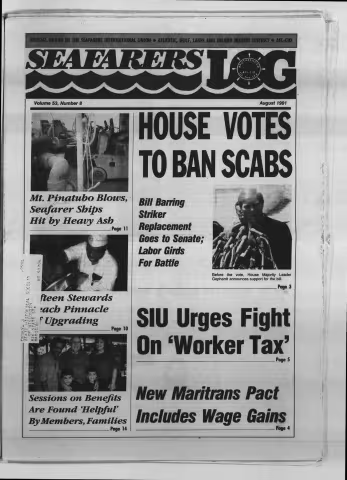
Issue Date
1991-08-01
Volume
53
Issue Number
8
Plaintext
ifea':; N*Y-''
^-^'•' '.* K--'
• A. S-~; ' 'f--\ • '•.' :\
H;.7tiV:.-C5:--ir.rJ
SEAFARERS
i
: : <>,-•:• -'- ;V .» i":
^-..•-::.'-^"#i; -y-
••• :;-• ••^4•-" v;.'.', 'vi- .•
Volume 53, Number 8 August 1991
Mt. Pinatubo Blows,
Seafarer Ships
Hit by Heavy Ash
Page 11
o2r
•-<KH •
a'(/)>—
O^-t/T
»-o
COOLU
Vu. inu}
t-
2'<C>C)C
^h-
Qt/3
Stewards
iach Pinnacle
r Upgrading
Page 10
Sessions on Benefits
Are Found 'HelpfuV
By Members, Families
Page 14
HOUSE VOTES
TO BAN SCABS
Bill Barring
Striker
Beplacement
Goes to Senate;
Labor Girds
For Battle
' •'4'
V-:;-
'•m-i
.' • •• I'-f j
Before the vote, House Majority Leader
Gephardt announces support for the bill.
Pages :•(
SlU Urges Fight
On llVorker Tax'
• •. ••'•'I'.'
New Maritrans Pact
-S
ZfMr'r •'
'''•A.'"
i-~ \
.J'-'.
i-ii"
, - ,. „,_. » —4«m
''•• •••• ••^.i-V;&irSSas®fefc •'. SUFmilSLOG
•:?;'•• Jo:
v-'-' ,.:''f•
•p-
••it ,
'-' •' ;•• •
.^' , ;. '>•'', 'i. /,
President's Report
Unjust Taxation
We in the Seafarers are particularly concerned about the burden that
has been put suddenly on the backs of seagoing maritime workers who
now are being taxed to go to work. We strongly object because the
government on this issue is way out of line. Particularly, it has never
been the practice in this democracy of ours to charge a person for the
privilege of going to work. Now, because the government needs
money, for the first time in the history of the United States, it is
saddling American seamen with a so-called user fee
for obtaining Coast Guard-issued documents or licen
ses.
In essence, the government has levied a tax on
working people, on the very same individuals who
currently contribute their fair share to the national
budget in the form of income taxes. Studies from the
Congressional Budget Office show that throughout the
'80s, working and middle class Americans increased
Michael Sacco the amount of taxes they pay while very rich individu
als and corporations enjoyed big cuts in their tax rates.
The tax cuts extended to big business and the wealthy throughout
the 1980s have come bacl^ haunt us. The federal budget deficit has
tripled since 1980 and stands today at close to $230 billion. (That debt
figure would be even higher if the social security fund's surplus was
deducted from the total budget.) The cumulative effect of the budget
deficits of the '80s is a federal debt of close to $2.3 trillion.
If one really wants to examine why the nation has such a huge debt,
look at the results of the 1981 tax cut for the rich.
By slashing the taxes of the most wealthy people in America and big
business, the United States treasury has lost $171 billion a year.
Under these circumstances, to tax merchant seamen for performing
their jobs, for obtaining the best training and highest ratings and licen
ses, is blatantly unfair. Additionally, to charge a fee for a service that
the Coast Guard provides for the good of all American citizens, who on
the whole depend on safe waterways, is contrary to the principles on
which this nation was founded.
The government makes a show of saying the user fee attached to
documents and licenses is for services rendered by the Coast Guard.
But, in fact, the funds paid by seamen for these items will not go
directly to that agency. By law, the monies from the licenses and
documents will go straight to the U.S. treasury. This levy for obtaining
seamen's papers and marine licenses is nothing short of a revenue-
raising ploy by the very same government that got itself into the deficit
dilemma. Jetting the burden of the federal debt on the backs of seamen
is just another way to avoid the real decisions that must be made;
namely, determining how to tax equitably in our society.
We intend to fight this injustice to see that something is done to
correct it.
Entire Industry Hit
Over and beyond the punitive nature of the user fee that will be
charged to American seamen, the entire U.S. maritime industry has
been socked with a whole host of assessments by the government.
The collective amount levied on the industry is substantial. It in
cludes customs' duties and fees, charges for inspecting grain-carrying
ships, a flat fee to the Department of Agriculture's plant and animal
inspection agency, fuel surcharges, harbor maintenance fees, a tonnage
tax, fees for Coast Guard inspections and examinatipns. We are con
cerned about what this policy does to further aggravate the plight of
the American merchant marine. It puts the industry at a competitive
disadvantage. Instead of socking it to U.S. shipping, the government
should be providing positive programs that recognize the value of a
merchant shipping capability to the national interest. Not only are there
jobs involved, but people must be encouraged to go into the shipping
business, not discouraged.
jii
Benefits Conferences
The sessions being held at each SIU hall on the medical, pension,
vacation and educational benefits of Seafarers by all accounts have
been worth attending. To date nine conferences have been held, six
more remain. I urge every member, pensioner and their families to take
part in the conferences that will be held in Baltimore, New Orleans,
Honolulu, Jacksonville, San Juan and Algonac. Your participation mat
ters. All comments and suggestions are being compiled so that we may
analyze the needs of all Seafarers and their families.
Paul Hall's Birthday
August 20, a holiday for Seafarers working aboard SlU-contracted
ships, marks the birthday of the man who headed the SIU Atlantic,
Gulf, Lakes and Inland Waters District from 1947 until his death in
June 1980. Paul Hall took over the helm of this union at the age of 32,
nine years after it was formed by members of what was then a mori
bund International Seamen's Union. Under Paul Hall's leadership,
what started as a gritty band of some 500 seamen shipping from the
Atlantic and Gulf coasts became a powerful organization representing
thousands of American seafarers.
In eve:ry situation—^whether it was fighting the commies on the
waterfront or battling finky and ruthless shipowners, whether it was
uniting the maritime industry in pursuit of national legislation to pro
mote a U.S.-flag shipping capacity or extending a promising career path
to a young person—^Paul Hall demonstrated a keen ability to under
stand people and their motivations, a shrewd strategic sense from
which came some very creative tactics. August 20 is the day Seafarers
pay tribute to Paul H^l and his immeasurable contribution to the SIU,
the labor movement in general and this industry in particular.
OMI Star Rescues Four Refugees in 30-Mile Winds, 20-Foot Swells
SIU members onboard the OMI
Star overcame darkness and rough
seas to rescue four Cuban refugees
in the Straits of Florida, roughly
15 miles south of Key West.
Recertified
Bosun Robert
Eugene All«i and
ABs Paul Caro-
lan,KdthTlHHiq)-
son and Gary
Snodgrass took
part in the res
cue operation,
Thompson which happened
around 2:15 a.m. April 13.
The four Cubans, men ages 20-
29, were clinging to a homemade
raft when severe weather hit the
area. They had left Cuba four days
earlier, heading for the United
States.
The Cubans
had traversed
approximately
75 miles and had
exhausted their
meager supply of
fresh water and
CMapges. Already
in dire circum-
Carolan stances, the ref
ugees saw their situation become
even worse when 30-mph winds
and 20-foot swells kicked in.
Cries for Help Heard
AB Carolan walked onto the
bridge shortly after 2 a.m. and
heard people screaming nearby.
He looked off the starboard side
and saw one of the Cubans waving
a flashlight, riding a raft which
consisted of canvas tied over four
tires.
"They called
me and the day
men," Bosun
Allen recently
told a reporter
from the Seafar
ers LOG. "We
got all the life-
saving equip
ment and threw
them a rope.
"It was a perfect throw, but the
Cubans were in such a hurry they
missed the line'. We turned and
tried to get them again. This time
we threw two lines, and they got
them tied."
One of the refugees sik)ke Eng
lish, and he told OMI Star Crew-
Allen
members they left Cuba "to start
a new life," Allen recalled. "Things
must be pretty bad over there.
"They were really grateful we
saw them. They were hugging and
kissing everybody."
Salt-Encrusted Refugees
After the rescue, the steward
department members set up a room
where the salt-covered men could
get clean. The galley gang then
prepared a much-appreciated meal
Volume 53, Number 8
for them. The Coast Guard picked
up the four men two hours later.
"Please put in a word for the
good job SIU seamen did," Cap
tain Jim Hevican told the LOG.
"They did one hell of a job."
Hevican said he was shocked
the Cubans made it so far on their
flimsy flotation device. "How they
survived, I don't know. I can't
believe it held up," he added.
"They were all encrusted with
salt, and they had sores."
August 1991
The Seafarers LOG (ISSN 0160-2047) is published monthly
by the Seafarers International Union; Atlantic, Gulf,
Lakes and Inland Waters District; AFL-CIO; 5201 Auth
Way; Camp. Springs, Md. 20746. Telephone (301) 899-
0675. Second-class postage paid at MSC Prince Georges,
Md. 20790-9998 and at additional mailing offices.
POSTMASTER: Send address changes to the Seafarers
LOG, 5201 Auth Way, Camp Springs, Md. 20746.
Communications Department Director and Editor, Jessica
Smith; Assistant Editor, Daniel Duncan; Associate
Editors, Jordan Biscardo, Max Hall; Associate Editor/
Production, Deborah Greene; Art^ Bill Brower.
,••#1
JI
m
ijlllll 111 II
'•-.r' i.:'-'t-- :•
J . '\, -i ;- . ,• •• •
• - 'i.\. •; ••*'..
AUGusrm
r '-s
.,.. II ^".11
House Passes
Anti-Scab Bill
In a 247-182 vote, the House of Representatives
voted to make it illegal to replace striking workers
with scabs. After an intense debate last month,
the majority of House
A paperworker who lost his job to a scab demonstrates outside the Capitol to
rally support for the striker replacement bill.
members voted in sup
port of the labor move
ment's position to close a
loophole which allows em
ployers to permanently hire
individuals who have crossed a
picket line to assume the jobs of
striking employees, or better said—
scabs.
The legislation, known as the
Workplace Fairness Bill, now goes
to the Senate. A vote in that
congressional chamber is ex
pected after the Labor Day recess.
Secretary of Labor Lynn Martin
has indicated President George
Bush will oppose the bill. The
trade union movement is seeking
enough congressional support for
the measure to override a presi
dential veto.
Representative William Ford (D-
Mich.), a driving force behind the
House bill, H.R. 5, noted in his
remarks to colleagues during a
floor debate on the measure, "This
right to strike was and is the key
stone of our national labor rela
tions program.
"If employees cannot mount ai
meaningful strike threat, the fed
eral labor policy does not work
without it. There is no incentive
for the employer to make conces
sions or reach agreement."
Bill Rights a Wrong
Keeping scabs employed after
a strike ends is a phenomenon
which began in the 1980s. While
the loophole allowing employers
to permanently replace striking
workers was created by a 1938
Supreme Court decision known as
the Mackay Radio ruling, few
businesses employed the tactic until
the decade of the Reagan admin
istration.
Many of the bitter strikes that
have become synonymous with
the 1980s were marked by the
hiring of replacement workers.
Most recently, the former owner
of The New York Daily News, the
Tribune Company, spent $24 mil
lion to force a strike, bring in scabs
and replace its union employees.
Continued on page 24
The Second Registry Gaffe—End of an Illusion
There is a current of confusion running through
the maritime industry these days that apparently
is giving more than a few people second thoughts
about the seriousness of the industry's concern
about its plight.
The bewilderment stems from a twist of
circumstances after it was
announced on May 20 that
the United Seamen's
Service, which maintains
recreational facilities for
seamen of all flags and services in 10 foreign
ports, would be giving one of its annual awards
to the Department of Transportation's Maritime
Administrator, Warren Leback, for his contri
butions to U.S.-flag shipping and international
transportation, American seafarers and the
United Seamen's Service. The award is called
the Admiral of the Ocean Sea (AOTOS).
A similar award will be given to the veteran
shipping company executive, Charles Hiltz-
heimer, president of the SlU-contracted Puerto
Rico Marine Management and a former head of
Sea-Land Services and United States Lines.
It was with no small degree of shock that the
maritime industry and a congressional commit
tee, at a hearing on June 19, heard Maritime
Administrator Leback recommend considera
tion of a "second registry." That consideration
would mean, in plain English, opening up jobs
on American-flag ships to foreign seamen. It
drew sharp comment and questions from House
Merchant Marine Committee Chairman Walter
Jones and Congresswoman Helen Bentley.
The Seafarers LOG ran a story condemning
the Leback proposal in the July issue. No other
criticism was evident from other sources.
As the implications of the bizarre proposal
began to sink in, those who still had illusions
"I crown you Admiral of the Ocean Sea and Ruler of the Queen's
Navee..."
of Maritime Administration "friendliness" were
knocked loose of their fantasy. For union sea
men, the Leback second registry suggestion had
particular meaning. This was something right
out of a major oil company's book. That it
would come from the prepared text of a gov
ernment official whose mission and responsi
bility is to promote the American merchant
marine in the national interests, was nothing
short of outrageous.
Even among the administration's apologists
in the industry there was evidence that Leback's
revealing words were causing schizophrenic
reactions. Example: In his organization's pub
lication June-July issue, C.E. "Gene" DeFries,
who now heads only the predominantly non-
maritime parent body of the Licensed Division
of the Marine Engineers Beneficial Association,
hailed the AOTOS award to Leback, saying
"few individuals were more deserving."
In the next issue of the Marine Journal, dated
July-August, the publication ran several scare
headlines and a story mentioning the second
registry proposal. Nowhere did the DeFries
publication criticize Leback for making the
proposal. In fact, it clearly sought to absolve
Leback of the guilt which is his alone for floating
the ide^. -
Actually, the circumstance of "honoring"
someone who thinks running American seamen
off American ships might be a way to rebuild
the U.S. industry is no reason to go off the
deep end. After all, the award ceremony is only
a means of raising funds. The honoree in ques
tion was selected, not because of his achieve
ments in promoting the American-flag industry
but rather because his position as chief officer
of the Maritime Administration could be used
as leverage to sell tickets. There are at least a
dozen people in the Maritime Administration
whose devotion and performance in carrying
out the duties of the agency makes them emi
nently more deserving of recognition by the
industry.
It is to be expected that some will view this
commentary as much ado about nothing, but
while some segments of maritime may be com
fortable in an evening of back-slapping make-
believe, seafaring workers must deal with real
ity, lest they forget the values and principles
on which their jobs and security rest. Samuel
Gompers, a wise American who was the first
president of the American Federation of Labor,
stated it very simply for those who want to be
honest with themselves: "Reward your friends;
punish your enemies," he advised. Not the
other way around.
f •
I
f'-l f
• 'h •
•B:-
'fM--
fx-
- 'Vl
••II m'
• v^'
•ff'V
I t •'•.:'-••
:i'-|,:v' .•;/
:'-3'-, - . ^
iiS;
' ?•!
. i-:'
•f.- •••;:' •.
•f-
- - " '
'•Vtl .V
;f:
mtc.V'- :• '
f( -:v-:
•• 'r^c. rt: •
f #-•
• 'fif;
I
-.'V V V.
SanRERS lOG
Wages, Up in 3-Fleet Maritians Pact
Seafarers working aboard Mar-
itrans Partners L.P. tugs and barges
ratified a new five-year contract
which scores big gains in pay and
adds a deck utility position to the
crew complement of under-3000
HP boats. SIU members also voted
to consolidate into one master
agreement the three labor pacts
which previously covered hours,
wages and working conditions in
the Maritrans, Mariner and Inter
state fleets.
The new agreement, which went
into effect June 1 and extends until
19%, was ratified by the member
ship by a 2.5 to 1 vote in May.
Nearly 250 Seafarers sail in the
Maritrans fleet of 48 barges and
39 tugs, the laigest U.S.-flag coastal
marine transporter of petroleum
products.
The new pact reverses a decade-
long trend of wage slashes and
employer-union confrontations
which has characterized collective
bargaining in the inland water-
borne transit industry.
Under the new pact, wages will
increase by 20 to 40 percent-
depending on the job classification
and vessel assignment—over the
life of the contract. All benefit
levels were maintained and the
harbor towing fleet Seafarers were
brought up to par with other Mar
itrans SIU members in the area of
pension credits.
In addition to adding a deck
utility rating to the manning scale
of under-3000 HP boats, the po
sition of apprentice-mate will now
be within the Seafarers bargaining
unit.
Union negotiators sought and
obtained a single contract encom
passing the equipment of each
Maritrans Partners L.P. subsidi
ary. With one pact in place, crew-
members represented by the SIU
sailing on Mariner, Interstate and
Maritrans tugs and baiges will have
greater bargaining strength, and
management will have a more ef
ficient personnel operation, noted
rank-and-file Seafarers on the con
tract negotiating committee.
William *'B1IP* Lehew, a Mari
trans tankerman who served on
the bargaining group, called the
agreement "a step forward." Le
hew was able to compare this
round of negotiations with the
contract meetings held in 1985,
when he also served on the bar
gaining committee. "There was a
lot of concern about the morale of
crewmembers in these talks," he
said.
Dedication to Safety
The union and Maritrans, the
parent company to the three fleets
covered by the agreement, reiter
ated a joint commitment to con
tinued improvement of safety
mechanisms and procedures.
Shipboard personnel, as well as
shoreside workers, employed by
Maritrans are to strive for a "flaw
less performance," according to
the agreement reached by both
parties.
Throughout the negotiations, the
Seafarers and Maritrans manage
ment recognized the need for safe
operation of all marine transport
equipment. The accord was crafted
to ensure the company is able to
meet and exceed the safety pro
cedures incorporated in the na
tion's regulatory regime as a result
of the enactment of the Oil Pol
lution Act of 1990.
The SIU bargaining committee
consisted of Maritrans fleet rep
resentatives Lehew and Tanker-
man Steve Gardnier. AB-Tanker-
man Rick Lord participated in
behalf of Seafarers on Interstate
equipment. Mariner delegates on
the negotiating committee were
Tankerman Harold Acord, AB-
Tankerman Greg Luce and Cook
Pete Carlton. SIU Assistant Vice
President Dave Heindel served as
the lead negotiator in the talks.
The contract was ratified by the
membership. Serving on the vote
tally committee were nine Seafar
ers, three from each fleet. Mariner
tallymen were AB-Tankerman
James Brooks, AB-Tankerman Jeff
Peterson and AB-Tankerman Frank
Sessa. Interstate Seafarers were
represented by Deck Utility Dan
Van Sclver, Randal Goodlson, AB;
and Thorn Farrell, AB-tankerman.
Seafarers sailing aboard Maritrans equipment review the new contract with
SIU Assistant Vice President Dave Heindel (standing).
OS James R. GiifBtts, Tankerman
Anthony Mykllch and Deckhand
Vincent Moore were present for
Maritrans Seafarers.
The Maritrans fleet moves some
250 million barrels of petroleum
and petroleum-products—-includ
ing gasoline, jet fuel, home heating
oil, crude oil, asphalt—a year. The
company, which traces its origins
to the last century, is a master
limited partnership formed in 1987
when spun off by the parent Sonat
Inc.
Maritrans operates along the
Eastern seaboard and Gulf of
Mexico. In addition to transport
ing petroleum and its byproducts,
the company also provides light
ering and ship bunkering services.
Ausbalkms Bnbmk on Fleet IMwik^
Australian shipping interests
representing maritime unions, shi
powners and the government have
coalesced to develop and imple
ment programs to keep an active
and growing Australian merchant
marine in place.
In an attempt to assess what
other industrialized nations are
doing in support of their national
fleets, the key players in the Aus
tralian-flag shipping industry are
holding a series of meetings with
sea-going unions, operators and
government officials in Japan, the
United States and several Euro
pean countries.
While in the United States last
month, the representatives of the
Australian Shipping Industry Re
form Authority investigated
American policy in the areas of
shipbuilding, vessel purchase in
centives, taxation arrangements,
operating costs, cargo reservation
schemes and the framework in
which government, labor and
management pursue common
goals. In a meeting with the SIU
and District 2 MEBA-AMO, the
Australians asked for background
on U.S. cargo preference laws and
cabotage provisions.
The overseas study mission of
the Australian Shipping Industry
Reform Authority is but one step
in the process being undertaken
collaboratively by Australian shi
powners, maritime unions and
government to reform the industry
and make Australian shipping more
competitive. The activities of the
group follow a formal agreement
among shipowners, the maritime
unions and the government for
accelerated reform.
Adopting the motto of "keeping
the fleet afloat," the Australian
maritime interests have taken a
series of steps in the past few years
designed to reinvigorate its na
tional shipping capacity.
The partnership among unions.
shipowners and government made
it possible to reduce manning lev
els from an average of 34 crew-
members in the early 1980s to 21
today, a 38 percent reduction.
Government-supported training
programs were instituted to coin
cide with the manning cuts. Ship
owners who reduced manning were
given tax breaks to encourage new
building. As a result, while man
ning decreased, the number of
Australian-flag vessels went up.
This tax scheme extended to
operators was a five-year depre
ciation regime commencing the
year before the ship was commis
sioned. Additionally, in return for
cuts in manning, a seven percent
taxable grant was made available
to shipowners for introducing new
tonnage until 1997. Ships quali
fying under this process may be
depreciated for taxation purposes
at a rate of 29 percent, under the
prime cost method, starting the
year prior to delivery.
The reform authority notes that
the restructuring process has
increased confidence in the indus
try, as evidenced by a recent in
vestment in Australian-flag ship
ping in excess of $1 billion for new
vessels. Nine deep sea vessels
currently are being built that will
operate under the Australian flag.
The addition of new vessels
which have improved fuel effi
ciency, greater carrying capacity
and other state-of-the-art mecha
nisms, coupled with reduced man
ning, has dramatically increased
the industry's productivity by 54
percent in less than a decade.
Both operators and the unions
have taken steps to consolidate.
In 1986 the Australian National
Maritime Association was formed
to bring together Australian-flag
shipping companies in one advo
cacy group. The association today
represents 90 percent of the Aus
tralian fleet.
The seven Australian maritime
unions have merged into three
^organizations, and by the end of •
this year there will be two Aus
tralian maritime unions.
In addition, Australian seafaring
unions and shipowners are seeking
to bring shipping on an even keel
with road and rail transport, which
is heavily subsidized in that coun
try. Additionally, the groups seek
reform of port operations, which
they characterize as inefficient
monopolies.
fte f}'<:^®®'Sacco(left) talks with Patrick Geraghty (center), the head of
Anthonv Pana*^nrt" group's assistant federal secretary,
Anthony Papaconstuntinos, dunng their time in Washington. D.C.
IK?
#1^-' • f' .
T'iy!^--i. ~y;-:^y--' -••-•
•NijwglKlil
SlU Hits 'Worker Tax' on Seamen
Fees for Z-Cards, Licenses Could Cost $35 and $350
The United States Coast Guard has an
nounced that seamen will be charged between
$35 and $350 for the costs involved in the
issuance of a merchant mariner document, li
cense or certificate of registry. No date has
been designated for the so-called user fee to
begin because the agency is in the process of
accepting comments and views on the proposal.
The user fee for Coast Guard services is the
result of the Omnibus Budget Reconciliation
Act of 1990 passed last year as an attempt by
Congress and the administration to reduce the
federal budget deficit. As part of the Department
of Transportation's revenue-raising mecha
nisms incorporated in the legislation, a long
standing statute which prohibited the collection
of fees for the licensing of certain shipboard
positions was lifted.
Dissatisfaction with the user fee proposed
was voiced by SIU President Michael Sacco,
who felt that seamen were being discriminated
against in what amounts to a mandatory taxation
on employment.
He said the issue of a "worker tax" was one
for the SIU and the entire labor movement to
attack vigorously. He pointed out that the user
fe^ for obtaining licenses and Z-cards was noth
ing more than a thinly disguised revenue-raiser
for the federal coffer, done off the backs of
workers who already pay income taxes as their
share of the nation's taxes.
Cause for All Workers
Sacco said he would recommend this be a
leading issue for the labor movement because
all working people should be concerned about
this inequitable and back door ploy to pump
more money into the national treasury. "If
seamen are now going to be charged an em
ployment-related tax, what group of workers
will be next?" he said.
The Coast Guard's proposal for the user fees
was issued on June 20. At this point, the agency
is accepting comments from interested parties.
As the LOG went to press, the SIU was in the
process of formulating its response to the user
fee proposal. Comments are due August 5.
Highlights of the SIU's position will be printed
in the September LOG.
After the Coast Guard reviews the comments
received from all interested parties and deter
mines if any of the recommendations should be
incorporated into the user fee scheme, the
agency will issue a final rule-making in the
Federal Register. At that point, seamen can
expect to begin paying the charges assigned to
merchant mariner documents, licenses and cer
tificates of registry.
While the Coast Guard may modify its pro
posal, some sort of user fees will be put into
place because such charges are mandated by
law in the Omnibus Budget Reconciliation Act
of 1990.
According to a notice published in the Federal
Register, the Coast Guard based its projections
of fees on what it costs the agency to process
licenses, merchant mariner documents and cer
tificates of registry. Of concern to all seamen
is the Coast Guard's comment that it "will
revise these proposed fees when costs change
because of inflation, deflation, or changes in the
way the services are provided." The agency
cited the Oil Pollution Act of 1990 as one law
which in its implementation might increase the
cost of user fees.
Fee for Seamen's Documents
The Coast Guard proposes charging a basic
$35 fee for a merchant mariner document with
out a qualified rating; i.e., a wiper, ordinary
seamen or food handler. A z-card with a qual
ified rating—such as an AB, QMED, lifeboat-
man or tankerman—would cost a total of $135..
This figure includes a $35 issuance fee, a $60
evaluation fee and a $40 examination fee.
Under the Coast Guard's proposed user fees,
upgrading or sitting for a license will cost a
seaman additional funds. If an ordinary seaman
upgrades to AB, it would cost him $135, the
total amount charged for evaluation of the
application, examination and issuance of the
new document. An upgrade from AB-limited to
AB-unlimited would cost $95 since there is no
examination involved.
If a wiper upgrades to QMED-FOWT or
QMED-any rating, under these procedures it
will cost $135 for the process of evaluation,
examination and issuance of the new document.
The endorsements of lifeboatman and tanker-
man could end up costing a seaman a maximum
of $135 if the special ratings are obtained at a
separate and distinct time from upgrading to
another position. .
The cost of deck and engine licenses is divided
into two categories. Generally, upper level fees
apply to ocean and near coastal licenses for
inspected vessels over 1600 gross tons. Lower
level fees include first class pilots.
z-card or certificate of registry, he will have to
pay an additional $17 charge for an FBI criminal
record check which will be forwarded to the
Coast Guard.
The agency is in the process of determining
acceptable methods of payment. Among the
ideas on the table are credit card payments,
checks, money orders, cash. The agency is
considering penalties for failure to pay the fees.
Two Levels for Licenses
According to the Coast Guard Federal Reg
ister notice, upper level licenses will cost a total
of $330. This fee includes a $70 evaluation fee,
a $225 examination fee and the $35 issuance
fee. Applicants for lower level licenses will be
charged a total of $180—$65 for the evaluation,
$80 for the examination and $35 for its issuance.
The Coast Guard notes that the full exami
nation fee proposed for both upper level and
lower level licenses will not be charged when
the seaman only needs a partial or limited
examination or an open book examination for
the renewal of a license.
If the applicant is going for an original license .
Origins of User Fee
The notion that seamen should pay a fee for
their seamen's documents or licenses has been
bandied about since the early 1980s during then
President Ronald Reagan's first term in office.
When the Reagan administration engineered
deep cuts in government spending and sought
to institute a payment-for-service scheme for a
variety of public programs, user fees for Coast
Guard activities surfaced in the form of various
budget and legislative proposals.
The concept was offered as a part of the
administration's annual budget each year
throughout the 1980s but Congress consistently
resisted the proposal. The SIU and the rest of
the maritime industry worked diligently and
successfully every year to block the enactment
of user fees for Coast Guard services.
Last year, in a quick and desperate move to
meet its assigned revenue raising goals. Con
gress swiftly tacked on Coast Guard user fees
to the budget bill, known as the Omnibus Budget
Reconciliation Act of 1990. In short, user fees
for Coast Guard services became law without
going through the normal legislative process.
As a result of the 1990 budget act, user fees
will be established for Coast Guard services
related to vessel documentation, commercial
vessel inspections, vessel plan review and
equipment approval, in addition to the issuance
of seamen's papers and licenses.
PROPOSED USER FEES FOR Z-CARDS AND LICENSES
Evaluation
Fee
Examination
Fee
issuance
Fee
• 1
Document Without
Qualified Rating $35 $ 35
Document With
Qualified Rating
License—Lower Level
License—Upper Level
$ 60
65
70
$ 40 ;
80 ;
225
Duplicate or Replacement
Document or License
• I,i'ft.'.--
35
Note: The Coast Guard is proposing an additional fee of $17 for an FBI criminal record check to be added
to the evaluation fee if the application is for an original license or an original merchant mariner document.
Source: Federal Register; Department of Transportation Coast Guard "User Fees for Marine Licensing, Certification of Registry and Merctiant Mariner
Documentation; Proposed Rule;" June 20, 1991.
SPECIAL NOTICE TO TANKER CREWS
On tankers with the one man deck watch, the Bosun
and A.B. Maintenance ratings may be required to stand
watch due to inclement weather and heavy traffic.
Because of the overtime restrictions imposed by the
Oil Pollution Act of 1990 and for reasons of safety,
they shall be assigned to a watch during cargo opera
tions.
During cargo operations, they shall not be covered i
by the day worker rules in Article II, Section 39 and
Article III, Section 10 Of the Standard Tanker Agree
ment.
Any questions regarding this should be referred to
the contracts department at headquarters or to the
nearest union h^ officials.
•-v V
M
, V, ,,
• '.Mi
• • 0
SEAHUtERS m
'^fs.: - ,ro, ,•• , ;r.;: - ' -
f I
From the moment the 13th an-
V- Sj Great Steamboat Race from
, :;t-r: | New Orleans to St. Louis began,
there was no doubt an SlU-crewed • . .
it':
V J-••'••'• ".
w
•'•i 1 •
i •
i
ship would emerge victorious.
That's because both the Delta
Queen and the Mississippi Queen,
the only overnight passenger
paddlewheel steamboats left in
America, are manned by Seafarers.
This year, it was the Mississippi
Queen that won the race.
Part of the race involves compe
tition between the crews. Among the
winners of this year's events were
SIU members Rick Larson, porter
aboard the Mississippi Queen, and
Amy Talbot, a cabin attendant on
the Delta Queen. Larson won the
luggage race, while Talbot tri
umph^ in the maid cart race. Amy Talbot wins cart race. Mississippi Queen (top) leads Delta Queen in Great Steamboat Race.
SlU-crewed Tug Leaves
Competition in Its Wake
Eventual winner Kristin Lee (right) pulls away from nearest competitor.
SIU wives Sandy Thornton (left, wife
of Donald Thornton) and Kim Kelley
(Timothy Kelley) enjoy race.
SIU Vice President Byron Kelley
takes turn at Kristin Lee's helm.
SIU Deckhand Fred Kerns exults
after Kristin Lee's victory.
The SlU-crewed Kristin Lee,
using only 80 percent of its engine
capacity, blew away the competi
tion at last month's Annual Inter
national Tugboat Race on the
Detroit River.
The Kristin Lee, an OLS Trans
port Company boat, was one of
two-dozen American and Cana
dian tugs which participated in the
event. The race is part the week-
long Intemational Canadian Festi
val. (The 3/t-mile wide Detroit
River separates Detroit, Mich,
from Ontario, Canada.)
SIU members who crewed the
winning boat are Mates Claude
Sankey and Ron Nestle, Engineer
Bill Hastings, Assistant Engineer
Keith Roberge, ABs Danny
Goleman and Fred Kerns and
Cook David Weirsham. Former
member Clark King served as
captain on the tug, and other mem
bers were onboard as guests.
"It was fun, a break in the regu
lar routine," recalled Assistant En
gineer Roberge.
The company permitted the
members to invite their families
aboard. Roberge was able to show
his wife, Susan; two of his five
children, Natalie and Jesse; and his
mother and father what he does
aboard a boat for the first time. "All
the guests really enjoyed them
selves," he added.
"There's no competition be
cause we have the biggest tug,"
Cook Weirsham said with a laugh.
"When we take off at the start, we
come close to sinking five or six
other boats.
"It's a good old time, nothing
serious. It's a chance to show off
your boat.... This year we had a
beautiful day and the river was
calm."
Nearly a quarter-million specta
tors lined the river's banks as the
Kristin Lee finished in record time.
The winning boat is 160 feet in
length and has 3,000 horsepower.
Other trophies were awarded to
tugs which competed in smaller
boat categories.
"I think it's pretty light-
hearted," said AB Goleman.
"Quite a few people turn out, but
the competition won't be serious
unless they get the same (horse
power) boats going against each
other."
f • ••
While the Kristin Lee success
fully defended its title, SIU Vice.
President Lakes and Inland Waters
Byron Kelley continued a personal
winning streak of sorts—he has
been onboard the last seven Inter
national Race winners.
"My father won the third of
these races, back in 1953 or so,"
Kelley recalled. "In fact, I still have
that trophy."
The former ocean-going tug
now pushes an asphalt barge on the
Lakes.
Lundeberg School Treats
The desserts prepared by Lundeberg School Executive Chef Romeo
LupinaccI (center) and Seafarer Robert Miller sold briskly at a recent street
fair bake sale in Washington, D.C.
AUGUST mi
••''': ^ : A-./--. ".
• -V Tl
• •'V • ,--; •', •';" ••
t''' ' l.'
jT>;--Vf-y • '• ij.l,'
t •-'i-i-,.j;':y ••, .-: y,;
•i ' ''\-.
•V.-, ", I: ,
;-. /, f.v
'. , ., \ s'-i -r: ••'••!?•
>;r •,^;;.:?',
•.I'i"'
Coast Guard Issues New Random Drug.. Test Rules
Only shipboard personnel whose
duties can be characterized as ex
traordinarily safety-sensitive will
be subject to random drug testing,
it was announced in a final rule
issued by the U.S. Coast Guard
appearing in the Federal Register
last month. Aboard most vessels,
this will exempt the wiper and
members of the steward depart
ment from random urinalysis tests.
The new rules mandate that all
marine personnel employers have
a random drug testing program in
place by October 1, 1991. The
Coast Guard has determined that
the number of individuals to be
submitted to random urinalysis
tests by the marine employer should
be "no less than 50 percent of all
crewmembers on an annual ba-
constitution's Fourth Amendment
which protects an individual's pri
vacy interests and prevents un
warranted search and seizure.
Judge Thomas Hogan's ruling in
vited the Coast Guard to develop
revised random testing procedures
that would identify a direct link
between the crewmember's as
signed duties and the safe navi
gation of the vessel.
Certificate of Inspection
SIS.
The Coast Guard was forced to
revise its original random drug
testing procedures which were
promulgated in 1988 because of a
court case initiated by the SIU
and the Transportation Institute
(TI), an association of U.S.-flag
shipping companies.
In objecting to the government's
drug testing program, the SIU ar
gued that random testing was an
invasive procedure that violated
an individual's privacy rights.
Furthermore, the union argued the
government had no business in
truding in matters that could be
handled in the collectivej| bargain
ing process.
In December 1989, a federal
district court ruled the Coast Guard
had failed to show that a "war
rantless, suspicionless search" was
justified for all crewmembers since
the agency had failed to demon
strate a "clear, direct nexus . . .
between the nature of the employ
ee's duty and the nature of the
feared violation."
The Coast Guard had to return
to the drawing board to develop
random drug testing regulations
that could be sustained under the
In the new rule the Coast Guard
defines crewmembers with direct
responsibility for safety as those
who, for the most part, are listed
on an inspected vessel's certificate
of inspection (COI). Thus seamen
performing the duties of patrol
men, watchmen and lifeboatmen
will be subject to random drug
testing. Should a wiper or galley
gang member be serving in any of
these capacities, he or she would
be included in the random testing
pool.
According to the new rule, if a
seaman "fails a chemical test for
dangerous drugs, the individual's
employer or prospective employer
shall report the test results in writ
ing to the nearest Coast Guard
Officer in Charge, Marine Inspec
tion."
Additionally, the rule states,
"The individual shall be denied
employment as a crewmember or
removed from duties which di
rectly affect the safe operation of
the vessel as soon as practicable
and shall be subject to suspension
and revocation proceedings against
his or her license, certificate of
registry or merchant mariner's
document. . ."
Protecting Privacy Rights
Originally, the Coast Guard is
sued a final rule requiring pre-
employment, periodic, random,
post-accident and probable cause
drug testing for commercial vessel
Medical Services for New York Seafarers
Rose Dammeyer (left) and her husband, Clifford, an SIU pensioner, review
the programs offered by the union's designated medical provider in New
York. Sonja Mason of the Methodist Hospital was on hand at the New York
benefits conference, where this picture was taken, to advise Seafarers of
the institute's services. A caption in the July Seafarers LOG, page 5,
incorrectly identified Rose Dammeyer.
shipboard personnel on Novem
ber 21, 1988. The SIU and TI went
into court on November 29, 1988
and filed a lawsuit against the
procedures. While the SIU re.
mained committed to a drug-free
workplace, the union's lawsuit ar
gued that any program to deal with
the problem should be equitable
and respect the privacy rights of
seafarers.
On December 18, 1989, the Dis
trict court enjoined the Coast Guard
from implementing its random
testing program as spelled out in
the final rule while allowing the
other four kinds of testing to pro
ceed.
On July 27,1990 the Coast Guard
published revised random testing
rules designed to meet the con
cerns of Judge Hogan. The SIU
submitted strong comments at that
time pointing out the Coast Guard
had failed to define the categories
of merchant seamen that should
be subjected to the invasive pro
cedure of random testing urinal
ysis because their duties were
inexorably linked to the safe nav
igation of a vessel.
The final rule issued last month
by the Coast Guard addressed the
SIU's concerns and clearly out
lined which crewmembers per
formed duties tied to safety.
Excerpts from the Coast Guard's Rules
Governing Random Drug Testing
Of Shipboard Personnel
Federal Register July 6,1991
Inspect^ Vessels
"It [the final rule] requires chemical
testing for dangerous drugs on a ran
dom basis (random testing) of crew
members on inspected vessels who
occupy a position, or perform the du
ties and functions of a position, re
quired by the vessel's Certificate of
Inspection; who perform the duties and
functions of patrolrnen or watchmen;
or who are specifically assigned the
duties of warning, mustering, assem
bling, assisting or controlling the
movement of passengers during
emergencies."
Uninspected Vessels
"The rule also requires random testing
of crewmembers on uninspected ves
sels who are required by law or reg
ulation to hold a license Issued by the
Coast Guard In order to perform their
duties on the vessel; who perform
duties and functions directly related to
the safe operation of the vessel; who
perform the duties and functions of
patrolmen or watchmen or who are
specifically assigned the duties of
warning, mustering, assembling, as
sisting or controlling the movement of
passengers during emergencies."
Wipers
"The Coast Guard agrees that the
ordinary duties of a wiper are not so
safety-sensitive as to require random
testing. Generally, a wiper occupies
an entry level position In the engine
department. Is not required by the COI,
and. Is closely supervised by other
engine department personnel when
performing safety-sensitive duties. In
those few Instances where wipers are
required by the COI, they have been
determined to be essential to the safe
operation of the vessel. Accordingly,
the final rule requires only those wipers
who are specifically required by the
COI, or who perform some other
'operation' duty In addition to their
duties as a wiper, to be subject to
random testing."
Harbor Pilots
"The final rule requires that harbor
pilots be subject to random drug test
ing.'
Steward Department
Non-COi Listed Personnel
"When crewmembers In addition to
those listed on the COI are engaged
at the discretion of the vessel owner
or operator to perform the same duties
as those crewmembers listed on the
COI, these additional crewmembers
must be subject to random testing for
the same reasons as COI listed per
sonnel. The Coast Guard could not,
therefore, limit the random testing re
quirements to only the crewmembers
required by the COI. The requirement
In the final rule that COI listed crew
members be subject to random testing
Is only a threshold requirement for
testing crewmembers on Inspected
vessels. The marine employer must
Identify all other crewmembers who
perform operations duties and ensure
that they, too, are subject tb random
testing."
"The Coast Guard does not believe
that cooking and galley cleaning alone
have a sufficient tie to safe vessel
operation to warrant random testing.
However those cooks on any type of
vessel who have ordinary and routine
duties ... that are directly related to
the safe operation of the vessel should
be subject to random testing."
Passenger Ships
"A crewmember's assignment to an
emergency duty on the passenger
vessel's station bill Is not sufficient
reason to require the crewmember to
be subject to random testing. The
Coast Guard's position concerning
emergency duties Is that only those
crewmembers who are assigned spe
cific emergency duties which make
them directly responsible for the safety
of life of passengers should be subject
to random testing. Direct responsibility
for passenger safety must be assigned
to and understood by a crewmember
as a job function. Crewmenribers who
may simply 'help out' In an emergency
are not thereby subject to random
testing. Of course. In an emergency,
persons who are not otherwise subject
to random testing are not precluded
from providing assistance to passen
gers that Is beyond their normal job
requirements."
'•••• ' V •!
f;.'-
•:x:-
y.- • -ft'
ii-'
.V'J
' i f -"y
• I :
f, • •
-- -» r •' » ^
''''''' '
•,,,'.'•;^•• • '••;•>,'•' •• ••;•'" '.'f,'' f >-t/'>:y-):.':vV./'' /"y-y"- •
8
. [-• ^•',K^'•• •••
'•h^\•4-'rv>v,j.^;. -'r-i^^.-;.:; ... SaFARiRS 106
'II ••' ^:'
I i.; •"
••••'•.'• IV'"- li:
..•-' -i-; •.. ••;
yir"
Mrt'lr
• ••;••>-*.'•
-• ..-'.ff ••.
,; I'', f
•'t'
• i:-
i' I
-i •
'k-'
f-
• '%• ,%
Seafarers Get Immediate Care at San Pedro Clinic
The name of the latest medical
facility to become a Seafarers pre
ferred provider organization
(PPO) says a lot about its opera
tional philosophy.
Immediate Medical Care Cen
ter, located in San Pedro, Calif,
near the Wilmington SIU hall, is a
no-appointment-needed facility
which provides quality health care
for Seafarers, pensioners and fam
ilies. The center, open seven days
a week, also promises something
days a week," said Dr. Christopher
Traughber, one of the center's phy
sicians.
Traughber is certified by the
American Board of Family Prac
tice and is a graduate of the Univer
sity of California-Davis School of
Medicine. Additionally, he is the
medical director of the Peninsula
Rehabilitation Center.
Also working at Immediate
Medical Care Center are doctors
Dirk Ruffin and John Murashige,
Wilmington Patrolman George Tricker (center) tours new clinic with members Rob
Cabibi and Morty Tashmen.
uncommon in many medical facil
ities: little or no waiting time, re
gardless of whether a patient is
being treated for something as se
rious as a fracture or as common as
a cold.
Seafarers began using the facil
ity on July 1, after the Seafarers
Welfare Plan contracted with Im
mediate Medical Care Center.
Since then, more than 200 mem
bers have received treatment there.
"I've been there twice, once for
an annual (physical) and once be
cause of strep throat, and they are
a lot faster than the place wfe.used,.
to use," said Chief Cook Curtis
Phillips, 36. "The people are very
pleasant and I got good treatment."
"I got great service," said black-
gang member Horst Baetjer, 53.
"Everyone here is friendly, and I
had no problems."
The Immediate Medical Care
Center, affiliated with Torrance
Memorial Hospital, opened three
years ago. Patients there are treated
in private rooms, and the center is
open from 8 a.m. until 9 p.m. every
day of the year. "We're here seven
both certified by the American
Board of Family Practice.
Many Treatments Available
If a Seafarer in the Wilmington
area suffers a life-threatening
emergency, such as a heart attack
or a major auto accident, he or she
should go directly to Torrance Me-
, morial Hospital (or the nearest hos
pital with blood banks, operating
rooms and intensive care units).
However, Immediate Medical
Care Center provides medical ser
vices for voluminous ailments and
injuries such as lacerations,
wounds, bruises, sprains, frac
tures, sore throats, cough, fever,
eye and ear injuries, minor bums,
colds and flu, respiratory illnesses
and intestinal disorders.
On-site X-ray and laboratory fa
cilities allow staff members to
quickly process test results. More
over, the center's dispensary issues
many medications, saving Seafarers
numerous trips to the pharmacy.
The facility also offers immuni-.
zations and health information for
travelers, based on U.S. Depart-
Eight PPOs Designated for Seafarers
Further information on each of the clinics and medical care facilities
listed below can be obtained from the SIU hall In each city listed.
Seattle
Virginia Mason Hospital
925 Seneca St.
Seattle. Wash. 98111
San Francisco
St. Mary's Hospital
450 Stanyan St.
San Francisco, Calif. 94117
Honolulu
Straub Hospital
888 South King St.
Honolulu, Hawaii 96813
New Orleans
Tulane University Hospital and
Medical Center
1415 Tulane Ave.
New Orleans, La. 70112
New York
Methodist Hospital
506 6th St.
Brooklyn, N.Y. 11215
Philadelphia
Methodist Hospital
Healthmark Incorporated Clinic
2301 South Broad St.
Philadelphia, Pa. 19148
Baltimore
Francis Scott Key Hospital
Johns Hopkins Ctr. for Occupa
tional and Environmental Health
4940 Eastern Ave.
Baltimore, Md. 21224
Wilmington
Torrance Memorial Hospital
3330 Lomita Blvd.
Torrance, Calif. 90509-2935
Irtimediate Medical Care Center
29409 S. Western Ave.
San Pedro, Calif. 90731
ment of Health reports.
The parent facility, Torrance
Memorial Hospital, has been an
active member of the South
Bay/Peninsula community for
more than 60 years. It is a 330-bed
hospital offering numerous ser
vices and health programs, from
weight management courses to
first aid training and from emer
gency care services to rehabilita
tion.
Progress Continues
The Seafarers Welfare Plan's
designation of Immediate Medical
Care Center as a PPO represents
continued progress in health care
for Seafarers. Throughout the
country, the medical plan is Con
tracting with a preferred provider
in each of the cities where an SIU
clinic has been located.
The PPO program was started to
ensure that Seafarers and their
families continue obtaining quality
medical care and, at the same time,
help the medical plan combat con
tinually rising health costs. A pre
ferred provider clinic or hospital is
simply a medical facility which
agrees to provide services to Sea
farers and their families for a nego
tiated reimbursement rate.
Among the advantages of using
PPOs:
• Preferred provider organiza
tion hospitals are among the big
gest, most efficient and
best-equipped in their cities.
• When the hospital sees many
Seafarers and their families using
the facility, reasonable rates for
services can be maintained. This
allows the medical plan to Use
these savings for the benefit of
members and their dependents.
• Use of these facilities allows
the plan to monitor claims and
make sure the hospital is offering
services efficiently and maintain
ing high standards of quality care.
• Streamlined claims proce
dures are in place for members and
dependents using the facilities.
• A facility becomes familiar
with Seafarers and their unique
needs.
to date, the SIU has designated
eight PPOs (see box).
s •
An attractive waiting area (above) and a modern medical treatment room (below)
are part of the facilities available to Seafarers at the new San Pedro clinic.
Seafarers Support Mine Workers
^•'4 Thornton joins the picket line in support of the Mine Workers
picKet line at Detroit Edison. The utility company was purchasing non-union coal.
•-f.Vl-, !•' - 'J
r-:-
AU6US! 1991
•k.-i: ' '-f-
Orgulf Tugs Riding High
On Fuli Mississippi
SlU-crewed Orgulf tugboats are
plying the Mississippi River and its
tributaries with full loads for the
first time in several summers.
Spring and early summer rains
have kept the water level up, ac
cording to St. Louis Patrolman Joe
Sigler. "There has been no drought
this year," Sigler reported to the
Seafarers LOG. "The Mississippi
is operating at fiill capacity."
Two of the pushers taking
full advantage of the river con
ditions are the Omar and Robert
N, Stout.
Deckhand Randy Williams checks list while fellow Deckhand Tim Orange opens
pallet of stores aboard the Stout.
The Omar, the smaller of the QQQ|^ Kenneth Hightower checks
two, sails along the upper Missis- reefer to plan dinner aboard Stout,
sippi River while the Stout oper
ates between New Orleans and
Moore's Landing, Mo., the staging
area for Orgulf tugs. Both boats
push barges loaded with grain.
Lead Deckhand Bryan Jones re
views forms available aboard Omar.
Cook Mable Davis is just about fin
ished cooking dinner aboard Omar.
Omar Deckhand Nick Jones gets
ready to enjoy a cup of coffee.
Deckhand Danny Dally checks
out Omar fire extinguisher.
Deckhand Jim Tomczak removes
package for storage In Stout.
Omar Deckhand Earl Simmons
makes sure everything Is secure.
Omar Assistant Engineer Selden
Richardson takes soundings.
The 115-foot, 4,700 horse
power Doris Moran and Joan
Moran are deep sea tugboats.
pictured here are some of
the Seafarers who man the ves
sels for generally 30 days at a
time.
Aboard the tug Doris Moran (from left to right) are AS Ed Quinn, Assistant Engineer
Assistant Engineer Ron Riggins CharlesKremboltz, AS Terry LeJeune, Chief Engineer Charles A. Young, AS G.V.
aboard the tug Joan Moran. Hoffman, AB/Cook James Cosoro, Mate Ryan Riggins and Captain West Taylor:
Chief Engineer Todd P. McDonough takes on fuel aboard tug Joan Moran.
Joan Moran Captain Mark Berger
(left) and Mate Louis Barra.
Cook Douglas R. Hull takesbreather
aboard the tug John Moran.
•• • • •-
I-;;.''iff-
•i i.
ty''
"•i
• V:-'
• •i*'
f¥W'l
;L; M
49
m.-
mms:
• -- 'V" -n- '^®r t''
IS^p' :|tp:
-, ''-J.
::; 'P
Jv" •
I;' •
•V '"• -"• • •:"'.
.'•t , .••'.••••
,1
-t - •';•. - ..
U:-.': i •
^v,^,r
m^i-' ' '•" -•"
w SOFJUtERSm
15 Stewanis Pmgress 'All the Way Up the Ladder'
Fifteen members of the galley
gang completed six weeks of inten
sive education at the Seafarers
Harry Lundeberg School of Sea
manship to become the SIU's new
est recertified stewards.
Seafarer William Perry, who
sails from Norfolk, Va., summed
up the Lundeberg School program
when he said, "I have come all the
way up the ladder here." The grad
uate of class 319 told trainees at the
June Piney Point membership
meeting, "I started off from the
bottom and worked my way up. I
took the opportunity to upgrade
myself."
The class members received ad
vanced training in menu planning,
leadership and communication
abilities and computer operation
that will be useful in executing
their duties as the head of their
department aboard ship.
They took refresher courses in
food preparation as well as fire-
fighting, CPR and first aid.
The group had classes review
ing the union's medical and pen
sion programs, learned about the
SIU political and legislative oper
ations and met with SIU officials.
This part of the curriculum is de
signed to assist the steward in his
job as ship's secretary.
One of the classes several of the
stewards pointed out as being ben
eficial concerned food handling
and galley sanitation as presented
by SIU member James Mann,
Sea-Land Service's fleet commis
sary manager and a Lundeberg
School graduate.
George Kenny, who sails from
the port of New York, noted
Mann's course "was what this pro
gram is all about." The 15-year
SIU veteran continued, "Mann told
us an educated steward is a prudent
steward. We should know more
about our food products."
Eleven-year member Zein
Achmad echoed Kenny's woi;ds.
"Knowing more about food han
dling and inventory control will
help. I leamed from it and want to
know more."
"Ms. Kate is an excellent in
structor in communications and
computers," said James Chaney,
who started his merchant
mariner's career 25 years ago, also
with the MCS.
For Lonnie Gamble of Mobile,
Ala., retuming to the Lundeberg
School was very special. In May
Newly recertified stewards gather around SIU President Michael Sacco. From left
are (kneeling) Zein Achmad, Lonnie Gamble, George Bronson, (second row)
Darrell Touchstone, Lucretia Anderson, James Chaney, Sacco, Ekow Doffoh,
William Perry, Alvin Robinson, (back row) Ralph Alexander, George Kenny,
Herbert Davis, Marvin St. George, Timothy Dowd and Alvin Johnson.
Mann's course was not the only
one singled out by the group.
Achmad, while speaking at the
membership meeting, praised Kate
Richardson, a Lundeberg School
instructor who worked with the
stewards on the communication,
leadership and computer skills.
Others thanked galley instructor
Ed White for his work with them.
"I liked Ms. Kate; she was my
favorite [instructor]," pg&alled
Alvin Johnson, a 22-year member
first with the west coast-based Ma
rine Cooks and Stewards (MCS)
then with the SIU following a 1978
merger.
Ttie more time at the keyboard, the more proficient William Perry and Lucretia
Anderson's computer ski Is become. Instructor Roger Francisco (right) looks on.
1967, he graduated from Piney
Point's first trainee class. "This
place is way better since the first
days. I did not think then it would
be anything like this." Gamble ad
vised the trainees attending the
Piney Point membership meeting
"to t^e good advantage of this or
ganization. It hias been helpful to
me.
Alvin Robinson, who began his
career as a member of class 191 in
1975, stated in the June meeting
which included a graduation cere
mony for the stewards, "The whole
routine at the school has changed.
It is better for the trainees now."
The New York Seafarer pointed
out the bungaloes were gone and
the trainees can mingle with the
upgraders to learn more about the
profession.
Houston's Timothy Dowd
noted his graduation as a recerti
fied steward meant he had gone
"from the bungaloes to the sixth
floor." The member of trainee
class 349 thanked the union for
"the opportunity afforded me to at
tend the school." He told the train
ees, "Upgrading is where it is at."
Darrell Toudistone was the
fifth member of the group to begin
his career at Piney Point. The Mo
bile galley gang member recently
completed eight months in the Per
sian Gulf before arriving at the
school. He thanked "the member
ship for the opportunity to up-
Knowing tfiat food must look as good as It tastes, Herbert Davis, wfio sails from
the port of Norfolk, intricately slices lemon for a dinner gamish.
Stewards Robinson and Perry in
U.S. Capitol's Statuary Hall.
grade.'
Marvin St. George told those at
the membership meeting what be
coming a recertified steward meant
to him. "Here's a chance for me to
improve my skills within the union
to make myself proud, to do things
for my family, to help my friends
and to teach those—the younger
ones who are in the union—to help
them so that we won't lose the jobs
that we have for us and for the
future," said the steward who sails
from Piney Point.
Ekow Doffoh, from the port of
Philadelphia, urged members to
donate to SPAD. "It takes a fish to
catch a fish and those big boys have
got more fish than what we've
got," Doffoh noted to the member
ship. "But with our little contribu
tion, we can do more."
When George Bronson walked
up to the microphone to address the
membership, he nearly was over
come with emotion. "I want to
thank everybody for doing their
job here, showing us leadership
quality," he told the gathering.
Lucretia Anderson was an
other member of the class who
started her career in the Marine
Cooks and Stewards. She said she
appreciated the refresher courses
in first aid, CPR and firefighting,
and "enjoyed meeting the new peo
ple. My fellow stewards are a good
group."
Ralph Alexander, a 29-year
veteran from the port of Seattle,
thanked "everyone who had a
part in the recertified steward
program. Overall it was broaden
ing."
The man dubbed "Big Daddy
Kane" by his classmates, Herbert
Davis, provided two surprises at
the meeting. First, he told members
not to be embarrassed to attend the
Alcohol Rehabilitation Center in
Valley Lee, Md. to get help. "I
went through that program five
years ago. It did me wonders. You
can benefit from it."
Then Davis asked SIU President
Michael Sacco to come to the mi
crophone so the stewards could
present him with a plaque "for all
your hard work for keeping us
afloat."
Sacco told the stewards he
would hang the plaque on his of
fice wall. "Every time I read it, I'm
going to think of you guys." He
went on to say, "I'm proud to be
your president and I'm proud to
represent you no matter where I go
because I know what I'm repre
senting: the best seapersons in the
maritime industry."
Ralph Alexander concentrates on
mixing a tasty sauce.
• -
AUGUST 1991
L-'r.y •• •
n
Ash Coating Blankets MSGPAG Ships inSubic Bay
Members of the SIU Govern
ment Services Division are assist
ing the military in its efforts to
clean up 18 inches of ash coating
most of the Subic Bay Naval Base
following the eruption of Mount
Pinatubo in the Philippines.
MSCPAC Seafarers, who crew the
Pacific fleet vessels of the Military
Sealift Command, also have pulled
duty in evacuation efforts con
ducted in June and July.
The volcano, located approxi
mately 18 miles northeast of the
military complex, continues to
spout lava and ash almost two
months after its initial eruption
June 9. Crewmembers have dis
covered a major problem with the
volcano's debris is its tendency to
turn into a concrete-like substance
when mixed with water.
Ash Turns to Cement
"We tried to blast off the ash
from the ship with water but it
would only build into drifts," said
Captain Pat Moloney, master of
the SlU-crewed USNS Hassay-
ampa. "Like sand, it would just
mount up."
Captain Leroy Gill, master of
the SlU-crewed USNS Spica, re
ported, "We cleared 842 tons of
ash from the ship." He added,
"Subic Bay looks like a desert. It
was a scene of ash, darkness and
rain pouring down from the sky.
It was almost biblical."
Recalling the explosion from the
Mt. Pinatubo blows clouds of steam and ash during an eruption in June. The
photo is taken from Clark Air Force Base in the Philippines.
volcano, Moloney noted, "It
looked like a, snowstorm in the
Subic area. Your eyes told you to
be cold as you sweated in the
heat."
News reports stated more than
100 buildings collapsed at Subic
Bay as a result of the volcanic
ash, followed by typhoon winds
and rains and earthquakes.
SIU Government Services Di
vision vessels carried thousands
of people away from the affected
area on the island of Luzon.
Gill said the Spica alone took
321 people from Clark Air Force
Base (at the foot of the volcano)
as well as "four cars, 13 dogs and
two embassy personnel" to the
naval base at Cebu, 400 miles
southeast of Subic Bay. After that,
the supply vessel travelled to Sin
gapore to bring back 300 tons of
food, enough to feed 25,000 people
for three weeks. Other Govern
ment Services Division-crewed
vessels helping in the evacuation
included the USNS Passumpsic
with more than 190 evacuees
aboard, the USNS Ponchatoula
and Hassayampa which refueled
ships shuttling people between Su
bic Bay and Cebu. The SlU-crewed
1st Lt. Jack Lummus, a preposi-
tioning vessel, delivered vehicles
and equipment needed at Subic
Bay to produce and store fresh
water. The Lummus also supplied
ready-to-eat meals to the stricken
base.
Although sailing 100 miles from Subic Bay, the USNS Hassayampa received
a four-inch ash coating in one night. Ships anchored at the U.S. base reported
up to 18 inches of ash.
Clean-up efforts at the Subic Bay Naval Station have been hampered by
earthquakes and typhoons. Captain Pat Moloney of the USNS Hassayampa
and MSCPAC supplied these photographs.
Buy/Ship American Amenriment Kept in Senate Foieign Aid Biii
The Senate joined with the House
of Representatives in passing a
foreign aid bill that requires those
nations receiving actual cash aid
from the U.S. government to si^nd
half of the funds on American
goods which would be transported
on U.S.-flag ships'
Since the Senate and House
versions of the foreign aid legis
lation differ, a conference com
mittee made up of members from
both chambers will meet to write
a common bill. This legislation is
not expected to be presented to
Congress until the legislators re
turn from their Labor Day recess.
President George Bush, through
Senate Minority Leader Robert
Dole (R-Kan.), has said he is in
clined to veto the package as it
now stands.
As in the House, the Senate
killed an amendment offered by
elected officials from the Farm
Belt and Great Lakes states to
eliminate the requirement that
American-made goods purchased
with U.S. foreign aid monies be
shipped on American bottoms. The
final vote was 55 votes in favor of
the keeping the "ship American"
provision, while 42 senators voted
against U.S. shipping.
Senator John Breaux (D-La.),
who heads the chamber's Mer
chant Marine Subcommittee,
charged farm state senators, many
of whom lined up against cargo
preference, with employing a dou
ble standard. "We subsidize our
farmers . . . But I think that while
we are subsidizing our farmers and
our industries with cash transfer
requirements, I see nothing wrong
with subsidizing the maritime in
dustry as well."
The effort to sink the amend
ment received bipartisan support.
"This is one smdl effort for us to
use American ships," Sen: Trent
Lott (R-Miss.) stated. "It makes
no sense for us to provide money
and assistance, require that it be
spent on U.S. goods but not in
quire that it be transported on U.S.
ships.'
Others speaking out on behalf
of the U.S. merchant marine in
cluded Sen. Paul Sarbanes (D-
Md.) and Sen. Barbara Mikulski
(D-Md.).
•u
. : V 'I
Ait-'-; .A y • m - '..i I
•
; • T. : . -A •
V"' .1:
^ ]/ ;••• M •>
u- r
y.i'
y . -i':.:-' :ir
4.
•J -I'-
- r. I-.- ,v. '
,f :i
•y.,f
fell;?-"'.:'
•i'VJ^-:.
,- W".
'-'/:§i.
, ;•'••• ; -T ••• •
V
:.?
• "VM:
r'r '
.•"v; _• '-\';:,'IJ,'A, - "•, V'^'_
••••I:?-'
V®!' •'
f'-4 "•' f'/' ,:<',
m'-~"
'• a - •'
r--,. \ '
i\-" •
''ilrl,'
: f-'
'.?• •: .
12
• • . '•^-"_;;,si•^^ .- ^'•'^^^'-:;-V.. - - .. ..-• : •.•.- •'.'U«>-a,-- ^.- - —--5>^—r.i'&~ ' ' ,
:«Si|S saanepi m
Bellatrix Crew Is in High Gear, Reports Wiicox
Operation Desert Sortie has
kept the SIU crewmembers aboard
the USNS Bellatrix as busy bring
ing troops and equipment home as
Operation Desert Shield did in sup
plying the allied forces in Saudi
Arabia.
Assistant Cook Robert Wilcox
reported in a letter and photo
graphs to the Seafarers LOG that
"the crew is glad to be doing its part"
in the massive sealift of troops and
heavy army equipment."
The galley gang member who
sails from the port of Mobile, Ala.
noted the captain and crew of the
fast sealift vessel received a plaque
of appreciation from the com
mander of the Army's 24th Mech
anized Division upon the ship's
arrival in Savannah, Ga. in the
spring. "Bosun Thomas Bluitt
commended the crew for its 'can-
do' attitude and professionalism in
pulling together when the going
got tough," Wilcox wrote.
One of the examples of pulling
together, the assist^t cook noted,
was when OS Charles Moll had to
be transferred from the Bellatrix to
a tugboat near the coast of Rota,
Spain because of illness.
"All hands turned to to assist in
the evacuation," Wilcox stated.
"Galley personnel assisted with
blankets and pillows and stood by
to feed the crew after the evacua
tion. Special recognition should go
to AB Dave Crisp from Jackson
ville (Fla.) for his constant atten
tion to his fallen brother."
The Bellatrix is one of eight fast
sealift vessels that have served as
the backbone for materiel transpor
tation to and from the Persian Gulf
theater. All of the fast sealift ves
sels are under contract to Bay Ship
Management for the Military
Sealift Command. Each is capable
of speeds up to 33 knots.
Chief Cook Herbert Ladson keeps an
eye on stove while fixing dinner.
Chief Steward Clarence Coleman
plans future meals for Bellatrix crew.
Bosun Thomas Bluitt takes break
from ship's vyork |n the galley.
Assistant Cook Robert Wilcox pre
pares vegetables for dinner.
Relaxing in crew's mess is Junior En- Junior Engineer Raul Wolfe checks
gineer Kurt Parker. gauges in engineroom.
It's coffee-break time for Junior En
gineer W.C. Blakenship.
U.S.O. Honors Merchant Marine
Recertified Steward Alvin Robinson Jr. re
ceives, on behalf of all merchant mariners
who served in the Persian Gulf, a special
^aque of thanks from the U.S.O. during a
picnic on the White House grounds after
the National Victory Parade held in Wash
ington, D.C. in June. Robinson, who
march^ in the parade, sailed aboard the
Califomia, an RRF veissel.
AB David Crisp (on ladder) guides basket with OS Charles Moll from
Bellatrix onto deck of waiting Spanish tugboat.
OS Darren McCabe chips on wall to
prepare surface for painting.
Saifsm Resairisis
Can Get Benefits
SIU members who were
called into the military reserves
during the Persian Gulf conflict
will maintain their welfare ben
efits thanks to a recent ruling by
the trustees of the Seafarers Wel
fare Plan.
Under normal circumstances,
in order to be eligible for welfare
benefits, a member must have
shipped for at least 120 days in
the previous calendar year be
fore his or her claim arose. The
trustees noted SIU members
called into the reserves may not
have completed 120 days of
shipping during the 1990 calen
dar year to fulfill their eligibility.
The new policy adopted for
these reservists allows theni to
maintain the eligibility for bene
fits they had at the time when
they were called up provided the
individuals ship out as Seafarers
within 90 days of being dis
charged from active duty.
To be eligible for maintaining
benefits, a Seafarer must present
the discharge showing the date
he or she was released from ac
tive duty when registering to
ship out with the union. If there
is a question concerning eligibil
ity, Seafarers should contact a
port agent or the Seafarers Wel
fare Plan in Camp Springs, Md.
Here is an example of what
the ruling means to a Seafarer
who served as a military reserv
ist in the gulf: A member who
also is a military reservist is
called into active duty because of
Operation Desert Shield on Sep
tember 1,1990. He has sailed 92
days in 1990 before being called
up. He stays on active duty until
June 15, when he is discharged.
He goes to the union hall to reg
ister and presents his military
discharge. He catches a job and
si^s aboard a vessel June 29. By
being employed within 90 days
of his military discharge, the
plan v/ill pick up his eligibility at
92 days, meaning he will ne^
oitly 28 sailing days to mwt^
-eligibility for the coming year.
S.f' Jiy -v' ' •
VT'V'"' '
"i:-
VII/GUSr 799J .-,-..:.^j£~4' vi.srT'-; "-.H r .•*,-»'i.-=^!»:= 13
teAilc-
Bosun Carter Clocks in With New, Profitable Hobby
SIU member James Carter
kids his shipmates about his latest
hobby. "I always tell the captain
and mates I've got my own busi
ness and I don't even get dirty run
ning it," Carter recently told a
reporter from the Seafarers LOG.
Carter's new "business" is mak
ing and selling clocks, and it com-
bines with
Carter
another of his
pastimes: pho
tography. The
39-year-old re
certified bosun
is a self-taught
cameraman
and clock
maker, and he
even has man
aged to make those hobbies nomi
nally profitable.
Carter, who joined the SIU in
1971 and sails from the port of
Wilmington, Calif., took up pho
tography a few years ago, some
what by accident. A shipmate had
purchased an expensive array of
camera equipment but decided to
sell it. "The guy wanted to get rid
of the equipment, and it was a re
ally good bargain, so I bought it,"
Carter recalled. "I picked up some
photography magazines, and
that's how I learned."
Earlier this year, one hobby led
to another. While onboard the Sea-
Land Developer in Alaska, Carter
and AB Dave Guerre watched
with appreciation as 20 or so eagles
landed on the ship. Carter took
some photographs and, wanting to
create a showpiece rather than just
frame the prints, later got the idea
to make a clock.
"I bought a drill press and some
other tools and just taught myself,"
explained Carter, currently sailing
on the Overseas Ohio. "Now I buy
the clock parts in quantity.... I use
an 8-by-lO photo with a good
frame, plus a drill to tap through the
glass."
He sells the battery-operated
clocks for $30. Once Carter has
gathered all the components, he
can make a clock in about one hour.
What is the most enjoyable part
about this newfound hobby? "I
don't get dirty and I don't have any
trouble selling them," Carter said
with a laugh. "It's clean work."
LOG-A-RHYTHM
Iraqi Bunker Buster
• (A Canine Refugee)
by Christopher Robert Chubb i
(The Seafarer and poet sails as a steward assistant, •
most recently aboard the Flicker tail State.)
By our Marines he was found.
within the abandoned hunker
of the sands.
From outfit to outfit he
passed.
on down to Al-Jabayl,
until he met the arms
of one of our ship's Army Re
serve cargo handlers,
Barbara.
Was he named
for SCUD BUSTERS?
for SADDAM BUSTERS? by Barbara.
Buster looks as if to say, "It's no matter.
Buster looks scared.
Buster aboard the Flickertail State
Buster looks scared, for bombs and shells once broke
about him.
Buster looks sad.
Buster looks frightened.
Buster looks unsure, for things he feels are still of an unsafe
future.
Buster looks short, sandy haired, cute, and in need of love.
The enemy surely never made him test for nerve gas,
about the bunker of the sands,
for he is flying home, with Barbara.
Buster is flying to his new home, of children and love..
with Barbara.
Bosun James Carter creates his clocks In about one hour apiece. As the photos
aoe' above show, some are framed photographs, others are made from shells.
Letters to the Editor
Where Is the Recognition?
In all the "updates" in the prog
ress of the war in the Persian Gulf,
and President Bush's speeches and
news conferences, no mention, to
my knowledge, has been made of
the valuable contributions to the
war effort by the U.S. merchant
marine.
I happen to be a retiree who
waited, like many of my peeers, for
43 years for my honorable dis
charge for helping to man the ships
during World War 11
Surely the efforts during all the
wars in which Seafarers played a
part should be recognized in one
way or another, and the greatest of
these seems to be veterans status as
well as the wages they eam and the
occasional bonuses for plowing
through floating mines and the dou
ble dangers of subs a^ air attacks
at sea while delivering the goods to
the war zones.
Clarence L. Cousins
Butler, Pa.
'Stick by Your Union'
I would like to take time out to
give great thanks to the Seafarers
Welfare Plan. I would like to say
how good they handled my medical
claims. They paid every cent to the
hospital, doctors and all the medi
cal bills—which were big ones.
I would also like to say that the
Seafarers Welfare Plan has been
commended by our local hospital
and doctors as being very much on
top when it comes to taking care of
claims. I've been in the union for a
long time. They have always been
great to me.
I will say to the young and the
old: stick by your union and you
will never regret it. I am very proud
of the Seafarers International
Union.
Robert G. Taylor
Mathews, Va.
Looking Back Over 40 Years
Roaming the streets at age 14,
looking for work so I would help
my mom put food on the table. Jobs
are scarce. Era—1930. Employers'
excuses are because of the depres
sion, being too young, not having a
relative working there...
Kids back then had a lot of street
smarts, but very little education.
Reform schools and other prisons
welcomed them with open arms.
A few years later and with more
education, I joined the Seafarers In
ternational Union. That was the
best decision of my life. The SIU
became the best friend this kid ever
had. It gave me hope and a promis
ing future.
Now 40 years later, I look back
with a heart fiill of ^atitude. . .
With the SIU, there is arbitration
and a contract protecting your job.
There are paid vacations, medical
care for you and your families, also
the opportunity to advance your ed
ucation ... so you can climb the job
ladder for promotion and higher pay.
When retired, there is a pension
plan and medical benefits that will
balance out your medicare... Some
politicians would like to take away
the worker's right to strike. If you
have no right to strike, then you
have lost your power to bargain.
Unions have worked hard and have
taken many blood baths to get the
working people the good things
they take for granted today.
You can be young and strong
today. When you are older there are
many medical needs that come
along the way. Now in my later
years I can say, "Thank you and
God bless you" to Paul Hall and the
many labor leaders for the fore
thought that has taken the working
people out of bondage and has
given hope and respect for all hu
manity. ..
Raoul Cabrera
Philadelphia, Pa.
,'t rl;4^
i"
-mk
•"Si!*
^1'/ If'?
-I
•i. -
•mm myi
4?:f
,
p r>.., ,
!i.V ~
••• sft''
r :;s
•ft
m'Wy-
m m My'-••••
11
•I
mm
M-Mm
v-i- .
' - - "V.
•31 ''-^'
^•- •'• '.:'r..,,jik-'] -V.
r-^-5 - •, :-c v;;'
iitr.'atoKs»3^te>Wi^.a»3^
:. ;•- vt, - i-t
wil' '^!''r-'-- "V >3 '••
. •t-'l- :-•••, .'. •..•-•• •
' ' • '
; •' v:f:-;:u ;••;; •".;,,3' ^ " V.}; • y.; |
i ' " '" ̂ ' 1-
SEMHKKS LOG AUGUST 1991
; ..' ;.-•'••• ,''xj-? Z''i.. .'• t-er-i'r'f'i " / : .\ •• }-:jr--.4^.i ^•^^. v''" "^"A^ f '*' •.'X ;,. - - " •' •_''
.;, ;-i.-.-.. I- •</-.• ; -• „../^y.,,.'L ^ - •-. /' , • >-•' V.y-' r. • i'l "••' ... ^ '•".»••):•..•.••'
•:: sf'.l, .,-;''/": V-:'..I '/A . •• /
iiliii i I Seafarers Give High Marks
• :V-' • •:• " ''
icV-"- >'•'••••"''iK-"' '!. •
. .''ycfc''"'
• -.^V
••..-,s—'r-^fc..! - i.\
•-'•'"•".is?"'-••. . • vc- .S , ".'.wa- • ' 'i'•.•<-•<!,;-.'v3y'
'.. • yy'^iyy'yy' • •.
ymmm
, i, ..-• -'.7;. ••• . s
7'7:y''-'77;:-. vS'77-
t - ^
"'-:'77j'-.'''3.y -
'.'•C-^.J.' fc • "•• -
.....V• "J:yp,y•;'.,:.. V;
f''i'•.y.'^";>r.;".,-f. ^•' 'yyy./••
I::.]
1'y '3"-ci-^^3S.'
^ t y,V-rte- "
• f^,-••'• p. i:.-..i,..w'j-". . ' ••
1:3>;yyY.?^ ft;; i'': ^
To Benefits Meetings m
SIU members are responding
positively to the 1991 series of
conferences which are designed
to provide a full review of bene
fits available through the Seafar
ers various plans. The sessions
which began in May and wrap up
in December, are open to all Sea
farers, SIU pensioners and family
members, and they coincide with
the union's monthly membership
meetings.
In surveys taken at the first
half-dozen conferences, mem
bers consistently rated the pro
gram well above average. On a
scale of 0 to 4 (with 4 a perfect
score), members gave the confer
ences in Houston, Philadelphia,
New York, St. Louis, Mobile,
Ala., and Norfolk, Va. a mean
score of 3.59.
"They answered a lot of ques
tions," said retiree Frank
Barone, who attended the Phila
delphia conference on July 10.
"They explained a lot of things
which some of the men here
didn't understand before, like de
pendent coverage and pension in
formation."
William Finhandler, who
ships in the steward department
and attended the conference in
Wilmington, Calif, on July 22,
described the program as "very
thorough. I thi^ it's a good idea
to verbally go through every
thing, because people don't al
ways take the time to read all the
information that's available. I
know I learned a lot."
"We just wanted to leam more
• about the coverage," said Monica
Roel, who attended the Philadel
phia session with her husband,
dredge captain Dick Reel. "It's
tough to find time to read the ben
efits books, and anyway, things
change. It's nice to know what's
covered."
An Educated Membership
"We're here because our peo
ple are not taking full advantage
of the benefits available to them,"
Seafarers Plans Administrator
Nick Marrone said at the Phila-
r'sj'yy^" ••'•
Black-gang member David Diamond
and son Jack In Philadelphia.
: •••3.. •••
Six More
Benefits Taiks
Sciieduied for 1991
Ail Seafarers, pensioners and
their families are invited to at
tend. Contact the union halls
listed below for exact times of
each session.
Seafarers and their families pack the Philadelphia union hall for the benefits conference.
. • • ' '
Date
August 8
Thursday
September 10
Tuesday
September 13
Friday
October 10
Thursday
November 7
Thursday
December 6
Friday
City
Baltimore
(301) 327-4900
New Orleans
(504) 529-7546
Honolulu
(808) 845-5222
Jacksonville
(904) 353-0987
San Juan
(809) 721-4033
Algonac
(313) 794-4988
Curtis Phillips waits for his cholesterol test results in Wil
mington with his wife, Pamela, and son, Curtis III.
Pensioner Billy Smith (center), his step-son. Seafarer Marino
Vivas, Vivas' wife Jo and their twins Joseph and Alan at the
Philadelphia session.
During the Philadelphia talk, retiree
Harry Smith asks a question.
Pensioner Pat Levine of Philadelphia Others wait their tum while Jovencio Cabab Jr. gets his blood pressure tested,
listens to the proceedings.
delphia conference.
Hundreds of Seafarers and
their families turned out for last
month's benefits conferences in
Philadelphia, San Fr^cisco and
Wilmington, Calif.
Seafarers, pensioners and their
families are encouraged to attend
any of the six remaining confer
ences scheduled for 1991. Infor
mation on the benefits talks is
available at all union halls.
f J
it.'.
Joining member Joel Miller for blood pressure testing are
his wife, Gloria; daughters, Ginnifir, Jinna and Jena§; and
son, Joel. The welfare plans' newly contracted PPO, Im
mediate Care Center, provided screenings for the mem
bers and their families at the Wilmington session.
Retired Bosun Kenny Roberts was on
hand for the San Francisco session.
AB Ted Williams asks about the pen
sion program during the San Fran
cisco meeting. Doctor Seid, of the Seafarers preferred provider clinic in San Francisco, talks
with pensioner Linda Ruiz during a conference break.
Roger Taylor and his son Matthew (kneeling), John Joyce (left)
and Robert Soltz pose for a photo while attending the Philadel
phia benefits session.
Mt
Galley gang member Ray Fasslar Is
pictured at the San Francisco ses-
son.
Retiree Frank Barone listens to the Bosun R.A. Sipsui asks about the
presentation. procedure for submitting claims.
AB Jose Schneider Sr. brought his sons, Jeff (left) and Joe
Jr. to the Philadelphia meeting.
Retired member Eddie Kassa hits the deck in the San Francisco meeting to ask
about applying his World War II military service to his benefits' credits.
*<; ,,
1*3
1
i."
The filing procedures for an SIU pension were discussed at the Philadephia talk.
Pensioner Harold Raid was one of
the retirees at the Philadelphia talk. San Francisco-based Seafarers, pensioners and families listen to Seafarers Welfare Plan Administrator Nick Marrone.
Dredge Captain Dick Roel, pictured here with his wife Monica and
sons Richard (left) and Alex, is one of many Seafarers who
brought family members to the Philadelphia conference.
- m 7^3,
• • .01- • . , '•• ' •' •
.. . V'i -'r , •• -:J. •••• .
•7^ Is
V"'"
V • : . H.,.. ' . '--y. '7
• -m 3 ' ••
iiv: • •
ymfyyyyy-'-
3 ^»S;r'::;| ; jp',
ii.
-•f'3^ ....
V. W AL
•a-
M'- 7
:-:7;.377rif777l'iS?%7 '7"'f'"''' •• - ••"••'•
SEAFMttS LOG
Wi .
Meetiags; Deep Sea,
takes. Inland Waters
Dispatcheis' Report for Deep Sea
JUNE 16-JULY 15, 1991
•TOTAL REGISTERED
AU Groi
Class A Class B Class C
TOTAL SHIPPED
All Groups
Class A Class B Class C
••REGISTERED ON BEACH
Trip All Groups
eliefs Class A Class B Class C
Kney Point
Tuesday. September 3
: . Monday, Obtober T
Tuesday, September 3
Tuesday, October 8
Philadelphia
Wednesday, September 4
Wednesday, October 9
Baltimore
Thursday, September 5
I'i .
Thursday, October 10
Norfolk
sicfSIWl iThursday, Septembe 5
Thursday, October 10
I Jacksonville
Thursday, September 5
Thursday, October 10
,. ' Algonac
Friday, September 6
Friday, October 11
Houston
Monday, September 9
Monday, October 14
New Orleans
Tuesday, September 10
i Tuesday, October 15
Mobile
Wednesday, September 11
Wednesday, October 16
San Francisco
Thursday, September 12
Thursday, October 17
Wilmington
Monday, September 16
Monday, October 21
Seattle
Friday, September 20
Friday, October 25
San Juan
Thursday. September 5
Thursday, October 10
St. Louis
Friday, September 13
Friday. October 18
Honolulu
Friday, September 13
Friday, October 18
Ouluth
Wednesday, September 11
Wednesday, October 16
Wednesday, . ^
Wednesday, October 23
New Bedford
Tuesday. September 17
Tuesday, October 22
part's mmfks Starts 9t
Personals
HERMAN BYRD
Please contact James Holtz at
1001 Texas Ave., Suite 500, Hous
ton, TX 77002 or caU (713) 224-
1655.
TO JAMES E. lORCHNER
As announced in the LOG, upon
your retirement, all the brothers and
sisters of Ac SS Cape Clear send you
the best of wishes and the hairiest of
times upon your retitemenL
Of all the years, all places and
all the ships you*ve sailed upon and
all the brothers and sisters you've met
along this padi of life, we're sure
there ate some fond memories of
times gone by.
Not only from the brothers and
sisters of the SS Cape Clear, but also
fioin and on bdialf of all the brothers
and sisters in our walk of life, from
our hearts, may God bless you with a
long and pro^xrous life.
.. New York : 43
0 2 : nlMM&m
2 2 5
4 9 11
3 12 10
13
yWzy mm
2 4 0
8 13 0
9 6 0
Piney Point 0 30 3 0 55
Algonac 0 1 0 0 0
Totals 78 188 375 62 180
Totals All Departments 610 478 667 503 425 512 135 894 518 654
•"Total Registered" means the number of men who actually registered for shipping at the port last month.
••"Registered on the Beach" means the total number of men registered at the port at the end of last month.
A total of 1,575 jobs were diipped on SlU-contracted deep sea vessels. Of the 1,575 jobs 503 jolK o
about 32 percent were taken by seniority members. The rest were filled by and seniority
people. From June 16 to July 15, a total of 135 trip relief jobs were shipped. Since the trip relief proeram
began on April 1, 1982, a total of 14,396 jobs have been shipped.
or
'•r;
w ^ jl I
-Tvv;.
• 1^'
/ V
'z-y
:',T /-JV
'• Vj's Vfei'atfArj
;:v,
I-:,!-
' '4, y
'X-
ssigSl
AUGUST 1991
'.-.V^-'^-ri
ThB Seafarers LOG attempts to print as many digests of union shipboard minutes!
as possible. On occasion, because of space limitations, some vdil be omitM. ;
Ships minutes are reviewed iyy the union's contract department. Those
Issues requiring att^tlon or resolution are addressed by the union
uppn i^lfiUpf the ships minutes.
CAPE CLEAR (OMI Corp.), March 27
— Chairman Carlos Canaies, Secretary
Michael Pooler, Deck Delegate E.
Schaffhauser, Engine Delegate Mark
Stewart, Steward Delegate Antionette
King Canaies. Chairman reported those
crewmembers with at least six months'
time onboard will be compensated for
travel expenses home. Educational direc
tor noted ship missing certain light
bulbs, told crewmembers to meet with
department heads about any electrical
problems in cabins. Treasurer listed
$409 in movie fund. No beefs or dis
puted OT reported. Crew inquired about
restriction to ship while anchored in
Saudi Arabia. Crew commended captain
and noted March 14 wedding of Canaies
and King. Crew had hot received any is
sues of Seafarers LOG since Christmas.
Reported mail service quite slow.
OMI SACRAMENTO (Vulcan Carri
ers), March 10 — Chairman Ray Gorju,
Secretary David Der, Educational Direc
tor V.L. Kirksey, Deck Delegate Larry
D. McGanto, Engine Delegate Ronald
Gordon, Steward Delegate John S. Fos
ter. Crew reported it had not received
short-wave radio or new toaster. Chair
man noted ship due in Africa March 16.
He recomended upgrading at Lundeberg
School. No beefs or disputed OT re
ported. Crew thanked steward depart
ment. Crew received general reminder
and warning about danger of AIDS.
CAPE CLEAR (OMI Corp.), April 7 —
Chairman Carlos Canaies, Secretary Mi
chael Pooler, Deck Delegate E.
Schaffhauser, Engine Delegate Mark
Stewart, Steward Delegate Antionette
King Canaies. Chairman reported ship
received issues of Seafarers LOG. He
said electrician would \\ork on antenna.
Educational director encouraged upgrad
ing at Piney Point and SPAD participa
tion. Treasurer reported $409 in movie
fund. No beefs or disputed OT reported.
Next port: Houston.
CAPE CLEAR (OMI Corp.), April 15
— Chairman Carlos Canaies, Secretary
Michael Pooler, Deck Delegate E.
Schaffhauser, Engine Delegate Mark
Stewart, Steward Delegate Antionette
King Canaies. Chairman thanked head
quarters for communications and Seafar
ers LOGs. He said crewmembers
received war bonus. No beefs or dis
puted OT reported. Crew extended vote
of thanks to galley gang: Steward/Baker
Pooler, Chief Cook Danilo Soriano,
SAs Edgar Colcol, Larry Bachelor,
Roily Acosta and SA King Canaies.
AMERICAN EAGLE (Pacific Gulf Ma
rine), May 12 — Chairman Bill East
wood, Secretary Kevin Deegan.
Treasurer listed $400 in ship's fund. No
beefs or disputed OT reported. Crew
listed two water coolers inoperative, also
said coffee maker needed repair. Crew
asked contracts department for clarifica
tion on war pay and restricted-to-ship
pay. Crew thanked galley gang for good
work.
BALDOMERO LOPEZ(Amsea), May
13 — Chairman B. Johnson, Secretary
G. Kenny, Educational Director B.
Amost. Crew asked contracts depart
ment for clarification on restriction pay
and hazardous duty pay. Chairman an
nounced payoff and upcoming ports. Ed
ucational director expounded on
importance of upgrading at Lundeberg
School. Treasurer reported $25 in ship's
fund. No beefs or disputed OT reported.
Crew glad to receive Seafarers LOG.
Crew informed headquarters of sugges
tions for future contract negotiations.
Crewmembers were reminded to sepa
rate plastic from other trash. Crew
thanked steward department. Next port:
Ad Damman, Saudi Arabia.
CAPE CLEAR (OMI Corp.), May 26 —
Chairman L.N. Jones, Secretary N.
Evans, Educational Director BJ. Ball,
Deck Delegate J.B. Groby, Engine Dele
gate R.L. Rodgers, Steward Delegate
J.S. Mendoza. Chairman reported cap
tain thanked crew for good performance.
Chairman asked everyone to donate to
SPAD and keep rec room and mess
clean. No beefs or disputed OT reported.
Crew thanked steward department, asked
everyone to minimize noise in passage
ways. Next port: Houston.
CAPE cob (OMI Corp.), May 12 —
Chairman Jim Higgins, Secretary Ste
phen Bates, Deck Delegate Roger
Flaud, Engine Delegate William Har
ris, Steward Delegate Ron Hall. Chair
man asked for clarification on war
bonus, gave thanks to galley gang for
fine job. Secretary thanked deck depart
ment for good work, with special thanks
to former Bosun Ervin Bronstein. Trea
surer listed $300 in ship's fund. No beefs
or disputed OT reported. Crew expressed
great satisfaction with ship and work.
CAPE FAREWELL (IMC), May 19 —
Chairman John Thompson, Secretary
V. Wallen, Educational Director James
Hall, Deck Delegate Tim Fitzgerald,
Engine Delegate Henry Hall, Steward
Delegate Ruti deMont. Crew received
message from headquarters clarifying
base pay allotments. Crewmembers said
they appreciate prompt reply and sup
port. Educational director urged
Crewmembers to upgrade at Lundeberg
School. Treasurer reported no money in
ship's fund and noted company had not
provided any movies. Deck delegate re
ported disputed OT. No beefs or dis
puted OT reported by engine or steward
delegates. Steward delegate said outdoor
barbecues,coming soon. Crewmembers
asked all SIU ships to comply with dress
code in dining areas. Crew reported air
conditioning and heating system not
working properly. Steward department
was thanked for good meals and service.
CHARLES L. BROWN (TransOceamc
Cable), May 30 — Chairman J. Har
rington, Secretary Brenda Kamiya, Ed
ucational Director Boh Stearman, Deck
Delegate Leif Thqrkvammen, Engine
Delegate James Gruszeczka, Steward
Delegate Gregory Rice. Chairman re
minded crew that benefits team is work
ing way from port to port holding
seminars and will arrive in Honolulu
September 13. He said lounge had new
VCR and it should be treated with care.
He noted piatrolman will visit ship at
next payoff. Educational director said
TV antenna has been repaired and is in
good shape. Deck delegate reported dis
puted OT. No beefs or disputed OT re
ported by engine or steward delegates.
Chairman read letter from pension plan
concerning dates of pension increase.
Crew suggested moving ice machine
from galley to mess hall. Crewmembers
were reminded that tank tops and cutoff
shirts are not allowed in mess during
meal hours. Next port: Honolulu.
FALCON DUCHESS (SeahawkMan-
agement). May 30 — Chairman M. Gal-
hraith. Secretary Royce Bozeman,
Deck Delegate Doug Hodges, Engine
Delegate John Penrose, Steward Dele
gate A. Falcon. Secretary asked con
tracts department for clarification on
steward department staffing. Educational
director noted importance of upgrading -
17
at Piney Point. No beefs or disputed OT
reported. Crew asked headquarters to
find out why company is not ordering re
placements. Crew and officers extended
vote of thanks to relief steward.
GOLDEN ENDEA VOR (American
Maritime Transport), May 19 — Chair
man Glen James, Secretary Louis Pion,
Deck Delegate Carl Sands, Engine Dele
gate W. Marshall, Steward Delegate
Donald Meder. No beefs or disputed
OT reported. Crew asked to keep lounge
clean and requested ice machine not be
locked by chief engineer. Crewmembers
thanked galley gang for Job well done.
before Congress which may revitalize
maritime industry. He urg^ members to
upgrade at Lundeberg School and en
couraged donations to SPAD. He urged
crewmembers and their families to at
tend upcoming benefits conferences.
Deck delegate reported disputed OT. No
beefs or disputed OT reported by engine
or steward delegates. Crew asked wel
fare plan for quick medical payments.
Crew gave vote of thanks to SA Arthur
Rubinstein.
JULIUS HAMMER (Ocean Shiphold-
ing). May 26 — Chairman David
Zurek, Secretary C. Miles, Engine Dele
gate Randy Snay. Educational director
urged members to upgrade. No beefs or
disputed OT reported. Crew reported
lack of launch service. Crew thanked gal
ley gang for excellent work.
OMI CHAMPION (OMI Corp.), May
28 — Chairman Bernard Saberon, Sec
retary Paul Burke, Educational Director
Daniel Beeman, Deck Delegate Ken
neth Hallman, Engine (Delegate Oc-
tavianus Pariana, Steward Delegate
Ralph Edmonds. Crew asked for reply
on restriction to ship in A1 Jubayl. Educa
tional director encouraged everyone to at
tend Lundeberg School. No beefs or
disputed OT reported. Crew asked con
tracts department for clarification on
Classmates Team Up Again Aboard Fllckertall State
Former Lundeberg School classmates Delonda Hill, steward assistant (left), and
KimOasto, assistant cook, team up again as part of the galley crew aboard the
Flickertail State. This photo was taken during the ship's recent stopover in Long
Beach, Calif, following a run to the Persian Gulf and back.
LIBERTY SUN (Liberty Maritime),
May 13 — Chairman Perry Green
wood, Secretary Jerome Johnson, Deck
Delegate Lester Hoffman, Engine Dele
gate Willie Franks, Steward Delegate
T. Bell. Chairman asked departing
crewmembers to clean rooms and tum in
keys. No beefs or disputed OT reported
by deck or steward delegates. Engine del
egate reported disputed OT.
LNG AQUARIUS (ETC), June 2 —
Chairman John P. Davis, Secretary
M J. Ruggiero, Educational Director
Otis L. Sessions, Deck Delegate Paul
Jagger, Engine Delegate Marcos Hill,
Steward Delegate Frank Martin. Chair
man reviewed SIU President Michael
Sacco's President's Report in LOG on
runaways. Chairman said members
should submit articles to local newspa
pers to increase awareness. Educational
director noted upgrading helps both the
individual and the union. Treasurer re
ported $325 in ship's fund. No beefs or
disputed OT reported. Crewmembers re
viewed proper use of laundry facilities.
Crew thanked galley gang for great Job.
Next port: Tobata, Japan.
length of contracts. Ship needs fumigation
to get rid of bugs. Crewmembers gave vote
of thanks to steward department.
OM/COL£/MSM (OMI Corp.), May 15
— Chairman Howard Gibbs, Secretary
C.R. Moss, Educational Director C.T. ^
Kirchhoffer, Deck (Delegate N. Doucet,
Engine Delegate G. Thompson, Steward
Delegate Anthony Rivera. Chairman re
ported payoff and layup in Portland, Ore.
No beefs or disputed OT reported. Arm
chairs need repair. Crewmembers were
thanked for cleanliness. They extended
vote of thanks to galley gang.
LNG TAURUS (ETC), May 12 —
Chairman John Japper, Secretary Fran
cis E. Ostendarp, Educational Director
Charles Mispagel, Steward Delegate
Malcolm Holmes. Captain spoke to
crew about disposal of plastics, also let
crew know how ship's fund is being
spent. Chairman wished everyone a
good tour. Educational director said up
grade whenever possible. Treasurer re
ported $ 1,000 in ship's fund and roughly
500 videos aboard ship. No beefs or dis
puted OT reported.
NUEVO SAN JUAN (Puerto Rico Ma
rine), May 20 — Chairman Manuel
Silva, Secretary C. Seawell, Educational
Director C. Gallagher, (Deck Delegate
Robert Kirk, Engine Delegate Roberto
Rodriguez, Steward Delegate B.T.
McEleny. Chairman spoke about bills
OMI DYNACHEM (OMI Corp.), May
12 — Chairman Israel Bonefont, Secre
tary C.N. Johnson, Steward Delegate
Joe Clark. Chairman asked
crewmembers to refrain from smoking
during mealtime. Treasurer listed $93.68
in movie fund. No beefs or disputed OT
reported. Crew asked contracts depart
ment to look into possible increase of op
tical and dental benefits. Ship needs new
ice machine and additional door locks.
Crewmembers thanked steward depart
ment for good Job.
OMI HUDSON (OMI Corp.), May 19 —
Chairman Leon T. Jekot, Secretary S.
Wagner, Educational Director M.R.
Williams, Deck Delegate Vernon John
son, Engine Delegate C. Kirksey, Stew
ard Delegate Randy Stephens.
Chairman said ship still had not received
word from company regarding extra
dryer. He said crew would remain
aboard ship when in drydock in Mobile,
Ala. for 10-12 days. Deck and steward
delegates reported disputed OT. No
beefs or disputed OT reprorted by engine
delegate. Crew asked contracts depart
ment to look into possibility of having
legal dependents automatically covered
by welfare plan. Ship needs new an
tenna. Crewmembers thanked steward
department.
Continued on page 20
' ' > l.i ''1 V
' , . • /•- c ^ '
V ' -
-ni .'U' •• •
... .-.rv
if ^ 4
ivr •(••• : ,
.••of..- - ,> • •
•: f • '
•mt
•• / ip " r-' -'TI—'
:'r-
'••X'
SIAFARCRSLOG
11: ••-•'•
1
ti
#?' • •
W'M.-^
I'I >'
•• ••Mr-: ': yr
' I'O '."•' ' '." "' •
. , fe': •
'Slfli
y.^lri/jv
f
' - ^ ^1.-
:••
I /
Dispatchers* Report lot Great Lakes
CL—Company/Lakes L—Lakes NP—Non Priority
JUNE 16-JULY 15, 1991 *TOTAL REGISTERED TOTAL SHIPPED **REGISTERED ON BEACH
All Groups All Groups Ail Groups
Class CL Class L Class NP Class CL Class L Class NP Class CL Class L Class NP
Port DECK DEPARTMENT
r-i >
ENTRY DEPARTMENT
0 0 0 0 :
Dispatchers* Report for Iniand Wators
JUNE 16-JULY 15, 1991
•TOTAL REGISTERED
All Groups
Class A Class B Class C
TOTAL SHIPPED
All Groups
Class A Class B Class C
••REGISTERED ON BEACH
All Groups
Class A Class B Class C
Port DECK DEPARTMENT
Totals
Port
' New York
! Philadelphi
19 14 2 6
ENGINE DEPARTMENT
Norfolk
Mobile
New Orleans
i' 1 •! laeksoriYrl
San Francisco
Wilmington
Seattle
Puerto Rico
Unkm Wntloiy
"P
I ,
Totals All Departments 0 61 28 0 81 13 0 52 59
*"Total Registered" means the number of men who actually registered for shipping at the port last month.
**"Registered on the Beach" means the total number of men registered at the port at the end of last month.
Michael Sacco
Secretary-Treasurer
John Fay
;,:;':j|xdcutive Vice-'Priiident
Joseph Sacco
Vice Piresident CoUective Bargaining
Angus ''Red" Campbell
Vice President West Coast
George McCartney
Vice President Government Services
Roy A. "Buck" Mercer
Vice President Atlantic Coast ; ;
Jack Caffey
Vice President Lakes and Inland Waters
ByronKdley
Vice President Gulf Coast
5i-'y-;;Deiai' •Corgey'yyV •
. .. -r''C
I'-'
A-V'J fj I ;
HEADQUARTERS
5201 Auth Way
Camp Springs, MD 20746
(301) 899-0675
ALGONAC ,
520 St. Clair River Dr.
AJgonac, MI 48001 ;
(313) 794-4988 ' •
BALTIMORE
12J6:E.,, Baltimore: St,
Baltiihore, MD 21202
(301) 327-4900 (301)327-4900
DULUTH
' , ,705 Medical. Arts PiuldingklSigltl:
DuluthTMN 55802 " • . J
(218)722-4110
HONOLULU
606 Kalihi Street .... uw i%.«uiui »:»ucci „
Honolulu. HI 96819
(808) 845-5222
HOUSTON
1221 Pierce St. ;
Houston, TX 77002 ... ,5.
(713)659-5152
Totals All Departments 62 5 20 20 2 8 193 16 30
•"Total Registered" means the number of men who actually registered for shipping at the port last month.
••"Registered on the Beach" means the total number of men registered at the port at the end of last month.
JACKSONVILLE
3315 Liberty St.
Jacksonville, FL 32206
(904) 353-0987 .. ..
. JERSEY CITY'
99 Montgomery St.
. . Jersey City. NJ 07302
(201) 435-9424
MOBILE
1640 Dauphin Island Pkwy.
Mobile, AL 36605
(205) 478-0916
NEW BEDFORD
50 Union St.
New Bedford, MA 02740
(508) 997-5404
NEW ORLEANS
630 Jackson Ave.
New Orleans, LA 7013(L"
(504) 529-7546
NEW YORK NEW YORK '
675 Fourth Ave.
Brooklyn. NY 11232 •
(718)499-6600
..... ..
7-' .
- . '-7-- -
Third St.
,VA 23510
(804)622-1892 •
PHILADELPHIA
2604 S. 4 St '
NORFOLK
ir 115 Third St
Norfolk
Philadelphia, PA 19148
.2604.-s.:4:iti_,.,
(215)336-381^"*" ;
V, . .PINEY POINT' ^ ""r
P.O. Box 75
Ptney Point, MD 20674
(301)994-0010
SAN FRANCISCO
350 Fremont St.
San Francisco, CA 94105
(415) 543-5855
, Government Services Division
(415)861-3400
SANTURCE
1057 Fernandez Juncos St.
Stop 16
Santurce, PR 00907
(809) 721-4033
- SEATTLE
2505 First Ave.
Seattle, WA 98121
(206) 441-1960
ST. LOUIS
4581 Gravois Ave.
St. Louis, MO 63116
(314) 752-65(K): : ;
WILMINGTON
510 N. Broad Ave.
Wilmington, CA 90744
(213) 549-4000
•'.A?.' !ii
SK'i-A.c',• ...A.'V'. X
- 'VNyif^y
AUGUST 1991
The Seafarers Pension Plan an
nounces the retirement of 26
members this month. Nineteen of
those signing off sailed in the deep
sea division, while seven sailed in
the inland division.
Deck department member Wil
liam F. O'Brien has been a member
longer than any of the others who
are retiring. Brother O'Brien joined
the Seafarers in 1943.
. At 71, galley gang member
Thomas W. Sims is the oldest of the
new pensioners.
Brief biographical sketches of
these and the other new pensioners
follow:
DEEP SEA
MIEKOJ.
BERRY, 66,
joined the Seafar
ers in 1956 in the
port of Mobile,
Ala. A native of
Mississippi, he
sailed in die en
gine department. Brother Berry has
retired to Florida.
EDWARD
BROOKS, JR.,
57, joined the
SIU in 1973 in
the port of New
Orleans. He
shipped in the
steward depart
ment and upgraded in 1977 at the
Lundeberg School. Brother Brooks
served in the Army from 1952 to
1956. He resides in his native New
Orleans.
J.C. BURNETT, 58, joined the
union in 1958 in the port of Mobile,
Ala. Brother Burnett was a member
of the black-gang. He lives in his na
tive state of Alabama.
ANTHONY
DEBELICH, 64,
joined the Seafar
ers in 1948 in the
port of New
York. Bom in
Ohio, Brother
Debelich sailed
in the deck department. He calls Co
lumbus, Ohio home.
JOHN J.
DMOCHOWSKY,
66, joined the
SIU in 1978 in
the port of De
troit. He shipped
in the steward de
partment. Brother
Dmochowsky is a veteran of the
Navy (1942-46). He retired to his na
tive state, Michigan.
LESTER FREEBURN, 66, joined
the union in 1968 in the port of Wil
mington, Calif. Bom in Oklahoma,
he sailed in the deck department,
and completed the bosun recertifica-
tion course at the Lundeberg School
in 1981. Brother Freebum served in
the Navy from 1942 until 1946. He
lives in Pheland, Calif.
r:
SM .
To Our New Pensioners
.. .Thanks for a Job Well Done
Each month in the Seafarers LOG, the names of SIU members who recently
have become pensioners appear with a brief biographical sketch. These men
and women have served the maritime industry well, and the SIU and all their
union brothers and sisters wish them happiness and health in the days ahead.
GREGORY
KELLY, 65,
joined the SIU in
1966 in the port
of Seattle. A na
tive of Canada,
he shipped in the
deck department.
Brother Kelly resides in Califomia.
DURELL L. Mc-
CORVEY, 63,
joined the Seafar
ers in 1946 in the
port of Norfolk,
Va. The Georgia
native sailed in
the deck depart
ment, upgraded frequently and be
came a bosun after completing
course work at the Lundeberg
School in October 1975. He has re
tired to Gibsonton, Fla.
DON H. Mc-
KINNEY,63,
joined the union
in 1965 in the
port of Detroit.
Bom in West Vir
ginia, he shipped
in the deck de
partment. Brother McKinney up
grade at the Lundeberg School in
October 1978 and is a veteran of
both the Navy (1944-46) and Air
Force (1950-59). He lives in Mon
roe, Mich.
PAUL J.
MONAHAN,
69, joined the
SIU in 1968 in
the port of Chi
cago. A native of
Pennsylvania, he
sailed in the deck department.
Brother Monahan served in the Ma
rine Corps from 1941 to 1947. He re
sides in Ellenville, N.Y.
WILLIAM F.
O'BRIEN, 66,
joined the Seafar
ers in 1943 in the
port of New
York, in his na
tive state. The
deck department
member upgraded at the Lundeberg
School, including 1974 when he
graduated from the bosun recertifica-
tion program. He has retired to
Brooklyn, N.Y.
WILLIAM OM-
ELANCZUK,
65, joined the
union in 1954 in
the port of New
York. iBom in
Newark, N.J., he
sailed in the deck
department. Brother Omelanczuk
served in the Army in 1943. He lives
in Largo, Fla.
DON SHINE,
53, joined the
SIU in 1965 in
the port of Mo
bile, Ala. Brother
Shine shipped in
the engine depart
ment, and in
1978 he upgraded at the Lundeberg
School. A veteran of the Navy
(1959-63), he retired to his native
state of Alabama.
BILL L. SIDE-
ROFF, 65,
joined the Seafar
ers in 1965 in the
port of Seattle.
Bom in Washing
ton, he was a
member of the
deck department. Brother Sideroff
served in the Navy from 1943 to
1962. He calls Seattle home.
EDWARD SIN
GLETON, 63,
joined the union
in 1955 in the
port of New
York. He shipped
in the galley
gang, and in 1960
received a safety award for his work
aboard the SS Steel Voyager.
Brother Singleton served in the
Army from 1952 until 1954. He has
retired to his native Mobile, Ala.
HARRY A.
SMITH, 63,
joined the SIU in
1947 in the port
of Philadelphia.
The Pennsylvania
native sailed in
the deck depart
ment and in 1977 upgraded at the
Lundeberg School. Brother Smith
served in the Army from 1951 to
1953. He resides in Coatville, Pa.
JOSEPH F.
SPIRITO, 68,
joined the Seafar
ers in 1957 in the ^
port of New
York. Bom in
Pennsylvania, he
shipped as a chief
cook. Brother Spirito served in the
Navy from 1943 to 1946. He lives in
Jacksonville, Fla.
NICOLA
TAGUAMBURIS,
64, joined the
union in 1963 in
the port of Balti
more. Brother
Tagliamburis was
bom in Greece
and sailed in the black-gang. He has
retired to Baltimore, Md.
THOMAS VEN
TURA, 65,
joined the SIU in
1967 in the port
of San Francisco.
A native of Pitts
burgh, Pa., he
shipped in the gal
ley gang. Brother Ventura served in
the Army from 1945 to 1947. He
calls Tucson, Ariz. home.
INLAND
PAUL J.
BROWN SR.,
66, joined the
Seaf^ers in 1966
in the port of Nor
folk, Va. Bom in
West Virginia, he
sailed as a chief
mate. Boatman Brown served
Army from 1943 to 1945. He
in Florida.
in the
lives
PAUL R.
CALEBAUGH,
62, joined the
union in 1946 in
the port of Balti
more. The native
of Maryland
shipped as a cap
tain. Boatman Calebaugh served in
the Army from 1951 until 1953. He
has retired to Puerto Rico.
VANDAL D. CRAIN SR., 62,
joined the Seafarers in 1977 in the
port of New Orleans. A native of Ha
waii, he sailed in the engine depart
ment. Boatman Grain resides in
Bonifay, Fla.
JOSEPH
FINLEY, 61,
joined the union
in 1960 in the
port of his native
New York. He
sailed as a cap
tain. From 1951
to 1953, Boatman Finley served in the
Army. He lives in Brooklyn, N.Y.
EDWARD
HATTAWAY,
65, joined the
Seafarers in 1958
in the port of
New York. He
shipped in the
deck department,
Boatman Hattaway has retired to his
native state of Georgia.
WALTER J.
MOSKAL, 62,
joined the union
in 1977 in the
port of Norfolk,
Va. He was bom
in Poland and,
sailed in the gal
ley gang. Boatman Moskal served in
the Navy from 1948 until 1968. He
lives in Virginia Beach, Va.
THOMAS W.
SIMS, 71, joined
the Seafarers in
1964 in the port
of Port Arthur,
Texas. He
shipped in the
steward depart
ment and from 1941 to 1947 served
in the Navy. A native of Alabama,
Boatman Sims now resides in Flint-
ville, Tenn.
••
i,
' J: ••'i:"
turn -
4''a, -• !•>•••
.-'•I'
mmrm
' - 'I.:-.•.-.I;.
':.:i ••
•l.
'• '• ;¥•••• -d. --A:.-
— 'W' 'i
•.-L
^ J:; JK: 4
•j--
I
iMi
i
•..n-5- V'^ '.
'''
•--y'h\
-' f'.-f
'-•K
f -4 >
k
MW'§4c-i/i m--
•V):. A
•;••.• I .'•
'•..' •' •,4'''.'
.'.•"In-v
•*P&:v^ •„
fk ' •
u
: '"C-.,
' 'r-'' ::.i '
l§,h •
.i-:-''--. 'v'i-
»SifSSSsiS;£-ia!:--,
• . ,::£,v 4 '«
••. • !• . 'tA''-fi'-''^',.i.v r. *' i' . : •• ! ••
Continuedfivm page 17
OMI MISSOURI (OMl Corp.), May 5
— Chairman C. Francum, Secretary C.
Michael Davalie. No beefs or disputed
OT reported. QMED Harold Whightsll
left ship due to death in family.
0^£/7S£45>IHC77C (Maritime Over
seas), May 8*— Chairman J.M. Zepeda,
Secretary E. Hoitt, Educational Director
Jack Singletary, Deck Delegate Tim
Olvany, Engine Delegate Andrew
Lopez, Steward Delegate R. Blum.
Chairman announced payoff in Neder-
land, Texas May 11. Educational direc
tor said seafarers should take advantage
of opportunities at Lundeberg School.
Deck and engine delegates reported dis
puted OT. No beefs or disputed OT re
ported by steward delegate. Crew said
lounge needs new furniture, asked for in
formation about new drug testing law
and also requested clarification about
permanent jobs in deck department.
Crew thanked steward department for
good work.
OVERSEAS CHICAGO (Maritime
Overseas), May 11 — Chairman Al
-Caulder, Secretary Carlito Navarro,
Educational Director Mark Sawin. Sec
retary said crew did good job keeping
ship clean. Educational director re
minded everyone to upgrade at
Lundeberg School. Engine delegate re
ported disputed OT. No beefs or dis
puted OT reported by deck or steward
delegates. Crew said linens and mess
chairs are inadequate, also mail is not ar
riving in timely manner. Crew thanked,
steward department for good work. Next
port: Long Beach, Calif.
RFC DEWA YNE T. WILLIAMS
(AMSEA), May 5 — Chairman Alvin
McCants, Secretary William Bragg,
Deck Delegate Mark Trepp, Engine
Delegate Frank Jaworski, Steward Del
egate Paul Domingue. Secretary re
ported war bonus calculated and set to
be paid at sign off. He said ship received
LOGs regul^ly despite Persian Gulf
war. No beefs or disputed OT reported.
Crew was asked to help maintain lounge
and other common areas, also keep ciga
rette butts in proper place. Crew was re
minded about separating trash. Steward
department received vote of thanks ft-om
crew and hardy "bravo-zulu" from mas
ter and officers for outstanding perfor
mance during Gulf conflict. Next port:
Honolulu.
/?OVE/? (Vulcan Carrier), May 5 —
Chairman D. Ellette, Secretary E. Har
ris, Educational Director C. Dunnavant,
Deck Delegate M. Santana, Engine Del
egate A. Baredian, Steward Delegate R.
Royals. Chairman announced
crewmembers would receive 100 percent
bonus for being in Persian Gulf. He re
minded crew that shipping rules would
revert to pre-war status. Treasurer said
all funds were used to buy TV for unli
censed crewmembers. Engine delegate
reported beef. No beefs or disputed OT
reported by deck and steward delegates.
• ... •• • it yA. . • j"'.- • •• I
^ - V- * - SEAfAROIS LOG
Crew said not enough room in crew
lounge.
/?OVE/? (Vulcan Carriers), May 12 —
Chairman D. Ellette, Secretary E. Har
ris, Educational Director C. Dunnavant,
Deck Delegate M. Santana, Engine Del
egate K. DeSue, Steward Delegate C.
Johnson. Chainrian reported ship would
be in Singapore long enough to take on
stores, discharge slops and relieve some
crewmembers. He said many safety
items needed repairs. Educational direc
tor stressed safety and encouraged every
one to upgrade at Piney Point. Treasurer
announced purchase of TV. Deck dele
gate reported one AB hospitalized in
Okinawa. No beefs or disputed OT re
ported. Crew discussed retirement and
welfare benefits, as well as contract.
SANTA ANAiOMl Corp.), May 12 —
Chairman Daniel Laitinen, Secretary
Carroll Kenny, Educational Director P.
Walker, Deck Delegate David Fasan,
Engine Delegate Lou Anderson, Stew
ard Delegate Allen Van Buren. Chair
man reported payoff May 13 in Georgia.
Educational chairman emphasized impor
tance of upgrading. Treasurer noted
ship's fund kept in safe. No beefs or dis
puted OT reported. Chairman and stew
ard thankqd crew for helping keep ship
clean. Chairman reminded those signing
off to clean rooms. Crew extended over
whelming vote of thanks to steward de
partment.
SCAN (AMSEA), May 5 — Chairman
S. Yaras, Secretary Keith Segree, Stew
ard Delegate Harry Jones. Chairman en
couraged upgrading. No beefs or
disputed OT reported. Crew would like
improved mail service.
SEA-LAND ANCHORAGE (Sea Land
Service), May 8 — Chairman Gary
Walker, Secretary James Wright, Edu
cational Director J. Ross, Deck Delegate
Victor Peters, Engine Delegate William
Pinkham, Steward Delegate William
Bryley. Chairman atmounced payoff
date and time, asked anyone signing off
to clean room. No beefs or disputed OT
reported. No communications received.
Crew was asked to separate plastic from
rest of trash. Crew thanked galley gang for
good woik. Next port: Tacoma, Wash.
SEA-LAND ATLANTIC (Sea-Land
Service), May 6 — Chairman W.C.
Byrd, Secretauy R.K. Ward, Educa
tional Director John J. Ashley, Deck
Delegate Francisco Rivera, Engine Del
egate Juan Rodriguez. No beefs or dis
puted OT reported.
SEA-LAND CHALLENGER (Sea-
Land Service), May 12 — Chairman
Roy Williams, Secretary H. Scypes, Ed
ucational Director John Walsh, Engine
Delegate V. Martinez. Chairman re
ported he talked with captain about get
ting new washing machine, also about
adding person to steward department. No
beefs or disputed OT reported. Steward
delegate reported need for additional
help. Crew thanked galley gang for their
efforts. Crew observed one minute of si
lence for departed brothers and sisters.
Next port: Elizabeth, N.J.
Cape Farewell Gets Saudi Sendoff
Crewmembers listen to Jacksonville Patrolman Anthony McQuay before the Cape
Farewell sailed to Saudi Arabia.
SEA-LAND EXPLORER (Sea-Land
Service), May 26 — Chairman John
Carnes, Secretary Norman Johnson,
Educational Director Billy Waddell.
Chairman thanked everyone for good
trip. Said ship had a first-rate SIU gang
onboard with no problems. Educational
director thanked steward department and
encouraged members to upgrade at
Lundeberg School, thereby increasing
earning power. No beefs or disputed OT
reported. Crewmembers requested new
mattresses, also asked contracts depart
ment to explore possibility of increasing
optical allowance and increasing dental
coverage.
SEA-LAND EXPRESS (Sea-Land Ser
vice), May 24— Chairman J.
Lundhorg, Secretary G. Bryant, Educa
tional Director J. Jaramillo, Deck Dele
gate Tim Smith, Engine Delegate R.
Leyva, Steward Delegate H. Bourne.
Chairman reported upcoming payoff. Ed
ucational director reminded all members
who will be on the beach in Seattle,
Wash, to attend benenfits seminar and
workshop July 25. Engine delegate re
ported disputed OT. Deck and steward
delegates reported no beefs or disputed
OT. Crew suggested discontinuing the
permanent ratings and returning them to
rotary shipping status. Crew suggested
changing the eight-month rule. Crew
thanked steward department and re
ceived thanks for helping keep ship
clean. Crew pointed out drug testing con
trol form must be signed by both collec
tor and donor. Next port: Tacoma.
SEA-LAND HA WAN (Sea-Land Ser
vice), May 12 — Chairman and Secre
tary Carrol Modellas, Educational
Director D. Gorduis, Deck Delegate
Fred Knappman, Engine Delegate S.
Rollins. Chairman announced May 14 ar
rival in Oakland, Calif, and payoff three
days later in Long Beach, Calif. He re
minded everyone to turn off TV after
usage. He urged all crewmembers to up
grade at Piney Point, report all hazard
ous conditions while onboard ship and
remember importance of SPAD dona
tions. Deck delegate reported disputed
OT. No beefs or disputed OT reported
by engine or steward delegates. Steward
utility received standing ovation for
keeping mess hall clean, crew also
thanked rest of galley gang for job well
done.
SEA-LAND PACIFIC (Sea -Land Ser
vice), May 12 — Chairman Oscar
Wiley, Secretary D. Spangler, Educa
tional Director S. Brown. Chairman
urged everyone to read Seafarers LOG.
He advised eligible crewmembers to up
grade at Lundeberg School. Secretary
told everyone to keep seatime up, also
thanked crew for keeping lounge clean.
Treasurer listed $30 in ship's fund. Stew
ard delegate reported disputed OT both
from current and previous voyage. No
beefs or disputed OT reported by deck or
engine delegates. Crew suggested bridge
chair be added for look-out who needs
break during four-hour watch. Crew,
asked for new washing machine and ex
tended vote of thanks to steward depart
ment. Next port: Tacoma, Wash.
SEA-LAND PRODUCER (Sea-Land
Service), May 19 " Chairman B.
Honlon, Secretary J. Jim, Educational
Director S. Perdon. Treasurer listed $30
in ship's fund. No beefs or disputed OT
reported. Crew gave deck and steward
departments vote of thanks for good job.
SEA-LAND QUALITY (Sea-Land Ser
vice), May 19 — Chairman B.R. Hobbs,
Secretary J. Bennett, Educational Direc
tor J. Fonville, Steward Delegate Bert
WIntleld. Chairman reported good trip
with no problems. He said chief engineer
requests doors leading to outside decks
be kept closed in order to keep inside
house cool. Secretary warned members
about dangers of drugs. Educational di
rector said ship has educational movies
onboard. No beefs or disputed OT re
ported. Crew thanked steward depart
ment for diligent work. Next port:
Houstoti.
SEA-LAND SPIRIT (Sea-Land Ser
vice), May 21 — Chairman W.E.
At the Wheel In Saudi Arabia
AB Timothy J. Dally does his part for
Operation Desert Storm aboard the
Green Valley in Saudi Arabia.
Lough, Secretary Roscoe D. Williams,
Deck Delegate Jack Alves, Engine Dele
gate George Silva, Steward Delegate
Leslie Propheter. Washing machine in
stalled but not all thermostats have been
repaired. Chairman thanked crew for
good all-around work. No beefs or dis
puted OT reported. Crew said dryer
needs repair. Crew thanked galley gang
for good job.
SEA-LAND TACOMA (Sea-Land Ser
vice), May 15 — Chairman Eddie Cain,
Secretary Larry Lightfoot, Educational
Director R. Clock, Engine Delegate G.
Ackley, Steward Delegate Richard Gar-
cea. Chairman reported payoff in Ta
coma, Wash, on May 16. Secretary
thanked crew for ship's upkeep. No
beefs or disputed OT reported. All hands
thanked Captain Robert Brooks for fur- ,
nishing ste^s at barbecues. Crew
thanked steward department for good
work, with special thanks to Chief Cook
Manuel Basas in preparing his Oriental
dishes. Crew wished AB Joe Violango
happy retirement, thanked him for being
fine shipmate.
SEA-LAND VOYAGER (Sea-Land
Service), May 5 — Chairman P.
Glennon, Secretary F. Sison, Educa
tional Director W. Hatchel, Deck Dele
gates J. Smilari and B. Layko, Steward
Delegate S.Thomas. Engine delegate re
ported OT beef. No beefs or disputed OT
reported by deck or steward delegates.
Crew comrhended galley gang for excel
lent work. Next port: Tacoma, Wash.
SEALIFT ANTARCTIC (IMC), May
31 — Chairman Rick Davis, Secretary
Michael Fields, Educational Director
Fred Caltahiano, Engine Delegate Leo
Payne. Chairman discussed correspon
dence with Seattle port agent regarding
unresolved need for new mattresses and
galley repairs. He reminded crew about
expiration of mariners documents. He
welcomed new steward department and
gave them vote of thanks. Educational di
rector noted training films available in
mate's office. He urged members to up
grade at Piney Point. Treasurer reported
$200 in ship's fund, said motion was
passed to withdraw $100 for new mov
ies. No beefs or disputed OT reported.
STAR OF TEXAS (Seahawk Manage
ment), May 12— Chairman Gene
Paschall, Secretary G. Marzett, Educa
tional Director 1. Jackson, Deck Dele
gate Charles Parman, Steward
Delegate R. Jones. Chairman announced
payoff set for May 20 in Houston. He
said this was smooth voyage and also re
minded everyone of importance of con
tributing to SPAD. No beefs or disputed
OT reported. Crewmembers scheduled
to sign off were reminded to tum in lin
ens and leave rooms clean.
Continued on page 22
• • •• ' •.C:;''" i"--'-'/
• , - • •' yuvi
- ""'''-I ' 3 .
AUGUST 1991 21 •®fei
Seaffaier
Question: What advice would
you give to someone who is be
coming a Seafarer?
(Asked of SIU members at the
union hall in Philadelphia, Pa.)
Joseph Var-
ano, Retired
Wiper—As a
matter of fact, I
just gave some
kid advice this
morning. If you
stick it out, it's
good. It's a good opportunity.
Just don't fool with drugs.
George Roney,
Able Bodied
Seaman—Num
ber one, don't
go to any other
union but the
SIU, that's for
sure. Number
two, take advantage of the
chances to upgrade. Number
three, save your money! Also,
don't take too much titne off be
tween ships.
Steve Mack,
Steward Assis
tant—Stick
with it and up
grade. It's good
money, a
chance to better
yourself and a
chance to see the world.
Frank Barone,
Retired Able
Bodied Sea
man—^It'sa
good outfit, the
SIU. Take ad
vantage of the
benefits you
can get for upgrading. Plus, don't
use narcotics, and abide by union
regulations.
JefTBeasley,
Chief Cook—^If
someone is
going to be a
Seafarer, he has
to be sure that's
what he wants.
I'd say go for
it. Save your money, that's the
main key; I hear a lot of older
guys say that. They made big
money, but there are a lot of
temptations.
Jerry A. De-
Cola, Retired
Messman—Get
your time in
and upgrade as
fast as you can.
Take advantage
of our school.
To be a good seaman is to be ded
icated.
Joe McGauley,
QMED—Take
advantage of
the Lundeberg
School, all the
classes they
have. Put an
emphasis on
safety. If they take advantage of
the educational and safety stuff
at Piney Point, they'll do very
well.
Peter Dudley,
Able Bodied
Seaman—^I'd
say maximize
your sea time
and upgrade as
promptly as
possible.
Kevin Merckx,
Bosun—Plan
on sticking
With it. Reward
yourself with
some vacation
time, and up
grade as soon
as you can.
Harold Reid,
Retired
i3M£D—Num
ber one, be able
to make a good
pot of coffee!
Seriously, learn
everything you
can. Ask questions, because
there's always someone who can
help.
On Hand for Memorial Cruise
Representing the SIU during the National Liberty Ship Memorial cruise on San
Francisco Bay are (from left) AS Lyie Davis, West Coast VP George McCartney,
Port Agent Nick Celona and FOWT Steve Biles. They are joined by Monsignor
John Heaney (center).
Seafarer Honored as First Mariner
To Give His Life in Desert Shield
While many Americans re
joiced at the remarkably small loss
of life among U.S. forces involved
in the Persian Gulf war, others
spent Memorial Day remembering
their loved ones who died in the
line of duty.
The family of Seafarer Mi
chael Trimarco was one of those
who remembered.
Trimarco was the first U.S.
merchant mariner, and one of the
first Americans, to die when Oper
ation Desert Shield began unload
ing soldiers and materiel in Saudi
Arabia in August 1990. The chief
cook aboard the Advantage was
killed instantly on the docks of
Jiddah, a Saudi Arabian port city
on the Red Sea, when the truck in
which he was riding was struck by
another truck on August 20, 1990.
Michael Trimarco
Trimarco's mother, Phyllis
Woolard, as well as his brothers,
Blake and Craig, and sister, Gayle
Peterson, attended the National
Maritime Memorial Day service
May 22 at the Washington Navy
Yard. "It was a wonderful service,"
Woolard told a reporter for the
Seafarers LOG from her Florida
home. "It's about time maritime
received the recognition it de
serves."
Vice Admiral Francis Dono
van, commander-in-chief of the
Military Sealift Command, pre
sented Woolard with an Ameri
can flag during the ceremony in
honor and remembrance of
Trimarco.
"He loved his job," Woolard
recalled. "He had a corkboard
with a world map on it in his apart
ment. He had a picture of every
where he had been pinned to it."
Trimarco, 29, started sailing in
1987 and shipped from the port of
Piney Point. Bart Rogers, Seafar
ers manpower director, remem
bered him as "an excellent member
and all-around good guy."
MSG Commander Francis Donovan presents Phyllis Woolard With an American
flag in honor of her son. Seafarer Michael Trimarco, the first U.S. merchant mariner
killed during Operation Desert Shield. Watching the ceremony are (from left)
Trimarco's sister, Gayle Peterson, and brothers Blake and Craig.
UPGRADE AT TilE
NDEBERG
School
CDMTAfiTVoUl?
UNIOM HALt
BlRMOREhlbRMiaiON
VI ...r-r- ;
1 V]trf'V:,f ••
•V ••-•.J,.
i -
-.4 ' • '•I
.'A;; , v.v./
•-'S:.'.hr- ••
,:i -
k V V -.n-:
Aii'- ."VI'A'V
'?• •4A
V-.1v
A. m
IVASS
1 .
"i
iffntaniiias:
%
'i'
:• f
•i:ir.'-. y--
1 .
"t ,
}
'•• f '-•
f
•'iJv''''5i'
i. iv }.
•
•V- -V:
kym.my:
4 -11^- ' *1- f - A., * _' .
22 StAfAREKS LOG
I Ships Pig€^>
k.
Continued from page 20.
SUGAR ISLANDER (Pacific Gulf Ma
rine), May 6 — Secretary M.K.
Mueller. Educational director suggested
upgrading at Piney Point. No beefs or
disputed OT reported. Crew reported
company agreed to replace microwave.
Crew thanked steward department for
job well done. Next port: Honolulu.
THOMPSON PASS (Inter-Ocean Man
agement), May 19 — Chairman James
Colson, Secretaiy Floyd King, Educa
tional Director Steven Byerley, Steward
Delegate Larry Lopez. Secretary
thanked all departments for cooperation,
and reminded delegates to collect union
books. No beefs or disputed OT re
ported. Next port: Long Beach, Calif.
USNS ALGOL (Bay Tankers), May 12
— Chairman Doug Lawton, Secretary
Leslie Downs. Crew discussed distribut
ing videotapes to all departments so ev
eryone may view them. No beefs or
disputed OT reported. Crew asked for
clarification regarding imminent danger
pay. Crew thanked steward department
for thorough painting and cleaning of
ship's interior.
Crew Calls It a 'River Party'
Enjoying the "river party" cbokout
aboard the Cape Bon are AS Chris
Wood, Wiper Robbie Moore, 2nd
Mate John Ahern and AS Mark Hoi-
man.
USNS BELLATRIX(Bay Tankers),
May 19 — Secretary Cairence Cole
man, Deck Delegate Darrin McCabe,
Steward Delegate Herbert Ladson.
Members discussed need for TV and
VCR in aft house, also noted lack of ath
letic equipment. Chairman thanked crew
for keeping work areas clean and also
stressed importance of safety. Secretary
thanked union for providing copies of
Seafarers LOG at Suez Canal. Muca-
tional director urged all members to up
grade at Piney Point as soon as possible.
Deck delegate thanked galley gang for
job well done. No beefs or disputed OT
reported by deck or steward delegates.
Engine delegate reported disputed OT.
Bosun and AB thanked crew and offi
cers for donations to sick crewmember
hospitalized in Spain. Next port: Wil
mington, N.C.
USNS CAPELLA (Bay Tankers), May
13 — Chairman Jim Dawson, Secretary
M. Askins, Deck Delegate Robert
Adams, Steward Delegate Barbara Por
ter. Chairman reported ship is well-kept.
Educational director encouraged every
one to upgrade. No beefs or disputed OT
reported. Crew asked for clarification on
war bonus. Crew thanked steward depart
ment and noted good trip and general sat
isfaction among its members. Next port:
Jacksonville, Fla.
USNS CHAUVENETiMar Ship Opera
tors), May 2 — Chairman JefTFocardi,
Secretary Vickl Barnbart, Educational
Director A! Matos, Engine Delegate
DaveJ^ooper, Steward Delegate Al
fonso Dixon. Chairman announced
change in OT rate. He reminded every
one to separate trash, keep hatches
closed and don't slam doors. Secretary
inquired about danger pay. Jeff Hoff
man was nominated for educational di
rector. Treasurer listed $619 in ship's
fund. No beefs or disputed OT reported.
USNS WILKES (Mar Ship Operators),
May 7 — Chairman Chris Compton,
Secretary Ben Henderson, Deck Dele
gate John O'Neal, Engine Delegate
Dennis Riley, Steward Delegate Abdel
Mohamed. Chairman said he would con
tact contracts department regarding more
timely provision releases by company.
Secretary listed $169 in ship's fund. Edu
cational director recommended upgrad
ing at Piney Point. No beefs or disputed
OT reported. Wilkes scheduled to begin
re-crewing on May 8. Next port: Pusan,
Korea.
EQUALITY STATE aOM), June 9 —
Chairman Willis Gregory, Secretary Ste
ven Parker, Educational Director L.
Daniels. Chairman read letter from head
quarters which stated company has been
made aware of needed repairs. He noted
inost repairs had been done and two
washers were onboard. Chairman ad
vised members once again of captain's
warning conceriiing shore time in Tur
key. No beefs or disputed OT reported
by deck or engine delegates. Steward del
egate reported beef. Crew was asked to
minimize noise in sleeping areas and
lounge, assist in keeping mess hall and
rec room clean and properly dispose of
trash.
GREEN VALLEY (Waterman Steam
ship), June 2 — Chairman W. Kratsas,
Secretary C. Scott, Educational Director
J. Burkette, Deck Delegate Hugo
Dermody, Engine Delegate John New-
house, Steward Delegate S. Scott. Chair
man announced upcoming payoff. No
beefs or disputed OT reported.
LNG VIRGO {ETC), May 5 — Chair
man Carlos Pineda, Secretary Robert
Forshee, Educational Director Mark
Freeman, Deck Delegate David Cen-
tofanti. Engine Delegate Dan Brass,
Steward Delegate Ronald Aubuchon.
Chairman discussed importance of using
safety equipment and of taking advan
tage of upgrading opportunities at
Lundeberg School. Secretary thanked all
departments for cooperation and smooth
trip. Engine delegate reported disputed
OT. No beefs or disputed OT reported
by deck or steward delegates. All depart
ments received votes of thanks for good
work.
OMIDYNACHEMiOMl Corp.), Jime
16 — Chairman Israel Bonefont, Secre
tary C.N. Johnson, Educational Director
Dean Kiene. Chairman said ship has
500 movies onboard. No beefs or dis
puted OT reported. Brother Ken Hagar
suggested saving aluminum cans for re
cycling. Crew extended vote of thanks to
steward department.
RFC EUGENE OBREGONiWater-
man Steamship), June 9 — Chairman
Thomas H. Bonner, Secretary Patrick
D. Helton, Deck Delegate Gary J.
Rhyne, Engine Delegate Maximo DIs-
Ing, Steward Delegate Albert L. Hen
dricks. Chairman reported good trip.
Educational director urged everyone to
upgrade at Lundeberg School. No beefs
or disputed OT reported. Crewmembers
noted water in new section of house runs
only hot, and old section gets cool water
for just a short period. Crewmembers
were reminded no cash payoffs permit
ted.
SEA-LAND ANCHORAGE (Sea-Land
Service), June 18 — Chairman G.
Walker, Secretary J. Wright, Educa
tional Director S. Brown, Deck £)elegate
Adrian Janacek, Engine Delegate Wil
liam PInkham, Steward Delegate Wil
liam Bryley. Chairman announced
payoff on current trip. He said all
crewmembers who have day off may
take it and get relief from shore gang dur
ing Coast Guard inspection. No beefs or
disputed OT reported. Information was
read concerning Seafarers benefits con
ference slated for July 26 in Seattle.
Crew gave vote of thanks to steward de
partment, especially the chief cook. Next
port: Tacoma, Wash.
SEA-LAND ENDURANCE (Sea-Land
Service), June 2 — Chairman Victor J.
ArdowskI, Secretary A. Davis, Educa
tional Director G. Evose, Deck Delegate
James E. Crane Jr., Steward Delegate
Terry Allen. No beefs or disputed OT
reported. Crew noted good trips.
SEA-LAND HAWAII (Sea Land Ser
vice), June 9 — Chairman Carrol
Heick, Secretary C.F. Blanco, Educa
tional Director David G. Gordlus, Deck
Delegate Edward F. O'Brien, Engine
Delegate Steve Rollins, Steward Dele
gate Edmund Nicolas. Chairman dis
cussed Seafarers medical benefits. He
recommended upgrading at the
Lundeberg School and donating to
SPAD. He announced payoff upon ar
rival in Long Beach, Calif. Deck dele
gate reported disputed OT. No beefs or
disputed OT reported by engine or stew
ard delegates. Crew observed one mjnute
of silence in memory of departed broth
ers and sisters. Next port: Oakland,
Calif.
SEA-LAND KODIAK (Sea-Land Ser
vice), June 12 — Chairman S. Gurney,
Secretary A. Gething, Educational Direc
tor J. Piper, Steward Delegate S.M.
Thomas. Chairman reported everything
to be shipshape. He gave vote of thanks
to galley gang. Secretary announced up
coming payoff in Tacoma, Wash. Educa
tional director spoke of importance of
SPAD contributions. No beefs or dis
puted OT reported.
SEA-LAND MARINER (Sea-Land Ser
vice), June 8 — Chairman L.E. Watson,
Secretaiy Robert Castillo, Steward Del
egate Mohamed Mpflehl. Chairman re
ported pleasant trip with good crew and
fine food. He thanked crewmembers for
good job separating plastics. Secretary
thanked members who helped keep
lounge clean. Educational director en
couraged upgrading. No beefs or dis
puted OT reported. Steward delegate
noted problem with noise from air condi
tioning vents. Crew was reminded to at
tend benefits conferences in home ports
or call or write to obtain information.
Three crewmembers reported missing
money or personal items.
SEA-LAND NA VIGATOR (Sea-Land
Service), June 2 — Chairman Werner
Becher, Secretary J. Freeman, Deck
Delegate Herb Greene, Engine Dele
gate James Brown, Steward Delegate
Bradford Mack. Chairman conducted
discussions regarding union matters.
Crew noted more potent roach killer had
been placed onboard. Treasurer reported
$60 in ship's fund. No beefs or disputed
OT reported. Members reported need for
additional laundry equipment. Captain
and crew extended vote of thanks to
steward department. Next port: Ta
coma, Wash.
SEA-LAND PATRIOT (Sea-Land Ser
vice), June 14 — Chairman Shawn
Evans, Secretary Ray Garcia, Educa
tional Director I. Samra, Deck Delegate
Mike Tracey, Engine Delegate Ran
dolph Llanes, Steward Delegate Wil
liam Hare. Chairman announced service
for AB Albert Ahin, who passed away
in Hong Kong. He said new washing ma
chine is on order, to be used for non-
work clothes. Secretary thanked crew for
keeping ship in order. He urged mem
bers to utilize facilities at Piney Point.
Educational director advised members to
watch safety videos and upgrade:. No
beefs or disputed OT reported. Crew
thanked steward department for out
standing chow. Next port: Long
Beach, Calit
SEA-LAND PERFORMANCE (Sea-
Land Service), June 2 — Chairman R.
Newhy, Secretary Edward Porter. No
beefs or disputed OT reported.
SEA WOLF (American Maritime Trans
port), June 15 — Chairman Haman Riv
ers, Secretary Samuel Raines. No beefs
or disputed OT reported. Officers and
crew thanked galley gang for good work.
SGT. MATEJKOCAK(Waterman
Steamship), June 8 — Chairman Henry
Bouganim, Secretary H. Bryan, Educa
tional Director D. Downey, Engine Dele
gate Robert Rester. Chairman reported
smooth trip, thanked steward department
for job well done. Secretary thanked
crew for cooperation during tense days
in Persian Gulf. No beefs or disputed OT
reported. Members signing off were re
minded to leave rooms clean.
SUGAR ISLANDER (Pacific Gulf Ma
rine), June 10 — Chairman William J.
Dean, Secretary Manfred Mueller,
Deck Delegate Robert J. Frankel.
Chairman noted upcoming benefits con
ferences. Educational director encour
aged members to upgrade. No beefs or
disputed OT reported. Crew thanked gal
ley gang for excellent job.
ULTRAMAR (American Maritime
Transport), June 9 — Chairman Jerry
Boruckl, Secretary Glenn Bertrand, Ed
ucational Director P. ZahweskI, Deck
Delegate Richard Thomas, Engine Del
egate Eldridge Smith, Steward Delegate
O. Esplnoza. Crew reported satisfaction
with new lounge furniture, also thanked
Seattle patrolman for quick, efficient as
sistance. Chairman noted some disputed
OT. Treasurer reported 300 new movies
onboard. No beefs reported. Steward del
egate thanked crew for keeping mess
room and TV room clean. Crew noted
need for new washing machine, new TV
antenna and microwave oven. Crew
thanked steward department. Crew ob
served one minute of silence in memory
of departed brothers and sisters.
USNS CHAUVENET(Mar Ship Opera
tors), June 1 — Chairman Jeff FocardI,
Secretaiy Vickl Barnhart, Deck Dele
gate Mike Stirts, Engine Delegate Dave
Hooper, Steward Delegate Amerlcus
Bell. Crew asked contracts department
for clarification on availability of pre
mium OT. Chairman spoke on imminent
danger pay procedures. He congratulated
steward department on great job clean
ing inside ship and noted trash separa
tion has been done well. Treasurer
reported $621 in ship's fund. Deck del
egate reported beef. No beefs reported
by engine or steward delegates.
USNS WRIGHT(AMSEA), June 16
— Chairman D. Yockey, Secretary L.
Oram. Chairman gave infonnation
about war bonuses. He reported he had
made arrangements for posting of relief
jobs. He thanked crew for good job and
smooth voyage and announced payoff.
Secretary reported slop chest over by
$61.61, steward donated the money to
ship's fund. Educational director encour
aged upgrading and SPAD donations.
Treasurer reported $76.72 in ship's fund.
No beefs or disputed OT reported.
Cookout on the Cape Bon
Chief Steward Waymond H. Watson
III gets the BBQ going aboard the
Cape Bon in Saudi Arabia.
• .c' -.••i;
• -i .
f. :
AUGUST 1991 23
DEEP SEA
LOUIS ALMEIDA
Pensioner
Louis Al
meida,
90,
passed
away
July 2
due to car
diac ar
rest. A native of Ecuador, he
joined the SIU in 1943 in the
port of New York. Brother Al
meida shipped in the engine de
partment. He retired in
December 1968.
CURTIS R. BRANCH
Curtis R. Branch, 28, died June
23. He was bom in Texas and
joined the Seafarers in 1983 in
the port of Houston. Brother
Branch sailed in the deck de
partment and was an active
member at the time of his
death.
JAMES CHIANESE
Pensioner
James
Chianese,
62, died
July 1.
The
Brook
lyn, N.Y.
native
joined the SIU in 1956 in the
port of New York. Brother
Chianese sailed in the black-
gang. He upgraded at the
Lundeberg School in 1975 and
began receiving his pension in
September 1988.
STEPHEN A. COLESTOCK
Stephen A. Colestock, 29,
passed away June 13. Bom in
Philadelphia, he joined the Sea
farers in 1986 in Piney Point,
Md. A graduate of the
Lundeberg's School entry pro
gram, Brother Colestock
shipped in the steward depart
ment. He was an active mem
ber at the time of his death.
GEORGE CURRY
Pensioner George Curry, 81,
died July 8. A native of Louisi
ana, he joined the union in
1941 in the port of Boston.
Brother Curry was a member
of the galley gang. He retired
in January 1972.
PAUL CURZI
Pensioner Paul Curzi, 73,
passed away June 4. He was
bom in New York and joined
the SIU in 1943 in the port of
New York. Brother Curzi
shipped in the steward depart
ment. He began receiving his
pension in December 1981.
JOSEPH M. DUFFY
Pensioner
Joseph
M. Duffy,
72, died
May 11
due to
liver fail
ure. The
Brook
lyn, N.Y. native joined the
union in 1959 in the port of
New York. Brother Duffy
sailed as a bosun and retired in
October 1983. He served in the
Navy from 1944 to 1946. He
was buried in Town of Catskill
(N.Y.) Cemetery and is sur
vived by his wife, Anna.
ENRIQUE V. GALLEGOS
Enrique
V.Galle-
gos,52,
passed
away
June 10.
He was
bom in
Ecuador
and joined the SIU in 1981 in
the port of New York. Brother
Gallegos shipped in the stew
ard department and upgraded
in 1982 at the Lundeberg
School. He was an active mem
ber at the time of his death.
RUSSELL R. HENRY
Pensioner Russell R. Henry,
76, died June 20. A native of
Indiana, he joined the SIU in
1952 in the port of Baltimore.
Brother Henry sailed as a
bosun, and retired in December
1974. He also served in the
Coast Guard from 1942 until
1945.
FRANK HERNANDEZ
Pensioner
Frank
Hemandez,
88,
passed
away
June 12.
Bom in
Puerto
Rico, he joined the union in
1945 in the port of Tampa, Fla.
Brother Hemandez shipped in
the galley gang. He began re
ceiving his pension in February
1969 and is survived by his
wife, Rafaela.
ROY IDLEBURG
Roy Idle-
burg, 73,
died May
23. He
was bom
in North
Carolina
and
joined the
Seafarers in 1964 in the port of
Seattle. Brother Idleburg sailed
in the engine department and
last shipped in 1983.
CLANTON JERNIGAN
Pensioner Clanton Jemigan,
76, passed away June 15. The
Georgia native joined the SIU
in 1944 in the port of Savan
nah, Ga. Brother Jemigan was
a member of the black-gang.
He retired in April 1978.
GEORGE KANNENGISSER
Pensioner
George
Kannen-
was bom in France and joined
the Marine Cooks and Stew
ards in the port of San Fran
cisco, before the union merged
with the AGLIWD. Brother
Kannengisser began collecting
his pension in September 1981.
YAOF.KING
Pensioner
YaoF.
King, 86,
died June
9. A na
tive of
China, he
joined the
SIU in
1951 in the port of New York.
Brother King shipped in the
deck department and retired in
1973.
MAURICE LAVOIE
Maurice Lavoie, 62, passed
away June ,17. The native of
New Hampshire joined the
Seafarers in 1957 in the port
of Boston. He sailed in the
deck department and last
shipped in 1984.
EMMA LOBDELL
Pensioner Emma Lobdell, 71,
died May 22. She was bom in
Massachusetts and joined the
Marine Cooks and Stewards in
1957. Sister Lobdell retired in
April 1970.
CARLOS MATT
Pensioner
Carlos
Matt, 83,
passed
away
June 18.
A native
of the
Philip
pines, he joined the SIU in 1940
in the port of New York. Brother
Matt shipped in the deck depart
ment. He began receiving his .
pension in June 1970.
FRED T. MILLER
Pensioner
FredT.
Miller,
72, died
recently.
The Phila
delphia
native
joined the
Seafarers in 1941 in the port of
Norfolk, Va. He sailed as a
bosun and retired in June 1984.
JOHN J. MITCHELL
John J.
Mitchell,
62,
passed
away
May 21.
He was
bom in
Brook
lyn, N.Y. and joined the union
in 1967 in the port of New
York. Brother Mitchell sailed
in the engine department. He
last shipped in 1985.
GEORGE R. NELSON
Pensioner
George
R. Nel
son, 62,
died May
28 as a re
sult of
lung can
cer. A na
tive of Wisconsin, he joined
the SIU in 1960 in the port of
New York. Brother Nelson
shipped in the black-gang and
retired in May 1989. He is sur
vived by his wife, Mary.
RICHARD NEWELL
Pensioner Richard Newell, 65,
passed away June 11. Bom in
New Mexico, he joined the Sea
farers in 1948 in the port of
Houston. Brother Newell com
pleted the bosun recertification
program at the Lundeberg
School in 1974. He began receiv
ing his pension in August 1984.
GEORGE NEYREY
George Neyrey, 67, died June
11. He joined the union in
1951 in his native New Or
leans. Brother Neyrey sailed in
the deck department. He last
shipped in 1984.
AUGUST FANEPINTO
Pensioner
August
Panepinto,
73,
passed
away
June 5 as
a result of
leukemia.
He joined the union in 1946 in
his native New Orleans.
Brother Panepinto sailed as a
member of the galley gang and
upgraded at the Lundeberg
School in 1977. He retired in
January 1983. He also served
in the Army from 1942 to
1946. Brother Panepinto is sur
vived by his wife, Rosemary.
HENRY PRINCIPE
Pensioner
Henry
Principe,
68, died
May 28
due to car
diopulmo
nary
arrest. He
Was bom in Wisconsin and
joined the SIU in 1947 in the
port of Baltimore. Brother
Principe sailed in the engine de
partment. He upgraded at the
Lundeberg School in 1976 and
began receiving his pension in
July 1985.
WILLIAM RHONE
Pensioner William Rhone, 76,
passed away June 7. The native
of Florida joined the SIU as a
charter member in 1939 in the
port of Mobile, Ala. Brother
Rhone sailed in the steward de
partment. He retired in Decem
ber 1975.
KEITH R. RICE
Keith R.
Rice, 38,
died June
3. He
joined the
Seafarers
in 1970
in his na
tive New
York. Brother Rice shipped in
the black-gang and upgraded at
the Lundeberg School in 1971.
He last sailed in 1983.
JAMES ROBERTSON
James
Robert
son, 20,
passed
away
May 6.
Bom in
Missouri,
he gradua
ted from the Lundeberg School
last year. Brother Robertson
sail^ in the galley gang and
was an active member at the
time of his death.
EDWARD SINUSH
Pensioner
Edward
Sinush,
67, died
June 5.
He joined
the Sea
farers in
1957 in
his native Baltimore. Brother
Sinush shipped as a member of
the galley gang and retired in
September 1987. He served in
the Army from 1943 to 1945.
ROBERT L. SMYTH
Robert L.
Smyth,
35,
passed
away
June 6. A
native of
Michi
gan, he
graduated from the Lundeberg
School in 1979. Brother Smyth
was an active member at the
time of his death.
JOHN WASHBURN
John Washbum, 44, died June
8. He was bom in Michigan
and joined the SIU in 1968 in
the port of Detroit. Brother
Washbum shipped in the deck
department and last sailed in
June 1989.
GEORGE WEAVER
George Weaver, 46, passed
away June 21. A native of
Texas, he joined the Seafarers
in 1972 at the port of Port Ar
thur, Texas. Brother Weaver
sailed in the deck department.
He last shipped in 1983.
ALFRED YARBROUGH
Pensioner Alfred Yarbrough,
75, died May 22. Bom in Seat
tle, he joined the union in
1945 in the port of Boston.
Brother Yarbrough sailed as a
member of the galley gang. He
began receiving his pension in
Febmary 1974.
BRANTLEY YOUNG
Pensioner
Brantley
Young,
61,
passed
away
June 14
due to re
spiratory
failure. The North Carolina na
tive joined the Seafarers in
1956 in the port of New York.
Brother Young sailed in the
steward department and retired
in Febmary 1990. He served in
the Army from 1953 until 1955.
INLAND
DANIEL HENDERSON
Pensioner
Daniel
Hender
son, 61,
died May
20. He
joined the
SIU in
1965 in
I'-si'iM : ••• ^•::4 f •
.'I,;":-! Jv" V-
' • . V.' • •
• ^ . -f . •. i Iwi. ••
• • • i ./• •' -i-:-
• ; •.rv, " {; -M.;
' tm
• •: y- SeUFMOtS 106
^1:'' ...;..
t-
:',' y .'. .
•«-:. -•
ft:S:
House Enacts Anti-Scab Bill, Now Goes to Senate
Continued from page 3
While the Daily News owners
ended up selling the paper to a
firm which settled with the unions,
other tough disputes with many
companies have resulted in thou
sands of trade unionists losing their
jobs.
Eastern Air Lines, while headed
by Frank Lorenzo, locked its em
ployees out and hired .scabs to
crew and maintain the troubled
company's planes. Greyhound
Lines replaced 9,000 union bus
drivers with 6,000 scabs.
Tied to Economic Strength
Rank-and-file trade unionists,
including thousands of Seafarers,
mailed postcards to their elected
representatives advising them of
their support for the measure.
Nearly a million postcards and
mailgrams were received by mem
bers of Congress in support of the
bill to ban scabs.
House Majority Leader Richard
Gephardt said the issue had ram
ifications for America's status as
an economic power.
"America will regain its eco
nomic strength only when we
commit ourselves to becoming a
high-wage and high-skill society.
"It is what the Europeans have
done. It is what the Japanese have
done. And now America must do
it as well. That effort does not end
with passage of H.R. 5; but it is a
very good place to begin . . . Clos
ing this loophole would make our
laws consistent with those of our
advanced world trading partners,
countries which are already as or
more competitive than are we."
The bill currently has 33 spon
sors in the Senate. Labor now is
focusing its grass roots campaign
on building support for the meas
ure among senators.
House Majority Leader Richard Gephardt (D-Mo.) backs H.R. 5 at a recent news
conference. Joining him are other House supporters of the bill, Including Rep.Wil-
llam Ford (D-Mlch.) and newly elected Whip David Bonlor (D-Mich.).
V .i: ill}-
Wi'i House Members Explain Their Support of the Striker Replacement Bill
Marty A. Russb (D-lll.): By closing a loophole in labor law and banning
company practices that have subverted the promises and protections of the
National Labor Recovery Act, H.R. 5 will reaffirm the promise made to American
workers more than 50 years ago when the NLRA guaranteed basic workplace
protections.
Joseph Moakiey (D-Maine): This legislation is critically important to American
workers who in the past decade in particular have seen their hard-earned
wages and benefits eroded by employers who are more concerned about
mergers, leveraged buy-outs and short-term profits, than in achieving and
maintaining a long-term economic growth through a productive, experienced
and reliable workforce.
Lane Evans (D-lll.); Replacement workers are less skilled, they are paid less
and are less productive. Thus local businesses, local economies and local tax
bases also suffer.
James A. Traficant (D-Ohio): It has gotten so bad for the American worker,
that while Congress will protect flag burners, they will not, in fact, allow Ameri
can workers to carry a picket sign without the veiled threat that they are not
only going to lose their Jobs, but lose them forever.
Bernard Sanders (l-Vt.): The right to strike for better wages and better working
conditions is a basic American right, but it is a right which means nothing if it
means that you are going to lose your job when you exercise that right.
Thomas H. Andrews (D-Maine): The decade that gave us jiink bonds, lever
aged buy-outs and S&Ls also gave us PATCO, Phelps Dodge and Frank
Lorenzo. To restore America's greatness we must first restore the rights and the
dignity of the American worker.
Pat Williams (D-Mont.): The most fundamental right of all working people is the
ability to withhold their labor. That is a right that America's labor laws guarantee
or at least purport to guarantee. The only reason we are here today is because
the promise of our national labor laws is not being kept.
Dale E. Klldee (D-Mich.): The right to strike without fear that you will be
permanently replaced is an essential ingredient of labor-management relations.
Workers should never be driven to despair.
William L. Clay (D-Mo.): I believe that the permanent replacement of striking
workers is legally indefensible and morally reprehensible. A policy that gives
preferential treatment to management for failing to settle labor disputes at the
bargaining table contradicts the principle of fairness, equity and justice. ...
Since 1981 more than 300,000 Americans have been permanently replaced
when they exercised their legal right to strike.
Robert E. Andrews (D-N.J.): Economic growth occurs when it is inclusive,
when everyone shares in it. ... For those who say that the country will not
grow with H.R. 5, I say we will not grow without it.
Major Owens (D-N.Y.): Common sense tells us that to be permanently re
placed is the same as being fired. When one is permanently replaced, one does
not have a paycheck. When you are fired, you do not have a paycheck. They
are both the same.
Douglas Applegate (D-bhio): President Bush said recently that it was moral
and just that we give China most favored nation status so that they can send
their slave labor-made products into the United States, made by people who
have rio workers' rights, who have no benefits at all. He has got it backward.
Josepfi P. Kolter (D-Pa.): Eastern Air Lines is a sad case of what can happen
to a healthy company when legitimate employees are fired—I'm sorry, perma
nently replaced — in favor of replacement workers.
A1 Swift (D-Wash.): But to my mind this issue is simple: You are for real
collective bargaining or you are not.
Cardiss Collins (D-lll.): Just as we all oppose union-busting in Eastern Europe,
so must we oppose it here.
Dennis E. Eckart (D-Ohio): I have heard from too many constituents who no
longer have jobs to believe that the use of permanent replacements is an
anomaly. It's not an anomaly, it's an unfair weapon being used to break the
spirit of hardworking everyday Americans.
Howard L. Barman (D-Calif.): Tragically, the due bills have come in from a
decade of Reaganomics, of takeovers, leveraged buy-outs and an entire range
of economically and socially unproductive economic activities pursued by own
ers and investors with no loyalty to employees nor stake in the community.
. • 1,
Charies A, Hayes (D-lll.): When organized labor wins these rights, all working
Americans enjoy the benefits.
Ted Weiss (D-N.Y.): Permanently replacing strikers hurts all American workers,
union and nonunion alike. In the 10 years that American employers have used
striker replacements, not coincidentally, real weekly wages have dropped al
most 6 percent. As employers more frequently resort to hiring permanent
replacements for strikers, they eliminate labor's mechanism for raising real
wages. As a result, wages are dragged down for all workers, both union and
nonunion.
David Obey (D-Wis.): We are addressing (the bill) at a time when the average
worker in this society, the average wage earner, has lost, in real-dollar terms,
more than $1 an hour in the purchasing power of his wage.
Patricia Schroeder (D-Colo.): Ronald Reagan's double talk and Frank Loren
zo's scorched earth policies left 300,000 American workers unemployed. "Re
placement" is just a fancy euphemism for "fired."
Dennis M. Hertei (D-Mich ): What is worse than a family losing their livelihood?
There is nothing worse than that. That is what this issue is here today.
Peter A. DeFazio (D-Ore.): This bill restores a fair and simple balance. Owners
have the right to continue to operate during the strike, but not to fire the striking
workers. Workers have one tool. They can deprive the owners of their produc
tive labor temporarily in order to get a fair settlement, in order to get their fair
share of the American dream.
Nancy Pelosi (D-Calif.): Today, all of our primary trade competitors, including
Japan and Germany, have laws which prohibit the hiring of permanent replace
ments for strikers. We all suffer the grave consequences of declining wage
standards and decreased productivity when We deny workers the right to strike
without fear of losing their jobs.
(. m .
Jolene Unsoeld (D-Wash.): A strike is the ultimate tool for workers in collective
bargaining, and only used in a last resort when negotiations have totally broken
down. It is designed to place an equal hardship on management and labor.
Management loses profits and the workers lose their wages. This should pro
vide an incentive for both parties to go to the bargaining table. But this balance
becomes an imbalance when a company can effectively cease negotiations and
then end a strike by hiring permanent replacement workers.
r- •• :<r
•: 'i*' • . •
1" ••>..'•
AUGUST 1991
Final Departures
Continued from page 23
his native Philadelphia. Boat
man Henderson sailed in the
galley gang until he retired in
March 1984. He served in the
Army from 1950 to 1953.
CLINTON McMAHON
Pensioner
Clinton
McM-
ahon, 78,
passed
away
May 18.
He was
bom in
^Norfolk, Va. and joined the
SIU in 1962 in the port of Phil
adelphia. Boatman McMahon
sailed as a captain and retired
in January 1983.
LOUIS MULLER
Pensioner Louis Muller, 76,
died June 7. A native of Texas,
he joined the SIU in 1960 in
the port of Houston. Boatman
Muller began receiving his pen
sion in December 1979.
RAILROAD MARINE
EDWARD J. OTTEN
Pensioner
Edward J.
Otten,90,
passed
away on
October
14,1990,
due to
cardiac ar
rest. Bom in New Jersey, he
joined the union in 1963 in the
port of New York. Brother
Otten retired in May 1965.
ANTHONY
WONDOLOWSKI
Pensioner Anthony
Wondolowski, 86, died June
28. The New Jersey native ,
joined the union in 1960 in the
port of Nevy York. He sailed in
the deck department and re
tired in August 1963.
Burial at Seafarers Haven for Brother Ellingsen
Brother Anders Ingeman Ellingsen is interred in the grounds of the Seafarers Haven Cemetery.
Shipmates and fellow Seafarers attended the service in Valley Lee, Md.
Know Your Rights
FINANCIAL REPORTS. The constitution of the SIU
Atlantic, Gulf, Lakes and Inland Waters District makes
specific provision for safeguarding the membership's
money and Union finances. The constitution requires a
detailed audit by Certified Public Accountants every year,
which is to be submitted to the membership by the Secre
tary-Treasurer. A yearly finance committee of rank-and-
file members, elected by the membership, makes
examination each year of the finances of the Union and
reports fully their findings and recommendations. Mem
bers of this committee may make dissenting reports, spe
cific recommendations and separate findings.
TRUST FUNDS. All trust funds of the SIU Atlantic, Gulf,
Lakes and Inland Waters District are administered in ac
cordance with the provisions of various trust fund agree
ments. All these agreements specify that the trustees in
charge of these funds shall equally consist of Union and .
management representatives and their alternates. All ex
penditures and disbursements of trust funds are made only
upon approval by a majority of the trustees. All trust fund
flnancial records are available at the headquarters of the
various trust funds.
SHIPPING RIGHTS. A member's shipping rights and
seniority are protected exclusively by contracts between the
Union and the employers. Members should get to know
' their shipping rights. Copies of these contracts are posted
and available in all Union halls. If members believe there
have been violations of their shipping or seniority rights as
contained in the contracts between the Union and the
employers, they should notify the Seafarers Appeals Board
by certified mail, return receipt requested. The proper
address for this is;
Angus "Red" Campbell,
Chairman
Seafarers Appeals Board
5201 Auth Way
Camp Springs, Md. 20746
Full copies of contracts as referred to are available to
members at all times, either by writing directly to the Union
or to the Seafarers Appeals Board.
CONTRACTS. Copies of all SIU contracts are available
in all SIU halls. These contracts specify the wages and
conditions under which an SIU member works and lives
aboard a ship or boat. Members should know their contract
rights, as well as their obligations, such as filing for over
time (OT) on the proper sheets and in the proper manner.
If, at any time, a member believes that an SIU patrolman
or other Union official fails to protect their contractual
rights properly, they should contact the nearest SIU port
agent.
EDITORIAL ROLICY—THE SEAFARERS LOG.
The Seafarers LOG traditionally has refrained from pub
lishing any article serving the political purposes of any
individual in the Union, officer or member. It also has
refrained from publishing articles deemed harmful to the
Union or its collective membership. This established policy
has been reaffirmed by membership action at the Septem
ber 1960 meetings in all constitutional ports. The respon
sibility for Seafarers LOG policy is vested in an editorial
board which consists of the Executive Board of the Union.
The Executive Board may delegate, from among its ranks,
one individual to carry out this responsibility.
PAYMENT OF MONIES. No monies are to be paid to
anyone in any official capacity in the SIU unless an official
Union receipt is given for same. Under no circumstances
should any member pay any money for any reason unless
he is given such receipt. In the event anyone attempts to
require any such payment be made without supplying a
receipt, or if a member is required to make a payment and
is given an official receipt, but feels that he should not have
been required to make such payment, this should immedi
ately be reported to Union headquarters.
CONSTITUTIONAL RIGHTS AND OBLIGATIONS.
Copies of the SIU constitution are available in all Union
halls. All members should obtain copies of this constitution
so as to familiarize themselves with its contents. Any time
a member feels any other member or officer is attempting
to deprive him of any constitutional right or obligation by
any methods such as dealing with charges, trials, etc., as
well as all other details, the member so affected should
immediately notify headquarters.
EQUAL RIGHTS. AH members are guaranteed equal
rights in employment and as members of the SIU. These
rights ̂ clearly set forth in the SIU constitution and in the
contracts which the Union has negotiated with the employ
ers. Consequently, no member may be discriminated
against because of race, creed, color, sex and national or
geographic origin. If any member feels that he is denied the
equal rights to which he is entitled, he should notify Union
headquarters.
SEAFARERS POLITICAL ACTIVITY DONA
TION—SPAD. SPAD is a separate segregated fund. Its
proceeds are used to further its objects and purposes includ
ing, but not limited to, furthering the politick, social and
economic interests of maritime workers, the preservation
and furthering of the American Merchant Marine with
improved employment opportunities for seamen and boat
men and the advancement of trade union concepts. In
connection with such objects, SPAD supports and contrib
utes to political candidates for elective office. All contribu
tions are voluntary. No Contribution may be solicited or
received because of force, job discrimination, financial
reprisal, or threat of such conduct, or as a condition of
membership in the Union or of employment. If a contribu
tion is made by reason of the above improper conduct, the
member should notify the Seafarers Union or SPAD by
certified mail within 30 days of the contribution for inves
tigation and appropriate action and refund, if involuntary.
A member should support SPAD to protect and further his
economic, political and social interests, and American trade
union concepts.
If at any time a member feels that any of the above rights
have bran violated, or that he has been denied his
constitutional right of access to Union records or infor
mation, he should immediately notify SIU President
Michael Sacco at headquarters by certified mail, return
receipt requested. The address is 5201 Auth Way,
Camp Springs, Md. 20746.
Colestock Ashes Oispersed at Sea
The ashes of Seafarer Stephen A. Colestock
recently were spread upon the waters of the
Chesapeake Bay, as was his request.
Sisaiairers Weifiare Plan Notic^
COBRA: Continuation Health Coverage
Seafarers or their dependents who have lost
eligibility for health care coverage under the rules
and regulations of the Seafarers Welfare Plan, may
be eligible to purchase, at a premium, welfare cov
erage directly from the plan.
Seafarers who have lost their eligibility for
plan coverage must notify the plan office immedi
ately to find out whether or not they or their depen
dents may elect to continue benefits under this
program.
To obtain more information about this pro
gram, Seafarers may call the membership services
office at; 1-800-CLAIMS-4 (1-800-252-4674) or
may write to: COBRA Program, Seafarers Welfare
Plan, 5201 Auth Way, Camp Springs, MD 20746.
(TheApril 1989 edition of the Seafarers LOG con
tains a complete description of the Consolidated Omni
bus Budget Reconciliation Act—or COBRA—program.)
NOTICES
RICO G.ELLIS
GERALD KELLY
Please contact the Jacksonville union hall con
ceming checks for beef settlements.
:;#v ^4: "
QL
;• >!£ • .
J ^ 1
i •
• I'" f. •
J?'
'i.''i;.i«'!•><!»• Ill itiit<H'~^*?Wtji!b.giriaifei'1 mm
u SIAFARIRS LOG
f-; .' •
If '
pj
• ' • ? '-#'• ^ •' ... v-'g;
-/V-' \ ' '" "^'- • ' ''
TA-::
r 'I
¥ 1
iiV •
iM"
141'•.;^:
r.
'•' -As ••. ''"f.'.>''
m:-
(Kr •'••••' •"•
1]'
|;v,;4;®r
4.' •':••
if:
l-,.;--;y.:;:;
K ,'. • .'
Lundeberg School Graduates Eight Classes
Trainee Lifeboat Class 47b—Graduating from trainee lifeboat class 476
are (from left, kneeling) Robert Snay, Michael Moran, Robert Feltus, Wllfredo Velez,
Melvin Howard, Paul Maltoza, Jayson Gingrich, Gerald Williams, Joseph Packnett,
(second row) Gilbert Gardia, Brandon Greaux, Norman Contreras, Michael Van
Kulken, William Owlngs, Hassan Saunders, James Brusco IV, Mike McClure, Rick
James, Alfonso Camardella and Ron RaykowskI (Instructor).
Trainee Lifeboat Class 477-—Recently completing the course require
ments for graduation from trainee lifeboat class 477 are (from left, kneeling) Boris
Armstrong, Stephen St. Lucia, James Hill, Vince Leblanc, Daniel Ekins, Richard
Grimes, Shay Bassett, (second row) Sean Nolan, Todd McCiave, Anthony Rosa,
Jeremy Murray, Escobar Cesar, Thomas Steadham, Eric Melle, Steve Estrela,
Scoey Valencia, (third row) Charles Storm, Kenneth Bullet, Jerry Strlcklen, Joseph
Rakyta, Bobby Upchurch, Keith Damon and Rory Orvls.
Hydraulics—Meeting the course requirements for the four-week hydraulics
course are (from left, front row) Mark Freeman, John Quinter, Michael A. Stearman,
J.D. Phillips, (second row) Bill Foley (Instructor), Benjamin Conway, Christopher
Derra* Donald Morgan, Charles KIchak and Tony Yore.
Advanced Fireflghting-—Receiving the necessary classroom Instruction
required for Coast Guard license examination are (from left, front row) Brad Burkart,
Gary Smith, Nicholas GIbldes, Marian Hare, Bruno Kalmeth, John Smith, (second
row) David Hood, Grif McRee, John Venables, Al Tinker, Douglas Blaslus, Byran
Cummlngs (Instructor), (third row) Tom Grose, Alan DIdzballs, Wade Cocek, Danny
Alleman and Rick Crowley.
Able Bodied Seamen—Graduating with their able bodied seaman's en
dorsement are (from left, front row) James Malderr, Joseph Schneider, Kathy
Chester, Ralph Porter, Paul Castillo, Abdols All, (second row) Abraham Murray,
Bruce Perry, Ricky SImlen, Brian Wolfe, Paul Wright, Dannie Lancaster, (third row)
Ben Cusic (Instructor), George Marions, Ray Jenkins, Paul Goddard, Curtis Dunlap,
Edward Kebbo, Steven McBrlde, Nathan Collins, Armenlnual Thomas, (fourth row)
Scott Kreger, Scott Heglnbotham, Fred Freeman and Scott Palen.
Radar—Upgrading members of the deck department completing the radar
course are (from left, front row) Melvin Santos, Tom Grose, (second row) Jim Brown
(instructor), Steve Warford, Paul Standard, Hutch Galloney and Anthony Smith.
Upgraders Lifeboat—Receiving their lifeboat training certificates from the
Lun^berg School on June 18 are (from left) Frank McCrary, Donald Burns, Ivonne
Gonzalez, Robert Miller and James Ham.
Upgraders Lifeboat—Certificates of training were received by the July 2
class of upgraders. They are (from left, front row), Ron RaykowskI (Instructor), Lorrin
Rodrlgues, James Maiden, (second row) Calvin Patterson, Anthony White, Robert
Arneel, Paul Castillo, Bob David, J.R. Ewing, Robert Ralney, Miguel Acevedo, Paul
Wright, (third row) Paul Grady, John Kalyna, Khamlsl Kayanda, Mike Hooper,
James Watts, John Warner, George Keblls, (fourth row) Robert Hanson and Wesley
Elliott.
/(''...v..,;'
hf
I'1-^.
AUGUST 1991 27
/V'
1991 UPGRADING COURSE SCHEDULE
The following is the current course schedule for September-December
1991 at the Seafarers Harry Lundeberg School of Seamanship. All programs
are geared to improve job skills of SIU members and to promote the
American maritime industry.
The course schedule may change to reflect the membership's and
industry's needs as well as the national emergency mobilization in the
Persian Gulf.
Deck Upgrading Courses
Course
Check-In
Date
Completion
Date
Able Seaman September 2
October 28
October 11
December 6
All students must take the Oil Spill Prevention and Containment class prior
to the Sealift Operations and Maintenance course.
Lifeboatman
Ship Handling
Radar Observer Unlimited
Inland Deck Licenses
Celestial Navigation
Third Mate
September 2
September 16
September 16
September 30
October 14
October 28
November II
November 25
December 9
October 14
December 2
September 2
October 28
December 16
September 30
November 4
September 2
September 13
September 27
September 27
October 11
October 25
November 8
November 22
December 6
December 20
October 25
December 13
September 6
November I
December 20
December 6
November 29
December 13
0// Spill Course
Course
Check-In
Date
Completion
Date
Oil Spill Prevention & September 16 September 30
Containment (1 week) October 28 November 1
Upon completion, the Sealift Operations course must he taken.
" /' {
Steward Upgrading Courses
Course
Check-In
Date
Completion
Date
Assistant Cook, Cook and Baker, All open-ended (contact admissions
Chief Cook, Chief Steward office for starting dates)
Upon completion, all students will take a Sealift Familiarization class.
Upon completion, the Sealift Operations course must he taken.
Tankerman August 19 September 13
November 11 December 6
SHLSS College Program Schedule for 1991
FULL 8-week Sessions ~ " October 21 December 13
.-T.
ReceiHfkatiott Pngnms
fm 'ourse
Check-In
Date
Completion
Date
Bosun Recertification September 30 November 4
Engine Upgrading Courses
Course
Check-In
Date
Completion
Date
QMED-Any Rating
Fireman/Watertender and Oiler
September 30 December 20
September 2 October 11
November 11 December 20
All students must take the Oil Spill Prevention and Containment class.
Pumproom Maintenance & Operations
Marine Electrical Maintenance
Marine Electronics Technician
Basic Electronics
Welding
Deep Sea/Inland Engineers
Assistant Engineer (Deep Sea & Inland)
September 30
October 14
September 30
September 30
September 30
October 7
October 4
November 8
December 6
December 20
October 25
October 25
December 13
December 13
All students in the Enftine Department will have a two-week Sealift
Familiarization class at the ettd of their repular course .
Mi
' ^
' > ; •
1991 Adult Cducafion Schedule •y,..
'V/
Course
Check-In
Date
Completion
Date
High School Equivalency (GED)
Adult Basic Education (ABE)
English as a Second Language (ESL)
October 28
October 28
September 29
October 28
December 6
December 6
October 18
December 6
UPGRADING APPLICATION
Name- Date of Birth.
(Uist) (First) (Middle) Mii./Oay/Vciir
Address-
(.S(reel)
Telephoned L
(Cily) (.Stale) (Zip Code) ' (Area Code)
Deep Sea Member • Lakes Member • Inland Waters Member • Pacific •
If the following information is not filled out completely your
application will not be processed.
Social Security # ^
Seniority Department
Book #-
U.S. Citizen; • Yes • No Home Port.
Endorsement(s) or License(s) now held ^
Are you a graduate of the SHLSS trainee program?
If yes, which program: from to
• Yes • No
Last grade of school completed.
(dates attended)
Have you attended any SHLSS upgrading courses? • Yes • No
If yes, coUrse(s) taken ^
Have you taken any SHLSS Sealift Operations courses? • Yes • No
If yes, how many weeks have you completed?
Do you hold the U.S. Coast Guard Life Boatman Endorsement?
• Yes • No Firefighting: • Yes • No CPR: • Yes • No
Date available for training ——
Primary language spoken
With this application COPIES of your discharges must be submitted
showing sufficient time to qualify yours.elf for the course(s) requested.
You also must submit a COPY of each of the following: the first page of
your union book indicating your department, and seniority, your clinic
card and the front and back of your Lundeberg School identification
card listing the course(s) you have taken and completed. The Admissions
Office WILL NOT .schedule you until all of the above are received.
RATING DATE DATE OF '
VESSEL HELD SHIPPED DISCHARGE
SIGNATURE- DATE-
I am interested in the following
course(s) checked below or
indicated here if not listed
DECK
• AB/Sealift
• ls( Class Pilot
• Third Male
• Radar Observer Unlimited
• Master Inspected Towing
Vessel
• Towboat Operator Inland
• Celestial Navigation
• Simulator Course
• Marine Electrical
Maintenance
• Pumproom Maintenance &
Operation
• Refrigeration Systems
Maintenance & Operation
• Diesel Engine Technology
• Assistant Engineer/Chief
Engineer Motor Vessel
• Original 3rd Engineer Steam
or Motor
• Refrigerated Containers
Advanced Maintenance
Electro-Hydraulic Systems
Automation
Hydraulics
• Marine Electronics
Technician
ALI. DEPARTMENTS
• Welding
O Lifeboatman (Must be taken
with another course)
ADULT EDUCATION
DEPARTMENT
• Adult Basic Education (ABE)
• High School Equivalency
Program (GED)
• Developmental Studies (DVS)
• English as a Second
Language (ESL)
• ABE/ESL Lifeboat
Preparation
ENgiNE
O FOWT
• QMED—Any Rating
• Variable Speed DC Drive
Systems (Marine Elec(ronics)
STEWARD
• Assistant Cook Utility
• Cook and Baker
• Chief Cook
• Chief Steward
• Towboat Inland Cook
COLLEGE PROGRAM
Q Associates in Arts Degree
• Certificate Programs
Transportation will.be paid in accordance with the scheduling letter only if you present original receipts and successfully
complete the course. If you have any questions, contact your port agent Isefore departing for Piney Point.
RETURN COMPLETED APPLICATION TO: Seafarers Harry l.undetierg Upgrading Center. P O Bos 75. Piney Point. MD. 70674
ll«)
:i •: Aw . /-• k • '' ' M'iiJ 'sS
r •
% ' •
. -r
\\.
i^: • yn'-JU"- ' ' <• •"
' f •
- i.r--rrr ,•'
r.-:
.f'7y
•J
'• 'f-
I
fc-' ' ' ?'-,r •
'• •
t ,
• V '
'• i- f- >• ' •
-•7. i V V r-
i i . I -: , •
' 1 '•'
flJlv
'V \ • •"
-•^nrP:,:
•'HM::/
:i "I •'" •"
K:-
;! /. % •
SEAEU^EMtS
t
Early-Rising Cruise Ship Seafarers View ̂ Awesome* Eclipse
"Awesome" was the one-word
description provided by SS Consti
tution Waiter Max Horikawa after
witnessing his first solar eclipse.
"Breathtaking," echoed Keith
Rash, an assistant waiter on the
same vessel.
Horikawa and
Rash joined 300
other SIU crew-
members and ap
proximately 800
passengers on
July 11 to watch
what will be the
last solar eclipse
in the United
States during the
20th century. An
equal number of
crewmembers
and passengers
also saw the
eclipse from the
decks of the SS
Independence,
the other ship op
erated by American Hawaii
Cruises (AHC).
"Most crewmembers were able
to watch it. Almost everybody
stopped what they were doing on
the ship and joined the passen
gers," Horikawa said.
Rash described the eclipse as "a
big dot in the middle of the sun."
He said many of the passengers
were scientists whose jobs take
them from one eclipse-viewing to
another. Not only did the scientists
provide a great deal of expertise on
the natural phenomenom, but also
they brought with them highly so
phisticated camera and telescopic
equipment. Several Seafarers were
able to take a peek at the eclipse
through the scientists' state-of-the-
art optical equipment, said Rash.
Tom Bean, another waiter
aboard the Constitution, reported
that crewmembers and passengers
used special viewing devices sup
plied by AHC
to watch the
eclipse unfold.
The two-and-
a-half -year
SIU member
reported, "This
was the first
time I ever saw
an eclipse. It
was fascinat
ing."
Bean said
he woke up
around 4:30
a.m., two
hours earlier
than normal, to
set up a special
buffet on the
ship's upper
deck. The total eclipse was sched
uled to occur between 7:28 and
7:32 a.m., so the meal was planned
to allow those who wanted to wit
ness the full passage of the moon
in front of the sun to get something
to eat.
"The whole ship was quiet for
five minutes," Horikawa said, re
calling the minutes the eclipse
peaked. "Everybody was outside
watching it."
Jesus Pinto, who sails as store
keeper aboard the Independence,
said there had been a great deal of
publicity on the ship and through
out Hawaii on the eclipse. He man
aged to catch the tail end of the
event. "It was dark when I got out-
Crewmembers and passengers aboard
the Independence were able to see this
view of the solar eclipse. American Ha
waii Cruises supplied these photographs.
side, but as the minutes went by it
slowly became light."
The cruise ships were able to
provide their passengers some
thing those who stayed on the big
island of Hawaii could not get — a
clear sky for viewing. The island
was the only place in the United
States where the total eclipse
would occur. However, cloud
cover spoiled the event for the
landlubbers.
The Constitution and Indepen
dence were maneuvered out of the
cloud bank to a position some 30
miles off the Kona coast of the
island and three-quarters of a mile
apart where the skies were clear.
As a result of the cloud cover
over much of Hawaii, many pro
fessional photographers hurried to
the AHC ships. "A helicojpter
landed on the deck to drop off pho
tographers and cameramen before
the eclipse," Bean mentioned.
At the height of the eclip^.
Rash said it was dark' enough for
the lights of the Independence to be
seen from the Constitution. Rash
described the light created by the
sun's blockage as that of a "real
dark sunset"
Both Bean and Horikawa said it
was the best cruise either of them
had worked in their two-and-a-half
years aboard the "Connie," as both
of them called the cruise ship.
The Constitution and Indepen
dence are the only two ocean
going Ainerican-flag cruise ships
in operation. The vessels, whose
home port is Honolulu, circle the
Hawaiian islands on seven-day
cruises.
Independence crewmembers gather on a smokestack for a good view of the eclipse.
Help Locate This Missiag Child
The National Center for Miss
ing and Exploited Children has
asked the Seafarers International
Union to assist them in locating
Arlene Joyce Haltiwanger, a 14-
year-old from Gainesville, Fla.
The Center believes she is an en
dangered runaway.
Missing since October 14,
1990, the child may be accompa
nied by two adult male compan
ions. At the time of her
disappearance, the brown-haired,
brown-eyed girl was 5 ft. 1 in. tall
and weighed 105 pounds. She has
a tattoo of a heart on her lower left
arm.
Any individual with informa
tion about Haltiwanger should
contact the Center at 1 (800) 843-
5678 or the Gainesville (Fla.) Po
lice Department at 1-904-374-
2483.
Since 1989, the Seafarers LOG
has published photos circulated
by the Center for Missing and Ex
ploited Children as part of a na
tionwide effort to find young
people who have disappeared.
Arlene Joyce Haltiwanger
^-^'•' '.* K--'
• A. S-~; ' 'f--\ • '•.' :\
H;.7tiV:.-C5:--ir.rJ
SEAFARERS
i
: : <>,-•:• -'- ;V .» i":
^-..•-::.'-^"#i; -y-
••• :;-• ••^4•-" v;.'.', 'vi- .•
Volume 53, Number 8 August 1991
Mt. Pinatubo Blows,
Seafarer Ships
Hit by Heavy Ash
Page 11
o2r
•-<KH •
a'(/)>—
O^-t/T
»-o
COOLU
Vu. inu}
t-
2'<C>C)C
^h-
Qt/3
Stewards
iach Pinnacle
r Upgrading
Page 10
Sessions on Benefits
Are Found 'HelpfuV
By Members, Families
Page 14
HOUSE VOTES
TO BAN SCABS
Bill Barring
Striker
Beplacement
Goes to Senate;
Labor Girds
For Battle
' •'4'
V-:;-
'•m-i
.' • •• I'-f j
Before the vote, House Majority Leader
Gephardt announces support for the bill.
Pages :•(
SlU Urges Fight
On llVorker Tax'
• •. ••'•'I'.'
New Maritrans Pact
-S
ZfMr'r •'
'''•A.'"
i-~ \
.J'-'.
i-ii"
, - ,. „,_. » —4«m
''•• •••• ••^.i-V;&irSSas®fefc •'. SUFmilSLOG
•:?;'•• Jo:
v-'-' ,.:''f•
•p-
••it ,
'-' •' ;•• •
.^' , ;. '>•'', 'i. /,
President's Report
Unjust Taxation
We in the Seafarers are particularly concerned about the burden that
has been put suddenly on the backs of seagoing maritime workers who
now are being taxed to go to work. We strongly object because the
government on this issue is way out of line. Particularly, it has never
been the practice in this democracy of ours to charge a person for the
privilege of going to work. Now, because the government needs
money, for the first time in the history of the United States, it is
saddling American seamen with a so-called user fee
for obtaining Coast Guard-issued documents or licen
ses.
In essence, the government has levied a tax on
working people, on the very same individuals who
currently contribute their fair share to the national
budget in the form of income taxes. Studies from the
Congressional Budget Office show that throughout the
'80s, working and middle class Americans increased
Michael Sacco the amount of taxes they pay while very rich individu
als and corporations enjoyed big cuts in their tax rates.
The tax cuts extended to big business and the wealthy throughout
the 1980s have come bacl^ haunt us. The federal budget deficit has
tripled since 1980 and stands today at close to $230 billion. (That debt
figure would be even higher if the social security fund's surplus was
deducted from the total budget.) The cumulative effect of the budget
deficits of the '80s is a federal debt of close to $2.3 trillion.
If one really wants to examine why the nation has such a huge debt,
look at the results of the 1981 tax cut for the rich.
By slashing the taxes of the most wealthy people in America and big
business, the United States treasury has lost $171 billion a year.
Under these circumstances, to tax merchant seamen for performing
their jobs, for obtaining the best training and highest ratings and licen
ses, is blatantly unfair. Additionally, to charge a fee for a service that
the Coast Guard provides for the good of all American citizens, who on
the whole depend on safe waterways, is contrary to the principles on
which this nation was founded.
The government makes a show of saying the user fee attached to
documents and licenses is for services rendered by the Coast Guard.
But, in fact, the funds paid by seamen for these items will not go
directly to that agency. By law, the monies from the licenses and
documents will go straight to the U.S. treasury. This levy for obtaining
seamen's papers and marine licenses is nothing short of a revenue-
raising ploy by the very same government that got itself into the deficit
dilemma. Jetting the burden of the federal debt on the backs of seamen
is just another way to avoid the real decisions that must be made;
namely, determining how to tax equitably in our society.
We intend to fight this injustice to see that something is done to
correct it.
Entire Industry Hit
Over and beyond the punitive nature of the user fee that will be
charged to American seamen, the entire U.S. maritime industry has
been socked with a whole host of assessments by the government.
The collective amount levied on the industry is substantial. It in
cludes customs' duties and fees, charges for inspecting grain-carrying
ships, a flat fee to the Department of Agriculture's plant and animal
inspection agency, fuel surcharges, harbor maintenance fees, a tonnage
tax, fees for Coast Guard inspections and examinatipns. We are con
cerned about what this policy does to further aggravate the plight of
the American merchant marine. It puts the industry at a competitive
disadvantage. Instead of socking it to U.S. shipping, the government
should be providing positive programs that recognize the value of a
merchant shipping capability to the national interest. Not only are there
jobs involved, but people must be encouraged to go into the shipping
business, not discouraged.
jii
Benefits Conferences
The sessions being held at each SIU hall on the medical, pension,
vacation and educational benefits of Seafarers by all accounts have
been worth attending. To date nine conferences have been held, six
more remain. I urge every member, pensioner and their families to take
part in the conferences that will be held in Baltimore, New Orleans,
Honolulu, Jacksonville, San Juan and Algonac. Your participation mat
ters. All comments and suggestions are being compiled so that we may
analyze the needs of all Seafarers and their families.
Paul Hall's Birthday
August 20, a holiday for Seafarers working aboard SlU-contracted
ships, marks the birthday of the man who headed the SIU Atlantic,
Gulf, Lakes and Inland Waters District from 1947 until his death in
June 1980. Paul Hall took over the helm of this union at the age of 32,
nine years after it was formed by members of what was then a mori
bund International Seamen's Union. Under Paul Hall's leadership,
what started as a gritty band of some 500 seamen shipping from the
Atlantic and Gulf coasts became a powerful organization representing
thousands of American seafarers.
In eve:ry situation—^whether it was fighting the commies on the
waterfront or battling finky and ruthless shipowners, whether it was
uniting the maritime industry in pursuit of national legislation to pro
mote a U.S.-flag shipping capacity or extending a promising career path
to a young person—^Paul Hall demonstrated a keen ability to under
stand people and their motivations, a shrewd strategic sense from
which came some very creative tactics. August 20 is the day Seafarers
pay tribute to Paul H^l and his immeasurable contribution to the SIU,
the labor movement in general and this industry in particular.
OMI Star Rescues Four Refugees in 30-Mile Winds, 20-Foot Swells
SIU members onboard the OMI
Star overcame darkness and rough
seas to rescue four Cuban refugees
in the Straits of Florida, roughly
15 miles south of Key West.
Recertified
Bosun Robert
Eugene All«i and
ABs Paul Caro-
lan,KdthTlHHiq)-
son and Gary
Snodgrass took
part in the res
cue operation,
Thompson which happened
around 2:15 a.m. April 13.
The four Cubans, men ages 20-
29, were clinging to a homemade
raft when severe weather hit the
area. They had left Cuba four days
earlier, heading for the United
States.
The Cubans
had traversed
approximately
75 miles and had
exhausted their
meager supply of
fresh water and
CMapges. Already
in dire circum-
Carolan stances, the ref
ugees saw their situation become
even worse when 30-mph winds
and 20-foot swells kicked in.
Cries for Help Heard
AB Carolan walked onto the
bridge shortly after 2 a.m. and
heard people screaming nearby.
He looked off the starboard side
and saw one of the Cubans waving
a flashlight, riding a raft which
consisted of canvas tied over four
tires.
"They called
me and the day
men," Bosun
Allen recently
told a reporter
from the Seafar
ers LOG. "We
got all the life-
saving equip
ment and threw
them a rope.
"It was a perfect throw, but the
Cubans were in such a hurry they
missed the line'. We turned and
tried to get them again. This time
we threw two lines, and they got
them tied."
One of the refugees sik)ke Eng
lish, and he told OMI Star Crew-
Allen
members they left Cuba "to start
a new life," Allen recalled. "Things
must be pretty bad over there.
"They were really grateful we
saw them. They were hugging and
kissing everybody."
Salt-Encrusted Refugees
After the rescue, the steward
department members set up a room
where the salt-covered men could
get clean. The galley gang then
prepared a much-appreciated meal
Volume 53, Number 8
for them. The Coast Guard picked
up the four men two hours later.
"Please put in a word for the
good job SIU seamen did," Cap
tain Jim Hevican told the LOG.
"They did one hell of a job."
Hevican said he was shocked
the Cubans made it so far on their
flimsy flotation device. "How they
survived, I don't know. I can't
believe it held up," he added.
"They were all encrusted with
salt, and they had sores."
August 1991
The Seafarers LOG (ISSN 0160-2047) is published monthly
by the Seafarers International Union; Atlantic, Gulf,
Lakes and Inland Waters District; AFL-CIO; 5201 Auth
Way; Camp. Springs, Md. 20746. Telephone (301) 899-
0675. Second-class postage paid at MSC Prince Georges,
Md. 20790-9998 and at additional mailing offices.
POSTMASTER: Send address changes to the Seafarers
LOG, 5201 Auth Way, Camp Springs, Md. 20746.
Communications Department Director and Editor, Jessica
Smith; Assistant Editor, Daniel Duncan; Associate
Editors, Jordan Biscardo, Max Hall; Associate Editor/
Production, Deborah Greene; Art^ Bill Brower.
,••#1
JI
m
ijlllll 111 II
'•-.r' i.:'-'t-- :•
J . '\, -i ;- . ,• •• •
• - 'i.\. •; ••*'..
AUGusrm
r '-s
.,.. II ^".11
House Passes
Anti-Scab Bill
In a 247-182 vote, the House of Representatives
voted to make it illegal to replace striking workers
with scabs. After an intense debate last month,
the majority of House
A paperworker who lost his job to a scab demonstrates outside the Capitol to
rally support for the striker replacement bill.
members voted in sup
port of the labor move
ment's position to close a
loophole which allows em
ployers to permanently hire
individuals who have crossed a
picket line to assume the jobs of
striking employees, or better said—
scabs.
The legislation, known as the
Workplace Fairness Bill, now goes
to the Senate. A vote in that
congressional chamber is ex
pected after the Labor Day recess.
Secretary of Labor Lynn Martin
has indicated President George
Bush will oppose the bill. The
trade union movement is seeking
enough congressional support for
the measure to override a presi
dential veto.
Representative William Ford (D-
Mich.), a driving force behind the
House bill, H.R. 5, noted in his
remarks to colleagues during a
floor debate on the measure, "This
right to strike was and is the key
stone of our national labor rela
tions program.
"If employees cannot mount ai
meaningful strike threat, the fed
eral labor policy does not work
without it. There is no incentive
for the employer to make conces
sions or reach agreement."
Bill Rights a Wrong
Keeping scabs employed after
a strike ends is a phenomenon
which began in the 1980s. While
the loophole allowing employers
to permanently replace striking
workers was created by a 1938
Supreme Court decision known as
the Mackay Radio ruling, few
businesses employed the tactic until
the decade of the Reagan admin
istration.
Many of the bitter strikes that
have become synonymous with
the 1980s were marked by the
hiring of replacement workers.
Most recently, the former owner
of The New York Daily News, the
Tribune Company, spent $24 mil
lion to force a strike, bring in scabs
and replace its union employees.
Continued on page 24
The Second Registry Gaffe—End of an Illusion
There is a current of confusion running through
the maritime industry these days that apparently
is giving more than a few people second thoughts
about the seriousness of the industry's concern
about its plight.
The bewilderment stems from a twist of
circumstances after it was
announced on May 20 that
the United Seamen's
Service, which maintains
recreational facilities for
seamen of all flags and services in 10 foreign
ports, would be giving one of its annual awards
to the Department of Transportation's Maritime
Administrator, Warren Leback, for his contri
butions to U.S.-flag shipping and international
transportation, American seafarers and the
United Seamen's Service. The award is called
the Admiral of the Ocean Sea (AOTOS).
A similar award will be given to the veteran
shipping company executive, Charles Hiltz-
heimer, president of the SlU-contracted Puerto
Rico Marine Management and a former head of
Sea-Land Services and United States Lines.
It was with no small degree of shock that the
maritime industry and a congressional commit
tee, at a hearing on June 19, heard Maritime
Administrator Leback recommend considera
tion of a "second registry." That consideration
would mean, in plain English, opening up jobs
on American-flag ships to foreign seamen. It
drew sharp comment and questions from House
Merchant Marine Committee Chairman Walter
Jones and Congresswoman Helen Bentley.
The Seafarers LOG ran a story condemning
the Leback proposal in the July issue. No other
criticism was evident from other sources.
As the implications of the bizarre proposal
began to sink in, those who still had illusions
"I crown you Admiral of the Ocean Sea and Ruler of the Queen's
Navee..."
of Maritime Administration "friendliness" were
knocked loose of their fantasy. For union sea
men, the Leback second registry suggestion had
particular meaning. This was something right
out of a major oil company's book. That it
would come from the prepared text of a gov
ernment official whose mission and responsi
bility is to promote the American merchant
marine in the national interests, was nothing
short of outrageous.
Even among the administration's apologists
in the industry there was evidence that Leback's
revealing words were causing schizophrenic
reactions. Example: In his organization's pub
lication June-July issue, C.E. "Gene" DeFries,
who now heads only the predominantly non-
maritime parent body of the Licensed Division
of the Marine Engineers Beneficial Association,
hailed the AOTOS award to Leback, saying
"few individuals were more deserving."
In the next issue of the Marine Journal, dated
July-August, the publication ran several scare
headlines and a story mentioning the second
registry proposal. Nowhere did the DeFries
publication criticize Leback for making the
proposal. In fact, it clearly sought to absolve
Leback of the guilt which is his alone for floating
the ide^. -
Actually, the circumstance of "honoring"
someone who thinks running American seamen
off American ships might be a way to rebuild
the U.S. industry is no reason to go off the
deep end. After all, the award ceremony is only
a means of raising funds. The honoree in ques
tion was selected, not because of his achieve
ments in promoting the American-flag industry
but rather because his position as chief officer
of the Maritime Administration could be used
as leverage to sell tickets. There are at least a
dozen people in the Maritime Administration
whose devotion and performance in carrying
out the duties of the agency makes them emi
nently more deserving of recognition by the
industry.
It is to be expected that some will view this
commentary as much ado about nothing, but
while some segments of maritime may be com
fortable in an evening of back-slapping make-
believe, seafaring workers must deal with real
ity, lest they forget the values and principles
on which their jobs and security rest. Samuel
Gompers, a wise American who was the first
president of the American Federation of Labor,
stated it very simply for those who want to be
honest with themselves: "Reward your friends;
punish your enemies," he advised. Not the
other way around.
f •
I
f'-l f
• 'h •
•B:-
'fM--
fx-
- 'Vl
••II m'
• v^'
•ff'V
I t •'•.:'-••
:i'-|,:v' .•;/
:'-3'-, - . ^
iiS;
' ?•!
. i-:'
•f.- •••;:' •.
•f-
- - " '
'•Vtl .V
;f:
mtc.V'- :• '
f( -:v-:
•• 'r^c. rt: •
f #-•
• 'fif;
I
-.'V V V.
SanRERS lOG
Wages, Up in 3-Fleet Maritians Pact
Seafarers working aboard Mar-
itrans Partners L.P. tugs and barges
ratified a new five-year contract
which scores big gains in pay and
adds a deck utility position to the
crew complement of under-3000
HP boats. SIU members also voted
to consolidate into one master
agreement the three labor pacts
which previously covered hours,
wages and working conditions in
the Maritrans, Mariner and Inter
state fleets.
The new agreement, which went
into effect June 1 and extends until
19%, was ratified by the member
ship by a 2.5 to 1 vote in May.
Nearly 250 Seafarers sail in the
Maritrans fleet of 48 barges and
39 tugs, the laigest U.S.-flag coastal
marine transporter of petroleum
products.
The new pact reverses a decade-
long trend of wage slashes and
employer-union confrontations
which has characterized collective
bargaining in the inland water-
borne transit industry.
Under the new pact, wages will
increase by 20 to 40 percent-
depending on the job classification
and vessel assignment—over the
life of the contract. All benefit
levels were maintained and the
harbor towing fleet Seafarers were
brought up to par with other Mar
itrans SIU members in the area of
pension credits.
In addition to adding a deck
utility rating to the manning scale
of under-3000 HP boats, the po
sition of apprentice-mate will now
be within the Seafarers bargaining
unit.
Union negotiators sought and
obtained a single contract encom
passing the equipment of each
Maritrans Partners L.P. subsidi
ary. With one pact in place, crew-
members represented by the SIU
sailing on Mariner, Interstate and
Maritrans tugs and baiges will have
greater bargaining strength, and
management will have a more ef
ficient personnel operation, noted
rank-and-file Seafarers on the con
tract negotiating committee.
William *'B1IP* Lehew, a Mari
trans tankerman who served on
the bargaining group, called the
agreement "a step forward." Le
hew was able to compare this
round of negotiations with the
contract meetings held in 1985,
when he also served on the bar
gaining committee. "There was a
lot of concern about the morale of
crewmembers in these talks," he
said.
Dedication to Safety
The union and Maritrans, the
parent company to the three fleets
covered by the agreement, reiter
ated a joint commitment to con
tinued improvement of safety
mechanisms and procedures.
Shipboard personnel, as well as
shoreside workers, employed by
Maritrans are to strive for a "flaw
less performance," according to
the agreement reached by both
parties.
Throughout the negotiations, the
Seafarers and Maritrans manage
ment recognized the need for safe
operation of all marine transport
equipment. The accord was crafted
to ensure the company is able to
meet and exceed the safety pro
cedures incorporated in the na
tion's regulatory regime as a result
of the enactment of the Oil Pol
lution Act of 1990.
The SIU bargaining committee
consisted of Maritrans fleet rep
resentatives Lehew and Tanker-
man Steve Gardnier. AB-Tanker-
man Rick Lord participated in
behalf of Seafarers on Interstate
equipment. Mariner delegates on
the negotiating committee were
Tankerman Harold Acord, AB-
Tankerman Greg Luce and Cook
Pete Carlton. SIU Assistant Vice
President Dave Heindel served as
the lead negotiator in the talks.
The contract was ratified by the
membership. Serving on the vote
tally committee were nine Seafar
ers, three from each fleet. Mariner
tallymen were AB-Tankerman
James Brooks, AB-Tankerman Jeff
Peterson and AB-Tankerman Frank
Sessa. Interstate Seafarers were
represented by Deck Utility Dan
Van Sclver, Randal Goodlson, AB;
and Thorn Farrell, AB-tankerman.
Seafarers sailing aboard Maritrans equipment review the new contract with
SIU Assistant Vice President Dave Heindel (standing).
OS James R. GiifBtts, Tankerman
Anthony Mykllch and Deckhand
Vincent Moore were present for
Maritrans Seafarers.
The Maritrans fleet moves some
250 million barrels of petroleum
and petroleum-products—-includ
ing gasoline, jet fuel, home heating
oil, crude oil, asphalt—a year. The
company, which traces its origins
to the last century, is a master
limited partnership formed in 1987
when spun off by the parent Sonat
Inc.
Maritrans operates along the
Eastern seaboard and Gulf of
Mexico. In addition to transport
ing petroleum and its byproducts,
the company also provides light
ering and ship bunkering services.
Ausbalkms Bnbmk on Fleet IMwik^
Australian shipping interests
representing maritime unions, shi
powners and the government have
coalesced to develop and imple
ment programs to keep an active
and growing Australian merchant
marine in place.
In an attempt to assess what
other industrialized nations are
doing in support of their national
fleets, the key players in the Aus
tralian-flag shipping industry are
holding a series of meetings with
sea-going unions, operators and
government officials in Japan, the
United States and several Euro
pean countries.
While in the United States last
month, the representatives of the
Australian Shipping Industry Re
form Authority investigated
American policy in the areas of
shipbuilding, vessel purchase in
centives, taxation arrangements,
operating costs, cargo reservation
schemes and the framework in
which government, labor and
management pursue common
goals. In a meeting with the SIU
and District 2 MEBA-AMO, the
Australians asked for background
on U.S. cargo preference laws and
cabotage provisions.
The overseas study mission of
the Australian Shipping Industry
Reform Authority is but one step
in the process being undertaken
collaboratively by Australian shi
powners, maritime unions and
government to reform the industry
and make Australian shipping more
competitive. The activities of the
group follow a formal agreement
among shipowners, the maritime
unions and the government for
accelerated reform.
Adopting the motto of "keeping
the fleet afloat," the Australian
maritime interests have taken a
series of steps in the past few years
designed to reinvigorate its na
tional shipping capacity.
The partnership among unions.
shipowners and government made
it possible to reduce manning lev
els from an average of 34 crew-
members in the early 1980s to 21
today, a 38 percent reduction.
Government-supported training
programs were instituted to coin
cide with the manning cuts. Ship
owners who reduced manning were
given tax breaks to encourage new
building. As a result, while man
ning decreased, the number of
Australian-flag vessels went up.
This tax scheme extended to
operators was a five-year depre
ciation regime commencing the
year before the ship was commis
sioned. Additionally, in return for
cuts in manning, a seven percent
taxable grant was made available
to shipowners for introducing new
tonnage until 1997. Ships quali
fying under this process may be
depreciated for taxation purposes
at a rate of 29 percent, under the
prime cost method, starting the
year prior to delivery.
The reform authority notes that
the restructuring process has
increased confidence in the indus
try, as evidenced by a recent in
vestment in Australian-flag ship
ping in excess of $1 billion for new
vessels. Nine deep sea vessels
currently are being built that will
operate under the Australian flag.
The addition of new vessels
which have improved fuel effi
ciency, greater carrying capacity
and other state-of-the-art mecha
nisms, coupled with reduced man
ning, has dramatically increased
the industry's productivity by 54
percent in less than a decade.
Both operators and the unions
have taken steps to consolidate.
In 1986 the Australian National
Maritime Association was formed
to bring together Australian-flag
shipping companies in one advo
cacy group. The association today
represents 90 percent of the Aus
tralian fleet.
The seven Australian maritime
unions have merged into three
^organizations, and by the end of •
this year there will be two Aus
tralian maritime unions.
In addition, Australian seafaring
unions and shipowners are seeking
to bring shipping on an even keel
with road and rail transport, which
is heavily subsidized in that coun
try. Additionally, the groups seek
reform of port operations, which
they characterize as inefficient
monopolies.
fte f}'<:^®®'Sacco(left) talks with Patrick Geraghty (center), the head of
Anthonv Pana*^nrt" group's assistant federal secretary,
Anthony Papaconstuntinos, dunng their time in Washington. D.C.
IK?
#1^-' • f' .
T'iy!^--i. ~y;-:^y--' -••-•
•NijwglKlil
SlU Hits 'Worker Tax' on Seamen
Fees for Z-Cards, Licenses Could Cost $35 and $350
The United States Coast Guard has an
nounced that seamen will be charged between
$35 and $350 for the costs involved in the
issuance of a merchant mariner document, li
cense or certificate of registry. No date has
been designated for the so-called user fee to
begin because the agency is in the process of
accepting comments and views on the proposal.
The user fee for Coast Guard services is the
result of the Omnibus Budget Reconciliation
Act of 1990 passed last year as an attempt by
Congress and the administration to reduce the
federal budget deficit. As part of the Department
of Transportation's revenue-raising mecha
nisms incorporated in the legislation, a long
standing statute which prohibited the collection
of fees for the licensing of certain shipboard
positions was lifted.
Dissatisfaction with the user fee proposed
was voiced by SIU President Michael Sacco,
who felt that seamen were being discriminated
against in what amounts to a mandatory taxation
on employment.
He said the issue of a "worker tax" was one
for the SIU and the entire labor movement to
attack vigorously. He pointed out that the user
fe^ for obtaining licenses and Z-cards was noth
ing more than a thinly disguised revenue-raiser
for the federal coffer, done off the backs of
workers who already pay income taxes as their
share of the nation's taxes.
Cause for All Workers
Sacco said he would recommend this be a
leading issue for the labor movement because
all working people should be concerned about
this inequitable and back door ploy to pump
more money into the national treasury. "If
seamen are now going to be charged an em
ployment-related tax, what group of workers
will be next?" he said.
The Coast Guard's proposal for the user fees
was issued on June 20. At this point, the agency
is accepting comments from interested parties.
As the LOG went to press, the SIU was in the
process of formulating its response to the user
fee proposal. Comments are due August 5.
Highlights of the SIU's position will be printed
in the September LOG.
After the Coast Guard reviews the comments
received from all interested parties and deter
mines if any of the recommendations should be
incorporated into the user fee scheme, the
agency will issue a final rule-making in the
Federal Register. At that point, seamen can
expect to begin paying the charges assigned to
merchant mariner documents, licenses and cer
tificates of registry.
While the Coast Guard may modify its pro
posal, some sort of user fees will be put into
place because such charges are mandated by
law in the Omnibus Budget Reconciliation Act
of 1990.
According to a notice published in the Federal
Register, the Coast Guard based its projections
of fees on what it costs the agency to process
licenses, merchant mariner documents and cer
tificates of registry. Of concern to all seamen
is the Coast Guard's comment that it "will
revise these proposed fees when costs change
because of inflation, deflation, or changes in the
way the services are provided." The agency
cited the Oil Pollution Act of 1990 as one law
which in its implementation might increase the
cost of user fees.
Fee for Seamen's Documents
The Coast Guard proposes charging a basic
$35 fee for a merchant mariner document with
out a qualified rating; i.e., a wiper, ordinary
seamen or food handler. A z-card with a qual
ified rating—such as an AB, QMED, lifeboat-
man or tankerman—would cost a total of $135..
This figure includes a $35 issuance fee, a $60
evaluation fee and a $40 examination fee.
Under the Coast Guard's proposed user fees,
upgrading or sitting for a license will cost a
seaman additional funds. If an ordinary seaman
upgrades to AB, it would cost him $135, the
total amount charged for evaluation of the
application, examination and issuance of the
new document. An upgrade from AB-limited to
AB-unlimited would cost $95 since there is no
examination involved.
If a wiper upgrades to QMED-FOWT or
QMED-any rating, under these procedures it
will cost $135 for the process of evaluation,
examination and issuance of the new document.
The endorsements of lifeboatman and tanker-
man could end up costing a seaman a maximum
of $135 if the special ratings are obtained at a
separate and distinct time from upgrading to
another position. .
The cost of deck and engine licenses is divided
into two categories. Generally, upper level fees
apply to ocean and near coastal licenses for
inspected vessels over 1600 gross tons. Lower
level fees include first class pilots.
z-card or certificate of registry, he will have to
pay an additional $17 charge for an FBI criminal
record check which will be forwarded to the
Coast Guard.
The agency is in the process of determining
acceptable methods of payment. Among the
ideas on the table are credit card payments,
checks, money orders, cash. The agency is
considering penalties for failure to pay the fees.
Two Levels for Licenses
According to the Coast Guard Federal Reg
ister notice, upper level licenses will cost a total
of $330. This fee includes a $70 evaluation fee,
a $225 examination fee and the $35 issuance
fee. Applicants for lower level licenses will be
charged a total of $180—$65 for the evaluation,
$80 for the examination and $35 for its issuance.
The Coast Guard notes that the full exami
nation fee proposed for both upper level and
lower level licenses will not be charged when
the seaman only needs a partial or limited
examination or an open book examination for
the renewal of a license.
If the applicant is going for an original license .
Origins of User Fee
The notion that seamen should pay a fee for
their seamen's documents or licenses has been
bandied about since the early 1980s during then
President Ronald Reagan's first term in office.
When the Reagan administration engineered
deep cuts in government spending and sought
to institute a payment-for-service scheme for a
variety of public programs, user fees for Coast
Guard activities surfaced in the form of various
budget and legislative proposals.
The concept was offered as a part of the
administration's annual budget each year
throughout the 1980s but Congress consistently
resisted the proposal. The SIU and the rest of
the maritime industry worked diligently and
successfully every year to block the enactment
of user fees for Coast Guard services.
Last year, in a quick and desperate move to
meet its assigned revenue raising goals. Con
gress swiftly tacked on Coast Guard user fees
to the budget bill, known as the Omnibus Budget
Reconciliation Act of 1990. In short, user fees
for Coast Guard services became law without
going through the normal legislative process.
As a result of the 1990 budget act, user fees
will be established for Coast Guard services
related to vessel documentation, commercial
vessel inspections, vessel plan review and
equipment approval, in addition to the issuance
of seamen's papers and licenses.
PROPOSED USER FEES FOR Z-CARDS AND LICENSES
Evaluation
Fee
Examination
Fee
issuance
Fee
• 1
Document Without
Qualified Rating $35 $ 35
Document With
Qualified Rating
License—Lower Level
License—Upper Level
$ 60
65
70
$ 40 ;
80 ;
225
Duplicate or Replacement
Document or License
• I,i'ft.'.--
35
Note: The Coast Guard is proposing an additional fee of $17 for an FBI criminal record check to be added
to the evaluation fee if the application is for an original license or an original merchant mariner document.
Source: Federal Register; Department of Transportation Coast Guard "User Fees for Marine Licensing, Certification of Registry and Merctiant Mariner
Documentation; Proposed Rule;" June 20, 1991.
SPECIAL NOTICE TO TANKER CREWS
On tankers with the one man deck watch, the Bosun
and A.B. Maintenance ratings may be required to stand
watch due to inclement weather and heavy traffic.
Because of the overtime restrictions imposed by the
Oil Pollution Act of 1990 and for reasons of safety,
they shall be assigned to a watch during cargo opera
tions.
During cargo operations, they shall not be covered i
by the day worker rules in Article II, Section 39 and
Article III, Section 10 Of the Standard Tanker Agree
ment.
Any questions regarding this should be referred to
the contracts department at headquarters or to the
nearest union h^ officials.
•-v V
M
, V, ,,
• '.Mi
• • 0
SEAHUtERS m
'^fs.: - ,ro, ,•• , ;r.;: - ' -
f I
From the moment the 13th an-
V- Sj Great Steamboat Race from
, :;t-r: | New Orleans to St. Louis began,
there was no doubt an SlU-crewed • . .
it':
V J-••'••'• ".
w
•'•i 1 •
i •
i
ship would emerge victorious.
That's because both the Delta
Queen and the Mississippi Queen,
the only overnight passenger
paddlewheel steamboats left in
America, are manned by Seafarers.
This year, it was the Mississippi
Queen that won the race.
Part of the race involves compe
tition between the crews. Among the
winners of this year's events were
SIU members Rick Larson, porter
aboard the Mississippi Queen, and
Amy Talbot, a cabin attendant on
the Delta Queen. Larson won the
luggage race, while Talbot tri
umph^ in the maid cart race. Amy Talbot wins cart race. Mississippi Queen (top) leads Delta Queen in Great Steamboat Race.
SlU-crewed Tug Leaves
Competition in Its Wake
Eventual winner Kristin Lee (right) pulls away from nearest competitor.
SIU wives Sandy Thornton (left, wife
of Donald Thornton) and Kim Kelley
(Timothy Kelley) enjoy race.
SIU Vice President Byron Kelley
takes turn at Kristin Lee's helm.
SIU Deckhand Fred Kerns exults
after Kristin Lee's victory.
The SlU-crewed Kristin Lee,
using only 80 percent of its engine
capacity, blew away the competi
tion at last month's Annual Inter
national Tugboat Race on the
Detroit River.
The Kristin Lee, an OLS Trans
port Company boat, was one of
two-dozen American and Cana
dian tugs which participated in the
event. The race is part the week-
long Intemational Canadian Festi
val. (The 3/t-mile wide Detroit
River separates Detroit, Mich,
from Ontario, Canada.)
SIU members who crewed the
winning boat are Mates Claude
Sankey and Ron Nestle, Engineer
Bill Hastings, Assistant Engineer
Keith Roberge, ABs Danny
Goleman and Fred Kerns and
Cook David Weirsham. Former
member Clark King served as
captain on the tug, and other mem
bers were onboard as guests.
"It was fun, a break in the regu
lar routine," recalled Assistant En
gineer Roberge.
The company permitted the
members to invite their families
aboard. Roberge was able to show
his wife, Susan; two of his five
children, Natalie and Jesse; and his
mother and father what he does
aboard a boat for the first time. "All
the guests really enjoyed them
selves," he added.
"There's no competition be
cause we have the biggest tug,"
Cook Weirsham said with a laugh.
"When we take off at the start, we
come close to sinking five or six
other boats.
"It's a good old time, nothing
serious. It's a chance to show off
your boat.... This year we had a
beautiful day and the river was
calm."
Nearly a quarter-million specta
tors lined the river's banks as the
Kristin Lee finished in record time.
The winning boat is 160 feet in
length and has 3,000 horsepower.
Other trophies were awarded to
tugs which competed in smaller
boat categories.
"I think it's pretty light-
hearted," said AB Goleman.
"Quite a few people turn out, but
the competition won't be serious
unless they get the same (horse
power) boats going against each
other."
f • ••
While the Kristin Lee success
fully defended its title, SIU Vice.
President Lakes and Inland Waters
Byron Kelley continued a personal
winning streak of sorts—he has
been onboard the last seven Inter
national Race winners.
"My father won the third of
these races, back in 1953 or so,"
Kelley recalled. "In fact, I still have
that trophy."
The former ocean-going tug
now pushes an asphalt barge on the
Lakes.
Lundeberg School Treats
The desserts prepared by Lundeberg School Executive Chef Romeo
LupinaccI (center) and Seafarer Robert Miller sold briskly at a recent street
fair bake sale in Washington, D.C.
AUGUST mi
••''': ^ : A-./--. ".
• -V Tl
• •'V • ,--; •', •';" ••
t''' ' l.'
jT>;--Vf-y • '• ij.l,'
t •-'i-i-,.j;':y ••, .-: y,;
•i ' ''\-.
•V.-, ", I: ,
;-. /, f.v
'. , ., \ s'-i -r: ••'••!?•
>;r •,^;;.:?',
•.I'i"'
Coast Guard Issues New Random Drug.. Test Rules
Only shipboard personnel whose
duties can be characterized as ex
traordinarily safety-sensitive will
be subject to random drug testing,
it was announced in a final rule
issued by the U.S. Coast Guard
appearing in the Federal Register
last month. Aboard most vessels,
this will exempt the wiper and
members of the steward depart
ment from random urinalysis tests.
The new rules mandate that all
marine personnel employers have
a random drug testing program in
place by October 1, 1991. The
Coast Guard has determined that
the number of individuals to be
submitted to random urinalysis
tests by the marine employer should
be "no less than 50 percent of all
crewmembers on an annual ba-
constitution's Fourth Amendment
which protects an individual's pri
vacy interests and prevents un
warranted search and seizure.
Judge Thomas Hogan's ruling in
vited the Coast Guard to develop
revised random testing procedures
that would identify a direct link
between the crewmember's as
signed duties and the safe navi
gation of the vessel.
Certificate of Inspection
SIS.
The Coast Guard was forced to
revise its original random drug
testing procedures which were
promulgated in 1988 because of a
court case initiated by the SIU
and the Transportation Institute
(TI), an association of U.S.-flag
shipping companies.
In objecting to the government's
drug testing program, the SIU ar
gued that random testing was an
invasive procedure that violated
an individual's privacy rights.
Furthermore, the union argued the
government had no business in
truding in matters that could be
handled in the collectivej| bargain
ing process.
In December 1989, a federal
district court ruled the Coast Guard
had failed to show that a "war
rantless, suspicionless search" was
justified for all crewmembers since
the agency had failed to demon
strate a "clear, direct nexus . . .
between the nature of the employ
ee's duty and the nature of the
feared violation."
The Coast Guard had to return
to the drawing board to develop
random drug testing regulations
that could be sustained under the
In the new rule the Coast Guard
defines crewmembers with direct
responsibility for safety as those
who, for the most part, are listed
on an inspected vessel's certificate
of inspection (COI). Thus seamen
performing the duties of patrol
men, watchmen and lifeboatmen
will be subject to random drug
testing. Should a wiper or galley
gang member be serving in any of
these capacities, he or she would
be included in the random testing
pool.
According to the new rule, if a
seaman "fails a chemical test for
dangerous drugs, the individual's
employer or prospective employer
shall report the test results in writ
ing to the nearest Coast Guard
Officer in Charge, Marine Inspec
tion."
Additionally, the rule states,
"The individual shall be denied
employment as a crewmember or
removed from duties which di
rectly affect the safe operation of
the vessel as soon as practicable
and shall be subject to suspension
and revocation proceedings against
his or her license, certificate of
registry or merchant mariner's
document. . ."
Protecting Privacy Rights
Originally, the Coast Guard is
sued a final rule requiring pre-
employment, periodic, random,
post-accident and probable cause
drug testing for commercial vessel
Medical Services for New York Seafarers
Rose Dammeyer (left) and her husband, Clifford, an SIU pensioner, review
the programs offered by the union's designated medical provider in New
York. Sonja Mason of the Methodist Hospital was on hand at the New York
benefits conference, where this picture was taken, to advise Seafarers of
the institute's services. A caption in the July Seafarers LOG, page 5,
incorrectly identified Rose Dammeyer.
shipboard personnel on Novem
ber 21, 1988. The SIU and TI went
into court on November 29, 1988
and filed a lawsuit against the
procedures. While the SIU re.
mained committed to a drug-free
workplace, the union's lawsuit ar
gued that any program to deal with
the problem should be equitable
and respect the privacy rights of
seafarers.
On December 18, 1989, the Dis
trict court enjoined the Coast Guard
from implementing its random
testing program as spelled out in
the final rule while allowing the
other four kinds of testing to pro
ceed.
On July 27,1990 the Coast Guard
published revised random testing
rules designed to meet the con
cerns of Judge Hogan. The SIU
submitted strong comments at that
time pointing out the Coast Guard
had failed to define the categories
of merchant seamen that should
be subjected to the invasive pro
cedure of random testing urinal
ysis because their duties were
inexorably linked to the safe nav
igation of a vessel.
The final rule issued last month
by the Coast Guard addressed the
SIU's concerns and clearly out
lined which crewmembers per
formed duties tied to safety.
Excerpts from the Coast Guard's Rules
Governing Random Drug Testing
Of Shipboard Personnel
Federal Register July 6,1991
Inspect^ Vessels
"It [the final rule] requires chemical
testing for dangerous drugs on a ran
dom basis (random testing) of crew
members on inspected vessels who
occupy a position, or perform the du
ties and functions of a position, re
quired by the vessel's Certificate of
Inspection; who perform the duties and
functions of patrolrnen or watchmen;
or who are specifically assigned the
duties of warning, mustering, assem
bling, assisting or controlling the
movement of passengers during
emergencies."
Uninspected Vessels
"The rule also requires random testing
of crewmembers on uninspected ves
sels who are required by law or reg
ulation to hold a license Issued by the
Coast Guard In order to perform their
duties on the vessel; who perform
duties and functions directly related to
the safe operation of the vessel; who
perform the duties and functions of
patrolmen or watchmen or who are
specifically assigned the duties of
warning, mustering, assembling, as
sisting or controlling the movement of
passengers during emergencies."
Wipers
"The Coast Guard agrees that the
ordinary duties of a wiper are not so
safety-sensitive as to require random
testing. Generally, a wiper occupies
an entry level position In the engine
department. Is not required by the COI,
and. Is closely supervised by other
engine department personnel when
performing safety-sensitive duties. In
those few Instances where wipers are
required by the COI, they have been
determined to be essential to the safe
operation of the vessel. Accordingly,
the final rule requires only those wipers
who are specifically required by the
COI, or who perform some other
'operation' duty In addition to their
duties as a wiper, to be subject to
random testing."
Harbor Pilots
"The final rule requires that harbor
pilots be subject to random drug test
ing.'
Steward Department
Non-COi Listed Personnel
"When crewmembers In addition to
those listed on the COI are engaged
at the discretion of the vessel owner
or operator to perform the same duties
as those crewmembers listed on the
COI, these additional crewmembers
must be subject to random testing for
the same reasons as COI listed per
sonnel. The Coast Guard could not,
therefore, limit the random testing re
quirements to only the crewmembers
required by the COI. The requirement
In the final rule that COI listed crew
members be subject to random testing
Is only a threshold requirement for
testing crewmembers on Inspected
vessels. The marine employer must
Identify all other crewmembers who
perform operations duties and ensure
that they, too, are subject tb random
testing."
"The Coast Guard does not believe
that cooking and galley cleaning alone
have a sufficient tie to safe vessel
operation to warrant random testing.
However those cooks on any type of
vessel who have ordinary and routine
duties ... that are directly related to
the safe operation of the vessel should
be subject to random testing."
Passenger Ships
"A crewmember's assignment to an
emergency duty on the passenger
vessel's station bill Is not sufficient
reason to require the crewmember to
be subject to random testing. The
Coast Guard's position concerning
emergency duties Is that only those
crewmembers who are assigned spe
cific emergency duties which make
them directly responsible for the safety
of life of passengers should be subject
to random testing. Direct responsibility
for passenger safety must be assigned
to and understood by a crewmember
as a job function. Crewmenribers who
may simply 'help out' In an emergency
are not thereby subject to random
testing. Of course. In an emergency,
persons who are not otherwise subject
to random testing are not precluded
from providing assistance to passen
gers that Is beyond their normal job
requirements."
'•••• ' V •!
f;.'-
•:x:-
y.- • -ft'
ii-'
.V'J
' i f -"y
• I :
f, • •
-- -» r •' » ^
''''''' '
•,,,'.'•;^•• • '••;•>,'•' •• ••;•'" '.'f,'' f >-t/'>:y-):.':vV./'' /"y-y"- •
8
. [-• ^•',K^'•• •••
'•h^\•4-'rv>v,j.^;. -'r-i^^.-;.:; ... SaFARiRS 106
'II ••' ^:'
I i.; •"
••••'•.'• IV'"- li:
..•-' -i-; •.. ••;
yir"
Mrt'lr
• ••;••>-*.'•
-• ..-'.ff ••.
,; I'', f
•'t'
• i:-
i' I
-i •
'k-'
f-
• '%• ,%
Seafarers Get Immediate Care at San Pedro Clinic
The name of the latest medical
facility to become a Seafarers pre
ferred provider organization
(PPO) says a lot about its opera
tional philosophy.
Immediate Medical Care Cen
ter, located in San Pedro, Calif,
near the Wilmington SIU hall, is a
no-appointment-needed facility
which provides quality health care
for Seafarers, pensioners and fam
ilies. The center, open seven days
a week, also promises something
days a week," said Dr. Christopher
Traughber, one of the center's phy
sicians.
Traughber is certified by the
American Board of Family Prac
tice and is a graduate of the Univer
sity of California-Davis School of
Medicine. Additionally, he is the
medical director of the Peninsula
Rehabilitation Center.
Also working at Immediate
Medical Care Center are doctors
Dirk Ruffin and John Murashige,
Wilmington Patrolman George Tricker (center) tours new clinic with members Rob
Cabibi and Morty Tashmen.
uncommon in many medical facil
ities: little or no waiting time, re
gardless of whether a patient is
being treated for something as se
rious as a fracture or as common as
a cold.
Seafarers began using the facil
ity on July 1, after the Seafarers
Welfare Plan contracted with Im
mediate Medical Care Center.
Since then, more than 200 mem
bers have received treatment there.
"I've been there twice, once for
an annual (physical) and once be
cause of strep throat, and they are
a lot faster than the place wfe.used,.
to use," said Chief Cook Curtis
Phillips, 36. "The people are very
pleasant and I got good treatment."
"I got great service," said black-
gang member Horst Baetjer, 53.
"Everyone here is friendly, and I
had no problems."
The Immediate Medical Care
Center, affiliated with Torrance
Memorial Hospital, opened three
years ago. Patients there are treated
in private rooms, and the center is
open from 8 a.m. until 9 p.m. every
day of the year. "We're here seven
both certified by the American
Board of Family Practice.
Many Treatments Available
If a Seafarer in the Wilmington
area suffers a life-threatening
emergency, such as a heart attack
or a major auto accident, he or she
should go directly to Torrance Me-
, morial Hospital (or the nearest hos
pital with blood banks, operating
rooms and intensive care units).
However, Immediate Medical
Care Center provides medical ser
vices for voluminous ailments and
injuries such as lacerations,
wounds, bruises, sprains, frac
tures, sore throats, cough, fever,
eye and ear injuries, minor bums,
colds and flu, respiratory illnesses
and intestinal disorders.
On-site X-ray and laboratory fa
cilities allow staff members to
quickly process test results. More
over, the center's dispensary issues
many medications, saving Seafarers
numerous trips to the pharmacy.
The facility also offers immuni-.
zations and health information for
travelers, based on U.S. Depart-
Eight PPOs Designated for Seafarers
Further information on each of the clinics and medical care facilities
listed below can be obtained from the SIU hall In each city listed.
Seattle
Virginia Mason Hospital
925 Seneca St.
Seattle. Wash. 98111
San Francisco
St. Mary's Hospital
450 Stanyan St.
San Francisco, Calif. 94117
Honolulu
Straub Hospital
888 South King St.
Honolulu, Hawaii 96813
New Orleans
Tulane University Hospital and
Medical Center
1415 Tulane Ave.
New Orleans, La. 70112
New York
Methodist Hospital
506 6th St.
Brooklyn, N.Y. 11215
Philadelphia
Methodist Hospital
Healthmark Incorporated Clinic
2301 South Broad St.
Philadelphia, Pa. 19148
Baltimore
Francis Scott Key Hospital
Johns Hopkins Ctr. for Occupa
tional and Environmental Health
4940 Eastern Ave.
Baltimore, Md. 21224
Wilmington
Torrance Memorial Hospital
3330 Lomita Blvd.
Torrance, Calif. 90509-2935
Irtimediate Medical Care Center
29409 S. Western Ave.
San Pedro, Calif. 90731
ment of Health reports.
The parent facility, Torrance
Memorial Hospital, has been an
active member of the South
Bay/Peninsula community for
more than 60 years. It is a 330-bed
hospital offering numerous ser
vices and health programs, from
weight management courses to
first aid training and from emer
gency care services to rehabilita
tion.
Progress Continues
The Seafarers Welfare Plan's
designation of Immediate Medical
Care Center as a PPO represents
continued progress in health care
for Seafarers. Throughout the
country, the medical plan is Con
tracting with a preferred provider
in each of the cities where an SIU
clinic has been located.
The PPO program was started to
ensure that Seafarers and their
families continue obtaining quality
medical care and, at the same time,
help the medical plan combat con
tinually rising health costs. A pre
ferred provider clinic or hospital is
simply a medical facility which
agrees to provide services to Sea
farers and their families for a nego
tiated reimbursement rate.
Among the advantages of using
PPOs:
• Preferred provider organiza
tion hospitals are among the big
gest, most efficient and
best-equipped in their cities.
• When the hospital sees many
Seafarers and their families using
the facility, reasonable rates for
services can be maintained. This
allows the medical plan to Use
these savings for the benefit of
members and their dependents.
• Use of these facilities allows
the plan to monitor claims and
make sure the hospital is offering
services efficiently and maintain
ing high standards of quality care.
• Streamlined claims proce
dures are in place for members and
dependents using the facilities.
• A facility becomes familiar
with Seafarers and their unique
needs.
to date, the SIU has designated
eight PPOs (see box).
s •
An attractive waiting area (above) and a modern medical treatment room (below)
are part of the facilities available to Seafarers at the new San Pedro clinic.
Seafarers Support Mine Workers
^•'4 Thornton joins the picket line in support of the Mine Workers
picKet line at Detroit Edison. The utility company was purchasing non-union coal.
•-f.Vl-, !•' - 'J
r-:-
AU6US! 1991
•k.-i: ' '-f-
Orgulf Tugs Riding High
On Fuli Mississippi
SlU-crewed Orgulf tugboats are
plying the Mississippi River and its
tributaries with full loads for the
first time in several summers.
Spring and early summer rains
have kept the water level up, ac
cording to St. Louis Patrolman Joe
Sigler. "There has been no drought
this year," Sigler reported to the
Seafarers LOG. "The Mississippi
is operating at fiill capacity."
Two of the pushers taking
full advantage of the river con
ditions are the Omar and Robert
N, Stout.
Deckhand Randy Williams checks list while fellow Deckhand Tim Orange opens
pallet of stores aboard the Stout.
The Omar, the smaller of the QQQ|^ Kenneth Hightower checks
two, sails along the upper Missis- reefer to plan dinner aboard Stout,
sippi River while the Stout oper
ates between New Orleans and
Moore's Landing, Mo., the staging
area for Orgulf tugs. Both boats
push barges loaded with grain.
Lead Deckhand Bryan Jones re
views forms available aboard Omar.
Cook Mable Davis is just about fin
ished cooking dinner aboard Omar.
Omar Deckhand Nick Jones gets
ready to enjoy a cup of coffee.
Deckhand Danny Dally checks
out Omar fire extinguisher.
Deckhand Jim Tomczak removes
package for storage In Stout.
Omar Deckhand Earl Simmons
makes sure everything Is secure.
Omar Assistant Engineer Selden
Richardson takes soundings.
The 115-foot, 4,700 horse
power Doris Moran and Joan
Moran are deep sea tugboats.
pictured here are some of
the Seafarers who man the ves
sels for generally 30 days at a
time.
Aboard the tug Doris Moran (from left to right) are AS Ed Quinn, Assistant Engineer
Assistant Engineer Ron Riggins CharlesKremboltz, AS Terry LeJeune, Chief Engineer Charles A. Young, AS G.V.
aboard the tug Joan Moran. Hoffman, AB/Cook James Cosoro, Mate Ryan Riggins and Captain West Taylor:
Chief Engineer Todd P. McDonough takes on fuel aboard tug Joan Moran.
Joan Moran Captain Mark Berger
(left) and Mate Louis Barra.
Cook Douglas R. Hull takesbreather
aboard the tug John Moran.
•• • • •-
I-;;.''iff-
•i i.
ty''
"•i
• V:-'
• •i*'
f¥W'l
;L; M
49
m.-
mms:
• -- 'V" -n- '^®r t''
IS^p' :|tp:
-, ''-J.
::; 'P
Jv" •
I;' •
•V '"• -"• • •:"'.
.'•t , .••'.••••
,1
-t - •';•. - ..
U:-.': i •
^v,^,r
m^i-' ' '•" -•"
w SOFJUtERSm
15 Stewanis Pmgress 'All the Way Up the Ladder'
Fifteen members of the galley
gang completed six weeks of inten
sive education at the Seafarers
Harry Lundeberg School of Sea
manship to become the SIU's new
est recertified stewards.
Seafarer William Perry, who
sails from Norfolk, Va., summed
up the Lundeberg School program
when he said, "I have come all the
way up the ladder here." The grad
uate of class 319 told trainees at the
June Piney Point membership
meeting, "I started off from the
bottom and worked my way up. I
took the opportunity to upgrade
myself."
The class members received ad
vanced training in menu planning,
leadership and communication
abilities and computer operation
that will be useful in executing
their duties as the head of their
department aboard ship.
They took refresher courses in
food preparation as well as fire-
fighting, CPR and first aid.
The group had classes review
ing the union's medical and pen
sion programs, learned about the
SIU political and legislative oper
ations and met with SIU officials.
This part of the curriculum is de
signed to assist the steward in his
job as ship's secretary.
One of the classes several of the
stewards pointed out as being ben
eficial concerned food handling
and galley sanitation as presented
by SIU member James Mann,
Sea-Land Service's fleet commis
sary manager and a Lundeberg
School graduate.
George Kenny, who sails from
the port of New York, noted
Mann's course "was what this pro
gram is all about." The 15-year
SIU veteran continued, "Mann told
us an educated steward is a prudent
steward. We should know more
about our food products."
Eleven-year member Zein
Achmad echoed Kenny's woi;ds.
"Knowing more about food han
dling and inventory control will
help. I leamed from it and want to
know more."
"Ms. Kate is an excellent in
structor in communications and
computers," said James Chaney,
who started his merchant
mariner's career 25 years ago, also
with the MCS.
For Lonnie Gamble of Mobile,
Ala., retuming to the Lundeberg
School was very special. In May
Newly recertified stewards gather around SIU President Michael Sacco. From left
are (kneeling) Zein Achmad, Lonnie Gamble, George Bronson, (second row)
Darrell Touchstone, Lucretia Anderson, James Chaney, Sacco, Ekow Doffoh,
William Perry, Alvin Robinson, (back row) Ralph Alexander, George Kenny,
Herbert Davis, Marvin St. George, Timothy Dowd and Alvin Johnson.
Mann's course was not the only
one singled out by the group.
Achmad, while speaking at the
membership meeting, praised Kate
Richardson, a Lundeberg School
instructor who worked with the
stewards on the communication,
leadership and computer skills.
Others thanked galley instructor
Ed White for his work with them.
"I liked Ms. Kate; she was my
favorite [instructor]," pg&alled
Alvin Johnson, a 22-year member
first with the west coast-based Ma
rine Cooks and Stewards (MCS)
then with the SIU following a 1978
merger.
Ttie more time at the keyboard, the more proficient William Perry and Lucretia
Anderson's computer ski Is become. Instructor Roger Francisco (right) looks on.
1967, he graduated from Piney
Point's first trainee class. "This
place is way better since the first
days. I did not think then it would
be anything like this." Gamble ad
vised the trainees attending the
Piney Point membership meeting
"to t^e good advantage of this or
ganization. It hias been helpful to
me.
Alvin Robinson, who began his
career as a member of class 191 in
1975, stated in the June meeting
which included a graduation cere
mony for the stewards, "The whole
routine at the school has changed.
It is better for the trainees now."
The New York Seafarer pointed
out the bungaloes were gone and
the trainees can mingle with the
upgraders to learn more about the
profession.
Houston's Timothy Dowd
noted his graduation as a recerti
fied steward meant he had gone
"from the bungaloes to the sixth
floor." The member of trainee
class 349 thanked the union for
"the opportunity afforded me to at
tend the school." He told the train
ees, "Upgrading is where it is at."
Darrell Toudistone was the
fifth member of the group to begin
his career at Piney Point. The Mo
bile galley gang member recently
completed eight months in the Per
sian Gulf before arriving at the
school. He thanked "the member
ship for the opportunity to up-
Knowing tfiat food must look as good as It tastes, Herbert Davis, wfio sails from
the port of Norfolk, intricately slices lemon for a dinner gamish.
Stewards Robinson and Perry in
U.S. Capitol's Statuary Hall.
grade.'
Marvin St. George told those at
the membership meeting what be
coming a recertified steward meant
to him. "Here's a chance for me to
improve my skills within the union
to make myself proud, to do things
for my family, to help my friends
and to teach those—the younger
ones who are in the union—to help
them so that we won't lose the jobs
that we have for us and for the
future," said the steward who sails
from Piney Point.
Ekow Doffoh, from the port of
Philadelphia, urged members to
donate to SPAD. "It takes a fish to
catch a fish and those big boys have
got more fish than what we've
got," Doffoh noted to the member
ship. "But with our little contribu
tion, we can do more."
When George Bronson walked
up to the microphone to address the
membership, he nearly was over
come with emotion. "I want to
thank everybody for doing their
job here, showing us leadership
quality," he told the gathering.
Lucretia Anderson was an
other member of the class who
started her career in the Marine
Cooks and Stewards. She said she
appreciated the refresher courses
in first aid, CPR and firefighting,
and "enjoyed meeting the new peo
ple. My fellow stewards are a good
group."
Ralph Alexander, a 29-year
veteran from the port of Seattle,
thanked "everyone who had a
part in the recertified steward
program. Overall it was broaden
ing."
The man dubbed "Big Daddy
Kane" by his classmates, Herbert
Davis, provided two surprises at
the meeting. First, he told members
not to be embarrassed to attend the
Alcohol Rehabilitation Center in
Valley Lee, Md. to get help. "I
went through that program five
years ago. It did me wonders. You
can benefit from it."
Then Davis asked SIU President
Michael Sacco to come to the mi
crophone so the stewards could
present him with a plaque "for all
your hard work for keeping us
afloat."
Sacco told the stewards he
would hang the plaque on his of
fice wall. "Every time I read it, I'm
going to think of you guys." He
went on to say, "I'm proud to be
your president and I'm proud to
represent you no matter where I go
because I know what I'm repre
senting: the best seapersons in the
maritime industry."
Ralph Alexander concentrates on
mixing a tasty sauce.
• -
AUGUST 1991
L-'r.y •• •
n
Ash Coating Blankets MSGPAG Ships inSubic Bay
Members of the SIU Govern
ment Services Division are assist
ing the military in its efforts to
clean up 18 inches of ash coating
most of the Subic Bay Naval Base
following the eruption of Mount
Pinatubo in the Philippines.
MSCPAC Seafarers, who crew the
Pacific fleet vessels of the Military
Sealift Command, also have pulled
duty in evacuation efforts con
ducted in June and July.
The volcano, located approxi
mately 18 miles northeast of the
military complex, continues to
spout lava and ash almost two
months after its initial eruption
June 9. Crewmembers have dis
covered a major problem with the
volcano's debris is its tendency to
turn into a concrete-like substance
when mixed with water.
Ash Turns to Cement
"We tried to blast off the ash
from the ship with water but it
would only build into drifts," said
Captain Pat Moloney, master of
the SlU-crewed USNS Hassay-
ampa. "Like sand, it would just
mount up."
Captain Leroy Gill, master of
the SlU-crewed USNS Spica, re
ported, "We cleared 842 tons of
ash from the ship." He added,
"Subic Bay looks like a desert. It
was a scene of ash, darkness and
rain pouring down from the sky.
It was almost biblical."
Recalling the explosion from the
Mt. Pinatubo blows clouds of steam and ash during an eruption in June. The
photo is taken from Clark Air Force Base in the Philippines.
volcano, Moloney noted, "It
looked like a, snowstorm in the
Subic area. Your eyes told you to
be cold as you sweated in the
heat."
News reports stated more than
100 buildings collapsed at Subic
Bay as a result of the volcanic
ash, followed by typhoon winds
and rains and earthquakes.
SIU Government Services Di
vision vessels carried thousands
of people away from the affected
area on the island of Luzon.
Gill said the Spica alone took
321 people from Clark Air Force
Base (at the foot of the volcano)
as well as "four cars, 13 dogs and
two embassy personnel" to the
naval base at Cebu, 400 miles
southeast of Subic Bay. After that,
the supply vessel travelled to Sin
gapore to bring back 300 tons of
food, enough to feed 25,000 people
for three weeks. Other Govern
ment Services Division-crewed
vessels helping in the evacuation
included the USNS Passumpsic
with more than 190 evacuees
aboard, the USNS Ponchatoula
and Hassayampa which refueled
ships shuttling people between Su
bic Bay and Cebu. The SlU-crewed
1st Lt. Jack Lummus, a preposi-
tioning vessel, delivered vehicles
and equipment needed at Subic
Bay to produce and store fresh
water. The Lummus also supplied
ready-to-eat meals to the stricken
base.
Although sailing 100 miles from Subic Bay, the USNS Hassayampa received
a four-inch ash coating in one night. Ships anchored at the U.S. base reported
up to 18 inches of ash.
Clean-up efforts at the Subic Bay Naval Station have been hampered by
earthquakes and typhoons. Captain Pat Moloney of the USNS Hassayampa
and MSCPAC supplied these photographs.
Buy/Ship American Amenriment Kept in Senate Foieign Aid Biii
The Senate joined with the House
of Representatives in passing a
foreign aid bill that requires those
nations receiving actual cash aid
from the U.S. government to si^nd
half of the funds on American
goods which would be transported
on U.S.-flag ships'
Since the Senate and House
versions of the foreign aid legis
lation differ, a conference com
mittee made up of members from
both chambers will meet to write
a common bill. This legislation is
not expected to be presented to
Congress until the legislators re
turn from their Labor Day recess.
President George Bush, through
Senate Minority Leader Robert
Dole (R-Kan.), has said he is in
clined to veto the package as it
now stands.
As in the House, the Senate
killed an amendment offered by
elected officials from the Farm
Belt and Great Lakes states to
eliminate the requirement that
American-made goods purchased
with U.S. foreign aid monies be
shipped on American bottoms. The
final vote was 55 votes in favor of
the keeping the "ship American"
provision, while 42 senators voted
against U.S. shipping.
Senator John Breaux (D-La.),
who heads the chamber's Mer
chant Marine Subcommittee,
charged farm state senators, many
of whom lined up against cargo
preference, with employing a dou
ble standard. "We subsidize our
farmers . . . But I think that while
we are subsidizing our farmers and
our industries with cash transfer
requirements, I see nothing wrong
with subsidizing the maritime in
dustry as well."
The effort to sink the amend
ment received bipartisan support.
"This is one smdl effort for us to
use American ships," Sen: Trent
Lott (R-Miss.) stated. "It makes
no sense for us to provide money
and assistance, require that it be
spent on U.S. goods but not in
quire that it be transported on U.S.
ships.'
Others speaking out on behalf
of the U.S. merchant marine in
cluded Sen. Paul Sarbanes (D-
Md.) and Sen. Barbara Mikulski
(D-Md.).
•u
. : V 'I
Ait-'-; .A y • m - '..i I
•
; • T. : . -A •
V"' .1:
^ ]/ ;••• M •>
u- r
y.i'
y . -i':.:-' :ir
4.
•J -I'-
- r. I-.- ,v. '
,f :i
•y.,f
fell;?-"'.:'
•i'VJ^-:.
,- W".
'-'/:§i.
, ;•'••• ; -T ••• •
V
:.?
• "VM:
r'r '
.•"v; _• '-\';:,'IJ,'A, - "•, V'^'_
••••I:?-'
V®!' •'
f'-4 "•' f'/' ,:<',
m'-~"
'• a - •'
r--,. \ '
i\-" •
''ilrl,'
: f-'
'.?• •: .
12
• • . '•^-"_;;,si•^^ .- ^'•'^^^'-:;-V.. - - .. ..-• : •.•.- •'.'U«>-a,-- ^.- - —--5>^—r.i'&~ ' ' ,
:«Si|S saanepi m
Bellatrix Crew Is in High Gear, Reports Wiicox
Operation Desert Sortie has
kept the SIU crewmembers aboard
the USNS Bellatrix as busy bring
ing troops and equipment home as
Operation Desert Shield did in sup
plying the allied forces in Saudi
Arabia.
Assistant Cook Robert Wilcox
reported in a letter and photo
graphs to the Seafarers LOG that
"the crew is glad to be doing its part"
in the massive sealift of troops and
heavy army equipment."
The galley gang member who
sails from the port of Mobile, Ala.
noted the captain and crew of the
fast sealift vessel received a plaque
of appreciation from the com
mander of the Army's 24th Mech
anized Division upon the ship's
arrival in Savannah, Ga. in the
spring. "Bosun Thomas Bluitt
commended the crew for its 'can-
do' attitude and professionalism in
pulling together when the going
got tough," Wilcox wrote.
One of the examples of pulling
together, the assist^t cook noted,
was when OS Charles Moll had to
be transferred from the Bellatrix to
a tugboat near the coast of Rota,
Spain because of illness.
"All hands turned to to assist in
the evacuation," Wilcox stated.
"Galley personnel assisted with
blankets and pillows and stood by
to feed the crew after the evacua
tion. Special recognition should go
to AB Dave Crisp from Jackson
ville (Fla.) for his constant atten
tion to his fallen brother."
The Bellatrix is one of eight fast
sealift vessels that have served as
the backbone for materiel transpor
tation to and from the Persian Gulf
theater. All of the fast sealift ves
sels are under contract to Bay Ship
Management for the Military
Sealift Command. Each is capable
of speeds up to 33 knots.
Chief Cook Herbert Ladson keeps an
eye on stove while fixing dinner.
Chief Steward Clarence Coleman
plans future meals for Bellatrix crew.
Bosun Thomas Bluitt takes break
from ship's vyork |n the galley.
Assistant Cook Robert Wilcox pre
pares vegetables for dinner.
Relaxing in crew's mess is Junior En- Junior Engineer Raul Wolfe checks
gineer Kurt Parker. gauges in engineroom.
It's coffee-break time for Junior En
gineer W.C. Blakenship.
U.S.O. Honors Merchant Marine
Recertified Steward Alvin Robinson Jr. re
ceives, on behalf of all merchant mariners
who served in the Persian Gulf, a special
^aque of thanks from the U.S.O. during a
picnic on the White House grounds after
the National Victory Parade held in Wash
ington, D.C. in June. Robinson, who
march^ in the parade, sailed aboard the
Califomia, an RRF veissel.
AB David Crisp (on ladder) guides basket with OS Charles Moll from
Bellatrix onto deck of waiting Spanish tugboat.
OS Darren McCabe chips on wall to
prepare surface for painting.
Saifsm Resairisis
Can Get Benefits
SIU members who were
called into the military reserves
during the Persian Gulf conflict
will maintain their welfare ben
efits thanks to a recent ruling by
the trustees of the Seafarers Wel
fare Plan.
Under normal circumstances,
in order to be eligible for welfare
benefits, a member must have
shipped for at least 120 days in
the previous calendar year be
fore his or her claim arose. The
trustees noted SIU members
called into the reserves may not
have completed 120 days of
shipping during the 1990 calen
dar year to fulfill their eligibility.
The new policy adopted for
these reservists allows theni to
maintain the eligibility for bene
fits they had at the time when
they were called up provided the
individuals ship out as Seafarers
within 90 days of being dis
charged from active duty.
To be eligible for maintaining
benefits, a Seafarer must present
the discharge showing the date
he or she was released from ac
tive duty when registering to
ship out with the union. If there
is a question concerning eligibil
ity, Seafarers should contact a
port agent or the Seafarers Wel
fare Plan in Camp Springs, Md.
Here is an example of what
the ruling means to a Seafarer
who served as a military reserv
ist in the gulf: A member who
also is a military reservist is
called into active duty because of
Operation Desert Shield on Sep
tember 1,1990. He has sailed 92
days in 1990 before being called
up. He stays on active duty until
June 15, when he is discharged.
He goes to the union hall to reg
ister and presents his military
discharge. He catches a job and
si^s aboard a vessel June 29. By
being employed within 90 days
of his military discharge, the
plan v/ill pick up his eligibility at
92 days, meaning he will ne^
oitly 28 sailing days to mwt^
-eligibility for the coming year.
S.f' Jiy -v' ' •
VT'V'"' '
"i:-
VII/GUSr 799J .-,-..:.^j£~4' vi.srT'-; "-.H r .•*,-»'i.-=^!»:= 13
teAilc-
Bosun Carter Clocks in With New, Profitable Hobby
SIU member James Carter
kids his shipmates about his latest
hobby. "I always tell the captain
and mates I've got my own busi
ness and I don't even get dirty run
ning it," Carter recently told a
reporter from the Seafarers LOG.
Carter's new "business" is mak
ing and selling clocks, and it com-
bines with
Carter
another of his
pastimes: pho
tography. The
39-year-old re
certified bosun
is a self-taught
cameraman
and clock
maker, and he
even has man
aged to make those hobbies nomi
nally profitable.
Carter, who joined the SIU in
1971 and sails from the port of
Wilmington, Calif., took up pho
tography a few years ago, some
what by accident. A shipmate had
purchased an expensive array of
camera equipment but decided to
sell it. "The guy wanted to get rid
of the equipment, and it was a re
ally good bargain, so I bought it,"
Carter recalled. "I picked up some
photography magazines, and
that's how I learned."
Earlier this year, one hobby led
to another. While onboard the Sea-
Land Developer in Alaska, Carter
and AB Dave Guerre watched
with appreciation as 20 or so eagles
landed on the ship. Carter took
some photographs and, wanting to
create a showpiece rather than just
frame the prints, later got the idea
to make a clock.
"I bought a drill press and some
other tools and just taught myself,"
explained Carter, currently sailing
on the Overseas Ohio. "Now I buy
the clock parts in quantity.... I use
an 8-by-lO photo with a good
frame, plus a drill to tap through the
glass."
He sells the battery-operated
clocks for $30. Once Carter has
gathered all the components, he
can make a clock in about one hour.
What is the most enjoyable part
about this newfound hobby? "I
don't get dirty and I don't have any
trouble selling them," Carter said
with a laugh. "It's clean work."
LOG-A-RHYTHM
Iraqi Bunker Buster
• (A Canine Refugee)
by Christopher Robert Chubb i
(The Seafarer and poet sails as a steward assistant, •
most recently aboard the Flicker tail State.)
By our Marines he was found.
within the abandoned hunker
of the sands.
From outfit to outfit he
passed.
on down to Al-Jabayl,
until he met the arms
of one of our ship's Army Re
serve cargo handlers,
Barbara.
Was he named
for SCUD BUSTERS?
for SADDAM BUSTERS? by Barbara.
Buster looks as if to say, "It's no matter.
Buster looks scared.
Buster aboard the Flickertail State
Buster looks scared, for bombs and shells once broke
about him.
Buster looks sad.
Buster looks frightened.
Buster looks unsure, for things he feels are still of an unsafe
future.
Buster looks short, sandy haired, cute, and in need of love.
The enemy surely never made him test for nerve gas,
about the bunker of the sands,
for he is flying home, with Barbara.
Buster is flying to his new home, of children and love..
with Barbara.
Bosun James Carter creates his clocks In about one hour apiece. As the photos
aoe' above show, some are framed photographs, others are made from shells.
Letters to the Editor
Where Is the Recognition?
In all the "updates" in the prog
ress of the war in the Persian Gulf,
and President Bush's speeches and
news conferences, no mention, to
my knowledge, has been made of
the valuable contributions to the
war effort by the U.S. merchant
marine.
I happen to be a retiree who
waited, like many of my peeers, for
43 years for my honorable dis
charge for helping to man the ships
during World War 11
Surely the efforts during all the
wars in which Seafarers played a
part should be recognized in one
way or another, and the greatest of
these seems to be veterans status as
well as the wages they eam and the
occasional bonuses for plowing
through floating mines and the dou
ble dangers of subs a^ air attacks
at sea while delivering the goods to
the war zones.
Clarence L. Cousins
Butler, Pa.
'Stick by Your Union'
I would like to take time out to
give great thanks to the Seafarers
Welfare Plan. I would like to say
how good they handled my medical
claims. They paid every cent to the
hospital, doctors and all the medi
cal bills—which were big ones.
I would also like to say that the
Seafarers Welfare Plan has been
commended by our local hospital
and doctors as being very much on
top when it comes to taking care of
claims. I've been in the union for a
long time. They have always been
great to me.
I will say to the young and the
old: stick by your union and you
will never regret it. I am very proud
of the Seafarers International
Union.
Robert G. Taylor
Mathews, Va.
Looking Back Over 40 Years
Roaming the streets at age 14,
looking for work so I would help
my mom put food on the table. Jobs
are scarce. Era—1930. Employers'
excuses are because of the depres
sion, being too young, not having a
relative working there...
Kids back then had a lot of street
smarts, but very little education.
Reform schools and other prisons
welcomed them with open arms.
A few years later and with more
education, I joined the Seafarers In
ternational Union. That was the
best decision of my life. The SIU
became the best friend this kid ever
had. It gave me hope and a promis
ing future.
Now 40 years later, I look back
with a heart fiill of ^atitude. . .
With the SIU, there is arbitration
and a contract protecting your job.
There are paid vacations, medical
care for you and your families, also
the opportunity to advance your ed
ucation ... so you can climb the job
ladder for promotion and higher pay.
When retired, there is a pension
plan and medical benefits that will
balance out your medicare... Some
politicians would like to take away
the worker's right to strike. If you
have no right to strike, then you
have lost your power to bargain.
Unions have worked hard and have
taken many blood baths to get the
working people the good things
they take for granted today.
You can be young and strong
today. When you are older there are
many medical needs that come
along the way. Now in my later
years I can say, "Thank you and
God bless you" to Paul Hall and the
many labor leaders for the fore
thought that has taken the working
people out of bondage and has
given hope and respect for all hu
manity. ..
Raoul Cabrera
Philadelphia, Pa.
,'t rl;4^
i"
-mk
•"Si!*
^1'/ If'?
-I
•i. -
•mm myi
4?:f
,
p r>.., ,
!i.V ~
••• sft''
r :;s
•ft
m'Wy-
m m My'-••••
11
•I
mm
M-Mm
v-i- .
' - - "V.
•31 ''-^'
^•- •'• '.:'r..,,jik-'] -V.
r-^-5 - •, :-c v;;'
iitr.'atoKs»3^te>Wi^.a»3^
:. ;•- vt, - i-t
wil' '^!''r-'-- "V >3 '••
. •t-'l- :-•••, .'. •..•-•• •
' ' • '
; •' v:f:-;:u ;••;; •".;,,3' ^ " V.}; • y.; |
i ' " '" ̂ ' 1-
SEMHKKS LOG AUGUST 1991
; ..' ;.-•'••• ,''xj-? Z''i.. .'• t-er-i'r'f'i " / : .\ •• }-:jr--.4^.i ^•^^. v''" "^"A^ f '*' •.'X ;,. - - " •' •_''
.;, ;-i.-.-.. I- •</-.• ; -• „../^y.,,.'L ^ - •-. /' , • >-•' V.y-' r. • i'l "••' ... ^ '•".»••):•..•.••'
•:: sf'.l, .,-;''/": V-:'..I '/A . •• /
iiliii i I Seafarers Give High Marks
• :V-' • •:• " ''
icV-"- >'•'••••"''iK-"' '!. •
. .''ycfc''"'
• -.^V
••..-,s—'r-^fc..! - i.\
•-'•'"•".is?"'-••. . • vc- .S , ".'.wa- • ' 'i'•.•<-•<!,;-.'v3y'
'.. • yy'^iyy'yy' • •.
ymmm
, i, ..-• -'.7;. ••• . s
7'7:y''-'77;:-. vS'77-
t - ^
"'-:'77j'-.'''3.y -
'.'•C-^.J.' fc • "•• -
.....V• "J:yp,y•;'.,:.. V;
f''i'•.y.'^";>r.;".,-f. ^•' 'yyy./••
I::.]
1'y '3"-ci-^^3S.'
^ t y,V-rte- "
• f^,-••'• p. i:.-..i,..w'j-". . ' ••
1:3>;yyY.?^ ft;; i'': ^
To Benefits Meetings m
SIU members are responding
positively to the 1991 series of
conferences which are designed
to provide a full review of bene
fits available through the Seafar
ers various plans. The sessions
which began in May and wrap up
in December, are open to all Sea
farers, SIU pensioners and family
members, and they coincide with
the union's monthly membership
meetings.
In surveys taken at the first
half-dozen conferences, mem
bers consistently rated the pro
gram well above average. On a
scale of 0 to 4 (with 4 a perfect
score), members gave the confer
ences in Houston, Philadelphia,
New York, St. Louis, Mobile,
Ala., and Norfolk, Va. a mean
score of 3.59.
"They answered a lot of ques
tions," said retiree Frank
Barone, who attended the Phila
delphia conference on July 10.
"They explained a lot of things
which some of the men here
didn't understand before, like de
pendent coverage and pension in
formation."
William Finhandler, who
ships in the steward department
and attended the conference in
Wilmington, Calif, on July 22,
described the program as "very
thorough. I thi^ it's a good idea
to verbally go through every
thing, because people don't al
ways take the time to read all the
information that's available. I
know I learned a lot."
"We just wanted to leam more
• about the coverage," said Monica
Roel, who attended the Philadel
phia session with her husband,
dredge captain Dick Reel. "It's
tough to find time to read the ben
efits books, and anyway, things
change. It's nice to know what's
covered."
An Educated Membership
"We're here because our peo
ple are not taking full advantage
of the benefits available to them,"
Seafarers Plans Administrator
Nick Marrone said at the Phila-
r'sj'yy^" ••'•
Black-gang member David Diamond
and son Jack In Philadelphia.
: •••3.. •••
Six More
Benefits Taiks
Sciieduied for 1991
Ail Seafarers, pensioners and
their families are invited to at
tend. Contact the union halls
listed below for exact times of
each session.
Seafarers and their families pack the Philadelphia union hall for the benefits conference.
. • • ' '
Date
August 8
Thursday
September 10
Tuesday
September 13
Friday
October 10
Thursday
November 7
Thursday
December 6
Friday
City
Baltimore
(301) 327-4900
New Orleans
(504) 529-7546
Honolulu
(808) 845-5222
Jacksonville
(904) 353-0987
San Juan
(809) 721-4033
Algonac
(313) 794-4988
Curtis Phillips waits for his cholesterol test results in Wil
mington with his wife, Pamela, and son, Curtis III.
Pensioner Billy Smith (center), his step-son. Seafarer Marino
Vivas, Vivas' wife Jo and their twins Joseph and Alan at the
Philadelphia session.
During the Philadelphia talk, retiree
Harry Smith asks a question.
Pensioner Pat Levine of Philadelphia Others wait their tum while Jovencio Cabab Jr. gets his blood pressure tested,
listens to the proceedings.
delphia conference.
Hundreds of Seafarers and
their families turned out for last
month's benefits conferences in
Philadelphia, San Fr^cisco and
Wilmington, Calif.
Seafarers, pensioners and their
families are encouraged to attend
any of the six remaining confer
ences scheduled for 1991. Infor
mation on the benefits talks is
available at all union halls.
f J
it.'.
Joining member Joel Miller for blood pressure testing are
his wife, Gloria; daughters, Ginnifir, Jinna and Jena§; and
son, Joel. The welfare plans' newly contracted PPO, Im
mediate Care Center, provided screenings for the mem
bers and their families at the Wilmington session.
Retired Bosun Kenny Roberts was on
hand for the San Francisco session.
AB Ted Williams asks about the pen
sion program during the San Fran
cisco meeting. Doctor Seid, of the Seafarers preferred provider clinic in San Francisco, talks
with pensioner Linda Ruiz during a conference break.
Roger Taylor and his son Matthew (kneeling), John Joyce (left)
and Robert Soltz pose for a photo while attending the Philadel
phia benefits session.
Mt
Galley gang member Ray Fasslar Is
pictured at the San Francisco ses-
son.
Retiree Frank Barone listens to the Bosun R.A. Sipsui asks about the
presentation. procedure for submitting claims.
AB Jose Schneider Sr. brought his sons, Jeff (left) and Joe
Jr. to the Philadelphia meeting.
Retired member Eddie Kassa hits the deck in the San Francisco meeting to ask
about applying his World War II military service to his benefits' credits.
*<; ,,
1*3
1
i."
The filing procedures for an SIU pension were discussed at the Philadephia talk.
Pensioner Harold Raid was one of
the retirees at the Philadelphia talk. San Francisco-based Seafarers, pensioners and families listen to Seafarers Welfare Plan Administrator Nick Marrone.
Dredge Captain Dick Roel, pictured here with his wife Monica and
sons Richard (left) and Alex, is one of many Seafarers who
brought family members to the Philadelphia conference.
- m 7^3,
• • .01- • . , '•• ' •' •
.. . V'i -'r , •• -:J. •••• .
•7^ Is
V"'"
V • : . H.,.. ' . '--y. '7
• -m 3 ' ••
iiv: • •
ymfyyyyy-'-
3 ^»S;r'::;| ; jp',
ii.
-•f'3^ ....
V. W AL
•a-
M'- 7
:-:7;.377rif777l'iS?%7 '7"'f'"''' •• - ••"••'•
SEAFMttS LOG
Wi .
Meetiags; Deep Sea,
takes. Inland Waters
Dispatcheis' Report for Deep Sea
JUNE 16-JULY 15, 1991
•TOTAL REGISTERED
AU Groi
Class A Class B Class C
TOTAL SHIPPED
All Groups
Class A Class B Class C
••REGISTERED ON BEACH
Trip All Groups
eliefs Class A Class B Class C
Kney Point
Tuesday. September 3
: . Monday, Obtober T
Tuesday, September 3
Tuesday, October 8
Philadelphia
Wednesday, September 4
Wednesday, October 9
Baltimore
Thursday, September 5
I'i .
Thursday, October 10
Norfolk
sicfSIWl iThursday, Septembe 5
Thursday, October 10
I Jacksonville
Thursday, September 5
Thursday, October 10
,. ' Algonac
Friday, September 6
Friday, October 11
Houston
Monday, September 9
Monday, October 14
New Orleans
Tuesday, September 10
i Tuesday, October 15
Mobile
Wednesday, September 11
Wednesday, October 16
San Francisco
Thursday, September 12
Thursday, October 17
Wilmington
Monday, September 16
Monday, October 21
Seattle
Friday, September 20
Friday, October 25
San Juan
Thursday. September 5
Thursday, October 10
St. Louis
Friday, September 13
Friday. October 18
Honolulu
Friday, September 13
Friday, October 18
Ouluth
Wednesday, September 11
Wednesday, October 16
Wednesday, . ^
Wednesday, October 23
New Bedford
Tuesday. September 17
Tuesday, October 22
part's mmfks Starts 9t
Personals
HERMAN BYRD
Please contact James Holtz at
1001 Texas Ave., Suite 500, Hous
ton, TX 77002 or caU (713) 224-
1655.
TO JAMES E. lORCHNER
As announced in the LOG, upon
your retirement, all the brothers and
sisters of Ac SS Cape Clear send you
the best of wishes and the hairiest of
times upon your retitemenL
Of all the years, all places and
all the ships you*ve sailed upon and
all the brothers and sisters you've met
along this padi of life, we're sure
there ate some fond memories of
times gone by.
Not only from the brothers and
sisters of the SS Cape Clear, but also
fioin and on bdialf of all the brothers
and sisters in our walk of life, from
our hearts, may God bless you with a
long and pro^xrous life.
.. New York : 43
0 2 : nlMM&m
2 2 5
4 9 11
3 12 10
13
yWzy mm
2 4 0
8 13 0
9 6 0
Piney Point 0 30 3 0 55
Algonac 0 1 0 0 0
Totals 78 188 375 62 180
Totals All Departments 610 478 667 503 425 512 135 894 518 654
•"Total Registered" means the number of men who actually registered for shipping at the port last month.
••"Registered on the Beach" means the total number of men registered at the port at the end of last month.
A total of 1,575 jobs were diipped on SlU-contracted deep sea vessels. Of the 1,575 jobs 503 jolK o
about 32 percent were taken by seniority members. The rest were filled by and seniority
people. From June 16 to July 15, a total of 135 trip relief jobs were shipped. Since the trip relief proeram
began on April 1, 1982, a total of 14,396 jobs have been shipped.
or
'•r;
w ^ jl I
-Tvv;.
• 1^'
/ V
'z-y
:',T /-JV
'• Vj's Vfei'atfArj
;:v,
I-:,!-
' '4, y
'X-
ssigSl
AUGUST 1991
'.-.V^-'^-ri
ThB Seafarers LOG attempts to print as many digests of union shipboard minutes!
as possible. On occasion, because of space limitations, some vdil be omitM. ;
Ships minutes are reviewed iyy the union's contract department. Those
Issues requiring att^tlon or resolution are addressed by the union
uppn i^lfiUpf the ships minutes.
CAPE CLEAR (OMI Corp.), March 27
— Chairman Carlos Canaies, Secretary
Michael Pooler, Deck Delegate E.
Schaffhauser, Engine Delegate Mark
Stewart, Steward Delegate Antionette
King Canaies. Chairman reported those
crewmembers with at least six months'
time onboard will be compensated for
travel expenses home. Educational direc
tor noted ship missing certain light
bulbs, told crewmembers to meet with
department heads about any electrical
problems in cabins. Treasurer listed
$409 in movie fund. No beefs or dis
puted OT reported. Crew inquired about
restriction to ship while anchored in
Saudi Arabia. Crew commended captain
and noted March 14 wedding of Canaies
and King. Crew had hot received any is
sues of Seafarers LOG since Christmas.
Reported mail service quite slow.
OMI SACRAMENTO (Vulcan Carri
ers), March 10 — Chairman Ray Gorju,
Secretary David Der, Educational Direc
tor V.L. Kirksey, Deck Delegate Larry
D. McGanto, Engine Delegate Ronald
Gordon, Steward Delegate John S. Fos
ter. Crew reported it had not received
short-wave radio or new toaster. Chair
man noted ship due in Africa March 16.
He recomended upgrading at Lundeberg
School. No beefs or disputed OT re
ported. Crew thanked steward depart
ment. Crew received general reminder
and warning about danger of AIDS.
CAPE CLEAR (OMI Corp.), April 7 —
Chairman Carlos Canaies, Secretary Mi
chael Pooler, Deck Delegate E.
Schaffhauser, Engine Delegate Mark
Stewart, Steward Delegate Antionette
King Canaies. Chairman reported ship
received issues of Seafarers LOG. He
said electrician would \\ork on antenna.
Educational director encouraged upgrad
ing at Piney Point and SPAD participa
tion. Treasurer reported $409 in movie
fund. No beefs or disputed OT reported.
Next port: Houston.
CAPE CLEAR (OMI Corp.), April 15
— Chairman Carlos Canaies, Secretary
Michael Pooler, Deck Delegate E.
Schaffhauser, Engine Delegate Mark
Stewart, Steward Delegate Antionette
King Canaies. Chairman thanked head
quarters for communications and Seafar
ers LOGs. He said crewmembers
received war bonus. No beefs or dis
puted OT reported. Crew extended vote
of thanks to galley gang: Steward/Baker
Pooler, Chief Cook Danilo Soriano,
SAs Edgar Colcol, Larry Bachelor,
Roily Acosta and SA King Canaies.
AMERICAN EAGLE (Pacific Gulf Ma
rine), May 12 — Chairman Bill East
wood, Secretary Kevin Deegan.
Treasurer listed $400 in ship's fund. No
beefs or disputed OT reported. Crew
listed two water coolers inoperative, also
said coffee maker needed repair. Crew
asked contracts department for clarifica
tion on war pay and restricted-to-ship
pay. Crew thanked galley gang for good
work.
BALDOMERO LOPEZ(Amsea), May
13 — Chairman B. Johnson, Secretary
G. Kenny, Educational Director B.
Amost. Crew asked contracts depart
ment for clarification on restriction pay
and hazardous duty pay. Chairman an
nounced payoff and upcoming ports. Ed
ucational director expounded on
importance of upgrading at Lundeberg
School. Treasurer reported $25 in ship's
fund. No beefs or disputed OT reported.
Crew glad to receive Seafarers LOG.
Crew informed headquarters of sugges
tions for future contract negotiations.
Crewmembers were reminded to sepa
rate plastic from other trash. Crew
thanked steward department. Next port:
Ad Damman, Saudi Arabia.
CAPE CLEAR (OMI Corp.), May 26 —
Chairman L.N. Jones, Secretary N.
Evans, Educational Director BJ. Ball,
Deck Delegate J.B. Groby, Engine Dele
gate R.L. Rodgers, Steward Delegate
J.S. Mendoza. Chairman reported cap
tain thanked crew for good performance.
Chairman asked everyone to donate to
SPAD and keep rec room and mess
clean. No beefs or disputed OT reported.
Crew thanked steward department, asked
everyone to minimize noise in passage
ways. Next port: Houston.
CAPE cob (OMI Corp.), May 12 —
Chairman Jim Higgins, Secretary Ste
phen Bates, Deck Delegate Roger
Flaud, Engine Delegate William Har
ris, Steward Delegate Ron Hall. Chair
man asked for clarification on war
bonus, gave thanks to galley gang for
fine job. Secretary thanked deck depart
ment for good work, with special thanks
to former Bosun Ervin Bronstein. Trea
surer listed $300 in ship's fund. No beefs
or disputed OT reported. Crew expressed
great satisfaction with ship and work.
CAPE FAREWELL (IMC), May 19 —
Chairman John Thompson, Secretary
V. Wallen, Educational Director James
Hall, Deck Delegate Tim Fitzgerald,
Engine Delegate Henry Hall, Steward
Delegate Ruti deMont. Crew received
message from headquarters clarifying
base pay allotments. Crewmembers said
they appreciate prompt reply and sup
port. Educational director urged
Crewmembers to upgrade at Lundeberg
School. Treasurer reported no money in
ship's fund and noted company had not
provided any movies. Deck delegate re
ported disputed OT. No beefs or dis
puted OT reported by engine or steward
delegates. Steward delegate said outdoor
barbecues,coming soon. Crewmembers
asked all SIU ships to comply with dress
code in dining areas. Crew reported air
conditioning and heating system not
working properly. Steward department
was thanked for good meals and service.
CHARLES L. BROWN (TransOceamc
Cable), May 30 — Chairman J. Har
rington, Secretary Brenda Kamiya, Ed
ucational Director Boh Stearman, Deck
Delegate Leif Thqrkvammen, Engine
Delegate James Gruszeczka, Steward
Delegate Gregory Rice. Chairman re
minded crew that benefits team is work
ing way from port to port holding
seminars and will arrive in Honolulu
September 13. He said lounge had new
VCR and it should be treated with care.
He noted piatrolman will visit ship at
next payoff. Educational director said
TV antenna has been repaired and is in
good shape. Deck delegate reported dis
puted OT. No beefs or disputed OT re
ported by engine or steward delegates.
Chairman read letter from pension plan
concerning dates of pension increase.
Crew suggested moving ice machine
from galley to mess hall. Crewmembers
were reminded that tank tops and cutoff
shirts are not allowed in mess during
meal hours. Next port: Honolulu.
FALCON DUCHESS (SeahawkMan-
agement). May 30 — Chairman M. Gal-
hraith. Secretary Royce Bozeman,
Deck Delegate Doug Hodges, Engine
Delegate John Penrose, Steward Dele
gate A. Falcon. Secretary asked con
tracts department for clarification on
steward department staffing. Educational
director noted importance of upgrading -
17
at Piney Point. No beefs or disputed OT
reported. Crew asked headquarters to
find out why company is not ordering re
placements. Crew and officers extended
vote of thanks to relief steward.
GOLDEN ENDEA VOR (American
Maritime Transport), May 19 — Chair
man Glen James, Secretary Louis Pion,
Deck Delegate Carl Sands, Engine Dele
gate W. Marshall, Steward Delegate
Donald Meder. No beefs or disputed
OT reported. Crew asked to keep lounge
clean and requested ice machine not be
locked by chief engineer. Crewmembers
thanked galley gang for Job well done.
before Congress which may revitalize
maritime industry. He urg^ members to
upgrade at Lundeberg School and en
couraged donations to SPAD. He urged
crewmembers and their families to at
tend upcoming benefits conferences.
Deck delegate reported disputed OT. No
beefs or disputed OT reported by engine
or steward delegates. Crew asked wel
fare plan for quick medical payments.
Crew gave vote of thanks to SA Arthur
Rubinstein.
JULIUS HAMMER (Ocean Shiphold-
ing). May 26 — Chairman David
Zurek, Secretary C. Miles, Engine Dele
gate Randy Snay. Educational director
urged members to upgrade. No beefs or
disputed OT reported. Crew reported
lack of launch service. Crew thanked gal
ley gang for excellent work.
OMI CHAMPION (OMI Corp.), May
28 — Chairman Bernard Saberon, Sec
retary Paul Burke, Educational Director
Daniel Beeman, Deck Delegate Ken
neth Hallman, Engine (Delegate Oc-
tavianus Pariana, Steward Delegate
Ralph Edmonds. Crew asked for reply
on restriction to ship in A1 Jubayl. Educa
tional director encouraged everyone to at
tend Lundeberg School. No beefs or
disputed OT reported. Crew asked con
tracts department for clarification on
Classmates Team Up Again Aboard Fllckertall State
Former Lundeberg School classmates Delonda Hill, steward assistant (left), and
KimOasto, assistant cook, team up again as part of the galley crew aboard the
Flickertail State. This photo was taken during the ship's recent stopover in Long
Beach, Calif, following a run to the Persian Gulf and back.
LIBERTY SUN (Liberty Maritime),
May 13 — Chairman Perry Green
wood, Secretary Jerome Johnson, Deck
Delegate Lester Hoffman, Engine Dele
gate Willie Franks, Steward Delegate
T. Bell. Chairman asked departing
crewmembers to clean rooms and tum in
keys. No beefs or disputed OT reported
by deck or steward delegates. Engine del
egate reported disputed OT.
LNG AQUARIUS (ETC), June 2 —
Chairman John P. Davis, Secretary
M J. Ruggiero, Educational Director
Otis L. Sessions, Deck Delegate Paul
Jagger, Engine Delegate Marcos Hill,
Steward Delegate Frank Martin. Chair
man reviewed SIU President Michael
Sacco's President's Report in LOG on
runaways. Chairman said members
should submit articles to local newspa
pers to increase awareness. Educational
director noted upgrading helps both the
individual and the union. Treasurer re
ported $325 in ship's fund. No beefs or
disputed OT reported. Crewmembers re
viewed proper use of laundry facilities.
Crew thanked galley gang for great Job.
Next port: Tobata, Japan.
length of contracts. Ship needs fumigation
to get rid of bugs. Crewmembers gave vote
of thanks to steward department.
OM/COL£/MSM (OMI Corp.), May 15
— Chairman Howard Gibbs, Secretary
C.R. Moss, Educational Director C.T. ^
Kirchhoffer, Deck (Delegate N. Doucet,
Engine Delegate G. Thompson, Steward
Delegate Anthony Rivera. Chairman re
ported payoff and layup in Portland, Ore.
No beefs or disputed OT reported. Arm
chairs need repair. Crewmembers were
thanked for cleanliness. They extended
vote of thanks to galley gang.
LNG TAURUS (ETC), May 12 —
Chairman John Japper, Secretary Fran
cis E. Ostendarp, Educational Director
Charles Mispagel, Steward Delegate
Malcolm Holmes. Captain spoke to
crew about disposal of plastics, also let
crew know how ship's fund is being
spent. Chairman wished everyone a
good tour. Educational director said up
grade whenever possible. Treasurer re
ported $ 1,000 in ship's fund and roughly
500 videos aboard ship. No beefs or dis
puted OT reported.
NUEVO SAN JUAN (Puerto Rico Ma
rine), May 20 — Chairman Manuel
Silva, Secretary C. Seawell, Educational
Director C. Gallagher, (Deck Delegate
Robert Kirk, Engine Delegate Roberto
Rodriguez, Steward Delegate B.T.
McEleny. Chairman spoke about bills
OMI DYNACHEM (OMI Corp.), May
12 — Chairman Israel Bonefont, Secre
tary C.N. Johnson, Steward Delegate
Joe Clark. Chairman asked
crewmembers to refrain from smoking
during mealtime. Treasurer listed $93.68
in movie fund. No beefs or disputed OT
reported. Crew asked contracts depart
ment to look into possible increase of op
tical and dental benefits. Ship needs new
ice machine and additional door locks.
Crewmembers thanked steward depart
ment for good Job.
OMI HUDSON (OMI Corp.), May 19 —
Chairman Leon T. Jekot, Secretary S.
Wagner, Educational Director M.R.
Williams, Deck Delegate Vernon John
son, Engine Delegate C. Kirksey, Stew
ard Delegate Randy Stephens.
Chairman said ship still had not received
word from company regarding extra
dryer. He said crew would remain
aboard ship when in drydock in Mobile,
Ala. for 10-12 days. Deck and steward
delegates reported disputed OT. No
beefs or disputed OT reprorted by engine
delegate. Crew asked contracts depart
ment to look into possibility of having
legal dependents automatically covered
by welfare plan. Ship needs new an
tenna. Crewmembers thanked steward
department.
Continued on page 20
' ' > l.i ''1 V
' , . • /•- c ^ '
V ' -
-ni .'U' •• •
... .-.rv
if ^ 4
ivr •(••• : ,
.••of..- - ,> • •
•: f • '
•mt
•• / ip " r-' -'TI—'
:'r-
'••X'
SIAFARCRSLOG
11: ••-•'•
1
ti
#?' • •
W'M.-^
I'I >'
•• ••Mr-: ': yr
' I'O '."•' ' '." "' •
. , fe': •
'Slfli
y.^lri/jv
f
' - ^ ^1.-
:••
I /
Dispatchers* Report lot Great Lakes
CL—Company/Lakes L—Lakes NP—Non Priority
JUNE 16-JULY 15, 1991 *TOTAL REGISTERED TOTAL SHIPPED **REGISTERED ON BEACH
All Groups All Groups Ail Groups
Class CL Class L Class NP Class CL Class L Class NP Class CL Class L Class NP
Port DECK DEPARTMENT
r-i >
ENTRY DEPARTMENT
0 0 0 0 :
Dispatchers* Report for Iniand Wators
JUNE 16-JULY 15, 1991
•TOTAL REGISTERED
All Groups
Class A Class B Class C
TOTAL SHIPPED
All Groups
Class A Class B Class C
••REGISTERED ON BEACH
All Groups
Class A Class B Class C
Port DECK DEPARTMENT
Totals
Port
' New York
! Philadelphi
19 14 2 6
ENGINE DEPARTMENT
Norfolk
Mobile
New Orleans
i' 1 •! laeksoriYrl
San Francisco
Wilmington
Seattle
Puerto Rico
Unkm Wntloiy
"P
I ,
Totals All Departments 0 61 28 0 81 13 0 52 59
*"Total Registered" means the number of men who actually registered for shipping at the port last month.
**"Registered on the Beach" means the total number of men registered at the port at the end of last month.
Michael Sacco
Secretary-Treasurer
John Fay
;,:;':j|xdcutive Vice-'Priiident
Joseph Sacco
Vice Piresident CoUective Bargaining
Angus ''Red" Campbell
Vice President West Coast
George McCartney
Vice President Government Services
Roy A. "Buck" Mercer
Vice President Atlantic Coast ; ;
Jack Caffey
Vice President Lakes and Inland Waters
ByronKdley
Vice President Gulf Coast
5i-'y-;;Deiai' •Corgey'yyV •
. .. -r''C
I'-'
A-V'J fj I ;
HEADQUARTERS
5201 Auth Way
Camp Springs, MD 20746
(301) 899-0675
ALGONAC ,
520 St. Clair River Dr.
AJgonac, MI 48001 ;
(313) 794-4988 ' •
BALTIMORE
12J6:E.,, Baltimore: St,
Baltiihore, MD 21202
(301) 327-4900 (301)327-4900
DULUTH
' , ,705 Medical. Arts PiuldingklSigltl:
DuluthTMN 55802 " • . J
(218)722-4110
HONOLULU
606 Kalihi Street .... uw i%.«uiui »:»ucci „
Honolulu. HI 96819
(808) 845-5222
HOUSTON
1221 Pierce St. ;
Houston, TX 77002 ... ,5.
(713)659-5152
Totals All Departments 62 5 20 20 2 8 193 16 30
•"Total Registered" means the number of men who actually registered for shipping at the port last month.
••"Registered on the Beach" means the total number of men registered at the port at the end of last month.
JACKSONVILLE
3315 Liberty St.
Jacksonville, FL 32206
(904) 353-0987 .. ..
. JERSEY CITY'
99 Montgomery St.
. . Jersey City. NJ 07302
(201) 435-9424
MOBILE
1640 Dauphin Island Pkwy.
Mobile, AL 36605
(205) 478-0916
NEW BEDFORD
50 Union St.
New Bedford, MA 02740
(508) 997-5404
NEW ORLEANS
630 Jackson Ave.
New Orleans, LA 7013(L"
(504) 529-7546
NEW YORK NEW YORK '
675 Fourth Ave.
Brooklyn. NY 11232 •
(718)499-6600
..... ..
7-' .
- . '-7-- -
Third St.
,VA 23510
(804)622-1892 •
PHILADELPHIA
2604 S. 4 St '
NORFOLK
ir 115 Third St
Norfolk
Philadelphia, PA 19148
.2604.-s.:4:iti_,.,
(215)336-381^"*" ;
V, . .PINEY POINT' ^ ""r
P.O. Box 75
Ptney Point, MD 20674
(301)994-0010
SAN FRANCISCO
350 Fremont St.
San Francisco, CA 94105
(415) 543-5855
, Government Services Division
(415)861-3400
SANTURCE
1057 Fernandez Juncos St.
Stop 16
Santurce, PR 00907
(809) 721-4033
- SEATTLE
2505 First Ave.
Seattle, WA 98121
(206) 441-1960
ST. LOUIS
4581 Gravois Ave.
St. Louis, MO 63116
(314) 752-65(K): : ;
WILMINGTON
510 N. Broad Ave.
Wilmington, CA 90744
(213) 549-4000
•'.A?.' !ii
SK'i-A.c',• ...A.'V'. X
- 'VNyif^y
AUGUST 1991
The Seafarers Pension Plan an
nounces the retirement of 26
members this month. Nineteen of
those signing off sailed in the deep
sea division, while seven sailed in
the inland division.
Deck department member Wil
liam F. O'Brien has been a member
longer than any of the others who
are retiring. Brother O'Brien joined
the Seafarers in 1943.
. At 71, galley gang member
Thomas W. Sims is the oldest of the
new pensioners.
Brief biographical sketches of
these and the other new pensioners
follow:
DEEP SEA
MIEKOJ.
BERRY, 66,
joined the Seafar
ers in 1956 in the
port of Mobile,
Ala. A native of
Mississippi, he
sailed in die en
gine department. Brother Berry has
retired to Florida.
EDWARD
BROOKS, JR.,
57, joined the
SIU in 1973 in
the port of New
Orleans. He
shipped in the
steward depart
ment and upgraded in 1977 at the
Lundeberg School. Brother Brooks
served in the Army from 1952 to
1956. He resides in his native New
Orleans.
J.C. BURNETT, 58, joined the
union in 1958 in the port of Mobile,
Ala. Brother Burnett was a member
of the black-gang. He lives in his na
tive state of Alabama.
ANTHONY
DEBELICH, 64,
joined the Seafar
ers in 1948 in the
port of New
York. Bom in
Ohio, Brother
Debelich sailed
in the deck department. He calls Co
lumbus, Ohio home.
JOHN J.
DMOCHOWSKY,
66, joined the
SIU in 1978 in
the port of De
troit. He shipped
in the steward de
partment. Brother
Dmochowsky is a veteran of the
Navy (1942-46). He retired to his na
tive state, Michigan.
LESTER FREEBURN, 66, joined
the union in 1968 in the port of Wil
mington, Calif. Bom in Oklahoma,
he sailed in the deck department,
and completed the bosun recertifica-
tion course at the Lundeberg School
in 1981. Brother Freebum served in
the Navy from 1942 until 1946. He
lives in Pheland, Calif.
r:
SM .
To Our New Pensioners
.. .Thanks for a Job Well Done
Each month in the Seafarers LOG, the names of SIU members who recently
have become pensioners appear with a brief biographical sketch. These men
and women have served the maritime industry well, and the SIU and all their
union brothers and sisters wish them happiness and health in the days ahead.
GREGORY
KELLY, 65,
joined the SIU in
1966 in the port
of Seattle. A na
tive of Canada,
he shipped in the
deck department.
Brother Kelly resides in Califomia.
DURELL L. Mc-
CORVEY, 63,
joined the Seafar
ers in 1946 in the
port of Norfolk,
Va. The Georgia
native sailed in
the deck depart
ment, upgraded frequently and be
came a bosun after completing
course work at the Lundeberg
School in October 1975. He has re
tired to Gibsonton, Fla.
DON H. Mc-
KINNEY,63,
joined the union
in 1965 in the
port of Detroit.
Bom in West Vir
ginia, he shipped
in the deck de
partment. Brother McKinney up
grade at the Lundeberg School in
October 1978 and is a veteran of
both the Navy (1944-46) and Air
Force (1950-59). He lives in Mon
roe, Mich.
PAUL J.
MONAHAN,
69, joined the
SIU in 1968 in
the port of Chi
cago. A native of
Pennsylvania, he
sailed in the deck department.
Brother Monahan served in the Ma
rine Corps from 1941 to 1947. He re
sides in Ellenville, N.Y.
WILLIAM F.
O'BRIEN, 66,
joined the Seafar
ers in 1943 in the
port of New
York, in his na
tive state. The
deck department
member upgraded at the Lundeberg
School, including 1974 when he
graduated from the bosun recertifica-
tion program. He has retired to
Brooklyn, N.Y.
WILLIAM OM-
ELANCZUK,
65, joined the
union in 1954 in
the port of New
York. iBom in
Newark, N.J., he
sailed in the deck
department. Brother Omelanczuk
served in the Army in 1943. He lives
in Largo, Fla.
DON SHINE,
53, joined the
SIU in 1965 in
the port of Mo
bile, Ala. Brother
Shine shipped in
the engine depart
ment, and in
1978 he upgraded at the Lundeberg
School. A veteran of the Navy
(1959-63), he retired to his native
state of Alabama.
BILL L. SIDE-
ROFF, 65,
joined the Seafar
ers in 1965 in the
port of Seattle.
Bom in Washing
ton, he was a
member of the
deck department. Brother Sideroff
served in the Navy from 1943 to
1962. He calls Seattle home.
EDWARD SIN
GLETON, 63,
joined the union
in 1955 in the
port of New
York. He shipped
in the galley
gang, and in 1960
received a safety award for his work
aboard the SS Steel Voyager.
Brother Singleton served in the
Army from 1952 until 1954. He has
retired to his native Mobile, Ala.
HARRY A.
SMITH, 63,
joined the SIU in
1947 in the port
of Philadelphia.
The Pennsylvania
native sailed in
the deck depart
ment and in 1977 upgraded at the
Lundeberg School. Brother Smith
served in the Army from 1951 to
1953. He resides in Coatville, Pa.
JOSEPH F.
SPIRITO, 68,
joined the Seafar
ers in 1957 in the ^
port of New
York. Bom in
Pennsylvania, he
shipped as a chief
cook. Brother Spirito served in the
Navy from 1943 to 1946. He lives in
Jacksonville, Fla.
NICOLA
TAGUAMBURIS,
64, joined the
union in 1963 in
the port of Balti
more. Brother
Tagliamburis was
bom in Greece
and sailed in the black-gang. He has
retired to Baltimore, Md.
THOMAS VEN
TURA, 65,
joined the SIU in
1967 in the port
of San Francisco.
A native of Pitts
burgh, Pa., he
shipped in the gal
ley gang. Brother Ventura served in
the Army from 1945 to 1947. He
calls Tucson, Ariz. home.
INLAND
PAUL J.
BROWN SR.,
66, joined the
Seaf^ers in 1966
in the port of Nor
folk, Va. Bom in
West Virginia, he
sailed as a chief
mate. Boatman Brown served
Army from 1943 to 1945. He
in Florida.
in the
lives
PAUL R.
CALEBAUGH,
62, joined the
union in 1946 in
the port of Balti
more. The native
of Maryland
shipped as a cap
tain. Boatman Calebaugh served in
the Army from 1951 until 1953. He
has retired to Puerto Rico.
VANDAL D. CRAIN SR., 62,
joined the Seafarers in 1977 in the
port of New Orleans. A native of Ha
waii, he sailed in the engine depart
ment. Boatman Grain resides in
Bonifay, Fla.
JOSEPH
FINLEY, 61,
joined the union
in 1960 in the
port of his native
New York. He
sailed as a cap
tain. From 1951
to 1953, Boatman Finley served in the
Army. He lives in Brooklyn, N.Y.
EDWARD
HATTAWAY,
65, joined the
Seafarers in 1958
in the port of
New York. He
shipped in the
deck department,
Boatman Hattaway has retired to his
native state of Georgia.
WALTER J.
MOSKAL, 62,
joined the union
in 1977 in the
port of Norfolk,
Va. He was bom
in Poland and,
sailed in the gal
ley gang. Boatman Moskal served in
the Navy from 1948 until 1968. He
lives in Virginia Beach, Va.
THOMAS W.
SIMS, 71, joined
the Seafarers in
1964 in the port
of Port Arthur,
Texas. He
shipped in the
steward depart
ment and from 1941 to 1947 served
in the Navy. A native of Alabama,
Boatman Sims now resides in Flint-
ville, Tenn.
••
i,
' J: ••'i:"
turn -
4''a, -• !•>•••
.-'•I'
mmrm
' - 'I.:-.•.-.I;.
':.:i ••
•l.
'• '• ;¥•••• -d. --A:.-
— 'W' 'i
•.-L
^ J:; JK: 4
•j--
I
iMi
i
•..n-5- V'^ '.
'''
•--y'h\
-' f'.-f
'-•K
f -4 >
k
MW'§4c-i/i m--
•V):. A
•;••.• I .'•
'•..' •' •,4'''.'
.'.•"In-v
•*P&:v^ •„
fk ' •
u
: '"C-.,
' 'r-'' ::.i '
l§,h •
.i-:-''--. 'v'i-
»SifSSSsiS;£-ia!:--,
• . ,::£,v 4 '«
••. • !• . 'tA''-fi'-''^',.i.v r. *' i' . : •• ! ••
Continuedfivm page 17
OMI MISSOURI (OMl Corp.), May 5
— Chairman C. Francum, Secretary C.
Michael Davalie. No beefs or disputed
OT reported. QMED Harold Whightsll
left ship due to death in family.
0^£/7S£45>IHC77C (Maritime Over
seas), May 8*— Chairman J.M. Zepeda,
Secretary E. Hoitt, Educational Director
Jack Singletary, Deck Delegate Tim
Olvany, Engine Delegate Andrew
Lopez, Steward Delegate R. Blum.
Chairman announced payoff in Neder-
land, Texas May 11. Educational direc
tor said seafarers should take advantage
of opportunities at Lundeberg School.
Deck and engine delegates reported dis
puted OT. No beefs or disputed OT re
ported by steward delegate. Crew said
lounge needs new furniture, asked for in
formation about new drug testing law
and also requested clarification about
permanent jobs in deck department.
Crew thanked steward department for
good work.
OVERSEAS CHICAGO (Maritime
Overseas), May 11 — Chairman Al
-Caulder, Secretary Carlito Navarro,
Educational Director Mark Sawin. Sec
retary said crew did good job keeping
ship clean. Educational director re
minded everyone to upgrade at
Lundeberg School. Engine delegate re
ported disputed OT. No beefs or dis
puted OT reported by deck or steward
delegates. Crew said linens and mess
chairs are inadequate, also mail is not ar
riving in timely manner. Crew thanked,
steward department for good work. Next
port: Long Beach, Calif.
RFC DEWA YNE T. WILLIAMS
(AMSEA), May 5 — Chairman Alvin
McCants, Secretary William Bragg,
Deck Delegate Mark Trepp, Engine
Delegate Frank Jaworski, Steward Del
egate Paul Domingue. Secretary re
ported war bonus calculated and set to
be paid at sign off. He said ship received
LOGs regul^ly despite Persian Gulf
war. No beefs or disputed OT reported.
Crew was asked to help maintain lounge
and other common areas, also keep ciga
rette butts in proper place. Crew was re
minded about separating trash. Steward
department received vote of thanks ft-om
crew and hardy "bravo-zulu" from mas
ter and officers for outstanding perfor
mance during Gulf conflict. Next port:
Honolulu.
/?OVE/? (Vulcan Carrier), May 5 —
Chairman D. Ellette, Secretary E. Har
ris, Educational Director C. Dunnavant,
Deck Delegate M. Santana, Engine Del
egate A. Baredian, Steward Delegate R.
Royals. Chairman announced
crewmembers would receive 100 percent
bonus for being in Persian Gulf. He re
minded crew that shipping rules would
revert to pre-war status. Treasurer said
all funds were used to buy TV for unli
censed crewmembers. Engine delegate
reported beef. No beefs or disputed OT
reported by deck and steward delegates.
• ... •• • it yA. . • j"'.- • •• I
^ - V- * - SEAfAROIS LOG
Crew said not enough room in crew
lounge.
/?OVE/? (Vulcan Carriers), May 12 —
Chairman D. Ellette, Secretary E. Har
ris, Educational Director C. Dunnavant,
Deck Delegate M. Santana, Engine Del
egate K. DeSue, Steward Delegate C.
Johnson. Chainrian reported ship would
be in Singapore long enough to take on
stores, discharge slops and relieve some
crewmembers. He said many safety
items needed repairs. Educational direc
tor stressed safety and encouraged every
one to upgrade at Piney Point. Treasurer
announced purchase of TV. Deck dele
gate reported one AB hospitalized in
Okinawa. No beefs or disputed OT re
ported. Crew discussed retirement and
welfare benefits, as well as contract.
SANTA ANAiOMl Corp.), May 12 —
Chairman Daniel Laitinen, Secretary
Carroll Kenny, Educational Director P.
Walker, Deck Delegate David Fasan,
Engine Delegate Lou Anderson, Stew
ard Delegate Allen Van Buren. Chair
man reported payoff May 13 in Georgia.
Educational chairman emphasized impor
tance of upgrading. Treasurer noted
ship's fund kept in safe. No beefs or dis
puted OT reported. Chairman and stew
ard thankqd crew for helping keep ship
clean. Chairman reminded those signing
off to clean rooms. Crew extended over
whelming vote of thanks to steward de
partment.
SCAN (AMSEA), May 5 — Chairman
S. Yaras, Secretary Keith Segree, Stew
ard Delegate Harry Jones. Chairman en
couraged upgrading. No beefs or
disputed OT reported. Crew would like
improved mail service.
SEA-LAND ANCHORAGE (Sea Land
Service), May 8 — Chairman Gary
Walker, Secretary James Wright, Edu
cational Director J. Ross, Deck Delegate
Victor Peters, Engine Delegate William
Pinkham, Steward Delegate William
Bryley. Chairman atmounced payoff
date and time, asked anyone signing off
to clean room. No beefs or disputed OT
reported. No communications received.
Crew was asked to separate plastic from
rest of trash. Crew thanked galley gang for
good woik. Next port: Tacoma, Wash.
SEA-LAND ATLANTIC (Sea-Land
Service), May 6 — Chairman W.C.
Byrd, Secretauy R.K. Ward, Educa
tional Director John J. Ashley, Deck
Delegate Francisco Rivera, Engine Del
egate Juan Rodriguez. No beefs or dis
puted OT reported.
SEA-LAND CHALLENGER (Sea-
Land Service), May 12 — Chairman
Roy Williams, Secretary H. Scypes, Ed
ucational Director John Walsh, Engine
Delegate V. Martinez. Chairman re
ported he talked with captain about get
ting new washing machine, also about
adding person to steward department. No
beefs or disputed OT reported. Steward
delegate reported need for additional
help. Crew thanked galley gang for their
efforts. Crew observed one minute of si
lence for departed brothers and sisters.
Next port: Elizabeth, N.J.
Cape Farewell Gets Saudi Sendoff
Crewmembers listen to Jacksonville Patrolman Anthony McQuay before the Cape
Farewell sailed to Saudi Arabia.
SEA-LAND EXPLORER (Sea-Land
Service), May 26 — Chairman John
Carnes, Secretary Norman Johnson,
Educational Director Billy Waddell.
Chairman thanked everyone for good
trip. Said ship had a first-rate SIU gang
onboard with no problems. Educational
director thanked steward department and
encouraged members to upgrade at
Lundeberg School, thereby increasing
earning power. No beefs or disputed OT
reported. Crewmembers requested new
mattresses, also asked contracts depart
ment to explore possibility of increasing
optical allowance and increasing dental
coverage.
SEA-LAND EXPRESS (Sea-Land Ser
vice), May 24— Chairman J.
Lundhorg, Secretary G. Bryant, Educa
tional Director J. Jaramillo, Deck Dele
gate Tim Smith, Engine Delegate R.
Leyva, Steward Delegate H. Bourne.
Chairman reported upcoming payoff. Ed
ucational director reminded all members
who will be on the beach in Seattle,
Wash, to attend benenfits seminar and
workshop July 25. Engine delegate re
ported disputed OT. Deck and steward
delegates reported no beefs or disputed
OT. Crew suggested discontinuing the
permanent ratings and returning them to
rotary shipping status. Crew suggested
changing the eight-month rule. Crew
thanked steward department and re
ceived thanks for helping keep ship
clean. Crew pointed out drug testing con
trol form must be signed by both collec
tor and donor. Next port: Tacoma.
SEA-LAND HA WAN (Sea-Land Ser
vice), May 12 — Chairman and Secre
tary Carrol Modellas, Educational
Director D. Gorduis, Deck Delegate
Fred Knappman, Engine Delegate S.
Rollins. Chairman announced May 14 ar
rival in Oakland, Calif, and payoff three
days later in Long Beach, Calif. He re
minded everyone to turn off TV after
usage. He urged all crewmembers to up
grade at Piney Point, report all hazard
ous conditions while onboard ship and
remember importance of SPAD dona
tions. Deck delegate reported disputed
OT. No beefs or disputed OT reported
by engine or steward delegates. Steward
utility received standing ovation for
keeping mess hall clean, crew also
thanked rest of galley gang for job well
done.
SEA-LAND PACIFIC (Sea -Land Ser
vice), May 12 — Chairman Oscar
Wiley, Secretary D. Spangler, Educa
tional Director S. Brown. Chairman
urged everyone to read Seafarers LOG.
He advised eligible crewmembers to up
grade at Lundeberg School. Secretary
told everyone to keep seatime up, also
thanked crew for keeping lounge clean.
Treasurer listed $30 in ship's fund. Stew
ard delegate reported disputed OT both
from current and previous voyage. No
beefs or disputed OT reported by deck or
engine delegates. Crew suggested bridge
chair be added for look-out who needs
break during four-hour watch. Crew,
asked for new washing machine and ex
tended vote of thanks to steward depart
ment. Next port: Tacoma, Wash.
SEA-LAND PRODUCER (Sea-Land
Service), May 19 " Chairman B.
Honlon, Secretary J. Jim, Educational
Director S. Perdon. Treasurer listed $30
in ship's fund. No beefs or disputed OT
reported. Crew gave deck and steward
departments vote of thanks for good job.
SEA-LAND QUALITY (Sea-Land Ser
vice), May 19 — Chairman B.R. Hobbs,
Secretary J. Bennett, Educational Direc
tor J. Fonville, Steward Delegate Bert
WIntleld. Chairman reported good trip
with no problems. He said chief engineer
requests doors leading to outside decks
be kept closed in order to keep inside
house cool. Secretary warned members
about dangers of drugs. Educational di
rector said ship has educational movies
onboard. No beefs or disputed OT re
ported. Crew thanked steward depart
ment for diligent work. Next port:
Houstoti.
SEA-LAND SPIRIT (Sea-Land Ser
vice), May 21 — Chairman W.E.
At the Wheel In Saudi Arabia
AB Timothy J. Dally does his part for
Operation Desert Storm aboard the
Green Valley in Saudi Arabia.
Lough, Secretary Roscoe D. Williams,
Deck Delegate Jack Alves, Engine Dele
gate George Silva, Steward Delegate
Leslie Propheter. Washing machine in
stalled but not all thermostats have been
repaired. Chairman thanked crew for
good all-around work. No beefs or dis
puted OT reported. Crew said dryer
needs repair. Crew thanked galley gang
for good job.
SEA-LAND TACOMA (Sea-Land Ser
vice), May 15 — Chairman Eddie Cain,
Secretary Larry Lightfoot, Educational
Director R. Clock, Engine Delegate G.
Ackley, Steward Delegate Richard Gar-
cea. Chairman reported payoff in Ta
coma, Wash, on May 16. Secretary
thanked crew for ship's upkeep. No
beefs or disputed OT reported. All hands
thanked Captain Robert Brooks for fur- ,
nishing ste^s at barbecues. Crew
thanked steward department for good
work, with special thanks to Chief Cook
Manuel Basas in preparing his Oriental
dishes. Crew wished AB Joe Violango
happy retirement, thanked him for being
fine shipmate.
SEA-LAND VOYAGER (Sea-Land
Service), May 5 — Chairman P.
Glennon, Secretary F. Sison, Educa
tional Director W. Hatchel, Deck Dele
gates J. Smilari and B. Layko, Steward
Delegate S.Thomas. Engine delegate re
ported OT beef. No beefs or disputed OT
reported by deck or steward delegates.
Crew comrhended galley gang for excel
lent work. Next port: Tacoma, Wash.
SEALIFT ANTARCTIC (IMC), May
31 — Chairman Rick Davis, Secretary
Michael Fields, Educational Director
Fred Caltahiano, Engine Delegate Leo
Payne. Chairman discussed correspon
dence with Seattle port agent regarding
unresolved need for new mattresses and
galley repairs. He reminded crew about
expiration of mariners documents. He
welcomed new steward department and
gave them vote of thanks. Educational di
rector noted training films available in
mate's office. He urged members to up
grade at Piney Point. Treasurer reported
$200 in ship's fund, said motion was
passed to withdraw $100 for new mov
ies. No beefs or disputed OT reported.
STAR OF TEXAS (Seahawk Manage
ment), May 12— Chairman Gene
Paschall, Secretary G. Marzett, Educa
tional Director 1. Jackson, Deck Dele
gate Charles Parman, Steward
Delegate R. Jones. Chairman announced
payoff set for May 20 in Houston. He
said this was smooth voyage and also re
minded everyone of importance of con
tributing to SPAD. No beefs or disputed
OT reported. Crewmembers scheduled
to sign off were reminded to tum in lin
ens and leave rooms clean.
Continued on page 22
• • •• ' •.C:;''" i"--'-'/
• , - • •' yuvi
- ""'''-I ' 3 .
AUGUST 1991 21 •®fei
Seaffaier
Question: What advice would
you give to someone who is be
coming a Seafarer?
(Asked of SIU members at the
union hall in Philadelphia, Pa.)
Joseph Var-
ano, Retired
Wiper—As a
matter of fact, I
just gave some
kid advice this
morning. If you
stick it out, it's
good. It's a good opportunity.
Just don't fool with drugs.
George Roney,
Able Bodied
Seaman—Num
ber one, don't
go to any other
union but the
SIU, that's for
sure. Number
two, take advantage of the
chances to upgrade. Number
three, save your money! Also,
don't take too much titne off be
tween ships.
Steve Mack,
Steward Assis
tant—Stick
with it and up
grade. It's good
money, a
chance to better
yourself and a
chance to see the world.
Frank Barone,
Retired Able
Bodied Sea
man—^It'sa
good outfit, the
SIU. Take ad
vantage of the
benefits you
can get for upgrading. Plus, don't
use narcotics, and abide by union
regulations.
JefTBeasley,
Chief Cook—^If
someone is
going to be a
Seafarer, he has
to be sure that's
what he wants.
I'd say go for
it. Save your money, that's the
main key; I hear a lot of older
guys say that. They made big
money, but there are a lot of
temptations.
Jerry A. De-
Cola, Retired
Messman—Get
your time in
and upgrade as
fast as you can.
Take advantage
of our school.
To be a good seaman is to be ded
icated.
Joe McGauley,
QMED—Take
advantage of
the Lundeberg
School, all the
classes they
have. Put an
emphasis on
safety. If they take advantage of
the educational and safety stuff
at Piney Point, they'll do very
well.
Peter Dudley,
Able Bodied
Seaman—^I'd
say maximize
your sea time
and upgrade as
promptly as
possible.
Kevin Merckx,
Bosun—Plan
on sticking
With it. Reward
yourself with
some vacation
time, and up
grade as soon
as you can.
Harold Reid,
Retired
i3M£D—Num
ber one, be able
to make a good
pot of coffee!
Seriously, learn
everything you
can. Ask questions, because
there's always someone who can
help.
On Hand for Memorial Cruise
Representing the SIU during the National Liberty Ship Memorial cruise on San
Francisco Bay are (from left) AS Lyie Davis, West Coast VP George McCartney,
Port Agent Nick Celona and FOWT Steve Biles. They are joined by Monsignor
John Heaney (center).
Seafarer Honored as First Mariner
To Give His Life in Desert Shield
While many Americans re
joiced at the remarkably small loss
of life among U.S. forces involved
in the Persian Gulf war, others
spent Memorial Day remembering
their loved ones who died in the
line of duty.
The family of Seafarer Mi
chael Trimarco was one of those
who remembered.
Trimarco was the first U.S.
merchant mariner, and one of the
first Americans, to die when Oper
ation Desert Shield began unload
ing soldiers and materiel in Saudi
Arabia in August 1990. The chief
cook aboard the Advantage was
killed instantly on the docks of
Jiddah, a Saudi Arabian port city
on the Red Sea, when the truck in
which he was riding was struck by
another truck on August 20, 1990.
Michael Trimarco
Trimarco's mother, Phyllis
Woolard, as well as his brothers,
Blake and Craig, and sister, Gayle
Peterson, attended the National
Maritime Memorial Day service
May 22 at the Washington Navy
Yard. "It was a wonderful service,"
Woolard told a reporter for the
Seafarers LOG from her Florida
home. "It's about time maritime
received the recognition it de
serves."
Vice Admiral Francis Dono
van, commander-in-chief of the
Military Sealift Command, pre
sented Woolard with an Ameri
can flag during the ceremony in
honor and remembrance of
Trimarco.
"He loved his job," Woolard
recalled. "He had a corkboard
with a world map on it in his apart
ment. He had a picture of every
where he had been pinned to it."
Trimarco, 29, started sailing in
1987 and shipped from the port of
Piney Point. Bart Rogers, Seafar
ers manpower director, remem
bered him as "an excellent member
and all-around good guy."
MSG Commander Francis Donovan presents Phyllis Woolard With an American
flag in honor of her son. Seafarer Michael Trimarco, the first U.S. merchant mariner
killed during Operation Desert Shield. Watching the ceremony are (from left)
Trimarco's sister, Gayle Peterson, and brothers Blake and Craig.
UPGRADE AT TilE
NDEBERG
School
CDMTAfiTVoUl?
UNIOM HALt
BlRMOREhlbRMiaiON
VI ...r-r- ;
1 V]trf'V:,f ••
•V ••-•.J,.
i -
-.4 ' • '•I
.'A;; , v.v./
•-'S:.'.hr- ••
,:i -
k V V -.n-:
Aii'- ."VI'A'V
'?• •4A
V-.1v
A. m
IVASS
1 .
"i
iffntaniiias:
%
'i'
:• f
•i:ir.'-. y--
1 .
"t ,
}
'•• f '-•
f
•'iJv''''5i'
i. iv }.
•
•V- -V:
kym.my:
4 -11^- ' *1- f - A., * _' .
22 StAfAREKS LOG
I Ships Pig€^>
k.
Continued from page 20.
SUGAR ISLANDER (Pacific Gulf Ma
rine), May 6 — Secretary M.K.
Mueller. Educational director suggested
upgrading at Piney Point. No beefs or
disputed OT reported. Crew reported
company agreed to replace microwave.
Crew thanked steward department for
job well done. Next port: Honolulu.
THOMPSON PASS (Inter-Ocean Man
agement), May 19 — Chairman James
Colson, Secretaiy Floyd King, Educa
tional Director Steven Byerley, Steward
Delegate Larry Lopez. Secretary
thanked all departments for cooperation,
and reminded delegates to collect union
books. No beefs or disputed OT re
ported. Next port: Long Beach, Calif.
USNS ALGOL (Bay Tankers), May 12
— Chairman Doug Lawton, Secretary
Leslie Downs. Crew discussed distribut
ing videotapes to all departments so ev
eryone may view them. No beefs or
disputed OT reported. Crew asked for
clarification regarding imminent danger
pay. Crew thanked steward department
for thorough painting and cleaning of
ship's interior.
Crew Calls It a 'River Party'
Enjoying the "river party" cbokout
aboard the Cape Bon are AS Chris
Wood, Wiper Robbie Moore, 2nd
Mate John Ahern and AS Mark Hoi-
man.
USNS BELLATRIX(Bay Tankers),
May 19 — Secretary Cairence Cole
man, Deck Delegate Darrin McCabe,
Steward Delegate Herbert Ladson.
Members discussed need for TV and
VCR in aft house, also noted lack of ath
letic equipment. Chairman thanked crew
for keeping work areas clean and also
stressed importance of safety. Secretary
thanked union for providing copies of
Seafarers LOG at Suez Canal. Muca-
tional director urged all members to up
grade at Piney Point as soon as possible.
Deck delegate thanked galley gang for
job well done. No beefs or disputed OT
reported by deck or steward delegates.
Engine delegate reported disputed OT.
Bosun and AB thanked crew and offi
cers for donations to sick crewmember
hospitalized in Spain. Next port: Wil
mington, N.C.
USNS CAPELLA (Bay Tankers), May
13 — Chairman Jim Dawson, Secretary
M. Askins, Deck Delegate Robert
Adams, Steward Delegate Barbara Por
ter. Chairman reported ship is well-kept.
Educational director encouraged every
one to upgrade. No beefs or disputed OT
reported. Crew asked for clarification on
war bonus. Crew thanked steward depart
ment and noted good trip and general sat
isfaction among its members. Next port:
Jacksonville, Fla.
USNS CHAUVENETiMar Ship Opera
tors), May 2 — Chairman JefTFocardi,
Secretary Vickl Barnbart, Educational
Director A! Matos, Engine Delegate
DaveJ^ooper, Steward Delegate Al
fonso Dixon. Chairman announced
change in OT rate. He reminded every
one to separate trash, keep hatches
closed and don't slam doors. Secretary
inquired about danger pay. Jeff Hoff
man was nominated for educational di
rector. Treasurer listed $619 in ship's
fund. No beefs or disputed OT reported.
USNS WILKES (Mar Ship Operators),
May 7 — Chairman Chris Compton,
Secretary Ben Henderson, Deck Dele
gate John O'Neal, Engine Delegate
Dennis Riley, Steward Delegate Abdel
Mohamed. Chairman said he would con
tact contracts department regarding more
timely provision releases by company.
Secretary listed $169 in ship's fund. Edu
cational director recommended upgrad
ing at Piney Point. No beefs or disputed
OT reported. Wilkes scheduled to begin
re-crewing on May 8. Next port: Pusan,
Korea.
EQUALITY STATE aOM), June 9 —
Chairman Willis Gregory, Secretary Ste
ven Parker, Educational Director L.
Daniels. Chairman read letter from head
quarters which stated company has been
made aware of needed repairs. He noted
inost repairs had been done and two
washers were onboard. Chairman ad
vised members once again of captain's
warning conceriiing shore time in Tur
key. No beefs or disputed OT reported
by deck or engine delegates. Steward del
egate reported beef. Crew was asked to
minimize noise in sleeping areas and
lounge, assist in keeping mess hall and
rec room clean and properly dispose of
trash.
GREEN VALLEY (Waterman Steam
ship), June 2 — Chairman W. Kratsas,
Secretary C. Scott, Educational Director
J. Burkette, Deck Delegate Hugo
Dermody, Engine Delegate John New-
house, Steward Delegate S. Scott. Chair
man announced upcoming payoff. No
beefs or disputed OT reported.
LNG VIRGO {ETC), May 5 — Chair
man Carlos Pineda, Secretary Robert
Forshee, Educational Director Mark
Freeman, Deck Delegate David Cen-
tofanti. Engine Delegate Dan Brass,
Steward Delegate Ronald Aubuchon.
Chairman discussed importance of using
safety equipment and of taking advan
tage of upgrading opportunities at
Lundeberg School. Secretary thanked all
departments for cooperation and smooth
trip. Engine delegate reported disputed
OT. No beefs or disputed OT reported
by deck or steward delegates. All depart
ments received votes of thanks for good
work.
OMIDYNACHEMiOMl Corp.), Jime
16 — Chairman Israel Bonefont, Secre
tary C.N. Johnson, Educational Director
Dean Kiene. Chairman said ship has
500 movies onboard. No beefs or dis
puted OT reported. Brother Ken Hagar
suggested saving aluminum cans for re
cycling. Crew extended vote of thanks to
steward department.
RFC EUGENE OBREGONiWater-
man Steamship), June 9 — Chairman
Thomas H. Bonner, Secretary Patrick
D. Helton, Deck Delegate Gary J.
Rhyne, Engine Delegate Maximo DIs-
Ing, Steward Delegate Albert L. Hen
dricks. Chairman reported good trip.
Educational director urged everyone to
upgrade at Lundeberg School. No beefs
or disputed OT reported. Crewmembers
noted water in new section of house runs
only hot, and old section gets cool water
for just a short period. Crewmembers
were reminded no cash payoffs permit
ted.
SEA-LAND ANCHORAGE (Sea-Land
Service), June 18 — Chairman G.
Walker, Secretary J. Wright, Educa
tional Director S. Brown, Deck £)elegate
Adrian Janacek, Engine Delegate Wil
liam PInkham, Steward Delegate Wil
liam Bryley. Chairman announced
payoff on current trip. He said all
crewmembers who have day off may
take it and get relief from shore gang dur
ing Coast Guard inspection. No beefs or
disputed OT reported. Information was
read concerning Seafarers benefits con
ference slated for July 26 in Seattle.
Crew gave vote of thanks to steward de
partment, especially the chief cook. Next
port: Tacoma, Wash.
SEA-LAND ENDURANCE (Sea-Land
Service), June 2 — Chairman Victor J.
ArdowskI, Secretary A. Davis, Educa
tional Director G. Evose, Deck Delegate
James E. Crane Jr., Steward Delegate
Terry Allen. No beefs or disputed OT
reported. Crew noted good trips.
SEA-LAND HAWAII (Sea Land Ser
vice), June 9 — Chairman Carrol
Heick, Secretary C.F. Blanco, Educa
tional Director David G. Gordlus, Deck
Delegate Edward F. O'Brien, Engine
Delegate Steve Rollins, Steward Dele
gate Edmund Nicolas. Chairman dis
cussed Seafarers medical benefits. He
recommended upgrading at the
Lundeberg School and donating to
SPAD. He announced payoff upon ar
rival in Long Beach, Calif. Deck dele
gate reported disputed OT. No beefs or
disputed OT reported by engine or stew
ard delegates. Crew observed one mjnute
of silence in memory of departed broth
ers and sisters. Next port: Oakland,
Calif.
SEA-LAND KODIAK (Sea-Land Ser
vice), June 12 — Chairman S. Gurney,
Secretary A. Gething, Educational Direc
tor J. Piper, Steward Delegate S.M.
Thomas. Chairman reported everything
to be shipshape. He gave vote of thanks
to galley gang. Secretary announced up
coming payoff in Tacoma, Wash. Educa
tional director spoke of importance of
SPAD contributions. No beefs or dis
puted OT reported.
SEA-LAND MARINER (Sea-Land Ser
vice), June 8 — Chairman L.E. Watson,
Secretaiy Robert Castillo, Steward Del
egate Mohamed Mpflehl. Chairman re
ported pleasant trip with good crew and
fine food. He thanked crewmembers for
good job separating plastics. Secretary
thanked members who helped keep
lounge clean. Educational director en
couraged upgrading. No beefs or dis
puted OT reported. Steward delegate
noted problem with noise from air condi
tioning vents. Crew was reminded to at
tend benefits conferences in home ports
or call or write to obtain information.
Three crewmembers reported missing
money or personal items.
SEA-LAND NA VIGATOR (Sea-Land
Service), June 2 — Chairman Werner
Becher, Secretary J. Freeman, Deck
Delegate Herb Greene, Engine Dele
gate James Brown, Steward Delegate
Bradford Mack. Chairman conducted
discussions regarding union matters.
Crew noted more potent roach killer had
been placed onboard. Treasurer reported
$60 in ship's fund. No beefs or disputed
OT reported. Members reported need for
additional laundry equipment. Captain
and crew extended vote of thanks to
steward department. Next port: Ta
coma, Wash.
SEA-LAND PATRIOT (Sea-Land Ser
vice), June 14 — Chairman Shawn
Evans, Secretary Ray Garcia, Educa
tional Director I. Samra, Deck Delegate
Mike Tracey, Engine Delegate Ran
dolph Llanes, Steward Delegate Wil
liam Hare. Chairman announced service
for AB Albert Ahin, who passed away
in Hong Kong. He said new washing ma
chine is on order, to be used for non-
work clothes. Secretary thanked crew for
keeping ship in order. He urged mem
bers to utilize facilities at Piney Point.
Educational director advised members to
watch safety videos and upgrade:. No
beefs or disputed OT reported. Crew
thanked steward department for out
standing chow. Next port: Long
Beach, Calit
SEA-LAND PERFORMANCE (Sea-
Land Service), June 2 — Chairman R.
Newhy, Secretary Edward Porter. No
beefs or disputed OT reported.
SEA WOLF (American Maritime Trans
port), June 15 — Chairman Haman Riv
ers, Secretary Samuel Raines. No beefs
or disputed OT reported. Officers and
crew thanked galley gang for good work.
SGT. MATEJKOCAK(Waterman
Steamship), June 8 — Chairman Henry
Bouganim, Secretary H. Bryan, Educa
tional Director D. Downey, Engine Dele
gate Robert Rester. Chairman reported
smooth trip, thanked steward department
for job well done. Secretary thanked
crew for cooperation during tense days
in Persian Gulf. No beefs or disputed OT
reported. Members signing off were re
minded to leave rooms clean.
SUGAR ISLANDER (Pacific Gulf Ma
rine), June 10 — Chairman William J.
Dean, Secretary Manfred Mueller,
Deck Delegate Robert J. Frankel.
Chairman noted upcoming benefits con
ferences. Educational director encour
aged members to upgrade. No beefs or
disputed OT reported. Crew thanked gal
ley gang for excellent job.
ULTRAMAR (American Maritime
Transport), June 9 — Chairman Jerry
Boruckl, Secretary Glenn Bertrand, Ed
ucational Director P. ZahweskI, Deck
Delegate Richard Thomas, Engine Del
egate Eldridge Smith, Steward Delegate
O. Esplnoza. Crew reported satisfaction
with new lounge furniture, also thanked
Seattle patrolman for quick, efficient as
sistance. Chairman noted some disputed
OT. Treasurer reported 300 new movies
onboard. No beefs reported. Steward del
egate thanked crew for keeping mess
room and TV room clean. Crew noted
need for new washing machine, new TV
antenna and microwave oven. Crew
thanked steward department. Crew ob
served one minute of silence in memory
of departed brothers and sisters.
USNS CHAUVENET(Mar Ship Opera
tors), June 1 — Chairman Jeff FocardI,
Secretaiy Vickl Barnhart, Deck Dele
gate Mike Stirts, Engine Delegate Dave
Hooper, Steward Delegate Amerlcus
Bell. Crew asked contracts department
for clarification on availability of pre
mium OT. Chairman spoke on imminent
danger pay procedures. He congratulated
steward department on great job clean
ing inside ship and noted trash separa
tion has been done well. Treasurer
reported $621 in ship's fund. Deck del
egate reported beef. No beefs reported
by engine or steward delegates.
USNS WRIGHT(AMSEA), June 16
— Chairman D. Yockey, Secretary L.
Oram. Chairman gave infonnation
about war bonuses. He reported he had
made arrangements for posting of relief
jobs. He thanked crew for good job and
smooth voyage and announced payoff.
Secretary reported slop chest over by
$61.61, steward donated the money to
ship's fund. Educational director encour
aged upgrading and SPAD donations.
Treasurer reported $76.72 in ship's fund.
No beefs or disputed OT reported.
Cookout on the Cape Bon
Chief Steward Waymond H. Watson
III gets the BBQ going aboard the
Cape Bon in Saudi Arabia.
• .c' -.••i;
• -i .
f. :
AUGUST 1991 23
DEEP SEA
LOUIS ALMEIDA
Pensioner
Louis Al
meida,
90,
passed
away
July 2
due to car
diac ar
rest. A native of Ecuador, he
joined the SIU in 1943 in the
port of New York. Brother Al
meida shipped in the engine de
partment. He retired in
December 1968.
CURTIS R. BRANCH
Curtis R. Branch, 28, died June
23. He was bom in Texas and
joined the Seafarers in 1983 in
the port of Houston. Brother
Branch sailed in the deck de
partment and was an active
member at the time of his
death.
JAMES CHIANESE
Pensioner
James
Chianese,
62, died
July 1.
The
Brook
lyn, N.Y.
native
joined the SIU in 1956 in the
port of New York. Brother
Chianese sailed in the black-
gang. He upgraded at the
Lundeberg School in 1975 and
began receiving his pension in
September 1988.
STEPHEN A. COLESTOCK
Stephen A. Colestock, 29,
passed away June 13. Bom in
Philadelphia, he joined the Sea
farers in 1986 in Piney Point,
Md. A graduate of the
Lundeberg's School entry pro
gram, Brother Colestock
shipped in the steward depart
ment. He was an active mem
ber at the time of his death.
GEORGE CURRY
Pensioner George Curry, 81,
died July 8. A native of Louisi
ana, he joined the union in
1941 in the port of Boston.
Brother Curry was a member
of the galley gang. He retired
in January 1972.
PAUL CURZI
Pensioner Paul Curzi, 73,
passed away June 4. He was
bom in New York and joined
the SIU in 1943 in the port of
New York. Brother Curzi
shipped in the steward depart
ment. He began receiving his
pension in December 1981.
JOSEPH M. DUFFY
Pensioner
Joseph
M. Duffy,
72, died
May 11
due to
liver fail
ure. The
Brook
lyn, N.Y. native joined the
union in 1959 in the port of
New York. Brother Duffy
sailed as a bosun and retired in
October 1983. He served in the
Navy from 1944 to 1946. He
was buried in Town of Catskill
(N.Y.) Cemetery and is sur
vived by his wife, Anna.
ENRIQUE V. GALLEGOS
Enrique
V.Galle-
gos,52,
passed
away
June 10.
He was
bom in
Ecuador
and joined the SIU in 1981 in
the port of New York. Brother
Gallegos shipped in the stew
ard department and upgraded
in 1982 at the Lundeberg
School. He was an active mem
ber at the time of his death.
RUSSELL R. HENRY
Pensioner Russell R. Henry,
76, died June 20. A native of
Indiana, he joined the SIU in
1952 in the port of Baltimore.
Brother Henry sailed as a
bosun, and retired in December
1974. He also served in the
Coast Guard from 1942 until
1945.
FRANK HERNANDEZ
Pensioner
Frank
Hemandez,
88,
passed
away
June 12.
Bom in
Puerto
Rico, he joined the union in
1945 in the port of Tampa, Fla.
Brother Hemandez shipped in
the galley gang. He began re
ceiving his pension in February
1969 and is survived by his
wife, Rafaela.
ROY IDLEBURG
Roy Idle-
burg, 73,
died May
23. He
was bom
in North
Carolina
and
joined the
Seafarers in 1964 in the port of
Seattle. Brother Idleburg sailed
in the engine department and
last shipped in 1983.
CLANTON JERNIGAN
Pensioner Clanton Jemigan,
76, passed away June 15. The
Georgia native joined the SIU
in 1944 in the port of Savan
nah, Ga. Brother Jemigan was
a member of the black-gang.
He retired in April 1978.
GEORGE KANNENGISSER
Pensioner
George
Kannen-
was bom in France and joined
the Marine Cooks and Stew
ards in the port of San Fran
cisco, before the union merged
with the AGLIWD. Brother
Kannengisser began collecting
his pension in September 1981.
YAOF.KING
Pensioner
YaoF.
King, 86,
died June
9. A na
tive of
China, he
joined the
SIU in
1951 in the port of New York.
Brother King shipped in the
deck department and retired in
1973.
MAURICE LAVOIE
Maurice Lavoie, 62, passed
away June ,17. The native of
New Hampshire joined the
Seafarers in 1957 in the port
of Boston. He sailed in the
deck department and last
shipped in 1984.
EMMA LOBDELL
Pensioner Emma Lobdell, 71,
died May 22. She was bom in
Massachusetts and joined the
Marine Cooks and Stewards in
1957. Sister Lobdell retired in
April 1970.
CARLOS MATT
Pensioner
Carlos
Matt, 83,
passed
away
June 18.
A native
of the
Philip
pines, he joined the SIU in 1940
in the port of New York. Brother
Matt shipped in the deck depart
ment. He began receiving his .
pension in June 1970.
FRED T. MILLER
Pensioner
FredT.
Miller,
72, died
recently.
The Phila
delphia
native
joined the
Seafarers in 1941 in the port of
Norfolk, Va. He sailed as a
bosun and retired in June 1984.
JOHN J. MITCHELL
John J.
Mitchell,
62,
passed
away
May 21.
He was
bom in
Brook
lyn, N.Y. and joined the union
in 1967 in the port of New
York. Brother Mitchell sailed
in the engine department. He
last shipped in 1985.
GEORGE R. NELSON
Pensioner
George
R. Nel
son, 62,
died May
28 as a re
sult of
lung can
cer. A na
tive of Wisconsin, he joined
the SIU in 1960 in the port of
New York. Brother Nelson
shipped in the black-gang and
retired in May 1989. He is sur
vived by his wife, Mary.
RICHARD NEWELL
Pensioner Richard Newell, 65,
passed away June 11. Bom in
New Mexico, he joined the Sea
farers in 1948 in the port of
Houston. Brother Newell com
pleted the bosun recertification
program at the Lundeberg
School in 1974. He began receiv
ing his pension in August 1984.
GEORGE NEYREY
George Neyrey, 67, died June
11. He joined the union in
1951 in his native New Or
leans. Brother Neyrey sailed in
the deck department. He last
shipped in 1984.
AUGUST FANEPINTO
Pensioner
August
Panepinto,
73,
passed
away
June 5 as
a result of
leukemia.
He joined the union in 1946 in
his native New Orleans.
Brother Panepinto sailed as a
member of the galley gang and
upgraded at the Lundeberg
School in 1977. He retired in
January 1983. He also served
in the Army from 1942 to
1946. Brother Panepinto is sur
vived by his wife, Rosemary.
HENRY PRINCIPE
Pensioner
Henry
Principe,
68, died
May 28
due to car
diopulmo
nary
arrest. He
Was bom in Wisconsin and
joined the SIU in 1947 in the
port of Baltimore. Brother
Principe sailed in the engine de
partment. He upgraded at the
Lundeberg School in 1976 and
began receiving his pension in
July 1985.
WILLIAM RHONE
Pensioner William Rhone, 76,
passed away June 7. The native
of Florida joined the SIU as a
charter member in 1939 in the
port of Mobile, Ala. Brother
Rhone sailed in the steward de
partment. He retired in Decem
ber 1975.
KEITH R. RICE
Keith R.
Rice, 38,
died June
3. He
joined the
Seafarers
in 1970
in his na
tive New
York. Brother Rice shipped in
the black-gang and upgraded at
the Lundeberg School in 1971.
He last sailed in 1983.
JAMES ROBERTSON
James
Robert
son, 20,
passed
away
May 6.
Bom in
Missouri,
he gradua
ted from the Lundeberg School
last year. Brother Robertson
sail^ in the galley gang and
was an active member at the
time of his death.
EDWARD SINUSH
Pensioner
Edward
Sinush,
67, died
June 5.
He joined
the Sea
farers in
1957 in
his native Baltimore. Brother
Sinush shipped as a member of
the galley gang and retired in
September 1987. He served in
the Army from 1943 to 1945.
ROBERT L. SMYTH
Robert L.
Smyth,
35,
passed
away
June 6. A
native of
Michi
gan, he
graduated from the Lundeberg
School in 1979. Brother Smyth
was an active member at the
time of his death.
JOHN WASHBURN
John Washbum, 44, died June
8. He was bom in Michigan
and joined the SIU in 1968 in
the port of Detroit. Brother
Washbum shipped in the deck
department and last sailed in
June 1989.
GEORGE WEAVER
George Weaver, 46, passed
away June 21. A native of
Texas, he joined the Seafarers
in 1972 at the port of Port Ar
thur, Texas. Brother Weaver
sailed in the deck department.
He last shipped in 1983.
ALFRED YARBROUGH
Pensioner Alfred Yarbrough,
75, died May 22. Bom in Seat
tle, he joined the union in
1945 in the port of Boston.
Brother Yarbrough sailed as a
member of the galley gang. He
began receiving his pension in
Febmary 1974.
BRANTLEY YOUNG
Pensioner
Brantley
Young,
61,
passed
away
June 14
due to re
spiratory
failure. The North Carolina na
tive joined the Seafarers in
1956 in the port of New York.
Brother Young sailed in the
steward department and retired
in Febmary 1990. He served in
the Army from 1953 until 1955.
INLAND
DANIEL HENDERSON
Pensioner
Daniel
Hender
son, 61,
died May
20. He
joined the
SIU in
1965 in
I'-si'iM : ••• ^•::4 f •
.'I,;":-! Jv" V-
' • . V.' • •
• ^ . -f . •. i Iwi. ••
• • • i ./• •' -i-:-
• ; •.rv, " {; -M.;
' tm
• •: y- SeUFMOtS 106
^1:'' ...;..
t-
:',' y .'. .
•«-:. -•
ft:S:
House Enacts Anti-Scab Bill, Now Goes to Senate
Continued from page 3
While the Daily News owners
ended up selling the paper to a
firm which settled with the unions,
other tough disputes with many
companies have resulted in thou
sands of trade unionists losing their
jobs.
Eastern Air Lines, while headed
by Frank Lorenzo, locked its em
ployees out and hired .scabs to
crew and maintain the troubled
company's planes. Greyhound
Lines replaced 9,000 union bus
drivers with 6,000 scabs.
Tied to Economic Strength
Rank-and-file trade unionists,
including thousands of Seafarers,
mailed postcards to their elected
representatives advising them of
their support for the measure.
Nearly a million postcards and
mailgrams were received by mem
bers of Congress in support of the
bill to ban scabs.
House Majority Leader Richard
Gephardt said the issue had ram
ifications for America's status as
an economic power.
"America will regain its eco
nomic strength only when we
commit ourselves to becoming a
high-wage and high-skill society.
"It is what the Europeans have
done. It is what the Japanese have
done. And now America must do
it as well. That effort does not end
with passage of H.R. 5; but it is a
very good place to begin . . . Clos
ing this loophole would make our
laws consistent with those of our
advanced world trading partners,
countries which are already as or
more competitive than are we."
The bill currently has 33 spon
sors in the Senate. Labor now is
focusing its grass roots campaign
on building support for the meas
ure among senators.
House Majority Leader Richard Gephardt (D-Mo.) backs H.R. 5 at a recent news
conference. Joining him are other House supporters of the bill, Including Rep.Wil-
llam Ford (D-Mlch.) and newly elected Whip David Bonlor (D-Mich.).
V .i: ill}-
Wi'i House Members Explain Their Support of the Striker Replacement Bill
Marty A. Russb (D-lll.): By closing a loophole in labor law and banning
company practices that have subverted the promises and protections of the
National Labor Recovery Act, H.R. 5 will reaffirm the promise made to American
workers more than 50 years ago when the NLRA guaranteed basic workplace
protections.
Joseph Moakiey (D-Maine): This legislation is critically important to American
workers who in the past decade in particular have seen their hard-earned
wages and benefits eroded by employers who are more concerned about
mergers, leveraged buy-outs and short-term profits, than in achieving and
maintaining a long-term economic growth through a productive, experienced
and reliable workforce.
Lane Evans (D-lll.); Replacement workers are less skilled, they are paid less
and are less productive. Thus local businesses, local economies and local tax
bases also suffer.
James A. Traficant (D-Ohio): It has gotten so bad for the American worker,
that while Congress will protect flag burners, they will not, in fact, allow Ameri
can workers to carry a picket sign without the veiled threat that they are not
only going to lose their Jobs, but lose them forever.
Bernard Sanders (l-Vt.): The right to strike for better wages and better working
conditions is a basic American right, but it is a right which means nothing if it
means that you are going to lose your job when you exercise that right.
Thomas H. Andrews (D-Maine): The decade that gave us jiink bonds, lever
aged buy-outs and S&Ls also gave us PATCO, Phelps Dodge and Frank
Lorenzo. To restore America's greatness we must first restore the rights and the
dignity of the American worker.
Pat Williams (D-Mont.): The most fundamental right of all working people is the
ability to withhold their labor. That is a right that America's labor laws guarantee
or at least purport to guarantee. The only reason we are here today is because
the promise of our national labor laws is not being kept.
Dale E. Klldee (D-Mich.): The right to strike without fear that you will be
permanently replaced is an essential ingredient of labor-management relations.
Workers should never be driven to despair.
William L. Clay (D-Mo.): I believe that the permanent replacement of striking
workers is legally indefensible and morally reprehensible. A policy that gives
preferential treatment to management for failing to settle labor disputes at the
bargaining table contradicts the principle of fairness, equity and justice. ...
Since 1981 more than 300,000 Americans have been permanently replaced
when they exercised their legal right to strike.
Robert E. Andrews (D-N.J.): Economic growth occurs when it is inclusive,
when everyone shares in it. ... For those who say that the country will not
grow with H.R. 5, I say we will not grow without it.
Major Owens (D-N.Y.): Common sense tells us that to be permanently re
placed is the same as being fired. When one is permanently replaced, one does
not have a paycheck. When you are fired, you do not have a paycheck. They
are both the same.
Douglas Applegate (D-bhio): President Bush said recently that it was moral
and just that we give China most favored nation status so that they can send
their slave labor-made products into the United States, made by people who
have rio workers' rights, who have no benefits at all. He has got it backward.
Josepfi P. Kolter (D-Pa.): Eastern Air Lines is a sad case of what can happen
to a healthy company when legitimate employees are fired—I'm sorry, perma
nently replaced — in favor of replacement workers.
A1 Swift (D-Wash.): But to my mind this issue is simple: You are for real
collective bargaining or you are not.
Cardiss Collins (D-lll.): Just as we all oppose union-busting in Eastern Europe,
so must we oppose it here.
Dennis E. Eckart (D-Ohio): I have heard from too many constituents who no
longer have jobs to believe that the use of permanent replacements is an
anomaly. It's not an anomaly, it's an unfair weapon being used to break the
spirit of hardworking everyday Americans.
Howard L. Barman (D-Calif.): Tragically, the due bills have come in from a
decade of Reaganomics, of takeovers, leveraged buy-outs and an entire range
of economically and socially unproductive economic activities pursued by own
ers and investors with no loyalty to employees nor stake in the community.
. • 1,
Charies A, Hayes (D-lll.): When organized labor wins these rights, all working
Americans enjoy the benefits.
Ted Weiss (D-N.Y.): Permanently replacing strikers hurts all American workers,
union and nonunion alike. In the 10 years that American employers have used
striker replacements, not coincidentally, real weekly wages have dropped al
most 6 percent. As employers more frequently resort to hiring permanent
replacements for strikers, they eliminate labor's mechanism for raising real
wages. As a result, wages are dragged down for all workers, both union and
nonunion.
David Obey (D-Wis.): We are addressing (the bill) at a time when the average
worker in this society, the average wage earner, has lost, in real-dollar terms,
more than $1 an hour in the purchasing power of his wage.
Patricia Schroeder (D-Colo.): Ronald Reagan's double talk and Frank Loren
zo's scorched earth policies left 300,000 American workers unemployed. "Re
placement" is just a fancy euphemism for "fired."
Dennis M. Hertei (D-Mich ): What is worse than a family losing their livelihood?
There is nothing worse than that. That is what this issue is here today.
Peter A. DeFazio (D-Ore.): This bill restores a fair and simple balance. Owners
have the right to continue to operate during the strike, but not to fire the striking
workers. Workers have one tool. They can deprive the owners of their produc
tive labor temporarily in order to get a fair settlement, in order to get their fair
share of the American dream.
Nancy Pelosi (D-Calif.): Today, all of our primary trade competitors, including
Japan and Germany, have laws which prohibit the hiring of permanent replace
ments for strikers. We all suffer the grave consequences of declining wage
standards and decreased productivity when We deny workers the right to strike
without fear of losing their jobs.
(. m .
Jolene Unsoeld (D-Wash.): A strike is the ultimate tool for workers in collective
bargaining, and only used in a last resort when negotiations have totally broken
down. It is designed to place an equal hardship on management and labor.
Management loses profits and the workers lose their wages. This should pro
vide an incentive for both parties to go to the bargaining table. But this balance
becomes an imbalance when a company can effectively cease negotiations and
then end a strike by hiring permanent replacement workers.
r- •• :<r
•: 'i*' • . •
1" ••>..'•
AUGUST 1991
Final Departures
Continued from page 23
his native Philadelphia. Boat
man Henderson sailed in the
galley gang until he retired in
March 1984. He served in the
Army from 1950 to 1953.
CLINTON McMAHON
Pensioner
Clinton
McM-
ahon, 78,
passed
away
May 18.
He was
bom in
^Norfolk, Va. and joined the
SIU in 1962 in the port of Phil
adelphia. Boatman McMahon
sailed as a captain and retired
in January 1983.
LOUIS MULLER
Pensioner Louis Muller, 76,
died June 7. A native of Texas,
he joined the SIU in 1960 in
the port of Houston. Boatman
Muller began receiving his pen
sion in December 1979.
RAILROAD MARINE
EDWARD J. OTTEN
Pensioner
Edward J.
Otten,90,
passed
away on
October
14,1990,
due to
cardiac ar
rest. Bom in New Jersey, he
joined the union in 1963 in the
port of New York. Brother
Otten retired in May 1965.
ANTHONY
WONDOLOWSKI
Pensioner Anthony
Wondolowski, 86, died June
28. The New Jersey native ,
joined the union in 1960 in the
port of Nevy York. He sailed in
the deck department and re
tired in August 1963.
Burial at Seafarers Haven for Brother Ellingsen
Brother Anders Ingeman Ellingsen is interred in the grounds of the Seafarers Haven Cemetery.
Shipmates and fellow Seafarers attended the service in Valley Lee, Md.
Know Your Rights
FINANCIAL REPORTS. The constitution of the SIU
Atlantic, Gulf, Lakes and Inland Waters District makes
specific provision for safeguarding the membership's
money and Union finances. The constitution requires a
detailed audit by Certified Public Accountants every year,
which is to be submitted to the membership by the Secre
tary-Treasurer. A yearly finance committee of rank-and-
file members, elected by the membership, makes
examination each year of the finances of the Union and
reports fully their findings and recommendations. Mem
bers of this committee may make dissenting reports, spe
cific recommendations and separate findings.
TRUST FUNDS. All trust funds of the SIU Atlantic, Gulf,
Lakes and Inland Waters District are administered in ac
cordance with the provisions of various trust fund agree
ments. All these agreements specify that the trustees in
charge of these funds shall equally consist of Union and .
management representatives and their alternates. All ex
penditures and disbursements of trust funds are made only
upon approval by a majority of the trustees. All trust fund
flnancial records are available at the headquarters of the
various trust funds.
SHIPPING RIGHTS. A member's shipping rights and
seniority are protected exclusively by contracts between the
Union and the employers. Members should get to know
' their shipping rights. Copies of these contracts are posted
and available in all Union halls. If members believe there
have been violations of their shipping or seniority rights as
contained in the contracts between the Union and the
employers, they should notify the Seafarers Appeals Board
by certified mail, return receipt requested. The proper
address for this is;
Angus "Red" Campbell,
Chairman
Seafarers Appeals Board
5201 Auth Way
Camp Springs, Md. 20746
Full copies of contracts as referred to are available to
members at all times, either by writing directly to the Union
or to the Seafarers Appeals Board.
CONTRACTS. Copies of all SIU contracts are available
in all SIU halls. These contracts specify the wages and
conditions under which an SIU member works and lives
aboard a ship or boat. Members should know their contract
rights, as well as their obligations, such as filing for over
time (OT) on the proper sheets and in the proper manner.
If, at any time, a member believes that an SIU patrolman
or other Union official fails to protect their contractual
rights properly, they should contact the nearest SIU port
agent.
EDITORIAL ROLICY—THE SEAFARERS LOG.
The Seafarers LOG traditionally has refrained from pub
lishing any article serving the political purposes of any
individual in the Union, officer or member. It also has
refrained from publishing articles deemed harmful to the
Union or its collective membership. This established policy
has been reaffirmed by membership action at the Septem
ber 1960 meetings in all constitutional ports. The respon
sibility for Seafarers LOG policy is vested in an editorial
board which consists of the Executive Board of the Union.
The Executive Board may delegate, from among its ranks,
one individual to carry out this responsibility.
PAYMENT OF MONIES. No monies are to be paid to
anyone in any official capacity in the SIU unless an official
Union receipt is given for same. Under no circumstances
should any member pay any money for any reason unless
he is given such receipt. In the event anyone attempts to
require any such payment be made without supplying a
receipt, or if a member is required to make a payment and
is given an official receipt, but feels that he should not have
been required to make such payment, this should immedi
ately be reported to Union headquarters.
CONSTITUTIONAL RIGHTS AND OBLIGATIONS.
Copies of the SIU constitution are available in all Union
halls. All members should obtain copies of this constitution
so as to familiarize themselves with its contents. Any time
a member feels any other member or officer is attempting
to deprive him of any constitutional right or obligation by
any methods such as dealing with charges, trials, etc., as
well as all other details, the member so affected should
immediately notify headquarters.
EQUAL RIGHTS. AH members are guaranteed equal
rights in employment and as members of the SIU. These
rights ̂ clearly set forth in the SIU constitution and in the
contracts which the Union has negotiated with the employ
ers. Consequently, no member may be discriminated
against because of race, creed, color, sex and national or
geographic origin. If any member feels that he is denied the
equal rights to which he is entitled, he should notify Union
headquarters.
SEAFARERS POLITICAL ACTIVITY DONA
TION—SPAD. SPAD is a separate segregated fund. Its
proceeds are used to further its objects and purposes includ
ing, but not limited to, furthering the politick, social and
economic interests of maritime workers, the preservation
and furthering of the American Merchant Marine with
improved employment opportunities for seamen and boat
men and the advancement of trade union concepts. In
connection with such objects, SPAD supports and contrib
utes to political candidates for elective office. All contribu
tions are voluntary. No Contribution may be solicited or
received because of force, job discrimination, financial
reprisal, or threat of such conduct, or as a condition of
membership in the Union or of employment. If a contribu
tion is made by reason of the above improper conduct, the
member should notify the Seafarers Union or SPAD by
certified mail within 30 days of the contribution for inves
tigation and appropriate action and refund, if involuntary.
A member should support SPAD to protect and further his
economic, political and social interests, and American trade
union concepts.
If at any time a member feels that any of the above rights
have bran violated, or that he has been denied his
constitutional right of access to Union records or infor
mation, he should immediately notify SIU President
Michael Sacco at headquarters by certified mail, return
receipt requested. The address is 5201 Auth Way,
Camp Springs, Md. 20746.
Colestock Ashes Oispersed at Sea
The ashes of Seafarer Stephen A. Colestock
recently were spread upon the waters of the
Chesapeake Bay, as was his request.
Sisaiairers Weifiare Plan Notic^
COBRA: Continuation Health Coverage
Seafarers or their dependents who have lost
eligibility for health care coverage under the rules
and regulations of the Seafarers Welfare Plan, may
be eligible to purchase, at a premium, welfare cov
erage directly from the plan.
Seafarers who have lost their eligibility for
plan coverage must notify the plan office immedi
ately to find out whether or not they or their depen
dents may elect to continue benefits under this
program.
To obtain more information about this pro
gram, Seafarers may call the membership services
office at; 1-800-CLAIMS-4 (1-800-252-4674) or
may write to: COBRA Program, Seafarers Welfare
Plan, 5201 Auth Way, Camp Springs, MD 20746.
(TheApril 1989 edition of the Seafarers LOG con
tains a complete description of the Consolidated Omni
bus Budget Reconciliation Act—or COBRA—program.)
NOTICES
RICO G.ELLIS
GERALD KELLY
Please contact the Jacksonville union hall con
ceming checks for beef settlements.
:;#v ^4: "
QL
;• >!£ • .
J ^ 1
i •
• I'" f. •
J?'
'i.''i;.i«'!•><!»• Ill itiit<H'~^*?Wtji!b.giriaifei'1 mm
u SIAFARIRS LOG
f-; .' •
If '
pj
• ' • ? '-#'• ^ •' ... v-'g;
-/V-' \ ' '" "^'- • ' ''
TA-::
r 'I
¥ 1
iiV •
iM"
141'•.;^:
r.
'•' -As ••. ''"f.'.>''
m:-
(Kr •'••••' •"•
1]'
|;v,;4;®r
4.' •':••
if:
l-,.;--;y.:;:;
K ,'. • .'
Lundeberg School Graduates Eight Classes
Trainee Lifeboat Class 47b—Graduating from trainee lifeboat class 476
are (from left, kneeling) Robert Snay, Michael Moran, Robert Feltus, Wllfredo Velez,
Melvin Howard, Paul Maltoza, Jayson Gingrich, Gerald Williams, Joseph Packnett,
(second row) Gilbert Gardia, Brandon Greaux, Norman Contreras, Michael Van
Kulken, William Owlngs, Hassan Saunders, James Brusco IV, Mike McClure, Rick
James, Alfonso Camardella and Ron RaykowskI (Instructor).
Trainee Lifeboat Class 477-—Recently completing the course require
ments for graduation from trainee lifeboat class 477 are (from left, kneeling) Boris
Armstrong, Stephen St. Lucia, James Hill, Vince Leblanc, Daniel Ekins, Richard
Grimes, Shay Bassett, (second row) Sean Nolan, Todd McCiave, Anthony Rosa,
Jeremy Murray, Escobar Cesar, Thomas Steadham, Eric Melle, Steve Estrela,
Scoey Valencia, (third row) Charles Storm, Kenneth Bullet, Jerry Strlcklen, Joseph
Rakyta, Bobby Upchurch, Keith Damon and Rory Orvls.
Hydraulics—Meeting the course requirements for the four-week hydraulics
course are (from left, front row) Mark Freeman, John Quinter, Michael A. Stearman,
J.D. Phillips, (second row) Bill Foley (Instructor), Benjamin Conway, Christopher
Derra* Donald Morgan, Charles KIchak and Tony Yore.
Advanced Fireflghting-—Receiving the necessary classroom Instruction
required for Coast Guard license examination are (from left, front row) Brad Burkart,
Gary Smith, Nicholas GIbldes, Marian Hare, Bruno Kalmeth, John Smith, (second
row) David Hood, Grif McRee, John Venables, Al Tinker, Douglas Blaslus, Byran
Cummlngs (Instructor), (third row) Tom Grose, Alan DIdzballs, Wade Cocek, Danny
Alleman and Rick Crowley.
Able Bodied Seamen—Graduating with their able bodied seaman's en
dorsement are (from left, front row) James Malderr, Joseph Schneider, Kathy
Chester, Ralph Porter, Paul Castillo, Abdols All, (second row) Abraham Murray,
Bruce Perry, Ricky SImlen, Brian Wolfe, Paul Wright, Dannie Lancaster, (third row)
Ben Cusic (Instructor), George Marions, Ray Jenkins, Paul Goddard, Curtis Dunlap,
Edward Kebbo, Steven McBrlde, Nathan Collins, Armenlnual Thomas, (fourth row)
Scott Kreger, Scott Heglnbotham, Fred Freeman and Scott Palen.
Radar—Upgrading members of the deck department completing the radar
course are (from left, front row) Melvin Santos, Tom Grose, (second row) Jim Brown
(instructor), Steve Warford, Paul Standard, Hutch Galloney and Anthony Smith.
Upgraders Lifeboat—Receiving their lifeboat training certificates from the
Lun^berg School on June 18 are (from left) Frank McCrary, Donald Burns, Ivonne
Gonzalez, Robert Miller and James Ham.
Upgraders Lifeboat—Certificates of training were received by the July 2
class of upgraders. They are (from left, front row), Ron RaykowskI (Instructor), Lorrin
Rodrlgues, James Maiden, (second row) Calvin Patterson, Anthony White, Robert
Arneel, Paul Castillo, Bob David, J.R. Ewing, Robert Ralney, Miguel Acevedo, Paul
Wright, (third row) Paul Grady, John Kalyna, Khamlsl Kayanda, Mike Hooper,
James Watts, John Warner, George Keblls, (fourth row) Robert Hanson and Wesley
Elliott.
/(''...v..,;'
hf
I'1-^.
AUGUST 1991 27
/V'
1991 UPGRADING COURSE SCHEDULE
The following is the current course schedule for September-December
1991 at the Seafarers Harry Lundeberg School of Seamanship. All programs
are geared to improve job skills of SIU members and to promote the
American maritime industry.
The course schedule may change to reflect the membership's and
industry's needs as well as the national emergency mobilization in the
Persian Gulf.
Deck Upgrading Courses
Course
Check-In
Date
Completion
Date
Able Seaman September 2
October 28
October 11
December 6
All students must take the Oil Spill Prevention and Containment class prior
to the Sealift Operations and Maintenance course.
Lifeboatman
Ship Handling
Radar Observer Unlimited
Inland Deck Licenses
Celestial Navigation
Third Mate
September 2
September 16
September 16
September 30
October 14
October 28
November II
November 25
December 9
October 14
December 2
September 2
October 28
December 16
September 30
November 4
September 2
September 13
September 27
September 27
October 11
October 25
November 8
November 22
December 6
December 20
October 25
December 13
September 6
November I
December 20
December 6
November 29
December 13
0// Spill Course
Course
Check-In
Date
Completion
Date
Oil Spill Prevention & September 16 September 30
Containment (1 week) October 28 November 1
Upon completion, the Sealift Operations course must he taken.
" /' {
Steward Upgrading Courses
Course
Check-In
Date
Completion
Date
Assistant Cook, Cook and Baker, All open-ended (contact admissions
Chief Cook, Chief Steward office for starting dates)
Upon completion, all students will take a Sealift Familiarization class.
Upon completion, the Sealift Operations course must he taken.
Tankerman August 19 September 13
November 11 December 6
SHLSS College Program Schedule for 1991
FULL 8-week Sessions ~ " October 21 December 13
.-T.
ReceiHfkatiott Pngnms
fm 'ourse
Check-In
Date
Completion
Date
Bosun Recertification September 30 November 4
Engine Upgrading Courses
Course
Check-In
Date
Completion
Date
QMED-Any Rating
Fireman/Watertender and Oiler
September 30 December 20
September 2 October 11
November 11 December 20
All students must take the Oil Spill Prevention and Containment class.
Pumproom Maintenance & Operations
Marine Electrical Maintenance
Marine Electronics Technician
Basic Electronics
Welding
Deep Sea/Inland Engineers
Assistant Engineer (Deep Sea & Inland)
September 30
October 14
September 30
September 30
September 30
October 7
October 4
November 8
December 6
December 20
October 25
October 25
December 13
December 13
All students in the Enftine Department will have a two-week Sealift
Familiarization class at the ettd of their repular course .
Mi
' ^
' > ; •
1991 Adult Cducafion Schedule •y,..
'V/
Course
Check-In
Date
Completion
Date
High School Equivalency (GED)
Adult Basic Education (ABE)
English as a Second Language (ESL)
October 28
October 28
September 29
October 28
December 6
December 6
October 18
December 6
UPGRADING APPLICATION
Name- Date of Birth.
(Uist) (First) (Middle) Mii./Oay/Vciir
Address-
(.S(reel)
Telephoned L
(Cily) (.Stale) (Zip Code) ' (Area Code)
Deep Sea Member • Lakes Member • Inland Waters Member • Pacific •
If the following information is not filled out completely your
application will not be processed.
Social Security # ^
Seniority Department
Book #-
U.S. Citizen; • Yes • No Home Port.
Endorsement(s) or License(s) now held ^
Are you a graduate of the SHLSS trainee program?
If yes, which program: from to
• Yes • No
Last grade of school completed.
(dates attended)
Have you attended any SHLSS upgrading courses? • Yes • No
If yes, coUrse(s) taken ^
Have you taken any SHLSS Sealift Operations courses? • Yes • No
If yes, how many weeks have you completed?
Do you hold the U.S. Coast Guard Life Boatman Endorsement?
• Yes • No Firefighting: • Yes • No CPR: • Yes • No
Date available for training ——
Primary language spoken
With this application COPIES of your discharges must be submitted
showing sufficient time to qualify yours.elf for the course(s) requested.
You also must submit a COPY of each of the following: the first page of
your union book indicating your department, and seniority, your clinic
card and the front and back of your Lundeberg School identification
card listing the course(s) you have taken and completed. The Admissions
Office WILL NOT .schedule you until all of the above are received.
RATING DATE DATE OF '
VESSEL HELD SHIPPED DISCHARGE
SIGNATURE- DATE-
I am interested in the following
course(s) checked below or
indicated here if not listed
DECK
• AB/Sealift
• ls( Class Pilot
• Third Male
• Radar Observer Unlimited
• Master Inspected Towing
Vessel
• Towboat Operator Inland
• Celestial Navigation
• Simulator Course
• Marine Electrical
Maintenance
• Pumproom Maintenance &
Operation
• Refrigeration Systems
Maintenance & Operation
• Diesel Engine Technology
• Assistant Engineer/Chief
Engineer Motor Vessel
• Original 3rd Engineer Steam
or Motor
• Refrigerated Containers
Advanced Maintenance
Electro-Hydraulic Systems
Automation
Hydraulics
• Marine Electronics
Technician
ALI. DEPARTMENTS
• Welding
O Lifeboatman (Must be taken
with another course)
ADULT EDUCATION
DEPARTMENT
• Adult Basic Education (ABE)
• High School Equivalency
Program (GED)
• Developmental Studies (DVS)
• English as a Second
Language (ESL)
• ABE/ESL Lifeboat
Preparation
ENgiNE
O FOWT
• QMED—Any Rating
• Variable Speed DC Drive
Systems (Marine Elec(ronics)
STEWARD
• Assistant Cook Utility
• Cook and Baker
• Chief Cook
• Chief Steward
• Towboat Inland Cook
COLLEGE PROGRAM
Q Associates in Arts Degree
• Certificate Programs
Transportation will.be paid in accordance with the scheduling letter only if you present original receipts and successfully
complete the course. If you have any questions, contact your port agent Isefore departing for Piney Point.
RETURN COMPLETED APPLICATION TO: Seafarers Harry l.undetierg Upgrading Center. P O Bos 75. Piney Point. MD. 70674
ll«)
:i •: Aw . /-• k • '' ' M'iiJ 'sS
r •
% ' •
. -r
\\.
i^: • yn'-JU"- ' ' <• •"
' f •
- i.r--rrr ,•'
r.-:
.f'7y
•J
'• 'f-
I
fc-' ' ' ?'-,r •
'• •
t ,
• V '
'• i- f- >• ' •
-•7. i V V r-
i i . I -: , •
' 1 '•'
flJlv
'V \ • •"
-•^nrP:,:
•'HM::/
:i "I •'" •"
K:-
;! /. % •
SEAEU^EMtS
t
Early-Rising Cruise Ship Seafarers View ̂ Awesome* Eclipse
"Awesome" was the one-word
description provided by SS Consti
tution Waiter Max Horikawa after
witnessing his first solar eclipse.
"Breathtaking," echoed Keith
Rash, an assistant waiter on the
same vessel.
Horikawa and
Rash joined 300
other SIU crew-
members and ap
proximately 800
passengers on
July 11 to watch
what will be the
last solar eclipse
in the United
States during the
20th century. An
equal number of
crewmembers
and passengers
also saw the
eclipse from the
decks of the SS
Independence,
the other ship op
erated by American Hawaii
Cruises (AHC).
"Most crewmembers were able
to watch it. Almost everybody
stopped what they were doing on
the ship and joined the passen
gers," Horikawa said.
Rash described the eclipse as "a
big dot in the middle of the sun."
He said many of the passengers
were scientists whose jobs take
them from one eclipse-viewing to
another. Not only did the scientists
provide a great deal of expertise on
the natural phenomenom, but also
they brought with them highly so
phisticated camera and telescopic
equipment. Several Seafarers were
able to take a peek at the eclipse
through the scientists' state-of-the-
art optical equipment, said Rash.
Tom Bean, another waiter
aboard the Constitution, reported
that crewmembers and passengers
used special viewing devices sup
plied by AHC
to watch the
eclipse unfold.
The two-and-
a-half -year
SIU member
reported, "This
was the first
time I ever saw
an eclipse. It
was fascinat
ing."
Bean said
he woke up
around 4:30
a.m., two
hours earlier
than normal, to
set up a special
buffet on the
ship's upper
deck. The total eclipse was sched
uled to occur between 7:28 and
7:32 a.m., so the meal was planned
to allow those who wanted to wit
ness the full passage of the moon
in front of the sun to get something
to eat.
"The whole ship was quiet for
five minutes," Horikawa said, re
calling the minutes the eclipse
peaked. "Everybody was outside
watching it."
Jesus Pinto, who sails as store
keeper aboard the Independence,
said there had been a great deal of
publicity on the ship and through
out Hawaii on the eclipse. He man
aged to catch the tail end of the
event. "It was dark when I got out-
Crewmembers and passengers aboard
the Independence were able to see this
view of the solar eclipse. American Ha
waii Cruises supplied these photographs.
side, but as the minutes went by it
slowly became light."
The cruise ships were able to
provide their passengers some
thing those who stayed on the big
island of Hawaii could not get — a
clear sky for viewing. The island
was the only place in the United
States where the total eclipse
would occur. However, cloud
cover spoiled the event for the
landlubbers.
The Constitution and Indepen
dence were maneuvered out of the
cloud bank to a position some 30
miles off the Kona coast of the
island and three-quarters of a mile
apart where the skies were clear.
As a result of the cloud cover
over much of Hawaii, many pro
fessional photographers hurried to
the AHC ships. "A helicojpter
landed on the deck to drop off pho
tographers and cameramen before
the eclipse," Bean mentioned.
At the height of the eclip^.
Rash said it was dark' enough for
the lights of the Independence to be
seen from the Constitution. Rash
described the light created by the
sun's blockage as that of a "real
dark sunset"
Both Bean and Horikawa said it
was the best cruise either of them
had worked in their two-and-a-half
years aboard the "Connie," as both
of them called the cruise ship.
The Constitution and Indepen
dence are the only two ocean
going Ainerican-flag cruise ships
in operation. The vessels, whose
home port is Honolulu, circle the
Hawaiian islands on seven-day
cruises.
Independence crewmembers gather on a smokestack for a good view of the eclipse.
Help Locate This Missiag Child
The National Center for Miss
ing and Exploited Children has
asked the Seafarers International
Union to assist them in locating
Arlene Joyce Haltiwanger, a 14-
year-old from Gainesville, Fla.
The Center believes she is an en
dangered runaway.
Missing since October 14,
1990, the child may be accompa
nied by two adult male compan
ions. At the time of her
disappearance, the brown-haired,
brown-eyed girl was 5 ft. 1 in. tall
and weighed 105 pounds. She has
a tattoo of a heart on her lower left
arm.
Any individual with informa
tion about Haltiwanger should
contact the Center at 1 (800) 843-
5678 or the Gainesville (Fla.) Po
lice Department at 1-904-374-
2483.
Since 1989, the Seafarers LOG
has published photos circulated
by the Center for Missing and Ex
ploited Children as part of a na
tionwide effort to find young
people who have disappeared.
Arlene Joyce Haltiwanger