Media
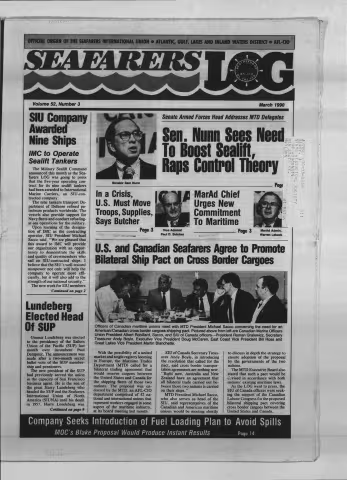
Issue Date
1990-03-01
Volume
52
Issue Number
3
Plaintext
p-
SEAmRERS
Volume 52, Number 3 March 1990
SNI Compaiiy
Awanled
Nine Ships
IMC to Operate
Sealift Tankers
The Militaiy Sealift Command
announced this month as the Sea
farers LOG was going to press
that the five-year operating con
tract for its nine sealift tankers
had been awarded to International
Marine Carriers, an SlU-con-
tracted company.
The nine tankers transport De
partment of Defense refined pe
troleum products worldwide. The
vessels also provide support for
Navy fleets and conduct refiieling-
at-sea operations for the military.
Upon learning of the designa
tion of IMC as the contracting
operator, SIU President Michael
Sacco said, "We are pleased that
this award to IMC will provide
our organization with an oppor
tunity to demonstrate the skills
and quality of crewmembers who
sail on SlU-contracted ships. I
believe that the SIU's well-trained
manpower not only will help the
company to operate more effi
ciently, but it will also add to the
stren^h of our national security."
The new work for SIU members
Senate Armed Forces Head Addresses MTD Delegates
Sen. Nuim Sees Need
Te Beest Sealift,
Raps Centreillieepy
3: on CoOC.
•o^aJ>.3Q
c/i CO • r/KO'
O -H ^ • O
fnr)oo o
Senator Sam Nunn
In a Crisis,
U.S. Must Move
Troops, Supplies,
Says Butcher
Pages
MarAd Chief
Urges New
Commitment
To Maritime
Vice Admirer
Paui D. Butcher
Pages MarAd Admin.
Warren Leback
Continued on page 2
Lundeberg
Elected Head
Of SUP
Gunnar Lundeberg was elected
to the presidency of the Sailors
Union of the Pacific (SUP) last
month over incumbent Paul
Dempster. The announcement was
made after a two-month secret
ballot vote of the SUP member
ship and pensioners.
The new president of the SUP
had previously served the union
in the capacity of San Francisco
business agent. He is the son of
the great Harry Lundeberg who
headed the SUP and the Seafarers
International Union of North
America (SIUNA) until his death
in 1957. Harry Lundeberg was
U.S. and Canadian Seafarers Agree to Promote
Bilateral Ship Pact on Cross Border Cargoes
Officers of Canadian maritime unions meet with MTD President Michael Sacco concerning the need for an
American/Canadian cross border cargoes shipping pact. Pictured above from left are Canadian Marine Officers
Union President Albert Robillard, Sacco, and SIU of Canada officers—President Roman Gralewicz, Secretary
Treasurer Andy Boyle, Executive Vice President Doug McCaren, East Coast Vice President Bill Ross and
Great Lakes Vice President Martin Blanchette.
Continued on page 9
With the possibility of a united
market and single registry looming
in Europe, the Maritime Trades
Department (MTD) called for a
bilateral trading agreement that
would reserve cargoes between
the United States and Canada for
the shipping fleets of those two
nations. The proposal was en
dorsed by the MTD, an AFL-CIO
department comprised of 42 na
tional and international unions that
represent workers engaged in some
aspect of the maritime industry,
at its board meeting last month.
SIU of Canada Secretary Treas
urer Andy Boyle, in introducing
the resolution that called for the
pact, said cross border transpor
tation agreements are nothing new.
"Right now, Australia and New
Zealand have an agreement that
all bilateral trade carried out be
tween those two nations is carried
on their ships."
MTD President Michael Sacco,
who also serves as head of the
SIU, said representatives of the
Canadian and American maritime
unions would be meeting shortly
to discuss in depth the strategy to
ensure adoption of the proposal
by the governments of the two
nations.
The MTD Executive Board also
stated that such a pact would be
devised in accordance with both
nations' existing maritime laws.
As the LOG went to press, the
SIU of Canada officers were seek
ing the support of the Canadian
Labour Confess for the proposed
bilateral shipping pact covering
cross border cargoes between the
United States and Canada.
Company Seeks Introduction of Fuel Loading Plan to Avoid Spills
MOC's Blake Proposal Would Produce Instant Results Page i4
If. •-.^•s.tajffs'tj®P
'Mi
. ;f.-':3S.
'-•^^^'i"r.u:t- •
W:
t-:
S '• '••••>• '
'y -'
n '•7V-. :.•'•• '•% '-J •
-f ( -
•l-ii?'
•i-y
<i:my- . J:-
Vf I '• ^ :
Illlllpi;':'-
i 'vi'.i"AV'' :''. •\':'V •'.'
I?! ' '''i '
•''' 'F ^ ''
f#?••'•• ' • '
itn-r
••'• J
itelil
•M •'
' ' ''
'SSI-', SIAFARIRS LOG
!eB!K:^Dnri
.^7r"
mmBiy
f:^r'''-
..;.i' , / >'"• • ;• ••'._]; " •
President's Report
As we move into the 1990s, Americans have good reason to con
sider what the future holds. Two main events are shaping up that
could have a very serious impact on the economic security of Ameri
can workers as well as on the continued health of our democracy.
One of these events is the soon-to-be finalized single trade market
of the European Community ^C). By 1992, the 12 nations that make
up the EC will unify their markets for the purpose of
moving goods, services, capital and labor. A single
currency is being developed as well. The countries in
volved are Belgium, Denmark, France, Greece, Ire
land, Italy, Luxembourg, the Netherlands, Portugal,
Spain, the United Kingdom and West Germany. In
another year, all trade barriers and differences in stan
dards between these nations will be dropped, and
goods, services and people will move freely across
borders, almost as we do within our 50 states. In fact, the combined
European Community market will, it is estimated, rival ours in wealth
and exceed the United States in numbers of consumers.
This means that Europe is going to be a more formidable competi
tor than when the United States had to contend with 12 separate na
tions and 12 separate markets. The technologies and ideas of Europe
will be consolidated, and the 12 EC member countries will think com
petitively as one.
This unified European market could have serious implications for
our own maritime industry. There is also much talk of consolidating
the commercial shipping fleets of the nations involved into one opera
tion, with one registry and flying a Euro-flag, manned by low-cost
crews from the lesser developed parts of the world. Many of the EC
nations have been traditional maritime powers in their own right. This
is bound to have a critical impact on the United States which could be
driven to the wall by this new economic—and political—force. Very
likely every American industry will face similar threats.
The second event that is shaping up is the collapse of the commu
nist economies and political systems of Eastern Europe. All freedom-
minded individuals are eager to see the oppressed people of that part
of the world adopt democratic systems and free market economies.
And we can all see the logic of direct aid from our government to help
these nations through some rocky economic times as they convert
their economies. Already America is talking about pumping large
sums of public funds and private money into that part of the world.
But as we attempt to help the Soviet Union and its.former satellites,
we must remember that America needs rebuilding too. Our cities are a
deteriorating mess, our industrial base is practically gone, and we are
almost overwhelmed by deficiencies in our education and health care
systems. America must be on its toes if we are going to retain our
power to compete in the world, retain the jobs and skills of American
workers and preserve our democratic institutions.
As far as the European Community is concerned, it is imperative
now, more than ever, that we maintain a strong merchant marine that
cannot only protect our national security but can also defend our eco
nomic interests. We must consider the likelihood of a new Euro-fleet
that could drive American ships from the seas. Once this is accom
plished, America would have to pay whatever transportation costs
would be laid on her. In such circumstances America could easily be
come an economic hostage.
What can we do about this not-so-happy situation? One thing for
sure, we should not just sit back on our hands. We ought to be prepar
ing to provide reasonable assistance to Eastern European countries
which are determined to emerge as full-fledged democracies.
Insofar as our own U.S.-flag shipping industry is concemed, there
is no more appropriate time than now for the Bush administration to
drop its han^-off policy and take steps to assure the United States of
the balanced and viable shipping capabilities which a world power
must have.
In the final analysis, our guideline must be the welfare of Ameri
cans and the economic well-being of America.
We need a concentrated effort to put America back in her rightful
place, reviving our manufacturing capabilities and building the wel
fare of all her citizens. Let's rebuildAmerica and let's build it with
American workers.
Sealift Tankers to Be Crewed by SlU
Condmedfirom page I
will translate into more than a
couple hundred job opportunities.
The turnover of the vessels to IMC
will take place sometime around
May. Sacco said both "the com
pany and the government will have
the full cooperation of the SIU to
make this operation a complete
success."
Seafarers Vice President Angus
'Red" Campbell said details on
the contract with IMC will be
provided to the membership
through the union's monthly meet
ings at all ports and will be avail
able in every hall.
Prior to the awarding of the
contract to IMC, the nine tankers
were operated by Marine Trans
port Lines of Connecticut and
crewed by unlicensed members of
the National Maritime Union,
known since its 1988 merger as
District 1 MEBA/NMU.
DOT Transport Policy
No Help to Shipping
The Bush administration's
long-awaited policy on transporta
tion, unveiled earUer this month,
failed to provide any encourage
ment to the U.S.-flag shipping in
dustry. SIU President Michael
Sacco termed the study "a slap in
the face to maritime."
Sacco cited numerous studies
on the American merchant marine
and the substantive proposals put
forth in those documents which, if
enacted, would help tum around
the decline of the U.S.-flag fleet.
Among the studies noted by Sacco
was a detailed analysis of the mar
itime industry by the prestigious
Commission on Merchant Marine
and Defense, a defense panel es
tablished by Congress in 1984 and
appointed by the president in 1986.
Under the commission's chairman,
Jeremiah Denton, a former senator
from Alabama and a naval officer,
the panel studied U.S. shipping ca
pabilities over a two-year period,
compiled volumes of testimony
and data and issued four reports.
The commission concluded there
is a "clear and growing danger to
the nation's security in the deterio
rating condition of America's mar
itime industries." In the panel's
fourth report—entitled a "Plan for
Action"—numerous recommen
dations were put forth to rebuild
the American-flag merchant ma
rine.
"The National Defense Trans
portation Association also pre
sented the U.S. government with a
thoughtful study on the issue and
recommended programs to rebuild
the American merchant marine.
Yet, after all of these studies, the
national transportation policy
failed to come up with any substan
tive new ideas, set objectives or
identify the means to increase
American shipping capacity,"
Sacco said.
"In light of all the hard work that
has been done in these studies, as
well as the presentations made dur
ing the Department of Trans
portation's meetings on the na
tional transport policy, it is a crying
shame all this effort fell on deaf
ears," Sacco concluded. In addi
tion to the commission report, the
NDTA study, the SIU president's
remarks referred to hundreds of
hours the maritime industry has
dedicated to testifying at hearings
called by DOT on the policy, pro
viding the agency with data and
participating in the agency's "clus
ter groups" on the issue.
St year the Department of
Transportation solicited input
from the maritime community, as
well as from the rail, trucking and
air sectors. In promoting its na
tional transportation policy report,
DOT gave the impression it was
developing a comprehensive as
sessment of the problems facing
each mode of transportation and
formulating new and bold solu
tions for the future.
The DOT document identified
the problems facing the shipping
industry and simply called for a
review of existing maritime pro
grams and laws. Without identify
ing any specific actions, the policy
also urged that unnecessary gov
ernment restrictions be removed
which prohibit U.S.-flag ships
from competing in world trade.
The national transport policy
also gave its support to programs
the administration has been pro
moting: the war on drugs through
the testing of maritime workers,
collection of user fees to support
the search and rescue services and
commercial vessel safety inspec
tion programs of the Coast Guard,
and coordination of government
agencies to prevent and handle oil
spills.
Index to LOG Features r / ^ J
Page 1>-y
*22".
Dis|iatchens' Re|X>ti/Deep Sea «18
Dl^tcliers^ Rei^rt/Inland. * 19 r \ v
Dlspatebers'Report/Great Lakes *..19 ^
l^nal Departui^ 25^2/6 -
Your Rl§IltS.-. a.*.*.* • ••2l2-y: •
LetlcNhi to tise Rdybtor * 4 ti- »•>«• « «'*»12 ^
Lund^rg School Apj^katioa .27
Lundeberg School Course Sdieduie *27
IVfeetuigiNotic^ •••'19'
Notices a a • »;«'•' • •.•• .• • '• • * .-'a » •;•••=*>.. • • » ..-wlT'
•;»;* • '«> • .*« •.«'•.• "•>• •-^•rai 4 m »'•£ « «
RefSOnalS.a • • •''•'•..a *• « •. '• • •,'•>'•' a .• «19
jSpbill^Minutes.•••••••.•••••••*••••##*.••••••..•»•••• 23^ 24
Lfploit jffiiM Dliectory. ^•• .'••• ̂ •.••«•*•••«• • .18
Volume 52, Number 3 March 1990
The LOG (ISSN 0160-2047) is published monthly by the Seafarers International
Union; Atlantic, Gulf, Lakes and Inland Waters District; AFL-CIO; 5201
Auth Way; Camp Springs, Maryland 20746. Telephone (301) 899-0675.
Second-class postage paid at MSG Prince Georges, Maryland 20790-9998 and
at additional mailing offices. POSTMASTER: Send address changes to the
LOG, 5201 Auth Way; Camp Springs, Maryland 20746.
President, Michaei Sacco; Secretary-Treasurer, Joe DlGlorgio; Executive
Vice President, Joe Sacco; Vice President Collective Bargaining, Angus
"Red" CampbeU; Vice President Atlantic Coast, Jack Caffey; Vice President
Gulf Coast, Thomas GildeweU; Vice President West Coast, George McCartney;
Vice President Lakes and Inland Waters, John Fay; Vice President Government
Services, Roy "Birek" Mercer.
Communications Department Director, Jessica Smith; Associate Editors,
Daniel Duncan, Max Halt and Deborah Greene.
y'M' ' ^
,, ."T.-'I; 't" '•.•-••
•;.; V, v;':; -V.
mm
Nunn Stresses Vital Ship Role
in National Defense Strategy
•m.
Calls Effective Control Theory 'Voodoo Maritime Policy'
The representatives of 42 na
tional and international unions af
filiated with the AFL-CIO's Mar
itime Trades Department (MTD)
heard Senator Sam Nunn (D-GA)
say American-flag ships will play
an increasingly important role in
the nation's defense strategy as
the United States adjusts to the
profound changes taking place in
•Eastern Europe and the Soviet
Union.
Nunn, an internationally rec
ognized expert in defense and for
eign policy issues and chairman
of the Senate Armed Forces Com
mittee, said increased warning time
of any major war between the
superpowers in Central Europe
will result in "less forward forces
in Europe" and "more of our
military forces located in this
country rather than abroad."
Speaking before the MTD Ex
ecutive Board last month, Nunn
said that in the future there will
be lighter American forces that
will have to be "more mobile."
Those forces will have to be "lifted
by sea or by air much more rap
idly," he told the representatives
of the assembled shipping, ship
building and maritime-related
services unions.
"I think there is going to have
to be increased overall lift — sea-
lift and airlift — but I do believe
that the tilt will be towards sealift
because when you get more warn
ing time, you can have less of your
equipment coming in the first two
or three days and you will have
more time to get that equipment
there," Nunn said.
The Georgia senator informed
the delegates that the Armed Serv
ices Committee will be reviewing
the fundamental assumptions on
which the United States bases its
military policy. '.'The threat de
termines the strategy; the strategy
determines the budget." Nunn said
the Bush administration also is
reexamining America's security
strategy, but to date the Depart
ment of Defense has not converted
the overall changes of the world
into the national budget. DOD's
proposals, Nunn said, still have
many blanks.
Among the administration's
"blanks," said Nunn, are the areas
of sealift and overall maritime pol
icy. Nunn said the head of the
Joint Chiefs, General Colin Pow
ell, told him that as fewer U.S.
forces are forward deployed, the
more efficient and effective sealift
and airlift must be to get American
troops back into action. But the
administration is deferring the $600
billion that was appropriated last
year to build rapid sealift. "Those
two do not go together," Nunn
noted.
The administration has also taken
the position that America does not
have a major sealift problem be
cause all U.S.-owned ships must
be available and will be available
even if they are foreign-flagged
ships with foreign crews, Nunn
told the MTD delegates. He said
the administration was trying to
"define away the problem."
That policy, known as "effec
tive U.S. control" oi' "EUSC"
1 claims that the United States gov
ernment will be able to appropriate
American-owned vessels in times
of war or national emergency, no
matter what flag they fly.
"I would say that in an earlier
day. President Bush would call
this 'voodoo maritime policy,'
Nunn quipped.
The so-called effective U.S.
control theory raises many ques
tions, Nunn said. "Will these ships
Senator Sam Nunn
Delegates from 42 unions attended the annual February MTD executive board meeting.
be available in a short term, short
notice type of war? Will these
crews be reliable in a war? Sup
pose we have a war in the Middle
East or in Africa, will the crews
of Liberian ships be available?
How is the United States, the
leader of the Western defense
world, really able to take this type
of risk, relying on foreign-flagged
vessels and relying on foreign crews
when there is really no other coun
try in the world doing it? When
we are the bulwark, how are we
able to do that?" Nunn asked.
Nunn said his committee will
hold a series of hearings on the
issues of sealift funding and the
legitimacy of the effective U.S.
control policy. The Senate Armed
Services Committee also will be
looking at the chances of an ac
cidental nuclear war, the contin
ued threats in the Middle East and
security concerns in Southeast and
Southwest Asia.
"The bottom line," said Nunn,
"is we have a continued stake in
the security of the Western world.
The United States will have to be
the leader of that. We have a
continued need for strong, ready
defense forces. Your industry will
increasingly play a major role in
that overall endeavor."
Bdidiep, Ldadi Urge Backing nl XiMrlcan-Flag SMpphig
The lack of suf
ficient privately
owned ships to
support sealift in
times of national
emergency or war
was decried by the
head of the Mili
tary Sealift Com
mand, Vice Ad
miral Paul D.
Butcher, when
he addressed the
MTD Executive
L«hack Board during its
annual winter meeting last month.
Warren Leback, who serves as
administrator of the federal gov
ernment's chief maritime agency,
stressed the importance of the na
tion's cargo preference laws in his
talk to the delegates representing
42 national and international ship
ping and shipbuilding unions.
Stating that this nation should
"take immediate aim" to have its
merchant marine assured of vital
ity in peace and in war. Butcher
proposed that some governmental
subsidy go to American-flag ships.
Butcher's remarks were echoed
by Leback who announced that
the Bush administration is looking
into a possible fuel oil subsidy
differential.
Leback said such a subsidy
would assist those companies "that
have steam driven vessels that
were constructed in the early '70s"
because it was "unfair to deny
that operator the ability to com
pete against the diesel-driven
bulker."
Noting the United States should
have the capability to move 1.7
million tons of unit equipment—
tanks, helicopters, supplies^
Butcher warned, "We are coming
dangerously close to where we
cannot support our combative
forces if we project them in a
combatant role."
Butcher said if the decline in
the American-flag fleet continues,
by the year 1993 "We will be
incapable of supporting our com
batant forces either for unit equip
ment or sustainable issues and
we'll rent a ship to fight a war."
Relying on the Ready Reserve
Force, where the average age of
a vessel is 45 years, or our allies
would be a mistake, said Butcher.
He recalled at least one occasion
when our NATO allies had not
rallied to the aid of the United
States. "In 1986, when I helped
plan the raid against Kadafi, we
asked for NATO support, and one
country—the UK—let us launch
aircraft, two of them, and the rest
of the countries told us to pound
sand because it wasn't in their
interests."
Jones Act Defended
Leback asked the MTD Exec
utive Board to continue its strong
support of the Jones Act. "We
need to continue to support the
American flags when there are
American-flag vessels available."
As an example, Leback cited the
recent firacas over the increased
cost of home heating oil in North
eastern states. In that case, the
press and public blamed the Jones
Act for the oil shortage because
some forei^-flag ships were not
granted waivers to enter the trade.
In that case, not only were U.S.-
flag vessels available for the trans
port of the fiiel, but also the in
creased price had little to do with
the cost of waterbome transpor
tation. "When you went into it,
and you finally looked at it, it was
not the freight rate on the Amer
ican-flag tankers that created the
problem. It was
inventories and
then it was the law
of supply and de
mand," Leback
reported.
Training Is Vital
Butcher
Both Butcher
and Leback em
phasized the need
to train and re
train seafarers,
both unlicensed and licensed.
Butcher told the MTD represen
tatives that efforts must be made
to make sure "we infiise our mer
chant marine crews with youth as
the older people retire. . .and train
ing is a very important part of that."
Leback stressed the need for
"government, management and the
seafaring labor to concentrate and
put ourselves in lock step to do a
good program over the coming
years on retraining of our seafar
ers, honing their skills and provid
ing them with the ability to do the
job better." Leback pledged the
support of the Maritime Admin
istration in these endeavors.
1, V •
V^'-.
m
fnp,^.. ^;;.: ••••'^.'-.r^
/II •; •
a/:.o
'vl.-.-'''.-'""--,
3i0
l-i-llijii-
ifiiillli'
' •"'': •
i-vf :3--:r's,v'".:'
?t" Ji'. • . ••'•i ; •_
' V
iiilifc:
'W:- •
4'
- , i.\. ._
r,:..-\l ,.£\:i
m
•f-' " '
' / S' "
AFL-CIO Theme Urges 'Rebuilding America'
AFL-CIO Secretary Treasurer Thomas Donahue Informs the delegates
of the gains the trade union movement has made despite the difficult
times.
Restoring American productiv
ity and competitiveness can only
be accomplished by "repairing and
rebuilding the fundamental re
sources that make this country
work," Thomas R. Donahue, the
AFL-CIO's secretary-treasurer
told the MTD Executive Board
members during their annual Feb
ruary meeting.
Other representatives of the na
tional federation of unions told the
MTD delegates the labor move
ment must be prepared to work for
candidates wha support working
people, to organize individuals
who currently do not benefit from
union representation and to launch
a national offensive to enact a na
tional health plan.
Donahue proposed that the dol
lar investment of every major cor
poration be tracked to determine
how much was redirected into en
terprises in the United States and
what amount of profit was sent
abroad.
•'The failures of our nation in the
area of. competitiveness are not
failures of worker ability or worker
effort. They are traceable directly
to employer failures to invest in the
new equipment, the new ships, the
new factories that can keep us
competitive. Those are not worker
failures. They are the failures of
managers who are more drawn to
junk bonds and takeovers than in
making money the honest way..
Donahue said.
Rudy Oswald
Rudy Oswald, the federation's
director of economic research, re
ported that the U.S. trade deficit is
responsible for a loss of 2,750,000
American jobs. He said the AFL-
QO had urged U.S. negotiators at
the world's trade talks, known as
GATT, to institute measures that
will stop the flight of American
jobs.
As an example, Oswald said,
"we keep telling them year after
year they shoul&'t include mari
time, that we have separate mari
time agreements." If maritime
services are included in the GATT
talks, existing programs designed
to keep the American merchant
marine viable could be dismantled,
leaving hundreds of thousands of
workers in the maritime industry
without jobs.
Bert Seidman
Another reason the United
States has difficulty competing in
the world market is the skyrocket
ing cost of health care. The director
of the AFL-CIO's Department of
Occupational Safety, Health and
Social Security, Bert Seidman,
said "Health care costs are con
suming half of corporate profits: in
the United States.
He noted per capita health care
costs in the U.S. are 41 percent
higher than Canada's, 61 percent
higher than Sweden's, 131 percent
higher than Japan's and 171 per
cent higher than Great Britain s.
Seidman urged the 42 unions
affiliated with the Maritime Trades
Department to assist in the AFL-
CIO's national campaign to de-
Robert McGlotten
velop solutions to the health care
crisis. He said there is a growing
realization among imions and their
employers that containing health
care costs can only be done
through government policies.
Electing government offtcials
who support a resolution to the
nation's health care problems is
one of the reasons union members
must vote in this year's federal,
state and local elections, said Rob
ert McGlotten, director of the
AFL-CIO's Department of Legis
lation.
"I cannot stress too much the
importance of getting our members
active at the grassroots level," Mc
Glotten emphasized. Working men
and women have a great deal at
stake in decisions ̂ ade by politi
cians. The future of the maritime
industry can be decided by a few
laws,he noted.
John Perkins
John Perkins, director of the
AFL-QO's Committee on Politi
cal Education, reported the trade
union movement will now enter
elections with •'new tools, new so
phistication." He cited the use of
computers to match the addresses
of union members with precinct
data. This procedure allows the
labor movement to effectively
"target voting districts in terms of
support for our candidates," Per
kins said.
Unions have a responsibility to
provide information to their mem
bers on the voting records and po
sitions of candidates running for
office on a national or local level,
he said. Perkins added that mem
bers "trust their union to give them
the facts about a candidate's posi
tion on an issue."
Richard Wilson
In addition to protecting and
promoting job security through
legislation, the labor movement
also must help working people by
extending union representation to
those who are currently unorga
nized. Richard Wilson^ director of
the AFL-QO's Department of Or
ganization and Field Services, told
Sie assembled MTD delegates. He
said the AFL-QO is committed to
making organizing a high priority
activity.
•'Because we can organize, I'm
not worried about the future any
more. I'm not worried about the
past. I'm going to make the future
now and I'm going to make it
today," Wilson concluded.
Sacco Says U S. Wirinrs
Must Us Naliin's Prliirlty
The trade union movement must
bear in mind its first and foremost
responsibility to the American
worker as corporate America seeks
to take advantage of the changes
in Eastern Europe, warned AFL-
CIO Maritime Trades Department
President Michael Sacco.
Opening the annual February
meeting of the MTD, Sacco, who
also serves as president of the
Seafarers International Union, said.
Michael Sacco
"I think the American labor move
ment had better be on its toes to
see that under the cover of spread
ing democracy, corporate Amer
ica doesn't exploit the situation
that winds up as a further expor
tation of American jobs and in
dustry."
On the home front, Sacco noted
it was one year ago that members
of the International Association of
Machinists employed by Eastern
Air Lines had gone on strike in a
showdown that has pitted the union
against the company's owner,
Frank Lorenzo. "I don't have to
tell you how tough a year it has
been for those who had the guts
to stand up to this disgraceful fink
— and all who are still standing
up to-him," Sacco said.
"Eastern is an avowed enemy
of American unionism and we can
never surrender to it," Sacco told
the representatives assembled from
the 42 national and international
unions affiliated with the MTD.
With Eastern struggling to stay
^ive, Sacco pledged the full sup
port of the MTD in the effort to
convince the flying public that they
should not choose Eastern.
r
MUCH 1990
V, .,.
"il
'I'Ssil iHi
llli]!iiiin:i»|,|^^ - JiijytiQIij^^
Nick Joe Raifall Dennis Hertei Raymond J. McGrath Thomas J. Manton Gerry Sifcorski
The five congressmen pictured above addressed the participants of the MTD's executive board meeting held last month.
House Raps Ptedge Support of Maritiuie Objoctivos
Five congressmen, representing
both land-locked and water-adja
cent districts and both political
parties, advised the MTD Exec
utive Board of their continued
commitment to a strong U.S.-flag
fleet. In individual presentations
before representatives of MTD's
42 afhliated unions meeting last
month, the congressmen also
pledged their support for programs
that will assist working men and
women.
Representative Nick Joe Rahall
II spoke favorably of the so-called
cash transfer proposal which would
require countries receiving eco
nomic assistance in the form of
cash, to make their purchases in
the United States and to ship the
goods on American-flag vessels.
Such a bill would benefit aid
recipients as well as the American
taxpayer, the Democratic con
gressman said. To his West Vir
ginia congressional district where
coal is produced, it would mean
nations interested in purchasing
the commodity with their Ameri
can cash assistance would have to
purchase it from the United States
and not from foreign competitors.
"I see no down side whatso-r
ever" to the requirement that U.S.
cash aid to foreign nations be spent
for American commodities and
manufactured goods that then are
shipped on American bottoms,
Rahall said. "Taxpayers benefit
because their tax dollars are being
used to purchase U.S. commodi
ties," which in th6 case of his
district is coal.
"U.S. coal producers and those
they employ benefit because their
tax dollars are not being spent by
recipient countries to bolster their
competitors in the international
coal market and those who work,
the workers in our domestic trans
portation sector benefit as they
have the opportunity to share in
the creation of more jobs. . . Fi
nally, our U.S. balance of trade
benefits, which is a matter of no
small concern."
Michigan Congressman Dennis
M. Hertei said it was time for the
United States to "start having some
common sense" about the impor
tance of a strong U.S. merchant
marine for our national defense
concerns. While the defense budget
had doubled in the '80s, the Dem
ocratic congressman said, "The
harsh reality is that our defense
sector is not always aimed at the
defense of this country in the way
that it should be—otherwise we
would have sealift, otherwise we
would have a strong merchant ma
rine."
Hertei stressed the importance
of the United States standing on
its own because allies cannot come
to our assistance. He cited the
example of the American request
for minesweepers for the Persian
Gulf during the conflict in that
region during the late '80s. The
request had been rebuffed proving
the Ways and Means Committee
is concerned with the impact of a
united market in Europe on U.S.
businesses and consumers.
McGrath said his committee also
will study the impact of the 1992
single European market on the
American maritime industry.
He noted the European Com
munity (EC) will have a single
monetary sy stem that will be used
by all 12 member countries. With
the EC moving towards elimina
tion of internal European trade
barriers, the United States must
look at what is at stake. "We
certainly have interests to protect
and we should be out there trying
to protect them right now,"
McGrath concluded.
Speaking from the vantage point
of serving on the House Energy
Committee, Representative
Thomas J. Manton discussed the
oil spill liability bill currently be-
Upholding cargo preference laws and
enacting ^buy and ship American^ pro
visions were among the issues addressed
by the congressmen.
"we can't count on them to do
what's necessary to get the troops,
and all their supplies and basics
overseas in time of emergency or
in time of war."
Republican Congressman Ray
mond J. McGrath, who serves on
the House Ways and Means Com
mittee, told the union represen
tatives that some sort of tax relief
would be explored for American-
flag tanker companies if Congress
enacts a double-hull, double bot
tom construction provision.
McGrath's committee is charged
with issues regarding taxation.
McGrath, who represents a dis
trict in New York, reported that
fore a conference committee made
up of elected officials from both
branches of Congress.
Referring to the provision that
would force American-flag tankers
to be retrofitted or buUt with dou
ble huUs and double bottoms, the
New York Democrat said, "I think
the time has passed for Congress
and our country to stop blaming
domestic shipping and our mer
chant seamen for every environ
mental ill."
Manton reported on the devel
opment of oil fields in the section
of Alaska known as the Arctic
National Wildlife Refuge (ANWR).
The exploration and development
of new Alaskan oil is vitally im-
pmtant, Manton said, because what
is currently coming from Prudhoe
Bay will "decrease and eventually
in the first decade of the next
century simply dry up com
pletely."
To begin oil exploration in
ANWR, Congress must amend the
Alaska Lands Act that the legis
lative body passed more than a
decade ago. Because of the cur
rent climate regarding oil spills,
Manton said the ANWR bill would
not be considered by Congress
until the next session, sometime
in 1991 or 1992.
Manton said exploration and de
velopment of the oil fields located
in ANWR's coastal plain, are "vi
tal to our nation's economy—^for
our national defense, for our eco
nomic security. . ."
Defending the working men and
women of this nation is what unions
are all about and this also should
be a top priority for Congress,
Representative Gerry Sikorski said.
Government must support and de
fend the "little guy" and develop
programs that bring out the best
in America, he continued.
The congressman, a member of
the Minnesota Democratic Farmer
Labor Party, said America's
strength is its "warm heart." He
pointed out the administration
should note that "a warm heart
does not. . . deny $4.50 an hour"
to honest, hard-working people
doing their jobs for minimum wage.
Sikorski said America could re
gain its greatness only by "invest
ing in people."
(Congressman Rahall was first
elected to the House in 1976 at the
age of 27. Representatives Hertei
and McGrath were elected in 1980.
Joining the House in 1982 and
1984, respectively, were Manton
and Sikorski.
Each one of the congressmen
serves on important House com
mittees that often consider mari
time-oriented legislation.
•• • • "• •
.. 'V
r .
t • • .V
1,4. •, .
'.ni. • •••.: .
i, -
• ijr--: •• r "
-
• ijr--: •• r "
' .1 1 •• •••
: - . 'I'-t • . - ..v^ .. J.,
[•5|. /'.f.:-^v;:v • , ^
31'• '13- 3'S ;,:v'
'r
TiTMiTBITl
-f - •-.,, • .i'-i.>^i >, loe
•i'^' ' "'V
iiWI
- 1
iiii*
f- ••: -••'.•
j*^'- -.••••Sf:.-:i/••- ." '/••
r» ;: •.,'
1 ..- •l.'-
•ri' .•• '••••. • V,
^...•>3,-' .-'.V
if'j -V;':
V''.. •
:,.i.
Sunmiary Of IWTD AcUons
Ttie Executive Board of the Maritime Trades Department, AFL-
CiO, considered several pressing issues of concern to men and
women working in the shipping, shipbuilding and related indus
tries. What follows is a synopsis of the positions and programs
of the MID adopted at the meeting held last month. The individuals
who introduced the resolutions are pictured with the summaries.
US/USSR Maritime Agreement
The bilateral maritime pact be
tween the United States and the
Soviet Union must contain an un
derstanding that if the USSR is to
have access to the open trades of
the U.S., equal treatment must be
afforded American carriers over
seas. The MTD insists that the
agreement include a cargo sharing
program that is fair to all players
and urges the Bush administration
to reexamine its reluctance to make
subsidies available to bulk oper
ators engaged in the US/Soviet
trades.
George Kourpias, President, In
ternational Association of Ma
chinists and Aerospace Work
ers
Defense Cuts and Sealift
The United States must be ready
to defend itself at any point, de
spite the relaxed tensions of the
'90s, the closing of some overseas
military bases and the reduction
in weapons programs. A strong
sealift fleet must be supported in
order to meet the needs of quick
and efficient transport of military
personnel and supplies abroad.
The need for rapid and mobile
sealift capacity was evident in WWII
and the Korea and Vietnam con
flicts.
Dominic Carnevaie,
Administrative Assistant to the
President, United Association
of Journeymen and
Apprentices of the Plumbing
and Pipe Fitting industry
Page Groton, Vice President,
international Brotherhood of
Boilermakers
Ttie Need for Quality Education
Because new jobs require higher basic skill levels and existing jobs
are changed by new technology and production methods which demand
constant training and retraining, the MTD urges Congress and the
administration to invest in education and make the matter a significant
national priority.
Jones Act and Energy Waivers
The MTD calls on the House Mer
chant Marine and Fisheries Com
mittee to investigate the home
heating oil crisis that took place in
December 1989 and January of
this year. Specifically, the com
mittee should determine whether
sufficient regional stocks of petro
leum products were maintained
prior to the onset of cold weather
and review why U.S. tankers were
not utilized.
Free Trade Ethic and the NCAA Fleet
Legislation has been introduced in Congress to upgrade the aging fleet
of the National Oceanic and Atmospheric Administration. A provision
of the bill requires that all construction, modernization, conversion and
repair work be done in U.S. shipyards and that all major hull and
superstructure components be fabricated in the United States. The
administration's Office of the U.S. Trade Representative (USTR) op
poses the "buy American, build American" provision on the basis that
it would violate an international agreement. The MTD urges the USTR
to reverse its stance until other governments drop their shipyard
subsidies.
Dredging, Port Development and Beach Restoration
Any legislation establishing a com
prehensive national port develop
ment policy should include a ben
eficiary test to insure fair application
of costs, including shipper respon
sibility for the collection of ad va
lorem fees. The MTD urges the
Congress to insure that private
sector U.S.-flag dredging contrac
tors complete all work associated
with the revitalization of Amer
ica's channels, ports and eroded
beaches.
William F. Zenga, Business
Manager, Local 25, International
Union of Operating Engineers
and Vice President, Maritime
Trades Department, AFL-CiO
General Agreement on Tariffs and Trade
The MTD urges the administration
to keep waterborne commerce out
of the world trade talks known as
GATT because inclusion could un
dermine all current programs that
support an American-flag fleet. In
addition, shipping is currently
heavily regulated by a myriad of
international governmental agen
cies as well as by multilateral and
bilateral agreements. Adding yet
another group with power over
shipping will not serve world mar
itime interests.
James Hatfield, President,
Glass, Molders, Pottery,
Plastics and Allied Workers
international Union
Waterfronts for Maritime Industries
The Coastal Zone Management
Act of 1972 does not contain spe
cific provisions which address the
preservation on waterfront sites for
water-dependent users, including
the maritime industry. The MTD
urges Congress to amend the
Coastal Zone Act so waterfront
sites can accommodate vessels
engaged in transportation of cargo
and passengers and for other water-
dependent uses.
Ed Panarello, Secretary-
Treasurer, Port Maritime
Council of Greater New York
and Vicinity
Peter Rybka, Vice President
Emeritus, American Federation
of Grain Millers
Long-Term Care
Currently there is no federal regulation covering the issue ot long-term
care for the elderly and disabled. Medicaid funds 41 percent of nursing
home care but oniy 12 percent of home care. The MTD supports
legislation that would include long-term care solutions as part of a
comprehensive national health care system.
Cooperation Between Maritime and Agriculture
The MTD urges the farm com
munity to uphold the 1985 cargo
preference compromise in which
American shippers dropped their
claim to certain government-spon
sored cargoes in exchange for
carriage of 75 percent of Food for
Peace aid on U.S. bottoms. The
MTD also suggests that agriculture
and maritime work together, as
both industries are vital to our
nation's national defense and eco
nomic security.
United Marine Division, Local 333 NYC Strike
The United Marine Division, Local
333, has been on strike against
nine towing companies operating
in the New York harbor since Feb
ruary 15, 1988. The MTD and its
affiliates support the efforts of UMD
to obtain a decent contract with
nine tugboat companies. John Baker, President,
Cleveland Port Maritime Council
Great Lakes Maritime Industry
The MTD supports full federal
funding of a lock needed at Sault
Ste. Marie, known as the Soo
Lock. When the biennial authori
zation of water resources projects
is implemented, the deepening of
the harbors of Superior, W1 and
Duluth, MN and the Great Lakes
connecting channels should be
given priority. The government
should modernize the icebreaker
Mackinaw operated by the USCG
and replace it when necessary.
Shipboard Conventions
Current tax law allows businesses
to take an expense deductibility
allowance for meetings and con
ventions held on U.S.-flag vessels.
Owners of foreign-flag cruise ships
seek the same tax goody for them
selves. The MTD urges Congress
to reject any attempts to extend
the tax break for shipboard meet
ings held on foreign-flag cruise
vessels.
Tim Mohler, President, Toledo
Port Maritime Council
Frank Pecquex, MTD National
Field Coordinator
Continued on page 7
• ''«v"
••• j
• 'ii
.y • I''..
.1
:!• .
, - • ' .k- (••. .•
MARCH im
Summary of MID Acflons
Continued from page 6
Flags Of Convenience: Havens Of Unreliability
The United States should evaluate
its dependence on flag-of-conven-
ience vessels and examine how
the whims and political uncertain
ties of open registry nations can
endanger American sealift mobi
lization requirements. The MTD
believes now is the time for the
United States to realistically as
sess its stance on the hollow the
ory of effective U.S. control.
Jack Otero, Vice President,
Transportation •
Communications Union
Democracy in Eastern Europe
The thunderous transformation of Eastern Europe will require drastic
reorganization of the economies and political systems. The MTD
supports the Eastern European worker, who may face some tough
times ahead, but who will prevail and soon flourish while building the
foundation of strong democratic institutions for generations to come.
Alaska Oil Export Restrictions
While Alaskan oil currently is reserved for domestic use, those restric
tions are due to expire on September 30 of this year. The MTD endorses
the enactment of legislation that will indefinitely extend restrictions to
prohibit the export of Alaskan oil to foreign countries.
Domestic Maritime Policy and the Jones Act
The MTD urges that no alteration
in the nation's cabotage policy be
imposed on the U.S. maritime in
dustry and all efforts to weaken or
repeal the Jones Act should be
resisted at all costs. An Office of
Technology Assessment proposal
to extend Jones Act coverage to
the full 200 mile limit of the U.S.
Exclusive Economic Zone should
receive prompt, favorable action
by the U.S. government.
William Lucy, Secretary-
Treasurer, American
Federation of State, County
and Municipal Employees
Health Care Policy
A reorganized health care delivery system should be the number one
priority for the United States. The'only way to assure that all Americans
have access to affordable quality care is through the enactment of a
national health care program. The MTD urges adoption of a universal
comprehensive national health care program. Until such a plan is
adopted, the MTD calls upon Congress to enact legislation requiring
employers to provide a minimum standard of health care as a condition
of doing business.
South Florida Port Council Chartered.
The South Florida Port Council became the 29th local affiliate of the
Maritime Trades Department at the organization's February executive
board meeting. Presenting the South Florida Pbrt Council's charter are
MTD President Michael Sacco (right) and MTD Executive Secretary-
Tresisurer Jean ingrao (left). The council's officers are District 2 MEBA
President Ray McKay, who will serve as the group's president, and
Wayman Steward, who has been elected secretary-treasurer.
"T'-- • •
District 2 MEBA President Ray McKay (left photo) points out that
neither the Exxon Valdez or the American Trader, two tankers recently
involved in oil spills, carried licensed personnel that belonged to a
union, except for the radio officers. Pictured above right is Captain
Robert Lowen, president of the Intemational Organization of Masters,
Mates and Pilots, who also attended the meeting.
MID Meeting Photo RoumHH^
. " V
Pictured in the left photo are SlU Vice President Jack Caffey, District
2 MEBA Vice President Robert McKay, District 2 MEBA Secretary
Treasurer Michael McKay and Gordon Spencer, legislative director of
the American Maritime Officers Service. In the photo to the right is
John O'Gara, general vice president of the Hotel Employees and
Restaurant Employees International Union.
To the left are "Whitey" Disley, president of the West Coast-based
Marine Firemen, Oilers, Watertenders and Wipers Association, Guy
Dickinson, secretary-treasurer of the Retail, Wholesale and Department
Store Union and Ted Kedzierski, president of the Port Maritime Council
of Southern California. C. E. Defries, president. District 1 Marine
Engineers Beneficial Association/National Maritime Union and Guy
DeVito, secretary-treasurer. Graphic Communications Intemational Union,
are pictured in the photos on right.
President and president-emeritus of the International Longshoremen's
Association are pictured in photo on the left. John M. Bowers (left)
currently heads the ILA. The legendary Teddy Gleason (right), the
ILA's immediate past president, received a round of applause by the
assembled delegates after MTD President Michael Sacco acknowl
edged his participation in the meeting. Pictured above (right) is Al
Cornette, president of Local 333 of the United Marine Division. The
MTD executive board pledged its full support of Local 333's New York
*ug boat strike.
'/• .
l'; • •
• ' - i
'•W
•m
P • •
t&m
: : •. • -
~:-J'
-; '" 'f .' " v;j'
t : :.-•
V )':'^^'4l-i'- 7.
.' •?;.• \-" • ••••
:'V.y-y
.' :". ft"
:v". ^:.:: y .,-y ft ft/,.''v.-.•/y'-, y', v
: ft"fty • ':' .-. •"'y'-' ̂ " ;'ft'"'*ft- ft''
8 SEAMIIfJIS lOG
y."', '• •"• •'
)}•
i'lft
ift:
f ' si-•'.
y'
' .; • ...
.-• j • •
^1
• l?li •. • .• •• . '
vm
Seafarers Meet New MSCPAC Commander
SlU Government Services Division members meet Captain J. A.
Peschka Jr. who became the new commander of the Military Sealift
Command-^Pacific Fleet (MSCPAC) last month. Prior to his transfer
to the Oakland, CA base, Capt. Peschka senred as the MSC operations
officer in Washington, DC and was the former MSC commander for
the Mediterranean Fleet. He succeeds Captain James S. Schultz who
had held the position since August 1988. Schultz has been reassigned
as the regional coordinator for Commander Naval Base, San Francisco.
Pictured above are (from the left) Able Seaman Maintenance Mack
Hudson Jr., Capt. Schultz, Capt. Peschka, Able Seaman Maintenance
Larry Love and SlU Government Services Division Port Employee
Raleigh Minix. The photo was taken on the new MSCPAC commander's
first day at work in his new headquarters.
AB Gene McGrew (center) is strapped into a firesuit by able seamen
Griffith McRee (left) and Pete Smith (right) during damage control
training aboard the USNS Sgt. Matej Kocak conducted by the Lundeberg
School Sealift Mobile Training Team.
SlU School Brings Training
To 4 Vessels of Sealift Fleet
The Haip^ Lundeberg School of
Seamanship Sealift Mobile Train
ing Team updated SIU crewmem-
bers on four MiUtap' Sealift Com
mand vessels on shipboard damage
control techniques during the first
two months of this year.
The training covered the follow
ing skills: fire fighting, patching
and plugging, the cleansing of water
and smoke-damaged equipment
and sound powered telephone
conununications and procedures.
The classes were conducted for
SIU members aboard the USNS
Bellatiix, USNS Lt. John P. Bobo,
USNS Major Stephen W. Pless
and USNS Sgt. Matej Kocak.
Limdeberg School instructors Bill
Hellwege, Harry Alongi and Jeff
Swanson worked with crewmem-
bers through all facets of the train
ing.
Hellwege reported that all crew-
members were extremely recep
tive to the training. "No seafarer
ever wants to have to use these
procedures, but they want to make
sure they know what they are
doing in case the situation arises,"
he said.
Damage control is a very im
portant part of the total sealift
training program. It is a must for
all upgraders attending Piney Point,
Hellwege noted.
Since the school created the
mobile training team, 55 ships have
been visited to provide the crew
with instructions.
Seatime Approved ^
For Simulator Course
The Seafarers Harry Lundeberg
School of Seamanship has re
ceived the final word for awarding
seatime to graduates of the ship
handling simulator course: the U.S.
Coast Guard certificate of ap
proval. Although the Coast Guard
announced its acceptance last fall,
the agency's certificate was needed
to make it official.
Students who take the two-week
course will be credited by the
Coast Guard with 60-day watch
officer credit toward any limited
deck license or unlicensed deck
rating or 30-day watch officer credit
toward an unlimited second or
third mate license.
The seatime credit is retroactive
for those who have taken the
course.
Although the seatime is recog
nized by the Coast Guard for credit
towards licenses, it cannot be ap
plied to the seatime required by
the Seafarers Welfare Plan and the
time needed to maintain SIU ben
efits.
Simulator training is practiced
in either a main bridge mockup or
three auxiliary bridges. The main
bridge is equipped with a variety
of instruments including radar
scopes and helms control that can
be repositioned to represent deep
sea vessels or tugboats. Seven
large full-color screens surround
the bridge to give the impression
of being in control of a moving
vessel.
All actions are monitored by
computer and closed-circuit tele
vision in an adjacent room. At the
end of an exercise, instructor Jim
Brown reviews the data with the
students.
The simulator is able to recreate
more than 40 ship handling exer
cises from docking and bunkering
to deep sea emergencies. Ship
handling courses are offered after
each AB program. Class size is
limited to four to six students.
Census Will Affect Future Bills
The shifting of the population
and therefore of congressional seats
from the industrial northeast and
farm belt to southern and western
states will have a big impact on
who gets elected after 1990.
Estimates provided by Project
500, a Washington-based research
organization, state that California
should acquire seven new seats
while Florida is expected to add
three or four and Texas should get
an additional three. New York,
estimated to lose three seats, and
Pennsylvania, Ohio, Illinois and
Michigan, set to lose two seats
each, are forecasted as the big
losers.
California again will have the
largest delegation on Capitol Hill.
Based on the 1980 census, the
Golden State had 45 representa
tives. It was followed by New
York with 34; Texas, 27; Penn
sylvania, 23; and Illinois, 22. The
projections for 1990 show Califor
nia will have 52; New York, 31;
Texas, 30; Florida, 22 or 23; and
Pennsylvania, 21.
The SIU maintains halls in the
states that will have the five largest
delegations. These states alone will
account for almost 36 percent of
the House of Representatives. All
aspects of SIU shipping—deep sea,
inland. Great Lakes and govern
ment services—are found among
these states.
Officials of the AFL-CIO, the
nation's federation of unions, are
closely monitoring the changes to
determine their effect on the in
terests of working people.
As many as 18 seats may be
moved from one state to another
when the 1990 census figures are
tallied. State legislatures will find
out by the end of the year how
many congressional districts they
will have in order to draw new
boundaries based on census data
concerning the nation's popula
tion and where they live.
The census is taken every 10
years as mandated by the nation's
Constitution. One of the primary
reasons for the count is to pro
portionately distribute the 435
members of the House of Repre
sentatives among the 50 states.
The data collected also is used
for drawing local legislative
boundaries within the states as
well as information used in allo
cating billions of dollars from fed
eral and state programs.
Seafarers have the option of
listing a location on the shore or
a vessel as "home" when filling
out the census report.
Census forms will be mailed to
all households on March 23 as
well as every U.S-flag shipping
company to make sure every sea
farer and passenger has a chance
to be included.
Projected Change
In House Districts
States projected to gain seats
_] States projected to lose seats
No expected change
•-I'sitijSv}: T-/;-
•- c. ' '"• , . '^"'r/•^•''::• .-f." I'-
•'••". , "• ''•;A'V-' '".
.'A. A- A'
-• •
;•: -Av.
AAA'";
Pi ,-. . . '• - .1;.
"'A A "'A' -
A:,-AA-A'/:' -^ • • •
'•' • •'.•'Cr.-^'f.V
Bivw RMMS Tiwie Rw If IM Hedge on U.S.
Senator John Breaux (D-LA)
took his campaign to keep mari
time off the agenda of the world
trade talks, known as General
Agreement on Tariffs and Trade
(GATT), to the Senate Finance
Committee last month.
, At a hearing in which U.S. Trade
Representative Carla Hills was
presenting testimony on the up
coming GATT negotiations,
Breaux submitted remarks critical
of any possible inclusion of mar
itime in the next rounds of trade
talks.
Breaux's strong statement re
minded the trade representative,
who serves as the prime negotiator
for American interests in GATT
meetings, that President Bush, in
campaign statements and in his
administration's approval of the
National Sealift Policy, has indi
cated the administration's support
for protecting the interests of the
American merchant marine.
He noted that during the 1988
election campaign, the Bush plat
form said "preservation of the
integrity of the U.S. maritime in
dustry shall be a priority in all
international trade negotiations,
including the General Agreement
on Tariffs and Trade."
Breaux also pointed out that the
Bush administration-approved
National Sealift Policy affirms the
U.S. "shall ensure that interna
tional agreements protect our nar
tional security interests and do not
place U.S. industry at an unfair
competitive disadvantage in world
markets."
Inclusion of maritime in the
GATT negotiations would be in
consistent with the administra
tion's pledge to support the U.S.-
flag merchant marine, said Breaux.
Discussing waterbome transpor
tation services in the GATT talks
could lead to trade agreements
that could undermine or render
extinct such pro-maritime laws as
the Jones Act and cargo prefer
ence, Breaux noted.
The Louisiana senator said the
Congress had a strong record of
keeping maritime out of trade pacts,
citing the example of the U.S./
Canadian Free Trade Agreement
of 1987 that excluded waterborne
transportation from its scope.
"I had hoped that the adminis
tration would have listened to the
Congress and learned from the
prior administration, that mari
time transportation was absolutely
not a subject for these talks,"
Breaux told the Finance Commit
tee,
Hill's remarks to the Senate
committee did not address Breaux's
concerns. The U.S. trade repre
sentative limited her comments to
general aspects of trade and of
fered no specifics concerning mar
itime services.
Breaux is a sponsor of a Senate
resolution asking U.S. Trade Rep
resentative Carla Hills to exclude
maritime services from any GATT
agendas and to oppose any pro
posals by other nations to discuss
waterbome transit during the trade
talks. As of last month, Breaux's
resolution had 26 cosponsors.
Similar legislation in the House
had 135 cosponsors.
GATT is a multilateral treaty
established in 1948 to end discrim
inatory trade practices, reduce
trade barriers and eliminate de
vices which distort free competi
tion in the world market. Cur
rently 96 countries subscribe to
the treaty, including the United
States.
Lundebera Elected Head of SUP
Continued from page I
instmmental in the 1938 formation
of the SIUNA and its afhliated
districts.
Until this election, Paul Demp
ster had served as SUP president
for 12 years.
As a result of a referendum on
the ballot, four official SUP posi
tions were eliminated: Vice Pres
ident, San Francisco Business
Agent No; 3, Tanker Business
Agent at San Francisco and the
Business Agent position out of
Wilmington (CA).
San Francisco Business Agents
Duane Hewitt and Kaj Kristensen
were reelected.
The following port agents were
elected: Seattle—^John Battles,
Wilmington—William "Bill" Ber-
ger, Honolulit—Peter Oh, and New
Orleans—Henry Johansen. All
were incumbents. The open po
sition of Seattle Business Agent
was filled by Charlie Russo who
was one of six candidates seeking
the position.
The membership and pension
ers voted for five SUP Building
Corporation Tmstees. Among the
14 candidates running for the po
sitions, the following five received
the highest number of votes: John
Battles, Paul Dempster, Duane
Hewitt, Kaj Kristensen and Gun-
nar Lundeberg.
SUP members approved 11
Gunnar Lundeberg
amendments to the organization's
constitution. One change to the
union's shiping rules was adopted.
The SUP membership also consid
ered a wide range of proposals.
A total of 2,000 ballots were
counted in this biennial SUP elec
tion.
The Sailors Union of the Pacific
is based in San Francisco. Its mem
bers are primarily unlicensed sea
men sailing in the deck
department. The SUP is an affiliate
of the Seafarers International
Union of North America. The
SUP's roots go back to 1885 when
it was known as the Coast
Seamen's Union. One Of its early
leaders was Andrew Furuseth. He
was instrumental in developing
and bringing into law the Seamen's
Act of 1915 which set minimum
health and safety standards for sea
farers.
Marine Firemen Hold Convention
Upcoming contract negotiations with American President Lines and
Matson were among the items discussed by delegates and officers of
the Marine Firemen, Oilers, Watertenders and Wipers Association
(MFOW) during their convention held earlier this year. The MFOW, an
affiliate of the Seafarers International Union of North America, repre
sents unlicensed engineers. Pictured at the convention are MFOW
delegates, the organization's president, H. "Whitey" Disley (center)
and SlU Vice President George McCartney (second from left).
TRANSCOM Commander Wants
Aid for Seaiift Capability
Hathaway Appolnteil to FMC Panei
By voice vote last month, the
Senate approved the nomination
of William D. Hathaway to serve
on the Federal Maritime Commis
sion (FMC). Hathaway repre
sented his home state of Maine in
the House from 1965 to 1972 and
in the Senate from 1973 to 1978.
During his terms in the House,
Hathaway served on the Merchant
Marine and Fisheries Committee.
Recently he has been an attorney
for the firm of Patton, Boggs &
Blow, based in Washington, DC.
The FMC is responsible for reg
ulating waterbome foreign and do
mestic commerce. It serves as the
watchdog agency for shipping
conferences and assures that only
rates on file with the Commission
are charged. The panel assures
that U.S. international trade ds
open to all nations on a fair and
equitable basis and approves
agreements under the authority of
the Shipping Act of 1916.
The Commission is an inde
pendent agency established in 1%1
by President John F. Kennedy to
keep regulatory functions separate
from maritime promotional activ
ities conducted by MarAd.
General Hansford T. Johnson,
commander in chief of the
U.S. Transportation Command
(TRANSCOM), informed the Sen
ate Armed Services Committee
last month about the need for
strengthening the U.S. merchant
marine.
"The continued erosion of our
sealift capability is a national
problem which po^es a significant
threat to the security of this coun
try," Johnson said.
The reason a strong merchant
marine is so important, he added,
is that it wQuld "deliver approxi
mately 95 percent of all dry cargo
and 99 percent of all petroleum
products" to U.S. armed forces
in any major overseas deploy
ment.
"Without an adequate sealift
capability, unilateral military ac
tions may not be feasible, while
alliance actions and a credible de
terrent posture would be weak
ened," he told the committee.
Johnson oversees the global sea,
land and air transportation needed
by U.S. military forces. The three
main components of TRANSCOM
are the commands of Military
Sealift, Military Airlift and Mili
tary Traffic Management.
The Military Sealift Command
provides shipping for the Depart
ment of Defense. It comprises the
second largest command in
TRANSCOM.
With the fall of Communism and
the decrease of possible war in
Eastern Europe, the general said
the military now considers Third
World countries in Asia, the Mid
dle East, Africa and Latin Amer
ica as potential conflict points.
"We must maintain the capability
to strike swiftly, at the time and
place of our choosing, with over
whelming force."
''
. ' -h.iW '
-•41
; • -y. ' -
-.i:. • V'
- •. :v-1
"•
m.-':
: 44.44
V • 1 • ,
4
it
,S/
/^> ,' ai:^.':..>i);;.Vi^;b^;,
0'-, ^
0--^yW^ •, ;•
;'3fi®Sjf iiatS
SiAfMERSm
Great Lakes SlU Memliers
Upgrade Skills During Winter
33 '3331,?.:?®!'?" • - " •
llisil®-'''
Lundeberg School instructor K.C. Taylor (kneeling) works with Great
Lakes SlU members in the AB class. Pictured from left to right are
Rich Strongman, Robert Wagoner and Brian Wagoner as they hone
their rope handling skills.
ir
• . ^ -.r'fc- -
; .r.,-1. ••, •(;.• =
X#-
I'f
•\ ' ' "V, V-
4- •'
's:
- H 'i"
...
It is late February. As ice chunks
float down the St. Clair River past
the SIU hall in Algonac, MI, more
than a dozen Great Lakes SIU
members are taking advantage of
the break in shipping to upgrade
at the Seafarers Harry Lundeberg
School of Seamanship. Earlier this
month, five of the Great Lakes
upgraders took a moment of their
free time to talk with a represen
tative of the Seafarers LOG.
"I want to upgrade to get out
of the cargo hold," said Brian
Wagoner, who has been sailing for
12 years. "It opens doors," added
Rich Strongman, a 15-year vet
eran.
Both Wagoner and Strongman
as well as Wagoner's brother,
Robert, are upgrading from ordi
nary seamen to able bodied sea
men. All agree that the time they
have spent studying has beert very
useful. In addition to learning the
course material, the Great Lakes
seamen have picked up some deep
sea lingo.
"The terminology between salt
water and Great Lakes is differ
ent," Brian Wagoner noted.
"We've learned the salt water
terms and then apply them to the
Lakes."
Several of the Great Lakes stu
dents also have sailed on deep sea
vessels. One of the major distinc
tions between the two sailing re
gions is the type of waves expe
rienced. "On the Lakes, the ships
take a continuous pounding. They
are shorter waves on'the Lakes,
but they are always there. One
^ter another beats the hell out of
the ship. Also ice can affect the
ship's stability," said Wagoner.
All, however, agree with Page
anii-;K^yin\
Blaau work Undeiiieath a sh^ of
ice on the <teck of the My Hr Lee
White,
Winter's Fury
The MV H. Lee White was trying to make one more voyage through
the Great Lakes before tying up for the winter. However, the ydhds ;
nid tempemfures gave the waterway a most imcooperative spirit. -
Jeff Stockman, an SIU member since 1984, Was onboard the White - i
when die bulk carrier was surrounded by ice while trying to sail ^ :
through the Straits of Mackinac, located between Lake lluion aiid|
Lake Michigan, just after Christmas. f;
Stockman said the American Steamship vessel was trapped for a
couple of days because of the conditions caused by the weather. After
the hold-up, icebre^er vessels cut a path in the waterway for the
White to follow. The wait provided Stockman, a Michigan native, with
;|!an ppportunity to capture the severity of the ice on Hhn.
Stockman, who is currently upgrading to AB at the. Lundeberg
School, provided his photos to the Seafarers LOG. ^'
'
AB David Barber works with a
variety of machine tools in the
Lundeberg School's welding course.
Page Kurtz adds the finishing
touches to the cake she baked as
part of her training in the second
cook and baker course.
Kurtz, who is up^ading to second
cook. "Summer is great up there,"
she said, "going through the is
lands, even Lake Superior (the
northernmost lake in the chain of
five)."
The group noted late winter-
early spring and late fall-early win
ter can produce some truly nasty
storms over the Great Lakes. "The
example everybody knows is the
Edmund Fitzgerald because of the
song," Kurtz said. The Edmund
Fitzgerald was a U.S. Steel Com
pany vessel that sank November
10, 1975 in a Lake Superior gale,
taking the lives of all the crew. It
was memorialized in a ballad sung
by the well-known singer Gordon
Lightfoot. The kind of gales that
hit the Fitzgerald are known
throughout the Lakes. Great Lakes
seafarers say they are fierce and
they seem to blow out of nowhere.
David Barber, a 20-year veteran
Continued on page 13
--
li- ••fi-u./J '.,•
laws#*®.*
. ."il',;
¥m
' y.''f •
Hummo 1*':•>•; ,^;iS';--
^•'']V-:V'' •'' ';'"'kk'
'•' i,: "V;;F,: /'
Watch AB
Robert Coleman
checks the
visitors' log.
-If,
Bosun/Mate
Arthur Lueiien
gets ready
to leave the
USNS Diehl
(or shore time.
The USNS Walter S. Diehl came out of Third Steward Edmundo N. Lorenzana
Louisiana's Avondale yards almost two years looked around the gall'ey as dinner was being
ago. Yet, at first look when one approaches the seiYed. Should he or one of the galley gang
replenishment oiler, it is hard to believe the members find anything — including a leaf of
vessel has sailed. lettuce in the salad bar—out ofplace,itistaken
The decks are spit-shine clean. The house care of immediately. "We're all proud of the
floors are scuff ftee. It is hard to find anything way the ship looks," Lorenzana said. "We want
out of place, and the crew is very proud of that to keep it that way,"
fact.
Nomattermwhatdepartmenl(dak,engine , I"""" Alton Wghtower noted
or steward) the ciewmember works, he or she ST®®.'"
is veiy happy to talk about the DieH which «>•<•«•'«»>" fo' the engme depar^nt. Sure
serves the MUitaiy Seaiift Command Pacific ^ «
fieet. The unlicensrf departm^ts are crewed wmdow, appeared spotless.
by the SIU's Government Services Division. "Everyone on here knows his job,", said
Chief Electrician Vernon L. Jordan pointed Bosun/Mate Arthur Luellen. "But they go a
to the date on the name plaque on the deck- step further. We know what it will take to keep
"We've been all over, but you sure couldn't tell the ship looking sharp and we're willing to do
it by the way she looks," he bragged. it."
'f;
'•J '/.• -..r'',
k-'k •
CREW IS PROUD TO BE
•> •
Sfi. . *
•H: Chief Electrician Vemon L
Jordan Oeft) looks over the
MSCPAC agreement with
Port Employee Raleigh Minix.
m . .• .'• •• V'. u
jK:;.
. I-. .Vs •'Tv: ' -/ •: K*
Chief Cook Abe SInigiar
waits for another order
during dinner on the
USNS Diehl.
f.".»' , 'j -'I--
PART OF THE NEW DIEHL
Steward/Utiiity Arthur Hood
takes care in storing the
provisions needed
for meals.
Taking a break from the hustle In the galley are (from the left, seated) Steward/Utilities
Arthur Hood, Eugenio Maiiari and Tom Briones, (standing) Third Steward Emundo N.
Lorenzana and Steward/Utilities Rolando T. Mota and George Trawick.
"V"
• ; y ;V
• '•k-k:
'ik; ^ • - •
' '-V.' •
X'Ji'A k-'C-
. 'j 'n
Junior Engineer
Alton Hightower and
Third Engineer
irvin Levy work the
controls in the
Diehl's engine room.
'X ."i
Carpenter
Oscar Dukes (iefl)
asks SiU Government
Services Division
Port Employee
Raleigh Minix (right)
about the new
MSCPAC agreement
while Wiper/Engineer
Rick Hines (center)
listens.
F-'-- -
";V-| f'V-;. . '-[y,
f/-r,
; ^ V
mmtrntno
1 4, -
v-: . . ,,.-
I • :
'' :l-''
fyfgM;P0Z
'ip yy-y^':.:'.yiy'' ••
.••*vi . *• ... .'.-^ Vv. '.•., •:•••
.4}c; •- .)''•"
.-v'f
Letters to the Editor
Jack Smith Enjoys Reminiscing
To the Editor:
Recently, after reading a copy
of the Seafarers LOG, I want to
let you know of my appreciation
for sending me a copy of this
interesting paper through the year.
I sailed in the SIU from 1945
through 1951. . . At that time, I
upgraded and sailed as third mate
with Masters, Mates and Pilots
Association (old Robin Line ships)
until going into the Navy in 1954
through 1956. Since retiring from
the SIU I have faithfully received
and thoroughly enjoyed the Sea
farers LOG.
Several years ago, I retired from
the federal government, but I still
enjoy reminiscing of the "trips and
ships" experienced in my youth.
Reading the LOG is always re
freshing and interesting.
I plan to visit the new SIU
headquarters in the near future
and to drop this off at that time.
Thanks again for retaining me on
the mailing list.
Good luck and "steady as she
goes" to the staff and membership
of the Seafarers Intemation^
(Union).
Jack G. Smith
Frederick, Maryland
Amiy Pacific Fleet Members
Wanted for Reunion in '90, '91
To the Editor:
I had the honor of serving with
a unique group of soldiers during
World War II who were assembled
and organized right after Pearl
Harbor to act as machine gunners
on merchant ships. My unit op
erated primarily out of Australia,
carrying ammunition and supplies
to New Guinea and other islands
of the Pacific. I am now, belatedly,
trying to locate enough former
members to form a reunion for
1990 or'91...
(I am) seeking former members
of the U.S. Army's Pacific Fleet,
especially members of the 301st
Coast Artillery Transport Guard
Detachment, ship and gun crew
Command #1, and the 35th Trans
portation Corps boat group. . .
Claude J. Backes
Livermore, California
Editor's Note: Retired Army CSM
Claude J. Backes can be reached
at his home address of822 Teton
Court; Livermore, CA 94550.
Government Must Correct
Injustice Faced by 'Notch Kids'
To the Editor:
(I am writing concerning) . . .
"Notch kids" like myself and
yourself, if you were bom in the
years 1917 through 1921.
I realize that our goverament is
waiting for "normal attrition" to
take its toll, before giving us our
"bonus" in this matter just as it
did in the "veterans' rights" issue
for (those of) us (in the merchant
marine) who served in World War
11...
. . .1 tmst you'll do all you can
for us, as many of us are "notch
babies."
Clarence L. Cousins
Butler, Pennsylvania
Editor's Note: The term "notch
babies" used by Brother Cousins
in the letter above, refers to in
dividuals who receive lower Social
Security benefits because they were
born between 1917 and 1921. This
inequity was a result of a law
passed in 1977 that established a
new method of calculating social
security benefits.
Last year, legislation known as
the Notch Baby Act of 1989—HR
181 was introduced in Congress.
The bill seeks to bring "notch
babies" Social Security benefits
in line with the ones currently
being received by men and women
who were born before 1917.
LOG-A-RHYTHM
Love at Sea
^ by Tammy Padgett
(This poem is dedicated to SIU member Lance Padgett who currently
sails aboard the USNS Kane as a GSU.)
As you stand upon the ship,
and gaze across the ocean.
You know that soon you'll feel
a gift God gave in Motion.
Then morning comes, the sun has shown,
the flight of a distant dove,
A sign from God, to remind you,
that here at home you're loved.
And when you do return,
you'll be sure to see.
How fast that empty feeling,
will soon be sure to leave.
To help you to the end,
you know you must believe.
That special sign from God,
was meant for you and me.
"'.S , •
Sii
Over 600 Seafarers
Order SPAD T-Shirts
More than 600 Seafarers have
requested the new SIU/SPAD t-
shirt since it became available at
the first of the year. "The response
has been tremendous," said SIU
Secretary-Treasurer Joe Di-
Giorgio during his report to the
March membership meeting in the
port of Piney Point, MD. "We are
hearing from members all over the
country."
Along with the t-shirt orders,
DiGiorgio has been receiving many
letters from SIU members and
7 have been
donating to SPAD
for 20 years .. .
love the t-shirts/
pensioners. Brother George Al
pine wrote from his Hudson, FL
home, "I'm sending for your free
t-shirt. . . I like to let the folks in
Florida know what a fine union
the SIU is—^the best—as I'm proud
to have been a Seafaring man."
Brother R. East of Ozark, AL
said, "I would be proud to wear
a shirt to let the world know I
belong to a fine union."
In thanking the union for the t-
shirt, Brother Marvin Earl James
said, "I am just writing to say that
I'm very proud to be a member of
SIU. If there is something that I
can do to help my union or SPAD,
please let me know. I am very
proud of the way you are running
things in Washington, DC. . . ."
Requests have come in from
SIU family members as well. A
surviving father of a late Seafarer
asked to be sent a t-shirt so he
can wear it in his Washington state
nursing home. Brother Ronnie
Bond asked for an extra t-shirt for
his wife, "If possible could an
extra t-shirt be sent for my wife. . .
I've been donating to SPAD for
20 years and I love the idea of the
t-shirts."
The shirts, which are union
made, feature a full color logo of
the SIU on the front. "Politics Is
Pork Chops SPAD" is printed on
the back. The sizes are small,
medium, large and extra-large.
They are available by filling out
the coupon located within "this is
sue of the Seafarers LOG and
returning it to the office of the
secretary-treasurer.
DiGiorgio noted there still are
plenty of shirts available for those
who have not ordered one.
Baby Bond Process Is Sbmililiod
day in the last six months at both
the time of conception and the
time of delivery.
The copy of the certificate of
live birth and proof of seatime
may be submitted to the local
union hall or can be sent directly
to the Seafarers Welfare Plan,
Claims Department, 5201 Auth
Way, Camp Springs, MD 20746.
Please be advised that processing
takes several months before the
bond will be sent to the member,
SO please be patient.
In order for continued depend
ent coverage, members still are
required to send a copy of the
state birth certificate to the Claims
Department within one year of the
date of birth.
State birth certificates for a live
birth no longer are needed when
filing for a Seafarers baby bond or
maternity benefits.
Thanks to a recent change in
the Seafarers Welfare Plan all that
is required is a copy of the certif
icate of live birth supplied by the
hpspital. In the past, some mem
bers have had to wait more than
one year to acquire a state birth
certificate. This had effectively
eliminated the chance to acquire
a $50 baby bond.
When filing for a baby bond.
Seafarers should keep in mind that
the same rules for paying mater
nity benefits apply for the bond.
A member must have 120 days in
the previous calendar year and one
•••
•. r-
AB and Son Greet Friends
AB Tillman Churchman provided the Seafarers LOG with the above
photo. Pictured with Brother Churchman in his Chicago, IL home is his
two-year-old-son, Andrew. AB Churchman sends the following greeting,
"We would like to say hello to all of our friends around the world.
Smooth salingl"
t ^ i'i:
j ' • 1vi'i"
lif;-
-fe %"'
•.''
fchit':>M",;;:.;:;v;:,:
:bii •
;-,V',.'b': bb-
iiSfc-
^'1':
^•^'V .1; •' ' '
: ;:• '
mRCHim ' •'•-v^;X;axxx-;'XSi xx> • ^ 13 '' •/:. "••
'X'W, ' > !• ' -
1
Fereuza Gifford is surrounded by "her boys" in the Government Services
Division hall in San Francisco as they wait for jobs. In the front row
from the left are Tali Feliciano, Gifford and Wayman Sellers. In the
rear from the left are Ernie Woodman, Roland Blanchette, Mack Davis
and Ricky Grant.
Adventuresome 72-Year-Old
Still Sailing, Telling Sea Stories
Since her first ship in 1948, 72-
year-old Fereuza Gifford, a mem
ber of the SIU Government Serv
ices Division, has been in and out
of adventures.
She has come close to death,
experienced fearsome Pacific
storms, met a king and earned a
college degree during her career
as a merchant mariner.
Fereuza Gifford calls herself "the
most experienced in terms of age"
active member of the Government
Services Division. Please don't
call her "the oldest." "I am not
ashamed of my age," Sister Gif
ford said. "I was born in 1917 on
May 4."
Gifford not only is proud to be
a 72-year-old mariner, but she also
is bullish about the contributions
senior citizens can make to their
communities.
"Older people should be viewed
as a national treasure. They have
so much they can teach to younger
people. As you become older, you
become an asset to you and your
community because the older you
get the more you have to use your
mind."
Gifford is registered to ship at
the entry level in the steward de
partment although the highest rat
ing she holds is a cook/baker sec
ond class. Although her dream is
to become a helmsman, she grudg
ingly realizes she may not become
an able seaman. "I'm nbt strong
enough to carry stores because I'd
wear myself out, so I'm sticking
to the galley."
Her latest vessel was the USNS
DeSteiguer, operated by Mi^
Ship. According to Raleigh Minix,
SIU Government Services Divi
sion port employee in San Fran
cisco, the union received glowing
reports of her work.
"We were told she did a good
job while aboard. We also heard
that she tells great stories that
keep the entire crew entertained,"
Minix said.
Earning Her Degree
Eight years ago, at the age of
64, Fereuza obtained an associates
degree in geography from the
Community College of San Fran
cisco, proving that an individual
is never too old to continue learn
ing. "I got an A in physics. I'm
always willing to study. I just
wanted to show that I could do
it."
Her advice to new members
going to sea is to leam as much
as you can. "You can't pick up
everything on one voyage. Get
what you can. Remember, pa
tience is a virtue."
One of her most interesting trips
was her first voyage which took
her from California, across the
Pacific with several stops, to the
Philippines.
"It was 1948," Gifford recalled.
"I became interested in sailing
while I was working at Mare Island
(Vallejo), CA during the war. The
old USS Sacramento had been
purchased by a foreign company
and renamed the Fermena. There
were crewmembers from all over
the world onboard. So, my late
ex-husband, my daughter (Patri
cia, then 6 years old) and I went
onboard for a six-month trip."
Although Gifford sailed in the
steward department, she quickly
gained an interest in navigation
procedures. After taking night
lunch up to the bridge, "I would
stay up there," Gifford remem
bered. "I was fascinated by the
work they were doing on the
bridge." The experience was the
beginning of Gilford's life-long
passion for sailing.
The Fermena was loaded with
men and women going back to the
Philippines to be repatriated after
working in the United States to
escape the Japanese during World
War II. It was towing the ferry
Angel Island as well as a load of
telephone poles for India.
"I did a lot of crazy things then.
My girlfriend and I used a sound
ing line to catch a shark. We
needed a winch to bring it in. That
Shark made 'Jaws' look sick,"
recalled Gifford, mentioning the
name of two Hollywood thriller
movies about a man-eating shark.
Later, in that same voyage of
1948, the vessel docked at Ulithi
Atoll in the western Pacific. While
on the atoll, Gifford was unknow-
Continued on page 16
Lakes Season Begins Early
Able Seaman Howard Herold (left) listens while Bosun Charlie Neigebaur
registers at the Algonao counter. Some Great Lakes members returned to
their vessels late last month as the waten^/ays started thawing almost a
month early this year.
Winter Upgrading
Continued from page 10
on the Lakes, recalled a Christmas
Eve 1973 rescue attempt off
Stoneport Harbor, MI. "We were
on the Steamer McKee Sons when
we received a report of man over
board from a Cleveland Cliffs ves
sel near us. It sent out a lifeboat
to rescue the sailor. The temper
ature was in the 20s. The decks
were icy and the winds rough.
' 'The lifeboat had six erewmem-
bers and a mate. They couldn't
find the man and couldn't get back
to their ship. We had to maneuver
to rescue the lifeboat. The resr
cuers were lightly dressed wearing
on their chests just the tops of
their insulated underwear. Con
ditions were so cold that the flare
gun the mate tried to fire exploded
in his face. We took all of them
to the hospital in shock from the
conditions. They were lucky to be
rescued. We never found the man
who went over."
Barber and Kurtz are husband
and wife. Barber joined his wife
* at the Lundeberg, School so he
could take the ship handling sim
ulator and welding courses. He
said the simulator course helped
him become more "knowledge
able" and expressed his wish that
the course would last longer than
two weeks.
Barber had upgraded to able
seaman in the winter of 1974 and
this was his first visit to the school
since then. "It is difficult for peo
ple with families to come here
during the winter to upgrade after
sailing for eight or nine months,
but they should try," he added.
Barber and Kurtz sailed to
gether last winter on the Indepen
dence in Hawaii, but they missed
the Lakes and returned home. Af
ter that experience, Kurtz swore
she would never sail again. But it
wasn't long before she shipped
out again.
The couple sees each other about
once every 30 days. Barber has a
permanent job and Kurtz sails as
a relief. "That's all I want to do
for now," she adds. The two com
municate by way of personal cel
lular phones when one or both are
sailing. "We used to have to talk
on ship-to-ship radios. No telling
how many people listened to our
conversations."
All of the Great Lakes SIU
members said they too have on
occasion thought about lodking for
land-based work. But they've found
that "sailing is like a sickness-
once you get started you don't
want to give it up," explained
Brian Wagoner. "Yes, you can't
wait to see everybody again,"
added Robert Wagoner.
More Aid Sent to Hugo Victims
Four trailers loaded with lumber and supplies have been sent to the
victims of Hurricane Hugo from the Jacksonville SIU hall since the
storm left thousands of people In the U.S. Virgin Islands without homes.
SIU Assistant Vice President George RIpoll reported that the SlU's
efforts In Jacksonville were aided by Holmes Lumber, Dr. Les Warren
and the Luther Rice Seminary, the city's association of Baptist churches,
radio talk show host Andy Johnson and public service announcements
run by several radio stations. Pictured above are (from left) lumber
yard manager Eric Quinones, QMED Kenneth Larry Hart, Holmes
Lumber owner Lockwood Holmes and SIU Port Employee James B.
Koesy.
!: t.V X.-, X^ ' ' '
A'
i-.y.-
XX •XxX'X.f^'-''^;X'x:X&Xx&XX'
x.'xt;?:;4xx
, x"'X«
..1
'A'i'A''')
Am
i:''
• X!'-• . .
j-p-.- ••'XXHX:
%" •'X'XXX;:I^SXXX;XXX:XXX-XXX
. Am-A \
;; • ••
m
X vX'X-XX ' •X"3fix--„.
'XX^'X;XX%#|;^ ;•
" %xxrf-IX X''
;!'Xx;i' '''''X
.?•
-.:X
J
XXX' •: \ \ nX /:;xxx#v',
I - ••'v .\i, •'•?••%'. ••: V •^W;M-:., -' • r >.V"'' •••;A'V,,s,:i'.vj!-,;i':..:..f';i-;5-;:i.-:i ^ •; :J & .». J ^ 'I ,iJ:,i: 'Ci • -S-V" V -r-,- ••.1 ^^'^.y;,::'-.;;_, ,; ;/ :^,.'.y- ^ f;-:,;':,'j,«.;4 v' ... :"-.< -v. • ^!0' ;X"';v'-"." .•'- '•.'"'•""i-^'',,;' . •'• "='!.:^;:'
r ' ••••' N.'Vv^!r •; ,'•., . • .^ 'v.'i'-;!?": V ' • ^'•. ^^ * "^.' '•.- ..i -* V,i'-.i.i'r-,.\i .V "^, >.•'•' •^''' ^4 ^\ '"»'>5.^i.'-'^,'C-'H -.•^' *• • ^'•'•' •;•" . '•1 '.. *. -•'" • •' •'• -iv''',:" ^.y^".'- '\.\\ '•? '''>;^^ ;••• '•".•'.•I:';^t ;> i;V, "/•-•''^ J.'.?v;"'-^ .."••t'" ^>\p^n^'':^^i^'-.,.
r ,• --J.,I,. •-• _y-r^:-
i:
1;
IBiMMMMMiiiiiKMimi 11 II III.I - II ii'r---1 .-•:..sP.,.^ - •.- -..v..v.^; f,'r.-T|-irfiiii'ji|^ - •; :._ 'y^yMyMy
.-:'• .-• - .'rr' -L^*'• ..^' ; •• •'--•i',•<':••-jy-. • -'.i " ^«yI-';:"'-i/.iL. ''' •':"].- ;..'' . . :'•' '1 • i'"'- ••• .Vi =': . •• j". S'-^-yy-. ..- •*• ,•> 'A--^/^' - :.v^=•"•::.., '.-'
A • ••
W'S&
•'y-y
, -V^*V^
Tanker Loading Plan Would Eiiminale Spills
[ f t I Could Be Pui lnto Effect Immediately
h'h
^-r
- - ::
. ..-,,_;i">--^'..'
•A--'.I L...---.-v^-1
i|iiil|pisi
7,: ,• .• .(IV •, • •
•'•'•Jf-iyj':'''-
i • 'y'. <•:
. :>' •-• " -'t'V-V. '4...^jlj|
r^:\yy-'mr
In the midst of the debate on the safety of trans
porting oil by ship comes a proposal for loading tank
ers in a maimer that would effectively eliminate
extensive oil spills from holes caused when a ship be
comes grounded, such as the Exxon Valdez incident
in March of last year.
Congress, prodded by public concem over environ
mental damages caused by oil spills, is barrelling
down the double hull/double bottom track, a costly
plan that would take years to implement. In addition,
the issue as to whether a double bottom will make a
tanker a safer vessel has not been resolved.
While policy makers continue to debate the issue,
George Blake, executive vice president of Maritime
Overseas Corporation (MOQ, has advanced a solu
tion that could be put into effect immediately. Blake's
company, MOC, is the operating agent for one of the
world's largest independent tanker fleets known as
Overseas Shipholding Group (OSG) which owns 16
U.S.-flag tankers crewed by unlicensed members of
theSIU.
Blake's proposal applies a simple principle of phys
ics to prevent leakage from a ship carrying oil in the
event of a grounding. The beauty of the plan is that
while the new construction or retrofitting of tankers
will take years, this proposal can be instituted with
very few modifications of existing vessel structures.
Blake, a mechanical and marine engineer, has de
veloped a plan by which tankers would load oil to the
point that the weight of the oil carried equals the pres
sure of the seawater surrounding the vessel. In a
speech to Lloyd's Technical Conference in London
last year, Blake explained, "To protect against oil
spills resulting from groundings, we propose that the
cargo loaded be limited such that the cargo is hydro-
statically balanced by the seawater outside." Hydro
statics is a branch of physics which concerns the
pressure and equilibrium of water and other liquids.
Congressman William "Billy" Tauzin (D-LA), in a
presentation to his fellow representatives during a
floor debate last November on the issue of double bot
toms, put forward Blake's proposal. "What OSG de
termined was that the amount of oil that came out of
the Exxon Valdez was exactly equivalent to the
amount of oil that was loaded above the water line,
above the craft depth line of the ship, and it was equal
to the amount because of the hydrostatic balance be
tween the oil in the tanker and the pressure of the sea
water," Tauzin explained, referring to the over 10
million gallons of oil spilled from an Exxon company
vessel into the Prince William Sound off of Alaska.
In the Exxon Valdez case, Tauzin said, it was the
amount of oil above the water line that came out of
the tanker when it was ripped at the bottom.
Under the Blake proposal, a tanker's ballast tanks
would be filled with water permanently. Oil, which is
lighter than water, would be loaded slightly higher
than the water line. This would create a hydrostatic
balance between the fluids in the tanker and the sea
water surroimding the vessel. Tauzin points out, "The
effect is that if there is a rip of the vessel on the bot
tom, very little oil would come out of it on the scien
tific basis of hydrostatic balance."
With an equilibrium achieved between the cargo of
the tanker and the sea water, in the event of a hole
there would be no outflow of oil. Proponents of the
proposal do note, however, that "wave action and cur
rents would have subsequent effect, but the initial out
flow would be zero, and time would be given for
further protective action."
Blake estimates that implementation of his pro
posal would allow tankers to fill up to 80 percent of
capacity, as opposed to today's standard carriage of
cargo at 98 percent capacity. Blake advised the group
assembled in London, "We have also assessed the
loss of carrying capacity resulting from the adoption
of our proposal in our ships which include non-SBT,
SBT and PL/SBT vessels. It comes to an average of
20 percent based on summer draft, normal fuel and
'other weights' and a cargo of SG 0.878 -— the loss
would be reduced slightly with lighter cargoes. Obvi
ously individual ships vary depending on the number
and dimensions — particularly breadth — of tanks."
(SBT means segregated ballast tanks and PL/SBT
stands for protectively located/segregated ballast
tanks. Blake also refers to the specific gravity of oil
which is 0.878, compared to seawater's specific grav
ity of 1.025.)
Il^or to 1970, tankers consists of side by side cai^o tanks, without dedicated and separate t^ast l
tanks (diagram 1). The 1973 tanker had minimal dean ballast and slop tanks (diagram 2). As a result
jof international standards estabifehed in 1978, known as MAKPOL, tankers in use were retrofitted
lynth segregated ballast tanks (dii^;ram 3) and new tankem w^ere buQt with protectively located and'
|cegregated ballast tanks (PL/SBT's) (dia^am 4).
%':4 ' • ',<* i
Souree; Muitiffie OvcneK CmpontiM^
"
INDICATES SEAWATER
INDICATES CRUDE OIL
INDICATES SEAWATER USED IN BALLAST TANKS
INDICArES SLOP TANKS AND EMPTY BALLAST TANK^
( 1'
Added Benefits
In addition, Blake believes there would be added
benefits to the tanker industry if his plan is adopted.
First, corrosion in ballast tanks would be reduced. He
notes corrosion occurs in uncoated ballast tanks pri
marily under two circumstances — during the first
few days until the cathodic protection system can
reach polarizing potential and during the loaded pas
sage when the humid salt-laden atmosphere allows
corrosion to proceed when the anodes are ineffective.
"By leaving the tanks full permanently, the cath
odic protection will not have to re-establish itself
every ballast passage and will remain effective during
the laden passages. Alternatively, passivated water
could be used," he told the Lloyd's conference partici
pants.
Secondly, Blake believes fatigue failures that cause
structural damage to a ship would be reduced. "Most
tankers have ballast tanks which have cargo tanks on
three sides... During laden and ballast passages, there
fore, the stresses across the bulkheads are almost com
pletely reversed. With permanent ballast the degree
of stress variation would be signiEcantly reduced and,
with it the risk of fatigue failure," Blake said in Lon
don.
Thirdly, the proposal "can be instituted at short no
tice since the ballast can be taken aboard and the
valves closed, with any modifications to piping, etc.,
being deferred until the next scheduled drydocking."
Blake said his company had made a preliminary
evaluation of what co^d be termed the "sloshing" ef
fect of the oil, as the cargo holds would not be filled
to the top. MOC studied the "likelihood of damage re
sulting from 'sloshing' due to slack loading of the
tanks." Blake reported that the company "can con-
Erm that we do not foresee any problem in this re
gard."
Blake's proposal has been submitted to the U.S.
Coast Guard and is one of several tanker safety plans
being considered by the National Academy of Sci
ences for its study on the best methods for transport
ing oil by vessel due to be published next fall. Blake
and MOC also have presented the plan to other indus
try officials, members of the House and Senate and
representatives of the administration.
f \ :
•• -4:f
•• '-KC'
-
y-Byy -j ^ V / -.:rr
onflows outmtil the
pressure of the remaining
oil inthe tanker vs in bah
once with the pressure of s
theseawater.
.v.y
mmAGE
WORO) TANKER
SIZES
(10,000 deadweight toios and over)
95,400
<
COMPARISON OF mM
LARGEST TANKERS;
RYYEAR
IN
DEADWEIGHT
TONS
In tanker groundings, such as the one that occurred when die Exxon Valdez
hit a reef in Alaska's Prince William Sound last year,
the initial outflow of oil results from the difference
in the equilibrium between the cargo and the
surrounding seawater. The greater the difference, the
greater the outflow. Today's modem tankers
are filled with crude to 98 percent capacity
arid have an exposed surface
of close to 30 feet above the
water line. Pictured in the
first diagram is a modern
T?* " tanker filled to 98 percent ca- ^
pacity in Us cargo holds, with
empty ballast tanks.
I > .1 ! ^
Under the Blake proposal, the quantity of loaded oil would be limited to tlw « The sototion, according to the Bledce y^
point where it's pressure is ffalanced by the seawater outside. Seawater's
specific gravity (better described as the ratio of its density
to that of water) is 1.025 and oil's specific gravity is 0.878,
making it the lighter fluid. This allows for a tanker to fill its
cargo slightly above the water line. However, if the ballast
tanks are left empty while
carrying cargo, as por
trayed in this diagram, the
Blake proposal would not
be practical because the op
erating costs for this
amount of oil would be pro
hibitive.
13
proposal, is to keep the ballast tanks
filled at all times, including voyages
when the tanker is carrying oil
The cargo could therefore be
brought into equilibrium with the
seawater. As pictured in this dia
gram, this will allow a
tanker to carry oil to 80
percent capacity.
7'
?v {v-A,
7:1
' ' ' •
SIAFARCRS 106
HiKS
M
-i^ t
•' '
I?. •/
m '•••
Safety Boanl's IWo-Year Study Detennines
Foreign-Flag Cnilse Ships Are Unsafe
The National Transportation
Safety Board (NTSB) has rec
ommended significant changes in
the safety and emergency proce
dures aboard foreign-flag passen
ger ships that sail with U.S. pas
sengers from U.S. ports.
The two-year study, conducted
by the nation's transportation
safety watchdog agency, reviewed
several near disasters within the
foreign-flag cruise industry in or
der to amend the Safety of Life at
Sea (SOLAS) requirements. The
NTSB suggests that:
• Ships need to regulate Are
safety on vessels. It noted the need
for crew training and manuals,
sprinkler systems and alarms, fire
hose standardization and emer
gency drills and orientation for
passengers.
• Ships need to eliminate lan
guage barriers among the crew-
members as well as between the
passengers and crew.
• Cruise lines need to create an
international system to report all
accidents and emergencies similar
to the International Civil Aviation
Organization.
• The U.S. Coast Guard should
have the authority to investigate
accidents in international waters
involving foreign-flag passenger
ships based at U.S. ports.
In reviewing statistics concern
ing foreign-flag cruise ships, the
report states "nearly 50 percent
of the foreign-flag passenger ves
sels seeking entry into the U.S.
cruise market in the last two-and-
a-half years are generally older,
modified passenger vessels."
The NTSB quotes U.S. Coast
Guard Rear Admiral Sipes from a
February 1989 speech in Miami.
"It means we are seeing a trend
toward more and more older ships
coming into the U.S. market. This
signals to me a potential retro
grade shift in the safety contin-
uuin, a shift which causes me
discomfort.
"We must give recognition to
the fact that in the rush to carry
passengers where passengers are
available and willing to pay, older
ships, ships lower on the contin^
uum of age and safety, are being
pressed into service to meet the
demand. The risks to the entire
industry are self-evident."
The NTSB report covers a failed
fire drill inspection onboard the
Fort Lauderda(e, FL-based Tro-
picana that had been conducted
by the U.S. Coast Guard in De
cember 1988. The commanding
officer. Marine Inspection Office-
Miami, concluded that the vessel
and its owners were "fitting the
rules to the vessel" rather than
"fitting the vessel to the rules."
The Tropicana originally served
as a passenger ferry in the English
Channel. The vessel entered the
U.S. market under a cargo ship
safety certificate until it received
a Coast Guard Control Verifica
tion Certificate to carry passen
gers. The vessel underwent major
modifications and in some regards
met the latest SOLAS standards.
The Tropicana was one of several cruise ships the NTSB noted as not
complying with the latest safety requirements. The study also listed
the rusty Bahamian-flagged ship as having communication problems
among the crew as well as between the crew and passengers.
while in others it only could meet
earlier specifications, according to
the report.
In a memo concerning the Coast
Guard-conducted December 1988
fire drill to the agency's top offi
cial, the regional office responsible
for the exercise reported that they
"found demonstration of the crew's
skills and knowledge during emer
gency drills particularly distress
ing."
In reviewing a tape made during
the drill, the Coast Guard deter
mined that crewmembers were not
able to communicate with one an
other: "A mate who spoke Polish
had to communicate with a life
raft launch team who spoke Span
ish and understood no commands
in Polish." The Bahamian-flagged
vessel was preparing to leave on
a cruise to nowhere with 1200 U.S.
passengers and 125 crewmembers.
crewmembers.
The Scandinavian Star, part of
the Florida-based SeaEscape fleet,
also had conununication prob
lems, according to the report. A
total of 27 countries were repre
sented by the crewmembers.
Passengers onboard the Baham
ian-flagged cruise ship reported
problems getting instructions from
the crew when the ship caught fire
as it was returning to St. Peters
burg, FL front Mexico on March
15,1988.
What follows are some of the
statements made by passengers as
they discussed the emergency with
the safety agency's investigators:
• "Most crewmembers we en
countered could not speak or un
derstand English."
• "The few who spoke English
attempted to organize and comfort
the passengers, but others (non-
EngUsh speaking crew) got in the
way. Some crewmembers could
not understand each other."
• "The firefighting activities were
confusing; nobody spoke English
so instructions were gestures, not
spoken."
In pointing out the need for
written information to locate life
jackets, the NTSB quotes the in
structions on the boarding passes
for the Scandinavian Star: "In
case of an emergency remember
your ship's officers are highly
trained experts, follow their in
structions carefully and most im
portant: STAY CALM." The
safety agency notes that no other
information is available on the
Scandinavian Star, leaving pas
sengers completely dependent on
the ship's officers for emergency
instructions.
The NTSB report cites the prob
lems encountered by the Coast
Guard when it tried to investigate
a collision in international waters
between the Carnival Cruise Lines'
Celebration and a Cuban freighter.
The accident, which happened
February 1989, left three Cuban
seamen dead.
Although U.S. citizens made up
the majority of passengers aboard
the Celebration, Carnival stead
fastly refused to assist the Coast
Guard in an investigation of the
cause of the accident and how
emergency procedures were han
dled, the report notes.
The transportation safety agency
also recommends that the Coast
Guard's drug and alcohol rules be
applied to foreign-flag passenger
ship crews docking in U.S. ports
carrying U.S. passengers.
The NTSB's report was sub
mitted to Congress last month.
The Merchant Marine Subcom
mittee of the House Merchant Ma
rine and Fisheries Committee will
hold a hearing on the study March
29.
Fereuza GIfford
Continued from page 13
ingly in great danger. "My daugh
ter and I would walk between the
barracks into the jungle down a
path. I don't know why but I
always felt we were beii^ watched.
The path was so beautiful and we
enjoyed it, but I always felt un
comfortable," she said.
Gifford learned of the danger in
which she and her daughter had
been when, at the Fermena's next
stop, the crew heard that two
Japanese soldiers had been hiding
underground along the path used
by Gifford probably since the is
land was retaken by American
troops in September 1944, four
years earlier. The Japanese sol
diers were caught by American
Marines after the pair tried to
capture an island native on the
same path used by Gifford.
Later in her merchant career,
she met the king of Saudi Arabia.
Gifford points with pride to a spe
cial red stamp in her passport.
"Not everyone has one of these.
Only people invited by the king
could have their passports marked
like this."
:•
•Br
George "Frenchy" Ruf as he ap
peared In this photo taken In the
1940s.
'Frenchy' Ruff
Dies at 70
George Ruf, book R-1, passed
away last month at the Harry Lun-
deberg School of Seamanship
where he had made his home for
the past four years. The 70-year-
old deck department veteran was
a charter member of the SIU.
"Frenchy," as he was known
throughout the union, was in
volved in many causes. SIU Ex
ecutive Vice President Joseph
Sacco remembered him as "a
professional seaman. He was one
of the union's charter members
and he played a large part in shap
ing the SIU into what it is today."
The New Jersey native served
the union as a seaman, patrolman
and organizer before he retired in
May 1982.
"He was an old friend of mine,"
recalled George McCartney, SIU
West Coast vice president. "I got
my book by working with Frenchy
when he organized the Cities Serv
ice tankers in 1949 and '50. We
served on the tanker French Creek
together and beat the NMU in the
election."
According to McCartney, Ruf
worked with Lindsey Williams,
Keith Terpe and Leroy Clarke to
organize the Cities Service fleet.
Ruf also was an organizer during
the Isthmian Lines fight.
The Alcoa Sandwich was Ruf s
first ship with the SIU. Later, he
worked as a patrolman in the port
of New York before he upgraded
to recertified bosun in 1975 at
Piney Point. He last signed off in
July 1981 from the Delta Lines'
Santa Mercedes.
Brother Ruf s remains were cre
mated. His ashes were scattered
during a ceremony February 9 in
the St. George's Creek behind the
Lundeberg School.
Lundeberg School employees and
SIU retirees remember George
"Frenchy" Ruf during a memorial
service last month. Laying a wreath
In the St. George's Creek are (from
the left) Tommy Swan, Eddy Glld-
ersleeve, Bill Goddard, William
Drew and Frank Capella.
'J J
^ > 1 , _
I h L
-
' m'.i
It-;/;, . -'•
W-. y-
•y .->• •:
•••-Vpiiif •. •(
U' ,.
Is-
, v.-' -
MARCH mo 17
SlU Crews on Dixie Tugs Heip Move Baiges
SIU crewmembers on Dixie
Carrier tugs find the work fast-
paced and exciting as the com
pany's fleets of barges sail through
the Gulf of Mexico to various
Southeastern ports. Crewmem
bers pay special attention to safety
procedures in the process known
as "fleeting" or the tying and
moving of barges together for a
voyage.
Houston Port Employee Steve
Ruiz caught up with several Dixie
Carrier crewmembers as they were
in the process of fleeting in the
staging area near Channelview,
TX.
Ruiz, who provided these pho-
to^aphs to the Seafarers LOG,
said crewmembers reported no
beefs and smooth sailing.
Tankerman Johnny Savcida se
cures a line aboard the Dixie Buc
caneer.
On the Dixie Traveler, Tankerman Clerhent Mabile (left) and Howard
Gros (center) await orders from Pilot James Richardson.
Alexander in Tiptop Shape
On 93rd B-Day
Retired SIU member George Alexander (second from the right) received
a clean bill of health when he visited the New York SIU clinic on his
93rd birthday on January 26. Brother Alexander joined the Seafarers
when he began sailing in the steward department on the Eastem Saint
John in August 1940. The West Indies native was an active participant
in many SIU beefs and strike lines over the years. He signed off his
last ship, the Sea-Land Brooklyn, as a chief steward in February 1970.
He first went to sea in 1921. Joining him at a party in his honor are
(from left) Dr. Joseph Mandracchia, Roland Darbonne, Joe Logue Jr..
Dr. Joseph San Filippo, Alexander and Richard Brigham.
Pilot James Richardson (left) and
Pilot Trainee Blaine Kalf view the
fleeting procedure from the Dixie
Courage.
Tankerman Dennis T. Boxwell
checks a bit on the Dixie Princess
to make sure a barge will not break
loose as it is moved.
Overlooking the operations of the
Dixie Valour are Tankerman Rich
ard Champion (left) and John D.
Nolte.
NOTICES
1 \Mons«S| 1
I 9
BBC Looking for Bessi
nter Victory Seafarers
The British Broadcasting Com
pany (BBC), a television group
based in London, would like to
hear from seafarers who sailed on
the sNp^ssimer Victory. Among
the-dld Victory ship's owners was
Waterman Marine.
The BBC is filming a documen
tary that follows the ship from its
birth under fire in World War II, to
its commercial service in the
American merchant marine
throughout the *50s, ending with
its scrapping in India. The docu
mentary will air on the BBC's pro
gram "Forty Minutes."
The BBC asks any mariner who
sailed at one time on the Bessimer
to contact the television compa
ny's New York office: write or call
Lisa Wilde; BBC—New York; 630
Fifth Avenue, Suite 2153; New
York. NY 10111; (212) 581-7100.
^ ^
1989 Monies Due
Seafarers on American
Overseas Marine Ships
All Seafarers who sailed aboard
the following vessels during any
period from January 1, 1989
through December 31. 1989 are
entitled to an EPA wage adjust
ment:
Lt. John P. Bobo
PFC Dewayne Williams
1st Lt. Jack Lummus
Sgt. William R. Button
1st. Lt. Baldomero Lopez
To collect the EPA wage ad
justment. a Seafarer should submit
copies of discharges to the SIU
Contract Department; 5201 Auth
Way; Camp Springs. MD 20746.
Any individual filing this informa
tion with the Contract Department
should include his/her correct
mailing address with the corre
spondence.
Checks in Jacksonville
Union Hall for Members
The following SIU members have
company checks awaiting them at
the union's hall in Jacksonville. FL:
Robert Grace
D.R. White
Please send a letter with a return
address and a copy of valid mer
chant mariner documents to
George Ripoll at the SlU's Jack
sonville hall; 3315 Liberty Street;
Jacksonville. FL 32206.
. •'
••
I.'
-a
H •
.1
t'."
•7- . ••
I a.'.
d'',: •,
V
18
iW'MAi
.r'i •. •' •
v •I'-:;
.i"
. ;l 'Y . py
Mr' • 'Y'.'v
W:
r • '
;v.;: •
SCAFAKERS LOG
Smriarm InHfrnational
UnmDinttoiy
:'Y,SS
xsi •"' _
HEADQUARTERS
5201 Auth Way
Camp Springs, MD 20746
(301) 89S^0675
s::/''' ;ALGONAC '
-52(^St. Clair RufietJJtt
Algonac. MI 48001
(313)794-4988
BALTIMORE
. •
.
1216 E. Baltimore !SL ^
Baltimore, MD 21202
(301) 327-4900
DULUTH
105 Metiical Arts Btiilding
©uluth, MN 55802
(218) 722-4110
HONOLULU
636 Cooke St.
HoO^itt, M 96ilii
(808) 523-5434
HOUSTON
1221 Pierce St.
."-
. - . 1221 nerce:
Houston, TX
(713) 659-5152
'•-.vv- tusi^Tst :-^ :•
feeksonville, FL 32206
(904) 353-0987
JERSEY CITY
, 99 Montgomery St. :
"VS, W Jersey City, NJ 07302 •:,
(4n 435.9424
ft ' ' ' ' '
#i- •••
. -
1.. (201)435-9424
' lifinMfi
1640 Dauphin Island Pkwy,
(205)478-0916
NEW BEDFORD
> 50 Union St.
New Bedfoid, MA 02740
(508) 997-5404
• • - J- <
630 Jackson Ave.
. :;-Hi5W©^fearis, •LA..70I30
(504) 529-7546
NEW YORK
- • 675 Edurth: Ave.;->': -•••
Brooklyn, NY 11232
(718) 499-6600
NORFOLK
•.'V'Y"' •• 115 Third St. s '-.:•.
Norfolk, VA 23510
(804)622-1892
. ..O.V ' . . tMMmw . . ? .
> .<
-Ills
iHilLADELPHIA
2604 S. 4 St.
i)|iyiEideljd|ia, PA 19148
(215) 336-3818 ^ '
•itts
4"V
'.* . ^
siipas
r-
^y yyyy'.;! -- •
.i" Y, '
'..'r-Y-? > ••.y
IM
-Y -• M
J ." YB' •
"-s
PINEY POINT
St. Mary's County
Kney Point MD 20674
(301)994-0010
SAN FRANCISCO
'f-Y-w'"''' TSO.'Fremont St.
San Francisco, CA 94105
(415) 543-5855
Government Services Division
(415) 861-3400
SANTURCE
1057 Fcmmidez Juncos SC
Stop 16
Santurce, PR 00907
(809)721-4033 ;
; ' ^ SEATTLE
2^5 First Ave.
Seattle, WA 98121
(206)441-1960
' ST. LOUIS
4581 Gravois Ave.
St. Louis, MO 63116
(314) 752-6500
WILMINGTON
. 510 N. Broad Ave.
Wilmington, CA 90744
(213)549-4000
Dispatchers'Report for Deep Sea
FEBRUARY 1-28, 1990 ^
*TOTAL REGISTERED
All Groups
Class A Class B Class C
TOTAL SHIPPED
All Groups
Class A Class B Class C
**REGISTERED ON BEACH
Trip All Groups
RelieCs Class A Class B Class C
Port
New
Philadelphia
DECK DEPARTMENT
Norfolk TO. 3 5 12 6 6 3 . 20 6 2
MobUe •>-Yy'; 14 1 4 11 3 2 0 15 7 6
New Orleans 16 8 4 18 7 2 2. 42 10 12
Seattle
Puerto Rico
Honolulu
19 10 0 23 8 1 6 55 10 3
7 2 0 7 0 0 3 20 4 0
3 10 2 6 7 5 7 6 17 2
JRney Point
Totab
Port
110 43 20 43
STEWARD DEPARTMENT
St. Louis
PiiieyjPoini;
Totals
Port
Philadelphia
iBaltimofe
Norfolk
Mobile
New Orleans
131 58 35 24
ENTRY DEPARTMENT
San Francisco
Wilmington ;
Seattle
Puerto Rico
Honolulu
Houston"''®^
St. Louis
Kney Point
Totals
Totals AU Departments 559 377 274 469 262 221 142 1,106 574 425
*"Total Registered" means the numbier of men who actually registered for shipping at the port last month.
**"Registered on the Beach" means the total number of men registered at the port at the end of last month.
Shipping in the month of February was down from the month of January. A total of 1,094 jobs were shipped
on SlU-contracted deep sea vessels. Of the 1,094 jobs shipped, 469 jobs or about 43 percent were taken by
**A" seniority members. The rest were filled by "B'' and seniority people. A total of 142 trip relief jobs
were shipped. Since the trip relief program began on April 1, 1982, a total of 11,570 jobs have been shipped.
,v Y
"•'wi
/•ym
ft'SiiS'
*,. -V •>;••
-;-;;YYy'. Y.-p .-y
'• •yY:;YY:y;ry
mKHim
A' ^.'
19
Mwim^ •/••A
Dispatchers* Report for Inland Waters
FEBRUARY 1-28, 1990
hUlns, Maii
Myns . \A-\ -'J-A
•TOTAL REGISTERED
All Groups
Class A Class B Class C
TOTAL SHIPPED
All Groups
Class A Class B Class C
••REGISTERED ON BEACH
All Groups
Class A Class B Class C
Pte^Polttt
Monday, April 2
New York ;
Tuesday, April 3
Philadelphia
Wednesday, April 4
Baltimore
Thursday, April 5
Norfolk
Thursday, April 5
Jacksonville
Thursday, April 5
Algonac
Friday, April 6
Houston
Monday, April
New Orleans
Tuesday, April 10
'Mobile
[ y Wednesday, Aprii 11
San Francisco ; /
Thursday, April 12
Port
New
Philadelphis i 0
>- w •- v.
' ,r, r- .j
•alis
Norfolk
Mobile
New Orleans
•^tW- a ji f cii I '
yi# aCKSOnyUlc ,...
ill San Francisco
fiVi^ilmington
Seattle
Puerto Rico
Houston
DECK DEPARTMENT
1. • '*<• V Q Q
* I 0 0
0 0 0
3 Q ---
0 0 0
0 0 0
Or
0
0
I.'/
Monday, April 16 , , ^
Seattle - •<•
Friday, April 20
San Juan
Thursday , April 5 , ' i
St, Louis
Friday, April 13 :
Honolulu
Friday, April 13
Duiuth
Wednesday, April 11
. Jersey Cito
Wednesday, April 18
New Bedford
Tuesday, April 17
M port's megtiag Omit at
ItkaOtuH.
•
Personals
EDWARD R. DOWNING
ALEXANDER TRIBLE JR.
ROBERT H. WAGER JR.
RAYMOND WAGNER
Please contact Jean Wallace of the
Wayne Seminoff Company collect
at (206)643-7780 concerning the
mid-'60s Sea-Trade bankruptcy.
ANTOINE JOHNSON
GORDON K. MCLAREN
HARRY G. MARTINS
SANTOS MERCANICA
SAMUEL C. WOLDMAN
Please contact Jean Wallace of the
Wayne Seminoff Company collect
at (206)643-7780 concerning the
mid-'60s Saphire Steamship Lines
bankruptcy.
EDDIE SESSIONS
Please contact attorney Dan Stew
art at (904)623-1701. Attorney
Stewart says it is very important.
THOMAS MALONE
Please contact the Seafarers LOG
for a message.
BARNEY LOANE
Please contact your mother, Jane
Loane, at (301) 335-0640 or (301)
342-9288. Or write to 7142 Cun
ning Circle; Baltimore, MD 21220.
0 0
14 13
St. Louis
Piney Point
Totals
0
30
Wttmiugtou I
Port
New Yor
PhUndelphiia i;
Baltimore
Norfolk
Mobile
New Orleans
18 14 99
ENGINE DEPARTMENT
,71 36
0 0
" ri 0 • - ,y" X-
89 175 67
0
0 .
; San Francis
Wilmington
Seattle
Puerto Rico
Houston
V V U 1 u u
0' 0 • 0 0 0 ' • 0
0
^Sl.':Loiiill
Totals
Port
'6
; Philadelphis
, ̂ Baltimore.
Norfolk
Mobile
New Orleans
lacksonville
iSan Francisco;
0 0
2 3 0
STEWARD DEPARTMENT
0
u
' 0
0 0
-W "i
#4,
Seattle
Puerto Rico
Houston
JcSt. Louili
Totals
0 0
m 0 mi 0
Totals All Departments 44 17 37 22 18 103 272 128 100
* "Total Registered" means the number of men who actually registered for shipping at the port last month.
••"Registered on the Beach" means the total number of men registered at the port at the end of last month.
Dispatchers* Report for Great Lakes
' 16 /
CL—Company/Lakes L—Lakes NP—Non Priority
FEBRUARY 1-28, 1990•TOTAL REGISTERED TOTAL SHIPPED ••REGISTERED ON BEACH
All Groups All Groups All Groups
Class CL Class L Class NP Class CL Class L Class NP Class CL Class L Class NP
Port DECK DEPARTMENT
0 •'.'•A'-"' 0 . 0 33 3 "
ENGINE DEPARTMENT
: ..^ 0;. 22:y,y '. 2
STEWARD DEPARTMENT
, • o
ENTRY DEPARTMENT
0 0 0
Algonac
Port
Port
•C^ry.,
- J*? A
Port
Algonac 0 23 12
Totals All Departments 0 96 10 0 0 0 0 93 26
•"Total Registered" means the number of men who actually registered for shipping at the port last month.
••"Registered on the Beach" means the total number of men registered at the port at the end of last month.
-^AArS:': [ir If V
^k-A'A-
'-y.'
s-.' -' ' y. . . . .
) r'-V , '' "1
• •'..c-.., - . .
•• • • • r
'4:, -• A 'v.V".
-y
•'i •. ' ,1
A •• •
•• -i?v--'
•i: • . '• V
;-V
A' • . • • •
'.••'i""'- • y.' • - ;; • -• 'V-;,,
.1.,; . V
^ 1 •
' ,1 ' '
i ' . •'•••A:
'•.^- _; .;r3"v ,.
14-,,:;.;:;;:;^^
•m '•%:J
> sr-.fi^f"-'-
'I-';;-'!/
.|i^:
i' rv-
I' H^-;--
•"isf ,
•w'nr-''- ;••'
if • i •
r: ^i:'^
J
•fvi
I'l
I:J
ft I
il . '
•f. I
['•
ft l-"^
,ft.„r
" i: •
I f
• I
tft
^•• ••' .•' • 'ftft.:.v
20 SSMFJUttRS LOG
Four Classes Graduate From Lundeberg School
Trainee Lifeboat Ciass 448
The graduates of trainee lifeboat class 448 are (from left, back row)
Monell LIburd, William Bastianelli, Harold Gathers, Darren Henderson,
Bobby D. Roach, Euwell Holloway, Sidney Mullis, James Beatty, Amy
Corbett, Sean Coleman, James Jackson, Theodore James, (from left,
middle row) instructor Bob Clinton, Barbara A. Guarine, Michael W.
Carroll, Jeff W. Maskell, Daniel J. Pounds, Robert Woods, Brian EIrod,
Oscar Cano, John David McKee, Mitch Rice, Kevin Moon, Gregory
Schefield, Larry Dowell, Jonathan Von Sprecken, instructor Ben Cusic,
(from left, front row) Donna Taylor, Hien Phan, Varryl Rollings, Kevin
Hartley, Marc Reynolds, Terence Daniels, Hector Ayala, Damon Jordan,
Denny L. Schoenradt and Dennis Burns.
Diesei Engine Tech Courses
Trainee Lifeboat Ciass 449
Graduating from trainee lifeboat class 449 are (from left, back row)
Jonathan Washbum, Sloan M. Keating, Timothy Meyn, Efrain Morales,
Tim "Optimist" Burnett, Fredrick Paul Sanchez, Kevin AuBuchon, Aaron
C. Wells, Mark Stabile, instructor Ben Cusic, (from left, front row)
Ricardo C. Quinones, Eric Smith, Jimmy R. Rushing, Charlie Roban,
Bobby Wright, Jeff Van Schambrook, William Trussell and Grant B.
Jones III.
Pictured in the top two photos are graduates of the Lundeberg School's
diesei engine technology course. Among the subjects covered in the
course material were two-stroke and four-stroke cycle operating prin
ciples, maintenance and repair of diesei engines, intake and exhaust
systems, lubrication and cooling and fuel injection. In top photo are
(from left, back row) Eric Nal, L. Craig, Tony Yore, Mike Las Dulce,
Steve Brown, Rick Harris, (from left, front row) Bill Payne, Joseph
Negron, Kenny Hanson, John S. Penrose and (kneeling) Aaron Bernard.
In bottom photo are (from left, back row) Doug Rumball, Dean Klenke,
Herman Best, Jeff McCranie, instructor Eric Malzkuhn, (from left, front
row) Chris Devonish, Edwin Taylor, Robert Clark and Michael LeRoy
Brown.
Thinking about isducation? Mail the request for scholarship
program information to:
Seafarers and their dependents
have until April 15,1990 to submit
applications for the 1990 union
scholarship program. Any de
pendents of Seafarers or any SIU
members who have the qualifica
tions and who are thinking of pur
suing a college level education
should apply immediately.
me APRIL /5" mme!
The scholarship program in
struction booklet comes with the
necessary forms. The booklet is
available at any union hall or by
filling out and mailing this form.
Four scholarships totaling
$15,000 each will be awarded to
dependents of Seafarers. Schol
arship winners receive four yearly
payments of $3,750 each.
Three scholarships will be
awarded to SIU members. Two
awards total $6,000 each and are
received in two payments of $3,000
over a two-year period. The third
award is for $15,000. The winner
of the $15,000 award will receive
a $3,750 payment each year for
four years.
Scholarship Program
Seafarers Welfare Plan
5201 Auth Way
Camp Springs, Maryland 20746
I
I
Please send me the 1990 SIU Scholarship Program
booklet which contains eligibility information,
procedures for applying and the application form.
I Name
I
I Book Number.
I
j Address
I
I
I
City, State, Zip Code
Telephone Number
I This sqppUcation is for
I
(self)
(dependent)
rlifi
The photo above of Maurice C. "Duke"
Duet was used by the Seafarers LOG
shortly after It was taken In 1956.
A seasoned veteran of many SIU
political and contractual battles retires
this month along with 25 other active
union members. The Seafarers Pension
Plan announced that 15 deep sea mem
bers, 10 inland boatmen and one Great
Lakes seaman will begin receiving their
monthly retirement checks.
After 45 years of sailing with the
SIU, Maurice C. "Duke" Duet will begin
an extended stay on land. Although
Brother Duet will no longer ship, he ex
pects to continue his long tradition of as
sisting the union with its many
endeavors.
The 63-year-old Duet, who joined
the union in July 1945 in the port of New
Orleans, Juggled his time ashore between
that city and St. Louis, where he now
lives.
Duke Duet has helped countless pro-
maritime politicians in their successful
bids to get elected to positions in federal,
state and local government. St. Louis
Mayor Vince Schoemehl honored Duet
for his work in turning out that city's
voters.
Picket line duty has been one of
Duet's many contibutions to his union.
He was a familiar sight on the 1979 pick
et lines against American Commercial
Barge Lines. SIU St. Louis Port Agent
Tony Sacco said Duet's consistent leader
ship and enthusiastic participation in the
ACBL beef inspired many of his union
brothers.
The Louisiana native's experience
extended outside the United States. He
sailed as bosun on the first U.S.-flag mer
chant vessel run to China after relations
with that country and the U.S. were nor
malized in the '70s. Back in the '50s, he
also was a guest at the official residence
of then Argentine President Juan Peron,
according to Port Agent Bob Hall.
Duet upgraded to recertified bosun
in 1974 at the Lundeberg School.
Joining Duet in the ranks of SIU
pensioners are:
DEEP SEA
EDWARD L. BLANTON
Edward L. Blanton,
65, joined the SIU
in April 1946 in the
port of Baltimore.
Brother Blanton,
who was bom in
Virginia, sailed in
the steward depart
ment. Brother Blanton has retired to Bal
timore.
JAMES H. BREWER
James H. Brewer,
59, joined the union
in January 1969 in
the port of New Or
leans. After serving
in the Navy from
1949 to 1953, he
started his black gang career on Cities
Service tankers. Brother Brewer
upgraded to QMED at Piney Point in
1982. He still lives in his native Lees-
ville, LA.
RUDOLPH CEFARATTI
Rudolph Cefaratti,
62, joined the SIU
in May 1945 in the
port of New York.
Bom in New
Britain, CT, he
served in the Army
from 1946 to 1947.
Brother Cefaratti sailed in the engine
department and upgraded to QMED at
the Lundeberg School in 1974. He calls
Crosby, TX home.
JOHN CURLEW
John Curlew, 63,
joined the union in
Febmary 1947. The
deck department
veteran was bom in
Newburgh, NY. He
upgraded at the
Seafarers Harry Lun
deberg School of Seamanship in 1975
and 1980. Brother Curlew lives in Reno,
NY. .
EDWARD DALE
Edward Dale, 63,
graduated from the
Andrew Fumseth
Training School in
New York in
November 1962.
The Mobile, AL na
tive served in the
Army from 1945 to 1955. Brother Dale
upgraded to recertified steward at the
Lundeberg School in 1980. He has
retired to Philadelphia, PA.
RAMOLO A. DeVIRGILEO
Ramolo A. De
Virgileo, 64, joined
the SIU in July
1947 in the port of
New York. The
New York native
upgraded his deck
department endor
sements at Piney Point in 1979 and
1980. He lives in Brooklyn, NY.
JAMES C. DIES
James C. Dies, 65,
joined the union in
March 1959 in the
port of Lake Char
les, LA. A veteran
of the Army Air
Force from 1943 to
1945, Brother Dies
started his galley gang career on Cities
Service tankers. The Beaumont, TX na
tive calls Lake Charles, LA home.
ALBERT ESTRADA
Albert Estrada, 67, joined the Seafarers
in October 1947 in his native New Or
leans after serving in the Navy from
1942 to 1945, Brother Estrada sailed in
the steward department. He caught Delta
Steamship vessels from 1963 to 1980. In
1981 he upgraded at Piney Point. He still
lives in New Orleans.
VERNON FERGUSON JR.
Vemon Freguson Jr., 65, was a member
of the Marine Cooks and Stewards prior
to joining the SIU in April 1957 in the
port of Baltimore. The South Carolina
native upgraded to recertified steward at
the Lundeberg School in 1986. He has
retired to Baltimore.
JAMES D. HARMON
James D. Harmon, 65, joined the
Seafarers in March 1957 in the piort of
New Orleans. The native of Owensboro,
KY served in the Navy from 1942 to
1945. Brother Forbes was an engine
department member.
JOHN LoPRETE
John LoPrete, 63,
joined the union in
July 1968. Bom in
Brazil, he served in
the steward depart
ment. Brother Lo
Prete upgraded at
the union's school
in Piney Point in 1975. He calls Jackson
Heights, NY home.
CHARLES L. MARTINSEN
Charles L. Martim
sen, 65, joined the
Seafarers in
November 1964.
The Norfolk, VA
native served in the
Army from 1943 to
1945. Brother Mar-
tinsen sailed in the galley gang before
retiring to Chesapeake, VA.
KINGF.SHENG
King F. Sheng, 65, joined the union in
December 1970 in the port of San Fran
cisco. Bom in China, he sailed in the
steward department. Brother Sheng lives
in San Francisco.
EARL TALBOTT
Earl Talbott, 63, joined the Seafarers in
April 1948 in the port of New York. The
Florida native served in the Army from
1944 to 1946. He sailed in both the deck
and engine departments. Brother Talbott
resides in Houston.
INLAND
WALTER H. BEDGOOD
Walter H.
Bedgood, 65,
joined the SIU in
April 1979 in the
port of Jackson
ville, FL. The
Georgia native
served in the Navy
from 1944 to 1946. He worked as a cook
on Interstate and Ocean Transport ves
sels. Boatman Bedgood lives in Ocala,
FL.
LEONARD CHARLES
Leonard Charles,
59, joined the union
in July 1962 in his
native New Or
leans. Boatman
Charles worked in
the engine depart
ment on Crowley
vessels. He resides in Trinidad, West In
dies.
PATRICK DORRIAN
Patrick Dorrian, 62, joined the Seafarers
in 1950 in the deep sea division. The
Philadelphia native served in the Army
from 1946 to 1947. In September 1972,
Brother Dorrian changed his book to the
inland division. He worked in the deck
department for Interstate Oil and
Transport until he retired. Dorrian
upgraded at the Lundeberg School in
1976. He calls Folcroft, PA home.
JOHN H. FORBES
John H. Forbes, 65,
joined the union in
June 1961 in the
port of Philadel
phia. He was bom
in Old Trap, NC
and served in the
Navy from 1940 to
1946. Boatman Forbes worked as a cap
tain for Interstate Oil and Transport, later
Sonat Marine. He lives in Upper Darby,
PA.
JAMES H. MARTIN
James H. Martin,
63, joined the SIU
in November 1976.
Boatman Martin
worked on Mc
Allister Brothers
Towing boats
before he retired to
Norfolk, VA.
GEORGE E. NAUGLE
George E. Naugle,
62, joined the
Seafarers in July
1970 in the port of
Philadelphia. Bom
in Alliance, OH, he
served in the Navy
from 1945 to 1957.
Boatman Naugle worked in the deck
department on Interstate Oil and
Transport boats. He calls Waynesville,
NC home.
MAURO S. OLAES
Mario S. Olaes, 65,
joined the Seafarers
in March 1975. The
Philippine native
worked in the
steward department.
He lives in Norfolk,
VA.
GEORGE R. O'NEAL
George R. O'Neal, 57, joined the union
in January 1961 in the port of Norfolk,
VA. He was bom in Hatteras, NC and
served in the Army from 1949 to 1952.
Boatman O'Neal worked in the deck
department and upgraded at Piney Point
in 1973. He resides in Chesapeake, VA.
CHARLES D. STOWE
Charles D. Stowe,
64, joined the SIU
in April 1969 at the
port of Norfolk,
VA. A native of
Pamlico, NC, Boat
man Stowe served
in both the Navy
and Coast Guard from 1943 to 1966. He
worked as a captain for McAlister
Brothers and attended conferences in
Piney Point in 1977 and 1978. He has
retired to Hatteras, NC.
RUSSELL T.WILSON
Russell T. Wilson, 60, joined the
Seafarers in September 1961 in his na
tive Norfolk, VA. He worked in the deck
department on Curtis Bay Towing boats.
Boatman Wilson lives in Virginia Beach,
VA.
GREAT LAKES
LaVERNE W.COLE
LaVeme W. Cole, 63, joined the
Seafarers Intemational Union in 1953 in
the port of Detroit: The Michigan native
served in the Army during the 1940s.
Brother Cole sailed in the engine depart
ment before retiring to Charlevoix, MI.
h
. • • 'J. '.
• • . i'-, ••
I •
-.1 " •
-I -
• • • ;rf: •. .
f- :•
' •/
rff'
'. i
4: .,•
rj..i:'?v!
22 samim LOG
• V^' V'^ ' • -v.- ••""viti' ';V:'
•'••-'• ^}'/ :• *'• • ' '.'r
If
Wf
; V V.
^:/ y-'if-f-f;:;
Seafarers Welfare Plan Notice
COBRA: Continuation HeaRh Coverage
Seafarers or their dependents who have lost eligibility for
health care coverage under the Rules and Regulations of the
Seafarers Welfare Plan, may be eligible to purchase, at a pre
mium, welfare coverage directly from the Plan,
Seafarers who have lost their eligibility for Plan coverage must
notify the Plan office immediately to find out whether or not they
or their dependents may elect to continue benefits under this
program.
To obtain more information about this program, seafarers may
call the membership services office at 1-800-CLAIMS-4 (1-800-
252-4674) or may write to:
COBRA Program,
Seafarers Welfare Plan
5201 Auth Way ,
Camp Springs, Maryland 20746
(The April 1989 edition of the Seafarers LOG contains a
complete description of the Consolidated Omnibus Budget
Rconciliation Act--or COBRA--program.)
SPAD
t-shiits
The SIU has created a new t-shirt
design which is available to all our
members on a first-come, first-
served basis.
FRONT
BACK
The shirts feature the SIU logo in full
color on the front and "Politics is
Porkchops" in blue on the back.
They are American-made.
Please fill out the application below and mail It to:
Joseph DiGiorgio, Secretary-Treasurer
Seafarers International Union
5201 Auth Way
Camp Springs, MD 20746
Please send the new SIU t-shirt to:
NAME
ADDRESS
CITY, STATE, ZIP.
SOCIAL SECURITY #
PHONE#
BOOK#
RATING.
T-SHIRT SIZE (circle one) S M XL 3/90
Married in SIU Styie
Jerri Dee Falk and SIU Port Agent
Dave Heindel tied the knot last
month, taking time out from at
tending the MTD's executive board
meeting.
Know
FINANCIAL REPORTS. The constitution of
the SIU Atlantic, Gulf, Lakes and Inland
Waters District makes specific provision for
safeguarding the membership's money and
Union finances. The constitution requires a
detailed audit by Certified Public Account
ants every year, which is to be submitted to
the memtwrship by the Secretary-Treasurer.
A yearly finance committee of rank and file
members, elected by the membership, makes
examination each year of the finances of
the Union and reports fully their findings
and recommendations. Members of this
committee may make dissenting reports,
specific recommendations and separate find
ings.
TRUST FUNDS. All trust funds of the SIU
Atlantic, Gulf. Lakes and Inland Waters
District are administered in accordance with
the provisions of various trust fund agree
ments. All these agreements specify that the
trustees in charge of these funds shall equally
consist of Union and management represen
tatives and their alternates. All expenditures
and disbursements of trust funds are made
only upon approval by a majority of the
trustees. All trust fund financial records are
available at the headquarters of the various
trust funds.
SHIPPING RIGHTS. Your shipping rights
and seniority are protected exclusively by
the contracts between the Union and the
employers. Get to know your shipping rights.
Copies of these contracts are posted and
av^able in all Union halls. If you feel there
has been any violation of your shipping or
seniority rights as contained in the contracts
between the Union and the employers, notify
the Seafarers Appeals Board by certified
mail, return receipt requested. The proper
address for this is:
Angus "Red" Campbell
Chairman, Seafarers Appeals Board
5201 Auth Way
Camp Springs, Md. 20746
Full copies of contracts as referred to are
available to you at all times, either by writing
directly to the Union or to the Seafarers
Appeals Board.
CONTRACTS. Copies of all SIU contracts
are available in all SIU halls. These contracts
specify the wages and conditions under which
you work and live aboard your ship or boat.
Know your contract rights, as well as your
obligations, such as filing for OT on the
proper sheets and in the proper manner. If,
at any time, any SIU patrolman or other
Union official, in your opinion, fails to pro
tect your contract rights properly, contact
the nearest SIU port agent.
EDITORIAL POLICY—THE LOG. The LOG
has traditionally refimned from publishing'
any article serving the political purposes of
any individual in the Union, officer or mem
ber. It has also refrained from publishing
articles deemed harmful to the Union or its
collective membership. This established pol
icy has been reafhrmed by membership ac
tion at the September, 19^, meetings in all
constitutional ports. The responsibility for
LOG policy is vested in an editorial board
which consists of the Executive Board of
the Union. The Executive Board may del
egate, from among its ranks, one individual
to carry out this responsibility.
PAYMENT OF MONIES. No monies are to
be paid to anyone in any official capacity in
the SIU unless an official Union receipt is
given for same. Under no circumstances
should any member pay any money for any
reason unless he is given such receipt. In
the event anyone attempts to require any
such payment be made without supplying a
receipt, or if a member is required to make
a payment and is given an official receipt,
but feels that he should not have been
required to make such payment, this should
immediately be reported to Union head
quarters.
CONSTITUTIONAL RIGHTS AND OBLI
GATIONS. Copies of the SIU constitution
are available in all Union halls. All members
should obtain copies of this constitution so
as to familiarize themselves with its con
tents. Any time you feel any member or
officer is attempting to deprive you of any
constitutional right or obligation by any
methods such as dealing with charges, trials,
etc., as well as all other details, then the
member so affected should immediately no
tify headquarters.
EQUAL RIGHTS. All members are guar
anteed equal rights in employment and as
members of the SIU. These rights are clearly
set forth in the SIU constitution and in the
contracts which the Union has negotiated
with the employers. Consequently, no mem
ber may be discriminated against because of
race, creed, color, sex and national or geo
graphic origin. If any member feels that he
is denied the equal rights to which he is
entitled, he should notify Union headquar
ters.
SEAFARERS POLITICAL ACTIVITY DO
NATION—SPAD. SPAD is a separate seg
regated fund. Its proceeds are used to further
its objects and purposes including, but not
limited to, furthering the political, social and
economic interests of maritime workers, the
preservation and furthering of the American
Merchant Marine with improved employ
ment opportunities for seamen and boatmen
and the advancement of trade union con
cepts. In connection with such objects. SPAD
supports and contributes to political candi
dates for elective office. All contributions
are voluntary. No contribution may be so
licited or received because of force, job
discrimination, financial reprisal, or threat
of such conduct, or as a condition of mem
bership in the Union or of employment. If
a contribution is made by reason of the
above improper conduct, notify the Seafar
ers Union or SPAD by certified mail within
30 days of the contribution for investigation
and appropriate action and refund, if invol
untary. Support SPAD to protect and further
your economic, political and social interests,
and American trade union concepts.
If at any time a member feels that any of
the above rights have been violated, or that
he has been denied his constitutional right of
access to Union records or information, he
should immediately notify SIU President Mi
chael Sacco at Headquarters by certified mail,
return receipt requested. The address is 5201
Auth Way and Britannia Way, Prince Georges
County, Camp Springs, Md. 20746.
'•k.
4M'-:2:y
mmm
' :r-:-
MKH 1990
Digest of Ships Minutes
The Seafarers LOG attempts to prim as many digests of union shipboard minutes as
possible. On occasion, because of space limitations, some will be omitted.
Ships minute are nvlewed by the union's contract departrrwnt. Those
/5S(/es requiring attention or relation are Immediately addi^i^ by the union
upon receipt of the ships minute.
AMERICAN CORMORANT (Pacmc Gulf
Marine), December 28 — Chairman
Charles Davis, Secretary Susanne Cake,
Deck Delegate Joe Allen. Secretary an
nounced copies of SIU constitution and
contract are available aboard for mem
bers to read. Educational director said
four members on ship are planning to
upgrade at Piney Point. He said they are
from all three departments. He reminded
members more endorsements mean more
money and opportunities. Treasurer
noted $75 in movie fund and $37 in
ship's fund. No beefs or disputed OT
reported. Copies of Seafarers LOG were
received. Crew thanked Dante Slack for
baking delicious cakes when
crewmember's birthday is celebrated.
Crew congratulated Chief Mate "Diego
Dave" Kelly on being promoted to cap
tain. Next port: Diego Garcia.
FRANCES HAMMER (Ocean Shiphold-
ing), December 3 — Chairman G.
Diefenbach, Secretary Kris Hopkins,
Educational Director Rich Parrish, Deck
Delegate Michael Moore, Engine
Delegate Joseph Sadler, Steward
Delegate Roberto Escobar. Educational
director urged members to attend Lun-
deberg School. Treasurer noted $180 in
ship's fiind. Disputed OT reported by
steward delegate. No beefs or disputed
OT by engine and deck delegates.
. Steward department thanked for job well
done. Bosun and steward stressed impor
tance of having the right endorsement
for rated job. Next port, Jacksonville, FL.
FRANCES HAMMER (Ocean Shiphold-
ing), December 17 — Chairman Richard
Wilson, Secretary Kris Hopkins, Educa
tional Director Terry Jacobson, Deck
Delegate Michael Moore, Engine Dele
gate George Demetropoulos, Steward
Delegate Felix Camacho. Chairman said
he is looking forward to good trip. He
said SIU deserves these jobs as its mem
bers are the best. He announced ship's
phone system should be working for
safety reasons. Secretary reported all is
running well, ship is clean and crew is
eating well. Educational director urged
all members to take advantage of the edu
cational and vacation opportunities avail
able at Piney Point. He said members
should watch Seafarers LOG for class
starting dates. Treasurer announced $180
in ship's fund. No beefs or disputed OT
reported. Copies of Seafarers LOG
received in Jacksonville, FL. In case ship
goes into yard, crew reminded to register
promptly and properly to reclaim jobs.
Steward department thanked for great
job. Steward thanked crew for keeping
DEU N. Orelland onboard (he Over
seas Chicago.
mess hall clean. Next port: Odessa,
USSR.
Lffl£fl7YIVAl^£ (Liberty Maritime),
December 10 — Chairman D. J.
Garoutte, Secretary J. Bukowsky, Educa
tional Director D. Hurts. Chairman
reported topside was doing well.
Treasurer announced $370 in movie
fund. Engine delegate reported disputed
OT and possible beef. No beefs or dis
puted OT given by the deck and steward
delegates. Crew requested popcorn pop
per or microwave oven and adequately
stored and priced slopchest. Steward
department thanked for getting job done.
Next port: Jacksonville, FL.
LNG ARIES (ETC), December 31 —
Chairman R. Schwarz, Secretaiy R.
Brown, Educational Director J. Yarmola,
Deck Delegate A. Pickford, Engine
Delegate D. Orsini, Steward Delegate H,
Daniels. Chairman reminded members to
upgrade at Lundeberg School. Education
al director asked members to read new
shipping rules booklet from head
quarters. Treasurer noted $245 in ship's
fund. No beefs or disputed OT reported.
Crew thanked steward department for
fine, big Christmas dinner. Steward
thanked crew for keeping lounge, mess
hall and pantry clean. Next ports: Himeji
and Tobato, Japan.
MV GROTON (Apex Marine), December
31 •—Chairman Neil Matthey, Secretary
M. Deloatch, Educational Director A.
Gardner. Chairman announced ship
payoff on Januaiy 9 at Stapleton, NY.
He said crew repaired aft doors and
noted aluminum was onboard to repair
bosun and AB showers. He urged crew
to donate to SPAD. Secretaiy stressed
need to upgrade at Piney Point. Educa
tional director asked crew to keep main
door to house closed for safety while
loading and discharging cargo. No beefs
or disputed OT. Crew thanked President
Michael Sacco and other, SIU officials
for getting new ships (Maritime Over
seas and Occidental Petroleum) which
create more jobs for membership. Crew
donated new VCR for mess room. Vote
of thanks was given to chief steward and
chjef cook for their good food. Crew
thanked for helping keep ship clean.
Next port: Stapleton, NY.
MV RANGER (Ocean Carriers), December
27 — Chairman Oscar Wiley Jr.,
Secretary Fulton Jenkins, Deck Delegate
Charles Williams, Engine Delegate Tim
Williams, Steward Delegate M. Jackson.
Chairman updated crew on SIU lawsuit
against Coast Guard on drug testing.
Educational director urged crew to show
good sense about safety. No beefs or dis
puted OT reported. Crew discussed Presi
dent Report from Seafarers LOG. Crew
requested new washing machine and
crew lists. Crew announced good refuel
ing at sea with Navy ship. Vote of
thanks given to steward department for
Christmas dinner.
OVERSEAS WASHINGTON iMaritims
Overseas), December 17 — Chairman
G. M. Westphal, Secretary B. E.
Fletcher, Educational Director, H. But
ler. Secretary listed repairs needed for
switches on galley range, garbage dis
posal, meat and chill box hooks, refriger
ator for salad bar and large microwave
oven. Disputed OT reported by deck del
egate. No beefs or disputed OT given by
23
engine and steward delegates. Crew
reminded to give to SPAD. Crew noted
launch service to Hawaii is very poor.
Steward department thanked for its fine
job. Next port: Hawaii.
OVERSEAS WASHINGTON {Maiitime
Overseas), December 31 — Chairman
G. M. Westphal, Secretary B. Fletcher,
Educational Director D. M. Hunts. Chair
man noted all running smoothly except
for steward department repairs. He said
safety meeting was held. He urged crew
to attend Lundeberg School and donate
to SPAD. Secretary said company told
him steward department repairs are on
order. No beefs or disputed OT reported.
Entire crew thanked for job well done.
Crew especially thanked steward depart
ment for nice holiday dinner as all diets
were put on hold.
SEA-LAND ATLANTIC (Sca-Lmd Ser
vice), December 24 — Chairman W. C.
Byrd, Secretary Jose Rivera III, Educa
tional Director Michael Derringe, Deck
Delegate Joseph Bidzilya, Steward
Delegate Coy Hendricks. Chairman an
nounced ship would pay off in Charles
ton, SC on December 31. Educational
director told members all departments
have good jobs so upgrade at Lundeberg
School. Treasurer said ship's fund had
no money. No beefs or disputed OT
reported. Crew asked contracts depart
ment to review raising pension. Crew
said winch is needed for tug lines.
Steward department thanked for good
Christmas meal. Next ports: Charleston,
Port Everglades, FL and Houston, TX.
SEA-LAND CRUSADER (Sea-Land Ser
vice), December 11 — Chairman D.
Murray, Secretary H. H. Fielder, Educa
tional Director O. Bermeo. Chairman
reminded members to upgrade at Piney
Point. Deck and engine delegates
reported beefs concerning shore gang
work at Rio Haina, Dominican Republic.
No beefs or disputed OT reported by
steward delegate. Crew requested
another washing machine as one is not
enough and new coffee maker. Crew
asked union to look into towel shortage
onboard. Steward department thanked
for its fine job.
SEA-LAND NAVIGATOR {Sea-Lmd Ser
vice), December 23 — Chairman Don
McFarland, Secretary John J. Alamar,
Educational Director Robert E. Ohler.
Chairman noted small problems, onboard
were handled. Good trip overall. He
thanked steward department for two
great holiday meals. Secretary thanked
crew for keeping living quarters and
recreation room clean. Treasurer an
nounced purchase of VCR depleting
movie fund. No beefs or disputed OT
reported. Crew asked contracts depart
ment if Sea-Land is going to five-day
week and not working weekends. Crew
also asked all future changes in con
tracts, pensions and welfare plans be
listed in Seafarers LOG.
ULTRASEA (American Transport),
December 31 — Chairman Sim Hasson,
Secretary G. Marzett. Chairman an
nounced vessel would arrive in Houston
on January 1 and pay off January 2. He
stressed importance of contributing to
SPAD to keep political activities
moving. Secretary urged members to
urgrade at Lundeberg School. Education
al director asked that new washer and
dryer be installed. No beefs or disputed
OT reported. Steward department
thanked for fine job. Next port: Houston,
TX.
AMERICAN £46L£ (Pacific Gulf
Marine), January 7 — Secretary Michael
Meany, Engine Delegate Earl Chappel,
Steward Delegate Calvin Hazzard.
Educational director reminded members
to upgrade at Piney Point. No beefs or
disputed OT reported. Crew noted
receipt of Seafarers LOG. Crew asked
for copies of ship's contract in each
department. New TV and VCR have not
arrived. Crew reported heating on ship is
not adequate. Vote of thanks given to
steward department.
AMERICAN HERITAGE {Apex Marine),
January 4 — Chairman Clyde Smith,
Secretary A1 Holland, Engine Delegate
Kevin Quinlan. Chairman announced
new TV and VCR onboard. Educational
director stated Seafarers LOGs had been
received. Deck and steward delegates
reported disputed OT. No beefs or dis
puted OT given by engine delegate.
Crew asked that faucets in rooms be
fixed and checks be mailed home by
company.
BAY RIDGE (Bay Tankers), January 8 —
Chairman T. Anderson, Secretary J. E.
Lewis, Educational Director David
Gossby, Engine Delegate Thomas
Howell, Steward Delegate L. Cuevas.
Chairman instructed crew to read new
shipping rules booklet. Treasurer
reported $90 in movie fund. No beefs or
disputed OT reported. Crew asked
steward to keep serving salad bar.
BROOKS RANGE (lOM), January 21 —
Chairman M. G. Gutierrez, Secretary R.
A. Garcia, Educational Director Bob
Hamil. Chairman announced deep sea
contract ends June 15. Members with
any suggestions should send them to the
contracts department. Secretary thanked
AB J. Sequillo aboard the Overseas Ohio.
crew for keeping mess hall clean.
Secretary and educational director both
sent congratulations to Linda Fisher,
new head of admissions at the Lun
deberg School, and stressed importance
of upgrading at Piney Point. Deck
delegate reported crew very happy with
food supplied by Recertified Steward
Ray Garcia and Chief Cook John Brow-
der. No beefs or disputed OT reported.
Crew asked contracts department to look
into having companies supply work
gloves and increasing dental plan
coverage. Deck department and Chief
Pumpman Bob Hamil thanked for major ̂
tank cleanup. Next ports: Long Beach,
CAandValdez,AK.
FALCON CHAMPION {Seahawk Manage
ment), January 6 — Chairman J.
Chermesino, Secretary M. P Cox, Educa
tional Director D. Simmons. Chairman
read November 1 letter pertaining to new
shipping rules. He announced payoff Jan
uary 8 in New York. Treasurer noted
$148.26 in movie fund. Deck delegate
reported disputed OT. No beefs or dis
puted OT in engine or steward depart
ments. Next port: New York.
FRANCES HAMMER (Ocean Shiphold-
ing), January 21 — Chairman Rich Wil-
. son. Secretary Kris Hopkins, Educational
Director Terry Jacobsen, Deck Delegate
Warren Bonneville, Engine Delegate
Alan Less. Treasurer announced $180 in
ship's fund. No beefs or disputed OT
reported. Bosun said he would ask board
ing patrolman for one day's pay after
each voyage or standby at first U.S. port
for any entitled crewmember. Vote of
thanks given to steward department for
job well done.
LNG AQUARIUS (ETC), January 14 —
Chairman R. J. Callahan, Secretary
Alexander P. Reyer, Educational Direc
tor Jose Camelo, Deck Delegate Louis F.
Sorito, Engine Delegate Ralph Gosnell,
Steward Delegate Brian T. McEleney.
Continued on page 24
.r;.'
I ' .JT • •
,;V. r!
-i'.
• •' -1
-y;
'J:-.-
i^i r i'iign«jV|ff4i,^rii.Vgi5ia^
S'iiltef',:' ..-.i.. > Ar^ .,.
mMr
'Hi"
• A
•-•••. 1 if " '
5^S®
'i '"f>'Vr .i--
^ I
.V.r-'v^i •,.. >•:,;• •-
r/>. •'
;5t •.-"•$- : ;5t".-V .
f; A
^'..J
fc::-, • ;•
'A.'tK'y/
I'-Y ^
'Y V, -1, . •
., Y, -;Y:. -
; ' •••''• 'I ''''' " • ' ' ""' ' '
.mm
Y-'
t' A:
% •
I
:l:
II
;• f«
. I'
:|i
if }ife--'
Continuedfrom page 23
Secretary reminded crew to work safely
and be aware of dangers onboard. Educa
tional director urged members to
upgrade at Lundeberg School. Treasurer
reported $650 in ship's fund. No beefs or
disputed OT reported. Crew acknow
ledged receipt of Seafarers LOG. Crew
asked to keep noise level in weight room
down after 2000. hours. Crew asked head
quarters to send copy of new shipping
rules to vessel.
LNG ARIES (ETC), January 21 — Chair
man R. Schwarz, Secretary R. Brown,
Educational Director J. Yarmola, Deck
Delegate A. Pickford, Engine Delegate
D. Orsini, Steward Delegate H. Daniels.
Chairman noted all was quiet onboard.
He urged entry ratings to upgrade at Lun
deberg School. Treasitfer armounced
$200 in ship's fund. No beefs or dis
puted OT reported. Steward department
thanked for nice pool parties and good
food overall. Crew thanked for keeping
mess hall and pantry clean. Next port:
Tobata.
LNG CAPRICORN (ETC), January 7 —
Chairman J. W. Gamer, Secretary R.
Adams. Chairman said vessel would be
going into yard on Febmary 19.
Treasurer noted $300 in ship's fund. No
beefs or disputed OT reported. Crew
received copies of Seafarers LOG. Crew
stated they have been running out of
milk and bath soap which are not being
ordered in accord with contract.
LNG LEO (ETC), January 13 — Chair
man Fred Pehler, Secretary Henry Jones
Jr., Deck Delegate Lee White, Engine
Delegate David Terry Jr., Steward
Delegate Dana Cutmingham. Chairman
discussed upcoming contract negotia
tions and urged members to send sugges
tions to contracts department. He
announced most repairs have been or
will be handled at next port. Secretary
read rriinutes of last meeting. Education
al director reminded crew dates for all
Lundeberg School classes are posted in
Seafarers LOG. Treasurer reported $580
in ship's fund and $40 in communica
tions fund. No beefs or disputed OT
reported. Crew stated A. C. Brandt, ETC
vice president, came aboard in Sin
gapore. He was invited to participate in
ship's union meeting to speak with crew
and answer questions. Crew gave Brandt
big hand at end of his presentation. New
microwave oven will te installed in near
future. Crew told to dress properly for
meals. Next port: Osaka, Japan.
LNG VIRGO (ETC), January 7 — Chair
man Billie Darley, Secretary Norman
Duhe, Educational Director P. Wolf,
Deck Delegate Carlos Pineda, Engine
Delegate Ramon Ali, Steward Delegate
William Christmas. Chairman stressed
noisy and loud radio playing will not be
tolerated. He suggested use of head
phones. He also discussed new shipping
rules. Educational director urged mem
bers to upgrade at Piney Point and to
protect themselves when ashore.
Treasurer reported $14.40 in ship's fiind
and $500 frxrm company for fresh fruit
and fish. No beefs or disputed OT
reported. Steward department given vote
of thanks for job well done, especially
during holiday season.
NEDLLOYD HUDSON (Sea-Land Ser
vice), January 19 — Chairman John
Neff, Secretary R. G. Connally, Steward
Delegate Richard Worobey. EJeck
delegate reported disputed OT. No beefs
or disputed OT reported by engine and
steward delegates. Crew asked contracts
department to look into removing no
strike clause from upcoming contract.
Chief Cook Richard Worobey praised
for doing extra good job in galley. Crew
noted OT not consistent and suggested
offering OT on rotating man basis. Next
port: Houston, TX.
OMICOLUUBIA (OMI Corp.), January 7
— Chairman R. Marrero, Secretary C.
The S.S. Ultramar loaded up at Union Grain in Houston, TX for its voyage to Poland.
Members of the steward department on that trip are, from the left: Steward Assistant
H. Batiz, Steward G. Marzett, Chief Cook E. Singleton and Steward Assistant A. Angel.
Moss, Educational Director A. G. Milne.
Chairman announced ship would pay off
January 14 in Long Beach, CA. He
urged members to read new shipping
rules and to upgrade at Lundeberg
School. No b^fs or disputed OT
reported.Crew acquired new VCR for
ship. Big thanks to steward department
for good Christmas and New Year's din
ners. Next port: Long Beach, CA.
OMI DYNACHEM (OMI Corp.), January
14 — Chairman Larry Kunc, Secretary
Donnie W. Collins, Educational Director
G. W. L. Phillips, Deck Delegate Gary
L. Dates, Engine Delegate George F.
Damey, Steward Delegate James R.
Parker. Chairman noted some onboard
repairs to be done. He requested head
quarters to send welfare plan booklets.
Secretary urged members to donate to
SPAD, the pork chops of the SIU. He
reminded members to read Seafarers
LOG and upgrade at Piney Point.
Treasurer noted $212 in movie fund.
May purchase a few movies in Houston.
No beefs or disputed OT reported. Crew
asked not to bum coffee pots. Steward
department thanked for job well done.
Next port: Houston, TX.
OVERSEAS OHIO (Maritime Overseas),
January 9 — Chairman Glen James,
Secretary Earl Gray, Educational Direc
tor M. Williams. Chairman armounced
ship would pay off January 12 in Texas.
All department delegates reported dis
puted OT. Crew reminded to upgrade at
Lundeberg School. Crew continued to
note shortage of towels since November.
Captain is paying extra for those who
wash their own towels. Another 10
dozen have been ordered as of this trip.
Vote of thanks and job well done given
to all three departments. Next port: Hous
ton, TX.
SEA-LAND ACHIEVER (Sea-Land Ser
vice), January 7 — Chairman N. Pratts,
Secretary R. Griswold, Educational Di
rector H. Schlveter, Deck Delegate M.
Delaney, Engine Delegate C. Everett,
Steward Delegate T. McNeills. Chair
man reported beef conceming licensed
officers performing unlicensed work. He
noted stack gas problem on Atlantic
class vessels wi^ particles emanating
from vents despite repairs. Secretary said
repairs are needed in galley. Educational
director reminded crew to upgrade at
Piney Point. Deck delegate rereported
stack gases unbearable on bridge. No
beefs or disputed OT reported. Crew
asked contracts department to look into
raising pensions and adding pension cost
of living clause. Crew asked contracts de
partment to look into allowing payoffs
whenever in port, to allow QMED^lectri-
cian to help with docking/undocking of
vessel and to create system of emer
gency relief for permanent members to
prevent job loss. Vote of thanks to deck
and engine departments for cleaning up
after themselves. Crew requested radio
for crew lounge and new washer and
dryer. Next ports: Elizabeth, NJ, Nor
folk, VA and Charleston, SC.
SEA-LAND CONSUMER (Sea-Land Ser
vice), January 14 — Chairman T.
Koebel, Secretary J. Johnson, Deck
Delegate R. Strength, Engine Delegate J.
Ortiz, Steward Delegate D. Meder. Chair
man said crew entitled to holiday pay on
January 11 in San Juan as MM&P and
D1 MEBA received pay for
Longshoremen's holiday. He reported
drug testing cards had been extended
until June. Treasurer noted $300 in
movie fund. No beefs or disputed OT
reported. Crew asked contracts depart
ment to review increasing pensions.
Crew asked to help keep laundry room
clean.
SEA-LAND DISCOVERY (Sea-Land Ser
vice), January 21 — Chairman S. J.
Rallo, Secretary J. Collis, Educational
Director C. Welsh, Deck E>elegate R.
Garay, Engine Delegate D. McDonald,
Steward Delegate R. Escobar. Chairman
armounced payoff would take place as
soon as patrolman boards in San Juan.
He said company not supplying enough
fresh provisions and linens in other U.S.
ports. Secretary said safety meeting was
held conceming accidents on Sea-Land
vessels. He noted crew would ask con
tracts department to increase size of deck
department. No beefs or disputed OT.
Steward department thanked for good
food and job. Next ports: San Juan, Rio
Haina, Dominican Republic and Jackson
ville, FL.
SEA-LAND EXPLORER (Sea-Land Ser
vice), January 3 — Chairman W. E.
Lough, Secretary J. Delorey, Educational
Director R. Blackwell. Chairman an
nounced captain telexed company re
questing enough money to cash year-end
checks at payoff. He informed per
manent crewmembers company requests
they sign off in Long Beach rather than
Oakland. Educational director urged
crew to save cans for ship's fund.
Treasurer noted $419 in movie fund. No
beefs or disputed OT reported. Crew
asked company to install water fountain
on second deck. Next port: Long Beach,
CA.
SEA-LAND FREEDOM (Sea-Land Ser
vice), January 13 — Clhairman L. E. Wat
son, Secretary G. Sivley, Educational
Director R. Chapman, Deck Delegate R.
Camthers, Steward Delegate S. Wilson.
Educational director asked for donations
for VCR. Treasurer armounced $157 in
ship's fund. Crew voted to donate $60 to
Tacoma (WA) Seaman's Center and $25
to American Merchant Marine Library.
Steward delegate reported disputed OT.
No beefs or disputed OT reported by
deck or engine delegates. Crew thawed
radio officer for installing receivers in all
rooms. Steward department thanked for
nice Christmas dirmer. Next port:
Tacoma, WA.
SCAfAROtS LOG
SEA-LAND HAWAII (Sea-Land Service),
January 2 — Chairman announced
payoff January 7 at Long Beach. Educa
tional director noted need for more
movies while treasurer reported no
money in movie fund. No beefs or dis
puted OT reported. Crew asked contracts
department to review return to six-month
rotary shipping and no permanent jobs.
Crew requested washing machine for
greasy work clothes. Next port: Oakland,
CA.
SEA-LAND PACIFIC (Sea-Land Service),
January 15 — Chairman L. Freebum,
Secretary F. Sisori, Educational Director
S. Speedy, Deck Delegate M. Talalotu,
Steward Delegate B. Racklin. Treasurer
noted $3.50 in ship's fund. Steward
delegate reported disputed OT. No beefs
or disputed OT in deck and engine
departments. Crew asked to keep lounge
neater. Next port: Long Beach, CA.
SEA-LAND PATRIOT (Sea-Land Service),
January 28 — Chairman R. F. Garcia,
Secretary F. King, Deck Delegate J.
Alves, Engine Delegate M. D. Levan,
Steward Delegate J. L. Stein. Chairman
announced payoff scheduled after cus
toms and immigration clear vessel. He
reminded members to look into scholar
ship program for children heading for
college. Educational director posted
1990 schedule of classes at Piney Point
and urged members to upgrade. He
asked crew to donate to SPAD. Steward
delegate reported disputed OT. No beefs'
or disputed OT reported by deck and en
gine delegates. Crew asked contracts
department to look into having vacation
days credited toward days at sea for pen
sion. Crew asked to keep ship clean.
Copies of Seafarers LOG received in
Hong Kong. Ship picked up milk in
Japan after mnning out. Crew requested
steak knives. It also sought company
shuttle service in Busan because of pos
sible trouble with local residents.
SEA-LAND TRADER (Sea-Land Service),
January 21 — (Hhairman James Rader,
Secretary R. Spencer, Educational Direc
tor J. Del Rio, Engine Delegate Willie
Lee Jr. Chairman stated voyage was
smooth and thanked steward department
for holiday meals. Secretary urged mem
bers to donate to SPAD. Educational
director reminded members to upgrade at
Lundeberg School. No beefs or disputed
OT reported. Crew asked chair be put in
wheelhouse for helmsman. Steward
department thanked for job well done.
SEA-LAND QUALITY (Sea-Land Service),
January 7 — Chairman A. Harrington,
Secretary D. B. Smith, Educational Direc
tor J. Dellinger. Chairman thanked crew
for keeping ship clean. Educational direc
tor stressed importance of upgrading at
Piney Point and giving to SPAD. Engine
delegate reported beef with chief and
first engineers. No beefs or disputed OT
reported by deck and steward delegates.
Crew thanked steward department for job
well done. Next ports: Boston, MA and
Elizabeth, NJ.
SEA-LAND VOYAGER (Sea-Land Ser
vice), January 19 — Chairman T. K.
O'Brien, Secretary C. Crane, Educational
Director M. Phillips. Chairmari stressed •
importance of U.S.govem-
ment's drug regulations. Secretary noted
$150 in ship's fund. Educational director
reported temporary stay on random drug
testing because of SIU's lawsuit. No
beefs or disputed OT reported. Crew
sought clarification of lookout duties.
Crew asked if money could be telexed
home even at own expense. Next port:
Tacoma, WA.
See page 26 for information on using
official logbooks from the National
Archives to help WWII merchant
mariners verify their wartime service.
Erasmo Flecha, 88, passed
away January 12. Bom in
Humacao, PR, he joined the
SIU in November 1946 in the
port of New York. Brother
Flecha sailed in the engine de
partment. His wife, Josephine,
survives him.
GEORGE W. FLOOD
> '.'r,
•Ar.'i: 't i
•- .i\ rr^hinr-
" 'f * I f.'-w > ' '"S
was a charter member of the
SIU, joining in November
1938 in the port of Mobile,
AL. Brother Costlow sailed in
the engine department and
shipped from both the Atlantic
and Pacific coasts before retir
ing in 1969. He is survived by
his wife, Violet, and daughter,
Stephanie Mellema.
EDWARD CAUDILL
Edward Caudill, 74, passed
away February 1. Bom in Ken
tucky, he joined the Seafarers
in May 1952 in the port of
New Voric. The galley g^g
veteran upgraded to recertified
steward at the Lundeberg
School in 1980. Brother
Caudill began receiving his
pension in November 1982.
His wife, Rosalie, survives him.
JULIO FIGUEROA
Julio Figueroa, 75, died Janu
ary 21. A native of Puerto
Rico, Brother Figueroa sailed
in the steward department after
joining the union in August
1944 in the port of New York.
He volunteered for many union
activities. His last ship was the
Sea-Land Charleston before he
retired in July 1977. He is sur
vived by his wife, Juana.
AURELIO FINNOCinO
Aurelio
Fin-
nochio,
80, passed
away
Novem
ber 17,
1989. He
joined the Marine Cooks and
Stewards, prior to its merger
with the SIU, in September
1972 in his native San Francis
co. Brother Finnochio received
his first pension check in
August 1978.
JOHNB.FLANNERY
John B. Rannery, 85, died Jan
uary 10. The deck department
veteraii was bom in New Jer
sey. Brother Rannery joined
the Seafarers in August 1943 in
the port of New York. He as
sist^ the union during many
beefs by walking in picket
lines and distributing materials.
He retired in July 1969.
George
W. Rood,
85, died
during
December
1989. The
Bermuda
native
joined the union in December
1945. His first ship was the
Alcoa Pros-pector and he con
tinued to sail in the steward
department on Alcoa vessels
during the '40s and '50s.
Brother Rood retired in July
1965. He is survived by his
wife, Sarah.
JOHN H.FURR
John H. Furr, 63, passed away
December 12,1989. The Ar
kansas native served in the
Army from 1945 to 1946. He
joined the SIU in October 1956
in the port of Houston. The .
deck department veteran up
graded at the Lundeberg
School in 1975 and 1979 be
fore retiring in May 1989.
Brother Furr is survived by his
wife, Lucille.
CARY A. GARNER
Cary A. Gamer, 81, died Octo
ber 27,1989. A native of
Randleman, NC, he served in
the Army from 1939 to 1943. *
Brother Gamer joined the Ma
rine Cooks and Stewards, prior
to its merger with the SIU, in
May 1947 in the port of Nor
folk, VA. He began collecting
his pension in July 1971.
ENRIQUE GONZALEZ
Enrique
Gonzalez,
82, passed
away De
cember
19,1989.
He was
bom in Key
West, FL and joined the union
in November 1949 in the port
of Tampa. Brother Gonzalez
sailed in the deck department
before retiring in December
1972.
NICHOLAS GORESH
Nicholas Goresh, 78, died No
vember 5,1989. The Pennsyl
vania native became a Seafarer
in May 1945 in the port of Bal
timore. Brother Goresh sailed
in the steward department and
retired in May 1974. His wife,
Julia, survives him.
SVENDHOMMEN
Svend Hommen, 67, passed
away June 6,1989. Bom in
Norway, he joined the SIU in
May 1959 in the port of New
York. Brother Honunen up
graded his engine department
endorsement to QMED in 1972
at the union's school in Piney
Point. He began receiving his
pension in July 1978.
BROWN HUSZAR
Brown
Huszar,
75, died
November
2,1989. A
nafive of
Hungary,
he joined
the Seafarers in May 1944 in
the port of New Orleans.
Brother Huszar sailed in the
galley gang before he retired in
Febmary 1977. He is survived
by his wife, Mary.
TOM KARATZAS
Tom Karatzas, 73, passed
away December 25,1989. He
was bom in Greece and had
been a member of the Sailors
Union of the Pacific, an
SIUNA affiliate, before joining
the SIU in September 1957 in
the port of Baltimore. The deck
department veteran upgraded
to recertified bosun in 1975 at
the Lundeberg School. Brother
Ktu-atzas, who retired in May
1977, is survived by his wife,
Betty.
ALFRED J. KARR
Alfred J. Karr, 70, died Octo
ber 19,1989. The Camden, NJ
native joined the union in Sep
tember 1953 in the port of New
York. He was member of the
black gang before retiring in
October 1984. Brother Karr's
wife, Peggy, survives him.
MARIO G.LOPEZ
Mario G.
Lopez, 84,
passed
away
December
5, 1989. A
native of
Yauco,
PR, he was a charter member
of the union, having joined the
SIU in December 1938 in the
port of San Juan. He saw active
overseas duty as a merchant
mariner during World War II.
The deck department veteran
last sailed on the Beatrice Vic
tory before retiring in Decem
ber 1969. Brother Lopez is
survived by his wife,
Onesina.
TORSTEN LUNDKVIST
Torsten Lundkvist, 81, died
January 26. A native of
Sweden, he joined die union in
May 1951 in the port of New
York. Early in his deck depart
ment career he sailed on Water
man Steamship vessels.
Brother Lundkvist started col
lecting his pension in March
1975. He is survived by his
wife, Rosa.
JOHNMcKAREK
John Mc-
Karek, 73,
died De
cember 25,
1989.
Bom in
New York,
he joined
die Seafarers in June 1943.
Brother McKarek sailed in the
deck department. He retired in
June 1973. His wife, Mitsuko,
survives him.
JENSC. MADSEN
Jens C. Madsen, 77, passed
away. The native of Denmark
joined the union in October
1946 in the port of New York.
Brother Madsen sailed in the
engine department before he
began collecting his pension in
January 1978. He is survived
by his wife, Louise.
T. C. MALGNE
T. C. Malone, 72, died January
19. A native of Boaz, AL, he
joined the Seafarers in August
1959 in the port of Houston.
Brother Malone retired from
the galley gang in December
1980. His wife, Gladys, sur
vives him.
ARTHUR M. MAYER
Arthur M.
Mayer,
77, died
January 2.
He was
bom in
New York
City and
joined the Marine Cooks and
Stewards, prior to its merger
with the SIU, in Febmary 1966
in the port of San Francisco.
He started drawing his pension
in December 1979.
HARVEY W. MORRIS
Harvey W. Morris, 77, passed
away December 28,1989. The
native of Hutchinson, KS
joined the Seafarers in Septem
ber 1942 in the port of New
York. Brother Morris sailed in
the steward department until
his retirement in October 1965.
He is survived by his wife, Lil
lian.
EVARISTO PANTOJA
Evaristo Pantoja, 71, died
January 21. A native of Puerto
Rico, he joined the union in
March 1943 in the port of New
Orleans. He sailed in the deck
department before retiring in
September 1980. Brother
Pantoja's wife, Rita, survives
him.
LUKEJ.WYMBS
Luke J.
Wymbs,
71, passed
away Janu
ary 11. He
was bom
in Ireland
and joined
the SIU in April 1951 in the
port of Norfolk, VA. Brother
Wymbs began his seafaring
career sailing On Victory Car
riers and Waterman Steamship
vessels. He upgraded his deck
department ratings at Piney
Point in 1973 and 1975. He
volunteered for union activities
and assisted another SIU mem
ber to become a naturalized
American citizen. Wymbs
retired in October 1981.
INLAND
GEORGE W.JONES
George W.
Jones, 81,
died No
vember 13,
1989. Bom
in Texas,
he joined
the union in September 1964 in
Port Arthur, TX and sailed in the
engine department on Slade In
corporated vessels. Boatman
Jones retired in January 1969.
He is survived by his wife,
Mattie.
CLAUDE M. MIDGETT
Claude M.
Midgett, 75,
passed
away De
cember 30,
1989. The
Kitty Hawk,
NC native
served in the Coast Guard from
1942 to 1945. He joined the
Seafarers in September 1966 and
sailed in the engine department
on vessels owned by the Virginia
Pilots Association and the As
sociation of Maryland Pilots.
Boatman Midgett retired in
Febmary 1981.
JOHN L. PARKS
John L. Parks, 43, died Novem
ber 19,1989. He was bom in El-
lijay, GA. Boatman Parks joined
the SIU in April 1969 in the port
of Philadelphia and worked in
the deck department on Interstate
Oil and Transport boats. He was
an active member at the time of
his death.
JOE ROUGHTON
Joe Roughton, 73, passed away
November 12,1989. The North
Carolina native joined the
Seafarers in June 1959 in the
port of Baltimore. He worked in
the black gang on G & H
Towing and Moran boats. Boat
man Roughton upgraded at the
Lundeberg School in 1974. He
started collecting his pension in
April 1982.
IRA TURNER
IraTumer,
85, died
January
21. The
deck de
partment
veteran
was bom
in New Jersey. He joined the
union in July 1960 in the port of
Philadelphia. Boatman Tumer
retired in January 1970. He is
survived by his wife, Kathiyn.
GREAT LAKES
NORDPEDERSEN
Nord Pedersen, 94, passed away
January 31. Bom in Norway, he
joined the Intemational Dr^ge
Workers Union in 1917 which
merged into the SIU's Great
Lakes Division in 1961. He was
a dredge worker for Great
Lakes Dredge and Pock until
his retirement in April 1967.
Brother Pedersen is survived by
his wife, Anna.
CHARLES E. RITCHARDS
Charles E.
Ritchards,
81, died
January
11. A na- ^
tive of
Thomas-
ville, MI,
Contittued pit 26
•I,
"•V."'?' : J- " s'' ,•
' ,; ; ' !
'. •> • l.v'
-'Aits
-V?;:-
:i-::
• i ?ir, inr, •
.,; V • •••'
.'-'Jf-.r;:
•rh^; ^:-
• • • V •;:
i ;::•• •
^-''y :• ''''' "'' • ' • •
®
TV". j|;
I-
ife: J !;'>•,
i
fi
•iiv.
•I ' •
,P^-
y y'r-r-,.
it
fr'; *• • ^ •
^ Final "
Continued from pt^e 25
he joined the union in Novem
ber 1953 in the port of Frank
fort, MI. Brother Ritchards
sailed in the engine department
before retiring in January 1971.
His wife, Thelma, survives him.
WILBUR SAUCIER
Wilbur
Saucier,
84,
passed
away
January
28. He
was bom
in Ocanto, WI and joined the
SIU in October 1955 in the ,
port of Frankfort, MI. Brother
Saucier sailed in the steward
SEAAWfffS LOG
department. He began collect
ing his pension in September
1975.
RAILROAD MARINE
DANIEL A. ZELLER
Daniel A.
Zeller, 89,
died Janu
ary 24. He
joined the
union in
July 1960
in his na
tive New York City. Brother
Zeller sailed in the deck depart
ment for the New York Central
Railroad marine division. He
retired in July 1965. He is sur
vived by his wife, Catherine.
Keep Your
Union Strong —
Participate
In Union
Meetings
Sumnfiary Annual Report for the
SIU Pacific DIstrict-PMA Pension Plan
This is a summary of the Aimual Report for the SIU Pacific Dis-
trict-PMA Pension Plan [Employer Identification No. 94-
6061923, Plan No. 001] fira-the year ended July 31, 1989. The
annual report has been filed with the Internal Revenue Service,
as requir^ under the Employee Retirement Income Security
Act of 1974 (ERISA).
Basic Financial Statement
Benefits under the plan are provided by a trust arrangement.
Plan expenses were $15,285,164. These expenses included
$ 1,034,753 in administrative expenses and $14,250,411 in
benefits paid to participants and beneficiaries. A total of 6,456
persons were participants in or beneficiaries of the plan at the
end of the plan year, although not all of these persons had yet
earned the right to receive benefits.
The value of plan assets, after subtracting liabilities of the plan,
was $145,425,056 as of July 31,1989, compared to
$134,109,722 as.of July 31, 1988. During the plan year the
plan experienced an increase in its net assets of $ 11,315,334.
This increase included unrealized appreciation in the value of
plan assets; that is, the difference between the value of the
plan's assets at the end of the year and the value of the assets at
the beginning of the year or the cost of assets acquired during
the year.
The plan had total income of $26,600,498 including employer
contributions of $1,505,515, earnings from investments of
$7,877,370, stock dividends of $820,908, ne( realized gain on
sale or exchange of assets of $ 1,837,815, unrealized apprecia
tion of assets of $ 14,536,948 and other income of 21,942.
Employees do not contribute to this Plan.
Minimum Funding Standards
Our actuary's statement shows that enough money was con
tributed to the plan to keep it funded in accordance with the
minimum fimding standards of ERISA.
Your Rights to Additional Information
You have the right to receive a copy of the full Annual Report,
or any part thereof, on request. The items listed below are in
cluded in that report:
1 .An accountant's report;
2 A^ts held fw investments;
3.Actuarial information regarding the funding of the plan.
To obtain a copy of the full Atmual Report, or any part thereof,
write or call the office of the Flan Administrator, SIU Pacific
District-PMA Pension Plan, 522 Harrison Street, San Francis
co, California 94105. Telephone Number: (415)495-6882.
You also have the legally protected right to examine the Annual
Report at the main office of the Plan, 522 Harrison Street, San
FrarKisco, California 94105, and at the U.S. Department of
Labor in Washington, D. C. or to obtain a copy from the U. S.
Department of Labor upon payment of copying costs.' Requests
to the Department of Labm-should be addressed to:
Public Disclosure Room, NS507
Pensirm and Welfare Benefit Administration
U.S. Department of Labor
200 Constitution Avenue, N.W.
Washington, D.C. 20216
National Archives Heips WWil Seafarers
Verify War Service for Veterans' Benefits
If a World War II merchant mariner has found it
difficult to obtain evidence of his wartime service,
help may be available fi°om the National Archives.
The federal government's record center has the
official logbooks of merchant vessels active in World
War II service. The National Archives has dis
tributed those logbooks to its eight regional offices.
Official Logbooks
During the war, the official logbooks were turned
in at the U.S. port entered at the end of the voyage.
The National Archives has placed those logbooks in
a regional archives central to the various ports in the
United States where the logbooks were turned in.
Official logbooks were issued to American reg
istered vessels in the foreign trade at the beginning
of each voyage. After 1937, these logs were also
issued to vessels engaged in the coastwise trade.
If a former WWI merchant mariner cannot locate
any of the documents necessary to apply for
veterans' status, and if the Coast Guard cannot find
evidence of service in its records, then the logbooks
held by the National Archives regional archives may
be the next best source of verification.
It's been a little more than two years since the
Defense Department granted World War II U.S.
merchant seamen who sailed between December 7,
1941 and August 15, 1945 veterans' status—some
thing denied them for 43 years.
But, this action does not mean automatic benefits
for WWII merchant mariners. The first step in the
process is obtaining evidence of wartime service.
The former seamen should submit copies of any
documents in their possession which could help to
verify their service, to the United States Coast Guard,
along with Form DD 2168, "Application For Dis
charge of Member or Survivor of Member of Group
Certified To Have Performed Active Duty with the
Armed Forces of the United States," (available from
all offices of the Veterans Administration). Requests
should be addressed to: Commandant (G-
MVP:1/12), United States Coast Guard, 21(X) 2nd
Street, S.W., Washington, DC 10593-0001.
How to Obtain Logbook Copies
Requests for copies of merchant vessel logbooks
should be addressed to the director of the National
Archives regional archives which holds logbooks for
the port at which the individual's vessel ended its
voyage. Listed in the box in the right column are the
ports of voyage termination and the correspnding
regional archives center.
1. Requests for logbook copies must be made in
writing.,
2. Requests for copies needed to verify veteran
status must state that copies are needed for
this purpose.
31 Requests must include: full name of vessel
(for example, SS WALTER SCOTT, not SS
SCOTT); name of port where the voyage
ended, and approximate dates of the voyage,
including the month and the year.
Copies Provided Free of Charge
If the requested logbook(s) can be located, the
veteran will te provided, FREE OF CHARGE, ONE
copy of the logbook pages needed to verify veteran
status. These are:
1. The logbook cover.
2. Page 3, which shows inclusive dates of
voyage, name of master and, usually the
names of the ports visited.
, 3. Pages containing the entire crew list.
4. Pages containing any entries which specifical
ly relate to the injury, illness and treat-
ment/hospitalization of the requestor.
Requests for more than one copy of the required
pages (and all requests for copies of pages not needed
to verify veteran status) are subject to a minimum
charge of $5.00 (this covers the cost of up to 14
pages). Additional pages beyond this are $.35 each.
The regional archives will send a bill with the
copies, or notify the requestor of the cost if it is more
than $5.00. DO NOT SEND PAYMENT WITH
THE INITIAL REQUEST.
All payments must be paid by check or money
order made payable to National Archives Trust Fund
Board (or NATFB), and addressed to the National
Archives regional archives from which the copies are
ordered.
Info Contained in Logbooks
The logbooks in the regional archives are not the
traditional ships' logs often referred to as "deck
logs." Rather they are those issued to masters of
vessels in accordance with federal laws and regula
tions passed to protect the health and welfare of
merchant sailors. Entries initially recorded offenses
and desertions punishable by forfeiture of wages,
and injuries or illnesses of crewmembers. Later
legislation required entries concerning circumstan
ces surrounding passengers aboard ship. Also re
quired were entries recording emergency drills held,
and the watertight integrity of the vessel.
What the logbooks do not contain, however, are
descriptions of wartime actions in which the vessel
was involved, or daily entries concerning the opera
tions of the ship. That information was usually in
cluded in the deck logs. Also, some WWII period
logbooks do not name ports visited during the
voyage due to wartime security restrictions.
Restrictions
Since official merchant vessel logbooks contain
information relating to many individuals which may
be of a personal nature, they are subject to the privacy
provisions of the Freedom of Information Act.
Therefore, any entries which relate to medical or
disciplinary matters concerning individuals OTHER
THAN THE REQUESTOR may have to be deleted
from copies provided.
Also note that the location of logbooks for some
ports is presently unknown. The Coast Guard and the
National Archives are attempting to locate logbooks
for ports not listed in the box below. But in some
cases, vessels registered in foreign countries were
not required to maintain and turn in logbooks of this
type.
Where to Write
Regional Date
Archives Port Span
New England Region Boston, MA 1942-53
National Archives Portsmouth, NH 1942-55
380 Trapelo Road Portland, ME 1941-55
Waltham, MA 02154 Providence, RI 1941-53
(617)647-8100
Northeast Region New York, NY 1942-58
National Archives New York, NY 1959
Bldg. 22 - MOT Bayonne
Bayonne.NJ 07002-5388
(201)823-7252
Mid-Atlantic Region Philadelphia, PA 1919-21
National Archives Philadelphia, PA (942-56
9th & Market Streets, Philadelphia, PA 1958-59
Room 1350 Baltimore, MD 1942-57
Philadelphia, PA 19107 Baltimore, MD 1964-67
(215)597-3000 Norfolk, VA 1940-55
(includes Wilming
ton, NO
Portsmouth, VA 1956-57
Portsmouth, VA 1963-64
Southeast Region Savannah, GA 1941-53
National Archives Jacksonville, FL 1943-51
1557 St. Joseph Avenue Tampa, FL 1942-51
East Point, GA 30344
(404)763-7477
Southwest Region Brownsville, TX 1946-59
National Archives Corpus Qiristi, TX 1943-72
501 West Felix Street Galveston, TX 1941-74
P.O. Box 6216 Houston, TX 1942-73
Fort Worth, TX 76115 Mobile, AL 1942-56
(817)334-5525 New Orleans, LA 1942-76
Port Arthur, TX 1939-70
Pacific SW Region Los Angeles, CA 1916-42
National Archives Los Angeles, CA 1942-54
24000 Avila Road (includes Wilming
P.O. Box 6719 ton, Long Beach &
Laguna Niguel, CA San Pedro)
92677-6719 San Luis, CA 1942-54
(714)643-4241 Port Hueneme, CA 1945
Pacific NW Region San Francisco, CA 1927-57
National Archives Seattle, WA 1890-1911
6125 Sand Point Seattle, WA 1910-37
Way,NE Seattle, WA 1940-58
SeatUe,WA 98115 Portland, OR 1942-58
(206)526-6507 Coos Bay, OR 1914-27
Astoria, OR 1915-40
i:
VV ,
'.'.'-' . • ".J •-. '
MARCH mo 27
¥iBM-
I; ' ;'t';'-r':fj-
...f' r''
. •.' •"•'/rC ,
1990 UPGRADING
COURSE SCHEDULE
All Programs Are Geared to Improve Job Skills of 5IU Members and
to Promote the American Maritime Industry
April-June 1990
The following is the current course schedule for April-June 1990 at the
Seafarers Harry Lundeberg School of Seamanship.
The course schedule may change to reflect the membership's and
industry's needs.
PLEASE NOTE: AU members are required to take firefighting when attending
the Lundeberg School.
Deck Upgrading Courses
Check-In Completion
Course Date Date
Able Seaman April 2 May 11
May 28 July 6
Lifeboatman April 16 April 27
May 14 May 25
June 11 June 22
Simulator Shiphandling May 14 May 25
June 18 June 29
Radar Certification April 9 April 13
April 30 May 4
Celestial Navigation May 7 June 8
Tankerman April 16 April 27
Limited Mate June 11 August 10
Upon completion of course,
must be taken.
the Sealift Operations & Maintenance course
Steward Upgrading Courses
Gourse
Check-In
Date
Completion
Date
Assistant Cook, Cook and Baker All open-ended (contact admissions
Chief Cook, Chief Steward office for starting date)
All students in the Steward Program will have a two-week Sealift Famil
iarization class at the end of their regular course.
SHtSS College Program Schedule for 1990
FULL 8-weck Sessions May 28 through July 20
SEAFARERS HARRY LUNDEBERG
SCHOOL OF SEAMANSHIP
Upgrading Applicatloa
Name Date of Birth-
(Lasl) (First) (Middle) Mo./Day/Year
Address.
(.Street) .
Telephone.
(Area Code) (City) (.State) (Zip Code)
Deep Sea Member • Lakes Member •
Inland Waters Member • Pacific •
If the following information is not filled out completely your applica
tion will not be processed.
Social Security #.
Seniority ^ —
Book #.
Department.
Veteran of U.S. Armed Forces:
U.S. Citizen:
Home Port ^ ; —
• Yes GNo
v • Yes • No
Endorsement(s) or
License(s) Now Held.
Are you a graduate of the SHLSS Trainee Program:
• Yes . GNo
(If yes, fill in below)
Trainee Program: From. to
Last grade of school completed.
(dates attended)
Have you attended any SHLSS Upgrading Courses:
• Yes • No
(if yes, fill in below)
Course(s) Taken.
inglne Upgrading Courses
Course
Check-In
Date
Completion
Date
QMED-Any Rating
Fireman/Watertender and Oiler
Marine Electronics Technician
Marine Electrical Maintenance
Diesel Engine Technology
June II
June II
April 16
May 14
May 14
August 31
July 20
July 6
July 5
June 8
All students in the Engine Department will have a two-week Sealift
Familiarization class at the end of their regular course.
1990 Adult education Schedule
The Adult Education courses of Adult Basic Education (ABE), High
School Equivalency (GED) and English As A Second Language (ESL) are
six weeks in length.
Check-In Completion
Course Date Date
April 30
April 30
April 30
High School Equivalency (GED)
Adult Basic Education (ABE)
English as a Second Language (ESL)
ABE/ESL Lifeboat Preparation Course April 23
June 18
The Developmental Studies Class (DVS) will be offered one week prior to
some of the upgrading classes.
Developmental Studies June 4
June 9
June 8
June 8
May 11
July 6
June 8
Recertlflcatlon Programs
Course
Check-In
Date
Completion
Date
Steward Recertification May 28 July 2
Oil Spill Course
Oil Spill Prevention &
Containment (1 week) April 30 May 4
May 14 May 18
Upon completion the Sealift Operations course must be taken.
Do you hold the U.S. Coast Guard Life Boatman Endorsement:
• Yes - No •
Firefighting: • Yes . . NoQ CPR:, • Yes No •
Date Available for training . ^ •—_—^ ..
Primary Language Spoken •
With this application COPIES of your discharges /nusr be submitted
showing sufficient time to qualify yourself for the course(s) requested.
You must also submit a COPY of the first page of your union book
indicating your department and seniority, as well as, a COPY of your
clinic card. The Admissions Office WILL NOT schedule until this is
received. ,
VESSEL
RATING
HELD
DATE
SHIPPED
DATE OF
DISCHARGE
SIGNATURE. DATE.
I Am intereslcd in (he Following
Course(s) Checked Below or
Indicaled Here if Nol Lisled
DFXK
• AB/Sealift
• 1st Class Pilot
• Third Male
Q Radar Observer Unlimited
• Master Inspected Towing
Vessel
• Towboat Operator Inland
• Celestial Navigation
• Simulator Course
• Refrigeration Systems
Maintenance & (Operation
• Diesel Engine Technology
• Assistant Engineer/Chief
t'ingineer Motor Vessel
• Original .Vd l^ngineer Steam
or Motor
Q Refrigerated Containers
Advanced Maintenance
• Electro-Hydraulic Systems
• Automation
• Hydraulics
• Marine Electronics
Technician
ADUl.T EDUCATION
DEPARTMENT
• Adult Basic Education (ABE)
• High School Equivalency
Program (GED)
• Developmental Studies (DVS)
• English as a Second
Language (ESL)
• ABE/ESL Lifeboat
Preparation
COLLEGE PROGRAM
STEWARD
ENGINE
• FOWT
• QMED—Any Rating
• Variable Speed DC Drive
Systems (Marine Electronics)
• Marine Electrical
Maintenance
O Pumproom Maintenance &
Operation
• Assistant Cook Utility
• Cook and Baker
• Chief Cook
Q] Chief Steward
• Towboat Inland Cook
• Associates in Arts Degree
• Certificate Programs
No transportation will be paid
unless you present original
receipts and successfully
complete the course.
AI.L DEPARTMENTS
• Welding
Q Lifeboatman (Must be taken
with another course)
RETURN COMPLETED
APPLICATION TO
.Seafarers Harry Lundeberg
Upgrading Center.
Piney Point. MD. :0674
3/90
•• 1:
•t', I
J:-
^ 'i'
'• '';S> s 1
» ^',1 .'pi' '' 7 XiV T -jj;, '' , 1 Yfii -• '-(i-
-Xi'- ' •
^5 1. ... •.(
j-',i;.'C ;* ;•;•
''%i-'n'..\:hi-:-'
••?-.^' 1
-
• Vfff"'',li'',. •
. fcr-
• ^.t
SOfARCRS LOG
SEAEUtEBS r//-
i'l?;' T,• ^ ;•-
pi:-"': •• ^
fit K'l
V 0':
;. i''V
J;|ir:t:f
IS':-'':.
•=-/-
.-•^ici'
ABOARD THE USNS SILAS BENT
DEHIL
Signs are posted throughout the
vessel: "Fire Drill 1300 Today." All
the crewmembers know when the
alarm is sounded they will have to
spring into action.
The USNS Silas Bent is in a West
Coast port for repairs. The full crew is
back onboard as the MAR Ship Oper
ators vessel is nearing its sailing date.
The day is gray and dank with a bone-
chilling wind whipping across the har
bor. It is not the best of days for a fire
drill, yet the crew is aware that a fire
will not pick a perfect day to start.
As the alarm sounds, crew-
members run to their stations in what
appears to an outsider to be utter
chaos. However, each person heads
directly for his or her fire station to
await orders. In just minutes the in
spection team is satisfied and asks the
crew to assemble in a common area for
further information.
The deck department is told it
must fight a deck fire. Although it is a
drill, the members must wear protec
tive gear and use the hoses. Under the
watchful eye of the ship's officers.
Bosun Michael Marquette helps the
able seamen into their uniforms while
the ordinary seamen unfurl the hoses.
In less than five minutes, both fire
hoses are spraying streams of water
off the port side into the harbor to
extinguish the mock flames.
Fire drills are regular training on
SIU ships. All graduates of the Seafar
ers Harry Lundeberg School must take
firefighting before leaving Piney
Point. Members know they must be
prepared in case the unthinkable hap
pens.
Ordinary Seaman
Almus Allen
finds out that all the
firefighting training
he received at the
Lundeberg School
comes in handy
during the drill.
This was Allen's
first week
on the job
after graduating
from Piney Point.
As crewmembers adjust his
life support system, Able Seaman
Mate Anzulovich keeps
his hands out of the way
to ensure a proper fit.
Able Seaman
Jack Cooper discovers
there can be some fun
as he dons the flame retardant
jacket for the exercise.
The alarm sounds and it's all men to their
stations. It is no different on the USNS
Silas Bent as crewmembers
scurry to their
respective stations
to prepare for
the fire drill. HAS ANYONE SEEN THIS CHILD?
partment undertook an all-out search
for the missing teenager, but virtually
no clues have tumed up.
The case has proven firustrating.
One of the only tools at the family's
disposal has been the photo distribu
tion campaign by the National Center
for Missing and Exploited Children.
Christopher will reach his 21st
birthday on August 9, so the National
Center has updated its picture file on
him by distributing age-enhanced
drawings. He can be identified by
small moles on his right arm and upper
right chest.
Five years ago, 15-year-old Chris
topher James Harvey and his father
were at the family's summer home
near Pagosa Springs, CO. Christopher
was all set to leave for a sumer camp
in Albuquerque, NM. He made his
way over to a neighbor's house to say
goodbye, and hasn't been seen since.
The Hinsdale County ShcrifTs De-
ANYONE HAVING INFORMATION
SHOULD CONTACT
The National Center for Missing
and Exploited Children
1-800-843-5678
OR
Hinsdale County Sheriff's Department
1-303-944-2291
OR
Your Local FBI Office
Summary Annual Report for the SIU Pacific Dlstric^PMA Pension Plan for 1980 Pagi^f
SEAmRERS
Volume 52, Number 3 March 1990
SNI Compaiiy
Awanled
Nine Ships
IMC to Operate
Sealift Tankers
The Militaiy Sealift Command
announced this month as the Sea
farers LOG was going to press
that the five-year operating con
tract for its nine sealift tankers
had been awarded to International
Marine Carriers, an SlU-con-
tracted company.
The nine tankers transport De
partment of Defense refined pe
troleum products worldwide. The
vessels also provide support for
Navy fleets and conduct refiieling-
at-sea operations for the military.
Upon learning of the designa
tion of IMC as the contracting
operator, SIU President Michael
Sacco said, "We are pleased that
this award to IMC will provide
our organization with an oppor
tunity to demonstrate the skills
and quality of crewmembers who
sail on SlU-contracted ships. I
believe that the SIU's well-trained
manpower not only will help the
company to operate more effi
ciently, but it will also add to the
stren^h of our national security."
The new work for SIU members
Senate Armed Forces Head Addresses MTD Delegates
Sen. Nuim Sees Need
Te Beest Sealift,
Raps Centreillieepy
3: on CoOC.
•o^aJ>.3Q
c/i CO • r/KO'
O -H ^ • O
fnr)oo o
Senator Sam Nunn
In a Crisis,
U.S. Must Move
Troops, Supplies,
Says Butcher
Pages
MarAd Chief
Urges New
Commitment
To Maritime
Vice Admirer
Paui D. Butcher
Pages MarAd Admin.
Warren Leback
Continued on page 2
Lundeberg
Elected Head
Of SUP
Gunnar Lundeberg was elected
to the presidency of the Sailors
Union of the Pacific (SUP) last
month over incumbent Paul
Dempster. The announcement was
made after a two-month secret
ballot vote of the SUP member
ship and pensioners.
The new president of the SUP
had previously served the union
in the capacity of San Francisco
business agent. He is the son of
the great Harry Lundeberg who
headed the SUP and the Seafarers
International Union of North
America (SIUNA) until his death
in 1957. Harry Lundeberg was
U.S. and Canadian Seafarers Agree to Promote
Bilateral Ship Pact on Cross Border Cargoes
Officers of Canadian maritime unions meet with MTD President Michael Sacco concerning the need for an
American/Canadian cross border cargoes shipping pact. Pictured above from left are Canadian Marine Officers
Union President Albert Robillard, Sacco, and SIU of Canada officers—President Roman Gralewicz, Secretary
Treasurer Andy Boyle, Executive Vice President Doug McCaren, East Coast Vice President Bill Ross and
Great Lakes Vice President Martin Blanchette.
Continued on page 9
With the possibility of a united
market and single registry looming
in Europe, the Maritime Trades
Department (MTD) called for a
bilateral trading agreement that
would reserve cargoes between
the United States and Canada for
the shipping fleets of those two
nations. The proposal was en
dorsed by the MTD, an AFL-CIO
department comprised of 42 na
tional and international unions that
represent workers engaged in some
aspect of the maritime industry,
at its board meeting last month.
SIU of Canada Secretary Treas
urer Andy Boyle, in introducing
the resolution that called for the
pact, said cross border transpor
tation agreements are nothing new.
"Right now, Australia and New
Zealand have an agreement that
all bilateral trade carried out be
tween those two nations is carried
on their ships."
MTD President Michael Sacco,
who also serves as head of the
SIU, said representatives of the
Canadian and American maritime
unions would be meeting shortly
to discuss in depth the strategy to
ensure adoption of the proposal
by the governments of the two
nations.
The MTD Executive Board also
stated that such a pact would be
devised in accordance with both
nations' existing maritime laws.
As the LOG went to press, the
SIU of Canada officers were seek
ing the support of the Canadian
Labour Confess for the proposed
bilateral shipping pact covering
cross border cargoes between the
United States and Canada.
Company Seeks Introduction of Fuel Loading Plan to Avoid Spills
MOC's Blake Proposal Would Produce Instant Results Page i4
If. •-.^•s.tajffs'tj®P
'Mi
. ;f.-':3S.
'-•^^^'i"r.u:t- •
W:
t-:
S '• '••••>• '
'y -'
n '•7V-. :.•'•• '•% '-J •
-f ( -
•l-ii?'
•i-y
<i:my- . J:-
Vf I '• ^ :
Illlllpi;':'-
i 'vi'.i"AV'' :''. •\':'V •'.'
I?! ' '''i '
•''' 'F ^ ''
f#?••'•• ' • '
itn-r
••'• J
itelil
•M •'
' ' ''
'SSI-', SIAFARIRS LOG
!eB!K:^Dnri
.^7r"
mmBiy
f:^r'''-
..;.i' , / >'"• • ;• ••'._]; " •
President's Report
As we move into the 1990s, Americans have good reason to con
sider what the future holds. Two main events are shaping up that
could have a very serious impact on the economic security of Ameri
can workers as well as on the continued health of our democracy.
One of these events is the soon-to-be finalized single trade market
of the European Community ^C). By 1992, the 12 nations that make
up the EC will unify their markets for the purpose of
moving goods, services, capital and labor. A single
currency is being developed as well. The countries in
volved are Belgium, Denmark, France, Greece, Ire
land, Italy, Luxembourg, the Netherlands, Portugal,
Spain, the United Kingdom and West Germany. In
another year, all trade barriers and differences in stan
dards between these nations will be dropped, and
goods, services and people will move freely across
borders, almost as we do within our 50 states. In fact, the combined
European Community market will, it is estimated, rival ours in wealth
and exceed the United States in numbers of consumers.
This means that Europe is going to be a more formidable competi
tor than when the United States had to contend with 12 separate na
tions and 12 separate markets. The technologies and ideas of Europe
will be consolidated, and the 12 EC member countries will think com
petitively as one.
This unified European market could have serious implications for
our own maritime industry. There is also much talk of consolidating
the commercial shipping fleets of the nations involved into one opera
tion, with one registry and flying a Euro-flag, manned by low-cost
crews from the lesser developed parts of the world. Many of the EC
nations have been traditional maritime powers in their own right. This
is bound to have a critical impact on the United States which could be
driven to the wall by this new economic—and political—force. Very
likely every American industry will face similar threats.
The second event that is shaping up is the collapse of the commu
nist economies and political systems of Eastern Europe. All freedom-
minded individuals are eager to see the oppressed people of that part
of the world adopt democratic systems and free market economies.
And we can all see the logic of direct aid from our government to help
these nations through some rocky economic times as they convert
their economies. Already America is talking about pumping large
sums of public funds and private money into that part of the world.
But as we attempt to help the Soviet Union and its.former satellites,
we must remember that America needs rebuilding too. Our cities are a
deteriorating mess, our industrial base is practically gone, and we are
almost overwhelmed by deficiencies in our education and health care
systems. America must be on its toes if we are going to retain our
power to compete in the world, retain the jobs and skills of American
workers and preserve our democratic institutions.
As far as the European Community is concerned, it is imperative
now, more than ever, that we maintain a strong merchant marine that
cannot only protect our national security but can also defend our eco
nomic interests. We must consider the likelihood of a new Euro-fleet
that could drive American ships from the seas. Once this is accom
plished, America would have to pay whatever transportation costs
would be laid on her. In such circumstances America could easily be
come an economic hostage.
What can we do about this not-so-happy situation? One thing for
sure, we should not just sit back on our hands. We ought to be prepar
ing to provide reasonable assistance to Eastern European countries
which are determined to emerge as full-fledged democracies.
Insofar as our own U.S.-flag shipping industry is concemed, there
is no more appropriate time than now for the Bush administration to
drop its han^-off policy and take steps to assure the United States of
the balanced and viable shipping capabilities which a world power
must have.
In the final analysis, our guideline must be the welfare of Ameri
cans and the economic well-being of America.
We need a concentrated effort to put America back in her rightful
place, reviving our manufacturing capabilities and building the wel
fare of all her citizens. Let's rebuildAmerica and let's build it with
American workers.
Sealift Tankers to Be Crewed by SlU
Condmedfirom page I
will translate into more than a
couple hundred job opportunities.
The turnover of the vessels to IMC
will take place sometime around
May. Sacco said both "the com
pany and the government will have
the full cooperation of the SIU to
make this operation a complete
success."
Seafarers Vice President Angus
'Red" Campbell said details on
the contract with IMC will be
provided to the membership
through the union's monthly meet
ings at all ports and will be avail
able in every hall.
Prior to the awarding of the
contract to IMC, the nine tankers
were operated by Marine Trans
port Lines of Connecticut and
crewed by unlicensed members of
the National Maritime Union,
known since its 1988 merger as
District 1 MEBA/NMU.
DOT Transport Policy
No Help to Shipping
The Bush administration's
long-awaited policy on transporta
tion, unveiled earUer this month,
failed to provide any encourage
ment to the U.S.-flag shipping in
dustry. SIU President Michael
Sacco termed the study "a slap in
the face to maritime."
Sacco cited numerous studies
on the American merchant marine
and the substantive proposals put
forth in those documents which, if
enacted, would help tum around
the decline of the U.S.-flag fleet.
Among the studies noted by Sacco
was a detailed analysis of the mar
itime industry by the prestigious
Commission on Merchant Marine
and Defense, a defense panel es
tablished by Congress in 1984 and
appointed by the president in 1986.
Under the commission's chairman,
Jeremiah Denton, a former senator
from Alabama and a naval officer,
the panel studied U.S. shipping ca
pabilities over a two-year period,
compiled volumes of testimony
and data and issued four reports.
The commission concluded there
is a "clear and growing danger to
the nation's security in the deterio
rating condition of America's mar
itime industries." In the panel's
fourth report—entitled a "Plan for
Action"—numerous recommen
dations were put forth to rebuild
the American-flag merchant ma
rine.
"The National Defense Trans
portation Association also pre
sented the U.S. government with a
thoughtful study on the issue and
recommended programs to rebuild
the American merchant marine.
Yet, after all of these studies, the
national transportation policy
failed to come up with any substan
tive new ideas, set objectives or
identify the means to increase
American shipping capacity,"
Sacco said.
"In light of all the hard work that
has been done in these studies, as
well as the presentations made dur
ing the Department of Trans
portation's meetings on the na
tional transport policy, it is a crying
shame all this effort fell on deaf
ears," Sacco concluded. In addi
tion to the commission report, the
NDTA study, the SIU president's
remarks referred to hundreds of
hours the maritime industry has
dedicated to testifying at hearings
called by DOT on the policy, pro
viding the agency with data and
participating in the agency's "clus
ter groups" on the issue.
St year the Department of
Transportation solicited input
from the maritime community, as
well as from the rail, trucking and
air sectors. In promoting its na
tional transportation policy report,
DOT gave the impression it was
developing a comprehensive as
sessment of the problems facing
each mode of transportation and
formulating new and bold solu
tions for the future.
The DOT document identified
the problems facing the shipping
industry and simply called for a
review of existing maritime pro
grams and laws. Without identify
ing any specific actions, the policy
also urged that unnecessary gov
ernment restrictions be removed
which prohibit U.S.-flag ships
from competing in world trade.
The national transport policy
also gave its support to programs
the administration has been pro
moting: the war on drugs through
the testing of maritime workers,
collection of user fees to support
the search and rescue services and
commercial vessel safety inspec
tion programs of the Coast Guard,
and coordination of government
agencies to prevent and handle oil
spills.
Index to LOG Features r / ^ J
Page 1>-y
*22".
Dis|iatchens' Re|X>ti/Deep Sea «18
Dl^tcliers^ Rei^rt/Inland. * 19 r \ v
Dlspatebers'Report/Great Lakes *..19 ^
l^nal Departui^ 25^2/6 -
Your Rl§IltS.-. a.*.*.* • ••2l2-y: •
LetlcNhi to tise Rdybtor * 4 ti- »•>«• « «'*»12 ^
Lund^rg School Apj^katioa .27
Lundeberg School Course Sdieduie *27
IVfeetuigiNotic^ •••'19'
Notices a a • »;«'•' • •.•• .• • '• • * .-'a » •;•••=*>.. • • » ..-wlT'
•;»;* • '«> • .*« •.«'•.• "•>• •-^•rai 4 m »'•£ « «
RefSOnalS.a • • •''•'•..a *• « •. '• • •,'•>'•' a .• «19
jSpbill^Minutes.•••••••.•••••••*••••##*.••••••..•»•••• 23^ 24
Lfploit jffiiM Dliectory. ^•• .'••• ̂ •.••«•*•••«• • .18
Volume 52, Number 3 March 1990
The LOG (ISSN 0160-2047) is published monthly by the Seafarers International
Union; Atlantic, Gulf, Lakes and Inland Waters District; AFL-CIO; 5201
Auth Way; Camp Springs, Maryland 20746. Telephone (301) 899-0675.
Second-class postage paid at MSG Prince Georges, Maryland 20790-9998 and
at additional mailing offices. POSTMASTER: Send address changes to the
LOG, 5201 Auth Way; Camp Springs, Maryland 20746.
President, Michaei Sacco; Secretary-Treasurer, Joe DlGlorgio; Executive
Vice President, Joe Sacco; Vice President Collective Bargaining, Angus
"Red" CampbeU; Vice President Atlantic Coast, Jack Caffey; Vice President
Gulf Coast, Thomas GildeweU; Vice President West Coast, George McCartney;
Vice President Lakes and Inland Waters, John Fay; Vice President Government
Services, Roy "Birek" Mercer.
Communications Department Director, Jessica Smith; Associate Editors,
Daniel Duncan, Max Halt and Deborah Greene.
y'M' ' ^
,, ."T.-'I; 't" '•.•-••
•;.; V, v;':; -V.
mm
Nunn Stresses Vital Ship Role
in National Defense Strategy
•m.
Calls Effective Control Theory 'Voodoo Maritime Policy'
The representatives of 42 na
tional and international unions af
filiated with the AFL-CIO's Mar
itime Trades Department (MTD)
heard Senator Sam Nunn (D-GA)
say American-flag ships will play
an increasingly important role in
the nation's defense strategy as
the United States adjusts to the
profound changes taking place in
•Eastern Europe and the Soviet
Union.
Nunn, an internationally rec
ognized expert in defense and for
eign policy issues and chairman
of the Senate Armed Forces Com
mittee, said increased warning time
of any major war between the
superpowers in Central Europe
will result in "less forward forces
in Europe" and "more of our
military forces located in this
country rather than abroad."
Speaking before the MTD Ex
ecutive Board last month, Nunn
said that in the future there will
be lighter American forces that
will have to be "more mobile."
Those forces will have to be "lifted
by sea or by air much more rap
idly," he told the representatives
of the assembled shipping, ship
building and maritime-related
services unions.
"I think there is going to have
to be increased overall lift — sea-
lift and airlift — but I do believe
that the tilt will be towards sealift
because when you get more warn
ing time, you can have less of your
equipment coming in the first two
or three days and you will have
more time to get that equipment
there," Nunn said.
The Georgia senator informed
the delegates that the Armed Serv
ices Committee will be reviewing
the fundamental assumptions on
which the United States bases its
military policy. '.'The threat de
termines the strategy; the strategy
determines the budget." Nunn said
the Bush administration also is
reexamining America's security
strategy, but to date the Depart
ment of Defense has not converted
the overall changes of the world
into the national budget. DOD's
proposals, Nunn said, still have
many blanks.
Among the administration's
"blanks," said Nunn, are the areas
of sealift and overall maritime pol
icy. Nunn said the head of the
Joint Chiefs, General Colin Pow
ell, told him that as fewer U.S.
forces are forward deployed, the
more efficient and effective sealift
and airlift must be to get American
troops back into action. But the
administration is deferring the $600
billion that was appropriated last
year to build rapid sealift. "Those
two do not go together," Nunn
noted.
The administration has also taken
the position that America does not
have a major sealift problem be
cause all U.S.-owned ships must
be available and will be available
even if they are foreign-flagged
ships with foreign crews, Nunn
told the MTD delegates. He said
the administration was trying to
"define away the problem."
That policy, known as "effec
tive U.S. control" oi' "EUSC"
1 claims that the United States gov
ernment will be able to appropriate
American-owned vessels in times
of war or national emergency, no
matter what flag they fly.
"I would say that in an earlier
day. President Bush would call
this 'voodoo maritime policy,'
Nunn quipped.
The so-called effective U.S.
control theory raises many ques
tions, Nunn said. "Will these ships
Senator Sam Nunn
Delegates from 42 unions attended the annual February MTD executive board meeting.
be available in a short term, short
notice type of war? Will these
crews be reliable in a war? Sup
pose we have a war in the Middle
East or in Africa, will the crews
of Liberian ships be available?
How is the United States, the
leader of the Western defense
world, really able to take this type
of risk, relying on foreign-flagged
vessels and relying on foreign crews
when there is really no other coun
try in the world doing it? When
we are the bulwark, how are we
able to do that?" Nunn asked.
Nunn said his committee will
hold a series of hearings on the
issues of sealift funding and the
legitimacy of the effective U.S.
control policy. The Senate Armed
Services Committee also will be
looking at the chances of an ac
cidental nuclear war, the contin
ued threats in the Middle East and
security concerns in Southeast and
Southwest Asia.
"The bottom line," said Nunn,
"is we have a continued stake in
the security of the Western world.
The United States will have to be
the leader of that. We have a
continued need for strong, ready
defense forces. Your industry will
increasingly play a major role in
that overall endeavor."
Bdidiep, Ldadi Urge Backing nl XiMrlcan-Flag SMpphig
The lack of suf
ficient privately
owned ships to
support sealift in
times of national
emergency or war
was decried by the
head of the Mili
tary Sealift Com
mand, Vice Ad
miral Paul D.
Butcher, when
he addressed the
MTD Executive
L«hack Board during its
annual winter meeting last month.
Warren Leback, who serves as
administrator of the federal gov
ernment's chief maritime agency,
stressed the importance of the na
tion's cargo preference laws in his
talk to the delegates representing
42 national and international ship
ping and shipbuilding unions.
Stating that this nation should
"take immediate aim" to have its
merchant marine assured of vital
ity in peace and in war. Butcher
proposed that some governmental
subsidy go to American-flag ships.
Butcher's remarks were echoed
by Leback who announced that
the Bush administration is looking
into a possible fuel oil subsidy
differential.
Leback said such a subsidy
would assist those companies "that
have steam driven vessels that
were constructed in the early '70s"
because it was "unfair to deny
that operator the ability to com
pete against the diesel-driven
bulker."
Noting the United States should
have the capability to move 1.7
million tons of unit equipment—
tanks, helicopters, supplies^
Butcher warned, "We are coming
dangerously close to where we
cannot support our combative
forces if we project them in a
combatant role."
Butcher said if the decline in
the American-flag fleet continues,
by the year 1993 "We will be
incapable of supporting our com
batant forces either for unit equip
ment or sustainable issues and
we'll rent a ship to fight a war."
Relying on the Ready Reserve
Force, where the average age of
a vessel is 45 years, or our allies
would be a mistake, said Butcher.
He recalled at least one occasion
when our NATO allies had not
rallied to the aid of the United
States. "In 1986, when I helped
plan the raid against Kadafi, we
asked for NATO support, and one
country—the UK—let us launch
aircraft, two of them, and the rest
of the countries told us to pound
sand because it wasn't in their
interests."
Jones Act Defended
Leback asked the MTD Exec
utive Board to continue its strong
support of the Jones Act. "We
need to continue to support the
American flags when there are
American-flag vessels available."
As an example, Leback cited the
recent firacas over the increased
cost of home heating oil in North
eastern states. In that case, the
press and public blamed the Jones
Act for the oil shortage because
some forei^-flag ships were not
granted waivers to enter the trade.
In that case, not only were U.S.-
flag vessels available for the trans
port of the fiiel, but also the in
creased price had little to do with
the cost of waterbome transpor
tation. "When you went into it,
and you finally looked at it, it was
not the freight rate on the Amer
ican-flag tankers that created the
problem. It was
inventories and
then it was the law
of supply and de
mand," Leback
reported.
Training Is Vital
Butcher
Both Butcher
and Leback em
phasized the need
to train and re
train seafarers,
both unlicensed and licensed.
Butcher told the MTD represen
tatives that efforts must be made
to make sure "we infiise our mer
chant marine crews with youth as
the older people retire. . .and train
ing is a very important part of that."
Leback stressed the need for
"government, management and the
seafaring labor to concentrate and
put ourselves in lock step to do a
good program over the coming
years on retraining of our seafar
ers, honing their skills and provid
ing them with the ability to do the
job better." Leback pledged the
support of the Maritime Admin
istration in these endeavors.
1, V •
V^'-.
m
fnp,^.. ^;;.: ••••'^.'-.r^
/II •; •
a/:.o
'vl.-.-'''.-'""--,
3i0
l-i-llijii-
ifiiillli'
' •"'': •
i-vf :3--:r's,v'".:'
?t" Ji'. • . ••'•i ; •_
' V
iiilifc:
'W:- •
4'
- , i.\. ._
r,:..-\l ,.£\:i
m
•f-' " '
' / S' "
AFL-CIO Theme Urges 'Rebuilding America'
AFL-CIO Secretary Treasurer Thomas Donahue Informs the delegates
of the gains the trade union movement has made despite the difficult
times.
Restoring American productiv
ity and competitiveness can only
be accomplished by "repairing and
rebuilding the fundamental re
sources that make this country
work," Thomas R. Donahue, the
AFL-CIO's secretary-treasurer
told the MTD Executive Board
members during their annual Feb
ruary meeting.
Other representatives of the na
tional federation of unions told the
MTD delegates the labor move
ment must be prepared to work for
candidates wha support working
people, to organize individuals
who currently do not benefit from
union representation and to launch
a national offensive to enact a na
tional health plan.
Donahue proposed that the dol
lar investment of every major cor
poration be tracked to determine
how much was redirected into en
terprises in the United States and
what amount of profit was sent
abroad.
•'The failures of our nation in the
area of. competitiveness are not
failures of worker ability or worker
effort. They are traceable directly
to employer failures to invest in the
new equipment, the new ships, the
new factories that can keep us
competitive. Those are not worker
failures. They are the failures of
managers who are more drawn to
junk bonds and takeovers than in
making money the honest way..
Donahue said.
Rudy Oswald
Rudy Oswald, the federation's
director of economic research, re
ported that the U.S. trade deficit is
responsible for a loss of 2,750,000
American jobs. He said the AFL-
QO had urged U.S. negotiators at
the world's trade talks, known as
GATT, to institute measures that
will stop the flight of American
jobs.
As an example, Oswald said,
"we keep telling them year after
year they shoul&'t include mari
time, that we have separate mari
time agreements." If maritime
services are included in the GATT
talks, existing programs designed
to keep the American merchant
marine viable could be dismantled,
leaving hundreds of thousands of
workers in the maritime industry
without jobs.
Bert Seidman
Another reason the United
States has difficulty competing in
the world market is the skyrocket
ing cost of health care. The director
of the AFL-CIO's Department of
Occupational Safety, Health and
Social Security, Bert Seidman,
said "Health care costs are con
suming half of corporate profits: in
the United States.
He noted per capita health care
costs in the U.S. are 41 percent
higher than Canada's, 61 percent
higher than Sweden's, 131 percent
higher than Japan's and 171 per
cent higher than Great Britain s.
Seidman urged the 42 unions
affiliated with the Maritime Trades
Department to assist in the AFL-
CIO's national campaign to de-
Robert McGlotten
velop solutions to the health care
crisis. He said there is a growing
realization among imions and their
employers that containing health
care costs can only be done
through government policies.
Electing government offtcials
who support a resolution to the
nation's health care problems is
one of the reasons union members
must vote in this year's federal,
state and local elections, said Rob
ert McGlotten, director of the
AFL-CIO's Department of Legis
lation.
"I cannot stress too much the
importance of getting our members
active at the grassroots level," Mc
Glotten emphasized. Working men
and women have a great deal at
stake in decisions ̂ ade by politi
cians. The future of the maritime
industry can be decided by a few
laws,he noted.
John Perkins
John Perkins, director of the
AFL-QO's Committee on Politi
cal Education, reported the trade
union movement will now enter
elections with •'new tools, new so
phistication." He cited the use of
computers to match the addresses
of union members with precinct
data. This procedure allows the
labor movement to effectively
"target voting districts in terms of
support for our candidates," Per
kins said.
Unions have a responsibility to
provide information to their mem
bers on the voting records and po
sitions of candidates running for
office on a national or local level,
he said. Perkins added that mem
bers "trust their union to give them
the facts about a candidate's posi
tion on an issue."
Richard Wilson
In addition to protecting and
promoting job security through
legislation, the labor movement
also must help working people by
extending union representation to
those who are currently unorga
nized. Richard Wilson^ director of
the AFL-QO's Department of Or
ganization and Field Services, told
Sie assembled MTD delegates. He
said the AFL-QO is committed to
making organizing a high priority
activity.
•'Because we can organize, I'm
not worried about the future any
more. I'm not worried about the
past. I'm going to make the future
now and I'm going to make it
today," Wilson concluded.
Sacco Says U S. Wirinrs
Must Us Naliin's Prliirlty
The trade union movement must
bear in mind its first and foremost
responsibility to the American
worker as corporate America seeks
to take advantage of the changes
in Eastern Europe, warned AFL-
CIO Maritime Trades Department
President Michael Sacco.
Opening the annual February
meeting of the MTD, Sacco, who
also serves as president of the
Seafarers International Union, said.
Michael Sacco
"I think the American labor move
ment had better be on its toes to
see that under the cover of spread
ing democracy, corporate Amer
ica doesn't exploit the situation
that winds up as a further expor
tation of American jobs and in
dustry."
On the home front, Sacco noted
it was one year ago that members
of the International Association of
Machinists employed by Eastern
Air Lines had gone on strike in a
showdown that has pitted the union
against the company's owner,
Frank Lorenzo. "I don't have to
tell you how tough a year it has
been for those who had the guts
to stand up to this disgraceful fink
— and all who are still standing
up to-him," Sacco said.
"Eastern is an avowed enemy
of American unionism and we can
never surrender to it," Sacco told
the representatives assembled from
the 42 national and international
unions affiliated with the MTD.
With Eastern struggling to stay
^ive, Sacco pledged the full sup
port of the MTD in the effort to
convince the flying public that they
should not choose Eastern.
r
MUCH 1990
V, .,.
"il
'I'Ssil iHi
llli]!iiiin:i»|,|^^ - JiijytiQIij^^
Nick Joe Raifall Dennis Hertei Raymond J. McGrath Thomas J. Manton Gerry Sifcorski
The five congressmen pictured above addressed the participants of the MTD's executive board meeting held last month.
House Raps Ptedge Support of Maritiuie Objoctivos
Five congressmen, representing
both land-locked and water-adja
cent districts and both political
parties, advised the MTD Exec
utive Board of their continued
commitment to a strong U.S.-flag
fleet. In individual presentations
before representatives of MTD's
42 afhliated unions meeting last
month, the congressmen also
pledged their support for programs
that will assist working men and
women.
Representative Nick Joe Rahall
II spoke favorably of the so-called
cash transfer proposal which would
require countries receiving eco
nomic assistance in the form of
cash, to make their purchases in
the United States and to ship the
goods on American-flag vessels.
Such a bill would benefit aid
recipients as well as the American
taxpayer, the Democratic con
gressman said. To his West Vir
ginia congressional district where
coal is produced, it would mean
nations interested in purchasing
the commodity with their Ameri
can cash assistance would have to
purchase it from the United States
and not from foreign competitors.
"I see no down side whatso-r
ever" to the requirement that U.S.
cash aid to foreign nations be spent
for American commodities and
manufactured goods that then are
shipped on American bottoms,
Rahall said. "Taxpayers benefit
because their tax dollars are being
used to purchase U.S. commodi
ties," which in th6 case of his
district is coal.
"U.S. coal producers and those
they employ benefit because their
tax dollars are not being spent by
recipient countries to bolster their
competitors in the international
coal market and those who work,
the workers in our domestic trans
portation sector benefit as they
have the opportunity to share in
the creation of more jobs. . . Fi
nally, our U.S. balance of trade
benefits, which is a matter of no
small concern."
Michigan Congressman Dennis
M. Hertei said it was time for the
United States to "start having some
common sense" about the impor
tance of a strong U.S. merchant
marine for our national defense
concerns. While the defense budget
had doubled in the '80s, the Dem
ocratic congressman said, "The
harsh reality is that our defense
sector is not always aimed at the
defense of this country in the way
that it should be—otherwise we
would have sealift, otherwise we
would have a strong merchant ma
rine."
Hertei stressed the importance
of the United States standing on
its own because allies cannot come
to our assistance. He cited the
example of the American request
for minesweepers for the Persian
Gulf during the conflict in that
region during the late '80s. The
request had been rebuffed proving
the Ways and Means Committee
is concerned with the impact of a
united market in Europe on U.S.
businesses and consumers.
McGrath said his committee also
will study the impact of the 1992
single European market on the
American maritime industry.
He noted the European Com
munity (EC) will have a single
monetary sy stem that will be used
by all 12 member countries. With
the EC moving towards elimina
tion of internal European trade
barriers, the United States must
look at what is at stake. "We
certainly have interests to protect
and we should be out there trying
to protect them right now,"
McGrath concluded.
Speaking from the vantage point
of serving on the House Energy
Committee, Representative
Thomas J. Manton discussed the
oil spill liability bill currently be-
Upholding cargo preference laws and
enacting ^buy and ship American^ pro
visions were among the issues addressed
by the congressmen.
"we can't count on them to do
what's necessary to get the troops,
and all their supplies and basics
overseas in time of emergency or
in time of war."
Republican Congressman Ray
mond J. McGrath, who serves on
the House Ways and Means Com
mittee, told the union represen
tatives that some sort of tax relief
would be explored for American-
flag tanker companies if Congress
enacts a double-hull, double bot
tom construction provision.
McGrath's committee is charged
with issues regarding taxation.
McGrath, who represents a dis
trict in New York, reported that
fore a conference committee made
up of elected officials from both
branches of Congress.
Referring to the provision that
would force American-flag tankers
to be retrofitted or buUt with dou
ble huUs and double bottoms, the
New York Democrat said, "I think
the time has passed for Congress
and our country to stop blaming
domestic shipping and our mer
chant seamen for every environ
mental ill."
Manton reported on the devel
opment of oil fields in the section
of Alaska known as the Arctic
National Wildlife Refuge (ANWR).
The exploration and development
of new Alaskan oil is vitally im-
pmtant, Manton said, because what
is currently coming from Prudhoe
Bay will "decrease and eventually
in the first decade of the next
century simply dry up com
pletely."
To begin oil exploration in
ANWR, Congress must amend the
Alaska Lands Act that the legis
lative body passed more than a
decade ago. Because of the cur
rent climate regarding oil spills,
Manton said the ANWR bill would
not be considered by Congress
until the next session, sometime
in 1991 or 1992.
Manton said exploration and de
velopment of the oil fields located
in ANWR's coastal plain, are "vi
tal to our nation's economy—^for
our national defense, for our eco
nomic security. . ."
Defending the working men and
women of this nation is what unions
are all about and this also should
be a top priority for Congress,
Representative Gerry Sikorski said.
Government must support and de
fend the "little guy" and develop
programs that bring out the best
in America, he continued.
The congressman, a member of
the Minnesota Democratic Farmer
Labor Party, said America's
strength is its "warm heart." He
pointed out the administration
should note that "a warm heart
does not. . . deny $4.50 an hour"
to honest, hard-working people
doing their jobs for minimum wage.
Sikorski said America could re
gain its greatness only by "invest
ing in people."
(Congressman Rahall was first
elected to the House in 1976 at the
age of 27. Representatives Hertei
and McGrath were elected in 1980.
Joining the House in 1982 and
1984, respectively, were Manton
and Sikorski.
Each one of the congressmen
serves on important House com
mittees that often consider mari
time-oriented legislation.
•• • • "• •
.. 'V
r .
t • • .V
1,4. •, .
'.ni. • •••.: .
i, -
• ijr--: •• r "
-
• ijr--: •• r "
' .1 1 •• •••
: - . 'I'-t • . - ..v^ .. J.,
[•5|. /'.f.:-^v;:v • , ^
31'• '13- 3'S ;,:v'
'r
TiTMiTBITl
-f - •-.,, • .i'-i.>^i >, loe
•i'^' ' "'V
iiWI
- 1
iiii*
f- ••: -••'.•
j*^'- -.••••Sf:.-:i/••- ." '/••
r» ;: •.,'
1 ..- •l.'-
•ri' .•• '••••. • V,
^...•>3,-' .-'.V
if'j -V;':
V''.. •
:,.i.
Sunmiary Of IWTD AcUons
Ttie Executive Board of the Maritime Trades Department, AFL-
CiO, considered several pressing issues of concern to men and
women working in the shipping, shipbuilding and related indus
tries. What follows is a synopsis of the positions and programs
of the MID adopted at the meeting held last month. The individuals
who introduced the resolutions are pictured with the summaries.
US/USSR Maritime Agreement
The bilateral maritime pact be
tween the United States and the
Soviet Union must contain an un
derstanding that if the USSR is to
have access to the open trades of
the U.S., equal treatment must be
afforded American carriers over
seas. The MTD insists that the
agreement include a cargo sharing
program that is fair to all players
and urges the Bush administration
to reexamine its reluctance to make
subsidies available to bulk oper
ators engaged in the US/Soviet
trades.
George Kourpias, President, In
ternational Association of Ma
chinists and Aerospace Work
ers
Defense Cuts and Sealift
The United States must be ready
to defend itself at any point, de
spite the relaxed tensions of the
'90s, the closing of some overseas
military bases and the reduction
in weapons programs. A strong
sealift fleet must be supported in
order to meet the needs of quick
and efficient transport of military
personnel and supplies abroad.
The need for rapid and mobile
sealift capacity was evident in WWII
and the Korea and Vietnam con
flicts.
Dominic Carnevaie,
Administrative Assistant to the
President, United Association
of Journeymen and
Apprentices of the Plumbing
and Pipe Fitting industry
Page Groton, Vice President,
international Brotherhood of
Boilermakers
Ttie Need for Quality Education
Because new jobs require higher basic skill levels and existing jobs
are changed by new technology and production methods which demand
constant training and retraining, the MTD urges Congress and the
administration to invest in education and make the matter a significant
national priority.
Jones Act and Energy Waivers
The MTD calls on the House Mer
chant Marine and Fisheries Com
mittee to investigate the home
heating oil crisis that took place in
December 1989 and January of
this year. Specifically, the com
mittee should determine whether
sufficient regional stocks of petro
leum products were maintained
prior to the onset of cold weather
and review why U.S. tankers were
not utilized.
Free Trade Ethic and the NCAA Fleet
Legislation has been introduced in Congress to upgrade the aging fleet
of the National Oceanic and Atmospheric Administration. A provision
of the bill requires that all construction, modernization, conversion and
repair work be done in U.S. shipyards and that all major hull and
superstructure components be fabricated in the United States. The
administration's Office of the U.S. Trade Representative (USTR) op
poses the "buy American, build American" provision on the basis that
it would violate an international agreement. The MTD urges the USTR
to reverse its stance until other governments drop their shipyard
subsidies.
Dredging, Port Development and Beach Restoration
Any legislation establishing a com
prehensive national port develop
ment policy should include a ben
eficiary test to insure fair application
of costs, including shipper respon
sibility for the collection of ad va
lorem fees. The MTD urges the
Congress to insure that private
sector U.S.-flag dredging contrac
tors complete all work associated
with the revitalization of Amer
ica's channels, ports and eroded
beaches.
William F. Zenga, Business
Manager, Local 25, International
Union of Operating Engineers
and Vice President, Maritime
Trades Department, AFL-CiO
General Agreement on Tariffs and Trade
The MTD urges the administration
to keep waterborne commerce out
of the world trade talks known as
GATT because inclusion could un
dermine all current programs that
support an American-flag fleet. In
addition, shipping is currently
heavily regulated by a myriad of
international governmental agen
cies as well as by multilateral and
bilateral agreements. Adding yet
another group with power over
shipping will not serve world mar
itime interests.
James Hatfield, President,
Glass, Molders, Pottery,
Plastics and Allied Workers
international Union
Waterfronts for Maritime Industries
The Coastal Zone Management
Act of 1972 does not contain spe
cific provisions which address the
preservation on waterfront sites for
water-dependent users, including
the maritime industry. The MTD
urges Congress to amend the
Coastal Zone Act so waterfront
sites can accommodate vessels
engaged in transportation of cargo
and passengers and for other water-
dependent uses.
Ed Panarello, Secretary-
Treasurer, Port Maritime
Council of Greater New York
and Vicinity
Peter Rybka, Vice President
Emeritus, American Federation
of Grain Millers
Long-Term Care
Currently there is no federal regulation covering the issue ot long-term
care for the elderly and disabled. Medicaid funds 41 percent of nursing
home care but oniy 12 percent of home care. The MTD supports
legislation that would include long-term care solutions as part of a
comprehensive national health care system.
Cooperation Between Maritime and Agriculture
The MTD urges the farm com
munity to uphold the 1985 cargo
preference compromise in which
American shippers dropped their
claim to certain government-spon
sored cargoes in exchange for
carriage of 75 percent of Food for
Peace aid on U.S. bottoms. The
MTD also suggests that agriculture
and maritime work together, as
both industries are vital to our
nation's national defense and eco
nomic security.
United Marine Division, Local 333 NYC Strike
The United Marine Division, Local
333, has been on strike against
nine towing companies operating
in the New York harbor since Feb
ruary 15, 1988. The MTD and its
affiliates support the efforts of UMD
to obtain a decent contract with
nine tugboat companies. John Baker, President,
Cleveland Port Maritime Council
Great Lakes Maritime Industry
The MTD supports full federal
funding of a lock needed at Sault
Ste. Marie, known as the Soo
Lock. When the biennial authori
zation of water resources projects
is implemented, the deepening of
the harbors of Superior, W1 and
Duluth, MN and the Great Lakes
connecting channels should be
given priority. The government
should modernize the icebreaker
Mackinaw operated by the USCG
and replace it when necessary.
Shipboard Conventions
Current tax law allows businesses
to take an expense deductibility
allowance for meetings and con
ventions held on U.S.-flag vessels.
Owners of foreign-flag cruise ships
seek the same tax goody for them
selves. The MTD urges Congress
to reject any attempts to extend
the tax break for shipboard meet
ings held on foreign-flag cruise
vessels.
Tim Mohler, President, Toledo
Port Maritime Council
Frank Pecquex, MTD National
Field Coordinator
Continued on page 7
• ''«v"
••• j
• 'ii
.y • I''..
.1
:!• .
, - • ' .k- (••. .•
MARCH im
Summary of MID Acflons
Continued from page 6
Flags Of Convenience: Havens Of Unreliability
The United States should evaluate
its dependence on flag-of-conven-
ience vessels and examine how
the whims and political uncertain
ties of open registry nations can
endanger American sealift mobi
lization requirements. The MTD
believes now is the time for the
United States to realistically as
sess its stance on the hollow the
ory of effective U.S. control.
Jack Otero, Vice President,
Transportation •
Communications Union
Democracy in Eastern Europe
The thunderous transformation of Eastern Europe will require drastic
reorganization of the economies and political systems. The MTD
supports the Eastern European worker, who may face some tough
times ahead, but who will prevail and soon flourish while building the
foundation of strong democratic institutions for generations to come.
Alaska Oil Export Restrictions
While Alaskan oil currently is reserved for domestic use, those restric
tions are due to expire on September 30 of this year. The MTD endorses
the enactment of legislation that will indefinitely extend restrictions to
prohibit the export of Alaskan oil to foreign countries.
Domestic Maritime Policy and the Jones Act
The MTD urges that no alteration
in the nation's cabotage policy be
imposed on the U.S. maritime in
dustry and all efforts to weaken or
repeal the Jones Act should be
resisted at all costs. An Office of
Technology Assessment proposal
to extend Jones Act coverage to
the full 200 mile limit of the U.S.
Exclusive Economic Zone should
receive prompt, favorable action
by the U.S. government.
William Lucy, Secretary-
Treasurer, American
Federation of State, County
and Municipal Employees
Health Care Policy
A reorganized health care delivery system should be the number one
priority for the United States. The'only way to assure that all Americans
have access to affordable quality care is through the enactment of a
national health care program. The MTD urges adoption of a universal
comprehensive national health care program. Until such a plan is
adopted, the MTD calls upon Congress to enact legislation requiring
employers to provide a minimum standard of health care as a condition
of doing business.
South Florida Port Council Chartered.
The South Florida Port Council became the 29th local affiliate of the
Maritime Trades Department at the organization's February executive
board meeting. Presenting the South Florida Pbrt Council's charter are
MTD President Michael Sacco (right) and MTD Executive Secretary-
Tresisurer Jean ingrao (left). The council's officers are District 2 MEBA
President Ray McKay, who will serve as the group's president, and
Wayman Steward, who has been elected secretary-treasurer.
"T'-- • •
District 2 MEBA President Ray McKay (left photo) points out that
neither the Exxon Valdez or the American Trader, two tankers recently
involved in oil spills, carried licensed personnel that belonged to a
union, except for the radio officers. Pictured above right is Captain
Robert Lowen, president of the Intemational Organization of Masters,
Mates and Pilots, who also attended the meeting.
MID Meeting Photo RoumHH^
. " V
Pictured in the left photo are SlU Vice President Jack Caffey, District
2 MEBA Vice President Robert McKay, District 2 MEBA Secretary
Treasurer Michael McKay and Gordon Spencer, legislative director of
the American Maritime Officers Service. In the photo to the right is
John O'Gara, general vice president of the Hotel Employees and
Restaurant Employees International Union.
To the left are "Whitey" Disley, president of the West Coast-based
Marine Firemen, Oilers, Watertenders and Wipers Association, Guy
Dickinson, secretary-treasurer of the Retail, Wholesale and Department
Store Union and Ted Kedzierski, president of the Port Maritime Council
of Southern California. C. E. Defries, president. District 1 Marine
Engineers Beneficial Association/National Maritime Union and Guy
DeVito, secretary-treasurer. Graphic Communications Intemational Union,
are pictured in the photos on right.
President and president-emeritus of the International Longshoremen's
Association are pictured in photo on the left. John M. Bowers (left)
currently heads the ILA. The legendary Teddy Gleason (right), the
ILA's immediate past president, received a round of applause by the
assembled delegates after MTD President Michael Sacco acknowl
edged his participation in the meeting. Pictured above (right) is Al
Cornette, president of Local 333 of the United Marine Division. The
MTD executive board pledged its full support of Local 333's New York
*ug boat strike.
'/• .
l'; • •
• ' - i
'•W
•m
P • •
t&m
: : •. • -
~:-J'
-; '" 'f .' " v;j'
t : :.-•
V )':'^^'4l-i'- 7.
.' •?;.• \-" • ••••
:'V.y-y
.' :". ft"
:v". ^:.:: y .,-y ft ft/,.''v.-.•/y'-, y', v
: ft"fty • ':' .-. •"'y'-' ̂ " ;'ft'"'*ft- ft''
8 SEAMIIfJIS lOG
y."', '• •"• •'
)}•
i'lft
ift:
f ' si-•'.
y'
' .; • ...
.-• j • •
^1
• l?li •. • .• •• . '
vm
Seafarers Meet New MSCPAC Commander
SlU Government Services Division members meet Captain J. A.
Peschka Jr. who became the new commander of the Military Sealift
Command-^Pacific Fleet (MSCPAC) last month. Prior to his transfer
to the Oakland, CA base, Capt. Peschka senred as the MSC operations
officer in Washington, DC and was the former MSC commander for
the Mediterranean Fleet. He succeeds Captain James S. Schultz who
had held the position since August 1988. Schultz has been reassigned
as the regional coordinator for Commander Naval Base, San Francisco.
Pictured above are (from the left) Able Seaman Maintenance Mack
Hudson Jr., Capt. Schultz, Capt. Peschka, Able Seaman Maintenance
Larry Love and SlU Government Services Division Port Employee
Raleigh Minix. The photo was taken on the new MSCPAC commander's
first day at work in his new headquarters.
AB Gene McGrew (center) is strapped into a firesuit by able seamen
Griffith McRee (left) and Pete Smith (right) during damage control
training aboard the USNS Sgt. Matej Kocak conducted by the Lundeberg
School Sealift Mobile Training Team.
SlU School Brings Training
To 4 Vessels of Sealift Fleet
The Haip^ Lundeberg School of
Seamanship Sealift Mobile Train
ing Team updated SIU crewmem-
bers on four MiUtap' Sealift Com
mand vessels on shipboard damage
control techniques during the first
two months of this year.
The training covered the follow
ing skills: fire fighting, patching
and plugging, the cleansing of water
and smoke-damaged equipment
and sound powered telephone
conununications and procedures.
The classes were conducted for
SIU members aboard the USNS
Bellatiix, USNS Lt. John P. Bobo,
USNS Major Stephen W. Pless
and USNS Sgt. Matej Kocak.
Limdeberg School instructors Bill
Hellwege, Harry Alongi and Jeff
Swanson worked with crewmem-
bers through all facets of the train
ing.
Hellwege reported that all crew-
members were extremely recep
tive to the training. "No seafarer
ever wants to have to use these
procedures, but they want to make
sure they know what they are
doing in case the situation arises,"
he said.
Damage control is a very im
portant part of the total sealift
training program. It is a must for
all upgraders attending Piney Point,
Hellwege noted.
Since the school created the
mobile training team, 55 ships have
been visited to provide the crew
with instructions.
Seatime Approved ^
For Simulator Course
The Seafarers Harry Lundeberg
School of Seamanship has re
ceived the final word for awarding
seatime to graduates of the ship
handling simulator course: the U.S.
Coast Guard certificate of ap
proval. Although the Coast Guard
announced its acceptance last fall,
the agency's certificate was needed
to make it official.
Students who take the two-week
course will be credited by the
Coast Guard with 60-day watch
officer credit toward any limited
deck license or unlicensed deck
rating or 30-day watch officer credit
toward an unlimited second or
third mate license.
The seatime credit is retroactive
for those who have taken the
course.
Although the seatime is recog
nized by the Coast Guard for credit
towards licenses, it cannot be ap
plied to the seatime required by
the Seafarers Welfare Plan and the
time needed to maintain SIU ben
efits.
Simulator training is practiced
in either a main bridge mockup or
three auxiliary bridges. The main
bridge is equipped with a variety
of instruments including radar
scopes and helms control that can
be repositioned to represent deep
sea vessels or tugboats. Seven
large full-color screens surround
the bridge to give the impression
of being in control of a moving
vessel.
All actions are monitored by
computer and closed-circuit tele
vision in an adjacent room. At the
end of an exercise, instructor Jim
Brown reviews the data with the
students.
The simulator is able to recreate
more than 40 ship handling exer
cises from docking and bunkering
to deep sea emergencies. Ship
handling courses are offered after
each AB program. Class size is
limited to four to six students.
Census Will Affect Future Bills
The shifting of the population
and therefore of congressional seats
from the industrial northeast and
farm belt to southern and western
states will have a big impact on
who gets elected after 1990.
Estimates provided by Project
500, a Washington-based research
organization, state that California
should acquire seven new seats
while Florida is expected to add
three or four and Texas should get
an additional three. New York,
estimated to lose three seats, and
Pennsylvania, Ohio, Illinois and
Michigan, set to lose two seats
each, are forecasted as the big
losers.
California again will have the
largest delegation on Capitol Hill.
Based on the 1980 census, the
Golden State had 45 representa
tives. It was followed by New
York with 34; Texas, 27; Penn
sylvania, 23; and Illinois, 22. The
projections for 1990 show Califor
nia will have 52; New York, 31;
Texas, 30; Florida, 22 or 23; and
Pennsylvania, 21.
The SIU maintains halls in the
states that will have the five largest
delegations. These states alone will
account for almost 36 percent of
the House of Representatives. All
aspects of SIU shipping—deep sea,
inland. Great Lakes and govern
ment services—are found among
these states.
Officials of the AFL-CIO, the
nation's federation of unions, are
closely monitoring the changes to
determine their effect on the in
terests of working people.
As many as 18 seats may be
moved from one state to another
when the 1990 census figures are
tallied. State legislatures will find
out by the end of the year how
many congressional districts they
will have in order to draw new
boundaries based on census data
concerning the nation's popula
tion and where they live.
The census is taken every 10
years as mandated by the nation's
Constitution. One of the primary
reasons for the count is to pro
portionately distribute the 435
members of the House of Repre
sentatives among the 50 states.
The data collected also is used
for drawing local legislative
boundaries within the states as
well as information used in allo
cating billions of dollars from fed
eral and state programs.
Seafarers have the option of
listing a location on the shore or
a vessel as "home" when filling
out the census report.
Census forms will be mailed to
all households on March 23 as
well as every U.S-flag shipping
company to make sure every sea
farer and passenger has a chance
to be included.
Projected Change
In House Districts
States projected to gain seats
_] States projected to lose seats
No expected change
•-I'sitijSv}: T-/;-
•- c. ' '"• , . '^"'r/•^•''::• .-f." I'-
•'••". , "• ''•;A'V-' '".
.'A. A- A'
-• •
;•: -Av.
AAA'";
Pi ,-. . . '• - .1;.
"'A A "'A' -
A:,-AA-A'/:' -^ • • •
'•' • •'.•'Cr.-^'f.V
Bivw RMMS Tiwie Rw If IM Hedge on U.S.
Senator John Breaux (D-LA)
took his campaign to keep mari
time off the agenda of the world
trade talks, known as General
Agreement on Tariffs and Trade
(GATT), to the Senate Finance
Committee last month.
, At a hearing in which U.S. Trade
Representative Carla Hills was
presenting testimony on the up
coming GATT negotiations,
Breaux submitted remarks critical
of any possible inclusion of mar
itime in the next rounds of trade
talks.
Breaux's strong statement re
minded the trade representative,
who serves as the prime negotiator
for American interests in GATT
meetings, that President Bush, in
campaign statements and in his
administration's approval of the
National Sealift Policy, has indi
cated the administration's support
for protecting the interests of the
American merchant marine.
He noted that during the 1988
election campaign, the Bush plat
form said "preservation of the
integrity of the U.S. maritime in
dustry shall be a priority in all
international trade negotiations,
including the General Agreement
on Tariffs and Trade."
Breaux also pointed out that the
Bush administration-approved
National Sealift Policy affirms the
U.S. "shall ensure that interna
tional agreements protect our nar
tional security interests and do not
place U.S. industry at an unfair
competitive disadvantage in world
markets."
Inclusion of maritime in the
GATT negotiations would be in
consistent with the administra
tion's pledge to support the U.S.-
flag merchant marine, said Breaux.
Discussing waterbome transpor
tation services in the GATT talks
could lead to trade agreements
that could undermine or render
extinct such pro-maritime laws as
the Jones Act and cargo prefer
ence, Breaux noted.
The Louisiana senator said the
Congress had a strong record of
keeping maritime out of trade pacts,
citing the example of the U.S./
Canadian Free Trade Agreement
of 1987 that excluded waterborne
transportation from its scope.
"I had hoped that the adminis
tration would have listened to the
Congress and learned from the
prior administration, that mari
time transportation was absolutely
not a subject for these talks,"
Breaux told the Finance Commit
tee,
Hill's remarks to the Senate
committee did not address Breaux's
concerns. The U.S. trade repre
sentative limited her comments to
general aspects of trade and of
fered no specifics concerning mar
itime services.
Breaux is a sponsor of a Senate
resolution asking U.S. Trade Rep
resentative Carla Hills to exclude
maritime services from any GATT
agendas and to oppose any pro
posals by other nations to discuss
waterbome transit during the trade
talks. As of last month, Breaux's
resolution had 26 cosponsors.
Similar legislation in the House
had 135 cosponsors.
GATT is a multilateral treaty
established in 1948 to end discrim
inatory trade practices, reduce
trade barriers and eliminate de
vices which distort free competi
tion in the world market. Cur
rently 96 countries subscribe to
the treaty, including the United
States.
Lundebera Elected Head of SUP
Continued from page I
instmmental in the 1938 formation
of the SIUNA and its afhliated
districts.
Until this election, Paul Demp
ster had served as SUP president
for 12 years.
As a result of a referendum on
the ballot, four official SUP posi
tions were eliminated: Vice Pres
ident, San Francisco Business
Agent No; 3, Tanker Business
Agent at San Francisco and the
Business Agent position out of
Wilmington (CA).
San Francisco Business Agents
Duane Hewitt and Kaj Kristensen
were reelected.
The following port agents were
elected: Seattle—^John Battles,
Wilmington—William "Bill" Ber-
ger, Honolulit—Peter Oh, and New
Orleans—Henry Johansen. All
were incumbents. The open po
sition of Seattle Business Agent
was filled by Charlie Russo who
was one of six candidates seeking
the position.
The membership and pension
ers voted for five SUP Building
Corporation Tmstees. Among the
14 candidates running for the po
sitions, the following five received
the highest number of votes: John
Battles, Paul Dempster, Duane
Hewitt, Kaj Kristensen and Gun-
nar Lundeberg.
SUP members approved 11
Gunnar Lundeberg
amendments to the organization's
constitution. One change to the
union's shiping rules was adopted.
The SUP membership also consid
ered a wide range of proposals.
A total of 2,000 ballots were
counted in this biennial SUP elec
tion.
The Sailors Union of the Pacific
is based in San Francisco. Its mem
bers are primarily unlicensed sea
men sailing in the deck
department. The SUP is an affiliate
of the Seafarers International
Union of North America. The
SUP's roots go back to 1885 when
it was known as the Coast
Seamen's Union. One Of its early
leaders was Andrew Furuseth. He
was instrumental in developing
and bringing into law the Seamen's
Act of 1915 which set minimum
health and safety standards for sea
farers.
Marine Firemen Hold Convention
Upcoming contract negotiations with American President Lines and
Matson were among the items discussed by delegates and officers of
the Marine Firemen, Oilers, Watertenders and Wipers Association
(MFOW) during their convention held earlier this year. The MFOW, an
affiliate of the Seafarers International Union of North America, repre
sents unlicensed engineers. Pictured at the convention are MFOW
delegates, the organization's president, H. "Whitey" Disley (center)
and SlU Vice President George McCartney (second from left).
TRANSCOM Commander Wants
Aid for Seaiift Capability
Hathaway Appolnteil to FMC Panei
By voice vote last month, the
Senate approved the nomination
of William D. Hathaway to serve
on the Federal Maritime Commis
sion (FMC). Hathaway repre
sented his home state of Maine in
the House from 1965 to 1972 and
in the Senate from 1973 to 1978.
During his terms in the House,
Hathaway served on the Merchant
Marine and Fisheries Committee.
Recently he has been an attorney
for the firm of Patton, Boggs &
Blow, based in Washington, DC.
The FMC is responsible for reg
ulating waterbome foreign and do
mestic commerce. It serves as the
watchdog agency for shipping
conferences and assures that only
rates on file with the Commission
are charged. The panel assures
that U.S. international trade ds
open to all nations on a fair and
equitable basis and approves
agreements under the authority of
the Shipping Act of 1916.
The Commission is an inde
pendent agency established in 1%1
by President John F. Kennedy to
keep regulatory functions separate
from maritime promotional activ
ities conducted by MarAd.
General Hansford T. Johnson,
commander in chief of the
U.S. Transportation Command
(TRANSCOM), informed the Sen
ate Armed Services Committee
last month about the need for
strengthening the U.S. merchant
marine.
"The continued erosion of our
sealift capability is a national
problem which po^es a significant
threat to the security of this coun
try," Johnson said.
The reason a strong merchant
marine is so important, he added,
is that it wQuld "deliver approxi
mately 95 percent of all dry cargo
and 99 percent of all petroleum
products" to U.S. armed forces
in any major overseas deploy
ment.
"Without an adequate sealift
capability, unilateral military ac
tions may not be feasible, while
alliance actions and a credible de
terrent posture would be weak
ened," he told the committee.
Johnson oversees the global sea,
land and air transportation needed
by U.S. military forces. The three
main components of TRANSCOM
are the commands of Military
Sealift, Military Airlift and Mili
tary Traffic Management.
The Military Sealift Command
provides shipping for the Depart
ment of Defense. It comprises the
second largest command in
TRANSCOM.
With the fall of Communism and
the decrease of possible war in
Eastern Europe, the general said
the military now considers Third
World countries in Asia, the Mid
dle East, Africa and Latin Amer
ica as potential conflict points.
"We must maintain the capability
to strike swiftly, at the time and
place of our choosing, with over
whelming force."
''
. ' -h.iW '
-•41
; • -y. ' -
-.i:. • V'
- •. :v-1
"•
m.-':
: 44.44
V • 1 • ,
4
it
,S/
/^> ,' ai:^.':..>i);;.Vi^;b^;,
0'-, ^
0--^yW^ •, ;•
;'3fi®Sjf iiatS
SiAfMERSm
Great Lakes SlU Memliers
Upgrade Skills During Winter
33 '3331,?.:?®!'?" • - " •
llisil®-'''
Lundeberg School instructor K.C. Taylor (kneeling) works with Great
Lakes SlU members in the AB class. Pictured from left to right are
Rich Strongman, Robert Wagoner and Brian Wagoner as they hone
their rope handling skills.
ir
• . ^ -.r'fc- -
; .r.,-1. ••, •(;.• =
X#-
I'f
•\ ' ' "V, V-
4- •'
's:
- H 'i"
...
It is late February. As ice chunks
float down the St. Clair River past
the SIU hall in Algonac, MI, more
than a dozen Great Lakes SIU
members are taking advantage of
the break in shipping to upgrade
at the Seafarers Harry Lundeberg
School of Seamanship. Earlier this
month, five of the Great Lakes
upgraders took a moment of their
free time to talk with a represen
tative of the Seafarers LOG.
"I want to upgrade to get out
of the cargo hold," said Brian
Wagoner, who has been sailing for
12 years. "It opens doors," added
Rich Strongman, a 15-year vet
eran.
Both Wagoner and Strongman
as well as Wagoner's brother,
Robert, are upgrading from ordi
nary seamen to able bodied sea
men. All agree that the time they
have spent studying has beert very
useful. In addition to learning the
course material, the Great Lakes
seamen have picked up some deep
sea lingo.
"The terminology between salt
water and Great Lakes is differ
ent," Brian Wagoner noted.
"We've learned the salt water
terms and then apply them to the
Lakes."
Several of the Great Lakes stu
dents also have sailed on deep sea
vessels. One of the major distinc
tions between the two sailing re
gions is the type of waves expe
rienced. "On the Lakes, the ships
take a continuous pounding. They
are shorter waves on'the Lakes,
but they are always there. One
^ter another beats the hell out of
the ship. Also ice can affect the
ship's stability," said Wagoner.
All, however, agree with Page
anii-;K^yin\
Blaau work Undeiiieath a sh^ of
ice on the <teck of the My Hr Lee
White,
Winter's Fury
The MV H. Lee White was trying to make one more voyage through
the Great Lakes before tying up for the winter. However, the ydhds ;
nid tempemfures gave the waterway a most imcooperative spirit. -
Jeff Stockman, an SIU member since 1984, Was onboard the White - i
when die bulk carrier was surrounded by ice while trying to sail ^ :
through the Straits of Mackinac, located between Lake lluion aiid|
Lake Michigan, just after Christmas. f;
Stockman said the American Steamship vessel was trapped for a
couple of days because of the conditions caused by the weather. After
the hold-up, icebre^er vessels cut a path in the waterway for the
White to follow. The wait provided Stockman, a Michigan native, with
;|!an ppportunity to capture the severity of the ice on Hhn.
Stockman, who is currently upgrading to AB at the. Lundeberg
School, provided his photos to the Seafarers LOG. ^'
'
AB David Barber works with a
variety of machine tools in the
Lundeberg School's welding course.
Page Kurtz adds the finishing
touches to the cake she baked as
part of her training in the second
cook and baker course.
Kurtz, who is up^ading to second
cook. "Summer is great up there,"
she said, "going through the is
lands, even Lake Superior (the
northernmost lake in the chain of
five)."
The group noted late winter-
early spring and late fall-early win
ter can produce some truly nasty
storms over the Great Lakes. "The
example everybody knows is the
Edmund Fitzgerald because of the
song," Kurtz said. The Edmund
Fitzgerald was a U.S. Steel Com
pany vessel that sank November
10, 1975 in a Lake Superior gale,
taking the lives of all the crew. It
was memorialized in a ballad sung
by the well-known singer Gordon
Lightfoot. The kind of gales that
hit the Fitzgerald are known
throughout the Lakes. Great Lakes
seafarers say they are fierce and
they seem to blow out of nowhere.
David Barber, a 20-year veteran
Continued on page 13
--
li- ••fi-u./J '.,•
laws#*®.*
. ."il',;
¥m
' y.''f •
Hummo 1*':•>•; ,^;iS';--
^•'']V-:V'' •'' ';'"'kk'
'•' i,: "V;;F,: /'
Watch AB
Robert Coleman
checks the
visitors' log.
-If,
Bosun/Mate
Arthur Lueiien
gets ready
to leave the
USNS Diehl
(or shore time.
The USNS Walter S. Diehl came out of Third Steward Edmundo N. Lorenzana
Louisiana's Avondale yards almost two years looked around the gall'ey as dinner was being
ago. Yet, at first look when one approaches the seiYed. Should he or one of the galley gang
replenishment oiler, it is hard to believe the members find anything — including a leaf of
vessel has sailed. lettuce in the salad bar—out ofplace,itistaken
The decks are spit-shine clean. The house care of immediately. "We're all proud of the
floors are scuff ftee. It is hard to find anything way the ship looks," Lorenzana said. "We want
out of place, and the crew is very proud of that to keep it that way,"
fact.
Nomattermwhatdepartmenl(dak,engine , I"""" Alton Wghtower noted
or steward) the ciewmember works, he or she ST®®.'"
is veiy happy to talk about the DieH which «>•<•«•'«»>" fo' the engme depar^nt. Sure
serves the MUitaiy Seaiift Command Pacific ^ «
fieet. The unlicensrf departm^ts are crewed wmdow, appeared spotless.
by the SIU's Government Services Division. "Everyone on here knows his job,", said
Chief Electrician Vernon L. Jordan pointed Bosun/Mate Arthur Luellen. "But they go a
to the date on the name plaque on the deck- step further. We know what it will take to keep
"We've been all over, but you sure couldn't tell the ship looking sharp and we're willing to do
it by the way she looks," he bragged. it."
'f;
'•J '/.• -..r'',
k-'k •
CREW IS PROUD TO BE
•> •
Sfi. . *
•H: Chief Electrician Vemon L
Jordan Oeft) looks over the
MSCPAC agreement with
Port Employee Raleigh Minix.
m . .• .'• •• V'. u
jK:;.
. I-. .Vs •'Tv: ' -/ •: K*
Chief Cook Abe SInigiar
waits for another order
during dinner on the
USNS Diehl.
f.".»' , 'j -'I--
PART OF THE NEW DIEHL
Steward/Utiiity Arthur Hood
takes care in storing the
provisions needed
for meals.
Taking a break from the hustle In the galley are (from the left, seated) Steward/Utilities
Arthur Hood, Eugenio Maiiari and Tom Briones, (standing) Third Steward Emundo N.
Lorenzana and Steward/Utilities Rolando T. Mota and George Trawick.
"V"
• ; y ;V
• '•k-k:
'ik; ^ • - •
' '-V.' •
X'Ji'A k-'C-
. 'j 'n
Junior Engineer
Alton Hightower and
Third Engineer
irvin Levy work the
controls in the
Diehl's engine room.
'X ."i
Carpenter
Oscar Dukes (iefl)
asks SiU Government
Services Division
Port Employee
Raleigh Minix (right)
about the new
MSCPAC agreement
while Wiper/Engineer
Rick Hines (center)
listens.
F-'-- -
";V-| f'V-;. . '-[y,
f/-r,
; ^ V
mmtrntno
1 4, -
v-: . . ,,.-
I • :
'' :l-''
fyfgM;P0Z
'ip yy-y^':.:'.yiy'' ••
.••*vi . *• ... .'.-^ Vv. '.•., •:•••
.4}c; •- .)''•"
.-v'f
Letters to the Editor
Jack Smith Enjoys Reminiscing
To the Editor:
Recently, after reading a copy
of the Seafarers LOG, I want to
let you know of my appreciation
for sending me a copy of this
interesting paper through the year.
I sailed in the SIU from 1945
through 1951. . . At that time, I
upgraded and sailed as third mate
with Masters, Mates and Pilots
Association (old Robin Line ships)
until going into the Navy in 1954
through 1956. Since retiring from
the SIU I have faithfully received
and thoroughly enjoyed the Sea
farers LOG.
Several years ago, I retired from
the federal government, but I still
enjoy reminiscing of the "trips and
ships" experienced in my youth.
Reading the LOG is always re
freshing and interesting.
I plan to visit the new SIU
headquarters in the near future
and to drop this off at that time.
Thanks again for retaining me on
the mailing list.
Good luck and "steady as she
goes" to the staff and membership
of the Seafarers Intemation^
(Union).
Jack G. Smith
Frederick, Maryland
Amiy Pacific Fleet Members
Wanted for Reunion in '90, '91
To the Editor:
I had the honor of serving with
a unique group of soldiers during
World War II who were assembled
and organized right after Pearl
Harbor to act as machine gunners
on merchant ships. My unit op
erated primarily out of Australia,
carrying ammunition and supplies
to New Guinea and other islands
of the Pacific. I am now, belatedly,
trying to locate enough former
members to form a reunion for
1990 or'91...
(I am) seeking former members
of the U.S. Army's Pacific Fleet,
especially members of the 301st
Coast Artillery Transport Guard
Detachment, ship and gun crew
Command #1, and the 35th Trans
portation Corps boat group. . .
Claude J. Backes
Livermore, California
Editor's Note: Retired Army CSM
Claude J. Backes can be reached
at his home address of822 Teton
Court; Livermore, CA 94550.
Government Must Correct
Injustice Faced by 'Notch Kids'
To the Editor:
(I am writing concerning) . . .
"Notch kids" like myself and
yourself, if you were bom in the
years 1917 through 1921.
I realize that our goverament is
waiting for "normal attrition" to
take its toll, before giving us our
"bonus" in this matter just as it
did in the "veterans' rights" issue
for (those of) us (in the merchant
marine) who served in World War
11...
. . .1 tmst you'll do all you can
for us, as many of us are "notch
babies."
Clarence L. Cousins
Butler, Pennsylvania
Editor's Note: The term "notch
babies" used by Brother Cousins
in the letter above, refers to in
dividuals who receive lower Social
Security benefits because they were
born between 1917 and 1921. This
inequity was a result of a law
passed in 1977 that established a
new method of calculating social
security benefits.
Last year, legislation known as
the Notch Baby Act of 1989—HR
181 was introduced in Congress.
The bill seeks to bring "notch
babies" Social Security benefits
in line with the ones currently
being received by men and women
who were born before 1917.
LOG-A-RHYTHM
Love at Sea
^ by Tammy Padgett
(This poem is dedicated to SIU member Lance Padgett who currently
sails aboard the USNS Kane as a GSU.)
As you stand upon the ship,
and gaze across the ocean.
You know that soon you'll feel
a gift God gave in Motion.
Then morning comes, the sun has shown,
the flight of a distant dove,
A sign from God, to remind you,
that here at home you're loved.
And when you do return,
you'll be sure to see.
How fast that empty feeling,
will soon be sure to leave.
To help you to the end,
you know you must believe.
That special sign from God,
was meant for you and me.
"'.S , •
Sii
Over 600 Seafarers
Order SPAD T-Shirts
More than 600 Seafarers have
requested the new SIU/SPAD t-
shirt since it became available at
the first of the year. "The response
has been tremendous," said SIU
Secretary-Treasurer Joe Di-
Giorgio during his report to the
March membership meeting in the
port of Piney Point, MD. "We are
hearing from members all over the
country."
Along with the t-shirt orders,
DiGiorgio has been receiving many
letters from SIU members and
7 have been
donating to SPAD
for 20 years .. .
love the t-shirts/
pensioners. Brother George Al
pine wrote from his Hudson, FL
home, "I'm sending for your free
t-shirt. . . I like to let the folks in
Florida know what a fine union
the SIU is—^the best—as I'm proud
to have been a Seafaring man."
Brother R. East of Ozark, AL
said, "I would be proud to wear
a shirt to let the world know I
belong to a fine union."
In thanking the union for the t-
shirt, Brother Marvin Earl James
said, "I am just writing to say that
I'm very proud to be a member of
SIU. If there is something that I
can do to help my union or SPAD,
please let me know. I am very
proud of the way you are running
things in Washington, DC. . . ."
Requests have come in from
SIU family members as well. A
surviving father of a late Seafarer
asked to be sent a t-shirt so he
can wear it in his Washington state
nursing home. Brother Ronnie
Bond asked for an extra t-shirt for
his wife, "If possible could an
extra t-shirt be sent for my wife. . .
I've been donating to SPAD for
20 years and I love the idea of the
t-shirts."
The shirts, which are union
made, feature a full color logo of
the SIU on the front. "Politics Is
Pork Chops SPAD" is printed on
the back. The sizes are small,
medium, large and extra-large.
They are available by filling out
the coupon located within "this is
sue of the Seafarers LOG and
returning it to the office of the
secretary-treasurer.
DiGiorgio noted there still are
plenty of shirts available for those
who have not ordered one.
Baby Bond Process Is Sbmililiod
day in the last six months at both
the time of conception and the
time of delivery.
The copy of the certificate of
live birth and proof of seatime
may be submitted to the local
union hall or can be sent directly
to the Seafarers Welfare Plan,
Claims Department, 5201 Auth
Way, Camp Springs, MD 20746.
Please be advised that processing
takes several months before the
bond will be sent to the member,
SO please be patient.
In order for continued depend
ent coverage, members still are
required to send a copy of the
state birth certificate to the Claims
Department within one year of the
date of birth.
State birth certificates for a live
birth no longer are needed when
filing for a Seafarers baby bond or
maternity benefits.
Thanks to a recent change in
the Seafarers Welfare Plan all that
is required is a copy of the certif
icate of live birth supplied by the
hpspital. In the past, some mem
bers have had to wait more than
one year to acquire a state birth
certificate. This had effectively
eliminated the chance to acquire
a $50 baby bond.
When filing for a baby bond.
Seafarers should keep in mind that
the same rules for paying mater
nity benefits apply for the bond.
A member must have 120 days in
the previous calendar year and one
•••
•. r-
AB and Son Greet Friends
AB Tillman Churchman provided the Seafarers LOG with the above
photo. Pictured with Brother Churchman in his Chicago, IL home is his
two-year-old-son, Andrew. AB Churchman sends the following greeting,
"We would like to say hello to all of our friends around the world.
Smooth salingl"
t ^ i'i:
j ' • 1vi'i"
lif;-
-fe %"'
•.''
fchit':>M",;;:.;:;v;:,:
:bii •
;-,V',.'b': bb-
iiSfc-
^'1':
^•^'V .1; •' ' '
: ;:• '
mRCHim ' •'•-v^;X;axxx-;'XSi xx> • ^ 13 '' •/:. "••
'X'W, ' > !• ' -
1
Fereuza Gifford is surrounded by "her boys" in the Government Services
Division hall in San Francisco as they wait for jobs. In the front row
from the left are Tali Feliciano, Gifford and Wayman Sellers. In the
rear from the left are Ernie Woodman, Roland Blanchette, Mack Davis
and Ricky Grant.
Adventuresome 72-Year-Old
Still Sailing, Telling Sea Stories
Since her first ship in 1948, 72-
year-old Fereuza Gifford, a mem
ber of the SIU Government Serv
ices Division, has been in and out
of adventures.
She has come close to death,
experienced fearsome Pacific
storms, met a king and earned a
college degree during her career
as a merchant mariner.
Fereuza Gifford calls herself "the
most experienced in terms of age"
active member of the Government
Services Division. Please don't
call her "the oldest." "I am not
ashamed of my age," Sister Gif
ford said. "I was born in 1917 on
May 4."
Gifford not only is proud to be
a 72-year-old mariner, but she also
is bullish about the contributions
senior citizens can make to their
communities.
"Older people should be viewed
as a national treasure. They have
so much they can teach to younger
people. As you become older, you
become an asset to you and your
community because the older you
get the more you have to use your
mind."
Gifford is registered to ship at
the entry level in the steward de
partment although the highest rat
ing she holds is a cook/baker sec
ond class. Although her dream is
to become a helmsman, she grudg
ingly realizes she may not become
an able seaman. "I'm nbt strong
enough to carry stores because I'd
wear myself out, so I'm sticking
to the galley."
Her latest vessel was the USNS
DeSteiguer, operated by Mi^
Ship. According to Raleigh Minix,
SIU Government Services Divi
sion port employee in San Fran
cisco, the union received glowing
reports of her work.
"We were told she did a good
job while aboard. We also heard
that she tells great stories that
keep the entire crew entertained,"
Minix said.
Earning Her Degree
Eight years ago, at the age of
64, Fereuza obtained an associates
degree in geography from the
Community College of San Fran
cisco, proving that an individual
is never too old to continue learn
ing. "I got an A in physics. I'm
always willing to study. I just
wanted to show that I could do
it."
Her advice to new members
going to sea is to leam as much
as you can. "You can't pick up
everything on one voyage. Get
what you can. Remember, pa
tience is a virtue."
One of her most interesting trips
was her first voyage which took
her from California, across the
Pacific with several stops, to the
Philippines.
"It was 1948," Gifford recalled.
"I became interested in sailing
while I was working at Mare Island
(Vallejo), CA during the war. The
old USS Sacramento had been
purchased by a foreign company
and renamed the Fermena. There
were crewmembers from all over
the world onboard. So, my late
ex-husband, my daughter (Patri
cia, then 6 years old) and I went
onboard for a six-month trip."
Although Gifford sailed in the
steward department, she quickly
gained an interest in navigation
procedures. After taking night
lunch up to the bridge, "I would
stay up there," Gifford remem
bered. "I was fascinated by the
work they were doing on the
bridge." The experience was the
beginning of Gilford's life-long
passion for sailing.
The Fermena was loaded with
men and women going back to the
Philippines to be repatriated after
working in the United States to
escape the Japanese during World
War II. It was towing the ferry
Angel Island as well as a load of
telephone poles for India.
"I did a lot of crazy things then.
My girlfriend and I used a sound
ing line to catch a shark. We
needed a winch to bring it in. That
Shark made 'Jaws' look sick,"
recalled Gifford, mentioning the
name of two Hollywood thriller
movies about a man-eating shark.
Later, in that same voyage of
1948, the vessel docked at Ulithi
Atoll in the western Pacific. While
on the atoll, Gifford was unknow-
Continued on page 16
Lakes Season Begins Early
Able Seaman Howard Herold (left) listens while Bosun Charlie Neigebaur
registers at the Algonao counter. Some Great Lakes members returned to
their vessels late last month as the waten^/ays started thawing almost a
month early this year.
Winter Upgrading
Continued from page 10
on the Lakes, recalled a Christmas
Eve 1973 rescue attempt off
Stoneport Harbor, MI. "We were
on the Steamer McKee Sons when
we received a report of man over
board from a Cleveland Cliffs ves
sel near us. It sent out a lifeboat
to rescue the sailor. The temper
ature was in the 20s. The decks
were icy and the winds rough.
' 'The lifeboat had six erewmem-
bers and a mate. They couldn't
find the man and couldn't get back
to their ship. We had to maneuver
to rescue the lifeboat. The resr
cuers were lightly dressed wearing
on their chests just the tops of
their insulated underwear. Con
ditions were so cold that the flare
gun the mate tried to fire exploded
in his face. We took all of them
to the hospital in shock from the
conditions. They were lucky to be
rescued. We never found the man
who went over."
Barber and Kurtz are husband
and wife. Barber joined his wife
* at the Lundeberg, School so he
could take the ship handling sim
ulator and welding courses. He
said the simulator course helped
him become more "knowledge
able" and expressed his wish that
the course would last longer than
two weeks.
Barber had upgraded to able
seaman in the winter of 1974 and
this was his first visit to the school
since then. "It is difficult for peo
ple with families to come here
during the winter to upgrade after
sailing for eight or nine months,
but they should try," he added.
Barber and Kurtz sailed to
gether last winter on the Indepen
dence in Hawaii, but they missed
the Lakes and returned home. Af
ter that experience, Kurtz swore
she would never sail again. But it
wasn't long before she shipped
out again.
The couple sees each other about
once every 30 days. Barber has a
permanent job and Kurtz sails as
a relief. "That's all I want to do
for now," she adds. The two com
municate by way of personal cel
lular phones when one or both are
sailing. "We used to have to talk
on ship-to-ship radios. No telling
how many people listened to our
conversations."
All of the Great Lakes SIU
members said they too have on
occasion thought about lodking for
land-based work. But they've found
that "sailing is like a sickness-
once you get started you don't
want to give it up," explained
Brian Wagoner. "Yes, you can't
wait to see everybody again,"
added Robert Wagoner.
More Aid Sent to Hugo Victims
Four trailers loaded with lumber and supplies have been sent to the
victims of Hurricane Hugo from the Jacksonville SIU hall since the
storm left thousands of people In the U.S. Virgin Islands without homes.
SIU Assistant Vice President George RIpoll reported that the SlU's
efforts In Jacksonville were aided by Holmes Lumber, Dr. Les Warren
and the Luther Rice Seminary, the city's association of Baptist churches,
radio talk show host Andy Johnson and public service announcements
run by several radio stations. Pictured above are (from left) lumber
yard manager Eric Quinones, QMED Kenneth Larry Hart, Holmes
Lumber owner Lockwood Holmes and SIU Port Employee James B.
Koesy.
!: t.V X.-, X^ ' ' '
A'
i-.y.-
XX •XxX'X.f^'-''^;X'x:X&Xx&XX'
x.'xt;?:;4xx
, x"'X«
..1
'A'i'A''')
Am
i:''
• X!'-• . .
j-p-.- ••'XXHX:
%" •'X'XXX;:I^SXXX;XXX:XXX-XXX
. Am-A \
;; • ••
m
X vX'X-XX ' •X"3fix--„.
'XX^'X;XX%#|;^ ;•
" %xxrf-IX X''
;!'Xx;i' '''''X
.?•
-.:X
J
XXX' •: \ \ nX /:;xxx#v',
I - ••'v .\i, •'•?••%'. ••: V •^W;M-:., -' • r >.V"'' •••;A'V,,s,:i'.vj!-,;i':..:..f';i-;5-;:i.-:i ^ •; :J & .». J ^ 'I ,iJ:,i: 'Ci • -S-V" V -r-,- ••.1 ^^'^.y;,::'-.;;_, ,; ;/ :^,.'.y- ^ f;-:,;':,'j,«.;4 v' ... :"-.< -v. • ^!0' ;X"';v'-"." .•'- '•.'"'•""i-^'',,;' . •'• "='!.:^;:'
r ' ••••' N.'Vv^!r •; ,'•., . • .^ 'v.'i'-;!?": V ' • ^'•. ^^ * "^.' '•.- ..i -* V,i'-.i.i'r-,.\i .V "^, >.•'•' •^''' ^4 ^\ '"»'>5.^i.'-'^,'C-'H -.•^' *• • ^'•'•' •;•" . '•1 '.. *. -•'" • •' •'• -iv''',:" ^.y^".'- '\.\\ '•? '''>;^^ ;••• '•".•'.•I:';^t ;> i;V, "/•-•''^ J.'.?v;"'-^ .."••t'" ^>\p^n^'':^^i^'-.,.
r ,• --J.,I,. •-• _y-r^:-
i:
1;
IBiMMMMMiiiiiKMimi 11 II III.I - II ii'r---1 .-•:..sP.,.^ - •.- -..v..v.^; f,'r.-T|-irfiiii'ji|^ - •; :._ 'y^yMyMy
.-:'• .-• - .'rr' -L^*'• ..^' ; •• •'--•i',•<':••-jy-. • -'.i " ^«yI-';:"'-i/.iL. ''' •':"].- ;..'' . . :'•' '1 • i'"'- ••• .Vi =': . •• j". S'-^-yy-. ..- •*• ,•> 'A--^/^' - :.v^=•"•::.., '.-'
A • ••
W'S&
•'y-y
, -V^*V^
Tanker Loading Plan Would Eiiminale Spills
[ f t I Could Be Pui lnto Effect Immediately
h'h
^-r
- - ::
. ..-,,_;i">--^'..'
•A--'.I L...---.-v^-1
i|iiil|pisi
7,: ,• .• .(IV •, • •
•'•'•Jf-iyj':'''-
i • 'y'. <•:
. :>' •-• " -'t'V-V. '4...^jlj|
r^:\yy-'mr
In the midst of the debate on the safety of trans
porting oil by ship comes a proposal for loading tank
ers in a maimer that would effectively eliminate
extensive oil spills from holes caused when a ship be
comes grounded, such as the Exxon Valdez incident
in March of last year.
Congress, prodded by public concem over environ
mental damages caused by oil spills, is barrelling
down the double hull/double bottom track, a costly
plan that would take years to implement. In addition,
the issue as to whether a double bottom will make a
tanker a safer vessel has not been resolved.
While policy makers continue to debate the issue,
George Blake, executive vice president of Maritime
Overseas Corporation (MOQ, has advanced a solu
tion that could be put into effect immediately. Blake's
company, MOC, is the operating agent for one of the
world's largest independent tanker fleets known as
Overseas Shipholding Group (OSG) which owns 16
U.S.-flag tankers crewed by unlicensed members of
theSIU.
Blake's proposal applies a simple principle of phys
ics to prevent leakage from a ship carrying oil in the
event of a grounding. The beauty of the plan is that
while the new construction or retrofitting of tankers
will take years, this proposal can be instituted with
very few modifications of existing vessel structures.
Blake, a mechanical and marine engineer, has de
veloped a plan by which tankers would load oil to the
point that the weight of the oil carried equals the pres
sure of the seawater surrounding the vessel. In a
speech to Lloyd's Technical Conference in London
last year, Blake explained, "To protect against oil
spills resulting from groundings, we propose that the
cargo loaded be limited such that the cargo is hydro-
statically balanced by the seawater outside." Hydro
statics is a branch of physics which concerns the
pressure and equilibrium of water and other liquids.
Congressman William "Billy" Tauzin (D-LA), in a
presentation to his fellow representatives during a
floor debate last November on the issue of double bot
toms, put forward Blake's proposal. "What OSG de
termined was that the amount of oil that came out of
the Exxon Valdez was exactly equivalent to the
amount of oil that was loaded above the water line,
above the craft depth line of the ship, and it was equal
to the amount because of the hydrostatic balance be
tween the oil in the tanker and the pressure of the sea
water," Tauzin explained, referring to the over 10
million gallons of oil spilled from an Exxon company
vessel into the Prince William Sound off of Alaska.
In the Exxon Valdez case, Tauzin said, it was the
amount of oil above the water line that came out of
the tanker when it was ripped at the bottom.
Under the Blake proposal, a tanker's ballast tanks
would be filled with water permanently. Oil, which is
lighter than water, would be loaded slightly higher
than the water line. This would create a hydrostatic
balance between the fluids in the tanker and the sea
water surroimding the vessel. Tauzin points out, "The
effect is that if there is a rip of the vessel on the bot
tom, very little oil would come out of it on the scien
tific basis of hydrostatic balance."
With an equilibrium achieved between the cargo of
the tanker and the sea water, in the event of a hole
there would be no outflow of oil. Proponents of the
proposal do note, however, that "wave action and cur
rents would have subsequent effect, but the initial out
flow would be zero, and time would be given for
further protective action."
Blake estimates that implementation of his pro
posal would allow tankers to fill up to 80 percent of
capacity, as opposed to today's standard carriage of
cargo at 98 percent capacity. Blake advised the group
assembled in London, "We have also assessed the
loss of carrying capacity resulting from the adoption
of our proposal in our ships which include non-SBT,
SBT and PL/SBT vessels. It comes to an average of
20 percent based on summer draft, normal fuel and
'other weights' and a cargo of SG 0.878 -— the loss
would be reduced slightly with lighter cargoes. Obvi
ously individual ships vary depending on the number
and dimensions — particularly breadth — of tanks."
(SBT means segregated ballast tanks and PL/SBT
stands for protectively located/segregated ballast
tanks. Blake also refers to the specific gravity of oil
which is 0.878, compared to seawater's specific grav
ity of 1.025.)
Il^or to 1970, tankers consists of side by side cai^o tanks, without dedicated and separate t^ast l
tanks (diagram 1). The 1973 tanker had minimal dean ballast and slop tanks (diagram 2). As a result
jof international standards estabifehed in 1978, known as MAKPOL, tankers in use were retrofitted
lynth segregated ballast tanks (dii^;ram 3) and new tankem w^ere buQt with protectively located and'
|cegregated ballast tanks (PL/SBT's) (dia^am 4).
%':4 ' • ',<* i
Souree; Muitiffie OvcneK CmpontiM^
"
INDICATES SEAWATER
INDICATES CRUDE OIL
INDICATES SEAWATER USED IN BALLAST TANKS
INDICArES SLOP TANKS AND EMPTY BALLAST TANK^
( 1'
Added Benefits
In addition, Blake believes there would be added
benefits to the tanker industry if his plan is adopted.
First, corrosion in ballast tanks would be reduced. He
notes corrosion occurs in uncoated ballast tanks pri
marily under two circumstances — during the first
few days until the cathodic protection system can
reach polarizing potential and during the loaded pas
sage when the humid salt-laden atmosphere allows
corrosion to proceed when the anodes are ineffective.
"By leaving the tanks full permanently, the cath
odic protection will not have to re-establish itself
every ballast passage and will remain effective during
the laden passages. Alternatively, passivated water
could be used," he told the Lloyd's conference partici
pants.
Secondly, Blake believes fatigue failures that cause
structural damage to a ship would be reduced. "Most
tankers have ballast tanks which have cargo tanks on
three sides... During laden and ballast passages, there
fore, the stresses across the bulkheads are almost com
pletely reversed. With permanent ballast the degree
of stress variation would be signiEcantly reduced and,
with it the risk of fatigue failure," Blake said in Lon
don.
Thirdly, the proposal "can be instituted at short no
tice since the ballast can be taken aboard and the
valves closed, with any modifications to piping, etc.,
being deferred until the next scheduled drydocking."
Blake said his company had made a preliminary
evaluation of what co^d be termed the "sloshing" ef
fect of the oil, as the cargo holds would not be filled
to the top. MOC studied the "likelihood of damage re
sulting from 'sloshing' due to slack loading of the
tanks." Blake reported that the company "can con-
Erm that we do not foresee any problem in this re
gard."
Blake's proposal has been submitted to the U.S.
Coast Guard and is one of several tanker safety plans
being considered by the National Academy of Sci
ences for its study on the best methods for transport
ing oil by vessel due to be published next fall. Blake
and MOC also have presented the plan to other indus
try officials, members of the House and Senate and
representatives of the administration.
f \ :
•• -4:f
•• '-KC'
-
y-Byy -j ^ V / -.:rr
onflows outmtil the
pressure of the remaining
oil inthe tanker vs in bah
once with the pressure of s
theseawater.
.v.y
mmAGE
WORO) TANKER
SIZES
(10,000 deadweight toios and over)
95,400
<
COMPARISON OF mM
LARGEST TANKERS;
RYYEAR
IN
DEADWEIGHT
TONS
In tanker groundings, such as the one that occurred when die Exxon Valdez
hit a reef in Alaska's Prince William Sound last year,
the initial outflow of oil results from the difference
in the equilibrium between the cargo and the
surrounding seawater. The greater the difference, the
greater the outflow. Today's modem tankers
are filled with crude to 98 percent capacity
arid have an exposed surface
of close to 30 feet above the
water line. Pictured in the
first diagram is a modern
T?* " tanker filled to 98 percent ca- ^
pacity in Us cargo holds, with
empty ballast tanks.
I > .1 ! ^
Under the Blake proposal, the quantity of loaded oil would be limited to tlw « The sototion, according to the Bledce y^
point where it's pressure is ffalanced by the seawater outside. Seawater's
specific gravity (better described as the ratio of its density
to that of water) is 1.025 and oil's specific gravity is 0.878,
making it the lighter fluid. This allows for a tanker to fill its
cargo slightly above the water line. However, if the ballast
tanks are left empty while
carrying cargo, as por
trayed in this diagram, the
Blake proposal would not
be practical because the op
erating costs for this
amount of oil would be pro
hibitive.
13
proposal, is to keep the ballast tanks
filled at all times, including voyages
when the tanker is carrying oil
The cargo could therefore be
brought into equilibrium with the
seawater. As pictured in this dia
gram, this will allow a
tanker to carry oil to 80
percent capacity.
7'
?v {v-A,
7:1
' ' ' •
SIAFARCRS 106
HiKS
M
-i^ t
•' '
I?. •/
m '•••
Safety Boanl's IWo-Year Study Detennines
Foreign-Flag Cnilse Ships Are Unsafe
The National Transportation
Safety Board (NTSB) has rec
ommended significant changes in
the safety and emergency proce
dures aboard foreign-flag passen
ger ships that sail with U.S. pas
sengers from U.S. ports.
The two-year study, conducted
by the nation's transportation
safety watchdog agency, reviewed
several near disasters within the
foreign-flag cruise industry in or
der to amend the Safety of Life at
Sea (SOLAS) requirements. The
NTSB suggests that:
• Ships need to regulate Are
safety on vessels. It noted the need
for crew training and manuals,
sprinkler systems and alarms, fire
hose standardization and emer
gency drills and orientation for
passengers.
• Ships need to eliminate lan
guage barriers among the crew-
members as well as between the
passengers and crew.
• Cruise lines need to create an
international system to report all
accidents and emergencies similar
to the International Civil Aviation
Organization.
• The U.S. Coast Guard should
have the authority to investigate
accidents in international waters
involving foreign-flag passenger
ships based at U.S. ports.
In reviewing statistics concern
ing foreign-flag cruise ships, the
report states "nearly 50 percent
of the foreign-flag passenger ves
sels seeking entry into the U.S.
cruise market in the last two-and-
a-half years are generally older,
modified passenger vessels."
The NTSB quotes U.S. Coast
Guard Rear Admiral Sipes from a
February 1989 speech in Miami.
"It means we are seeing a trend
toward more and more older ships
coming into the U.S. market. This
signals to me a potential retro
grade shift in the safety contin-
uuin, a shift which causes me
discomfort.
"We must give recognition to
the fact that in the rush to carry
passengers where passengers are
available and willing to pay, older
ships, ships lower on the contin^
uum of age and safety, are being
pressed into service to meet the
demand. The risks to the entire
industry are self-evident."
The NTSB report covers a failed
fire drill inspection onboard the
Fort Lauderda(e, FL-based Tro-
picana that had been conducted
by the U.S. Coast Guard in De
cember 1988. The commanding
officer. Marine Inspection Office-
Miami, concluded that the vessel
and its owners were "fitting the
rules to the vessel" rather than
"fitting the vessel to the rules."
The Tropicana originally served
as a passenger ferry in the English
Channel. The vessel entered the
U.S. market under a cargo ship
safety certificate until it received
a Coast Guard Control Verifica
tion Certificate to carry passen
gers. The vessel underwent major
modifications and in some regards
met the latest SOLAS standards.
The Tropicana was one of several cruise ships the NTSB noted as not
complying with the latest safety requirements. The study also listed
the rusty Bahamian-flagged ship as having communication problems
among the crew as well as between the crew and passengers.
while in others it only could meet
earlier specifications, according to
the report.
In a memo concerning the Coast
Guard-conducted December 1988
fire drill to the agency's top offi
cial, the regional office responsible
for the exercise reported that they
"found demonstration of the crew's
skills and knowledge during emer
gency drills particularly distress
ing."
In reviewing a tape made during
the drill, the Coast Guard deter
mined that crewmembers were not
able to communicate with one an
other: "A mate who spoke Polish
had to communicate with a life
raft launch team who spoke Span
ish and understood no commands
in Polish." The Bahamian-flagged
vessel was preparing to leave on
a cruise to nowhere with 1200 U.S.
passengers and 125 crewmembers.
crewmembers.
The Scandinavian Star, part of
the Florida-based SeaEscape fleet,
also had conununication prob
lems, according to the report. A
total of 27 countries were repre
sented by the crewmembers.
Passengers onboard the Baham
ian-flagged cruise ship reported
problems getting instructions from
the crew when the ship caught fire
as it was returning to St. Peters
burg, FL front Mexico on March
15,1988.
What follows are some of the
statements made by passengers as
they discussed the emergency with
the safety agency's investigators:
• "Most crewmembers we en
countered could not speak or un
derstand English."
• "The few who spoke English
attempted to organize and comfort
the passengers, but others (non-
EngUsh speaking crew) got in the
way. Some crewmembers could
not understand each other."
• "The firefighting activities were
confusing; nobody spoke English
so instructions were gestures, not
spoken."
In pointing out the need for
written information to locate life
jackets, the NTSB quotes the in
structions on the boarding passes
for the Scandinavian Star: "In
case of an emergency remember
your ship's officers are highly
trained experts, follow their in
structions carefully and most im
portant: STAY CALM." The
safety agency notes that no other
information is available on the
Scandinavian Star, leaving pas
sengers completely dependent on
the ship's officers for emergency
instructions.
The NTSB report cites the prob
lems encountered by the Coast
Guard when it tried to investigate
a collision in international waters
between the Carnival Cruise Lines'
Celebration and a Cuban freighter.
The accident, which happened
February 1989, left three Cuban
seamen dead.
Although U.S. citizens made up
the majority of passengers aboard
the Celebration, Carnival stead
fastly refused to assist the Coast
Guard in an investigation of the
cause of the accident and how
emergency procedures were han
dled, the report notes.
The transportation safety agency
also recommends that the Coast
Guard's drug and alcohol rules be
applied to foreign-flag passenger
ship crews docking in U.S. ports
carrying U.S. passengers.
The NTSB's report was sub
mitted to Congress last month.
The Merchant Marine Subcom
mittee of the House Merchant Ma
rine and Fisheries Committee will
hold a hearing on the study March
29.
Fereuza GIfford
Continued from page 13
ingly in great danger. "My daugh
ter and I would walk between the
barracks into the jungle down a
path. I don't know why but I
always felt we were beii^ watched.
The path was so beautiful and we
enjoyed it, but I always felt un
comfortable," she said.
Gifford learned of the danger in
which she and her daughter had
been when, at the Fermena's next
stop, the crew heard that two
Japanese soldiers had been hiding
underground along the path used
by Gifford probably since the is
land was retaken by American
troops in September 1944, four
years earlier. The Japanese sol
diers were caught by American
Marines after the pair tried to
capture an island native on the
same path used by Gifford.
Later in her merchant career,
she met the king of Saudi Arabia.
Gifford points with pride to a spe
cial red stamp in her passport.
"Not everyone has one of these.
Only people invited by the king
could have their passports marked
like this."
:•
•Br
George "Frenchy" Ruf as he ap
peared In this photo taken In the
1940s.
'Frenchy' Ruff
Dies at 70
George Ruf, book R-1, passed
away last month at the Harry Lun-
deberg School of Seamanship
where he had made his home for
the past four years. The 70-year-
old deck department veteran was
a charter member of the SIU.
"Frenchy," as he was known
throughout the union, was in
volved in many causes. SIU Ex
ecutive Vice President Joseph
Sacco remembered him as "a
professional seaman. He was one
of the union's charter members
and he played a large part in shap
ing the SIU into what it is today."
The New Jersey native served
the union as a seaman, patrolman
and organizer before he retired in
May 1982.
"He was an old friend of mine,"
recalled George McCartney, SIU
West Coast vice president. "I got
my book by working with Frenchy
when he organized the Cities Serv
ice tankers in 1949 and '50. We
served on the tanker French Creek
together and beat the NMU in the
election."
According to McCartney, Ruf
worked with Lindsey Williams,
Keith Terpe and Leroy Clarke to
organize the Cities Service fleet.
Ruf also was an organizer during
the Isthmian Lines fight.
The Alcoa Sandwich was Ruf s
first ship with the SIU. Later, he
worked as a patrolman in the port
of New York before he upgraded
to recertified bosun in 1975 at
Piney Point. He last signed off in
July 1981 from the Delta Lines'
Santa Mercedes.
Brother Ruf s remains were cre
mated. His ashes were scattered
during a ceremony February 9 in
the St. George's Creek behind the
Lundeberg School.
Lundeberg School employees and
SIU retirees remember George
"Frenchy" Ruf during a memorial
service last month. Laying a wreath
In the St. George's Creek are (from
the left) Tommy Swan, Eddy Glld-
ersleeve, Bill Goddard, William
Drew and Frank Capella.
'J J
^ > 1 , _
I h L
-
' m'.i
It-;/;, . -'•
W-. y-
•y .->• •:
•••-Vpiiif •. •(
U' ,.
Is-
, v.-' -
MARCH mo 17
SlU Crews on Dixie Tugs Heip Move Baiges
SIU crewmembers on Dixie
Carrier tugs find the work fast-
paced and exciting as the com
pany's fleets of barges sail through
the Gulf of Mexico to various
Southeastern ports. Crewmem
bers pay special attention to safety
procedures in the process known
as "fleeting" or the tying and
moving of barges together for a
voyage.
Houston Port Employee Steve
Ruiz caught up with several Dixie
Carrier crewmembers as they were
in the process of fleeting in the
staging area near Channelview,
TX.
Ruiz, who provided these pho-
to^aphs to the Seafarers LOG,
said crewmembers reported no
beefs and smooth sailing.
Tankerman Johnny Savcida se
cures a line aboard the Dixie Buc
caneer.
On the Dixie Traveler, Tankerman Clerhent Mabile (left) and Howard
Gros (center) await orders from Pilot James Richardson.
Alexander in Tiptop Shape
On 93rd B-Day
Retired SIU member George Alexander (second from the right) received
a clean bill of health when he visited the New York SIU clinic on his
93rd birthday on January 26. Brother Alexander joined the Seafarers
when he began sailing in the steward department on the Eastem Saint
John in August 1940. The West Indies native was an active participant
in many SIU beefs and strike lines over the years. He signed off his
last ship, the Sea-Land Brooklyn, as a chief steward in February 1970.
He first went to sea in 1921. Joining him at a party in his honor are
(from left) Dr. Joseph Mandracchia, Roland Darbonne, Joe Logue Jr..
Dr. Joseph San Filippo, Alexander and Richard Brigham.
Pilot James Richardson (left) and
Pilot Trainee Blaine Kalf view the
fleeting procedure from the Dixie
Courage.
Tankerman Dennis T. Boxwell
checks a bit on the Dixie Princess
to make sure a barge will not break
loose as it is moved.
Overlooking the operations of the
Dixie Valour are Tankerman Rich
ard Champion (left) and John D.
Nolte.
NOTICES
1 \Mons«S| 1
I 9
BBC Looking for Bessi
nter Victory Seafarers
The British Broadcasting Com
pany (BBC), a television group
based in London, would like to
hear from seafarers who sailed on
the sNp^ssimer Victory. Among
the-dld Victory ship's owners was
Waterman Marine.
The BBC is filming a documen
tary that follows the ship from its
birth under fire in World War II, to
its commercial service in the
American merchant marine
throughout the *50s, ending with
its scrapping in India. The docu
mentary will air on the BBC's pro
gram "Forty Minutes."
The BBC asks any mariner who
sailed at one time on the Bessimer
to contact the television compa
ny's New York office: write or call
Lisa Wilde; BBC—New York; 630
Fifth Avenue, Suite 2153; New
York. NY 10111; (212) 581-7100.
^ ^
1989 Monies Due
Seafarers on American
Overseas Marine Ships
All Seafarers who sailed aboard
the following vessels during any
period from January 1, 1989
through December 31. 1989 are
entitled to an EPA wage adjust
ment:
Lt. John P. Bobo
PFC Dewayne Williams
1st Lt. Jack Lummus
Sgt. William R. Button
1st. Lt. Baldomero Lopez
To collect the EPA wage ad
justment. a Seafarer should submit
copies of discharges to the SIU
Contract Department; 5201 Auth
Way; Camp Springs. MD 20746.
Any individual filing this informa
tion with the Contract Department
should include his/her correct
mailing address with the corre
spondence.
Checks in Jacksonville
Union Hall for Members
The following SIU members have
company checks awaiting them at
the union's hall in Jacksonville. FL:
Robert Grace
D.R. White
Please send a letter with a return
address and a copy of valid mer
chant mariner documents to
George Ripoll at the SlU's Jack
sonville hall; 3315 Liberty Street;
Jacksonville. FL 32206.
. •'
••
I.'
-a
H •
.1
t'."
•7- . ••
I a.'.
d'',: •,
V
18
iW'MAi
.r'i •. •' •
v •I'-:;
.i"
. ;l 'Y . py
Mr' • 'Y'.'v
W:
r • '
;v.;: •
SCAFAKERS LOG
Smriarm InHfrnational
UnmDinttoiy
:'Y,SS
xsi •"' _
HEADQUARTERS
5201 Auth Way
Camp Springs, MD 20746
(301) 89S^0675
s::/''' ;ALGONAC '
-52(^St. Clair RufietJJtt
Algonac. MI 48001
(313)794-4988
BALTIMORE
. •
.
1216 E. Baltimore !SL ^
Baltimore, MD 21202
(301) 327-4900
DULUTH
105 Metiical Arts Btiilding
©uluth, MN 55802
(218) 722-4110
HONOLULU
636 Cooke St.
HoO^itt, M 96ilii
(808) 523-5434
HOUSTON
1221 Pierce St.
."-
. - . 1221 nerce:
Houston, TX
(713) 659-5152
'•-.vv- tusi^Tst :-^ :•
feeksonville, FL 32206
(904) 353-0987
JERSEY CITY
, 99 Montgomery St. :
"VS, W Jersey City, NJ 07302 •:,
(4n 435.9424
ft ' ' ' ' '
#i- •••
. -
1.. (201)435-9424
' lifinMfi
1640 Dauphin Island Pkwy,
(205)478-0916
NEW BEDFORD
> 50 Union St.
New Bedfoid, MA 02740
(508) 997-5404
• • - J- <
630 Jackson Ave.
. :;-Hi5W©^fearis, •LA..70I30
(504) 529-7546
NEW YORK
- • 675 Edurth: Ave.;->': -•••
Brooklyn, NY 11232
(718) 499-6600
NORFOLK
•.'V'Y"' •• 115 Third St. s '-.:•.
Norfolk, VA 23510
(804)622-1892
. ..O.V ' . . tMMmw . . ? .
> .<
-Ills
iHilLADELPHIA
2604 S. 4 St.
i)|iyiEideljd|ia, PA 19148
(215) 336-3818 ^ '
•itts
4"V
'.* . ^
siipas
r-
^y yyyy'.;! -- •
.i" Y, '
'..'r-Y-? > ••.y
IM
-Y -• M
J ." YB' •
"-s
PINEY POINT
St. Mary's County
Kney Point MD 20674
(301)994-0010
SAN FRANCISCO
'f-Y-w'"''' TSO.'Fremont St.
San Francisco, CA 94105
(415) 543-5855
Government Services Division
(415) 861-3400
SANTURCE
1057 Fcmmidez Juncos SC
Stop 16
Santurce, PR 00907
(809)721-4033 ;
; ' ^ SEATTLE
2^5 First Ave.
Seattle, WA 98121
(206)441-1960
' ST. LOUIS
4581 Gravois Ave.
St. Louis, MO 63116
(314) 752-6500
WILMINGTON
. 510 N. Broad Ave.
Wilmington, CA 90744
(213)549-4000
Dispatchers'Report for Deep Sea
FEBRUARY 1-28, 1990 ^
*TOTAL REGISTERED
All Groups
Class A Class B Class C
TOTAL SHIPPED
All Groups
Class A Class B Class C
**REGISTERED ON BEACH
Trip All Groups
RelieCs Class A Class B Class C
Port
New
Philadelphia
DECK DEPARTMENT
Norfolk TO. 3 5 12 6 6 3 . 20 6 2
MobUe •>-Yy'; 14 1 4 11 3 2 0 15 7 6
New Orleans 16 8 4 18 7 2 2. 42 10 12
Seattle
Puerto Rico
Honolulu
19 10 0 23 8 1 6 55 10 3
7 2 0 7 0 0 3 20 4 0
3 10 2 6 7 5 7 6 17 2
JRney Point
Totab
Port
110 43 20 43
STEWARD DEPARTMENT
St. Louis
PiiieyjPoini;
Totals
Port
Philadelphia
iBaltimofe
Norfolk
Mobile
New Orleans
131 58 35 24
ENTRY DEPARTMENT
San Francisco
Wilmington ;
Seattle
Puerto Rico
Honolulu
Houston"''®^
St. Louis
Kney Point
Totals
Totals AU Departments 559 377 274 469 262 221 142 1,106 574 425
*"Total Registered" means the numbier of men who actually registered for shipping at the port last month.
**"Registered on the Beach" means the total number of men registered at the port at the end of last month.
Shipping in the month of February was down from the month of January. A total of 1,094 jobs were shipped
on SlU-contracted deep sea vessels. Of the 1,094 jobs shipped, 469 jobs or about 43 percent were taken by
**A" seniority members. The rest were filled by "B'' and seniority people. A total of 142 trip relief jobs
were shipped. Since the trip relief program began on April 1, 1982, a total of 11,570 jobs have been shipped.
,v Y
"•'wi
/•ym
ft'SiiS'
*,. -V •>;••
-;-;;YYy'. Y.-p .-y
'• •yY:;YY:y;ry
mKHim
A' ^.'
19
Mwim^ •/••A
Dispatchers* Report for Inland Waters
FEBRUARY 1-28, 1990
hUlns, Maii
Myns . \A-\ -'J-A
•TOTAL REGISTERED
All Groups
Class A Class B Class C
TOTAL SHIPPED
All Groups
Class A Class B Class C
••REGISTERED ON BEACH
All Groups
Class A Class B Class C
Pte^Polttt
Monday, April 2
New York ;
Tuesday, April 3
Philadelphia
Wednesday, April 4
Baltimore
Thursday, April 5
Norfolk
Thursday, April 5
Jacksonville
Thursday, April 5
Algonac
Friday, April 6
Houston
Monday, April
New Orleans
Tuesday, April 10
'Mobile
[ y Wednesday, Aprii 11
San Francisco ; /
Thursday, April 12
Port
New
Philadelphis i 0
>- w •- v.
' ,r, r- .j
•alis
Norfolk
Mobile
New Orleans
•^tW- a ji f cii I '
yi# aCKSOnyUlc ,...
ill San Francisco
fiVi^ilmington
Seattle
Puerto Rico
Houston
DECK DEPARTMENT
1. • '*<• V Q Q
* I 0 0
0 0 0
3 Q ---
0 0 0
0 0 0
Or
0
0
I.'/
Monday, April 16 , , ^
Seattle - •<•
Friday, April 20
San Juan
Thursday , April 5 , ' i
St, Louis
Friday, April 13 :
Honolulu
Friday, April 13
Duiuth
Wednesday, April 11
. Jersey Cito
Wednesday, April 18
New Bedford
Tuesday, April 17
M port's megtiag Omit at
ItkaOtuH.
•
Personals
EDWARD R. DOWNING
ALEXANDER TRIBLE JR.
ROBERT H. WAGER JR.
RAYMOND WAGNER
Please contact Jean Wallace of the
Wayne Seminoff Company collect
at (206)643-7780 concerning the
mid-'60s Sea-Trade bankruptcy.
ANTOINE JOHNSON
GORDON K. MCLAREN
HARRY G. MARTINS
SANTOS MERCANICA
SAMUEL C. WOLDMAN
Please contact Jean Wallace of the
Wayne Seminoff Company collect
at (206)643-7780 concerning the
mid-'60s Saphire Steamship Lines
bankruptcy.
EDDIE SESSIONS
Please contact attorney Dan Stew
art at (904)623-1701. Attorney
Stewart says it is very important.
THOMAS MALONE
Please contact the Seafarers LOG
for a message.
BARNEY LOANE
Please contact your mother, Jane
Loane, at (301) 335-0640 or (301)
342-9288. Or write to 7142 Cun
ning Circle; Baltimore, MD 21220.
0 0
14 13
St. Louis
Piney Point
Totals
0
30
Wttmiugtou I
Port
New Yor
PhUndelphiia i;
Baltimore
Norfolk
Mobile
New Orleans
18 14 99
ENGINE DEPARTMENT
,71 36
0 0
" ri 0 • - ,y" X-
89 175 67
0
0 .
; San Francis
Wilmington
Seattle
Puerto Rico
Houston
V V U 1 u u
0' 0 • 0 0 0 ' • 0
0
^Sl.':Loiiill
Totals
Port
'6
; Philadelphis
, ̂ Baltimore.
Norfolk
Mobile
New Orleans
lacksonville
iSan Francisco;
0 0
2 3 0
STEWARD DEPARTMENT
0
u
' 0
0 0
-W "i
#4,
Seattle
Puerto Rico
Houston
JcSt. Louili
Totals
0 0
m 0 mi 0
Totals All Departments 44 17 37 22 18 103 272 128 100
* "Total Registered" means the number of men who actually registered for shipping at the port last month.
••"Registered on the Beach" means the total number of men registered at the port at the end of last month.
Dispatchers* Report for Great Lakes
' 16 /
CL—Company/Lakes L—Lakes NP—Non Priority
FEBRUARY 1-28, 1990•TOTAL REGISTERED TOTAL SHIPPED ••REGISTERED ON BEACH
All Groups All Groups All Groups
Class CL Class L Class NP Class CL Class L Class NP Class CL Class L Class NP
Port DECK DEPARTMENT
0 •'.'•A'-"' 0 . 0 33 3 "
ENGINE DEPARTMENT
: ..^ 0;. 22:y,y '. 2
STEWARD DEPARTMENT
, • o
ENTRY DEPARTMENT
0 0 0
Algonac
Port
Port
•C^ry.,
- J*? A
Port
Algonac 0 23 12
Totals All Departments 0 96 10 0 0 0 0 93 26
•"Total Registered" means the number of men who actually registered for shipping at the port last month.
••"Registered on the Beach" means the total number of men registered at the port at the end of last month.
-^AArS:': [ir If V
^k-A'A-
'-y.'
s-.' -' ' y. . . . .
) r'-V , '' "1
• •'..c-.., - . .
•• • • • r
'4:, -• A 'v.V".
-y
•'i •. ' ,1
A •• •
•• -i?v--'
•i: • . '• V
;-V
A' • . • • •
'.••'i""'- • y.' • - ;; • -• 'V-;,,
.1.,; . V
^ 1 •
' ,1 ' '
i ' . •'•••A:
'•.^- _; .;r3"v ,.
14-,,:;.;:;;:;^^
•m '•%:J
> sr-.fi^f"-'-
'I-';;-'!/
.|i^:
i' rv-
I' H^-;--
•"isf ,
•w'nr-''- ;••'
if • i •
r: ^i:'^
J
•fvi
I'l
I:J
ft I
il . '
•f. I
['•
ft l-"^
,ft.„r
" i: •
I f
• I
tft
^•• ••' .•' • 'ftft.:.v
20 SSMFJUttRS LOG
Four Classes Graduate From Lundeberg School
Trainee Lifeboat Ciass 448
The graduates of trainee lifeboat class 448 are (from left, back row)
Monell LIburd, William Bastianelli, Harold Gathers, Darren Henderson,
Bobby D. Roach, Euwell Holloway, Sidney Mullis, James Beatty, Amy
Corbett, Sean Coleman, James Jackson, Theodore James, (from left,
middle row) instructor Bob Clinton, Barbara A. Guarine, Michael W.
Carroll, Jeff W. Maskell, Daniel J. Pounds, Robert Woods, Brian EIrod,
Oscar Cano, John David McKee, Mitch Rice, Kevin Moon, Gregory
Schefield, Larry Dowell, Jonathan Von Sprecken, instructor Ben Cusic,
(from left, front row) Donna Taylor, Hien Phan, Varryl Rollings, Kevin
Hartley, Marc Reynolds, Terence Daniels, Hector Ayala, Damon Jordan,
Denny L. Schoenradt and Dennis Burns.
Diesei Engine Tech Courses
Trainee Lifeboat Ciass 449
Graduating from trainee lifeboat class 449 are (from left, back row)
Jonathan Washbum, Sloan M. Keating, Timothy Meyn, Efrain Morales,
Tim "Optimist" Burnett, Fredrick Paul Sanchez, Kevin AuBuchon, Aaron
C. Wells, Mark Stabile, instructor Ben Cusic, (from left, front row)
Ricardo C. Quinones, Eric Smith, Jimmy R. Rushing, Charlie Roban,
Bobby Wright, Jeff Van Schambrook, William Trussell and Grant B.
Jones III.
Pictured in the top two photos are graduates of the Lundeberg School's
diesei engine technology course. Among the subjects covered in the
course material were two-stroke and four-stroke cycle operating prin
ciples, maintenance and repair of diesei engines, intake and exhaust
systems, lubrication and cooling and fuel injection. In top photo are
(from left, back row) Eric Nal, L. Craig, Tony Yore, Mike Las Dulce,
Steve Brown, Rick Harris, (from left, front row) Bill Payne, Joseph
Negron, Kenny Hanson, John S. Penrose and (kneeling) Aaron Bernard.
In bottom photo are (from left, back row) Doug Rumball, Dean Klenke,
Herman Best, Jeff McCranie, instructor Eric Malzkuhn, (from left, front
row) Chris Devonish, Edwin Taylor, Robert Clark and Michael LeRoy
Brown.
Thinking about isducation? Mail the request for scholarship
program information to:
Seafarers and their dependents
have until April 15,1990 to submit
applications for the 1990 union
scholarship program. Any de
pendents of Seafarers or any SIU
members who have the qualifica
tions and who are thinking of pur
suing a college level education
should apply immediately.
me APRIL /5" mme!
The scholarship program in
struction booklet comes with the
necessary forms. The booklet is
available at any union hall or by
filling out and mailing this form.
Four scholarships totaling
$15,000 each will be awarded to
dependents of Seafarers. Schol
arship winners receive four yearly
payments of $3,750 each.
Three scholarships will be
awarded to SIU members. Two
awards total $6,000 each and are
received in two payments of $3,000
over a two-year period. The third
award is for $15,000. The winner
of the $15,000 award will receive
a $3,750 payment each year for
four years.
Scholarship Program
Seafarers Welfare Plan
5201 Auth Way
Camp Springs, Maryland 20746
I
I
Please send me the 1990 SIU Scholarship Program
booklet which contains eligibility information,
procedures for applying and the application form.
I Name
I
I Book Number.
I
j Address
I
I
I
City, State, Zip Code
Telephone Number
I This sqppUcation is for
I
(self)
(dependent)
rlifi
The photo above of Maurice C. "Duke"
Duet was used by the Seafarers LOG
shortly after It was taken In 1956.
A seasoned veteran of many SIU
political and contractual battles retires
this month along with 25 other active
union members. The Seafarers Pension
Plan announced that 15 deep sea mem
bers, 10 inland boatmen and one Great
Lakes seaman will begin receiving their
monthly retirement checks.
After 45 years of sailing with the
SIU, Maurice C. "Duke" Duet will begin
an extended stay on land. Although
Brother Duet will no longer ship, he ex
pects to continue his long tradition of as
sisting the union with its many
endeavors.
The 63-year-old Duet, who joined
the union in July 1945 in the port of New
Orleans, Juggled his time ashore between
that city and St. Louis, where he now
lives.
Duke Duet has helped countless pro-
maritime politicians in their successful
bids to get elected to positions in federal,
state and local government. St. Louis
Mayor Vince Schoemehl honored Duet
for his work in turning out that city's
voters.
Picket line duty has been one of
Duet's many contibutions to his union.
He was a familiar sight on the 1979 pick
et lines against American Commercial
Barge Lines. SIU St. Louis Port Agent
Tony Sacco said Duet's consistent leader
ship and enthusiastic participation in the
ACBL beef inspired many of his union
brothers.
The Louisiana native's experience
extended outside the United States. He
sailed as bosun on the first U.S.-flag mer
chant vessel run to China after relations
with that country and the U.S. were nor
malized in the '70s. Back in the '50s, he
also was a guest at the official residence
of then Argentine President Juan Peron,
according to Port Agent Bob Hall.
Duet upgraded to recertified bosun
in 1974 at the Lundeberg School.
Joining Duet in the ranks of SIU
pensioners are:
DEEP SEA
EDWARD L. BLANTON
Edward L. Blanton,
65, joined the SIU
in April 1946 in the
port of Baltimore.
Brother Blanton,
who was bom in
Virginia, sailed in
the steward depart
ment. Brother Blanton has retired to Bal
timore.
JAMES H. BREWER
James H. Brewer,
59, joined the union
in January 1969 in
the port of New Or
leans. After serving
in the Navy from
1949 to 1953, he
started his black gang career on Cities
Service tankers. Brother Brewer
upgraded to QMED at Piney Point in
1982. He still lives in his native Lees-
ville, LA.
RUDOLPH CEFARATTI
Rudolph Cefaratti,
62, joined the SIU
in May 1945 in the
port of New York.
Bom in New
Britain, CT, he
served in the Army
from 1946 to 1947.
Brother Cefaratti sailed in the engine
department and upgraded to QMED at
the Lundeberg School in 1974. He calls
Crosby, TX home.
JOHN CURLEW
John Curlew, 63,
joined the union in
Febmary 1947. The
deck department
veteran was bom in
Newburgh, NY. He
upgraded at the
Seafarers Harry Lun
deberg School of Seamanship in 1975
and 1980. Brother Curlew lives in Reno,
NY. .
EDWARD DALE
Edward Dale, 63,
graduated from the
Andrew Fumseth
Training School in
New York in
November 1962.
The Mobile, AL na
tive served in the
Army from 1945 to 1955. Brother Dale
upgraded to recertified steward at the
Lundeberg School in 1980. He has
retired to Philadelphia, PA.
RAMOLO A. DeVIRGILEO
Ramolo A. De
Virgileo, 64, joined
the SIU in July
1947 in the port of
New York. The
New York native
upgraded his deck
department endor
sements at Piney Point in 1979 and
1980. He lives in Brooklyn, NY.
JAMES C. DIES
James C. Dies, 65,
joined the union in
March 1959 in the
port of Lake Char
les, LA. A veteran
of the Army Air
Force from 1943 to
1945, Brother Dies
started his galley gang career on Cities
Service tankers. The Beaumont, TX na
tive calls Lake Charles, LA home.
ALBERT ESTRADA
Albert Estrada, 67, joined the Seafarers
in October 1947 in his native New Or
leans after serving in the Navy from
1942 to 1945, Brother Estrada sailed in
the steward department. He caught Delta
Steamship vessels from 1963 to 1980. In
1981 he upgraded at Piney Point. He still
lives in New Orleans.
VERNON FERGUSON JR.
Vemon Freguson Jr., 65, was a member
of the Marine Cooks and Stewards prior
to joining the SIU in April 1957 in the
port of Baltimore. The South Carolina
native upgraded to recertified steward at
the Lundeberg School in 1986. He has
retired to Baltimore.
JAMES D. HARMON
James D. Harmon, 65, joined the
Seafarers in March 1957 in the piort of
New Orleans. The native of Owensboro,
KY served in the Navy from 1942 to
1945. Brother Forbes was an engine
department member.
JOHN LoPRETE
John LoPrete, 63,
joined the union in
July 1968. Bom in
Brazil, he served in
the steward depart
ment. Brother Lo
Prete upgraded at
the union's school
in Piney Point in 1975. He calls Jackson
Heights, NY home.
CHARLES L. MARTINSEN
Charles L. Martim
sen, 65, joined the
Seafarers in
November 1964.
The Norfolk, VA
native served in the
Army from 1943 to
1945. Brother Mar-
tinsen sailed in the galley gang before
retiring to Chesapeake, VA.
KINGF.SHENG
King F. Sheng, 65, joined the union in
December 1970 in the port of San Fran
cisco. Bom in China, he sailed in the
steward department. Brother Sheng lives
in San Francisco.
EARL TALBOTT
Earl Talbott, 63, joined the Seafarers in
April 1948 in the port of New York. The
Florida native served in the Army from
1944 to 1946. He sailed in both the deck
and engine departments. Brother Talbott
resides in Houston.
INLAND
WALTER H. BEDGOOD
Walter H.
Bedgood, 65,
joined the SIU in
April 1979 in the
port of Jackson
ville, FL. The
Georgia native
served in the Navy
from 1944 to 1946. He worked as a cook
on Interstate and Ocean Transport ves
sels. Boatman Bedgood lives in Ocala,
FL.
LEONARD CHARLES
Leonard Charles,
59, joined the union
in July 1962 in his
native New Or
leans. Boatman
Charles worked in
the engine depart
ment on Crowley
vessels. He resides in Trinidad, West In
dies.
PATRICK DORRIAN
Patrick Dorrian, 62, joined the Seafarers
in 1950 in the deep sea division. The
Philadelphia native served in the Army
from 1946 to 1947. In September 1972,
Brother Dorrian changed his book to the
inland division. He worked in the deck
department for Interstate Oil and
Transport until he retired. Dorrian
upgraded at the Lundeberg School in
1976. He calls Folcroft, PA home.
JOHN H. FORBES
John H. Forbes, 65,
joined the union in
June 1961 in the
port of Philadel
phia. He was bom
in Old Trap, NC
and served in the
Navy from 1940 to
1946. Boatman Forbes worked as a cap
tain for Interstate Oil and Transport, later
Sonat Marine. He lives in Upper Darby,
PA.
JAMES H. MARTIN
James H. Martin,
63, joined the SIU
in November 1976.
Boatman Martin
worked on Mc
Allister Brothers
Towing boats
before he retired to
Norfolk, VA.
GEORGE E. NAUGLE
George E. Naugle,
62, joined the
Seafarers in July
1970 in the port of
Philadelphia. Bom
in Alliance, OH, he
served in the Navy
from 1945 to 1957.
Boatman Naugle worked in the deck
department on Interstate Oil and
Transport boats. He calls Waynesville,
NC home.
MAURO S. OLAES
Mario S. Olaes, 65,
joined the Seafarers
in March 1975. The
Philippine native
worked in the
steward department.
He lives in Norfolk,
VA.
GEORGE R. O'NEAL
George R. O'Neal, 57, joined the union
in January 1961 in the port of Norfolk,
VA. He was bom in Hatteras, NC and
served in the Army from 1949 to 1952.
Boatman O'Neal worked in the deck
department and upgraded at Piney Point
in 1973. He resides in Chesapeake, VA.
CHARLES D. STOWE
Charles D. Stowe,
64, joined the SIU
in April 1969 at the
port of Norfolk,
VA. A native of
Pamlico, NC, Boat
man Stowe served
in both the Navy
and Coast Guard from 1943 to 1966. He
worked as a captain for McAlister
Brothers and attended conferences in
Piney Point in 1977 and 1978. He has
retired to Hatteras, NC.
RUSSELL T.WILSON
Russell T. Wilson, 60, joined the
Seafarers in September 1961 in his na
tive Norfolk, VA. He worked in the deck
department on Curtis Bay Towing boats.
Boatman Wilson lives in Virginia Beach,
VA.
GREAT LAKES
LaVERNE W.COLE
LaVeme W. Cole, 63, joined the
Seafarers Intemational Union in 1953 in
the port of Detroit: The Michigan native
served in the Army during the 1940s.
Brother Cole sailed in the engine depart
ment before retiring to Charlevoix, MI.
h
. • • 'J. '.
• • . i'-, ••
I •
-.1 " •
-I -
• • • ;rf: •. .
f- :•
' •/
rff'
'. i
4: .,•
rj..i:'?v!
22 samim LOG
• V^' V'^ ' • -v.- ••""viti' ';V:'
•'••-'• ^}'/ :• *'• • ' '.'r
If
Wf
; V V.
^:/ y-'if-f-f;:;
Seafarers Welfare Plan Notice
COBRA: Continuation HeaRh Coverage
Seafarers or their dependents who have lost eligibility for
health care coverage under the Rules and Regulations of the
Seafarers Welfare Plan, may be eligible to purchase, at a pre
mium, welfare coverage directly from the Plan,
Seafarers who have lost their eligibility for Plan coverage must
notify the Plan office immediately to find out whether or not they
or their dependents may elect to continue benefits under this
program.
To obtain more information about this program, seafarers may
call the membership services office at 1-800-CLAIMS-4 (1-800-
252-4674) or may write to:
COBRA Program,
Seafarers Welfare Plan
5201 Auth Way ,
Camp Springs, Maryland 20746
(The April 1989 edition of the Seafarers LOG contains a
complete description of the Consolidated Omnibus Budget
Rconciliation Act--or COBRA--program.)
SPAD
t-shiits
The SIU has created a new t-shirt
design which is available to all our
members on a first-come, first-
served basis.
FRONT
BACK
The shirts feature the SIU logo in full
color on the front and "Politics is
Porkchops" in blue on the back.
They are American-made.
Please fill out the application below and mail It to:
Joseph DiGiorgio, Secretary-Treasurer
Seafarers International Union
5201 Auth Way
Camp Springs, MD 20746
Please send the new SIU t-shirt to:
NAME
ADDRESS
CITY, STATE, ZIP.
SOCIAL SECURITY #
PHONE#
BOOK#
RATING.
T-SHIRT SIZE (circle one) S M XL 3/90
Married in SIU Styie
Jerri Dee Falk and SIU Port Agent
Dave Heindel tied the knot last
month, taking time out from at
tending the MTD's executive board
meeting.
Know
FINANCIAL REPORTS. The constitution of
the SIU Atlantic, Gulf, Lakes and Inland
Waters District makes specific provision for
safeguarding the membership's money and
Union finances. The constitution requires a
detailed audit by Certified Public Account
ants every year, which is to be submitted to
the memtwrship by the Secretary-Treasurer.
A yearly finance committee of rank and file
members, elected by the membership, makes
examination each year of the finances of
the Union and reports fully their findings
and recommendations. Members of this
committee may make dissenting reports,
specific recommendations and separate find
ings.
TRUST FUNDS. All trust funds of the SIU
Atlantic, Gulf. Lakes and Inland Waters
District are administered in accordance with
the provisions of various trust fund agree
ments. All these agreements specify that the
trustees in charge of these funds shall equally
consist of Union and management represen
tatives and their alternates. All expenditures
and disbursements of trust funds are made
only upon approval by a majority of the
trustees. All trust fund financial records are
available at the headquarters of the various
trust funds.
SHIPPING RIGHTS. Your shipping rights
and seniority are protected exclusively by
the contracts between the Union and the
employers. Get to know your shipping rights.
Copies of these contracts are posted and
av^able in all Union halls. If you feel there
has been any violation of your shipping or
seniority rights as contained in the contracts
between the Union and the employers, notify
the Seafarers Appeals Board by certified
mail, return receipt requested. The proper
address for this is:
Angus "Red" Campbell
Chairman, Seafarers Appeals Board
5201 Auth Way
Camp Springs, Md. 20746
Full copies of contracts as referred to are
available to you at all times, either by writing
directly to the Union or to the Seafarers
Appeals Board.
CONTRACTS. Copies of all SIU contracts
are available in all SIU halls. These contracts
specify the wages and conditions under which
you work and live aboard your ship or boat.
Know your contract rights, as well as your
obligations, such as filing for OT on the
proper sheets and in the proper manner. If,
at any time, any SIU patrolman or other
Union official, in your opinion, fails to pro
tect your contract rights properly, contact
the nearest SIU port agent.
EDITORIAL POLICY—THE LOG. The LOG
has traditionally refimned from publishing'
any article serving the political purposes of
any individual in the Union, officer or mem
ber. It has also refrained from publishing
articles deemed harmful to the Union or its
collective membership. This established pol
icy has been reafhrmed by membership ac
tion at the September, 19^, meetings in all
constitutional ports. The responsibility for
LOG policy is vested in an editorial board
which consists of the Executive Board of
the Union. The Executive Board may del
egate, from among its ranks, one individual
to carry out this responsibility.
PAYMENT OF MONIES. No monies are to
be paid to anyone in any official capacity in
the SIU unless an official Union receipt is
given for same. Under no circumstances
should any member pay any money for any
reason unless he is given such receipt. In
the event anyone attempts to require any
such payment be made without supplying a
receipt, or if a member is required to make
a payment and is given an official receipt,
but feels that he should not have been
required to make such payment, this should
immediately be reported to Union head
quarters.
CONSTITUTIONAL RIGHTS AND OBLI
GATIONS. Copies of the SIU constitution
are available in all Union halls. All members
should obtain copies of this constitution so
as to familiarize themselves with its con
tents. Any time you feel any member or
officer is attempting to deprive you of any
constitutional right or obligation by any
methods such as dealing with charges, trials,
etc., as well as all other details, then the
member so affected should immediately no
tify headquarters.
EQUAL RIGHTS. All members are guar
anteed equal rights in employment and as
members of the SIU. These rights are clearly
set forth in the SIU constitution and in the
contracts which the Union has negotiated
with the employers. Consequently, no mem
ber may be discriminated against because of
race, creed, color, sex and national or geo
graphic origin. If any member feels that he
is denied the equal rights to which he is
entitled, he should notify Union headquar
ters.
SEAFARERS POLITICAL ACTIVITY DO
NATION—SPAD. SPAD is a separate seg
regated fund. Its proceeds are used to further
its objects and purposes including, but not
limited to, furthering the political, social and
economic interests of maritime workers, the
preservation and furthering of the American
Merchant Marine with improved employ
ment opportunities for seamen and boatmen
and the advancement of trade union con
cepts. In connection with such objects. SPAD
supports and contributes to political candi
dates for elective office. All contributions
are voluntary. No contribution may be so
licited or received because of force, job
discrimination, financial reprisal, or threat
of such conduct, or as a condition of mem
bership in the Union or of employment. If
a contribution is made by reason of the
above improper conduct, notify the Seafar
ers Union or SPAD by certified mail within
30 days of the contribution for investigation
and appropriate action and refund, if invol
untary. Support SPAD to protect and further
your economic, political and social interests,
and American trade union concepts.
If at any time a member feels that any of
the above rights have been violated, or that
he has been denied his constitutional right of
access to Union records or information, he
should immediately notify SIU President Mi
chael Sacco at Headquarters by certified mail,
return receipt requested. The address is 5201
Auth Way and Britannia Way, Prince Georges
County, Camp Springs, Md. 20746.
'•k.
4M'-:2:y
mmm
' :r-:-
MKH 1990
Digest of Ships Minutes
The Seafarers LOG attempts to prim as many digests of union shipboard minutes as
possible. On occasion, because of space limitations, some will be omitted.
Ships minute are nvlewed by the union's contract departrrwnt. Those
/5S(/es requiring attention or relation are Immediately addi^i^ by the union
upon receipt of the ships minute.
AMERICAN CORMORANT (Pacmc Gulf
Marine), December 28 — Chairman
Charles Davis, Secretary Susanne Cake,
Deck Delegate Joe Allen. Secretary an
nounced copies of SIU constitution and
contract are available aboard for mem
bers to read. Educational director said
four members on ship are planning to
upgrade at Piney Point. He said they are
from all three departments. He reminded
members more endorsements mean more
money and opportunities. Treasurer
noted $75 in movie fund and $37 in
ship's fund. No beefs or disputed OT
reported. Copies of Seafarers LOG were
received. Crew thanked Dante Slack for
baking delicious cakes when
crewmember's birthday is celebrated.
Crew congratulated Chief Mate "Diego
Dave" Kelly on being promoted to cap
tain. Next port: Diego Garcia.
FRANCES HAMMER (Ocean Shiphold-
ing), December 3 — Chairman G.
Diefenbach, Secretary Kris Hopkins,
Educational Director Rich Parrish, Deck
Delegate Michael Moore, Engine
Delegate Joseph Sadler, Steward
Delegate Roberto Escobar. Educational
director urged members to attend Lun-
deberg School. Treasurer noted $180 in
ship's fiind. Disputed OT reported by
steward delegate. No beefs or disputed
OT by engine and deck delegates.
. Steward department thanked for job well
done. Bosun and steward stressed impor
tance of having the right endorsement
for rated job. Next port, Jacksonville, FL.
FRANCES HAMMER (Ocean Shiphold-
ing), December 17 — Chairman Richard
Wilson, Secretary Kris Hopkins, Educa
tional Director Terry Jacobson, Deck
Delegate Michael Moore, Engine Dele
gate George Demetropoulos, Steward
Delegate Felix Camacho. Chairman said
he is looking forward to good trip. He
said SIU deserves these jobs as its mem
bers are the best. He announced ship's
phone system should be working for
safety reasons. Secretary reported all is
running well, ship is clean and crew is
eating well. Educational director urged
all members to take advantage of the edu
cational and vacation opportunities avail
able at Piney Point. He said members
should watch Seafarers LOG for class
starting dates. Treasurer announced $180
in ship's fund. No beefs or disputed OT
reported. Copies of Seafarers LOG
received in Jacksonville, FL. In case ship
goes into yard, crew reminded to register
promptly and properly to reclaim jobs.
Steward department thanked for great
job. Steward thanked crew for keeping
DEU N. Orelland onboard (he Over
seas Chicago.
mess hall clean. Next port: Odessa,
USSR.
Lffl£fl7YIVAl^£ (Liberty Maritime),
December 10 — Chairman D. J.
Garoutte, Secretary J. Bukowsky, Educa
tional Director D. Hurts. Chairman
reported topside was doing well.
Treasurer announced $370 in movie
fund. Engine delegate reported disputed
OT and possible beef. No beefs or dis
puted OT given by the deck and steward
delegates. Crew requested popcorn pop
per or microwave oven and adequately
stored and priced slopchest. Steward
department thanked for getting job done.
Next port: Jacksonville, FL.
LNG ARIES (ETC), December 31 —
Chairman R. Schwarz, Secretaiy R.
Brown, Educational Director J. Yarmola,
Deck Delegate A. Pickford, Engine
Delegate D. Orsini, Steward Delegate H,
Daniels. Chairman reminded members to
upgrade at Lundeberg School. Education
al director asked members to read new
shipping rules booklet from head
quarters. Treasurer noted $245 in ship's
fund. No beefs or disputed OT reported.
Crew thanked steward department for
fine, big Christmas dinner. Steward
thanked crew for keeping lounge, mess
hall and pantry clean. Next ports: Himeji
and Tobato, Japan.
MV GROTON (Apex Marine), December
31 •—Chairman Neil Matthey, Secretary
M. Deloatch, Educational Director A.
Gardner. Chairman announced ship
payoff on Januaiy 9 at Stapleton, NY.
He said crew repaired aft doors and
noted aluminum was onboard to repair
bosun and AB showers. He urged crew
to donate to SPAD. Secretaiy stressed
need to upgrade at Piney Point. Educa
tional director asked crew to keep main
door to house closed for safety while
loading and discharging cargo. No beefs
or disputed OT. Crew thanked President
Michael Sacco and other, SIU officials
for getting new ships (Maritime Over
seas and Occidental Petroleum) which
create more jobs for membership. Crew
donated new VCR for mess room. Vote
of thanks was given to chief steward and
chjef cook for their good food. Crew
thanked for helping keep ship clean.
Next port: Stapleton, NY.
MV RANGER (Ocean Carriers), December
27 — Chairman Oscar Wiley Jr.,
Secretary Fulton Jenkins, Deck Delegate
Charles Williams, Engine Delegate Tim
Williams, Steward Delegate M. Jackson.
Chairman updated crew on SIU lawsuit
against Coast Guard on drug testing.
Educational director urged crew to show
good sense about safety. No beefs or dis
puted OT reported. Crew discussed Presi
dent Report from Seafarers LOG. Crew
requested new washing machine and
crew lists. Crew announced good refuel
ing at sea with Navy ship. Vote of
thanks given to steward department for
Christmas dinner.
OVERSEAS WASHINGTON iMaritims
Overseas), December 17 — Chairman
G. M. Westphal, Secretary B. E.
Fletcher, Educational Director, H. But
ler. Secretary listed repairs needed for
switches on galley range, garbage dis
posal, meat and chill box hooks, refriger
ator for salad bar and large microwave
oven. Disputed OT reported by deck del
egate. No beefs or disputed OT given by
23
engine and steward delegates. Crew
reminded to give to SPAD. Crew noted
launch service to Hawaii is very poor.
Steward department thanked for its fine
job. Next port: Hawaii.
OVERSEAS WASHINGTON {Maiitime
Overseas), December 31 — Chairman
G. M. Westphal, Secretary B. Fletcher,
Educational Director D. M. Hunts. Chair
man noted all running smoothly except
for steward department repairs. He said
safety meeting was held. He urged crew
to attend Lundeberg School and donate
to SPAD. Secretary said company told
him steward department repairs are on
order. No beefs or disputed OT reported.
Entire crew thanked for job well done.
Crew especially thanked steward depart
ment for nice holiday dinner as all diets
were put on hold.
SEA-LAND ATLANTIC (Sca-Lmd Ser
vice), December 24 — Chairman W. C.
Byrd, Secretary Jose Rivera III, Educa
tional Director Michael Derringe, Deck
Delegate Joseph Bidzilya, Steward
Delegate Coy Hendricks. Chairman an
nounced ship would pay off in Charles
ton, SC on December 31. Educational
director told members all departments
have good jobs so upgrade at Lundeberg
School. Treasurer said ship's fund had
no money. No beefs or disputed OT
reported. Crew asked contracts depart
ment to review raising pension. Crew
said winch is needed for tug lines.
Steward department thanked for good
Christmas meal. Next ports: Charleston,
Port Everglades, FL and Houston, TX.
SEA-LAND CRUSADER (Sea-Land Ser
vice), December 11 — Chairman D.
Murray, Secretary H. H. Fielder, Educa
tional Director O. Bermeo. Chairman
reminded members to upgrade at Piney
Point. Deck and engine delegates
reported beefs concerning shore gang
work at Rio Haina, Dominican Republic.
No beefs or disputed OT reported by
steward delegate. Crew requested
another washing machine as one is not
enough and new coffee maker. Crew
asked union to look into towel shortage
onboard. Steward department thanked
for its fine job.
SEA-LAND NAVIGATOR {Sea-Lmd Ser
vice), December 23 — Chairman Don
McFarland, Secretary John J. Alamar,
Educational Director Robert E. Ohler.
Chairman noted small problems, onboard
were handled. Good trip overall. He
thanked steward department for two
great holiday meals. Secretary thanked
crew for keeping living quarters and
recreation room clean. Treasurer an
nounced purchase of VCR depleting
movie fund. No beefs or disputed OT
reported. Crew asked contracts depart
ment if Sea-Land is going to five-day
week and not working weekends. Crew
also asked all future changes in con
tracts, pensions and welfare plans be
listed in Seafarers LOG.
ULTRASEA (American Transport),
December 31 — Chairman Sim Hasson,
Secretary G. Marzett. Chairman an
nounced vessel would arrive in Houston
on January 1 and pay off January 2. He
stressed importance of contributing to
SPAD to keep political activities
moving. Secretary urged members to
urgrade at Lundeberg School. Education
al director asked that new washer and
dryer be installed. No beefs or disputed
OT reported. Steward department
thanked for fine job. Next port: Houston,
TX.
AMERICAN £46L£ (Pacific Gulf
Marine), January 7 — Secretary Michael
Meany, Engine Delegate Earl Chappel,
Steward Delegate Calvin Hazzard.
Educational director reminded members
to upgrade at Piney Point. No beefs or
disputed OT reported. Crew noted
receipt of Seafarers LOG. Crew asked
for copies of ship's contract in each
department. New TV and VCR have not
arrived. Crew reported heating on ship is
not adequate. Vote of thanks given to
steward department.
AMERICAN HERITAGE {Apex Marine),
January 4 — Chairman Clyde Smith,
Secretary A1 Holland, Engine Delegate
Kevin Quinlan. Chairman announced
new TV and VCR onboard. Educational
director stated Seafarers LOGs had been
received. Deck and steward delegates
reported disputed OT. No beefs or dis
puted OT given by engine delegate.
Crew asked that faucets in rooms be
fixed and checks be mailed home by
company.
BAY RIDGE (Bay Tankers), January 8 —
Chairman T. Anderson, Secretary J. E.
Lewis, Educational Director David
Gossby, Engine Delegate Thomas
Howell, Steward Delegate L. Cuevas.
Chairman instructed crew to read new
shipping rules booklet. Treasurer
reported $90 in movie fund. No beefs or
disputed OT reported. Crew asked
steward to keep serving salad bar.
BROOKS RANGE (lOM), January 21 —
Chairman M. G. Gutierrez, Secretary R.
A. Garcia, Educational Director Bob
Hamil. Chairman announced deep sea
contract ends June 15. Members with
any suggestions should send them to the
contracts department. Secretary thanked
AB J. Sequillo aboard the Overseas Ohio.
crew for keeping mess hall clean.
Secretary and educational director both
sent congratulations to Linda Fisher,
new head of admissions at the Lun
deberg School, and stressed importance
of upgrading at Piney Point. Deck
delegate reported crew very happy with
food supplied by Recertified Steward
Ray Garcia and Chief Cook John Brow-
der. No beefs or disputed OT reported.
Crew asked contracts department to look
into having companies supply work
gloves and increasing dental plan
coverage. Deck department and Chief
Pumpman Bob Hamil thanked for major ̂
tank cleanup. Next ports: Long Beach,
CAandValdez,AK.
FALCON CHAMPION {Seahawk Manage
ment), January 6 — Chairman J.
Chermesino, Secretary M. P Cox, Educa
tional Director D. Simmons. Chairman
read November 1 letter pertaining to new
shipping rules. He announced payoff Jan
uary 8 in New York. Treasurer noted
$148.26 in movie fund. Deck delegate
reported disputed OT. No beefs or dis
puted OT in engine or steward depart
ments. Next port: New York.
FRANCES HAMMER (Ocean Shiphold-
ing), January 21 — Chairman Rich Wil-
. son. Secretary Kris Hopkins, Educational
Director Terry Jacobsen, Deck Delegate
Warren Bonneville, Engine Delegate
Alan Less. Treasurer announced $180 in
ship's fund. No beefs or disputed OT
reported. Bosun said he would ask board
ing patrolman for one day's pay after
each voyage or standby at first U.S. port
for any entitled crewmember. Vote of
thanks given to steward department for
job well done.
LNG AQUARIUS (ETC), January 14 —
Chairman R. J. Callahan, Secretary
Alexander P. Reyer, Educational Direc
tor Jose Camelo, Deck Delegate Louis F.
Sorito, Engine Delegate Ralph Gosnell,
Steward Delegate Brian T. McEleney.
Continued on page 24
.r;.'
I ' .JT • •
,;V. r!
-i'.
• •' -1
-y;
'J:-.-
i^i r i'iign«jV|ff4i,^rii.Vgi5ia^
S'iiltef',:' ..-.i.. > Ar^ .,.
mMr
'Hi"
• A
•-•••. 1 if " '
5^S®
'i '"f>'Vr .i--
^ I
.V.r-'v^i •,.. >•:,;• •-
r/>. •'
;5t •.-"•$- : ;5t".-V .
f; A
^'..J
fc::-, • ;•
'A.'tK'y/
I'-Y ^
'Y V, -1, . •
., Y, -;Y:. -
; ' •••''• 'I ''''' " • ' ' ""' ' '
.mm
Y-'
t' A:
% •
I
:l:
II
;• f«
. I'
:|i
if }ife--'
Continuedfrom page 23
Secretary reminded crew to work safely
and be aware of dangers onboard. Educa
tional director urged members to
upgrade at Lundeberg School. Treasurer
reported $650 in ship's fund. No beefs or
disputed OT reported. Crew acknow
ledged receipt of Seafarers LOG. Crew
asked to keep noise level in weight room
down after 2000. hours. Crew asked head
quarters to send copy of new shipping
rules to vessel.
LNG ARIES (ETC), January 21 — Chair
man R. Schwarz, Secretary R. Brown,
Educational Director J. Yarmola, Deck
Delegate A. Pickford, Engine Delegate
D. Orsini, Steward Delegate H. Daniels.
Chairman noted all was quiet onboard.
He urged entry ratings to upgrade at Lun
deberg School. Treasitfer armounced
$200 in ship's fund. No beefs or dis
puted OT reported. Steward department
thanked for nice pool parties and good
food overall. Crew thanked for keeping
mess hall and pantry clean. Next port:
Tobata.
LNG CAPRICORN (ETC), January 7 —
Chairman J. W. Gamer, Secretary R.
Adams. Chairman said vessel would be
going into yard on Febmary 19.
Treasurer noted $300 in ship's fund. No
beefs or disputed OT reported. Crew
received copies of Seafarers LOG. Crew
stated they have been running out of
milk and bath soap which are not being
ordered in accord with contract.
LNG LEO (ETC), January 13 — Chair
man Fred Pehler, Secretary Henry Jones
Jr., Deck Delegate Lee White, Engine
Delegate David Terry Jr., Steward
Delegate Dana Cutmingham. Chairman
discussed upcoming contract negotia
tions and urged members to send sugges
tions to contracts department. He
announced most repairs have been or
will be handled at next port. Secretary
read rriinutes of last meeting. Education
al director reminded crew dates for all
Lundeberg School classes are posted in
Seafarers LOG. Treasurer reported $580
in ship's fund and $40 in communica
tions fund. No beefs or disputed OT
reported. Crew stated A. C. Brandt, ETC
vice president, came aboard in Sin
gapore. He was invited to participate in
ship's union meeting to speak with crew
and answer questions. Crew gave Brandt
big hand at end of his presentation. New
microwave oven will te installed in near
future. Crew told to dress properly for
meals. Next port: Osaka, Japan.
LNG VIRGO (ETC), January 7 — Chair
man Billie Darley, Secretary Norman
Duhe, Educational Director P. Wolf,
Deck Delegate Carlos Pineda, Engine
Delegate Ramon Ali, Steward Delegate
William Christmas. Chairman stressed
noisy and loud radio playing will not be
tolerated. He suggested use of head
phones. He also discussed new shipping
rules. Educational director urged mem
bers to upgrade at Piney Point and to
protect themselves when ashore.
Treasurer reported $14.40 in ship's fiind
and $500 frxrm company for fresh fruit
and fish. No beefs or disputed OT
reported. Steward department given vote
of thanks for job well done, especially
during holiday season.
NEDLLOYD HUDSON (Sea-Land Ser
vice), January 19 — Chairman John
Neff, Secretary R. G. Connally, Steward
Delegate Richard Worobey. EJeck
delegate reported disputed OT. No beefs
or disputed OT reported by engine and
steward delegates. Crew asked contracts
department to look into removing no
strike clause from upcoming contract.
Chief Cook Richard Worobey praised
for doing extra good job in galley. Crew
noted OT not consistent and suggested
offering OT on rotating man basis. Next
port: Houston, TX.
OMICOLUUBIA (OMI Corp.), January 7
— Chairman R. Marrero, Secretary C.
The S.S. Ultramar loaded up at Union Grain in Houston, TX for its voyage to Poland.
Members of the steward department on that trip are, from the left: Steward Assistant
H. Batiz, Steward G. Marzett, Chief Cook E. Singleton and Steward Assistant A. Angel.
Moss, Educational Director A. G. Milne.
Chairman announced ship would pay off
January 14 in Long Beach, CA. He
urged members to read new shipping
rules and to upgrade at Lundeberg
School. No b^fs or disputed OT
reported.Crew acquired new VCR for
ship. Big thanks to steward department
for good Christmas and New Year's din
ners. Next port: Long Beach, CA.
OMI DYNACHEM (OMI Corp.), January
14 — Chairman Larry Kunc, Secretary
Donnie W. Collins, Educational Director
G. W. L. Phillips, Deck Delegate Gary
L. Dates, Engine Delegate George F.
Damey, Steward Delegate James R.
Parker. Chairman noted some onboard
repairs to be done. He requested head
quarters to send welfare plan booklets.
Secretary urged members to donate to
SPAD, the pork chops of the SIU. He
reminded members to read Seafarers
LOG and upgrade at Piney Point.
Treasurer noted $212 in movie fund.
May purchase a few movies in Houston.
No beefs or disputed OT reported. Crew
asked not to bum coffee pots. Steward
department thanked for job well done.
Next port: Houston, TX.
OVERSEAS OHIO (Maritime Overseas),
January 9 — Chairman Glen James,
Secretary Earl Gray, Educational Direc
tor M. Williams. Chairman armounced
ship would pay off January 12 in Texas.
All department delegates reported dis
puted OT. Crew reminded to upgrade at
Lundeberg School. Crew continued to
note shortage of towels since November.
Captain is paying extra for those who
wash their own towels. Another 10
dozen have been ordered as of this trip.
Vote of thanks and job well done given
to all three departments. Next port: Hous
ton, TX.
SEA-LAND ACHIEVER (Sea-Land Ser
vice), January 7 — Chairman N. Pratts,
Secretary R. Griswold, Educational Di
rector H. Schlveter, Deck Delegate M.
Delaney, Engine Delegate C. Everett,
Steward Delegate T. McNeills. Chair
man reported beef conceming licensed
officers performing unlicensed work. He
noted stack gas problem on Atlantic
class vessels wi^ particles emanating
from vents despite repairs. Secretary said
repairs are needed in galley. Educational
director reminded crew to upgrade at
Piney Point. Deck delegate rereported
stack gases unbearable on bridge. No
beefs or disputed OT reported. Crew
asked contracts department to look into
raising pensions and adding pension cost
of living clause. Crew asked contracts de
partment to look into allowing payoffs
whenever in port, to allow QMED^lectri-
cian to help with docking/undocking of
vessel and to create system of emer
gency relief for permanent members to
prevent job loss. Vote of thanks to deck
and engine departments for cleaning up
after themselves. Crew requested radio
for crew lounge and new washer and
dryer. Next ports: Elizabeth, NJ, Nor
folk, VA and Charleston, SC.
SEA-LAND CONSUMER (Sea-Land Ser
vice), January 14 — Chairman T.
Koebel, Secretary J. Johnson, Deck
Delegate R. Strength, Engine Delegate J.
Ortiz, Steward Delegate D. Meder. Chair
man said crew entitled to holiday pay on
January 11 in San Juan as MM&P and
D1 MEBA received pay for
Longshoremen's holiday. He reported
drug testing cards had been extended
until June. Treasurer noted $300 in
movie fund. No beefs or disputed OT
reported. Crew asked contracts depart
ment to review increasing pensions.
Crew asked to help keep laundry room
clean.
SEA-LAND DISCOVERY (Sea-Land Ser
vice), January 21 — Chairman S. J.
Rallo, Secretary J. Collis, Educational
Director C. Welsh, Deck E>elegate R.
Garay, Engine Delegate D. McDonald,
Steward Delegate R. Escobar. Chairman
armounced payoff would take place as
soon as patrolman boards in San Juan.
He said company not supplying enough
fresh provisions and linens in other U.S.
ports. Secretary said safety meeting was
held conceming accidents on Sea-Land
vessels. He noted crew would ask con
tracts department to increase size of deck
department. No beefs or disputed OT.
Steward department thanked for good
food and job. Next ports: San Juan, Rio
Haina, Dominican Republic and Jackson
ville, FL.
SEA-LAND EXPLORER (Sea-Land Ser
vice), January 3 — Chairman W. E.
Lough, Secretary J. Delorey, Educational
Director R. Blackwell. Chairman an
nounced captain telexed company re
questing enough money to cash year-end
checks at payoff. He informed per
manent crewmembers company requests
they sign off in Long Beach rather than
Oakland. Educational director urged
crew to save cans for ship's fund.
Treasurer noted $419 in movie fund. No
beefs or disputed OT reported. Crew
asked company to install water fountain
on second deck. Next port: Long Beach,
CA.
SEA-LAND FREEDOM (Sea-Land Ser
vice), January 13 — Clhairman L. E. Wat
son, Secretary G. Sivley, Educational
Director R. Chapman, Deck Delegate R.
Camthers, Steward Delegate S. Wilson.
Educational director asked for donations
for VCR. Treasurer armounced $157 in
ship's fund. Crew voted to donate $60 to
Tacoma (WA) Seaman's Center and $25
to American Merchant Marine Library.
Steward delegate reported disputed OT.
No beefs or disputed OT reported by
deck or engine delegates. Crew thawed
radio officer for installing receivers in all
rooms. Steward department thanked for
nice Christmas dirmer. Next port:
Tacoma, WA.
SCAfAROtS LOG
SEA-LAND HAWAII (Sea-Land Service),
January 2 — Chairman announced
payoff January 7 at Long Beach. Educa
tional director noted need for more
movies while treasurer reported no
money in movie fund. No beefs or dis
puted OT reported. Crew asked contracts
department to review return to six-month
rotary shipping and no permanent jobs.
Crew requested washing machine for
greasy work clothes. Next port: Oakland,
CA.
SEA-LAND PACIFIC (Sea-Land Service),
January 15 — Chairman L. Freebum,
Secretary F. Sisori, Educational Director
S. Speedy, Deck Delegate M. Talalotu,
Steward Delegate B. Racklin. Treasurer
noted $3.50 in ship's fund. Steward
delegate reported disputed OT. No beefs
or disputed OT in deck and engine
departments. Crew asked to keep lounge
neater. Next port: Long Beach, CA.
SEA-LAND PATRIOT (Sea-Land Service),
January 28 — Chairman R. F. Garcia,
Secretary F. King, Deck Delegate J.
Alves, Engine Delegate M. D. Levan,
Steward Delegate J. L. Stein. Chairman
announced payoff scheduled after cus
toms and immigration clear vessel. He
reminded members to look into scholar
ship program for children heading for
college. Educational director posted
1990 schedule of classes at Piney Point
and urged members to upgrade. He
asked crew to donate to SPAD. Steward
delegate reported disputed OT. No beefs'
or disputed OT reported by deck and en
gine delegates. Crew asked contracts
department to look into having vacation
days credited toward days at sea for pen
sion. Crew asked to keep ship clean.
Copies of Seafarers LOG received in
Hong Kong. Ship picked up milk in
Japan after mnning out. Crew requested
steak knives. It also sought company
shuttle service in Busan because of pos
sible trouble with local residents.
SEA-LAND TRADER (Sea-Land Service),
January 21 — (Hhairman James Rader,
Secretary R. Spencer, Educational Direc
tor J. Del Rio, Engine Delegate Willie
Lee Jr. Chairman stated voyage was
smooth and thanked steward department
for holiday meals. Secretary urged mem
bers to donate to SPAD. Educational
director reminded members to upgrade at
Lundeberg School. No beefs or disputed
OT reported. Crew asked chair be put in
wheelhouse for helmsman. Steward
department thanked for job well done.
SEA-LAND QUALITY (Sea-Land Service),
January 7 — Chairman A. Harrington,
Secretary D. B. Smith, Educational Direc
tor J. Dellinger. Chairman thanked crew
for keeping ship clean. Educational direc
tor stressed importance of upgrading at
Piney Point and giving to SPAD. Engine
delegate reported beef with chief and
first engineers. No beefs or disputed OT
reported by deck and steward delegates.
Crew thanked steward department for job
well done. Next ports: Boston, MA and
Elizabeth, NJ.
SEA-LAND VOYAGER (Sea-Land Ser
vice), January 19 — Chairman T. K.
O'Brien, Secretary C. Crane, Educational
Director M. Phillips. Chairmari stressed •
importance of U.S.govem-
ment's drug regulations. Secretary noted
$150 in ship's fund. Educational director
reported temporary stay on random drug
testing because of SIU's lawsuit. No
beefs or disputed OT reported. Crew
sought clarification of lookout duties.
Crew asked if money could be telexed
home even at own expense. Next port:
Tacoma, WA.
See page 26 for information on using
official logbooks from the National
Archives to help WWII merchant
mariners verify their wartime service.
Erasmo Flecha, 88, passed
away January 12. Bom in
Humacao, PR, he joined the
SIU in November 1946 in the
port of New York. Brother
Flecha sailed in the engine de
partment. His wife, Josephine,
survives him.
GEORGE W. FLOOD
> '.'r,
•Ar.'i: 't i
•- .i\ rr^hinr-
" 'f * I f.'-w > ' '"S
was a charter member of the
SIU, joining in November
1938 in the port of Mobile,
AL. Brother Costlow sailed in
the engine department and
shipped from both the Atlantic
and Pacific coasts before retir
ing in 1969. He is survived by
his wife, Violet, and daughter,
Stephanie Mellema.
EDWARD CAUDILL
Edward Caudill, 74, passed
away February 1. Bom in Ken
tucky, he joined the Seafarers
in May 1952 in the port of
New Voric. The galley g^g
veteran upgraded to recertified
steward at the Lundeberg
School in 1980. Brother
Caudill began receiving his
pension in November 1982.
His wife, Rosalie, survives him.
JULIO FIGUEROA
Julio Figueroa, 75, died Janu
ary 21. A native of Puerto
Rico, Brother Figueroa sailed
in the steward department after
joining the union in August
1944 in the port of New York.
He volunteered for many union
activities. His last ship was the
Sea-Land Charleston before he
retired in July 1977. He is sur
vived by his wife, Juana.
AURELIO FINNOCinO
Aurelio
Fin-
nochio,
80, passed
away
Novem
ber 17,
1989. He
joined the Marine Cooks and
Stewards, prior to its merger
with the SIU, in September
1972 in his native San Francis
co. Brother Finnochio received
his first pension check in
August 1978.
JOHNB.FLANNERY
John B. Rannery, 85, died Jan
uary 10. The deck department
veteraii was bom in New Jer
sey. Brother Rannery joined
the Seafarers in August 1943 in
the port of New York. He as
sist^ the union during many
beefs by walking in picket
lines and distributing materials.
He retired in July 1969.
George
W. Rood,
85, died
during
December
1989. The
Bermuda
native
joined the union in December
1945. His first ship was the
Alcoa Pros-pector and he con
tinued to sail in the steward
department on Alcoa vessels
during the '40s and '50s.
Brother Rood retired in July
1965. He is survived by his
wife, Sarah.
JOHN H.FURR
John H. Furr, 63, passed away
December 12,1989. The Ar
kansas native served in the
Army from 1945 to 1946. He
joined the SIU in October 1956
in the port of Houston. The .
deck department veteran up
graded at the Lundeberg
School in 1975 and 1979 be
fore retiring in May 1989.
Brother Furr is survived by his
wife, Lucille.
CARY A. GARNER
Cary A. Gamer, 81, died Octo
ber 27,1989. A native of
Randleman, NC, he served in
the Army from 1939 to 1943. *
Brother Gamer joined the Ma
rine Cooks and Stewards, prior
to its merger with the SIU, in
May 1947 in the port of Nor
folk, VA. He began collecting
his pension in July 1971.
ENRIQUE GONZALEZ
Enrique
Gonzalez,
82, passed
away De
cember
19,1989.
He was
bom in Key
West, FL and joined the union
in November 1949 in the port
of Tampa. Brother Gonzalez
sailed in the deck department
before retiring in December
1972.
NICHOLAS GORESH
Nicholas Goresh, 78, died No
vember 5,1989. The Pennsyl
vania native became a Seafarer
in May 1945 in the port of Bal
timore. Brother Goresh sailed
in the steward department and
retired in May 1974. His wife,
Julia, survives him.
SVENDHOMMEN
Svend Hommen, 67, passed
away June 6,1989. Bom in
Norway, he joined the SIU in
May 1959 in the port of New
York. Brother Honunen up
graded his engine department
endorsement to QMED in 1972
at the union's school in Piney
Point. He began receiving his
pension in July 1978.
BROWN HUSZAR
Brown
Huszar,
75, died
November
2,1989. A
nafive of
Hungary,
he joined
the Seafarers in May 1944 in
the port of New Orleans.
Brother Huszar sailed in the
galley gang before he retired in
Febmary 1977. He is survived
by his wife, Mary.
TOM KARATZAS
Tom Karatzas, 73, passed
away December 25,1989. He
was bom in Greece and had
been a member of the Sailors
Union of the Pacific, an
SIUNA affiliate, before joining
the SIU in September 1957 in
the port of Baltimore. The deck
department veteran upgraded
to recertified bosun in 1975 at
the Lundeberg School. Brother
Ktu-atzas, who retired in May
1977, is survived by his wife,
Betty.
ALFRED J. KARR
Alfred J. Karr, 70, died Octo
ber 19,1989. The Camden, NJ
native joined the union in Sep
tember 1953 in the port of New
York. He was member of the
black gang before retiring in
October 1984. Brother Karr's
wife, Peggy, survives him.
MARIO G.LOPEZ
Mario G.
Lopez, 84,
passed
away
December
5, 1989. A
native of
Yauco,
PR, he was a charter member
of the union, having joined the
SIU in December 1938 in the
port of San Juan. He saw active
overseas duty as a merchant
mariner during World War II.
The deck department veteran
last sailed on the Beatrice Vic
tory before retiring in Decem
ber 1969. Brother Lopez is
survived by his wife,
Onesina.
TORSTEN LUNDKVIST
Torsten Lundkvist, 81, died
January 26. A native of
Sweden, he joined die union in
May 1951 in the port of New
York. Early in his deck depart
ment career he sailed on Water
man Steamship vessels.
Brother Lundkvist started col
lecting his pension in March
1975. He is survived by his
wife, Rosa.
JOHNMcKAREK
John Mc-
Karek, 73,
died De
cember 25,
1989.
Bom in
New York,
he joined
die Seafarers in June 1943.
Brother McKarek sailed in the
deck department. He retired in
June 1973. His wife, Mitsuko,
survives him.
JENSC. MADSEN
Jens C. Madsen, 77, passed
away. The native of Denmark
joined the union in October
1946 in the port of New York.
Brother Madsen sailed in the
engine department before he
began collecting his pension in
January 1978. He is survived
by his wife, Louise.
T. C. MALGNE
T. C. Malone, 72, died January
19. A native of Boaz, AL, he
joined the Seafarers in August
1959 in the port of Houston.
Brother Malone retired from
the galley gang in December
1980. His wife, Gladys, sur
vives him.
ARTHUR M. MAYER
Arthur M.
Mayer,
77, died
January 2.
He was
bom in
New York
City and
joined the Marine Cooks and
Stewards, prior to its merger
with the SIU, in Febmary 1966
in the port of San Francisco.
He started drawing his pension
in December 1979.
HARVEY W. MORRIS
Harvey W. Morris, 77, passed
away December 28,1989. The
native of Hutchinson, KS
joined the Seafarers in Septem
ber 1942 in the port of New
York. Brother Morris sailed in
the steward department until
his retirement in October 1965.
He is survived by his wife, Lil
lian.
EVARISTO PANTOJA
Evaristo Pantoja, 71, died
January 21. A native of Puerto
Rico, he joined the union in
March 1943 in the port of New
Orleans. He sailed in the deck
department before retiring in
September 1980. Brother
Pantoja's wife, Rita, survives
him.
LUKEJ.WYMBS
Luke J.
Wymbs,
71, passed
away Janu
ary 11. He
was bom
in Ireland
and joined
the SIU in April 1951 in the
port of Norfolk, VA. Brother
Wymbs began his seafaring
career sailing On Victory Car
riers and Waterman Steamship
vessels. He upgraded his deck
department ratings at Piney
Point in 1973 and 1975. He
volunteered for union activities
and assisted another SIU mem
ber to become a naturalized
American citizen. Wymbs
retired in October 1981.
INLAND
GEORGE W.JONES
George W.
Jones, 81,
died No
vember 13,
1989. Bom
in Texas,
he joined
the union in September 1964 in
Port Arthur, TX and sailed in the
engine department on Slade In
corporated vessels. Boatman
Jones retired in January 1969.
He is survived by his wife,
Mattie.
CLAUDE M. MIDGETT
Claude M.
Midgett, 75,
passed
away De
cember 30,
1989. The
Kitty Hawk,
NC native
served in the Coast Guard from
1942 to 1945. He joined the
Seafarers in September 1966 and
sailed in the engine department
on vessels owned by the Virginia
Pilots Association and the As
sociation of Maryland Pilots.
Boatman Midgett retired in
Febmary 1981.
JOHN L. PARKS
John L. Parks, 43, died Novem
ber 19,1989. He was bom in El-
lijay, GA. Boatman Parks joined
the SIU in April 1969 in the port
of Philadelphia and worked in
the deck department on Interstate
Oil and Transport boats. He was
an active member at the time of
his death.
JOE ROUGHTON
Joe Roughton, 73, passed away
November 12,1989. The North
Carolina native joined the
Seafarers in June 1959 in the
port of Baltimore. He worked in
the black gang on G & H
Towing and Moran boats. Boat
man Roughton upgraded at the
Lundeberg School in 1974. He
started collecting his pension in
April 1982.
IRA TURNER
IraTumer,
85, died
January
21. The
deck de
partment
veteran
was bom
in New Jersey. He joined the
union in July 1960 in the port of
Philadelphia. Boatman Tumer
retired in January 1970. He is
survived by his wife, Kathiyn.
GREAT LAKES
NORDPEDERSEN
Nord Pedersen, 94, passed away
January 31. Bom in Norway, he
joined the Intemational Dr^ge
Workers Union in 1917 which
merged into the SIU's Great
Lakes Division in 1961. He was
a dredge worker for Great
Lakes Dredge and Pock until
his retirement in April 1967.
Brother Pedersen is survived by
his wife, Anna.
CHARLES E. RITCHARDS
Charles E.
Ritchards,
81, died
January
11. A na- ^
tive of
Thomas-
ville, MI,
Contittued pit 26
•I,
"•V."'?' : J- " s'' ,•
' ,; ; ' !
'. •> • l.v'
-'Aits
-V?;:-
:i-::
• i ?ir, inr, •
.,; V • •••'
.'-'Jf-.r;:
•rh^; ^:-
• • • V •;:
i ;::•• •
^-''y :• ''''' "'' • ' • •
®
TV". j|;
I-
ife: J !;'>•,
i
fi
•iiv.
•I ' •
,P^-
y y'r-r-,.
it
fr'; *• • ^ •
^ Final "
Continued from pt^e 25
he joined the union in Novem
ber 1953 in the port of Frank
fort, MI. Brother Ritchards
sailed in the engine department
before retiring in January 1971.
His wife, Thelma, survives him.
WILBUR SAUCIER
Wilbur
Saucier,
84,
passed
away
January
28. He
was bom
in Ocanto, WI and joined the
SIU in October 1955 in the ,
port of Frankfort, MI. Brother
Saucier sailed in the steward
SEAAWfffS LOG
department. He began collect
ing his pension in September
1975.
RAILROAD MARINE
DANIEL A. ZELLER
Daniel A.
Zeller, 89,
died Janu
ary 24. He
joined the
union in
July 1960
in his na
tive New York City. Brother
Zeller sailed in the deck depart
ment for the New York Central
Railroad marine division. He
retired in July 1965. He is sur
vived by his wife, Catherine.
Keep Your
Union Strong —
Participate
In Union
Meetings
Sumnfiary Annual Report for the
SIU Pacific DIstrict-PMA Pension Plan
This is a summary of the Aimual Report for the SIU Pacific Dis-
trict-PMA Pension Plan [Employer Identification No. 94-
6061923, Plan No. 001] fira-the year ended July 31, 1989. The
annual report has been filed with the Internal Revenue Service,
as requir^ under the Employee Retirement Income Security
Act of 1974 (ERISA).
Basic Financial Statement
Benefits under the plan are provided by a trust arrangement.
Plan expenses were $15,285,164. These expenses included
$ 1,034,753 in administrative expenses and $14,250,411 in
benefits paid to participants and beneficiaries. A total of 6,456
persons were participants in or beneficiaries of the plan at the
end of the plan year, although not all of these persons had yet
earned the right to receive benefits.
The value of plan assets, after subtracting liabilities of the plan,
was $145,425,056 as of July 31,1989, compared to
$134,109,722 as.of July 31, 1988. During the plan year the
plan experienced an increase in its net assets of $ 11,315,334.
This increase included unrealized appreciation in the value of
plan assets; that is, the difference between the value of the
plan's assets at the end of the year and the value of the assets at
the beginning of the year or the cost of assets acquired during
the year.
The plan had total income of $26,600,498 including employer
contributions of $1,505,515, earnings from investments of
$7,877,370, stock dividends of $820,908, ne( realized gain on
sale or exchange of assets of $ 1,837,815, unrealized apprecia
tion of assets of $ 14,536,948 and other income of 21,942.
Employees do not contribute to this Plan.
Minimum Funding Standards
Our actuary's statement shows that enough money was con
tributed to the plan to keep it funded in accordance with the
minimum fimding standards of ERISA.
Your Rights to Additional Information
You have the right to receive a copy of the full Annual Report,
or any part thereof, on request. The items listed below are in
cluded in that report:
1 .An accountant's report;
2 A^ts held fw investments;
3.Actuarial information regarding the funding of the plan.
To obtain a copy of the full Atmual Report, or any part thereof,
write or call the office of the Flan Administrator, SIU Pacific
District-PMA Pension Plan, 522 Harrison Street, San Francis
co, California 94105. Telephone Number: (415)495-6882.
You also have the legally protected right to examine the Annual
Report at the main office of the Plan, 522 Harrison Street, San
FrarKisco, California 94105, and at the U.S. Department of
Labor in Washington, D. C. or to obtain a copy from the U. S.
Department of Labor upon payment of copying costs.' Requests
to the Department of Labm-should be addressed to:
Public Disclosure Room, NS507
Pensirm and Welfare Benefit Administration
U.S. Department of Labor
200 Constitution Avenue, N.W.
Washington, D.C. 20216
National Archives Heips WWil Seafarers
Verify War Service for Veterans' Benefits
If a World War II merchant mariner has found it
difficult to obtain evidence of his wartime service,
help may be available fi°om the National Archives.
The federal government's record center has the
official logbooks of merchant vessels active in World
War II service. The National Archives has dis
tributed those logbooks to its eight regional offices.
Official Logbooks
During the war, the official logbooks were turned
in at the U.S. port entered at the end of the voyage.
The National Archives has placed those logbooks in
a regional archives central to the various ports in the
United States where the logbooks were turned in.
Official logbooks were issued to American reg
istered vessels in the foreign trade at the beginning
of each voyage. After 1937, these logs were also
issued to vessels engaged in the coastwise trade.
If a former WWI merchant mariner cannot locate
any of the documents necessary to apply for
veterans' status, and if the Coast Guard cannot find
evidence of service in its records, then the logbooks
held by the National Archives regional archives may
be the next best source of verification.
It's been a little more than two years since the
Defense Department granted World War II U.S.
merchant seamen who sailed between December 7,
1941 and August 15, 1945 veterans' status—some
thing denied them for 43 years.
But, this action does not mean automatic benefits
for WWII merchant mariners. The first step in the
process is obtaining evidence of wartime service.
The former seamen should submit copies of any
documents in their possession which could help to
verify their service, to the United States Coast Guard,
along with Form DD 2168, "Application For Dis
charge of Member or Survivor of Member of Group
Certified To Have Performed Active Duty with the
Armed Forces of the United States," (available from
all offices of the Veterans Administration). Requests
should be addressed to: Commandant (G-
MVP:1/12), United States Coast Guard, 21(X) 2nd
Street, S.W., Washington, DC 10593-0001.
How to Obtain Logbook Copies
Requests for copies of merchant vessel logbooks
should be addressed to the director of the National
Archives regional archives which holds logbooks for
the port at which the individual's vessel ended its
voyage. Listed in the box in the right column are the
ports of voyage termination and the correspnding
regional archives center.
1. Requests for logbook copies must be made in
writing.,
2. Requests for copies needed to verify veteran
status must state that copies are needed for
this purpose.
31 Requests must include: full name of vessel
(for example, SS WALTER SCOTT, not SS
SCOTT); name of port where the voyage
ended, and approximate dates of the voyage,
including the month and the year.
Copies Provided Free of Charge
If the requested logbook(s) can be located, the
veteran will te provided, FREE OF CHARGE, ONE
copy of the logbook pages needed to verify veteran
status. These are:
1. The logbook cover.
2. Page 3, which shows inclusive dates of
voyage, name of master and, usually the
names of the ports visited.
, 3. Pages containing the entire crew list.
4. Pages containing any entries which specifical
ly relate to the injury, illness and treat-
ment/hospitalization of the requestor.
Requests for more than one copy of the required
pages (and all requests for copies of pages not needed
to verify veteran status) are subject to a minimum
charge of $5.00 (this covers the cost of up to 14
pages). Additional pages beyond this are $.35 each.
The regional archives will send a bill with the
copies, or notify the requestor of the cost if it is more
than $5.00. DO NOT SEND PAYMENT WITH
THE INITIAL REQUEST.
All payments must be paid by check or money
order made payable to National Archives Trust Fund
Board (or NATFB), and addressed to the National
Archives regional archives from which the copies are
ordered.
Info Contained in Logbooks
The logbooks in the regional archives are not the
traditional ships' logs often referred to as "deck
logs." Rather they are those issued to masters of
vessels in accordance with federal laws and regula
tions passed to protect the health and welfare of
merchant sailors. Entries initially recorded offenses
and desertions punishable by forfeiture of wages,
and injuries or illnesses of crewmembers. Later
legislation required entries concerning circumstan
ces surrounding passengers aboard ship. Also re
quired were entries recording emergency drills held,
and the watertight integrity of the vessel.
What the logbooks do not contain, however, are
descriptions of wartime actions in which the vessel
was involved, or daily entries concerning the opera
tions of the ship. That information was usually in
cluded in the deck logs. Also, some WWII period
logbooks do not name ports visited during the
voyage due to wartime security restrictions.
Restrictions
Since official merchant vessel logbooks contain
information relating to many individuals which may
be of a personal nature, they are subject to the privacy
provisions of the Freedom of Information Act.
Therefore, any entries which relate to medical or
disciplinary matters concerning individuals OTHER
THAN THE REQUESTOR may have to be deleted
from copies provided.
Also note that the location of logbooks for some
ports is presently unknown. The Coast Guard and the
National Archives are attempting to locate logbooks
for ports not listed in the box below. But in some
cases, vessels registered in foreign countries were
not required to maintain and turn in logbooks of this
type.
Where to Write
Regional Date
Archives Port Span
New England Region Boston, MA 1942-53
National Archives Portsmouth, NH 1942-55
380 Trapelo Road Portland, ME 1941-55
Waltham, MA 02154 Providence, RI 1941-53
(617)647-8100
Northeast Region New York, NY 1942-58
National Archives New York, NY 1959
Bldg. 22 - MOT Bayonne
Bayonne.NJ 07002-5388
(201)823-7252
Mid-Atlantic Region Philadelphia, PA 1919-21
National Archives Philadelphia, PA (942-56
9th & Market Streets, Philadelphia, PA 1958-59
Room 1350 Baltimore, MD 1942-57
Philadelphia, PA 19107 Baltimore, MD 1964-67
(215)597-3000 Norfolk, VA 1940-55
(includes Wilming
ton, NO
Portsmouth, VA 1956-57
Portsmouth, VA 1963-64
Southeast Region Savannah, GA 1941-53
National Archives Jacksonville, FL 1943-51
1557 St. Joseph Avenue Tampa, FL 1942-51
East Point, GA 30344
(404)763-7477
Southwest Region Brownsville, TX 1946-59
National Archives Corpus Qiristi, TX 1943-72
501 West Felix Street Galveston, TX 1941-74
P.O. Box 6216 Houston, TX 1942-73
Fort Worth, TX 76115 Mobile, AL 1942-56
(817)334-5525 New Orleans, LA 1942-76
Port Arthur, TX 1939-70
Pacific SW Region Los Angeles, CA 1916-42
National Archives Los Angeles, CA 1942-54
24000 Avila Road (includes Wilming
P.O. Box 6719 ton, Long Beach &
Laguna Niguel, CA San Pedro)
92677-6719 San Luis, CA 1942-54
(714)643-4241 Port Hueneme, CA 1945
Pacific NW Region San Francisco, CA 1927-57
National Archives Seattle, WA 1890-1911
6125 Sand Point Seattle, WA 1910-37
Way,NE Seattle, WA 1940-58
SeatUe,WA 98115 Portland, OR 1942-58
(206)526-6507 Coos Bay, OR 1914-27
Astoria, OR 1915-40
i:
VV ,
'.'.'-' . • ".J •-. '
MARCH mo 27
¥iBM-
I; ' ;'t';'-r':fj-
...f' r''
. •.' •"•'/rC ,
1990 UPGRADING
COURSE SCHEDULE
All Programs Are Geared to Improve Job Skills of 5IU Members and
to Promote the American Maritime Industry
April-June 1990
The following is the current course schedule for April-June 1990 at the
Seafarers Harry Lundeberg School of Seamanship.
The course schedule may change to reflect the membership's and
industry's needs.
PLEASE NOTE: AU members are required to take firefighting when attending
the Lundeberg School.
Deck Upgrading Courses
Check-In Completion
Course Date Date
Able Seaman April 2 May 11
May 28 July 6
Lifeboatman April 16 April 27
May 14 May 25
June 11 June 22
Simulator Shiphandling May 14 May 25
June 18 June 29
Radar Certification April 9 April 13
April 30 May 4
Celestial Navigation May 7 June 8
Tankerman April 16 April 27
Limited Mate June 11 August 10
Upon completion of course,
must be taken.
the Sealift Operations & Maintenance course
Steward Upgrading Courses
Gourse
Check-In
Date
Completion
Date
Assistant Cook, Cook and Baker All open-ended (contact admissions
Chief Cook, Chief Steward office for starting date)
All students in the Steward Program will have a two-week Sealift Famil
iarization class at the end of their regular course.
SHtSS College Program Schedule for 1990
FULL 8-weck Sessions May 28 through July 20
SEAFARERS HARRY LUNDEBERG
SCHOOL OF SEAMANSHIP
Upgrading Applicatloa
Name Date of Birth-
(Lasl) (First) (Middle) Mo./Day/Year
Address.
(.Street) .
Telephone.
(Area Code) (City) (.State) (Zip Code)
Deep Sea Member • Lakes Member •
Inland Waters Member • Pacific •
If the following information is not filled out completely your applica
tion will not be processed.
Social Security #.
Seniority ^ —
Book #.
Department.
Veteran of U.S. Armed Forces:
U.S. Citizen:
Home Port ^ ; —
• Yes GNo
v • Yes • No
Endorsement(s) or
License(s) Now Held.
Are you a graduate of the SHLSS Trainee Program:
• Yes . GNo
(If yes, fill in below)
Trainee Program: From. to
Last grade of school completed.
(dates attended)
Have you attended any SHLSS Upgrading Courses:
• Yes • No
(if yes, fill in below)
Course(s) Taken.
inglne Upgrading Courses
Course
Check-In
Date
Completion
Date
QMED-Any Rating
Fireman/Watertender and Oiler
Marine Electronics Technician
Marine Electrical Maintenance
Diesel Engine Technology
June II
June II
April 16
May 14
May 14
August 31
July 20
July 6
July 5
June 8
All students in the Engine Department will have a two-week Sealift
Familiarization class at the end of their regular course.
1990 Adult education Schedule
The Adult Education courses of Adult Basic Education (ABE), High
School Equivalency (GED) and English As A Second Language (ESL) are
six weeks in length.
Check-In Completion
Course Date Date
April 30
April 30
April 30
High School Equivalency (GED)
Adult Basic Education (ABE)
English as a Second Language (ESL)
ABE/ESL Lifeboat Preparation Course April 23
June 18
The Developmental Studies Class (DVS) will be offered one week prior to
some of the upgrading classes.
Developmental Studies June 4
June 9
June 8
June 8
May 11
July 6
June 8
Recertlflcatlon Programs
Course
Check-In
Date
Completion
Date
Steward Recertification May 28 July 2
Oil Spill Course
Oil Spill Prevention &
Containment (1 week) April 30 May 4
May 14 May 18
Upon completion the Sealift Operations course must be taken.
Do you hold the U.S. Coast Guard Life Boatman Endorsement:
• Yes - No •
Firefighting: • Yes . . NoQ CPR:, • Yes No •
Date Available for training . ^ •—_—^ ..
Primary Language Spoken •
With this application COPIES of your discharges /nusr be submitted
showing sufficient time to qualify yourself for the course(s) requested.
You must also submit a COPY of the first page of your union book
indicating your department and seniority, as well as, a COPY of your
clinic card. The Admissions Office WILL NOT schedule until this is
received. ,
VESSEL
RATING
HELD
DATE
SHIPPED
DATE OF
DISCHARGE
SIGNATURE. DATE.
I Am intereslcd in (he Following
Course(s) Checked Below or
Indicaled Here if Nol Lisled
DFXK
• AB/Sealift
• 1st Class Pilot
• Third Male
Q Radar Observer Unlimited
• Master Inspected Towing
Vessel
• Towboat Operator Inland
• Celestial Navigation
• Simulator Course
• Refrigeration Systems
Maintenance & (Operation
• Diesel Engine Technology
• Assistant Engineer/Chief
t'ingineer Motor Vessel
• Original .Vd l^ngineer Steam
or Motor
Q Refrigerated Containers
Advanced Maintenance
• Electro-Hydraulic Systems
• Automation
• Hydraulics
• Marine Electronics
Technician
ADUl.T EDUCATION
DEPARTMENT
• Adult Basic Education (ABE)
• High School Equivalency
Program (GED)
• Developmental Studies (DVS)
• English as a Second
Language (ESL)
• ABE/ESL Lifeboat
Preparation
COLLEGE PROGRAM
STEWARD
ENGINE
• FOWT
• QMED—Any Rating
• Variable Speed DC Drive
Systems (Marine Electronics)
• Marine Electrical
Maintenance
O Pumproom Maintenance &
Operation
• Assistant Cook Utility
• Cook and Baker
• Chief Cook
Q] Chief Steward
• Towboat Inland Cook
• Associates in Arts Degree
• Certificate Programs
No transportation will be paid
unless you present original
receipts and successfully
complete the course.
AI.L DEPARTMENTS
• Welding
Q Lifeboatman (Must be taken
with another course)
RETURN COMPLETED
APPLICATION TO
.Seafarers Harry Lundeberg
Upgrading Center.
Piney Point. MD. :0674
3/90
•• 1:
•t', I
J:-
^ 'i'
'• '';S> s 1
» ^',1 .'pi' '' 7 XiV T -jj;, '' , 1 Yfii -• '-(i-
-Xi'- ' •
^5 1. ... •.(
j-',i;.'C ;* ;•;•
''%i-'n'..\:hi-:-'
••?-.^' 1
-
• Vfff"'',li'',. •
. fcr-
• ^.t
SOfARCRS LOG
SEAEUtEBS r//-
i'l?;' T,• ^ ;•-
pi:-"': •• ^
fit K'l
V 0':
;. i''V
J;|ir:t:f
IS':-'':.
•=-/-
.-•^ici'
ABOARD THE USNS SILAS BENT
DEHIL
Signs are posted throughout the
vessel: "Fire Drill 1300 Today." All
the crewmembers know when the
alarm is sounded they will have to
spring into action.
The USNS Silas Bent is in a West
Coast port for repairs. The full crew is
back onboard as the MAR Ship Oper
ators vessel is nearing its sailing date.
The day is gray and dank with a bone-
chilling wind whipping across the har
bor. It is not the best of days for a fire
drill, yet the crew is aware that a fire
will not pick a perfect day to start.
As the alarm sounds, crew-
members run to their stations in what
appears to an outsider to be utter
chaos. However, each person heads
directly for his or her fire station to
await orders. In just minutes the in
spection team is satisfied and asks the
crew to assemble in a common area for
further information.
The deck department is told it
must fight a deck fire. Although it is a
drill, the members must wear protec
tive gear and use the hoses. Under the
watchful eye of the ship's officers.
Bosun Michael Marquette helps the
able seamen into their uniforms while
the ordinary seamen unfurl the hoses.
In less than five minutes, both fire
hoses are spraying streams of water
off the port side into the harbor to
extinguish the mock flames.
Fire drills are regular training on
SIU ships. All graduates of the Seafar
ers Harry Lundeberg School must take
firefighting before leaving Piney
Point. Members know they must be
prepared in case the unthinkable hap
pens.
Ordinary Seaman
Almus Allen
finds out that all the
firefighting training
he received at the
Lundeberg School
comes in handy
during the drill.
This was Allen's
first week
on the job
after graduating
from Piney Point.
As crewmembers adjust his
life support system, Able Seaman
Mate Anzulovich keeps
his hands out of the way
to ensure a proper fit.
Able Seaman
Jack Cooper discovers
there can be some fun
as he dons the flame retardant
jacket for the exercise.
The alarm sounds and it's all men to their
stations. It is no different on the USNS
Silas Bent as crewmembers
scurry to their
respective stations
to prepare for
the fire drill. HAS ANYONE SEEN THIS CHILD?
partment undertook an all-out search
for the missing teenager, but virtually
no clues have tumed up.
The case has proven firustrating.
One of the only tools at the family's
disposal has been the photo distribu
tion campaign by the National Center
for Missing and Exploited Children.
Christopher will reach his 21st
birthday on August 9, so the National
Center has updated its picture file on
him by distributing age-enhanced
drawings. He can be identified by
small moles on his right arm and upper
right chest.
Five years ago, 15-year-old Chris
topher James Harvey and his father
were at the family's summer home
near Pagosa Springs, CO. Christopher
was all set to leave for a sumer camp
in Albuquerque, NM. He made his
way over to a neighbor's house to say
goodbye, and hasn't been seen since.
The Hinsdale County ShcrifTs De-
ANYONE HAVING INFORMATION
SHOULD CONTACT
The National Center for Missing
and Exploited Children
1-800-843-5678
OR
Hinsdale County Sheriff's Department
1-303-944-2291
OR
Your Local FBI Office
Summary Annual Report for the SIU Pacific Dlstric^PMA Pension Plan for 1980 Pagi^f