Media
Issue Date
1989-09-01
Volume
51
Issue Number
9
Plaintext
•• "• •. .•'•• •-••V..v,^.'i>.
,v.': . ^. • 'r:v,u^ K
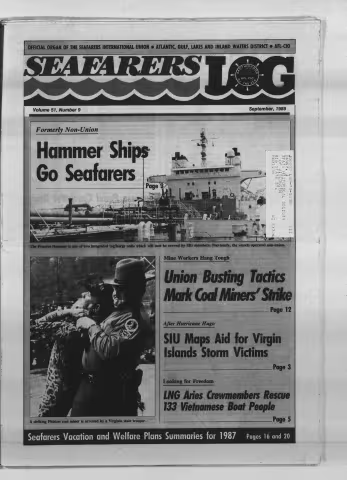
dmCIAl 0R6AN OF THE SEAFARERS INTERNATIONAL UNION • ATUNTiC, 6U^^^^ AND INLAND WATERS DISTRICT • Af^'CiO
*&
"'^ '"'" "• '-1
;'";d
'i-' J,-. • -;v;T'i„,#ii,:«
"2 ' ••• '.'!>
^ -i-'w .'-'..i^. -'>?.
•V.,v.V-'7v':^"-^
r_ I
m
iSi
Mine Workers Hang Tough r r v
After Hurrkane Hti^
S";*"— ' ' 1^ •!! . Ill I I, . ••; L •JjJj- ' ,
> "-r'-'r-r? "•' •'
Poge 3
Looking for Freedom ^
133 Vietnamese Boat People
A striking Pittston coal miner is arrested by a Virginia state trooper. Page 5
Seafarers Vacation and Welfare Plans Summaries for 1987 Rages 16 and 20
f-afrfc • .
tjfl,. - Jr : - • ,• ^5^';'.
;*•
'. . -i. •> JiW ••/ ';;*V,-
• V - v .-U
: '•: • ,:..M
3'§
.'I- '<mi
RT-/-
•>;'• ; - -.y-r. ; ̂ ' . • .- ,
; f^-:V-:.:|;>.'p-:
•ti, \
; .i'l •• .•-
•4i'
I;
if'. -,
f
1 ;' )•-'•'V ' ;-•
• '-."^V ^.i"
'^1^' '^''' ' ''' '.
•: V' •'"
?:;'4.-px-
W'
B'
President's Report
There's a situation moving front and center that could be the
cause of considerable embarrassment to the United States. In fact it
is hard to understand how the use of the Panamanian registry by
American-owned vessels has managed to avoid becoming at least the
subject of debate in these days of strained relations with Panama's
political regime.
Eventually the inconsistency between U.S. practices and rhetoric
has to become part of the national debate on
how the dilemma over General Noriega will be
dealt with.
On the one hand, Panama has been repre
sented as a threat to U.S. security, while on
the other hand, the U.S. allows American ship
owners to hand over hard American dollars to
Panama for the privilege of flying its flag. It doesn't take much
insight to recognize that it is plain bad policy to allow Americans to
transmit U.S. dollars in the form of registry fees and taxes to an
unfriendly nation charged with activities harmful to the American
people.
This Panamanian situation revives the question over the wisdom
of America's attitudes and policies in regard to the approval of
runaway flags as a means of escaping the obligations and responsibil
ities accepted by companies who fly the Stars and Stripes over their
vessels. Once again we are reminded of the hollowness of the so-
called theory of "Effective U.S. Control."
It is a policy which our union, along with members of the military
establishment, members of Congress and just plain citizens con
cerned with the national security and America's best interests, have
fought against since the end of World War II.
Leading the fight for the other side has been the State Department
and the advocates of free trade at any price and, of course, the
major oil companies and others who were running away from orga
nized American workers and their standards of wages and condi
tions, without regard for national security considerations.
There have always been some shipowners who have resorted to
foreign flags, going back to the War of 1812, when a few American
shipping companies put their vessels under the Portuguese flag in
order to avoid having them captured by the British navy. But foreign
registry of U.S. ships never amounted to anything until World War
II, when foreign shipping took a real beating from the German U-
boats and America had to begin sending military supplies to the
Allies. Because the U.S. neutrality law that had been enacted in
1939 restricted the use of U.S. ships in war trades, the government
encouraged shipowners to put some vessels under the friendly but
neutral Panamanian and Honduran registries which were then able to
carry supplies to the Allies with less risk of being torpedoed.
Index to LOG Features
« Page
Notice
Dispatcher Report/Deep Sea* ^ • *14
Dispatcher Report/failand•••••••• •• • • • •••••••••••••«••«•• •17
Dispatcher Report/Great Lakes• • • • • •••••••••••••••••••••• *17-
Pioal Departures ••••«• • • •••••«•••.••••••••*•••••••«•• • 21*22
Know Your Rights***•••••****• ••**••*••******-• • ••••*****20
liCgal A.id Directory••••••••**•*••••**••**•*•**••*•••*••• *20
Letters to the Editor *•********•***•*•**•••••*•**•*•••••• *11
Lundeberg School Apphcatiou *•***•****•*••**•***• * • • • * * • *23
Lundeberg School Course Schedule •*••***••••••••*••**••**23
Luodeberg School G^raduates*•****•*••*•••**••*••«**•*****10
Meeting Notice *••••••••••**•**•***••••••*•**••••«•••••• *14
Pensioners **•*••**•••**••*••***•*•••••••••••••••••••••• *10
Personals **•*•••«•••*••••*••*••*•*•**••••••••••••••••••*14
Ship's Nlinutes ••••••• • • *••**•• • • •••••*••• *.* • •«• * * *13*10^ IS
Union Rail Directing•••******••**•••••**•*•••****•*••*••• 17
SSAFARm LOG
Volume 51, Number 9 September, 1989
The LOG (ISSN 0160-2047) is published monthly by the Seafarers International
Union; Atlantic, Gulf, L^es and Inland Waters District; AFL-CIO; 5201
Auth Way; Camp Springs, Maryland 20746. Telephone (301) 899-0675.
Second-class postage paid at MSG Prince Georges, Maryland 20790-9998 and
at additional mailing offices. POSTMASTER: Send address changes to the
LOG, 5201 Auth Way; Camp Springs, Maryland 20746.
President, Michael Sacco; Secretary-Treasurer, Joe DiGlorgio; Executive
Vice President, Joe Sacco; Vice President Collective Bargaining, Angus
"Red" Campbell; Vice President Atlantic Coast, Jack Caffey; Vice Ih-esident
Gulf Coast, Thomas Glldewell; Vice President West Coast, George McCartney;
Vice President Lakes and Inland Waters, John Fay; Vice President Government
Services, Roy Mercer.
Communications Elepartment Director, Jessica Smith; Managing Editor,
Mike Hall; Associate Editors, Daniel Duncan, Max Hall and Deborah
Greene.
When the U.S. became involved in the war, the Panamanian and
Honduran registered American-owned ships came under control of
the U.S. government. After the war, the cheap, tax-free, lower
wage, less-stringent inspection and safety standards of the Panama
nian and Honduran—^and newer Liberian registries ^were attractive
to oil companies, other proprietary carriers and all sorts of fly-by-
night operations that were set up through the purchase of war-buUt
surplus U.S. ships. . « • j
Because the mass move away from the American flag was viewed
as a threat to the national security, and attacked by the unions and
others sharing their concern, supporters of the runaway flag concept
prevailed on the Department of Defense to set up the policy of
Effective U.S. Control (EUSC).
The practice of registering ships under the Panamanian and Hon
duran registries was a temporary wartime measure in the national
interest, but it didn't stop with the war's end.
In the post-war period the U.S. sank to 11th place among shipping
nations, as the Panama, Honduras and Liberia registries expanded
rapidly Our union and others continued to fight the effective control
theory over the years, but despite examples of its clear ineffective
ness, the policy survived.
And now, at least in regard to Panama, we've come full circle.
Panama is no longer friendly, rather it is considered hostile, and the
U.S., in so far as American ships flying the Panamanian flag are
concerned, turns its head while U.S. foreign-flag shipowners keep
feeding the enemy, with cash and jobs.
What does it take to wake up America?
Defense Panel Concludes Draft
Of National Sealift Policy
The critical issue of a national
sealift capability was addressed by
a partnership of private sector and
government representatives from
September 7 through 9 at the Sea
farers Harry Lundeberg School of
Seamanship in Piney Point, MD.
Brought together by the military
sealift committee of the Nation^
Defense Transportation Associa
tion (NDTA), the group finalized
a statement which will be pre
sented to the organization's 1989
Annual Forum later this month.
The NDTA's sealift committee
is made up of decision makers,
including company CEO's and top
military officers.
Seafarers International Union
President Michael Sacco served
as co-chairman of the subcommit
tee on manning with Admiral Paul
Krinsky, superintendent of the
United States Merchant Marine
Academy at Kings Point.
Other issues of concern dis
cussed in subcommittees in
cluded: the kinds of vessels in the
U.S.-flag fleet, intermodalism and
land transport, the ready reserve
fleet, naval and defense consid
erations, ship construction and re
pair.
The first draft of the NDTA's
national sealift policy was sub
mitted to the White House earlier
this year. The group stressed the
importance of the nation's ability
"to respond unilaterally to secu
rity threats" without having to
rely on allies or foreign-flag ves
sels owned by Americans.
Federal agencies, said the first
draft of the NDTA's sealift policy
statement, must promote, "through
efficient application of existing laws
and regulations . . ., the readiness
of the U.S. merchant marine. . ."
Responsibility for implementing
a national sealift policy should be
placed in the hands of the deputy
assistant to the president for na
tional security affairs and the
administration should present leg
islative remedies to Congress,
concludes the working draft of the
NDTA statement.
The NDTA's sealift policy com
mittee added to the group's first
statement during its meeting in
Piney Point. The finalized draft
will be submitted to the NDTA's
annual forum later in September.
Once adopted, it will serve as a
guideline for government action
towards implementing a national
sealift policy.
Some of the NDTA mihtary seahft committee members Hismss the final
draft of the group's policy statement. Pictured left to right are; Farrell
Lines President Richard Parks, American Bureau of Shipping President
Dick Soper, Sea-Land Director of Government Sales Ken Gaulden, SIU
President Michael Sacco and CSX CEO Ron Drucker.
sSs!
i
fapiili!
' '• ' J.' '
' • •'K'i-r; >>""'I'^'y!: • '5^yj?!:^1-iV-:v/. ":• '-'J' •'• \. ;;;5:7v#g^
mil M I
apmBiR,im
v'.'.^i^V
:l •
' v-i-y. r^'Wi- •-
A'Vi'
•y.y-y^fy •' '• •• '.-.• .". •! • r-iV- ;•- . '•
,":;;r|yy::.;y,-;;
'v' '•
yy '
••• •
-y yy'•T 'ks"' 1.^ I
The pictures above were taken on
the Frances Hammer just before it
left Jacksonville last month. Top,
Chief Steward JoAnne B. Knight
frosts a chocolate cake. Second down
from the top, Chief Cook Hasan
Rahman passes lunch to a waiting
crewmemher in the galley line. Third
down from the top, AB Doug Flynt
in the crew lounge. Bottom, Mrs.
Richard Wilson, wife of the hosun
on the Frances Hammer, pays a
last minute visit before the ship sets
sail.
fiiro Pndutf Caniers Now Under SlU Banner
Will Transport Fertiliier to the Soviet Union
Beginning this month, two prod
uct carriers that previously have
operated non-union will come un
der the SIU banner and will carry
liquid fertilizer from Jacksonville
to the Soviet Union.
The integrated tug barge units
(ITB's) are owned by Occidental
Petroleum subsidiaries and now
will be operated by Ocean Ship-
holding, Inc., an SlU-contracted
company, it was announced at the
end of August.
Ocean Shipholding and its two
affiliates. Ocean Chemical Car
riers and Ocean Chemical Trans
port, have a 12-year contract to
operate the Julius Hammer and
the Frances Hammer for Occiden
tal, the world's tenth largest' oil
company.
Owned by Armand Hammer
Occidental Petroleum is also an
international gas, chemical and
food processing company. The
company's 91-year-old chairman
and chief executive officer. Dr.
Armand Hammer, is renown in
the business, art, medical and dip
lomatic communities.
Dr. Hammer was the first for
eigner to do business with the
Soviet Union in the '20's and con
tinued to maintain contacts behind
the iron curtain in subsequent dec
ades.
In 1955, two years before Ham
mer took over the company's helm.
Occidental Petroleum had a mar
ket value of $108,000. In 1988, the
company's market value was $6.9
billion.
Dr. Hammer is the subject of a
biography published in 1975 and
written by Robert Considine: The
Remarkable Life of Dr. Armand
Hammer.
Ships in Tip-Top Shape
The Julius Hammer bears the
name of Dr. Hammer's father, and
the Frances Hammer is named for
the CEO's third wife. Each vessel
is "about the size of a good-sized
product tanker," says Ocean
Shipholding's Vice President for
Corporate Development James P.
McGregor.
The tanks are stainless steel,
"spotless, it looks more like a
brewery in there," said Mc
Gregor. Each tank has a special
cargo heating system.
The pair of eight-year-old ves
sels—the Julius Hammer and the
Frances Hammer—^are designed
for the carriage of 40,000 tons of
superphosphoric acid, a highly
concentrated liquid fertilizer feed
stock.
Each voyage between Jackson
ville, FL and Odessa, located on
the Black Sea, will take 10 to 25
days. After crossing the Atlantic
Ocean, the ITB's will make their
way across the Mediterranean and
Aegean Sea, through the Sea of
Marmara and into the Black Sea.
Odessa, the ITB's major port-
of-call, is located in the southern
Ukraine. It is a major seaport and
industrial center and the base of
the Soviet Antarctic whaling fleet.
Bosun Richard Wilson (center) signs on for the first SIU voyage aboard
the Frances Hammer with SIU Assistant Vice President Augie Tellez
(left) while QMED Pumpman Richard Parish watches.
Assistant Vice President George Ripoii (seated, center) discusses the new
SIU contract for the Frances Hammer with (left to right) General Utility
Alan Less, Chief Cook Hasan Rahman and Engine Utility George
Demetropoulos.
SIU Announces Hurricane Relief
Immediately after Hurricane
Hugo struck the Caribbean region,
the Seafarers International Union
and its industrial division, the
United Industrial Workers (UIW),
launched a program to collect
emergency relief aid for workers
in the U.S. Virgin Islands.
The union also announced it will
work with the AFL-CIO to pro
vide disaster assistance to the
communities of Puerto Rico and
Charleston, SC.
On September 17 and 18, Hur
ricane Hugo slammed through the
Caribbean, leaving a chain of dev
astated islands in its wake. After
wreaking havoc in the Caribbean,
Hurricane Hugo hit Charleston,
SC with winds of more than 140
miles an hour.
Among the thousands of people
left homeless and in need of sup
plies are union members in the
U.S. Virgin Islands, Puerto Rico
and South Carolina.
Working with SlU-contracted
company CrowleyTTMT, which has
regular service from the continen
tal United States to the Caribbean,
the union has established relief aid
collection centers at the Philadel
phia and Jacksonville halls.
Crowley/TMT has provided
trailers which will be shipped by
the company to St. Thomas and
St. Croix in the U.S. Virgin Is
lands.
Union representatives in Phila
delphia and Jacksonville are work
ing with radio stations and civic
organizations to secure materials
which are needed in the U.S. Vir
gin Islands. Among the items being
collected are canned and dry food,
batteries, candles, bottled water
and disinfectants.
The port of Philadelphia re
ported a contribution of 5(X) gal
lons of bottled water from Great
Bear, the company which supplies
the union hall with water for its
cooler.
SIU industrial members in Ohio
are securing several trailers of food
while California UIW workers are
raising funds and shipping batter
ies. SIU Vice President Steve Ed-
ney reported a donation of
hundreds of cans of tunafish.
The SIU's industrial division
represents 3,500 government and
private employees in the U.S. Vir
gin Islands.
'r -> M'.'
-timg/:,
h. 'J
m
. . V:,'/•••"••^' •' •^••?V.-{-v:V.V-'^
-• M '.•'
- 3f _f • •
tlM
I' •kf
• l ••
C 'i '••7,'.
• V.--' ' -'.v
Ijg;
r1-' • .''•
^ ;
4 : • •
" I; i
s? • •,
X.-
i,i
•f"
V',-
i- ; -" •
7/;-- VA" •
i:
•3m:
3m-
it,
i----
fi
I; i;, r - '
•>•'' -ti '• t ,
'3 3x 3 xl
If
SIAFARCRS LOG
Government Commitment Key
To National Transport Policy
Government policy and com
mitment will determine whether
or not the U.S. merchant fleet and
its seagoing work force will have
a future, the SIU and other mar
itime groups told a federal panel
which will establish a national
transportation policy in the com
ing year.
The Department of Transpor
tation (DOT) has been holding a
series of hearings around the
country to determine what is
needed for an efficient transpor
tation policy which covers all sec
tors including air, water and land.
"The SIU hopes that the na
tional transportation policy will
treat the U.S.-flag merchant fleet
as an equal partner in the nation's
transportation network," the
union's statement said.
Of particular importance to a
national transportation policy,
noted the SIU, is the combined
loss of active ships and the drop
in seagoing work force which could
result in a "manpower crisis" in
case of a national emergency.
"There is only one source for
the highly trained and experienced
American seafarers required in time
of war: persbnnel who have been
actively sailing in U.S. ships dur
ing peacetime.
"But with the decline of job
opportunities and billets in the
private merchant fleet, it is pain
fully apparent that trained Amer
ican citizen crews will just not be
available—barring decisive gov
ernment action," the SIU said.
In its statement to DOT, the
AFL-CIO's Maritime Trades De
partment said, "No merchant fleet
can exist without assured cargoes
to carry." The MTD statement
also outlined several ways to boost
cargo for the U.S. fleet:
• reserve a portion of U.S. bulk
cargoes to U.S.-flag vessels,
• enforce federal agency compli
ance with current cargo pref
erence laws,
• reform procurement practices
of the Military Sealift Command
and,
• encourage U.S. exporters to
utilize U.S.-flag ships.
The Transportation Institute
(TI), an organization representing
deep sea. Great Lakes and inland
waterways operators, also noted
that current manpower arid ship
levels are not enough to meet a
national emergency.
TI outlined three principles the
government must meet if the U.S.
merchant marine is to be counted
on to fulfill its defense mission:
' "DOT must make revitalization of
the U.S.-flag merchant marine a
top priority, the U.S. government
must ensure that U.S.flag opera
tors carry a fair share of all cargo
and the U.S. government must
enable U.S.-flag carriers in foreign
commerce to operate with crew
cost, vessel cost and operational
parity."
Richard C. Maybuck of Cove
Shipping also called for a cargo
reservation policy. "A cargo res
ervation policy is not a subsidy,
nor would it create any additional
burden on the taxpayer," he said.
The Department of Transpor
tation will continue to accept tes
timony on the subject of a national
transportation policy for the re
mainder of the year. From the
recommendations and information
supplied through hearings, state
ments and testimony, the agency
expects to formulate nation^
transportation objectives to pres
ent publicly early next year.
Academy Chief Inspects Union's School
Manpower Director Bart Rogers (center) explains the procedure for the
computerized shipping of members to various ships to Rear Admiral
Paul L. Krinsky, superintendent of the U.S. Merchant Marine Academy.
In the foreground, Carol Johnson prepares a job order for the system.
Oil Spill Bill Moves in House
A House version of an oil spill
clean up and liability bill is due to
come to a floor vote in early Oc
tober. The bill establishes a $1
billion oil spill clean up and com
pensation fund and sets liability
standards.
The maritime industry is con
cerned that whatever legislation
passes, a single federal standard
for clean up regulations and lia
bility be established. The House
bill sets federal standards, while a
similar Senate bill allows state
regulations to govern.
The House bill contains other
differences from the oil spill leg-
islatiori passed last month by the
Senate, but if passed, a conference
of both congressional bitches will
work out final language.
Representative Walter Jones (D-
NC), the committee's chairman,
said, "This bill now represents the
"User Fees/'A Bad Idea ls Before Congress Once Again
For the fifth time in nine years,
the Department of Transportation
is trying to tax the U.S. merchant
fleet with the imposition of mari
time user fees.
House and Senate conferees will
decide the fate of the latest pro
posal, which is designed to raise
$180 million annually. The Senate
Committee on Commerce, Sci
ence and Transportation passed
the user fee proposal in July. The
House Merchant Marine and Fish
eries Committee has not yet con
sidered the proposal during this
session.
SIU President Michael Sacco
has urged Congress not to pass
the user fee legislation. "The user
fee is inherently a tax and a method
of raising revenue for discharging
a traditional government func
tion," Sacco said in a recent letter
to U.S. Rep. Walter Jones, Chair
man of the House Merchant Ma
rine and Fisheries Committee.
The Department of Transpor
tation, with the approval of the
White House, has sought the tax
since 1981 when user fees for Coast
Guard services were first pro
posed as a way to lower the budget
deficit. In its first draft, the bill
was designed to raise $5()0 million
by 1986 from recreational boaters,
commercial fishermen and U.S.
and foreign merchant vessels. It
also proposed a series of direct
. . . fees are being
sought from U.S.
flag vessels and
seamen ...
charges for Coast Guard inspec
tions and merchant seaman licen
sing.
Although proposed again in 1982
and 1983, the legislation never was
passed from a corigressional com
mittee until 1986 when the Senate
Commerce Committee approved
it. As in 1989, the House did not
consider the bill and it died in
conference.
Under the present bill, direct
fees again are being sought from
U.S. flag commercial vessels and
seamen for licensing, documen
tation and inspection activities.
On top of that, the Department of
Transportation, which oversees the
Coast Guard, also seeks a $25 tax
on virtually all commercial and
recreational vessels operated on
the navigable waters of the United
States. The department estimates
the net receipts would reduce the
budget by $180 million annually
for each of the next five years.
The legislation as drafted by the
administration does permit the
Secretary of Transportation to
grant exceptions "when he or she
determines it is in the public in
terest to do so."
President Sacco, in his letter,
said the SIU believes "that the
items for which user fees would
be imposed are the result of sta
tutory requirements enacted by
Congress for the common good.
"The industry must comply with
statutorily mandated vessel in
spections and the licensing and
certification of seamen," Sacco
continued. "These are clearly de
signed to benefit the nation as a
whole."
most comprehensive approach to
the issue of liability, compensa
tion, prevention and response ever
undertaken by this committee.
"In addition to the earlier pro
visions which establish a $1 billion
oil industry-funded cleanup and
compensation fund and ensure
prompt and complete recovery for
those injured by an oil spill, the
bill now goes further and takes
several steps to prevent and re
spond to future spills."
House version calls
for single federal
standards ...
Along with the clean up fund,
the House oil spill bill requires the
Coast Guard to look at the entire
scope of tanker construction, nav
igation, manning and safety issues
and mrike a report to Congress. It
also requires spill contingency plans
for ships and facilities to be co
ordinated on a local and national
level.
"We require the establishment
of at least seven continuously
manned, federal strike teams that
can respond immediately to a pol
lution incident. And finally, we
pump money into an R&D pro
gram because there has got to be
a better way to clean up this kind
of mess than with buckets and
mops," Jones said.
Both the Senate and House bills
make vessel owners liable for
cleanup costs and damages up to
specified liability limits. Once an
owner's liability is reached, the
cleanup fund kicks in. The fund
will be financed by a 3 cent per
barrel tax on imported crude-oil
and other petroleum products.
Congress has debated oil spill
bills in the last eight sessions, but
has not enacted one.
The Senate bill passed last
month. Should the House approve
its legislation, a conference com
mittee made up of members of
both legislative bodies would be
created to settle the differences.
iiilWiii'iPiiiiiiSiii®
J„>J
- "--4V •
• }-V '!t^.-'J -.'.-r
• u--<''^-''':''V *"'•"• '
•• ,/<;-..%!T;r;-.~ i-:'r''Vv/ -'-
;-vv_^:f:^:;:.u-^ ',•;.
• -'; ';„f .
.':l VlvV'^'*„;M";'^'
•:-^^'^--;V-V'
SimMBeR, 1989
The 133 Vietnamese refugees '
had been crammed aboard the small
junk for 10 days before Seafarers
aboard the LNG Aries (ETC)
spotted the boat's distress signals.
The Aries, on its way from Arun,
Indonesia to Tobata, Japan, spot
ted the two-masted junk just be
fore 7 a.m., July 2 in the South
China Sea. "The junk was heavily
ladened with people waving frant
ically," Captain Daniel Spence,
said in the ship's log.
The huge natural gas carrier was
slowed and turned about to ap
proach the junk. Because the
wooden vessel had no engine, the
Aries was turned again so the boat
was alongside the starboard gang
way.
Crewmembers from the Aries
went down the gangway to inspect
the junk. There were only five
gallons of water aboard and very
little food for the 133 refugees,
including several infants.
The crew helped the 133 aboard
the Aries and each refugee was
given a chance to take a shower.
Their clothes were collected and
washed, and the crew made do
nations of their own clothing so
each individual had clean
clothes after their long trip from
Saigon.
The Aires fed and housed the
group until it reached Japmi, where
the refugees were turned over to
United Nations' authorities to await
processing.
••rV :
Rescue operations are under way to transfer the 133 Vietnamese refugees
from their junk to the LNG Aries. The refugees had been drifting for
10 days before being discovered.
, • ..;Y' ^
Third Mate John Bates, with the help of a translator, issues instructions
to the refugees who have gathered on the deck of the LNG Aries.
SIU crewmembers welcomed the
refugees aboard the LNG Aries.
Meeting with some of the ship's
visitors are Steward Assistant Mark
HoUey (above) and Steward Dana
Paradise (right). The galley crew
worked a great deal of long hours
to provide food to the boat people,
many of whom had been without
nourishment for days.
SIU Members Express Concern
Over Fate of Boat People
"In regards to the 133 brave
men, women and children that at
very hazardous risks to life, fled
from Vietnam on a small boat into
almost certain disaster in the South
China Sea . . . Please do not let
any of these brave people fall back
into the hands of Vietnam again.
"In remembrance of our war of
independence, give them liberty
or you will surely give them death."
The above letter was written
and signed by the entire SIU crew
of the Aries and delivered to the
Jacksonville, FL hall by QMED
David Terry. The union then for
warded the letter to the United
Nations and the administration.
LOG staff members also investi
gated the plight of Vietnamese
boat people .
The 133 Vietnamese refugees
rescued by the crew of the LNG
Aries (see accompanying story)
face a long wait and an uncertain
future in their quest for freedom.
If they are not classified "politi
cal" refugees, they could face a
forced return to Vietnam.
The 133 have made an impres
sion on the crew of the Aries, but
now must convince United Na
tions and United States officials
that they deserve political asylum.
More than one million people
have fled Vietnam in the past 14
years, with about 800,000 settling
in the United States. UN refugee
experts say the flow of refugees
has increased dramatically in the
past year which has forced some
Asian countries to review then-
refugee policies.
In the past when a group of
refugees was picked up, they were
assigned to the country of the ship.
If an American ship rescued them,
they would be processed for even
tual immigration to America, if a
French ship made the rescue then
France would be the host country.
On the average, according to
Beth Rutledge of the International
Rescue Committee, a private or
ganization which monitors refugee
problems worldwide, the process
ing took about a year.
After the refugees are disem
barked, they are registered with the
United Nations, which operates
refugee camps throughout Asia.
At the camp, immigration au
thorities determine if a person is
a political refugee or an economic
"migrant." If a refugee has rela
tives outside of Vietnam, he or
she may be passed on to the coun
try where their nearest blood rel
ative lives.
If a refugee is approved for
immigration to the United States,
he or she will be transferred to a
refugee camp which the U.S. op
erates in the Philippines. There,
they will receive English lessons
and other schooling to help them
assimilate when they reach Amer
ican shores.
If they are not accepted by any
country, they just sit and wait,
Rutledge said.
But just a few weeks ago, Asian
nations met and some guidelines
were set up. At this time, refugee
workers are not sure what type of
effect the new rules may have.
The first step in the new guide
lines will be a determination of
whether a refugee is fleeing from
political persecution or simply for
economic reasons.
While no one has been forced
back to Vietnam yet, refugee
groups are concerned about the
future of the boat people.
"We hope the new system is
fair, but we just have to wait and
see," Rutledge said.
^ • •"•a, IJtfl
•• •-
- • -r ^
mkmgn''.
••• Jri-i... i;:' '
' jgS'- •
• • l'li-V:W, ,
aliSiff':
••| •; :• •"
'I:;"; // •;•
3:tS::,....':
T:v; ::••• .t. ;' ' ,,;
r^lV ' ::•
li- •.- '.
•"
f
'•,r..,, •
sh
'it- • ^ t ; • ' saiuasioe
G0V7 ORDIRS HEW EUOIONS
FOR TWO MARiniHE UNIONS
MM&P Membership
May Vote for President,
Secretary-Treasurer
BALTIMORE — Secretary of La
bor Elizabeth Dole has asked the
United States District Court to
declare the Masters, Mates and
Pdots (I^&P) 1988 elections "nuU
and void" and to direct a new
election.
The Department of Labor's ac
tion this summer was triggered by
a series of complaints of election
misconduct filed by MM&P mem
bers which prompted a govern
ment investigation.
In requesting a judgment di
recting new elections for the po
sitions of International President
and International Secretary-
Treasurer, the government claim^
the union violated its constitution
and national laws. The MM&P
election in question took place
during a 90 day balloting proce
dure which ended December 30,
1988.
Specifically, the Department of
Labor alleged the MM&P "failed
to provide adequate safeguards to
insure a fair election by: (a) per
mitting the voting of fraudulent
ballots; and (b) permitting a union
official to have access to the bal
lots."
The government also cited vi
olations of law concerning "failing
to mail an election notice to each
member at his last known home
address 15 days before the elec
tion; . . . failing to provide ade
quate notice of the balloting pro
cedures; . . . denying members in
good standing the opportunity to
vote; and . . . failing to conduct
its election in accordance with its
constitution."
At stake in new MM&P elec
tions will be the positions cur
rently held by International Pres
ident Robert Lowen and
International Secretary-Treasurer
Elwood Kyser.
The Journal of Commerce last
month reported the 1988 election
results as follows: Lowen received
2,247 while his challenger, Timo
thy Brown had 2,149 cast in his
favor. Kyser won with 2,315 votes.
His opponent, James Hopkins,
carried a vote of 2,049.
Vote Set for Officers
Of D1 MEBA/NMU
Unlicensed Division
NEW YORK — The Journal of
Commerce reported last month
that arrangements for a govern
ment-ordered election will deter
mine the officers of the unlicensed
division of District 1 Marine En
gineers Beneficial Association/
National Maritime Union.
The unlicensed division is com
prised of members who had pre
viously been, affiliated with the
independent National Maritime
Union (NMU). In March of 1988,
NMU became part of District 1
Marine Engineers Beneficial As
sociation (MEBA).
The Department of Labor sought
an election after NMU member
Albert Jackson charged that the
union had violated national law
when it did not hold an election
within a five-year period. Under
national labor laws, a union must
elect officers every five years. The
last NMU election was in 1983.
Voting in October, November
In the August 25 article, the
Journal of Commerce reported
ballots will be mailed to "some
20,000 members of the unlicensed
division during September. Actual
voting can take place in 'October
and November. The ballots will
be counted and the winners an-:
nounced by December 15."
The article also noted that Shan
non Wall will not seek a position
with the union. Wall served as
president of the National Maritime
Union prior to its association with
District 1 MEBA. Currently he
holds the position of chairman of
the unlicensed division in District
1 MEBA/NMU.
Three candidates for the posi
tion Wall holds currently were
certified by the union because they
met the requirements outlined in
the organization's constitution.
James "Pat" Paterson, Louis Par-
isi and Albert Jackson were all
eligible to run, reported the Jour
nal of Commerce.
Lakes Members Ratify 4-Year Pact
SIU Great Lakes sailors have
ratified a new, four-year pact. The
new contract between the SIU and
the Great Lakes Association of
Marine Operators (GLAMO) cov
ers members shipping on vessels
operated by companies that are
members of the employer associ
ation.
There were considerable changes
in the work rules from the previous
SIU/GLAMO contract. "There had
been some problems onboard and
the ships' committees made sev
eral suggestions to our negotia
tors," said Byron Kelley, SIU
assistant vice president and chief
negotiator for the contract talks.
One of the major concerns of
the membership had been the stag
gered work day some ships' offi
cers were requiring for bosuns and
AB's.
Under the new contract, the
official work day is between 8 a.m.
and 4 p.m., with automatic over
time for work done outside of
those hours.
The contact runs through Au
gust of 1992.
The GLAMO fleet consists of
ships from American Steamship
Co., Pringle Transit, Litton In
dustries and Medusa Cement.
GLAMO's chief negotiator dur
ing the talks was David Schultze.
. --2 .
liKi'
The remains of a whale dangle from the bow of the Sea-Land Patriot as
it sailed across the Pacific last month. Bosun John W. Curlew took this
photograph of the whale which was thought to be dead at the time of
impact with the ship.
Sea-Land Patriot Crewmembers
Discover A Whale in the Bow
Crewmembers of the Sea-Land
Patriot made a graesome discov
ery one morning in August as the
ship was steaming in the Pacific
near Japan. The Patriot had struck
a 25 to 30 foot whale. The impact
had almost cut the large mammal
in half.
With the whale's body wedged
in the ship's sharp bow, it took
almost two days before it could
be dislodged, reported the ship's
bosun, John W. Curlew.
Crewmembers who feared they
may have killed one of the sea's
great creatures can rest a bit eas
ier. Marine life experts contacted
by the LOG said the whale prob
ably was already dead.
"A live, healthy whale wouldn't
let a 600-foot ship sneak up on it.
A whale's senses are much too
refined. Sometimes whales are cu
rious and will investigate a passing
ship, but I've never heard of whale
being run over in the middle of
the ocean," said Dr. Robert Plantz
of the University of California at
Santa Cruz, a marine biologist.
He said the most likely scenario
was that the creature was dead,
or seriously ill, when the Patriot
struck it.
There have been cases of col
lisions between whales and small
boats, mostly at night, but scien
tists attribute those incidents to
larger animals whose size and
strength may damage a small boat
accidently while checking the boat
over.
Most whales in the oceans are
wary of large ships and do keep
their distance. But in some cases
they become used to human con-»
tact, such as off Cape Cod. Atlan
tic humpback whales arrive off the
Cape Cod coast each late spring.
Dozens of whale-watching ships
take tourists to those areas to see
the large sea mammals.
There the whales seem uncon
cerned about the intrusion on their
natural summering area and some
do approach close to the boats.
'A live, healthy
whale wouldn't let
a 600-foot ship
sneak up on it.'
but for the most part stay several
hundred feet away.
In the Gulf of California, be
tween Baja California and Mexico,
there is a small lagoon that is the
winter home to the Pacific gray
whale. The animals there have
become so accustomed to human
contact that many let small rubber
boats approach and allow people
to pet them. The whales are also
very careful about maneuvering
around the fragile craft.
That lagoon is protected by the
Mexican government, but it once
was a major whaling area, where
every winter thousands of whales
were slaughtered. After the whal
ing was stopped, scientists said it
took many decades for the whales
to accept the presence of humans
in the area. Now some seem to
seek out human contact.
Word of the ship's predicament
was forwarded through the ship's
minutes. Members were afraid that
the Patriot had slain the mammal.
Brother Curlew took photographs
that were provided to the union.
'•r ••
SCmMBER, 1989
••'•• .i 'f ' -••• •• 'Ji''i4 'V"*.'
.ve:;i-wi B'ty, (^T-; >,: v-^. •••?•
. •••
TRJUNING EXPEKISINSPCCT UNION'S SCHOOL
SlU personnel Carl Peth (left), Jackie Knoetgen (third from left) and
Sandy White (right) discuss how education helps Seafarers upgrade and
advance to better paying jobs with the staff of HRDI during its recent
visit to the Lundeberg School.
The staff of the Human Re
sources Development Institute,
AFL-CIO, toured the Seafarers
Harry Lundeberg School of Sea
manship in August and held a
conference at the site to plan its
1990 program.
HRDI is the employment train
ing wing of the AFL-CIO, the
federation of national and inters
national unions in the U.S. HRDI
is made up of union members from
across the country who provide
job training to laid off and dis
placed workers.
"We thought the school was an
Group Inspired by School
Although HRDI's executive
board had held several meetings
at the school, Mrs. Perlman ex
plained this was the first visit for
much of the staff.
While visiting Lundebeig School
classrooms and talking with in
structors, HRDI staff members
constantly were expressing
amazement about the institution.
"There is so much here that
SIU members can use," said Dan
iel Marschall, HRDI national co
ordinator. "There are so many
ideas that we can use to help
others as well."
HRDI was created by the AFL-
CIO 21 years ago to work with
state and local labor federations.
It has several regional coordina
tors across the country to work
with the Washington headquar
ters.
Sneak Attack on Cargo Proforonco Laws Fails
It was 25 minutes to ten at night
on September 20, and the Senate
was considering an amendment to
an appropriations bill which would
increase U.S. assistance to Po
land. Senator Charles Grassley (R-
lA) announced he had an amend
ment to the amendment. Grassley
proposed that all aid to Poland be
exempted from existing cargo
preference laws.
Senator John Breaux (D-LA),
who serves as Chairman of the
Senate's Merchant Marine Sub
committee, immediately objected.
What Senator Grassley's
amendment does, said Breaux, "is
that in order to help Poland, it
takes a final blow at the American
merchant marine.
"The amendment says, 'Well,
Poland is so important, we are
going to eliminate Americans' jobs,
we are going to eliminate the one
program that we have that helps
the U.S. merchant marine, and we
are going to do it for Poland.'
. . .If we do it for Poland, should
we not do it for all foreign coun
tries? Should we not eliminate the
whole program? I say the answer
is no."
Breaux concluded, "While I am
all for helping Poland, it simply
should not be done at the expense
of the U.S. merchant marine which
is vital to our national security and
the national defense ..."
Senator Bennett Johnston (D-
LA) noted that the amendment
came as a surprise. "This waives,"
he said, "the Jones Act, the Cargo
Gov't Service Division Members
On USNS Kowishiwi Recognized
In an awards ceremony earlier
this summer, several USNS Ka-
wishiwi crewmembers were rec
ognized for their contributions to
wards the smooth running of the
vessel, a fleet oiler.
Engine utility man Gorden S.
Wilson received a letter of appre
ciation for his outstanding work.
Wilson previously had been nom
inated for the Military Sealift
Command Pacific (MSCPAC) ci
tation of "Mariner Award of Ex
cellence."
AB Curtiss Miner's 15 years of
service with MSCPAC were rec
ognized with the presentation of
a special pin from the group's
acting inspector. Captain J.W.
Bruckner.
Special Act Awards were pre
sented to utilitymen Rodolfo
Cachin and Willie Moore who
helped the steward department re
ceive a top rating during the annual
ship inspection and survey.
USNS Kawishiwi Captain Nate
Smith also presented the MSCPAC
Award of Excellence to Michael
Sullivan, the ship's first assistant
engineer, for his accomplishments
in the repair of equipment which
had malfunctioned or broken down.
Smith noted how Sullivan's ac
tions had prevented costly repairs
and vessel downtime. Chief En
gineer Carl Chavaree nominated
Sullivan for the award.
Third Mate Douglas Choy was
recognized by Captain Smith for
his work in repairing fire fighting
and damage control equipment
which had been rendered useless
during the ship's overhaul last year.
Preference Act and, why? Be
cause it is Poland? Well, sure we
like Poland. But we also like
Ethiopia. They have starving peo
ple in Ethiopia. We have friends
all around the world to whom we
ship agricultural commodities ...
^(the aid) should
not be done at the
expense of the U.S.
merchant
marine
There is no logical basis, other
than perhaps sentimentalism, to ex
empt Poland from the Jones Act.
"If we say by this amendment
we are going to exempt this just
because it is Poland—and I do not
mean to minimize the importance
of Poland and Lech Walesa, and
what is going on there—but if we
are going to exempt it from this,
we might as well repeal the whole
act."
That, Johnston pointed out, was
legislation and the rules of the
Senate did not allow that kind of
proposal to be added to an appro
priations bill. The Louisiana sen
ator asked the Senate to declare
Grassley's amendment out of or
der. The presiding officer of the
Senate agreed.
Grassley challenged the ruling
of the chair. In a vote on whether
the presiding officer had been cor
rect in not allowing Grassley's
amendment, 64 Senators voted with
the chair and 33 against.
Thus, around ten o'clock on the
night of September 20 a surprise
attack on the nation's cargo pref
erence laws was beat back.
appropriate and good setting for
our meeting," said Laura Perl-
man, HRDI information special
ist. "We learned a lot at the school
about what SIU can carry out for
its members."
Of SIU, Dies
Joseph Mazzola, a long-tiihe
leader in San Francisco's labor
community, was killed last month
in an auto accident. Mazzola, 72,
was business manager for the
Plumbers and Steamfitters Local
38. .
Before he joined the marine lo
cal of the steamfitters and pipefit
ters, Mazzola sailed as bellman on
the passenger ships of Matson and
American President Lines in 1939-
40. He was a member of the old
Marine Cooks and Stewards Union,
"Joe had a real soft spot for
seamen," said SIU Vice President
George McCartney. "He'd help
the guys on the beach find tem-
^ porary work in the shipyards of
construction."
Mazzola was elected business
aigent of the Marine Union of Ship
yard Workers in 1941. The union
fepresented some 20,000 people
working in San Francisco's ship^
yards during World War II. lii
1947 four plumbers and pipefitters
unions merged to become LochI
38. Mazzola was elected business
agent of the merged union.
Under his leadership. Local 38
established college scholarship
programs for children of union
members and advanced health and
pension plans.
' 'No labor leader in any city has
done more for his men than Joe
Mazzola has done for his," said
Joseph Alioto, former mayor of
San Francisco.
Always Helped Seamen
At a mass for Mazzola, MFOW
President Whitey Disley said,
"Whenever there was a crisis, he
never failed to call and ask if he
could be of any help to the Marine
Firemen's Union,"
Mazzola's son Lawrence said
his father "realized at a young
age, that it took unions to speak
for workers and he fought for the
little guy all his life."
"Joe was a dreamer, a builder
and a doer in the grand Frisco
tradition, sort ofa William Ralston
with a pipe wrench. He was a
short man who built big things for
the little guy to enjoy. He virtually
built the Apostleship of the Sea,
a place of welcome for merchant
seamen," Warren Hinckle, a col
umnist for the San Francisco Ex
aminer, wrote.
Along with his son and brother,
Mazzola is survived by his wife
Vera, a daughter, JoAnne Ken
nedy and five grandchildren.
. '' * ''
• '''f, h. \
jM.
1; . - -
?: i]^ Jnr
w- -- tt^ s*-% ^ ^ f SlAFAROlSm
.Jf^^S-;' SIU on the Move in N, Bedford
A" ';V;
;-VY-
:l - ..Y's
|;j ^
III'
'-rji-"-
"IS'f '.|l';:|''
"^ ' ' /•>
i?! ,yf''i''-''^-:",/ ''; •' /
ts'f' •' ,
IJj''.'' XX^'-W-XiX'' V"' ••
f'm'm-u
] ;'•
X •' '.
^i'. .'. ,' ' '"
•i 'i.':- • •
?• "'
K; Y-•
Close to 100 fishing boats in the
nation's biggest revenue produc
ing fishing port sail un(|er SIU
contracts.
The SIU fishermen crew both
the 12-man scallopers and the six-
man draggers that sail from the
port of New Bedford.
SIU Port Agent Henri Francois
said half of the membership is
made up of individuals who have
immigrated from Portugal or who
are of Portuguese descent.
The union has represented fish
ermen in the port for decades, and
organizing continues as new boat
operators enter the industry.
Francois notes that belonging to
the SIU provides security and
benefits not available to non-union
fishermen. Along with the many
normal benefits, such as pension
and welfare plans and grievance
procedures, the SIU contract ad
dresses issues that are unique to
the fishing industry.
For example, a fisherman's pay
depends on the catch and ex
penses of the boat he works on.
At the end of each of voyage on
an SIU fishing vessel, fishermen
have a right to inspect the boat's
settlement sheet. That document
outlines the boat's expenses, such
as fuel and ice to keep the fish
fresh, the weight of the catch and
the price it brought. Each crew-
member receives a percentage of
the proceeds.
Francois said about 90 percent
of the non-union fishing boats do
not allow the crewmembers to see
the settlement sheet.
The SIU has been working to
help bring down the cost of insur
ance for fishing vessels. Recently
the union was instrumental in
passing federal legislation which
improved safety standards on
American fishing boats.
Two crewmembers on the FA^ Jenny & Cristina prepare the nets before
they go out fishing on their first trip.
After another successful voyi^e, crewmembers aboard the Linda &
nda prqmre ttie day's catch as the vessel returns to port.
SlU-contracted fishing vessel, the FA^ Senhora da Boa Viagem, is pictured
during a blessing-of-the-fleet ceremony.
Just part of a day's haul on the F/V Linda & Ilda: a 135-pound halibut.
From left to right are Manuel Ferriera, deck; Antonio Renderlo, engine;
Antonio Campos Jr., captain; John Ferriera, deck; and Antonio Campos
Sr., mate and owner.
Crowley Boatmen Approve Contrart
The 456 SIU boatmen working
for Crowley Maritime Corpora
tion/Trailer Marine Transport ra
tified a new five-year contract last
month. There are close to 500
unlicensed and licensed seafarers
employed at Crowley.
The ballots were counted at SIU
headquarters by a Crowley tally
ing committee consisting of John
Rakyta representing licensed
personnel and Luis Gonzalez at
tending for the unlicensed boat
men.
Crowley operates 88 tugs and
barges engaged in coastal, deep
sea and harbor work. The new
pact covers seafarers working in
Crowley operations out of the ports
of Philadelphia, Jacksonville, San
Juan, PR, Lake Charles, LA and
Wilniington, CA.
The contract runs through July,
1994.
Crowley Maritime is headquar
tered in San Francisco, CA. Its
Atlantic division is based in Jack
sonville, FL. The company pro
vides marine transport services
worldwide.
Executive Vice l^esident Joe Sacco (seated, second from right) and
Crowley bargaining committee meml^rs discuss strategy during an
earlier negotiating session. Seated are (left to right) James Adaway, SIU
Philadelphia Port Agent Dave Heindel, Steve Walsh, Ronald Chavers,
David LaPorte and Willie Pettway. Standing are (left to right) Roberto
Candelario and Luis Gonzalez.
i" • • iY'. M'
4»v
Mm
SamiBCR, 1989
1"* •'- -.-K •••
Lundebera School
Commended for
' 'T • m '••••• • .•' T m '-•• : •
SI'J
Quick Response to
Accidental OH Spill
< i' - ^ v> - ^ 4
,
lssto?-.<..:,..r-,;' - --zr • -•
ii'- Bilfh •
The oil spill response actions of upgraders
and trainees from the union's Lundeberg School
were commended by a Coast Guard officer.
The agency's representative arrived after re
ceiving a call from the Lundeberg School re
porting an accidental oil spill. By the time the
Coast Guard officer came to the site of fhe spill,
95 percent was cleaned.
More than 30 students and instructors were
called into service at the school's docks to
contain lubrication oil when it began to spew
froni one of the barges into St. George's Creek.
"this is an example of what could happen
and how to handle an oil spill on a smaller
scale," said school instructor Jim Shaffer after
the situation was contained. Shaffer, who will
teach the new oil spill training class, supervised
the clean up.
Shaffer and two upgraders from a tankerman
course were prepsuing the barge for a trip to a
Baltimore shipyard for repair work. Shaffer said
he had started to pump water into the tanks
when a gasket ruptured on the pump causing
the lube oil to spray across the deck and into
the water.
Shaffer directed the students to get the tank
erman class to the docks to assist the clean up
operation. He also advised them to contact the
Coast Guard about the spill.
"Lube oil dissipates very quickly and spreads
fast," Shaffer said. "At first glance, I thought
about 30 gallons had spilled into the water. It
created a 10-foot by 100-foot sheen."
When the students arrived, instructor, Jeff ,
Swansoh used a skiff to deploy the school's
new 600-foot oil containment boom. Others,
including trainees, grabbed sorbent mops and
cloths to begin removing the oil from the creek.
Then, instructors Bill Hellwege and Swanson
positioned the training tug Susan Collins so that
its firehouse could be used to push the oil back
toward the dock if it had flowed past the boom.
Shaffer reported that the Coast Guard officer
investigating the spill was very pleased and
surprised at the work done by the students at
the school.
"Most people don't call the Coast Guard for
a spill this small," Shaffer said. "In fact, some
marinas normally operate with this much oil in
the water around them."
Shaffer reported that the whole effort, from
the first drop of oil to cleaning and replacing
the equipment, only took four hours.
. Vr
>r ." . Si /,>*""1'
n' yv' ' r'.i^
-y;"
AB upgrader Debra Staff and trainee Kevin Sicher work side-by-side to mop the oil spill created
when a pump gasket accidentally ruptured on barge at the Lundeberg School dock.
I
:• -fi mm
5*&:'
,... '"jJ " ^
'•'*'¥1: - -
Ronny Miller (back to camera) assists the clean up efforts while a boom is laid to prevent the spill
from drifting away from the dock.
•'-^1
Upgrader Stephen Penny left his class to lend a hand m
the clean up efforts. Above, he sweeps the water m order
to gather oU being trapped at the dock by a boom.
Sorbent mops, like the one being used
by Dennis McKendall, are a vital part
of the clean up effort.
Scott Horn rings out his mop while Ronny Miller
waits his turn during an oil spill clean up at the
Lundeberg School.
'mt
:||||.; M SiAfARatS 106
IMM'-.^•••. ••
• t:iH5 ;«•:>•-•
Wr#;:.
'--'-'fi'' -.. ... .-.
• .J
.\mi''
MET CLASS
Graduates of the Lundeberig Schoor s new Marine Electrical Technician
class on August 4 include (left to right) Mark O'Malley, Tyler Womack,
Instructor Russ Levin and Phil Maguire.
..«> V..^' I',;,
Lf. "
.'.Mif 'r:
iii,"v..
IIS
si' '•... '•• =••
jifS • 'iiS
UPGRADER LIFEBOAT
'£i >1" • -' XI/'
i:i«
S;
l.'l.i '. S-.
Lifeboat training provides valuable knowledge to members in the event
of an emergency. Upgraders who graduated from the Lundeberg School
course August 3 include, from left to right: (front row) Samuel Bilal,
Robin Palmer, Debbie Staff, (back row) Instructor Ben Cusic, David
Tillma, Tim Weber, Everette Brooks and Cal Saunders.
•f/- '".v!*'' •-
""••I' •s'"' '-.'-
AB CLASS
These upgraders graduated August 8. They are now Able Seamen.
From left to right are: (front row) Ralph Saunders, Michael Wilson,
Arturo Garcia, (second row) Marcus Dawson, Clemens Kessler, Pablo
Torres, Albert Knever, Daniel Hanback, Instructor Jake Karaczynski,
(back row) Anthony D. Smith, James E. Peterson, Lee White, Lisa
Allard, Robert Rock and Tilbert Lettsome.
INLAND LIFEBOATERS
Pictured above are members of trainee class 442 after completion of
lifeboat training. From left to right are: (front row) Raymond Jones,
Gregory Truvia, Kim Janics, Kevin Sicher, Marshall Sanford, (back
row) Instructor Ben Cusic, Kaun Roberts, Tyrome Brookins, Keith
Kahley, Thaddeus Jalvia and Keith Sicher.
Class 443 Thanks Instrudor
Lundeberg instructor Bobby
Clinton IB received something very
special in the life of a teacher—a.
thank you note from his students.
Upon graduation, the trainees
in class 443 got together to sign a
personal note of appreciation to
Clinton for everything he did for
them, both on and off the clock.
Die note, dated August 17, reads:
"Class #443 would like to ex
press our appreciation to you for
the help you have given us in the
past month of classes. Your effort
and consideration have not gone
unnoticed.
"We feel that you are the best
type of teacher: one that takes a
personal interest in each of his
students. Your easy going manner
and the relaxed atmostphere of
your classes makes them enjoya
ble as well as educational.
"We are grateful for the extra
time you spent working with us.
We realize that this time was your
person^ time and that you sacri
ficed it in order for us to get the
most out of your classes. Once
again, thanks.
'Your effort and ,
consideration have
not gone
unnoticed. . . '
"As we remember our time at
HLSS, we will think of your class
as some of our best times. And,
of course, some of the most edu
cational. 'In a major way.'
Thanks!"
The trainees then added per
sonal touches when they signed
their names.
LIFEBOAT
Instructor Bobby Clinton (left) poses with the members of trainee class
443 after they complieted their lifeboat training class. From left to right
are: (front row) Richard Boleware, Kenneth Spruill, Samuel Lampshire,
Paul Cadran, Thomas Guffy, Debra Allred, Mark Moran, James
DeMony, (back row, beginning second from left) Christopher Dixon,
William Steele, Victor Honigsfeld, Doug Blanchard, David Vogt,
Steven Talley, O'Shawn King, Kenneth Greenidge, George Owen HI,
Stoney Hardy, Pete Hokenson and Junior Crosbie.
' ' /< •
'•v';
W
.••I 'i. ', •
- ' •
I', = ,, •.;/!, •
t.'\i 7{ •,;, h. •; -^
m'-.-i'.
SEPnmR, 1989
•' • :--i'V"
•7".
Letters to the Editor
Donald iveritt Wants
Ta Hear ham Friends
To the Editor:
Would you please put a personal
note in SIU LOG column that
Donald Everitt is a patient at
Brookhaven Medical Facility in
Muskegon, Michigan?
He had a stroke and can't talk
or use one hand or arm. I am a
patient here too. I've knov^n Don
ald for 26 years.
So if it is possible to put it in
SIU LOG, he sure would love to
hear from his friends. He only gets
the SIU LOG.
He also needs a color T. V. and
mail from friends. Also, he needs
cigarettes. He doesn't have much
money. He smokes Pall Malls.
I hope this is not an inconven
ience for you. He would like to
hear from his friends.
A good friend
Muskegon, Michigan
Editor's Note: Donald Everitt can
be reached at Brookhaven Medi
cal Care Facility, 1890 East Apple
Avenue, Muskegon, MI 49442.
Child Care Legislation
Distussed
To the Editor:
My father, Ed T. Callahan, was
an SIU member during the 1940's
and 1950's. I believe he was active
in organizing Cities Service and
Isthmian. He died in December of
1966...
I note with interest that the
union is urging support for the
ABC bill. What little I understand
of the ABC bill is that it puts the
government in the child care busi
ness. I believe that mothers can
care for children better than Uncle
Sam can. Why not provide moth
ers with some kind of government
grant that lets them take care of
their own kids until they are big
enough? I'm in favor of keeping
families together.
As I think about it, what reason
do we have to believe that the
U.S. would provide good child
care? Looking at the S& L situa
tion, Pentagon influence scandals,
the HUD robbery and our lack of
a maritime policy makes me won
der why Senator Kennedy and
others think they will do anything
different with our children under
their care.
I think ABC will become the
law but will also be a financial
disaster. Children and mothers be
long together.
Please let me know why the
SIU favors ABC. I think the union
is out of its area on this one.
Ed T. CaUahan Jr.
Danville, California
Editor's Note: Today's reality is
that the traditional American fam
ily—with a father who works and
a mother who stays home with the
children—now accounts for only
10 percent of all families. While
many parents would prefer to stay
home with their children, eco
nomic necessity forces most able-
bodied adults to seek work. Lack
of adequate child care services has
meant that many parents, while
trying to support their families,
have left their children in inade
quate, and Sometimes dangerous,
child care situations.
The Act for Better Child Care
(ABC) bill was introduced by Sen
ators Chris Dodd, a Democrat from
Connecticut, and Orrin Hatch, a
Republican from Utah. The ma
jority of monies allocated in the
bill would be used for direct as
sistance to low-income working
families to help them purchase
child care from facilities which
have met stringent regulations. The
remaining funds would be used to
increase child care services, up
grade the quality of day care and
establish guidelines for licensing
facilities. The bill also calls for the
establishment of a refundable de
pendent care tax credit, a child
health insurance tax credit and a
young child supplement to the
earned income tax credit.
In supporting the legislation the
AFL-CIO has said: "Organized
labor historically has been com
mitted to the premise that work
and its rewards are the foundation
for stability in family life. . . No
worker should be forced to choose
between economic survival and
the welfare of his or her children.
Access to affordable, high quality
care for children is an urgent na
tional need requiring a national
commitment." TTie ABC bill makes
a significant step in that direction.
Florida Newspaper in Hands
of Foreign-Flag Cruise Ships
To the Editor:
I am a retired NMU seaman of
which I have been a member since
1953. My last 22 years of service
was as a chief steward with United
States Lines. My wife and I own
a restaurant here in Marion, North
Carolina.
I have been receiving the LOG
for many years and enjoy it very
much. My thanks to your organi
zation for this privilege. I have a
cousin who is a member of your
union whom I have never met.
His name is William Anderson.
. . .the Florida Today newspa
per, which is located in Mel
bourne, Florida...would not pub
lish two letters I had sent regarding
the American Merchant Marine
. . . When I lived in Florida I had
a running battle with this editor in
efforts to have my letters printed.
I was able to get them printed
because I hand delivered them to
him, but he watered down some
of my letters.
In my last letter, I sent a copy
to Congressman Bill Nelson's of
fice in an effort to assist me in
having this letter printed ... Yes
terday I sent copies of these letters
to the ACLU in Miami to demand
that my rights to freedom of speech
.'11* -w. -ri
and access to the press be pre
served.
Would it be possible for your
publication to edit and print what
ever parts of these letters you feel
might be of interest to your mem
bers and readers? I hope that these
letters will encourage your mem
bers to write to their representa
tives as well as their local news
papers regarding jobs on foreign-
flag cruise ships that are home
based in American ports that pro
vide job^ for foreign seamen and
not Americans.
I had served on the Constitution
and five years aboard the Inde
pendence when they were with
American Export. I am glad that
these two fine ships continue to
fly the American flag. Hopefully
legislation will be enacted to have
more cruise ships fly our flag and
provide jobs for number one
Americans.
Jack Otte
Marion, North Carolina
Editor's Note: Jack Otte wrote the
following message to the editor of
Florida Today:
"It is obvious that your publi
cation is biased. Recently I sent a
letter to your attention regarding
jobs aboard cruise ships that are
home based in U.S. ports. These
jobs are given to foreign nationals,
and Americans are not considered
for employment in this lucrative
industry .-i^This seems to be a sore
subject and ... my last letter, in
all probability, wound up in your
trash can.
"As of this writing, American
merchant seamen are required to
be tested for drug and substance
use before they can be cleared for
employment. Recently I saw an
article in Florida Today where
three foreign seamen from a Pre
mier Cruise Line ship were caught
attempting to smuggle drugs from
their ship into Port Canaveral.
Further investigation by Customs
officers revealed that one of the
seamen that was involved had
$5,000 in his cabin aboard ship,
which leads me to believe that
perhaps this might be more wide
spread aboard these cruise ships
that ply between the Bahamas and
U.S. ports. I would like to know
if the crews aboard these cruise
ships are required from time to
time to be tested for drug use and
if not, why?
". . .The way the policy of testing
only American seamen surely dis
criminates against Americans, and
this needs to be enforced for all
seamen or eliminated. Peihaps you
as editor might review this matter
as what is sauce for the goose is
sauce for the gander. . ."
Brother Otte's letter to Con
gressman Bill Nelson informed the
elected official of Florida Today's
reluctance to print his letters to
the editor. Congressman Nelson's
administrative assistant, Ted
Moorhead, wrote to Brother Otte,
saying: "I agree that your letter
is substantial and iiiiformative.
However, a congressman and his
staff cannot tell an editor what to
publish in a paper. Sorry we can't
help you with this."
'Mighly Piooi'"vstomf
To the Editor:
Indeed I am so very grateful and
thankful on behalf of my deceased
husband Geronimo B. Gapac and
myself. SIU organization paid our
hospitals, doctors and medical bills.
I greatly appreciate the death
benefit check, was able to pay his
funeral expenses.
I am mighty proud of my hus
band's achievements during his
hard working life; he was a good
man, good husband, good father,
good grandfather and good great
grandfather. He served this coun
try . . . during . . . WWII and was
a recognized Merchant Marine
Veteran.
May God Almighty bless all the
Seafarers International Union of
ficers and members.
With a heart frill of appreciation
I remain respectfully yours.
Infanta Santos Gapac
Savannah, Georgia
Aboard the S.S. Jeremiah O'Brien
Admiral Tom Patterson of the National Liberty Ship Memorial,
flanked by Paul Dempster, Sailors Union of the Pacific President, and
George McCartney, SIU West Coast Vice President, during a Labor
Day celebration aboard the S.S. Jeremiah O'Brien in San Francisco
Bay. The O'Brien, a World War II veteran vessel, serves as the floating
National Liberty Ship Memorial.
• i'. .}' '
: 'i
r.' • • ^
•:iSi
"'••rv •
m
'si'-
;•• .:.;••• - V ^,;""7,v: .fe. •.-. :-•;: •
•••''yr : '- ">;; ;'':?A;V''t^- • ••?:'-
^•'"';"iT ••-• "•' vyys^^y'ii'yy^yKi'^yy y^'^yfy- ^y^y:'!; :y.-\f -•
/'As.-ik\ri'.T:Aa:K*Uiaiit.»iiiiaiWfci®iii'sifli^^ • TSMMMPTiiri^aMCggMt.-/!^. nv= •--' • -"-^ ^"•' ••••' '-•"^'
' 'Vw'i
,,-v;:%.;.v'
rr^-
v';:;,^^V-: •'•^ ; • r ^ •••••« V'lh :A::-i:''.'"ife',
• > W..?>:- V" "F - •• •.: :3r3'y-sy,.y.,-'.:,;:'yy3 •,•^•3 'v • ii : ^
• • • • •'3'~yn.:3:jyy:yiyyiyxA:yy~.,iyyyy,yy3-yyr'':-\>yyry:,:-yiy;,:3^f-f,:.;^:.7:s,.-.y-yf::.,3-v~yf:".':,-;-'^ , ; ,. • v:.t
I _ ^ •«5,ii»W»-Ti V "Tfl j;tJl « .1- - ^
,?'Vi-.y.v- '['y'.v •
-' ^y-y
.1 ,-t,
. J\_ 'yW!i&yv^y-y")i'y'^-yy -
^[&;r~ 11' . ' .
^ ' "• " I I
ly' '';FM :y'F"';'y yy y '• ••F;fli ySv-y y:, ,•• •" ^ •• •
..>;.yi;,''...,.
y f |i|
y-y ;-:^j|'y^^ 'y" y
' yy.
'y.>y-yt3!y
:yy-./
•".'- AAVFI'TV.' >!k yyyy. y]
/yy":':' y'yy''
'y': yMfyi^yiyy^yiyyy^iK - -
Fc-'iyyy^yyyyii yy-;
y-y«»^y^^a:y
•• '•• :'yyys:'ypy-'^ ,'FJF;F.'oA•;:v,-
•^ ^y^^yssyy.. y \yy
dy^yyyfyTyyyyiyy- -,
. ' . ' ^y-"'*" t'V' ''^^rf- • '-'y': •; ,.'• •.':! :• v
' •. •y^-.y^ry '
;. '"AiWv»PaL.^S.4,tJi;
^!,; yfy^yyyyy}--
S- • / V- • •= .
li3Bsy3
jisy,
l'!«I .3l3 £3-
':3-'-3
''; '
lyyyyvy;y|y®y
7*1 . y-fA • •••'v . ' ,
fcys?yy;.y:Fyy.^,
yfyfeyy;y--yyy'
•• .-.--i^ 'I L.. -
y ..'^y .yy'^'y
'V'''- ->• "•'•i^l''p^v'''^''
' 1'
y^yyy^yyvV^-~yr'''''y"'yyy:'
yyyaiyy
yrsy"^y'^yyyyyy3;3.4yv3.3
^yv,^3,?£^yy;3v-:y:y..K:y../-:
[3,33 y
" 'y;.y''F'y 3.
ifysys^y'V'
yv£-"SSyyy.---
.
[:3 v»v''-4; - 'M:.,/
,.,:y^myyyyyy
'yyy<!'-!;yy;yy;3-:3
(yyyyyyiyy'yyyy'yy'
i-'-yr'" • F; y.y/v.-y--
\0:s&iyy-'y^.yvyy-y- y-:
. • ' -• •• -^-•- y ,
SEAfARERSLOG
• y.
'. ry^.y.'' y-*y"-'"^'y''' '
'•j
SEFIEMBER, 1989
'• y \y'yyy:y-''F ̂ (F^yy-^FF^y•y^yiy•;';3y vFcviyJ yf--''''yy( ''^ycy^y'yy'''yy ^7^''"'.y'F ,'i^ ;,v3-,;.FV .j;_-y [yy \
- y
:yyy0'''ySRiy^^
yy'' 3y-Fy'^'!F-F-;-:;y75" ?fflyyyyyifeyF-:Fv
; •• •• •- ..; y.
F^iyyvy ;y:5-::F'yyy-; FF:-:;/; -
^••-y- •-•y;^fyy'';yF:/w:yy ...; F3,
n. > ^
'"' ,vy, ''• yy'' V
yrhree: major strides of oatipnal
proportions have brought labor
relations to the forefront of public
debate. Sinee the spring of this
year union workers have found
themselves on strike against East
ern Air Lines and Pittstpn Gom-
pany^ a coal mihirtg operatioh.
This summer employees struck
regional telephone companies,
known as the "Baby Bells."
Maximizmg profits
and advancing job
security are not
mtUual^ exc^
goals.
In only One case has manhgey
ment behaved in a relatively re-
s^nsible manner. Unlike their
counterparts at Eastern and Pitts
tpn, phone company managers
demonstratetj a greater sense of
community and found a common
ground with their employees.
The phone company strike
showed that labor strife can result
in a positive collective bargaining
agreement. The reealcitmnce pf
Eastern and Pitfston, despite pp-
portunities to settle the beefs, in
dicates nothing short of plain old
union busting.
Frank Lorenzo, Eastern's
owner, wants to reduce the com
pany and its unions to impotence.
Pittston, despite a healthy balance
sheet and a healthy industry, wants
to destroy in one swoop what was
built over decades.
As Morton Bahr, president of
the Gommunications Workers of
America, noted, "The strike
against the Baby Bells represented
a classic case of management trying
to maximize profits and the em
ployees. through their union, ad
vancing job security and work
place dignity." The settlement of
six of the seven Baby Bell con
tracts indicates that these goals
are not mutually exclusive when
both parties are committed to the
process of collective bargaining.
On the other hand. Eastern and
Pittston are seeking to redefine the
relationship between owners and
their employees. Both companies
manipulated corporate structures
to undermine existing relation
ships with employees. Both si
phoned off resources from their
union companies to less healthy
non-union operations.
CWA President Morton Bahr
When presented with opportu
nities for mediation and other pos
itive steps towards reconciliation,
both Eastern and Pittston re
mained entrenched and isolated.
While Eastern and Pittston unions
were negotiating for a contract,
management was bargaining for a
strike.
Eastern and Pittston represent
the dark side of corporate opera
tions. These companies personify
greed at the expense of people
who produce and consume their
products.
The Baby Bell strikes prove
that, despite differences and oc
casional upheavals, collective bar
gaining works. It is a democratic
system for balancing the interests
of profit and the interests of those
who work.
While miners have used peaceful civii disobedience tactics, state troopers
have responded harshiy. Officers have used any means possibie to arrest
protesting mine workers.
As the Eastern Air Lines strike
heads into its seventh month,
members of the SIU remain on
the picket line in a show of union
isolidarity.
At airports across the country,
the SIU has provided manpower,
food and financial donations as
well as moral support for the strik
ing employees from the Interna
tional Association of Machinists,
Air Line Pilots Association and
Transit Workers Union.
Since the first day of the job
action, a steady stream of Seafar
ers has marched with Eastern em
ployees at Washington's National
Airport and this will continue until
the strike is over.
SIU Aids Capitol Rally
The port of Piney Point pro
vided a contingent of active and
retired members who served as
marshals at the recent Journey for
Justice rally on the steps of the
U.S. Capitol.
More than 1500 unionists from
across the Washington area joined
with uniformed Eastern pilots,
flight attendants and machinists in
urging senators to pass a House
resolution calling on lYesident Bush
to appoint an emergency panel.
Four senators—Edward Ken
nedy (D-MA), Paul Simon (D-IL),
Paul Sarbanes (D-MD) and Tom
Harkin (D-IA)—announced at the
rally their support for such legis
lation. All said that they would
work in the Senate to pass the
resolution.
The Washington gathering was
the culmination of a nearly month-
long effort known as labor's long
est picket line. The Journey for
Justice started in Miami, the cor
porate home of Eastern, on Au
gust 12. Members of the airlines'
three unions travelled across the
eastern United States to gain sig
natures on a petition calling for
President Bush to empower an
emergency panel of the National
Mediation Board to end the strike.
After leaving Florida, the car
avan ventured north to Atlanta
before going to southwestern Vir
ginia where striking coal miners
joined. After proceeding to Bos
ton, the caravan took part in the
New York City Labor Day parade
before coming to Washington.
Eight cases of signed petitions
were delivered to AFL-CIO Pres
ident Lane Kirkland at the steps
of the Capitol, : •F,^
Across the country. Seafarers have walked picket lines in support of
their brothers and sisters on strike at Eastern Air Lines. Chester Ricky,
Jeff Davis, Ramon Perez and Ed Colvin are among the many members
who have assisted the machinists, flight attendants and pilots at Wash
ington's National Airport.
With Six out of Seven Bell's
Since April 5, some 1,700 coal
miners, about 1,500 retirees, wid
ows and disabled miners and their
families in the southwestern cor
ner of Virginia have been fighting
the kind of labor war most modem
union members have only read
about.
During the United Mine Work
er's of America (UMWA) six-
month long strike against the Pitts
ton Coal Co., these miners and
their families have seen their Ap
palachian mountain towns become
occupied. UMWA members re
port the following:
Private security forces patrol
company property, cmise public
roads and nose around miners'
private property in an attempt to
intimidate.
State troopers mn protection for
scab coal trucks. They have ar
rested dozens of local motorists
for driving "too slow," including
a Catholic nun and nurse on her
way to see patients.
Police and private security heir
icopters whirl over homes, rallies
and picket lines. The choppers
even ferry scab miners from their
barracks to the mines.
More Than 2,500 Arrested
A judge imposed a series of
spiraling fines against the UMWA
after he banned peaceful civil dis
obedience demonstrations. Those
fines could reach more than $1
trillion. The costly civil disobedi
ence? Coal miners and their fam
ilies would sit their bodies in the
middle of the road, in front 20-ton
coal trucks. More than 2,500 have
been arrested.
But after six months of harass
ment and intimidation, miners and
their families are on the picket
lines everyday. The union's mem
bers, families, friends and retirees
tens
Heavily armed sta^ fttrapers fSorce striking mine workei^ to kneel by
the side of the road after the union members sat in the roadway to
prevent trucks from transporting Pittston coal.
say they are there because Pittston
Coal wants to bust the UMWA in
its mines and Pittston Coal wants
to bust the spirit and way of life
of the men and women who mine
the coal.
The UMWA went to extreme
lengths to avoid a strike, protect
its members jobs and save Pittston
money.
Seven months before the con
tract was set to expire, the UMWA
offered a proposal which would
have saved the company about
$.78 per ton of coal. The company
turned it down.
The contract between the
UMWA and Pittston was set to
expire Jan. 31, 1988. When the
UMWA offered to stay on the job
through a contract extension, the
company turned it down.
Cut Off Health Benefits
UMWA miners stayed on the
job after Jan. 31 as a gesture of
good faith. The company's re
sponse to the good faith gesture?
They terminated all health insur
ance for 1,500 disabled miners,
retirees and widows, they sto^
pension contributions for wpricing
miners, eliminated ^bitration and
refused to check off union dues.
Through most of 1988, Pittston
bargained in bad faith with the
UMWA, a recent NLRB decision
said. While attempting to extract
economic and workittg conces
sions which would be an "eco
nomic death warrant" according
to UMWA President Richard
Trumka, Pittston refused to offer
any evidence of the need for such
concessions.
The company had no economic
need and eventually admitted as
much. Pittston. it said in a later
statement, is "in good financial
condition, and is pleading neither
poverty nor an inability to pay any
union demand. To set the record
straight once and for all, the books
would not disclose a financial jus
tification for concessions."
Finally on April 5 this year, the
UMWA had enough and Pittston's
miners left the mines for the picket
lines. Using non-violent civil dis
obedience tactics, strikers and their
families sat in at mine gates, block
ing scab coal trucks.
Miner James Gibbs was in one
The strike has pulled the people
in the small communities together.
Wayne Rasnick owns a small gro
cery store in Martintown. He is a
grandson of miners who originally
organized some of the local co^
mines. He has supported the strike
with donationsinffood, money and
time. He also refuses to serve state
troopers.
More than 400,000 telephone
company workers at seven re
gional phone companies dug their
heels in earlier this summer and
beat back management attempts
to slash their health benefits.
The members of the Commu
nication Workers of America
(CWA) and the international
Brotherhood of Electrical Work
ers (IBEW) have ratified or are
voting on contracts at six of the
seven so-called Baby Bells, the
companies formed in the wake of
the break up of AT&T. But some
60,000 employees of the large
northeastern phone company NY-
NEX remain on strike.
.A.
m
In a show of union solidarity, AFL-CIO President Lane Kirkland (center
in sunglasses), Richard Trumka, president of the Mine Workers Union
(wearing UMW T-shirt), and other national union officers are arrested
with striking coal worikers.
of the first sit-ins. He and several
hundred others sat with arms
locked in front of the gates of one
mine site. State police pushed and
roughly shoved their w%y through
crowd.
"They were pulling people apart
by the hair, planting their feet in
our chests and doing anything they
could to drag people apart," Gibbs
said.
He suffered a sprained wrist and
dislocated thumb. But he has gone
back to the sit-ins and been ar
rested again. Police also detained
him two other times but let him
go.
"You just can't believe this hap
pening here. It seems like the
government, the troopers and the
courts are all ganging up on the
miners. It's ungodly,'' Rasnick
said. • •
UMWA miners throughout the
country have raised hundreds of
thousands of dollars for the stri
kers. The UMWA has received
support from the AFL-CIO and
many other unions. Recently AFL-
CIO President Lane Kirkland
joined in protest and was arrested.
"This thing is winnable," said
UMWA spokesman Joseph Cor
coran.
• , F-
: . 3. : . , , .3 FF3»5aaFiiaS:-.i:-
U.S. Senator Paul Sarbanes (D-MD) affirms his solidarity with the
striking employees of Eastern Air Lines at Capitol Hill rally earUer this
month. Seafarers Frank Jaworski (left) and Johnny Philips, standing
beside the senator, were two of the marshals provided by the union.
Michael Sacco (second from left), SIU president, talks with striking
machinists at Washington, DCs National Airport. The IAM*s DC chapter
presented Sacco with a {daque thanking the SIU for its support in the
fij^t to keep Eastern a union company.
Each regional
company made
more than $1
billion profits.
Each one of the regional com
panies has made more than $1
billion in annual profits, CWA
spokesman Steven Rosenthal said.
But in contract talks, the compa
nies came in with "hardball pro
posals" for health plans that would
"erode our health benefits in a big
way," costing workers $1,500 a
year or more, he said.
While no one can argue that the
cost of health care has risen and
that many companies have made
attempts to shift costs onto the
workers' backs, none of the Baby
Bells could legitimately claim that
they couldn't pay. On top of their
massive profits during the past few
years, the companies had richly
compensated their top managers,
Rosenthal said.
Both unions were prepared for
thd companies' tactics and had
undertaken a massive workers ed
ucation and mobilization effort
throughout the telephone indus
try. There was a coordinator for
every 10 workers. Health Care
Action Days were held prior to
the August expiration dates of the
contracts.
The unions established a slogan,
"Cutting Our Health Benefits is a
Sick Idea."
When the contracts expired
(August 5 and 12) workers at five
of the seven struck and in all cases
except NYNEX, their determi
nation and solidarity lead manage
ment to back down for the health
care costs cuts and offer to main
tain benefits.
"They realized, as far as health
benefits, we were not going to give
in, that we'd stay out as long as
we had to," Rosenthal said.
Six of the seven fell in line, but
NYNEX has not budged.
"We're not asking for more, we
just won't settle for less. Workers
should not be required to choose
between affordable health care and
the other necessities in life," CWA
President Morton Bahr and IBEW
President John J. Berry said in a
large advertisement in the New
York Times.
They pointed out that at NYNEX,
while the company wants to cut
health care, they have given man
agers there a 94 percent increase
in salaries during the past three
years.
"We believe that health care is
right for everyone, not a privilege
for a few. If NYNEX would only
listen and follow the example of
AT&T and the other Baby Bells,
this strike could end in 24 hours,"
Bahr and Berry said.
CWA members are still on strike against NYNEX. Above, the regional
phone company workers march in a demonstration publicizing NYNEX's
intran^gence.
r-- • r- 'i. V'
: F, [
•F • < -^7.7 A-myy
F • 81®-F
• 'F ' • y -'jy-
'"'FF ;•'F/r-V•?^.^F^>F
• :F'C'-7F,^ F'- y']--
V,"-'3- •
y-yM'
•y, ; F
'! ' •' • y., yyy
•'iF''Fi'~K:F'''''F7F--'.F '• F -^v. 3V . y:m: •
• • •;vi
. F: FFS •
F -F-'F F;;S F, ; ...-3 '^, 3
:F.' F:.F0'-SF: ,• (F;:-,F... .- F -F ,-.F
- 'l-'i
r' F:
y-,
?»F.
'T ' .'>17 Y'l FF. .
< • •••• y y • •FvlF V-'F
'V, 'r3r£i-{r:yi.»i/>
'• . ., • • .; .M"-'r;;'^ , * •«
m-
•W--
i^s-
Iv.
• V.-i-
, -iW'-:--
• ".vC,, •••
•|£U-
'X
•V
:' W
14
• m- •• h-
i
wm X JLt
siAf/amm
Dispatchers* Report for Deep Sea
AUGUST 1-31, 1989
•TOTAL REGISTERED
AO Groups
Class A Class B Class C
TOTAL SHIPPED
All Groups
Class A Class B Class C
••REGISTERED ON BEACH
Trip AO Groups
Reliefs Class A Class B Class C
Port
New York
Philadelphia
Baltimore
Norfolk
Mobile
New Orleans
Jacksonville
San Francisco
Wilmington, I
Seattle
Puerto Rico
Honolulu
Houston!
jSt. Louis
iPiney Point
Totals '
DECK DEPARTMENT
13 7
28
2
^ ^-5.;
11
17
20
4
:'2'
0
6
3
13
4
4
0
4
6
7
2
0
3
3
9
68
2
10
15
50
Port
Jew Yorl|3|
idelphia !;
Itimore
Norfolk
Mobile
New Orleans
Jacksonville
^an Francisco
l/^hnington
Seattle
Puerto Rico
Honolulu
Houston
St. Louis
Hney Point
Totals
32 ">./;9 / i:
10
11 3
2 2
10 2
28 9 I
' 132 ! JS-JI
12
2
4
, 5^
7
ii4v:
3
1
2
4
9
7
7
18 7
31 " ' " II'
" ' 'T '1, > * > '
' 2 2
,•^3 ' 4- 2 • 10 14
3 50 7 4
3 1 17 3 0
6 1 12 10 5
8 m-m."/'- 43 7 1
0 0 ! 2 0
• 1 0 2;: ,;.3 mm
65 46 • • 390 99 61
Port
New Ybrkt
Philadelphia^
Baltimore :
Norfolk
Mobile
New Orleans
Jacksbhvillfe '
San Francisco
Wilmington i
Seattle
Puerto Rico
Honolulu
9 1 16
4 0 • 2
ENGINE DEPARTMENT
7 0
3 0
2 0
3 2
3 1
6 4
6
•1;
40
!.2.
3
6
11
mm
0
15
5
2 0
2
2
20
32
3 12
7 21
% 4 '2
6 3 '' V •• 30
2 7
% 4 '2
6 3
19
1 13 T 1
i -J'-'.-'
6 •^^'^"•":28
0 1 1 0 1 6
11 2 9 15 5 3
0 'T*. , 15 4 > - •^"1, JIWS Q '.•mmm-mm M .. V7:-T, 35
1 , 0 0 2 mmmrn- 1
1 1 5 1 1 0
33 113 64 35
; k«E**.iL4w/.Sv.;* ^.7 ..
34 258
0
4 0
3 0
5 4
8 , . 5
1 0
0 0
9 6
4 0
0
6
68
0
0
26
STEWARD DEPARTMENT
St. Louis
Piney Point
Totals
Port
"6 ,-< ,T5
RB!^O ' ^ 0 0 0 0
R' 2 mimm 0 0 0 i: . : .0£::!t? 0
8 r ,,,, ,
0
11 3 1 3 0 1 i
15 3 2 8 k. 2 0 3
11 ' mm":- mmm .7.7.7,,. ,7,4. „ .7,.-7O.-::V-..7. 0
iCi' 41 m'3-'-!! 6 32 1 '••/-.sm- 12
m-13' • •••'•'At-mM : 14 4 omm: m\m-
;, 23 • 0" 1 20 3 0 8
-••v; 1 0 1 0 0 1 1
5 21 12 3 20 18 45
16 . • 0 1 15 0 0 5
0 0 0 1 .0 :•£••• 0
W 3 14 0 ...:3 7,:; 8:W 0 m'm
162 63 25 132 45 27 82
0
, - V 3
5
13
17
'• 'J
74 , . 6
0
0
2
0
3
•^5:
16 4, , ., 0
29
7
5
26
0
":;2^
3
0
31
245
0
10
84
1
0
13
m-
0
0
26
ENTRY DEPARTMENT
NewYdi^c
Philadelphia
Baltimore
Norfolk
MobUe
New Orleans
Jacksonville
San Francisco
Wilmington
Seattle
Puerto Rico
Honolulu
Houston
St. Louis
Piney Point
Totals
19
2
2
1
2
12
3
11
5
15
6
4
10
0
0
92
13
2
0
2
2
4
7
6
11
4
3
48
6
1
5 5 7 3 0 36 18 5
3 2':::-:, mm. ,..7,: .A,:;,:, 0 0 3 2
0 1 , ' 0 0 2 1
6 1 mr-A' 0 3 • '6 4
3 2 1 0 0 2 5 4
10 5 2 4 0 27 10 18
9
17
7,4h-rv: 6
m4:. ••::V9„4.,.,!:
0
0
12
19
8
0
3 V
11
6 ^ •
0 If 13 17
'27 8
7
0
0 • - 3 5 0 0 10 5 0
147 2 . 42 152 0 6 54 127
i, -trj • ^,7. -,,'--27,7f!.;7
7»,I
11
0
:":2
221
8
0
m
61
15
2
0
166
11
0
1
211
Totals All Departments 715 343 360 551 276 319 162 1,071 417 324
•"Total Registered" means the number of men who actually registered for shipping at the port last month.
••"Registered on the Beach" means the total number of men registered at the port at the end of last month.
Shipping in the month of August was down from the month of July. A total of 1,308 jobs were shipped on
SlU-contracted deep sea vessels. Of the 1,308 jobs shipped, 551 jobs or about 42 percent were taken by "A"
seniority members. The rest were filled by "B" and "C" seniority people. A total of 162 trip relief jobs were
shipped. Since the trip relief program be^ on AprU 1, 1982, a total of 10,608 jobs have been shipped.
Hbnthfy
iMemtenft/p
Sa^ iakef, lalaml
MfMvn
mm
,.r; • "
''"v
Piney Point
Monday, October 2
New York
Tuesday, October 3
Philadelphia
Wednesday, October 4
Baltimore
Thursday, October 5
Norfolk
Thursday, October 5
Jacksonville
Thursday, October 5
Algonac
Friday, October 6
Houston
Tuesday, October 10
NewOrlmns
Tuesday, October 10
Mobile
Wednesday, October 11
San Francisco
Thursday, October 12
Wilmington
Monday, October 16
Seattle
Friday, October 20
San Juan
Thursday, October 5
St. Louis
Friday, October 13
Honolulu
Friday, October 13: '
Duluth
Wednesday, October 11
Jersey City
Wednesday, October 18
New Bedford
Tuesday, October 17
x:;'; -
lOtaotuH,
Personals
Larry Vouga
Please call Steve collect. Very
urgent. (808) 934-3400.
William Brack
Please contact Marie Brack, I860
Sunset Strip, Sunrise, FL 33313.
Stanely Vemus
Please contact your brother-in-
law, John Kohler, 4121N. 6th St.,
PhUadelphia, PA 19140.
Barney Loan
Call your mother.
Neal Moor
Contact John Liston, 180Driggs
Ave., Brooklyn, NY 11222.
R.J. Anderson Jr.
Please call Ira Jessie at (702)
735-0955.
ifliinnim
Politics is Porkchops
Contribute to SPAD
''' l'...
" 1^'', ,
SS-
mm
, I.
v,
\
•• •- • 'AVI"
^ 7:7'
i7 77,74:|?!:7?7l;;t7..
I
-v-jx Sir
7'7;4g>;:;4757;rvv
,.J? £ „• .1
.J"'
• r' 7;V,;7,r .,
k?'-/,
/ 4kr'"4ife|;li?rA'J
• 7 'v:, • •••.
To the Editor:
1 would like to thank you for
the opportunity you gave me. Vis
iting the Harry Lundeberg School
of Seamanship was both fun and
educational for me. 1 enjoyed
everything at the school, particu
larly the new simulator and tele
vision production.
The people at the school, es
pecially the trainees, took good
care of us and made our stay there
fun.
I also enjoyed meeting other
scouts from different states and in
two weeks we became very good
friends.
Once again, thank you for a
great trip.
Billy Balmes
Brooklyn, New York
Editor's Note: The letter above
was originally directed to SIU Vice
President Jack Caflfey. Billy Balmes
was nominated for the Maritime
Trades Department, AFL-CIO
summer scout program by the New
York Maritime Port Council. An
article on the scout's educational
program appeared in the August
issue of the Seafarers LOG.
To the Editor:
Hello, I'm Kisha Ringer. Thank
you for allowing me to take the
trip to Piney Point, Maryland. The
Seafarers Lundeberg School of
Seamanship is a great school! -I
really enjoyed it. Everyone was
so nice. All of the trainees there
were like brothers and sisters. I
had fun and enjoyed myself.
We went on a tour of the school;
learned about audio visual equip
ment, simulators and made a TV
show. . . The AFL-CIO head
quarters was fun. I enjoyed our
conversations about unions. I really
learned something. . . We also
went to Seafarers International
Union headquarters. . . We went
to Capitol Hill, Senate and Con
gress. During this we heard a de
bate about waste. . .
Thank you for allowing me to
take this wonderful trip. I got a
chance to see and meet new peo
ple. . . I would very much like to
go again. I have made a promise
that is where I would like to con
tinue my career after I get out of
my two years of college.
SHLSS is like a home away
from home. Mr. Gildersleeve and
Mr. Clinton were like parents and
so were their wives. There wasn't
anything Mrs. Clinton and Mrs.
Gildersleeve wouldn't do for us
girls. . .
KIsha Ringer
Girl Scout Council
Newport News, Virginia
Editor's Note: The above letter
was directed to the Norfolk area
Maritime Port Council, the orga
nization which nominated Ms.
Ringer for the MTD's summer
scout program.
To the Editor:
. My name is Sean Montgomery.
I am the senior patrol leader of
Troop 223 of Algonac. I am writing
this letter to thank you for sending
me on the trip to the Harry Lun
deberg School of Seamanship.
This trip was one of the best
times I have had in a Boy Scout
uniform. The school is run excel
lently, and the staff, as well as the
students, were very nice and hos
pitable. I feel that the trip was fun
and educational. This trip has made
me seriously consider seafaring as
a career.
I would hope that you would
continue to offer this experience
to our Troop in the future. If there
is anything we can do for you as
a Troop, I would appreciate hear
ing from you in the future. Once
again, thank you for the oppor
tunity to witness first hand your
training facilities.
Sean Montgomery
Algonac, Michigan
To the Editor:
On behalf of the New Orleans
Area Council, Boy Scouts of
America, I wish to express my
sincere appreciation to the Sea
farers International Union and the
Harry Lundeberg School of Sea
manship for the outstanding hos
pitality shown to Boy Scout Troop
35 during their recent Jamboree
Trek.
John Brown, scoutmaster of
Troop 35, related the unbelievable
food ... as well as the unique
tour of the Piney Point facility that
was afforded to his troop. It is
through organizations such as the
Seafarers International Union that
scouting units are given greater
opportunities to develop respon
sible and positive character traits
in today's young men. Every
member of the union that Troop
35 came in contact with was kind,
courteous and helpful. Special
thanks should be given to Mr. Ken
Conklin, Mr. Eddie G. and Mrs.
Jean who worked untiringly to
assure their successful arrival and
stay in the Piney Point facility.
Again, my thanks for your ef
forts. . .
Ron Hegwood, Scout Executive
New Orleans Area Council
Boy Scouts of America
Editor's Note: Mr. Hegwood di
rected his letter to SIU President
Michael Sacco, who forwarded it
to the LOG.
Coast Guard
Spill Center
The U.S. Coast Guard operates
a 24-hour, toll-free telephone
number for anyone to report oil
or chemical spills to the National
Response Center (NRC).
The NRC is the first step for
federal response to a spill incident.
Once a report is received, the
NRC will contact federal coordi
nators in the location of the oil
spill who will then assess the sit
uation and decide what type of
response is needed, from funds to
special equipment and personnel.
The Coast Guard operates the
NRC which receives support from
13 different federal agencies. The
NRC's toll-free number is l-(800)
424-8802.
Bom, Secretary Frank Costango,
Deck Delegate P.M. Rose, Engine
Delegate R. Bolin, Steward Delegate
C.C. Williams. Everything is run
ning smoothly, with no beefs or dis
puted OT reported. Payoff wiU take
place in Bayonne, NJ. Then it's on
to Charleston, SC, Castilla, Hondu
ras and Beaumont, TX. Copies of
Seafarers LOG were received in last
port. Vote of thanks given to stew
ard department for all the good food
and service—and especially for Steel
Beach cookouts.
CPL LOUIS mm (Maersk), June 7-
Chairman George Allen, Secretary/
Steward Delegate Michael J. Curtis,
Deck Delegate John Alan Laird, En
gine Delegate Mohamad Hadwan.
No beefs or disputed OT reported.
There is $150 in ship's fund. Motion
made to use $130 of that amount for
a party. Bosun noted everything
running smoothly and it had been a
good crew and ship. In its report to
the Seafarers LOG, members ex
pressed a desire to be kept apprised
of new contract negotiations be
tween the union and Maersk Lines.
Ship is currently in Diego Garcia.
Director P.E. Johnson, Engine Dele
gate Edward L. Haynes, Steward
Delegate Camilo Rojas. No beefs or
disputed OT reported. Captain said
ship will pay off on the West Coast.
Suggestion made for everybody
aboard ship to work together for the
good of all. Vote of thanks given to
steward department for a job well
done. Next port: Los Angeles, CA.
OMf WUUSH (OMI Corp.), June 18-
Chairman J. Moore, Secretary P.
Shauger, Educational Director G.
Spell, Deck.Delegate J. Davidson,
Engine Delegate J. Grayson, Stew
ard Delegate J. Brooks. No disputed
OT reported. Complaint registered
about mail service being very poor.
Payoff will take place in Newark,
NJ this voyage. Captain managed to
get a new VCR and TV antenna.
There is $125 in ship's fund. Mo
tions made include: time aboard ship
should go back to a six-month pe
riod, members should be able to col
lect vacation pay every 60 days and
the pension plan should be raised.
Next ports: Bayonne, Newark, and
Paulsboro, NJ.
fmSBISMUem (Maritime Overseas),
June II—Chairman F. Cottongin,
Digest of Siilps Meetings
f^imk iko W meiros
''miiivhs m miewed ltf Ae Vi^'s CoKind Ihpa^
issues n^uiriag etteuHon er i^utieu uie uAfiesseJ bf Ike Ibim
of ifte ̂ 'sminules.
mimm UY (Sea-Land Service),
June 11^—Chairman Donald Flem
ing, Secretary J. Rivera. No beefs or
disputed OT reported in any depart
ments. Engine department would
like clarification on minimum week
end and holiday OT hours allowed
for wiper. This will be brought to
the attention of boarding patrolman
in Houston. Chairman reported ship
will arrive in Charleston, SC on
June 14. Secretary thanked deck and
engine departments for cooperation.
Everything was running very
smoothly. There is $270 in movie
fund which will be turned over to
radio operator to purchase new
VCR. Steward department reported
problem with keeping some basic
items in stock such as bread, juice
and KoolAid. Steward department
given vote of thanks for a job well
done despite lack of stores. Next
ports: Charleston, SC; Port Ever
glades, FL; Houston, TX, and Jack
sonville, FL.
MUim SUM JIUH (Puerto Rico Ma
rine), June 14—Ghairman A.A.
Mohsin, Secretary/Chief Electrician
C.J. Gallagher, Steward Delegate
Jackson Fong. No disputed OT re
ported, but deck department said
shore gang made a lot of noise
working at night in engine depart
ment. Ship will pay off in Baltimore
June 16. Captain instructed all crew-
members' failure to clear with regu
latory officials could result in a fine,
and each member would be respon
sible for any fine incurred. Everyone
was asked not to use door on crew
deck going to engine room. Steward
department given vote of thanks for
a good job.
OMf HUOSOM (OMI Corp.), June 16-
Chairman John O. Frazier, Secre
tary Rafael Sepulveda, Educational
Secretary Cari Woodward, Deck
Delegate Tom Stephens, Engine
Delegate B. Drumgoole, Steward
Delegate Ali Hydera. Steward dele
gate reported some disputed OT re
ported by chief cook and asked that
it be looked into. He is getting off
this trip and all members hate to
lose him. Chairman noted a cadet
working on deck. This was brought
to captain's attention and resolved.
Chairman cautioned members on
proper dress in mess hall and re
minded crew to keep down noise
when watching TV. New business
included need for gaskets for reefer
boxes and an exterminator service
to get rid of roaches. Problem has
gotten too large to handle by mem
bers.
OVERS&IS JffJVCitf (Maritime Overseas),
June 18—Chairman Brian T.
O'Uanlon, Secretary L. Martin, Ed
ucational Director R. Gummans. All
three departments reported disputed
OT. Changing sailing board on
weekends or any other time after
1900 hours is considered OT be
cause members have to return back
to the ship according to what was on
the board when they left. Ship's
chairman noted captain would not
call for a replacement and there
would not be a payoff this trip.
Chairman said he will try to find out
why this ship does not pay off every
90 days as per the agreement. TV
and antenna need some repair work.
OMBBEIS lumnr (Maritime Over
seas), June 25—Chairman/QMED
Pete Vasquez, Secretary Norman J.
Duhe. No beefs or disputed OT re
ported. Chairman talked about need
for some kind of insurance identifi
cation card when going to doctor's
office or hospital. Secretary stated
Continued on page 16
• -r-. '
>.' /• : • •'K: •
• .• • '•f'
k'-ki
.1
(,
'• 'm
mm^--'' 'M ivl-:•;• • •
"r-W
. i «w-i'-i!!:f*-r» »•''•-..r^ -.V .
SOFASERS LOG
^•. -; r, ••••,'••.
fev:-
r
I
&-r^'..
,.','''l2t"_;,''
I; •
^•:%'-y;,:::V'\-y;:l
,%r''
I . • ' 1
It'-
'S;-
/tv v.>-
':S:^
.*• . -i -
j^..
t r \ •
v:s<
r..w:
fcifi • -• \ •• ' •
Ik
%
'
IligiBst of Ships ^ n ^ •
Continued from page 15
every member should take time to
go to Piney Point to upgrade so he
or she will be ready for jobs of the
future On all types of ships. Vote of
thanks given to steward department
for a job well done.
PATRIOT (Ocean Carriers), June 4-
Chairman John S. Bertolino, Deck
Delegate Edwin Rivera. No beefs or
disputed OT in any departments.
Chairman noted payoff would take
place in Bahrain on or about June
13. Educational director advised
crewmembers (o take advantage of
upgrading opportunities available in
Piney Point. Two motions made:
one DEU should be added to crew
and time on shuttle ships should be
four months minimum with an op
tion to stay six or eight months. Un
der good and welfare, it was sug
gested the ship be fumigated for
roaches when next in dry dock.
Steward department given vote of
thanks for a job well done. Next
port: Bahrain.
MBCRT L Iff (Waterman Steamship
Corp.), June 18—Chairman M.
Trepp, Secretary G.T. Aquino, Edu
cational Director B.F. Cooley, Deck
Delegate C.D. Moll, Engine Dele
gate William Parker. No disputed
OT reported. One man in steward
department got off injured in Singa
pore and was replaced in the port of
Suez. Engine department reported
during voyage the day QMED was
put to work under chief mate. The
question was raised: Should practice
of working a man outside his depart
ment be allowed even with payment
Of OT? Bosun was able to acquire
the sum of $2(X) from sale of excess
metals. This money was put into
ship's fund. He noted there were no
major problems aboard vessel and
trip was smooth and weather per
fect. He also reminded members of
importance of donating to SPAD.
Only by supporting SPAD can the
SIU maintain a strong position in
the maritime trades. Steward gave a
short talk about benefits obtained by
going to Piney Point and upgrading.
Not only do members increase their
earning power, but they leam skills
that will assist them in all walks of
life. Electrician asked all hands to
let him know of any minor repairs.
He said he would be glad to fix any
thing that would make life more liv
able aboard the Robert E. Lee. Next
port: Newport News, VA.
Sa-IAND CRUSADER (Sea-Land Serv
ice), June 27—Chairman Robert U.
Dillon, Secretary H.H. Fielder. No
beefs or disputed OT. Captain
thanked crew for cooperation. Sug
gestion made to ask patrolman to
find out why doors to engine room
are left open at sea and in port. It
makes ship hot and requires air con
ditioner to work harder. Electrician
suggested each member check his
room thermostat. Needed repairs in
clude the outside water cooler. Sea-
Land has agreed to fix tiles through
out ship. Patrolman will be asked to
find out about harassment of BR by
chief engineer.
SEA-tAMD DEVEIOPER (Sea-Land Serv
ice), June 27—Chairman Roger W.
Pinkham, Secretary P. Lopez, Edu
cational Director/Engine Delegate
Michael P. Donlon, Deck Delegate
Clyde B. Luse, Steward Delegate
Jose Ortega. Disputed OT reported
iii deck and steward departments.
There is $100 in ship's movie fund.
Chairman stated everything is run-
- J. i f'-
ning well and a new chairman would
be elected next trip. Suggestion
made to get another washer and
dryer. Crewmembers were asked
and encouraged to donate to ship's
movie fund. Vote of thanks given to
Chief Cook John Tinsley for a job
well done. Next port: Tacoma, WA.
SEA'IAHD DISCOVERY (Sea-Land Serv
ice), June 6—Chairman Harry
Fisher, Secretary J.R. Coll, Deck
Delegate R. Rivera, Engine Delegate
V. Martinez, Steward Delegate J.R.
Salazar. No disputed OT reported.
Latest Seafarers LOG was received
aboard ship and posted for everyone
to read. Crewmembers reported ship
has been running short on food, but
no action has been taken. According
to the contract, fresh provisions are
to be put onboard at every U.S.
port. Bosun brought up need for
clarification on deck department
having to search ship under unsafe
conditions in port of Haina. New
washing machine is needed for crew
laundry and some old repairs still
have to be taken care of. Next port:
San Juan, PR.
SEA-IAMD FREEDOM (Sea-Land Service),
June 17—^Chairman L.E. Watson,
Secretary L.A. Lamphere, Educa
tional Director R. Chapman, Deck
Delegate R. Caruthers, Engine Dele
gate R. Schwender. No beefs or dis
puted OT reported. There is $45 in
ship's fund. Members will have a
pilot pool next trip to get money for
charcoal and other items necessary
for a barbecue. Crew is supposed to
be getting a new microwave for the
lounge this trip. Information regar^l-
ing new drug testing procedures was
posted for all to read. Captain in
spected rooms and found no major
problems. Sea-Land Freedom will
dock in Tacoma, WA at approxi
mately 1500 hrs. All hands getting
off were reminded to make sure
rooms are clean for the next person.
Educational director noted ship's
performance record has been good
for past month, according to current
figures. Crew is doing a good job
separating plastic from other trash.
Crewmembers would like a second
washer for laundry room for greasy
clothes. Vote of thanks given to
steward department. Next ports: Ta
coma, WA and Yokohama, Japan.
SEA-IAMD MARINER (Sea-Land Service),
June 10—Chairman James Lewis,
Secretary W. Spratley, Educational
Director Joseph D. Disarno, Deck
Delegate Oscar C. Wiley. No beefs
or disputed OT reported. Secretary
thanked all departments for helping
keep ship clean. Educational direc
tor stressed importance of contribut
ing to SPAD and of upgrading skills
at Piney Point. The SIU has one of
the best schools around, and mem
bers should be encouraged to make
use of it. Motion made and sec
onded that if one crewmember has
to take a drug test, everyone should,
including officers. Copies of latest
Seafarers LOG were well received
aboard ship. Steward thanked for his
great barbecue. Next ports: Yoko
hama and Kobe, Japan, Hong Kong
and Singapore, with the next ex
pected payoff on July 23 in Tacoma,
WA.
SEi-lilfVD MiW6fll0ff (Sea-Land Serv
ice), June 25—Chairman Peter
Bean, Secretary John Alamar, Edur
Continued on page 18
Summary Annual Report
Seafarers Welfare Fund
5201 Auth Way; Camp Springs, MD 20746
This is a summary of the annual
report of the Serfarers Welfare
Fund EIN 13-5557534 for the year
ended December 31, 1987. The
annual report has been filed with
the Internal Revenue Service, as
required under the Employee Re
tirement Income Security Act of
1974 (ERISA).
The Trust has committed itself to
pay claims incurred under the terms
of the plan.
Basic Financial Statement
The value of plan assets, after
subtracting liabilities of the plan
was a deficit of ($21,215,323) as
of December 31, 1987, compared
to ($25,205,351) as of January 1,
1987. During the plan year, the
plan experienced an increase in its
net assets of $3,990,028. This in
crease included unrealized appre
ciation and depreciation in the
value of plan assets; that is, the
difference between the value of
the plan's assets at the end of the
year and the value of the assets
at the beginning of the year or the
cost of assets acquired during the
year. During the plan year, the
plan had total income of
$30,467,439, including employer
contributions of $30,089,529, mis
cellaneous income of $4,095, and
earnings from investments of
$378,815. Plan expenses were
$26,433,733. These expenses in
cluded $2,581,733 in administra
tive expenses and $23,852,000 in
benefits paid to participants and
beneficiaries.
Your Rights to Additional
Information
You have the right to receive a
copy of the full annual report, or
any part thereof, on request. The
items listed below are included in
that report:
1. An Accountant's report
2. Assets held for investment
To obtain a copy of the full annual
report, or any part thereof, write
or call the office of Mr. Leo Bon-
ser, who is the Plan Administrator,
5201 Auth Way, Camp Springs,
MD 20746, (301) 899-0675. The
charge to cover copying costs will
be $1.30 for the full annual report,
or $.10 per page for any part
thereof. You also have the right
to receive from the plan adminis
trator, on request and at no charge,
a statement of the assets and lia
bilities of the plan and accompa
nying notes, or a statement of
income and expenses of the plan
and accompanying notes, or both.
If you request a copy of the full
annual report from the plan ad
ministrator, these two statements
and accompanying notes will be
included as part of that report.
The charge to cover copying costs
given above does not include a
charge for the copying of these
portions of the report because these
portions are furnished without
charge. You also have the legally
protected right to examine the an
nual report at the main office of
the plan, 5201 Auth Way, Camp
Springs, MD 20746, and at the
U.S. Department of Labor in
Washington, DC, or to obtain a
copy from the U.S. Department
of Labor upon payment of cov
ering costs. Requests to the De
partment should be addressed to
Public Disclosure Room, N4677,
Pension and Welfare Benefit Pro
grams, U.S. Department of Labor,
200 Constitution Avenue, NW,
Washington, DC 20216.
-lit, V-rj; .
Shipboard Sketches by Ben Graham
; "• - J1
I;.;' ' A--
[
-,r>- I
i'"- . '.ALr
r
"I was worried there for a minute. ..I thought I lost my OT sheets.*
The cartoon above appeared in the March 11, 1960 edition of the
Seafarers LOG. Brother Graham, who sailed in the deck department
with the SIU, contributed many cartoons to the LOG.
SEFTEMBER, 1989
JjW-w ••.ii C.'. .l^•4,,.i;^-.•;-;-^•;^jfJy4^-
I-->4
Dispatchers' Report for inland Waters
AUGUST 1-31, 1989
•TOTAL REGISTERED
All Groups
Class A Class B Class C
TOTAL SHIPPED
All Groups
Class A Class B Class C
••REGISTERED ON BEACH
All Groups
Class A Class B Class C
Port
Philadeijpiu^
Noitfoik
Mobile
New Orleans
Jacksonville
San Fianciscoi ̂
DECK DEPARTMENT
Seattle
Puerto Rico
Houston
j^gor^
St. Louis v:
Piney PoiitiF
Totals
.. .. . . ?i«*5(4SfHJ»r;*raE, ; Ii
53 15 31
Port
New York
i^adelphii|
ENGINE DEPARTMENT
Norfolk
Mobile
New Orleans
packsonvUle
iSan Francisp^
pWilmington
SeaMe
Puerto Rico
Houston
gonac
St^ Louis
Hney
Totals
':3r' 0
0
• • -I
0 0 • 18 8
0 0 0 0
0 0 0 .2
0 W.
0 .0 , S-j-'j - ® .-V '"A., Q
&;.^i
0 0
0 1
mmmrnm
0 0
14 2 5
0 0 0
0 0 0
25 23 "SQj
0 0 yym
0
45 34
• 0
7
Port
Y.
}ti^i
Ibrioik
Mobile
New Orleans
Jacksonville ^
illan Fixuncisco
||Vilniiii|^n
Seattle
Puerto Rico
Houston
Algonac
St. Louis p
Piney Point ||i
Totals
STEWARD DEPARTMENT
91 31 36 80 11 66 188 99 105
•"Total Registered" means the number of men who actually registered for shipping at the port last month.
••"Registered on the Beach" means the total number of men registered at the port at the end of last month.
Dispatchers' Report for Great Lakes
CU-Comnany/Lakes L—Lakes NP—Nan Priority
AUGUST 1-31, 1989 •TOTAL REGISTERED
All Groups
TOTAL SHIPPED ••REGISTERED ON BEACH
Ail Groups All Groui
Class CL Class L Class NP Class CL Class L Class NP Class CL Class NP
19
DECK DEPARTMENT
y-lufe-'-,- ® 38
ENGINE DEPARTMENT
16 5
STEWARD DEPARTMENT
2.:rv 0
0 9
3'ii
Port ENTRY DEPARTMENT
0 • ir:w»E^'3rig
Totals All Departments 9 ^9 42 0 61 28 0 26 47
•"Total Registered" means the number of men who actually registered for shipping at the port last month.
••"Registered on the Beach" means the total number of men registered at the port at the end of last month.
Seahren IniemaHoM
Union Direaoif
Micbad Sacco, President
Joseph Sacco, Executive Vice President
Joe DiGlorgh>« Secretary-Treasurer
Angus "Red^' Camphell,
Vice President of Contracts
Jack Cafley, Vice President
Thomas Glidewell, Vice President
George McCartney, Vtcf President
John Fay, y/re PresiV/ent <•
Roy A Mercer, Vice President
Steve Edney, Vice President
piV' •• ' '•
V"i'
HOUSTON
1221 Pierce St.
Houston. TX 77002
(713)659-5152
HEADQUARTERS
5201 Auth Way
Camp Springs. MD 20746
(301)899-0675
ALGONAC
520 St. Glair River Dr.
Algonac. Ml 48001
(313) 794-4988 •
BALTIMORE i
1216 E. Baltimore St.
Baltimore. MD 21202
(301)327-4900
DULUTH
705 Medical Arts Building
Duluth, MN 55802
(218)722-4110
HONOLULU
636 Cooke St.
Honolulu. HI 96813
(808) 523-5434
-Vr i
JACKSONVILLE ; t
3315 Liberty St.
Jacksonville, FL 32206
(904) 353-0987
JERSEY CITY
99 Montgomery St.
Jersey City. NJ 07302
(201)435-9424
MOBILE
1640 Dauphin Island Pkwy. ???:
Mobile, AL 36605 -' •
(205) 478-0916 Mt ;
: NEW BEDFORD ';
50 Union St. •' ^
New Bedford. MA 02740
(508)997-5404 :
NEW ORLEANS
630 Jackson Ave.
New Orleans. LA 70130
(504) 529-7546
NEW YORK
675 Fourth Ave.
Brooklyn. NY 11232
(718)499-6600
NORFOLK
115 Third St.
Norfolk. VA 23510
(804) 622-1892
PHILADELPHIA
2604 S. 4 St.
Philadelphia. PA 19148
(215) 336-3818
PINEY POINT
St. Mary's County
Piney Point. MD 20674
(301)994-0010
SAN FRANCISCO
350 Fremont St.
San Francisco. CA 94105
(415) 543-5855
SANTURCE
1057 Fernandez Juncos St.
Stop 16
Santurce, PR 00907
(809) 725-6960
SEATTLE
2505 First Ave.
Seattle. WA 98121
(206)441-1960
ST. LOUIS
4581 Gravois Ave.
St. Louis. MO 63116
(314) 752-6500
WILMINGTON
510 N. Broad Ave.
Wilmington. CA 90744
(213)549-4000
fv ''-S? V
•• •
lim-'
SEAFARERS
WELFARE PLAN
l-(800)-CLAIMS-4
l-(800)-252-4674
" ri!. iv.-
'-rt'.' < .' 'ri ••
'fXy,
i'-
; .1
I.' < - • .-y
iy.
4-'3
:• ;•
i' rV • ,• '.,
. «.S . ,
*
' C:-' •
F: ?•"•.
fe; :v
•®' iSK,
..i .-i'
•?-SV-"-V ;•
•S.t'V'':.
18 SEAFARERS LOG
If'; 1'^ •
L.-if.s
Ili|fl9t of S|ii|ii
Continued from page 16
cational Director W.H. Walton. No
beefs or disputed OT reported. At
end of voyage 18— after steward
buys blank tapes—there is expected
to be $12.48 in ship's fund. Motions
and suggestions made included the
following: a three-man committee
for contracts should go to sea for
eight months and see how union
members are putting up with long
work days and fewer men, the ship
should not sail again until a new ice
machine has been put onboard, and
Sea-Land should order Lava soap
instead of some off-brand cleaning
soap. Vote of thanks given to good-
feeding steward department. Stew
ard department, in turn, thanked
members for helping keep crew
areas clean.
SEA-LAHO PAOR (Sea-Land Service),
June 19—Chairman U. Nolan, Sec
retary Joseph Williams, Educational
Director C.R. Dunn, Engine Dele
gate Richard Butch. No disputed OT
reported. There is $70 in ship's
movie fund. Crew would like ar
rangements made for bus service to
lessen danger of walking to and from
ship while at port in Manila, PI.
Crewmembers also do not have keys
to mess hall and suggested captain
have some made as soon as possi
ble. Vote of thanks given to steward
department for a job well done.
Next port: Subic Bay, PI.
SOT MAW ROaR (Waterman Steam
ship Corp.), June4—^Chairman Wil
liam Kratsas, Secretary E. Gray Sr.,
Educational Director J. Graham,
Deck Delegate Richmond Matthews,
Engine Delegate Charles D. Polk.
Department delegates reported all is
well in the three departments, with
no beefs or disputed OT. Chairman
stated it has been a great trip so far.
Chief Mate Needham Wiggins will
be retiring after this trip. Payoff will
be in Rota, Spain on June 12. Secre
tary noted there has been a lot of
goodwill shown by crewmembers
this trip. Goodwill always makes
work aboard these vessels more toll-
erable, and it is hoped this will con
tinue. Educational director reminded
all members to continue to take ad
vantage of union's school at Piney
Point. Brother Frank Casby ex
pressed his hope the union will con
tinue to successfully fight to keep
these military vessels under Water
man operation. Vote of thanks given
to steward department for a fine job.
Next port: Rota, Spain.
$IinrVK«fr(Bay Tankers), June 10—
Chairman Jack Kingsley, Secretary
Ron Fluker, Deck Delegate D. Sea-
gle. Engine Delegate R. Groening,
Steward Delegate T. Barrett. No
beefs or disputed OT. Ship should
anchor before noon on Jpne 11 in
Long Beach, CA. Stores will be
taken on. Payoff will probably be
held at sea since ship has a very
short stay in port this trip. All crew
members getting off were reminded
to leave rooms clean for next per
son. Recent copies of Seafarers
LOG were received aboard ship and
passed around. Next ports: Long
Beach, CA and Valdez, AK.
nOMPSOH PASS (lOM), June 25—
Chairman James R. Colson, Secre
tary Louis E. Vidal, Educational Di
rector John Gomard. Ship is due in
Long Beach, CA on June 28 for a
payoff and a Coast Guard inspection
is expected at that time. Bosun
strongly urged anyone who has not
attended an upgrading class at the
Harry Lundeberg School of Seaman
ship in Piney Point to do so as soon
as possible. Vote of thanks was
given to steward department for job
well done. Next port: Long Beach,
CA.
BALTIMORE (Apex Marine Corp.), July
5—Chairman James S. Rogers, Sec
retary R. E. Hicks, Educational Di
rector S. Perdikis, Deck Delegate
Alan A. Bamett. No beefs or dis
puted OT reported by the deck, en
gine and steward departments. Un
der good and welfare, it was noted
that a vent in the laundry needs to
be reopened. A vote of thanks was
given to the steward department.
Next port: St. Croix.
CAPE HORN (Interocean Man^ement),
July 12—Chairman Howard Gibbs,
Secretary J. Venables, Deck Dele
gate Louis Smith, Engine Delegate
Gary Mitchell, Steward Delegate
Larry Hoffman. Ship's educational
director reminded crew to upgrade
in order to increase skills. Ship's
treasurer reported $130 in the vessel
fund. Departmental delegates re
ported no diisputed OT or beefs. Un
der good and welfare, discussion
was held about reviewing vacation
pay for those voyages that end be
fore 120-day minimum. Also watch
standers were told to notify the
steward department so they could
eat first.
OIGIMS (Puerto Rico Marine), July
30—Chairman M. Silva,Secretary C.
Scott, Educational Director E. Rich-
man. Ship's chairman noted payoff
scheduled for August 4 in Jackson
ville, FL.Np beefs or disputed OT
reported by the departmertt' dele- ^
gates.Under good and welfare, it
was requested that crew dress prop
erly before using the mess rooms.
Next port: Jacksonville, FL.
FALCON DUCHESS (Seahawk Manage
ment), July 7—Chairman Leo Para
dise, Secretary H. G. Williams, Ed
ucational Director L. P. Wright,
Deck Delegate Willie Chestnutt,
Steward Delegate Jimmy.
L.Williams. No disputed OT or
beefs reported by the three depart
ments. Under good and welfare, it
was noted that the crew needs a
new washer and the television needs
two speakers.
GALVESTON BAY (Sea-Land Service),
July 16—Chairman Donald Fleming,
Secretary T. J. Smith, Educational
Director C. Z. Sullivan, Deck Dele
gate Stephen J. Argay, Engine Dele
gate James A. Tims, Steward Dele
gate Francisco Monsibais. Ship's
chairman announced he might have
to get off in Charleston and that it
has been a pleasure sailing with the
crew. Ship's treasurer reported $145
in the movie fund. Departmental
delegates reported no beefs or dis
puted OT. Crew sent letter to head
quarters regarding new duties for
gangway watch. The problem of
people going into crew-members'
rooms when they are not present
has been solved. The steward de
partment was thanked for its work.
Next port: Charleston. SC.
GOLDEN MONARCH (Apex Marine). July
9—Chairman Ben Berberena, Secre
tary Luis Iturrino, Educational Di
rector Mark Ruhl, Deck Delegate
Angel M. Velez, Engine Delegate
Harry Kinsmen Jr., Steward Dele
gate Stephanie Smith. Ship's chair
man reported that there was a good
crew onboard. No beefs or disputed
OT noted by the deck, engine and
Steward delegates. Under good and
welfare, the crew said nothing has
been done to repair rusty water.
Also there are no facilities for waste
plastics in port.
GREAT LAND (Interocean Management
Corp.), July 30—Chairman K. Craft,
Secretary U. Ibert, Educational Di
rector S. Senteney, Deck Delegate
L. S. Seamm, Engine Delegate Al-
mel Sherrai, Steward Delegate Willie
Daly. Ship's treasurer reported $40.
Under good and welfare, it was
noted that members carry rags to
clean grease in elevator and to break
down boxes. Also, it was stated that
the dumpster was full. Next port:
Anchorage, AK.
GROrOH (Apex Marine), July 2—
Chairman Neil Matthey, Secretary
M. Deloatch, Educational Director
M. Lambeth, Deck Delegate
Thomas Booth, Engine Delegate
Alfred Gonzalez, Steward Delegate
Michael Hammock. Ship's chairman
urged crew to contribute to SPAD.
He noted everything was running
smoothly and the next payoff would
be July 5 in Stapleton, NY. The de
partmental delegates reported no
beefs or disputed OT. Next port:
Stapleton, NY.
GUiKUU (Puerto Rico Marine), July
4-^Chairman Leggette Joftes, Secre
tary Gilbert Murray, Deck Delegate
Ronald Davis. Ship's chairman re
ported the vessel would pay off
upon arrival in port. Ship's secretary
reminded crew of pay raise on July
1. Educational director urged mem
bers to upgrade when possible and
to return movies when finished to
the bridge. No beefs or disputed OT
reported from the deck, engine and
steward delegates. Under good and
welfare, it was noted that too many
people are eating aboard ship and
sleeping in lounge when vessel is in
Puerto Rico. Also, the erew thanked
the steward department.
ITB MOBILE (Apex Marine Corp.), July
27—Chairman G. D. Diefenbach,
Secretary Pedro Sellan, Educational
Director Carlos Rodriguez, Deck
Delegate A. Ahmad, Steward Dele
gate Heath G.Bryan. Ship secretar
y's reported it was a pleasure to
work with a professional cook like
Brother Heath Bryan. He also noted
that the pleasant crew aboard meant
smooth sailing. Department dele
gates reported no beefs or disputed
OT. Under good and welfare, a vote
of thanks was given to the steward
department for a job well done.
Next port: St. Croix.
LIBERATOR (Sea-Land Service), July
30—Chairman V. J. Ardowski, Sec
retary C. M. Modellas, Educational
Director A. F. Sankolewicz. Ship's
chairman stressed safety prevention.
He pointed out that good house
keeping prevents onboard fires, and
common sense in the time of an
emergency is the best way to avoid
or minimize physical injuries. He
announced the next payoff would be
August 3 in Oakland, CA. Depart
mental delegates reported no dis
puted OT or beefs. The crew re
ported a smooth sail. Next port:*
Oakland, CA.
LNG AQUARIUS (ETC), July 9—Chair
man J. W. Garner, Secretary Alex
ander P. Reyer, Educational Direc
tor Dan Brass. Ship's chairman
noted that nine unlicensed crew
members were to be relieved upon
arrival in Tobata, Japan. He urged
everyone to contribute to SPAD.
Secretary reminded crew to work
safely and stay healthy. Ship's treas
urer reported $500 in ship's fund.
No beefs or disputed OT reported
from the deck, engine and steward
delegates. Under good and welfare,
a vote of thanks was given to the
steward department for a job well
done. Next port: Tobata, Japan.
MAYAGUEZ (Puerto Rico Marine), July
16—Chairman Winston Shanks, Sec
retary Jose Ross, Educational Direc
tor Kenneth Hart. Ship's chairman
reported everything to be in good
shape. No beefs or disputed OT of
fered by departmental delegates.
Under good and welfare, steward
department was thanked for its fine
job. Visiting Jacksonville patrolman
urged the steward department to
confirm OT situation when vessel
paid off in New York. . ^
MORU PAHU (Pacific Gulf Marine),
July 16—Chairman Pete Lonk, Sec
retary Nicholas Rodriguez Jr. Ship's
chairman reported that the captain
rCbmmended the crewTor doing its-
job to secure engine room fire. He
noted that the firefighting course had
helped all members and that the ship
would be headed for the San Fran-
Cisco, CA or Portland, OR shipyard
because of the fire. He also reported
on the pay raises which started July
I. Finally, he thanked the members
of the deck, engine and steward de
partment and the riding crew. No
beefs or disputed OT reported from
engine and steward delegates. Under
good and welfare, the crew thanked
the steward department for an excel
lent job. The captain said Chief
Steward Nicholas Rodriguez and
Chief Cook Florencio P. Umali were
the finest with whom he had sailed.
Next port: Crockett, CA.
SEA-LAND TRADER (Sea-Land Service),
July 23—Chairman W. Tailman,
Secretary R. Spencer. Ship's chair
man reported all was well on the
vessel. He announced that ship's
treasurer, Louie Diaz, had $195 in
the movie fund. Departmental dele
gates reported no beefs or disputed
OT. Crew thanked steward depart
ment.
While it is the policy of the Sea
farers LOG to print as many di
gests of ship's minutes as possible,
occasionally, due to space limita
tions, some will be omitted.
NOTICE TO SlU GOVERNMENT
SERVICE DIVISION MEMBERS
The Seafarers LOG would like to
hear from SIU members in the
government services division. Please
send the LOG material: articles,
letters, drawings, photos, etc. Please
identify individuals in photos from
left to right with name and rating.
Mail all information directly to the
Seafarers LOG; 5201 Auth Way;
Camp Springs, Maryland 20746.
•
•iiiiiiliiiTiiiifniVrt'-ir-- —n""'' ^>ii:
SCnmBCR, 1989 ••; .r p
•.'-•'^;../:'^'.a^sJ: '.'iv
K-:- ^••^.••-^••?/>f;''.»i^.:^>if-"--.-.' C^T^r-r'^-virfcViC.':Trv-:-.:- 19
Nazario Retires
25 Union Men
Go on PeflSfOft
This month, the LOG re
ceived notification on the re
tirement of 25 members of the
SIU. Among them was 62-
year-old Samuel Nazario, who
was active in both the Atiantic
and the Pacific.
SAMUEL NAZARIO
I Samuel
Nazario
received
his first
MELVIN J. GALLIER
Melvin J.
Gallier, 65,
first sailed
with the
SIU in
1956.The
Port
Arthur,
TX native sailed in the
engine department and
served on Cities Services'
ships early in his career.
Brother Gallier participated
in the 1961 Suwannee
Steamship organizing drive
and the 1971 SIU crew
conference. He shipped out
of the port of Houston and
lives in Altair, TX.
SIU
pension
check this
spring
after m6f(fe than 30 years with
the Seafarers International
Union.
The Puerto Rican native
came aboard in 1957 when he
worked in the steward
department on the maiden
voyage of the S.S. Leilani.
The next year, he rode the
maiden voyage of the S.S.
Atlantic.
During 1960, Brother
Nazario worked for the
union in the port of San
Juan. During the 1970s, he
sailed on Prudential Lines
ships.
After graduating fi-om a
1980 steward recertification
projpnm, Nazario went to
work for American Hawaii
Cruises aboard the S.S.
Independence. He served
three weeks as the Chief •
steward'before being '' '
promoted to Hotel Mant^erv
a position he kept until 1984
when the company >
eliminated it during
reorganization.
Nazario continued to sail
out of the port of San
Francisco until he retired.
He lives in Napa, CA, with
his wife, Sydney Ann.
- Other SIU members who
have started receiving
pension checks include:
DAVID W. GILBERT
David W. Gilbert, 40, joined
the SIU in 1967 in the port of
New York. He sailed in the
deck department and
upgraded at the Harry
Lundeberg School of
Seamanship in 1968. Brother
Gilbert was bom in Mt.
Kisco, NY and resides in
Oyster Bay, NY.
JUAN Ii:. H^ANDEZ
Juan E.
Hernandez,
65, started
sailing in
1949. He
joined the
SIU in
1959 in the
port of New Yoric. The
en^ne department veteran
was bom in Manati, PR. He
sailed out of the ports of
Santurce and Baltimore.
Brother Hemandez served in
the U.S. Army in 1945* He
V ^ves in Carolina, PR- v ;v ^
raCHARD E. iOBEFE
Richard E. Keefe, 65,
received his SIU book in ;
1963 in the port of
Wilmington, CA. The New
Market, NH native was a 16-
year veteran of the U.S.
Navy before joining the
union. Brother Keefe worked
in the steward department.
He makes his home in San
Francisco, CA.
IfiBp Sea
J7RANK G. BARONE
Frank G.
Barorte,
65, joined
the SIU in
1958 in the
port of
New York
through
le^Andfew Fumse^
Tiraini^^ School. He sailed in
the deck department from
the port of Philadelphia and
had a record of volunteering
for strike details. Brother
Darone served in the U.S,
Army from 1943 to 1945. "iTie
Philadelphia native resides in
Yeadon, PA.
CLIFFORD E. FEURTADO
Clifford E. Feurtadd, 65,
t^came a book member in
1973 in the port of Houston.
The Honduran native sailed
in the steward departraent;
He shipped through the ptifts
of Houston and New ^
Orleans. Brother FeuitadO
lives in New Orleans, LA.
CQRff^llitYRICK
Corbert R.
Myrick,
65,
igraduated
Ifirom the
Andrew
Fumseth
^Training
school in Baftiffiofe before
joining the SIU in 1%3.
Brother Myrick was bom in
Reidsville, NC. He served in
the U.S. Navy from 1942
through 1947. He resides in
Danville, VA.
JOHN R, NELSON
John R.
elson. w IN-
65,
eceivCd
is SIU
bdok in
!1948 in the
Jmrtof
New Horn in Fa^^
Point, OH, he served in the
U.S. Navy from 1943 to
1945. Brother Nelson sailed
in the deck department from
the port of Wilmington, He
attended the 1972 education
conference. Tie makes his
home in Yakima, WA:
HOWARD L. MILSTEAD
Howard L. Milstead, 63,
joined the SIU in 1957. He
sailed in the engine
department, often with
Maritime Overseas. Brother
Milstead was bom in Mobile,
AL and Uves in Houston,
TX.
CALVIN NIX
Calvin
Nix, 64,
started in
the Great
Lakes
Division
where he
received
his book in the port of
Detroit in 1960. He
eventually transferred to the
Deep Sea Division and sailed
in the deck department.
Brother Nix served in the
U.S. Navy from 1943 to
1946. He Uves in
HendersonviUe, NC, where
he was bom.
JAMES C. NORTHCUTT
James C.
Northcutt,
62, joined
fhe SIU in
San
Francisco
in 1961.
Oie
Savannah, TN native sailed
in the deck department and
graduated from the union's
bosun recertification class in
1975. Brother Northcutt
sailed out of the port of
Houston, where he still Uves.
He served in the U.S. Navy
from 1944 to 1945.
A. M.PELTON
• A* M. Pdton, 65, first^alled '
for the SIU in 1953 from the
port of New York. The
Brooklyn native served in
the deck department. Brother
Pelton was active in picket
duty in 1962 and 1963. He
attended the 1970 crew
conference. Pensioner Pelton
pulled hitches in both the
Army and Navy during the
1940s. He makes his home in
Oxford, CA.
RAYMOND W. ROGERS
Raymond
W.
Rogers,
65,
received
his SIU
permit in
1965 in the
e. He port of Jacksonvil
sailed in the deck department
after serving 20 years in the
U.S. Navy. Brother Rogers
was bom in Blofton, FL. He
sailed from the port of
Jacksonville where he stiU
Uves. , •'v""::'
RALPH J. SMITH
Ralph J.
Smith, 62,
joined the
SIU in
1962. He
shipped in
the engine
department.
Brother Smith served in the
U.S. Navy from 1944 to
1946. He was bom in
Roanoke, VA and Uves in
Port Arthur, TX*
WILLIAM H. STRICKLAND
WilUam H. Strickland, 65,
first sailed with the SIU in
1951. The North CaroUna
native worked in the steward
department and shipped out
of the port of Baltimore.
Brother Strickland served in
the U.S. Army from 1943 to
1945. He resides in Manassas
Park,VA.
LEONARD A. WRIGHT
Leonard
A. Wright,
64,
received
his SIU
book in
1944 in the
port of
SlbrfoUt, VA. He sailed in
the deck department. The
Norfolk native now caUs
Reno, NY home.
Mettil
ROBERT BLAKE
Robert
Blake, 69,
joined the
union in
1%2 in the
port of
Philadelphia.
He worked
in the engine department.
Boatman Blake was bom in
New Haven, CT. He resides
in Lester, PA.
WILLIAM DELESLlNE
WilUam DelesUne, 66,
received his union book in
1973 in the port of Norfolk,
VA. The Bradenton, FL
native attended the 1984
Sonat conference. He sailed
in the steward department.
Boatman DelesUne Uves in
Chesapeake,V A.
JOHN A. EVANS
John !A. Evans, 61, joined
the union in 1957 in the port
of Baltimore. He has a
martcr, inland waters and
pilotage license and sailed as
captain. In 1978, Boatman
Evans attended the Curtis
Bay Tankers educational
coherence. The Fleeton, VA
native served in the U.S.
Nayy from 1944 to 1946. He
calls AnhapoUs, MD home.
EDSELNORRIS
Edsel
iNorris, 65,
joined the
ISIU in
1960 in the
jportof
Norfolk,
VA. He
served in the deck
department and sailed as a
Captain. Boatman Norris was
bom in Supply, NC, where
he StiU lives. He served in
the U.S. Coast Guard from
1943 to 1946.
James T.
Robison,
62, joined
the union
in 1962 in
tile port of
"BL Louis,
MO. The
both the Naval Reserves and
Coast Guard in the 1940s and
1950s. Boatman Robison
worked in the deck
department. He lives in
Montgomery, AL.
ELWOpD D. KITFRELL
Elwood D. KittreU, 62,
started working in the deck
department with the Mobile
r-a
Towing CQ. in 1956. He
received his SIU book in
1959. Boatman KittreU was
bom in Mobile, AL. He
attended the 1977 educational
conference. He served in the
U.S. Army from 1950 to
1952. Pensioner KittreU
resides in Saraland, AL.
Greai lakes
HPUMAN L«
Herman L.
Dorranee,
65,
received
his union
book in
1%1.
Early in
lis career he sailed out of
the ports of Alpena and
Frankfort. Pensioner
Dorranee worked in the deck
department as a wheelsman.
He was bom in Mechinaw
City, MI. He served in the
U.S. Navy from 1942 to
1946. Brother Dorranee
makes his home in Petoskey,
ML
ROY L. POWERS
Roy L. Powers, 59, joined
the union in 1959 in the port
of Frankfort, MI. He served
in the steward department.
Brother Powers was bom in
Elbert, MI and resides in
Fort Wayne, IN.
Publit Health
HospHal Records
Available from
Government
Many veteran seafarers re
ceived medical treatment at
United States Public Health
Service Hospitals before those
facilities were shut in 1981.
The SIU has received sev
eral requests from members
inquiring about how to obtain
their medical records from the
USPHS hospitals. If you need
to obtain your medical records
you may write to:
PHS Health Data Center,
GWL Hansen's Disease Center,
Carville, LA 70721
To help speed the process,
make sure you include your
name, date of birth, social se
curity number, where you
were treated and the approxi
mate date of your treatment.
SEAFARERS WELFARE
PLAN NOTICE
COBRA: Continuation
Health Coverage
If you or your dependent's lose your
eligibility for health care coverage
under the Rules and Regulations of
the Seafarers Welfare Plan, you and
your dependents may be eligible to
purchase, at a premium. Welfare
coverage directly from the Plan. If
you find that you have lost your
eligibility for Plan coverage, you must
notify the Plan office immediately to
find out whether or not you or your
dependents may elect to continue
your benefits under this program.
If you want more information
concerning this program you can call
the membership services office.
I-800-CLAIMS.4 (1-800-252.4674)
, or write
COBRA Program
Seafarers Welfare Plan
5201 Auth Way
Camp Springs, Maryland 20746
NOTE: A detailed article explaining
this program appeared in the April
1989 issue of the LOG.
—i-i-i
: -V :-
vV }:•
•:' ••/'f . j®';-';- A' •' ,
.A',;
.'iif ij-;:^vwj-aa^'«B«iaa33aaai8aj^^
V^''''s i"
SCAFARERS106
M4M
i- :. :. ;• .
Summary Annual Report
Seafarers Vacation Fund
5201 Auth Way; Camp Springs, MD 20746
This is a summary of the annual
report of the Seafarers Vacation
Fund EIN 13-5602047 for the year
ended December 31, 1987. The
annual report has been filed with
the Internal Revenue Service, as
required under the Employee RE-
tirement Income Security Act of
1974 (ERISA).
The Trust has committed itself to
pay claims incurred under the terms
of the plan.
Basic Financial Statement
The value of plan assets, after
subtracting liabilities of the plan
was a deficit of ($2,901,671) as of
December 31, 1987, compared to
a deficit of ($4,756,642) as of Jan
uary 1,1987. During the plan year,
the plan experienced an increase
in its net assets of $1,854,971. This
increase included unrealized de
preciation, amounting to $1,755,
in the value of plan assets; that is,
the difference between the value
of the plan's assets at the end of
the year and the value of the assets
at the beginning of the year or the
cost of assets acquired during the
year. During the plan year, the
plan had total income of
$30,586,754, including employer
contributions of $30,338,305, and
earnings from investments of
$248,449. Plan expenses were
$28,730,028. These expenses in
cluded $3,194,213 in administra
tive expenses, $23,850,475 in ben
efits paid to participants and
beneficiaries, and $1,685,340 in
other expenses (payroll taxes on
vacation benefits).
Your Rights to Additional
Information
You have the right to receive a
copy of the full annual report, or
any part thereof, on request. The
items listed below are included in
that report:
1. An Accountant's report
2. Assets held for investment
To obtain a copy of the full annual
report, or any part thereof, write
or call the office of Mr. Leo Bon-
ser, who is the Plan Administrator,
5201 Auth Way, Camp Springs,
MD 20746, (301) 899-0675. The
charge to cover copying costs will
be $1.30 for the full annual report,
or $.10 per page for any part
thereof.,
You also have the right to receive
from the plan administrator, on
request and at no charge, a state
ment of the assets and liabilities
of the plan and accompanying
notes, or a statement of income
and expenses of the plan and ac
companying notes, or both, If you
request a copy of the full annual
report from the plan administra
tor, these two statements and ac
companying notes will be included
as part of that report. The charge
to cover copying costs given above
does not include a charge for the
copying of these portions of the
report because these portions are
furnished without charge. You also
have the legally protected right to
examine the annual report at the
main office of the plan, 5201 Auth
Way, Camp Springs, MD 20746,
and at the U.S. Department of
Labor in Washington, DC, or to
obtain a copy from the U.S. De
partment of Labor upon payment
of covering costs. Requests to the
Department should be addressed
to Public Disclosure Room, N4677,
Pension and Welfare Benefit Pro
gram, U.S. Department of Labor,
200 Constitution Avenue, NW,
Washington, DC 20216.
Know Your Rights
FINANCIAL REPORTS. The constitution
of the SIU Atlantic, Gulf. Lakes and lnland
Waters District makes specific provision for
safeguarding the membership's money and
Union finances. The constitution requires a
detailed audit by Certified Public Account
ants every year, which is to be submitted to
the membership by the Secretary-Treasurer.
A yearly finance committee of rank and file
members, elected by the membership, makes
examination each year of the finances of
the Union and reports fully their findings
and recommendations. Members of this
committee may make dissenting reports,
specific recommendations and separate find
ings.
TRUST FUNDS. All trust funds of the SIU
Atlantic, Gulf. Lakes and Inland Waters
District are administered in accordance with
the provisions of various trust fund agree
ments. All these agreements specify that the
trustees in charge of these funds shall equally
consist of Union and management represen
tatives and their alternates. All expenditures
and disbursements of trust funds are made
only upon approval by a majority of the
trustees. All trust fund financial records are
available at the headquarters of the various
trust funds.
SHIPPING RIGHTS. Your shipping rights
and seniority are protected exclusively by
the contracts between the Union and the
employers. Get to know your shipping rights.
Copies of these contracts are posted and
available in all Union halls. If you feel there
has been any violation of your shipping or
seniority rights as contained in the contracts
between the Union and the employers, notify
LEGAL
the Seafarers Appeals Board by certified
mail, return receipt requested. The proper
address for this is:
Angus "Red" Campbell
Chairman, Seafarers App^ Board
5201 Auth Way
Camp Springs, Md. 20746
Full copies of contracts as referred to are
available to you at all times, either by writing
directly to the Union or to the Seafarers
Appeals Board.
CONTRACTS. Copies of all SIU contracts
are available in all SIU halls. These contracts
specify the wages and conditions under which
you work and live aboard your ship or boat.
Know your contract rights, as well as your
obligations, such as filing for OT on the
proper sheets and in the proper manner. If,
at any time, any SIU patrolman or other
Union official, in your opinion, fails to protect
your contract rights properly, contact the
nearest SIU port agent.
EDITORIAL POLICY—THE LOG. The
LOG has traditionally refrained from
publishing any article serving the political
purposes of any individual in the Union,
officer or member. It has also refrained from
publishing articles deemed harmful to the
Union or its collective membership. This
established policy has been reaffirmed by
membership action at the September, '9^,
meetings in all constitutional ports. The
responsibility for LOG policy is vested in
an editorial board which consists of the
Executive Board of the Union. The Executive
Board may delegate, from among its ^nks,
one individual to carry out this responsibility.
The following list of attorneys is provided for the eonvenience of Seafarers
who may have need for legal assistance.
Alabama
John Falkenberry
300 N. 21st St.
Birmingham, AL 35203
(205)322-1100
Simon, Wood & Crane
1010 Van Antwerp Bldg.
MobUe, AL 36602
(205)433-4904
California
Les Ostrov
Fogel, Feldman, Ostrov,
Ringler & Klevens
5900 Wilshire Blvd.
Suite 2600
Los Angeles, CA 90036
(213)834-2546
John Paul Jennings
Henning, Walsh & King
100 Bush St.
Suite 440
San Francisco, CA
94104
(415)981-4400
Florida
Frank Hamilton III
Hamilton & Associates,
PA.
2620 W. Kennedy Blvd.
Tampa, FL 33609
(813) 879-9842
Illinois
Katz, Friedman, Schur
& Eagle
7 S. Dearborn St.
Chicago, IL 60603
(312)263-6330
Thomas Lakin
Lakin & Hemdon, P.C.
251 Old St. Louis Ave.
Wood River, IL 62095-
0027
(618)254-1127
(800)851-5523
toll-free
Louisiana
Louis Robein
Gardner, Robein &
Urann
2540 Severn Aye.
Suite 400
Metairie, LA 70002
(504)885-9994
KristiPost
Canal Place One
Suite 2300
New Orleans, LA 70130
(504) 524-6207
(504)524-6208
Maryfauid
Charles Heymiah
Kaplan, Heyman,
Greenberg, Engelman
& Belgrad
Sun Life Bldg.
Charles & Redwood Sts.
Baltimore, MD 21201
(301)539-6%7
Massachusetts
Orlando & Associates
1 Western Ave.
Gloucester, MA 01930
(508) 283-8100
Michigan
Victor G. Hanson, P.C.
19268 Grand River Ave.
Detroit, MI 48223
(313) 532-1220
. Christopher Legghio
Miller, Cohen, Martins
&Ice
1400 N. Park Plaza
17117 W. Nine Mile Rd.
Southfield, MI 48075
(313) 559-2110
1-800-554-8119
New York
Howard Schulman
485 Madison Ave.
New Yoric, NY 10022
(212) 421-0017
Pennsylvania
Kirschner, Walters &
Willig
1608 Walnut St.
10th floor
Philadelphia, PA 19103
(215)893-9000
Maigaret Browning
Spear, WUdermM,
Sigmond, Borish &
Endy
260 S. Broad St.
Suite 1500
Philadelphia, PA 19102
(215) 732-0101
Texas
Marvin Peterson
1200 Travis
Suite 2020
Houston, TX 77002
(713)659-4422
Virginia
Arthur Rutter
Rutter & Montagna ^
415 St. Paul's Blvd.
Suite 720
Norfolk, VA 23510
(804) 622-5000
Washington
Rob Williamson
Davies, Roberts & Reid
101 Elliott Ave. West
Suite 550
SeatUe,WA 98119
(206)285-3610
PAYMENT OF MONIES. No monies are
to be paid to anyone in any official capacity
in the SIU unless an official Union receipt
is given for same. Under no circumstances
should any member pay any money for any
reason unless he is given such receipt. In
the event anyone attempts to require any
such payment be made without supplying a
receipt, or if a member is required to make
a payment and is given an official receipt,
but feels that he should not have been
required to make such payment, this should
immediately be reported to Union head
quarters.
CONSTITUTIONAL RIGHTS AND OBLI
GATIONS. Copies of the SIU constitution
are available in all Union halls. All members
should obtain copies of this constitution so
as to familiarize themselves with its con
tents. Aiiy time you feel any member or
officer is attempting to deprive you of any
constitutional right or obligation by any
methods such as dealing with charges, tnals,
etc., as well as all other details, then the
member so affected should immediately no
tify headquarters.
EQUAL RIGHTS. All members are guar
anteed equal rights in employment and as
members of the SIU. These rights are clearly
set forth in the SIU constitution and in the
contracts which the Union has negotiated
with the employers. Consequently, no mem
ber may be discriminated against because of
race, creed, color, sex and national or geo
graphic origin. If any member feels that he
is denied the equal rights to which he is
entitled, he should notify Union headquar
ters.
SEAFARERS POLITICAL ACTIVITY
DONATION—SPAD. SPAD is a separate
segregated fund. Its proceeds are used to
further its objects and puiposes including,
but not limited to, furthering the political,
social and economic interests of maritime
workers, the preservation and furthering of
the American Merchant Marine with im
proved employment opportunities for sea
men and boatmen and the advancement of
tirade union concepts. In connection with
such objects. SPAD supports and contrib
utes to political candidates for elective office.
All contributions are voluntary. No contri
bution may be solicited or received because
of force, job discrimination, financial re
prisal, or threat of such conduct, or as a
condition of membership in the Union or of
employment. If a contribution is made by
reason of the above improper conduct, notify
the Seafarers Union or SPAD by certified
mail within 30 days of the contribution for
investigation and appropriate action and re
fund, if involuntary. Support SPAD to pro
tect and further your economic, political and
social interests, and American trade union
concepts.
If at any time a member feels that any of
the above rights have been violated, or that
he has been denied his constitutional right of
access to Union records or information, he
should immediately notify SIU President Mi
chael Sacco at Headquarters by certified mail,
return receipt requested. The address is 5201
Auth Way and Britannia Way, Prince Georges
County, Camp Springs, Md. 20746.
SCPTEMBCR, 1989
1.'^'-''Cv
Deep Sea
MARVIN P. BENNETT
Marvin P. Bennett, 69, died
June 25, 1989. The Georgia
native worked in the deck
department. He received his
work permit in the port of
Houston in July 1956 and his
full book in the port of Lake
Charles in November 1958.
Besides sailing from the
above ports. Brother Bennett
also sailed out of the port of
Boston. His pension was
approved in May 1969.
EILIF H. BRONDELSBO
Eilif H. Brondelsbo, 83,
passed away on February 19,
1989. He was born in
Norway and served in the
U.S. Army from 1942 to
1945. He joined the SIU in
August 1950. Brother
Brondelsbo attended the
pensioners conference at
Piney Point in 1970, shortly
after he retired.
EDWIN L. BROWN
Edwin L.
Brown, 84,
died on
January 9,
1989. Born
in Rock
Falls, IL,
Brother
Jrown began his SIU career
in 1951 by sailing in the
steward department on
Waterman vessels out of the
port of San Francisco. He
began receiving his pension
in April 1972. He is survived
by his wife, Lillian.
AUSTIN W. CARTER
Austin W. Carter, 73, passed
away on March 6, 1989. He
was bom in Alabama and
joined the SIU in October
1942 in the port of Norfolk.
Brother Carter worked in the
deck department. He sailed
primarily out of the ports of
Tampa and Jacksonville. He
retired in 1978. His wife,
Mary Elizabeth, survives
him.
PETER CHOPLINSKI
Peter Choplinski, 77, died on
February 9, 1989. The New
York native served in the
deck department after joining
the SIU in April 1953 in the
port of New York. He
served in the U.S. Army
from 1939 until 1940. Brother
Choplinski started receiving
his pension in February 1977.
He had retired to Lynn, MA.
EDWARD F. COSTIN
Edward F.
Costin, 71,
passed
away on
March 30,
1989. He
was bom
' Maryland. Brother Costin
joined the union in August
1947 in the port of Baltimore.
He served in the steward
department. Costin was
approved for his pension in
November 1980.
NICHOLAS D'AMANTE
Nicholas D'Amante, 71, died
March 8, 1989. The Brooklyn
native sailed in the steward
department. He joined the
SIU in November 1955.
Brother D'Amante nided his
union by walking picket line
duty in the 1961 New York
Harbor strike and serving in
1976 on both the auditing
committee and the special
tallying committee. He
served in the Army during
1946. D'Amante retired in
June 1985.
ANTHONY J. DUGAS
Anthony J. Dugas, 88, died
April 11, 1989. The
Louisiana native joined the
SIU in January 1939 in the
port of New Orleans.
Brother Dugas worked in the
deck department. He retired
in January 1969.
OSCAR nOUEROA
Oscar Figueroa, 77, died
March 9, 1989. He was bom
in Puerto Rico and joined the
SIU in April 1944 at the port
of New York. {Brother
Figueroa worked in the
engine department. He
started receiving his pension
in January 1978 and had
retired to New Orleans;. He
is survived by his son, Oscar
Jr.
PETER GARVIN
Peter
Garvin,
88, died
March 5,
1989, at
the
Maryland
General
Hospital in Baltimore. Bom
in South Carolina, Brother
Garvin began sailing for the
SIU in 1944 in the steward
department. Early in his
career, he served on Ore
Steamship Company vessels.
He retired in September
1968. Garvin was buried at
King Memorial Park in
Randallstown, MD. He is
survived by his wife, Daisy;
three children: Leroy,
Lawrence and Louise; two
step children: Thomas and
Rosetta; two sisters; 24
grandchildren and 25 great
grandchildren.
STANLEY GELAK
Stanley
Gelak, 75,
passed
away April
5, 1989.
The New
York
native
)egan his career in the deck
department when he joined
the SIU in June 1941 in the
port of Philadelphia. He
switched to the steward
department in 1%2 before
retiring in August 1979. He is
survived by his sister, Sophie
Stevenson.
HERMAN W. GIRARD
Herman W. Girard, 85, died
on Febraary 28, 1989. Bom
in New Hampshire, Brother
Girard served in the Army
during 1942 and 1943. He
joined the union in June 1948
in the port of New York and
worked in the steward
department. Girard began his
retirement in December 1969.
His sister. Bertha Giffin,
survives him.
LAMAR GRIBBON
Lamar
Gribbon,
58, passed
away on
Febmary
5, 1989.
The deck
department
member was bom in Mount
Carmel, PA. Brother
Gribbon served in the Navy
from 1949 to 1953. He
received his book in
December 1955 in the port of
San Francisco. He shipped
out of the ports of New
Orleans, Houston and San
Francisco during his career.
His wife, Dorothy, survives
him.
GAY L. HAMMETT
Gay L. Hammett, 43, died
on March 29, 1989. Bom in
Oregon, Sister Hammett
worked primarily on the S.S.
Constitution as a purser. She
received her book in June
1987 in the port of Sari
Francisco. She was an active
member at the time of her
death. She is survived by her
mother, Gerri Dye.
EDWARDO C. HERRERO
Edwardo C. Herrero, 70,
died January 27, 1989.
Brother Herrero was born in
Guam. He joined the union
in November 1970 in the port
of New York. He served in
the steward department.
Herrero retired to Dublin,
CA, in October 1983. He is
survived by his brother.
WESLEY P. JACKSON
Wesley P. Jackson, 79,
passed away June 10, 1989.
The Louisiana native served
in the Navy from 1927 to
1930. He joined the union in
September 1951 in the port
of Philadelphia and worked
in the deck department.
Brother Jackson retired in
December 1973. He is
survived by his sister, Ruth
McCormick.
EDWARD S. JOHNSEN
Edward S. Johnsen, 62, died
on April 21, 1989. The engine
department member was
bom in Denmark. When he '
began his SIU career in 1951,
he served primarily on
Waterman Steamship
vessels. He graduated from a
1976 QMED upgraders class
at SHLSS. He retired in
March 1986 and is survived
by his brother, Preben.
ROY J. JONES
Roy J. Jones, 64, passed
away April 3, 1989. Bom in
Charleston, SC, he joined the
SIU in July 1947 in the port
of New York. Brother Jones
served in the deck
department. Toward the end
of his career, Jones worked
for the Sea-Land shore gang
on the West Coast. He
started to receive his pension
in March 1984. His wife,
Helen, survives him.
RICHARD J. KAHLLO
Richard J. Kahllo, 58, died
February 24, 1989. He was
bom in Woodland, MI.
Brother Kahllo served in the
Navy from 1950 to 1954. He
joined the union in January
1966 in the port of San
Francisco. He was working
in the engine department
when he passed away. His
father, Clifford, survives
him.
OSKAR KIRS
Oskar
Kirs, 75,
passed
away
March 26,
1989. Born
in Estonia,
he started
working for the SIU in 1950
through the port of New
York. Early in his career, the
deck department member
served aboard Seatrain and
Isthmian vessels. He walked
the 1961 New York Harbor
picket line. Brother Kirs
retired in 1979. He is
survived by his wife, Hanna.
WILLARD R. LAYTON
Willard R. Layton, 63,
passed away June 29, 1989 at
his home in Lakehead, CA.
The South Carolina native
joined the SIU in March 1944
in the port of Savannah. His
time in the union was
intermpted by the Army
from 1954 to 1955. He
worked in the deck
department. Brother Layton
retired December 1984. He
was buried in the Forest
Lawn Cemetery in
Savannah, GA, on July 5,
1989.
FREDERICK G.
MOSEBACH
Frederick G. Mosebach, 33,
passed away Febmary 28,
1989. Born in Philadelphia,
Brother Mosebach joined the
union after completing
training at SHLSS in 1977.
He worked in the engine
department and upgraded
through SHLSS to QMED
by 1982. Mosebach walked
the picket lines in several
SIU beefs. He was an active
member at the time of his
death. His mother, Mary
Jackson, survives him.
JESSE S. OLAES
Jesse S. Olaes, 65, died
Febmary 9, 1989. Bom in
the Philippines, he was a
1966 graduate of the Marine
Cooks and Stewards training
facility. Brother Olaes
worked primarily on vessels
for the American President
Lines and Delta Lines. He
retired in June 1987. His
wife, Purita, survives him.
JOSEPH F.OTA
Joseph F. Ota, 70, died on
May 17, 1989. Born in
Honolulu, Brother Ota joined
the Marine Cooks and
Stewards in 1959 before it
merged with the SIU. He
worked mainly on American
President Lines vessels and
was active at the time of his
death. His wife, Mary
Josephine, survives him.
LUTHER J. PATIN
Luther J.
Patin, 74,
passed
away on
March 1,
1989. The
St.
Landry,
in the ^A, native served
Navy from 1943 to 1945. He
got his first SIU working
permit in 1951. He served in
the deck department. Brother
Patin started receiving his
pension in June 1973. His
wife, Dorothy, survives him.
GEORGE
PERDREAUVILLE
George Perdreauville, 73, ,
died April 12, 1989. He was
bom in New Orleans and
served in the Navy from
1945 to 1946. Brother
Perdreauville joined the SIU
in May 1954 in the port of
New Orleans. The engine
department member
upgraded to QMED at
SHLSS in 1974. He retired
from the union in March
1976. He is survived by his
wife, Lydia.
GUILLERMO LOPEZ
PEREZ
Guillermo Lopez Perez, 59,
passed .away October 3,
1988. Born in Puerto Rico,
he joined the union after
graduating from the union's
New York training facility in
1962. Brother Perez
upgraded his engine
department status to FWT in
1966. He last worked for the
SIU in 1984. His wife,
Maria, survives him.
ROBERT T. RENTZ
Robert T. Rentz, 44, died
June 23, 1989. He joined the
SIU during 1964 in his native
Baltimore after attending the
Andrew Fumseth draining
school there. He worked in
the en^ne department before
receiving his pension in
January 1989. He is survived
by his wife, Mildred.
Continued on page 22
'y •
"-"j -•
• -i'- W&M
IL_- - jifSi
• -V" ,'4 '"4
TW^
W
|,-||;.r
li^-
.^f-. Is?',
iS':
SeAFMBtSLOG
:
^l:-:
Ns;
If
•"•Tj
-C'
I;
hrtr
yv
Continued from page 21
JOSEPH RICHOUX
Joseph Richoux, 63, passed
away June 19, 1989. The
Louisiana native joined the
union in June 1946 in the
port of Norfolk. He worked
in the deck department.
Brother Richoux started
receiving his pension in
November 1987.
WALTER H. ROGERS
Walter H.
Rogers,
74, died on
April 18,
1989.
Brother
Rogers,
who was
7om in San Francisco, first
worked for the SIU in
September 1966 at the port
of Seattle. The deck
department member retired
in February 1980. He is
survived by his wife,
Beatrice.
JACK W. SAGER
Jack W. Sager, 49, passed
away on June 13, 1^9. The
Rochester, NY, native
served in the Navy form
1956 to 1960. He joined the
SIU in September 1962 in the
port of Wilmington. He was
sailing in the deck
department when he died.
He is survived by his
mother, Georgianna Sager.
EDWARD P. SAVICKAS
Edward P.
Savickas,
66, died in
an
automobile
accident
on June
20, 1989,
near Bagley, MI. The Detroit
native started his SIU career
in 1960 in the Great Lakes
division before switching to
deep sea. He earned his
book by organizing the R.V.
Conrad. Brother Savickas
upgraded his engine
department status to QMED
at the union's school during
1977 and 1978. He was an
active member at the time of
his death. His remains were
cremated and interred at
American Crematory in
Gaylord, ML
WILLIAM S. SHARP
William S. Sharp passed
away March 17, 1989, in
Jacksonville, FL. He started
sailing in the SIU in 1951 in
the deck department. He
primarily sailed out of the
port of Jacksonville. Brother
Sharp began receiving his
pension in January 1982. He
is survived by his wife and
two sons, William Jr. and
Greg, who both sail with the
SIU.
JOHN E. SILKY
John E. Silky, 72, died
March 29, 1989. He joined
the SIU in Noveniber 1944 in
the port of Mobile. Brother
Silky sailed in the deck
department before he retired
in November 1981. He is
survived by his wife, Edna.
BEVERLY R. SMALL
Beverly R. Small, 76, passed
away March 9, 1989. Bom in
Kansas, Brother Small
worked in the deck
department after joining the
union in July 1944 in the port
of New Orleans. He acquired
his pension in Febraary 1979.
PETER TAIJR
Peter Tai Jr, 71, died
Febraary 18, 1989. He was
bora in Honolulu. Brother
Tai was a member of the
Marine Cooks and Stewards
union starting in 1959. He
retired from the SIU in 1982.
He is survived by his
daughter, Rodetta Siliado.
PAUL E. TATMAN
Paul E. Tatman, 79, died in
February 1989. Brother
Tatman, a native of Spokane,
WA, started his SIU career
in the port of New York in
1955. His early service in the
deck department included
working on several ships
belonging to Waterman
Steamship Company. He
retired in April 1978.
RAYBON THREATT
Raybon
Threatt,
58, passed
away on
March 7,
1989. The
Alabama
native
served in the Navy from
1946 to 1950. He joined the
SIU in October 1960 in the
port of Houston. He was an
active member of the deck
department at the time of his
death.
CLINTON HARVEY WARD
Clinton
Harvey
Ward, 70,
passed
away
February
5, 1989.
Brother
Ward, who was bora in
Alabama, served in the Navy
from 1942 to 1945. He joined
the SIU in June 1957 in the
po^rt of Lake Charles. He
sailed in the deck department
with his last ship being the
Overseas New York. Taylor
retired from the union in
May 1981.
WILLIAM WOODS
William Woods, 70, died
March 31, 1989. The steward
department member was
bora in Tyler, TX. He joined
the union in November 1956
in the port of Seattle.
Brother Woods retired in
October 1979. He is survived
by his wife, Vivian.
FRANCES H. BROWN
Frances
H. Brown,
82, died at
his home
in his
native
Conneaut,
OH, on
une 23, 1989. Brother
Brown worked as a fireman
for the Great. Lakes Towing
Company. He joined the SIU
in July 1961 in the port of
Cleveland. His burial took
place at the Glenwood
Cemetery in Conneaut on
June 26. He is survived by
his wife, Gertrude, and son,
James R.
CHARLES A. CENTALA
Charles A.
Centala,
75, died
May 3,
1989. Bora
in Rodger
City, MI,
Brother
Centala joined the SIU in
October 1960 in the port of
Detroit. He served in the
engine department before
retiring in October 1978. He
is survived by his wife,
Gladys.
DARRALD F. HETHORN
Darrald F. Hethorn, 70,
passed away June 15, 1989.
Bora in Lansing, MI,
Brother Hethorn served in
the Navy from 1944 to 1945.
He acquired his SIU book in
November 1971 in the port of
Detroit. He worked in the
steward department for the
Huron Cement Company.
Hethorn retired in 1980. His
wife, Ruth, survives him.
EUGENE L. KOSS
Eugene L.
Koss, 61,
died
December
17, 1988.
He served
in the
Army from
946 to 1948 and Navy from
1950 to 1954. A Chicago
native. Brother Koss joined
the SIU in his hometown in
1973. He worked in the
engine department for
American Steamship early in
his career. Koss graduated
from a 1978 FOWT
upgrading course at the
Seafarers school. He was an
active member at the time of
his death. He is survived by
his sister, Sylvia Grabski.
ADAM H. SMITH
Adam H. Smith, 66, died
June 2, 1989. The Indiana
native joined the SIU in
April 1949 in the port of
Milwaukee. He worked in
the engine department.
Brother Smith upgraded at
the Lundeberg School in
1976. His wife, Fiorina,
survives him.
Groof lakes
VICTOR A. BROWN
Victor A.
Brown, 79,
passed
away at
the Alvin
(TX)
Community
Hospital
on June 6, 1989. The
Canadian native worked in
the engine department. He
joined the SIU in November
1957 in the port of Houston.
He worked for the Gulf
Canal Lines and G«&H
Towing Company. Brown
was buried at South
Memorial Park Cemetery in
Pearland, TX, on June 9,
1989. His wife, Maria,
survives him.
SAM DESALVO
Sam DeSalvo, 76, passed
away March 31, 1989. Bora
in Napoleonville, LA,
Brother DeSalvo joined the
union in September 1955 in
the port of New Orleans. He
worked in the deck
department for Dixie Carriers
before he retired in June
1976. His wife, Sarah,
survives him.
HUBERT E. HOBBS
Hubert E. Hobbs, 75, died
March 30, 1989. The
Washington, NC, native
worked in the engine
department for the Curtis
Bay Towing Company. He
joined the SIU in February
1961 in the port of Norfolk
and retired in 1984. Brother
Hobbs is survived by his
wife, Mabel, and two
children, Joan and Diane.
ARTHUR JERDEE
Arthur Jerdee, 63, died on
May 13, 1989. He was bora
in New Hampton, lA, and
served in the Navy from
1944 to 1946. Brother Jerdee
joined the union in July 1974.
He was active in the deck
department when he passed
away. His brother, James,
survives him.
ALFONSO KOWCKO ,
Alfonso
Kopicko,
61, died
February
17, 1989.
He worked
in the
steward
department after joining the
union in August 1969 in the
port of Philadelphia. Brother
Kopicko served in the Army
fr^om 1953 to 1955. He was
an active member at the time
of his death. His sister, Ida
Lepure, survives him.
MILON M. O'NEAL
Milon M. O'Neal, 78, passed
away on March 6, 1989 in his
native Hatteras, NC. Brother
O'Neal joined the union in
January 1%1 in the port of
Norfolk. He worked in the
engine department for
vessels belonging to Gulf
Atlantic Transport and Curtis
Bay Towing. O'Neal retired
in September 1973. He is
survived by his widow, Ida.
ULNER RICHARDSON
Ulner Richardson, 79, died
February 3, 1989. Bora in
Lynnville, TN, Brother
Richardson started working
with the SIU in 1948 while
employed by the G&H
Towing Company. He served
in the deck department.
Richardson retired from the
union in September 1971. He
is survived by his wife,
Hesta.
ED SMITH
Ed Smith, 75, passed away
at the Jewish Hospital of St.
Louis, MO, on June 3, 1989.
Bora in Arkansas, Brother
Smith worked on the Delta
Queen riverboat as a
fireman. He retired from the
SIU in 1987. Smith was
buried on June 7, 1989, in
Laurel Hill Cemetery, St.
Louis. His daughter, Emma
Jean Smith, survives him.
ALVIN R. TAYLOR
Alvin R. Taylor, 70, passed
away February 16, 1989.
Bora in West Point, VA,.
Boatman Taylor served in
the Navy from 1942 to 1945.
He joined the SIU in 1%3
and worked in the engine
department for Curtis Bay
Towing. He retired in May
1981 to Virginia Beach, VA.
He is survived by his
daughter, Thelma T. Adkins,
and son Alvin Jr.
ARNOLD FERGUSON
Arnold Ferguson, 62, died at
the Veterans Administration
Medical Center in Saginaw,
Ml, on August 16, 1989. He
served in the Army from
1945 to 1947. Brother
Ferguson worked in the deck
department after joining the
SIU at the port of Alpena in
March 1965. He was buried
at the Hubbard Lake (Ml)
Cemetery with full military
honors on August 19, 1989.
Surviving Ferguson are his
daughter, Kathleen; three
brothers, Victor, Kenneth
and Rex; and a sister, June
Wagner.
ADOLPH SLABY
Adolph Slaby, 88, passed
away on September 10, 1989.
Brother Slaby was bora in
Germany. He joined the SIU
in December 1961 at the port
of Chicago as an employee of
the Great Lakes Dredge and
Dock Company. He retired
on a disability pension in
April 1966. Slaby is survived
by his wife, Mary.
*7'
• •'f
• .' Y.
• 'KA - .
.€
——
jtrltnUftK, Iror •77^;7i;77j:T:;, ''7::7;':;;v7ij;Yi:il|tilP3ES'WK^^WY77 7:V
I .) .11). ..i.v '"lii^y
-• a>'''. ' -m
^i;'r
Pn^nm 6$^ to Imfi^ M Pmm
Ihritimo loiu^
June through September 1989
The following is the current course schedule for June—December 1989 at
T^e Seafarers Harry Lundeberg School of Seamanship.
Tlie course schedule tnay change to reflect the membership'&and industty'sf
.'needs.
PLEASE NOTE: All members are required to take firefighting when attending
SHLSS.
Deck Upgndittg Causes
Coune
Check-In
Date
Cknuj^tion
Date
Able Seaman
Radar Refkesher/Renewal
Radar Certification
Lifeboat
•;••: ;;,; , ',)7 :.
:LNG-SeI^Study ,
Tankerman
Sfamdator Shijj^liain^^
*Upon completion of course,
course must be taken^
October 30 December 8
Open-ended, 3 days
(Contact Admissions fu* starting dat^
(follows Limited License course)
November 13 November 17
September 18 September 29
October 16 October 27
November 13 November.24
December II December 22
(This course is not offered as a separate
course, but may be taken while attend-
ing any of the regularly scheduled
'^ ' courses.)
October 16 October 27
September 18 September 29
October 23 November 3
December 4 December 15
the Sealift Operations & Maintenance
? .7 ' . ,
Oil Spill Prevedtkm
7 ' • .:^7^,7•-Y77'|fei|7;
Hew Coum
Octob4»23
December 11
Oct<dier27
December is "
^ tt- . (i
mFARERrHmY^NMBERG
SCHOOL OF SEAIMNSHIP
Upgnill^ Applicatiett
Name.
(Last) (First) (Middle)
Date of Birth.
Mo./Day/Year
Address-
(Street)
Telephone.
(City) (State) (Zip Code) " (Area Code)
Deep Sea Member • Lakes Member •
Inland Waters Member • Pacific •
If the following information is not filled out completely your applica
tion will not be processed.
Social Security #_
Seniority ^
Book #-
Veteran of U.S. Armed Forces:
U.S. Citizen:
Home Port
DepartmenL
• Yes
• Yes
• No
• No
Endorsement(s) or
License(s) Now Held.
Arc you a graduate of the SHLSS Trainee Program:
• Yes •No
(If yes, fill in below)
Trainee Program: From. to
Last grade of school completed.
(dates attended)
Have you attended any SHLSS Upgrading Courses:
• Yes • No
(if yes, fill in below)
Course(s) Taken.
CoMfse
Chedk-ln
Date
Completion
Dote
QMED---Any Rating
Flr«nian/Watertender and Oiler October 30 Decembers
Eiectro-IIydraulks November 6 December 15
Marble Electrical Tecbnician November 13 FelMniary2C90)
RefHj^rathm Malnt. & Operafi^ October 2 November 10
Diesel Ekigine Technology November 20 December IS
Hydraulics
WHding October 2 October 27
'"Ail students in flie Engine Department will have two (2) weeks of Sealift
Familiarization at tite their regular course.
19t9 Mdiilt Uucaion Schedule
Course
Check-In
Date
Completion
Date
:®77
The Adult Education Courses for 1989 will be six weeks in length.
High School Equivalency (GED) Octidier 30 December II 7
Adult Basic Education (ARAE) October 30 December 9
English as a Second Language (ESL) October 30 December 9
The Developmental Studies Class (DVS) will be offered one week prior
to some of the upgrading classes.
ABE/ESL Lifeboat Preparation Course September 25 October 13
This Three week course is an Introduction to Lifeboat and is designed
to help seafarers prepare themselves for the regular Lifeboat course which
is scheduled immediately after this course. This class will benefit those
seafarers who have difficulty reading, seafarers Whose first language is not
English, and seafarers who have been out of school for a long time.
llecerHKc0ien Pngrems
Course
Chedc-In
Date
CmnpleBott
Date
B<»un Recertlficatlon September 25 November 6
. . • >
7:fWi;;
i'*.
Do you hold the U.S. Coast Guard Life Boatman Endorsement:
• Yes No •
Firefighting: • Yes No^ CPR: • Yes No •
Date Available for training
Primary Language Spoken_
With this application COPIES of your discharges must be submitted
showing sufficient time to qualify yourself for the course(s) requested.
You must also submit a COPY of the first page of your union book
indicating your department and seniority, as well as, a COPY of your
clinic card. The Admissions Office WILL NOT schedule until this is
received.
VESSEL
RATING
HELD
DATE
SHIPPED
DATE OF
DISCHARGE
7'7(t-
SIGNATURE- DATE.
I Am interested in the Following
Course(s) Checked Below or
Indicated Here if Not Listed
DECK
• AB/Sealift
• 1st Class Pilot
• Third Mate
G Radar Observer Unlimited
G Master Inspected Towing
Vessel
G Towboat Operator Inland
G Celestial Navigation
G Simulator Course
ENGINE
G FOWT
G QMED—Any Rating
G Variable Speed DC Drive
Systems (Marine Electronics)
G Marine Electrical
Maintenance
G Pumproom Maintenance &
Operation
G Refrigeration Systems
Maintenance & Operation
G Diesel Engine Technology
G Assistant Engineer/Chief
Engineer Motor Vessel
G Original 3rd Engineer Steam
or Motor
G Refrigerated Containers
Advanced Maintenance
G Electro-Hydraulic Systems
G Automation
G Hydraulics
G Marine Electronics
Technician
STEWARD
G Assistant Cook Utility
G Cook and Baker
G Chief Cook
G Chief Steward
G Towboat Inland Cook
ALL DEPARTMENTS
G Welding
G Lifeboatman (Must be taken
with another course)
ADULT EDUCATION
DEPARTMENT
G Adult Basic Education (ABE)
G High School Equivalency
Program (GED)
G Developmental Studies (DVS)
G English as a Second
Language (ESL)
G ABE/ESL Lifeboat
Preparation
COLLEGE PROGRAM
G Associates in Arts Degree
G Certificate Programs
No transportation will be paid
unless you present original
receipts and successfully
complete the course.
RETURN COMPLETED
APPLICATION TO;
Seafarers Harry Luiidebeig
Upgrading Center.
Piney Point. MD. 20674
|Y-
•r -7,
• '77;4®: .7,
....y;71
.-.-•r-. _'.ui I;, .vv
< . i-'-. •'; \4
f
24 ::3S|®I:'^^':|ii|il^i|siB SEAFARERS LOG
fc:^-
ife'. . <.••'.c •• •
"W-
Foreign Cruise Ship Actions Would Have Been
Xriminar Under U.S. Fiag, Coast Guard Says
"This is a question of organi
zational ethics. This had the sup
port and knowledge of the senior
management. Obviously no one
cared about the situation."
So said Lt. Commander Charles
Brantley of the U.S. Coast Guard
in describing why a Panamanian-
flag cruise ship could not sail out
of the port of Tampa last month.
A faulty fire-extinguishing sys
tem aboard the passenger ship cost
about 700 passengers a five-day
cruise from Tampa to Cozumel,
Mexico and back last month.
Lt. Cmdr. Brantley noted the
system suffered "an 80 percent
loss of capability with a fUll load
of passengers being carried.
"Other than the lifeboats, noth
ing is more serious than the central
firefighting system in the engine
room," he said. "This was an
unbelievable situation."
Coast Guard inspectors discov
ered the inoperable system after
receiving an anonymous tip, ac
cording to the St. Petersburg Times
and the Miami Herald. The tip
turned out to be true and the ship
stayed in port until repairs were
made.
Coast Guard officials realized
no one
cared about the
situation . .
the vessel had sailed "at least four,
times" with the faulty equipment,
Brantley said. Because of the ship's
foreign registry, the Coast Guard
was very limited in what it could
do. However, it enforced the
strongest punishment it could by
not allowing the ship to sail with
U.S. passengers aboard.
"If this had been an American
ship, it could have merited crim
inal action," Brantley continued.
"If this had been an American
ship, we'd have taken the master
and chief engineer's licenses."
The fireflghting equipment, made
up of 100 150-pound bottles of
carbon dioxide, is piped together
and lines the walls of the engine
room. It is designed to flood the
area to extinguish a fire.
Passengers boarded the liner on
the afternoon of August 21 and
were told the ship was having
some difficulties. They enjoyed
dinner, drinks and a show before
going to sleep. They had expected
to be sailing in the Gulf of Mexico
the next morning, but instead dis
covered that they still were in the
port of Tampa.
None of the passengers quoted
in the articles even knew that the
ship had been inspected, let alone
the cruise cancelled, when they
boarded. The first notification the
passengers received was around
10 a.m. on August 22 when they
were told to leave the vessel by 2
p.m.
Many passengers were left
stranded in Tampa by the cancel
lation. Some had flown from other
parts of the country and Canada.
They had their money tied up in
the voyage.
Veracruz, One of Many
In 1988, two foreign-flag pas
senger ships which sail from Flor
ida reported fires to the National
Transportation Safety Board.
However, foreign-flag ships are
under no obligation to report ac
cidents if they occur in interna
tional waters. The NTSB has rec
ommended that Congress pass
legislation to increase safety reg
ulations governing the operations
of U.S.-based foreign-flag passen
ger ships.
Brantley noted that the Coast
Guard will react to anonymous
tips when they are received in
detail or can be verified easily. He
said the Veracruz, chartered by
Bermuda Star Line, had a history
of age-related maintenance prob
lems. He added that the Coast
Guard was aware that the liner
was under new ownership, which
had been told that it was not doing
a very good job with maintenance
on the vessel.
Fother Still Looking
For Kidnapped Daughter
(Editor's note: The Seafarers LOG has
joined in a campaign with the National
Center for Missing and Exploited Chil
dren to help locate children who have
run away or who have been abducted.
Seafarers who have information or who
spot any of these children are urged to
call the National Center or the local
authorities whose numbers are listed
with each article.)
It has been ten years since Ar
thur Scozari went shoping at that
mall in Newport Beach, Califor
nia, but he will always remember
the day. It was the last time that
he saw his daughter Lisa Marie.
Lisa Marie was just one month
short of her third birthday. She
was a bright, happy child. As she
and her father walked to the park
ing lot, they were set upon by a
large man, who forcibly grabbed
the child from Scozari.
Thrown to the pavement, Scoz-^
ari saw the man and a female
companion push Lisa Marie into
a van.
Lisa Marie is one of22,000 cases
that the National Center for Miss
ing and Exploited Children has
kept track of since it was formed
in 1984. In some respects, the
Scozari case is unusual. Most
missing children are eventually
found, and few cases involve a
forcible abduction while a parent
is present.
But in one important respect,
what happened to Lisa Marie and
Arthur Scozari was fairly typical.
The majority of all child abduc
tions in the United States are per
formed by the non-custodial par
ent.
It was later revealed the van
that carried Lisa Marie away was
owned by a private investigator
who had been hired by the child's
mother.
Rather than go through the court
system, Lisa Marie's mother de-
USCG Celebrates 200 Years
Lisa Marie Scozari
cided to take matters into her own
hands and go into hiding, taking
an assumed name.
Financially, at least, Scozari was
better prepared than most to deal
with the ordeal. A lawyer, he was
able to spend hundreds of thou
sands of dollars of his own money
in court fees and for private in
vestigators.
While the case has attracted
considerable publicity, Lisa Marie
has never been found. But Scozari
has never given up hope.
"I just wish that Lisa Marie's
mother would let me know that
she's O.K. That's the worst part,
not knowing," said Scozari.
The U.S. Coast Guard began a
year^long celebration of its 200
years of service last month. Bi
centennial events will be held
throughout the country during the
next 12 months, culminating on
August 4, 1990.
On August 4, 1790 Congress
authorized the construction of 10
ships for th? Revenue Cutter Serv
ice, the forerunner of today's Coast
Guard. Those cutters were used
to stop smugglers trying to evade
payment of import taxes. Revenue
cutters also fought pirates and pri
vateers and served in all of the
nation's 19th century wars.
The Bureau of Navigation and
Steamship Service was formed
following a series of ship explo-
rions in 1838. In 1848 the Lifesav-
ing Service was formed and the
first of many federal lifesaving
stations was built along the coast.
In 1915 the Revenue Cutter
Service and the Lifesaving Service
merged and took the name Coast
Guard. The federal Lighthouse
Service joined in 1939, and the
Bureau of Nagivation and the
Steamship Inspection Service came
under the Coast Guard banner in
1942.
The Coast Guard will sponsor
dozens of events around the coun
try to mark its 200th birthday. The
bicentennial finale will be held in
Grand Haven, Ml where more
than 500,000 people are expected
to attend August 2-4, 1990.
09^/76
fiffUfltuiule
3 It
IfriK mOfKfe
Mtoltaf FIWB: Newport Bc«ch. Calif.
<lf»itniwpf(iriiifi;2yeareold .
tacKWhtir
i Cttstended uvet
i: Oiild wn iddiMpp^ by »
ANYONE HAVING INFORMATTON SHOULD CONTACT
TW faryiiitiig mti OuMrwi
OR
r DMrict AttMwy^ Office <Cal
|.7l^t-7S43
Two of the many duties performed by the U.S. Coast Guard are
firefighting and rescue at sea. This 1985 painting featured by the USCG
for its 200th anniversary portrays the agency's efforts to save stranded
crewmen aboard the burning tanker Puerto Rican when it caught fire
off the west coast. Fireboats, cutters and helicopters took part in the sea
rescue. The Coast Guard is having a year-long celebration to honor its
bicentennial.
,v.': . ^. • 'r:v,u^ K
dmCIAl 0R6AN OF THE SEAFARERS INTERNATIONAL UNION • ATUNTiC, 6U^^^^ AND INLAND WATERS DISTRICT • Af^'CiO
*&
"'^ '"'" "• '-1
;'";d
'i-' J,-. • -;v;T'i„,#ii,:«
"2 ' ••• '.'!>
^ -i-'w .'-'..i^. -'>?.
•V.,v.V-'7v':^"-^
r_ I
m
iSi
Mine Workers Hang Tough r r v
After Hurrkane Hti^
S";*"— ' ' 1^ •!! . Ill I I, . ••; L •JjJj- ' ,
> "-r'-'r-r? "•' •'
Poge 3
Looking for Freedom ^
133 Vietnamese Boat People
A striking Pittston coal miner is arrested by a Virginia state trooper. Page 5
Seafarers Vacation and Welfare Plans Summaries for 1987 Rages 16 and 20
f-afrfc • .
tjfl,. - Jr : - • ,• ^5^';'.
;*•
'. . -i. •> JiW ••/ ';;*V,-
• V - v .-U
: '•: • ,:..M
3'§
.'I- '<mi
RT-/-
•>;'• ; - -.y-r. ; ̂ ' . • .- ,
; f^-:V-:.:|;>.'p-:
•ti, \
; .i'l •• .•-
•4i'
I;
if'. -,
f
1 ;' )•-'•'V ' ;-•
• '-."^V ^.i"
'^1^' '^''' ' ''' '.
•: V' •'"
?:;'4.-px-
W'
B'
President's Report
There's a situation moving front and center that could be the
cause of considerable embarrassment to the United States. In fact it
is hard to understand how the use of the Panamanian registry by
American-owned vessels has managed to avoid becoming at least the
subject of debate in these days of strained relations with Panama's
political regime.
Eventually the inconsistency between U.S. practices and rhetoric
has to become part of the national debate on
how the dilemma over General Noriega will be
dealt with.
On the one hand, Panama has been repre
sented as a threat to U.S. security, while on
the other hand, the U.S. allows American ship
owners to hand over hard American dollars to
Panama for the privilege of flying its flag. It doesn't take much
insight to recognize that it is plain bad policy to allow Americans to
transmit U.S. dollars in the form of registry fees and taxes to an
unfriendly nation charged with activities harmful to the American
people.
This Panamanian situation revives the question over the wisdom
of America's attitudes and policies in regard to the approval of
runaway flags as a means of escaping the obligations and responsibil
ities accepted by companies who fly the Stars and Stripes over their
vessels. Once again we are reminded of the hollowness of the so-
called theory of "Effective U.S. Control."
It is a policy which our union, along with members of the military
establishment, members of Congress and just plain citizens con
cerned with the national security and America's best interests, have
fought against since the end of World War II.
Leading the fight for the other side has been the State Department
and the advocates of free trade at any price and, of course, the
major oil companies and others who were running away from orga
nized American workers and their standards of wages and condi
tions, without regard for national security considerations.
There have always been some shipowners who have resorted to
foreign flags, going back to the War of 1812, when a few American
shipping companies put their vessels under the Portuguese flag in
order to avoid having them captured by the British navy. But foreign
registry of U.S. ships never amounted to anything until World War
II, when foreign shipping took a real beating from the German U-
boats and America had to begin sending military supplies to the
Allies. Because the U.S. neutrality law that had been enacted in
1939 restricted the use of U.S. ships in war trades, the government
encouraged shipowners to put some vessels under the friendly but
neutral Panamanian and Honduran registries which were then able to
carry supplies to the Allies with less risk of being torpedoed.
Index to LOG Features
« Page
Notice
Dispatcher Report/Deep Sea* ^ • *14
Dispatcher Report/failand•••••••• •• • • • •••••••••••••«••«•• •17
Dispatcher Report/Great Lakes• • • • • •••••••••••••••••••••• *17-
Pioal Departures ••••«• • • •••••«•••.••••••••*•••••••«•• • 21*22
Know Your Rights***•••••****• ••**••*••******-• • ••••*****20
liCgal A.id Directory••••••••**•*••••**••**•*•**••*•••*••• *20
Letters to the Editor *•********•***•*•**•••••*•**•*•••••• *11
Lundeberg School Apphcatiou *•***•****•*••**•***• * • • • * * • *23
Lundeberg School Course Schedule •*••***••••••••*••**••**23
Luodeberg School G^raduates*•****•*••*•••**••*••«**•*****10
Meeting Notice *••••••••••**•**•***••••••*•**••••«•••••• *14
Pensioners **•*••**•••**••*••***•*•••••••••••••••••••••• *10
Personals **•*•••«•••*••••*••*••*•*•**••••••••••••••••••*14
Ship's Nlinutes ••••••• • • *••**•• • • •••••*••• *.* • •«• * * *13*10^ IS
Union Rail Directing•••******••**•••••**•*•••****•*••*••• 17
SSAFARm LOG
Volume 51, Number 9 September, 1989
The LOG (ISSN 0160-2047) is published monthly by the Seafarers International
Union; Atlantic, Gulf, L^es and Inland Waters District; AFL-CIO; 5201
Auth Way; Camp Springs, Maryland 20746. Telephone (301) 899-0675.
Second-class postage paid at MSG Prince Georges, Maryland 20790-9998 and
at additional mailing offices. POSTMASTER: Send address changes to the
LOG, 5201 Auth Way; Camp Springs, Maryland 20746.
President, Michael Sacco; Secretary-Treasurer, Joe DiGlorgio; Executive
Vice President, Joe Sacco; Vice President Collective Bargaining, Angus
"Red" Campbell; Vice President Atlantic Coast, Jack Caffey; Vice Ih-esident
Gulf Coast, Thomas Glldewell; Vice President West Coast, George McCartney;
Vice President Lakes and Inland Waters, John Fay; Vice President Government
Services, Roy Mercer.
Communications Elepartment Director, Jessica Smith; Managing Editor,
Mike Hall; Associate Editors, Daniel Duncan, Max Hall and Deborah
Greene.
When the U.S. became involved in the war, the Panamanian and
Honduran registered American-owned ships came under control of
the U.S. government. After the war, the cheap, tax-free, lower
wage, less-stringent inspection and safety standards of the Panama
nian and Honduran—^and newer Liberian registries ^were attractive
to oil companies, other proprietary carriers and all sorts of fly-by-
night operations that were set up through the purchase of war-buUt
surplus U.S. ships. . « • j
Because the mass move away from the American flag was viewed
as a threat to the national security, and attacked by the unions and
others sharing their concern, supporters of the runaway flag concept
prevailed on the Department of Defense to set up the policy of
Effective U.S. Control (EUSC).
The practice of registering ships under the Panamanian and Hon
duran registries was a temporary wartime measure in the national
interest, but it didn't stop with the war's end.
In the post-war period the U.S. sank to 11th place among shipping
nations, as the Panama, Honduras and Liberia registries expanded
rapidly Our union and others continued to fight the effective control
theory over the years, but despite examples of its clear ineffective
ness, the policy survived.
And now, at least in regard to Panama, we've come full circle.
Panama is no longer friendly, rather it is considered hostile, and the
U.S., in so far as American ships flying the Panamanian flag are
concerned, turns its head while U.S. foreign-flag shipowners keep
feeding the enemy, with cash and jobs.
What does it take to wake up America?
Defense Panel Concludes Draft
Of National Sealift Policy
The critical issue of a national
sealift capability was addressed by
a partnership of private sector and
government representatives from
September 7 through 9 at the Sea
farers Harry Lundeberg School of
Seamanship in Piney Point, MD.
Brought together by the military
sealift committee of the Nation^
Defense Transportation Associa
tion (NDTA), the group finalized
a statement which will be pre
sented to the organization's 1989
Annual Forum later this month.
The NDTA's sealift committee
is made up of decision makers,
including company CEO's and top
military officers.
Seafarers International Union
President Michael Sacco served
as co-chairman of the subcommit
tee on manning with Admiral Paul
Krinsky, superintendent of the
United States Merchant Marine
Academy at Kings Point.
Other issues of concern dis
cussed in subcommittees in
cluded: the kinds of vessels in the
U.S.-flag fleet, intermodalism and
land transport, the ready reserve
fleet, naval and defense consid
erations, ship construction and re
pair.
The first draft of the NDTA's
national sealift policy was sub
mitted to the White House earlier
this year. The group stressed the
importance of the nation's ability
"to respond unilaterally to secu
rity threats" without having to
rely on allies or foreign-flag ves
sels owned by Americans.
Federal agencies, said the first
draft of the NDTA's sealift policy
statement, must promote, "through
efficient application of existing laws
and regulations . . ., the readiness
of the U.S. merchant marine. . ."
Responsibility for implementing
a national sealift policy should be
placed in the hands of the deputy
assistant to the president for na
tional security affairs and the
administration should present leg
islative remedies to Congress,
concludes the working draft of the
NDTA statement.
The NDTA's sealift policy com
mittee added to the group's first
statement during its meeting in
Piney Point. The finalized draft
will be submitted to the NDTA's
annual forum later in September.
Once adopted, it will serve as a
guideline for government action
towards implementing a national
sealift policy.
Some of the NDTA mihtary seahft committee members Hismss the final
draft of the group's policy statement. Pictured left to right are; Farrell
Lines President Richard Parks, American Bureau of Shipping President
Dick Soper, Sea-Land Director of Government Sales Ken Gaulden, SIU
President Michael Sacco and CSX CEO Ron Drucker.
sSs!
i
fapiili!
' '• ' J.' '
' • •'K'i-r; >>""'I'^'y!: • '5^yj?!:^1-iV-:v/. ":• '-'J' •'• \. ;;;5:7v#g^
mil M I
apmBiR,im
v'.'.^i^V
:l •
' v-i-y. r^'Wi- •-
A'Vi'
•y.y-y^fy •' '• •• '.-.• .". •! • r-iV- ;•- . '•
,":;;r|yy::.;y,-;;
'v' '•
yy '
••• •
-y yy'•T 'ks"' 1.^ I
The pictures above were taken on
the Frances Hammer just before it
left Jacksonville last month. Top,
Chief Steward JoAnne B. Knight
frosts a chocolate cake. Second down
from the top, Chief Cook Hasan
Rahman passes lunch to a waiting
crewmemher in the galley line. Third
down from the top, AB Doug Flynt
in the crew lounge. Bottom, Mrs.
Richard Wilson, wife of the hosun
on the Frances Hammer, pays a
last minute visit before the ship sets
sail.
fiiro Pndutf Caniers Now Under SlU Banner
Will Transport Fertiliier to the Soviet Union
Beginning this month, two prod
uct carriers that previously have
operated non-union will come un
der the SIU banner and will carry
liquid fertilizer from Jacksonville
to the Soviet Union.
The integrated tug barge units
(ITB's) are owned by Occidental
Petroleum subsidiaries and now
will be operated by Ocean Ship-
holding, Inc., an SlU-contracted
company, it was announced at the
end of August.
Ocean Shipholding and its two
affiliates. Ocean Chemical Car
riers and Ocean Chemical Trans
port, have a 12-year contract to
operate the Julius Hammer and
the Frances Hammer for Occiden
tal, the world's tenth largest' oil
company.
Owned by Armand Hammer
Occidental Petroleum is also an
international gas, chemical and
food processing company. The
company's 91-year-old chairman
and chief executive officer. Dr.
Armand Hammer, is renown in
the business, art, medical and dip
lomatic communities.
Dr. Hammer was the first for
eigner to do business with the
Soviet Union in the '20's and con
tinued to maintain contacts behind
the iron curtain in subsequent dec
ades.
In 1955, two years before Ham
mer took over the company's helm.
Occidental Petroleum had a mar
ket value of $108,000. In 1988, the
company's market value was $6.9
billion.
Dr. Hammer is the subject of a
biography published in 1975 and
written by Robert Considine: The
Remarkable Life of Dr. Armand
Hammer.
Ships in Tip-Top Shape
The Julius Hammer bears the
name of Dr. Hammer's father, and
the Frances Hammer is named for
the CEO's third wife. Each vessel
is "about the size of a good-sized
product tanker," says Ocean
Shipholding's Vice President for
Corporate Development James P.
McGregor.
The tanks are stainless steel,
"spotless, it looks more like a
brewery in there," said Mc
Gregor. Each tank has a special
cargo heating system.
The pair of eight-year-old ves
sels—the Julius Hammer and the
Frances Hammer—^are designed
for the carriage of 40,000 tons of
superphosphoric acid, a highly
concentrated liquid fertilizer feed
stock.
Each voyage between Jackson
ville, FL and Odessa, located on
the Black Sea, will take 10 to 25
days. After crossing the Atlantic
Ocean, the ITB's will make their
way across the Mediterranean and
Aegean Sea, through the Sea of
Marmara and into the Black Sea.
Odessa, the ITB's major port-
of-call, is located in the southern
Ukraine. It is a major seaport and
industrial center and the base of
the Soviet Antarctic whaling fleet.
Bosun Richard Wilson (center) signs on for the first SIU voyage aboard
the Frances Hammer with SIU Assistant Vice President Augie Tellez
(left) while QMED Pumpman Richard Parish watches.
Assistant Vice President George Ripoii (seated, center) discusses the new
SIU contract for the Frances Hammer with (left to right) General Utility
Alan Less, Chief Cook Hasan Rahman and Engine Utility George
Demetropoulos.
SIU Announces Hurricane Relief
Immediately after Hurricane
Hugo struck the Caribbean region,
the Seafarers International Union
and its industrial division, the
United Industrial Workers (UIW),
launched a program to collect
emergency relief aid for workers
in the U.S. Virgin Islands.
The union also announced it will
work with the AFL-CIO to pro
vide disaster assistance to the
communities of Puerto Rico and
Charleston, SC.
On September 17 and 18, Hur
ricane Hugo slammed through the
Caribbean, leaving a chain of dev
astated islands in its wake. After
wreaking havoc in the Caribbean,
Hurricane Hugo hit Charleston,
SC with winds of more than 140
miles an hour.
Among the thousands of people
left homeless and in need of sup
plies are union members in the
U.S. Virgin Islands, Puerto Rico
and South Carolina.
Working with SlU-contracted
company CrowleyTTMT, which has
regular service from the continen
tal United States to the Caribbean,
the union has established relief aid
collection centers at the Philadel
phia and Jacksonville halls.
Crowley/TMT has provided
trailers which will be shipped by
the company to St. Thomas and
St. Croix in the U.S. Virgin Is
lands.
Union representatives in Phila
delphia and Jacksonville are work
ing with radio stations and civic
organizations to secure materials
which are needed in the U.S. Vir
gin Islands. Among the items being
collected are canned and dry food,
batteries, candles, bottled water
and disinfectants.
The port of Philadelphia re
ported a contribution of 5(X) gal
lons of bottled water from Great
Bear, the company which supplies
the union hall with water for its
cooler.
SIU industrial members in Ohio
are securing several trailers of food
while California UIW workers are
raising funds and shipping batter
ies. SIU Vice President Steve Ed-
ney reported a donation of
hundreds of cans of tunafish.
The SIU's industrial division
represents 3,500 government and
private employees in the U.S. Vir
gin Islands.
'r -> M'.'
-timg/:,
h. 'J
m
. . V:,'/•••"••^' •' •^••?V.-{-v:V.V-'^
-• M '.•'
- 3f _f • •
tlM
I' •kf
• l ••
C 'i '••7,'.
• V.--' ' -'.v
Ijg;
r1-' • .''•
^ ;
4 : • •
" I; i
s? • •,
X.-
i,i
•f"
V',-
i- ; -" •
7/;-- VA" •
i:
•3m:
3m-
it,
i----
fi
I; i;, r - '
•>•'' -ti '• t ,
'3 3x 3 xl
If
SIAFARCRS LOG
Government Commitment Key
To National Transport Policy
Government policy and com
mitment will determine whether
or not the U.S. merchant fleet and
its seagoing work force will have
a future, the SIU and other mar
itime groups told a federal panel
which will establish a national
transportation policy in the com
ing year.
The Department of Transpor
tation (DOT) has been holding a
series of hearings around the
country to determine what is
needed for an efficient transpor
tation policy which covers all sec
tors including air, water and land.
"The SIU hopes that the na
tional transportation policy will
treat the U.S.-flag merchant fleet
as an equal partner in the nation's
transportation network," the
union's statement said.
Of particular importance to a
national transportation policy,
noted the SIU, is the combined
loss of active ships and the drop
in seagoing work force which could
result in a "manpower crisis" in
case of a national emergency.
"There is only one source for
the highly trained and experienced
American seafarers required in time
of war: persbnnel who have been
actively sailing in U.S. ships dur
ing peacetime.
"But with the decline of job
opportunities and billets in the
private merchant fleet, it is pain
fully apparent that trained Amer
ican citizen crews will just not be
available—barring decisive gov
ernment action," the SIU said.
In its statement to DOT, the
AFL-CIO's Maritime Trades De
partment said, "No merchant fleet
can exist without assured cargoes
to carry." The MTD statement
also outlined several ways to boost
cargo for the U.S. fleet:
• reserve a portion of U.S. bulk
cargoes to U.S.-flag vessels,
• enforce federal agency compli
ance with current cargo pref
erence laws,
• reform procurement practices
of the Military Sealift Command
and,
• encourage U.S. exporters to
utilize U.S.-flag ships.
The Transportation Institute
(TI), an organization representing
deep sea. Great Lakes and inland
waterways operators, also noted
that current manpower arid ship
levels are not enough to meet a
national emergency.
TI outlined three principles the
government must meet if the U.S.
merchant marine is to be counted
on to fulfill its defense mission:
' "DOT must make revitalization of
the U.S.-flag merchant marine a
top priority, the U.S. government
must ensure that U.S.flag opera
tors carry a fair share of all cargo
and the U.S. government must
enable U.S.-flag carriers in foreign
commerce to operate with crew
cost, vessel cost and operational
parity."
Richard C. Maybuck of Cove
Shipping also called for a cargo
reservation policy. "A cargo res
ervation policy is not a subsidy,
nor would it create any additional
burden on the taxpayer," he said.
The Department of Transpor
tation will continue to accept tes
timony on the subject of a national
transportation policy for the re
mainder of the year. From the
recommendations and information
supplied through hearings, state
ments and testimony, the agency
expects to formulate nation^
transportation objectives to pres
ent publicly early next year.
Academy Chief Inspects Union's School
Manpower Director Bart Rogers (center) explains the procedure for the
computerized shipping of members to various ships to Rear Admiral
Paul L. Krinsky, superintendent of the U.S. Merchant Marine Academy.
In the foreground, Carol Johnson prepares a job order for the system.
Oil Spill Bill Moves in House
A House version of an oil spill
clean up and liability bill is due to
come to a floor vote in early Oc
tober. The bill establishes a $1
billion oil spill clean up and com
pensation fund and sets liability
standards.
The maritime industry is con
cerned that whatever legislation
passes, a single federal standard
for clean up regulations and lia
bility be established. The House
bill sets federal standards, while a
similar Senate bill allows state
regulations to govern.
The House bill contains other
differences from the oil spill leg-
islatiori passed last month by the
Senate, but if passed, a conference
of both congressional bitches will
work out final language.
Representative Walter Jones (D-
NC), the committee's chairman,
said, "This bill now represents the
"User Fees/'A Bad Idea ls Before Congress Once Again
For the fifth time in nine years,
the Department of Transportation
is trying to tax the U.S. merchant
fleet with the imposition of mari
time user fees.
House and Senate conferees will
decide the fate of the latest pro
posal, which is designed to raise
$180 million annually. The Senate
Committee on Commerce, Sci
ence and Transportation passed
the user fee proposal in July. The
House Merchant Marine and Fish
eries Committee has not yet con
sidered the proposal during this
session.
SIU President Michael Sacco
has urged Congress not to pass
the user fee legislation. "The user
fee is inherently a tax and a method
of raising revenue for discharging
a traditional government func
tion," Sacco said in a recent letter
to U.S. Rep. Walter Jones, Chair
man of the House Merchant Ma
rine and Fisheries Committee.
The Department of Transpor
tation, with the approval of the
White House, has sought the tax
since 1981 when user fees for Coast
Guard services were first pro
posed as a way to lower the budget
deficit. In its first draft, the bill
was designed to raise $5()0 million
by 1986 from recreational boaters,
commercial fishermen and U.S.
and foreign merchant vessels. It
also proposed a series of direct
. . . fees are being
sought from U.S.
flag vessels and
seamen ...
charges for Coast Guard inspec
tions and merchant seaman licen
sing.
Although proposed again in 1982
and 1983, the legislation never was
passed from a corigressional com
mittee until 1986 when the Senate
Commerce Committee approved
it. As in 1989, the House did not
consider the bill and it died in
conference.
Under the present bill, direct
fees again are being sought from
U.S. flag commercial vessels and
seamen for licensing, documen
tation and inspection activities.
On top of that, the Department of
Transportation, which oversees the
Coast Guard, also seeks a $25 tax
on virtually all commercial and
recreational vessels operated on
the navigable waters of the United
States. The department estimates
the net receipts would reduce the
budget by $180 million annually
for each of the next five years.
The legislation as drafted by the
administration does permit the
Secretary of Transportation to
grant exceptions "when he or she
determines it is in the public in
terest to do so."
President Sacco, in his letter,
said the SIU believes "that the
items for which user fees would
be imposed are the result of sta
tutory requirements enacted by
Congress for the common good.
"The industry must comply with
statutorily mandated vessel in
spections and the licensing and
certification of seamen," Sacco
continued. "These are clearly de
signed to benefit the nation as a
whole."
most comprehensive approach to
the issue of liability, compensa
tion, prevention and response ever
undertaken by this committee.
"In addition to the earlier pro
visions which establish a $1 billion
oil industry-funded cleanup and
compensation fund and ensure
prompt and complete recovery for
those injured by an oil spill, the
bill now goes further and takes
several steps to prevent and re
spond to future spills."
House version calls
for single federal
standards ...
Along with the clean up fund,
the House oil spill bill requires the
Coast Guard to look at the entire
scope of tanker construction, nav
igation, manning and safety issues
and mrike a report to Congress. It
also requires spill contingency plans
for ships and facilities to be co
ordinated on a local and national
level.
"We require the establishment
of at least seven continuously
manned, federal strike teams that
can respond immediately to a pol
lution incident. And finally, we
pump money into an R&D pro
gram because there has got to be
a better way to clean up this kind
of mess than with buckets and
mops," Jones said.
Both the Senate and House bills
make vessel owners liable for
cleanup costs and damages up to
specified liability limits. Once an
owner's liability is reached, the
cleanup fund kicks in. The fund
will be financed by a 3 cent per
barrel tax on imported crude-oil
and other petroleum products.
Congress has debated oil spill
bills in the last eight sessions, but
has not enacted one.
The Senate bill passed last
month. Should the House approve
its legislation, a conference com
mittee made up of members of
both legislative bodies would be
created to settle the differences.
iiilWiii'iPiiiiiiSiii®
J„>J
- "--4V •
• }-V '!t^.-'J -.'.-r
• u--<''^-''':''V *"'•"• '
•• ,/<;-..%!T;r;-.~ i-:'r''Vv/ -'-
;-vv_^:f:^:;:.u-^ ',•;.
• -'; ';„f .
.':l VlvV'^'*„;M";'^'
•:-^^'^--;V-V'
SimMBeR, 1989
The 133 Vietnamese refugees '
had been crammed aboard the small
junk for 10 days before Seafarers
aboard the LNG Aries (ETC)
spotted the boat's distress signals.
The Aries, on its way from Arun,
Indonesia to Tobata, Japan, spot
ted the two-masted junk just be
fore 7 a.m., July 2 in the South
China Sea. "The junk was heavily
ladened with people waving frant
ically," Captain Daniel Spence,
said in the ship's log.
The huge natural gas carrier was
slowed and turned about to ap
proach the junk. Because the
wooden vessel had no engine, the
Aries was turned again so the boat
was alongside the starboard gang
way.
Crewmembers from the Aries
went down the gangway to inspect
the junk. There were only five
gallons of water aboard and very
little food for the 133 refugees,
including several infants.
The crew helped the 133 aboard
the Aries and each refugee was
given a chance to take a shower.
Their clothes were collected and
washed, and the crew made do
nations of their own clothing so
each individual had clean
clothes after their long trip from
Saigon.
The Aires fed and housed the
group until it reached Japmi, where
the refugees were turned over to
United Nations' authorities to await
processing.
••rV :
Rescue operations are under way to transfer the 133 Vietnamese refugees
from their junk to the LNG Aries. The refugees had been drifting for
10 days before being discovered.
, • ..;Y' ^
Third Mate John Bates, with the help of a translator, issues instructions
to the refugees who have gathered on the deck of the LNG Aries.
SIU crewmembers welcomed the
refugees aboard the LNG Aries.
Meeting with some of the ship's
visitors are Steward Assistant Mark
HoUey (above) and Steward Dana
Paradise (right). The galley crew
worked a great deal of long hours
to provide food to the boat people,
many of whom had been without
nourishment for days.
SIU Members Express Concern
Over Fate of Boat People
"In regards to the 133 brave
men, women and children that at
very hazardous risks to life, fled
from Vietnam on a small boat into
almost certain disaster in the South
China Sea . . . Please do not let
any of these brave people fall back
into the hands of Vietnam again.
"In remembrance of our war of
independence, give them liberty
or you will surely give them death."
The above letter was written
and signed by the entire SIU crew
of the Aries and delivered to the
Jacksonville, FL hall by QMED
David Terry. The union then for
warded the letter to the United
Nations and the administration.
LOG staff members also investi
gated the plight of Vietnamese
boat people .
The 133 Vietnamese refugees
rescued by the crew of the LNG
Aries (see accompanying story)
face a long wait and an uncertain
future in their quest for freedom.
If they are not classified "politi
cal" refugees, they could face a
forced return to Vietnam.
The 133 have made an impres
sion on the crew of the Aries, but
now must convince United Na
tions and United States officials
that they deserve political asylum.
More than one million people
have fled Vietnam in the past 14
years, with about 800,000 settling
in the United States. UN refugee
experts say the flow of refugees
has increased dramatically in the
past year which has forced some
Asian countries to review then-
refugee policies.
In the past when a group of
refugees was picked up, they were
assigned to the country of the ship.
If an American ship rescued them,
they would be processed for even
tual immigration to America, if a
French ship made the rescue then
France would be the host country.
On the average, according to
Beth Rutledge of the International
Rescue Committee, a private or
ganization which monitors refugee
problems worldwide, the process
ing took about a year.
After the refugees are disem
barked, they are registered with the
United Nations, which operates
refugee camps throughout Asia.
At the camp, immigration au
thorities determine if a person is
a political refugee or an economic
"migrant." If a refugee has rela
tives outside of Vietnam, he or
she may be passed on to the coun
try where their nearest blood rel
ative lives.
If a refugee is approved for
immigration to the United States,
he or she will be transferred to a
refugee camp which the U.S. op
erates in the Philippines. There,
they will receive English lessons
and other schooling to help them
assimilate when they reach Amer
ican shores.
If they are not accepted by any
country, they just sit and wait,
Rutledge said.
But just a few weeks ago, Asian
nations met and some guidelines
were set up. At this time, refugee
workers are not sure what type of
effect the new rules may have.
The first step in the new guide
lines will be a determination of
whether a refugee is fleeing from
political persecution or simply for
economic reasons.
While no one has been forced
back to Vietnam yet, refugee
groups are concerned about the
future of the boat people.
"We hope the new system is
fair, but we just have to wait and
see," Rutledge said.
^ • •"•a, IJtfl
•• •-
- • -r ^
mkmgn''.
••• Jri-i... i;:' '
' jgS'- •
• • l'li-V:W, ,
aliSiff':
••| •; :• •"
'I:;"; // •;•
3:tS::,....':
T:v; ::••• .t. ;' ' ,,;
r^lV ' ::•
li- •.- '.
•"
f
'•,r..,, •
sh
'it- • ^ t ; • ' saiuasioe
G0V7 ORDIRS HEW EUOIONS
FOR TWO MARiniHE UNIONS
MM&P Membership
May Vote for President,
Secretary-Treasurer
BALTIMORE — Secretary of La
bor Elizabeth Dole has asked the
United States District Court to
declare the Masters, Mates and
Pdots (I^&P) 1988 elections "nuU
and void" and to direct a new
election.
The Department of Labor's ac
tion this summer was triggered by
a series of complaints of election
misconduct filed by MM&P mem
bers which prompted a govern
ment investigation.
In requesting a judgment di
recting new elections for the po
sitions of International President
and International Secretary-
Treasurer, the government claim^
the union violated its constitution
and national laws. The MM&P
election in question took place
during a 90 day balloting proce
dure which ended December 30,
1988.
Specifically, the Department of
Labor alleged the MM&P "failed
to provide adequate safeguards to
insure a fair election by: (a) per
mitting the voting of fraudulent
ballots; and (b) permitting a union
official to have access to the bal
lots."
The government also cited vi
olations of law concerning "failing
to mail an election notice to each
member at his last known home
address 15 days before the elec
tion; . . . failing to provide ade
quate notice of the balloting pro
cedures; . . . denying members in
good standing the opportunity to
vote; and . . . failing to conduct
its election in accordance with its
constitution."
At stake in new MM&P elec
tions will be the positions cur
rently held by International Pres
ident Robert Lowen and
International Secretary-Treasurer
Elwood Kyser.
The Journal of Commerce last
month reported the 1988 election
results as follows: Lowen received
2,247 while his challenger, Timo
thy Brown had 2,149 cast in his
favor. Kyser won with 2,315 votes.
His opponent, James Hopkins,
carried a vote of 2,049.
Vote Set for Officers
Of D1 MEBA/NMU
Unlicensed Division
NEW YORK — The Journal of
Commerce reported last month
that arrangements for a govern
ment-ordered election will deter
mine the officers of the unlicensed
division of District 1 Marine En
gineers Beneficial Association/
National Maritime Union.
The unlicensed division is com
prised of members who had pre
viously been, affiliated with the
independent National Maritime
Union (NMU). In March of 1988,
NMU became part of District 1
Marine Engineers Beneficial As
sociation (MEBA).
The Department of Labor sought
an election after NMU member
Albert Jackson charged that the
union had violated national law
when it did not hold an election
within a five-year period. Under
national labor laws, a union must
elect officers every five years. The
last NMU election was in 1983.
Voting in October, November
In the August 25 article, the
Journal of Commerce reported
ballots will be mailed to "some
20,000 members of the unlicensed
division during September. Actual
voting can take place in 'October
and November. The ballots will
be counted and the winners an-:
nounced by December 15."
The article also noted that Shan
non Wall will not seek a position
with the union. Wall served as
president of the National Maritime
Union prior to its association with
District 1 MEBA. Currently he
holds the position of chairman of
the unlicensed division in District
1 MEBA/NMU.
Three candidates for the posi
tion Wall holds currently were
certified by the union because they
met the requirements outlined in
the organization's constitution.
James "Pat" Paterson, Louis Par-
isi and Albert Jackson were all
eligible to run, reported the Jour
nal of Commerce.
Lakes Members Ratify 4-Year Pact
SIU Great Lakes sailors have
ratified a new, four-year pact. The
new contract between the SIU and
the Great Lakes Association of
Marine Operators (GLAMO) cov
ers members shipping on vessels
operated by companies that are
members of the employer associ
ation.
There were considerable changes
in the work rules from the previous
SIU/GLAMO contract. "There had
been some problems onboard and
the ships' committees made sev
eral suggestions to our negotia
tors," said Byron Kelley, SIU
assistant vice president and chief
negotiator for the contract talks.
One of the major concerns of
the membership had been the stag
gered work day some ships' offi
cers were requiring for bosuns and
AB's.
Under the new contract, the
official work day is between 8 a.m.
and 4 p.m., with automatic over
time for work done outside of
those hours.
The contact runs through Au
gust of 1992.
The GLAMO fleet consists of
ships from American Steamship
Co., Pringle Transit, Litton In
dustries and Medusa Cement.
GLAMO's chief negotiator dur
ing the talks was David Schultze.
. --2 .
liKi'
The remains of a whale dangle from the bow of the Sea-Land Patriot as
it sailed across the Pacific last month. Bosun John W. Curlew took this
photograph of the whale which was thought to be dead at the time of
impact with the ship.
Sea-Land Patriot Crewmembers
Discover A Whale in the Bow
Crewmembers of the Sea-Land
Patriot made a graesome discov
ery one morning in August as the
ship was steaming in the Pacific
near Japan. The Patriot had struck
a 25 to 30 foot whale. The impact
had almost cut the large mammal
in half.
With the whale's body wedged
in the ship's sharp bow, it took
almost two days before it could
be dislodged, reported the ship's
bosun, John W. Curlew.
Crewmembers who feared they
may have killed one of the sea's
great creatures can rest a bit eas
ier. Marine life experts contacted
by the LOG said the whale prob
ably was already dead.
"A live, healthy whale wouldn't
let a 600-foot ship sneak up on it.
A whale's senses are much too
refined. Sometimes whales are cu
rious and will investigate a passing
ship, but I've never heard of whale
being run over in the middle of
the ocean," said Dr. Robert Plantz
of the University of California at
Santa Cruz, a marine biologist.
He said the most likely scenario
was that the creature was dead,
or seriously ill, when the Patriot
struck it.
There have been cases of col
lisions between whales and small
boats, mostly at night, but scien
tists attribute those incidents to
larger animals whose size and
strength may damage a small boat
accidently while checking the boat
over.
Most whales in the oceans are
wary of large ships and do keep
their distance. But in some cases
they become used to human con-»
tact, such as off Cape Cod. Atlan
tic humpback whales arrive off the
Cape Cod coast each late spring.
Dozens of whale-watching ships
take tourists to those areas to see
the large sea mammals.
There the whales seem uncon
cerned about the intrusion on their
natural summering area and some
do approach close to the boats.
'A live, healthy
whale wouldn't let
a 600-foot ship
sneak up on it.'
but for the most part stay several
hundred feet away.
In the Gulf of California, be
tween Baja California and Mexico,
there is a small lagoon that is the
winter home to the Pacific gray
whale. The animals there have
become so accustomed to human
contact that many let small rubber
boats approach and allow people
to pet them. The whales are also
very careful about maneuvering
around the fragile craft.
That lagoon is protected by the
Mexican government, but it once
was a major whaling area, where
every winter thousands of whales
were slaughtered. After the whal
ing was stopped, scientists said it
took many decades for the whales
to accept the presence of humans
in the area. Now some seem to
seek out human contact.
Word of the ship's predicament
was forwarded through the ship's
minutes. Members were afraid that
the Patriot had slain the mammal.
Brother Curlew took photographs
that were provided to the union.
'•r ••
SCmMBER, 1989
••'•• .i 'f ' -••• •• 'Ji''i4 'V"*.'
.ve:;i-wi B'ty, (^T-; >,: v-^. •••?•
. •••
TRJUNING EXPEKISINSPCCT UNION'S SCHOOL
SlU personnel Carl Peth (left), Jackie Knoetgen (third from left) and
Sandy White (right) discuss how education helps Seafarers upgrade and
advance to better paying jobs with the staff of HRDI during its recent
visit to the Lundeberg School.
The staff of the Human Re
sources Development Institute,
AFL-CIO, toured the Seafarers
Harry Lundeberg School of Sea
manship in August and held a
conference at the site to plan its
1990 program.
HRDI is the employment train
ing wing of the AFL-CIO, the
federation of national and inters
national unions in the U.S. HRDI
is made up of union members from
across the country who provide
job training to laid off and dis
placed workers.
"We thought the school was an
Group Inspired by School
Although HRDI's executive
board had held several meetings
at the school, Mrs. Perlman ex
plained this was the first visit for
much of the staff.
While visiting Lundebeig School
classrooms and talking with in
structors, HRDI staff members
constantly were expressing
amazement about the institution.
"There is so much here that
SIU members can use," said Dan
iel Marschall, HRDI national co
ordinator. "There are so many
ideas that we can use to help
others as well."
HRDI was created by the AFL-
CIO 21 years ago to work with
state and local labor federations.
It has several regional coordina
tors across the country to work
with the Washington headquar
ters.
Sneak Attack on Cargo Proforonco Laws Fails
It was 25 minutes to ten at night
on September 20, and the Senate
was considering an amendment to
an appropriations bill which would
increase U.S. assistance to Po
land. Senator Charles Grassley (R-
lA) announced he had an amend
ment to the amendment. Grassley
proposed that all aid to Poland be
exempted from existing cargo
preference laws.
Senator John Breaux (D-LA),
who serves as Chairman of the
Senate's Merchant Marine Sub
committee, immediately objected.
What Senator Grassley's
amendment does, said Breaux, "is
that in order to help Poland, it
takes a final blow at the American
merchant marine.
"The amendment says, 'Well,
Poland is so important, we are
going to eliminate Americans' jobs,
we are going to eliminate the one
program that we have that helps
the U.S. merchant marine, and we
are going to do it for Poland.'
. . .If we do it for Poland, should
we not do it for all foreign coun
tries? Should we not eliminate the
whole program? I say the answer
is no."
Breaux concluded, "While I am
all for helping Poland, it simply
should not be done at the expense
of the U.S. merchant marine which
is vital to our national security and
the national defense ..."
Senator Bennett Johnston (D-
LA) noted that the amendment
came as a surprise. "This waives,"
he said, "the Jones Act, the Cargo
Gov't Service Division Members
On USNS Kowishiwi Recognized
In an awards ceremony earlier
this summer, several USNS Ka-
wishiwi crewmembers were rec
ognized for their contributions to
wards the smooth running of the
vessel, a fleet oiler.
Engine utility man Gorden S.
Wilson received a letter of appre
ciation for his outstanding work.
Wilson previously had been nom
inated for the Military Sealift
Command Pacific (MSCPAC) ci
tation of "Mariner Award of Ex
cellence."
AB Curtiss Miner's 15 years of
service with MSCPAC were rec
ognized with the presentation of
a special pin from the group's
acting inspector. Captain J.W.
Bruckner.
Special Act Awards were pre
sented to utilitymen Rodolfo
Cachin and Willie Moore who
helped the steward department re
ceive a top rating during the annual
ship inspection and survey.
USNS Kawishiwi Captain Nate
Smith also presented the MSCPAC
Award of Excellence to Michael
Sullivan, the ship's first assistant
engineer, for his accomplishments
in the repair of equipment which
had malfunctioned or broken down.
Smith noted how Sullivan's ac
tions had prevented costly repairs
and vessel downtime. Chief En
gineer Carl Chavaree nominated
Sullivan for the award.
Third Mate Douglas Choy was
recognized by Captain Smith for
his work in repairing fire fighting
and damage control equipment
which had been rendered useless
during the ship's overhaul last year.
Preference Act and, why? Be
cause it is Poland? Well, sure we
like Poland. But we also like
Ethiopia. They have starving peo
ple in Ethiopia. We have friends
all around the world to whom we
ship agricultural commodities ...
^(the aid) should
not be done at the
expense of the U.S.
merchant
marine
There is no logical basis, other
than perhaps sentimentalism, to ex
empt Poland from the Jones Act.
"If we say by this amendment
we are going to exempt this just
because it is Poland—and I do not
mean to minimize the importance
of Poland and Lech Walesa, and
what is going on there—but if we
are going to exempt it from this,
we might as well repeal the whole
act."
That, Johnston pointed out, was
legislation and the rules of the
Senate did not allow that kind of
proposal to be added to an appro
priations bill. The Louisiana sen
ator asked the Senate to declare
Grassley's amendment out of or
der. The presiding officer of the
Senate agreed.
Grassley challenged the ruling
of the chair. In a vote on whether
the presiding officer had been cor
rect in not allowing Grassley's
amendment, 64 Senators voted with
the chair and 33 against.
Thus, around ten o'clock on the
night of September 20 a surprise
attack on the nation's cargo pref
erence laws was beat back.
appropriate and good setting for
our meeting," said Laura Perl-
man, HRDI information special
ist. "We learned a lot at the school
about what SIU can carry out for
its members."
Of SIU, Dies
Joseph Mazzola, a long-tiihe
leader in San Francisco's labor
community, was killed last month
in an auto accident. Mazzola, 72,
was business manager for the
Plumbers and Steamfitters Local
38. .
Before he joined the marine lo
cal of the steamfitters and pipefit
ters, Mazzola sailed as bellman on
the passenger ships of Matson and
American President Lines in 1939-
40. He was a member of the old
Marine Cooks and Stewards Union,
"Joe had a real soft spot for
seamen," said SIU Vice President
George McCartney. "He'd help
the guys on the beach find tem-
^ porary work in the shipyards of
construction."
Mazzola was elected business
aigent of the Marine Union of Ship
yard Workers in 1941. The union
fepresented some 20,000 people
working in San Francisco's ship^
yards during World War II. lii
1947 four plumbers and pipefitters
unions merged to become LochI
38. Mazzola was elected business
agent of the merged union.
Under his leadership. Local 38
established college scholarship
programs for children of union
members and advanced health and
pension plans.
' 'No labor leader in any city has
done more for his men than Joe
Mazzola has done for his," said
Joseph Alioto, former mayor of
San Francisco.
Always Helped Seamen
At a mass for Mazzola, MFOW
President Whitey Disley said,
"Whenever there was a crisis, he
never failed to call and ask if he
could be of any help to the Marine
Firemen's Union,"
Mazzola's son Lawrence said
his father "realized at a young
age, that it took unions to speak
for workers and he fought for the
little guy all his life."
"Joe was a dreamer, a builder
and a doer in the grand Frisco
tradition, sort ofa William Ralston
with a pipe wrench. He was a
short man who built big things for
the little guy to enjoy. He virtually
built the Apostleship of the Sea,
a place of welcome for merchant
seamen," Warren Hinckle, a col
umnist for the San Francisco Ex
aminer, wrote.
Along with his son and brother,
Mazzola is survived by his wife
Vera, a daughter, JoAnne Ken
nedy and five grandchildren.
. '' * ''
• '''f, h. \
jM.
1; . - -
?: i]^ Jnr
w- -- tt^ s*-% ^ ^ f SlAFAROlSm
.Jf^^S-;' SIU on the Move in N, Bedford
A" ';V;
;-VY-
:l - ..Y's
|;j ^
III'
'-rji-"-
"IS'f '.|l';:|''
"^ ' ' /•>
i?! ,yf''i''-''^-:",/ ''; •' /
ts'f' •' ,
IJj''.'' XX^'-W-XiX'' V"' ••
f'm'm-u
] ;'•
X •' '.
^i'. .'. ,' ' '"
•i 'i.':- • •
?• "'
K; Y-•
Close to 100 fishing boats in the
nation's biggest revenue produc
ing fishing port sail un(|er SIU
contracts.
The SIU fishermen crew both
the 12-man scallopers and the six-
man draggers that sail from the
port of New Bedford.
SIU Port Agent Henri Francois
said half of the membership is
made up of individuals who have
immigrated from Portugal or who
are of Portuguese descent.
The union has represented fish
ermen in the port for decades, and
organizing continues as new boat
operators enter the industry.
Francois notes that belonging to
the SIU provides security and
benefits not available to non-union
fishermen. Along with the many
normal benefits, such as pension
and welfare plans and grievance
procedures, the SIU contract ad
dresses issues that are unique to
the fishing industry.
For example, a fisherman's pay
depends on the catch and ex
penses of the boat he works on.
At the end of each of voyage on
an SIU fishing vessel, fishermen
have a right to inspect the boat's
settlement sheet. That document
outlines the boat's expenses, such
as fuel and ice to keep the fish
fresh, the weight of the catch and
the price it brought. Each crew-
member receives a percentage of
the proceeds.
Francois said about 90 percent
of the non-union fishing boats do
not allow the crewmembers to see
the settlement sheet.
The SIU has been working to
help bring down the cost of insur
ance for fishing vessels. Recently
the union was instrumental in
passing federal legislation which
improved safety standards on
American fishing boats.
Two crewmembers on the FA^ Jenny & Cristina prepare the nets before
they go out fishing on their first trip.
After another successful voyi^e, crewmembers aboard the Linda &
nda prqmre ttie day's catch as the vessel returns to port.
SlU-contracted fishing vessel, the FA^ Senhora da Boa Viagem, is pictured
during a blessing-of-the-fleet ceremony.
Just part of a day's haul on the F/V Linda & Ilda: a 135-pound halibut.
From left to right are Manuel Ferriera, deck; Antonio Renderlo, engine;
Antonio Campos Jr., captain; John Ferriera, deck; and Antonio Campos
Sr., mate and owner.
Crowley Boatmen Approve Contrart
The 456 SIU boatmen working
for Crowley Maritime Corpora
tion/Trailer Marine Transport ra
tified a new five-year contract last
month. There are close to 500
unlicensed and licensed seafarers
employed at Crowley.
The ballots were counted at SIU
headquarters by a Crowley tally
ing committee consisting of John
Rakyta representing licensed
personnel and Luis Gonzalez at
tending for the unlicensed boat
men.
Crowley operates 88 tugs and
barges engaged in coastal, deep
sea and harbor work. The new
pact covers seafarers working in
Crowley operations out of the ports
of Philadelphia, Jacksonville, San
Juan, PR, Lake Charles, LA and
Wilniington, CA.
The contract runs through July,
1994.
Crowley Maritime is headquar
tered in San Francisco, CA. Its
Atlantic division is based in Jack
sonville, FL. The company pro
vides marine transport services
worldwide.
Executive Vice l^esident Joe Sacco (seated, second from right) and
Crowley bargaining committee meml^rs discuss strategy during an
earlier negotiating session. Seated are (left to right) James Adaway, SIU
Philadelphia Port Agent Dave Heindel, Steve Walsh, Ronald Chavers,
David LaPorte and Willie Pettway. Standing are (left to right) Roberto
Candelario and Luis Gonzalez.
i" • • iY'. M'
4»v
Mm
SamiBCR, 1989
1"* •'- -.-K •••
Lundebera School
Commended for
' 'T • m '••••• • .•' T m '-•• : •
SI'J
Quick Response to
Accidental OH Spill
< i' - ^ v> - ^ 4
,
lssto?-.<..:,..r-,;' - --zr • -•
ii'- Bilfh •
The oil spill response actions of upgraders
and trainees from the union's Lundeberg School
were commended by a Coast Guard officer.
The agency's representative arrived after re
ceiving a call from the Lundeberg School re
porting an accidental oil spill. By the time the
Coast Guard officer came to the site of fhe spill,
95 percent was cleaned.
More than 30 students and instructors were
called into service at the school's docks to
contain lubrication oil when it began to spew
froni one of the barges into St. George's Creek.
"this is an example of what could happen
and how to handle an oil spill on a smaller
scale," said school instructor Jim Shaffer after
the situation was contained. Shaffer, who will
teach the new oil spill training class, supervised
the clean up.
Shaffer and two upgraders from a tankerman
course were prepsuing the barge for a trip to a
Baltimore shipyard for repair work. Shaffer said
he had started to pump water into the tanks
when a gasket ruptured on the pump causing
the lube oil to spray across the deck and into
the water.
Shaffer directed the students to get the tank
erman class to the docks to assist the clean up
operation. He also advised them to contact the
Coast Guard about the spill.
"Lube oil dissipates very quickly and spreads
fast," Shaffer said. "At first glance, I thought
about 30 gallons had spilled into the water. It
created a 10-foot by 100-foot sheen."
When the students arrived, instructor, Jeff ,
Swansoh used a skiff to deploy the school's
new 600-foot oil containment boom. Others,
including trainees, grabbed sorbent mops and
cloths to begin removing the oil from the creek.
Then, instructors Bill Hellwege and Swanson
positioned the training tug Susan Collins so that
its firehouse could be used to push the oil back
toward the dock if it had flowed past the boom.
Shaffer reported that the Coast Guard officer
investigating the spill was very pleased and
surprised at the work done by the students at
the school.
"Most people don't call the Coast Guard for
a spill this small," Shaffer said. "In fact, some
marinas normally operate with this much oil in
the water around them."
Shaffer reported that the whole effort, from
the first drop of oil to cleaning and replacing
the equipment, only took four hours.
. Vr
>r ." . Si /,>*""1'
n' yv' ' r'.i^
-y;"
AB upgrader Debra Staff and trainee Kevin Sicher work side-by-side to mop the oil spill created
when a pump gasket accidentally ruptured on barge at the Lundeberg School dock.
I
:• -fi mm
5*&:'
,... '"jJ " ^
'•'*'¥1: - -
Ronny Miller (back to camera) assists the clean up efforts while a boom is laid to prevent the spill
from drifting away from the dock.
•'-^1
Upgrader Stephen Penny left his class to lend a hand m
the clean up efforts. Above, he sweeps the water m order
to gather oU being trapped at the dock by a boom.
Sorbent mops, like the one being used
by Dennis McKendall, are a vital part
of the clean up effort.
Scott Horn rings out his mop while Ronny Miller
waits his turn during an oil spill clean up at the
Lundeberg School.
'mt
:||||.; M SiAfARatS 106
IMM'-.^•••. ••
• t:iH5 ;«•:>•-•
Wr#;:.
'--'-'fi'' -.. ... .-.
• .J
.\mi''
MET CLASS
Graduates of the Lundeberig Schoor s new Marine Electrical Technician
class on August 4 include (left to right) Mark O'Malley, Tyler Womack,
Instructor Russ Levin and Phil Maguire.
..«> V..^' I',;,
Lf. "
.'.Mif 'r:
iii,"v..
IIS
si' '•... '•• =••
jifS • 'iiS
UPGRADER LIFEBOAT
'£i >1" • -' XI/'
i:i«
S;
l.'l.i '. S-.
Lifeboat training provides valuable knowledge to members in the event
of an emergency. Upgraders who graduated from the Lundeberg School
course August 3 include, from left to right: (front row) Samuel Bilal,
Robin Palmer, Debbie Staff, (back row) Instructor Ben Cusic, David
Tillma, Tim Weber, Everette Brooks and Cal Saunders.
•f/- '".v!*'' •-
""••I' •s'"' '-.'-
AB CLASS
These upgraders graduated August 8. They are now Able Seamen.
From left to right are: (front row) Ralph Saunders, Michael Wilson,
Arturo Garcia, (second row) Marcus Dawson, Clemens Kessler, Pablo
Torres, Albert Knever, Daniel Hanback, Instructor Jake Karaczynski,
(back row) Anthony D. Smith, James E. Peterson, Lee White, Lisa
Allard, Robert Rock and Tilbert Lettsome.
INLAND LIFEBOATERS
Pictured above are members of trainee class 442 after completion of
lifeboat training. From left to right are: (front row) Raymond Jones,
Gregory Truvia, Kim Janics, Kevin Sicher, Marshall Sanford, (back
row) Instructor Ben Cusic, Kaun Roberts, Tyrome Brookins, Keith
Kahley, Thaddeus Jalvia and Keith Sicher.
Class 443 Thanks Instrudor
Lundeberg instructor Bobby
Clinton IB received something very
special in the life of a teacher—a.
thank you note from his students.
Upon graduation, the trainees
in class 443 got together to sign a
personal note of appreciation to
Clinton for everything he did for
them, both on and off the clock.
Die note, dated August 17, reads:
"Class #443 would like to ex
press our appreciation to you for
the help you have given us in the
past month of classes. Your effort
and consideration have not gone
unnoticed.
"We feel that you are the best
type of teacher: one that takes a
personal interest in each of his
students. Your easy going manner
and the relaxed atmostphere of
your classes makes them enjoya
ble as well as educational.
"We are grateful for the extra
time you spent working with us.
We realize that this time was your
person^ time and that you sacri
ficed it in order for us to get the
most out of your classes. Once
again, thanks.
'Your effort and ,
consideration have
not gone
unnoticed. . . '
"As we remember our time at
HLSS, we will think of your class
as some of our best times. And,
of course, some of the most edu
cational. 'In a major way.'
Thanks!"
The trainees then added per
sonal touches when they signed
their names.
LIFEBOAT
Instructor Bobby Clinton (left) poses with the members of trainee class
443 after they complieted their lifeboat training class. From left to right
are: (front row) Richard Boleware, Kenneth Spruill, Samuel Lampshire,
Paul Cadran, Thomas Guffy, Debra Allred, Mark Moran, James
DeMony, (back row, beginning second from left) Christopher Dixon,
William Steele, Victor Honigsfeld, Doug Blanchard, David Vogt,
Steven Talley, O'Shawn King, Kenneth Greenidge, George Owen HI,
Stoney Hardy, Pete Hokenson and Junior Crosbie.
' ' /< •
'•v';
W
.••I 'i. ', •
- ' •
I', = ,, •.;/!, •
t.'\i 7{ •,;, h. •; -^
m'-.-i'.
SEPnmR, 1989
•' • :--i'V"
•7".
Letters to the Editor
Donald iveritt Wants
Ta Hear ham Friends
To the Editor:
Would you please put a personal
note in SIU LOG column that
Donald Everitt is a patient at
Brookhaven Medical Facility in
Muskegon, Michigan?
He had a stroke and can't talk
or use one hand or arm. I am a
patient here too. I've knov^n Don
ald for 26 years.
So if it is possible to put it in
SIU LOG, he sure would love to
hear from his friends. He only gets
the SIU LOG.
He also needs a color T. V. and
mail from friends. Also, he needs
cigarettes. He doesn't have much
money. He smokes Pall Malls.
I hope this is not an inconven
ience for you. He would like to
hear from his friends.
A good friend
Muskegon, Michigan
Editor's Note: Donald Everitt can
be reached at Brookhaven Medi
cal Care Facility, 1890 East Apple
Avenue, Muskegon, MI 49442.
Child Care Legislation
Distussed
To the Editor:
My father, Ed T. Callahan, was
an SIU member during the 1940's
and 1950's. I believe he was active
in organizing Cities Service and
Isthmian. He died in December of
1966...
I note with interest that the
union is urging support for the
ABC bill. What little I understand
of the ABC bill is that it puts the
government in the child care busi
ness. I believe that mothers can
care for children better than Uncle
Sam can. Why not provide moth
ers with some kind of government
grant that lets them take care of
their own kids until they are big
enough? I'm in favor of keeping
families together.
As I think about it, what reason
do we have to believe that the
U.S. would provide good child
care? Looking at the S& L situa
tion, Pentagon influence scandals,
the HUD robbery and our lack of
a maritime policy makes me won
der why Senator Kennedy and
others think they will do anything
different with our children under
their care.
I think ABC will become the
law but will also be a financial
disaster. Children and mothers be
long together.
Please let me know why the
SIU favors ABC. I think the union
is out of its area on this one.
Ed T. CaUahan Jr.
Danville, California
Editor's Note: Today's reality is
that the traditional American fam
ily—with a father who works and
a mother who stays home with the
children—now accounts for only
10 percent of all families. While
many parents would prefer to stay
home with their children, eco
nomic necessity forces most able-
bodied adults to seek work. Lack
of adequate child care services has
meant that many parents, while
trying to support their families,
have left their children in inade
quate, and Sometimes dangerous,
child care situations.
The Act for Better Child Care
(ABC) bill was introduced by Sen
ators Chris Dodd, a Democrat from
Connecticut, and Orrin Hatch, a
Republican from Utah. The ma
jority of monies allocated in the
bill would be used for direct as
sistance to low-income working
families to help them purchase
child care from facilities which
have met stringent regulations. The
remaining funds would be used to
increase child care services, up
grade the quality of day care and
establish guidelines for licensing
facilities. The bill also calls for the
establishment of a refundable de
pendent care tax credit, a child
health insurance tax credit and a
young child supplement to the
earned income tax credit.
In supporting the legislation the
AFL-CIO has said: "Organized
labor historically has been com
mitted to the premise that work
and its rewards are the foundation
for stability in family life. . . No
worker should be forced to choose
between economic survival and
the welfare of his or her children.
Access to affordable, high quality
care for children is an urgent na
tional need requiring a national
commitment." TTie ABC bill makes
a significant step in that direction.
Florida Newspaper in Hands
of Foreign-Flag Cruise Ships
To the Editor:
I am a retired NMU seaman of
which I have been a member since
1953. My last 22 years of service
was as a chief steward with United
States Lines. My wife and I own
a restaurant here in Marion, North
Carolina.
I have been receiving the LOG
for many years and enjoy it very
much. My thanks to your organi
zation for this privilege. I have a
cousin who is a member of your
union whom I have never met.
His name is William Anderson.
. . .the Florida Today newspa
per, which is located in Mel
bourne, Florida...would not pub
lish two letters I had sent regarding
the American Merchant Marine
. . . When I lived in Florida I had
a running battle with this editor in
efforts to have my letters printed.
I was able to get them printed
because I hand delivered them to
him, but he watered down some
of my letters.
In my last letter, I sent a copy
to Congressman Bill Nelson's of
fice in an effort to assist me in
having this letter printed ... Yes
terday I sent copies of these letters
to the ACLU in Miami to demand
that my rights to freedom of speech
.'11* -w. -ri
and access to the press be pre
served.
Would it be possible for your
publication to edit and print what
ever parts of these letters you feel
might be of interest to your mem
bers and readers? I hope that these
letters will encourage your mem
bers to write to their representa
tives as well as their local news
papers regarding jobs on foreign-
flag cruise ships that are home
based in American ports that pro
vide job^ for foreign seamen and
not Americans.
I had served on the Constitution
and five years aboard the Inde
pendence when they were with
American Export. I am glad that
these two fine ships continue to
fly the American flag. Hopefully
legislation will be enacted to have
more cruise ships fly our flag and
provide jobs for number one
Americans.
Jack Otte
Marion, North Carolina
Editor's Note: Jack Otte wrote the
following message to the editor of
Florida Today:
"It is obvious that your publi
cation is biased. Recently I sent a
letter to your attention regarding
jobs aboard cruise ships that are
home based in U.S. ports. These
jobs are given to foreign nationals,
and Americans are not considered
for employment in this lucrative
industry .-i^This seems to be a sore
subject and ... my last letter, in
all probability, wound up in your
trash can.
"As of this writing, American
merchant seamen are required to
be tested for drug and substance
use before they can be cleared for
employment. Recently I saw an
article in Florida Today where
three foreign seamen from a Pre
mier Cruise Line ship were caught
attempting to smuggle drugs from
their ship into Port Canaveral.
Further investigation by Customs
officers revealed that one of the
seamen that was involved had
$5,000 in his cabin aboard ship,
which leads me to believe that
perhaps this might be more wide
spread aboard these cruise ships
that ply between the Bahamas and
U.S. ports. I would like to know
if the crews aboard these cruise
ships are required from time to
time to be tested for drug use and
if not, why?
". . .The way the policy of testing
only American seamen surely dis
criminates against Americans, and
this needs to be enforced for all
seamen or eliminated. Peihaps you
as editor might review this matter
as what is sauce for the goose is
sauce for the gander. . ."
Brother Otte's letter to Con
gressman Bill Nelson informed the
elected official of Florida Today's
reluctance to print his letters to
the editor. Congressman Nelson's
administrative assistant, Ted
Moorhead, wrote to Brother Otte,
saying: "I agree that your letter
is substantial and iiiiformative.
However, a congressman and his
staff cannot tell an editor what to
publish in a paper. Sorry we can't
help you with this."
'Mighly Piooi'"vstomf
To the Editor:
Indeed I am so very grateful and
thankful on behalf of my deceased
husband Geronimo B. Gapac and
myself. SIU organization paid our
hospitals, doctors and medical bills.
I greatly appreciate the death
benefit check, was able to pay his
funeral expenses.
I am mighty proud of my hus
band's achievements during his
hard working life; he was a good
man, good husband, good father,
good grandfather and good great
grandfather. He served this coun
try . . . during . . . WWII and was
a recognized Merchant Marine
Veteran.
May God Almighty bless all the
Seafarers International Union of
ficers and members.
With a heart frill of appreciation
I remain respectfully yours.
Infanta Santos Gapac
Savannah, Georgia
Aboard the S.S. Jeremiah O'Brien
Admiral Tom Patterson of the National Liberty Ship Memorial,
flanked by Paul Dempster, Sailors Union of the Pacific President, and
George McCartney, SIU West Coast Vice President, during a Labor
Day celebration aboard the S.S. Jeremiah O'Brien in San Francisco
Bay. The O'Brien, a World War II veteran vessel, serves as the floating
National Liberty Ship Memorial.
• i'. .}' '
: 'i
r.' • • ^
•:iSi
"'••rv •
m
'si'-
;•• .:.;••• - V ^,;""7,v: .fe. •.-. :-•;: •
•••''yr : '- ">;; ;'':?A;V''t^- • ••?:'-
^•'"';"iT ••-• "•' vyys^^y'ii'yy^yKi'^yy y^'^yfy- ^y^y:'!; :y.-\f -•
/'As.-ik\ri'.T:Aa:K*Uiaiit.»iiiiaiWfci®iii'sifli^^ • TSMMMPTiiri^aMCggMt.-/!^. nv= •--' • -"-^ ^"•' ••••' '-•"^'
' 'Vw'i
,,-v;:%.;.v'
rr^-
v';:;,^^V-: •'•^ ; • r ^ •••••« V'lh :A::-i:''.'"ife',
• > W..?>:- V" "F - •• •.: :3r3'y-sy,.y.,-'.:,;:'yy3 •,•^•3 'v • ii : ^
• • • • •'3'~yn.:3:jyy:yiyyiyxA:yy~.,iyyyy,yy3-yyr'':-\>yyry:,:-yiy;,:3^f-f,:.;^:.7:s,.-.y-yf::.,3-v~yf:".':,-;-'^ , ; ,. • v:.t
I _ ^ •«5,ii»W»-Ti V "Tfl j;tJl « .1- - ^
,?'Vi-.y.v- '['y'.v •
-' ^y-y
.1 ,-t,
. J\_ 'yW!i&yv^y-y")i'y'^-yy -
^[&;r~ 11' . ' .
^ ' "• " I I
ly' '';FM :y'F"';'y yy y '• ••F;fli ySv-y y:, ,•• •" ^ •• •
..>;.yi;,''...,.
y f |i|
y-y ;-:^j|'y^^ 'y" y
' yy.
'y.>y-yt3!y
:yy-./
•".'- AAVFI'TV.' >!k yyyy. y]
/yy":':' y'yy''
'y': yMfyi^yiyy^yiyyy^iK - -
Fc-'iyyy^yyyyii yy-;
y-y«»^y^^a:y
•• '•• :'yyys:'ypy-'^ ,'FJF;F.'oA•;:v,-
•^ ^y^^yssyy.. y \yy
dy^yyyfyTyyyyiyy- -,
. ' . ' ^y-"'*" t'V' ''^^rf- • '-'y': •; ,.'• •.':! :• v
' •. •y^-.y^ry '
;. '"AiWv»PaL.^S.4,tJi;
^!,; yfy^yyyyy}--
S- • / V- • •= .
li3Bsy3
jisy,
l'!«I .3l3 £3-
':3-'-3
''; '
lyyyyvy;y|y®y
7*1 . y-fA • •••'v . ' ,
fcys?yy;.y:Fyy.^,
yfyfeyy;y--yyy'
•• .-.--i^ 'I L.. -
y ..'^y .yy'^'y
'V'''- ->• "•'•i^l''p^v'''^''
' 1'
y^yyy^yyvV^-~yr'''''y"'yyy:'
yyyaiyy
yrsy"^y'^yyyyyy3;3.4yv3.3
^yv,^3,?£^yy;3v-:y:y..K:y../-:
[3,33 y
" 'y;.y''F'y 3.
ifysys^y'V'
yv£-"SSyyy.---
.
[:3 v»v''-4; - 'M:.,/
,.,:y^myyyyyy
'yyy<!'-!;yy;yy;3-:3
(yyyyyyiyy'yyyy'yy'
i-'-yr'" • F; y.y/v.-y--
\0:s&iyy-'y^.yvyy-y- y-:
. • ' -• •• -^-•- y ,
SEAfARERSLOG
• y.
'. ry^.y.'' y-*y"-'"^'y''' '
'•j
SEFIEMBER, 1989
'• y \y'yyy:y-''F ̂ (F^yy-^FF^y•y^yiy•;';3y vFcviyJ yf--''''yy( ''^ycy^y'yy'''yy ^7^''"'.y'F ,'i^ ;,v3-,;.FV .j;_-y [yy \
- y
:yyy0'''ySRiy^^
yy'' 3y-Fy'^'!F-F-;-:;y75" ?fflyyyyyifeyF-:Fv
; •• •• •- ..; y.
F^iyyvy ;y:5-::F'yyy-; FF:-:;/; -
^••-y- •-•y;^fyy'';yF:/w:yy ...; F3,
n. > ^
'"' ,vy, ''• yy'' V
yrhree: major strides of oatipnal
proportions have brought labor
relations to the forefront of public
debate. Sinee the spring of this
year union workers have found
themselves on strike against East
ern Air Lines and Pittstpn Gom-
pany^ a coal mihirtg operatioh.
This summer employees struck
regional telephone companies,
known as the "Baby Bells."
Maximizmg profits
and advancing job
security are not
mtUual^ exc^
goals.
In only One case has manhgey
ment behaved in a relatively re-
s^nsible manner. Unlike their
counterparts at Eastern and Pitts
tpn, phone company managers
demonstratetj a greater sense of
community and found a common
ground with their employees.
The phone company strike
showed that labor strife can result
in a positive collective bargaining
agreement. The reealcitmnce pf
Eastern and Pitfston, despite pp-
portunities to settle the beefs, in
dicates nothing short of plain old
union busting.
Frank Lorenzo, Eastern's
owner, wants to reduce the com
pany and its unions to impotence.
Pittston, despite a healthy balance
sheet and a healthy industry, wants
to destroy in one swoop what was
built over decades.
As Morton Bahr, president of
the Gommunications Workers of
America, noted, "The strike
against the Baby Bells represented
a classic case of management trying
to maximize profits and the em
ployees. through their union, ad
vancing job security and work
place dignity." The settlement of
six of the seven Baby Bell con
tracts indicates that these goals
are not mutually exclusive when
both parties are committed to the
process of collective bargaining.
On the other hand. Eastern and
Pittston are seeking to redefine the
relationship between owners and
their employees. Both companies
manipulated corporate structures
to undermine existing relation
ships with employees. Both si
phoned off resources from their
union companies to less healthy
non-union operations.
CWA President Morton Bahr
When presented with opportu
nities for mediation and other pos
itive steps towards reconciliation,
both Eastern and Pittston re
mained entrenched and isolated.
While Eastern and Pittston unions
were negotiating for a contract,
management was bargaining for a
strike.
Eastern and Pittston represent
the dark side of corporate opera
tions. These companies personify
greed at the expense of people
who produce and consume their
products.
The Baby Bell strikes prove
that, despite differences and oc
casional upheavals, collective bar
gaining works. It is a democratic
system for balancing the interests
of profit and the interests of those
who work.
While miners have used peaceful civii disobedience tactics, state troopers
have responded harshiy. Officers have used any means possibie to arrest
protesting mine workers.
As the Eastern Air Lines strike
heads into its seventh month,
members of the SIU remain on
the picket line in a show of union
isolidarity.
At airports across the country,
the SIU has provided manpower,
food and financial donations as
well as moral support for the strik
ing employees from the Interna
tional Association of Machinists,
Air Line Pilots Association and
Transit Workers Union.
Since the first day of the job
action, a steady stream of Seafar
ers has marched with Eastern em
ployees at Washington's National
Airport and this will continue until
the strike is over.
SIU Aids Capitol Rally
The port of Piney Point pro
vided a contingent of active and
retired members who served as
marshals at the recent Journey for
Justice rally on the steps of the
U.S. Capitol.
More than 1500 unionists from
across the Washington area joined
with uniformed Eastern pilots,
flight attendants and machinists in
urging senators to pass a House
resolution calling on lYesident Bush
to appoint an emergency panel.
Four senators—Edward Ken
nedy (D-MA), Paul Simon (D-IL),
Paul Sarbanes (D-MD) and Tom
Harkin (D-IA)—announced at the
rally their support for such legis
lation. All said that they would
work in the Senate to pass the
resolution.
The Washington gathering was
the culmination of a nearly month-
long effort known as labor's long
est picket line. The Journey for
Justice started in Miami, the cor
porate home of Eastern, on Au
gust 12. Members of the airlines'
three unions travelled across the
eastern United States to gain sig
natures on a petition calling for
President Bush to empower an
emergency panel of the National
Mediation Board to end the strike.
After leaving Florida, the car
avan ventured north to Atlanta
before going to southwestern Vir
ginia where striking coal miners
joined. After proceeding to Bos
ton, the caravan took part in the
New York City Labor Day parade
before coming to Washington.
Eight cases of signed petitions
were delivered to AFL-CIO Pres
ident Lane Kirkland at the steps
of the Capitol, : •F,^
Across the country. Seafarers have walked picket lines in support of
their brothers and sisters on strike at Eastern Air Lines. Chester Ricky,
Jeff Davis, Ramon Perez and Ed Colvin are among the many members
who have assisted the machinists, flight attendants and pilots at Wash
ington's National Airport.
With Six out of Seven Bell's
Since April 5, some 1,700 coal
miners, about 1,500 retirees, wid
ows and disabled miners and their
families in the southwestern cor
ner of Virginia have been fighting
the kind of labor war most modem
union members have only read
about.
During the United Mine Work
er's of America (UMWA) six-
month long strike against the Pitts
ton Coal Co., these miners and
their families have seen their Ap
palachian mountain towns become
occupied. UMWA members re
port the following:
Private security forces patrol
company property, cmise public
roads and nose around miners'
private property in an attempt to
intimidate.
State troopers mn protection for
scab coal trucks. They have ar
rested dozens of local motorists
for driving "too slow," including
a Catholic nun and nurse on her
way to see patients.
Police and private security heir
icopters whirl over homes, rallies
and picket lines. The choppers
even ferry scab miners from their
barracks to the mines.
More Than 2,500 Arrested
A judge imposed a series of
spiraling fines against the UMWA
after he banned peaceful civil dis
obedience demonstrations. Those
fines could reach more than $1
trillion. The costly civil disobedi
ence? Coal miners and their fam
ilies would sit their bodies in the
middle of the road, in front 20-ton
coal trucks. More than 2,500 have
been arrested.
But after six months of harass
ment and intimidation, miners and
their families are on the picket
lines everyday. The union's mem
bers, families, friends and retirees
tens
Heavily armed sta^ fttrapers fSorce striking mine workei^ to kneel by
the side of the road after the union members sat in the roadway to
prevent trucks from transporting Pittston coal.
say they are there because Pittston
Coal wants to bust the UMWA in
its mines and Pittston Coal wants
to bust the spirit and way of life
of the men and women who mine
the coal.
The UMWA went to extreme
lengths to avoid a strike, protect
its members jobs and save Pittston
money.
Seven months before the con
tract was set to expire, the UMWA
offered a proposal which would
have saved the company about
$.78 per ton of coal. The company
turned it down.
The contract between the
UMWA and Pittston was set to
expire Jan. 31, 1988. When the
UMWA offered to stay on the job
through a contract extension, the
company turned it down.
Cut Off Health Benefits
UMWA miners stayed on the
job after Jan. 31 as a gesture of
good faith. The company's re
sponse to the good faith gesture?
They terminated all health insur
ance for 1,500 disabled miners,
retirees and widows, they sto^
pension contributions for wpricing
miners, eliminated ^bitration and
refused to check off union dues.
Through most of 1988, Pittston
bargained in bad faith with the
UMWA, a recent NLRB decision
said. While attempting to extract
economic and workittg conces
sions which would be an "eco
nomic death warrant" according
to UMWA President Richard
Trumka, Pittston refused to offer
any evidence of the need for such
concessions.
The company had no economic
need and eventually admitted as
much. Pittston. it said in a later
statement, is "in good financial
condition, and is pleading neither
poverty nor an inability to pay any
union demand. To set the record
straight once and for all, the books
would not disclose a financial jus
tification for concessions."
Finally on April 5 this year, the
UMWA had enough and Pittston's
miners left the mines for the picket
lines. Using non-violent civil dis
obedience tactics, strikers and their
families sat in at mine gates, block
ing scab coal trucks.
Miner James Gibbs was in one
The strike has pulled the people
in the small communities together.
Wayne Rasnick owns a small gro
cery store in Martintown. He is a
grandson of miners who originally
organized some of the local co^
mines. He has supported the strike
with donationsinffood, money and
time. He also refuses to serve state
troopers.
More than 400,000 telephone
company workers at seven re
gional phone companies dug their
heels in earlier this summer and
beat back management attempts
to slash their health benefits.
The members of the Commu
nication Workers of America
(CWA) and the international
Brotherhood of Electrical Work
ers (IBEW) have ratified or are
voting on contracts at six of the
seven so-called Baby Bells, the
companies formed in the wake of
the break up of AT&T. But some
60,000 employees of the large
northeastern phone company NY-
NEX remain on strike.
.A.
m
In a show of union solidarity, AFL-CIO President Lane Kirkland (center
in sunglasses), Richard Trumka, president of the Mine Workers Union
(wearing UMW T-shirt), and other national union officers are arrested
with striking coal worikers.
of the first sit-ins. He and several
hundred others sat with arms
locked in front of the gates of one
mine site. State police pushed and
roughly shoved their w%y through
crowd.
"They were pulling people apart
by the hair, planting their feet in
our chests and doing anything they
could to drag people apart," Gibbs
said.
He suffered a sprained wrist and
dislocated thumb. But he has gone
back to the sit-ins and been ar
rested again. Police also detained
him two other times but let him
go.
"You just can't believe this hap
pening here. It seems like the
government, the troopers and the
courts are all ganging up on the
miners. It's ungodly,'' Rasnick
said. • •
UMWA miners throughout the
country have raised hundreds of
thousands of dollars for the stri
kers. The UMWA has received
support from the AFL-CIO and
many other unions. Recently AFL-
CIO President Lane Kirkland
joined in protest and was arrested.
"This thing is winnable," said
UMWA spokesman Joseph Cor
coran.
• , F-
: . 3. : . , , .3 FF3»5aaFiiaS:-.i:-
U.S. Senator Paul Sarbanes (D-MD) affirms his solidarity with the
striking employees of Eastern Air Lines at Capitol Hill rally earUer this
month. Seafarers Frank Jaworski (left) and Johnny Philips, standing
beside the senator, were two of the marshals provided by the union.
Michael Sacco (second from left), SIU president, talks with striking
machinists at Washington, DCs National Airport. The IAM*s DC chapter
presented Sacco with a {daque thanking the SIU for its support in the
fij^t to keep Eastern a union company.
Each regional
company made
more than $1
billion profits.
Each one of the regional com
panies has made more than $1
billion in annual profits, CWA
spokesman Steven Rosenthal said.
But in contract talks, the compa
nies came in with "hardball pro
posals" for health plans that would
"erode our health benefits in a big
way," costing workers $1,500 a
year or more, he said.
While no one can argue that the
cost of health care has risen and
that many companies have made
attempts to shift costs onto the
workers' backs, none of the Baby
Bells could legitimately claim that
they couldn't pay. On top of their
massive profits during the past few
years, the companies had richly
compensated their top managers,
Rosenthal said.
Both unions were prepared for
thd companies' tactics and had
undertaken a massive workers ed
ucation and mobilization effort
throughout the telephone indus
try. There was a coordinator for
every 10 workers. Health Care
Action Days were held prior to
the August expiration dates of the
contracts.
The unions established a slogan,
"Cutting Our Health Benefits is a
Sick Idea."
When the contracts expired
(August 5 and 12) workers at five
of the seven struck and in all cases
except NYNEX, their determi
nation and solidarity lead manage
ment to back down for the health
care costs cuts and offer to main
tain benefits.
"They realized, as far as health
benefits, we were not going to give
in, that we'd stay out as long as
we had to," Rosenthal said.
Six of the seven fell in line, but
NYNEX has not budged.
"We're not asking for more, we
just won't settle for less. Workers
should not be required to choose
between affordable health care and
the other necessities in life," CWA
President Morton Bahr and IBEW
President John J. Berry said in a
large advertisement in the New
York Times.
They pointed out that at NYNEX,
while the company wants to cut
health care, they have given man
agers there a 94 percent increase
in salaries during the past three
years.
"We believe that health care is
right for everyone, not a privilege
for a few. If NYNEX would only
listen and follow the example of
AT&T and the other Baby Bells,
this strike could end in 24 hours,"
Bahr and Berry said.
CWA members are still on strike against NYNEX. Above, the regional
phone company workers march in a demonstration publicizing NYNEX's
intran^gence.
r-- • r- 'i. V'
: F, [
•F • < -^7.7 A-myy
F • 81®-F
• 'F ' • y -'jy-
'"'FF ;•'F/r-V•?^.^F^>F
• :F'C'-7F,^ F'- y']--
V,"-'3- •
y-yM'
•y, ; F
'! ' •' • y., yyy
•'iF''Fi'~K:F'''''F7F--'.F '• F -^v. 3V . y:m: •
• • •;vi
. F: FFS •
F -F-'F F;;S F, ; ...-3 '^, 3
:F.' F:.F0'-SF: ,• (F;:-,F... .- F -F ,-.F
- 'l-'i
r' F:
y-,
?»F.
'T ' .'>17 Y'l FF. .
< • •••• y y • •FvlF V-'F
'V, 'r3r£i-{r:yi.»i/>
'• . ., • • .; .M"-'r;;'^ , * •«
m-
•W--
i^s-
Iv.
• V.-i-
, -iW'-:--
• ".vC,, •••
•|£U-
'X
•V
:' W
14
• m- •• h-
i
wm X JLt
siAf/amm
Dispatchers* Report for Deep Sea
AUGUST 1-31, 1989
•TOTAL REGISTERED
AO Groups
Class A Class B Class C
TOTAL SHIPPED
All Groups
Class A Class B Class C
••REGISTERED ON BEACH
Trip AO Groups
Reliefs Class A Class B Class C
Port
New York
Philadelphia
Baltimore
Norfolk
Mobile
New Orleans
Jacksonville
San Francisco
Wilmington, I
Seattle
Puerto Rico
Honolulu
Houston!
jSt. Louis
iPiney Point
Totals '
DECK DEPARTMENT
13 7
28
2
^ ^-5.;
11
17
20
4
:'2'
0
6
3
13
4
4
0
4
6
7
2
0
3
3
9
68
2
10
15
50
Port
Jew Yorl|3|
idelphia !;
Itimore
Norfolk
Mobile
New Orleans
Jacksonville
^an Francisco
l/^hnington
Seattle
Puerto Rico
Honolulu
Houston
St. Louis
Hney Point
Totals
32 ">./;9 / i:
10
11 3
2 2
10 2
28 9 I
' 132 ! JS-JI
12
2
4
, 5^
7
ii4v:
3
1
2
4
9
7
7
18 7
31 " ' " II'
" ' 'T '1, > * > '
' 2 2
,•^3 ' 4- 2 • 10 14
3 50 7 4
3 1 17 3 0
6 1 12 10 5
8 m-m."/'- 43 7 1
0 0 ! 2 0
• 1 0 2;: ,;.3 mm
65 46 • • 390 99 61
Port
New Ybrkt
Philadelphia^
Baltimore :
Norfolk
Mobile
New Orleans
Jacksbhvillfe '
San Francisco
Wilmington i
Seattle
Puerto Rico
Honolulu
9 1 16
4 0 • 2
ENGINE DEPARTMENT
7 0
3 0
2 0
3 2
3 1
6 4
6
•1;
40
!.2.
3
6
11
mm
0
15
5
2 0
2
2
20
32
3 12
7 21
% 4 '2
6 3 '' V •• 30
2 7
% 4 '2
6 3
19
1 13 T 1
i -J'-'.-'
6 •^^'^"•":28
0 1 1 0 1 6
11 2 9 15 5 3
0 'T*. , 15 4 > - •^"1, JIWS Q '.•mmm-mm M .. V7:-T, 35
1 , 0 0 2 mmmrn- 1
1 1 5 1 1 0
33 113 64 35
; k«E**.iL4w/.Sv.;* ^.7 ..
34 258
0
4 0
3 0
5 4
8 , . 5
1 0
0 0
9 6
4 0
0
6
68
0
0
26
STEWARD DEPARTMENT
St. Louis
Piney Point
Totals
Port
"6 ,-< ,T5
RB!^O ' ^ 0 0 0 0
R' 2 mimm 0 0 0 i: . : .0£::!t? 0
8 r ,,,, ,
0
11 3 1 3 0 1 i
15 3 2 8 k. 2 0 3
11 ' mm":- mmm .7.7.7,,. ,7,4. „ .7,.-7O.-::V-..7. 0
iCi' 41 m'3-'-!! 6 32 1 '••/-.sm- 12
m-13' • •••'•'At-mM : 14 4 omm: m\m-
;, 23 • 0" 1 20 3 0 8
-••v; 1 0 1 0 0 1 1
5 21 12 3 20 18 45
16 . • 0 1 15 0 0 5
0 0 0 1 .0 :•£••• 0
W 3 14 0 ...:3 7,:; 8:W 0 m'm
162 63 25 132 45 27 82
0
, - V 3
5
13
17
'• 'J
74 , . 6
0
0
2
0
3
•^5:
16 4, , ., 0
29
7
5
26
0
":;2^
3
0
31
245
0
10
84
1
0
13
m-
0
0
26
ENTRY DEPARTMENT
NewYdi^c
Philadelphia
Baltimore
Norfolk
MobUe
New Orleans
Jacksonville
San Francisco
Wilmington
Seattle
Puerto Rico
Honolulu
Houston
St. Louis
Piney Point
Totals
19
2
2
1
2
12
3
11
5
15
6
4
10
0
0
92
13
2
0
2
2
4
7
6
11
4
3
48
6
1
5 5 7 3 0 36 18 5
3 2':::-:, mm. ,..7,: .A,:;,:, 0 0 3 2
0 1 , ' 0 0 2 1
6 1 mr-A' 0 3 • '6 4
3 2 1 0 0 2 5 4
10 5 2 4 0 27 10 18
9
17
7,4h-rv: 6
m4:. ••::V9„4.,.,!:
0
0
12
19
8
0
3 V
11
6 ^ •
0 If 13 17
'27 8
7
0
0 • - 3 5 0 0 10 5 0
147 2 . 42 152 0 6 54 127
i, -trj • ^,7. -,,'--27,7f!.;7
7»,I
11
0
:":2
221
8
0
m
61
15
2
0
166
11
0
1
211
Totals All Departments 715 343 360 551 276 319 162 1,071 417 324
•"Total Registered" means the number of men who actually registered for shipping at the port last month.
••"Registered on the Beach" means the total number of men registered at the port at the end of last month.
Shipping in the month of August was down from the month of July. A total of 1,308 jobs were shipped on
SlU-contracted deep sea vessels. Of the 1,308 jobs shipped, 551 jobs or about 42 percent were taken by "A"
seniority members. The rest were filled by "B" and "C" seniority people. A total of 162 trip relief jobs were
shipped. Since the trip relief program be^ on AprU 1, 1982, a total of 10,608 jobs have been shipped.
Hbnthfy
iMemtenft/p
Sa^ iakef, lalaml
MfMvn
mm
,.r; • "
''"v
Piney Point
Monday, October 2
New York
Tuesday, October 3
Philadelphia
Wednesday, October 4
Baltimore
Thursday, October 5
Norfolk
Thursday, October 5
Jacksonville
Thursday, October 5
Algonac
Friday, October 6
Houston
Tuesday, October 10
NewOrlmns
Tuesday, October 10
Mobile
Wednesday, October 11
San Francisco
Thursday, October 12
Wilmington
Monday, October 16
Seattle
Friday, October 20
San Juan
Thursday, October 5
St. Louis
Friday, October 13
Honolulu
Friday, October 13: '
Duluth
Wednesday, October 11
Jersey City
Wednesday, October 18
New Bedford
Tuesday, October 17
x:;'; -
lOtaotuH,
Personals
Larry Vouga
Please call Steve collect. Very
urgent. (808) 934-3400.
William Brack
Please contact Marie Brack, I860
Sunset Strip, Sunrise, FL 33313.
Stanely Vemus
Please contact your brother-in-
law, John Kohler, 4121N. 6th St.,
PhUadelphia, PA 19140.
Barney Loan
Call your mother.
Neal Moor
Contact John Liston, 180Driggs
Ave., Brooklyn, NY 11222.
R.J. Anderson Jr.
Please call Ira Jessie at (702)
735-0955.
ifliinnim
Politics is Porkchops
Contribute to SPAD
''' l'...
" 1^'', ,
SS-
mm
, I.
v,
\
•• •- • 'AVI"
^ 7:7'
i7 77,74:|?!:7?7l;;t7..
I
-v-jx Sir
7'7;4g>;:;4757;rvv
,.J? £ „• .1
.J"'
• r' 7;V,;7,r .,
k?'-/,
/ 4kr'"4ife|;li?rA'J
• 7 'v:, • •••.
To the Editor:
1 would like to thank you for
the opportunity you gave me. Vis
iting the Harry Lundeberg School
of Seamanship was both fun and
educational for me. 1 enjoyed
everything at the school, particu
larly the new simulator and tele
vision production.
The people at the school, es
pecially the trainees, took good
care of us and made our stay there
fun.
I also enjoyed meeting other
scouts from different states and in
two weeks we became very good
friends.
Once again, thank you for a
great trip.
Billy Balmes
Brooklyn, New York
Editor's Note: The letter above
was originally directed to SIU Vice
President Jack Caflfey. Billy Balmes
was nominated for the Maritime
Trades Department, AFL-CIO
summer scout program by the New
York Maritime Port Council. An
article on the scout's educational
program appeared in the August
issue of the Seafarers LOG.
To the Editor:
Hello, I'm Kisha Ringer. Thank
you for allowing me to take the
trip to Piney Point, Maryland. The
Seafarers Lundeberg School of
Seamanship is a great school! -I
really enjoyed it. Everyone was
so nice. All of the trainees there
were like brothers and sisters. I
had fun and enjoyed myself.
We went on a tour of the school;
learned about audio visual equip
ment, simulators and made a TV
show. . . The AFL-CIO head
quarters was fun. I enjoyed our
conversations about unions. I really
learned something. . . We also
went to Seafarers International
Union headquarters. . . We went
to Capitol Hill, Senate and Con
gress. During this we heard a de
bate about waste. . .
Thank you for allowing me to
take this wonderful trip. I got a
chance to see and meet new peo
ple. . . I would very much like to
go again. I have made a promise
that is where I would like to con
tinue my career after I get out of
my two years of college.
SHLSS is like a home away
from home. Mr. Gildersleeve and
Mr. Clinton were like parents and
so were their wives. There wasn't
anything Mrs. Clinton and Mrs.
Gildersleeve wouldn't do for us
girls. . .
KIsha Ringer
Girl Scout Council
Newport News, Virginia
Editor's Note: The above letter
was directed to the Norfolk area
Maritime Port Council, the orga
nization which nominated Ms.
Ringer for the MTD's summer
scout program.
To the Editor:
. My name is Sean Montgomery.
I am the senior patrol leader of
Troop 223 of Algonac. I am writing
this letter to thank you for sending
me on the trip to the Harry Lun
deberg School of Seamanship.
This trip was one of the best
times I have had in a Boy Scout
uniform. The school is run excel
lently, and the staff, as well as the
students, were very nice and hos
pitable. I feel that the trip was fun
and educational. This trip has made
me seriously consider seafaring as
a career.
I would hope that you would
continue to offer this experience
to our Troop in the future. If there
is anything we can do for you as
a Troop, I would appreciate hear
ing from you in the future. Once
again, thank you for the oppor
tunity to witness first hand your
training facilities.
Sean Montgomery
Algonac, Michigan
To the Editor:
On behalf of the New Orleans
Area Council, Boy Scouts of
America, I wish to express my
sincere appreciation to the Sea
farers International Union and the
Harry Lundeberg School of Sea
manship for the outstanding hos
pitality shown to Boy Scout Troop
35 during their recent Jamboree
Trek.
John Brown, scoutmaster of
Troop 35, related the unbelievable
food ... as well as the unique
tour of the Piney Point facility that
was afforded to his troop. It is
through organizations such as the
Seafarers International Union that
scouting units are given greater
opportunities to develop respon
sible and positive character traits
in today's young men. Every
member of the union that Troop
35 came in contact with was kind,
courteous and helpful. Special
thanks should be given to Mr. Ken
Conklin, Mr. Eddie G. and Mrs.
Jean who worked untiringly to
assure their successful arrival and
stay in the Piney Point facility.
Again, my thanks for your ef
forts. . .
Ron Hegwood, Scout Executive
New Orleans Area Council
Boy Scouts of America
Editor's Note: Mr. Hegwood di
rected his letter to SIU President
Michael Sacco, who forwarded it
to the LOG.
Coast Guard
Spill Center
The U.S. Coast Guard operates
a 24-hour, toll-free telephone
number for anyone to report oil
or chemical spills to the National
Response Center (NRC).
The NRC is the first step for
federal response to a spill incident.
Once a report is received, the
NRC will contact federal coordi
nators in the location of the oil
spill who will then assess the sit
uation and decide what type of
response is needed, from funds to
special equipment and personnel.
The Coast Guard operates the
NRC which receives support from
13 different federal agencies. The
NRC's toll-free number is l-(800)
424-8802.
Bom, Secretary Frank Costango,
Deck Delegate P.M. Rose, Engine
Delegate R. Bolin, Steward Delegate
C.C. Williams. Everything is run
ning smoothly, with no beefs or dis
puted OT reported. Payoff wiU take
place in Bayonne, NJ. Then it's on
to Charleston, SC, Castilla, Hondu
ras and Beaumont, TX. Copies of
Seafarers LOG were received in last
port. Vote of thanks given to stew
ard department for all the good food
and service—and especially for Steel
Beach cookouts.
CPL LOUIS mm (Maersk), June 7-
Chairman George Allen, Secretary/
Steward Delegate Michael J. Curtis,
Deck Delegate John Alan Laird, En
gine Delegate Mohamad Hadwan.
No beefs or disputed OT reported.
There is $150 in ship's fund. Motion
made to use $130 of that amount for
a party. Bosun noted everything
running smoothly and it had been a
good crew and ship. In its report to
the Seafarers LOG, members ex
pressed a desire to be kept apprised
of new contract negotiations be
tween the union and Maersk Lines.
Ship is currently in Diego Garcia.
Director P.E. Johnson, Engine Dele
gate Edward L. Haynes, Steward
Delegate Camilo Rojas. No beefs or
disputed OT reported. Captain said
ship will pay off on the West Coast.
Suggestion made for everybody
aboard ship to work together for the
good of all. Vote of thanks given to
steward department for a job well
done. Next port: Los Angeles, CA.
OMf WUUSH (OMI Corp.), June 18-
Chairman J. Moore, Secretary P.
Shauger, Educational Director G.
Spell, Deck.Delegate J. Davidson,
Engine Delegate J. Grayson, Stew
ard Delegate J. Brooks. No disputed
OT reported. Complaint registered
about mail service being very poor.
Payoff will take place in Newark,
NJ this voyage. Captain managed to
get a new VCR and TV antenna.
There is $125 in ship's fund. Mo
tions made include: time aboard ship
should go back to a six-month pe
riod, members should be able to col
lect vacation pay every 60 days and
the pension plan should be raised.
Next ports: Bayonne, Newark, and
Paulsboro, NJ.
fmSBISMUem (Maritime Overseas),
June II—Chairman F. Cottongin,
Digest of Siilps Meetings
f^imk iko W meiros
''miiivhs m miewed ltf Ae Vi^'s CoKind Ihpa^
issues n^uiriag etteuHon er i^utieu uie uAfiesseJ bf Ike Ibim
of ifte ̂ 'sminules.
mimm UY (Sea-Land Service),
June 11^—Chairman Donald Flem
ing, Secretary J. Rivera. No beefs or
disputed OT reported in any depart
ments. Engine department would
like clarification on minimum week
end and holiday OT hours allowed
for wiper. This will be brought to
the attention of boarding patrolman
in Houston. Chairman reported ship
will arrive in Charleston, SC on
June 14. Secretary thanked deck and
engine departments for cooperation.
Everything was running very
smoothly. There is $270 in movie
fund which will be turned over to
radio operator to purchase new
VCR. Steward department reported
problem with keeping some basic
items in stock such as bread, juice
and KoolAid. Steward department
given vote of thanks for a job well
done despite lack of stores. Next
ports: Charleston, SC; Port Ever
glades, FL; Houston, TX, and Jack
sonville, FL.
MUim SUM JIUH (Puerto Rico Ma
rine), June 14—Ghairman A.A.
Mohsin, Secretary/Chief Electrician
C.J. Gallagher, Steward Delegate
Jackson Fong. No disputed OT re
ported, but deck department said
shore gang made a lot of noise
working at night in engine depart
ment. Ship will pay off in Baltimore
June 16. Captain instructed all crew-
members' failure to clear with regu
latory officials could result in a fine,
and each member would be respon
sible for any fine incurred. Everyone
was asked not to use door on crew
deck going to engine room. Steward
department given vote of thanks for
a good job.
OMf HUOSOM (OMI Corp.), June 16-
Chairman John O. Frazier, Secre
tary Rafael Sepulveda, Educational
Secretary Cari Woodward, Deck
Delegate Tom Stephens, Engine
Delegate B. Drumgoole, Steward
Delegate Ali Hydera. Steward dele
gate reported some disputed OT re
ported by chief cook and asked that
it be looked into. He is getting off
this trip and all members hate to
lose him. Chairman noted a cadet
working on deck. This was brought
to captain's attention and resolved.
Chairman cautioned members on
proper dress in mess hall and re
minded crew to keep down noise
when watching TV. New business
included need for gaskets for reefer
boxes and an exterminator service
to get rid of roaches. Problem has
gotten too large to handle by mem
bers.
OVERS&IS JffJVCitf (Maritime Overseas),
June 18—Chairman Brian T.
O'Uanlon, Secretary L. Martin, Ed
ucational Director R. Gummans. All
three departments reported disputed
OT. Changing sailing board on
weekends or any other time after
1900 hours is considered OT be
cause members have to return back
to the ship according to what was on
the board when they left. Ship's
chairman noted captain would not
call for a replacement and there
would not be a payoff this trip.
Chairman said he will try to find out
why this ship does not pay off every
90 days as per the agreement. TV
and antenna need some repair work.
OMBBEIS lumnr (Maritime Over
seas), June 25—Chairman/QMED
Pete Vasquez, Secretary Norman J.
Duhe. No beefs or disputed OT re
ported. Chairman talked about need
for some kind of insurance identifi
cation card when going to doctor's
office or hospital. Secretary stated
Continued on page 16
• -r-. '
>.' /• : • •'K: •
• .• • '•f'
k'-ki
.1
(,
'• 'm
mm^--'' 'M ivl-:•;• • •
"r-W
. i «w-i'-i!!:f*-r» »•''•-..r^ -.V .
SOFASERS LOG
^•. -; r, ••••,'••.
fev:-
r
I
&-r^'..
,.','''l2t"_;,''
I; •
^•:%'-y;,:::V'\-y;:l
,%r''
I . • ' 1
It'-
'S;-
/tv v.>-
':S:^
.*• . -i -
j^..
t r \ •
v:s<
r..w:
fcifi • -• \ •• ' •
Ik
%
'
IligiBst of Ships ^ n ^ •
Continued from page 15
every member should take time to
go to Piney Point to upgrade so he
or she will be ready for jobs of the
future On all types of ships. Vote of
thanks given to steward department
for a job well done.
PATRIOT (Ocean Carriers), June 4-
Chairman John S. Bertolino, Deck
Delegate Edwin Rivera. No beefs or
disputed OT in any departments.
Chairman noted payoff would take
place in Bahrain on or about June
13. Educational director advised
crewmembers (o take advantage of
upgrading opportunities available in
Piney Point. Two motions made:
one DEU should be added to crew
and time on shuttle ships should be
four months minimum with an op
tion to stay six or eight months. Un
der good and welfare, it was sug
gested the ship be fumigated for
roaches when next in dry dock.
Steward department given vote of
thanks for a job well done. Next
port: Bahrain.
MBCRT L Iff (Waterman Steamship
Corp.), June 18—Chairman M.
Trepp, Secretary G.T. Aquino, Edu
cational Director B.F. Cooley, Deck
Delegate C.D. Moll, Engine Dele
gate William Parker. No disputed
OT reported. One man in steward
department got off injured in Singa
pore and was replaced in the port of
Suez. Engine department reported
during voyage the day QMED was
put to work under chief mate. The
question was raised: Should practice
of working a man outside his depart
ment be allowed even with payment
Of OT? Bosun was able to acquire
the sum of $2(X) from sale of excess
metals. This money was put into
ship's fund. He noted there were no
major problems aboard vessel and
trip was smooth and weather per
fect. He also reminded members of
importance of donating to SPAD.
Only by supporting SPAD can the
SIU maintain a strong position in
the maritime trades. Steward gave a
short talk about benefits obtained by
going to Piney Point and upgrading.
Not only do members increase their
earning power, but they leam skills
that will assist them in all walks of
life. Electrician asked all hands to
let him know of any minor repairs.
He said he would be glad to fix any
thing that would make life more liv
able aboard the Robert E. Lee. Next
port: Newport News, VA.
Sa-IAND CRUSADER (Sea-Land Serv
ice), June 27—Chairman Robert U.
Dillon, Secretary H.H. Fielder. No
beefs or disputed OT. Captain
thanked crew for cooperation. Sug
gestion made to ask patrolman to
find out why doors to engine room
are left open at sea and in port. It
makes ship hot and requires air con
ditioner to work harder. Electrician
suggested each member check his
room thermostat. Needed repairs in
clude the outside water cooler. Sea-
Land has agreed to fix tiles through
out ship. Patrolman will be asked to
find out about harassment of BR by
chief engineer.
SEA-tAMD DEVEIOPER (Sea-Land Serv
ice), June 27—Chairman Roger W.
Pinkham, Secretary P. Lopez, Edu
cational Director/Engine Delegate
Michael P. Donlon, Deck Delegate
Clyde B. Luse, Steward Delegate
Jose Ortega. Disputed OT reported
iii deck and steward departments.
There is $100 in ship's movie fund.
Chairman stated everything is run-
- J. i f'-
ning well and a new chairman would
be elected next trip. Suggestion
made to get another washer and
dryer. Crewmembers were asked
and encouraged to donate to ship's
movie fund. Vote of thanks given to
Chief Cook John Tinsley for a job
well done. Next port: Tacoma, WA.
SEA'IAHD DISCOVERY (Sea-Land Serv
ice), June 6—Chairman Harry
Fisher, Secretary J.R. Coll, Deck
Delegate R. Rivera, Engine Delegate
V. Martinez, Steward Delegate J.R.
Salazar. No disputed OT reported.
Latest Seafarers LOG was received
aboard ship and posted for everyone
to read. Crewmembers reported ship
has been running short on food, but
no action has been taken. According
to the contract, fresh provisions are
to be put onboard at every U.S.
port. Bosun brought up need for
clarification on deck department
having to search ship under unsafe
conditions in port of Haina. New
washing machine is needed for crew
laundry and some old repairs still
have to be taken care of. Next port:
San Juan, PR.
SEA-IAMD FREEDOM (Sea-Land Service),
June 17—^Chairman L.E. Watson,
Secretary L.A. Lamphere, Educa
tional Director R. Chapman, Deck
Delegate R. Caruthers, Engine Dele
gate R. Schwender. No beefs or dis
puted OT reported. There is $45 in
ship's fund. Members will have a
pilot pool next trip to get money for
charcoal and other items necessary
for a barbecue. Crew is supposed to
be getting a new microwave for the
lounge this trip. Information regar^l-
ing new drug testing procedures was
posted for all to read. Captain in
spected rooms and found no major
problems. Sea-Land Freedom will
dock in Tacoma, WA at approxi
mately 1500 hrs. All hands getting
off were reminded to make sure
rooms are clean for the next person.
Educational director noted ship's
performance record has been good
for past month, according to current
figures. Crew is doing a good job
separating plastic from other trash.
Crewmembers would like a second
washer for laundry room for greasy
clothes. Vote of thanks given to
steward department. Next ports: Ta
coma, WA and Yokohama, Japan.
SEA-IAMD MARINER (Sea-Land Service),
June 10—Chairman James Lewis,
Secretary W. Spratley, Educational
Director Joseph D. Disarno, Deck
Delegate Oscar C. Wiley. No beefs
or disputed OT reported. Secretary
thanked all departments for helping
keep ship clean. Educational direc
tor stressed importance of contribut
ing to SPAD and of upgrading skills
at Piney Point. The SIU has one of
the best schools around, and mem
bers should be encouraged to make
use of it. Motion made and sec
onded that if one crewmember has
to take a drug test, everyone should,
including officers. Copies of latest
Seafarers LOG were well received
aboard ship. Steward thanked for his
great barbecue. Next ports: Yoko
hama and Kobe, Japan, Hong Kong
and Singapore, with the next ex
pected payoff on July 23 in Tacoma,
WA.
SEi-lilfVD MiW6fll0ff (Sea-Land Serv
ice), June 25—Chairman Peter
Bean, Secretary John Alamar, Edur
Continued on page 18
Summary Annual Report
Seafarers Welfare Fund
5201 Auth Way; Camp Springs, MD 20746
This is a summary of the annual
report of the Serfarers Welfare
Fund EIN 13-5557534 for the year
ended December 31, 1987. The
annual report has been filed with
the Internal Revenue Service, as
required under the Employee Re
tirement Income Security Act of
1974 (ERISA).
The Trust has committed itself to
pay claims incurred under the terms
of the plan.
Basic Financial Statement
The value of plan assets, after
subtracting liabilities of the plan
was a deficit of ($21,215,323) as
of December 31, 1987, compared
to ($25,205,351) as of January 1,
1987. During the plan year, the
plan experienced an increase in its
net assets of $3,990,028. This in
crease included unrealized appre
ciation and depreciation in the
value of plan assets; that is, the
difference between the value of
the plan's assets at the end of the
year and the value of the assets
at the beginning of the year or the
cost of assets acquired during the
year. During the plan year, the
plan had total income of
$30,467,439, including employer
contributions of $30,089,529, mis
cellaneous income of $4,095, and
earnings from investments of
$378,815. Plan expenses were
$26,433,733. These expenses in
cluded $2,581,733 in administra
tive expenses and $23,852,000 in
benefits paid to participants and
beneficiaries.
Your Rights to Additional
Information
You have the right to receive a
copy of the full annual report, or
any part thereof, on request. The
items listed below are included in
that report:
1. An Accountant's report
2. Assets held for investment
To obtain a copy of the full annual
report, or any part thereof, write
or call the office of Mr. Leo Bon-
ser, who is the Plan Administrator,
5201 Auth Way, Camp Springs,
MD 20746, (301) 899-0675. The
charge to cover copying costs will
be $1.30 for the full annual report,
or $.10 per page for any part
thereof. You also have the right
to receive from the plan adminis
trator, on request and at no charge,
a statement of the assets and lia
bilities of the plan and accompa
nying notes, or a statement of
income and expenses of the plan
and accompanying notes, or both.
If you request a copy of the full
annual report from the plan ad
ministrator, these two statements
and accompanying notes will be
included as part of that report.
The charge to cover copying costs
given above does not include a
charge for the copying of these
portions of the report because these
portions are furnished without
charge. You also have the legally
protected right to examine the an
nual report at the main office of
the plan, 5201 Auth Way, Camp
Springs, MD 20746, and at the
U.S. Department of Labor in
Washington, DC, or to obtain a
copy from the U.S. Department
of Labor upon payment of cov
ering costs. Requests to the De
partment should be addressed to
Public Disclosure Room, N4677,
Pension and Welfare Benefit Pro
grams, U.S. Department of Labor,
200 Constitution Avenue, NW,
Washington, DC 20216.
-lit, V-rj; .
Shipboard Sketches by Ben Graham
; "• - J1
I;.;' ' A--
[
-,r>- I
i'"- . '.ALr
r
"I was worried there for a minute. ..I thought I lost my OT sheets.*
The cartoon above appeared in the March 11, 1960 edition of the
Seafarers LOG. Brother Graham, who sailed in the deck department
with the SIU, contributed many cartoons to the LOG.
SEFTEMBER, 1989
JjW-w ••.ii C.'. .l^•4,,.i;^-.•;-;-^•;^jfJy4^-
I-->4
Dispatchers' Report for inland Waters
AUGUST 1-31, 1989
•TOTAL REGISTERED
All Groups
Class A Class B Class C
TOTAL SHIPPED
All Groups
Class A Class B Class C
••REGISTERED ON BEACH
All Groups
Class A Class B Class C
Port
Philadeijpiu^
Noitfoik
Mobile
New Orleans
Jacksonville
San Fianciscoi ̂
DECK DEPARTMENT
Seattle
Puerto Rico
Houston
j^gor^
St. Louis v:
Piney PoiitiF
Totals
.. .. . . ?i«*5(4SfHJ»r;*raE, ; Ii
53 15 31
Port
New York
i^adelphii|
ENGINE DEPARTMENT
Norfolk
Mobile
New Orleans
packsonvUle
iSan Francisp^
pWilmington
SeaMe
Puerto Rico
Houston
gonac
St^ Louis
Hney
Totals
':3r' 0
0
• • -I
0 0 • 18 8
0 0 0 0
0 0 0 .2
0 W.
0 .0 , S-j-'j - ® .-V '"A., Q
&;.^i
0 0
0 1
mmmrnm
0 0
14 2 5
0 0 0
0 0 0
25 23 "SQj
0 0 yym
0
45 34
• 0
7
Port
Y.
}ti^i
Ibrioik
Mobile
New Orleans
Jacksonville ^
illan Fixuncisco
||Vilniiii|^n
Seattle
Puerto Rico
Houston
Algonac
St. Louis p
Piney Point ||i
Totals
STEWARD DEPARTMENT
91 31 36 80 11 66 188 99 105
•"Total Registered" means the number of men who actually registered for shipping at the port last month.
••"Registered on the Beach" means the total number of men registered at the port at the end of last month.
Dispatchers' Report for Great Lakes
CU-Comnany/Lakes L—Lakes NP—Nan Priority
AUGUST 1-31, 1989 •TOTAL REGISTERED
All Groups
TOTAL SHIPPED ••REGISTERED ON BEACH
Ail Groups All Groui
Class CL Class L Class NP Class CL Class L Class NP Class CL Class NP
19
DECK DEPARTMENT
y-lufe-'-,- ® 38
ENGINE DEPARTMENT
16 5
STEWARD DEPARTMENT
2.:rv 0
0 9
3'ii
Port ENTRY DEPARTMENT
0 • ir:w»E^'3rig
Totals All Departments 9 ^9 42 0 61 28 0 26 47
•"Total Registered" means the number of men who actually registered for shipping at the port last month.
••"Registered on the Beach" means the total number of men registered at the port at the end of last month.
Seahren IniemaHoM
Union Direaoif
Micbad Sacco, President
Joseph Sacco, Executive Vice President
Joe DiGlorgh>« Secretary-Treasurer
Angus "Red^' Camphell,
Vice President of Contracts
Jack Cafley, Vice President
Thomas Glidewell, Vice President
George McCartney, Vtcf President
John Fay, y/re PresiV/ent <•
Roy A Mercer, Vice President
Steve Edney, Vice President
piV' •• ' '•
V"i'
HOUSTON
1221 Pierce St.
Houston. TX 77002
(713)659-5152
HEADQUARTERS
5201 Auth Way
Camp Springs. MD 20746
(301)899-0675
ALGONAC
520 St. Glair River Dr.
Algonac. Ml 48001
(313) 794-4988 •
BALTIMORE i
1216 E. Baltimore St.
Baltimore. MD 21202
(301)327-4900
DULUTH
705 Medical Arts Building
Duluth, MN 55802
(218)722-4110
HONOLULU
636 Cooke St.
Honolulu. HI 96813
(808) 523-5434
-Vr i
JACKSONVILLE ; t
3315 Liberty St.
Jacksonville, FL 32206
(904) 353-0987
JERSEY CITY
99 Montgomery St.
Jersey City. NJ 07302
(201)435-9424
MOBILE
1640 Dauphin Island Pkwy. ???:
Mobile, AL 36605 -' •
(205) 478-0916 Mt ;
: NEW BEDFORD ';
50 Union St. •' ^
New Bedford. MA 02740
(508)997-5404 :
NEW ORLEANS
630 Jackson Ave.
New Orleans. LA 70130
(504) 529-7546
NEW YORK
675 Fourth Ave.
Brooklyn. NY 11232
(718)499-6600
NORFOLK
115 Third St.
Norfolk. VA 23510
(804) 622-1892
PHILADELPHIA
2604 S. 4 St.
Philadelphia. PA 19148
(215) 336-3818
PINEY POINT
St. Mary's County
Piney Point. MD 20674
(301)994-0010
SAN FRANCISCO
350 Fremont St.
San Francisco. CA 94105
(415) 543-5855
SANTURCE
1057 Fernandez Juncos St.
Stop 16
Santurce, PR 00907
(809) 725-6960
SEATTLE
2505 First Ave.
Seattle. WA 98121
(206)441-1960
ST. LOUIS
4581 Gravois Ave.
St. Louis. MO 63116
(314) 752-6500
WILMINGTON
510 N. Broad Ave.
Wilmington. CA 90744
(213)549-4000
fv ''-S? V
•• •
lim-'
SEAFARERS
WELFARE PLAN
l-(800)-CLAIMS-4
l-(800)-252-4674
" ri!. iv.-
'-rt'.' < .' 'ri ••
'fXy,
i'-
; .1
I.' < - • .-y
iy.
4-'3
:• ;•
i' rV • ,• '.,
. «.S . ,
*
' C:-' •
F: ?•"•.
fe; :v
•®' iSK,
..i .-i'
•?-SV-"-V ;•
•S.t'V'':.
18 SEAFARERS LOG
If'; 1'^ •
L.-if.s
Ili|fl9t of S|ii|ii
Continued from page 16
cational Director W.H. Walton. No
beefs or disputed OT reported. At
end of voyage 18— after steward
buys blank tapes—there is expected
to be $12.48 in ship's fund. Motions
and suggestions made included the
following: a three-man committee
for contracts should go to sea for
eight months and see how union
members are putting up with long
work days and fewer men, the ship
should not sail again until a new ice
machine has been put onboard, and
Sea-Land should order Lava soap
instead of some off-brand cleaning
soap. Vote of thanks given to good-
feeding steward department. Stew
ard department, in turn, thanked
members for helping keep crew
areas clean.
SEA-LAHO PAOR (Sea-Land Service),
June 19—Chairman U. Nolan, Sec
retary Joseph Williams, Educational
Director C.R. Dunn, Engine Dele
gate Richard Butch. No disputed OT
reported. There is $70 in ship's
movie fund. Crew would like ar
rangements made for bus service to
lessen danger of walking to and from
ship while at port in Manila, PI.
Crewmembers also do not have keys
to mess hall and suggested captain
have some made as soon as possi
ble. Vote of thanks given to steward
department for a job well done.
Next port: Subic Bay, PI.
SOT MAW ROaR (Waterman Steam
ship Corp.), June4—^Chairman Wil
liam Kratsas, Secretary E. Gray Sr.,
Educational Director J. Graham,
Deck Delegate Richmond Matthews,
Engine Delegate Charles D. Polk.
Department delegates reported all is
well in the three departments, with
no beefs or disputed OT. Chairman
stated it has been a great trip so far.
Chief Mate Needham Wiggins will
be retiring after this trip. Payoff will
be in Rota, Spain on June 12. Secre
tary noted there has been a lot of
goodwill shown by crewmembers
this trip. Goodwill always makes
work aboard these vessels more toll-
erable, and it is hoped this will con
tinue. Educational director reminded
all members to continue to take ad
vantage of union's school at Piney
Point. Brother Frank Casby ex
pressed his hope the union will con
tinue to successfully fight to keep
these military vessels under Water
man operation. Vote of thanks given
to steward department for a fine job.
Next port: Rota, Spain.
$IinrVK«fr(Bay Tankers), June 10—
Chairman Jack Kingsley, Secretary
Ron Fluker, Deck Delegate D. Sea-
gle. Engine Delegate R. Groening,
Steward Delegate T. Barrett. No
beefs or disputed OT. Ship should
anchor before noon on Jpne 11 in
Long Beach, CA. Stores will be
taken on. Payoff will probably be
held at sea since ship has a very
short stay in port this trip. All crew
members getting off were reminded
to leave rooms clean for next per
son. Recent copies of Seafarers
LOG were received aboard ship and
passed around. Next ports: Long
Beach, CA and Valdez, AK.
nOMPSOH PASS (lOM), June 25—
Chairman James R. Colson, Secre
tary Louis E. Vidal, Educational Di
rector John Gomard. Ship is due in
Long Beach, CA on June 28 for a
payoff and a Coast Guard inspection
is expected at that time. Bosun
strongly urged anyone who has not
attended an upgrading class at the
Harry Lundeberg School of Seaman
ship in Piney Point to do so as soon
as possible. Vote of thanks was
given to steward department for job
well done. Next port: Long Beach,
CA.
BALTIMORE (Apex Marine Corp.), July
5—Chairman James S. Rogers, Sec
retary R. E. Hicks, Educational Di
rector S. Perdikis, Deck Delegate
Alan A. Bamett. No beefs or dis
puted OT reported by the deck, en
gine and steward departments. Un
der good and welfare, it was noted
that a vent in the laundry needs to
be reopened. A vote of thanks was
given to the steward department.
Next port: St. Croix.
CAPE HORN (Interocean Man^ement),
July 12—Chairman Howard Gibbs,
Secretary J. Venables, Deck Dele
gate Louis Smith, Engine Delegate
Gary Mitchell, Steward Delegate
Larry Hoffman. Ship's educational
director reminded crew to upgrade
in order to increase skills. Ship's
treasurer reported $130 in the vessel
fund. Departmental delegates re
ported no diisputed OT or beefs. Un
der good and welfare, discussion
was held about reviewing vacation
pay for those voyages that end be
fore 120-day minimum. Also watch
standers were told to notify the
steward department so they could
eat first.
OIGIMS (Puerto Rico Marine), July
30—Chairman M. Silva,Secretary C.
Scott, Educational Director E. Rich-
man. Ship's chairman noted payoff
scheduled for August 4 in Jackson
ville, FL.Np beefs or disputed OT
reported by the departmertt' dele- ^
gates.Under good and welfare, it
was requested that crew dress prop
erly before using the mess rooms.
Next port: Jacksonville, FL.
FALCON DUCHESS (Seahawk Manage
ment), July 7—Chairman Leo Para
dise, Secretary H. G. Williams, Ed
ucational Director L. P. Wright,
Deck Delegate Willie Chestnutt,
Steward Delegate Jimmy.
L.Williams. No disputed OT or
beefs reported by the three depart
ments. Under good and welfare, it
was noted that the crew needs a
new washer and the television needs
two speakers.
GALVESTON BAY (Sea-Land Service),
July 16—Chairman Donald Fleming,
Secretary T. J. Smith, Educational
Director C. Z. Sullivan, Deck Dele
gate Stephen J. Argay, Engine Dele
gate James A. Tims, Steward Dele
gate Francisco Monsibais. Ship's
chairman announced he might have
to get off in Charleston and that it
has been a pleasure sailing with the
crew. Ship's treasurer reported $145
in the movie fund. Departmental
delegates reported no beefs or dis
puted OT. Crew sent letter to head
quarters regarding new duties for
gangway watch. The problem of
people going into crew-members'
rooms when they are not present
has been solved. The steward de
partment was thanked for its work.
Next port: Charleston. SC.
GOLDEN MONARCH (Apex Marine). July
9—Chairman Ben Berberena, Secre
tary Luis Iturrino, Educational Di
rector Mark Ruhl, Deck Delegate
Angel M. Velez, Engine Delegate
Harry Kinsmen Jr., Steward Dele
gate Stephanie Smith. Ship's chair
man reported that there was a good
crew onboard. No beefs or disputed
OT noted by the deck, engine and
Steward delegates. Under good and
welfare, the crew said nothing has
been done to repair rusty water.
Also there are no facilities for waste
plastics in port.
GREAT LAND (Interocean Management
Corp.), July 30—Chairman K. Craft,
Secretary U. Ibert, Educational Di
rector S. Senteney, Deck Delegate
L. S. Seamm, Engine Delegate Al-
mel Sherrai, Steward Delegate Willie
Daly. Ship's treasurer reported $40.
Under good and welfare, it was
noted that members carry rags to
clean grease in elevator and to break
down boxes. Also, it was stated that
the dumpster was full. Next port:
Anchorage, AK.
GROrOH (Apex Marine), July 2—
Chairman Neil Matthey, Secretary
M. Deloatch, Educational Director
M. Lambeth, Deck Delegate
Thomas Booth, Engine Delegate
Alfred Gonzalez, Steward Delegate
Michael Hammock. Ship's chairman
urged crew to contribute to SPAD.
He noted everything was running
smoothly and the next payoff would
be July 5 in Stapleton, NY. The de
partmental delegates reported no
beefs or disputed OT. Next port:
Stapleton, NY.
GUiKUU (Puerto Rico Marine), July
4-^Chairman Leggette Joftes, Secre
tary Gilbert Murray, Deck Delegate
Ronald Davis. Ship's chairman re
ported the vessel would pay off
upon arrival in port. Ship's secretary
reminded crew of pay raise on July
1. Educational director urged mem
bers to upgrade when possible and
to return movies when finished to
the bridge. No beefs or disputed OT
reported from the deck, engine and
steward delegates. Under good and
welfare, it was noted that too many
people are eating aboard ship and
sleeping in lounge when vessel is in
Puerto Rico. Also, the erew thanked
the steward department.
ITB MOBILE (Apex Marine Corp.), July
27—Chairman G. D. Diefenbach,
Secretary Pedro Sellan, Educational
Director Carlos Rodriguez, Deck
Delegate A. Ahmad, Steward Dele
gate Heath G.Bryan. Ship secretar
y's reported it was a pleasure to
work with a professional cook like
Brother Heath Bryan. He also noted
that the pleasant crew aboard meant
smooth sailing. Department dele
gates reported no beefs or disputed
OT. Under good and welfare, a vote
of thanks was given to the steward
department for a job well done.
Next port: St. Croix.
LIBERATOR (Sea-Land Service), July
30—Chairman V. J. Ardowski, Sec
retary C. M. Modellas, Educational
Director A. F. Sankolewicz. Ship's
chairman stressed safety prevention.
He pointed out that good house
keeping prevents onboard fires, and
common sense in the time of an
emergency is the best way to avoid
or minimize physical injuries. He
announced the next payoff would be
August 3 in Oakland, CA. Depart
mental delegates reported no dis
puted OT or beefs. The crew re
ported a smooth sail. Next port:*
Oakland, CA.
LNG AQUARIUS (ETC), July 9—Chair
man J. W. Garner, Secretary Alex
ander P. Reyer, Educational Direc
tor Dan Brass. Ship's chairman
noted that nine unlicensed crew
members were to be relieved upon
arrival in Tobata, Japan. He urged
everyone to contribute to SPAD.
Secretary reminded crew to work
safely and stay healthy. Ship's treas
urer reported $500 in ship's fund.
No beefs or disputed OT reported
from the deck, engine and steward
delegates. Under good and welfare,
a vote of thanks was given to the
steward department for a job well
done. Next port: Tobata, Japan.
MAYAGUEZ (Puerto Rico Marine), July
16—Chairman Winston Shanks, Sec
retary Jose Ross, Educational Direc
tor Kenneth Hart. Ship's chairman
reported everything to be in good
shape. No beefs or disputed OT of
fered by departmental delegates.
Under good and welfare, steward
department was thanked for its fine
job. Visiting Jacksonville patrolman
urged the steward department to
confirm OT situation when vessel
paid off in New York. . ^
MORU PAHU (Pacific Gulf Marine),
July 16—Chairman Pete Lonk, Sec
retary Nicholas Rodriguez Jr. Ship's
chairman reported that the captain
rCbmmended the crewTor doing its-
job to secure engine room fire. He
noted that the firefighting course had
helped all members and that the ship
would be headed for the San Fran-
Cisco, CA or Portland, OR shipyard
because of the fire. He also reported
on the pay raises which started July
I. Finally, he thanked the members
of the deck, engine and steward de
partment and the riding crew. No
beefs or disputed OT reported from
engine and steward delegates. Under
good and welfare, the crew thanked
the steward department for an excel
lent job. The captain said Chief
Steward Nicholas Rodriguez and
Chief Cook Florencio P. Umali were
the finest with whom he had sailed.
Next port: Crockett, CA.
SEA-LAND TRADER (Sea-Land Service),
July 23—Chairman W. Tailman,
Secretary R. Spencer. Ship's chair
man reported all was well on the
vessel. He announced that ship's
treasurer, Louie Diaz, had $195 in
the movie fund. Departmental dele
gates reported no beefs or disputed
OT. Crew thanked steward depart
ment.
While it is the policy of the Sea
farers LOG to print as many di
gests of ship's minutes as possible,
occasionally, due to space limita
tions, some will be omitted.
NOTICE TO SlU GOVERNMENT
SERVICE DIVISION MEMBERS
The Seafarers LOG would like to
hear from SIU members in the
government services division. Please
send the LOG material: articles,
letters, drawings, photos, etc. Please
identify individuals in photos from
left to right with name and rating.
Mail all information directly to the
Seafarers LOG; 5201 Auth Way;
Camp Springs, Maryland 20746.
•
•iiiiiiliiiTiiiifniVrt'-ir-- —n""'' ^>ii:
SCnmBCR, 1989 ••; .r p
•.'-•'^;../:'^'.a^sJ: '.'iv
K-:- ^••^.••-^••?/>f;''.»i^.:^>if-"--.-.' C^T^r-r'^-virfcViC.':Trv-:-.:- 19
Nazario Retires
25 Union Men
Go on PeflSfOft
This month, the LOG re
ceived notification on the re
tirement of 25 members of the
SIU. Among them was 62-
year-old Samuel Nazario, who
was active in both the Atiantic
and the Pacific.
SAMUEL NAZARIO
I Samuel
Nazario
received
his first
MELVIN J. GALLIER
Melvin J.
Gallier, 65,
first sailed
with the
SIU in
1956.The
Port
Arthur,
TX native sailed in the
engine department and
served on Cities Services'
ships early in his career.
Brother Gallier participated
in the 1961 Suwannee
Steamship organizing drive
and the 1971 SIU crew
conference. He shipped out
of the port of Houston and
lives in Altair, TX.
SIU
pension
check this
spring
after m6f(fe than 30 years with
the Seafarers International
Union.
The Puerto Rican native
came aboard in 1957 when he
worked in the steward
department on the maiden
voyage of the S.S. Leilani.
The next year, he rode the
maiden voyage of the S.S.
Atlantic.
During 1960, Brother
Nazario worked for the
union in the port of San
Juan. During the 1970s, he
sailed on Prudential Lines
ships.
After graduating fi-om a
1980 steward recertification
projpnm, Nazario went to
work for American Hawaii
Cruises aboard the S.S.
Independence. He served
three weeks as the Chief •
steward'before being '' '
promoted to Hotel Mant^erv
a position he kept until 1984
when the company >
eliminated it during
reorganization.
Nazario continued to sail
out of the port of San
Francisco until he retired.
He lives in Napa, CA, with
his wife, Sydney Ann.
- Other SIU members who
have started receiving
pension checks include:
DAVID W. GILBERT
David W. Gilbert, 40, joined
the SIU in 1967 in the port of
New York. He sailed in the
deck department and
upgraded at the Harry
Lundeberg School of
Seamanship in 1968. Brother
Gilbert was bom in Mt.
Kisco, NY and resides in
Oyster Bay, NY.
JUAN Ii:. H^ANDEZ
Juan E.
Hernandez,
65, started
sailing in
1949. He
joined the
SIU in
1959 in the
port of New Yoric. The
en^ne department veteran
was bom in Manati, PR. He
sailed out of the ports of
Santurce and Baltimore.
Brother Hemandez served in
the U.S. Army in 1945* He
V ^ves in Carolina, PR- v ;v ^
raCHARD E. iOBEFE
Richard E. Keefe, 65,
received his SIU book in ;
1963 in the port of
Wilmington, CA. The New
Market, NH native was a 16-
year veteran of the U.S.
Navy before joining the
union. Brother Keefe worked
in the steward department.
He makes his home in San
Francisco, CA.
IfiBp Sea
J7RANK G. BARONE
Frank G.
Barorte,
65, joined
the SIU in
1958 in the
port of
New York
through
le^Andfew Fumse^
Tiraini^^ School. He sailed in
the deck department from
the port of Philadelphia and
had a record of volunteering
for strike details. Brother
Darone served in the U.S,
Army from 1943 to 1945. "iTie
Philadelphia native resides in
Yeadon, PA.
CLIFFORD E. FEURTADO
Clifford E. Feurtadd, 65,
t^came a book member in
1973 in the port of Houston.
The Honduran native sailed
in the steward departraent;
He shipped through the ptifts
of Houston and New ^
Orleans. Brother FeuitadO
lives in New Orleans, LA.
CQRff^llitYRICK
Corbert R.
Myrick,
65,
igraduated
Ifirom the
Andrew
Fumseth
^Training
school in Baftiffiofe before
joining the SIU in 1%3.
Brother Myrick was bom in
Reidsville, NC. He served in
the U.S. Navy from 1942
through 1947. He resides in
Danville, VA.
JOHN R, NELSON
John R.
elson. w IN-
65,
eceivCd
is SIU
bdok in
!1948 in the
Jmrtof
New Horn in Fa^^
Point, OH, he served in the
U.S. Navy from 1943 to
1945. Brother Nelson sailed
in the deck department from
the port of Wilmington, He
attended the 1972 education
conference. Tie makes his
home in Yakima, WA:
HOWARD L. MILSTEAD
Howard L. Milstead, 63,
joined the SIU in 1957. He
sailed in the engine
department, often with
Maritime Overseas. Brother
Milstead was bom in Mobile,
AL and Uves in Houston,
TX.
CALVIN NIX
Calvin
Nix, 64,
started in
the Great
Lakes
Division
where he
received
his book in the port of
Detroit in 1960. He
eventually transferred to the
Deep Sea Division and sailed
in the deck department.
Brother Nix served in the
U.S. Navy from 1943 to
1946. He Uves in
HendersonviUe, NC, where
he was bom.
JAMES C. NORTHCUTT
James C.
Northcutt,
62, joined
fhe SIU in
San
Francisco
in 1961.
Oie
Savannah, TN native sailed
in the deck department and
graduated from the union's
bosun recertification class in
1975. Brother Northcutt
sailed out of the port of
Houston, where he still Uves.
He served in the U.S. Navy
from 1944 to 1945.
A. M.PELTON
• A* M. Pdton, 65, first^alled '
for the SIU in 1953 from the
port of New York. The
Brooklyn native served in
the deck department. Brother
Pelton was active in picket
duty in 1962 and 1963. He
attended the 1970 crew
conference. Pensioner Pelton
pulled hitches in both the
Army and Navy during the
1940s. He makes his home in
Oxford, CA.
RAYMOND W. ROGERS
Raymond
W.
Rogers,
65,
received
his SIU
permit in
1965 in the
e. He port of Jacksonvil
sailed in the deck department
after serving 20 years in the
U.S. Navy. Brother Rogers
was bom in Blofton, FL. He
sailed from the port of
Jacksonville where he stiU
Uves. , •'v""::'
RALPH J. SMITH
Ralph J.
Smith, 62,
joined the
SIU in
1962. He
shipped in
the engine
department.
Brother Smith served in the
U.S. Navy from 1944 to
1946. He was bom in
Roanoke, VA and Uves in
Port Arthur, TX*
WILLIAM H. STRICKLAND
WilUam H. Strickland, 65,
first sailed with the SIU in
1951. The North CaroUna
native worked in the steward
department and shipped out
of the port of Baltimore.
Brother Strickland served in
the U.S. Army from 1943 to
1945. He resides in Manassas
Park,VA.
LEONARD A. WRIGHT
Leonard
A. Wright,
64,
received
his SIU
book in
1944 in the
port of
SlbrfoUt, VA. He sailed in
the deck department. The
Norfolk native now caUs
Reno, NY home.
Mettil
ROBERT BLAKE
Robert
Blake, 69,
joined the
union in
1%2 in the
port of
Philadelphia.
He worked
in the engine department.
Boatman Blake was bom in
New Haven, CT. He resides
in Lester, PA.
WILLIAM DELESLlNE
WilUam DelesUne, 66,
received his union book in
1973 in the port of Norfolk,
VA. The Bradenton, FL
native attended the 1984
Sonat conference. He sailed
in the steward department.
Boatman DelesUne Uves in
Chesapeake,V A.
JOHN A. EVANS
John !A. Evans, 61, joined
the union in 1957 in the port
of Baltimore. He has a
martcr, inland waters and
pilotage license and sailed as
captain. In 1978, Boatman
Evans attended the Curtis
Bay Tankers educational
coherence. The Fleeton, VA
native served in the U.S.
Nayy from 1944 to 1946. He
calls AnhapoUs, MD home.
EDSELNORRIS
Edsel
iNorris, 65,
joined the
ISIU in
1960 in the
jportof
Norfolk,
VA. He
served in the deck
department and sailed as a
Captain. Boatman Norris was
bom in Supply, NC, where
he StiU lives. He served in
the U.S. Coast Guard from
1943 to 1946.
James T.
Robison,
62, joined
the union
in 1962 in
tile port of
"BL Louis,
MO. The
both the Naval Reserves and
Coast Guard in the 1940s and
1950s. Boatman Robison
worked in the deck
department. He lives in
Montgomery, AL.
ELWOpD D. KITFRELL
Elwood D. KittreU, 62,
started working in the deck
department with the Mobile
r-a
Towing CQ. in 1956. He
received his SIU book in
1959. Boatman KittreU was
bom in Mobile, AL. He
attended the 1977 educational
conference. He served in the
U.S. Army from 1950 to
1952. Pensioner KittreU
resides in Saraland, AL.
Greai lakes
HPUMAN L«
Herman L.
Dorranee,
65,
received
his union
book in
1%1.
Early in
lis career he sailed out of
the ports of Alpena and
Frankfort. Pensioner
Dorranee worked in the deck
department as a wheelsman.
He was bom in Mechinaw
City, MI. He served in the
U.S. Navy from 1942 to
1946. Brother Dorranee
makes his home in Petoskey,
ML
ROY L. POWERS
Roy L. Powers, 59, joined
the union in 1959 in the port
of Frankfort, MI. He served
in the steward department.
Brother Powers was bom in
Elbert, MI and resides in
Fort Wayne, IN.
Publit Health
HospHal Records
Available from
Government
Many veteran seafarers re
ceived medical treatment at
United States Public Health
Service Hospitals before those
facilities were shut in 1981.
The SIU has received sev
eral requests from members
inquiring about how to obtain
their medical records from the
USPHS hospitals. If you need
to obtain your medical records
you may write to:
PHS Health Data Center,
GWL Hansen's Disease Center,
Carville, LA 70721
To help speed the process,
make sure you include your
name, date of birth, social se
curity number, where you
were treated and the approxi
mate date of your treatment.
SEAFARERS WELFARE
PLAN NOTICE
COBRA: Continuation
Health Coverage
If you or your dependent's lose your
eligibility for health care coverage
under the Rules and Regulations of
the Seafarers Welfare Plan, you and
your dependents may be eligible to
purchase, at a premium. Welfare
coverage directly from the Plan. If
you find that you have lost your
eligibility for Plan coverage, you must
notify the Plan office immediately to
find out whether or not you or your
dependents may elect to continue
your benefits under this program.
If you want more information
concerning this program you can call
the membership services office.
I-800-CLAIMS.4 (1-800-252.4674)
, or write
COBRA Program
Seafarers Welfare Plan
5201 Auth Way
Camp Springs, Maryland 20746
NOTE: A detailed article explaining
this program appeared in the April
1989 issue of the LOG.
—i-i-i
: -V :-
vV }:•
•:' ••/'f . j®';-';- A' •' ,
.A',;
.'iif ij-;:^vwj-aa^'«B«iaa33aaai8aj^^
V^''''s i"
SCAFARERS106
M4M
i- :. :. ;• .
Summary Annual Report
Seafarers Vacation Fund
5201 Auth Way; Camp Springs, MD 20746
This is a summary of the annual
report of the Seafarers Vacation
Fund EIN 13-5602047 for the year
ended December 31, 1987. The
annual report has been filed with
the Internal Revenue Service, as
required under the Employee RE-
tirement Income Security Act of
1974 (ERISA).
The Trust has committed itself to
pay claims incurred under the terms
of the plan.
Basic Financial Statement
The value of plan assets, after
subtracting liabilities of the plan
was a deficit of ($2,901,671) as of
December 31, 1987, compared to
a deficit of ($4,756,642) as of Jan
uary 1,1987. During the plan year,
the plan experienced an increase
in its net assets of $1,854,971. This
increase included unrealized de
preciation, amounting to $1,755,
in the value of plan assets; that is,
the difference between the value
of the plan's assets at the end of
the year and the value of the assets
at the beginning of the year or the
cost of assets acquired during the
year. During the plan year, the
plan had total income of
$30,586,754, including employer
contributions of $30,338,305, and
earnings from investments of
$248,449. Plan expenses were
$28,730,028. These expenses in
cluded $3,194,213 in administra
tive expenses, $23,850,475 in ben
efits paid to participants and
beneficiaries, and $1,685,340 in
other expenses (payroll taxes on
vacation benefits).
Your Rights to Additional
Information
You have the right to receive a
copy of the full annual report, or
any part thereof, on request. The
items listed below are included in
that report:
1. An Accountant's report
2. Assets held for investment
To obtain a copy of the full annual
report, or any part thereof, write
or call the office of Mr. Leo Bon-
ser, who is the Plan Administrator,
5201 Auth Way, Camp Springs,
MD 20746, (301) 899-0675. The
charge to cover copying costs will
be $1.30 for the full annual report,
or $.10 per page for any part
thereof.,
You also have the right to receive
from the plan administrator, on
request and at no charge, a state
ment of the assets and liabilities
of the plan and accompanying
notes, or a statement of income
and expenses of the plan and ac
companying notes, or both, If you
request a copy of the full annual
report from the plan administra
tor, these two statements and ac
companying notes will be included
as part of that report. The charge
to cover copying costs given above
does not include a charge for the
copying of these portions of the
report because these portions are
furnished without charge. You also
have the legally protected right to
examine the annual report at the
main office of the plan, 5201 Auth
Way, Camp Springs, MD 20746,
and at the U.S. Department of
Labor in Washington, DC, or to
obtain a copy from the U.S. De
partment of Labor upon payment
of covering costs. Requests to the
Department should be addressed
to Public Disclosure Room, N4677,
Pension and Welfare Benefit Pro
gram, U.S. Department of Labor,
200 Constitution Avenue, NW,
Washington, DC 20216.
Know Your Rights
FINANCIAL REPORTS. The constitution
of the SIU Atlantic, Gulf. Lakes and lnland
Waters District makes specific provision for
safeguarding the membership's money and
Union finances. The constitution requires a
detailed audit by Certified Public Account
ants every year, which is to be submitted to
the membership by the Secretary-Treasurer.
A yearly finance committee of rank and file
members, elected by the membership, makes
examination each year of the finances of
the Union and reports fully their findings
and recommendations. Members of this
committee may make dissenting reports,
specific recommendations and separate find
ings.
TRUST FUNDS. All trust funds of the SIU
Atlantic, Gulf. Lakes and Inland Waters
District are administered in accordance with
the provisions of various trust fund agree
ments. All these agreements specify that the
trustees in charge of these funds shall equally
consist of Union and management represen
tatives and their alternates. All expenditures
and disbursements of trust funds are made
only upon approval by a majority of the
trustees. All trust fund financial records are
available at the headquarters of the various
trust funds.
SHIPPING RIGHTS. Your shipping rights
and seniority are protected exclusively by
the contracts between the Union and the
employers. Get to know your shipping rights.
Copies of these contracts are posted and
available in all Union halls. If you feel there
has been any violation of your shipping or
seniority rights as contained in the contracts
between the Union and the employers, notify
LEGAL
the Seafarers Appeals Board by certified
mail, return receipt requested. The proper
address for this is:
Angus "Red" Campbell
Chairman, Seafarers App^ Board
5201 Auth Way
Camp Springs, Md. 20746
Full copies of contracts as referred to are
available to you at all times, either by writing
directly to the Union or to the Seafarers
Appeals Board.
CONTRACTS. Copies of all SIU contracts
are available in all SIU halls. These contracts
specify the wages and conditions under which
you work and live aboard your ship or boat.
Know your contract rights, as well as your
obligations, such as filing for OT on the
proper sheets and in the proper manner. If,
at any time, any SIU patrolman or other
Union official, in your opinion, fails to protect
your contract rights properly, contact the
nearest SIU port agent.
EDITORIAL POLICY—THE LOG. The
LOG has traditionally refrained from
publishing any article serving the political
purposes of any individual in the Union,
officer or member. It has also refrained from
publishing articles deemed harmful to the
Union or its collective membership. This
established policy has been reaffirmed by
membership action at the September, '9^,
meetings in all constitutional ports. The
responsibility for LOG policy is vested in
an editorial board which consists of the
Executive Board of the Union. The Executive
Board may delegate, from among its ^nks,
one individual to carry out this responsibility.
The following list of attorneys is provided for the eonvenience of Seafarers
who may have need for legal assistance.
Alabama
John Falkenberry
300 N. 21st St.
Birmingham, AL 35203
(205)322-1100
Simon, Wood & Crane
1010 Van Antwerp Bldg.
MobUe, AL 36602
(205)433-4904
California
Les Ostrov
Fogel, Feldman, Ostrov,
Ringler & Klevens
5900 Wilshire Blvd.
Suite 2600
Los Angeles, CA 90036
(213)834-2546
John Paul Jennings
Henning, Walsh & King
100 Bush St.
Suite 440
San Francisco, CA
94104
(415)981-4400
Florida
Frank Hamilton III
Hamilton & Associates,
PA.
2620 W. Kennedy Blvd.
Tampa, FL 33609
(813) 879-9842
Illinois
Katz, Friedman, Schur
& Eagle
7 S. Dearborn St.
Chicago, IL 60603
(312)263-6330
Thomas Lakin
Lakin & Hemdon, P.C.
251 Old St. Louis Ave.
Wood River, IL 62095-
0027
(618)254-1127
(800)851-5523
toll-free
Louisiana
Louis Robein
Gardner, Robein &
Urann
2540 Severn Aye.
Suite 400
Metairie, LA 70002
(504)885-9994
KristiPost
Canal Place One
Suite 2300
New Orleans, LA 70130
(504) 524-6207
(504)524-6208
Maryfauid
Charles Heymiah
Kaplan, Heyman,
Greenberg, Engelman
& Belgrad
Sun Life Bldg.
Charles & Redwood Sts.
Baltimore, MD 21201
(301)539-6%7
Massachusetts
Orlando & Associates
1 Western Ave.
Gloucester, MA 01930
(508) 283-8100
Michigan
Victor G. Hanson, P.C.
19268 Grand River Ave.
Detroit, MI 48223
(313) 532-1220
. Christopher Legghio
Miller, Cohen, Martins
&Ice
1400 N. Park Plaza
17117 W. Nine Mile Rd.
Southfield, MI 48075
(313) 559-2110
1-800-554-8119
New York
Howard Schulman
485 Madison Ave.
New Yoric, NY 10022
(212) 421-0017
Pennsylvania
Kirschner, Walters &
Willig
1608 Walnut St.
10th floor
Philadelphia, PA 19103
(215)893-9000
Maigaret Browning
Spear, WUdermM,
Sigmond, Borish &
Endy
260 S. Broad St.
Suite 1500
Philadelphia, PA 19102
(215) 732-0101
Texas
Marvin Peterson
1200 Travis
Suite 2020
Houston, TX 77002
(713)659-4422
Virginia
Arthur Rutter
Rutter & Montagna ^
415 St. Paul's Blvd.
Suite 720
Norfolk, VA 23510
(804) 622-5000
Washington
Rob Williamson
Davies, Roberts & Reid
101 Elliott Ave. West
Suite 550
SeatUe,WA 98119
(206)285-3610
PAYMENT OF MONIES. No monies are
to be paid to anyone in any official capacity
in the SIU unless an official Union receipt
is given for same. Under no circumstances
should any member pay any money for any
reason unless he is given such receipt. In
the event anyone attempts to require any
such payment be made without supplying a
receipt, or if a member is required to make
a payment and is given an official receipt,
but feels that he should not have been
required to make such payment, this should
immediately be reported to Union head
quarters.
CONSTITUTIONAL RIGHTS AND OBLI
GATIONS. Copies of the SIU constitution
are available in all Union halls. All members
should obtain copies of this constitution so
as to familiarize themselves with its con
tents. Aiiy time you feel any member or
officer is attempting to deprive you of any
constitutional right or obligation by any
methods such as dealing with charges, tnals,
etc., as well as all other details, then the
member so affected should immediately no
tify headquarters.
EQUAL RIGHTS. All members are guar
anteed equal rights in employment and as
members of the SIU. These rights are clearly
set forth in the SIU constitution and in the
contracts which the Union has negotiated
with the employers. Consequently, no mem
ber may be discriminated against because of
race, creed, color, sex and national or geo
graphic origin. If any member feels that he
is denied the equal rights to which he is
entitled, he should notify Union headquar
ters.
SEAFARERS POLITICAL ACTIVITY
DONATION—SPAD. SPAD is a separate
segregated fund. Its proceeds are used to
further its objects and puiposes including,
but not limited to, furthering the political,
social and economic interests of maritime
workers, the preservation and furthering of
the American Merchant Marine with im
proved employment opportunities for sea
men and boatmen and the advancement of
tirade union concepts. In connection with
such objects. SPAD supports and contrib
utes to political candidates for elective office.
All contributions are voluntary. No contri
bution may be solicited or received because
of force, job discrimination, financial re
prisal, or threat of such conduct, or as a
condition of membership in the Union or of
employment. If a contribution is made by
reason of the above improper conduct, notify
the Seafarers Union or SPAD by certified
mail within 30 days of the contribution for
investigation and appropriate action and re
fund, if involuntary. Support SPAD to pro
tect and further your economic, political and
social interests, and American trade union
concepts.
If at any time a member feels that any of
the above rights have been violated, or that
he has been denied his constitutional right of
access to Union records or information, he
should immediately notify SIU President Mi
chael Sacco at Headquarters by certified mail,
return receipt requested. The address is 5201
Auth Way and Britannia Way, Prince Georges
County, Camp Springs, Md. 20746.
SCPTEMBCR, 1989
1.'^'-''Cv
Deep Sea
MARVIN P. BENNETT
Marvin P. Bennett, 69, died
June 25, 1989. The Georgia
native worked in the deck
department. He received his
work permit in the port of
Houston in July 1956 and his
full book in the port of Lake
Charles in November 1958.
Besides sailing from the
above ports. Brother Bennett
also sailed out of the port of
Boston. His pension was
approved in May 1969.
EILIF H. BRONDELSBO
Eilif H. Brondelsbo, 83,
passed away on February 19,
1989. He was born in
Norway and served in the
U.S. Army from 1942 to
1945. He joined the SIU in
August 1950. Brother
Brondelsbo attended the
pensioners conference at
Piney Point in 1970, shortly
after he retired.
EDWIN L. BROWN
Edwin L.
Brown, 84,
died on
January 9,
1989. Born
in Rock
Falls, IL,
Brother
Jrown began his SIU career
in 1951 by sailing in the
steward department on
Waterman vessels out of the
port of San Francisco. He
began receiving his pension
in April 1972. He is survived
by his wife, Lillian.
AUSTIN W. CARTER
Austin W. Carter, 73, passed
away on March 6, 1989. He
was bom in Alabama and
joined the SIU in October
1942 in the port of Norfolk.
Brother Carter worked in the
deck department. He sailed
primarily out of the ports of
Tampa and Jacksonville. He
retired in 1978. His wife,
Mary Elizabeth, survives
him.
PETER CHOPLINSKI
Peter Choplinski, 77, died on
February 9, 1989. The New
York native served in the
deck department after joining
the SIU in April 1953 in the
port of New York. He
served in the U.S. Army
from 1939 until 1940. Brother
Choplinski started receiving
his pension in February 1977.
He had retired to Lynn, MA.
EDWARD F. COSTIN
Edward F.
Costin, 71,
passed
away on
March 30,
1989. He
was bom
' Maryland. Brother Costin
joined the union in August
1947 in the port of Baltimore.
He served in the steward
department. Costin was
approved for his pension in
November 1980.
NICHOLAS D'AMANTE
Nicholas D'Amante, 71, died
March 8, 1989. The Brooklyn
native sailed in the steward
department. He joined the
SIU in November 1955.
Brother D'Amante nided his
union by walking picket line
duty in the 1961 New York
Harbor strike and serving in
1976 on both the auditing
committee and the special
tallying committee. He
served in the Army during
1946. D'Amante retired in
June 1985.
ANTHONY J. DUGAS
Anthony J. Dugas, 88, died
April 11, 1989. The
Louisiana native joined the
SIU in January 1939 in the
port of New Orleans.
Brother Dugas worked in the
deck department. He retired
in January 1969.
OSCAR nOUEROA
Oscar Figueroa, 77, died
March 9, 1989. He was bom
in Puerto Rico and joined the
SIU in April 1944 at the port
of New York. {Brother
Figueroa worked in the
engine department. He
started receiving his pension
in January 1978 and had
retired to New Orleans;. He
is survived by his son, Oscar
Jr.
PETER GARVIN
Peter
Garvin,
88, died
March 5,
1989, at
the
Maryland
General
Hospital in Baltimore. Bom
in South Carolina, Brother
Garvin began sailing for the
SIU in 1944 in the steward
department. Early in his
career, he served on Ore
Steamship Company vessels.
He retired in September
1968. Garvin was buried at
King Memorial Park in
Randallstown, MD. He is
survived by his wife, Daisy;
three children: Leroy,
Lawrence and Louise; two
step children: Thomas and
Rosetta; two sisters; 24
grandchildren and 25 great
grandchildren.
STANLEY GELAK
Stanley
Gelak, 75,
passed
away April
5, 1989.
The New
York
native
)egan his career in the deck
department when he joined
the SIU in June 1941 in the
port of Philadelphia. He
switched to the steward
department in 1%2 before
retiring in August 1979. He is
survived by his sister, Sophie
Stevenson.
HERMAN W. GIRARD
Herman W. Girard, 85, died
on Febraary 28, 1989. Bom
in New Hampshire, Brother
Girard served in the Army
during 1942 and 1943. He
joined the union in June 1948
in the port of New York and
worked in the steward
department. Girard began his
retirement in December 1969.
His sister. Bertha Giffin,
survives him.
LAMAR GRIBBON
Lamar
Gribbon,
58, passed
away on
Febmary
5, 1989.
The deck
department
member was bom in Mount
Carmel, PA. Brother
Gribbon served in the Navy
from 1949 to 1953. He
received his book in
December 1955 in the port of
San Francisco. He shipped
out of the ports of New
Orleans, Houston and San
Francisco during his career.
His wife, Dorothy, survives
him.
GAY L. HAMMETT
Gay L. Hammett, 43, died
on March 29, 1989. Bom in
Oregon, Sister Hammett
worked primarily on the S.S.
Constitution as a purser. She
received her book in June
1987 in the port of Sari
Francisco. She was an active
member at the time of her
death. She is survived by her
mother, Gerri Dye.
EDWARDO C. HERRERO
Edwardo C. Herrero, 70,
died January 27, 1989.
Brother Herrero was born in
Guam. He joined the union
in November 1970 in the port
of New York. He served in
the steward department.
Herrero retired to Dublin,
CA, in October 1983. He is
survived by his brother.
WESLEY P. JACKSON
Wesley P. Jackson, 79,
passed away June 10, 1989.
The Louisiana native served
in the Navy from 1927 to
1930. He joined the union in
September 1951 in the port
of Philadelphia and worked
in the deck department.
Brother Jackson retired in
December 1973. He is
survived by his sister, Ruth
McCormick.
EDWARD S. JOHNSEN
Edward S. Johnsen, 62, died
on April 21, 1989. The engine
department member was
bom in Denmark. When he '
began his SIU career in 1951,
he served primarily on
Waterman Steamship
vessels. He graduated from a
1976 QMED upgraders class
at SHLSS. He retired in
March 1986 and is survived
by his brother, Preben.
ROY J. JONES
Roy J. Jones, 64, passed
away April 3, 1989. Bom in
Charleston, SC, he joined the
SIU in July 1947 in the port
of New York. Brother Jones
served in the deck
department. Toward the end
of his career, Jones worked
for the Sea-Land shore gang
on the West Coast. He
started to receive his pension
in March 1984. His wife,
Helen, survives him.
RICHARD J. KAHLLO
Richard J. Kahllo, 58, died
February 24, 1989. He was
bom in Woodland, MI.
Brother Kahllo served in the
Navy from 1950 to 1954. He
joined the union in January
1966 in the port of San
Francisco. He was working
in the engine department
when he passed away. His
father, Clifford, survives
him.
OSKAR KIRS
Oskar
Kirs, 75,
passed
away
March 26,
1989. Born
in Estonia,
he started
working for the SIU in 1950
through the port of New
York. Early in his career, the
deck department member
served aboard Seatrain and
Isthmian vessels. He walked
the 1961 New York Harbor
picket line. Brother Kirs
retired in 1979. He is
survived by his wife, Hanna.
WILLARD R. LAYTON
Willard R. Layton, 63,
passed away June 29, 1989 at
his home in Lakehead, CA.
The South Carolina native
joined the SIU in March 1944
in the port of Savannah. His
time in the union was
intermpted by the Army
from 1954 to 1955. He
worked in the deck
department. Brother Layton
retired December 1984. He
was buried in the Forest
Lawn Cemetery in
Savannah, GA, on July 5,
1989.
FREDERICK G.
MOSEBACH
Frederick G. Mosebach, 33,
passed away Febmary 28,
1989. Born in Philadelphia,
Brother Mosebach joined the
union after completing
training at SHLSS in 1977.
He worked in the engine
department and upgraded
through SHLSS to QMED
by 1982. Mosebach walked
the picket lines in several
SIU beefs. He was an active
member at the time of his
death. His mother, Mary
Jackson, survives him.
JESSE S. OLAES
Jesse S. Olaes, 65, died
Febmary 9, 1989. Bom in
the Philippines, he was a
1966 graduate of the Marine
Cooks and Stewards training
facility. Brother Olaes
worked primarily on vessels
for the American President
Lines and Delta Lines. He
retired in June 1987. His
wife, Purita, survives him.
JOSEPH F.OTA
Joseph F. Ota, 70, died on
May 17, 1989. Born in
Honolulu, Brother Ota joined
the Marine Cooks and
Stewards in 1959 before it
merged with the SIU. He
worked mainly on American
President Lines vessels and
was active at the time of his
death. His wife, Mary
Josephine, survives him.
LUTHER J. PATIN
Luther J.
Patin, 74,
passed
away on
March 1,
1989. The
St.
Landry,
in the ^A, native served
Navy from 1943 to 1945. He
got his first SIU working
permit in 1951. He served in
the deck department. Brother
Patin started receiving his
pension in June 1973. His
wife, Dorothy, survives him.
GEORGE
PERDREAUVILLE
George Perdreauville, 73, ,
died April 12, 1989. He was
bom in New Orleans and
served in the Navy from
1945 to 1946. Brother
Perdreauville joined the SIU
in May 1954 in the port of
New Orleans. The engine
department member
upgraded to QMED at
SHLSS in 1974. He retired
from the union in March
1976. He is survived by his
wife, Lydia.
GUILLERMO LOPEZ
PEREZ
Guillermo Lopez Perez, 59,
passed .away October 3,
1988. Born in Puerto Rico,
he joined the union after
graduating from the union's
New York training facility in
1962. Brother Perez
upgraded his engine
department status to FWT in
1966. He last worked for the
SIU in 1984. His wife,
Maria, survives him.
ROBERT T. RENTZ
Robert T. Rentz, 44, died
June 23, 1989. He joined the
SIU during 1964 in his native
Baltimore after attending the
Andrew Fumseth draining
school there. He worked in
the en^ne department before
receiving his pension in
January 1989. He is survived
by his wife, Mildred.
Continued on page 22
'y •
"-"j -•
• -i'- W&M
IL_- - jifSi
• -V" ,'4 '"4
TW^
W
|,-||;.r
li^-
.^f-. Is?',
iS':
SeAFMBtSLOG
:
^l:-:
Ns;
If
•"•Tj
-C'
I;
hrtr
yv
Continued from page 21
JOSEPH RICHOUX
Joseph Richoux, 63, passed
away June 19, 1989. The
Louisiana native joined the
union in June 1946 in the
port of Norfolk. He worked
in the deck department.
Brother Richoux started
receiving his pension in
November 1987.
WALTER H. ROGERS
Walter H.
Rogers,
74, died on
April 18,
1989.
Brother
Rogers,
who was
7om in San Francisco, first
worked for the SIU in
September 1966 at the port
of Seattle. The deck
department member retired
in February 1980. He is
survived by his wife,
Beatrice.
JACK W. SAGER
Jack W. Sager, 49, passed
away on June 13, 1^9. The
Rochester, NY, native
served in the Navy form
1956 to 1960. He joined the
SIU in September 1962 in the
port of Wilmington. He was
sailing in the deck
department when he died.
He is survived by his
mother, Georgianna Sager.
EDWARD P. SAVICKAS
Edward P.
Savickas,
66, died in
an
automobile
accident
on June
20, 1989,
near Bagley, MI. The Detroit
native started his SIU career
in 1960 in the Great Lakes
division before switching to
deep sea. He earned his
book by organizing the R.V.
Conrad. Brother Savickas
upgraded his engine
department status to QMED
at the union's school during
1977 and 1978. He was an
active member at the time of
his death. His remains were
cremated and interred at
American Crematory in
Gaylord, ML
WILLIAM S. SHARP
William S. Sharp passed
away March 17, 1989, in
Jacksonville, FL. He started
sailing in the SIU in 1951 in
the deck department. He
primarily sailed out of the
port of Jacksonville. Brother
Sharp began receiving his
pension in January 1982. He
is survived by his wife and
two sons, William Jr. and
Greg, who both sail with the
SIU.
JOHN E. SILKY
John E. Silky, 72, died
March 29, 1989. He joined
the SIU in Noveniber 1944 in
the port of Mobile. Brother
Silky sailed in the deck
department before he retired
in November 1981. He is
survived by his wife, Edna.
BEVERLY R. SMALL
Beverly R. Small, 76, passed
away March 9, 1989. Bom in
Kansas, Brother Small
worked in the deck
department after joining the
union in July 1944 in the port
of New Orleans. He acquired
his pension in Febraary 1979.
PETER TAIJR
Peter Tai Jr, 71, died
Febraary 18, 1989. He was
bora in Honolulu. Brother
Tai was a member of the
Marine Cooks and Stewards
union starting in 1959. He
retired from the SIU in 1982.
He is survived by his
daughter, Rodetta Siliado.
PAUL E. TATMAN
Paul E. Tatman, 79, died in
February 1989. Brother
Tatman, a native of Spokane,
WA, started his SIU career
in the port of New York in
1955. His early service in the
deck department included
working on several ships
belonging to Waterman
Steamship Company. He
retired in April 1978.
RAYBON THREATT
Raybon
Threatt,
58, passed
away on
March 7,
1989. The
Alabama
native
served in the Navy from
1946 to 1950. He joined the
SIU in October 1960 in the
port of Houston. He was an
active member of the deck
department at the time of his
death.
CLINTON HARVEY WARD
Clinton
Harvey
Ward, 70,
passed
away
February
5, 1989.
Brother
Ward, who was bora in
Alabama, served in the Navy
from 1942 to 1945. He joined
the SIU in June 1957 in the
po^rt of Lake Charles. He
sailed in the deck department
with his last ship being the
Overseas New York. Taylor
retired from the union in
May 1981.
WILLIAM WOODS
William Woods, 70, died
March 31, 1989. The steward
department member was
bora in Tyler, TX. He joined
the union in November 1956
in the port of Seattle.
Brother Woods retired in
October 1979. He is survived
by his wife, Vivian.
FRANCES H. BROWN
Frances
H. Brown,
82, died at
his home
in his
native
Conneaut,
OH, on
une 23, 1989. Brother
Brown worked as a fireman
for the Great. Lakes Towing
Company. He joined the SIU
in July 1961 in the port of
Cleveland. His burial took
place at the Glenwood
Cemetery in Conneaut on
June 26. He is survived by
his wife, Gertrude, and son,
James R.
CHARLES A. CENTALA
Charles A.
Centala,
75, died
May 3,
1989. Bora
in Rodger
City, MI,
Brother
Centala joined the SIU in
October 1960 in the port of
Detroit. He served in the
engine department before
retiring in October 1978. He
is survived by his wife,
Gladys.
DARRALD F. HETHORN
Darrald F. Hethorn, 70,
passed away June 15, 1989.
Bora in Lansing, MI,
Brother Hethorn served in
the Navy from 1944 to 1945.
He acquired his SIU book in
November 1971 in the port of
Detroit. He worked in the
steward department for the
Huron Cement Company.
Hethorn retired in 1980. His
wife, Ruth, survives him.
EUGENE L. KOSS
Eugene L.
Koss, 61,
died
December
17, 1988.
He served
in the
Army from
946 to 1948 and Navy from
1950 to 1954. A Chicago
native. Brother Koss joined
the SIU in his hometown in
1973. He worked in the
engine department for
American Steamship early in
his career. Koss graduated
from a 1978 FOWT
upgrading course at the
Seafarers school. He was an
active member at the time of
his death. He is survived by
his sister, Sylvia Grabski.
ADAM H. SMITH
Adam H. Smith, 66, died
June 2, 1989. The Indiana
native joined the SIU in
April 1949 in the port of
Milwaukee. He worked in
the engine department.
Brother Smith upgraded at
the Lundeberg School in
1976. His wife, Fiorina,
survives him.
Groof lakes
VICTOR A. BROWN
Victor A.
Brown, 79,
passed
away at
the Alvin
(TX)
Community
Hospital
on June 6, 1989. The
Canadian native worked in
the engine department. He
joined the SIU in November
1957 in the port of Houston.
He worked for the Gulf
Canal Lines and G«&H
Towing Company. Brown
was buried at South
Memorial Park Cemetery in
Pearland, TX, on June 9,
1989. His wife, Maria,
survives him.
SAM DESALVO
Sam DeSalvo, 76, passed
away March 31, 1989. Bora
in Napoleonville, LA,
Brother DeSalvo joined the
union in September 1955 in
the port of New Orleans. He
worked in the deck
department for Dixie Carriers
before he retired in June
1976. His wife, Sarah,
survives him.
HUBERT E. HOBBS
Hubert E. Hobbs, 75, died
March 30, 1989. The
Washington, NC, native
worked in the engine
department for the Curtis
Bay Towing Company. He
joined the SIU in February
1961 in the port of Norfolk
and retired in 1984. Brother
Hobbs is survived by his
wife, Mabel, and two
children, Joan and Diane.
ARTHUR JERDEE
Arthur Jerdee, 63, died on
May 13, 1989. He was bora
in New Hampton, lA, and
served in the Navy from
1944 to 1946. Brother Jerdee
joined the union in July 1974.
He was active in the deck
department when he passed
away. His brother, James,
survives him.
ALFONSO KOWCKO ,
Alfonso
Kopicko,
61, died
February
17, 1989.
He worked
in the
steward
department after joining the
union in August 1969 in the
port of Philadelphia. Brother
Kopicko served in the Army
fr^om 1953 to 1955. He was
an active member at the time
of his death. His sister, Ida
Lepure, survives him.
MILON M. O'NEAL
Milon M. O'Neal, 78, passed
away on March 6, 1989 in his
native Hatteras, NC. Brother
O'Neal joined the union in
January 1%1 in the port of
Norfolk. He worked in the
engine department for
vessels belonging to Gulf
Atlantic Transport and Curtis
Bay Towing. O'Neal retired
in September 1973. He is
survived by his widow, Ida.
ULNER RICHARDSON
Ulner Richardson, 79, died
February 3, 1989. Bora in
Lynnville, TN, Brother
Richardson started working
with the SIU in 1948 while
employed by the G&H
Towing Company. He served
in the deck department.
Richardson retired from the
union in September 1971. He
is survived by his wife,
Hesta.
ED SMITH
Ed Smith, 75, passed away
at the Jewish Hospital of St.
Louis, MO, on June 3, 1989.
Bora in Arkansas, Brother
Smith worked on the Delta
Queen riverboat as a
fireman. He retired from the
SIU in 1987. Smith was
buried on June 7, 1989, in
Laurel Hill Cemetery, St.
Louis. His daughter, Emma
Jean Smith, survives him.
ALVIN R. TAYLOR
Alvin R. Taylor, 70, passed
away February 16, 1989.
Bora in West Point, VA,.
Boatman Taylor served in
the Navy from 1942 to 1945.
He joined the SIU in 1%3
and worked in the engine
department for Curtis Bay
Towing. He retired in May
1981 to Virginia Beach, VA.
He is survived by his
daughter, Thelma T. Adkins,
and son Alvin Jr.
ARNOLD FERGUSON
Arnold Ferguson, 62, died at
the Veterans Administration
Medical Center in Saginaw,
Ml, on August 16, 1989. He
served in the Army from
1945 to 1947. Brother
Ferguson worked in the deck
department after joining the
SIU at the port of Alpena in
March 1965. He was buried
at the Hubbard Lake (Ml)
Cemetery with full military
honors on August 19, 1989.
Surviving Ferguson are his
daughter, Kathleen; three
brothers, Victor, Kenneth
and Rex; and a sister, June
Wagner.
ADOLPH SLABY
Adolph Slaby, 88, passed
away on September 10, 1989.
Brother Slaby was bora in
Germany. He joined the SIU
in December 1961 at the port
of Chicago as an employee of
the Great Lakes Dredge and
Dock Company. He retired
on a disability pension in
April 1966. Slaby is survived
by his wife, Mary.
*7'
• •'f
• .' Y.
• 'KA - .
.€
——
jtrltnUftK, Iror •77^;7i;77j:T:;, ''7::7;':;;v7ij;Yi:il|tilP3ES'WK^^WY77 7:V
I .) .11). ..i.v '"lii^y
-• a>'''. ' -m
^i;'r
Pn^nm 6$^ to Imfi^ M Pmm
Ihritimo loiu^
June through September 1989
The following is the current course schedule for June—December 1989 at
T^e Seafarers Harry Lundeberg School of Seamanship.
Tlie course schedule tnay change to reflect the membership'&and industty'sf
.'needs.
PLEASE NOTE: All members are required to take firefighting when attending
SHLSS.
Deck Upgndittg Causes
Coune
Check-In
Date
Cknuj^tion
Date
Able Seaman
Radar Refkesher/Renewal
Radar Certification
Lifeboat
•;••: ;;,; , ',)7 :.
:LNG-SeI^Study ,
Tankerman
Sfamdator Shijj^liain^^
*Upon completion of course,
course must be taken^
October 30 December 8
Open-ended, 3 days
(Contact Admissions fu* starting dat^
(follows Limited License course)
November 13 November 17
September 18 September 29
October 16 October 27
November 13 November.24
December II December 22
(This course is not offered as a separate
course, but may be taken while attend-
ing any of the regularly scheduled
'^ ' courses.)
October 16 October 27
September 18 September 29
October 23 November 3
December 4 December 15
the Sealift Operations & Maintenance
? .7 ' . ,
Oil Spill Prevedtkm
7 ' • .:^7^,7•-Y77'|fei|7;
Hew Coum
Octob4»23
December 11
Oct<dier27
December is "
^ tt- . (i
mFARERrHmY^NMBERG
SCHOOL OF SEAIMNSHIP
Upgnill^ Applicatiett
Name.
(Last) (First) (Middle)
Date of Birth.
Mo./Day/Year
Address-
(Street)
Telephone.
(City) (State) (Zip Code) " (Area Code)
Deep Sea Member • Lakes Member •
Inland Waters Member • Pacific •
If the following information is not filled out completely your applica
tion will not be processed.
Social Security #_
Seniority ^
Book #-
Veteran of U.S. Armed Forces:
U.S. Citizen:
Home Port
DepartmenL
• Yes
• Yes
• No
• No
Endorsement(s) or
License(s) Now Held.
Arc you a graduate of the SHLSS Trainee Program:
• Yes •No
(If yes, fill in below)
Trainee Program: From. to
Last grade of school completed.
(dates attended)
Have you attended any SHLSS Upgrading Courses:
• Yes • No
(if yes, fill in below)
Course(s) Taken.
CoMfse
Chedk-ln
Date
Completion
Dote
QMED---Any Rating
Flr«nian/Watertender and Oiler October 30 Decembers
Eiectro-IIydraulks November 6 December 15
Marble Electrical Tecbnician November 13 FelMniary2C90)
RefHj^rathm Malnt. & Operafi^ October 2 November 10
Diesel Ekigine Technology November 20 December IS
Hydraulics
WHding October 2 October 27
'"Ail students in flie Engine Department will have two (2) weeks of Sealift
Familiarization at tite their regular course.
19t9 Mdiilt Uucaion Schedule
Course
Check-In
Date
Completion
Date
:®77
The Adult Education Courses for 1989 will be six weeks in length.
High School Equivalency (GED) Octidier 30 December II 7
Adult Basic Education (ARAE) October 30 December 9
English as a Second Language (ESL) October 30 December 9
The Developmental Studies Class (DVS) will be offered one week prior
to some of the upgrading classes.
ABE/ESL Lifeboat Preparation Course September 25 October 13
This Three week course is an Introduction to Lifeboat and is designed
to help seafarers prepare themselves for the regular Lifeboat course which
is scheduled immediately after this course. This class will benefit those
seafarers who have difficulty reading, seafarers Whose first language is not
English, and seafarers who have been out of school for a long time.
llecerHKc0ien Pngrems
Course
Chedc-In
Date
CmnpleBott
Date
B<»un Recertlficatlon September 25 November 6
. . • >
7:fWi;;
i'*.
Do you hold the U.S. Coast Guard Life Boatman Endorsement:
• Yes No •
Firefighting: • Yes No^ CPR: • Yes No •
Date Available for training
Primary Language Spoken_
With this application COPIES of your discharges must be submitted
showing sufficient time to qualify yourself for the course(s) requested.
You must also submit a COPY of the first page of your union book
indicating your department and seniority, as well as, a COPY of your
clinic card. The Admissions Office WILL NOT schedule until this is
received.
VESSEL
RATING
HELD
DATE
SHIPPED
DATE OF
DISCHARGE
7'7(t-
SIGNATURE- DATE.
I Am interested in the Following
Course(s) Checked Below or
Indicated Here if Not Listed
DECK
• AB/Sealift
• 1st Class Pilot
• Third Mate
G Radar Observer Unlimited
G Master Inspected Towing
Vessel
G Towboat Operator Inland
G Celestial Navigation
G Simulator Course
ENGINE
G FOWT
G QMED—Any Rating
G Variable Speed DC Drive
Systems (Marine Electronics)
G Marine Electrical
Maintenance
G Pumproom Maintenance &
Operation
G Refrigeration Systems
Maintenance & Operation
G Diesel Engine Technology
G Assistant Engineer/Chief
Engineer Motor Vessel
G Original 3rd Engineer Steam
or Motor
G Refrigerated Containers
Advanced Maintenance
G Electro-Hydraulic Systems
G Automation
G Hydraulics
G Marine Electronics
Technician
STEWARD
G Assistant Cook Utility
G Cook and Baker
G Chief Cook
G Chief Steward
G Towboat Inland Cook
ALL DEPARTMENTS
G Welding
G Lifeboatman (Must be taken
with another course)
ADULT EDUCATION
DEPARTMENT
G Adult Basic Education (ABE)
G High School Equivalency
Program (GED)
G Developmental Studies (DVS)
G English as a Second
Language (ESL)
G ABE/ESL Lifeboat
Preparation
COLLEGE PROGRAM
G Associates in Arts Degree
G Certificate Programs
No transportation will be paid
unless you present original
receipts and successfully
complete the course.
RETURN COMPLETED
APPLICATION TO;
Seafarers Harry Luiidebeig
Upgrading Center.
Piney Point. MD. 20674
|Y-
•r -7,
• '77;4®: .7,
....y;71
.-.-•r-. _'.ui I;, .vv
< . i-'-. •'; \4
f
24 ::3S|®I:'^^':|ii|il^i|siB SEAFARERS LOG
fc:^-
ife'. . <.••'.c •• •
"W-
Foreign Cruise Ship Actions Would Have Been
Xriminar Under U.S. Fiag, Coast Guard Says
"This is a question of organi
zational ethics. This had the sup
port and knowledge of the senior
management. Obviously no one
cared about the situation."
So said Lt. Commander Charles
Brantley of the U.S. Coast Guard
in describing why a Panamanian-
flag cruise ship could not sail out
of the port of Tampa last month.
A faulty fire-extinguishing sys
tem aboard the passenger ship cost
about 700 passengers a five-day
cruise from Tampa to Cozumel,
Mexico and back last month.
Lt. Cmdr. Brantley noted the
system suffered "an 80 percent
loss of capability with a fUll load
of passengers being carried.
"Other than the lifeboats, noth
ing is more serious than the central
firefighting system in the engine
room," he said. "This was an
unbelievable situation."
Coast Guard inspectors discov
ered the inoperable system after
receiving an anonymous tip, ac
cording to the St. Petersburg Times
and the Miami Herald. The tip
turned out to be true and the ship
stayed in port until repairs were
made.
Coast Guard officials realized
no one
cared about the
situation . .
the vessel had sailed "at least four,
times" with the faulty equipment,
Brantley said. Because of the ship's
foreign registry, the Coast Guard
was very limited in what it could
do. However, it enforced the
strongest punishment it could by
not allowing the ship to sail with
U.S. passengers aboard.
"If this had been an American
ship, it could have merited crim
inal action," Brantley continued.
"If this had been an American
ship, we'd have taken the master
and chief engineer's licenses."
The fireflghting equipment, made
up of 100 150-pound bottles of
carbon dioxide, is piped together
and lines the walls of the engine
room. It is designed to flood the
area to extinguish a fire.
Passengers boarded the liner on
the afternoon of August 21 and
were told the ship was having
some difficulties. They enjoyed
dinner, drinks and a show before
going to sleep. They had expected
to be sailing in the Gulf of Mexico
the next morning, but instead dis
covered that they still were in the
port of Tampa.
None of the passengers quoted
in the articles even knew that the
ship had been inspected, let alone
the cruise cancelled, when they
boarded. The first notification the
passengers received was around
10 a.m. on August 22 when they
were told to leave the vessel by 2
p.m.
Many passengers were left
stranded in Tampa by the cancel
lation. Some had flown from other
parts of the country and Canada.
They had their money tied up in
the voyage.
Veracruz, One of Many
In 1988, two foreign-flag pas
senger ships which sail from Flor
ida reported fires to the National
Transportation Safety Board.
However, foreign-flag ships are
under no obligation to report ac
cidents if they occur in interna
tional waters. The NTSB has rec
ommended that Congress pass
legislation to increase safety reg
ulations governing the operations
of U.S.-based foreign-flag passen
ger ships.
Brantley noted that the Coast
Guard will react to anonymous
tips when they are received in
detail or can be verified easily. He
said the Veracruz, chartered by
Bermuda Star Line, had a history
of age-related maintenance prob
lems. He added that the Coast
Guard was aware that the liner
was under new ownership, which
had been told that it was not doing
a very good job with maintenance
on the vessel.
Fother Still Looking
For Kidnapped Daughter
(Editor's note: The Seafarers LOG has
joined in a campaign with the National
Center for Missing and Exploited Chil
dren to help locate children who have
run away or who have been abducted.
Seafarers who have information or who
spot any of these children are urged to
call the National Center or the local
authorities whose numbers are listed
with each article.)
It has been ten years since Ar
thur Scozari went shoping at that
mall in Newport Beach, Califor
nia, but he will always remember
the day. It was the last time that
he saw his daughter Lisa Marie.
Lisa Marie was just one month
short of her third birthday. She
was a bright, happy child. As she
and her father walked to the park
ing lot, they were set upon by a
large man, who forcibly grabbed
the child from Scozari.
Thrown to the pavement, Scoz-^
ari saw the man and a female
companion push Lisa Marie into
a van.
Lisa Marie is one of22,000 cases
that the National Center for Miss
ing and Exploited Children has
kept track of since it was formed
in 1984. In some respects, the
Scozari case is unusual. Most
missing children are eventually
found, and few cases involve a
forcible abduction while a parent
is present.
But in one important respect,
what happened to Lisa Marie and
Arthur Scozari was fairly typical.
The majority of all child abduc
tions in the United States are per
formed by the non-custodial par
ent.
It was later revealed the van
that carried Lisa Marie away was
owned by a private investigator
who had been hired by the child's
mother.
Rather than go through the court
system, Lisa Marie's mother de-
USCG Celebrates 200 Years
Lisa Marie Scozari
cided to take matters into her own
hands and go into hiding, taking
an assumed name.
Financially, at least, Scozari was
better prepared than most to deal
with the ordeal. A lawyer, he was
able to spend hundreds of thou
sands of dollars of his own money
in court fees and for private in
vestigators.
While the case has attracted
considerable publicity, Lisa Marie
has never been found. But Scozari
has never given up hope.
"I just wish that Lisa Marie's
mother would let me know that
she's O.K. That's the worst part,
not knowing," said Scozari.
The U.S. Coast Guard began a
year^long celebration of its 200
years of service last month. Bi
centennial events will be held
throughout the country during the
next 12 months, culminating on
August 4, 1990.
On August 4, 1790 Congress
authorized the construction of 10
ships for th? Revenue Cutter Serv
ice, the forerunner of today's Coast
Guard. Those cutters were used
to stop smugglers trying to evade
payment of import taxes. Revenue
cutters also fought pirates and pri
vateers and served in all of the
nation's 19th century wars.
The Bureau of Navigation and
Steamship Service was formed
following a series of ship explo-
rions in 1838. In 1848 the Lifesav-
ing Service was formed and the
first of many federal lifesaving
stations was built along the coast.
In 1915 the Revenue Cutter
Service and the Lifesaving Service
merged and took the name Coast
Guard. The federal Lighthouse
Service joined in 1939, and the
Bureau of Nagivation and the
Steamship Inspection Service came
under the Coast Guard banner in
1942.
The Coast Guard will sponsor
dozens of events around the coun
try to mark its 200th birthday. The
bicentennial finale will be held in
Grand Haven, Ml where more
than 500,000 people are expected
to attend August 2-4, 1990.
09^/76
fiffUfltuiule
3 It
IfriK mOfKfe
Mtoltaf FIWB: Newport Bc«ch. Calif.
<lf»itniwpf(iriiifi;2yeareold .
tacKWhtir
i Cttstended uvet
i: Oiild wn iddiMpp^ by »
ANYONE HAVING INFORMATTON SHOULD CONTACT
TW faryiiitiig mti OuMrwi
OR
r DMrict AttMwy^ Office <Cal
|.7l^t-7S43
Two of the many duties performed by the U.S. Coast Guard are
firefighting and rescue at sea. This 1985 painting featured by the USCG
for its 200th anniversary portrays the agency's efforts to save stranded
crewmen aboard the burning tanker Puerto Rican when it caught fire
off the west coast. Fireboats, cutters and helicopters took part in the sea
rescue. The Coast Guard is having a year-long celebration to honor its
bicentennial.