Media
Issue Date
1988-10-01
Plaintext
Security
In
Uniry
October 15
1988
OFFICIAL ORGAN OF THE SEAFARERS INTERNATIONAL UNION • ATLANTIC, GULF, LAKES AND INLAND WATERS DISTRICT • AFL-CIO
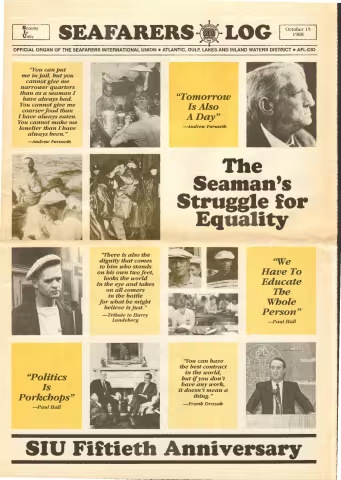
"You can put
me in jail, but you
cannot give me
narrower quarters
than as a seaman I
have always bad.
You cannot give me
coarser food than
I have always eaten.
You cannot make me
lonelier than I have
always been. "
-Andrew Furusetb
''Politics
Is
Porkchops"
-Paul Hall
'There is also the
dignify that comes
to him who stands
on bis own two feet,
looks the world
in the eye and takes
on all comers
in the battle
for what be might
believe is just. "
-Tribute to Harry
Lunde berg
"Tomorrow
Is Also
A Day"
-Andrew Furusetb
The
Seaman's
Struggle for
Equality
"You can have
the best contract
in the world,
but if you don't
have any work,
it doesn't mean a
thing."
-Frank Drozak
''We
Have To
Educate
The
Whole
Person"
-Paul Hall
SIU Fiftieth Anniversary
Few, if any, of the gains of the past 50 years would have been possible without the seamen's hiring hall (51 Beaver Street). "Bloody Thursday" reinvigorated the seamen's movement.
Introduction:
SIU Celebrates Fiftieth Anniversary
In 1938, Harry Lundeberg, center, received
a charter from the American Federation of
Labor to form a new international seamen's
union, the SIUNA.
The SIU is celebrating its 50th an
niversary this year. The union
was born during the Great Depres
sion, one of this nation's darkest
periods.
War clouds were gathering over
Europe and Asia. Despair and poverty
still stalked the globe nine, long years
after the Stock Market Crash of 1929.
The American labor movement
was split into two hostile camps.
Conditions for seamen and many
other workers remained intolerable.
Yet there was hope . The New Deal
had given workers a mechanism to
make their voices heard.
Industry by industry, workers were
being organized on a scale never
before imagined.
October 15, 1938
On October 15, 1938, at a convention in Houston, Texas, the American
Federation of Labor presented Harry Lunde berg with a charter to form a new in
ternational seamen's union, the Seafarers International Union of North America
(SIUNA).
Lundeberg was already head of the Sailors Union of the Pacific, a union of
West Coast sailors which traced its origins back to 1885. Morris Weisberger, a top
Lundeberg aide, took a month's leave so he could go to New York to help set up
operations for a separate, autonomous affiliate of Atlantic and Gulf seamen.
A skeletal structure was already in place. An interim charter for the new inter
national had been issued in 1937. Robert Chapdelaine had been named acting
chairman. The interim union didn't even have a name. It had a number: AFL
Seamen's Union 22124. Matthew "Duke" Dushane was the acting chairman of
~he new A&G District. John "Whitey" Hawk was in charge of the Atlantic Region;
Matthew Biggs headed up the Gulf Coast.
At first there was little interaction between the two regions. Members shipped
out on either a Gulf or an Atlantic Coast book. That wouldn't change for a num
ber of years.
The A&G District Was Called the SIU
From the beginning, the Atlantic and Gulf District of the SIUNA was known
simply as the SIU.
It was not an easy birth. The new union had 500 members, few resources and
only nine-contracted companies. Since then, the small, struggling affiliate that
Harry Lundeberg established has become a powerful force in the labor move
ment. The SIU now represents a wide spectrum of workers: fishermen, cannery
workers, tug and barge workers, service employees, office workers, wire and rope
workers, and many, many more.
The SIU's Story Dates Back Hundreds of Years
Still, the seaman's age-old struggle for equality and justice lies at the core of
the union's existence. It has a universal appeal that speaks to the experiences of
all Americans.
At its most basic level then, the history of the SIU is the story of a group of
workers who used the labor movement to achieve equality under the law and
dignity in the workplace.
It is the story of great leaders, committed members and the bond they were
able to forge. .·
It is also the story of the American-flag merchant marine. Its continued survival
presents our members with their greatest challenge as the union faces its second
50 years.
The Wall Street Strike of 1948. Members of the SIU have
consistently supported their fellow trade unionists.
The SIU became a power on the waterfront after Paul Hall was named director of organizing in 1945. He immediately targeted
the Isthmian and Cities Service companies for organizing and set a successful blueprint for the union's future growth.
2 SIU Fiftieth Anniversary
Chapter One:
The Seaman's Struggle For Equality
"I must go down to the sea again
to the lonely sea and the sky
And all I ask is a tall ship
and a star to steer her by''
-john Masefield
Today's Seafarers lead lives virtually indistin
guishable from the vast majority of Americans.
They are middle-class wage earners who work on
board vessels that have to meet stringent safety
standards.
Yet seamen were once among the most brutalized
of American workers. In at least one important
respect, they were little better than slaves.
Once a seaman signed the ship's articles, he was
tied to a vessel for the duration of the voyage.
"From the earliest historical period, the contract of
seamen has been treated as an exceptional one, in
volving, to a certain respect, the surrender of his
personal liberty during the life of the contract,'' said
the Supreme Court in Robertson v. Brown (165 US
275).
Leaving a ship before the end of a journey was
tantamount to desertion. Under an early sea code,
desertion was punishable by death. In some juris
dictions, it was punishable by branding.
The seaman's unique legal status put him at a
decided disadvantage in his fight to secure a better
way of life. No matter how bad conditions were for
workers in other industries, they at least had the
right to quit and seek employment elsewhere if they
were dissatisfied with their wages or job conditions.
For someone who knew a skilled trade or who lived
in an area where there was a labor shortage, this
could be a powerful tool.
The Law Was Stacked
Against Seamen
The first American statute to restrict the mobility
of seamen was passed in 1790. It stated that a mer
chant seaman who absented himself from a vessel
for more than 48 hours without leave from his cap
tain, forfeited "all his wages due to him, and all his
goods and chattel on board of said ship or vessel, or
in any store they may have been lodged at the time
of his desertion to the use of the owners."
The penalties for desertion were made more
stringent in 1872, when Congress passed the Ship
ping Commission Act. Imprisonment for a period of
not more than three months was added to the list of
possible penalties that could be taken against a
seaman who had left his vessel in mid-voyage.
A seaman who "correctly" feared for his life had
the right to leave a ship. Yet a seaman who feared
"only" physical abuse from his shipmates did not
enjoy that right.
"Seamen, as a class, are an injudicious group
often given, on shipboard, to frequent and violent
quarrels ... A black eye, lacerations and bruises are
not too uncommon a sight," wrote a nineteenth
century judge.
Bucko Mates and Cruelty at Sea
In court cases and early seamen's journals, there
are numerous accounts of a dreaded maritime
phenomenon: "bucko" mates who took delight in
torturing the people who worked under them.
Congress passed its first anti-flogging statute in
1850. Yet it wasn't until passage of the White Act in
1898 that an officer could be held personally liable
for the physical and mental damages he inflicted on
a seaman.
Under American law, a captain never did have the
right "to beat a man with unreasonable severity"
October 1988
Seamen lived, slept and ate in one big forecastle. Diseases swept a ship like wildfire.
But as one judge put it, "a single act of assault and
battery, though exceeding the bounds of moderation,
will not justify a desertion."
Even in the most sympathetic court of law, a
seaman being charged with desertion was at a con
siderable disadvantage. No matter how brutal a mate
or captain was, he still was a more credible figure
than a seaman, who was lumped in with "Indians
The Pilgrim inspired Richard Henry
Dana's 1Wo Years Before the Mast.
Two Years Before The Mast
Publication in 1840 of Richard Henry Dana's master
piece, Two Tuars Before the Mast, marked a pivotal moment
in the seaman's struggle for equality. Before that time, most
Americans had no idea of the brutal conditions which ex
isted on board American-flag vessels.
The book has lost none of its power. In the following
passage, Dana describes his reaction to a flogging at sea:
"Sam, by this time, was seized up, as it is called; that is
placed against the shrouds, with his wrists made fast to
them, his jacket off, and his back exposed. The captain
stood on the break of the deck, a few feet from him, and a
little raised, so as to have a good swing at him, and held
in his hand the end of a thick, strong rope. The officers
stood t·ound, and the crew grouped together in the waist.
All these preparations made me feel sick and almost faint,
angry and excited as I was. A man--a human being, made
in God's likeness-fastened up and flogged like a beast! A
man, too, whom I bad lived with, eaten with, and st<>0d
watch with for months, and knew so well! If a thought of
resistance crossed the minds of any of the men, what was
to be done? ... If they resist, it is mutiny; and if they succeed,
and take the vessel, it is piracy. If they ever yield again,
their punishment must come; and if they do not yield,
what are they to be for the rest of their lives? If a sailor
resists his commander, he resists the law, and piracy or
submission is his only alternative. Bad as it was, they saw
that it must be borne. It is what a sailor ships for. .. "
and idiots" as being a special ward of the American
state. In addition, a captain had access to the ship's
log, where he made all the entries.
Notorious Crimp System
This institutionalized pattern of legal discrimina
tion reinforced abuses that were rampant in the
maritime industry. In order to be employed on a
ship, a seaman had to submit to the notorious
"crimp" system, where the owners of bars and
rooming houses were given liens on his future earn
ings. The system was rigged to keep a seaman per
manently in debt.
The crimp often had an understanding with a
captain of a ship. His rooming house or bar served
as an unofficial hiring hall.
The crimp system made it almost impossible for
seamen to organize. In order to gain employment, a
seaman had to patronize or live in one of these
crimp joints. Since he often stored his goods in
these places, a seaman risked losing every single
material possession he owned if he lef.La vessel be
caue of poor conditions.
There were numerous instances of seamen being
shanghaied (the term was coined in San Francisco in
1855 when seamen increasingly found themselves
on runs to the Orient against their will). It was not
uncommon for a crimp to get a seaman drunk to get
him to sign on a vessel that was about to sail short
handed. This was particularly common if a captain
had a reputation for running a "hell-ship."
Life at Sea
If a seaman's life on land left much to be desired,
so did conditions onboard ship.
Voyages often lasted two, three years. There was
a constant danger of death by drowning. There was
no way of reporting unsafe conditions; no
mechanism to appeal arbitrary and even dangerous
conditions by one's superiors.
Seamen often slept in one large forecastle. Dis
eases like tuberculosis often swept a ship like
wildfire.
Even under the best of circumstances, life at sea
was claustrophobic. "Life onboard ship calls for
close contact and confinement of the men with little
chance, until they reach port, for recreation," wrote
a nineteenth century judge.
The seaman's debased existence at sea and on
land was tied closely to his legal status. Before he
could improve his working conditions, he had to
win the fight for equality under the law.
3
Chapter Two:
Seamen's Act of 1915 Brings Freedom
There were three pivotal developments in the seaman's early fight for
equality under the law.
The first came in 1840 when Richard Henry Dana published his classic novel,
Two Thars Before the Mast. Before that time, Americans were not aware of the
abuses that existed in the maritime industry.
The next important development occurred gradually over a 30-year period. It
was the formation of permanent seamen's unions strong enough to protect the
rights of their members.
Finally, there was the rise of leaders within the ranks of the seaman's move
ment.
The early seamen's unions were blessed with an abundance of talented and
selfless people: Dan Keefe, Sigismund Danielewicz, Burnette Haskell. But it was
Andrew Furuseth who gave the
seaman's movement its unique voice.
Seamen Get
A Spokesman
The formation of the International
Seamen's Union in 1892 out of a
group of bickering, unaffiliated unions
gave the seamen's movement a veneer
of unity to the outside world. More
important, it gave them a respected
spokesman, Andrew Furuseth, who
could represent their interests in
Washington, D. C.
There has never been anyone more
effective in making the public aware
about the need to reform conditions
in the maritime industry. To the out
side world, Furuseth, with his stooped
shoulders, lined face and eloquent
speech, was the living embodiment of
the American sailor.
He was born in 185 4 in Furuseth,
Norway. Forced to leave school at an
early age, he was a self-taught scholar,
fluent in English, German, Dutch,
French and Norwegian. Like many
other Scandinavian seamen of his era,
he eventually made his way to the
West Coast of the United States, sail
ing, for the most part, on the elegant
schooners which were being rendered
obsolete by new technology.
Furuseth became secretary of the
Coast Seamen's Union in the 1887,
modes of transportation, mainly railroads. In addition, Great Britain enjoyed an
overwhelming advantage because of its access to low-priced steel.
Mahan Shapes the Debate;
America Needs Superior Merchant Marine
By the end of the nineteenth century, America's presence in the foreign trades
had declined so precipitously that it was a source of great concern to military
planners, most notably Admiral Alfred Mahan, who is generally considered to be
one of the nation's most brilliant naval tacticians.
Mahan alleged that the United States would never be a first-class power unless
it developed and maintained a superior navy and merchant fleet .
Throughout history, said Mahan,
there had always been a close connec
tion between a country's maritime
capability and its status as a world
power. His observations gave seamen
a more receptive audience than they
might otherwise have enjoyed when
they argued for reform of the maritime
industry.
Seamen Win
Legislative Victories
In 1895, Congress enacted the Mac
Guire Act, which did away with the
worst abuses of the crimp system and
abolished the penalty of imprison
ment for seamen who had "deserted"
their vessels. This was a monumental
step forward in the emancipation of
seamen.
Yet two years later, the Supreme
Court handed down a case, Robertson
v. Brown (165 US 275), which seemed
to reverse at least part of the Mac
Guire Act. The court upheld the con
viction of seamen who had "deserted"
the S.S. Arago on a coastwise run.
Writing a vigorous dissent, Justice
John Harlan called the decision "Dred
Scott II," and said that instead of
hunting runaway slaves, Americans
could now hunt runaway seamen.
two years after that union was formed .
One of the first things he did was to
establish the Coast Seamen 's]ournal.
He understood the importance of
communication and the power of the
written word.
The Seamen's Act of 1915, known as the Magna Carta of American seamen, set minimum
safety standards and removed many remaining legal restrictions. It was sponsored by Senator
Robert La.Follette (right inset above), a long-time ally of Andrew Furuseth (left inset above).
Furuseth's Coast Seamen'sjournal
was even more concise. It said that
the difference between a slave and a
seaman was about $15 a month.
By this time, Furuseth was spend
ing a good portion of his time in
Washington, D.C. lobbying Congress.
In 1898, Congress passed the White
Act. Amopg other things, it made
licensed officers liable for their acts of
brutality.
He had the ability to make people
sit up and listen. "Tomorrow is also a
day," he said after a bitter defeat. "You
can put me in jail," he once said, "but
you cannot give me narrower quarters
than as a seaman I have always had.
The seamen's bill provided a two-watch system for the deck force and a three-watch system
for the engine gang, plus a maximum nine-hour working day in port. It set a more liberal
schedule for rations and a minimum 100 cubic feet of space per man in the forecastles.
Previously, each man had been allotted 72 cubic feet, which Furuseth described as "too large
for a coffin, too small for a grave." Also, the law specified that bunks in forecastles could be no
more than two high.
The law also decreed that 75 percent of the crew must be able to understand the com
mands given in the English language. It decreed that the sailor could no longer allot part of his
wages to creditors before signing a vessel. And he could no longer be imprisoned on charges
of desertion if he left his ship before the end of a contracted voyage.
Political Climate Helps
Progressive Causes;
Seamen's Act of 1915
Enacted You cannot give me coarser food than
I have always eaten. You cannot make me lonelier than I have always been."
Maritime in Turmoil
Furuseth came to prominence during a troubled period in the history of the
maritime industry:
Seamen and other workers were just beginning to establish permanent unions
capable of protecting their rights. The gradual transformation of businesses into
corporations had created an impetus for a national labor organization. This led
to the creation of the American Federation oflabor (AFL) in 1881.
Wages for West Coast sailors were slightly higher than those of their East Coast
counterparts. Still, the depressed conditions in the maritime industry created
hardships for all seamen. Many of the early strikes and organizing drives called by
the ISU and Coast Seamen's Union ended in failure .
The United States merchant marine reached its zenith in the decade before the
Civil War. With its beautifully designed schooner ships, it was on the cutting edge
of modern technology.
Yet this was to change. The Civil War and the switch to steamships ushered in
a dark era for American shipping. This decline was accentuated by America's
preoccupation with its vast internal markets and by the growth of alternative
4
·.
Meanwhile, Americans were slowly but surely expanding the rights of the
working people. There was a widespread backlash against the conglomerates
which now controlled the economic life of the nation.
Tragedies like the Triangle dress factory fire, where hundreds of innocent im
migrants-mainly young women-were killed, created an upswell of support for
more stringent safety standards.
A turning point in the maritime industry came in 1912 with the sinking of the
Titanic. The highly publicized deaths of so many prominent people made Americans
aware of the perils that seamen faced on a daily basis.
Furuseth (who in 1908 had been named president of the ISU) and his closest
ally in Washington, D.C., Robert Lafollette, the progressive senator from Wiscon
sin, were able to capitalize on this changed public mood. In 1915, Congress
enacted the Seaman's Act of 1915, which abolished many of the remaining legal
restrictions against seamen.
Woodrow Wilson signed the bill into law. His motives were not entirely altruis
tic. World War I had created an insatiable demand for America's neutral shipping.
While Wilson intended to keep this nation out of the war, he felt that this nation
needed a reliable source of sealift just in case. In 1917 America was dragged into
the conflict. American seamen were the first to die for their country:
SIU Fiftieth Anniversary
Important Dates
In Marit ime Labor
1803: The seamen of New York go on strike and win a $7
increase from their base pay of $10 a month .
1837: Seamen in Boston go on strike.
1854: The first union of marine engineers is formed on
the Great Lakes. It quickly fades but is revived in 1863
and 1875 to become the National Marine Engineers
Beneficial Association.
1863: Seamen on the Great Lakes form the Seamen's
Benevolent Union of Chicago. It does not engage in
collective bargaining, but concentrates on taking care
of the sick and indigent.
1866: The Seamen's Friendly Union Society is formed in
San Francisco. It elects Alfred Enquist as president and
George McAlpine as secretary. It doesn't last very long.
1875.: The National Marine Engineers Beneficial Associa
tion is formed .
1877: Longshoremen on the Great lakes organize.
1878: The Seamen's Benevolent Union of Chicago is
revived under the name Lakes Seamen Benevolent As
sociation. Dan Keefe heads this organization, which
tries to engage in collective bargaining.
1878: The Seamen's Protective Union in San Francisco is
formed . It boasts 800 members but doesn 't last long.
1883: The Marine Firemen 's Union is formed .
1885: A group of disaffected seamen meet on the Folsom
Street wharfand form the Coast Seamen's Union. Billy
Thompson is elected president.
1886: The Steamship Sailors Protective Association is
formed.
1887: Andrew Furuseth is elected secretary of the Coast
Seamen's Union. He stares printing the Coast Seamen's
journal, a union publication.
1891: The Coast Seamen's Union and the Steamship
Sailors Protective Association merge, creating the
Sailors Union of the Pacific.
1892: The National Longshoremen's Association is
formed in Detroit. This eventually becomes the Inter
national Longsh~~emen's ~sociation in 1895.
1892: A convention of seamen is held in Chicago, with
delegates from the various unions now organized on
the West Coast, the Great Lakes and the Gulf of Mexico
in attendance. East Coast unions are too poor to send
delegates.
The convention gives birth to the National Seamen 's
Union, which is later rechristened the International
Seamen's Union . Charles Hagen is the first president;
Thomas Elderkin is the first secretary and James Mc
laren is the first national organizer.
1908: Andrew Furuseth is elected president of the ISU.
1915: Congress enacts the Seamen's Act of 1915, which
abolishes most remaining legal restrictions against
seamen.
1919: The Industrial Workers of the World (IWW) estab
lishes the Marine Transport Wbrkers Union No. 510.
1921: The ISU, which now boasts a membership of
115,000 seamen, is dealt a near-fatal blow during an ill
.fated industry-wide strike.
1928: The Marine Workers Progressive League, a com
munist-dominated organization, is formed . It later be
comes the Marine Workers' League (MWL) and then
the Marine Workers Industrial Union.
1929: The membership of the ISU now stands at 3,000.
1934: The West Coast Strike of 1934 reinvigorates
maritime labor.
1937: The National Maritime Union is formed . The ISU is
forced to disband . A tern porary AFL seamen's union is
established on the East and Gulf coasts. Robert Chap
delaine is acting chairman.
John "Whitey" Hawk heads up the Atlantic region;
Matthew Bi~ is in charge of the Gulf Coast.
1938: The American Federation of Labor presents SUP
head Harry Lundeberg with a charter to form a new in
ternational seamen's union, to be composed of
autonomous affiliates. Matthew " Duke" Dushane is
named acting chairman of the A&G District. Morris
Weisberger, a top Lundeberg aide, takes a month's
leave to go to New York to help set up operations for
the new union.
1948: The SIU of Canada is established. Within three
years, its membership grows from 200 to more than
6,000.
1949: The Brotherhood of Marine Engineers (BME) , a
forerunner of District 2-MEBA, is formed .
1951: The American Federation of Labor presents a
charter to the Marine Cooks & Stewards, AFL.
_ October 1988
Chapter Three:
Maritime Enters Dark Age
The period between 1916 and 1934 is routinely described in the history books as the "Dark Ages of the
maritime industry."
The era started out on a promising note. Congress had just enacted the Seamen's Act of 1915; World War I
made it possible for seamen to dramatically improve their wages and working conditions.
Maritime's lobbying machine in Washington, D.C. remained effective. In 1920, Congress passed a piece of
legislation, the Merchant Marine Act of 1920, which established the Federal Maritime Commission and
strengthened existing restrictions against foreign participation in the domestic trades.
This bill became known as the Jones Act. Had it not been enacted into law, there might not be an American
flag merchant marine today.
In 1919, the International Labor Organization was created as part of the Versailles Peace Treaty. This gave
seamen and other groups of workers an international forum to improve worldwide conditions.
Red Scare Sweeps Country
Seamen were able to win impressive increases during a strike in 1919. Yet there was an ugly new mood in
this country which would have important ramifications for all workers.
The Bolshevik Revolution in Russia in 1917 had created a serious backlash amongAmerican voters. America
was now gripped with a "red scare."
For the moment, strikes and other legitimate forms of job action smacked of revolution in the minds of
average Americans.
Many of the gains that workers had made during the previous 20 years were now in jeopardy. An example
of this was the ill-fated Maritime Strike of 1921.
An Ill-fated Strike Breaks the ISU
By now, demand for American shipping had decreased substantially from its peak in World War I. This gave
the shipowners the upper hand.
Even though the owners were forced to capitulate in the Strike of 1919, the general trend was on their
side.
They prepared diligently for the next round. When the next set of contract negotiations came around, they
played hardball. After an all-ports strike was called by the ISU on May 1, 1921, the shipowners set up their
own hiring halls. The strike was broken and the ability of the ISU to act as an effective bargaining agent for
seamen was destroyed.
While ISU President Andrew Furuseth retained the overwhelming respect of American seamen, he became
increasingly removed from the day-to-day operations of his union.
The numbers tell the story. In 1921, the ISU had a war-inflated membership of 115,000 seamen. By 1929
there were fewer than 3,000.
Shipping companies like the International Pacific Marine Co. set up their own
hiring halls after the ill-fated 1921 Maritime Strike.
The IWW made great strides among disaf
fected seamen.
The Growth of Radical Organizations On th e Waterfront
During the 1920s, radical groups like the Industrial Workers of the World (IWW) and the communist
dominated Marine Workers Industrial Union tried to make inroads among the rank and file, who suffered ter
ribly during this period.
Indeed, during the '20s and early '30s, "the ISU's major adversary ... was not the shipowner, but the IWw,"
wrote Philip Ross, labor historian at Cornell University.
"The Wobblies made no bones about where they stood," wrote Ross. " (Their mono was that) the employer
class is a class of social bloodsuckers ... (They felt there was) no such thing as a good boss or a bad wage
earner."
"The overriding precept of the IWw," said Ross, "was the necessity for workers led by their unions to
respect all picket lines, a principle which led to the condemnation of all bargaining contracts. War with the
AFL unions was inevitable since the essence of American unionism was the getting and preserving of gains in
such bargaining agreements whose quid pro quo for the employer was a no strike clause.
''As a group consisting largely of nomadic single men whose working life offered them much opportunityto
read, reflect and argue, many seamen were attracted to IWW ideology with its emphasis on worker solidarity
and the spirit of an injury to one is an injury to all . In particular, seamen were tempted by the advantages of
industrial unionism despite the fact their unions from their origin were organized on a craft basis."
Despite their strong pro-worker stance, the Wobblies did not pose much of a threat to the ISU. Their innate
distrust of any kind of bureaucratic structure made it impossible for them to build a union capable of organiz
ing on a mass scale.
-continued next page
5
John L. Lewis changed the face of the labor movement.
The First American-Owned,
Panamanian-Registered Vessels
AFL President William Green
issued a charter to the SIU.
Conditions for seamen were exacerbated by the decline of the maritime in
dustry. Still, things could have been much worse .
In 1917, American companies made use of a lax registry system in Panama to
evade the modest provisions of the Seamen's Act of 1915 . But while the Harding,
Coolidge and Hoover administrations could not reverse the decline of the
American-flag merchant marine, they did nothing to encourage the mass exodus
of American shipping companies overseas.
In part, this was because of the bad reputation of Panamanian-registered ves
sels. In this era of Prohibition, they were linked in the public 's mind with "rum
running'' expeditions.
The 1929 Stock Market Crash ushered in the Great Depression. Despair gripped the nation.
The 1917 Russian Revolution sent shockwaves through the nation. Strikes became suspect.
6
FDR pledged a New Deal for Americans. He revitalized the American-flag merchant marine.
Seamen were not the only group of workers to be hurt during this period.
Most industrial workers suffered reductions in living standards.
Still, some groups, especially those in the skilled trades, actually prospered
during this period.
The Great Depression
For many Americans, the 1920s were a period of great prosperity. Yet the glit
tering boom was built on a shaky foundation .
Much of the nation's new-found wealth was not real : it existed only on paper.
It was fueled by speculation and easy credit.
The whole system came crashing down on October29, 1929, "Black Tuesday,"
when the value of all stocks traded on the New York Stock Exchange fell almost
by 20 percent in one day.
This ushered in one of the darkest periods in American history, the Great
Depression.
During the next three years, the total net worth of the United States fell by
one-half, from $82 billion to $40 billion. Despair and poverty gripped the nation.
Wages plummeted; unemployment soared. America's industrial machine
ground to a virtual halt.
The Great Depression was not just confined to the United States. There were
severe political and social dislocations in every part of the globe. War clouds
gathered over Europe and Asia.
Democracy and freedom were on the run. Yet in one important respect, it was
an era of hope.
During the darkest days of the Great Depression, the American people voted
overwhelmingly for New York Governor Franklin Delano Roosevelt. In his accep
tance speech on January 20,. 1933, he made the following promise:
"I pledge you; I pledge myself, a new deal for the American people."
The New Deal ushered in an era of hope for Americans. Workers' rights were expanded.
SIU Fiftieth Anniversary
Chapter Four:
The Seaman's Movement Is Reborn
U pon taking office, Franklin Delano Roosevelt immediarely began laying the
foundation for a national recovery. He introduced legislarion aimed at im
proving the living standards of all Americans and providing the ten million
people without jobs wirh temporary relief
Within two years, he had passed the Social Security Act, the Civilian Construc
tion Corps, the Work Progress Administration, the National Industrial Recovery
Act and a host of other legislation.
Having served as assistant secretary of the Navy during World War I, Roosevelt
had a keen interest in the maritime industry. Alarmed by rhe decline in the
American-flag merchant marine, he persuaded Congress to enact the Merchant
Marine Act of 1936.
This historic piece of legislation established a system of subsidies which
reversed the decline of the American-flag merchant marine and enabled this
country to enhance its badly-deteriorated sealift capability.
He also signed into law the Wagner Act of 1935, which made it possible for
unions to organize workers on a scale
never before imagined.
Indusrry by industry, workers flock
ed to organized labor. Yet this period
was not without its difficulties.
Split in Organized Labor
In 1935, organized labor splir into
two hostile camps: the American
Federation of Labor and the Commit
tee of Industrial Organizations (later
named the Congress of Industrial Or
ganizations).
The CIO was founded by
Mineworkers PresidentJohn L. Lewis,
who believed that organized labor
had to embrace industrial trade
unionism. Yet only 16 of the 109
unions which were affiliated with the
AFL were industrial unions; the rest
were craft unions which represented
one type of worker (plumber; cigar
maker).
When the AFL voted against or
ganizing workers on an industrial
basis in October 1935, Lewis resigned
from the AFL executive board and
formed the Committee of Industrial
Organizations.
This split had important conse
quences for organized labor. For one
thing, it was a leading ca use for the
establishment of the SIU. "I am con
vinced,'' said George Meany, who
took over from Green in 1952, "that
these differences of opinions that
caused the split could have been
worked out within the framework of
the American Federation of Labor.
There was no need for a split."
Yet according to Meany, there was a
bright side to this development. "The
fact that the CIO was set up had a
tremendous effect on industrial
workers. When this split came, the
old AFL conservatives were under at
tack, and they got off their butts and
went to work."
Bloody Thursday
Seamen were among the first
group of workers to respond to the
changed political situation in this
country brought about by the Great
Depression. On the West Coast, they
rose up en masse to support striking
longshoremen, who were seeking an
increase in their pal try S 10 a week
salary. The strike began on May 9,
1934. Within days, shipping in San
Francisco and other West Coast ports
was at a standstill. The shipowners
and port officials were determined to
break the strike. They decided to run
October 1988
cargo through the picket lines on Pier 38 on the Embarcadero in San Francisco.
On July 3, more than 5,000 seamen, longshoremen and other workers
watched as a convoy of loaded trucks tried to make their way through the picket
ines on Pier 38. All hell broke loose. OnJuly 5, the banle began again. This day
became known to future generations of seamen as "Bloody Thursday."
According to SIU historian John Bunker, ''pickets set cars on fire, hundreds of
policemen charged the mass pickets, and a full-scale engagement began, with
bricks and bullets, clubs and tear gas on nearby Rincon Hill, a knoll along the
waterfront ... 1\vo picketers were killed; scores wounded."
On July 16, a full-scale general strike was called. "This ... paralyzed the city.
Nothing moved. Stores closed. Only a few restaurants were permitted to open.
Business life came to a standstill," wrote Bunker. The strike was called off on July
19 when the Joint Strike Committee representing 120 striking unions agreed to
put all demands to arbitration. Maritime workers made substantial gains.
Historian William Cahn said that "the West Coast maritime strike was a har
binger of things to come in other in
dustries: steel, auto, rubber. It set an
example of union solidarity.. . that
proved unbeatable."
Seamen were among the first group of
workers to respond to the changed political
conditions brought about by the Great
Depression (bottom photo). In 1934, they
rose up en masse to support striking
longshoremen on the West Coast. The
authorities responded with police bar
ricades to keep seamen from their ships
(top photo). Even though they were clubbed
and jailed (inset), their resolve was
strengthened (middJe photo). 1\vo seamen,
Howard Sperry and Nick Bordoise, died in
what future generations of seamen have
called "Bloody Thursday." This marked the
resurgence of the seamen's movement,
which had been in a state of decline since
the ill-fated strike of 1921.
7
Chapter Five:
The SIU Is Born Out of the Ashes of ISU
The revival of union fervor on the waterfront spelled trouble for the Interna
tional Seamen's Union. Its leadership was weak and divided. The organiza
tion had ceased to have any credibility with seamen.
The day-to-day operations of the ISU had passed from Furuseth to Victor
Olander, Dave Grange, Paul Scharrenberg and a number of other officials. These
officials were not exactly what one would call militant: they had to be coerced
into supporting the longshoremen during the 1934 strike. Many, including
Furuseth, favored government hiring halls.
In 1934 Harry Bridges, president of the Pacific District of the International
Longshoremen'sAssociation, formed the Maritime Federation of the Pacific. The
new federation sought to provide a forum for maritime unions to discuss issues
of common interest. The leaders of the International Seamen's Union strongly
opposed this organization. But the MFP had attracted a great deal of support
during the 1934 strike. Its militant stand during that period contrasted sharply
with the one taken by the ISU. As a result, the ISU leaders suffered a serious blow
to their prestige.
By 1935 discontent within the ranks of the ISU had become rampant. Dissi
dents within the union started printing a newsletter which later became the offi
cial organ of the NMU. The headline on the first issue became a rallying cry for
CIO seamen: "It's time to go I heard them say, I heard them say it's time to go."
The leadership of the ISU found itself increasingly isolated. In 1936, they
pushed through a constitutional amendment which permitted the revocation of
an afftliate's charter at any time and for any reason. Afraid of the growing
popularity and militancy of SUP head Harry Lundeberg, they revoked the charter
of the Sailors Union of the Pacific.
1936 Strike Breaks Out
The beginning of the end for the ISU started in 1936 when a West Coast strike
broke out. ISU officials resisted calling a sympathy strike on the East Coast. For
the few remaining faithful, this proved to be the last straw.
Bridges tried to fill in the vacuum on the West Coast, but he had little luck.
Longshoremen and seamen had historically been at odds out there, and besides,
Bridges' well-known left-wing sympathies were out of sync with the political
mood of most West Coast sailors.
The ISU attempted to establish an alternative West Coast sailors union, but it
attracted virtually no support. West Coast sailors remained overwhelmingly loyal
to the SUP.
On the East Coast, the situation was fragmented. There was no strong,
autonomous seamen's union capable of providing leadership.
NMUFormed
A sitdown strike on the S.S. California in March 1936 thrust Joe Curran, an
unknown bosun, into the national limelight. He soon formed a close alliance
with Bridges and other CIO officials. A new union, the National Maritime Union,
was formed in May 1937. Within a year, the NMU was able to pick up a majority
of the contracts of the old ISU.
"Curran was aggressive, articulate and ambitious and the times suited him
well," wrote SIU historian John Bunker. "It was evident, judging by those who
surrounded and supported him, that Curran was willing to front for the strong
cadre ofleft-wingers in the new union."
Large numbers of East Coast seamen refused to join the NMU. Many felt that
the NMU was dominated by left-wing elements; others remained Joyal to Andrew
Furuseth and the AFL and blamed the ISU's decline on Victor Olander, Dave
Grange and Paul Scharrenberg.
The NMU applied for membership in the newly-formed CIO. This prompted
the AFL, which was in a life-and-death struggle with the CIO, to respond.
"By 193 7 the dispute with the CIO really got hot; (in May) there was a closed
convention of the AFL in Cincinnati, with no press and no outsiders," recalled
George Meany in a taped interview with Archie Robinson. "It was at this point
that the AFL really started to move; all the AFL unions started to organize." Fear
ing that the AFL might be shut out of the waterfront, AFL President William Green
requested the resignation of the ISU's top leadership. A temporary charter was is
sued in August 1937. Green, ILA President Joe Ryan and AFL organizer Holt Ross
were named to the executive committee.
In December 1937, a new committee, headed by Harry Lundeberg, was put
together. Robert Chapdelaine was named temporary head of the new union.
On October 15, 1938, at its convention in Houston, Texas, the AFL presented
SUP head Harry Lundeberg with a charter to form a new international seamen's
union. Morris Weisberger, a top Lundeberg aide, took a month's leave to go to
New York and help set up operations for an autonomous affiliate, the Atlantic
and Gulf District.
A skeletal structure was already in place. Matthew "Duke" Dushane was acting
chairman of the new A&G District. John "Whitey" Hawk was in charge of the At
lantic region; Matthew Biggs headed up the Gulf Coast.
At first, there was little interaction between the two regions. Members shipped
out on either a Gulf or an Atlantic Coast book. That wouldn't change for a num
ber of years.
From the beginning, the Atlantic and Gulf District of the SIUNA was known
simply as the SIU.
8
Sailortown during the 1936 strike. The strike marked the beginning of the end of the ISU.
Harry Lundeberg's militant stand in favor of the hiring ball attracted widespread support.
An AFL hiring hall during the 1936 strike. The white caps symbolized support for Lundeberg.
SIU Fiftieth Anniversary
Chapter Six:
SIU Lays Strong Foundation for Future
There was an intense rivalry between AFL
and CIO unions. The split between the two
organizations was a leading cause for the
formation of the A&G District of the SIUNA.
The union hall at 51 Beaver Street in N.Y.
was like a second home to many Seafarers.
SIU members welcome a friend back from a
dangerous run during World \v.lr II.
The SIUNA held its first convention in San Francisco, Calif. in 1942. Great progress had been
made since the union's inception in 1938. World War II had created many new jobs.
Seafarers writing home from the union hall at 51 Beaver Street just before the war's end.
October 1988
The SIU did not have an easy birth. The new union had 500 members, few
resources and only nine contracted companies. "In the beginning," said Ted
Babkowski, book number B-1 and a charter member of the union, ''there was
virtually nothing.''
"I started shipping in Baltimore," said Babkowski. "The first union hall was on
Pratt Street. We had one desk. One bench. No money.
"Bill McKay was the port agent there. We had to move be~ause the rent was $7
and we couldn't make it."
The SIU Has a Tough Go
The NMU, by contrast, had organized a majority of the companies under con
tract with the ISU. By 1939, it claimed a membership of 35,000.
"We had a tough go," said charter member LS. Johnny Johnston. "The NMU
was breathing down our neck, making it hard for any seaman not belonging to
their union. You could look for a dumping if caught by their beef squad leaving
or returning to your ship.
"It was hard, and as I look back today I wonder what kept the men fighting
when it was so easy just to walk into any NMU hall, throw your ISU book on the
counter and get an NMU work permit."
Still, the nucleus for a new union was there. "The AFL was able to hold onto
Delta and Waterman Steamship and a number of other companies," said
Johnston.
Battle With CIO Heats Up
The SIU, like all other unions during this period, was preoccupied withJohn
L. Lewis's decision to break away from the AFL and form the CIO.
Dual unionism, as it was called, was the single overriding reality for all trade
unionists until 195 5. That was the year that George Meany engineered an historic
merger between the two national organizations.
In order to remain a viable force on the waterfront, the AFL needed to re-es
tablish itself on the Atlantic and Gulf Coasts. It already had a solid base on the
West Coast with the SUP.
Early editions of the Seafarers LOG devoted a lot of space to the rivalry be
tween the two national organizations. There was a constant barrage of unflatter
ing stories aboutJohn L. Lewis, Joe Curran, Harry Bridges and other leading CIO
figures. Needless to say, there was no love lost on either side, and the compli
ments were returned in style.
The Hunter and the Dog
In his later years, when asked to put the split into perspective, Meany would
say that the CIO had made several important contributions to the labor move
ment.
He felt that the CIO had forced the AFL unions to "get off their butts and or
ganize new members." In addition, he lauded the CIO's commitment to political
action and racial equality.
Yet he and many other AFL leaders had one overriding problem with the CIO
which they were never able to reconcile.
"Lewis brought in all the hot-shots, the radicals and the Communists that
were in other unions . They all flocked to Lewis and he took them all in. They
were outstanding organizers; they could get people to join. They were not very
good at conducting the affairs of the union.
" When (Ladies Garment Workers President David) Du bi~sky would argue with
Lewis about using Communists as organizers, he said to Dubinsky, 'Well, who
gets the bird-the hunter or the dog?' In other words, the communist organizer
was the dog and Lewis was the hunter."
Lundeberg and Curran
In a sense, the differences between SIUNA President Harry Lundeberg and
NMU President Joe Curran mirrored those of William Green and John L. Lewis,
the heads of their respective national organizations, the AFL and the CIO.
In taped conversations with Archie Robinson towards the end of his life,
George Meany pretty much summed up the AFL position on this issue. He dif
ferentiated between a member's individual beliefs and the wisdom of allowing
the entire administration of a union to fall under the control of non-democratic
forces.
Meany's views were shaped by the times. He and other AFL leaders had wit
nessed from a distance the rise of Fascism in Germany. They had seen trade
unionists and others put to death for their commitment to democratic principles.
This was not just a theoretical issue to them.
"In the final analysis," said Meany, "no matter what type of dictator takes over
a country, the first thing he does is destroy worker freedom. If he's going to dic
tate, he has to have control of the workers. That's the reason every dictator
whether military, right wing or left wing-begins by wiping out the freedom of
workers. They wipe out free trade unions.
"The Communist Soviet philosophy back in those days was to try to bore into
the American industrial scheme and they looked upon communication and
transportation as being very important. -continued next page
9
"They would have liked to get control of the radio system-anything to do
with communications. They would have liked to get control of trucking if they
could; city transportation was very important to chem.
"They did get control of radio operators on ships that union became strictly
under the control of the Communists. They had control of certain shipping; they
had control of the National Maritime Union."
Communist Presence in the NMU
The Communist Party has never played a prominent role in American political
life. After the McCarthy era, its influence became negligible. But during the Great
Depression and World War II, it achieved a certain respectability which it sought
to convert into power.
For a while, it exerted a considerable influence in a number of CIO unions,
one of which was the NMU. ''The NMU was the crown jewel of the Communist
Party,'' wrote Philip Ross in his history of the SIU.
Five out of six members of the NMU's executive council were members of the
Communist Party. The only one who wasn't was NMU President Joe Curran, and
he flared AFL resentments by marching in the 1936 May Day parade.
"The Party had become the vehicle for the young man of conventional ambi
tions, f• wrote Murray Kempton, one of this nation's most respected journalists, in
his classic book on the era, Part Of Our Time. "The Communists made the
decisions and assigned the offices. Membership in
the waterfront section of the party had become
more necessary for the careerist in the NMU than
the Rotary Club ever hoped to be in more ordinary
societies."
The NMU Pilot had a communist editor, and it
pretty much followed the Party line. After Hitler and
Stalin signed a non-aggression treaty, the Pi,/ot was
strongly in favor of the United States remaining
neutral. Yet the week after the Germans invaded the
Soviet Union, the Pilot strongly urged the United
States to enter the war on the side of the Allies.
Wobs Played a Role
A good many of the early members of the SIU
were former Wobblies who staunchly opposed what
they perceived was the communist domination of
theNMU.
demand for its services. World War II transformed the American merchant marine
into the largest in the world and defined a whole generation of seamen.
World War II created so many new jobs for American seamen that the SIU was
forced to move out of its cramped quarters at 2 Stone Street into a new union
hall at 51 Beaver Street.
SIU Members Help Fuel the War Effort
In the beginning, there weren't enough seamen or ships to carry on the war
effort. Once again, America had been caught short.
The federal government ran advertising campaigns trying to persuade seamen
to enlist. Shipyards were on an all-out schedule to meet the unexpected demand
for vessels.
"I remember seeing a government poster for the American-flag merchant
marine," said Jim McCue, a former member of the SIU. "I decided that this would
be a good way to help my country."
Some seamen, determined to serve their country, joined the merchant marine
because they couldn't pass the physical for the armed services. "They wouldn't
take me," said SIU Vice President Red Campbell, "so I joined the merchant
marine. For a while, I was the only male between the ages of 16 and 60 on my
block."
"With the outbreak of war," wrote columnist James J. Kilpatrick, "merchant
seamen received additional military training. Ship
ping articles were changed so that seamen could be
ordered to such ports and places in any part of the
world as may be ordered by the U.S. government. A
War Shipping Administration took over the mer
chant ships for service consistent with strategic
military requirements."
Seamen suffered the second highest casualty
rate of the war. President Roosevelt talked about
extending G. I. benefits to seamen, but he died
before he could take action on that issue.
Still, seamen had at least the satisfaction of
knowing they had served their country. And it made
for some truly wonderful sea stories.
Torpedoed Seven Times
"One of our members, Bobby Burton, set a
record for being onboard seven vessels hit by Ger
man torpedoes and still surviving," said SIU
Secretary Joe DiGiorgio.
"As individuals," wrote Ross, "many Wobbly
members played important roles during the stirring
organizing years of the middle and later 1930s. By
and large, Wobs were to be found closely allied with
Harry Lundeberg in his battles with the Communist
Party.''
Asst. Sec.-Treas.J.P. Shuler handles this member's beef.
"He became something of a celebrity among
seamen. I remember going onboard a ship and
seeing him. I got right off. Damned if the vessel
wasn't torpedoed."
"There were ships sailing SIU during the
war, "wrote Ross, "which were crewed from master
down to ordinary seamen, top to bottom, with only
Wobs."
The new union organized companies like calmar. "They wouldn't let us use electric razors on
board ship because they thought that we might
send signals to the Germans with them,'' said Red
Campbell. "We had to go to bed with our clothes
on in case we got hit by German torpedoes. When
that happened, every second counted." SUP Gave A Helping Hand
For the first few months of its existence, the SIU
was little more than a shell organization. Until 1940,
the union was run by SUP organizers.
But the stated goal of Harry Lundeberg was to
enable the A&G District to become a fully
autonomous member of the SIUNA. Right before the
first election, the SUP organizers returned to the West Coast.
Speaking about this at the first SIUNA convention in 1942, john Hawk, the
first popularly-elected secretary-treasurer of the SIU, had this to say:
"The SUP men when they came east had promised the seamen that the SUP
was not moving in to control the new organization, but only to give it fraternal
support until it got off its feet. Now that the District was obviously on a sound or
ganizational basis, the SUP brothers wisely decided to tum the leadership over to
the men elected from the rank and file."
Security In Unity; Brotherhood of the Sea
Helping to build up the A&G District was consistent with Lundeberg's
philosophy of trade unionism. He believed that affiliates of an international
should be free to run their own affairs, but that they should band together on
larger issues.
Above all, Lundeberg believed that the various affiliates had an obligation to
support one another. Simply put, he believed in the two mottos of the SIU
Brotherhood of the Sea and Security In Unity.
Organizing Drives
The new union won a number of important organizing drives and strikes against
Alcoa, P&O, Calmar, Ore, Robin, Bull Line, Eastern Steam Ship and other companies.
But more than anything, the outbreak of World War II turned the new union into
a viable organization.
In a sense, it was a repeat of what happened during World War I. America was
once again the world's largest neutral shipper, and there was an explosive
10
Liberty Ships and Hog Islanders
In the early days of the war, the United States
was lucky to have a supply of Hog Islanders left
over from World War I. The Hogs, named after the
shipyard just outside Philadephia, Pa. where they
had been built, were the first T -"els mass-produced ~n American shipyards. They
were the inspiration for a w!£ new generation of World War II vessels, the
Liberty vessels, which Presi<lcnt Roosevelt dubbed the "ugly ducklings" of the
American-flag fleet.
American seamen developed a strong attachment to these old ships . They may
not have been the most beautiful vessels, but they were sturdy and dependable.
SIU Wins War Bonus Benefits
Throughout the war, the SIU attracted growing attention because of its tough
stands. It was able to win impressive wage increases for its members, and took
the lead in fighting for War Bonus benefits.
In 1939, SIU crews started walking off ships to gain this important benefit for
its members. The United States was neutral, but American ships were still at risk.
In September 1941, before America was engaged in the war, it tied up 20 ships
on this issue. Roosevelt stepped in and said that "the ships must sail or else."
Hearings were held in Washington, D .C. before the newly-created National
Defense Mediation Board (NDMB) to resolve the dispute. The NDMB granted an
immediate increase in war bonuses for unlicensed seamen.
By the end of World War II, the SIU had established itself as a presence on the
Atlantic and Gulf Coasts.
Speaking about these early days, Ted Babkowski had this to say, "Help from
the SUP was critical. Then World War II came along and created a lot of jobs for
us.
"Afterwards, Paul Hall took over as director of organizing. He signed up
Isthmian and Cities Service and turned the SIU into the most powerful union on
the waterfront."
SIU · Fiftieth Anniversary
Chapter Seven:
The SIU Fights For Democracy In WWII
The SIU bad barely been formed when World War II erupted. SIU seamen played a pivotal role In that war, carrying troops and ammunition over
seas. John Bunker, former bead of tbe union's historical research department, wrote the following article on tbat Important period In our nation's
history. It appeared In tbe LOO as part of 26-part series on the b'lstory of the union (check Individual issues from 1980-1982).
Bunker, a former reporter for The Chris · n Sc ence Monitor, started writing/or the SIU In the 1940s. He Is best known to SIU members/or The SIU
at War, a pamphlet be wroti during World W4 II wblcb chronicled tbe heroic efforts of SIU members.
Members of the Seafarers International Union were on the front lines of bat
tle in World War II. They carried guns, planes, gas and "ammo" to a dozen
beachheads and to supply ports and island bases all over the world from the
Aleutians to Algiers.
Even before the United States had
officially entered the war against Ger
many, Italy and Japan, SIU sailors
knew what it was like to be tor
pedoed and put adrift in open boats
hundreds of miles from the nearest
land.
On May 21, 1941, long before Pearl
Harbor, a submarine stopped the un
armed S.S. Robin Moor of the Robin
Line on route from New York to
South Africa. Captain William Myers
was given 20 minutes to abandon
ship, after which the U-boat's gunners
put 33 shells into the freighter and
sank her. After the sub disappeared,
the 45 survivors struck out for land in
four boats. Fortunately, all four were
picked up but not until the fourth
boat had traversed 700 miles of open
ocean.
death. The Alcoa Pilgrim, loaded deep with 9,500 tons of bauxite for Mobile,
caught a "tin fish" and went down in 90 seconds with heavy loss of life.
SIU men made the hazardous run to Russia, including the famous convoys of
July and September 1942, which were hit by subs and bombers and lost many
ships in those cold, Arctic waters. SIU
crews made all the hazardous war
runs---all the bloody beachheads. Un
sung "heroes," in a way, were the
crews who spent months on tedious
trips to supply bases behind the tides
of the battle.
Invasion of Normandy
There wasn't a beachhead from
Anzio to the Philippines; from Nor
mandy to Okinawa, where SIU crews
were not in the forefront of war. They
took part in the longest battle of the
war too--the fight to keep England
supplied with food, gas, guns and
other war supplies.
Thousands of SIU seamen took
part in the greatest resupply in the
history of the war---the invasion of the
French coast in June of 1944. When the first survivors were
larided and news of the sinking stirred
the nation, President Roosevelt sent a
special message to Congress in which
he said that American ships would not
be intimidated. "We are not yielding,"
he said, "and we do not propose to
yield."
Survivors of tbe Robin Moor, the first American-flag vessel to be hit during World War II.
They had an important role in
landing the 2,500,000 troops, the 17
million tons of ammunition and sup
plies and the half million trucks and
tanks that were put ashore there in
the first 109 days after D-Day.
German U-Boats
Prowl Seas
When German U-boats brought the
war to the very coasts of the United
States early in 1942, SIU seamen were
among the first to feel the brunt of it.
The City of Atlanta was north
bound off Cape Hatteras on January
19, 1942, when it was torpedoed by a
German submarine. The ship sank so
fast that there was no time for the
crew to launch the lifeboats. Only
three men survived; 39 were lost. The
three survivors were rescued by the
SIU-contracted S.S. Seatrain Texas.
Less than a week after this, the SIU
manned S.S. Venore, an ore carrier,
was torpedoed off Cape Hatteras with
the loss of 18 men. Following quickly
in the wake of this sinking were a
long list of SIU ships, all of them un
armed and unescorted.
There were the Robin Hood, the
Alcoa Guide, Pipestone Country, the
Major Wheeler, the Mary, and many
more as U-boats enjoyed a field day
along the Atlantic Coast, in the Gulf of
Mexico and in the Caribbean.
Two boats from the Pipestone
Country were adrift for 16 days before
being picked up. The Major Wheeler
completely disappeared. The Robert
E Lee, a passenger ship, was sunk al
most inside the Mississippi Delta.
No SIU Ship Held Up
Despite this havoc, no SIU ship was
held up for lack of a crew. Many crews
steamed out to meet almost certain
SIU Fiftieth Anniversary
Government recruiting posters promoted
employment onboard American vessels.
American seamen suffered the second high
est casualty rate of World War II.
New Yorkers thronged Times Square to celebrate VE Day. World War II was nearly over.
There were myriad tales of heroism
as SIU ships steamed their embattled
way across sub-infested seas.
Take the case of the S.S. Angelina
of the Bull Line. This SIU freighter
was westbound in October of 1942
across the North Atlantic where it be
came separated from the rest of its
convoy in a violent storm. Wind
driven waves over 30 feet high con
tinuously wracked the ship. Just
before midnight on the 17th, a Ger
man torpedo exploded in the engine
room, killing the black gang and
flooding the engine spaces.
Only one boat could be laur.lched
and, being overloaded with crewmen
and Navy armed guard gunners, it was
soon capsize_~ in tremendous seas.
Some managed to hold on to the grab
rails on the bottom of the boat, but
one by one they were swept away by
the numbing cold and the battering
waves, until only a few remained.
These would have died, too, were
it not for the heroic efforts of the
ship's carpenter, Gustave Alm. It was
Alm who urged the weary desperate
men to "hang on ... hang on." When
one of them would drop away from
exhaustion, he would bring him back
and help to hold him on until he
revived. When someone said, "I've
had enough," and wanted to die, Alm
would slap him on the face and yell,
"Keep on ... keep on."
When a destroyer finally found
them many hours later, it was Alm
who grabbed the lines thrown from
the warship's deck and made them
fast around his exhausted com
panions so they could be hoisted on
board. Alm was the last to be saved.
11
----------------~---------------------------- - - ----
The hiring hall was threatened by the Taft-Hartley Act. An FOC hiring hall. Unlike the U.S. fleet, Soviet shipping experienced a rapid expansion after World War II.
Chapter Eight:
SIU Faces Ominous Post-War Trends
For most Americans, the post-war era loomed large with possibilities. The
United States was now the most powerful nation in the world. In 1945, it ac
counted for half of the world's industrial output.
Seamen, however, were not so lucky. They could no longer take their job
security for granted. Hundreds of American-flag vessels were laid up when World
War II ended.
Moreover, seamen were not eligible for the same kind of education and job
retraining benefits that enabled millions of veterans to enter the middle class.
A seaman who had served his country in World War II-who had been on
board a vessel that was torpedoed by a German U-boat and survived the chilly
waters of the North Atlantic-<:ould not apply for a G.I. loan for his college
education. He was ineligible for low-cost mortgages. And yet only the Marines
had suffered a higher fatality rate during the war.
Despite these and other disturbing developments, the se~man's life had
changed dramatically from the dark days of the mid '30s. As a result of gains won
by seamen's unions in collective bargaining negotiations, members of the SIU
and other maritime unions were beginning to achieve a standard of living com
parable to their counterparts on shore.
Taft-Hartley Poses Threat to Hiring Hall
Towards the end of World War II, American corporations began campaigning
for a law to restrict the rights of labor unions. In 1947, after a spate of post-war
strikes, Congress passed the Taft-Hartley Act. The legislation sent a shiver
throughout the labor movement.
For 12 years, the Wagner Act had created a favorable legal climate for unions
to organize new members. Enactment of Taft-Hartley marked a major political
shift.
Taft-Hartley made organizing more difficult by allowing states to enact right-to
work laws. It tightened restrictions against secondary boycotts and outlawed the
hiring of workers through hiring halls.
In order to preserve the seaman's hiring hall, SUP President Lundeberg met
with Robert Taft, one of the sponsors of the legislation, to secure an exemption
from the ruling.
Saving the seaman's hiring hall was one of Lundeberg's most important con
tributions to the maritime industry, said Paul Hall, who succeeded Lundeberg as
president of the SIUNA. "Taft-Hartley posed a special threat to seamen. The
hiring hall had been at the heart ofall their gains."
Ship Sales Act and EUSC Doctrine
Decimate American Fleet
In a sense, the post-war maritime industry was out of sync with the rest of the
country. By 1980, the wholesale transfer of American companies overseas would
become a commonplace occurrence. But in 1945, the only factory that was easily
transferrable overseas was an ocean-borne one, an American-flag vessel.
Congress started this process by enacting the Ship Sales Act of 1946, which
authorized the sale of American vessels abroad at cut-rate prices. Now that World
War II was over, there was a surplus of American vessels.
Policy-makers tended to equate the Ship Sales Act with the foreign aid
programs like the Marshall Plan. Maritime unions felt that the program posed a
serious threat to the job security of their members.
Between 1946 and 1948, foreign buyers snatched up 1,159 American ships.
These vessels enabled many foreign fleets to startup at rock-bottom prices. In ef
fect, Congress had subsidized maritime's competition.
Ironically, foreign competition was not the most serious threat to the job
security of American seamen. It was the actions of American owners and the
federal government.
In 194 7, the government decided to offer War Risk Insurance to American
companies which had reflagged their vessels under the registries of countries
deemed "under the effective control of the United States." This later became
known as the EUSC Doctrine.
12
Under it, the companies promised to make their vessels available in case of any
international emergency. The nations under whose registries they reflagged
agreed to that condition.
The rationale for this was that American shipping companies could no longer
compete against the merchant fleets of other nations-merchant fleets that the
American government had rebuilt from scratch with enactment of the Ship Sales
Act of 1946!
The EUSC Doctrine was supposed to be a way to balance the nation's security
needs with the economic needs of the owners. Yet, as Irwin Heine, a former offi
cial in the Maritime Administration, has noted, "the fact that (EUSC) registries
play an important role in U.S. mobilization planning is based upon agreements,
not treaties, with Panama, Honduras and Liberia. Under international law, only
the state of registry has the right to requisition and document under flag-of-con
venience registries."
A good many of the ships sold overseas under the Ship Sales Act found their
way to these newly-formed FOC fleets. The transfer of American vessels overseas
had a dynamic all its own. It began over the heated protests of American
maritime unions. Once it started, it proved impossible to stop.
Easily Exploitable
· Neither Panama nor Liberia had particularly impressive maritime · traditions.
They did, however, possess certain qualifications that made them attractive to
American corporations.
Both were poor and easily exploitable. Americans have always looked upon
both countries as "de facto" colonies. When setting up an open registry system
to evade American standards, it was not surprising that the shipping companies
would have chosen these countries.
A lax system of registration already existed in Panama. After World War II
ended, American shipowners and former government officials met with the
leaders of Liberia and drafted a Liberian registry tailored to the demands of
American shipowners.
Soviet Build-Up
The post-war decline of the American fleet coincided with a build-up of the
Soviet maritime industry. Starting with a few of our lend-lease vessels in World
war II, the Soviets have built their fleet to more than 7,poo vessels.
The decline in the American-flag merchant marine was so quick that by the
beginning of the Korean War there were only 1, 700 vessels under our registry,
roughly 40 percent of what we had during the height of World War II. This was
just enough to meet our sealift needs during that conflict.
Meanwhile, there was an explosive growth in the number of vessels registered
under flags of convenience. This would have profound consequences for
seamen, not just in this country but all around the globe.
Seamen Were the First to be Abandoned
The wholesale exodus of American shipping companies after the war was a
prototype for something that would become commonplace throughout the
American economy during the 1980s. Writing about the decline of the American
auto industry, Pulitzer prize-winning author David Halbestram had some keen
observations to make about the motives of American automobile companies in
the early part of the decade. He could just as easily have been writing about the
shipping industry of the late '40s.
"The Japanese challenge had given many American companies an excuse to do
something they had always longed to do, which was to relocate their factories in
underdeveloped countries beyond the reach of American labor unions. Until
then only the most labor-intensive industries, such as the garment industry, had
been able to escape the nation's borders. Abandoning the American worker had
been socially and politically unthinkable. But now, because of the coming of the
Japanese, the tactic had become acceptable."
SIU Fiftieth Anniversary
•• ' t ...
Chapter Nine:
I •
• ti. ;a ... t. I
._ ft • I ... • ... ( t • f ••I .. I I I
. .
I
Paul Hall Takes Over the Helm of SIU
Paul Hall is to the SIU what John L. Lewis was to the Mineworkers: an in
spirational leader who shaped the union in his image.
The SIU's rise to power during the post-war era was largely a result of his
determination and foresight. After he was named director of organizing in 1945,
the union began to play a leading role on the waterfront.
It was Hall's leadership qualities that made the difference for the SIU. Al
though World War II had made it possible for the A&G District to survive and
Reader's Digest said Hall was "morally, in
tellectually and physically superior."
even prosper, it was not particularly
well placed to assume a leadership
role in the maritime industry.
The membership of the NMU still
outnumbered the A&G District by a
large margin. It had most of the big
companies and a near-lock on the
lucrative passenger vessel and tanker
trades.
Shipping Gave Him a
Break
Like many other charter members
of the SIU, Hall's early years were
filled with poverty. His father, a rail
road conductor, died when he was
just 11 years old.
He was forced to leave home at 14
years old to seek employment. He worked at numerous odd jobs, none of which
paid very much.
He lied about how old he was and boxed men twice his age for a quarter a
fight. His brother Pete, 12, was his manager.
He often told friends that his first big break came when he decided to ship
out. His oldest brother, whom everyone knew as "Sailor," had been the first in
the family to take the plunge.
Seamen Were His Family
As bad as economic conditions were in the maritime industry 60 years ago,
they were infinitely better than the ones that Paul Hall had to cope with as a
fatherless transient roaming a South plagued by economic collapse.
He had a Southerner's sense of the extended family. When he joined the mer
chant marine, seamen became part of his bloodlines. Even after he became
maritime's leading spokesman, every old-timer was his brother and every trainee
his son.
Though he was intensely proud of his Southern heritage, he was no bigot. His
life had been too hard, he had seen too much, for him to look down on anyone.
Moved to Integrate the SIU
Immediately after he became head of the SIU in 1948, he took steps to in
tegrate the union. Until that time black members were confined to one depart
ment.
It was not a popular stand by any
means, and it could have cost Hall his
position. But by 1951 the process was
complete: the SIU was no longer a
"checkerboard union."
Like the good boxer that he was, he
knew how to improvise, how to learn
from his competitors. The NMU's
strong stand on racial equality was
one of its most important contributions to the maritime industry.
Besides, Hall's family history-his father had been a union member in a region
and at a time when unions were frowned upon-had made a strong impression
on him. In those pre-CIO days, the union that Hall's father belonged to, the
Brotherhood of Local Engineermen, was one of the few to take an unequivocal
stand in support of desegregation.
While poverty and family tragedy cut short Hall's formal education, it did not
cut short his life-long quest for knowledge. During World War II, he sailed as ·an
oiler, even though he had received a second engineer's rating.
First Union Position
In 1943, he was elected to his first important union position-dispatcher in
Baltimore. Speaking of Hall's first election, Ted Babkowski had this to say:
''A few of us-Red Baron, Alex Jakowski, myself-motioned Paul for the
dispatcher's job in Baltimore.
"It was the ideal spot. Baltimore was just about the biggest shipping port in
the country. Everyone went through there. You could get to know everybody.''
Boxing Strategy
Hall's campaign for dispatcher was marked by an astute sense of timing and a
strong attention to detail that became his trademarks.
Invariably, the one image that people use to describe Paul Hall is that of the
boxer, the lonely warrior who goes one on one with his opponent. The good
boxer is almost by definition a good strategist because if he isn't he has to endure
immediate pain, immediate punishment.
"Paul loved to talk strategy," said Bobby Pomerlane, special assistant to the
SIU president. "He used to say that the one thing a boxer should have is a good
left hook, because your opponent can't see it coming."
The Chief
Many of the officials who worked with Paul Hall called him "the Chief,"
though in many respects he was more like a general.
He had a great fondness for Civil War history. In his later years, he would col
lect antique books on the strategies of Robert E. Lee. Like Lee, he stood alongside
his troops on the front lines of battle.
The first thing he did at the start of every campaign was to assemble a closely
knit team. He instinctively realized that every person had some skill or idea that
could be utilized. More often than not, he said, it was the person everyone else
overlooked who made the crucial difference.
In 1943, he was virtually unknown outside a small circle of friends. Within a
decade, he would be attracting nationwide attention.
Writing about Hall in a widely-publicizedReader'sDigest article that appeared
in 1953, labor reporter Victor Reisel made the following observations:
''Paul Hall, husky six foot secretary-treasurer of the Seafarers, stands out physi
cally, mentally, morally and intellectually. At 39, this blondish Viking from
Alabama has shown old-line unionists how to keep faith with the rank and file
and at the same time roll up millions of dollars in assets ... he is one of the few
honest labor leaders on the New York waterfront."
Isthmian was his most important campaign. The people who worked with Paul Hall called him ·;che Chief." Like the good general he was, he scood alongside his troops on the from lines.
October 1988 13
CHAPTER TEN:
The SIU Becomes a Waterfront Power
Paul Hall and the other officials of the SIU set the union's strategy for the
post-war era at a port agent's conference in March of 1946. Isthmian and
Cities Service were targeted for action.
With more than 100 vessels, Isthmian was the largest American-flag steamship
company. I twas a worldwide operator whose parent firm was the huge U.S. Steel
Corporation.
Cities Service was singled out because it had 16 tankers representing 300
potential jobs under its corporate seal. As such, it marked an inviting target for
the SIU's entry into the tanker industry.
The NMU had tried to organize these companies for years, with little success.
Within four years, both were to sign contracts with the SIU.
By organizing Isthmian and Cities Service, the SIU was able to establish itself
as a power on the waterfront. "Who would ever have thought that a handful of
rag-tag sailors could have taken on two of the largest conglomerates in the world
and won?" said SIU Secretary Joe DiGiorgio.
Both campaigns were stirring, the stuff of labor history. But neither company
exists under the American-flag today, which highlights the most important lesson
of both campaigns. No union can be content to rest on past victories and survive.
It has to continually organiz.e new companies or else face extinction.
Cities Service a Dogfight All the Way
"In some ways," wrote John Bunker, former head of the SIU's Historical
Research Department, "the Cities Service campaign was tougher than the
Isthmian campaign that came along about the same time. The Isthmian fleet was
many times larger than Cities Service and its ships were engaged in worldwide
trading, which posed more challenging organizational problems. But with Cities
Service, the SIU was up against an outfit that was bull-headedly anti-union and
was determined to throw every roadblock and baffie that it could before signing
on the dotted line.
"Organizing efforts on Cities Service began in 1946 ... signing up the men on
the ships was the easy part of it. The real fight came against company
shenanigans.
"There were no Marquis of Queensbury rules in this organizing drives. No
punches were held back by either side. It was a dogfight all the way.
"Cities Service had become so fearful of SIU men infiltrating its ships through
its New York hiring hall that it began hiring crews from such places as the Red
Lantern Cafe in Boston, the Rialto Cafe in Bayonne, Paddy Keane's gin mill in
Gties Service hired seamen from bars and tapped phones.
The sru came to the aid of striking Wall Street workers in
1948 (below and top-right). The beef made front page news.
Bayonne and other such joints, where men frequently even paid to get shipped
on Cities Service tankers ." And in another desperate attempt to keep SIU sym
pathizers out of its fleet, the company built up an elaborate spy system.
Cities Service Sets Up Spy System
''A former Coast Guard officer, John Dugan, was hired to set up this spy system
in an attempt to spot SIU men on the ships. One private eye hung around the
Citco hiring hall in New York, fingering any SIUers who came in applying for a
job. Another detective shadowed the company's own marine employment
manager because higher-ups didn't trust him. They even tapped the phone in his
office and his home."
The company's tactics were so unorthodox that the United States Senate Com
mittee on Labor and Public Welfare felt compelled to hold hearings into the mat
ter.
The committee, which was headed by Sen. Warren Magnuson (D-Wash.) ,
reached the following conclusion:
"It is almost unbelievable that any union could continue in the existence of
this combination of legal stalling and violent anti-union activity. Certainly a
smaller, poorer and less persistent union would have been destroyed."
Isthmian Was the Typical Paul Hall Campaign
As colorful and exciting as the Cities Service Campaign was, Isthmian remains
the prototypical "Paul Hall campaign." It was the one where Paul Hall put
together his first "closely-knit team."
Writing about this campaign, John Bunker noted, "New York Port Agent Paul
Hall had been named ... to head up the drive.
"Earl 'Bull' Shepard was in charge of the field work, assisted by Cal Tanner,
Lindsey Williams, Per Lykke and Eugene Dauber. Secretary-Treasurer J.P. Shuler
was also part of the team (as were LOG editor Herb Brand and Hall's administra
tive assistant Rose Siegel, who coordinated the voluminous flow of information).
Among the others who deserved credit were organizers Johnny Arabasz, Al Kerr,
E.S. Higdon, William Rentz and Charles Sterling. They worked 18-hour days,
seven days a week during this vital campaign.
"(But Paul Hall always said that the real heroes were the SIU seamen who)
rode the Isthmian ships despite their lower wages and lack of other benefits.
These men would infiltrate the Isthmian fleet as volunteer ship organizers.
TRI
The Isthmian campaign put the union on the map. The SIU beat out the NMU in signing up the largest unorganized company.
14 SIU Fiftieth Anniversary
"(One of many SIU members to come to the aid of the union) was SIU Vice
PresidentAngus 'Red' Campbell, who rode Isthmian'sStee/Inventory as a volun
teer organizer on a five-month trip from New York to Shanghai and back. He
remembers having all of 28 hours in overtime and paying off with $750."
Headquarters Turned Into a Battlefield
The important thing in any campaign is to instill people with a sense of mis
sion. Hall did this by putting the entire New York union hall on war footing. No
maner where you turned, you could not escape the Isthmian campaign. Writes
Bunker:
"The Isthmian drive was directed from Paul
Hall's organizational headquarters at 51 Beaver
Street in New York, where the operations
resembled field headquarters for a wartime military
command.
"Here complete reports were received daily on
the position of Isthmian ships all over the world
and detailed information on those in American
ports or due shortly to arrive. There was a file on
each ship, including such things as the names of key
men aboard and the reaction of crew members to
SIU organizing; when and where the SIU literature
had been placed on board; where and when the
ship had been contacted by SIU organizers ; effec
tiveness of the NMU competition on board; at
titudes of crewmen toward the company, and
similar useful data.
Throughout the rest of Hall's career, education would remain a priority. He
would continually improvise, moving the union's training facilities first to Mobile,
then to Brooklyn and finally to Piney Point, where they remain today.
Maritime Strike of 1946
Despite the drop-off in post-war shipping, the SIU was able to win important
increases in contract negotiations with Waterman and Mississippi Shipping inJ uly
of 1946. These gains were threatened later that year when the National Wage
Stabilization Board cut the union's wage scale down to a lower level won by the
NMU.
A general strike was called in September 19~6,
which the uhion won. "This strike," said John
Hawk, "is being directed against the National Wage
Stabilization Board and their autocratic infringe
ment of the rights of free labor unions to bargain
collectively with the operators for wages, hours and
working conditions."
MTD Established
"Large charts on the walls in this operations cen
ter showed the status of the drive in colorful
graphics, so that headquarters would have a daily
picture of the worldwide effort. If one port seemed
to be falling behind in the drive, organizers could
SIU white caps march in behalf of Detroit phone workers.
As the A&G District gathered strength, it began to
play a more prominent role in the SIUNA's national
campaigns. The SIU was no longer a weak link in
the AFL seamen's movement; it was a strong ally for
SUP President Harry Lundeberg. In August of 1946,
the SIU and the SUP jointly established the
Mari time Trades Council of the American Federation
of Labor. Later, under the direction of Paul Hall and
Pete McGavin, it would develop into the powerful
Maritime Trades Department, a constitutional
department of the AFL-CIO consisting of 44 interna
tional trade unions representing 8.5 million mem-
be shifted from strong to weak points on short
notice. The tempo of activity never slackened. The New York combat information
center, as it could be called, operated 24 hours a day, with someone always on
hand to take messages, give orders and make decisions.
Hall Lays a Blueprint for the Future
Yet the Isthmian and Cities Service campaigns were just the tip of the iceberg.
During the same time, Hall was laying a blueprint for the SIU's future .
In 1946, the SIU came up with its first training program. This was particularly
important to Hall, who regretted that his own education had been cut short.
bers.
The MTD and its numerous port councils gave the SIUNA a strong grassroots
presence around the country. It played an important role in securing support for
seamen in their organizing drives and legislative banles.
Affiliates Established
Hall was elected to the SIU's top post, secretary-treasurer, in 1948. Building
on the union's commitment to organizing, he worked with Lundeberg in charter
ing three new SIUNA affiliates, each of which represented an important area of
growth for the union. --continued next page
he
", (;
ed Officers were refused
Licens
a secret ballot election
tor heir free choice of
col\ective bargain· g representative
1be New York limes praised "the white-capped Seafarers" during this 1948 rally. The ILGWU was fighting organized crime. Such an election is absolutely
necessary to prevent a further
insure safe efficient ferr
The SIU gained attention by helping more than 100 other trade unions in the post-war years. Paul Hall showed solidarity. Seafarers marched on behalf of their licensed brothers.
October 1988 15
The 1946 General Strike enabled the SIU and other maritime unions to achieve gains.
In 1949, the Inland Boatmen's Union of the Pacific was formed. This gave the
international its first entry into the tug and barge field.
In 1949, the SIUNA chartered the Brotherhood of Marine Engineers and the
Marine Allied Workers Division (MAWD).
The BME was formed to create an alternative to licensed seamen who did not
want to be part of the CIO-affiliated Marine Engineers Beneficial Association and
who were still working for unorganized lines.
From its inception, the MAWD was perceived as being the organizing arm of
the SIU (it was unique in that it was chartered under both the international and
the Atlantic and Gulf District). In order to be fully effective, the A&G District
needed to establish a base among shore-side workers.
Helping Other Unions
Increasingly throughout the decade, the SIU began to establish a nationwide
reputation by supporting other unions in their beefs and organizing drives.
Working through the SIUNA and the MID port councils, the SIU supported
striking members of the United Financial Employees Union, Local 205, AFL,
during the bitterly-contested Wall Street Strike of 1948. In 1946, the union went
to the aid of the Masters, Mates and Pilots, the Marine Firemen, Oilers and Water
tenders, the International Longshoremen's Association and the CIO Shipbuilders.
When organized crime tried to infiltrate the Ladies Garment Workers Union,
white-capped SIU seamen stood by their union brothers at a rally, held in mid
town Manhattan, that was attended by more than 50,000 people.
"Scattered through the crowd," said The New York Times, "were hundreds of
white-capped Seafarers who drew enthusiastic cheers and applause for the aid
they were giving the ILGWU in its war on the gangster hoodlums."
And when Canadian shipowners asked SIUNA President Harry Lundeberg to
help them fight the Communist element on the Canadian waterfront, SIU
seamen joined their SUP brothers as full partners in this campaign.
Canadian Beef
Conditions for Canadian seamen deteriorated rapidly after World War II. Al
though still sizeable, the Canadian deep-sea fleet was being decimated by that
country's colonial relationship with Great Britain. Canadian shipping companies
were free to reflag under the British flag, and they did.
A Canadian union hall. The SIU of Canada enabled seamen to win important gains.
16
This sad state of affairs was exacerbated by the actions of the Canadian
Seamen's Union, which was dominated by the Communist Party. The union was
wreaking havoc on the waterfront.
International Trade Unionism the Key
Speaking of the troubled situation on the Canadian waterfront at the SIUNA's
1947 Convention, William McLaughlin of the British Columbia Seamen's Union
had this to say:
"It is a period of foreseen and unforeseen events. It is a period that will make
exacting demands on the endurance ... and the common sense of each member of
the movement.
"We in Canada look forward .. . to a militant movement awake and alive to the
working class needs. We see it in the nature of the values of international trade
union solidarity, and, say, speed the day when all labor will be in the one house,
with one set of ideals and principles, and united under the one banner.
"International representation in the final analysis, is the only guarantee that
will assure seamen the world over of the maintenance and success of any strug
gle in the defense of their rights."
Battle of Halifax
Writing about the battle to establish an independent Canadian affiliate of the
SIU, SIU historian John Bunker had this to say:
"The Canadian District of the SIU was formed in September of 1948.
"When the contract between the Canadian Shipping Federation, which in
cluded most of the Canadian operators, and the Canadian Seamen's Union ex
pired, the Federation signed contracts with the new SIU.
''As the SIU began taking over the ships according to the agreement, the CSU
called a strike in March 1949. About 80 ships were affected ... The strike spread as
far as Great Britain, Europe, Australia and New Zealand as left-wing longshore
unions were brought into the beef in support of the CSU.
"The famous battle of Halifax erupted on April 8, 1949, when some 300 SIU
and CSU men came together in a head busting confrontation on the waterfront
there, with a number being hurt by shotgun blasts, bricks, rocks, bottles and
other missiles.
"The SIU finally prevailed and the CSU faded away in what one writer called
'one of the worst defeats to be suffered by communism in North America.' "
With the Canadian beef, the SIU had come full circle. It had started the decade
under the trusteeship of the SUP. Within 10 years, it had become a full-fledged
partner in the international and was able to offer support to other affiliates when
they needed it.
Seafarers relish a quiet moment during the General Strike of 1946. Hundreds hit the bricks.
SIU supports striking New Orleans telephone workers. The help was much appreciated.
SIU Fiftieth Anniversary
Chapter Eleven:
NMU Embroiled In An Internal Fight
The SIU's rise as a power on the waterfront was greatly helped by internal
problems that were embroiling its main competitor, the NMU.
The Communist Party had played an important role in the administration of
the NMU since its inception in 1937. Yet relations betweenJoe Curran and the
Party started to sour towards the end of World War II.
Publicly, at least, Curran took great pains to underplay the differences. And the
DailyWorker, the official organ of the Communist Party, continued to write glow
ing pieces about him.
"Curran worked at his job as few of the others
did," wrote Murray Kempton. "The Communists
still held him up as a stately monument of the
proletarian. But in those years, he must have felt
that his office as president of the NMU had about it
aspects of reign without rule.''
Yet behind the scenes, there was a byzantine
struggle for control of the union.
In 1946, a number of high ranking NMU officials
were expelled from the Communist Party. At the
same time, a number of Communists were dropped
from the NMU's higher echelons.
the NMU Pilot, the battle came to a head over a resolution which stated:
"Resolved that this convention of the American seamen reaffirms its faith in the
United States and what is stands for and makes it clear that we will defend our
country against any enemy including the Soviet Union.''
The delegates adopted this resolution by a vote of 448 in favor, 56 against with
53 abstentions.
A second vote was taken on expelling Communists from the NMU. Although it
failed to gain the necessary two-thirds vote, it marked the end of the Communist
Party as a major force on the waterfront.
Today, it would be unconstitutional to expel a
member for his political beliefs. Yet the fact remains
that roughly 20 percent of the delegates to the 1949
NMU Convention refused to vote for an innocuous
resolution saying that they would defend their
country.
To a country that was about to be engulfed in a
bitter confrontation in Korea, this was bad news.
Had such a state of affairs been allowed to continue,
the whole justification for government subsidies to
the maritime industry would have been under
mined. By the summer of 1948, not one Communist
remained on the NMU's executive council. Despite
these developments,' 'the Communists ... continued
to exalt Curran as a symbol," wrote Kempton.
"They thought of themselves as his creator."
The Inevitable Showdown
At one time, five out of six members of the NMU's executive
council held cards in the Communist Party. The only one who
didn't was NMU President Joe Curran, center at bottom.
The NMU was not the only CIO union to go
through this kind of ordeal. In 1949, the leadership
of the CIO expelled 11 unions because they were
"masquerading as labor unions" and were "effec
tively Communist-dominated." The NMU was not
expelled because by this time Curran had already
Eventually, Curran was forced into a public showdown with the Communist
members of the NMU's higher echelons. The political realities of the post-war
era-the rivalry between the United States and the Soviet Union, the rising tide
of anti-communism in this country-made such a confrontation inevitable.
Ideology aside, the most devastating charge that could be levelled against the
Communists who played a leading role in the NMU was that they were less
militant than their AFL counterparts in fighting for the rights of their members.
According to Kempton:
"Nobody noticed that somewhere at the core, people were going soft and that
it was harder and harder even to pay men to go out and organize whatever ships
remained outside the union. For there were things that you could not buy.
Blackie Meyers spent $170,000 to unionize the Isthmian Steamship Line and
ended up with nothing. A reformed and resurgent AFL sailor's union was sham
ing the NMU wherever there was a contest."
Communist domination of the NMU was broken once and for all at the
union's 1949 convention. According to Shannon Wall in the May 1987 edition of
Chapter Twelve:
won his fight with the Party.
In the eyes of many, though not all, AFL labor leaders, the issue wasn't the
beliefs of the individual members. After all, many of the early members of the SIU
had been former members of the IWW
The real issue was the wisdom of handing over the administration of a union
to non-democratic forces. Speaking of the practical effect of that decision, Shan
non Wall said in the May 1987 edition oftheNMU Pilot:
"In the beginning, the professed principles of the Communists seemed to line
up with the idea of working seamen-like wanting a strong union and wanting to
wipe out discrimination. As long as the Communists said that they wanted the
same thing the rank-and-file members knew they wanted, there seemed to be no
problem.
"But by the beginning of World War II, the goals of the Communists began to
openly diverge from the goals of the membership. The working seamen naturally
wanted England and France to win the war. But when Russia and Nazi Germany
briefly became allies, NMU Communists, utilizing petty strikes and isolation
slogans, tried to put every obstacle in the way of aid to the democracies.''
SIU Seamen Mount Sealift in Korea
The followl1 ig a
lbe ry o the SIU
b 26 part-~ .. ~ on
~lfilrcrs LOG.
L ess than five years after the end of World War II, the United States was sud
denly faced with another major conflagration. On June 25, 1950, more than
60,000 North Korean troops crossed the 38th parallel behind a phalanx of Rus
sian tanks and invaded South Korea.
The United States reacted immediately, dispatching troops and supplies from
bases in Japan to aid the Republic of South Korea. The United Nations supported
the American action and some of its members later sent combat forces to Korea,
too.
This Korean invasion emphasized, probably more than any other in history,
the vital importance of a merchant fleet being ready to support a war effort. It
proved that the "bottom line" in an emergency is not a fleet on blueprints but a
fleet that is already in service and ready for "full speed ahead."
Even though our involvement in World War II was gradual, there was enough
lead time to prepare sea transport for ourselves and our allies. The invasion of
South Korea came suddenly and without any warning. In order to keep South
Korea from falling into Communist hands, war supplies of all kinds had to be
sent quickly.
Reversal of Fortunes
During the summer of 1950, United Nations forces threw the (North Korean)
invaders back across the 38th parallel and pushed them all the way back to the
Chinese border at the Yalu River.
Then in November of 1950, more than 200,000 Chinese troops crossed the
Yalu and drove back the UN forces, with the merchant marine preventing the UN
retreat from becoming a military disaster. When it appeared that the UN forces
-continued next page
October 1988
SIU crews carried American troops and arms (left) to safety in a huge sealift in Korea. At
right, an SIU crew takes care of displaced civilians and army personnel.
Seafarers provided the United States with a reliable source of sealift during the Korean War.
17
would be overwhelmed, every available ship was sent to H ungnam and other
North Korean ports to evacuate civilians, troops and military supplies.
SIU-Manned Vessels Part of Amazing Sealift
American-flag ships, including many manned by the SIU, accomplished one of
the most amazing sealifts in the world at Hungnam. In only two weeks time,
freighters without any regular troop or passenger accommodations evacuated
105,000 troops, 100,000 civilians, 14,500 vehicles and 350,000 tons of guns,
tanks, ammunition and other baule equipment. This was a tremendous logistical
achievement, the full scope of which seemed almost unbelievable.
The last ship to leave the embattled port of Hungnam was the Madaket of
Waterman S.S. Company, carrying a full SIU crew. She steamed out of the shell
spattered harbor carrying no less than 11,000 men, women and children. The
Waterman Line's Choctaw left just a few hours before the Madaket, jammed with
troops and supplies.
Able Seaman Florenz Paskowski of the Madaket said that the night sky was lit
up like the Fourth ofJuly. "It was like the Normandy beachhead," he recalled.
Chapter Thirteen:
"Refugees and troops streamed onboard while shells from our warships
thundered overhead toward the enemy. Dead-tired soldiers and marines came up
the gangplanks with hand grenades still pinned to their uniforms. They were
covered with dust and mud."
SIU Crews Sail Well Prepared
All SIU ships crewed up and sailed on time. This was because of the union's
foresight in setting up manpower comminees. The comminee accumulated a list
of skilled sailors to man the ships soon after the war broke out. SIU-manned
ships won many plaudits from the military for a job well done in the Korean War
supply efforts.
One example was the Sea Wind. "Your performance," wrote Vice Admiral C. T.
Joy, commander of naval forces in the Far East, to the ship's captain, "has been
notable throughout the Korean campaign. The merchant mariners who per
formed for you did so silently, but their accomplishment speaks loudly. The
cooperation and assistance of the merchant marine adds but one more page of
glory in our maritime history.''
The Fifties: SIU Makes Rapid Progress
The 1950s were a period of tremendous growth for the SIU. The union was
working on many different levels to protect the interests of its membership.
The union continued to pick up new work. While the NMU still had most of the
subsidized operators, the Korean War had given the SIU an opportunity to grow.
"The Korean War swung it around for the SIU," said Ray McKay, president of
District 2-MEBA. "It created an opening for small operators, entrepreneurs who
otherwise wouldn't have had a chance. Some of the companies that got started
during this period developed into important sources of jobs for SIU and BME
seamen. Morris Weisberger, who was then the SUP's Port Agent for New York,
had a lot of contacts with these people. He was instrumental in helping the SIU
sign up new work."
The union explored all kinds of new areas for growth. In 1954 it became one
of the first unions to recognize the potential of Puerto Rico. Keith Terpe, the
union's director of organizing, was
sent to that island to establish the
Puerto Rico division of the A&G Dis
trict. By 1970, the unit had 20,000
members employed in 82 different in
dustries.
SIU Moves Into New
Headquarters Building
The union's new position on the
waterfront was underscored by its
move to a new headquarters building.
The union had outgrown the old
facilities at 51 Beaver Street.
for the members but for their dependents-they were not taxed as income. As re
quired by law, the activities of the welfare plan were overseen by a board oftrus
tees, which was composed of an equal number of representatives from labor and
management.
Vacation Plan, Scholarship Program, Clinics
Other benefits were introduced. A vacation plan was started in 1952. And in
accordance with Paul Hall's commitment to education, a scholarship program for
SIU members and their dependents was started.
In 1955 the union signed another agreement with its operators to set up a
nationwide system of clinics. Dr. Joseph Logue, a retired admiral who served in
World War I, was named to head the new program. The first clinic opened in
1957. The whole operation was
geared towards the needs of the
seaman. "Doctor Logue had a special
rapport with the membership," said
Florence Penny, his administrative as
sistant. "They felt comfortable with
him. Seamen no longer had to put up
with long delays at hospitals. They
weren't dependent upon the whims
of a company doctor. Moreover, the
clinics stressed preventive medicine.
We weren't specialists, but we could
catch something early on. We had a
close connection with certain hospi
tals, like Lutheran Medical in Brook
lyn, so a seaman just wasn't another
face in the crowd.
Paul HaJl directed a top assistant,
Alphonse "Frenchy" Michelet, to find
a new building and oversee the move.
Michelet spotted a building on the
corner of Twentieth Street and Fourth
Avenue in Brooklyn, N.Y. "Formerly
Public School Number 60, this large,
three story building was gutted and
renovated to become one of the finest
Job opportunities for SIU members expanded so rapidly that the union was forced to move to
a new headquarters building in Brooklyn. "Frenchy" Michelet oversaw the repairs (inset).
"Doctor Logue was a deeply com
passionate man. But he ran a tight
ship. If a member had to lose weight
or get his blood sugar count down,
the Doc told him in no uncertain
terms. for a lot of seamen, it was al-
union halls and union administration centers in the country," wrote SIU his
torian John Bunker.
"In addition to offices and hiring hall, the new building featured a bar in the
shape of a Viking ship, a cafeteria seating 250 with a modern, stainless steel galley
designed for use in a stewards training program. The hall also had a barbershop
and a slop chest where seagoing gear was available to members at cost prices. For
a while there was also a nightclub, with dancing and entertainment for union
members and their friends.''
The new headquarters building was in a constant state of motion. "Paul
understood how important it was for seamen to have a place they could call their
own. Back then, a union hall was a seaman's second home," said Secretary Joe
DiGiorgio, who in his early days used to run the Sea Chest.
"The union hall was where a seaman went to play cards on his time off, where
he connected with old friends. Paul was constantly making improvements--tear
ing this wall down or putting a new carpet in, anything to make things better for
the membership."
Welfare Plan Started
The Fifties had barely begun when the SIU signed a contract with nine
operators which authorized the formation of a new welfare plan. This was part of
a larger national trend. For the first time ever, unions began targeting benefits as
a priority in contract negotiations.
Throughout the decade, the union would win impressive gains in this area.
Since the benefits furthered an important national goal-better health, not only
18
most like having their own personal
physician."
Improved Conditions
Throughout the decade, conditions for seamen onboard ship were upgraded.
Barely 20 years earlier, seamen were forced to sleep in one large forecastle. In
1956, the Cities Service Baltimore became the first American-flag vessel to give
unlicensed seamen their own private rooms.
Towards the end of the decade, Paul Hall started the Food Services Plan, a
training program for stewards. The program served a two-fold purpose: to help
cut costs for the operators and to improve the quality of life onboard ship.
The union also started a lending library that it put on all ships. In their spare
time, seamen could now read anything from Zane Grey westerns to the classics.
Meanwhile, in Washington D.C., the union argued for improved safety stand
ards onboard ships. It went one-on-one with government agencies like the Coast
Guard in protecting minimum manning standards. It tried to make sure that the
job security of its membership wasn't jeopardized by some arbitrary regulatory
change.
Cargo Preference Act of 1954
Still, improvements in wages, benefits and conditions would have been impos
sible without a steady source of cargo. "You can have the best contract in the
world," said Frank Droza.k, the late president of the SIU, "but if you don't have
any work it doesn't mean a thing."
SIU Fiftieth Anniversary
An SIU dependent wins 1955 scholarship. SIU seaman makes good use of the union's new clinic by passing an EKG with flying colors. The NY mermaid became an SIU landmark.
The union played an instrumental role in enacting the Cargo Preference Act of
1954, which set aside 50 percent of all government-generated cargo for
American-flag vessels. The bill was sponsored by Sen. Warren Magnuson (D
Wash.), maritime's leading spokesman on Capitol Hill. A good portion of all the
work that remains available to the American-flag merchant marine today is
generated by this one piece of legislation.
The AFL and CIO Merge; NMU and SIU Still Battle
In 1955, George Meany engineered an historic merger between the AFL and
the CIO. This marked a new era for the labor movement.
Throughout the next 30 years, the
SIU ~nd NMU would intermittently
enter into merger talks. On several
different occasions the two unions
came close to tying the knot, but they
were never able to surmount their dif
ferences. Throughout the '50s and
early '60s, the NMU and SIU were
embroiled in numerous beefs: Robin
Lines, Moore-McCormack. American
Banner Line. But probably the
famous, and certainly the most un
usual, was the one involving the
American Coal Company.
American Coal Beef
The American Coal Company was
established by Mineworkers President
John L. Lewis. According to SIU his
torianJohn Bunker:
to make it appear that the SIU had refused to cooperate," wrote John Bunker,
"Meany sent him a strong rebuke." A drastic decline in the coal industry in the
early '60s rendered the whole beef moot.
Old-Timers Come Out of Retirement
To Help Their Union
But before that happened, "a federal judge entered the dispute with a ruling
that all hiring must be done through the unions and that the crewmen had to be
hired on a seniority basis," wrote Bunker.
"This unusual situation turned union hiring halls at Savannah, Norfolk,
Philadelphia and New York into old
timers conventions. Both the SIU and
NMU beat the bushes for old-salts
with wads of discharges."
SIU members as old as 79 came out
of retirement to man the ships. The
average age of most crews was well
over 60. Said retired official Ted Bab
kowski:
"Paul Hall told me to look out for
the old-timers and get them onto the
ships. Those characters didn't need
any nursemaids. They were as salty as
sea biscuits and tough as old marlin. I
offered to help one old SUP guy up
the ladder with his gear. He acted like
I had called him a fink. 'Hey junior,'
he said. 'I could lift you and the sea
bag, too.' "
"The new company was a means
whereby Lewis hoped to get a strong
foothold in maritime because if the
The union gained new benefits for Seafarers and their families throughout the decade.
NMU and SIU Unite
To Fight FOCs
predictions about the coal boom be
came true it would have required
hundreds of Llberty ships a year to
supply the European demand for coal.
This would mean a huge fleet of ships
and thousands of jobs.
"In order to acquire ships from the
government's reserve fleet, it had to
show that it was in the shipping busi
ness, so it brought a Liberty ship
called the China Trader and renamed
it the Coal Miner.
"But more impressively, it also
bought out the 68-year-old Bull Line,
one of the SIU's oldest companies .
Bull operated 15 ships at the time.
"While MEBA and the MM&P were
negotiating with the new outfit for a
contract, the company signed an
The SIU and NMU fought FOC vessels.
RllKJWJY RJPS//111111/JlflS I
AMERICAN MERCHANT MARINE
AND NATIONAL SECURITY
PROTEST AGAINST (i NIE ONLY /
agreeement for officers with the Brotherhood of Marine Officers (BMO), which
was affiliated with a UMW catch-all union called District 50.
"For unlicensed men, the company signed a contract with the NMU, although
it didn't have a single ship at the time of the signing."
The battle between the two unions would rage on for several years . Respond
ing to a request for labor unity fromAFL-CIO President George Meany, the SIU of
fered to give up the right to crew these vessels . In exchange, the NMU had to
recognize the right ofMEBA and the MM&P. "When the NMU'sJoe Curran tried
October 1988
living conditions onboard ship improved.
In one important area, the SIU and
NMU were able to overcome their dif
ferences and forge a united front.
Towards the end of the decade they
formed a joint union, the Internation
al Maritime Workers Union, to or
ganize flag of convenience vessels .
By the mid-1950s, the EUSC
Doctrine had decimated the American
maritime industry. Most of the work
that remained to American-flag
operators was in the protected Jones
Act trade or was generated by the
Cargo Preference Act of 1954.
Throughout the decade both the
SIU and NMU had tried to draw atten
tion to this issue. Hearings were held
on Capitol Hill, but no action was
ever ta.ken.
Both unions tried to organize the
FOCs on a ship by ship basis . This posed a unique legal question. Could unions
organize vessels owned by American companies if those vessels were technically
registered under foreign flags?
Supreme Court Finds in Favor of FOCs
The NLRB grappled with this question. By the early part of the 1960s a
definite trend had emerged. The courts applied a "contacts-test" to the vessel.
--continued next page
19
----------------------------
The fewer contacts that an FOC vessel had with the nation of registry, then the
more likely the NLRB would say that it fell under the jurisidiction of American
labor laws.
For example, if a vessel registered under the Panamanian flag paid no taxes,
had a British crew and was owned by a company that was incorporated in
Delaware, the NLRB was more likely to say that it was governed by American laws
than if it employed Panamanian citizens and paid taxes to Panama.
This whole promising trend was stopped dead in its tracks in 1963 when the
Supreme Court handed down a decision, Belzer vs. United States , which said the
NLRB had no jurisidiction over FOC vessel regardless of what kind of contacts
they had with the nation of registry.
SIUNA Continues to Gain Strength
Throughout the decade, the SIU remained actively involved in the affairs of its
international, the SIUNA. Under Ludeberg's leadership, the SIUNA continued to
gain strength.
By 1951, the SIU of Canada had established itself as a full-fledged member of
the international. The union's membership had grown from 200 to 6,000.
The union now had 80 companies
under contract. It was able to improve
conditions and wages for Canadian
seamen. Hal Banks, who headed the
union, began an organizing drive
aimed specifically at French-speaking
seamen, many of whom remained un
organized.
The Marine, Cooks and Stewards
attended its first SIUNA Convention in
1953; the MFOW in 1955.
The MCS was headed by a protege
of Harry Lundeberg, Ed Turner. The
union had been chartered to compete
against the communist-dominated Na
tional Union of Marine Cooks and
Stewards. After a heated organizing
drive, Turner and his AFL allies re-es
tablished order.
At the 1953 SIUNA Convention,
Turner talked about the union's early
growth:
"On April 5th, 1952, the Marine
Cooks & Stewards, AFL, opened an of
fice and hiring hall at 100 First Stree t ,
San Francisco. We had trouble fo r
some time keeping this office open,
due .. to the .. goon squad from the
NUMC&S. But we were successful.
''At the time the office was opened
we had a membership of 200. (Today,
a year later) ... we have issued 2,600
membership books. The organizers
who worked on this drive up and
down the coast for the Marine Cooks
& Stewards had to work under the
most adverse conditions.
"The organizing drive as it exists
today would not have existed were it
not for. .. the various branches of the
international."
Sen. Warren Magnuson (D-Wash.) intro
duced the Cargo Preference Act of 1954.
The SIU started a book drive for all ships.
.
• ' , ... of
"Dignity is not always a matter of manners or dress or a cultured speech.
There is also the dignity that comes to him who stands on his own two feet,
looks the world in the eye and takes on all comers in the battle for what he might
believe is just.
"Such a dignity belonged to Harry Lundeberg of the Seafarers International
Union of North America and the Sailors Union of the Pacific. His speech was as
salty as the seas he sailed, and his manner matched his speech. Hats and coats
were not for him: a cap and shirtsleeves or a sweatshirt were his trademarks.
"He went to sea in the age of sail and left in the age of steam-but he never
left his shipmates. For them he stood always ready to fight against the
shipowners to win fair wages and decent working conditions and, later, against
the Communist Party, who infested the waterfront.
"Because he fought with whatever weapons were at hand, thousands of his
fellow seamen found a new pride in their calling and a dignity denied to them
before.
"Harry Lundeberg left a mark on San Francisco, indeed on every American
ship that sails the seven seas, a mark his death did not erase and cannot erase.
Maybe he was not a gentlemen in the shallow and generally accepted use of the
term; but dignity he had in plenty, and no one could say that he was not a man."
SIU seaman reads the Seafarers LOG to learn about the important maritime issues of the day.
New job opportunities became available because of the union's political action program.
One of Turner's major accomplish
ments during this early period was the
establishment of a training school in
Santa Rosa, Calif. Paul Hall would
later use this as a prototype for the
Harry Lundeberg School in Piney
Point, Md.
The new headquarters building became a second home to many seamen. It was where they ate, met their friends and threw in for a job.
Harry Lundeberg Dies
In 1957 the man who had guided
the SIUNA from its inception died .
Harry Lundeberg was mourned by
seamen from one coast to another.
Morris Weisberger was named
president of the SUP. Paul Hall was
elected head of the SIUNA. Speaking
of the man he had replaced: Paul Hall
had these things to sayat the 1959
SIUNA Convention, ''Before the con
vention gets under way, I would like
to do something I did at the last con
vention, which is to read an article
pertaining to Harry Lundeberg which
appeared in one of the San Francisco
papers upon his death. It is called,
'The Dignity of a Man.'
20 SIU Fiftieth Anniversary
Chapter Fourteen:
SIU Fights for a Democratic Movement
Few leaders leave such an impression on history that their names become
synonymous with a movement or a cause. George Meany, the earthy, cigar
smoking plumber from the Bronx, was such an individual. For many, he remains
the personification of the American labor movement.
The members and officials of the SIU served as footsoldiers in one of his most
stirring campaigns. Throughout the 1950s, Meany fought for a democratic trade
union movement. The fight began on the New York waterfront, where corruption
had become so pervasive that it threatened the integrity of the entire labor move
ment.
"We have to have a clean move
ment in these United States," he said,
"and not only because we think it
proper but also because of the
paramount obligation to serve the
members."
Waterfront Commission
Highlights Abuses
"Beer was on the house that night for the men who had stood up to the
danger, ostracism and starvation in their effort to wrench control of the
'Waterfront from the racketeers.''
Yet the new union was to lose bya small margin out of the more than 16,000
votes cast. ''A mere 319 votes separated the old order from the new," wrote
Schulberg. "In Jersey City alone, buses scheduled to carry anti-II.A dockworkers
to the polls mysteriously failed to show up. One of the AFL organizers respon
sible for this transportation was promptly rewarded by the ILA-promoted to
hiring boss. That one defection-and
there were others--cost this tragic
photo-finish defeat."
The battle between the SIU and the
ILA was to continue for several more
years. In June 1958, Paul Hall met
with Captain William Bradley, the new
leader of the IIA, and reached an
agreement to end the five-year dis
pute. A year later, the ILA was read
mitted into the AFL-CIO.
"We gave it all we had," said Hall.
''Like anything we go in for, we go in
'til the final bell. For the sake of peace
on the waterfront we took off the
gloves.
"We didn't win the vote, but we
fought for a clean union for
waterfront workers and that was
worth the fight."
In 1951, the New York Waterfront
Commission began investigating
crime on the waterfront. It uncovered
an extensive pattern of graft and in
timidation. After much soul-searching,
Meany moved to expel the main
culprit, the International Longshore
mensAssociation, from theAFL. "That
was the first time that the AFL had
ever injected itself in any way into the
internal affairs of a union," he said.
Although autonomy was the most
fundamental principle of trade
unionism, "we were not going to let
them use it as a cloak for things that
were wrong, basically corrupt.''
John Dwyer, left, was the inspiration for the Marlon Brando character in Ott the Waterfront.
He's talking to Bill McMahon, whose brother was found dead in the Hudson River (1953). Paul Hall and Georse
Meany Cement Their
Friendship
SIU official Ted Babkowski reads about corruption on the waterfront in an old AFL paper.
After expelling the IIA, Meany
chartered a new union, the American
Federation of Longshoremen (the
name was later changed to the Inter
national Brotherhood of Longshore
men). SIU Secretary-Treasurer Paul
Hall was named director of the new
organization.
John Dwyer
According to SIU historian John
Bunker, "a key figure in the new
union was 38-year-old John Dwyer, a
rank-and-file leader in Village Local
895, a second generation longshore
man on the Manhattan docks and a
long-time fighter for a clean and
democratic union.
"The alliance of dissident long
shoremen with the SIU occurred at a meeting at the St. George's Hotel in Brook
lyn, where Dwyer (and several other members of the ILA) metwith Paul Hall and
Morris Weisberger.
" 'I told them we would help all we could, provided they would go with us all
the way,' said Dwyer. 'We go all the way on everything,' Hall told us. 'The SIU
never quit a fight yet. We go to the last bell.' "
On the Waterfront
Dwyer, who later came to work for the SIU as an official, was the inspiration
for the Marlon Brando character in "On the Waterfront." A writer, Bud Schul
berg, became interested in Dwyer 's struggle. He wrote a series of articles which
he later adapted into a screenplay.
SIU organizers began signing pledge cards for the new union in large num
bers. In December 1953, an election was held, but the new union fell short:
7,568 votes to the IIA's 9,060. But there was so much violence and coercion that
the NLRB ordered a new election.
Thousands Gather at the SIU Hall
"Intimidatio~, beatings and murders dominated this whole campaign, for the
racketeers were fighting for survival on the waterfront," wrote Schulberg. "But
on election night, May 26, 1954, the rebels were in a victory mood. With no
union hall of their own, thousands of them gathered at the Seafarers Union Hall
in Brooklyn to await the election returns. Paul Hall, the formidable ex-sailor
president of the SIU, was the ranking AFL officer in this war against the IIA.
October 1988
The new ILA that emerged from
this fracas was a cleaner, more
democratic union. Certain locals of
the ILA have emerged as important al
lies of the SIU in fighting for the rights
of seamen. And as a result of the beef,
Paul Hall and George Meany formed a
close, life-long friendship.
Meany knew that anytime he had a
tough campaign, he could depend on
Paul Hall's support. And Hall was a
strong admirer of Meany, perhaps be
cause the two of them shared a com
mon quality: leadership. Speaking
about the AFL president years after
this beef, Hall said: "George was ideal
ly equipped at a time when he was
called upon to put together varying
personalities. You give me one good
guy on a ship who knows what he is
doing, and I'll give you a united crew
with a single purpose.
"If Meany comes into the room and nobody knows who he is, he has the
quality to attract the attention of other men. If you go aboard a ship and meet in
the mess hall over a cup of coffee, you'll soon see who the leader is. They call
that built-in leadership quality, and this Meany has.''
Fighting the Teamsters
The IIA beef wasn't an isolated incident. Meany would battle corruption in
the trade union movement throughout the rest of the decade. The issue had
aroused considerable publicity, and Sen. John L. McClellan was holding hearings
on the matter.
There was a political dimension to the issue. As UAW President Walter Reuther
noted, "Failure to eliminate corruption would lead to a law that would make
Tuft-Hartley look like a liberal, pro-labor law by comparison."
The McClellan Committee uncovered extensive abuses in the Teamsters. In
1957, by a 25-4 vote, the executive council voted to expel the union.
Teamsters Raid AFL-CIO Unions
Unlike the ILA beef, the AFL-CIO made no attempt to set up an alternative
union to the Teamsters. "It would have been impossible for us to take on the
Teamsters and try to destroy their union,'' said Meany.
The federation's courageous decision to expel the Teamsters came at a high
cost. Outside the "House of labor," the Teamsters were free to engage in raids on
other unions, which they did with increasing frequency.
-continued next page
21
Thousands gather at an outdoor rally held at the SIU hall in Brooklyn in support of the newly-formed AFL Longshoremen's Union. The fight for a free labor movement was in full swing.
Paul Hall pledges to support the dissident longshoremen. The SIU came to the aid of small unions who were being raided by the Teamsters. Below, the Chicago taxi fleet.
When this happened, AFL President George Meany and the heads of small, vul
nerable unions who didn't want to be gobbled up by the Teamsters knew that
they could turn to the Seafarers for support.
Battle Lines Drawn in Puerto Rico
The battle lines were drawn in
Puerto Rico when Meany and Luis
Munoz, governor of Puerto Rico, re
quested help from the SIU. The fight
continued stateside, in Chicago,
Philadelphia, Detroit and St. Louis,
where the SIU was on the front lines
in the fight to keep AFL-CIO unions
from being raided by the Teamsters.
Wrote John Bunker, "In the early
part of the '60s, the International
Brotherhood of Teamsters had more
than one and a half million members,
plus a bank roll that even Chase Man
hattan would have envied. The mem
bership of the SIU at the time did not
exceed 75,000, including all its af
filiates .
"Compared to Jimmy Hoffa's
mighty Team ters, Paul Hall's SIU was
a David with a slingshot. But little
David took on Goliath and stung him
In Puerto Rico ...
"In Puerto Rico the SIU took on the
biggest with a directive from Meany to
'stop Hoffa.' Hoffa retaliated with 'Bust
the SIU in Puerto Rico!'
"The Seafarers soon discovered that
the Teamsters were muscling in on SIU
contracts and the fight was on Before it
ended some nine years later there were
hundreds of bitter confrontations be
tween SIU and the Teamsters all over the
island, with head-busting picket line bat
cles where white-capped sailors and
green-capped Teamsters mixed it up
with clubs, chains, fists and baseball
bats. There were bullets and fire bombs,
too.
"SIU Representative Keith Terpe once
stepped out of his house in the morning
to be met by shots from a waiting car
that then quickly sped away. The bullets
missed him by inches."
with defeats from Puerto Rico to San Diego and other points in between.
"The Teamsters' most decisive and embarrassing confrontation with the SIU
came in Chicago where the sailors helped rebellious cab drivers (from being
swallowed up by the Teamsters). " Joe Abata formed the Democratic Union Or-
22
ganizing Committee to oust Teamster Local 777 from control. After a hard and
bitter campaign, the SIU and Abata won.
"For the first time in 12 years," wrote Bunker, "the drivers received an in
crease in pay, plus benefits. And for the first time each driver received a copy of
the union contract and could attend regular monthly membership meetings."
Hoffa Wanted to Control the Waterfront;
Great Lakes Seamen Endangered
In Chicago ...
"Hall's outspoken opposition to the
Teamsters' chief almost cost him his life
in Chicago in 1960. After a meeting of
the AFL-CIO Executive Council, Hall and
Steve Leslie, head of the Operating En
gineers, were seated at a restaurant table
when the head of a Chicago Teamster
local came up, took out a gun concealed
in his hat and said to Hall 'Do you want
it now or outside?'
"Leslie distracted the gunman's at
tention and brushed his arm aside, ena
bling Hall to take the gun. When they
managed to get around the table and
grab the intruder, other leamster goons
invaded the joint and a real donnybrook
erupted.
" 'We fought our way out,' said Leslie,
'but it was a close call-a real knuckle
busting brawl.'
"Later that evening Hall walked into a
meeting of Teamster big-wigs at a nearby
hotel, gave them a revolver and said,
'Here's your gun. I don't want any
leamster property!' "
"It should be remembered," wrote
Bunker, "that Paul Hall and the SIU
had a special reason for wanting to
climb into the ring against the Team
ters. In 1960 Hoffa cooked up a gran
diose scheme to bring all
longshoremen and marine workers
into the Teamsters through a
proposed Conference of Transporta
tion Unity. This plot included allian
ces with Joe Curran's National
Maritime Union and Harry Bridge's
International Longshoremen's and
Warehousemen's .A.s.5ociation.
"As part of this plan, Hoffa moved
into la.kes shipping and tried to take
over one of the SIU fleets there. He
also set up the Marine Officers As
sociation to raid the Masters, Mates
and Pilots and the Marine Engineers
Beneficial Association jurisdictions.
He was unsuccessful.. .but it was a
strong signal of his overall intention.
SIU Fiftieth Anniversary
"'James Hoffa,' said the Chicago American, 'is determined that the Teamsters
shall boss the waterfront workers and the seamen, thus controlling all of the
nation's transport facilities for freights except the railroads and the airlines.' "
Defection in Philadelphia
One of the biggest fights against the Teamsters occurred in Philadelphia,
where Steve "Blackie" Cardullo, national director of the United Industrial
Workers Union (the new name for the Marine Allied Workers Division) , defected
to the Teamsters.
At stake were the democratic rights
to labor's highest council. "The battle for a democratic trade union movement
was one of the most stirring in this union's history," said current SIU President
Mike Sacco.
"Many of the people who participated in those battles are still alive today.
Whenever I come across someone who was active in one of those beefs, I think
to myself, here is someone who was willing to risk his life for the trade union
movement.
"Ultimately," said Sacco, "it all boils down to the actions of one individual. A
lot of young people today take a lot of things for granted. They just don't under
stand the sacrifices that the people
who came before them made."
of hundreds ofUIW members working
in such shops as Hussman Refrigera
tion. It was a tough and bitter fight,
but the SIU won. The SIU almost won
another fight. It had backed the Voice
of the Teamsters Organizing Commit
tee (VOICE), a dissident group of
Teamster members committed to
securing a democratic local in the
Philadelphia area. The SIU was given
practically no chance of winning this
one. But the final vote was 3,870 to
3,27 4. "It was," said Business Week,
"the first real challenge to Hoffa."
In Philadelphi? .... r: , Teamsters Re-admitted
To AFL-CIO
The battle for a democratic trade
union movement had several impor-
tant consequences. Most were good;
·~ut noon time on Feb. 24, 1962, Red campbell was waiting fot lunch and watching a
basketball game on t.v. Suddenly there was a shattered glass and ~bottle came sailing through
the big front window of the union hall.
uMoments later there was a crash and a shock ·that rocked the btiitding as the rest of the
window splintered in aU directions and the front end of a truck nosed into the bah, followed
by a barrage of bricks and bottles.
"George McCartney had been there sining a few feet away writing a report and wishing he
alUld be home th.at night for his wife's birthday.
" 'I knew right away what had happened,' he said. 'The Teamsters had come to call. I grabbed
a bat and rushed -Out the door-li.ke the charge of the Light Brigade. I ran into four gorillas
loaded with bricks and bats. 1 swung my bat and they backed away. Then I realized I was the
only one in McCartney7s charge. l got back inside somehow without catching any bricks or
bottles.'
•
4By that time big Ralph Qninnonez bad charged out the door with Tom Gould, Steve Troy
and some othets. The 'R!rtmstets jumped inr.o a car and sped away.n
Even though the battle with the
Teamsters had been long and bitterly
fought, SIU President Frank Drozak in
1988 joined a united executive coun
cil of the AFL-CIO in voting to re
admit the Teamsters into the "House
of Labor."
''Times change and so do
priorities," said Frank Drozak. "If any
union had the right to vote against ad
mitting the Teamsters, it was this one.
''And yet it was vitally important for
the Teamsters to be re-admitted.
one, unfortunately, was not, and it still plagues trade unionists today. In 1959
Congress enacted the Landrum-Griffin Act, which imposed severe new regula
tions on the labor movment and created a bureaucratic nightmare.
During the '50s, the big battle was to clean up the labor movement. George
Meany, Paul Hall and others did so.
'fuld now the federal government wants to go far beyond the Landrum-Griffin
Act in its fight against the Teamsters. They say that this is a special case : don't
worry.
"The entire labor movement was punished for the actions of a few, " said Ar
chie Robinson. The SIU was luckier than most. Under the watchful eye of
Howard Schulman, a one-time president of the 12,000 member Labor Law sec
tion of the American Bar Association, the SIU was able to minimize the effects of
"harassment" suits that became commonplace after enactment of the legislation.
Hall Named to the Executive Council of the AFL-CIO
In 1962, Paul Hall was named to the executive council of the AFL-CIO. Hall's
courageous actions during this period played an important part on his elevation
In 1957, George Meany expelled the Teamsters to ensure a democratic labor movement.
October 1988
"If the labor movement has learned anything these past eight years of the
Reagan administration, it is that if there is any kind of loophole it will be abused.
"If Ronald Reagan can appoint James Watt as Secretary of the Interior or put
Ann Buford in charge of the Environmental Protection Agency, then sure as I stand
here, any precedent taken in connection with the Teamsters will be abused. In
the early '60s, we went to war with the Teamsters to protect the concept of
democratic trade unionism. It's now the '80s, and we'll support them every inch
of the way for the same reason."
Paul Hall and George Meany joined forces in the battle for a democratic labor movement.
As a result of the sacrifices made by the SIU, Chicago taxi drivers made important gains.
i.A\\ MEMBERSHIP MEETING
23
-
-
l
Chapter Fifteen:
Fight to Save the Maritime Industry
B y the early '60s, technological advances were so rapid and far-reaching that
they posed a serious challenge to the job security of American seamen.
The rise of cross-Atlantic air travel killed off the lucrative passenger vessel
industry. Eight of the few remaining American-flag passenger vessels were sold
overseas or laid up in 1969. They were all under contract to the NMU, and their
demise put a serious strain on that union's pension plan.
In 1958, the SIU had made an attempt to create new work for its members in
this area when it became involved in
the American Banner Lines beef. The
union implemented an innovative
training program, but the company
lasted only one year.
Containerization
Changes Maritime
Other changes were just as far
reaching. In 1957 a new era in ship
ping was ushered in when the
Gateway City became the first fully
containerized vessel in the world. The
technology had been pioneered by
two North Carolina trucking brothers,
James and Malcolm Mclean, who had
bought Waterman Steamship Com
pany in 1955.
training school in Brooklyn, N.Y In 1968 , the SIU got into a beefwith District 1-
MEBA over an apprentice engineer rating that District 1 wanted to have intro
duced on its Delta ships. The SIU said that it violated its jurisdiction; after a brief
confrontation the rating was dropped from all SIU-contracted vessels.
The apprentice engineer rating was particularly important because it repre
sented an attack against the SIU's future. The SIU had introduced a new rating in
the engine room, the QMED. During the Vietnam War there were plenty of jobs
Containerization changed com
pletely the face of the maritime in
dustry. It placed a premium on space,
which rendered ports like Manhattan
obsolete. By wedding trucking and
shipping it ushered in a new era of in
termodalism. And it drastically cut
down the amount of time that a ship
needed to spend in a port.
Richard Nixon gave maritime a reprieve with the 1970 Merchant Marine Act.
In 1976,jimmy Carter pledged support for a cargo preference bill.
Other changes were revol utioniz
ing the maritime industry. Automation
cut down the number of people
needed to crew a vessel. It also put a
premium on workers who could
handle sophisticated computerized
equipment.
Generous subsidies and favorable
tax laws enabled foreign fleets to get a
jump start with diesel technology.
This substantially reduced their
- operating costs, making them more
competitive. The first American com
pany to introduce that kind of sophis
ticated equipment was the Falcoln
Group, an SIU-contracted company
headed by the visionary C. C. Wei.
Vietnam War Creates
New Jobs for American
Seamen
American shipping was given a
reprieve of sorts by the Vietnam War.
Once again, demand for shipping in
creased. Once again, it was a mad
scramble to provide properly trained
crews for all the vessels. Manpower
became the catch-all phrase among
port officials . "We didn't actually
shanghai anybody," said one SIU offi
cial, "but there were times when I wished it were a viable option."
The battle to man all the vessels was two-fold. If vessels consistently sailed
short-handed, an operator would argue that the manning scales were out of line.
And if the work were done by licensed officers, the SIU would lose the slot al
together.
A lot of new members came into the SIU during this time. The demand for
shipping made it possible for many members to gain 'il books and advanced
.L:.. ratings in record time. Bobby McKay became the youngest deck officer in the his
tory of the maritime industry. He had started with the SIU as a teenager and
worked his way up.
Other members made good use of the opportunities. john Adams was from
Southern Maryland. "I was hanging around with no place to go. If it hadn't been
for the SIU and the opportunities it presented me, I don't know what would
have become of me," he said. He became a captain in 1986. In order to handle
this increased demand for shipping, the SIU and District-2 MEBA opened a joint
24
Ford vetoed cargo preference, Paul Hall vetoed Ford.
SIU lobbyist Phil Carlip was a fix tu re on Capitol Hill.
for all American seamen. But everyone knew that once the war ended, the
decline in shipping would resume unabated. FOC fleets did not pay taxes, nor
did they have to meet the same kind of minimum safety and health standards that
American companies were required to meet. Coupled with automation and other
technological advances, this meant that the number of jobs available to American
seamen would inevitably shrink.
SIU President Paul Hall realized that the long-time job security of American
seamen depended on just two things: political action and education. Throughout
the sixties and seventies, he made both a priority.
SPAD Gets Results for American Seamen
Under Hall's direction, the SIU developed one of the most effective political
action programs in the country. A new program, the Seafarers Political Action
Donation program, or SPAD, was introduced. The members were told that their
SIU Fiftieth Anniversary
job security depended on political action. Under American law the general funds
of a union could not be used for lobbying; this meant that seamen had to make
direct contributions to a separate fund. ''Politics is Porkchops" ran the headlines
in the SIU LOG. The union made an all-out effort to communicate to its member
ship the importance of political action.
The members responded in style, making voluntary contributions to the
union's political action program. Thanks to their generosity, SPAD became one of
the largest programs of its kind. The SIU then used it to lobby for programs that
would create a steady source of cargo for American seamen.
The government challenged the legality of SPAD in the courts. A federal judge
eventually dismissed the case, saying that the government's actions amounted to
"legal harassment" of the union, thus clearing the way for further action. The
program continues to give the SIU a solid political base in Washington, D.C.
place the Maritime Administration into the Department of Transportation, where
he felt it would get lost in the shuffie.
Like the Isthmian and Cities Service fights, Hall made political action an all-out
campaign. The MID was turned into a war room, complete with charts and
graphs showing how a particular senator or congressman had voted on an im
portant issue. He again assembled one of his famous "teams." The MTD team
consisted of Pete McGavin,Jean Ingrao, Phil Carlip, 0.W "Bill" Moody, John Yar
mola, and a few others.
New Research Center Formed
In this new ballpark, knowledge was power. Hall then persuaded SIU-con-
tracted companies to develop an independent research center, known as the
Transportation Institute. It opened in
1969 under the direction of Herb
Brand, one-time editor of the
Seafarers LOG.
SIU Becomes Leading
Political Player
Hall became a leading player on
the national political scene. AFL-CIO
President George Meany asked him to
direct Hubert Humphrey's presiden
tial campaign in California. A confi
dent of New York Governor Hugh
Carey, Hall was ranked among the 10
most powerful people in the stateh by
New lf>rk Magazine.
On the executive council of the
AFL-CIO, Hall was a consistent sup
porter of George Meany. He broke
with Meany just once: in 1973 when
the council voted to impeach Richard
Nixon. Meany understood why: aside
from Franklin Delano Roosevelt, no
president in this century had done
more to promote the American-flag
merchant marine.
Paul Hall with two members of his "MID team." Jean Ingrao, center, John Yarmola, right. In the '70s, the MID played a pivotal political role.
Nixon had signed into law the Mer
chant Marine Act of 1970, an am
bitious shipbuilding program which
extended Title XI loan guarantees to
tankers and inland equipment. Hall's
role in passage of the bill earned him
the title of "Father of the modern
American merchant marine."
lbe SIU developed a sophisticated political action program. Paul Hall talking to industrial workers at a UIW membership meeting.
MTD Plays an Increasingly Important Role
During this time the Maritime Trades Department played an increasingly im
portant role in protecting the job security of American seamen. Under the direc
tion of MTD President Paul Hall and Secretary-Treasurer Pete McGavin, the MID
vvas a major player on the national political scene.
The MTD consisted of 44 international unions representing 8.5 million mem
bers. Hall had realized that there was little that 100, 000 seamen could do alone.
But by engaging shore-side workers into the struggle for a stronger, more secure
merchant marine, the battle lines were more evenly drawn.
Throughout the sixties and seventies, the MTD became a leading voice in the
fight to secure a steady supply of cargo for American companies. It was on the
front lines in preventing the government from closing down the USPHS hospital
system. Lyndon] ohnson once complained that the only man he couldn't beat on
Capitol Hill was Paul Hall. Hall had continually frustratedJohnson's attempts to
October 1988
Merchant Marine Act of
1970 Only Half of the
Solution
The Merchant Marine Act of 1970
was supposed to have created 300
new ships. Fewer than one-third that
amount were actually built. "People
forget,'' said MTD Secretary-Treasurer
Jean Ingrao, "that Paul Hall en
visioned the Merchant Marine Act of
1970 as one-half of a comprehensive
program. The other half was securing
a steady source of cargo for the
American-flag merchant manne.''
Hall spent the last nine years of his
life pursuing this one goal. He came
close to achieving it in 1974 when
Congress enacted the Energy
Transportation Act, which would have
set aside a certain percentage of
petroleum and bulk cargoes for
American-flag vessels. He had received
an assurance from President Gerald Ford that he would sign the bill into law if it
passed both houses of Congress. But when it did, Ford reneged on his promise.
"For years," wrote Victor Reisel, "Hall dealt in presidents and with presidents.
He knew Jerry Ford when most labor leaders didn't know the Michigan con
gressman from a Pinto. In 1976 Hall could have re-elected Ford because he al
ways played arithmetic politics. He had the votes to throw to his old friend Ford.
But the ex-president, after having invited Paul to Vail, Colo . for a conference,
refused to back a cargo preference bill which would have put considerable oil ,,..
and grain tonnage in American vessels.
"Jerry Ford vetoed that on principle. Hall vetoed Ford, as he had vetoed other
presidents ... Hall made certain that Jerry Ford would lose New York state. But
first, Hall got candidate Jimmy Carter to sign a long letter at the Park Sheraton
Hotel promising to deliver a cargo preference bill."
Hall urged Congress to implement bilateral trade agreements and to develop -
steady sources of cargo for American-flag vessels. During the early years of
25
Officers of the SIUNA are sworn in at the 1975 convention. Throughout the decade. the SIU remained active in the affairs of the international by helping other affiliates and pursuing mergers.
detente, the United States and the Soviet Union signed a bilateral trade agree
ment allowing the American-flag merchant marine to carry one-third of all grain
cargo to the Soviet Union.
Pension Plan Adopted
There was much more than just politics during these years. In 1961, in
negotiations with deepsea companies, the SIU got its first pension plan.
"If you ask me, this was the most important thing that Paul Hall ever did," said
Vice President Red Campbell. "The other maritime unions had their pension
plans long before we did . Paul waited until he knew that ours would be financial
ly secure. He took a lot of heat on that one. But he was right, and today the
members have the finest pension plan in the industry."
"Paul's mother had been left destitute after a union pension plan she was sup
posed to have received went bust," said Rose Hall, his widow. "This made him
determined to make sure that any benefit he offered the membership be secure.
He didn't want his membership to be in the position that his family was put in.
They had relied on the pension for their sole means of support, and when it
went under they were left virtually penniless."
ERISA
During this period the whole nature of union administration was changing.
Congress and the government were piling one regulation on another. Some
times, the regulations flatly contradicted one another. "On Labor Day of 1974,"
wrote Caroline Gentile, former administrator of the SIU Pension Plan, "Congress
passed a revolutionary piece of legislation that would have a profound effect on
the way employee benefit funds such as pension plans and medical plans were
run. The statute was called the Employee Retirement Income Security Act
(ERISA). It was obvious from the beginning that ERJSA was a very complicated
statute that would require a good deal of examination and careful analysis before
any action could be taken, but within 12 months of the Act's passage each
Seafarers employee benefit plan would have to be changed.
"Unlike many other plans that would require major amendments, the
Seafarers' plan had already provided for many of the protections that Congress
- sought to guarantee by the passage of ERISA ... Although many of the rules (man
dated by ERISA) seem simple and familiar today, the statue was confusing and dif
ficult to interpret when it was first enacted. The problems were worsened by dis
agreements about the meaning of the legislation between the Department of
Labor and the Internal Revenue Service."
SIU Active in International's Affairs
The union continued to be active in the affairs of the international.
Throughout this period, the A&G District actively pursued merging with other af
filiates. In 1976, the Inland Boatmen's Union became part of the A&G District. A
similar agreement was reached in 1978 with the Marine, Cooks & Stewards. The
SIU continued to offer support to the other affiliates. It strongly supported the
SUP and the MFOW in their dispute over the manning of the Valerie F And when
the SIU of Canada was embroiled in the bitterly-contested Upper Great Lakes
beef, the A&G District did everything it could to help its sister affiliate.
United Industrial Workers Union Continues to Grow
Throughout this period, Hall supported development of the United Industrial
Workers Union, which was directly affiliated to both the international and the
A&G District. It had been chartered in 1949 under the name of Marine Allied
Workers Division, but changed its name in 1961 to reflect a change in the com
position of its membership. For the first few years of its existence, the UIW con
centrated its efforts on signing up workers in marine allied trades. Gradually,
however, it began to sign up more and more workers in industrial shops. In
1962, it played a pivotal role in Hall's campaign against the Teams~ers.
The UIW gave the SIU an important base among shore-side workers whose
support seamen needed if they were to continue to remain an important political
force. Some locals of the urw, such as the one in Columbus, Ohio, were quite ac
tive in grassroots activities. In 1970, under the direction of Frank Drozak, the
UIW's national director, and Ralph Quinnonez, the union's Atlantic Coast direc
tor, the UIWwas able to sign up more than 2,000 new members on the U.S. Vir-
- gin Islands. Later in the decade, the UIWwas active in getting the Brooklyn Navy
Yard reopened.
26
The facility was forced to close when ship construction from the Merchant
Marine Act of 1970 failed to meet projected goals. Still, the project had earned
the respect of trade unionists and civil rights leaders around the country. It
served as a model for other programs aimed at promoting minority employment
in the highly skilled construction trades. After the SIU entered into a merger
agreement with the Marine Cooks and Stewards, hundreds of culinary workers
employed on the Queen Mary Hotel joined the UIW This marked a turning point
in the UIW's efforts to sign up new workers in the service sector.
SIU Vice President Lindsey Williams, left, presents SIU member with his pension check.
Olroline Gentile, former administrator of the SIU Plans, outlines ERISA for the trustees.
The SIU made sure that all benefits offered under the Pension Plan were secure.
Throughout the '60s and '70s, wages and benefits for UIW members con
tinued to improve. In a sense, the UIW's growth was proof that the seamen's age
old struggle for equality and justice could stir workers outside the maritime in
dustry. Later, in the 1980s, the UIW would serve as a focal point for the union's
fight for legislation to promote fair trade in the international marketplace.
SIU Fiftieth Anniversary
Chapter Sixteen:
Lundeberg School Gives Thousands
Of Seamen a Chance for a Better Life
I n 1967, a small group of teenagers became front-line soldiers in a campaign
that would occupy Paul Hall 's attention for the last 13 years of his life. None
had ever been employed onboard an American-flag vessel.
Some had been born and raised in New York City ghettoes; others were from
Appalachia. Few had any real job prospects for the future. They were the first
group of trainees to be admitted to
the union's new training school in
Piney Point, Md.
They were greeted by union offi
cials who had spent nearly two years
preparing for this moment. After sign
ing in, the trainees were issued
regulation uniforms-jeans, work
boots, levi shirts. Their heads were
shaven and they were put up in a
makeshift dormitory in a rundown
motel. They got up at dawn, marched
in formation, learned how to tie knots
and earned their lifeboat certificate.
After six weeks, they were given
their first job onboard an American
flag vessel. Their careers as merchant
seamen had officially begun.
Came Upon the Land
By Chance
This marked the beginning of the
Harry Lundeberg School of Seaman
ship. For several years, the union had
been exploring ways of consolidating
its various training programs. The
drastic changes that were engulfing
the maritime industry had convinced
Paul Hall that the union needed to
upgrade its commitment to education.
The SIU had come upon the land
for the school by chance. New York
Port Agent Joe DiGiorgio had gone to
Piney Point to meet with a repre
sentative of Steuart Petroleum. Close
by was a rundown vacation resort that
had once been a torpedo testing sta
tion for the Navy.
The union bought the land
through a trust set up by its con
tracted companies. Frank Mongelli
and Tom Soresi were sent down to get
the school in shape. For several
months, they did nothing but hard
labor, bulldozing land, draining the
swampy land and working on making
the facilities habitable.
"They all have a special memory of Paul Hall. He met personally with every
upgrader and trainee. He oversaw every detail of construction.
"SIU men remember seeing him tour the base for hours on end in his electric
golf car: checking, prodding and sparing no rebuke to get things done.''
Educate the Whole
Person
From the beginning, Paul Hall had
a clear perception of what he wanted
the school to become. "We want to
train seamen to meet the job oppor
tunities of the future," he said. "We
have to educate the whole person." ,.--
In 1970, the school began offering
courses in basic education. Within
eight years, more than 1,000 seafarers
were able to receive their high school
equivalency diplomas. Many were in
their fifties and sixties; some had put
off upgrading for years because they
were embarrassed to admit that they
couldn't read.
In 1978, the school reached an
agreement with St. Charles Com
munity College to offer college-level
courses. By 1985 , the school had
developed its own degree program so
that students could earn associate in
arts degrees in Nautical Science Tech
nology and Marine Technology.
Yet Piney Point was not just
another school. Its curriculum was
fashioned with two goals in mind: to
make the American-flag merchant
marine more competitive and to
enable seafarers to take advantage of
any new job opportunities in the
maritime industry.
New Programs,
New Job Opportunities
They were soon joined by other
SIU officials: Bob Matthews, Mike and
Joe Sacco, Bob Clinton, Tom Brooks,
Bill Hall and others. When the school
The Harry Lundeberg School at Piney Point was the culmination of a dream for Paul Hall.
In 1972, the Lundeberg School
recognized the need for trained per
sonnel aboard the tugs, towboats and
inland barges. In order to provide
seamen with the training to take ad
vatage of th~se new opportunities, a
special program was designed. When
job opportunities arose onboard LNG
ships and diesel powered vessels, it
crafted a program of study to
promote job opportunities in those
areas.
was ready to accept students, Ken
Conklin, a retired marine, was put in
charge of the trainees.
SIU trainees were given the tools to compete in an increasingly complex maritime industry.
In recent years, emphasis has been
on training seafarers for employment
onboard military vessels, which have
provided the only new jobs in the
maritime industry. A large cargo han
dling crane was installed, enabling
the school to offer a comprehensive
sealift mobility course. The Army and
Navy began sending people to the
school to take advantage of these
facilities.
It was rough duty. Work days lasted
14 hours or more. Officials were
separated from their families for
months at a time. And yet for many it
was the high point of their careers.
Within a few years Piney Point had be
come a showplace for the SIU and the
maritime industry
The growth was gradual. At first ,
the school taught only lifeboat and
basic seamanship. But by the mid
'70s, the school had a full-fledged cur
riculum.
"Hundreds of SIU members and officials have a special feeling for the school,"
wrote John Bunker, "because they helped to build it in the hot, humid days of
summer and in the frigid winter when the base was swept by winds from ice
choked St. Mary's Bay. Many a youngster who sweated there as a trainee is now
sailing as a mate or engineer.
October 1988
on" experience while still in the classroom.
A multi-functional bridge deep-sea
and inland simulator is now in opera- ~
tion, one of the few in the nation.
This gives seafarers a chance to ac
cumulate necessary, realistic, "hands
The most important thing about the school is its adaptability. When the union
signed a contract to crew S.S. Independence and Constitution, the SHLSS was -
able to train skilled chefs and food-handlers to make these passenger vessels a
culinary delight for their passengers .
--continued next page
27
I
I
I
t
The Lundeberg School was conceived with the aim of "educating the whole person." The anchor in front of the hotel, center, became a symbol for the entire school.
"The union's commitment to education has been carried on through three dif
ferent administrations," said Ken Conklin, vice president of the school. "First
with Paul Hall, then with Frank Drozak and now with Mike Sacco."
ARC Program
The SIU was one of the first unions in America to recognize the serious threat
posed by drug and alcohol addiction.
More than 700 seafarers have
_regained their sobriety and drug-free
status by making use of the Addictions
Rehabilitation Center in nearby Valley
Lee.
The union ran a series of conferen
ces on alcohol abuse at Piney Point in
197 4 to publicize this problem. There
was a lot of resistance to the new
program, especially from those who
needed it the most. Yet as a result,
lives have been saved.
"When I came to the ARC," said
Bill Eglinton, who now is a counselor
there, "I was down to 150 lbs. I was in
bad shape. I had a bleeding ulcer and
was experiencing black-outs.
"I started losing jobs. I was wrinen
up a few times. Finally, I just couldn't
take it any more. I got off a ship and
went straight to the union hall.
side organizations now book conventions and seminars at the school. 1\vo years
ago, SIU pensioners started living there on a full-time basis.
Culmination of a Dream
For Paul Hall, the Lundeberg School was a culmination of a dream. Deprived
of an education, he enabled thousands of seamen to gain theirs.
In 1979, a few days before he was to give the seconding speech for Lane
Kirkland at the convention of the AFL
CIO, he had a seizure. It was an in
operable brain tumor.
He fought off dea1:h for several
months. He drifted in and out of a
coma; he barely knew where he was.
The last year of his life had been one
of his happiest. He had nurtured his
beloved wife Rose to health after a
serious illness. Her recovery had
brought him great joy.
When he fell ill she rarely left his
side. Every day for eight months, 12
hours a day, sometimes more, she was
at the hospital guarding him. Long
after he lost consciousness, members
of the hospital staff came to visit, for
he had mesmerized them with his
presence. In SIU union halls across
the nation, old-timers would grab offi
cials and ask, "How is Rosie? How's
the Chief?" ''I talked to Philadelphia Port Agent
Joe Air. He had someone pick me up
and drive me down to Baltimore,
The union's Addictions Rehabilitation Center provides recovering seamen with support. When he died, there was a sense of
loss at the hospital. Even people who
had barely known him could feel their lives diminished in some unexplained way. where I went into a detox center.
"I then went to the ARC. We were one of the first groups. There were 12
others guys. Afterwards, I took the A.A. books with me onboard ship. They gave
us tapes to listen to.
"There usually was another guy onboard ship who had been through the
program. No maner what _IX)rt we hit, we were usually able to get to an AA.
meeting."
No Longer Hard Duty
_ Piney Point is no longer hard duty. A beautiful new hotel and recreation center
was constructed in 1981. A library, named after Paul Hall, opened at the same
time. The Lundeberg School is located in an historic section of Southern
Maryland. The school's crowning glory is its waterfront section: Piney Point is lo
cated close to where the Potomac River empties into the Chesapeake Bay. Out-
28
In many ways, that last, tragic campaign was his finest. Once, when he came
out of a coma, he gave a speech, one of the best he had ever delivered. He was
going to build a town for seamen, a place that they could call their own, where
they could live and work in dignity.
Of course, he had already done that. It vvas called Piney Point.
His last lucid moment came in January 1980. A picture of George Meany
flashed on the television screen. The Grand Old Man of Labor was dead at 85.
"There's George," he said right before he slipped back into a coma. It was
truly the pas.sing of an era, for maritime and for labor.
At his funeral, Lane Kirkland said it best. "That big, red Alabama heart of Paul
Hall is now still, but the strong beat of it carries on in the love of his family, in the
memories of his friends, in the union he built, in the solid works that he did, and
in the brighter and richer lives of thousands of young people who got a bener
chance in life because of him.'•
SIU Fiftieth Anniversary
Chapter 17
The '80s: SIU Adjusts to Sweeping
Changes, Plants Seeds of Hope
B y 1979 Paul Hall had reached the zenith of his career. As senior vice presi
dent of the AFL-CIO, he was one of the most influential labor leaders in the
nation.
He had taken the small, struggling affiliate that Harry Lundeberg established
on the Atlantic and Gulf Coasts and built it into one of the most powerful unions
in the nation. He had battled organized crime on the waterfront and beaten the
world's largest conglomerates. The wages and working conditions of American
seamen, who had been among the most exploited of workers, now compared
favorably with their counterparts on shore.
Just one accomplishment had escaped his grasp:
persuading Congress and the American people to
implement a national maritime policy.
1980 Presidential Election Pivotal
He viewed the upcoming presidential election as
maritime's last chance to gain a steady supply of
cargo. He was gearing up for the election when
tragedy struck. Just before he was to deliver Lane
Kirkland's seconding speech at the AFL-CIO Con
vention, he was felled by an inoperable brain
tumor.
FrankDrozak, his long-time associate, immediate
ly stepped in and gave the union a strong presence
during a potentially troubling period. Because of
their close association, there was a smooth transi
tion.
Within months, Drozak was playing a leading
role in securing support for Jimmy Carter, who was
publicly committed to signing a cargo preference
b. l.
The USPHS hospital system, which had provived seamen with quality medical
care for nearly 200 years, was shut down. The administration procrastinated in
coming up with a new liner subsidy program, even though the program, which
was central to the continued survival of the American maritime industry, had
begun to expire. The program it eventually unveiled has failed to generate much
enthusiasm.
Maritime's Survival is at Stake
In 1980, when the Reagan administration took
power, there were 600 deep-sea vessels registered
under the American flag, which was barely enough
to meet this nation's sealift needs. Today, on the eve
of the union's 50th anniversary, that number has
fallen to just 360.
The maritime industry has undergone a wrench
ing restructuring. Once-proud companies like U.S.
Lines no longer exist. Automation has reduced man
ning scales.
Conditions have been made worse by a decade
Iong depression in the shipping industry. In order
to stay afloat, shipping companies and labor unions
have been forced into frenzied bidding wars.
Worldwide trends for seamen and other maritime
workers are ominous. In order to compete with
open registries, traditional maritime nations like
Norway have begun setting up their own second
registries.
Clearly, the continued survival of the American
flag merchant marine presents the members of the
SIU with their greatest challenge as the union faces
its second 50 years.
Chaos in the Tug
and Barge Industry
. ,.,...
Carter lost the 1980 election by a wide margin, in
part because of a sense of national frustration
brought about by the Iranian hostage crisis. Control
of the Senate passed to the Republican Party for the
first time in more than 20 years. The combination of
these two events helped pave the way for the so
called Reagan Revolution, which transformed the
face of American politics.
The Keystone State, one of the union's first military vessels.
Deep-sea sailors were not the only maritime
workers to experience difficulties during this
period.
At first, many in the maritime industry had great hopes for the new administra
tion. During the campaign, Reagan had issued a seven-point program to
"revitalize" the American-flag merchant marine. Yet this turned out to be nothing
more than an empty campaign promise.
Reagan Revolution Sweeps America
The labor movement was faced with a new environment distinctly hostile to its
interests. The administration made its intentions clear early on when it broke the
Professional Air Traffic Controllers (PATCO) Union in a bitterly contested strike.
Ironically, PATCO had been one of the few unions to
support Reagan during the 1980 election.
Federal programs which had provided a mini
mum safety net for millions of American workers
were axed. The National Labor Relations Board was
packed with conservative appointees, which made it
difficult for unions to receive an impartial hearing.
Business groups began holding seminars on how to
break unions. The percentage of the American
workforce holding membership in a union dropped
below 20 percent for the first time in the post-war
era.
A depression in the oil industry and an explosion of corporate takeovers
created a desperate situation in the tug and barge industry as well. A pattern
soon emerged. A company that had a long-standing relationship with the union
(ACBL, SONAT Marine) would be taken over by a conglomerate. Almost im· ._
mediately, the new management team would start making moves to break the
union. That way they could gain access to the funds stored in multi-employer
plans, reduce wages and welfare benefits and eliminate job descriptions, work
rules, the seniority system and other improvements the union had won.
Tug and barge companies began unilaterally reclassifying certain groups of
workers as "supervisory personnel." This made good-faith bargaining nearly im
possible and threw what should have been routine
negotiations into the courts. Workers were left in
limbo while the appeal process took two, three
years to play itself out.
"It used to be that you would sit across the table
from an owner and talk to him as one human being
to another," saidSIUVicePresidentJohnFay. "Now,
he has his lawyers and his accountants, and you
have yours. Everything has to be in writing; even if
you trust a particular management team you know
that any company today can wind up being a pawn
in some takeover bid. The flexibility and trust has
gone out of labor-management relations." Pension funds were under attack. Companies
sought to pull out of secure, multi-employer plans
and establish their own single-employer plans. Not
one multi-employer plan has ever filed for
bankruptcy, but in the three-year period between
The S.S. Constitution, one of two SIU-crewed passenger ships.
Jones, Cargo Preference
Acts AttacK:ed
1974-1977 alone, more than 8,000 single-employer plans went under.
Maritime Programs Axed
Initially, many maritime officials believed that their programs would escape the
axe because of the Reagan administration's strong commitment to defense. After
all, they reasoned, the American-flag merchant marine plays a pivotal role in
providing sealift.
They were wrong. The American-flag merchant marine was hard hit. Funding
for the Construction Differential Subsidy program was halted. In addition, the ad
ministration tried to gut the Title XI Loan Guarantee Mortgage Program and the
Capital Construction Fund.
October 1988
During the Reagan years, repeated attacks have been made against the two
most important maritime promotional programs-the Jones Act and the Cargo
Preference Act of 1954.
In 1985, agriculture groups mounted their most serious challenge to the -
Cargo Preference Act of 1954. Right before one critical vote, SIU President Frank
Drozak flooded Capitol Hill with whitecapped seamen who made unannounced
visits to their elected representatives.
He later played a leading role in bringing about a compromise between
maritime and agricultural groups on this issue. This led to the restructuring of
the Cargo Preference Act. Certain types of cargo were removed from the act's _
--continued next page
29
-.
jurisdiction. In return, the cargo preference requirements for other types of
government-impelled cargo were raised from 50 to 75 percent over a three-year
period.
Administration Seeks to Export Alaskan Oil
The administration made no secret of its desire to export Alaskan oil overseas
despite a ban contained in the Export Administration Act. This would have had
the effect of laying up 40 tankers in the domestic trades. The maritime industry
was able to gamer enough support in Congress from preventing that from hap
pening.
Many Gains Recorded
Under Drozak's direction, the union looked into imaginative ways of dealing
with a radically changed maritime industry. The abrupt closing of the USPHS
hospitals created a crisis for most welfare plans. The trustees effected savings in
the Seafarers Welfare Plan without having to cut back on the benefits provided
seamen. In New Orleans and Seattle, for example, a preferred provider system
was set up which guaranteed seamen in those ports bener medical coverage for
less money.
As president of the 8.5 million member Maritime Trades Department of the
AFL-CIO, Drozak led a successful 11-year fight to gain recognition for the role
that American seamen played in World War II. He worked tirelessly for ratification
ofILO Convention 147, which set minimum international standards for seamen.
It was the first ILO Convention to be signed by the United States in 35 years.
The SIU worked for passage of a port development bill to stimulate activity in
the dredging industry and opposed the imposition of user fees, which were
viewed as posing a serious threat to the economic health of the inland waterways
industry.
It supported efforts to reduce the burdensome requirements heaped on the
maritime industry, which is regulated by more than 75 agencies. At the same time,
the union opposed the
administration's broader policy of
deregulation, on the grounds that it
would lead to a breakdown of safety
standards in the transportation in
dustry.
The union joined others in the
maritime industry in strenuously op
posing the reflagging of 11 Kuwaiti
tankers. Rep. Helen Bentley (R-Md.)
summed up the feelings of many in
the industry when she said that the
administration had debased the
maritime laws of the country and
turned the American registry into a
flag of convenience.
SIU Vice President Jack Caffey noted that management and labor could now
mount a united front to resolve thorny problems relating to vessel safety, liability
insurance and fishing rights in disputed international waters.
Services Beefed Up
Shortly after taking over the helm of the SIU, Frank Drozak took steps to im
prove services to the members. In order to give the union a more visible presence
in the nation's capital, he relocated the headquarters building to Camp Springs,
Md. He completely computerized the union's records. Not only did this facilitate
the processing of claims, but it laid the foundation for a stronger, more efficient
Manpower Department. Building upon the legacy of Paul Hall, Drozak made
education a priority. He continued to upgrade the facilities at the Seafarers Harry
· Lundeberg School. In his speeches, columns and taped messages, he urged SIU
members to upgrade their skills.
Unfair Trade Plagues America
It was Frank Drozak's belief that the problems facing the American maritime
industry were part of a larger problem. He felt that the international trading sys
tem was inherently unfair and that something needed to be done to protect the
security of American workers.
He called upon Congress and the administration to enact an industrial policy.
If they didn't, he predicted a mass exodus of jobs overseas. All the American
workers would be left with, he said, "were Mickey Mouse jobs in places like
McDonald's paying minimum wage rates." The prototype for this, he said, was
the formulation of the Effective U.S. Control Doctrine, which decimated the
American-flag merchant marine and the fleets of our NATO allies.
During his long career in the maritime industry-he had started sailing in the
deck department in the waning days of World War II- Drozak had witnessed
drastic changes in technology and automation. Unless the SIU and the members
of the union adapted to the rapid changes which were engulfing the industry, he
said, they would be left behind.
Absent help from the federal
government, he believed that the only
avenue of growth was in the military
sector. He repeatedly called upon the
federal government to contract work
out to the private sector. This would
have a three-fold effect. It would in
crease the sealift capability of this
country by securing an adequately
sized pool of skilled mariners. It
would save the American taxpayers
hundreds of millions of dollars. And it
would save the American-flag mer
chant marine.
SIU Garners Military
Work
In order to protect the rights of
New Bedford fishermen, the SIU
called a strike against the Seafood
..,. Producers Association in 1985. A set
tlement was finally reached two years
later. In announcing the agreement, SHI.SS Vice President Frank Mongelli (left) met with representatives of the Army and Navy.
During a period of industry-wide
decline, the SIU was able to sign up
hundreds of new jobs for its members
-
11ic SIU-contracted American Eagle was
pan of the convoy foe the Grenada invasion.
Member shows souvenir from invasion.
30
The SIU-contracted Falcon Leader was one of the last vessels to be built with CDS funds. Shipbuilding came to a virtual halt in U.S. yards.
SIU Fiftieth Anniversary
onboard military vessels that had been contracted out to the private sector.
The turning point came in 1984, when an amendment attached to the Depart·
ment of Defense authorizations bill mandated that the Military Sealift Command
go through an A-76 bidding process.
It was a slow process made possible by the high quality of SIU crews. In 1984,
for example, an SIU crew onboard the Southern Cross made a strong impression
on the military, earning a letter of commendation for its flawless performance in
NATO exercises.
The SHLSS retooled its curriculum to include a sealift course incorporating
training for helicopter operations and underway replenishments. Students ad
mitted to the school were trained to chores onboard deck and in the engine
room. Drozak brought management, labor and government together at a sealift
conference, the first of which was held in May 1986 in Piney Point.
Frank Drozak Dies
The various affiliates of the SIUNA met in August 1987 at one of the
intemational's regularly scheduled conventions to deal with the many problem's
facing the maritime industry. On the first day of the convention, SIUNA President
Frank Drozak fell ill.
It was cancer. By April 1988, his condition had become so grave that he called
SIU Executive Vice President Michael Sacco to headquarters to begin taking over
the helm of the union. Speaking at the union's April membership meeting, Sacco
praised Drozak for his many accomplishments. He also urged the membership to
reflect upon the meaning of the union's upcoming 50th anniversary
He said that the labor movement had enabled American seamen to materially
improve the quality of their lives. The wages and conditions that workers now
take for granted were gained over the course of several decades. People had given
their "blood, sweat and tears" so that future generations would have a benerway
of life.
Seamen's Struggle Enters a New Phase
The struggle, said Sacco, is not
over. It is just entering a new phase.
Today's members are writing a new
chapter. History will record their
sacrifices and battles, just as it has
recor ed those made by the SIU mem-
rs who served in World War II and
built a new union out of the ashes of
the ISU.
In June 1988, Frank Drozak died.
His agenda had been shaped by an
historical accident. He assumed office
during the 1980 presidential cam
paign. He died just as the "Reagan
Revolution'' was winding down, when
the shipping industry was still mired
in a decade-long depression.
Red Campbell, vice president in
charge of contracts, put his career in
perspective. "Frank Drozak's endur
ing legacy is that he enabled this Frank Drozak
union to stay afloat during one of the darkest periods in the history of the
maritime industry. The union signed up hundreds of new jobs in the military sec
tor and upgraded its services and training program. Unlike others in the maritime
industry, it never gave up hope."
A Plan For Maritime's Survival
"The point is rapidly approaching when the United States will have to decide
once and for all if it wants a merchant fleet capable of meeting its security needs,"
said Campbell. The same conclusion was reached by the Commission on Mer
chant Marine and Defense, which recently released a seven-point program aimed
at revitalizing the maritime industry.
"There is a clear and growing danger to the national security," said the report,
"in the deteriorating condition of America's maritime industries.
"There is today insufficient strategic sealift, both ships and trained personnel,
for the United States using only its own resources as required by the defense
planning assumptions, to execute a major deployment in contingent operations
in a single theater such as Southwest Asia. Without decisive action, the situation
will worsen substantially by the year 2000.
"Major government effort is urgently required, indeed overdue, to revise our
national objectives, policies and commitments in order to reverse the decline of
the maritime industry"
Maritime Must Unite
In his first report to the membership, SIU President Michael Sacco had this to
say on the maner:
"We are now at the brink of a new administration. At this point, no one can tell
what's in store for U.S. shipping. In these days of non-issue campaigning, no one
knows where candidates stand on specifics.
"But that doesn't mean that the industry can afford to sit still and wait. It had
better get itself together, and I mean all of it-all of management and labor-and
Michael Sacco
begin discussing and examining ways
and means of using all resources avail
able, to be certain U.S. shipping is not
allowed to continue downward
without a mighty effort on our part to
tum things around.
"It can be done, it's been done
before. It's going to take good sense
and hard work on the part of every
section of the industry. The alterna
tives make it an absolute must for us
to take a good hard ~hot at the chal
lenge. We of the SIU stand ready to do
our share!''
... ...
i
Anniversary Supplement Editor
Max Hall
Special thanks to Herb Brand, George
McCartney, Red Campbell, and the staffs
of the Paul Hall Archives, the SIU Hiscori
cal Research Deparcment and the
Seafarers LOG.
SIU Executive Board
Michael Sacco
President
Joseph Sacco Joseph DiGiorgio
Exec11t11ie Vice President Secretary
Angus "Red" Campbell John Fay
Vice President Vice President
George McCartney Thomas Glidewell
Vice President Vice President
Roy Mercer Steve Edney
Vice President Vice President
SIU President Frank Drozak was able to improve SIU services during a period of industry-wide decline. The new headquarters building.
Jack Caffey
Vice President
October 1988 31
' · ~
1-'
i'i
"We have
an educated
and informed
membership.
Together
we will forge
new programs
to meet the challenges
of the future. "
-Michael Sacco
----------•a
MDS00932
MDS00933
MDS00934
MDS00935
MDS00936
MDS00937
MDS00938
MDS00939
MDS00940
MDS00941
MDS00942
MDS00943
MDS00944
MDS00945
MDS00946
MDS00947
MDS00948
MDS00949
MDS00950
MDS00951
MDS00952
MDS00953
MDS00954
MDS00955
MDS00956
MDS00957
MDS00958
MDS00959
MDS00960
MDS00961
MDS00962
MDS00963
In
Uniry
October 15
1988
OFFICIAL ORGAN OF THE SEAFARERS INTERNATIONAL UNION • ATLANTIC, GULF, LAKES AND INLAND WATERS DISTRICT • AFL-CIO
"You can put
me in jail, but you
cannot give me
narrower quarters
than as a seaman I
have always bad.
You cannot give me
coarser food than
I have always eaten.
You cannot make me
lonelier than I have
always been. "
-Andrew Furusetb
''Politics
Is
Porkchops"
-Paul Hall
'There is also the
dignify that comes
to him who stands
on bis own two feet,
looks the world
in the eye and takes
on all comers
in the battle
for what be might
believe is just. "
-Tribute to Harry
Lunde berg
"Tomorrow
Is Also
A Day"
-Andrew Furusetb
The
Seaman's
Struggle for
Equality
"You can have
the best contract
in the world,
but if you don't
have any work,
it doesn't mean a
thing."
-Frank Drozak
''We
Have To
Educate
The
Whole
Person"
-Paul Hall
SIU Fiftieth Anniversary
Few, if any, of the gains of the past 50 years would have been possible without the seamen's hiring hall (51 Beaver Street). "Bloody Thursday" reinvigorated the seamen's movement.
Introduction:
SIU Celebrates Fiftieth Anniversary
In 1938, Harry Lundeberg, center, received
a charter from the American Federation of
Labor to form a new international seamen's
union, the SIUNA.
The SIU is celebrating its 50th an
niversary this year. The union
was born during the Great Depres
sion, one of this nation's darkest
periods.
War clouds were gathering over
Europe and Asia. Despair and poverty
still stalked the globe nine, long years
after the Stock Market Crash of 1929.
The American labor movement
was split into two hostile camps.
Conditions for seamen and many
other workers remained intolerable.
Yet there was hope . The New Deal
had given workers a mechanism to
make their voices heard.
Industry by industry, workers were
being organized on a scale never
before imagined.
October 15, 1938
On October 15, 1938, at a convention in Houston, Texas, the American
Federation of Labor presented Harry Lunde berg with a charter to form a new in
ternational seamen's union, the Seafarers International Union of North America
(SIUNA).
Lundeberg was already head of the Sailors Union of the Pacific, a union of
West Coast sailors which traced its origins back to 1885. Morris Weisberger, a top
Lundeberg aide, took a month's leave so he could go to New York to help set up
operations for a separate, autonomous affiliate of Atlantic and Gulf seamen.
A skeletal structure was already in place. An interim charter for the new inter
national had been issued in 1937. Robert Chapdelaine had been named acting
chairman. The interim union didn't even have a name. It had a number: AFL
Seamen's Union 22124. Matthew "Duke" Dushane was the acting chairman of
~he new A&G District. John "Whitey" Hawk was in charge of the Atlantic Region;
Matthew Biggs headed up the Gulf Coast.
At first there was little interaction between the two regions. Members shipped
out on either a Gulf or an Atlantic Coast book. That wouldn't change for a num
ber of years.
The A&G District Was Called the SIU
From the beginning, the Atlantic and Gulf District of the SIUNA was known
simply as the SIU.
It was not an easy birth. The new union had 500 members, few resources and
only nine-contracted companies. Since then, the small, struggling affiliate that
Harry Lundeberg established has become a powerful force in the labor move
ment. The SIU now represents a wide spectrum of workers: fishermen, cannery
workers, tug and barge workers, service employees, office workers, wire and rope
workers, and many, many more.
The SIU's Story Dates Back Hundreds of Years
Still, the seaman's age-old struggle for equality and justice lies at the core of
the union's existence. It has a universal appeal that speaks to the experiences of
all Americans.
At its most basic level then, the history of the SIU is the story of a group of
workers who used the labor movement to achieve equality under the law and
dignity in the workplace.
It is the story of great leaders, committed members and the bond they were
able to forge. .·
It is also the story of the American-flag merchant marine. Its continued survival
presents our members with their greatest challenge as the union faces its second
50 years.
The Wall Street Strike of 1948. Members of the SIU have
consistently supported their fellow trade unionists.
The SIU became a power on the waterfront after Paul Hall was named director of organizing in 1945. He immediately targeted
the Isthmian and Cities Service companies for organizing and set a successful blueprint for the union's future growth.
2 SIU Fiftieth Anniversary
Chapter One:
The Seaman's Struggle For Equality
"I must go down to the sea again
to the lonely sea and the sky
And all I ask is a tall ship
and a star to steer her by''
-john Masefield
Today's Seafarers lead lives virtually indistin
guishable from the vast majority of Americans.
They are middle-class wage earners who work on
board vessels that have to meet stringent safety
standards.
Yet seamen were once among the most brutalized
of American workers. In at least one important
respect, they were little better than slaves.
Once a seaman signed the ship's articles, he was
tied to a vessel for the duration of the voyage.
"From the earliest historical period, the contract of
seamen has been treated as an exceptional one, in
volving, to a certain respect, the surrender of his
personal liberty during the life of the contract,'' said
the Supreme Court in Robertson v. Brown (165 US
275).
Leaving a ship before the end of a journey was
tantamount to desertion. Under an early sea code,
desertion was punishable by death. In some juris
dictions, it was punishable by branding.
The seaman's unique legal status put him at a
decided disadvantage in his fight to secure a better
way of life. No matter how bad conditions were for
workers in other industries, they at least had the
right to quit and seek employment elsewhere if they
were dissatisfied with their wages or job conditions.
For someone who knew a skilled trade or who lived
in an area where there was a labor shortage, this
could be a powerful tool.
The Law Was Stacked
Against Seamen
The first American statute to restrict the mobility
of seamen was passed in 1790. It stated that a mer
chant seaman who absented himself from a vessel
for more than 48 hours without leave from his cap
tain, forfeited "all his wages due to him, and all his
goods and chattel on board of said ship or vessel, or
in any store they may have been lodged at the time
of his desertion to the use of the owners."
The penalties for desertion were made more
stringent in 1872, when Congress passed the Ship
ping Commission Act. Imprisonment for a period of
not more than three months was added to the list of
possible penalties that could be taken against a
seaman who had left his vessel in mid-voyage.
A seaman who "correctly" feared for his life had
the right to leave a ship. Yet a seaman who feared
"only" physical abuse from his shipmates did not
enjoy that right.
"Seamen, as a class, are an injudicious group
often given, on shipboard, to frequent and violent
quarrels ... A black eye, lacerations and bruises are
not too uncommon a sight," wrote a nineteenth
century judge.
Bucko Mates and Cruelty at Sea
In court cases and early seamen's journals, there
are numerous accounts of a dreaded maritime
phenomenon: "bucko" mates who took delight in
torturing the people who worked under them.
Congress passed its first anti-flogging statute in
1850. Yet it wasn't until passage of the White Act in
1898 that an officer could be held personally liable
for the physical and mental damages he inflicted on
a seaman.
Under American law, a captain never did have the
right "to beat a man with unreasonable severity"
October 1988
Seamen lived, slept and ate in one big forecastle. Diseases swept a ship like wildfire.
But as one judge put it, "a single act of assault and
battery, though exceeding the bounds of moderation,
will not justify a desertion."
Even in the most sympathetic court of law, a
seaman being charged with desertion was at a con
siderable disadvantage. No matter how brutal a mate
or captain was, he still was a more credible figure
than a seaman, who was lumped in with "Indians
The Pilgrim inspired Richard Henry
Dana's 1Wo Years Before the Mast.
Two Years Before The Mast
Publication in 1840 of Richard Henry Dana's master
piece, Two Tuars Before the Mast, marked a pivotal moment
in the seaman's struggle for equality. Before that time, most
Americans had no idea of the brutal conditions which ex
isted on board American-flag vessels.
The book has lost none of its power. In the following
passage, Dana describes his reaction to a flogging at sea:
"Sam, by this time, was seized up, as it is called; that is
placed against the shrouds, with his wrists made fast to
them, his jacket off, and his back exposed. The captain
stood on the break of the deck, a few feet from him, and a
little raised, so as to have a good swing at him, and held
in his hand the end of a thick, strong rope. The officers
stood t·ound, and the crew grouped together in the waist.
All these preparations made me feel sick and almost faint,
angry and excited as I was. A man--a human being, made
in God's likeness-fastened up and flogged like a beast! A
man, too, whom I bad lived with, eaten with, and st<>0d
watch with for months, and knew so well! If a thought of
resistance crossed the minds of any of the men, what was
to be done? ... If they resist, it is mutiny; and if they succeed,
and take the vessel, it is piracy. If they ever yield again,
their punishment must come; and if they do not yield,
what are they to be for the rest of their lives? If a sailor
resists his commander, he resists the law, and piracy or
submission is his only alternative. Bad as it was, they saw
that it must be borne. It is what a sailor ships for. .. "
and idiots" as being a special ward of the American
state. In addition, a captain had access to the ship's
log, where he made all the entries.
Notorious Crimp System
This institutionalized pattern of legal discrimina
tion reinforced abuses that were rampant in the
maritime industry. In order to be employed on a
ship, a seaman had to submit to the notorious
"crimp" system, where the owners of bars and
rooming houses were given liens on his future earn
ings. The system was rigged to keep a seaman per
manently in debt.
The crimp often had an understanding with a
captain of a ship. His rooming house or bar served
as an unofficial hiring hall.
The crimp system made it almost impossible for
seamen to organize. In order to gain employment, a
seaman had to patronize or live in one of these
crimp joints. Since he often stored his goods in
these places, a seaman risked losing every single
material possession he owned if he lef.La vessel be
caue of poor conditions.
There were numerous instances of seamen being
shanghaied (the term was coined in San Francisco in
1855 when seamen increasingly found themselves
on runs to the Orient against their will). It was not
uncommon for a crimp to get a seaman drunk to get
him to sign on a vessel that was about to sail short
handed. This was particularly common if a captain
had a reputation for running a "hell-ship."
Life at Sea
If a seaman's life on land left much to be desired,
so did conditions onboard ship.
Voyages often lasted two, three years. There was
a constant danger of death by drowning. There was
no way of reporting unsafe conditions; no
mechanism to appeal arbitrary and even dangerous
conditions by one's superiors.
Seamen often slept in one large forecastle. Dis
eases like tuberculosis often swept a ship like
wildfire.
Even under the best of circumstances, life at sea
was claustrophobic. "Life onboard ship calls for
close contact and confinement of the men with little
chance, until they reach port, for recreation," wrote
a nineteenth century judge.
The seaman's debased existence at sea and on
land was tied closely to his legal status. Before he
could improve his working conditions, he had to
win the fight for equality under the law.
3
Chapter Two:
Seamen's Act of 1915 Brings Freedom
There were three pivotal developments in the seaman's early fight for
equality under the law.
The first came in 1840 when Richard Henry Dana published his classic novel,
Two Thars Before the Mast. Before that time, Americans were not aware of the
abuses that existed in the maritime industry.
The next important development occurred gradually over a 30-year period. It
was the formation of permanent seamen's unions strong enough to protect the
rights of their members.
Finally, there was the rise of leaders within the ranks of the seaman's move
ment.
The early seamen's unions were blessed with an abundance of talented and
selfless people: Dan Keefe, Sigismund Danielewicz, Burnette Haskell. But it was
Andrew Furuseth who gave the
seaman's movement its unique voice.
Seamen Get
A Spokesman
The formation of the International
Seamen's Union in 1892 out of a
group of bickering, unaffiliated unions
gave the seamen's movement a veneer
of unity to the outside world. More
important, it gave them a respected
spokesman, Andrew Furuseth, who
could represent their interests in
Washington, D. C.
There has never been anyone more
effective in making the public aware
about the need to reform conditions
in the maritime industry. To the out
side world, Furuseth, with his stooped
shoulders, lined face and eloquent
speech, was the living embodiment of
the American sailor.
He was born in 185 4 in Furuseth,
Norway. Forced to leave school at an
early age, he was a self-taught scholar,
fluent in English, German, Dutch,
French and Norwegian. Like many
other Scandinavian seamen of his era,
he eventually made his way to the
West Coast of the United States, sail
ing, for the most part, on the elegant
schooners which were being rendered
obsolete by new technology.
Furuseth became secretary of the
Coast Seamen's Union in the 1887,
modes of transportation, mainly railroads. In addition, Great Britain enjoyed an
overwhelming advantage because of its access to low-priced steel.
Mahan Shapes the Debate;
America Needs Superior Merchant Marine
By the end of the nineteenth century, America's presence in the foreign trades
had declined so precipitously that it was a source of great concern to military
planners, most notably Admiral Alfred Mahan, who is generally considered to be
one of the nation's most brilliant naval tacticians.
Mahan alleged that the United States would never be a first-class power unless
it developed and maintained a superior navy and merchant fleet .
Throughout history, said Mahan,
there had always been a close connec
tion between a country's maritime
capability and its status as a world
power. His observations gave seamen
a more receptive audience than they
might otherwise have enjoyed when
they argued for reform of the maritime
industry.
Seamen Win
Legislative Victories
In 1895, Congress enacted the Mac
Guire Act, which did away with the
worst abuses of the crimp system and
abolished the penalty of imprison
ment for seamen who had "deserted"
their vessels. This was a monumental
step forward in the emancipation of
seamen.
Yet two years later, the Supreme
Court handed down a case, Robertson
v. Brown (165 US 275), which seemed
to reverse at least part of the Mac
Guire Act. The court upheld the con
viction of seamen who had "deserted"
the S.S. Arago on a coastwise run.
Writing a vigorous dissent, Justice
John Harlan called the decision "Dred
Scott II," and said that instead of
hunting runaway slaves, Americans
could now hunt runaway seamen.
two years after that union was formed .
One of the first things he did was to
establish the Coast Seamen 's]ournal.
He understood the importance of
communication and the power of the
written word.
The Seamen's Act of 1915, known as the Magna Carta of American seamen, set minimum
safety standards and removed many remaining legal restrictions. It was sponsored by Senator
Robert La.Follette (right inset above), a long-time ally of Andrew Furuseth (left inset above).
Furuseth's Coast Seamen'sjournal
was even more concise. It said that
the difference between a slave and a
seaman was about $15 a month.
By this time, Furuseth was spend
ing a good portion of his time in
Washington, D.C. lobbying Congress.
In 1898, Congress passed the White
Act. Amopg other things, it made
licensed officers liable for their acts of
brutality.
He had the ability to make people
sit up and listen. "Tomorrow is also a
day," he said after a bitter defeat. "You
can put me in jail," he once said, "but
you cannot give me narrower quarters
than as a seaman I have always had.
The seamen's bill provided a two-watch system for the deck force and a three-watch system
for the engine gang, plus a maximum nine-hour working day in port. It set a more liberal
schedule for rations and a minimum 100 cubic feet of space per man in the forecastles.
Previously, each man had been allotted 72 cubic feet, which Furuseth described as "too large
for a coffin, too small for a grave." Also, the law specified that bunks in forecastles could be no
more than two high.
The law also decreed that 75 percent of the crew must be able to understand the com
mands given in the English language. It decreed that the sailor could no longer allot part of his
wages to creditors before signing a vessel. And he could no longer be imprisoned on charges
of desertion if he left his ship before the end of a contracted voyage.
Political Climate Helps
Progressive Causes;
Seamen's Act of 1915
Enacted You cannot give me coarser food than
I have always eaten. You cannot make me lonelier than I have always been."
Maritime in Turmoil
Furuseth came to prominence during a troubled period in the history of the
maritime industry:
Seamen and other workers were just beginning to establish permanent unions
capable of protecting their rights. The gradual transformation of businesses into
corporations had created an impetus for a national labor organization. This led
to the creation of the American Federation oflabor (AFL) in 1881.
Wages for West Coast sailors were slightly higher than those of their East Coast
counterparts. Still, the depressed conditions in the maritime industry created
hardships for all seamen. Many of the early strikes and organizing drives called by
the ISU and Coast Seamen's Union ended in failure .
The United States merchant marine reached its zenith in the decade before the
Civil War. With its beautifully designed schooner ships, it was on the cutting edge
of modern technology.
Yet this was to change. The Civil War and the switch to steamships ushered in
a dark era for American shipping. This decline was accentuated by America's
preoccupation with its vast internal markets and by the growth of alternative
4
·.
Meanwhile, Americans were slowly but surely expanding the rights of the
working people. There was a widespread backlash against the conglomerates
which now controlled the economic life of the nation.
Tragedies like the Triangle dress factory fire, where hundreds of innocent im
migrants-mainly young women-were killed, created an upswell of support for
more stringent safety standards.
A turning point in the maritime industry came in 1912 with the sinking of the
Titanic. The highly publicized deaths of so many prominent people made Americans
aware of the perils that seamen faced on a daily basis.
Furuseth (who in 1908 had been named president of the ISU) and his closest
ally in Washington, D.C., Robert Lafollette, the progressive senator from Wiscon
sin, were able to capitalize on this changed public mood. In 1915, Congress
enacted the Seaman's Act of 1915, which abolished many of the remaining legal
restrictions against seamen.
Woodrow Wilson signed the bill into law. His motives were not entirely altruis
tic. World War I had created an insatiable demand for America's neutral shipping.
While Wilson intended to keep this nation out of the war, he felt that this nation
needed a reliable source of sealift just in case. In 1917 America was dragged into
the conflict. American seamen were the first to die for their country:
SIU Fiftieth Anniversary
Important Dates
In Marit ime Labor
1803: The seamen of New York go on strike and win a $7
increase from their base pay of $10 a month .
1837: Seamen in Boston go on strike.
1854: The first union of marine engineers is formed on
the Great Lakes. It quickly fades but is revived in 1863
and 1875 to become the National Marine Engineers
Beneficial Association.
1863: Seamen on the Great Lakes form the Seamen's
Benevolent Union of Chicago. It does not engage in
collective bargaining, but concentrates on taking care
of the sick and indigent.
1866: The Seamen's Friendly Union Society is formed in
San Francisco. It elects Alfred Enquist as president and
George McAlpine as secretary. It doesn't last very long.
1875.: The National Marine Engineers Beneficial Associa
tion is formed .
1877: Longshoremen on the Great lakes organize.
1878: The Seamen's Benevolent Union of Chicago is
revived under the name Lakes Seamen Benevolent As
sociation. Dan Keefe heads this organization, which
tries to engage in collective bargaining.
1878: The Seamen's Protective Union in San Francisco is
formed . It boasts 800 members but doesn 't last long.
1883: The Marine Firemen 's Union is formed .
1885: A group of disaffected seamen meet on the Folsom
Street wharfand form the Coast Seamen's Union. Billy
Thompson is elected president.
1886: The Steamship Sailors Protective Association is
formed.
1887: Andrew Furuseth is elected secretary of the Coast
Seamen's Union. He stares printing the Coast Seamen's
journal, a union publication.
1891: The Coast Seamen's Union and the Steamship
Sailors Protective Association merge, creating the
Sailors Union of the Pacific.
1892: The National Longshoremen's Association is
formed in Detroit. This eventually becomes the Inter
national Longsh~~emen's ~sociation in 1895.
1892: A convention of seamen is held in Chicago, with
delegates from the various unions now organized on
the West Coast, the Great Lakes and the Gulf of Mexico
in attendance. East Coast unions are too poor to send
delegates.
The convention gives birth to the National Seamen 's
Union, which is later rechristened the International
Seamen's Union . Charles Hagen is the first president;
Thomas Elderkin is the first secretary and James Mc
laren is the first national organizer.
1908: Andrew Furuseth is elected president of the ISU.
1915: Congress enacts the Seamen's Act of 1915, which
abolishes most remaining legal restrictions against
seamen.
1919: The Industrial Workers of the World (IWW) estab
lishes the Marine Transport Wbrkers Union No. 510.
1921: The ISU, which now boasts a membership of
115,000 seamen, is dealt a near-fatal blow during an ill
.fated industry-wide strike.
1928: The Marine Workers Progressive League, a com
munist-dominated organization, is formed . It later be
comes the Marine Workers' League (MWL) and then
the Marine Workers Industrial Union.
1929: The membership of the ISU now stands at 3,000.
1934: The West Coast Strike of 1934 reinvigorates
maritime labor.
1937: The National Maritime Union is formed . The ISU is
forced to disband . A tern porary AFL seamen's union is
established on the East and Gulf coasts. Robert Chap
delaine is acting chairman.
John "Whitey" Hawk heads up the Atlantic region;
Matthew Bi~ is in charge of the Gulf Coast.
1938: The American Federation of Labor presents SUP
head Harry Lundeberg with a charter to form a new in
ternational seamen's union, to be composed of
autonomous affiliates. Matthew " Duke" Dushane is
named acting chairman of the A&G District. Morris
Weisberger, a top Lundeberg aide, takes a month's
leave to go to New York to help set up operations for
the new union.
1948: The SIU of Canada is established. Within three
years, its membership grows from 200 to more than
6,000.
1949: The Brotherhood of Marine Engineers (BME) , a
forerunner of District 2-MEBA, is formed .
1951: The American Federation of Labor presents a
charter to the Marine Cooks & Stewards, AFL.
_ October 1988
Chapter Three:
Maritime Enters Dark Age
The period between 1916 and 1934 is routinely described in the history books as the "Dark Ages of the
maritime industry."
The era started out on a promising note. Congress had just enacted the Seamen's Act of 1915; World War I
made it possible for seamen to dramatically improve their wages and working conditions.
Maritime's lobbying machine in Washington, D.C. remained effective. In 1920, Congress passed a piece of
legislation, the Merchant Marine Act of 1920, which established the Federal Maritime Commission and
strengthened existing restrictions against foreign participation in the domestic trades.
This bill became known as the Jones Act. Had it not been enacted into law, there might not be an American
flag merchant marine today.
In 1919, the International Labor Organization was created as part of the Versailles Peace Treaty. This gave
seamen and other groups of workers an international forum to improve worldwide conditions.
Red Scare Sweeps Country
Seamen were able to win impressive increases during a strike in 1919. Yet there was an ugly new mood in
this country which would have important ramifications for all workers.
The Bolshevik Revolution in Russia in 1917 had created a serious backlash amongAmerican voters. America
was now gripped with a "red scare."
For the moment, strikes and other legitimate forms of job action smacked of revolution in the minds of
average Americans.
Many of the gains that workers had made during the previous 20 years were now in jeopardy. An example
of this was the ill-fated Maritime Strike of 1921.
An Ill-fated Strike Breaks the ISU
By now, demand for American shipping had decreased substantially from its peak in World War I. This gave
the shipowners the upper hand.
Even though the owners were forced to capitulate in the Strike of 1919, the general trend was on their
side.
They prepared diligently for the next round. When the next set of contract negotiations came around, they
played hardball. After an all-ports strike was called by the ISU on May 1, 1921, the shipowners set up their
own hiring halls. The strike was broken and the ability of the ISU to act as an effective bargaining agent for
seamen was destroyed.
While ISU President Andrew Furuseth retained the overwhelming respect of American seamen, he became
increasingly removed from the day-to-day operations of his union.
The numbers tell the story. In 1921, the ISU had a war-inflated membership of 115,000 seamen. By 1929
there were fewer than 3,000.
Shipping companies like the International Pacific Marine Co. set up their own
hiring halls after the ill-fated 1921 Maritime Strike.
The IWW made great strides among disaf
fected seamen.
The Growth of Radical Organizations On th e Waterfront
During the 1920s, radical groups like the Industrial Workers of the World (IWW) and the communist
dominated Marine Workers Industrial Union tried to make inroads among the rank and file, who suffered ter
ribly during this period.
Indeed, during the '20s and early '30s, "the ISU's major adversary ... was not the shipowner, but the IWw,"
wrote Philip Ross, labor historian at Cornell University.
"The Wobblies made no bones about where they stood," wrote Ross. " (Their mono was that) the employer
class is a class of social bloodsuckers ... (They felt there was) no such thing as a good boss or a bad wage
earner."
"The overriding precept of the IWw," said Ross, "was the necessity for workers led by their unions to
respect all picket lines, a principle which led to the condemnation of all bargaining contracts. War with the
AFL unions was inevitable since the essence of American unionism was the getting and preserving of gains in
such bargaining agreements whose quid pro quo for the employer was a no strike clause.
''As a group consisting largely of nomadic single men whose working life offered them much opportunityto
read, reflect and argue, many seamen were attracted to IWW ideology with its emphasis on worker solidarity
and the spirit of an injury to one is an injury to all . In particular, seamen were tempted by the advantages of
industrial unionism despite the fact their unions from their origin were organized on a craft basis."
Despite their strong pro-worker stance, the Wobblies did not pose much of a threat to the ISU. Their innate
distrust of any kind of bureaucratic structure made it impossible for them to build a union capable of organiz
ing on a mass scale.
-continued next page
5
John L. Lewis changed the face of the labor movement.
The First American-Owned,
Panamanian-Registered Vessels
AFL President William Green
issued a charter to the SIU.
Conditions for seamen were exacerbated by the decline of the maritime in
dustry. Still, things could have been much worse .
In 1917, American companies made use of a lax registry system in Panama to
evade the modest provisions of the Seamen's Act of 1915 . But while the Harding,
Coolidge and Hoover administrations could not reverse the decline of the
American-flag merchant marine, they did nothing to encourage the mass exodus
of American shipping companies overseas.
In part, this was because of the bad reputation of Panamanian-registered ves
sels. In this era of Prohibition, they were linked in the public 's mind with "rum
running'' expeditions.
The 1929 Stock Market Crash ushered in the Great Depression. Despair gripped the nation.
The 1917 Russian Revolution sent shockwaves through the nation. Strikes became suspect.
6
FDR pledged a New Deal for Americans. He revitalized the American-flag merchant marine.
Seamen were not the only group of workers to be hurt during this period.
Most industrial workers suffered reductions in living standards.
Still, some groups, especially those in the skilled trades, actually prospered
during this period.
The Great Depression
For many Americans, the 1920s were a period of great prosperity. Yet the glit
tering boom was built on a shaky foundation .
Much of the nation's new-found wealth was not real : it existed only on paper.
It was fueled by speculation and easy credit.
The whole system came crashing down on October29, 1929, "Black Tuesday,"
when the value of all stocks traded on the New York Stock Exchange fell almost
by 20 percent in one day.
This ushered in one of the darkest periods in American history, the Great
Depression.
During the next three years, the total net worth of the United States fell by
one-half, from $82 billion to $40 billion. Despair and poverty gripped the nation.
Wages plummeted; unemployment soared. America's industrial machine
ground to a virtual halt.
The Great Depression was not just confined to the United States. There were
severe political and social dislocations in every part of the globe. War clouds
gathered over Europe and Asia.
Democracy and freedom were on the run. Yet in one important respect, it was
an era of hope.
During the darkest days of the Great Depression, the American people voted
overwhelmingly for New York Governor Franklin Delano Roosevelt. In his accep
tance speech on January 20,. 1933, he made the following promise:
"I pledge you; I pledge myself, a new deal for the American people."
The New Deal ushered in an era of hope for Americans. Workers' rights were expanded.
SIU Fiftieth Anniversary
Chapter Four:
The Seaman's Movement Is Reborn
U pon taking office, Franklin Delano Roosevelt immediarely began laying the
foundation for a national recovery. He introduced legislarion aimed at im
proving the living standards of all Americans and providing the ten million
people without jobs wirh temporary relief
Within two years, he had passed the Social Security Act, the Civilian Construc
tion Corps, the Work Progress Administration, the National Industrial Recovery
Act and a host of other legislation.
Having served as assistant secretary of the Navy during World War I, Roosevelt
had a keen interest in the maritime industry. Alarmed by rhe decline in the
American-flag merchant marine, he persuaded Congress to enact the Merchant
Marine Act of 1936.
This historic piece of legislation established a system of subsidies which
reversed the decline of the American-flag merchant marine and enabled this
country to enhance its badly-deteriorated sealift capability.
He also signed into law the Wagner Act of 1935, which made it possible for
unions to organize workers on a scale
never before imagined.
Indusrry by industry, workers flock
ed to organized labor. Yet this period
was not without its difficulties.
Split in Organized Labor
In 1935, organized labor splir into
two hostile camps: the American
Federation of Labor and the Commit
tee of Industrial Organizations (later
named the Congress of Industrial Or
ganizations).
The CIO was founded by
Mineworkers PresidentJohn L. Lewis,
who believed that organized labor
had to embrace industrial trade
unionism. Yet only 16 of the 109
unions which were affiliated with the
AFL were industrial unions; the rest
were craft unions which represented
one type of worker (plumber; cigar
maker).
When the AFL voted against or
ganizing workers on an industrial
basis in October 1935, Lewis resigned
from the AFL executive board and
formed the Committee of Industrial
Organizations.
This split had important conse
quences for organized labor. For one
thing, it was a leading ca use for the
establishment of the SIU. "I am con
vinced,'' said George Meany, who
took over from Green in 1952, "that
these differences of opinions that
caused the split could have been
worked out within the framework of
the American Federation of Labor.
There was no need for a split."
Yet according to Meany, there was a
bright side to this development. "The
fact that the CIO was set up had a
tremendous effect on industrial
workers. When this split came, the
old AFL conservatives were under at
tack, and they got off their butts and
went to work."
Bloody Thursday
Seamen were among the first
group of workers to respond to the
changed political situation in this
country brought about by the Great
Depression. On the West Coast, they
rose up en masse to support striking
longshoremen, who were seeking an
increase in their pal try S 10 a week
salary. The strike began on May 9,
1934. Within days, shipping in San
Francisco and other West Coast ports
was at a standstill. The shipowners
and port officials were determined to
break the strike. They decided to run
October 1988
cargo through the picket lines on Pier 38 on the Embarcadero in San Francisco.
On July 3, more than 5,000 seamen, longshoremen and other workers
watched as a convoy of loaded trucks tried to make their way through the picket
ines on Pier 38. All hell broke loose. OnJuly 5, the banle began again. This day
became known to future generations of seamen as "Bloody Thursday."
According to SIU historian John Bunker, ''pickets set cars on fire, hundreds of
policemen charged the mass pickets, and a full-scale engagement began, with
bricks and bullets, clubs and tear gas on nearby Rincon Hill, a knoll along the
waterfront ... 1\vo picketers were killed; scores wounded."
On July 16, a full-scale general strike was called. "This ... paralyzed the city.
Nothing moved. Stores closed. Only a few restaurants were permitted to open.
Business life came to a standstill," wrote Bunker. The strike was called off on July
19 when the Joint Strike Committee representing 120 striking unions agreed to
put all demands to arbitration. Maritime workers made substantial gains.
Historian William Cahn said that "the West Coast maritime strike was a har
binger of things to come in other in
dustries: steel, auto, rubber. It set an
example of union solidarity.. . that
proved unbeatable."
Seamen were among the first group of
workers to respond to the changed political
conditions brought about by the Great
Depression (bottom photo). In 1934, they
rose up en masse to support striking
longshoremen on the West Coast. The
authorities responded with police bar
ricades to keep seamen from their ships
(top photo). Even though they were clubbed
and jailed (inset), their resolve was
strengthened (middJe photo). 1\vo seamen,
Howard Sperry and Nick Bordoise, died in
what future generations of seamen have
called "Bloody Thursday." This marked the
resurgence of the seamen's movement,
which had been in a state of decline since
the ill-fated strike of 1921.
7
Chapter Five:
The SIU Is Born Out of the Ashes of ISU
The revival of union fervor on the waterfront spelled trouble for the Interna
tional Seamen's Union. Its leadership was weak and divided. The organiza
tion had ceased to have any credibility with seamen.
The day-to-day operations of the ISU had passed from Furuseth to Victor
Olander, Dave Grange, Paul Scharrenberg and a number of other officials. These
officials were not exactly what one would call militant: they had to be coerced
into supporting the longshoremen during the 1934 strike. Many, including
Furuseth, favored government hiring halls.
In 1934 Harry Bridges, president of the Pacific District of the International
Longshoremen'sAssociation, formed the Maritime Federation of the Pacific. The
new federation sought to provide a forum for maritime unions to discuss issues
of common interest. The leaders of the International Seamen's Union strongly
opposed this organization. But the MFP had attracted a great deal of support
during the 1934 strike. Its militant stand during that period contrasted sharply
with the one taken by the ISU. As a result, the ISU leaders suffered a serious blow
to their prestige.
By 1935 discontent within the ranks of the ISU had become rampant. Dissi
dents within the union started printing a newsletter which later became the offi
cial organ of the NMU. The headline on the first issue became a rallying cry for
CIO seamen: "It's time to go I heard them say, I heard them say it's time to go."
The leadership of the ISU found itself increasingly isolated. In 1936, they
pushed through a constitutional amendment which permitted the revocation of
an afftliate's charter at any time and for any reason. Afraid of the growing
popularity and militancy of SUP head Harry Lundeberg, they revoked the charter
of the Sailors Union of the Pacific.
1936 Strike Breaks Out
The beginning of the end for the ISU started in 1936 when a West Coast strike
broke out. ISU officials resisted calling a sympathy strike on the East Coast. For
the few remaining faithful, this proved to be the last straw.
Bridges tried to fill in the vacuum on the West Coast, but he had little luck.
Longshoremen and seamen had historically been at odds out there, and besides,
Bridges' well-known left-wing sympathies were out of sync with the political
mood of most West Coast sailors.
The ISU attempted to establish an alternative West Coast sailors union, but it
attracted virtually no support. West Coast sailors remained overwhelmingly loyal
to the SUP.
On the East Coast, the situation was fragmented. There was no strong,
autonomous seamen's union capable of providing leadership.
NMUFormed
A sitdown strike on the S.S. California in March 1936 thrust Joe Curran, an
unknown bosun, into the national limelight. He soon formed a close alliance
with Bridges and other CIO officials. A new union, the National Maritime Union,
was formed in May 1937. Within a year, the NMU was able to pick up a majority
of the contracts of the old ISU.
"Curran was aggressive, articulate and ambitious and the times suited him
well," wrote SIU historian John Bunker. "It was evident, judging by those who
surrounded and supported him, that Curran was willing to front for the strong
cadre ofleft-wingers in the new union."
Large numbers of East Coast seamen refused to join the NMU. Many felt that
the NMU was dominated by left-wing elements; others remained Joyal to Andrew
Furuseth and the AFL and blamed the ISU's decline on Victor Olander, Dave
Grange and Paul Scharrenberg.
The NMU applied for membership in the newly-formed CIO. This prompted
the AFL, which was in a life-and-death struggle with the CIO, to respond.
"By 193 7 the dispute with the CIO really got hot; (in May) there was a closed
convention of the AFL in Cincinnati, with no press and no outsiders," recalled
George Meany in a taped interview with Archie Robinson. "It was at this point
that the AFL really started to move; all the AFL unions started to organize." Fear
ing that the AFL might be shut out of the waterfront, AFL President William Green
requested the resignation of the ISU's top leadership. A temporary charter was is
sued in August 1937. Green, ILA President Joe Ryan and AFL organizer Holt Ross
were named to the executive committee.
In December 1937, a new committee, headed by Harry Lundeberg, was put
together. Robert Chapdelaine was named temporary head of the new union.
On October 15, 1938, at its convention in Houston, Texas, the AFL presented
SUP head Harry Lundeberg with a charter to form a new international seamen's
union. Morris Weisberger, a top Lundeberg aide, took a month's leave to go to
New York and help set up operations for an autonomous affiliate, the Atlantic
and Gulf District.
A skeletal structure was already in place. Matthew "Duke" Dushane was acting
chairman of the new A&G District. John "Whitey" Hawk was in charge of the At
lantic region; Matthew Biggs headed up the Gulf Coast.
At first, there was little interaction between the two regions. Members shipped
out on either a Gulf or an Atlantic Coast book. That wouldn't change for a num
ber of years.
From the beginning, the Atlantic and Gulf District of the SIUNA was known
simply as the SIU.
8
Sailortown during the 1936 strike. The strike marked the beginning of the end of the ISU.
Harry Lundeberg's militant stand in favor of the hiring ball attracted widespread support.
An AFL hiring hall during the 1936 strike. The white caps symbolized support for Lundeberg.
SIU Fiftieth Anniversary
Chapter Six:
SIU Lays Strong Foundation for Future
There was an intense rivalry between AFL
and CIO unions. The split between the two
organizations was a leading cause for the
formation of the A&G District of the SIUNA.
The union hall at 51 Beaver Street in N.Y.
was like a second home to many Seafarers.
SIU members welcome a friend back from a
dangerous run during World \v.lr II.
The SIUNA held its first convention in San Francisco, Calif. in 1942. Great progress had been
made since the union's inception in 1938. World War II had created many new jobs.
Seafarers writing home from the union hall at 51 Beaver Street just before the war's end.
October 1988
The SIU did not have an easy birth. The new union had 500 members, few
resources and only nine contracted companies. "In the beginning," said Ted
Babkowski, book number B-1 and a charter member of the union, ''there was
virtually nothing.''
"I started shipping in Baltimore," said Babkowski. "The first union hall was on
Pratt Street. We had one desk. One bench. No money.
"Bill McKay was the port agent there. We had to move be~ause the rent was $7
and we couldn't make it."
The SIU Has a Tough Go
The NMU, by contrast, had organized a majority of the companies under con
tract with the ISU. By 1939, it claimed a membership of 35,000.
"We had a tough go," said charter member LS. Johnny Johnston. "The NMU
was breathing down our neck, making it hard for any seaman not belonging to
their union. You could look for a dumping if caught by their beef squad leaving
or returning to your ship.
"It was hard, and as I look back today I wonder what kept the men fighting
when it was so easy just to walk into any NMU hall, throw your ISU book on the
counter and get an NMU work permit."
Still, the nucleus for a new union was there. "The AFL was able to hold onto
Delta and Waterman Steamship and a number of other companies," said
Johnston.
Battle With CIO Heats Up
The SIU, like all other unions during this period, was preoccupied withJohn
L. Lewis's decision to break away from the AFL and form the CIO.
Dual unionism, as it was called, was the single overriding reality for all trade
unionists until 195 5. That was the year that George Meany engineered an historic
merger between the two national organizations.
In order to remain a viable force on the waterfront, the AFL needed to re-es
tablish itself on the Atlantic and Gulf Coasts. It already had a solid base on the
West Coast with the SUP.
Early editions of the Seafarers LOG devoted a lot of space to the rivalry be
tween the two national organizations. There was a constant barrage of unflatter
ing stories aboutJohn L. Lewis, Joe Curran, Harry Bridges and other leading CIO
figures. Needless to say, there was no love lost on either side, and the compli
ments were returned in style.
The Hunter and the Dog
In his later years, when asked to put the split into perspective, Meany would
say that the CIO had made several important contributions to the labor move
ment.
He felt that the CIO had forced the AFL unions to "get off their butts and or
ganize new members." In addition, he lauded the CIO's commitment to political
action and racial equality.
Yet he and many other AFL leaders had one overriding problem with the CIO
which they were never able to reconcile.
"Lewis brought in all the hot-shots, the radicals and the Communists that
were in other unions . They all flocked to Lewis and he took them all in. They
were outstanding organizers; they could get people to join. They were not very
good at conducting the affairs of the union.
" When (Ladies Garment Workers President David) Du bi~sky would argue with
Lewis about using Communists as organizers, he said to Dubinsky, 'Well, who
gets the bird-the hunter or the dog?' In other words, the communist organizer
was the dog and Lewis was the hunter."
Lundeberg and Curran
In a sense, the differences between SIUNA President Harry Lundeberg and
NMU President Joe Curran mirrored those of William Green and John L. Lewis,
the heads of their respective national organizations, the AFL and the CIO.
In taped conversations with Archie Robinson towards the end of his life,
George Meany pretty much summed up the AFL position on this issue. He dif
ferentiated between a member's individual beliefs and the wisdom of allowing
the entire administration of a union to fall under the control of non-democratic
forces.
Meany's views were shaped by the times. He and other AFL leaders had wit
nessed from a distance the rise of Fascism in Germany. They had seen trade
unionists and others put to death for their commitment to democratic principles.
This was not just a theoretical issue to them.
"In the final analysis," said Meany, "no matter what type of dictator takes over
a country, the first thing he does is destroy worker freedom. If he's going to dic
tate, he has to have control of the workers. That's the reason every dictator
whether military, right wing or left wing-begins by wiping out the freedom of
workers. They wipe out free trade unions.
"The Communist Soviet philosophy back in those days was to try to bore into
the American industrial scheme and they looked upon communication and
transportation as being very important. -continued next page
9
"They would have liked to get control of the radio system-anything to do
with communications. They would have liked to get control of trucking if they
could; city transportation was very important to chem.
"They did get control of radio operators on ships that union became strictly
under the control of the Communists. They had control of certain shipping; they
had control of the National Maritime Union."
Communist Presence in the NMU
The Communist Party has never played a prominent role in American political
life. After the McCarthy era, its influence became negligible. But during the Great
Depression and World War II, it achieved a certain respectability which it sought
to convert into power.
For a while, it exerted a considerable influence in a number of CIO unions,
one of which was the NMU. ''The NMU was the crown jewel of the Communist
Party,'' wrote Philip Ross in his history of the SIU.
Five out of six members of the NMU's executive council were members of the
Communist Party. The only one who wasn't was NMU President Joe Curran, and
he flared AFL resentments by marching in the 1936 May Day parade.
"The Party had become the vehicle for the young man of conventional ambi
tions, f• wrote Murray Kempton, one of this nation's most respected journalists, in
his classic book on the era, Part Of Our Time. "The Communists made the
decisions and assigned the offices. Membership in
the waterfront section of the party had become
more necessary for the careerist in the NMU than
the Rotary Club ever hoped to be in more ordinary
societies."
The NMU Pilot had a communist editor, and it
pretty much followed the Party line. After Hitler and
Stalin signed a non-aggression treaty, the Pi,/ot was
strongly in favor of the United States remaining
neutral. Yet the week after the Germans invaded the
Soviet Union, the Pilot strongly urged the United
States to enter the war on the side of the Allies.
Wobs Played a Role
A good many of the early members of the SIU
were former Wobblies who staunchly opposed what
they perceived was the communist domination of
theNMU.
demand for its services. World War II transformed the American merchant marine
into the largest in the world and defined a whole generation of seamen.
World War II created so many new jobs for American seamen that the SIU was
forced to move out of its cramped quarters at 2 Stone Street into a new union
hall at 51 Beaver Street.
SIU Members Help Fuel the War Effort
In the beginning, there weren't enough seamen or ships to carry on the war
effort. Once again, America had been caught short.
The federal government ran advertising campaigns trying to persuade seamen
to enlist. Shipyards were on an all-out schedule to meet the unexpected demand
for vessels.
"I remember seeing a government poster for the American-flag merchant
marine," said Jim McCue, a former member of the SIU. "I decided that this would
be a good way to help my country."
Some seamen, determined to serve their country, joined the merchant marine
because they couldn't pass the physical for the armed services. "They wouldn't
take me," said SIU Vice President Red Campbell, "so I joined the merchant
marine. For a while, I was the only male between the ages of 16 and 60 on my
block."
"With the outbreak of war," wrote columnist James J. Kilpatrick, "merchant
seamen received additional military training. Ship
ping articles were changed so that seamen could be
ordered to such ports and places in any part of the
world as may be ordered by the U.S. government. A
War Shipping Administration took over the mer
chant ships for service consistent with strategic
military requirements."
Seamen suffered the second highest casualty
rate of the war. President Roosevelt talked about
extending G. I. benefits to seamen, but he died
before he could take action on that issue.
Still, seamen had at least the satisfaction of
knowing they had served their country. And it made
for some truly wonderful sea stories.
Torpedoed Seven Times
"One of our members, Bobby Burton, set a
record for being onboard seven vessels hit by Ger
man torpedoes and still surviving," said SIU
Secretary Joe DiGiorgio.
"As individuals," wrote Ross, "many Wobbly
members played important roles during the stirring
organizing years of the middle and later 1930s. By
and large, Wobs were to be found closely allied with
Harry Lundeberg in his battles with the Communist
Party.''
Asst. Sec.-Treas.J.P. Shuler handles this member's beef.
"He became something of a celebrity among
seamen. I remember going onboard a ship and
seeing him. I got right off. Damned if the vessel
wasn't torpedoed."
"There were ships sailing SIU during the
war, "wrote Ross, "which were crewed from master
down to ordinary seamen, top to bottom, with only
Wobs."
The new union organized companies like calmar. "They wouldn't let us use electric razors on
board ship because they thought that we might
send signals to the Germans with them,'' said Red
Campbell. "We had to go to bed with our clothes
on in case we got hit by German torpedoes. When
that happened, every second counted." SUP Gave A Helping Hand
For the first few months of its existence, the SIU
was little more than a shell organization. Until 1940,
the union was run by SUP organizers.
But the stated goal of Harry Lundeberg was to
enable the A&G District to become a fully
autonomous member of the SIUNA. Right before the
first election, the SUP organizers returned to the West Coast.
Speaking about this at the first SIUNA convention in 1942, john Hawk, the
first popularly-elected secretary-treasurer of the SIU, had this to say:
"The SUP men when they came east had promised the seamen that the SUP
was not moving in to control the new organization, but only to give it fraternal
support until it got off its feet. Now that the District was obviously on a sound or
ganizational basis, the SUP brothers wisely decided to tum the leadership over to
the men elected from the rank and file."
Security In Unity; Brotherhood of the Sea
Helping to build up the A&G District was consistent with Lundeberg's
philosophy of trade unionism. He believed that affiliates of an international
should be free to run their own affairs, but that they should band together on
larger issues.
Above all, Lundeberg believed that the various affiliates had an obligation to
support one another. Simply put, he believed in the two mottos of the SIU
Brotherhood of the Sea and Security In Unity.
Organizing Drives
The new union won a number of important organizing drives and strikes against
Alcoa, P&O, Calmar, Ore, Robin, Bull Line, Eastern Steam Ship and other companies.
But more than anything, the outbreak of World War II turned the new union into
a viable organization.
In a sense, it was a repeat of what happened during World War I. America was
once again the world's largest neutral shipper, and there was an explosive
10
Liberty Ships and Hog Islanders
In the early days of the war, the United States
was lucky to have a supply of Hog Islanders left
over from World War I. The Hogs, named after the
shipyard just outside Philadephia, Pa. where they
had been built, were the first T -"els mass-produced ~n American shipyards. They
were the inspiration for a w!£ new generation of World War II vessels, the
Liberty vessels, which Presi<lcnt Roosevelt dubbed the "ugly ducklings" of the
American-flag fleet.
American seamen developed a strong attachment to these old ships . They may
not have been the most beautiful vessels, but they were sturdy and dependable.
SIU Wins War Bonus Benefits
Throughout the war, the SIU attracted growing attention because of its tough
stands. It was able to win impressive wage increases for its members, and took
the lead in fighting for War Bonus benefits.
In 1939, SIU crews started walking off ships to gain this important benefit for
its members. The United States was neutral, but American ships were still at risk.
In September 1941, before America was engaged in the war, it tied up 20 ships
on this issue. Roosevelt stepped in and said that "the ships must sail or else."
Hearings were held in Washington, D .C. before the newly-created National
Defense Mediation Board (NDMB) to resolve the dispute. The NDMB granted an
immediate increase in war bonuses for unlicensed seamen.
By the end of World War II, the SIU had established itself as a presence on the
Atlantic and Gulf Coasts.
Speaking about these early days, Ted Babkowski had this to say, "Help from
the SUP was critical. Then World War II came along and created a lot of jobs for
us.
"Afterwards, Paul Hall took over as director of organizing. He signed up
Isthmian and Cities Service and turned the SIU into the most powerful union on
the waterfront."
SIU · Fiftieth Anniversary
Chapter Seven:
The SIU Fights For Democracy In WWII
The SIU bad barely been formed when World War II erupted. SIU seamen played a pivotal role In that war, carrying troops and ammunition over
seas. John Bunker, former bead of tbe union's historical research department, wrote the following article on tbat Important period In our nation's
history. It appeared In tbe LOO as part of 26-part series on the b'lstory of the union (check Individual issues from 1980-1982).
Bunker, a former reporter for The Chris · n Sc ence Monitor, started writing/or the SIU In the 1940s. He Is best known to SIU members/or The SIU
at War, a pamphlet be wroti during World W4 II wblcb chronicled tbe heroic efforts of SIU members.
Members of the Seafarers International Union were on the front lines of bat
tle in World War II. They carried guns, planes, gas and "ammo" to a dozen
beachheads and to supply ports and island bases all over the world from the
Aleutians to Algiers.
Even before the United States had
officially entered the war against Ger
many, Italy and Japan, SIU sailors
knew what it was like to be tor
pedoed and put adrift in open boats
hundreds of miles from the nearest
land.
On May 21, 1941, long before Pearl
Harbor, a submarine stopped the un
armed S.S. Robin Moor of the Robin
Line on route from New York to
South Africa. Captain William Myers
was given 20 minutes to abandon
ship, after which the U-boat's gunners
put 33 shells into the freighter and
sank her. After the sub disappeared,
the 45 survivors struck out for land in
four boats. Fortunately, all four were
picked up but not until the fourth
boat had traversed 700 miles of open
ocean.
death. The Alcoa Pilgrim, loaded deep with 9,500 tons of bauxite for Mobile,
caught a "tin fish" and went down in 90 seconds with heavy loss of life.
SIU men made the hazardous run to Russia, including the famous convoys of
July and September 1942, which were hit by subs and bombers and lost many
ships in those cold, Arctic waters. SIU
crews made all the hazardous war
runs---all the bloody beachheads. Un
sung "heroes," in a way, were the
crews who spent months on tedious
trips to supply bases behind the tides
of the battle.
Invasion of Normandy
There wasn't a beachhead from
Anzio to the Philippines; from Nor
mandy to Okinawa, where SIU crews
were not in the forefront of war. They
took part in the longest battle of the
war too--the fight to keep England
supplied with food, gas, guns and
other war supplies.
Thousands of SIU seamen took
part in the greatest resupply in the
history of the war---the invasion of the
French coast in June of 1944. When the first survivors were
larided and news of the sinking stirred
the nation, President Roosevelt sent a
special message to Congress in which
he said that American ships would not
be intimidated. "We are not yielding,"
he said, "and we do not propose to
yield."
Survivors of tbe Robin Moor, the first American-flag vessel to be hit during World War II.
They had an important role in
landing the 2,500,000 troops, the 17
million tons of ammunition and sup
plies and the half million trucks and
tanks that were put ashore there in
the first 109 days after D-Day.
German U-Boats
Prowl Seas
When German U-boats brought the
war to the very coasts of the United
States early in 1942, SIU seamen were
among the first to feel the brunt of it.
The City of Atlanta was north
bound off Cape Hatteras on January
19, 1942, when it was torpedoed by a
German submarine. The ship sank so
fast that there was no time for the
crew to launch the lifeboats. Only
three men survived; 39 were lost. The
three survivors were rescued by the
SIU-contracted S.S. Seatrain Texas.
Less than a week after this, the SIU
manned S.S. Venore, an ore carrier,
was torpedoed off Cape Hatteras with
the loss of 18 men. Following quickly
in the wake of this sinking were a
long list of SIU ships, all of them un
armed and unescorted.
There were the Robin Hood, the
Alcoa Guide, Pipestone Country, the
Major Wheeler, the Mary, and many
more as U-boats enjoyed a field day
along the Atlantic Coast, in the Gulf of
Mexico and in the Caribbean.
Two boats from the Pipestone
Country were adrift for 16 days before
being picked up. The Major Wheeler
completely disappeared. The Robert
E Lee, a passenger ship, was sunk al
most inside the Mississippi Delta.
No SIU Ship Held Up
Despite this havoc, no SIU ship was
held up for lack of a crew. Many crews
steamed out to meet almost certain
SIU Fiftieth Anniversary
Government recruiting posters promoted
employment onboard American vessels.
American seamen suffered the second high
est casualty rate of World War II.
New Yorkers thronged Times Square to celebrate VE Day. World War II was nearly over.
There were myriad tales of heroism
as SIU ships steamed their embattled
way across sub-infested seas.
Take the case of the S.S. Angelina
of the Bull Line. This SIU freighter
was westbound in October of 1942
across the North Atlantic where it be
came separated from the rest of its
convoy in a violent storm. Wind
driven waves over 30 feet high con
tinuously wracked the ship. Just
before midnight on the 17th, a Ger
man torpedo exploded in the engine
room, killing the black gang and
flooding the engine spaces.
Only one boat could be laur.lched
and, being overloaded with crewmen
and Navy armed guard gunners, it was
soon capsize_~ in tremendous seas.
Some managed to hold on to the grab
rails on the bottom of the boat, but
one by one they were swept away by
the numbing cold and the battering
waves, until only a few remained.
These would have died, too, were
it not for the heroic efforts of the
ship's carpenter, Gustave Alm. It was
Alm who urged the weary desperate
men to "hang on ... hang on." When
one of them would drop away from
exhaustion, he would bring him back
and help to hold him on until he
revived. When someone said, "I've
had enough," and wanted to die, Alm
would slap him on the face and yell,
"Keep on ... keep on."
When a destroyer finally found
them many hours later, it was Alm
who grabbed the lines thrown from
the warship's deck and made them
fast around his exhausted com
panions so they could be hoisted on
board. Alm was the last to be saved.
11
----------------~---------------------------- - - ----
The hiring hall was threatened by the Taft-Hartley Act. An FOC hiring hall. Unlike the U.S. fleet, Soviet shipping experienced a rapid expansion after World War II.
Chapter Eight:
SIU Faces Ominous Post-War Trends
For most Americans, the post-war era loomed large with possibilities. The
United States was now the most powerful nation in the world. In 1945, it ac
counted for half of the world's industrial output.
Seamen, however, were not so lucky. They could no longer take their job
security for granted. Hundreds of American-flag vessels were laid up when World
War II ended.
Moreover, seamen were not eligible for the same kind of education and job
retraining benefits that enabled millions of veterans to enter the middle class.
A seaman who had served his country in World War II-who had been on
board a vessel that was torpedoed by a German U-boat and survived the chilly
waters of the North Atlantic-<:ould not apply for a G.I. loan for his college
education. He was ineligible for low-cost mortgages. And yet only the Marines
had suffered a higher fatality rate during the war.
Despite these and other disturbing developments, the se~man's life had
changed dramatically from the dark days of the mid '30s. As a result of gains won
by seamen's unions in collective bargaining negotiations, members of the SIU
and other maritime unions were beginning to achieve a standard of living com
parable to their counterparts on shore.
Taft-Hartley Poses Threat to Hiring Hall
Towards the end of World War II, American corporations began campaigning
for a law to restrict the rights of labor unions. In 1947, after a spate of post-war
strikes, Congress passed the Taft-Hartley Act. The legislation sent a shiver
throughout the labor movement.
For 12 years, the Wagner Act had created a favorable legal climate for unions
to organize new members. Enactment of Taft-Hartley marked a major political
shift.
Taft-Hartley made organizing more difficult by allowing states to enact right-to
work laws. It tightened restrictions against secondary boycotts and outlawed the
hiring of workers through hiring halls.
In order to preserve the seaman's hiring hall, SUP President Lundeberg met
with Robert Taft, one of the sponsors of the legislation, to secure an exemption
from the ruling.
Saving the seaman's hiring hall was one of Lundeberg's most important con
tributions to the maritime industry, said Paul Hall, who succeeded Lundeberg as
president of the SIUNA. "Taft-Hartley posed a special threat to seamen. The
hiring hall had been at the heart ofall their gains."
Ship Sales Act and EUSC Doctrine
Decimate American Fleet
In a sense, the post-war maritime industry was out of sync with the rest of the
country. By 1980, the wholesale transfer of American companies overseas would
become a commonplace occurrence. But in 1945, the only factory that was easily
transferrable overseas was an ocean-borne one, an American-flag vessel.
Congress started this process by enacting the Ship Sales Act of 1946, which
authorized the sale of American vessels abroad at cut-rate prices. Now that World
War II was over, there was a surplus of American vessels.
Policy-makers tended to equate the Ship Sales Act with the foreign aid
programs like the Marshall Plan. Maritime unions felt that the program posed a
serious threat to the job security of their members.
Between 1946 and 1948, foreign buyers snatched up 1,159 American ships.
These vessels enabled many foreign fleets to startup at rock-bottom prices. In ef
fect, Congress had subsidized maritime's competition.
Ironically, foreign competition was not the most serious threat to the job
security of American seamen. It was the actions of American owners and the
federal government.
In 194 7, the government decided to offer War Risk Insurance to American
companies which had reflagged their vessels under the registries of countries
deemed "under the effective control of the United States." This later became
known as the EUSC Doctrine.
12
Under it, the companies promised to make their vessels available in case of any
international emergency. The nations under whose registries they reflagged
agreed to that condition.
The rationale for this was that American shipping companies could no longer
compete against the merchant fleets of other nations-merchant fleets that the
American government had rebuilt from scratch with enactment of the Ship Sales
Act of 1946!
The EUSC Doctrine was supposed to be a way to balance the nation's security
needs with the economic needs of the owners. Yet, as Irwin Heine, a former offi
cial in the Maritime Administration, has noted, "the fact that (EUSC) registries
play an important role in U.S. mobilization planning is based upon agreements,
not treaties, with Panama, Honduras and Liberia. Under international law, only
the state of registry has the right to requisition and document under flag-of-con
venience registries."
A good many of the ships sold overseas under the Ship Sales Act found their
way to these newly-formed FOC fleets. The transfer of American vessels overseas
had a dynamic all its own. It began over the heated protests of American
maritime unions. Once it started, it proved impossible to stop.
Easily Exploitable
· Neither Panama nor Liberia had particularly impressive maritime · traditions.
They did, however, possess certain qualifications that made them attractive to
American corporations.
Both were poor and easily exploitable. Americans have always looked upon
both countries as "de facto" colonies. When setting up an open registry system
to evade American standards, it was not surprising that the shipping companies
would have chosen these countries.
A lax system of registration already existed in Panama. After World War II
ended, American shipowners and former government officials met with the
leaders of Liberia and drafted a Liberian registry tailored to the demands of
American shipowners.
Soviet Build-Up
The post-war decline of the American fleet coincided with a build-up of the
Soviet maritime industry. Starting with a few of our lend-lease vessels in World
war II, the Soviets have built their fleet to more than 7,poo vessels.
The decline in the American-flag merchant marine was so quick that by the
beginning of the Korean War there were only 1, 700 vessels under our registry,
roughly 40 percent of what we had during the height of World War II. This was
just enough to meet our sealift needs during that conflict.
Meanwhile, there was an explosive growth in the number of vessels registered
under flags of convenience. This would have profound consequences for
seamen, not just in this country but all around the globe.
Seamen Were the First to be Abandoned
The wholesale exodus of American shipping companies after the war was a
prototype for something that would become commonplace throughout the
American economy during the 1980s. Writing about the decline of the American
auto industry, Pulitzer prize-winning author David Halbestram had some keen
observations to make about the motives of American automobile companies in
the early part of the decade. He could just as easily have been writing about the
shipping industry of the late '40s.
"The Japanese challenge had given many American companies an excuse to do
something they had always longed to do, which was to relocate their factories in
underdeveloped countries beyond the reach of American labor unions. Until
then only the most labor-intensive industries, such as the garment industry, had
been able to escape the nation's borders. Abandoning the American worker had
been socially and politically unthinkable. But now, because of the coming of the
Japanese, the tactic had become acceptable."
SIU Fiftieth Anniversary
•• ' t ...
Chapter Nine:
I •
• ti. ;a ... t. I
._ ft • I ... • ... ( t • f ••I .. I I I
. .
I
Paul Hall Takes Over the Helm of SIU
Paul Hall is to the SIU what John L. Lewis was to the Mineworkers: an in
spirational leader who shaped the union in his image.
The SIU's rise to power during the post-war era was largely a result of his
determination and foresight. After he was named director of organizing in 1945,
the union began to play a leading role on the waterfront.
It was Hall's leadership qualities that made the difference for the SIU. Al
though World War II had made it possible for the A&G District to survive and
Reader's Digest said Hall was "morally, in
tellectually and physically superior."
even prosper, it was not particularly
well placed to assume a leadership
role in the maritime industry.
The membership of the NMU still
outnumbered the A&G District by a
large margin. It had most of the big
companies and a near-lock on the
lucrative passenger vessel and tanker
trades.
Shipping Gave Him a
Break
Like many other charter members
of the SIU, Hall's early years were
filled with poverty. His father, a rail
road conductor, died when he was
just 11 years old.
He was forced to leave home at 14
years old to seek employment. He worked at numerous odd jobs, none of which
paid very much.
He lied about how old he was and boxed men twice his age for a quarter a
fight. His brother Pete, 12, was his manager.
He often told friends that his first big break came when he decided to ship
out. His oldest brother, whom everyone knew as "Sailor," had been the first in
the family to take the plunge.
Seamen Were His Family
As bad as economic conditions were in the maritime industry 60 years ago,
they were infinitely better than the ones that Paul Hall had to cope with as a
fatherless transient roaming a South plagued by economic collapse.
He had a Southerner's sense of the extended family. When he joined the mer
chant marine, seamen became part of his bloodlines. Even after he became
maritime's leading spokesman, every old-timer was his brother and every trainee
his son.
Though he was intensely proud of his Southern heritage, he was no bigot. His
life had been too hard, he had seen too much, for him to look down on anyone.
Moved to Integrate the SIU
Immediately after he became head of the SIU in 1948, he took steps to in
tegrate the union. Until that time black members were confined to one depart
ment.
It was not a popular stand by any
means, and it could have cost Hall his
position. But by 1951 the process was
complete: the SIU was no longer a
"checkerboard union."
Like the good boxer that he was, he
knew how to improvise, how to learn
from his competitors. The NMU's
strong stand on racial equality was
one of its most important contributions to the maritime industry.
Besides, Hall's family history-his father had been a union member in a region
and at a time when unions were frowned upon-had made a strong impression
on him. In those pre-CIO days, the union that Hall's father belonged to, the
Brotherhood of Local Engineermen, was one of the few to take an unequivocal
stand in support of desegregation.
While poverty and family tragedy cut short Hall's formal education, it did not
cut short his life-long quest for knowledge. During World War II, he sailed as ·an
oiler, even though he had received a second engineer's rating.
First Union Position
In 1943, he was elected to his first important union position-dispatcher in
Baltimore. Speaking of Hall's first election, Ted Babkowski had this to say:
''A few of us-Red Baron, Alex Jakowski, myself-motioned Paul for the
dispatcher's job in Baltimore.
"It was the ideal spot. Baltimore was just about the biggest shipping port in
the country. Everyone went through there. You could get to know everybody.''
Boxing Strategy
Hall's campaign for dispatcher was marked by an astute sense of timing and a
strong attention to detail that became his trademarks.
Invariably, the one image that people use to describe Paul Hall is that of the
boxer, the lonely warrior who goes one on one with his opponent. The good
boxer is almost by definition a good strategist because if he isn't he has to endure
immediate pain, immediate punishment.
"Paul loved to talk strategy," said Bobby Pomerlane, special assistant to the
SIU president. "He used to say that the one thing a boxer should have is a good
left hook, because your opponent can't see it coming."
The Chief
Many of the officials who worked with Paul Hall called him "the Chief,"
though in many respects he was more like a general.
He had a great fondness for Civil War history. In his later years, he would col
lect antique books on the strategies of Robert E. Lee. Like Lee, he stood alongside
his troops on the front lines of battle.
The first thing he did at the start of every campaign was to assemble a closely
knit team. He instinctively realized that every person had some skill or idea that
could be utilized. More often than not, he said, it was the person everyone else
overlooked who made the crucial difference.
In 1943, he was virtually unknown outside a small circle of friends. Within a
decade, he would be attracting nationwide attention.
Writing about Hall in a widely-publicizedReader'sDigest article that appeared
in 1953, labor reporter Victor Reisel made the following observations:
''Paul Hall, husky six foot secretary-treasurer of the Seafarers, stands out physi
cally, mentally, morally and intellectually. At 39, this blondish Viking from
Alabama has shown old-line unionists how to keep faith with the rank and file
and at the same time roll up millions of dollars in assets ... he is one of the few
honest labor leaders on the New York waterfront."
Isthmian was his most important campaign. The people who worked with Paul Hall called him ·;che Chief." Like the good general he was, he scood alongside his troops on the from lines.
October 1988 13
CHAPTER TEN:
The SIU Becomes a Waterfront Power
Paul Hall and the other officials of the SIU set the union's strategy for the
post-war era at a port agent's conference in March of 1946. Isthmian and
Cities Service were targeted for action.
With more than 100 vessels, Isthmian was the largest American-flag steamship
company. I twas a worldwide operator whose parent firm was the huge U.S. Steel
Corporation.
Cities Service was singled out because it had 16 tankers representing 300
potential jobs under its corporate seal. As such, it marked an inviting target for
the SIU's entry into the tanker industry.
The NMU had tried to organize these companies for years, with little success.
Within four years, both were to sign contracts with the SIU.
By organizing Isthmian and Cities Service, the SIU was able to establish itself
as a power on the waterfront. "Who would ever have thought that a handful of
rag-tag sailors could have taken on two of the largest conglomerates in the world
and won?" said SIU Secretary Joe DiGiorgio.
Both campaigns were stirring, the stuff of labor history. But neither company
exists under the American-flag today, which highlights the most important lesson
of both campaigns. No union can be content to rest on past victories and survive.
It has to continually organiz.e new companies or else face extinction.
Cities Service a Dogfight All the Way
"In some ways," wrote John Bunker, former head of the SIU's Historical
Research Department, "the Cities Service campaign was tougher than the
Isthmian campaign that came along about the same time. The Isthmian fleet was
many times larger than Cities Service and its ships were engaged in worldwide
trading, which posed more challenging organizational problems. But with Cities
Service, the SIU was up against an outfit that was bull-headedly anti-union and
was determined to throw every roadblock and baffie that it could before signing
on the dotted line.
"Organizing efforts on Cities Service began in 1946 ... signing up the men on
the ships was the easy part of it. The real fight came against company
shenanigans.
"There were no Marquis of Queensbury rules in this organizing drives. No
punches were held back by either side. It was a dogfight all the way.
"Cities Service had become so fearful of SIU men infiltrating its ships through
its New York hiring hall that it began hiring crews from such places as the Red
Lantern Cafe in Boston, the Rialto Cafe in Bayonne, Paddy Keane's gin mill in
Gties Service hired seamen from bars and tapped phones.
The sru came to the aid of striking Wall Street workers in
1948 (below and top-right). The beef made front page news.
Bayonne and other such joints, where men frequently even paid to get shipped
on Cities Service tankers ." And in another desperate attempt to keep SIU sym
pathizers out of its fleet, the company built up an elaborate spy system.
Cities Service Sets Up Spy System
''A former Coast Guard officer, John Dugan, was hired to set up this spy system
in an attempt to spot SIU men on the ships. One private eye hung around the
Citco hiring hall in New York, fingering any SIUers who came in applying for a
job. Another detective shadowed the company's own marine employment
manager because higher-ups didn't trust him. They even tapped the phone in his
office and his home."
The company's tactics were so unorthodox that the United States Senate Com
mittee on Labor and Public Welfare felt compelled to hold hearings into the mat
ter.
The committee, which was headed by Sen. Warren Magnuson (D-Wash.) ,
reached the following conclusion:
"It is almost unbelievable that any union could continue in the existence of
this combination of legal stalling and violent anti-union activity. Certainly a
smaller, poorer and less persistent union would have been destroyed."
Isthmian Was the Typical Paul Hall Campaign
As colorful and exciting as the Cities Service Campaign was, Isthmian remains
the prototypical "Paul Hall campaign." It was the one where Paul Hall put
together his first "closely-knit team."
Writing about this campaign, John Bunker noted, "New York Port Agent Paul
Hall had been named ... to head up the drive.
"Earl 'Bull' Shepard was in charge of the field work, assisted by Cal Tanner,
Lindsey Williams, Per Lykke and Eugene Dauber. Secretary-Treasurer J.P. Shuler
was also part of the team (as were LOG editor Herb Brand and Hall's administra
tive assistant Rose Siegel, who coordinated the voluminous flow of information).
Among the others who deserved credit were organizers Johnny Arabasz, Al Kerr,
E.S. Higdon, William Rentz and Charles Sterling. They worked 18-hour days,
seven days a week during this vital campaign.
"(But Paul Hall always said that the real heroes were the SIU seamen who)
rode the Isthmian ships despite their lower wages and lack of other benefits.
These men would infiltrate the Isthmian fleet as volunteer ship organizers.
TRI
The Isthmian campaign put the union on the map. The SIU beat out the NMU in signing up the largest unorganized company.
14 SIU Fiftieth Anniversary
"(One of many SIU members to come to the aid of the union) was SIU Vice
PresidentAngus 'Red' Campbell, who rode Isthmian'sStee/Inventory as a volun
teer organizer on a five-month trip from New York to Shanghai and back. He
remembers having all of 28 hours in overtime and paying off with $750."
Headquarters Turned Into a Battlefield
The important thing in any campaign is to instill people with a sense of mis
sion. Hall did this by putting the entire New York union hall on war footing. No
maner where you turned, you could not escape the Isthmian campaign. Writes
Bunker:
"The Isthmian drive was directed from Paul
Hall's organizational headquarters at 51 Beaver
Street in New York, where the operations
resembled field headquarters for a wartime military
command.
"Here complete reports were received daily on
the position of Isthmian ships all over the world
and detailed information on those in American
ports or due shortly to arrive. There was a file on
each ship, including such things as the names of key
men aboard and the reaction of crew members to
SIU organizing; when and where the SIU literature
had been placed on board; where and when the
ship had been contacted by SIU organizers ; effec
tiveness of the NMU competition on board; at
titudes of crewmen toward the company, and
similar useful data.
Throughout the rest of Hall's career, education would remain a priority. He
would continually improvise, moving the union's training facilities first to Mobile,
then to Brooklyn and finally to Piney Point, where they remain today.
Maritime Strike of 1946
Despite the drop-off in post-war shipping, the SIU was able to win important
increases in contract negotiations with Waterman and Mississippi Shipping inJ uly
of 1946. These gains were threatened later that year when the National Wage
Stabilization Board cut the union's wage scale down to a lower level won by the
NMU.
A general strike was called in September 19~6,
which the uhion won. "This strike," said John
Hawk, "is being directed against the National Wage
Stabilization Board and their autocratic infringe
ment of the rights of free labor unions to bargain
collectively with the operators for wages, hours and
working conditions."
MTD Established
"Large charts on the walls in this operations cen
ter showed the status of the drive in colorful
graphics, so that headquarters would have a daily
picture of the worldwide effort. If one port seemed
to be falling behind in the drive, organizers could
SIU white caps march in behalf of Detroit phone workers.
As the A&G District gathered strength, it began to
play a more prominent role in the SIUNA's national
campaigns. The SIU was no longer a weak link in
the AFL seamen's movement; it was a strong ally for
SUP President Harry Lundeberg. In August of 1946,
the SIU and the SUP jointly established the
Mari time Trades Council of the American Federation
of Labor. Later, under the direction of Paul Hall and
Pete McGavin, it would develop into the powerful
Maritime Trades Department, a constitutional
department of the AFL-CIO consisting of 44 interna
tional trade unions representing 8.5 million mem-
be shifted from strong to weak points on short
notice. The tempo of activity never slackened. The New York combat information
center, as it could be called, operated 24 hours a day, with someone always on
hand to take messages, give orders and make decisions.
Hall Lays a Blueprint for the Future
Yet the Isthmian and Cities Service campaigns were just the tip of the iceberg.
During the same time, Hall was laying a blueprint for the SIU's future .
In 1946, the SIU came up with its first training program. This was particularly
important to Hall, who regretted that his own education had been cut short.
bers.
The MTD and its numerous port councils gave the SIUNA a strong grassroots
presence around the country. It played an important role in securing support for
seamen in their organizing drives and legislative banles.
Affiliates Established
Hall was elected to the SIU's top post, secretary-treasurer, in 1948. Building
on the union's commitment to organizing, he worked with Lundeberg in charter
ing three new SIUNA affiliates, each of which represented an important area of
growth for the union. --continued next page
he
", (;
ed Officers were refused
Licens
a secret ballot election
tor heir free choice of
col\ective bargain· g representative
1be New York limes praised "the white-capped Seafarers" during this 1948 rally. The ILGWU was fighting organized crime. Such an election is absolutely
necessary to prevent a further
insure safe efficient ferr
The SIU gained attention by helping more than 100 other trade unions in the post-war years. Paul Hall showed solidarity. Seafarers marched on behalf of their licensed brothers.
October 1988 15
The 1946 General Strike enabled the SIU and other maritime unions to achieve gains.
In 1949, the Inland Boatmen's Union of the Pacific was formed. This gave the
international its first entry into the tug and barge field.
In 1949, the SIUNA chartered the Brotherhood of Marine Engineers and the
Marine Allied Workers Division (MAWD).
The BME was formed to create an alternative to licensed seamen who did not
want to be part of the CIO-affiliated Marine Engineers Beneficial Association and
who were still working for unorganized lines.
From its inception, the MAWD was perceived as being the organizing arm of
the SIU (it was unique in that it was chartered under both the international and
the Atlantic and Gulf District). In order to be fully effective, the A&G District
needed to establish a base among shore-side workers.
Helping Other Unions
Increasingly throughout the decade, the SIU began to establish a nationwide
reputation by supporting other unions in their beefs and organizing drives.
Working through the SIUNA and the MID port councils, the SIU supported
striking members of the United Financial Employees Union, Local 205, AFL,
during the bitterly-contested Wall Street Strike of 1948. In 1946, the union went
to the aid of the Masters, Mates and Pilots, the Marine Firemen, Oilers and Water
tenders, the International Longshoremen's Association and the CIO Shipbuilders.
When organized crime tried to infiltrate the Ladies Garment Workers Union,
white-capped SIU seamen stood by their union brothers at a rally, held in mid
town Manhattan, that was attended by more than 50,000 people.
"Scattered through the crowd," said The New York Times, "were hundreds of
white-capped Seafarers who drew enthusiastic cheers and applause for the aid
they were giving the ILGWU in its war on the gangster hoodlums."
And when Canadian shipowners asked SIUNA President Harry Lundeberg to
help them fight the Communist element on the Canadian waterfront, SIU
seamen joined their SUP brothers as full partners in this campaign.
Canadian Beef
Conditions for Canadian seamen deteriorated rapidly after World War II. Al
though still sizeable, the Canadian deep-sea fleet was being decimated by that
country's colonial relationship with Great Britain. Canadian shipping companies
were free to reflag under the British flag, and they did.
A Canadian union hall. The SIU of Canada enabled seamen to win important gains.
16
This sad state of affairs was exacerbated by the actions of the Canadian
Seamen's Union, which was dominated by the Communist Party. The union was
wreaking havoc on the waterfront.
International Trade Unionism the Key
Speaking of the troubled situation on the Canadian waterfront at the SIUNA's
1947 Convention, William McLaughlin of the British Columbia Seamen's Union
had this to say:
"It is a period of foreseen and unforeseen events. It is a period that will make
exacting demands on the endurance ... and the common sense of each member of
the movement.
"We in Canada look forward .. . to a militant movement awake and alive to the
working class needs. We see it in the nature of the values of international trade
union solidarity, and, say, speed the day when all labor will be in the one house,
with one set of ideals and principles, and united under the one banner.
"International representation in the final analysis, is the only guarantee that
will assure seamen the world over of the maintenance and success of any strug
gle in the defense of their rights."
Battle of Halifax
Writing about the battle to establish an independent Canadian affiliate of the
SIU, SIU historian John Bunker had this to say:
"The Canadian District of the SIU was formed in September of 1948.
"When the contract between the Canadian Shipping Federation, which in
cluded most of the Canadian operators, and the Canadian Seamen's Union ex
pired, the Federation signed contracts with the new SIU.
''As the SIU began taking over the ships according to the agreement, the CSU
called a strike in March 1949. About 80 ships were affected ... The strike spread as
far as Great Britain, Europe, Australia and New Zealand as left-wing longshore
unions were brought into the beef in support of the CSU.
"The famous battle of Halifax erupted on April 8, 1949, when some 300 SIU
and CSU men came together in a head busting confrontation on the waterfront
there, with a number being hurt by shotgun blasts, bricks, rocks, bottles and
other missiles.
"The SIU finally prevailed and the CSU faded away in what one writer called
'one of the worst defeats to be suffered by communism in North America.' "
With the Canadian beef, the SIU had come full circle. It had started the decade
under the trusteeship of the SUP. Within 10 years, it had become a full-fledged
partner in the international and was able to offer support to other affiliates when
they needed it.
Seafarers relish a quiet moment during the General Strike of 1946. Hundreds hit the bricks.
SIU supports striking New Orleans telephone workers. The help was much appreciated.
SIU Fiftieth Anniversary
Chapter Eleven:
NMU Embroiled In An Internal Fight
The SIU's rise as a power on the waterfront was greatly helped by internal
problems that were embroiling its main competitor, the NMU.
The Communist Party had played an important role in the administration of
the NMU since its inception in 1937. Yet relations betweenJoe Curran and the
Party started to sour towards the end of World War II.
Publicly, at least, Curran took great pains to underplay the differences. And the
DailyWorker, the official organ of the Communist Party, continued to write glow
ing pieces about him.
"Curran worked at his job as few of the others
did," wrote Murray Kempton. "The Communists
still held him up as a stately monument of the
proletarian. But in those years, he must have felt
that his office as president of the NMU had about it
aspects of reign without rule.''
Yet behind the scenes, there was a byzantine
struggle for control of the union.
In 1946, a number of high ranking NMU officials
were expelled from the Communist Party. At the
same time, a number of Communists were dropped
from the NMU's higher echelons.
the NMU Pilot, the battle came to a head over a resolution which stated:
"Resolved that this convention of the American seamen reaffirms its faith in the
United States and what is stands for and makes it clear that we will defend our
country against any enemy including the Soviet Union.''
The delegates adopted this resolution by a vote of 448 in favor, 56 against with
53 abstentions.
A second vote was taken on expelling Communists from the NMU. Although it
failed to gain the necessary two-thirds vote, it marked the end of the Communist
Party as a major force on the waterfront.
Today, it would be unconstitutional to expel a
member for his political beliefs. Yet the fact remains
that roughly 20 percent of the delegates to the 1949
NMU Convention refused to vote for an innocuous
resolution saying that they would defend their
country.
To a country that was about to be engulfed in a
bitter confrontation in Korea, this was bad news.
Had such a state of affairs been allowed to continue,
the whole justification for government subsidies to
the maritime industry would have been under
mined. By the summer of 1948, not one Communist
remained on the NMU's executive council. Despite
these developments,' 'the Communists ... continued
to exalt Curran as a symbol," wrote Kempton.
"They thought of themselves as his creator."
The Inevitable Showdown
At one time, five out of six members of the NMU's executive
council held cards in the Communist Party. The only one who
didn't was NMU President Joe Curran, center at bottom.
The NMU was not the only CIO union to go
through this kind of ordeal. In 1949, the leadership
of the CIO expelled 11 unions because they were
"masquerading as labor unions" and were "effec
tively Communist-dominated." The NMU was not
expelled because by this time Curran had already
Eventually, Curran was forced into a public showdown with the Communist
members of the NMU's higher echelons. The political realities of the post-war
era-the rivalry between the United States and the Soviet Union, the rising tide
of anti-communism in this country-made such a confrontation inevitable.
Ideology aside, the most devastating charge that could be levelled against the
Communists who played a leading role in the NMU was that they were less
militant than their AFL counterparts in fighting for the rights of their members.
According to Kempton:
"Nobody noticed that somewhere at the core, people were going soft and that
it was harder and harder even to pay men to go out and organize whatever ships
remained outside the union. For there were things that you could not buy.
Blackie Meyers spent $170,000 to unionize the Isthmian Steamship Line and
ended up with nothing. A reformed and resurgent AFL sailor's union was sham
ing the NMU wherever there was a contest."
Communist domination of the NMU was broken once and for all at the
union's 1949 convention. According to Shannon Wall in the May 1987 edition of
Chapter Twelve:
won his fight with the Party.
In the eyes of many, though not all, AFL labor leaders, the issue wasn't the
beliefs of the individual members. After all, many of the early members of the SIU
had been former members of the IWW
The real issue was the wisdom of handing over the administration of a union
to non-democratic forces. Speaking of the practical effect of that decision, Shan
non Wall said in the May 1987 edition oftheNMU Pilot:
"In the beginning, the professed principles of the Communists seemed to line
up with the idea of working seamen-like wanting a strong union and wanting to
wipe out discrimination. As long as the Communists said that they wanted the
same thing the rank-and-file members knew they wanted, there seemed to be no
problem.
"But by the beginning of World War II, the goals of the Communists began to
openly diverge from the goals of the membership. The working seamen naturally
wanted England and France to win the war. But when Russia and Nazi Germany
briefly became allies, NMU Communists, utilizing petty strikes and isolation
slogans, tried to put every obstacle in the way of aid to the democracies.''
SIU Seamen Mount Sealift in Korea
The followl1 ig a
lbe ry o the SIU
b 26 part-~ .. ~ on
~lfilrcrs LOG.
L ess than five years after the end of World War II, the United States was sud
denly faced with another major conflagration. On June 25, 1950, more than
60,000 North Korean troops crossed the 38th parallel behind a phalanx of Rus
sian tanks and invaded South Korea.
The United States reacted immediately, dispatching troops and supplies from
bases in Japan to aid the Republic of South Korea. The United Nations supported
the American action and some of its members later sent combat forces to Korea,
too.
This Korean invasion emphasized, probably more than any other in history,
the vital importance of a merchant fleet being ready to support a war effort. It
proved that the "bottom line" in an emergency is not a fleet on blueprints but a
fleet that is already in service and ready for "full speed ahead."
Even though our involvement in World War II was gradual, there was enough
lead time to prepare sea transport for ourselves and our allies. The invasion of
South Korea came suddenly and without any warning. In order to keep South
Korea from falling into Communist hands, war supplies of all kinds had to be
sent quickly.
Reversal of Fortunes
During the summer of 1950, United Nations forces threw the (North Korean)
invaders back across the 38th parallel and pushed them all the way back to the
Chinese border at the Yalu River.
Then in November of 1950, more than 200,000 Chinese troops crossed the
Yalu and drove back the UN forces, with the merchant marine preventing the UN
retreat from becoming a military disaster. When it appeared that the UN forces
-continued next page
October 1988
SIU crews carried American troops and arms (left) to safety in a huge sealift in Korea. At
right, an SIU crew takes care of displaced civilians and army personnel.
Seafarers provided the United States with a reliable source of sealift during the Korean War.
17
would be overwhelmed, every available ship was sent to H ungnam and other
North Korean ports to evacuate civilians, troops and military supplies.
SIU-Manned Vessels Part of Amazing Sealift
American-flag ships, including many manned by the SIU, accomplished one of
the most amazing sealifts in the world at Hungnam. In only two weeks time,
freighters without any regular troop or passenger accommodations evacuated
105,000 troops, 100,000 civilians, 14,500 vehicles and 350,000 tons of guns,
tanks, ammunition and other baule equipment. This was a tremendous logistical
achievement, the full scope of which seemed almost unbelievable.
The last ship to leave the embattled port of Hungnam was the Madaket of
Waterman S.S. Company, carrying a full SIU crew. She steamed out of the shell
spattered harbor carrying no less than 11,000 men, women and children. The
Waterman Line's Choctaw left just a few hours before the Madaket, jammed with
troops and supplies.
Able Seaman Florenz Paskowski of the Madaket said that the night sky was lit
up like the Fourth ofJuly. "It was like the Normandy beachhead," he recalled.
Chapter Thirteen:
"Refugees and troops streamed onboard while shells from our warships
thundered overhead toward the enemy. Dead-tired soldiers and marines came up
the gangplanks with hand grenades still pinned to their uniforms. They were
covered with dust and mud."
SIU Crews Sail Well Prepared
All SIU ships crewed up and sailed on time. This was because of the union's
foresight in setting up manpower comminees. The comminee accumulated a list
of skilled sailors to man the ships soon after the war broke out. SIU-manned
ships won many plaudits from the military for a job well done in the Korean War
supply efforts.
One example was the Sea Wind. "Your performance," wrote Vice Admiral C. T.
Joy, commander of naval forces in the Far East, to the ship's captain, "has been
notable throughout the Korean campaign. The merchant mariners who per
formed for you did so silently, but their accomplishment speaks loudly. The
cooperation and assistance of the merchant marine adds but one more page of
glory in our maritime history.''
The Fifties: SIU Makes Rapid Progress
The 1950s were a period of tremendous growth for the SIU. The union was
working on many different levels to protect the interests of its membership.
The union continued to pick up new work. While the NMU still had most of the
subsidized operators, the Korean War had given the SIU an opportunity to grow.
"The Korean War swung it around for the SIU," said Ray McKay, president of
District 2-MEBA. "It created an opening for small operators, entrepreneurs who
otherwise wouldn't have had a chance. Some of the companies that got started
during this period developed into important sources of jobs for SIU and BME
seamen. Morris Weisberger, who was then the SUP's Port Agent for New York,
had a lot of contacts with these people. He was instrumental in helping the SIU
sign up new work."
The union explored all kinds of new areas for growth. In 1954 it became one
of the first unions to recognize the potential of Puerto Rico. Keith Terpe, the
union's director of organizing, was
sent to that island to establish the
Puerto Rico division of the A&G Dis
trict. By 1970, the unit had 20,000
members employed in 82 different in
dustries.
SIU Moves Into New
Headquarters Building
The union's new position on the
waterfront was underscored by its
move to a new headquarters building.
The union had outgrown the old
facilities at 51 Beaver Street.
for the members but for their dependents-they were not taxed as income. As re
quired by law, the activities of the welfare plan were overseen by a board oftrus
tees, which was composed of an equal number of representatives from labor and
management.
Vacation Plan, Scholarship Program, Clinics
Other benefits were introduced. A vacation plan was started in 1952. And in
accordance with Paul Hall's commitment to education, a scholarship program for
SIU members and their dependents was started.
In 1955 the union signed another agreement with its operators to set up a
nationwide system of clinics. Dr. Joseph Logue, a retired admiral who served in
World War I, was named to head the new program. The first clinic opened in
1957. The whole operation was
geared towards the needs of the
seaman. "Doctor Logue had a special
rapport with the membership," said
Florence Penny, his administrative as
sistant. "They felt comfortable with
him. Seamen no longer had to put up
with long delays at hospitals. They
weren't dependent upon the whims
of a company doctor. Moreover, the
clinics stressed preventive medicine.
We weren't specialists, but we could
catch something early on. We had a
close connection with certain hospi
tals, like Lutheran Medical in Brook
lyn, so a seaman just wasn't another
face in the crowd.
Paul HaJl directed a top assistant,
Alphonse "Frenchy" Michelet, to find
a new building and oversee the move.
Michelet spotted a building on the
corner of Twentieth Street and Fourth
Avenue in Brooklyn, N.Y. "Formerly
Public School Number 60, this large,
three story building was gutted and
renovated to become one of the finest
Job opportunities for SIU members expanded so rapidly that the union was forced to move to
a new headquarters building in Brooklyn. "Frenchy" Michelet oversaw the repairs (inset).
"Doctor Logue was a deeply com
passionate man. But he ran a tight
ship. If a member had to lose weight
or get his blood sugar count down,
the Doc told him in no uncertain
terms. for a lot of seamen, it was al-
union halls and union administration centers in the country," wrote SIU his
torian John Bunker.
"In addition to offices and hiring hall, the new building featured a bar in the
shape of a Viking ship, a cafeteria seating 250 with a modern, stainless steel galley
designed for use in a stewards training program. The hall also had a barbershop
and a slop chest where seagoing gear was available to members at cost prices. For
a while there was also a nightclub, with dancing and entertainment for union
members and their friends.''
The new headquarters building was in a constant state of motion. "Paul
understood how important it was for seamen to have a place they could call their
own. Back then, a union hall was a seaman's second home," said Secretary Joe
DiGiorgio, who in his early days used to run the Sea Chest.
"The union hall was where a seaman went to play cards on his time off, where
he connected with old friends. Paul was constantly making improvements--tear
ing this wall down or putting a new carpet in, anything to make things better for
the membership."
Welfare Plan Started
The Fifties had barely begun when the SIU signed a contract with nine
operators which authorized the formation of a new welfare plan. This was part of
a larger national trend. For the first time ever, unions began targeting benefits as
a priority in contract negotiations.
Throughout the decade, the union would win impressive gains in this area.
Since the benefits furthered an important national goal-better health, not only
18
most like having their own personal
physician."
Improved Conditions
Throughout the decade, conditions for seamen onboard ship were upgraded.
Barely 20 years earlier, seamen were forced to sleep in one large forecastle. In
1956, the Cities Service Baltimore became the first American-flag vessel to give
unlicensed seamen their own private rooms.
Towards the end of the decade, Paul Hall started the Food Services Plan, a
training program for stewards. The program served a two-fold purpose: to help
cut costs for the operators and to improve the quality of life onboard ship.
The union also started a lending library that it put on all ships. In their spare
time, seamen could now read anything from Zane Grey westerns to the classics.
Meanwhile, in Washington D.C., the union argued for improved safety stand
ards onboard ships. It went one-on-one with government agencies like the Coast
Guard in protecting minimum manning standards. It tried to make sure that the
job security of its membership wasn't jeopardized by some arbitrary regulatory
change.
Cargo Preference Act of 1954
Still, improvements in wages, benefits and conditions would have been impos
sible without a steady source of cargo. "You can have the best contract in the
world," said Frank Droza.k, the late president of the SIU, "but if you don't have
any work it doesn't mean a thing."
SIU Fiftieth Anniversary
An SIU dependent wins 1955 scholarship. SIU seaman makes good use of the union's new clinic by passing an EKG with flying colors. The NY mermaid became an SIU landmark.
The union played an instrumental role in enacting the Cargo Preference Act of
1954, which set aside 50 percent of all government-generated cargo for
American-flag vessels. The bill was sponsored by Sen. Warren Magnuson (D
Wash.), maritime's leading spokesman on Capitol Hill. A good portion of all the
work that remains available to the American-flag merchant marine today is
generated by this one piece of legislation.
The AFL and CIO Merge; NMU and SIU Still Battle
In 1955, George Meany engineered an historic merger between the AFL and
the CIO. This marked a new era for the labor movement.
Throughout the next 30 years, the
SIU ~nd NMU would intermittently
enter into merger talks. On several
different occasions the two unions
came close to tying the knot, but they
were never able to surmount their dif
ferences. Throughout the '50s and
early '60s, the NMU and SIU were
embroiled in numerous beefs: Robin
Lines, Moore-McCormack. American
Banner Line. But probably the
famous, and certainly the most un
usual, was the one involving the
American Coal Company.
American Coal Beef
The American Coal Company was
established by Mineworkers President
John L. Lewis. According to SIU his
torianJohn Bunker:
to make it appear that the SIU had refused to cooperate," wrote John Bunker,
"Meany sent him a strong rebuke." A drastic decline in the coal industry in the
early '60s rendered the whole beef moot.
Old-Timers Come Out of Retirement
To Help Their Union
But before that happened, "a federal judge entered the dispute with a ruling
that all hiring must be done through the unions and that the crewmen had to be
hired on a seniority basis," wrote Bunker.
"This unusual situation turned union hiring halls at Savannah, Norfolk,
Philadelphia and New York into old
timers conventions. Both the SIU and
NMU beat the bushes for old-salts
with wads of discharges."
SIU members as old as 79 came out
of retirement to man the ships. The
average age of most crews was well
over 60. Said retired official Ted Bab
kowski:
"Paul Hall told me to look out for
the old-timers and get them onto the
ships. Those characters didn't need
any nursemaids. They were as salty as
sea biscuits and tough as old marlin. I
offered to help one old SUP guy up
the ladder with his gear. He acted like
I had called him a fink. 'Hey junior,'
he said. 'I could lift you and the sea
bag, too.' "
"The new company was a means
whereby Lewis hoped to get a strong
foothold in maritime because if the
The union gained new benefits for Seafarers and their families throughout the decade.
NMU and SIU Unite
To Fight FOCs
predictions about the coal boom be
came true it would have required
hundreds of Llberty ships a year to
supply the European demand for coal.
This would mean a huge fleet of ships
and thousands of jobs.
"In order to acquire ships from the
government's reserve fleet, it had to
show that it was in the shipping busi
ness, so it brought a Liberty ship
called the China Trader and renamed
it the Coal Miner.
"But more impressively, it also
bought out the 68-year-old Bull Line,
one of the SIU's oldest companies .
Bull operated 15 ships at the time.
"While MEBA and the MM&P were
negotiating with the new outfit for a
contract, the company signed an
The SIU and NMU fought FOC vessels.
RllKJWJY RJPS//111111/JlflS I
AMERICAN MERCHANT MARINE
AND NATIONAL SECURITY
PROTEST AGAINST (i NIE ONLY /
agreeement for officers with the Brotherhood of Marine Officers (BMO), which
was affiliated with a UMW catch-all union called District 50.
"For unlicensed men, the company signed a contract with the NMU, although
it didn't have a single ship at the time of the signing."
The battle between the two unions would rage on for several years . Respond
ing to a request for labor unity fromAFL-CIO President George Meany, the SIU of
fered to give up the right to crew these vessels . In exchange, the NMU had to
recognize the right ofMEBA and the MM&P. "When the NMU'sJoe Curran tried
October 1988
living conditions onboard ship improved.
In one important area, the SIU and
NMU were able to overcome their dif
ferences and forge a united front.
Towards the end of the decade they
formed a joint union, the Internation
al Maritime Workers Union, to or
ganize flag of convenience vessels .
By the mid-1950s, the EUSC
Doctrine had decimated the American
maritime industry. Most of the work
that remained to American-flag
operators was in the protected Jones
Act trade or was generated by the
Cargo Preference Act of 1954.
Throughout the decade both the
SIU and NMU had tried to draw atten
tion to this issue. Hearings were held
on Capitol Hill, but no action was
ever ta.ken.
Both unions tried to organize the
FOCs on a ship by ship basis . This posed a unique legal question. Could unions
organize vessels owned by American companies if those vessels were technically
registered under foreign flags?
Supreme Court Finds in Favor of FOCs
The NLRB grappled with this question. By the early part of the 1960s a
definite trend had emerged. The courts applied a "contacts-test" to the vessel.
--continued next page
19
----------------------------
The fewer contacts that an FOC vessel had with the nation of registry, then the
more likely the NLRB would say that it fell under the jurisidiction of American
labor laws.
For example, if a vessel registered under the Panamanian flag paid no taxes,
had a British crew and was owned by a company that was incorporated in
Delaware, the NLRB was more likely to say that it was governed by American laws
than if it employed Panamanian citizens and paid taxes to Panama.
This whole promising trend was stopped dead in its tracks in 1963 when the
Supreme Court handed down a decision, Belzer vs. United States , which said the
NLRB had no jurisidiction over FOC vessel regardless of what kind of contacts
they had with the nation of registry.
SIUNA Continues to Gain Strength
Throughout the decade, the SIU remained actively involved in the affairs of its
international, the SIUNA. Under Ludeberg's leadership, the SIUNA continued to
gain strength.
By 1951, the SIU of Canada had established itself as a full-fledged member of
the international. The union's membership had grown from 200 to 6,000.
The union now had 80 companies
under contract. It was able to improve
conditions and wages for Canadian
seamen. Hal Banks, who headed the
union, began an organizing drive
aimed specifically at French-speaking
seamen, many of whom remained un
organized.
The Marine, Cooks and Stewards
attended its first SIUNA Convention in
1953; the MFOW in 1955.
The MCS was headed by a protege
of Harry Lundeberg, Ed Turner. The
union had been chartered to compete
against the communist-dominated Na
tional Union of Marine Cooks and
Stewards. After a heated organizing
drive, Turner and his AFL allies re-es
tablished order.
At the 1953 SIUNA Convention,
Turner talked about the union's early
growth:
"On April 5th, 1952, the Marine
Cooks & Stewards, AFL, opened an of
fice and hiring hall at 100 First Stree t ,
San Francisco. We had trouble fo r
some time keeping this office open,
due .. to the .. goon squad from the
NUMC&S. But we were successful.
''At the time the office was opened
we had a membership of 200. (Today,
a year later) ... we have issued 2,600
membership books. The organizers
who worked on this drive up and
down the coast for the Marine Cooks
& Stewards had to work under the
most adverse conditions.
"The organizing drive as it exists
today would not have existed were it
not for. .. the various branches of the
international."
Sen. Warren Magnuson (D-Wash.) intro
duced the Cargo Preference Act of 1954.
The SIU started a book drive for all ships.
.
• ' , ... of
"Dignity is not always a matter of manners or dress or a cultured speech.
There is also the dignity that comes to him who stands on his own two feet,
looks the world in the eye and takes on all comers in the battle for what he might
believe is just.
"Such a dignity belonged to Harry Lundeberg of the Seafarers International
Union of North America and the Sailors Union of the Pacific. His speech was as
salty as the seas he sailed, and his manner matched his speech. Hats and coats
were not for him: a cap and shirtsleeves or a sweatshirt were his trademarks.
"He went to sea in the age of sail and left in the age of steam-but he never
left his shipmates. For them he stood always ready to fight against the
shipowners to win fair wages and decent working conditions and, later, against
the Communist Party, who infested the waterfront.
"Because he fought with whatever weapons were at hand, thousands of his
fellow seamen found a new pride in their calling and a dignity denied to them
before.
"Harry Lundeberg left a mark on San Francisco, indeed on every American
ship that sails the seven seas, a mark his death did not erase and cannot erase.
Maybe he was not a gentlemen in the shallow and generally accepted use of the
term; but dignity he had in plenty, and no one could say that he was not a man."
SIU seaman reads the Seafarers LOG to learn about the important maritime issues of the day.
New job opportunities became available because of the union's political action program.
One of Turner's major accomplish
ments during this early period was the
establishment of a training school in
Santa Rosa, Calif. Paul Hall would
later use this as a prototype for the
Harry Lundeberg School in Piney
Point, Md.
The new headquarters building became a second home to many seamen. It was where they ate, met their friends and threw in for a job.
Harry Lundeberg Dies
In 1957 the man who had guided
the SIUNA from its inception died .
Harry Lundeberg was mourned by
seamen from one coast to another.
Morris Weisberger was named
president of the SUP. Paul Hall was
elected head of the SIUNA. Speaking
of the man he had replaced: Paul Hall
had these things to sayat the 1959
SIUNA Convention, ''Before the con
vention gets under way, I would like
to do something I did at the last con
vention, which is to read an article
pertaining to Harry Lundeberg which
appeared in one of the San Francisco
papers upon his death. It is called,
'The Dignity of a Man.'
20 SIU Fiftieth Anniversary
Chapter Fourteen:
SIU Fights for a Democratic Movement
Few leaders leave such an impression on history that their names become
synonymous with a movement or a cause. George Meany, the earthy, cigar
smoking plumber from the Bronx, was such an individual. For many, he remains
the personification of the American labor movement.
The members and officials of the SIU served as footsoldiers in one of his most
stirring campaigns. Throughout the 1950s, Meany fought for a democratic trade
union movement. The fight began on the New York waterfront, where corruption
had become so pervasive that it threatened the integrity of the entire labor move
ment.
"We have to have a clean move
ment in these United States," he said,
"and not only because we think it
proper but also because of the
paramount obligation to serve the
members."
Waterfront Commission
Highlights Abuses
"Beer was on the house that night for the men who had stood up to the
danger, ostracism and starvation in their effort to wrench control of the
'Waterfront from the racketeers.''
Yet the new union was to lose bya small margin out of the more than 16,000
votes cast. ''A mere 319 votes separated the old order from the new," wrote
Schulberg. "In Jersey City alone, buses scheduled to carry anti-II.A dockworkers
to the polls mysteriously failed to show up. One of the AFL organizers respon
sible for this transportation was promptly rewarded by the ILA-promoted to
hiring boss. That one defection-and
there were others--cost this tragic
photo-finish defeat."
The battle between the SIU and the
ILA was to continue for several more
years. In June 1958, Paul Hall met
with Captain William Bradley, the new
leader of the IIA, and reached an
agreement to end the five-year dis
pute. A year later, the ILA was read
mitted into the AFL-CIO.
"We gave it all we had," said Hall.
''Like anything we go in for, we go in
'til the final bell. For the sake of peace
on the waterfront we took off the
gloves.
"We didn't win the vote, but we
fought for a clean union for
waterfront workers and that was
worth the fight."
In 1951, the New York Waterfront
Commission began investigating
crime on the waterfront. It uncovered
an extensive pattern of graft and in
timidation. After much soul-searching,
Meany moved to expel the main
culprit, the International Longshore
mensAssociation, from theAFL. "That
was the first time that the AFL had
ever injected itself in any way into the
internal affairs of a union," he said.
Although autonomy was the most
fundamental principle of trade
unionism, "we were not going to let
them use it as a cloak for things that
were wrong, basically corrupt.''
John Dwyer, left, was the inspiration for the Marlon Brando character in Ott the Waterfront.
He's talking to Bill McMahon, whose brother was found dead in the Hudson River (1953). Paul Hall and Georse
Meany Cement Their
Friendship
SIU official Ted Babkowski reads about corruption on the waterfront in an old AFL paper.
After expelling the IIA, Meany
chartered a new union, the American
Federation of Longshoremen (the
name was later changed to the Inter
national Brotherhood of Longshore
men). SIU Secretary-Treasurer Paul
Hall was named director of the new
organization.
John Dwyer
According to SIU historian John
Bunker, "a key figure in the new
union was 38-year-old John Dwyer, a
rank-and-file leader in Village Local
895, a second generation longshore
man on the Manhattan docks and a
long-time fighter for a clean and
democratic union.
"The alliance of dissident long
shoremen with the SIU occurred at a meeting at the St. George's Hotel in Brook
lyn, where Dwyer (and several other members of the ILA) metwith Paul Hall and
Morris Weisberger.
" 'I told them we would help all we could, provided they would go with us all
the way,' said Dwyer. 'We go all the way on everything,' Hall told us. 'The SIU
never quit a fight yet. We go to the last bell.' "
On the Waterfront
Dwyer, who later came to work for the SIU as an official, was the inspiration
for the Marlon Brando character in "On the Waterfront." A writer, Bud Schul
berg, became interested in Dwyer 's struggle. He wrote a series of articles which
he later adapted into a screenplay.
SIU organizers began signing pledge cards for the new union in large num
bers. In December 1953, an election was held, but the new union fell short:
7,568 votes to the IIA's 9,060. But there was so much violence and coercion that
the NLRB ordered a new election.
Thousands Gather at the SIU Hall
"Intimidatio~, beatings and murders dominated this whole campaign, for the
racketeers were fighting for survival on the waterfront," wrote Schulberg. "But
on election night, May 26, 1954, the rebels were in a victory mood. With no
union hall of their own, thousands of them gathered at the Seafarers Union Hall
in Brooklyn to await the election returns. Paul Hall, the formidable ex-sailor
president of the SIU, was the ranking AFL officer in this war against the IIA.
October 1988
The new ILA that emerged from
this fracas was a cleaner, more
democratic union. Certain locals of
the ILA have emerged as important al
lies of the SIU in fighting for the rights
of seamen. And as a result of the beef,
Paul Hall and George Meany formed a
close, life-long friendship.
Meany knew that anytime he had a
tough campaign, he could depend on
Paul Hall's support. And Hall was a
strong admirer of Meany, perhaps be
cause the two of them shared a com
mon quality: leadership. Speaking
about the AFL president years after
this beef, Hall said: "George was ideal
ly equipped at a time when he was
called upon to put together varying
personalities. You give me one good
guy on a ship who knows what he is
doing, and I'll give you a united crew
with a single purpose.
"If Meany comes into the room and nobody knows who he is, he has the
quality to attract the attention of other men. If you go aboard a ship and meet in
the mess hall over a cup of coffee, you'll soon see who the leader is. They call
that built-in leadership quality, and this Meany has.''
Fighting the Teamsters
The IIA beef wasn't an isolated incident. Meany would battle corruption in
the trade union movement throughout the rest of the decade. The issue had
aroused considerable publicity, and Sen. John L. McClellan was holding hearings
on the matter.
There was a political dimension to the issue. As UAW President Walter Reuther
noted, "Failure to eliminate corruption would lead to a law that would make
Tuft-Hartley look like a liberal, pro-labor law by comparison."
The McClellan Committee uncovered extensive abuses in the Teamsters. In
1957, by a 25-4 vote, the executive council voted to expel the union.
Teamsters Raid AFL-CIO Unions
Unlike the ILA beef, the AFL-CIO made no attempt to set up an alternative
union to the Teamsters. "It would have been impossible for us to take on the
Teamsters and try to destroy their union,'' said Meany.
The federation's courageous decision to expel the Teamsters came at a high
cost. Outside the "House of labor," the Teamsters were free to engage in raids on
other unions, which they did with increasing frequency.
-continued next page
21
Thousands gather at an outdoor rally held at the SIU hall in Brooklyn in support of the newly-formed AFL Longshoremen's Union. The fight for a free labor movement was in full swing.
Paul Hall pledges to support the dissident longshoremen. The SIU came to the aid of small unions who were being raided by the Teamsters. Below, the Chicago taxi fleet.
When this happened, AFL President George Meany and the heads of small, vul
nerable unions who didn't want to be gobbled up by the Teamsters knew that
they could turn to the Seafarers for support.
Battle Lines Drawn in Puerto Rico
The battle lines were drawn in
Puerto Rico when Meany and Luis
Munoz, governor of Puerto Rico, re
quested help from the SIU. The fight
continued stateside, in Chicago,
Philadelphia, Detroit and St. Louis,
where the SIU was on the front lines
in the fight to keep AFL-CIO unions
from being raided by the Teamsters.
Wrote John Bunker, "In the early
part of the '60s, the International
Brotherhood of Teamsters had more
than one and a half million members,
plus a bank roll that even Chase Man
hattan would have envied. The mem
bership of the SIU at the time did not
exceed 75,000, including all its af
filiates .
"Compared to Jimmy Hoffa's
mighty Team ters, Paul Hall's SIU was
a David with a slingshot. But little
David took on Goliath and stung him
In Puerto Rico ...
"In Puerto Rico the SIU took on the
biggest with a directive from Meany to
'stop Hoffa.' Hoffa retaliated with 'Bust
the SIU in Puerto Rico!'
"The Seafarers soon discovered that
the Teamsters were muscling in on SIU
contracts and the fight was on Before it
ended some nine years later there were
hundreds of bitter confrontations be
tween SIU and the Teamsters all over the
island, with head-busting picket line bat
cles where white-capped sailors and
green-capped Teamsters mixed it up
with clubs, chains, fists and baseball
bats. There were bullets and fire bombs,
too.
"SIU Representative Keith Terpe once
stepped out of his house in the morning
to be met by shots from a waiting car
that then quickly sped away. The bullets
missed him by inches."
with defeats from Puerto Rico to San Diego and other points in between.
"The Teamsters' most decisive and embarrassing confrontation with the SIU
came in Chicago where the sailors helped rebellious cab drivers (from being
swallowed up by the Teamsters). " Joe Abata formed the Democratic Union Or-
22
ganizing Committee to oust Teamster Local 777 from control. After a hard and
bitter campaign, the SIU and Abata won.
"For the first time in 12 years," wrote Bunker, "the drivers received an in
crease in pay, plus benefits. And for the first time each driver received a copy of
the union contract and could attend regular monthly membership meetings."
Hoffa Wanted to Control the Waterfront;
Great Lakes Seamen Endangered
In Chicago ...
"Hall's outspoken opposition to the
Teamsters' chief almost cost him his life
in Chicago in 1960. After a meeting of
the AFL-CIO Executive Council, Hall and
Steve Leslie, head of the Operating En
gineers, were seated at a restaurant table
when the head of a Chicago Teamster
local came up, took out a gun concealed
in his hat and said to Hall 'Do you want
it now or outside?'
"Leslie distracted the gunman's at
tention and brushed his arm aside, ena
bling Hall to take the gun. When they
managed to get around the table and
grab the intruder, other leamster goons
invaded the joint and a real donnybrook
erupted.
" 'We fought our way out,' said Leslie,
'but it was a close call-a real knuckle
busting brawl.'
"Later that evening Hall walked into a
meeting of Teamster big-wigs at a nearby
hotel, gave them a revolver and said,
'Here's your gun. I don't want any
leamster property!' "
"It should be remembered," wrote
Bunker, "that Paul Hall and the SIU
had a special reason for wanting to
climb into the ring against the Team
ters. In 1960 Hoffa cooked up a gran
diose scheme to bring all
longshoremen and marine workers
into the Teamsters through a
proposed Conference of Transporta
tion Unity. This plot included allian
ces with Joe Curran's National
Maritime Union and Harry Bridge's
International Longshoremen's and
Warehousemen's .A.s.5ociation.
"As part of this plan, Hoffa moved
into la.kes shipping and tried to take
over one of the SIU fleets there. He
also set up the Marine Officers As
sociation to raid the Masters, Mates
and Pilots and the Marine Engineers
Beneficial Association jurisdictions.
He was unsuccessful.. .but it was a
strong signal of his overall intention.
SIU Fiftieth Anniversary
"'James Hoffa,' said the Chicago American, 'is determined that the Teamsters
shall boss the waterfront workers and the seamen, thus controlling all of the
nation's transport facilities for freights except the railroads and the airlines.' "
Defection in Philadelphia
One of the biggest fights against the Teamsters occurred in Philadelphia,
where Steve "Blackie" Cardullo, national director of the United Industrial
Workers Union (the new name for the Marine Allied Workers Division) , defected
to the Teamsters.
At stake were the democratic rights
to labor's highest council. "The battle for a democratic trade union movement
was one of the most stirring in this union's history," said current SIU President
Mike Sacco.
"Many of the people who participated in those battles are still alive today.
Whenever I come across someone who was active in one of those beefs, I think
to myself, here is someone who was willing to risk his life for the trade union
movement.
"Ultimately," said Sacco, "it all boils down to the actions of one individual. A
lot of young people today take a lot of things for granted. They just don't under
stand the sacrifices that the people
who came before them made."
of hundreds ofUIW members working
in such shops as Hussman Refrigera
tion. It was a tough and bitter fight,
but the SIU won. The SIU almost won
another fight. It had backed the Voice
of the Teamsters Organizing Commit
tee (VOICE), a dissident group of
Teamster members committed to
securing a democratic local in the
Philadelphia area. The SIU was given
practically no chance of winning this
one. But the final vote was 3,870 to
3,27 4. "It was," said Business Week,
"the first real challenge to Hoffa."
In Philadelphi? .... r: , Teamsters Re-admitted
To AFL-CIO
The battle for a democratic trade
union movement had several impor-
tant consequences. Most were good;
·~ut noon time on Feb. 24, 1962, Red campbell was waiting fot lunch and watching a
basketball game on t.v. Suddenly there was a shattered glass and ~bottle came sailing through
the big front window of the union hall.
uMoments later there was a crash and a shock ·that rocked the btiitding as the rest of the
window splintered in aU directions and the front end of a truck nosed into the bah, followed
by a barrage of bricks and bottles.
"George McCartney had been there sining a few feet away writing a report and wishing he
alUld be home th.at night for his wife's birthday.
" 'I knew right away what had happened,' he said. 'The Teamsters had come to call. I grabbed
a bat and rushed -Out the door-li.ke the charge of the Light Brigade. I ran into four gorillas
loaded with bricks and bats. 1 swung my bat and they backed away. Then I realized I was the
only one in McCartney7s charge. l got back inside somehow without catching any bricks or
bottles.'
•
4By that time big Ralph Qninnonez bad charged out the door with Tom Gould, Steve Troy
and some othets. The 'R!rtmstets jumped inr.o a car and sped away.n
Even though the battle with the
Teamsters had been long and bitterly
fought, SIU President Frank Drozak in
1988 joined a united executive coun
cil of the AFL-CIO in voting to re
admit the Teamsters into the "House
of Labor."
''Times change and so do
priorities," said Frank Drozak. "If any
union had the right to vote against ad
mitting the Teamsters, it was this one.
''And yet it was vitally important for
the Teamsters to be re-admitted.
one, unfortunately, was not, and it still plagues trade unionists today. In 1959
Congress enacted the Landrum-Griffin Act, which imposed severe new regula
tions on the labor movment and created a bureaucratic nightmare.
During the '50s, the big battle was to clean up the labor movement. George
Meany, Paul Hall and others did so.
'fuld now the federal government wants to go far beyond the Landrum-Griffin
Act in its fight against the Teamsters. They say that this is a special case : don't
worry.
"The entire labor movement was punished for the actions of a few, " said Ar
chie Robinson. The SIU was luckier than most. Under the watchful eye of
Howard Schulman, a one-time president of the 12,000 member Labor Law sec
tion of the American Bar Association, the SIU was able to minimize the effects of
"harassment" suits that became commonplace after enactment of the legislation.
Hall Named to the Executive Council of the AFL-CIO
In 1962, Paul Hall was named to the executive council of the AFL-CIO. Hall's
courageous actions during this period played an important part on his elevation
In 1957, George Meany expelled the Teamsters to ensure a democratic labor movement.
October 1988
"If the labor movement has learned anything these past eight years of the
Reagan administration, it is that if there is any kind of loophole it will be abused.
"If Ronald Reagan can appoint James Watt as Secretary of the Interior or put
Ann Buford in charge of the Environmental Protection Agency, then sure as I stand
here, any precedent taken in connection with the Teamsters will be abused. In
the early '60s, we went to war with the Teamsters to protect the concept of
democratic trade unionism. It's now the '80s, and we'll support them every inch
of the way for the same reason."
Paul Hall and George Meany joined forces in the battle for a democratic labor movement.
As a result of the sacrifices made by the SIU, Chicago taxi drivers made important gains.
i.A\\ MEMBERSHIP MEETING
23
-
-
l
Chapter Fifteen:
Fight to Save the Maritime Industry
B y the early '60s, technological advances were so rapid and far-reaching that
they posed a serious challenge to the job security of American seamen.
The rise of cross-Atlantic air travel killed off the lucrative passenger vessel
industry. Eight of the few remaining American-flag passenger vessels were sold
overseas or laid up in 1969. They were all under contract to the NMU, and their
demise put a serious strain on that union's pension plan.
In 1958, the SIU had made an attempt to create new work for its members in
this area when it became involved in
the American Banner Lines beef. The
union implemented an innovative
training program, but the company
lasted only one year.
Containerization
Changes Maritime
Other changes were just as far
reaching. In 1957 a new era in ship
ping was ushered in when the
Gateway City became the first fully
containerized vessel in the world. The
technology had been pioneered by
two North Carolina trucking brothers,
James and Malcolm Mclean, who had
bought Waterman Steamship Com
pany in 1955.
training school in Brooklyn, N.Y In 1968 , the SIU got into a beefwith District 1-
MEBA over an apprentice engineer rating that District 1 wanted to have intro
duced on its Delta ships. The SIU said that it violated its jurisdiction; after a brief
confrontation the rating was dropped from all SIU-contracted vessels.
The apprentice engineer rating was particularly important because it repre
sented an attack against the SIU's future. The SIU had introduced a new rating in
the engine room, the QMED. During the Vietnam War there were plenty of jobs
Containerization changed com
pletely the face of the maritime in
dustry. It placed a premium on space,
which rendered ports like Manhattan
obsolete. By wedding trucking and
shipping it ushered in a new era of in
termodalism. And it drastically cut
down the amount of time that a ship
needed to spend in a port.
Richard Nixon gave maritime a reprieve with the 1970 Merchant Marine Act.
In 1976,jimmy Carter pledged support for a cargo preference bill.
Other changes were revol utioniz
ing the maritime industry. Automation
cut down the number of people
needed to crew a vessel. It also put a
premium on workers who could
handle sophisticated computerized
equipment.
Generous subsidies and favorable
tax laws enabled foreign fleets to get a
jump start with diesel technology.
This substantially reduced their
- operating costs, making them more
competitive. The first American com
pany to introduce that kind of sophis
ticated equipment was the Falcoln
Group, an SIU-contracted company
headed by the visionary C. C. Wei.
Vietnam War Creates
New Jobs for American
Seamen
American shipping was given a
reprieve of sorts by the Vietnam War.
Once again, demand for shipping in
creased. Once again, it was a mad
scramble to provide properly trained
crews for all the vessels. Manpower
became the catch-all phrase among
port officials . "We didn't actually
shanghai anybody," said one SIU offi
cial, "but there were times when I wished it were a viable option."
The battle to man all the vessels was two-fold. If vessels consistently sailed
short-handed, an operator would argue that the manning scales were out of line.
And if the work were done by licensed officers, the SIU would lose the slot al
together.
A lot of new members came into the SIU during this time. The demand for
shipping made it possible for many members to gain 'il books and advanced
.L:.. ratings in record time. Bobby McKay became the youngest deck officer in the his
tory of the maritime industry. He had started with the SIU as a teenager and
worked his way up.
Other members made good use of the opportunities. john Adams was from
Southern Maryland. "I was hanging around with no place to go. If it hadn't been
for the SIU and the opportunities it presented me, I don't know what would
have become of me," he said. He became a captain in 1986. In order to handle
this increased demand for shipping, the SIU and District-2 MEBA opened a joint
24
Ford vetoed cargo preference, Paul Hall vetoed Ford.
SIU lobbyist Phil Carlip was a fix tu re on Capitol Hill.
for all American seamen. But everyone knew that once the war ended, the
decline in shipping would resume unabated. FOC fleets did not pay taxes, nor
did they have to meet the same kind of minimum safety and health standards that
American companies were required to meet. Coupled with automation and other
technological advances, this meant that the number of jobs available to American
seamen would inevitably shrink.
SIU President Paul Hall realized that the long-time job security of American
seamen depended on just two things: political action and education. Throughout
the sixties and seventies, he made both a priority.
SPAD Gets Results for American Seamen
Under Hall's direction, the SIU developed one of the most effective political
action programs in the country. A new program, the Seafarers Political Action
Donation program, or SPAD, was introduced. The members were told that their
SIU Fiftieth Anniversary
job security depended on political action. Under American law the general funds
of a union could not be used for lobbying; this meant that seamen had to make
direct contributions to a separate fund. ''Politics is Porkchops" ran the headlines
in the SIU LOG. The union made an all-out effort to communicate to its member
ship the importance of political action.
The members responded in style, making voluntary contributions to the
union's political action program. Thanks to their generosity, SPAD became one of
the largest programs of its kind. The SIU then used it to lobby for programs that
would create a steady source of cargo for American seamen.
The government challenged the legality of SPAD in the courts. A federal judge
eventually dismissed the case, saying that the government's actions amounted to
"legal harassment" of the union, thus clearing the way for further action. The
program continues to give the SIU a solid political base in Washington, D.C.
place the Maritime Administration into the Department of Transportation, where
he felt it would get lost in the shuffie.
Like the Isthmian and Cities Service fights, Hall made political action an all-out
campaign. The MID was turned into a war room, complete with charts and
graphs showing how a particular senator or congressman had voted on an im
portant issue. He again assembled one of his famous "teams." The MTD team
consisted of Pete McGavin,Jean Ingrao, Phil Carlip, 0.W "Bill" Moody, John Yar
mola, and a few others.
New Research Center Formed
In this new ballpark, knowledge was power. Hall then persuaded SIU-con-
tracted companies to develop an independent research center, known as the
Transportation Institute. It opened in
1969 under the direction of Herb
Brand, one-time editor of the
Seafarers LOG.
SIU Becomes Leading
Political Player
Hall became a leading player on
the national political scene. AFL-CIO
President George Meany asked him to
direct Hubert Humphrey's presiden
tial campaign in California. A confi
dent of New York Governor Hugh
Carey, Hall was ranked among the 10
most powerful people in the stateh by
New lf>rk Magazine.
On the executive council of the
AFL-CIO, Hall was a consistent sup
porter of George Meany. He broke
with Meany just once: in 1973 when
the council voted to impeach Richard
Nixon. Meany understood why: aside
from Franklin Delano Roosevelt, no
president in this century had done
more to promote the American-flag
merchant marine.
Paul Hall with two members of his "MID team." Jean Ingrao, center, John Yarmola, right. In the '70s, the MID played a pivotal political role.
Nixon had signed into law the Mer
chant Marine Act of 1970, an am
bitious shipbuilding program which
extended Title XI loan guarantees to
tankers and inland equipment. Hall's
role in passage of the bill earned him
the title of "Father of the modern
American merchant marine."
lbe SIU developed a sophisticated political action program. Paul Hall talking to industrial workers at a UIW membership meeting.
MTD Plays an Increasingly Important Role
During this time the Maritime Trades Department played an increasingly im
portant role in protecting the job security of American seamen. Under the direc
tion of MTD President Paul Hall and Secretary-Treasurer Pete McGavin, the MID
vvas a major player on the national political scene.
The MTD consisted of 44 international unions representing 8.5 million mem
bers. Hall had realized that there was little that 100, 000 seamen could do alone.
But by engaging shore-side workers into the struggle for a stronger, more secure
merchant marine, the battle lines were more evenly drawn.
Throughout the sixties and seventies, the MTD became a leading voice in the
fight to secure a steady supply of cargo for American companies. It was on the
front lines in preventing the government from closing down the USPHS hospital
system. Lyndon] ohnson once complained that the only man he couldn't beat on
Capitol Hill was Paul Hall. Hall had continually frustratedJohnson's attempts to
October 1988
Merchant Marine Act of
1970 Only Half of the
Solution
The Merchant Marine Act of 1970
was supposed to have created 300
new ships. Fewer than one-third that
amount were actually built. "People
forget,'' said MTD Secretary-Treasurer
Jean Ingrao, "that Paul Hall en
visioned the Merchant Marine Act of
1970 as one-half of a comprehensive
program. The other half was securing
a steady source of cargo for the
American-flag merchant manne.''
Hall spent the last nine years of his
life pursuing this one goal. He came
close to achieving it in 1974 when
Congress enacted the Energy
Transportation Act, which would have
set aside a certain percentage of
petroleum and bulk cargoes for
American-flag vessels. He had received
an assurance from President Gerald Ford that he would sign the bill into law if it
passed both houses of Congress. But when it did, Ford reneged on his promise.
"For years," wrote Victor Reisel, "Hall dealt in presidents and with presidents.
He knew Jerry Ford when most labor leaders didn't know the Michigan con
gressman from a Pinto. In 1976 Hall could have re-elected Ford because he al
ways played arithmetic politics. He had the votes to throw to his old friend Ford.
But the ex-president, after having invited Paul to Vail, Colo . for a conference,
refused to back a cargo preference bill which would have put considerable oil ,,..
and grain tonnage in American vessels.
"Jerry Ford vetoed that on principle. Hall vetoed Ford, as he had vetoed other
presidents ... Hall made certain that Jerry Ford would lose New York state. But
first, Hall got candidate Jimmy Carter to sign a long letter at the Park Sheraton
Hotel promising to deliver a cargo preference bill."
Hall urged Congress to implement bilateral trade agreements and to develop -
steady sources of cargo for American-flag vessels. During the early years of
25
Officers of the SIUNA are sworn in at the 1975 convention. Throughout the decade. the SIU remained active in the affairs of the international by helping other affiliates and pursuing mergers.
detente, the United States and the Soviet Union signed a bilateral trade agree
ment allowing the American-flag merchant marine to carry one-third of all grain
cargo to the Soviet Union.
Pension Plan Adopted
There was much more than just politics during these years. In 1961, in
negotiations with deepsea companies, the SIU got its first pension plan.
"If you ask me, this was the most important thing that Paul Hall ever did," said
Vice President Red Campbell. "The other maritime unions had their pension
plans long before we did . Paul waited until he knew that ours would be financial
ly secure. He took a lot of heat on that one. But he was right, and today the
members have the finest pension plan in the industry."
"Paul's mother had been left destitute after a union pension plan she was sup
posed to have received went bust," said Rose Hall, his widow. "This made him
determined to make sure that any benefit he offered the membership be secure.
He didn't want his membership to be in the position that his family was put in.
They had relied on the pension for their sole means of support, and when it
went under they were left virtually penniless."
ERISA
During this period the whole nature of union administration was changing.
Congress and the government were piling one regulation on another. Some
times, the regulations flatly contradicted one another. "On Labor Day of 1974,"
wrote Caroline Gentile, former administrator of the SIU Pension Plan, "Congress
passed a revolutionary piece of legislation that would have a profound effect on
the way employee benefit funds such as pension plans and medical plans were
run. The statute was called the Employee Retirement Income Security Act
(ERISA). It was obvious from the beginning that ERJSA was a very complicated
statute that would require a good deal of examination and careful analysis before
any action could be taken, but within 12 months of the Act's passage each
Seafarers employee benefit plan would have to be changed.
"Unlike many other plans that would require major amendments, the
Seafarers' plan had already provided for many of the protections that Congress
- sought to guarantee by the passage of ERISA ... Although many of the rules (man
dated by ERISA) seem simple and familiar today, the statue was confusing and dif
ficult to interpret when it was first enacted. The problems were worsened by dis
agreements about the meaning of the legislation between the Department of
Labor and the Internal Revenue Service."
SIU Active in International's Affairs
The union continued to be active in the affairs of the international.
Throughout this period, the A&G District actively pursued merging with other af
filiates. In 1976, the Inland Boatmen's Union became part of the A&G District. A
similar agreement was reached in 1978 with the Marine, Cooks & Stewards. The
SIU continued to offer support to the other affiliates. It strongly supported the
SUP and the MFOW in their dispute over the manning of the Valerie F And when
the SIU of Canada was embroiled in the bitterly-contested Upper Great Lakes
beef, the A&G District did everything it could to help its sister affiliate.
United Industrial Workers Union Continues to Grow
Throughout this period, Hall supported development of the United Industrial
Workers Union, which was directly affiliated to both the international and the
A&G District. It had been chartered in 1949 under the name of Marine Allied
Workers Division, but changed its name in 1961 to reflect a change in the com
position of its membership. For the first few years of its existence, the UIW con
centrated its efforts on signing up workers in marine allied trades. Gradually,
however, it began to sign up more and more workers in industrial shops. In
1962, it played a pivotal role in Hall's campaign against the Teams~ers.
The UIW gave the SIU an important base among shore-side workers whose
support seamen needed if they were to continue to remain an important political
force. Some locals of the urw, such as the one in Columbus, Ohio, were quite ac
tive in grassroots activities. In 1970, under the direction of Frank Drozak, the
UIW's national director, and Ralph Quinnonez, the union's Atlantic Coast direc
tor, the UIWwas able to sign up more than 2,000 new members on the U.S. Vir-
- gin Islands. Later in the decade, the UIWwas active in getting the Brooklyn Navy
Yard reopened.
26
The facility was forced to close when ship construction from the Merchant
Marine Act of 1970 failed to meet projected goals. Still, the project had earned
the respect of trade unionists and civil rights leaders around the country. It
served as a model for other programs aimed at promoting minority employment
in the highly skilled construction trades. After the SIU entered into a merger
agreement with the Marine Cooks and Stewards, hundreds of culinary workers
employed on the Queen Mary Hotel joined the UIW This marked a turning point
in the UIW's efforts to sign up new workers in the service sector.
SIU Vice President Lindsey Williams, left, presents SIU member with his pension check.
Olroline Gentile, former administrator of the SIU Plans, outlines ERISA for the trustees.
The SIU made sure that all benefits offered under the Pension Plan were secure.
Throughout the '60s and '70s, wages and benefits for UIW members con
tinued to improve. In a sense, the UIW's growth was proof that the seamen's age
old struggle for equality and justice could stir workers outside the maritime in
dustry. Later, in the 1980s, the UIW would serve as a focal point for the union's
fight for legislation to promote fair trade in the international marketplace.
SIU Fiftieth Anniversary
Chapter Sixteen:
Lundeberg School Gives Thousands
Of Seamen a Chance for a Better Life
I n 1967, a small group of teenagers became front-line soldiers in a campaign
that would occupy Paul Hall 's attention for the last 13 years of his life. None
had ever been employed onboard an American-flag vessel.
Some had been born and raised in New York City ghettoes; others were from
Appalachia. Few had any real job prospects for the future. They were the first
group of trainees to be admitted to
the union's new training school in
Piney Point, Md.
They were greeted by union offi
cials who had spent nearly two years
preparing for this moment. After sign
ing in, the trainees were issued
regulation uniforms-jeans, work
boots, levi shirts. Their heads were
shaven and they were put up in a
makeshift dormitory in a rundown
motel. They got up at dawn, marched
in formation, learned how to tie knots
and earned their lifeboat certificate.
After six weeks, they were given
their first job onboard an American
flag vessel. Their careers as merchant
seamen had officially begun.
Came Upon the Land
By Chance
This marked the beginning of the
Harry Lundeberg School of Seaman
ship. For several years, the union had
been exploring ways of consolidating
its various training programs. The
drastic changes that were engulfing
the maritime industry had convinced
Paul Hall that the union needed to
upgrade its commitment to education.
The SIU had come upon the land
for the school by chance. New York
Port Agent Joe DiGiorgio had gone to
Piney Point to meet with a repre
sentative of Steuart Petroleum. Close
by was a rundown vacation resort that
had once been a torpedo testing sta
tion for the Navy.
The union bought the land
through a trust set up by its con
tracted companies. Frank Mongelli
and Tom Soresi were sent down to get
the school in shape. For several
months, they did nothing but hard
labor, bulldozing land, draining the
swampy land and working on making
the facilities habitable.
"They all have a special memory of Paul Hall. He met personally with every
upgrader and trainee. He oversaw every detail of construction.
"SIU men remember seeing him tour the base for hours on end in his electric
golf car: checking, prodding and sparing no rebuke to get things done.''
Educate the Whole
Person
From the beginning, Paul Hall had
a clear perception of what he wanted
the school to become. "We want to
train seamen to meet the job oppor
tunities of the future," he said. "We
have to educate the whole person." ,.--
In 1970, the school began offering
courses in basic education. Within
eight years, more than 1,000 seafarers
were able to receive their high school
equivalency diplomas. Many were in
their fifties and sixties; some had put
off upgrading for years because they
were embarrassed to admit that they
couldn't read.
In 1978, the school reached an
agreement with St. Charles Com
munity College to offer college-level
courses. By 1985 , the school had
developed its own degree program so
that students could earn associate in
arts degrees in Nautical Science Tech
nology and Marine Technology.
Yet Piney Point was not just
another school. Its curriculum was
fashioned with two goals in mind: to
make the American-flag merchant
marine more competitive and to
enable seafarers to take advantage of
any new job opportunities in the
maritime industry.
New Programs,
New Job Opportunities
They were soon joined by other
SIU officials: Bob Matthews, Mike and
Joe Sacco, Bob Clinton, Tom Brooks,
Bill Hall and others. When the school
The Harry Lundeberg School at Piney Point was the culmination of a dream for Paul Hall.
In 1972, the Lundeberg School
recognized the need for trained per
sonnel aboard the tugs, towboats and
inland barges. In order to provide
seamen with the training to take ad
vatage of th~se new opportunities, a
special program was designed. When
job opportunities arose onboard LNG
ships and diesel powered vessels, it
crafted a program of study to
promote job opportunities in those
areas.
was ready to accept students, Ken
Conklin, a retired marine, was put in
charge of the trainees.
SIU trainees were given the tools to compete in an increasingly complex maritime industry.
In recent years, emphasis has been
on training seafarers for employment
onboard military vessels, which have
provided the only new jobs in the
maritime industry. A large cargo han
dling crane was installed, enabling
the school to offer a comprehensive
sealift mobility course. The Army and
Navy began sending people to the
school to take advantage of these
facilities.
It was rough duty. Work days lasted
14 hours or more. Officials were
separated from their families for
months at a time. And yet for many it
was the high point of their careers.
Within a few years Piney Point had be
come a showplace for the SIU and the
maritime industry
The growth was gradual. At first ,
the school taught only lifeboat and
basic seamanship. But by the mid
'70s, the school had a full-fledged cur
riculum.
"Hundreds of SIU members and officials have a special feeling for the school,"
wrote John Bunker, "because they helped to build it in the hot, humid days of
summer and in the frigid winter when the base was swept by winds from ice
choked St. Mary's Bay. Many a youngster who sweated there as a trainee is now
sailing as a mate or engineer.
October 1988
on" experience while still in the classroom.
A multi-functional bridge deep-sea
and inland simulator is now in opera- ~
tion, one of the few in the nation.
This gives seafarers a chance to ac
cumulate necessary, realistic, "hands
The most important thing about the school is its adaptability. When the union
signed a contract to crew S.S. Independence and Constitution, the SHLSS was -
able to train skilled chefs and food-handlers to make these passenger vessels a
culinary delight for their passengers .
--continued next page
27
I
I
I
t
The Lundeberg School was conceived with the aim of "educating the whole person." The anchor in front of the hotel, center, became a symbol for the entire school.
"The union's commitment to education has been carried on through three dif
ferent administrations," said Ken Conklin, vice president of the school. "First
with Paul Hall, then with Frank Drozak and now with Mike Sacco."
ARC Program
The SIU was one of the first unions in America to recognize the serious threat
posed by drug and alcohol addiction.
More than 700 seafarers have
_regained their sobriety and drug-free
status by making use of the Addictions
Rehabilitation Center in nearby Valley
Lee.
The union ran a series of conferen
ces on alcohol abuse at Piney Point in
197 4 to publicize this problem. There
was a lot of resistance to the new
program, especially from those who
needed it the most. Yet as a result,
lives have been saved.
"When I came to the ARC," said
Bill Eglinton, who now is a counselor
there, "I was down to 150 lbs. I was in
bad shape. I had a bleeding ulcer and
was experiencing black-outs.
"I started losing jobs. I was wrinen
up a few times. Finally, I just couldn't
take it any more. I got off a ship and
went straight to the union hall.
side organizations now book conventions and seminars at the school. 1\vo years
ago, SIU pensioners started living there on a full-time basis.
Culmination of a Dream
For Paul Hall, the Lundeberg School was a culmination of a dream. Deprived
of an education, he enabled thousands of seamen to gain theirs.
In 1979, a few days before he was to give the seconding speech for Lane
Kirkland at the convention of the AFL
CIO, he had a seizure. It was an in
operable brain tumor.
He fought off dea1:h for several
months. He drifted in and out of a
coma; he barely knew where he was.
The last year of his life had been one
of his happiest. He had nurtured his
beloved wife Rose to health after a
serious illness. Her recovery had
brought him great joy.
When he fell ill she rarely left his
side. Every day for eight months, 12
hours a day, sometimes more, she was
at the hospital guarding him. Long
after he lost consciousness, members
of the hospital staff came to visit, for
he had mesmerized them with his
presence. In SIU union halls across
the nation, old-timers would grab offi
cials and ask, "How is Rosie? How's
the Chief?" ''I talked to Philadelphia Port Agent
Joe Air. He had someone pick me up
and drive me down to Baltimore,
The union's Addictions Rehabilitation Center provides recovering seamen with support. When he died, there was a sense of
loss at the hospital. Even people who
had barely known him could feel their lives diminished in some unexplained way. where I went into a detox center.
"I then went to the ARC. We were one of the first groups. There were 12
others guys. Afterwards, I took the A.A. books with me onboard ship. They gave
us tapes to listen to.
"There usually was another guy onboard ship who had been through the
program. No maner what _IX)rt we hit, we were usually able to get to an AA.
meeting."
No Longer Hard Duty
_ Piney Point is no longer hard duty. A beautiful new hotel and recreation center
was constructed in 1981. A library, named after Paul Hall, opened at the same
time. The Lundeberg School is located in an historic section of Southern
Maryland. The school's crowning glory is its waterfront section: Piney Point is lo
cated close to where the Potomac River empties into the Chesapeake Bay. Out-
28
In many ways, that last, tragic campaign was his finest. Once, when he came
out of a coma, he gave a speech, one of the best he had ever delivered. He was
going to build a town for seamen, a place that they could call their own, where
they could live and work in dignity.
Of course, he had already done that. It vvas called Piney Point.
His last lucid moment came in January 1980. A picture of George Meany
flashed on the television screen. The Grand Old Man of Labor was dead at 85.
"There's George," he said right before he slipped back into a coma. It was
truly the pas.sing of an era, for maritime and for labor.
At his funeral, Lane Kirkland said it best. "That big, red Alabama heart of Paul
Hall is now still, but the strong beat of it carries on in the love of his family, in the
memories of his friends, in the union he built, in the solid works that he did, and
in the brighter and richer lives of thousands of young people who got a bener
chance in life because of him.'•
SIU Fiftieth Anniversary
Chapter 17
The '80s: SIU Adjusts to Sweeping
Changes, Plants Seeds of Hope
B y 1979 Paul Hall had reached the zenith of his career. As senior vice presi
dent of the AFL-CIO, he was one of the most influential labor leaders in the
nation.
He had taken the small, struggling affiliate that Harry Lundeberg established
on the Atlantic and Gulf Coasts and built it into one of the most powerful unions
in the nation. He had battled organized crime on the waterfront and beaten the
world's largest conglomerates. The wages and working conditions of American
seamen, who had been among the most exploited of workers, now compared
favorably with their counterparts on shore.
Just one accomplishment had escaped his grasp:
persuading Congress and the American people to
implement a national maritime policy.
1980 Presidential Election Pivotal
He viewed the upcoming presidential election as
maritime's last chance to gain a steady supply of
cargo. He was gearing up for the election when
tragedy struck. Just before he was to deliver Lane
Kirkland's seconding speech at the AFL-CIO Con
vention, he was felled by an inoperable brain
tumor.
FrankDrozak, his long-time associate, immediate
ly stepped in and gave the union a strong presence
during a potentially troubling period. Because of
their close association, there was a smooth transi
tion.
Within months, Drozak was playing a leading
role in securing support for Jimmy Carter, who was
publicly committed to signing a cargo preference
b. l.
The USPHS hospital system, which had provived seamen with quality medical
care for nearly 200 years, was shut down. The administration procrastinated in
coming up with a new liner subsidy program, even though the program, which
was central to the continued survival of the American maritime industry, had
begun to expire. The program it eventually unveiled has failed to generate much
enthusiasm.
Maritime's Survival is at Stake
In 1980, when the Reagan administration took
power, there were 600 deep-sea vessels registered
under the American flag, which was barely enough
to meet this nation's sealift needs. Today, on the eve
of the union's 50th anniversary, that number has
fallen to just 360.
The maritime industry has undergone a wrench
ing restructuring. Once-proud companies like U.S.
Lines no longer exist. Automation has reduced man
ning scales.
Conditions have been made worse by a decade
Iong depression in the shipping industry. In order
to stay afloat, shipping companies and labor unions
have been forced into frenzied bidding wars.
Worldwide trends for seamen and other maritime
workers are ominous. In order to compete with
open registries, traditional maritime nations like
Norway have begun setting up their own second
registries.
Clearly, the continued survival of the American
flag merchant marine presents the members of the
SIU with their greatest challenge as the union faces
its second 50 years.
Chaos in the Tug
and Barge Industry
. ,.,...
Carter lost the 1980 election by a wide margin, in
part because of a sense of national frustration
brought about by the Iranian hostage crisis. Control
of the Senate passed to the Republican Party for the
first time in more than 20 years. The combination of
these two events helped pave the way for the so
called Reagan Revolution, which transformed the
face of American politics.
The Keystone State, one of the union's first military vessels.
Deep-sea sailors were not the only maritime
workers to experience difficulties during this
period.
At first, many in the maritime industry had great hopes for the new administra
tion. During the campaign, Reagan had issued a seven-point program to
"revitalize" the American-flag merchant marine. Yet this turned out to be nothing
more than an empty campaign promise.
Reagan Revolution Sweeps America
The labor movement was faced with a new environment distinctly hostile to its
interests. The administration made its intentions clear early on when it broke the
Professional Air Traffic Controllers (PATCO) Union in a bitterly contested strike.
Ironically, PATCO had been one of the few unions to
support Reagan during the 1980 election.
Federal programs which had provided a mini
mum safety net for millions of American workers
were axed. The National Labor Relations Board was
packed with conservative appointees, which made it
difficult for unions to receive an impartial hearing.
Business groups began holding seminars on how to
break unions. The percentage of the American
workforce holding membership in a union dropped
below 20 percent for the first time in the post-war
era.
A depression in the oil industry and an explosion of corporate takeovers
created a desperate situation in the tug and barge industry as well. A pattern
soon emerged. A company that had a long-standing relationship with the union
(ACBL, SONAT Marine) would be taken over by a conglomerate. Almost im· ._
mediately, the new management team would start making moves to break the
union. That way they could gain access to the funds stored in multi-employer
plans, reduce wages and welfare benefits and eliminate job descriptions, work
rules, the seniority system and other improvements the union had won.
Tug and barge companies began unilaterally reclassifying certain groups of
workers as "supervisory personnel." This made good-faith bargaining nearly im
possible and threw what should have been routine
negotiations into the courts. Workers were left in
limbo while the appeal process took two, three
years to play itself out.
"It used to be that you would sit across the table
from an owner and talk to him as one human being
to another," saidSIUVicePresidentJohnFay. "Now,
he has his lawyers and his accountants, and you
have yours. Everything has to be in writing; even if
you trust a particular management team you know
that any company today can wind up being a pawn
in some takeover bid. The flexibility and trust has
gone out of labor-management relations." Pension funds were under attack. Companies
sought to pull out of secure, multi-employer plans
and establish their own single-employer plans. Not
one multi-employer plan has ever filed for
bankruptcy, but in the three-year period between
The S.S. Constitution, one of two SIU-crewed passenger ships.
Jones, Cargo Preference
Acts AttacK:ed
1974-1977 alone, more than 8,000 single-employer plans went under.
Maritime Programs Axed
Initially, many maritime officials believed that their programs would escape the
axe because of the Reagan administration's strong commitment to defense. After
all, they reasoned, the American-flag merchant marine plays a pivotal role in
providing sealift.
They were wrong. The American-flag merchant marine was hard hit. Funding
for the Construction Differential Subsidy program was halted. In addition, the ad
ministration tried to gut the Title XI Loan Guarantee Mortgage Program and the
Capital Construction Fund.
October 1988
During the Reagan years, repeated attacks have been made against the two
most important maritime promotional programs-the Jones Act and the Cargo
Preference Act of 1954.
In 1985, agriculture groups mounted their most serious challenge to the -
Cargo Preference Act of 1954. Right before one critical vote, SIU President Frank
Drozak flooded Capitol Hill with whitecapped seamen who made unannounced
visits to their elected representatives.
He later played a leading role in bringing about a compromise between
maritime and agricultural groups on this issue. This led to the restructuring of
the Cargo Preference Act. Certain types of cargo were removed from the act's _
--continued next page
29
-.
jurisdiction. In return, the cargo preference requirements for other types of
government-impelled cargo were raised from 50 to 75 percent over a three-year
period.
Administration Seeks to Export Alaskan Oil
The administration made no secret of its desire to export Alaskan oil overseas
despite a ban contained in the Export Administration Act. This would have had
the effect of laying up 40 tankers in the domestic trades. The maritime industry
was able to gamer enough support in Congress from preventing that from hap
pening.
Many Gains Recorded
Under Drozak's direction, the union looked into imaginative ways of dealing
with a radically changed maritime industry. The abrupt closing of the USPHS
hospitals created a crisis for most welfare plans. The trustees effected savings in
the Seafarers Welfare Plan without having to cut back on the benefits provided
seamen. In New Orleans and Seattle, for example, a preferred provider system
was set up which guaranteed seamen in those ports bener medical coverage for
less money.
As president of the 8.5 million member Maritime Trades Department of the
AFL-CIO, Drozak led a successful 11-year fight to gain recognition for the role
that American seamen played in World War II. He worked tirelessly for ratification
ofILO Convention 147, which set minimum international standards for seamen.
It was the first ILO Convention to be signed by the United States in 35 years.
The SIU worked for passage of a port development bill to stimulate activity in
the dredging industry and opposed the imposition of user fees, which were
viewed as posing a serious threat to the economic health of the inland waterways
industry.
It supported efforts to reduce the burdensome requirements heaped on the
maritime industry, which is regulated by more than 75 agencies. At the same time,
the union opposed the
administration's broader policy of
deregulation, on the grounds that it
would lead to a breakdown of safety
standards in the transportation in
dustry.
The union joined others in the
maritime industry in strenuously op
posing the reflagging of 11 Kuwaiti
tankers. Rep. Helen Bentley (R-Md.)
summed up the feelings of many in
the industry when she said that the
administration had debased the
maritime laws of the country and
turned the American registry into a
flag of convenience.
SIU Vice President Jack Caffey noted that management and labor could now
mount a united front to resolve thorny problems relating to vessel safety, liability
insurance and fishing rights in disputed international waters.
Services Beefed Up
Shortly after taking over the helm of the SIU, Frank Drozak took steps to im
prove services to the members. In order to give the union a more visible presence
in the nation's capital, he relocated the headquarters building to Camp Springs,
Md. He completely computerized the union's records. Not only did this facilitate
the processing of claims, but it laid the foundation for a stronger, more efficient
Manpower Department. Building upon the legacy of Paul Hall, Drozak made
education a priority. He continued to upgrade the facilities at the Seafarers Harry
· Lundeberg School. In his speeches, columns and taped messages, he urged SIU
members to upgrade their skills.
Unfair Trade Plagues America
It was Frank Drozak's belief that the problems facing the American maritime
industry were part of a larger problem. He felt that the international trading sys
tem was inherently unfair and that something needed to be done to protect the
security of American workers.
He called upon Congress and the administration to enact an industrial policy.
If they didn't, he predicted a mass exodus of jobs overseas. All the American
workers would be left with, he said, "were Mickey Mouse jobs in places like
McDonald's paying minimum wage rates." The prototype for this, he said, was
the formulation of the Effective U.S. Control Doctrine, which decimated the
American-flag merchant marine and the fleets of our NATO allies.
During his long career in the maritime industry-he had started sailing in the
deck department in the waning days of World War II- Drozak had witnessed
drastic changes in technology and automation. Unless the SIU and the members
of the union adapted to the rapid changes which were engulfing the industry, he
said, they would be left behind.
Absent help from the federal
government, he believed that the only
avenue of growth was in the military
sector. He repeatedly called upon the
federal government to contract work
out to the private sector. This would
have a three-fold effect. It would in
crease the sealift capability of this
country by securing an adequately
sized pool of skilled mariners. It
would save the American taxpayers
hundreds of millions of dollars. And it
would save the American-flag mer
chant marine.
SIU Garners Military
Work
In order to protect the rights of
New Bedford fishermen, the SIU
called a strike against the Seafood
..,. Producers Association in 1985. A set
tlement was finally reached two years
later. In announcing the agreement, SHI.SS Vice President Frank Mongelli (left) met with representatives of the Army and Navy.
During a period of industry-wide
decline, the SIU was able to sign up
hundreds of new jobs for its members
-
11ic SIU-contracted American Eagle was
pan of the convoy foe the Grenada invasion.
Member shows souvenir from invasion.
30
The SIU-contracted Falcon Leader was one of the last vessels to be built with CDS funds. Shipbuilding came to a virtual halt in U.S. yards.
SIU Fiftieth Anniversary
onboard military vessels that had been contracted out to the private sector.
The turning point came in 1984, when an amendment attached to the Depart·
ment of Defense authorizations bill mandated that the Military Sealift Command
go through an A-76 bidding process.
It was a slow process made possible by the high quality of SIU crews. In 1984,
for example, an SIU crew onboard the Southern Cross made a strong impression
on the military, earning a letter of commendation for its flawless performance in
NATO exercises.
The SHLSS retooled its curriculum to include a sealift course incorporating
training for helicopter operations and underway replenishments. Students ad
mitted to the school were trained to chores onboard deck and in the engine
room. Drozak brought management, labor and government together at a sealift
conference, the first of which was held in May 1986 in Piney Point.
Frank Drozak Dies
The various affiliates of the SIUNA met in August 1987 at one of the
intemational's regularly scheduled conventions to deal with the many problem's
facing the maritime industry. On the first day of the convention, SIUNA President
Frank Drozak fell ill.
It was cancer. By April 1988, his condition had become so grave that he called
SIU Executive Vice President Michael Sacco to headquarters to begin taking over
the helm of the union. Speaking at the union's April membership meeting, Sacco
praised Drozak for his many accomplishments. He also urged the membership to
reflect upon the meaning of the union's upcoming 50th anniversary
He said that the labor movement had enabled American seamen to materially
improve the quality of their lives. The wages and conditions that workers now
take for granted were gained over the course of several decades. People had given
their "blood, sweat and tears" so that future generations would have a benerway
of life.
Seamen's Struggle Enters a New Phase
The struggle, said Sacco, is not
over. It is just entering a new phase.
Today's members are writing a new
chapter. History will record their
sacrifices and battles, just as it has
recor ed those made by the SIU mem-
rs who served in World War II and
built a new union out of the ashes of
the ISU.
In June 1988, Frank Drozak died.
His agenda had been shaped by an
historical accident. He assumed office
during the 1980 presidential cam
paign. He died just as the "Reagan
Revolution'' was winding down, when
the shipping industry was still mired
in a decade-long depression.
Red Campbell, vice president in
charge of contracts, put his career in
perspective. "Frank Drozak's endur
ing legacy is that he enabled this Frank Drozak
union to stay afloat during one of the darkest periods in the history of the
maritime industry. The union signed up hundreds of new jobs in the military sec
tor and upgraded its services and training program. Unlike others in the maritime
industry, it never gave up hope."
A Plan For Maritime's Survival
"The point is rapidly approaching when the United States will have to decide
once and for all if it wants a merchant fleet capable of meeting its security needs,"
said Campbell. The same conclusion was reached by the Commission on Mer
chant Marine and Defense, which recently released a seven-point program aimed
at revitalizing the maritime industry.
"There is a clear and growing danger to the national security," said the report,
"in the deteriorating condition of America's maritime industries.
"There is today insufficient strategic sealift, both ships and trained personnel,
for the United States using only its own resources as required by the defense
planning assumptions, to execute a major deployment in contingent operations
in a single theater such as Southwest Asia. Without decisive action, the situation
will worsen substantially by the year 2000.
"Major government effort is urgently required, indeed overdue, to revise our
national objectives, policies and commitments in order to reverse the decline of
the maritime industry"
Maritime Must Unite
In his first report to the membership, SIU President Michael Sacco had this to
say on the maner:
"We are now at the brink of a new administration. At this point, no one can tell
what's in store for U.S. shipping. In these days of non-issue campaigning, no one
knows where candidates stand on specifics.
"But that doesn't mean that the industry can afford to sit still and wait. It had
better get itself together, and I mean all of it-all of management and labor-and
Michael Sacco
begin discussing and examining ways
and means of using all resources avail
able, to be certain U.S. shipping is not
allowed to continue downward
without a mighty effort on our part to
tum things around.
"It can be done, it's been done
before. It's going to take good sense
and hard work on the part of every
section of the industry. The alterna
tives make it an absolute must for us
to take a good hard ~hot at the chal
lenge. We of the SIU stand ready to do
our share!''
... ...
i
Anniversary Supplement Editor
Max Hall
Special thanks to Herb Brand, George
McCartney, Red Campbell, and the staffs
of the Paul Hall Archives, the SIU Hiscori
cal Research Deparcment and the
Seafarers LOG.
SIU Executive Board
Michael Sacco
President
Joseph Sacco Joseph DiGiorgio
Exec11t11ie Vice President Secretary
Angus "Red" Campbell John Fay
Vice President Vice President
George McCartney Thomas Glidewell
Vice President Vice President
Roy Mercer Steve Edney
Vice President Vice President
SIU President Frank Drozak was able to improve SIU services during a period of industry-wide decline. The new headquarters building.
Jack Caffey
Vice President
October 1988 31
' · ~
1-'
i'i
"We have
an educated
and informed
membership.
Together
we will forge
new programs
to meet the challenges
of the future. "
-Michael Sacco
----------•a
MDS00932
MDS00933
MDS00934
MDS00935
MDS00936
MDS00937
MDS00938
MDS00939
MDS00940
MDS00941
MDS00942
MDS00943
MDS00944
MDS00945
MDS00946
MDS00947
MDS00948
MDS00949
MDS00950
MDS00951
MDS00952
MDS00953
MDS00954
MDS00955
MDS00956
MDS00957
MDS00958
MDS00959
MDS00960
MDS00961
MDS00962
MDS00963