Media
Issue Date
1989-03-01
Volume
51
Issue Number
3
Plaintext
I--..-:
I'.. . \! • ; .
•J.
I-
F--':.
I • • •.•: t- ... ;'•-
-A.
5W'i;rt
r?.
'-:; '-VJ:- .
i' 'r*-/.
'1. -1
r.. i,-.'
M
'^.1 -'':•':•
-''''.•.'^X'i•;-' v'.:;"•:"; iv:7K.s»d-s =bM ak.-'•. --;- v
• - .' -rkr
OiLf, UHS AND IliUNII WAItK DKTMCr • AR-CIO
. . - .-c- . l.... . .. . - .V ..
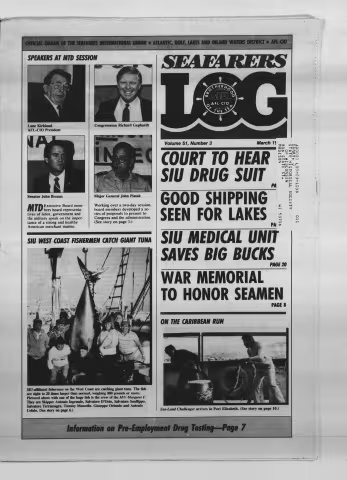
SmUSRS AT urn SESSION
Lane Kirkland
AFL-CIO President
Senator John Breaux
j|||Tf| Executive Board mem-
twi f 1/ bars heard representa
tives of labor, government and
the military speak on the impor
tance of a strong and healthy
American merchant marine.
Congressman Richard Gephardt
Major General John Piatak
Working over a two-day session,
board members developed a se
ries of proposals to present to
Congress and the administration.
(See story on page 3.)
SlU WEST CIMSr HSHERMEN CATOI GUOIT TUNA
SlU-affiliated fisiiennen on the West Coast are catdung giant tuna. The fish
are dght to 20 times iaigor than nmmal, we«|iii^ 800 pounds or more.
Pictured ahove with one d^the hi^ fish is the crew oi the Af/V Afargarvt F.
They are Skq^m* Antonio b^rande, Salvatore D'Orio, Saivatore Sanflqppo,
Saivatore Terram^ra, Tommy Manzdia, GiuseHie Orlando and Antonio
Ce&hi. (See story on page 6.)
SE4E^iRERS
• 'W'ir
(k:4
••'rnk-: rfYjlwfefefe
'J."
-J.-
ki ' • //.
Volume 51, Number 3 March 1i :2CD onoc.
-t>o
COURT TO HEAR
ciooza
</)</) m<o
o-Ha; "• o
SlU DRUG SUIT
•Hco»-<c_r~
mO(/) o
O-H o
•• J..;,
</i2ro I ' .i-
-»{/>?3 O
• >—(I—< OO
M
zn I
'rk
o
OJ
GOOD SHIPPING
</> 00
m
>ir- ^
SEEN FOR LAKES
•-I -<
on
OJ kk'
o
PAlo^
SlU MEDICAL UNIT
SAVES BIG BUCKS
PAGi20
WAR MEMORIAL
TO HONOR SEAMEN
PAGES
ON THE CARIBBEAN RUN
Sea-Land ChaUenger arrives in Port Elizabeth. (See story on page 10.)
, • : - • InhimatioH on
•t''
. FkF
• V-M:
' . ••'•' I-yv',.
-y; f
.J-
t. -k m.
'i,'" *
••', iV's
i '-n
y' "'yy
•' "-F
•TV.' \i,i
yawa'v:;
'• si. • iti.
•':t- ••• • ••••••
-•^.'i•'•••5' •"'• '• V'^v • •^/•' -• .•"'''. •'
'f.
3 .r ' ff
SOFUtmS LOG
President's Repert
/
t was most encouraging to observe the strong expressions of support
for revitalization of the American maritime industry that emerged
from the executive board meeting of the AFL-CIO's Maritime Trades
Department a few weeks ago. The well-attended sessions were informa
tive and productive, with a range of issues being addressed that are of
concern to American workers generally, as well as those of prime
importance to the shipping industry.
Two experienced and exceptionally knowledgeable national figures.
Senator John Breaux (D-La.) and Congressman Richard Gephardt CD-
Mo.), spoke on the issues affecting American well-being and stressed
the importance of an adequate U.S. shipping capability to the national
security. And a new member of the House Merchant Marine Commit
tee, Congressman Frank Pallone, was impressive in relating how he
intended to help inform and educate his constituents to the need for an
effective maritime policy.
Among the many reports and position papers acted on, considerable
interest was shown in a presentation on the legal fight being waged by the
SIU against the government's plan to institute a costly drug testing
program for American seamen. It was made clear that the SIU's principal
interest in attacking the plan in court stemmed from its concern over
invasion of privacy rights of all seafarers. Additionally, the program
discriminates against U.S.-flag ships because foreign seamen sailing ves
sels into American ports are not subject to the provisions in any way.
Besides seafaring and shipbuilding workers, the MTD board members
present represented a broad spectrum of American union members: steel,
automotive, airlines, railroad, government as well as the manufacturing
and service fields.
Since it was first established under charter from the American Federa
tion of Labor in 1946 by Harry Lundeberg, Paul Hall and representatives
of the International Longshoremen's Association, the Federation of Grain
Millers, the Radio Officers Union, and the Masters, Mates and Pilots
Association, the Department has built a fine record of support for the
maritime and the other workers whose unions are affiliated with it.
All signs indicate that the MTD will intensify its commitment to the
interests of its member organizations and the trade union movement
generally.
Tightening-up Process B^n
These are times to tighten up and increase the efficiency of the union
machinery in every way possible. With foreign shipping competition
getting tougher and no sign as yet that our government is conscious of
the plight of the American-flag industry, we've got to sharpen our
ability to wage intelligent efforts to bring about a change.
We've already embarked on a program to do just that, and initial
reports indicate that we're on the right road.
We also have instituted a number of changes in the union's structure
in order to assure that all of our operations and functions are carried
out with maximum efficiency. This has resulted in streamlining of
procedures and in communications throughout the organization. All
these moves are calculated to make this union as responsive as possi
ble to the needs of the membership.
Other changes and improvements will be made as they are deemed
necessary. There are no better union memberships than the SIU's, and
its representatives are determined that the security of Seafarers and
their families are well served.
The Seafarers LOG
Response to the changes in the appearance of the Seafarers LOG
since it appeared in its revised format has been very favorable. The
changes were made to make the stories and other material easier to
read, more attractive and better organized. As with every other facet of
the union's operations, improvement of the LOG will be a continuing
objective.
Support for Eastern Machinists
The SIU has joined the AFL-CIO in support of International Associ
ation of Machinists now on strike against Eastern Air Lines. The strike
is being honored by the pilots and flight attendants. Both the I AM and
ALPA, the pilots' union, are fellow members of the MTD. The machin
ists say this strike is not about wages—at issue is whether management
has the right to dismantle a healthy union company to transfer assets to
a non-union operation. SIU members and representatives are and will
be part of the united union effort to save the jobs of Eastern employees.
SIU SdMusUp h 14: fHe lhw
The deadline for scbolandiips for seafhrers and their children is
April 14. There are seven sdioiarsiiips available. Fm* fkirther informa-
tifMi cwntact the onion hall or write to the Seafarers Welfare Plan,
Schoiarship Program, 5201 Auth Way, Cartip Springs, MD 20246.
The Buffalo (American Steamship), a mid-sized self-unloader, is crewed by SIU
Great Lakes seamen. Vessels like the Buffalo, with their ability to navigate all
kinds of waterways, are the backbone of the Great Lakes fleet.
GOOD YEAR SEEN FOR lAKES JOBS
^ LGONAC . . . Every avail-
iMable piece of SlU-contracted
equipment that could float was
used last year on the Great
Lakes, as Lakes seamen found
their best job opportunities in
five years.
Iron ore, coal and stone ship
ments all showed increases over
1987. The nine SlU-contracted
companies all worked at near
100 percent capacity from July
until mid-December.
Ore shipments totaled almost
68 million tons, up 10 percent
from 1987. Coal shipments were
up 7.3 percent to 40.5 million
tons and stone totaled 27.8 mil
lion tons, a jump of 6.6 percent^
"We expect the same or better
this year," said Algonac Port
Agent Byron Kelley.
He said that any SIU Lakes
member who wanted a job last
year found one.
The Great Lakes season came
to an official close Jan. 17 when
the Sault St. Marie, Mich, locks
were closed. Shipping on the
Lakes usually remains shut
down until early April, when
ships begin to fitout for another
season. But Kelley said some
shipping could resume as soon
as early March, as utilities begin
to stockpile coal.
New Contracts
The 1989 season will be busy
in more ways than one. While
SIU members should be enjoying
Volume 51, Number 3
another year of increased job se
curity, SIU officials will be
working hard on dozens of new
contracts.
The Bob-Lo passenger boats
contract is currently in negotia
tions and all the Great Lakes in
land contracts must be ham
mered out.
In addition, the SIU's Lakes-
wide contract with the Great
Lakes Association of Maritime
Operators is subject to negotia
tion this year. That pact covers
all the jobs on the large Great
Lakes ships.
Earliest Fitout
in 20 Years
The SIU Great Lakes fleet will
begin its earliest fitout in two
decades this month. A few
Lakes ships began their fitouts
March 1. The rest are expected
to be sailing by the end of the
month.
There are predictions that the
1989 sailing season will top last
year's, which was the best sea
son on the Lakes in five years.
Last year any SIU Lakes mem- '
ber who wanted a job, found
work.
The demand for durable goods
has been on the upswing for the
past two years. That demand has
required increased steel produc
tion. The Lakes vessels are the
main form of transportation in
delivering the coal, iron ore and
stone used in the steel making
process.
March 1989
f' he LOG (ISSN 0166-2047) is published monthly by the Seafarers International
Union; Atlantic, Gulf, Lakes and Inland Waters District; AFL-CIO; 5201
Auth Way; Camp Springs, Maryland 20746. Telephone (301) 899-0675.
Second-class postage paid at MSC Prince Georges, Maryland 20790-9998 and
at additional mailing offices. POSTMASTER: Send address changes to the
LOG, 5201 Auth Way; Camp Springs, Maryland 20746.
President, Michael Sacco; Secretary-Treasurer, Joe DiGlorgio; Executive
Vice President, Joe Sacco; Vice lYesident Collective Bargaining, Angus
"Red" Campbell; Vice President Atlantic Coast, Jack Caffey; Vice President
Gulf Coast, Thomas Glidewell; Vice President West Coast, George McCartney;
Vice President Lakes and Inland Waters, John Fay; Vice President Government
Services, Roy Mercer.
Communications Department Director, Jessica Smith; Editor, Charles Svenson;
Managing Editor, Mike Hall; Associate Editors, Max Hall and Deborah
Greene; Design Consultant, Dennis Goris.
-• ,i
MARCH, 1989
Congressman Frank Pallone (D-NJ), a
new member of the House Committee
on Merchant Marine and Fisheries,
says he'll support a strong U.S.-flag
merchant marine.
George Becker, vice president—admin'
istration of the United Steeiworkers of
America, speaks on revitalizing the
American steel industry.
Transportation Communications Union
vice president Jack Otero thanks MTD
executive board members for their sup
port of his election as vice chairman
for voter registration of the Democratic
National Committee.
MTD vice president, and International
Union of Operating Engineers, Local
25 business manager, William F.
Zenga reports on the dreeing indus
try.
MTD URGES PROMPT AOIOM TO ROISTER
AMERICAN-flAG MERCHUIT MARINE
f xpressing concern over the dangerous state of the nation's private maritime industry,
board members of the AFL-CIO Maritime Trades Department (MTD) urged Congress
and the administration to adopt legislation aimed at bolstering the U.S.-flag fleet to protect
the nation's economic and national security interests.
The MTD executive board,
representing 43 national
unions and more than eight.
million workers in maritime and
related fields, heard speakers
from Congress, the military and
labor during the two-day session
held in February prior to the
AFL-CIO's Executive Council
meetings.
Sacco stresses
union
cooperation
With the board acting on is
sues of concern to MTD affili
ates representing manufacturing,
shipbuilding, service, govern
ment and maritime sectors, MTD
President Mike Sacco, who also
heads the SIU, noted that "we
get together to discuss mutual
problems and how we can help
one another, how we can coop
erate as fellow trade unionists."
Lane Kirkland, president of
the AFL-CIO and a former
member of the U.S. merchant
marine, spoke of our national
economic and security interests.
Kirkland said, "A nation of
fewer than 400 merchant vessels
cannot secure its future as a
world trading power. And be
cause more than 90 percent of
men and material needed to sus
tain a war effort would still have
to be carried onboard ships,
such a nation certainly cannot
adequately protect the security
of the free world."
Breaux Wants New Policy
Senator John Breaux (D-La.),
chairman of the Senate Subcom
mittee on the Merchant Marine,
told the MTD executive board
that the time was now to pro
mote and enact a vigorous na
tional maritime policy. The de
fense build-up over the Reagan
years had completely overlooked
the merchant marine and its de
cline must be turned around,
said Breaux.
Addressing the need for fair
trade. Congressman Richard Gep
hardt (D-Mo.) outlined his legis
lative package to promote Ameri
can industry and produce good
paying jobs for American work
ers. "The truth behind the glossy
headlines of low inflation and low
unemployment is that American
workers are suffering through
wage stagnation and wage de
cline. It must be our goal to get
wages up and improve the stan
dard of living for all Americans,"
Gephardt said.
Freshman Congressman Frank
Pallone (D-NJ), a new member
MTD western area executive board member and International Association of
machinists vice president Justin Ostro (left) and Gene Upshaw, president of the
National Football League Players Association, follow the proceedings.
of the House Merchant Marine
and Fisheries Committee,
pledged to educate his electorate
on the importance of a strong
domestic merchant marine as
part of the campaign to rebuild
the U.S.-flag fleet. MTD vice-
president William F. Zenga
thanked Congressman Pallone
for being such a good friend to
the dredging industry.
Further advocacy for a strong
fourth arm of defense came
Transportation Command
(TRANSCOM). General Piatak
told the MTD executive board,
"Defense transportation is es
sential to U.S. national strategy
because it provides a credible
deterrent to war as well as the
safety net for national emergen
cies.
Michael Sacco, MTD president, wel
comes board members.
from Major General John Piatak,
director of Plans and Resources
of the United States Military
General says
transportation
capability essential
for peace
Noting the Bush-Quayle Cam
paign's promise to "restoring the
United States maritime industry
in the interests of economic and
national security," MTD board
members urged immediate
congressional and administration
action to reverse the industry's
backslide.
The MTD executive board
called for:
expanding the Jones Act to in-
continued on page 4
MTD eastern area executive board member and president of the Seafarers
International Union of Canada Roman Gralewicz (r^ht) and Jean Ingrao, MTD execu
tive secretary-treasurer review a policy statement.
/S"
1"'
..
m-
• 1\'- v
J
'-•f.
• '0
'"vK
•M: , •;«:
..•S;
• 'iir -
I": -A:.
••• •
••••'• -'• - 'V''' ' samm m
• r •••
Vf^;
- -WiS: v/'-' 'r">-
liP
-•v!'^S,,:i'' '• -^^
..V ;=' ?>.V[ '
*• -"WJI).!;?
•:\i 'v",
V '• ''>
r- ."'V-.
• ^"v!,
••'iv •'• '•/•-
MID URGES
^CnON ON
u.s.ntn
continued from page 3
dude all work within the na
tion's 200 mile Exclusive Eco
nomic Zone,
• enforcing existing cargo pref
erence laws,
• requiring foreign cruise ships
operating out of U.S. ports to
use domestic crews and to per
form repairs and shipbuilding in
U.S. yards and
• negotiating bilateral access to
cargo movements, reserving a
substantial share of U.S. trade
for U.S.-flag carriers.
tion of the American textile and
steel industries. Board members
also urged that the National La
bor Relations Board once again
becorhe the neutral government
agency which allows for peaceful
resolution of disputes involving
employers and their employees.
The MTD executive board asked
Congress to expand unpaid leave
time for employees with young
families.
Jean Ingrao, MTD executive
secretary-treasurer, provided
board members with a report of
the department's activity over
the past year and announced
changes in the make-up of the
executive board. Ingrao told the
board that they face many chal-
Owen Bieber, president of the United
Automobile Workers, speaks on the
importance of a fair atul neutral Na
tional Labor Relations Board.
A sound energy policy, en
couraging national production for
national consumption was advo
cated by the MTD executive
board. Today domestic oil pro
duction is down and continuing
to fall, the board said, cailling on
Congress and the administration
to extend the export ban on
North Slope Alaska oil, thereby
ensuring domestic oil for U.S.
markets.
The board also urged explora
tion and development of the oil
fields located in the y^rctic Na
tional Wildlife Refuge (ANWR)
in order to meet continuing U.S.
consumption when the North
Slope oil tapers off.
MTD board members called
for legislative initiatives designed
to increase fair trade and protec-
President of National Marine Engi
neers' Beneficial Association C.E.
(Gene) DeFries (left) and Air Line Pi
lots Association president Captain
Henry A. Duffy listen to the speakers.
lenges, particularly in the areas
of trade and protection of work
ers' rights. "Unless the Admin
istration does a complete turna
round, we are going to see new
assaults on the rights of working
people to exercise their rights
and we're going to see a further
expansion of unfair trade prac
tices," she said.
Stanley Brand, former general
counsel of the House of Repre
sentatives, addressed the board
members. Brand is the attorney
in the lawsuit jointly filed by the
SIU and the Transportation In
stitute against the government's
drug testing regulations affecting
maritime workers.'
Brand told the meeting that
through the drug testing regula
tions, government had intruded
into the most private affairs of
working men and women. Brand
said, "The Reagan-Bush admin-
John J. Barry, president of the International Brotherhood of Electrical Workers
(left), Alfred K. Whitehead, president of the International Association of Fire
Fighters and Jacob F. West, president of the International Association of Bridge,
Stmctural and Ornamental Iron Worlurs during the board meeting.
Ray McKay, president of the Marine Engineers Beneficial Association District 2 (left)
with Joe DiGiorgio, Seafarers International Union secretary-treasurer.
of the AFL-CIO's Committee on
Political Education and Robert
McGlotten, director of legislation
spoke on how labor's political
lobbying operation could help
put working people's concerns
back on the top of the legislative
agenda.
International Longshoremen's Associa
tion president John M. Bowers listens
to the NLRB policy statement discus
sion.
istration has run on and pro
moted the idea that government
ought to get off the backs of its
citizens ... this program piits
the government in our bath
rooms—a breach of the Reagan
administration's promise to
lessen government intrusive-
ness."
Julius Isaacson, president of the Inter
national Union of Allied, Novelty and
Production Workers, asks union mem
bers to follow a "Buy American Made
Products" policy.
Julius Isaacson, president of
the International Union of Al
lied, Novelty and Production
Workers called on all MTD ex
ecutive board members to "urge
American sports teams to wear
and use American made prod
ucts."
Thanking board members for
their support of his successful
candidacy for vice chairman of
voter registration for the Demo
cratic National Committee, Jack
Otero, vice-president of the
Transportation Communication
Union, pledged to use his new
position to further the interests
of working people.
AFL-CIO Economic Research
Department Director Rudy Os
wald and Bert Seidman, director
of Occupational Safety, Health
and Social Security, addressed
the delegates on the effects of
eight years of Reagan economic
policies. John Perkins, director
James Hatfield, president of the Glass,
Molders, Pottery, Plastics and Allied
Workers International Union intro
duces MTD statement mourning the
loss of Frank Drozak.
Dr. John Calhoun Wells, pres
ident of the Gray Labor/Manage
ment Institute in Beaumont,
Texas, spoke on the future of
unions and collective bargaining.
"Companies must realize that
unions are partners in growth,
productivity and change. The ad
versarial relationship of the past
must make way for cooperation
between unions and employers
in the future," he said.
Stanley Brand, attorney of the law firm
Brarul ami Lowell, explains why the
shipping industry is united in its oppo
sition to the new drug testing regula
tions.
Addressing the issue of health
and safety concerns on the job,
Donald Elisburg, executive di
rector of the Occupational
Health Legal Rights Foundation,
said unions can play an impor
tant role in helping workers pro
tect themselves before or after
exposure to toxic materials
where they work.
C-\h
''•r'y''>.-.""'^'..>--.v:
•l.'fri •
MARCH, 1989 • ••--- -'•:7fa.-—'j-; '--'J-">^t;;'!.;•-:;,_i^l-V:'A---rs
SUNUWARY OF MTD ACTIONS
Franis Drozafc
Mourned the loss of a friend and
leader. Frank Drozak, who
served as MTD president until
his death in 1988, provided
steadfast leadership during the
maritime industry's darkest and
most difficult years.
A Maritime Policy
Urged the administration and
Congress to commence immedi
ately the task of developing pro
grams that will bring about ex
pansion for all segments of the
industry. Expressed willingness
to develop a broad coalition nec
essary to secure adoption of a
beneficial maritime policy.
Commitment to the Jones Act
Urged that the Jones Act be ,
strengthened and extended to re
alize a U.S.-flag fleet capable of
serving the nation's defense and
economic interests. Waivers and
other attacks to weaken the Act
were condemned. The Jones Act
should be broadened to include
all work completed within the
United States Exclusive Eco
nomic Zone.
Cargo Preference Enforcement
Called upon Congress to under
take steps which will bring about
maximum U.S.-flag participation
in existing cargo reservation pro
grams. Ui^ed increasing the
law's scope to include 5ll goods
moved by or at the government's
request.
Foreign-Flag Cruise Ships
Called for enactment of legisla
tion that will place the American
cruise industry on an equal com
petitive level with its foreign
competition. The government
must assist in the development
of a healthy U.S.-flag industry in
the United States, particularly to
meet troop transport capabilities
in the event of a nation^ defense
emergency.
Export Ban on Alaska Oil
Recognizing the benefits of a
plentiful domestic supply of oil,
the board called for extension of
export restrictions covering
crude oil produced in Alaska's
North Sytope.
DCyeldpinem of Oil In ANWR
Urged exploration and develop
ment of oil reserves contained in
a small portion of the Arctic Na
tional Wildlife Refuge (ANWR).
By extending the export ban on
North Slope oil and by develop
ing ANWR oil, the United States
sends a clear message to OPEC
that the 1970 shortages will not
be relived.
Great Lakes Developniimt
Federal funding and an acceler
ated construction schedule was
urged for the building of a new
1,000-foot Soo lock. Asked for
immediate authorization and
funding for dredging of the St.
Mary's River connecting Lake
Superior with Lake Huron.
Maritime Out of GATT Talks
The General Agreement on Tar
iffs and Trade (GATT) has in
cluded maritime services on its
agenda. Reiterated its opposition
to maritime being part of GATT
approved international regula
tions, citing the danger inclusion
in the talks would pose to sub
sidy programs, loan guarantees,
cargo reservation and cabotage
laws.
MSC Procurement Policies
Called for congressional and
administration examination MSC
procurement procedures which
focus exclusively on obtaining
the lowest possible cost without
any consideration of the impact
that depressed charter hire rates
have on the maritime industry.
Government must develop mu
tually beneficial policies between
MSC and the industry in order
to further our national defense.
National Labor Relations Board
Called upon the administration
to appoint individuals to the
NLRB who will act in a fair and
neutral manner in order that
worklrs rights to join a union,
bargain and strike are restored
and onCe again protected.
Robert McGlotten, Director John Perkins, Director
Cfunniittee on Piditical Educ^ Department of LegMation -
rracing the disastrous policies of the Reagan Administration, AFL-•• • • •• • • •••••• •••••' • CIO department directors outline a program to turn the country
mxiUhd
Voluntary Restraint Agreements
(VRA's) for Steel
MTD PHOTO ROUNDUP
Supported a five-year extension
of VRA's which require 29 na-;
tions to hold their steel exports
to a negotiated percentage of our
domestic consumption. Called
for enactment of legislation to
assist the steel industry in its ef
forts to modernize and retrain
laid-off workers.
Minimum Vif^ Inc^
Expressed outrage that the mini
mum wage of $3.35 an hour has
not increased since 1981, when
over the past eight years it has
lost 30 percent of its real value;
Called for expeditious enactment
of legislation to restore the na
tional minimum wage to a level
of dignity for all minimum wage
earners.
Protecting Domestic Textiles
Recognizing the threat of in
creased foreign import penetra
tion in the domestic textile trade,
the board called upon Congress
and the administration to COOJJ-
erate fully to develop a legisla
tive package providing relief to
the American textile and apparel
industry.
Social S^urity and Medicare
All social security and medicare
commitments should be fe-
spected by Congress. Opposed
any efforts to tax social security
benefits or abolish cost-of-living
adjustments. Medicare should be
expanded to cover long-term cat
astrophic health care expenses.
Congress was urged to pass leg
islation prohibiting physicians
from charging Medicare patients
far in excess of Medicare-ap
proved rates.
CoiUit^d on page 9
Frank Lonardo (left). President of Local 1814 International Longshoremen's
Association, Teddy Gleason, president emeritus of the.lLA, Ed Panerello, secrer
tary-treasurer of the Maritime Port Council of Greater New Tork and Vicinity,
Ed Turner, executive vice president emeritus of the SlU and Gilbert Gauthier,
president of the Canadian Marine Officers Union.
Lenore Miller, president of the Retail,
Wholesale Department Store Union.
Joe Sacco, executive vice president of
the SlU. • \
r
Page Groton (left), vice president of the International Brotherhood of Boilermak
ers, Iron Ship Builders, Blacksmiths, Forgers and Helpers, Bernard Puchalski,
president of the Greater Chicago and Vicinity Port Council and Dominic Came-
vale, administrative assistant to the president of the United Association of the
Plumbing attd P^ Fitting Industry of the United States and Canada.
Continued on page 9
I, : •
' : i
•S;
• 4- •
''
. V , . ,.r.
MM'S
' J', '•
1
3 -
•l •
•I
v' ' • - u
#yv-;'
X®' •- -•'
'fi „,'
"Jj- - • .
I'i." 'v: •'"'®
iW!0
ff' y- '' '•• '") •; .;•••'•' •
y- k-." • • • ^
^r.; • • •
U?'- ^ ••
il '-•-T,
1'^ ®'--
SOfARERS 106
S/[/ Wfsr COAST FISHERIAEN
CATCH RECORD TUNA
SIUNA fishermen of San Pedro
have closed out one of the
best fishing years in a long time,
thanks to the giant tuna.
After a lull of many years, the
giant tuna suddenly appeared
and no one seems to be able to
explain the cause of this phe
nomenon. The giant tuna, which
are eight to 20 times larger than
those normally caught in these
waters and weighing 800 pounds
and more, enabled the San Pedro
fishermen to enjoy a dramatic in
crease in wages.
The San Pedro fishermen are
members of the Seafarers Inter
national Union of North America
affiliated Fishermen's Union of
America. The Fishermen's
Union represents fishermen of
San Diego and Monterey as well
as those in San Pedro. The union
was the result of a merger in
1975 of three SIUNA west coast
fishing unions including the
Seine and Line Fishermen of
Monterey, an original 1938 affili
ate of the international union.
Terry Hoinsky, president of
the Fishermen's Union, says the
union is concerned with the
problem arising out of the liabil
ity insurance crisis which is crip
pling the industry. She said the
union is exploring several possi
ble methods for bringing about
reduction in high premium costs
which are discouraging boat
owners in the industry.
Hoinsky, who is a vice presi
dent and executive board mem
ber of the SIUNA, reports that
the union has restructured its
three ports to improve member
ship services and is conducting
an organizing drive among non
union boats in San Pedro.
The Fishermen's Union, says
Hoinsky, has also upgraded the
death benefit paid to members in
the San Diego region, bringing
its level to parity with Monterey
and San Diego fishermen.
Terry Hoinsky (right), president of the
SWNA-affiliated Fishermen's Union
of America, with Augistine Felando, •
President of American Tunaboat Own
ers, at a fisheries conference in Wash
ington, D.C.
asKRN's m KuuuGmm
nmm macHiNisTS STRIKI
PILOTS REFUSE TO CROSS
PICKET LINES
jit 12:01 am, Saturday, March
/14 Eastern Air Lines mechan
ics and ramp operators repre
sented by the International As
sociation of Machinists went on
strike. Eastern pilots, members
of the Air Line Pilots Associa
tion, and flight attendents from
the Transport Workers Union re
fused to cross the picket line,
forcing Eastern to halt opera
tions. The SIU quickly demon
strated its support by helping to
man picket lines at Eastern
hubs.
The Machinists union has
done everything in its power to
avoid the current strike. In 16
months of bargaining. Eastern
management refused to move
from its initial wage reduction
demands. The. union agreed to
binding arbitration which would
have meant continual negotia
tions until an agreement was
reached. In addition, the union
has solicited President Bush to
call a Presidential Emergency
Board to make recommendations
leading towards a settlement.
Action by President Bush would
stop the strike. Eastern, on the
other hand, refused to agree to
binding arbitration and asked the
President not to get involved.
SIU member Captain ton Flade talks with Eastern pilot and SIU seaman
Charles Collins walks with a striking machinist at PhUadelphia's airport.
The Seafarers'' lAig
Ofik-iol Otgea ci ih« AtUntk- mud GaU SMa.«t>
Itthi/niihoaa! Unkm Nuttb Am<*ru*«
new rtNiK. 1.raniit. »«•»
8ROTHKBHOOD
OF THR
81»
>. t.
SHOP MOVE BLOCKED
LurnmllaDK
Action By r
Bank & File :
Trr Tu Sii
SM: Mrti Off Vatraiii lfa»Rnii
Al P,wi i.f Nr« )i,wk
( W T« '
Mi::( urr«i« noi«KTi
Igniter Fire ^ ij! AM. eiwMw
MWWIH IWHN-Nl. Ifcn ' , .
{•rkibw r« •=* • ** '
kmrt. . -ri,
'Ar.- U ^ •
IIW1WI.T K «>»k 11..\. ^onrt'vvMiii kw:
lAyplI tlirh fm
FmU !sKi|eht m- «• '
"
The Seafarers LOG first appeared on February 10,1939 and has been continually
publishing for fifty years. The front page of the first issue shown above generally
reflected the SlU's intense organizing activities and its battles against communist
efforts to control U.S. waterfront unions. After the union was founded on October
15, 1938, and urttil the LOG commenced publication the following February, union
members were informed and served through hundreds of bulletins.
IRVING BROWN DIES: LED EIGHT AGAINST
COmiES IN POST-WAR EUROPE
/
RVING Brown, whose anti-
communist activities in post
war Europe made him a legend
ary figure in the free trade union
movement, died in Paris at the
age of 77.
The son of a representative of
the International Brotherhood of
Teamsters, Brown was bom in
New York. After graduating
from college in 1932, he became
an organizer for the United Au
tomobile Workers, becoming a
national organizer for the AFL
in 1940. In 1942 Brown was ap
pointed as a labor representative
to the War Production Board.
Brown's major contribution
occurred in the 1950s and 1960s
when he set up and led cam
paigns to prevent communist
takeovers of European and inter
national labor organizations.
Brown's efforts helped rebuild
democratic unions in post-war
Europe.
During the post-war recon
struction effort when the United
States was delivering Marshall
Plan aid cargoes to the democra
cies, communist-controlled
unions attempted to block deliv
ery from the ships at the water
front.
Brown set up headquarters in
Brussels from where he orga
nized committees of dock and
other maritime workers to fight
the Communist Party calls seek
ing to block the American aid
program. In that period the
World Federation of Trade
Unions was controlled by com
munist-led national labor bodies.
In 1949 Brown helped create the
International Confederation of
Free Trade Unions which broke
Irving Brown
away from the communist-con
trolled body.
It was during this time that
Paul Hall and other representa
tives of the SIU developed a re
lationship with Brown. At the
time, the SIU of Canada was en
gaged in a bitter battle to break
communist control over Cana
dian seamen and shipping.
Brown was executive director
of the African American Labor
Center from 1965 until 1973,
when he returned to Paris to
head the AFL-CIO's European
office. He became director of in
ternational affairs for the AFL-
CIO in 1982.
MARCH, 1989
Pre-employment drug testing
will go into effect June 21,
1989, unless the SIU and Trans
portation Institute's jointly filed
lawsuit halts the government's
action.
Because the outcome of the
lawsuit is unknown and subject
to appeal to a higher court, the
SIU is currently taking all neces
sary steps to protect the individ
ual member's employment rights
during the drug testing procedure
required by the regulations.
Therefore, until there is a rul
ing that the regulations are in
valid, all maritime workers, in
cluding SIU members, must
comply with the drug testing
rules if they are to be employed
on U.S.-flag commercial vessels,
deep-sea. Great Lakes and in
land waters.
What follows are questions
and answers on the procedure
for pre-employment drug testing
required by Final Rule: COD 86-
067, issued Nov. 21, 1988 by the
Department of Transportation,
United States Coast Guard and
which went into effect Dec. 21,
1988.
try personnel will affect an
estimated 120,000 maritime
workers serving on all types of
commercial vessels.
01 When did the pre-employ-
• ment drug testing regula
tions go into effect?
Q. Who is affected by the regu
lations?
^All individuals employed
/lupon U.S.-flag commercial
vessels are affected by the regu
lations. This means licensed and
unlicensed alike. The Depart
ment of Transportation reported
in its introduction to the regula
tions that the drug testing provi
sions governing maritime indus-
M The regulations went into
#•• effect Dec. 21, 1988. The
regulations stated that pre-em
ployment drug testing was to be
put into operation by June 21,
1989. As a result, by June 21,
1989 operators will only be able
to crew vessels with individuals
who have complied with the
drug testing procedures and
whose tests are negative.
ing in the hiring hall must show
proof of a negative drug test re
sult along with the other re
quired documents. Thus, every
seaman who will be sailing after
June 21, 1989 will be in compli
ance with the regulations.
0. What will the pre-employ
ment drug tests analyze?
O Hcw will the 90 day regis-
• tration and shipping system
be affected by the drug regula
tions?
M Since drug clearance is now
nm required by the government
as a condition of employment for
maritime workers on U.S.-flag
vessels, the individual shipping
through the hiring hall must, by
federal regulation, show proof of
a negative drug test result. The
drug test must be taken in ac
cordance with the procedures
outlined in the regulations.
Because of the SIU's 90 day
system of registration and ship
ping, drug testing for SIU mem
bers will become effective tenta
tively the first week of April. On
that date, an individual register-
M The regulations ask the drug
M testing laboratory to test for
appearance in the urine speci
men of the following substances:
• Marijuana,
• Cocaine,
• Opiates,
• Phencyclidine (PGP) and
• Amphetimines.
0 Beginning tentatively the
• first week of April how does
a SIU deepsea seaman take a
drug test?
M Seafarers Welfare Plan Clin-
nm ics and contracted physi
cians will serve as collection
sites for urine specimens. An
SIU member can go to the clinic
or contracted physician to pro
vide a urine specimen for the
laboratory.
The SWP clinic will not exam
ine the sample. The clinic will
simply function as a collection
site, insuring that a member's
rights are protected during the
collection process.
What will the clinic do with
»the individual's specimen?
QWhat wUi happen to the ur-,
• ine specimen at the labora
tory?
M The specimen will be sub-
Mo mitted to an initial testing.
If the result is positive, the spec
imen will go, through a confirma
tory testing.
0. What will the laboratory do
with the drug test results?
M The results of the drug tests
#•# will be sent by the labora
tory to the Medical Review Offi
cer (MRO). The MRO will re
view all results.
Q. After taking the test, what
should the seaman do next?
SIU SUIT AGAINST DRUG TESTING NEARS HEARING
7he United States District
Court is expected to consider
the SIU's charge that the current
drug testing regulations are un
constitutional within the next
couple of months. By filing a
motion for summary judgement
with the court on Feb. 28, the
SIU is keeping the case on a le
gal fast track. The government is
expected to respond to the SIU's
action around March 10. The
Union anticipates a court hearing
date in April. After the court
considers the case, a final deci
sion will be issued.
When the United States Coast
Guard, a federal agency in the
Department of Transportation,
introduced sweeping drug testing
regulations for the maritime in
dustry on Nov. 21, 1988, the
SIU and the Transportation In
stitute joined in instituting a suit
in federal court to set aside the
government-forced procedures.
Nonetheless, the Coast Guard's
regulations went into effect on
Dec. 21, 1988.
The SIU maintains that the
drug testing regulations trample
on fundamental individual con
stitutional rights. By allowing
unwarranted searches and sei
zures, the fourth amendment is
violated. The drug testing law
also disregards the fifth amend
ment protection of an individu
al's privacy, the Union charges.
Representing U.S.-flag compa
nies engaged in foreign and do
mestic shipping, the Transporta
tion Institute charges the Coast
Foreign-Flag Ships
Not Covered
Guard with unnecessarily bur
dening the U.S.-flag operator
with the cost of implementing
the drug testing program while
allowing foreign-flag vessels, not
covered by the regulations, to
get away scott free. The costs of
implementing the drug testing
regulations must be entirely
borne by U.S.-flag operators,
and are variously estimated from
64 million to 150 million dollars
annually.
The lawsuit also says the
Coast Guard rule "enlists private
employers as unwilling foot sol
diers required at their own ex
pense to violate their own em
ployees' rights."
The Coast Guard, in issuing
the regulations, admitted that the
agency could not "specifically
identify the use of drugs or alco
hol as a major causal effect in
commercial vessel losses or cas
ualty damage." Yet the Coast
Guard contended that it "is rea
sonable to assume that because
there is a drug problem in soci
ety, there is also a potential drug
problem in the merchant ma
rine." The Coast Guard to date
has failed to provide any statisti
cal evidence of high drug usage
in the maritime industry.
Prior to issuing any drug test
ing regulations affecting maritime
workers, the Department of
Transportation had promulgated
drug testing procedures for land
and air transportation workers.
Legal battles involving these reg
ulations have focused on random
testing.
In a trucking case, the federal
district judge issued an injunc
tion against random testing, stat
ing that the regulations "lack the
requisite element of individual
ized suspicion." The judge also
pointed out that the trucking
drug testing regulations "are not
supported by particularized relia
ble findings about rampant drug
use."
Compared to the drug testing
regulations affecting land and air
transportation workers, the rule
covering the maritime industry is
far more extensive. Testing of
employees in other transporta
tion sectors was limited to safety
and security related personnel,
while in maritime the regulation
is directed at "all individuals en
gaged onboard a vessel."
The Nov. 21, 1988 drug testing
regulations affecting all seamen
employed on U.S.-flag commer
cial vessels were brought about
as part of the Reagan administra
tion's symbolic "war on drugs."
Congess, however, in its Omni
bus Drug Initiative Act of 1988,
specifically refrained from au
thorizing drug testing for safety-
sensitive transportation workers.
The SIU does not oppose drug
testing when handled as part of
the collective bargaining process
where an individual member's
rights can be protected. The
Seafarers Addictions Rehabili
tation Center has been dealing
effectively with substance abuse
problems without forsaking an
individual's constitutional rights.
wm
INFORMATION ON PRE-EMnOYMENT DRUG TESNNG
M Once the specimen is taken
M* at the clinic, the specimen
will be sent to the drug testing
laboratory.
The drug testing laboratory
must be certified by the Depart
ment of Health and Human
Services (DHHS). DHHS, in
turn, is working with the Na
tional Institute on Drug Abuse
(NIDA). A laboratory only ob
tains DHHS certification if it
meets the highest standards and
has a track record which in
cludes no errors in testing re
sults.
Continued on page 8
i'ta, I'—
.• , ^ ,1
>
-It' •
' y..
.jj-
Jf;
•••1
'.J • , • •, - ' .;•(!
.'v1
••'•J
;r
-••t.
8
S^iStSy''^
SOFARERS LOG
MEMORUU 7D HONOR SEUREN LOST IN US. WARS
4 prototype of a new memorial
which will honor merchant
seamen who lost their lives in
the defense of their nation was
unveiled at a luncheon in Man
hattan last month. The memor
ial, which was largely funded
through donations by merchant
seamen and private organiza
tions, is scheduled for comple
tion in 1990.
Like the much-publicized
Vietnam War Veterans Memorial
in Washington, D.C., this me
morial is. intended to correct an
historical oversight. Forty-four
years after the end of World War
II and 213 years after the found
ing of this nation, there is no
marker to dignify the burial site
of those merchant seamen who
lost their lives at sea.
In every war since the incep
tion of this nation, merchant
mariners have been in the fore
front of the fight to preserve
American liberty. In the War of
Independence, for example, this
nation had no Navy: private
merchant vessels added greatly
to the war effort by engaging the
British fleet at sea.
The War of 1812 was fought
over one issue: the impressment
of American seamen by British
warships. The private merchant
fleet was so important to the
economic well-being of the new
nation that Americans went to
war to defend the concept of
freedom of the seas.
In recent times, thousands of
American seamen lost their lives
at sea while manning America's
"bridge of ships," which Win-
Pictured above is an artist's rendition of the war memorial, which honors merchant mariners who died while
defending their country. Ail American seamen who gave their lives, from the War of Independence to modem
times, are honored.
ston Churchill said turned the
tide for the Allies in World War
II. But the contributions of those
brave men and women were
never properly recognized: for
43 years after the war, American
seamen were denied veterans'
status.
The new monument will be lo
cated at the southern tip of Man
hattan, south of Pier A, a city-
owned Victorian landmark build
ing on the breakwater extension.
The Pier A breakwater was con
structed nearly 90 years ago and
provided a safe landing for the
Ellis Island immigrants being fer
ried over to the isle of Manhat
tan.
The design for the new me
morial is a result of a competi
tion held by the Battery Park
City Authority. The winner,
Marisol Escobar, was chosen out
of a field of more than 200 con
testants.
Escobar's winning design re
creates a moving scene depicting
four figures of surviving mariners
whose ships were lost; one of
the seamen is being saved from
the sea by a shipmate. The ship
will be made of stainless steel.
AFL-CIO President Lane
Kirkland, a former officer in the
U.S.-flag merchant marine,
spoke at the luncheon. SIU Vice
President Jack CaflFey repre
sented the SIU.
PRE-IMPIOYMENT DRUG nSnNG QUlSnONS AND ANSWERS
continued from page 7 .
4 From the date the test is
• taken, within three to seven
working days, the seaman can
pick up a card from the SWP
clinic or contracted physician
which will serve as proof of the
individual's negative drug test
result. The card will indicate the
seaman is in compliance with Fi
nal Rule: CCD 86-067. The MRO
will have provided the clinic or
designated physician with in
structions on which individuals
should receive the card.
The card can then be submit
ted, along with all other docu
ments required by law and the
shipping rules, at the time of
registration at the hall.
a How long is the clearance
'• card good for?
A The clearance card, indicat-
/!• ing the seaman is in compli
ance with Final Rule: CCD 86-
067, is good for a six-month pe
riod.
confirmatory tests. Each individ
ual who tests positive has the
right to speak with the MRO by
telephone to discuss the test re
sult. The MRO will personally
call the individual. It is very im
portant that individuals filling
out the drug test form include
their phone numbers. During the
telephone discussion with the
MRO, the individual can explain
any medical circumstances
which may have caused a posi
tive result. After the discussion,
the MRO will make a decision as
to the accuracy of the test result.
Only the MRO makes this deci
sion. Neither the Union or the
employer is involved in the re
view of additional medical evi
dence or deciding whether the
result is correct.
OWhat does the employer do
• with the confirmed positive
drug test?
4 The employer is required by
• the regulation to report the
results in writing to the nearest
Coast Guard Office in Charge,
Marine Inspection (OCMI). The
individual who tested positive
shall be denied employment as a
crewmember or removed from
duties which directly affect the
safety of the vessel's navigation
or operations as soon as practic
able and shall be subject to sus
pension and revocation proceed
ings against his or her license,
certificate of registry or mer
chant mariner's document.
Q. What does the MRO do with
a positive result?
M The drug testing regulations
.nm reqiiire that a Medical Re
view Officer evaluate all positive
Olf the confirmatory test is
• positive after MRO evalua
tion, what does the MRO do?
M The MRO is required by the
regulation to report the pos
itive test result to the employer
or the employer's designated
agent.
01 If a seaman, boatman or
• dredgeman tests positive,
how can he or she be reemployed
on a U.S.-flag commercial vessel?
M An individual who has
Jnw tested positive may not be
reemployed aboard a vessel until
the Medical Review Officer de
termines that the individual is
drug free and that the risk of
subsequent use of drugs by that
person is sufficiently low to jus
tify his or her return to work. In
addition, the individual must
agree to be subject to increased,
unannounced testing for a period
determined by the MRO of up to
sixty (60) months.
Off an individual is interested
• in rehabilitation programs,
who should be contacted?
M The Seafarers Harry Lunde-
nw berg School of Seamanship
Addictions Rehabilitation Center
(ARC) offers programs for sub
stance abusers who no longer
want to be dependent on drugs
or alcohol. To apply for ARC,
contact your Union hall or write
to SHLSS Addictions Rehabili
tation Center, Piney Point,
Maryland 20674. In addition, re
habilitation programs are offered
in many local communities.
What about other kinds of
• drug testing?
M The regulations require pre-
nw employment testing to be in
place by June 21, 1989. The
other forms of drug testing re
quired by the regulations—ran
dom, periodic, reasotiable-cause
and post-casualty (which also in
cludes testing for alcohol use)—
are to be implemented by Dec.
21, 1989.
0
'^•fl
MUlCHr 1989
MID SiSSION PHOrO ROUND-UP
continued from page 5
Laundry and Dry Ckaning Interna
tional Union president Frank Ervolino,
who also serves as secretary-treasurer
of die Buffalo Port Maritime Council,
reads MTD's CATT statement.
U
International Chemical Workers Union
president Frank Martino lists MTD's
energy policy priorities.
Dr. John Calhoun Wells (left), president of the John Gray Institute of Beaumont
Texas, Larry Jackson, secretary-treasurer of the American Federation of Grain
Millers and Donald Etisburg, adnunistrator of the Occupational Health and
Legal Rights Foundation.
Vice president emeritus of the Americ&n Federation of Grain Millers Peter
Rybka, Mel Pelfry (left), president of the Toledo Port Maritime Council and Richard
Mantia, president of the Greater St. Louis Area and Vicinity Port Council.
Vice president of the United Food and
Commercial Workers Union, Doug
Dority.
United Industrial Workers national di
rector Steve Edney asks a question on
the new drug testing regulations.
SUMMARY Of MTD ACTIONS
continued from page 5
of modern American families,
such as a congressional proposal
for a national leave policy pro
viding job-protected, unpaid time
off to meet parental responsibil
ities and health conditions.
Marine Emissions
Called for an amendment to the
Clean Air Act to establish uni
form national standards for ma
rine emissions.
Jaimn Air Lines
Japan Air Lines (JAL) was
blasted for violating the rights of
employees who work in Chica
go's Nikko Hotel, a JAL-owned
operation. Vowed to bring pres
sure on JAL through contact
with U.S. representatives en
gaged in trade negotiations with
Japan.
Staten IiMand Navy Base
Adopted the Maritime Port
Council of New York's resolu
tion to support the Navy's new
surface action group base at Sta-
pleton, Staten Island.
FamUy and Medical Leave
/Supported legislation which ^-
dresses the heeds and aspirations
Occupational pishases
Legislation which promotes early
detection and treatment of occu
pational diseases should be en
acted by Congress.
Maritime and National
Defense Report
A detailed analysis of the mari
time industry's critical rule in se
curing a strong national defense
was released at the MTD meet
ing. The report cited the contri
bution seagoing personnel, ship
builders, longshoremen and
industrial workers would make
in the event of a national emer
gency.
lytl' 9
Letters to the Editor
To the Editor:
I need you to do me a big
favor.
A fellow SIU deepsea member
and very good friend of mine,
Dan Bradley, passed away this
summer in August.
Everywhere Dan went he
made friends. Dan sailed on both
the east coast and west coast
and made friends in both places.
Dan was liked and loved by
everyone who had the pleasure
of knowing him.
Dan left behind a beautiful
wife and beautiful baby girl,
three months old at the time of
his departure.
So Dan, may your body and
soul rest in peace.
You will be missed by a lot of
people, your wife especially and
me. We love you and we will all
miss you.
Fair sailing on that big ocean
in the sky.
John C. Cox
Book C-1779
Los Angeles, CA
Editor's Note: The family of the
late brother Daniel Bradley III
has asked the LOG that any of
his old shipmates who wish to
call and talk about Dan to con
tact the family at 301/725-4699.
Brother Bradley died in a
traffic accident August 13, 1988.
He was 30 years old.
He was born in Washington,
D.C. and grew up in Laurel,
MD. He graduated from the
Harry Lundeberg School of Sea
manship and he made many
friends among his union brothers
during his sailing years.
Surviving are his wife, the for
mer Nancy Corbitt, and a daugh
ter, Alaina Clarke Bradley, both
of Hampstead, MD, his parents,
Muriel and Daniel Bradley, Jr.,
and a brother, Andrew, all of
Laurel, MD, two sisters, Lydia
Umlandt of Sevema Park, MD
and Sheila Geist of Laurel, MD,
and a grandfather. Mason E.
Wallace, Sr. of Silver Spring,
Md.
Dan Bradley III and his wife Nancy at the wheel of the family sailboat on the
Chesapeake Bay.
SIU Scholarship Deadline is April 14
Apply New
The application
deadline for scholar
ships for seafarers and
their families is April
14. Four scholarships
of $10,000 each are of
fered to dependents.
One $10,000 and two
$5,000 scholarships will
be awarded to union
members. Scholarship
awardees will be an
nounced in May. To
receive information on
eligibility requirements
call 301/899-0675 or
write Seafarers Welfare
Plan Scholarships, 5201
Auth Way, Camp
Springs, Maryland
20746.
: •T-:'-.; -
\ '
fv •; -
fc?':- • ^K".'. w
ON THE NEW YORK- rhe Sea-Land Challenger is one of several Lancer class vessels
!
CARIBBEAN RUN
Sea-Land acquired from the bankrupt U.S. Lines three
years ago.
The Challenger recently finished one of its regular runs, San
Juan, P.R. to Rio Hana, Dominican Republic to Jacksonville
to Port Elizabeth. SlU Patrolman Kermett Mangram met the
crew for a payoff, where these pictures were taken.
- ?rv,, •
'-^giyysyigSI
, ; •••' """
J- t y '' ' •'
Vy,. :
AB Tuck Beutz has been goii^ to sea
for 36 years. The deck delegate on the
Challenger nudtes sure the gai^wi^ is
secured.
't •- . ^ < 'J A' , - < .'J , Jt •.yi-'
^siSiss:
With more Bum 70 years of exj^rience
•4[|| tunong them, the ChaUenger's steward
department knows how to keep a crew
well-fed. They are (i. to r.) Chief
Steward George Gibbons, Chief Cook
Darryl Goggins and Steward Assistant
I ^Jose Santiago.
W
».
isa
iSS-Sft-'J
' . f
.'Vyy,.'•
m0m
iilS^ ^:yas
DEV Jose Rodr^uezgets ready to
throw a heaving line. Rodriguez has k ,
been saUing for 28 years. ^
i.- :
•r :-kX Vy:gIfys•:'^yy:,"-yy'^y' • ;•••••
•; a'.yy^
Ohfl/ Ralph Gonzalez takes rea^ngs
in the et^me room. The San Juan
redderU has been going to sea for nine
'y'Bm
•:-yy€iykk:^¥hyyy-
. -'.. ~-rs ^ , ,t •
years.
kIMkM
OEVEIaMo Cruz checks steam and ml
vtOres. A ship*s deles^, the New
Yorker has been sailing for 14 years.
1 f
'1
• "- y i-i'.-':"
va-v'''V;-,-r;li'5'S
, AS-.S'-J
-* ;! S : ,
OMU James Sieger, a 15-year deej^ea
veteran, cheeks a fuel oU straiiur in
the Challenger's ermine room.
Jose Santiago, AB Tuck Bentz, New Ymk Patrvhnan Kermett Mai^frath, Basun
Roy Williams and DEV Ehdio Cruz.
--yy-v'
Xy- -'/i
- --
::':'^'''^§f0r :•
SlU Representative
I' ^
|.
y:J.-'
r'v •'•••,
•5i'- ^
•»S--
•-Si* ^
f® < '
4 ' , , , •
-^V •- /ho crew's lounge^ Tksy^ ^
K=»53»«l"r"
While Chief Cook Frank
• ': .r:«-.:»SK:-",:
K.'SSirS-
— a. men VaSty (I-lo'•> ̂ '*
•^''•':.':i:Sffe';;P^;tS''''v^r''VS 'i
-'}} •
. V.<? •
m
:.#if'5.
1
•any fcaadabaig Sdwal at Seammalilii
SnWARDS GRADlUn ADVANCED CUSS
ren SIU members successfully
completed the Stewards Re-
certification Course held from
January 31 to March 3 at the un
ion's school in Piney Point. The
graduates now join the top-of-the-
line ranks of union stewards.
The stewards completed
classes which will enhance their
computer and typing skills. The
group learned new techniques
for menu planning, portion con
trol and food costs. Microbiol
ogy and sanitation classes were
also part of the course curricu
lum. Ice carving, a culinary art
form, was taught by Executive
Chef Romeo Lupinacci.
Union education was a top
priority for the stewards through
meetings with representatives of
the various plans, the contract
department the political depart
ment and the LOG, stewards had
an opportunity to ask questions
and learn more about their union.
The stewards also visited Cap
itol Hill, to track legislation vi
tally important to the SIU and
the maritime industry. The trip
included a tour of the Capitol
building and an explanation of
the legislative process.
Executive Chef Lupinacci said
of the group, "They have been
an excellent class. They are pre
pared to put out an excellent
meal while running an efficient,
cost-conscious operation.
The recertified stewards are
skilled at menu planning and
portion control, an important
part of a modem-day steward's
duties, Lupinacci said.
Recert^ed stewards (first row, left to right) Roderick Br^ht, Janet Price, Cyril
Spence, Jr., Romeo Lupinacci (executive chef), (second row) Joseph P. Emidy,
Pedro SeUan, Peter Schulz, (third row) Nathaniel Thomas, John A. Pratt,
Jimmie Russell, D.A. Brown, Robert L. Scott, Sr.
Recert^ed stewards brave wind and rain to learn the art of ice carving from
executive chef Romeo Lupinacci.
Stewards try their hand at ice carving.
UFCBOkT OASS COMPUnS COURSE COOK AND BAKER
GRADUATE
Chris FarreU(left), Dave Cameron ami Ralph Alexander completed the tough lifeboat
course tai^ht by instructor Ben Cusic. The course, which lasts two weeks, can
be particularly difficult during the late winter months which can be very cold and
wet in Piruy Point. At least three hours each day are spent outdoors in the
Iceboats doing practical exercises such as rowinglcoxwain training, and davit
operations.
Shane Preston, a graduate of the Cook
and Baker course at SHLSS, proudly
Splays the cake he decorated for the
Graduatii^ Trainee Class #434. Cook
and Baker instructor Bill Seiden-
Strieker, invites his advanced students
to create a specially decorated cake as
an extra credit project which is added
to the studerOs' final grade. The cake
decorating project allows the student to
exercise both his creativity and profes
sional expertise.
S0§hren itttemationa/
Union Directory
Mfchael Sacco, President
Joseph Sacco, Executive Vice
President
Joe DiGiorgio, Secretary-Treasurer
Angus "Red" Campbell,
Vice President of Contracts
Jack Calfey, Vice President
Thomas Glidewell, Vice President
Cieorge McCartney, Vice President
John Fay, Vice President
Roy A Mercer, Vice President
StsvcEAmy, Vice President
HEADQUARTERS
5201 Auth Way
Camp Springs, MD 20746
(301)899-0675
®SlliSSvi
iiig'
ALGONAC
520 St. Clair River Dr.
Algonac, Ml 48001
(313)794-4988
BALTIMORE
1216 E. Baltimore St.
Baltimore, MD 21202
(301)327-4900
DULUTH
705 Medical Arts Building
Duluth, MN 55802
(218)722-4110
HONOLULU
636 Cooke St.
Honolulu, HI 96813
(808)523-5434
HOUSTON
1221 Pierce St.
Houston, TX 77002
(713)659-5152
JACKSONVILLE
3315 Liberty St.
Jacksonville, PL 32206
(904)353-0987
JERSEYCITV
99 Montgomery St.
Jersey City, NJ 07302
(201) 435-9424 p
MOBILE •
1640 Dauphin Island Pkwy.
Mobile, AL 36605
(205) 478-0916
NEW BEDFORD
50 Union St. ^
New Bedford, MA 02740
; (508)997-5404
-'mm.
:
NEW ORLEANS
630 Jackson Ave. g
New Orleans, LA 70130
(504) 529-7546
NEW YORK
675 Fourth Ave.
Brooklyn, NY 11232
(718)499-6600
NORFOLK
115 Third St.
Norfolk, VA 23510
(804) 622-1892
PHILADELPHIA
2604 S. 4 St.
Philadelphia, PA 19148
g (215) 336-3818
PINEY POINT
St. Mary's County
Piney Point, MD 20674
(301) 994-0010
SAN FRANCISCO
350 Fremont St.
San Francisco, CA 94105
(415) 543-5855
SANTURCE
1057 Fernandez Juncos St.
Stop 16
Santurce, PR 00907
(809) 725-6960
•gSEATFLE;;;..^':
2505 First Ave.
Seattle, WA^ 121
if
tma
.. ... g.
(206)441-1960 , g,.:.
.-i;/-ST. LOUIS -.js i
4581 Gravois Ave. / ,^1^;
St. ;Louis, MO 63116 / -
(314) 752-6500
WILMINGTON
510 N, Broad AvCx
Wilmington, CA 90744
: (2i3)549-4O00
«ii
;gg"V
Miirr;.g I
g- .'V
• V.
k;; '•
• •, '- •'•'•1.'.'
HUROI, 1989 13
Know Your Rights
FINANCIAL REPORTS. The constitution
of the SIU Atlantic, Gulf, Lakes and Inland
Waters District makes specific provision for
safeguarding the membership's money and
Union finances. The constitution requires a
detailed audit by Certified Public Account
ants every three months, which are to be
submitted to the membership by the Secre
tary-Treasurer. A quarterly finance commit
tee of rank and file members, elected by the
membership, makes examination each quarter
of the finances of the Union and reports fully
their findings and recommendations. Mem
bers of this committee may make dissenting
reports, specific recommendations and sep
arate findings.
TRUST FUNDS. All trust funds of the SIU
Atlantic, Gulf. Lakes and Inland Waters
District are administered in accordance with
the provisions of various trust fund agree
ments. All these agreements specify that the
trustees in charge of these funds shtdl equally
consist of Union and management represen
tatives and their alternates. All expenditures
and disbursements of trust funds are made
only upon approval by a majority of the
trustees. All trust fund financial records are
available at the headquarters of the various
trust funds.
Appeals Board by certified mail, return re-
cd^ requested. The proper address for this
is:
Angus "Red" Campbell
Chairman, Seafarers Appeals Board
5201 Auth Way and Britannia Way
Prince Georges County
Camp Springs, Md. 20746
Full copies of contracts as referred to are
available to you at all times, either by writing
directly to the Union or to the Seafarers
Appeals Board.
CONTRACTS. Copies of all SIU contracts
are available in all SIU halls. These contracts
specify the wages and conditions under which
you work and live aboard your ship or boat.
Know your contract rights, as well as your
obligations, such as filing for OT on the
proper^sheets and in the proper manner. If,
at any time, any SIU patrolman or other
Union official, in your opinion, fails to pro
tect your contract rights properly, contact
the nearest SIU port agent.
PAYMENT OF MONIES. No monies are
to be paid to anyone in any official capacity
in the SIU unless an official Union receipt
is given for same. Under no circumstances
should any memberpay any money for any
reason unless he is given such receipt. In
the event anyone attempts to require any
such payment be made without supplying a
receipt, or if a member is required to make
a payment and is given an official receipt,
but feels that he should not have been
required to make such payment, this should
immediately be reported to Union head
quarters.
SHIPPING RIGHTS. Your shipping rights
and seniority are protected exclusively by the
contracts between the Union and the employ
ers. Get to know your shipping rights. Copies
of these contracts are ported and available in
aU Union halls. If you feel there has been any
violation of your shipping or seniority rights
as contained In the contracts between the
Union and the employers, notify the Seafarers
EDITORIAL POLICY—THE LOG. The
Log has traditionally refrained from publish
ing any article serving the political purposes
of any individual in the Union, officer or
member. It has also refrained from publish
ing articles deemed harmful to the Union or
its collective membership. This established
policy has been reaffirmed by membership
action at the September, 1960, meetings in
all constitution^ ports. The responsibility
for Log policy is vested in an editorial board
which consists of the Executive Board of
the Union. The Executive Board may del
egate, from among its ranks, one individual
to carry out this responsibility.
CONSTITUTIONAL RIGHTS AND OBLI
GATIONS. Copies of the SIU constitution
are available in all Union halls. All members
should obtain copies of this constitution so
as to familiarize themselves with its con
tents. Any time you feel any member or
officer is attempting to deprive you of any
constitutional right or obligation by any
methods such as dealing with charges, trials,
etc., as well as all other details, then the
member so affected should immediately no
tify headquarters.
EQUAL RIGHTS. All members are guar
anteed equal rights in employment and as
members of the SIU. These rights are clearly
set forth in the SIU constitution and in the
contracts which the Union has negotiated
with the employers. Consequently, no mem
ber may be discriminated against because of
race, creed, color, sex and national or geo
graphic origin. If any member feels that he
is denied the equal rights to which he is
entitled, he should notify Union headquar
ters.
SEAFARERS POLITICAL ACTIVITY
DONATION—SPAD. SPAD is a separate
segregated fund. Its proceeds are used to
further its objects and purposes including,
but not limited to, furthering the political,
social and economic interests of maritime
workdrs, the preservation and furthering of
the American Merchant Marine with im
proved employment opportunities for sea
men and boatmen and the advancement of
trade union concepts. In connection with
such objects. SPAD supports and contrib
utes to political candidates for elective office.
All contributions are voluntary. No contri
bution may be solicited or received because
of force, job discrimination, financial re
prisal, or threat of such conduct, or as a
condition of membership in the Union or of
employment. If a contribution is made by
reason of the above improper conduct, notify
the Seafarers Union or SPAD by certified
mail within 30 days of the contribution for
investigation and appropriate action and re
fund, if involuntary. Support SPAD to pro
tect and further your economic, political and
social interests, and American trade union
concepts:
If at any time a member feels that any of
the above rights have been violated, or that
he has been denied his constitutional right of
access to Union records or information, he
should immediately notify SIU President Mike
Sacco at Headquarters by certified mail,
return receipt requested. The address is 5201
Auth Way and Britannia Way, Prince Georges
County, Camp Springs, Md. 20746.
WEU KNOWN SEAFARER SIU HONORS Rl, L KING
Retired seafarer Joe Powers, one of the union's legendary old timers, cotrtinues
to lead an active life. An avid New York Metsfan, he is pictured second from the
left with some friends at the Diamond Club in Shea Stadium. Joe, a long time
correspondent of the Settfarers LOG, has also been among its mq/or contributors.
In San Francisco, the SIU and other maritime unions nutrched in that city's
Martin Luther King Day parade. Pictured above (L-R) SIU Vice President
George McCartney, SUP President Paul Dempster, Seafarer Vince Coss and SIU
Patrolman Gentry Moore.
IV BEUfORU SIU FISHERMEN
SIU fishermen in New Bedford help secure vast quantities of our ruUiori's
seafood supply. Pictured above, by the FIV Alem-Mar, are the boat's rrtate,
Antonio Pereira (left) and New Bedford SIU Port Agent Henri Francois.
WW:
SEAFARERS WELFARE PIAN
Nona
COBAA: CoHtinuation Health Covengu
• f you or your dependents lose your eligibility for health care coverage under the
f Rules and Regulations of the Seafarers Welfare Plan, you and your dependents .
may be eligible to purchase, at a premium. Welfare coverage directly from the
Plan. If you find that you have lost your eligibility for Plan coverage, you must
notify the Plan office immediately to find out whether or not you or your
dependents may elect to continue your benefits under this program.
If you want more information concerning this program you can call the
membership services office.
1-800-CLAIMS-4 (1-800-252-4674)
or write
COBRA Program
Seafarers Welfare Plan
5201 Auth Way
Camp Springs, Maryland 20746
NOTE: A detailed article explaining this program appeared in January, February:
and March 1989 issues of the "LCXi". You may want to refer to it for future
information.
:f. •••
f '
. A-
r-'iii
m-ir '!••• • : -
.-S'.
Jr'.-
5-
. -A:
• -:.,f ^
•'•sV'
•" 4 • ,
•;t!l •
' • 's-- '5
s'j
.-•••v. '
f
vipfc'£3%s!nt^i\^«''wacp4i^^
'•'V .'•
i
.'i •/,'
H' •'•'•••
11-••-'&•'
if. • .^•' •
' V,. •' Ti\ ''
"V '•• ' "-•' ''^-
,i;< .'r 'i', , '• :. : \
ii"-'
-,J. ' ••,
\f
-^0
••' *--•- 1 iff.
*)
sanmsioe
limN SUfARERS JOIN
UNION'S PENSION RANKS
r'he SIU Pension Plan an
nounced that 11 seafarers
became retirees. The mem
bers, ten from the deepsea
division and one from the
inland waters, are the
union's most recent retirees.
HASSIN ALEIDAROOS
Hassin Aleidaroos, 55, joined the
SIU in December 1965. He re
ceived his book May 10, 1971 in
the port of Baltimore. Brother
Aleidaroos sailed as a FOWT in
the engine department, shipping
out of the port of New York.
Born in Saudi Arabia, Aleida
roos, formerly of Detroit, Mich.,
now makes his home in Brook
lyn, N.Y.
GEORGE W. ALEXANDER
George W. Alexander, 58,
started sailing as a messman
with the Marine Cooks and
Stewards Union in 1957 and got
his SIU book in 1%3 in the port
of New York. Bom in Perqui
mans County, N.C,, Brother
Alexander later sailed as an AB,
shipping out of the port of Nor
folk, Va. Alexander makes his
home in Elizabeth City, N.C.
GRADY K. BROWN
Grady K.
Brown, 65,
joined the SIU
July 23, 1947 in
the port of New
York. He sailed
in the engine de
partment as an
OMU, most recently out of the
port of Houston. Brother Brown
now lives in Bremond, Texas.
Dispatchers Report for Inland Waters
FEBRUARY l-28i^ 1989
•TOTAL REGISTERED
All Groups
Class A Class B Class C
TOTAL SHIPPED
All Groups .
Class A Class B Class C
••REGISTERED ON BEACH
All Groups
Class A Class B Class C
Port
Baltimore
l4orjfbIk
Mobile
DECK DEPARTMENT
Totals
Port STEWARD DEPARTMENT
ladelphia
Itimore
Mobile
New Orleans
iSaii Francisco
Wilmington
Seattle
Puerto Rico
Houston
Al^nac
St. Louis
[Piney Point
Totals
Totals All Departments 80 14 35 23 9 37 157 65 76
•"Total Registered" means the number of men who actually registered for shipping at the port last month.
••"Registered on the Beach" means the total number of men registered at the port at the end of last month.
FRANCIS BUHL
Francis Buhl, 62,
started sailing in
the deck depart
ment in 1946.
His membership
book was issued
in 1947 in the
port of Balti
more. Bom in Boston, Mass.,
Brother Buhl lives in Orlando,
Fla. He sailed out of the port of
Jackonsville, Fla.
JOSEPH A. GRBAC
Joseph A. Grbac, 65, sailed out
of the port of Houston since
joining the Union in 1951.
Brother Grbac continues to live
in Houston.
PAUL E. HOLLOWAY
Paul E. Holloway, 63, began
sailing in the deck department
out of the port of New York in
1964. Born in North Carolina,
Brother Holloway will continue
to live there in retirement.
JAMES D. McCART
James D. McCart, 66, sailed out
of the port of San Francisco,
where he presently resides.
JAMES H. MOORE
James H. Moore, 59, sailed out
of the port of Wilmington, Calif.
Brother Moore, who lives in Las
Vegas, Nev., sailed as an AB in
the deck department.
WILLIAM S. RUDD
William S. Rudd, 60, joined the
SIU in 1955 and sailed both in
land and deepsea out of the port
of Norfolk, Va. Born in Norfolk,
Brother Rudd resides in Virginia
Beach, Va.
TELESFORO VAZQUEZ
Telesforo Vaz
quez, 60, sailed
out of the port of
Houston,.Texas
as an AB.
Brother Vaz
quez, now re
sides in Pasa
dena, Texas.
inland
ROLAND B. MASON
Roland B. Ma
son, 64, sailed as
a captain out of
the port of Nor
folk, Va. Brother
Mason received
his book in 1965
in that port and
now makes his home in Chesa
peake, Va.
Keep yeur tlaimshOs nmber
handy
1-800/CUIIMS-4
0-800/252-4874}
answer is a
-I
'^1
iUFSSl
HUUKH, 1989 75
Dispatchers Report lot Deep Sea
FEBRUARY 1-28, 1989
*TOTAL REGISTERED
All Groups
Class A Class B Class C
TOTAL SHIPPED
All Groups
Class A Class B Class C
Trip
Reliefs
^•REGISTERED ON BEACH
All Groups
Class A Class B Class C
New York
Philadelphia
Miothfy
Membershifi
HkeHngs 0« ep
$80, takes.
Inland Waters
PIney Point
Monday, April 3
New York
Tuesday, April 4
Phlladeipilia
Wednesday, April 5
« Baltimore
Thursday, April 6
Norfolk
Thursday , April 6
Jacksonville
Thursday, April 6
AlgMMW
Friday, April?
Houston
Monday, April 10
New Orleans
Tuesday, April I I
Mobile
Wednesday, April 12
San Francisco
Thursday, April 13
Wilmington
Monday, April J? r
•-* ... • i,. c
'tf €
.r ' -v
' -f-
|JV <
••Vy
' V 1
Seattle '-•••'T
Friday, April 21
• r.i'/-:;
' '1 mm.
San Juan
; Thursday, April 0
St. Louis
Friday, April 14 '
Honolulu
Friday, April 14
Duluth
Wednesday, April 12
Jersey City
Wednesday, April 19
New Bedford
Tuesday, April 18
Personals
Kevin Bertel
Please contact Chris Killeen
(2nd pumpman. Cities Service
Miami), 83 Wetmore Ave. #2,
Morristown, N.J. 07960, or call:
(201) 292-0155.
James FelLv Clark
Anyone knowing the where
abouts of James Felix Clark is
asked to get in touch with his
son, James Felix Clark Jr. You
may write him at 4102 Orange
Ave., Long Beach, Calif. 90807
or call (213)427-6831.
Hubert Joshua Hale
Totals
Totals All Departments 657 358 336 482 288 282 161 1,303 572 ' 421
*"Total Registered" means the number of men who actually registered for shipping at the port last month.
**"Registered on the Beach" means the total number of men registered at the port at the end of last month.
Shipping in the month of February was down from the month of January. A total of 1,213 jobs were shipped
on SllJ-contracted deep sea vessels. Of the 1,213 jobs shipped, 482 jobs or about 40 percent were taken by
"A" seniority members. The rest were filled by "B" and "C" seniority people. A total of 161 trip relief jobs
were shipped. Since the trip relief program began on April 1, 1982, a total of 9,504 jobs have been shipp^.
Your niece, Valerie Hall Zack,
would like to get in touch with
you. Please call her at (919) 467-
4348 or write her at 11()4 Ralph
Dr., Cary, N.C. 27511.
Joe Zeloy
Please call Dempsy Burleson
at (817) 924-6310.
. .1' •'
r":
• 1
sis.
16
= .^^>5;:;.':-^'/::^- 4..': 'W -• v> ;
- ...' :.... .C. .;—•>: '-i,' r- '' • '. SEAFARERS LOG
V-Si'.'•'>••,
•' •". • 'V
ill®.
%{
COBRA: A WAY TO CONTINUt HtALTH COmRAOl
In December of 1988, the Seafarers Welfare Plan sent a letter to all plan
participants describing a new program called "COBRA." COBRA allows
an employee to purchase health care benefits when he or she becomes
ineligible to receive health and welfare from the Plan.
This benefit program is part of a law called The Consolidated Omnibus
Budget Rehabilitation Act or COBRA. Congress passed COBRA to provide
individuals with the opportunity to purchase their health insurance in the
event of losing eligibility for benefits under health care plan.
The law spells out what events have to happen before a person can buy
the health benefits. Participants who lose plan coverage after January /,
1989 will be able to purchase benefit coverage for themselves and their
dependents. Under certain circumstances it is also possible for dependents
to purchase health plan coverage for themselves. Below is the complete te.xt
of the letter.
Dear Participant:
A new law requires the Seafarers Welfare Plan to give you and your
dependents the opportunity to extend your health care coverage in situations
where you have lost your eligibility for benefits. These situations are called
"qualifying events." This letter will explain how the new law applies to you
and yoUr family and how to use this program should you become ineligible
for benefits under the Seafarers Welfare Plan.
In order to understand the new law, you need to know a few special
terms. Please make sure that you and your spouse read this letter carefully
so you will be able to take advantage of this program should you need it.
Definitions
1. COBRA—The short name for the federal law which gives Plan partici
pants the right to purchase Welfare Plan coverage.
2. QUALIFYING EVfiNT—A situation which causes the errtployee to lose
Welfare Plan coverage because they no longer work for an employer who
must make contributions to the Plan on their behalf. A list of qualifying
events will be explained on the following pages.
3. ELECTION—An election is your decision to tell the Plan whether you
would like to purchase Welfare Plan coverage under the COBRA pro
gram.
4. COST OF CONTINUING COVERAGE—This is the amount of money
you are required to send to the Plan office so your health care coverage
will be continued. This payment is like an insurance premium. It is
necessary because the employer for whom you worked before the quali
fying event happened, is no longer required to make contributions on
your behalf.
>
Viniat type of situation is a quaiifving event under COBRA?
The next part of this letter will explain what type df situations will allow
you to continue your health care coverage under the COBRA program of
the Seafarers Welfare Plan. As explained above, these situations are called
"qualifying events." When one of these events happens to you, it means
that you, your wife or dependent children will lose coverage under the Plan
and can elect to continue coverage by purchasing benefits.
The "qualifying events" are:
1. Your being fired from your job. You may elect to continue your health
benefits if you were fired for any reason unless you were fired for gross
misconduct.
2. You were unable to continue to work enough time to be eligible to
continue your benefits under the Rules and Regulations of the Plan.
3. Your death, which would entitle your spouse and dependent children to
continue coverage.
4. Your divorce, or legal separation from your spouse which would entitle
your spouse and dependent child to continue coverage.
5. Your eligibility to receive Medicare benefits. For example, you are age 65
but still actively employed, making the Seafarers Welfare Plan the pro
vider of your welfare benefit coverage rather than the Medicare program.
6. Your dependent child loses eligibility under the Plan because (I) he or
she reaches age 19 or (2) he or she does not fall into the category of
dependents under the age of 25 and enrolled in a full time school program
leading to a college degree.
How will I know if I am eligible to continue welfare plan coverage
under the COBRA program?
When the Plan receives notice from you or your employer that one of the
"qualifying events" listed above has happened, the Plan office will send you
a letter with complete instructions about how to continue coverage.
In the event of death, divorce, legal separation, receipt of Medicare
benefits or when a dependent child is no longer eligible for Welfare Plan
coverage, you or your spouse should notify the Plan at the address given at
the end of this letter. Your employer will notify the Plan if you are termi
nated, if your Job with the company has ended, or if your hours have been
reduced.
If any of the "qualifying events" happens to you, it is also important that
you notify the Plan of the change. Since seafaring employees are able to end
jobs and get other work without generally notifying the Plan, it is very
difficult to determine when a participant will lose his or her eligibility. The
Plan is here to serve you, but we need your help.
If you have not worked and you know you are ineligible for plan benefits,
contact the plan's COBRA department to see if you can elect to continue your
welfare benefits under this program.
What type of benefifs will I receive if I elect to continue benefits
under the COBRA?
If you elect to participate in the COBRA program and pay the costs, you
will receive the same type and level of benefits as you did before you lost
your eligibility. You will receive these benefits as long as you are not
already receiving Medicare benefits from the government, or you are not
working for another employer who has a medical benefits program.
How long will health care coverage through the COBRA program last?
The maximum period of time you, your spouse or dependent children will
be able to continue health care benefits under the COBRA progam depends,
on your "qualifying event."
If you lose eligibility because you were fired or laid off from your job or
did not work enough time to establish eligibility, your maximum coverage
period is 18 months from the date of the event. If you lose your eligibility
for any other "qualifying event," the maximum coverage period will be 36
months from the date of the qualifying event.
What happens if I have two qualifying events?
If you experience two "qualifying events," it is possible to extend your
coverage through the COBRA program for up to 36 months instead of 18
months. The time period is measured from the date of the first qualifying
event.
In order to receive an extension of participation in the COBRA program
the following must have happened:
1. Your first "qualifying event" must have been a termination of employ
ment or a reduction in your days of employment which caused you to
lose your eligibility.
2. Your second "qualifying event" must take place while you are receiving
Plan benefits which you have purchased through the COBRA program.
Your second "qualifying event" must also be (I) the death of your
covered spouse; (2) divorce or legal separation; (3) your eligibility for
Medicare; (4) your dependent child's loss of eligibility under the Seafar
ers Welfare Plan because he or she has reached the maximum age for
benefit coverage.
Can my COBRA coverage end before the 18th or 36th month
maximum period?
Yes. Your COBRA coverage can end before the maximum period if the
following events take place:
(1) Your monthly payment to the Plan for the COBRA coverage is not
timely.
(2) You get another job which has health care benefits for you. Even if
those benefits are less complete than those you are receiving from the
COBRA coverage, you can no longer receive benefits from the COBRA
program. 'i
(3) You become entitled to receive Medicare benefits.
What is the election period and how does it work?
Once again, the "election" is your decision to tell the Plan whether you
wish to purchase COBRA benefit coverage in the event you lose Seafarers
Welfare Plan coverage. Depending on the "qualifying event," the Plan will
send you notice, or you or your family member will send a letter to the
Plan.
Once the "qualifying event" has happened and the Plan sends you an
"election" letter, you and your family will have 60 days to decide whether
to purchase benefits through the COBRA program. The election period will
end 60 days from:
(1) The date you experience your "qualifying event" which caused you to
lose eligibility time for benefit coverage from the Seafarers Welfare Plan
or
(2) the date the Plan tells you that you have a right to participate in the
COBRA program, whichever date is later.
How much will COBRA coverage cost?
The cost of COBRA benefit coverage depends on what level of Plan benefits
you were receiving at the time you or your dependents lost eligibility for
Seafarers Welfare Plan coverage. Because the cost to participants will vary,
you will be notified of the cost to you, or if you are married, for you and
your family.
After notification of a "qualifying event," the Plan will send you a letter
which contains specific information for your situation. This letter will ex
plain the cost of the COBRA benefit coverage and other important informa
tion. If you choose to buy benefit coverage through the COBRA program,
the first payment you make will cover the cost of your benefits, for the
period before your election. After that, you will make a payment once a
month.
Can my spouse elect to continue health care benefits?
Yes. Each family member is entitled to make an election. If you make the
election, your spouse and dependent children will be automatically included.
If your spouse makes the election it will automatically include dependent
children.
What if my payment for COBRA coverage is late?
If you choose to participate in the COBRA program your first check must
be received by the Plan no later than 45 days after you elect to participate in
the program. You then must pay a premium every month to keep your
COBRA benefits.
You do have a 30-day grace period for making late payments. The grace
period expires 30 days from the first day of the month during which your
coverage is extended. If you do not pay within this grace period you will
lose welfare benefit coverage.
When will the program start?
The COBRA program will be in effect on January I, 1989. If you need more
information you can call Membership Services at I-800-CLAIMS-4 (1-800-
252-4674). You may also write to COBRA Program, Seafarers Welfare Plan,
5201 Auth Way, Camp Springs, Maryland 20746. Leo Bon^r
Plans Administrator
Correction ^
In the January, 1989 issue of the LOG, page 18, the question reading "Can
my COBRA coverage end before the 24th or 36th month maximum period?"
should have read "Can my COBRA coverage end before the 18th or 36th
month maximum period?" .
I, •
i. ^ •
•r;
, j.-- •
.. - •
• i'
MARCH, 1989 17
Cn LOUIS J. HAGUE, JR., ( Maersk
Lines), December 6—Chairman
April de Bourgiinuere, Educational
Director Michael Martin, Deck Del
egate Edward C. Kaufman, Steward
Delegate John Stoster. Some dis
puted OT was reported in the deck
and steward departments. Denis
McGuiness vvas elected ship's treas
urer. He will try to get an anchor
pool going to add to the $38 now in
the ship's fund. It was requested
that the Huufie be sent booklets
about the Union's pension and
health and welfare plans, as well as
shipping rules and more copies of
the LOG. In its report to the Seafar
ers LOG, the crew writes,
"We are proud to announce the first
female ship's chairman for Maersk
Lines in Diego Garcia. She is April
de Bourgiinuere who sails in the
steward department out of the port
of New Orleans. Fellow brothers
and sisters, we have arrived! " Next
port; Diego Garcia.
GALVESTON BAY (Sea Land Service),
January 22—Chairman Paul Butter-
worth, Secretary Terry Smith, Edu
cational Director A. Rhymes, Deck
Delegate Keith Thompson, Engine
Delegate Donald Bush, Steward Del
egate Fredrick E, Otto, Some dis
puted OT was reported by the en- •
gine department delegate. There is
$.'^0 in the ship's movie fund. Sev
eral suggestions were made to im
prove life aboard ship. One was to
get a microwave oven and a new riig
for the crew lounge. Another was to
have the 12/4 watch do sanitary
again A third was to talk to the
captain about having early breakfast
when arriving in port and to check
with him about the bad timirig in
putting out the draws. It was also
requested that each crewmember's
room have a phone installed. .[In
each of these cases, the issue has
been addressed and, if not already
corrected, is in the process of being
so.) Next ports: Charleston, S,C.
and Port Everglades, Fla,
UBERIY SPIRH (Liberty Maritime
Corp,), January 22—Chairman Bob
O'Rourke, Secretary Joe L, John
son. The chief mate is keeper of the
video fund which currently has $219.
The chairman reports excellent co
operation by all hands during this
voyage. Several problems were
noted, however. One was that there
are two stowaways from Karachi
aboard ship, and the chief mate in
sists that they work on deck each
day. Another was that the captain
has said that the company does not
use DEUs for docking or undocking,
nor does it recognize Martin Luther
King Day as a holiday at sea. [In
response to these beefs, a dispatch
was sent out from headquarters, in
forming the ship's chairman that a
letter has been sent to the company
requesting that they advise the cap
tain that he is in violation of the
contract.[ A safety consultant spent
several weeks aboard the Liberty
Spirit. His lectures and drills on
safety and firefighting were interest
ing and informative.. All hands were
urged to apply for upgrading courses
at Piney Point. A special vote of
thanks was given to Joe L. Johnson
and the steward department for a
job well done. Next port: Capetown,
South Africa.
UBERIY WAVE iUhcrxy Maritime
Corp.), January 22—Chairman A.
Campbell, Secretary R. Kennedy,
Deck Delegate W. Pepney, Engine
Delegate M. Lawrence, Steward
Delegate W. Bloodworth. Some dis
puted OT was reported in the stew
ard department. [At payoIT, this was
settled by the boarding patrolman as
per the three-man steward depart
ment guide.] The QMED was of the
opinion that he did not have to paint
and chip. [This, too, was squared
away at payoff, with the patrolman
clarifying that the QMED is required
to do painting in the engine room as
per the memo of agreement with
Liberty Maritime Corp.] There is
$380 in the captain's safe, ear
marked for the ship's treasury. A
question was raised regarding cost
of living raises. And it was felt that
the crew needs the rules of agree
ment for Liberty Maritime Corp.
[These items were discussed and
squared away.) A vote of thanks
was given to the steward department
which, despite a foul-up in stores,
continued to feed the crew through
the end of the voyage.
OVERSEAS CHICAGO (Maritime Over
seas), January 29—Chairman Ervin
Bronstein, Secretary/Deck Delegate
Clyde Kreiss, Educational Director
M. Williams, Engine Delegate C.
Pickren, Steward Delegate Charles
Hall. No beefs of disputed OT re
ported. The chairman announced
there would be a payoff on arrival in
Nederland, Texas. He requested
each crewmember to do his part in
making sure that plastic items are
separated from other trash and
placed in (he compactor in accord
ance with the new regulations. He
also reminded all hands to help keep
the common areas clean. A motion
was made by one member to raise
the pension according to the cost of
Ijving. Another motion was to make
Martin Luther King's birthday a
Union holiday since it already is
with the longshoremen in port. The
steward department was given a
vote of thanks for a Job well done.
cook for the good menus and food
preparation. Next port: Jacksonville,
Fla.
$fil-f4WD DfVrtOPflKSea-Land Serv
ice), January 14—Chairman Roger
Pinkham, Secretary L. Ware, Edu
cational Director Mike Donlon,
Deck Delegate James Frost, Engine
Delegate Domingo Milla, Steward
Delegate Joseph Gibbons. There is
one day's wages ifl^dispute in the
deck department. The ship's movie
fund contains $150. While the chief
electrician is on vacation, the money
will be turned over to a responsible
person for safekeeping. Several sug
gestions were made. One was to
have three entrees on the menu for
lunch and dinner. Crewmembers re
quested the "old fashioned type of
prime rib" as an option, .stating,
"We prefer the bone with the prime
rib." Another was that members
would like the old shipping rule of
six months to be reconsidered, in
stead of the new eight-month ship
ping rule. Crewmembers also re
quest that the Union grant
emergency trips (relief) in cases of
death, sickness of close family mem
bers and official court and govern
ment business. Next port: Tacoma,
Wash.
SEA-UHD ENDURANCE (Sea Land Serv
ice), January 8—Chairman Ted To-
lentino. Secretary D. G<iNung, Edu
cational Director G.Evosivich,
Deck Delegate J. Debos, Engine
Delegate R. Jones, Steward Delegate
Fagalilo Maliga. No beefs or dis
puted OT reported. AB Scotty Boat-
right lost two fingertips by trying to
stop a door from the wrong end dur-
Digest of
Ships Msstings
. 4/ fko Mhwing ships minutos m just a sampling
of the manp moating nports the SlU foceives
Ottih month horn its amunil the woriil.
Ships minutos an m^od hy the Union's
Contrua UopatUnont, nose issues requiring
attention or rosaluthn are addressed hy the
Uniott upon nce^t of the slnps minutes.
PRESIDENT TAYLOR (under charter to
Waterman), December 11—Chair
man Joe Moore, Secretary Lee de
Parlier, Educational Director Lauren
Bryant. No beefs or disputed OT re
ported. The ship delivered a full
load of bagged wheat to Ethiopia as
part of the famine relief. It was the
third such trip for the President Tay
lor. There is no news yet about the
next cargo, if any. The vessel will
arrive in Jacksonville, Fla. on the
13th for repairs and payoff. At that
time, it was stressed that members
go to the Union hall and vote for the
election of our Union officials. The
educational director noted that there
are a number of younger members in
this crew and they should be urged
to take advantage of the upgrading
opportunities at Piney Point. It was
requested that those members
watching TV in the lounge try to
keep the noise level down as
watchstanders rooms are in the area.
The steward asked the Union to see
the company about providing a daily
news sheet and sport scores since
the Armed Forces Radio Service has
gone satellite and no longer broad
casts shortwave. The deck crew was
thanked by the steward delegate for
cleaning up the messroom in the
morning. And a vote of thanks was
returned to the steward and chief
ing a heavy roll. The ship had to
return to 'Yokohama after being at
sea for two days. Scotty held up
really well, thanks to the support he
received from a lot of the crew. All
crewmembers were cautioned to
watch out for their safety aboard
ship. The bosun urged all eligible
Seafarers to consider the opportuni
ties available at Piney Point to up
grade their skills. Information on
courses and schedules is available in
each month's Seafarers LOG. The
educational director reported that
there is a rumor going around the
ship stating that Union members
"have lost the one day and a quarter
for every day after 3,()()0 in the pen
sion." [Vice President "Red" •
Campbell responded that these ru
mors are unfounded. There is no
change in the rule since it was pro
posed by the members attending the
Crew's Conference in Piney Point in
April 1984. The credit of an addi
tional quarter day applies to all days
worked after June 16, 1984, above
3,000 days.) One minute of silence
was stood in memory of our de
parted brothers and sisters. A vote
of thanks was given to the steward
department for all their hard work.
SENATOR (Coordinated Caribbean
Transport), January 22—Chairman
D.L. McCorvey, Secretary T.
Wybo, Educational Director H.
Smith, Steward Delegate Adolphus
Brown. No beefs or OT reported.
Everything is running pretty
smoothly onboard the how
ever, the ship has not received any
reports from headquarters in a long
time, with the exception of the Sea
farers LOG. A motion was made an()
seconded to rai.se the retirement to
$l,0()0 per month plus any cost of
living increases.
Next port: Port Everglades, Fla.
STAR OF TEXAS (Seahawk Manage
ment), January 29—Chairman Gene
Paschal, Secretary H. Jones, Educa
tional Director G.K. Darney. No
beefs or disputed OT reported. The
voyage went very well, according to
the chairman, who also announced
that the ship will pay off Feb. 2,
1989. All eligible members were
urged to attend upgrading courses at
Piney Point. Also, if any member
has a drinking or drug problem, the
Union's Addictions Rehabilitation
Center can help. A vote of thanks
was given to the steward department
for a job well done. Next port:
Beaumont, Texas.
In addition to the minutes pub
lished above, the SIU received offi
cial ships minutes from the following
conuAoa
Minor
sa-iAnOi
su-uum apiaaa
SU-UUm UAVIGATOn
su-uum PAOTK
su-uum m»na
MflMliff
WANT TO BE
HEARD?
Send your Letters-to-the-Editor,
articles, photographs, cartoons"
and questions to the LOG.'
Politics is Porkchops
Contribute to SPAD
'.'A r.V'"
' •
I'-'
" ' /I
'-y
• : • .V i
%j
W--
m
;
/ '•
.I'--' ^
'• •' " • •, i'"' ' ' •• •' '•
M-
x'V -
V-f V •
•iSrV'.-
#::l, ••
- ••-'» - . •
CHARLES L. ALDRIDGE
MSG Pensioner Charles L. Ald-
ridge, 74, passed away on No
vember 12, 1988 at the Gardena
Memorial Hospital in Los Ange
les, Calif. Brother Aldridge be
longed to the Sailors Union of
the Pacific and later the Marine
Cooks and Stewards. He began
sailing in 1951 and retired in
March 1978, Seafarer Aldridge is
survived by his sister, Rebecca
A. Thomas of Los Angeles.
GERARD ARREDONDO
Gerard Arredondo, 31, died Oc
tober 18, 1988. He joined the
SIU in July 1979 in the port of
Piney Point, Md. Seaman Arre
dondo sailed in the steward de
partment on many Sea-Land
ships. Brother Arredondo at
tended Cook & Baker Classes at
SHLSS in Piney Point in No
vember 1987, MSG Firefighting
in December 1987, Sea Lift Op
erations and Maintenance course
in January 1988 and Chief Cook
classes in April 1988. Seafarer
Arredondo was bom in East
Chicago, Ind. and resided in San
Pedro, Calif. Surviving is his
mother Evelia Arredondo of San
Pedro.
KATHRYN McFAUL ELDER
MCS Pensioner Kathryn McFaul
Elder, 87, died December 31,
1988 at Whidbey General Hospi
tal in Coupeville, Wash. She be
longed to the Marine Cooks and
Stewards Union and retired in
March 1969. Yeoman Elder was
bom in Wisconsin. She sailed
with Oceanic Steamship Lines
and Matson. Services were held
at Burley Funeral Chapel, Oak
Harbor, Wash. She is survived
by her son, Hiel Van Campen of
Oak Harbor.
JAMES W. GALLOWAY
James W. Gallo
way, 51, died
Jaituary 24,
1989. He was
born in Winches
ter, Va. and re
sided in Berry-
ville, Va.
Brother Galloway joined the SIU
in September 19M in the port of
New York. He sailed in the deck
department and last sailed as
Quartermaster. He sailed with
Puerto Rico Marine Management
and Interocean Management.
Seaman Galloway served in the
U.S. Navy and the Virginia Na
tional Guard. He is survived by
/Hfis widow, Mary Taylor Gallo
way, and a nephew. Randy Rog
ers. Funeral Services were held
at Omps Funeral Home in Win
chester.
MARVIN G. JOHNSON
Pensioner Marvin G. Johnson,
71, died January 23, 1989 at the
Presbyterian Medical Center in
San Francisco, Calif. Brother
Johnson belonged to the Marine
Cooks and Stewards Union and
he sailed in the steward depart
ment. He shipped primarily with
Matson and retired in June 1978.
He served in the U.S. military
from 1942 to 1952. Brother John
son was born in Texas and re
sided in Hay ward, Calif, for 20
years. Surviving is his widow,
Leila Johnson. Funeral services
were held at the Thompson Fu
neral Home, and burial took
place at the Valley Home Ceme
tery in Escalon, Calif.
JOSEPH MOUTON
Pensioner Joseph
Mouton, 79, died
January 31,
1989. He joined
the SIU in Octo
ber 1972 in the
port of San
Francisco. Prior
to that time he was a member of
the Marine Cooks and Stewards
Union. Brother Mouton sailed in
the steward department and re
tired in March 1985. He resided
in San Francisco. Brother Mou
ton was born in Louisiana and
served in the U.S. Army from
February 1941 to April 1946.
Surviving is his sister, Lilian L.
Mouton of Greydan, La.
RICHARD F. ROBERTS
Pensioner Richard F. Roberts,
61, died February 2, 1989.
Brother Roberts joined the SIU
in October 1947 in the port of
Norfolk, Va. and sailed in the
deck department. He last sailed
aboard the Sea-Land Producer.
Brother Roberts served in the
U.S. Navy from 1944 to 1945.
He was born in Michigan. Sur
viving is his brother Donald E.
Roberts of Three Rivers, Mich.
JOHN P. O'TOOLE
Pensioner John
P. OToole, 69,
passed away
February 1, 1989
at his home in
Baltimore, Md.
Brother OToole
joined the SIU in
April 1953 in the port of Balti
more. Born in Maryland, Sea
man OToole sailed in the engine
department and retired in 1975.
Surviving is his widow, Dorothy
L. OToole. Funeral services
were held at the George F.
Gonce Funeral Home, and burial
took place at Glen Haven Me
morial Park in Glen Bufnie, Md.
BILLY RAY SCOTT
Billy Ray Scott,
60, died January
2, 1989. He be
gan sailing in
1953 and joined
the SIU in 1964
in the port of
Wilmington,
Calif. Brother Scott sailed in the
deck department and served as
Ship's Chairman on the vessels.
Seadarer Scott attended the Edu
cation Conference at Piney Point
in 1972; completed both the Bo
sun's Recertificjation course at
Piney Point and the MSG Fire-
fighting School at Earle, N.J. in
1976. Bosun Scott was born in
Texas and was resident of Cali
fornia. He is survived by his
widow. Donna Jean Scott of
Compton, Calif.
ISIDORE C. WEISBROT
Pensioner Isi
dore C. "Curly"
Weisbrot, 68,
passed away De
cember 8, 1988
at Tulane Uni
versity Medical
Center in New
Orleans, La. Brother Weisbrot
joined the SIU in September
1955 in the port of New York.
He sailed in the steward depart
ment. After retirement in August
1981, he worked as a volunteer
bar-tender at dinners in the SIU
hall. Seaman Weisbrot was born
in New York and was a resident
of New Orleans. Surviving is his
brother. Jack Weisbrot of Ca-
marillo, Calif.
Inland
JOHN O. JOHANSEN
Pensioner John O. Johansen, 95,
died January 3, 1989 at the Palm
Garden Nursing Home in Port
St. Lucie, Fla. He joined the In
land Boatman's Union of the
SIU in June 1961 in the port of
Philadelphia. Prior to this time
Brother Johansen had sailed as a
derrick captain for Philadelphia
Derrick & Salvage Corp. and
Merritt Chapman & Scott Corp.
Brother Johansen retired in Feb
ruary 1963. He was born in
Fredrikstad, Norway; became a
U.S. citizen and resided in Phila
delphia. Funeral services were
held at Aycock Funeral Home in
Jensen Beach, Fla. and burial
took place at the All Saints
Cemetery in Jensen Beach. Sur
viving is his daughter, Anne
Schwartz of Port St. Lucie, Fla.
ARVID VALENTINE KUUN
Pensioner Arvid V. Kuun, 81,
passed away on September 19,
1988 in Bayside Hospital in Vir
ginia. Brother Kuun was born in
Estonia and made his home in
Virginia. He retired as a Captain
with Curtis Bay, the company he
began working for in 1948.
Brother Kuun is buried in the
Forest Lawn Cemetery in Nor
folk, Va. Survivors include his
wife, Eleonara Klaus Kuun of
Virginia Beach, Va. and daugh
ter, Aimi Kuun Brown of Flagler
Beach, Fla.
JOSEPH O. LEGE
Joseph O. Lege, 67, passed
away in late 1988. Bom in Guey-
dan. La., Brother Lege joined
the Union in Port Arthur, Texas
in 1964. Brother Lege worked in
the steward department for Hig-
man and Slade towing compa
nies. He made Louisiana his
home. Surviving Lege are his
widow, Margie Lege, and his
daughter Linda.
JAMES MURRAY
Brother James Murray, 83,
passed away in late 1988.
Brother Murray joined the Rail
road Marine division of the
Union in 1963 when he worked
in the deck department of Erie
Lackawanna. Born in Liverpool,
England, Brother Murray later
made New York City his home.
He is survived by his wife Jane
Murray of New York City.
ANTHONY ORLANDO
Fisherman Anthony Orlando, 76,
died December 12, 1988 in Bev
erly Hospital, Beverly, Mass.
Brother Orlando fished out of
the port of Gloucester, Mass.
and retired before the merger.
Brother Orlando is survived by
his wife, Jeannie Orlando of
Gloucester.
ARIEVISSER
Pensioner Arie Visser, 75,
passed away in late 1988.
Brother Visser was bom in Rot
terdam and made Baltimore his
home. He joined the Union in
1960 in the port of Baltimore.
Brother Visser shipped in the
steward department. He worked
primarily for Harbor Towing and
later Interstate Oil. Surviving
Brother Visser is his wife, Eliza
beth Visser.
TOLIVER P. WARD
Brother Toliver P. Ward, 71,
passed away in late 1988.
Brother Ward joined the Union
in 1964 in the port of St. Louis.
He worked in the engine depart
ment of Inland Tugs Co. and
later ACBL. Bom in Sparten-
burg, S C., Brother Ward made
his home in Pearlington, Miss.
Prior to joining the SIU, Brother
Ward had been a member of
MEBA. Surviving Brother Ward
are his widow Nona and chil
dren, Jeren D. Williamson and
Donna F. Oman.
CHARLES YATES
Brother Charles Yates, 64,
passed away in late 1988.
Brother Yates joined the Union
in 1957 in the port of Houston.
Brother Yates worked in the
deck department of G & H Tow
ing. Born in Cape Girardeau,
Mo., Brother Yates made his
home in Houston. Brother Yates
also shipped briefly in the SIU
Deepsea District in 1950.
Correction
The January LOG incorrectly
spelled the last name of Brother
Theodore Macris.
iiV y^'Yi - ---.^-/'V' - 'T •'ip
>?•,
• ,c
••• -V ' •
muatcH, I9S9
Khngmt Mtshf . ..oo
Apnl—June 1989 ,
The following is the current course schedule for April—June 1989 at the
Seafarers Harry Lundeberg School of Seamanship. ^
The course schedule may change to reflect the membership s and industry s
needs.
PLEASE NOTE: All members are required to take firefighting when atten^ng
SHLSS.
Detk UpgmilHig Crams
Course
Check-In
Pate
Completion
Date
Able Seaman
First Class Pilot (Organiied self study)
Radar Refresher/Renewal
Radar Recertification
Tankerman
Lifeboat
May 15 June 23
Open-ended (Contact Admissions
Office for starting date)
May 15
May 1
May 29
April 3
June 9
May 12
June 9
April 14
a sepa«.e-course, bu. may b4 «.Ken white
& Maint. Course.
ApH117
April 3
July 7
May 12 QMED—Any Rating
Refrigeration Systems, Maint. &
Operations
Refrigerated Contitoers Advanced Maint
Variable Speed DC Drives
Welding
IMesel Engine Technology
Hydraulics
Electro-hydraulics
Pumproom Maint. & 0|ra
All students in the Engine and Steward Departments will have 2 weeks of
Sealift Familiarization at the end of their regular cou^
June 12
April 3
May 8
March 6
April 4
May 22
April 3
July 7
May 12
June 2
March 31
April 28
June 30
May 12
••id' :
Adult Edutation Courses
Com
Check-In
Date
Completipn
Date
Stoworrf Uptn^ Comes
All Steward Upgrading Courses are open<nded. Contact the Adnus-
sions Office for Starting dates.
All students in the Engine and Steward Departments will have 2 weeks of
Sealift FamUiarizatkm at the end of their regular course. ^
The Adult Education Courses for 1989 will be six weeks in length. i
High School Equivalency (GED) April 3
Adult Basic Education (ABAE) \ 25
English as a Second Language (ESL) Apn^ 12
The Developmental Studies Class (DVS) will be.offered one week prior
to some of the upgrading classes.
Developmental Studies (DVS) April 10 April 14
AIBE/ESL Lifeboat Preparatiwi Course April 10 April 28
This Three week course is an Introduction to Lifeboat and is designed
to help seafarers prepare themselves for the ""egu^ar Lifeboat course
is scheduled immediately after this course. This class will benefit those
seafarers who have difficulty reading, seafarers whosb first Jang^ge is not
English, and seafarers who have been out of schooljorajongt^^
College Piegnm
Course
Check-In
Date
Completion
Date
I*
SiAFARiRS HARRY LUNDEBERG
SCHOOL OF SEAMANSHIP
Upgruding Appiicution
Name.
Date of Birth.
(Last) (First) (Middle) Mo-ZDay/Year
Address. (Street)
(Zip Code)
Telephone.
(City)' (State)
Deep Sea Member •
Inland Waters Member •
If the following information is not filled out completely your applica
tion will not be processed.
(Area Code)
Lakes Member •
Pacific •
Social Security #.
Seniority-
Book #-
Department.
Veteran of U.S. Armed Forces:
Home Port —
• Yes • No
Endorsement(s) or
License(s) Now Held.
Are you a graduate of the SHLSS Trainee Program:
• Yes • No
(If yes, fill in below)
Trainee Program: From
Last grade of school completed. (dates attended)
Have you attended any SHLSS Upgrading Courses:
• Yes • No
(if yes, fill in below)
Course(s) Taken.
Do you hold a letter of completion for Lifeboat: • Yes No •
Firefighting: • Yes NoD CPR: • Yes No •
Date Available for training —_— — —
Primary Language Spoken.
With this application COPIES of your discharges must be submitted
showing sufficient time to qualify yourself for the course(s) requested.
You must also submit a COPY of the first page of
indicating your department and seniority, as well as, a COPY of your
clinic card. The Admissions Office WILL NOT schedule until this is
received.
VESSEL
RATING
HELD
DATE
SHIPPED
DATE OF
DISCHARGE
SIGNATURE- DATE.
1 Am inleresled in the Following
Course(s) Checked Below or
Indicated Here if Not Listed
DECK
• AB/Sealift
• 1st Class Pilot
• Third Mate
• Radar Observer Unlimited
• Master Inspected Towing
Vessel
• Towboat Operator Inland
• Celestial Navigation
• Simulator Course
• Refrigeration Systems
Maintenance & Operation
• Diesel Engine Technology
• Assistant Engineer/Chief
Engineer Motor Vessel
• Original 3rd Engineer Steani
or Motor
• Refrigerated Containers
Advanced Maintenance
• Hectro-Hydraulic Systems
• Automation
• Hydraulics
• Marine Electronics
Technician
ADULT EDUCATION
DEPARTMENT
• Adult Basic Education (ABE)
• High School Equivalency
Program (GED)
• Developmental Studies (DVS)
• English as a Second
Language (ESL)
• ABE/ESL Lifeboat
Preparation
COLLEGE PROGRAM
STEWARD
ENGINE
• FOWT
• QMED—Any Rating
• Variable Speed DC Drive
Systems (Marine Electronics)
• Marine Electrical
Maintenance
• Pumproom Maintenance &
Operation
• Assistant Cook Utility
• Cook and Baker
• Chief Cook
• Chief Steward
• Towboat Inland Cook
• Associates in Arts Degree
• Certificate Programs
No IransporUlioa wW be
onlcss yoo prcscnl orisiaal
receipts and successfully
complete the course.
ALL DEPARTMENTS
• Welding
• Lifeboatman (Must be taken
with another course)
RETURN COMPLETED
APPLICATION TO:
Seafarers Harry Lundeberg
Upgrading Center.
Piney Point. MD. 20674
•' 'i.L
> --
i»eiyr:isB?.av5:fiaj^aK.'fe: jjtei
Vif-'
;• 'JJ-'r
w''' '''•';
/ r-
'v'"-
fm.#
' 4i^
StAFAKRS LOG
AURT sui mm SAm mm PIAHS BIG BUCKS
4crack watchdog unit which
monitors medical and hospital
bills submitted for care of Sea
farers and their families is saving
the SlU Welfare Plan hundreds
of thousands of dollars annually.
Thanks to the constant vigi
lance and expertise of the SIU's
medical audit staff, the enor
mous savings on improper and
erroneous billings help to assure
the Welfare Plan's continued sol
vency. Money trimmed from
bills in this manner is then avail
able for proper and legitimate
expenses.
With hospitalization and medi
cal expenses reaching all time
highs, the SIU's Welfare Plan
pays out millions of dollars a
year to cover treatment of Sea
farers and their families. In Jan
uary of this year, the medical
audit staff reviewed close to
$500,000 in medical bills of
members. As a result of inten
sive investigation, detective
work and battling with hospitals
and doctors, the SIU medical
audit staff pared $45,000 from
the bills that otherwise would
have gone through undetected.
Dr. Maria Dumlao, who heads
the medical audit team, and her
two assistants, Mary Warren and
Pat Ametti, both nurses, flag ev
ery bill that looks suspicious or
is in the high figures. Then with
the benefit of their medical back
grounds and knowledge, they
thoroughly examine every item
and intensively check out all
facts.
A stirring example of how Dr.
Dumlao and her staff perform
was demonstrated recently when
bills were submitted for treat
ment of an SIU member who
was hospitalized with heart
problems.
When the Plans receive a mescal bill the SIU's medical audit staff automatically
investigates the charges to make sure the Union and the member are not being
overcharged. Above, (L-R), Pat Ametti, Dr. Maria Dumlao and Mary Warren,
who comprise the aueUt staff, look over a bill.
During the course of his treat
ment, a pacemaker was inserted
in his chest to keep his heart .
beating in regular rhythm. When
the Seafarers patient was dis
charged from the hospital, a bill
was submitted for hospitaliza
tion, surgical procedures and the
pacemaker. The charge for the
pacemaker was listed on the bill
at $21,000.
The bill, of course, was sub
ject to the scrutiny of Dr. Dum-
lao's medical audit team and, not
liking what they saw, the team
went to work. "Pacemakers,"
they agreed, "don't cost
$21,000." They took a hard look
at the other charges.
A direct call to the manufac
turer revealed that the pace
maker sold for $4,850. Dr. Dum
lao got on the phone to the
hospital and demanded to know
how a $4,850 pacemaker could
be billed at $21,000. Moreover,
she wouldn't approve payment.
As a result of the audit staffs
work, the Seafarer's bill was re
duced by $16,000, a substantial
salute to the efforts of Dr. Dum
lao and Nurses Warren and Ar-
netti.
In 1988, the medical audit unit
Was able to reduce the bills sub
mitted by hospitals and doctors
by $358,000. During the four
years the audit system has been
operating. Dr. Dumlao says they
have developed "a good idea of
which hospitals are pretty
straightforward and the ones you
have to watch carefully."
Doctors' fees are watched just
as closely. In most cases where
fees are questioned, the audit
team is successful in winning
agreement to reductions in the
charges. In many cases. Dr.
Dumlao says they will negotiate
for more acceptable charges.
She recommends that SIU
members, for their own protec
tion, especially if they face hos
pitalization, should check the
SIU Welfare Plan booklet to see
what is covered and the extent
of its benefits. The booklets are
available at all SIU halls, or may
be obtained by writing to the
Administrator, SIU Welfare
Plan, 5201 Auth Way, Camp
Springs, Maryland 20746.
rouRmam
IMis-siii nxusaf
isMff/NQNir
rHE SIU's medical audit unit saves
you and the Union Welfare Plan
hundreds of thousands of dollars a year.
You can do the same, on a smaller scale,
and put some money back in your pocket
for your efforts.
The program is called Self Auditing
and it applies to hospital bills under
$10,000. Here's how to participate:
* Make sure the hospital gives you a
daily bill which includes all your
charges.
* Take a close look at the bill. If you
think you are being charged for medi
cation, treatments or tests you did not
receive, contact the Welfare Plan's
medical audit staff.
* After the medical audit unit contacts
the hospital, and the hospital agrees a
mistake was made and takes it off the
bill, you will receive 25 percent of the
savings, up to $500.
Monitoring your hospital bills will pay
off. Studies show that more than 90 per
cent of all hospital bills contain some
kind of error.
The medical audit staff has drawn up
some guidelines to use in checking hospi
tal bills. If you are interested in receiving
a copy, contact the Medical Audit Unit,
Seafarers Welfare Plan, 5201 Auth Way,
Camp Springs, Maryland 20746.
80 IN HOUSE CO-SPONSOR
BAN ON ALASKA OIL EXPORT
CONGRSSS MOm
ON JdASRR on
aPORTBRM
SlU-backed legislation to indef
initely extend the ban on the
export of Alaskan oil has won
more then 80 co-sponsors in the
House of Representatives.
The SIU is playing a major
role in the campaign to keep this
valuable cargo and energy re
source from foreign exploitation.
Now, all the oil from Alaska
must be transported on U.S.-flag
tankers. The SIU is fighting to
keep the U.S.-flag requirement.
The representatives, from all
around the country, are backing
the bill (HR 567) which would
protect hundreds of SIU jobs on
the tankers working in the Alas
kan oil trade.
The oil from the 49th state has
saved West Coast consumers bil
lions of dollars at the gas pumps,
decreased the nation's reliance
on imported oil and preserved a
domestic merchant fleet.
New Exploration of Oil
In a related development, the
SIU is backing a bill introduced
by Rep. Don Young (R-Alaska)
which would allow careful and
tightly regulated oil exploration
in the Alaska National Wildlife
Reserve (ANWR).
Exploration of the ANWR
would show if there are large
and valuable oil reserves there,
which could be used to replace
North Slope oil, which is ex
pected to dwindle in the coming
years.
The administration supports
the careful exploration of the
ANWR, but some environmental
groups, have said they will fight
any exploration in the ANWR.
m RIDGE SHIP'S COmmEE
In Long Beach, Calif., the big tanker Bay Ridge (Bay Tankers Inc.) paid off
after a voyage from Alaska. The Bay Ridge is one of many SlU-crewed tankers
which depends on the Alaskan oil run. Pictured above is the Ship's Committee.
They are (I. to r.) Deck Delegate Abdul AH, Engine Delegate Alex Stankewiscz,
Bosun Terrel Anderson, Steward Delegates Aedulaziz Omar and Jack Spencer
and Engine Delegate Angeleo Psomos.
I'.. . \! • ; .
•J.
I-
F--':.
I • • •.•: t- ... ;'•-
-A.
5W'i;rt
r?.
'-:; '-VJ:- .
i' 'r*-/.
'1. -1
r.. i,-.'
M
'^.1 -'':•':•
-''''.•.'^X'i•;-' v'.:;"•:"; iv:7K.s»d-s =bM ak.-'•. --;- v
• - .' -rkr
OiLf, UHS AND IliUNII WAItK DKTMCr • AR-CIO
. . - .-c- . l.... . .. . - .V ..
SmUSRS AT urn SESSION
Lane Kirkland
AFL-CIO President
Senator John Breaux
j|||Tf| Executive Board mem-
twi f 1/ bars heard representa
tives of labor, government and
the military speak on the impor
tance of a strong and healthy
American merchant marine.
Congressman Richard Gephardt
Major General John Piatak
Working over a two-day session,
board members developed a se
ries of proposals to present to
Congress and the administration.
(See story on page 3.)
SlU WEST CIMSr HSHERMEN CATOI GUOIT TUNA
SlU-affiliated fisiiennen on the West Coast are catdung giant tuna. The fish
are dght to 20 times iaigor than nmmal, we«|iii^ 800 pounds or more.
Pictured ahove with one d^the hi^ fish is the crew oi the Af/V Afargarvt F.
They are Skq^m* Antonio b^rande, Salvatore D'Orio, Saivatore Sanflqppo,
Saivatore Terram^ra, Tommy Manzdia, GiuseHie Orlando and Antonio
Ce&hi. (See story on page 6.)
SE4E^iRERS
• 'W'ir
(k:4
••'rnk-: rfYjlwfefefe
'J."
-J.-
ki ' • //.
Volume 51, Number 3 March 1i :2CD onoc.
-t>o
COURT TO HEAR
ciooza
</)</) m<o
o-Ha; "• o
SlU DRUG SUIT
•Hco»-<c_r~
mO(/) o
O-H o
•• J..;,
</i2ro I ' .i-
-»{/>?3 O
• >—(I—< OO
M
zn I
'rk
o
OJ
GOOD SHIPPING
</> 00
m
>ir- ^
SEEN FOR LAKES
•-I -<
on
OJ kk'
o
PAlo^
SlU MEDICAL UNIT
SAVES BIG BUCKS
PAGi20
WAR MEMORIAL
TO HONOR SEAMEN
PAGES
ON THE CARIBBEAN RUN
Sea-Land ChaUenger arrives in Port Elizabeth. (See story on page 10.)
, • : - • InhimatioH on
•t''
. FkF
• V-M:
' . ••'•' I-yv',.
-y; f
.J-
t. -k m.
'i,'" *
••', iV's
i '-n
y' "'yy
•' "-F
•TV.' \i,i
yawa'v:;
'• si. • iti.
•':t- ••• • ••••••
-•^.'i•'•••5' •"'• '• V'^v • •^/•' -• .•"'''. •'
'f.
3 .r ' ff
SOFUtmS LOG
President's Repert
/
t was most encouraging to observe the strong expressions of support
for revitalization of the American maritime industry that emerged
from the executive board meeting of the AFL-CIO's Maritime Trades
Department a few weeks ago. The well-attended sessions were informa
tive and productive, with a range of issues being addressed that are of
concern to American workers generally, as well as those of prime
importance to the shipping industry.
Two experienced and exceptionally knowledgeable national figures.
Senator John Breaux (D-La.) and Congressman Richard Gephardt CD-
Mo.), spoke on the issues affecting American well-being and stressed
the importance of an adequate U.S. shipping capability to the national
security. And a new member of the House Merchant Marine Commit
tee, Congressman Frank Pallone, was impressive in relating how he
intended to help inform and educate his constituents to the need for an
effective maritime policy.
Among the many reports and position papers acted on, considerable
interest was shown in a presentation on the legal fight being waged by the
SIU against the government's plan to institute a costly drug testing
program for American seamen. It was made clear that the SIU's principal
interest in attacking the plan in court stemmed from its concern over
invasion of privacy rights of all seafarers. Additionally, the program
discriminates against U.S.-flag ships because foreign seamen sailing ves
sels into American ports are not subject to the provisions in any way.
Besides seafaring and shipbuilding workers, the MTD board members
present represented a broad spectrum of American union members: steel,
automotive, airlines, railroad, government as well as the manufacturing
and service fields.
Since it was first established under charter from the American Federa
tion of Labor in 1946 by Harry Lundeberg, Paul Hall and representatives
of the International Longshoremen's Association, the Federation of Grain
Millers, the Radio Officers Union, and the Masters, Mates and Pilots
Association, the Department has built a fine record of support for the
maritime and the other workers whose unions are affiliated with it.
All signs indicate that the MTD will intensify its commitment to the
interests of its member organizations and the trade union movement
generally.
Tightening-up Process B^n
These are times to tighten up and increase the efficiency of the union
machinery in every way possible. With foreign shipping competition
getting tougher and no sign as yet that our government is conscious of
the plight of the American-flag industry, we've got to sharpen our
ability to wage intelligent efforts to bring about a change.
We've already embarked on a program to do just that, and initial
reports indicate that we're on the right road.
We also have instituted a number of changes in the union's structure
in order to assure that all of our operations and functions are carried
out with maximum efficiency. This has resulted in streamlining of
procedures and in communications throughout the organization. All
these moves are calculated to make this union as responsive as possi
ble to the needs of the membership.
Other changes and improvements will be made as they are deemed
necessary. There are no better union memberships than the SIU's, and
its representatives are determined that the security of Seafarers and
their families are well served.
The Seafarers LOG
Response to the changes in the appearance of the Seafarers LOG
since it appeared in its revised format has been very favorable. The
changes were made to make the stories and other material easier to
read, more attractive and better organized. As with every other facet of
the union's operations, improvement of the LOG will be a continuing
objective.
Support for Eastern Machinists
The SIU has joined the AFL-CIO in support of International Associ
ation of Machinists now on strike against Eastern Air Lines. The strike
is being honored by the pilots and flight attendants. Both the I AM and
ALPA, the pilots' union, are fellow members of the MTD. The machin
ists say this strike is not about wages—at issue is whether management
has the right to dismantle a healthy union company to transfer assets to
a non-union operation. SIU members and representatives are and will
be part of the united union effort to save the jobs of Eastern employees.
SIU SdMusUp h 14: fHe lhw
The deadline for scbolandiips for seafhrers and their children is
April 14. There are seven sdioiarsiiips available. Fm* fkirther informa-
tifMi cwntact the onion hall or write to the Seafarers Welfare Plan,
Schoiarship Program, 5201 Auth Way, Cartip Springs, MD 20246.
The Buffalo (American Steamship), a mid-sized self-unloader, is crewed by SIU
Great Lakes seamen. Vessels like the Buffalo, with their ability to navigate all
kinds of waterways, are the backbone of the Great Lakes fleet.
GOOD YEAR SEEN FOR lAKES JOBS
^ LGONAC . . . Every avail-
iMable piece of SlU-contracted
equipment that could float was
used last year on the Great
Lakes, as Lakes seamen found
their best job opportunities in
five years.
Iron ore, coal and stone ship
ments all showed increases over
1987. The nine SlU-contracted
companies all worked at near
100 percent capacity from July
until mid-December.
Ore shipments totaled almost
68 million tons, up 10 percent
from 1987. Coal shipments were
up 7.3 percent to 40.5 million
tons and stone totaled 27.8 mil
lion tons, a jump of 6.6 percent^
"We expect the same or better
this year," said Algonac Port
Agent Byron Kelley.
He said that any SIU Lakes
member who wanted a job last
year found one.
The Great Lakes season came
to an official close Jan. 17 when
the Sault St. Marie, Mich, locks
were closed. Shipping on the
Lakes usually remains shut
down until early April, when
ships begin to fitout for another
season. But Kelley said some
shipping could resume as soon
as early March, as utilities begin
to stockpile coal.
New Contracts
The 1989 season will be busy
in more ways than one. While
SIU members should be enjoying
Volume 51, Number 3
another year of increased job se
curity, SIU officials will be
working hard on dozens of new
contracts.
The Bob-Lo passenger boats
contract is currently in negotia
tions and all the Great Lakes in
land contracts must be ham
mered out.
In addition, the SIU's Lakes-
wide contract with the Great
Lakes Association of Maritime
Operators is subject to negotia
tion this year. That pact covers
all the jobs on the large Great
Lakes ships.
Earliest Fitout
in 20 Years
The SIU Great Lakes fleet will
begin its earliest fitout in two
decades this month. A few
Lakes ships began their fitouts
March 1. The rest are expected
to be sailing by the end of the
month.
There are predictions that the
1989 sailing season will top last
year's, which was the best sea
son on the Lakes in five years.
Last year any SIU Lakes mem- '
ber who wanted a job, found
work.
The demand for durable goods
has been on the upswing for the
past two years. That demand has
required increased steel produc
tion. The Lakes vessels are the
main form of transportation in
delivering the coal, iron ore and
stone used in the steel making
process.
March 1989
f' he LOG (ISSN 0166-2047) is published monthly by the Seafarers International
Union; Atlantic, Gulf, Lakes and Inland Waters District; AFL-CIO; 5201
Auth Way; Camp Springs, Maryland 20746. Telephone (301) 899-0675.
Second-class postage paid at MSC Prince Georges, Maryland 20790-9998 and
at additional mailing offices. POSTMASTER: Send address changes to the
LOG, 5201 Auth Way; Camp Springs, Maryland 20746.
President, Michael Sacco; Secretary-Treasurer, Joe DiGlorgio; Executive
Vice President, Joe Sacco; Vice lYesident Collective Bargaining, Angus
"Red" Campbell; Vice President Atlantic Coast, Jack Caffey; Vice President
Gulf Coast, Thomas Glidewell; Vice President West Coast, George McCartney;
Vice President Lakes and Inland Waters, John Fay; Vice President Government
Services, Roy Mercer.
Communications Department Director, Jessica Smith; Editor, Charles Svenson;
Managing Editor, Mike Hall; Associate Editors, Max Hall and Deborah
Greene; Design Consultant, Dennis Goris.
-• ,i
MARCH, 1989
Congressman Frank Pallone (D-NJ), a
new member of the House Committee
on Merchant Marine and Fisheries,
says he'll support a strong U.S.-flag
merchant marine.
George Becker, vice president—admin'
istration of the United Steeiworkers of
America, speaks on revitalizing the
American steel industry.
Transportation Communications Union
vice president Jack Otero thanks MTD
executive board members for their sup
port of his election as vice chairman
for voter registration of the Democratic
National Committee.
MTD vice president, and International
Union of Operating Engineers, Local
25 business manager, William F.
Zenga reports on the dreeing indus
try.
MTD URGES PROMPT AOIOM TO ROISTER
AMERICAN-flAG MERCHUIT MARINE
f xpressing concern over the dangerous state of the nation's private maritime industry,
board members of the AFL-CIO Maritime Trades Department (MTD) urged Congress
and the administration to adopt legislation aimed at bolstering the U.S.-flag fleet to protect
the nation's economic and national security interests.
The MTD executive board,
representing 43 national
unions and more than eight.
million workers in maritime and
related fields, heard speakers
from Congress, the military and
labor during the two-day session
held in February prior to the
AFL-CIO's Executive Council
meetings.
Sacco stresses
union
cooperation
With the board acting on is
sues of concern to MTD affili
ates representing manufacturing,
shipbuilding, service, govern
ment and maritime sectors, MTD
President Mike Sacco, who also
heads the SIU, noted that "we
get together to discuss mutual
problems and how we can help
one another, how we can coop
erate as fellow trade unionists."
Lane Kirkland, president of
the AFL-CIO and a former
member of the U.S. merchant
marine, spoke of our national
economic and security interests.
Kirkland said, "A nation of
fewer than 400 merchant vessels
cannot secure its future as a
world trading power. And be
cause more than 90 percent of
men and material needed to sus
tain a war effort would still have
to be carried onboard ships,
such a nation certainly cannot
adequately protect the security
of the free world."
Breaux Wants New Policy
Senator John Breaux (D-La.),
chairman of the Senate Subcom
mittee on the Merchant Marine,
told the MTD executive board
that the time was now to pro
mote and enact a vigorous na
tional maritime policy. The de
fense build-up over the Reagan
years had completely overlooked
the merchant marine and its de
cline must be turned around,
said Breaux.
Addressing the need for fair
trade. Congressman Richard Gep
hardt (D-Mo.) outlined his legis
lative package to promote Ameri
can industry and produce good
paying jobs for American work
ers. "The truth behind the glossy
headlines of low inflation and low
unemployment is that American
workers are suffering through
wage stagnation and wage de
cline. It must be our goal to get
wages up and improve the stan
dard of living for all Americans,"
Gephardt said.
Freshman Congressman Frank
Pallone (D-NJ), a new member
MTD western area executive board member and International Association of
machinists vice president Justin Ostro (left) and Gene Upshaw, president of the
National Football League Players Association, follow the proceedings.
of the House Merchant Marine
and Fisheries Committee,
pledged to educate his electorate
on the importance of a strong
domestic merchant marine as
part of the campaign to rebuild
the U.S.-flag fleet. MTD vice-
president William F. Zenga
thanked Congressman Pallone
for being such a good friend to
the dredging industry.
Further advocacy for a strong
fourth arm of defense came
Transportation Command
(TRANSCOM). General Piatak
told the MTD executive board,
"Defense transportation is es
sential to U.S. national strategy
because it provides a credible
deterrent to war as well as the
safety net for national emergen
cies.
Michael Sacco, MTD president, wel
comes board members.
from Major General John Piatak,
director of Plans and Resources
of the United States Military
General says
transportation
capability essential
for peace
Noting the Bush-Quayle Cam
paign's promise to "restoring the
United States maritime industry
in the interests of economic and
national security," MTD board
members urged immediate
congressional and administration
action to reverse the industry's
backslide.
The MTD executive board
called for:
expanding the Jones Act to in-
continued on page 4
MTD eastern area executive board member and president of the Seafarers
International Union of Canada Roman Gralewicz (r^ht) and Jean Ingrao, MTD execu
tive secretary-treasurer review a policy statement.
/S"
1"'
..
m-
• 1\'- v
J
'-•f.
• '0
'"vK
•M: , •;«:
..•S;
• 'iir -
I": -A:.
••• •
••••'• -'• - 'V''' ' samm m
• r •••
Vf^;
- -WiS: v/'-' 'r">-
liP
-•v!'^S,,:i'' '• -^^
..V ;=' ?>.V[ '
*• -"WJI).!;?
•:\i 'v",
V '• ''>
r- ."'V-.
• ^"v!,
••'iv •'• '•/•-
MID URGES
^CnON ON
u.s.ntn
continued from page 3
dude all work within the na
tion's 200 mile Exclusive Eco
nomic Zone,
• enforcing existing cargo pref
erence laws,
• requiring foreign cruise ships
operating out of U.S. ports to
use domestic crews and to per
form repairs and shipbuilding in
U.S. yards and
• negotiating bilateral access to
cargo movements, reserving a
substantial share of U.S. trade
for U.S.-flag carriers.
tion of the American textile and
steel industries. Board members
also urged that the National La
bor Relations Board once again
becorhe the neutral government
agency which allows for peaceful
resolution of disputes involving
employers and their employees.
The MTD executive board asked
Congress to expand unpaid leave
time for employees with young
families.
Jean Ingrao, MTD executive
secretary-treasurer, provided
board members with a report of
the department's activity over
the past year and announced
changes in the make-up of the
executive board. Ingrao told the
board that they face many chal-
Owen Bieber, president of the United
Automobile Workers, speaks on the
importance of a fair atul neutral Na
tional Labor Relations Board.
A sound energy policy, en
couraging national production for
national consumption was advo
cated by the MTD executive
board. Today domestic oil pro
duction is down and continuing
to fall, the board said, cailling on
Congress and the administration
to extend the export ban on
North Slope Alaska oil, thereby
ensuring domestic oil for U.S.
markets.
The board also urged explora
tion and development of the oil
fields located in the y^rctic Na
tional Wildlife Refuge (ANWR)
in order to meet continuing U.S.
consumption when the North
Slope oil tapers off.
MTD board members called
for legislative initiatives designed
to increase fair trade and protec-
President of National Marine Engi
neers' Beneficial Association C.E.
(Gene) DeFries (left) and Air Line Pi
lots Association president Captain
Henry A. Duffy listen to the speakers.
lenges, particularly in the areas
of trade and protection of work
ers' rights. "Unless the Admin
istration does a complete turna
round, we are going to see new
assaults on the rights of working
people to exercise their rights
and we're going to see a further
expansion of unfair trade prac
tices," she said.
Stanley Brand, former general
counsel of the House of Repre
sentatives, addressed the board
members. Brand is the attorney
in the lawsuit jointly filed by the
SIU and the Transportation In
stitute against the government's
drug testing regulations affecting
maritime workers.'
Brand told the meeting that
through the drug testing regula
tions, government had intruded
into the most private affairs of
working men and women. Brand
said, "The Reagan-Bush admin-
John J. Barry, president of the International Brotherhood of Electrical Workers
(left), Alfred K. Whitehead, president of the International Association of Fire
Fighters and Jacob F. West, president of the International Association of Bridge,
Stmctural and Ornamental Iron Worlurs during the board meeting.
Ray McKay, president of the Marine Engineers Beneficial Association District 2 (left)
with Joe DiGiorgio, Seafarers International Union secretary-treasurer.
of the AFL-CIO's Committee on
Political Education and Robert
McGlotten, director of legislation
spoke on how labor's political
lobbying operation could help
put working people's concerns
back on the top of the legislative
agenda.
International Longshoremen's Associa
tion president John M. Bowers listens
to the NLRB policy statement discus
sion.
istration has run on and pro
moted the idea that government
ought to get off the backs of its
citizens ... this program piits
the government in our bath
rooms—a breach of the Reagan
administration's promise to
lessen government intrusive-
ness."
Julius Isaacson, president of the Inter
national Union of Allied, Novelty and
Production Workers, asks union mem
bers to follow a "Buy American Made
Products" policy.
Julius Isaacson, president of
the International Union of Al
lied, Novelty and Production
Workers called on all MTD ex
ecutive board members to "urge
American sports teams to wear
and use American made prod
ucts."
Thanking board members for
their support of his successful
candidacy for vice chairman of
voter registration for the Demo
cratic National Committee, Jack
Otero, vice-president of the
Transportation Communication
Union, pledged to use his new
position to further the interests
of working people.
AFL-CIO Economic Research
Department Director Rudy Os
wald and Bert Seidman, director
of Occupational Safety, Health
and Social Security, addressed
the delegates on the effects of
eight years of Reagan economic
policies. John Perkins, director
James Hatfield, president of the Glass,
Molders, Pottery, Plastics and Allied
Workers International Union intro
duces MTD statement mourning the
loss of Frank Drozak.
Dr. John Calhoun Wells, pres
ident of the Gray Labor/Manage
ment Institute in Beaumont,
Texas, spoke on the future of
unions and collective bargaining.
"Companies must realize that
unions are partners in growth,
productivity and change. The ad
versarial relationship of the past
must make way for cooperation
between unions and employers
in the future," he said.
Stanley Brand, attorney of the law firm
Brarul ami Lowell, explains why the
shipping industry is united in its oppo
sition to the new drug testing regula
tions.
Addressing the issue of health
and safety concerns on the job,
Donald Elisburg, executive di
rector of the Occupational
Health Legal Rights Foundation,
said unions can play an impor
tant role in helping workers pro
tect themselves before or after
exposure to toxic materials
where they work.
C-\h
''•r'y''>.-.""'^'..>--.v:
•l.'fri •
MARCH, 1989 • ••--- -'•:7fa.-—'j-; '--'J-">^t;;'!.;•-:;,_i^l-V:'A---rs
SUNUWARY OF MTD ACTIONS
Franis Drozafc
Mourned the loss of a friend and
leader. Frank Drozak, who
served as MTD president until
his death in 1988, provided
steadfast leadership during the
maritime industry's darkest and
most difficult years.
A Maritime Policy
Urged the administration and
Congress to commence immedi
ately the task of developing pro
grams that will bring about ex
pansion for all segments of the
industry. Expressed willingness
to develop a broad coalition nec
essary to secure adoption of a
beneficial maritime policy.
Commitment to the Jones Act
Urged that the Jones Act be ,
strengthened and extended to re
alize a U.S.-flag fleet capable of
serving the nation's defense and
economic interests. Waivers and
other attacks to weaken the Act
were condemned. The Jones Act
should be broadened to include
all work completed within the
United States Exclusive Eco
nomic Zone.
Cargo Preference Enforcement
Called upon Congress to under
take steps which will bring about
maximum U.S.-flag participation
in existing cargo reservation pro
grams. Ui^ed increasing the
law's scope to include 5ll goods
moved by or at the government's
request.
Foreign-Flag Cruise Ships
Called for enactment of legisla
tion that will place the American
cruise industry on an equal com
petitive level with its foreign
competition. The government
must assist in the development
of a healthy U.S.-flag industry in
the United States, particularly to
meet troop transport capabilities
in the event of a nation^ defense
emergency.
Export Ban on Alaska Oil
Recognizing the benefits of a
plentiful domestic supply of oil,
the board called for extension of
export restrictions covering
crude oil produced in Alaska's
North Sytope.
DCyeldpinem of Oil In ANWR
Urged exploration and develop
ment of oil reserves contained in
a small portion of the Arctic Na
tional Wildlife Refuge (ANWR).
By extending the export ban on
North Slope oil and by develop
ing ANWR oil, the United States
sends a clear message to OPEC
that the 1970 shortages will not
be relived.
Great Lakes Developniimt
Federal funding and an acceler
ated construction schedule was
urged for the building of a new
1,000-foot Soo lock. Asked for
immediate authorization and
funding for dredging of the St.
Mary's River connecting Lake
Superior with Lake Huron.
Maritime Out of GATT Talks
The General Agreement on Tar
iffs and Trade (GATT) has in
cluded maritime services on its
agenda. Reiterated its opposition
to maritime being part of GATT
approved international regula
tions, citing the danger inclusion
in the talks would pose to sub
sidy programs, loan guarantees,
cargo reservation and cabotage
laws.
MSC Procurement Policies
Called for congressional and
administration examination MSC
procurement procedures which
focus exclusively on obtaining
the lowest possible cost without
any consideration of the impact
that depressed charter hire rates
have on the maritime industry.
Government must develop mu
tually beneficial policies between
MSC and the industry in order
to further our national defense.
National Labor Relations Board
Called upon the administration
to appoint individuals to the
NLRB who will act in a fair and
neutral manner in order that
worklrs rights to join a union,
bargain and strike are restored
and onCe again protected.
Robert McGlotten, Director John Perkins, Director
Cfunniittee on Piditical Educ^ Department of LegMation -
rracing the disastrous policies of the Reagan Administration, AFL-•• • • •• • • •••••• •••••' • CIO department directors outline a program to turn the country
mxiUhd
Voluntary Restraint Agreements
(VRA's) for Steel
MTD PHOTO ROUNDUP
Supported a five-year extension
of VRA's which require 29 na-;
tions to hold their steel exports
to a negotiated percentage of our
domestic consumption. Called
for enactment of legislation to
assist the steel industry in its ef
forts to modernize and retrain
laid-off workers.
Minimum Vif^ Inc^
Expressed outrage that the mini
mum wage of $3.35 an hour has
not increased since 1981, when
over the past eight years it has
lost 30 percent of its real value;
Called for expeditious enactment
of legislation to restore the na
tional minimum wage to a level
of dignity for all minimum wage
earners.
Protecting Domestic Textiles
Recognizing the threat of in
creased foreign import penetra
tion in the domestic textile trade,
the board called upon Congress
and the administration to COOJJ-
erate fully to develop a legisla
tive package providing relief to
the American textile and apparel
industry.
Social S^urity and Medicare
All social security and medicare
commitments should be fe-
spected by Congress. Opposed
any efforts to tax social security
benefits or abolish cost-of-living
adjustments. Medicare should be
expanded to cover long-term cat
astrophic health care expenses.
Congress was urged to pass leg
islation prohibiting physicians
from charging Medicare patients
far in excess of Medicare-ap
proved rates.
CoiUit^d on page 9
Frank Lonardo (left). President of Local 1814 International Longshoremen's
Association, Teddy Gleason, president emeritus of the.lLA, Ed Panerello, secrer
tary-treasurer of the Maritime Port Council of Greater New Tork and Vicinity,
Ed Turner, executive vice president emeritus of the SlU and Gilbert Gauthier,
president of the Canadian Marine Officers Union.
Lenore Miller, president of the Retail,
Wholesale Department Store Union.
Joe Sacco, executive vice president of
the SlU. • \
r
Page Groton (left), vice president of the International Brotherhood of Boilermak
ers, Iron Ship Builders, Blacksmiths, Forgers and Helpers, Bernard Puchalski,
president of the Greater Chicago and Vicinity Port Council and Dominic Came-
vale, administrative assistant to the president of the United Association of the
Plumbing attd P^ Fitting Industry of the United States and Canada.
Continued on page 9
I, : •
' : i
•S;
• 4- •
''
. V , . ,.r.
MM'S
' J', '•
1
3 -
•l •
•I
v' ' • - u
#yv-;'
X®' •- -•'
'fi „,'
"Jj- - • .
I'i." 'v: •'"'®
iW!0
ff' y- '' '•• '") •; .;•••'•' •
y- k-." • • • ^
^r.; • • •
U?'- ^ ••
il '-•-T,
1'^ ®'--
SOfARERS 106
S/[/ Wfsr COAST FISHERIAEN
CATCH RECORD TUNA
SIUNA fishermen of San Pedro
have closed out one of the
best fishing years in a long time,
thanks to the giant tuna.
After a lull of many years, the
giant tuna suddenly appeared
and no one seems to be able to
explain the cause of this phe
nomenon. The giant tuna, which
are eight to 20 times larger than
those normally caught in these
waters and weighing 800 pounds
and more, enabled the San Pedro
fishermen to enjoy a dramatic in
crease in wages.
The San Pedro fishermen are
members of the Seafarers Inter
national Union of North America
affiliated Fishermen's Union of
America. The Fishermen's
Union represents fishermen of
San Diego and Monterey as well
as those in San Pedro. The union
was the result of a merger in
1975 of three SIUNA west coast
fishing unions including the
Seine and Line Fishermen of
Monterey, an original 1938 affili
ate of the international union.
Terry Hoinsky, president of
the Fishermen's Union, says the
union is concerned with the
problem arising out of the liabil
ity insurance crisis which is crip
pling the industry. She said the
union is exploring several possi
ble methods for bringing about
reduction in high premium costs
which are discouraging boat
owners in the industry.
Hoinsky, who is a vice presi
dent and executive board mem
ber of the SIUNA, reports that
the union has restructured its
three ports to improve member
ship services and is conducting
an organizing drive among non
union boats in San Pedro.
The Fishermen's Union, says
Hoinsky, has also upgraded the
death benefit paid to members in
the San Diego region, bringing
its level to parity with Monterey
and San Diego fishermen.
Terry Hoinsky (right), president of the
SWNA-affiliated Fishermen's Union
of America, with Augistine Felando, •
President of American Tunaboat Own
ers, at a fisheries conference in Wash
ington, D.C.
asKRN's m KuuuGmm
nmm macHiNisTS STRIKI
PILOTS REFUSE TO CROSS
PICKET LINES
jit 12:01 am, Saturday, March
/14 Eastern Air Lines mechan
ics and ramp operators repre
sented by the International As
sociation of Machinists went on
strike. Eastern pilots, members
of the Air Line Pilots Associa
tion, and flight attendents from
the Transport Workers Union re
fused to cross the picket line,
forcing Eastern to halt opera
tions. The SIU quickly demon
strated its support by helping to
man picket lines at Eastern
hubs.
The Machinists union has
done everything in its power to
avoid the current strike. In 16
months of bargaining. Eastern
management refused to move
from its initial wage reduction
demands. The. union agreed to
binding arbitration which would
have meant continual negotia
tions until an agreement was
reached. In addition, the union
has solicited President Bush to
call a Presidential Emergency
Board to make recommendations
leading towards a settlement.
Action by President Bush would
stop the strike. Eastern, on the
other hand, refused to agree to
binding arbitration and asked the
President not to get involved.
SIU member Captain ton Flade talks with Eastern pilot and SIU seaman
Charles Collins walks with a striking machinist at PhUadelphia's airport.
The Seafarers'' lAig
Ofik-iol Otgea ci ih« AtUntk- mud GaU SMa.«t>
Itthi/niihoaa! Unkm Nuttb Am<*ru*«
new rtNiK. 1.raniit. »«•»
8ROTHKBHOOD
OF THR
81»
>. t.
SHOP MOVE BLOCKED
LurnmllaDK
Action By r
Bank & File :
Trr Tu Sii
SM: Mrti Off Vatraiii lfa»Rnii
Al P,wi i.f Nr« )i,wk
( W T« '
Mi::( urr«i« noi«KTi
Igniter Fire ^ ij! AM. eiwMw
MWWIH IWHN-Nl. Ifcn ' , .
{•rkibw r« •=* • ** '
kmrt. . -ri,
'Ar.- U ^ •
IIW1WI.T K «>»k 11..\. ^onrt'vvMiii kw:
lAyplI tlirh fm
FmU !sKi|eht m- «• '
"
The Seafarers LOG first appeared on February 10,1939 and has been continually
publishing for fifty years. The front page of the first issue shown above generally
reflected the SlU's intense organizing activities and its battles against communist
efforts to control U.S. waterfront unions. After the union was founded on October
15, 1938, and urttil the LOG commenced publication the following February, union
members were informed and served through hundreds of bulletins.
IRVING BROWN DIES: LED EIGHT AGAINST
COmiES IN POST-WAR EUROPE
/
RVING Brown, whose anti-
communist activities in post
war Europe made him a legend
ary figure in the free trade union
movement, died in Paris at the
age of 77.
The son of a representative of
the International Brotherhood of
Teamsters, Brown was bom in
New York. After graduating
from college in 1932, he became
an organizer for the United Au
tomobile Workers, becoming a
national organizer for the AFL
in 1940. In 1942 Brown was ap
pointed as a labor representative
to the War Production Board.
Brown's major contribution
occurred in the 1950s and 1960s
when he set up and led cam
paigns to prevent communist
takeovers of European and inter
national labor organizations.
Brown's efforts helped rebuild
democratic unions in post-war
Europe.
During the post-war recon
struction effort when the United
States was delivering Marshall
Plan aid cargoes to the democra
cies, communist-controlled
unions attempted to block deliv
ery from the ships at the water
front.
Brown set up headquarters in
Brussels from where he orga
nized committees of dock and
other maritime workers to fight
the Communist Party calls seek
ing to block the American aid
program. In that period the
World Federation of Trade
Unions was controlled by com
munist-led national labor bodies.
In 1949 Brown helped create the
International Confederation of
Free Trade Unions which broke
Irving Brown
away from the communist-con
trolled body.
It was during this time that
Paul Hall and other representa
tives of the SIU developed a re
lationship with Brown. At the
time, the SIU of Canada was en
gaged in a bitter battle to break
communist control over Cana
dian seamen and shipping.
Brown was executive director
of the African American Labor
Center from 1965 until 1973,
when he returned to Paris to
head the AFL-CIO's European
office. He became director of in
ternational affairs for the AFL-
CIO in 1982.
MARCH, 1989
Pre-employment drug testing
will go into effect June 21,
1989, unless the SIU and Trans
portation Institute's jointly filed
lawsuit halts the government's
action.
Because the outcome of the
lawsuit is unknown and subject
to appeal to a higher court, the
SIU is currently taking all neces
sary steps to protect the individ
ual member's employment rights
during the drug testing procedure
required by the regulations.
Therefore, until there is a rul
ing that the regulations are in
valid, all maritime workers, in
cluding SIU members, must
comply with the drug testing
rules if they are to be employed
on U.S.-flag commercial vessels,
deep-sea. Great Lakes and in
land waters.
What follows are questions
and answers on the procedure
for pre-employment drug testing
required by Final Rule: COD 86-
067, issued Nov. 21, 1988 by the
Department of Transportation,
United States Coast Guard and
which went into effect Dec. 21,
1988.
try personnel will affect an
estimated 120,000 maritime
workers serving on all types of
commercial vessels.
01 When did the pre-employ-
• ment drug testing regula
tions go into effect?
Q. Who is affected by the regu
lations?
^All individuals employed
/lupon U.S.-flag commercial
vessels are affected by the regu
lations. This means licensed and
unlicensed alike. The Depart
ment of Transportation reported
in its introduction to the regula
tions that the drug testing provi
sions governing maritime indus-
M The regulations went into
#•• effect Dec. 21, 1988. The
regulations stated that pre-em
ployment drug testing was to be
put into operation by June 21,
1989. As a result, by June 21,
1989 operators will only be able
to crew vessels with individuals
who have complied with the
drug testing procedures and
whose tests are negative.
ing in the hiring hall must show
proof of a negative drug test re
sult along with the other re
quired documents. Thus, every
seaman who will be sailing after
June 21, 1989 will be in compli
ance with the regulations.
0. What will the pre-employ
ment drug tests analyze?
O Hcw will the 90 day regis-
• tration and shipping system
be affected by the drug regula
tions?
M Since drug clearance is now
nm required by the government
as a condition of employment for
maritime workers on U.S.-flag
vessels, the individual shipping
through the hiring hall must, by
federal regulation, show proof of
a negative drug test result. The
drug test must be taken in ac
cordance with the procedures
outlined in the regulations.
Because of the SIU's 90 day
system of registration and ship
ping, drug testing for SIU mem
bers will become effective tenta
tively the first week of April. On
that date, an individual register-
M The regulations ask the drug
M testing laboratory to test for
appearance in the urine speci
men of the following substances:
• Marijuana,
• Cocaine,
• Opiates,
• Phencyclidine (PGP) and
• Amphetimines.
0 Beginning tentatively the
• first week of April how does
a SIU deepsea seaman take a
drug test?
M Seafarers Welfare Plan Clin-
nm ics and contracted physi
cians will serve as collection
sites for urine specimens. An
SIU member can go to the clinic
or contracted physician to pro
vide a urine specimen for the
laboratory.
The SWP clinic will not exam
ine the sample. The clinic will
simply function as a collection
site, insuring that a member's
rights are protected during the
collection process.
What will the clinic do with
»the individual's specimen?
QWhat wUi happen to the ur-,
• ine specimen at the labora
tory?
M The specimen will be sub-
Mo mitted to an initial testing.
If the result is positive, the spec
imen will go, through a confirma
tory testing.
0. What will the laboratory do
with the drug test results?
M The results of the drug tests
#•# will be sent by the labora
tory to the Medical Review Offi
cer (MRO). The MRO will re
view all results.
Q. After taking the test, what
should the seaman do next?
SIU SUIT AGAINST DRUG TESTING NEARS HEARING
7he United States District
Court is expected to consider
the SIU's charge that the current
drug testing regulations are un
constitutional within the next
couple of months. By filing a
motion for summary judgement
with the court on Feb. 28, the
SIU is keeping the case on a le
gal fast track. The government is
expected to respond to the SIU's
action around March 10. The
Union anticipates a court hearing
date in April. After the court
considers the case, a final deci
sion will be issued.
When the United States Coast
Guard, a federal agency in the
Department of Transportation,
introduced sweeping drug testing
regulations for the maritime in
dustry on Nov. 21, 1988, the
SIU and the Transportation In
stitute joined in instituting a suit
in federal court to set aside the
government-forced procedures.
Nonetheless, the Coast Guard's
regulations went into effect on
Dec. 21, 1988.
The SIU maintains that the
drug testing regulations trample
on fundamental individual con
stitutional rights. By allowing
unwarranted searches and sei
zures, the fourth amendment is
violated. The drug testing law
also disregards the fifth amend
ment protection of an individu
al's privacy, the Union charges.
Representing U.S.-flag compa
nies engaged in foreign and do
mestic shipping, the Transporta
tion Institute charges the Coast
Foreign-Flag Ships
Not Covered
Guard with unnecessarily bur
dening the U.S.-flag operator
with the cost of implementing
the drug testing program while
allowing foreign-flag vessels, not
covered by the regulations, to
get away scott free. The costs of
implementing the drug testing
regulations must be entirely
borne by U.S.-flag operators,
and are variously estimated from
64 million to 150 million dollars
annually.
The lawsuit also says the
Coast Guard rule "enlists private
employers as unwilling foot sol
diers required at their own ex
pense to violate their own em
ployees' rights."
The Coast Guard, in issuing
the regulations, admitted that the
agency could not "specifically
identify the use of drugs or alco
hol as a major causal effect in
commercial vessel losses or cas
ualty damage." Yet the Coast
Guard contended that it "is rea
sonable to assume that because
there is a drug problem in soci
ety, there is also a potential drug
problem in the merchant ma
rine." The Coast Guard to date
has failed to provide any statisti
cal evidence of high drug usage
in the maritime industry.
Prior to issuing any drug test
ing regulations affecting maritime
workers, the Department of
Transportation had promulgated
drug testing procedures for land
and air transportation workers.
Legal battles involving these reg
ulations have focused on random
testing.
In a trucking case, the federal
district judge issued an injunc
tion against random testing, stat
ing that the regulations "lack the
requisite element of individual
ized suspicion." The judge also
pointed out that the trucking
drug testing regulations "are not
supported by particularized relia
ble findings about rampant drug
use."
Compared to the drug testing
regulations affecting land and air
transportation workers, the rule
covering the maritime industry is
far more extensive. Testing of
employees in other transporta
tion sectors was limited to safety
and security related personnel,
while in maritime the regulation
is directed at "all individuals en
gaged onboard a vessel."
The Nov. 21, 1988 drug testing
regulations affecting all seamen
employed on U.S.-flag commer
cial vessels were brought about
as part of the Reagan administra
tion's symbolic "war on drugs."
Congess, however, in its Omni
bus Drug Initiative Act of 1988,
specifically refrained from au
thorizing drug testing for safety-
sensitive transportation workers.
The SIU does not oppose drug
testing when handled as part of
the collective bargaining process
where an individual member's
rights can be protected. The
Seafarers Addictions Rehabili
tation Center has been dealing
effectively with substance abuse
problems without forsaking an
individual's constitutional rights.
wm
INFORMATION ON PRE-EMnOYMENT DRUG TESNNG
M Once the specimen is taken
M* at the clinic, the specimen
will be sent to the drug testing
laboratory.
The drug testing laboratory
must be certified by the Depart
ment of Health and Human
Services (DHHS). DHHS, in
turn, is working with the Na
tional Institute on Drug Abuse
(NIDA). A laboratory only ob
tains DHHS certification if it
meets the highest standards and
has a track record which in
cludes no errors in testing re
sults.
Continued on page 8
i'ta, I'—
.• , ^ ,1
>
-It' •
' y..
.jj-
Jf;
•••1
'.J • , • •, - ' .;•(!
.'v1
••'•J
;r
-••t.
8
S^iStSy''^
SOFARERS LOG
MEMORUU 7D HONOR SEUREN LOST IN US. WARS
4 prototype of a new memorial
which will honor merchant
seamen who lost their lives in
the defense of their nation was
unveiled at a luncheon in Man
hattan last month. The memor
ial, which was largely funded
through donations by merchant
seamen and private organiza
tions, is scheduled for comple
tion in 1990.
Like the much-publicized
Vietnam War Veterans Memorial
in Washington, D.C., this me
morial is. intended to correct an
historical oversight. Forty-four
years after the end of World War
II and 213 years after the found
ing of this nation, there is no
marker to dignify the burial site
of those merchant seamen who
lost their lives at sea.
In every war since the incep
tion of this nation, merchant
mariners have been in the fore
front of the fight to preserve
American liberty. In the War of
Independence, for example, this
nation had no Navy: private
merchant vessels added greatly
to the war effort by engaging the
British fleet at sea.
The War of 1812 was fought
over one issue: the impressment
of American seamen by British
warships. The private merchant
fleet was so important to the
economic well-being of the new
nation that Americans went to
war to defend the concept of
freedom of the seas.
In recent times, thousands of
American seamen lost their lives
at sea while manning America's
"bridge of ships," which Win-
Pictured above is an artist's rendition of the war memorial, which honors merchant mariners who died while
defending their country. Ail American seamen who gave their lives, from the War of Independence to modem
times, are honored.
ston Churchill said turned the
tide for the Allies in World War
II. But the contributions of those
brave men and women were
never properly recognized: for
43 years after the war, American
seamen were denied veterans'
status.
The new monument will be lo
cated at the southern tip of Man
hattan, south of Pier A, a city-
owned Victorian landmark build
ing on the breakwater extension.
The Pier A breakwater was con
structed nearly 90 years ago and
provided a safe landing for the
Ellis Island immigrants being fer
ried over to the isle of Manhat
tan.
The design for the new me
morial is a result of a competi
tion held by the Battery Park
City Authority. The winner,
Marisol Escobar, was chosen out
of a field of more than 200 con
testants.
Escobar's winning design re
creates a moving scene depicting
four figures of surviving mariners
whose ships were lost; one of
the seamen is being saved from
the sea by a shipmate. The ship
will be made of stainless steel.
AFL-CIO President Lane
Kirkland, a former officer in the
U.S.-flag merchant marine,
spoke at the luncheon. SIU Vice
President Jack CaflFey repre
sented the SIU.
PRE-IMPIOYMENT DRUG nSnNG QUlSnONS AND ANSWERS
continued from page 7 .
4 From the date the test is
• taken, within three to seven
working days, the seaman can
pick up a card from the SWP
clinic or contracted physician
which will serve as proof of the
individual's negative drug test
result. The card will indicate the
seaman is in compliance with Fi
nal Rule: CCD 86-067. The MRO
will have provided the clinic or
designated physician with in
structions on which individuals
should receive the card.
The card can then be submit
ted, along with all other docu
ments required by law and the
shipping rules, at the time of
registration at the hall.
a How long is the clearance
'• card good for?
A The clearance card, indicat-
/!• ing the seaman is in compli
ance with Final Rule: CCD 86-
067, is good for a six-month pe
riod.
confirmatory tests. Each individ
ual who tests positive has the
right to speak with the MRO by
telephone to discuss the test re
sult. The MRO will personally
call the individual. It is very im
portant that individuals filling
out the drug test form include
their phone numbers. During the
telephone discussion with the
MRO, the individual can explain
any medical circumstances
which may have caused a posi
tive result. After the discussion,
the MRO will make a decision as
to the accuracy of the test result.
Only the MRO makes this deci
sion. Neither the Union or the
employer is involved in the re
view of additional medical evi
dence or deciding whether the
result is correct.
OWhat does the employer do
• with the confirmed positive
drug test?
4 The employer is required by
• the regulation to report the
results in writing to the nearest
Coast Guard Office in Charge,
Marine Inspection (OCMI). The
individual who tested positive
shall be denied employment as a
crewmember or removed from
duties which directly affect the
safety of the vessel's navigation
or operations as soon as practic
able and shall be subject to sus
pension and revocation proceed
ings against his or her license,
certificate of registry or mer
chant mariner's document.
Q. What does the MRO do with
a positive result?
M The drug testing regulations
.nm reqiiire that a Medical Re
view Officer evaluate all positive
Olf the confirmatory test is
• positive after MRO evalua
tion, what does the MRO do?
M The MRO is required by the
regulation to report the pos
itive test result to the employer
or the employer's designated
agent.
01 If a seaman, boatman or
• dredgeman tests positive,
how can he or she be reemployed
on a U.S.-flag commercial vessel?
M An individual who has
Jnw tested positive may not be
reemployed aboard a vessel until
the Medical Review Officer de
termines that the individual is
drug free and that the risk of
subsequent use of drugs by that
person is sufficiently low to jus
tify his or her return to work. In
addition, the individual must
agree to be subject to increased,
unannounced testing for a period
determined by the MRO of up to
sixty (60) months.
Off an individual is interested
• in rehabilitation programs,
who should be contacted?
M The Seafarers Harry Lunde-
nw berg School of Seamanship
Addictions Rehabilitation Center
(ARC) offers programs for sub
stance abusers who no longer
want to be dependent on drugs
or alcohol. To apply for ARC,
contact your Union hall or write
to SHLSS Addictions Rehabili
tation Center, Piney Point,
Maryland 20674. In addition, re
habilitation programs are offered
in many local communities.
What about other kinds of
• drug testing?
M The regulations require pre-
nw employment testing to be in
place by June 21, 1989. The
other forms of drug testing re
quired by the regulations—ran
dom, periodic, reasotiable-cause
and post-casualty (which also in
cludes testing for alcohol use)—
are to be implemented by Dec.
21, 1989.
0
'^•fl
MUlCHr 1989
MID SiSSION PHOrO ROUND-UP
continued from page 5
Laundry and Dry Ckaning Interna
tional Union president Frank Ervolino,
who also serves as secretary-treasurer
of die Buffalo Port Maritime Council,
reads MTD's CATT statement.
U
International Chemical Workers Union
president Frank Martino lists MTD's
energy policy priorities.
Dr. John Calhoun Wells (left), president of the John Gray Institute of Beaumont
Texas, Larry Jackson, secretary-treasurer of the American Federation of Grain
Millers and Donald Etisburg, adnunistrator of the Occupational Health and
Legal Rights Foundation.
Vice president emeritus of the Americ&n Federation of Grain Millers Peter
Rybka, Mel Pelfry (left), president of the Toledo Port Maritime Council and Richard
Mantia, president of the Greater St. Louis Area and Vicinity Port Council.
Vice president of the United Food and
Commercial Workers Union, Doug
Dority.
United Industrial Workers national di
rector Steve Edney asks a question on
the new drug testing regulations.
SUMMARY Of MTD ACTIONS
continued from page 5
of modern American families,
such as a congressional proposal
for a national leave policy pro
viding job-protected, unpaid time
off to meet parental responsibil
ities and health conditions.
Marine Emissions
Called for an amendment to the
Clean Air Act to establish uni
form national standards for ma
rine emissions.
Jaimn Air Lines
Japan Air Lines (JAL) was
blasted for violating the rights of
employees who work in Chica
go's Nikko Hotel, a JAL-owned
operation. Vowed to bring pres
sure on JAL through contact
with U.S. representatives en
gaged in trade negotiations with
Japan.
Staten IiMand Navy Base
Adopted the Maritime Port
Council of New York's resolu
tion to support the Navy's new
surface action group base at Sta-
pleton, Staten Island.
FamUy and Medical Leave
/Supported legislation which ^-
dresses the heeds and aspirations
Occupational pishases
Legislation which promotes early
detection and treatment of occu
pational diseases should be en
acted by Congress.
Maritime and National
Defense Report
A detailed analysis of the mari
time industry's critical rule in se
curing a strong national defense
was released at the MTD meet
ing. The report cited the contri
bution seagoing personnel, ship
builders, longshoremen and
industrial workers would make
in the event of a national emer
gency.
lytl' 9
Letters to the Editor
To the Editor:
I need you to do me a big
favor.
A fellow SIU deepsea member
and very good friend of mine,
Dan Bradley, passed away this
summer in August.
Everywhere Dan went he
made friends. Dan sailed on both
the east coast and west coast
and made friends in both places.
Dan was liked and loved by
everyone who had the pleasure
of knowing him.
Dan left behind a beautiful
wife and beautiful baby girl,
three months old at the time of
his departure.
So Dan, may your body and
soul rest in peace.
You will be missed by a lot of
people, your wife especially and
me. We love you and we will all
miss you.
Fair sailing on that big ocean
in the sky.
John C. Cox
Book C-1779
Los Angeles, CA
Editor's Note: The family of the
late brother Daniel Bradley III
has asked the LOG that any of
his old shipmates who wish to
call and talk about Dan to con
tact the family at 301/725-4699.
Brother Bradley died in a
traffic accident August 13, 1988.
He was 30 years old.
He was born in Washington,
D.C. and grew up in Laurel,
MD. He graduated from the
Harry Lundeberg School of Sea
manship and he made many
friends among his union brothers
during his sailing years.
Surviving are his wife, the for
mer Nancy Corbitt, and a daugh
ter, Alaina Clarke Bradley, both
of Hampstead, MD, his parents,
Muriel and Daniel Bradley, Jr.,
and a brother, Andrew, all of
Laurel, MD, two sisters, Lydia
Umlandt of Sevema Park, MD
and Sheila Geist of Laurel, MD,
and a grandfather. Mason E.
Wallace, Sr. of Silver Spring,
Md.
Dan Bradley III and his wife Nancy at the wheel of the family sailboat on the
Chesapeake Bay.
SIU Scholarship Deadline is April 14
Apply New
The application
deadline for scholar
ships for seafarers and
their families is April
14. Four scholarships
of $10,000 each are of
fered to dependents.
One $10,000 and two
$5,000 scholarships will
be awarded to union
members. Scholarship
awardees will be an
nounced in May. To
receive information on
eligibility requirements
call 301/899-0675 or
write Seafarers Welfare
Plan Scholarships, 5201
Auth Way, Camp
Springs, Maryland
20746.
: •T-:'-.; -
\ '
fv •; -
fc?':- • ^K".'. w
ON THE NEW YORK- rhe Sea-Land Challenger is one of several Lancer class vessels
!
CARIBBEAN RUN
Sea-Land acquired from the bankrupt U.S. Lines three
years ago.
The Challenger recently finished one of its regular runs, San
Juan, P.R. to Rio Hana, Dominican Republic to Jacksonville
to Port Elizabeth. SlU Patrolman Kermett Mangram met the
crew for a payoff, where these pictures were taken.
- ?rv,, •
'-^giyysyigSI
, ; •••' """
J- t y '' ' •'
Vy,. :
AB Tuck Beutz has been goii^ to sea
for 36 years. The deck delegate on the
Challenger nudtes sure the gai^wi^ is
secured.
't •- . ^ < 'J A' , - < .'J , Jt •.yi-'
^siSiss:
With more Bum 70 years of exj^rience
•4[|| tunong them, the ChaUenger's steward
department knows how to keep a crew
well-fed. They are (i. to r.) Chief
Steward George Gibbons, Chief Cook
Darryl Goggins and Steward Assistant
I ^Jose Santiago.
W
».
isa
iSS-Sft-'J
' . f
.'Vyy,.'•
m0m
iilS^ ^:yas
DEV Jose Rodr^uezgets ready to
throw a heaving line. Rodriguez has k ,
been saUing for 28 years. ^
i.- :
•r :-kX Vy:gIfys•:'^yy:,"-yy'^y' • ;•••••
•; a'.yy^
Ohfl/ Ralph Gonzalez takes rea^ngs
in the et^me room. The San Juan
redderU has been going to sea for nine
'y'Bm
•:-yy€iykk:^¥hyyy-
. -'.. ~-rs ^ , ,t •
years.
kIMkM
OEVEIaMo Cruz checks steam and ml
vtOres. A ship*s deles^, the New
Yorker has been sailing for 14 years.
1 f
'1
• "- y i-i'.-':"
va-v'''V;-,-r;li'5'S
, AS-.S'-J
-* ;! S : ,
OMU James Sieger, a 15-year deej^ea
veteran, cheeks a fuel oU straiiur in
the Challenger's ermine room.
Jose Santiago, AB Tuck Bentz, New Ymk Patrvhnan Kermett Mai^frath, Basun
Roy Williams and DEV Ehdio Cruz.
--yy-v'
Xy- -'/i
- --
::':'^'''^§f0r :•
SlU Representative
I' ^
|.
y:J.-'
r'v •'•••,
•5i'- ^
•»S--
•-Si* ^
f® < '
4 ' , , , •
-^V •- /ho crew's lounge^ Tksy^ ^
K=»53»«l"r"
While Chief Cook Frank
• ': .r:«-.:»SK:-",:
K.'SSirS-
— a. men VaSty (I-lo'•> ̂ '*
•^''•':.':i:Sffe';;P^;tS''''v^r''VS 'i
-'}} •
. V.<? •
m
:.#if'5.
1
•any fcaadabaig Sdwal at Seammalilii
SnWARDS GRADlUn ADVANCED CUSS
ren SIU members successfully
completed the Stewards Re-
certification Course held from
January 31 to March 3 at the un
ion's school in Piney Point. The
graduates now join the top-of-the-
line ranks of union stewards.
The stewards completed
classes which will enhance their
computer and typing skills. The
group learned new techniques
for menu planning, portion con
trol and food costs. Microbiol
ogy and sanitation classes were
also part of the course curricu
lum. Ice carving, a culinary art
form, was taught by Executive
Chef Romeo Lupinacci.
Union education was a top
priority for the stewards through
meetings with representatives of
the various plans, the contract
department the political depart
ment and the LOG, stewards had
an opportunity to ask questions
and learn more about their union.
The stewards also visited Cap
itol Hill, to track legislation vi
tally important to the SIU and
the maritime industry. The trip
included a tour of the Capitol
building and an explanation of
the legislative process.
Executive Chef Lupinacci said
of the group, "They have been
an excellent class. They are pre
pared to put out an excellent
meal while running an efficient,
cost-conscious operation.
The recertified stewards are
skilled at menu planning and
portion control, an important
part of a modem-day steward's
duties, Lupinacci said.
Recert^ed stewards (first row, left to right) Roderick Br^ht, Janet Price, Cyril
Spence, Jr., Romeo Lupinacci (executive chef), (second row) Joseph P. Emidy,
Pedro SeUan, Peter Schulz, (third row) Nathaniel Thomas, John A. Pratt,
Jimmie Russell, D.A. Brown, Robert L. Scott, Sr.
Recert^ed stewards brave wind and rain to learn the art of ice carving from
executive chef Romeo Lupinacci.
Stewards try their hand at ice carving.
UFCBOkT OASS COMPUnS COURSE COOK AND BAKER
GRADUATE
Chris FarreU(left), Dave Cameron ami Ralph Alexander completed the tough lifeboat
course tai^ht by instructor Ben Cusic. The course, which lasts two weeks, can
be particularly difficult during the late winter months which can be very cold and
wet in Piruy Point. At least three hours each day are spent outdoors in the
Iceboats doing practical exercises such as rowinglcoxwain training, and davit
operations.
Shane Preston, a graduate of the Cook
and Baker course at SHLSS, proudly
Splays the cake he decorated for the
Graduatii^ Trainee Class #434. Cook
and Baker instructor Bill Seiden-
Strieker, invites his advanced students
to create a specially decorated cake as
an extra credit project which is added
to the studerOs' final grade. The cake
decorating project allows the student to
exercise both his creativity and profes
sional expertise.
S0§hren itttemationa/
Union Directory
Mfchael Sacco, President
Joseph Sacco, Executive Vice
President
Joe DiGiorgio, Secretary-Treasurer
Angus "Red" Campbell,
Vice President of Contracts
Jack Calfey, Vice President
Thomas Glidewell, Vice President
Cieorge McCartney, Vice President
John Fay, Vice President
Roy A Mercer, Vice President
StsvcEAmy, Vice President
HEADQUARTERS
5201 Auth Way
Camp Springs, MD 20746
(301)899-0675
®SlliSSvi
iiig'
ALGONAC
520 St. Clair River Dr.
Algonac, Ml 48001
(313)794-4988
BALTIMORE
1216 E. Baltimore St.
Baltimore, MD 21202
(301)327-4900
DULUTH
705 Medical Arts Building
Duluth, MN 55802
(218)722-4110
HONOLULU
636 Cooke St.
Honolulu, HI 96813
(808)523-5434
HOUSTON
1221 Pierce St.
Houston, TX 77002
(713)659-5152
JACKSONVILLE
3315 Liberty St.
Jacksonville, PL 32206
(904)353-0987
JERSEYCITV
99 Montgomery St.
Jersey City, NJ 07302
(201) 435-9424 p
MOBILE •
1640 Dauphin Island Pkwy.
Mobile, AL 36605
(205) 478-0916
NEW BEDFORD
50 Union St. ^
New Bedford, MA 02740
; (508)997-5404
-'mm.
:
NEW ORLEANS
630 Jackson Ave. g
New Orleans, LA 70130
(504) 529-7546
NEW YORK
675 Fourth Ave.
Brooklyn, NY 11232
(718)499-6600
NORFOLK
115 Third St.
Norfolk, VA 23510
(804) 622-1892
PHILADELPHIA
2604 S. 4 St.
Philadelphia, PA 19148
g (215) 336-3818
PINEY POINT
St. Mary's County
Piney Point, MD 20674
(301) 994-0010
SAN FRANCISCO
350 Fremont St.
San Francisco, CA 94105
(415) 543-5855
SANTURCE
1057 Fernandez Juncos St.
Stop 16
Santurce, PR 00907
(809) 725-6960
•gSEATFLE;;;..^':
2505 First Ave.
Seattle, WA^ 121
if
tma
.. ... g.
(206)441-1960 , g,.:.
.-i;/-ST. LOUIS -.js i
4581 Gravois Ave. / ,^1^;
St. ;Louis, MO 63116 / -
(314) 752-6500
WILMINGTON
510 N, Broad AvCx
Wilmington, CA 90744
: (2i3)549-4O00
«ii
;gg"V
Miirr;.g I
g- .'V
• V.
k;; '•
• •, '- •'•'•1.'.'
HUROI, 1989 13
Know Your Rights
FINANCIAL REPORTS. The constitution
of the SIU Atlantic, Gulf, Lakes and Inland
Waters District makes specific provision for
safeguarding the membership's money and
Union finances. The constitution requires a
detailed audit by Certified Public Account
ants every three months, which are to be
submitted to the membership by the Secre
tary-Treasurer. A quarterly finance commit
tee of rank and file members, elected by the
membership, makes examination each quarter
of the finances of the Union and reports fully
their findings and recommendations. Mem
bers of this committee may make dissenting
reports, specific recommendations and sep
arate findings.
TRUST FUNDS. All trust funds of the SIU
Atlantic, Gulf. Lakes and Inland Waters
District are administered in accordance with
the provisions of various trust fund agree
ments. All these agreements specify that the
trustees in charge of these funds shtdl equally
consist of Union and management represen
tatives and their alternates. All expenditures
and disbursements of trust funds are made
only upon approval by a majority of the
trustees. All trust fund financial records are
available at the headquarters of the various
trust funds.
Appeals Board by certified mail, return re-
cd^ requested. The proper address for this
is:
Angus "Red" Campbell
Chairman, Seafarers Appeals Board
5201 Auth Way and Britannia Way
Prince Georges County
Camp Springs, Md. 20746
Full copies of contracts as referred to are
available to you at all times, either by writing
directly to the Union or to the Seafarers
Appeals Board.
CONTRACTS. Copies of all SIU contracts
are available in all SIU halls. These contracts
specify the wages and conditions under which
you work and live aboard your ship or boat.
Know your contract rights, as well as your
obligations, such as filing for OT on the
proper^sheets and in the proper manner. If,
at any time, any SIU patrolman or other
Union official, in your opinion, fails to pro
tect your contract rights properly, contact
the nearest SIU port agent.
PAYMENT OF MONIES. No monies are
to be paid to anyone in any official capacity
in the SIU unless an official Union receipt
is given for same. Under no circumstances
should any memberpay any money for any
reason unless he is given such receipt. In
the event anyone attempts to require any
such payment be made without supplying a
receipt, or if a member is required to make
a payment and is given an official receipt,
but feels that he should not have been
required to make such payment, this should
immediately be reported to Union head
quarters.
SHIPPING RIGHTS. Your shipping rights
and seniority are protected exclusively by the
contracts between the Union and the employ
ers. Get to know your shipping rights. Copies
of these contracts are ported and available in
aU Union halls. If you feel there has been any
violation of your shipping or seniority rights
as contained In the contracts between the
Union and the employers, notify the Seafarers
EDITORIAL POLICY—THE LOG. The
Log has traditionally refrained from publish
ing any article serving the political purposes
of any individual in the Union, officer or
member. It has also refrained from publish
ing articles deemed harmful to the Union or
its collective membership. This established
policy has been reaffirmed by membership
action at the September, 1960, meetings in
all constitution^ ports. The responsibility
for Log policy is vested in an editorial board
which consists of the Executive Board of
the Union. The Executive Board may del
egate, from among its ranks, one individual
to carry out this responsibility.
CONSTITUTIONAL RIGHTS AND OBLI
GATIONS. Copies of the SIU constitution
are available in all Union halls. All members
should obtain copies of this constitution so
as to familiarize themselves with its con
tents. Any time you feel any member or
officer is attempting to deprive you of any
constitutional right or obligation by any
methods such as dealing with charges, trials,
etc., as well as all other details, then the
member so affected should immediately no
tify headquarters.
EQUAL RIGHTS. All members are guar
anteed equal rights in employment and as
members of the SIU. These rights are clearly
set forth in the SIU constitution and in the
contracts which the Union has negotiated
with the employers. Consequently, no mem
ber may be discriminated against because of
race, creed, color, sex and national or geo
graphic origin. If any member feels that he
is denied the equal rights to which he is
entitled, he should notify Union headquar
ters.
SEAFARERS POLITICAL ACTIVITY
DONATION—SPAD. SPAD is a separate
segregated fund. Its proceeds are used to
further its objects and purposes including,
but not limited to, furthering the political,
social and economic interests of maritime
workdrs, the preservation and furthering of
the American Merchant Marine with im
proved employment opportunities for sea
men and boatmen and the advancement of
trade union concepts. In connection with
such objects. SPAD supports and contrib
utes to political candidates for elective office.
All contributions are voluntary. No contri
bution may be solicited or received because
of force, job discrimination, financial re
prisal, or threat of such conduct, or as a
condition of membership in the Union or of
employment. If a contribution is made by
reason of the above improper conduct, notify
the Seafarers Union or SPAD by certified
mail within 30 days of the contribution for
investigation and appropriate action and re
fund, if involuntary. Support SPAD to pro
tect and further your economic, political and
social interests, and American trade union
concepts:
If at any time a member feels that any of
the above rights have been violated, or that
he has been denied his constitutional right of
access to Union records or information, he
should immediately notify SIU President Mike
Sacco at Headquarters by certified mail,
return receipt requested. The address is 5201
Auth Way and Britannia Way, Prince Georges
County, Camp Springs, Md. 20746.
WEU KNOWN SEAFARER SIU HONORS Rl, L KING
Retired seafarer Joe Powers, one of the union's legendary old timers, cotrtinues
to lead an active life. An avid New York Metsfan, he is pictured second from the
left with some friends at the Diamond Club in Shea Stadium. Joe, a long time
correspondent of the Settfarers LOG, has also been among its mq/or contributors.
In San Francisco, the SIU and other maritime unions nutrched in that city's
Martin Luther King Day parade. Pictured above (L-R) SIU Vice President
George McCartney, SUP President Paul Dempster, Seafarer Vince Coss and SIU
Patrolman Gentry Moore.
IV BEUfORU SIU FISHERMEN
SIU fishermen in New Bedford help secure vast quantities of our ruUiori's
seafood supply. Pictured above, by the FIV Alem-Mar, are the boat's rrtate,
Antonio Pereira (left) and New Bedford SIU Port Agent Henri Francois.
WW:
SEAFARERS WELFARE PIAN
Nona
COBAA: CoHtinuation Health Covengu
• f you or your dependents lose your eligibility for health care coverage under the
f Rules and Regulations of the Seafarers Welfare Plan, you and your dependents .
may be eligible to purchase, at a premium. Welfare coverage directly from the
Plan. If you find that you have lost your eligibility for Plan coverage, you must
notify the Plan office immediately to find out whether or not you or your
dependents may elect to continue your benefits under this program.
If you want more information concerning this program you can call the
membership services office.
1-800-CLAIMS-4 (1-800-252-4674)
or write
COBRA Program
Seafarers Welfare Plan
5201 Auth Way
Camp Springs, Maryland 20746
NOTE: A detailed article explaining this program appeared in January, February:
and March 1989 issues of the "LCXi". You may want to refer to it for future
information.
:f. •••
f '
. A-
r-'iii
m-ir '!••• • : -
.-S'.
Jr'.-
5-
. -A:
• -:.,f ^
•'•sV'
•" 4 • ,
•;t!l •
' • 's-- '5
s'j
.-•••v. '
f
vipfc'£3%s!nt^i\^«''wacp4i^^
'•'V .'•
i
.'i •/,'
H' •'•'•••
11-••-'&•'
if. • .^•' •
' V,. •' Ti\ ''
"V '•• ' "-•' ''^-
,i;< .'r 'i', , '• :. : \
ii"-'
-,J. ' ••,
\f
-^0
••' *--•- 1 iff.
*)
sanmsioe
limN SUfARERS JOIN
UNION'S PENSION RANKS
r'he SIU Pension Plan an
nounced that 11 seafarers
became retirees. The mem
bers, ten from the deepsea
division and one from the
inland waters, are the
union's most recent retirees.
HASSIN ALEIDAROOS
Hassin Aleidaroos, 55, joined the
SIU in December 1965. He re
ceived his book May 10, 1971 in
the port of Baltimore. Brother
Aleidaroos sailed as a FOWT in
the engine department, shipping
out of the port of New York.
Born in Saudi Arabia, Aleida
roos, formerly of Detroit, Mich.,
now makes his home in Brook
lyn, N.Y.
GEORGE W. ALEXANDER
George W. Alexander, 58,
started sailing as a messman
with the Marine Cooks and
Stewards Union in 1957 and got
his SIU book in 1%3 in the port
of New York. Bom in Perqui
mans County, N.C,, Brother
Alexander later sailed as an AB,
shipping out of the port of Nor
folk, Va. Alexander makes his
home in Elizabeth City, N.C.
GRADY K. BROWN
Grady K.
Brown, 65,
joined the SIU
July 23, 1947 in
the port of New
York. He sailed
in the engine de
partment as an
OMU, most recently out of the
port of Houston. Brother Brown
now lives in Bremond, Texas.
Dispatchers Report for Inland Waters
FEBRUARY l-28i^ 1989
•TOTAL REGISTERED
All Groups
Class A Class B Class C
TOTAL SHIPPED
All Groups .
Class A Class B Class C
••REGISTERED ON BEACH
All Groups
Class A Class B Class C
Port
Baltimore
l4orjfbIk
Mobile
DECK DEPARTMENT
Totals
Port STEWARD DEPARTMENT
ladelphia
Itimore
Mobile
New Orleans
iSaii Francisco
Wilmington
Seattle
Puerto Rico
Houston
Al^nac
St. Louis
[Piney Point
Totals
Totals All Departments 80 14 35 23 9 37 157 65 76
•"Total Registered" means the number of men who actually registered for shipping at the port last month.
••"Registered on the Beach" means the total number of men registered at the port at the end of last month.
FRANCIS BUHL
Francis Buhl, 62,
started sailing in
the deck depart
ment in 1946.
His membership
book was issued
in 1947 in the
port of Balti
more. Bom in Boston, Mass.,
Brother Buhl lives in Orlando,
Fla. He sailed out of the port of
Jackonsville, Fla.
JOSEPH A. GRBAC
Joseph A. Grbac, 65, sailed out
of the port of Houston since
joining the Union in 1951.
Brother Grbac continues to live
in Houston.
PAUL E. HOLLOWAY
Paul E. Holloway, 63, began
sailing in the deck department
out of the port of New York in
1964. Born in North Carolina,
Brother Holloway will continue
to live there in retirement.
JAMES D. McCART
James D. McCart, 66, sailed out
of the port of San Francisco,
where he presently resides.
JAMES H. MOORE
James H. Moore, 59, sailed out
of the port of Wilmington, Calif.
Brother Moore, who lives in Las
Vegas, Nev., sailed as an AB in
the deck department.
WILLIAM S. RUDD
William S. Rudd, 60, joined the
SIU in 1955 and sailed both in
land and deepsea out of the port
of Norfolk, Va. Born in Norfolk,
Brother Rudd resides in Virginia
Beach, Va.
TELESFORO VAZQUEZ
Telesforo Vaz
quez, 60, sailed
out of the port of
Houston,.Texas
as an AB.
Brother Vaz
quez, now re
sides in Pasa
dena, Texas.
inland
ROLAND B. MASON
Roland B. Ma
son, 64, sailed as
a captain out of
the port of Nor
folk, Va. Brother
Mason received
his book in 1965
in that port and
now makes his home in Chesa
peake, Va.
Keep yeur tlaimshOs nmber
handy
1-800/CUIIMS-4
0-800/252-4874}
answer is a
-I
'^1
iUFSSl
HUUKH, 1989 75
Dispatchers Report lot Deep Sea
FEBRUARY 1-28, 1989
*TOTAL REGISTERED
All Groups
Class A Class B Class C
TOTAL SHIPPED
All Groups
Class A Class B Class C
Trip
Reliefs
^•REGISTERED ON BEACH
All Groups
Class A Class B Class C
New York
Philadelphia
Miothfy
Membershifi
HkeHngs 0« ep
$80, takes.
Inland Waters
PIney Point
Monday, April 3
New York
Tuesday, April 4
Phlladeipilia
Wednesday, April 5
« Baltimore
Thursday, April 6
Norfolk
Thursday , April 6
Jacksonville
Thursday, April 6
AlgMMW
Friday, April?
Houston
Monday, April 10
New Orleans
Tuesday, April I I
Mobile
Wednesday, April 12
San Francisco
Thursday, April 13
Wilmington
Monday, April J? r
•-* ... • i,. c
'tf €
.r ' -v
' -f-
|JV <
••Vy
' V 1
Seattle '-•••'T
Friday, April 21
• r.i'/-:;
' '1 mm.
San Juan
; Thursday, April 0
St. Louis
Friday, April 14 '
Honolulu
Friday, April 14
Duluth
Wednesday, April 12
Jersey City
Wednesday, April 19
New Bedford
Tuesday, April 18
Personals
Kevin Bertel
Please contact Chris Killeen
(2nd pumpman. Cities Service
Miami), 83 Wetmore Ave. #2,
Morristown, N.J. 07960, or call:
(201) 292-0155.
James FelLv Clark
Anyone knowing the where
abouts of James Felix Clark is
asked to get in touch with his
son, James Felix Clark Jr. You
may write him at 4102 Orange
Ave., Long Beach, Calif. 90807
or call (213)427-6831.
Hubert Joshua Hale
Totals
Totals All Departments 657 358 336 482 288 282 161 1,303 572 ' 421
*"Total Registered" means the number of men who actually registered for shipping at the port last month.
**"Registered on the Beach" means the total number of men registered at the port at the end of last month.
Shipping in the month of February was down from the month of January. A total of 1,213 jobs were shipped
on SllJ-contracted deep sea vessels. Of the 1,213 jobs shipped, 482 jobs or about 40 percent were taken by
"A" seniority members. The rest were filled by "B" and "C" seniority people. A total of 161 trip relief jobs
were shipped. Since the trip relief program began on April 1, 1982, a total of 9,504 jobs have been shipp^.
Your niece, Valerie Hall Zack,
would like to get in touch with
you. Please call her at (919) 467-
4348 or write her at 11()4 Ralph
Dr., Cary, N.C. 27511.
Joe Zeloy
Please call Dempsy Burleson
at (817) 924-6310.
. .1' •'
r":
• 1
sis.
16
= .^^>5;:;.':-^'/::^- 4..': 'W -• v> ;
- ...' :.... .C. .;—•>: '-i,' r- '' • '. SEAFARERS LOG
V-Si'.'•'>••,
•' •". • 'V
ill®.
%{
COBRA: A WAY TO CONTINUt HtALTH COmRAOl
In December of 1988, the Seafarers Welfare Plan sent a letter to all plan
participants describing a new program called "COBRA." COBRA allows
an employee to purchase health care benefits when he or she becomes
ineligible to receive health and welfare from the Plan.
This benefit program is part of a law called The Consolidated Omnibus
Budget Rehabilitation Act or COBRA. Congress passed COBRA to provide
individuals with the opportunity to purchase their health insurance in the
event of losing eligibility for benefits under health care plan.
The law spells out what events have to happen before a person can buy
the health benefits. Participants who lose plan coverage after January /,
1989 will be able to purchase benefit coverage for themselves and their
dependents. Under certain circumstances it is also possible for dependents
to purchase health plan coverage for themselves. Below is the complete te.xt
of the letter.
Dear Participant:
A new law requires the Seafarers Welfare Plan to give you and your
dependents the opportunity to extend your health care coverage in situations
where you have lost your eligibility for benefits. These situations are called
"qualifying events." This letter will explain how the new law applies to you
and yoUr family and how to use this program should you become ineligible
for benefits under the Seafarers Welfare Plan.
In order to understand the new law, you need to know a few special
terms. Please make sure that you and your spouse read this letter carefully
so you will be able to take advantage of this program should you need it.
Definitions
1. COBRA—The short name for the federal law which gives Plan partici
pants the right to purchase Welfare Plan coverage.
2. QUALIFYING EVfiNT—A situation which causes the errtployee to lose
Welfare Plan coverage because they no longer work for an employer who
must make contributions to the Plan on their behalf. A list of qualifying
events will be explained on the following pages.
3. ELECTION—An election is your decision to tell the Plan whether you
would like to purchase Welfare Plan coverage under the COBRA pro
gram.
4. COST OF CONTINUING COVERAGE—This is the amount of money
you are required to send to the Plan office so your health care coverage
will be continued. This payment is like an insurance premium. It is
necessary because the employer for whom you worked before the quali
fying event happened, is no longer required to make contributions on
your behalf.
>
Viniat type of situation is a quaiifving event under COBRA?
The next part of this letter will explain what type df situations will allow
you to continue your health care coverage under the COBRA program of
the Seafarers Welfare Plan. As explained above, these situations are called
"qualifying events." When one of these events happens to you, it means
that you, your wife or dependent children will lose coverage under the Plan
and can elect to continue coverage by purchasing benefits.
The "qualifying events" are:
1. Your being fired from your job. You may elect to continue your health
benefits if you were fired for any reason unless you were fired for gross
misconduct.
2. You were unable to continue to work enough time to be eligible to
continue your benefits under the Rules and Regulations of the Plan.
3. Your death, which would entitle your spouse and dependent children to
continue coverage.
4. Your divorce, or legal separation from your spouse which would entitle
your spouse and dependent child to continue coverage.
5. Your eligibility to receive Medicare benefits. For example, you are age 65
but still actively employed, making the Seafarers Welfare Plan the pro
vider of your welfare benefit coverage rather than the Medicare program.
6. Your dependent child loses eligibility under the Plan because (I) he or
she reaches age 19 or (2) he or she does not fall into the category of
dependents under the age of 25 and enrolled in a full time school program
leading to a college degree.
How will I know if I am eligible to continue welfare plan coverage
under the COBRA program?
When the Plan receives notice from you or your employer that one of the
"qualifying events" listed above has happened, the Plan office will send you
a letter with complete instructions about how to continue coverage.
In the event of death, divorce, legal separation, receipt of Medicare
benefits or when a dependent child is no longer eligible for Welfare Plan
coverage, you or your spouse should notify the Plan at the address given at
the end of this letter. Your employer will notify the Plan if you are termi
nated, if your Job with the company has ended, or if your hours have been
reduced.
If any of the "qualifying events" happens to you, it is also important that
you notify the Plan of the change. Since seafaring employees are able to end
jobs and get other work without generally notifying the Plan, it is very
difficult to determine when a participant will lose his or her eligibility. The
Plan is here to serve you, but we need your help.
If you have not worked and you know you are ineligible for plan benefits,
contact the plan's COBRA department to see if you can elect to continue your
welfare benefits under this program.
What type of benefifs will I receive if I elect to continue benefits
under the COBRA?
If you elect to participate in the COBRA program and pay the costs, you
will receive the same type and level of benefits as you did before you lost
your eligibility. You will receive these benefits as long as you are not
already receiving Medicare benefits from the government, or you are not
working for another employer who has a medical benefits program.
How long will health care coverage through the COBRA program last?
The maximum period of time you, your spouse or dependent children will
be able to continue health care benefits under the COBRA progam depends,
on your "qualifying event."
If you lose eligibility because you were fired or laid off from your job or
did not work enough time to establish eligibility, your maximum coverage
period is 18 months from the date of the event. If you lose your eligibility
for any other "qualifying event," the maximum coverage period will be 36
months from the date of the qualifying event.
What happens if I have two qualifying events?
If you experience two "qualifying events," it is possible to extend your
coverage through the COBRA program for up to 36 months instead of 18
months. The time period is measured from the date of the first qualifying
event.
In order to receive an extension of participation in the COBRA program
the following must have happened:
1. Your first "qualifying event" must have been a termination of employ
ment or a reduction in your days of employment which caused you to
lose your eligibility.
2. Your second "qualifying event" must take place while you are receiving
Plan benefits which you have purchased through the COBRA program.
Your second "qualifying event" must also be (I) the death of your
covered spouse; (2) divorce or legal separation; (3) your eligibility for
Medicare; (4) your dependent child's loss of eligibility under the Seafar
ers Welfare Plan because he or she has reached the maximum age for
benefit coverage.
Can my COBRA coverage end before the 18th or 36th month
maximum period?
Yes. Your COBRA coverage can end before the maximum period if the
following events take place:
(1) Your monthly payment to the Plan for the COBRA coverage is not
timely.
(2) You get another job which has health care benefits for you. Even if
those benefits are less complete than those you are receiving from the
COBRA coverage, you can no longer receive benefits from the COBRA
program. 'i
(3) You become entitled to receive Medicare benefits.
What is the election period and how does it work?
Once again, the "election" is your decision to tell the Plan whether you
wish to purchase COBRA benefit coverage in the event you lose Seafarers
Welfare Plan coverage. Depending on the "qualifying event," the Plan will
send you notice, or you or your family member will send a letter to the
Plan.
Once the "qualifying event" has happened and the Plan sends you an
"election" letter, you and your family will have 60 days to decide whether
to purchase benefits through the COBRA program. The election period will
end 60 days from:
(1) The date you experience your "qualifying event" which caused you to
lose eligibility time for benefit coverage from the Seafarers Welfare Plan
or
(2) the date the Plan tells you that you have a right to participate in the
COBRA program, whichever date is later.
How much will COBRA coverage cost?
The cost of COBRA benefit coverage depends on what level of Plan benefits
you were receiving at the time you or your dependents lost eligibility for
Seafarers Welfare Plan coverage. Because the cost to participants will vary,
you will be notified of the cost to you, or if you are married, for you and
your family.
After notification of a "qualifying event," the Plan will send you a letter
which contains specific information for your situation. This letter will ex
plain the cost of the COBRA benefit coverage and other important informa
tion. If you choose to buy benefit coverage through the COBRA program,
the first payment you make will cover the cost of your benefits, for the
period before your election. After that, you will make a payment once a
month.
Can my spouse elect to continue health care benefits?
Yes. Each family member is entitled to make an election. If you make the
election, your spouse and dependent children will be automatically included.
If your spouse makes the election it will automatically include dependent
children.
What if my payment for COBRA coverage is late?
If you choose to participate in the COBRA program your first check must
be received by the Plan no later than 45 days after you elect to participate in
the program. You then must pay a premium every month to keep your
COBRA benefits.
You do have a 30-day grace period for making late payments. The grace
period expires 30 days from the first day of the month during which your
coverage is extended. If you do not pay within this grace period you will
lose welfare benefit coverage.
When will the program start?
The COBRA program will be in effect on January I, 1989. If you need more
information you can call Membership Services at I-800-CLAIMS-4 (1-800-
252-4674). You may also write to COBRA Program, Seafarers Welfare Plan,
5201 Auth Way, Camp Springs, Maryland 20746. Leo Bon^r
Plans Administrator
Correction ^
In the January, 1989 issue of the LOG, page 18, the question reading "Can
my COBRA coverage end before the 24th or 36th month maximum period?"
should have read "Can my COBRA coverage end before the 18th or 36th
month maximum period?" .
I, •
i. ^ •
•r;
, j.-- •
.. - •
• i'
MARCH, 1989 17
Cn LOUIS J. HAGUE, JR., ( Maersk
Lines), December 6—Chairman
April de Bourgiinuere, Educational
Director Michael Martin, Deck Del
egate Edward C. Kaufman, Steward
Delegate John Stoster. Some dis
puted OT was reported in the deck
and steward departments. Denis
McGuiness vvas elected ship's treas
urer. He will try to get an anchor
pool going to add to the $38 now in
the ship's fund. It was requested
that the Huufie be sent booklets
about the Union's pension and
health and welfare plans, as well as
shipping rules and more copies of
the LOG. In its report to the Seafar
ers LOG, the crew writes,
"We are proud to announce the first
female ship's chairman for Maersk
Lines in Diego Garcia. She is April
de Bourgiinuere who sails in the
steward department out of the port
of New Orleans. Fellow brothers
and sisters, we have arrived! " Next
port; Diego Garcia.
GALVESTON BAY (Sea Land Service),
January 22—Chairman Paul Butter-
worth, Secretary Terry Smith, Edu
cational Director A. Rhymes, Deck
Delegate Keith Thompson, Engine
Delegate Donald Bush, Steward Del
egate Fredrick E, Otto, Some dis
puted OT was reported by the en- •
gine department delegate. There is
$.'^0 in the ship's movie fund. Sev
eral suggestions were made to im
prove life aboard ship. One was to
get a microwave oven and a new riig
for the crew lounge. Another was to
have the 12/4 watch do sanitary
again A third was to talk to the
captain about having early breakfast
when arriving in port and to check
with him about the bad timirig in
putting out the draws. It was also
requested that each crewmember's
room have a phone installed. .[In
each of these cases, the issue has
been addressed and, if not already
corrected, is in the process of being
so.) Next ports: Charleston, S,C.
and Port Everglades, Fla,
UBERIY SPIRH (Liberty Maritime
Corp,), January 22—Chairman Bob
O'Rourke, Secretary Joe L, John
son. The chief mate is keeper of the
video fund which currently has $219.
The chairman reports excellent co
operation by all hands during this
voyage. Several problems were
noted, however. One was that there
are two stowaways from Karachi
aboard ship, and the chief mate in
sists that they work on deck each
day. Another was that the captain
has said that the company does not
use DEUs for docking or undocking,
nor does it recognize Martin Luther
King Day as a holiday at sea. [In
response to these beefs, a dispatch
was sent out from headquarters, in
forming the ship's chairman that a
letter has been sent to the company
requesting that they advise the cap
tain that he is in violation of the
contract.[ A safety consultant spent
several weeks aboard the Liberty
Spirit. His lectures and drills on
safety and firefighting were interest
ing and informative.. All hands were
urged to apply for upgrading courses
at Piney Point. A special vote of
thanks was given to Joe L. Johnson
and the steward department for a
job well done. Next port: Capetown,
South Africa.
UBERIY WAVE iUhcrxy Maritime
Corp.), January 22—Chairman A.
Campbell, Secretary R. Kennedy,
Deck Delegate W. Pepney, Engine
Delegate M. Lawrence, Steward
Delegate W. Bloodworth. Some dis
puted OT was reported in the stew
ard department. [At payoIT, this was
settled by the boarding patrolman as
per the three-man steward depart
ment guide.] The QMED was of the
opinion that he did not have to paint
and chip. [This, too, was squared
away at payoff, with the patrolman
clarifying that the QMED is required
to do painting in the engine room as
per the memo of agreement with
Liberty Maritime Corp.] There is
$380 in the captain's safe, ear
marked for the ship's treasury. A
question was raised regarding cost
of living raises. And it was felt that
the crew needs the rules of agree
ment for Liberty Maritime Corp.
[These items were discussed and
squared away.) A vote of thanks
was given to the steward department
which, despite a foul-up in stores,
continued to feed the crew through
the end of the voyage.
OVERSEAS CHICAGO (Maritime Over
seas), January 29—Chairman Ervin
Bronstein, Secretary/Deck Delegate
Clyde Kreiss, Educational Director
M. Williams, Engine Delegate C.
Pickren, Steward Delegate Charles
Hall. No beefs of disputed OT re
ported. The chairman announced
there would be a payoff on arrival in
Nederland, Texas. He requested
each crewmember to do his part in
making sure that plastic items are
separated from other trash and
placed in (he compactor in accord
ance with the new regulations. He
also reminded all hands to help keep
the common areas clean. A motion
was made by one member to raise
the pension according to the cost of
Ijving. Another motion was to make
Martin Luther King's birthday a
Union holiday since it already is
with the longshoremen in port. The
steward department was given a
vote of thanks for a Job well done.
cook for the good menus and food
preparation. Next port: Jacksonville,
Fla.
$fil-f4WD DfVrtOPflKSea-Land Serv
ice), January 14—Chairman Roger
Pinkham, Secretary L. Ware, Edu
cational Director Mike Donlon,
Deck Delegate James Frost, Engine
Delegate Domingo Milla, Steward
Delegate Joseph Gibbons. There is
one day's wages ifl^dispute in the
deck department. The ship's movie
fund contains $150. While the chief
electrician is on vacation, the money
will be turned over to a responsible
person for safekeeping. Several sug
gestions were made. One was to
have three entrees on the menu for
lunch and dinner. Crewmembers re
quested the "old fashioned type of
prime rib" as an option, .stating,
"We prefer the bone with the prime
rib." Another was that members
would like the old shipping rule of
six months to be reconsidered, in
stead of the new eight-month ship
ping rule. Crewmembers also re
quest that the Union grant
emergency trips (relief) in cases of
death, sickness of close family mem
bers and official court and govern
ment business. Next port: Tacoma,
Wash.
SEA-UHD ENDURANCE (Sea Land Serv
ice), January 8—Chairman Ted To-
lentino. Secretary D. G<iNung, Edu
cational Director G.Evosivich,
Deck Delegate J. Debos, Engine
Delegate R. Jones, Steward Delegate
Fagalilo Maliga. No beefs or dis
puted OT reported. AB Scotty Boat-
right lost two fingertips by trying to
stop a door from the wrong end dur-
Digest of
Ships Msstings
. 4/ fko Mhwing ships minutos m just a sampling
of the manp moating nports the SlU foceives
Ottih month horn its amunil the woriil.
Ships minutos an m^od hy the Union's
Contrua UopatUnont, nose issues requiring
attention or rosaluthn are addressed hy the
Uniott upon nce^t of the slnps minutes.
PRESIDENT TAYLOR (under charter to
Waterman), December 11—Chair
man Joe Moore, Secretary Lee de
Parlier, Educational Director Lauren
Bryant. No beefs or disputed OT re
ported. The ship delivered a full
load of bagged wheat to Ethiopia as
part of the famine relief. It was the
third such trip for the President Tay
lor. There is no news yet about the
next cargo, if any. The vessel will
arrive in Jacksonville, Fla. on the
13th for repairs and payoff. At that
time, it was stressed that members
go to the Union hall and vote for the
election of our Union officials. The
educational director noted that there
are a number of younger members in
this crew and they should be urged
to take advantage of the upgrading
opportunities at Piney Point. It was
requested that those members
watching TV in the lounge try to
keep the noise level down as
watchstanders rooms are in the area.
The steward asked the Union to see
the company about providing a daily
news sheet and sport scores since
the Armed Forces Radio Service has
gone satellite and no longer broad
casts shortwave. The deck crew was
thanked by the steward delegate for
cleaning up the messroom in the
morning. And a vote of thanks was
returned to the steward and chief
ing a heavy roll. The ship had to
return to 'Yokohama after being at
sea for two days. Scotty held up
really well, thanks to the support he
received from a lot of the crew. All
crewmembers were cautioned to
watch out for their safety aboard
ship. The bosun urged all eligible
Seafarers to consider the opportuni
ties available at Piney Point to up
grade their skills. Information on
courses and schedules is available in
each month's Seafarers LOG. The
educational director reported that
there is a rumor going around the
ship stating that Union members
"have lost the one day and a quarter
for every day after 3,()()0 in the pen
sion." [Vice President "Red" •
Campbell responded that these ru
mors are unfounded. There is no
change in the rule since it was pro
posed by the members attending the
Crew's Conference in Piney Point in
April 1984. The credit of an addi
tional quarter day applies to all days
worked after June 16, 1984, above
3,000 days.) One minute of silence
was stood in memory of our de
parted brothers and sisters. A vote
of thanks was given to the steward
department for all their hard work.
SENATOR (Coordinated Caribbean
Transport), January 22—Chairman
D.L. McCorvey, Secretary T.
Wybo, Educational Director H.
Smith, Steward Delegate Adolphus
Brown. No beefs or OT reported.
Everything is running pretty
smoothly onboard the how
ever, the ship has not received any
reports from headquarters in a long
time, with the exception of the Sea
farers LOG. A motion was made an()
seconded to rai.se the retirement to
$l,0()0 per month plus any cost of
living increases.
Next port: Port Everglades, Fla.
STAR OF TEXAS (Seahawk Manage
ment), January 29—Chairman Gene
Paschal, Secretary H. Jones, Educa
tional Director G.K. Darney. No
beefs or disputed OT reported. The
voyage went very well, according to
the chairman, who also announced
that the ship will pay off Feb. 2,
1989. All eligible members were
urged to attend upgrading courses at
Piney Point. Also, if any member
has a drinking or drug problem, the
Union's Addictions Rehabilitation
Center can help. A vote of thanks
was given to the steward department
for a job well done. Next port:
Beaumont, Texas.
In addition to the minutes pub
lished above, the SIU received offi
cial ships minutes from the following
conuAoa
Minor
sa-iAnOi
su-uum apiaaa
SU-UUm UAVIGATOn
su-uum PAOTK
su-uum m»na
MflMliff
WANT TO BE
HEARD?
Send your Letters-to-the-Editor,
articles, photographs, cartoons"
and questions to the LOG.'
Politics is Porkchops
Contribute to SPAD
'.'A r.V'"
' •
I'-'
" ' /I
'-y
• : • .V i
%j
W--
m
;
/ '•
.I'--' ^
'• •' " • •, i'"' ' ' •• •' '•
M-
x'V -
V-f V •
•iSrV'.-
#::l, ••
- ••-'» - . •
CHARLES L. ALDRIDGE
MSG Pensioner Charles L. Ald-
ridge, 74, passed away on No
vember 12, 1988 at the Gardena
Memorial Hospital in Los Ange
les, Calif. Brother Aldridge be
longed to the Sailors Union of
the Pacific and later the Marine
Cooks and Stewards. He began
sailing in 1951 and retired in
March 1978, Seafarer Aldridge is
survived by his sister, Rebecca
A. Thomas of Los Angeles.
GERARD ARREDONDO
Gerard Arredondo, 31, died Oc
tober 18, 1988. He joined the
SIU in July 1979 in the port of
Piney Point, Md. Seaman Arre
dondo sailed in the steward de
partment on many Sea-Land
ships. Brother Arredondo at
tended Cook & Baker Classes at
SHLSS in Piney Point in No
vember 1987, MSG Firefighting
in December 1987, Sea Lift Op
erations and Maintenance course
in January 1988 and Chief Cook
classes in April 1988. Seafarer
Arredondo was bom in East
Chicago, Ind. and resided in San
Pedro, Calif. Surviving is his
mother Evelia Arredondo of San
Pedro.
KATHRYN McFAUL ELDER
MCS Pensioner Kathryn McFaul
Elder, 87, died December 31,
1988 at Whidbey General Hospi
tal in Coupeville, Wash. She be
longed to the Marine Cooks and
Stewards Union and retired in
March 1969. Yeoman Elder was
bom in Wisconsin. She sailed
with Oceanic Steamship Lines
and Matson. Services were held
at Burley Funeral Chapel, Oak
Harbor, Wash. She is survived
by her son, Hiel Van Campen of
Oak Harbor.
JAMES W. GALLOWAY
James W. Gallo
way, 51, died
Jaituary 24,
1989. He was
born in Winches
ter, Va. and re
sided in Berry-
ville, Va.
Brother Galloway joined the SIU
in September 19M in the port of
New York. He sailed in the deck
department and last sailed as
Quartermaster. He sailed with
Puerto Rico Marine Management
and Interocean Management.
Seaman Galloway served in the
U.S. Navy and the Virginia Na
tional Guard. He is survived by
/Hfis widow, Mary Taylor Gallo
way, and a nephew. Randy Rog
ers. Funeral Services were held
at Omps Funeral Home in Win
chester.
MARVIN G. JOHNSON
Pensioner Marvin G. Johnson,
71, died January 23, 1989 at the
Presbyterian Medical Center in
San Francisco, Calif. Brother
Johnson belonged to the Marine
Cooks and Stewards Union and
he sailed in the steward depart
ment. He shipped primarily with
Matson and retired in June 1978.
He served in the U.S. military
from 1942 to 1952. Brother John
son was born in Texas and re
sided in Hay ward, Calif, for 20
years. Surviving is his widow,
Leila Johnson. Funeral services
were held at the Thompson Fu
neral Home, and burial took
place at the Valley Home Ceme
tery in Escalon, Calif.
JOSEPH MOUTON
Pensioner Joseph
Mouton, 79, died
January 31,
1989. He joined
the SIU in Octo
ber 1972 in the
port of San
Francisco. Prior
to that time he was a member of
the Marine Cooks and Stewards
Union. Brother Mouton sailed in
the steward department and re
tired in March 1985. He resided
in San Francisco. Brother Mou
ton was born in Louisiana and
served in the U.S. Army from
February 1941 to April 1946.
Surviving is his sister, Lilian L.
Mouton of Greydan, La.
RICHARD F. ROBERTS
Pensioner Richard F. Roberts,
61, died February 2, 1989.
Brother Roberts joined the SIU
in October 1947 in the port of
Norfolk, Va. and sailed in the
deck department. He last sailed
aboard the Sea-Land Producer.
Brother Roberts served in the
U.S. Navy from 1944 to 1945.
He was born in Michigan. Sur
viving is his brother Donald E.
Roberts of Three Rivers, Mich.
JOHN P. O'TOOLE
Pensioner John
P. OToole, 69,
passed away
February 1, 1989
at his home in
Baltimore, Md.
Brother OToole
joined the SIU in
April 1953 in the port of Balti
more. Born in Maryland, Sea
man OToole sailed in the engine
department and retired in 1975.
Surviving is his widow, Dorothy
L. OToole. Funeral services
were held at the George F.
Gonce Funeral Home, and burial
took place at Glen Haven Me
morial Park in Glen Bufnie, Md.
BILLY RAY SCOTT
Billy Ray Scott,
60, died January
2, 1989. He be
gan sailing in
1953 and joined
the SIU in 1964
in the port of
Wilmington,
Calif. Brother Scott sailed in the
deck department and served as
Ship's Chairman on the vessels.
Seadarer Scott attended the Edu
cation Conference at Piney Point
in 1972; completed both the Bo
sun's Recertificjation course at
Piney Point and the MSG Fire-
fighting School at Earle, N.J. in
1976. Bosun Scott was born in
Texas and was resident of Cali
fornia. He is survived by his
widow. Donna Jean Scott of
Compton, Calif.
ISIDORE C. WEISBROT
Pensioner Isi
dore C. "Curly"
Weisbrot, 68,
passed away De
cember 8, 1988
at Tulane Uni
versity Medical
Center in New
Orleans, La. Brother Weisbrot
joined the SIU in September
1955 in the port of New York.
He sailed in the steward depart
ment. After retirement in August
1981, he worked as a volunteer
bar-tender at dinners in the SIU
hall. Seaman Weisbrot was born
in New York and was a resident
of New Orleans. Surviving is his
brother. Jack Weisbrot of Ca-
marillo, Calif.
Inland
JOHN O. JOHANSEN
Pensioner John O. Johansen, 95,
died January 3, 1989 at the Palm
Garden Nursing Home in Port
St. Lucie, Fla. He joined the In
land Boatman's Union of the
SIU in June 1961 in the port of
Philadelphia. Prior to this time
Brother Johansen had sailed as a
derrick captain for Philadelphia
Derrick & Salvage Corp. and
Merritt Chapman & Scott Corp.
Brother Johansen retired in Feb
ruary 1963. He was born in
Fredrikstad, Norway; became a
U.S. citizen and resided in Phila
delphia. Funeral services were
held at Aycock Funeral Home in
Jensen Beach, Fla. and burial
took place at the All Saints
Cemetery in Jensen Beach. Sur
viving is his daughter, Anne
Schwartz of Port St. Lucie, Fla.
ARVID VALENTINE KUUN
Pensioner Arvid V. Kuun, 81,
passed away on September 19,
1988 in Bayside Hospital in Vir
ginia. Brother Kuun was born in
Estonia and made his home in
Virginia. He retired as a Captain
with Curtis Bay, the company he
began working for in 1948.
Brother Kuun is buried in the
Forest Lawn Cemetery in Nor
folk, Va. Survivors include his
wife, Eleonara Klaus Kuun of
Virginia Beach, Va. and daugh
ter, Aimi Kuun Brown of Flagler
Beach, Fla.
JOSEPH O. LEGE
Joseph O. Lege, 67, passed
away in late 1988. Bom in Guey-
dan. La., Brother Lege joined
the Union in Port Arthur, Texas
in 1964. Brother Lege worked in
the steward department for Hig-
man and Slade towing compa
nies. He made Louisiana his
home. Surviving Lege are his
widow, Margie Lege, and his
daughter Linda.
JAMES MURRAY
Brother James Murray, 83,
passed away in late 1988.
Brother Murray joined the Rail
road Marine division of the
Union in 1963 when he worked
in the deck department of Erie
Lackawanna. Born in Liverpool,
England, Brother Murray later
made New York City his home.
He is survived by his wife Jane
Murray of New York City.
ANTHONY ORLANDO
Fisherman Anthony Orlando, 76,
died December 12, 1988 in Bev
erly Hospital, Beverly, Mass.
Brother Orlando fished out of
the port of Gloucester, Mass.
and retired before the merger.
Brother Orlando is survived by
his wife, Jeannie Orlando of
Gloucester.
ARIEVISSER
Pensioner Arie Visser, 75,
passed away in late 1988.
Brother Visser was bom in Rot
terdam and made Baltimore his
home. He joined the Union in
1960 in the port of Baltimore.
Brother Visser shipped in the
steward department. He worked
primarily for Harbor Towing and
later Interstate Oil. Surviving
Brother Visser is his wife, Eliza
beth Visser.
TOLIVER P. WARD
Brother Toliver P. Ward, 71,
passed away in late 1988.
Brother Ward joined the Union
in 1964 in the port of St. Louis.
He worked in the engine depart
ment of Inland Tugs Co. and
later ACBL. Bom in Sparten-
burg, S C., Brother Ward made
his home in Pearlington, Miss.
Prior to joining the SIU, Brother
Ward had been a member of
MEBA. Surviving Brother Ward
are his widow Nona and chil
dren, Jeren D. Williamson and
Donna F. Oman.
CHARLES YATES
Brother Charles Yates, 64,
passed away in late 1988.
Brother Yates joined the Union
in 1957 in the port of Houston.
Brother Yates worked in the
deck department of G & H Tow
ing. Born in Cape Girardeau,
Mo., Brother Yates made his
home in Houston. Brother Yates
also shipped briefly in the SIU
Deepsea District in 1950.
Correction
The January LOG incorrectly
spelled the last name of Brother
Theodore Macris.
iiV y^'Yi - ---.^-/'V' - 'T •'ip
>?•,
• ,c
••• -V ' •
muatcH, I9S9
Khngmt Mtshf . ..oo
Apnl—June 1989 ,
The following is the current course schedule for April—June 1989 at the
Seafarers Harry Lundeberg School of Seamanship. ^
The course schedule may change to reflect the membership s and industry s
needs.
PLEASE NOTE: All members are required to take firefighting when atten^ng
SHLSS.
Detk UpgmilHig Crams
Course
Check-In
Pate
Completion
Date
Able Seaman
First Class Pilot (Organiied self study)
Radar Refresher/Renewal
Radar Recertification
Tankerman
Lifeboat
May 15 June 23
Open-ended (Contact Admissions
Office for starting date)
May 15
May 1
May 29
April 3
June 9
May 12
June 9
April 14
a sepa«.e-course, bu. may b4 «.Ken white
& Maint. Course.
ApH117
April 3
July 7
May 12 QMED—Any Rating
Refrigeration Systems, Maint. &
Operations
Refrigerated Contitoers Advanced Maint
Variable Speed DC Drives
Welding
IMesel Engine Technology
Hydraulics
Electro-hydraulics
Pumproom Maint. & 0|ra
All students in the Engine and Steward Departments will have 2 weeks of
Sealift Familiarization at the end of their regular cou^
June 12
April 3
May 8
March 6
April 4
May 22
April 3
July 7
May 12
June 2
March 31
April 28
June 30
May 12
••id' :
Adult Edutation Courses
Com
Check-In
Date
Completipn
Date
Stoworrf Uptn^ Comes
All Steward Upgrading Courses are open<nded. Contact the Adnus-
sions Office for Starting dates.
All students in the Engine and Steward Departments will have 2 weeks of
Sealift FamUiarizatkm at the end of their regular course. ^
The Adult Education Courses for 1989 will be six weeks in length. i
High School Equivalency (GED) April 3
Adult Basic Education (ABAE) \ 25
English as a Second Language (ESL) Apn^ 12
The Developmental Studies Class (DVS) will be.offered one week prior
to some of the upgrading classes.
Developmental Studies (DVS) April 10 April 14
AIBE/ESL Lifeboat Preparatiwi Course April 10 April 28
This Three week course is an Introduction to Lifeboat and is designed
to help seafarers prepare themselves for the ""egu^ar Lifeboat course
is scheduled immediately after this course. This class will benefit those
seafarers who have difficulty reading, seafarers whosb first Jang^ge is not
English, and seafarers who have been out of schooljorajongt^^
College Piegnm
Course
Check-In
Date
Completion
Date
I*
SiAFARiRS HARRY LUNDEBERG
SCHOOL OF SEAMANSHIP
Upgruding Appiicution
Name.
Date of Birth.
(Last) (First) (Middle) Mo-ZDay/Year
Address. (Street)
(Zip Code)
Telephone.
(City)' (State)
Deep Sea Member •
Inland Waters Member •
If the following information is not filled out completely your applica
tion will not be processed.
(Area Code)
Lakes Member •
Pacific •
Social Security #.
Seniority-
Book #-
Department.
Veteran of U.S. Armed Forces:
Home Port —
• Yes • No
Endorsement(s) or
License(s) Now Held.
Are you a graduate of the SHLSS Trainee Program:
• Yes • No
(If yes, fill in below)
Trainee Program: From
Last grade of school completed. (dates attended)
Have you attended any SHLSS Upgrading Courses:
• Yes • No
(if yes, fill in below)
Course(s) Taken.
Do you hold a letter of completion for Lifeboat: • Yes No •
Firefighting: • Yes NoD CPR: • Yes No •
Date Available for training —_— — —
Primary Language Spoken.
With this application COPIES of your discharges must be submitted
showing sufficient time to qualify yourself for the course(s) requested.
You must also submit a COPY of the first page of
indicating your department and seniority, as well as, a COPY of your
clinic card. The Admissions Office WILL NOT schedule until this is
received.
VESSEL
RATING
HELD
DATE
SHIPPED
DATE OF
DISCHARGE
SIGNATURE- DATE.
1 Am inleresled in the Following
Course(s) Checked Below or
Indicated Here if Not Listed
DECK
• AB/Sealift
• 1st Class Pilot
• Third Mate
• Radar Observer Unlimited
• Master Inspected Towing
Vessel
• Towboat Operator Inland
• Celestial Navigation
• Simulator Course
• Refrigeration Systems
Maintenance & Operation
• Diesel Engine Technology
• Assistant Engineer/Chief
Engineer Motor Vessel
• Original 3rd Engineer Steani
or Motor
• Refrigerated Containers
Advanced Maintenance
• Hectro-Hydraulic Systems
• Automation
• Hydraulics
• Marine Electronics
Technician
ADULT EDUCATION
DEPARTMENT
• Adult Basic Education (ABE)
• High School Equivalency
Program (GED)
• Developmental Studies (DVS)
• English as a Second
Language (ESL)
• ABE/ESL Lifeboat
Preparation
COLLEGE PROGRAM
STEWARD
ENGINE
• FOWT
• QMED—Any Rating
• Variable Speed DC Drive
Systems (Marine Electronics)
• Marine Electrical
Maintenance
• Pumproom Maintenance &
Operation
• Assistant Cook Utility
• Cook and Baker
• Chief Cook
• Chief Steward
• Towboat Inland Cook
• Associates in Arts Degree
• Certificate Programs
No IransporUlioa wW be
onlcss yoo prcscnl orisiaal
receipts and successfully
complete the course.
ALL DEPARTMENTS
• Welding
• Lifeboatman (Must be taken
with another course)
RETURN COMPLETED
APPLICATION TO:
Seafarers Harry Lundeberg
Upgrading Center.
Piney Point. MD. 20674
•' 'i.L
> --
i»eiyr:isB?.av5:fiaj^aK.'fe: jjtei
Vif-'
;• 'JJ-'r
w''' '''•';
/ r-
'v'"-
fm.#
' 4i^
StAFAKRS LOG
AURT sui mm SAm mm PIAHS BIG BUCKS
4crack watchdog unit which
monitors medical and hospital
bills submitted for care of Sea
farers and their families is saving
the SlU Welfare Plan hundreds
of thousands of dollars annually.
Thanks to the constant vigi
lance and expertise of the SIU's
medical audit staff, the enor
mous savings on improper and
erroneous billings help to assure
the Welfare Plan's continued sol
vency. Money trimmed from
bills in this manner is then avail
able for proper and legitimate
expenses.
With hospitalization and medi
cal expenses reaching all time
highs, the SIU's Welfare Plan
pays out millions of dollars a
year to cover treatment of Sea
farers and their families. In Jan
uary of this year, the medical
audit staff reviewed close to
$500,000 in medical bills of
members. As a result of inten
sive investigation, detective
work and battling with hospitals
and doctors, the SIU medical
audit staff pared $45,000 from
the bills that otherwise would
have gone through undetected.
Dr. Maria Dumlao, who heads
the medical audit team, and her
two assistants, Mary Warren and
Pat Ametti, both nurses, flag ev
ery bill that looks suspicious or
is in the high figures. Then with
the benefit of their medical back
grounds and knowledge, they
thoroughly examine every item
and intensively check out all
facts.
A stirring example of how Dr.
Dumlao and her staff perform
was demonstrated recently when
bills were submitted for treat
ment of an SIU member who
was hospitalized with heart
problems.
When the Plans receive a mescal bill the SIU's medical audit staff automatically
investigates the charges to make sure the Union and the member are not being
overcharged. Above, (L-R), Pat Ametti, Dr. Maria Dumlao and Mary Warren,
who comprise the aueUt staff, look over a bill.
During the course of his treat
ment, a pacemaker was inserted
in his chest to keep his heart .
beating in regular rhythm. When
the Seafarers patient was dis
charged from the hospital, a bill
was submitted for hospitaliza
tion, surgical procedures and the
pacemaker. The charge for the
pacemaker was listed on the bill
at $21,000.
The bill, of course, was sub
ject to the scrutiny of Dr. Dum-
lao's medical audit team and, not
liking what they saw, the team
went to work. "Pacemakers,"
they agreed, "don't cost
$21,000." They took a hard look
at the other charges.
A direct call to the manufac
turer revealed that the pace
maker sold for $4,850. Dr. Dum
lao got on the phone to the
hospital and demanded to know
how a $4,850 pacemaker could
be billed at $21,000. Moreover,
she wouldn't approve payment.
As a result of the audit staffs
work, the Seafarer's bill was re
duced by $16,000, a substantial
salute to the efforts of Dr. Dum
lao and Nurses Warren and Ar-
netti.
In 1988, the medical audit unit
Was able to reduce the bills sub
mitted by hospitals and doctors
by $358,000. During the four
years the audit system has been
operating. Dr. Dumlao says they
have developed "a good idea of
which hospitals are pretty
straightforward and the ones you
have to watch carefully."
Doctors' fees are watched just
as closely. In most cases where
fees are questioned, the audit
team is successful in winning
agreement to reductions in the
charges. In many cases. Dr.
Dumlao says they will negotiate
for more acceptable charges.
She recommends that SIU
members, for their own protec
tion, especially if they face hos
pitalization, should check the
SIU Welfare Plan booklet to see
what is covered and the extent
of its benefits. The booklets are
available at all SIU halls, or may
be obtained by writing to the
Administrator, SIU Welfare
Plan, 5201 Auth Way, Camp
Springs, Maryland 20746.
rouRmam
IMis-siii nxusaf
isMff/NQNir
rHE SIU's medical audit unit saves
you and the Union Welfare Plan
hundreds of thousands of dollars a year.
You can do the same, on a smaller scale,
and put some money back in your pocket
for your efforts.
The program is called Self Auditing
and it applies to hospital bills under
$10,000. Here's how to participate:
* Make sure the hospital gives you a
daily bill which includes all your
charges.
* Take a close look at the bill. If you
think you are being charged for medi
cation, treatments or tests you did not
receive, contact the Welfare Plan's
medical audit staff.
* After the medical audit unit contacts
the hospital, and the hospital agrees a
mistake was made and takes it off the
bill, you will receive 25 percent of the
savings, up to $500.
Monitoring your hospital bills will pay
off. Studies show that more than 90 per
cent of all hospital bills contain some
kind of error.
The medical audit staff has drawn up
some guidelines to use in checking hospi
tal bills. If you are interested in receiving
a copy, contact the Medical Audit Unit,
Seafarers Welfare Plan, 5201 Auth Way,
Camp Springs, Maryland 20746.
80 IN HOUSE CO-SPONSOR
BAN ON ALASKA OIL EXPORT
CONGRSSS MOm
ON JdASRR on
aPORTBRM
SlU-backed legislation to indef
initely extend the ban on the
export of Alaskan oil has won
more then 80 co-sponsors in the
House of Representatives.
The SIU is playing a major
role in the campaign to keep this
valuable cargo and energy re
source from foreign exploitation.
Now, all the oil from Alaska
must be transported on U.S.-flag
tankers. The SIU is fighting to
keep the U.S.-flag requirement.
The representatives, from all
around the country, are backing
the bill (HR 567) which would
protect hundreds of SIU jobs on
the tankers working in the Alas
kan oil trade.
The oil from the 49th state has
saved West Coast consumers bil
lions of dollars at the gas pumps,
decreased the nation's reliance
on imported oil and preserved a
domestic merchant fleet.
New Exploration of Oil
In a related development, the
SIU is backing a bill introduced
by Rep. Don Young (R-Alaska)
which would allow careful and
tightly regulated oil exploration
in the Alaska National Wildlife
Reserve (ANWR).
Exploration of the ANWR
would show if there are large
and valuable oil reserves there,
which could be used to replace
North Slope oil, which is ex
pected to dwindle in the coming
years.
The administration supports
the careful exploration of the
ANWR, but some environmental
groups, have said they will fight
any exploration in the ANWR.
m RIDGE SHIP'S COmmEE
In Long Beach, Calif., the big tanker Bay Ridge (Bay Tankers Inc.) paid off
after a voyage from Alaska. The Bay Ridge is one of many SlU-crewed tankers
which depends on the Alaskan oil run. Pictured above is the Ship's Committee.
They are (I. to r.) Deck Delegate Abdul AH, Engine Delegate Alex Stankewiscz,
Bosun Terrel Anderson, Steward Delegates Aedulaziz Omar and Jack Spencer
and Engine Delegate Angeleo Psomos.