Media
Issue Date
1980-11-01
Volume
42
Issue Number
11
Plaintext
• A-r • • •
., •• i .
V-,-" U .-,-• L '-..•j^'-'-}'.y' -r--. - ' -^•. l=-':r^-'-i: .A • "
• • ... -"•.
••• V, lyjj
: : MM
-• -.Zi: 'Li
• Official Publication of the Seafarers International Union • Atlantic, Gulf, Lakesand N 01_i 3.35 _S N 011 SI n o 0 V ;
IMVy. II MBER 1980
, ^••"AM
8-®
8v '•>
M
"-A'
'M)"... • • 3-•••
y jAf I
•:5;..
••iy
''•''V,-' - •• ^•.-
V" ^
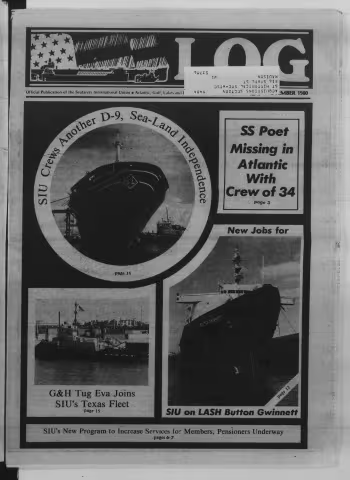
^ P-9, •--> SS Poet
Alfssmg in
Atlantic
With
Crew of 34
page 3
New Jobs for
M''*.~^' **' '• ' ' '*f
1 - My •
I.y
G&H Tug Eva Joins
SI U's Texas Fleet
page 15 SlU on LASH Button Gwinnett
T?: -i
r t "'
...' ^r-T
y' r'i •
li.. - • --• "j. 1 •• > •; ...':,;
MfM ;
• i'' Mi
Mz; li
•M M m-H
; - ^ •;A n-
-•/M' .• "'i-.-?';':- •;
rMzm
r - ' T r, "; »' '
M.
| . . . '
1^.- r«.,-4®T f,-
UT'. '-•• .K••''•'• •'^i';-
My- yM
I '-K'
: y/y --.
SI U's New Program to Increase Services for Members, Pensioners Underway
pages 6-7
H--.
'-;.;".T?---f^-^ - - ... . .. - '>•,
M'-'-
...
.- -j.w'-j- •
...£'
1.
-1
Too Much Gov't Holds Back Maritiiifie Progress
More Than 70 Fed Agencies Controi Maritime: Shoujd Hove One
uncomon for projects to be allowing different federal
delayed two years or more while agencies to have overlapping
several different government spheres of jurisdiction are
THE competitiveness of the
American flag Merchant
Marine is being whittled away by
an overwhelming maze of
governmental red-tape.
More than 70 different Federal
agencies are involved in the
regulation of the maritime
industry. More often than not,
four or five different agencies
have jurisdiction over the same
matter.
Take a simple dredging permit.
Present Corps of Engineers
regulations require that the
average processing time for
dredging applications not exceed
three and a half months. The
actual processing time, however,
is between four and 10 months.
According to a recent study
conducted by the General
Accounting Office, it is not
agencies review the same
application. The cost of these
delays have been known to top
$20 million.
The GAG study makes the
following conclusion. It is
difficult, if not impossible, to
coordinate the actions of four or
five separate government agen
cies, all of which are subject to
bureacratic infighting, conflict
ing policy objectives and limited
yet overlapping spheres of
jurisdiction.
The one thing these agencies
have in common is the ability to
hold up a permit and make it a
pawn in a bureacratic power
struggle.
The problems caused by
becoming more serious every
day. Many American industries
are being done in, not by foreign
competitors, but by their own
government.
Many potential American flag
vessels are never constructed
because prospective owners are
scared off by the repeated delays
involved in securing approval for
operating and construction
differential subsidies.
There.is no one place where
representatives of the maritime
industry can go to discuss the
problems facing their industry.
Officials at the Maritime
Administration blame officials at
the Coast Guard who blame
officials at the Justice Depart
ment who blame officials at the
State Department who blame
officials at the Maritime Admini
stration. \
The bottom line is this: there is
no accountability.
Clearly, some reorganization
of the Federal agencies is in
order. Something must be done
to make our government officials
accountable for prevailing
conditions.
Nothing could help the
maritime industry more than if
the various maritime programs
were put under the Jurlsdictipn of
one particular departments
Much has been made about
increasing the productivity of
private sector workers. Well, the
same is equally true of govern
ment. Unless government gets its
house in Order, American
industry will continue to decline.
MTD Pressing Action on Fish Bi/f, Fed Agencies Use of US, Flag
WASHINGTON, D.C.—The
>FL-CIO Maritime Trades
Department (MTD) is an eight-
million member organization
consisting of 43 affiliated unions.
One of those unions is the
SIUNA whose president, Frank
Drozak, is also president of the
MTD.
The MTD takes an active role
in helping member unions
achieve their goals and uses its
collective strength to back many
labor causes.
For instance, to help U.S.
fishermen, the MTD is pressing
for final action on the American
Fisheries Promotion Act. This
bill could bring full development
of U.S. fishing resources.
Also, the Department is
opposing certification by the
Federal Aviation Administration
of three new aircraft whose flight
crews would consist of less than
three people.
In a letter to President Carter
on the issue, Drozak wrote,
"Certification of a smaller flight
crew [than three] is considered
unwise in light of National
Transportation Safety Board and
Civil Aeronautics Board studies
which pinpoint a direct relation
ship between crew sizes and
airline accidents."
Concerning the carriage of
government cargoes on Ameri
can-flag ships, the MTD told the
White House recently that "a
growing number of Federal
agencies have been working with
increasing frequency to under
mine the cargo preference laws of
the United States."
The Department urged Presi
dent Carter to issue a directive to
Federal agencies instructing
them to ship at least 50 percent of
the cargo under .their control in
U.S.-flag ships.
In another matter, the
Department actively supported a
bill, recently signed by President
Carter, that prohibits the
regulation of collective bargain
ing agreements by the Federal
Maritime Commission (FMC).
In a letter to President Carter,
Drozak had said that the
Department, together with the
rest of the American labor
movement, holds that "there is no
justifiable place for government
intrusion in the free and
unfettered collective bargaining
process."
The above examples represent
only a small fraction of the many
issues for which the MTD fought
in recent months. The Depart
ment is constantly involved in
trying to better the livelihoods
and the quality of life for
American workers.
-f
SIU-Backed Bill Enacted to Improve Towing Safety
RESIDENT Carter has
. signed into law, H.R. 6242, a
bill that calls for the creation of a
16-member Towing Safety
Advisory Committee.
The SIU supported the bill and
urged President Carter to sign it.
The committee is expected to
work closely with the Coast
Guard on matters relating to the
safe operation of towing vessels
and barges'pn inland and coastal
waterways.
Committee members will be
consulted prior to the publication
of any official regulation that
could conceivably affect the
towing industry. These commit
tee members will be on hand to
offer advice to the Coast Guard,
as well as to represent the views of
the towing industry as a whole.
The creation of a Towing
Safety Advisory Committee will
go a long way towards improving
relations between the Coast
Guard and the towing industry,-
which have been badly strained
sfnce the Towing Advisory
Committee was dismantled in
1977. The committee had been an
important channel pf communi
cations between the industry and
the government. It is expected
that the new Advisory Commit
tee will re-open those channels.
Repeatedly over the past three
years, needless misunderstand
ings have arisen that could have
been avoided had only the Coast
Guard taken the time to solicit
the industry's opinions. Hope
fully, all that will change.
Membership on the Commit
tee will consist of the following:
seven members from the barge
and towing industry; one
member from the offshore
mineral and oil supply vessel
industry; two members from
port districts, authorities or
terminal operators; two members
from maritime labor; two
members from shippers; and two
members from the general public.
He Learns Tax Lesson, The Hard Way
Seafarer Norman Dubois learned
a lesson about taxes the hard way, and
it cost him over a hundred bucks.
Dubois was always under the
impression that if you are at sea
during the required filing period for
Federal taxes (Jan. 1-Apr. 15), there
was no penalty for filing late. Not so,
said IRS. Dubois was told that
tax returns had to be filed during the
prescribed period, unless of course,
the taxpayer files for an extension.
No other excuses accepted!
So here's the bottorn line. If you
are going to be at sea during the
filing period, have someone file for
you or file an extension for you.
Dubois said that there is a lot of
seamen who thought, like him, that
there was no penalty for filing late
for a seaman. With his pockets
considerably lighter because of his
experience, Brother Dubois offers
the following advice; "File early."
Change of address cards on Form 3579 should be sent to Seafarers International Union, Atlantic, Gulf, Lakes and Inland Waters District AFL-CIO 67«i Fourth AUP Brooklyn N
11232. Published rnonthly. Second Class postage paid at Brooklyn, N.Y. Vol. 42, No. 11, November 1980. (ISSN #0160-2047) AI-L LIU, b/b Fourth Ave., BrooKiyn,
.Y.
. 2 y LOG / November 1980
(V I;.." •'f'f;- -
I- •'•"• • ,=•'-
S5 Poet Missing in Atlantic With Crew of 34
... . -1.; Mx^oi u/ "^rH Mate Robert W. Gove
I
•t'.
AS the LOG prepares to go to
press, U.S. Coast Guard
and Air Force search planes and
sea rescue ships were combing the
Atlantic Ocean for the missing
11,241 ton bulk carrier SS Poet
(Hawaiian Eugenia) with a crew
of 34—24 of them Seafarers.
On Nov. 10, the 500-foot
freighter was six days overdue for
a landfall at the Straits of
Gibraltar. The 9,000 hp ship had
left the port of Philadelphia on
Oct. 24 with a cargo of corn
bound for Port Said, Egypt.
The ship was due to pass
Gibraltar on Nov. 4 and was
scheduled to arrive at Port Said
on Nov. 9, 1980.
The United States Coast
Guard conducted an exhaustive
air search from high altitude for
the missing ship over a 100,000
square mile area ranging from the
U.S. Outer Continental Shelf to
1,000 miles out to sea.
After the high altitude search,
the Coast Guard began the very
difficult task of fine-tooth
combing the same area from a
much lower altitude flying in
formation.
Another Coast Guard plane
out of the Azores is tracking the
scheduled course of the Poet all
the way to Gibraltar.
Upon notification from the
Coast Guard that the ship was
missing, the SlU imitiediately
contacted the families of the
Seafarers aboard the Poet by
telegram, asking them to get in
touch with SlU Headquarters.
Reagan,
Carter Will Leave
THE long hard presidential
campaign ended dramati
cally on Nov. 4, 1980 with an
unexpected landslide victory for
Ronald Reagan and the Republi
can Party.
The SlU offers its congratula
tions to President-elect Reagan
on his victory . We are prepared to
cooperate with the Reagan Ad
ministration fully on matters of
importance to the U.S. mari
time industry and the nation.
As reported in recent issues of
the Log, the SlU supported
President Carter in this cam
paign. The Carter Administra
tion delivered some extremely
important new programs for
maritime. We based our support
for Carter, not only on his
maritime record in the past four
years but on what Carter had
planned for maritime for the next
At this time, there are
absolutely no clues concerning
the fate of the vessel. Coast
Guard people speculated that the
ship'could still very well be safe,
but unable to send out signals due
to radio problems.
However, the general attitude
of the Coast Guard was one of
pessimism.
Complete details on the Poet
will be carried in the December
Log.
The vessel was built in 1944 by
the Kaiser Shipbuilding Co.,
Richmorid, Calif. In 1965, she
was converted to the troopship,
SS Gen. Omar Bundy. And in
1976, she was renamed the 55
Portmar (Calmer Line) and
more recently the 55 Poet.
Cook/Baker Noel W.
McLaughlin
Messman Tracy R. Walker
Messman Jerry Batchler
Steward Utility Earl K.
Whatley
The missing officers are:
Capt. Leroy A. Warren
Chief Mate Norman. H.
Currier
2nd Mate William A. King
3rd Mate Robert W. Gove
Radio Officer Joseph Vyhnak
Chief Engineer Lloyd G.
Thayer
1st Asst. Engineer Michael S.
Canfield
2nd Asst. Engineer
Christopher Carrino
3rd Asst. Engineer Mark S.
Henthorne
3rd Asst. Engineer Anthony J.
Bourbonnais
SlU General
Proceeding
The overdue Seafarers are:
Bosun Edward D. Adams
AB Rickey A. Saliee
AB Mosel Myers
' AB Roland H. Coufter
AB Hans P. Zukier
AB Carl L. Goff
AB Shawn T. Gooden
OS Alfred Schmidt -
OS Edward E. Bradley
Deck/Eng. Utility Frank E.
Holland
Oiler Walter M. Mitchell
Oiler Claude D. Berry
Oiler Otis R. Hunter
FOWT Calvin E. Bet hard
'FOWT Abraham G. Murillo,
FOWT George E. Ward
Wiper Thaddeus M. Simmons
Chief Steward Eddie Sylvester
Chief Cook Carl Jackson
Members voting in Piney Point. Port Agent Terry Bader. left, mans the counter.
Voting is presently being
conducted in 31 ports for the
election of SIU, AGLIWD
officers for the term 1981-1984.
Seafarers may pick up their
ballots and mailing envelopes
from 9 a.m. until noon, Mondays
through Saturdays, except on
legal holidays, from Nov. 1
through Dec. 31, 1980.
four years.
This has always been our
political philosophy. We support
those who have supported us.
We never turn our backs on our
friends. And Carter was certainly
a friend to maritime.
President Carter's impressive
record on maritime includes;
• Passage of the Ocean Mining
bill, which will mean thousands
of American maritime jobs in the
future in this brand new industry.
• The recent Bilateral Trade
Agreement with China reserving
one third of all cargoes shipped
between the two nations for U.S.
flag ships.
• Passage of the Passenger Ship
Bill, which fostered the rebirth of
the all-but-dead U.S.-flag
passenger liner industry.
• The Alaska Oil bill, which
reserved Alaska crude for^U.S.
use alone and guaranteed that the
oil would be carried by American
ships.
• The Outer Continental Shelf
Lands Act was passed in 1978
and it reserved all Jobs in drilling
on the U.S. outer continental
shelf for American workers.
These are just a few of the
more important things concern
ing maritime that can be credited
to the Carter Administration.
Carter also had an excellent
record on labor supported issues
in general, from enactment of a
new formula for graduated
increases in the minimum wage to
increases in social security. In
fact. President Carter signed
more bills into law in one term
than any president since FDR.
As the Reagan team prepares
to take power on Jan. 20, 1981,
the SIU foresees little problem
For a detailed report on the
election procedures, including
addresses of the 31 ports, see the
special supplement in the
October Log.
. All full book mfemhers in good
standing are urged to cast their
vote in the election for officers of
their union.
with working with Reagap on a
maritime program.
During his campaign, Reagan
on several occasions, expressed
interest in a strong U.S. flag
merchant marine.
The SlU's ultimate goal, of
course, remains the same. We
want to return the American
merchant marine to its once
preeminent state on the world's
sealanes.
We feel that this nation cannot
maintain a strong economy or a
strong national security without
a healthy, competitive merchant
marine.
Of course, a lot of work has to
be done to help the U.S. maritime
industry, which is facing many
serious problems.
We made good headway
during the Carter Administra-
tion.
We hope to continue this effort
during the Reagan Administra
tion.
November 1980 / LOG / 3
: I:
•I , =.v-
i • .
. )
•V „ ' ,
- • •!•-•{
f.. ,
< r
J. .
I
.. i"
use to Establish Paul Hall Chair
In Marine Transportation
Frank Drozak, Herb Brand Will Co-Sponsor Fund Drive
TRIBUTES are still being
paid to the memory of Paul
Hall, who was president of the
SlU for nearly twenty-three years
until his death June 22, 1980.
Those who knew Paul Hall
would agree that none of the
tributes being paid to his memory
would have pleased him as much
as the recent decision by the
University of Southern Cali
fornia to establish a Paul Hall
Chair in Marine Transportation
Studies.
The drive to fund the Paul Hall
Chair at USC is being sponsored
by two close friends of the late
SIU President; Herb Brand,
Chairman of the Transportation
Institute, a non-profit organiza
tion aimed at promoting
maritime research and develop
ment, and Frank Drozak, the
pian who succeeded Paul Hall as
President of the SIU.
The following prominent
Americans have pledged their
support to establish an endow
ment for the Paul Hall Chair:
Lane AFL-CIO
President; Rep. Thomas P.
O'Neill, Speaker of the U.S.
House of Representatives;
George Shultz, former U.S.
Secretary of the Treasury and
now Vice Chairman of Bechtel
Corp.; Jerry Wurf, president of
the American Federation of
State, County, and Municipal
Employees; Jesse Calhoun,
President of the Marine Engi
neers Beneficial Association;
U.S. Senators Warren Magnu-
son of Washington, Ernest F.
Hoilings of South Carolina, Ted
Stevens of Alaska, Daniel K.
Inouye of Hawaii, and Bob
Packwood of Oregon; and
William J. Baroody, Jr.,
president of the American
Institute for Public Policy
Research.
Paul Hall was one of the giants
of the modern maritime industry.
He is best remembered for his all-
consuming interest in education.
He was fond of saying that the
maritime industry had to reach
out to the American people and
communicate to them how
important it was for this country
to have a strong Merchant
Marine
In other words, he sought to
educate the American people.
He was also instrumental in
establishing one of the most
successful maritime trailing
centers in the country, the
Seafarers Harry Lundeberg
School of Seamanship. Not only
does the SHLSS provide its
graduates with a strong back
ground in basic seafaring skills, it
also seeks to improve the quality
of their lives. It does this by
making available a number of
important educational tools: an
alcoholic rehabilitation center, a
high school equivalency pro
gram, top-notch educational
facilities that can be used towards
obtaining an associate's degree in
marine studies.
The newly established Center
for Marine Transportation at the
University of Southern Cali
fornia is expected to fill an
important national need, for
there is a lack of qualified
maritime managers in the United
States. A rigorous graduate level
curriculum has been fashioned.
An industry advisory committee
will ensure that the curriculum
meets the needs of shipyards,
shipping companies, maritime
labor unions, shippers, port ^nd
terminal operators, and govern
ment agencies.
The Center for Marine
Transportation will be part of
USC's Institute for Marine and
Coastal Studies, which since its
Establishment five years ago has
becdme a national focal point for
the study of oceanography, ocean
engineering add marine policy.
The Institute offers eighty-six
courses in twelve academic
departments. It operates a
number of coastal research
laboratories.
When asked to comment on
the new department. Rose Hall,
Paul Hall's beloved widow,
replied, "I can't think of a more
appropriate honor to pay Paul.
He loved the Merchant Marine.
And he dedicated his Whole life
towards improving the quality of
educational facilities within the
maritime industry. Look at the
Harry Lundeberg School of
Seamanship. Thanks to his
efforts, it has become the finest
maritime training center in the
country."
Carter Signs Bill Giving US, CoaF Ships Preference to Unload
WASHINGTON, D.C.—A
bill that will aid American-flag
coal carriers was signed into law
last month by President Carter.
Numbered S. 1442, the bill has
an amendment that grants
priority berthing privileges to
U.S.-flag coal carriers engaged
in the coastwise trade of this
country.
The legislation actually puts
into law a tradition that had
recently come under attack. It
had been^ a widespread custom
4 / LOG / November 1980
for port officials to allow
American-flag vessels sailing in
the coastal trade "to go to the
head of the line."
Because of inadequate storage
aiid port facilities, vessels
carrying coal have had to endure
port delays of thirty days and
more while they wait in line to be
loaded.
One of the reasons for
allowing U.S.-flag coastal ships
"to go to the head of the line"
was the importance of coal as an
energy source in this country.
Efforts - to increase domestic
consumption of coal would
suffer a severe setback if
shipments were delayed an
average of 30 days and more.
However, recently exporters
of coaL threatened to bring suit
against ports and coal compa
nies that gave "head of line
preference" to American-flag
vessels. They were annoyed at
the delay that their vessels had to
experience while loading at
outdated port facilities.
Unsure of the outcome of such
a suit, the coal companies and
ports had decided to rescind the
preference they had given the
American ships.
But Congress and President
Carter realized how important
the encouragement of domestic
coal consumption is to this
country. Through S. 1442 they
therefore made "head of line"
privilege a law. The SIU fully
supports that decision.
• r-
Republicans Gain Control of the Senate
A major shift of power oc
curred on Capitol Hill,
where as a result of the 1980
elections. Republicans captured
control of the Senate for the first
time since 1954.
The effects of Ronald Reagan's
stunning victory filtered down to
the Senate races, where Republi
cans gained 12 seats. They now
control 53 seats. The Democrats
control 46.
Among the losers were a
number of Senators who had
been strong advocates of a re
vitalized American flag merchant
marine. That includes men such
as Warren Magnuson (D-Wash)
and Birch Bayh (D-Ind.)
Republican control of the
Senate means that 'Republicans
will assume control of the presti
gious, and powerful. Committee
Chairmanships.
Republicans ih line for
Chairmanships, which are
usually determined on a basis of
seniority, include: Jesse Helms of
N.C., Agriculture; John Tower of
Texas, Armed Services; Peter
Domenici of New Mexico,
Budget; Bob Packwood of
Oregon, Commerce; Mark
Hatfield of Oregon, Appropria
tions; James McClure of Idaho,
Energy; Bob Dole of Kansas,
Finance; Charles Percy of
Illinois, Foreign Relations;
Robert Stafford of Vermont,
Public Works or Labor; Lowell
Weicker of Connecticut, Small
Business; Jake Gam of Utah,
Banking; Barry Goldwater of
Arizona, Intelligence; Strom
Thurmond of South Carolina,
Judiciary.
Previously, many of these
chairmanships had been held by
men who were sensitive to the
needs of the American flag
Merchant Marine: Daniel Inouye
of Hawaii, Commerce; Henry
Jackson of Washington, Energy;
Russell Long of La., Finance;
Warren Magnuson of Washing
ton, Appropriations.
Also scheduled to change
hand's are the chairmanships of
the vitally important subcommit
tees, as well as the staffs of all
standing committees and sub
committees, which are usually
determined on the basis of party
affiliation.
Among the new Republican
Chafimen and Subcommittee
Chairmen are a number of
Senators who understand the
importance of maintaining a
strong American flag Merchant
Marine, men such as Senator
John Warner of Virginia who
was instrumental in securing
"head-of-the-line" privileges for
U.S. flag bulk carriers.
The intricate structure of the
American political system makes
it impossible to predict the
consequences of this shift in
power.
The support or opposition of a
Committee Chairman can
determine the fate of a proposed
piece of legislation.
Access to Committee Chair
men is often determined by the
whims and preconceptions of
Committee staff members. *
The unexpected election
results underscore the following
fact: an organization such as the
SIU must place a high impor
tance on maintaining a strong
Washington presence if it is ta
protect the interests of its
members.
House of Representalives Will Have Many New Faces
rn he changes in the U.S. House T of Representatives following
the national elections may not be
as radical as in the Senate, but
they are still very significant.
To go along with Ronald
Reagan's victory, there was an
upsurge in Republican Party
support. In the House of Repre
sentatives the Republicans picked
up 33 seats.
The composition of the new
House, which will meet after the
first of the year, will be 243
Democrats and 192 Republicans.
(The current House has 276
Democrats and 159 Republicans.)
For the maritime industry in
general and maritime labor in
particular this change is very
important.
First of all, labor and the
indijstry lost some strong sup
porters. Second, coming into the
House for the first time are a lot
of new people who are not
familiar with the maritime
industry.
Some of the biggest changes in
the House came in a crucial
Committee for maritime—the
Merchant Marine and Fisheries
Committee.
Among those defeated was
John Murphy (D-N.Y.) who for
many years has been a staunch
supporter of a strong U.S.
merchant fleet. Also defeated was
Thomas Ashley (D-Ohio), the
temporary chairman of the
committee.
Others on the committee who
lost out in their reelection bids
were: Michael Myers (D-Pa.);
Edward Stack (D-Al.); Robert
Bauman (R-Md.), and Melvin
Evans (R-V.I.). Also, Joe Wyatt
(D-Tex.) retired.
Whatever Party is in the
majority in either the House or
Senate gets the chairmanships of
the Comrriittees. Therefore, after
Ashley and Murphy, John
Dingell (Mich.) is next in ranking
to be chairman. However, he is
expected to become chairman of
the Interstate and Foreign
Commerce Corrimittee.
The next two ranking members
are Walter Jones (N.C.), and
Mario Biaggi (N.Y.), both of
whom have expressed interest in
the chairmanship.
In a major upset, powerful
House Ways and Means Commit
tee Chairman A1 Ullman (Ore.) lost
his bid for reelection. Also, Frank
Thompson (N.Y.), who was
chairman of the House Adminis
tration Committee was defeated.
In addition, three chairmen
retired: Robert Giaimo (Conn.)
Budget; Harley Staggers (W.V.)
Interstate and Foreign Com
merce, and Ray Roberts (Tex.)
Veterans Affairs.
The SIU, of course, will be
working with this new Congress,
with our old friends and with the
freshmen members. We will be
working to insure that the voice
of maritime labor is heard loud
and clear.
AFL-CIO Pres. Kirkland 'Ready to Cooperate' With New Administration
AFL-CIO President Lane Kirk
land made the following .statement
on the election of Ronald Reagan as
President. Kirkland, who has the
complete support of the SIU, stated:
"The nation faces many serious
problems that will challenge all of
our energies. The AFL-CIO stands
ready to cooperate with the new
Administration in constructive ef
forts to solve those problems in the
best interests of our country."
"The election results show that
unemployment and inflation
weighed most heavily on the minds
of working people and their families.
Americans expressed a desire for a
change in their circumstances and
prospects, for revival of the national
economy, and for an improvement
in America's standing on the world
scene. We shall carefully weigh such
proposals as President-elect Reagan
may advance to rebuild the nation's
industrial base, and will do our best
to assure fairness and equity for
American workers."
"In rebuilding the economy, we
continue to believe there is a need for
cooperation between business, labor
and government, and we stand ready
to play a constructive role in such an
effort. As always, we shall vigor
ously pursue our responsibility to
serve as the aggressive advocates of
workers and their interests."
"The new Administration will
benefit from the achievements of
President Carter, particularly in the
area of energy policy which offers
hope to the nation that the strangle
hold on the American economy
resulting from a dependence on
imported oil will be broken."
"Finally, 1 want to express my
personal appreciation for the thou
sands of union members who vol
unteered their time and energies to
work in this campaign. While the
results are disappointing, anyone
who believes as strongly as we do in
the democratic process will accept,
in good spirit, the verdict of the
American people."
Lakes Seafarers Get COLA Hike
As of Nov. 1, 1980, Great Lakes
SIU members working under con
tracts with the Great Lakes Associa
tion of Marine Operators, Kinsman
Lines and Boh Lo Co., received a
Cost of Living increase of 14 cents
per hour.
COLA'S are computed quarterly,
based on increases in the Consumer
Price Increase. The Great Lakes cost
of living adjustment is one cent per
hour for every .3 point rise in the
CPI.
The November COLA, which is
the final adjustment for 1980, brings
the total cost-of-living add-ons for
the year to 94 cents per hour. Under
the terms of the SIU's contracts with
GLAMO, Kinsman and Boh Lo, the
1980 add-ons will he rolled into the
base hourly rates effective Jan. 1,
1981.
The next cost of living adjustment
date is Feb. I, 1981.
Special Notice
To avoid any problems ar.j
Relays when being flown from
U.S. ports to foreign countries,
please carry on your person the
following documents:
Passport
Union Book
Clearance Slips
Vaccination Card
Seamans Papers
fs
I
I
.I':-'
1
. pi
.
F
• L
A.
l!'
n
Lt
•/I
V,.
•>r
•W
y-
I
M
I
ti
h
-k
I
11 f.
iF
•T
November 1980 , LOG 5
' 'I/.'
J-/
Increai^ Political Action & Improved Services to Members,
THE number one job of any
union is making life better
for its membership. That means
good job security. Top-notch
benefits. A decent pension.
But the SIU has taken the job
of making life better for its people
one step further. Because the SIU
knows that Seafarers and
Boatmen are not only members
of the seafaring community.
They and their families are also
members of communities
throughout the United States.
In order to make the benefits of
The Field Representative assigned to the port of Boston is Joe Corrigan (2nd
left). Here, he meets with some SIU members at the Union hall, including (l-r)
Phillip Neergaard. Ed O'Connell, Sal Fiore and Alton Hamety.
Explaining the SlU's landmark
Political Social and Welfare Program is
the programs National Coordinator,
Mariann Rogers, who will be working
out of Washinoton, D.C.
their communities more readily
available to active SIU members,
to pensioners and to their
families, the Union has kicked off
the National Political Social and
Welfare Training Program.
The National Political, Social
and Welfare Training Program
was created, SIU President
Frank Drozak said, "to provide
better, faster and more effective
services to SIU members, retirees
and their families."
The goal of this brand-new,
landmark program can be
summed up in one word—
SERVICE. Service to Seafarers
and Boatmen, retirees and
dependents, whatever their needs
are, wherever they happen to be.
When it's in full-swing, the
new program will be operated out
of 20 SIU ports by a specially
trained Field Representative. So
far, 13 Field Representatives
have been assigned.
These Field Representatives
have extremely important
duties—to help SIU members,
pensioners and their families with
a wide variety of problems,
ranging from Union business to
Federal agencies.
The Field Representative will
know how to cut through the red
tape which may be holding up
your claim from Social Security,
Unemployment, Public Health
or any other state or local agency.
If you have a question about
what benefits you're entitled to
from the Federal government as a
It's part ot every Field Rep's job to get
involved in the community and that's
just what Jacksonville Field Rep
Bill Hodges is doing as he checks out
a local bazaar with Lucy Giardino.
Cleveland-area Field Rep Martin VlttardI reveiws SIU vacation applications
with Union members Terrence De Mentor, deckhand, and Richard Stropich, tug
captain, of the tug Olive Moore (Lakes Trans. Co.)
Senator John Glenn (D-Ohio) center, looking over a recent issue of theLog with
Cleveland Port Agent Mark Trepp (I) and Field Rep Martin Vittardi (r).
One aspect of the Field Representative's job is to work in the area of politics.
Here, Secretary of Labor Ray Marshall (I) and New Jersey Field Rep James Ward
get together for a chat.
6 / LOG / November 1980
- -
-r-'- J. / r
Pensioners Goal of New SIU Program
retired or a disabled seaman, for
example, the Field Rep will make
a thorough check on your behalf.
And if there'sja special program
in your area which may be
beneficial to you, such as a Senior
Citizens program or a child care
facility, your Field Rep will know
about it, or find out about it, and
explain how you can take
advantage of it.
But that's just the beginning of
the field Representative's duties.
Any problems you—or your
family—may have concerning a
Union welfare claim will be
promptly handled by the Field
Rep in your port. And if you're at
sea, the Field Rep will be
available to help your wife or a
dependent with any problems
concerning the SIU Welfare,
Vacation and Pension Plans.
Finally, the Field Reps duties
will include participation in the
SlU's grassroots political effort.
The Field Representatives will
get to know, and work with, state
and local politicians where it
counts the most—in their
congressional districts, their
assembly districts, their precincts
back home.
This kind of contact with
elected officials will give the SIU'
and SIU members broader
recognition and better service
from politicians.
By the end of this year, all 20
Field Representatives will be
working out of every SIU port on
the East, West and Gulf Coast,
the Great Lakes and the Rivers. Jacksonville, Jersey City,
So far. Field Reps have been Norfolk, San Francisco, Seattle
assigned to Brooklyn, N.Y., and
Algonac, Mich., Baltimore, The National Coordinator of
Boston, Duluth, Houston, the new program is Ms. Mariann
Rogers, who will be working out
of Washington, D.C.
Shortly after the New Year, all
20 Field Reps will spend two
months at Piney Point where
they will go through an indepth
education program.
. :• I • Vi
• :l
i • ••i.
/V
-[•'si
There will soon be Field Representatives in all 20 SIU ports
Who do you go to If you're an SIU Pensioner with a meeting with and assisting Union members and their families with
question about a claim? If you're in Boston, you go to any problems they may have. Here Norfolk Field Rep Bill
Field Rep Joe Corrrgan, as SIU Pensioner Garret Wile Hutchens, (I) talks with Seafarers Brad Bradshaw (stancting) and
' John Thomas Short.
f?;'!
•:..T ••-Ft
• 1
'..i L
At a local labor meeting in the Baltimore Union Hall, Field Rep Bob Anton (I), meets with (l-r); Kevin Kissler. National
COPE: Ed Lamont, COPE Director for Maryland and Washington. D.C.: Steve Jackson, Carter Campaign Coordinator: Joe
Townsley, Teamsters Joint Council President and Pres. of the Baltimore Maritime Port Council: and George Bowen and
Jim Tallent, both of the UAW.
4.
New York Field Rep Tom Messana (I) helps Seafarer Jack Marcario. who ships
Chief Electrician fill out-a benefit form.
Greeting President Carter is Philip R. Piccigallo who. as Northeast Area Director
of the SlU s National Political. Social and Welfare Program, coordinates the Field
Representatives and activities in his area.
November 1980 / LOG / 7
' i.-.'
" r.'j'.
• ••:/-
- ..•• •
SlU Wins Case Vs. USCG on Yellowstone Loss
a recent U.S. District
T T Court ruling as the solid
groundwork, the SIU will now be
able to more fully protect the
interests of Seafarers during
Coast Guard inquiries.
Th'e court ruling, handed down
Oct. 14 by U.S. District Judge
Mary Johnson Lowe, capped a
lawsuit initiated two years ago by
the Union against the Coast
Guard.
The Union's suit was filed on
Nov. 24, 1978. five months after
the Coast Guard and the
National Transportation Safety
Board convened a joint inquiry
into the collision of the SIU-
contracted SS fellowstone
(Ogden Marine) and the Alger
ian-registered Ibn Batouta.
At least five crewmen were
killed and several others injured
when the Algerian freighter
rammed into the portside of the
Yellowstone in the Straits of
Gibraltar on the afternoon of
June 12.
The hearing's dual purpose
was (1) to determine the cause of
the accident and (2) to make
recommendations relative to ship
construction, manning, etc., to
prevent similar accidents from
occurring in the future.
When the hearing began, the
law firm of Schulman &
Abarbanel appeared as legal
representative for the Union and
Here's the first insttdbnent of a
new Log column dealing with
Social Security. We wUl try to
keep you informed qf rules and
regulations, changes in the law,
and of course your benefits under
the Social Security Admini
stration. 'We hope you etijoy the
column. If you have any sug
gestions concerning this column
please drop us a line.
Work After Retirement
There is a limit on how much
you can earn and still collect
Social Security benefits. For
1980, if you're 65 or over, $1 in
benefits is withheld for each $2
you earn above $5,000.
Exception: If 1980 is your first
retirement'year, you'll get your
full monthly check for each
month in which you neither (1)
work as an employee for more
than $416.67, nor (2) perform
"substantial services in self-
employment," regardless of your
total earnings for the year.
If you're under 65, the annual
earnings ceiling is $3,720; the
monthly ceiling is $310.
After you reach 72(70, starting
in 1982), you can make any ,
amount and still draw your full
Social Security.
When you work in retirement,
your earnings may affect your
own and your dependents' bene
fits. If a dependent works, his
earnings will affect only his
benefits. If your earnings in
retirement would result in higher
benefits, your benefits will be
automatically recomputed each
year and you will receive the
increase without further appli
cation.
NOTE: The earnings limit
after age 65 will be raised to
$5,500 in 1981, and to $6,000 in
1982.
After that the limit will be tied
to average wages of employees
covered by Social Security.
The earnings limit for people
under 65 also will increase to
keep pace with increases in
annual covered wages.
for Seafarer David Beck who had
been the wheelsman on the
Yellowstone at the time of the
crash.
Since both Brother Beck and
the Union had a vital interest in
the outcdme of the hearing, the
lawyers asked the Coast Guard to
name them "parties in interest."
A "party in interest," explained
Howard Schulman, has the right
to fully participate in a hearing,
examining and cross-examining
witnesses and doing "whatever is
appropriate on behalf of the
client so that all facts are known
and an appropriate record made,
from which proper findings and
conclusions could be drawn."
But the Coast Guard refused to
designate the Union a "party in
interest." Using their own narrow
interpretation of the law, the
Coast Guard said the only role
the Union could play in the
hearings was to develop ques
tions and give them to the
examining officers who would
decide whether or not they
should be asked.
With their hands tied by the
Coast Guard, the Union took the
issue to the Federal Court,
Southern District, N.Y.
In a clear and well-docu
mented suit the Union argued
that "part of the hearing is to
determine safe working condi
tions and appropriate" manning
to ensure those safe conditions
and that the Union has a "vital
and critical interest in the safety
and working conditions of its
members" aboard ship.
Howard Schulman under
scored the importance of the
SIU's participation in a hearing
which could have a direct impact
on shipboard manning scales.
"Manning," he said, "is a vital
issue as to whether or not there
are proper working and safety
conditions because if it is found
there are not enough men, this
may very well cause extreme dan
ger to the seamen's working
conditions."
The Court upheldThe Union's
position on all key points.
"Where a union is the representa
tive of seamen aboard a vessel
involved in a marine casualty,"
said the Court's Memorandum of
Opinion, "it,, under... Federal
law, is a party in interest..
"The union participates in
training and apprenticeship
schools for the promotion of
safety conditions aboard U.S.
vessels," the Court pointed out.
"...its members live and work
aboard those vessels in the same
manner as the Yellowstone," and
the union has a "vital and critical
interest in the safety and working
conditions of-their members
aboard such vessels."
In addition, the Court ruled
that the Coast Guard "impermis
sibly narrowed the statutory
grant of participatory rights...
by giving a more restrictive
meaning to the term 'parties in
interest' than set forth" by the
law.
While the SIU's lawsuit was
pending in the courts the Coast
Guard and the NTSB concjuded
their investigations and pub
lished their findings and recom
mendations.
However, by ruling in favor of
the Union's position, the Court
set an important precedent which
can be drawn upon in the event of
any other marine casualty
investigation.- involving an SIU
crew.
The Court clearly backed up
the Union's right to participate
fully in any inquiry which directly
affects the welfare of SIU
members. And the Union will
rely on this Judgement in order to
defend the interests of the SIU
membership in the future.
HflHfcbcR Rmri fir Gmiliin
SEPT. 1-30,1980
Algonac (Hdqs.) .1.....
Algonac (Hdqs.) ,.
Algonac (Hdqs.)
Algonac (Hdqs.)
*TOTAL REGISTERED
All Groups
TOTAL SHIPPED
All Groups
**REGISTEREDON BEACH
All Groups
Class A Class B Class C Class A Class B CI^C Class A Class B Class C
DECK DEPARTMENT
3 77 57 0
ENGINE DEPARTMENT
• 53 16 1 55 20 1
STEWARD DEPARTMENT
- 7 3 ,0 16 11 0
ENTRY DEPARTMENT
^ 57 10 0 0 0
58
43
7
45
16
20
11
5
90 Totals All Departments..... 155 su 14 143
Registered on the Beach means the total number of men registered at the port at the end of last month.
3 - 2
89 34
128 52
6 ' LOG November 1980
' i . /T
•^'V.
i
I
I
I
I
I
I
I
I
I
I
I
I
I
I
u
I
I
I
I
I
I
I
I
I
I
I
I
I
I
I
I
I
I
I
I
I
I
I
I •
I
I
I
I
I
I
I
I
I
I
I
I
I
I
I
I
I
I
I
I
I
I
1
I
I
I
I
I
I
I
I
I
I
I
I
I
I
.-;X "'• •
',>1 •• ™
ttt ill toa^liiiigtiii
" Seafarers International Union of Nortii America. AFL-CH) November 1980 -Legislative. Administr.itive and Regulatorv Happenings
1981 Maritime Subsidy Bill Signed Into Law
President Carter has signed into law the
Maritime Appropriation Authorization Bill
for Fiscal Year 1981.
Authorizations for the maritime industry,
like bther federal appropriations, must be
approved each fiscal year. The annual
authorizations bill is perhaps the single most
important piece of legislation to affect the
maritime industry.
Among other things, it establishes levels
of federal support for the construction and
operating differential subsidy programs that
form the basis of this country's maritime
program. Were these subsidy prograrris
discontinued, the jobs of most American
seamen woTild be jeopardized, and the
continued existence of the American flag
Merchant Marine would be put into
question.
The bill allots the following federal
monies: $135 million for the construction
differential subsid)^program; $346.7 million
for the operating differential subsidy
program; $17.1 million for research and
develop activities within the maritime
industry; $32.5 million for maritime
education and training expenses; $38.8
million for Maritime Administration
Operating expenses; and a supplemental
authorization of $44.3 million for the
operating differential subsidy program in
the Fiscal Year 1980 Appropriations Bill.
Railroad Deregulation Becomes Law: Will Not Hurt Tow Industry
Report: "Railroad rates and practices that
affect rail-water competition that are unfair,
destructive, predatory or otherwise under
mine competition and that were unlawful
immediately prior to enactment of this Act
The Railroad Deregulation Act has been
signed into law. The bill's provisions are in
keeping with the present Administration's
overall policy objective of deregulating
industries that have been overly burdened
with unneeded and cumbersome federal
regulations.
The Conference Report that accompanies
the bill explicitly states that the legislation is
not intended to signal the beginning of a rate
war between railroads and inland water
carriers. In the words of the Conference _ ^ - - — — shall continue to be prohibited.
Report Shows Decline in U.S. Flag Share Of Containerized Cargo
A statistical report by the U.S.
Maritime Administration
(MARAD) has pointed up a "steady
decline" in the amount of containerized
cargo Carried by American flag ships.
The report shows that U.S. flag
participation fell "from 34.8 percent
during 1977 to 31.4 percent for 1978."
The report also stated that during 1978',
the U.S. fleet "transported 9.3 million
long tons, a decline of nearly eight
percent from 1977."
The U.S. intermodal fleet is by far the
Marad Sees Need to
Beef Up Bulk Fleet.
Speaking before an audience filled with
representatives of the maritime industry,
XSamuel B. Nemirow, assistant secretary of.
Commerce for Maritime Affairs, discussed a
number of issues facing the American flag
Merchant Marine.
Noting the depressed state of the dry-bulk
sector of the American flag Merchant
Marine, Nemirow called the development of
an adequate dry-bulk fleet a pressing
national need. He urged Congress to re
introduce and adopt the Administration's
long ignored dry-bulk subsidy program,
which had been submitted to Congress some
. fifteen years ago.
The President's dry-bulk proposals,
Nemirow explained, are designed to
"remove built-in constraints in existing
maritime laws that have inhibited invest- -
ment in this type of carriage."
Nemirow also assured his audience that a
new awareness of national security consid
erations will lead to a greater emphasis being
placed on the development of a strenghtened
American flag Merchant Marine. He cited
increasing concern over this country's
Sealift Capability and recent bilateral
maritime trade agreements between the
United States and China as being two
examples of this trend.
most dynamic aspect of the American position that the U.S. must look toward
flag merchant marine. However, the
Marad report conclusively shows that it
gets tougher and tougher all the time for
American ships to compete with the
foreigners.
bilateral shipping agreements and other
such cargo sharing arrangements with
our major trading partners. The
economy and security of this nation, and
the viability of the U.S. flag merchant
marine, demands it. This once again brings up the SIU's
Carter Signs Maritime Ed Bill
President Carter has signed into law the
Maritime Education and Training Act, a bill
that seeks to redress imbalances in the
federal system of maritime education.
In the past, graduates of Federal and state
maritime academies often failed to sail in the
American flag Merchant Marine, despite the
'fact that they had received a, federally
financed maritime education and/or gener
ous federal subsidies. The SIU and other
maritime unions have long been critical of
this occurence, for it was a waste of valuable
limited resources that could have been used
to better advantage elsewhere.
The Maritime Education and Training
Act imposes legal sea-duty obligations on
graduates of federal academies. Graduates
must spend five years at sea, or else face
mandatory military service. Graduates of
the six state maritime academies are
required to spend three years at sea.
U.S. Representative Les AuCoin, D-Ore.,
Chairman of the House Select Committee
on Maritime Education and Training that
authored the bill, has said that "the bill's
practical result will be better trained officers
for our U.S. Merchant vessels at a time when
demand for licensed officers exceeds
supply."
SPAD is the SlU*s political fund and our political arm in
Washington, D.C. The SIU asks for and accepts voluntary
contributions only. The Union uses the money donated to
SPAD to support the election campaigns of legislators who
have shown a pro-maritime or pro-labor record.
SPAD enables the SIU to work effectively on the vital
maritime issues in the Congress. These are issues that have
a direct impact on the jobs and job security of all SIU mem
bers, deep-sea, inland, and Lakes.
The SIU urges its members to continue their fine record
of support for SPAD. A member can contribute to the
SPAD fund as he or she sees fit, or make no contribution at
all without fear of reprisal.
A copy of the SPAD report is filed with the Federal Elec
tion Commission. It is available for purchase from the EEC
in Washiogton, D.C.
November 1980 / LOG / 9
J'-' .j.%! .
•
• ft
• i
-
i " ; ' •«- )
, "L,- 1
• -i " . r
:• A'
•'•1-•
. 1
1 •1
'T •
>4.
• Ti'
, • •• J.
•rff. •
• "T
I'., '
1'" (
•-'J
' i
- ^
• ''i-- ii-i.. ' .
-
i-.l; .
-j
fi-' 4."
J .
-V
. i :
-r-A
T '
. -7
'-•i
.•i
• A
--it-"'
-t ^
....Sr'iUt--
. ;-"•.'PI;'-
.,,• • .-;,• :^. . ••
••
^•\t • ^ .
Ws..
'w.' •
What a Crew: Save Boat People, Deliver Baby
* ¥ , -r
"It was an unusual two days for
the SIU crewedLNG Aries."
So wrote Ordinary Seaman
David Hecht. He was describing
the events that led to the rescue of
a small fishing vessel containing
21 Vietnamese refugees, includ
ing one woman who promptly
went into labor after boarding
the Aries.
The LNG Aries had been
underway in the South China Sea
LNG Aries
en route from Tobata to Arun.
The deck and engine gangs had
just knocked off for-funch when a
call from the . bridge notified
Bosun Fred Pehler that a small
fishing boat had been sighted.
As Brother Hecht writes:
"It was a well co-ordinated
rescue effort by the SIU crew.
While the deck department
was lowering the gangway and
preparing to tie the fishing
boat to the ship, the engine
department was slowing
engines down. As this was
going on Chief Steward Joseph
Kundrat was busy setting up
an emergency station on deck
while Chief Cook George
Taylor Jr. was preparing
sandwiches for the travel
weary guests.
"Things were just returning
Here's some of the hero LNG Aries crew. They are. kneeling left to right; Cargo Engineer Skip Doty, Bosun Fred Pehler and AB
Mike Wiley. Back row from left to right are: 3rd Mate John Whitely, OS Christian Werner, AB Bob Smith, OS Tom Cuddihy
OMED John Ponti, AB Jerry Lopez, Wiper Charlie Brown, 3rd Engineer Pete Schadel, AB Ernie Ford, AB George Holland, Chief
Mate William Gatchell, 2nd Mate Jon Anderson. SIU crew members missing from photo are:.AB Howard Knox, OS David
Hecht, OMED Ray Nugent, OMED Olie Mortensen, Chief Steward Joseph Kundrat, Chief Cook George Taylor Jr GSU's
Everett Rice, Martin Buck, Jeff Franco. —' -
to normal when AB Bob Smith
notified the bridge that
Ngoyen Thi Bich Phoong was
beginning labor. She was
immediately taken up to the
ship's hospital where prepara
tions were made to deliver the
It's Official; Deck Depf/s Can Cany 50% Blue Tkkets
first child born on an SIU LNG
carrier."
Chief Mate William Gatchel
and Cargo Engineer Skip Doty
delivered the child, a healthy
baby girl. They were assisted by
Second Mate Jon Anderson.
After the delivery Chief Mate ,
William Gatchell commented
that "the feeling was indescrib
able." Cargo Engineer Doty
quipped, "I've made many
deliveries aboard the Aries, but
none quite like this one."
Expanded job openings for
blue ticket AB's is one of the
plusses of legislation signed into
law by Pres. Carter last month.
Under a provision of the Small
Vessel Inspection & Manning
bill, 50 percent of the AB comple
ment aboard deep sea vessels can
now be bluejicket AB's. Previ
ously 65 percent of the AB's
aboard deep sea ships had to have
green tickets.
The SIU supported adoption
of the 50 percent blue ticket
provision to open up job oppor
tunities for the growing number
of blue ticket AB's who are
registered for shipping. (To earn
a blue ticket, a seaman needs 12
months wa^chstandrng time as an
OS. Green ticket AB's must have
36 months on-deck watchstand-
ing time.)
Another provision of the
multi-part measure which had
the support of the SI U calls for an
end to bare-boat chartering of
vessels. Through bare-boat char
ters, companies have been able to
skirt some U.S. inspection and
manning requirements.
The Union also endorsed parts
10 / LOG / November 1980.,
of the bill which: reduce the
minimum age requirement for an
AB from 19 to 18 years of age;
maintain the sea service require
ment for AB 'Unlimited' at three
years; increase vessel inspection
violation fines from $100 to $500
a day for each day of inspection;
and count time spent in approved
training programs as seatime.
But in spite of the successful
passage of the 50 percent blue
ticket provision and some of the
bill's other beneficial sections, the
Small Vessel Inspection & Man
ning bill did not have the blanket
approval of the SIU.
The bill contains sections
which the Union and the AFL-
CIO vigorously opposed on the
grounds that they would jeopar
dize crew and vessel safety, if
adopted. The detrimental aspects
of the measure include:
• reduction of the percen
tage of AB's on vessels with a
two-watch system from 65 to 50
percent of the crew complement.
• creation of a six-month AB
'Special' in the offshore mineral
and oil industry.
• changing offshore supply
vessels to a two-watch standard.
Under this provision the work
day of seamen aboard offshore
supply vessels can be upped from
eight hours to 12 hours.
• reduction of seatime require
ments for AB's on seagoing tugs
and towboats from 18 to 12
months.
In a letter sent to Congressmen
prior to the final vote on the
Small Vessel Inspection & Man
ning bill, SIU President Frank
Drozak was sharply critical of
those parts of the measure which
downgrade minimum service
requirements or lengthen the
shipboard workday. ^
Both the lack of adequate
experience on the part of seamen
and the lack of sufficient rest time
sanctioned by this bill will
"jeopardize the lives of the
human beings involved and at the
same time, our nation's environ
ment," Drozak warned.
Notice On Shipping Procedures (Deep Sea)
WiMn throwing in for work
during a job ^il at any SIU
Hiring Haii, soamon muat pro-
duco tho foiiowing:
• momborship cortificato
(whora poasossod)
• rogistration card
• clinic card
• soaman'a papers
• vrdd, up4o-dato passport
In addition, whan assigning
a Job tho dispatchor will com
ply with tho fallowing Section
5, Subsection 7 of tho SIU
Shipping Ruioss
men who possess Lifeboat-
man ondorsemont by the
United States Coast Guard.
The Seafarers Appeals Board
may waive the preceding sen
tence when, in the sole Judg
ment of the Board, undue
hardship will result or extenu
ating cii^cumatances warrant
such waiver."
Also, ail entry rated mem
bers must show their last six
months discharges.
Further, the Seafarers Ap
peals Board has ruled that "C
i. « classificatien seamen may
ity rating in every Depart- only register and sail as entry
ratings in only one depart-
Jebe shall be given to ail sea- menL"
•. - •
•If- -
. . . .
.i)'' '>*;
• ...
N.Y. Port Council Institutes Paul Hall Memorial
Award: Sea-Land's Hiltzheimer 1st Recipient
New York, N.Y.—Hundreds
of members and friends of the
Miaritime Port Council of
Greater New York & Vicinity
gathered in the Sheraton Centre
here on Oct. 18, to honor Sea-
Land's Charles 1. Hiltzheimer as
the recipient of the MFC's first
annual Paul Hall Memorial
Service Award.
The significance of the award,
which will be presented annually
in the name of the late SIU
President Paul Hall was ex
plained by N.Y. MFC President
Anthony Scotto. "Tonight,"
Scotto said, "we are initiating the
Paul Hall Memorial Service
Award—keeping his spirit alive ^
by honoring those individuals
v^o continue to work for the
embodiment of his ideals."
Scotto, who acted as chairman
of the evening, spoke fondly of
Hall, recalling "those qualities
which define the man as a leader.
His tireless efforts earned him the
distinction of being called/the
father of the modern American
merchant marine.^',
Following his remarks,
Scotto introduced SIU President
Frank Drozak as the first speaker
of tiie evening. Calling Hall "one
of the greatest men I ever had the
opportunity of working with"
Drozak said that Hiltzheimer,
Sea-Land's chairman, chief
executive officer jsnd president,
was a deserving recipient of the
first MFC Paul Hall Award.
"Sea-Land pioneered con
tainer shipping," said Drozak.
The first annual Paul Hall Memorial Award given by the New York Port Maritime
Council is displayed by its recipient Charles Hiltzheimer, president and chief
executive officer of Sea-Land Service, after it was presented to him by Rose Hall,
widow of the late SIU president. Standing at right is SIU President Frank Drozak
and at left is Port Maritime Council President Anthony Scotto.
"They established routes
throughout the world to make
this country competitive."
Hiltzheimer, who joined Sea-
Land in 1962, had a lot to do with
the development oF the com-
Hall
and a standing ovation.
"The first annual Paul
Man of the Year Award,"
Hall said, "is for an individual the
Maritime Port Council feels has
done the most for the maritime
pany's container operations. The industry.'
MFC's choice of Hiltzheimer as
their . 1980 awardee is a dis
tinction, Drozak said, "I think
Paul would have liked to see
himself."
Presented by Rose Hall
The presentation of the plaque
to Hiltzheimer was made by Mrs.
Rose Hall, Paul's widow. When
she stepped to the podium, Mrs.
Hall was given a bouquet of roses
Hiltzheimer is an appropriate
choice for this award, she
continued, reminding the
audience that Paul often said
"management, labor and govern
ment must work together if the
American flag merchant marine
is going to survive.
"Paul called Charles Hiltzhei
mer a 'good operator,"' Mrs. Hall
said, adding that "it was his
highest compliment.'
The inscription On the plaque
which Mrs. Hall handed to
Hiltzheimer said the Sea-Land
president "shared with Paul Hall
a long and close relationship in
the crucial area of maritime
relations." It was signed by N.Y.
MFC President Scotto; Jack
Caffey, vice president of the
MFC and SIU N.Y. port agent
and; MFC Secretary-Treasurer
Sidney Heller, on behalf of the 36
N.Y.-area unions which are MFC
affiliates.
In accepting the award,
Hiltzheimer said it is ''especially
meaningful to me because it is
given in rememberance of a great
American, a dynamic labor
leader and a friend."
Hiltzheimer noted that "Paul
used to say 'seapower is the
symbol of a great nation' and he
was right." This nation, he added,
"has the largest world trade.
Why," he asked, "shouldn't we
have the largest merchant fleet."
"Paul believed," Hiltzheimer
went on, "in all of us working
together as Americans. We're all
in the same boat," he added, "and
it doesn't matter much which
section of the industry we
represent." We must all work
together, Hiltzheimer said,
because "our merchant marine
must regain its competitive
posture."
Attending the annual MFC
banquet'were many N.Y.-area
maritime labor leaders as well as
elected representatives from New
York and New Jersey.
SIU Wins 50% SPR Cargo Guarantee for U.S. Ships
AFTER strong protests by the
I SIU and the Transporta
tion Institute, the Department of
Energy (DOE) has agreed that
cargo preference laws apply to
this country's Stategic Petrolem
Reserve (SPR) Program.
New contracts for shipment of
oil under the SPR Program had
recently been signed after a
year's lull in deliveries. These
contracts were assigned over
whelmingly to foreign-flag ships-
In a strongly worded telegram
to the White House on Oct. 9,
SIU President Frank Drozak
said that this action "violates the
intent of the law which calls for a
minimum of 50 percent up to the
maximum of 100 percent of these
cargoes to be carried on Ameri
can vessels..."
A telegram protesting the
action was also sent to the White
House by Peter Luciano, execu
tive director of the Washington,
D.C.-based Transportation Insti
tute (TI). "This situation poses a
serious threat to American ship
ping interests." TI is an educa
tional and research organization
for the maritime industry.
A meeting on the issue was
held at the DOE in mid October.
Present at the meeting with the
DOE representatives were of
ficials from the White House, and
labor leaders, including Drozak.
At this meeting the DOE
agreed to four points;
1) the applicability of cargo
preference laws to the transport
of the SPR;
2) renegotiation of the ship
ping contracts for the 24 million
barrels of oil that have already
been awarded for this fiscal year;
3) if some of the llYz million
barrels to still be awarded in this
fiscal year come from Alaska,
those shipments would not be
included in the overall percentage
figure for shipments allrited to
American-flag vessels. (Under
the Jones Act, any shipments
between U.S. ports have to go on
American-flag ships.)
4) if the above measures still
result in a shortfall for U.S.-flag
vessels in this fiscal year, the
difference will be made up in the
next fiscal year.
The SPR Program was estab
lished under the 1975 Energy
Policy and Conservation Act. Its
purpose is to buy and store oil for
use in case of national emergencies
or a cutoff of imported oil supplies.
The goal under the act was one
billion barrels.
Ninety-two million barrels, or a
fl-'r..
supply of 12 to 13 days, had been
stored when shipments were
stopped about a year ago.
Congress has mandated that the
President fill the oil reserve with at
least 100,000 barrels per day. Of
the 36.5 million barrels slated to be
purchased and stored in this fiscal
year, contracts for the purchase of
24 million barrels had already been
signed.
The petroleum is stored in salt
domes in Texas and Louisiana.
In his telegram to the White
House, Drozak pointed out that
the use of U.S.-flag ships should
"be spread evenly over the fill
period so that American shipping
can plan appropriately. If the
maximum is allowed American
shipping, it would serve as an
inducement to build-perhaps at
least 20 new ships during the
course of the SPR Program."
November1980 / LOG / 11
'1
•J •
;• T
f
• »
i
.;.r_ J
• \
;; I
^..
" .. --6f. • ••
'v-
t' •
<- •
u -
Forgotten By History, Button Gwinnett Lives Again
o J Gwinnett apparently signe
''Tlie name-^//o« Gwinnett,
L although not exactly a
household word, does appear in
two very noteworthy places.
The first is on the Declaration
of Independence which Gwin
nett signed in 1776 as the head
of the Georgia delegation to the
Continental Congress.
Until recently, that was But
ton Gwinnett's big claim to
fame, mainly because he didn't
live long enough to accomplish
any other great things. A year
after the signing of the Declara
tion, Gwinnett came to an un
timely end when he lost a duel
with General Lachlan Mcintosh
which capped their rivalry over
the post of Brigader General of
troops raised in Georgia.
But the name Button Gwinnett
liyes on. It is now proudly borne
by an SlU-contracted LASH
vessel.
'New' Waterman LASH Carries His Name
The latest addition to Water- named for William Hooper who
man Steamship's growing fleet,
the Button Gwinnett took on her
SIU crew in the port of New
Orleans on Sept. 27 and set off on
her maiden run to the Far East
Oct 8. She returned to Long
Beach, Ca., via the Panama
Canal on Nov. 3.
A spokesman for Waterman
said the S93-foot Button Gwin
nett "will be engaged in world-
wide trade." She'll be running
alternately to the Far East and
Indonesia and to the Mid-East.
The^ Button Gwinnett is the
third of three LASH ships Water
man took over from Central Gulf
Co. Ail three of the sisterships
were built in 1974 and all were re-
christened by Waterman for
Southern signers of the Declara
tion of Independence. (One was
headed the North Carolina dele
gation to the Continental Con
gress, the other for George
Wythe, whose name tops the list
of signers from Virginia.)
Button Gwinnett, the LASH
vessel, was originally christened
the Green Valley.
Button Gwinnett, the man, was
christened Button for his god
mother, Barbara Button, in
Gloucestershire, England, where
he was born in 1735. He moved
to the New World, settling first
in South Carolina and later
moving to Georgia where he was
a merchant and a plantation
owner.
An interesting footnote to the
saga of Button Gwinnett: though
he affixed his "John Hancock" to
the Declaration of Independence,
Gwinnett apparently signed very
little else. According to antique
dealers, if you can find an authen
tic Button Gwinnett signature, it
could net you as much as $100,000!
''Cutting some tasty looking cream pie
is John Buckley (right).a saloon mess-
man . Beside him is Crewmessman
Ernest Ponson.
SIU Representative Ted Babkowski (left) discusses a matter with Chief Steward
Vic Romolo who was a former Delta Line passenger steward. Brother Romolo has
been with the Union for 36 years.
Getting ready for his trip overseas by getting a shot.from Dr. Alverez, is Seafarer
Joe-A. Osorio, AB.
McCartney Blasts Feds for Skirting U.S. Flag Ships
ASTRONG criticism of the
treatment that the U.S.
maritime industry has received
from some Federal agencies was
delivered by the SIU last month
in Seattle, Wash.
The occasion was the Propeller
Club convention and the speaker
was SIU West Coast Representa
tive George McCartney.
Referring to the maritime
industry, he said that the Federal
bureaucracy "is slowly cutting
our collective throats and
appears to be intent on watching
us bleed to death."
The Propeller Club is made up
primarily of managment people
of U.S. maritime companies from
shipbuilding outfits to ship
owners and ship operators. The
Club's purpose is "to promote,
further and support an American
merchant marine..."
-12 / LOG / November 1980
McCartney also talked about
the Omnibus Maritime bill that
was debated in Congress this
year. "Instead of uniting the
industry, the bill really did an
effective job of splitting it in such
a way that a unified approach
became impossible, as events
showed."
He pointed out that the bill
contained many sections that the
SIU found very unsatisfactory.
In fact many segments of the
maritime industry had serious
questions about various parts of
the bill. But "as the splits in
attitude began to develop" there
was no real attempt to get
together and resolve the
differences.
As McCartney said, "that was
one problem we did not deal with
intelligently...There are other
problems of a very critical nature
that we are going to have to deal
with, and deal with firmly, if we
are going to advance this
industry."
Among those problems is the
Federal bureaucracy which he
says "refuses to commit to
carrying out the spirit and intent
of the laws of our' land with
respect to U.S.-flag marine
transportation."
McCartney cited the Depart
ment of Agriculture, the Agency
for International Development,
the Transportation Department,
the State Department, and the
Navy's Military Sealift Com
mand for their negative attitudes
toward the U.S. merchant
marine.
For instance, he said that the
Department of Agriculture "is
absolutely intent on using every
flimsy excuse to erode American
shipping out of its. lawful
participation in the carriage of
grain cargo."
Speaking about the Military
Sealift Command, McCartney
said the agency operates "a
government business in direct
competition with the private
shipping industry."
However, the SIU representa
tive reiterated the Union's strong
support of the armed services
"including the U.S. Navy and its
legitimate objectives."
In his concluding remarks,
McCartney urged all segments of
the maritime industry to work
together. "What this industry
must do is strengthen its col
lective efforts; it must concen
trate its abilities on speaking
with a strong voice on those
matters on which we have
fundamental agreement.'
M
•• .»•
'1^ ,^ •..._
' -.. '-X' •• (.•:' ••
»*C3'"iilR.KH-MyiMil ! -
•'li,':: Retiree, 92,
Seafarer Frederick Reyes Jr.
was in New York recently
finishing his training for his "A"
Book in the SIU. While Freddie
was here he had occasion to stop
by the LOG Office once or twice
to pay the staff a visit. Being a
rather friendly sort, Freddie is
easy to engage in conversation.
During one of the chats we had
with him, Freddie got on the
subject of his grandfather who
he spoke of with the admiration
that only a grandson can have for
his grandpa. Luckily, we caught
the sparkle in Freddie's eyes and
couldn't pass up the opportunity
to meet the elder statesman of
this seafaring family.
of Proud SiU Family
FRANCISCO Mordgiio was
born in the town of Guanica,
Puerto Rico on January 29,1888.
His grandparents, who were of
Italian and French descent had
come to the island in the early
1800's. Francisco's grandfather
was of course, a sailor.
Before the turn of Jhe century,
Puerto Rico was still under the
rule of Spain and Spanish
merchant vessels laden with
goods from the old world were
a common sight in the harbor.
Morciglio's father and uncle were
both harbor pilots in Guanica
and young Francisco liked to
stroll down to the wharf and
watch them guide the vessels into
port. It was on one of these
occasions in 1898, when at the
age of ten (and while playing
hookey from school) lie got his
first glimpse of the naval forces of
the United States.
"The Spaniards were on the
Heres a proud SIU family, headed up by 92-year old Pensioner Francisco
Morciglio, center. Other family members are, from the left Seafarer Frank
Mordgiio; Mrs. Mercedes Morciglio; Beatrice Reyes and Seafarer Fred Reyes.
cliffs firing down at the U.S.
armada with muskets," he recalls.
"We were all laughing and having
a good time watching the battle
take place," he said. However, as
the U.S. ships drew closer they
began to open firewith their huge
cannons and "the Spaniards ran
into the mountains with their
tails between their legs." Seeing
that this was no laughing matter
Francisco and the others who
were watching also "headed for
the hills." The Spanish-American
War was on and by its end the
island of Puerto Rico would be
United States territory.
By the age of 1^, Francisco
Morciglio had begun a sailing
career of his own. A friend told
him of a job on a schooner and
the eager boy started out sailing
around the island in the merchant
ship as an ordinary seaman.
On the schooner "there was
little difference between the
officers and the crew." They were
"all seamen" living under the
same conditions, wages were low
and hours were long and hard
but, they shared the "comradery
of the sea." Mates and captains
alike were happy to teach
Francisco their skills and he
learned them quickly and well.
Soon he was sailing AB and not
long afterward Quartermaster
and Bos'n. Francisco may not
have been the fastest learner on
his schooner however, because he
remembers a friend of his who
"over a period of ten years, -
worked his way up until he was
the ship's captain."
Eventually, his sailing took
him into the U.S. coastwise trade
betwgen Baltimore and Puerto*
Rico. It was during this period,
while working for Bull Lines, that
he Joined the SIU as a charter
member in 1938. He and his
shipmates "voted overwhelm
ingly" to join the fledgling union.
He j:emembers, "it was an easy
choice to make. Before the union
xwe had no benefits at all. Maybe,
if you worked a ship steady for a
year they would give you one
week's pay—about $12."
Luckily, men like Harry
Lundeberg and Paul Hall came
along and things changed.
Morciglio recalls that "he once
shipped with Paul Hall on the
S.S. AmeliafBuW Lines) while he
(Paul) was still a messman." It
was on this same ship that his son
Francisco Jr. also began his SIU
career in 1940.
The senior Morciglio remem
bers a few close calls he had while
shipping during World War II.
"There was one time while sailing
in a convoy when a couple of the
ships were torpedoed." But,
perhaps the worst thing, or
maybe it was the luckiest as
things turned out, was the time he
and a shipmate had just gotten
off the S.S. Barbara in Puerto
Rico, having decided to stay
home for one trip. The ship was
blown up "just out of the harbor"
and he "lost quite a few of my
buddies." *
Francisco ended his sailing
days at the age of 66, in 1953.
That was t,he same year his
grandson Frederick Reyes was
born. Frederick along with his
uncle Francisco Morciglio Jr.,
carries on the fine family
tradition of sailing for the SIU.
Freddie says "guys like my
grandfather and my Uncle made it
easy for me to sail. They laid the
groundwork so that the seamen
of today could make a really fine
living onboard a ship."
TJ. WanH Proposed Air Quality Regs Re-evaluated
WASHINGTON, D.C.—The
Transportation Institute (TI) is
fighting against the possibility of
enactment of confusing and con
flicting pollution proposals that
could detrimentally affect ships
entering U.S. ports.
New Federal and state regula
tions have been proposed concern
ing air pollution controls on ships
and in port terminals. TI wants the
U.S. Maritime Administration
(MARAD) to "take an actiye role"
in these proposals in order to
assure "that vessels may operate in
U.S. waters and use U.S. ports
without facing a bewildering array
of complex and unnecessary
regulations."
The request was made in a letter
to MARAD chief Samuel Nem-
irow by Herbert Brand, chairman
of the board of TI.
The Institute, which represents
174 shipping companies, is a
private, non-profit research and
education organization based in
Washington, D.C. Its member
companies operate U.S. - flag
vessels in the nation's foreign and
domestic shipping trades, includ
ing the inland waterways and
Great Lakes.
, The Federal regulations have
been issued by the Environmental
Protection Agency (EPA) to
control air pollution at new or
modified port terminals. A meas
ure of the air pollution caused by
ships while in of near the port is
included in these regulations.
Brand said the EPA regulations
leave many questions unanswered,
and he appealed to MARAD to
seek those answers.
TI is also concerned about a
study being done in California
which was mandated by the
legislature there. The study is
supposed to examine attempts by
local agencies within the state to
monitor air pollution caused'by
ships.
Brand said that although the
legislature directed the State Air
Board to consult the maritime
industry in the study, "we know of
no contact within the maritime
industry since the state law was
enacted."
He called upon MARAD to
help ensure that the industry
"participates fully" in the develop
ment pf recommendations in
California. _
He also pointed out that since
shipping is an international activ
ity, a one-sided approach by the
U.S. is unadvisable.
"To the extent air pollution
emission controls for vessels are
necessary," Brand wrote, "they
should be developed by the appro
priate Federal authority and pro
posed as international standards,
with the cooperatioif of theshiping
industry."
In his letter. Brand cited a 1979
MARAD study of air pollution
rules at 17 port areas. That study
concluded that such controls were
costly, would result in little benefit
to air quality and were of question
able technical feasibility.
The study further recommended
that a Federal agency replace state
and local control and, with inter
national concurrence,,develop
national standards for vessel
emission control.
Brand said that actions of the
State of California and the EPA
"fly in the face" of those recom
mendations and "may result in
costly and inconsistent air pollu
tion restrictions on vessels."
November 1980 / LOG 13
s I • J io;Vi vW'y ys
a.
- \ '-y
>
t> -
%c. •m-
JV-
I-
. '.
.;i-
c,. •.V-
/, y*;
Texas Port Council Names SIU's Joe Sacco *Man of Year'
HOUSTON, Texas may be
one of the biggest cities in
the country, but on the evening of
Oct. 25, it felt like a small,
neighborly town.
Representatives from state and
local government, from Hous
ton-area labor unions and from
many shipping and towing com
panies turned out for the annual
Maritime Port Council Dinner,
and to salute Joe Sacco, SIU vice
president in charge of the Gulf.
Sacco was honored as the Man
of the Year at the 16th Annual
Dinner Dance of the Maritime
Trades Department's West Gulf
Ports Council.
The award was presented to
Joe Sacco, who also serves as
executive secretary of the West
Gulf Ports Council, as a tribute
to "a labor leader whose career
includes service on behalf of
thousands of working men and
women from Coast to Coast."
Sacco described himself as
"elated" by the award and by the
reception of the hundreds of
friends and associates who
gathered at the Houston Mar
riott in his honor.
"Everybody was very warm,
very receptive. I felt like I was at
home," said the Brooklyn-born
Sacco, who added that he was
voted an "honorary Texan" by
the audience.
Presenting JOe with the West
Gulf Ports Council award, as well
as with a special plaque from the
International Longshoremen's
Assn., was J. H. "Buddy" Rasp-
berry, president of the South
Just presented the Key to the City of Houston at the West Gulf Ports Council 16th
Annual Dinner and Dance is Joe Sacco (second from left), SIU vice president and
executive secretary of the Council. Giving him the key at the dinner held in
Houston, Tex. is Jim McConn (left), mayor of the city. Also at the podium are Harry
Hubbard (second from fight), president of the Texas AFL-CIO, and Gordon Hyatt,
president of the West Gulf Ports Council. Sacco also received the Council's
award as "Man of the Year."
Atlantic & Gulf Coast ILA.
The ILA award came as a
surprise to Joe Sacco, as did the
presentation to him of a key to
the city, along with words of
praise from Houston Mayor Jim
McConn.
In addition to Mayor Mc
Conn, speakers at the awards
dinner included U.S. Rep. Bob
Eckhardt, MTD Executive Sec-
retary-T reasurer Jean Ingrao and
John White, chairman of the
Democratic National Commit
tee. Harry Hubbard, president of
the Texas AFL-CIO and Gordon
Hyatt, West Gulf Ports Council
president, gave welcoming re
marks.
Commenting on the turn-out
of what he called a "nice segment
of the entire community in
Texas," Sacco said it showed "a
commitment on the part of labor,
management and government
that we have to work together
closely to solve the common
problems of all working people in
the state of Texas."
The West Gulf Ports Council
includes unions in the Houston
vicinity with locals in maritime,
'waterfront or related areas, rep
resenting more than 40,000 union
members.
SIU Could Be Crewing 6 More Brand New LNG's By 1985
T ' HE role of Seafarers in the
hauling of liquified natural
gas (LNG) is likely to grow in the
early I980's, especially if certain
obstacles .are overcome'in the
construction of six new LNG
tankers now on order at the
General Dynamics Shipyard in
Quincy, Mass.
Three of the 125,000 cubic-
meter LNG tankers were ordered
by Zapata Western LNG, Inc., a
subsidiary of Zapata Tankships,
Inc., in early September. Three
additional tankers were placed
on order recently by Ogden
Marine of Indonesia, a subsi
diary of Ogden Corp.
Zapata and Ogden are SIU
companies.
If all goes well, those jobs
could be ready for filling late in
1985, the projected completion
date for the ships.
Actual construction of the new
LNG ships will have to '^ait,
however, until after approval by
the Maritime Administration of
construction subsidies and
financing through long-term
bonds, as applied for by Zapata
and Ogden.
Two other factors could also
influence the construction
schedule of the six ships, namely,
the negotiation of pricing
agreements with foreign LNG
suppliers, and review of seismic
studies relating to the site of a
proposed LNG receiving ter
minal at Point Conception, Calif.
That review is now being
conducted by the California
Public Utilities Commission.
All these stumbling blocks
appear to be surmountable. It's
expected that all six LNG ships
will be plying the seas between
the U.S. West Coast and
Indonesia—with Seafarers
aboard—by 1985.
Once again, the SIU's pioneer
ing efforts in LNG, safety
training, will mean added job
security for Seafarers in the years
to come.
SIU's Abarbanel Finishes Another Marathon
Gliding in under the wire of the
grueling 26-niile New York City Mara
thon with a finishing time of3:54:50 was
the SIU's intrepid legal counselor,
Arthur Abarhanel. Abarbanel, of the
Union's law firm Schulman & Abar
hanel, finished 7,893rd out of a field of
more than 16,000 starters who negoti
ated sharp turns, steep hills and four
bridges that took them through all five
of New York's boroughs.
14 / LOG / November 1980
When he crossed the finish line of his
sixth completed marathon Abarbanel,
57, reported he "felt fine. This was one
of my better marathons," he said,
adding, "I didn't feel exhausted or
tired."
When asked if he'd enter marathons
in the future, Abarbanel answered like
the lawyer he is. "111 play it by ear," he
said. "I'm not saying no and I'm not
saying yes."
What'& Wrong?
If you can find out and fix. it, you've got
great job security and good pay.
So tcdce the Marine Electrical Maintenance Course,
It starts Jan. 5 and continues
through Feb. 12
Fill out the application in this issue of the Log or contact the
Seafarers Harry Lundeberg School of Seamanship to enroll.
U^VT.! i.l.lT.'--'!
Taking five aboard the Sea-Land Independence are crewmen Walter Chanev / /!,wo?oow^ ^ Everglades, Fla,, part ot the SlU crew on the Sea-
QMED; Jack-DeCulty.AB: and C.B.Bu^tts wiper ^wmen waiter Uhaney. Eand/ndeper7dence posed tor this photo. They are (l-r); Tom Gallo.QMED; Grant
. • ^ 3rd Mate; E.Szydlowski. Wiper: Andrew Hudimec, Bosun.
Sea-
The Sea-Land Independence, ^
another part of Sea-Land ^
Services' new D-9 program, was
captured live by the Log as she
steamed^ oops, that is dieseled
her way into Port Everglades on
Oct. 10. It was the maiden voyage
to Florida's East Coast for the
brand new containership.
Everyone on board was
extemely pleased with the vessel's
performance, as well as the
general ambience of the ship. Not
only is the Sea-Land Indepen
dence, a good looking ship, she is
5 also a very comfortable one. All
' crewmembers have their own
rooms with toilet and shower.
Also the ship is equipped with an
exercise room complete with
sauna.
The Sea-Land Independence
along with her 11 diesel-powered
sisters is expected to save the
company a tidy sum in fuel bills
over the years. Next stop is New
Standing a gangway watcti on the Independence is AB John Orleans where the D-9 will
Gardner. payoff.
QMED Isaias Cambronero prepared himself tor the job on the
Independence by taking special training courses in diesel
engines at the Lundeberg School.
The D-9 vessel has the capacity to handle 839 40-
foot containers in addition to 35-footers.
Part of the steward department aboard the
Independence are Messmen Del Loder (I) and Lou
Spatora.
The 745-toot Sea-Land Independence underway on
her maiden run.
G&H Puts 7th Brand New Tug Into Service: More Jobs for Boatmen
The last of a series of seven new preceded her, the Eva will do power of 3,000. Built at the
tugs built by G&H Towing of shipdocking and other harbor McDermott Shipyard in Morgan
Texas has entered the SIU- work in the Galveston-Texas
contracted fleet of boats. She's City area,
the 88-foot long Eva. The Eva has a beam of 32 feet,*
Like the six sister boats that a draft of 16 feet, and a horse-
City, La., the boat weighs 178
gross tons.
Her sister boats are: Titan;
Laura Haden; Denia; Barbara
Neuham; Mark K, and W.D.
Haden, 11.
Along with the Eva, these
boats represent increased job
opportunities for SIIJ Boatmen.
. November 1980 / LOG / 15
••. }•
... •. r
!
.• ..i
*
, I
• i:-.
... .=«*^
1
•f i:
i'l • I.
« • «•
i.
i
i:
i
t
I
•4
•t
,1
%
1
f
•V
i
1
•: i .--
Scholarship Winning Seafarer
Likes College
I would like to take this opportunity to express my gratitude for
the Seafarers International Union's Charlie Logan Scholarship
which I was awarded in 1979. After my first year of college on the
scholarship I can now fully understand how such a chance to
enhance my education will affect my life without changing the
occupation which I have -come to enjoy.
I have been using the scholarship to study Architecture at the
University of Washington, a program that is not completely
centered around the concept of Architecture solely as a means to
build a building. Along with the technology of design and
construction, a major emphasis is placed on the behavioral
influences of one's environment.
This knowledge has helped me to better understand and live with
many of the day-to-day problems of ship-board life. For instance,
knowing how the general lighting quality of a place so confined as
an engine room can determine one's attitude toward working in
that engine room, or the different effects of colors and variations of
colors used in a daily living environment with regards to basic
environmental satisfaction, has produced in me a greater concern
for living Conditions aboard ships. The improvements in these and
other environmental conditions can be seen every time a new ship
rolls off the ways.
I believe the SIU can and should continue in its fight to
constantly imprpve the quality of life aboard American vessels, and
the Charlie Logan Scholarship has helped me in not only seeing
how but why these improvements must be made. For this, and
much more, 1 thank you.
Fraternally yours,
Gary J. Westerholm
Book#W-1095
Seattle, Wash.
ICW Struggle Contim/es
1 read with deep interest the full page story about our union's
(International Chemical Workers) struggle in Laurel, Miss, which
appeared in the September issue of the Log.
1 wish to thank you on behalf of all our members in general and
those of our Local Union 882 in particular for bringing to your
members news of the terrible injustices Sanderson Farms is
inflicting on the strikers.
As you may know, we have stepped up our boycott of Sanderson
products by recently seeking the help of the Southern Christian
Leadership Conference, the lUD and the AFL-CIO, which has
endorsed the boycott.
Publicity such as yodr union has given our cause in Laurel
cannot do anything but help buoy the spirits of the strikers. They
are a courageous and dedicated group and will be pleased to learn
that your union has given their struggle not only nationwide, but
also worldwide publicity in the pages of your fine publication.
Further, your union's participation in our May 17 "March for
Dignity." as well as all the other groups who helped us, will show
those anti-union forces that the Labor Movement is truly united for
the benefit of the American worker.
Again, thank you for the fine story and pictures and if the ICWU
can help the SIU in the future, please do not hesitate to call upon us.
Sincerely and Fraternally,
Frank D. Martino, President
International Chemical Workers
Union
^SiU Saved Day for Lakes
Seamen'
Reading in the Log that Lakes Seamen have received 94-cents-
an-hour cost of living increase during the 1980 season tells me how
lucky they are to have the SIU to go to bat for them. On the Lakes
myself (1923-55), with the SIU to protect me only from '53'-'55,1
would like to give the kids today a run-down on wages prior to
World War 11 on the Lakes. Of course this will sound like ancient
history to today's Lakes Seamen going back to before the War, but
our trials trying to survive then are stillgraphically engraved on my
memory.
Perhaps it was my decision to marry my Ashtabula sweetheart
when 1 was only 20, that was 1930, that lead to my hardships of
trying to survive on the Lakes' wages of that period.
Briefly Brothers we entered the Depression years with our
$105.00 a month for Wheelsmen. Remember, this was for 12 hours
a day, six on, six off.Then as the Depression deepened in 1934, the
year Uncle Sam (Franklin Delano Roosevelt) recognized that
Lakers were also seamen covered by the seamen's act of 8 hour
days, U.S. Steel, backed by Pickands Mather, and don't forget The
Lake Carriers Association, the Fink outfit handling the hiring, cut
our wages to $84.00 a month. Now kids here is my point for this
complete dissertation. At $84.00 a month a Lake Wheelsman's
hourly rate was 35(E, an increase of six cents an hour over 1933 but a
loss of $21.00 a month on the old rate of $ 105.00 and 12 hours a day.
So, count your blessings that today's Laker, with a full season
under your belt, can survive the cruel winters that we suffered
through.
Bud Knuckey
Knuckey Road
Brooksvill, Fl.
fSr Local Will Always
Remember Paul Hall
We want to extend our thanks for your acknowledgment of this
Local's contribution to the Cancer Research Fund of New York
University's School of Medicine, as reported in the Seafarers' Log.
We are not the only Union which owes a large measure of
gratitude to the late Seafarers International Union President Paul
Hall and in the name of these many beneficiaries of Paul's many
favors, we propose that a committee be created to commemorate
the memory of Paul Hall and to raise an annual fund for cancer
research.
We will gladly support such an undertaking as I know will
many other unions.
Fraternally yours,
Dennis M. Silverman
President, Local 810
International Brotherhood of
Teamsters
Crackerjack Steward
Department
1 would like to extend my vote of thanks through the Log to the
Steward Department aboard the S.S. Mount Washington for their
cooperation to me and for a job well done. Especially to Mr.
Edward Fuller, Chief Cook, Mr. Edwin Felker, Baker, and Mr.
John "Champ" Silva for the extra time and effort put forth by them
to put extra dishes out such as Chateau Briand, Veal Parmesian,
Veal Cordon Bleu, Oysters Rockefeller, Eggplant Parmesian,
Chicken Garienne, Ham and Broccoli Cream Sauce, a good
assortment of dinner rolls, pastry, and vegetables.
These men are extra conscientious as well as good shipmates and
a credit to our union.
Sincerely,
Paul Cox, Steward
S.S. Mount Washington
16 / LOG / November 1980
T- -
..,.f ' .<. ; W • •, ' /• r ••
SIU Will Continue to Fill
.;. ;-..Vf4'j:;-;
THE elections are over. The U.S.
ship of state has a new master.
He may alter his ship's course. He'll
certainly change her crew. But like
the captain of any ship, he is pledged
to keep his vessel running smooth, to
sail her true and steady.
No matter who skippers a vessel, a
seaman has a job to do and that job
is the same regardless of who's in
charge. ,
It's the same with maritime. The
merchant marine isn't Republican
or Democratic. It's American.
Without a strong, stable U.S.
merchant fleet capable of carrying a
substantial portion of U.S. trade our
nation's economy cannot prosper.
Without an adequate number of
ships flying the U.S. flag, ships
capable of fulfilling a key military
support function, our nation's
security is not wholly protected.
The United States would not have
become a free and independent
_ nation or a major world economic
power without a strong national
fleet. And we cannot maintain either
our economic status or our freedom
without one.
The importance of a U.S. fleet to
^ this nation's economy and security
has not altered because the leader
ship of the country has changed .
hands. And the work of this Union—
the drive to upgrade the size and
quality of our national fleet; to
guarantee our ships a fair share of
U.S. cargoes—has not changed
either.
In the wake of this month's
elections there have, however, been
profound changes on Capitol Hill.
The new Republican majority in the
Senate means a 100 percent turnover
in committee chairmanships.
There have also been many
changes in the House of Representa
tives, most notably on the all-
important House Merchant Marine
& Fisheries Committee. And a
change in the Administration means
a top-to-bottom change in all federal
agencies, which directly or indirectly
influence U.S. maritime policy.
Our job in the months ahead is a
big one. But our- course is crystal
clear. The SIU will press on in the
future as we have in the past,
providing strongand able leadership
toward the goal of a strong and
capable U.S. merchant marine.
Washington will be full of new
faces come January. New congress
men, new senators, new Cabinet
secretaries, new administrators.
November, 1980 Official Publication of the Seoforers Interootionol Union of
North Americo, Atlantic. Gulf, lakes end Inbnd Waters District,
AFl-CIO
Executive Board
Frank Drozak
President
Vol. 42. h4o. 11
•Joe DiGiorgio
Secretary- Treasurer
Angus "Red" Campbell
Vice President
Leon Hail
Vice President
Ray Bourdius
Assistant Editor
Don Rotan
West Coast Associate Editor
Mike Sacco
Vice President
James Gannon
Editor
Edra Ziesk
Assistant Editor
Marietta Homayonpour
Assistant Editor
Joe Sacco
Vice President
Mike Gillen
Assistant Editor
Max Siege) Hail
Assistant Editor
389
Frank Cianciotti
Director of Photographyj Writer
Marie Kosciusko
A dministratiut* A ssistant
Dennis Lundy
Photography
George J. Vana
Production!Art Director
Pubhshed monthly by Seafarers International Union. Atlantic, Gulf. LaKes and Inland Waters
District. AFL-CIO. 675 Fourth Ave.. Brooklyn. N.Y. 11232. Tel. 499-6600. Second class postage
paid at Brooklyn. N.Y. (ISSN #0160-2047)
Many of them, like the vast majority
of their constituents, have only a
limited understanding of the mari
time industry or of its problems!
These people need to be educated
about the U.S. merchant marine.
They need to know how vital it is
that the United States free herself
from dependence on the unstable,
unreliable third world nations that
carry most of our foreign trade.
They need to be informed that the
success of any U.S. military mission
depends directly on the strength of
the U.S.-flag fleet; that right now,
the U.S. fleet is not strong enough or
large enough to undertake an
emergency military sealift. And it is
up to us to tell them.
The American people spoke on
November 4, exercising the most
basic of all their rights—to change
their leaders.
But the democratic process does
not end at the ballot box. If we
expect our legislators, our congress
men, our senators, our President to
govern us well we must let them
know what our concerns are. We
have to spell out our needs and
suggest solutions to our problems.
We cannot expect a firm commit
ment to the U.S. merchant marine
from a single elected or appointed
leader, be he Republican or Demo
crat, unless he knows what's at
stake. It is up to us to tell him.
Targeting our objectives does not
mean that success will come easy. It
will not. But our purpose is clear.
Our cbmmitment is total. Our aim is
unalterable—to ensure the survival
and the growth of the U.S. merchant
marine.
••"-891 .
WJ Qeneral Ek
Voting Is presently being For a detailed report oiilhe
M ^ , • _ conducted in 31 ports for the
election of SIU, AGO WD
officers for the term 1981-1984.
Seafarers may pick up their
ballots and mailing envelopes
from 9 a.m. until noon, Mondays
through Saturdays, except on
legal holidays, from Nov. 1
through Dec. 31, 1980.
election procedures, including^
addresses of the 31 ports, see the
special supplement in the
October Log.
T
..J• 1--' •
All full hook members in good
standing are urged to cast their
vote in the election for officers of
their union.
N ovember 1980 , , LOG 17
\ \
Ut i ten T^ihl ; a;
•-'ri'T. • r
i#-:
'i
i (
• *
'it. "
^ V-'- '
• Ir.-
•'il.-'--•
? ! •
it
-•|t^
IP-
• it-
1,
.;i
'it
'ili" % •' -
iA ^r-
i - -. •
h'
«t#
t.
i e-
•ffeSsi
prsfrrm*
.^1
n. m
II 2'^-
Srson' 'f various companies in the Philadelphia harbor ease the
the starboard quarter of the aircraft drydock. _
carrier Saratoga.
Oh the tug Defender (iOT) SlU Boat
man Willie Williford, deckhand, flexes
his muscles as* he sands down the
deck.
,Joard quarter or me her drydock. ^ 1^ 1
10 SIU Boats Escort Samoga on Date^for
OCTOBER 8 was a big day
for Philadelphia and a big
day for SIU Boatmen in the
Philadelphia area. On that
Wednesday afternoon no fewer
than 10 SlU-contracted tugs
helped guide the huge Navy
aircraft carrier USS Saratoga on
the last leg of her journey to Sun
Shipyard in Chester, Pa.
The Saratoga is slated for a
major overhaul at the Shipyard , a
refurbishing that will cost at least
a half billion dollars.
.r:rn-
. , -4-
Framed by the porthole is Boatman
^ I? _ fi in T snH /i half billion dollars. Tom Breslin. cook on the tug T and A
Hundreds of shipyard workers ^ ^
are expected to be employed over
the two years the Saratoga will
remain in drydock at Sun. And
many times that number of jobs
will be created in related
shoreside industries, providing a
badly-needed boost to employ
ment in'the hard-pressed City of
Brotherly Love.
As the Saratoga made her way
from Philadelphia's Navy yard to
Sun Shipyard, the harbor bustled
with activity.
Three Union-contracted
towing companies sent delega
tions of SlU-crewed tugs to assist
in the escort of the Saratoga. The
main contract for the Saratoga
job had been awarded to Taylor
& Anderson. SIU Boatmen
crewing four T&A tugs guided
the Navy vessel to her berth at the
shipyard, completing a trip which
began at Jacksonville, Fla.'s
Mayport Navy Base.
Assisting the T&A boats were
three SlU-crewed Curtis Bay
tugs, the H.C. Jefferson. Cavalier
and Labert Point. Also helping
out on the big towing job were
three SlU-contracted McAllister
boats, the Muriel McAllister, the
J.P. McAllister and the Triton.
Two Navy tugs rounded out
the complement of 12 boats
which brought the Saratoga to
her temporary home at Sun
Shipyard.
18 / LOG / November 1980 ,
^ takes care of some Union business with the
Morgan, captain of barge 48, and Greg l^oore. cook.
..ft: ;v«-
engineer; Tom Bethal, oiler, and Ed Duane Bethal. captaig ^
" ^ ' m TV.
i
SIU
Deckhand Joe Chuyska'heaves up the
line from, the 7 and A 11 to the
starboard quarter of the Saratoga.
Holding a meeting with crewmembers aboard the AB;
Representative Joe Air (second from right). From the left are. Rich
Travis Williams, mate: David Lopton, AB; Ralph Gardener, captain.
Caputo. cooK.
V'-:-
I UAO^,,.,..., _ : 'i«'l ;1 HARRY LONDEBERG SCHOOL
SEAMANSHIP I
There's More to It Than Just QMED:
Piney Point Maryland
.4-
Specialty Engine Courses Available To IncreaseYour Skills—Earnings
Im OST Sepfarpr« thinly fKA r • O MOST Seafarers think the
FOWT or the QMED
program when they talk of
upgrading. No question but that
these are necessary endorsements
on the upgrading ladder. But,
let's face it: no one is going to
learn all there is to know about
some important shipboard
systems as diesel engines, marine
: ,v,™.v.
• The shipboard refrigeration course at
the Seafarers Harry Lundeberg School
of Seamanship is the best anywhere.
Just-ask QMED Seafarer Julius John
son, shown here who recently com
pleted the course.
electonics, refrigeration and air
conditioning, automated control
systems, steam plants, machine
work, and many others. Time is
just too short to cram it all in
during the regular QMED
schedule.
So, there are specialty courses
at the Seafarers Harry Lunde
berg School of Seamanship-
courses that will increase your
skills and raise your earning
power. There are a number of
such courses available where
jou can devote your full
attention to learning whatever
skill you need.
All of the courses are specially
prepared by Seafarers engine
department instuctors to fit the
needs of our own SIU member
ship. To help you select the
course which would be most
helpful to you, we will describe
the various specialty courses in
the LOG.
Let's start with the "Mainte
nance and Operation of Ship
board Refrigeration Systems."
The maintenance of shipboard
refrigeration systems is an
increasingly important skill, and
the Seafarers who are qualified to
operate and efficiently maintain
this equipment will always be in
demand. This course will prepare
you to operate, repair and
maintain just about every piece of
refrigeration and air condition
ing equipment that will be found
aboard any SlU-contracted
vessel.
The course begins with the
maintenance and operation of
small refrigeration units such as
refrigerators, freezers, water
coolers and ice makers. You will
put together a small refrigeration
system. You will learn to
evacuate, check for leaks, charge
and adjust the unit.
Next, refrigerated container
units are examined. Here, both
electric and diesel refrigeration
units are covered. Maintenance
of both the electrical and
mechanical equipment is stres
sed. The use of electrical wiring
schematics is taught, andtrouble-
shooting methods are examined.
-Finally, centrifugal systems for
large ships carrying fruits and
vegetables are examined. During
this part of the course, you will go
aboard one of the big reefer ships
and go through their entire
system.
The course is six weeks.
Previous experience with
refrigeration and electrical
equipment is helpful—but is not
necessary.
So, begin now to take
advantage of the many specialty
engine courses available at the
Seafarers Harry Lundeberg
School of Seamanship. It's your
future—make it worth while!
Seafarer John Speer works on a
"Thermo-King" unit as part of the
hands-on training for the maintenance
and operation of shipboard refrigera-
tion systems.
Learning Marine Electronics Diesel Engine Class Graduates
..•rp
Seafarer Victor Palumbo works at a schematic board with
SHLSS Instructor Terry Connors as he learns the intricasies of
Marine Electronics. Brother Palumbo sails out of the Port of
New Orleans.
.••I'
— November 1980 / L0G7 19
V:
«v-
p-
; '
-J--
High School Plan Features 'Flexibility':
Academic Staff Is Developing An Independent Study Program
w;.
•
T "'HE SIU has always been
&-
Going Back Some 50 Years
M-" ,
"Seafarer Eugene Sieradzki is going to high school at the
age of 67. "It's like dusting away the cobwebs of some 50
years," he says. Brother Sieradzki is enrolled in the High
School Equivalency (GED) Program at the Seafarers Harry
Lundeberg School. How's he doing? "Just great!" says his
teacher Mary Cole.
committed to the education
of its membership. This concern
fpr education is shown not only
in the vocational training but also
in the academic" areas. The
Academic Department at the
Seafarer's Harry Lundeberg
School of Seamanship continues
to develop new programs to help
SIU members meet their
educational goals. This commit
ment is shown through the GED
and Reading programs, the
Charlie Logan Scholarship, and
Charles County Community
College courses. These are just a
few of the ways that the Seafarers
School is striving to meet the
members' needs. "
Now, the teachers iri the GED
Seafarer McQuay Is GED Achiever
Seafarer Thomas McQuay was misquoted when he talked about how he dropped out of school. In the
last issue of the LOG he said nobody cared whether he stayed in school. "The truth is that my mother
and a lot of other people did care, but things just happened," he explained. Anyway, McQuay is a GED
achiever, and he. his mother and a lot o1 his friends are mighty proud of that.
An Interested Visitor From Down Uiider
. Ji • :
f • .,5 . .,'0-, f - , .v.?.
When the Australian Government decided to put together a comprehensive maritime training
program, one of the places they wanted to take a close look at was the Seafarers Harry Lundeberg
School of Seamanship in Piney Point. Mictiael Saint, seen here, is the chief executive officer of the
Australian National Maritime Industry Training Committee. I came to the Lundeberg School. " he
explained, "because your reputation for the quality of your maritime training has travelled around the
world." During his day-long visit to the Lundeberg School, Mr. Saint met with the vocation training staff
and later with the SHLSS academic department. Here he learns about various study programs from
Sandy Schroeder and Patty Trosbach.
program are busy at work
developing an Independent
Study GED Program. This
program is being developed so
that SIU members can work
toward earning their high school
diplomat while upgrading in their
particular department. The
program will be set up in
conjunction with our library so
that students can use the
materials written by the GED
Staff along with films, filmstrips,
cassettes, video tapes and other
resources.
This program is being devel
oped because many upgraders
find it financially difficult to
come to Piney Point for the GED
program. With the new program,
a motivated upgrader can study
GED in his spare time while
taking other upgrading pro
grams.
The GED exam is a five-part
exam in the areas of Math,
Science, Social Studies, English
and Reading. The Independent
Study Program is set up on an
individualized basis, helping
students with their strengths and
weaknesses.
For example: If Joe Seafarer is
a good reader aind a Social
Studies buff, he may want to take
these sections of the course as an
independent study. If his Math,
English and Science skills are a
little weak, he may take those
subjects in a classroom situation
working daily with the heljp of a
teacher. As in all the academic
areas, the program is designed
with the individual's needs and
skills in mind.
How can you get into the
independent study program?
There are a series of tests in the
GED subject areas. After you
take the tests, a teacher will sit
down with you and recommend
which program will best suit your
skills and academic goals.
Flexibility is the key word. The
GED staff wants to help you.
With the many types of program
offered, there is one that will fill
your needs.
To many Seafarers, earning a
high school diploma has been an
important goal. It is a matter of
deep personal pride as well as an
excellent way to increase your
knowledge and further your
educational goals. Skills learned
in GED classes can be applied to
both your job and personal life.
So the next time you are in
Piney Point to upgrade in the
vocational department, make
sure that you stop in the
academic department to see what
we can do to help you.
Members of the' SHLSf
materials as they finalize i
program. From left are
Academic Director Jac
Aumann.
Congressionai ')ec
nan
)resi
Former Maryland Congr
with Frank Mongelli, v'
Lundeberg School of S nans
: director of Vocational Ed
to the school. The Cong
Merchant Marine and Fii
1973. Throughout his
Garmatz was a stand-u
industry.
tion;
imar
ies(
ingrr
end
The September class ,
large one-and al P
Diamond, ^''^'^^cHouard
Robert Burgess. Ejja
Danyliw. In front froth
Bertsch and John O N
academic staff pore over study
lew tiigh sctiool independent study
ols Knowles, Sandy Schroeder,
jeline G. Knoetgen, and Tracy
IIS
em Visits SHLSS
lan Edward Garmatz (right) chats
)resident of the Seafarers Harry
lanship (left), and John Mason,
Ition at SHLSS, during a recent visit
iman was chairman of the House
ries Committee from 1965 through
ingressional career, Chairman
lend of the SlU and the. maritiitie
im-
•. ,1 .
For the SIU Boatman,..and the Industry:
To wboat Scholarship Program Will Help You Get Ahead
L/ P T M 0111" T r I _ _ . . »-•-« 1 • ' « -
•- J
HELPING ourSIU member
ship move up to more
responsible jobs—with better pay
and job security is what
upgrading is'all about.
In the Inland Waterways
industry/there are a number of
opportunities provided for SIU
members to help them improve
their jobs and the quality of their
lives.
One of these opportunities is
the TI/SIU Towboat Operator
Scholarship Program. This
program—funded by the Trans
portation Institute, sponsored by
the Seafarers International
Union, and specially designed by
the professional staff at the
Seafarers Harry Lundeberg
School of Seamanship—is the '
finest in the towboat industry. '
It is a "hands-on" program to
help , career-oriented boatmen
jnove up to the wheelhouse. On-
the-job training together with
useful classroom instruction
equips the graduates to operate
all kinds of towboat equipment
safely and expertly.
The TI/SIU Scholarship
Program is a very real oppor
tunity for the boatman who is
serious about his career to start
moving up the ladder. If you are
interested, send for your
application kit by writing to the
Seafarers Harry Lundeberg
School of Seamanship.
•m f: •
Moving tank barges with the towboat
Susan Collins gives the TI/SIU Tow-
boat Scholarship participants real
experience in the wheelhouse. Boat
man Terry Kittle who works for Heart
land Transportation out of Paducah,
Ky., is gaining confidence as well as ,
experience.
Boatman Max Fischer takes the wheel
of the towboat CL 2 as part of the on-
the-job training offered through the
TI/SIU Towboat Operator Scholarship
program. Max works for National
Marine out of Houston.
Boatman Joseph Hayes does his chart
work as he prepares for his Towboat
Operator's license. Brother Hayes
works for Allied Towing out of Norfolk,
Va.
fi
\
Hler/ Watertender Class Graduates
LAfSeafarers Harry Lundeberg School of Seamanship was a
Ir ^"^9 Colors. Standing from left are Instructor Bill Foley, David
imfipln^ ^oazzo, James Hoffman, Steven Walters. Steven Saari,
g y , ^ohn Twomey, Lawrence Rodal. Michael Minix and Robert
® Sundling, Ronald Koski, John Briggs. John Bates. Dennis
Graduates Earn Able Seamen Endorsements
They completed four tough weeks of classroom and on-the-job training; then they sat for a
thorough examination before U.S. Coast Guard examiners. When it was all over, tSjs happy group
of Seafarers had earned endorsements as Able Seamen. In the top row. (l-r) are Ed Burke. Keith
Kincaide, Chris Guttierrez, Mike Hunter, Dave Emis, George Tricker, Pam Monaco, Dwain Wynn.
Frank Schliep, Jon Bailey and Mike Dorness. In the middle row are (l-r) SHLSS Instructor Harry
Coyle. Robert Lynch, Lori Frandino, Robert Welles, John Callan, Rusty Harris. Maanor Mia. Steve
Kastel. Edward Dials and Scotty Boatright. Kneeling are Scott Trester, Bill Bell. Sam Bennett and
Ronald Mena.
-
SlU Laker Gus Kuhl keeps close watch over his rolls. Brother Kuhl, whose horrie Is
Cleveland. Ohio recently completed the Cook and Baker program.
Mary Warriner went from the Trainee program right into the Third Cook program.
During her training sft,e worked under the supervision of experienced Steward
Department Seafarers like Chief Steward Gossie McKee. Sister Warriner is now
sailing as Third Cook on the LNG Carrier Libra.
SHLSS Offers Career Opportunities In Maritime Food
Service
I
Ia&
Seafarer Dave Fuller worked hard during his upgrading.tour,
and he said he enjoyed every minute of it. Brother Fuller, who
ships out of the Port of Wilmington. Calif., successfully
completed the Cook and Baker program at the Harry
Lundeberg School of Seamanship.
The Seafarers Harry Lunde
berg School of Seamanship at
Piney Point offers complete
, career training in the steward
department—from entry-rated
General Utility all the way up to
Chief Steward.
There's no limit to the career
opportunities, and there are
substantial pay increases at every
step of the way.
Experienced food service
instructors—many with long
time seagoing experience—are
hctre to help you.
Age is no barrier to upgrading,
nor is a lack of formal education.
Teachers and instructors will
help you make up the difference.
The only limit is the limit of your
own ambition.
f
V —* ' ̂ V jf •
.VV-v' -i.- -T' -
-V''
Enrico Hernandez took full advantage of the Seafarers
steward department upgrading program and is now qualified
to sail as Chief Cook. Brother Hernandez ships out of the Port
of Baltimore.
Raymond Anthony (left) learns the fine art of menu planning
from veteran SlU Chief Steward Frank Costango. Seafarer
Anthony recently completed the Cook and Baker program
and plans to work aboard SlU-contracted towboats in the New
York area.
22 / LOG / November 1980
Chief Steward Willie Wilson really enjoys his work—and that's
good because he has been going to sea for more than 40
years. Seafarer Wilson, Who ships out of the Port of New
Orleans, recently completed the Steward Recertification
^program. • -
rY r-. yyy,. ,-1,, , :y:yy; , y, V, yyi, ..^y - ,,..y ,
.vwv, , ^ •^-'sy.y - Vy'-,Yy-r,,.-'
-r'^ . j;.
!i rviC • . ^ „. . .•• . ;•: N--
CAPRICORN
raoS^ M-
V Delegate John Cooper; Engine
,eck Delega Delegate
^'^'fRak^ No disputed OT. Chair-
>pa that the repairs from the last
nan care of and both
neetmg ^re working prop-
ivashing thanks everyone for ,,ly. Chairman thanks e y^
helping °";j^f,ipXctionsforaTV
Delegatestotakeupc^ wire and a new
booster thanks to the steward
'"^'""^;otkruts The crew enjoys them
and e«e„d. their ap-
"TNG LIBRA (Energy
:ptember '^'^''^teWard
=s«r-si:r.:
. . frtr vour generous dona-
aail with you many more trip
roMo"'2;r:"'^«^
Tobata.
riFTTA SUD (Delta Steamship),
SeptX fd-Chairnran Ree^W
Bosun A. Lasnansky; Secretary •
Vieira- Educational Director U. S.
Weems; Steward Delegate Stanley
Trusinski. No disputed ®
fund. Chairman reported that there
h?ve been no beefs or problems brougM
^4 attention. All ie going Mong weU
„_j there has been no lost time
accidents Request that the men who are
reTo.^'n:i::»t=cJln:e.nor,
of our departed brothers.
WA-LAND PANAMA (Sea-Land
SEALAWW I4__chairman,
requested that all yoUTO
q„al.fyh™ld^g,^n „eeds rated mei. in
r^partnrents. Dis^ssod the nn.
r^ri^s'hXfothe
Sard deparonentforajob well done.
Next port Dubai.
lata.
AMERICAN HRRITA_«^ jSn_
SS Sun Uo paradise; Se^
CMcCurdy.Nodwpu^ OX
ransportation from gate to slup
vlarcus Hook. reus nouiL.
irDEN CHALLENGER (Ogden
S Septemher 2g^«
eertmedBosunCh^^
S"Manrner. Educational
;eetor Edward Self. S""'
r in deck department. C^
ported that the ship will arrive in New
irk on Wednesday night pay
e next day. Everything has been
inning fine. A vote of thanks to the
eward department. Observed oj^
linute of silence in memory
eparted brothers.
TRANSCOLORADO (Hudson
September
V. Ardowski; Secretary R
Ferrandiz; Educational Dirwtor ;
Praino; Deek
Engine Delegate Troy Smith, Etewara
Delegate J. Shaw. No disputed Ol^
$73.34.in ship's fund,
thanked the crew for being a go
cooperative group of men. *t ^
able free voyage. A vote of thanks
whole steward department for a joo
11 done. Next port San Francisco.
CA.I — -
LNG VIRGO f
'Septeml^r Secretary
Bosun ®dly K- N ^ OT.
Robert F. E^azi •
Chairman reported
the individual but the ship
„ was ^together and talk to
man and QM . enlacing the stool on
captain about^^^^^^^^^
the bridge. watch and then
mantostandafourhour^^^ ^
be expected to tu ^
Jobworkmgovertnn department.
ShSed r S--ra-S
r:r4n4fordef««aP-^^
„...| »,ll Neat port Arum
Srirld M^W NO dlsp^
•''^'''"®'Tmln4h»rd the ship in
The ^ department is not
provided medicine ehest be
agreemen necessary items as
^""'^JminAer^Smeht he placed
'nX chest It is impossible to get even a
appreciated Brother Steve Troy s
e^^umentir.^
I'minmnisiienee in memory of our
(Sea-lnnd
Septemi«r ^^r^ary
rr°ge'°W. Gihh°onsT EdueaUonai
^e^Sr Wiiiiam R. Th^^^
Delegate Alton O'f/ Jn
k:Tv:re:~-^-»
>"<• the
'4yc4^andtherest^|^^;-^^
Wright, Deck B Norman;
basso; Engine _ . _ w piatts. No
„esday 0^"^„d''SinC Also
rain, Subic Bay . ^ needed for
requested ^ ̂ deck all others to
refuelmg^^d showing movies
S:"o'hoxes'wherethe,he,ong
by the radio shack. r the rauiu —
SEA-LAND MARKET^(^;;;^.:f
William Kleimola;
Recertified Engme
Educational Delegate
Delegate Dan DeMar ' ^ . QJ,
John . that the usual safety Chairman reported that ttieu
meetings were held.
Official ship's minutes
Mayaguez
Achilles
Pisces
Sea-Land Patriot
Sea-Land Trade
Sea-Land Express
Sea-Land Producer
WUIiamsburgh
DelMundo
Thompson P«®
Point Revere
LNG Leo
Houston
Charleston
^tSWlPBi.
Rose City
Robert E. Lee
Xranscolumhia
Golden Endeavor
Del Ore
LNG Aquarius
Cove Navigator
Brooklyn
Worth ^
Sea-Land Developer
Sea-Land Pacer
Dei Campo
Overseas Valdez
Mount Washington
Point Judy
Sea-Land Galloway
^Xnd Defender
Overseas New York
Tampa
Sea-Land Leader
Ogden Leader
Inger,
Del Viento
Jacksonville
Golden Monarch
El Paso Anew
Columbia
Howard Boyd
Boston
Sea-Land Resource
Cove Explorer
Point Susan
Sea-Land Pioneer
Santa M«rian»
Santa Eleng
Tttmara Guilden
SEA-LAND LIBERATOR^Sea-
r—'&S4mam=
man, Recettm™ Delegate J.
Sh^;°En?-Wega.^„2r^;
wets Reived from headquarters
the letters I concerning
""^rc O L A.'Arrival wiU he in
pension . • ^ morning.
Yoko ^ . Yokohama, Hong
vrnTg Kl and Long Beach. The
oounmrs and cabinets in the crew lounge
i h refpay Educational Director
JuTto remind everyone it ts on the 03
office after showings instead of, ^
SrS ̂ r, of our departed
""wUXIAM HOOPER (Waterman
St:S).Sep.emhe'2^^^™-
Recertified Bosun E. A. Ri
&iins;Educa.io«MDue«or^A.
B„rkette;DeekDel^«W^Hg^°.
net! Engiue ?eRg«e M. J-
•disputed OT. Chairman reports t^^^^
not ''•^""^'SSve been no beefs.
Stary remmdrf
advantage of U. Aiso ^
TTttobrthelteward, baker
depattment who handira
dinner.
Shirah;Mucatmnal
J62 in shrp's ,, 14, a smooth
Chairman noKd tha^^^^^^^^^^^^^j,,
running ship a ^
meet the sh p lounge. A
were received an P importance
discussion h f thanks
poolside parties.
OVERSEAS VIVIANJMarmm^
ii?c4man noted that the
Carlos Caeno. Cha,™a^n Panama on
Ship was due ^^w-
Saturday the 2fin. . Q to go to
members who have ;;;°4„er
SSeWrv:°hrrhe opportunity
a job well done.
A". .ill -'S
3-.-
•' ::
Novembetl980 /LOG/»
J-
• •^. ^"
V'->
"•?.' •^•
: /.
i> --
i.:
^ 'if
f •>
'S-
'• 't'--/- :•
V,
; / ?«•:-
I
f •;•. •.
\ •
Mobile
Groundbreaking ceremonies for the new Union Hall here were held on
Nov. 12 in conjunction with the Membership Meeting Day. In attendance
with the members were SIU President Frank Drozak and Port Agent
Tom Glidewell.
Radcliffe Materials is abuilding 20 200-foot steel deck barges and three
twin-screw towboats at the Twin City Shipyard, St. Paul, Minn.
" Delivery is expected next January. The construction will cost $8-
million.
Port Arthur
Second year wage increases of 13.4 percent were gained by the
Boatmen of Higman Towing.
Incidentally, President Carter got 80 percent of the East Texas vote.
Norfolk
Contract negotiations are about to start at some of the inland
companies at this' port.
Tenn-Tom Waterway
The U.S. Supreme Court late last nfionth upheld a lower court ruling by
refusing to halt construction of the Tenn-Tombigee Waterway.
The justices left intact rulings that the Environmental Defense Fund,
the National Audubon and Birminghami (Ala.) Audubon Societies and
the Alabama Conservancy waited too long before challenging the project
in a 1976 suit.
Now you can improve your math skills
In Your Spare Time!
HOW?
The Seafarers Harry Lundeberg School of Seamanship has courses for you in
fractions, decimals, algebra and geometry. These are self-study courses. We
will send them to you and you can study them while you're aboard your ship
or boat. ^
Vou can use these courses:
• in your job;
• to improve your math skills for upgrading;
• to review old math skills or learn new ones; and
• • • to earn credits for your college degree.
^nd for the course you want today! Just fill
in and mail the coupon below. •
I am an SIU member.
My Book Number is.
Yes • No •
I joined the SIU in 19.
Please send rne the course(s)
checked below.
( ) Fractions
( ) Decimals
( )Percents
( )Algebra
( )Geometry
NOTE: Complete all five courses and earn four college credits.
Send my course(s) to me at this address:
Name
: Street.
: City. .State. J^ipCode
Cut out this coupon and mail it to this address:
Academic Education Department
Seafarers Harry Lundeberg School of Seamanship
Piney Point, MD. 20674
ATTN: Lois Knowles, Mathematics Department
24 / LOG / November 1980 • -W --• .•••••
Algonac
Luedtke Engineering Co. is on a new job in the twin ports of Duluth,
Minn, and Superior, Wise, removing the old bridge between the ports to
make way for the new Arrowhead Bridge.
It is expected to be completed by 1981 with work shutting down for the
winter. »•
Hannah Marine's tug Mary E. Hannah arrived at the Bay Shipbuilding
Yard, Sturgeon Bay, Wise, recently for "sight and survey" work.
Hannah also plans to build three tank barges of 63,000 barrels, 40,000
barrels and 30,000 barrels capacity. Delivery is expected by next year.
Building cost is $16-million.
Houston
Western Towing contract negotiations are now under way here. Also,
negotiations for COLA agreements were successfully completed at G & H
Towing, Higman Towing and Moran Towing.
New Orleans
The paddlewheeler Mississippi Queen (Delta Queen Steamship) with a
redesigned paddle wheel to overcome the Upper River's swift currents has
been able to return to her home port of Cincinnati six times in the last two
years. And she made a quarterly profit of $214,000.
Lake Charles, La.
Our inimitable Cook D. V. "Pat" Patterson reports he's "still going
strong."
On Nov. 6 he left Port Arthur to join the Tug Warrior (Crowley.
Marine) here. Pat said on a recent trip to San Juan, Puerto Rico and Port
au Prince, Haiti the crew was "happy" with barbecued spareribs, stuffed
pork chops. Chili Mac and ear corn despite the rough, overcast weather
with 2 to 4-foot seas.
Pat enjoyed the Miller time and famous Haitian Barbancourt rum
shpreside at the factory. He also got some beautiful, handcarved wooden
statues there.
A dark cloud on the horizon appeared after the Warrior passed the Dry
Tortugas of the Florida Keys as Castro kept an eye on them from the hills
of Cuba. On one voyage, a Cuban gunboat circled the tug for a couple of
hours. Another time, a small, ragged sailboat loaded with Haitians went
by headed for the U.S.A.
Pat adds that Capt. Walt Rfeimer of Crystal River, Fla. is commanding
the tug.
Tampa
The recently damaged southbound span of the Sunshine Bridge here
which spans the Tampa Bay Channel most likely will be rebuilt says
Federal and State highway officials.
Previous plans had the span, which was hit by a ship, being replaced
with a $100-million superbridge (like the Dames Pt. Bridge, Jacksonville)
of six lanes supported by cables spanning the 1,300 foot channel.
There are no protective concrete dolphins or buffers around the
bridge's piers or reflective devices on the span which could pick up radar.
SIU Tug Copt. Chamberlain Retires
Picking up his first SIU pension check at the August membership meeting in the port of
Philadelphia is Capt. Curtis Chamberlain, shown receiving his check from Philadelphia Port
Agent Joe Air. Seafarer Chamberlain retired from Taylor & Anderson on July 1. Plans for
the future? "I'm just going to relax for awhile, without worrying about midnight or weekend
orders!" he said. Another thing Boatman Chamberlain doesn't have to worry about is
hospital and medical coverage. As an SIU pensioner he still receives the top-notch
benefits of the Union's Welfare Plan. "The SlU's Pension and Welfare Plans are real
security, said new Pensioner Curtis Chamberlain.
"•ft
Clothing Workers Win 17-Year Stevens Battle
Roanoke Rapids, N.C.—
Amid shouts of joy and triumph,
textile workers from seven J.P.
Stevens plants here voted
unanimously to ratify their first
union contract ever with the
nation's most notorious anti
union company.
The Oct. 19 vote capped a
bitter 17-year struggle to get J.P.
Stevens, the second largest
textile manufacturer in the U.S.,
to recognize the Amalgamated
Clothing & Textile Workers
Union (ACTWU) as the legally
elected bargaining agent for its
emloyees in Roanoke Rapids.
A statement issued by the
ACTWU in New York called the
agreement "a turning point in
our 17-year struggle with a
company that has long been the
symbol of militant resistance to
workplace rights, human dignity,
and the improved standard of
living which flows from union
contracts and a collective
bargaining relationship of
mutual respect."
Speaking on the eve of the
contract ratification vote, AFL-
ClO President Lane Kirkland
hailed the agreement as "a major
victory for all the working
people of America. It is a
tremendous forward step for the
textile and apparel workers of
the south," Kirkland added. He
praised ACTWU and its mem
bers who "through 17 long years
stood up to an anti-union
management, held their ranks
together and...persevered."
Included in the historic V/i
year pact which covers some
3,200 workers at seven Stevens
plants in Roanoke Rapids and
High Point, N.C., Allendale,
S.C., and West Boylston, Ala.,
are immediate wage and benefit
hikes totalling almost 20 percent.
Part of that total covers two
wage hikes which workers at
Stevens 70 non-union southern
plants received in the past two
years. The union workers at
Stevens will receive those raises
retroactively, a settlement which
will average about $1300 per
person.
Other provisions of the
ACTWU's collective bargaining
agreement with Stevens were
made public by the union's
Executive Vice President Scott
M. Hoyman. "The contract,"
Hoyman said, "regulates work
loads and provides the security
of a seniority system for job
changes and promotions." Also
included are dues checkoff
provisions and pension and
other benefits.
The key clau.se in the new
contract is inclusion of binding
arbitration rules. Resolution of
that clause, Hoyman said, "was
probably the single most
important factor impeding our
negotiations for more than six
years."
It was six years ago that the
ACTWU was certified as the
collective bargaining rep for
workers in Stevens Roanoke
Rapids plants by the National
Labor Relations Board. The
long, tough organizing drive
which preceeded the election
began in 1963. But in spite of the
outcome of the union election,
J.P. Stevens repeatedly refused
to recognize the union. Cited no
fewer than 22 times by the
NLRB for flagrant labor law
violations, Stevens still refused
to bargain in good faith with the
ACTWU.
The tide began to turn,
however, when the ACTWU
launched a massive "corporate
campaign" and a nationwide
, J.P. Stevens Workers at Roanoke Rapids. N.C.. cheer and applaud their approval
of the first contract between the company and the Amalgamated Clothing and
Textile Workers: The agreement ended a bitter 17-year struggle by the workers.
boycott against Stevens. The
corporate campaign put pressure
on companies to terminate their
business dealings with Stevens or
to. oust Stevens' corporate
directors who sat on their
boards.
With the solid support of
many AFL-CIO unions, includ
ing the SIU, the ACTWU began
holding demonstrations at
companies which had business
connections with Stevens.
® Two years ago, the union's
pressure forced James D. Finley,
then Stevens'chairman, to resign
from the boards of New York
Life and Manufacturers Han
over Trust, and on Jan. 1 of this
year, Finley resigned as Stevens'
chairman. When Whitney
Stevens stepped in as chairman
of the company, contract talks
wih the ALCTWU reportedly
began in earnest.
The impact of the union's
campaign was clearly under
scored by the demands Stevens
made on the ACTWU before
agreeing to the settlement. The
union agreed to call off its four-
year boycott of Stevens'
products; to refrain from work
ing to remove directors from the
Stevens' board and to halt
attempts to restrict "the
availability of financial or credit
accomodations to Stevens."
In addition, the ACTWU had
to agree to give up for l'/4 years
its court-ordered right to use
certain areas of Stevens' plants
for organizing drives.
However, buoyed by the
successfiil conclusion of the
struggle in Roanoke Rapids, the
ACTWU has pledged "to
continue a dynamic organizing
campaign-in the presently non
union Stevens plants. The
ACTWU is determined,"a union
statement said, "to use the
momentum that this settlement
produces to accelerate and
broaden our southern organizing
program."
The ACTWU isn't expecting
future organizing drives to, come
easy. Stevens spokesmen have
stated repeatedly since the
settlement was reached that "the
company continues to be openly
and strongly opposed to unions
in its non-union plants." (About
90% of Stevens' workforce is still
non-unionized.)
But for the workers in
Roanoke Rapids, their union
contract was worth the fight. "I
think," said one 40-year Stevens'
employee, "things are going to
get better now."
A MESSAGE FROM YOUR UNION
NARCOTICS
WILL
YOU UP
AND
YOU'LL LO/E
YOUR
PAPERS
FOR
LIFE.'
November 1980 / LOG / 25
•M '
*-N.
The
Lakes
Picture
ALGONAC
Things are looking up a bit for Great Lakes shipping for the first time in
months. During the last month three American Steamship Co. vessels fit
out and are now running. They are the John A. Kling. theJohnJ. Boland
and the Roger M. Kyes.
The first independently operated port agency to be established in
Michigan set up for business this month. The five-member Detroit-
Wayne County Port Authority was created by a law signed by Mich. Gov.
Milliken in Jan., 1979. It replaces the Detroit-Wayne County Port
Commission, a division of Wayne County Inter-Governmental Affairs &
Management.
In late September, the Michigan Transportation Commission voted
unanimously to discountinue the subsidies which have kept the Chessie
System Carferries sputtering along. Discontinuation of the subsidy,
which created a lot of controversy when it was made last summer,
was recommended by the state Dept. of Transportation. The final run
between Ludington, Mich., and Milwaukee, Wise., was reportedly made
on Oct. 4. A Chessie spokesman said the Ludington-to-Manitowc run
will be abandoned by next summer.
CLEVELAND
Mark Trepp is the new SIU, port agent here. He reports shipping out of
Cleveland is good and interior renovations on the Union Hall are
progressing.
DOUBLE FEATURE
Mackinac Island, the popular summer community on Michigan's
Upper Peninsula which can be reached only by SlU-contracted car ferry,
is now a star of the silver screen. A new movie, titled "Somewhere in
Time" which is billed as a romance and stars Christopher Reeve and Jane
Seymour, was filmed largely on Mackinac Island and its famous Grand
Hotel. The film, a sort of time travel love story, didn't get very good
reviews. But Mackinac Island got raves. One reviewer said "the hotel and
Mackinac are spectacularly lovely..." Well, when you got it, you got it!
Well-known oceanographer Jacques Cousteau sailed his research
vessel Calypso into Lake Superior to film above and below the water this
fall. In mid-Septermber Cousteau filmed the Superior Shoals off the
Keweenaw Peninsula and the area along the Pictured Rocks National
Seashore and Whitefish Bay.
Next the research team checked out the wreck of the steam yacht
Gunilda, which went down in Lake Superior in 1911. Divers off the
Calypso confirmed reports that the vessel is in "picture perfect" condition
with her mast still upright and her rigging intact.
Finally, thanks to favorable weather conditions. Calypso divers
launched a mini-submarine and spent 30 minutes filming the Edmund
Fitzgerald. Cousteau's project, part of a four-month joint venture with
the Canadian Film Board, also calls for visits to Lake Erie and Lake
Ontario. At the latter, the team will investigate the wrecks of the American
warships Hamilton and Scourge which went down during a storm 167
years ago. To cap off the documentary, Cousteau will re-visit Lake
Superior in December to film under the ice.
CHICAGO
Participants at a recent meeting of the Great Lakes Commission heard a
forecast that the future of Great Lakes shipping lies with bulk
commodities not container cargo.
The forecaster, Peter Jones, who is vice president of Federal
Commerce and Navigation, Ltd., of Montreal, stated that grain, coal and
other bulk freight showed considerable growth potential for the future.
"Grain is king," he said, "and shows all signs of remaining so over the
foreseeable future and coal is a comer."
However, Jones told the Great Lakes Commission that they should
stop "banging the drum" for container shipping on the Lakes because
"direct container service to and from the Lakes...is not economically
viable in comparison to other routes."
While on a six-port Great Lakes tour last month U.S. Commerce
Secretary Philip M. Klutznick was approached by a joint labor-
management group with the request that the Federal Government
subsidize a U.S.-flag Great Lakes service. The group petitioning
Secretary Klutznick included representatives from the ILA, stevedoring
companies and port authorities. Though assuring the group that
Commerce Dept. would look into their request to give the U.S.-flag Great
Lakes fleet a much-needed boost, Klutznick was reportedly cool on the
idea.
TONNAGE FIGURES
Figures from the Lake Carriers' Assn., for bulk commodity shipments
on the Great Lakes for the year to Sept. 1 showed some good news and
some bad news. The bad news was the predictable slump in iron ore
shipments coupled with a downturn in coal cargoes. Iron ore shipments
through Sept. 1, 1980 were 44,724,870 gross tons, compared to 55,362,058
gt for the same period in 1979. The dramatic downturn in iron ore totals is
due to the depressed U.S. auto industry. A smaller decline in coal
shipments was posted this year. A total 25,695,468 net tons of coal
moved on the Great Lakes through Sept. 1, compared to 26,231,472 tons
for the same period last year.
The good news was the tonnage totals for grain—18,221,601 .net tons
this year, compared to 15,642,122 last year. But even with the surge in
grain movement, bulk freight shipments were down almost 10 million net
tons over last year's totals.
CHINA'S FORTUNES
The new U.S.-China trade pact, signed in Washington last month by
President Carter and a representative of the People's Republic of China
includes cargo sharing and port access provisions. Most major U.S. ports
were opened to PRC-flag vessels under the terms of the agreement,
including eight on the Great Lakes. The ports are: Erie, Pa.; Cleveland
and Toledo, Ohio; Bay City, Mich.; Chicago, 111.; Kenosha and
Milwaukee, Wise.; and Duluth-Superior. A-^sistant Secretary of
Commerce Samuel Nemirow said the Chinese have vessels which are
suitably sized to call at these ports and they also want to be near the
production points for the grain and machinery they want to export.
CLEAN WATERS
Though Lake Erie's beaches were crowded last summer and fishing was
better than its been in years, researchers at Ohio State University's Center
for Lake Erie Area Research (CLEAR) find that noit all is copacetic.
While there has been a reduction in the amount of pollutants entering the
Lake, there has been no reduction in the level of toxic substances actually
in the Lake.
Progress has been made in reducing the amount of nutrient pollutants,
such as phosphorous, entering Lake Erie through its tributaries.
(Nutrient pollutants are those which promote the growth of algae which
are consumed by bacteria when they die. In the process, the bacteria uses
up the oxygen needed by fish and other forms of life.)
Over the past 10 years, the research group says, clean-up efforts have
focused on limiting phosphorous from entering the Lake through
traditional sources, such as cities. But recently scientists began to realize
that phosphorous also enter the Lakes from alternative sources, like acid
rain, dust particles and farmland fertilizer washing into the Lake.
Also, over the past decade, new types of pollutants, like PCB's, PBB's,
heavy metals and pesticides have been building up in the Lake. "They
invent new toxins quicker than you can test them," said one scientist.
Deposit in the SIU Blood Bank— Ifs Your Life
26 / LOG / November 1980
'-i. L-
. .. •• .,,, -.r • . ;, • -••
r- ' • ' • • "' '•••'>.••'""
Clyde Smith R. Kevin Cunningham Jerry McLean Norman Dubois Salvatore Frank, Jr. J.D. Foster
Tom Lasater
> •"
M.C. Cooper Rune Olsson Charies Todora John Bertolino
y^-
Angelo Urti
12 More Complete Bosun Recertificotion
THE SIU'S commitment to
protecting the rights of its
members was underscored when
the latest class of Recertified
Bosuns received their diplomas at
the October membership meeting
in New York.
The Union established the
Bosun Recertification Program
as part of its continuing effort to
ensure that the men and women
sailing SIU ships maintain the
highest standards of excellence.
One of the goals of the programs
has been to pinpoint the issues
facing the maritime industry, so
that the Bosuns taking the course
can understand them.
Bosuns have always played a
pivotal role onboard ships. His
torically, they have been inter
mediaries between the licensed
officers and the members of the
crew. Because of this fact, it is
important that they understand
the rights and duties of their
fellow shipmates.
The Bosuns who successfully
completed the program were
involved in a vigorous two-
month internship. They divided
their time between the Harry
Lundeberg School Seamanship
and the Union Headquarters in
New York City.
Among other things, the Bo
suns studied the various benefit
plans available to members of
this union. When they go back to
their ships, the Bosuns will be
better equipped to help their
crew-members understand their
contractual rights, welfare bene
fits and pension eligibility re
quirements.
The Bosuns were also exposed
to the union's Washington Op
erations in a one day visit to the
nation's capitol.
During their visit to Washing
ton D.C., the Bosuns visited the
Transportation Institute, a non
profit organization aimed at
promoting maritime research
and development, and the AFL-
CIO Maritime Trades Depart-
njent, where they were given an
in-depth briefing on the SIU's
legislative activities.
The Bosuns also spent some
time visiting Capitol Hill, where
they observed this nation's law
makers in their natural habitat.
Dates for the next Bosun
Recertification Program have
not yet been set.
If U.S. Sends Oil to Israel, U.S.
Flag Will Carry Percentage
WASHINGTON, D C.—
Arrangements were finalized
here last month in the oil
agreement between the U.S. and
Israel.
If the oil agreement ever has to
be implemented, the arrange
ments include a clause that calls
"for appropriate participation of
United States flag carriers in the
transportation of oil from the
United States...."
The agreement on oil supply, _ • • u
concluded by the U.S. and Israel past year resulting in the
on June 22, 1979, was part of the arrangements signed last month,
process resulting in the conclu- If the oil supply agreement «
sion of the Treaty of Peace ever activated, the U.S. would
between Egypt and Israel. first try to find foreign oil for
As part of that treaty, Israel Israel. If that proves inadequate,
agreed to give back to Egypt oil the U.S. would sell domestic oil.
^ The implementing arrange
ments will apply for an initial
period of five years and
additional periods of three years
for the duration of the oil supply
fields in the Gulf of Suez. The oil
agreement contains a commit
ment by the U.S. to make oil
available for purchase by Israel if
she could not find enough on her
own to meet her domestic
requirements.
The agreement of June, 1979
provided that the U.S. and Israel
should meet to develop contin
gency implementing arrange
ments. There have been five
meetings over the course of the
.. Accept the challenge!
The new American LNG tankers.. .they're the best.
That's why they're manned by the SIU. We're the
best—the best trained seafarers in the world. Ac
cept the challenge of being the best. Train now to
serve aboard the finest, safest ships built. An LNG
course is beginning at the Seafarers Harry Lundeberg
School on Jan. 5 and continues through Jan. 29.
I Sign up today! Write or call:
Deposit in the SIU
Blood Bank—
It's Your Life
agreement, which is 1994.
Israel's oil consumption is
currently about 160,000 barrels
per day, less than one percent of
U.S. consumption.
Seafarers Harry Lundeberg School
of Seamanship
Office of Admissions
Piney Point, Maryland 20674
Phone: (301) 994-0010
ou're tha b—t...Accept the chaUeng
November 1980 / LOG / 27
r '•
-M
^ -'-".'/ ,r< /^/Tv- .
• -' T ' . ' ..fK' '• •
-""
V '' '
i* •
• V . (/•
| ]# - •
r
•:>
7:
SEPT. 1-30,1980 •TOTAL REGISTERED
AH Groups
dassA dassB CiastC
Port
Boston
New York
Philadelphia ..
Baltimore
Norfolk
Tampa
Mobile
New Orleans ..
Jacksonville ..
San Francisco.
Wilmington ...
Seattle
Puerto Rico ...
Houston
PineyPoint ...
Yokohama —
Totals ...
Port
TOTAL SHIPPED
All Groups
daw A dawB dawC
DECK DEPARTMENT
••REGISTERED ON BEACH
All Groups
dawA ClwsB ClwsC
8 6 2 4 1 0 15 8 ' 3
115 45 6 112 60 3 170 73 16
10 1 1 4 , 4 1 16 5 2
23 7 7 - 20 11 3 37 17 10
18 12 6 19 17 0 . 25 13 15
14 8 6 16 18 1 20 9 9
18 4 0 8 2 0 39 9 0
79 35 5 ' 70 31 6 124 36 3
23 8 2 26 8 0 55 22 7
38 14 8 27 18 3 74 15 9
27 15 7 10 19 5 43 22 13
32 12 8 73 35 5 50 15 8
15 1 0 20 2 0 23 1 1
75 21 7 65 21 1 124 40 15
1 3 0 1 10 0 0 2 0
0 1 0 0 0 1 0 1 0
496 193 65 475 257 29 815 288 111
ENGINE DEPARTMENT
Boston
New York
Philadelphia
Baltimore
Norfolk
Tampa .......—•
Mobile
New Orleans
Jacksonville
San Francisco..
Wilmington
Seattle
Puerto Rico
Houston
Piney Point
Yokohama —.—
Totals
Port
1 2 0 1 0 0 5 6 0
81 39 2 56 41 0 149* 80 9
12 4 2 4 3 1 16 8 1
23 9 1 18 9 1 33 17 3
10 9 0 11 10 0 24 12 3
7 13 3 7 10 1 9 12 3
11 2 0 • 6 1 0 31 14 0
62 16 3 60 18 0 98 28 5
23 7 0 15 5 0 32 11 2
"28 16 2 28 21 3 46 19 2
11 8 3 7 3 1 22 18 4
21 7 6 38 16 4 40 15 9
8 4 0 13 4 0 f
0 1
12 4 0
49 16 1 40 5
0 f
0 1 100 28 3
2 0 0 2 3 0 0 2 0
1 0 1 0 0 0 1 0 1
350 152 24 306 149 11 618- 274 45
STEWARD DEPARTMENT
Boston
New York
Philadelphia ...
Baltimore
Norfolk...
Tampa
Mobile
New Orleans ...
Jacksonville ...
San Francisco..
Wilmington —
Seattle
Puerto Rico
Houston
Piney Point
Yokohama
Totals
Port
Boston "
New York ;
Philadelphia — ;.....
Baltimore
Norfolk ....................................
T3mp3
Mobile ^
New Orleans ........................i..
Jacksonville '—
San Francisco
Wilmington ;
Seattle
Puerto Rico ..'
Houston
Piney Point .*
Yokohama
Totals'
1 4 0 2 0 0 3 6 0
53 21 1 54 44 1 79 37 4
1 3 0 3 2 0 3 5 0
14 6 1 12 7 0 20 11 1
13 2 0 6 25 0 17 4 1
7 3 0 7 8 3 4 4 1
10 0 1 10 3 0 16 0 1
27 3 0 30 19 0 59 8 2
18 1 1 16 7 0 20 4 1
11 * 6 6 19 12 3 31 16 17
8 5 3 1 4 3 16 10 6
19 4 3 30 26 1 27 5 8
5 0 0 6 3 V 0 9 5 0
26 9 0 19 . 15 0 61 10 0
0 2 0 0 34 0 0 10 0
0 0 1 0 0 0 .0 0 1
213 69 17 215 209 11 365 135 43
ENTRY DEPARTMENT
Totals All DapartmanU .
2 7 2 3 19 7
33 87 51 54 251 155
2 16 1 5 44 6
. 16 33 10- 21 55 27
- 7 21 9 4 40 22
4 17 6 3 19 10
3 19 0 - . r 8 37 7
23 48 11 32 89 30
14 31 4 18 65 14
21 38 27 34 74 71
5 21 36 11 43 103
10 33 22 14 42 34,
10^ 10 18 2 V. : • - / 11 35
34,
10^
57 22 21 85 53
0 41 0 X,.. • 0 66 0
0 1 1 1 1 0
167 488 204 240 965 549
1,226 902 310 996 615 51 2,038 1,662 748
•'Total Registered" means the number of men who actually registered for shipping at the port last month.
••"Registered on the Beach" means the total number of men registered at the port at the end of last month.
Shipping in the month of Aiigust was good in most A&G deepsea ports, as it has been for the last several years.
A total of 1,662 jobs were shipped last month to SlU-contracted deep sea vessels. Of these only 996 or slightly
more than half, were taken by "A** seniority members. The rest were filled by **8" and "C" seniority people.
Shipping is expected to remain good for the foreseeable future.
28 / LOG / November 1980
Directory
SIU Atlantic, Gulf, Lakes
& Inland Waters
United Industrial Workers
of North America
, Frank Drozak, president
Joe DiGiqrgio, secretary-treasurer
Leon Hail, vice president
Angus "Red" Campbell, vice president
Mike Sacco, vice president
Joe Sacco, vice president
HEADQUARTERS
675 4 Ave., Bklyn. 11232
(212) HY 9-6600
ALGONAC, Mich.
520 St. Clair River Dr. 48001
(313) 794-9375
ALPENA, Mich. ... ,800 N. 2 Ave. 49707
(51^ EL 4-3616
BALTIMORE, Md.
1216 E. Baltimore St. 21202
(301) EA 7-4900
BOSTON, Mass. .... 215 Essex St. 02111
(617)482-4716
CHICAGO, ILL.
9402 S. Ewing Ave. 60617
(312) SA 1-0733
CLEVELAND, Ohio
1290 Old River Rd. 44113
(216) MA. 1-5450
COLUMBUS, Ohio
4937 West Broad St. 43228
(614)870-6161
DULUTH, Minn.
705 Medical Arts Building 55802
(218) RA 2-4110
FRANKFORT, Mich. P.O. Box D
415 Main St. 49635
(616) 352-4441
GLOUCESTER, Mass.
63 Rogers St.01903
(617) 283-1167
HONOLULU, Hawaii
707 Alakea St. 96813
(808) 537-5714
HOUSTON, Tex.... 1221 Pierce St. 77002
(713) 659-5152
JACKSONVILLE, Fla.
3315 Liberty St. 32206
(904) 353-0987
JERSEY CITY, NJ.
99 Montgomery St. 07302
(201) HE 5-9424
MOBILE, Ala..^. 1 S. Lawrence St. 36602
- (205) HE 2-1754
NEW ORLEANS, La.
630 Jackson Ave. 70130
(504) 529-7546
NORFOLK, Va. 115 3 St. 23510
(804) 622-1892
PORTLAND, Or. /
421 S.W. 5th Ave. 97204
(503) 227-7993
PADUCAH, Ky. 225 S. 7 St. 42001
(502) 443-2493
PHILADELPHIA, Pa. 2604 S. 4 St. 19148
(215) DE 6-3818
PINEY POINT, Md.'
St. Mary's County 20674
(301) 994-0010
PORT ARTHUR, Tex. .534 9 Ave. 77640
(713) 983-1679
SAN FRANCISCO, Calif.
350 Fremont St. 94105
(415) 626-6793
SANTURCE, P.R.
1313 Fernandez, Juncos,
Stop 20 00909
(809) 725-6960
SEATTLE, Wash. ^".^.2505 1 Ave. 98121
(206) MA 3-4334
ST. LOUIS, MO. 4581 Gravois Ave. 63116
(314) 752-6500
TAMPA. Fla. 2610 W. Kennedy Blvd. 33609
(813) 870-1601
TOLEDO. Ohio ... 635 Summit St. 43604
(419) 24»-3691
WILMINGTON, Calif.
408 Avalon Blvd. 90744
(213) 549-4000
YOKOHAMA, Japan ...... P.O. Box 429
Yokohama Port P.O. 5-6 Nihon Ohdori
lS.aka-Ku 231-91
' 201-7935
•i- ' •
• VV-; ' '•" ••••
;•' 'k.
-^X-- r "" •: • •' •
>^'-
.-I-'' W'(^' Y '•- .
SffiSt
At Sea Ashore
The Coast Guard last month granted a waiver extension to the M/ V
Uonheart (Coordinated Caribbean Transport) on navigation and vessel
inspection regulations until Dec. 31 or "until a replacement ship" is
available. This enables the SlU-crewed Lionheart to remain in service
The replacement, a R/O R/O vessel, is being built in West Germany!
Also, a Artubar barge for the R/O R/O will not be completed until 1981.
Hampton Roads Hatbor
Sen. John Warner (R-Va.) expects Congress will OK funding for the
deepening of the harbor here to increase the port's coal export potential.
He expects action within about six or eight months^n the dredging.
Congress was back in action on Nov. 12.
Ninety ships this month were waiting here to load on coal. The port
exports 80 percent of U.S. coal production.
THE TANKERMAN TEAM
Well trained Seafarers acceptinq the eii irainea c>eararers acc^tinq
challenge ... To Be The Best.^
To get the Job donel
A skilled tankerman is necessary
to move liquid cargoes, maintain
pollution control and prepare the
vessel for OSCG inspection. Safety
and firefighting are also taught.
A Tankerman Course starts every two
weeks beginning Dec. 18.
ST Point Susan
From now until Nov. 25, the ST Point Susan (Point Shipping) will
carry from a Gulf or Atlantic port to Haifa or Ashdod, Israel, 23,000 long
tons of corn, soybeans or sorghum wheat and 25,000 more long tons of
the same cargo.
Sea-Land Service
Early last month, two of the 12 new Sea-Land D-9s diesel-powered
containerships were christened in ceremonies at the Hyundai Heavy
Industries Shipyard, Ulsan, South Korea.
They were the 10th and 11th Sea-Land Endurance and the Sea-Land-
Innovator.
The last D-9 to be christened this month is the Sea-Land Freedom. All
of the 12 D-9s will be in operation by the end of this year.
A4/ V Lionheart
SS Santa Magdalena
Seafarers and officers aboard the SS Santa Magdalena (Delta Line)
gave $590. last month in memory of their departed shipmates. Engineers
Ethan Hett and Bob Eaton, who died in a tragic accident aboard ship last
The monies will be used "to improve midshipman quarters aboard the
California Maritime Academy's training ship, the Golden Bear with an
appropriate plaque put on board in their honor.
The engineers respectively were 1963 and 1972 Academy graduates.
SS Santa Isabel
N.J. Assemblyman William J. Maguire (R-22nd Dist.) and his wife
Doris were two of the 12 passengers who sailed on the SS Santa Isabel
(Delta Line) recently from Port Newark, N.J. through the Panama
Canal.
They called their 14-day cruise on the 21,000 ton freighter the "best
ever." -
The Maguires, who live in Clark, N.J., said the passengers had then-
own lounge, with a small refrigerator stocked with cold cuts, fresh fruits,
juice and bread. Hot coffee was available anytime, they added.
Their cabin, they said, with bath and shower, was twice the size of
cruise ship cabins. A washer and dryer, ice maker and hair dryer were
other bonuses. Their fare, they estimated, was 30 percent cheaper.
"I found very few barriers to spending time with the crew and never
missed a morning and afternoon coffee break with them," Maguire
commented. Capt. Emidio Calabrese of Fair Lawn, N.J., a World War II
vet, showed them the bridge.
"The purser and chief steward put on a cocktail hour... that blew our
socks off," the assemblyman crowed.
"First a heaping platter of shrimp, all washed down with Peruvian
piscos," he continued. One passenger after downing a few piscos said he
was ready to swim the Canal—he didn't need a ship!
The Maguires even liked the jungle birds singing for six hours as they
sailed through the Canal.
SS Del Sol
Fom Nov. 23 to Nov. 28, the SS Del Sol (Delta Line) will haul from a
Gulf port to Freetown, Sierra Leone, West Africa, 630 metric tons of bulk
corn and 1,375 metric tons of bulk wheat.
Baltimore Committee
The crew and the Ship's Comrpittee of theSS i3a////77ore{Sea-.Land) got paid off
on Sept. 18 at Port Elizabeth, N .J. The Ship's Committee consisted of (I. to r.) Chief
Steward George W. Gibbon, secretary-reporter; 3rd Cook Edgar Vasquez,
steward delegate; Crew Messman Sambo Sotomayor, Recertified Bosun Jose
Gonzalez, ship's chairman and AS Joe Pozzuoli, deck delegate.
Pcmonals
Robert T. Taylor
Please contact, Wesley Daniels..
Andus Andugar
Please contact, editor of the Log. Tel.
(212) 499-6600 Ext. 242.
• •• ... , •
Bill Thompson
Please contact, sister B£tty, as soon as
possible.
James Aherns
Please contact, Walter H. Stovall,
4635 Oakley Avenue, Cleveland, Ohio,
44102. Tel. 1-216-631-7476. Would like
very much to have you come live with
him, free of charge. Needs your
company!
Bruce Mesger
You and I have been evicted. Personal
possessions at our parents houses.
Moving to Berkeley 9/25/80. Contact
me, c/o Gaylen Dedrick Deidre Dun-
phy, 1543 Fairview, Berkeley, Cal.
94703. Tel. (415) 658-7019. Grant
Withers.
John Kucharski
Please contact, your sister Bernice at
. 7525 Durwood Road, Baltimore, Md.
21222.
Ted Katros
Please contact, your old buddy Raoul
(Ralph) Caherra, 4221 Palmetto St.,
Philadelphia, Pa. 19124. Tel. (1-215)
JE 3-2954. I would like very much to
hear from you.
November 1980 LOG 29
• V • '. .
.1-
.
Zy
t '-'\. : •
, ^'k". •
'
fc'.-
|;:-
,i/i.
W
M vV.
• • i:-
•?
f .'
'. ••tr,'-;! •.
•
Pensioner
Antonio Gonzalez
Palmes, 71, passed
away from heart-
lung failure in
Franklin Sq. Hos
pital, Baltimore on
May 30. Brother
Palmes joined the
SIU in 1945 in the port of Baltimore
sailing as a chief electrician. He sailed 16
years. Seafarer Palmes was a veteran of
the Spanish Army before World War If.
Born in Spain,-he was a naturalized U.S.
citizen and was a resident of Baltimore.
Interment was in P^rk Lawn Cemetery,
Baltimore. Surviving are his widow,
Concepcion and a son, Juan of Essex,
Md.
Pensioner
Ange-Michel
^'Mike" Panago-
poulos, 49, died of
a heart attack in
Greenport (L.I.)
Hospital on May
11. Brother Pana-
gopoulos joined
the SIU in the port of New York in 1959
sailing as a recertified chief steward. He
sailed 28 years. Seafarer Panagopqulos
attended a Piney Point Educational
Conference in 1972. He also attended
the Cooks and Stewards School, the
Netherlands and the Ecole des Cusinier
and Hotelier, Lausanne, Switzerland. A
native of Alexandria, Egypt, he was a
resident of East Marion, L.I. Burial was
in Sterling Cemetery, Greenport.
Surviving are his widow, Luise; a son,
Theodore; a daughter, Georgia Frances
and his mother, Georgia.
Pensioner
Andreas Platis,
80, passed away
from cancer in
Piraeus, Greeceon
May 25. Brother
Platis joined the
SIU in 1944 in the
port of New York
sailing as a FOWT. He sailed 42 years.
Seafarer Platis was on the picketline in
the 1965 District Council 37 beef. And
he attended the 1970 Piney Point
Pensioners Conference No. 9. Born in
Marketouce Prika, Greece, he was a
naturalized U.S. citizen and he was a
resident of Brooklyn, N.Y. Surviving
are his widow, Mary; a son, Mano; a
sister, Angela and a son-in-law, Feliz
Plocharczyk of Passaic, N.J.
Pensioner
Joseph Anthony
Walsh, 70, passed
away from natural
causes in the
Staten Is. (N.Y.)
USPHS Hospital
on June 3. Brother
Walsh joined the
SIU in 1945 in the port of Boston. He
w^s bom in Witless Bay, Newfound
land, Canada and was a resident of
Broolyn, N.Y. Interment was in Green
wood Cemetery, Brooklyn. Surviving is
his sister, Mrs. Mary Lundrigan of
Witless Bay.
30 / LOG / November 1980
Richard Bar
tholomew Mar-
chand, 38 died of
heart disease at t he
Mercy Hospital,
New Orleans on
May 20. Brother
Marchand joined
the SIU in the port
of New Orleans in 1977 sailing as a
saloon messman. He was a former
member of the NMU. And a Vietnam
War veteran of the U.S. Air Force.
Seafarer Marchand was bom in New
Orleans and was a resident of Kenner,
La. Burial was in Greenwood Cemetery,
New Orleans. Surviving are his father,
Paul and ,his mother, Mrs. Kathryn
Falcon of Kenner.
1 Pensioner WII-°
i llam Joseph "the
^Admiral"
McKeon, 79,
passed away from
heart failure in the
Boston USPHS
:Hospital on May
24. Brother
McKeon joined the SIU iii 1943 in the
port of Boston sailing as a cook. He
sailed 31 years. Seafarer McKeon was
born in Massachusetts and was a
resident of Boston. Interment was In
Mt. Pleasant Cemetery, Arlington,
Mass. Surviving is his sister. Rose M.
Bowler of Arlington.
Pensioner
James Bernard
Morton, 64, suc
cumbed to cancer
in the New Orleans
USPHS Hospital
on May 28. Bro
ther Morton
joined the SIU in
1938 in the port of Mobile sailing as a
chief steward for Sea-Land and the
Delta and Robin Lines. He sailed 42
years. Seafarer Morton was born in
Poley, Ala. and was a resident of
Mobile. Burial was in Whistler-Ceme
tery, New Orleans. Surviving are a
daughter, Mrs. Patricia M. King of
Ponchatoula, La.; his father James of
Pritchard, Ala.; a sister, Mrs. Edwina
Strickhausen of 8 Mile, Ala. and two
granddaughters, Theresa and Pamela
Richardson.
Robert Hunter
Mullen, 54, died of
arteriosclerosis on
May 5. Brother
Mullen joined the
SIU in the port of
Norfolk in 1970
sailing as a bosun.
He sailed 18 years.
Seafarer Mullen was a veteran of the
U.S. Navy in World War II and the
Korean War. A native of Houston,^ he
was a resident there. Interment was in
Houston National Cemetery. Surviving
are his widow, Audrey and a son, Steve
of Jacksonville.
Pensioner Michael Karl Burhart Sr.,
67, died of natural causes in'the Staten
Island (N.Y.) USPHS Hospital on Oct.
2. 1979. Brother Burhart joined the
Union in the port of New York in 1961
sailing as a deckhand for the Baltimore
& Ohio Railroad from 1961 to 1974. He
was born in Massachusetts and was a
resident of Staten Island. Burial was in
Ocean View. Staten Island. Surviving
are two sons. Michael Karl Jr. and
John. •
Pensioner Flor-
enclo Sanchez
Omega Sr., 79,
passed away from
cancer in St.
Patrick Hospital,
Batangas City, P.I.
on Feb. 4 Brother
Omega joined the
SIU in the port of New York in 1956
sailing as a yeoman and waiter for the
Isthmian Line. He sailed with the SUP
in 1953 out of the port of San Francisco
and for the U.S. Army Transportation
^Service, Fort Mason, San Francisco
from 1945 to 1949. Seafarer Omega was
born in Palompon, Leyte, P.|. and was a
resident of Batangas City. Burial was in
Floral Garden Cemetery, Batangas
City. Surviving are his widow, Nativi-
dad; two sons, Florencio Jr. of Union
City, Calif, and Arturo; two daughters,
Violeta and Adoracuier of San Fran
cisco and a sister-in-law, EliSa Ituralde
of Batangas City.
HQlllsHiifr,67,
died of pneumonia
in New Orleans on
Apr. 4. Brother
Huff joined the
SIU in the port of
Norfolk in 1955
sailing as a chief
cook, baker and
butcher for 30 years. He also rode the
Delta Line. Seafarer Huff was a veteran
of the U.S. Army in World War 11.
Bom in Mississippi, he was a resident of
Seattle. Interment was in Wesley Chapel
Cemetery, Meadville, Miss. Surviving
are his mother, Laura and a sister, Mrs.
Claudia Murray of Meadville.
Merrill Floyd
Hummel, 62, died
of a heart attack
in Reading, Pa. on
I July 24. Brother
Hummel joined
the SIU in 1947 in
the port of Balti
more sailing as a
cook. He sailed 30 years, for Cities
Service and as a waiter for the MSTS in
1955. Bom in Reading, he was a resident
there. Surviving are a son, Arthur; a
daughter, Lorraine and his mother,
Elsie of Reading.
Pensioner Rob
ert Lee Kelly, 74,
died of cancer in
Doctors Hospital,
Mobile on May31.
Brother Kelly
joined the SIU in
1947 in the port of
New York sailing
as a bosun and cargo engineer. He also
rode the Alcoa Steamship Co. and
American Coal Co. Seafarer Kelly
received a 1960 Union Personal Safety
Award for sailing aboard an accident-
free ship, the SS Alcoa Roamer. He
sailed 55 years and was a boilermaker.
Kelly was born in Virginia and was a
resident of Mobile. Burial was in Pine
Crest Cemetery, Mobile. Surviving is
his widow, Ida.
Pensioner Joseph Alphonse Lavar-
dln, 53, succumbed to heart-lung failure
in U.S. Veterans Administration Medi
cal Center, New Orleans on Mar. 21.
Brother Lavardin joined the MC&SU in
the port of San Francisco in 1950 sailing
as a 2nd cook. Burial was in the St.
Louis Cemetery No. 2, New Orleans.
Surviving is his widow, Lena Mae.
'' Albert Ray-
moind Kennedy,
28, died on June
29. Brother Ken
nedy joined the
SIU following his
graduation from
the Harry Lunde-
berg School Entry
Trainee Program, Piney Point, Md. in
1969. He sailed as an AB and QMED
out of the port of New Orleans last on
the Alaskan oil run in 1979. Seafarer
Kennedy was bom in Bogulusa, La. and
was a resident of Pearl River, La.
Surviving are, his widow, Denise; two
sons, Albert Jr. and James; a daughter,
Brandie and his father, Luther of Pearl
River.
William "BHP
Waters Kingsbury,
63, succumbed tq
cancer on May 12.
Brother Kings
bury joined the
SIU in the port of
New York in 1969 .
sailing as an AB.
He sailed 37 years and rode the Robin
Line. Seafarer Kingsbury upgraded to
quartermaster at Piney Point in 1976.
He retired from the SUP in 1948 sailing
with the Standard Oil Co. from 1935 to
World War 11. From 1948 to 1967, he
was a millwright and iron worker. In
1969, he retired from the Teamsters
Union Local 559. Bom in New York
City, he was a resident of Old Saybrook,
Conn. Burial was in Cedar Hill Ceme
tery, Hartford, Conn. Surviving are his
widow. Vera; his son. Seafarer William
"Bill" W. Kingsbury Jr.—a Piney Point
graduate—and a brother, Joseph of Old
Saybrook,
Anthony John
Marano, 53, died
of cancer in the
New Orleans
USPHS Hospital
on Feb. 1.1, 1972.
Brother Marano
joined the SIU in
the port of New
Orleans in 1956 sailing as a FOWT for
the Delta Line. He was a veteran of the
U.S. Army in World War II. Seafarer
Marano was also a pipefitter. A native
of New York City, he was a resident of
New Orleans. His remains went to
medical science at Louisiana State
University, New Orleans Anatomical
Board. Surviving are his widow, Earlene
of Metairie, La.; three sons, Anthony
Jr., John Jr. of Metairie and Dominick;
three daughters. Vita of Metairie, Ciro
and Catherine and a stepson, William
A. Hillerman.
G. Modica,
59, succumbed to
heart-lung failure
In the Providence
Medical Center,
Seattle on Apr. 6.
Brother Modica
joined the Union
(MC&S) in. the
port of Seattle in 1978 sailing as a chief
cook for the Matson Line and for PMA
from 1968 to 1978. He first sailed from
the West Coast in 1946. Modica was a
veteran of the U.S. Army in World War
II. A native of Louisiana, he was a
resident of Seattle. Interment was in
Evergreen Cemetery, Seattle. Surviving
are his widow, Clara, and a son, Thomas
of Seattle.
vmm
• ;4'S- ;• " \ •
Pensioner
Miguel Burgos
Salcedo, 61, died
of pneumonia on
June 1. Brother
Salcedo joined the
SIU in 1941 in the
port of New York
sailing as a FOWT
I for Puerto Rico Marine and Sea-Land.
Seafarer Salcedo sailed 44 years. He
[walked the picketline in the 1961 N.Y.
[Harbor beef and the 1965 District
Council 37 strike. In 1960, he received a
Union Personal Safety Award for
sailing aboard an accident-free ship, the
SS Seatrain New Jersey. Born in
Naguabo, P.R., he was a resident of
Catano, P.R. Surviving are his widow,
Marcelina; three sons, Rafael, Roberto
and Raymondo and two daughters,
Julia and Mrs. Carmen Parrucci of
Babylon, L.I., N. Y.
Manuel Lagula
Salvador, 40, died
of heart-lung fail-
y urein Bay General
Community Hos-,
pital, Chula Vista,
Calif, on Oct. 21,
1979. Brother Sal-
vador joined the
SIU in the port of Wilmington in 1978
sailing as a cook. He was born in Cavite
City, P.l. Burial was in Holy Cross
Cemetery, San Diego. Surviving are his
widow, Sylvia of National City, Calif.;
two sons, Jericho and Noah; his mother,
Timotea of San Diego and his father,
Edilberto, also of Sah Diego.
Pensioner An
tonio Santiago,
70, succumbed to a
lung clot in the
N ew Orleans
USPHS Hospital
on June 3. Brother
Santiago joined
the SIU in 1938 in
the port of New York sailing as a chief
steward. He sailed 33 years. Seafarer
Santiago was born in Puerto Rico and
was a resident of Pearlington, Miss.
Interment was in Greenwood Cemetery,
New Orleans. Surviving is his widow,
Dolores.
Pensioner
Miguel Angelio
Viera, 62, died of
heart failure at
home in Baltimore -
on May 26. Bro
ther Viera joined
the SIU in 1947 in
the port of Phila
delphia sailing as a cook. He sailed 35
years. Seafarer Viera attended Piney
Point Crews Conference No. 5. He was
born in Puerto Rico. Burial was in
Baltimore Cemetery. Surviving are his
widow, Thelmita and two daughters,
Arnetta and Augestina.
Pensioner Pete Leon, 79. passed away
from a heart attack in the Quelpue
Hospital. Bilbao. Chile on July 20.1979.
Brother Uon joined the MC&SU in the
port of San Francisco. He started sailing
'n 1935. During World War II, he
Worked for the U-S. Government. Bom
in Chile, he was a resident of Valparaiso.
Chile. Surviving are his widow. Nora; a
son. Anthony; two daughters. Angelina
and Mrs. Petronila Leo ofClvalle. Chile;
a stepson, Herman of San Francisco,
and a sister. Francesca. also of San
Francisco.
Pensioner Les
ter Joseph Ma-
haffey 70, died of
heart failure in the
New Orleans
USPHS Hospital
on May 7. Brother
Mahaffey joined
the SIU in 1943 in
the port Of Norfolk sailing as a chief
steward. He also rode the Isthmian
Line. Seafarer Mahaffey sailed 51 years.
Born in New Orleans, he was a resident
there. Interment was in St. Bernard
Memorial Park Cemetery, Chajmette,
La. Surviving are a brother, Huey of
New Orleans and a stepdaughter, Mrs.
Shirley M. Taledo, also of New Orleans.
Pensioner Roy J.
Thomas Boyd, 65,
died of natural
causes in Wood-
ville, Tex. on May
3. Brother Boyd
joined the SIU in
1946 in the port of
Baltimore sailing
as a chief steward. He was a veteran of
the U.S. Army in World War II.
Seafarer Boyd was born in Georgia and
was a resident of Woodville. Cremation
took place in the Brookside Crematory,
Houston. Surviving are his widow,
Jacqueline and his mother. Ruby of
Abbeville, ^.C.
Pensioner Wil
liam "Bill" Patrick
Connerty, 63, suc
cumbed to heart
disease in Somer-
ville (Mass.) Hos
pital on May 17.
Brother Connerty
joined the SIU in
the port of New York sailing as a FOWT
and engine room delegate. Seafarer
Connerty was an ex-prizefighter. He
was born in Cambridge, Mass. and was
a resident of Somerville. Interment was
in Cambridge Cemetery. Surviving are a
son, Robert; four daughters, Mrs. Carol
Ann White of Somerville; Mrs. Walter
(Patricia) Hilliard, also of Somerville;
Mary Jean and Ann Marie and a sister,
Mrs. Gertrude Noone of Jamaica
Plains, Mass.
Pensioner Mar-
c e 1 o S i s o n
M a g u a d, 7 1,
parsed away from
heart failure in
Manila, P.l. on
June 21. Brother
Maguad joined the
SIU in the port of
Savannah in 1955 sailng as a chief cook.
He sailed 46 years. Seafarer Maguad
was born in llo Ho, P.I. and was a
resident of Manila. Burial was in Manila
Memorial Park Cemetery, Paranaque.
Surviving are his widow, Dolores; a son,
Paul—a 1979 SIU scholarship winner—
and a brother. Alfredo of llo llo and San
Francisco.
Francisco in 1968
Ching Fook
Wing, 54, died of
heart failure in the
• San Francisco
USPHS Hospital
on Dec. 30, 1979.
Brother Wing
joined the SlU in
the port of San
sailing as a chief
Pensioner Arthur Herbert Hubbard,
51. died of arteriosclerosis in the
General Mayer Hospital, Algiers. La.
on Dec. 23. 1979. Brother Hubbard
joined the MC&SU in 1950 sailing as a
chief cook. He was born in New Orleans
and was a resident there. Seafarer
Hubbard was buried in the Olive Branch
Cemetery. New Orleans. Surviving are
his widow. Helen; a son. Verdell of New
Orleans; a daughter. Beverly and a
sister. Mrs. Betty Cemp of New Orleans.
steward. Seafarer Wing sailed 51 years.
He was born in China, was a naturalized
U.S. citizen and was a resident of San
Francisco. Also he was a veteran of the
U.S. Coast Guard in World War 11.
Cremation took place in the Pleasant
Hill Crematory, Sebastopol, Calif. His
ashes were flown to Japan for burial.
Surviving are his widow, Eiko Kaki-
moto of Sasebo Shi, Japan; a son, Glenn
and his father, Chin Yum Woo.
Pensioner Ar
thur P. Ceto, 62,
died of natural
causes in the
Staten Is., N.Y.
USPHS Hospital
on July 5. Brother
Ceto joined the
Union (MC&S) in
the port of New York in 1958 sailing as
an assistant cook. He also sailed on the
SS President Cleveland (APL). Born in
Belize City, British Honduras, Central
Arrierica, he was a resident of New York
City. And he was a naturalized U.S.
citizen. Burial was in Fair Lawn (N.J.)
Cemetery. Surviving are a daughter,
Geraldine Roland of the Bronx, N.Y.
and a brother, Emile Bailey, also of the
Bronx.
Pensioner
Pedro Villa Reyes,
86, passed away
from heart-lung
failure in the San
Francisco General
Hospital on Apr.
13. Brother Reyes
i joined the SIU in
1948 in the port of New York sailing for
47 years. He also rode the Isthmian
Line. A native of the Philippine Islands,
he was a resident of San Francisco.
Burial was in Olivet Memorial Park
Cemetery, Colma, Calif. Surviving is
his widow, Josefa.
Pensioner Lewis Robert Head, 76,
passed away from pneumonia in the .
Faith Medical Center Nursing Home,
East China Twsp., Mich, on July 12.
Brother Head joined the Union in 1947
in the port of Detroit. He was born in Ira
Twsp.. Mich, and was a resident of
Wyandotte, Mich. Burial was in Maple
Grove Cemetery, Starville, Mich.
Surviving are his brother and sister-in-
law. Mr. and Mrs. John and Irene W.
Head of Fairhaven, Mich.
Pensioner Henry Albert Koerber, 79,
passed away from heart failure on
arrival at the Paul Kimball Hospital,
Lakewood, N.J. on Aug, 9. Brother
Koerber joined the Union in the port of
New York in 1960 sailing as a bridge and
motorman for the Pennsylvania Rail
road from 1923 to 1966. He was also a
carpenter and a former member of the
MM&P Union. Boatman Koerber was a
veteran of the U.S. Marine Corps in
World War 1. Bom in Queens, N.Y., he
was a resident of Lakehurst, N.J.
Cremation took place in the Rosehill
(N.J.) Crematory. Surviving are his
widow, Margaret and a daughter,
Gloria.
Pensioner Irving Oiarles Edwards,
74. passed away from a lung ailment in
Cascade Valley Hospital. Arlington.
Wash, on Mar. 24. Brother Edwards
first sailed on the West Coast in 1952 as
an assistant cook for Matson Line.
PEE, A PL and the American Mail Line.
He was born in Port Jervis, N.Y. and
was a resident of Arlington. Burial was
in Arlington Cemetery. Surviving is a
brother, Cecil of Albany, N.Y.
Edward Salles Rivers, 64. died of
cancer in Gloucester. Mass. on May 18.
Brother Rivers joined the merged Union
(Atlantic Fishermen's Union in 1980) in
the port of Boston in 1966 sailing as an
AB fisherman. He Was a veteran of the
U.S. Navy in World War 11. Fisherman
Rivers was born in Gloucester and was a
resident there. Burial was in Calvary
Cemetery, Gloucester. Surviving is his
widow, Angela.
November 1980 / LOG / 31
Pensioner Eva-
risto V. Aldahon-
do, 68, died of
natural causes in
Long Island Col
lege Hospital,
Brooklyn, N.Y. on
July 22. Brother
Aldahondo joined
the SIU in 1941 in the port of Boston
sailing as a bosun. He sailed 38 years,
during the Korean War and rode the
Bull and Robin Lines. Seafarer Alda
hondo hit the bricks in the 1961 Greater
N.Y. Harbor beef. Born in Puerto Rico,
he was a resident of Brooklyn. Burial
was in Evergreen Cemetery, Brooklyn.
Surviving are his widow, Virginia and a
son, Evaristo Jr. '
Pensioner Wil
liam Boleslaw
Rutkowski, 75.
died of heart
failure in the_
Contra Costa
County Health
Services Medical'
Center, Martinez,
Calif, on July 25. Brother Rutkowski
joined the SIU in 1943 in the port of
New York sailing as a bosun. He sailed
for 45 years. Seafarer Rutkowski hit the
bricks in both the 1961 N.Y. Harbor
beef and the 1962 Robin Line strike. He
was born in Poland, was a naturalized
U.S. citizen and was a resident of
Walnut Creek, Calif. Interment was in
Queen of Heaven Cemetery, Lafayette,
Calif. Surviving are his widow, Maria
and a daughter, Elizofia.
Judson Powell Lanile Lamb, 60, died
in the USPHS Hospital, Staten Is., N.Y.
on Feb. 10. Brother Lamb joined the
SIU in the port of Houston in 1955
sailing as a chief steward. He started
sailing in 1937. And he sailed for Moran
Towing of Texas in Port Arthur.
Seafarer Lamb was born in Georgia and
was a resident-of Houston. Cremation
took place in the Rosehill Crematory,
Linden, N.J. Surviving are his widow.
Anne; two stepdaughters. Melissa
Dozier Jackson and Toni Jackson.
(
'imi • . %
.••V f
• - 'l
•g,:
T;
V-V'
3
'00.:
%
,1
Daniel Joseph McMullen, 60,
joined the SIU in the port of New
York in 1956 sailing as an AB.
Brother McMullen sailed 33 years
and during the Vietnam War. He hit
the bricks in the 1961 Greater N.Y.
Harbor beef, attended a 1972 Piney
Point Educational Conference and
upgraded to quartermaster there in
1975. Seafarer McMullen is a
wounded veteran of the U.S; Army in
World War II. A native of Brooklyn,
N.Y., he is a resident of Reading, Pa.
Adrian Cahdelaria Torres, 65,
joined the SIU in 1943 in the port of
New York sailing as a bosun. Brother
Torres sailed 43 years. He was born
in Puerto Rico and is a resident of
Baltimore.
Calvin Boyer Stewart, 65, joined
the SIU in the port of Boston m 1969
sailing as a QMED. Brother Stewart
attended the 1970 Piney Point Crews
Conference. He was born in Prince
Edward Is., Canada and is a resident
of Lisbon Falls, Me.
William Wren Quin, 60, joined the
SIU in the port of New Orleans in
1955 sailing as a chief electrician.
Brother Quin sailed 18 years. Healso
sailed as a 3rd assistant engineer for
MEBA District 2 in 1966 after he
graduated from the MEBA School of
Engineering, Brooklyn, N.Y. Sea
farer Quin was a former member of
the Steelworkers Union, Local 1010
and the IBEW. He is a veteran of the
U.S. Marine Corps in World War 11.
Born in Mississippi, he is a resident of
New Orleans.
0^ Vincent Thomas Yates, 65, joined
the SIU in the port of Tampa in 1959
sailing as a chief electrician and
engine delegate. Brother Yates sailed
29 years. He was born in Honduras,
is a naturalized U.S. citizen and is a
resident of Tampa.
Oscar "Al" Rpnda Vasquez, 69,
joined the SIU in the port of New
Orleans in 1959 sailing as a FO^T.
Brother Vasquez was born in Chile
and is a resident of San Francisco.
• r -
:1k
r-i
Woodrow Wilson Ball Sr., 62,
joined the Union in the port of
Norfolk in 1965 sailing as a tanker-
man for McAllister Brothers from
1964 to 1980. Brother Ball was born
in Louisburg, N.C. and is a resident
of Chesapeake, Va.
Saul Franco Zambrano, 68, joined
the SIU in the port of New York m
1970 sailing as an AB. Brother
2^mbrano was on the picket line in
the 1971 maritime beef. He was bom
in Ecuador and is a naturalized U.S.
citizen. Seafarer Zambrano is a
resident of the Bronx, N.Y.
William Ogden Boiling, ^5, joined
the SIU in 1944 in the port of Norfolk
sailing as an AB for the ^Ua Une^
Brother Boiling also worked on the
Delta New Orleans Shoregang. He is
a veteran of the U.S. Army during the
Korean War. Seafarer Boiling was
born in Norfolk, Va. and is a resident
of SlidelU La-
Martin Kowalski Sr., 67, joined
the Union in the port of Detroit in
1957 sailing as a FOWT. Brother
Kowalski sailed 31 years. He was
bom in Michigan and is a resident of
St. Ignace, Mich.
Anthony J. Zanca, 65, Joined the
SIU in the port of New York in 1956
sailing as a waiter. Brother Zanca
sailed 40 years. He speaks four
languages. Seafarer Zanca was bom
in Brooklyn, N.Y; and is a resident of
St. Bernard, La.
Franklin Nathaniel Cain, 69,
joined the SIU in the port of N^ew
Orleans in 1955 sailing as a chief
steward. Brother Cain is a veteran of
the U.S. Navy in World War 11. He
was born in Pearlington, Miss, and is
-a resident of Bay St. Louis, Miss. i
Elliott Stewart Gordon, 62, joined
the Union in the port of St. Louis in
1962 sailing as a chief engineer for
Bernhardt Brothers, Inland Tugs and
ACBL He also worked for the
Ashland Oil Refining Co. from 1946
to I960. Brother Gordon was a
former member of the ̂ Marine
Engineers Beneficial Assn. (MEBA).
And he is a veteran of the U.S. Navy
in World War II. Born in Frankfort,
Ky he is a resident of Lexington,
Richard Jackson Conner, 62,
joined the Union in the port of
Philadelphia in 1961 sailing as a
captain for Independent Towing
from 1936 to 1980. Brother Conner is
a veteran of the U.S. Navy in World
War 11. He was borri in Conestoga,
Pa. and is a resident of Buena Vista,
Colo.
Evaristo R. Pantoja, 62, joined
the SIU in 1943 in the port of New
Orleans sailing as a bosun. Brother
Pantoja hit the bricks in the 1961
Greater N.Y. Harbor beef. He was
bom in Puerto Rico and is a resident
of Catano, P.R.
Overseas Vivian CommiWee I Do You Know
William Ronald Eden, 71, joined
the Union in Pprt Arthur, Tex. in
1963 sailing as a cook for Moran
Towing, Sabine Towing and D.M.
Picton. Brother Eden was a former
member of the NJ^U and UMB
Union. He is a veteran of the U.S.
Army's Military Police Corps in
World War II. Boatman Eden was
" born in Grand Cayman, B.W.I. and
is a resident of Port Neches, Tex.
Mario P. Nolasco, 59, joined the
SIU in the port of New York in 1958
sailing as a cook and oiler. Brother
Nolasco upgraded at the HLS, Piney
Point, Md. in 1972. He was born in
the Philippine Islands and is a
resident of San Francisco.
Manuel Barros Silva, 65, joined
the SIU in the port of New York in
1959 sailing as an AB. Brother Silva
sailed 36 years. He also sailed 10
years as a room steward for Ameri
can President Lines. Seafarer Silva
was also a member of the Teamsters
Union. A native of Hawaii, he is a
resident of Milledgeville, Ga.
i
-
'ij I
f T
NO? • ; Well learn how—it only takes
four weeks. That's right. In just
you can learn baiic diesel theory
:• Tu;.. new iob oDOortunrlies for
you can learn Dane aiesei r
tions. This means new job opportunr^ for
you. Where? Aboard the d'epel-wwer^ U.S.-
flag ships under contract with the blU.
improved their pay and job security.
Hdqs. Patrolman Ted
committee and crewmembers of theST ^ month.They are{seated 1. to
a payoff at Stapleton Anc^ ^eiegate; Chief Steward Vmcent
to r.)OS JoeR'vas.GSUJerryZ. • ^ ^^Hg^gjacobsen.S^
Barbbacca, deck delegate.
Learn Diesel Engineering at
The Seafarers Harry Lundeberg School of Seamanship
32 J LOG / November 1980
^0'^ - . .-1. •• . -
- :-'5^rV k
k k:;-ks-,"k.---I'k'' , •
•:v
Senate Conservatives to Jobless: ̂ Eat Cake'
ATTEMPTS to extend unem-
, ployment compensation
benefits an extra ten weeks so
that American'Workers could
better cope with the effects of a
lagging economy have been dealt
a serious set-back by Senate
conservatives.
Earlier this year, in a 336-71,
vote, the House of Representa
tives passed a bill that would have
extended unemployment benefits
an extra ten weeks, from the
present 39 weeks to 49. President
Carter and the AFL-CIO are
strong advocates of such a move.
Senate conservatives, led by
David Boren (D-Okl.), were able
to attach damaging amendments
to a Senate version of the bill.
Rather than accept the Senate
version. House members have
decided to let the bill go to
conference, where a joint panel of
senators and members of the
House of Representatives will
meet and hopefully agree to a
compromise concerning the
proposed extension of unem
ployment benefits.
Both the Senate and'House
versions of the bill call for a 10
week extension of unemploy
ment benefits. But where the
House version would leave the
Exfension of Unemployment Benefits Axed
present structure of dispensing
benefits intact, the Senate version
would make permanent and far-
reaching changes.
Unemployment benefits are
, divided into two types; state
compensation benefits, which
account for 26 weeks, and
extended federal benefits, which
account for 13. Once a worker
uses up his 26 weeks of state
unemployment benefits, an
automatic trigger goes into effect,
and the worker is eligible for 13
weeks of Federal benefits.
Senate conservatives would
abolish the national trigger
device and impose harsher
Federal standards for extended
Federal unemployment benefits.
It is estimated that 385,000
workers would be made ineligible
for continued benefits under such
a move, at a time when un
employment has become an unu
sually severe national problem.
The Senate version calls for a
blanket disqualification of
people who voluntarily quit their
jobs, were discharged for "cause"
or .who refused "suitable"
employment. At the present time,
the Federal government accepts
judgements made by the state
governments.
The most hotly debated
amendment is the one that would
require a worker receiving
extended Federal benefits to
accept any job with a take-home
pay equal to the amount of his
unemployment benefit, as long as
it is not less than the Federal
minimum wage. Many experts
feel that this would deprive
workers of any flexibility they
presently have in finding suitable
long-term jobs.
U.S.-Chma Ink 4-Year Grain Deal
Following closely on the heels
of the historic bi-Iateral trade
pact signed with the People's
Republic of China in September,
the U.S. has once again wrapped
up an agreement with the PRC
that could bode well for the U.S.
maritime industry.
The Carter Administration
announced on October 22 the
signing of a four-year grain deal
with China that provides for the
shipment of some six to nine
million tons of U.S. corn and
wheat to China in each of the
next four years.
The pact is scheduled to go into
effect on January 1, 1981.
Though it's not immediately
known to what extent it might
effect the U.S. maritime industry,
the pact will ensure a continued
healthy trade relationship
between the U.S. and China.
According to terms of the
earlier bi-lateral trade agreement,
the U.S. and Chinese merchant
fleets are each entitled to carry at
leak a third of the ocean-borne
commerce moving between the
two countries.
But whether or not the bi
lateral trade agreement would
have any real effect on U.S.
China grain shipments, and the
number of American ships
involved in that trade, remains to
be seen.
U.S.-Brazfl Ink Maritime
Pact for 3 More Years
The U.S. and Brazil late last
o
month signed a 10-year-dld mari
time agreement for three more years
which assures each country's na
tional flag vessels equal access to
Government-controlled cargoes of
both countries, according to
MARAD.
KNOW YOUR RIGHTS
FINANCIAL REPORTS. The constitution of the SlU
Atlantic, Gulf, Lakes and Inland Waters District makes
specific provision for safeguarding the membership's
money and Union finances. The constitution requires a
detailed audit by Certified Public Accountants every three
months, which are tp be submitted to the membership by
the Secretary-Treasurer. A quarterly finance committee
of rank and file members, elected by the membership,
makes examination each quarter of the finances of the
Union and reports fully their findings and recommenda
tions. Members of this committee may make dissenting
reports, specific recommendations and separate findings.
TRUST FUNDS. All trust funds of the SIU Atlantic,
Gulf, Lakes and Inland Waters District are administered
in accordance with the provisions of various trust fund
agreements. All these agreements specify that the trustees
in charge of these funds shall equally consist of Union
and management representatives and their alternates. All
expenditures and disbursements of trust funds are made
only upon approval by a majority of the trustees. All trust
fund financial records are available at the headquarters of
the various trust funds. *
SHIPPING RIGHTS. Your shipping rights and senior
ity are protected exclusively by the contracts between the
Union and the employers. Get to know your shipping
rights. Copies of these contracts are posted and available
in all Union halls. If you feel there has been any violation
of your shipping or seniority rights as contained in the
contracts between the Union and the employers, notify
the Seafarers Appeals Board by certified mail, return re
ceipt requested. The proper address for this is:
Angus "Red" Campbell
Chairman, Seafarers Appeab Board
27S • 20tii Street, Brooklyn, N.V. 1I2IS
Full copies of contracts as referred to are available to
you at all times, either by writing directly to the Union
or to the Seafarers Appeqls Board.
CONTRACTS. Copies of all SIU contracts are avail
able in all SIU halls. These contracts specify the wages
^nd conditions under which you work and live aboard
your ship or boat. Know your contract rights, as well as
your obligations, such as filing for OT on the proper
'•heets and in the proper manner. If, at any time, any SIU
KNOW YOUR RIGHTS
mmiiiiint iiiiiiiiiiiiiii iiiiiiiiiiiiiiiiiiiiniiiiiiiiiii
patrolman or other Union official, in your opinion, fails
to protect your contract rights properly, contact the
nearest SIU port agent.
EDITORIAL POLICY —THE LOG. The Log has
traditionally-refrained from publishing any article serving
the political purposes of any individual in the Union,
officer or member. It has also refrained from publishing
articles deemed harmful to the Union or its collective
membership. This established policy has been reaffirmed
by membership action at the September, 1960, meetings
in all constitutional ports. The responsibility for Log
policy is vested in an editorial board which consists of
the Executive Board of the Union. The Executive Board
may delegate, from among its ranks, one individual to
carry out this responsibility.
PAYMENT OF MONIES. No monies are to be paid
to anyone in any olficial capacity in the SIU unless an
otficial Union receipt is given for same. Under no circum
stances should any member pay any money for any reason
unless he is given such receipt. In the event anyone
attempts to require any such payment be made without
supplying a receipt, or if a member is required to make a
payment and is given an official receipt, but feels that he
should not have been required to make such payment, this
should immediately be reported to Union headquarters.
KNOW YOUR RIGHTS
CONSTITUTIONAL RIGHTS AND OBLIGA
TIONS. Copies of the SIU constitution are available in
all Union halls. All members should obtain copies of this
constitution so aS to familiarize themselves with its con
tents. Any time you feel any member or officer is attempt
ing to deprive you of any constitutional right or obligation
by any methods such as dealing with charges, trials, etc.,
as well as all other details, then the member so affected
should immediately notify headquarters.
EQUAL RIGHTS. All members are guaranteed equal
rights in employment and as members of the SIU. These
rights are clearly set forth in the SIU constitution and in
the contracts which the Union has negotiated with the
employers. Consequently, no member may be discrimi
nated against because of race, creed, color, sex and na
tional or geographic origin. If any member feels thai he is
denied the equal rights to which he is entitled, he should
notify Union headquarters.
SEAFARERS POLITICAL ACTIVITY DONATION
—SPAD. SPAD is a separate segregated fund. Its pro
ceeds are used to further its objects and purposes includ
ing, but not limited.to, furthering the political, social and
economic interests of maritime workers, the preservation
and furthering of the American Merchant Marine with
improved employment opportunities for seamen and
boatmen and the advancement of trade union concepts.
In connection witlr such objects, SPAD supports and
contributes to political candidates for elective office. All
contributions are voluntary. No contribution may be
solicited or received because of force, job discrimination,
financial reprisal, or threat of such conduct, or as a con
dition of membership in the Union or of employment. If
a contribution is made by reason of the above improper
conduct, notify the Seafarers Union or SPAD by certified
mail within 30 days of the contribution for investigation
and appropriate action and refund, if involuntary. Sup
port SPAD to protect and further your economic, poli
tical and social interests, and American trade union
concepts.
If at any time a member feels that any of the above rights
have been violated, or that he has been denied his
constitutional right of access to Union records or Infor
mation, he should Immediately notify SIU President Frank
Drozak at Headquarters by certified mall, return receipt
requested. The address Is 675 - 4th Avenue, Brooklyn, N.Y.
11232.
November 1980 / LOG>^33
• -... » v.-
-CI •v.,--
T1
^"i - • "' '4 (1 '-•• •
Seafarer Says Getting H.S. Diploma Was A Wiz
-Si
ri:-|
•X
• .v:y
/• •' .1
- if
"•i
/i
- • /i -
xV^-
hf..
EDUCATION is very important
to many seafarers and their
personal goals can come true
through the Seafarers Harry Lunde-
berg School of Seamanship.
Seafarer Melvin "Wizard" Brown
of New York has taken advantage of
several programs. He recently
completed the high school equiva
lency program and earned his
diploma.
During the two and a half years
that Seafarer Brown has sailed with
the SIU, te has taken the FOWT,
Diesel E.igines, LNG Safety and
Welding Courses at the Lundeberg
School.
"While taking the Vocational
courses, 1 found out about the GED
program and decided to take this
opportunity to get my diploma," he
said. Brother Brown dropped out of
school in 'the tenth grade. He
commented that he received a lot of
help from the Academic Staff. "This
is an excellent program for anyone.
The teachers prepare a student to
take the GED test and you receive
personal attention," he said.
The high school equivalency
program is designed to help aU
seafarers and boatmen get their high
school diplomas. An individualized
course of study is made for each
person to make sure he learns all
that he needs to get a diploma.
Seafarer Brown said, "The indivi
dualized program helped to stimu
late the self-motivation in me to
learn."
Because of the high school equiva
lency program at the Harry Lunde
berg School of Seamanship, 75
seafarers and boatmen have gotten
their diplomas. Brother Brown is an
example of the success that any SIU
member can have. And Melvin has
plans to upgrade to QMED as soon
as he has enough seatime.
If you are interested in the high
school equivalency program, con
tact the Academic Department,
Harry Lundeberg School of Sea
manship, Piney Point, Maryland
20674 or call (301) 994-0010.
Notice On Job
Call Procedure
(inland)
When throwing in for work
during a job call at any SIU
Hiring Hall, boatmen must
produce the following:
• membership certificate
(where possessed)
• registration card
• clinic card
• seaman's papers
INLAND
y-r. Dispatchers Report for Inland Waters
SEPT. 1-30,1980 •TOTAL REGISTERED
All Groups
Class B Class C
Port
Boston
New York
Philadelphia
Baltimore......; ^.
Norfolk .....'.
Tampa T.......
Mobile
New Orleans .'
Jacksonville
San Francisco
Wilmington
Seattle
Puerto Rico ... ..X.
Houston .... ;.................
Port Arthur -.
Algonac .... "
St. Louis
Piney Point
Paducah -. .i..
Totals .:
Port
Boston .t......
New York
Philadelphia :
Baltimore........ ...
Norfolk ...
Tampa
Mobile ....
New Orleans
Jacksonville
San Francisco ;
Wilmington '
Seattle ; .....
Puerto Rico
Houston
Port Arthur. :.
Algonac
St. Louis
Piney Point
Paducah
Totals .-^.v ........
Port
Boston ;
New York ;
Philadelphia
Baltimore
Norfolk
Tampa .;
Mobile
New Orleans
Jacksonville
San Francisco ;
Wilmington
Seattle
Puerto Rico :
Houston
Port Arthur ^
Algonac
St. Louis
Piney Point -.
Paducah
Totals .."....
Class
TOTAL SHIPPED
All Groups
Class A Class B Class C
••REGISTERED ON BEACH
All Groups
Class A Class B Class C
DECK DEPARTMENT
0
0
0
4
0
1
1
1
2
0
2
0
1
3
19
0
0
2
7
43
0
0
0
3
0
1
1
6
1
0
0
0
4
3
0
, 2
3
3
29
0
0
0
2
, 0
0
1
22
0
0
• 6
0
6
4
6
0
6
0
46
99
0
0
0
0
0
0
0
0
0
0
0
0
0
4
18
0
1
2
1
26
0
0
0
0
0
, 0
0
4
0
0
3
0
0
3
0
0
1
3
1
15
0
0
0
0
0
1
0
10
0
0
1
0
1
1
2
0
1
0
0
17
ENGINE DEPARTMENT
0 0 0
0 0 0
0 0 0
• 0 0 0
0 0 0
1 0 0
0 0 0
0 0 0
1 0 0
0 0 0
. 1 0 1
0 0 0
0 0 0
2 0 " 1
3 0 0
0 0 0
0 0 0
0 0 0
0 0 0
8 0 2
0
0
0
0
0
0
0
0
1
0
0
0
0
0
2
0
0
0
0
3
0
0
0
0
0
0
0
0
0
0
0
0
0
0
0
0
0
0
0
0
0
Q.X
0 '
0
0
0
0
0
1
0
0
0
0
0
0
0
0
0
0
1
0
0
To
0
2
2
0
3
0
4
0
1
7
51
0
5
0
13
98
0
0
0
0
0
1
1
0
0
0
1
0
0
3
4
0
0
0
0
10
.0
0
0
7
0
4
1
10
2
0
6
0
0
10
8
0
4
5
12
69
0
0
0
0
0
0
0
0
0
0
0
0
0
1
0
0
0
0
0
1
0
0
0
' 5
0
3
1
19
1
0
9
0
6
10
14
0
11
2
161
242
0
0
0
0
0
2
0
0
1
0
2
0
0
1
0
0
0
0
1
7
STEWARD DEPARTMENT
0
0
0
0
0
0
0
0
1
0
0
0
0
0
1
0
1
0
1
4
0
0
0
0
0
0
0
0
0
0
0
0
0
0
0
0
1
0
0
1
0
0
0
0
0
0
0
0
0
0
0
0
0
0
0
0
0
0
3
3
0
0
0
0
0
,0
o
0
0
0
0
0
0
• 1
2
0
. 0
0
0
3
0
0
0
0
0
0
0
0
0
0
0
0
0
0
0
0
0
0
0
0
0
0
0
0
0
0
0
0
0
0
0
0
0
0
0
0
0
0
0
0
Totals All Departments. 55 30 104 32 15 18
0 • 0 0
0 0 0
0 0 0
0 0 0
0 0 0
0 0 1
0 0 0
1 0 0
2 0 0
0 0 0
0 0 0
0 0 0
0 0 0
0 0 1
— 0 0 0
0 0 0
1 1 2
0 0 0
4 0 16
8 1 20
116 71 269
•"Total Registered" means the number ofYnen who actualiy registered for shipping at the port last month
'•"Registered on the Beach" means the total number of men registered at the port at the end of last month.
34 / LOG / November 1980
. • ,.T"- ;
1" V
Legal Aid
In the event that any SIU members
have legal problems in the various
ports, a list of attorneys whom they can
consult is being published. The mem
ber need not choose the recommended
attorneys and this list is intended only
for informational purposes:
NEW YORK, N.V.
Schulman & Abarhanel
350 Fifth Avenue '
, New York, N.Y. 10001
Tele. #(212) 279-9200
BALTIMORE, MD.
Kaplan. Heyman, Greenberg,
Engelman & Belgrad
Sun Life Building
Charles & Redwood Streets
Baltimore, Maryland 21201
Tele. #(301) 539-6967
HOUSTON, TEX.
Archer & Peterson ^
Americana Building
811 Dallas Street
Houston, Texas 77002
Tele. #(713) 659-4455
TAMPA, FLA.
Hamilton & Douglas, P.A.
2620 W. Kennedy Blvd.
Tampa, Florida 33609
Tele. #(813) 879--9482
SAN FRANCISCO, CALIF. ^
John Paul Jennings, Hennmg,
Walsh & Ritchie
100 Bush Street, Suite 440
San Francisco. California 94104|
Tele. #(415) 981-4400
Philip Weltin, Esq.
Weltin & Van Dam
No. I Ecker Bid.
San Francisco. Calif. 94105
Tele'.#(415) 777-4500
ST. LOUIS, MO.
Gruenberg & Sounders
721 Olive Street
St. Louis, Missouri 63101
Tele. #(314) 231-7440
NEW ORLEANS, LA. ^
Barker, Boudreaux, Lamy,
Gardner & Foley
1400 Richards Building
837 Gravier Street
New Orleans, Louisiana 70112
Tele. #(504) 586-9395
LOS ANGELES, CALIF.
Fogel. Julber, Reinhardt &
Rothschild
5900 Wilshire Boulevard
Los Angeles, California 90036
Tele. #(213) 937-6250
MOBILE, ALA.
Simon & Wood
1010 Van Antwerp Building
Mobile. Alabama 36602
Tele. #(205) 433-4904
DETROIT, MICH.
Victor G. Hanson
19268 Grand River Avenue
Detroit. Michigan 48822
Tele. #(313) 532-1220
GLOUCESTER, MASS.
Orlando & White
Two Main Street "
Gloucester, Ma.ssachusetts 0193o|
Tele. #(617) 283-8100
SEATTLE, WASH.
Vance. Davies. Roberts.
Reid & Anderson
100 West Harrison Plaza .
Seattle. Washington 98119
Tele. #(206) 285-3610
CHICAGO, ILL.
Katz & Friedman
7 South Dearborn Street
Chicago. Illinois 60603
Tele. #(312) 263-6330
Tug McGraw Sails in World Ghamp Philly Harbor
>
Male Joe Worrell is all smiles as he moves the Tug
McGraw into position at Philadelphia's Penn's
Landing, sporting, of course, a Phillies' cap
Phillies' ace reliever Tug McGraw gives the thumbs up
to Taylor Anderson's Tug McGraw and her SlU crew.
It vyas a thumbs up day for Tug all around as Phils won
the series and he recorded the save.
McGraw is the apple of a Philly fan's eye as he stands
on the bow of the tug that got his name.
The SlU-contracted Taylor and
Anderson Towing Company and
the Philadelphia Phillies Baseball
Club now have a common name
on their respective rosters—that
being "Tug McGraw" or Frank
"Tug" McGraw as the case may he.
In a move essentially designed to
call attention to Philadelphia's
waterfront, which is in serious
need of refurbishing, Taylor and
Anderson renamed their 38 year-
old tugboat *T and A No. 12" to
the Tug McGraw after the ace of
the Phillies bullpen. The renaming
ceremony, held at Penn's Landing
was not only productive but also a
good deal of fun as McGraw (i.e*.
Unemployment Dips to 7.5%
WASHINGTON, D.C.—Sep
tember's nationwide unemployment
rate dipped to 7.5 percent down
from August's 7.6 percent and July's
7.8 percent. The jobless rate was the
lowest since April's 7 percent.
Commissioner Janet L. Norwood
of the Labor Department's Bureau
of Labor Statistics (BLS) told a
Congressional Joint EconomicCom-
raittee hearing that the new unem
ployment rate showed "further
evidence of gradual improvement."
She also told the hearing that "I
think we have certainly stopped
going down." And added that
"unemployment rates usually con
tinue to rise for a few months after
an improvement in the economy."
More than 60 percent of the 172
industries in the BLS count regis
tered job gains in September. BLS
reported that nearly 200,000 work
ers found jobs in September mostly
in the construction industry, durable
goods manufacturing (100,000 more
jobs since July), trades and services.
This swells the employment rate to
97.2 million working; 7.8 million
unemployed.
Dr. Norwood further observed
that since July the number of jobless
here in the U.S. had decreased by
about 400,000 workers.
A Washington economist, Mic
hael Evans said he thought "the
(jobless) number is real" and that
unemployment may stay below 7.7
percent in 1980's final quarter.
The most significant gains in
September occurred among women
whose jobless rate declined to 6.1
percent from August's 6.5 percent.
And among teenagers whose unem
ployment rate fell to 17.5 percent
from August's 19.1 percent.
The unemployment rate for adult
men rose to 6.7 percent in Septem
ber from August's 6.6 percent.
Though the jobless rate for whites
dropped from 6.8 percent to 6.5
percent in September, joblessness
for blacks and other minorities
climbed to 14.2 percent from 13.6
percent in August.
White collar employment fell off
in August, but employment among
the blue collar workers went up after
eight straight months of declines.
Employment among farm workers
also rose.
In September also, "discouraged"
workers who have given up looking
for work increased to 930,000 a
jump of 52,000 workers since June.
Although most of the "discouraged"
are women and blacks, the jump
happened among men and whites
mostly.
Those out of work for 27 weeks or
more rose by 5,000 to 930,000 in
September. The average length of
unemployment of 8.2 weeks in
creased for the fourth month in a
row.
the pitcher) vvas on hand to mug
for some photographs and sign
autographs for the himdreds of
Phillies' fans who were on hand.
The October 21st ceremony
must have been an inspiration to
McGraw because that very night
he and his teammates went on to
defeat the Kansas City Royals in
the final game of the World Series
and become the World Cham
pions of Baseball for the first time
in the team's history.
Incidentally, Tug McGraw got
the save in that game and as he
struck out the last batter you could
hear a steamwhistle toot on the
Delaware River.
Would you like to get your
High School Diploma?
We would like to help you.
Here's ail you have to do:
Come to the Seafarers
Harry Lundeberg School
of Seamanship
If earning your diploma is
something you have been
putting off, delay no more.
Fill out this coupon and
send for your application kit
NAME
ADDRESS
PHONE
Are you an SlU member Dyes Dno
book number
• Please send me an application and pretest packet.
• Please send more Information on the GED program.
^ JTU m Address to: Tracy Aumann
GED Department
» Seafarers Harry Lundeberg
School of Seamanship
PIney Point, Maryland 20674
-is:
November 1980 LOG 35
1
i ? AFL-CIO Backs VA Benefits for Seamen issue
t
y
t
-<
• • Xj
•; MARITIME labor's drive to
secure veterans status and
benefits for American merchant
seamen who served their country
during World War II won the
formal support of the AFL-CIO
last month.
In a letter to Air Force
Secretary Hans M. Mark, AFL-
CIO President Lane Kirkland
said "American merchant
mariners who served during
World War II have never
received the official recognition
which their service, dedication
and certainly their battle
casualties warrant."
Secretary Mark is a member of
the joint Civilian/Military
.Review Board named by the
Secretary of Defense to consider
the applications of civilian
military support groups for
veteran status.
An application on behalf of all
maritime union veterans of
World War II including SIU
members, was submitted to the
Review Board by the Joint
Maritime Congress in January.
To date, about a dozen civilian
groups who played key support
roles during wartime have been
awarded veterans status. While
the Board is reportedly close to a
ruling on the maritime unions
applications, no decision has yet
been issued.
The AFL-CIO's strong sup
port, however, may spur the
Board on to early action.
In his appeal for a favorable
ruling on the merchant marine
applicafion Kirkland pointed out
that "the personnel who man our
ships have built a history and
tradition of solid and self-
sacrificing support for the Armed
Forces in the defense of our
country. Unique among all
civilian industries," he said,
"their support takes them directly
into the hazards of combat
during war."
In his strongly-worded testa
ment to the wartime contribu
tions of the U.S. merchant
marine, Kirkland stated "the
casualty record for the Merchant
Marine during World War II is
direct testimony, written in flesh
and blood, of the military nature
of their employment in time of
war or national emergency. The
American Merchant Marine has
always responded fully to
national defense needs without
reservation."
Favorable action on the
application, Kirkland added, is
"an excellent opportunity for the
Dept. of Defense to further
strengthen the close relationship
which must exist between our
Merchant Marine and our
Armed Forces."
The application for veterans
status presented to the Board
early this year was filed on behalf
of 250,000 merchant seamen, the
largest non-combat group to
serve during World War II.
Three volumes worth of
documentation, representing
months of in-depth work, made
up the application which was
submitted under the provisions
of Title IV of the G.I. Improve
ment Act of 1977.
Title IV includes five criteria
used as the basis for determin
ing the eligibility of the group
applying fpr veterans status.
While the criteria are "advisory,"
the maritime unions' application
answered each one of them,
including:
• the group applying received
military training and acquired a
military capability or the services
perforpied by such group were
critical to the success of a military
mission;
• the members of the group
were subject to military justice,
discipline and control;
• the members of the group
were permitted to resign;
• the members of the group
were susceptible to assignment
for duty in a combat zone, and;
• the members of the group
had reasonable expectations that
their service would be considered
active military service.
••1
• -1]
J
-li
I
.}
: if '
i
I
1! • •
Ik
-r '• A
.-i.
.
•V
i
Help Your Brother Down the Road to Sobriety
Seeing a blind man Walk down a street makes the rest of us thankful
for our sight. Perfect strangers, as well as friends, don't hesitate to offer a guiding
arm to the blind because we all thjnk it must be a terrible thing to be unable to see
where you're going.
An alcoholic can't see where he's going either, only alcoholics
don't have friends. Because a friend wouldn't let another man blindly travel a
course that has to lead to the destruction of his health, his job and his family.
And that's where an alcoholic is headed.
Helping a fellow Seafarer who has a drinking problem is just
as easy—and just as important—as steering a blind man across a street. All
you have to do is take that Seafarer by the arm and guide him to the Union's
Alcoholic Rehabilitation Center in Valley Lee, Md.
Once he's there, an alcoholic SIU member will receive the care and counseling
he needs. And hell get the support of brother SIU members who are fighting ijj
the same tough battle he is back to a healthy, productive alcohol-free life.
The road back to sobriety is a long one for an alcoholic. But because of
ARC, an alcoholic SIU member doesn't have to travel the distance alone.
And by guiding a brother Seafarer in the direction of the Rehab Center,
youH be showing him that the first step back to recovery is only an
arm's length away.
Alcoholic Rehabilitation Center
I am interested in attending a six-week program at the Alcoholic
Rehabilitation Center. I understand that all my medical arid counseling
records will be kept strictly confidential, and that they will not be kept
anywhere except at The Center.
Name ook No
I
Address
(Street or RFD)
I
I
(State) (Zip) I
I
Telephone No, ....
Mail to: THE CENTER
Star Route Box 153-A
Valley Lee, Md. 20692
or call, 24 hours-a-day, (301) 994-0010
I
36 / LOG / November 1980
aWMiL'' - 'X • •
, >
\ . -
v" K
A
^Seniority'
Anthony Sacco
Seafarer
Anthony "Tony"
Sacco, 20, grad
uated from^he
HLS in 1978.
Brother Sacco
upgraded to AB
there last year.
He earned the
CPR, lifeboat
and firefighting endorsements. Born
in Brooldyn, N.Y., he lives in St.
Louis, Mo. and ships out of the port
of New York.
John Micklos
Seafarer
John Mitrklos
graduated from
the HLS in 1977.
He upgraded to
AB in 1979.
Brother Micklos
has the LNG,
CPR, firefight
ing and lifeboat
tickets. He is a U.S. Army veteran.
And he ships out of the ports of^
Baltimore and New York.
Victor John DeGroot
Seafarer
Victor John
DeGroot, 21, is a
1977 HLS grad
uate. He up-
graded to
FOWT. Brother
DeGroot earned
his CPR, life
boat and fire-
fighting endorsements. DeGroot
1 lives in and ships out of the port of
New York.
G.S. Vanover
Seafarer G.S.
Vanover, 25,
graduated from
the HLS Entry
Program in 1979.
Brother Van-
over upgraded
to LNG AB in
1980. He holds
the CPR, fire-
I fighting and lifeboat tickets. Born in
Oregon, he lives in the state of
Washington and ships out of ports
on the West Coast.
mf-%
Jeffrey Yarmola
Seafarer Jef-
f r e y "Jeff"
Yarmola, 19,
graduated from
the HLS in 1978.
Brother Yar
mola upgraded
to FOWT there
in 1979, QMED
in 1980 and
earned his high school diploma also.
He rode the LNG Aquarius and Leo
(Energy Transport) on her maiden
voyage. Yarmola also earned the
CPR, firefighting and lifeboat
tickets. Born in Brooklyn, N.Y., he
resides in Chicago, III. and ships out
of the port of New York.
Edward James Dandy
Seafarer Ed
ward James
Dandy, 25, is a
1977 HLS grad
uate. ' Brother
Dandy in 1979,
upgraded to
FOWT. Next
I year he plans to
I get his QMED
rating. He
earned the lifeboat, firefighting and
CPR endorsements. And he also
earned an associate, two-year degree
in Liberal Arts from the State
University of N.Y. Alfred, N.Y.
Dandy lives in Ogdensburg, N.Y.
and ships out of the port of New
York.
J. L. Dunn
Seafarer J.L.
Dunn, 30, is a
1971 graduate of
the HLS, Brook
lyn, N.Y. Bro-
t h e r Dunn
upgraded to AB
in 1977. He has
the CPR, fire
fighting and
lifeboat tickets. And he has sailed on
the Vietnam Sealift. Dunn is also a
U.S. Army veteran. A native of
California, he lives in the state of
Washington and ships out of West
Coast ports.
Albert Caulder
Seafarer Al-
I bert Caulder, 32,
is a 1967 HLS
I graduate. He
was among the
1 first group of
trainees at Piney
Point. Brother
Caulder up
graded to AB
there in 1978. He has the CPR,
firefighting, LNG and lifeboat
endorsements. Caulder was in the
U.S. Marine Corps 10 years with the
Force Recon unit doing two tours of
duty in Vietnam on the frontlines.
He has already applied for the
proposed 3rd Mate Course at the
HLS.
Steven Wagner
Seafarer
Steven Wagner,
25, graduated
from the HLS in
1978. Brother
Wagner got his
training and
earned his high
school diploma
GED the same
year. He sails as assistant cook since
upgrading this year and as chief
cook on the LNG Leo. Wagner also
sailed on the maiden voyages of the
LNG Gemini and Virgo (Energy
Transport). A native of Louisville,
Ky., he ships out of the ports of
Baltimore and New York,
Stephen Gateau
Seafarer
Stephen Gateau,
21, is a 1978
HLS graduate.
Brother Gateau
upgraded to AB
in 1979: He
holds the life
boat, firefight
ing and CPR
tickets. Gateau ships out of various
ports.
John Frederick Tubman
S e a f a re r
John Frederick
Tubman, 52,
sails in the deck
department as
an A B and
bosun. Brother
Tubman started
sailing with the
SIU in 1965
joining the Union in the port of
Baltimore in 1969. He is a graduate
of the HLS, San Francisco. Tubman
was a f ormer member of the S U P for
five .years. Born in Secretary, Md.,
he is a resident of Salisbury, Md.
and ships out of the port of
Baltimore.
Samson Orlan Sandven
Seafarer Sam
son Orlan Sand
ven, 26, grad
uated from the
Harry Lunde-
berg School
Entry Trainee
Program, Piney
Point, Md. in
1977. Brother
Sandven upgraded there to fireman-
watertender. He holds the firefight
ing, lifeboat and CPR tickets. His
ambition is to be an engineer. Born
in New Albany, Ind., he ships out of
the port of New York.
David Aaron Murray
S e a Ta r e r
David Aaron
Murray grad
uated from the
HLS Trainee
Program in
1975. He also
got his GED
degree. Brother
Murray up-
graded to AB in 1978. And he holds
the firefighting, CPR and lifeboat
endorsements. Born in Hartford,
Conn., he resides in Bethesda, Md.
and ships out of the port of New
York.
Howard 8. Francis
Seafarer Ho
ward Francis,
59, sails in the
deck department
as an AB Quar
termaster. Bro
ther Francis has
been, an SIU
member 13
years. He has
the cardio-pulmonary resuscitation
(CPR) firefighting and lifeboat
endorsements. A U.S. Navy retiree,
he operates his own fishing boat
when not shipping out. Francis ships
out of the port of Wilmington, Calif.
'-•L-r,:; .y:;-,
Monthly Membership
Meetings
Port Date
Deep Sea
Lakes, Inland Waters UIW
New York Dec. 8 .,.. 2:30p.m 7:00p.m.
Philadelphia Dec. 9 2:30p.m 7:00p.m.
Baltimore Dec. 10 2:30p.m TTOOp.m.
Norfolk Dec. II 9:30a.m. 7:00p.m.
Jacksonville Dec. II ,2:00p.m —
Algonac Dec. 12 2:30p.m —
Houston Dec. 15 2:30p.m 7:00p.m.
New Orleans ........ Dec. 16 2:30p.m.
Mobile Dec. 17 2:30p.m.
San Francisco Dec. 18 '. 2:30p.m.
Wilmington Dec. 22 2:30p.m.
Seattle Dec. 26..... 2:30p.m.
Piney Point ,....v... Dec. 13 10:30a.m.
San Juan Dec. II 2:30p.m.
Columbus Dec. 20 — .^.... —
Chicago Dec. 16 —
Port Arthur Dec. 16 2:30p.m.
St. Louis ; Dec. 19 2:30p.m.
Cleveland Dec. 18 —
Honolulu Dec. II 2:30p.m.
7:00 p.m.
• :>
1:00p.m.
November 1980 / LOG / 37
%
. . . J,
^ I •
./ . .
1
•I .
I :,•'"•
I-,.J i.' .
.1 /-<1
, 'i ' -• :'-f
•':.' i" r
•H.. .•^,' \ 'M
: .'y" •-•
|1-IM
• -if'
..|i'
I
I
V
Notice To Mariners'
-ST : r -•'
Upgrading Class Schedules For Jan.-June Are Announced
Upgrading class schedules for the first six months of 1981 are
announced by the Seafarers Harry Lundeberg School of
Seamanship.
To register for any of the following courses, use the Upgrading
Application form which is published in this issue of THE LOG.
January 1981
LNG: Jan. 5-Jan. 29.
QMED: Jan. 15-April 9.
FOWT: Jan. 29-Feb. 26.
Marine Electronics: Jan. 5-Feb. 12.
Diesel (unlicensed): Jan. 5-Jan. 29.
Diesel (Licensed/T.I. Scholarship): Jan. 5-Feb. 28.
Conveyorman: Jan. 5-Jan. 29. ^
Towhoat Operator (T.I. Scholarship): Jan. 5-Feb. 26.
Able Seaman: Jah. 5-Jan. 29.
Lifeboatman: Jan. 2-Jan. 15; Jan. 15-Jan. 29, Jan. 29-Feb. 12.
Tankerman: Jan. ^-Jan. 15; Jan. 15-Jan. 29; Jan. 29-Feb. 12.
February 1981
Pumproom Maintenance & Operation: Feb. 16-M^r. 26. -
Lifeboatman: Feb. 12-Feb. 26; Feb. 26-Mar. 12.
Tankerman: Feb. 12-Feb. 26; Feb. 26-Mar. 12.
March 1981
LNG: Mar. 2-Mar. 26. T
FOWT: Mar. 26-April 23. ' I
Marine Electrical Maintenance: Mar. 2-April 23.
Refrigeration Systems, Maintenance & Operation: Mar. 2-April9.
Diesel (unlicensed): Mar. 20-April 23.
Diesel (Licensed/T.I. Scholarship): Mar, 20-May 21.
Automation: Mar. 30-April 23.
Welding: Mar. 2-Mar. 26.
Towhoat Operator (T.I. Scholarship): Mar. 30-May 14.
Celestial Navigation: Mar. 2-April 2.
Pilot: Mar. 16-May 7.
Quartermaster: Mar. 2-Mar. 26.
Able Seaman: Mar. 27-April 23.
Lifeboatman: Mar. 12-Mar. 26; Mar. 26-April 9.
Tankerman: Mar. 12-Mar. 26; Mar. 26-April 9.
April 1981
LNG: April 27-May 21.
Able Seaman: April 24-May 21.
Lifeboatman: April 9-April 23; April 23-May 7.
Tankerman: April 9-April 23; April 23-May 7.
Columbia Paying Off in Baitimore
*»• ' :
' 'a
May 1981
QMED: May 7-July 30.
FOWT: May 21-June 18. ' r
Marine Electronics: May 25-July 2.
Welding: May 25-June 18.
Towhoat Operator: May 11-July 2.
Celestial Navigation: May 25-June 25.
Able Seaman: May 22-June J8.
Lifeboatman: May 7-May 21; May 21-June 4. .i'
Tankerman: May 7rMay 21; May 2Mune 4. ! ^
June 1981
XNG: June 22-July 16.
Refrigeration Systems, Maintenance & Operations: June 2-July 30:
Diesel (unlicensed): June 22-July 16.
Diesel (Licensed/T.I. Scholarship): June 22-Aug. 13.
Pumproom Maintenance & Operation: June 8-July 16.
Towhoat Operator (T.I. Scholarship): June 22-Aug. 6.
Quartermaster: June 19-July 16
Lifeboatman: June 4-June 18; June i8-July 2.
Tankerman: June 4-June 18; June 18-July 2.
Courses may be added or cancelled, and dates may be changed,
depending upon the particular needs of our membership and the
special requirements of the industry.
A
J
.•fe:-'."
Baltimore Patrolman Al Raymond andSIU Rep Roland "Snake" Williams (seated
I, to r.) service part of the Stiip's Committee and a crewmember of theS7 Columbia
(Ogden Marine) at a payoff there on Oct. 16. They are (I. to r.) Chief Steward
John "Big Train" Hunt, secretary-reporter; Recertified Bosun Walter L. Compton.
ship's Qhairman; OS Clay Brown, AB David Hartman, deck delegate and 37-
year SlU member and 3rd Cook Ray Lawrence, steward delegate.
38 / LOG / November 1980
...AND MAKE MONEY. The cargo doesn't move
without the skill and say-so of the Chief Pump
man. He's top man. So he earns top dollar for his
skills.
Get those skills
Get your Chief Pumpman endorsement
Take the Pumproom Maintenance and Operations
course at SHLSS. It starts Feb. 16 and continues
through Mar. 26.
To enroll, see your SlU Representative or contact
SHLSS.
:^''r
; , ,v.
.if- •/-rr* •. -V"-/
L.
"•»«*cw-r •. •
Apply Now for an SHLSS Upgrading Course
(Please Print)
Name.
Seafarers Harry Lundeberg SchooLof Seamanship
Upgrading Application
\ ^ Date 6f Birth J—
(Please Print)
(Last) (First) (Middle) Mo./Dav/Yoar
Address.
(Street)
(City) /
Deep Sea Member •
Book Number
(State) (Zip Code)
Inland Waters Member Q
Telephone
(Area Coda)
Lakes Member •
. Seniority.
Date Book
Was Issued. Port Issued
Social Security #.
Endorsement(s) or
License Now Held.
Port Presently
Registered In.
Piney Point Graduate: • Yes No • (if yes, fill in below)
Entry Program: From. to.
(dates attended)
Upgrading Program: From . to.
Endorsement(s) or
License Received .
(dates attended)
Do you hold a letter of completion for Lifeboat: Yes No Q Firefighting: O Yes No • CPR O Yes No Q
Dates Available for Training — — —
I Am Interested in the Following Course(s).
DECir
• Tankerman
• AB 12 Months
• AB Unlimited-
• AB Tugs & Tows ^ ^
• AB Great Lakes
• Quartermaster
• Towboat Operator
Western Rivers
• Towboat Operator Inland ^
(• Towboat Operator Not
More than 2(X) Miles
• Towboat Operator (Over
200 Miles)
• Master • Mate
• Pilot
• Third Mate
ENGINE
• FWT • Oiler
• OMED - Any Rating
• Others.
•A '•
-.'A
1^ Marine Electrical Maintenance
Q Pumproom Maintenance and
Q Operation
Automation
(• Maintenanceof Shipboard
Refrigeration Systems
B Diesel Engines
Assistant Engineer (Uninspected
Motor Vessel)
• Chief Bigineer (Uninspected
Motor Vessel)
—V' • , '^TU-
STEWARD
(• Assistant Cook
Q Cook & Baker
• Chief Cook
Steward
Q Towboat Inland Cook
ALL DEPARTMENTS
• LNG
• LNG Safety
• Welding
• Lifeboatman
• Fire Fighting
if '
" .St
RECORD OF EMPLOYMBJT TIME •—(Show only amount ne^ed to upgrade in rating noted above or attach letter of service.
, ••s.,
whichever is applicable.) • ^
VESsa RATING HELD DATE SHIPPED DATE OF DISCHARGE
SIGNATURE
November 1980 / LOG / 39
' ^
.•'J '
' ' r \
•M
•4.
r v. -
.X.
•Mm-
. inw^aar- -•*•»
V *' "i*^'-i - "' ."
I'ClSJ
ir_M-.- V
i;%y '• ;
Keep l'l0'"''Vllil0
••-v •
1^-::
;i.f^ . • >
'c' us Anchored
t'.; •
It;
S-'
i; .:
•V i' ;•
• J.
m m'.
JK- •T-,
•.•'J
u
I
4#\. •
I.
4-H
•f\ ma
av,->'
r;'-'--?S
.••3M •
., •• i .
V-,-" U .-,-• L '-..•j^'-'-}'.y' -r--. - ' -^•. l=-':r^-'-i: .A • "
• • ... -"•.
••• V, lyjj
: : MM
-• -.Zi: 'Li
• Official Publication of the Seafarers International Union • Atlantic, Gulf, Lakesand N 01_i 3.35 _S N 011 SI n o 0 V ;
IMVy. II MBER 1980
, ^••"AM
8-®
8v '•>
M
"-A'
'M)"... • • 3-•••
y jAf I
•:5;..
••iy
''•''V,-' - •• ^•.-
V" ^
^ P-9, •--> SS Poet
Alfssmg in
Atlantic
With
Crew of 34
page 3
New Jobs for
M''*.~^' **' '• ' ' '*f
1 - My •
I.y
G&H Tug Eva Joins
SI U's Texas Fleet
page 15 SlU on LASH Button Gwinnett
T?: -i
r t "'
...' ^r-T
y' r'i •
li.. - • --• "j. 1 •• > •; ...':,;
MfM ;
• i'' Mi
Mz; li
•M M m-H
; - ^ •;A n-
-•/M' .• "'i-.-?';':- •;
rMzm
r - ' T r, "; »' '
M.
| . . . '
1^.- r«.,-4®T f,-
UT'. '-•• .K••''•'• •'^i';-
My- yM
I '-K'
: y/y --.
SI U's New Program to Increase Services for Members, Pensioners Underway
pages 6-7
H--.
'-;.;".T?---f^-^ - - ... . .. - '>•,
M'-'-
...
.- -j.w'-j- •
...£'
1.
-1
Too Much Gov't Holds Back Maritiiifie Progress
More Than 70 Fed Agencies Controi Maritime: Shoujd Hove One
uncomon for projects to be allowing different federal
delayed two years or more while agencies to have overlapping
several different government spheres of jurisdiction are
THE competitiveness of the
American flag Merchant
Marine is being whittled away by
an overwhelming maze of
governmental red-tape.
More than 70 different Federal
agencies are involved in the
regulation of the maritime
industry. More often than not,
four or five different agencies
have jurisdiction over the same
matter.
Take a simple dredging permit.
Present Corps of Engineers
regulations require that the
average processing time for
dredging applications not exceed
three and a half months. The
actual processing time, however,
is between four and 10 months.
According to a recent study
conducted by the General
Accounting Office, it is not
agencies review the same
application. The cost of these
delays have been known to top
$20 million.
The GAG study makes the
following conclusion. It is
difficult, if not impossible, to
coordinate the actions of four or
five separate government agen
cies, all of which are subject to
bureacratic infighting, conflict
ing policy objectives and limited
yet overlapping spheres of
jurisdiction.
The one thing these agencies
have in common is the ability to
hold up a permit and make it a
pawn in a bureacratic power
struggle.
The problems caused by
becoming more serious every
day. Many American industries
are being done in, not by foreign
competitors, but by their own
government.
Many potential American flag
vessels are never constructed
because prospective owners are
scared off by the repeated delays
involved in securing approval for
operating and construction
differential subsidies.
There.is no one place where
representatives of the maritime
industry can go to discuss the
problems facing their industry.
Officials at the Maritime
Administration blame officials at
the Coast Guard who blame
officials at the Justice Depart
ment who blame officials at the
State Department who blame
officials at the Maritime Admini
stration. \
The bottom line is this: there is
no accountability.
Clearly, some reorganization
of the Federal agencies is in
order. Something must be done
to make our government officials
accountable for prevailing
conditions.
Nothing could help the
maritime industry more than if
the various maritime programs
were put under the Jurlsdictipn of
one particular departments
Much has been made about
increasing the productivity of
private sector workers. Well, the
same is equally true of govern
ment. Unless government gets its
house in Order, American
industry will continue to decline.
MTD Pressing Action on Fish Bi/f, Fed Agencies Use of US, Flag
WASHINGTON, D.C.—The
>FL-CIO Maritime Trades
Department (MTD) is an eight-
million member organization
consisting of 43 affiliated unions.
One of those unions is the
SIUNA whose president, Frank
Drozak, is also president of the
MTD.
The MTD takes an active role
in helping member unions
achieve their goals and uses its
collective strength to back many
labor causes.
For instance, to help U.S.
fishermen, the MTD is pressing
for final action on the American
Fisheries Promotion Act. This
bill could bring full development
of U.S. fishing resources.
Also, the Department is
opposing certification by the
Federal Aviation Administration
of three new aircraft whose flight
crews would consist of less than
three people.
In a letter to President Carter
on the issue, Drozak wrote,
"Certification of a smaller flight
crew [than three] is considered
unwise in light of National
Transportation Safety Board and
Civil Aeronautics Board studies
which pinpoint a direct relation
ship between crew sizes and
airline accidents."
Concerning the carriage of
government cargoes on Ameri
can-flag ships, the MTD told the
White House recently that "a
growing number of Federal
agencies have been working with
increasing frequency to under
mine the cargo preference laws of
the United States."
The Department urged Presi
dent Carter to issue a directive to
Federal agencies instructing
them to ship at least 50 percent of
the cargo under .their control in
U.S.-flag ships.
In another matter, the
Department actively supported a
bill, recently signed by President
Carter, that prohibits the
regulation of collective bargain
ing agreements by the Federal
Maritime Commission (FMC).
In a letter to President Carter,
Drozak had said that the
Department, together with the
rest of the American labor
movement, holds that "there is no
justifiable place for government
intrusion in the free and
unfettered collective bargaining
process."
The above examples represent
only a small fraction of the many
issues for which the MTD fought
in recent months. The Depart
ment is constantly involved in
trying to better the livelihoods
and the quality of life for
American workers.
-f
SIU-Backed Bill Enacted to Improve Towing Safety
RESIDENT Carter has
. signed into law, H.R. 6242, a
bill that calls for the creation of a
16-member Towing Safety
Advisory Committee.
The SIU supported the bill and
urged President Carter to sign it.
The committee is expected to
work closely with the Coast
Guard on matters relating to the
safe operation of towing vessels
and barges'pn inland and coastal
waterways.
Committee members will be
consulted prior to the publication
of any official regulation that
could conceivably affect the
towing industry. These commit
tee members will be on hand to
offer advice to the Coast Guard,
as well as to represent the views of
the towing industry as a whole.
The creation of a Towing
Safety Advisory Committee will
go a long way towards improving
relations between the Coast
Guard and the towing industry,-
which have been badly strained
sfnce the Towing Advisory
Committee was dismantled in
1977. The committee had been an
important channel pf communi
cations between the industry and
the government. It is expected
that the new Advisory Commit
tee will re-open those channels.
Repeatedly over the past three
years, needless misunderstand
ings have arisen that could have
been avoided had only the Coast
Guard taken the time to solicit
the industry's opinions. Hope
fully, all that will change.
Membership on the Commit
tee will consist of the following:
seven members from the barge
and towing industry; one
member from the offshore
mineral and oil supply vessel
industry; two members from
port districts, authorities or
terminal operators; two members
from maritime labor; two
members from shippers; and two
members from the general public.
He Learns Tax Lesson, The Hard Way
Seafarer Norman Dubois learned
a lesson about taxes the hard way, and
it cost him over a hundred bucks.
Dubois was always under the
impression that if you are at sea
during the required filing period for
Federal taxes (Jan. 1-Apr. 15), there
was no penalty for filing late. Not so,
said IRS. Dubois was told that
tax returns had to be filed during the
prescribed period, unless of course,
the taxpayer files for an extension.
No other excuses accepted!
So here's the bottorn line. If you
are going to be at sea during the
filing period, have someone file for
you or file an extension for you.
Dubois said that there is a lot of
seamen who thought, like him, that
there was no penalty for filing late
for a seaman. With his pockets
considerably lighter because of his
experience, Brother Dubois offers
the following advice; "File early."
Change of address cards on Form 3579 should be sent to Seafarers International Union, Atlantic, Gulf, Lakes and Inland Waters District AFL-CIO 67«i Fourth AUP Brooklyn N
11232. Published rnonthly. Second Class postage paid at Brooklyn, N.Y. Vol. 42, No. 11, November 1980. (ISSN #0160-2047) AI-L LIU, b/b Fourth Ave., BrooKiyn,
.Y.
. 2 y LOG / November 1980
(V I;.." •'f'f;- -
I- •'•"• • ,=•'-
S5 Poet Missing in Atlantic With Crew of 34
... . -1.; Mx^oi u/ "^rH Mate Robert W. Gove
I
•t'.
AS the LOG prepares to go to
press, U.S. Coast Guard
and Air Force search planes and
sea rescue ships were combing the
Atlantic Ocean for the missing
11,241 ton bulk carrier SS Poet
(Hawaiian Eugenia) with a crew
of 34—24 of them Seafarers.
On Nov. 10, the 500-foot
freighter was six days overdue for
a landfall at the Straits of
Gibraltar. The 9,000 hp ship had
left the port of Philadelphia on
Oct. 24 with a cargo of corn
bound for Port Said, Egypt.
The ship was due to pass
Gibraltar on Nov. 4 and was
scheduled to arrive at Port Said
on Nov. 9, 1980.
The United States Coast
Guard conducted an exhaustive
air search from high altitude for
the missing ship over a 100,000
square mile area ranging from the
U.S. Outer Continental Shelf to
1,000 miles out to sea.
After the high altitude search,
the Coast Guard began the very
difficult task of fine-tooth
combing the same area from a
much lower altitude flying in
formation.
Another Coast Guard plane
out of the Azores is tracking the
scheduled course of the Poet all
the way to Gibraltar.
Upon notification from the
Coast Guard that the ship was
missing, the SlU imitiediately
contacted the families of the
Seafarers aboard the Poet by
telegram, asking them to get in
touch with SlU Headquarters.
Reagan,
Carter Will Leave
THE long hard presidential
campaign ended dramati
cally on Nov. 4, 1980 with an
unexpected landslide victory for
Ronald Reagan and the Republi
can Party.
The SlU offers its congratula
tions to President-elect Reagan
on his victory . We are prepared to
cooperate with the Reagan Ad
ministration fully on matters of
importance to the U.S. mari
time industry and the nation.
As reported in recent issues of
the Log, the SlU supported
President Carter in this cam
paign. The Carter Administra
tion delivered some extremely
important new programs for
maritime. We based our support
for Carter, not only on his
maritime record in the past four
years but on what Carter had
planned for maritime for the next
At this time, there are
absolutely no clues concerning
the fate of the vessel. Coast
Guard people speculated that the
ship'could still very well be safe,
but unable to send out signals due
to radio problems.
However, the general attitude
of the Coast Guard was one of
pessimism.
Complete details on the Poet
will be carried in the December
Log.
The vessel was built in 1944 by
the Kaiser Shipbuilding Co.,
Richmorid, Calif. In 1965, she
was converted to the troopship,
SS Gen. Omar Bundy. And in
1976, she was renamed the 55
Portmar (Calmer Line) and
more recently the 55 Poet.
Cook/Baker Noel W.
McLaughlin
Messman Tracy R. Walker
Messman Jerry Batchler
Steward Utility Earl K.
Whatley
The missing officers are:
Capt. Leroy A. Warren
Chief Mate Norman. H.
Currier
2nd Mate William A. King
3rd Mate Robert W. Gove
Radio Officer Joseph Vyhnak
Chief Engineer Lloyd G.
Thayer
1st Asst. Engineer Michael S.
Canfield
2nd Asst. Engineer
Christopher Carrino
3rd Asst. Engineer Mark S.
Henthorne
3rd Asst. Engineer Anthony J.
Bourbonnais
SlU General
Proceeding
The overdue Seafarers are:
Bosun Edward D. Adams
AB Rickey A. Saliee
AB Mosel Myers
' AB Roland H. Coufter
AB Hans P. Zukier
AB Carl L. Goff
AB Shawn T. Gooden
OS Alfred Schmidt -
OS Edward E. Bradley
Deck/Eng. Utility Frank E.
Holland
Oiler Walter M. Mitchell
Oiler Claude D. Berry
Oiler Otis R. Hunter
FOWT Calvin E. Bet hard
'FOWT Abraham G. Murillo,
FOWT George E. Ward
Wiper Thaddeus M. Simmons
Chief Steward Eddie Sylvester
Chief Cook Carl Jackson
Members voting in Piney Point. Port Agent Terry Bader. left, mans the counter.
Voting is presently being
conducted in 31 ports for the
election of SIU, AGLIWD
officers for the term 1981-1984.
Seafarers may pick up their
ballots and mailing envelopes
from 9 a.m. until noon, Mondays
through Saturdays, except on
legal holidays, from Nov. 1
through Dec. 31, 1980.
four years.
This has always been our
political philosophy. We support
those who have supported us.
We never turn our backs on our
friends. And Carter was certainly
a friend to maritime.
President Carter's impressive
record on maritime includes;
• Passage of the Ocean Mining
bill, which will mean thousands
of American maritime jobs in the
future in this brand new industry.
• The recent Bilateral Trade
Agreement with China reserving
one third of all cargoes shipped
between the two nations for U.S.
flag ships.
• Passage of the Passenger Ship
Bill, which fostered the rebirth of
the all-but-dead U.S.-flag
passenger liner industry.
• The Alaska Oil bill, which
reserved Alaska crude for^U.S.
use alone and guaranteed that the
oil would be carried by American
ships.
• The Outer Continental Shelf
Lands Act was passed in 1978
and it reserved all Jobs in drilling
on the U.S. outer continental
shelf for American workers.
These are just a few of the
more important things concern
ing maritime that can be credited
to the Carter Administration.
Carter also had an excellent
record on labor supported issues
in general, from enactment of a
new formula for graduated
increases in the minimum wage to
increases in social security. In
fact. President Carter signed
more bills into law in one term
than any president since FDR.
As the Reagan team prepares
to take power on Jan. 20, 1981,
the SIU foresees little problem
For a detailed report on the
election procedures, including
addresses of the 31 ports, see the
special supplement in the
October Log.
. All full book mfemhers in good
standing are urged to cast their
vote in the election for officers of
their union.
with working with Reagap on a
maritime program.
During his campaign, Reagan
on several occasions, expressed
interest in a strong U.S. flag
merchant marine.
The SlU's ultimate goal, of
course, remains the same. We
want to return the American
merchant marine to its once
preeminent state on the world's
sealanes.
We feel that this nation cannot
maintain a strong economy or a
strong national security without
a healthy, competitive merchant
marine.
Of course, a lot of work has to
be done to help the U.S. maritime
industry, which is facing many
serious problems.
We made good headway
during the Carter Administra-
tion.
We hope to continue this effort
during the Reagan Administra
tion.
November 1980 / LOG / 3
: I:
•I , =.v-
i • .
. )
•V „ ' ,
- • •!•-•{
f.. ,
< r
J. .
I
.. i"
use to Establish Paul Hall Chair
In Marine Transportation
Frank Drozak, Herb Brand Will Co-Sponsor Fund Drive
TRIBUTES are still being
paid to the memory of Paul
Hall, who was president of the
SlU for nearly twenty-three years
until his death June 22, 1980.
Those who knew Paul Hall
would agree that none of the
tributes being paid to his memory
would have pleased him as much
as the recent decision by the
University of Southern Cali
fornia to establish a Paul Hall
Chair in Marine Transportation
Studies.
The drive to fund the Paul Hall
Chair at USC is being sponsored
by two close friends of the late
SIU President; Herb Brand,
Chairman of the Transportation
Institute, a non-profit organiza
tion aimed at promoting
maritime research and develop
ment, and Frank Drozak, the
pian who succeeded Paul Hall as
President of the SIU.
The following prominent
Americans have pledged their
support to establish an endow
ment for the Paul Hall Chair:
Lane AFL-CIO
President; Rep. Thomas P.
O'Neill, Speaker of the U.S.
House of Representatives;
George Shultz, former U.S.
Secretary of the Treasury and
now Vice Chairman of Bechtel
Corp.; Jerry Wurf, president of
the American Federation of
State, County, and Municipal
Employees; Jesse Calhoun,
President of the Marine Engi
neers Beneficial Association;
U.S. Senators Warren Magnu-
son of Washington, Ernest F.
Hoilings of South Carolina, Ted
Stevens of Alaska, Daniel K.
Inouye of Hawaii, and Bob
Packwood of Oregon; and
William J. Baroody, Jr.,
president of the American
Institute for Public Policy
Research.
Paul Hall was one of the giants
of the modern maritime industry.
He is best remembered for his all-
consuming interest in education.
He was fond of saying that the
maritime industry had to reach
out to the American people and
communicate to them how
important it was for this country
to have a strong Merchant
Marine
In other words, he sought to
educate the American people.
He was also instrumental in
establishing one of the most
successful maritime trailing
centers in the country, the
Seafarers Harry Lundeberg
School of Seamanship. Not only
does the SHLSS provide its
graduates with a strong back
ground in basic seafaring skills, it
also seeks to improve the quality
of their lives. It does this by
making available a number of
important educational tools: an
alcoholic rehabilitation center, a
high school equivalency pro
gram, top-notch educational
facilities that can be used towards
obtaining an associate's degree in
marine studies.
The newly established Center
for Marine Transportation at the
University of Southern Cali
fornia is expected to fill an
important national need, for
there is a lack of qualified
maritime managers in the United
States. A rigorous graduate level
curriculum has been fashioned.
An industry advisory committee
will ensure that the curriculum
meets the needs of shipyards,
shipping companies, maritime
labor unions, shippers, port ^nd
terminal operators, and govern
ment agencies.
The Center for Marine
Transportation will be part of
USC's Institute for Marine and
Coastal Studies, which since its
Establishment five years ago has
becdme a national focal point for
the study of oceanography, ocean
engineering add marine policy.
The Institute offers eighty-six
courses in twelve academic
departments. It operates a
number of coastal research
laboratories.
When asked to comment on
the new department. Rose Hall,
Paul Hall's beloved widow,
replied, "I can't think of a more
appropriate honor to pay Paul.
He loved the Merchant Marine.
And he dedicated his Whole life
towards improving the quality of
educational facilities within the
maritime industry. Look at the
Harry Lundeberg School of
Seamanship. Thanks to his
efforts, it has become the finest
maritime training center in the
country."
Carter Signs Bill Giving US, CoaF Ships Preference to Unload
WASHINGTON, D.C.—A
bill that will aid American-flag
coal carriers was signed into law
last month by President Carter.
Numbered S. 1442, the bill has
an amendment that grants
priority berthing privileges to
U.S.-flag coal carriers engaged
in the coastwise trade of this
country.
The legislation actually puts
into law a tradition that had
recently come under attack. It
had been^ a widespread custom
4 / LOG / November 1980
for port officials to allow
American-flag vessels sailing in
the coastal trade "to go to the
head of the line."
Because of inadequate storage
aiid port facilities, vessels
carrying coal have had to endure
port delays of thirty days and
more while they wait in line to be
loaded.
One of the reasons for
allowing U.S.-flag coastal ships
"to go to the head of the line"
was the importance of coal as an
energy source in this country.
Efforts - to increase domestic
consumption of coal would
suffer a severe setback if
shipments were delayed an
average of 30 days and more.
However, recently exporters
of coaL threatened to bring suit
against ports and coal compa
nies that gave "head of line
preference" to American-flag
vessels. They were annoyed at
the delay that their vessels had to
experience while loading at
outdated port facilities.
Unsure of the outcome of such
a suit, the coal companies and
ports had decided to rescind the
preference they had given the
American ships.
But Congress and President
Carter realized how important
the encouragement of domestic
coal consumption is to this
country. Through S. 1442 they
therefore made "head of line"
privilege a law. The SIU fully
supports that decision.
• r-
Republicans Gain Control of the Senate
A major shift of power oc
curred on Capitol Hill,
where as a result of the 1980
elections. Republicans captured
control of the Senate for the first
time since 1954.
The effects of Ronald Reagan's
stunning victory filtered down to
the Senate races, where Republi
cans gained 12 seats. They now
control 53 seats. The Democrats
control 46.
Among the losers were a
number of Senators who had
been strong advocates of a re
vitalized American flag merchant
marine. That includes men such
as Warren Magnuson (D-Wash)
and Birch Bayh (D-Ind.)
Republican control of the
Senate means that 'Republicans
will assume control of the presti
gious, and powerful. Committee
Chairmanships.
Republicans ih line for
Chairmanships, which are
usually determined on a basis of
seniority, include: Jesse Helms of
N.C., Agriculture; John Tower of
Texas, Armed Services; Peter
Domenici of New Mexico,
Budget; Bob Packwood of
Oregon, Commerce; Mark
Hatfield of Oregon, Appropria
tions; James McClure of Idaho,
Energy; Bob Dole of Kansas,
Finance; Charles Percy of
Illinois, Foreign Relations;
Robert Stafford of Vermont,
Public Works or Labor; Lowell
Weicker of Connecticut, Small
Business; Jake Gam of Utah,
Banking; Barry Goldwater of
Arizona, Intelligence; Strom
Thurmond of South Carolina,
Judiciary.
Previously, many of these
chairmanships had been held by
men who were sensitive to the
needs of the American flag
Merchant Marine: Daniel Inouye
of Hawaii, Commerce; Henry
Jackson of Washington, Energy;
Russell Long of La., Finance;
Warren Magnuson of Washing
ton, Appropriations.
Also scheduled to change
hand's are the chairmanships of
the vitally important subcommit
tees, as well as the staffs of all
standing committees and sub
committees, which are usually
determined on the basis of party
affiliation.
Among the new Republican
Chafimen and Subcommittee
Chairmen are a number of
Senators who understand the
importance of maintaining a
strong American flag Merchant
Marine, men such as Senator
John Warner of Virginia who
was instrumental in securing
"head-of-the-line" privileges for
U.S. flag bulk carriers.
The intricate structure of the
American political system makes
it impossible to predict the
consequences of this shift in
power.
The support or opposition of a
Committee Chairman can
determine the fate of a proposed
piece of legislation.
Access to Committee Chair
men is often determined by the
whims and preconceptions of
Committee staff members. *
The unexpected election
results underscore the following
fact: an organization such as the
SIU must place a high impor
tance on maintaining a strong
Washington presence if it is ta
protect the interests of its
members.
House of Representalives Will Have Many New Faces
rn he changes in the U.S. House T of Representatives following
the national elections may not be
as radical as in the Senate, but
they are still very significant.
To go along with Ronald
Reagan's victory, there was an
upsurge in Republican Party
support. In the House of Repre
sentatives the Republicans picked
up 33 seats.
The composition of the new
House, which will meet after the
first of the year, will be 243
Democrats and 192 Republicans.
(The current House has 276
Democrats and 159 Republicans.)
For the maritime industry in
general and maritime labor in
particular this change is very
important.
First of all, labor and the
indijstry lost some strong sup
porters. Second, coming into the
House for the first time are a lot
of new people who are not
familiar with the maritime
industry.
Some of the biggest changes in
the House came in a crucial
Committee for maritime—the
Merchant Marine and Fisheries
Committee.
Among those defeated was
John Murphy (D-N.Y.) who for
many years has been a staunch
supporter of a strong U.S.
merchant fleet. Also defeated was
Thomas Ashley (D-Ohio), the
temporary chairman of the
committee.
Others on the committee who
lost out in their reelection bids
were: Michael Myers (D-Pa.);
Edward Stack (D-Al.); Robert
Bauman (R-Md.), and Melvin
Evans (R-V.I.). Also, Joe Wyatt
(D-Tex.) retired.
Whatever Party is in the
majority in either the House or
Senate gets the chairmanships of
the Comrriittees. Therefore, after
Ashley and Murphy, John
Dingell (Mich.) is next in ranking
to be chairman. However, he is
expected to become chairman of
the Interstate and Foreign
Commerce Corrimittee.
The next two ranking members
are Walter Jones (N.C.), and
Mario Biaggi (N.Y.), both of
whom have expressed interest in
the chairmanship.
In a major upset, powerful
House Ways and Means Commit
tee Chairman A1 Ullman (Ore.) lost
his bid for reelection. Also, Frank
Thompson (N.Y.), who was
chairman of the House Adminis
tration Committee was defeated.
In addition, three chairmen
retired: Robert Giaimo (Conn.)
Budget; Harley Staggers (W.V.)
Interstate and Foreign Com
merce, and Ray Roberts (Tex.)
Veterans Affairs.
The SIU, of course, will be
working with this new Congress,
with our old friends and with the
freshmen members. We will be
working to insure that the voice
of maritime labor is heard loud
and clear.
AFL-CIO Pres. Kirkland 'Ready to Cooperate' With New Administration
AFL-CIO President Lane Kirk
land made the following .statement
on the election of Ronald Reagan as
President. Kirkland, who has the
complete support of the SIU, stated:
"The nation faces many serious
problems that will challenge all of
our energies. The AFL-CIO stands
ready to cooperate with the new
Administration in constructive ef
forts to solve those problems in the
best interests of our country."
"The election results show that
unemployment and inflation
weighed most heavily on the minds
of working people and their families.
Americans expressed a desire for a
change in their circumstances and
prospects, for revival of the national
economy, and for an improvement
in America's standing on the world
scene. We shall carefully weigh such
proposals as President-elect Reagan
may advance to rebuild the nation's
industrial base, and will do our best
to assure fairness and equity for
American workers."
"In rebuilding the economy, we
continue to believe there is a need for
cooperation between business, labor
and government, and we stand ready
to play a constructive role in such an
effort. As always, we shall vigor
ously pursue our responsibility to
serve as the aggressive advocates of
workers and their interests."
"The new Administration will
benefit from the achievements of
President Carter, particularly in the
area of energy policy which offers
hope to the nation that the strangle
hold on the American economy
resulting from a dependence on
imported oil will be broken."
"Finally, 1 want to express my
personal appreciation for the thou
sands of union members who vol
unteered their time and energies to
work in this campaign. While the
results are disappointing, anyone
who believes as strongly as we do in
the democratic process will accept,
in good spirit, the verdict of the
American people."
Lakes Seafarers Get COLA Hike
As of Nov. 1, 1980, Great Lakes
SIU members working under con
tracts with the Great Lakes Associa
tion of Marine Operators, Kinsman
Lines and Boh Lo Co., received a
Cost of Living increase of 14 cents
per hour.
COLA'S are computed quarterly,
based on increases in the Consumer
Price Increase. The Great Lakes cost
of living adjustment is one cent per
hour for every .3 point rise in the
CPI.
The November COLA, which is
the final adjustment for 1980, brings
the total cost-of-living add-ons for
the year to 94 cents per hour. Under
the terms of the SIU's contracts with
GLAMO, Kinsman and Boh Lo, the
1980 add-ons will he rolled into the
base hourly rates effective Jan. 1,
1981.
The next cost of living adjustment
date is Feb. I, 1981.
Special Notice
To avoid any problems ar.j
Relays when being flown from
U.S. ports to foreign countries,
please carry on your person the
following documents:
Passport
Union Book
Clearance Slips
Vaccination Card
Seamans Papers
fs
I
I
.I':-'
1
. pi
.
F
• L
A.
l!'
n
Lt
•/I
V,.
•>r
•W
y-
I
M
I
ti
h
-k
I
11 f.
iF
•T
November 1980 , LOG 5
' 'I/.'
J-/
Increai^ Political Action & Improved Services to Members,
THE number one job of any
union is making life better
for its membership. That means
good job security. Top-notch
benefits. A decent pension.
But the SIU has taken the job
of making life better for its people
one step further. Because the SIU
knows that Seafarers and
Boatmen are not only members
of the seafaring community.
They and their families are also
members of communities
throughout the United States.
In order to make the benefits of
The Field Representative assigned to the port of Boston is Joe Corrigan (2nd
left). Here, he meets with some SIU members at the Union hall, including (l-r)
Phillip Neergaard. Ed O'Connell, Sal Fiore and Alton Hamety.
Explaining the SlU's landmark
Political Social and Welfare Program is
the programs National Coordinator,
Mariann Rogers, who will be working
out of Washinoton, D.C.
their communities more readily
available to active SIU members,
to pensioners and to their
families, the Union has kicked off
the National Political Social and
Welfare Training Program.
The National Political, Social
and Welfare Training Program
was created, SIU President
Frank Drozak said, "to provide
better, faster and more effective
services to SIU members, retirees
and their families."
The goal of this brand-new,
landmark program can be
summed up in one word—
SERVICE. Service to Seafarers
and Boatmen, retirees and
dependents, whatever their needs
are, wherever they happen to be.
When it's in full-swing, the
new program will be operated out
of 20 SIU ports by a specially
trained Field Representative. So
far, 13 Field Representatives
have been assigned.
These Field Representatives
have extremely important
duties—to help SIU members,
pensioners and their families with
a wide variety of problems,
ranging from Union business to
Federal agencies.
The Field Representative will
know how to cut through the red
tape which may be holding up
your claim from Social Security,
Unemployment, Public Health
or any other state or local agency.
If you have a question about
what benefits you're entitled to
from the Federal government as a
It's part ot every Field Rep's job to get
involved in the community and that's
just what Jacksonville Field Rep
Bill Hodges is doing as he checks out
a local bazaar with Lucy Giardino.
Cleveland-area Field Rep Martin VlttardI reveiws SIU vacation applications
with Union members Terrence De Mentor, deckhand, and Richard Stropich, tug
captain, of the tug Olive Moore (Lakes Trans. Co.)
Senator John Glenn (D-Ohio) center, looking over a recent issue of theLog with
Cleveland Port Agent Mark Trepp (I) and Field Rep Martin Vittardi (r).
One aspect of the Field Representative's job is to work in the area of politics.
Here, Secretary of Labor Ray Marshall (I) and New Jersey Field Rep James Ward
get together for a chat.
6 / LOG / November 1980
- -
-r-'- J. / r
Pensioners Goal of New SIU Program
retired or a disabled seaman, for
example, the Field Rep will make
a thorough check on your behalf.
And if there'sja special program
in your area which may be
beneficial to you, such as a Senior
Citizens program or a child care
facility, your Field Rep will know
about it, or find out about it, and
explain how you can take
advantage of it.
But that's just the beginning of
the field Representative's duties.
Any problems you—or your
family—may have concerning a
Union welfare claim will be
promptly handled by the Field
Rep in your port. And if you're at
sea, the Field Rep will be
available to help your wife or a
dependent with any problems
concerning the SIU Welfare,
Vacation and Pension Plans.
Finally, the Field Reps duties
will include participation in the
SlU's grassroots political effort.
The Field Representatives will
get to know, and work with, state
and local politicians where it
counts the most—in their
congressional districts, their
assembly districts, their precincts
back home.
This kind of contact with
elected officials will give the SIU'
and SIU members broader
recognition and better service
from politicians.
By the end of this year, all 20
Field Representatives will be
working out of every SIU port on
the East, West and Gulf Coast,
the Great Lakes and the Rivers. Jacksonville, Jersey City,
So far. Field Reps have been Norfolk, San Francisco, Seattle
assigned to Brooklyn, N.Y., and
Algonac, Mich., Baltimore, The National Coordinator of
Boston, Duluth, Houston, the new program is Ms. Mariann
Rogers, who will be working out
of Washington, D.C.
Shortly after the New Year, all
20 Field Reps will spend two
months at Piney Point where
they will go through an indepth
education program.
. :• I • Vi
• :l
i • ••i.
/V
-[•'si
There will soon be Field Representatives in all 20 SIU ports
Who do you go to If you're an SIU Pensioner with a meeting with and assisting Union members and their families with
question about a claim? If you're in Boston, you go to any problems they may have. Here Norfolk Field Rep Bill
Field Rep Joe Corrrgan, as SIU Pensioner Garret Wile Hutchens, (I) talks with Seafarers Brad Bradshaw (stancting) and
' John Thomas Short.
f?;'!
•:..T ••-Ft
• 1
'..i L
At a local labor meeting in the Baltimore Union Hall, Field Rep Bob Anton (I), meets with (l-r); Kevin Kissler. National
COPE: Ed Lamont, COPE Director for Maryland and Washington. D.C.: Steve Jackson, Carter Campaign Coordinator: Joe
Townsley, Teamsters Joint Council President and Pres. of the Baltimore Maritime Port Council: and George Bowen and
Jim Tallent, both of the UAW.
4.
New York Field Rep Tom Messana (I) helps Seafarer Jack Marcario. who ships
Chief Electrician fill out-a benefit form.
Greeting President Carter is Philip R. Piccigallo who. as Northeast Area Director
of the SlU s National Political. Social and Welfare Program, coordinates the Field
Representatives and activities in his area.
November 1980 / LOG / 7
' i.-.'
" r.'j'.
• ••:/-
- ..•• •
SlU Wins Case Vs. USCG on Yellowstone Loss
a recent U.S. District
T T Court ruling as the solid
groundwork, the SIU will now be
able to more fully protect the
interests of Seafarers during
Coast Guard inquiries.
Th'e court ruling, handed down
Oct. 14 by U.S. District Judge
Mary Johnson Lowe, capped a
lawsuit initiated two years ago by
the Union against the Coast
Guard.
The Union's suit was filed on
Nov. 24, 1978. five months after
the Coast Guard and the
National Transportation Safety
Board convened a joint inquiry
into the collision of the SIU-
contracted SS fellowstone
(Ogden Marine) and the Alger
ian-registered Ibn Batouta.
At least five crewmen were
killed and several others injured
when the Algerian freighter
rammed into the portside of the
Yellowstone in the Straits of
Gibraltar on the afternoon of
June 12.
The hearing's dual purpose
was (1) to determine the cause of
the accident and (2) to make
recommendations relative to ship
construction, manning, etc., to
prevent similar accidents from
occurring in the future.
When the hearing began, the
law firm of Schulman &
Abarbanel appeared as legal
representative for the Union and
Here's the first insttdbnent of a
new Log column dealing with
Social Security. We wUl try to
keep you informed qf rules and
regulations, changes in the law,
and of course your benefits under
the Social Security Admini
stration. 'We hope you etijoy the
column. If you have any sug
gestions concerning this column
please drop us a line.
Work After Retirement
There is a limit on how much
you can earn and still collect
Social Security benefits. For
1980, if you're 65 or over, $1 in
benefits is withheld for each $2
you earn above $5,000.
Exception: If 1980 is your first
retirement'year, you'll get your
full monthly check for each
month in which you neither (1)
work as an employee for more
than $416.67, nor (2) perform
"substantial services in self-
employment," regardless of your
total earnings for the year.
If you're under 65, the annual
earnings ceiling is $3,720; the
monthly ceiling is $310.
After you reach 72(70, starting
in 1982), you can make any ,
amount and still draw your full
Social Security.
When you work in retirement,
your earnings may affect your
own and your dependents' bene
fits. If a dependent works, his
earnings will affect only his
benefits. If your earnings in
retirement would result in higher
benefits, your benefits will be
automatically recomputed each
year and you will receive the
increase without further appli
cation.
NOTE: The earnings limit
after age 65 will be raised to
$5,500 in 1981, and to $6,000 in
1982.
After that the limit will be tied
to average wages of employees
covered by Social Security.
The earnings limit for people
under 65 also will increase to
keep pace with increases in
annual covered wages.
for Seafarer David Beck who had
been the wheelsman on the
Yellowstone at the time of the
crash.
Since both Brother Beck and
the Union had a vital interest in
the outcdme of the hearing, the
lawyers asked the Coast Guard to
name them "parties in interest."
A "party in interest," explained
Howard Schulman, has the right
to fully participate in a hearing,
examining and cross-examining
witnesses and doing "whatever is
appropriate on behalf of the
client so that all facts are known
and an appropriate record made,
from which proper findings and
conclusions could be drawn."
But the Coast Guard refused to
designate the Union a "party in
interest." Using their own narrow
interpretation of the law, the
Coast Guard said the only role
the Union could play in the
hearings was to develop ques
tions and give them to the
examining officers who would
decide whether or not they
should be asked.
With their hands tied by the
Coast Guard, the Union took the
issue to the Federal Court,
Southern District, N.Y.
In a clear and well-docu
mented suit the Union argued
that "part of the hearing is to
determine safe working condi
tions and appropriate" manning
to ensure those safe conditions
and that the Union has a "vital
and critical interest in the safety
and working conditions of its
members" aboard ship.
Howard Schulman under
scored the importance of the
SIU's participation in a hearing
which could have a direct impact
on shipboard manning scales.
"Manning," he said, "is a vital
issue as to whether or not there
are proper working and safety
conditions because if it is found
there are not enough men, this
may very well cause extreme dan
ger to the seamen's working
conditions."
The Court upheldThe Union's
position on all key points.
"Where a union is the representa
tive of seamen aboard a vessel
involved in a marine casualty,"
said the Court's Memorandum of
Opinion, "it,, under... Federal
law, is a party in interest..
"The union participates in
training and apprenticeship
schools for the promotion of
safety conditions aboard U.S.
vessels," the Court pointed out.
"...its members live and work
aboard those vessels in the same
manner as the Yellowstone," and
the union has a "vital and critical
interest in the safety and working
conditions of-their members
aboard such vessels."
In addition, the Court ruled
that the Coast Guard "impermis
sibly narrowed the statutory
grant of participatory rights...
by giving a more restrictive
meaning to the term 'parties in
interest' than set forth" by the
law.
While the SIU's lawsuit was
pending in the courts the Coast
Guard and the NTSB concjuded
their investigations and pub
lished their findings and recom
mendations.
However, by ruling in favor of
the Union's position, the Court
set an important precedent which
can be drawn upon in the event of
any other marine casualty
investigation.- involving an SIU
crew.
The Court clearly backed up
the Union's right to participate
fully in any inquiry which directly
affects the welfare of SIU
members. And the Union will
rely on this Judgement in order to
defend the interests of the SIU
membership in the future.
HflHfcbcR Rmri fir Gmiliin
SEPT. 1-30,1980
Algonac (Hdqs.) .1.....
Algonac (Hdqs.) ,.
Algonac (Hdqs.)
Algonac (Hdqs.)
*TOTAL REGISTERED
All Groups
TOTAL SHIPPED
All Groups
**REGISTEREDON BEACH
All Groups
Class A Class B Class C Class A Class B CI^C Class A Class B Class C
DECK DEPARTMENT
3 77 57 0
ENGINE DEPARTMENT
• 53 16 1 55 20 1
STEWARD DEPARTMENT
- 7 3 ,0 16 11 0
ENTRY DEPARTMENT
^ 57 10 0 0 0
58
43
7
45
16
20
11
5
90 Totals All Departments..... 155 su 14 143
Registered on the Beach means the total number of men registered at the port at the end of last month.
3 - 2
89 34
128 52
6 ' LOG November 1980
' i . /T
•^'V.
i
I
I
I
I
I
I
I
I
I
I
I
I
I
I
u
I
I
I
I
I
I
I
I
I
I
I
I
I
I
I
I
I
I
I
I
I
I
I
I •
I
I
I
I
I
I
I
I
I
I
I
I
I
I
I
I
I
I
I
I
I
I
1
I
I
I
I
I
I
I
I
I
I
I
I
I
I
.-;X "'• •
',>1 •• ™
ttt ill toa^liiiigtiii
" Seafarers International Union of Nortii America. AFL-CH) November 1980 -Legislative. Administr.itive and Regulatorv Happenings
1981 Maritime Subsidy Bill Signed Into Law
President Carter has signed into law the
Maritime Appropriation Authorization Bill
for Fiscal Year 1981.
Authorizations for the maritime industry,
like bther federal appropriations, must be
approved each fiscal year. The annual
authorizations bill is perhaps the single most
important piece of legislation to affect the
maritime industry.
Among other things, it establishes levels
of federal support for the construction and
operating differential subsidy programs that
form the basis of this country's maritime
program. Were these subsidy prograrris
discontinued, the jobs of most American
seamen woTild be jeopardized, and the
continued existence of the American flag
Merchant Marine would be put into
question.
The bill allots the following federal
monies: $135 million for the construction
differential subsid)^program; $346.7 million
for the operating differential subsidy
program; $17.1 million for research and
develop activities within the maritime
industry; $32.5 million for maritime
education and training expenses; $38.8
million for Maritime Administration
Operating expenses; and a supplemental
authorization of $44.3 million for the
operating differential subsidy program in
the Fiscal Year 1980 Appropriations Bill.
Railroad Deregulation Becomes Law: Will Not Hurt Tow Industry
Report: "Railroad rates and practices that
affect rail-water competition that are unfair,
destructive, predatory or otherwise under
mine competition and that were unlawful
immediately prior to enactment of this Act
The Railroad Deregulation Act has been
signed into law. The bill's provisions are in
keeping with the present Administration's
overall policy objective of deregulating
industries that have been overly burdened
with unneeded and cumbersome federal
regulations.
The Conference Report that accompanies
the bill explicitly states that the legislation is
not intended to signal the beginning of a rate
war between railroads and inland water
carriers. In the words of the Conference _ ^ - - — — shall continue to be prohibited.
Report Shows Decline in U.S. Flag Share Of Containerized Cargo
A statistical report by the U.S.
Maritime Administration
(MARAD) has pointed up a "steady
decline" in the amount of containerized
cargo Carried by American flag ships.
The report shows that U.S. flag
participation fell "from 34.8 percent
during 1977 to 31.4 percent for 1978."
The report also stated that during 1978',
the U.S. fleet "transported 9.3 million
long tons, a decline of nearly eight
percent from 1977."
The U.S. intermodal fleet is by far the
Marad Sees Need to
Beef Up Bulk Fleet.
Speaking before an audience filled with
representatives of the maritime industry,
XSamuel B. Nemirow, assistant secretary of.
Commerce for Maritime Affairs, discussed a
number of issues facing the American flag
Merchant Marine.
Noting the depressed state of the dry-bulk
sector of the American flag Merchant
Marine, Nemirow called the development of
an adequate dry-bulk fleet a pressing
national need. He urged Congress to re
introduce and adopt the Administration's
long ignored dry-bulk subsidy program,
which had been submitted to Congress some
. fifteen years ago.
The President's dry-bulk proposals,
Nemirow explained, are designed to
"remove built-in constraints in existing
maritime laws that have inhibited invest- -
ment in this type of carriage."
Nemirow also assured his audience that a
new awareness of national security consid
erations will lead to a greater emphasis being
placed on the development of a strenghtened
American flag Merchant Marine. He cited
increasing concern over this country's
Sealift Capability and recent bilateral
maritime trade agreements between the
United States and China as being two
examples of this trend.
most dynamic aspect of the American position that the U.S. must look toward
flag merchant marine. However, the
Marad report conclusively shows that it
gets tougher and tougher all the time for
American ships to compete with the
foreigners.
bilateral shipping agreements and other
such cargo sharing arrangements with
our major trading partners. The
economy and security of this nation, and
the viability of the U.S. flag merchant
marine, demands it. This once again brings up the SIU's
Carter Signs Maritime Ed Bill
President Carter has signed into law the
Maritime Education and Training Act, a bill
that seeks to redress imbalances in the
federal system of maritime education.
In the past, graduates of Federal and state
maritime academies often failed to sail in the
American flag Merchant Marine, despite the
'fact that they had received a, federally
financed maritime education and/or gener
ous federal subsidies. The SIU and other
maritime unions have long been critical of
this occurence, for it was a waste of valuable
limited resources that could have been used
to better advantage elsewhere.
The Maritime Education and Training
Act imposes legal sea-duty obligations on
graduates of federal academies. Graduates
must spend five years at sea, or else face
mandatory military service. Graduates of
the six state maritime academies are
required to spend three years at sea.
U.S. Representative Les AuCoin, D-Ore.,
Chairman of the House Select Committee
on Maritime Education and Training that
authored the bill, has said that "the bill's
practical result will be better trained officers
for our U.S. Merchant vessels at a time when
demand for licensed officers exceeds
supply."
SPAD is the SlU*s political fund and our political arm in
Washington, D.C. The SIU asks for and accepts voluntary
contributions only. The Union uses the money donated to
SPAD to support the election campaigns of legislators who
have shown a pro-maritime or pro-labor record.
SPAD enables the SIU to work effectively on the vital
maritime issues in the Congress. These are issues that have
a direct impact on the jobs and job security of all SIU mem
bers, deep-sea, inland, and Lakes.
The SIU urges its members to continue their fine record
of support for SPAD. A member can contribute to the
SPAD fund as he or she sees fit, or make no contribution at
all without fear of reprisal.
A copy of the SPAD report is filed with the Federal Elec
tion Commission. It is available for purchase from the EEC
in Washiogton, D.C.
November 1980 / LOG / 9
J'-' .j.%! .
•
• ft
• i
-
i " ; ' •«- )
, "L,- 1
• -i " . r
:• A'
•'•1-•
. 1
1 •1
'T •
>4.
• Ti'
, • •• J.
•rff. •
• "T
I'., '
1'" (
•-'J
' i
- ^
• ''i-- ii-i.. ' .
-
i-.l; .
-j
fi-' 4."
J .
-V
. i :
-r-A
T '
. -7
'-•i
.•i
• A
--it-"'
-t ^
....Sr'iUt--
. ;-"•.'PI;'-
.,,• • .-;,• :^. . ••
••
^•\t • ^ .
Ws..
'w.' •
What a Crew: Save Boat People, Deliver Baby
* ¥ , -r
"It was an unusual two days for
the SIU crewedLNG Aries."
So wrote Ordinary Seaman
David Hecht. He was describing
the events that led to the rescue of
a small fishing vessel containing
21 Vietnamese refugees, includ
ing one woman who promptly
went into labor after boarding
the Aries.
The LNG Aries had been
underway in the South China Sea
LNG Aries
en route from Tobata to Arun.
The deck and engine gangs had
just knocked off for-funch when a
call from the . bridge notified
Bosun Fred Pehler that a small
fishing boat had been sighted.
As Brother Hecht writes:
"It was a well co-ordinated
rescue effort by the SIU crew.
While the deck department
was lowering the gangway and
preparing to tie the fishing
boat to the ship, the engine
department was slowing
engines down. As this was
going on Chief Steward Joseph
Kundrat was busy setting up
an emergency station on deck
while Chief Cook George
Taylor Jr. was preparing
sandwiches for the travel
weary guests.
"Things were just returning
Here's some of the hero LNG Aries crew. They are. kneeling left to right; Cargo Engineer Skip Doty, Bosun Fred Pehler and AB
Mike Wiley. Back row from left to right are: 3rd Mate John Whitely, OS Christian Werner, AB Bob Smith, OS Tom Cuddihy
OMED John Ponti, AB Jerry Lopez, Wiper Charlie Brown, 3rd Engineer Pete Schadel, AB Ernie Ford, AB George Holland, Chief
Mate William Gatchell, 2nd Mate Jon Anderson. SIU crew members missing from photo are:.AB Howard Knox, OS David
Hecht, OMED Ray Nugent, OMED Olie Mortensen, Chief Steward Joseph Kundrat, Chief Cook George Taylor Jr GSU's
Everett Rice, Martin Buck, Jeff Franco. —' -
to normal when AB Bob Smith
notified the bridge that
Ngoyen Thi Bich Phoong was
beginning labor. She was
immediately taken up to the
ship's hospital where prepara
tions were made to deliver the
It's Official; Deck Depf/s Can Cany 50% Blue Tkkets
first child born on an SIU LNG
carrier."
Chief Mate William Gatchel
and Cargo Engineer Skip Doty
delivered the child, a healthy
baby girl. They were assisted by
Second Mate Jon Anderson.
After the delivery Chief Mate ,
William Gatchell commented
that "the feeling was indescrib
able." Cargo Engineer Doty
quipped, "I've made many
deliveries aboard the Aries, but
none quite like this one."
Expanded job openings for
blue ticket AB's is one of the
plusses of legislation signed into
law by Pres. Carter last month.
Under a provision of the Small
Vessel Inspection & Manning
bill, 50 percent of the AB comple
ment aboard deep sea vessels can
now be bluejicket AB's. Previ
ously 65 percent of the AB's
aboard deep sea ships had to have
green tickets.
The SIU supported adoption
of the 50 percent blue ticket
provision to open up job oppor
tunities for the growing number
of blue ticket AB's who are
registered for shipping. (To earn
a blue ticket, a seaman needs 12
months wa^chstandrng time as an
OS. Green ticket AB's must have
36 months on-deck watchstand-
ing time.)
Another provision of the
multi-part measure which had
the support of the SI U calls for an
end to bare-boat chartering of
vessels. Through bare-boat char
ters, companies have been able to
skirt some U.S. inspection and
manning requirements.
The Union also endorsed parts
10 / LOG / November 1980.,
of the bill which: reduce the
minimum age requirement for an
AB from 19 to 18 years of age;
maintain the sea service require
ment for AB 'Unlimited' at three
years; increase vessel inspection
violation fines from $100 to $500
a day for each day of inspection;
and count time spent in approved
training programs as seatime.
But in spite of the successful
passage of the 50 percent blue
ticket provision and some of the
bill's other beneficial sections, the
Small Vessel Inspection & Man
ning bill did not have the blanket
approval of the SIU.
The bill contains sections
which the Union and the AFL-
CIO vigorously opposed on the
grounds that they would jeopar
dize crew and vessel safety, if
adopted. The detrimental aspects
of the measure include:
• reduction of the percen
tage of AB's on vessels with a
two-watch system from 65 to 50
percent of the crew complement.
• creation of a six-month AB
'Special' in the offshore mineral
and oil industry.
• changing offshore supply
vessels to a two-watch standard.
Under this provision the work
day of seamen aboard offshore
supply vessels can be upped from
eight hours to 12 hours.
• reduction of seatime require
ments for AB's on seagoing tugs
and towboats from 18 to 12
months.
In a letter sent to Congressmen
prior to the final vote on the
Small Vessel Inspection & Man
ning bill, SIU President Frank
Drozak was sharply critical of
those parts of the measure which
downgrade minimum service
requirements or lengthen the
shipboard workday. ^
Both the lack of adequate
experience on the part of seamen
and the lack of sufficient rest time
sanctioned by this bill will
"jeopardize the lives of the
human beings involved and at the
same time, our nation's environ
ment," Drozak warned.
Notice On Shipping Procedures (Deep Sea)
WiMn throwing in for work
during a job ^il at any SIU
Hiring Haii, soamon muat pro-
duco tho foiiowing:
• momborship cortificato
(whora poasossod)
• rogistration card
• clinic card
• soaman'a papers
• vrdd, up4o-dato passport
In addition, whan assigning
a Job tho dispatchor will com
ply with tho fallowing Section
5, Subsection 7 of tho SIU
Shipping Ruioss
men who possess Lifeboat-
man ondorsemont by the
United States Coast Guard.
The Seafarers Appeals Board
may waive the preceding sen
tence when, in the sole Judg
ment of the Board, undue
hardship will result or extenu
ating cii^cumatances warrant
such waiver."
Also, ail entry rated mem
bers must show their last six
months discharges.
Further, the Seafarers Ap
peals Board has ruled that "C
i. « classificatien seamen may
ity rating in every Depart- only register and sail as entry
ratings in only one depart-
Jebe shall be given to ail sea- menL"
•. - •
•If- -
. . . .
.i)'' '>*;
• ...
N.Y. Port Council Institutes Paul Hall Memorial
Award: Sea-Land's Hiltzheimer 1st Recipient
New York, N.Y.—Hundreds
of members and friends of the
Miaritime Port Council of
Greater New York & Vicinity
gathered in the Sheraton Centre
here on Oct. 18, to honor Sea-
Land's Charles 1. Hiltzheimer as
the recipient of the MFC's first
annual Paul Hall Memorial
Service Award.
The significance of the award,
which will be presented annually
in the name of the late SIU
President Paul Hall was ex
plained by N.Y. MFC President
Anthony Scotto. "Tonight,"
Scotto said, "we are initiating the
Paul Hall Memorial Service
Award—keeping his spirit alive ^
by honoring those individuals
v^o continue to work for the
embodiment of his ideals."
Scotto, who acted as chairman
of the evening, spoke fondly of
Hall, recalling "those qualities
which define the man as a leader.
His tireless efforts earned him the
distinction of being called/the
father of the modern American
merchant marine.^',
Following his remarks,
Scotto introduced SIU President
Frank Drozak as the first speaker
of tiie evening. Calling Hall "one
of the greatest men I ever had the
opportunity of working with"
Drozak said that Hiltzheimer,
Sea-Land's chairman, chief
executive officer jsnd president,
was a deserving recipient of the
first MFC Paul Hall Award.
"Sea-Land pioneered con
tainer shipping," said Drozak.
The first annual Paul Hall Memorial Award given by the New York Port Maritime
Council is displayed by its recipient Charles Hiltzheimer, president and chief
executive officer of Sea-Land Service, after it was presented to him by Rose Hall,
widow of the late SIU president. Standing at right is SIU President Frank Drozak
and at left is Port Maritime Council President Anthony Scotto.
"They established routes
throughout the world to make
this country competitive."
Hiltzheimer, who joined Sea-
Land in 1962, had a lot to do with
the development oF the com-
Hall
and a standing ovation.
"The first annual Paul
Man of the Year Award,"
Hall said, "is for an individual the
Maritime Port Council feels has
done the most for the maritime
pany's container operations. The industry.'
MFC's choice of Hiltzheimer as
their . 1980 awardee is a dis
tinction, Drozak said, "I think
Paul would have liked to see
himself."
Presented by Rose Hall
The presentation of the plaque
to Hiltzheimer was made by Mrs.
Rose Hall, Paul's widow. When
she stepped to the podium, Mrs.
Hall was given a bouquet of roses
Hiltzheimer is an appropriate
choice for this award, she
continued, reminding the
audience that Paul often said
"management, labor and govern
ment must work together if the
American flag merchant marine
is going to survive.
"Paul called Charles Hiltzhei
mer a 'good operator,"' Mrs. Hall
said, adding that "it was his
highest compliment.'
The inscription On the plaque
which Mrs. Hall handed to
Hiltzheimer said the Sea-Land
president "shared with Paul Hall
a long and close relationship in
the crucial area of maritime
relations." It was signed by N.Y.
MFC President Scotto; Jack
Caffey, vice president of the
MFC and SIU N.Y. port agent
and; MFC Secretary-Treasurer
Sidney Heller, on behalf of the 36
N.Y.-area unions which are MFC
affiliates.
In accepting the award,
Hiltzheimer said it is ''especially
meaningful to me because it is
given in rememberance of a great
American, a dynamic labor
leader and a friend."
Hiltzheimer noted that "Paul
used to say 'seapower is the
symbol of a great nation' and he
was right." This nation, he added,
"has the largest world trade.
Why," he asked, "shouldn't we
have the largest merchant fleet."
"Paul believed," Hiltzheimer
went on, "in all of us working
together as Americans. We're all
in the same boat," he added, "and
it doesn't matter much which
section of the industry we
represent." We must all work
together, Hiltzheimer said,
because "our merchant marine
must regain its competitive
posture."
Attending the annual MFC
banquet'were many N.Y.-area
maritime labor leaders as well as
elected representatives from New
York and New Jersey.
SIU Wins 50% SPR Cargo Guarantee for U.S. Ships
AFTER strong protests by the
I SIU and the Transporta
tion Institute, the Department of
Energy (DOE) has agreed that
cargo preference laws apply to
this country's Stategic Petrolem
Reserve (SPR) Program.
New contracts for shipment of
oil under the SPR Program had
recently been signed after a
year's lull in deliveries. These
contracts were assigned over
whelmingly to foreign-flag ships-
In a strongly worded telegram
to the White House on Oct. 9,
SIU President Frank Drozak
said that this action "violates the
intent of the law which calls for a
minimum of 50 percent up to the
maximum of 100 percent of these
cargoes to be carried on Ameri
can vessels..."
A telegram protesting the
action was also sent to the White
House by Peter Luciano, execu
tive director of the Washington,
D.C.-based Transportation Insti
tute (TI). "This situation poses a
serious threat to American ship
ping interests." TI is an educa
tional and research organization
for the maritime industry.
A meeting on the issue was
held at the DOE in mid October.
Present at the meeting with the
DOE representatives were of
ficials from the White House, and
labor leaders, including Drozak.
At this meeting the DOE
agreed to four points;
1) the applicability of cargo
preference laws to the transport
of the SPR;
2) renegotiation of the ship
ping contracts for the 24 million
barrels of oil that have already
been awarded for this fiscal year;
3) if some of the llYz million
barrels to still be awarded in this
fiscal year come from Alaska,
those shipments would not be
included in the overall percentage
figure for shipments allrited to
American-flag vessels. (Under
the Jones Act, any shipments
between U.S. ports have to go on
American-flag ships.)
4) if the above measures still
result in a shortfall for U.S.-flag
vessels in this fiscal year, the
difference will be made up in the
next fiscal year.
The SPR Program was estab
lished under the 1975 Energy
Policy and Conservation Act. Its
purpose is to buy and store oil for
use in case of national emergencies
or a cutoff of imported oil supplies.
The goal under the act was one
billion barrels.
Ninety-two million barrels, or a
fl-'r..
supply of 12 to 13 days, had been
stored when shipments were
stopped about a year ago.
Congress has mandated that the
President fill the oil reserve with at
least 100,000 barrels per day. Of
the 36.5 million barrels slated to be
purchased and stored in this fiscal
year, contracts for the purchase of
24 million barrels had already been
signed.
The petroleum is stored in salt
domes in Texas and Louisiana.
In his telegram to the White
House, Drozak pointed out that
the use of U.S.-flag ships should
"be spread evenly over the fill
period so that American shipping
can plan appropriately. If the
maximum is allowed American
shipping, it would serve as an
inducement to build-perhaps at
least 20 new ships during the
course of the SPR Program."
November1980 / LOG / 11
'1
•J •
;• T
f
• »
i
.;.r_ J
• \
;; I
^..
" .. --6f. • ••
'v-
t' •
<- •
u -
Forgotten By History, Button Gwinnett Lives Again
o J Gwinnett apparently signe
''Tlie name-^//o« Gwinnett,
L although not exactly a
household word, does appear in
two very noteworthy places.
The first is on the Declaration
of Independence which Gwin
nett signed in 1776 as the head
of the Georgia delegation to the
Continental Congress.
Until recently, that was But
ton Gwinnett's big claim to
fame, mainly because he didn't
live long enough to accomplish
any other great things. A year
after the signing of the Declara
tion, Gwinnett came to an un
timely end when he lost a duel
with General Lachlan Mcintosh
which capped their rivalry over
the post of Brigader General of
troops raised in Georgia.
But the name Button Gwinnett
liyes on. It is now proudly borne
by an SlU-contracted LASH
vessel.
'New' Waterman LASH Carries His Name
The latest addition to Water- named for William Hooper who
man Steamship's growing fleet,
the Button Gwinnett took on her
SIU crew in the port of New
Orleans on Sept. 27 and set off on
her maiden run to the Far East
Oct 8. She returned to Long
Beach, Ca., via the Panama
Canal on Nov. 3.
A spokesman for Waterman
said the S93-foot Button Gwin
nett "will be engaged in world-
wide trade." She'll be running
alternately to the Far East and
Indonesia and to the Mid-East.
The^ Button Gwinnett is the
third of three LASH ships Water
man took over from Central Gulf
Co. Ail three of the sisterships
were built in 1974 and all were re-
christened by Waterman for
Southern signers of the Declara
tion of Independence. (One was
headed the North Carolina dele
gation to the Continental Con
gress, the other for George
Wythe, whose name tops the list
of signers from Virginia.)
Button Gwinnett, the LASH
vessel, was originally christened
the Green Valley.
Button Gwinnett, the man, was
christened Button for his god
mother, Barbara Button, in
Gloucestershire, England, where
he was born in 1735. He moved
to the New World, settling first
in South Carolina and later
moving to Georgia where he was
a merchant and a plantation
owner.
An interesting footnote to the
saga of Button Gwinnett: though
he affixed his "John Hancock" to
the Declaration of Independence,
Gwinnett apparently signed very
little else. According to antique
dealers, if you can find an authen
tic Button Gwinnett signature, it
could net you as much as $100,000!
''Cutting some tasty looking cream pie
is John Buckley (right).a saloon mess-
man . Beside him is Crewmessman
Ernest Ponson.
SIU Representative Ted Babkowski (left) discusses a matter with Chief Steward
Vic Romolo who was a former Delta Line passenger steward. Brother Romolo has
been with the Union for 36 years.
Getting ready for his trip overseas by getting a shot.from Dr. Alverez, is Seafarer
Joe-A. Osorio, AB.
McCartney Blasts Feds for Skirting U.S. Flag Ships
ASTRONG criticism of the
treatment that the U.S.
maritime industry has received
from some Federal agencies was
delivered by the SIU last month
in Seattle, Wash.
The occasion was the Propeller
Club convention and the speaker
was SIU West Coast Representa
tive George McCartney.
Referring to the maritime
industry, he said that the Federal
bureaucracy "is slowly cutting
our collective throats and
appears to be intent on watching
us bleed to death."
The Propeller Club is made up
primarily of managment people
of U.S. maritime companies from
shipbuilding outfits to ship
owners and ship operators. The
Club's purpose is "to promote,
further and support an American
merchant marine..."
-12 / LOG / November 1980
McCartney also talked about
the Omnibus Maritime bill that
was debated in Congress this
year. "Instead of uniting the
industry, the bill really did an
effective job of splitting it in such
a way that a unified approach
became impossible, as events
showed."
He pointed out that the bill
contained many sections that the
SIU found very unsatisfactory.
In fact many segments of the
maritime industry had serious
questions about various parts of
the bill. But "as the splits in
attitude began to develop" there
was no real attempt to get
together and resolve the
differences.
As McCartney said, "that was
one problem we did not deal with
intelligently...There are other
problems of a very critical nature
that we are going to have to deal
with, and deal with firmly, if we
are going to advance this
industry."
Among those problems is the
Federal bureaucracy which he
says "refuses to commit to
carrying out the spirit and intent
of the laws of our' land with
respect to U.S.-flag marine
transportation."
McCartney cited the Depart
ment of Agriculture, the Agency
for International Development,
the Transportation Department,
the State Department, and the
Navy's Military Sealift Com
mand for their negative attitudes
toward the U.S. merchant
marine.
For instance, he said that the
Department of Agriculture "is
absolutely intent on using every
flimsy excuse to erode American
shipping out of its. lawful
participation in the carriage of
grain cargo."
Speaking about the Military
Sealift Command, McCartney
said the agency operates "a
government business in direct
competition with the private
shipping industry."
However, the SIU representa
tive reiterated the Union's strong
support of the armed services
"including the U.S. Navy and its
legitimate objectives."
In his concluding remarks,
McCartney urged all segments of
the maritime industry to work
together. "What this industry
must do is strengthen its col
lective efforts; it must concen
trate its abilities on speaking
with a strong voice on those
matters on which we have
fundamental agreement.'
M
•• .»•
'1^ ,^ •..._
' -.. '-X' •• (.•:' ••
»*C3'"iilR.KH-MyiMil ! -
•'li,':: Retiree, 92,
Seafarer Frederick Reyes Jr.
was in New York recently
finishing his training for his "A"
Book in the SIU. While Freddie
was here he had occasion to stop
by the LOG Office once or twice
to pay the staff a visit. Being a
rather friendly sort, Freddie is
easy to engage in conversation.
During one of the chats we had
with him, Freddie got on the
subject of his grandfather who
he spoke of with the admiration
that only a grandson can have for
his grandpa. Luckily, we caught
the sparkle in Freddie's eyes and
couldn't pass up the opportunity
to meet the elder statesman of
this seafaring family.
of Proud SiU Family
FRANCISCO Mordgiio was
born in the town of Guanica,
Puerto Rico on January 29,1888.
His grandparents, who were of
Italian and French descent had
come to the island in the early
1800's. Francisco's grandfather
was of course, a sailor.
Before the turn of Jhe century,
Puerto Rico was still under the
rule of Spain and Spanish
merchant vessels laden with
goods from the old world were
a common sight in the harbor.
Morciglio's father and uncle were
both harbor pilots in Guanica
and young Francisco liked to
stroll down to the wharf and
watch them guide the vessels into
port. It was on one of these
occasions in 1898, when at the
age of ten (and while playing
hookey from school) lie got his
first glimpse of the naval forces of
the United States.
"The Spaniards were on the
Heres a proud SIU family, headed up by 92-year old Pensioner Francisco
Morciglio, center. Other family members are, from the left Seafarer Frank
Mordgiio; Mrs. Mercedes Morciglio; Beatrice Reyes and Seafarer Fred Reyes.
cliffs firing down at the U.S.
armada with muskets," he recalls.
"We were all laughing and having
a good time watching the battle
take place," he said. However, as
the U.S. ships drew closer they
began to open firewith their huge
cannons and "the Spaniards ran
into the mountains with their
tails between their legs." Seeing
that this was no laughing matter
Francisco and the others who
were watching also "headed for
the hills." The Spanish-American
War was on and by its end the
island of Puerto Rico would be
United States territory.
By the age of 1^, Francisco
Morciglio had begun a sailing
career of his own. A friend told
him of a job on a schooner and
the eager boy started out sailing
around the island in the merchant
ship as an ordinary seaman.
On the schooner "there was
little difference between the
officers and the crew." They were
"all seamen" living under the
same conditions, wages were low
and hours were long and hard
but, they shared the "comradery
of the sea." Mates and captains
alike were happy to teach
Francisco their skills and he
learned them quickly and well.
Soon he was sailing AB and not
long afterward Quartermaster
and Bos'n. Francisco may not
have been the fastest learner on
his schooner however, because he
remembers a friend of his who
"over a period of ten years, -
worked his way up until he was
the ship's captain."
Eventually, his sailing took
him into the U.S. coastwise trade
betwgen Baltimore and Puerto*
Rico. It was during this period,
while working for Bull Lines, that
he Joined the SIU as a charter
member in 1938. He and his
shipmates "voted overwhelm
ingly" to join the fledgling union.
He j:emembers, "it was an easy
choice to make. Before the union
xwe had no benefits at all. Maybe,
if you worked a ship steady for a
year they would give you one
week's pay—about $12."
Luckily, men like Harry
Lundeberg and Paul Hall came
along and things changed.
Morciglio recalls that "he once
shipped with Paul Hall on the
S.S. AmeliafBuW Lines) while he
(Paul) was still a messman." It
was on this same ship that his son
Francisco Jr. also began his SIU
career in 1940.
The senior Morciglio remem
bers a few close calls he had while
shipping during World War II.
"There was one time while sailing
in a convoy when a couple of the
ships were torpedoed." But,
perhaps the worst thing, or
maybe it was the luckiest as
things turned out, was the time he
and a shipmate had just gotten
off the S.S. Barbara in Puerto
Rico, having decided to stay
home for one trip. The ship was
blown up "just out of the harbor"
and he "lost quite a few of my
buddies." *
Francisco ended his sailing
days at the age of 66, in 1953.
That was t,he same year his
grandson Frederick Reyes was
born. Frederick along with his
uncle Francisco Morciglio Jr.,
carries on the fine family
tradition of sailing for the SIU.
Freddie says "guys like my
grandfather and my Uncle made it
easy for me to sail. They laid the
groundwork so that the seamen
of today could make a really fine
living onboard a ship."
TJ. WanH Proposed Air Quality Regs Re-evaluated
WASHINGTON, D.C.—The
Transportation Institute (TI) is
fighting against the possibility of
enactment of confusing and con
flicting pollution proposals that
could detrimentally affect ships
entering U.S. ports.
New Federal and state regula
tions have been proposed concern
ing air pollution controls on ships
and in port terminals. TI wants the
U.S. Maritime Administration
(MARAD) to "take an actiye role"
in these proposals in order to
assure "that vessels may operate in
U.S. waters and use U.S. ports
without facing a bewildering array
of complex and unnecessary
regulations."
The request was made in a letter
to MARAD chief Samuel Nem-
irow by Herbert Brand, chairman
of the board of TI.
The Institute, which represents
174 shipping companies, is a
private, non-profit research and
education organization based in
Washington, D.C. Its member
companies operate U.S. - flag
vessels in the nation's foreign and
domestic shipping trades, includ
ing the inland waterways and
Great Lakes.
, The Federal regulations have
been issued by the Environmental
Protection Agency (EPA) to
control air pollution at new or
modified port terminals. A meas
ure of the air pollution caused by
ships while in of near the port is
included in these regulations.
Brand said the EPA regulations
leave many questions unanswered,
and he appealed to MARAD to
seek those answers.
TI is also concerned about a
study being done in California
which was mandated by the
legislature there. The study is
supposed to examine attempts by
local agencies within the state to
monitor air pollution caused'by
ships.
Brand said that although the
legislature directed the State Air
Board to consult the maritime
industry in the study, "we know of
no contact within the maritime
industry since the state law was
enacted."
He called upon MARAD to
help ensure that the industry
"participates fully" in the develop
ment pf recommendations in
California. _
He also pointed out that since
shipping is an international activ
ity, a one-sided approach by the
U.S. is unadvisable.
"To the extent air pollution
emission controls for vessels are
necessary," Brand wrote, "they
should be developed by the appro
priate Federal authority and pro
posed as international standards,
with the cooperatioif of theshiping
industry."
In his letter. Brand cited a 1979
MARAD study of air pollution
rules at 17 port areas. That study
concluded that such controls were
costly, would result in little benefit
to air quality and were of question
able technical feasibility.
The study further recommended
that a Federal agency replace state
and local control and, with inter
national concurrence,,develop
national standards for vessel
emission control.
Brand said that actions of the
State of California and the EPA
"fly in the face" of those recom
mendations and "may result in
costly and inconsistent air pollu
tion restrictions on vessels."
November 1980 / LOG 13
s I • J io;Vi vW'y ys
a.
- \ '-y
>
t> -
%c. •m-
JV-
I-
. '.
.;i-
c,. •.V-
/, y*;
Texas Port Council Names SIU's Joe Sacco *Man of Year'
HOUSTON, Texas may be
one of the biggest cities in
the country, but on the evening of
Oct. 25, it felt like a small,
neighborly town.
Representatives from state and
local government, from Hous
ton-area labor unions and from
many shipping and towing com
panies turned out for the annual
Maritime Port Council Dinner,
and to salute Joe Sacco, SIU vice
president in charge of the Gulf.
Sacco was honored as the Man
of the Year at the 16th Annual
Dinner Dance of the Maritime
Trades Department's West Gulf
Ports Council.
The award was presented to
Joe Sacco, who also serves as
executive secretary of the West
Gulf Ports Council, as a tribute
to "a labor leader whose career
includes service on behalf of
thousands of working men and
women from Coast to Coast."
Sacco described himself as
"elated" by the award and by the
reception of the hundreds of
friends and associates who
gathered at the Houston Mar
riott in his honor.
"Everybody was very warm,
very receptive. I felt like I was at
home," said the Brooklyn-born
Sacco, who added that he was
voted an "honorary Texan" by
the audience.
Presenting JOe with the West
Gulf Ports Council award, as well
as with a special plaque from the
International Longshoremen's
Assn., was J. H. "Buddy" Rasp-
berry, president of the South
Just presented the Key to the City of Houston at the West Gulf Ports Council 16th
Annual Dinner and Dance is Joe Sacco (second from left), SIU vice president and
executive secretary of the Council. Giving him the key at the dinner held in
Houston, Tex. is Jim McConn (left), mayor of the city. Also at the podium are Harry
Hubbard (second from fight), president of the Texas AFL-CIO, and Gordon Hyatt,
president of the West Gulf Ports Council. Sacco also received the Council's
award as "Man of the Year."
Atlantic & Gulf Coast ILA.
The ILA award came as a
surprise to Joe Sacco, as did the
presentation to him of a key to
the city, along with words of
praise from Houston Mayor Jim
McConn.
In addition to Mayor Mc
Conn, speakers at the awards
dinner included U.S. Rep. Bob
Eckhardt, MTD Executive Sec-
retary-T reasurer Jean Ingrao and
John White, chairman of the
Democratic National Commit
tee. Harry Hubbard, president of
the Texas AFL-CIO and Gordon
Hyatt, West Gulf Ports Council
president, gave welcoming re
marks.
Commenting on the turn-out
of what he called a "nice segment
of the entire community in
Texas," Sacco said it showed "a
commitment on the part of labor,
management and government
that we have to work together
closely to solve the common
problems of all working people in
the state of Texas."
The West Gulf Ports Council
includes unions in the Houston
vicinity with locals in maritime,
'waterfront or related areas, rep
resenting more than 40,000 union
members.
SIU Could Be Crewing 6 More Brand New LNG's By 1985
T ' HE role of Seafarers in the
hauling of liquified natural
gas (LNG) is likely to grow in the
early I980's, especially if certain
obstacles .are overcome'in the
construction of six new LNG
tankers now on order at the
General Dynamics Shipyard in
Quincy, Mass.
Three of the 125,000 cubic-
meter LNG tankers were ordered
by Zapata Western LNG, Inc., a
subsidiary of Zapata Tankships,
Inc., in early September. Three
additional tankers were placed
on order recently by Ogden
Marine of Indonesia, a subsi
diary of Ogden Corp.
Zapata and Ogden are SIU
companies.
If all goes well, those jobs
could be ready for filling late in
1985, the projected completion
date for the ships.
Actual construction of the new
LNG ships will have to '^ait,
however, until after approval by
the Maritime Administration of
construction subsidies and
financing through long-term
bonds, as applied for by Zapata
and Ogden.
Two other factors could also
influence the construction
schedule of the six ships, namely,
the negotiation of pricing
agreements with foreign LNG
suppliers, and review of seismic
studies relating to the site of a
proposed LNG receiving ter
minal at Point Conception, Calif.
That review is now being
conducted by the California
Public Utilities Commission.
All these stumbling blocks
appear to be surmountable. It's
expected that all six LNG ships
will be plying the seas between
the U.S. West Coast and
Indonesia—with Seafarers
aboard—by 1985.
Once again, the SIU's pioneer
ing efforts in LNG, safety
training, will mean added job
security for Seafarers in the years
to come.
SIU's Abarbanel Finishes Another Marathon
Gliding in under the wire of the
grueling 26-niile New York City Mara
thon with a finishing time of3:54:50 was
the SIU's intrepid legal counselor,
Arthur Abarhanel. Abarbanel, of the
Union's law firm Schulman & Abar
hanel, finished 7,893rd out of a field of
more than 16,000 starters who negoti
ated sharp turns, steep hills and four
bridges that took them through all five
of New York's boroughs.
14 / LOG / November 1980
When he crossed the finish line of his
sixth completed marathon Abarbanel,
57, reported he "felt fine. This was one
of my better marathons," he said,
adding, "I didn't feel exhausted or
tired."
When asked if he'd enter marathons
in the future, Abarbanel answered like
the lawyer he is. "111 play it by ear," he
said. "I'm not saying no and I'm not
saying yes."
What'& Wrong?
If you can find out and fix. it, you've got
great job security and good pay.
So tcdce the Marine Electrical Maintenance Course,
It starts Jan. 5 and continues
through Feb. 12
Fill out the application in this issue of the Log or contact the
Seafarers Harry Lundeberg School of Seamanship to enroll.
U^VT.! i.l.lT.'--'!
Taking five aboard the Sea-Land Independence are crewmen Walter Chanev / /!,wo?oow^ ^ Everglades, Fla,, part ot the SlU crew on the Sea-
QMED; Jack-DeCulty.AB: and C.B.Bu^tts wiper ^wmen waiter Uhaney. Eand/ndeper7dence posed tor this photo. They are (l-r); Tom Gallo.QMED; Grant
. • ^ 3rd Mate; E.Szydlowski. Wiper: Andrew Hudimec, Bosun.
Sea-
The Sea-Land Independence, ^
another part of Sea-Land ^
Services' new D-9 program, was
captured live by the Log as she
steamed^ oops, that is dieseled
her way into Port Everglades on
Oct. 10. It was the maiden voyage
to Florida's East Coast for the
brand new containership.
Everyone on board was
extemely pleased with the vessel's
performance, as well as the
general ambience of the ship. Not
only is the Sea-Land Indepen
dence, a good looking ship, she is
5 also a very comfortable one. All
' crewmembers have their own
rooms with toilet and shower.
Also the ship is equipped with an
exercise room complete with
sauna.
The Sea-Land Independence
along with her 11 diesel-powered
sisters is expected to save the
company a tidy sum in fuel bills
over the years. Next stop is New
Standing a gangway watcti on the Independence is AB John Orleans where the D-9 will
Gardner. payoff.
QMED Isaias Cambronero prepared himself tor the job on the
Independence by taking special training courses in diesel
engines at the Lundeberg School.
The D-9 vessel has the capacity to handle 839 40-
foot containers in addition to 35-footers.
Part of the steward department aboard the
Independence are Messmen Del Loder (I) and Lou
Spatora.
The 745-toot Sea-Land Independence underway on
her maiden run.
G&H Puts 7th Brand New Tug Into Service: More Jobs for Boatmen
The last of a series of seven new preceded her, the Eva will do power of 3,000. Built at the
tugs built by G&H Towing of shipdocking and other harbor McDermott Shipyard in Morgan
Texas has entered the SIU- work in the Galveston-Texas
contracted fleet of boats. She's City area,
the 88-foot long Eva. The Eva has a beam of 32 feet,*
Like the six sister boats that a draft of 16 feet, and a horse-
City, La., the boat weighs 178
gross tons.
Her sister boats are: Titan;
Laura Haden; Denia; Barbara
Neuham; Mark K, and W.D.
Haden, 11.
Along with the Eva, these
boats represent increased job
opportunities for SIIJ Boatmen.
. November 1980 / LOG / 15
••. }•
... •. r
!
.• ..i
*
, I
• i:-.
... .=«*^
1
•f i:
i'l • I.
« • «•
i.
i
i:
i
t
I
•4
•t
,1
%
1
f
•V
i
1
•: i .--
Scholarship Winning Seafarer
Likes College
I would like to take this opportunity to express my gratitude for
the Seafarers International Union's Charlie Logan Scholarship
which I was awarded in 1979. After my first year of college on the
scholarship I can now fully understand how such a chance to
enhance my education will affect my life without changing the
occupation which I have -come to enjoy.
I have been using the scholarship to study Architecture at the
University of Washington, a program that is not completely
centered around the concept of Architecture solely as a means to
build a building. Along with the technology of design and
construction, a major emphasis is placed on the behavioral
influences of one's environment.
This knowledge has helped me to better understand and live with
many of the day-to-day problems of ship-board life. For instance,
knowing how the general lighting quality of a place so confined as
an engine room can determine one's attitude toward working in
that engine room, or the different effects of colors and variations of
colors used in a daily living environment with regards to basic
environmental satisfaction, has produced in me a greater concern
for living Conditions aboard ships. The improvements in these and
other environmental conditions can be seen every time a new ship
rolls off the ways.
I believe the SIU can and should continue in its fight to
constantly imprpve the quality of life aboard American vessels, and
the Charlie Logan Scholarship has helped me in not only seeing
how but why these improvements must be made. For this, and
much more, 1 thank you.
Fraternally yours,
Gary J. Westerholm
Book#W-1095
Seattle, Wash.
ICW Struggle Contim/es
1 read with deep interest the full page story about our union's
(International Chemical Workers) struggle in Laurel, Miss, which
appeared in the September issue of the Log.
1 wish to thank you on behalf of all our members in general and
those of our Local Union 882 in particular for bringing to your
members news of the terrible injustices Sanderson Farms is
inflicting on the strikers.
As you may know, we have stepped up our boycott of Sanderson
products by recently seeking the help of the Southern Christian
Leadership Conference, the lUD and the AFL-CIO, which has
endorsed the boycott.
Publicity such as yodr union has given our cause in Laurel
cannot do anything but help buoy the spirits of the strikers. They
are a courageous and dedicated group and will be pleased to learn
that your union has given their struggle not only nationwide, but
also worldwide publicity in the pages of your fine publication.
Further, your union's participation in our May 17 "March for
Dignity." as well as all the other groups who helped us, will show
those anti-union forces that the Labor Movement is truly united for
the benefit of the American worker.
Again, thank you for the fine story and pictures and if the ICWU
can help the SIU in the future, please do not hesitate to call upon us.
Sincerely and Fraternally,
Frank D. Martino, President
International Chemical Workers
Union
^SiU Saved Day for Lakes
Seamen'
Reading in the Log that Lakes Seamen have received 94-cents-
an-hour cost of living increase during the 1980 season tells me how
lucky they are to have the SIU to go to bat for them. On the Lakes
myself (1923-55), with the SIU to protect me only from '53'-'55,1
would like to give the kids today a run-down on wages prior to
World War 11 on the Lakes. Of course this will sound like ancient
history to today's Lakes Seamen going back to before the War, but
our trials trying to survive then are stillgraphically engraved on my
memory.
Perhaps it was my decision to marry my Ashtabula sweetheart
when 1 was only 20, that was 1930, that lead to my hardships of
trying to survive on the Lakes' wages of that period.
Briefly Brothers we entered the Depression years with our
$105.00 a month for Wheelsmen. Remember, this was for 12 hours
a day, six on, six off.Then as the Depression deepened in 1934, the
year Uncle Sam (Franklin Delano Roosevelt) recognized that
Lakers were also seamen covered by the seamen's act of 8 hour
days, U.S. Steel, backed by Pickands Mather, and don't forget The
Lake Carriers Association, the Fink outfit handling the hiring, cut
our wages to $84.00 a month. Now kids here is my point for this
complete dissertation. At $84.00 a month a Lake Wheelsman's
hourly rate was 35(E, an increase of six cents an hour over 1933 but a
loss of $21.00 a month on the old rate of $ 105.00 and 12 hours a day.
So, count your blessings that today's Laker, with a full season
under your belt, can survive the cruel winters that we suffered
through.
Bud Knuckey
Knuckey Road
Brooksvill, Fl.
fSr Local Will Always
Remember Paul Hall
We want to extend our thanks for your acknowledgment of this
Local's contribution to the Cancer Research Fund of New York
University's School of Medicine, as reported in the Seafarers' Log.
We are not the only Union which owes a large measure of
gratitude to the late Seafarers International Union President Paul
Hall and in the name of these many beneficiaries of Paul's many
favors, we propose that a committee be created to commemorate
the memory of Paul Hall and to raise an annual fund for cancer
research.
We will gladly support such an undertaking as I know will
many other unions.
Fraternally yours,
Dennis M. Silverman
President, Local 810
International Brotherhood of
Teamsters
Crackerjack Steward
Department
1 would like to extend my vote of thanks through the Log to the
Steward Department aboard the S.S. Mount Washington for their
cooperation to me and for a job well done. Especially to Mr.
Edward Fuller, Chief Cook, Mr. Edwin Felker, Baker, and Mr.
John "Champ" Silva for the extra time and effort put forth by them
to put extra dishes out such as Chateau Briand, Veal Parmesian,
Veal Cordon Bleu, Oysters Rockefeller, Eggplant Parmesian,
Chicken Garienne, Ham and Broccoli Cream Sauce, a good
assortment of dinner rolls, pastry, and vegetables.
These men are extra conscientious as well as good shipmates and
a credit to our union.
Sincerely,
Paul Cox, Steward
S.S. Mount Washington
16 / LOG / November 1980
T- -
..,.f ' .<. ; W • •, ' /• r ••
SIU Will Continue to Fill
.;. ;-..Vf4'j:;-;
THE elections are over. The U.S.
ship of state has a new master.
He may alter his ship's course. He'll
certainly change her crew. But like
the captain of any ship, he is pledged
to keep his vessel running smooth, to
sail her true and steady.
No matter who skippers a vessel, a
seaman has a job to do and that job
is the same regardless of who's in
charge. ,
It's the same with maritime. The
merchant marine isn't Republican
or Democratic. It's American.
Without a strong, stable U.S.
merchant fleet capable of carrying a
substantial portion of U.S. trade our
nation's economy cannot prosper.
Without an adequate number of
ships flying the U.S. flag, ships
capable of fulfilling a key military
support function, our nation's
security is not wholly protected.
The United States would not have
become a free and independent
_ nation or a major world economic
power without a strong national
fleet. And we cannot maintain either
our economic status or our freedom
without one.
The importance of a U.S. fleet to
^ this nation's economy and security
has not altered because the leader
ship of the country has changed .
hands. And the work of this Union—
the drive to upgrade the size and
quality of our national fleet; to
guarantee our ships a fair share of
U.S. cargoes—has not changed
either.
In the wake of this month's
elections there have, however, been
profound changes on Capitol Hill.
The new Republican majority in the
Senate means a 100 percent turnover
in committee chairmanships.
There have also been many
changes in the House of Representa
tives, most notably on the all-
important House Merchant Marine
& Fisheries Committee. And a
change in the Administration means
a top-to-bottom change in all federal
agencies, which directly or indirectly
influence U.S. maritime policy.
Our job in the months ahead is a
big one. But our- course is crystal
clear. The SIU will press on in the
future as we have in the past,
providing strongand able leadership
toward the goal of a strong and
capable U.S. merchant marine.
Washington will be full of new
faces come January. New congress
men, new senators, new Cabinet
secretaries, new administrators.
November, 1980 Official Publication of the Seoforers Interootionol Union of
North Americo, Atlantic. Gulf, lakes end Inbnd Waters District,
AFl-CIO
Executive Board
Frank Drozak
President
Vol. 42. h4o. 11
•Joe DiGiorgio
Secretary- Treasurer
Angus "Red" Campbell
Vice President
Leon Hail
Vice President
Ray Bourdius
Assistant Editor
Don Rotan
West Coast Associate Editor
Mike Sacco
Vice President
James Gannon
Editor
Edra Ziesk
Assistant Editor
Marietta Homayonpour
Assistant Editor
Joe Sacco
Vice President
Mike Gillen
Assistant Editor
Max Siege) Hail
Assistant Editor
389
Frank Cianciotti
Director of Photographyj Writer
Marie Kosciusko
A dministratiut* A ssistant
Dennis Lundy
Photography
George J. Vana
Production!Art Director
Pubhshed monthly by Seafarers International Union. Atlantic, Gulf. LaKes and Inland Waters
District. AFL-CIO. 675 Fourth Ave.. Brooklyn. N.Y. 11232. Tel. 499-6600. Second class postage
paid at Brooklyn. N.Y. (ISSN #0160-2047)
Many of them, like the vast majority
of their constituents, have only a
limited understanding of the mari
time industry or of its problems!
These people need to be educated
about the U.S. merchant marine.
They need to know how vital it is
that the United States free herself
from dependence on the unstable,
unreliable third world nations that
carry most of our foreign trade.
They need to be informed that the
success of any U.S. military mission
depends directly on the strength of
the U.S.-flag fleet; that right now,
the U.S. fleet is not strong enough or
large enough to undertake an
emergency military sealift. And it is
up to us to tell them.
The American people spoke on
November 4, exercising the most
basic of all their rights—to change
their leaders.
But the democratic process does
not end at the ballot box. If we
expect our legislators, our congress
men, our senators, our President to
govern us well we must let them
know what our concerns are. We
have to spell out our needs and
suggest solutions to our problems.
We cannot expect a firm commit
ment to the U.S. merchant marine
from a single elected or appointed
leader, be he Republican or Demo
crat, unless he knows what's at
stake. It is up to us to tell him.
Targeting our objectives does not
mean that success will come easy. It
will not. But our purpose is clear.
Our cbmmitment is total. Our aim is
unalterable—to ensure the survival
and the growth of the U.S. merchant
marine.
••"-891 .
WJ Qeneral Ek
Voting Is presently being For a detailed report oiilhe
M ^ , • _ conducted in 31 ports for the
election of SIU, AGO WD
officers for the term 1981-1984.
Seafarers may pick up their
ballots and mailing envelopes
from 9 a.m. until noon, Mondays
through Saturdays, except on
legal holidays, from Nov. 1
through Dec. 31, 1980.
election procedures, including^
addresses of the 31 ports, see the
special supplement in the
October Log.
T
..J• 1--' •
All full hook members in good
standing are urged to cast their
vote in the election for officers of
their union.
N ovember 1980 , , LOG 17
\ \
Ut i ten T^ihl ; a;
•-'ri'T. • r
i#-:
'i
i (
• *
'it. "
^ V-'- '
• Ir.-
•'il.-'--•
? ! •
it
-•|t^
IP-
• it-
1,
.;i
'it
'ili" % •' -
iA ^r-
i - -. •
h'
«t#
t.
i e-
•ffeSsi
prsfrrm*
.^1
n. m
II 2'^-
Srson' 'f various companies in the Philadelphia harbor ease the
the starboard quarter of the aircraft drydock. _
carrier Saratoga.
Oh the tug Defender (iOT) SlU Boat
man Willie Williford, deckhand, flexes
his muscles as* he sands down the
deck.
,Joard quarter or me her drydock. ^ 1^ 1
10 SIU Boats Escort Samoga on Date^for
OCTOBER 8 was a big day
for Philadelphia and a big
day for SIU Boatmen in the
Philadelphia area. On that
Wednesday afternoon no fewer
than 10 SlU-contracted tugs
helped guide the huge Navy
aircraft carrier USS Saratoga on
the last leg of her journey to Sun
Shipyard in Chester, Pa.
The Saratoga is slated for a
major overhaul at the Shipyard , a
refurbishing that will cost at least
a half billion dollars.
.r:rn-
. , -4-
Framed by the porthole is Boatman
^ I? _ fi in T snH /i half billion dollars. Tom Breslin. cook on the tug T and A
Hundreds of shipyard workers ^ ^
are expected to be employed over
the two years the Saratoga will
remain in drydock at Sun. And
many times that number of jobs
will be created in related
shoreside industries, providing a
badly-needed boost to employ
ment in'the hard-pressed City of
Brotherly Love.
As the Saratoga made her way
from Philadelphia's Navy yard to
Sun Shipyard, the harbor bustled
with activity.
Three Union-contracted
towing companies sent delega
tions of SlU-crewed tugs to assist
in the escort of the Saratoga. The
main contract for the Saratoga
job had been awarded to Taylor
& Anderson. SIU Boatmen
crewing four T&A tugs guided
the Navy vessel to her berth at the
shipyard, completing a trip which
began at Jacksonville, Fla.'s
Mayport Navy Base.
Assisting the T&A boats were
three SlU-crewed Curtis Bay
tugs, the H.C. Jefferson. Cavalier
and Labert Point. Also helping
out on the big towing job were
three SlU-contracted McAllister
boats, the Muriel McAllister, the
J.P. McAllister and the Triton.
Two Navy tugs rounded out
the complement of 12 boats
which brought the Saratoga to
her temporary home at Sun
Shipyard.
18 / LOG / November 1980 ,
^ takes care of some Union business with the
Morgan, captain of barge 48, and Greg l^oore. cook.
..ft: ;v«-
engineer; Tom Bethal, oiler, and Ed Duane Bethal. captaig ^
" ^ ' m TV.
i
SIU
Deckhand Joe Chuyska'heaves up the
line from, the 7 and A 11 to the
starboard quarter of the Saratoga.
Holding a meeting with crewmembers aboard the AB;
Representative Joe Air (second from right). From the left are. Rich
Travis Williams, mate: David Lopton, AB; Ralph Gardener, captain.
Caputo. cooK.
V'-:-
I UAO^,,.,..., _ : 'i«'l ;1 HARRY LONDEBERG SCHOOL
SEAMANSHIP I
There's More to It Than Just QMED:
Piney Point Maryland
.4-
Specialty Engine Courses Available To IncreaseYour Skills—Earnings
Im OST Sepfarpr« thinly fKA r • O MOST Seafarers think the
FOWT or the QMED
program when they talk of
upgrading. No question but that
these are necessary endorsements
on the upgrading ladder. But,
let's face it: no one is going to
learn all there is to know about
some important shipboard
systems as diesel engines, marine
: ,v,™.v.
• The shipboard refrigeration course at
the Seafarers Harry Lundeberg School
of Seamanship is the best anywhere.
Just-ask QMED Seafarer Julius John
son, shown here who recently com
pleted the course.
electonics, refrigeration and air
conditioning, automated control
systems, steam plants, machine
work, and many others. Time is
just too short to cram it all in
during the regular QMED
schedule.
So, there are specialty courses
at the Seafarers Harry Lunde
berg School of Seamanship-
courses that will increase your
skills and raise your earning
power. There are a number of
such courses available where
jou can devote your full
attention to learning whatever
skill you need.
All of the courses are specially
prepared by Seafarers engine
department instuctors to fit the
needs of our own SIU member
ship. To help you select the
course which would be most
helpful to you, we will describe
the various specialty courses in
the LOG.
Let's start with the "Mainte
nance and Operation of Ship
board Refrigeration Systems."
The maintenance of shipboard
refrigeration systems is an
increasingly important skill, and
the Seafarers who are qualified to
operate and efficiently maintain
this equipment will always be in
demand. This course will prepare
you to operate, repair and
maintain just about every piece of
refrigeration and air condition
ing equipment that will be found
aboard any SlU-contracted
vessel.
The course begins with the
maintenance and operation of
small refrigeration units such as
refrigerators, freezers, water
coolers and ice makers. You will
put together a small refrigeration
system. You will learn to
evacuate, check for leaks, charge
and adjust the unit.
Next, refrigerated container
units are examined. Here, both
electric and diesel refrigeration
units are covered. Maintenance
of both the electrical and
mechanical equipment is stres
sed. The use of electrical wiring
schematics is taught, andtrouble-
shooting methods are examined.
-Finally, centrifugal systems for
large ships carrying fruits and
vegetables are examined. During
this part of the course, you will go
aboard one of the big reefer ships
and go through their entire
system.
The course is six weeks.
Previous experience with
refrigeration and electrical
equipment is helpful—but is not
necessary.
So, begin now to take
advantage of the many specialty
engine courses available at the
Seafarers Harry Lundeberg
School of Seamanship. It's your
future—make it worth while!
Seafarer John Speer works on a
"Thermo-King" unit as part of the
hands-on training for the maintenance
and operation of shipboard refrigera-
tion systems.
Learning Marine Electronics Diesel Engine Class Graduates
..•rp
Seafarer Victor Palumbo works at a schematic board with
SHLSS Instructor Terry Connors as he learns the intricasies of
Marine Electronics. Brother Palumbo sails out of the Port of
New Orleans.
.••I'
— November 1980 / L0G7 19
V:
«v-
p-
; '
-J--
High School Plan Features 'Flexibility':
Academic Staff Is Developing An Independent Study Program
w;.
•
T "'HE SIU has always been
&-
Going Back Some 50 Years
M-" ,
"Seafarer Eugene Sieradzki is going to high school at the
age of 67. "It's like dusting away the cobwebs of some 50
years," he says. Brother Sieradzki is enrolled in the High
School Equivalency (GED) Program at the Seafarers Harry
Lundeberg School. How's he doing? "Just great!" says his
teacher Mary Cole.
committed to the education
of its membership. This concern
fpr education is shown not only
in the vocational training but also
in the academic" areas. The
Academic Department at the
Seafarer's Harry Lundeberg
School of Seamanship continues
to develop new programs to help
SIU members meet their
educational goals. This commit
ment is shown through the GED
and Reading programs, the
Charlie Logan Scholarship, and
Charles County Community
College courses. These are just a
few of the ways that the Seafarers
School is striving to meet the
members' needs. "
Now, the teachers iri the GED
Seafarer McQuay Is GED Achiever
Seafarer Thomas McQuay was misquoted when he talked about how he dropped out of school. In the
last issue of the LOG he said nobody cared whether he stayed in school. "The truth is that my mother
and a lot of other people did care, but things just happened," he explained. Anyway, McQuay is a GED
achiever, and he. his mother and a lot o1 his friends are mighty proud of that.
An Interested Visitor From Down Uiider
. Ji • :
f • .,5 . .,'0-, f - , .v.?.
When the Australian Government decided to put together a comprehensive maritime training
program, one of the places they wanted to take a close look at was the Seafarers Harry Lundeberg
School of Seamanship in Piney Point. Mictiael Saint, seen here, is the chief executive officer of the
Australian National Maritime Industry Training Committee. I came to the Lundeberg School. " he
explained, "because your reputation for the quality of your maritime training has travelled around the
world." During his day-long visit to the Lundeberg School, Mr. Saint met with the vocation training staff
and later with the SHLSS academic department. Here he learns about various study programs from
Sandy Schroeder and Patty Trosbach.
program are busy at work
developing an Independent
Study GED Program. This
program is being developed so
that SIU members can work
toward earning their high school
diplomat while upgrading in their
particular department. The
program will be set up in
conjunction with our library so
that students can use the
materials written by the GED
Staff along with films, filmstrips,
cassettes, video tapes and other
resources.
This program is being devel
oped because many upgraders
find it financially difficult to
come to Piney Point for the GED
program. With the new program,
a motivated upgrader can study
GED in his spare time while
taking other upgrading pro
grams.
The GED exam is a five-part
exam in the areas of Math,
Science, Social Studies, English
and Reading. The Independent
Study Program is set up on an
individualized basis, helping
students with their strengths and
weaknesses.
For example: If Joe Seafarer is
a good reader aind a Social
Studies buff, he may want to take
these sections of the course as an
independent study. If his Math,
English and Science skills are a
little weak, he may take those
subjects in a classroom situation
working daily with the heljp of a
teacher. As in all the academic
areas, the program is designed
with the individual's needs and
skills in mind.
How can you get into the
independent study program?
There are a series of tests in the
GED subject areas. After you
take the tests, a teacher will sit
down with you and recommend
which program will best suit your
skills and academic goals.
Flexibility is the key word. The
GED staff wants to help you.
With the many types of program
offered, there is one that will fill
your needs.
To many Seafarers, earning a
high school diploma has been an
important goal. It is a matter of
deep personal pride as well as an
excellent way to increase your
knowledge and further your
educational goals. Skills learned
in GED classes can be applied to
both your job and personal life.
So the next time you are in
Piney Point to upgrade in the
vocational department, make
sure that you stop in the
academic department to see what
we can do to help you.
Members of the' SHLSf
materials as they finalize i
program. From left are
Academic Director Jac
Aumann.
Congressionai ')ec
nan
)resi
Former Maryland Congr
with Frank Mongelli, v'
Lundeberg School of S nans
: director of Vocational Ed
to the school. The Cong
Merchant Marine and Fii
1973. Throughout his
Garmatz was a stand-u
industry.
tion;
imar
ies(
ingrr
end
The September class ,
large one-and al P
Diamond, ^''^'^^cHouard
Robert Burgess. Ejja
Danyliw. In front froth
Bertsch and John O N
academic staff pore over study
lew tiigh sctiool independent study
ols Knowles, Sandy Schroeder,
jeline G. Knoetgen, and Tracy
IIS
em Visits SHLSS
lan Edward Garmatz (right) chats
)resident of the Seafarers Harry
lanship (left), and John Mason,
Ition at SHLSS, during a recent visit
iman was chairman of the House
ries Committee from 1965 through
ingressional career, Chairman
lend of the SlU and the. maritiitie
im-
•. ,1 .
For the SIU Boatman,..and the Industry:
To wboat Scholarship Program Will Help You Get Ahead
L/ P T M 0111" T r I _ _ . . »-•-« 1 • ' « -
•- J
HELPING ourSIU member
ship move up to more
responsible jobs—with better pay
and job security is what
upgrading is'all about.
In the Inland Waterways
industry/there are a number of
opportunities provided for SIU
members to help them improve
their jobs and the quality of their
lives.
One of these opportunities is
the TI/SIU Towboat Operator
Scholarship Program. This
program—funded by the Trans
portation Institute, sponsored by
the Seafarers International
Union, and specially designed by
the professional staff at the
Seafarers Harry Lundeberg
School of Seamanship—is the '
finest in the towboat industry. '
It is a "hands-on" program to
help , career-oriented boatmen
jnove up to the wheelhouse. On-
the-job training together with
useful classroom instruction
equips the graduates to operate
all kinds of towboat equipment
safely and expertly.
The TI/SIU Scholarship
Program is a very real oppor
tunity for the boatman who is
serious about his career to start
moving up the ladder. If you are
interested, send for your
application kit by writing to the
Seafarers Harry Lundeberg
School of Seamanship.
•m f: •
Moving tank barges with the towboat
Susan Collins gives the TI/SIU Tow-
boat Scholarship participants real
experience in the wheelhouse. Boat
man Terry Kittle who works for Heart
land Transportation out of Paducah,
Ky., is gaining confidence as well as ,
experience.
Boatman Max Fischer takes the wheel
of the towboat CL 2 as part of the on-
the-job training offered through the
TI/SIU Towboat Operator Scholarship
program. Max works for National
Marine out of Houston.
Boatman Joseph Hayes does his chart
work as he prepares for his Towboat
Operator's license. Brother Hayes
works for Allied Towing out of Norfolk,
Va.
fi
\
Hler/ Watertender Class Graduates
LAfSeafarers Harry Lundeberg School of Seamanship was a
Ir ^"^9 Colors. Standing from left are Instructor Bill Foley, David
imfipln^ ^oazzo, James Hoffman, Steven Walters. Steven Saari,
g y , ^ohn Twomey, Lawrence Rodal. Michael Minix and Robert
® Sundling, Ronald Koski, John Briggs. John Bates. Dennis
Graduates Earn Able Seamen Endorsements
They completed four tough weeks of classroom and on-the-job training; then they sat for a
thorough examination before U.S. Coast Guard examiners. When it was all over, tSjs happy group
of Seafarers had earned endorsements as Able Seamen. In the top row. (l-r) are Ed Burke. Keith
Kincaide, Chris Guttierrez, Mike Hunter, Dave Emis, George Tricker, Pam Monaco, Dwain Wynn.
Frank Schliep, Jon Bailey and Mike Dorness. In the middle row are (l-r) SHLSS Instructor Harry
Coyle. Robert Lynch, Lori Frandino, Robert Welles, John Callan, Rusty Harris. Maanor Mia. Steve
Kastel. Edward Dials and Scotty Boatright. Kneeling are Scott Trester, Bill Bell. Sam Bennett and
Ronald Mena.
-
SlU Laker Gus Kuhl keeps close watch over his rolls. Brother Kuhl, whose horrie Is
Cleveland. Ohio recently completed the Cook and Baker program.
Mary Warriner went from the Trainee program right into the Third Cook program.
During her training sft,e worked under the supervision of experienced Steward
Department Seafarers like Chief Steward Gossie McKee. Sister Warriner is now
sailing as Third Cook on the LNG Carrier Libra.
SHLSS Offers Career Opportunities In Maritime Food
Service
I
Ia&
Seafarer Dave Fuller worked hard during his upgrading.tour,
and he said he enjoyed every minute of it. Brother Fuller, who
ships out of the Port of Wilmington. Calif., successfully
completed the Cook and Baker program at the Harry
Lundeberg School of Seamanship.
The Seafarers Harry Lunde
berg School of Seamanship at
Piney Point offers complete
, career training in the steward
department—from entry-rated
General Utility all the way up to
Chief Steward.
There's no limit to the career
opportunities, and there are
substantial pay increases at every
step of the way.
Experienced food service
instructors—many with long
time seagoing experience—are
hctre to help you.
Age is no barrier to upgrading,
nor is a lack of formal education.
Teachers and instructors will
help you make up the difference.
The only limit is the limit of your
own ambition.
f
V —* ' ̂ V jf •
.VV-v' -i.- -T' -
-V''
Enrico Hernandez took full advantage of the Seafarers
steward department upgrading program and is now qualified
to sail as Chief Cook. Brother Hernandez ships out of the Port
of Baltimore.
Raymond Anthony (left) learns the fine art of menu planning
from veteran SlU Chief Steward Frank Costango. Seafarer
Anthony recently completed the Cook and Baker program
and plans to work aboard SlU-contracted towboats in the New
York area.
22 / LOG / November 1980
Chief Steward Willie Wilson really enjoys his work—and that's
good because he has been going to sea for more than 40
years. Seafarer Wilson, Who ships out of the Port of New
Orleans, recently completed the Steward Recertification
^program. • -
rY r-. yyy,. ,-1,, , :y:yy; , y, V, yyi, ..^y - ,,..y ,
.vwv, , ^ •^-'sy.y - Vy'-,Yy-r,,.-'
-r'^ . j;.
!i rviC • . ^ „. . .•• . ;•: N--
CAPRICORN
raoS^ M-
V Delegate John Cooper; Engine
,eck Delega Delegate
^'^'fRak^ No disputed OT. Chair-
>pa that the repairs from the last
nan care of and both
neetmg ^re working prop-
ivashing thanks everyone for ,,ly. Chairman thanks e y^
helping °";j^f,ipXctionsforaTV
Delegatestotakeupc^ wire and a new
booster thanks to the steward
'"^'""^;otkruts The crew enjoys them
and e«e„d. their ap-
"TNG LIBRA (Energy
:ptember '^'^''^teWard
=s«r-si:r.:
. . frtr vour generous dona-
aail with you many more trip
roMo"'2;r:"'^«^
Tobata.
riFTTA SUD (Delta Steamship),
SeptX fd-Chairnran Ree^W
Bosun A. Lasnansky; Secretary •
Vieira- Educational Director U. S.
Weems; Steward Delegate Stanley
Trusinski. No disputed ®
fund. Chairman reported that there
h?ve been no beefs or problems brougM
^4 attention. All ie going Mong weU
„_j there has been no lost time
accidents Request that the men who are
reTo.^'n:i::»t=cJln:e.nor,
of our departed brothers.
WA-LAND PANAMA (Sea-Land
SEALAWW I4__chairman,
requested that all yoUTO
q„al.fyh™ld^g,^n „eeds rated mei. in
r^partnrents. Dis^ssod the nn.
r^ri^s'hXfothe
Sard deparonentforajob well done.
Next port Dubai.
lata.
AMERICAN HRRITA_«^ jSn_
SS Sun Uo paradise; Se^
CMcCurdy.Nodwpu^ OX
ransportation from gate to slup
vlarcus Hook. reus nouiL.
irDEN CHALLENGER (Ogden
S Septemher 2g^«
eertmedBosunCh^^
S"Manrner. Educational
;eetor Edward Self. S""'
r in deck department. C^
ported that the ship will arrive in New
irk on Wednesday night pay
e next day. Everything has been
inning fine. A vote of thanks to the
eward department. Observed oj^
linute of silence in memory
eparted brothers.
TRANSCOLORADO (Hudson
September
V. Ardowski; Secretary R
Ferrandiz; Educational Dirwtor ;
Praino; Deek
Engine Delegate Troy Smith, Etewara
Delegate J. Shaw. No disputed Ol^
$73.34.in ship's fund,
thanked the crew for being a go
cooperative group of men. *t ^
able free voyage. A vote of thanks
whole steward department for a joo
11 done. Next port San Francisco.
CA.I — -
LNG VIRGO f
'Septeml^r Secretary
Bosun ®dly K- N ^ OT.
Robert F. E^azi •
Chairman reported
the individual but the ship
„ was ^together and talk to
man and QM . enlacing the stool on
captain about^^^^^^^^^
the bridge. watch and then
mantostandafourhour^^^ ^
be expected to tu ^
Jobworkmgovertnn department.
ShSed r S--ra-S
r:r4n4fordef««aP-^^
„...| »,ll Neat port Arum
Srirld M^W NO dlsp^
•''^'''"®'Tmln4h»rd the ship in
The ^ department is not
provided medicine ehest be
agreemen necessary items as
^""'^JminAer^Smeht he placed
'nX chest It is impossible to get even a
appreciated Brother Steve Troy s
e^^umentir.^
I'minmnisiienee in memory of our
(Sea-lnnd
Septemi«r ^^r^ary
rr°ge'°W. Gihh°onsT EdueaUonai
^e^Sr Wiiiiam R. Th^^^
Delegate Alton O'f/ Jn
k:Tv:re:~-^-»
>"<• the
'4yc4^andtherest^|^^;-^^
Wright, Deck B Norman;
basso; Engine _ . _ w piatts. No
„esday 0^"^„d''SinC Also
rain, Subic Bay . ^ needed for
requested ^ ̂ deck all others to
refuelmg^^d showing movies
S:"o'hoxes'wherethe,he,ong
by the radio shack. r the rauiu —
SEA-LAND MARKET^(^;;;^.:f
William Kleimola;
Recertified Engme
Educational Delegate
Delegate Dan DeMar ' ^ . QJ,
John . that the usual safety Chairman reported that ttieu
meetings were held.
Official ship's minutes
Mayaguez
Achilles
Pisces
Sea-Land Patriot
Sea-Land Trade
Sea-Land Express
Sea-Land Producer
WUIiamsburgh
DelMundo
Thompson P«®
Point Revere
LNG Leo
Houston
Charleston
^tSWlPBi.
Rose City
Robert E. Lee
Xranscolumhia
Golden Endeavor
Del Ore
LNG Aquarius
Cove Navigator
Brooklyn
Worth ^
Sea-Land Developer
Sea-Land Pacer
Dei Campo
Overseas Valdez
Mount Washington
Point Judy
Sea-Land Galloway
^Xnd Defender
Overseas New York
Tampa
Sea-Land Leader
Ogden Leader
Inger,
Del Viento
Jacksonville
Golden Monarch
El Paso Anew
Columbia
Howard Boyd
Boston
Sea-Land Resource
Cove Explorer
Point Susan
Sea-Land Pioneer
Santa M«rian»
Santa Eleng
Tttmara Guilden
SEA-LAND LIBERATOR^Sea-
r—'&S4mam=
man, Recettm™ Delegate J.
Sh^;°En?-Wega.^„2r^;
wets Reived from headquarters
the letters I concerning
""^rc O L A.'Arrival wiU he in
pension . • ^ morning.
Yoko ^ . Yokohama, Hong
vrnTg Kl and Long Beach. The
oounmrs and cabinets in the crew lounge
i h refpay Educational Director
JuTto remind everyone it ts on the 03
office after showings instead of, ^
SrS ̂ r, of our departed
""wUXIAM HOOPER (Waterman
St:S).Sep.emhe'2^^^™-
Recertified Bosun E. A. Ri
&iins;Educa.io«MDue«or^A.
B„rkette;DeekDel^«W^Hg^°.
net! Engiue ?eRg«e M. J-
•disputed OT. Chairman reports t^^^^
not ''•^""^'SSve been no beefs.
Stary remmdrf
advantage of U. Aiso ^
TTttobrthelteward, baker
depattment who handira
dinner.
Shirah;Mucatmnal
J62 in shrp's ,, 14, a smooth
Chairman noKd tha^^^^^^^^^^^^^j,,
running ship a ^
meet the sh p lounge. A
were received an P importance
discussion h f thanks
poolside parties.
OVERSEAS VIVIANJMarmm^
ii?c4man noted that the
Carlos Caeno. Cha,™a^n Panama on
Ship was due ^^w-
Saturday the 2fin. . Q to go to
members who have ;;;°4„er
SSeWrv:°hrrhe opportunity
a job well done.
A". .ill -'S
3-.-
•' ::
Novembetl980 /LOG/»
J-
• •^. ^"
V'->
"•?.' •^•
: /.
i> --
i.:
^ 'if
f •>
'S-
'• 't'--/- :•
V,
; / ?«•:-
I
f •;•. •.
\ •
Mobile
Groundbreaking ceremonies for the new Union Hall here were held on
Nov. 12 in conjunction with the Membership Meeting Day. In attendance
with the members were SIU President Frank Drozak and Port Agent
Tom Glidewell.
Radcliffe Materials is abuilding 20 200-foot steel deck barges and three
twin-screw towboats at the Twin City Shipyard, St. Paul, Minn.
" Delivery is expected next January. The construction will cost $8-
million.
Port Arthur
Second year wage increases of 13.4 percent were gained by the
Boatmen of Higman Towing.
Incidentally, President Carter got 80 percent of the East Texas vote.
Norfolk
Contract negotiations are about to start at some of the inland
companies at this' port.
Tenn-Tom Waterway
The U.S. Supreme Court late last nfionth upheld a lower court ruling by
refusing to halt construction of the Tenn-Tombigee Waterway.
The justices left intact rulings that the Environmental Defense Fund,
the National Audubon and Birminghami (Ala.) Audubon Societies and
the Alabama Conservancy waited too long before challenging the project
in a 1976 suit.
Now you can improve your math skills
In Your Spare Time!
HOW?
The Seafarers Harry Lundeberg School of Seamanship has courses for you in
fractions, decimals, algebra and geometry. These are self-study courses. We
will send them to you and you can study them while you're aboard your ship
or boat. ^
Vou can use these courses:
• in your job;
• to improve your math skills for upgrading;
• to review old math skills or learn new ones; and
• • • to earn credits for your college degree.
^nd for the course you want today! Just fill
in and mail the coupon below. •
I am an SIU member.
My Book Number is.
Yes • No •
I joined the SIU in 19.
Please send rne the course(s)
checked below.
( ) Fractions
( ) Decimals
( )Percents
( )Algebra
( )Geometry
NOTE: Complete all five courses and earn four college credits.
Send my course(s) to me at this address:
Name
: Street.
: City. .State. J^ipCode
Cut out this coupon and mail it to this address:
Academic Education Department
Seafarers Harry Lundeberg School of Seamanship
Piney Point, MD. 20674
ATTN: Lois Knowles, Mathematics Department
24 / LOG / November 1980 • -W --• .•••••
Algonac
Luedtke Engineering Co. is on a new job in the twin ports of Duluth,
Minn, and Superior, Wise, removing the old bridge between the ports to
make way for the new Arrowhead Bridge.
It is expected to be completed by 1981 with work shutting down for the
winter. »•
Hannah Marine's tug Mary E. Hannah arrived at the Bay Shipbuilding
Yard, Sturgeon Bay, Wise, recently for "sight and survey" work.
Hannah also plans to build three tank barges of 63,000 barrels, 40,000
barrels and 30,000 barrels capacity. Delivery is expected by next year.
Building cost is $16-million.
Houston
Western Towing contract negotiations are now under way here. Also,
negotiations for COLA agreements were successfully completed at G & H
Towing, Higman Towing and Moran Towing.
New Orleans
The paddlewheeler Mississippi Queen (Delta Queen Steamship) with a
redesigned paddle wheel to overcome the Upper River's swift currents has
been able to return to her home port of Cincinnati six times in the last two
years. And she made a quarterly profit of $214,000.
Lake Charles, La.
Our inimitable Cook D. V. "Pat" Patterson reports he's "still going
strong."
On Nov. 6 he left Port Arthur to join the Tug Warrior (Crowley.
Marine) here. Pat said on a recent trip to San Juan, Puerto Rico and Port
au Prince, Haiti the crew was "happy" with barbecued spareribs, stuffed
pork chops. Chili Mac and ear corn despite the rough, overcast weather
with 2 to 4-foot seas.
Pat enjoyed the Miller time and famous Haitian Barbancourt rum
shpreside at the factory. He also got some beautiful, handcarved wooden
statues there.
A dark cloud on the horizon appeared after the Warrior passed the Dry
Tortugas of the Florida Keys as Castro kept an eye on them from the hills
of Cuba. On one voyage, a Cuban gunboat circled the tug for a couple of
hours. Another time, a small, ragged sailboat loaded with Haitians went
by headed for the U.S.A.
Pat adds that Capt. Walt Rfeimer of Crystal River, Fla. is commanding
the tug.
Tampa
The recently damaged southbound span of the Sunshine Bridge here
which spans the Tampa Bay Channel most likely will be rebuilt says
Federal and State highway officials.
Previous plans had the span, which was hit by a ship, being replaced
with a $100-million superbridge (like the Dames Pt. Bridge, Jacksonville)
of six lanes supported by cables spanning the 1,300 foot channel.
There are no protective concrete dolphins or buffers around the
bridge's piers or reflective devices on the span which could pick up radar.
SIU Tug Copt. Chamberlain Retires
Picking up his first SIU pension check at the August membership meeting in the port of
Philadelphia is Capt. Curtis Chamberlain, shown receiving his check from Philadelphia Port
Agent Joe Air. Seafarer Chamberlain retired from Taylor & Anderson on July 1. Plans for
the future? "I'm just going to relax for awhile, without worrying about midnight or weekend
orders!" he said. Another thing Boatman Chamberlain doesn't have to worry about is
hospital and medical coverage. As an SIU pensioner he still receives the top-notch
benefits of the Union's Welfare Plan. "The SlU's Pension and Welfare Plans are real
security, said new Pensioner Curtis Chamberlain.
"•ft
Clothing Workers Win 17-Year Stevens Battle
Roanoke Rapids, N.C.—
Amid shouts of joy and triumph,
textile workers from seven J.P.
Stevens plants here voted
unanimously to ratify their first
union contract ever with the
nation's most notorious anti
union company.
The Oct. 19 vote capped a
bitter 17-year struggle to get J.P.
Stevens, the second largest
textile manufacturer in the U.S.,
to recognize the Amalgamated
Clothing & Textile Workers
Union (ACTWU) as the legally
elected bargaining agent for its
emloyees in Roanoke Rapids.
A statement issued by the
ACTWU in New York called the
agreement "a turning point in
our 17-year struggle with a
company that has long been the
symbol of militant resistance to
workplace rights, human dignity,
and the improved standard of
living which flows from union
contracts and a collective
bargaining relationship of
mutual respect."
Speaking on the eve of the
contract ratification vote, AFL-
ClO President Lane Kirkland
hailed the agreement as "a major
victory for all the working
people of America. It is a
tremendous forward step for the
textile and apparel workers of
the south," Kirkland added. He
praised ACTWU and its mem
bers who "through 17 long years
stood up to an anti-union
management, held their ranks
together and...persevered."
Included in the historic V/i
year pact which covers some
3,200 workers at seven Stevens
plants in Roanoke Rapids and
High Point, N.C., Allendale,
S.C., and West Boylston, Ala.,
are immediate wage and benefit
hikes totalling almost 20 percent.
Part of that total covers two
wage hikes which workers at
Stevens 70 non-union southern
plants received in the past two
years. The union workers at
Stevens will receive those raises
retroactively, a settlement which
will average about $1300 per
person.
Other provisions of the
ACTWU's collective bargaining
agreement with Stevens were
made public by the union's
Executive Vice President Scott
M. Hoyman. "The contract,"
Hoyman said, "regulates work
loads and provides the security
of a seniority system for job
changes and promotions." Also
included are dues checkoff
provisions and pension and
other benefits.
The key clau.se in the new
contract is inclusion of binding
arbitration rules. Resolution of
that clause, Hoyman said, "was
probably the single most
important factor impeding our
negotiations for more than six
years."
It was six years ago that the
ACTWU was certified as the
collective bargaining rep for
workers in Stevens Roanoke
Rapids plants by the National
Labor Relations Board. The
long, tough organizing drive
which preceeded the election
began in 1963. But in spite of the
outcome of the union election,
J.P. Stevens repeatedly refused
to recognize the union. Cited no
fewer than 22 times by the
NLRB for flagrant labor law
violations, Stevens still refused
to bargain in good faith with the
ACTWU.
The tide began to turn,
however, when the ACTWU
launched a massive "corporate
campaign" and a nationwide
, J.P. Stevens Workers at Roanoke Rapids. N.C.. cheer and applaud their approval
of the first contract between the company and the Amalgamated Clothing and
Textile Workers: The agreement ended a bitter 17-year struggle by the workers.
boycott against Stevens. The
corporate campaign put pressure
on companies to terminate their
business dealings with Stevens or
to. oust Stevens' corporate
directors who sat on their
boards.
With the solid support of
many AFL-CIO unions, includ
ing the SIU, the ACTWU began
holding demonstrations at
companies which had business
connections with Stevens.
® Two years ago, the union's
pressure forced James D. Finley,
then Stevens'chairman, to resign
from the boards of New York
Life and Manufacturers Han
over Trust, and on Jan. 1 of this
year, Finley resigned as Stevens'
chairman. When Whitney
Stevens stepped in as chairman
of the company, contract talks
wih the ALCTWU reportedly
began in earnest.
The impact of the union's
campaign was clearly under
scored by the demands Stevens
made on the ACTWU before
agreeing to the settlement. The
union agreed to call off its four-
year boycott of Stevens'
products; to refrain from work
ing to remove directors from the
Stevens' board and to halt
attempts to restrict "the
availability of financial or credit
accomodations to Stevens."
In addition, the ACTWU had
to agree to give up for l'/4 years
its court-ordered right to use
certain areas of Stevens' plants
for organizing drives.
However, buoyed by the
successfiil conclusion of the
struggle in Roanoke Rapids, the
ACTWU has pledged "to
continue a dynamic organizing
campaign-in the presently non
union Stevens plants. The
ACTWU is determined,"a union
statement said, "to use the
momentum that this settlement
produces to accelerate and
broaden our southern organizing
program."
The ACTWU isn't expecting
future organizing drives to, come
easy. Stevens spokesmen have
stated repeatedly since the
settlement was reached that "the
company continues to be openly
and strongly opposed to unions
in its non-union plants." (About
90% of Stevens' workforce is still
non-unionized.)
But for the workers in
Roanoke Rapids, their union
contract was worth the fight. "I
think," said one 40-year Stevens'
employee, "things are going to
get better now."
A MESSAGE FROM YOUR UNION
NARCOTICS
WILL
YOU UP
AND
YOU'LL LO/E
YOUR
PAPERS
FOR
LIFE.'
November 1980 / LOG / 25
•M '
*-N.
The
Lakes
Picture
ALGONAC
Things are looking up a bit for Great Lakes shipping for the first time in
months. During the last month three American Steamship Co. vessels fit
out and are now running. They are the John A. Kling. theJohnJ. Boland
and the Roger M. Kyes.
The first independently operated port agency to be established in
Michigan set up for business this month. The five-member Detroit-
Wayne County Port Authority was created by a law signed by Mich. Gov.
Milliken in Jan., 1979. It replaces the Detroit-Wayne County Port
Commission, a division of Wayne County Inter-Governmental Affairs &
Management.
In late September, the Michigan Transportation Commission voted
unanimously to discountinue the subsidies which have kept the Chessie
System Carferries sputtering along. Discontinuation of the subsidy,
which created a lot of controversy when it was made last summer,
was recommended by the state Dept. of Transportation. The final run
between Ludington, Mich., and Milwaukee, Wise., was reportedly made
on Oct. 4. A Chessie spokesman said the Ludington-to-Manitowc run
will be abandoned by next summer.
CLEVELAND
Mark Trepp is the new SIU, port agent here. He reports shipping out of
Cleveland is good and interior renovations on the Union Hall are
progressing.
DOUBLE FEATURE
Mackinac Island, the popular summer community on Michigan's
Upper Peninsula which can be reached only by SlU-contracted car ferry,
is now a star of the silver screen. A new movie, titled "Somewhere in
Time" which is billed as a romance and stars Christopher Reeve and Jane
Seymour, was filmed largely on Mackinac Island and its famous Grand
Hotel. The film, a sort of time travel love story, didn't get very good
reviews. But Mackinac Island got raves. One reviewer said "the hotel and
Mackinac are spectacularly lovely..." Well, when you got it, you got it!
Well-known oceanographer Jacques Cousteau sailed his research
vessel Calypso into Lake Superior to film above and below the water this
fall. In mid-Septermber Cousteau filmed the Superior Shoals off the
Keweenaw Peninsula and the area along the Pictured Rocks National
Seashore and Whitefish Bay.
Next the research team checked out the wreck of the steam yacht
Gunilda, which went down in Lake Superior in 1911. Divers off the
Calypso confirmed reports that the vessel is in "picture perfect" condition
with her mast still upright and her rigging intact.
Finally, thanks to favorable weather conditions. Calypso divers
launched a mini-submarine and spent 30 minutes filming the Edmund
Fitzgerald. Cousteau's project, part of a four-month joint venture with
the Canadian Film Board, also calls for visits to Lake Erie and Lake
Ontario. At the latter, the team will investigate the wrecks of the American
warships Hamilton and Scourge which went down during a storm 167
years ago. To cap off the documentary, Cousteau will re-visit Lake
Superior in December to film under the ice.
CHICAGO
Participants at a recent meeting of the Great Lakes Commission heard a
forecast that the future of Great Lakes shipping lies with bulk
commodities not container cargo.
The forecaster, Peter Jones, who is vice president of Federal
Commerce and Navigation, Ltd., of Montreal, stated that grain, coal and
other bulk freight showed considerable growth potential for the future.
"Grain is king," he said, "and shows all signs of remaining so over the
foreseeable future and coal is a comer."
However, Jones told the Great Lakes Commission that they should
stop "banging the drum" for container shipping on the Lakes because
"direct container service to and from the Lakes...is not economically
viable in comparison to other routes."
While on a six-port Great Lakes tour last month U.S. Commerce
Secretary Philip M. Klutznick was approached by a joint labor-
management group with the request that the Federal Government
subsidize a U.S.-flag Great Lakes service. The group petitioning
Secretary Klutznick included representatives from the ILA, stevedoring
companies and port authorities. Though assuring the group that
Commerce Dept. would look into their request to give the U.S.-flag Great
Lakes fleet a much-needed boost, Klutznick was reportedly cool on the
idea.
TONNAGE FIGURES
Figures from the Lake Carriers' Assn., for bulk commodity shipments
on the Great Lakes for the year to Sept. 1 showed some good news and
some bad news. The bad news was the predictable slump in iron ore
shipments coupled with a downturn in coal cargoes. Iron ore shipments
through Sept. 1, 1980 were 44,724,870 gross tons, compared to 55,362,058
gt for the same period in 1979. The dramatic downturn in iron ore totals is
due to the depressed U.S. auto industry. A smaller decline in coal
shipments was posted this year. A total 25,695,468 net tons of coal
moved on the Great Lakes through Sept. 1, compared to 26,231,472 tons
for the same period last year.
The good news was the tonnage totals for grain—18,221,601 .net tons
this year, compared to 15,642,122 last year. But even with the surge in
grain movement, bulk freight shipments were down almost 10 million net
tons over last year's totals.
CHINA'S FORTUNES
The new U.S.-China trade pact, signed in Washington last month by
President Carter and a representative of the People's Republic of China
includes cargo sharing and port access provisions. Most major U.S. ports
were opened to PRC-flag vessels under the terms of the agreement,
including eight on the Great Lakes. The ports are: Erie, Pa.; Cleveland
and Toledo, Ohio; Bay City, Mich.; Chicago, 111.; Kenosha and
Milwaukee, Wise.; and Duluth-Superior. A-^sistant Secretary of
Commerce Samuel Nemirow said the Chinese have vessels which are
suitably sized to call at these ports and they also want to be near the
production points for the grain and machinery they want to export.
CLEAN WATERS
Though Lake Erie's beaches were crowded last summer and fishing was
better than its been in years, researchers at Ohio State University's Center
for Lake Erie Area Research (CLEAR) find that noit all is copacetic.
While there has been a reduction in the amount of pollutants entering the
Lake, there has been no reduction in the level of toxic substances actually
in the Lake.
Progress has been made in reducing the amount of nutrient pollutants,
such as phosphorous, entering Lake Erie through its tributaries.
(Nutrient pollutants are those which promote the growth of algae which
are consumed by bacteria when they die. In the process, the bacteria uses
up the oxygen needed by fish and other forms of life.)
Over the past 10 years, the research group says, clean-up efforts have
focused on limiting phosphorous from entering the Lake through
traditional sources, such as cities. But recently scientists began to realize
that phosphorous also enter the Lakes from alternative sources, like acid
rain, dust particles and farmland fertilizer washing into the Lake.
Also, over the past decade, new types of pollutants, like PCB's, PBB's,
heavy metals and pesticides have been building up in the Lake. "They
invent new toxins quicker than you can test them," said one scientist.
Deposit in the SIU Blood Bank— Ifs Your Life
26 / LOG / November 1980
'-i. L-
. .. •• .,,, -.r • . ;, • -••
r- ' • ' • • "' '•••'>.••'""
Clyde Smith R. Kevin Cunningham Jerry McLean Norman Dubois Salvatore Frank, Jr. J.D. Foster
Tom Lasater
> •"
M.C. Cooper Rune Olsson Charies Todora John Bertolino
y^-
Angelo Urti
12 More Complete Bosun Recertificotion
THE SIU'S commitment to
protecting the rights of its
members was underscored when
the latest class of Recertified
Bosuns received their diplomas at
the October membership meeting
in New York.
The Union established the
Bosun Recertification Program
as part of its continuing effort to
ensure that the men and women
sailing SIU ships maintain the
highest standards of excellence.
One of the goals of the programs
has been to pinpoint the issues
facing the maritime industry, so
that the Bosuns taking the course
can understand them.
Bosuns have always played a
pivotal role onboard ships. His
torically, they have been inter
mediaries between the licensed
officers and the members of the
crew. Because of this fact, it is
important that they understand
the rights and duties of their
fellow shipmates.
The Bosuns who successfully
completed the program were
involved in a vigorous two-
month internship. They divided
their time between the Harry
Lundeberg School Seamanship
and the Union Headquarters in
New York City.
Among other things, the Bo
suns studied the various benefit
plans available to members of
this union. When they go back to
their ships, the Bosuns will be
better equipped to help their
crew-members understand their
contractual rights, welfare bene
fits and pension eligibility re
quirements.
The Bosuns were also exposed
to the union's Washington Op
erations in a one day visit to the
nation's capitol.
During their visit to Washing
ton D.C., the Bosuns visited the
Transportation Institute, a non
profit organization aimed at
promoting maritime research
and development, and the AFL-
CIO Maritime Trades Depart-
njent, where they were given an
in-depth briefing on the SIU's
legislative activities.
The Bosuns also spent some
time visiting Capitol Hill, where
they observed this nation's law
makers in their natural habitat.
Dates for the next Bosun
Recertification Program have
not yet been set.
If U.S. Sends Oil to Israel, U.S.
Flag Will Carry Percentage
WASHINGTON, D C.—
Arrangements were finalized
here last month in the oil
agreement between the U.S. and
Israel.
If the oil agreement ever has to
be implemented, the arrange
ments include a clause that calls
"for appropriate participation of
United States flag carriers in the
transportation of oil from the
United States...."
The agreement on oil supply, _ • • u
concluded by the U.S. and Israel past year resulting in the
on June 22, 1979, was part of the arrangements signed last month,
process resulting in the conclu- If the oil supply agreement «
sion of the Treaty of Peace ever activated, the U.S. would
between Egypt and Israel. first try to find foreign oil for
As part of that treaty, Israel Israel. If that proves inadequate,
agreed to give back to Egypt oil the U.S. would sell domestic oil.
^ The implementing arrange
ments will apply for an initial
period of five years and
additional periods of three years
for the duration of the oil supply
fields in the Gulf of Suez. The oil
agreement contains a commit
ment by the U.S. to make oil
available for purchase by Israel if
she could not find enough on her
own to meet her domestic
requirements.
The agreement of June, 1979
provided that the U.S. and Israel
should meet to develop contin
gency implementing arrange
ments. There have been five
meetings over the course of the
.. Accept the challenge!
The new American LNG tankers.. .they're the best.
That's why they're manned by the SIU. We're the
best—the best trained seafarers in the world. Ac
cept the challenge of being the best. Train now to
serve aboard the finest, safest ships built. An LNG
course is beginning at the Seafarers Harry Lundeberg
School on Jan. 5 and continues through Jan. 29.
I Sign up today! Write or call:
Deposit in the SIU
Blood Bank—
It's Your Life
agreement, which is 1994.
Israel's oil consumption is
currently about 160,000 barrels
per day, less than one percent of
U.S. consumption.
Seafarers Harry Lundeberg School
of Seamanship
Office of Admissions
Piney Point, Maryland 20674
Phone: (301) 994-0010
ou're tha b—t...Accept the chaUeng
November 1980 / LOG / 27
r '•
-M
^ -'-".'/ ,r< /^/Tv- .
• -' T ' . ' ..fK' '• •
-""
V '' '
i* •
• V . (/•
| ]# - •
r
•:>
7:
SEPT. 1-30,1980 •TOTAL REGISTERED
AH Groups
dassA dassB CiastC
Port
Boston
New York
Philadelphia ..
Baltimore
Norfolk
Tampa
Mobile
New Orleans ..
Jacksonville ..
San Francisco.
Wilmington ...
Seattle
Puerto Rico ...
Houston
PineyPoint ...
Yokohama —
Totals ...
Port
TOTAL SHIPPED
All Groups
daw A dawB dawC
DECK DEPARTMENT
••REGISTERED ON BEACH
All Groups
dawA ClwsB ClwsC
8 6 2 4 1 0 15 8 ' 3
115 45 6 112 60 3 170 73 16
10 1 1 4 , 4 1 16 5 2
23 7 7 - 20 11 3 37 17 10
18 12 6 19 17 0 . 25 13 15
14 8 6 16 18 1 20 9 9
18 4 0 8 2 0 39 9 0
79 35 5 ' 70 31 6 124 36 3
23 8 2 26 8 0 55 22 7
38 14 8 27 18 3 74 15 9
27 15 7 10 19 5 43 22 13
32 12 8 73 35 5 50 15 8
15 1 0 20 2 0 23 1 1
75 21 7 65 21 1 124 40 15
1 3 0 1 10 0 0 2 0
0 1 0 0 0 1 0 1 0
496 193 65 475 257 29 815 288 111
ENGINE DEPARTMENT
Boston
New York
Philadelphia
Baltimore
Norfolk
Tampa .......—•
Mobile
New Orleans
Jacksonville
San Francisco..
Wilmington
Seattle
Puerto Rico
Houston
Piney Point
Yokohama —.—
Totals
Port
1 2 0 1 0 0 5 6 0
81 39 2 56 41 0 149* 80 9
12 4 2 4 3 1 16 8 1
23 9 1 18 9 1 33 17 3
10 9 0 11 10 0 24 12 3
7 13 3 7 10 1 9 12 3
11 2 0 • 6 1 0 31 14 0
62 16 3 60 18 0 98 28 5
23 7 0 15 5 0 32 11 2
"28 16 2 28 21 3 46 19 2
11 8 3 7 3 1 22 18 4
21 7 6 38 16 4 40 15 9
8 4 0 13 4 0 f
0 1
12 4 0
49 16 1 40 5
0 f
0 1 100 28 3
2 0 0 2 3 0 0 2 0
1 0 1 0 0 0 1 0 1
350 152 24 306 149 11 618- 274 45
STEWARD DEPARTMENT
Boston
New York
Philadelphia ...
Baltimore
Norfolk...
Tampa
Mobile
New Orleans ...
Jacksonville ...
San Francisco..
Wilmington —
Seattle
Puerto Rico
Houston
Piney Point
Yokohama
Totals
Port
Boston "
New York ;
Philadelphia — ;.....
Baltimore
Norfolk ....................................
T3mp3
Mobile ^
New Orleans ........................i..
Jacksonville '—
San Francisco
Wilmington ;
Seattle
Puerto Rico ..'
Houston
Piney Point .*
Yokohama
Totals'
1 4 0 2 0 0 3 6 0
53 21 1 54 44 1 79 37 4
1 3 0 3 2 0 3 5 0
14 6 1 12 7 0 20 11 1
13 2 0 6 25 0 17 4 1
7 3 0 7 8 3 4 4 1
10 0 1 10 3 0 16 0 1
27 3 0 30 19 0 59 8 2
18 1 1 16 7 0 20 4 1
11 * 6 6 19 12 3 31 16 17
8 5 3 1 4 3 16 10 6
19 4 3 30 26 1 27 5 8
5 0 0 6 3 V 0 9 5 0
26 9 0 19 . 15 0 61 10 0
0 2 0 0 34 0 0 10 0
0 0 1 0 0 0 .0 0 1
213 69 17 215 209 11 365 135 43
ENTRY DEPARTMENT
Totals All DapartmanU .
2 7 2 3 19 7
33 87 51 54 251 155
2 16 1 5 44 6
. 16 33 10- 21 55 27
- 7 21 9 4 40 22
4 17 6 3 19 10
3 19 0 - . r 8 37 7
23 48 11 32 89 30
14 31 4 18 65 14
21 38 27 34 74 71
5 21 36 11 43 103
10 33 22 14 42 34,
10^ 10 18 2 V. : • - / 11 35
34,
10^
57 22 21 85 53
0 41 0 X,.. • 0 66 0
0 1 1 1 1 0
167 488 204 240 965 549
1,226 902 310 996 615 51 2,038 1,662 748
•'Total Registered" means the number of men who actually registered for shipping at the port last month.
••"Registered on the Beach" means the total number of men registered at the port at the end of last month.
Shipping in the month of Aiigust was good in most A&G deepsea ports, as it has been for the last several years.
A total of 1,662 jobs were shipped last month to SlU-contracted deep sea vessels. Of these only 996 or slightly
more than half, were taken by "A** seniority members. The rest were filled by **8" and "C" seniority people.
Shipping is expected to remain good for the foreseeable future.
28 / LOG / November 1980
Directory
SIU Atlantic, Gulf, Lakes
& Inland Waters
United Industrial Workers
of North America
, Frank Drozak, president
Joe DiGiqrgio, secretary-treasurer
Leon Hail, vice president
Angus "Red" Campbell, vice president
Mike Sacco, vice president
Joe Sacco, vice president
HEADQUARTERS
675 4 Ave., Bklyn. 11232
(212) HY 9-6600
ALGONAC, Mich.
520 St. Clair River Dr. 48001
(313) 794-9375
ALPENA, Mich. ... ,800 N. 2 Ave. 49707
(51^ EL 4-3616
BALTIMORE, Md.
1216 E. Baltimore St. 21202
(301) EA 7-4900
BOSTON, Mass. .... 215 Essex St. 02111
(617)482-4716
CHICAGO, ILL.
9402 S. Ewing Ave. 60617
(312) SA 1-0733
CLEVELAND, Ohio
1290 Old River Rd. 44113
(216) MA. 1-5450
COLUMBUS, Ohio
4937 West Broad St. 43228
(614)870-6161
DULUTH, Minn.
705 Medical Arts Building 55802
(218) RA 2-4110
FRANKFORT, Mich. P.O. Box D
415 Main St. 49635
(616) 352-4441
GLOUCESTER, Mass.
63 Rogers St.01903
(617) 283-1167
HONOLULU, Hawaii
707 Alakea St. 96813
(808) 537-5714
HOUSTON, Tex.... 1221 Pierce St. 77002
(713) 659-5152
JACKSONVILLE, Fla.
3315 Liberty St. 32206
(904) 353-0987
JERSEY CITY, NJ.
99 Montgomery St. 07302
(201) HE 5-9424
MOBILE, Ala..^. 1 S. Lawrence St. 36602
- (205) HE 2-1754
NEW ORLEANS, La.
630 Jackson Ave. 70130
(504) 529-7546
NORFOLK, Va. 115 3 St. 23510
(804) 622-1892
PORTLAND, Or. /
421 S.W. 5th Ave. 97204
(503) 227-7993
PADUCAH, Ky. 225 S. 7 St. 42001
(502) 443-2493
PHILADELPHIA, Pa. 2604 S. 4 St. 19148
(215) DE 6-3818
PINEY POINT, Md.'
St. Mary's County 20674
(301) 994-0010
PORT ARTHUR, Tex. .534 9 Ave. 77640
(713) 983-1679
SAN FRANCISCO, Calif.
350 Fremont St. 94105
(415) 626-6793
SANTURCE, P.R.
1313 Fernandez, Juncos,
Stop 20 00909
(809) 725-6960
SEATTLE, Wash. ^".^.2505 1 Ave. 98121
(206) MA 3-4334
ST. LOUIS, MO. 4581 Gravois Ave. 63116
(314) 752-6500
TAMPA. Fla. 2610 W. Kennedy Blvd. 33609
(813) 870-1601
TOLEDO. Ohio ... 635 Summit St. 43604
(419) 24»-3691
WILMINGTON, Calif.
408 Avalon Blvd. 90744
(213) 549-4000
YOKOHAMA, Japan ...... P.O. Box 429
Yokohama Port P.O. 5-6 Nihon Ohdori
lS.aka-Ku 231-91
' 201-7935
•i- ' •
• VV-; ' '•" ••••
;•' 'k.
-^X-- r "" •: • •' •
>^'-
.-I-'' W'(^' Y '•- .
SffiSt
At Sea Ashore
The Coast Guard last month granted a waiver extension to the M/ V
Uonheart (Coordinated Caribbean Transport) on navigation and vessel
inspection regulations until Dec. 31 or "until a replacement ship" is
available. This enables the SlU-crewed Lionheart to remain in service
The replacement, a R/O R/O vessel, is being built in West Germany!
Also, a Artubar barge for the R/O R/O will not be completed until 1981.
Hampton Roads Hatbor
Sen. John Warner (R-Va.) expects Congress will OK funding for the
deepening of the harbor here to increase the port's coal export potential.
He expects action within about six or eight months^n the dredging.
Congress was back in action on Nov. 12.
Ninety ships this month were waiting here to load on coal. The port
exports 80 percent of U.S. coal production.
THE TANKERMAN TEAM
Well trained Seafarers acceptinq the eii irainea c>eararers acc^tinq
challenge ... To Be The Best.^
To get the Job donel
A skilled tankerman is necessary
to move liquid cargoes, maintain
pollution control and prepare the
vessel for OSCG inspection. Safety
and firefighting are also taught.
A Tankerman Course starts every two
weeks beginning Dec. 18.
ST Point Susan
From now until Nov. 25, the ST Point Susan (Point Shipping) will
carry from a Gulf or Atlantic port to Haifa or Ashdod, Israel, 23,000 long
tons of corn, soybeans or sorghum wheat and 25,000 more long tons of
the same cargo.
Sea-Land Service
Early last month, two of the 12 new Sea-Land D-9s diesel-powered
containerships were christened in ceremonies at the Hyundai Heavy
Industries Shipyard, Ulsan, South Korea.
They were the 10th and 11th Sea-Land Endurance and the Sea-Land-
Innovator.
The last D-9 to be christened this month is the Sea-Land Freedom. All
of the 12 D-9s will be in operation by the end of this year.
A4/ V Lionheart
SS Santa Magdalena
Seafarers and officers aboard the SS Santa Magdalena (Delta Line)
gave $590. last month in memory of their departed shipmates. Engineers
Ethan Hett and Bob Eaton, who died in a tragic accident aboard ship last
The monies will be used "to improve midshipman quarters aboard the
California Maritime Academy's training ship, the Golden Bear with an
appropriate plaque put on board in their honor.
The engineers respectively were 1963 and 1972 Academy graduates.
SS Santa Isabel
N.J. Assemblyman William J. Maguire (R-22nd Dist.) and his wife
Doris were two of the 12 passengers who sailed on the SS Santa Isabel
(Delta Line) recently from Port Newark, N.J. through the Panama
Canal.
They called their 14-day cruise on the 21,000 ton freighter the "best
ever." -
The Maguires, who live in Clark, N.J., said the passengers had then-
own lounge, with a small refrigerator stocked with cold cuts, fresh fruits,
juice and bread. Hot coffee was available anytime, they added.
Their cabin, they said, with bath and shower, was twice the size of
cruise ship cabins. A washer and dryer, ice maker and hair dryer were
other bonuses. Their fare, they estimated, was 30 percent cheaper.
"I found very few barriers to spending time with the crew and never
missed a morning and afternoon coffee break with them," Maguire
commented. Capt. Emidio Calabrese of Fair Lawn, N.J., a World War II
vet, showed them the bridge.
"The purser and chief steward put on a cocktail hour... that blew our
socks off," the assemblyman crowed.
"First a heaping platter of shrimp, all washed down with Peruvian
piscos," he continued. One passenger after downing a few piscos said he
was ready to swim the Canal—he didn't need a ship!
The Maguires even liked the jungle birds singing for six hours as they
sailed through the Canal.
SS Del Sol
Fom Nov. 23 to Nov. 28, the SS Del Sol (Delta Line) will haul from a
Gulf port to Freetown, Sierra Leone, West Africa, 630 metric tons of bulk
corn and 1,375 metric tons of bulk wheat.
Baltimore Committee
The crew and the Ship's Comrpittee of theSS i3a////77ore{Sea-.Land) got paid off
on Sept. 18 at Port Elizabeth, N .J. The Ship's Committee consisted of (I. to r.) Chief
Steward George W. Gibbon, secretary-reporter; 3rd Cook Edgar Vasquez,
steward delegate; Crew Messman Sambo Sotomayor, Recertified Bosun Jose
Gonzalez, ship's chairman and AS Joe Pozzuoli, deck delegate.
Pcmonals
Robert T. Taylor
Please contact, Wesley Daniels..
Andus Andugar
Please contact, editor of the Log. Tel.
(212) 499-6600 Ext. 242.
• •• ... , •
Bill Thompson
Please contact, sister B£tty, as soon as
possible.
James Aherns
Please contact, Walter H. Stovall,
4635 Oakley Avenue, Cleveland, Ohio,
44102. Tel. 1-216-631-7476. Would like
very much to have you come live with
him, free of charge. Needs your
company!
Bruce Mesger
You and I have been evicted. Personal
possessions at our parents houses.
Moving to Berkeley 9/25/80. Contact
me, c/o Gaylen Dedrick Deidre Dun-
phy, 1543 Fairview, Berkeley, Cal.
94703. Tel. (415) 658-7019. Grant
Withers.
John Kucharski
Please contact, your sister Bernice at
. 7525 Durwood Road, Baltimore, Md.
21222.
Ted Katros
Please contact, your old buddy Raoul
(Ralph) Caherra, 4221 Palmetto St.,
Philadelphia, Pa. 19124. Tel. (1-215)
JE 3-2954. I would like very much to
hear from you.
November 1980 LOG 29
• V • '. .
.1-
.
Zy
t '-'\. : •
, ^'k". •
'
fc'.-
|;:-
,i/i.
W
M vV.
• • i:-
•?
f .'
'. ••tr,'-;! •.
•
Pensioner
Antonio Gonzalez
Palmes, 71, passed
away from heart-
lung failure in
Franklin Sq. Hos
pital, Baltimore on
May 30. Brother
Palmes joined the
SIU in 1945 in the port of Baltimore
sailing as a chief electrician. He sailed 16
years. Seafarer Palmes was a veteran of
the Spanish Army before World War If.
Born in Spain,-he was a naturalized U.S.
citizen and was a resident of Baltimore.
Interment was in P^rk Lawn Cemetery,
Baltimore. Surviving are his widow,
Concepcion and a son, Juan of Essex,
Md.
Pensioner
Ange-Michel
^'Mike" Panago-
poulos, 49, died of
a heart attack in
Greenport (L.I.)
Hospital on May
11. Brother Pana-
gopoulos joined
the SIU in the port of New York in 1959
sailing as a recertified chief steward. He
sailed 28 years. Seafarer Panagopqulos
attended a Piney Point Educational
Conference in 1972. He also attended
the Cooks and Stewards School, the
Netherlands and the Ecole des Cusinier
and Hotelier, Lausanne, Switzerland. A
native of Alexandria, Egypt, he was a
resident of East Marion, L.I. Burial was
in Sterling Cemetery, Greenport.
Surviving are his widow, Luise; a son,
Theodore; a daughter, Georgia Frances
and his mother, Georgia.
Pensioner
Andreas Platis,
80, passed away
from cancer in
Piraeus, Greeceon
May 25. Brother
Platis joined the
SIU in 1944 in the
port of New York
sailing as a FOWT. He sailed 42 years.
Seafarer Platis was on the picketline in
the 1965 District Council 37 beef. And
he attended the 1970 Piney Point
Pensioners Conference No. 9. Born in
Marketouce Prika, Greece, he was a
naturalized U.S. citizen and he was a
resident of Brooklyn, N.Y. Surviving
are his widow, Mary; a son, Mano; a
sister, Angela and a son-in-law, Feliz
Plocharczyk of Passaic, N.J.
Pensioner
Joseph Anthony
Walsh, 70, passed
away from natural
causes in the
Staten Is. (N.Y.)
USPHS Hospital
on June 3. Brother
Walsh joined the
SIU in 1945 in the port of Boston. He
w^s bom in Witless Bay, Newfound
land, Canada and was a resident of
Broolyn, N.Y. Interment was in Green
wood Cemetery, Brooklyn. Surviving is
his sister, Mrs. Mary Lundrigan of
Witless Bay.
30 / LOG / November 1980
Richard Bar
tholomew Mar-
chand, 38 died of
heart disease at t he
Mercy Hospital,
New Orleans on
May 20. Brother
Marchand joined
the SIU in the port
of New Orleans in 1977 sailing as a
saloon messman. He was a former
member of the NMU. And a Vietnam
War veteran of the U.S. Air Force.
Seafarer Marchand was bom in New
Orleans and was a resident of Kenner,
La. Burial was in Greenwood Cemetery,
New Orleans. Surviving are his father,
Paul and ,his mother, Mrs. Kathryn
Falcon of Kenner.
1 Pensioner WII-°
i llam Joseph "the
^Admiral"
McKeon, 79,
passed away from
heart failure in the
Boston USPHS
:Hospital on May
24. Brother
McKeon joined the SIU iii 1943 in the
port of Boston sailing as a cook. He
sailed 31 years. Seafarer McKeon was
born in Massachusetts and was a
resident of Boston. Interment was In
Mt. Pleasant Cemetery, Arlington,
Mass. Surviving is his sister. Rose M.
Bowler of Arlington.
Pensioner
James Bernard
Morton, 64, suc
cumbed to cancer
in the New Orleans
USPHS Hospital
on May 28. Bro
ther Morton
joined the SIU in
1938 in the port of Mobile sailing as a
chief steward for Sea-Land and the
Delta and Robin Lines. He sailed 42
years. Seafarer Morton was born in
Poley, Ala. and was a resident of
Mobile. Burial was in Whistler-Ceme
tery, New Orleans. Surviving are a
daughter, Mrs. Patricia M. King of
Ponchatoula, La.; his father James of
Pritchard, Ala.; a sister, Mrs. Edwina
Strickhausen of 8 Mile, Ala. and two
granddaughters, Theresa and Pamela
Richardson.
Robert Hunter
Mullen, 54, died of
arteriosclerosis on
May 5. Brother
Mullen joined the
SIU in the port of
Norfolk in 1970
sailing as a bosun.
He sailed 18 years.
Seafarer Mullen was a veteran of the
U.S. Navy in World War II and the
Korean War. A native of Houston,^ he
was a resident there. Interment was in
Houston National Cemetery. Surviving
are his widow, Audrey and a son, Steve
of Jacksonville.
Pensioner Michael Karl Burhart Sr.,
67, died of natural causes in'the Staten
Island (N.Y.) USPHS Hospital on Oct.
2. 1979. Brother Burhart joined the
Union in the port of New York in 1961
sailing as a deckhand for the Baltimore
& Ohio Railroad from 1961 to 1974. He
was born in Massachusetts and was a
resident of Staten Island. Burial was in
Ocean View. Staten Island. Surviving
are two sons. Michael Karl Jr. and
John. •
Pensioner Flor-
enclo Sanchez
Omega Sr., 79,
passed away from
cancer in St.
Patrick Hospital,
Batangas City, P.I.
on Feb. 4 Brother
Omega joined the
SIU in the port of New York in 1956
sailing as a yeoman and waiter for the
Isthmian Line. He sailed with the SUP
in 1953 out of the port of San Francisco
and for the U.S. Army Transportation
^Service, Fort Mason, San Francisco
from 1945 to 1949. Seafarer Omega was
born in Palompon, Leyte, P.|. and was a
resident of Batangas City. Burial was in
Floral Garden Cemetery, Batangas
City. Surviving are his widow, Nativi-
dad; two sons, Florencio Jr. of Union
City, Calif, and Arturo; two daughters,
Violeta and Adoracuier of San Fran
cisco and a sister-in-law, EliSa Ituralde
of Batangas City.
HQlllsHiifr,67,
died of pneumonia
in New Orleans on
Apr. 4. Brother
Huff joined the
SIU in the port of
Norfolk in 1955
sailing as a chief
cook, baker and
butcher for 30 years. He also rode the
Delta Line. Seafarer Huff was a veteran
of the U.S. Army in World War 11.
Bom in Mississippi, he was a resident of
Seattle. Interment was in Wesley Chapel
Cemetery, Meadville, Miss. Surviving
are his mother, Laura and a sister, Mrs.
Claudia Murray of Meadville.
Merrill Floyd
Hummel, 62, died
of a heart attack
in Reading, Pa. on
I July 24. Brother
Hummel joined
the SIU in 1947 in
the port of Balti
more sailing as a
cook. He sailed 30 years, for Cities
Service and as a waiter for the MSTS in
1955. Bom in Reading, he was a resident
there. Surviving are a son, Arthur; a
daughter, Lorraine and his mother,
Elsie of Reading.
Pensioner Rob
ert Lee Kelly, 74,
died of cancer in
Doctors Hospital,
Mobile on May31.
Brother Kelly
joined the SIU in
1947 in the port of
New York sailing
as a bosun and cargo engineer. He also
rode the Alcoa Steamship Co. and
American Coal Co. Seafarer Kelly
received a 1960 Union Personal Safety
Award for sailing aboard an accident-
free ship, the SS Alcoa Roamer. He
sailed 55 years and was a boilermaker.
Kelly was born in Virginia and was a
resident of Mobile. Burial was in Pine
Crest Cemetery, Mobile. Surviving is
his widow, Ida.
Pensioner Joseph Alphonse Lavar-
dln, 53, succumbed to heart-lung failure
in U.S. Veterans Administration Medi
cal Center, New Orleans on Mar. 21.
Brother Lavardin joined the MC&SU in
the port of San Francisco in 1950 sailing
as a 2nd cook. Burial was in the St.
Louis Cemetery No. 2, New Orleans.
Surviving is his widow, Lena Mae.
'' Albert Ray-
moind Kennedy,
28, died on June
29. Brother Ken
nedy joined the
SIU following his
graduation from
the Harry Lunde-
berg School Entry
Trainee Program, Piney Point, Md. in
1969. He sailed as an AB and QMED
out of the port of New Orleans last on
the Alaskan oil run in 1979. Seafarer
Kennedy was bom in Bogulusa, La. and
was a resident of Pearl River, La.
Surviving are, his widow, Denise; two
sons, Albert Jr. and James; a daughter,
Brandie and his father, Luther of Pearl
River.
William "BHP
Waters Kingsbury,
63, succumbed tq
cancer on May 12.
Brother Kings
bury joined the
SIU in the port of
New York in 1969 .
sailing as an AB.
He sailed 37 years and rode the Robin
Line. Seafarer Kingsbury upgraded to
quartermaster at Piney Point in 1976.
He retired from the SUP in 1948 sailing
with the Standard Oil Co. from 1935 to
World War 11. From 1948 to 1967, he
was a millwright and iron worker. In
1969, he retired from the Teamsters
Union Local 559. Bom in New York
City, he was a resident of Old Saybrook,
Conn. Burial was in Cedar Hill Ceme
tery, Hartford, Conn. Surviving are his
widow. Vera; his son. Seafarer William
"Bill" W. Kingsbury Jr.—a Piney Point
graduate—and a brother, Joseph of Old
Saybrook,
Anthony John
Marano, 53, died
of cancer in the
New Orleans
USPHS Hospital
on Feb. 1.1, 1972.
Brother Marano
joined the SIU in
the port of New
Orleans in 1956 sailing as a FOWT for
the Delta Line. He was a veteran of the
U.S. Army in World War II. Seafarer
Marano was also a pipefitter. A native
of New York City, he was a resident of
New Orleans. His remains went to
medical science at Louisiana State
University, New Orleans Anatomical
Board. Surviving are his widow, Earlene
of Metairie, La.; three sons, Anthony
Jr., John Jr. of Metairie and Dominick;
three daughters. Vita of Metairie, Ciro
and Catherine and a stepson, William
A. Hillerman.
G. Modica,
59, succumbed to
heart-lung failure
In the Providence
Medical Center,
Seattle on Apr. 6.
Brother Modica
joined the Union
(MC&S) in. the
port of Seattle in 1978 sailing as a chief
cook for the Matson Line and for PMA
from 1968 to 1978. He first sailed from
the West Coast in 1946. Modica was a
veteran of the U.S. Army in World War
II. A native of Louisiana, he was a
resident of Seattle. Interment was in
Evergreen Cemetery, Seattle. Surviving
are his widow, Clara, and a son, Thomas
of Seattle.
vmm
• ;4'S- ;• " \ •
Pensioner
Miguel Burgos
Salcedo, 61, died
of pneumonia on
June 1. Brother
Salcedo joined the
SIU in 1941 in the
port of New York
sailing as a FOWT
I for Puerto Rico Marine and Sea-Land.
Seafarer Salcedo sailed 44 years. He
[walked the picketline in the 1961 N.Y.
[Harbor beef and the 1965 District
Council 37 strike. In 1960, he received a
Union Personal Safety Award for
sailing aboard an accident-free ship, the
SS Seatrain New Jersey. Born in
Naguabo, P.R., he was a resident of
Catano, P.R. Surviving are his widow,
Marcelina; three sons, Rafael, Roberto
and Raymondo and two daughters,
Julia and Mrs. Carmen Parrucci of
Babylon, L.I., N. Y.
Manuel Lagula
Salvador, 40, died
of heart-lung fail-
y urein Bay General
Community Hos-,
pital, Chula Vista,
Calif, on Oct. 21,
1979. Brother Sal-
vador joined the
SIU in the port of Wilmington in 1978
sailing as a cook. He was born in Cavite
City, P.l. Burial was in Holy Cross
Cemetery, San Diego. Surviving are his
widow, Sylvia of National City, Calif.;
two sons, Jericho and Noah; his mother,
Timotea of San Diego and his father,
Edilberto, also of Sah Diego.
Pensioner An
tonio Santiago,
70, succumbed to a
lung clot in the
N ew Orleans
USPHS Hospital
on June 3. Brother
Santiago joined
the SIU in 1938 in
the port of New York sailing as a chief
steward. He sailed 33 years. Seafarer
Santiago was born in Puerto Rico and
was a resident of Pearlington, Miss.
Interment was in Greenwood Cemetery,
New Orleans. Surviving is his widow,
Dolores.
Pensioner
Miguel Angelio
Viera, 62, died of
heart failure at
home in Baltimore -
on May 26. Bro
ther Viera joined
the SIU in 1947 in
the port of Phila
delphia sailing as a cook. He sailed 35
years. Seafarer Viera attended Piney
Point Crews Conference No. 5. He was
born in Puerto Rico. Burial was in
Baltimore Cemetery. Surviving are his
widow, Thelmita and two daughters,
Arnetta and Augestina.
Pensioner Pete Leon, 79. passed away
from a heart attack in the Quelpue
Hospital. Bilbao. Chile on July 20.1979.
Brother Uon joined the MC&SU in the
port of San Francisco. He started sailing
'n 1935. During World War II, he
Worked for the U-S. Government. Bom
in Chile, he was a resident of Valparaiso.
Chile. Surviving are his widow. Nora; a
son. Anthony; two daughters. Angelina
and Mrs. Petronila Leo ofClvalle. Chile;
a stepson, Herman of San Francisco,
and a sister. Francesca. also of San
Francisco.
Pensioner Les
ter Joseph Ma-
haffey 70, died of
heart failure in the
New Orleans
USPHS Hospital
on May 7. Brother
Mahaffey joined
the SIU in 1943 in
the port Of Norfolk sailing as a chief
steward. He also rode the Isthmian
Line. Seafarer Mahaffey sailed 51 years.
Born in New Orleans, he was a resident
there. Interment was in St. Bernard
Memorial Park Cemetery, Chajmette,
La. Surviving are a brother, Huey of
New Orleans and a stepdaughter, Mrs.
Shirley M. Taledo, also of New Orleans.
Pensioner Roy J.
Thomas Boyd, 65,
died of natural
causes in Wood-
ville, Tex. on May
3. Brother Boyd
joined the SIU in
1946 in the port of
Baltimore sailing
as a chief steward. He was a veteran of
the U.S. Army in World War II.
Seafarer Boyd was born in Georgia and
was a resident of Woodville. Cremation
took place in the Brookside Crematory,
Houston. Surviving are his widow,
Jacqueline and his mother. Ruby of
Abbeville, ^.C.
Pensioner Wil
liam "Bill" Patrick
Connerty, 63, suc
cumbed to heart
disease in Somer-
ville (Mass.) Hos
pital on May 17.
Brother Connerty
joined the SIU in
the port of New York sailing as a FOWT
and engine room delegate. Seafarer
Connerty was an ex-prizefighter. He
was born in Cambridge, Mass. and was
a resident of Somerville. Interment was
in Cambridge Cemetery. Surviving are a
son, Robert; four daughters, Mrs. Carol
Ann White of Somerville; Mrs. Walter
(Patricia) Hilliard, also of Somerville;
Mary Jean and Ann Marie and a sister,
Mrs. Gertrude Noone of Jamaica
Plains, Mass.
Pensioner Mar-
c e 1 o S i s o n
M a g u a d, 7 1,
parsed away from
heart failure in
Manila, P.l. on
June 21. Brother
Maguad joined the
SIU in the port of
Savannah in 1955 sailng as a chief cook.
He sailed 46 years. Seafarer Maguad
was born in llo Ho, P.I. and was a
resident of Manila. Burial was in Manila
Memorial Park Cemetery, Paranaque.
Surviving are his widow, Dolores; a son,
Paul—a 1979 SIU scholarship winner—
and a brother. Alfredo of llo llo and San
Francisco.
Francisco in 1968
Ching Fook
Wing, 54, died of
heart failure in the
• San Francisco
USPHS Hospital
on Dec. 30, 1979.
Brother Wing
joined the SlU in
the port of San
sailing as a chief
Pensioner Arthur Herbert Hubbard,
51. died of arteriosclerosis in the
General Mayer Hospital, Algiers. La.
on Dec. 23. 1979. Brother Hubbard
joined the MC&SU in 1950 sailing as a
chief cook. He was born in New Orleans
and was a resident there. Seafarer
Hubbard was buried in the Olive Branch
Cemetery. New Orleans. Surviving are
his widow. Helen; a son. Verdell of New
Orleans; a daughter. Beverly and a
sister. Mrs. Betty Cemp of New Orleans.
steward. Seafarer Wing sailed 51 years.
He was born in China, was a naturalized
U.S. citizen and was a resident of San
Francisco. Also he was a veteran of the
U.S. Coast Guard in World War 11.
Cremation took place in the Pleasant
Hill Crematory, Sebastopol, Calif. His
ashes were flown to Japan for burial.
Surviving are his widow, Eiko Kaki-
moto of Sasebo Shi, Japan; a son, Glenn
and his father, Chin Yum Woo.
Pensioner Ar
thur P. Ceto, 62,
died of natural
causes in the
Staten Is., N.Y.
USPHS Hospital
on July 5. Brother
Ceto joined the
Union (MC&S) in
the port of New York in 1958 sailing as
an assistant cook. He also sailed on the
SS President Cleveland (APL). Born in
Belize City, British Honduras, Central
Arrierica, he was a resident of New York
City. And he was a naturalized U.S.
citizen. Burial was in Fair Lawn (N.J.)
Cemetery. Surviving are a daughter,
Geraldine Roland of the Bronx, N.Y.
and a brother, Emile Bailey, also of the
Bronx.
Pensioner
Pedro Villa Reyes,
86, passed away
from heart-lung
failure in the San
Francisco General
Hospital on Apr.
13. Brother Reyes
i joined the SIU in
1948 in the port of New York sailing for
47 years. He also rode the Isthmian
Line. A native of the Philippine Islands,
he was a resident of San Francisco.
Burial was in Olivet Memorial Park
Cemetery, Colma, Calif. Surviving is
his widow, Josefa.
Pensioner Lewis Robert Head, 76,
passed away from pneumonia in the .
Faith Medical Center Nursing Home,
East China Twsp., Mich, on July 12.
Brother Head joined the Union in 1947
in the port of Detroit. He was born in Ira
Twsp.. Mich, and was a resident of
Wyandotte, Mich. Burial was in Maple
Grove Cemetery, Starville, Mich.
Surviving are his brother and sister-in-
law. Mr. and Mrs. John and Irene W.
Head of Fairhaven, Mich.
Pensioner Henry Albert Koerber, 79,
passed away from heart failure on
arrival at the Paul Kimball Hospital,
Lakewood, N.J. on Aug, 9. Brother
Koerber joined the Union in the port of
New York in 1960 sailing as a bridge and
motorman for the Pennsylvania Rail
road from 1923 to 1966. He was also a
carpenter and a former member of the
MM&P Union. Boatman Koerber was a
veteran of the U.S. Marine Corps in
World War 1. Bom in Queens, N.Y., he
was a resident of Lakehurst, N.J.
Cremation took place in the Rosehill
(N.J.) Crematory. Surviving are his
widow, Margaret and a daughter,
Gloria.
Pensioner Irving Oiarles Edwards,
74. passed away from a lung ailment in
Cascade Valley Hospital. Arlington.
Wash, on Mar. 24. Brother Edwards
first sailed on the West Coast in 1952 as
an assistant cook for Matson Line.
PEE, A PL and the American Mail Line.
He was born in Port Jervis, N.Y. and
was a resident of Arlington. Burial was
in Arlington Cemetery. Surviving is a
brother, Cecil of Albany, N.Y.
Edward Salles Rivers, 64. died of
cancer in Gloucester. Mass. on May 18.
Brother Rivers joined the merged Union
(Atlantic Fishermen's Union in 1980) in
the port of Boston in 1966 sailing as an
AB fisherman. He Was a veteran of the
U.S. Navy in World War 11. Fisherman
Rivers was born in Gloucester and was a
resident there. Burial was in Calvary
Cemetery, Gloucester. Surviving is his
widow, Angela.
November 1980 / LOG / 31
Pensioner Eva-
risto V. Aldahon-
do, 68, died of
natural causes in
Long Island Col
lege Hospital,
Brooklyn, N.Y. on
July 22. Brother
Aldahondo joined
the SIU in 1941 in the port of Boston
sailing as a bosun. He sailed 38 years,
during the Korean War and rode the
Bull and Robin Lines. Seafarer Alda
hondo hit the bricks in the 1961 Greater
N.Y. Harbor beef. Born in Puerto Rico,
he was a resident of Brooklyn. Burial
was in Evergreen Cemetery, Brooklyn.
Surviving are his widow, Virginia and a
son, Evaristo Jr. '
Pensioner Wil
liam Boleslaw
Rutkowski, 75.
died of heart
failure in the_
Contra Costa
County Health
Services Medical'
Center, Martinez,
Calif, on July 25. Brother Rutkowski
joined the SIU in 1943 in the port of
New York sailing as a bosun. He sailed
for 45 years. Seafarer Rutkowski hit the
bricks in both the 1961 N.Y. Harbor
beef and the 1962 Robin Line strike. He
was born in Poland, was a naturalized
U.S. citizen and was a resident of
Walnut Creek, Calif. Interment was in
Queen of Heaven Cemetery, Lafayette,
Calif. Surviving are his widow, Maria
and a daughter, Elizofia.
Judson Powell Lanile Lamb, 60, died
in the USPHS Hospital, Staten Is., N.Y.
on Feb. 10. Brother Lamb joined the
SIU in the port of Houston in 1955
sailing as a chief steward. He started
sailing in 1937. And he sailed for Moran
Towing of Texas in Port Arthur.
Seafarer Lamb was born in Georgia and
was a resident-of Houston. Cremation
took place in the Rosehill Crematory,
Linden, N.J. Surviving are his widow.
Anne; two stepdaughters. Melissa
Dozier Jackson and Toni Jackson.
(
'imi • . %
.••V f
• - 'l
•g,:
T;
V-V'
3
'00.:
%
,1
Daniel Joseph McMullen, 60,
joined the SIU in the port of New
York in 1956 sailing as an AB.
Brother McMullen sailed 33 years
and during the Vietnam War. He hit
the bricks in the 1961 Greater N.Y.
Harbor beef, attended a 1972 Piney
Point Educational Conference and
upgraded to quartermaster there in
1975. Seafarer McMullen is a
wounded veteran of the U.S; Army in
World War II. A native of Brooklyn,
N.Y., he is a resident of Reading, Pa.
Adrian Cahdelaria Torres, 65,
joined the SIU in 1943 in the port of
New York sailing as a bosun. Brother
Torres sailed 43 years. He was born
in Puerto Rico and is a resident of
Baltimore.
Calvin Boyer Stewart, 65, joined
the SIU in the port of Boston m 1969
sailing as a QMED. Brother Stewart
attended the 1970 Piney Point Crews
Conference. He was born in Prince
Edward Is., Canada and is a resident
of Lisbon Falls, Me.
William Wren Quin, 60, joined the
SIU in the port of New Orleans in
1955 sailing as a chief electrician.
Brother Quin sailed 18 years. Healso
sailed as a 3rd assistant engineer for
MEBA District 2 in 1966 after he
graduated from the MEBA School of
Engineering, Brooklyn, N.Y. Sea
farer Quin was a former member of
the Steelworkers Union, Local 1010
and the IBEW. He is a veteran of the
U.S. Marine Corps in World War 11.
Born in Mississippi, he is a resident of
New Orleans.
0^ Vincent Thomas Yates, 65, joined
the SIU in the port of Tampa in 1959
sailing as a chief electrician and
engine delegate. Brother Yates sailed
29 years. He was born in Honduras,
is a naturalized U.S. citizen and is a
resident of Tampa.
Oscar "Al" Rpnda Vasquez, 69,
joined the SIU in the port of New
Orleans in 1959 sailing as a FO^T.
Brother Vasquez was born in Chile
and is a resident of San Francisco.
• r -
:1k
r-i
Woodrow Wilson Ball Sr., 62,
joined the Union in the port of
Norfolk in 1965 sailing as a tanker-
man for McAllister Brothers from
1964 to 1980. Brother Ball was born
in Louisburg, N.C. and is a resident
of Chesapeake, Va.
Saul Franco Zambrano, 68, joined
the SIU in the port of New York m
1970 sailing as an AB. Brother
2^mbrano was on the picket line in
the 1971 maritime beef. He was bom
in Ecuador and is a naturalized U.S.
citizen. Seafarer Zambrano is a
resident of the Bronx, N.Y.
William Ogden Boiling, ^5, joined
the SIU in 1944 in the port of Norfolk
sailing as an AB for the ^Ua Une^
Brother Boiling also worked on the
Delta New Orleans Shoregang. He is
a veteran of the U.S. Army during the
Korean War. Seafarer Boiling was
born in Norfolk, Va. and is a resident
of SlidelU La-
Martin Kowalski Sr., 67, joined
the Union in the port of Detroit in
1957 sailing as a FOWT. Brother
Kowalski sailed 31 years. He was
bom in Michigan and is a resident of
St. Ignace, Mich.
Anthony J. Zanca, 65, Joined the
SIU in the port of New York in 1956
sailing as a waiter. Brother Zanca
sailed 40 years. He speaks four
languages. Seafarer Zanca was bom
in Brooklyn, N.Y; and is a resident of
St. Bernard, La.
Franklin Nathaniel Cain, 69,
joined the SIU in the port of N^ew
Orleans in 1955 sailing as a chief
steward. Brother Cain is a veteran of
the U.S. Navy in World War 11. He
was born in Pearlington, Miss, and is
-a resident of Bay St. Louis, Miss. i
Elliott Stewart Gordon, 62, joined
the Union in the port of St. Louis in
1962 sailing as a chief engineer for
Bernhardt Brothers, Inland Tugs and
ACBL He also worked for the
Ashland Oil Refining Co. from 1946
to I960. Brother Gordon was a
former member of the ̂ Marine
Engineers Beneficial Assn. (MEBA).
And he is a veteran of the U.S. Navy
in World War II. Born in Frankfort,
Ky he is a resident of Lexington,
Richard Jackson Conner, 62,
joined the Union in the port of
Philadelphia in 1961 sailing as a
captain for Independent Towing
from 1936 to 1980. Brother Conner is
a veteran of the U.S. Navy in World
War 11. He was borri in Conestoga,
Pa. and is a resident of Buena Vista,
Colo.
Evaristo R. Pantoja, 62, joined
the SIU in 1943 in the port of New
Orleans sailing as a bosun. Brother
Pantoja hit the bricks in the 1961
Greater N.Y. Harbor beef. He was
bom in Puerto Rico and is a resident
of Catano, P.R.
Overseas Vivian CommiWee I Do You Know
William Ronald Eden, 71, joined
the Union in Pprt Arthur, Tex. in
1963 sailing as a cook for Moran
Towing, Sabine Towing and D.M.
Picton. Brother Eden was a former
member of the NJ^U and UMB
Union. He is a veteran of the U.S.
Army's Military Police Corps in
World War II. Boatman Eden was
" born in Grand Cayman, B.W.I. and
is a resident of Port Neches, Tex.
Mario P. Nolasco, 59, joined the
SIU in the port of New York in 1958
sailing as a cook and oiler. Brother
Nolasco upgraded at the HLS, Piney
Point, Md. in 1972. He was born in
the Philippine Islands and is a
resident of San Francisco.
Manuel Barros Silva, 65, joined
the SIU in the port of New York in
1959 sailing as an AB. Brother Silva
sailed 36 years. He also sailed 10
years as a room steward for Ameri
can President Lines. Seafarer Silva
was also a member of the Teamsters
Union. A native of Hawaii, he is a
resident of Milledgeville, Ga.
i
-
'ij I
f T
NO? • ; Well learn how—it only takes
four weeks. That's right. In just
you can learn baiic diesel theory
:• Tu;.. new iob oDOortunrlies for
you can learn Dane aiesei r
tions. This means new job opportunr^ for
you. Where? Aboard the d'epel-wwer^ U.S.-
flag ships under contract with the blU.
improved their pay and job security.
Hdqs. Patrolman Ted
committee and crewmembers of theST ^ month.They are{seated 1. to
a payoff at Stapleton Anc^ ^eiegate; Chief Steward Vmcent
to r.)OS JoeR'vas.GSUJerryZ. • ^ ^^Hg^gjacobsen.S^
Barbbacca, deck delegate.
Learn Diesel Engineering at
The Seafarers Harry Lundeberg School of Seamanship
32 J LOG / November 1980
^0'^ - . .-1. •• . -
- :-'5^rV k
k k:;-ks-,"k.---I'k'' , •
•:v
Senate Conservatives to Jobless: ̂ Eat Cake'
ATTEMPTS to extend unem-
, ployment compensation
benefits an extra ten weeks so
that American'Workers could
better cope with the effects of a
lagging economy have been dealt
a serious set-back by Senate
conservatives.
Earlier this year, in a 336-71,
vote, the House of Representa
tives passed a bill that would have
extended unemployment benefits
an extra ten weeks, from the
present 39 weeks to 49. President
Carter and the AFL-CIO are
strong advocates of such a move.
Senate conservatives, led by
David Boren (D-Okl.), were able
to attach damaging amendments
to a Senate version of the bill.
Rather than accept the Senate
version. House members have
decided to let the bill go to
conference, where a joint panel of
senators and members of the
House of Representatives will
meet and hopefully agree to a
compromise concerning the
proposed extension of unem
ployment benefits.
Both the Senate and'House
versions of the bill call for a 10
week extension of unemploy
ment benefits. But where the
House version would leave the
Exfension of Unemployment Benefits Axed
present structure of dispensing
benefits intact, the Senate version
would make permanent and far-
reaching changes.
Unemployment benefits are
, divided into two types; state
compensation benefits, which
account for 26 weeks, and
extended federal benefits, which
account for 13. Once a worker
uses up his 26 weeks of state
unemployment benefits, an
automatic trigger goes into effect,
and the worker is eligible for 13
weeks of Federal benefits.
Senate conservatives would
abolish the national trigger
device and impose harsher
Federal standards for extended
Federal unemployment benefits.
It is estimated that 385,000
workers would be made ineligible
for continued benefits under such
a move, at a time when un
employment has become an unu
sually severe national problem.
The Senate version calls for a
blanket disqualification of
people who voluntarily quit their
jobs, were discharged for "cause"
or .who refused "suitable"
employment. At the present time,
the Federal government accepts
judgements made by the state
governments.
The most hotly debated
amendment is the one that would
require a worker receiving
extended Federal benefits to
accept any job with a take-home
pay equal to the amount of his
unemployment benefit, as long as
it is not less than the Federal
minimum wage. Many experts
feel that this would deprive
workers of any flexibility they
presently have in finding suitable
long-term jobs.
U.S.-Chma Ink 4-Year Grain Deal
Following closely on the heels
of the historic bi-Iateral trade
pact signed with the People's
Republic of China in September,
the U.S. has once again wrapped
up an agreement with the PRC
that could bode well for the U.S.
maritime industry.
The Carter Administration
announced on October 22 the
signing of a four-year grain deal
with China that provides for the
shipment of some six to nine
million tons of U.S. corn and
wheat to China in each of the
next four years.
The pact is scheduled to go into
effect on January 1, 1981.
Though it's not immediately
known to what extent it might
effect the U.S. maritime industry,
the pact will ensure a continued
healthy trade relationship
between the U.S. and China.
According to terms of the
earlier bi-lateral trade agreement,
the U.S. and Chinese merchant
fleets are each entitled to carry at
leak a third of the ocean-borne
commerce moving between the
two countries.
But whether or not the bi
lateral trade agreement would
have any real effect on U.S.
China grain shipments, and the
number of American ships
involved in that trade, remains to
be seen.
U.S.-Brazfl Ink Maritime
Pact for 3 More Years
The U.S. and Brazil late last
o
month signed a 10-year-dld mari
time agreement for three more years
which assures each country's na
tional flag vessels equal access to
Government-controlled cargoes of
both countries, according to
MARAD.
KNOW YOUR RIGHTS
FINANCIAL REPORTS. The constitution of the SlU
Atlantic, Gulf, Lakes and Inland Waters District makes
specific provision for safeguarding the membership's
money and Union finances. The constitution requires a
detailed audit by Certified Public Accountants every three
months, which are tp be submitted to the membership by
the Secretary-Treasurer. A quarterly finance committee
of rank and file members, elected by the membership,
makes examination each quarter of the finances of the
Union and reports fully their findings and recommenda
tions. Members of this committee may make dissenting
reports, specific recommendations and separate findings.
TRUST FUNDS. All trust funds of the SIU Atlantic,
Gulf, Lakes and Inland Waters District are administered
in accordance with the provisions of various trust fund
agreements. All these agreements specify that the trustees
in charge of these funds shall equally consist of Union
and management representatives and their alternates. All
expenditures and disbursements of trust funds are made
only upon approval by a majority of the trustees. All trust
fund financial records are available at the headquarters of
the various trust funds. *
SHIPPING RIGHTS. Your shipping rights and senior
ity are protected exclusively by the contracts between the
Union and the employers. Get to know your shipping
rights. Copies of these contracts are posted and available
in all Union halls. If you feel there has been any violation
of your shipping or seniority rights as contained in the
contracts between the Union and the employers, notify
the Seafarers Appeals Board by certified mail, return re
ceipt requested. The proper address for this is:
Angus "Red" Campbell
Chairman, Seafarers Appeab Board
27S • 20tii Street, Brooklyn, N.V. 1I2IS
Full copies of contracts as referred to are available to
you at all times, either by writing directly to the Union
or to the Seafarers Appeqls Board.
CONTRACTS. Copies of all SIU contracts are avail
able in all SIU halls. These contracts specify the wages
^nd conditions under which you work and live aboard
your ship or boat. Know your contract rights, as well as
your obligations, such as filing for OT on the proper
'•heets and in the proper manner. If, at any time, any SIU
KNOW YOUR RIGHTS
mmiiiiint iiiiiiiiiiiiiii iiiiiiiiiiiiiiiiiiiiniiiiiiiiiii
patrolman or other Union official, in your opinion, fails
to protect your contract rights properly, contact the
nearest SIU port agent.
EDITORIAL POLICY —THE LOG. The Log has
traditionally-refrained from publishing any article serving
the political purposes of any individual in the Union,
officer or member. It has also refrained from publishing
articles deemed harmful to the Union or its collective
membership. This established policy has been reaffirmed
by membership action at the September, 1960, meetings
in all constitutional ports. The responsibility for Log
policy is vested in an editorial board which consists of
the Executive Board of the Union. The Executive Board
may delegate, from among its ranks, one individual to
carry out this responsibility.
PAYMENT OF MONIES. No monies are to be paid
to anyone in any olficial capacity in the SIU unless an
otficial Union receipt is given for same. Under no circum
stances should any member pay any money for any reason
unless he is given such receipt. In the event anyone
attempts to require any such payment be made without
supplying a receipt, or if a member is required to make a
payment and is given an official receipt, but feels that he
should not have been required to make such payment, this
should immediately be reported to Union headquarters.
KNOW YOUR RIGHTS
CONSTITUTIONAL RIGHTS AND OBLIGA
TIONS. Copies of the SIU constitution are available in
all Union halls. All members should obtain copies of this
constitution so aS to familiarize themselves with its con
tents. Any time you feel any member or officer is attempt
ing to deprive you of any constitutional right or obligation
by any methods such as dealing with charges, trials, etc.,
as well as all other details, then the member so affected
should immediately notify headquarters.
EQUAL RIGHTS. All members are guaranteed equal
rights in employment and as members of the SIU. These
rights are clearly set forth in the SIU constitution and in
the contracts which the Union has negotiated with the
employers. Consequently, no member may be discrimi
nated against because of race, creed, color, sex and na
tional or geographic origin. If any member feels thai he is
denied the equal rights to which he is entitled, he should
notify Union headquarters.
SEAFARERS POLITICAL ACTIVITY DONATION
—SPAD. SPAD is a separate segregated fund. Its pro
ceeds are used to further its objects and purposes includ
ing, but not limited.to, furthering the political, social and
economic interests of maritime workers, the preservation
and furthering of the American Merchant Marine with
improved employment opportunities for seamen and
boatmen and the advancement of trade union concepts.
In connection witlr such objects, SPAD supports and
contributes to political candidates for elective office. All
contributions are voluntary. No contribution may be
solicited or received because of force, job discrimination,
financial reprisal, or threat of such conduct, or as a con
dition of membership in the Union or of employment. If
a contribution is made by reason of the above improper
conduct, notify the Seafarers Union or SPAD by certified
mail within 30 days of the contribution for investigation
and appropriate action and refund, if involuntary. Sup
port SPAD to protect and further your economic, poli
tical and social interests, and American trade union
concepts.
If at any time a member feels that any of the above rights
have been violated, or that he has been denied his
constitutional right of access to Union records or Infor
mation, he should Immediately notify SIU President Frank
Drozak at Headquarters by certified mall, return receipt
requested. The address Is 675 - 4th Avenue, Brooklyn, N.Y.
11232.
November 1980 / LOG>^33
• -... » v.-
-CI •v.,--
T1
^"i - • "' '4 (1 '-•• •
Seafarer Says Getting H.S. Diploma Was A Wiz
-Si
ri:-|
•X
• .v:y
/• •' .1
- if
"•i
/i
- • /i -
xV^-
hf..
EDUCATION is very important
to many seafarers and their
personal goals can come true
through the Seafarers Harry Lunde-
berg School of Seamanship.
Seafarer Melvin "Wizard" Brown
of New York has taken advantage of
several programs. He recently
completed the high school equiva
lency program and earned his
diploma.
During the two and a half years
that Seafarer Brown has sailed with
the SIU, te has taken the FOWT,
Diesel E.igines, LNG Safety and
Welding Courses at the Lundeberg
School.
"While taking the Vocational
courses, 1 found out about the GED
program and decided to take this
opportunity to get my diploma," he
said. Brother Brown dropped out of
school in 'the tenth grade. He
commented that he received a lot of
help from the Academic Staff. "This
is an excellent program for anyone.
The teachers prepare a student to
take the GED test and you receive
personal attention," he said.
The high school equivalency
program is designed to help aU
seafarers and boatmen get their high
school diplomas. An individualized
course of study is made for each
person to make sure he learns all
that he needs to get a diploma.
Seafarer Brown said, "The indivi
dualized program helped to stimu
late the self-motivation in me to
learn."
Because of the high school equiva
lency program at the Harry Lunde
berg School of Seamanship, 75
seafarers and boatmen have gotten
their diplomas. Brother Brown is an
example of the success that any SIU
member can have. And Melvin has
plans to upgrade to QMED as soon
as he has enough seatime.
If you are interested in the high
school equivalency program, con
tact the Academic Department,
Harry Lundeberg School of Sea
manship, Piney Point, Maryland
20674 or call (301) 994-0010.
Notice On Job
Call Procedure
(inland)
When throwing in for work
during a job call at any SIU
Hiring Hall, boatmen must
produce the following:
• membership certificate
(where possessed)
• registration card
• clinic card
• seaman's papers
INLAND
y-r. Dispatchers Report for Inland Waters
SEPT. 1-30,1980 •TOTAL REGISTERED
All Groups
Class B Class C
Port
Boston
New York
Philadelphia
Baltimore......; ^.
Norfolk .....'.
Tampa T.......
Mobile
New Orleans .'
Jacksonville
San Francisco
Wilmington
Seattle
Puerto Rico ... ..X.
Houston .... ;.................
Port Arthur -.
Algonac .... "
St. Louis
Piney Point
Paducah -. .i..
Totals .:
Port
Boston .t......
New York
Philadelphia :
Baltimore........ ...
Norfolk ...
Tampa
Mobile ....
New Orleans
Jacksonville
San Francisco ;
Wilmington '
Seattle ; .....
Puerto Rico
Houston
Port Arthur. :.
Algonac
St. Louis
Piney Point
Paducah
Totals .-^.v ........
Port
Boston ;
New York ;
Philadelphia
Baltimore
Norfolk
Tampa .;
Mobile
New Orleans
Jacksonville
San Francisco ;
Wilmington
Seattle
Puerto Rico :
Houston
Port Arthur ^
Algonac
St. Louis
Piney Point -.
Paducah
Totals .."....
Class
TOTAL SHIPPED
All Groups
Class A Class B Class C
••REGISTERED ON BEACH
All Groups
Class A Class B Class C
DECK DEPARTMENT
0
0
0
4
0
1
1
1
2
0
2
0
1
3
19
0
0
2
7
43
0
0
0
3
0
1
1
6
1
0
0
0
4
3
0
, 2
3
3
29
0
0
0
2
, 0
0
1
22
0
0
• 6
0
6
4
6
0
6
0
46
99
0
0
0
0
0
0
0
0
0
0
0
0
0
4
18
0
1
2
1
26
0
0
0
0
0
, 0
0
4
0
0
3
0
0
3
0
0
1
3
1
15
0
0
0
0
0
1
0
10
0
0
1
0
1
1
2
0
1
0
0
17
ENGINE DEPARTMENT
0 0 0
0 0 0
0 0 0
• 0 0 0
0 0 0
1 0 0
0 0 0
0 0 0
1 0 0
0 0 0
. 1 0 1
0 0 0
0 0 0
2 0 " 1
3 0 0
0 0 0
0 0 0
0 0 0
0 0 0
8 0 2
0
0
0
0
0
0
0
0
1
0
0
0
0
0
2
0
0
0
0
3
0
0
0
0
0
0
0
0
0
0
0
0
0
0
0
0
0
0
0
0
0
Q.X
0 '
0
0
0
0
0
1
0
0
0
0
0
0
0
0
0
0
1
0
0
To
0
2
2
0
3
0
4
0
1
7
51
0
5
0
13
98
0
0
0
0
0
1
1
0
0
0
1
0
0
3
4
0
0
0
0
10
.0
0
0
7
0
4
1
10
2
0
6
0
0
10
8
0
4
5
12
69
0
0
0
0
0
0
0
0
0
0
0
0
0
1
0
0
0
0
0
1
0
0
0
' 5
0
3
1
19
1
0
9
0
6
10
14
0
11
2
161
242
0
0
0
0
0
2
0
0
1
0
2
0
0
1
0
0
0
0
1
7
STEWARD DEPARTMENT
0
0
0
0
0
0
0
0
1
0
0
0
0
0
1
0
1
0
1
4
0
0
0
0
0
0
0
0
0
0
0
0
0
0
0
0
1
0
0
1
0
0
0
0
0
0
0
0
0
0
0
0
0
0
0
0
0
0
3
3
0
0
0
0
0
,0
o
0
0
0
0
0
0
• 1
2
0
. 0
0
0
3
0
0
0
0
0
0
0
0
0
0
0
0
0
0
0
0
0
0
0
0
0
0
0
0
0
0
0
0
0
0
0
0
0
0
0
0
0
0
0
0
Totals All Departments. 55 30 104 32 15 18
0 • 0 0
0 0 0
0 0 0
0 0 0
0 0 0
0 0 1
0 0 0
1 0 0
2 0 0
0 0 0
0 0 0
0 0 0
0 0 0
0 0 1
— 0 0 0
0 0 0
1 1 2
0 0 0
4 0 16
8 1 20
116 71 269
•"Total Registered" means the number ofYnen who actualiy registered for shipping at the port last month
'•"Registered on the Beach" means the total number of men registered at the port at the end of last month.
34 / LOG / November 1980
. • ,.T"- ;
1" V
Legal Aid
In the event that any SIU members
have legal problems in the various
ports, a list of attorneys whom they can
consult is being published. The mem
ber need not choose the recommended
attorneys and this list is intended only
for informational purposes:
NEW YORK, N.V.
Schulman & Abarhanel
350 Fifth Avenue '
, New York, N.Y. 10001
Tele. #(212) 279-9200
BALTIMORE, MD.
Kaplan. Heyman, Greenberg,
Engelman & Belgrad
Sun Life Building
Charles & Redwood Streets
Baltimore, Maryland 21201
Tele. #(301) 539-6967
HOUSTON, TEX.
Archer & Peterson ^
Americana Building
811 Dallas Street
Houston, Texas 77002
Tele. #(713) 659-4455
TAMPA, FLA.
Hamilton & Douglas, P.A.
2620 W. Kennedy Blvd.
Tampa, Florida 33609
Tele. #(813) 879--9482
SAN FRANCISCO, CALIF. ^
John Paul Jennings, Hennmg,
Walsh & Ritchie
100 Bush Street, Suite 440
San Francisco. California 94104|
Tele. #(415) 981-4400
Philip Weltin, Esq.
Weltin & Van Dam
No. I Ecker Bid.
San Francisco. Calif. 94105
Tele'.#(415) 777-4500
ST. LOUIS, MO.
Gruenberg & Sounders
721 Olive Street
St. Louis, Missouri 63101
Tele. #(314) 231-7440
NEW ORLEANS, LA. ^
Barker, Boudreaux, Lamy,
Gardner & Foley
1400 Richards Building
837 Gravier Street
New Orleans, Louisiana 70112
Tele. #(504) 586-9395
LOS ANGELES, CALIF.
Fogel. Julber, Reinhardt &
Rothschild
5900 Wilshire Boulevard
Los Angeles, California 90036
Tele. #(213) 937-6250
MOBILE, ALA.
Simon & Wood
1010 Van Antwerp Building
Mobile. Alabama 36602
Tele. #(205) 433-4904
DETROIT, MICH.
Victor G. Hanson
19268 Grand River Avenue
Detroit. Michigan 48822
Tele. #(313) 532-1220
GLOUCESTER, MASS.
Orlando & White
Two Main Street "
Gloucester, Ma.ssachusetts 0193o|
Tele. #(617) 283-8100
SEATTLE, WASH.
Vance. Davies. Roberts.
Reid & Anderson
100 West Harrison Plaza .
Seattle. Washington 98119
Tele. #(206) 285-3610
CHICAGO, ILL.
Katz & Friedman
7 South Dearborn Street
Chicago. Illinois 60603
Tele. #(312) 263-6330
Tug McGraw Sails in World Ghamp Philly Harbor
>
Male Joe Worrell is all smiles as he moves the Tug
McGraw into position at Philadelphia's Penn's
Landing, sporting, of course, a Phillies' cap
Phillies' ace reliever Tug McGraw gives the thumbs up
to Taylor Anderson's Tug McGraw and her SlU crew.
It vyas a thumbs up day for Tug all around as Phils won
the series and he recorded the save.
McGraw is the apple of a Philly fan's eye as he stands
on the bow of the tug that got his name.
The SlU-contracted Taylor and
Anderson Towing Company and
the Philadelphia Phillies Baseball
Club now have a common name
on their respective rosters—that
being "Tug McGraw" or Frank
"Tug" McGraw as the case may he.
In a move essentially designed to
call attention to Philadelphia's
waterfront, which is in serious
need of refurbishing, Taylor and
Anderson renamed their 38 year-
old tugboat *T and A No. 12" to
the Tug McGraw after the ace of
the Phillies bullpen. The renaming
ceremony, held at Penn's Landing
was not only productive but also a
good deal of fun as McGraw (i.e*.
Unemployment Dips to 7.5%
WASHINGTON, D.C.—Sep
tember's nationwide unemployment
rate dipped to 7.5 percent down
from August's 7.6 percent and July's
7.8 percent. The jobless rate was the
lowest since April's 7 percent.
Commissioner Janet L. Norwood
of the Labor Department's Bureau
of Labor Statistics (BLS) told a
Congressional Joint EconomicCom-
raittee hearing that the new unem
ployment rate showed "further
evidence of gradual improvement."
She also told the hearing that "I
think we have certainly stopped
going down." And added that
"unemployment rates usually con
tinue to rise for a few months after
an improvement in the economy."
More than 60 percent of the 172
industries in the BLS count regis
tered job gains in September. BLS
reported that nearly 200,000 work
ers found jobs in September mostly
in the construction industry, durable
goods manufacturing (100,000 more
jobs since July), trades and services.
This swells the employment rate to
97.2 million working; 7.8 million
unemployed.
Dr. Norwood further observed
that since July the number of jobless
here in the U.S. had decreased by
about 400,000 workers.
A Washington economist, Mic
hael Evans said he thought "the
(jobless) number is real" and that
unemployment may stay below 7.7
percent in 1980's final quarter.
The most significant gains in
September occurred among women
whose jobless rate declined to 6.1
percent from August's 6.5 percent.
And among teenagers whose unem
ployment rate fell to 17.5 percent
from August's 19.1 percent.
The unemployment rate for adult
men rose to 6.7 percent in Septem
ber from August's 6.6 percent.
Though the jobless rate for whites
dropped from 6.8 percent to 6.5
percent in September, joblessness
for blacks and other minorities
climbed to 14.2 percent from 13.6
percent in August.
White collar employment fell off
in August, but employment among
the blue collar workers went up after
eight straight months of declines.
Employment among farm workers
also rose.
In September also, "discouraged"
workers who have given up looking
for work increased to 930,000 a
jump of 52,000 workers since June.
Although most of the "discouraged"
are women and blacks, the jump
happened among men and whites
mostly.
Those out of work for 27 weeks or
more rose by 5,000 to 930,000 in
September. The average length of
unemployment of 8.2 weeks in
creased for the fourth month in a
row.
the pitcher) vvas on hand to mug
for some photographs and sign
autographs for the himdreds of
Phillies' fans who were on hand.
The October 21st ceremony
must have been an inspiration to
McGraw because that very night
he and his teammates went on to
defeat the Kansas City Royals in
the final game of the World Series
and become the World Cham
pions of Baseball for the first time
in the team's history.
Incidentally, Tug McGraw got
the save in that game and as he
struck out the last batter you could
hear a steamwhistle toot on the
Delaware River.
Would you like to get your
High School Diploma?
We would like to help you.
Here's ail you have to do:
Come to the Seafarers
Harry Lundeberg School
of Seamanship
If earning your diploma is
something you have been
putting off, delay no more.
Fill out this coupon and
send for your application kit
NAME
ADDRESS
PHONE
Are you an SlU member Dyes Dno
book number
• Please send me an application and pretest packet.
• Please send more Information on the GED program.
^ JTU m Address to: Tracy Aumann
GED Department
» Seafarers Harry Lundeberg
School of Seamanship
PIney Point, Maryland 20674
-is:
November 1980 LOG 35
1
i ? AFL-CIO Backs VA Benefits for Seamen issue
t
y
t
-<
• • Xj
•; MARITIME labor's drive to
secure veterans status and
benefits for American merchant
seamen who served their country
during World War II won the
formal support of the AFL-CIO
last month.
In a letter to Air Force
Secretary Hans M. Mark, AFL-
CIO President Lane Kirkland
said "American merchant
mariners who served during
World War II have never
received the official recognition
which their service, dedication
and certainly their battle
casualties warrant."
Secretary Mark is a member of
the joint Civilian/Military
.Review Board named by the
Secretary of Defense to consider
the applications of civilian
military support groups for
veteran status.
An application on behalf of all
maritime union veterans of
World War II including SIU
members, was submitted to the
Review Board by the Joint
Maritime Congress in January.
To date, about a dozen civilian
groups who played key support
roles during wartime have been
awarded veterans status. While
the Board is reportedly close to a
ruling on the maritime unions
applications, no decision has yet
been issued.
The AFL-CIO's strong sup
port, however, may spur the
Board on to early action.
In his appeal for a favorable
ruling on the merchant marine
applicafion Kirkland pointed out
that "the personnel who man our
ships have built a history and
tradition of solid and self-
sacrificing support for the Armed
Forces in the defense of our
country. Unique among all
civilian industries," he said,
"their support takes them directly
into the hazards of combat
during war."
In his strongly-worded testa
ment to the wartime contribu
tions of the U.S. merchant
marine, Kirkland stated "the
casualty record for the Merchant
Marine during World War II is
direct testimony, written in flesh
and blood, of the military nature
of their employment in time of
war or national emergency. The
American Merchant Marine has
always responded fully to
national defense needs without
reservation."
Favorable action on the
application, Kirkland added, is
"an excellent opportunity for the
Dept. of Defense to further
strengthen the close relationship
which must exist between our
Merchant Marine and our
Armed Forces."
The application for veterans
status presented to the Board
early this year was filed on behalf
of 250,000 merchant seamen, the
largest non-combat group to
serve during World War II.
Three volumes worth of
documentation, representing
months of in-depth work, made
up the application which was
submitted under the provisions
of Title IV of the G.I. Improve
ment Act of 1977.
Title IV includes five criteria
used as the basis for determin
ing the eligibility of the group
applying fpr veterans status.
While the criteria are "advisory,"
the maritime unions' application
answered each one of them,
including:
• the group applying received
military training and acquired a
military capability or the services
perforpied by such group were
critical to the success of a military
mission;
• the members of the group
were subject to military justice,
discipline and control;
• the members of the group
were permitted to resign;
• the members of the group
were susceptible to assignment
for duty in a combat zone, and;
• the members of the group
had reasonable expectations that
their service would be considered
active military service.
••1
• -1]
J
-li
I
.}
: if '
i
I
1! • •
Ik
-r '• A
.-i.
.
•V
i
Help Your Brother Down the Road to Sobriety
Seeing a blind man Walk down a street makes the rest of us thankful
for our sight. Perfect strangers, as well as friends, don't hesitate to offer a guiding
arm to the blind because we all thjnk it must be a terrible thing to be unable to see
where you're going.
An alcoholic can't see where he's going either, only alcoholics
don't have friends. Because a friend wouldn't let another man blindly travel a
course that has to lead to the destruction of his health, his job and his family.
And that's where an alcoholic is headed.
Helping a fellow Seafarer who has a drinking problem is just
as easy—and just as important—as steering a blind man across a street. All
you have to do is take that Seafarer by the arm and guide him to the Union's
Alcoholic Rehabilitation Center in Valley Lee, Md.
Once he's there, an alcoholic SIU member will receive the care and counseling
he needs. And hell get the support of brother SIU members who are fighting ijj
the same tough battle he is back to a healthy, productive alcohol-free life.
The road back to sobriety is a long one for an alcoholic. But because of
ARC, an alcoholic SIU member doesn't have to travel the distance alone.
And by guiding a brother Seafarer in the direction of the Rehab Center,
youH be showing him that the first step back to recovery is only an
arm's length away.
Alcoholic Rehabilitation Center
I am interested in attending a six-week program at the Alcoholic
Rehabilitation Center. I understand that all my medical arid counseling
records will be kept strictly confidential, and that they will not be kept
anywhere except at The Center.
Name ook No
I
Address
(Street or RFD)
I
I
(State) (Zip) I
I
Telephone No, ....
Mail to: THE CENTER
Star Route Box 153-A
Valley Lee, Md. 20692
or call, 24 hours-a-day, (301) 994-0010
I
36 / LOG / November 1980
aWMiL'' - 'X • •
, >
\ . -
v" K
A
^Seniority'
Anthony Sacco
Seafarer
Anthony "Tony"
Sacco, 20, grad
uated from^he
HLS in 1978.
Brother Sacco
upgraded to AB
there last year.
He earned the
CPR, lifeboat
and firefighting endorsements. Born
in Brooldyn, N.Y., he lives in St.
Louis, Mo. and ships out of the port
of New York.
John Micklos
Seafarer
John Mitrklos
graduated from
the HLS in 1977.
He upgraded to
AB in 1979.
Brother Micklos
has the LNG,
CPR, firefight
ing and lifeboat
tickets. He is a U.S. Army veteran.
And he ships out of the ports of^
Baltimore and New York.
Victor John DeGroot
Seafarer
Victor John
DeGroot, 21, is a
1977 HLS grad
uate. He up-
graded to
FOWT. Brother
DeGroot earned
his CPR, life
boat and fire-
fighting endorsements. DeGroot
1 lives in and ships out of the port of
New York.
G.S. Vanover
Seafarer G.S.
Vanover, 25,
graduated from
the HLS Entry
Program in 1979.
Brother Van-
over upgraded
to LNG AB in
1980. He holds
the CPR, fire-
I fighting and lifeboat tickets. Born in
Oregon, he lives in the state of
Washington and ships out of ports
on the West Coast.
mf-%
Jeffrey Yarmola
Seafarer Jef-
f r e y "Jeff"
Yarmola, 19,
graduated from
the HLS in 1978.
Brother Yar
mola upgraded
to FOWT there
in 1979, QMED
in 1980 and
earned his high school diploma also.
He rode the LNG Aquarius and Leo
(Energy Transport) on her maiden
voyage. Yarmola also earned the
CPR, firefighting and lifeboat
tickets. Born in Brooklyn, N.Y., he
resides in Chicago, III. and ships out
of the port of New York.
Edward James Dandy
Seafarer Ed
ward James
Dandy, 25, is a
1977 HLS grad
uate. ' Brother
Dandy in 1979,
upgraded to
FOWT. Next
I year he plans to
I get his QMED
rating. He
earned the lifeboat, firefighting and
CPR endorsements. And he also
earned an associate, two-year degree
in Liberal Arts from the State
University of N.Y. Alfred, N.Y.
Dandy lives in Ogdensburg, N.Y.
and ships out of the port of New
York.
J. L. Dunn
Seafarer J.L.
Dunn, 30, is a
1971 graduate of
the HLS, Brook
lyn, N.Y. Bro-
t h e r Dunn
upgraded to AB
in 1977. He has
the CPR, fire
fighting and
lifeboat tickets. And he has sailed on
the Vietnam Sealift. Dunn is also a
U.S. Army veteran. A native of
California, he lives in the state of
Washington and ships out of West
Coast ports.
Albert Caulder
Seafarer Al-
I bert Caulder, 32,
is a 1967 HLS
I graduate. He
was among the
1 first group of
trainees at Piney
Point. Brother
Caulder up
graded to AB
there in 1978. He has the CPR,
firefighting, LNG and lifeboat
endorsements. Caulder was in the
U.S. Marine Corps 10 years with the
Force Recon unit doing two tours of
duty in Vietnam on the frontlines.
He has already applied for the
proposed 3rd Mate Course at the
HLS.
Steven Wagner
Seafarer
Steven Wagner,
25, graduated
from the HLS in
1978. Brother
Wagner got his
training and
earned his high
school diploma
GED the same
year. He sails as assistant cook since
upgrading this year and as chief
cook on the LNG Leo. Wagner also
sailed on the maiden voyages of the
LNG Gemini and Virgo (Energy
Transport). A native of Louisville,
Ky., he ships out of the ports of
Baltimore and New York,
Stephen Gateau
Seafarer
Stephen Gateau,
21, is a 1978
HLS graduate.
Brother Gateau
upgraded to AB
in 1979: He
holds the life
boat, firefight
ing and CPR
tickets. Gateau ships out of various
ports.
John Frederick Tubman
S e a f a re r
John Frederick
Tubman, 52,
sails in the deck
department as
an A B and
bosun. Brother
Tubman started
sailing with the
SIU in 1965
joining the Union in the port of
Baltimore in 1969. He is a graduate
of the HLS, San Francisco. Tubman
was a f ormer member of the S U P for
five .years. Born in Secretary, Md.,
he is a resident of Salisbury, Md.
and ships out of the port of
Baltimore.
Samson Orlan Sandven
Seafarer Sam
son Orlan Sand
ven, 26, grad
uated from the
Harry Lunde-
berg School
Entry Trainee
Program, Piney
Point, Md. in
1977. Brother
Sandven upgraded there to fireman-
watertender. He holds the firefight
ing, lifeboat and CPR tickets. His
ambition is to be an engineer. Born
in New Albany, Ind., he ships out of
the port of New York.
David Aaron Murray
S e a Ta r e r
David Aaron
Murray grad
uated from the
HLS Trainee
Program in
1975. He also
got his GED
degree. Brother
Murray up-
graded to AB in 1978. And he holds
the firefighting, CPR and lifeboat
endorsements. Born in Hartford,
Conn., he resides in Bethesda, Md.
and ships out of the port of New
York.
Howard 8. Francis
Seafarer Ho
ward Francis,
59, sails in the
deck department
as an AB Quar
termaster. Bro
ther Francis has
been, an SIU
member 13
years. He has
the cardio-pulmonary resuscitation
(CPR) firefighting and lifeboat
endorsements. A U.S. Navy retiree,
he operates his own fishing boat
when not shipping out. Francis ships
out of the port of Wilmington, Calif.
'-•L-r,:; .y:;-,
Monthly Membership
Meetings
Port Date
Deep Sea
Lakes, Inland Waters UIW
New York Dec. 8 .,.. 2:30p.m 7:00p.m.
Philadelphia Dec. 9 2:30p.m 7:00p.m.
Baltimore Dec. 10 2:30p.m TTOOp.m.
Norfolk Dec. II 9:30a.m. 7:00p.m.
Jacksonville Dec. II ,2:00p.m —
Algonac Dec. 12 2:30p.m —
Houston Dec. 15 2:30p.m 7:00p.m.
New Orleans ........ Dec. 16 2:30p.m.
Mobile Dec. 17 2:30p.m.
San Francisco Dec. 18 '. 2:30p.m.
Wilmington Dec. 22 2:30p.m.
Seattle Dec. 26..... 2:30p.m.
Piney Point ,....v... Dec. 13 10:30a.m.
San Juan Dec. II 2:30p.m.
Columbus Dec. 20 — .^.... —
Chicago Dec. 16 —
Port Arthur Dec. 16 2:30p.m.
St. Louis ; Dec. 19 2:30p.m.
Cleveland Dec. 18 —
Honolulu Dec. II 2:30p.m.
7:00 p.m.
• :>
1:00p.m.
November 1980 / LOG / 37
%
. . . J,
^ I •
./ . .
1
•I .
I :,•'"•
I-,.J i.' .
.1 /-<1
, 'i ' -• :'-f
•':.' i" r
•H.. .•^,' \ 'M
: .'y" •-•
|1-IM
• -if'
..|i'
I
I
V
Notice To Mariners'
-ST : r -•'
Upgrading Class Schedules For Jan.-June Are Announced
Upgrading class schedules for the first six months of 1981 are
announced by the Seafarers Harry Lundeberg School of
Seamanship.
To register for any of the following courses, use the Upgrading
Application form which is published in this issue of THE LOG.
January 1981
LNG: Jan. 5-Jan. 29.
QMED: Jan. 15-April 9.
FOWT: Jan. 29-Feb. 26.
Marine Electronics: Jan. 5-Feb. 12.
Diesel (unlicensed): Jan. 5-Jan. 29.
Diesel (Licensed/T.I. Scholarship): Jan. 5-Feb. 28.
Conveyorman: Jan. 5-Jan. 29. ^
Towhoat Operator (T.I. Scholarship): Jan. 5-Feb. 26.
Able Seaman: Jah. 5-Jan. 29.
Lifeboatman: Jan. 2-Jan. 15; Jan. 15-Jan. 29, Jan. 29-Feb. 12.
Tankerman: Jan. ^-Jan. 15; Jan. 15-Jan. 29; Jan. 29-Feb. 12.
February 1981
Pumproom Maintenance & Operation: Feb. 16-M^r. 26. -
Lifeboatman: Feb. 12-Feb. 26; Feb. 26-Mar. 12.
Tankerman: Feb. 12-Feb. 26; Feb. 26-Mar. 12.
March 1981
LNG: Mar. 2-Mar. 26. T
FOWT: Mar. 26-April 23. ' I
Marine Electrical Maintenance: Mar. 2-April 23.
Refrigeration Systems, Maintenance & Operation: Mar. 2-April9.
Diesel (unlicensed): Mar. 20-April 23.
Diesel (Licensed/T.I. Scholarship): Mar, 20-May 21.
Automation: Mar. 30-April 23.
Welding: Mar. 2-Mar. 26.
Towhoat Operator (T.I. Scholarship): Mar. 30-May 14.
Celestial Navigation: Mar. 2-April 2.
Pilot: Mar. 16-May 7.
Quartermaster: Mar. 2-Mar. 26.
Able Seaman: Mar. 27-April 23.
Lifeboatman: Mar. 12-Mar. 26; Mar. 26-April 9.
Tankerman: Mar. 12-Mar. 26; Mar. 26-April 9.
April 1981
LNG: April 27-May 21.
Able Seaman: April 24-May 21.
Lifeboatman: April 9-April 23; April 23-May 7.
Tankerman: April 9-April 23; April 23-May 7.
Columbia Paying Off in Baitimore
*»• ' :
' 'a
May 1981
QMED: May 7-July 30.
FOWT: May 21-June 18. ' r
Marine Electronics: May 25-July 2.
Welding: May 25-June 18.
Towhoat Operator: May 11-July 2.
Celestial Navigation: May 25-June 25.
Able Seaman: May 22-June J8.
Lifeboatman: May 7-May 21; May 21-June 4. .i'
Tankerman: May 7rMay 21; May 2Mune 4. ! ^
June 1981
XNG: June 22-July 16.
Refrigeration Systems, Maintenance & Operations: June 2-July 30:
Diesel (unlicensed): June 22-July 16.
Diesel (Licensed/T.I. Scholarship): June 22-Aug. 13.
Pumproom Maintenance & Operation: June 8-July 16.
Towhoat Operator (T.I. Scholarship): June 22-Aug. 6.
Quartermaster: June 19-July 16
Lifeboatman: June 4-June 18; June i8-July 2.
Tankerman: June 4-June 18; June 18-July 2.
Courses may be added or cancelled, and dates may be changed,
depending upon the particular needs of our membership and the
special requirements of the industry.
A
J
.•fe:-'."
Baltimore Patrolman Al Raymond andSIU Rep Roland "Snake" Williams (seated
I, to r.) service part of the Stiip's Committee and a crewmember of theS7 Columbia
(Ogden Marine) at a payoff there on Oct. 16. They are (I. to r.) Chief Steward
John "Big Train" Hunt, secretary-reporter; Recertified Bosun Walter L. Compton.
ship's Qhairman; OS Clay Brown, AB David Hartman, deck delegate and 37-
year SlU member and 3rd Cook Ray Lawrence, steward delegate.
38 / LOG / November 1980
...AND MAKE MONEY. The cargo doesn't move
without the skill and say-so of the Chief Pump
man. He's top man. So he earns top dollar for his
skills.
Get those skills
Get your Chief Pumpman endorsement
Take the Pumproom Maintenance and Operations
course at SHLSS. It starts Feb. 16 and continues
through Mar. 26.
To enroll, see your SlU Representative or contact
SHLSS.
:^''r
; , ,v.
.if- •/-rr* •. -V"-/
L.
"•»«*cw-r •. •
Apply Now for an SHLSS Upgrading Course
(Please Print)
Name.
Seafarers Harry Lundeberg SchooLof Seamanship
Upgrading Application
\ ^ Date 6f Birth J—
(Please Print)
(Last) (First) (Middle) Mo./Dav/Yoar
Address.
(Street)
(City) /
Deep Sea Member •
Book Number
(State) (Zip Code)
Inland Waters Member Q
Telephone
(Area Coda)
Lakes Member •
. Seniority.
Date Book
Was Issued. Port Issued
Social Security #.
Endorsement(s) or
License Now Held.
Port Presently
Registered In.
Piney Point Graduate: • Yes No • (if yes, fill in below)
Entry Program: From. to.
(dates attended)
Upgrading Program: From . to.
Endorsement(s) or
License Received .
(dates attended)
Do you hold a letter of completion for Lifeboat: Yes No Q Firefighting: O Yes No • CPR O Yes No Q
Dates Available for Training — — —
I Am Interested in the Following Course(s).
DECir
• Tankerman
• AB 12 Months
• AB Unlimited-
• AB Tugs & Tows ^ ^
• AB Great Lakes
• Quartermaster
• Towboat Operator
Western Rivers
• Towboat Operator Inland ^
(• Towboat Operator Not
More than 2(X) Miles
• Towboat Operator (Over
200 Miles)
• Master • Mate
• Pilot
• Third Mate
ENGINE
• FWT • Oiler
• OMED - Any Rating
• Others.
•A '•
-.'A
1^ Marine Electrical Maintenance
Q Pumproom Maintenance and
Q Operation
Automation
(• Maintenanceof Shipboard
Refrigeration Systems
B Diesel Engines
Assistant Engineer (Uninspected
Motor Vessel)
• Chief Bigineer (Uninspected
Motor Vessel)
—V' • , '^TU-
STEWARD
(• Assistant Cook
Q Cook & Baker
• Chief Cook
Steward
Q Towboat Inland Cook
ALL DEPARTMENTS
• LNG
• LNG Safety
• Welding
• Lifeboatman
• Fire Fighting
if '
" .St
RECORD OF EMPLOYMBJT TIME •—(Show only amount ne^ed to upgrade in rating noted above or attach letter of service.
, ••s.,
whichever is applicable.) • ^
VESsa RATING HELD DATE SHIPPED DATE OF DISCHARGE
SIGNATURE
November 1980 / LOG / 39
' ^
.•'J '
' ' r \
•M
•4.
r v. -
.X.
•Mm-
. inw^aar- -•*•»
V *' "i*^'-i - "' ."
I'ClSJ
ir_M-.- V
i;%y '• ;
Keep l'l0'"''Vllil0
••-v •
1^-::
;i.f^ . • >
'c' us Anchored
t'.; •
It;
S-'
i; .:
•V i' ;•
• J.
m m'.
JK- •T-,
•.•'J
u
I
4#\. •
I.
4-H
•f\ ma
av,->'
r;'-'--?S
.••3M •