Media
Issue Date
1973-09-01
Volume
35
Issue Number
9
Plaintext
In Nationwide Message:
I i
i i:
•! 1 4
Nixon Sees Pipeline, Superporfs Easing Energy Bite
lu a special radio message to the
nation on Sept. 9, President Nixon urged
immediate Congressional action on sev
eral bills he termed "of the highest
urgency", designed to ease America's
energy crisis.
The wide-ranging 12-minute state
ment was delivered after a two-hour
Wliite House meeting, attended by John
A. Love, presently director of the
Administration's Energy Policy Office,
and 14 other senior Administration
officials.
Among the items of legislation cited,
it is of particular importance to Sea
farers that the President put especially
strong emphasis on immeffiate construc
tion of the trans-Alaska pipeline, and
authorization to build offshore, deep-
water tanker ports.
The implementation of these two
projects would be significant steps for
ward in the future development of our
own oU resources, while at the same
time reducing our dependency on for
eign oil imports.
The President also reluctantly urged
cities and states to relax environmental
pollution rules this winter to avert what
he said could be "a very serious" short
age of heating oil.
The President pointed out that
development of our own oil resources
and construction of the trans-Alaska
pipeline and deepwater superports
would eliminate sinffiar emergency situ
ations in years to come.
He also stated "the United States
must be in a position so that no nation
in the world has us in the position where
they can cut off our oil supply."
The SIU has long held this conviction.
' He also predicted that the U.S. could
be almost totally self-sufficient in three
to five years, but even then some im
ports would still be necessary.
Among other measures urged by
President Nixon to ease the energy
crisis are:
• Development foi wSSRiJSr^i'e '?)f
the Navy's oil reserves (one billion
barrels) at the Elk Hill Naval Reserve
in California.
• The accelerated effort in the con
struction of nuclear power plants and
the use of nuclear energy.
- • Renewed efforts in research on
ecologically clean techniques for use of
coal.
• Removal of government control on
the price of natural gas at the point of
production.
• Regulation of strip mining.
AcceptConstitution Committee Report
The report submitted by the mem
bership-elected SIU Constitutional
Committee dealing with the proposed
increase in dues and initiation fees was
unanimously approved by the member
ship at the regular Sept. 4 membership
meeting at headquarters.
SIU Representative Red Campbell
read the text of the Committee's report
and, in a voice vote, the headquarters'
membership unanimously accepted and
concurred with the report. As the LOG
went to press, the report had also been
accepted in the Ports of Philadelphia
and Baltimore, and other SIU constitu
tional ports were stUl in the process of
voting on the report.
The Committee's report noted "that
the expenses of operating and admin
istering the Union, in order to
adequately and better serve our mem
bership, have significantly increased
over the past years." It was therefore
recommended that, effective Jan. 1,
1974, the calendar quarterly dues for
all SIU members be increased to $50
and that the initiation fee for all new
full book members be raised to $600.
The Constitutional Committee's find
ings concurred with a resolution ptd-
viously submitted by the Quarterly
Financial Committee, which was ap
proved by the membership in all SIU
Ports at the regular August member
ship meetings.
That original resolution called for
the election of a Constitutional Com
mittee to study and report on the best
way to implement a referendum vote
on the proposed increases. A six man
Committee (two full book men from
each department) was therefore elected
at a special headquarters membership
meeting on Aug. 28.
The members who served on the
duly-elected Constitutional Committee
were: Eddie Anderson and Walter
Gustavson of the deck department;
Jesus Ayala and Marius Del Prado of
the engine department; and Warren
Cassidy and Jim Colder of the steward
department.
Before submitting their report, the
Constitutional Committee consulted
with the Union's General Counsel re
garding legal aspects of the proposed
constitutional amendment, and with the.
Secretary-Treasurer regarding statisti
cal matters. In addition, they also met
with other SIU officers and members.
The Constitutional Committee rec
ommended that the dues increase and
the initation fee increase be considered
as separate propositions on the ballots.
The report also calls for a thirty-
day period of balloting by mail refer
endum from Oct. 2 through Oct. 31.
No ballot received after Noon on Nov.
6 will be counted. The secret ballots
will be counted by a duly-authorized
Tallying Committee of six full book
members, who will be elected at a
special headquarters membership meet
ing on Nov. 1.
Only full book members in good
standing are eligible to vote on the
measures, as prescribed by the SIU
Constitution. Seafarers may obtain
their ballots by presenting their union
books at any SIU Union Hall, or, they
can request absentee ballots under cer
tain circumstances. (See the full text
of the Constitutional Committee's re
port on pages 10 and 11 ).
In addition to appearing in this issue
of the LOG, copies of the full text of
the Constitutional Committee's report
have been mailed to all dnes-paying SIU
members at their last known home ad
dresses, been posted prominently at all
Union halls, and been sent to all SIU-
contracted ships at sea in care of the
Ship's Chairman—in order to familiar
ize the membership with the details of
the Committee's report and the balloting
procedures to be followed. .-i
Alaska Pipeline-Final Approval
nCrUliTI
Paul Hall
/
When Congress resumes its sessions
this month, one of the first orders of bus
iness should be the final wrap-up of leg
islation, already passed by both houses,
to enable construction of the trans-
Alaska pipeline. The need for the flow
of oil from Alaska's North Slope be
comes more urgent every day.
All that remains to be done before the
measure goes to the White House for
final approval is the ironing out of minor
differences in the separate versions of
the bill. A Congressional conference
committee will deal with that task.
Winning this legislation has been a
tough, slow job. It has taken just about
five years, due to the opposition of en
vironmental groups. The measure now
under final consideration, however, pro
vides the proper safeguards to the ecol
ogy—safeguards which are designed to
protect the environment and thus pre
vent further construction delays.
The SIU has been deeply concerned
with the legislation and is strongly in
support of the measure now awaiting
final action. Tl^ only regret is that this
enabling legislation wasn't passed years
ago so that the nation could now be
drawing on the additional supplies of
oil that are so badly needed in this coun
try.
This does not mean that this nation's
energy crisis will be over the day the
trans-Alaska pipeline goes into opera
tion. We are going to need more and
more petroleum and petroleum products
in the future. The energy crisis will
continue as a number one concern.
The pipeline, which will tap the vast
resources of the North Slope, will help
to relieve these problems. But imports
will continue to increase.
Another problem we as Seafarers face
and which confronts the entire nation is
the need for port facilities that will ac
commodate the large tank ships that are
being built to bring oil into this country.
As matters stand right now, there are
no East or Gulf Coast ports that can
handle a tanker larger than 80,000 dead
weight tons. And we should bear in
mind that the size of American ports
is not going to deter the construction of
supertankers. These vessels are already
being built and they will need the proper
kinds of ports where they can discharge
cargo.
Congress is aware that this problem
exists and has been holding hearings
into the matter. The SIU has testified
that we need the deepwater terminals to
accommodate the large vessels that will
be utilized to carry oil imports. But we
also emphasize that we must also de
velop a U.S.-flag tanker capability so
that we are not dependent on the for
eign-flag ships for transportation.
As a union of seafaring men con
cerned with job opportunities and secur
ity for our people, we must keep abreast
of the rapidly changing technology in
world maritime. At the same time we
vrill maintain our fight to assure that
American-flag ships will play a part in
our nation's ocean transportation re
quirements.
This is an important part of the battle
to protect the welfare of Seafarers and
their families.
Change of address cards on Form 3579 should be sent to Seafarers international Union, Atlantic, Gulf, Lakes and Inland Waters District, AFL-CIO,675 Fourth Avenue, Brooklyn,
New York 11232. Published monthly. Second Class postage paid at Brooklyn, N. Y. Vol. XXXV, No. 9. September 1973.
Page 2 Seafarers Log
^^ecerti/fcadoi^p^o^ bosuns
S--'» STdding Program. ^Mionty Up.
••Kolut/of TOs sHr'^'^''''' ™=««n« a
"a^" "o.unTa^S ^'•
"nanimousiy byX ^ T^°ay Passed
p™.ed o„4e
leading to bej, a union study
ieensed and unlicen,ST''
« this period ofautomn f ®^"^embers
^ng technology. and chang-
day aouS ^'ahej Uieir 60-
Hatry Lundeberg Schml
^>'P at Pinaj, of Seaman-
Gorman and Walter'James
of New Yoricr ,f '"o port
faan Latapie of the oort ""d
ieans; Denis ManniJ^ . Or-
SeatUe and Malcolm I
port of San Francisco.
nn-o1,?«-'dtd,n30yearafnthe
•'f ••A^'SeSitrSr
tiScation program ^ecer-
"ow r th4 we wa. Vr"!" ='« aSd
«s aboard ship," he added "" """•
dcation Pnam "" Recerti
„^*l" l^runT"?a^^^^
aged others to attend. ™oour-
ttat the Sm launchTim^° '"posted
for cooperation and CI^R
^tween the licensed V^^^^fonship
personnel aboard ship "'^'censed
Grac/c/a/es
fl//
"iicna. —
at headquaneTforVecS^^ eveiyone
ont^Kt'S'l rtr^^""*' "^^ona pres-
don Committ e ^ ®«"as Sele^
tri-ctfeh--'"Se '
die union and"its^ 5^ P''ogram so
AVlOt^U,
f--ived
^ay course at headm? F 30-
are Piney
^^re, George Vukmir YF' ^oorge
and John Wolfe of tS ^ J^ambach
®^«t; Blake HaynL t^Part-
•Jnez, Davirf c. ' Gharles Rodri
»Valier of the en^"e'd ""vin
Honimeriei^rfTdnment, and
«dof the steward depiSS"'™™-
'uG- hrhcit.*^ _
Th« u — "'apartment.
-Pf dders were in-
planded aem JheTrn'^^'^P ""o a"
credentials. ''®>' received thek
^oods Sked mem"^®^'"^' ^osun
P^^anity to tel?eve^^^^°r the op?
foamed more here fht "J
limi, ^^^adquarters) m
t........
/
^Submitted at ^
Durinv thic 4f,/pTj ^
''te.teh ®%, M in thl^ . ^tnuers of the
fdodon with the and nnlicl^ P"«at amnerous ~ m
»«d f« "" P* of Ito
power's
Sensed a^2&^y«^'^«offl=eat®Jt^L
^ 'or tKS^fi^^^dnd that tbi, Jdese vessels^ '"^s
""""•ally submitted.
rers
aU contracted ch-
d'ghly mechanized vL""a
aommg off the ways fS are
Graduating °^^y-
dandle jobs on aff ="'0 to
as the SL.7S FJ such
i^S' ®°''-oWoH 'dadars,
'l'^^containership-b^e''dddala and
Bosuns graduat/f^ carriers.
•nXfe coumes ^Selb '"'™nlum
stitution, the cnntw ^ fo® SIU con-
to^, and political action
,^d its effect on the mar,>? ^^P^^^tion
fogln ?iTpha1e?
^rtiction on nL Ss fo'
types of lines and^iL ^amts, new
dnd freightship jumb^Sf«ad„res
dnann^'attenn® one-JJ^* the
rr ^a.»int^^.
Welf"°'™ '"^ains" "daerve Srjsr'A2s.i,i-
payoffs and help ^h ®^®°fotives at
membem at the tifc aa™ce SIU
Staten Island, N. y. hospital on
James Gorman
^I^tapie
Walter Nash
G-774
t-271
N-86
who complete the dnauns
^n additional beneflte r«r-
t|ie Bosuns Recertifi? t of
^^""'J^'PPing Program
<^rtified bosuns and thev ^
to increased vacation h entitled
®"Jt of their nS° as a re-
gram. P^«'Cipation in the pr^
femfter J973 ; Po"anen. j. Lata^Je; TGorm^n!' ' a? "SSS
Paorp 9
li
SIU Atlantic, Gulf, Lakes
& Inland Waters
Inland Boatmen's Union
United Industrial Workers
Seafarer Turpin is removed from the Canberra by a team from the USPHS hospital on Staten Island,
Using Make-Shift Heart Machine:
Scientists Save Stricken Seafarer's Life
A group of scientists and students re
turning home from a research voyage
aboard a British ship following July's
solar eclipse, combined their technical
skills and knowledge of electronics to
help save the life of a critically ill Sea
farer.
Thursday evening July 5, Brother
William Turpin, sailing as a fireman,
was stricken by a series of heart attacks
while on duty aboard the Overseas
Progress (Maritime Overseas), 5 to 6
days out of port in the mid-Atlantic.
Brother Turpin was rushed to the
ship's hospital, but his condition
seemed so serious it was feared by his
fellow crewmembers diat-he might die
before reaching port
A radio was ipmpdiately sent
^rer the dh^'s emergencyjEfOfmency ex-
phiinmg iik/t drcumttan^^ caH
was intercqited by die Bttgiyit {Mssen-
ger ship Canberra, carryiag l,»00 sci
entists and eclipse watchers, 150 miles
away.
Realizing that the high speed and
superior hospital facilities of the
Canberra could assist in this emergency
her Master, Captain Eric Snowden ra
dioed the Overseas Progress and ar
ranged a mid-ocean rendezvous.
The Canberra, enroute from the East
Coast of Africa to New York, altered
her course slightly north and steaming
at 27 knots intercepted the SlU-con-
tracted freightship early the next morn
ing.
Wrapped in blankets and secured in
a stretcher, the 63-year old Seafarer
was transferred between ships by
launch.
Once on board the English passenger
ship. Seafarer Turpin was taken to the
ship's medical center and examined by
the Canberra's chief surgeon. Dr. An
thony Kneath.
His illness was diagnosed as a seri
ous myocardial infarction caused by
a congested blood supply. Brother Tur
pin Ayas in severe pain a^ his condition
aNgih^^ at
Natural Sciences Institute in Albany,
N. v., organized a group of the passen
ger-scientists to try and help the strick
en Seafarer.
Bloch learned from one of the sur
geons that an electrocardiogram—a de
vice for measuring heart performance
—was aboard.
An oscilloscope was rigged to enable
prolonged monitoring of heart func
tions. It was first tested on a student
and then put into operation on Seafarer
Turpin.
Also needed in this case was a defri-
brillator—an instrument designed to
administer an electric shock restoring a
ihythmic pulse when a failing heart
flutters instead of beating normally—
but no such device was aboard.
> The volunteer group set to binlding
la jiiiH! 11 ivisii^ the deftibriiator, tiie
^pedlB .ufifeed capacitJUcus from the
ship's, antenna systems to produce an
electric shock—^plates from a television
camera tripod to conduct electricity—
screwdrivers, diodes and power deter-
minators from a pocket calculator.
Taking turns for the next two days,
several of the passengers unselfishly
stood by Brother Turpin's bedside
constantly keeping an eye on his prog
ress.
The Canberra docked in New York
on Sunday afternoon, July 8, where a
USPHS ambulance picked up Seafarer
Turpin and rushed him to the maritime
hospital on Staten Island.
After a day of intensive care at the
PHS hospital, Turpin was reported in
satisfactory condition and rapidly im
proving.
Lop^g back on his ordeal days
later, Brother Tuipin said he was "glad
to be alive."
He expressed bis gratitude to his.
.ahipmaites aboard ̂ Prog-
rriTi'litotc wondefftdnpeoi^wiio used
to help him so.lu^ on the
CMb^i^a, and to the staff of USPHS
hospital.
"Everyone was wonderful," he con
cluded.
PRESIDENT
Paul HaU
SECRETARY-TREASURER
Joe DiGiorgio
EXECUTIVE VICE PRESIDENT
Cal Tanner
VICE PRESIDENTS
Earl Shepard Lindsey Williams
Frank Drozak Paul Drozak
HEADQUARTERS
675 4 Ave., Bklyn. 11232
(212) HY 9-6600
ALPENA, Mich 800 N. 2 Ave. 49707
(517) EL 4-3616
BALTIMORE, Md.
1216 E. Baltimore St. 21202
(301) EA 7-4900
BOSTON, Mass. 215 Essex St 02111
(617) 482-4716
BUFFALO, N.Y.... .290 Franklin St. 14202
SIU (716) TL 3-9259
IBU (716) TL 3-9259
CHICAGO. DL. .9383 S. Ewing Ave. 60617
SIU (312) SA 1-0733
IBU (312) ES 5-9570
CLEVELAND, Ohio. .1420 W. 25 St 44113
(216) MA 1-5450
DETROIT, Mich.
10225 W. Jefferson Ave. 48218
(313) VI3-4741
DULUTH, Minn 2014 W. 3 St 55806
(218) RA 2-4110
FRANKFORT, Mich P.O. Box 287
415 Main St 49635
(616) EL 7-2441
HOUSTON, Tex 5804 Canal St 77011
(713) WA 8-3207
JACKSONVILLE, Fla..2608 Pearl St. 32233
(904) EL 3-0987
JERSEY CFTY, NJ.
99 Montgomery St. 07302
(201) HE 5-9424
MOBILE, Ala.. I.. .i S. Lawrence St. 36602
(205) HE 2-1754
NEW ORLEANS, La.
630 Jackson Ave. 70130
(504) 529-7546
NORFOLK, Va. 115 3 St 23510
(004) 622-1892
PADUCAH, Ky 225 S. 7 St 42001
(502) 443-2493
PmLADELPHIA, fa.. .2604 S. 4 St 19148
(215) DE 6-3818
'^'^^rORT ARTHUR, .. .534 9 Ave. 77648
^ • <788) 98346791
'4MNT«ANC18CO',4Mir.' .
i3U Ml II I St 94103
(415)626-6793
SANTVRCE, PJL.1313 Fernandez, Jancos,
Stop 20 00908
(809) 724-0267
SEATTLE, Wash 2505 1 Ave. 98121
(206) MA 3-4334
ST. LOUIS, Mo.. .4577 Gravois Ave. 63116
(314) 752-6500
TAMPA, Fia 312 Harrison St. 33602
(813) 229-2788
TOLEDO, Ohio 935 Summit St. 43604
(419) 248-3691
WILMINGTON, CaHf.
510 N. Broad St 90744
(213) 549-4000
YOK<»AMA, Japan P.O. Box 429
Yolrnhaaia Port WJO.
5-6 Nihoa Ohdori
Naka-Kn 231-91
2014971 Ext 281
ecurity
I
r-
agaia,
oil his progress.
•'
- i'-'
Page 4 Seafarers Log
•3
A
5 »
i 1
New SlU'Manned Vessels Set Sail:
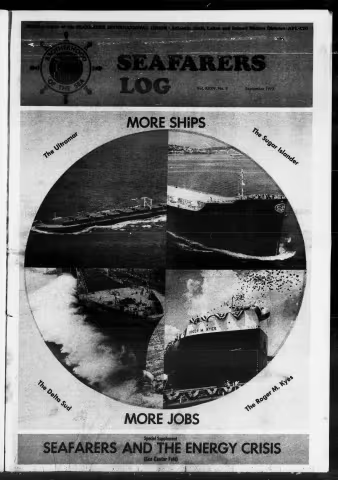
Ultramar, Sugar Islander
Off on Maiden Voyages
The largest freightship ever built on
the West Coast, the 80,500 ton, SIU-
contracted oil, ore bulk carrier Ultra
mar (Westchester Marine) is now sail
ing around the globe on her maiden
voyage.
The 892-foot ship, built by the Na
tional Steel and Shipbuilding Co. of San
Diego, was delivered to her owners on
Aug. 1.
She was constructed under the Mer
chant Marine Act of 1970.
Meanwhile, more jobs were provided
Seafarers late last month when another
new SlU-crewed, Seattle-buUt 28,000
ton freightship, the Sugar Islander (Pyr
amid) dropp^ anchor Aug. 26 in Port
land, Ore. before sailing f(V Hawaii on
the grain-sugar run.
On the same date, the giant Ultramar
sailed from Vancouver, Canada, where
she took on coal for bunkering in the
SIU port of Yokohama, Japan. She left
San Diego Aug. 8.
The $30-million bulk carrier later
headed for the Persian Gulf to take on
crude oil for Europe. She will anchor
off Libya for more crude oil for Quebec,
Canada. Finally, she will sail for the
SIU port of Norfolk for another load of
coal for Japan.
The 16.5 knot vessel is of the maxi
mum size capable of transiting the Pan
ama Canal.
Economic studies by the U.S. Mari
time Administration pinpoint bulk car
riers as the type of vessel which can
recapture U.S. bulk trade now carried
in. foreign bottoms.
The ship's cargo flexibility allows for
efficient use of the vessel at the lowest
possible transportation cost.
The U/rrumur successfully completed
her sea trials in July. She achieved an
average speed of 17.6 knots, considered
exceptional for a ship so big when fully
loaded.
She also performed well on her en
durance runs off Mexico.
Aboard the SlU-contracted Sugar
Islander on her maiden voyage, all crew
quarters have private baths or share
toilet and shower with one other room.
Each private room has its own lavatory
and desk plus wall-to-wall carpeting
and upholstered chairs.
One of the crew, William King, says,
"This ship is so big and conditions so
right that I might stake out a home
stead."
Cook John W. Nuss never had it so
good in a ship's galley. It's aU electric,
stainless steel and iile. No one has to
peel spuds. It's done by an automatic
peeler.
Seafarers on board the air condi
tioned ship have a lounge, laundry
room, handicraft hobby room, library
and an exercise compartment.
Other crewmembers are Bosun Wil
liam Parker, ABs Percy Kennedy, Ray
mond Reid, Chadboume Gait, Ray
Tood and Frank Russo, QMEDs
Ralph Amat and Byron Ginter, Wiper
Donald Crawford, Steward Ray Cas-
sanova and Utilitymen Nathan Ben-
enate and Charles Cassard.
The 641-foot, 38,000 ton Sugar Is
lander is carrying raw sugar for the Cali
fornia & Hawaiian Sugar Co. of San
Francisco from Honolulu to New Or
leans at 15-16 knots. C & H refinery
workers are affiliated with the SIU's
Sugar Workers Union No. 1.
The vessel can also carry many other
cargoes in her six holds which pack
1.2 million cubic feet.
She was built by the Lockheed Ship
building & Construction Co. and under
went her sea trials in late July and
early August. She was launched Aug.
26, 1972.
Aboard the Tanker Tallulah
Seafarers attending the Bosuns Recertlfication Program go aboard the SIU-
manned USNS Tallulah as the tanker arrives at the Steuart Petroleum Co. dock
in Piney Point, Md. From left are Piney Point port agent Gerry Brown; P. G. Win-
field, the Tallulali's bosun; Joe Pavlovich who graduated from the Lundeberg
School in August and was making his first trip as ordinary seaman, and Sven
Stockmarr who was attending the Bosuns Recertification Program.
i
I
I
S
Vice President's Report I
I
I
by Frank
NEW CONSTRUCTION
On the Great Lakes new vessels are being laimched and built such as the
Roger M. Kyes (American Steamship Co.) which hit the waters on July 28.
Her sister-ship, the Charles E. Wilson, was christened Aug. 30 and a third
vessel, the H. Lee White, will be completed in June 1974. Kinsman Marine
Transit Co. crewed the new, diesel powered, self-unloader, the MV William
R. Roesch, on June 22 and the company is building three additional vessels.
New deep sea vessels include the Robert E. Lee (Waterman) which will be
delivered on Sept. 29 while the company's Stonewall Jackson and Sam Hous
ton are tentatively scheduled for delivery in the spring of 1974. These three
ships are LASH-type vessels.
Meanwhile, Falcon Carriers, Inc. reports that construction on four 35,000-
ton diesel engine tankers will begin in October and they are expected to be
delivered by late 1975.
Ecological Shipping Corp. is in the process of building one i20,(X)0-ton
tanker while Cities Service Tankers are applying for construction subsidy for
one 265,000-ton ship.
Maritime Overseas Corp. is building four new vessels and Interstate Oil
Transport plans to build three 265,000-ton vessels.
Sea-Land Service, Inc. expects to crew the Sea-Land Finance on Sept. 15;
the Sea-Land Market on Sept. 30 and the Sea-Land Resource sometime in
December. Seatrain Lines, Inc. christened the TT Brooklyn on June 30 and
her second vessel, the Williamsburg, should be launched in March of 1974.
NEW COMPANIES AND NEW VESSELS
On Aug. 8 we signed contracts with Westchester Marine Shipping, owner
of the Ultramar. Pyramid Sugar Transport, Inc. signed contracts with us on
Aug. 24. The company owns the Sugar Islander.
BOSUNS RECERTIFICATION PROGRAM
We are happy to report that one of the most memorable milestones in the
history of our union occurred last month with the graduation of the first six
bosuns from the SIU Bosuns Recertification Program. I can say without hesi
tating that your union and its officials know that we can aU take great pride in
the accomplishment of these six bosuns. This month another six bosuns success
fully completed the Program and received their recertification credentials at
the September membership meeting at headquarters.
Clearly, our Bosuns Recertification Program is now moving ahead at full
speed with the third class studying here at headquarters and the fourth class
training at Piney Point, Md. The Program is obviously making a tremendous
contribution to our union while at the same time assisting in benefiting the
individual sailing careers of our bosuns.
"A" SENIORITY UPGRADING
Our "A" Seniority Upgrading Program, operated at the SIU's. Lundeberg
Upgrading Center at Piney Point, Md., continues at full speed ahead as one of
your union's most important upgrading programs. These programs continue to
turn out better qualified full book members in this union to assist us in our
obligation to man the vessels we have under contract.
UPGRADING PROGRAMS
Our entire roster of upgrading opportunities and programs for all three
shipboard departments is progressing well at the Harry Lundeberg School of
Seamanship. These programs, available to every eligible Seafarer, can make
every professional Seafarer's career a better one by providing the opportunity
to reach out for better paying jobs aboard our ships.
T-S NAVY TANKERS
Finally, I want to tell you that five T-5 Navy tankers now manned by the
SIU for the Military Sealift Command, have been placed on organizational
status by the union.
The performance records of the vessels, the American Explorer, the Mau-
mee, the Shenandoah, the Shoshone and the Yukon, continue to be closely
observed by the Military Sealift Command, the U.S. Navy and other federal
agencies. Therefore, it continues to be necessary for us to maintain these ves
sels on strict organizational status which requires direct crewing of the vessels
with the assistance of headquarters.
As you know, the 13 original tankers, belonging to the U.S. Navy, oper
ated by the Military Sealift Command, and manned by the SIU, have provided
us with in excess of 500 jobs. As you can readily see, the continued satisfac
tory operation of these vessels is of primary concern to the SIU and your
union officials will continue to make every effort to secure the job opportuni
ties these vessels are now providing.
n
September 1973 Pages
(r;
II
i i
ii
lit
i- ' •
The third of the revolutionary
LASH/container vessels built for the
SlU-contracted Delta Lines was
launched last month in New Orleans,
La.
Christened the Delta Sud, the 893-
foot vessel joins her two identical
sister-ships, the Delta Mar and the
Delta Norte which were launch-
earlier this year.
Among the speakers at the launch
ing were SlU Vice President Frank
Drozak. Calling the christening a
"milestone occasion" he said, "I know
that I speak for all members of our
union when I say that we are proud to
be a part of the great step forward
that the launching of the Delta Sud
represents."
Like her sister-ships, the Delta-Sud
will travd between the Gulf of Meuco
and the oast coast of South America
via Caribbean ports. The Delta Mar
has already taken on her SIU crew and
is delivering her first cargo.
Built at Avondale Shipyard's main
Division in New Orleans, La., the Delta
Sud was side launched into the Missis
sippi River.
The sleek, modem ship has a
molded breadth of 100 feet and a de
sign draft of 28 feet. At that draft she
can carry approximately 15,000 tons
of cargo. She has a propulsion capa
bility of 32,000 horsepower.
The Delta Sud and her sister-ships
are the first vessels contracted for
under the Merchant Marine Act of
1970, which subsidized the construc
tion of 300 ships over a 10-year
period.
Besides SIU Vice President Drozak,
the others present at the launching in
cluded Edwin Hartzman, president of
Avondale Shipyards, Inc., Captain
J. W. Clark, president of Delta Lines,
and the Brazilian ambassador,. His
Excellency Joao Augusto de Araujo
Castro, who was the keynote speaker.
The ambassador's daughter, Senho-
lita Silvia Saint-Brisson de Araujo
Castro, christened the vessel.
The ultra-modern Delta Sud hits the waters of the Mississippi for the first time as she is launched from Avondale
Shipyards, Inc., Main Yard Division in New Orleans, La.
The Delta Sud and her sister-ships
are capable of carrying up to 74
barges, each loaded with 370 tons of
cargo plus 288 standard 20-foot con
tainers or up to 1,740 containers by
proportionately reducing the number
of barges carried.
The floating barges are hoisted
aboard, or lowered into the water, over
the vessel's stem by the ship's 500-ton
shipboard crane. The Delta Sud and
her sister-ships are also equipped with
30-ton capacity cranes for handling
containers.
Merchant Marine Act Provides
New Great Lakes Ore Carrier
SIU High School Program
Available to Seafarers
Sixteen Seafarers have achieved high
school diplomas through the SIU-IBU
academic upgrading program at the
Lundeberg School in Piney Point—a
100 percent passing record.
The program is open to all SIU and
IBU members—^regardless of age—
who have die desire to achieve dieir
high school diplomas. Of the 16 mem
bers who have achieved diplomas so
far, the youngest was 18 and the old
est 42.
The study period ranges from 6-8
weeks, and classes are small permittiag
teachers to give individualized instruc
tion. Specialists in reading and study
skills are available to help students
leam more easily.
Any member of the SIU or IBU who
is interested in taking advantage of this
opportunity should filj out the coupon
below and mail it to the Harry Lunde
berg School at the address printed on
the coupon.
Following are the requirements for
eligibility for the Lundeberg High
School Program:
1. One year's seatime or time aboard
a towboat
2. Initiation fees most be paid in
foD.
3. All outstandii^ monetary obliga
tions such as dues and loans most be
paid in fnO.
I 1 am inter^ted in mv .m/r r !
The SlU-manned Great Lakes vessel
William R. Roesch (Kinsman Marine)
recently made her maiden voyage on
L^e Superior. She is the first Lakes
vessel built imder provisions of the
Merchant Marine Act of 1970—^legis
lation vigorously fought for by the SIU.
The 630-foot self-unloader is a
imiquely well designed vessel. She is
the first Lakes vessel with a wheelhouse
mounted aft. The Roesch also features
a "crow's nest" at her bow used for a
lookout.
First of five new carriers being con
structed by American Shipbuilding v/ith
subsidy aid provided through the 1970
Merchant Marine Act, the Roesch will
transport taconite ore from the Lakes
to the Cleveland works of Jones &
Laughlin Steel Co. on the Qiyalrogafj,-^
River. She has a capacity of 19,50#
tons and her self-unloading equipment
can handle 5,000 tons per hour.
The maiden voyage of the Roesch
also marked another first in Great Lakes
shipping. She was the first American-
flag lake freighter to make her maiden
voyage on Lake Superior since 1960.
Implementation of the Merchant Ma
rine Act of 1970 is a milestone achieve
ment for American-flag shipping on
the Lakes. The vessels to follow the
Roesch off the ways will be another step
towards a revitaUzation of our Great
Lakes fleet.
I r-; , .-v r.-'yrS i-., -V- -
'' " - V 'i ̂ .
I on the Lundeberg High School Program.
1 Name
I ^ yt:
1
I Last grade cnmpfefftrt
1 Complete this form, and mail to:
and I would like
•:?V
-'W Ml,MM III lim 111*1 MM,,, ^ ....V",:".-- r ' • • V Y' y;- • Y-'"
I
f.
Mi^aiWNalen
Director of Academic Educatioh
Hatty Lundeberg School The William R. Roesch makes her maiden voyage to Lake Superior. The 630-
foot self-unloader features an aft-mounted wheelhouse and a bow-mounted
"crow's nest".
.i;
Page 6 Seafarers Log
>1$ Congress Resumes Work:
Important Legislation
Awaits Further Action
As Congress goes back into session
this month after an August recess, it
must decide on several important
pieces of legislation that affect SIU
members and the U.S. maritime in
dustry.
The SIU is vigorously working to
pass legislation dealing with the U.S.
Public Health Service hospitals; oil im
ports, and the trans-Alaska pipeline.
The bill that would keep the eight
USPHS hospitals open — the Emer
gency Health Services Bill—was ve
toed by President Nixon after being
passed by both the Senate and the
House of Representatives. Just before
the August recess, the Senate overrode
the President's veto.
The House of Representatives must
now override the veto. However, past
records show that the House generally
has not overridden Presidential action
on most issues and the battle to secure
enough votes to override will be a
tough one.
However, the SIU, and the entire
AFL-CIO will continue to fight to
keep the Department of Health, Edu
cation and Welfare from closing the
badly needed hospitals.
While the legislative battle on the
issue continues, the SIU has also
brought the hospital issue before the
courts. Before the President vetoed the
bill, the SIU was successful in obtain
ing a preliminary federal court injunc
tion preventing HEW from closing the
hospitals.
The court granted a preliminary in
junction and none of the hospitals can
now be closed until there is a full court
hearing on the SIU's request for a per
manent injunction.
Through various (oil) cargo prefer
ence bills which are now in committee,
the SIU is fighting for passage of a law
requiring that a portion of all oil im
ported to the U.S. be carried on Amer
ican-flap ships.
At this point there are 165 members
of the House of Representatives who
have sponsored bills calling for such a
requirement. The struggle for such leg
islation, however, is a rough one be
cause of the tough opposition pre
sented by the major oil companies who
are aided by foreign shipping interests
and their governments.
Successful passage of legislation au
thorizing the building of the trans-
Alaska pipeline is almost complete.
Both the Senate and the House of
Representatives passed bills which
would allow the pipeline to be con
structed. Only some minor differences
in the two pieces of legislation must
now be worked out in a conference
committee before an immediate start
on the pipeline can begin.
The bill must then be signed by
President Nixon.
Construction of the pipeline will
mean that American ships will be used
to carry Alaskan oil from the ice-free
port of Valdez to harbors on the west
coast of the continenial U.S.
Rep. Addabbo Hails SIU's
Piney Point Achievement
In a speech delivered at graduation
ceremonies at the SIU's Lundeberg
Upgrading Center, Congressman Jo
seph P. Addabbo (D-N.Y.) praised the
Piney Point, Md., facility and the SIU
for their contributions to the national
interest.
Representative Addabbo told ' the
graduating trainees and upgraders that:
"By making a better life for you, the
Seafarers Union is making a greater
nation for us all."
Speaking of the SIU's active par
ticipation in the legislative processes of
government, the New York legislator
said:
"Through the Union's efforts in
working through the Congress, we were
able to pass the 1970 maritime law
which forced this nation to look at its
own shipping.
"So in 1970, we said this nation must
look to its youth, must look to rebuild
ing its merchant fleet and so today we
have more ships going down the ways
sailing under the American flag—which
means good jobs and a promising and
secure future."
Representative Addabbo, a co-
sponsor of the oil cargo preference bill,
pledged his support on the oil bUl, the
Alaska pipeline issue, and the emer
gency health legislation—which deals
with the continuance of the U.S. Public
Health Service hospital system.
"We have the best seamen, we have
the best ships, and they must be for you
to sail in. This is what we are working
for," he told the audience.
The Congressman, a member of the
House of Representative's Subcom
mittee on Government Procurement
and International Trade, said that al
though there is an energy crisis in oil,
gas, and other fuels, this problem can
be dealt with through legislation.
Departing from the text of his speech.
Representative Addabbo told an amus
ing anecdote about a shoreside laborer
who was afraid of nothing, except tak
ing down a bee's nest. The reason?
"Those bees are organized," the laborer
replied.
Congressman Addabbo drew a les
son from this little story—a lesson im
portant to the SIU, to government, and
to the U.S. itself:
"As long as you're organized, stay
organized, work together, we will al
ways have a strong SIU, a strong mer
chant fleet, and a strong nation."
Seafarers May Man
Atomic Powered Ships
Seafarers may be manning nuclear
powered merchant ships sometime in
the near future. Senators Warren G.
Magnuson (D-Wash.); Russell B.
Long, (D-La.) and U.S. Rep. Frank
M. Clark (D-Pa.) have introduced
legislation to facilitate construction and
ownership of atomic-powered mer
chant ships.
In introducing the bill Senator Mag
nuson said: "American industry today
has the technical skill and capacity to
build nuclear ships that can be oper
ated efficiently, safely and economic
ally."
By B. Rocker
During the month of August while Congress was in recess, most mem
bers had an opportunity to go back to their home states or districts to meet
with their constituents. As a part of the democratic process, voters can
and should express their views to elected representatives oti matters of
concern to them.
Problems in The System
Political observers say many voters are apathetic, and that they know
little about the voting records of their senators and congressmen on bills
which have been introduced. They may not even know the names of these
public servants.
Surveys show that matters of greatest interest to the average voter (refer
red to by one political scientist as "a plumber's wife in Dayton, Ohio") are
things like crime in the streets or cost of living. These issues can be much
more personally understood and related to than a military research and
development program, for example.
What seems to be apathy may be partially caused by the size and
complexity of "big government." It is difficult to understand. Congress not
only has two houses—the House of Representatives and the Senate (some
times referred to by its members as "the upper house")—but each body has
committees and subcommittees. The House has 21 standing committees;
the Senate, 17. In these 38 committees there are more than 250 subcom
mittees, whose members are appointed from both parties, the Chairman
being the senior member of the majority.
Because the Senate is a smaller body—ICQ members compared to 435
in the House—each senator must serve on more committees and he and his
staff must deal with a greater number of specialties.
What Congress acts on is the Federal Budget, prepared by the Adminis
tration. Government agencies send budget requests to the Office of Manage
ment and Budget, which sorts, pares and consolidates the requests to meet
the needs of the President's programs.
A bill may die anywhere along the route from introduction to presiden
tial veto. In one session of Congress, more than 1,000 bills will be intro
duced in the House and one-fourth that many in the Senate.
For each program, there must be a bill to authorize and one to provide
authority to spend money. They are referred to as the authorization and
the appropriation.
Each house acts separately on its version of the authorization and
appropriation; any differences are resolved in a conference committee.
When the bill reaches the President, he has ten working days to sign or
veto. Congress can override a direct veto with a two-thrids vote of both
houses. In practice, an override is seldom successful.
Legislative Initiative
As government has grown, legislative initiative by the President has
grown, and the planning and coordinating function of the Office of Manage
ment and Budget gives the President an overview almost impossible for
Congress to achieve in its present form, with dispersion of authority to
committees.
In order to regain the legislative initiative Congress feels it has lost, a
House/Senate study committee has come up with a reform plan to give
authority to a single committee in each house to set and enforce appropria
tions and to allocate priorities within the whole Federal Budget.
After the Recess
As the LOG goes to press. Congress is just back in session.
Three bills which have been discussed in some detail in previous columns
are scheduled for early action. The Trans-Alaska Pipeline bill should
shortly be out of the conference committee, and is expected to be signed by
by the President. A House vote is expected on whether to override the
President's veto on the Emergency Health Services Bill with the Public
Health Service Hospital amendment. And several (oil) cargo preference
bills are in committee.
Seafarers are urged to contribute to SFAD. It is the way to have your
voice heard and to keep your union effective in the fight for legislation to
protect the security of every Seafarer and his family.
September 1973 Page ^
li
I
f'
|!
I I V »' •
•!f
• i;-
d-.
t
DISPATCHERS REPORT
• GiiM ft taland Wolan Dblriet
AUGUST 1-31,1973
Port
TOTAL REGISTERED
All Groups
Class A Class B
TOTAL SHIPPED
All Groups
Class A Class B Class C
DECK DEPARTMENT
REGISTERED ON BEACH
All Groups
Class A Class B
Boston 6 2 2 1 17 5
New York 12 58 8 1 154 26
Philadelphia .... 14 9 11 5 0 - 21 9
Baltimore 36 15 28 12 1 82 30
Norfolk 15 5 11 13 0 30 7
Jacksonville 33 . 12 24 10 0 41 3
Tampa 1 3 0 0 5 0
Mobile 23 4 15 2 1 48 8
New Orleans 59 10 35 6 0 110 21
Houston 74 25 54 10 7 40 39
Wilmington 18 26 9 10 0 34 27
San Francisco 54 19 45 7 0 120 33
Seattle 43 35 22 24 0 43 19
Totals 179 317 109 11 745 227
Port ENGINE DEPARTMENT
Boston 4 1 3 3 0 7 3
New York 69 28 55 26 3 130 45
Philadelphia 8 10 • 2 2 0 16 12
Baltimore 37 17 20 12 1 64 26
Norfolk 10 8 10 2 16 12
Jacksonville 16 13 16 1 16 12
Tampa 4 1 5 1 1 7 1
Mobile 21 5 16 6 1 35 12
New Orleans 49 26 33 18 1 111 47
Houston 61 33 42 18 10 28 31
Wilmington 16 12 13 4 0 13 16
San Francisco .... 54 23 45 12 0 86 47
Seattle 28 35 17 21 0 28 21
Totals 217 272 149 20 557 285
Port STEWARD DEPARTMENT
Boston 1 3 0 0 0 2 2
New York 35 6 33 12 1 64 14
Philadelphia 16 2 5 1 0 20 7
Baltimore 19 7 18 6 2 41 9
Norfolk 17 23 10 ' 5 3 26 36
Jacksonville 16 12 10 3 1 22 11
Tampa 0 0 1 0 0 5 0
Mobile 22 1 9 0 0 50 3
New Orleans 28 7 15 2 0 69 12
Houston 44 10 19 5 0 27 32
Wilmington 13 7 4 10 0 15 12
San Francisco 28 14 20 5 0 53 24
Seattle 17 9 13 1 22 6
Totals 109 153 62 8 416 168
Totals All Depts. ... 1,109 505 742 320 39 1,718 680
Upon looking at the above figures, SIU members can see the strong job secur
ity that is theirs. These figures are concrete proof of the number of jobs available
to the membership. During the period of Aug. 1-31,1973, of the 1,101 jobs ship
ped, 742 were filled by Class "A" Seniority full book members. Therefore, there
were 359 permanent jobs available to Class "A" Seniority full book members not
taken by them.
James William Dolan, Jr.
Ted Adair asks that you contact
him as soon as possible at Vererans
Cab Co., 704 Vance Ave., Memphis,
Tenn. 38126.
Harold Hess
Your brother, Franklin Hess, asks
that you contact him immediately at
301-355-5780. Also, Franklin Hess
asks that anyone knowing the where
abouts of Harold Hess call him at the
same number and reverse the charges.
Christos Zanucci
Please contact A. Wadja at 314
Main St., Lewiston, Idaho.
Edward J. Reynolds
Abraham Weisberg of the law firm
of Standard, Weisberg, Heckerling &
Rosow, asks that you contact him at
38 Park Row, New York, N.Y. 10038,
telephone RE 2-9855.
Albert L. Kennedy
E. Evans, at Century Metalcraft
Corp., requests that you contact him
as soon as possible at 2265 Westwood
Blvd., Los Angeles, Calif. 90064, tele
phone GR 5-3581.
David Gilmore
Please contact Mrs. Dora L. Gil-
more at Rt. #4, Box 604, Dunn, N. C.
28334.
Know YIDW Rights
FINANCIAL REPORTS. The constitution of the SIU
Atlantic, Gulf, Lakes and Inland Waters District makes spe
cific provision for safeguarding the membership's money and
Union finances. The constitution requires a detailed audit by
Certified Public Accountants every three months, which are
to be submitted to the membership by the Secretary-Treas
urer. A quarterly finance committee of rank and file mem
bers, elected by the membership, makes examination each
quarter of the finances of the Union and reports fully their
findings and recommendations. Members of this committee
may make dissenting reports, specific recommendations and
separate findings.
TRUST FUNDS. All trust funds of the SIU Atlantic, Gulf,
Lakes and Inland Waters District are administered in accord
ance with the provisions of various trust fund agreements.
All these agreements specify that the trustees in charge of
these funds shall equally consist of Union and management
representatives and their alternates. All expenditures and
disbursements of trust funds are made only upon approval
by a majority of the trustees. All trust fund financial records
are available at the headquarters of the various trust funds.
SHIPPING RIGHTS. Your shipping rights and seniority
are protected exclusively by the contracts between the Union
and the shipowners. Get to know your shipping rights. Copies
of these contracts are posted and available in all Union halls.
If you feel there has been any violation of your shipping or
seniority rights as contained in the contracts between the
Union and the shipowners, notify the Seafarers Appeals
Board by certified mail, return receipt requested. The proper
address for this is:
Frank Drozak, Chairman, Seafarers Appeals Board
275-20th Street, Brooklyn, N.Y. 11215
Full copies of contracts as referred to are available to you
at all times, either by writing directly to the Union or to the
Seafarers Appeals Board.
CONTRACTS. Copies of all SIU contracts are available
in all SIU halls. These contracts specify the wages and con
ditions under which you work and live aboard ship. Know
your contract rights, as well as your obligations, such as
filing for OT on the proper sheets and in the proper manner.
If, at any time, any SIU patrolman or other Union official,
in your opinion, fails to protect your contract rights prop
erly, contact the nearest SIU port agent.
EDITORIAL POLICY—SEAFARERS LOG. The Log
has traditionally refrained from publishing any article serving
the political purposes of any individual in the Union, officer
or member. It has also refrained from publishing articles
deemed harmful to the Union or its collective membership.
This established policy has been reaffirmed by membership
action at the September, 1960, meetings in all constitutional
ports. The responsibility for Log policy is vested in an edi
torial board which consists of the Executive Board of the
Union. The Executive Board may delegate, from among its
ranks, one individual to carry out this responsibility.
PAYMENT OF MONIES. No monies are to be paid to
anyone in any official capacity in the SIU unless an official
Union receipt is given for same. Under no circumstances
should any member pay any money for any reason unless
he is given such receipt. In the event anyone attempts to
require any such payment be made without supplyifig a re
ceipt, or if a member is required to make a payment and is
given an official receipt, but feels that he should not have
been required to make such payment, this should immediately
be reported to headquarters.
CONSTITUTIONAL RIGHTS AND OBLIGATIONS.
The SIU publishes every six months in the Seafarers Log a
verbatim copy of its constitution. In addition, copies are
available in all Union halls. All members should obtain copies
of this constitution so as to familiarize themselves with its
contents. Any time you feel any member or officer is attempt
ing to deprive you of any constitutional right or obligation by
any methods such as dealing with charges, trials, etc., as well
as all other details, then the member so affected should imme
diately notify headquarters.
EQUAL RIGHTS. All Seafarers are guaranteed equal
rights in employment and as members of the SIU. These
rights are clearly set forth in the SIU constitution and in the
contracts which the Union has negotiated with the employers.
Consequently, no Seafarer may be discriminated against be
cause of race, creed, color, national or geographic origin. If
any member feels that he is denied the equal rights to which
he is entitled, he should notify headquarters.
SEAFARERS POLITICAL ACTIVITY DONATION —
SPAD. SPAD is a separate segregated fund. Its proceeds are
used to further its objects and purposes including but not
limited to furthering the political, social and economic inter
ests of Seafarer seamen, the preservation and furthering of the
American Merchant Marine with improved employment op
portunities for seamen and the advancement of trade union
concepts. In connection with such objects, SPAD supports and
contributes to political candidates for elective office. All con
tributions are voluntary. No contribution may be solicited or
received because of force, job discrimination, financial re
prisal, or threat of such conduct, or as a condition of member
ship in the Union or of employment. If a contribution is
made by reason of the above improper conduct, notify the Sea
farers Union or SPAD by certified mail within 30 days of the
contribution for investigation and appropriate action and
refund, if involuntary. Support SPAD to protect and further
your economic, political and social interests, American trade
union concepts and Seafarer seamen.
If at any time a Seafarer feels that any of the above rights
have been violated, or that he has been denied bis constitu
tional right of access to Union records or information, he
should immediately notify SIU President Paul Hall at head
quarters by certiiied mail, return receipt requested.
Pages Seafarers Log
y'tTi
A Labor Day Promise to the People
AFL-CIO Vows to Defend The Rights of Labor
AFL-CIO president George Meany
in a Labor Day address to the nation
warned that without the First Amend
ment Bill of Rights of . . freedom of
speech, freedom of assembly, the right
of privacy ... there can be no free trade
union movement."
He emphasized that "having rights
on paper and exercising them in fact are
not necessarily the same thing...."
"Because workers know what it is
like to have their rights trampled on
and because they have seen what hap
pens to workers and their unions in
countries which have no freedoms, they
are justifiably concerned when these
rights are endangered. Recent events
have strengthened our resolve to protect
these rights," Meany vowed.
Meany said that from its earliest
days, the American labor movement
has been a movement of dissent. Work
ers dissenting against economic exploi
tation. Workers dissenting against
sweatshops and other substandard
working conditions. Workers dissenting
against employers' control of their lives,
their homes, their schools, their oppor
tunity to improve their lot and, most
especially, that of their children.
He continued: '" .ions have never
been very popular with the establish
ment—for dissent is never popular with
those who have much and intend to
keep it all. By its very nature, dissent is
a questioning of authority. And a host
of weapons—literally and figuratively
—have been used by those in authority
either to deny workers their rights or to
coerce or subvert them into not exer
cising their rights."
"Not so many years ago it was not
imcommon for workers to be spied
upon at work and in their homes.
Phones have been tapped. Workers
have been on the wrong ends of billy
clubs, guns, fists, attack dogs and tear
gas. Private and public armies have
tried to intimidate workers and their
imions.
"Courts have enjoined workers from
exercising their rights, and police have
enforced these injunctions with violence
and, sometimes, with death. But work
ers were not deterred," he said.
The labor leader went on to say that
new weapons were tried—^the weapons
of thought control and fear. Workers
have been hooked up to so-called "lie
detector" machines, monitored by tele
vision cameras and interrogated about
intensely personal matters, about their
private lives and their past, present and
future actions.
He added that workers have repeat
edly seen their rights as free Americans
violated—by public as well as private
oflScials. Therefore it is no accident
that workers are zealous of preserving
the rights and liberties of themselves
and all Americans—in preserving de
mocracy.
"Only in a democracy can workers
control their individual destiny—eco
nomic and political. To be free, workers
must live in a system where people are
more important than wealth. And, in
the final analysis, that is just what a
democracy is all about," Meany said.
The AFL-CIO president pointed out
that "we know that workers cannot
have freedom and democracy just for
themselves. The genius of democracy
is that it clothes every citizen with equal
rights, giving no person special treat
ment over another."
"The tools of those who would in
vade an individual's right of privacy
are the tools of repression, thought-
control and tyranny. Wiretaps, hidden
microphones, closed circuit television
monitoring people innocently pursuing
their daily lives, lie detectors, tape re
corders, personnel questionnaires, com
puter data banks, peepholes, cameras,
spy glasses, private detectives—all have
been and are being used to intrude upon
the privacy of individuals. The claim is
that this is 'necessary.' Employers say
they spy on workers to catch the ma
lingerers and the thieves."
Meany then noted that Labor Day is
the day America ^ts aside to honor the
free workers who built this nation and
their unions which enable them to bet
ter share in the fruits of their labors.
He said it is a day for looking back
on the accomplishments of the labor
movement—^free collective bargaining
victories such as decent wages and
On the Air
... , /
yv-
On radio's "Labor News Conference" AFL-CIO Maritime Trades Department
administrator 0. William Moody (second from left) and AFL-CIO Social Secu
rity director Bert Seidman (second from right) answer questions posed by
Newsweek magazine's Tom Joyce (left) and Jerome Brazda (right) of the
Washington Report on Medicine and Health. The AFL-CIO public affairs pro
gram heard on Tuesdays over the Mutual Broadcasting System focused on
the U.iS. House of Representatives action on President Nixon's veto of the
Emergency Medical Services Bill which had been already approved by Con
gress and would have insured the future operation of the USPHS hospitals.
working conditions to legislative vic
tories such as Social Security, Medicare
-and federat-ftki to-education.
"It is a time for looking ahead, to
set our sights higher and higher so that
all Americans will benefit from eco
nomic justice and human dignity.
"But it is time, too, to remember—to
remember that the trade union move
ment could never have accomplished
all that it has for its members and for
society, if we did not live in a land of
freedom.
"So, on this Labor Day, it is proper
that we consider how the rights and
liberties enjoyed by all Americans af
fect us as workers and as citizens."
He stressed that "freedom and indi
vidual rights are the basic ingredients of
democracy. Freedom of speech, free
dom of assembly, the right of privacy—
these are not just nice conveniences;
they are the fundamental elements of a
free trade union movement."
"Without freedom, there can be no
free trade union movement. And since
unions are the indispensable instrument
for free workers to improve their stand
ard of living, democracy is clearly the
worker's staff of life.
"What makes the American labor
movement unique in the history of free
people is that we exercise our rights,
daily, diligently and with determination.
"Historically, it was workers exercis
ing their First Amendment rights of
free speech and assembly who formed
the first American unions. On the foun
dation of their individual rights, workers
built a collective movement—a move
ment dedicated to bringing workers a
measure of economic freedom that
would permit them to enjoy their other
freedoms."
Strikes are an inconvenience. But the
public's right not to be inconvenienced
certainly is not paramoimt to the indi
vidual's right to be free, Meany said.
President Eisenhower, Meany said,
summed it up this way: "There are
worse things than strikes—and one of
them is the loss of freedom."
He said Ben Franklin wrote it earlier.
"Those," he said, "who would give up
essential liberty to purchase a little
temporary safety, deserve neither lib
erty nor safety."
"That's why the framers of Uie Con
stitution drafted the Bill of Rights. The
rich and the powerful don't need it but
the poor, the weak, the downtrodden
do.
"Organized labor does not just brood
about invasions of individual liberty.
We attempt, with all the vigor at our
command, to blunt the efforts of any
who would pervert freedom, deny lib
erty, intrude upon privacy, undermine
democracy."
Meany concluded, "we insist that
working men and women—indeed all
Americans—be treated in a manner
commensurate with their inherent hu
man dignity. And that can only be
achieved in a nation dedicated to lib
erty, by a government of the people, by
the people and for the people."
SIU President Paul Hall also deliv
ered a nationwide radio address on
Labor Day.
Speaking on oil imports on foreign-
flag ships and our balance-of-pay-
ments deficit, he told his audience
that:
"A major contributing factor to this
deficit is our lack of U.S.-flag tankers.
In 1972, the balance-of-payments def
icit caused by the use of foreign-flag
tankers to carry U.S. oil imports
amounted to more than $500 million.
In 1973 we look for this foreign-
tanker-caused deficit to exceed $600
million. By 1980, using Department of
Interior oil import projections, and
given no improvement in our own
tanker capability, we look for the for-
eign-tanker-caused deficit to jump to
more than $2.5 billion."
He said the only way the balance-of-
payments deficit can be reduced is
through the use of our own ships to
carry the oil.
"The AFL-CIO has called on Con
gress to correct this situation by requir
ing that a portion of this vital energy
be carried on American-flag, Ameri
can-built and American-manned ships.
Legislation to accomplish this crucial
objective is now pending in both houses
of Congress—and merits the support
of all Americans."
The full text of Hall's speech is con
tained in the special supplement in this
issue of the LOG.
British Sea Volunteers Save
100,000 Maritime Lives
Because they live on an island, the
British have relied heavily upon the
seas to get material necessities and to
establish and maintain communications
with the rest of the world. They have
also come to know the sea very well—
her beauty and her terror.
That is probably one reason why, in
1824, the all-volunteer Royal National
Lifeboat Institution was organized on
the suggestion of Sir William Hillary,
a boat fancier on the Isle of Man lo
cated between the rugged British and
Irish coasts.
Since that time, R.N.L.I. has saved
the lives of about 100,000 men, women,
and children—many of whom were
professional seafarers. The organiza
tion's motto is "Eleven lives saved every
week for over a century."
It is no wonder that the group's vol
unteers are highly respected in England.
Rough estimates show that in 1972
alone, more than 3,000 calls were
answered from the 247 lifeboat sta
tions.
Since the organization has resisted
government subsidy, its money must
come from voluntary contributions. Al
though about $5 million is collected
annually, it is still not enough to cover
the high costs of maintaining the sys
tem. One new lifeboat alone costs
$160,000.
Manning a lifeboat off the rough seas
of England can be hazardous and sev
eral years ago when a lifeboat from the
island of Hoy rolled over in heavy seas,
the eight men on board were kill^. But
even in the face of this danger there is
no lack of volunteers.
As one British business executive and
yachtsman said about these men, "They
do not have to risk their lives. They
could stay at home safely in bed. But
they don't."
He also pointed out that, "They cer
tainly do not do it for the money. Not
for the $3.60 which is the standard
allowance per man for the first two
hours nor for the 90 cents an hour after
that."
.'1.
I
'5
September. 1973 Page 9
{fr
Si!
M
• S' r
' uu^i^hd Initiation Fees;
" 4 ' '' '•
Report Of Constitutional Committee
:r
We, the undersigned Constitutional Committee,
were elected at a special meeting at Headquarters-
Port of New York on August 28, 1973, in accord
ance with Article XXV, Section 2 of our Union Con
stitution. We have had referred to us and studied the
constitutional amendment resolution submitted by
Secretary-Treasurer Joe DiGiorgio on behalf of
Brothers Raymond J. Sadowski, S-176, Melvin W.
Bass, B-128, Jose Aguiar, A-67, William C. Reid,
R-584, Mikoloi Strawinski, S-1038, Raymond C,
Perez, P-5I3, and Walter Gustavson, G-36, all con
stituting a Quarterly Financial Committee. The
amendment resolution was adopted by a majority
vote of the membership at Headquarters arid all
Ports and was printed in fuU in the Seafarers Log.
In discharge of our duties we have consulted with
the office of the Union's General Counsel as to legal
aspects; with our Secretary-Treasurer as to records
and statistical matters and with other officers and
members.
It is apparent to us and as the records so clearly
show, and in concurrence with the resolution of our
above Brothers constituting the Quarterly Financial
Committee, that the expenses of operating and ad
ministering the Union, in order to adequately and
better serve our membership, have significantly in
creased over the past years. For these reasons, we
report and recommend the following resolutions for
membership vote:
1. RESOLVED; Effective January JL974,
the initiation fee for all new full botrfc members
shall be $600.00, whb quarterly payments to
wards the initiation fee to be $150.00, and that
our Constitution's Article V, Section 2, be so
amended. That this change be applicable as well
to all applicants who have not completed full
payment of the present initiation fee by Decem
ber 31, 1973.
2. RESOLVED: Effective Janimry 1, 1974,
the calendar quarterly dues for' all members
shall be $50.00.
Your Committee further recommends and reports
that in connection with the ballot to be used by the
membership in the vote on your Committee's recom
mendations, that there be two separate propositions
to be voted YES or NO, the first constituting the
above Resolution No. 1 and the other above Resolu
tion No. 2.
If this Constitutibttal Committee's report and rec
ommendation is concurred in by the membership at
the next regular membership meetings in September,
1973, it is recommended that:
(a) The ballot on the above two resolution proposi
tions be held by mail referendum vote over a thirty-
day period by secret ballot, and that the voting sh^
commence at all Ports on October 2, 1973 and end
on October 31, 1973, between the hours of 9 A.M.
and 12 Noon, Monday through Saturday, excepting
therefrom legal holidays; and that on November 1,
1973 at 10 A.M. at Headquarters, a special meeting
of the membership be held for the purpose of elect
ing a Tallying Committee consisting of six full book
members who, upon their election, shall take posses
sion of the ballots, tally the same, make its report
and notify the Secretary-Treasurer as to the results
of the referendum as soon as possible thereafter. No
ballot received after Noon on November 6,1973 shall
be counted.
(b) Your Constitutional Committee notes that
the original resolution requires voting to commence
no earlier than thirty days after membership approval
of this Report. However, we see no need to delay the
voting for thirty days; and under Article XXV, Sec
tion 2 of our Constitution, since we are empowered
to propose changes or substitutions or recommenda
tions regarding the resolution, we recommend that
the above voting schedule will give the membership
of oiir Union an adequate opportunity to vote and to
receive reasonable notice of the vote herein.
(c) The Secretary-Treasurer shall designate a bank
depository for the ballots.
(d) The balloting procedure for the mail referen
dum shall be as provided in our Constitution's Article
XIII, Section 3(c), (d) and (e) which read as follows:
"ARTICLE Xra, SECTION 3 BALLOTING
PROCEDURES Ic) The ballots so prepared at
the direction of the Secretary-Treasurer shall
he the only official ballots. No others may be
used. Each ballot shall be numbered as indi
cated in the preceding paragraphs and shall
be numbered consecutively, commencing with
number 1. A sufficient amount shall be printed
and distributed to each Port. A record of the
ballots, both by serial numbers and amount,
sent thereto, shall be maintained by the Secre
tary-Treasurer, who shall also send each Port
Agent a verification list indicating the amount
and serial numbers of the ballots sent. The Sec
retary-Treasurer shall also send to each Port
Agent a sufficient amount of blank opaque en-
vdopes containing the word, "BalloP* on the
face of the envelope, as well as a sufficient
amount of opaque mailing envelopes, first class
postage prepaid and printed on the face thereon
as the addressee shall be the name and address
of the dq[H»ritoiy for the receipt of such ballots
as designated by the President in the maimer
provided by Artide X, Section 1, of this Con-
stitntioii. In the iqipmr left-band comer oi sudi
mailing mvdrqie, ffiere shall be printed thereon,
as a top line, provirion for the voter's signatnie
and on amriber line immediately thereunder,
provirion for the printing ci ffie voter's name
and book number. In addition, the Secretary-
Treasnrer sfaaB also send a suffident amount of
mailing envdopes identical with the mailing
mivdrqpes mentioned above, exc^t ffiat they
shaD be of different color, and shaD contain on
the face of sudi envelope in bold lettm, the
word, "Chanenge." The Secretary-Treasurer
shall further furnish a suffidoit amount of
"Roster Sheets" which shaD have printed
thereon, at the top thereof, the year of the elec-
timi, and immediately diereunder, five (5) ver^
tical columns designated, date, bfiDot number,
signature full book member's name, book num
ber, and comments, and such roster sheets shall
contain horizontal lines inunediately under the
captions of each of the above five columns. The
Secretary-Treasurer shall also send a suffident
amount of envelopes with the printed name and
address of the depository on the face thereof,
and in the upper left-hand comer, the name of
the port and address, and on the face of such
envelope, should be printed the words, "Roster
Sheets and Ballot Stubs." Each Port Agent shall
maintain separate records of the ballots sent
him and shall inspect and count the ballots when
received, to insure that the amount sent, as weD
as the numbers thereon, conform to the amount
and numbers listed by the Secretary-Treasurer
as having been sent to that Port. The Port Agent
Page 10
The membership-elected Constitutional Committee includes (left
to right): Seated—J. Colder, W. Cassidy, and W. Gustavson;
Standing—M. Del Prado, J. Ayala, and E. Anderson.
SlU members vote to select members of the Constitutional Com
mittee at special headquarters meeting.
shall immediately execute and retum to the Sec
retary-Treasurer a receipt acknowledging the
correctness of the amount and the numbers
the ballots sent, or shall notify the Secretary-
Treasurer of any discrepancy. Discrepandes
shall be corrected as soon as possible prior to
the voting period. In any event, receipts shaU be
forwarded for all the aforementioned election
material actually received. The Secretary-Treas
urer shall prepare a file in which shall be kept
memoranda and correspondence dealing with
the election. This file shall at all times be avail
able to any member asking for inspection of the
same at the office of the Secretary-Treasurer
and shall be turned over to the Union Tallying
Committee.
"(d) Balloting shall be secret. Only full book
members in good standing may vote. Eacb full
book member may secure his ballot at Port
offices, from the Port Agent or his duly desig
nated representative at such port. Each Port
Agent shafl designate an area at the Port office
over which should be posted the legend "Votfaig
Ballots Secured Here." When a full book mem
ber appears to vote, be shall present his book to
tbe Port Agent or his aforementioned duly desig
nated representative. The Port Agent or his duly
designated representative shall insert on tbe
roster sheet under the appropriate column the
date, the number of the ballot given to sncb
member and his full book number, and the mem
ber shall dien sign his mune on such roster sheet
under die appropriate column. Such member
sball bave his book stamped with the word,
"Voted" and the date, and shall he given a bal
lot, and simultaneously the perforation on the
ttqi of the ballot sball be removed. At the same
time the member shall be given the envelope
marked "Ballot" together with the prepaid post
age mailing envelope addressed to the deposi
tory. The member shaU take such ballot and
envelopes and in secret thereafter, maik his bal
lot, fold the same, insert it in the blank envelope
marked "Ballot," seal the same, then insert such
"Ballot" envelope into the mailing envelope, seal
such mailing envelope, sign his name on the
upper left-hand comer on the first line of such
mailing envelope and on the second line in the
upper left-hand comer print his name and book
number, after which he shall mail or cause the
same to be maUed. In the event a full book mem
ber appears to vote and is not in good standing,
or does not have his memhership hook with him
or it appears for other valid reasons he is not
eligible to vote, the same procedure as provided
ahove shall apply to him, except that on the
I
a
/I
Continued on Page 11
Seafarers Log
The Constitutional Committee is shown working on report which was accepted by the September membership meeting at headquarters.
Report Of Constitutional Committee
• r
.1
Continued from Page 10
roster sheet under the column "Comments,** no
tation should he made that the member voted a
challenged ballot and the reason for his chal
lenge. Such member's membership book shall be
stamped "Voted Challenge,** and the date, and
such member instead of the above-mentioned
mailing envelope, shall be g^ven the mailing
envelope of a different color maiked on the face
thereof with the word, "Challenge.** At the end
of each day, the Port Agent or his duly desig
nated representative shall enclose in the en
velope addressed to the depository and marired
"Roster Sheets and Bailot Stubs," the roster
sheet or sheets executed by the members that
day, together with the numbered perforated slips
removed from the ballots which had been ^ven
to the members, and then mail the same to such
depository. To insure that an adequate supply
of all balloting material is maintained in all ports
at all times, the Port Agent or his duly des^-
nated representative, simuhaneoasly with mail-
ii% die roster sheets and baliot stubs to the
depository at the eud of each day, shall also
make a copy of the roster sheet for tl^t day and
mail the same to the Secretaiy-IVeasiirer at
Headquart^ The Port Agent shall be respon
sible for the proper safeguarding of all election
material and shaH not release any of it until duly
called for and shati insiire tint no one tampers
with the material placed in his custody.**
NOTE: Section (e) provisimis shall apply with
the exertions noted:
"(e) Full hook members may request and vote
an absentee ballot under the following circum
stances: while such member is employed on a
Union contracted vessel and which vessel's
schedule does not provide for it to be at a port
in which a ballot can be secured"...during the
period of this mail referendum uofe—Octo
ber 2 to October 31, 1973 . . . "or is in a
USPHS Hospital anytime during the first ten
days oF* . . . voting, October 2 to and in
cluding October 11,1973. "The member
shall make a request for an absentee ballot by
registered or certified mail or the equivalent
mailing device at the location from which such
request is made, il such be the case. Such re
quest shall contain a designation as to the ad
dress to which such member wishes his abseutee
ballot returned. The request shall be post-
maiked no later than"...October 11,1973...,
"and must be directed to the Secretary-Treas
urer at Headquarters. The Secretary-Treasurer
shaU determine whether such member is eligible
to vote such absentee ballot. The Secretary-
Treasurer, if he determines that such member
is so eligible, he shall by" ... the 16th of
October, 1973 . . . "send by registered mail,
return receipt requested, to the address so desig
nated by such member, a "Ballot," after remov
ing the perforated numbered stub, together with
the hereinbefore mentioned "Ballot" envelope,
and mailing envehqw addressed to the deposi
tory, except that |»ii|ied on the face of such
mai^ envelope skuO be the words "Absentee
Ballot" and appnqniate votittg instructions shiril
accompany such mailing .to the member. H the
Sceretary-'TreasurerdMetinines that such mem
ber is ineligible to r^rldve such absentee ballot,
ho shall nevertheiess\smid such member the
aforanentioned ballot wto accompanying mate
rial except that the mailing envelope addressed
' to- the depository shgB have fwinted on the face'
theimff the words "Chidlenged Absentee Bal
lot." The Secretary-IVeasurer shall ke^ records
of all the foregoing, including the reasons for
detennining such member's ineligibility, which
recmrds shall he open for inspection by full book
members, and upon the convening of the Union
Tallying Committee, presented to them. The
Secretary-Treasurer shall send to ail Ports, the
names and hook numhers of the members to
whom absentee ballots were sent."
to a mail referendum vote in the manner recom
mended by your Committee.
^ ^ ^ WarrenCassidy,€-724 I ^
i
'•'4 ^1
September 1973 Page 11
ASHORE
S-
"J- •
' i
Paducah, Ky.
IBU lead deck hand Floyd Raye on the MV Pat Breen (American Barge
Lines) is now at the Harry Lundeberg School of Seamanship at Piney Point,
Md., assisting Towboat Instructor Bill Dean.
* * *
A project to place the first labor book section in the Paducah Public
Library is in the works. Port Agent Frank (Scottie) Aubusson is co-chairman
of the Labor Library Committee. The SlU will donate a corner section to the
library on the history of the labor movement.
Houston, Tex.
At the August membership meeting in Houston, Tex. it was announced that
SlU Vice President Paul Drozak has been re-elected to the Executive Board of
the Texas AFL-CIO.
Brother Drozak, who has served on the Board for the past six years, was re
elected to another two-year term.
Haifa, Israel
A seamen's strike hit Israel early in August and affected the country's
100 ships. Immediately, work was halted on 11 ships that were in port and Ae
seamen's union wired their men aboard ships at sea to cease work when their
vessels docked.
The union went on strike when the ship owners would not sign a new
contract.
Baltimore
Convalescing in the U.S. Public Health Service hospital here last month
were Brothers Harry A. Hansen, Elmer Harper Jr. of the IBU, Ronald W.
Navik, Ralph Nay and Paul E. Sabo. They would like to hear from shipmates
and friends, and they would like to see visitors.
New York,N.Y.
Seafarer Peter E. Dolan stopped by SlU headquarters recently and proudly
picked up his SlU Blood Bank Gallon Club pin before continuing on to San
Francisco. In acceptmg his well earned pin. Brother Dolan asked the LOG
to remind Seafarers that the SlU blood bank needs their donations in order to
continue to serve Seafarers and their dependents in times of emergency or illness.
"I know that my shipmates will do everything they can to see to it that
we will always have a strong blood bank," said Brother Dolan.
Norfolk
Seafarer William B. Kight, 42, of Chesapeake, Va. who lost a limb
Dep. 26 in a tragic accident aboard the SlU-contracted freightship Vantage
Endeavor (Vancor Steamship) in mid-Pacific has been released from the U.S.
Public Health Service hospital here to return home. SlU members Clarence
Brady and William Brogan have also left the hospital. Brother Pat Moser still
remains in the hospital.
Duluth
Record tonnage of import-export cargoes moving throtigh this port last
month may eclipse previous marks, says the Seaway Port Authority here. Grain
was the most important cargo handled. More than a million tons were exported
during June. For the year through June 30, 2.4 million tons of grain were
shipped, a 93.3 percent increase over the 1.2 million tons of grain handled
through the first part of last year.
A total of 2.6 million tons of cargo were handled here through June 30, an
increase of 74.4 percent over the 1.4 million tons handled here in the first six
months of 1972. Last year a port tonnage record of 5.2 million tons for 12
months was set. In 1967,1968 and 1969,2.8 million tons of cargo were shipped
during the first six months of the year.
Through this June 30th export of miscellaneous bulk commodities came to
80,167 tons, a 40.1 percent jump over the 57,223 tons exported during the same
period in 1972.
Panama Canal
The two-week job action begun in mid-August by Panama Canal pilots has
been cdled off. The action had caused a slowdown in world shipping trade—
and affected several SlU-contracted vessels.
The Panama Canal Company agreed to drop court action against the Panama
Canal Pilots' Association and its officers, and to resume recognition of the
association as the sole bargaining agent for the Canal pilots.
Only about five ships per day passed through the canal during the slowdown.
The pilots can now get to work to clear up the backlog of 118 ships waiting to
navigate the waterway.
New Orleans
SlU New Orleans Port Agent Buck Stephens appeared on a TV interview
program here to explain why more American-flag ships must be constructed.
In the interview over WDSU-TV, Stephens told the station's Vice President
of Programming Jerry Romig that U.S. built ships will provide badly needed
jobs, both in ship construction and in the manning of the vessels.
An editorial by Romig later noted that, "Since ours is a major port city,
American owned ships are vital because they mean more jobs for our seamen."
Page 12
Multi-colored balloons soar aloft after christening rites. The Great Lakes
vessel, with a height of 42 feet, towers over the dignitaries.
SiU-Manned Roger M. Kyes
Launched on Great Lakes
The first of a series of five Great
Lakes carriers built for the SlU-con
tracted American Steamship Co. was
launched recently in Toledo, Ohio.
Christened the Motor Vessel Roger
M. Kyes, the 680-foot long self-un-
loader will carry coal and taconite (steel
pellets) on the Great Lakes. The con
struction of this vessel—and her sister
ships to follow—is an indication of the
revitalization of shipping on the Great
Lakes.
The Roger M. Kyes features twin
diesel engines of 3,600 horsepower
each, giving her a total propulsion plant
of 7,200 horsepower. This power plant
drives an 18-foot diameter propeller
through a single gearbox. In addition, a
1,000 hp bow thruster provides greater
maneuverability for the ship.
The unloading mechanism consists of
an "all belt" system through the cargo
hold, which discharges on to an incline
conveyor, then on to the 260-foot boom.
She can unload at the rate of 6,000 long
tons per hour. Therefore, the vessel can
self-unload her full capacity of 26,200
tons in less than four-and-a-half hours.
The Roger M. Kyes has many inno
vative features which will interest Great
Lakes Seafarers. All crew personnel are
located aft in air-conditioned single
rooms and a separate crew recreation
room is also provided.
A very unique feature of the vessel is
her aft-mounted wheelhouse.
Seafarers who sail the Great Lakes
are fast becoming aware of the latest
advances in shipbuilding technology as
vessels like the M/V Roger M. Kyes
come off the ways. SlU members who
sail on the Lakes can certainly meet the
challenge of these ultra-modem ships,
in their continuing tradition of being
prepared for the future.
A Maritime Celebration
Helen Delich Bentley, chairman of the Federal Maritime Commission, unveils
plans for the maritime industry's contribution to the nation's 1976 Bicentennial
Celebration at a recent news conference in Washington, D.C. The plan calls
for floating pavilions and a fleet of retired ships and historic vessels to be
floated to various parts of the nation.
Seafarers Log
I AT SEA
Congressman Robert Giaimo from Connecticut, a member of tbe House Appropria
tions Committee addressed an assembly of Lundeberg students, upgraders and staff
this month to report on progress being made in the jnai^mi^ industry. Seated are
Seafarers Union officials Buck Stephens, Blackie Neira, Leon Hall and John Fay.
Rep. Giaimo Cites Role
Of U.S. Merchant Marine
Speaking before a gathering of stu
dents, upgraders and faculty members
at the SIU-IBU Lundeberg Upgrading
Center in Piney Point, Md., Congress-
. man Robert N. Giaimo (D-Conn.) ad
dressed himself to the question of the
government's role in maritime alTairs.
Representative Giaimo's remarks in
augurated a program of regularly
scheduled legislative seminars now be
ing held at the Lundeberg Center,
The legislator noted that the Mer
chant Marine Act of 1970 has been in
effect for three years now, and that dur
ing that period there has been "a new
national awareness of the merchant
marine,"
Giaimo stressed that cooperation be
tween all of the concerned parties pro
duced the milestone legislation and
added "the Seafarers International
Union played a key role in the develop
ment of this important measure,"
The Congressman observed that
nearly 40 vessels, valued at almost $2
billion, have been contracted for under
provisions of the Merchant Marine Act,
and noted:
"The ships under construction are
among the most modern in the world—
sleek, fast, efficient vessels which could
put the U,S, back in a leadership posi
tion as a world maritime power,"
Congressman Giaimo went on to say
that construction is not the only answer
to the problems of the U,S, merchant
marine, "We must have cargo for those
ships," he asserted.
Here is an area in which the govern
ment can play an important role, ac
cording to the Congressman, Noting
that many nations in the world have
legislation assuring that their own flag
ships have preference in carrying cargo,
Giaimo said, "There is no reason why
the U,S. shouldn't have such cargo pref
erence laws on its books,"
As a co-sponsor of the oil cargo
preference act now pending in the Con
gress, Rep, Giaimo predicted, "Just as
we worked together to win passage of
the Merchant Marine Act of 1970, so
will we work together to win passage
of this vital measure," The current
energy crisis makes this doubly impor
tant, the Connecticut legislator added.
Changing course, Giaimo said:
"We must remember that cargo pref
erence laws are not the only way to
secure cargo for our ships. There is an
other concept we must leam to embrace
—the concept of bilateral trade,"
The success of the U,S,-Soviet Union
bilateral trade agreement—the kind of
agreement the SIU has been urging for
many years—is an example of a long-
overdue recognition of the need to use
the U,S, merchant marine, said Giaimo,
"This means to me that there is a
new awareness of our merchant fleet—
an awareness of its importance to the
nation, to the nation's economy and to
the nation's security,"
Representative Giaimo concluded his
address with a plea for cooperation on
the part of the different parties in Con
gress, the executive branch of govern
ment, maritime labor, and maritime
management, and concluded:
"I believe we are moving in the right
direction, I am certain that with all of
the elements of this industry and the
government working together for the
common good, America will regain its
position as the world's first maritime
power,"
Bienville Ship's Committee
At the Bethlehem Steel shipyard in Hoboken, N.J., the ship^s committee
aboard the Bienville (Sea-Land) gathers on deck while awaiting payoff.
From left are: Diego Hatch, steward delegate; William Cooper, deck dele
gate; Andrew Dimitroponlis, educational director, and Julio Delgado,
chairman.
September 1973
S S James
The Ja/fies (Ogden Marine) recently paid off in Bayonne, N,J, after a voyage
from the West Coast, She left Seattle, Wash, and made her way to the Port of
New York via the Panama Canal,
Bosun Francis D. Finch, who has been aboard the /a/nes for over three
years, said that the "exceptionally fine crew" handled the general cargo
speedily and efficiently.
The vessel will now return to the West Coast, stopping at ports along the
East Coast; Puerto Rico; Guantanamo Naval Base, Cuba, and Panama.
SS Transoneida
The SlU-manned containership Transoneida (Hudson Waterways) is
heading for a payoff in Oakland, Calif,, but her SIU crew won't eat finer food
in the best restaurants in that port than the specialty dishes they have already
been enjoying at sea.
Steward Tom Ulisse, a 28-year veteran of the SIU, reports that his de
partment has been preparing dinner menus with a different "theme" each night.
So far, they've had an Italian night, Chinese night, and Soul Food night. Music
to suit the occasion is provided, along with appropriate beverages. In addition,
the crew eats by candlelight on these specialty nights to enhance the total
atmosphere of the meal.
Brother Ulisse jokingly suggests that dancing girls might add a new dimen
sion to the evening's mood, "But," he adds, "you can't have everything,"
SS Citrus Packer
The SlU-manned freightship Citrus Packer (Waterman) recently docked
in Port Newark, N,J, after a coastwise voyage.
She had been carrying general cargo from ports along the Gulf Coast,
Bosun Ward Wallace, a 28-year veteran of the SIU, reported that the
vessel would be bound for India and the Middle East on her next voyage,
Sea-Land Exchange
The SlU-manned SL-7 containerships are continuing to break trans-
Atlantic and trans-Pacific speed records faster than the numbers can be re
corded in the record books.
The latest record-breaker is the 3 day, 18 hour and 2 minute trans-Atlantic
crossing of Sea-Land Exchange—^the fastest passage ever made by a cargo
vessel from Ambrose Light, N,Y, to Bishop Rock, England,
During her voyage, the Sea-Land Exchange averaged 33,21 knots.
In establishing the new record, the Sea-Land Exchange broke the previous
records held by two of her sisterships—the Sea-Land McLean and Sea-Land
Galloway.
This latest sailing marks the tenth record-breaking voyage by an SIU-
manned SL-7 containership, making these vessels, as a whole, the fastest con
tainership fleet for both trans-Atlantic and trans-Pacific crossings,
SS Overseas Anchorage
Deck Delegate Clemente (Rocky) Rocha, Jr. on board the Overseas
Anchorage (Maritime Overseas Corp.) recently made a motion to thank Stew
ard George A, O'Berry and his department for giving "unstintingly" of their
time "to see that the crew receives the best of service".
He also complimented the steward department for their help in training
younger men coming into the industry, such as Seafarer James Kirsch, as well
as aiding "the older generation" to upgrade, such as Joseph C, Bush, "who is
learning to bake, under the watchful eye of the steward."
SS Bradford Island
Every Seafarer finds his own way of coping with long hours when he is
off on an extended voyage. Many SIU members read, write poetry or stories
to fill the time; some play cards or exchange scuttlebutt with their shipmates.
Other Seafarers paint, sculpt, set up darkrooms, play musical instruments,
whittle and carve model ships, and take up countless hobbies to occupy time
between ports.
Chess is a game that has always fascinated seamen and the recent grow
ing interest in this pastime throughout the world has also been reflected by SIU
members. Many members are learning how to play from their fellow crew-
members on long voyages—and end up defeating their teachers by the time of
the payoff!
Despite conflicting watches, several Seafarers on board the Bradford
Island (Cities Service) managed to play several games each night during their
70-day run to the Soviet Union, Transporting grain to the Russian ports of
Odessa and Tuapse, the crewmembers played on cardboard chessboards with
plastic pieces.
On the return voyage, however, with the ship's cargo tanks laden with
fuel, Richard Summers, Bill Mason, Teddy McDuflSe, and Tony Gaspar dueled
wits over carved wood boards with hand-carved and inlaid chessmen which
they purchased in the Soviet ports for 12 rubles ($14).
The general consensus on board was that Steward Tony Gaspar was the
chess champion of the Bradford Island—but most of the games went right
down to the wire. Bosun Ted McDuffie was proud that, despite the fact that
he has been playing the game for only a year, he was able to hold his own
against the more experienced "patzers" {chess lovers) in the crew. He was even
able to defeat the shipboard champ, Tony Gaspar, on one occasion.
All of the chess enthusiasts on board the tanker appreciate the occasional
chess puzzles run in the LOG. The puzzles—and the strategic game of chess
itself—^provide mental stimulation and a spirit of competitive comraderie
which can make a long voyage more enjoyable and worthwhile.
Page 13
I
I
li,
111 Mi •
ill" i •
\,
N' I
•::'. I
"(;•-, I V
'1-^ : •
IS 'S,!\
IV". ;-•• '1. V 1
\i
K •!»
'^•'' '
4-M
^1::
te
•icr
•* jfe ' * Jli '
'r-
•^;-m
-.-.^•r->..
1^;
i "
^j.f... J|® * ' . Panama Canall
-.^^own during the bu«d,ng oHhe P ]
General William Gorgas .s shown ^ ^
•••^-*'•"";''i"''-"'• .•:• • .•Vr,,fv'^.'"^^'--ir-'
•ft- ^--'•
ent of each other.
-.•'r n
' • V arst shbvettulo^ow'=y'«'^^n^, • , .-,
••:'• rSS^'SsStf. ^ &:S«32ri-s~ • •:
1 * 1 «;'^4-whea^'^®^ u « of P^nam®—V- 1 back to 1534 smc oi
l^a55SSA..,&i
T,' ' . canal> ptit --jnct Soain •
rVM , -- °»=;^ J821 anttal Ainenca ' .; . • |
- ' ,„?PaSa came under the
1 ;:;Columbia^^^ve^® ,880^^
k. "• r '
: /t,
: ' '«
one of the
!;v
...V,-
.S
'•Yi
•VI
t'.;
,vr- Page 14
lili
f i.
I i
IP
so
to eoe'9^ ,
Sea
CV^e's
vjoi:
yW
«ffe J V\va^ ^ov-
\)cv® a\^o
Vi
atvo
^s/s fi
A*-'^'"" . ^!;fV >«i,;s4^!;.w
so^Loao
VWe^L" op;
. a^®^oM ^\^e e®" .ve ^Vvvc ®rAVo^?. «\
:f „A«»W^srto'
By Paul Hall, President
Seafarers International Union
Vice President, AFL-CIO
WASHINGTON—The national energy
crisis, the impact of which is being felt by all
Americans, has brought to the surface a range
of problems to which maritime workers have
been pointing for a long time.
Shortly after World War II, the maritime
unions began calling attention to the national
security and economic consequences of the
activities of the multinational oil companies.
We stressed the danger inherent in the mas
sive transfer of U.S.-flag merchant ships to
foreign registry.
These ships, built in American shipyards
during World War II with the aid of U.S. tax
dollars, were acquired by American oil com
panies, which transferred them to foreign
registry and thus created the vast "runaway"
flag fleet. It became the forerunner of huge
investments by American-based multina
tional oil companies in foreign-built and
foreign-operated tanker fleets.
Aside from the impact of this maneuver by
the oil companies on our economy as a whole,
the effect on American shipyard workers and
seamen was direct and immediate. It deprived
them of their jobs which, by the "runaway"
device, had been exported to foreign workers.
The "runaway" operations became so en
trenched that it became virtually impossible
for the American flag to reestablish itself in
ocean petroleum transportation because the
oil companies, which owned the cargo, saw to
it that this cargo was carried in the foreign-
flag ships which they also owned. Beyond de
crying the immediate effect on the American
maritime worker, the maritime unions sought
to alert the nation to the broader implications
of "runaway" operations and to the forebod
ings which they held for our national security
and the economy.
What made the "runaway" operation dan
gerous and wrong frofm a national point of
view was that it encouraged a powerful cor
porate sector to abandon national attitudes
in favor of a multinational concept—without
any obligation and responsibility to the na
tional interest.
The low cost of being able to build their
Page 2
ships abroad and man them with foreign sea
men, and still engage in the carriage of Amer
ican commerce, was not the only benefit
which the oil companies drew from the "run
away" device. They also benefited from a
whole range of other economic advantages,
without most of the citizenship obligations
incumbent upon corporations which operate
in the traditional manner of American-based
business institutions. Very important was the
range of tax loopholes and special treatment
which they enjoyed.
What benefits accrued to this nation by
virtue of this oil coriipany "runaway" opera
tion? Virtually none. The major oil compa
nies made little contribution to the American
economy, particularly when viewed in light
of the problems that their foreign "runaway"
operations created in terms of our national
security, our balance-of-payments deficit and
the instability of the dollar.
In short, the oil companies removed them
selves effectively from the mainstream of
American economic life. When only the mari
time industry suffered, public opinion was
not as easily aroused to its implications. But
now, with the energy crisis touching every
American man, woman and child, all of us
are beginning to understand that oil in a
very large measure is the name of the game.
Because of what this situation can mean in
a variety of ways, we must take a good look
at the picture today. Oil is coming into the
country from foreign sources at the rate of at
least six million barrels every day. And it is
expected to increase from 12 to 15 million
barrels a day by 1980, at which time imported
oil wiU represent about one half of our daily
needs.
It is worth considering what oil imports
must mean to our country in terms of our
balance-of-payments deficit and the stability
of the dollar which, by the way, reflects itself
in inflationary forces that affect our domestic
economy.
The largest single balance-of-payments def
icit item is the cost of importing foreign oil.
The second largest balance-of-payments def
icit item will soon be the cost of transporting
that oil to the United States. While we can
not control the deficit arising out of our need
to increase oil imports, the deficit from trans
portation can be controlled because it can
be reduced to the extent that we use our own
U.S.-flag ships in thexarriage of that oil.
Oil in today's world looms too large a fac
tor in our national existence and security to
any longer be regarded as the completely
private domain of those who control it—any
more than we would with another vital re
source, water.
It may be that our national survival re
quires that we consider the regulation of oil
companies just as we regulate public utilities
in the community and national interests. Oil
and the public utilities are interlocked, with
most electric, transportation and communica
tions utilities dependent upon petroleum and
petroleum products for their operations.
The free reign which the oil companies
have in the conduct of their business has
been accompanied by a free ride on the backs
of most Americans. American tax laws carry
the intent that all major corporations will pay
taxes of approximately 48 per cent of their
profits. The major oil companies in 1971, the
last year for which figures are available, paid
U.S. taxes at the average rate of 6.7 per cent.
Nor does that tell the complete story.
Texaco and Gulf paid American taxes at the
rate of 2.3 per cent and each had a net in
come of $1.3 billion. Standard Oil of Cali
fornia paid at a, rate of only 1.6 per cent and
had a net income of $855 million.
There is considerable merit to an AFL-CIO
recommendation that Congress promote the
development of petroleum resources and re
fineries in the United States by repealing the
22 per cent depletion allowance given to the
oil companies on their foreign operations. The
AFL-CIO also recommended that royalities
(taxes) paid to foreign governments for the
oil extracted from their land be treated, for
U.S. tax purposes, the same as royalties paid
to U.S. citizens for oil extracted from their
land. Presently these royalty payments are
treated differently, resulting in increased prof
its for oil companies and a loss of tax pay
ments to the United States.
The AFL-CIO also called for legislation
guaranteeing that a fair share of all imported
oil be carried in U.S.-flag ships. Beyond the
benefits this legislation would bring to the
American balance-of-payments position and
to the U.S. merchant marine, the AFL-CIO
found it to be vital that the nation end its
dual dependency on foreign sources for both
oil and its transportation.
Considering the magnitude of our energy
crisis and the oil companies' overwhelming
influence and control over the nation's life-
blood, it would appear that we should begin
to work on ways and means to bring the oil
companies back into the mainstream of the
American economy.
We must proceed with building the mech
anism necessary to guarantee the greatest and
most secure flow of energy possible, consistent
with reasonable environmental safeguards.
And in the interest of our security and domes
tic economy we must build an adequate fleet
of American-flag tankers to be used in the
carriage of our oil imports. And we must be
gin a major program of refinery construction
in the continental United States to assure a
dependable supply and reserve of refined
petroleum products.
Among our major national needs, few
others rate a higher priority than those ema
nating from our energy crisis. Perhaps no
other program for the moment can contribute
so much strength and well-being to our na
tion's security and economic position.
The 326,585-deadweighMon tanker, Uni
verse Ireland^ is an example of a foreign-
flag ship competing with U.S. vessels for
carriage of vitally needed oil to America's she was huilt in a foreign country—Japan,
shores. She operates under long term char- and she operates under the flag of another
ter to an American company—Gulf Oil; foreign country—^Liberia.
is the text
broadcast by
over the Mutual
a special Labor
SlU President Paul
Broadcasting System.
- %
.1'-
\
On this Labor Day 1973, the American
worker can look to his accomplishments
and be proud.
He has built the world's greatest nation.
He has won—through his unions—the
world's highest standard of living for himself
and his family.
Today's worker is better educated, more
skilled—^more aware—than his predecessors.
His knowledge and talents make him the
most productive worker on earth.
But he has cause for concern. He knows
that his country is faced with a tough fight
if it is to retain its position of world leader
ship.
Maritime workers and workers in many
manufacturing industries—autos, steel, elec
tronics for example—^know that our nation
has slipped from its position of dominance
as a supplier to the world's markets.
They know that where once we were far
and away the world's top producer of steel—
that now we rank third, behind Russia and
Japan.
They know that where once we had the
greatest merchant marine on the high seas,
we now rank seventh.
And they know, too, that where once we
didn't have to count on anyone for our
sources of energy, we are now forced to
depend on others.
For America to keep her factories and
schools and churches open ... for Americans
to keep their homes heated and their cars
and planes and trains and trucks operating
... we must depend on foreign sources of
energy.
Maritime workers know this because the
fuels we need most—crude oil, refined petro
leum products and natural gas—come to our
shores by ship. Because they see the ships
carrying these vitally needed fuels flying the
flags of other nations, maritime workers
know, too, the dangers of dependence on
foreign powers to provide products and ser
vices.
is a fact that
last year, only 3 per-
cent of all of our
oil imports were
brought to our ports
in tankers flying the
American flag,"
"For the remain
ing 97 per cent f tve
had to rely on the
availability and
goodwill of foreign-
flag operators,"
w
i
i
i
.V.
And all workers are becoming increasingly
concerned over the fact that we must rely on
foreign sources of energy to keep American
plants operating. They are concerned that a
shortage of energy this year will close even
more plants than were closed last year.
Most of us know that we cannot operate
our economy under normal conditions with
out importing oil and natural gas. That is
a dangerous but unavoidable condition that
we have to contend with.
Many people are unaware that the United
States must depend on foreign interests not
only for energy fuels—but for the transpor
tation of the fuel as well.
It is a fact that last year, only 3 percent of
all of our oil imports were brought to our
ports in tankers flying the American flag.
For the remaining 97 percent, we had to
rely on the availability and goodwill of for
eign-flag operators.
This condition has come about because the
United States has not really understood the
importance of maintaining a strong merchant
marine.
America is, in a critical sense, an "island"
nation and being an "island" we require a
strong, dependable system of waterborne
transportation, capable of supplying the
needs of the American people who live on
this "island." The importance of a strong
U.S.-flag merchant marine has become even
more critical as this "island" nation of ours
has gone from a "have" to a "have-not" posi
tion in terms of many critical raw materials.
Continued on Page 4
Page 3
Continued from Page 4
among the most important of which are vari
ous ores and petroleum.
Unfortur! 3ly, We have not maintained the
strong ocean transportation system which
was ours at the end of World War II. At that
time we possessed the greatest merchant fleet
and the most productive shipbuilding capa
bility the world had ever known. Twenty-
three years ago, the U.S.-flag merchant
marine carried nearly 40 percent of our
waterbome conunerce. Today we carry less
than 6 percent. From about 1300 ships then,
we have declined to only slightly more than
500 today.
In facing up to the energy crisis, we must
also understand that massive quantities of
fuel must be brought to our nation by water.
The United States, with 6 percent of the
world's population, now consumes 33 percent
of its energy and is the world's leading im
porter of oil. Last year we imported 27 per
cent of th': oil we used and the percentage
of all our oil imports is expected to rise to 33
to 35 percent by the end of this year. By 1980
more than t ne-half of our energy needs must
be filled from foreign sources.
All of us know the precarious position of
the American dollar in the international
money market. We have experienced con
sistent balance-of-payments deficits.
A major contributing factor to this deficit
is our lack of U.S.-flag tankers. In 1972, the
balance-of-payments deficit caused by the use
of foreign-flag tankers to carry U.S. oil im
ports amounted to more than $500 million.
In 1973 we look for this foreign-tanker-
caused deficit to exceed $600 million. By
1980, using Department of Interior oil im
port projections, and given no improvement
in our own tanker capability, we look for the
foreign-tanker-caused deficit to jump to more
than $2.5 .uUion.
To put it another way, our single largest
commercial balance-of-payments deficit item
is the cost we pay for foreign oil. The second
largest commercial balance-of-payments defi
cit item soon will be the amount we pay for
bringing this oil to i ar shores in foreign-flag
ships. The second of these items is controll
able and we must set about controlling it at
once by achieving our own U.S.-flag oil-
carrying capability.
The only WL;y the balance-of-payments
deficit which is attributable to the importa
tion of foreign oil can be reduced is through under these foreign registries, the American
the use of our own ships to carry the oil and, tankers that would be used as a result of this
of course, doing whatever has to be done to legislation are the most tightly regulated and
reverse the growing trend to depend upon best-manned in the world,
foreign refineries. Other economic benefits The American labor movement—con-
would result from greater tax revenues and cerned as it is with jobs ... with the viability
reduced dollar inflation and instability. of the U.S. economy . . . and the national
An additional long-term benefit of the de- security—has recognized the double jeopardy
velopment of a U.S. tanker fleet would be to our nation faces in its reliance on foreign
reduce the environmental hazards posed by nations for both fuel and for the ships on
the threat of oil spills resulting from marine which it is carried.
accidents. Safety standards imposed on U.S.
tankers are far more rigid than those re
quired under most foreign flags.
'ii
*.%•
I • •
•K
"More than one-
half of the foreign
vessels which carry
95 percent of our
oil imports are reg
istered under the
Liberian and Pana
manian *'flags of
convenience.'* Inci
dentally, the major
American oil compa
nies operate 365 of
these foreign-built
and foreign-manned
vessels. By contrast
with the casual regu
lation and low crew
and safety standards
imposed under these
foreign registries,
the American tank
ers that would be
used as a result of
this legislation are
the most tightly reg
ulated and best-
manned in the
world."
•W"
.J.J
!•!•
?:• y.<
Si'
I
I
I
More than one-half of the foreign vessels
which carry 95 percent of our oil imports are
registered under the Liberian and Panama
nian "flags of convenience." Incidentally, the
major American oil companies operate 365
of these foreign-built and foreign-manned
vessels. By contrast with the casual regulation
and low crew and safety standards imposed
The SIU has battled runaway flag shipg for
many years. In this photo taken in Balti
more, Md., four union men carry strike
Page 4
cards stating that ''Runaway flag ships
threaten American Merchant Marine & Na
tional Security.''The same threat still exists.
From the standpoint of national security,
the employment of U.S.-flag vessels to carry a
significant portion of our oil imports would
assure America that even if some shipping
and oil-producing nations or interests act to
deny us of either or both their oil and the
tankers to carry it, we will still have a major
U.S. capability on which to rely to carry oil
from friendly nations. To the degree that we
are able to develop our own U.S.-flag fleet,
to that same degree we make it more difficult
for foreign interests to coerce the United
States in the world political arena.
The AFL-CIO has called on Congress to
correct this situation by requiring that a por
tion of this vital energy be carried on Ameri
can-flag, American-built and American-
manned ships.
Legislation to accomplish this crucial ob
jective is now pending in both houses of
Congress—and merits the support of all
Americans.
Congressional enactment of this proposal
would provide benefits that would go beyond
the security aspects of making sure that our
supply of oil is not interrupted by a lack of
transportation.
It would mean tens of thousands of jobs
for American men and women who would
produce the materials and build the ships.
Jobs for steel workers, pipefitters, carpenters
... jobs for welders, sheet metal workers and
laborers ... jobs for office workers, electron
ics technicians, painters and electricians ..
and for seafaring workers.
It would mean more tax revenue for our
nation ... and our states ... and our com
munities. The taxes would come from the
profits of the builders and the operators of the
ships. And they would come from the wages
of those thousands and thousands of citizens
who would find job opportunities in rebuild
ing and manning the American merchant
marine.
It would mean that our national balance-
of-payments situation would be improved.
Money spent building ships in American
yards stays here. It would mean greater sta
bility for the dollar. And 71 cents of every
dollar spent in shipping goods on American-
flag ships remain in our economy.
To the American worker—to all Ameri
cans—it is important that this nation has a
strong economy and that we be secure against
economic and physical pressures from
abroad.
While the energy crisis and our ocean
transportation capability are areas which re
quire our attention, they are but examples of
a basic problem facing all Americans in this
rapidly changing world. In our desire to help
our less endowed world neighbors, we have
made it more advantageous for U.S. compa
nies to develop their foreign facilities at the
expense of the American economy and the
American workman. It is time that all of us
join in taking a good look at our current tax
and trade laws to make sure that American
workers and the rest of our nation will not
be shortchanged in the future.
iJiill
, y V ^
. ' ^ '-;vf
''jfy.. j^''.y.'.' . />''; -
I ' .
I
.
F-«sSS5PI con-
' ' •,
I I '
. ,. . • ••• r-y-' • }••:::• :'r liWSiS-3i?Sr
:s3tof v:y;i:
i / ' -I '
. : " . «50.<lOT
.3.; Under US.
was renewed in lEnd the canal
.1^ ̂hore « I9R
Ms
sWpping on Aug. 8 l914^an?fh^^K ^ ̂ °^®raational
SS£.'SK«5«?aS
• E'S's.i'ia''?'"' •'"^
same passage, which sba^ nta^e this
8.000nnleslffSt2Sr^P
around Cape Horn. alternate route
'•?'«" Sy'^vkf"' " chant contalnershiDs and vessels, mer-
am>ug,
tinues/by tSyeS?(^,Je ^^end con-""irssS-ia"-'-
««'tS5SETT"'"'^S:
actual agreemena were reached "™al—butno
niembers and fc4r ^ U.S.
Zone as It is now wouIdS The Canal
Wbuld be subject to Panama7^'^~~^°®^ imported
W tbe agieinenh ^ taxes
^^ .his waa put aaide to awi, SlfSp'
£SSS"£.--«£-S.^
^iS
?
^ V r, '
?li
,. .. . . CvV; ^
• :' 3"- ,•''
' ^ .. - i
y,.wc - ,f ' ••• -•• _
lit:
-•v..V>
J0M
US^i! "V-"
•Wwc »ia" ,,.• a .ar ... -si j
Sitf™
- "•' -ft?'
--------»Sv^il^te85iSSifi^^^S
='a"y opening the Panama Canal on '
Aug. 15, 1914 ,s the freightehip SS Ancon.
...
•SS'jf,
W'?V.
Page 15
' ci«r-,
I i
High Oil Profits, Low Taxes
Profits of U.S. corporations are soar
ing.
The Commerce Department recently
reported that after-tax profits for the
, second quarter of 1973 boomed to a
record $72.6 billion, up a whopping 36
percent above the same 1972 period.
This comes on top of a 29 percent
gain for the first three months of the
year, according to the Department
study.
All but a few industrial groups re
ported markedly higher profits. Even
the few which didn't—airlines and rail
roads, primarily — reported gains well
above 10 percent.
There are some interesting statistics
in the various profits reports now being
published.
For example, the First National City
Bank noted that U.S. petroleum com
panies pulled in profits for the second
quarter amounting to better than $2 bil
lion for a 49 percent jump above a year
ago.
Other hefty leaders were noted among
grocery chains, pulp and paper products
firms, electrical equipment and elec
tronics companies, and textile firms.
None of these reports, however, dis
cuss the tax situation for these profit
leaders and that's a story which bears
investigating.
For instance wage earners last year
paid an average federal tax of about 20
percent of their earnings.
By law, most corporations are sup
posed to pay federal taxes at the rate of
approximately 48 percent. However, the
average effective corporate tax rate in
1972 was 29 percent for our nation's in
dustrial giants. That's nearly 20 percent
below the statutory rate.
But what about the oil companies
whose profits are reaching astronomical
proportions?
Last year they paid taxes at the rate
of 5.9 percent. Less than you paid, less
than many big corporations paid, less
than just about everybody paid.
These are the companies which im
port virtually all of our nation's chief
energy supply—oil.
These are the companies which have
registered their ships under foreign flags
to avoid paying U.S. taxes, decent wages
and abiding by our nation's more rigid
safety codes.
And these are the companies which
will fight us to the finish in our struggle
to guarantee that some of our oil im
ports be carried aboard American-flag
ships, manned by American workers,
built by American workers in American
shipyards, and paying a fair share of
U.S. taxes.
That's another reason why we must
stay in the front ranks working to per
suade the Congress that the best inter
ests of the nation, its tax structure, its
economy and its workers will be served
by passage of pending legislation guar
anteeing a portion of oil imports for
American-flag tankers.
The Life You Save...
Throughout the United States, com
munities continue to face a critical short
age of life-saving blood. For Seafarers
and their dependents, however, blood
has always been available in time of
emergency from their SIU Blood Bank.
However, in order to insure that this
vital lifeline of blood continues to be
available, SIU members must continue
Page 16
to contribute blood to their blood bank
on a regular basis.
The best way to keep our blood bank
strong is to contribute blood by con
tacting any Port Agent in any SIU hall.
The SIU Blood Bank is another im
portant Union program which stresses
"Brotherhood of the Sea" in action. It
deserves the support of all Seafarers.
' X ' " •
r''.
if .sj •-
HISTORIC PRESERWION
^ ( . •/"
. T TX-'"''-' •
A Quick Resporise
c ' . >
I take this opportunity of thanking the Seafarers Wel
fare Plans for the quick response they made during my
illness and in the absence of ray husband.
I can assure them that the service they rendered were
we^ appreciated my husband and L
• , C--.
iDoroHty Sarmento
Bfooklyo, N.Y».. •.7
. Alaska Pipeline
I was pleased to learn of the passage of the Alaska '
pi^line bill in Congress. The construction of this pipeline
w0 tap the North Slope oil reserves and thereby some
what relieve this nation's growing energy crisis. . i ^
I'm certain that the fight carried on by the &afarers
International Union in Washington to begin the pipeline
work was one of the major factors in the bill's passaae.
Notwithstanding the creation of thousands ol'more"jobs , ̂
for U.S. workmen, the pipeline win also provide this re- •
gion with much needed heating oil in the years tb come.
Mrs. Phil Konen
Beverley, Mass!
Praised
I would like to comment on my recent Open HouJ
tour of the SIU's Harry Lundeberg School of Seamarishid!
;I was very impressed, in speaking with the students,
teachers, and staff members, with the dedication and effort
that everyone seems to put into afl the various programs
•tflvrCf*
1
I was equaUy impressed with the physical layout of the
tramg school itself, including the ships and boats in the
Lundeberg Museum.
seems to be on the right course in turning out •
skiUed and highly qualified young men who wiU do a '
lot for the restoration of America's rightful place as a '
top maritime power.
More power to you in your continuing efforts!
Siii»».mb«rl973 Volutti. XXXV, No, 9
i'»<;.Seafarer» Internattonat Union of
North Amarics, Atiantio, and Inland Watars District,
executive Board
Paul Hall. President
Cal Tanner. Executive Vice-President Earl Shepard. Vice-President '
Joe OlOiorolo, Secsetery-Treasurer tlhdaay Wlllianns, Vice-President
Prank Drozak. Vice-President Paul Orozak, Vice-President
':7i|
Seafarers Log
' '-'v
Malcoln B. Woods
Malcolm B. Woods, a thirty-year
veteran of the SIU, had the follow
ing comments on the Bosuns' Recer-
tihcation Program:
"The training available through
the Program is a golden opportunity
for any bosun who is unfamiliar with
the latest techniques aboard the
ultra-modern vessels now coming of}
the ways.
"After training, he won't have
that feeling of coming into a situa
tion cold.
"Even for those, like myself, who
have had some experience on SL-7s
and other new ships, there's always
room for improvement."
Speaking of the headquarters
phase of the Bosuns' Recertification
Program, Brother Woods said:
"This part of the Program was
valuable in creating a well-rounded
curriculum. The insight I gained into
the day-to-day operation of the SIU
was something that amazed me more
and more as I saw department after
department in action."
••
Denis Manning
Denis Manning has been with the
SIU since 1951, and ships out of the
port of Seattle.
"I've learned a whole lot in the
Bosuns' Recertification Program-
about both the new vessels we'll be
crewing up and about the operation
of the SIU itself.
"Even though I was familiar with
some of the training from my experi
ence on the Alaska run, I certainly
appreciated the chance to learn it the
right way from the SIU instructors.
These new vessels are the coming
thing, and we all need to know how
to man them correctly. I wish I had
this kind of training before I stepped
on board these new ships."
The data processing and record
keeping departments at headquarters
particularly impressed Brother Man
ning.
"The background I received here
is something that most SIU members
never come across—to see how our
Union functions. This type of Pro
gram should eventually be made
available to all SIU brothers."
Bosuns'Recertification Program:
In Th^ir Own Words
Tjf/hen the ^cond class of recertified SIU Bosuns completed
their 60^y program of training at Piney Point and SIU
headquarters, the bosuns were asked to evaluate the Bosuns'
Recertification Program In Aeir own words.
The program was begun because of the indostry-wide need
for highly qualified, better-trained bosuns who most be skilled
enough to handle their job on board any vesseL With the recent
technological advances In our Industry, and the advent of LASH,
LNG, and SL-7 vessels. It has become Increasingly Important
for SIU members to become fully familiar nith the latest equip
ment these new vessels carry.
The Bosuns'Recertification Program's goal Is to equip the
SIU Bosun with a thorough, well-rounded, in-depth knowledge
of all aspects of shipboard operations.
In addition, the Program provides the Bosun with the Union
Education necessary for him to function as Ship's Chairman. As
Ship's Chairman, die Bosun has many responsibilities to ship
mates and Union brothers and to the SIU as a whole.
He Is responsible for seeing that the SIU contract Is enforced
on hoard ship, that his fellow SIU members' rights under SIU
Constitution are safeguarded, that shipboard meetings are con
ducted In the proper manner, and that his Union brothers are
kept accurately Informed of all Union activities.
Is the Bosuns'Recertlficatlon Program living up to Its goals?
The second group of Bosuns to complete the program offers ffieir
answers to this question on this page.
Walter Nash
Bosun Walter Nash joined the SIU
in 1943, and sails out of the port of
New York. Brother Nash had words
of praise for the Bosuns' Recertifica
tion Program:
"I was very impressed with the
training offered at the Harry Lunde-
berg School—for the bosuns as well
as for the upgraders and entry rating
trainees."
As for the New York part of the
Program, Brother Nash confessed:
"Even though I live in the New
York area, and thought that I knew
a lot about the Union's activities, I
managed to learn a lot more about
the SIU through my participation in
the Bosuns' Recertification Program.
The morning meetings taught me a
lot about the many legislative fronts
the SIU is working on. The first
hand look at the various departments
at headquarters showed me how
complex the Union's structure actu
ally is, and the insights I had into
the financial aspect of the SIU's op
erations were invaluable."
Seafarer Nash was impressed with
the training opportunities afforded
him by the Bosuns' Recertification
Program and he was most anxious
"to catch an SL-7 and put my train
ing to work."
James Gorman
Bosun Gorman is a 17-year vet
eran of the SIU, who sails out of the
port of New York.
"You really learn something at
Piney Point—about the maritime in
dustry and about the SIU. Even
though I've been sailing for many
years, I learned many new things. I
learned that there are at least four
different kinds of LASH ships, and
that each one has slightly different
equipment."
As for the headquarters program.
Brother Gorman added:
"I learned even more about the
SIU at headquarters. The personnel
on board in New York were really
anxious to help us understand the
workings and the inter-relationships
of the different departments. The
data-processing and record-keeping
sections do a great job, and my visit
to the SEAFARERS LOG office was
most informative.
"The headquarters segment of the
Bosuns' Program gives you a more
comprehensive view of what's going
on in the SIU, and the daily morning
strategy meetings are very informa
tive about the maritime industry and
the SIU's role in that industry."
Jean Latapie
Jean Latapie has been an SIU
member since 1946. He ships out of
New Orleans, La.
Brother Latapie felt that the Bo
suns' Recertification Program was a
valuable educational tool for keep
ing SIU members up-to-date.
"The line-splicing and jumbo
boom instruction and training are
very important to our membership,
and the fire-fighting training at Bay-
onne, N.J., is an aspect of the Pro
gram which can actually save lives.
"Regarding the new vessels, we
learned techniques about their oper
ations which will improve our per
formance on board."
His stay at headquarters opened
Seafarer Latapie's eyes.
"I finally got to see for myself the
way this Union is run. The Bosuns'
Recertification Program is a good
program of Union education. I was
particularly interested in how the
SIU's funds are collected and spent,
and the care with which financial
matters are handled by all the de
partments."
Veikko Pollanen
Veikko Pollanen has been with
the SIU for 23 years. He ships out of
the port of New Orleans. Brother
Pollanen commented on his recent
participation in the Bosuns' Recer
tification Program:
"In the four weeks at Piney Point,
I learned a lot about the SIU that I
never knew before, and the side-trip
to Washington, D.C. made me real
ize the importance of the AFL-CIO's
Maritime Trades Department.
"I did some work in shipyards in
my time, so I knew a lot about the
hew ships before I started the Bo
suns' Program, but even so, the
training was like a refresher course
for me—and the SIU instructors
taught me some additional things as
well.
"The fire-fighting program and the
tour of headquarters were important
parts of the total program, which
every SIU member should go through.
In my book, the Bosuns Recertifica
tion Program is a big success."
September 1973 Page 17
I;
t ]
-j ,
i:
'• •;
fv, .'1- !
'v;
; 4 - - Lundeberg Upgrading Center
SIU-A and G
Deck Department Upgrading
Quartermaster
1. Must hold an endorsement as Able-Seaman—unlimited—any waters.
Engine Upgrading
FOWT—(who has only a wiper endorsement)
1. Must be able to pass the prescribed physical (i.e., eyesight without glasses
no more than 20/100—20/100, corrected to 20/50—20/30, and have
normal color vision.)
2. Have 6 months seatime as wiper or be a graduate of HLS at Piney Point and
have 3 months seatkne as wiper.
FOWT—(who holds an engine rating such as Electrician)
1. No requirements.
Electrician, Refrigeration, Pumpman, l>eck Engineer,
Junior Engineer, Maehniist or Boilermaker—
(who holds only a wiper endorsement)
1. Be able to pass the prescribed physical (i.e., eyesight without glasses no
more than 20/100—20/100, corrected to 20/50—20/30 and have normal
color vision.)
2. Have 6 months seatime in engine department as wiper.
Electrician, Refrigeration, Pumpman, Deck Engineer,
Junior Engineer, Machinist or Boilermaker—
(who holds an engine rating such as FOWT)
1. No requirements.
QMED—any rating • •• 1. Must have or successfully passed examinations for FOWT, Electrician,
Refrigeration, Pumpman, Deck Engineer, Junior Engineer, Machinist, Boil
ermaker, and Deck Engine Mechanic.
2. Must show evidence ctf seatime of at least 6 months in any one or a combina
tion of the following ratings: FOWT, Electrician, Refrigeration, Pumpman,
Deck Engineer, Junior Engineer, Machinist, Boilermaker, or Deck Engine
Mechanic.
Welding
1. Must hold endorsement as QMED—any rating.
Steward Upgrading
1. Assistant Cook Training Program Requirements:
A. 12 months seatime, in any Steward Department Entry Rating.
B. Entry Ratings who have been accepted into the Harry Lundeberg School
and show a desire to advance in the Steward Department must have
a minimum of 3 months seatime.
2. Cook and Baker Training Program Requirements:
A. 12 months seatime as Third Cook or;
B. 24 months seatime in Steward Department, 6 months of which must
be as Third Cook and Assistant Cook or ;
C. 6 months as Assistant or Third Cook and are holders of a "Certificate"
of satisfactory completion from the Assistant Cooks Training Course. I. •
. vS?/''
Chief Cook's Training Program Requirements:
IP
A. 12 months seatime as Cook and Baker or;
B. Three years seatime in Steward Department, 6 months of which must
be as Third Cook or Assistant Cook and 6 months as Cook and Baker
or;
C. 6 months seatioib as Third Cook or Assistant Cook and 6 months sea
time as Cook and Baker and are holders of a "Certificate" of satisfactory
completion from the Assistant Cook, and Second Cook and Baker's
Training Course or ;
D. 12 months seatime as Third Cook or Assistant Cook and 6 months
seatime as Cook and Baker and are holders of a "Certificate" of com
pletion from the Cook and Baker Training Program.
4. Chief Steward Training Program Requirements:
A. 3 years seatime in ratings above that of Third Cook and hold an "A"
seniority in the union or;
B. 6 months seatime as Third Cook or Assistant Cook, 6 months as Cook
and Baker, 6 months seatime as Chief Cook and are holders of a
"Certificate" of satisfactory completion from the Assistant Cook, Second
C.
D.
Cook and Baker and Chief Cook Training Courses at the Lundeberg
School or;
12 months seatime as Third Cook or Assistant Cook, 6 months seatime
as Cook and Baker, 6 months seatime as Chief Cook and are holders
of a "Certificate" of satisfactory completion from the Cook and Baker
and Chief Cook Training programs.
12 months seatime as Third Cook or Assistant Cook, 12 months sea
time as Cook and Baker and 6 months seatime as Chief Cook and are
holders of a "Certificate" of satisfactory completion from the Chief
Cook Training Program.
IBU Upgrading
Tankennan
1. Must be able to pass the prescribed physical (i.e., eyesight without glasses
no more than 20/100—20/100, corrected to 20/50—20/30 and have nor
mal color vision.)
2. All candidates must have a letter from the company for whom they have
worked certifying their ability to handle the various types of fuels that
they wish certification for.
Master/Mate
(Uninspected vessels not over 309 gross tons upon oceans.)
Master—Must have 4 years at sea on deck—one year as licensed mate.
Mate—Must have 3 years at sea on deck.
1. Must be a U.S. Citizen.
2. Must have a letter from company stating experience, type of vessel, registered
number, etc., to meet U.S. Coast Guard requirements.
1st Class Pilot on vessel not over 300 gross tons
1. Must be 21 years of age.
2. Must be a U.S. Citizen.
3. Must have 3 years seatime as AB or equivalent with a minimum of 20 round
trips over the route applied for within the past 5 years.
Towboat Operator >
Original License
1. Must be 21 years.c^age. '
2. Must have 3 years seatime on deck of vessel over 26 feet. .
3. Must have 1 year seatime of the three years on towing vessel including train
ing or duty in wheel house.
4. Must have 90 days service in geographical area applied for.
2md Class Operator
1. Must be 19 years of age.
2. Must have 18 months at sea on a towing vessel including duty or training
in the wheel house.
3. Must have 90 days seatime in geographical area applied for.
Original License/2nd Class Operator
1. Must pass physical examination and eye examination of at least 20/100 in
both eyes, corrected to a least 20/20 in one eye, and 20/40 in the other eye.
2. Must have normal color vision.
3. Must be a U.S. citizen.
Radar Observer
1. All candidates must hold a valid deck license.
SlU and IBU Upgrading
AMe-Sfeaman
Abie4ltanian—12 ly waters
1. Must be at least 19 years of age.
2. Be able to pass the prescribed physical (i.e., eyesight without glasses no
.more than 20/100—20/100, corrected to 20/40—20/20, and have normal
color vision).
3. Have 12 months seatime as an Ordinary Seaman or
4. Be-a graduate of HLS at Piney Point and have 8 months seatime as Ordinary
Seaman.
Abie Seaman—unlimited—any waters
1. Must be at least 19 years of age.
2. Be able to pass the prescribed physical (i.e., eyesight without glasses no more
than 20/100—20/100, corrected to 20/40—20/20, and have normal color
vision).
3. Have 36 months seatime as Ordinary Seaman or AB—12 months.
Lifcboatman
1. Must have 90 days seatime in any department.
'• / I'
Page 18 Seafarers Log
Members of the Joint Towing Industry Committee on Education toured the
training areas at the Lundeberg School and were favorably impressed. Here,
Jack Bullard (Inland Tugs) talks with instructor Bill Dean at the barge mock-
up. Looking on are MLS President Hazel Brown and Commander John Emory,
USCG. Chuck Mollard and IBU National Director Paul Drozak and other
members of the committee are on left.
Expand IBU Training Program
For Ocean, Inland Waterway
The expanding SIU-IBU training
programs for the men who work on
board the nation's tugs, towboats and
barges were given an enthusiastic stamp
of approval by industry leaders during
a meeting of the Joint Towing Industry
Committee on Education at the Lunde
berg School.
During the two-day conference,
Lundeberg School vocational and aca
demic staff members reviewed the pro
gress made since the programs were
developed earlier this year and outlined
additional educational programs which
the school has developed to meet the
needs of this vital and growing trans
portation industry.
Attending the meeting were D. E.
Wilson from G&H Towing Co.; R. L.
Miller, National Marine Services; Hugh
Howard from Interstate Oil; James
Harrell, Allied Towing, and Jack Bul
lard from Inland Tugs. Commander
John Emory from the U. S. Coast
Guard who is in charge of the recently-
promulgated regulations affecting
licensing of towboat operators also at
tended.
SIU Vice President Paul Drozak,
National Director of the Inland Boat
men's Union, and Charles Mollard
from Transportation Institute, coordi
nated the meeting.
Hazel Brown, President of the Lunde
berg School, and Bob Kalmus, Direc
tor of Vocational Education, reviewed
the progress of the various training
programs and outlined proposed im
provements which included several new
courses. Among these new courses are
radar observer, able-seaman, engineer,
towboat operator and harbor pilot.
Members of the vocational and aca
demic staff attended the sessions to
report on the progress in their areas
and to recommend further improve
ments in the programs.
The Joint Towing Industry Commit
tee on Education was established in
April following a meeting at the Lunde
berg School of management leaders
of the major towing and barge line
companies from the Western Rivers
and the major harbors on the Atlantic
and Gulf coasts. At that meeting, the
company officials recognized the , need
for continuing training programs in this
expanding industry, and they unani
mously approved the various programs
developed by the school and presented
to them.
The inland waterways training pro
grams include recruitment and training
of inexperienced young men for begin
ning jobs aboard towboats and barges
and upgrading courses leading to mate,
pilot and master licenses.
Since the training programs began
last May, more than 100 young men
have been placed in rewarding jobs in
the harbors and on the rivers, and
many towboat operators from the west-
em rivers and harbors have achieved
licenses under recently-initiated Coast
Guard regulations requiring all opera
tors to hold valid licenses.
Other programs have helped experi
enced towboat and tugboat men to
achieve licenses as mate, master, pilot
and tankerman.
IBU Instructor Bill Dean shows class how to tighten up jockey wires using
heavy-duty ratchets. On-the-joh training on hoard concrete barges sim
ulates all operations needed to make up a tow. Safety is emphasized
throughout training.
September 1973
Preparing for Exams
Instructor John Luykx works with charts and visual aids to help towboat
and tug operators prepare for their examinations.
I
Check program for which you aire applying: SIU-A&G •
I
I
I
I Name
I (Last)
! Address
I (Street)
HARRY LUNDEBERG SCHOOL OF SEAMANSHIP
UPGRADING APPLICATION
I
(First) (Middle)
IBU-
-Age-;:
I (City)
I Book Number.
(State) (Zip)
—Seniority.
-Telephone.
(Area Code)
Port and Date Issued.
Social Security # _ JRatings Now Held.
I
^
I HLS (jraduate: Yes • Lifeboat Endorsement: Yes
I Dates Available For Training.
I Am Interested In:
I DECK
^i2M(
• AB Unlimited
] DAB 12 Months Q QMED
A&G—DEEPSEA •••••••• •- .
;• ENGINE STEWARD
I
I
• Electrician
• FWT • Dk. Eng. • Cook & Baker
• Oiler • Jr. Eng. • Chief Cook
• Dk.Mech. • Pumpman Q Steward
If • Reefer • Machinist
i.-L.'.r-• n
I u Quartermaster
I p Lifeboatman
, • Boilermaker O Welder . . ̂ "
IBU—INLAND WATERWAYS /
TOWBOAT
rn River-Operator D RadarObserver vf
nr n Mate • " •' ^ Q Inland Waterway-Operator
• Ocean-Operator
(not more than 200 miles)
• Ocean-Operator (over 200 miles)
• . ...
• Masler _, ^ _
DPBot
lUes) • Tankerman |
I RECORD OF SEATDWE — RIVERTIME (Show only amount
to upgrade in rating checked above or attach letter of service, whichever is 1
1
! SHIP OR
i Tf
I li
. ' „
RATING
HELD
DATE OF
SHIPMENT
DATE
DISCHARGE
-
iltii .... ^
I:#!®
I
I
I
I
I
I
1
I
I
I
! PORT- J>ATE.
SIGNATURE. I
RETURN COMPLETE APPLICATION TO;
j LUNDEBERG UPGRADING CENTER,
I ; PINEY POINT, MD. 20674 |
Page 19
fT"
Grand lady of the Mississippi Saved
; -i
wn
'U 5-
M'
Delta Queen to Cruise On — Life Extended to 1978
President Richard M. Nixon signed a
bill into law Aug. 16 giving the historic
Delta Queen, the last U.S. overnight
river steamboat, a new lease on life to
Nov. 1,1978.
The extension, backed by both the The President got the bill in the be-
SIU and the AFLdCIO Maal'js^ ginning of August after a unanimous
Trades Department, exempts the pas- vote of approval on the measure by the
senger paddlewheeler from certain pro- U.S. Senate just before adjournment,
visions of the Safety at Sea Law. The House of Representatives voted
The historic Delta Queen chums up the waters of the mighty Mississippi River.
Seafarers Welfare, Pension, and Vacation Plans
Cash Benefits Paid
July 27—^August 22,1973 Number
MONTH YEAR
SEAFARERS WELFARE PLAN TO DATE TO DATE
ELIGIBLES
Death 11 146
In Hospital Daily @ $1.00 326 4,597
In Hospital Daily @ $3.00 200 2,908
Hospital & Hospital Extras 16 162
Surgical 3 42
Sickness & Accident @ $8.00 5,588 66,140
Special Equipment 3 18
Optical 243 2,111
Supplemental Medicare Premiums 252 599
DEPENDENTS OF ELIGIBLES
Hospital & Hospital Extras 317 3,913
Doctors' Visits In Hospital 34 541
Surgical 107 1,175
Maternity 13 201
Blood Transfusions 4 44
Optical 97 1,596
Special Equipment — 1
PENSIONERS & DEPENDENTS
Death 4 65
Hospital & Hospital Extras 131 1,238
Doctors'Visits «& Other Medical Exp 127 1,207
Surgical 21 144
Optical 55 631
Blood Transfusions — 10
Special Equipment — 28
Meal Books — 2,259
Dental — 2
Supplemental Medicare Premiums 1,720 13,373
SCHOLARSHIP PROGRAM — 71
TOTALS
Total Seafarers Welfare Plan 9,272 103,222
Total Seafarers Pension Plan 2,109 18,483
Total Seafarers Vacation Plan 832 10,958
Total Welfare,'Pension & Vacation 12,213 132,663
Amount
MONTH
TO DATE
24,472.14
326.00
600.00
1,512.55
408.00
44,704.00
1,253.45
5,523.35
1,459.10
55,879.58
863.85
14,796.50
3,800.25
218.50
4,004.20
12,000.00
28,766.45
3,871.44
1,995.50
1,515.42
9,515.50
YEAR
TO DATE
381,797.46
4,597.00
8,724.00
30,174.45
2,694.00
529,176.00
4.618.61
45,381.29
10,007.80
736,877.55
14,791.57
145,324.13
50,734.39
2,454.75
34,180.42
144.00
195,000.00
229,977.31
39,330.99
22,229.41
11,579.86
639.00
4,317.71
22,590.00
600.00
81,435.40
— 24,724.17
217,485.78
503.770.00
397.871.01
$1,119,126.79
2,634,101.27
4,432,899.51
5,684,593.84
$12,751,594.62
Page 20
unanimous approval of the Delta Queen
exempting leglsla^ioa in mid-July by a
voice vote.
It was the fourth Congressional re
prieve in seven years.
The bill was sponsored by Congress-
woman Leonor K. Sullivan (D-Mo.),
chairman of the House Merchant Ma
rine and Fisheries Committee, who had
said at a hearing on the bill that failure
to pass the legislation would mean that
"another of our great American tradi
tions will have passed from the scene."
Without the new legislation, the
1,837-ton Delta Queen on Nov. 1
would not have been able to chum the
waters of the Mississippi River and her
tributaries when a three-year reprieve
enacted in 1970 expired. It would have
ended 160 years of paddlewheel history
in the United States where thousands of
steamboats used to ply the nation's
rivers.
Over the years the SIU and the AFL-
CIO Maritime Trades Department have
fought to save the 285-foot long Delta
Queen from extinction. In letters to
Representative Sullivan last May the
union and the AFL-CIO pledged their
support of the exempting legislation and
urged passage of the bill. The letters
pointed out the Queens place in the na
tion's cultural heritage and noted plans
to build by 1975 a modem, all-steel re
placement for the Delta Queen "so that
the riverboat tradition is not lost to this
country."
Under the Safety at Sea Law, which
calls for all-steel constmction for ves
sels carrying more than 50 passengers
overnight and calling on U.S. ports, the
Delta Queen would have been forced
off the river.
She calls at 110 ports in 17 states on
the Mississippi, Ohio, Arkansas, Ten
nessee, Cumberland and Illinois Rivers.
Built in Califomia, the Queen first
ran ovemight excursions between San
Francisco and Sacramento on the Sac
ramento River. In World War II she
was in the U.S. Navy ferrying troops
and wounded across San Francisco Bay.
In 1947 she was sold and then towed
5,000 miles through the Panama Canal
to the Mississippi. Today the 6-story
riverboat sails between New Orleans
and St. Paul, Minn., covering 35,000
miles a year. Her home port is Cin
cinnati.
Cutters Aid Planes
On Iceberg Patrol
For the second consecutive time in
14 years, six Coast Guard cutters aided
planes on iceberg patrol when more '
than 800 icebergs menaced North
Atlantic shipping lanes in May. Last
year a record number of 1,600 bergs
were spotted in the trade routes.
However, this year the bergs reached
the shipping lanes much earlier than
any other time in the past 10 years.
Some 190,000 square miles below the
48th parallel icebergs became a hazard
to shipping off Newfoundland's Grand
Banks.
Usually 300 bergs drop below the
48th parallel each year, but in March,
bergs were located 900 miles east of
Boston so the cutters were dispatched
early.
The southemmost bergs were found
on a line with New York City and the
eastemmost some 600 miles southeast
of St. John's, Newfoundland.
Seafarers Log
Lyman Hall's First SlU Voyage
.'t
SlU veteran Paul Clark, who sails as
fireman, tends to his duties in the en
gine room prior to the ship's payoff.
''' • After her first voyage as an SlU-contracted vessel, the freightship Lyman
Hall paid off recently in Port Newark, N.J.
Formerly known as the Samoa Bear, owned by Pacific Far East Lines, she
was purchased by Waterman several months ago and crewed by the SIU in
Seattle, Wash, on July 12.
She took on a cargo of fruit juices and pineapple seedlings in Honolulu,
Hawaii. The seedlings were unloaded in the tiny Central American country
of Honduras, which is planning an experimental crop of pineapples this sea
son to see if the country's climate is suitable for grpwing this fruit.
From there it was a straight run to Port Newark where she unloaded the
remainder of her cargo for the Greater New York area.
Among the SIU crew manning the Lyman Hall was Seafarer-cartoonist
Jim Mates whose work appeared in the April 1973 issue of the LOG.
Recently, Brother Mates has been concentrating on the art of caricatures, «
and uses his shipmates as subjects.
The Lyman Hall will make a short intercoastal run to Mobile, New Orleans
and Galveston, ̂ nd then on to the Far East.
Seafarer-cartoonist Jim Mates (right) uses shipmate. Able-seaman Pete
Waters, as a subject for his latest caricature. Pete seems happy with the
result.
The Lyman Hall's booms are at work as a patlet-load of cargo is lifted out of
one of the ship's holds.
September 1973
SIU Patrolman Jack Caffey (center) straightens out some beefs at the Lyman
Hall's payoff in Port Newark, N.J.
Page 21
of r T'"
social security check« who get
should notif/ the
mi^radonUmp^'"
Sot^etrorinlj-
man said ' ^ apokes-
olBce an^giVeTtem rte
olaira number ihT
check-as well t <>" you?
address and complete
ZIP codes. Also notfrr
of your address changl^""'' °®®®
on tilebaTof enveloS
am™;hS^S''^=; $4 billion
fha rearem/m, disa®w^an^t'
, insurance programs survivors
caaS^UA-''-^»^o„id ba
JfyourcS fcTo °°
touch with your neairai"^ "'"'f"' '"
office at once Thr. ^ social security
placed, buT.?mS ,,W •« «-
check carefully when vnn your
won't have to wait
replaced, '^s being
social securit^pQy^""^ getting
^ny changes in fh^ier
«8^ estimates as soon a!™
Earnings don't affect social c
payments to people 72 ®®®""^y
earnings can nff» » ^ over. But
under 72 Thev^ Payments to people
change ̂ ;he];':Lf-W«iX.n Zy
postcard sent to all ° ^^"'"'Ss on the
and get social eSuteL"""
care of the report. ® ^®^e
V
MEMBERSHIPiiiSTlllHiS'
SCHEDULE
additional soTaJsitS""'®^ ™^y
ing the year Rnf "^y Payments dur-
'hantSeyoSlwl^'"'"°^™n,o«
«Pon the S|i'~'^^nd don-,
nly checks not due thel a^^Tu
ccpay money at the end SSt yur
^rtfffitr-'cssforthe
nients. When cam- secunty pay-
social security pa?mf ®''®'"
for each $2 eamj±
yca'?yo?JS:aeT'"'"^™nan.ina
n'ly payment for any moMh'v°°'^
cam over $175 nnr i! neither
in your own business. work
Ch!S?m "T?; «• « n nnllve of
berta Ala c' resides in El-
SlU in 1944 foe
Boatnmn-; uS fo' l95T'in"'tV"''"''
Bom rSm'^S.u^V'^f P
vern Pa H. i„° j ?" m Mai-
in >hc po"f in '947
Clopton Liled t^n Brother
mcmduringl^ating~''="-
In m™""- «• inineSThe SlU
aailed a, biun'^r 'i'nck and
paries C. •Brown 4fi .c
of North Carolina u/h« ®
home in Texas City H
the SIU in 1955 J: ^e joined
and saileVta tie Norfolk
Brother Brown is a N Pn^ment.
World War II. '' "a'cran of
SIl7ta "94?in®,'^'^ joined the
nnd sailed aa ZZT,'" 1'°^'=
resltnrof au'^™ Bay- ^ = '^-{onu
and sailed as cook """ Do'™,
™ 1^ "S^of Ihfsm' •'
oalS'r^areri'f;'N«%W'oh He
wood makes hi« h ' ?®®forer Har-
Mich. ' '•o'ne m Frankfort,
Michigan who'^no ^ native of
Ronge%fcr sr In R'ver
Great Lakes Toe A 1^'"^" "'o SlU's
,1962 and manLl^trt^r-"
Lakes Towing Co Rrntu tJ Great
^ EdJ'n'"? World Waf?"® " "
Great Ukes^Dh'trht ^f' •'°'"®^ fo®
'954 in aLrta
Kansas, Brother LadJ^ i, °f
Erankfort, Mich. 'n
^ SIU Penskners
in msirtheof M'
fo the engine department
Mississippi, Brother npai" ® °f
in Birm,^gha„™Aia' ' ''oaides
Co^u!:^utT»"Vo'ni' Of
My In'", 95rfofoe ̂ rt^f '^e
mens Union in 1964 in th
Port Arthur. Brother RPO.
as cook. caumont sailed
Houston E, Conner so • •
Inland Boatmen's Unfon in'tST^ 'J'
port of New Orleans. He saited 1'"
engineer for Covie 1asst.
Cooper is a life Inna f:'"®®- Brother
iinton. La. ^ Pj-ank-
Charles L. Ma«nn t-? •
resident of Quincy JM ^ .''^-long
SiU in 1962 in ?h' "® foe
and sailed in the decked
Joseph A ^^'"ent.
SIU in 1943*inlh ' foe
and sailed fn11' Vork
Seafarer Kramer is rfesfd
burgh. Pa ® of Pitts-
'o'TZ^^l^^^of'tinn.a.
Ala. He joined the SIU fo I'Sss^T'
port of Mobile and sailed i„ m " "'^
ard department
joined the
andsaii^i„','iu'teo''''"^ork
native of New York ^v T"!""''
'inger now resW« m ̂ """S-®='-
Caiif. Seafarer Bemnger^ffu
veteran. ® Army
Doiiiinick DiMalo , L
Louisiana and now rr>c?i
La. A member of the decked ^ioiet,
RorE pS"'"'New Orleans,
in 1957 in th?""' jo'ned the IBU
'iveofL^",^^f'«ofHouston.Ana-
now lives in fltdma' TrHe''^!r!r
nematefortheCiHTowfo^Ca
Port
I New York .
I Philu JdphiH
Bultimore
Detroit ....
Uo;K!o;-»
N- '.". c irieans .
ybiKie ;
'y .,neisco ..
I>ate
• • • Oct. 8.
• • Oct. 9.
• -Oct. 10.
• • Oct. 12.
• Oct. 15..
• Oct. 16..
• Oct. 17..
• Oct. 18..
Oeap Sea
• •2:30 p.m.
• 2:30 p.m.
• • 2:30 p.m.
•2:30 p.m. ,
•2:30 p.m. .
•2:30 p.m. .
• 2:30 p.m. .
• 2:30 p.m. .
IBU
UIW
• -S-.OO p.n,_
• • 5;00 p.m.
• 2'30 p.m.
• 5:00 p.m.
• 5:00 p.m.
• 5:00 p.m.
• 7:00 p.m.
• 7:00 p.m.
• 7:00 p.m.
Bast ® of
Norfolk. Va fo
f96i:Brother foo^e
a® captain for the Curt^l
Co. of Norfolk ste^^
OUver S. Anee
North Carolina^w ''orn in
folk, Va He f • i B'es m No"
IBU a«re in mTBroth®'"!'®"'"'
been sailing as an ® ° " Aoge has
McAllister Bros To ""'h the
1953. "• ^""nng Co. since
'Sanit Ste^Xi^'"
-S;-;!-??? p m.
• 7:00 p.m.
• 7:00 p.m.
• 7:00 p.m.
tho^Znof^Housfn in
^er sailed as a deckh^d Brother
Towing Co. HeS?i^^
ton, Te*. of Calves-
Chicago
Buffalo .
Du/uth .
Cleveland
Toledo
Detroit ..
Milwaukee
Philadelphia
Baltimore
' Norfolk . '
Jersey City .'
Railway Marine Regii„
Oct. 16-7:30 ;:m:
• • • •Oct. 17-7:30 p.m.
19-7:30 p.m.
• • • •Oct. 19-7:30 p.m.
• • •0«- 19-7:30 p.m.
• Oct. 15-7:30 p.m.
• Oct. 15-7:30 p.m.
Francis M. GaUanhov *;-a
in Portsmouth Va^d'
folk Va Ma. • • ' *f''®®'tiesinNor-
1961. BroferSn^' "•=« to
engineer with the c£ as an
Go. of Virginia sLro"929 I"
nndaafledasea^ratofof^tie'i:^!
in fa ttifjon®I
iaBcd in the deck SMWI
Army veteran iron
Brother Gillis has be^ ff-
Great Lakes for over ISyTal^^ on the
Oct. IS-iOaT SsV"'
"-l'">n.:tZZ
_ •
Portsmoufo. " * "nlv® of
Philadelphia Pa" "'i'"'''"i
there fa 19fib ""e IBU
watchman for thraw- D**"'' was a
Co. since 1948 ® ^»wfag
New^S'fc ®?' « 9 native of
N-I-Hrti^X^-'feafaDnmonh
6ecp sea from 1946 to ^bso. ''"'d
Seafarers Log
""" . - rv V > ^ ^ r - >
v'A'r; .•:•'=.- • '• - •• ••• , •'. 1 .
Digest of SlU Meetings
LAFAYETTE (Waterman Steam
ship), July 8—Chairman R. Hodges;
Secretary W. G. Williams; Educational
Director T. Humal; Deck Delegate P.
Berthiaume; Engine Delegate E. Cox;
Steward Delegate J. Calhoun. Some
disputed OT in deck department.
Everything running smoothly. Next
port in Cambodia.
GALLOWAY (Sea-Land), July 8-
Chairman Peter Semyk; Secretary Duke
Hall; Educational Director Harold
Welch. No disputed OT. If any prob
lem with washer or dryer electrician
will help. Everything running smoothly.
Stood for one minute of silence in
memory of our departed brothers.
FLORIDA (Hudson Waterways),
July 22—Chairman Tony Palino;
retary R. O'Connor. Some disputed OT
in engine department. Vote of thanks
to the steward department for a job
well done. Stood for one minute of
silence in memory of our departed
brothers.
TRANSCHAMPLAIN (Hudson
Waterways), July 1—Chairman John
Bowman; Deck Delegate L. Maham;
Secretary W. O. Wallace; Engine Dele
gate R. Becraft; Steward Delegate G.
R. Smith. No disputed OT. Everything
running smoothly. Next port Oakland,
Calif.
LA SALLE (Waterman Steamship),
July 21—Chairman Edwin C. Crad-
dock; Secretary Joseph G. Edwards;
Deck Delegate J. McLean; Engine
Delegate M. Havens; Steward Delegate
Eladio Grajales. Some disputed OT in
deck, engine and steward departments.
Everything running smoothly. Next
port New Orleans, La.
BETHFLOR (Bethlehem Steel),
July 15—Chairman J. Michael; Secre
tary R. Clarke; Educational Director
R. Gowan; Deck Delegate T. M.
Crabb; Engine Delegate L. Perez;
Steward Delegate P. Baker. $32 in
ship's fund. No disputed OT. Stood for
one minute of silence in memory of our
departed brothers. Next port in Vene
zuela.
AMERICAN RICE (American
Freighters), July 8—Chairman George
Annis; Secretary Lauren Santa Ana;
Educational Director Samuel Case Jr.
Some disputed OT in deck, engine and
steward departments. Everything run
ning smoothly. Stood for one minute of
silence in memory of our departed
brothers.
FAIRLAND (Sea-Land), July 15-
Chairman L. Quantz; Secretary R.
Hutchins; Deck Delegate W. McKin-
non; Engine Delegate R. L. Peikert;
Steward Delegate E. Blanton. No dis
puted OT. Vote of thanks to the stew
ard department for a job well done.
KEVA IDEAL (Keva Corp.), July
15—Chairman Raymundo Gomez; Sec
retary S. Cutierez. $9.47 in ship's fund.
Need new ship antenna. Everything
running smoothly. Next port Tampa,
Fla.
SEALAND TRADE (Sea-Land),
July 15—Chairman Peter Drewes; Sec
retary Roscoe Alford. Vote of thanks
to the deck and engine departments
for a job well done. Vote of thanks to.
the steward department for good menu
and excellently prepared food. Stood
for one minute of silence in memory of
our departed brothers.
ANCHORAGE (Sea-Land), July 22
-Chairman A. Zagala; Secretary O.
Smith. Some disputed OT in deck de
partment. Everything running smoothly.
Page 24
LAFAYETTE (Waterman Steam
ship), July 15—Chairman Ray Hodges;
Secretary W. G. Williams; Educational
Director T. Humal; Deck Delegate P.
Berthiaume; Engine Delegate E. Cox;
Steward Delegate J. Calhoun. Some
disputed OT in deck department.
Everything running smoothly. Next
port in Cambodia.
OAKLAND (Sea-Land), July 11 —
Chairman Fred Domey; Secretary C.
N. Johnson; Educational Director J.
Smitko. No disputed OT. Everything
running smoothly. All departments to
have a meeting as soon as possible to
elect delegates.
PHILADELPHIA (Sea-Land), July
1—Chairman C. R. Dammeyer; Secre
tary L. Pepper, Educational Director
K. Parker. No disputed OT. Vote of
thanks to the baker for having pizza
pie at coffee time. Next port Seattle,
Wash.
ERNA ELIZABETH (Hudson
Waterways), July 1—Chairman Charles
P. Johnsen; Secretary Francis E. Bur-
ley; Deck Delegate John P. Davis;
Engine Delegate Oscar Figueroa; Stew
ard Delegate Harry Collier. $9 in
ship's fund. Some disputed OT in
engine department. Everything running
smoothly. Stood for one minute of
silence in memory of our departed
brothers.
GALLOWAY (Sea-Land), July 16-
Chairman Peter Sernyk; Secretary D.
Hall; Educational Director Harold
Welch. Some disputed OT in engine
department. Vote of thanks to the
steward department for a job welk
done. Stood for one minute of silence
in memory of our departed brothers.
TRANSONEIDA (Hudson Water
ways), July 22-Chairman J. Boland;
Secretary T. Ulisse; Educational Di
rector A. Beck; Deck Delegate T.
Moose; Engine Delegate L. Thompson;
Steward Delegate H. Long. No dis
puted OT. Crew has agreed to con
tribute $.50 per man to start a ship's
fund at the end of this voyage. Vote
of thanks to the steward department
for a job well done. Next port Oak
land, Calif.
OVERSEAS TRAVELER (Mari
time Overseas), July 1—Chairman L.
Reinchuck; Secretary E. Hagger;
Steward Delegaite George Malone. No
disputed OT. Vote of thanks to the
steward department for fine food.
SEALAND ECONOMY (Sea-Land),
July 1—Chairman John Davies; Secre
tary Robert P. Marion; Educational
Director Leon A. Acosta; Deck Dele
gate E. De Bautte; Engine Delegate
C. Grab; Steward Delegate J. Kelly.
Some disputed OT in deck department.
Next port Houston, Tex.
AMERICAN EXPLORER (Hudson
Waterways), July 8—Chairman John
Dunn; Secretary J. Shields; Educa
tional Director F. Harris. Some dis
puted OT in deck department. Vote
of thanks to the steward department
'for a job well done. Next port San
Pedro.
PITTSBURGH (Sea-Land), JiUy I-
Chairman Stanley F. Sokol; Srore-
tary R. De Boissiere; Educational Di
rector Andrew Lutey; Deck Delegate
John O'Dea; Engine Delegate Wilfred
P. Roux; Steward Delegate Frank
Daniels. Some disputed OT in deck
and engine departments. Have ice ma
chine and TV in crew's quarters fixed.
Observed one minute of silence in
memory of our departed brothers. Next
port Yokohama.
SEATTLE (Sea-Land), July 2-
Chairman John Gianniotis; Secretary
F. Carmichael; Educational Director
Angelo Tselentis. Some disputed OT
in deck department. Eveiything run
ning smoothly.
MAYAGUEZ (Sea-Land), July 8-
Chairman E. Freimanis; Secretary Jo
seph E. Hannon. $64 in ship's fund.
No disputed OT. Everything running
smoothly. Observed one minute of
silence in memory of our departed
brothers.
TRANSONTARIO (Seatrain), July
8—Chairman A. H. Schwartz; Secre
tary Roy R. Thomas; Educational Di
rector H. E. Lane. All communications
read and posted. Some disputed OT in
engine department. Vote of thanks to
the steward department for a job well
done. Next port Guam.
FLORIDA (Hudson Waterways).
July 8—Chairman T. Palino; Secretary
R. O'Connor. No disputed OT. Every
thing running smoothly. Observed one
minute of silence in memory of our
departed brothers.
TRENTON (Sea-Land), July 4-
Chairman Alber N. Ringuette; Sec
retary J. P. Mar. $9.70 in ship's fund.
No disputed OT. A vote of thanks to
the steward department for a job well
done. Next port Elizabeth, N.J.
Los Angeles Committee
The ship^s eommittee on board Uie Lo» Angeles (Sea-Land) gets together
during the payoff in Port Elizabeth, N,J. From left are: Jim Fultz, deck
delegate; Earl Brannan, chairman; Paul Lopez, secretary-reporter; Linton
Reynolds, engine delegate, and Eldon Cullerton, steward delegate.
YELLOWSTONE (Ogden Marine),
July 8-Chairman J. C. Baudoin; Sec
retary B. Rucker, Educational Director
H. Mullett. $2 in ship's fund. Vote of
thanks to the deck department for the
interest in taking down the U.S. flag
and folding same. Vote of thanks to
the steward department for a job well
done. Observed one minute of silence
in memory of our departed brothers.
Next port Dakar.
DE SOTO (Waterman Steamship),
July 8-Chairman Florence Foster;
Secretary W. Braggs; Educational Di
rector R. Zeller. No disputed OT.
Everything running smoothly.
CONNECTICUT (Ogden Marine),
July 1-Chairman Carl Lineberry;
Secretary Jimmie Bartlett; Educational
Director Rufus Breeden. $.50 in ship's
fund. Some disputed OT in engine de
partment. Vote of thanks to the stew
ard department for a job well done.
Observed one minute of silence in
memory of our departed brothers.
Next port St. James, La.
BROOKLYN (Sea-Land), July 8-
Chairman A. Atkinson; Secretary J.
Mojica; Educational Director C. Luis.
No disputed OT. Vote of thanks to the
steward department for a job well
done. Observed one minute of silence
in memory of our departed brothers.
Next port in Puerto Rico.
PANAMA (Sea-Land), July 1-
Chairman C. Perreira; Secretary Herb
Knowles; Deck Delegate V. C. Dowd;
Engine Delegate G. Byoff; Steward
Delegate R. R. Poovey. Some dis
puted OT in deck department. Held a
general discussion on crew welfare.
Next port Oakland, Calif.
MILLICOMA (Hudson Waterways),
July 8—Chairman P. Burntte; Secre
tary V. L. Swanson; Educational Di
rector G. Bryn. $11.17 in ship's fund.
No disputed OT. Vote of thanks to the
steward department for a job well
done. Observed one minute of silence
in memory of our departed brothers.
Next port Beaufort, N.C.
SCHUYLKILL (Hudson Water
ways), July I—Chairman Charles V.
Majette; Secretary W. W. Reid; Edu
cational Director B. E. Stockmon. No
disputed OT. Get air conditioner for
room if possible and electric water
heater for tea drinkers. Everything run
ning smoothly. Next port Jacksonville,
Fla.
FALCON PRINCESS (Falcon
Tankers), July 15—Chairman L. J.
Pate; Secretary C. White. No disputed
OT. Everything running smoothly. Ob
served one minute of silence in mem
ory of our departed brothers.
VENTURE (Sea-Land), July 15-
Chairman C. Boyle; Secretary E.
Vieira; Educational Director A. Ab-
rams. No disputed OT. Vote of thanks
to F. McFaul for operating the movie
camera for the benefit of the crew.
Next port Houston, Tex.
STEEL EXECUTIVE (Isthmian
Lines), July 12—Chairman J. Ken
nedy; Secretary C. Loper; Engine Dele
gate Francis F. Gomez; Steward Dele
gate Emanuel Louie. No disputed OT.
Everything running smoothly. Next
port Durban, S.A.
SAN FRANCISCO (Sea-Land),
July 15—Chairman B. Wienberg; Sec
retary J. Albono; Educational Direc
tor B. Waddell; Engine Delegate W.
Walton. $43 in ship's fund. Some dis
puted OT in steward department.
Everything running smoothly.
Seafarers Log
OVERSEAS BULKER (Maritime
Overseas), July 1-Chairman Ballard
Browning; Secretary N. Hatgimisios;
Educational Director Raymond Shay-
nick. No disputed OT. Everything
running smoothly. Observed one min
ute of silence in memory of our de
parted brothers.
PENNMAR (Calmar Lines), July 8-
Chairman W. Cofone; Secretary S.
Berger; Educational Director B. Sears;
Steward Delegate Robert Cook. $2.05
in ships fund. No disputed OT. Vote
of thanks to the deck department for
cleaning pantry, messroom. Also, a
vote of thanks to the steward depart
ment for good food and good service.
OVERSEAS VALDEZ (Maritime
Overseas), July 7-Chairman C. C. Ol-
esen; Secretary V. Douglas; Educa
tional Director Don D. White; Deck
Delegate George P. Hamilton; Engine
Delegate Robert J. Young; Steward
Delegate Earl W. Pippin. $40,55 in
ship's fund. Letter from headquarters
concerning OT was read and accepted.
Vote of thanks to the steward depart
ment for a job well done.
BRADFORD ISLAND (Steuart
Tankers), July 15—Chairman Teddy
R. McDuffie; Secretary T. Caspar;
Educational Director John P. Scheifer;
Deck Delegate T. Fleming; Engine
Delegate Ed La Plante; Steward Dele
gate J. Skoglung. $41 in ship's fund.
Some disputed OT in deck department.
A new washing machine and dryer to
be ordered and icemaker to be re
paired! Vote of thanks to the steward
department for a job well done.
DELTA PARAGUAY (Delta Lines),
July 8—Chairman Peter D. Sheldrake;
Secretary C. J. Mitchell; Educational
Director Frank Wi Chavers; Deck
Delegate Frank Leonard; Engine Dele
gate Elvert Welsh; Steward Delegate
Ellis D. Strait. $12.45 in ship's fund.
Some disputed OT in deck depart
ment. A vote of thanks to the dele
gates of all departments and to the
steward department for a job well
done. Observed one minute of silence
in memoiy of our departed brothers.
SEATRAIN GEORGIA (Seatrain
Lines), July 15—Chairman T. Rich
ards; Secfetary G. M. Wright; Educa
tion^ Director J. S. Metcale. No dis
puted OT. Grew requested to start a
fi«d for movies. Next port Kwajelein
Idaiid
fwifliK MRK VICIORY (Eco-
logicid), 45-Chainnan R. A.
Lard; Si^etify C. Gibson. Some dis
puted OT in deck, engine and steward
departments. Vote of thanks to the
steward department for a job well
done. Demonstration held by bosun to
Impress on all hands the danger of a
spark of any kind on deck. Cargo we
are carrying is very flammable.
DEL SOL (Delta Lines), July 8-
Chairman R. Chiasson; Secretary A.
Rudnick; Educational Director U.
Sanders. $20 in movie fund. $9.50 in
ship's fund. Some disputed OT in
engine and steward departments. Re
quested suggestions to be brought at
Junior safety meeting to be forwarded
to Senior safety meeting. Everything
running smoothly.
SEA-LAND EXCHANGE (Sea-
Land), July 4—Chairman Frank Teti;
Secretary T. R. Goodman; Educational
Director W. J. Dunnigan; Steward
Delegate Clark Wilson. $10 in ship's
fund. No disputed OT. Vote of thanks
to the steward department for a job
well done. Would like more reading
material.
EAGLE TIIAVELER (United Ma-
tyei^ ̂ l^os Rey«.
OT. Eve^thing running smoothly.
September 1973
Lyman Hall Ship's Committee
During the payoff of the Lyman Hall (Waterman) in Port Newark, N. J.,
the 8hip*8 committee gathers in the g^ley. From left are: Bill Sideroff,
deck delegate; Jim Morton, secretary-reporter; Hans Lee, chairman;
Robert Cossibo, educational director, and Frank Rylance, engine delegate.
Penn Champion Committee
flMdUp** eoauBktee 4M iMwrd the PewiNSIlimpio* <FeaAi ̂ typing) has
jwttltiiiBiaWi Kiwee ahe ••InhArti gndn and teak M •wgo
Miteaet WRife ^ater^ tew-etary aapoater^Jiidc
Jaaao, atewaawl delegate; Boh Birmingham,dHdrman; John Rouse,
giae d^cgaSs and Lester PeppeW, ed«m:timsrf direeter.
James Ship's Committee
Aitarm WmU CoaUnm, tbe/omes (J-River Transport) pays off in the Port
f:jn,-RMiiiniiiil«^)siinp.
... - eduraWiiAiR
tor; Richard Risbeck, cn^e delegate, and Robert Rowe, steward delegate.
DELTA ARGENTINA (Delta
Lines), July 3-Chairman Ewing A.
Rihn; Secretary Dario P. Martinez;
Educational Director T. Tobiss; Deck
Delegate Gordon L. Davis; Engipe
Delegate Oscar R. Bird; Steward Dele
gate Jose F. Santiago. $5.63 in ship's
fund. Held a discussion on require
ments and opportunity of employment
on new and more advanced vessels
especially in the engine department
through use of upgrading facilities at
Piney Point. Observed one minute of
silence in memory of our departed
brothers. Next port Belem, Brazil.
DEL ORG (Delta Lines), July I-
Chairman G. A. Burch; Secretary
C. Shirah; Educational Director Dea-
gro; Deck Delegate J. Thrasher. En
gine Delegate H. Boship; Steward
Delegate M. Dunn. Some disputed OT
in deck, engine and steward depart
ments. Everything running smoothly.
Next port New Orleans, La.
LOS ANGELES (Sea-Land). July 8-
Chairman Earl J. Brannan; Secre
tary P. P. Lopez; Educational Director
Victor A. Cover; Deck Delegate James
W. Fultz; Engine Delegate John A.
Sullivan; Steward Delegate Thomas
Hankins. Some disputed OT in stew
ard department. Everything running
smoothly.
LONG BEACH (Sea-Land), July 15-
Chairman J. Channisian; Secretary
Robert W. Ferrandiz; Educational Di
rector Robert Hanley. Some disputed
OT in steward department. All com
munications posted. Everything run
ning smoothly.
IBERVILLE (Waterman Steam
ship), July 7-Chairman Donald Chest
nut; Secretary Harvey M. Lee; Educa
tional Director H. H. Johnson; Engine
Delegate Joseph J. Logan Jr.; Steward
Delegate James W. Thomas. $1 in
ship's fund. No disputed OT. Every
thing running smoothly.
CITRUS PACKER (Waterman
Steamship), July I—Chairman G. Co-
relli; Secretary J. Prestwood; Educa
tional Director F. Diaz. Some disputed
OT in engine and steward depart
ments. Vote of thanks to deck depart
ment and entire crew by steward de
partment for helping keep inesshall
and pantry clean. Also, ar i^te of
thanks to the steward depafteient for
a job well done. Qbserved ol^^^ fninute
pf-silence in memo^of etir^^^departad
broHiers. Next Oiliiis, La.
NOONBAY^fWatemiait^S^ship),
July 22—.Chaipnan Elmeffl|ilitihill;
Secretary W^er L^escovid^V fegine
Delegate James K. Brannan. $58 in
ship's fund. No disputed OT. The
bosun and crew gave a vote of thanks
to the steward department for a job
well done. Next port Manila, P.I.
TALLULAH (Hudson Waterways),
July 29—Chairman P. G. Wingfield;
Secretary R. Hannibal; Educational
Director J. Orsini. No disputed OT.
Brother Hannibal held a discussion
and suggested that all brothers learn
how to ofjerate the oxygen tank for
emergency. Vote of thanks to the
steward department for a job well done.
SEATRAIN OHIO (Hudson Water
ways), July 22—Chairman W. Zajanc;
Secretary P. Franco; Educational Di
rector J. Payne; Deck Delegate Eu-
genoio Oya; Engine Delegate Fred V.
Vogler; Steward Delegate Joe Larty.
No disputed OT. Vote of thanks to all
brothers. Everything running smoothly.
SEA-LAND COMMERCE (Sea-
Land), July 22-Chairman Gene Da-
kin; Secretary W. J. Moore; Educa
tional Director William Haeter; Deck
Detente H. Pacheco; Engiq^^lcgate
,::.7
)T. Pfetyi^ing ruoii(ii|| imootli^
ly. Next port Seattle, Wash. .
Page 25
i (;
: . {
J
n, :'l
yWioney Due From SS Jian
The following ex-crewmembers of the SS Jian have money due them.
They should contact union Headquarters immediately at 675 Fourth Ave.,
Brooklyn, N.Y, 11232, telephone 499-6600.
- NAME
Edmond L. Cain Jr. . v.
Geor^ Fossett ..,. > ,
Rudolph G. Dean ....
0aude A. Brown
Carmelo Attard ... ̂ i...........
Robert F. Wurzler .. v.,.........
James D. Smith ................
Reginald Newbury .. .. .Vv...
Francis X. Keelan ...............
James Lewis ... ;.... v...,
Joseph Horahan
Ulus S. Veach Jr. .........—....,
SOCIAL SECURITY NO.
....... 219-18-8277
212-09-7952
230-60-7645
562-18-2467
064-12-4389
130-18-1598
215-34-8307
461-01-7486
267-01-1229
528-24-4349
183-34-3701
242-40-0771
» • • *
• a '• '• ,• .
Jfinal departures;
William D. Hopkins, 45, expired
Jvme 6 from injuries sustained in an
accidental fall on the Trenton (Sea-
Land) off Yokohama, Japan. Bom in
Alabama, he was a resident of San
Pedro, Calif, at the time of his death.
He joined the SIU in 1967 in the port
of Mobile and sailed in the deck depart
ment. Brother Hopkins was a wounded
Army veteran of the Korean War. Sur
viving are his widow. Clean; his mother,
Ruth and a son, William.
SIU Pensioneji Lids E. Gntierez, 70,
passed away on Nov. 10. A native of
Chile, he was a resident of Staten
Island, N.Y. at the time of his death.
He jpined the SljU in 1946 in the Port
of New York and sailed as bosun.
Brother Gutierez was buried at Sailors
Snug Harbor Cemetery on Staten
Island.
John J. Marchaino, 44, died June 1
in Cleveland, Ohio. Bom in Ohio, he
resided in Cleveland at the time of his
death. Brother Marchaino joined the
SlU-affiliated Great Lakes Tug and
Dredge Region in 1963 in the port of
Cleveland sailing in the deck depart
ment. He was an Army veteran. Burial
was in West Park Cemetery, Cleveland.
Surviving are his widow, Mary; two
daughters, Diana and Josephine and his
parents, Mr. and Mrs. Rosa Marchaino.
Richard C. Hopkins, 47, died June 3
of a heart attack on the Merrimac off
Lorenzo Marques, Portuguese East
Africa. Bom in California, he had lived
in Los Angeles. Brother Hopkins joined
the SIU in 1969 sailing in the deck de
partment. He was an Army veteran of
World War II and also a Navy veteran.
Surviving are his widow, Evelyn, his
mother, Mrs. Irene HopUns; a sister,
Dottie; a stepson, Tom and two step
daughters, Charlotte and Gaynell.
Peter J. Holland, 16, was lost March
31 off the Yellowstone (Ogden Marine)
in the Mississippi River. He was a re
cent graduate of the Harry Lundeberg
School of Seamanship at Piney Point,
Md. Bom in Newport, R.I., he had
resided in Jamestown, R.I. Brother Hol
land joined the SIU in January and had
sailed in the engine department. Inter
ment was in Riverside Cemetery, James
town, R.I. Surviving are his parents,
Mr. and Mrs. Howard Holland Jr., and
an uncle, Nathaniel Smith.
SIU Pensioner Thomas Lowe, 68,
passed away on Feb. 11 at the USPHS
hospital on Staten Island. He was a
resident of Sailors Snug Harbor at the
time of his death. Brother Lowe joined
the SIU in 1943 in the port of Boston
and sailed as bosun. He was buried at
Mount Hope Cemetery in Boston.
Change of Address m Or ̂ ewjiub^d^
Editor,
SEAFARERS LOG,
675 Fourth Are.,
Brooklyn, N. Y. 11232
I would like to receive the SEAFARERS LOG—please put my name on
your mailing list. (Prim InJormaUon)
NAME
I
) ADDRESS I
CITY STATE, ZIP.
SIL7-IBU members please give:
Soc. Sec. # ^ / Bk#
TO AVOID DUPLICATION: If you are an old subscriber and have a change
of address, i lease give your former address below or send mailuig label from last'
issue received.
ADDRESS
CITY STATE. ZIP
Vincent Sacco, 28, died accidentally
on July 9. He usually sailed as an AB
aboard deep sea vessels but was serv
ing on an IBU tug at the time of. his
death off the coast of Virginia. Brother
Sacco was a native of New York City
and had resided in Brooklyn, N.Y. He
joined the SIU in 1969 in the port of
New York. He was a U.S. Army Viet
nam . veteran and a graduate of the
Harry Lundeberg School of Seaman
ship. Burial was in Greenwood Ceme
tery, Brooklyn, N.Y. Surviving are his
father, Anthony; his mother, Gaetana;
two brothers, Michael and Joseph and
three sisters, Marie, Anne and Ida.
SIU pensioner Hilarlon Aquio, 75,
passed away May 11 in the Philippines.
Born in the Philippines, he had lived in
San Francisco at the time of his death.
Brother Aquio joined the SIU in 1953
in the port of New York. He sailed in
the steward department and was a Navy
veteran of World War I. Interment
was in Magdalena Laguna Cemetery,
the Philippines. Surviving is a son,
Clement L. Aquio of the Philippines.
Archie F. Carter, 55, died July 15 in
Tampa, Fla. Bom in Alabama he had
resided in Tampa. He joined the SIU
• i 1943 in the port of Norfolk. Brother
Carter sailed in the deck department.
Surviving is his widow, Sally.
SIU pensioner Ben L. Bone, 64,
passed away July 17 in Baltimore. Bom
in South Carolina he had lived in Balti
more at the time of his death. Seafarer
Bone joined the union in 1957 in the
port of New York and sailed in the
engine department. He was an Army
veteran of World War II. Burial was in
Silverbrook Cemetery, Anderson, N.C.
Surviving is his mother, Susie.
Henry O. Cooper, 72, died July 16
in Norfolk. He had lived in South Nor
folk at the time of his death. Brother
Cooper joined the SIU in 1946 in the
port of Norfolk. He was a Navy veteran.
Surviving is a sister, Mrs. William P.
Vaught.
SIU pensioner Constantin Dobrovol-
sky, 79, passed away May 27 in Pom-
pano Beach, Fla. Born in Russia, he
had lived in Pompano Beach. Brother
Dobrovolsky joined the SIU in 1941 in
the port of Mobile artd had sailed as a
carpenter. Survivors are his widow,
Anna and a niece, Tania Bellinsky.
SIU Pensioner Michael Loretto, 79,
passed away on July 8. Born in Italy, he
was a resident of Bayside, N.Y. at the
time of his death. Brother Loretto
joined the SIU in 1951 in the port of
New York and sailed as chief cook. He
served in the U.S. Army for 12 years
from 1917 to 1929. He was buried at
Long Island National Cemetery in
Farmingdale, N.Y. Among his surviv
ors is his wife, Josephine.
Orvai T. Hatfield, 65, was killed in
an auto accident on June 10. A native
of Kansas, he was a resident of Seattle,
Wash, at the time of his death. He
joined the union there in 1951 and
sailed in the steward department.
Among his survivors is his brother,
William.
Charles W. Johnson, 55, passed away
on May 25. A native of New Jersey, he
was a resident of Burlington, W. Va. at
the time of his death. Brother Johnson
joined the SIU in 1947 and sailed in
the deck department. He was an Army
veteran of World War II. Among his
survivors is his Sister, Ruth.
Page 2fi
Hizam M. Jahr was lost at sea May
10, 1971 off the Western Clipper near
the Cape of Good Hope. Bom in
Yemen, he had lived in Brooklyn, N.Y.
Brother Jabr sailed in the steward de
partment. Surviving are his widow,
Ghafra; two sons, Amin and Ilyas; two
daughters, Nassara and Rayisa and a
brother, Saleh Mohamed Jabr, all of
Yemen.
Carl Johnson, 63, died May 5. Born
in Wisconsin, he had lived in Bay City,
Mich, at the time of his death. Brother
Johnson joined the SIU in 1965 in the
port of Detroit and sailed in the engine
department. Burial was in Floral Gar
dens Cemetery, Bay City. Surviving is
his widow. Hazel.
Caryl E. Masters, 47, passed away
Feb. 8, 1972 in Seattle, Wash. Bom in
Iowa, he was a longtime resident of
Seattle. Brother Masters joined the SIU
in 1963 in the port of Seattle and sailed
in the engine department. He was a
Navy veteran of World War II. Inter
ment was in Rose City Cemetery, Port
land, Ore. Surviving is his son, George.
Clement E. Myers Jr., 29, died Jan.
20, 1970 in New Orleans. Bom in New
Orleans, he had lived in Yonkers, N.Y.
Brother Myers joined the SIU in 1962
in the port of New York and sailed in
the deck department. He was an Army
veteran. Burial was in Lake Lawn Park
Cemetery, New Orleans. Surviving are
his widow, Lynette; a son, Clement and
his father, Clement E. Myers Sr.
George A. Melton, 58, passed away
April 24, in Rocky Mount, N.C. Bom
in North Carolina, he was a lifelong
resident of that state. He joined the
SlU-affiliated IBU in 1961 in the port
of Philadelphia and sailed as a tanker-
man. Interment was in Rocky Mount
Memorial Park Cemetery, N.C. Surviv- ,
ing are a son, Roger and his mother,
Mattie.
Kenneth J. Nelson, 31, died May 28
in Corpus Christi, Tex. He was a native
and lifelong resident of Texas. Brother
Nelson joined the SlU-IBU in 1972 in
the port of Houston and sailed in the
deck department. Burial was in Port
Aransas Cemetery, Tex. Surviving are
his widow, Mary; a son, Kimberly; his
parents, Mr. and Mrs. Kenneth J. Nel
son and a brother, Steve.
SIU pensioner Hennan P. Earth, 68,
passed away April 14 in Punta Gorda,
Fla. Born in Philadelphia, he had lived
in New Jersey and Florida. Brother
Barth joined the SIU-afl51iated Railway
Marine Region in 1963 in the port of
New York and sailed in the deck de
partment. Interment was in Methodist
Cemetery, Morris County, N.J. Surviv
ing are his widow, Stella and a daughter,
Mrs. M. Kiverchuck.
Rohert S. Cunningham^ 55^ (jied
Nov. 18 aboard the Rambam. A native
of Waltham, Mass., he was a resident
of New Orleans, La. at the time of his
death. He joined the SIU there in 1969
and sailed in the deck department. He
was a Navy veteran of World War II.
Among his survivors is his father,
Joseph.
John D. Hephner, 68, passed away
on Oct. 23 at the USPHS hospital in
Galveston. Born in Mt. Holly, N.J., he
was a resident of New Orleans, La. at
the time of his death. He joined the SIU
there in 1956 and sailed as able-sea-
man. Brother Hephner was buried at
Morgan Cemetery in Palmyra, N.J.
Among his survivors is his sister,
Myrtle.
Seafarers Log
Lake Michigan tery Ship
y''
'" y", /
• y'y
rriHE only survivor amongst thousands of sail-
X ing schooners which once plied the Great
Lakes during the westward expansion of the
United States in the 19 th century — carrying
lumber, grain, ore and immigrants — has been
brought to the surface again to become a floating
marine museum.
After almost two years of hard salvage work,
the well-preserved wreck was lifted from the 110-
foot depths of Lake Michigan's Green Bay near
the Wisconsin border.
The mystery ship is thought to be the Alvin
Clark on the basis of artifacts found in her hold.
She was built in 1846 and lost in a storm in
1864.
The Alvin Clark lay on the bottom until No
vember, 1967 when the alewife trawler Dellie W.,
fishing in the middle of frigid Green Bay off
Chamber's Island, had her net foul on the bow
sprit and foremast of the sunken schooner.
Finding it impossible to free the trawl, the fish
ing boat's crew cut the warps and buoyed the net.
Scuba divers attempting to release the net dis
covered the hulk was a wooden sailing vessel 100
feet long, lying upright and virtually intact. In
1969 they decided to salvage the wreck even
though 105 years of silt had filled the ship's hold
to the gunwales.
With the loan of a 130-foot converted landing
ship called Cleo's Barge, the volunteer salvage
crew began to remove the schooner's 60 tons of
accumulated silt.
This monumental task took almost all of 1969.
The silt was pumped out of the hold via a hose
with screens at both ends to trap artifacts em
bedded in the muck. As the artifacts were sorted
out by the divers and the salvage crew, the shroud
of mystery which had enveloped the wreck began
to lift. One recovered artifact, a stencil with the
name "Cray," was the real clue to the ship's
identity.
Research in local newspaper editions of June,
1864 which reported the foundering of the
schooner Alvin Clark off Chamber's Island in
Green Bay also listed two survivors of the sink
ing, one of whom was a Michael J. Cray.
Further investigation turned up the fact that
Cray had served in the Union Army in the Civil
War. Later, pumped-out silt uncovered some
brass buttons from a Union Army uniform. Old
records revealed that the Alvin Clark's measure
ments checked with the wreck's dimensions of
105 feet, 8 inches long with a 25-foot, 4 inch
beam and a draft of 9 feet, 4 inches.
The centerboard schooner was built at Trenton,
Mich, on the Detroit River by a John Pearson
Clark who named the ship after his son. Her last
owner was a Capt. Francis B. Higgie of the Lake
Anchor winch (above) on foredeck of the Alvm
Clark. (Below) Hand crank used to raise the wreck.
Michigan port of Racine, Wise. Evidence showed
that before Higgie bought her, the ship trafficked
in illegal timber cut on federal lands in upper
Michigan.
A story in the "Green Bay Advocate" of June
30, 1864 said that the Alvin Clark was sailing
lightly loaded for Oconto, Wise., to load on lum
ber for Chicago when she was struck by an
imusual squall. The savage tempest tore trees
from their roots, knocked down fences and
picked up the water before it, then dropped the
watery weight hundreds of feet ahead, the news
paper account reported.
Local historians theorized that the schooner
was caught with all sails set in this freak, tornado
like storm and capsized. The ship's captain, mate
and a crewmember were lost.
Interestingly, another artifact which saw the
light of day was a stone crock full of the world's
oldest edible cheese. A University of Wisconsin
laboratory said the cheese was well preserved by
the more than century-old silt and the chilly 40
degree average water temperature. Other recov
ered artifacts included a rifle, an ax, belaying
pins, a hammer, pots, a lamp and a pair of shoes.
Following the removal of the silt in the spring
of 1969, it took two weeks to unstep the masts
by driving out the mast wedges in the deck so
the hull could be raised with cable slings from
the salvage barge above.
Curved sections of aluminum tubing were then
jetted under the hull through which a %-inch
manila line was passed. An inch of wire rope
was then pulled through to make the slings.
To avoid damage to the shifting wood hull
during the lift, hand-powered winches were used
instead of machine-powered winches.
Four winches with specially constructed three-
man hand cranks were mounted on the barge.
On each winch three sheaves were made fast to
the slings and two sheaves were attached to the
barge. Then the %-inch lifting cable was made
fast to the barge and rove first through a sling
sheave, then up through a barge sheave, then
back down again to the winch. This made for
an even, level lift as well as increasing the ship's
purchase.
A dozen volunteers cranked the winches in
continuous rotation. A hundred turns of the
crank raised the hulk 5 inches. All told, 75 men
labored 17 hours to bring up the ship beneath
the barge's bottom.
When the hull was up 40 feet, the barge was
towed up the Menomenee River into port to a
dock where the hull was set on the river bottom
and her slings tied to four cranes. While a bat
tery of pumps emptied the water from the
wreck's hold, the cranes lifted the ship to the
surface. Then a plastic fence was put around the
floating ship to stop the fast, dry out of the
excellently-preserved wood planking. Two hun
dred feet of forged chain for the ship's foredeck
anchor winch were later found in the chain
locker below.
Today, the Alvin Clark is moored in a man-
made Green Bay lagoon at Menomenee, Mich,
where she'll be the center of an 1850's Great
Lakes seaport reconstruction when the ancient
sailing ship is completely restored to her former
heyday of appearance.
A noted marine historian commenting on the
"recovery of the Alvin Clark said the feat is of
far greater importance than a few gold coins and
a hull fragment of some supposed 'treasure ship'
and that we will now be able to put together a
great part of the real, workaday cargo ship of
the past.
Photos by Ryck Lydecker
Aft cabin had five rooms for skipper and crew.
SEAFARERS LOG
OFFICIAL ORGAN OF THE SEAFARERS INTERNATIONAL UNION* ATLANTIC,GULF, LAKES AND INLAND WATERS DISTRICT•AFL-CIO
'^">•10
11 No
19 K
37 Rb
55 Cs
87 Fr
ler^-
20 Co
38 Sr
56 Ba
.gRa
21 Sc
39
see below
57-71
see below
89
22 Ti
40 Zr
72 Hf
41
Ao>^
.0^'^
e^'i
'US vjits.
\)^ts
tVve
Scholarships
A ppiicadons are now being accepted for the five $10,000 SRJ Col-
lege Scholarships to he awaded next May.
Each winner will receive the $10,000 grant, payable over a period
of four years, to pursue a chosen field of study at any accredited
college in the United States or its territories.
Application forms may he obtained at any SIU hall, or by writing
to SIU Scholarships, Administrator, 275 20th St., Brooklyn, N.Y.
11215. Deadline for the return of applications is April 1,1974.
Eligihility rules make the contest open to:
* Seafarers who have three years seatime aboard SlU-contracted
ships.
* Dependents of Seafarers who meet the seatime requirements.
* Dependents of deceased Seafarers, providing the Seafarers had
accumulated sufficient seatime before death. Dependents of de
ceased Seafarers must he less than 19 years of age at die time
they apply.
The scholarships are awarded on the basis of Ugh school grades
and scores adileved on either the College Entrance Examination
Boards (SAT only), or the American College Tests.
Exam dates for the upcoming College Boards are Nov. 3, Dec. 1
and Feb. 2. For the American College Tests the dates are Oct. 20,
Dec. 8 and Feb. 23.
Additional Information on the SAT's may be obtained by writing
the College Boards at either. Box 592, Princeton, N.J. 08540, or.
Box 1025, Berkeley, Calif. 94701. For the American College Tests
the address is Box 168, Iowa City, Iowa 52240.
The 1973 winners, who are this month embarking on their college
careers, bring to 102 the number of recipients who have been awarded
SIU scholarsUps since the program began in 1953.
John M. Gallagher, Jr. is this month beginning at Philadelphia's
Drexel University; Vassillos LIvanos Is attending Stevens Institute of
Technology In Hoboken, N J.; John K. Paulsen starts at the Camegle-
Mellon University In Pittsburg, Pa., and Frederick A. PeUer, Jr.
begins at Louisiana State University In Baton Rouge.
• ..I
I i
i i:
•! 1 4
Nixon Sees Pipeline, Superporfs Easing Energy Bite
lu a special radio message to the
nation on Sept. 9, President Nixon urged
immediate Congressional action on sev
eral bills he termed "of the highest
urgency", designed to ease America's
energy crisis.
The wide-ranging 12-minute state
ment was delivered after a two-hour
Wliite House meeting, attended by John
A. Love, presently director of the
Administration's Energy Policy Office,
and 14 other senior Administration
officials.
Among the items of legislation cited,
it is of particular importance to Sea
farers that the President put especially
strong emphasis on immeffiate construc
tion of the trans-Alaska pipeline, and
authorization to build offshore, deep-
water tanker ports.
The implementation of these two
projects would be significant steps for
ward in the future development of our
own oU resources, while at the same
time reducing our dependency on for
eign oil imports.
The President also reluctantly urged
cities and states to relax environmental
pollution rules this winter to avert what
he said could be "a very serious" short
age of heating oil.
The President pointed out that
development of our own oil resources
and construction of the trans-Alaska
pipeline and deepwater superports
would eliminate sinffiar emergency situ
ations in years to come.
He also stated "the United States
must be in a position so that no nation
in the world has us in the position where
they can cut off our oil supply."
The SIU has long held this conviction.
' He also predicted that the U.S. could
be almost totally self-sufficient in three
to five years, but even then some im
ports would still be necessary.
Among other measures urged by
President Nixon to ease the energy
crisis are:
• Development foi wSSRiJSr^i'e '?)f
the Navy's oil reserves (one billion
barrels) at the Elk Hill Naval Reserve
in California.
• The accelerated effort in the con
struction of nuclear power plants and
the use of nuclear energy.
- • Renewed efforts in research on
ecologically clean techniques for use of
coal.
• Removal of government control on
the price of natural gas at the point of
production.
• Regulation of strip mining.
AcceptConstitution Committee Report
The report submitted by the mem
bership-elected SIU Constitutional
Committee dealing with the proposed
increase in dues and initiation fees was
unanimously approved by the member
ship at the regular Sept. 4 membership
meeting at headquarters.
SIU Representative Red Campbell
read the text of the Committee's report
and, in a voice vote, the headquarters'
membership unanimously accepted and
concurred with the report. As the LOG
went to press, the report had also been
accepted in the Ports of Philadelphia
and Baltimore, and other SIU constitu
tional ports were stUl in the process of
voting on the report.
The Committee's report noted "that
the expenses of operating and admin
istering the Union, in order to
adequately and better serve our mem
bership, have significantly increased
over the past years." It was therefore
recommended that, effective Jan. 1,
1974, the calendar quarterly dues for
all SIU members be increased to $50
and that the initiation fee for all new
full book members be raised to $600.
The Constitutional Committee's find
ings concurred with a resolution ptd-
viously submitted by the Quarterly
Financial Committee, which was ap
proved by the membership in all SIU
Ports at the regular August member
ship meetings.
That original resolution called for
the election of a Constitutional Com
mittee to study and report on the best
way to implement a referendum vote
on the proposed increases. A six man
Committee (two full book men from
each department) was therefore elected
at a special headquarters membership
meeting on Aug. 28.
The members who served on the
duly-elected Constitutional Committee
were: Eddie Anderson and Walter
Gustavson of the deck department;
Jesus Ayala and Marius Del Prado of
the engine department; and Warren
Cassidy and Jim Colder of the steward
department.
Before submitting their report, the
Constitutional Committee consulted
with the Union's General Counsel re
garding legal aspects of the proposed
constitutional amendment, and with the.
Secretary-Treasurer regarding statisti
cal matters. In addition, they also met
with other SIU officers and members.
The Constitutional Committee rec
ommended that the dues increase and
the initation fee increase be considered
as separate propositions on the ballots.
The report also calls for a thirty-
day period of balloting by mail refer
endum from Oct. 2 through Oct. 31.
No ballot received after Noon on Nov.
6 will be counted. The secret ballots
will be counted by a duly-authorized
Tallying Committee of six full book
members, who will be elected at a
special headquarters membership meet
ing on Nov. 1.
Only full book members in good
standing are eligible to vote on the
measures, as prescribed by the SIU
Constitution. Seafarers may obtain
their ballots by presenting their union
books at any SIU Union Hall, or, they
can request absentee ballots under cer
tain circumstances. (See the full text
of the Constitutional Committee's re
port on pages 10 and 11 ).
In addition to appearing in this issue
of the LOG, copies of the full text of
the Constitutional Committee's report
have been mailed to all dnes-paying SIU
members at their last known home ad
dresses, been posted prominently at all
Union halls, and been sent to all SIU-
contracted ships at sea in care of the
Ship's Chairman—in order to familiar
ize the membership with the details of
the Committee's report and the balloting
procedures to be followed. .-i
Alaska Pipeline-Final Approval
nCrUliTI
Paul Hall
/
When Congress resumes its sessions
this month, one of the first orders of bus
iness should be the final wrap-up of leg
islation, already passed by both houses,
to enable construction of the trans-
Alaska pipeline. The need for the flow
of oil from Alaska's North Slope be
comes more urgent every day.
All that remains to be done before the
measure goes to the White House for
final approval is the ironing out of minor
differences in the separate versions of
the bill. A Congressional conference
committee will deal with that task.
Winning this legislation has been a
tough, slow job. It has taken just about
five years, due to the opposition of en
vironmental groups. The measure now
under final consideration, however, pro
vides the proper safeguards to the ecol
ogy—safeguards which are designed to
protect the environment and thus pre
vent further construction delays.
The SIU has been deeply concerned
with the legislation and is strongly in
support of the measure now awaiting
final action. Tl^ only regret is that this
enabling legislation wasn't passed years
ago so that the nation could now be
drawing on the additional supplies of
oil that are so badly needed in this coun
try.
This does not mean that this nation's
energy crisis will be over the day the
trans-Alaska pipeline goes into opera
tion. We are going to need more and
more petroleum and petroleum products
in the future. The energy crisis will
continue as a number one concern.
The pipeline, which will tap the vast
resources of the North Slope, will help
to relieve these problems. But imports
will continue to increase.
Another problem we as Seafarers face
and which confronts the entire nation is
the need for port facilities that will ac
commodate the large tank ships that are
being built to bring oil into this country.
As matters stand right now, there are
no East or Gulf Coast ports that can
handle a tanker larger than 80,000 dead
weight tons. And we should bear in
mind that the size of American ports
is not going to deter the construction of
supertankers. These vessels are already
being built and they will need the proper
kinds of ports where they can discharge
cargo.
Congress is aware that this problem
exists and has been holding hearings
into the matter. The SIU has testified
that we need the deepwater terminals to
accommodate the large vessels that will
be utilized to carry oil imports. But we
also emphasize that we must also de
velop a U.S.-flag tanker capability so
that we are not dependent on the for
eign-flag ships for transportation.
As a union of seafaring men con
cerned with job opportunities and secur
ity for our people, we must keep abreast
of the rapidly changing technology in
world maritime. At the same time we
vrill maintain our fight to assure that
American-flag ships will play a part in
our nation's ocean transportation re
quirements.
This is an important part of the battle
to protect the welfare of Seafarers and
their families.
Change of address cards on Form 3579 should be sent to Seafarers international Union, Atlantic, Gulf, Lakes and Inland Waters District, AFL-CIO,675 Fourth Avenue, Brooklyn,
New York 11232. Published monthly. Second Class postage paid at Brooklyn, N. Y. Vol. XXXV, No. 9. September 1973.
Page 2 Seafarers Log
^^ecerti/fcadoi^p^o^ bosuns
S--'» STdding Program. ^Mionty Up.
••Kolut/of TOs sHr'^'^''''' ™=««n« a
"a^" "o.unTa^S ^'•
"nanimousiy byX ^ T^°ay Passed
p™.ed o„4e
leading to bej, a union study
ieensed and unlicen,ST''
« this period ofautomn f ®^"^embers
^ng technology. and chang-
day aouS ^'ahej Uieir 60-
Hatry Lundeberg Schml
^>'P at Pinaj, of Seaman-
Gorman and Walter'James
of New Yoricr ,f '"o port
faan Latapie of the oort ""d
ieans; Denis ManniJ^ . Or-
SeatUe and Malcolm I
port of San Francisco.
nn-o1,?«-'dtd,n30yearafnthe
•'f ••A^'SeSitrSr
tiScation program ^ecer-
"ow r th4 we wa. Vr"!" ='« aSd
«s aboard ship," he added "" """•
dcation Pnam "" Recerti
„^*l" l^runT"?a^^^^
aged others to attend. ™oour-
ttat the Sm launchTim^° '"posted
for cooperation and CI^R
^tween the licensed V^^^^fonship
personnel aboard ship "'^'censed
Grac/c/a/es
fl//
"iicna. —
at headquaneTforVecS^^ eveiyone
ont^Kt'S'l rtr^^""*' "^^ona pres-
don Committ e ^ ®«"as Sele^
tri-ctfeh--'"Se '
die union and"its^ 5^ P''ogram so
AVlOt^U,
f--ived
^ay course at headm? F 30-
are Piney
^^re, George Vukmir YF' ^oorge
and John Wolfe of tS ^ J^ambach
®^«t; Blake HaynL t^Part-
•Jnez, Davirf c. ' Gharles Rodri
»Valier of the en^"e'd ""vin
Honimeriei^rfTdnment, and
«dof the steward depiSS"'™™-
'uG- hrhcit.*^ _
Th« u — "'apartment.
-Pf dders were in-
planded aem JheTrn'^^'^P ""o a"
credentials. ''®>' received thek
^oods Sked mem"^®^'"^' ^osun
P^^anity to tel?eve^^^^°r the op?
foamed more here fht "J
limi, ^^^adquarters) m
t........
/
^Submitted at ^
Durinv thic 4f,/pTj ^
''te.teh ®%, M in thl^ . ^tnuers of the
fdodon with the and nnlicl^ P"«at amnerous ~ m
»«d f« "" P* of Ito
power's
Sensed a^2&^y«^'^«offl=eat®Jt^L
^ 'or tKS^fi^^^dnd that tbi, Jdese vessels^ '"^s
""""•ally submitted.
rers
aU contracted ch-
d'ghly mechanized vL""a
aommg off the ways fS are
Graduating °^^y-
dandle jobs on aff ="'0 to
as the SL.7S FJ such
i^S' ®°''-oWoH 'dadars,
'l'^^containership-b^e''dddala and
Bosuns graduat/f^ carriers.
•nXfe coumes ^Selb '"'™nlum
stitution, the cnntw ^ fo® SIU con-
to^, and political action
,^d its effect on the mar,>? ^^P^^^tion
fogln ?iTpha1e?
^rtiction on nL Ss fo'
types of lines and^iL ^amts, new
dnd freightship jumb^Sf«ad„res
dnann^'attenn® one-JJ^* the
rr ^a.»int^^.
Welf"°'™ '"^ains" "daerve Srjsr'A2s.i,i-
payoffs and help ^h ®^®°fotives at
membem at the tifc aa™ce SIU
Staten Island, N. y. hospital on
James Gorman
^I^tapie
Walter Nash
G-774
t-271
N-86
who complete the dnauns
^n additional beneflte r«r-
t|ie Bosuns Recertifi? t of
^^""'J^'PPing Program
<^rtified bosuns and thev ^
to increased vacation h entitled
®"Jt of their nS° as a re-
gram. P^«'Cipation in the pr^
femfter J973 ; Po"anen. j. Lata^Je; TGorm^n!' ' a? "SSS
Paorp 9
li
SIU Atlantic, Gulf, Lakes
& Inland Waters
Inland Boatmen's Union
United Industrial Workers
Seafarer Turpin is removed from the Canberra by a team from the USPHS hospital on Staten Island,
Using Make-Shift Heart Machine:
Scientists Save Stricken Seafarer's Life
A group of scientists and students re
turning home from a research voyage
aboard a British ship following July's
solar eclipse, combined their technical
skills and knowledge of electronics to
help save the life of a critically ill Sea
farer.
Thursday evening July 5, Brother
William Turpin, sailing as a fireman,
was stricken by a series of heart attacks
while on duty aboard the Overseas
Progress (Maritime Overseas), 5 to 6
days out of port in the mid-Atlantic.
Brother Turpin was rushed to the
ship's hospital, but his condition
seemed so serious it was feared by his
fellow crewmembers diat-he might die
before reaching port
A radio was ipmpdiately sent
^rer the dh^'s emergencyjEfOfmency ex-
phiinmg iik/t drcumttan^^ caH
was intercqited by die Bttgiyit {Mssen-
ger ship Canberra, carryiag l,»00 sci
entists and eclipse watchers, 150 miles
away.
Realizing that the high speed and
superior hospital facilities of the
Canberra could assist in this emergency
her Master, Captain Eric Snowden ra
dioed the Overseas Progress and ar
ranged a mid-ocean rendezvous.
The Canberra, enroute from the East
Coast of Africa to New York, altered
her course slightly north and steaming
at 27 knots intercepted the SlU-con-
tracted freightship early the next morn
ing.
Wrapped in blankets and secured in
a stretcher, the 63-year old Seafarer
was transferred between ships by
launch.
Once on board the English passenger
ship. Seafarer Turpin was taken to the
ship's medical center and examined by
the Canberra's chief surgeon. Dr. An
thony Kneath.
His illness was diagnosed as a seri
ous myocardial infarction caused by
a congested blood supply. Brother Tur
pin Ayas in severe pain a^ his condition
aNgih^^ at
Natural Sciences Institute in Albany,
N. v., organized a group of the passen
ger-scientists to try and help the strick
en Seafarer.
Bloch learned from one of the sur
geons that an electrocardiogram—a de
vice for measuring heart performance
—was aboard.
An oscilloscope was rigged to enable
prolonged monitoring of heart func
tions. It was first tested on a student
and then put into operation on Seafarer
Turpin.
Also needed in this case was a defri-
brillator—an instrument designed to
administer an electric shock restoring a
ihythmic pulse when a failing heart
flutters instead of beating normally—
but no such device was aboard.
> The volunteer group set to binlding
la jiiiH! 11 ivisii^ the deftibriiator, tiie
^pedlB .ufifeed capacitJUcus from the
ship's, antenna systems to produce an
electric shock—^plates from a television
camera tripod to conduct electricity—
screwdrivers, diodes and power deter-
minators from a pocket calculator.
Taking turns for the next two days,
several of the passengers unselfishly
stood by Brother Turpin's bedside
constantly keeping an eye on his prog
ress.
The Canberra docked in New York
on Sunday afternoon, July 8, where a
USPHS ambulance picked up Seafarer
Turpin and rushed him to the maritime
hospital on Staten Island.
After a day of intensive care at the
PHS hospital, Turpin was reported in
satisfactory condition and rapidly im
proving.
Lop^g back on his ordeal days
later, Brother Tuipin said he was "glad
to be alive."
He expressed bis gratitude to his.
.ahipmaites aboard ̂ Prog-
rriTi'litotc wondefftdnpeoi^wiio used
to help him so.lu^ on the
CMb^i^a, and to the staff of USPHS
hospital.
"Everyone was wonderful," he con
cluded.
PRESIDENT
Paul HaU
SECRETARY-TREASURER
Joe DiGiorgio
EXECUTIVE VICE PRESIDENT
Cal Tanner
VICE PRESIDENTS
Earl Shepard Lindsey Williams
Frank Drozak Paul Drozak
HEADQUARTERS
675 4 Ave., Bklyn. 11232
(212) HY 9-6600
ALPENA, Mich 800 N. 2 Ave. 49707
(517) EL 4-3616
BALTIMORE, Md.
1216 E. Baltimore St. 21202
(301) EA 7-4900
BOSTON, Mass. 215 Essex St 02111
(617) 482-4716
BUFFALO, N.Y.... .290 Franklin St. 14202
SIU (716) TL 3-9259
IBU (716) TL 3-9259
CHICAGO. DL. .9383 S. Ewing Ave. 60617
SIU (312) SA 1-0733
IBU (312) ES 5-9570
CLEVELAND, Ohio. .1420 W. 25 St 44113
(216) MA 1-5450
DETROIT, Mich.
10225 W. Jefferson Ave. 48218
(313) VI3-4741
DULUTH, Minn 2014 W. 3 St 55806
(218) RA 2-4110
FRANKFORT, Mich P.O. Box 287
415 Main St 49635
(616) EL 7-2441
HOUSTON, Tex 5804 Canal St 77011
(713) WA 8-3207
JACKSONVILLE, Fla..2608 Pearl St. 32233
(904) EL 3-0987
JERSEY CFTY, NJ.
99 Montgomery St. 07302
(201) HE 5-9424
MOBILE, Ala.. I.. .i S. Lawrence St. 36602
(205) HE 2-1754
NEW ORLEANS, La.
630 Jackson Ave. 70130
(504) 529-7546
NORFOLK, Va. 115 3 St 23510
(004) 622-1892
PADUCAH, Ky 225 S. 7 St 42001
(502) 443-2493
PmLADELPHIA, fa.. .2604 S. 4 St 19148
(215) DE 6-3818
'^'^^rORT ARTHUR, .. .534 9 Ave. 77648
^ • <788) 98346791
'4MNT«ANC18CO',4Mir.' .
i3U Ml II I St 94103
(415)626-6793
SANTVRCE, PJL.1313 Fernandez, Jancos,
Stop 20 00908
(809) 724-0267
SEATTLE, Wash 2505 1 Ave. 98121
(206) MA 3-4334
ST. LOUIS, Mo.. .4577 Gravois Ave. 63116
(314) 752-6500
TAMPA, Fia 312 Harrison St. 33602
(813) 229-2788
TOLEDO, Ohio 935 Summit St. 43604
(419) 248-3691
WILMINGTON, CaHf.
510 N. Broad St 90744
(213) 549-4000
YOK<»AMA, Japan P.O. Box 429
Yolrnhaaia Port WJO.
5-6 Nihoa Ohdori
Naka-Kn 231-91
2014971 Ext 281
ecurity
I
r-
agaia,
oil his progress.
•'
- i'-'
Page 4 Seafarers Log
•3
A
5 »
i 1
New SlU'Manned Vessels Set Sail:
Ultramar, Sugar Islander
Off on Maiden Voyages
The largest freightship ever built on
the West Coast, the 80,500 ton, SIU-
contracted oil, ore bulk carrier Ultra
mar (Westchester Marine) is now sail
ing around the globe on her maiden
voyage.
The 892-foot ship, built by the Na
tional Steel and Shipbuilding Co. of San
Diego, was delivered to her owners on
Aug. 1.
She was constructed under the Mer
chant Marine Act of 1970.
Meanwhile, more jobs were provided
Seafarers late last month when another
new SlU-crewed, Seattle-buUt 28,000
ton freightship, the Sugar Islander (Pyr
amid) dropp^ anchor Aug. 26 in Port
land, Ore. before sailing f(V Hawaii on
the grain-sugar run.
On the same date, the giant Ultramar
sailed from Vancouver, Canada, where
she took on coal for bunkering in the
SIU port of Yokohama, Japan. She left
San Diego Aug. 8.
The $30-million bulk carrier later
headed for the Persian Gulf to take on
crude oil for Europe. She will anchor
off Libya for more crude oil for Quebec,
Canada. Finally, she will sail for the
SIU port of Norfolk for another load of
coal for Japan.
The 16.5 knot vessel is of the maxi
mum size capable of transiting the Pan
ama Canal.
Economic studies by the U.S. Mari
time Administration pinpoint bulk car
riers as the type of vessel which can
recapture U.S. bulk trade now carried
in. foreign bottoms.
The ship's cargo flexibility allows for
efficient use of the vessel at the lowest
possible transportation cost.
The U/rrumur successfully completed
her sea trials in July. She achieved an
average speed of 17.6 knots, considered
exceptional for a ship so big when fully
loaded.
She also performed well on her en
durance runs off Mexico.
Aboard the SlU-contracted Sugar
Islander on her maiden voyage, all crew
quarters have private baths or share
toilet and shower with one other room.
Each private room has its own lavatory
and desk plus wall-to-wall carpeting
and upholstered chairs.
One of the crew, William King, says,
"This ship is so big and conditions so
right that I might stake out a home
stead."
Cook John W. Nuss never had it so
good in a ship's galley. It's aU electric,
stainless steel and iile. No one has to
peel spuds. It's done by an automatic
peeler.
Seafarers on board the air condi
tioned ship have a lounge, laundry
room, handicraft hobby room, library
and an exercise compartment.
Other crewmembers are Bosun Wil
liam Parker, ABs Percy Kennedy, Ray
mond Reid, Chadboume Gait, Ray
Tood and Frank Russo, QMEDs
Ralph Amat and Byron Ginter, Wiper
Donald Crawford, Steward Ray Cas-
sanova and Utilitymen Nathan Ben-
enate and Charles Cassard.
The 641-foot, 38,000 ton Sugar Is
lander is carrying raw sugar for the Cali
fornia & Hawaiian Sugar Co. of San
Francisco from Honolulu to New Or
leans at 15-16 knots. C & H refinery
workers are affiliated with the SIU's
Sugar Workers Union No. 1.
The vessel can also carry many other
cargoes in her six holds which pack
1.2 million cubic feet.
She was built by the Lockheed Ship
building & Construction Co. and under
went her sea trials in late July and
early August. She was launched Aug.
26, 1972.
Aboard the Tanker Tallulah
Seafarers attending the Bosuns Recertlfication Program go aboard the SIU-
manned USNS Tallulah as the tanker arrives at the Steuart Petroleum Co. dock
in Piney Point, Md. From left are Piney Point port agent Gerry Brown; P. G. Win-
field, the Tallulali's bosun; Joe Pavlovich who graduated from the Lundeberg
School in August and was making his first trip as ordinary seaman, and Sven
Stockmarr who was attending the Bosuns Recertification Program.
i
I
I
S
Vice President's Report I
I
I
by Frank
NEW CONSTRUCTION
On the Great Lakes new vessels are being laimched and built such as the
Roger M. Kyes (American Steamship Co.) which hit the waters on July 28.
Her sister-ship, the Charles E. Wilson, was christened Aug. 30 and a third
vessel, the H. Lee White, will be completed in June 1974. Kinsman Marine
Transit Co. crewed the new, diesel powered, self-unloader, the MV William
R. Roesch, on June 22 and the company is building three additional vessels.
New deep sea vessels include the Robert E. Lee (Waterman) which will be
delivered on Sept. 29 while the company's Stonewall Jackson and Sam Hous
ton are tentatively scheduled for delivery in the spring of 1974. These three
ships are LASH-type vessels.
Meanwhile, Falcon Carriers, Inc. reports that construction on four 35,000-
ton diesel engine tankers will begin in October and they are expected to be
delivered by late 1975.
Ecological Shipping Corp. is in the process of building one i20,(X)0-ton
tanker while Cities Service Tankers are applying for construction subsidy for
one 265,000-ton ship.
Maritime Overseas Corp. is building four new vessels and Interstate Oil
Transport plans to build three 265,000-ton vessels.
Sea-Land Service, Inc. expects to crew the Sea-Land Finance on Sept. 15;
the Sea-Land Market on Sept. 30 and the Sea-Land Resource sometime in
December. Seatrain Lines, Inc. christened the TT Brooklyn on June 30 and
her second vessel, the Williamsburg, should be launched in March of 1974.
NEW COMPANIES AND NEW VESSELS
On Aug. 8 we signed contracts with Westchester Marine Shipping, owner
of the Ultramar. Pyramid Sugar Transport, Inc. signed contracts with us on
Aug. 24. The company owns the Sugar Islander.
BOSUNS RECERTIFICATION PROGRAM
We are happy to report that one of the most memorable milestones in the
history of our union occurred last month with the graduation of the first six
bosuns from the SIU Bosuns Recertification Program. I can say without hesi
tating that your union and its officials know that we can aU take great pride in
the accomplishment of these six bosuns. This month another six bosuns success
fully completed the Program and received their recertification credentials at
the September membership meeting at headquarters.
Clearly, our Bosuns Recertification Program is now moving ahead at full
speed with the third class studying here at headquarters and the fourth class
training at Piney Point, Md. The Program is obviously making a tremendous
contribution to our union while at the same time assisting in benefiting the
individual sailing careers of our bosuns.
"A" SENIORITY UPGRADING
Our "A" Seniority Upgrading Program, operated at the SIU's. Lundeberg
Upgrading Center at Piney Point, Md., continues at full speed ahead as one of
your union's most important upgrading programs. These programs continue to
turn out better qualified full book members in this union to assist us in our
obligation to man the vessels we have under contract.
UPGRADING PROGRAMS
Our entire roster of upgrading opportunities and programs for all three
shipboard departments is progressing well at the Harry Lundeberg School of
Seamanship. These programs, available to every eligible Seafarer, can make
every professional Seafarer's career a better one by providing the opportunity
to reach out for better paying jobs aboard our ships.
T-S NAVY TANKERS
Finally, I want to tell you that five T-5 Navy tankers now manned by the
SIU for the Military Sealift Command, have been placed on organizational
status by the union.
The performance records of the vessels, the American Explorer, the Mau-
mee, the Shenandoah, the Shoshone and the Yukon, continue to be closely
observed by the Military Sealift Command, the U.S. Navy and other federal
agencies. Therefore, it continues to be necessary for us to maintain these ves
sels on strict organizational status which requires direct crewing of the vessels
with the assistance of headquarters.
As you know, the 13 original tankers, belonging to the U.S. Navy, oper
ated by the Military Sealift Command, and manned by the SIU, have provided
us with in excess of 500 jobs. As you can readily see, the continued satisfac
tory operation of these vessels is of primary concern to the SIU and your
union officials will continue to make every effort to secure the job opportuni
ties these vessels are now providing.
n
September 1973 Pages
(r;
II
i i
ii
lit
i- ' •
The third of the revolutionary
LASH/container vessels built for the
SlU-contracted Delta Lines was
launched last month in New Orleans,
La.
Christened the Delta Sud, the 893-
foot vessel joins her two identical
sister-ships, the Delta Mar and the
Delta Norte which were launch-
earlier this year.
Among the speakers at the launch
ing were SlU Vice President Frank
Drozak. Calling the christening a
"milestone occasion" he said, "I know
that I speak for all members of our
union when I say that we are proud to
be a part of the great step forward
that the launching of the Delta Sud
represents."
Like her sister-ships, the Delta-Sud
will travd between the Gulf of Meuco
and the oast coast of South America
via Caribbean ports. The Delta Mar
has already taken on her SIU crew and
is delivering her first cargo.
Built at Avondale Shipyard's main
Division in New Orleans, La., the Delta
Sud was side launched into the Missis
sippi River.
The sleek, modem ship has a
molded breadth of 100 feet and a de
sign draft of 28 feet. At that draft she
can carry approximately 15,000 tons
of cargo. She has a propulsion capa
bility of 32,000 horsepower.
The Delta Sud and her sister-ships
are the first vessels contracted for
under the Merchant Marine Act of
1970, which subsidized the construc
tion of 300 ships over a 10-year
period.
Besides SIU Vice President Drozak,
the others present at the launching in
cluded Edwin Hartzman, president of
Avondale Shipyards, Inc., Captain
J. W. Clark, president of Delta Lines,
and the Brazilian ambassador,. His
Excellency Joao Augusto de Araujo
Castro, who was the keynote speaker.
The ambassador's daughter, Senho-
lita Silvia Saint-Brisson de Araujo
Castro, christened the vessel.
The ultra-modern Delta Sud hits the waters of the Mississippi for the first time as she is launched from Avondale
Shipyards, Inc., Main Yard Division in New Orleans, La.
The Delta Sud and her sister-ships
are capable of carrying up to 74
barges, each loaded with 370 tons of
cargo plus 288 standard 20-foot con
tainers or up to 1,740 containers by
proportionately reducing the number
of barges carried.
The floating barges are hoisted
aboard, or lowered into the water, over
the vessel's stem by the ship's 500-ton
shipboard crane. The Delta Sud and
her sister-ships are also equipped with
30-ton capacity cranes for handling
containers.
Merchant Marine Act Provides
New Great Lakes Ore Carrier
SIU High School Program
Available to Seafarers
Sixteen Seafarers have achieved high
school diplomas through the SIU-IBU
academic upgrading program at the
Lundeberg School in Piney Point—a
100 percent passing record.
The program is open to all SIU and
IBU members—^regardless of age—
who have die desire to achieve dieir
high school diplomas. Of the 16 mem
bers who have achieved diplomas so
far, the youngest was 18 and the old
est 42.
The study period ranges from 6-8
weeks, and classes are small permittiag
teachers to give individualized instruc
tion. Specialists in reading and study
skills are available to help students
leam more easily.
Any member of the SIU or IBU who
is interested in taking advantage of this
opportunity should filj out the coupon
below and mail it to the Harry Lunde
berg School at the address printed on
the coupon.
Following are the requirements for
eligibility for the Lundeberg High
School Program:
1. One year's seatime or time aboard
a towboat
2. Initiation fees most be paid in
foD.
3. All outstandii^ monetary obliga
tions such as dues and loans most be
paid in fnO.
I 1 am inter^ted in mv .m/r r !
The SlU-manned Great Lakes vessel
William R. Roesch (Kinsman Marine)
recently made her maiden voyage on
L^e Superior. She is the first Lakes
vessel built imder provisions of the
Merchant Marine Act of 1970—^legis
lation vigorously fought for by the SIU.
The 630-foot self-unloader is a
imiquely well designed vessel. She is
the first Lakes vessel with a wheelhouse
mounted aft. The Roesch also features
a "crow's nest" at her bow used for a
lookout.
First of five new carriers being con
structed by American Shipbuilding v/ith
subsidy aid provided through the 1970
Merchant Marine Act, the Roesch will
transport taconite ore from the Lakes
to the Cleveland works of Jones &
Laughlin Steel Co. on the Qiyalrogafj,-^
River. She has a capacity of 19,50#
tons and her self-unloading equipment
can handle 5,000 tons per hour.
The maiden voyage of the Roesch
also marked another first in Great Lakes
shipping. She was the first American-
flag lake freighter to make her maiden
voyage on Lake Superior since 1960.
Implementation of the Merchant Ma
rine Act of 1970 is a milestone achieve
ment for American-flag shipping on
the Lakes. The vessels to follow the
Roesch off the ways will be another step
towards a revitaUzation of our Great
Lakes fleet.
I r-; , .-v r.-'yrS i-., -V- -
'' " - V 'i ̂ .
I on the Lundeberg High School Program.
1 Name
I ^ yt:
1
I Last grade cnmpfefftrt
1 Complete this form, and mail to:
and I would like
•:?V
-'W Ml,MM III lim 111*1 MM,,, ^ ....V",:".-- r ' • • V Y' y;- • Y-'"
I
f.
Mi^aiWNalen
Director of Academic Educatioh
Hatty Lundeberg School The William R. Roesch makes her maiden voyage to Lake Superior. The 630-
foot self-unloader features an aft-mounted wheelhouse and a bow-mounted
"crow's nest".
.i;
Page 6 Seafarers Log
>1$ Congress Resumes Work:
Important Legislation
Awaits Further Action
As Congress goes back into session
this month after an August recess, it
must decide on several important
pieces of legislation that affect SIU
members and the U.S. maritime in
dustry.
The SIU is vigorously working to
pass legislation dealing with the U.S.
Public Health Service hospitals; oil im
ports, and the trans-Alaska pipeline.
The bill that would keep the eight
USPHS hospitals open — the Emer
gency Health Services Bill—was ve
toed by President Nixon after being
passed by both the Senate and the
House of Representatives. Just before
the August recess, the Senate overrode
the President's veto.
The House of Representatives must
now override the veto. However, past
records show that the House generally
has not overridden Presidential action
on most issues and the battle to secure
enough votes to override will be a
tough one.
However, the SIU, and the entire
AFL-CIO will continue to fight to
keep the Department of Health, Edu
cation and Welfare from closing the
badly needed hospitals.
While the legislative battle on the
issue continues, the SIU has also
brought the hospital issue before the
courts. Before the President vetoed the
bill, the SIU was successful in obtain
ing a preliminary federal court injunc
tion preventing HEW from closing the
hospitals.
The court granted a preliminary in
junction and none of the hospitals can
now be closed until there is a full court
hearing on the SIU's request for a per
manent injunction.
Through various (oil) cargo prefer
ence bills which are now in committee,
the SIU is fighting for passage of a law
requiring that a portion of all oil im
ported to the U.S. be carried on Amer
ican-flap ships.
At this point there are 165 members
of the House of Representatives who
have sponsored bills calling for such a
requirement. The struggle for such leg
islation, however, is a rough one be
cause of the tough opposition pre
sented by the major oil companies who
are aided by foreign shipping interests
and their governments.
Successful passage of legislation au
thorizing the building of the trans-
Alaska pipeline is almost complete.
Both the Senate and the House of
Representatives passed bills which
would allow the pipeline to be con
structed. Only some minor differences
in the two pieces of legislation must
now be worked out in a conference
committee before an immediate start
on the pipeline can begin.
The bill must then be signed by
President Nixon.
Construction of the pipeline will
mean that American ships will be used
to carry Alaskan oil from the ice-free
port of Valdez to harbors on the west
coast of the continenial U.S.
Rep. Addabbo Hails SIU's
Piney Point Achievement
In a speech delivered at graduation
ceremonies at the SIU's Lundeberg
Upgrading Center, Congressman Jo
seph P. Addabbo (D-N.Y.) praised the
Piney Point, Md., facility and the SIU
for their contributions to the national
interest.
Representative Addabbo told ' the
graduating trainees and upgraders that:
"By making a better life for you, the
Seafarers Union is making a greater
nation for us all."
Speaking of the SIU's active par
ticipation in the legislative processes of
government, the New York legislator
said:
"Through the Union's efforts in
working through the Congress, we were
able to pass the 1970 maritime law
which forced this nation to look at its
own shipping.
"So in 1970, we said this nation must
look to its youth, must look to rebuild
ing its merchant fleet and so today we
have more ships going down the ways
sailing under the American flag—which
means good jobs and a promising and
secure future."
Representative Addabbo, a co-
sponsor of the oil cargo preference bill,
pledged his support on the oil bUl, the
Alaska pipeline issue, and the emer
gency health legislation—which deals
with the continuance of the U.S. Public
Health Service hospital system.
"We have the best seamen, we have
the best ships, and they must be for you
to sail in. This is what we are working
for," he told the audience.
The Congressman, a member of the
House of Representative's Subcom
mittee on Government Procurement
and International Trade, said that al
though there is an energy crisis in oil,
gas, and other fuels, this problem can
be dealt with through legislation.
Departing from the text of his speech.
Representative Addabbo told an amus
ing anecdote about a shoreside laborer
who was afraid of nothing, except tak
ing down a bee's nest. The reason?
"Those bees are organized," the laborer
replied.
Congressman Addabbo drew a les
son from this little story—a lesson im
portant to the SIU, to government, and
to the U.S. itself:
"As long as you're organized, stay
organized, work together, we will al
ways have a strong SIU, a strong mer
chant fleet, and a strong nation."
Seafarers May Man
Atomic Powered Ships
Seafarers may be manning nuclear
powered merchant ships sometime in
the near future. Senators Warren G.
Magnuson (D-Wash.); Russell B.
Long, (D-La.) and U.S. Rep. Frank
M. Clark (D-Pa.) have introduced
legislation to facilitate construction and
ownership of atomic-powered mer
chant ships.
In introducing the bill Senator Mag
nuson said: "American industry today
has the technical skill and capacity to
build nuclear ships that can be oper
ated efficiently, safely and economic
ally."
By B. Rocker
During the month of August while Congress was in recess, most mem
bers had an opportunity to go back to their home states or districts to meet
with their constituents. As a part of the democratic process, voters can
and should express their views to elected representatives oti matters of
concern to them.
Problems in The System
Political observers say many voters are apathetic, and that they know
little about the voting records of their senators and congressmen on bills
which have been introduced. They may not even know the names of these
public servants.
Surveys show that matters of greatest interest to the average voter (refer
red to by one political scientist as "a plumber's wife in Dayton, Ohio") are
things like crime in the streets or cost of living. These issues can be much
more personally understood and related to than a military research and
development program, for example.
What seems to be apathy may be partially caused by the size and
complexity of "big government." It is difficult to understand. Congress not
only has two houses—the House of Representatives and the Senate (some
times referred to by its members as "the upper house")—but each body has
committees and subcommittees. The House has 21 standing committees;
the Senate, 17. In these 38 committees there are more than 250 subcom
mittees, whose members are appointed from both parties, the Chairman
being the senior member of the majority.
Because the Senate is a smaller body—ICQ members compared to 435
in the House—each senator must serve on more committees and he and his
staff must deal with a greater number of specialties.
What Congress acts on is the Federal Budget, prepared by the Adminis
tration. Government agencies send budget requests to the Office of Manage
ment and Budget, which sorts, pares and consolidates the requests to meet
the needs of the President's programs.
A bill may die anywhere along the route from introduction to presiden
tial veto. In one session of Congress, more than 1,000 bills will be intro
duced in the House and one-fourth that many in the Senate.
For each program, there must be a bill to authorize and one to provide
authority to spend money. They are referred to as the authorization and
the appropriation.
Each house acts separately on its version of the authorization and
appropriation; any differences are resolved in a conference committee.
When the bill reaches the President, he has ten working days to sign or
veto. Congress can override a direct veto with a two-thrids vote of both
houses. In practice, an override is seldom successful.
Legislative Initiative
As government has grown, legislative initiative by the President has
grown, and the planning and coordinating function of the Office of Manage
ment and Budget gives the President an overview almost impossible for
Congress to achieve in its present form, with dispersion of authority to
committees.
In order to regain the legislative initiative Congress feels it has lost, a
House/Senate study committee has come up with a reform plan to give
authority to a single committee in each house to set and enforce appropria
tions and to allocate priorities within the whole Federal Budget.
After the Recess
As the LOG goes to press. Congress is just back in session.
Three bills which have been discussed in some detail in previous columns
are scheduled for early action. The Trans-Alaska Pipeline bill should
shortly be out of the conference committee, and is expected to be signed by
by the President. A House vote is expected on whether to override the
President's veto on the Emergency Health Services Bill with the Public
Health Service Hospital amendment. And several (oil) cargo preference
bills are in committee.
Seafarers are urged to contribute to SFAD. It is the way to have your
voice heard and to keep your union effective in the fight for legislation to
protect the security of every Seafarer and his family.
September 1973 Page ^
li
I
f'
|!
I I V »' •
•!f
• i;-
d-.
t
DISPATCHERS REPORT
• GiiM ft taland Wolan Dblriet
AUGUST 1-31,1973
Port
TOTAL REGISTERED
All Groups
Class A Class B
TOTAL SHIPPED
All Groups
Class A Class B Class C
DECK DEPARTMENT
REGISTERED ON BEACH
All Groups
Class A Class B
Boston 6 2 2 1 17 5
New York 12 58 8 1 154 26
Philadelphia .... 14 9 11 5 0 - 21 9
Baltimore 36 15 28 12 1 82 30
Norfolk 15 5 11 13 0 30 7
Jacksonville 33 . 12 24 10 0 41 3
Tampa 1 3 0 0 5 0
Mobile 23 4 15 2 1 48 8
New Orleans 59 10 35 6 0 110 21
Houston 74 25 54 10 7 40 39
Wilmington 18 26 9 10 0 34 27
San Francisco 54 19 45 7 0 120 33
Seattle 43 35 22 24 0 43 19
Totals 179 317 109 11 745 227
Port ENGINE DEPARTMENT
Boston 4 1 3 3 0 7 3
New York 69 28 55 26 3 130 45
Philadelphia 8 10 • 2 2 0 16 12
Baltimore 37 17 20 12 1 64 26
Norfolk 10 8 10 2 16 12
Jacksonville 16 13 16 1 16 12
Tampa 4 1 5 1 1 7 1
Mobile 21 5 16 6 1 35 12
New Orleans 49 26 33 18 1 111 47
Houston 61 33 42 18 10 28 31
Wilmington 16 12 13 4 0 13 16
San Francisco .... 54 23 45 12 0 86 47
Seattle 28 35 17 21 0 28 21
Totals 217 272 149 20 557 285
Port STEWARD DEPARTMENT
Boston 1 3 0 0 0 2 2
New York 35 6 33 12 1 64 14
Philadelphia 16 2 5 1 0 20 7
Baltimore 19 7 18 6 2 41 9
Norfolk 17 23 10 ' 5 3 26 36
Jacksonville 16 12 10 3 1 22 11
Tampa 0 0 1 0 0 5 0
Mobile 22 1 9 0 0 50 3
New Orleans 28 7 15 2 0 69 12
Houston 44 10 19 5 0 27 32
Wilmington 13 7 4 10 0 15 12
San Francisco 28 14 20 5 0 53 24
Seattle 17 9 13 1 22 6
Totals 109 153 62 8 416 168
Totals All Depts. ... 1,109 505 742 320 39 1,718 680
Upon looking at the above figures, SIU members can see the strong job secur
ity that is theirs. These figures are concrete proof of the number of jobs available
to the membership. During the period of Aug. 1-31,1973, of the 1,101 jobs ship
ped, 742 were filled by Class "A" Seniority full book members. Therefore, there
were 359 permanent jobs available to Class "A" Seniority full book members not
taken by them.
James William Dolan, Jr.
Ted Adair asks that you contact
him as soon as possible at Vererans
Cab Co., 704 Vance Ave., Memphis,
Tenn. 38126.
Harold Hess
Your brother, Franklin Hess, asks
that you contact him immediately at
301-355-5780. Also, Franklin Hess
asks that anyone knowing the where
abouts of Harold Hess call him at the
same number and reverse the charges.
Christos Zanucci
Please contact A. Wadja at 314
Main St., Lewiston, Idaho.
Edward J. Reynolds
Abraham Weisberg of the law firm
of Standard, Weisberg, Heckerling &
Rosow, asks that you contact him at
38 Park Row, New York, N.Y. 10038,
telephone RE 2-9855.
Albert L. Kennedy
E. Evans, at Century Metalcraft
Corp., requests that you contact him
as soon as possible at 2265 Westwood
Blvd., Los Angeles, Calif. 90064, tele
phone GR 5-3581.
David Gilmore
Please contact Mrs. Dora L. Gil-
more at Rt. #4, Box 604, Dunn, N. C.
28334.
Know YIDW Rights
FINANCIAL REPORTS. The constitution of the SIU
Atlantic, Gulf, Lakes and Inland Waters District makes spe
cific provision for safeguarding the membership's money and
Union finances. The constitution requires a detailed audit by
Certified Public Accountants every three months, which are
to be submitted to the membership by the Secretary-Treas
urer. A quarterly finance committee of rank and file mem
bers, elected by the membership, makes examination each
quarter of the finances of the Union and reports fully their
findings and recommendations. Members of this committee
may make dissenting reports, specific recommendations and
separate findings.
TRUST FUNDS. All trust funds of the SIU Atlantic, Gulf,
Lakes and Inland Waters District are administered in accord
ance with the provisions of various trust fund agreements.
All these agreements specify that the trustees in charge of
these funds shall equally consist of Union and management
representatives and their alternates. All expenditures and
disbursements of trust funds are made only upon approval
by a majority of the trustees. All trust fund financial records
are available at the headquarters of the various trust funds.
SHIPPING RIGHTS. Your shipping rights and seniority
are protected exclusively by the contracts between the Union
and the shipowners. Get to know your shipping rights. Copies
of these contracts are posted and available in all Union halls.
If you feel there has been any violation of your shipping or
seniority rights as contained in the contracts between the
Union and the shipowners, notify the Seafarers Appeals
Board by certified mail, return receipt requested. The proper
address for this is:
Frank Drozak, Chairman, Seafarers Appeals Board
275-20th Street, Brooklyn, N.Y. 11215
Full copies of contracts as referred to are available to you
at all times, either by writing directly to the Union or to the
Seafarers Appeals Board.
CONTRACTS. Copies of all SIU contracts are available
in all SIU halls. These contracts specify the wages and con
ditions under which you work and live aboard ship. Know
your contract rights, as well as your obligations, such as
filing for OT on the proper sheets and in the proper manner.
If, at any time, any SIU patrolman or other Union official,
in your opinion, fails to protect your contract rights prop
erly, contact the nearest SIU port agent.
EDITORIAL POLICY—SEAFARERS LOG. The Log
has traditionally refrained from publishing any article serving
the political purposes of any individual in the Union, officer
or member. It has also refrained from publishing articles
deemed harmful to the Union or its collective membership.
This established policy has been reaffirmed by membership
action at the September, 1960, meetings in all constitutional
ports. The responsibility for Log policy is vested in an edi
torial board which consists of the Executive Board of the
Union. The Executive Board may delegate, from among its
ranks, one individual to carry out this responsibility.
PAYMENT OF MONIES. No monies are to be paid to
anyone in any official capacity in the SIU unless an official
Union receipt is given for same. Under no circumstances
should any member pay any money for any reason unless
he is given such receipt. In the event anyone attempts to
require any such payment be made without supplyifig a re
ceipt, or if a member is required to make a payment and is
given an official receipt, but feels that he should not have
been required to make such payment, this should immediately
be reported to headquarters.
CONSTITUTIONAL RIGHTS AND OBLIGATIONS.
The SIU publishes every six months in the Seafarers Log a
verbatim copy of its constitution. In addition, copies are
available in all Union halls. All members should obtain copies
of this constitution so as to familiarize themselves with its
contents. Any time you feel any member or officer is attempt
ing to deprive you of any constitutional right or obligation by
any methods such as dealing with charges, trials, etc., as well
as all other details, then the member so affected should imme
diately notify headquarters.
EQUAL RIGHTS. All Seafarers are guaranteed equal
rights in employment and as members of the SIU. These
rights are clearly set forth in the SIU constitution and in the
contracts which the Union has negotiated with the employers.
Consequently, no Seafarer may be discriminated against be
cause of race, creed, color, national or geographic origin. If
any member feels that he is denied the equal rights to which
he is entitled, he should notify headquarters.
SEAFARERS POLITICAL ACTIVITY DONATION —
SPAD. SPAD is a separate segregated fund. Its proceeds are
used to further its objects and purposes including but not
limited to furthering the political, social and economic inter
ests of Seafarer seamen, the preservation and furthering of the
American Merchant Marine with improved employment op
portunities for seamen and the advancement of trade union
concepts. In connection with such objects, SPAD supports and
contributes to political candidates for elective office. All con
tributions are voluntary. No contribution may be solicited or
received because of force, job discrimination, financial re
prisal, or threat of such conduct, or as a condition of member
ship in the Union or of employment. If a contribution is
made by reason of the above improper conduct, notify the Sea
farers Union or SPAD by certified mail within 30 days of the
contribution for investigation and appropriate action and
refund, if involuntary. Support SPAD to protect and further
your economic, political and social interests, American trade
union concepts and Seafarer seamen.
If at any time a Seafarer feels that any of the above rights
have been violated, or that he has been denied bis constitu
tional right of access to Union records or information, he
should immediately notify SIU President Paul Hall at head
quarters by certiiied mail, return receipt requested.
Pages Seafarers Log
y'tTi
A Labor Day Promise to the People
AFL-CIO Vows to Defend The Rights of Labor
AFL-CIO president George Meany
in a Labor Day address to the nation
warned that without the First Amend
ment Bill of Rights of . . freedom of
speech, freedom of assembly, the right
of privacy ... there can be no free trade
union movement."
He emphasized that "having rights
on paper and exercising them in fact are
not necessarily the same thing...."
"Because workers know what it is
like to have their rights trampled on
and because they have seen what hap
pens to workers and their unions in
countries which have no freedoms, they
are justifiably concerned when these
rights are endangered. Recent events
have strengthened our resolve to protect
these rights," Meany vowed.
Meany said that from its earliest
days, the American labor movement
has been a movement of dissent. Work
ers dissenting against economic exploi
tation. Workers dissenting against
sweatshops and other substandard
working conditions. Workers dissenting
against employers' control of their lives,
their homes, their schools, their oppor
tunity to improve their lot and, most
especially, that of their children.
He continued: '" .ions have never
been very popular with the establish
ment—for dissent is never popular with
those who have much and intend to
keep it all. By its very nature, dissent is
a questioning of authority. And a host
of weapons—literally and figuratively
—have been used by those in authority
either to deny workers their rights or to
coerce or subvert them into not exer
cising their rights."
"Not so many years ago it was not
imcommon for workers to be spied
upon at work and in their homes.
Phones have been tapped. Workers
have been on the wrong ends of billy
clubs, guns, fists, attack dogs and tear
gas. Private and public armies have
tried to intimidate workers and their
imions.
"Courts have enjoined workers from
exercising their rights, and police have
enforced these injunctions with violence
and, sometimes, with death. But work
ers were not deterred," he said.
The labor leader went on to say that
new weapons were tried—^the weapons
of thought control and fear. Workers
have been hooked up to so-called "lie
detector" machines, monitored by tele
vision cameras and interrogated about
intensely personal matters, about their
private lives and their past, present and
future actions.
He added that workers have repeat
edly seen their rights as free Americans
violated—by public as well as private
oflScials. Therefore it is no accident
that workers are zealous of preserving
the rights and liberties of themselves
and all Americans—in preserving de
mocracy.
"Only in a democracy can workers
control their individual destiny—eco
nomic and political. To be free, workers
must live in a system where people are
more important than wealth. And, in
the final analysis, that is just what a
democracy is all about," Meany said.
The AFL-CIO president pointed out
that "we know that workers cannot
have freedom and democracy just for
themselves. The genius of democracy
is that it clothes every citizen with equal
rights, giving no person special treat
ment over another."
"The tools of those who would in
vade an individual's right of privacy
are the tools of repression, thought-
control and tyranny. Wiretaps, hidden
microphones, closed circuit television
monitoring people innocently pursuing
their daily lives, lie detectors, tape re
corders, personnel questionnaires, com
puter data banks, peepholes, cameras,
spy glasses, private detectives—all have
been and are being used to intrude upon
the privacy of individuals. The claim is
that this is 'necessary.' Employers say
they spy on workers to catch the ma
lingerers and the thieves."
Meany then noted that Labor Day is
the day America ^ts aside to honor the
free workers who built this nation and
their unions which enable them to bet
ter share in the fruits of their labors.
He said it is a day for looking back
on the accomplishments of the labor
movement—^free collective bargaining
victories such as decent wages and
On the Air
... , /
yv-
On radio's "Labor News Conference" AFL-CIO Maritime Trades Department
administrator 0. William Moody (second from left) and AFL-CIO Social Secu
rity director Bert Seidman (second from right) answer questions posed by
Newsweek magazine's Tom Joyce (left) and Jerome Brazda (right) of the
Washington Report on Medicine and Health. The AFL-CIO public affairs pro
gram heard on Tuesdays over the Mutual Broadcasting System focused on
the U.iS. House of Representatives action on President Nixon's veto of the
Emergency Medical Services Bill which had been already approved by Con
gress and would have insured the future operation of the USPHS hospitals.
working conditions to legislative vic
tories such as Social Security, Medicare
-and federat-ftki to-education.
"It is a time for looking ahead, to
set our sights higher and higher so that
all Americans will benefit from eco
nomic justice and human dignity.
"But it is time, too, to remember—to
remember that the trade union move
ment could never have accomplished
all that it has for its members and for
society, if we did not live in a land of
freedom.
"So, on this Labor Day, it is proper
that we consider how the rights and
liberties enjoyed by all Americans af
fect us as workers and as citizens."
He stressed that "freedom and indi
vidual rights are the basic ingredients of
democracy. Freedom of speech, free
dom of assembly, the right of privacy—
these are not just nice conveniences;
they are the fundamental elements of a
free trade union movement."
"Without freedom, there can be no
free trade union movement. And since
unions are the indispensable instrument
for free workers to improve their stand
ard of living, democracy is clearly the
worker's staff of life.
"What makes the American labor
movement unique in the history of free
people is that we exercise our rights,
daily, diligently and with determination.
"Historically, it was workers exercis
ing their First Amendment rights of
free speech and assembly who formed
the first American unions. On the foun
dation of their individual rights, workers
built a collective movement—a move
ment dedicated to bringing workers a
measure of economic freedom that
would permit them to enjoy their other
freedoms."
Strikes are an inconvenience. But the
public's right not to be inconvenienced
certainly is not paramoimt to the indi
vidual's right to be free, Meany said.
President Eisenhower, Meany said,
summed it up this way: "There are
worse things than strikes—and one of
them is the loss of freedom."
He said Ben Franklin wrote it earlier.
"Those," he said, "who would give up
essential liberty to purchase a little
temporary safety, deserve neither lib
erty nor safety."
"That's why the framers of Uie Con
stitution drafted the Bill of Rights. The
rich and the powerful don't need it but
the poor, the weak, the downtrodden
do.
"Organized labor does not just brood
about invasions of individual liberty.
We attempt, with all the vigor at our
command, to blunt the efforts of any
who would pervert freedom, deny lib
erty, intrude upon privacy, undermine
democracy."
Meany concluded, "we insist that
working men and women—indeed all
Americans—be treated in a manner
commensurate with their inherent hu
man dignity. And that can only be
achieved in a nation dedicated to lib
erty, by a government of the people, by
the people and for the people."
SIU President Paul Hall also deliv
ered a nationwide radio address on
Labor Day.
Speaking on oil imports on foreign-
flag ships and our balance-of-pay-
ments deficit, he told his audience
that:
"A major contributing factor to this
deficit is our lack of U.S.-flag tankers.
In 1972, the balance-of-payments def
icit caused by the use of foreign-flag
tankers to carry U.S. oil imports
amounted to more than $500 million.
In 1973 we look for this foreign-
tanker-caused deficit to exceed $600
million. By 1980, using Department of
Interior oil import projections, and
given no improvement in our own
tanker capability, we look for the for-
eign-tanker-caused deficit to jump to
more than $2.5 billion."
He said the only way the balance-of-
payments deficit can be reduced is
through the use of our own ships to
carry the oil.
"The AFL-CIO has called on Con
gress to correct this situation by requir
ing that a portion of this vital energy
be carried on American-flag, Ameri
can-built and American-manned ships.
Legislation to accomplish this crucial
objective is now pending in both houses
of Congress—and merits the support
of all Americans."
The full text of Hall's speech is con
tained in the special supplement in this
issue of the LOG.
British Sea Volunteers Save
100,000 Maritime Lives
Because they live on an island, the
British have relied heavily upon the
seas to get material necessities and to
establish and maintain communications
with the rest of the world. They have
also come to know the sea very well—
her beauty and her terror.
That is probably one reason why, in
1824, the all-volunteer Royal National
Lifeboat Institution was organized on
the suggestion of Sir William Hillary,
a boat fancier on the Isle of Man lo
cated between the rugged British and
Irish coasts.
Since that time, R.N.L.I. has saved
the lives of about 100,000 men, women,
and children—many of whom were
professional seafarers. The organiza
tion's motto is "Eleven lives saved every
week for over a century."
It is no wonder that the group's vol
unteers are highly respected in England.
Rough estimates show that in 1972
alone, more than 3,000 calls were
answered from the 247 lifeboat sta
tions.
Since the organization has resisted
government subsidy, its money must
come from voluntary contributions. Al
though about $5 million is collected
annually, it is still not enough to cover
the high costs of maintaining the sys
tem. One new lifeboat alone costs
$160,000.
Manning a lifeboat off the rough seas
of England can be hazardous and sev
eral years ago when a lifeboat from the
island of Hoy rolled over in heavy seas,
the eight men on board were kill^. But
even in the face of this danger there is
no lack of volunteers.
As one British business executive and
yachtsman said about these men, "They
do not have to risk their lives. They
could stay at home safely in bed. But
they don't."
He also pointed out that, "They cer
tainly do not do it for the money. Not
for the $3.60 which is the standard
allowance per man for the first two
hours nor for the 90 cents an hour after
that."
.'1.
I
'5
September. 1973 Page 9
{fr
Si!
M
• S' r
' uu^i^hd Initiation Fees;
" 4 ' '' '•
Report Of Constitutional Committee
:r
We, the undersigned Constitutional Committee,
were elected at a special meeting at Headquarters-
Port of New York on August 28, 1973, in accord
ance with Article XXV, Section 2 of our Union Con
stitution. We have had referred to us and studied the
constitutional amendment resolution submitted by
Secretary-Treasurer Joe DiGiorgio on behalf of
Brothers Raymond J. Sadowski, S-176, Melvin W.
Bass, B-128, Jose Aguiar, A-67, William C. Reid,
R-584, Mikoloi Strawinski, S-1038, Raymond C,
Perez, P-5I3, and Walter Gustavson, G-36, all con
stituting a Quarterly Financial Committee. The
amendment resolution was adopted by a majority
vote of the membership at Headquarters arid all
Ports and was printed in fuU in the Seafarers Log.
In discharge of our duties we have consulted with
the office of the Union's General Counsel as to legal
aspects; with our Secretary-Treasurer as to records
and statistical matters and with other officers and
members.
It is apparent to us and as the records so clearly
show, and in concurrence with the resolution of our
above Brothers constituting the Quarterly Financial
Committee, that the expenses of operating and ad
ministering the Union, in order to adequately and
better serve our membership, have significantly in
creased over the past years. For these reasons, we
report and recommend the following resolutions for
membership vote:
1. RESOLVED; Effective January JL974,
the initiation fee for all new full botrfc members
shall be $600.00, whb quarterly payments to
wards the initiation fee to be $150.00, and that
our Constitution's Article V, Section 2, be so
amended. That this change be applicable as well
to all applicants who have not completed full
payment of the present initiation fee by Decem
ber 31, 1973.
2. RESOLVED: Effective Janimry 1, 1974,
the calendar quarterly dues for' all members
shall be $50.00.
Your Committee further recommends and reports
that in connection with the ballot to be used by the
membership in the vote on your Committee's recom
mendations, that there be two separate propositions
to be voted YES or NO, the first constituting the
above Resolution No. 1 and the other above Resolu
tion No. 2.
If this Constitutibttal Committee's report and rec
ommendation is concurred in by the membership at
the next regular membership meetings in September,
1973, it is recommended that:
(a) The ballot on the above two resolution proposi
tions be held by mail referendum vote over a thirty-
day period by secret ballot, and that the voting sh^
commence at all Ports on October 2, 1973 and end
on October 31, 1973, between the hours of 9 A.M.
and 12 Noon, Monday through Saturday, excepting
therefrom legal holidays; and that on November 1,
1973 at 10 A.M. at Headquarters, a special meeting
of the membership be held for the purpose of elect
ing a Tallying Committee consisting of six full book
members who, upon their election, shall take posses
sion of the ballots, tally the same, make its report
and notify the Secretary-Treasurer as to the results
of the referendum as soon as possible thereafter. No
ballot received after Noon on November 6,1973 shall
be counted.
(b) Your Constitutional Committee notes that
the original resolution requires voting to commence
no earlier than thirty days after membership approval
of this Report. However, we see no need to delay the
voting for thirty days; and under Article XXV, Sec
tion 2 of our Constitution, since we are empowered
to propose changes or substitutions or recommenda
tions regarding the resolution, we recommend that
the above voting schedule will give the membership
of oiir Union an adequate opportunity to vote and to
receive reasonable notice of the vote herein.
(c) The Secretary-Treasurer shall designate a bank
depository for the ballots.
(d) The balloting procedure for the mail referen
dum shall be as provided in our Constitution's Article
XIII, Section 3(c), (d) and (e) which read as follows:
"ARTICLE Xra, SECTION 3 BALLOTING
PROCEDURES Ic) The ballots so prepared at
the direction of the Secretary-Treasurer shall
he the only official ballots. No others may be
used. Each ballot shall be numbered as indi
cated in the preceding paragraphs and shall
be numbered consecutively, commencing with
number 1. A sufficient amount shall be printed
and distributed to each Port. A record of the
ballots, both by serial numbers and amount,
sent thereto, shall be maintained by the Secre
tary-Treasurer, who shall also send each Port
Agent a verification list indicating the amount
and serial numbers of the ballots sent. The Sec
retary-Treasurer shall also send to each Port
Agent a sufficient amount of blank opaque en-
vdopes containing the word, "BalloP* on the
face of the envelope, as well as a sufficient
amount of opaque mailing envelopes, first class
postage prepaid and printed on the face thereon
as the addressee shall be the name and address
of the dq[H»ritoiy for the receipt of such ballots
as designated by the President in the maimer
provided by Artide X, Section 1, of this Con-
stitntioii. In the iqipmr left-band comer oi sudi
mailing mvdrqie, ffiere shall be printed thereon,
as a top line, provirion for the voter's signatnie
and on amriber line immediately thereunder,
provirion for the printing ci ffie voter's name
and book number. In addition, the Secretary-
Treasnrer sfaaB also send a suffident amount of
mailing envdopes identical with the mailing
mivdrqpes mentioned above, exc^t ffiat they
shaD be of different color, and shaD contain on
the face of sudi envelope in bold lettm, the
word, "Chanenge." The Secretary-Treasurer
shall further furnish a suffidoit amount of
"Roster Sheets" which shaD have printed
thereon, at the top thereof, the year of the elec-
timi, and immediately diereunder, five (5) ver^
tical columns designated, date, bfiDot number,
signature full book member's name, book num
ber, and comments, and such roster sheets shall
contain horizontal lines inunediately under the
captions of each of the above five columns. The
Secretary-Treasurer shall also send a suffident
amount of envelopes with the printed name and
address of the depository on the face thereof,
and in the upper left-hand comer, the name of
the port and address, and on the face of such
envelope, should be printed the words, "Roster
Sheets and Ballot Stubs." Each Port Agent shall
maintain separate records of the ballots sent
him and shall inspect and count the ballots when
received, to insure that the amount sent, as weD
as the numbers thereon, conform to the amount
and numbers listed by the Secretary-Treasurer
as having been sent to that Port. The Port Agent
Page 10
The membership-elected Constitutional Committee includes (left
to right): Seated—J. Colder, W. Cassidy, and W. Gustavson;
Standing—M. Del Prado, J. Ayala, and E. Anderson.
SlU members vote to select members of the Constitutional Com
mittee at special headquarters meeting.
shall immediately execute and retum to the Sec
retary-Treasurer a receipt acknowledging the
correctness of the amount and the numbers
the ballots sent, or shall notify the Secretary-
Treasurer of any discrepancy. Discrepandes
shall be corrected as soon as possible prior to
the voting period. In any event, receipts shaU be
forwarded for all the aforementioned election
material actually received. The Secretary-Treas
urer shall prepare a file in which shall be kept
memoranda and correspondence dealing with
the election. This file shall at all times be avail
able to any member asking for inspection of the
same at the office of the Secretary-Treasurer
and shall be turned over to the Union Tallying
Committee.
"(d) Balloting shall be secret. Only full book
members in good standing may vote. Eacb full
book member may secure his ballot at Port
offices, from the Port Agent or his duly desig
nated representative at such port. Each Port
Agent shafl designate an area at the Port office
over which should be posted the legend "Votfaig
Ballots Secured Here." When a full book mem
ber appears to vote, be shall present his book to
tbe Port Agent or his aforementioned duly desig
nated representative. The Port Agent or his duly
designated representative shall insert on tbe
roster sheet under the appropriate column the
date, the number of the ballot given to sncb
member and his full book number, and the mem
ber shall dien sign his mune on such roster sheet
under die appropriate column. Such member
sball bave his book stamped with the word,
"Voted" and the date, and shall he given a bal
lot, and simultaneously the perforation on the
ttqi of the ballot sball be removed. At the same
time the member shall be given the envelope
marked "Ballot" together with the prepaid post
age mailing envelope addressed to the deposi
tory. The member shaU take such ballot and
envelopes and in secret thereafter, maik his bal
lot, fold the same, insert it in the blank envelope
marked "Ballot," seal the same, then insert such
"Ballot" envelope into the mailing envelope, seal
such mailing envelope, sign his name on the
upper left-hand comer on the first line of such
mailing envelope and on the second line in the
upper left-hand comer print his name and book
number, after which he shall mail or cause the
same to be maUed. In the event a full book mem
ber appears to vote and is not in good standing,
or does not have his memhership hook with him
or it appears for other valid reasons he is not
eligible to vote, the same procedure as provided
ahove shall apply to him, except that on the
I
a
/I
Continued on Page 11
Seafarers Log
The Constitutional Committee is shown working on report which was accepted by the September membership meeting at headquarters.
Report Of Constitutional Committee
• r
.1
Continued from Page 10
roster sheet under the column "Comments,** no
tation should he made that the member voted a
challenged ballot and the reason for his chal
lenge. Such member's membership book shall be
stamped "Voted Challenge,** and the date, and
such member instead of the above-mentioned
mailing envelope, shall be g^ven the mailing
envelope of a different color maiked on the face
thereof with the word, "Challenge.** At the end
of each day, the Port Agent or his duly desig
nated representative shall enclose in the en
velope addressed to the depository and marired
"Roster Sheets and Bailot Stubs," the roster
sheet or sheets executed by the members that
day, together with the numbered perforated slips
removed from the ballots which had been ^ven
to the members, and then mail the same to such
depository. To insure that an adequate supply
of all balloting material is maintained in all ports
at all times, the Port Agent or his duly des^-
nated representative, simuhaneoasly with mail-
ii% die roster sheets and baliot stubs to the
depository at the eud of each day, shall also
make a copy of the roster sheet for tl^t day and
mail the same to the Secretaiy-IVeasiirer at
Headquart^ The Port Agent shall be respon
sible for the proper safeguarding of all election
material and shaH not release any of it until duly
called for and shati insiire tint no one tampers
with the material placed in his custody.**
NOTE: Section (e) provisimis shall apply with
the exertions noted:
"(e) Full hook members may request and vote
an absentee ballot under the following circum
stances: while such member is employed on a
Union contracted vessel and which vessel's
schedule does not provide for it to be at a port
in which a ballot can be secured"...during the
period of this mail referendum uofe—Octo
ber 2 to October 31, 1973 . . . "or is in a
USPHS Hospital anytime during the first ten
days oF* . . . voting, October 2 to and in
cluding October 11,1973. "The member
shall make a request for an absentee ballot by
registered or certified mail or the equivalent
mailing device at the location from which such
request is made, il such be the case. Such re
quest shall contain a designation as to the ad
dress to which such member wishes his abseutee
ballot returned. The request shall be post-
maiked no later than"...October 11,1973...,
"and must be directed to the Secretary-Treas
urer at Headquarters. The Secretary-Treasurer
shaU determine whether such member is eligible
to vote such absentee ballot. The Secretary-
Treasurer, if he determines that such member
is so eligible, he shall by" ... the 16th of
October, 1973 . . . "send by registered mail,
return receipt requested, to the address so desig
nated by such member, a "Ballot," after remov
ing the perforated numbered stub, together with
the hereinbefore mentioned "Ballot" envelope,
and mailing envehqw addressed to the deposi
tory, except that |»ii|ied on the face of such
mai^ envelope skuO be the words "Absentee
Ballot" and appnqniate votittg instructions shiril
accompany such mailing .to the member. H the
Sceretary-'TreasurerdMetinines that such mem
ber is ineligible to r^rldve such absentee ballot,
ho shall nevertheiess\smid such member the
aforanentioned ballot wto accompanying mate
rial except that the mailing envelope addressed
' to- the depository shgB have fwinted on the face'
theimff the words "Chidlenged Absentee Bal
lot." The Secretary-IVeasurer shall ke^ records
of all the foregoing, including the reasons for
detennining such member's ineligibility, which
recmrds shall he open for inspection by full book
members, and upon the convening of the Union
Tallying Committee, presented to them. The
Secretary-Treasurer shall send to ail Ports, the
names and hook numhers of the members to
whom absentee ballots were sent."
to a mail referendum vote in the manner recom
mended by your Committee.
^ ^ ^ WarrenCassidy,€-724 I ^
i
'•'4 ^1
September 1973 Page 11
ASHORE
S-
"J- •
' i
Paducah, Ky.
IBU lead deck hand Floyd Raye on the MV Pat Breen (American Barge
Lines) is now at the Harry Lundeberg School of Seamanship at Piney Point,
Md., assisting Towboat Instructor Bill Dean.
* * *
A project to place the first labor book section in the Paducah Public
Library is in the works. Port Agent Frank (Scottie) Aubusson is co-chairman
of the Labor Library Committee. The SlU will donate a corner section to the
library on the history of the labor movement.
Houston, Tex.
At the August membership meeting in Houston, Tex. it was announced that
SlU Vice President Paul Drozak has been re-elected to the Executive Board of
the Texas AFL-CIO.
Brother Drozak, who has served on the Board for the past six years, was re
elected to another two-year term.
Haifa, Israel
A seamen's strike hit Israel early in August and affected the country's
100 ships. Immediately, work was halted on 11 ships that were in port and Ae
seamen's union wired their men aboard ships at sea to cease work when their
vessels docked.
The union went on strike when the ship owners would not sign a new
contract.
Baltimore
Convalescing in the U.S. Public Health Service hospital here last month
were Brothers Harry A. Hansen, Elmer Harper Jr. of the IBU, Ronald W.
Navik, Ralph Nay and Paul E. Sabo. They would like to hear from shipmates
and friends, and they would like to see visitors.
New York,N.Y.
Seafarer Peter E. Dolan stopped by SlU headquarters recently and proudly
picked up his SlU Blood Bank Gallon Club pin before continuing on to San
Francisco. In acceptmg his well earned pin. Brother Dolan asked the LOG
to remind Seafarers that the SlU blood bank needs their donations in order to
continue to serve Seafarers and their dependents in times of emergency or illness.
"I know that my shipmates will do everything they can to see to it that
we will always have a strong blood bank," said Brother Dolan.
Norfolk
Seafarer William B. Kight, 42, of Chesapeake, Va. who lost a limb
Dep. 26 in a tragic accident aboard the SlU-contracted freightship Vantage
Endeavor (Vancor Steamship) in mid-Pacific has been released from the U.S.
Public Health Service hospital here to return home. SlU members Clarence
Brady and William Brogan have also left the hospital. Brother Pat Moser still
remains in the hospital.
Duluth
Record tonnage of import-export cargoes moving throtigh this port last
month may eclipse previous marks, says the Seaway Port Authority here. Grain
was the most important cargo handled. More than a million tons were exported
during June. For the year through June 30, 2.4 million tons of grain were
shipped, a 93.3 percent increase over the 1.2 million tons of grain handled
through the first part of last year.
A total of 2.6 million tons of cargo were handled here through June 30, an
increase of 74.4 percent over the 1.4 million tons handled here in the first six
months of 1972. Last year a port tonnage record of 5.2 million tons for 12
months was set. In 1967,1968 and 1969,2.8 million tons of cargo were shipped
during the first six months of the year.
Through this June 30th export of miscellaneous bulk commodities came to
80,167 tons, a 40.1 percent jump over the 57,223 tons exported during the same
period in 1972.
Panama Canal
The two-week job action begun in mid-August by Panama Canal pilots has
been cdled off. The action had caused a slowdown in world shipping trade—
and affected several SlU-contracted vessels.
The Panama Canal Company agreed to drop court action against the Panama
Canal Pilots' Association and its officers, and to resume recognition of the
association as the sole bargaining agent for the Canal pilots.
Only about five ships per day passed through the canal during the slowdown.
The pilots can now get to work to clear up the backlog of 118 ships waiting to
navigate the waterway.
New Orleans
SlU New Orleans Port Agent Buck Stephens appeared on a TV interview
program here to explain why more American-flag ships must be constructed.
In the interview over WDSU-TV, Stephens told the station's Vice President
of Programming Jerry Romig that U.S. built ships will provide badly needed
jobs, both in ship construction and in the manning of the vessels.
An editorial by Romig later noted that, "Since ours is a major port city,
American owned ships are vital because they mean more jobs for our seamen."
Page 12
Multi-colored balloons soar aloft after christening rites. The Great Lakes
vessel, with a height of 42 feet, towers over the dignitaries.
SiU-Manned Roger M. Kyes
Launched on Great Lakes
The first of a series of five Great
Lakes carriers built for the SlU-con
tracted American Steamship Co. was
launched recently in Toledo, Ohio.
Christened the Motor Vessel Roger
M. Kyes, the 680-foot long self-un-
loader will carry coal and taconite (steel
pellets) on the Great Lakes. The con
struction of this vessel—and her sister
ships to follow—is an indication of the
revitalization of shipping on the Great
Lakes.
The Roger M. Kyes features twin
diesel engines of 3,600 horsepower
each, giving her a total propulsion plant
of 7,200 horsepower. This power plant
drives an 18-foot diameter propeller
through a single gearbox. In addition, a
1,000 hp bow thruster provides greater
maneuverability for the ship.
The unloading mechanism consists of
an "all belt" system through the cargo
hold, which discharges on to an incline
conveyor, then on to the 260-foot boom.
She can unload at the rate of 6,000 long
tons per hour. Therefore, the vessel can
self-unload her full capacity of 26,200
tons in less than four-and-a-half hours.
The Roger M. Kyes has many inno
vative features which will interest Great
Lakes Seafarers. All crew personnel are
located aft in air-conditioned single
rooms and a separate crew recreation
room is also provided.
A very unique feature of the vessel is
her aft-mounted wheelhouse.
Seafarers who sail the Great Lakes
are fast becoming aware of the latest
advances in shipbuilding technology as
vessels like the M/V Roger M. Kyes
come off the ways. SlU members who
sail on the Lakes can certainly meet the
challenge of these ultra-modem ships,
in their continuing tradition of being
prepared for the future.
A Maritime Celebration
Helen Delich Bentley, chairman of the Federal Maritime Commission, unveils
plans for the maritime industry's contribution to the nation's 1976 Bicentennial
Celebration at a recent news conference in Washington, D.C. The plan calls
for floating pavilions and a fleet of retired ships and historic vessels to be
floated to various parts of the nation.
Seafarers Log
I AT SEA
Congressman Robert Giaimo from Connecticut, a member of tbe House Appropria
tions Committee addressed an assembly of Lundeberg students, upgraders and staff
this month to report on progress being made in the jnai^mi^ industry. Seated are
Seafarers Union officials Buck Stephens, Blackie Neira, Leon Hall and John Fay.
Rep. Giaimo Cites Role
Of U.S. Merchant Marine
Speaking before a gathering of stu
dents, upgraders and faculty members
at the SIU-IBU Lundeberg Upgrading
Center in Piney Point, Md., Congress-
. man Robert N. Giaimo (D-Conn.) ad
dressed himself to the question of the
government's role in maritime alTairs.
Representative Giaimo's remarks in
augurated a program of regularly
scheduled legislative seminars now be
ing held at the Lundeberg Center,
The legislator noted that the Mer
chant Marine Act of 1970 has been in
effect for three years now, and that dur
ing that period there has been "a new
national awareness of the merchant
marine,"
Giaimo stressed that cooperation be
tween all of the concerned parties pro
duced the milestone legislation and
added "the Seafarers International
Union played a key role in the develop
ment of this important measure,"
The Congressman observed that
nearly 40 vessels, valued at almost $2
billion, have been contracted for under
provisions of the Merchant Marine Act,
and noted:
"The ships under construction are
among the most modern in the world—
sleek, fast, efficient vessels which could
put the U,S, back in a leadership posi
tion as a world maritime power,"
Congressman Giaimo went on to say
that construction is not the only answer
to the problems of the U,S, merchant
marine, "We must have cargo for those
ships," he asserted.
Here is an area in which the govern
ment can play an important role, ac
cording to the Congressman, Noting
that many nations in the world have
legislation assuring that their own flag
ships have preference in carrying cargo,
Giaimo said, "There is no reason why
the U,S. shouldn't have such cargo pref
erence laws on its books,"
As a co-sponsor of the oil cargo
preference act now pending in the Con
gress, Rep, Giaimo predicted, "Just as
we worked together to win passage of
the Merchant Marine Act of 1970, so
will we work together to win passage
of this vital measure," The current
energy crisis makes this doubly impor
tant, the Connecticut legislator added.
Changing course, Giaimo said:
"We must remember that cargo pref
erence laws are not the only way to
secure cargo for our ships. There is an
other concept we must leam to embrace
—the concept of bilateral trade,"
The success of the U,S,-Soviet Union
bilateral trade agreement—the kind of
agreement the SIU has been urging for
many years—is an example of a long-
overdue recognition of the need to use
the U,S, merchant marine, said Giaimo,
"This means to me that there is a
new awareness of our merchant fleet—
an awareness of its importance to the
nation, to the nation's economy and to
the nation's security,"
Representative Giaimo concluded his
address with a plea for cooperation on
the part of the different parties in Con
gress, the executive branch of govern
ment, maritime labor, and maritime
management, and concluded:
"I believe we are moving in the right
direction, I am certain that with all of
the elements of this industry and the
government working together for the
common good, America will regain its
position as the world's first maritime
power,"
Bienville Ship's Committee
At the Bethlehem Steel shipyard in Hoboken, N.J., the ship^s committee
aboard the Bienville (Sea-Land) gathers on deck while awaiting payoff.
From left are: Diego Hatch, steward delegate; William Cooper, deck dele
gate; Andrew Dimitroponlis, educational director, and Julio Delgado,
chairman.
September 1973
S S James
The Ja/fies (Ogden Marine) recently paid off in Bayonne, N,J, after a voyage
from the West Coast, She left Seattle, Wash, and made her way to the Port of
New York via the Panama Canal,
Bosun Francis D. Finch, who has been aboard the /a/nes for over three
years, said that the "exceptionally fine crew" handled the general cargo
speedily and efficiently.
The vessel will now return to the West Coast, stopping at ports along the
East Coast; Puerto Rico; Guantanamo Naval Base, Cuba, and Panama.
SS Transoneida
The SlU-manned containership Transoneida (Hudson Waterways) is
heading for a payoff in Oakland, Calif,, but her SIU crew won't eat finer food
in the best restaurants in that port than the specialty dishes they have already
been enjoying at sea.
Steward Tom Ulisse, a 28-year veteran of the SIU, reports that his de
partment has been preparing dinner menus with a different "theme" each night.
So far, they've had an Italian night, Chinese night, and Soul Food night. Music
to suit the occasion is provided, along with appropriate beverages. In addition,
the crew eats by candlelight on these specialty nights to enhance the total
atmosphere of the meal.
Brother Ulisse jokingly suggests that dancing girls might add a new dimen
sion to the evening's mood, "But," he adds, "you can't have everything,"
SS Citrus Packer
The SlU-manned freightship Citrus Packer (Waterman) recently docked
in Port Newark, N,J, after a coastwise voyage.
She had been carrying general cargo from ports along the Gulf Coast,
Bosun Ward Wallace, a 28-year veteran of the SIU, reported that the
vessel would be bound for India and the Middle East on her next voyage,
Sea-Land Exchange
The SlU-manned SL-7 containerships are continuing to break trans-
Atlantic and trans-Pacific speed records faster than the numbers can be re
corded in the record books.
The latest record-breaker is the 3 day, 18 hour and 2 minute trans-Atlantic
crossing of Sea-Land Exchange—^the fastest passage ever made by a cargo
vessel from Ambrose Light, N,Y, to Bishop Rock, England,
During her voyage, the Sea-Land Exchange averaged 33,21 knots.
In establishing the new record, the Sea-Land Exchange broke the previous
records held by two of her sisterships—the Sea-Land McLean and Sea-Land
Galloway.
This latest sailing marks the tenth record-breaking voyage by an SIU-
manned SL-7 containership, making these vessels, as a whole, the fastest con
tainership fleet for both trans-Atlantic and trans-Pacific crossings,
SS Overseas Anchorage
Deck Delegate Clemente (Rocky) Rocha, Jr. on board the Overseas
Anchorage (Maritime Overseas Corp.) recently made a motion to thank Stew
ard George A, O'Berry and his department for giving "unstintingly" of their
time "to see that the crew receives the best of service".
He also complimented the steward department for their help in training
younger men coming into the industry, such as Seafarer James Kirsch, as well
as aiding "the older generation" to upgrade, such as Joseph C, Bush, "who is
learning to bake, under the watchful eye of the steward."
SS Bradford Island
Every Seafarer finds his own way of coping with long hours when he is
off on an extended voyage. Many SIU members read, write poetry or stories
to fill the time; some play cards or exchange scuttlebutt with their shipmates.
Other Seafarers paint, sculpt, set up darkrooms, play musical instruments,
whittle and carve model ships, and take up countless hobbies to occupy time
between ports.
Chess is a game that has always fascinated seamen and the recent grow
ing interest in this pastime throughout the world has also been reflected by SIU
members. Many members are learning how to play from their fellow crew-
members on long voyages—and end up defeating their teachers by the time of
the payoff!
Despite conflicting watches, several Seafarers on board the Bradford
Island (Cities Service) managed to play several games each night during their
70-day run to the Soviet Union, Transporting grain to the Russian ports of
Odessa and Tuapse, the crewmembers played on cardboard chessboards with
plastic pieces.
On the return voyage, however, with the ship's cargo tanks laden with
fuel, Richard Summers, Bill Mason, Teddy McDuflSe, and Tony Gaspar dueled
wits over carved wood boards with hand-carved and inlaid chessmen which
they purchased in the Soviet ports for 12 rubles ($14).
The general consensus on board was that Steward Tony Gaspar was the
chess champion of the Bradford Island—but most of the games went right
down to the wire. Bosun Ted McDuffie was proud that, despite the fact that
he has been playing the game for only a year, he was able to hold his own
against the more experienced "patzers" {chess lovers) in the crew. He was even
able to defeat the shipboard champ, Tony Gaspar, on one occasion.
All of the chess enthusiasts on board the tanker appreciate the occasional
chess puzzles run in the LOG. The puzzles—and the strategic game of chess
itself—^provide mental stimulation and a spirit of competitive comraderie
which can make a long voyage more enjoyable and worthwhile.
Page 13
I
I
li,
111 Mi •
ill" i •
\,
N' I
•::'. I
"(;•-, I V
'1-^ : •
IS 'S,!\
IV". ;-•• '1. V 1
\i
K •!»
'^•'' '
4-M
^1::
te
•icr
•* jfe ' * Jli '
'r-
•^;-m
-.-.^•r->..
1^;
i "
^j.f... J|® * ' . Panama Canall
-.^^own during the bu«d,ng oHhe P ]
General William Gorgas .s shown ^ ^
•••^-*'•"";''i"''-"'• .•:• • .•Vr,,fv'^.'"^^'--ir-'
•ft- ^--'•
ent of each other.
-.•'r n
' • V arst shbvettulo^ow'=y'«'^^n^, • , .-,
••:'• rSS^'SsStf. ^ &:S«32ri-s~ • •:
1 * 1 «;'^4-whea^'^®^ u « of P^nam®—V- 1 back to 1534 smc oi
l^a55SSA..,&i
T,' ' . canal> ptit --jnct Soain •
rVM , -- °»=;^ J821 anttal Ainenca ' .; . • |
- ' ,„?PaSa came under the
1 ;:;Columbia^^^ve^® ,880^^
k. "• r '
: /t,
: ' '«
one of the
!;v
...V,-
.S
'•Yi
•VI
t'.;
,vr- Page 14
lili
f i.
I i
IP
so
to eoe'9^ ,
Sea
CV^e's
vjoi:
yW
«ffe J V\va^ ^ov-
\)cv® a\^o
Vi
atvo
^s/s fi
A*-'^'"" . ^!;fV >«i,;s4^!;.w
so^Loao
VWe^L" op;
. a^®^oM ^\^e e®" .ve ^Vvvc ®rAVo^?. «\
:f „A«»W^srto'
By Paul Hall, President
Seafarers International Union
Vice President, AFL-CIO
WASHINGTON—The national energy
crisis, the impact of which is being felt by all
Americans, has brought to the surface a range
of problems to which maritime workers have
been pointing for a long time.
Shortly after World War II, the maritime
unions began calling attention to the national
security and economic consequences of the
activities of the multinational oil companies.
We stressed the danger inherent in the mas
sive transfer of U.S.-flag merchant ships to
foreign registry.
These ships, built in American shipyards
during World War II with the aid of U.S. tax
dollars, were acquired by American oil com
panies, which transferred them to foreign
registry and thus created the vast "runaway"
flag fleet. It became the forerunner of huge
investments by American-based multina
tional oil companies in foreign-built and
foreign-operated tanker fleets.
Aside from the impact of this maneuver by
the oil companies on our economy as a whole,
the effect on American shipyard workers and
seamen was direct and immediate. It deprived
them of their jobs which, by the "runaway"
device, had been exported to foreign workers.
The "runaway" operations became so en
trenched that it became virtually impossible
for the American flag to reestablish itself in
ocean petroleum transportation because the
oil companies, which owned the cargo, saw to
it that this cargo was carried in the foreign-
flag ships which they also owned. Beyond de
crying the immediate effect on the American
maritime worker, the maritime unions sought
to alert the nation to the broader implications
of "runaway" operations and to the forebod
ings which they held for our national security
and the economy.
What made the "runaway" operation dan
gerous and wrong frofm a national point of
view was that it encouraged a powerful cor
porate sector to abandon national attitudes
in favor of a multinational concept—without
any obligation and responsibility to the na
tional interest.
The low cost of being able to build their
Page 2
ships abroad and man them with foreign sea
men, and still engage in the carriage of Amer
ican commerce, was not the only benefit
which the oil companies drew from the "run
away" device. They also benefited from a
whole range of other economic advantages,
without most of the citizenship obligations
incumbent upon corporations which operate
in the traditional manner of American-based
business institutions. Very important was the
range of tax loopholes and special treatment
which they enjoyed.
What benefits accrued to this nation by
virtue of this oil coriipany "runaway" opera
tion? Virtually none. The major oil compa
nies made little contribution to the American
economy, particularly when viewed in light
of the problems that their foreign "runaway"
operations created in terms of our national
security, our balance-of-payments deficit and
the instability of the dollar.
In short, the oil companies removed them
selves effectively from the mainstream of
American economic life. When only the mari
time industry suffered, public opinion was
not as easily aroused to its implications. But
now, with the energy crisis touching every
American man, woman and child, all of us
are beginning to understand that oil in a
very large measure is the name of the game.
Because of what this situation can mean in
a variety of ways, we must take a good look
at the picture today. Oil is coming into the
country from foreign sources at the rate of at
least six million barrels every day. And it is
expected to increase from 12 to 15 million
barrels a day by 1980, at which time imported
oil wiU represent about one half of our daily
needs.
It is worth considering what oil imports
must mean to our country in terms of our
balance-of-payments deficit and the stability
of the dollar which, by the way, reflects itself
in inflationary forces that affect our domestic
economy.
The largest single balance-of-payments def
icit item is the cost of importing foreign oil.
The second largest balance-of-payments def
icit item will soon be the cost of transporting
that oil to the United States. While we can
not control the deficit arising out of our need
to increase oil imports, the deficit from trans
portation can be controlled because it can
be reduced to the extent that we use our own
U.S.-flag ships in thexarriage of that oil.
Oil in today's world looms too large a fac
tor in our national existence and security to
any longer be regarded as the completely
private domain of those who control it—any
more than we would with another vital re
source, water.
It may be that our national survival re
quires that we consider the regulation of oil
companies just as we regulate public utilities
in the community and national interests. Oil
and the public utilities are interlocked, with
most electric, transportation and communica
tions utilities dependent upon petroleum and
petroleum products for their operations.
The free reign which the oil companies
have in the conduct of their business has
been accompanied by a free ride on the backs
of most Americans. American tax laws carry
the intent that all major corporations will pay
taxes of approximately 48 per cent of their
profits. The major oil companies in 1971, the
last year for which figures are available, paid
U.S. taxes at the average rate of 6.7 per cent.
Nor does that tell the complete story.
Texaco and Gulf paid American taxes at the
rate of 2.3 per cent and each had a net in
come of $1.3 billion. Standard Oil of Cali
fornia paid at a, rate of only 1.6 per cent and
had a net income of $855 million.
There is considerable merit to an AFL-CIO
recommendation that Congress promote the
development of petroleum resources and re
fineries in the United States by repealing the
22 per cent depletion allowance given to the
oil companies on their foreign operations. The
AFL-CIO also recommended that royalities
(taxes) paid to foreign governments for the
oil extracted from their land be treated, for
U.S. tax purposes, the same as royalties paid
to U.S. citizens for oil extracted from their
land. Presently these royalty payments are
treated differently, resulting in increased prof
its for oil companies and a loss of tax pay
ments to the United States.
The AFL-CIO also called for legislation
guaranteeing that a fair share of all imported
oil be carried in U.S.-flag ships. Beyond the
benefits this legislation would bring to the
American balance-of-payments position and
to the U.S. merchant marine, the AFL-CIO
found it to be vital that the nation end its
dual dependency on foreign sources for both
oil and its transportation.
Considering the magnitude of our energy
crisis and the oil companies' overwhelming
influence and control over the nation's life-
blood, it would appear that we should begin
to work on ways and means to bring the oil
companies back into the mainstream of the
American economy.
We must proceed with building the mech
anism necessary to guarantee the greatest and
most secure flow of energy possible, consistent
with reasonable environmental safeguards.
And in the interest of our security and domes
tic economy we must build an adequate fleet
of American-flag tankers to be used in the
carriage of our oil imports. And we must be
gin a major program of refinery construction
in the continental United States to assure a
dependable supply and reserve of refined
petroleum products.
Among our major national needs, few
others rate a higher priority than those ema
nating from our energy crisis. Perhaps no
other program for the moment can contribute
so much strength and well-being to our na
tion's security and economic position.
The 326,585-deadweighMon tanker, Uni
verse Ireland^ is an example of a foreign-
flag ship competing with U.S. vessels for
carriage of vitally needed oil to America's she was huilt in a foreign country—Japan,
shores. She operates under long term char- and she operates under the flag of another
ter to an American company—Gulf Oil; foreign country—^Liberia.
is the text
broadcast by
over the Mutual
a special Labor
SlU President Paul
Broadcasting System.
- %
.1'-
\
On this Labor Day 1973, the American
worker can look to his accomplishments
and be proud.
He has built the world's greatest nation.
He has won—through his unions—the
world's highest standard of living for himself
and his family.
Today's worker is better educated, more
skilled—^more aware—than his predecessors.
His knowledge and talents make him the
most productive worker on earth.
But he has cause for concern. He knows
that his country is faced with a tough fight
if it is to retain its position of world leader
ship.
Maritime workers and workers in many
manufacturing industries—autos, steel, elec
tronics for example—^know that our nation
has slipped from its position of dominance
as a supplier to the world's markets.
They know that where once we were far
and away the world's top producer of steel—
that now we rank third, behind Russia and
Japan.
They know that where once we had the
greatest merchant marine on the high seas,
we now rank seventh.
And they know, too, that where once we
didn't have to count on anyone for our
sources of energy, we are now forced to
depend on others.
For America to keep her factories and
schools and churches open ... for Americans
to keep their homes heated and their cars
and planes and trains and trucks operating
... we must depend on foreign sources of
energy.
Maritime workers know this because the
fuels we need most—crude oil, refined petro
leum products and natural gas—come to our
shores by ship. Because they see the ships
carrying these vitally needed fuels flying the
flags of other nations, maritime workers
know, too, the dangers of dependence on
foreign powers to provide products and ser
vices.
is a fact that
last year, only 3 per-
cent of all of our
oil imports were
brought to our ports
in tankers flying the
American flag,"
"For the remain
ing 97 per cent f tve
had to rely on the
availability and
goodwill of foreign-
flag operators,"
w
i
i
i
.V.
And all workers are becoming increasingly
concerned over the fact that we must rely on
foreign sources of energy to keep American
plants operating. They are concerned that a
shortage of energy this year will close even
more plants than were closed last year.
Most of us know that we cannot operate
our economy under normal conditions with
out importing oil and natural gas. That is
a dangerous but unavoidable condition that
we have to contend with.
Many people are unaware that the United
States must depend on foreign interests not
only for energy fuels—but for the transpor
tation of the fuel as well.
It is a fact that last year, only 3 percent of
all of our oil imports were brought to our
ports in tankers flying the American flag.
For the remaining 97 percent, we had to
rely on the availability and goodwill of for
eign-flag operators.
This condition has come about because the
United States has not really understood the
importance of maintaining a strong merchant
marine.
America is, in a critical sense, an "island"
nation and being an "island" we require a
strong, dependable system of waterborne
transportation, capable of supplying the
needs of the American people who live on
this "island." The importance of a strong
U.S.-flag merchant marine has become even
more critical as this "island" nation of ours
has gone from a "have" to a "have-not" posi
tion in terms of many critical raw materials.
Continued on Page 4
Page 3
Continued from Page 4
among the most important of which are vari
ous ores and petroleum.
Unfortur! 3ly, We have not maintained the
strong ocean transportation system which
was ours at the end of World War II. At that
time we possessed the greatest merchant fleet
and the most productive shipbuilding capa
bility the world had ever known. Twenty-
three years ago, the U.S.-flag merchant
marine carried nearly 40 percent of our
waterbome conunerce. Today we carry less
than 6 percent. From about 1300 ships then,
we have declined to only slightly more than
500 today.
In facing up to the energy crisis, we must
also understand that massive quantities of
fuel must be brought to our nation by water.
The United States, with 6 percent of the
world's population, now consumes 33 percent
of its energy and is the world's leading im
porter of oil. Last year we imported 27 per
cent of th': oil we used and the percentage
of all our oil imports is expected to rise to 33
to 35 percent by the end of this year. By 1980
more than t ne-half of our energy needs must
be filled from foreign sources.
All of us know the precarious position of
the American dollar in the international
money market. We have experienced con
sistent balance-of-payments deficits.
A major contributing factor to this deficit
is our lack of U.S.-flag tankers. In 1972, the
balance-of-payments deficit caused by the use
of foreign-flag tankers to carry U.S. oil im
ports amounted to more than $500 million.
In 1973 we look for this foreign-tanker-
caused deficit to exceed $600 million. By
1980, using Department of Interior oil im
port projections, and given no improvement
in our own tanker capability, we look for the
foreign-tanker-caused deficit to jump to more
than $2.5 .uUion.
To put it another way, our single largest
commercial balance-of-payments deficit item
is the cost we pay for foreign oil. The second
largest commercial balance-of-payments defi
cit item soon will be the amount we pay for
bringing this oil to i ar shores in foreign-flag
ships. The second of these items is controll
able and we must set about controlling it at
once by achieving our own U.S.-flag oil-
carrying capability.
The only WL;y the balance-of-payments
deficit which is attributable to the importa
tion of foreign oil can be reduced is through under these foreign registries, the American
the use of our own ships to carry the oil and, tankers that would be used as a result of this
of course, doing whatever has to be done to legislation are the most tightly regulated and
reverse the growing trend to depend upon best-manned in the world,
foreign refineries. Other economic benefits The American labor movement—con-
would result from greater tax revenues and cerned as it is with jobs ... with the viability
reduced dollar inflation and instability. of the U.S. economy . . . and the national
An additional long-term benefit of the de- security—has recognized the double jeopardy
velopment of a U.S. tanker fleet would be to our nation faces in its reliance on foreign
reduce the environmental hazards posed by nations for both fuel and for the ships on
the threat of oil spills resulting from marine which it is carried.
accidents. Safety standards imposed on U.S.
tankers are far more rigid than those re
quired under most foreign flags.
'ii
*.%•
I • •
•K
"More than one-
half of the foreign
vessels which carry
95 percent of our
oil imports are reg
istered under the
Liberian and Pana
manian *'flags of
convenience.'* Inci
dentally, the major
American oil compa
nies operate 365 of
these foreign-built
and foreign-manned
vessels. By contrast
with the casual regu
lation and low crew
and safety standards
imposed under these
foreign registries,
the American tank
ers that would be
used as a result of
this legislation are
the most tightly reg
ulated and best-
manned in the
world."
•W"
.J.J
!•!•
?:• y.<
Si'
I
I
I
More than one-half of the foreign vessels
which carry 95 percent of our oil imports are
registered under the Liberian and Panama
nian "flags of convenience." Incidentally, the
major American oil companies operate 365
of these foreign-built and foreign-manned
vessels. By contrast with the casual regulation
and low crew and safety standards imposed
The SIU has battled runaway flag shipg for
many years. In this photo taken in Balti
more, Md., four union men carry strike
Page 4
cards stating that ''Runaway flag ships
threaten American Merchant Marine & Na
tional Security.''The same threat still exists.
From the standpoint of national security,
the employment of U.S.-flag vessels to carry a
significant portion of our oil imports would
assure America that even if some shipping
and oil-producing nations or interests act to
deny us of either or both their oil and the
tankers to carry it, we will still have a major
U.S. capability on which to rely to carry oil
from friendly nations. To the degree that we
are able to develop our own U.S.-flag fleet,
to that same degree we make it more difficult
for foreign interests to coerce the United
States in the world political arena.
The AFL-CIO has called on Congress to
correct this situation by requiring that a por
tion of this vital energy be carried on Ameri
can-flag, American-built and American-
manned ships.
Legislation to accomplish this crucial ob
jective is now pending in both houses of
Congress—and merits the support of all
Americans.
Congressional enactment of this proposal
would provide benefits that would go beyond
the security aspects of making sure that our
supply of oil is not interrupted by a lack of
transportation.
It would mean tens of thousands of jobs
for American men and women who would
produce the materials and build the ships.
Jobs for steel workers, pipefitters, carpenters
... jobs for welders, sheet metal workers and
laborers ... jobs for office workers, electron
ics technicians, painters and electricians ..
and for seafaring workers.
It would mean more tax revenue for our
nation ... and our states ... and our com
munities. The taxes would come from the
profits of the builders and the operators of the
ships. And they would come from the wages
of those thousands and thousands of citizens
who would find job opportunities in rebuild
ing and manning the American merchant
marine.
It would mean that our national balance-
of-payments situation would be improved.
Money spent building ships in American
yards stays here. It would mean greater sta
bility for the dollar. And 71 cents of every
dollar spent in shipping goods on American-
flag ships remain in our economy.
To the American worker—to all Ameri
cans—it is important that this nation has a
strong economy and that we be secure against
economic and physical pressures from
abroad.
While the energy crisis and our ocean
transportation capability are areas which re
quire our attention, they are but examples of
a basic problem facing all Americans in this
rapidly changing world. In our desire to help
our less endowed world neighbors, we have
made it more advantageous for U.S. compa
nies to develop their foreign facilities at the
expense of the American economy and the
American workman. It is time that all of us
join in taking a good look at our current tax
and trade laws to make sure that American
workers and the rest of our nation will not
be shortchanged in the future.
iJiill
, y V ^
. ' ^ '-;vf
''jfy.. j^''.y.'.' . />''; -
I ' .
I
.
F-«sSS5PI con-
' ' •,
I I '
. ,. . • ••• r-y-' • }••:::• :'r liWSiS-3i?Sr
:s3tof v:y;i:
i / ' -I '
. : " . «50.<lOT
.3.; Under US.
was renewed in lEnd the canal
.1^ ̂hore « I9R
Ms
sWpping on Aug. 8 l914^an?fh^^K ^ ̂ °^®raational
SS£.'SK«5«?aS
• E'S's.i'ia''?'"' •'"^
same passage, which sba^ nta^e this
8.000nnleslffSt2Sr^P
around Cape Horn. alternate route
'•?'«" Sy'^vkf"' " chant contalnershiDs and vessels, mer-
am>ug,
tinues/by tSyeS?(^,Je ^^end con-""irssS-ia"-'-
««'tS5SETT"'"'^S:
actual agreemena were reached "™al—butno
niembers and fc4r ^ U.S.
Zone as It is now wouIdS The Canal
Wbuld be subject to Panama7^'^~~^°®^ imported
W tbe agieinenh ^ taxes
^^ .his waa put aaide to awi, SlfSp'
£SSS"£.--«£-S.^
^iS
?
^ V r, '
?li
,. .. . . CvV; ^
• :' 3"- ,•''
' ^ .. - i
y,.wc - ,f ' ••• -•• _
lit:
-•v..V>
J0M
US^i! "V-"
•Wwc »ia" ,,.• a .ar ... -si j
Sitf™
- "•' -ft?'
--------»Sv^il^te85iSSifi^^^S
='a"y opening the Panama Canal on '
Aug. 15, 1914 ,s the freightehip SS Ancon.
...
•SS'jf,
W'?V.
Page 15
' ci«r-,
I i
High Oil Profits, Low Taxes
Profits of U.S. corporations are soar
ing.
The Commerce Department recently
reported that after-tax profits for the
, second quarter of 1973 boomed to a
record $72.6 billion, up a whopping 36
percent above the same 1972 period.
This comes on top of a 29 percent
gain for the first three months of the
year, according to the Department
study.
All but a few industrial groups re
ported markedly higher profits. Even
the few which didn't—airlines and rail
roads, primarily — reported gains well
above 10 percent.
There are some interesting statistics
in the various profits reports now being
published.
For example, the First National City
Bank noted that U.S. petroleum com
panies pulled in profits for the second
quarter amounting to better than $2 bil
lion for a 49 percent jump above a year
ago.
Other hefty leaders were noted among
grocery chains, pulp and paper products
firms, electrical equipment and elec
tronics companies, and textile firms.
None of these reports, however, dis
cuss the tax situation for these profit
leaders and that's a story which bears
investigating.
For instance wage earners last year
paid an average federal tax of about 20
percent of their earnings.
By law, most corporations are sup
posed to pay federal taxes at the rate of
approximately 48 percent. However, the
average effective corporate tax rate in
1972 was 29 percent for our nation's in
dustrial giants. That's nearly 20 percent
below the statutory rate.
But what about the oil companies
whose profits are reaching astronomical
proportions?
Last year they paid taxes at the rate
of 5.9 percent. Less than you paid, less
than many big corporations paid, less
than just about everybody paid.
These are the companies which im
port virtually all of our nation's chief
energy supply—oil.
These are the companies which have
registered their ships under foreign flags
to avoid paying U.S. taxes, decent wages
and abiding by our nation's more rigid
safety codes.
And these are the companies which
will fight us to the finish in our struggle
to guarantee that some of our oil im
ports be carried aboard American-flag
ships, manned by American workers,
built by American workers in American
shipyards, and paying a fair share of
U.S. taxes.
That's another reason why we must
stay in the front ranks working to per
suade the Congress that the best inter
ests of the nation, its tax structure, its
economy and its workers will be served
by passage of pending legislation guar
anteeing a portion of oil imports for
American-flag tankers.
The Life You Save...
Throughout the United States, com
munities continue to face a critical short
age of life-saving blood. For Seafarers
and their dependents, however, blood
has always been available in time of
emergency from their SIU Blood Bank.
However, in order to insure that this
vital lifeline of blood continues to be
available, SIU members must continue
Page 16
to contribute blood to their blood bank
on a regular basis.
The best way to keep our blood bank
strong is to contribute blood by con
tacting any Port Agent in any SIU hall.
The SIU Blood Bank is another im
portant Union program which stresses
"Brotherhood of the Sea" in action. It
deserves the support of all Seafarers.
' X ' " •
r''.
if .sj •-
HISTORIC PRESERWION
^ ( . •/"
. T TX-'"''-' •
A Quick Resporise
c ' . >
I take this opportunity of thanking the Seafarers Wel
fare Plans for the quick response they made during my
illness and in the absence of ray husband.
I can assure them that the service they rendered were
we^ appreciated my husband and L
• , C--.
iDoroHty Sarmento
Bfooklyo, N.Y».. •.7
. Alaska Pipeline
I was pleased to learn of the passage of the Alaska '
pi^line bill in Congress. The construction of this pipeline
w0 tap the North Slope oil reserves and thereby some
what relieve this nation's growing energy crisis. . i ^
I'm certain that the fight carried on by the &afarers
International Union in Washington to begin the pipeline
work was one of the major factors in the bill's passaae.
Notwithstanding the creation of thousands ol'more"jobs , ̂
for U.S. workmen, the pipeline win also provide this re- •
gion with much needed heating oil in the years tb come.
Mrs. Phil Konen
Beverley, Mass!
Praised
I would like to comment on my recent Open HouJ
tour of the SIU's Harry Lundeberg School of Seamarishid!
;I was very impressed, in speaking with the students,
teachers, and staff members, with the dedication and effort
that everyone seems to put into afl the various programs
•tflvrCf*
1
I was equaUy impressed with the physical layout of the
tramg school itself, including the ships and boats in the
Lundeberg Museum.
seems to be on the right course in turning out •
skiUed and highly qualified young men who wiU do a '
lot for the restoration of America's rightful place as a '
top maritime power.
More power to you in your continuing efforts!
Siii»».mb«rl973 Volutti. XXXV, No, 9
i'»<;.Seafarer» Internattonat Union of
North Amarics, Atiantio, and Inland Watars District,
executive Board
Paul Hall. President
Cal Tanner. Executive Vice-President Earl Shepard. Vice-President '
Joe OlOiorolo, Secsetery-Treasurer tlhdaay Wlllianns, Vice-President
Prank Drozak. Vice-President Paul Orozak, Vice-President
':7i|
Seafarers Log
' '-'v
Malcoln B. Woods
Malcolm B. Woods, a thirty-year
veteran of the SIU, had the follow
ing comments on the Bosuns' Recer-
tihcation Program:
"The training available through
the Program is a golden opportunity
for any bosun who is unfamiliar with
the latest techniques aboard the
ultra-modern vessels now coming of}
the ways.
"After training, he won't have
that feeling of coming into a situa
tion cold.
"Even for those, like myself, who
have had some experience on SL-7s
and other new ships, there's always
room for improvement."
Speaking of the headquarters
phase of the Bosuns' Recertification
Program, Brother Woods said:
"This part of the Program was
valuable in creating a well-rounded
curriculum. The insight I gained into
the day-to-day operation of the SIU
was something that amazed me more
and more as I saw department after
department in action."
••
Denis Manning
Denis Manning has been with the
SIU since 1951, and ships out of the
port of Seattle.
"I've learned a whole lot in the
Bosuns' Recertification Program-
about both the new vessels we'll be
crewing up and about the operation
of the SIU itself.
"Even though I was familiar with
some of the training from my experi
ence on the Alaska run, I certainly
appreciated the chance to learn it the
right way from the SIU instructors.
These new vessels are the coming
thing, and we all need to know how
to man them correctly. I wish I had
this kind of training before I stepped
on board these new ships."
The data processing and record
keeping departments at headquarters
particularly impressed Brother Man
ning.
"The background I received here
is something that most SIU members
never come across—to see how our
Union functions. This type of Pro
gram should eventually be made
available to all SIU brothers."
Bosuns'Recertification Program:
In Th^ir Own Words
Tjf/hen the ^cond class of recertified SIU Bosuns completed
their 60^y program of training at Piney Point and SIU
headquarters, the bosuns were asked to evaluate the Bosuns'
Recertification Program In Aeir own words.
The program was begun because of the indostry-wide need
for highly qualified, better-trained bosuns who most be skilled
enough to handle their job on board any vesseL With the recent
technological advances In our Industry, and the advent of LASH,
LNG, and SL-7 vessels. It has become Increasingly Important
for SIU members to become fully familiar nith the latest equip
ment these new vessels carry.
The Bosuns'Recertification Program's goal Is to equip the
SIU Bosun with a thorough, well-rounded, in-depth knowledge
of all aspects of shipboard operations.
In addition, the Program provides the Bosun with the Union
Education necessary for him to function as Ship's Chairman. As
Ship's Chairman, die Bosun has many responsibilities to ship
mates and Union brothers and to the SIU as a whole.
He Is responsible for seeing that the SIU contract Is enforced
on hoard ship, that his fellow SIU members' rights under SIU
Constitution are safeguarded, that shipboard meetings are con
ducted In the proper manner, and that his Union brothers are
kept accurately Informed of all Union activities.
Is the Bosuns'Recertlficatlon Program living up to Its goals?
The second group of Bosuns to complete the program offers ffieir
answers to this question on this page.
Walter Nash
Bosun Walter Nash joined the SIU
in 1943, and sails out of the port of
New York. Brother Nash had words
of praise for the Bosuns' Recertifica
tion Program:
"I was very impressed with the
training offered at the Harry Lunde-
berg School—for the bosuns as well
as for the upgraders and entry rating
trainees."
As for the New York part of the
Program, Brother Nash confessed:
"Even though I live in the New
York area, and thought that I knew
a lot about the Union's activities, I
managed to learn a lot more about
the SIU through my participation in
the Bosuns' Recertification Program.
The morning meetings taught me a
lot about the many legislative fronts
the SIU is working on. The first
hand look at the various departments
at headquarters showed me how
complex the Union's structure actu
ally is, and the insights I had into
the financial aspect of the SIU's op
erations were invaluable."
Seafarer Nash was impressed with
the training opportunities afforded
him by the Bosuns' Recertification
Program and he was most anxious
"to catch an SL-7 and put my train
ing to work."
James Gorman
Bosun Gorman is a 17-year vet
eran of the SIU, who sails out of the
port of New York.
"You really learn something at
Piney Point—about the maritime in
dustry and about the SIU. Even
though I've been sailing for many
years, I learned many new things. I
learned that there are at least four
different kinds of LASH ships, and
that each one has slightly different
equipment."
As for the headquarters program.
Brother Gorman added:
"I learned even more about the
SIU at headquarters. The personnel
on board in New York were really
anxious to help us understand the
workings and the inter-relationships
of the different departments. The
data-processing and record-keeping
sections do a great job, and my visit
to the SEAFARERS LOG office was
most informative.
"The headquarters segment of the
Bosuns' Program gives you a more
comprehensive view of what's going
on in the SIU, and the daily morning
strategy meetings are very informa
tive about the maritime industry and
the SIU's role in that industry."
Jean Latapie
Jean Latapie has been an SIU
member since 1946. He ships out of
New Orleans, La.
Brother Latapie felt that the Bo
suns' Recertification Program was a
valuable educational tool for keep
ing SIU members up-to-date.
"The line-splicing and jumbo
boom instruction and training are
very important to our membership,
and the fire-fighting training at Bay-
onne, N.J., is an aspect of the Pro
gram which can actually save lives.
"Regarding the new vessels, we
learned techniques about their oper
ations which will improve our per
formance on board."
His stay at headquarters opened
Seafarer Latapie's eyes.
"I finally got to see for myself the
way this Union is run. The Bosuns'
Recertification Program is a good
program of Union education. I was
particularly interested in how the
SIU's funds are collected and spent,
and the care with which financial
matters are handled by all the de
partments."
Veikko Pollanen
Veikko Pollanen has been with
the SIU for 23 years. He ships out of
the port of New Orleans. Brother
Pollanen commented on his recent
participation in the Bosuns' Recer
tification Program:
"In the four weeks at Piney Point,
I learned a lot about the SIU that I
never knew before, and the side-trip
to Washington, D.C. made me real
ize the importance of the AFL-CIO's
Maritime Trades Department.
"I did some work in shipyards in
my time, so I knew a lot about the
hew ships before I started the Bo
suns' Program, but even so, the
training was like a refresher course
for me—and the SIU instructors
taught me some additional things as
well.
"The fire-fighting program and the
tour of headquarters were important
parts of the total program, which
every SIU member should go through.
In my book, the Bosuns Recertifica
tion Program is a big success."
September 1973 Page 17
I;
t ]
-j ,
i:
'• •;
fv, .'1- !
'v;
; 4 - - Lundeberg Upgrading Center
SIU-A and G
Deck Department Upgrading
Quartermaster
1. Must hold an endorsement as Able-Seaman—unlimited—any waters.
Engine Upgrading
FOWT—(who has only a wiper endorsement)
1. Must be able to pass the prescribed physical (i.e., eyesight without glasses
no more than 20/100—20/100, corrected to 20/50—20/30, and have
normal color vision.)
2. Have 6 months seatime as wiper or be a graduate of HLS at Piney Point and
have 3 months seatkne as wiper.
FOWT—(who holds an engine rating such as Electrician)
1. No requirements.
Electrician, Refrigeration, Pumpman, l>eck Engineer,
Junior Engineer, Maehniist or Boilermaker—
(who holds only a wiper endorsement)
1. Be able to pass the prescribed physical (i.e., eyesight without glasses no
more than 20/100—20/100, corrected to 20/50—20/30 and have normal
color vision.)
2. Have 6 months seatime in engine department as wiper.
Electrician, Refrigeration, Pumpman, Deck Engineer,
Junior Engineer, Machinist or Boilermaker—
(who holds an engine rating such as FOWT)
1. No requirements.
QMED—any rating • •• 1. Must have or successfully passed examinations for FOWT, Electrician,
Refrigeration, Pumpman, Deck Engineer, Junior Engineer, Machinist, Boil
ermaker, and Deck Engine Mechanic.
2. Must show evidence ctf seatime of at least 6 months in any one or a combina
tion of the following ratings: FOWT, Electrician, Refrigeration, Pumpman,
Deck Engineer, Junior Engineer, Machinist, Boilermaker, or Deck Engine
Mechanic.
Welding
1. Must hold endorsement as QMED—any rating.
Steward Upgrading
1. Assistant Cook Training Program Requirements:
A. 12 months seatime, in any Steward Department Entry Rating.
B. Entry Ratings who have been accepted into the Harry Lundeberg School
and show a desire to advance in the Steward Department must have
a minimum of 3 months seatime.
2. Cook and Baker Training Program Requirements:
A. 12 months seatime as Third Cook or;
B. 24 months seatime in Steward Department, 6 months of which must
be as Third Cook and Assistant Cook or ;
C. 6 months as Assistant or Third Cook and are holders of a "Certificate"
of satisfactory completion from the Assistant Cooks Training Course. I. •
. vS?/''
Chief Cook's Training Program Requirements:
IP
A. 12 months seatime as Cook and Baker or;
B. Three years seatime in Steward Department, 6 months of which must
be as Third Cook or Assistant Cook and 6 months as Cook and Baker
or;
C. 6 months seatioib as Third Cook or Assistant Cook and 6 months sea
time as Cook and Baker and are holders of a "Certificate" of satisfactory
completion from the Assistant Cook, and Second Cook and Baker's
Training Course or ;
D. 12 months seatime as Third Cook or Assistant Cook and 6 months
seatime as Cook and Baker and are holders of a "Certificate" of com
pletion from the Cook and Baker Training Program.
4. Chief Steward Training Program Requirements:
A. 3 years seatime in ratings above that of Third Cook and hold an "A"
seniority in the union or;
B. 6 months seatime as Third Cook or Assistant Cook, 6 months as Cook
and Baker, 6 months seatime as Chief Cook and are holders of a
"Certificate" of satisfactory completion from the Assistant Cook, Second
C.
D.
Cook and Baker and Chief Cook Training Courses at the Lundeberg
School or;
12 months seatime as Third Cook or Assistant Cook, 6 months seatime
as Cook and Baker, 6 months seatime as Chief Cook and are holders
of a "Certificate" of satisfactory completion from the Cook and Baker
and Chief Cook Training programs.
12 months seatime as Third Cook or Assistant Cook, 12 months sea
time as Cook and Baker and 6 months seatime as Chief Cook and are
holders of a "Certificate" of satisfactory completion from the Chief
Cook Training Program.
IBU Upgrading
Tankennan
1. Must be able to pass the prescribed physical (i.e., eyesight without glasses
no more than 20/100—20/100, corrected to 20/50—20/30 and have nor
mal color vision.)
2. All candidates must have a letter from the company for whom they have
worked certifying their ability to handle the various types of fuels that
they wish certification for.
Master/Mate
(Uninspected vessels not over 309 gross tons upon oceans.)
Master—Must have 4 years at sea on deck—one year as licensed mate.
Mate—Must have 3 years at sea on deck.
1. Must be a U.S. Citizen.
2. Must have a letter from company stating experience, type of vessel, registered
number, etc., to meet U.S. Coast Guard requirements.
1st Class Pilot on vessel not over 300 gross tons
1. Must be 21 years of age.
2. Must be a U.S. Citizen.
3. Must have 3 years seatime as AB or equivalent with a minimum of 20 round
trips over the route applied for within the past 5 years.
Towboat Operator >
Original License
1. Must be 21 years.c^age. '
2. Must have 3 years seatime on deck of vessel over 26 feet. .
3. Must have 1 year seatime of the three years on towing vessel including train
ing or duty in wheel house.
4. Must have 90 days service in geographical area applied for.
2md Class Operator
1. Must be 19 years of age.
2. Must have 18 months at sea on a towing vessel including duty or training
in the wheel house.
3. Must have 90 days seatime in geographical area applied for.
Original License/2nd Class Operator
1. Must pass physical examination and eye examination of at least 20/100 in
both eyes, corrected to a least 20/20 in one eye, and 20/40 in the other eye.
2. Must have normal color vision.
3. Must be a U.S. citizen.
Radar Observer
1. All candidates must hold a valid deck license.
SlU and IBU Upgrading
AMe-Sfeaman
Abie4ltanian—12 ly waters
1. Must be at least 19 years of age.
2. Be able to pass the prescribed physical (i.e., eyesight without glasses no
.more than 20/100—20/100, corrected to 20/40—20/20, and have normal
color vision).
3. Have 12 months seatime as an Ordinary Seaman or
4. Be-a graduate of HLS at Piney Point and have 8 months seatime as Ordinary
Seaman.
Abie Seaman—unlimited—any waters
1. Must be at least 19 years of age.
2. Be able to pass the prescribed physical (i.e., eyesight without glasses no more
than 20/100—20/100, corrected to 20/40—20/20, and have normal color
vision).
3. Have 36 months seatime as Ordinary Seaman or AB—12 months.
Lifcboatman
1. Must have 90 days seatime in any department.
'• / I'
Page 18 Seafarers Log
Members of the Joint Towing Industry Committee on Education toured the
training areas at the Lundeberg School and were favorably impressed. Here,
Jack Bullard (Inland Tugs) talks with instructor Bill Dean at the barge mock-
up. Looking on are MLS President Hazel Brown and Commander John Emory,
USCG. Chuck Mollard and IBU National Director Paul Drozak and other
members of the committee are on left.
Expand IBU Training Program
For Ocean, Inland Waterway
The expanding SIU-IBU training
programs for the men who work on
board the nation's tugs, towboats and
barges were given an enthusiastic stamp
of approval by industry leaders during
a meeting of the Joint Towing Industry
Committee on Education at the Lunde
berg School.
During the two-day conference,
Lundeberg School vocational and aca
demic staff members reviewed the pro
gress made since the programs were
developed earlier this year and outlined
additional educational programs which
the school has developed to meet the
needs of this vital and growing trans
portation industry.
Attending the meeting were D. E.
Wilson from G&H Towing Co.; R. L.
Miller, National Marine Services; Hugh
Howard from Interstate Oil; James
Harrell, Allied Towing, and Jack Bul
lard from Inland Tugs. Commander
John Emory from the U. S. Coast
Guard who is in charge of the recently-
promulgated regulations affecting
licensing of towboat operators also at
tended.
SIU Vice President Paul Drozak,
National Director of the Inland Boat
men's Union, and Charles Mollard
from Transportation Institute, coordi
nated the meeting.
Hazel Brown, President of the Lunde
berg School, and Bob Kalmus, Direc
tor of Vocational Education, reviewed
the progress of the various training
programs and outlined proposed im
provements which included several new
courses. Among these new courses are
radar observer, able-seaman, engineer,
towboat operator and harbor pilot.
Members of the vocational and aca
demic staff attended the sessions to
report on the progress in their areas
and to recommend further improve
ments in the programs.
The Joint Towing Industry Commit
tee on Education was established in
April following a meeting at the Lunde
berg School of management leaders
of the major towing and barge line
companies from the Western Rivers
and the major harbors on the Atlantic
and Gulf coasts. At that meeting, the
company officials recognized the , need
for continuing training programs in this
expanding industry, and they unani
mously approved the various programs
developed by the school and presented
to them.
The inland waterways training pro
grams include recruitment and training
of inexperienced young men for begin
ning jobs aboard towboats and barges
and upgrading courses leading to mate,
pilot and master licenses.
Since the training programs began
last May, more than 100 young men
have been placed in rewarding jobs in
the harbors and on the rivers, and
many towboat operators from the west-
em rivers and harbors have achieved
licenses under recently-initiated Coast
Guard regulations requiring all opera
tors to hold valid licenses.
Other programs have helped experi
enced towboat and tugboat men to
achieve licenses as mate, master, pilot
and tankerman.
IBU Instructor Bill Dean shows class how to tighten up jockey wires using
heavy-duty ratchets. On-the-joh training on hoard concrete barges sim
ulates all operations needed to make up a tow. Safety is emphasized
throughout training.
September 1973
Preparing for Exams
Instructor John Luykx works with charts and visual aids to help towboat
and tug operators prepare for their examinations.
I
Check program for which you aire applying: SIU-A&G •
I
I
I
I Name
I (Last)
! Address
I (Street)
HARRY LUNDEBERG SCHOOL OF SEAMANSHIP
UPGRADING APPLICATION
I
(First) (Middle)
IBU-
-Age-;:
I (City)
I Book Number.
(State) (Zip)
—Seniority.
-Telephone.
(Area Code)
Port and Date Issued.
Social Security # _ JRatings Now Held.
I
^
I HLS (jraduate: Yes • Lifeboat Endorsement: Yes
I Dates Available For Training.
I Am Interested In:
I DECK
^i2M(
• AB Unlimited
] DAB 12 Months Q QMED
A&G—DEEPSEA •••••••• •- .
;• ENGINE STEWARD
I
I
• Electrician
• FWT • Dk. Eng. • Cook & Baker
• Oiler • Jr. Eng. • Chief Cook
• Dk.Mech. • Pumpman Q Steward
If • Reefer • Machinist
i.-L.'.r-• n
I u Quartermaster
I p Lifeboatman
, • Boilermaker O Welder . . ̂ "
IBU—INLAND WATERWAYS /
TOWBOAT
rn River-Operator D RadarObserver vf
nr n Mate • " •' ^ Q Inland Waterway-Operator
• Ocean-Operator
(not more than 200 miles)
• Ocean-Operator (over 200 miles)
• . ...
• Masler _, ^ _
DPBot
lUes) • Tankerman |
I RECORD OF SEATDWE — RIVERTIME (Show only amount
to upgrade in rating checked above or attach letter of service, whichever is 1
1
! SHIP OR
i Tf
I li
. ' „
RATING
HELD
DATE OF
SHIPMENT
DATE
DISCHARGE
-
iltii .... ^
I:#!®
I
I
I
I
I
I
1
I
I
I
! PORT- J>ATE.
SIGNATURE. I
RETURN COMPLETE APPLICATION TO;
j LUNDEBERG UPGRADING CENTER,
I ; PINEY POINT, MD. 20674 |
Page 19
fT"
Grand lady of the Mississippi Saved
; -i
wn
'U 5-
M'
Delta Queen to Cruise On — Life Extended to 1978
President Richard M. Nixon signed a
bill into law Aug. 16 giving the historic
Delta Queen, the last U.S. overnight
river steamboat, a new lease on life to
Nov. 1,1978.
The extension, backed by both the The President got the bill in the be-
SIU and the AFLdCIO Maal'js^ ginning of August after a unanimous
Trades Department, exempts the pas- vote of approval on the measure by the
senger paddlewheeler from certain pro- U.S. Senate just before adjournment,
visions of the Safety at Sea Law. The House of Representatives voted
The historic Delta Queen chums up the waters of the mighty Mississippi River.
Seafarers Welfare, Pension, and Vacation Plans
Cash Benefits Paid
July 27—^August 22,1973 Number
MONTH YEAR
SEAFARERS WELFARE PLAN TO DATE TO DATE
ELIGIBLES
Death 11 146
In Hospital Daily @ $1.00 326 4,597
In Hospital Daily @ $3.00 200 2,908
Hospital & Hospital Extras 16 162
Surgical 3 42
Sickness & Accident @ $8.00 5,588 66,140
Special Equipment 3 18
Optical 243 2,111
Supplemental Medicare Premiums 252 599
DEPENDENTS OF ELIGIBLES
Hospital & Hospital Extras 317 3,913
Doctors' Visits In Hospital 34 541
Surgical 107 1,175
Maternity 13 201
Blood Transfusions 4 44
Optical 97 1,596
Special Equipment — 1
PENSIONERS & DEPENDENTS
Death 4 65
Hospital & Hospital Extras 131 1,238
Doctors'Visits «& Other Medical Exp 127 1,207
Surgical 21 144
Optical 55 631
Blood Transfusions — 10
Special Equipment — 28
Meal Books — 2,259
Dental — 2
Supplemental Medicare Premiums 1,720 13,373
SCHOLARSHIP PROGRAM — 71
TOTALS
Total Seafarers Welfare Plan 9,272 103,222
Total Seafarers Pension Plan 2,109 18,483
Total Seafarers Vacation Plan 832 10,958
Total Welfare,'Pension & Vacation 12,213 132,663
Amount
MONTH
TO DATE
24,472.14
326.00
600.00
1,512.55
408.00
44,704.00
1,253.45
5,523.35
1,459.10
55,879.58
863.85
14,796.50
3,800.25
218.50
4,004.20
12,000.00
28,766.45
3,871.44
1,995.50
1,515.42
9,515.50
YEAR
TO DATE
381,797.46
4,597.00
8,724.00
30,174.45
2,694.00
529,176.00
4.618.61
45,381.29
10,007.80
736,877.55
14,791.57
145,324.13
50,734.39
2,454.75
34,180.42
144.00
195,000.00
229,977.31
39,330.99
22,229.41
11,579.86
639.00
4,317.71
22,590.00
600.00
81,435.40
— 24,724.17
217,485.78
503.770.00
397.871.01
$1,119,126.79
2,634,101.27
4,432,899.51
5,684,593.84
$12,751,594.62
Page 20
unanimous approval of the Delta Queen
exempting leglsla^ioa in mid-July by a
voice vote.
It was the fourth Congressional re
prieve in seven years.
The bill was sponsored by Congress-
woman Leonor K. Sullivan (D-Mo.),
chairman of the House Merchant Ma
rine and Fisheries Committee, who had
said at a hearing on the bill that failure
to pass the legislation would mean that
"another of our great American tradi
tions will have passed from the scene."
Without the new legislation, the
1,837-ton Delta Queen on Nov. 1
would not have been able to chum the
waters of the Mississippi River and her
tributaries when a three-year reprieve
enacted in 1970 expired. It would have
ended 160 years of paddlewheel history
in the United States where thousands of
steamboats used to ply the nation's
rivers.
Over the years the SIU and the AFL-
CIO Maritime Trades Department have
fought to save the 285-foot long Delta
Queen from extinction. In letters to
Representative Sullivan last May the
union and the AFL-CIO pledged their
support of the exempting legislation and
urged passage of the bill. The letters
pointed out the Queens place in the na
tion's cultural heritage and noted plans
to build by 1975 a modem, all-steel re
placement for the Delta Queen "so that
the riverboat tradition is not lost to this
country."
Under the Safety at Sea Law, which
calls for all-steel constmction for ves
sels carrying more than 50 passengers
overnight and calling on U.S. ports, the
Delta Queen would have been forced
off the river.
She calls at 110 ports in 17 states on
the Mississippi, Ohio, Arkansas, Ten
nessee, Cumberland and Illinois Rivers.
Built in Califomia, the Queen first
ran ovemight excursions between San
Francisco and Sacramento on the Sac
ramento River. In World War II she
was in the U.S. Navy ferrying troops
and wounded across San Francisco Bay.
In 1947 she was sold and then towed
5,000 miles through the Panama Canal
to the Mississippi. Today the 6-story
riverboat sails between New Orleans
and St. Paul, Minn., covering 35,000
miles a year. Her home port is Cin
cinnati.
Cutters Aid Planes
On Iceberg Patrol
For the second consecutive time in
14 years, six Coast Guard cutters aided
planes on iceberg patrol when more '
than 800 icebergs menaced North
Atlantic shipping lanes in May. Last
year a record number of 1,600 bergs
were spotted in the trade routes.
However, this year the bergs reached
the shipping lanes much earlier than
any other time in the past 10 years.
Some 190,000 square miles below the
48th parallel icebergs became a hazard
to shipping off Newfoundland's Grand
Banks.
Usually 300 bergs drop below the
48th parallel each year, but in March,
bergs were located 900 miles east of
Boston so the cutters were dispatched
early.
The southemmost bergs were found
on a line with New York City and the
eastemmost some 600 miles southeast
of St. John's, Newfoundland.
Seafarers Log
Lyman Hall's First SlU Voyage
.'t
SlU veteran Paul Clark, who sails as
fireman, tends to his duties in the en
gine room prior to the ship's payoff.
''' • After her first voyage as an SlU-contracted vessel, the freightship Lyman
Hall paid off recently in Port Newark, N.J.
Formerly known as the Samoa Bear, owned by Pacific Far East Lines, she
was purchased by Waterman several months ago and crewed by the SIU in
Seattle, Wash, on July 12.
She took on a cargo of fruit juices and pineapple seedlings in Honolulu,
Hawaii. The seedlings were unloaded in the tiny Central American country
of Honduras, which is planning an experimental crop of pineapples this sea
son to see if the country's climate is suitable for grpwing this fruit.
From there it was a straight run to Port Newark where she unloaded the
remainder of her cargo for the Greater New York area.
Among the SIU crew manning the Lyman Hall was Seafarer-cartoonist
Jim Mates whose work appeared in the April 1973 issue of the LOG.
Recently, Brother Mates has been concentrating on the art of caricatures, «
and uses his shipmates as subjects.
The Lyman Hall will make a short intercoastal run to Mobile, New Orleans
and Galveston, ̂ nd then on to the Far East.
Seafarer-cartoonist Jim Mates (right) uses shipmate. Able-seaman Pete
Waters, as a subject for his latest caricature. Pete seems happy with the
result.
The Lyman Hall's booms are at work as a patlet-load of cargo is lifted out of
one of the ship's holds.
September 1973
SIU Patrolman Jack Caffey (center) straightens out some beefs at the Lyman
Hall's payoff in Port Newark, N.J.
Page 21
of r T'"
social security check« who get
should notif/ the
mi^radonUmp^'"
Sot^etrorinlj-
man said ' ^ apokes-
olBce an^giVeTtem rte
olaira number ihT
check-as well t <>" you?
address and complete
ZIP codes. Also notfrr
of your address changl^""'' °®®®
on tilebaTof enveloS
am™;hS^S''^=; $4 billion
fha rearem/m, disa®w^an^t'
, insurance programs survivors
caaS^UA-''-^»^o„id ba
JfyourcS fcTo °°
touch with your neairai"^ "'"'f"' '"
office at once Thr. ^ social security
placed, buT.?mS ,,W •« «-
check carefully when vnn your
won't have to wait
replaced, '^s being
social securit^pQy^""^ getting
^ny changes in fh^ier
«8^ estimates as soon a!™
Earnings don't affect social c
payments to people 72 ®®®""^y
earnings can nff» » ^ over. But
under 72 Thev^ Payments to people
change ̂ ;he];':Lf-W«iX.n Zy
postcard sent to all ° ^^"'"'Ss on the
and get social eSuteL"""
care of the report. ® ^®^e
V
MEMBERSHIPiiiSTlllHiS'
SCHEDULE
additional soTaJsitS""'®^ ™^y
ing the year Rnf "^y Payments dur-
'hantSeyoSlwl^'"'"°^™n,o«
«Pon the S|i'~'^^nd don-,
nly checks not due thel a^^Tu
ccpay money at the end SSt yur
^rtfffitr-'cssforthe
nients. When cam- secunty pay-
social security pa?mf ®''®'"
for each $2 eamj±
yca'?yo?JS:aeT'"'"^™nan.ina
n'ly payment for any moMh'v°°'^
cam over $175 nnr i! neither
in your own business. work
Ch!S?m "T?; «• « n nnllve of
berta Ala c' resides in El-
SlU in 1944 foe
Boatnmn-; uS fo' l95T'in"'tV"''"''
Bom rSm'^S.u^V'^f P
vern Pa H. i„° j ?" m Mai-
in >hc po"f in '947
Clopton Liled t^n Brother
mcmduringl^ating~''="-
In m™""- «• inineSThe SlU
aailed a, biun'^r 'i'nck and
paries C. •Brown 4fi .c
of North Carolina u/h« ®
home in Texas City H
the SIU in 1955 J: ^e joined
and saileVta tie Norfolk
Brother Brown is a N Pn^ment.
World War II. '' "a'cran of
SIl7ta "94?in®,'^'^ joined the
nnd sailed aa ZZT,'" 1'°^'=
resltnrof au'^™ Bay- ^ = '^-{onu
and sailed as cook """ Do'™,
™ 1^ "S^of Ihfsm' •'
oalS'r^areri'f;'N«%W'oh He
wood makes hi« h ' ?®®forer Har-
Mich. ' '•o'ne m Frankfort,
Michigan who'^no ^ native of
Ronge%fcr sr In R'ver
Great Lakes Toe A 1^'"^" "'o SlU's
,1962 and manLl^trt^r-"
Lakes Towing Co Rrntu tJ Great
^ EdJ'n'"? World Waf?"® " "
Great Ukes^Dh'trht ^f' •'°'"®^ fo®
'954 in aLrta
Kansas, Brother LadJ^ i, °f
Erankfort, Mich. 'n
^ SIU Penskners
in msirtheof M'
fo the engine department
Mississippi, Brother npai" ® °f
in Birm,^gha„™Aia' ' ''oaides
Co^u!:^utT»"Vo'ni' Of
My In'", 95rfofoe ̂ rt^f '^e
mens Union in 1964 in th
Port Arthur. Brother RPO.
as cook. caumont sailed
Houston E, Conner so • •
Inland Boatmen's Unfon in'tST^ 'J'
port of New Orleans. He saited 1'"
engineer for Covie 1asst.
Cooper is a life Inna f:'"®®- Brother
iinton. La. ^ Pj-ank-
Charles L. Ma«nn t-? •
resident of Quincy JM ^ .''^-long
SiU in 1962 in ?h' "® foe
and sailed in the decked
Joseph A ^^'"ent.
SIU in 1943*inlh ' foe
and sailed fn11' Vork
Seafarer Kramer is rfesfd
burgh. Pa ® of Pitts-
'o'TZ^^l^^^of'tinn.a.
Ala. He joined the SIU fo I'Sss^T'
port of Mobile and sailed i„ m " "'^
ard department
joined the
andsaii^i„','iu'teo''''"^ork
native of New York ^v T"!""''
'inger now resW« m ̂ """S-®='-
Caiif. Seafarer Bemnger^ffu
veteran. ® Army
Doiiiinick DiMalo , L
Louisiana and now rr>c?i
La. A member of the decked ^ioiet,
RorE pS"'"'New Orleans,
in 1957 in th?""' jo'ned the IBU
'iveofL^",^^f'«ofHouston.Ana-
now lives in fltdma' TrHe''^!r!r
nematefortheCiHTowfo^Ca
Port
I New York .
I Philu JdphiH
Bultimore
Detroit ....
Uo;K!o;-»
N- '.". c irieans .
ybiKie ;
'y .,neisco ..
I>ate
• • • Oct. 8.
• • Oct. 9.
• -Oct. 10.
• • Oct. 12.
• Oct. 15..
• Oct. 16..
• Oct. 17..
• Oct. 18..
Oeap Sea
• •2:30 p.m.
• 2:30 p.m.
• • 2:30 p.m.
•2:30 p.m. ,
•2:30 p.m. .
•2:30 p.m. .
• 2:30 p.m. .
• 2:30 p.m. .
IBU
UIW
• -S-.OO p.n,_
• • 5;00 p.m.
• 2'30 p.m.
• 5:00 p.m.
• 5:00 p.m.
• 5:00 p.m.
• 7:00 p.m.
• 7:00 p.m.
• 7:00 p.m.
Bast ® of
Norfolk. Va fo
f96i:Brother foo^e
a® captain for the Curt^l
Co. of Norfolk ste^^
OUver S. Anee
North Carolina^w ''orn in
folk, Va He f • i B'es m No"
IBU a«re in mTBroth®'"!'®"'"'
been sailing as an ® ° " Aoge has
McAllister Bros To ""'h the
1953. "• ^""nng Co. since
'Sanit Ste^Xi^'"
-S;-;!-??? p m.
• 7:00 p.m.
• 7:00 p.m.
• 7:00 p.m.
tho^Znof^Housfn in
^er sailed as a deckh^d Brother
Towing Co. HeS?i^^
ton, Te*. of Calves-
Chicago
Buffalo .
Du/uth .
Cleveland
Toledo
Detroit ..
Milwaukee
Philadelphia
Baltimore
' Norfolk . '
Jersey City .'
Railway Marine Regii„
Oct. 16-7:30 ;:m:
• • • •Oct. 17-7:30 p.m.
19-7:30 p.m.
• • • •Oct. 19-7:30 p.m.
• • •0«- 19-7:30 p.m.
• Oct. 15-7:30 p.m.
• Oct. 15-7:30 p.m.
Francis M. GaUanhov *;-a
in Portsmouth Va^d'
folk Va Ma. • • ' *f''®®'tiesinNor-
1961. BroferSn^' "•=« to
engineer with the c£ as an
Go. of Virginia sLro"929 I"
nndaafledasea^ratofof^tie'i:^!
in fa ttifjon®I
iaBcd in the deck SMWI
Army veteran iron
Brother Gillis has be^ ff-
Great Lakes for over ISyTal^^ on the
Oct. IS-iOaT SsV"'
"-l'">n.:tZZ
_ •
Portsmoufo. " * "nlv® of
Philadelphia Pa" "'i'"'''"i
there fa 19fib ""e IBU
watchman for thraw- D**"'' was a
Co. since 1948 ® ^»wfag
New^S'fc ®?' « 9 native of
N-I-Hrti^X^-'feafaDnmonh
6ecp sea from 1946 to ^bso. ''"'d
Seafarers Log
""" . - rv V > ^ ^ r - >
v'A'r; .•:•'=.- • '• - •• ••• , •'. 1 .
Digest of SlU Meetings
LAFAYETTE (Waterman Steam
ship), July 8—Chairman R. Hodges;
Secretary W. G. Williams; Educational
Director T. Humal; Deck Delegate P.
Berthiaume; Engine Delegate E. Cox;
Steward Delegate J. Calhoun. Some
disputed OT in deck department.
Everything running smoothly. Next
port in Cambodia.
GALLOWAY (Sea-Land), July 8-
Chairman Peter Semyk; Secretary Duke
Hall; Educational Director Harold
Welch. No disputed OT. If any prob
lem with washer or dryer electrician
will help. Everything running smoothly.
Stood for one minute of silence in
memory of our departed brothers.
FLORIDA (Hudson Waterways),
July 22—Chairman Tony Palino;
retary R. O'Connor. Some disputed OT
in engine department. Vote of thanks
to the steward department for a job
well done. Stood for one minute of
silence in memory of our departed
brothers.
TRANSCHAMPLAIN (Hudson
Waterways), July 1—Chairman John
Bowman; Deck Delegate L. Maham;
Secretary W. O. Wallace; Engine Dele
gate R. Becraft; Steward Delegate G.
R. Smith. No disputed OT. Everything
running smoothly. Next port Oakland,
Calif.
LA SALLE (Waterman Steamship),
July 21—Chairman Edwin C. Crad-
dock; Secretary Joseph G. Edwards;
Deck Delegate J. McLean; Engine
Delegate M. Havens; Steward Delegate
Eladio Grajales. Some disputed OT in
deck, engine and steward departments.
Everything running smoothly. Next
port New Orleans, La.
BETHFLOR (Bethlehem Steel),
July 15—Chairman J. Michael; Secre
tary R. Clarke; Educational Director
R. Gowan; Deck Delegate T. M.
Crabb; Engine Delegate L. Perez;
Steward Delegate P. Baker. $32 in
ship's fund. No disputed OT. Stood for
one minute of silence in memory of our
departed brothers. Next port in Vene
zuela.
AMERICAN RICE (American
Freighters), July 8—Chairman George
Annis; Secretary Lauren Santa Ana;
Educational Director Samuel Case Jr.
Some disputed OT in deck, engine and
steward departments. Everything run
ning smoothly. Stood for one minute of
silence in memory of our departed
brothers.
FAIRLAND (Sea-Land), July 15-
Chairman L. Quantz; Secretary R.
Hutchins; Deck Delegate W. McKin-
non; Engine Delegate R. L. Peikert;
Steward Delegate E. Blanton. No dis
puted OT. Vote of thanks to the stew
ard department for a job well done.
KEVA IDEAL (Keva Corp.), July
15—Chairman Raymundo Gomez; Sec
retary S. Cutierez. $9.47 in ship's fund.
Need new ship antenna. Everything
running smoothly. Next port Tampa,
Fla.
SEALAND TRADE (Sea-Land),
July 15—Chairman Peter Drewes; Sec
retary Roscoe Alford. Vote of thanks
to the deck and engine departments
for a job well done. Vote of thanks to.
the steward department for good menu
and excellently prepared food. Stood
for one minute of silence in memory of
our departed brothers.
ANCHORAGE (Sea-Land), July 22
-Chairman A. Zagala; Secretary O.
Smith. Some disputed OT in deck de
partment. Everything running smoothly.
Page 24
LAFAYETTE (Waterman Steam
ship), July 15—Chairman Ray Hodges;
Secretary W. G. Williams; Educational
Director T. Humal; Deck Delegate P.
Berthiaume; Engine Delegate E. Cox;
Steward Delegate J. Calhoun. Some
disputed OT in deck department.
Everything running smoothly. Next
port in Cambodia.
OAKLAND (Sea-Land), July 11 —
Chairman Fred Domey; Secretary C.
N. Johnson; Educational Director J.
Smitko. No disputed OT. Everything
running smoothly. All departments to
have a meeting as soon as possible to
elect delegates.
PHILADELPHIA (Sea-Land), July
1—Chairman C. R. Dammeyer; Secre
tary L. Pepper, Educational Director
K. Parker. No disputed OT. Vote of
thanks to the baker for having pizza
pie at coffee time. Next port Seattle,
Wash.
ERNA ELIZABETH (Hudson
Waterways), July 1—Chairman Charles
P. Johnsen; Secretary Francis E. Bur-
ley; Deck Delegate John P. Davis;
Engine Delegate Oscar Figueroa; Stew
ard Delegate Harry Collier. $9 in
ship's fund. Some disputed OT in
engine department. Everything running
smoothly. Stood for one minute of
silence in memory of our departed
brothers.
GALLOWAY (Sea-Land), July 16-
Chairman Peter Sernyk; Secretary D.
Hall; Educational Director Harold
Welch. Some disputed OT in engine
department. Vote of thanks to the
steward department for a job welk
done. Stood for one minute of silence
in memory of our departed brothers.
TRANSONEIDA (Hudson Water
ways), July 22-Chairman J. Boland;
Secretary T. Ulisse; Educational Di
rector A. Beck; Deck Delegate T.
Moose; Engine Delegate L. Thompson;
Steward Delegate H. Long. No dis
puted OT. Crew has agreed to con
tribute $.50 per man to start a ship's
fund at the end of this voyage. Vote
of thanks to the steward department
for a job well done. Next port Oak
land, Calif.
OVERSEAS TRAVELER (Mari
time Overseas), July 1—Chairman L.
Reinchuck; Secretary E. Hagger;
Steward Delegaite George Malone. No
disputed OT. Vote of thanks to the
steward department for fine food.
SEALAND ECONOMY (Sea-Land),
July 1—Chairman John Davies; Secre
tary Robert P. Marion; Educational
Director Leon A. Acosta; Deck Dele
gate E. De Bautte; Engine Delegate
C. Grab; Steward Delegate J. Kelly.
Some disputed OT in deck department.
Next port Houston, Tex.
AMERICAN EXPLORER (Hudson
Waterways), July 8—Chairman John
Dunn; Secretary J. Shields; Educa
tional Director F. Harris. Some dis
puted OT in deck department. Vote
of thanks to the steward department
'for a job well done. Next port San
Pedro.
PITTSBURGH (Sea-Land), JiUy I-
Chairman Stanley F. Sokol; Srore-
tary R. De Boissiere; Educational Di
rector Andrew Lutey; Deck Delegate
John O'Dea; Engine Delegate Wilfred
P. Roux; Steward Delegate Frank
Daniels. Some disputed OT in deck
and engine departments. Have ice ma
chine and TV in crew's quarters fixed.
Observed one minute of silence in
memory of our departed brothers. Next
port Yokohama.
SEATTLE (Sea-Land), July 2-
Chairman John Gianniotis; Secretary
F. Carmichael; Educational Director
Angelo Tselentis. Some disputed OT
in deck department. Eveiything run
ning smoothly.
MAYAGUEZ (Sea-Land), July 8-
Chairman E. Freimanis; Secretary Jo
seph E. Hannon. $64 in ship's fund.
No disputed OT. Everything running
smoothly. Observed one minute of
silence in memory of our departed
brothers.
TRANSONTARIO (Seatrain), July
8—Chairman A. H. Schwartz; Secre
tary Roy R. Thomas; Educational Di
rector H. E. Lane. All communications
read and posted. Some disputed OT in
engine department. Vote of thanks to
the steward department for a job well
done. Next port Guam.
FLORIDA (Hudson Waterways).
July 8—Chairman T. Palino; Secretary
R. O'Connor. No disputed OT. Every
thing running smoothly. Observed one
minute of silence in memory of our
departed brothers.
TRENTON (Sea-Land), July 4-
Chairman Alber N. Ringuette; Sec
retary J. P. Mar. $9.70 in ship's fund.
No disputed OT. A vote of thanks to
the steward department for a job well
done. Next port Elizabeth, N.J.
Los Angeles Committee
The ship^s eommittee on board Uie Lo» Angeles (Sea-Land) gets together
during the payoff in Port Elizabeth, N,J. From left are: Jim Fultz, deck
delegate; Earl Brannan, chairman; Paul Lopez, secretary-reporter; Linton
Reynolds, engine delegate, and Eldon Cullerton, steward delegate.
YELLOWSTONE (Ogden Marine),
July 8-Chairman J. C. Baudoin; Sec
retary B. Rucker, Educational Director
H. Mullett. $2 in ship's fund. Vote of
thanks to the deck department for the
interest in taking down the U.S. flag
and folding same. Vote of thanks to
the steward department for a job well
done. Observed one minute of silence
in memory of our departed brothers.
Next port Dakar.
DE SOTO (Waterman Steamship),
July 8-Chairman Florence Foster;
Secretary W. Braggs; Educational Di
rector R. Zeller. No disputed OT.
Everything running smoothly.
CONNECTICUT (Ogden Marine),
July 1-Chairman Carl Lineberry;
Secretary Jimmie Bartlett; Educational
Director Rufus Breeden. $.50 in ship's
fund. Some disputed OT in engine de
partment. Vote of thanks to the stew
ard department for a job well done.
Observed one minute of silence in
memory of our departed brothers.
Next port St. James, La.
BROOKLYN (Sea-Land), July 8-
Chairman A. Atkinson; Secretary J.
Mojica; Educational Director C. Luis.
No disputed OT. Vote of thanks to the
steward department for a job well
done. Observed one minute of silence
in memory of our departed brothers.
Next port in Puerto Rico.
PANAMA (Sea-Land), July 1-
Chairman C. Perreira; Secretary Herb
Knowles; Deck Delegate V. C. Dowd;
Engine Delegate G. Byoff; Steward
Delegate R. R. Poovey. Some dis
puted OT in deck department. Held a
general discussion on crew welfare.
Next port Oakland, Calif.
MILLICOMA (Hudson Waterways),
July 8—Chairman P. Burntte; Secre
tary V. L. Swanson; Educational Di
rector G. Bryn. $11.17 in ship's fund.
No disputed OT. Vote of thanks to the
steward department for a job well
done. Observed one minute of silence
in memory of our departed brothers.
Next port Beaufort, N.C.
SCHUYLKILL (Hudson Water
ways), July I—Chairman Charles V.
Majette; Secretary W. W. Reid; Edu
cational Director B. E. Stockmon. No
disputed OT. Get air conditioner for
room if possible and electric water
heater for tea drinkers. Everything run
ning smoothly. Next port Jacksonville,
Fla.
FALCON PRINCESS (Falcon
Tankers), July 15—Chairman L. J.
Pate; Secretary C. White. No disputed
OT. Everything running smoothly. Ob
served one minute of silence in mem
ory of our departed brothers.
VENTURE (Sea-Land), July 15-
Chairman C. Boyle; Secretary E.
Vieira; Educational Director A. Ab-
rams. No disputed OT. Vote of thanks
to F. McFaul for operating the movie
camera for the benefit of the crew.
Next port Houston, Tex.
STEEL EXECUTIVE (Isthmian
Lines), July 12—Chairman J. Ken
nedy; Secretary C. Loper; Engine Dele
gate Francis F. Gomez; Steward Dele
gate Emanuel Louie. No disputed OT.
Everything running smoothly. Next
port Durban, S.A.
SAN FRANCISCO (Sea-Land),
July 15—Chairman B. Wienberg; Sec
retary J. Albono; Educational Direc
tor B. Waddell; Engine Delegate W.
Walton. $43 in ship's fund. Some dis
puted OT in steward department.
Everything running smoothly.
Seafarers Log
OVERSEAS BULKER (Maritime
Overseas), July 1-Chairman Ballard
Browning; Secretary N. Hatgimisios;
Educational Director Raymond Shay-
nick. No disputed OT. Everything
running smoothly. Observed one min
ute of silence in memory of our de
parted brothers.
PENNMAR (Calmar Lines), July 8-
Chairman W. Cofone; Secretary S.
Berger; Educational Director B. Sears;
Steward Delegate Robert Cook. $2.05
in ships fund. No disputed OT. Vote
of thanks to the deck department for
cleaning pantry, messroom. Also, a
vote of thanks to the steward depart
ment for good food and good service.
OVERSEAS VALDEZ (Maritime
Overseas), July 7-Chairman C. C. Ol-
esen; Secretary V. Douglas; Educa
tional Director Don D. White; Deck
Delegate George P. Hamilton; Engine
Delegate Robert J. Young; Steward
Delegate Earl W. Pippin. $40,55 in
ship's fund. Letter from headquarters
concerning OT was read and accepted.
Vote of thanks to the steward depart
ment for a job well done.
BRADFORD ISLAND (Steuart
Tankers), July 15—Chairman Teddy
R. McDuffie; Secretary T. Caspar;
Educational Director John P. Scheifer;
Deck Delegate T. Fleming; Engine
Delegate Ed La Plante; Steward Dele
gate J. Skoglung. $41 in ship's fund.
Some disputed OT in deck department.
A new washing machine and dryer to
be ordered and icemaker to be re
paired! Vote of thanks to the steward
department for a job well done.
DELTA PARAGUAY (Delta Lines),
July 8—Chairman Peter D. Sheldrake;
Secretary C. J. Mitchell; Educational
Director Frank Wi Chavers; Deck
Delegate Frank Leonard; Engine Dele
gate Elvert Welsh; Steward Delegate
Ellis D. Strait. $12.45 in ship's fund.
Some disputed OT in deck depart
ment. A vote of thanks to the dele
gates of all departments and to the
steward department for a job well
done. Observed one minute of silence
in memoiy of our departed brothers.
SEATRAIN GEORGIA (Seatrain
Lines), July 15—Chairman T. Rich
ards; Secfetary G. M. Wright; Educa
tion^ Director J. S. Metcale. No dis
puted OT. Grew requested to start a
fi«d for movies. Next port Kwajelein
Idaiid
fwifliK MRK VICIORY (Eco-
logicid), 45-Chainnan R. A.
Lard; Si^etify C. Gibson. Some dis
puted OT in deck, engine and steward
departments. Vote of thanks to the
steward department for a job well
done. Demonstration held by bosun to
Impress on all hands the danger of a
spark of any kind on deck. Cargo we
are carrying is very flammable.
DEL SOL (Delta Lines), July 8-
Chairman R. Chiasson; Secretary A.
Rudnick; Educational Director U.
Sanders. $20 in movie fund. $9.50 in
ship's fund. Some disputed OT in
engine and steward departments. Re
quested suggestions to be brought at
Junior safety meeting to be forwarded
to Senior safety meeting. Everything
running smoothly.
SEA-LAND EXCHANGE (Sea-
Land), July 4—Chairman Frank Teti;
Secretary T. R. Goodman; Educational
Director W. J. Dunnigan; Steward
Delegate Clark Wilson. $10 in ship's
fund. No disputed OT. Vote of thanks
to the steward department for a job
well done. Would like more reading
material.
EAGLE TIIAVELER (United Ma-
tyei^ ̂ l^os Rey«.
OT. Eve^thing running smoothly.
September 1973
Lyman Hall Ship's Committee
During the payoff of the Lyman Hall (Waterman) in Port Newark, N. J.,
the 8hip*8 committee gathers in the g^ley. From left are: Bill Sideroff,
deck delegate; Jim Morton, secretary-reporter; Hans Lee, chairman;
Robert Cossibo, educational director, and Frank Rylance, engine delegate.
Penn Champion Committee
flMdUp** eoauBktee 4M iMwrd the PewiNSIlimpio* <FeaAi ̂ typing) has
jwttltiiiBiaWi Kiwee ahe ••InhArti gndn and teak M •wgo
Miteaet WRife ^ater^ tew-etary aapoater^Jiidc
Jaaao, atewaawl delegate; Boh Birmingham,dHdrman; John Rouse,
giae d^cgaSs and Lester PeppeW, ed«m:timsrf direeter.
James Ship's Committee
Aitarm WmU CoaUnm, tbe/omes (J-River Transport) pays off in the Port
f:jn,-RMiiiniiiil«^)siinp.
... - eduraWiiAiR
tor; Richard Risbeck, cn^e delegate, and Robert Rowe, steward delegate.
DELTA ARGENTINA (Delta
Lines), July 3-Chairman Ewing A.
Rihn; Secretary Dario P. Martinez;
Educational Director T. Tobiss; Deck
Delegate Gordon L. Davis; Engipe
Delegate Oscar R. Bird; Steward Dele
gate Jose F. Santiago. $5.63 in ship's
fund. Held a discussion on require
ments and opportunity of employment
on new and more advanced vessels
especially in the engine department
through use of upgrading facilities at
Piney Point. Observed one minute of
silence in memory of our departed
brothers. Next port Belem, Brazil.
DEL ORG (Delta Lines), July I-
Chairman G. A. Burch; Secretary
C. Shirah; Educational Director Dea-
gro; Deck Delegate J. Thrasher. En
gine Delegate H. Boship; Steward
Delegate M. Dunn. Some disputed OT
in deck, engine and steward depart
ments. Everything running smoothly.
Next port New Orleans, La.
LOS ANGELES (Sea-Land). July 8-
Chairman Earl J. Brannan; Secre
tary P. P. Lopez; Educational Director
Victor A. Cover; Deck Delegate James
W. Fultz; Engine Delegate John A.
Sullivan; Steward Delegate Thomas
Hankins. Some disputed OT in stew
ard department. Everything running
smoothly.
LONG BEACH (Sea-Land), July 15-
Chairman J. Channisian; Secretary
Robert W. Ferrandiz; Educational Di
rector Robert Hanley. Some disputed
OT in steward department. All com
munications posted. Everything run
ning smoothly.
IBERVILLE (Waterman Steam
ship), July 7-Chairman Donald Chest
nut; Secretary Harvey M. Lee; Educa
tional Director H. H. Johnson; Engine
Delegate Joseph J. Logan Jr.; Steward
Delegate James W. Thomas. $1 in
ship's fund. No disputed OT. Every
thing running smoothly.
CITRUS PACKER (Waterman
Steamship), July I—Chairman G. Co-
relli; Secretary J. Prestwood; Educa
tional Director F. Diaz. Some disputed
OT in engine and steward depart
ments. Vote of thanks to deck depart
ment and entire crew by steward de
partment for helping keep inesshall
and pantry clean. Also, ar i^te of
thanks to the steward depafteient for
a job well done. Qbserved ol^^^ fninute
pf-silence in memo^of etir^^^departad
broHiers. Next Oiliiis, La.
NOONBAY^fWatemiait^S^ship),
July 22—.Chaipnan Elmeffl|ilitihill;
Secretary W^er L^escovid^V fegine
Delegate James K. Brannan. $58 in
ship's fund. No disputed OT. The
bosun and crew gave a vote of thanks
to the steward department for a job
well done. Next port Manila, P.I.
TALLULAH (Hudson Waterways),
July 29—Chairman P. G. Wingfield;
Secretary R. Hannibal; Educational
Director J. Orsini. No disputed OT.
Brother Hannibal held a discussion
and suggested that all brothers learn
how to ofjerate the oxygen tank for
emergency. Vote of thanks to the
steward department for a job well done.
SEATRAIN OHIO (Hudson Water
ways), July 22—Chairman W. Zajanc;
Secretary P. Franco; Educational Di
rector J. Payne; Deck Delegate Eu-
genoio Oya; Engine Delegate Fred V.
Vogler; Steward Delegate Joe Larty.
No disputed OT. Vote of thanks to all
brothers. Everything running smoothly.
SEA-LAND COMMERCE (Sea-
Land), July 22-Chairman Gene Da-
kin; Secretary W. J. Moore; Educa
tional Director William Haeter; Deck
Detente H. Pacheco; Engiq^^lcgate
,::.7
)T. Pfetyi^ing ruoii(ii|| imootli^
ly. Next port Seattle, Wash. .
Page 25
i (;
: . {
J
n, :'l
yWioney Due From SS Jian
The following ex-crewmembers of the SS Jian have money due them.
They should contact union Headquarters immediately at 675 Fourth Ave.,
Brooklyn, N.Y, 11232, telephone 499-6600.
- NAME
Edmond L. Cain Jr. . v.
Geor^ Fossett ..,. > ,
Rudolph G. Dean ....
0aude A. Brown
Carmelo Attard ... ̂ i...........
Robert F. Wurzler .. v.,.........
James D. Smith ................
Reginald Newbury .. .. .Vv...
Francis X. Keelan ...............
James Lewis ... ;.... v...,
Joseph Horahan
Ulus S. Veach Jr. .........—....,
SOCIAL SECURITY NO.
....... 219-18-8277
212-09-7952
230-60-7645
562-18-2467
064-12-4389
130-18-1598
215-34-8307
461-01-7486
267-01-1229
528-24-4349
183-34-3701
242-40-0771
» • • *
• a '• '• ,• .
Jfinal departures;
William D. Hopkins, 45, expired
Jvme 6 from injuries sustained in an
accidental fall on the Trenton (Sea-
Land) off Yokohama, Japan. Bom in
Alabama, he was a resident of San
Pedro, Calif, at the time of his death.
He joined the SIU in 1967 in the port
of Mobile and sailed in the deck depart
ment. Brother Hopkins was a wounded
Army veteran of the Korean War. Sur
viving are his widow. Clean; his mother,
Ruth and a son, William.
SIU Pensioneji Lids E. Gntierez, 70,
passed away on Nov. 10. A native of
Chile, he was a resident of Staten
Island, N.Y. at the time of his death.
He jpined the SljU in 1946 in the Port
of New York and sailed as bosun.
Brother Gutierez was buried at Sailors
Snug Harbor Cemetery on Staten
Island.
John J. Marchaino, 44, died June 1
in Cleveland, Ohio. Bom in Ohio, he
resided in Cleveland at the time of his
death. Brother Marchaino joined the
SlU-affiliated Great Lakes Tug and
Dredge Region in 1963 in the port of
Cleveland sailing in the deck depart
ment. He was an Army veteran. Burial
was in West Park Cemetery, Cleveland.
Surviving are his widow, Mary; two
daughters, Diana and Josephine and his
parents, Mr. and Mrs. Rosa Marchaino.
Richard C. Hopkins, 47, died June 3
of a heart attack on the Merrimac off
Lorenzo Marques, Portuguese East
Africa. Bom in California, he had lived
in Los Angeles. Brother Hopkins joined
the SIU in 1969 sailing in the deck de
partment. He was an Army veteran of
World War II and also a Navy veteran.
Surviving are his widow, Evelyn, his
mother, Mrs. Irene HopUns; a sister,
Dottie; a stepson, Tom and two step
daughters, Charlotte and Gaynell.
Peter J. Holland, 16, was lost March
31 off the Yellowstone (Ogden Marine)
in the Mississippi River. He was a re
cent graduate of the Harry Lundeberg
School of Seamanship at Piney Point,
Md. Bom in Newport, R.I., he had
resided in Jamestown, R.I. Brother Hol
land joined the SIU in January and had
sailed in the engine department. Inter
ment was in Riverside Cemetery, James
town, R.I. Surviving are his parents,
Mr. and Mrs. Howard Holland Jr., and
an uncle, Nathaniel Smith.
SIU Pensioner Thomas Lowe, 68,
passed away on Feb. 11 at the USPHS
hospital on Staten Island. He was a
resident of Sailors Snug Harbor at the
time of his death. Brother Lowe joined
the SIU in 1943 in the port of Boston
and sailed as bosun. He was buried at
Mount Hope Cemetery in Boston.
Change of Address m Or ̂ ewjiub^d^
Editor,
SEAFARERS LOG,
675 Fourth Are.,
Brooklyn, N. Y. 11232
I would like to receive the SEAFARERS LOG—please put my name on
your mailing list. (Prim InJormaUon)
NAME
I
) ADDRESS I
CITY STATE, ZIP.
SIL7-IBU members please give:
Soc. Sec. # ^ / Bk#
TO AVOID DUPLICATION: If you are an old subscriber and have a change
of address, i lease give your former address below or send mailuig label from last'
issue received.
ADDRESS
CITY STATE. ZIP
Vincent Sacco, 28, died accidentally
on July 9. He usually sailed as an AB
aboard deep sea vessels but was serv
ing on an IBU tug at the time of. his
death off the coast of Virginia. Brother
Sacco was a native of New York City
and had resided in Brooklyn, N.Y. He
joined the SIU in 1969 in the port of
New York. He was a U.S. Army Viet
nam . veteran and a graduate of the
Harry Lundeberg School of Seaman
ship. Burial was in Greenwood Ceme
tery, Brooklyn, N.Y. Surviving are his
father, Anthony; his mother, Gaetana;
two brothers, Michael and Joseph and
three sisters, Marie, Anne and Ida.
SIU pensioner Hilarlon Aquio, 75,
passed away May 11 in the Philippines.
Born in the Philippines, he had lived in
San Francisco at the time of his death.
Brother Aquio joined the SIU in 1953
in the port of New York. He sailed in
the steward department and was a Navy
veteran of World War I. Interment
was in Magdalena Laguna Cemetery,
the Philippines. Surviving is a son,
Clement L. Aquio of the Philippines.
Archie F. Carter, 55, died July 15 in
Tampa, Fla. Bom in Alabama he had
resided in Tampa. He joined the SIU
• i 1943 in the port of Norfolk. Brother
Carter sailed in the deck department.
Surviving is his widow, Sally.
SIU pensioner Ben L. Bone, 64,
passed away July 17 in Baltimore. Bom
in South Carolina he had lived in Balti
more at the time of his death. Seafarer
Bone joined the union in 1957 in the
port of New York and sailed in the
engine department. He was an Army
veteran of World War II. Burial was in
Silverbrook Cemetery, Anderson, N.C.
Surviving is his mother, Susie.
Henry O. Cooper, 72, died July 16
in Norfolk. He had lived in South Nor
folk at the time of his death. Brother
Cooper joined the SIU in 1946 in the
port of Norfolk. He was a Navy veteran.
Surviving is a sister, Mrs. William P.
Vaught.
SIU pensioner Constantin Dobrovol-
sky, 79, passed away May 27 in Pom-
pano Beach, Fla. Born in Russia, he
had lived in Pompano Beach. Brother
Dobrovolsky joined the SIU in 1941 in
the port of Mobile artd had sailed as a
carpenter. Survivors are his widow,
Anna and a niece, Tania Bellinsky.
SIU Pensioner Michael Loretto, 79,
passed away on July 8. Born in Italy, he
was a resident of Bayside, N.Y. at the
time of his death. Brother Loretto
joined the SIU in 1951 in the port of
New York and sailed as chief cook. He
served in the U.S. Army for 12 years
from 1917 to 1929. He was buried at
Long Island National Cemetery in
Farmingdale, N.Y. Among his surviv
ors is his wife, Josephine.
Orvai T. Hatfield, 65, was killed in
an auto accident on June 10. A native
of Kansas, he was a resident of Seattle,
Wash, at the time of his death. He
joined the union there in 1951 and
sailed in the steward department.
Among his survivors is his brother,
William.
Charles W. Johnson, 55, passed away
on May 25. A native of New Jersey, he
was a resident of Burlington, W. Va. at
the time of his death. Brother Johnson
joined the SIU in 1947 and sailed in
the deck department. He was an Army
veteran of World War II. Among his
survivors is his Sister, Ruth.
Page 2fi
Hizam M. Jahr was lost at sea May
10, 1971 off the Western Clipper near
the Cape of Good Hope. Bom in
Yemen, he had lived in Brooklyn, N.Y.
Brother Jabr sailed in the steward de
partment. Surviving are his widow,
Ghafra; two sons, Amin and Ilyas; two
daughters, Nassara and Rayisa and a
brother, Saleh Mohamed Jabr, all of
Yemen.
Carl Johnson, 63, died May 5. Born
in Wisconsin, he had lived in Bay City,
Mich, at the time of his death. Brother
Johnson joined the SIU in 1965 in the
port of Detroit and sailed in the engine
department. Burial was in Floral Gar
dens Cemetery, Bay City. Surviving is
his widow. Hazel.
Caryl E. Masters, 47, passed away
Feb. 8, 1972 in Seattle, Wash. Bom in
Iowa, he was a longtime resident of
Seattle. Brother Masters joined the SIU
in 1963 in the port of Seattle and sailed
in the engine department. He was a
Navy veteran of World War II. Inter
ment was in Rose City Cemetery, Port
land, Ore. Surviving is his son, George.
Clement E. Myers Jr., 29, died Jan.
20, 1970 in New Orleans. Bom in New
Orleans, he had lived in Yonkers, N.Y.
Brother Myers joined the SIU in 1962
in the port of New York and sailed in
the deck department. He was an Army
veteran. Burial was in Lake Lawn Park
Cemetery, New Orleans. Surviving are
his widow, Lynette; a son, Clement and
his father, Clement E. Myers Sr.
George A. Melton, 58, passed away
April 24, in Rocky Mount, N.C. Bom
in North Carolina, he was a lifelong
resident of that state. He joined the
SlU-affiliated IBU in 1961 in the port
of Philadelphia and sailed as a tanker-
man. Interment was in Rocky Mount
Memorial Park Cemetery, N.C. Surviv- ,
ing are a son, Roger and his mother,
Mattie.
Kenneth J. Nelson, 31, died May 28
in Corpus Christi, Tex. He was a native
and lifelong resident of Texas. Brother
Nelson joined the SlU-IBU in 1972 in
the port of Houston and sailed in the
deck department. Burial was in Port
Aransas Cemetery, Tex. Surviving are
his widow, Mary; a son, Kimberly; his
parents, Mr. and Mrs. Kenneth J. Nel
son and a brother, Steve.
SIU pensioner Hennan P. Earth, 68,
passed away April 14 in Punta Gorda,
Fla. Born in Philadelphia, he had lived
in New Jersey and Florida. Brother
Barth joined the SIU-afl51iated Railway
Marine Region in 1963 in the port of
New York and sailed in the deck de
partment. Interment was in Methodist
Cemetery, Morris County, N.J. Surviv
ing are his widow, Stella and a daughter,
Mrs. M. Kiverchuck.
Rohert S. Cunningham^ 55^ (jied
Nov. 18 aboard the Rambam. A native
of Waltham, Mass., he was a resident
of New Orleans, La. at the time of his
death. He joined the SIU there in 1969
and sailed in the deck department. He
was a Navy veteran of World War II.
Among his survivors is his father,
Joseph.
John D. Hephner, 68, passed away
on Oct. 23 at the USPHS hospital in
Galveston. Born in Mt. Holly, N.J., he
was a resident of New Orleans, La. at
the time of his death. He joined the SIU
there in 1956 and sailed as able-sea-
man. Brother Hephner was buried at
Morgan Cemetery in Palmyra, N.J.
Among his survivors is his sister,
Myrtle.
Seafarers Log
Lake Michigan tery Ship
y''
'" y", /
• y'y
rriHE only survivor amongst thousands of sail-
X ing schooners which once plied the Great
Lakes during the westward expansion of the
United States in the 19 th century — carrying
lumber, grain, ore and immigrants — has been
brought to the surface again to become a floating
marine museum.
After almost two years of hard salvage work,
the well-preserved wreck was lifted from the 110-
foot depths of Lake Michigan's Green Bay near
the Wisconsin border.
The mystery ship is thought to be the Alvin
Clark on the basis of artifacts found in her hold.
She was built in 1846 and lost in a storm in
1864.
The Alvin Clark lay on the bottom until No
vember, 1967 when the alewife trawler Dellie W.,
fishing in the middle of frigid Green Bay off
Chamber's Island, had her net foul on the bow
sprit and foremast of the sunken schooner.
Finding it impossible to free the trawl, the fish
ing boat's crew cut the warps and buoyed the net.
Scuba divers attempting to release the net dis
covered the hulk was a wooden sailing vessel 100
feet long, lying upright and virtually intact. In
1969 they decided to salvage the wreck even
though 105 years of silt had filled the ship's hold
to the gunwales.
With the loan of a 130-foot converted landing
ship called Cleo's Barge, the volunteer salvage
crew began to remove the schooner's 60 tons of
accumulated silt.
This monumental task took almost all of 1969.
The silt was pumped out of the hold via a hose
with screens at both ends to trap artifacts em
bedded in the muck. As the artifacts were sorted
out by the divers and the salvage crew, the shroud
of mystery which had enveloped the wreck began
to lift. One recovered artifact, a stencil with the
name "Cray," was the real clue to the ship's
identity.
Research in local newspaper editions of June,
1864 which reported the foundering of the
schooner Alvin Clark off Chamber's Island in
Green Bay also listed two survivors of the sink
ing, one of whom was a Michael J. Cray.
Further investigation turned up the fact that
Cray had served in the Union Army in the Civil
War. Later, pumped-out silt uncovered some
brass buttons from a Union Army uniform. Old
records revealed that the Alvin Clark's measure
ments checked with the wreck's dimensions of
105 feet, 8 inches long with a 25-foot, 4 inch
beam and a draft of 9 feet, 4 inches.
The centerboard schooner was built at Trenton,
Mich, on the Detroit River by a John Pearson
Clark who named the ship after his son. Her last
owner was a Capt. Francis B. Higgie of the Lake
Anchor winch (above) on foredeck of the Alvm
Clark. (Below) Hand crank used to raise the wreck.
Michigan port of Racine, Wise. Evidence showed
that before Higgie bought her, the ship trafficked
in illegal timber cut on federal lands in upper
Michigan.
A story in the "Green Bay Advocate" of June
30, 1864 said that the Alvin Clark was sailing
lightly loaded for Oconto, Wise., to load on lum
ber for Chicago when she was struck by an
imusual squall. The savage tempest tore trees
from their roots, knocked down fences and
picked up the water before it, then dropped the
watery weight hundreds of feet ahead, the news
paper account reported.
Local historians theorized that the schooner
was caught with all sails set in this freak, tornado
like storm and capsized. The ship's captain, mate
and a crewmember were lost.
Interestingly, another artifact which saw the
light of day was a stone crock full of the world's
oldest edible cheese. A University of Wisconsin
laboratory said the cheese was well preserved by
the more than century-old silt and the chilly 40
degree average water temperature. Other recov
ered artifacts included a rifle, an ax, belaying
pins, a hammer, pots, a lamp and a pair of shoes.
Following the removal of the silt in the spring
of 1969, it took two weeks to unstep the masts
by driving out the mast wedges in the deck so
the hull could be raised with cable slings from
the salvage barge above.
Curved sections of aluminum tubing were then
jetted under the hull through which a %-inch
manila line was passed. An inch of wire rope
was then pulled through to make the slings.
To avoid damage to the shifting wood hull
during the lift, hand-powered winches were used
instead of machine-powered winches.
Four winches with specially constructed three-
man hand cranks were mounted on the barge.
On each winch three sheaves were made fast to
the slings and two sheaves were attached to the
barge. Then the %-inch lifting cable was made
fast to the barge and rove first through a sling
sheave, then up through a barge sheave, then
back down again to the winch. This made for
an even, level lift as well as increasing the ship's
purchase.
A dozen volunteers cranked the winches in
continuous rotation. A hundred turns of the
crank raised the hulk 5 inches. All told, 75 men
labored 17 hours to bring up the ship beneath
the barge's bottom.
When the hull was up 40 feet, the barge was
towed up the Menomenee River into port to a
dock where the hull was set on the river bottom
and her slings tied to four cranes. While a bat
tery of pumps emptied the water from the
wreck's hold, the cranes lifted the ship to the
surface. Then a plastic fence was put around the
floating ship to stop the fast, dry out of the
excellently-preserved wood planking. Two hun
dred feet of forged chain for the ship's foredeck
anchor winch were later found in the chain
locker below.
Today, the Alvin Clark is moored in a man-
made Green Bay lagoon at Menomenee, Mich,
where she'll be the center of an 1850's Great
Lakes seaport reconstruction when the ancient
sailing ship is completely restored to her former
heyday of appearance.
A noted marine historian commenting on the
"recovery of the Alvin Clark said the feat is of
far greater importance than a few gold coins and
a hull fragment of some supposed 'treasure ship'
and that we will now be able to put together a
great part of the real, workaday cargo ship of
the past.
Photos by Ryck Lydecker
Aft cabin had five rooms for skipper and crew.
SEAFARERS LOG
OFFICIAL ORGAN OF THE SEAFARERS INTERNATIONAL UNION* ATLANTIC,GULF, LAKES AND INLAND WATERS DISTRICT•AFL-CIO
'^">•10
11 No
19 K
37 Rb
55 Cs
87 Fr
ler^-
20 Co
38 Sr
56 Ba
.gRa
21 Sc
39
see below
57-71
see below
89
22 Ti
40 Zr
72 Hf
41
Ao>^
.0^'^
e^'i
'US vjits.
\)^ts
tVve
Scholarships
A ppiicadons are now being accepted for the five $10,000 SRJ Col-
lege Scholarships to he awaded next May.
Each winner will receive the $10,000 grant, payable over a period
of four years, to pursue a chosen field of study at any accredited
college in the United States or its territories.
Application forms may he obtained at any SIU hall, or by writing
to SIU Scholarships, Administrator, 275 20th St., Brooklyn, N.Y.
11215. Deadline for the return of applications is April 1,1974.
Eligihility rules make the contest open to:
* Seafarers who have three years seatime aboard SlU-contracted
ships.
* Dependents of Seafarers who meet the seatime requirements.
* Dependents of deceased Seafarers, providing the Seafarers had
accumulated sufficient seatime before death. Dependents of de
ceased Seafarers must he less than 19 years of age at die time
they apply.
The scholarships are awarded on the basis of Ugh school grades
and scores adileved on either the College Entrance Examination
Boards (SAT only), or the American College Tests.
Exam dates for the upcoming College Boards are Nov. 3, Dec. 1
and Feb. 2. For the American College Tests the dates are Oct. 20,
Dec. 8 and Feb. 23.
Additional Information on the SAT's may be obtained by writing
the College Boards at either. Box 592, Princeton, N.J. 08540, or.
Box 1025, Berkeley, Calif. 94701. For the American College Tests
the address is Box 168, Iowa City, Iowa 52240.
The 1973 winners, who are this month embarking on their college
careers, bring to 102 the number of recipients who have been awarded
SIU scholarsUps since the program began in 1953.
John M. Gallagher, Jr. is this month beginning at Philadelphia's
Drexel University; Vassillos LIvanos Is attending Stevens Institute of
Technology In Hoboken, N J.; John K. Paulsen starts at the Camegle-
Mellon University In Pittsburg, Pa., and Frederick A. PeUer, Jr.
begins at Louisiana State University In Baton Rouge.
• ..I