Media
Issue Date
1966-09-16
Volume
28
Issue Number
19
Plaintext
11 • -rt' r< J41 <
-TO^Bwcanwa
Vol. XXVili
NO. 19 SEAFARERSVLOG
OFFICIAL ORGAN OF THE SEAFARERS INTERNATIONAL UNION • ATLANTIC, GULF. LAKES AND INLAND WATERS DISTRICT • AFL-CIO
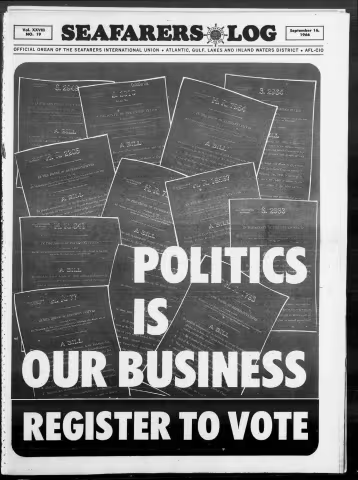
REGISTER TO VOTE
1
Page Two SEAFARERS LOG September 16, 19^6
i a
AFL'dO Farm Workers Union Wins
Representation Flection atDiCiorgio
SAN FRANCISCO—America's farm workers took a giant step last week toward ending the
exploitation and poverty which has traditionally been their lot in the United States. Official returns
have confirmed the victory of the AFL-CIO United Farm Workers Organizing Committee in the
historic farm labor representa
tion election at two farms of the
giant DiGiorgio Corporation,
Election officials announced that
the UFWOC — representing the
former National Farm Workers
Association and the AFL-CIO
Agricultural Workers Organizing
Committee — polled 530 votes to
331 for the ousted Teamsters and
12 votes for no union in balloting
for the unit made up of DiGiorgio
field workers.
Arbitrators Sam Kagel and Ron
ald Haughton announced that all
but 79 of 332 challenged votes
were found to have been cast by
ineligible voters. The remaining 79
were too few to affect the outcome
and were not counted.
Seafarers Raleigh Minnix (left)
and Bill Rogers hand out AFL-CIO
literature to DiGiorgio workers.
The farm labor vote, almost
without precedent in recent agri
cultural unionism, capped the first
year of a strike of grape pickers
at DiGiorgio's Delano farm and
other farm workers at its Borrego
Springs operation.
The two striking unions merged
and had recently been chartered
by the AFL-CIO after cooperating
closely through the long year of
their strike. They joined forces in
the contest against the Teamsters
SEAFARERSyLOG
Sept. 16, 1966 • Vol. XXV1I1, No. 19
Official Publication of the SIUNA
Atlantic. Gulf, Lakes & Inland Waters
District, AFL-CIO
Executive Board
PAUL HALL, President
CAL TANNER
Exec. Vice-Pres.
AL KERR
Sec.-Treas.
ROBERT MATTHEWS
Vice-President
EARL SHEPARD
Vice-President
LINDSEY WILLIAMS
Vice-President
AL TANNER
Vice-President
HERBERT BRAND
Director of Organizing and
Publications
Managing Editor
MIKE POLLACK
Assistant Editor
NATHAN SKYER
Art Editor
BERNARD SEAMAN
Staff Writers
DON BEVONA
PETER WEISS
Pibllihed biweekly at 810 Rhsde liland
Annie N.E„ Wasblniton, D. C, 20018 by
the Seifirere International Union, Atlantic,
Gilf, Lakes and Inland Waters District,
AFL-CIO, 675 Foarth Annas, Brooklyn,
N. Y. 12232. Tel. HVaclnth 9-6600, Second
elms postaia paid at Washlnitaa, D. C.
POSTIIASTErS ATTENTION: Form 3579
cards sbaaM ta sent to Seafarers Interna-
tiful Unian, Atlantis, Calf, Lakes and In-
laMl Watan District, AFL-CIO, 675 Faaith
Aasam, NraaUyn, N. V. U232.
STU
MUTiS
/A'AWOC
•i-rio
rPOK!T.S
(VFVyA-AWOC
AfL-CIO
u p. * .-•:
Sapoerll
mcio
f*'* W0«(t5
At rally in Delano, Calif, SlU West Coast Representative Frank
Drozak (left) presents check for $5,000 to AFL-CIO Organizing
Director William Kircher as SlU contribution to assist the UFWOC
in campaign to organize the DiGiorgio and other farm workers.
for the right to represent DiGior
gio workers. ^
AFL-CIO Pres. George Meany
wired the United Farm Workers
Organizing Committee, Cesar Cha
vez and Larry Itliong, its leaders:
"Warmest congratulations on a
great victory. The road is now
open to a new era for farm work
ers, not only in California but all
across the nation.
"But let us now move forward.
As you know this triumph is not
an end in itself but only a begin
ning. I again assure you that the
whole AFL-CIO will be enlisted in
the battles ahead, as it was in the
battle just won."
AFL-CIO Organization Direc
tor William L. Kircher, who head
ed the election campaign, said in
Delano:
"The DiGiorgio victory has a
message for avery farni worker in
America—it can be done. Farm
workers can unionize, they can use
collective bargaining as a base for
building a better life and a greater
share of America's abundance, for
themselves and their families, even
when powerful forces enter into a
conspiracy to defeat them.
"What happened in Delano has
a message for every AFL-CIO
member also. It is a timely re
minder that the unity and solid
arity of all union workers still pro
vides the best pavement for the
road to a better way of life for
those who have long been denied."
The crucial, pathfinding vote
had few precedents in farm labor
history and none of the legal pro
cedures that surround the usual
National Labor Relations Board
representation elections.
It involved, too, one of the
state's largest and most infiuential
farm corporations, as well as a
head-on contest between the AFL-
CIO and the Teamsters, the latter
a late entry in the effort to win
bargaining rights for DiGiorgio
farm workers.
St/i .'i.r
AfLj/lO / r.
Shown here are Seafarers from East and West Coasts who par
ticipated in the successful campaign of the AFL-CIO farm workers
union to win representation rights in the DiGiorgio Corporation.
For many years now the American farm worker has been a source
of cheap labor for growers who demanded a long day's work in the
fields in return for short pay and inhuman living conditions.
Protection under state and federal labor statutes was denied them
and they were left to fend for themselves in a labor market controlled
by unscrupulous employers.
The recent vote by vineyard workers at the DiGiorgio Fruit Corp,
in which they chose representation by the AFL-CIO Farm Workers
Union, has put the American farm worker firmly on the road toward
a better future for himself and his children.
Their long uphill struggle to gain the wages and working conditions
they are entitled to as members of the American working force, can
be paralleled with the privations previously endured by other segments
of American workers who took the only road left open to them—
organization into strong unions wielding bargaining power.
The success of the vineyard workers at DiGiorgio has produced the
spearhead necessary to organize farm workers into a strong union
possessing strength and influence at the bargaining table.
Farm workers in other states are now on the march. In Texas,
Florida, Mississippi, Arizona and many other states, farm workers
are now demanding the right of union representation.
Although a significant battle has been won in California, the struggle
of the farm worker is far from over. The vast majority of growers
are determined to fight every inch of the way to deny the farm worker
a decent return for his labor.
They will continue and even increase their anti-labor propagandizing.
They will hire scab labor whenever they can to break strikes. They
will exert pressure on the local and state level in order to undermine
the union's efforts.
However, the American farm worker is not alone in his struggle
for a fair return for his labors. The AFL-CIO is determined to go
right down the line with all American farm workers until they have
won the right to have their own union representing them at the bar
gaining table.
The organized labor movement threw its full support behind the
vineyard workers at DiGiorgio. They were active botlh at local and
nationwide levels and sponsored a nationwide boycott of products
grown and marketed by the DiGiorgio Corporation.
The AFL-CIO has also been active on the legislative front, and
actively campaigned to win passage of anti-bracero legislation which
cut off the growers huge supply of cheap foreign labor. Passage of
this bill made it possible for American farm workers to begin their
fight for a union and a place at the bargaining table.
The fight to win collective bargaining rights for the American farm
worker will not be an easy one. However, the American labor move
ment stands shoulder to shoulder with the farm worker. Their fight
is the fight of all workers.
Government Rejects iMARAD Bid
To Declare U.S. Shipping 'Essential'
The Maritime Administration's attempt to have the merchant
marine designated as an essential activity and critical occupation
in light of its important role in the Viet Nana war has been turned
down by the Federal Govern-'^
ment. The decision was con
curred in by Secretary of Com
merce John Connor.
Rep. Edward A. Garmatz (D.-
Md.), chairman of the House Mer
chant Marine and Fisheries Com
mittee, informed SIU President
Paul Hall last week "that this im
portant matter will be investi
gated."
Rep. Garmatz informed Hall of
the government's attitude in a
communication sent to the SIU
president on Sept. 7.
"This is to advise," the Garmatz
message said, "that the Maritime
Administration's petition of April
29, 1966, to include the Merchant
Marine in the list of currently es
sential activities and critical occu
pations has been denied by the re
sponsible officials concerned and
the denial has been concurred in
by the Secretary of Commerce.
"Be assured," Garmatz contin
ued, "that this important matter
will be investigated."
The government refusal to ap
prove the Maritime Administra
tion request for designation of the
Merchant Marine as an essential
activity came as a surprise to leg
islators, government agencies and
maritime labor and industry peo
ple concerned with achieving max
imum fulfillment of the maritime
industry's vital role in support of
the Viet Nam military effort. The
government position is completely
inconsistent with its expressed de
sire and concern to reactivate ships
for the military sealift as quickly
as possible and to have sufficient
seagoing personnel available to
meet all manning requirements
arising out of the demands created
by the nation's military supply
needs.
While the SIU has been meeting
its manning commitments and its
upgrading and training programs
have been providing additional
rated men to keep up with the
increased personnel requirements,
'the situation is complicated by the
fact that seamen are being drafted
from the ships for induction in the
military.
The feeling is prevalent in many
quarters that the Government's re
jection of the MARAD request
points up the absolute necessity, in
the national interest, that the Mar
itime Administration must be made
a fully independent agency and
not subject to the rulings of units
like the Department of Commerce,
which have little or no understand
ing of the merchant marine and its
essential role and relationship to
the nation's best interests.
September 16, 1966
How House Voted on MARAD
The maritime labor and industry backed amendment to keep the Mari
time Administration out of the proposed new Department of Transportation
was passed by the House of Representatives on Aug. 30 by a vote of 260
to 117. Here is how the House voted:
VOTING FOR THE AMENDMENT-260
SEAFARERS LOG Page Three
Abbitt (D.-Va.)
Abemethy (D.-Miss.)
Adams (D.-Wash.)
Addabbo (D.-N. Y.)
Anderson (R.-Ill.)
Anderson (D.-Tenn.)
Andrews (D.-Ala.)
Andrews (R.-Ala.)
Andrews {R.-N. D.)
Arends (R.-III.)
Ashbrook (R.-Ohio)
Aspinall (D.-Colo.)
Ayres (R.-Ohio)
Barrett (D.-Pa.)
Bates (R.-Mass.)
Belcher (R.-Okla.)
Bell (R.-Calif.)
Bennett (D.-FIa.)
Berry (R.-S. D.)
Betts (R.-Ohio)
Boggs (D.-La.)
Bofand (D.-Mass.)
Bolton (R.-Ohio)
Bow (R.-Ohio)
Broomfield (R.-Mich.)
Brown (R.-Ohio)
Broyhill (R.-Va.)
Buchanan (R.-Ala.)
Burke (D.-Mass.)
Burton (D.-Calif.)
Byrne (D.-Pa.)
Byrnes (R.-Wisc.)
Cahill (R.-N. J.)
Carey (D.-N. Y.)
Carter R.-Ky.)
Casey (D.-Texas)
Cederberg (R.-Mich.)
Celler (D.-N. Y.)
Chamberlain (R.-Mich.)
Chelf (D.-Ky.)
Clancy (R.-Ohio)
Clausen (R.-Calif.)
Clawson (R.-Calif.)
Clevenger (D.-Mich.)
Colmer (D.-Miss.)
Conable (R.-N. Y.)
Conte (R.-Mass.)
Cooley (D.-N. C.)
Corbett (R.-Pa.)
Cramer (R.-Fla.)
Curtin (R.-Pa.)
Curtis (R.-MO.)
Daddario (D.-Conn.)
Dague (R.-Pa.)
Daniels (D.-N. J.)
Davis (D.-Ga.)
Davis (R.-Wisc.)
Delaney (D.-N. Y.)
Dent (D.-Pa.)
Derwinski (R.-Ill.)
Devine (R.-Ohio)
Dickinson (R.-Ala.)
Dingell (D.-Mich.)
Dole (R.-Kan.)
Donohue (D.-Mass.)
Dorn (D.-S. C.)
Downing (D.-Va.)
Dulski (D-L.-N. Y.)
Duncan (D.-Ore.)
Duncan (R.-Tenn.)
Dwyer (R.-N. J.)
Edmondson (D.-Okla.)
Edwards (R.-Ala.)
Edwards (D.-La.)
EUsworth (R.-Kan.)
Erlenbom (R.-I11.)
Fallon (D.-Md.)
Farbstein (D.-N. Y.)
Famsley (D.-Ky.)
Feighan (D.-Ohio)
Findley (R.-Ill.)
Fino (R.-N. Y.)
Flynt (D.-Ga.)
Fogarty (D.-R. I.)
Foley (D.-Wash.)
Ford (R.-Mich.)
Ford (D.-Mich.)
Fountain (D.-N. C.)
Frelinghuysen (R.-N. J.)
Friedel (D.-Md.)
Fulton (R.-Pa.)
Garmatz (D.-Md.)
Gettys (D-S. C.)
Giaimo (D.-Conn.)
Gibbons (D.-Fla.)
Gilbert (D.-N. Y.)
Gilligan (D.-Ohio)
Gonzalez (D.-Texas)
Goodell (R.-N. Y.)
GrabowsW (D.-Conn.)
Gray (D.-Ill.)
Green (D.-Ore.)
Green (D.-Pa.)
Grider (D.-Tenn.)
Griffiths (D.-Mich.)
Gross (R.-Iowa)
Gubser (R.-Calif.)
Gurney (R.-Fla.)
Hagen (D.-Calif.)
Haley (D.-Fla.)
Hall (R.-MO.)
Halpern (R.-N. Y.)
Hanley (D.-N. Y.)
Hansen (R.-Idaho)
Harsha (R.-Ohio)
Harvey (R.-Mich.)
Harvey (R.-Ind.)
Hathaway (D.-Maine)
Hawkins (D.-Calif.)
Helstoski (D.-N. J.)
Henderson (D.-N. C.)
Herlong (D.-Fla.)
Hicks (D.-Wash.)
Howard (D.-N. J.)
Hull (D.-Mo.)
Hungate (D.-Mo.)
Huot (D.-N. H.)
Hutchinson (R.-Mich.)
Irwin (D.-Conn.)
Jennings (D-Va.)
Joelson (D.-N. J.)
Johnson (R.-Penn.)
Jonas (R.-N. C.)
Karsten (D.-Mo.)
Karth (D.-Minn.)
Keith (R.-Mass.)
Kelly (D.-N. Y.)
King (D.-Utah)
Kornegay (D.-N. C.)
Kunkel (R.-Pa.)
Kupferman (R.-N. Y.)
Laird (R.-Wisc.)
Langen (R.-Minn.)
Latta (R.-Ohio)
Leggett (D.-Calif.)
Lennon (D.-N. C.)
Lipscomb (R.-Calif.)
Long (D.-Md.)
Love (D.-Ohio)
McCarthy (D.-N. Y.)
McCulloch (R.-Ohio)
McDade (R.-Pa.)
McGrath (D.-N. J.)
Macdonald (D.-Mass.)
MacGregor (R.-Minn.)
Machen (D.-Md.)
Mackie (D.-Mich.)
Madden (D.-Ind.)
Mailliard (R.-Calif.)
Marsh (D.-Va.)
Martin (R.-Mass.)
Martin (R.-Neb.)
Mathias (R.-Md.)
Matsunaga (D.-Hawaii)
May (R.-Wash.)
Meeds (D.-Wash.)
Miller (D.-Calif.)
Minish (D.-N. J.)
Minshall (R.-Ohio)
Mize (R.-Kan.)
Moeller (D.-Ohio)
Moore (R.-W. Va.)
Moorhead (D.-Pa.)
Morgan, (D.-Pa.)
Morse (R.-Mass.)
Morton (R.-Md.)
Mosher (R.-Ohio)
Multer (D.-N. Y.)
Murphy (D.-N. Y.)
Natcher (D.-Ky.)
Nix (D.-Pa.)
O'Brien (D.-N. Y.)
O'Hara (D.-Mich.)
Olsen (D.-Mont.)
Passman (D.-La.)
Patten (D.-N. J.)
Pelly (R.-Wash.)
Pepper (D.-Fla.)
Perkins (D.-Ky.)
Philbin (D.-Mass.)
Pike (D.-N. Y.)
Pirnie (R.-N. Y.)
Poff (R.-Va.)
Pool (D.-Tex.)
Powell (D.-N. Y.)
Quie (R.-Minn.)
Quillen (R.-Tenn.)
Randall (D.-Mo.)
Reid (R.-Ill.)
Reifel (R.-S. D.)
Rhodes (R.rAriz.)
Robinson (R.-N. Y.)
Rodino (D.-N. J.)
Rogers (D.-Fla.)
Roncalio (D.-Wyo.)
Rooney (D.-N. Y.)
Rooney (D.-Pa.)
Rosenthal (D.-N. Y.)
Rostenkowski (D.-Ill.)
Roudebush (R.-Ind.)
Rumsfeld (R.-Ill.)
Ryan (D.-N. Y.)
Satterfield (D.-Va.)
St. Germain (D.-R. 1.)
St. Onge (D.-Conn.)
Saylor (R.-Pa.)
Schisler (D.-Ill.)
Schneebeli (R.-Pa.)
Schweiker (R.-Pa.)
Secrest (D.-Ohio)
Selden (D.-Ala.)
Shipley (D.-Ill.)
Shriver (R.-Kan.)
Sickles (D.-Md.)
Skubitz (R.-Kan.)
Slack (D.-W. Va.)
Smith (R.-Calif.)
Smith (R.-N. Y.)
Smith (D.-Va.)
Stafford (R.-Vt.)
Stanton (R.-Ohio)
Stubblefield (D.-Ky.)
Sullivan (D.-Mo.)
Sweeney (D.-Ohio)
Talcott (R.-Calif.)
Taylor (D.-N. C.)
Tenzer (D.-N. Y.)
Thompson (D.-N. J.)
Thompson (D.-Tex.)
Thomson (R.-Wisc.)
Tuck (D.-Va.)
Tunney (D.-Calif.)
Tupper (R.-Maine)
Ullman (D.-Oreg.)
Waggonner (D.-La.)
Waldie (D.-Calif.)
Watkins (R.-Pa.)
Watson (R.-S. C.)
Whalley (R.-Pa.)
White (D.-Idaho)
Whitener (D.-N. C.)
Whitten (D.-Miss.)
Widnall (R-N. J.)
Williams (D.-Miss.)
Wilson (R.-Calif.)
Wilson (D.-Calif.)
Wolff (D-N. Y.)
Wyatt (R.-Ore.)
Wydler (R.-N. Y.)
Younger (R.-Calif.)
VOTING AGAINST THE AMENDMENT-117
Albert (D.-Okla.)
Ashley (D.-Ohio)
Bandstra (D.-Iowa)
Beckworth (D.-Tex.)
Bingham (D.-N. Y.)
Bolung (D.-Mo.)
Bradesmas (D.-Ind.)
Bray (R.-Ind.)
Brock (R.-Tenn.)
Brooks (D.-Tex.)
Brown (D.-Calif.)
BroyhiU (R.-N. C.)
Burleson (D.-Tex.)
CabeU (D.-Tex.)
Callan (D.-Neb.)
Cameron (D.-Calif.)
Clark (D.-Penn.)
Cleveland (R.-N. H.)
Collier (R.-IU.)
Conyers (D.-Mich.)
Craley (D.-Penn.)
Culver (D.-Iowa)
Dawson (D.-Ill.)
Denton (D.-Ind.)
Diggs (D.-Mich.)
Dow (D.-N. Y.)
Dowdy (D.-Tex.)
Dyal (D.-Calif.)
Everett (D.-Tenn.)
Famum (D.-Mich.)
FasceU p.-Fla.)
Fraser (D.-Minn.)
Fuqua p.-Fla.)
Gathings (D.-Ark.)
Greigg (D.-Iowa)
Hamilton p.-Ind.)
Hanna p.-Calif.)
Hansen p.-Iowa)
Hardy D.-Va.)
Hays (D.-Ohio)
Hechler (D.-W. Va.)
Holifield (D.-Calif.)
HoUand (D.-Pa.)
Ichord (D.-Mo.)
Jacobs p.-Ind.)
Jarman (D.-Okla.)
Johnson (D.-Calif.)
Johnson (D.-Okla.)
Jonas (R.-N. C.)
Jones (D.-Ala.)
Jones (D.-Mo.)
Kastentneier (D.-Wisc.)
Kee (D.-W. Va.)
King (D.-Calif.)
Kirwan (D.-Ohio)
Kluczynski (D.-IU.)
Long (D.-La.)
McClory (R.-IU.)
McDoweU (D.-Del.)
McFall (D.-Calif.)
McVicker (D.-Colo.)
Mackay (D.-Ga.)
Mahon (D.-Tex.)
Matthews (D.-Fla.)
Michel (R.-I11.)
Mills (D.-Ark.)
Monagan (D.-Conn.)
Morris (D.-N. M.)
Moss (D.-Calif.)
Nedzi (D.-Mich.)
Nelson (R.-Minn.)
O'Hara (D.-Bl.)
Olson (D.-Minn.)
O'l^al (D.-Ga.)
Patman (D.-Tex.)
Pickle (D.-Tex."
Poage p.-Tex.
Price (D.-Ul.)
Pucinski (D.-Ill.)
Purcell (D.-Tex.)
Race (D.-Wisc.)
Redlin (D.-N. D.)
Rees (D.-Calif.)
Reid (R-N. Y.)
Reuss (D.-Wisc.)
Rhodes (D.-Penn.)
Rivers (D.-Alaska)
Roberts (D.-Tex.)
Rogers (D.-Tex.)
Ronan (D.-Ill.)
Roush (D.-Ind.)
Roybal (D-Calif.)
Scheuer p.-N. Y.)
Schinidhauser p.-Iowa)
Sikes (D.-Fla.)
Sisk (D.-Calif. )
Smith (D.-Iowa)
Springer (R.-IU.)
Staggers (D.-W. Va.)
Stalbaum (D.-Wisc.)
Steed (D.-Okla.)
Stephens (D.-Ga.)
Stratton (D.-N. Y.)
Teague (D.-Texas)
Todd (D.-Mich.)
Trimble (D.-Ark.)
Udall (D.-Ariz.)
Vanik (D.-Ohio)
Vigorito (D.-Pa.)
Vivian (D.-Mich.)
Walker (D.-N. M.)
Watts (D.-Ky.)
White (D.-Tex.)
Willis (D.-La.)
Wright (D.-Tex.)
Yates (D.-IU.)
Young (D.-Tex.)
•7
Report Reveals Alarming Facts on U.S. Shipping
l/S Tanker Constru€tion Is Down
To One Ship; Russia BuiUing 116
Although the United States is the worid's largest user of petroleum, its ocean tanker fleet con
tinues to decline at an alarming rate. While more American tankers were scrapped last year than
those of any other nation in the world and new U. S. tanker construction was down to a single
ship, the Soviet Union was accelerating the buildup of its tankships, with 116 such vessels under
construction—all intended for operation under the U.S.S.R. registry.
These disturbing facts were revealed in the 24th annual tanker survey made by the Sun Oil Com
pany which is regarded as the ^
Paired for: Keon^ (D.-N.T.), O'Neill (D.-Maaa.), Hebcrt (D.-La.), Reineeke <R.-
Callf.). Horton <D.-N.Y.), Mink (D.-Hawaii). Hnrphr (D.-liL), Morriaon (D.-La.).
. Paired againat: Rcanick (D.-N.Y.), Annonaio (D.-Iii.), Ottinger (D.-N.Y.), Cnn-
ningham (R.-Iowa), Burton (R.-Utah), Sieott (D.-N.C.), Weltner (D.-Ga.), Murray
(I>.-Tenn.)... . . . .. . .. , ..J .1.. , ^.i., . «;_i, iii.vV
authoritative analysis of the
world tanker fleet. Ironically, the
reports were first undertaken in
the mid-1940's to aid in national
defense planning.
In 1957 the United States led
the world in numbers and ton
nages of tankers, but it has been
in decline ever since. It dropped
to fourth place in 1961, a position
it held in 1965, although its rela
tive position with other tanker
fleets is still slipping, the report
shows.
At the end of 1965, the run
away registry of Liberia was in
first place. Norway was in second
place, the United Kingdom third,
and the United States fourth. But
the Soviet Union moved up to
eight place in 1965 from the 11th
place it held the year earlier.
Most significant, as the report
shows, the increase in Russian
tanker construction is highlighted
by the fact that more than 50 per
cent of its present carrying ca
pacity was built in the last three
years. Only a little more than five
per cent of the United States tank
er tonnage was built in the same
period.
The critical state of U. S. ship
ping was emphasized by the gap
in age between the American tank
er fleet and those of the other
maritime nations. The U. S. tank
er fleet's average age is the oldest
among the major maritime nations
of the world. The average age of
the American fleet is 14 years and
9 months — approximately twice
the average of seven years and
seven months of the world tanker
fleet.
Indicating a still further decline
in the U. S. tanker fleet, new ves
sel construction on order or under
way at the end of 1965 showed
the U. S. with but one tanker
while Norway had 68 ships, Japan
28, Liberia 29, the U. S. S. R. 116,
the United Kingdom 19, France
12, Italy 11, Sweden eight, Den
mark nine and West Germany
seven.
The Sun Oil report showed that
the Standard Oil (Company of New
Jersey had 142 ships flying the
flags of 16 nations. The bulk of
Standard's runaway operations was
under Panamanian registry — 43
ships. Only 19 of its ships fly the
U. S. flag.
It is interesting to note that
Joseph D'Andrea, a Standard Oil
executive and an industry mem
ber of the President's Maritime
Advisory Committee, voted against
the (Committee's majority report
which recommended a program to
strengthen American-flag ships in
cluding the tanker" segment.
In terms of deadweight ton
nage, the Standard'fleet makes it
the largest operator of tankers in
the world.
85 Seafarers Licensed As Engineers;
Nine More Complete Union Training
Engineer officer licenses have gone to nine more Seafarers who have passed the U.S. Coast
Guard examination after preparing at the Engineers Training School, jointly sponsored by the
SIU and District 2 of the Marine Engineers Beneficial Association. A total of 85 Seafarers have
now received their engineer's
license from the school as a re
sult of the upgrading program.
Of the nine newly licensed SIU
men, three received licenses as
Third Assistant Engineer and six
Seafarers obtained licenses as Sec
ond Assistant Engineers.
Seafarers who received their li
censes as Third Assistant engin
eers were:
Fritz Rethemeyer, 41, who
sailed as a fireman-water tender
and has been a Seafarer for eight
years;
Sam Telech, 43, who shipped
out as a fireman, oiler and fire
man-water tender, and has been
an SIU member for 23 years;
Donald Bowtell, 35, who sailed
as a pumpman, deck engineer, and
F'WT has been in the SIU for
seven years;
Wallace Purdue, 40, who ship
ped out in all engine room ratings
Fleishman Parsons
Rethemeyer Telech
Hilmer Parsons, 48, who has
sailed as fireman-water tender,
junior engineer, pumpman, deck
engineer, refrigerator engineer and
electrician. He has held his book
since 1945.
The newly licensed Second As-
istant engineers are:
Walter Fleishman, 43, who has
been with the SIU for 22 years
and sailed as a fireman and oiler;
Charles Palmer, 45, who sailed
as a pumpman and FWT and has
had his bo<3k for_21 years;
and has been an SIU member Sea
farer for 22 years;
Lawrence Keneker, 43, who
shipped as a FWT and has been
sailing SIU since 1947;
Gordon Owen, 43, who has
sailed as a FWT and deck engineer
and has been an
SIU member for
11 years.
The joint SIU-
MEBA District 2
upgrading school
is the first train
ing program of its
kind in American
maritime history.
The school offers
Seafarers and Engineers qualified
instruction in preparing for their
third assistant engineers licenses,
temporary third assistant engi
neers licenses or original second
engineer licenses in either steam
or motor vessel classifications.
The school is operated under a
reciprocal agreement between the
Seafarers International Union and
District 2 of the Marine Engineers
Beneficial Association. Seafarers
who enroll in the program obtain
meals, hotel lodgings and subsis
tence payments of $110 a week
while in training for their licenses.
Engine Department Seafarers
are eligible to apply for any of the
upgrading courses offered by the
school if they are 19 years of age
or older and have 18 months of
Q.M.E.D. watch standing time in
Palmer Bowtell
Owen
the engine department plus six
months' experience as a wiper or
equivalent.
Seafarers in the engine depart
ment who are interested in the
program should obtain additional
information and apply for the
course at any SIU hall or write
Purdue Keneker
directly to SIU headquarters at
675 Fourth Avenue, Brooklyn,
New York, 11232. The telephone
number is HYacinth 9-6600.
.K
• V
t-'- •
W:
Page Four SEAFARERS LOG September 16, 1966
if
light Additional Veteran Seafarers
Join Growing SlU Pension Roster
BatenM Rayfuse Ward Qiilnn Sheber Bauers
Eight more Seafarers have joined the growing list of men who are receiving regular monthly $150
SIU pension benefits. The latest group of Seafarers on pension includes Benedicto Baterno, Claude
Rayfuse, Clyde Ward, Frank Quinn, Jacob Sheber, Stanley Bauers, Frank Vivero and Chislaen Van
Raemdonck.
Batemo sailed in the deck de
partment as AB after joining the
Union in New York. Bom in the
Phillipines, he now resides in New
York with his daughter, Teresa.
His last ship was the Overseas
Joyce.
Rayfuse was a member of the
engine department, sailing in all
blackgang ratings. Born in Nova
Scotia, he now makes his home
in St. Petersburg, Fla. with his
wife, Ruth. He joined the Union
in New Orleans and last shipped
on the Steel Fabricator.
Ward, who joined the SIU in
Norfolk, last sailed aboard the
Madaket. A resident of Tampa,
Seattle
Shipping has been excellent in
this port and any man who wants
to ship out in a hurry should come
to Seattle. Vessels paying off and
signing on during the last ship
ping period were the Express
Baltimore, Council Grove, An
chorage, Fairide, Seatrain Victory,
Carrol Victmy, Seattle and the
Mankato Victory. The Betbflor
was in transit.
Harry E. O'Brien, who sails in
the deck department, has been on
the beach for a couple of months.
His last vessel was the Brigham
Victory and his is ready for a
grain run on the next ship going
out. John J. Pietrzak has just
stepped off the Robin Hood which
The Pacific Coast
by Frank Drozak, West Coast Representative
The Seafarers International Union has been warmly thanked by
new AFL-CIO United Farm Workers Organizing Committee for the
strong help the SIU gave in the UFWO's successful stmggle against
the Teamsters and the giant Di Giorgio farm complexes. The AFL-
CIO farm workers unit recently won bargaining rights to represent
the farm workers as the cuhnina- f-
tion of a long uphill struggle
against the teamsters and the Di
Giorgio Corporation. William
Kircher, AFL-CIO director of or
ganization and Cesar Chavez,
leader of the new AFL-CIO union,
warmly thanked the Seafarers In
ternational Union for its hard
work and help in the final days of
the organizing drive.
The Washington State AFL-
CIO Convention in Tacoma has
strongly backed Representative
Thomas Pelly, (R-Washington) for
re-election to the First District.
Congressman Pelly is a friend of
the United States merchant marine
and Maritime Unions and has
gone on record for establishing an
independent Maritime Administra
tion in order to foster a strong
American merchant marine.
San Francisco
Shipping here in the Port of
San Francisco is still very good
and there are many berths open
for AB's, oilers, FWT's, electri
cians, cooks and bakers.
' Playing off over the last period
were the Pan Oceanic Faith, Ex
press of Virginia, Ocean Joyce,
Rachel V., Steel Traveler, Jeffer
son City Victory, Express Buffalo
and the San Francisco.
Crews are signing on aboard
the CouM* De Alene, Express Buf
falo, Pan Oceanic Faith, Rachel
v.. Express Virginia, Steel Work
er, Ocean Joyce and the San Fran
cisco. Ships in transit were the
Free Ammca, Young America,
Santa Emilia, Portmar and Keva
Ideal.
M. T. Doberty, in from Detroit,
is looking for a bosun's job on any
ship going out. Brother Doherty
has spent most of his shipping
days in the Great Lakes area and
is a 22-year member of the SIU.
L. Rlnber just got off the Express
Buffalo after ending two months
going to the Far East. He is now
on the beach waiting for the next
SlU-manned vessel going to Viet
Nam.
Pietrzak Ward
was on the South African run. He
sails in the steward department
and has been in the SIU for 20-
years. Pietrzak is ready for a ship
going anywhere. John Ward, who
was last at sea aboard the An
chorage as a messman, plans to
take it easy for a while before
shipping out again.
Wilmington
Shipping here has been running
a little slower than last period but
Emil G. Glaser dropped by the
Hall to let us know that he is now
a very happy man. He said that
thanks to the SIU'Engineer Train
ing School he is now a second as
sistant engineer aboard the Steel
Architecti Bill Hart dropped in
to register and was shipped right
out as a deck engineer aboard the
Penmar.
Fla., he was, born in Virginia.
Ward was a member of,the en
gine department who sailed as an
oiler and FWT.
Quinn, who sailed as a bridge-
man, joined the Union in the port
of New York. Bom in Jersey
City, he lives with his wife, Mar
garet in Elizabeth, N. J. Quinn's
last employer was the Pennsyl
vania RR.
Sheber became an SIU member
in the port of Detroit. He was
bom in Mich, and makes his home
now in St. Ignace, Mich, with his
wife, Isobel. A cook in the ste
ward department, his last vessel
was the Mackinac Transporter.
Bauers sailed in the deck de
partment since joining the Union
in Detroit. Bom in St. Louis,
Mo., he and his wife, Elmira live
in Mackinaw City, Mich. His last
ship was the Mackinac Trans
porter.
Vivero
nr
Raemdonck
Vivero, a member of the stew
ard department, last sailed on the
Topa Topa. He was born in Spain
and now lives in New Orleans with
his wife, Rita. Vivero joined the
SIU in New York.
Chislaen Van Raemdonck was
bom in Belgium and joined the
SIU in the port of Philadelphia.
He resides in that city with his
wife, Mamie. The Seaforer sailed
in the deck department.
The Atlantic Coast
by Earl (Bull) Shepard, Vice-President, Atlantic Coast Area
Seafarers are again living up to the tradition of carrying cargoes
wherever they are needed by their country without regard to personal
dangers or hardships involved. In spite of Viet Cong harassments
and other dangers involved in delivering military cargoes to Viet Nam,
we are having little difficulty in crewing ships for the Viet Nam mn.
As they did in World War II
and Korea, Seafarers are again
living up to their reputation as a
fourth arm of the nation's defense.
Those who would write off the
American merchant marine as
having been superseded in im
portance by other means of trans
portation should simply take a
look at the huge volume of car
goes flowing into Viet Nam aboard
American-flag vessels. The huge
tonnages and the dedication of
the men who are delivering them
are the best possible proof that
in peace and war, the American
merchant marine remains as im
portant today as it has been in
the past.
New York
Shipping is very
good here and
most Seafarers
are having no
trouble finding
good berths. Lion
el Barnes stopped
by to tell us that
he is now attend
ing the FWT-oiler
upgrading school.
B. T. Hanback, who just came
from a run to Viet Nam stopped
by the Hall to say hello and regis
ter. Nick Gaylord has just stepped
off the Sea-Land Services ship
Bienville after a tour as chief stew
ard and says he is going to take a
little vacation before sailing again.
A. H. Ahmed, who got off the
Alcoa Marketer in Houston has
just come back from a run to
Saigon.
Baltimore
Shipping has been good from
this port and prospects for the
near future look excellent. We now
have the Alamar, Losmar and
Trusco laid-up and waiting for
orders out. No report as yet as
to when these vessels will start
crewing. We have paid off four
ships, signed on five and have had
<Sy-
Bames
Yarmouth Castle Fire Victims File
Lawsuits Totaling Over $59 Million
WASHINGTON—^The Federal Government has set the partial
cost of the damage claims resulting from the disastrous fire and
sinking of the run-away-flag cruise liner Yarmouth Castle at more
than $59 million.
The figure was announced by
Federal Court Judge David W.
Dyer as a battery of lawyers
worked on the preliminaries for
the trial of the suits. The judge
noted that the figure represented
only 440 claimants who requested
a specific sum. It does not include
the many additional suits whose
costs are being left up to the
courts to decide. The suits are
being filed against the Chadade
Steamship Company and its sub
sidiaries, Yarmouth Cruise Lines
and Yarmouth Cruises Inc.
The high money cost of the
disaster has moved the United
States Senate not to include a
provision in the recently-passed
cruise ship safety bill that will
compensate the relatives of Amer
ican passengers who might lose
their lives in future diasters. Many
legislators felt that the compen
sation clause as it now stands
would not properly protect pas
sengers fiscally.
A spokesman for the Senate
Commerce Committee said that
the liability clause has been set
aside for further study. The new
special liabity measure is expected
to be designed to eliminate an old
law that limits shipowners to only
$60 a ship ton in compensation in
case any passenger was injured or
lost his life in a shipboard acci
dent at sea. The liability measure
is also expected to cover any fiscal
gaps left over by the ship safey
bill.
The ship safety bill has been
passed by the Senate after repeated
calls for such a measure from the
SIU and other maritime unions.
13 others in transit over the last
period.
James Smith, who has been sail
ing as a Seafarer for 17 years just
got off the Mount Vernon Victory
after a 14 month tour. He will
take a well-earned vacation before
he even starts to think of shipping
out again. He said the officers
and crew aboard the Mount Ver
non Victory were a nice bunch
of guys.
Norman H. Peppier, who has
been sailing in the deck depart
ment for 20 years, was recently
paid off the Losmar and got set
for a little vacation. He ran into
some bad luck and ended in the
hospital for an operation instead.
He is now more fit for duty but
will rest before shipping out again.
Philadelphia
Shipping has been good this
month. James Winters, who sails
in the steward's department and
has been a Seafarer for 19-years,
is about ready to go to sea again
after spending the summer months
at home. Jim's last ship was the
Spitfire. Raymond "Jack" Riemer
is on the beach and raring to go
out again. Jack, who sails in
the engine department, was last
aboard the Commander.
William Underwood, who sails
in the steward department, just
got off the Jefferson City Victory
and expects to be ready to sail
out again in a few weeks.
Norfolk
Shipping has been very good
here with future prospects looking
even brighter. Roswell Sanderlin,
a Seafarer for 18 years, just got
off the Rubin Hood where he
served as bosun. He is going to
grab the first ship out after enjoy
ing a nice vacation at Nags Head,
North Carolina.
Loe Llewallen, a 21-year union
man, has been on the beach for
some time and is ready to ship out
as an AB on any vessel that comes
along.
Boston
Shipping has
picked up in this
port over the last
period and is ex
pected to be even
better during the
next few weeks.
Robert Frazer,
who is now spend
ing a little time
with his family,
has been a Seafarer for 20 years.
His last ship was the Gateway
City and he will be ready to ship
again in the near future.
Puerto Rico
Albert Santiago and Tony San
tiago both grabbed deck mainten
ance jobs on the Seatrain Louisi
ana which is now on the New
York-Puerto Rico run. After sev
eral runs to the Viet Nam war
zone Tony Caldera is holding
down the bosun's job on the Sea
train New York. Walter Stovall,
AB .on the Seatrain New York,
never fails to drop by the hall and
say hello when the ship is in San
Juan.
Frazer
September 16, 1966 SEAFAyRERS LOG Fmge Fire
The Gulf Coast
by Lindsey Williams, Vice-President, GuH Area
A very good friend of the SfU and Labor, James H. "Jimmy" Mor
rison is in a Democratic primary run-off for Louisiana's sixth Congres
sional District. Morrison was top man in a field of six and missed
winning the first primary by about 500 votes with approximately 143,-
000 votes being cast. All SIU members are urged to give their full
support to Morrison.
The Greater New Orleans AFL-
CIO Council is supporting the
Hotel, Motel and Restaurant Em
ployees and Bartender's Interna
tional Union in its drive to or
ganize some 30-40,000 unorgan
ized hotel and bar workers in the
New Orleans area. The organiz
ing drive is aimed at raising the
substandard wages of hotel and
bar workers here.
The New Orleans AFL-CIO
and the Maritime Council of New
Orleans and vicinity celebrated
Labor Day with a pre-Labor Day
celebration at the Seafarers' Hall
on September 1. More than 500
persons attended the celebration
and House majority whip Hale
Boggs (D-La.) was the principal
speaker.
New Orleans
Jack (Gator Mouth) Bates is
back on the beach after a pleasant
two-month trip to Greece as a
steward on the Penn Challenger.
Gator Mouth hated to leave the
ship because he said it was a
very good vessel with a top-notch
crew from top to bottom. It has
been six weeks since he last
Wood Bates
worked on the Penn Challenger
and is now ready to take the first
steward's job that he can find on
any ship, any run. Jack B. Wood,
chief cook on the York for 19
months, dropped by the Hall to
pick up his $1,162.24 vacation
check. He has made six trips to
India aboard the York and is not
Port Arthur To Add
Huge Groin Bevutor
PORT ARTHUR, Texas—Pre
dictions that Port Arthur would
become one of America's major
ocean ports were voiced recently
by port director Dow Wynn.
The reason for such enthusiasm
is the recent approval of an ex
pansion program that will cost
$9.5 million. Upon completion
the port's present complex under
Port Authority control will be
doubled. This is the second $9.5
million expansion program ap
proved.
Port Arthur is currently a major
petroleum port, but the new ex
pansion program has as its inten
tion the turning of Port Arthur
into an all-commodity port to serv
ice the Gulf area. To do this the
upstream area around the port
would be used as the site for
devdopment of a three million
bushel grain elevator.'
The terminal will be operated,
iihder lease, by the Manhattan
Gfain Terminal Corporation who
ue affiliated \tvith Transeastem
Associates, owners of the SIU-
jnafined Manhattan, &e world's
largest cargo carrier.'
in any hurry to ship out again. He
said he likes India and would like
to go to Bombay when he retires.
John Sansone, who last sailed
on the Del Sud, was forced to get
off after two trips because of
stomach trouble. He now has a
not-fit-for-duty rating. When he
is well enough Sansone hopes to
ship out again on another Delta
Line ship. John (Basco) Pennlno,
also on the beach with a not-fit-
for-duty rating after two trips
aboard the Del Sud as 2nd pantry
man, will also wait for a Delta
Line passenger ship when he's well
enough to sail.
MobUe
Shipping is good from this port
at present with the beach small
and no laid-up ships.
Frank E. Edmonds, who sails
in the deck department, has just
come back from a fast trip to Eu
rope aboard the John B. Water
man. Edmonds, who' is married
and makes his home here, has
been shipping out from Gulf ports
for the last 25-years in various
deck ratings. One A. Wilson, who
last shipped out aboard the Free
America, has been sailing from
this port for the last 20-years.
Married with two children, Wilson
is on the beach waiting for the
birth of a third child.
Louis E. Hartley, who sailed in
the engine department aboard the
Free America, has been shipping
out of the Gulf Area for 26 years
and has now chalked up two trips
as an oiler on vessels that went to
Viet Nam. Leroy EckhoiF was
chief electrician aboard his last
ship, the Claiborne, for several
trips on the Puerto Rican run. He
has been a SIU member since the
start of the Union.
Houston
Johnny Chestnut, an old deck
department hand is on the beach
and studying hard to upgrade
himself to an AB rating at the
AB's school. Another deck de
partment old-timer, Charles Saw
yer, is also seeking to upgrade
himself at the school.
Moony Stresses US Lobor's Rote
In Supporting Free-Worid's Unions
The AFL-CIO plays a "very important leadership role" in supporting free trade unions and exposing Com
munist unions as government fronts. Federation Pres. George Meany and other panelists agreed on the
Georgetown Forum, broadcast from Washington, D. C., with tapes of the interview made available to some
300 radio stations around the
country.
A second discussion along the
same lines was televised for show
ing over NBC Channel 4 and edu
cational TV Channel 26 in Wash
ington.
Meany said American trade un
ions work with the Intl. Confed
eration of Free Trade Unions, the
American Institute for Free Labor
Development and labor move
ments in Latin America, Africa,
New Sofety Ruies
To Protect Seuforers
From Toxic Fumes
A meeting between SIU Safety
Director Joe Algina and Captain
Jack O'Brien, Sea-Land Safety
Representative, has formulated
strict safety regulations aimed at
preventing injuries to Seafarers
caused by toxic fumes from leaky
containers, which has been a prob
lem of growing concern in recent
years.
In July of this year, for in
stance, crew members of the Sea-
Land vessel Fairland were hos
pitalized, victims of a leakage of
one of the tank containers aboard.
The containers were filled with
tolylene diisocyanate. The leak
was discovered after one day at
sea.
Contact with this liquid, or its
fumes, can cause severe lung dam
age, serious skin bums and harm
ful eye irritations. Tolylene di
isocyanate and toxic materials
like it pose a modern safety haz
ard to seamen.
The meeting resulted in the de
velopment of a strigent set of
regulations for checking tank con
tainers prior to their being loaded,
and provides for checking them
aboard ship prior to sailing. An
elaborate and specific control tag
will keep tabs on each individual
container so that inspection re
sponsibilities may be accurately
policed. It is anticipated that in
this way leakage may be discov
ered before it becomes a safety
hazard at sea.
Retirement Bound
Asia and Europe. The joint ob
jective, he said, is "to maintain
worker freedom" and encourage
workers to "develop unions by
which they can improve their own
lot" and at the same time help
develop "a good type of society in
their own countries."
Communist propagandists try to
confuse workers, Meany reported,
by giving words like "trade union"
and "people's democracy" a totally
different meaning than in free
lands.
"What they term a trade union,"
he observed, "does not represent
the workers, it represents govern
ment."
Meany recalled a story in the
Soviet newspaper Trud which in
1964 accused union officials of
deviationism for wanting unions to
have a voice in setting wages and
production quotas.
"Production norms and wages,
the article went on to say, are the
province of the party and nobody
else. In other words, the Commu
nist Party decides what the wages
are, what production they expect
from each worker," Meany com
mented.
"The so-called union is con
cerned with absenteeism, and re
warding workers for keeping up
production by perhaps allowing
them to go to a state-owned vaca
tion spot for a week."
Meany appeared on the pro
gram after returning from an
ICFTU executive board meeting
in Brussels, Belgium. Also present
to discuss the subject "How Amer
ican Unions Help Labor Abroad"
were Dr. James D. Atkinson,
Georgetwon University professor
of government; John Fisher, presi
dent of the Institute of American
Strategy, and program Moderator
Wallace Fanning.
Atkinson said he agreed with
Meany that Communist lands say
they have unions but "actually . . .
their unions are used primarily to
control the workers."
Inside the Soviet Unoin, Castro's
Cuba and Red China, Dr. Atkin
son commented, "there is no such
thing-as a right to strike. This
simply doesn't exist."
Meany gave this summary of
the AIFLD programs as an exam
ple of the federation's work with
unionists of other countries;
"We bring to this country an
average of 100 to 150 students
each year who are trade unionists
. . . and we give them a three-
month course in the rudiments of
basic trade unionism. At the same
time they get a look at the type of
society that we have here. Then
we send them back to their own
countries and support them" for
nine months while they act as class
instructors in organizing, collective
bargaining, grievances, and free
trade unionism.
AIFLD has a social projects
division which, under contracts
with the Agency for Intl. Develop
ment, builds housing for workers
with U.S. unions guaranteeing the
loan, Meany said.
Fanning reported that the World
Marxist Review for March 1966
made a "bitter attack" on the
AIFLD as an "imperialist" tool
and demanded that Latin labor
"combine legal and illegal work"
and prepare instead for mass strug
gle.
Meany said American labor is
interested in seeing that workers
remain free to raise their standards
of living and to maintain "our own
freedom here at home."
SIU oldtimer Frank Waiter (right) picks up his first regular monthly
pension check from SIU rep.-Joe DiGiorgio at New York head
quarters. A former member of the deck.department, Walter joined
the Union in Baltimore; where he how lives with his wife Virginia.^
SIU Company Seeks 5 Victory Ships
Under Bareboat Charter Agreement
WASHINGTON—^Trans-World Corporation, agents for the SIU-
contracted Oceanic Ore Carriers and American Oceanic Corporation,
has announced that it is willing to pay the cost of reactivating five
Government-owned Reserve Fleet ^
Victory ships provided it is allow
ed to bareboat charter them.
A bareboat charter is a hiring
arrangement under which the
shipping line takes over a vessel
completely except for outright
ownership. Under this charter the
company keeps the ship in repair,
hires the crews, operates the vessel
and even hires it out, but returns
it to its original owner at the end
of the bareboat charter.
Trans-World said that it wanted
the Victorys for a four-year period
and during that time wished to
re-charter them on a time-charter
basis to the Military Sea Trans
portation Service.
Bareboat chartering of the re
cently broken-out Victory ships,
the company said, "clearly meets
the public interest." It noted that
the United States, Merchant Ma
rine is suffering from-a lack of
merchant vessels and said the
"proof that the trades in ques
tion are not adequately served is
furnished by the Government's
continuing and increasing with
drawal of vessels from the Re
serve fleets for MSTS use under
General Agency Agreements.
The use of General Agency
Agreements to reactivate vessels,
the company said, is not really
beneficial to the Government.
Under a General Agency Agree
ment, the Government has to bear
the "entire cost of vessel break
out. In addition, the Government
assumes the risk of having to
amortize the breakout cost over
a short period of time if the Gov
ernment's need for the operating
vessel is short-lived."
The company said that it esti
mated the breakout costs to run
"somewhere between $350,000
and $500,000 per vessel. In addi
tion, the bareboat charterer as
sumes the risk of amortizing
breakout cost in the event that
due to circumstances beyond his
control the bareboat charter is
terminated by the Government."
Trans-World requested a speedy
decision from the Maritime Ad
ministration so that it could act
:quickly and get to work operating
the Victorys. -
Pace Six SEAFARERS LOG September 16, 1966
The Great Lakes
by
Al Tanner, Vice-President and Fred Farnen, Secretary-Treasurer.Great Lakes
The month of August was a busy one here in the Great Lakes
District. Besides electing union officers for the 1966-68 term final
negotiations were settled on an industry-wide vacation plan which will
become effective January 1, 1967. On that date all companies under
contract to the Seafarers International Union, Great Lakes District
will contribute to the plan, which<5> —— — : -
will be known as the Sea'farers f^
Beach, Florida. Bill had shipped
out for many years as wheelsman
on the South American and he
Vacation Fund, Great Lakes Dis
trict.
The vacation plan, unlike earlier
ones, covers all members of the
Union, both permanent men and
relief men. Under the old com
pany plan relief men did not re
ceive credit for accumulated days.
Now, with this additional cover
age, we believe the relief man will
be able to ship out more often.
The qualifying period is 120-days
for full benefits and 90-days for
reduced benefits.
An SIU clinic is now operating
in Cleveland for Union members
and their families. The Cleveland
clinic is located at Dr. Castle and
Associates, 200 Republic Build
ing, Cleveland, Ohio 44115. We
urge all Seafarers living in the
area to take full advantage of the
many facilities offered by this
clinic. All members will be re
quired to have physical examina
tions and possess clinic cards prior
to fit-out in 1967. We now are
operating clinics in Duluth, Al
pena, Detroit and Buffalo, as well
as Cleveland. Two more clinics
are expected to get into operation
in the near future.
An old friend and former SIU
port agent Bill Stevenson was in
town last week. Bill is now receiv
ing his monthly pension check
sends his very best wishes to all
former shipmates.
Foreign-flag ships are still dom
inating the grain trade here and
the figures up to July 31, 1966 re
flect that American-flag vessels
are only carrying IIV2 per cent of
the grain cargoes. Canada is still
the number one grain shipper hav
ing carried 587 cargoes or 60 per
cent of the grain shipped out up
to that period. Deep &a foreign-
flag vessels carried 282 cargoes or
28 V2 per cent of the trade. Ameri
can ships carried 114 cargoes.
Shipping is still good and with
the recent lay-up of the Bob-Lo
boats, we expect to fill berths
aboard other vessels with these
crews. The Milwaukee Clipper and
the South American will also end
their season shortly and the men
from the.se vessels should have no
trouble finding jobs on other SIU
Lakes vessels.
Labor Day in Detroit was high
lighted by President Johnson's
visit. The Chief Executive was
given an enthusiastic welcome by
organized labor. His Detroit ap
pearance was sponsored by the
AFL-CIO in memory of Senator
Patrick V. McNamara, Etemocrat
from Michigan.
QUESTION: What is the best
nickname you ever heard at sea
and how do you think the fellow
got that name?
"Red" Piiolo: I knew a fellow
once who was the spitting image
of "Popeye" the
sailor-man, the
cartoon character.
He had no teeth
and a drawn-in
mouth and his ex-
pressions and
mannerisms
where exactly like
Popeye's He even
sounded like him. He liked the
nickname.
A. Romero: "Flat-Top" is a
nickname that sticks in my mind.
This Seafarer I
knew was a dead
ringer for the
character in the
Dick Tracy comic
strip. The cut of
his hair and the
shape of his head
earned him the
nickname. After
a while, he felt you didn't know
him if you called him by his name
instead of the nickname.
FVans De Keyzen I remembtf
a chap I sailed with on a Steel ship
a number of years
ago. We used to
call him "Mousey"
because he looked
like a mouse. Al
though he wasn't
in the least way
meek as a mouse
he never seemed
to mind that he
got labeled with that particular
nickname.
v|>
Pedro Vega: I sailed with a man
once who loved to talk. It seemed
that he was al
ways talking, so
the crew called
h i m "Victrola."
He was just like
a record and it
seemed there was
never a moment
when he wasn't
talking, although
he was a pretty good guy other
wise.
<I>
S. While: I knew a guy once,
who actually changed his name to
the nickname he
got. He collected
so many cars that
instead of John
Smith, he was
called "John
Car." He bought
a number of heaps
second hand,
some of which he
drove himself, others he gave to
his wife.
DiSPATCll
From Aug. 26 to Sept. 8, 1966
DECK DEPARTMENT
TOTAL REGISTERED
All Groups
Port Class A Class B
Boston 8 5
New York 90 33
Philadelphia 11 3
Baltimore 16 20
Norfolk 7 8
Jacksonville 11 2
Tampa 2 3
Mobile 18 6
New Orleans 68 31
Houston 45 31
Wilmington 10 2
San Francisco .... 63 21
Seattle 36 17
Totals 385 192
TOTAL SHIPPED REGISTERED on BEACH
All Groups All Groups
Class A Class B Class C Class A Class B
4 3 0 26 4
73 34 40 319 83
3 4 2 35 15
21 13 3 110 33
7 5 2 32 14
3 0 1 19 5
2 7 3 9 3
23 9 10 70 12
44 9 12 165 81
47 19 12 164 52
7 1 12 30 1
32 22 37 66 1
16 15 26 52 5
282 141 160 1,097 309
ENGINE DEPARTMENT
TOTAL REGISTERED TOTAL SHIPPED REGISTERED on BEACH
All Groups
Port Class A Class B Class A Class B Class C Class A Class B
Boston 1 4 4 2 3 7 1
New York 81 40 59 30 34 313 79
Philadelphia 8 9 4 7 2 20 14
Baltimore 21 8 22 15 3 65 26
Norfolk 4 7 2 3 2 25 16
Jacksonville 3 6 4 4 4 6 6
Tampa 3 5 4 4 1 . 10 6
Mobile 19 12 15 10 4 36 7
New Orleans 21 30 22 25 22 101 61
Houston 36 25 32 18 8 165 45
Wilmington 12 7 5 5 11 13 1
San Francisco .... 24 22 19 7 35 30 2
Seattle 20 11 17 9 23 24 5
Totals 253 186 209 139 152 815 269
STEW, ARD DEPARTMENT
TOTAL REGISTERED TOTAL SHIPPED REGISTERED on BEACH
All Groups All Groups All Groups
Port Class A Class B Class A Class B Class C Class A Class B
Boston 3 6 3 3 3 11 5
New York 64 11 54 13 47 164 36
Philadelphia 5 5 5 1 6 21 8
Baltimore 15 8 21 12 5 72 24
Norfolk 2 11 1 7 7 12 31
Jacksonville 3 0 0 0 3 9 1
Tampa 2 4 6 1 1 12 1
Mobile 17 5 15 7 2 49 6
New Orleans 53 21 29 31 14 145 70
Houston 23 11 19 11 13 72 38
Wilmington 10 4 4 9 9 17 1
San Francisco 38 5 22 4 40 36 1
Seattle 21 9 14 6 12 13 3
Totals 256 100 193 105 161 633 225
ICC Approves 'Unit Train' Rate Reductions
Jifew Railroad Rate Cats Threaten
Gt Lakes Waterborne Coal Traffk
TOLEDO—^The Lake Carriers Association has accused the New York Central Railroad of a "calculated
program to wipe out vessel carriage of coal off the Great Lakes" and the use of "monopoly control" over
the rates from Sunnyhill, Ohio to Toledo following an ICC refusal to suspend railroad rate reductions.
At issue is a New York Central ^
Railroad reduction of rates for
the transport of coal from Sunny-
hill to Essexville, Michigan when
unit trains are used. This reduc
tion will help unit trains take over
the coal trade that was formerly
carried on a rail-water route via
the port of Toledo. This would
be the third largest piece of regu
lar Great Lakes coal traffic lost to
unit trains.
The railroad weapon, unit
trains, operate only between two
points so they can rush back
empty to their point of origin and
refill.
A spokesman for the Lake Car
riers Association said that his
group does not fear "mere hard
competition" from the railroads
but is disturbed over the mono
polistic trend of unit trains. If
the rail rates to Essexville had
been accompanied by a similar
reduction in the rate to the Toledo
Docks, "the situation would be
different" and the waterway opera
tors could compete more effec
tively, he said.
Both the Lake Carriers group
and the Port of Toledo rapped the
Sunnyhill-Essexville rate on the
grounds that the Central did not
make proportional reductions for
the rail-water route. Such selec
tive rate cutting is used by the
railroads to force competing water
carriers out of business, after
which the railroads can hike prices
as high as they wish.
The Toledo authorities said that
despite the fact that the distance
from Sunnyhill to Toledo is half
that from Sunnyhill to Essexville,
the rail rate to Toledo is $2.35 a
ton while the unit train rate to
Essexville is $2.20 a ton.
The Port of Toledo is parti
cularly affected because the Inter
state Commerce Commission has
refused to suspend the reduction
on the railroad rate for the trans
port of bituminous coal in unit
trains from Sunnyhill to Essex
ville. The movement of coal in
this manner will bypass Toledo
which normally handles one mil
lion to 1.5 million tons of coal
annually. This coal is moved there
in trains and then shipped to
Detroit by water.
The ICC action is expected to
encourage further railroad incur
sions into the waterway traffic in
coal. Traditionally in rate deci
sions affecting both railroads and
inland waterway operators the
ICC has consistently favored the
railroads.
If the Port of Toledo plans a
new move to stop the discrimina
tory rates it will have to file a
formal complaint with the ICC
against the New York Central's
all-rail rates from Sunnyhill to
Essexville. In this type of com
plaint the burden of proof that
the rates violate any Federal law
would rest upon the port, and
would therefore put the port at a
disadvantage in fighting its case.
Another try by railroads to take
away Great Lakes coal traffic from
inland waterway operators is be
ing made by the Norfolk and
Western Railway whose unit train
rates are expected to affect the
Lake Erie movement of coal.
6£4FARF/ZSAND
•mm FAMILIES:
[31
'September 16, 1966 SEAFARERS LOG Page Seven
Industrial Bond Financing
Rapped As Anti-Labor Aid
Assistant Director Frank Fernbach of the AFL-CIO's Department
of Research recently urged Congress to put an end to state and local
industrial bond financing, charging that the practice has been used
by unscrupulous public officians in certain states to lure "runaway
shops" to their areas with promises of cheap non-union labor and
other inducements.
Organized labor has long been concerned about the runaway shop.
Now, with this idea of industrial piracy growing and spreading, the
trade union movement is more concerned than ever before and is
taking vigorous steps to combat this spreading menace.
The plot of industrial bond financing is one of the most vicious
of all devices used to induce a plant to forsake its Community and
employees and become a runaway.
The intent of Congress in giving state and local governments
authority to issue tax-free bonds was that it be used exclusively for
public purposes such as schools, highways, hospitals and the like.
However, the AFL-CIO pointed out to Congress, a growing number
of communities are using tax-free bond revenues in building indus
trial sites to lure business from other areas.
When these community-financed plants and factories are leased to
employers, no capital outlay is required and rentals can be charged
off as production costs, giving such employers a special tax advantage.
Worse yet, these prospective companies are often permitted to buy
the bonds issued to finance their own plants, thereby realizing added
income in the form of tax-free interest payments.
In inducing businesses to relocate in their areas, such state and
local officials normally prey upon the fact that their citizenry suffers
under the burden of unemployment, job insecurity and low wages.
The fact is advertised that in such locations the prospective runaway
employer will not be bothered by labor unions, stressing the fact that
there is a vast supply of cheap non-union labor available to be un
justly exploited.
The problem of these runaway shops has been growing at an
alarming rate in recent years. Hundreds of thousands of American
workers have been victimized by plant piracy spurred by sweatshop
wages, sub-standard state labor and welfare laws, and the induce
ment of governmentally subsidized industrial bond financing.
Even without government action there is something that can be
done to help alleviate the problem. These runaway plants, taking
unfair advantage of a cheap non-union labor supply and unfair tax
exemption, cannot hope to sell all their products to the low-paid
workers in the areas where they relocate. By looking for the Union
Label before purchasing any product the American consumer can
make it impossible for these runaways to exist. All the illegal and im
moral advantages in the world won't help them if nobody buys their
products.
The Sheet Metal Workers In
ternational has won its third
straight representation election as
part of a joint AFL-CIO orga
nizing drive in Columbus, Ohio.
The union beat a 21-year old
company union in an election at
the Lennox Industries, 291-253.
There was 583 eligible to vote.
— 4/ —
The Retail, Wholesale, Depart
ment Store Union has continued
its successes in Alabama, orga
nizing more than 200 workers in
three separate representation elec
tions. The three new union plants
are the A. R. Taylor Veneer Co.,
the Griffith Packing Company and
the Centralio Farmers' Co-op. A
majority of workers in each of
the plants are Negro.
^
The AFL-CIO has called on
all affiliates to cease utilizing the
services or subscribing to the
products of the Bureau of Na
tional Affairs, a Washington-based
reporting service, -until the com
pany reaches an honorable con
tract and strike settlement with
the Washington-Baltimore News
paper Guild. The AFL-CIO Coun
cil declared the strike was made
necessary "because of the ada-
ment refusal of BNA to negotiate
a collective bargaining agreement
satisfactory to Guild member em
ployees." BNA management has
taken an '*dbstinate position," the
Council said, and until it offers
conditions leading to an honor
able termination of" the strike,
unions should not use its services.
The Textile Workers Union of
America has won a major orga
nizing victory at the Pepperell
Mills at Lindale, Georgia, its third
southern success in recent weeks.
The vote in the NLRB represen
tation election was 1,139,-917 for
the TWUA. Earlier the union had
won bargaining elections among
more than 600 workers at Ray-
bestos-Manhattan, Inc., North
Charleston, South Carolina, and
in a 300-worker linit at Spofford
Mills in Wilmington, North Caro
lina.
4^
President Johnson has an
nounced that he will reappoint
Gerald A. Brown, a career civil
servant, to a second five-year
term as a member of the Na
tional Labor Relations Board. The
U.S. Chamber of Commerce
strongly opposed Brown's reap
pointment, accusing him of being
improperly pro-union but not sub
mitting evidence to back the
charge. Several businessmen wrote
Johnson opposing Brown, and the
C of C was reported to have sug
gested five other candidates to the
President. Brown joined the
NLRB staff in February 1942.
He served as a field examiner in
the Chicago, Atlanta and Memphis
offices and from 1947 until his
first appointment to the Board
by the late President Kennedy
in 1961 he served as San Fran
cisco regional director.
"It's Me Poor Mother I'm Thinking Of!"
The High Cost of Profits
"Profits Boom—Economy Soars—Produc
tivity Breaks All Records." Newspapers across
the country have been blaring these headlines
across their front pages for some time now
and from a casual glance it would appear that
all is well within the American economy.
With profits and productivity surpassing all
existing records it could be assumed by the
reader of these headlines that the well-heeled
American businessman is sharing the wealth
with the American consumer by lowering the
price of his goods to coincide with his good
fortune.
However, the American businessman has
developed his own peculiar brand of mathe
matics. Instead of lowering or at least stabiliz
ing his prices he raises them. To justify the
increases he then claims that the high wages
won by unions are the reason for his price in
crease and that any effort on his part in lower
ing the cost of his product would surely result
in economic disaster.
A person would not have to be an econo
mist to discover the illogic and deception which
this explanation represents. Profits are com
puted after all fixed costs of production—in
cluding wages—are added on the balance
sheets of a corporation.
It is obviously not "union wages" which are
responsible for the price increases. The rea
son behind the big increases can be defined
very simply as "greed."
As always, it is the American consumer who
is penalized for this profit greed through a re
duction in his purchasing power at the market
place. He is viewed by American business
solely as a contributor to profits—never as one
who shares through a reduction in the price
of goods.
The unions, cast in the role of whipping
boy by management and many newspapers
throughout the country, is a convenient ex
planation for the continuing rise in the prices
in consumer goods. However, it is clear that
upon examination this explanation is inaccu
rate and if a finger is to be pointed it can only
be at a profit-hungry American business com
munity.
The Elections: What They Are All About
All American workers have an important
stake in the politics of our nation. The way
in which tney participate in the national poli
tics is by voting in, all city, state and federal
elections.
The laws and policies which are effected by
the legislative and executive branches of our
government affect the welfare and security of
everyone and the people who are entrusted
with the responsibility of government must be
of direct concern to all of us.
Important elections are coming up in No
vember. Their importance should not be un
derestimated. They involve more than the
personalities of candidates.
As the Committee on Political Education
(COPE) of the AFL-CIO points out, the
1966 election involves a lot of things which
American workers are concerned with.
Like health care and doing something about
our strangled cities.
And providing the means for a better edu
cation for all children. And doing something
about the problems of the poor—and the
children of the poor.
And making sure that there is equality for
all. And ridding our communities of slums
and making jobs available for all employables.
And we in the vital maritime industry have
a special concern in the elections because it is
so subject to laws and regulations that can
spell the difference between its survival and
its extinction.
As workers, and as Seafarers, we must elect
those candidates who will best protect, our in
terests and welfare.
Make sure you, and the other eligible mem
bers of your family, register and vote this year.
/I
i
•I [
f
I
I
Page Eight SEAFARERS LOG September 16, 1966
• ill'
f
f
' yauttepSan^^Kpn^^Crain w6ri0^^n^^ of the Fairland which doclced-
recehfly in Port Eliza^^ With a container cargo after the Sealand-owned ship completed a coastwise trip.
^^upei^Vsaijed iilk^e Stevi^^ while Ronnie sailed In the Deck department^
Tony Rabagb; BR, Is packing the crewmen's laundry while
he and felloW crewmembers await payoff. The ship arrived
in port several hours jate^aifter: it was caught in a stormi
Rupei^ i^utiet, df^ t^ depatfrhenb is> V Ramon Agum chief cook, Tielped keep Seafarers
shown squaring away some tidbits in the ship's v well fed during the voyage. Ramon fakes time out
pantry after Seafarers had enjoyed late snack. to grab a cigarette while waiting for his payoff.
Seafarer Rrchard Rodgers provides musical entertainment
for two of his shipmates, Herb Buchbinder and Bob Scotti.
Brother Rodgers is a great fan of Al Hirt in New Orleans.
the payoff in messroom are, left to right,
Seafarers Leon Kermarec, M. Osman, Tony Rabago,
and H; Buchbinder. They agreed it was good trip.
The engine department's Ed Madeira, who sailed
as an oiler aboard the Fairland, checks the gauges
in the engine room before going up to the payoff.
Ed Mad^rat cenfeW over necessary payoff details with
SlU iredresen^^^ Matthews, left, as shipmate Ron
Crain
:r-_- i-/-',-'-
mm
"r 'ill
H-
September 16, 1966 SEAFARERS LOG Page Nine
-- ^^Ine departrnen Jimmy Elliot of deck . Grouped around dinner table on SS Lohg Beach to enjoy hearty lunch are A, Guillen, Bill Rodgers, Gus Cetrakis,
• G: Ortiz takes department checks out and Charles Misck, Jr. Long Beach was recent visitor to eastern coast and had a payoff in Port Elizabeth. The
' • ' " • • «• Sealand-owned ship was reported to have had a good voyage to West Coast ports and return, thanks to a good crew. for a hot cup of coffee.
^ fSeveral crewmembers of the Isthmian ship Steel Sun^r are .seen on deck v^e the vessel
- was tied up in Bayonne, New Jersey, awaiting a payoff for its SlU-manned crew.^The vesseUom-
plefed a gwiirrun to the Far East and the Seafarers reported a smooth voyage with no ma|or beefsv
Bill Hall, chief electrician aboard the Steel Surveyor, really isn't
nude while he reads the LOS, It's just the angle that he was_
caught by the phptographeri Bill is a 19-year veteran of the SlU.'
r ,r-.
•H
• I •,
1; H >• )•
K 1.1.1, u u 1.1.1.1.1.'t '"'iVv'."-
Page Ten SEAFARERS LOG September 16, 1966
•#
WghMo-Work'laws. Low Wages
Still Go Together, Govt. Study Shows
WASHINGTON—Statistics recently released by the Department of Labor once more show how
closely low wages and state "right-to-work" laws go together.
During the past five years, the report says the South has built up industry at a faster pace than
most of the rest of the nation—
but at a price. Southern work
ers are still the lowest paid in the
nation, with southern factory pro
duction workers earning an aver
age of $84.18 as compared with
an average of $125.05 in 10
heavily organized Northern States.
As a rule low Southern wages
are generally blamed on the fact
that the South has been largely
agricultural with a corresponding
low wage farm worker level. Most
Southern farm workers are Ne
groes. The Labor Dept.'s statis
tics, however, are limited to non-
farm jobs so that the wage com
parison with the industrialized
North is relevant.
The Labor Dept. attributed the
variations in earnings between the
North and South to differences in
the type of manufacturing—auto
mobiles, aircraft and machinery
in the North and textiles and
other soft goods in the South.
It failed to draw conclusions
that are much more familiar to
the American labor movement—
runaway plants that have been at
tracted to the South because of
its low wage promises and the
existence of "right-to-work" laws
that have been tailored to main
tain this same low-wage scale and
to keep out the union shop.
Of the 10 Southern states that
have shown industrial growth dur
ing the past five years, all but one
is a "right-to-work" state. That
Here is a weekly wage comparison between the 10 Southern states which
have shown considerable industrial development and the 10 Northern states
where labor organizations are generally strong.
WEEKLY EARNINGS
South
Mississippi $74.98
Arkansas 75.03
No. Carolina 75.17
So. Carolina 78.77
Georgia 82.61
Tennessee 85.27
Virginia 87.56
Florida 91.37
Alabama 93.64
Louisiana 107.44
North
New Jersey $112.34
Connecticut 113.25
Oregon 117.01
Illinois 117.28
Indiana 121.66
Washington 122.06
California 123.83
Ohio r.... 127.02
Michigan 143.79
Alaska 159.47
SlU-Manned Vessel Aids In Rescue
Of Solo Sailor, 72, In Mid-Atlantic
The SlU-manned Sapphire Gladys played an important role in
the rescue of Capt. William Willis, a 72-year-old sailor, who was
stricken ill in mid-ocean during a lone voyage to Europe. Sapphire
Gladys crew members spotted ^
Willis' distress and radioed the
Coast Guard, which dispatched -
a cutter to pick him up and rush
him to a hospital.
The Sapphire Gladys and Willis'
eleven-foot boat, the Little One,
met 850 miles out of New York
on the North Atlantic. Willis had
set sail on June 22 in his small
craft on a lone voyage to England.
The Sapphire Gladys was bound
for Holland.
After flying to New York from
New Foundland where he was
M.' m- Capt William Willis waves from
II-foot craft In which he at
tempted Atlantic crossing. He
became III 850 miles out of New
Ypckandwas-spottedijy-SI U^hip.
hospitalized briefly, Willis said
that there were times he despaired
of ever being picked up. When he
needed aid, he said, he saw "a few
ships in the distance, but they
didn't stop."
It was a magnificent moment,
he related, when he saw the Sap
phire Gladys. "By luck, the Sap
phire Gladys came straight out of
the mists, right at me, and still
she passed by. I'd been waiting
for weeks and I knew that I was
really cooked—then she swung
around."
Skipper Willis told the crew
men of the Sapphire Gladys that
he thought he was suffering from
a strangulated hernia. The" mes
sage was related to Coast Guard
headquarters in New York. The
cutter Ingham was immediately
dispatched to assist him.
Solo voyages are not new to
William Willis. He has crossed
the Pacific in 115 days and has
also navigated a 204-day trip from
South America to Australia.
Willis had been given honorary
masters papers by the Coast
Guard prior to leaving New York
on his Atlantic adventure, mak
ing his cairtain's title official. Cap
tain Willis first went to sea aboard
a square-rigger out of Hamburg.
Before setting sail across the
Atlantic Captain Willis addressed
himself to today's world: "Now
there are fewer and fewer things
that are not easy for a man to do.
To do something easy would be to
submit to old age. That I will
never do."
state, Louisiana, has no "right-to-
work" law affecting industrial
workers although it does have
one that affects agricultural work
ers. Hardly by chance, Louisiana
has the highest weekly wage level
in the South—$107.44 as com
pared with Mississippi which is
the low man on the totem pole
with a weekly average of $74.98.
Alaska with $159.47 was high
man in the North.
Top wages in the United States
were registered in Flint, Michigan,
where they reached $166.26.
Lowest, $69.38, were registered in
Fall River, Massachusetts, victim
of the textile flight to the South.
Semrte OKs t2-Mile
U. S. Ushing limit
WASHINGTON — The Senate
has passed a bill setting up a 12-
mile exclusive U.S. fishery zone.
The measure is aimed chiefly at
keeping Russian and Japanese fish
ing fleets away from the Ameri
can coast.
The bill will add about 120,000
square miles to the 38,000 square
miles set aside for U.S. fishermen
within the present three-mile zone.
The measure, cleared by voice
vote without opposition, has been
sent to the House.
Once the bill becomes law, the
Coast Guard would enforce it just
as it does the three-mile zone.
The Soviet Union had previous
ly entered into a tentative agree
ment with the U.S. to observe a
12-mile zone along the U.S. West
Coast in which Russian vessels
would not engage in fishing. The
tentative agreement was reached
through efforts of the SIUNA-affil-
iated West Coast fisherman's un
ions and California Governor Ed
mund G. Brown.
The measure would, in effect,
put the United States in the same
position as 50 other countries, in
cluding Canada, which have adopt
ed the 12-mile zone. Only 15
nations still observe the three-mile
zone.
The 12-mile bill has been intro
duced in the House by Rep. Hast
ings Keith (R-Mass.), who said that
the longer we allow other coun
tries to operate within our waters,
the more "customary" will their
presence become until, through in
ternational usage, we are forced to
consider their presence as "tradi
tional."
YOUR DOLLAR'S WORTH
.
Se a f a r e r' s G u i d e t o B e 11 e r B u y i n g
By Sidney Margolius
Keenly aware that in an age of advancing technology it's getting
harder to sell just labor, U. S. unions are making a determined effort to
see that labor's children get their chance for advanced education too. In
recent weeks, conferences sponsored by state and city labor councils in
Ohio, New York City and other areas have spotlighted both the need
for more public colleges, and for helping working families learn about
financial aids.
George Meany, President of the AFL-CIO, has said that we need a
national educational policy, "that will finally eliminate financial barriers
to higher education," and that "the heart of such a program should
be tuition-free publicly-supported institutions."
To achieve that goal of eliminating the financial barriers to higher
education Lawrence Rogin, AFL-CIO Director of Education, has
warned that we really need more and better low-cost junior colleges
and four-year colleges in the home community of the students. Proxim
ity always means more attendance, and also lower costs.
It is possible to attend a junior college or other public college near
home as a total cost of $500 to $1000 a year for everything but cloth
ing. At state universities and colleges, if you live on campus, costs now
average about $1700-$ 1800 a year. At most private colleges total costs
now range from $3000 to $3500.
Families also need realistic, detailed information on all available
financial aids.
In addition to parents' contribution and students' term-time and vaca
tion earnings the major sources of money for college are scholarships
and loans.
Some unions, including the SIU, offer annual scholarship awards to
children of union members. The SIU Scholarship program provides
five $6,000 scholarships annually to Seafarers and their dependents.
While most scholarships still are provided by the colleges themselves,
a number of new Federal programs will be of help to moderate and
low-income families. But be warned that these new programs may be
more available in some areas than others, and that they are still limited
in the number of students they can help. Actually, the best-informed
families, who act earliest, may get the most benefit from -the new Fed
eral aids.
One new Federal program in the "work-study" awards for students
from families who can contribute little or nothing towards college costs.
The jobs are provided through the college. Eligible are students from
three-person families with incomes of $3200 or less; four-person, with
$4000 or less, and up to $6200 for families of eight. Students can earn
about $275 a term under this program.
Another new Federal aid program is the "Educational Opportunity
Grants." Preference is given to students whose parents can contribute
less than about $600 a year towards college. These grants range from
$200 to $800 a year. A student in the upper half of his class may be
awarded an additional $200. But no award may exceed 50 per cent of
the college's estimate of the student's need. The balance must come
from other specified sources such as scholarship, loans, or earnings.
The actual amount awarded is based on the family's income and size.
For example, a student who is one of three children from a family with
a little over $6000 a year income, can receive $400 a year.
Both the work-study and educational-opportunity programs are ad
ministered by the participating colleges, and application is made to
them whether your child is planning to go or already enrolled. One
feature that parents, and their unions and other community organiza
tions should know about, is that the colleges have agreed to work with
high schools in identifying needy promising students, and are permitted
to make conditional commitments to students while still in high school.
Also, and very fortunately, the law specifically says that students
merely need to be admissible or in good standing. They do not have
to show superior achievement, as they must for many other scholar
ships.
Another growing method of assembling money for college is
through loans. We would recommend them only as a last resort. In
working families, the student usually has to repay himself, and begins
life with what can be a heavy debt. However, a loan often can make
the difference between finishing college and not.
The lowest-cost loans are the National Defense Education Act loans.
The interest rate is just 3 per cent and does not start accruing until a
year after graduation. If a student goes into teaching, ten per pent of
the loan is cancelled for each year, up to a total of 50 per cent. You
apply for an NDEA loan to the college itself.
Most Advantageous
The NDEA loans are the most advantageous. Unfortunately, the Ad
ministration has been trying to kill them off, and substitute a new pro
gram of Federally-guaranteed loans made through banks but with the
interest partly paid by the Federal government if the family's adjusted
income is under $15,000.
Congress, however, enacted the new loan program but refused to
eliminate the NDEA loans. This is fortunate because the NDEA loans
are more likely to go to students who really need them, and also will
be less costly to the Govermnent. One authority estimates that it wiU
cost the Government about 50 per cent more to make the new guaran
teed loans through banks than through the colleges.
Moreover, not all banks may be willing to provide the new subsidized
loans. Because of generally high interest rates and "tight money" this
year, the banks may be able to get more interest for their funds from
other types of loans.
For example, THE WASHINGTON STAR recently reported that
Virginia banks were found to be either refusing to make the new loans
i.
September 16, 1966 SEAFARERS LOG Pmge Eleven
Anger Seaiarer
ToTbeEditon
Reading about tbe Republi-
[ Jeans who are going to represent
jtbeir party In the fall election
Ips like rcgding a sad story in an
|old history book in wiiich you
jknow what the outcome will be.
[ley are going to lose.
The people are tired of the
iright-wing nuts, with the little
old ladies in sneakers, with the
cigar chomping fat cats, who
are trying to save us from un-
American plots that just do not
exist.
While they holler wolf to get
our attention off in one direc
tion, they arc busy stabbing us
in the back with their attempts
to do in the labor movement and
anything that represents the little
guy. It happened in Germany,
but it ain't gonna happen here.
Every little guy will be out in
November voting against the
right-wing nuts. I know I'll be
there.
Pan! Black
LETTERS
To The Editor
Seafarer Enjoys
Heading LOG
To iBe Editor:
The LOG is a fine publication
and I look forward to reading it
every time I can. It gives us a
'good idea of just what is really
coming off in the world of mari
time and I for ope, find it very
interesting.
It was particularly interesting
to find QUt just how the SIU is
handling the manning situation
aboard the ships going to Viet
Nam,
Thanks for printing the guide
in the LOG as to where we can
get a copy of the newspaper in
the. various, ports we visit. It is
a very handy thing .to have.
Ke^p up thd good work.
• Art'loaes ^
Mrdther \;
^TbeEdtttNr:
I think that Seafarer William
Calefato is doing a heck of a
good job in telling us just what
is what in the ports he goes to.
I faaye been following him for
many years in the LOG and he
always gets some piece of in
formation across to us that is
a big help when we go ashore.
The way the Indian merchants
operate is just one of the many
interesting things that Seafarer
Calefato has let us in on. I would
like to take this opportunity to;
•thank •him,.• '
,TO:Thie:':E^
I think the recent bombing of
the Baton Rouge Victory in Viet
Nant, has impressed on people
the ihart played in the war cf-
t by the merchant marine,
.don't believe Our industry
getting it's fair share
credit but witbqiut the efforts
of U.S. seamen, our fighting men
WoiiM not be get -
that imtead of encotirapig ftie"^
merchant marine, many people,
including Govemraeot leaders,
are doing their best to scuttle us.
I hope it does not take any
more seamen's lives to show
people that the merchant rharine
is doing its part in Viet Nam.
lack SalKvan
— 4> —
SIU Solves Brother's
Hearing Problem
To the EditoR
I was greatly pleased and hap
py recently when I received
notice that the SIU welfare plan
was granting me $275 for a hear
ing aid here in Wilmington.
I went to the medical center
and received my hearing aid
which is an advance model and
perfect for me. I do hot have
sufficient words to express my
thanks and gratitude to the
Union and the welfare plan for
their generous grants to me and
my wife over the past years.
Therefore, I will say very hum
bly, "God bless you all.^'
Best of everything to the SIU.
BfllHjirt
—
Back Merchant Fleet,^
SIU Wife Urges
ToTheEiUtoR
My husband and I want to
ffiank you sincerely for the help
we have received from the SIU
Welfare Plan. We couldn't have
managed a big hospital hill with
out it. It certainly helped by pay
ing the greatM- amount of the
hospital hill.
I would also like to urge other
wives of seamen to get bdbind
their husbands and write a letter
to President Johnson to plead for
the future of the Merchant Ma
rine. I've already written my
letter.. [,-•••• •
I hope wiv^ of seamen under
stand the problems caused by the
decline in American-flag ships;
Perhaps many of your husbands
have the same problem as mine.
The sea is his lif^ the only liveli
hood he knows. So lets get be
hind them and write. The situa
tion Is desperate.
S^fdmF Thinks
Abaut Metire^
To the Editor: ^ .
Having already reached thO^
of 60,^ after many years i
^^ming my living as a seamanj |
T am starting to think about hOvy
I am going to spend my time
when r retire. '
I don't think that it is too early
to give this matter some serious f
thought as I have seen far toO;J
many men enter their retirement .
totally unprepared, and all they
seem to dp is complain abpuf J
how bored they are. It seems to.. .
m'e that boredoifi is the ailment
of those who retire. WO.se^eiJ I
have a decent pension plan that
holds money worries to a mini- i
mum so that leaves us with :
plenty of time on our hands.
T do not think that retirement
need be a retirement from Ufe. I.
think that there are many hob
bies and ihtefest? that
veloped so that retirement
comes a blessing instead of some-J
thing that is dreaded.
It is also important for a re
tiree to maintain an interest
issues
SIU Member Pub Aside Easy Living
in Visit With Ethiopinu Tribesmen
In his many years of sailing, veteran SIU member Philip Frank has been to most of the ports
of the world and seen enough of its inhabitants and their customs to satisfy ordinary curiosity.
But Phil Frank has more than ordinary curiosity and for a long time he was bugged by a desire to
visit a little-known group of peo
ple living in the heart of the
Ethiopian wilds.
Brother Frank planned his trip
for years. And he made it. Back
in the SIU hall in New York
waiting to ship out again, Frank
described to the SEAFARERS
LOG last week his recent six-
month vacation trip during which
he realized his long-time dream.
"I went from New York to
Southampton, England, to visit
relatives and then embarked for
South Africa on the passenger
ship Windsor Castle. I got off at
Cape Town, flew to Johannesburg
to visit more relatives and then
made my way to Ethiopia," he
said.
Seafarer Frank said that he did
all his traveling on the trip—
which was to take him also to
Israel, Switzerland, Germany,
Denmark and Sweden—on a shoe
string budget.
"No fancy hotels for me," he
said, "I always stayed at a rea
sonable spot and walked every
where I went instead of taking
cabs or buses. I had plenty of
time."
The main purpose of his ex
pedition was to satisfy a five-year-
old desire to see the "Falasy"
people, who are an ancient group
of Ethiopian Jews who have been
living in the land of the Queen
of Sheba almost beyond recorded
history.
When Frank arrived at Addis
Ababa he almost turned back in
stead of continuing because the
$185 price quoted to him by an
Ethiopian travel agency was too
high. But luck was with him. At
his hotel Frank met some mem
bers of the Peace Corps who man
aged to set him straight on the
price for overland travel in Ethi
opia. They helped Frank get a bus
ticket to Gondar, the ancient
Ethiopian capital. It cost only
$12.
The two-day trip to Gondar
was pretty bad for Frank. He had
to bring his own water and live
on bananas. The Ethiopians, he
explained, are fond of raw meat
and all their national dishes were
made, it seemed, with fiery-hot
Seafarer Philip Frank, right, tells LOG reporter about his many
adventures during the six-month trip he took, in which he toured
Africa, explored Ethiopian wilds and visited Europe and Israel.
peppers. The spicy Abyssinian
food was more than his stomach
could take. But he didn't want
to offend the hospitable Ethio
pians by refusing to eat with
them.
"I told a small untruth," he
said, "which made them feel
better about my not eating. I
said that my doctor ordered me
not to eat any hot, spicy foods
and they were never offended
when I refused to eat."
Once in Gondar, Seafarer Frank
had another two-day trip in front
of him to visit the Falasy village
of Ambober. He was taken there
by an Israeli official. Dr. Felzer,
who was sent to treat the Falasy.
Other Israelis in the area taught
the Ethiopian Jews to speak He
brew and better their condition
in many ways.
At his first meeting with the
Falasy, Frank found that they
acted and looked like any other
Ethiopians. They ate the same
hot, peppery foods, except for
raw flesh. They followed certain
traditional dietary laws and a
rudimentary form of Judaism.
They wore no skull caps, Frank
explained, and their Synagogue
SIU Pensioner
Seafarer oldtimer Johannes Karl receives his first regular monthly
pension from SIU rep. Ed Mooney at New York headquarters. Karl
was born tm; Estonia and sailed in the deck gang. He joined the
SIU in New York City whye^he ^ow makes his home with hi? wife.,
in Gondar was a simple building
with only a Star of David adorn
ing the facade. But the friend
liness of the people was almost
overwhelming. One Falasa by the
name of Samuel accompanied
Seafarer Frank as he went about
Gondar "as a kindness, not as a
guide but a friend."
The Falasy, he discovered, are
an agricultural people who in
habit one-room huts and work
their fields in the most primitive
manner. They also are cowherds
who managed to "keep up a few
herds of skinny cows," Frank
said.
Every Thursday was market
day in Gondar for the Falasy.
They traveled by cart and on
foot from their villages carrying
the simple goods and clay objects
to be bartered or sold in the city,
he said.
Legend has it, Frank noted,
that King Solomon, who had a
son by the Queen of Sheba, sent
the original altar of the old Tem
ple in Jerusalem to Ethiopia and
that it was near Gondar.
"But I didn't see it," he said
sadly. Very few things have been
preserved by the Falasy except
their tradition of religion. Even
the real number of Falasy is
doubtful. Some say there are
300,000 Falasy while others esti
mate 50,000."
Seafarer Frank was, despite
his interesting time, pretty happy
to be home again and telling
brother Seafarers in the New
York hall about his adventures.
"But," he said, "after all that
time traveling about I had better
ship out again. Vacation is over."
When he asked what sort of ship
he would like to get on, he said,
"one going to any foreign port.
You can see a lot more that way."
muSTEi
'MO&BTTHB
MBMBgffSOP _
Ya/v FAMILY TO oo eo,TCvl
A- r
i i
I,.
1
r-
Page Twehre SEAFARERS LOG September 16, 1966
f '
i ^ V
J
f
1 i
Al ,
, J' i
II •«
I?'
51(1 Lifeboat Class No. 159 Graduates
Ruthann Renee Tingle, born
May 26, 1966, to the Oliver Tin
gles, Newark, Delaware.
^
Randall Broadus, bom August
4, 1966, to the Henry Broadus,
Mobile,. Alabama.
^
James Gregory Dicus, born
April 25, 1966, to the James
Dicus', Clifton, Tenn.
i
Frank Perez, born July 6, 1966,
to the Laureano C. Perezs, Balti
more, Maryland.
^
Robert Earl Goss, born August
12, 1966, to the Robert E. Goss',
Natchez, Mississippi.
Sandra Daniels, born August 5,
1966, to the John J. Daniels',
Toms River, New Jersey.
—
Brenda Kay Ross, bom July 17,
1966, to the Ernest J. Ross', Al
pena, Mich.
Michael Kelly WniUiez, born
August 11, 1966, to the IMward
Wuilliezs, Kent, Washington.
^
Joseph A. Bethez, born August
2, 1966, to the Edward Bethezs,
Philadelphia, Penna.
Elsa Gonzales, born July 4,
1966, to the Ramiro Gonzales',
Houston, Texas.
^
Michele Elaine Mayo, born Au
gust 15, 1966, to the John Mayos,
Ridgefield, New Jersey.
Lorine F. Wolff, born June 24,
1966, to the Justin T. Wolffs, New
Orleans, La.
<1>
John Marano, born August 16,
1966, to the Anthony Maranos,
New Orleans, La.
Avery Wade Henry, born July
28, 1966, to the George Henrys,
Bridge City, Texas.
<|>
Esther Marie Gnillard, bom
May 4, 1966 to the Anthony Guil-
lards, Sault St. Marie, Mich.
^
Ruhen Rocha, bom August 19,
1966, to the C. Rochas, San An
tonio Texas.
Rene Lee Campbell, born June
21, 1966, to the A. C. Campbells
New Orleans, La.
William Thomas Harrington,
born February 14, 1966, to the
James P. Harringtons, Corona,
New York.
Ship's delegate on the Steel Scientist (Isthmian), Jack Farrand, took advantage of a recent regular ship's
meeting to call his fellow crewmembers' attention to the importance of contributing to the ship's fund as
often as possible. The amount collected, Farrand pointed out, could be utilized in the future for such
things as sending telegrams to the
HARRY LUNDEBER6
SCHOOL-/SEAMANSHIP
tf^BOAT CLASS
15Q 0/i4DiJ4T7A/G4i/G.9./9L>L>
SlU Lifeboat Class No. 159 assembled for graduation photo after
successfully completing lifeboat training course at Harry Lunde-
burg School of Seamanship in New York. Newest additions to the
ranks of SlU lifeboat ticket holders are (l-r, kneeling): Tommy
Noeth, Frank D'Andrea, Doug Gregory, and Doug Hastings. Seated,
l-r, are: Lauro Rimbalado, John Doran, Mansjor Silalahi, and
Oscar Womack. Standing, l-r: Jose Basilio, Stan Kalasa, John
Spahr, Terrance Fox and lifeboat class instructor. Ami Bjornsson.
Union on behalf of crewmembers
hospitalized in a
foreign port, or
for any number
f of other emergen
cies that arise.
Meeting Secretary
F. S. Omega
writes that the
steam connected
to the crew's cof
fee um is not
working properly and the ship's
delegate will see the chief engineer
about the problem as soon as pos
sible. Coffee-loving Seafarers are
watching the situation carefully.
Omega writes that the trip has
been a smooth one with no beefs
and a good crew.
Farrand
Coker
Things are falling into place on
Our Lady of Peace (Liberty), ac
cording to Gibson
Coker, meeting
chairman, and
there have been
no beefs brought
to the attention of
the ship's dele
gate. H. Carmi-
chael, meeting
secretary, writes
that the crew is
looking forward to receiving mail
when they reach their next port.
Everything is going smoothly with
no beefs and no disputed overtime.
^1>
A vote of thanks was extended
to the deck department by the
steward of the
Hattieshurg Vic-
tory (Alcoa) for
their cooperation
in keeping the
messhall and pan
try clean during
watches at night,
meeting chairman
Jim Bartlett re
ports. Robert
Byrnes was elected ship's dele
gate. F. S. Stirk, Jr., meeting sec
retary, reported a smooth trip to
Viet Nam, ending with a payoff
in Seattle.
Crewmembers aboard the Steel
Recorder (Isthmian) will have
movies to keep
them happy on
future trips, meet
ing chairman
Charles Palmer
reports. A 16mm
sound projector
was purchased in
New York from
the ship's fund
and $10 was spent
in San Francisco for renting films.
The projector cost $250, meeting
secretary Angel Seda stated. A
vote of thanks was extended to
Palmer from the entire crew for
the fine job he did. Byron Barnes
was elected to serve as new dele
gate.
When good chow is served on
a ship everyone is happy and the
crew of the Bel
gium Victory (Is
thmian) is no ex
ception. Meeting
chairman V. Tar-
allo reports the
steward depart
ment did a good
job on the Viet
Nam run. Tarallo
was elected new
ship's delegate and told crewmem
bers he would not listen to any
phony beefs. The ship has a new
washing machine, meeting clerk
J. Storer reports. Storer said Sea
farers were reminded to turn in
their soiled linen promptly.
Tarallo
Guerrero
Stirk
Recording Secretary M. Dunn
reports that the Del Sud (Delta)
has had a good
voyage. The Sea
farers were re
minded, however,
to try and avoid
the breakage of
glasses and dishes.
W. Folse, the new
treasurer, reports
$18 in the ship's
fund and $26 in
the movie fund. Engine delegate
O. Guerrero reports one man was
hospitalized in Santos. A few
minor beefs were settled at the
payoff in New Orleans, according
to recording secretary James
Tucker.
<1/
James Ahem, ship's delegate on
the Columbia (Columbia), reports
some bad luck hit
the crew on a re
cent voyage. Two
men were taken ill
and had to be left
in Morocco in a
doctor's care as
the ship headed
for Korea. Boots
Smith, AB, was
recovering from
illness and the night cook and
baker, L. L. Ortego, suffered two
broken ribs in an accident. For
tunately, the broken bones are
healing nicely, Ahern writes.
Chameco
delegate on the Del Aire (Delta),
told his fellow
Seafarers, he
would only take
the job on the
condition all beefs
come through the
department heads.
Some painting will
be done soon on
the crew passage
way, meeting sec
retary F. R. Chameco writes. No
beefs were reported. The steward
department extended a vote of
thanks to deck department men
for keeping the pantry clean.
R. Hunt, meeting chairman on
the San Francisco (Sea Land), re
ported the captain
gave crewmem
bers draw pay for
shore leave in
Oakland. Seafar
ers were in port
five days with the
payoff coming in
San Francisco.
Bill Starke, meet
ing secretary, said
a vote of thanks was extended to
the steward department. There
were no beefs and it was a good
voyage.
RECORDER (Tsthmian), June
?6—Chaiman, . Charlea . W. Palmer ;
Secretory, Angel Seda. Ship's delegate
reported that everything is running
smoothly. $260.00 in ship's fund went for
new 16 nun soitpd projector. Brother
Byron C. Barnes was elected to serve
as new ship's delegate. Vote of thanks
was given to Brother Charles W. Palmer
from all the crew for a job well done as
ship's delegate last voyage.
Staike
EAGLE VOYAGER (United Maritime),
August 20—Chairman, J, C. Hunt;
Secretary. W. C. Craven, Jr. Elverything
is running smoothly. 3 men in deck
dgsartment getting off ship. Plenty of
OT and no beefs in engine department.
Steward requested to order more milk
when in .port.
Ahem
Palmer
r JIHLWAUKEE CLIPPER (Wtectmste-i
.Michigan). August 20—Chairman, Wil-i
i Jjam L. Warcnton: Secretory, Leon!
I Striler. Motion was made that crew be'
i P5>4 .?2.00 subsistence for being reused
f additional steak for supper. Crewmembers
; request something besides watermelon
| for dessert, and home-made soup to be
ij served hot, •
; (Delta), August 22—Chait>
man, M. R. Johnson; Secretary, B, C.
Blodgett. $26.10 in ship's fund. No dis
puted OT and no beefs feiported by d«-
^rtment delekotes.
eptember 16, 1966
SEAFARERS LOG Page Thirteen
FINAL DEPARTURES
ChariM McMuIIin, 61: Brother
[McMullin, a tugboat captain and
member of the
IBU, died in Jack
sonville, Florida,
June 28, after an
illness, in St.
Luke's Hospital,
'j McMullin was last
employed by the
C. G. Willis Com
pany, Orange
Park, Fla. A pensioner at the
time of death, McMullin is sur
vived by his wife, Ethel. A resi
dent of Jacksonville, he was born
in Florida. He joined the IBU in
the port of. Philadelphia. Burial
was in Evergreen Cemetery, Jack
sonville.
Robert Quinn, 28; Brother
Quinn died Feb. 14, after a coro
nary occlusion, on
a ship at sea near
Morehead, N. C.
He joined the Un
ion in the port of
New York. Quinn
resided in Cherry
Valley, N. Y.,
with his mother,
Mrs. Katherine
Quinn. An OS in the deck depart
ment, his last vessel was the Choc
taw. Burial was at Fort Plain,
N. Y.
Stephen J. Bruce, 58: A heart
ailment claimed the life of Brother
Bruce, Aug. 1, at
the Beekman Hos
pital, Manhattan.
Brother Bruce
sailed in the deck
department and
joined the Union
in the port of New
York. A resident
I of Ramsey , N. J.,
he lived with his wife, Jennie.
Bruce was employed by the Erie-
Lackawanna R. R. Burial was in
Holy Cross Cemetery, North Ar
lington, N. J.
John Van Dyk, 70: A heart
attack claimed the life of Brother
Van Dyk, August
26. Van Dyk re
tired in 1964 after
55 years at sea.
He sailed in the
deck department
and had sailed on
square riggers in
his youth. Born in
Amsterdam, Hol
land, he got his first job as a cabin
boy at 14. A member of the SIU
for many years, his last vessel was
the Geneva. He is survived by his
daughter, Mrs. Janet M. Schwizer
of Lindenhurst, N. Y. Burial was
in Oakwood Cemetery, Bay Shore,
Lf T*
Manuel Fernandez, 67: Seafarer
Fernandez died Aug. 17, in Balti
more, Md., after
an illness. Brother
Fernandez was re
tired after sailing
in the engine de
partment. He was
born in Spain and
joined the SIU in
the port of Phila
delphia. A pen
sioner, the Seafarer had sailed over
30 years on American-flag vessels.
Burial was in Oak Lawn cemetery,
Baltimore.
George Zellinger, 64: Heart fail
ure took the life of Brother Zell-
inger, Aug. 13, in
St. Joseph Hospi
tal, Baltimore,
Md. Born in Balt
imore, where he
also joined the
Union, Brother
Zellinger was a
member of the
United Industrial
Workers of North America. A
warehouseman, he was employed
by the Hill-Chase Steel Co. He is
survived by his wife, Catherine.
Burial was in Oaklawn Cemetery,
Baltimore.
Donald DeMarco, 36: Seafarer
DeMarco died May 19, in Doc
tor's Hospital, Se
attle, Wash., fol
lowing an illness.
He was born in
Seattle and joined
the Union in that
port. DeMarco
sailed in the deck
department. His
last vessel was
the Loma Victory. Surviving is
his mother, Mrs. Dorothea De-
Marco of battle. Burial was in
Washington Memorial Cemetery,
Seattle.
Earl Savoy, 51: Brother Savoy
died on Aug. 19, aboard the Steel
Chemist of heart
disease. He had
previously sailed
on the Hastings.
Savoy joined SIU
in Norfolk. Born
in Milton, Ver
mont, he lived in
Portsmouth, Va.,
with his wife, Eth
el. The Seafarer sailed as an AB
in the deck department. He was a
veteran of World War II. Burial
was in Hampton National Ceme
tery, Hampton, Va.
Editor,
SEAFARERS LOG,
t 675 Fourth Ave.,
J Brooklyn, N. Y. 11232 • .
I would like to receive the SEAFARERS LOG-please put my
narnoph your mailing .
TO AVOID DUPUCAJI^NS ff yoy ara an old subscriber and have a^chan^ei
ofaddreM, please fllvsr ¥6<«r former address below:
Door-to-Door Selling In the Far East
Goes ShIp-to-ShIp With Bum Boats
Wilcox
In Asia, if the customer won't
if the customer happens to be far
shopkeeper takes to the water.
Seafarers often come upon
such curious sea-borne shop
keepers in a number of the Ori
ental ports sailing little sampan-
type craft known as "bum ships"
or "bum boats,"
which carry just
about anything
from cheap trin
kets to the most
modern radios,
cameras and other
electrical appli
ances.
"Skip" Wilcox,
who sails in the
deck department, told the LOG
that Singapore is one port where
many of these bum boats operate.
"I've seen them many times
coming to a ship in Singapore
Harbor. They generally sell good
stuff and are comparatively hon
est tradesmen. Most of the equip
ment they sell is Japanese-made,
but of good quality," he stated.
Wilcox said that the floating
shopkeepers don't have to rely on
gimmicks to make a sale.
"Seafarers are ready to buy,"
he said, "and look forward to
these people coming aboard. It's
a real interesting thing to watch
how a whole bunch of bum boat
peddlers operate. They all come
to the ship, climb aboard with
their goods by tossing up lines and
pulling their merchandise after
them or carrying it on their backs.
Pretty soon the deck is an out
door marketplace.
They get dressed up in fancy
western clothes, probably figuring
it will entice the seaman and
about thirty or forty usually come
aboard and set up shop—even
women and sometimes children.
go to the shopkeeper, the shopkeeper will go to the customer—and
out in the harbor and willing to spend a little money, well then, the
James A. Esson
Please contact John E. Axtell,
St. Louis County, Minnesota, as
soon as possible in regard to a
very important matter.
Heinrick Viik
Please contact your wife, Lu
cille, at 4230 Union St., Flushing,
New York, as soon as you can.
^
BUI Dzelak
Please contact your daughter as
soon as possible, at the following
address: 2527 Salmon St., Phila
delphia, Pa.
Haik J. Alexanderian
Please contact your brother,
S. A. Alexanderian, 165-14 65th
Avenue, Flushing 65, New York,
as soon as you can.
— —
Jack N. Dews
Jack N. Dows is a patient in the
Plantation Nursing Home, 7300
Chef Menteur Highway, New Or
leans, La., and would appreciate
hearing from his old friends in
the SIU.
A bum boat operator in Bombay, India, pulls up alongside SlU-man-'
ned ship in an effort to sell his goods to the crew. The suit-
visible in the boat contain the merchant's varied goods. cases
The women frequently peddle
beer, Wilcox said. They have
some good buys and a Seafarer
can save money by buying a
camera or radio from these people.
The age-old oriental method of
buying goods by haggling over
the price must always be observed,
Wilcox warned.
"You have to bargain with
them," he explained. "They start
with one figure, usually way above
the value of the article and you
ask for less, then you both neg
otiate until an agreeable figure is
reached. It's fun."
As a matter of strict propriety,
Wilcox noted, a United States-flag
merchant ship should not be a
floating open air-market once you
get to port. But he added, even
if the captain wanted to keep them
off, he would have a hard time.
The bum boat operators are per
sistent salesmen who even make
Fuller Brush salesmen look like
pikers. Captains often are steady
bum boat customers and they like
the idea.
The port authorities don't make
much of an attempt at stopping
these people because many of
them just make enough to live on.
But bum boat operators don't
seem as numerous as they once
did, most seamen agree.
One Seafarer notes that he was
told by several people that these
merchants were dishonest and
should be avoided. But from his
own observation he has since de
cided that the men who operate
the bum ships are not beggars or
crooks but simply tradesmen who
are working for a living.
Like other business men, some
of the merchants are reliable and
others are not, and the Seafarer
soon learns to spot which is which.
One big drawback to buying
items from these bum boat mer
chants is that there's no guarantee
you will be satisfied with what
you get. If an article is damaged
or ever needs repair work, it
might be extremely difficult to find
the chap who sold it to you.
This is not necessarily the case
however. In many places in the
world some of the most reputable
businessmen will go down to the
docks to meet ships in hopes of
selling their wares. In Rotterdam,
for instance, there is a jewelry
dealer working the dock areas
who many Seafarers claim you
could trust with your life. He
hands out regular business cards
and is always available in case
there is a complaint about mer
chandise or an adjustment to
make.
SIU Tugmen
Joe Gavin, John Maggie, and Captain C. Silchrest of SlU-IBU, relax
awhile on deck of tag, Barbara George (G & H Towing). They helped
move oil rig to new location in the Gulf of Mexico. Photo was taken by
a veteran Seafarer J. W. Parker. Parker found that sailing a tug "sure
is different from sailing deep sea." Parker said the G & H IBU
men voted 95 percent SIU during attempted takeover by Teamsters.
> <0 «' «
Page Fourteen SEAFARERS LOG September 16, 1966
DO NOT BUY
Seafarers and their families are
urged to support a consumer boy
cott by trade unionists against
various companies whose products
are produced under non-union
conditions, or which are "unfair
to labor." (This listing carries the
name of the AFL-CIO unions in
volved, and will be amended from
time to time.)
H. I. Siegel
"HIS" brand men's clothes
(Amalgamated Clothing Workers)
<I>
Sears, Roebuck Company
Retail stores & products
(Retail Clerks)
—
Stitzel-Weller DistiUeries
"Old Fitzgerald," "Old Elk"
"Cabin StiU," W. L, Weller
Bourbon whi^eys
(Distillery Workers)
J. R. Simplot Potato Co.
Frozen potato products
(Grain Millers)
^l>
Kingsport Press
"World Book," "Cbildcraft"
(Printing Pressmen)
(Typographers, Bookbinders)
(Machinists, Stereotypers)
— —
Jamestown Sterling Cmp.
(United Furniture Workers)
Empire State Bedding Co.
"Sealy Mattresses"
(Textile Workers)
White Furniture Co.
(United Furniture Workers of
America)
Genesco Shoe Mfg. Co.
Work Shoes ...
Sentry, Cedar Chest,
Statler
Men's Shoes . . .
Jarman, Johnson &
Murphy, Crestworth,
(Boot and Shoe Workers' Union)
h
i
•\ I
Di Giorgio Fruit Corp.
S and W Fine Foods
Treesweet
(National Farm Workers
Association)
I ' L
' For obvious reasons the
sannot pirint any letters or
_ SCIENTIBT (UthmiBn), August
'27—Chnirmaii, John Farrand; Secretary,
•P. S. Omega. No beefs and eveTytblng
Is running smoothly. Ship's delegate sug
gested that each crewmembcr make
donation to the ship's fund. Ship should
be fumigated for roaches. Suggestion
made that sanitation must be observed
in the crew's meeshall.
SIU-AGLIWD Meetings
New York . . Oct. 3—2:30 p.m.
Philadelphia . Oct. 4—2:30 p.m.
Baltimore ... Oct. 5—2:30 p.m.
Detroit Oct. 14—2:30 p.m.
Houston .... Oct. 10—2:30 p.m.
New Orleans. Oct. 11—2:30 p.m.
Mobile Oct. 12—2:30 p.m.
Wilmington . Oct. 17—2 p.m.
San Francisco
Oct. 19—2 p.m.
Seattle Oct 21—2 p.m.
Great Lakes SlU Meetings
Detroit Oct. 3—2 p.m.
Alpena Oct. 3—7 p.m.
Buffalo Oct. 3—7 p.m.
Chicago Oct. 3—7 p.m.
Cleveland Oct. 3—7 p.m.
Duluth Oct. 3—7 p.m.
Frankfort Oct. 3—7 p.m.
Great Lakes Tug and
Dredge Region
Detroit Oct. 10—^7:30 p.m.
Milwaukee .. Oct. 10—7:30 p.m.
Chicago ... .Oct. 11—7:30 p.m.
tSauIt Ste. Marie
Oct. 13—7:30 p.m.
Buffalo Oct. 12—7:30 p.m.
Duluth Oct. 14—^7:30 p.m.
Cleveland . .. Oct. 14—7:30 p.m.
Toledo Oct. 14—^7:30 p.m.
SIU Inland Boatmen's Union
Philadelphia ... Oct. 4—5 p.m.
Baltimore (licensed and
unlicensed) .. Oct. 5—5 p.m.
Norfolk Oct^ frr-S p.m.
Houston Oct. 10—5 p.m.
New Orleans .. .Oct. 11—5 p.m.
Mobile Oct. 12—5 p.m.
Railway Marine Region
Jersey Oty
Oct. 10—10 a.m. & 8 p.m.
Philadelphia
Oct. 11—10 a.m. & 8 p.m.
Baltimore
Oct. 12—10 a.m. & 8 p.m.
•Norfolk
Oct. 13—10 a.m. & 8 p.m.
AW
United Industrial Workers
New York Oct. 3—7 p.m.
Philadelphia . .. Oct. 4—7 p.m.
Baltimore Oct 5—7 p.m.
^Houston Oct. 10—7 p.m.
New Orleans . . .Oct. 11—7 p.m.
Mobile Oct.l2—7 p.m.
t Meeting held at Labor Temple, Sanlt
Ste. Marie. Mich.
• Meeting held at Labor Temple, New
port News,
t Meeting held at Galeeaton ^harrea.
DIRECTOttYbf
IINION HALLS
HI • -I
-AMD&BnU£\
MEMBSffSOF _
'^oue FAMILY TODCSO,TCO!
SIU Atlantic, Gulf, Lakes
& Inland Waters
Inland Boatmen's Union
United Industrial Workers
PRESIDENT
Paul Hall
EXECUTIVE VICE PRESIDENT
Gal Tanner
VICE PRESIDENTS
Earl Shapard Lindsay Williams
Al Tanner Robert Matthews
SECRETARY-TREASURER
Al Kerr
HEADQUARTERS 675 4th Ave., Bklyn.
HY 9-6600
ALPENA. Mich 127 River St.
EL 4-3616
BALTIMORE, MD 1216 E. Baltimore St.
EA 7-4900
BOSTON, Mass 177 State St.
Rl 2-0140
BUFFALO, N.Y 735 Washington St.
TL 3-9259
CHICAGO, III 93B3 Ewing Ave.
SA 1-0733
CLEVELAND. Ohio 1420 W. 25th St.
MA 1-5450
DETROIT, Mich. .. 10225 W. Jefferson Ave.
VI 3-474!
DULUTH, Minn 312 W. 2nd St.
RA 2-4110
FRANKFORT, Mich P.O. Box 287
415 Main St.
EL 7-2441
HOUSTON, Tex 5804 Canal St.
WA 8-3207
JACKSONVILLE, Fla 2608 Pearl St.
EL 3-0987
JERSEY CITY, N.J 99 Montgomery St.
HE 3-0104
MOBILE, Ala I South Lawrence St.
HE 2-1754
NEW ORLEANS, La 630 Jackson Ave.
Tel. 529-7546
NORFOLK. Va 115 3rd St.
Tel. 622-1892
PHILADELPHIA. Pa 2604 S. 4th St.
DE 6-3818
PORT ARTHUR, Tex 1348 Seventh St.
SAN FRANCISCO, Calif. 350 Freemont St.
DO 2-4401
SANTURCE, P.R. ...1313 Fernandez Juncos
Stop 20
Tel. 723-8594
SEATTLE, Wash 2505 First Avenue
MA 3-4334
ST. LOUIS, Mo 805 Del Mar
CE-l-1434
TAMPA, Fla 312 Harrison St.
• Tel. 229-2788
WILMINGTON. Calif. ...505 N. Marine Ave.
TE 4-2523
GLOBE TRAVELER (Maritime Over-
seas), Auguet 31 — Chairman, Eddie
Sylvester: Secretary, Joe Saxon. Broth
er Tucker was elected to serve as .ship's
delegate. Beck delegate reported that
mew men on deck doing very well for
tirst trip to sea. Btscussion with the
Captain to try and get an awning
around cook's rooms. Captain said that
the Company will put two ice machines
on ship.
DEL -aOL (DelU), August 7—Chair
man, L. J. Bollinger; Secretary, R. E.
.Stough, Jr. Ship sailed short one O.S.
in deck department, otherwise everything
is running smoothly. $66.30 in ship's
fund. Brother Fred Fagan was elected
to serve as ship's delegate. Crew requested
,lo keep natives out of crew's quarters
'^ GENEVA (U.S. Steel), August' 20—
.'Chairman, V. L. Stankiewiez; Secretary,
Larry Frost. Galley work to be done In
shipyard. $8.00 in ship's fund. No beefs
reimrted by department delegates.
KENT (American Bulk Carriers), Au
gust 14—Chairman, E. P. Covert; Sec
retary, Ralph Collier. $2.44 in ship's
fund. Some disputed OT in engine de
partment, otherwise everything is run
ning smoothly with no beefs. Brother p.
P. Covert was elected to serve as ship's
delegate. Pood is very good and the
steward department was given a vote
of thanks. In return the steward depart
ment thanked the crew for helping to
keep the messroom clean.
COTTONWOOD CREEK (Bulk Trans
port), August 14—Chairman, M. D.
Brightwell; Secretary. R, Hebert. No
beefs and no disputed OT reported.
Brother F. Dickerson was re-elected to
serve as ship's delegate and was given
a vote of thanks for a Job well done.
Vote of thanks to the steward department.
DIGEST
of SIU
MEETINGS
DEL MONTE (Delta), August id—
IChairman, Howard Menz; Secretary, Ai-
cbert Espeneda. All repairs were com-
ipleted in New Orleans; Ail disputed OT
I was settled by patrolman. Vote of thanks
^WBs extended to the boarding patrolman
iat New Orleans. $2.00 in ship's fund.
^Brother Howard Menz was re-elected to
jaerve as ship's delegate and was given a
^jvote of thanks for a job well done.
.'Biscuasion on Safety aboard ship while
i-working on deck and in engine room for
the benefit of the new crewmembers
who are sailing for the first time.
-V STEEL AGE (Isthmian), August 7—
'Chairman, Juan Patino; Secretary. Jim-
>haie Arnold. $19.00 in ship's fund. No
ii^fs reported by department delegated,
i^lecttician complimented for mainten-'
ance of washing machine. Ship to be
vfumigated for roaches.
DEL SUB (Delta), July 17—CMSirmaa, ,
-jM, Bunn; Secretary, J. Tucker. $18.00 in
/ehip's fund and $26.00 in movie fund
Deck department members spoke on the
.need of baffle plates in tanks on aft
,;deck when tanks are not fully loaded,
iCrewicembers requested to dump garbdie
)a,ft in chute instead of on deck.
® 'DEL SUB (Belta), August 21—Chair-
lan, M. Bunn; Secretary, James Tucker,
ne man left in hospital in Santos. Some
isputed OT in engine and steward
lepartment. Ship's delegate and patrol-
lan should contact Company Saf^ Bi-
i-ector and see about having tanks fitted
Siith baffi«ij7]ate» aa_th(^. are.-conaidered
ly when they ore only partly
VENORE (Venore), August B-Choir-
man. W. W. Roid; Secretary, H. C.
Bennett. Some disputed OT jn engine
department. Brother Henry Karpowicz
was elected to serve as ship's delegate.
Motion made that the President make a
report about the retirement plan.
CARROLL VICTORY (Belta), August
24—Chairman, T. J. White; Secretary, J.
Shields. $16.05 in ship's fund. Some dis
puted OT in engine department Vote of
thanks to the steward department for a
job well done.
TOPA TOPA (Waterman), August
13—Chairman. R. K. Paschal; Secretary,
Borwin L. Coy, $0.00 In ship's fund. It
was requested that men dress appropriate
ly in messhall. No beefs and no disputed
OT reported by department delegates.
Motion made that the deck department
receive penalty pay for docking, un-
docking and securing while vessel is
carrying deck cargo. Motion made that the
Imarding patrolman explain the pension
plan to crew a.s many are under the
impression that the existing plan pro
vides only for those perrnaiienlly disabled.
It was requested that an investigation be
made of the doctor in Wilmington as
several men have been getting severe
reactions from shots administered by him.
HENRY STEINBRENNBR (Kinsman
Marine), August 30—Chairman, Claire
Otis; Secretary, Charles Qttelin. No beefs
reported—everything is running smoothly.
Vacation and bonus was brought up by
one crewmember. Crew would like to have,
more details on these two matters. - w
OCEAN ANNA (Maritime Overseas)|'
August 27—Chairman, C. A. Hall; Seek;
retary, W. E. Oliver. One man missed
ship in Yokohama. The voyage is good
so far and the ship Is in good order. Vote
of thanks extended to the steward
department. •
MISSOURI (Meadowbrook" Transport)®
August 28—Chairman, Charles Jam» j;
Secretary, Wilfred J. Moore. Brothefl
James Abrams was elected to serve aai
ship's delegate. $11.00 in ship's fund. No'
disputed OT or beefs reported. DiBcussioif
about air-conditioners. Request for eol^'
drinks along with fresh milk in ho$f
weather. : 8
BANGOB (Bermuda), September .
Chairman, Wm. Robinson; Secretary!
Ernest Harris. Some disputed OT in decK
and engine departments. BIsciusion abous
getting new washing machine. No maif
is being received in foreign ports.
MONTICELLO^ VICTORY (Vic
Carriers), July 10—Chairman, 0. 'Wilson
Secretary. N. Matthey, Ship's delegate
ported that everything is running smooth
ly. Brother C. Wilson was elected to
serve as new ship's delegate. Some dis
puted OT in engine department-
MONTIGELLO VICTORY (Victory
Carriers).-August 20—Chairman. FVank
Natale; Secretary. Philip F. Kohl. $6.00
in ship's fund. Motion made to write
letter to ball In,. Seattle In regards to
monies due for subsistence and lodging.
BELGIUM VICTORY (Isthmian), Au
gust 14—Chairman, V. L, Taralle; Sec-
retarv.'.Tohn E, Storer. No beefs reported
by department delegates. Brother Vin-
cent L, Taralle was elected to serve as
ship's delegate. Crew requested to keep
all shore gangs outside while in foreign
ports. Crew commented on good chow
served on ship. Everyone Is happy.
OCEANIC TIDE (TrohsrWorld Ma
rine) . August 8T—Chairman, E. Howell:
Secretary. F. Prendergast, Brother E.
Anderson was elected to serve as ship's
delegate. No beefs reported by depart
ment delegates. Motion made that Captain
be contacted about meat box temoera-
tnres. Fire extinguisher in engine room
nbould be checked. Request for TV set
In crew meSBrtom.
J. C. MILLER (Gartland), August
lO-r-Chairman, Charles Pischner; Secre
tary, Roger Skold. $5.00 in ship's fund.
Brother James Roebuck resigned as
steward delegate.. Brother Henry Tainor
elected. Motion to try and get better
pension, 10-15 years regardless of age,
$800.00 a month and year-around medi
cal doctor. Every 200 days give you one
year sailing time. Suggestion made that
oil leak on deck crane be fixed; Want
non-skid to be put. around; Pilot; house
sand after eab|pq/<|
T f'NANCIAL REPORTS. The constitution of the SIU Atlantic, Gulf, Lakes and
Inland Waters Diatrict makes specific provision for safe^ardinfir the membership's
money and Union finances. The constitution requires a detailed CPA audit every
three months by a rank and file auditinsr committee elected by the membership. All
Union records are available at SIU headquarters in Brooklyn.
TRUST FUNDS. All tiust funds of the SIU Atlantic, Gulf, Lakes and Inland
Waters District are adn^nistered in accordance with the provisions of*various trust
fund agreements. All these agreements specify that the trustees in charge of these funds
shall equally consist of union and management representatives and their alternates.
All expenditures and disbursements of trust fun^ are made only upon approval
by a majority of the trustees. All trust fund financial records are available at the
headquarters of the various trust funds.
SHIPPING RIGHTS. Your shipping rights and seniority are protected exclusively
by the contracts between the Union and the shipowners. Get to know your shipping
rights. Copies of these contracts are posted and available in all Union halls. If you
fwl there has been any violation of your shipping or seniority rights as contained in
we contracts between the Union and the shipowners, notify the Seafarers Appeals
Board by certified mail, return receipt requested. The proper address for this is:
Earl Shepard, Chairman, Seafarers Appeals Board
17 Battery Place, Suite 1980, New York 4, N. Y.
Full copies of contracts as referred to are available to you at all times, either by
writing directly to the Union or to the S«ifarers Appeals Board.
CONTRACTS. Copies of all SIU contracts are available in all SIU balls. These
contracts specify the wages and conditions under which you work and live aboard
ehlp. Know your contract rights, as well as your obligations, such as filing for OT
on the proper sheets and in the proper manner. If, at any time, any SIU patrolman
or other Union ofllclal, in your opinion, fails to protect your contract rights prop
erly, contact the nearest SIU port agent.
EDITORIAL POLICY—SEAFARERS LOG. The LOG has trodltionaUy refrained
from pnbliihing any article serving the political purposes of any individual in the
Union, officer or member. It has also refrained from publishing articles deemed
harmful to the Union or its collective memberahip. This eatahlished policy has been
reaffirmed by membership action at the September, 1960, meetings in all constitu
tional porta. Tha responalhillty for LOG policy is vested in an editorial board which
consists of the Executive Board of the Union. The Bzecnthre Board may delegate,
from among its ranks, one individual to carry out this n •ibUtty.
PAYMENT OF MONIES. No monies are to be jmid to anyone in any official
capacity in the SIU unless an officUl Union receipt ia given for same. Under no
circumatancea should any member pay any money for any reason unless he is given
such receipt. In the event anyone attempts to require any such payment be made
without supplying a receipt, or if a member is required to make a payment and is
given an official receipt, but feels that he should not have been required to
such payment, this should immediately be reported to headquarters.
CONSTITUTIONAL RIGHTS AND OBLIGATIONS. The SIU publishes every six
months In the S^F^E^ a verbatim copy of its constitution. In addition,
copies are available in all Union halls. All members should obtain copies of this
constitution so as to familiarize themselves with its contents. Any time you feel any
member or officer ia attempting tc deprive you of any constitutional right or obli
gation by any methods such as dealing with charges, trials, etc., as well as all other
deUila, then the member so affected should immediately notify headquarten.
RNIEED SEAFARERS. Old-time SIU members drawing disability-pension bene
fits have always been encouraged to continue their union activities, including attend
ance at membership meetings. And like all other SIU members at these Union meet
ings, they are encouraged to take an active role in all rank-and-file functions, in
cluding service on rank-and-file committees. Because these oldtimets cannot take
shipboard emplo^nt, the membership has reaffirmed the long-aUnding Union pol
icy of allowing them to retain their good standing through the waiving of their dues.
EQUAL RIGHTS. All S^areia we guaranty equal rights in employment and
aa members of the SIU. These rights are clearly set forth in the SIU- constitution
and in the contracts which the Union haa negotiated with the employers. Conse-
quratly, no Seafarer msiy be dUcrlminated against because of race, creed, color
national OT geographic origin. If any member feels that he te denied the equal rights
to which he is entitled, he should notify headquartera.
SEAFARERS FOLITICAL ACTIVITY DONATIONS. One of the basic righta of
Seafarers is the right to pursue legislative and politleal objectives which wlU serve
the beat interests of themaelves, their famaies and their Union. To achieve these
objectives, the Seafarers FolHical Activity Donation was established. Donations to
SFAD are entirely voluntary and conatitqte the funds through whieh legiaiative and
political activities are conducted for the benefit of the membership and the Union.
If at any time a Seafarer feda that any of the above righta have been violatad
er that he has been denied his eenetitntlenal right of acceee to Union recorde or In-
foratatlen, he ehonld Immediately notify SIU Freeldent Fanl Hall at hcadqnartere by
emtWed mail# retnm receipt regneited.
A
•r
•i
A
A
r
f
a.
f-
eptember 16, 1966 SEAFARERS LOG Page Fifteen
fthe
orld
ANTWERP, Belgium's leading seaport, is a
citjjjl^ which a visiting Seafarer can step off
a modem cargo ship into the antiquity and
fantasy of the Flemish Rennaissance world.
This important port, fifth-largest in the world, is
a curious blend of hectic commercial activity and
the tranquil beauty of the Middle Ages and Ren
naissance. It is a generally peaceful city geared
to the stroller rather than the automobile and is
well worth exploring.
The main avenue is a series of streets which run
from the Central Station to the Torengebow sky
scraper, the largest in all Belgium. Movie houses,
cafe-restaurants and shops are found on these av
enues which take in the De Keyser Lei, Leystraat
and the Meir.
When Seafarers walk along the Meir in the direc
tion of the River Scheldt, they will pass by the
house of the famous Flemish painter, Peter-Paul
Rubens. Antwerp is the home of Rubens who
lived on what is now called Rubenstraase in his
honor. The home of the master painter is a mag
nificent mansion preserved as a museum. Rubens
was one of the few painters who managed to make
a very good living with his brush and was able
to live in the grand manner.
At the end of the Meir one can bear right along
the Eiermarkt to reach the famous cathedral of
Notre Dame. Behind the Cathedral is the 900-
year old Steen Castle, once part of the port's forti
fications but now housing the world famous Na
tional Maritime Museum. Both Ruben's House
and the Steen Castle are open 10 am to 5 pm daily
except Wednesdays.
Some of the places where copies of the LOG
are available in Antwerp, exclusive of the Ameri
can Consulate, are the Cafe Neptune, Kaai 10-B;
the Marcel Cbnvent, Houwerstrat 17, VKOS;
Schipper Straat Cafe; Flying Angel, 13 PI. Van
Schoonbek; Gaarkeuken, 113 Albertook and
Charlie's Bar, Norderlaan 1000.
The SlU-manned freighter Steel Voyager Is one of
the many SlU-contracted cargo ships that pay per
iodic visits to the world famous port of Antwerp.
The graceful spires of the Cathedral of Sunday strollers promenading before the 900-year old
Notre Dame reflect the Gothic and Renais- Steen Cajtle, once an important part of the port's fine
sance beauty of this busy Flemish port. defense system and now the National Maritime Museum.
The long line of freighters in busy Antwerp harbor reflects the bustling activity of the world's fifth
largest port. This hectic pace of modern commercial life is accentuated by the old-world charm
of the traditional Flemish architecture found in quaint houses ringing the River Scheldt's shore.
v.. . "
.. -.it
."I"
L,*si. Li[#J
-v'\
A sweeping panorama of Antwerp, showing the calm and tranquillity of a summer's afternoon. Beyond
the River Scheldt in the back ground are the broad plains of the city's suburbs. The large tree-lined square
in the foreground is the famous Sroenplaats Plaza where concerts are held in the Gazebo-like bandmall.
, I
f
Vol. XXViii
NO. 19 SEAFARERSlfe^LOG Soptomber 16,
1966
Jt
i
OFFICIAL ORGAN OF THE SEAFARERS INTERNATIONAL UNION • ATLANTIC, GULF, LAKES AND INLAND WATERS DISTRICT • AFL-CIO
SEAFARERS
Now is the time to make application for the five, four-year
$6,000 SIU College Scholarships that will be awarded in 1967.
The scholarship awards are open to qualified Seafarers who have
accumulated a minimum of three years of seatime on SlU-con-
tracted ships and to children of Seafarers whose fathers meet the
seatime requirements.
l^e scholarship winners are selected by a panel of leading uni
versity educators and administrators on the basis of their high
school records and scores on the College Entrance Examination
Board tests.
The first of the College Entrwce Examination Board tests will
be given throughout the country on December 3, 1966. They will
LARSHIPS
be given again on January 14, 1967, and again on March 4, 1967.
Seafarers and the childrei of Seafarers interested in applying for
the SIU College Scholarships should arrange to take the CEEB
tests as soon as possible, by writing to College Entrance Examina
tion Board, Box 592, Princeton, N. J., or at Box 1025, Berkeley,
Calif.
To apply for the SIU College Scholarships, write to SIU Schol
arships, 675 Fourth Avenue, Brooklyn, N. Y. 11232, or to any
SIU hall.
Winners of the SIU scholarship awards can attend any college
and pursue any field of study they choose. Selection of the 1967
winners will be made in May.
Since the SIU scholarship program was instituted in 1952, 24
awards have been made to Seafarers and 44 to the children of
Seafarers.
\ '
( •'
-TO^Bwcanwa
Vol. XXVili
NO. 19 SEAFARERSVLOG
OFFICIAL ORGAN OF THE SEAFARERS INTERNATIONAL UNION • ATLANTIC, GULF. LAKES AND INLAND WATERS DISTRICT • AFL-CIO
REGISTER TO VOTE
1
Page Two SEAFARERS LOG September 16, 19^6
i a
AFL'dO Farm Workers Union Wins
Representation Flection atDiCiorgio
SAN FRANCISCO—America's farm workers took a giant step last week toward ending the
exploitation and poverty which has traditionally been their lot in the United States. Official returns
have confirmed the victory of the AFL-CIO United Farm Workers Organizing Committee in the
historic farm labor representa
tion election at two farms of the
giant DiGiorgio Corporation,
Election officials announced that
the UFWOC — representing the
former National Farm Workers
Association and the AFL-CIO
Agricultural Workers Organizing
Committee — polled 530 votes to
331 for the ousted Teamsters and
12 votes for no union in balloting
for the unit made up of DiGiorgio
field workers.
Arbitrators Sam Kagel and Ron
ald Haughton announced that all
but 79 of 332 challenged votes
were found to have been cast by
ineligible voters. The remaining 79
were too few to affect the outcome
and were not counted.
Seafarers Raleigh Minnix (left)
and Bill Rogers hand out AFL-CIO
literature to DiGiorgio workers.
The farm labor vote, almost
without precedent in recent agri
cultural unionism, capped the first
year of a strike of grape pickers
at DiGiorgio's Delano farm and
other farm workers at its Borrego
Springs operation.
The two striking unions merged
and had recently been chartered
by the AFL-CIO after cooperating
closely through the long year of
their strike. They joined forces in
the contest against the Teamsters
SEAFARERSyLOG
Sept. 16, 1966 • Vol. XXV1I1, No. 19
Official Publication of the SIUNA
Atlantic. Gulf, Lakes & Inland Waters
District, AFL-CIO
Executive Board
PAUL HALL, President
CAL TANNER
Exec. Vice-Pres.
AL KERR
Sec.-Treas.
ROBERT MATTHEWS
Vice-President
EARL SHEPARD
Vice-President
LINDSEY WILLIAMS
Vice-President
AL TANNER
Vice-President
HERBERT BRAND
Director of Organizing and
Publications
Managing Editor
MIKE POLLACK
Assistant Editor
NATHAN SKYER
Art Editor
BERNARD SEAMAN
Staff Writers
DON BEVONA
PETER WEISS
Pibllihed biweekly at 810 Rhsde liland
Annie N.E„ Wasblniton, D. C, 20018 by
the Seifirere International Union, Atlantic,
Gilf, Lakes and Inland Waters District,
AFL-CIO, 675 Foarth Annas, Brooklyn,
N. Y. 12232. Tel. HVaclnth 9-6600, Second
elms postaia paid at Washlnitaa, D. C.
POSTIIASTErS ATTENTION: Form 3579
cards sbaaM ta sent to Seafarers Interna-
tiful Unian, Atlantis, Calf, Lakes and In-
laMl Watan District, AFL-CIO, 675 Faaith
Aasam, NraaUyn, N. V. U232.
STU
MUTiS
/A'AWOC
•i-rio
rPOK!T.S
(VFVyA-AWOC
AfL-CIO
u p. * .-•:
Sapoerll
mcio
f*'* W0«(t5
At rally in Delano, Calif, SlU West Coast Representative Frank
Drozak (left) presents check for $5,000 to AFL-CIO Organizing
Director William Kircher as SlU contribution to assist the UFWOC
in campaign to organize the DiGiorgio and other farm workers.
for the right to represent DiGior
gio workers. ^
AFL-CIO Pres. George Meany
wired the United Farm Workers
Organizing Committee, Cesar Cha
vez and Larry Itliong, its leaders:
"Warmest congratulations on a
great victory. The road is now
open to a new era for farm work
ers, not only in California but all
across the nation.
"But let us now move forward.
As you know this triumph is not
an end in itself but only a begin
ning. I again assure you that the
whole AFL-CIO will be enlisted in
the battles ahead, as it was in the
battle just won."
AFL-CIO Organization Direc
tor William L. Kircher, who head
ed the election campaign, said in
Delano:
"The DiGiorgio victory has a
message for avery farni worker in
America—it can be done. Farm
workers can unionize, they can use
collective bargaining as a base for
building a better life and a greater
share of America's abundance, for
themselves and their families, even
when powerful forces enter into a
conspiracy to defeat them.
"What happened in Delano has
a message for every AFL-CIO
member also. It is a timely re
minder that the unity and solid
arity of all union workers still pro
vides the best pavement for the
road to a better way of life for
those who have long been denied."
The crucial, pathfinding vote
had few precedents in farm labor
history and none of the legal pro
cedures that surround the usual
National Labor Relations Board
representation elections.
It involved, too, one of the
state's largest and most infiuential
farm corporations, as well as a
head-on contest between the AFL-
CIO and the Teamsters, the latter
a late entry in the effort to win
bargaining rights for DiGiorgio
farm workers.
St/i .'i.r
AfLj/lO / r.
Shown here are Seafarers from East and West Coasts who par
ticipated in the successful campaign of the AFL-CIO farm workers
union to win representation rights in the DiGiorgio Corporation.
For many years now the American farm worker has been a source
of cheap labor for growers who demanded a long day's work in the
fields in return for short pay and inhuman living conditions.
Protection under state and federal labor statutes was denied them
and they were left to fend for themselves in a labor market controlled
by unscrupulous employers.
The recent vote by vineyard workers at the DiGiorgio Fruit Corp,
in which they chose representation by the AFL-CIO Farm Workers
Union, has put the American farm worker firmly on the road toward
a better future for himself and his children.
Their long uphill struggle to gain the wages and working conditions
they are entitled to as members of the American working force, can
be paralleled with the privations previously endured by other segments
of American workers who took the only road left open to them—
organization into strong unions wielding bargaining power.
The success of the vineyard workers at DiGiorgio has produced the
spearhead necessary to organize farm workers into a strong union
possessing strength and influence at the bargaining table.
Farm workers in other states are now on the march. In Texas,
Florida, Mississippi, Arizona and many other states, farm workers
are now demanding the right of union representation.
Although a significant battle has been won in California, the struggle
of the farm worker is far from over. The vast majority of growers
are determined to fight every inch of the way to deny the farm worker
a decent return for his labor.
They will continue and even increase their anti-labor propagandizing.
They will hire scab labor whenever they can to break strikes. They
will exert pressure on the local and state level in order to undermine
the union's efforts.
However, the American farm worker is not alone in his struggle
for a fair return for his labors. The AFL-CIO is determined to go
right down the line with all American farm workers until they have
won the right to have their own union representing them at the bar
gaining table.
The organized labor movement threw its full support behind the
vineyard workers at DiGiorgio. They were active botlh at local and
nationwide levels and sponsored a nationwide boycott of products
grown and marketed by the DiGiorgio Corporation.
The AFL-CIO has also been active on the legislative front, and
actively campaigned to win passage of anti-bracero legislation which
cut off the growers huge supply of cheap foreign labor. Passage of
this bill made it possible for American farm workers to begin their
fight for a union and a place at the bargaining table.
The fight to win collective bargaining rights for the American farm
worker will not be an easy one. However, the American labor move
ment stands shoulder to shoulder with the farm worker. Their fight
is the fight of all workers.
Government Rejects iMARAD Bid
To Declare U.S. Shipping 'Essential'
The Maritime Administration's attempt to have the merchant
marine designated as an essential activity and critical occupation
in light of its important role in the Viet Nana war has been turned
down by the Federal Govern-'^
ment. The decision was con
curred in by Secretary of Com
merce John Connor.
Rep. Edward A. Garmatz (D.-
Md.), chairman of the House Mer
chant Marine and Fisheries Com
mittee, informed SIU President
Paul Hall last week "that this im
portant matter will be investi
gated."
Rep. Garmatz informed Hall of
the government's attitude in a
communication sent to the SIU
president on Sept. 7.
"This is to advise," the Garmatz
message said, "that the Maritime
Administration's petition of April
29, 1966, to include the Merchant
Marine in the list of currently es
sential activities and critical occu
pations has been denied by the re
sponsible officials concerned and
the denial has been concurred in
by the Secretary of Commerce.
"Be assured," Garmatz contin
ued, "that this important matter
will be investigated."
The government refusal to ap
prove the Maritime Administra
tion request for designation of the
Merchant Marine as an essential
activity came as a surprise to leg
islators, government agencies and
maritime labor and industry peo
ple concerned with achieving max
imum fulfillment of the maritime
industry's vital role in support of
the Viet Nam military effort. The
government position is completely
inconsistent with its expressed de
sire and concern to reactivate ships
for the military sealift as quickly
as possible and to have sufficient
seagoing personnel available to
meet all manning requirements
arising out of the demands created
by the nation's military supply
needs.
While the SIU has been meeting
its manning commitments and its
upgrading and training programs
have been providing additional
rated men to keep up with the
increased personnel requirements,
'the situation is complicated by the
fact that seamen are being drafted
from the ships for induction in the
military.
The feeling is prevalent in many
quarters that the Government's re
jection of the MARAD request
points up the absolute necessity, in
the national interest, that the Mar
itime Administration must be made
a fully independent agency and
not subject to the rulings of units
like the Department of Commerce,
which have little or no understand
ing of the merchant marine and its
essential role and relationship to
the nation's best interests.
September 16, 1966
How House Voted on MARAD
The maritime labor and industry backed amendment to keep the Mari
time Administration out of the proposed new Department of Transportation
was passed by the House of Representatives on Aug. 30 by a vote of 260
to 117. Here is how the House voted:
VOTING FOR THE AMENDMENT-260
SEAFARERS LOG Page Three
Abbitt (D.-Va.)
Abemethy (D.-Miss.)
Adams (D.-Wash.)
Addabbo (D.-N. Y.)
Anderson (R.-Ill.)
Anderson (D.-Tenn.)
Andrews (D.-Ala.)
Andrews (R.-Ala.)
Andrews {R.-N. D.)
Arends (R.-III.)
Ashbrook (R.-Ohio)
Aspinall (D.-Colo.)
Ayres (R.-Ohio)
Barrett (D.-Pa.)
Bates (R.-Mass.)
Belcher (R.-Okla.)
Bell (R.-Calif.)
Bennett (D.-FIa.)
Berry (R.-S. D.)
Betts (R.-Ohio)
Boggs (D.-La.)
Bofand (D.-Mass.)
Bolton (R.-Ohio)
Bow (R.-Ohio)
Broomfield (R.-Mich.)
Brown (R.-Ohio)
Broyhill (R.-Va.)
Buchanan (R.-Ala.)
Burke (D.-Mass.)
Burton (D.-Calif.)
Byrne (D.-Pa.)
Byrnes (R.-Wisc.)
Cahill (R.-N. J.)
Carey (D.-N. Y.)
Carter R.-Ky.)
Casey (D.-Texas)
Cederberg (R.-Mich.)
Celler (D.-N. Y.)
Chamberlain (R.-Mich.)
Chelf (D.-Ky.)
Clancy (R.-Ohio)
Clausen (R.-Calif.)
Clawson (R.-Calif.)
Clevenger (D.-Mich.)
Colmer (D.-Miss.)
Conable (R.-N. Y.)
Conte (R.-Mass.)
Cooley (D.-N. C.)
Corbett (R.-Pa.)
Cramer (R.-Fla.)
Curtin (R.-Pa.)
Curtis (R.-MO.)
Daddario (D.-Conn.)
Dague (R.-Pa.)
Daniels (D.-N. J.)
Davis (D.-Ga.)
Davis (R.-Wisc.)
Delaney (D.-N. Y.)
Dent (D.-Pa.)
Derwinski (R.-Ill.)
Devine (R.-Ohio)
Dickinson (R.-Ala.)
Dingell (D.-Mich.)
Dole (R.-Kan.)
Donohue (D.-Mass.)
Dorn (D.-S. C.)
Downing (D.-Va.)
Dulski (D-L.-N. Y.)
Duncan (D.-Ore.)
Duncan (R.-Tenn.)
Dwyer (R.-N. J.)
Edmondson (D.-Okla.)
Edwards (R.-Ala.)
Edwards (D.-La.)
EUsworth (R.-Kan.)
Erlenbom (R.-I11.)
Fallon (D.-Md.)
Farbstein (D.-N. Y.)
Famsley (D.-Ky.)
Feighan (D.-Ohio)
Findley (R.-Ill.)
Fino (R.-N. Y.)
Flynt (D.-Ga.)
Fogarty (D.-R. I.)
Foley (D.-Wash.)
Ford (R.-Mich.)
Ford (D.-Mich.)
Fountain (D.-N. C.)
Frelinghuysen (R.-N. J.)
Friedel (D.-Md.)
Fulton (R.-Pa.)
Garmatz (D.-Md.)
Gettys (D-S. C.)
Giaimo (D.-Conn.)
Gibbons (D.-Fla.)
Gilbert (D.-N. Y.)
Gilligan (D.-Ohio)
Gonzalez (D.-Texas)
Goodell (R.-N. Y.)
GrabowsW (D.-Conn.)
Gray (D.-Ill.)
Green (D.-Ore.)
Green (D.-Pa.)
Grider (D.-Tenn.)
Griffiths (D.-Mich.)
Gross (R.-Iowa)
Gubser (R.-Calif.)
Gurney (R.-Fla.)
Hagen (D.-Calif.)
Haley (D.-Fla.)
Hall (R.-MO.)
Halpern (R.-N. Y.)
Hanley (D.-N. Y.)
Hansen (R.-Idaho)
Harsha (R.-Ohio)
Harvey (R.-Mich.)
Harvey (R.-Ind.)
Hathaway (D.-Maine)
Hawkins (D.-Calif.)
Helstoski (D.-N. J.)
Henderson (D.-N. C.)
Herlong (D.-Fla.)
Hicks (D.-Wash.)
Howard (D.-N. J.)
Hull (D.-Mo.)
Hungate (D.-Mo.)
Huot (D.-N. H.)
Hutchinson (R.-Mich.)
Irwin (D.-Conn.)
Jennings (D-Va.)
Joelson (D.-N. J.)
Johnson (R.-Penn.)
Jonas (R.-N. C.)
Karsten (D.-Mo.)
Karth (D.-Minn.)
Keith (R.-Mass.)
Kelly (D.-N. Y.)
King (D.-Utah)
Kornegay (D.-N. C.)
Kunkel (R.-Pa.)
Kupferman (R.-N. Y.)
Laird (R.-Wisc.)
Langen (R.-Minn.)
Latta (R.-Ohio)
Leggett (D.-Calif.)
Lennon (D.-N. C.)
Lipscomb (R.-Calif.)
Long (D.-Md.)
Love (D.-Ohio)
McCarthy (D.-N. Y.)
McCulloch (R.-Ohio)
McDade (R.-Pa.)
McGrath (D.-N. J.)
Macdonald (D.-Mass.)
MacGregor (R.-Minn.)
Machen (D.-Md.)
Mackie (D.-Mich.)
Madden (D.-Ind.)
Mailliard (R.-Calif.)
Marsh (D.-Va.)
Martin (R.-Mass.)
Martin (R.-Neb.)
Mathias (R.-Md.)
Matsunaga (D.-Hawaii)
May (R.-Wash.)
Meeds (D.-Wash.)
Miller (D.-Calif.)
Minish (D.-N. J.)
Minshall (R.-Ohio)
Mize (R.-Kan.)
Moeller (D.-Ohio)
Moore (R.-W. Va.)
Moorhead (D.-Pa.)
Morgan, (D.-Pa.)
Morse (R.-Mass.)
Morton (R.-Md.)
Mosher (R.-Ohio)
Multer (D.-N. Y.)
Murphy (D.-N. Y.)
Natcher (D.-Ky.)
Nix (D.-Pa.)
O'Brien (D.-N. Y.)
O'Hara (D.-Mich.)
Olsen (D.-Mont.)
Passman (D.-La.)
Patten (D.-N. J.)
Pelly (R.-Wash.)
Pepper (D.-Fla.)
Perkins (D.-Ky.)
Philbin (D.-Mass.)
Pike (D.-N. Y.)
Pirnie (R.-N. Y.)
Poff (R.-Va.)
Pool (D.-Tex.)
Powell (D.-N. Y.)
Quie (R.-Minn.)
Quillen (R.-Tenn.)
Randall (D.-Mo.)
Reid (R.-Ill.)
Reifel (R.-S. D.)
Rhodes (R.rAriz.)
Robinson (R.-N. Y.)
Rodino (D.-N. J.)
Rogers (D.-Fla.)
Roncalio (D.-Wyo.)
Rooney (D.-N. Y.)
Rooney (D.-Pa.)
Rosenthal (D.-N. Y.)
Rostenkowski (D.-Ill.)
Roudebush (R.-Ind.)
Rumsfeld (R.-Ill.)
Ryan (D.-N. Y.)
Satterfield (D.-Va.)
St. Germain (D.-R. 1.)
St. Onge (D.-Conn.)
Saylor (R.-Pa.)
Schisler (D.-Ill.)
Schneebeli (R.-Pa.)
Schweiker (R.-Pa.)
Secrest (D.-Ohio)
Selden (D.-Ala.)
Shipley (D.-Ill.)
Shriver (R.-Kan.)
Sickles (D.-Md.)
Skubitz (R.-Kan.)
Slack (D.-W. Va.)
Smith (R.-Calif.)
Smith (R.-N. Y.)
Smith (D.-Va.)
Stafford (R.-Vt.)
Stanton (R.-Ohio)
Stubblefield (D.-Ky.)
Sullivan (D.-Mo.)
Sweeney (D.-Ohio)
Talcott (R.-Calif.)
Taylor (D.-N. C.)
Tenzer (D.-N. Y.)
Thompson (D.-N. J.)
Thompson (D.-Tex.)
Thomson (R.-Wisc.)
Tuck (D.-Va.)
Tunney (D.-Calif.)
Tupper (R.-Maine)
Ullman (D.-Oreg.)
Waggonner (D.-La.)
Waldie (D.-Calif.)
Watkins (R.-Pa.)
Watson (R.-S. C.)
Whalley (R.-Pa.)
White (D.-Idaho)
Whitener (D.-N. C.)
Whitten (D.-Miss.)
Widnall (R-N. J.)
Williams (D.-Miss.)
Wilson (R.-Calif.)
Wilson (D.-Calif.)
Wolff (D-N. Y.)
Wyatt (R.-Ore.)
Wydler (R.-N. Y.)
Younger (R.-Calif.)
VOTING AGAINST THE AMENDMENT-117
Albert (D.-Okla.)
Ashley (D.-Ohio)
Bandstra (D.-Iowa)
Beckworth (D.-Tex.)
Bingham (D.-N. Y.)
Bolung (D.-Mo.)
Bradesmas (D.-Ind.)
Bray (R.-Ind.)
Brock (R.-Tenn.)
Brooks (D.-Tex.)
Brown (D.-Calif.)
BroyhiU (R.-N. C.)
Burleson (D.-Tex.)
CabeU (D.-Tex.)
Callan (D.-Neb.)
Cameron (D.-Calif.)
Clark (D.-Penn.)
Cleveland (R.-N. H.)
Collier (R.-IU.)
Conyers (D.-Mich.)
Craley (D.-Penn.)
Culver (D.-Iowa)
Dawson (D.-Ill.)
Denton (D.-Ind.)
Diggs (D.-Mich.)
Dow (D.-N. Y.)
Dowdy (D.-Tex.)
Dyal (D.-Calif.)
Everett (D.-Tenn.)
Famum (D.-Mich.)
FasceU p.-Fla.)
Fraser (D.-Minn.)
Fuqua p.-Fla.)
Gathings (D.-Ark.)
Greigg (D.-Iowa)
Hamilton p.-Ind.)
Hanna p.-Calif.)
Hansen p.-Iowa)
Hardy D.-Va.)
Hays (D.-Ohio)
Hechler (D.-W. Va.)
Holifield (D.-Calif.)
HoUand (D.-Pa.)
Ichord (D.-Mo.)
Jacobs p.-Ind.)
Jarman (D.-Okla.)
Johnson (D.-Calif.)
Johnson (D.-Okla.)
Jonas (R.-N. C.)
Jones (D.-Ala.)
Jones (D.-Mo.)
Kastentneier (D.-Wisc.)
Kee (D.-W. Va.)
King (D.-Calif.)
Kirwan (D.-Ohio)
Kluczynski (D.-IU.)
Long (D.-La.)
McClory (R.-IU.)
McDoweU (D.-Del.)
McFall (D.-Calif.)
McVicker (D.-Colo.)
Mackay (D.-Ga.)
Mahon (D.-Tex.)
Matthews (D.-Fla.)
Michel (R.-I11.)
Mills (D.-Ark.)
Monagan (D.-Conn.)
Morris (D.-N. M.)
Moss (D.-Calif.)
Nedzi (D.-Mich.)
Nelson (R.-Minn.)
O'Hara (D.-Bl.)
Olson (D.-Minn.)
O'l^al (D.-Ga.)
Patman (D.-Tex.)
Pickle (D.-Tex."
Poage p.-Tex.
Price (D.-Ul.)
Pucinski (D.-Ill.)
Purcell (D.-Tex.)
Race (D.-Wisc.)
Redlin (D.-N. D.)
Rees (D.-Calif.)
Reid (R-N. Y.)
Reuss (D.-Wisc.)
Rhodes (D.-Penn.)
Rivers (D.-Alaska)
Roberts (D.-Tex.)
Rogers (D.-Tex.)
Ronan (D.-Ill.)
Roush (D.-Ind.)
Roybal (D-Calif.)
Scheuer p.-N. Y.)
Schinidhauser p.-Iowa)
Sikes (D.-Fla.)
Sisk (D.-Calif. )
Smith (D.-Iowa)
Springer (R.-IU.)
Staggers (D.-W. Va.)
Stalbaum (D.-Wisc.)
Steed (D.-Okla.)
Stephens (D.-Ga.)
Stratton (D.-N. Y.)
Teague (D.-Texas)
Todd (D.-Mich.)
Trimble (D.-Ark.)
Udall (D.-Ariz.)
Vanik (D.-Ohio)
Vigorito (D.-Pa.)
Vivian (D.-Mich.)
Walker (D.-N. M.)
Watts (D.-Ky.)
White (D.-Tex.)
Willis (D.-La.)
Wright (D.-Tex.)
Yates (D.-IU.)
Young (D.-Tex.)
•7
Report Reveals Alarming Facts on U.S. Shipping
l/S Tanker Constru€tion Is Down
To One Ship; Russia BuiUing 116
Although the United States is the worid's largest user of petroleum, its ocean tanker fleet con
tinues to decline at an alarming rate. While more American tankers were scrapped last year than
those of any other nation in the world and new U. S. tanker construction was down to a single
ship, the Soviet Union was accelerating the buildup of its tankships, with 116 such vessels under
construction—all intended for operation under the U.S.S.R. registry.
These disturbing facts were revealed in the 24th annual tanker survey made by the Sun Oil Com
pany which is regarded as the ^
Paired for: Keon^ (D.-N.T.), O'Neill (D.-Maaa.), Hebcrt (D.-La.), Reineeke <R.-
Callf.). Horton <D.-N.Y.), Mink (D.-Hawaii). Hnrphr (D.-liL), Morriaon (D.-La.).
. Paired againat: Rcanick (D.-N.Y.), Annonaio (D.-Iii.), Ottinger (D.-N.Y.), Cnn-
ningham (R.-Iowa), Burton (R.-Utah), Sieott (D.-N.C.), Weltner (D.-Ga.), Murray
(I>.-Tenn.)... . . . .. . .. , ..J .1.. , ^.i., . «;_i, iii.vV
authoritative analysis of the
world tanker fleet. Ironically, the
reports were first undertaken in
the mid-1940's to aid in national
defense planning.
In 1957 the United States led
the world in numbers and ton
nages of tankers, but it has been
in decline ever since. It dropped
to fourth place in 1961, a position
it held in 1965, although its rela
tive position with other tanker
fleets is still slipping, the report
shows.
At the end of 1965, the run
away registry of Liberia was in
first place. Norway was in second
place, the United Kingdom third,
and the United States fourth. But
the Soviet Union moved up to
eight place in 1965 from the 11th
place it held the year earlier.
Most significant, as the report
shows, the increase in Russian
tanker construction is highlighted
by the fact that more than 50 per
cent of its present carrying ca
pacity was built in the last three
years. Only a little more than five
per cent of the United States tank
er tonnage was built in the same
period.
The critical state of U. S. ship
ping was emphasized by the gap
in age between the American tank
er fleet and those of the other
maritime nations. The U. S. tank
er fleet's average age is the oldest
among the major maritime nations
of the world. The average age of
the American fleet is 14 years and
9 months — approximately twice
the average of seven years and
seven months of the world tanker
fleet.
Indicating a still further decline
in the U. S. tanker fleet, new ves
sel construction on order or under
way at the end of 1965 showed
the U. S. with but one tanker
while Norway had 68 ships, Japan
28, Liberia 29, the U. S. S. R. 116,
the United Kingdom 19, France
12, Italy 11, Sweden eight, Den
mark nine and West Germany
seven.
The Sun Oil report showed that
the Standard Oil (Company of New
Jersey had 142 ships flying the
flags of 16 nations. The bulk of
Standard's runaway operations was
under Panamanian registry — 43
ships. Only 19 of its ships fly the
U. S. flag.
It is interesting to note that
Joseph D'Andrea, a Standard Oil
executive and an industry mem
ber of the President's Maritime
Advisory Committee, voted against
the (Committee's majority report
which recommended a program to
strengthen American-flag ships in
cluding the tanker" segment.
In terms of deadweight ton
nage, the Standard'fleet makes it
the largest operator of tankers in
the world.
85 Seafarers Licensed As Engineers;
Nine More Complete Union Training
Engineer officer licenses have gone to nine more Seafarers who have passed the U.S. Coast
Guard examination after preparing at the Engineers Training School, jointly sponsored by the
SIU and District 2 of the Marine Engineers Beneficial Association. A total of 85 Seafarers have
now received their engineer's
license from the school as a re
sult of the upgrading program.
Of the nine newly licensed SIU
men, three received licenses as
Third Assistant Engineer and six
Seafarers obtained licenses as Sec
ond Assistant Engineers.
Seafarers who received their li
censes as Third Assistant engin
eers were:
Fritz Rethemeyer, 41, who
sailed as a fireman-water tender
and has been a Seafarer for eight
years;
Sam Telech, 43, who shipped
out as a fireman, oiler and fire
man-water tender, and has been
an SIU member for 23 years;
Donald Bowtell, 35, who sailed
as a pumpman, deck engineer, and
F'WT has been in the SIU for
seven years;
Wallace Purdue, 40, who ship
ped out in all engine room ratings
Fleishman Parsons
Rethemeyer Telech
Hilmer Parsons, 48, who has
sailed as fireman-water tender,
junior engineer, pumpman, deck
engineer, refrigerator engineer and
electrician. He has held his book
since 1945.
The newly licensed Second As-
istant engineers are:
Walter Fleishman, 43, who has
been with the SIU for 22 years
and sailed as a fireman and oiler;
Charles Palmer, 45, who sailed
as a pumpman and FWT and has
had his bo<3k for_21 years;
and has been an SIU member Sea
farer for 22 years;
Lawrence Keneker, 43, who
shipped as a FWT and has been
sailing SIU since 1947;
Gordon Owen, 43, who has
sailed as a FWT and deck engineer
and has been an
SIU member for
11 years.
The joint SIU-
MEBA District 2
upgrading school
is the first train
ing program of its
kind in American
maritime history.
The school offers
Seafarers and Engineers qualified
instruction in preparing for their
third assistant engineers licenses,
temporary third assistant engi
neers licenses or original second
engineer licenses in either steam
or motor vessel classifications.
The school is operated under a
reciprocal agreement between the
Seafarers International Union and
District 2 of the Marine Engineers
Beneficial Association. Seafarers
who enroll in the program obtain
meals, hotel lodgings and subsis
tence payments of $110 a week
while in training for their licenses.
Engine Department Seafarers
are eligible to apply for any of the
upgrading courses offered by the
school if they are 19 years of age
or older and have 18 months of
Q.M.E.D. watch standing time in
Palmer Bowtell
Owen
the engine department plus six
months' experience as a wiper or
equivalent.
Seafarers in the engine depart
ment who are interested in the
program should obtain additional
information and apply for the
course at any SIU hall or write
Purdue Keneker
directly to SIU headquarters at
675 Fourth Avenue, Brooklyn,
New York, 11232. The telephone
number is HYacinth 9-6600.
.K
• V
t-'- •
W:
Page Four SEAFARERS LOG September 16, 1966
if
light Additional Veteran Seafarers
Join Growing SlU Pension Roster
BatenM Rayfuse Ward Qiilnn Sheber Bauers
Eight more Seafarers have joined the growing list of men who are receiving regular monthly $150
SIU pension benefits. The latest group of Seafarers on pension includes Benedicto Baterno, Claude
Rayfuse, Clyde Ward, Frank Quinn, Jacob Sheber, Stanley Bauers, Frank Vivero and Chislaen Van
Raemdonck.
Batemo sailed in the deck de
partment as AB after joining the
Union in New York. Bom in the
Phillipines, he now resides in New
York with his daughter, Teresa.
His last ship was the Overseas
Joyce.
Rayfuse was a member of the
engine department, sailing in all
blackgang ratings. Born in Nova
Scotia, he now makes his home
in St. Petersburg, Fla. with his
wife, Ruth. He joined the Union
in New Orleans and last shipped
on the Steel Fabricator.
Ward, who joined the SIU in
Norfolk, last sailed aboard the
Madaket. A resident of Tampa,
Seattle
Shipping has been excellent in
this port and any man who wants
to ship out in a hurry should come
to Seattle. Vessels paying off and
signing on during the last ship
ping period were the Express
Baltimore, Council Grove, An
chorage, Fairide, Seatrain Victory,
Carrol Victmy, Seattle and the
Mankato Victory. The Betbflor
was in transit.
Harry E. O'Brien, who sails in
the deck department, has been on
the beach for a couple of months.
His last vessel was the Brigham
Victory and his is ready for a
grain run on the next ship going
out. John J. Pietrzak has just
stepped off the Robin Hood which
The Pacific Coast
by Frank Drozak, West Coast Representative
The Seafarers International Union has been warmly thanked by
new AFL-CIO United Farm Workers Organizing Committee for the
strong help the SIU gave in the UFWO's successful stmggle against
the Teamsters and the giant Di Giorgio farm complexes. The AFL-
CIO farm workers unit recently won bargaining rights to represent
the farm workers as the cuhnina- f-
tion of a long uphill struggle
against the teamsters and the Di
Giorgio Corporation. William
Kircher, AFL-CIO director of or
ganization and Cesar Chavez,
leader of the new AFL-CIO union,
warmly thanked the Seafarers In
ternational Union for its hard
work and help in the final days of
the organizing drive.
The Washington State AFL-
CIO Convention in Tacoma has
strongly backed Representative
Thomas Pelly, (R-Washington) for
re-election to the First District.
Congressman Pelly is a friend of
the United States merchant marine
and Maritime Unions and has
gone on record for establishing an
independent Maritime Administra
tion in order to foster a strong
American merchant marine.
San Francisco
Shipping here in the Port of
San Francisco is still very good
and there are many berths open
for AB's, oilers, FWT's, electri
cians, cooks and bakers.
' Playing off over the last period
were the Pan Oceanic Faith, Ex
press of Virginia, Ocean Joyce,
Rachel V., Steel Traveler, Jeffer
son City Victory, Express Buffalo
and the San Francisco.
Crews are signing on aboard
the CouM* De Alene, Express Buf
falo, Pan Oceanic Faith, Rachel
v.. Express Virginia, Steel Work
er, Ocean Joyce and the San Fran
cisco. Ships in transit were the
Free Ammca, Young America,
Santa Emilia, Portmar and Keva
Ideal.
M. T. Doberty, in from Detroit,
is looking for a bosun's job on any
ship going out. Brother Doherty
has spent most of his shipping
days in the Great Lakes area and
is a 22-year member of the SIU.
L. Rlnber just got off the Express
Buffalo after ending two months
going to the Far East. He is now
on the beach waiting for the next
SlU-manned vessel going to Viet
Nam.
Pietrzak Ward
was on the South African run. He
sails in the steward department
and has been in the SIU for 20-
years. Pietrzak is ready for a ship
going anywhere. John Ward, who
was last at sea aboard the An
chorage as a messman, plans to
take it easy for a while before
shipping out again.
Wilmington
Shipping here has been running
a little slower than last period but
Emil G. Glaser dropped by the
Hall to let us know that he is now
a very happy man. He said that
thanks to the SIU'Engineer Train
ing School he is now a second as
sistant engineer aboard the Steel
Architecti Bill Hart dropped in
to register and was shipped right
out as a deck engineer aboard the
Penmar.
Fla., he was, born in Virginia.
Ward was a member of,the en
gine department who sailed as an
oiler and FWT.
Quinn, who sailed as a bridge-
man, joined the Union in the port
of New York. Bom in Jersey
City, he lives with his wife, Mar
garet in Elizabeth, N. J. Quinn's
last employer was the Pennsyl
vania RR.
Sheber became an SIU member
in the port of Detroit. He was
bom in Mich, and makes his home
now in St. Ignace, Mich, with his
wife, Isobel. A cook in the ste
ward department, his last vessel
was the Mackinac Transporter.
Bauers sailed in the deck de
partment since joining the Union
in Detroit. Bom in St. Louis,
Mo., he and his wife, Elmira live
in Mackinaw City, Mich. His last
ship was the Mackinac Trans
porter.
Vivero
nr
Raemdonck
Vivero, a member of the stew
ard department, last sailed on the
Topa Topa. He was born in Spain
and now lives in New Orleans with
his wife, Rita. Vivero joined the
SIU in New York.
Chislaen Van Raemdonck was
bom in Belgium and joined the
SIU in the port of Philadelphia.
He resides in that city with his
wife, Mamie. The Seaforer sailed
in the deck department.
The Atlantic Coast
by Earl (Bull) Shepard, Vice-President, Atlantic Coast Area
Seafarers are again living up to the tradition of carrying cargoes
wherever they are needed by their country without regard to personal
dangers or hardships involved. In spite of Viet Cong harassments
and other dangers involved in delivering military cargoes to Viet Nam,
we are having little difficulty in crewing ships for the Viet Nam mn.
As they did in World War II
and Korea, Seafarers are again
living up to their reputation as a
fourth arm of the nation's defense.
Those who would write off the
American merchant marine as
having been superseded in im
portance by other means of trans
portation should simply take a
look at the huge volume of car
goes flowing into Viet Nam aboard
American-flag vessels. The huge
tonnages and the dedication of
the men who are delivering them
are the best possible proof that
in peace and war, the American
merchant marine remains as im
portant today as it has been in
the past.
New York
Shipping is very
good here and
most Seafarers
are having no
trouble finding
good berths. Lion
el Barnes stopped
by to tell us that
he is now attend
ing the FWT-oiler
upgrading school.
B. T. Hanback, who just came
from a run to Viet Nam stopped
by the Hall to say hello and regis
ter. Nick Gaylord has just stepped
off the Sea-Land Services ship
Bienville after a tour as chief stew
ard and says he is going to take a
little vacation before sailing again.
A. H. Ahmed, who got off the
Alcoa Marketer in Houston has
just come back from a run to
Saigon.
Baltimore
Shipping has been good from
this port and prospects for the
near future look excellent. We now
have the Alamar, Losmar and
Trusco laid-up and waiting for
orders out. No report as yet as
to when these vessels will start
crewing. We have paid off four
ships, signed on five and have had
<Sy-
Bames
Yarmouth Castle Fire Victims File
Lawsuits Totaling Over $59 Million
WASHINGTON—^The Federal Government has set the partial
cost of the damage claims resulting from the disastrous fire and
sinking of the run-away-flag cruise liner Yarmouth Castle at more
than $59 million.
The figure was announced by
Federal Court Judge David W.
Dyer as a battery of lawyers
worked on the preliminaries for
the trial of the suits. The judge
noted that the figure represented
only 440 claimants who requested
a specific sum. It does not include
the many additional suits whose
costs are being left up to the
courts to decide. The suits are
being filed against the Chadade
Steamship Company and its sub
sidiaries, Yarmouth Cruise Lines
and Yarmouth Cruises Inc.
The high money cost of the
disaster has moved the United
States Senate not to include a
provision in the recently-passed
cruise ship safety bill that will
compensate the relatives of Amer
ican passengers who might lose
their lives in future diasters. Many
legislators felt that the compen
sation clause as it now stands
would not properly protect pas
sengers fiscally.
A spokesman for the Senate
Commerce Committee said that
the liability clause has been set
aside for further study. The new
special liabity measure is expected
to be designed to eliminate an old
law that limits shipowners to only
$60 a ship ton in compensation in
case any passenger was injured or
lost his life in a shipboard acci
dent at sea. The liability measure
is also expected to cover any fiscal
gaps left over by the ship safey
bill.
The ship safety bill has been
passed by the Senate after repeated
calls for such a measure from the
SIU and other maritime unions.
13 others in transit over the last
period.
James Smith, who has been sail
ing as a Seafarer for 17 years just
got off the Mount Vernon Victory
after a 14 month tour. He will
take a well-earned vacation before
he even starts to think of shipping
out again. He said the officers
and crew aboard the Mount Ver
non Victory were a nice bunch
of guys.
Norman H. Peppier, who has
been sailing in the deck depart
ment for 20 years, was recently
paid off the Losmar and got set
for a little vacation. He ran into
some bad luck and ended in the
hospital for an operation instead.
He is now more fit for duty but
will rest before shipping out again.
Philadelphia
Shipping has been good this
month. James Winters, who sails
in the steward's department and
has been a Seafarer for 19-years,
is about ready to go to sea again
after spending the summer months
at home. Jim's last ship was the
Spitfire. Raymond "Jack" Riemer
is on the beach and raring to go
out again. Jack, who sails in
the engine department, was last
aboard the Commander.
William Underwood, who sails
in the steward department, just
got off the Jefferson City Victory
and expects to be ready to sail
out again in a few weeks.
Norfolk
Shipping has been very good
here with future prospects looking
even brighter. Roswell Sanderlin,
a Seafarer for 18 years, just got
off the Rubin Hood where he
served as bosun. He is going to
grab the first ship out after enjoy
ing a nice vacation at Nags Head,
North Carolina.
Loe Llewallen, a 21-year union
man, has been on the beach for
some time and is ready to ship out
as an AB on any vessel that comes
along.
Boston
Shipping has
picked up in this
port over the last
period and is ex
pected to be even
better during the
next few weeks.
Robert Frazer,
who is now spend
ing a little time
with his family,
has been a Seafarer for 20 years.
His last ship was the Gateway
City and he will be ready to ship
again in the near future.
Puerto Rico
Albert Santiago and Tony San
tiago both grabbed deck mainten
ance jobs on the Seatrain Louisi
ana which is now on the New
York-Puerto Rico run. After sev
eral runs to the Viet Nam war
zone Tony Caldera is holding
down the bosun's job on the Sea
train New York. Walter Stovall,
AB .on the Seatrain New York,
never fails to drop by the hall and
say hello when the ship is in San
Juan.
Frazer
September 16, 1966 SEAFAyRERS LOG Fmge Fire
The Gulf Coast
by Lindsey Williams, Vice-President, GuH Area
A very good friend of the SfU and Labor, James H. "Jimmy" Mor
rison is in a Democratic primary run-off for Louisiana's sixth Congres
sional District. Morrison was top man in a field of six and missed
winning the first primary by about 500 votes with approximately 143,-
000 votes being cast. All SIU members are urged to give their full
support to Morrison.
The Greater New Orleans AFL-
CIO Council is supporting the
Hotel, Motel and Restaurant Em
ployees and Bartender's Interna
tional Union in its drive to or
ganize some 30-40,000 unorgan
ized hotel and bar workers in the
New Orleans area. The organiz
ing drive is aimed at raising the
substandard wages of hotel and
bar workers here.
The New Orleans AFL-CIO
and the Maritime Council of New
Orleans and vicinity celebrated
Labor Day with a pre-Labor Day
celebration at the Seafarers' Hall
on September 1. More than 500
persons attended the celebration
and House majority whip Hale
Boggs (D-La.) was the principal
speaker.
New Orleans
Jack (Gator Mouth) Bates is
back on the beach after a pleasant
two-month trip to Greece as a
steward on the Penn Challenger.
Gator Mouth hated to leave the
ship because he said it was a
very good vessel with a top-notch
crew from top to bottom. It has
been six weeks since he last
Wood Bates
worked on the Penn Challenger
and is now ready to take the first
steward's job that he can find on
any ship, any run. Jack B. Wood,
chief cook on the York for 19
months, dropped by the Hall to
pick up his $1,162.24 vacation
check. He has made six trips to
India aboard the York and is not
Port Arthur To Add
Huge Groin Bevutor
PORT ARTHUR, Texas—Pre
dictions that Port Arthur would
become one of America's major
ocean ports were voiced recently
by port director Dow Wynn.
The reason for such enthusiasm
is the recent approval of an ex
pansion program that will cost
$9.5 million. Upon completion
the port's present complex under
Port Authority control will be
doubled. This is the second $9.5
million expansion program ap
proved.
Port Arthur is currently a major
petroleum port, but the new ex
pansion program has as its inten
tion the turning of Port Arthur
into an all-commodity port to serv
ice the Gulf area. To do this the
upstream area around the port
would be used as the site for
devdopment of a three million
bushel grain elevator.'
The terminal will be operated,
iihder lease, by the Manhattan
Gfain Terminal Corporation who
ue affiliated \tvith Transeastem
Associates, owners of the SIU-
jnafined Manhattan, &e world's
largest cargo carrier.'
in any hurry to ship out again. He
said he likes India and would like
to go to Bombay when he retires.
John Sansone, who last sailed
on the Del Sud, was forced to get
off after two trips because of
stomach trouble. He now has a
not-fit-for-duty rating. When he
is well enough Sansone hopes to
ship out again on another Delta
Line ship. John (Basco) Pennlno,
also on the beach with a not-fit-
for-duty rating after two trips
aboard the Del Sud as 2nd pantry
man, will also wait for a Delta
Line passenger ship when he's well
enough to sail.
MobUe
Shipping is good from this port
at present with the beach small
and no laid-up ships.
Frank E. Edmonds, who sails
in the deck department, has just
come back from a fast trip to Eu
rope aboard the John B. Water
man. Edmonds, who' is married
and makes his home here, has
been shipping out from Gulf ports
for the last 25-years in various
deck ratings. One A. Wilson, who
last shipped out aboard the Free
America, has been sailing from
this port for the last 20-years.
Married with two children, Wilson
is on the beach waiting for the
birth of a third child.
Louis E. Hartley, who sailed in
the engine department aboard the
Free America, has been shipping
out of the Gulf Area for 26 years
and has now chalked up two trips
as an oiler on vessels that went to
Viet Nam. Leroy EckhoiF was
chief electrician aboard his last
ship, the Claiborne, for several
trips on the Puerto Rican run. He
has been a SIU member since the
start of the Union.
Houston
Johnny Chestnut, an old deck
department hand is on the beach
and studying hard to upgrade
himself to an AB rating at the
AB's school. Another deck de
partment old-timer, Charles Saw
yer, is also seeking to upgrade
himself at the school.
Moony Stresses US Lobor's Rote
In Supporting Free-Worid's Unions
The AFL-CIO plays a "very important leadership role" in supporting free trade unions and exposing Com
munist unions as government fronts. Federation Pres. George Meany and other panelists agreed on the
Georgetown Forum, broadcast from Washington, D. C., with tapes of the interview made available to some
300 radio stations around the
country.
A second discussion along the
same lines was televised for show
ing over NBC Channel 4 and edu
cational TV Channel 26 in Wash
ington.
Meany said American trade un
ions work with the Intl. Confed
eration of Free Trade Unions, the
American Institute for Free Labor
Development and labor move
ments in Latin America, Africa,
New Sofety Ruies
To Protect Seuforers
From Toxic Fumes
A meeting between SIU Safety
Director Joe Algina and Captain
Jack O'Brien, Sea-Land Safety
Representative, has formulated
strict safety regulations aimed at
preventing injuries to Seafarers
caused by toxic fumes from leaky
containers, which has been a prob
lem of growing concern in recent
years.
In July of this year, for in
stance, crew members of the Sea-
Land vessel Fairland were hos
pitalized, victims of a leakage of
one of the tank containers aboard.
The containers were filled with
tolylene diisocyanate. The leak
was discovered after one day at
sea.
Contact with this liquid, or its
fumes, can cause severe lung dam
age, serious skin bums and harm
ful eye irritations. Tolylene di
isocyanate and toxic materials
like it pose a modern safety haz
ard to seamen.
The meeting resulted in the de
velopment of a strigent set of
regulations for checking tank con
tainers prior to their being loaded,
and provides for checking them
aboard ship prior to sailing. An
elaborate and specific control tag
will keep tabs on each individual
container so that inspection re
sponsibilities may be accurately
policed. It is anticipated that in
this way leakage may be discov
ered before it becomes a safety
hazard at sea.
Retirement Bound
Asia and Europe. The joint ob
jective, he said, is "to maintain
worker freedom" and encourage
workers to "develop unions by
which they can improve their own
lot" and at the same time help
develop "a good type of society in
their own countries."
Communist propagandists try to
confuse workers, Meany reported,
by giving words like "trade union"
and "people's democracy" a totally
different meaning than in free
lands.
"What they term a trade union,"
he observed, "does not represent
the workers, it represents govern
ment."
Meany recalled a story in the
Soviet newspaper Trud which in
1964 accused union officials of
deviationism for wanting unions to
have a voice in setting wages and
production quotas.
"Production norms and wages,
the article went on to say, are the
province of the party and nobody
else. In other words, the Commu
nist Party decides what the wages
are, what production they expect
from each worker," Meany com
mented.
"The so-called union is con
cerned with absenteeism, and re
warding workers for keeping up
production by perhaps allowing
them to go to a state-owned vaca
tion spot for a week."
Meany appeared on the pro
gram after returning from an
ICFTU executive board meeting
in Brussels, Belgium. Also present
to discuss the subject "How Amer
ican Unions Help Labor Abroad"
were Dr. James D. Atkinson,
Georgetwon University professor
of government; John Fisher, presi
dent of the Institute of American
Strategy, and program Moderator
Wallace Fanning.
Atkinson said he agreed with
Meany that Communist lands say
they have unions but "actually . . .
their unions are used primarily to
control the workers."
Inside the Soviet Unoin, Castro's
Cuba and Red China, Dr. Atkin
son commented, "there is no such
thing-as a right to strike. This
simply doesn't exist."
Meany gave this summary of
the AIFLD programs as an exam
ple of the federation's work with
unionists of other countries;
"We bring to this country an
average of 100 to 150 students
each year who are trade unionists
. . . and we give them a three-
month course in the rudiments of
basic trade unionism. At the same
time they get a look at the type of
society that we have here. Then
we send them back to their own
countries and support them" for
nine months while they act as class
instructors in organizing, collective
bargaining, grievances, and free
trade unionism.
AIFLD has a social projects
division which, under contracts
with the Agency for Intl. Develop
ment, builds housing for workers
with U.S. unions guaranteeing the
loan, Meany said.
Fanning reported that the World
Marxist Review for March 1966
made a "bitter attack" on the
AIFLD as an "imperialist" tool
and demanded that Latin labor
"combine legal and illegal work"
and prepare instead for mass strug
gle.
Meany said American labor is
interested in seeing that workers
remain free to raise their standards
of living and to maintain "our own
freedom here at home."
SIU oldtimer Frank Waiter (right) picks up his first regular monthly
pension check from SIU rep.-Joe DiGiorgio at New York head
quarters. A former member of the deck.department, Walter joined
the Union in Baltimore; where he how lives with his wife Virginia.^
SIU Company Seeks 5 Victory Ships
Under Bareboat Charter Agreement
WASHINGTON—^Trans-World Corporation, agents for the SIU-
contracted Oceanic Ore Carriers and American Oceanic Corporation,
has announced that it is willing to pay the cost of reactivating five
Government-owned Reserve Fleet ^
Victory ships provided it is allow
ed to bareboat charter them.
A bareboat charter is a hiring
arrangement under which the
shipping line takes over a vessel
completely except for outright
ownership. Under this charter the
company keeps the ship in repair,
hires the crews, operates the vessel
and even hires it out, but returns
it to its original owner at the end
of the bareboat charter.
Trans-World said that it wanted
the Victorys for a four-year period
and during that time wished to
re-charter them on a time-charter
basis to the Military Sea Trans
portation Service.
Bareboat chartering of the re
cently broken-out Victory ships,
the company said, "clearly meets
the public interest." It noted that
the United States, Merchant Ma
rine is suffering from-a lack of
merchant vessels and said the
"proof that the trades in ques
tion are not adequately served is
furnished by the Government's
continuing and increasing with
drawal of vessels from the Re
serve fleets for MSTS use under
General Agency Agreements.
The use of General Agency
Agreements to reactivate vessels,
the company said, is not really
beneficial to the Government.
Under a General Agency Agree
ment, the Government has to bear
the "entire cost of vessel break
out. In addition, the Government
assumes the risk of having to
amortize the breakout cost over
a short period of time if the Gov
ernment's need for the operating
vessel is short-lived."
The company said that it esti
mated the breakout costs to run
"somewhere between $350,000
and $500,000 per vessel. In addi
tion, the bareboat charterer as
sumes the risk of amortizing
breakout cost in the event that
due to circumstances beyond his
control the bareboat charter is
terminated by the Government."
Trans-World requested a speedy
decision from the Maritime Ad
ministration so that it could act
:quickly and get to work operating
the Victorys. -
Pace Six SEAFARERS LOG September 16, 1966
The Great Lakes
by
Al Tanner, Vice-President and Fred Farnen, Secretary-Treasurer.Great Lakes
The month of August was a busy one here in the Great Lakes
District. Besides electing union officers for the 1966-68 term final
negotiations were settled on an industry-wide vacation plan which will
become effective January 1, 1967. On that date all companies under
contract to the Seafarers International Union, Great Lakes District
will contribute to the plan, which<5> —— — : -
will be known as the Sea'farers f^
Beach, Florida. Bill had shipped
out for many years as wheelsman
on the South American and he
Vacation Fund, Great Lakes Dis
trict.
The vacation plan, unlike earlier
ones, covers all members of the
Union, both permanent men and
relief men. Under the old com
pany plan relief men did not re
ceive credit for accumulated days.
Now, with this additional cover
age, we believe the relief man will
be able to ship out more often.
The qualifying period is 120-days
for full benefits and 90-days for
reduced benefits.
An SIU clinic is now operating
in Cleveland for Union members
and their families. The Cleveland
clinic is located at Dr. Castle and
Associates, 200 Republic Build
ing, Cleveland, Ohio 44115. We
urge all Seafarers living in the
area to take full advantage of the
many facilities offered by this
clinic. All members will be re
quired to have physical examina
tions and possess clinic cards prior
to fit-out in 1967. We now are
operating clinics in Duluth, Al
pena, Detroit and Buffalo, as well
as Cleveland. Two more clinics
are expected to get into operation
in the near future.
An old friend and former SIU
port agent Bill Stevenson was in
town last week. Bill is now receiv
ing his monthly pension check
sends his very best wishes to all
former shipmates.
Foreign-flag ships are still dom
inating the grain trade here and
the figures up to July 31, 1966 re
flect that American-flag vessels
are only carrying IIV2 per cent of
the grain cargoes. Canada is still
the number one grain shipper hav
ing carried 587 cargoes or 60 per
cent of the grain shipped out up
to that period. Deep &a foreign-
flag vessels carried 282 cargoes or
28 V2 per cent of the trade. Ameri
can ships carried 114 cargoes.
Shipping is still good and with
the recent lay-up of the Bob-Lo
boats, we expect to fill berths
aboard other vessels with these
crews. The Milwaukee Clipper and
the South American will also end
their season shortly and the men
from the.se vessels should have no
trouble finding jobs on other SIU
Lakes vessels.
Labor Day in Detroit was high
lighted by President Johnson's
visit. The Chief Executive was
given an enthusiastic welcome by
organized labor. His Detroit ap
pearance was sponsored by the
AFL-CIO in memory of Senator
Patrick V. McNamara, Etemocrat
from Michigan.
QUESTION: What is the best
nickname you ever heard at sea
and how do you think the fellow
got that name?
"Red" Piiolo: I knew a fellow
once who was the spitting image
of "Popeye" the
sailor-man, the
cartoon character.
He had no teeth
and a drawn-in
mouth and his ex-
pressions and
mannerisms
where exactly like
Popeye's He even
sounded like him. He liked the
nickname.
A. Romero: "Flat-Top" is a
nickname that sticks in my mind.
This Seafarer I
knew was a dead
ringer for the
character in the
Dick Tracy comic
strip. The cut of
his hair and the
shape of his head
earned him the
nickname. After
a while, he felt you didn't know
him if you called him by his name
instead of the nickname.
FVans De Keyzen I remembtf
a chap I sailed with on a Steel ship
a number of years
ago. We used to
call him "Mousey"
because he looked
like a mouse. Al
though he wasn't
in the least way
meek as a mouse
he never seemed
to mind that he
got labeled with that particular
nickname.
v|>
Pedro Vega: I sailed with a man
once who loved to talk. It seemed
that he was al
ways talking, so
the crew called
h i m "Victrola."
He was just like
a record and it
seemed there was
never a moment
when he wasn't
talking, although
he was a pretty good guy other
wise.
<I>
S. While: I knew a guy once,
who actually changed his name to
the nickname he
got. He collected
so many cars that
instead of John
Smith, he was
called "John
Car." He bought
a number of heaps
second hand,
some of which he
drove himself, others he gave to
his wife.
DiSPATCll
From Aug. 26 to Sept. 8, 1966
DECK DEPARTMENT
TOTAL REGISTERED
All Groups
Port Class A Class B
Boston 8 5
New York 90 33
Philadelphia 11 3
Baltimore 16 20
Norfolk 7 8
Jacksonville 11 2
Tampa 2 3
Mobile 18 6
New Orleans 68 31
Houston 45 31
Wilmington 10 2
San Francisco .... 63 21
Seattle 36 17
Totals 385 192
TOTAL SHIPPED REGISTERED on BEACH
All Groups All Groups
Class A Class B Class C Class A Class B
4 3 0 26 4
73 34 40 319 83
3 4 2 35 15
21 13 3 110 33
7 5 2 32 14
3 0 1 19 5
2 7 3 9 3
23 9 10 70 12
44 9 12 165 81
47 19 12 164 52
7 1 12 30 1
32 22 37 66 1
16 15 26 52 5
282 141 160 1,097 309
ENGINE DEPARTMENT
TOTAL REGISTERED TOTAL SHIPPED REGISTERED on BEACH
All Groups
Port Class A Class B Class A Class B Class C Class A Class B
Boston 1 4 4 2 3 7 1
New York 81 40 59 30 34 313 79
Philadelphia 8 9 4 7 2 20 14
Baltimore 21 8 22 15 3 65 26
Norfolk 4 7 2 3 2 25 16
Jacksonville 3 6 4 4 4 6 6
Tampa 3 5 4 4 1 . 10 6
Mobile 19 12 15 10 4 36 7
New Orleans 21 30 22 25 22 101 61
Houston 36 25 32 18 8 165 45
Wilmington 12 7 5 5 11 13 1
San Francisco .... 24 22 19 7 35 30 2
Seattle 20 11 17 9 23 24 5
Totals 253 186 209 139 152 815 269
STEW, ARD DEPARTMENT
TOTAL REGISTERED TOTAL SHIPPED REGISTERED on BEACH
All Groups All Groups All Groups
Port Class A Class B Class A Class B Class C Class A Class B
Boston 3 6 3 3 3 11 5
New York 64 11 54 13 47 164 36
Philadelphia 5 5 5 1 6 21 8
Baltimore 15 8 21 12 5 72 24
Norfolk 2 11 1 7 7 12 31
Jacksonville 3 0 0 0 3 9 1
Tampa 2 4 6 1 1 12 1
Mobile 17 5 15 7 2 49 6
New Orleans 53 21 29 31 14 145 70
Houston 23 11 19 11 13 72 38
Wilmington 10 4 4 9 9 17 1
San Francisco 38 5 22 4 40 36 1
Seattle 21 9 14 6 12 13 3
Totals 256 100 193 105 161 633 225
ICC Approves 'Unit Train' Rate Reductions
Jifew Railroad Rate Cats Threaten
Gt Lakes Waterborne Coal Traffk
TOLEDO—^The Lake Carriers Association has accused the New York Central Railroad of a "calculated
program to wipe out vessel carriage of coal off the Great Lakes" and the use of "monopoly control" over
the rates from Sunnyhill, Ohio to Toledo following an ICC refusal to suspend railroad rate reductions.
At issue is a New York Central ^
Railroad reduction of rates for
the transport of coal from Sunny-
hill to Essexville, Michigan when
unit trains are used. This reduc
tion will help unit trains take over
the coal trade that was formerly
carried on a rail-water route via
the port of Toledo. This would
be the third largest piece of regu
lar Great Lakes coal traffic lost to
unit trains.
The railroad weapon, unit
trains, operate only between two
points so they can rush back
empty to their point of origin and
refill.
A spokesman for the Lake Car
riers Association said that his
group does not fear "mere hard
competition" from the railroads
but is disturbed over the mono
polistic trend of unit trains. If
the rail rates to Essexville had
been accompanied by a similar
reduction in the rate to the Toledo
Docks, "the situation would be
different" and the waterway opera
tors could compete more effec
tively, he said.
Both the Lake Carriers group
and the Port of Toledo rapped the
Sunnyhill-Essexville rate on the
grounds that the Central did not
make proportional reductions for
the rail-water route. Such selec
tive rate cutting is used by the
railroads to force competing water
carriers out of business, after
which the railroads can hike prices
as high as they wish.
The Toledo authorities said that
despite the fact that the distance
from Sunnyhill to Toledo is half
that from Sunnyhill to Essexville,
the rail rate to Toledo is $2.35 a
ton while the unit train rate to
Essexville is $2.20 a ton.
The Port of Toledo is parti
cularly affected because the Inter
state Commerce Commission has
refused to suspend the reduction
on the railroad rate for the trans
port of bituminous coal in unit
trains from Sunnyhill to Essex
ville. The movement of coal in
this manner will bypass Toledo
which normally handles one mil
lion to 1.5 million tons of coal
annually. This coal is moved there
in trains and then shipped to
Detroit by water.
The ICC action is expected to
encourage further railroad incur
sions into the waterway traffic in
coal. Traditionally in rate deci
sions affecting both railroads and
inland waterway operators the
ICC has consistently favored the
railroads.
If the Port of Toledo plans a
new move to stop the discrimina
tory rates it will have to file a
formal complaint with the ICC
against the New York Central's
all-rail rates from Sunnyhill to
Essexville. In this type of com
plaint the burden of proof that
the rates violate any Federal law
would rest upon the port, and
would therefore put the port at a
disadvantage in fighting its case.
Another try by railroads to take
away Great Lakes coal traffic from
inland waterway operators is be
ing made by the Norfolk and
Western Railway whose unit train
rates are expected to affect the
Lake Erie movement of coal.
6£4FARF/ZSAND
•mm FAMILIES:
[31
'September 16, 1966 SEAFARERS LOG Page Seven
Industrial Bond Financing
Rapped As Anti-Labor Aid
Assistant Director Frank Fernbach of the AFL-CIO's Department
of Research recently urged Congress to put an end to state and local
industrial bond financing, charging that the practice has been used
by unscrupulous public officians in certain states to lure "runaway
shops" to their areas with promises of cheap non-union labor and
other inducements.
Organized labor has long been concerned about the runaway shop.
Now, with this idea of industrial piracy growing and spreading, the
trade union movement is more concerned than ever before and is
taking vigorous steps to combat this spreading menace.
The plot of industrial bond financing is one of the most vicious
of all devices used to induce a plant to forsake its Community and
employees and become a runaway.
The intent of Congress in giving state and local governments
authority to issue tax-free bonds was that it be used exclusively for
public purposes such as schools, highways, hospitals and the like.
However, the AFL-CIO pointed out to Congress, a growing number
of communities are using tax-free bond revenues in building indus
trial sites to lure business from other areas.
When these community-financed plants and factories are leased to
employers, no capital outlay is required and rentals can be charged
off as production costs, giving such employers a special tax advantage.
Worse yet, these prospective companies are often permitted to buy
the bonds issued to finance their own plants, thereby realizing added
income in the form of tax-free interest payments.
In inducing businesses to relocate in their areas, such state and
local officials normally prey upon the fact that their citizenry suffers
under the burden of unemployment, job insecurity and low wages.
The fact is advertised that in such locations the prospective runaway
employer will not be bothered by labor unions, stressing the fact that
there is a vast supply of cheap non-union labor available to be un
justly exploited.
The problem of these runaway shops has been growing at an
alarming rate in recent years. Hundreds of thousands of American
workers have been victimized by plant piracy spurred by sweatshop
wages, sub-standard state labor and welfare laws, and the induce
ment of governmentally subsidized industrial bond financing.
Even without government action there is something that can be
done to help alleviate the problem. These runaway plants, taking
unfair advantage of a cheap non-union labor supply and unfair tax
exemption, cannot hope to sell all their products to the low-paid
workers in the areas where they relocate. By looking for the Union
Label before purchasing any product the American consumer can
make it impossible for these runaways to exist. All the illegal and im
moral advantages in the world won't help them if nobody buys their
products.
The Sheet Metal Workers In
ternational has won its third
straight representation election as
part of a joint AFL-CIO orga
nizing drive in Columbus, Ohio.
The union beat a 21-year old
company union in an election at
the Lennox Industries, 291-253.
There was 583 eligible to vote.
— 4/ —
The Retail, Wholesale, Depart
ment Store Union has continued
its successes in Alabama, orga
nizing more than 200 workers in
three separate representation elec
tions. The three new union plants
are the A. R. Taylor Veneer Co.,
the Griffith Packing Company and
the Centralio Farmers' Co-op. A
majority of workers in each of
the plants are Negro.
^
The AFL-CIO has called on
all affiliates to cease utilizing the
services or subscribing to the
products of the Bureau of Na
tional Affairs, a Washington-based
reporting service, -until the com
pany reaches an honorable con
tract and strike settlement with
the Washington-Baltimore News
paper Guild. The AFL-CIO Coun
cil declared the strike was made
necessary "because of the ada-
ment refusal of BNA to negotiate
a collective bargaining agreement
satisfactory to Guild member em
ployees." BNA management has
taken an '*dbstinate position," the
Council said, and until it offers
conditions leading to an honor
able termination of" the strike,
unions should not use its services.
The Textile Workers Union of
America has won a major orga
nizing victory at the Pepperell
Mills at Lindale, Georgia, its third
southern success in recent weeks.
The vote in the NLRB represen
tation election was 1,139,-917 for
the TWUA. Earlier the union had
won bargaining elections among
more than 600 workers at Ray-
bestos-Manhattan, Inc., North
Charleston, South Carolina, and
in a 300-worker linit at Spofford
Mills in Wilmington, North Caro
lina.
4^
President Johnson has an
nounced that he will reappoint
Gerald A. Brown, a career civil
servant, to a second five-year
term as a member of the Na
tional Labor Relations Board. The
U.S. Chamber of Commerce
strongly opposed Brown's reap
pointment, accusing him of being
improperly pro-union but not sub
mitting evidence to back the
charge. Several businessmen wrote
Johnson opposing Brown, and the
C of C was reported to have sug
gested five other candidates to the
President. Brown joined the
NLRB staff in February 1942.
He served as a field examiner in
the Chicago, Atlanta and Memphis
offices and from 1947 until his
first appointment to the Board
by the late President Kennedy
in 1961 he served as San Fran
cisco regional director.
"It's Me Poor Mother I'm Thinking Of!"
The High Cost of Profits
"Profits Boom—Economy Soars—Produc
tivity Breaks All Records." Newspapers across
the country have been blaring these headlines
across their front pages for some time now
and from a casual glance it would appear that
all is well within the American economy.
With profits and productivity surpassing all
existing records it could be assumed by the
reader of these headlines that the well-heeled
American businessman is sharing the wealth
with the American consumer by lowering the
price of his goods to coincide with his good
fortune.
However, the American businessman has
developed his own peculiar brand of mathe
matics. Instead of lowering or at least stabiliz
ing his prices he raises them. To justify the
increases he then claims that the high wages
won by unions are the reason for his price in
crease and that any effort on his part in lower
ing the cost of his product would surely result
in economic disaster.
A person would not have to be an econo
mist to discover the illogic and deception which
this explanation represents. Profits are com
puted after all fixed costs of production—in
cluding wages—are added on the balance
sheets of a corporation.
It is obviously not "union wages" which are
responsible for the price increases. The rea
son behind the big increases can be defined
very simply as "greed."
As always, it is the American consumer who
is penalized for this profit greed through a re
duction in his purchasing power at the market
place. He is viewed by American business
solely as a contributor to profits—never as one
who shares through a reduction in the price
of goods.
The unions, cast in the role of whipping
boy by management and many newspapers
throughout the country, is a convenient ex
planation for the continuing rise in the prices
in consumer goods. However, it is clear that
upon examination this explanation is inaccu
rate and if a finger is to be pointed it can only
be at a profit-hungry American business com
munity.
The Elections: What They Are All About
All American workers have an important
stake in the politics of our nation. The way
in which tney participate in the national poli
tics is by voting in, all city, state and federal
elections.
The laws and policies which are effected by
the legislative and executive branches of our
government affect the welfare and security of
everyone and the people who are entrusted
with the responsibility of government must be
of direct concern to all of us.
Important elections are coming up in No
vember. Their importance should not be un
derestimated. They involve more than the
personalities of candidates.
As the Committee on Political Education
(COPE) of the AFL-CIO points out, the
1966 election involves a lot of things which
American workers are concerned with.
Like health care and doing something about
our strangled cities.
And providing the means for a better edu
cation for all children. And doing something
about the problems of the poor—and the
children of the poor.
And making sure that there is equality for
all. And ridding our communities of slums
and making jobs available for all employables.
And we in the vital maritime industry have
a special concern in the elections because it is
so subject to laws and regulations that can
spell the difference between its survival and
its extinction.
As workers, and as Seafarers, we must elect
those candidates who will best protect, our in
terests and welfare.
Make sure you, and the other eligible mem
bers of your family, register and vote this year.
/I
i
•I [
f
I
I
Page Eight SEAFARERS LOG September 16, 1966
• ill'
f
f
' yauttepSan^^Kpn^^Crain w6ri0^^n^^ of the Fairland which doclced-
recehfly in Port Eliza^^ With a container cargo after the Sealand-owned ship completed a coastwise trip.
^^upei^Vsaijed iilk^e Stevi^^ while Ronnie sailed In the Deck department^
Tony Rabagb; BR, Is packing the crewmen's laundry while
he and felloW crewmembers await payoff. The ship arrived
in port several hours jate^aifter: it was caught in a stormi
Rupei^ i^utiet, df^ t^ depatfrhenb is> V Ramon Agum chief cook, Tielped keep Seafarers
shown squaring away some tidbits in the ship's v well fed during the voyage. Ramon fakes time out
pantry after Seafarers had enjoyed late snack. to grab a cigarette while waiting for his payoff.
Seafarer Rrchard Rodgers provides musical entertainment
for two of his shipmates, Herb Buchbinder and Bob Scotti.
Brother Rodgers is a great fan of Al Hirt in New Orleans.
the payoff in messroom are, left to right,
Seafarers Leon Kermarec, M. Osman, Tony Rabago,
and H; Buchbinder. They agreed it was good trip.
The engine department's Ed Madeira, who sailed
as an oiler aboard the Fairland, checks the gauges
in the engine room before going up to the payoff.
Ed Mad^rat cenfeW over necessary payoff details with
SlU iredresen^^^ Matthews, left, as shipmate Ron
Crain
:r-_- i-/-',-'-
mm
"r 'ill
H-
September 16, 1966 SEAFARERS LOG Page Nine
-- ^^Ine departrnen Jimmy Elliot of deck . Grouped around dinner table on SS Lohg Beach to enjoy hearty lunch are A, Guillen, Bill Rodgers, Gus Cetrakis,
• G: Ortiz takes department checks out and Charles Misck, Jr. Long Beach was recent visitor to eastern coast and had a payoff in Port Elizabeth. The
' • ' " • • «• Sealand-owned ship was reported to have had a good voyage to West Coast ports and return, thanks to a good crew. for a hot cup of coffee.
^ fSeveral crewmembers of the Isthmian ship Steel Sun^r are .seen on deck v^e the vessel
- was tied up in Bayonne, New Jersey, awaiting a payoff for its SlU-manned crew.^The vesseUom-
plefed a gwiirrun to the Far East and the Seafarers reported a smooth voyage with no ma|or beefsv
Bill Hall, chief electrician aboard the Steel Surveyor, really isn't
nude while he reads the LOS, It's just the angle that he was_
caught by the phptographeri Bill is a 19-year veteran of the SlU.'
r ,r-.
•H
• I •,
1; H >• )•
K 1.1.1, u u 1.1.1.1.1.'t '"'iVv'."-
Page Ten SEAFARERS LOG September 16, 1966
•#
WghMo-Work'laws. Low Wages
Still Go Together, Govt. Study Shows
WASHINGTON—Statistics recently released by the Department of Labor once more show how
closely low wages and state "right-to-work" laws go together.
During the past five years, the report says the South has built up industry at a faster pace than
most of the rest of the nation—
but at a price. Southern work
ers are still the lowest paid in the
nation, with southern factory pro
duction workers earning an aver
age of $84.18 as compared with
an average of $125.05 in 10
heavily organized Northern States.
As a rule low Southern wages
are generally blamed on the fact
that the South has been largely
agricultural with a corresponding
low wage farm worker level. Most
Southern farm workers are Ne
groes. The Labor Dept.'s statis
tics, however, are limited to non-
farm jobs so that the wage com
parison with the industrialized
North is relevant.
The Labor Dept. attributed the
variations in earnings between the
North and South to differences in
the type of manufacturing—auto
mobiles, aircraft and machinery
in the North and textiles and
other soft goods in the South.
It failed to draw conclusions
that are much more familiar to
the American labor movement—
runaway plants that have been at
tracted to the South because of
its low wage promises and the
existence of "right-to-work" laws
that have been tailored to main
tain this same low-wage scale and
to keep out the union shop.
Of the 10 Southern states that
have shown industrial growth dur
ing the past five years, all but one
is a "right-to-work" state. That
Here is a weekly wage comparison between the 10 Southern states which
have shown considerable industrial development and the 10 Northern states
where labor organizations are generally strong.
WEEKLY EARNINGS
South
Mississippi $74.98
Arkansas 75.03
No. Carolina 75.17
So. Carolina 78.77
Georgia 82.61
Tennessee 85.27
Virginia 87.56
Florida 91.37
Alabama 93.64
Louisiana 107.44
North
New Jersey $112.34
Connecticut 113.25
Oregon 117.01
Illinois 117.28
Indiana 121.66
Washington 122.06
California 123.83
Ohio r.... 127.02
Michigan 143.79
Alaska 159.47
SlU-Manned Vessel Aids In Rescue
Of Solo Sailor, 72, In Mid-Atlantic
The SlU-manned Sapphire Gladys played an important role in
the rescue of Capt. William Willis, a 72-year-old sailor, who was
stricken ill in mid-ocean during a lone voyage to Europe. Sapphire
Gladys crew members spotted ^
Willis' distress and radioed the
Coast Guard, which dispatched -
a cutter to pick him up and rush
him to a hospital.
The Sapphire Gladys and Willis'
eleven-foot boat, the Little One,
met 850 miles out of New York
on the North Atlantic. Willis had
set sail on June 22 in his small
craft on a lone voyage to England.
The Sapphire Gladys was bound
for Holland.
After flying to New York from
New Foundland where he was
M.' m- Capt William Willis waves from
II-foot craft In which he at
tempted Atlantic crossing. He
became III 850 miles out of New
Ypckandwas-spottedijy-SI U^hip.
hospitalized briefly, Willis said
that there were times he despaired
of ever being picked up. When he
needed aid, he said, he saw "a few
ships in the distance, but they
didn't stop."
It was a magnificent moment,
he related, when he saw the Sap
phire Gladys. "By luck, the Sap
phire Gladys came straight out of
the mists, right at me, and still
she passed by. I'd been waiting
for weeks and I knew that I was
really cooked—then she swung
around."
Skipper Willis told the crew
men of the Sapphire Gladys that
he thought he was suffering from
a strangulated hernia. The" mes
sage was related to Coast Guard
headquarters in New York. The
cutter Ingham was immediately
dispatched to assist him.
Solo voyages are not new to
William Willis. He has crossed
the Pacific in 115 days and has
also navigated a 204-day trip from
South America to Australia.
Willis had been given honorary
masters papers by the Coast
Guard prior to leaving New York
on his Atlantic adventure, mak
ing his cairtain's title official. Cap
tain Willis first went to sea aboard
a square-rigger out of Hamburg.
Before setting sail across the
Atlantic Captain Willis addressed
himself to today's world: "Now
there are fewer and fewer things
that are not easy for a man to do.
To do something easy would be to
submit to old age. That I will
never do."
state, Louisiana, has no "right-to-
work" law affecting industrial
workers although it does have
one that affects agricultural work
ers. Hardly by chance, Louisiana
has the highest weekly wage level
in the South—$107.44 as com
pared with Mississippi which is
the low man on the totem pole
with a weekly average of $74.98.
Alaska with $159.47 was high
man in the North.
Top wages in the United States
were registered in Flint, Michigan,
where they reached $166.26.
Lowest, $69.38, were registered in
Fall River, Massachusetts, victim
of the textile flight to the South.
Semrte OKs t2-Mile
U. S. Ushing limit
WASHINGTON — The Senate
has passed a bill setting up a 12-
mile exclusive U.S. fishery zone.
The measure is aimed chiefly at
keeping Russian and Japanese fish
ing fleets away from the Ameri
can coast.
The bill will add about 120,000
square miles to the 38,000 square
miles set aside for U.S. fishermen
within the present three-mile zone.
The measure, cleared by voice
vote without opposition, has been
sent to the House.
Once the bill becomes law, the
Coast Guard would enforce it just
as it does the three-mile zone.
The Soviet Union had previous
ly entered into a tentative agree
ment with the U.S. to observe a
12-mile zone along the U.S. West
Coast in which Russian vessels
would not engage in fishing. The
tentative agreement was reached
through efforts of the SIUNA-affil-
iated West Coast fisherman's un
ions and California Governor Ed
mund G. Brown.
The measure would, in effect,
put the United States in the same
position as 50 other countries, in
cluding Canada, which have adopt
ed the 12-mile zone. Only 15
nations still observe the three-mile
zone.
The 12-mile bill has been intro
duced in the House by Rep. Hast
ings Keith (R-Mass.), who said that
the longer we allow other coun
tries to operate within our waters,
the more "customary" will their
presence become until, through in
ternational usage, we are forced to
consider their presence as "tradi
tional."
YOUR DOLLAR'S WORTH
.
Se a f a r e r' s G u i d e t o B e 11 e r B u y i n g
By Sidney Margolius
Keenly aware that in an age of advancing technology it's getting
harder to sell just labor, U. S. unions are making a determined effort to
see that labor's children get their chance for advanced education too. In
recent weeks, conferences sponsored by state and city labor councils in
Ohio, New York City and other areas have spotlighted both the need
for more public colleges, and for helping working families learn about
financial aids.
George Meany, President of the AFL-CIO, has said that we need a
national educational policy, "that will finally eliminate financial barriers
to higher education," and that "the heart of such a program should
be tuition-free publicly-supported institutions."
To achieve that goal of eliminating the financial barriers to higher
education Lawrence Rogin, AFL-CIO Director of Education, has
warned that we really need more and better low-cost junior colleges
and four-year colleges in the home community of the students. Proxim
ity always means more attendance, and also lower costs.
It is possible to attend a junior college or other public college near
home as a total cost of $500 to $1000 a year for everything but cloth
ing. At state universities and colleges, if you live on campus, costs now
average about $1700-$ 1800 a year. At most private colleges total costs
now range from $3000 to $3500.
Families also need realistic, detailed information on all available
financial aids.
In addition to parents' contribution and students' term-time and vaca
tion earnings the major sources of money for college are scholarships
and loans.
Some unions, including the SIU, offer annual scholarship awards to
children of union members. The SIU Scholarship program provides
five $6,000 scholarships annually to Seafarers and their dependents.
While most scholarships still are provided by the colleges themselves,
a number of new Federal programs will be of help to moderate and
low-income families. But be warned that these new programs may be
more available in some areas than others, and that they are still limited
in the number of students they can help. Actually, the best-informed
families, who act earliest, may get the most benefit from -the new Fed
eral aids.
One new Federal program in the "work-study" awards for students
from families who can contribute little or nothing towards college costs.
The jobs are provided through the college. Eligible are students from
three-person families with incomes of $3200 or less; four-person, with
$4000 or less, and up to $6200 for families of eight. Students can earn
about $275 a term under this program.
Another new Federal aid program is the "Educational Opportunity
Grants." Preference is given to students whose parents can contribute
less than about $600 a year towards college. These grants range from
$200 to $800 a year. A student in the upper half of his class may be
awarded an additional $200. But no award may exceed 50 per cent of
the college's estimate of the student's need. The balance must come
from other specified sources such as scholarship, loans, or earnings.
The actual amount awarded is based on the family's income and size.
For example, a student who is one of three children from a family with
a little over $6000 a year income, can receive $400 a year.
Both the work-study and educational-opportunity programs are ad
ministered by the participating colleges, and application is made to
them whether your child is planning to go or already enrolled. One
feature that parents, and their unions and other community organiza
tions should know about, is that the colleges have agreed to work with
high schools in identifying needy promising students, and are permitted
to make conditional commitments to students while still in high school.
Also, and very fortunately, the law specifically says that students
merely need to be admissible or in good standing. They do not have
to show superior achievement, as they must for many other scholar
ships.
Another growing method of assembling money for college is
through loans. We would recommend them only as a last resort. In
working families, the student usually has to repay himself, and begins
life with what can be a heavy debt. However, a loan often can make
the difference between finishing college and not.
The lowest-cost loans are the National Defense Education Act loans.
The interest rate is just 3 per cent and does not start accruing until a
year after graduation. If a student goes into teaching, ten per pent of
the loan is cancelled for each year, up to a total of 50 per cent. You
apply for an NDEA loan to the college itself.
Most Advantageous
The NDEA loans are the most advantageous. Unfortunately, the Ad
ministration has been trying to kill them off, and substitute a new pro
gram of Federally-guaranteed loans made through banks but with the
interest partly paid by the Federal government if the family's adjusted
income is under $15,000.
Congress, however, enacted the new loan program but refused to
eliminate the NDEA loans. This is fortunate because the NDEA loans
are more likely to go to students who really need them, and also will
be less costly to the Govermnent. One authority estimates that it wiU
cost the Government about 50 per cent more to make the new guaran
teed loans through banks than through the colleges.
Moreover, not all banks may be willing to provide the new subsidized
loans. Because of generally high interest rates and "tight money" this
year, the banks may be able to get more interest for their funds from
other types of loans.
For example, THE WASHINGTON STAR recently reported that
Virginia banks were found to be either refusing to make the new loans
i.
September 16, 1966 SEAFARERS LOG Pmge Eleven
Anger Seaiarer
ToTbeEditon
Reading about tbe Republi-
[ Jeans who are going to represent
jtbeir party In the fall election
Ips like rcgding a sad story in an
|old history book in wiiich you
jknow what the outcome will be.
[ley are going to lose.
The people are tired of the
iright-wing nuts, with the little
old ladies in sneakers, with the
cigar chomping fat cats, who
are trying to save us from un-
American plots that just do not
exist.
While they holler wolf to get
our attention off in one direc
tion, they arc busy stabbing us
in the back with their attempts
to do in the labor movement and
anything that represents the little
guy. It happened in Germany,
but it ain't gonna happen here.
Every little guy will be out in
November voting against the
right-wing nuts. I know I'll be
there.
Pan! Black
LETTERS
To The Editor
Seafarer Enjoys
Heading LOG
To iBe Editor:
The LOG is a fine publication
and I look forward to reading it
every time I can. It gives us a
'good idea of just what is really
coming off in the world of mari
time and I for ope, find it very
interesting.
It was particularly interesting
to find QUt just how the SIU is
handling the manning situation
aboard the ships going to Viet
Nam,
Thanks for printing the guide
in the LOG as to where we can
get a copy of the newspaper in
the. various, ports we visit. It is
a very handy thing .to have.
Ke^p up thd good work.
• Art'loaes ^
Mrdther \;
^TbeEdtttNr:
I think that Seafarer William
Calefato is doing a heck of a
good job in telling us just what
is what in the ports he goes to.
I faaye been following him for
many years in the LOG and he
always gets some piece of in
formation across to us that is
a big help when we go ashore.
The way the Indian merchants
operate is just one of the many
interesting things that Seafarer
Calefato has let us in on. I would
like to take this opportunity to;
•thank •him,.• '
,TO:Thie:':E^
I think the recent bombing of
the Baton Rouge Victory in Viet
Nant, has impressed on people
the ihart played in the war cf-
t by the merchant marine,
.don't believe Our industry
getting it's fair share
credit but witbqiut the efforts
of U.S. seamen, our fighting men
WoiiM not be get -
that imtead of encotirapig ftie"^
merchant marine, many people,
including Govemraeot leaders,
are doing their best to scuttle us.
I hope it does not take any
more seamen's lives to show
people that the merchant rharine
is doing its part in Viet Nam.
lack SalKvan
— 4> —
SIU Solves Brother's
Hearing Problem
To the EditoR
I was greatly pleased and hap
py recently when I received
notice that the SIU welfare plan
was granting me $275 for a hear
ing aid here in Wilmington.
I went to the medical center
and received my hearing aid
which is an advance model and
perfect for me. I do hot have
sufficient words to express my
thanks and gratitude to the
Union and the welfare plan for
their generous grants to me and
my wife over the past years.
Therefore, I will say very hum
bly, "God bless you all.^'
Best of everything to the SIU.
BfllHjirt
—
Back Merchant Fleet,^
SIU Wife Urges
ToTheEiUtoR
My husband and I want to
ffiank you sincerely for the help
we have received from the SIU
Welfare Plan. We couldn't have
managed a big hospital hill with
out it. It certainly helped by pay
ing the greatM- amount of the
hospital hill.
I would also like to urge other
wives of seamen to get bdbind
their husbands and write a letter
to President Johnson to plead for
the future of the Merchant Ma
rine. I've already written my
letter.. [,-•••• •
I hope wiv^ of seamen under
stand the problems caused by the
decline in American-flag ships;
Perhaps many of your husbands
have the same problem as mine.
The sea is his lif^ the only liveli
hood he knows. So lets get be
hind them and write. The situa
tion Is desperate.
S^fdmF Thinks
Abaut Metire^
To the Editor: ^ .
Having already reached thO^
of 60,^ after many years i
^^ming my living as a seamanj |
T am starting to think about hOvy
I am going to spend my time
when r retire. '
I don't think that it is too early
to give this matter some serious f
thought as I have seen far toO;J
many men enter their retirement .
totally unprepared, and all they
seem to dp is complain abpuf J
how bored they are. It seems to.. .
m'e that boredoifi is the ailment
of those who retire. WO.se^eiJ I
have a decent pension plan that
holds money worries to a mini- i
mum so that leaves us with :
plenty of time on our hands.
T do not think that retirement
need be a retirement from Ufe. I.
think that there are many hob
bies and ihtefest? that
veloped so that retirement
comes a blessing instead of some-J
thing that is dreaded.
It is also important for a re
tiree to maintain an interest
issues
SIU Member Pub Aside Easy Living
in Visit With Ethiopinu Tribesmen
In his many years of sailing, veteran SIU member Philip Frank has been to most of the ports
of the world and seen enough of its inhabitants and their customs to satisfy ordinary curiosity.
But Phil Frank has more than ordinary curiosity and for a long time he was bugged by a desire to
visit a little-known group of peo
ple living in the heart of the
Ethiopian wilds.
Brother Frank planned his trip
for years. And he made it. Back
in the SIU hall in New York
waiting to ship out again, Frank
described to the SEAFARERS
LOG last week his recent six-
month vacation trip during which
he realized his long-time dream.
"I went from New York to
Southampton, England, to visit
relatives and then embarked for
South Africa on the passenger
ship Windsor Castle. I got off at
Cape Town, flew to Johannesburg
to visit more relatives and then
made my way to Ethiopia," he
said.
Seafarer Frank said that he did
all his traveling on the trip—
which was to take him also to
Israel, Switzerland, Germany,
Denmark and Sweden—on a shoe
string budget.
"No fancy hotels for me," he
said, "I always stayed at a rea
sonable spot and walked every
where I went instead of taking
cabs or buses. I had plenty of
time."
The main purpose of his ex
pedition was to satisfy a five-year-
old desire to see the "Falasy"
people, who are an ancient group
of Ethiopian Jews who have been
living in the land of the Queen
of Sheba almost beyond recorded
history.
When Frank arrived at Addis
Ababa he almost turned back in
stead of continuing because the
$185 price quoted to him by an
Ethiopian travel agency was too
high. But luck was with him. At
his hotel Frank met some mem
bers of the Peace Corps who man
aged to set him straight on the
price for overland travel in Ethi
opia. They helped Frank get a bus
ticket to Gondar, the ancient
Ethiopian capital. It cost only
$12.
The two-day trip to Gondar
was pretty bad for Frank. He had
to bring his own water and live
on bananas. The Ethiopians, he
explained, are fond of raw meat
and all their national dishes were
made, it seemed, with fiery-hot
Seafarer Philip Frank, right, tells LOG reporter about his many
adventures during the six-month trip he took, in which he toured
Africa, explored Ethiopian wilds and visited Europe and Israel.
peppers. The spicy Abyssinian
food was more than his stomach
could take. But he didn't want
to offend the hospitable Ethio
pians by refusing to eat with
them.
"I told a small untruth," he
said, "which made them feel
better about my not eating. I
said that my doctor ordered me
not to eat any hot, spicy foods
and they were never offended
when I refused to eat."
Once in Gondar, Seafarer Frank
had another two-day trip in front
of him to visit the Falasy village
of Ambober. He was taken there
by an Israeli official. Dr. Felzer,
who was sent to treat the Falasy.
Other Israelis in the area taught
the Ethiopian Jews to speak He
brew and better their condition
in many ways.
At his first meeting with the
Falasy, Frank found that they
acted and looked like any other
Ethiopians. They ate the same
hot, peppery foods, except for
raw flesh. They followed certain
traditional dietary laws and a
rudimentary form of Judaism.
They wore no skull caps, Frank
explained, and their Synagogue
SIU Pensioner
Seafarer oldtimer Johannes Karl receives his first regular monthly
pension from SIU rep. Ed Mooney at New York headquarters. Karl
was born tm; Estonia and sailed in the deck gang. He joined the
SIU in New York City whye^he ^ow makes his home with hi? wife.,
in Gondar was a simple building
with only a Star of David adorn
ing the facade. But the friend
liness of the people was almost
overwhelming. One Falasa by the
name of Samuel accompanied
Seafarer Frank as he went about
Gondar "as a kindness, not as a
guide but a friend."
The Falasy, he discovered, are
an agricultural people who in
habit one-room huts and work
their fields in the most primitive
manner. They also are cowherds
who managed to "keep up a few
herds of skinny cows," Frank
said.
Every Thursday was market
day in Gondar for the Falasy.
They traveled by cart and on
foot from their villages carrying
the simple goods and clay objects
to be bartered or sold in the city,
he said.
Legend has it, Frank noted,
that King Solomon, who had a
son by the Queen of Sheba, sent
the original altar of the old Tem
ple in Jerusalem to Ethiopia and
that it was near Gondar.
"But I didn't see it," he said
sadly. Very few things have been
preserved by the Falasy except
their tradition of religion. Even
the real number of Falasy is
doubtful. Some say there are
300,000 Falasy while others esti
mate 50,000."
Seafarer Frank was, despite
his interesting time, pretty happy
to be home again and telling
brother Seafarers in the New
York hall about his adventures.
"But," he said, "after all that
time traveling about I had better
ship out again. Vacation is over."
When he asked what sort of ship
he would like to get on, he said,
"one going to any foreign port.
You can see a lot more that way."
muSTEi
'MO&BTTHB
MBMBgffSOP _
Ya/v FAMILY TO oo eo,TCvl
A- r
i i
I,.
1
r-
Page Twehre SEAFARERS LOG September 16, 1966
f '
i ^ V
J
f
1 i
Al ,
, J' i
II •«
I?'
51(1 Lifeboat Class No. 159 Graduates
Ruthann Renee Tingle, born
May 26, 1966, to the Oliver Tin
gles, Newark, Delaware.
^
Randall Broadus, bom August
4, 1966, to the Henry Broadus,
Mobile,. Alabama.
^
James Gregory Dicus, born
April 25, 1966, to the James
Dicus', Clifton, Tenn.
i
Frank Perez, born July 6, 1966,
to the Laureano C. Perezs, Balti
more, Maryland.
^
Robert Earl Goss, born August
12, 1966, to the Robert E. Goss',
Natchez, Mississippi.
Sandra Daniels, born August 5,
1966, to the John J. Daniels',
Toms River, New Jersey.
—
Brenda Kay Ross, bom July 17,
1966, to the Ernest J. Ross', Al
pena, Mich.
Michael Kelly WniUiez, born
August 11, 1966, to the IMward
Wuilliezs, Kent, Washington.
^
Joseph A. Bethez, born August
2, 1966, to the Edward Bethezs,
Philadelphia, Penna.
Elsa Gonzales, born July 4,
1966, to the Ramiro Gonzales',
Houston, Texas.
^
Michele Elaine Mayo, born Au
gust 15, 1966, to the John Mayos,
Ridgefield, New Jersey.
Lorine F. Wolff, born June 24,
1966, to the Justin T. Wolffs, New
Orleans, La.
<1>
John Marano, born August 16,
1966, to the Anthony Maranos,
New Orleans, La.
Avery Wade Henry, born July
28, 1966, to the George Henrys,
Bridge City, Texas.
<|>
Esther Marie Gnillard, bom
May 4, 1966 to the Anthony Guil-
lards, Sault St. Marie, Mich.
^
Ruhen Rocha, bom August 19,
1966, to the C. Rochas, San An
tonio Texas.
Rene Lee Campbell, born June
21, 1966, to the A. C. Campbells
New Orleans, La.
William Thomas Harrington,
born February 14, 1966, to the
James P. Harringtons, Corona,
New York.
Ship's delegate on the Steel Scientist (Isthmian), Jack Farrand, took advantage of a recent regular ship's
meeting to call his fellow crewmembers' attention to the importance of contributing to the ship's fund as
often as possible. The amount collected, Farrand pointed out, could be utilized in the future for such
things as sending telegrams to the
HARRY LUNDEBER6
SCHOOL-/SEAMANSHIP
tf^BOAT CLASS
15Q 0/i4DiJ4T7A/G4i/G.9./9L>L>
SlU Lifeboat Class No. 159 assembled for graduation photo after
successfully completing lifeboat training course at Harry Lunde-
burg School of Seamanship in New York. Newest additions to the
ranks of SlU lifeboat ticket holders are (l-r, kneeling): Tommy
Noeth, Frank D'Andrea, Doug Gregory, and Doug Hastings. Seated,
l-r, are: Lauro Rimbalado, John Doran, Mansjor Silalahi, and
Oscar Womack. Standing, l-r: Jose Basilio, Stan Kalasa, John
Spahr, Terrance Fox and lifeboat class instructor. Ami Bjornsson.
Union on behalf of crewmembers
hospitalized in a
foreign port, or
for any number
f of other emergen
cies that arise.
Meeting Secretary
F. S. Omega
writes that the
steam connected
to the crew's cof
fee um is not
working properly and the ship's
delegate will see the chief engineer
about the problem as soon as pos
sible. Coffee-loving Seafarers are
watching the situation carefully.
Omega writes that the trip has
been a smooth one with no beefs
and a good crew.
Farrand
Coker
Things are falling into place on
Our Lady of Peace (Liberty), ac
cording to Gibson
Coker, meeting
chairman, and
there have been
no beefs brought
to the attention of
the ship's dele
gate. H. Carmi-
chael, meeting
secretary, writes
that the crew is
looking forward to receiving mail
when they reach their next port.
Everything is going smoothly with
no beefs and no disputed overtime.
^1>
A vote of thanks was extended
to the deck department by the
steward of the
Hattieshurg Vic-
tory (Alcoa) for
their cooperation
in keeping the
messhall and pan
try clean during
watches at night,
meeting chairman
Jim Bartlett re
ports. Robert
Byrnes was elected ship's dele
gate. F. S. Stirk, Jr., meeting sec
retary, reported a smooth trip to
Viet Nam, ending with a payoff
in Seattle.
Crewmembers aboard the Steel
Recorder (Isthmian) will have
movies to keep
them happy on
future trips, meet
ing chairman
Charles Palmer
reports. A 16mm
sound projector
was purchased in
New York from
the ship's fund
and $10 was spent
in San Francisco for renting films.
The projector cost $250, meeting
secretary Angel Seda stated. A
vote of thanks was extended to
Palmer from the entire crew for
the fine job he did. Byron Barnes
was elected to serve as new dele
gate.
When good chow is served on
a ship everyone is happy and the
crew of the Bel
gium Victory (Is
thmian) is no ex
ception. Meeting
chairman V. Tar-
allo reports the
steward depart
ment did a good
job on the Viet
Nam run. Tarallo
was elected new
ship's delegate and told crewmem
bers he would not listen to any
phony beefs. The ship has a new
washing machine, meeting clerk
J. Storer reports. Storer said Sea
farers were reminded to turn in
their soiled linen promptly.
Tarallo
Guerrero
Stirk
Recording Secretary M. Dunn
reports that the Del Sud (Delta)
has had a good
voyage. The Sea
farers were re
minded, however,
to try and avoid
the breakage of
glasses and dishes.
W. Folse, the new
treasurer, reports
$18 in the ship's
fund and $26 in
the movie fund. Engine delegate
O. Guerrero reports one man was
hospitalized in Santos. A few
minor beefs were settled at the
payoff in New Orleans, according
to recording secretary James
Tucker.
<1/
James Ahem, ship's delegate on
the Columbia (Columbia), reports
some bad luck hit
the crew on a re
cent voyage. Two
men were taken ill
and had to be left
in Morocco in a
doctor's care as
the ship headed
for Korea. Boots
Smith, AB, was
recovering from
illness and the night cook and
baker, L. L. Ortego, suffered two
broken ribs in an accident. For
tunately, the broken bones are
healing nicely, Ahern writes.
Chameco
delegate on the Del Aire (Delta),
told his fellow
Seafarers, he
would only take
the job on the
condition all beefs
come through the
department heads.
Some painting will
be done soon on
the crew passage
way, meeting sec
retary F. R. Chameco writes. No
beefs were reported. The steward
department extended a vote of
thanks to deck department men
for keeping the pantry clean.
R. Hunt, meeting chairman on
the San Francisco (Sea Land), re
ported the captain
gave crewmem
bers draw pay for
shore leave in
Oakland. Seafar
ers were in port
five days with the
payoff coming in
San Francisco.
Bill Starke, meet
ing secretary, said
a vote of thanks was extended to
the steward department. There
were no beefs and it was a good
voyage.
RECORDER (Tsthmian), June
?6—Chaiman, . Charlea . W. Palmer ;
Secretory, Angel Seda. Ship's delegate
reported that everything is running
smoothly. $260.00 in ship's fund went for
new 16 nun soitpd projector. Brother
Byron C. Barnes was elected to serve
as new ship's delegate. Vote of thanks
was given to Brother Charles W. Palmer
from all the crew for a job well done as
ship's delegate last voyage.
Staike
EAGLE VOYAGER (United Maritime),
August 20—Chairman, J, C. Hunt;
Secretary. W. C. Craven, Jr. Elverything
is running smoothly. 3 men in deck
dgsartment getting off ship. Plenty of
OT and no beefs in engine department.
Steward requested to order more milk
when in .port.
Ahem
Palmer
r JIHLWAUKEE CLIPPER (Wtectmste-i
.Michigan). August 20—Chairman, Wil-i
i Jjam L. Warcnton: Secretory, Leon!
I Striler. Motion was made that crew be'
i P5>4 .?2.00 subsistence for being reused
f additional steak for supper. Crewmembers
; request something besides watermelon
| for dessert, and home-made soup to be
ij served hot, •
; (Delta), August 22—Chait>
man, M. R. Johnson; Secretary, B, C.
Blodgett. $26.10 in ship's fund. No dis
puted OT and no beefs feiported by d«-
^rtment delekotes.
eptember 16, 1966
SEAFARERS LOG Page Thirteen
FINAL DEPARTURES
ChariM McMuIIin, 61: Brother
[McMullin, a tugboat captain and
member of the
IBU, died in Jack
sonville, Florida,
June 28, after an
illness, in St.
Luke's Hospital,
'j McMullin was last
employed by the
C. G. Willis Com
pany, Orange
Park, Fla. A pensioner at the
time of death, McMullin is sur
vived by his wife, Ethel. A resi
dent of Jacksonville, he was born
in Florida. He joined the IBU in
the port of. Philadelphia. Burial
was in Evergreen Cemetery, Jack
sonville.
Robert Quinn, 28; Brother
Quinn died Feb. 14, after a coro
nary occlusion, on
a ship at sea near
Morehead, N. C.
He joined the Un
ion in the port of
New York. Quinn
resided in Cherry
Valley, N. Y.,
with his mother,
Mrs. Katherine
Quinn. An OS in the deck depart
ment, his last vessel was the Choc
taw. Burial was at Fort Plain,
N. Y.
Stephen J. Bruce, 58: A heart
ailment claimed the life of Brother
Bruce, Aug. 1, at
the Beekman Hos
pital, Manhattan.
Brother Bruce
sailed in the deck
department and
joined the Union
in the port of New
York. A resident
I of Ramsey , N. J.,
he lived with his wife, Jennie.
Bruce was employed by the Erie-
Lackawanna R. R. Burial was in
Holy Cross Cemetery, North Ar
lington, N. J.
John Van Dyk, 70: A heart
attack claimed the life of Brother
Van Dyk, August
26. Van Dyk re
tired in 1964 after
55 years at sea.
He sailed in the
deck department
and had sailed on
square riggers in
his youth. Born in
Amsterdam, Hol
land, he got his first job as a cabin
boy at 14. A member of the SIU
for many years, his last vessel was
the Geneva. He is survived by his
daughter, Mrs. Janet M. Schwizer
of Lindenhurst, N. Y. Burial was
in Oakwood Cemetery, Bay Shore,
Lf T*
Manuel Fernandez, 67: Seafarer
Fernandez died Aug. 17, in Balti
more, Md., after
an illness. Brother
Fernandez was re
tired after sailing
in the engine de
partment. He was
born in Spain and
joined the SIU in
the port of Phila
delphia. A pen
sioner, the Seafarer had sailed over
30 years on American-flag vessels.
Burial was in Oak Lawn cemetery,
Baltimore.
George Zellinger, 64: Heart fail
ure took the life of Brother Zell-
inger, Aug. 13, in
St. Joseph Hospi
tal, Baltimore,
Md. Born in Balt
imore, where he
also joined the
Union, Brother
Zellinger was a
member of the
United Industrial
Workers of North America. A
warehouseman, he was employed
by the Hill-Chase Steel Co. He is
survived by his wife, Catherine.
Burial was in Oaklawn Cemetery,
Baltimore.
Donald DeMarco, 36: Seafarer
DeMarco died May 19, in Doc
tor's Hospital, Se
attle, Wash., fol
lowing an illness.
He was born in
Seattle and joined
the Union in that
port. DeMarco
sailed in the deck
department. His
last vessel was
the Loma Victory. Surviving is
his mother, Mrs. Dorothea De-
Marco of battle. Burial was in
Washington Memorial Cemetery,
Seattle.
Earl Savoy, 51: Brother Savoy
died on Aug. 19, aboard the Steel
Chemist of heart
disease. He had
previously sailed
on the Hastings.
Savoy joined SIU
in Norfolk. Born
in Milton, Ver
mont, he lived in
Portsmouth, Va.,
with his wife, Eth
el. The Seafarer sailed as an AB
in the deck department. He was a
veteran of World War II. Burial
was in Hampton National Ceme
tery, Hampton, Va.
Editor,
SEAFARERS LOG,
t 675 Fourth Ave.,
J Brooklyn, N. Y. 11232 • .
I would like to receive the SEAFARERS LOG-please put my
narnoph your mailing .
TO AVOID DUPUCAJI^NS ff yoy ara an old subscriber and have a^chan^ei
ofaddreM, please fllvsr ¥6<«r former address below:
Door-to-Door Selling In the Far East
Goes ShIp-to-ShIp With Bum Boats
Wilcox
In Asia, if the customer won't
if the customer happens to be far
shopkeeper takes to the water.
Seafarers often come upon
such curious sea-borne shop
keepers in a number of the Ori
ental ports sailing little sampan-
type craft known as "bum ships"
or "bum boats,"
which carry just
about anything
from cheap trin
kets to the most
modern radios,
cameras and other
electrical appli
ances.
"Skip" Wilcox,
who sails in the
deck department, told the LOG
that Singapore is one port where
many of these bum boats operate.
"I've seen them many times
coming to a ship in Singapore
Harbor. They generally sell good
stuff and are comparatively hon
est tradesmen. Most of the equip
ment they sell is Japanese-made,
but of good quality," he stated.
Wilcox said that the floating
shopkeepers don't have to rely on
gimmicks to make a sale.
"Seafarers are ready to buy,"
he said, "and look forward to
these people coming aboard. It's
a real interesting thing to watch
how a whole bunch of bum boat
peddlers operate. They all come
to the ship, climb aboard with
their goods by tossing up lines and
pulling their merchandise after
them or carrying it on their backs.
Pretty soon the deck is an out
door marketplace.
They get dressed up in fancy
western clothes, probably figuring
it will entice the seaman and
about thirty or forty usually come
aboard and set up shop—even
women and sometimes children.
go to the shopkeeper, the shopkeeper will go to the customer—and
out in the harbor and willing to spend a little money, well then, the
James A. Esson
Please contact John E. Axtell,
St. Louis County, Minnesota, as
soon as possible in regard to a
very important matter.
Heinrick Viik
Please contact your wife, Lu
cille, at 4230 Union St., Flushing,
New York, as soon as you can.
^
BUI Dzelak
Please contact your daughter as
soon as possible, at the following
address: 2527 Salmon St., Phila
delphia, Pa.
Haik J. Alexanderian
Please contact your brother,
S. A. Alexanderian, 165-14 65th
Avenue, Flushing 65, New York,
as soon as you can.
— —
Jack N. Dews
Jack N. Dows is a patient in the
Plantation Nursing Home, 7300
Chef Menteur Highway, New Or
leans, La., and would appreciate
hearing from his old friends in
the SIU.
A bum boat operator in Bombay, India, pulls up alongside SlU-man-'
ned ship in an effort to sell his goods to the crew. The suit-
visible in the boat contain the merchant's varied goods. cases
The women frequently peddle
beer, Wilcox said. They have
some good buys and a Seafarer
can save money by buying a
camera or radio from these people.
The age-old oriental method of
buying goods by haggling over
the price must always be observed,
Wilcox warned.
"You have to bargain with
them," he explained. "They start
with one figure, usually way above
the value of the article and you
ask for less, then you both neg
otiate until an agreeable figure is
reached. It's fun."
As a matter of strict propriety,
Wilcox noted, a United States-flag
merchant ship should not be a
floating open air-market once you
get to port. But he added, even
if the captain wanted to keep them
off, he would have a hard time.
The bum boat operators are per
sistent salesmen who even make
Fuller Brush salesmen look like
pikers. Captains often are steady
bum boat customers and they like
the idea.
The port authorities don't make
much of an attempt at stopping
these people because many of
them just make enough to live on.
But bum boat operators don't
seem as numerous as they once
did, most seamen agree.
One Seafarer notes that he was
told by several people that these
merchants were dishonest and
should be avoided. But from his
own observation he has since de
cided that the men who operate
the bum ships are not beggars or
crooks but simply tradesmen who
are working for a living.
Like other business men, some
of the merchants are reliable and
others are not, and the Seafarer
soon learns to spot which is which.
One big drawback to buying
items from these bum boat mer
chants is that there's no guarantee
you will be satisfied with what
you get. If an article is damaged
or ever needs repair work, it
might be extremely difficult to find
the chap who sold it to you.
This is not necessarily the case
however. In many places in the
world some of the most reputable
businessmen will go down to the
docks to meet ships in hopes of
selling their wares. In Rotterdam,
for instance, there is a jewelry
dealer working the dock areas
who many Seafarers claim you
could trust with your life. He
hands out regular business cards
and is always available in case
there is a complaint about mer
chandise or an adjustment to
make.
SIU Tugmen
Joe Gavin, John Maggie, and Captain C. Silchrest of SlU-IBU, relax
awhile on deck of tag, Barbara George (G & H Towing). They helped
move oil rig to new location in the Gulf of Mexico. Photo was taken by
a veteran Seafarer J. W. Parker. Parker found that sailing a tug "sure
is different from sailing deep sea." Parker said the G & H IBU
men voted 95 percent SIU during attempted takeover by Teamsters.
> <0 «' «
Page Fourteen SEAFARERS LOG September 16, 1966
DO NOT BUY
Seafarers and their families are
urged to support a consumer boy
cott by trade unionists against
various companies whose products
are produced under non-union
conditions, or which are "unfair
to labor." (This listing carries the
name of the AFL-CIO unions in
volved, and will be amended from
time to time.)
H. I. Siegel
"HIS" brand men's clothes
(Amalgamated Clothing Workers)
<I>
Sears, Roebuck Company
Retail stores & products
(Retail Clerks)
—
Stitzel-Weller DistiUeries
"Old Fitzgerald," "Old Elk"
"Cabin StiU," W. L, Weller
Bourbon whi^eys
(Distillery Workers)
J. R. Simplot Potato Co.
Frozen potato products
(Grain Millers)
^l>
Kingsport Press
"World Book," "Cbildcraft"
(Printing Pressmen)
(Typographers, Bookbinders)
(Machinists, Stereotypers)
— —
Jamestown Sterling Cmp.
(United Furniture Workers)
Empire State Bedding Co.
"Sealy Mattresses"
(Textile Workers)
White Furniture Co.
(United Furniture Workers of
America)
Genesco Shoe Mfg. Co.
Work Shoes ...
Sentry, Cedar Chest,
Statler
Men's Shoes . . .
Jarman, Johnson &
Murphy, Crestworth,
(Boot and Shoe Workers' Union)
h
i
•\ I
Di Giorgio Fruit Corp.
S and W Fine Foods
Treesweet
(National Farm Workers
Association)
I ' L
' For obvious reasons the
sannot pirint any letters or
_ SCIENTIBT (UthmiBn), August
'27—Chnirmaii, John Farrand; Secretary,
•P. S. Omega. No beefs and eveTytblng
Is running smoothly. Ship's delegate sug
gested that each crewmembcr make
donation to the ship's fund. Ship should
be fumigated for roaches. Suggestion
made that sanitation must be observed
in the crew's meeshall.
SIU-AGLIWD Meetings
New York . . Oct. 3—2:30 p.m.
Philadelphia . Oct. 4—2:30 p.m.
Baltimore ... Oct. 5—2:30 p.m.
Detroit Oct. 14—2:30 p.m.
Houston .... Oct. 10—2:30 p.m.
New Orleans. Oct. 11—2:30 p.m.
Mobile Oct. 12—2:30 p.m.
Wilmington . Oct. 17—2 p.m.
San Francisco
Oct. 19—2 p.m.
Seattle Oct 21—2 p.m.
Great Lakes SlU Meetings
Detroit Oct. 3—2 p.m.
Alpena Oct. 3—7 p.m.
Buffalo Oct. 3—7 p.m.
Chicago Oct. 3—7 p.m.
Cleveland Oct. 3—7 p.m.
Duluth Oct. 3—7 p.m.
Frankfort Oct. 3—7 p.m.
Great Lakes Tug and
Dredge Region
Detroit Oct. 10—^7:30 p.m.
Milwaukee .. Oct. 10—7:30 p.m.
Chicago ... .Oct. 11—7:30 p.m.
tSauIt Ste. Marie
Oct. 13—7:30 p.m.
Buffalo Oct. 12—7:30 p.m.
Duluth Oct. 14—^7:30 p.m.
Cleveland . .. Oct. 14—7:30 p.m.
Toledo Oct. 14—^7:30 p.m.
SIU Inland Boatmen's Union
Philadelphia ... Oct. 4—5 p.m.
Baltimore (licensed and
unlicensed) .. Oct. 5—5 p.m.
Norfolk Oct^ frr-S p.m.
Houston Oct. 10—5 p.m.
New Orleans .. .Oct. 11—5 p.m.
Mobile Oct. 12—5 p.m.
Railway Marine Region
Jersey Oty
Oct. 10—10 a.m. & 8 p.m.
Philadelphia
Oct. 11—10 a.m. & 8 p.m.
Baltimore
Oct. 12—10 a.m. & 8 p.m.
•Norfolk
Oct. 13—10 a.m. & 8 p.m.
AW
United Industrial Workers
New York Oct. 3—7 p.m.
Philadelphia . .. Oct. 4—7 p.m.
Baltimore Oct 5—7 p.m.
^Houston Oct. 10—7 p.m.
New Orleans . . .Oct. 11—7 p.m.
Mobile Oct.l2—7 p.m.
t Meeting held at Labor Temple, Sanlt
Ste. Marie. Mich.
• Meeting held at Labor Temple, New
port News,
t Meeting held at Galeeaton ^harrea.
DIRECTOttYbf
IINION HALLS
HI • -I
-AMD&BnU£\
MEMBSffSOF _
'^oue FAMILY TODCSO,TCO!
SIU Atlantic, Gulf, Lakes
& Inland Waters
Inland Boatmen's Union
United Industrial Workers
PRESIDENT
Paul Hall
EXECUTIVE VICE PRESIDENT
Gal Tanner
VICE PRESIDENTS
Earl Shapard Lindsay Williams
Al Tanner Robert Matthews
SECRETARY-TREASURER
Al Kerr
HEADQUARTERS 675 4th Ave., Bklyn.
HY 9-6600
ALPENA. Mich 127 River St.
EL 4-3616
BALTIMORE, MD 1216 E. Baltimore St.
EA 7-4900
BOSTON, Mass 177 State St.
Rl 2-0140
BUFFALO, N.Y 735 Washington St.
TL 3-9259
CHICAGO, III 93B3 Ewing Ave.
SA 1-0733
CLEVELAND. Ohio 1420 W. 25th St.
MA 1-5450
DETROIT, Mich. .. 10225 W. Jefferson Ave.
VI 3-474!
DULUTH, Minn 312 W. 2nd St.
RA 2-4110
FRANKFORT, Mich P.O. Box 287
415 Main St.
EL 7-2441
HOUSTON, Tex 5804 Canal St.
WA 8-3207
JACKSONVILLE, Fla 2608 Pearl St.
EL 3-0987
JERSEY CITY, N.J 99 Montgomery St.
HE 3-0104
MOBILE, Ala I South Lawrence St.
HE 2-1754
NEW ORLEANS, La 630 Jackson Ave.
Tel. 529-7546
NORFOLK. Va 115 3rd St.
Tel. 622-1892
PHILADELPHIA. Pa 2604 S. 4th St.
DE 6-3818
PORT ARTHUR, Tex 1348 Seventh St.
SAN FRANCISCO, Calif. 350 Freemont St.
DO 2-4401
SANTURCE, P.R. ...1313 Fernandez Juncos
Stop 20
Tel. 723-8594
SEATTLE, Wash 2505 First Avenue
MA 3-4334
ST. LOUIS, Mo 805 Del Mar
CE-l-1434
TAMPA, Fla 312 Harrison St.
• Tel. 229-2788
WILMINGTON. Calif. ...505 N. Marine Ave.
TE 4-2523
GLOBE TRAVELER (Maritime Over-
seas), Auguet 31 — Chairman, Eddie
Sylvester: Secretary, Joe Saxon. Broth
er Tucker was elected to serve as .ship's
delegate. Beck delegate reported that
mew men on deck doing very well for
tirst trip to sea. Btscussion with the
Captain to try and get an awning
around cook's rooms. Captain said that
the Company will put two ice machines
on ship.
DEL -aOL (DelU), August 7—Chair
man, L. J. Bollinger; Secretary, R. E.
.Stough, Jr. Ship sailed short one O.S.
in deck department, otherwise everything
is running smoothly. $66.30 in ship's
fund. Brother Fred Fagan was elected
to serve as ship's delegate. Crew requested
,lo keep natives out of crew's quarters
'^ GENEVA (U.S. Steel), August' 20—
.'Chairman, V. L. Stankiewiez; Secretary,
Larry Frost. Galley work to be done In
shipyard. $8.00 in ship's fund. No beefs
reimrted by department delegates.
KENT (American Bulk Carriers), Au
gust 14—Chairman, E. P. Covert; Sec
retary, Ralph Collier. $2.44 in ship's
fund. Some disputed OT in engine de
partment, otherwise everything is run
ning smoothly with no beefs. Brother p.
P. Covert was elected to serve as ship's
delegate. Pood is very good and the
steward department was given a vote
of thanks. In return the steward depart
ment thanked the crew for helping to
keep the messroom clean.
COTTONWOOD CREEK (Bulk Trans
port), August 14—Chairman, M. D.
Brightwell; Secretary. R, Hebert. No
beefs and no disputed OT reported.
Brother F. Dickerson was re-elected to
serve as ship's delegate and was given
a vote of thanks for a Job well done.
Vote of thanks to the steward department.
DIGEST
of SIU
MEETINGS
DEL MONTE (Delta), August id—
IChairman, Howard Menz; Secretary, Ai-
cbert Espeneda. All repairs were com-
ipleted in New Orleans; Ail disputed OT
I was settled by patrolman. Vote of thanks
^WBs extended to the boarding patrolman
iat New Orleans. $2.00 in ship's fund.
^Brother Howard Menz was re-elected to
jaerve as ship's delegate and was given a
^jvote of thanks for a job well done.
.'Biscuasion on Safety aboard ship while
i-working on deck and in engine room for
the benefit of the new crewmembers
who are sailing for the first time.
-V STEEL AGE (Isthmian), August 7—
'Chairman, Juan Patino; Secretary. Jim-
>haie Arnold. $19.00 in ship's fund. No
ii^fs reported by department delegated,
i^lecttician complimented for mainten-'
ance of washing machine. Ship to be
vfumigated for roaches.
DEL SUB (Delta), July 17—CMSirmaa, ,
-jM, Bunn; Secretary, J. Tucker. $18.00 in
/ehip's fund and $26.00 in movie fund
Deck department members spoke on the
.need of baffle plates in tanks on aft
,;deck when tanks are not fully loaded,
iCrewicembers requested to dump garbdie
)a,ft in chute instead of on deck.
® 'DEL SUB (Belta), August 21—Chair-
lan, M. Bunn; Secretary, James Tucker,
ne man left in hospital in Santos. Some
isputed OT in engine and steward
lepartment. Ship's delegate and patrol-
lan should contact Company Saf^ Bi-
i-ector and see about having tanks fitted
Siith baffi«ij7]ate» aa_th(^. are.-conaidered
ly when they ore only partly
VENORE (Venore), August B-Choir-
man. W. W. Roid; Secretary, H. C.
Bennett. Some disputed OT jn engine
department. Brother Henry Karpowicz
was elected to serve as ship's delegate.
Motion made that the President make a
report about the retirement plan.
CARROLL VICTORY (Belta), August
24—Chairman, T. J. White; Secretary, J.
Shields. $16.05 in ship's fund. Some dis
puted OT in engine department Vote of
thanks to the steward department for a
job well done.
TOPA TOPA (Waterman), August
13—Chairman. R. K. Paschal; Secretary,
Borwin L. Coy, $0.00 In ship's fund. It
was requested that men dress appropriate
ly in messhall. No beefs and no disputed
OT reported by department delegates.
Motion made that the deck department
receive penalty pay for docking, un-
docking and securing while vessel is
carrying deck cargo. Motion made that the
Imarding patrolman explain the pension
plan to crew a.s many are under the
impression that the existing plan pro
vides only for those perrnaiienlly disabled.
It was requested that an investigation be
made of the doctor in Wilmington as
several men have been getting severe
reactions from shots administered by him.
HENRY STEINBRENNBR (Kinsman
Marine), August 30—Chairman, Claire
Otis; Secretary, Charles Qttelin. No beefs
reported—everything is running smoothly.
Vacation and bonus was brought up by
one crewmember. Crew would like to have,
more details on these two matters. - w
OCEAN ANNA (Maritime Overseas)|'
August 27—Chairman, C. A. Hall; Seek;
retary, W. E. Oliver. One man missed
ship in Yokohama. The voyage is good
so far and the ship Is in good order. Vote
of thanks extended to the steward
department. •
MISSOURI (Meadowbrook" Transport)®
August 28—Chairman, Charles Jam» j;
Secretary, Wilfred J. Moore. Brothefl
James Abrams was elected to serve aai
ship's delegate. $11.00 in ship's fund. No'
disputed OT or beefs reported. DiBcussioif
about air-conditioners. Request for eol^'
drinks along with fresh milk in ho$f
weather. : 8
BANGOB (Bermuda), September .
Chairman, Wm. Robinson; Secretary!
Ernest Harris. Some disputed OT in decK
and engine departments. BIsciusion abous
getting new washing machine. No maif
is being received in foreign ports.
MONTICELLO^ VICTORY (Vic
Carriers), July 10—Chairman, 0. 'Wilson
Secretary. N. Matthey, Ship's delegate
ported that everything is running smooth
ly. Brother C. Wilson was elected to
serve as new ship's delegate. Some dis
puted OT in engine department-
MONTIGELLO VICTORY (Victory
Carriers).-August 20—Chairman. FVank
Natale; Secretary. Philip F. Kohl. $6.00
in ship's fund. Motion made to write
letter to ball In,. Seattle In regards to
monies due for subsistence and lodging.
BELGIUM VICTORY (Isthmian), Au
gust 14—Chairman, V. L, Taralle; Sec-
retarv.'.Tohn E, Storer. No beefs reported
by department delegates. Brother Vin-
cent L, Taralle was elected to serve as
ship's delegate. Crew requested to keep
all shore gangs outside while in foreign
ports. Crew commented on good chow
served on ship. Everyone Is happy.
OCEANIC TIDE (TrohsrWorld Ma
rine) . August 8T—Chairman, E. Howell:
Secretary. F. Prendergast, Brother E.
Anderson was elected to serve as ship's
delegate. No beefs reported by depart
ment delegates. Motion made that Captain
be contacted about meat box temoera-
tnres. Fire extinguisher in engine room
nbould be checked. Request for TV set
In crew meSBrtom.
J. C. MILLER (Gartland), August
lO-r-Chairman, Charles Pischner; Secre
tary, Roger Skold. $5.00 in ship's fund.
Brother James Roebuck resigned as
steward delegate.. Brother Henry Tainor
elected. Motion to try and get better
pension, 10-15 years regardless of age,
$800.00 a month and year-around medi
cal doctor. Every 200 days give you one
year sailing time. Suggestion made that
oil leak on deck crane be fixed; Want
non-skid to be put. around; Pilot; house
sand after eab|pq/<|
T f'NANCIAL REPORTS. The constitution of the SIU Atlantic, Gulf, Lakes and
Inland Waters Diatrict makes specific provision for safe^ardinfir the membership's
money and Union finances. The constitution requires a detailed CPA audit every
three months by a rank and file auditinsr committee elected by the membership. All
Union records are available at SIU headquarters in Brooklyn.
TRUST FUNDS. All tiust funds of the SIU Atlantic, Gulf, Lakes and Inland
Waters District are adn^nistered in accordance with the provisions of*various trust
fund agreements. All these agreements specify that the trustees in charge of these funds
shall equally consist of union and management representatives and their alternates.
All expenditures and disbursements of trust fun^ are made only upon approval
by a majority of the trustees. All trust fund financial records are available at the
headquarters of the various trust funds.
SHIPPING RIGHTS. Your shipping rights and seniority are protected exclusively
by the contracts between the Union and the shipowners. Get to know your shipping
rights. Copies of these contracts are posted and available in all Union halls. If you
fwl there has been any violation of your shipping or seniority rights as contained in
we contracts between the Union and the shipowners, notify the Seafarers Appeals
Board by certified mail, return receipt requested. The proper address for this is:
Earl Shepard, Chairman, Seafarers Appeals Board
17 Battery Place, Suite 1980, New York 4, N. Y.
Full copies of contracts as referred to are available to you at all times, either by
writing directly to the Union or to the S«ifarers Appeals Board.
CONTRACTS. Copies of all SIU contracts are available in all SIU balls. These
contracts specify the wages and conditions under which you work and live aboard
ehlp. Know your contract rights, as well as your obligations, such as filing for OT
on the proper sheets and in the proper manner. If, at any time, any SIU patrolman
or other Union ofllclal, in your opinion, fails to protect your contract rights prop
erly, contact the nearest SIU port agent.
EDITORIAL POLICY—SEAFARERS LOG. The LOG has trodltionaUy refrained
from pnbliihing any article serving the political purposes of any individual in the
Union, officer or member. It has also refrained from publishing articles deemed
harmful to the Union or its collective memberahip. This eatahlished policy has been
reaffirmed by membership action at the September, 1960, meetings in all constitu
tional porta. Tha responalhillty for LOG policy is vested in an editorial board which
consists of the Executive Board of the Union. The Bzecnthre Board may delegate,
from among its ranks, one individual to carry out this n •ibUtty.
PAYMENT OF MONIES. No monies are to be jmid to anyone in any official
capacity in the SIU unless an officUl Union receipt ia given for same. Under no
circumatancea should any member pay any money for any reason unless he is given
such receipt. In the event anyone attempts to require any such payment be made
without supplying a receipt, or if a member is required to make a payment and is
given an official receipt, but feels that he should not have been required to
such payment, this should immediately be reported to headquarters.
CONSTITUTIONAL RIGHTS AND OBLIGATIONS. The SIU publishes every six
months In the S^F^E^ a verbatim copy of its constitution. In addition,
copies are available in all Union halls. All members should obtain copies of this
constitution so as to familiarize themselves with its contents. Any time you feel any
member or officer ia attempting tc deprive you of any constitutional right or obli
gation by any methods such as dealing with charges, trials, etc., as well as all other
deUila, then the member so affected should immediately notify headquarten.
RNIEED SEAFARERS. Old-time SIU members drawing disability-pension bene
fits have always been encouraged to continue their union activities, including attend
ance at membership meetings. And like all other SIU members at these Union meet
ings, they are encouraged to take an active role in all rank-and-file functions, in
cluding service on rank-and-file committees. Because these oldtimets cannot take
shipboard emplo^nt, the membership has reaffirmed the long-aUnding Union pol
icy of allowing them to retain their good standing through the waiving of their dues.
EQUAL RIGHTS. All S^areia we guaranty equal rights in employment and
aa members of the SIU. These rights are clearly set forth in the SIU- constitution
and in the contracts which the Union haa negotiated with the employers. Conse-
quratly, no Seafarer msiy be dUcrlminated against because of race, creed, color
national OT geographic origin. If any member feels that he te denied the equal rights
to which he is entitled, he should notify headquartera.
SEAFARERS FOLITICAL ACTIVITY DONATIONS. One of the basic righta of
Seafarers is the right to pursue legislative and politleal objectives which wlU serve
the beat interests of themaelves, their famaies and their Union. To achieve these
objectives, the Seafarers FolHical Activity Donation was established. Donations to
SFAD are entirely voluntary and conatitqte the funds through whieh legiaiative and
political activities are conducted for the benefit of the membership and the Union.
If at any time a Seafarer feda that any of the above righta have been violatad
er that he has been denied his eenetitntlenal right of acceee to Union recorde or In-
foratatlen, he ehonld Immediately notify SIU Freeldent Fanl Hall at hcadqnartere by
emtWed mail# retnm receipt regneited.
A
•r
•i
A
A
r
f
a.
f-
eptember 16, 1966 SEAFARERS LOG Page Fifteen
fthe
orld
ANTWERP, Belgium's leading seaport, is a
citjjjl^ which a visiting Seafarer can step off
a modem cargo ship into the antiquity and
fantasy of the Flemish Rennaissance world.
This important port, fifth-largest in the world, is
a curious blend of hectic commercial activity and
the tranquil beauty of the Middle Ages and Ren
naissance. It is a generally peaceful city geared
to the stroller rather than the automobile and is
well worth exploring.
The main avenue is a series of streets which run
from the Central Station to the Torengebow sky
scraper, the largest in all Belgium. Movie houses,
cafe-restaurants and shops are found on these av
enues which take in the De Keyser Lei, Leystraat
and the Meir.
When Seafarers walk along the Meir in the direc
tion of the River Scheldt, they will pass by the
house of the famous Flemish painter, Peter-Paul
Rubens. Antwerp is the home of Rubens who
lived on what is now called Rubenstraase in his
honor. The home of the master painter is a mag
nificent mansion preserved as a museum. Rubens
was one of the few painters who managed to make
a very good living with his brush and was able
to live in the grand manner.
At the end of the Meir one can bear right along
the Eiermarkt to reach the famous cathedral of
Notre Dame. Behind the Cathedral is the 900-
year old Steen Castle, once part of the port's forti
fications but now housing the world famous Na
tional Maritime Museum. Both Ruben's House
and the Steen Castle are open 10 am to 5 pm daily
except Wednesdays.
Some of the places where copies of the LOG
are available in Antwerp, exclusive of the Ameri
can Consulate, are the Cafe Neptune, Kaai 10-B;
the Marcel Cbnvent, Houwerstrat 17, VKOS;
Schipper Straat Cafe; Flying Angel, 13 PI. Van
Schoonbek; Gaarkeuken, 113 Albertook and
Charlie's Bar, Norderlaan 1000.
The SlU-manned freighter Steel Voyager Is one of
the many SlU-contracted cargo ships that pay per
iodic visits to the world famous port of Antwerp.
The graceful spires of the Cathedral of Sunday strollers promenading before the 900-year old
Notre Dame reflect the Gothic and Renais- Steen Cajtle, once an important part of the port's fine
sance beauty of this busy Flemish port. defense system and now the National Maritime Museum.
The long line of freighters in busy Antwerp harbor reflects the bustling activity of the world's fifth
largest port. This hectic pace of modern commercial life is accentuated by the old-world charm
of the traditional Flemish architecture found in quaint houses ringing the River Scheldt's shore.
v.. . "
.. -.it
."I"
L,*si. Li[#J
-v'\
A sweeping panorama of Antwerp, showing the calm and tranquillity of a summer's afternoon. Beyond
the River Scheldt in the back ground are the broad plains of the city's suburbs. The large tree-lined square
in the foreground is the famous Sroenplaats Plaza where concerts are held in the Gazebo-like bandmall.
, I
f
Vol. XXViii
NO. 19 SEAFARERSlfe^LOG Soptomber 16,
1966
Jt
i
OFFICIAL ORGAN OF THE SEAFARERS INTERNATIONAL UNION • ATLANTIC, GULF, LAKES AND INLAND WATERS DISTRICT • AFL-CIO
SEAFARERS
Now is the time to make application for the five, four-year
$6,000 SIU College Scholarships that will be awarded in 1967.
The scholarship awards are open to qualified Seafarers who have
accumulated a minimum of three years of seatime on SlU-con-
tracted ships and to children of Seafarers whose fathers meet the
seatime requirements.
l^e scholarship winners are selected by a panel of leading uni
versity educators and administrators on the basis of their high
school records and scores on the College Entrance Examination
Board tests.
The first of the College Entrwce Examination Board tests will
be given throughout the country on December 3, 1966. They will
LARSHIPS
be given again on January 14, 1967, and again on March 4, 1967.
Seafarers and the childrei of Seafarers interested in applying for
the SIU College Scholarships should arrange to take the CEEB
tests as soon as possible, by writing to College Entrance Examina
tion Board, Box 592, Princeton, N. J., or at Box 1025, Berkeley,
Calif.
To apply for the SIU College Scholarships, write to SIU Schol
arships, 675 Fourth Avenue, Brooklyn, N. Y. 11232, or to any
SIU hall.
Winners of the SIU scholarship awards can attend any college
and pursue any field of study they choose. Selection of the 1967
winners will be made in May.
Since the SIU scholarship program was instituted in 1952, 24
awards have been made to Seafarers and 44 to the children of
Seafarers.
\ '
( •'