Media
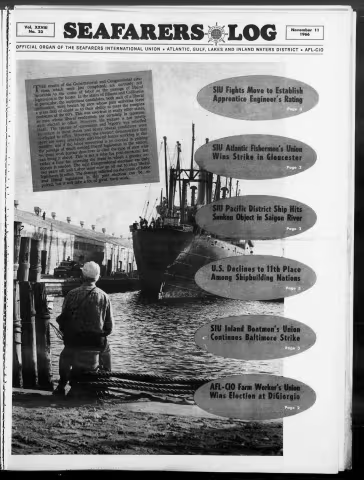
Issue Date
1966-11-11
Volume
28
Issue Number
23
Plaintext
Vol. XXViii
No. 23 SEAFARiatSftLOG
OFFICIAL ORGAN OF THE SEAFARERS INTERNATIONAL UNION • ATLANTIC, GULF, LAKES AND INLAND WATERS DISTRICT • AFL-CIO
is?;
f'" ->'-•% ' J' , J.," , V - • '• ••
AS. ^ f' '
, A ' V ' '
:r
'•. s.. ' '•'
pU Fights Move to Establm
Approiitice Engineor's Ratim
•I
jsi X .'fcscan bring It '•^^^sessing the a""® DolJ .•• fc - rather a tme tot Congressional jetton ^
. . 1 deavor is ^ Labor must "?* 8^"n the cause of labor .-S'
' , gv-lilJiawi'i'i'V' "
f
• ••
"•'•sA' "" •j'''
k .r-e. r -wySj
: •OK--
fcSsa
^SIU Atfantlc Fisherinen's tlni«i^
Wins Strike in 6loiicestg||
pwPacific District Ship Hil^
SifflkeH Object in Saigen Rhnni
Page 2
••-• •••o -/ort.:
,1
i 'jf
;l
I?
>
i.- •'>
.!i ->
i
I
• • W'>.
:f
t;
U : I
.'-i'
. '''U-
t. ,
It
i« 'J
If
•- .. i< '[
.•I I
.I i
:u'- .r' ,
1 ' " ••••; .
t
• a :l
J
Page Two SEAFARERS LOG IVovember 11, 1966 *
AFL-CIO Farm Workers Union Wins
•7"
Another Election at DiGiorgio Corp.
SAN FRANCISCO—The United Farm Workers Organizing Committee recently won another
fight to win collective bargaining rights for migrant farm workers when employees at the Arvin Ranch
of the DiGiorgio Corporation in California voted 283 to 199 in support of the union as their bar
gaining agent.
The United Farm Workers
Organizing Committee and the
DiGiorgio Fruit Corp. had signed
an agreement providing for a rep
resentation election Nov. 4 at the
firm's gigantic King Ranch.
The election was a yes or no
vote with only the AFL-CIO af
filiate on the ballot.
Over 500 votes were cast at
Arvin but some of these were
challenged and proved invalid un
der those conditions set for voting
eligibility. The total number of
workers affected by the election,
though, is well a^ve the total
voting figure, amounting to nearly
two thousand workers during peak
employment periods at Arvin.
All workers except supervisors
and office employees who were on
the payroll during the period Oct.
the
the
SlU Pacific District Vessel
Gashed in Saigon River Mishap
SAIGON—An SIU Pacific District-contracted freighter, the
Clarksburg Victory, which was reactivated from the U.S. mothball
fleet last July for Vietnam duty, struck a submerged object at the
mouth of the Saigon River, Oct. ̂
16, ripping a 36-foot gash in her
starboard side. The crew was
forced to abandon ship, after un
loading perishable stores through
the night, and there were no
casualties reported.
The Clarksburg Victory, oper
ated by the SIU Pacific District-
contracted J. J. Tennant Co., o:
Portland, Ore., was enroute to
Cam Ranh Bay with a load of
military cargo when the accident
occured off Cape Jacces at 4:30
p.m. It is believed that the ves
sel struck a sunken ship that had
drifted from its original position
as marked on navigation charts.
A Vietnamese pilot was in charge
of the Clarksburg Victory at the
time of the mishap.
According to the ship's purser,
Don Brown of Long Beach, Calif.,
a member of the SIUNA-affiliated
Marine Staff Officers—Pacific Dis
trict, the ship had just discharged
military cargo in Saigon and had
backloaded for Cam Ranh Bay,
some 200 miles north of Saigon,
"when the word came to abandon
ship. Everything moved like clock
work," he said.
The engine room flooded to the
main decks and Captain George
Levich, Seattle, Wash., took con
trol of the ship from the pilot.
Boats were readied for disem
barkation but not actually low
ered into the water. The ship had
apparently settled on a sandbar
and military boats in the area
rushed to the rescue. There were
no casualties in the accident.
Ironically, the Clarksburg Vic
tory was boarded by the salvage
crew working on the Baton Rouge
Victory that had hit a floating
mine several weeks before. Seven
crewmen—five of them members
of the SIU Pacific District Marine
Firemen's Union and two engine
officers of the Marine Engineer's
Beneficial Association—were kill
ed on the SIU Pacific District
manned freighter.
The Clarksburg Victory will be
towed to the side of the Baton
Rouge Victory and attempts will
be made to patch it up. T^e cargo
will be transferred to another
American vessel.
When the accident occured the
radio and generator went out,
leaving the ship dark in the com
ing twilight. A Navy vessel lent
its generating power to the ship
for light while the crew unloaded
all its perishable stores through
the night. The crew worked all
night without food or water. The
crew, with the exception of the
Captain, Chief Mate and Engineer,
were flown to Saigon for repatria
tion the following morning.
The Clarksburg Victory is one
of over 100 vessels that have been
reactivated from American ship
surplus for Vietnam duty. She
was recommissioned at Portland
last July.
Another SlU-contracted ship,
the Steel Designer, was itivolved
in an accident in the far east. The
7,927-gross ton Steel Designer
and the 8,432-ton Brookville col
lided in the harbor at Manila with
both ships said to have been badly
damaged. The Steel Designer, re
ported to be carrying machinery
from Baltimore to Saigon, was
holed on the side of her No. 3 hold
and flooded, while the Brook
ville sustained considerable bow
damage. No Seafarers were re
ported injured.
18-26 were eligible to vote.
The Teamsters, who lost
first DiGiorgio election to
Farm Workers in Delano on Aug,
30, had held up the Arvin vote for
six weeks by refusing to accept
election recommendations. The
Teamsters finally announced their
withdrawal from the DiGiorgio
campaign, thereby clearing the
way for the vote.
The election agreement was
made public in Los Angeles by the
then Gov. of Calif. Edmund G.
(Pat) Brown. Present was a dele
gation of workers off the DiGior
gio ranch led by Dir. Cesar Cha
vez of the Farm Workers and
Dolores Huerta, one of the union
leaders.
Brown had been in almost daily
contact with the parties and is
credited by all with having played
a key role in setting up the vote.
The AFL-CIO has been con
ducting intense union organizing
campaigns throughout the nation
for the migrant farmer, who for
years has subsisted on substandard
wages and working conditions.
AFL-CIO Organization Direc
tor William L. Kircher, who han
dled the negotiations, singled out
the labor movement in San Fran
cisco fori special credit in the ac
complishment.
Extensive support was given
throughout the campaign by AFL-
CIO Regional Dir. Daniel V. Flan
agan; Robert Ash, Russell Crowell
and Richard Groulx of the Ala
meda County AFL-CIO; Pres.
George Johns of the San Fran
cisco AFL-CIO; and Executive
Sec.-Treas. Thomas L. Pitts, Vice
Pres. Manuel Diaz and other of
ficers of the State AFL-CIO.
"This great manifestation of
trade union solidarity was a prin
cipal factor in accomplishing the
election agreement," Kircher said.
Report of
International President
by Paul Hall
The United States' position among the world's maritime nations is
still slipping, according to statistics compiled by Lloyd's Register of
Shipping. This is not a new or surprising finding, but demonstrates that
in spite of warnings from the SIU, other maritime unions, legislators
and others interested in our nation's maritime needs, little, if anything,
has been done to bring the ailing U.S. maritime industry back to a posi
tion of health and strength.
While the merchant fleets of Japan and Russia have shown massive
growth in recent years, and the fleets of Britain, Norway and others
have shown smaller but still substantial growth, the United States' total
tonnage actually fell during the same period, even counting the inactive
tonnage in the mothball fleet. Other nations are adding tonnage, but
our total tonnage is shrinking.
This situation is naturally reflected in the United States' standing
among world shipbuilding nations. We have dropped to eleventh place
among shipbuilders, behind Poland and the Netherlands.
Japan's fleet has doubled since 1960. Liberia's fleet has doubled since
1962, although much of this tonnage is actually owned by American
runaway-flag operators. Russia is coming up fast. Britain showed a
substantial gain in tonnage, as did Norway. However, the United States
lost tonnage and continued its decline.
As far as shipbuilding is concerned, the saddest fact to be revealed
from the Lloyd's figures is that the U.S. slipped down another notch
in spite of the fact that the Vietnam emergency sealift clearly demon
strated how badly we need more modern ships. Although we are de
pending more and more on old liberty and victory ships to transport
vital military supplies, there has been no move by the Government to
spur additional shipbuilding. The fact is that this year the U.S. ship
building budget has been cut even further than in previous years.
These facts carry with them a threat to the national security. We
are trying to meet ever-increasing shipping demands with less and less
ships. Moreover, because of the Government's crisis-to-crisis approach
to shipping, vast amounts of money are being wasted in getting obsolete
vessels back in action—money which could have been better spent in
building some modem ships in the first place.
It has been estimated that these excess costs have been running about
$225 million a year. This estimate was made recently by Representa
tive Hugh Carey of New York, a former member of the House Mer
chant Marine Committee, who has called for a national conference on
the development of a modern merchant marine to help remedy the
situation in which the absence of a Federal maritime policy has placed
the nation.
This reflects the increasing concern of many congressmen over the
nation's maritime situation—as evidenced by their support of (he SIU's
successful drive to remove the Maritime Administration from the new
Department of Transportation.
Increasing numbers of the nation's legislators are recognizing the fact
that Government administrators and bureaucrats cannot be counted on
to live up to their responsibility of maintaining a strong U.S. merchant
marine. As further evidenced by moves in the House and Senate to give
key Congressional committees a voice in the annual allotment of the
maritime budget, these legislators are coming to the realization that
part of the duty they owe to the American people whom they represent
involves the increase and expansion of the U.S. merchant marine and
shipbuilding industry as one of the best investments that can be made
in the national interest.
Gain Wage Boost/ Other Benefits
SlU-Affiliated Gloucester Fishermen Win Strike
Four hundred fishermen of the SIUNA Atlantic Fishermen's
Union have won a 42-day-old strike against the 43 fishing boat
.owners of the Gloucester Boat Owners Association. The strike
began September 20 when the®'
sought Union sought those benefits
which were already enjoyed by
fellow SIU men in Boston, New
Bedford, and New York City.
Union President James Ackert
said that in addition to winning a
new contract with the Gloucester
Boat Owners Association, the Un
ion succeeded in bringing 18 non
union boats to terms.
Under the new contract, fisher
men receive one-half of one per
cent of the proceeds of each trip
toward a pension fund. Also, fish
ermen no longer will have to pay
nr radar fish-finding equipment
after this year and, after next year,
they no longer will have to pay
for sounding equipment. In addi
tion, wages for workers aboard
ships in port are now set at $2.50
an hour instead of the former
$1.50.
Included among the strike issues
were Union demands for contin
ued benefits to the families of the
fishermen, such as hospitalization
and medical fees, and a request by
the Union that Gloucester fisher
men be allowed to take "benefit"
credits with them if they at any
time decided to fish out of Bos
ton, New Bedford or elsewhere
where the AFU is bargaining
agent.
Both Ackert and AFU Glouces
ter port agent Mike Orlando en
gaged in the negotiations which
led to the union victory.
The striking Gloucester fisher
men received the full support of
the SIUNA New Bedford Fisher
men's Union, as well as the Mari
time Trades Department of the
AFL-CIO.
As the strike went into its third
week, many union old-timers
showed up to help the strikers.
Active picketing by SlU-afFiliated Gloucester Fishermen's Union mem
bers was instrumental in successfully concluding 42-day strike con
ducted against Gloucester, Massachusetts fishing boat owners.
November 11, 1966 SEAFARERS LOG Page Three
Four More Seafarers Licensed
As Engineers; Total Now 104
Nesamar Loosaar Scotd Davis
18 months of Q.M.E.D. watch
standing time in the engine depart
ment plus six months' experience
as wiper or equivalent.
SIU engine department men
who have the necessary require
ments and who want to enroll in
the school can obtain additional
information and apply for the
course at any SIU hall or write
directly to SIU headquarters at
675 Fourth Avenue, Brooklyn,
New York, 11232. The telephone
number is HYacinth 9-6600.
Four more Seafarers have passed the U.S. Coast Guard examin
ation and have been issued their engineer's licenses after attending
the training school jointly sponsored by the SIU and District 2,
the Marine Engineers Beneficial ^
Association. A total of 104 Sea
farers have now received engi
neer's • licenses as a result of the
joint program.
The newly-licensed engineers
are sailing or about to sail in en
gineer's berths aboard American-
flag ships.
Thos SIU men who passed their
Coast Guard examinations this
week and were licensed as Third
Assistant Engineers were:
Joseph Nesamar, 45, who has
been a member of the SIU for
five years and sailed as an oiler
and FWT.
Endel Loosaar, 43, who has
been a member of the SIU since
I960 and has sailed as an oiler
and FWT.
Robert Scotti, 34, who joined
the SIU in 1959 and sailed as an
oiler and FWT.
The newly licensed Second As
sistant Engineer is:
Howard B. Davis, 43, who
joined the Union in Mobile nine
years ago and has sailed as an
oiler, FWT and engine utility man.
The joint SIU-MEBA District
2 upgrading school offers Seafar
ers and Engineers qualified in
struction in preparing for their
Third Assistant Engineer, Tem
porary Third Assistant Engineer
or Original Second Engineer's
licenses in either steam or motor
vessel classifications.
Seafarers who enroll in the pro
gram are eligible to apply for any
of the upgrading courses offered at
the Engineers School if they are
19 years of age or older and have
Coast Guard Sets Hearing After Protest
SIU Protests establishment of New
Apprentke engineer's Rating By CG
NEW YORK—^The Seafarers International Union of North America informed the Coast Guard
recently that if it approved the establishment of a new apprentice engineer's classification for unli
censed seamen it would be helping to create jurisdictional disputes among American maritime un
ions and to precipitate possible ®
tie-ups or delays of American-
flag ships at a time when they
are critically needed for the Viet
nam sealift.
The SIU also informed the
Coast Guard that its affiliated un
ions on all coasts were notifying
their contracted shipping com
panies that they would consider
any attempt to place apprentice
engineers aboard SlU-contracted
vessels as a violation of the con
tract and an infringement of the
jurisdiction of these affiliates.
The SIU position was set forth
in a telegram to Rear Admiral C.
P. Murphy, chief of the office of
merchant marine safety of the
Coast Guard in Washington. The
telegram was signed by Paul Hall,
President of the SIUNA, and by
William W. Jordan, president of
SEAFARER&^LOG
Nov. II, 1966 • Vol. XXVIII, No. 23
Official Publication of the
Seafarers International Union
of North America,
Atlantic, Gulf, Lakes
and Inland Waters District,
AFL-CIO
gxeeutive Board
Pxin. HALL, Prtiident
CAL TANNER EARL SHEPARD
Exee. Viee-Pre$. , Viee-Preaident
AL KERR LiNosn WILLIAMS
See.-Treaa. Viee-Preaident
ROBERT MATTHEWS AL TANNER
Viee-Preaident Viee-Preaident
HERBERT BRAND
Director of Organixing and .
Publieationa
Managing Editor
MIKE POLLACK
Aaaiatant Editor
NATHAN SKYER
Art Editor
BERNARD SEAMAN
Staff Writers
PETER WEILL
Pirrni WEISS
ED RUBBNSTEIN
Pikllihid bIwMkly at 810 Rhsda liland Annaa
N.E., WaihlnitoB, D. C. 20O18 ky tba Seafar-
ara Intirnatlanai Uaian, Atlantie, Gaif, Lakei
and Inland Watara Dlitrlat, AFL-CIO, 675
Fsarth Avanaa, Brooklyn, N.V. 11232. Tal.
Hraelnth 9-6600. SMond alaia poataga paid
at Waaklngton, D. C.
POBTBASTEB'S ATTEBTI08: Forai 3579
aarda ihoald ka lant to Saafartra Intamatlonal
Union, Atlantie, Gilt. Lakai and Inland Watara
Dlatrlat, AFL-CIO, 675 Foarth Annaa, Brook
lyn, B.y. 11232.
jr
as. Continues Its Rt^id Decline
Among World's Shipbuilding Nations
The United States merchant fleet, once among the world leaders
of shipbuilding nations, is continuing its downhill slide. This
was revealed by Lloyd's Register of Shipping in its latest quarterly
report. This nation, according to
Lloyd's Register, has dropped
from tenth to eleventh place
among shipbuilding countries.
The quarterly report from
Lloyds revealed further that as
of the end of September, Japan
had 306 ships of 3,542,214 gross
tons heading toward completion,
making this small but heavily
populated nation the current world
leader in this area.
Great Britain is second to Japan
in shipbuilding with 180 ships of
1,576,947 gross tons. Behind
Britain are Sweden, with 52 ships
grossing 1,576,947 tons; West
Germany, 146 ships, of 937,971
gross tons; Italy, 74 ships, of
721,809 gross tons; Spain, 212
ships, of 547,778 gross tons, and
Norway, 95 ships, of 527,734
gross tons.
Norway was followed by Fran
ce, Poland, and the Netherlands.
Finally came the United States,
a former world leader in the mari
time industry, sunk in 11th place
now with just 63 ships under con
struction amounting to only 383,-
227 gross tons.
And behind the United States,
in order, are Denmark, Yugo
slavia, Brazil, Finland, Canada,
and Australia.
Meanwhile, another Lloyd's re
port showed that Japanese and
Liberian flag merchant fleets show
a stunning growth rate. Japan's
fleet has doubled since 1960.
Liberia's has doubled since 1962.
Liberia's growth is due to Amer
ican shipowners who register their
ships under the Liberian flag in
order to evade taxes and U.S.
safety regulations.
Total U.S. tonnage including the
mothball fleet decreased by 730,-
000 tons. By contrast, Japan's
soared upward by 2,752,000 tons.
In the past two years, 18 mil
lion tons have been added to the
total world fleet. Of this sum, six
million tons are under the Liberian
banner^ four million under Ja
pan's, 2.5 million under Russia's
hammer and sickle, and two mil
lion tons fly the Norwegian flag.
SIU Boatmen
Continue Strike
In Baltimore
The SlU-Inland Boatmen's
Union strike against three Balti
more tugboat companies continued
into its fifth week.
The strike began October 12
following a strike vote by the
membership. Negotiations reached
a standstill October 18 when the
two parties met for the first time
in the office of a Federal mediator
and the companies walked out on
a Union committee.
The three tugboat companies
are the Baker-Whiteley Towing
Co., the Baltimore Towage and
Lighterage Co., and the Curtis
Bay Towing Co.
Nearly 160 Union men unani
mously agreed to strike after the
companies jointly made a "final"
contract offer whose provisions
were far below those standards
already established in other ports.
The strikers are determined to
remain out for as long as neces
sary, though they will continue to
dock and undock, without pay,
any ship certified by the Mari
time Administration as a military
cargo vessel bound for Viet Nam.
SIU Vice President Robert A.
Matthews, who is coordinating
strike action with SIU Vice Presi
dent Earl (Bull) Shepard, said that
"the companies are not too con
cerned about the effects of the
strike because up until now, they
have refused to meet to resolve
our differences."
the SIUNA-affiliated marine fire
men's union, which represents un
licensed engine room personnel on
west coast ships.
The Coast Guard has been re
quested by District 1 of the Marine
Engineer's Beneficial Association,
as well as the Brotherhood of
Marine Officers, to establish the
apprentice engineer's rating as part
of a proposed training program
to qualify men for a licensed en
gineer's rating.
The Coast Guard has asked that
written comments on the requested
changes in its rules be submitted
by November 1, but the SIU in
its telegram declared that this
procedure will not allow an ade
quate airing of the issues involved
and urged that the Coast Guard
instead schedule public hearings
on the matter. As a result of the
SIU's protest and request for a
hearing the Coast Guard informed
the union that a hearing on the
disputed rating will be held on
November 22.
In support of their position,
the SIU noted that "there is pres
ently available a large pool of
skilled and experienced engine
room personnel, and that all of
the unions representing these men,
such as the Marine Firemen's Un
ion, SIU Atlantic and Gulf Dis
trict and National Maritime Un
ion. have programs for upgrading
qualified unlicensed men to li
censed engineer's ratings.
"By approving the proposed
changes, the Coast Guard would
therefore also be participating in
a plan to by-pass the available
pool of skilled unlicensed engine
17
room personnel presently meeting
Coast Guard requirements for
marine engineer's licenses, in favor
of a program which would not
produce licensed engineers for
more than two years," the SIU
asserted.
"Because the issues raised here
are of such critical importance,
not only to the members of our
affiliated unions but to the entire
merchant marine and the nation,
we do not believe that these issues
can be satisfactorily aired through
the submission of written com
ments as you have requested," the
SIU telegram added.
"Public hearings would enable
all interested parties to present
their views in an open forum in
which there would be a much
greater possibility of bringing
them to the attention of other
persons in the maritime industry
or the government who may not
have analyzed the proposals in
detail and who may not be aware
of their far-reaching and signifi
cant implications.
"We therefore most strongly
urge that public hearings on this
critical matter be scheduled at an
earlv date."
Copies of the telegram were
also sent to all members of Con
gress. officials of the Department
of Labor. Defense. State, the Mari
time Administration, other federal
agencies, and other maritime un
ions and maritime industry groups.
Labor-supported bills to set up
the Maritime Administration as a
completely independent agency
have been approved in committee
in the House and Senate and are
awaiting further action.
President Names Boyd to Head
New Dept. of Transportation
WASHINGTON—Alan S. Boyd, who as Undersecretary of
Commerce was instrumental in the formulation of the contro
versial Interagency Task Force or Boyd Report, has been named
by President Johnson to head
the new cabinet-level Depart
ment of Transportation. Con
gressional approval of his nomi
nation is considered almost cer
tain.
The appointment of Boyd to
head the new transportation
agency points out the importance
of the successful struggle waged
by the SIU and other maritime
unions to have the maritime ad
ministration removed from the
Department of Transportation.
Because of the action of maritime
labor, MARAD is not included in
the new agency and will not come
under Boyd's jurisdiction.
The Boyd report, formulated by
a government interagency com
mittee headed by Boyd, virtually
proposed the death of the
American-flag merchant marine.
The report advocated:
• An even smaller U.S. mer
chant fleet than we have today,
carrying even less of our cargoes
than it does now.
• The construction of only
100 new dry bulk carriers over
the next 20 years.
• The phasing out of the cargo
preference program.
• Allowing ships to be built
abroad but enjoy the privilege of
U.S. registry. This would vir
tually doom the U.S. shipbuilding
industry.
• Made no provison for as
sisting tankers and opposed an oil
import quota.
• Called for no action against
runaway flag ships.
• Advocated the phasing out
of all U.S. passenger ships.
The SIU and other maritime
unions opposed inclusion of
MARAD in the new transporta
tion department because of a con
viction that the desperate needs
of maritime would becomfe sub
merged in the bureaucratic red
tape of a huge governmental de
partment presided over by admin
istrators with little or no sympathy
or interest for the future of mari
time.
•
t L
\ I .
i
SU • !'•
I
•S;
'1^ 1 -I ll
'vil t I
S
Page Fonr SEAFARERS LOG November 11, 1966
>:\
f.
tl
Six Additional Seafarer Veterans
Added to Growing Pension Roster
Brosig Henley Caligiura Rivers Hamilton
The names of six additional Seafarers have been added to the growing list of men now receiving
union pensions. The newcomers to the SIU pension ranks include: August Brosig, James Henley,
Ernesto Caligiura, John Hamilton, James Rivers and Joseph Doran.
Brosig joined the SIU in the
port of New Orleans. Bom in
Germany, he resides in New Or
leans with his wife, Sarah. A
member of the Steward depart
ment, Brosig last shipped on the
Alice Brown.
Henley sailed in the Deck de
partment as a Bosun. He was
born in Georgia and lives in Sa
vannah with his wife, Arrie. He
joined the union in New York
City. His last ship was the Steel
Age.
Caligiura joined the SIU in
New York, where he lives with his
that passage of the bill "would
guarantee that the appropriate
committees of Congress would
make a searching inquiry each
year into the needs of the mer
chant marine." This, he said,
would enable Congress to help
end the "deterioration which has
characterized our maritime indus
try in recent years."
MA Budget Bill Sponsors Promise
Early Action by 90th Congress
WASHINGTON—Sponsors of companion bills in the House
and Senate which would give the House Merchant Marine Com
mittee and the Senate Commerce Committee power to authorize
annual Federal budget allot-
ments for the Maritime Adnrn.,
have indicated that although ad
journment of the 89th Congress
did not allow time for action on
these measures, they would be re
introduced as soon as possible be
fore the 90th Congress.
Senator Daniel Brewster (D-
Md.) and Representative Edward
A. Garmatz (D-Md.), who intro
duced the legislation, made this
clear in separate statements fol
lowing adjournment.
In the House, where the meas
ure had been cleared for action by
the Committee on Merchant Ma
rine and Fisheries, supporters of
the bill reported that it would be
more advantageous to postpone
action on the proposal unitl Jan
uary when the new Congress
meets.
House Merchant Marine Com
mittee Chairman Garmatz, along
with other supporters of the bill,
stated their belief that giving the
Congressional committees author
ization to set the budget for the
Maritime Administration will go a
long way toward helping to give
the merchant marine a boost in
the right direction.
Brewster, sponsor of the Senate
version of the measure, predicted
Lakes Pensioner
Great Lakes Seafarer William J.
Long picked up his first regular
monthly $150 pension check re
cently from SIU port agent Floyd
Hanmer at Frankfort, Michigan.
wife, Alice. Born in New York,
Caligiura sailed in the Steward de
partment as a messman. The Sea
farer's last ship was the Marymar.
Rivers joined the union in the
port of Wilmington. Born in
Grinnell, Iowa, the Seafarer sailed
in the Engine department as elec
trician. He is a resident of Long
Beach, Calif., where he lives with
his wife, Theresa. Rivers served
in the Navy from 1942 to 1945.
He last sailed on the Ames Vic
tory.
Doran was bom in New Brigh
ton, S. I., New York, and lives in
Staten Island with his wife, Ger
trude. He joined the SIU in New
York and sailed in the Deck de
partment. Doran was employed
by the B & O Railroad and sailed
as a deckhand.
John Hamilton was born in
Maryland and joined the SIU in
Baltimore. He sailed in the En
gine department. Hamilton re
sides in Baltimore with his wife,
Stella. He last sailed with the
Baker-Whitley Towing Company.
lowing FRB investigations. Con
gress passed legislation closing
loopholes in the U.S. Banking
laws which make it necessary lor
the duPont Estate to get rid of
either its business or banking ties
in Florida over a period of time.
ffor/dir East Coast RR Strikers
Win High Coart Picketing Decision
WASHINGTON—The right of striking employees of the Florida
East Coast Railway to tie up the Jacksonville, Fla., rail terminal
without being interfered with by the Federal Courts has been up
held by the U.S. Supreme Court.
Active picketing tying up the
terminal remains suspended
however, awaiting the outcome of
separate litigation to overthrow a
Florida Supreme Court order up
holding a state court injunction.
The Florida East Coast Rail
road strike began on January 23,
1963, and is now the longest labor
dispute in railroad history. The
walkout began when 11 non-oper
ating unions quit work after com
pany refusal of a 10-cent-an-hour
wage increase to bring FECRR
workers' wages in line with other
U.S. railroad workers. The non-
operating workers' walkout was
later joined by the operating un
ions.
The U.S. Supreme Court deci
sion upholding the rights of the
strikers was based on the provi
sions of the Norris-LaGuardia
Act.
The Florida East Coast Rail
road is part of the vast duPont
Estate's business and banking em
pire in Florida, headed by Edward
Ball. Because of the estate's size
and the vast amounts of money
and influence at its disposal. Ball
has been able to keep the FECRR
running sporadically with scabs.
The duPont Florida empire has
come under attack recently from
the Federal Reserve Board which
administers the Banking Act. Fol-
AFL-CIO Launches
Kingsport Strikers'
Christmas Fund
Twelve hundred men who
have been on strike for more
than two-and-a-half years
against the Kingsport Press,
Kingsport, Tennessee, are in
need this winter of help. Help
in order to meet medical,
hospital, food, and home bills:
Help for the possibility of
providing their children with
a Christmas celebration,
however modest it may be.
Contributions may be sent
to the Kingsport Press Strik
ers Christmas Fund at:
Union Label and Service
Trades Dept., AFL-CIO.
Room 402, AFL-CIO
Building
815 16th St., N.W.
Washington, D.C. 20006
Ray Wright, a 17-year SIU vet
eran who last sailed on the Com
mander as an A.B., had to leave
ship when he became ill and is
spending a few weeks recuperating
in Carolina before he returns again
to ship.
Darius Jones, who has been an
SIU member for 11 years, was on
the Eagle Traveler as boatswain
when he had to be hospitalized in
Long Beach. He's now registered
here, and hoping to ship out
shortly.
Philadelphia
The port of Philadelphia has
been on the slow bell but things
should be starting to pickup in a
week or two.
Charles Bedell is registered at
the hall and is hoping for a baker's
job to come along. Robert Kyle,
a 19-year SlU-man, last sailed on
the National Defender will take
the first job which comes along.
Roy I^e McCannon is a quarter-
of-a-century SlU-man who sails in
the steward department, was
around the hall recently and said
that he had a good trip on the
Bethflor. John Pierce paid us a
visit and said that he will spend
a few weeks at home before ship
ping out again.
The Atlantic Coast
by Eari (Bull) Shepard, Vice-President, Atlantic Coast Area
The United States Senate recently approved a ship safety bill sup
ported by the SIU and other maritime unions. The new legislation
sets up very definite safety and financial responsibility standards for all
vessels operating from U.S. ports.
The new law is aimed directly at run-away vessels, many of which
are U.S.-owned and registered
under foreign flags. These owners
have been notorious in their dis
regard for adequate safety stand
ards on their vessels. The law will
force them to rise to our standards
and insure passengers they are set
ting out to sea in a ship, not in a
coffin.
The bill requires that ships hold
ing more than 50 persons must be
fire-proof in order to sail from
a U.S. port. Also, shipping com
panies must inform passengers of
those safety standards that prevail
on each ship. And the companies
must prove they have enough fi
nancial security behind them to
satisfy any judgment against them
for death or injuries.
New York
Stopping by the hall recently
was Ralph Di Paolo, whose last
ship was the Steel Producer. Ralph
is a 21-year SlU-man; also visiting
the N.Y. Hall were Manuel Callas,
a 24-year member who last sailed
as chief steward on the Gateway
City and Julian LeUnski who last
shipped on the Sea-Train Georgia.
Julian's a 20-year SlU-brother
who sails as chief steward. Michael
Hankland who also sails as a chief
steward, stopped by to see some
old friends at the hall. His last
ship was the Carroll Victory.
Baltimore
Shipping here has been slow
these past two weeks but prospects
for the coming two weeks are fair.
Presently, the Alamar, Losmar,
Ohio and the Maine were laid up
and there is no word on when
these ships will be crewed. During
the past two weeks, three ships
were paid off, two signed on, and
eleven were in transit.
James H. Webb, who has sailed
deck department for 23 years,
paid off the Portmar after six
months and following a little vaca
tion Jim will ship on the first vessel
that comes along. A veteran of the
engine department for about 20
years, James MacGrevor.paid off
the Marore in September and has
been unfit for duty until now. He's
now F.F.D. and can't wait to ship
again. James A. Long found the
crew and officers of the Cuba to
be "a really fine bunch," making
his recent trip to Vietnam very
enjoyable. Long has been sailing
in the steward department for
about 16 years.
Boston
Shipping has been on the slow
bell recently. Twenty-five year
SlU-man Maurice Olson is ready
to ship again after spending the
summer with his family. "Maury"
is standing by for the first bosun's
job that comes in. Raymond
Davis, a 21-year SIU man who
last shipped on the Robin Sher
wood as FWT is ready for another
long trip. John Gala, a 22-year
SIU member who last sailed on
the R/V Bertha Aim as oiler, was
in drydock for awhile, and is
now ready to go. He's waiting for
the first coast hugger to hit the
board.
Norfolk
Shipping has been fair at this
port and the outlook for the future
remains much the same.
H Y. Mans New
Container Faciiity
On Staten Island
NEW YORK — The City of
New York has announced plans
for a new container and general
cargo terminal to be constructed
on the eastern shore of Staten Is
land.
The 135-acre, $21 million ter
minal project will give the city its
first container complex, including
a 5,400 foot lateral wharf, unload
ing crane, warehouses and truck
marshaling yards.
Preparations for the project will
involve the removal of 12 old
Staten Island piers, from Pier 7
through Pier 18, which except for
a brief period during World War
II were seldom in use.
Eighty acres of the proposed
135-acre terminal will be created
by landfill, with the fill of about
two million cubic yards coming
from harbor bottom land dredged
up during channel and bay im
provement work.
The single wharf structure will
run parallel with the shore and
provide accommodations for nine
600-foot containerships. Water
depths at the berths will be a mini
mum of 35 feet.
The first stage of the two-stage
project is expected to take three
years for completion, although it
was predicted the first berth will
be ready for use by 1968. Com
pletion of the second stage will
depend on the success of the first
in drawing shippers.
An estimated IX) million tons of
cargo will move through the ter
minal yearly if all goes according
to present plans and expectations.
November 11, 1966 SEAF/iRERS LOG Page Five
The Gulf Coast
by Lindsey Williams, Vice-President, Gulf Area
The joint SIU-MFOW request for a public hearing on the establish
ment of a new apprentice engineer's classification for unlicensed sea
men has been endorsed by the Maritime Council of Greater New Or
leans and Vicinity. Also, the Central Labor Council of New Orleans
joined with the Maritime Labor Council in proposing that the SIU-
MFOW position be given a full —
hearing.
In addition to their vote of con
fidence they have forwarded let
ters and telegrams of support to
various legislators informing them
of their full-fledged and unani
mous concurrence with the SIU
stand on this matter.
Legislator Cites 'Excess Costs' of Vietnam Sealift
Gov't Neglect of Maritime Industry
Rapped as Shortsighted, Wasteful
NEW YORK
excess costs
New Orleans
Retired Seafarer Fat Driscoll
was visiting old friends in New
Orleans, coming all the way from
Snug Harbor, New York, to do it.
Pat retired in 1958 when he got
off the Del Santos where he was
bedroom steward.
Oldtimers seen in the hall re
cently enjoying the life of a re
tiree were: Neal Hanson, Charles
"Jukebox" Jeffers, Louis Bour-
donnay, Emiie Mitchke, and Sam
Hurst.
Houston
C. E. James is taking advantage
of the cool Texas weather; the
first we've had in a long time.
James ships in the deck depart
ment and says he'll take a Viet
Nam run as soon as it shows on
the shipping board. Another deck
man, Gilbert Delgado, is now in
drydock in the Galveston USPHS.
Delgado will be released soon and
is looking forward to a South
American trip on an Isthmian
ship.
Mobile
D. L. (Jughead) Parker left the
Alcoa Roamer where he had been
a bosun for
twelve months.
The vessel is in
the shipyard for
repairs. Seafarer
William G. Dyal
recently register
ed in group twd
engine depart
ment. Dyal was a
FOWT on the
Battle Creek until he was forced
to get off because of an attack of
influenza. He's fit and ready to
ship now, however. Steward Floyd
Mitchell left the Alcoa Roamer
when she was laid up for repairs.
He was night cook and baker on
the Roamer. After relaxing on the
beach for a while Mitchell will be
Parker
Pritchett
looking for another baker's job on
the island run.
Seafarer D. M. Saxon says the
SIU is a family affair for him. He
has three sons
who also ship
with the SIU.
Saxon, an engine
room man was
last on the Al
coa Roamer. He
makes his home
with his family in
Mobile. Steward
R. L. (Luch)
Pritchett finished a long tour
on the Alcoa Roamer and is
now taking a long and well-earned
rest. Luch intends to spend his
shoreside hours with his family at
home in Mobile. Shipping is very
good in Mobile and there are
plenty of jobs available.
ILA's Arcomona
Wins Saigon's
Highest Medal
The highest medal the govern
ment of South Vietnam can be
stow, the Medal of Merit First
Class, has been awarded to a
veteran Brooklyn longshoreman,
Natale Arcomona, who is a mem
ber of ILA Local 1814.
A longshoreman for 30 years,
Arcomona went to Saigon last
January with James Gleason as a
member of the ILA's four-man
team of cargo-handling experts.
Arcomona's "outstanding service
in speeding the movement of ships
and freight through the Saigon
port", led to his selection for the
medal.
The ILA's mission was to in
struct Vietnamese dockworkers in
the use of modern equipment and
to help relieve congestion in Sai-
gons's overcrowded port.
Arcomona is still in South Viet
nam as a waterfront trouble-
shooter for the Agency for Inter
national Development. Active in
the ILA, he was a shop steward
and a member of Local I814's ex
ecutive board.
in the Vietnam emergency, and in
chartering foreign ships where
American ships are no longer
available in sufficient numbers, has
meant the loss of dollars that are
badly needed to reduce the bal
ance of payments deficit.
A former member of the House
Merchant Marine and Fisheries
Committee, Carey praised those
congressional legislators who vig
orously opposed, as he did, includ
ing the Maritime Administration
in the new Department of Trans
portation.
"We were not elected to repre
sent the people of the United
States to aid in the decline and
fall of the American merchant
marine by pigeon-holing its prob
lems in some dark corner of the
Department of Transportation,"
he said.
"We in Congress want a sepa
rate maritime agency because we
believe it is high time that we did
what needs to be done to return
this country to first place as a
maritime power. If anyone ever
doubted that we need it, that
doubt must be dispelled by the
lesson of the Vietnam sealift."
The United States must support
a sound, vigorous merchant ma
rine in peacetime in order to have
the shipping available in times of
a national emergency, he pointed
out.
"It is our job to get the message
across to the American people
that our merchant marine indus
try and our shipbuilding facilities
must be improved, increased and
expanded as one of the best in
vestments we can make in the na
tional interest," he added.
The Pacific Coast
New Orleans Labor Aids United Fund Drive
Organized labor in the New Orleans area pitched in to get the 1967
United Fund campaign off to a flying start. Labor plays an active
role in this program aimed at meeting community needs through vol-
unary contributions. The New Orleans United Fund Labor Advisory
Committee includes (l-r): L. DuPlantier, Committee Chairman; f^.
Purvis. Fund Chairman: L. Tyler, ILA Local 1419: Buck Stephens of
the SIU; and G. Richard and E. J. Amant, both of ILA Local 1419.
The Vietnam sealift is costing the United States about $225 million a year "in
because of the deficiencies in the U.S. merchant marine brought about by years of
official neglect on the part of U.S. Government administrators, according to Representative Hugh
L. Carey (D-N.Y.).
In a recent speech before a
maritime group, Carey accused
the Maritime Administration and
the Department of Defense of
shortsightedness in allowing the
merchant marine to decline to the
point where U.S. military needs
must be met with "wasteful slow
ships of ancient age and antique
design."
Carey said that to help remedy
the situation in which the absence
of a Federal maritime policy has
placed the nation, he would intro
duce a resolution in the next ses
sion of Congress calling for a na
tional conference on a modern
merchant marine.
Held under the auspices of the
Government, the conference
would include representatives of
maritime labor, management,
shipbuilders, the Maritime Ad
ministration and the Department
of Defense.
"It would be the purpose of the
conference to review, plan, orga
nize research and awaken public
interest in the restatement of a
new national maritime policy," he
said.
He noted that the excess costs
involved in breaking old ships out
of mothballs and operating them
^S/ff Company
Plans to BuiU
Alaska Terminal
JUNEAU, Alaska. The SIU
Pacific-District contracted Alaska
Steamship Company has an
nounced plans to build a modern
freight delivery terminal in Ju
neau on the 7-acre Columbia
Lumber property the company re
cently acquired for the purpose.
Construction of the 70 by 216
foot all-steel cargo delivery build
ing will follow present regrading
and surfacing of the 100,000
square foot van marshalling
area.
The project, the proposed cost
of which is $300,000, is of clear-
span design with 16 to 20 foot
vertical clearance, unlimited floor
load, fully insulated roof, panel
wall construction, and completely
sprinkler fire-protected. This will
be served by twelve 10 by 16 foot
tailgate-high overhead doors, two
to each bay. There will be a Tito Hall
35 by 70 foot warm room at the
north end.
A company spokesman said
that both less-than-van and full
van-load shipments will be han
dled at the terminal. Less-than-
van size containers will be segre
gated at the facility for quick
delivery, while full van-load con
tainers will be delivered as in
the past.
The freight handling center is
a response to expected economic
expansion of the Juneau area,
and should become an integral
part of future operations, the
spokesman said. The project is
slated for completion in Novem
ber.
by Frank Drozak, West Coast Representative
In an election held last September 29, Local 101 of the SIUNA
Transportation Services and Allied Workers won bargaining rights with
the Yellow Cab Company of Oceanside, Calif. The union recently
reached an agreement with the Oceanside Cab Company and cabbies
will get an increase in their commissions, the establishment of a Welfare
Fund for them and their families,
and an annual paid vacation. The
Yellow Cab Company of Ocean-
side was the largest non-union
outfit in San Diego County.
The election loss of Gov. Ed
mund G. (Pat) Brown is a regret
ful one for the labor movement in
general and California in partic
ular, for Pat Brown was a liberal
Democrat who appreciated the
working man and always worked
hard himself to improve labor
conditions in California. He did
so most recently when he assisted
the union representation election
held by migrant farmers at the
DiGiorgio ranch in Arvin, which
resulted in a "yes" vote in favor
of unionization.
San Francisco
Shipping here in the Port of
San Francisco is still very good,
and there are many berths open
for AB's, oilers, FWT's, electri
cians, cooks and bakers.
Paying off for the last period
were the Choctaw Victory, Fair-
isle, Steel Rover, Overseas Dinny,
Tucson Victory, Robin Hood,
Elizabethport, Mankato Victory,
Topa Topa and Cornell Victory.
Crews signed on aboard the
[hike Victory, Fairisle, Overseas
Jinny, Steel Rover, Topa Topa,
lobin Hood, Tucson Victory and
Jelaware.
Ships in transit are the Panama,
[*ortmar, Keva Ideal and Seamar.
Julian Tito is in from New
York to catch a Far East run.
Brother Tito just got off the
Bowling Green. He has been a
member of the SIU for 22 years.
C. T. Hall just made the Topa
Topa for another run to the Far
East. Brother Hall hails from
Philadelphia and has been ship
ping from the West Coast for the
last 5 years.
Seattle
Shipping has been booming in
the Seattle area. We recently paid
off the following vessels: Seatrain
Texas, Manhattan, Trans-North
ern. We have the following ships
in transit: Anchorage, Eagle Trav
eler, Elizabethport and Seattle.
Henry Croke, whose last ship
was the Seattle on which he served
as crew mess on the Alaskan run,
is ready to go again now. He is a
20-year SIU member,
job.
Frank "Red" Sullivan has been
an SIU member for 28 years. His
last ship was the Fairport, and he
is ready to go aboard the first
Sea-Land ship available.
Wilmington
Shipping remains good here and
the outlook is for active shipping
in the coming weeks. During the
last shipping period we had the
Eagle Traveler pay off and 6 ships
in transit.
Frank Lamberti is on the beach
and plans a rest with his family be
fore looking for another bosun's
James E. Rivers received his dis
ability pension a few days ago and
said that he is very appreciative of
what the welfare plan has done for
him since being taken off the
Ames Victory several months ago
due to a heart condition. We all
wish him well and hope to see him
stop by the Union Hall often.
i:|
1 ti
I is'
m
Page Six SEAFARERS LOG November 11, 1966
*•
QUESTION: What do you do
during the winter to keep warm
while working on deck?
Thomas L. Magras: I wear
plenty of heavy gear. I find my
thermal under
wear really helps.
I wear a heavy
parka most of the
time. It's water
proof, and I wear
it in the rain.
When it rains of
course I put the
hood up. I don't
think I have any special techniques
for keeping warm.
Richard Barcelona: I wear the
heaviest winter clothes I can get.
You have to wear
gloves,even
though it is some
times difficuk to
work with them
on. I make sure
that everything I
wear, from socks
to gloves, is warm
and heavy. No, I
don't do anything unusual to keep
warm when it is very cold.
J. Casey: I wear heavy sweat
shirts, heavy socks, a heavy wool
en skull cap, and
heavy socks, a
heavy woolen
skull cap, and
heavy shoes.
When it rains, of
course, we all
wear oil-skins. We
wear pretty
' i much the same
Colombia Plans
New Atlantic-
Pacific Canai
The Government of Colombia
will begin to build a 260-mile sea
way linking the Gulf of Uraba on
the Caribbean with the Bay of
Malaga on the Pacific Ocean. The
seaway will cut through the jun-
gled valley of Choco Province in
the northwestern part of the
country, where rainfall averages
400 inches a year.
The project is estimated to cost
$743 million and should help to
expand Colombia's economy. The
seaway will permit a good reduc
tion in rates for Colombia ship
pers. Time needed for seaway
construction will depend on how
it is financed and may take as few
as 5 to 10 years or as many
as 20.
Both Panama and the United
States were reassured by Colom
bian officials that the proposed
seaway will not seriously take
traffic away from, or compete
with, either the Panama Canal or
the projected sea-level canal be
ing studied by the United States.
At most, say Colombian officials,
5 to 10 per cent of the Panama
Canal's traffic might be lost in fa
vor of the new route, which will
be over two lakes created by dikes
and linked by canal to each other
and the sea.
The Choco Province will great
ly benefit by becoming much
more accessible. Mining of cop
per, lead, zinc and aluminum
minerals should become a major
industry in the area. The Choco
tropical rain forest is rich in tim
ber and the new lakes could sup
port a fishing industry.
gear for cold weather. I don't
have any special methods for
keeping warm during really cold
spells.
Ed Casey: Naturally, I wear
warm clothing. Underneath, I
wear thermal
woolen under
wear. It's really
great for keeping
the heat in. The
name of the
brand is Grand
March, and I
bought it in Scot-
^ land. It's too bad
that most men don't get a chance
to go to Scotland, because not
many ships run there.
Alexandres Mfarinatos: I wear
heavy clothes, but not too heavy,
so as to interfere
with work. When
it gets really cold
I drink plenty of
coffee or tea. I
try to keep work
ing and moving
all the time. When
you're really
working, you
don't feel the cold. That's my
secret.
Barney Smith: I wear longjohns
or a heavy parka. I can't work
with both my
longjohns and my
parka on; it's too
hot. When I'm
wearing the long
johns, I wear a
jacket that .isn't
too heavy. I'm
careful not to get
too warm. I think
that is an important thing to re
member.
TrR17;Y«T -JL
From Oct. 21 to Nov. 3, 1966
DECK DEPARTMENT
TOTAL REGISTERED
All Groups
TOTAL
All G
SHIPPED REGISTERED on BEACH
Port Class A Class B Class A Class B Class C Class A Class B
Boston 5 1 0 0 0 32 7
New York 72 26 62 22 24 269 81
Philadelphia 3 3 1 2 0 26 9
Baltimore 24 7 10 7 2 102 24
Norfolk 7 6 9 5 4 20 12
Jacksonville 5 13 3 3 5 17 14
Tampa 4 2 6 4 1 6 4
Mobile 35 12 25 12 4 75 19
New Orleans 43 30 14 13 3 170 75
Houston 33 35 21 25 9 169 115
Wilmington 9 2 7 10 10 19 1
San Francisco 12 10 30 11 28 54 1
Seattle 30 24 32 21 25 30 2
Totals 282 160 220 135 115 1089 364
ENGINE DEPARTMENT
TOTAL REGISTERED TOTAL SHIPPED REGISTERED on BEACH
All Groups All Group B All Groups
Port Class A Class B Class A Class B Class C Class A Class B
Boston 3 2 0 0 0 13 4
New York 57 35 55 29 32 156 71
Philadelphia 6 2 1 2 0 16 6
Baltimore 17 16 9 10 7 74 4
Norfolk 3 10 12 2 5 9 13
Jacksonville 2 8 2 1 4 4 9
Tampa 5 1 4 2 3 6 16
Mobile 17 9 20 7 7 6 6
New Orleans 24 35 16 23 11 84 72
Houston 30 18 25 21 7 113 99
Wilmington 9 8 8 10 10 16 1
San Francisco .... 18 15 26 13 18 43 1
Seattle 25 10 23 9 18 12 0
Totals 216 169 201 129 122 552 297
STEWARD DEPARTMENT
TOTAL REGISTERED TOTAL SHIPPED REGISTERED on BEACH
All Groups All Groupi 3 All Groups
Port Class A Class B Class A Class B Class C Class A Class B
Boston 1 1 0 0 0 9 3
New York 37 12 25 15 29 122 31
Philadelphia 7 1 1 0 3 18 8
Baltimore 12 6 9 3 7 81 31
Norfolk 4 4 5 5 3 10 17
Jacksonville 3 6 1 2 3 9 8
Tampa 2 4 2 2 0 7 4
Mobile 26 6 20 4 4 50 8
New Organs - 21 24 19 16 5 . 120 74
Houston 32 17 11 9 4 104 72
Wilmington 9 6 3 5 4 14 1
San Francisco .... 44 7 23 8 23 44 0
Seattle 8 15 16 9 20 13 4
Totals 206 109 135 78 105 551 261
iSiii,..,...,.
YOU R O O L
Guide
R'S WORTH
to Better Buying
By Sidney Margolius
The complete commercialization of television today has turned out
to be one of the most powerful forces raising the prices of many of
the things you buy.
If there is no such thing as a free lunch, there also is no free TV
entertainment. Protected by Congress from stricter regulation by the
Federal Communications Commission of its advertising content, TV
has become the dominating influence over consumers and retailers.
It has led working families into increased spending and higher prices
especially for convenience foods, beer, household medicines, cosnietics
and toiletries, cleaning products and children's toys. The pitchmen
who once appeared on the small screen to get sales leads for storm
windows and encyclopedias have been banned in many cases. But
television itself has become the pitchman for many products whose
advertising cost is almost as much as the manufacturing cost.
The most notorious example is breakfast cereals. Their use has
leaped in recent years, and so have their prices. The National Com
mission on Food Marketing, in its recent investigation, found that
while the cost of the ingredients represents about 21 cents of manu
facturers' sales dollar, the cost of advertising and sales promotion
alone takes 20 cents. Of this, the major part—12 cents—goes for TV
advertising.
In fact, when a new breakfast cereal comes on the market you can
figure that about half the price you pay for it goes for advertising and
marketing during the first year.
Heavy TV advertising has made it possible for the cereal manu
facturers to dominate retailers as well as consumers. The Marketing
Commission found that the big expenditures for advertising "virtually
compel the retailer to carry a wide assortment of cereal items—some
times more than 100."
One result of the ability of cereal, detergent and other big TV ad
vertisers to force their way on the supermarket shelves, is that modem
larger supermarkets now carry 6000-8000 items compared to the 3000-
4000 that used to be considered a large stock. All these items have
helped to force up supermarket expenses and are a main reason why
retail food prices have beeii rising faster in recent years than other
commodities.
Moreover, the constant advertising seems to have brainwashed con
sumers of any thought of comparing values. "Advertising has made
consumers so brand-conscious" that they rarely buy private-brand
cereals even though they cost less, the Commission reported.
One of the most successful maneuvers employed to get you to buy
more cereals, and pay more for them, is the constant introduction of
"new" kinds. Actually, of course, these are merely slightly different
versions with added ingredients such as sugar and cocoa flavoring.
If you stop to calculate the prices, you will see that any variation
from the basic cereal jumps the price inordinately. Sugar-coated corn
flakes cost 50 per cent more per ounce than ordinary corn flakes. In
dividual serving boxes (actually just one ounce) cost twice as much per
ounce as eight-ounce boxes. Fruit or cocoa flavor corn puffs cost almost
twice as much as plain corn flakes. Corn flakes with instant banana cost
almost three times as much.
Many modern young housewives, with more money in their purses
than their mothers had, seem to act like so many puppets when it
comes to buying such "convenience" foods. The sugar-coated cereals
were first introduced back in 1939, the U. S. Agriculture Department
Farm Index has reported. But the housewives of that time turned
them down. By 1950, the sweetened cereals still had captured only
5 per cent of the ready-to-eat cereal market. But by 1961, more than
one of every five packages of cereal bought was pre-sweetened.
SIU WELFARIr VACATION PL A
September 1 • September 30,
; Number^ef
Benefits' •
Hospital Benefits . .L 5,546
Death Benefits 31
Disability Benefits ... . . r. -. . 908
Maternity Benefits 41
Dependent Benefits 489
O^ical Benefits
Out-Patient Benefits -
SUMMARY 1
Vacation Benefits ....
4W
4,006
ll,49Y
6.
Amount
Paid
i 57,548.00
86^18.15
|iii^oo,oo
8,110.00
98,872.66
7,114.48
^¥,636.00
^099.29
1,029.89
IRE, VACATION , •
•AID THIS PERIOD 12,039 01,026,129.18
November 11, 1966 SEAFARERS LOG
Strikebreaking on Calif. Farms
Called Major Organizing Block
Strikebreaking is a major roadblock to organizing California farm
workers, Cesar Chavez, director of AFL-CIO United Farm Workers
Organizing Committee charged during a network radio interview.
Chavez said that legal safeguards for the right of farm workers to
form unions are vital to the continued success of their drive to win
fair wages and decent working conditions.
Chavez praised Brown's quick response to the farm workers' plea
for help in setting aside a "rigged election" at the giant DiGiorgio
Corp. He said the governor "really set up the new representation
election without any precedent in the whole history of the country."
In a sense. Brown "gave birth to the union . . . gave us the life
that we needed at that precise moment," Chavez declared.
Governor Brown has been defeated in his bid for reelection by
Ronald Reagan.
The farm workers' leader reported that determination to form un
ions runs high among both resident and migratory farm workers. He
noted that some workers have "come from as far away as 2,500 miles
to vote in (union representation) elections."
Reporters questioning Chavez on the weekly AFL-CIO produced
program were Sam Sharkey of the Newhouse Newspapers and John
Herling, editor of John Herling's Labor Letter.
* « «
The AFL-CIO has filed a Hatch Act test case challenging the U. S.
Civil Service Commission's right to dock a postal worker 30 days' pay
for mailing out newsletters reporting activities of far-right extremists
in the 1964 Goldwater-Johnson campaign period.
The commission ruled 3-0 last Aug. 9 that Robert E. Hobart of
Concord, N. H., member of the Postal Clerks and part time secretary-
treasurer of the New Hampshire AFL-CIO, "took an active part in a
political campaign in violation" of the Hatch Act and civil service
rules. Chairman John W. Macy, Jr., and Commissioners L. J. Andol-
sek and Robert E. Hampton upheld a CSC hearing examiner's finding
and ordered that Hobart be suspended for 30 days without pay.
Hobart denied the charges, and a petition filed in the U. S. Court
of Claims by Thomas E. Harris of the federation's legal department
asked that court to award Hobart $674.62 in back pay.
At issue in the case is whether Hobart engaged in partisan political
activity when, at the direction of state AFL-CIO officers, he mailed
copies of Group Research Report to a mailing list of New Hampshire
citizens.
Hobart's counsel said that "the basic concern of the publication is
extremism, as distinguished from" normal political activity and that it
does not support or oppose either the Democratic or Republican Party.
Workers with children who
want to start college in the autumn
of 1967 are warned that now is
the time to begin working on it.
More young men and women
want to go to college than ever
before, the AFL-CIO Dept. of
Education has pointed out, and
anyone who waits until next spring
to think of registration or seek
ing scholarship bids is likely to be
shut out.
Students are advised that right
now they should be studying col
lege catalogues, writing for ad
mission blanks and asking for fi
nancial forms so they can apply
for scholarship aid.
* * *
The role of organized labor in
providing decent housing in the
developing nations was spelled out
by Boris Shishkin, secretary of the
AFL-CIO Housing Committee, at
a conference on International
Housing and Urban Growth in
Washington. The meeting was
sponsored by the Intl. Develop
ment Conference with the cooper
ation of the National Association
of Home Builders.
Shishkin outlined a report by
the Intl. Confederation of Free
Trade Unions to the United Na
tions which summarizes the train
ing of personnel to assist union-
sponsored housing cooperatives
and other housing programs.
* * *
Members of five printing un
ions at Kingsport, Tenn., will get
an estimated $503,000 in vacation
pay under a ruling by the 6th
U.S. Circuit Court of Appeals in
Cincinnati, Ohio. The court ruled
that some 1,806 workers are en
titled to the money for vacations
earned before they went on strike
in 1963 against Kingsport Press.
Management has refused all union
requests for vacation pay on the
ground that the strike terminated
all such claims.
* * *
A resolution calling for a work
week of four-six-hour days, with
Wednesdays, Saturdays and Sun
days off, was unanimously adopted
at the 28th biennial convention of
the Railway & Airway Supervis
ors, held in Chicago. The dele
gates, calling the condition of the
economy "basically sound," de
clared: "In order to keep the
economy moving in the right di
rection there is no doubt that this
nation will have to recognize and
come to the shorter workweek
and shorter work-day."
President James P. Tahney was
re-elected to another term, as were
other officers whose terms had
expired this year—Vice President
A. T. Stone and T. W. Stiarwalt,
Corresponding Secretary G. D.
Martin and Recording Secretary
W. H. Taylor.
* * *
A package worth more than 50
cents an hour over the life of a
three-year contract has ended a
strike of about 10,000 members
of the Textile Workers Union of
America in more than 200 New
York and New Jersey dyeing,
finishing and printing plants. The
walkout, which affected eight lo
cals, lasted 12 days. The workers
went back to their jobs after
ratifying the settlement, which was
worked out with the employers by
a 26-man union team.
7
Page Seven
"O.K.! Anybody Got a Ball?"
''
- -
A Full Agenda
The elections are now over and regardless
of personal opinions as to the outcome, the
fact remains that the 90th Congress will be
convening shortly and there is still much to
be done legislatively in meeting the demands
of the twentieth century.
Many labor-backed bills are still on the
Congressional agenda and await action by the
90th Congress.
Our nation is growing at a rapid pace and
much still needs to be done in the areas of
providing decent housing and an adequate
education for our swelling population.
The Civil Rights Bill, which fell prey to a
Senate filibuster in the 89th Congress, is still
a sorely needed measure if the minority
groups in this country are to achieve their
deserved status as full American citizens.
The expansion of benefits under our em
ployment compensation system is one of the
vital areas that needs the full support of those
The Great Outdoors?
Today's industries are by and large ig
noring public health and public pleasure by
polluting air and water through various in
dustrial processes that carelessly leave poi
sonous materials behind them.
Polluted air may help cause such ailments
as lung cancer, emphysema, bronchitis and
asthma. So this industrial crime is not to
be sneezed at but screamed at. More than
7,300 communities throughout this nation
are doused with harmful amounts of polluted
air, according to the U.S. Public Health
Service.
. In many of our metropolitan areas, a trip
outdoors will produce the usual symptoms
of air pollution: watery eyes and a fuzzy
throat which often induces a coughing spell.
Waterways too are being destroyed. The
magnificent Charles River in Boston has be-
legislators who will sit in the 90th Congress.
Section 14(b) of the Taft-Hartley Act still
remains in the statute book, enabling states
to invoke right-to-work, laws which deprive
their citizens the right to a fair wage and
decent working conditions through unioniza
tion and collective bargaining.
And our maritime industry continues its
unabated decline, harnessed by the beaurau-
cratic red tape and indifference responsible
for its present dismal state.
It may be argued that the loss of liberal
congressmen in the recent election will throw
the progressive momentum gained by the
89th Congress into reverse gear.
However, the fact remains that the 90th
Congress has yet to be heard from and it is
earnestly hoped that they will turn their full
attention to the many problems which plague
our nation.
come a 70-mile long sewage ditch. This
waterway once provided at least 30 commu
nities with drinking water and edible fish.
Little is left of life in the Cbarles.
Lake Erie is "dying before our eyes," as
Vice President Humphrey has noted. And a
cleanup of Lake Michigan would require
500 years! The Hudson River is in far
better shape. It would require a mere 15
years to become really clean again, provided
all pollution were halted.
Without some prompting, industry will
not open its wallet to cover clean-up costs.
So we hope that our newly-elected represent
atives, along with those who remain in office,
will responsibly act now on fresh programs
for fresh air and fresh water.
Only the lives of us all are at stake.
•$ ) ;
S, -
•h i"
f
i
fi
71-
7^ :
Page SEAFARERS LOG November 11, 1966
I 's' •]•• •'
tat-to-tet
'T^ HE still-expanding system of SIU clinics stretches across
•*• the United States from coast to coast and from border
to border—and even beyond the nation's continental
boundaries, to Santurce and Ponce in Puerto Rico.
Wherever a Seafarer's work may take him in the United
States or Puerto Rico, an SIU clinic facility or medical
center is easily available. The large number of Union clinic
facilities also assures that free diagnostic and other health
services are also readily available at all times to the Sea
farer's family and dependents, no matter where they live.
Even while the Seafarer himself is away from home on the
high seas, he can be assured that his loved ones have the
finest medical services in the world at their disposal in time
of emergency.
To date, a total of well over 125,000 free diagnostic
physical examinations have been performed for Seafarers
and the dependents of Seafarers at SIU clinic facilities. This
total includes more than 110,000 examinations for Seafarers
and over 17,000 examinations performed for the depend
ents of Seafarers.
The services offered to Seafarers and their dependents
are extensive, centered around complete regular medical
examinations designed to detect illness in its earliest stages,
when treatment is easiest and most likely to succeed. Of
special importance are the pediatrics services available to
insure the health of Seafarers' children and the gynecology
program which focuses on the special health problems of
female members of Seafarers' families.
The SIU's free medical examination program is con
ducted in modem, well equipped facilities, situated in
convenient locations and staffed by experienced doctors and
technicians utilizing the latest in diagnostic equipment—
such as X-ray machines, complete laboratory testing equip
ment, electro-cardiograms, etc.
Further health services available to Seafarers and their
dependents include the SIU Blood Bank program, which
assures that whole, fresh blood is available to Seafarers
and their dependents at all times in case of an emergency,
and free eye examinations to detect and correct defective
vision or diseases of the eye.
The SIU clinic system was begun in 1957 with the open
ing of the first facility in New York. Other SIU clinic
facilities are located in Boston, Baltimore, Houston, Nor
folk, Philadelphia, Toledo, Tampa, San Francisco, San
turce, Superior, New Orleans, Ponce, Seattle, Buffalo,
Mobile, Alpena, Sault Ste. Marie, San Pedro, Melvindale,
Duluth and Qeveland.
ns;'S^5nn'''-T"-rr^aaiTir-
At the SIU clinic in New Orleans, ^a'farer Orville Smith, who sails
as a waiter aboard SlU-contracted Delta Line ships, has temperature,
blood pressure and pulse checked by lab assistant Madeline Sanders.
Genet Allegretti, daughter of Sea
farer T. AllegMtti, receives shot
at the SIU clinic in New Orleans.
Seafarer Mario Lopez is prepared
for X-ray by New Orleans clinic
laboratory technician Penny Shaw.
Physical exam for Shelby Goings,
OS, included check of heartbeat by
N.O. clinic's Dr. H. V. Cummins.
Another part of complete physical
for Seafarer Goings was chest
X-ray in N.O. clinic's X-ray room.
Seafarers (left to right) James Davis, Vincent Kane end Carl Ainsworth rnake appointments with nurses
Sharon Smith and J. Henderson to receive complete physical examinations at the SIU clinic in Seattle,
Washington. SIU clinic system stretches frOm coast to codst and from border to border, and Puerto Rico.
Seafarer Stanley Kreig, wHd sails as AB, receives
a blood pressure test from Doctor Hacken
Dorn at the SIU clinic in Seattle, Washington.
Chief steward Donald Forrest received complete
exam at Seattle clinic prior to sailing aboard»
the Princeton Victory. Nurse is Marlene Ryan. •
-il
-t.
V
Seattle! dime nurse iMarty. Halliday a3|u$ts"the
plate for a chest X-ray of Seafarer Carl Ains
worth, All equipment is most modern available.
••f-niTrrriT-
Seattle clinic nurse Janice Setts take^ blood
sample from arm of bosun James Davis for test- -
ing in the clinic's complete laboratory facilities.
SEAFARERS LOG
WiiiiW
Page Nine
Mrs. Robert Hand looks on as New York clinic's
^ Dr. Harry Weisler examines Bob Jr. Hand, who
sails in steward dept., was at sea at the time.
At N. Y. clinic Dr. Jesse Holland studies med
ical record of Mrs. Louise Mack, wife of Sea
farer Phil Mack, who sails in engine department.
- Medical records showed Mrs.
Mack due for regular chest X-ray,
- which was done at N. Y. clinic.
Mrs. Carmen Bonefont, wife of Seafarer Juan Bonefont, peers into
vision tester operated at New York SlU clinic by lab techni
cian N. Williams. Device diagnoses possible vision defects.
It was full house at the New York SlU clinic when Seafarer Jim Sullivan and the
missus brought the kids in for their regular physical examinations. The eight Sullivan
children are: Mike, Arlene, Kathlene, Bernadette, Jim, Danny, Delores and Veronica.
At the SlU clinic in San Francisco, X-ray tech
nician Edmond McClure performs regular TB check
for Seafarer Tommy Trehem during physical exam.
In another phase of complete physical checkup
Seafarer Trehern gets EKG heart examination from
San Francisco clinic technician Bruce Bengelick.
Blood pressure test is performed, on Seafarer Trehern by San Francisco clinic's Dr. Charles
R. Mallory. SlU clinic physicians agree that of the tests involved in the regular examinations
performed for Seafarers, this is one of the most important ones for finding health status.
Dr. G. M. Echelman prepares to take blood sample
from Seafarer Joe Sanchez for testing in the lab-
' oratory facilities at the SlU clinic in Tampa, Fla.
With Seafarer Sanchez lined up before photogra
phic plate, nurse Pat Danile makes final adjust
ments necessary to complete X-ray of his chest.
"Say Ah'h," urges Tampa clinic's Dr. Echelman, and Seafarer Sanchez complies, allowing
the doctor to complete examination of eyes, ears, nose and throat. Modern, fully equipped
SlU clinics are centrally located for use by all seafarers and their family dependents.
, " " - ,
BISod^^YliSure tost on Great Lakes Seafarer James
. Thompson is performed by Dr. Disbrow at the SlU s
t modem clinlp: facility Jocptiad in Oaveland, Ohio.
Important part of every complete physical examfc
nation is blood test, being performed here for
Eeafarer Thompson by clinic nurse Edith Novak,
A.
?/&bffieflmpoifa¥t"p^^ of regiilisr physical checkup is chest X-ray, whose main purpose is
to guard against possibility of tuberculosis. Here Cleveland SlU clinic doctor O'Neill
watches carefully as the X-ray apparatus does its work for Seafarer James Thompson.
•li 'V:
J '<
'I i"
•ir I.: •
iy IH
J t!
f'r
. 1 •
|.
I 1
s I
|.il
Page Ten SEAFARERS LOG November 11, 1966
f Senate Ratifies New International Treaty
US'Flag Bulk Carriers Will Benefit
From New Treaty Raising Load Lines
WASHINGTON—^The United States Senate has ratified an international treaty revising cargo ship
load line measurements.
The agreement, the International Convention on Load Lines, 1966, was ratified with the approval
of President Johnson, who noted ̂
that since "1930 when the ex
isting Load Line Convention
was signed, there have been sig
nificant changes and improve
ments in ship design and a general
increase in the size of ships. The
new convention should bring im
provements in the safety of ships
as well as in the economics of
shipping."
As a result of the new conven
tion, large American-flag bulk car
riers will be in a better position
to compete with foreign bottoms.
The 1936 convention establish
ed load lines for ships up to 600
feet. Since that time, bulk carriers
have grown to 1200 feet in length
and up to 300,000 deadweight
tons.
Although the United States con
tinued to adhere strictly to the
provisions of the 1936 convention,
a number of foreign countries op
erating major bulk fleets have as
signed load lines to give their bulk
vessels distinct competitive advan
tages of those of the U.S.
The new load line will allow
these U.S. ships to transport at
least 10 to 15 percent more cargo,
and in some cases 20 to 25 per
cent more.
Senator J. W. Fulbright (D-
Ark.), in reporting to the Senate
on the load line treaty, said that;
"The 1966 International Con
vention on Load Lines establishes
new rules for the loading of ships
on international voyages ... the
convention requires that . . . load
MTD Backs Boycott
Of PerelG-Mmetti,
Wines and Brandies
WASHINGTON — The
AFL-CIO Maritime Trades
Department has thrown its
full support behind a boycott
of the wines and brandies
produced by the Antonio
Perelli-Minetti & Sons vine
yard, which is being struck by
members of the AFL-CIO
United Farm Workers Or
ganizing Committee.
The strike by the Perelli-
Minetti farm workers, who
left the fields in Delano, Cali
fornia when the company
refused to recognize the
UFWOC as their bargaining
agent, is continuing despite
the fact that independent
Teamsters have brought
strike-breakers through the
picket lines and announced
the signing of a contract.
The striking farm workers
are determined to maintain
their strike in order to have
the union of their choice.
Every AFL-CIO member can
help thern by upholding the
boycott of Perelli - Minetti
products. These are:
Wines—^Ambassador, Elev
en Cellars, Red Rooster,
Greystone, Guasti, Calwa,
F. I., Tribuno Vermouth.
Brandies—^Aristocrat, Vic
tor Hugo, A. A. Morrow.
lines are placed on ships to mark
the point beyond which a vessel
may not be safely loaded and
hence submerged."
He added that "the convention
does not apply to ships of war,
new ships less than 79 feet, exist
ing ships of less than 150 gross
tons, fishing vessels, or pleasure
craft not engaged in trade. A sur
vey of every ship subject to the
1966 convention must be made
before it is put into service, and
thereafter surveys at intervals not
exceeding five years. Annual in
spections are also required," he
concluded.
With the ratification of the
treaty, the load line will be
raised for the first time in 36
years on tankers, ore carriers
and bulk carriers of more than
328-foot length. Dry cargo freight
ers will also be allowed to raise
their Plimsoll line levels if they
are fitted with water-tight hatch
covers.
The agreement, which was sign
ed by the United States on April
5, establishes new uniform rules
concerning the limits to which
ships on international voyages
may be loaded. Its purpose is to
amend load line limits in view of
modern ship construction and new
techniques in loading and unload
ing.
The new load line regulations
will enter into force 12 months
after at least 15 governments, in
cluding seven with not less than
1 million gross tons of shipping,
have become parties to it.
The Plimsoll Line or mark is
named for Samuel Pilmsoll, an
English reformer who took great
interest in the welfare of seamen.
He was particularly appalled by
the then common practice among
British shipowners to send over
loaded vessels to sea in the hope
that they would founder and
heavy insurance fees could be col
lected.
As a member of Parliament
from 1868-80, Plimsoll vigorously
pursued legislation limiting the
loading of ships. As a result, the
load line was required to be mark
ed on every vessel showing the
depth to which ships could be
legally loaded.
The Great Lakes
It by
Al Tanner, Vice-President and Fred Farnen, Secretary-Treasurer,Great Lakes
The United States Coast Guard once again is trying it's best to
eliminate all unlicensed engine room crews. As you know, we fought
the Coast Guard when they circumvented the law by issuing a
Q.M.E.D. rating (qualified member engine department) on seamen's
papers.
Now they have come up with a ^
new rating called "Apprentice En
gineer," who if allowed to sign on
a ship, would eventually replace
the F.O.W.
According to the proposed rules,
the "Apprentice Engineer" trainee
would spend a 6-month academic
period ashore, a 12-month period
at sea, during which the trainee
would be participating in a super
vised training program, and a final
6-month academic period ashore.
Another proposal would be the
employment of an "Apprentice
Engineer" on board ship under the
direct supervision of the Chief
Engineer. The trainee would have
to serve two years to be eligible
for an original Third Assistant
license. All of this boils down to a
jurisdictional dispute between un
licensed and licensed unions. We
all know that on vessels carrying
engine room cadets, the men do
just about nothing. Except for
their studies and making out the
log book for the Chief Engineer,
etc., if one of these cadets so
much as picked up a paint brush,
the company would be slapped
with an overtime slip. What work.
An Icebreaker, Like a Good Fighter,
is Tough, Aggressive & Hard Hitting
As winter's icy claws begin to clutch the waters
of the Great Lakes ports and channels, one
is reminded of the sturdy icebreaker, that rela
tively recent innovation which makes possible
year-around navigation in the North American in
land waterways.
The icebreakers which will be chopping through
the Great Lakes channels this winter already are
moving away from their other tasks, that of clear
ing the waterway through the Northwest Passage
—"over the top."
The Modem Icebreaker
Today's icebreaker is designed to slide onto the
ice and crush it with the ship's weight. About as
wide as it is deep, the round-bottomed icebreaker
stands little chance of listing over into the sea.
Further, if the crushing method doesn't clear a
path, the ship can turn around and chop the ice
with its propellers, then turn around again and
move to the next section of solid ice, repeating
the procedure.
To get through the icy waters, the icebreaker
has to be built to unusual specifications. For ex
ample, those ice-chopping props are made of
nickel vanadium steel alloy, strong enough for the
job, yet not too brittle. However, even these
special blades get chewed up by the ice. On such
occasions, the changing of the propeller can often
be done at sea by shifting the weight of the ship
toward the bow, thereby lifting the shaft up out
of the water and making the repair task easier for
cranes.
The rest of the icebreaker is also specially de
signed. For example, the rudder is constructed of
low carbon mild steel. Mild steel is also used for
the double bottom hull—each layer of which is
as much as two inches thick. This enables the
icebreaker to take a pounding which would reduce
other vessels to scrap in a very short time.
Presently, the Canadian Coast Guard, which
operates most of North America's icebreaking
fleet, has ten such ships plying the northern
waters. Canada also has the world's first ice-
breaking cable repair ship and the Canadian gov-
emment has under construction a ship designed
to be the most powerful conventionally-propelled
icebreaker in the world.
But the Soviet Union, with its 40,000-horse-
power nuclear fueled icebreaker, Lenin, has the
largest and most powerful such ship—although
built for entirely different arctic conditions.
Recent technological innovations have brought
about the advent of the reinforced steel hull cargo
ships. These vessels, built with the icebreaker as
their model, fiave been found to be quite inde
pendent in the St. Lawrence seaway, and even
tually, similar vessels may make the present-day
icebreaker obsolete.
Meanwhile, however, the icebreaker continues
as the mainstay of northern shipping, enabling
cargo ships to travel the Northwest passage
throughout the summer.
The passage around Alaska, skimming along the
northern coast of Canada down Baffin Bay and
into the Atlantic Ocean was found nearly a cen
tury after early American explorers first seriously
attempted to find a route from the Atlantic to the
Pacific.
Among the first such explorers were Lewis and
Clark, who, commissioned by President Jefferson
in 1804, attempted to find the route to the Pacific
by way of the Missouri river. Though they failed
in their attempt to find the mythical transconti
nental waterway, they did succeed in discovering
and exploring areas that were previously unknown
to man.
In 1845, some years after Lewis and Clark re
turned, Sir John Franklin, a Britisher, attempted
passage through the northern route using two
wooden ships. Years later, a search party dis
covered that one of his vessels had been crushed
by the ice near King William Island, while the
other craft had been forced aground. Sir John
and all his crew had perished.
That experience in mid-century showed the
need for steel ships if the ice was to be conquered.
But it wasn't until 1899, when the British built the
Ermak for Cs^arist Russia, that technology finally
created the first authentic icebreaker.
And then, in 1903, Roald Amundsen and his
crew took the Gjoa on a two-year trip through the
dangerous Northwest Passage. An icebreaker had
made it over the top after more than a century of
searching.
if any, would the "Apprentice En
gineer" be allowed to do? Cer
tainly not the work that has tra
ditionally been assigned to the un
licensed crew members that is
covered under present contracts.
Automation is probably the big
factor behind this move, and ex
cept for firemen, automation does
not eliminate unlicensed work, al
though it makes the job easier.
For years on the Great Lakes
pumping ballast has always been
the duty of the Oiler and still is.
However, on automated vessels
the ballast system is located on a
console and controlled electrically
by push button. The operation is
still the same except that the bal
last valves open and close auto
matically.
The responsibility and ballast
ing of the ship was not eliminated
by automation but it did make the
Oiler's job easier. We are now
faced with the problem of who is
going to operate this system? The
Oiler or the Engineer? The Coast
Guard apparently is in favor of
the Engineer, thus creating a juris
dictional dispute.
Frankfort
The City of Green Bay will
have completed its annual marine
inspection and leave the Mani
towoc Shipyard on November 1.
The M/V Viking will enter the
shipyard for repair of damaged
wheels at that time.
The National Railroad Adjust
ment Board hearing on the sever
ance pay for the Ann Arbor No. 5
will begin October 31 in Chicago.
Port Agent Floyd Hanmer will
attend this hearing.
Brander
The Chief Wawatam crew re
ceived back pay from the com
pany on October 27th. However,
the amounts paid to some of the
men were not as specified in the
agreement between Mackinac
Transportation Company and the
SIU. The matter is being taken
up with the company. The stew
ard department received its sev
erance pay.
We have plenty of jobs on the
Ann Arbor Carferries at this time,
but it is unknown how long the
jobs will last because of the un
predictable operation of these ves
sels.
Duluth
Jack Wallin, wheelsman, is off
the Raymond Reiss after spending
most of the season aboard her.
He is waiting around for a soft
job. He plans to sail on the coast
this winter. David Brander was
injured in a car accident and is
now in the hospital. We wish him
a speedy recovery.
November 11a 1966
Charles Carey, 60: Brother
Carey died in Puerto Rico, June
21. He was bom
in Georgia and
made his home in
I New York City. A
member of the
Steward depart
ment, Carey was
a cook and baker.
He joined the SIU
in New York City.
His last vessel was the Warrior,
George Champlin, 68: A re
tired Seafarer, Brother Champlin
~ died Sept. 5, in
New Orleans
from a heart ail
ment. He joined
the SIU in the
port of Galveston
and he last sailed
on the Fairport.
A member of the
Deck department,
he had sailed as bosun. Brother
Champlin was born in Illinois and
made his residence in New Orle
ans, La. He served in the Army
during World War One. He is
survived "by his daughter,. Mrs.
Virginia Petrucci of WyckofF, N.J.
The body was cremated in Bir
mingham, Ala.
Champlin
Nicholas De Marco, 45: Broth
er De Marco died on August 20
in New York City.
He last sailed on
the Duke Victory.
Born in New
York, he joined
the union in that
port and was a
^ resident of Brook-
& 1 lyn- Seafarer De
Marco shipped as
OS in the Deck department. He
served in the Navy from 1943 to
1945. Burial was in St. Charles
Cemetery, Farmingdale, New
York.
Lawrence Jarl, 59: Brother Jarl
succumbed to an illness. May 22
in Port Huron,
Mich. Jarl was a
member of the
Steward depart
ment. He was
born in Minnea-
. polis, Minn, and
joined the union
in the port of
Detroit. A resi
dent of Superior, Wise., Seafarer
Jarl is survived by his wife,
Katherine Jarl of Superior. Burial
was in Calvery Cemetery, Super
ior.
Koa Llm, 52: A carcinoma
claimed the life of Seafarer Lim
in St. Mary's Hos-
ital, Galveston,
Texas Sept. 6. A
member of the
Steward depart
ment, he shipped
as rnessman.
Born in Chinkang,
China, Brother
Lim joined the
SIU in the port of Houston. A
resident of Galveston, Seafarer
Lim last shipped on the Seatrain
Louisiana. Burial was in Galves
ton Memorial Park, Hitchcock,
Texas.
Edgar Hauser, 65: A heart at
tack proved fatal to Seafarer
Hauser, Sept. 14,
in Brooklyn, N.Y.
Hauser was born
in New Jersey
.and made his
home in Willi-
mantic. Conn. A
member of the
Engine dept., he
sailed as a chief
electrician. He joined the union in
Baltimore. The Seafarer served in
the Navy from 1942 to 1945.
Surviving is his wife, Ethel Hauser
of Brooklyn. Burial was in Long
Island National Cemetery, Pine-
lawn, New York.
Felipe A. Narte, 70: Seafarer
Narte died of heart disease, Sept.
27, in Seattle,
Wash. Born in the
Phillipine Islands,
Narte resided in
Seattle for 40
years and joined
the union in that
port. A veteran of
the Navy, Narte
shipped as a salon
rnessman. A widower, Narte is
survived by his son Jaime Narte
of Winslow, Wash. Burial was in
Island Center Cemetery, Bain-
bridge Island, Wash.
Walter Ulrich, 44: Seafarer
Ulrich died an accidential death
on August 4 while
sailing as first
mate on a Penn.
R.R. barge. A res-
dent of Brooklyn,
Seafarer Ulrich
joined the SIU in
the port of New
York. An Army
veteran, he served
from 1943 to 1945. Surviving is
his wife. Vera Ulrich of Brooklyn.
Burial was in Calvary Cemetery,
Queens, N.Y.
SEAFARERS LOG Page Eleven
Odd Fish Spesimens, Tropiiallslands
Add Spice to Anton Bruuns Voyage
Twenty-three SIU crewmembers recently returned to New York after a 14-month voyage aboard
the R/V Anton Bruun which carried scientists and equipment on an extraordinary research expedition.
Seafarer Thomas Brennan in describing the voyage said that it was a great change of pace from the
normal run on a tanker or ^
freighter. Brennan, who sails in
the Deck department, said the
crew "had lots of port time in in
teresting places we wouldn't nor
mally have gotten to see. On the
ship, there was no rush and we
worked with the scientists on some
very interesting projects."
The R/V An
ton Bruun is op
erated by Alpine
Geophysical As
sociates, Inc. of
Norwood, N. J.,
for the National
Science Founda
tion. The pro
gram was direc
ted by Dr. Ed
ward Chin of Texas A &
University's Marine
Murranka
M
Laboratory.
Dr. Chin, Brennan said, was very
pleased with the trip's results.
In addition to collecting marine
biological specimens and birds
from different areas, scientists
studied ocean currents and depths,
tides and winds, as well as the El
Nino phenomenon, which was of
special curiosity. The El Nino
phenomenon is an inexplicably
warm current off the coast of Peru
which kills large numbers of fish.
Why the current is where it is
and the reasons for its destructive
force remain a mystei5j(.
On board ship were two labora
tories, one wet and the other dry.
Large numbers of fish were caught
at depths of up to two miles. Said
Seafarer Brennan, "You would
normally never see fish like these."
Some Seafarers, he noted, had
time to do a little fun fishing of
their own.
Bosun Hank Murranka, in fact,
caught a blue shark so large it
amazed the scientists, who be
lieved it to be a record catch.
"Murranka donated the shark to
the Smithsonian Institute in Wash
ington," Brennan reported. He
had used a hard line to haul it in.
Scientists studied samples of
water and mud gathered from as-
of-yet unexplored depths and
photographed the bottom of the
Milne-Edwards Deep in the Peru-
Chile trench, going as far down
as four miles.
Underwater photos revealed
canyons and submerged reefs as
well as unnatural rocks in the
form of column-like structures
projecting from the sediment near
a strange, block-like stone. Scien
tists speculated these might pos
sibly have been man-made, in
which case the trail to a com
pletely lost civilization which
could help reveal the origin, for
mation, and history of the earth
itself, may now be open.
Home of Robinson Crusoe
Among unusual ports of call
was Juan Fernandez, legendary
island home of adventurer Robin
son Crusoe. The island's peoples
were welcomed aboard the Brunn
for an open house get-together.
Other ports included the remote
San Felix island, Callao, Guaya
quil, and other spots in Peru,
Chile and Ecuador.
Many places visited were of
special interest due to the large
variety of animal life, particularly
at the Charles Darwin Research
Station on one of the Galapagos
Islands which acts as a game pre
serve for penguins, seals, turtles,
iguanas, and other forms of wild
life found in the Pacific.
Seafarer Brennan is not likely
to forget the stopover in Chile.
"I got married to a girl I met
there," he said. Don McMillan,
who served as cook and baker,
was also married during an earlier
phase of the voyage in Port Louis,
Mauritius.
Seafarers were well-entertained,
having a library, softball equip
ment, and chess and checker sets
at their disposal, and the radio op
erator kept everyone in touch with
the rest of the world.
The R/V Anton Bruun paid off
recently in New York City where
the ship will undergo some repairs
prior to signing on for another ex
ploration which scientists hope to
be as fruitful as the one just com
pleted.
MONEY DUE
Maritime Overseas Corporation is holding unclaimed wages for
the Seafarers listed below. Men whose names are listed should get
in touch either in person or by mail with Mr. O. E. Manna,
Maritime Overseas Corporation, 511 Fifth Avenue, New York,
New York, as soon as possible.
Name
Sier, Stewart W.
Simonelli, Michael G.
Simpson, W. R.
Smith, Murray William
Smith, Richard
Soon, Ah
Spencer, Robert
Spinney, Prescott Y.
Stapleton, Robert
Stecker, V. E.
Sullivan, Frederick R.
Talbot, J. R.
Talley, Floyd
Tamulis, Victory
Tarantino, David
Tarkenton, Ghadwick'
Tedora, Charles
Thompson, Sticel A.
Townsard, Joseph E.
Viik, Heinrich
Virkki, V. J.
Waller, James A.
Ward, P. V.
Warren, Edward
Wasden, Elma E.
Webb, Edward
Welch, James E.
Wenger, Jack
Wheeler, Ronald G.
Wilcox, Earl
Wood, Leonard
Vessel Amount
Ocean Deborah 16.76
Overseas Eva 20.37
Ocean Anna 56.29
Ocean Ulla 15.31
Ocean Ulla 573.46
Rebecca 56.52
Overseas Joyce 18.00
Globe Progress 6.43
Globe Explorer 21.37
Ocean Dinny 54.00
Natalie 12.00
Globe Explorer 1.00
Globe Progress 3.79
Globe Explorer 58.60
Overseas Rose 9.27
Overseas Eva 8.87
Natalie 13.79
Ocean Joyce 16.37
Globe Progress 23.00
Overseas Dinny 19.74
Globe Explorer 1.00
Globe Progress 10.39
Globe Explorer 3.00
Overseas Joyce 35.00
Ocean Joyce 11.46
Globe Traveler 51.98
Ocean Dinny 20.90
Overseas Rose 12.14
Overseas Rebecca 94.98
Overseas Rose 11.87
Ocean Joyce 4.66
ASA MAtreR OF
B^CT/ MO^BY IS
"THE
ALLBVli,.:
O.K.-O.K! MOtV
MUCH DO fou A/FfD;
i
i'
I,- S
T
ii
I
^,-ir
• 4
• 'V
Page Twelve
Writes in Prwse"
Of Late Seafarer
To The Editon
I am writing this for my
mother, in regard to my late
father, Milton C. Habrat who I
know had many friends in the
SIU and was very well liked.
Milton Habrat arrived from
Vietnam to change planes in San
Francisco. He called on the
phone and said he was coming
home for a long rest. He died
suddenly in his room in San
Francisco. My father served as
a fireman-watertender on the
S. S. Kenmar. He served in the
engine department for many,
many years and held many li
censes. He died on Oct. 11.
Miss C. Habrat
Mrs. Betty Habrat
448 Ihycove Drive
Pittsborgfa, Pa. 15210
LETTERS
To The Editor
Urges All Nations
Enforce Ship Safety
To The Editon
I was pleased to see that the
Senate has aj^roved a ship
safety bill for passenger vessels
operating from U. S. ports, even
though the bill was a compro
mise.
Some recent disasters at sea
have called attention to the dif
ference in safety standards be
tween American and foreign-flag
passenger ships.
Every maritime nation should
make certain its ships adequately
provide for the safety of its pas
sengers. Fire-proof requirements
on new passenger ships are an
absolute must.
Joe Ryan
—
Urges Alabama Pass
Minimum Wage Law
To the Editon
I am glad to see that the Ala
bama State AFL-CIO is making
an effort to break through the
anti-union block and enable
workers to achieve decent wages,
long absent in that state.
Employers in Alabama have
constantly fought unions and it
will not be easy to overcome this
strong opposition. Alabama has
no thinimum wage, one reason
why the average income is near
the bottom in the United States,
addition to a minimum
SEAFARERS LOG
November 11, 1966
are calling for increased spend
ing for schools. I hope that the
state of Alabama will end its
old-fashioned ways and give a
man a fair day's pay for a fair
day's work.
Pat Barker
—4/ ^
Deplores Plight
Of Unemployed
To the Editor:
It's sad to hear about unem
ployment in this richest nation
of the world and enough to get
you mad. Why should almost 4
per cent be out of work? And
more unbelievable, why should
nearly 8 per cent of Negroes be
out of work? A man with no
job's got no way to live and
nothing to do. He can't improve
himself. He can't be a man.
Why doesn't the government
train these people for work? The
SIU trains men to become sea
men and to advance themselves.
Why can't the government do
the same?
James Ritcbey
——....
Lauds AFL'CIO Stand
Against Bigotry
To the Editor:
I was glad to read recently of
the AFL-CIO's strong stand
against hate-peddlers.
A labor union sets an example
of man's ability to get along with
his fellow man and work toward
ccHumon social reforms and un
ions have always been in the
forefront in the fight against
racial bigotry.
The hate peddlers only blind
people to the real needs facing
society today. I am glad to see
jthat the AFL-CIO. has taken^
such a strong stand.
At Carter
—4^—
Garmatz Hailed
For Martirhe Stand
To Tbe Editmr
It was wonderful that Repre
sentative Garmatz received the
Maritime Service Award. He
has been a great supporter of
American shipping and the men
who earn their livelihood from
that industry.
He has constantly supported
key legislation that has helped
strengthen the Merchant Marine.
Representative Garmatz, along
with hard work by die SIU and
other maritime unions may yet
elevate our industry to the posi
tion that it deserves.
Maurice
MONEY DUE
Robin Lines is holding checks for unclaimed wages for the fol
lowing men who are to contact the company direct at 2 Broadway,
New York City, giving their Social Security number, "Z" number
and instructions regarding payment.
John W. Griffin Jacob R. Gnagey
Robert A. Eaton W. C. Murphy
Steven Williams Billy K. Nuckols
John J. Cox Robert S. Davis
Arthur J. Ahearn C. Hitchcock
Edward F. Quigley Leroy E. Richards
Janws E. Rogerson Donald Jones
Joseph J. Olson John L. O'Rourke
Gerald F. Conant Arthur R. McCree
Thomas J. O'Connor Joseph Prindezis
Armond Ramos George Condos
Joseph W. Welch Clayton Engelund
Jack GeUer Robert T. Leggo
C. O. Olafsson H. A. FeUppetti
James R. Messec Allen R. Aiagon
Charies A. Turn^ Charles P. Lord
R Barcdona William R. Blake
Frank J. Fftch Joseph Kuceta
John J. Niemiera
"One of the best crews that I ever saUed with" was the way ship's delegate Eddie Bonefonf referred
to the Seafarers just completed a trip on the Oakland (Sea Land). "Thanks
operation," Bonefont told the Seafarers. Bonefont said the Steward department did a fine job. The
ship's delegate said he would ^
Davis
Dawson
check to see if they could get
mirrors in each bath room.
Meeting Secretary Wilson J. Davis
writes that a request was made for
Seafarers to start
a ship's fund. The
crew was remind
ed of the impor
tance of starting
a fund as it is
used for contact
ing the union on
behalf of a Sea
farer who is hos
pitalized, notify
ing the family of a sick crewmem-
ber and also contacting the union
in case of an emergency beef. An
expression of sympathy was ex
tended to L. Serano, whose father
passed away. The Oakland lost
the services of two men on the
West Coast due to illness.
— ^
Seafarers on the Fa if port
(Waterman) were briefed on union
activities by the
SIU port agent in
Wilmington,
Meeting Secretary
James Dawson
writes. The crew
received a new
TV antenna.
Dawson said they
will be able to
take it down and
put it away when not in yse. John
A. Sullivan, who was serving as
meeting chairman, was elected
ship's delegate, by acclamation. A
reminder was extended to the
crew to take it easy on the use of
water. A vote of thanks was ex
tended to the Steward's depart
ment.
—4^—
Cecil Deiltz, meeting chairman
aboard the National Defender
(National Ship
ping), writes that
a request was
made for Seafar
ers to chip in 50^
a man for the es
tablishment of a
ship's fund. Wil-
i'liam Cameron,
meeting secretary,
reports that the
voyage was a good one except for
the fact that Logs were slow in
arriving. The vessel recently left
Bombay.
—4/—
Two members of the Steward
department pitched in and did the
work of four men
when illness
struck the Chief
cook and a utility-
man during a re
cent voyage on
the Tamara Guil-
den (Transport
Company Corp-).
Meeting Chair
man Tom Driscoll
reported. The second cook and
baker took on the added work and
earned the praise of shipmates for
the fine job they did. F. Bucayan
and Bill Barclay are recovering in
a hospital in Haifa. Leon Klein-
man, meeting secretary, reports
that each crewman chipped in $1
for repairs to the television set.
The ship's fund totals $10.20 and
the movie fund shows $390. New
Cameron
Driscoll
Foster
rollers for the washing machine
were recent additions to the ship.
There was some disputed overtime
reported by the deck and engine
delegates.
—4/-—
All beefs have been settled and
things are well on the Norberto
Capay (Liberty
Navigation) as the
ship heads for
Danang on the
I., V i e t n a m run.
Meeting Chair
man E. Lessor
writes the LOG.
C. Foster, meet
ing secretary, re
ports that the
crew was requested to keep all
doors closed in port and that only
crew-members be allowed in pas
sageways and mess halls. A re
minder was given to crew mem
bers to help keep the passageways,
furniture and laundry clean.
4/^ —
A collection has been made on
the Penn Victory (Waterman) for
the family of
James A. Jones,
who died an ac
cidental death on
a recent voyage.
J. Meehan, ship's
delegate, was in
charge of the col
lection for Jones.
Meeting Secretary
A. D. Hill reports
that the vessel was fired on as it
went up the Saigon river but was
never in real danger. Hill writes
that the ship's fund totals $11.
The payoff was in New Orleans.
— 4/ —
Martin J. Trieschmann, Jr. was
elected ship's delegate on the
Penn Carrier
(Penn Shipping),
Judson Lamb,
meeting secretary,
writes. According
to Lamb, the
ship's repair list
includes the es
cape panel in the
messman's foc'sle.
A slop chest list
Meehan
Lamb
will be posted so Seafarers can
know the items available and the
hours when they can be pur
chased. W. Wentlin, meeting
chairman writes that the ship's
treasury contains $4.40.
•4^
Johansson
Andrew Johansson, meeting sec
retary oh the Beaver Victory (Bulk
Carriers), reports
that the vessel will
soon be arriving
in Vietnam.
Whitey Johnson,
ship's delegate,
said the Captain
will advise the
Seafarers about
the amount they
can draw on over
time when they arrive at Subic
Bay. Johnson reported that the
ship's fund will be discontinued
but Seafarers will be asked to do
nate money to cover the* costs of
any cables which have to be sent.
A suggestion was made to move
the ice cube maker since the pres
ent location is too hot. A vote of
thanks was extended to the stew
ard department for "excellent top
class chow and real good service."
The payoff will be in Long Beach,
Calif., Johnson reports.
A smooth payoff with no beefs
or disputed overtime for the Sea-
'I farers on the Del
Sol (Delta), L. J.
Dolinger, meeting
chairman, writes.
Chief Steward E.
J. Riviere, who
' handled the ship's
fund, reports ' a
^ • total of $23.30.
Max Stewart re
signed as ship's
delegate with a vote of thanks for
a job well done. Seafarers were
reminded to put cans, bottles and
cartons in a barrel on deck so the
garbage chute won't get clogged.
Stewart
Chow Time On Alcoa Runner
Chief Cook Jose Cubano carves a roast beef for hungry Seafarers
aboard the Alcoa Runner during a recent voyage. Seafarers had
plenty of good chow and service thanks to the combined efforts
of (l-r) Allan Payne, cook, Adan Martinez, galleyman, Charles "Red"
Turner, chief steward and chief cook Cubano. Crewmembers agreed
that the Steward department on the Alcoa Runner was top notch.
November 11, 1966 SEAFARERS LOG Page Thirteen
Sill Lifeboat Class No. J 63 Graduates
The latest additions to the ranks of SlU lifeboat ticket holders
pose for picture after they successfully completed the training
course at Harry Lundeberg School of Seamanship in New York
City. In front row, l-r, are: Robert Colantti, Gary Collins, Ray
Shaynick, and Phil Powell. In the back row: Joe Klolber, Dick
Velez, Bernard Savage and lifeboat class instructor Ami Bjornsson.
i ARRIVALS
SIU
Adina Kirk, bom May 22,1966,
to the Lynwood Kirks, Belhaven,
N. C.
Craig Crotf, born September
24, 1966, to the Robert Crotts,
Hitchcock, Texas.
David Hays, born September 5,
1966, to the David M. Hays,
Hutchins, Texas.
<1>
Tiffiny Lucritia Keen, born Au
gust 8, 1966, to the Louis Koens,
Mobile, Alabama.
^
Ramon Ramos, born July 27,
1966, to the Maria Ramos, Tren
ton, N. J.
Anthony Spillman, born Sep
tember 17, 1966, to the Tommy
Spillmans, Gloster, Miss.
Kelly Costelio, born May 27,
1966, to the Samuel L. Costellos,
Berryville, Va.
—
Mechelle Henson, born August
16, 1966, to the Hulet Hensons,
Marrero, La.
James Allen Bergstrom, born
May 21, 1966, to the James F.
Bergstroms, Davis, West Va.
I
I
I
f
I
I
I
i
i
Editor,
SEAFARERS LOG,
675 Fourth Ave.,
BrooklyhiN-Y. 11232
Todd Harvey Cazallis, born
September 22, 1966, to the Har
vey Cazallis, Highland, Ind.
Thomas Ellis, born April 19,
1966, to the John T. Ellis, Olean,
N. Y.
Frank Lee Willis, born Octo
ber 19, 1966, to the Donald L.
Willis, Pomona, California.
4/-
Henry Jankoski, bom Septem
ber 30, 1966, to the Henry Jan-
koskis, Galveston, Texas.
<I>
Janice Lynn Rodgers, born Sep
tember 5, 1966, to the Leon Rod
gers, Hartford, 111.
<1>
Mark Klein, born September
30, 1966, to the Clair Kleins,
Hubbard Lake, Mich.
Tresa Malynn Jones, born April
21, 1966, to the Cyril Jones, New
Orleans, La.
—4/—
Peggy Donnie Davis, born Sep
tember 12, 1966, to the James D.
Davis, Semmes, Alabama.
—4^—
Francis Wozunk, born Septem
ber 24, 1966, to the John Wo-
zunks, Somerdale, New Jersey.
1
I
I would like' to receive the SEAFARERS LOG-pleese put my
n^me on your mailing Ifst.?^: ^ information)
NAME
I J CITY
I TO AVOID DUPLICATION: If you are ati old jubscriber and have a
• of address, please give your former address below:
Seafarer Retails Career as Boxer
When 'Croats Ruled the Prize Ring
"All my SIU brothers want to know, how many fights I won and how many I lost", Larry Schroe-
der said at the hall in Brooklyn. "I had 100 fights without a win," Larry joked. Although even Larry
couldn't recall his exact record, he won his share of fights before leaving the ring in 1946 to go to sea.
He fought under the name of ^
Sandy Mack.
Larry's first fight was with a
fellow known as "Sailor" Kane,
Schroeder
who was Navy Champion before
turning pro. "He had 16 pro
fights", said Larry. "I fought hard,
but he beat me." This was in
1939. Larry, who was born in
Norristown, Pa.,
left school that
year and was
"hungry".
"I went to this
gym in Miami. It
was on 10th and
Seventh Ave.
Now, the gym is
gone and a junk
yard is there".
Larry thought he could do as well
as some of the fighters he saw
working out and asked for a
chance to prove it. "I was a give-
and-take kind of fighter, but was
never taught to box right," Larry
explained. A welterweight, he
fought some pretty fair fighters.
Before that first fight with Kane,
A1 Jolson and A1 Capone climbed
in the ring to shake hands with the
boxers. "Capone looked pretty
rough," Larry recalls.
Larry's big chance came against
Billy Arner, who went on to fight
Rocky Graziano. "If I won, I would
have been able to fight Rocky,"
Larry explained. "This was my
big chance, but I didn't train right.
Billy hit hard and stopped me in
the second round. Rocky defeated
Billy, and after that fight, Billy
quit."
Larry also faced George La
Rova and Pete Galiano, boxers
who had fought a number of the
leading fighters active at the time.
"I took on Pete in Baltimore and
that was a fight I thought I won,
but didn't," Larry said. Larry, who
competed as a welterweight, was
mostly a club fighter. Small clubs
are almost extinct today.
"I don't follow the sport much,
now" Larry said. "Boxing stinks
now. The guys aren't hungry any
more."
Larry would like to see fights
stopped "before they go too far.
A doctor can tell when a guy's
had enough," he said. Larry would
also like to see a pension for
fighters, especially the guys who
really need financial help.
Larry tried to promote a fight
for himself against Sugar Ray
Robinson, but it didn't quite come
off. "It was in 1945, and I won
$4,000 at the races. I took $3,000
and gave it to a promoter to ar
range a shot at Sugar Ray. I was
cocky in those days and wanted to
take him one. The promoter said
to me, 'Sugar Ray wouldn't fight
a guy like you,' so I lost my chance
at him."
Larry was good enough' to in
terest Jack Kearns, who managed
Jack Dempsey, Archie Moore and
others. Keams would have man
aged Larry, who could also have
had former featherweight champ,
Willie Pep as a manager.
"There were some good fighters
when I was around", he said.
"Guys like Armstrong, Zale,
Graziano, Ambers, Jenkins and
'Bummy' Davis." Larry also
fought a fellow SIU man, Joe
Smith. "Joe ships out of Jackson
ville, where we had our fight,"
Larry said. "I still see.him every
now and then," he added.
Although he never got to Madi
son Square Garden, Larry did
make the Convention Hall and
Arena in Philadelphia, the old
Beach Arena in Miami, Joe Turn
er's Arena in Washington and the
Baltimore Colosseum.
He has high regard for Angelo
and Chris Dundee, the famous
trainers who work out of Miami.
This picture of Larry Schroeder
appeared in a 1942 issue of
Ring Magazine. Larry was a
welterweight under the ring
name of Sandy Mack. He joined
the SIU in New York in 1948.
"I'd recommend anybody inter
ested in fighting to go and see
them," Larry said.
in 1946, Larry met a fellow
who suggested that "You can
make more money as a seaman
than you can in the ring." Larry
took his advice and sailed for the
first time on the Topa Topa.
"Thank God, I met him", Larry
said. "I was glad I had a chance to
see the world when I was young.
Rio and Stockholm rank highest
among the places he's seen.
"Rio is the most beautiful city
in the world," Larry believes. Al
though a member of the deck de
partment, he sailed at times in the
engine and steward departments.
Larry lives in Brooklyn and likes
to drop into the hall there as often
as possible to visit his old buddies,
who know him as one of the SIU's
most enthusiastic member.
Charles W. Palmer
Please contact John Wiggins,
1156 Oliver St., Mobile, Ala.,
as soon as possible, or phone 473-
8498.
—4f—
Almon J. Graves, Jr.
Please contact your father, Al
mon J. Graves, Route 2, Box 98,
Tampa, Fla., as soon as possible.
vl>
John Francis Griffin
Please get in touch with your
father as soon as possible.
—4,—
William "Bill" Dixon
Please contact Jessica and Rich
ard Dixon at 1315 South 26th
Place, Lawton, Okla. 73501. Tel.:
El 5-0065, in regard to an impor
tant matter.
—4/—
George Pickles
Please contact your wife, Sarah,
at 2319 Bailey Terrace, Philadel
phia, Pa. 19145, as soon as pos
sible.
Billy Walter Connett
Please contact your mother,
Nancy Connett, at Grand View
Medicare Facility, East Jordan,
Michigan, as soon as possible.
—4/—
John R. Cheely
Please contact your wife, Mrs.
Jeanenne Cheely, 190-12 Station
Road, Flushing, N.'Y., 11358, as
soon as possible.
—4^—
Audly Foster
Please contact your wife, 911
Clinton St., Hoboken, N. J., or the
family doctor at 8210 Fourth
Ave., North Bergen, Jersey City,
N. J., as soon as possible.
<|>
John Barone
Please contact Joe De Jessa at
143 Fisher Ave., Bricktown, New
Jersey, as soon as possible.
—4/—
Edward "Frencby" Spalding
Please contact Stan Stashak,
3390 Magowan Dr., Santa, Rosa,
Calif., 95405, concerning a very
important matter.
—4f—
Paul T. Babbin
Please contact Mrs. Grace
Gardner at 40 Russell St., Charles-
town, Mass., as soon as possible.
—4/—
James E. Kirchner
Please contact your parents,
Mr. and Mrs. Earl Kirchner, 241
S. Main, White Hall, 111., as soon
as possible.
Bobby Gene McMichael
Please contact your parents at
home in Hattiesburg, Miss., tele
phone number, 48898. Your par
ents extend birthday greetings.
^
Fred W. Edgett
Please contact your brother, El
mer Edgett, Hazard Road, Marcy,
New York 13403, or any member
of your family as soon as possi
ble.
f
I I
1 ^
. .4
'L 1'
•; f
r , y ^ ^ • ^ '
I
i ,
X
' I i
v.:
•K',
Page Fourteen SEAFARERS LOG November 11, 1966
if I
I'
-it;;''-
Membership Meetings
SIU-AGLIWD Meetings
IS—2:30 p.m.
1^—2:30 p.m.
21—2 p.m.
New Orleans. Nov.
Mobile Nov.
Wilmington .Nov.
San Francisco
Nov.
Seattle Nov.
New York .. Dec.
Philadelphia .Dec.
Baltimore .. . Dec.
Detroit Dec.
23 2 p.m.
25—2 p.m.
5—2:30 p.m.
6—2:30 p.m.
7—2:30 p.m.
9—2:30 p.m.
United Industrial Workers
New Orleans .. .Nov. 15—7 p.m.
Mobile Nov. 16—7 p.m.
New Yoi1( Dec. 5—7 p.m.
Philadelphia . . . Dec. 6—^7 p.m.
Baltimore Dec. 7—7 p.m.
i ^Houston Dec. 12—7 p.m.
fHcvtinr held at Labor Temple, Saalt
Ste. Marie. Mich.
* Meetinr held at Labor Temple, New
port Newa.
t Heetina held at Galveston wharves.
Houston .... Dec. 12—2:30 p.m.
Great Lakes SIU Meetings
Detroit Nov. 21—2 p.m.
Alpena Nov. 21—7 p.m.
Buffalo Nov. 21—7 p.m.
Chicago Nov. 21—7 p.m.
Cleveland Nov. 21—7 p.m.
Duluth Nov. 21—7 p.m.
Frankfort Nov. 21—7 p.m.
Great Lakes Tug and
Dredge Region
DIRBCTORYof
UNION HALLS
Chicago ... .Nov.
tSault Ste. Marie
Nov.
Buffalo ... .Nov.
Duluth Nov.
Cleveland .. Nov.
Toledo Nov.
Detroit Dec.
Milwaukee .. Dec.
15—7:30 p.m.
17—7:30 p.m.
16^7:30 p.m.
10—7:30 p.m.
18—7:30 p.m.
18—7:30 p.m.
12—^7:30 p.m.
12—7:30 p.m.
SIU Inland Boatmen's Union
New Orleans ..Nov. 15—5p.m.
Mobile Nov. 16—5 p.m.
Philadelphia .. . Dec. 6—5 p.m.
Baltimore (licensed and
unlicensed) .. Dec. 7—5 p.m.
Norfolk Dec. 8—5 p.m.
Houston Dec. 12—5 p.m.
Railway Marine Region
Philadelphia
Nov. 15—10 a.m. & 8 p.m.
Baltimore
Nov. 16—10 a.m. & 8 p.m.
*Norfolk
Nov. 17—10 a.m. & 8 p.m.
Jersey City
Dec. 12^—10 a.m. & 8 p.m.
BALTIMORE, MD. ..
SIU Atlantic, Gulf, Lakes
& Inland Waters
Inland Boatmen's Union
United Industrial Workers
PRESIDENT
Paul Hall
EXECUTIVE VICE PRESIDENT
Gal Tanner
VICE PRESIDENTS
Earl Shepard Lindsey Williams
Al Tanner Robert Matthews
SECRETARY-TREASURER
Al Kerr
HEADQUARTERS 675 -Ith Ave., BMyn.
HY 9-660(1
ALPENA, Mich 127 River St.
EL 4-3616
1216 E. Baltimore St.
EA 7-4900
BOSTON, Mass 177 State St.
Rl 2 0140
BUFFALO, N.Y 735 Washington St.
TL 3-9259
CHICAGO, III 9383 Ewing Ave.
SA 1-0733
CLEVELAND, Ohio 1420 W. 25th St.
MA 1-5450
DETROIT, Mich. .. 10225 W. Jefferson Ave.
VI 3-4741
DULUTH, Minn 312 W. 2nd St.
RA 2-4110
FRANKFORT, Mich P.O. Box 287
415 Main St.
EL 7-2441
HOUSTON, Tex 5804 Canal St.
WA 8-3207
JACKSONVILLE, Fla 2608 Pearl St.
EL 3-0987
JERSEY CITY, N.J 99 Montgomery St.
HE 3-0104
MOBILE, Ala I South Lawrence St.
HE 2-1754
NEW ORLEANS, La 630 Jackson Ave.
Tel. 529-7546
NORFOLK, Va 115 3rd St.
Tel. 622-1892
PHILADELPHIA, Pa 2604 S. 4th St.
DE 6-3818
PORT ARTHUR, Tex 1348 Seventh St.
SAN FRANCISCO, Calif. 350 Freemont St.
DO 2-4401
SANTURCE. P.R. ...1313 Fernandez Juncos
Stop 20
Tel. 723-8594
SEATTLE, Wash 2505 First Avenue
MA 3-4334
ST. LOUIS, Mo 805 Del Mar
CE-l-1434
TAMPA, Fla 312 Harrison St.
Tel. 229-2788
WILMINGTON, Calif. ...505 N. Marine Ave.
834-2528
STEEL BBCOSOER (leihmUn), Octo-
;'ber 12—Cbairmsn, J. HowUon ; Secretery,
-AnKel Sed*. No bc«fe and no dSeputed
OT reported by department deleoates.
Ship'a delesrate extended a vote of tnanka
to the Captain and his offlcer for their
cooperation durinK this trip. Also, a vote
of thanks to the steward department for
a job well done. Two men were hospital
ise-in Banirbok. A vote of thanks to the
two men who operated the movie projec
tor durinK this voysKe. B2.60 in the ship's
fund. Dispute between the cook and
baker and 3rd cook to be brouKht to the
attention of the patrolman. Motion made
to hold ship's meetinK every month durinK
lonK voyaKes. Motion to check hospital
supply before ship sifrns on for next
voyaRO- Motion to see the Captain in the
future when some one Is left in the hos
pital. To see patrolman about sendinK
more LOGS to the ships when they are
in foreign ports.
ALCOA MARINER (Alcoa), Chairman,
V. L. Hopkins, Secretary, H. ArlinKhaus.
Few hours disputed OT in deck and cn-
Kine departments to be taken up with
^ patrolman. Discuasion about shortaKe
i of cups and payoff procedure. Vote of
' thanks to the steward department for a
job well done.
DIGEST
of SIU
MEETINGS
STBII^ CHEMIST (Isthmian), October
It — Chairman, 8, S^ree; Secretary, J.
Recicle. $7.00 in ship's fund. Some dis
puted OT in deck department to be taken
up with patrolman in New York.
FAIRPORT {Watcnnan), October 2 —-
Chairman, John A. Sullivan, Jr.; Seere*
tary, James M. Dawson. No beefs were
reported fay department delegates. Brother
John A. Sullivan, Jr. was elected to
serve as ship's deleKate. Vote of thanks
to the steward department for a job
well done.
NATIONAL DEFENDER (National
Shipping), Octuuer 2 — Cnainnan, Cecil
Deiltz: Secretary, William Cameron. A
suKgestion was made to contact head
quarters to find out just what has been
done, or what is being done for retire
ment pension. This clause was left open
daring the negotiations two years ago.
What progress has been made? It was
suggested that each man donate 60^ to
start a ship's fund.
delegate be given elarlfleatlon of eontraet*
between Union and shipowners. Matter
to be discussed with patrolman.
HUDSON (OrlsnUl Exporters), Octo
ber 16 — Chairman, J. H. Maxey; Secre
tary, D. E. EWwards. Brother J. H-
Maxey resigned as ship's delegate and was
given a vote of thanks for a job well
done. Brother T. K. Lane was elected to
serve in his place. Most of the repairs
were completed. $1.00 in ship's fund.
Everyone asked to pitch in a few coins
to build up the fund. No beefs reported
by deportment delegates.
NOKBERTO CAPAY (Liberty Naviga
tion), September 15 — Chairman, E. Les
sor ; Secretary. C. Foster. Motion was
made to have all SlU-contracted com
panies install TVs in crew messrooms or
recreation rooms.
BEAVER VICTORY (Bulk Carriers),
October 19 — Chairman, Fletcher J.
Johnson; Secretary, Andrew Johansson,.
Brother F. J. "Whitey" Johnson was
elected to serve as ship's delegate. Vote
of thanks to the steward department for
the excellent top-class chow and real
good service.
PKNN VANGUARD (Penn Shipping),
October 20 — Chairman, H. Fruge; Sec
retary, £. C. O'Neil. Ship's delegate re
ported that everything is O.K. with no
beefs reported. Motion made to keep
messrooms locked.
TRANSHATTERAS (Hudson Water
ways), August 3 — Chairman, J. R.
Prestwood: S«retary, P. D. Sheldrake.
No beefs were reported by department
delegates. Brother Phillip F. Payne was
elected to serve as ship'a delegate. Dis
cussion on movies. Discussion on washing
machine.
OAKLAND (Sea-Land), October 16 -r-
Chairman, Eddie Bonefont; Secretary,
Wilson J. Davis. No beefs reported.
Everything running smoothly. Motion was
made that members with twenty years
service with the Union,,and good stand
ing, with ten years sea time, should be
allowed to retire with full pension. And
because of the increased cost of living,
members would like to see the Union pen
sion raised. Motion was made po contact
Union regarding the possibility of nam
ing a committee of rank and fide men
to investigate the transportation pro
vided by the Sea-Land Company, in alt
those ports where there is no public
transportation provided. They should
provide transportation from ship to a
bus terniinaL Vote of thanks was ex
tended to the steward and his gang for
a job well done. This is a good feMtng
ship, and a nice crew all around.
PENN CARRIER (Penn), October 16
— Chairman, W. Wentlin; Secretary,
Judson P. Lamb. $4.40 in ship's fund.
No beefs reported by department dele-
Jates. Brother Martin J. Trleschmann,
r. was elected to serve as ship's dele-
gate. ____
PENN VICTORY (WaUrman), Octo
ber 23 — Chairman, J. Meohan; Secre
tary. A. D. Hill. Ship's delegate to see
•"Patrolman about cw>w being limited to
$20.00 draw. Crew's rooms need to be
squeegeed and decks painted. $11.00 in
ship's fund. No beefs and no disputed
OT was reported by department dele
gates.
FLOHIDIAN (South Atlantic), October
30—Chairman, Tony Aronlca; Sccretery,
F. Alvarez. Ship's delegate reported that
"evCTything is running smoothly. Brother
Nick Sabln resigned as ship's delegate
and Brother H. Miranda was elected to
serve in his place. Vote of thanks was
extended to Brother Sabin. Motion was
made in regards to SIU Pension Plan to
have pension on 20 years union member
ship, same as other maritiQie uniuiis
(MM&P, MEBA, MSTS and NMU). Crew
extended s vote of thanks to tho steward
department for a job well done.
PLATTE (Oriental Exporters), October
23—-Chairman, James W. Corcoran; Sec
retary, C. R. Henrtcks. Ship's delegate to
see the First Assistant about a water
cooler for crew passageway. Disputed OT
to be taken up with boarding patrolnsan
at payoff. Vote of thanks to the steward
department for a job well done.
STEEL SCIENTIST (Isthmion), Odto-
ber 27—Chairman, J. Tsrrand; Secretary,
F. S. Omega. Discussion held about the
OT involved while the ship was discharg
ing and loading cargoes at Suez. No
launch service available so crew was re
stricted to ship. $4.65 in ship's fund.
Matter of broken fan in engine room to
be brought to the attention of patrolman.
TAMABA GUILDEN (Transport Com
mercial), October 16 — Chairman, Thomas
priccoll *, Secretary, Leon Kteininan. Two
inen were hospitalized in Haifa. Some
disputed OT in deck and engine depart
ments. $10.20 in ship's fund and $39O.O0
in movie fuhdv MoHon made the ship's
FAIRLAhID (Sea-Land Service), No
vember 2—Chairman, Victor M. Perez;
Secretary, Jose N. Castro. All repairs
have been taken care of except for a few
it«na. Disputed OT to be taken up with
Union ofllcials. Vote of thanks to the
steward department for a job well done.-®
Brother Robert Carey was elected to servieg
as new ship's delegate. I.jiii
HALCYON PANTHER (Halcyon), Od-'j
tober 22:—Chairman, Jerome I. Hacker, i
Ship's delegate reported that this was a i
smooth trio with no complaints. ~
OUR LADY OF PEACE (Liberty Njitrli.
gation), October 27—Chairman, B. Wag-|
ner; Secretary. H. Carmichael. Four mdn
missed ship, one rejoined ship in Bang
kok. Few hours disputed OT in engine
department, otherwise there were no beefs
of any kind. Discussion about deck main
tenance pay being reduced to OS pay.
Explanation will be requested of boarding
patrolman. Suggestion was made to check
on TV as the Company is supposed to I
furnish one for the crew, ss" per agree-
.raent. .. . • ..
FINANCIAL REPORTS. The constitution of the SIU AtUntic, Gulf, Lakes and
Inland 'Waters District makes specific provision for safeguarding the membership's
money and Union finances. The constitution requires a detailed CPA audit every
three months by a rank and file auditing committee elected by the membership. All
Union records are available at SIU headquarters in Brooklyn.
TRUST FUNDS. All trust funds of the SIU Atiantle, Gulf, Lakes and Inland
Waters District are administered in accordance with the provisions of various trust
fund agreements. All these agreements specify that the trustees in charge of these funds
shall equally consist of union and management representatives and their alternates.
AU expenditures and disbursements of trust fun^ are made only upon approval
by a majority of the trustees. All trust fund financial records are available at the
headquarters of the various trust funds.
SHIPPING BIGHTS. Your shipping rights and seniority are protected exclusively
by the contracts between the Union and the shipowners. Get to know your shipping
rights. Copies of these contracts are posted and available in all Union hails. If you
- feel there has been any violation of your shipping or seniority rights as contained in
the contracts between the Union and the shipowners, notify the Seafarers Appeals
Board by certified mail, return receipt requested. The proper address for this is:
Earl Shepard, Chairman, Seafarers Appeals Board
17 Battcnr Place, Suite 1930, New York 4, N. Y.
Full copies of contracts as referred to are available to you at all times, either by
writing directly to the Union or to the Seafarers Appeals Board.
CONTRACTS. Copies of all SIU contracts are available in all SIU halls. These
contracts specify the wages and conditions under which you work and live aboard
ship. Know your contract rights, as well as your obligations, such as filing for OT
on the proper sheets and in the proper manner. If, at any time, any SIU patrolman
or other Union offleiol, in your opinion, fails to protect your contract rights prop
erly, contact the nearest SIU port agent.
EDITORI.AL POLICY—SEAFARERS LOG. The LOG has traditionally refrained
from oubliahing any article serving the political purposes of any individual in the
or I'
harmful to the Union or ite collective membership. This esUblished policy has been
vMfflrmed by membership action at the September, I960, meetings In all constitu-
ttonaf^o^/TSr^ponsibUlty for LOO^ipzIIcy is ves^ in an ^itorial hoard which
MnsistTof the BxeeuUve Board ot the Union. The Executive Bojrd may delegate,
tnm among ito naks. ono individual to carry out thU responsibility.
PAYMENT OF MONIES. No monies are to be paid to anyone in any official
capacity in the SIU unless an official Union receipt is given for same. Under no
circumetances should any member pay any money for any reason unless he is given
such receipt. In the event anyone attempts to require any such payment he made
without supplying a receipt, or if a member is required to make a payment and is
given an official receipt, hut feels that he should not have been required to make
such payment, this should immediately he reported to headquarters.
CONSTITUTIONAL RIGHTS AND OBLIGATIONS. The SIU publishes every six
months in the SEIAFARERS LOG a verbatim copy of its constitution. In addition,
copies are available in all Union halls. All members should obtain copies of this
constitution so as to familiarize themselves with Its contents. Any time you feel any
member or officer is attempting to deprive you of any constitutional right or obli
gation by any methods such as dealing with charges, trials, etc., as well as all other
details, then the member so affected should immediately notify headquarters.
RETIRED SEAFARERS. Old-time SIU members drawing disability-pension bene
fits have always been encouraged to continue their union activities, including attend
ance at ihemhership meetings. And like all other SIU members at these Union meet
ings, they are encouraged to take an active role in all rank-and-file functions, in
cluding service on rank-and-file committees. Because these oldtimers cannot take
shipboard employment, the noembership has reaffirmed the long-standing Union pol
icy of allowing them to retain their g<^ standing through the waiving of their dues.
EQUAL RIGHTS. All Seafarers are guaranteed equal rights in emplojrment and
as members of the SIU. These rights are clearly set forth in the SIU constitution
and in the contracts which the Union has negotiated with the employers. Conse
quently, no Seafarer may he discriminated against because of race, creed, color,
national or geographic origin. If any member feels that be is denied the equal rights
to which he is entitled, he should notify headquarters.
8EAFABERS POLITICAL ACTIVITY DONATIONS. One of the basic rights of
Seafarers is the right to pursue legislative and political objectives which will serve
the best interests of themselves, their families and their Union. To achieve these
objectives, the Seafarers Political Activity Donation was established. Donations to
SPAD are entirely voluntary and constitute the funds through which legislative and
political activities are conducted for the benefit of the membership and the Union.
If at any tlaia a Seafarsr fsds that any of the above righto have bsen violated,
er that he has been dsnied his constitutional right of accoso to Union records or in-
forsMtion. ho shonld ianiodlatoly notify SIU Prsoldont Pnal HaU at hsadqnaitcrs by
cortiSad SMU, ntun ncolpt raqnostad.
TO LABOR
DO NOT BUY
Seafarers and their families are
urged to support a consumer boy
cott by trade unionists against
various companies whose products
are produced under non-union
conditions, or which are "unfair
to labor." (This listing carries the
name of the AFL-CIO unions in
volved, and will be amended from
time to time.)
Sears, Roebuck Company
Retail stores & products
(Retail Clerks)
^
Stitzel-Weller Distilleries
"Old Fitzgerald," "Old Elk"
"Cabin Still," W. L. Welier
Bourbon whiskeys
(Distillery Workers)
Kingsport Press
"World Book," "Childcraft"
(Printing Pressmen)
(Typographers, Bookbinders)
(Machinists, Stereotypers)
U/
Jamestown Sterling Corp.
(United Furniture Workers)
Klf
Empire State Bedding Co.
"Sealy Mattresses"
(Textile Workers)
U/ —
White Furniture Co.
(United Furniture Workers of
America)
0/
Genesco Shoe Mfg. Co.
Work Shoes . . .
Sentry, Cedar Chest,
Statler
Men's Shoes . . .
Jarman, Johnson &
Murphy, Crestwodh,
(Boot and Shoe Workers' Union)
M/
Di Giorgio Fruit Corp.
S and W Fine Foods
Treesweet
(National Farm Workers
Association)
<!>
Baltimore Luggage Co.
Lady Baltimore, Amelia Earhart
Starlite luggage
Starflite luggage
(International Leather Goods,
Plastics and Novelty Workers
Union)
"HIS" brand men's clothes
Kavnee Boyswear, Judy Bond
blouses. Hanes Knitwear, Randa
Ties, Boss Gloves, Richman
Brothers and Sewell Suits,
Wing Shirts
(Amalgamated Clothing Workers
of America)
^
R. J. Reynolds Tobacco Co.
Camels, Winston, Tempo,
Brandon, Cavalier and Salem
cigarettes
(Tobacco Workers International
Union)
<I>
Peavy Paper Mill Products
(United Papermakers and
Paperworkers Union)
<I>
Comet Rice Mills Co. products
(International Union of United
Brewery, Flour, Cereal, Soft
Drinks and Distillery Workers)
— <1/
Antonio Perelli Minetti & Sons
Ambassador, Eleven Cellars
Red Rooster, Greystone, Guasti,
Calwa, F. I., Tribuno Vermouth,
Aristocrat, Victor Hugo, A. R.
Morrow Wines and Brandies.
(National Farm Workers
Association)
November 11, 1966 SEAFARERS LOG Page Fifteen
PORTS
®^the
World
K
KUALA LUMPUR
UALA LUMPUR—Malaysia's principal city
and golden gateway to a rare blend of ori
ental cultures is a metropolis which visiting
Seafarers find interesting.
Kuala Lumpur is a unique port city in that it
has its own separate port—Port Swettenham—
some 28 miles away, where vessels discharge and
take on cargo. Everything that is interesting to
see, however, is in and around Kuala Lumpur.
The hour-long trip from the dock area of Port
Swettenham to Kuala Lumpur costs about 65 cents
by bus, 75 cents by rail and $9 by taxi.
Kuala Lumpur, a thriving commercial center
populated by Malayans, Chinese, Indians and
Europeans, has one of the highest per capita in
comes in all Asia. The city has many fine restau
rants frequented by its prosperous citizens, an
up-to-date race track and interesting museums and
parks.
A few miles outside the city Seafarers can see
a rubber plantation, tin mines and the Batu Caves.
This striking geological formation is a cathedral
like complex of caves in a beautiful limestone out
cropping. It must be reached by walking up some
200 stone steps. A few miles from the Batu Caves
is the Templar Park, a beautiful tropical botanical
gardens with jungle flora and strikihg waterfalls.
While in the city, places of interest include the
famous Mosque off Montbatten Road, The Lake
Gardens and the National Art Gallery at 109
Ampang Road.
Shopping is very good in Kuala Lumpur and a
variety of goods can be purchased on Petaling
Street where Chinese merchants do business and
Batu Road where Indian shop keepers prevail.
The SlU-manned Steel Worker, an Isthmian
Lines ship regularly makes voyages to Kuala Lum
pur. It is one of many cargo ships crewed by
Seafarers which make regular stops at this famous
Malaysian city.
Kuala Lumpur flag shop displays Malaysian banners.
The city and surroundings offer many attractions, like
restaurants, piarks, racetrack and natural formations.
Whole roast pork hangs outside Chinese res
taurant. Kuala Lumpur population is made
up of Chinese, Malayans, Indians and others.
Priest is carried on a palanquin during a Chinese festival in
Malaysian capital of Kuala Lumpur. Chinese living in Malay
sia are a big factor in the economy and culture of the area.
SlU-manned Steel Worker and other Isthmian Lines ships are among the SlU-contracted vessels making regular
stops at Kuala Lumpur. Because Kuala Lumpur is some 28 miles inland, vessels actually dock at Port Swetten
ham to take on and discharge cargo. The activity is in Kuala Lumpur, however, and a short ride gets you there.
ifi
: 1
i. f
-III
t i
I
rii
I
f
• I
' I
Kuala Lumpur is both a political and business capital. Picture of busy Market Square shows modem nine-
story British Mercantile Bank Building in center. The 10-story Chinese Lee Wah Bank Building is at right.
Because of the city's business activity, its citizens enjoy one of highest per capita incomes in all Asia. J
•s
Vol. XXViii
No. 23 SEAFARERS^LOG
OFFICIAL ORGAN OF THE SEAFARERS INTERNATIONAL UNION • ATLANTIC, GULF, LAKES AND INLAND WATERS DISTRICT • AFL-CIO
1rl OTH the SIU crew and the scientists the
•f oceanographic Research Vessel Anton Brunn
were delighted as they looked back on a successful
voyage. The crew helped the oceanographers con
duct experiments as well as man the vessel. They
found time for a lot of fancy fishing as well, and
had the chance to visit many areas that Seafarers
aboard the vessel described as "island paradises."
Two crewmembers on the R/V Anton Bruun caugbt this blue striped
marlin. Seafarers spent many hours fishing during the long scientific
voyage which toolt the men to remote areas of the South Pacific.
Here are some Seafarers who boarded the vessel in Florida and manned the R/V Anton Bruun on its unusual voyage.
This Mikico shark was caught by Hank Murra'nka with a hard line, w'hich
turned out to be a record for this particular species. Hank was very
careful not to get in the way of those dangerous looking teeth.
Fish large and small were among the day's haul brought in by R/V When the ship arrived at remote Juan Fernandez Island, it provided a special treat for
Anton Bruiin. Seafarers are shown assorting the huge catch. A large natives, who don't often see visitors. The island is the home of the legendary Rob-
number of the fish were placed on the menu for the hungry crewmen. inson Crusoe. Seafarers and scientists held an open house and provided entertainment.
Hank Murranka served as bos
un during the voyage. Hank's
a 22-year veteran of the SIU.
yf\
Seafarers keep in practice with a boat drill near Galapago Island. Many species of fish were gathered by scientists, then frozen and sent to U.S. for study. Part of the large fish catch.
Grade sarnpler with attached photo device is lowered into the water
so scientists can get a clear picture of any object or sea life.
A free fall order is given for crewmembers to send cores to ocean bottom for the
purpose of collecting mud sediments. Much was learned about the ocean's geology.
Cameraman Ray Ouaknine
shows underwater flash outfit.
'i
No. 23 SEAFARiatSftLOG
OFFICIAL ORGAN OF THE SEAFARERS INTERNATIONAL UNION • ATLANTIC, GULF, LAKES AND INLAND WATERS DISTRICT • AFL-CIO
is?;
f'" ->'-•% ' J' , J.," , V - • '• ••
AS. ^ f' '
, A ' V ' '
:r
'•. s.. ' '•'
pU Fights Move to Establm
Approiitice Engineor's Ratim
•I
jsi X .'fcscan bring It '•^^^sessing the a""® DolJ .•• fc - rather a tme tot Congressional jetton ^
. . 1 deavor is ^ Labor must "?* 8^"n the cause of labor .-S'
' , gv-lilJiawi'i'i'V' "
f
• ••
"•'•sA' "" •j'''
k .r-e. r -wySj
: •OK--
fcSsa
^SIU Atfantlc Fisherinen's tlni«i^
Wins Strike in 6loiicestg||
pwPacific District Ship Hil^
SifflkeH Object in Saigen Rhnni
Page 2
••-• •••o -/ort.:
,1
i 'jf
;l
I?
>
i.- •'>
.!i ->
i
I
• • W'>.
:f
t;
U : I
.'-i'
. '''U-
t. ,
It
i« 'J
If
•- .. i< '[
.•I I
.I i
:u'- .r' ,
1 ' " ••••; .
t
• a :l
J
Page Two SEAFARERS LOG IVovember 11, 1966 *
AFL-CIO Farm Workers Union Wins
•7"
Another Election at DiGiorgio Corp.
SAN FRANCISCO—The United Farm Workers Organizing Committee recently won another
fight to win collective bargaining rights for migrant farm workers when employees at the Arvin Ranch
of the DiGiorgio Corporation in California voted 283 to 199 in support of the union as their bar
gaining agent.
The United Farm Workers
Organizing Committee and the
DiGiorgio Fruit Corp. had signed
an agreement providing for a rep
resentation election Nov. 4 at the
firm's gigantic King Ranch.
The election was a yes or no
vote with only the AFL-CIO af
filiate on the ballot.
Over 500 votes were cast at
Arvin but some of these were
challenged and proved invalid un
der those conditions set for voting
eligibility. The total number of
workers affected by the election,
though, is well a^ve the total
voting figure, amounting to nearly
two thousand workers during peak
employment periods at Arvin.
All workers except supervisors
and office employees who were on
the payroll during the period Oct.
the
the
SlU Pacific District Vessel
Gashed in Saigon River Mishap
SAIGON—An SIU Pacific District-contracted freighter, the
Clarksburg Victory, which was reactivated from the U.S. mothball
fleet last July for Vietnam duty, struck a submerged object at the
mouth of the Saigon River, Oct. ̂
16, ripping a 36-foot gash in her
starboard side. The crew was
forced to abandon ship, after un
loading perishable stores through
the night, and there were no
casualties reported.
The Clarksburg Victory, oper
ated by the SIU Pacific District-
contracted J. J. Tennant Co., o:
Portland, Ore., was enroute to
Cam Ranh Bay with a load of
military cargo when the accident
occured off Cape Jacces at 4:30
p.m. It is believed that the ves
sel struck a sunken ship that had
drifted from its original position
as marked on navigation charts.
A Vietnamese pilot was in charge
of the Clarksburg Victory at the
time of the mishap.
According to the ship's purser,
Don Brown of Long Beach, Calif.,
a member of the SIUNA-affiliated
Marine Staff Officers—Pacific Dis
trict, the ship had just discharged
military cargo in Saigon and had
backloaded for Cam Ranh Bay,
some 200 miles north of Saigon,
"when the word came to abandon
ship. Everything moved like clock
work," he said.
The engine room flooded to the
main decks and Captain George
Levich, Seattle, Wash., took con
trol of the ship from the pilot.
Boats were readied for disem
barkation but not actually low
ered into the water. The ship had
apparently settled on a sandbar
and military boats in the area
rushed to the rescue. There were
no casualties in the accident.
Ironically, the Clarksburg Vic
tory was boarded by the salvage
crew working on the Baton Rouge
Victory that had hit a floating
mine several weeks before. Seven
crewmen—five of them members
of the SIU Pacific District Marine
Firemen's Union and two engine
officers of the Marine Engineer's
Beneficial Association—were kill
ed on the SIU Pacific District
manned freighter.
The Clarksburg Victory will be
towed to the side of the Baton
Rouge Victory and attempts will
be made to patch it up. T^e cargo
will be transferred to another
American vessel.
When the accident occured the
radio and generator went out,
leaving the ship dark in the com
ing twilight. A Navy vessel lent
its generating power to the ship
for light while the crew unloaded
all its perishable stores through
the night. The crew worked all
night without food or water. The
crew, with the exception of the
Captain, Chief Mate and Engineer,
were flown to Saigon for repatria
tion the following morning.
The Clarksburg Victory is one
of over 100 vessels that have been
reactivated from American ship
surplus for Vietnam duty. She
was recommissioned at Portland
last July.
Another SlU-contracted ship,
the Steel Designer, was itivolved
in an accident in the far east. The
7,927-gross ton Steel Designer
and the 8,432-ton Brookville col
lided in the harbor at Manila with
both ships said to have been badly
damaged. The Steel Designer, re
ported to be carrying machinery
from Baltimore to Saigon, was
holed on the side of her No. 3 hold
and flooded, while the Brook
ville sustained considerable bow
damage. No Seafarers were re
ported injured.
18-26 were eligible to vote.
The Teamsters, who lost
first DiGiorgio election to
Farm Workers in Delano on Aug,
30, had held up the Arvin vote for
six weeks by refusing to accept
election recommendations. The
Teamsters finally announced their
withdrawal from the DiGiorgio
campaign, thereby clearing the
way for the vote.
The election agreement was
made public in Los Angeles by the
then Gov. of Calif. Edmund G.
(Pat) Brown. Present was a dele
gation of workers off the DiGior
gio ranch led by Dir. Cesar Cha
vez of the Farm Workers and
Dolores Huerta, one of the union
leaders.
Brown had been in almost daily
contact with the parties and is
credited by all with having played
a key role in setting up the vote.
The AFL-CIO has been con
ducting intense union organizing
campaigns throughout the nation
for the migrant farmer, who for
years has subsisted on substandard
wages and working conditions.
AFL-CIO Organization Direc
tor William L. Kircher, who han
dled the negotiations, singled out
the labor movement in San Fran
cisco fori special credit in the ac
complishment.
Extensive support was given
throughout the campaign by AFL-
CIO Regional Dir. Daniel V. Flan
agan; Robert Ash, Russell Crowell
and Richard Groulx of the Ala
meda County AFL-CIO; Pres.
George Johns of the San Fran
cisco AFL-CIO; and Executive
Sec.-Treas. Thomas L. Pitts, Vice
Pres. Manuel Diaz and other of
ficers of the State AFL-CIO.
"This great manifestation of
trade union solidarity was a prin
cipal factor in accomplishing the
election agreement," Kircher said.
Report of
International President
by Paul Hall
The United States' position among the world's maritime nations is
still slipping, according to statistics compiled by Lloyd's Register of
Shipping. This is not a new or surprising finding, but demonstrates that
in spite of warnings from the SIU, other maritime unions, legislators
and others interested in our nation's maritime needs, little, if anything,
has been done to bring the ailing U.S. maritime industry back to a posi
tion of health and strength.
While the merchant fleets of Japan and Russia have shown massive
growth in recent years, and the fleets of Britain, Norway and others
have shown smaller but still substantial growth, the United States' total
tonnage actually fell during the same period, even counting the inactive
tonnage in the mothball fleet. Other nations are adding tonnage, but
our total tonnage is shrinking.
This situation is naturally reflected in the United States' standing
among world shipbuilding nations. We have dropped to eleventh place
among shipbuilders, behind Poland and the Netherlands.
Japan's fleet has doubled since 1960. Liberia's fleet has doubled since
1962, although much of this tonnage is actually owned by American
runaway-flag operators. Russia is coming up fast. Britain showed a
substantial gain in tonnage, as did Norway. However, the United States
lost tonnage and continued its decline.
As far as shipbuilding is concerned, the saddest fact to be revealed
from the Lloyd's figures is that the U.S. slipped down another notch
in spite of the fact that the Vietnam emergency sealift clearly demon
strated how badly we need more modern ships. Although we are de
pending more and more on old liberty and victory ships to transport
vital military supplies, there has been no move by the Government to
spur additional shipbuilding. The fact is that this year the U.S. ship
building budget has been cut even further than in previous years.
These facts carry with them a threat to the national security. We
are trying to meet ever-increasing shipping demands with less and less
ships. Moreover, because of the Government's crisis-to-crisis approach
to shipping, vast amounts of money are being wasted in getting obsolete
vessels back in action—money which could have been better spent in
building some modem ships in the first place.
It has been estimated that these excess costs have been running about
$225 million a year. This estimate was made recently by Representa
tive Hugh Carey of New York, a former member of the House Mer
chant Marine Committee, who has called for a national conference on
the development of a modern merchant marine to help remedy the
situation in which the absence of a Federal maritime policy has placed
the nation.
This reflects the increasing concern of many congressmen over the
nation's maritime situation—as evidenced by their support of (he SIU's
successful drive to remove the Maritime Administration from the new
Department of Transportation.
Increasing numbers of the nation's legislators are recognizing the fact
that Government administrators and bureaucrats cannot be counted on
to live up to their responsibility of maintaining a strong U.S. merchant
marine. As further evidenced by moves in the House and Senate to give
key Congressional committees a voice in the annual allotment of the
maritime budget, these legislators are coming to the realization that
part of the duty they owe to the American people whom they represent
involves the increase and expansion of the U.S. merchant marine and
shipbuilding industry as one of the best investments that can be made
in the national interest.
Gain Wage Boost/ Other Benefits
SlU-Affiliated Gloucester Fishermen Win Strike
Four hundred fishermen of the SIUNA Atlantic Fishermen's
Union have won a 42-day-old strike against the 43 fishing boat
.owners of the Gloucester Boat Owners Association. The strike
began September 20 when the®'
sought Union sought those benefits
which were already enjoyed by
fellow SIU men in Boston, New
Bedford, and New York City.
Union President James Ackert
said that in addition to winning a
new contract with the Gloucester
Boat Owners Association, the Un
ion succeeded in bringing 18 non
union boats to terms.
Under the new contract, fisher
men receive one-half of one per
cent of the proceeds of each trip
toward a pension fund. Also, fish
ermen no longer will have to pay
nr radar fish-finding equipment
after this year and, after next year,
they no longer will have to pay
for sounding equipment. In addi
tion, wages for workers aboard
ships in port are now set at $2.50
an hour instead of the former
$1.50.
Included among the strike issues
were Union demands for contin
ued benefits to the families of the
fishermen, such as hospitalization
and medical fees, and a request by
the Union that Gloucester fisher
men be allowed to take "benefit"
credits with them if they at any
time decided to fish out of Bos
ton, New Bedford or elsewhere
where the AFU is bargaining
agent.
Both Ackert and AFU Glouces
ter port agent Mike Orlando en
gaged in the negotiations which
led to the union victory.
The striking Gloucester fisher
men received the full support of
the SIUNA New Bedford Fisher
men's Union, as well as the Mari
time Trades Department of the
AFL-CIO.
As the strike went into its third
week, many union old-timers
showed up to help the strikers.
Active picketing by SlU-afFiliated Gloucester Fishermen's Union mem
bers was instrumental in successfully concluding 42-day strike con
ducted against Gloucester, Massachusetts fishing boat owners.
November 11, 1966 SEAFARERS LOG Page Three
Four More Seafarers Licensed
As Engineers; Total Now 104
Nesamar Loosaar Scotd Davis
18 months of Q.M.E.D. watch
standing time in the engine depart
ment plus six months' experience
as wiper or equivalent.
SIU engine department men
who have the necessary require
ments and who want to enroll in
the school can obtain additional
information and apply for the
course at any SIU hall or write
directly to SIU headquarters at
675 Fourth Avenue, Brooklyn,
New York, 11232. The telephone
number is HYacinth 9-6600.
Four more Seafarers have passed the U.S. Coast Guard examin
ation and have been issued their engineer's licenses after attending
the training school jointly sponsored by the SIU and District 2,
the Marine Engineers Beneficial ^
Association. A total of 104 Sea
farers have now received engi
neer's • licenses as a result of the
joint program.
The newly-licensed engineers
are sailing or about to sail in en
gineer's berths aboard American-
flag ships.
Thos SIU men who passed their
Coast Guard examinations this
week and were licensed as Third
Assistant Engineers were:
Joseph Nesamar, 45, who has
been a member of the SIU for
five years and sailed as an oiler
and FWT.
Endel Loosaar, 43, who has
been a member of the SIU since
I960 and has sailed as an oiler
and FWT.
Robert Scotti, 34, who joined
the SIU in 1959 and sailed as an
oiler and FWT.
The newly licensed Second As
sistant Engineer is:
Howard B. Davis, 43, who
joined the Union in Mobile nine
years ago and has sailed as an
oiler, FWT and engine utility man.
The joint SIU-MEBA District
2 upgrading school offers Seafar
ers and Engineers qualified in
struction in preparing for their
Third Assistant Engineer, Tem
porary Third Assistant Engineer
or Original Second Engineer's
licenses in either steam or motor
vessel classifications.
Seafarers who enroll in the pro
gram are eligible to apply for any
of the upgrading courses offered at
the Engineers School if they are
19 years of age or older and have
Coast Guard Sets Hearing After Protest
SIU Protests establishment of New
Apprentke engineer's Rating By CG
NEW YORK—^The Seafarers International Union of North America informed the Coast Guard
recently that if it approved the establishment of a new apprentice engineer's classification for unli
censed seamen it would be helping to create jurisdictional disputes among American maritime un
ions and to precipitate possible ®
tie-ups or delays of American-
flag ships at a time when they
are critically needed for the Viet
nam sealift.
The SIU also informed the
Coast Guard that its affiliated un
ions on all coasts were notifying
their contracted shipping com
panies that they would consider
any attempt to place apprentice
engineers aboard SlU-contracted
vessels as a violation of the con
tract and an infringement of the
jurisdiction of these affiliates.
The SIU position was set forth
in a telegram to Rear Admiral C.
P. Murphy, chief of the office of
merchant marine safety of the
Coast Guard in Washington. The
telegram was signed by Paul Hall,
President of the SIUNA, and by
William W. Jordan, president of
SEAFARER&^LOG
Nov. II, 1966 • Vol. XXVIII, No. 23
Official Publication of the
Seafarers International Union
of North America,
Atlantic, Gulf, Lakes
and Inland Waters District,
AFL-CIO
gxeeutive Board
Pxin. HALL, Prtiident
CAL TANNER EARL SHEPARD
Exee. Viee-Pre$. , Viee-Preaident
AL KERR LiNosn WILLIAMS
See.-Treaa. Viee-Preaident
ROBERT MATTHEWS AL TANNER
Viee-Preaident Viee-Preaident
HERBERT BRAND
Director of Organixing and .
Publieationa
Managing Editor
MIKE POLLACK
Aaaiatant Editor
NATHAN SKYER
Art Editor
BERNARD SEAMAN
Staff Writers
PETER WEILL
Pirrni WEISS
ED RUBBNSTEIN
Pikllihid bIwMkly at 810 Rhsda liland Annaa
N.E., WaihlnitoB, D. C. 20O18 ky tba Seafar-
ara Intirnatlanai Uaian, Atlantie, Gaif, Lakei
and Inland Watara Dlitrlat, AFL-CIO, 675
Fsarth Avanaa, Brooklyn, N.V. 11232. Tal.
Hraelnth 9-6600. SMond alaia poataga paid
at Waaklngton, D. C.
POBTBASTEB'S ATTEBTI08: Forai 3579
aarda ihoald ka lant to Saafartra Intamatlonal
Union, Atlantie, Gilt. Lakai and Inland Watara
Dlatrlat, AFL-CIO, 675 Foarth Annaa, Brook
lyn, B.y. 11232.
jr
as. Continues Its Rt^id Decline
Among World's Shipbuilding Nations
The United States merchant fleet, once among the world leaders
of shipbuilding nations, is continuing its downhill slide. This
was revealed by Lloyd's Register of Shipping in its latest quarterly
report. This nation, according to
Lloyd's Register, has dropped
from tenth to eleventh place
among shipbuilding countries.
The quarterly report from
Lloyds revealed further that as
of the end of September, Japan
had 306 ships of 3,542,214 gross
tons heading toward completion,
making this small but heavily
populated nation the current world
leader in this area.
Great Britain is second to Japan
in shipbuilding with 180 ships of
1,576,947 gross tons. Behind
Britain are Sweden, with 52 ships
grossing 1,576,947 tons; West
Germany, 146 ships, of 937,971
gross tons; Italy, 74 ships, of
721,809 gross tons; Spain, 212
ships, of 547,778 gross tons, and
Norway, 95 ships, of 527,734
gross tons.
Norway was followed by Fran
ce, Poland, and the Netherlands.
Finally came the United States,
a former world leader in the mari
time industry, sunk in 11th place
now with just 63 ships under con
struction amounting to only 383,-
227 gross tons.
And behind the United States,
in order, are Denmark, Yugo
slavia, Brazil, Finland, Canada,
and Australia.
Meanwhile, another Lloyd's re
port showed that Japanese and
Liberian flag merchant fleets show
a stunning growth rate. Japan's
fleet has doubled since 1960.
Liberia's has doubled since 1962.
Liberia's growth is due to Amer
ican shipowners who register their
ships under the Liberian flag in
order to evade taxes and U.S.
safety regulations.
Total U.S. tonnage including the
mothball fleet decreased by 730,-
000 tons. By contrast, Japan's
soared upward by 2,752,000 tons.
In the past two years, 18 mil
lion tons have been added to the
total world fleet. Of this sum, six
million tons are under the Liberian
banner^ four million under Ja
pan's, 2.5 million under Russia's
hammer and sickle, and two mil
lion tons fly the Norwegian flag.
SIU Boatmen
Continue Strike
In Baltimore
The SlU-Inland Boatmen's
Union strike against three Balti
more tugboat companies continued
into its fifth week.
The strike began October 12
following a strike vote by the
membership. Negotiations reached
a standstill October 18 when the
two parties met for the first time
in the office of a Federal mediator
and the companies walked out on
a Union committee.
The three tugboat companies
are the Baker-Whiteley Towing
Co., the Baltimore Towage and
Lighterage Co., and the Curtis
Bay Towing Co.
Nearly 160 Union men unani
mously agreed to strike after the
companies jointly made a "final"
contract offer whose provisions
were far below those standards
already established in other ports.
The strikers are determined to
remain out for as long as neces
sary, though they will continue to
dock and undock, without pay,
any ship certified by the Mari
time Administration as a military
cargo vessel bound for Viet Nam.
SIU Vice President Robert A.
Matthews, who is coordinating
strike action with SIU Vice Presi
dent Earl (Bull) Shepard, said that
"the companies are not too con
cerned about the effects of the
strike because up until now, they
have refused to meet to resolve
our differences."
the SIUNA-affiliated marine fire
men's union, which represents un
licensed engine room personnel on
west coast ships.
The Coast Guard has been re
quested by District 1 of the Marine
Engineer's Beneficial Association,
as well as the Brotherhood of
Marine Officers, to establish the
apprentice engineer's rating as part
of a proposed training program
to qualify men for a licensed en
gineer's rating.
The Coast Guard has asked that
written comments on the requested
changes in its rules be submitted
by November 1, but the SIU in
its telegram declared that this
procedure will not allow an ade
quate airing of the issues involved
and urged that the Coast Guard
instead schedule public hearings
on the matter. As a result of the
SIU's protest and request for a
hearing the Coast Guard informed
the union that a hearing on the
disputed rating will be held on
November 22.
In support of their position,
the SIU noted that "there is pres
ently available a large pool of
skilled and experienced engine
room personnel, and that all of
the unions representing these men,
such as the Marine Firemen's Un
ion, SIU Atlantic and Gulf Dis
trict and National Maritime Un
ion. have programs for upgrading
qualified unlicensed men to li
censed engineer's ratings.
"By approving the proposed
changes, the Coast Guard would
therefore also be participating in
a plan to by-pass the available
pool of skilled unlicensed engine
17
room personnel presently meeting
Coast Guard requirements for
marine engineer's licenses, in favor
of a program which would not
produce licensed engineers for
more than two years," the SIU
asserted.
"Because the issues raised here
are of such critical importance,
not only to the members of our
affiliated unions but to the entire
merchant marine and the nation,
we do not believe that these issues
can be satisfactorily aired through
the submission of written com
ments as you have requested," the
SIU telegram added.
"Public hearings would enable
all interested parties to present
their views in an open forum in
which there would be a much
greater possibility of bringing
them to the attention of other
persons in the maritime industry
or the government who may not
have analyzed the proposals in
detail and who may not be aware
of their far-reaching and signifi
cant implications.
"We therefore most strongly
urge that public hearings on this
critical matter be scheduled at an
earlv date."
Copies of the telegram were
also sent to all members of Con
gress. officials of the Department
of Labor. Defense. State, the Mari
time Administration, other federal
agencies, and other maritime un
ions and maritime industry groups.
Labor-supported bills to set up
the Maritime Administration as a
completely independent agency
have been approved in committee
in the House and Senate and are
awaiting further action.
President Names Boyd to Head
New Dept. of Transportation
WASHINGTON—Alan S. Boyd, who as Undersecretary of
Commerce was instrumental in the formulation of the contro
versial Interagency Task Force or Boyd Report, has been named
by President Johnson to head
the new cabinet-level Depart
ment of Transportation. Con
gressional approval of his nomi
nation is considered almost cer
tain.
The appointment of Boyd to
head the new transportation
agency points out the importance
of the successful struggle waged
by the SIU and other maritime
unions to have the maritime ad
ministration removed from the
Department of Transportation.
Because of the action of maritime
labor, MARAD is not included in
the new agency and will not come
under Boyd's jurisdiction.
The Boyd report, formulated by
a government interagency com
mittee headed by Boyd, virtually
proposed the death of the
American-flag merchant marine.
The report advocated:
• An even smaller U.S. mer
chant fleet than we have today,
carrying even less of our cargoes
than it does now.
• The construction of only
100 new dry bulk carriers over
the next 20 years.
• The phasing out of the cargo
preference program.
• Allowing ships to be built
abroad but enjoy the privilege of
U.S. registry. This would vir
tually doom the U.S. shipbuilding
industry.
• Made no provison for as
sisting tankers and opposed an oil
import quota.
• Called for no action against
runaway flag ships.
• Advocated the phasing out
of all U.S. passenger ships.
The SIU and other maritime
unions opposed inclusion of
MARAD in the new transporta
tion department because of a con
viction that the desperate needs
of maritime would becomfe sub
merged in the bureaucratic red
tape of a huge governmental de
partment presided over by admin
istrators with little or no sympathy
or interest for the future of mari
time.
•
t L
\ I .
i
SU • !'•
I
•S;
'1^ 1 -I ll
'vil t I
S
Page Fonr SEAFARERS LOG November 11, 1966
>:\
f.
tl
Six Additional Seafarer Veterans
Added to Growing Pension Roster
Brosig Henley Caligiura Rivers Hamilton
The names of six additional Seafarers have been added to the growing list of men now receiving
union pensions. The newcomers to the SIU pension ranks include: August Brosig, James Henley,
Ernesto Caligiura, John Hamilton, James Rivers and Joseph Doran.
Brosig joined the SIU in the
port of New Orleans. Bom in
Germany, he resides in New Or
leans with his wife, Sarah. A
member of the Steward depart
ment, Brosig last shipped on the
Alice Brown.
Henley sailed in the Deck de
partment as a Bosun. He was
born in Georgia and lives in Sa
vannah with his wife, Arrie. He
joined the union in New York
City. His last ship was the Steel
Age.
Caligiura joined the SIU in
New York, where he lives with his
that passage of the bill "would
guarantee that the appropriate
committees of Congress would
make a searching inquiry each
year into the needs of the mer
chant marine." This, he said,
would enable Congress to help
end the "deterioration which has
characterized our maritime indus
try in recent years."
MA Budget Bill Sponsors Promise
Early Action by 90th Congress
WASHINGTON—Sponsors of companion bills in the House
and Senate which would give the House Merchant Marine Com
mittee and the Senate Commerce Committee power to authorize
annual Federal budget allot-
ments for the Maritime Adnrn.,
have indicated that although ad
journment of the 89th Congress
did not allow time for action on
these measures, they would be re
introduced as soon as possible be
fore the 90th Congress.
Senator Daniel Brewster (D-
Md.) and Representative Edward
A. Garmatz (D-Md.), who intro
duced the legislation, made this
clear in separate statements fol
lowing adjournment.
In the House, where the meas
ure had been cleared for action by
the Committee on Merchant Ma
rine and Fisheries, supporters of
the bill reported that it would be
more advantageous to postpone
action on the proposal unitl Jan
uary when the new Congress
meets.
House Merchant Marine Com
mittee Chairman Garmatz, along
with other supporters of the bill,
stated their belief that giving the
Congressional committees author
ization to set the budget for the
Maritime Administration will go a
long way toward helping to give
the merchant marine a boost in
the right direction.
Brewster, sponsor of the Senate
version of the measure, predicted
Lakes Pensioner
Great Lakes Seafarer William J.
Long picked up his first regular
monthly $150 pension check re
cently from SIU port agent Floyd
Hanmer at Frankfort, Michigan.
wife, Alice. Born in New York,
Caligiura sailed in the Steward de
partment as a messman. The Sea
farer's last ship was the Marymar.
Rivers joined the union in the
port of Wilmington. Born in
Grinnell, Iowa, the Seafarer sailed
in the Engine department as elec
trician. He is a resident of Long
Beach, Calif., where he lives with
his wife, Theresa. Rivers served
in the Navy from 1942 to 1945.
He last sailed on the Ames Vic
tory.
Doran was bom in New Brigh
ton, S. I., New York, and lives in
Staten Island with his wife, Ger
trude. He joined the SIU in New
York and sailed in the Deck de
partment. Doran was employed
by the B & O Railroad and sailed
as a deckhand.
John Hamilton was born in
Maryland and joined the SIU in
Baltimore. He sailed in the En
gine department. Hamilton re
sides in Baltimore with his wife,
Stella. He last sailed with the
Baker-Whitley Towing Company.
lowing FRB investigations. Con
gress passed legislation closing
loopholes in the U.S. Banking
laws which make it necessary lor
the duPont Estate to get rid of
either its business or banking ties
in Florida over a period of time.
ffor/dir East Coast RR Strikers
Win High Coart Picketing Decision
WASHINGTON—The right of striking employees of the Florida
East Coast Railway to tie up the Jacksonville, Fla., rail terminal
without being interfered with by the Federal Courts has been up
held by the U.S. Supreme Court.
Active picketing tying up the
terminal remains suspended
however, awaiting the outcome of
separate litigation to overthrow a
Florida Supreme Court order up
holding a state court injunction.
The Florida East Coast Rail
road strike began on January 23,
1963, and is now the longest labor
dispute in railroad history. The
walkout began when 11 non-oper
ating unions quit work after com
pany refusal of a 10-cent-an-hour
wage increase to bring FECRR
workers' wages in line with other
U.S. railroad workers. The non-
operating workers' walkout was
later joined by the operating un
ions.
The U.S. Supreme Court deci
sion upholding the rights of the
strikers was based on the provi
sions of the Norris-LaGuardia
Act.
The Florida East Coast Rail
road is part of the vast duPont
Estate's business and banking em
pire in Florida, headed by Edward
Ball. Because of the estate's size
and the vast amounts of money
and influence at its disposal. Ball
has been able to keep the FECRR
running sporadically with scabs.
The duPont Florida empire has
come under attack recently from
the Federal Reserve Board which
administers the Banking Act. Fol-
AFL-CIO Launches
Kingsport Strikers'
Christmas Fund
Twelve hundred men who
have been on strike for more
than two-and-a-half years
against the Kingsport Press,
Kingsport, Tennessee, are in
need this winter of help. Help
in order to meet medical,
hospital, food, and home bills:
Help for the possibility of
providing their children with
a Christmas celebration,
however modest it may be.
Contributions may be sent
to the Kingsport Press Strik
ers Christmas Fund at:
Union Label and Service
Trades Dept., AFL-CIO.
Room 402, AFL-CIO
Building
815 16th St., N.W.
Washington, D.C. 20006
Ray Wright, a 17-year SIU vet
eran who last sailed on the Com
mander as an A.B., had to leave
ship when he became ill and is
spending a few weeks recuperating
in Carolina before he returns again
to ship.
Darius Jones, who has been an
SIU member for 11 years, was on
the Eagle Traveler as boatswain
when he had to be hospitalized in
Long Beach. He's now registered
here, and hoping to ship out
shortly.
Philadelphia
The port of Philadelphia has
been on the slow bell but things
should be starting to pickup in a
week or two.
Charles Bedell is registered at
the hall and is hoping for a baker's
job to come along. Robert Kyle,
a 19-year SlU-man, last sailed on
the National Defender will take
the first job which comes along.
Roy I^e McCannon is a quarter-
of-a-century SlU-man who sails in
the steward department, was
around the hall recently and said
that he had a good trip on the
Bethflor. John Pierce paid us a
visit and said that he will spend
a few weeks at home before ship
ping out again.
The Atlantic Coast
by Eari (Bull) Shepard, Vice-President, Atlantic Coast Area
The United States Senate recently approved a ship safety bill sup
ported by the SIU and other maritime unions. The new legislation
sets up very definite safety and financial responsibility standards for all
vessels operating from U.S. ports.
The new law is aimed directly at run-away vessels, many of which
are U.S.-owned and registered
under foreign flags. These owners
have been notorious in their dis
regard for adequate safety stand
ards on their vessels. The law will
force them to rise to our standards
and insure passengers they are set
ting out to sea in a ship, not in a
coffin.
The bill requires that ships hold
ing more than 50 persons must be
fire-proof in order to sail from
a U.S. port. Also, shipping com
panies must inform passengers of
those safety standards that prevail
on each ship. And the companies
must prove they have enough fi
nancial security behind them to
satisfy any judgment against them
for death or injuries.
New York
Stopping by the hall recently
was Ralph Di Paolo, whose last
ship was the Steel Producer. Ralph
is a 21-year SlU-man; also visiting
the N.Y. Hall were Manuel Callas,
a 24-year member who last sailed
as chief steward on the Gateway
City and Julian LeUnski who last
shipped on the Sea-Train Georgia.
Julian's a 20-year SlU-brother
who sails as chief steward. Michael
Hankland who also sails as a chief
steward, stopped by to see some
old friends at the hall. His last
ship was the Carroll Victory.
Baltimore
Shipping here has been slow
these past two weeks but prospects
for the coming two weeks are fair.
Presently, the Alamar, Losmar,
Ohio and the Maine were laid up
and there is no word on when
these ships will be crewed. During
the past two weeks, three ships
were paid off, two signed on, and
eleven were in transit.
James H. Webb, who has sailed
deck department for 23 years,
paid off the Portmar after six
months and following a little vaca
tion Jim will ship on the first vessel
that comes along. A veteran of the
engine department for about 20
years, James MacGrevor.paid off
the Marore in September and has
been unfit for duty until now. He's
now F.F.D. and can't wait to ship
again. James A. Long found the
crew and officers of the Cuba to
be "a really fine bunch," making
his recent trip to Vietnam very
enjoyable. Long has been sailing
in the steward department for
about 16 years.
Boston
Shipping has been on the slow
bell recently. Twenty-five year
SlU-man Maurice Olson is ready
to ship again after spending the
summer with his family. "Maury"
is standing by for the first bosun's
job that comes in. Raymond
Davis, a 21-year SIU man who
last shipped on the Robin Sher
wood as FWT is ready for another
long trip. John Gala, a 22-year
SIU member who last sailed on
the R/V Bertha Aim as oiler, was
in drydock for awhile, and is
now ready to go. He's waiting for
the first coast hugger to hit the
board.
Norfolk
Shipping has been fair at this
port and the outlook for the future
remains much the same.
H Y. Mans New
Container Faciiity
On Staten Island
NEW YORK — The City of
New York has announced plans
for a new container and general
cargo terminal to be constructed
on the eastern shore of Staten Is
land.
The 135-acre, $21 million ter
minal project will give the city its
first container complex, including
a 5,400 foot lateral wharf, unload
ing crane, warehouses and truck
marshaling yards.
Preparations for the project will
involve the removal of 12 old
Staten Island piers, from Pier 7
through Pier 18, which except for
a brief period during World War
II were seldom in use.
Eighty acres of the proposed
135-acre terminal will be created
by landfill, with the fill of about
two million cubic yards coming
from harbor bottom land dredged
up during channel and bay im
provement work.
The single wharf structure will
run parallel with the shore and
provide accommodations for nine
600-foot containerships. Water
depths at the berths will be a mini
mum of 35 feet.
The first stage of the two-stage
project is expected to take three
years for completion, although it
was predicted the first berth will
be ready for use by 1968. Com
pletion of the second stage will
depend on the success of the first
in drawing shippers.
An estimated IX) million tons of
cargo will move through the ter
minal yearly if all goes according
to present plans and expectations.
November 11, 1966 SEAF/iRERS LOG Page Five
The Gulf Coast
by Lindsey Williams, Vice-President, Gulf Area
The joint SIU-MFOW request for a public hearing on the establish
ment of a new apprentice engineer's classification for unlicensed sea
men has been endorsed by the Maritime Council of Greater New Or
leans and Vicinity. Also, the Central Labor Council of New Orleans
joined with the Maritime Labor Council in proposing that the SIU-
MFOW position be given a full —
hearing.
In addition to their vote of con
fidence they have forwarded let
ters and telegrams of support to
various legislators informing them
of their full-fledged and unani
mous concurrence with the SIU
stand on this matter.
Legislator Cites 'Excess Costs' of Vietnam Sealift
Gov't Neglect of Maritime Industry
Rapped as Shortsighted, Wasteful
NEW YORK
excess costs
New Orleans
Retired Seafarer Fat Driscoll
was visiting old friends in New
Orleans, coming all the way from
Snug Harbor, New York, to do it.
Pat retired in 1958 when he got
off the Del Santos where he was
bedroom steward.
Oldtimers seen in the hall re
cently enjoying the life of a re
tiree were: Neal Hanson, Charles
"Jukebox" Jeffers, Louis Bour-
donnay, Emiie Mitchke, and Sam
Hurst.
Houston
C. E. James is taking advantage
of the cool Texas weather; the
first we've had in a long time.
James ships in the deck depart
ment and says he'll take a Viet
Nam run as soon as it shows on
the shipping board. Another deck
man, Gilbert Delgado, is now in
drydock in the Galveston USPHS.
Delgado will be released soon and
is looking forward to a South
American trip on an Isthmian
ship.
Mobile
D. L. (Jughead) Parker left the
Alcoa Roamer where he had been
a bosun for
twelve months.
The vessel is in
the shipyard for
repairs. Seafarer
William G. Dyal
recently register
ed in group twd
engine depart
ment. Dyal was a
FOWT on the
Battle Creek until he was forced
to get off because of an attack of
influenza. He's fit and ready to
ship now, however. Steward Floyd
Mitchell left the Alcoa Roamer
when she was laid up for repairs.
He was night cook and baker on
the Roamer. After relaxing on the
beach for a while Mitchell will be
Parker
Pritchett
looking for another baker's job on
the island run.
Seafarer D. M. Saxon says the
SIU is a family affair for him. He
has three sons
who also ship
with the SIU.
Saxon, an engine
room man was
last on the Al
coa Roamer. He
makes his home
with his family in
Mobile. Steward
R. L. (Luch)
Pritchett finished a long tour
on the Alcoa Roamer and is
now taking a long and well-earned
rest. Luch intends to spend his
shoreside hours with his family at
home in Mobile. Shipping is very
good in Mobile and there are
plenty of jobs available.
ILA's Arcomona
Wins Saigon's
Highest Medal
The highest medal the govern
ment of South Vietnam can be
stow, the Medal of Merit First
Class, has been awarded to a
veteran Brooklyn longshoreman,
Natale Arcomona, who is a mem
ber of ILA Local 1814.
A longshoreman for 30 years,
Arcomona went to Saigon last
January with James Gleason as a
member of the ILA's four-man
team of cargo-handling experts.
Arcomona's "outstanding service
in speeding the movement of ships
and freight through the Saigon
port", led to his selection for the
medal.
The ILA's mission was to in
struct Vietnamese dockworkers in
the use of modern equipment and
to help relieve congestion in Sai-
gons's overcrowded port.
Arcomona is still in South Viet
nam as a waterfront trouble-
shooter for the Agency for Inter
national Development. Active in
the ILA, he was a shop steward
and a member of Local I814's ex
ecutive board.
in the Vietnam emergency, and in
chartering foreign ships where
American ships are no longer
available in sufficient numbers, has
meant the loss of dollars that are
badly needed to reduce the bal
ance of payments deficit.
A former member of the House
Merchant Marine and Fisheries
Committee, Carey praised those
congressional legislators who vig
orously opposed, as he did, includ
ing the Maritime Administration
in the new Department of Trans
portation.
"We were not elected to repre
sent the people of the United
States to aid in the decline and
fall of the American merchant
marine by pigeon-holing its prob
lems in some dark corner of the
Department of Transportation,"
he said.
"We in Congress want a sepa
rate maritime agency because we
believe it is high time that we did
what needs to be done to return
this country to first place as a
maritime power. If anyone ever
doubted that we need it, that
doubt must be dispelled by the
lesson of the Vietnam sealift."
The United States must support
a sound, vigorous merchant ma
rine in peacetime in order to have
the shipping available in times of
a national emergency, he pointed
out.
"It is our job to get the message
across to the American people
that our merchant marine indus
try and our shipbuilding facilities
must be improved, increased and
expanded as one of the best in
vestments we can make in the na
tional interest," he added.
The Pacific Coast
New Orleans Labor Aids United Fund Drive
Organized labor in the New Orleans area pitched in to get the 1967
United Fund campaign off to a flying start. Labor plays an active
role in this program aimed at meeting community needs through vol-
unary contributions. The New Orleans United Fund Labor Advisory
Committee includes (l-r): L. DuPlantier, Committee Chairman; f^.
Purvis. Fund Chairman: L. Tyler, ILA Local 1419: Buck Stephens of
the SIU; and G. Richard and E. J. Amant, both of ILA Local 1419.
The Vietnam sealift is costing the United States about $225 million a year "in
because of the deficiencies in the U.S. merchant marine brought about by years of
official neglect on the part of U.S. Government administrators, according to Representative Hugh
L. Carey (D-N.Y.).
In a recent speech before a
maritime group, Carey accused
the Maritime Administration and
the Department of Defense of
shortsightedness in allowing the
merchant marine to decline to the
point where U.S. military needs
must be met with "wasteful slow
ships of ancient age and antique
design."
Carey said that to help remedy
the situation in which the absence
of a Federal maritime policy has
placed the nation, he would intro
duce a resolution in the next ses
sion of Congress calling for a na
tional conference on a modern
merchant marine.
Held under the auspices of the
Government, the conference
would include representatives of
maritime labor, management,
shipbuilders, the Maritime Ad
ministration and the Department
of Defense.
"It would be the purpose of the
conference to review, plan, orga
nize research and awaken public
interest in the restatement of a
new national maritime policy," he
said.
He noted that the excess costs
involved in breaking old ships out
of mothballs and operating them
^S/ff Company
Plans to BuiU
Alaska Terminal
JUNEAU, Alaska. The SIU
Pacific-District contracted Alaska
Steamship Company has an
nounced plans to build a modern
freight delivery terminal in Ju
neau on the 7-acre Columbia
Lumber property the company re
cently acquired for the purpose.
Construction of the 70 by 216
foot all-steel cargo delivery build
ing will follow present regrading
and surfacing of the 100,000
square foot van marshalling
area.
The project, the proposed cost
of which is $300,000, is of clear-
span design with 16 to 20 foot
vertical clearance, unlimited floor
load, fully insulated roof, panel
wall construction, and completely
sprinkler fire-protected. This will
be served by twelve 10 by 16 foot
tailgate-high overhead doors, two
to each bay. There will be a Tito Hall
35 by 70 foot warm room at the
north end.
A company spokesman said
that both less-than-van and full
van-load shipments will be han
dled at the terminal. Less-than-
van size containers will be segre
gated at the facility for quick
delivery, while full van-load con
tainers will be delivered as in
the past.
The freight handling center is
a response to expected economic
expansion of the Juneau area,
and should become an integral
part of future operations, the
spokesman said. The project is
slated for completion in Novem
ber.
by Frank Drozak, West Coast Representative
In an election held last September 29, Local 101 of the SIUNA
Transportation Services and Allied Workers won bargaining rights with
the Yellow Cab Company of Oceanside, Calif. The union recently
reached an agreement with the Oceanside Cab Company and cabbies
will get an increase in their commissions, the establishment of a Welfare
Fund for them and their families,
and an annual paid vacation. The
Yellow Cab Company of Ocean-
side was the largest non-union
outfit in San Diego County.
The election loss of Gov. Ed
mund G. (Pat) Brown is a regret
ful one for the labor movement in
general and California in partic
ular, for Pat Brown was a liberal
Democrat who appreciated the
working man and always worked
hard himself to improve labor
conditions in California. He did
so most recently when he assisted
the union representation election
held by migrant farmers at the
DiGiorgio ranch in Arvin, which
resulted in a "yes" vote in favor
of unionization.
San Francisco
Shipping here in the Port of
San Francisco is still very good,
and there are many berths open
for AB's, oilers, FWT's, electri
cians, cooks and bakers.
Paying off for the last period
were the Choctaw Victory, Fair-
isle, Steel Rover, Overseas Dinny,
Tucson Victory, Robin Hood,
Elizabethport, Mankato Victory,
Topa Topa and Cornell Victory.
Crews signed on aboard the
[hike Victory, Fairisle, Overseas
Jinny, Steel Rover, Topa Topa,
lobin Hood, Tucson Victory and
Jelaware.
Ships in transit are the Panama,
[*ortmar, Keva Ideal and Seamar.
Julian Tito is in from New
York to catch a Far East run.
Brother Tito just got off the
Bowling Green. He has been a
member of the SIU for 22 years.
C. T. Hall just made the Topa
Topa for another run to the Far
East. Brother Hall hails from
Philadelphia and has been ship
ping from the West Coast for the
last 5 years.
Seattle
Shipping has been booming in
the Seattle area. We recently paid
off the following vessels: Seatrain
Texas, Manhattan, Trans-North
ern. We have the following ships
in transit: Anchorage, Eagle Trav
eler, Elizabethport and Seattle.
Henry Croke, whose last ship
was the Seattle on which he served
as crew mess on the Alaskan run,
is ready to go again now. He is a
20-year SIU member,
job.
Frank "Red" Sullivan has been
an SIU member for 28 years. His
last ship was the Fairport, and he
is ready to go aboard the first
Sea-Land ship available.
Wilmington
Shipping remains good here and
the outlook is for active shipping
in the coming weeks. During the
last shipping period we had the
Eagle Traveler pay off and 6 ships
in transit.
Frank Lamberti is on the beach
and plans a rest with his family be
fore looking for another bosun's
James E. Rivers received his dis
ability pension a few days ago and
said that he is very appreciative of
what the welfare plan has done for
him since being taken off the
Ames Victory several months ago
due to a heart condition. We all
wish him well and hope to see him
stop by the Union Hall often.
i:|
1 ti
I is'
m
Page Six SEAFARERS LOG November 11, 1966
*•
QUESTION: What do you do
during the winter to keep warm
while working on deck?
Thomas L. Magras: I wear
plenty of heavy gear. I find my
thermal under
wear really helps.
I wear a heavy
parka most of the
time. It's water
proof, and I wear
it in the rain.
When it rains of
course I put the
hood up. I don't
think I have any special techniques
for keeping warm.
Richard Barcelona: I wear the
heaviest winter clothes I can get.
You have to wear
gloves,even
though it is some
times difficuk to
work with them
on. I make sure
that everything I
wear, from socks
to gloves, is warm
and heavy. No, I
don't do anything unusual to keep
warm when it is very cold.
J. Casey: I wear heavy sweat
shirts, heavy socks, a heavy wool
en skull cap, and
heavy socks, a
heavy woolen
skull cap, and
heavy shoes.
When it rains, of
course, we all
wear oil-skins. We
wear pretty
' i much the same
Colombia Plans
New Atlantic-
Pacific Canai
The Government of Colombia
will begin to build a 260-mile sea
way linking the Gulf of Uraba on
the Caribbean with the Bay of
Malaga on the Pacific Ocean. The
seaway will cut through the jun-
gled valley of Choco Province in
the northwestern part of the
country, where rainfall averages
400 inches a year.
The project is estimated to cost
$743 million and should help to
expand Colombia's economy. The
seaway will permit a good reduc
tion in rates for Colombia ship
pers. Time needed for seaway
construction will depend on how
it is financed and may take as few
as 5 to 10 years or as many
as 20.
Both Panama and the United
States were reassured by Colom
bian officials that the proposed
seaway will not seriously take
traffic away from, or compete
with, either the Panama Canal or
the projected sea-level canal be
ing studied by the United States.
At most, say Colombian officials,
5 to 10 per cent of the Panama
Canal's traffic might be lost in fa
vor of the new route, which will
be over two lakes created by dikes
and linked by canal to each other
and the sea.
The Choco Province will great
ly benefit by becoming much
more accessible. Mining of cop
per, lead, zinc and aluminum
minerals should become a major
industry in the area. The Choco
tropical rain forest is rich in tim
ber and the new lakes could sup
port a fishing industry.
gear for cold weather. I don't
have any special methods for
keeping warm during really cold
spells.
Ed Casey: Naturally, I wear
warm clothing. Underneath, I
wear thermal
woolen under
wear. It's really
great for keeping
the heat in. The
name of the
brand is Grand
March, and I
bought it in Scot-
^ land. It's too bad
that most men don't get a chance
to go to Scotland, because not
many ships run there.
Alexandres Mfarinatos: I wear
heavy clothes, but not too heavy,
so as to interfere
with work. When
it gets really cold
I drink plenty of
coffee or tea. I
try to keep work
ing and moving
all the time. When
you're really
working, you
don't feel the cold. That's my
secret.
Barney Smith: I wear longjohns
or a heavy parka. I can't work
with both my
longjohns and my
parka on; it's too
hot. When I'm
wearing the long
johns, I wear a
jacket that .isn't
too heavy. I'm
careful not to get
too warm. I think
that is an important thing to re
member.
TrR17;Y«T -JL
From Oct. 21 to Nov. 3, 1966
DECK DEPARTMENT
TOTAL REGISTERED
All Groups
TOTAL
All G
SHIPPED REGISTERED on BEACH
Port Class A Class B Class A Class B Class C Class A Class B
Boston 5 1 0 0 0 32 7
New York 72 26 62 22 24 269 81
Philadelphia 3 3 1 2 0 26 9
Baltimore 24 7 10 7 2 102 24
Norfolk 7 6 9 5 4 20 12
Jacksonville 5 13 3 3 5 17 14
Tampa 4 2 6 4 1 6 4
Mobile 35 12 25 12 4 75 19
New Orleans 43 30 14 13 3 170 75
Houston 33 35 21 25 9 169 115
Wilmington 9 2 7 10 10 19 1
San Francisco 12 10 30 11 28 54 1
Seattle 30 24 32 21 25 30 2
Totals 282 160 220 135 115 1089 364
ENGINE DEPARTMENT
TOTAL REGISTERED TOTAL SHIPPED REGISTERED on BEACH
All Groups All Group B All Groups
Port Class A Class B Class A Class B Class C Class A Class B
Boston 3 2 0 0 0 13 4
New York 57 35 55 29 32 156 71
Philadelphia 6 2 1 2 0 16 6
Baltimore 17 16 9 10 7 74 4
Norfolk 3 10 12 2 5 9 13
Jacksonville 2 8 2 1 4 4 9
Tampa 5 1 4 2 3 6 16
Mobile 17 9 20 7 7 6 6
New Orleans 24 35 16 23 11 84 72
Houston 30 18 25 21 7 113 99
Wilmington 9 8 8 10 10 16 1
San Francisco .... 18 15 26 13 18 43 1
Seattle 25 10 23 9 18 12 0
Totals 216 169 201 129 122 552 297
STEWARD DEPARTMENT
TOTAL REGISTERED TOTAL SHIPPED REGISTERED on BEACH
All Groups All Groupi 3 All Groups
Port Class A Class B Class A Class B Class C Class A Class B
Boston 1 1 0 0 0 9 3
New York 37 12 25 15 29 122 31
Philadelphia 7 1 1 0 3 18 8
Baltimore 12 6 9 3 7 81 31
Norfolk 4 4 5 5 3 10 17
Jacksonville 3 6 1 2 3 9 8
Tampa 2 4 2 2 0 7 4
Mobile 26 6 20 4 4 50 8
New Organs - 21 24 19 16 5 . 120 74
Houston 32 17 11 9 4 104 72
Wilmington 9 6 3 5 4 14 1
San Francisco .... 44 7 23 8 23 44 0
Seattle 8 15 16 9 20 13 4
Totals 206 109 135 78 105 551 261
iSiii,..,...,.
YOU R O O L
Guide
R'S WORTH
to Better Buying
By Sidney Margolius
The complete commercialization of television today has turned out
to be one of the most powerful forces raising the prices of many of
the things you buy.
If there is no such thing as a free lunch, there also is no free TV
entertainment. Protected by Congress from stricter regulation by the
Federal Communications Commission of its advertising content, TV
has become the dominating influence over consumers and retailers.
It has led working families into increased spending and higher prices
especially for convenience foods, beer, household medicines, cosnietics
and toiletries, cleaning products and children's toys. The pitchmen
who once appeared on the small screen to get sales leads for storm
windows and encyclopedias have been banned in many cases. But
television itself has become the pitchman for many products whose
advertising cost is almost as much as the manufacturing cost.
The most notorious example is breakfast cereals. Their use has
leaped in recent years, and so have their prices. The National Com
mission on Food Marketing, in its recent investigation, found that
while the cost of the ingredients represents about 21 cents of manu
facturers' sales dollar, the cost of advertising and sales promotion
alone takes 20 cents. Of this, the major part—12 cents—goes for TV
advertising.
In fact, when a new breakfast cereal comes on the market you can
figure that about half the price you pay for it goes for advertising and
marketing during the first year.
Heavy TV advertising has made it possible for the cereal manu
facturers to dominate retailers as well as consumers. The Marketing
Commission found that the big expenditures for advertising "virtually
compel the retailer to carry a wide assortment of cereal items—some
times more than 100."
One result of the ability of cereal, detergent and other big TV ad
vertisers to force their way on the supermarket shelves, is that modem
larger supermarkets now carry 6000-8000 items compared to the 3000-
4000 that used to be considered a large stock. All these items have
helped to force up supermarket expenses and are a main reason why
retail food prices have beeii rising faster in recent years than other
commodities.
Moreover, the constant advertising seems to have brainwashed con
sumers of any thought of comparing values. "Advertising has made
consumers so brand-conscious" that they rarely buy private-brand
cereals even though they cost less, the Commission reported.
One of the most successful maneuvers employed to get you to buy
more cereals, and pay more for them, is the constant introduction of
"new" kinds. Actually, of course, these are merely slightly different
versions with added ingredients such as sugar and cocoa flavoring.
If you stop to calculate the prices, you will see that any variation
from the basic cereal jumps the price inordinately. Sugar-coated corn
flakes cost 50 per cent more per ounce than ordinary corn flakes. In
dividual serving boxes (actually just one ounce) cost twice as much per
ounce as eight-ounce boxes. Fruit or cocoa flavor corn puffs cost almost
twice as much as plain corn flakes. Corn flakes with instant banana cost
almost three times as much.
Many modern young housewives, with more money in their purses
than their mothers had, seem to act like so many puppets when it
comes to buying such "convenience" foods. The sugar-coated cereals
were first introduced back in 1939, the U. S. Agriculture Department
Farm Index has reported. But the housewives of that time turned
them down. By 1950, the sweetened cereals still had captured only
5 per cent of the ready-to-eat cereal market. But by 1961, more than
one of every five packages of cereal bought was pre-sweetened.
SIU WELFARIr VACATION PL A
September 1 • September 30,
; Number^ef
Benefits' •
Hospital Benefits . .L 5,546
Death Benefits 31
Disability Benefits ... . . r. -. . 908
Maternity Benefits 41
Dependent Benefits 489
O^ical Benefits
Out-Patient Benefits -
SUMMARY 1
Vacation Benefits ....
4W
4,006
ll,49Y
6.
Amount
Paid
i 57,548.00
86^18.15
|iii^oo,oo
8,110.00
98,872.66
7,114.48
^¥,636.00
^099.29
1,029.89
IRE, VACATION , •
•AID THIS PERIOD 12,039 01,026,129.18
November 11, 1966 SEAFARERS LOG
Strikebreaking on Calif. Farms
Called Major Organizing Block
Strikebreaking is a major roadblock to organizing California farm
workers, Cesar Chavez, director of AFL-CIO United Farm Workers
Organizing Committee charged during a network radio interview.
Chavez said that legal safeguards for the right of farm workers to
form unions are vital to the continued success of their drive to win
fair wages and decent working conditions.
Chavez praised Brown's quick response to the farm workers' plea
for help in setting aside a "rigged election" at the giant DiGiorgio
Corp. He said the governor "really set up the new representation
election without any precedent in the whole history of the country."
In a sense. Brown "gave birth to the union . . . gave us the life
that we needed at that precise moment," Chavez declared.
Governor Brown has been defeated in his bid for reelection by
Ronald Reagan.
The farm workers' leader reported that determination to form un
ions runs high among both resident and migratory farm workers. He
noted that some workers have "come from as far away as 2,500 miles
to vote in (union representation) elections."
Reporters questioning Chavez on the weekly AFL-CIO produced
program were Sam Sharkey of the Newhouse Newspapers and John
Herling, editor of John Herling's Labor Letter.
* « «
The AFL-CIO has filed a Hatch Act test case challenging the U. S.
Civil Service Commission's right to dock a postal worker 30 days' pay
for mailing out newsletters reporting activities of far-right extremists
in the 1964 Goldwater-Johnson campaign period.
The commission ruled 3-0 last Aug. 9 that Robert E. Hobart of
Concord, N. H., member of the Postal Clerks and part time secretary-
treasurer of the New Hampshire AFL-CIO, "took an active part in a
political campaign in violation" of the Hatch Act and civil service
rules. Chairman John W. Macy, Jr., and Commissioners L. J. Andol-
sek and Robert E. Hampton upheld a CSC hearing examiner's finding
and ordered that Hobart be suspended for 30 days without pay.
Hobart denied the charges, and a petition filed in the U. S. Court
of Claims by Thomas E. Harris of the federation's legal department
asked that court to award Hobart $674.62 in back pay.
At issue in the case is whether Hobart engaged in partisan political
activity when, at the direction of state AFL-CIO officers, he mailed
copies of Group Research Report to a mailing list of New Hampshire
citizens.
Hobart's counsel said that "the basic concern of the publication is
extremism, as distinguished from" normal political activity and that it
does not support or oppose either the Democratic or Republican Party.
Workers with children who
want to start college in the autumn
of 1967 are warned that now is
the time to begin working on it.
More young men and women
want to go to college than ever
before, the AFL-CIO Dept. of
Education has pointed out, and
anyone who waits until next spring
to think of registration or seek
ing scholarship bids is likely to be
shut out.
Students are advised that right
now they should be studying col
lege catalogues, writing for ad
mission blanks and asking for fi
nancial forms so they can apply
for scholarship aid.
* * *
The role of organized labor in
providing decent housing in the
developing nations was spelled out
by Boris Shishkin, secretary of the
AFL-CIO Housing Committee, at
a conference on International
Housing and Urban Growth in
Washington. The meeting was
sponsored by the Intl. Develop
ment Conference with the cooper
ation of the National Association
of Home Builders.
Shishkin outlined a report by
the Intl. Confederation of Free
Trade Unions to the United Na
tions which summarizes the train
ing of personnel to assist union-
sponsored housing cooperatives
and other housing programs.
* * *
Members of five printing un
ions at Kingsport, Tenn., will get
an estimated $503,000 in vacation
pay under a ruling by the 6th
U.S. Circuit Court of Appeals in
Cincinnati, Ohio. The court ruled
that some 1,806 workers are en
titled to the money for vacations
earned before they went on strike
in 1963 against Kingsport Press.
Management has refused all union
requests for vacation pay on the
ground that the strike terminated
all such claims.
* * *
A resolution calling for a work
week of four-six-hour days, with
Wednesdays, Saturdays and Sun
days off, was unanimously adopted
at the 28th biennial convention of
the Railway & Airway Supervis
ors, held in Chicago. The dele
gates, calling the condition of the
economy "basically sound," de
clared: "In order to keep the
economy moving in the right di
rection there is no doubt that this
nation will have to recognize and
come to the shorter workweek
and shorter work-day."
President James P. Tahney was
re-elected to another term, as were
other officers whose terms had
expired this year—Vice President
A. T. Stone and T. W. Stiarwalt,
Corresponding Secretary G. D.
Martin and Recording Secretary
W. H. Taylor.
* * *
A package worth more than 50
cents an hour over the life of a
three-year contract has ended a
strike of about 10,000 members
of the Textile Workers Union of
America in more than 200 New
York and New Jersey dyeing,
finishing and printing plants. The
walkout, which affected eight lo
cals, lasted 12 days. The workers
went back to their jobs after
ratifying the settlement, which was
worked out with the employers by
a 26-man union team.
7
Page Seven
"O.K.! Anybody Got a Ball?"
''
- -
A Full Agenda
The elections are now over and regardless
of personal opinions as to the outcome, the
fact remains that the 90th Congress will be
convening shortly and there is still much to
be done legislatively in meeting the demands
of the twentieth century.
Many labor-backed bills are still on the
Congressional agenda and await action by the
90th Congress.
Our nation is growing at a rapid pace and
much still needs to be done in the areas of
providing decent housing and an adequate
education for our swelling population.
The Civil Rights Bill, which fell prey to a
Senate filibuster in the 89th Congress, is still
a sorely needed measure if the minority
groups in this country are to achieve their
deserved status as full American citizens.
The expansion of benefits under our em
ployment compensation system is one of the
vital areas that needs the full support of those
The Great Outdoors?
Today's industries are by and large ig
noring public health and public pleasure by
polluting air and water through various in
dustrial processes that carelessly leave poi
sonous materials behind them.
Polluted air may help cause such ailments
as lung cancer, emphysema, bronchitis and
asthma. So this industrial crime is not to
be sneezed at but screamed at. More than
7,300 communities throughout this nation
are doused with harmful amounts of polluted
air, according to the U.S. Public Health
Service.
. In many of our metropolitan areas, a trip
outdoors will produce the usual symptoms
of air pollution: watery eyes and a fuzzy
throat which often induces a coughing spell.
Waterways too are being destroyed. The
magnificent Charles River in Boston has be-
legislators who will sit in the 90th Congress.
Section 14(b) of the Taft-Hartley Act still
remains in the statute book, enabling states
to invoke right-to-work, laws which deprive
their citizens the right to a fair wage and
decent working conditions through unioniza
tion and collective bargaining.
And our maritime industry continues its
unabated decline, harnessed by the beaurau-
cratic red tape and indifference responsible
for its present dismal state.
It may be argued that the loss of liberal
congressmen in the recent election will throw
the progressive momentum gained by the
89th Congress into reverse gear.
However, the fact remains that the 90th
Congress has yet to be heard from and it is
earnestly hoped that they will turn their full
attention to the many problems which plague
our nation.
come a 70-mile long sewage ditch. This
waterway once provided at least 30 commu
nities with drinking water and edible fish.
Little is left of life in the Cbarles.
Lake Erie is "dying before our eyes," as
Vice President Humphrey has noted. And a
cleanup of Lake Michigan would require
500 years! The Hudson River is in far
better shape. It would require a mere 15
years to become really clean again, provided
all pollution were halted.
Without some prompting, industry will
not open its wallet to cover clean-up costs.
So we hope that our newly-elected represent
atives, along with those who remain in office,
will responsibly act now on fresh programs
for fresh air and fresh water.
Only the lives of us all are at stake.
•$ ) ;
S, -
•h i"
f
i
fi
71-
7^ :
Page SEAFARERS LOG November 11, 1966
I 's' •]•• •'
tat-to-tet
'T^ HE still-expanding system of SIU clinics stretches across
•*• the United States from coast to coast and from border
to border—and even beyond the nation's continental
boundaries, to Santurce and Ponce in Puerto Rico.
Wherever a Seafarer's work may take him in the United
States or Puerto Rico, an SIU clinic facility or medical
center is easily available. The large number of Union clinic
facilities also assures that free diagnostic and other health
services are also readily available at all times to the Sea
farer's family and dependents, no matter where they live.
Even while the Seafarer himself is away from home on the
high seas, he can be assured that his loved ones have the
finest medical services in the world at their disposal in time
of emergency.
To date, a total of well over 125,000 free diagnostic
physical examinations have been performed for Seafarers
and the dependents of Seafarers at SIU clinic facilities. This
total includes more than 110,000 examinations for Seafarers
and over 17,000 examinations performed for the depend
ents of Seafarers.
The services offered to Seafarers and their dependents
are extensive, centered around complete regular medical
examinations designed to detect illness in its earliest stages,
when treatment is easiest and most likely to succeed. Of
special importance are the pediatrics services available to
insure the health of Seafarers' children and the gynecology
program which focuses on the special health problems of
female members of Seafarers' families.
The SIU's free medical examination program is con
ducted in modem, well equipped facilities, situated in
convenient locations and staffed by experienced doctors and
technicians utilizing the latest in diagnostic equipment—
such as X-ray machines, complete laboratory testing equip
ment, electro-cardiograms, etc.
Further health services available to Seafarers and their
dependents include the SIU Blood Bank program, which
assures that whole, fresh blood is available to Seafarers
and their dependents at all times in case of an emergency,
and free eye examinations to detect and correct defective
vision or diseases of the eye.
The SIU clinic system was begun in 1957 with the open
ing of the first facility in New York. Other SIU clinic
facilities are located in Boston, Baltimore, Houston, Nor
folk, Philadelphia, Toledo, Tampa, San Francisco, San
turce, Superior, New Orleans, Ponce, Seattle, Buffalo,
Mobile, Alpena, Sault Ste. Marie, San Pedro, Melvindale,
Duluth and Qeveland.
ns;'S^5nn'''-T"-rr^aaiTir-
At the SIU clinic in New Orleans, ^a'farer Orville Smith, who sails
as a waiter aboard SlU-contracted Delta Line ships, has temperature,
blood pressure and pulse checked by lab assistant Madeline Sanders.
Genet Allegretti, daughter of Sea
farer T. AllegMtti, receives shot
at the SIU clinic in New Orleans.
Seafarer Mario Lopez is prepared
for X-ray by New Orleans clinic
laboratory technician Penny Shaw.
Physical exam for Shelby Goings,
OS, included check of heartbeat by
N.O. clinic's Dr. H. V. Cummins.
Another part of complete physical
for Seafarer Goings was chest
X-ray in N.O. clinic's X-ray room.
Seafarers (left to right) James Davis, Vincent Kane end Carl Ainsworth rnake appointments with nurses
Sharon Smith and J. Henderson to receive complete physical examinations at the SIU clinic in Seattle,
Washington. SIU clinic system stretches frOm coast to codst and from border to border, and Puerto Rico.
Seafarer Stanley Kreig, wHd sails as AB, receives
a blood pressure test from Doctor Hacken
Dorn at the SIU clinic in Seattle, Washington.
Chief steward Donald Forrest received complete
exam at Seattle clinic prior to sailing aboard»
the Princeton Victory. Nurse is Marlene Ryan. •
-il
-t.
V
Seattle! dime nurse iMarty. Halliday a3|u$ts"the
plate for a chest X-ray of Seafarer Carl Ains
worth, All equipment is most modern available.
••f-niTrrriT-
Seattle clinic nurse Janice Setts take^ blood
sample from arm of bosun James Davis for test- -
ing in the clinic's complete laboratory facilities.
SEAFARERS LOG
WiiiiW
Page Nine
Mrs. Robert Hand looks on as New York clinic's
^ Dr. Harry Weisler examines Bob Jr. Hand, who
sails in steward dept., was at sea at the time.
At N. Y. clinic Dr. Jesse Holland studies med
ical record of Mrs. Louise Mack, wife of Sea
farer Phil Mack, who sails in engine department.
- Medical records showed Mrs.
Mack due for regular chest X-ray,
- which was done at N. Y. clinic.
Mrs. Carmen Bonefont, wife of Seafarer Juan Bonefont, peers into
vision tester operated at New York SlU clinic by lab techni
cian N. Williams. Device diagnoses possible vision defects.
It was full house at the New York SlU clinic when Seafarer Jim Sullivan and the
missus brought the kids in for their regular physical examinations. The eight Sullivan
children are: Mike, Arlene, Kathlene, Bernadette, Jim, Danny, Delores and Veronica.
At the SlU clinic in San Francisco, X-ray tech
nician Edmond McClure performs regular TB check
for Seafarer Tommy Trehem during physical exam.
In another phase of complete physical checkup
Seafarer Trehern gets EKG heart examination from
San Francisco clinic technician Bruce Bengelick.
Blood pressure test is performed, on Seafarer Trehern by San Francisco clinic's Dr. Charles
R. Mallory. SlU clinic physicians agree that of the tests involved in the regular examinations
performed for Seafarers, this is one of the most important ones for finding health status.
Dr. G. M. Echelman prepares to take blood sample
from Seafarer Joe Sanchez for testing in the lab-
' oratory facilities at the SlU clinic in Tampa, Fla.
With Seafarer Sanchez lined up before photogra
phic plate, nurse Pat Danile makes final adjust
ments necessary to complete X-ray of his chest.
"Say Ah'h," urges Tampa clinic's Dr. Echelman, and Seafarer Sanchez complies, allowing
the doctor to complete examination of eyes, ears, nose and throat. Modern, fully equipped
SlU clinics are centrally located for use by all seafarers and their family dependents.
, " " - ,
BISod^^YliSure tost on Great Lakes Seafarer James
. Thompson is performed by Dr. Disbrow at the SlU s
t modem clinlp: facility Jocptiad in Oaveland, Ohio.
Important part of every complete physical examfc
nation is blood test, being performed here for
Eeafarer Thompson by clinic nurse Edith Novak,
A.
?/&bffieflmpoifa¥t"p^^ of regiilisr physical checkup is chest X-ray, whose main purpose is
to guard against possibility of tuberculosis. Here Cleveland SlU clinic doctor O'Neill
watches carefully as the X-ray apparatus does its work for Seafarer James Thompson.
•li 'V:
J '<
'I i"
•ir I.: •
iy IH
J t!
f'r
. 1 •
|.
I 1
s I
|.il
Page Ten SEAFARERS LOG November 11, 1966
f Senate Ratifies New International Treaty
US'Flag Bulk Carriers Will Benefit
From New Treaty Raising Load Lines
WASHINGTON—^The United States Senate has ratified an international treaty revising cargo ship
load line measurements.
The agreement, the International Convention on Load Lines, 1966, was ratified with the approval
of President Johnson, who noted ̂
that since "1930 when the ex
isting Load Line Convention
was signed, there have been sig
nificant changes and improve
ments in ship design and a general
increase in the size of ships. The
new convention should bring im
provements in the safety of ships
as well as in the economics of
shipping."
As a result of the new conven
tion, large American-flag bulk car
riers will be in a better position
to compete with foreign bottoms.
The 1936 convention establish
ed load lines for ships up to 600
feet. Since that time, bulk carriers
have grown to 1200 feet in length
and up to 300,000 deadweight
tons.
Although the United States con
tinued to adhere strictly to the
provisions of the 1936 convention,
a number of foreign countries op
erating major bulk fleets have as
signed load lines to give their bulk
vessels distinct competitive advan
tages of those of the U.S.
The new load line will allow
these U.S. ships to transport at
least 10 to 15 percent more cargo,
and in some cases 20 to 25 per
cent more.
Senator J. W. Fulbright (D-
Ark.), in reporting to the Senate
on the load line treaty, said that;
"The 1966 International Con
vention on Load Lines establishes
new rules for the loading of ships
on international voyages ... the
convention requires that . . . load
MTD Backs Boycott
Of PerelG-Mmetti,
Wines and Brandies
WASHINGTON — The
AFL-CIO Maritime Trades
Department has thrown its
full support behind a boycott
of the wines and brandies
produced by the Antonio
Perelli-Minetti & Sons vine
yard, which is being struck by
members of the AFL-CIO
United Farm Workers Or
ganizing Committee.
The strike by the Perelli-
Minetti farm workers, who
left the fields in Delano, Cali
fornia when the company
refused to recognize the
UFWOC as their bargaining
agent, is continuing despite
the fact that independent
Teamsters have brought
strike-breakers through the
picket lines and announced
the signing of a contract.
The striking farm workers
are determined to maintain
their strike in order to have
the union of their choice.
Every AFL-CIO member can
help thern by upholding the
boycott of Perelli - Minetti
products. These are:
Wines—^Ambassador, Elev
en Cellars, Red Rooster,
Greystone, Guasti, Calwa,
F. I., Tribuno Vermouth.
Brandies—^Aristocrat, Vic
tor Hugo, A. A. Morrow.
lines are placed on ships to mark
the point beyond which a vessel
may not be safely loaded and
hence submerged."
He added that "the convention
does not apply to ships of war,
new ships less than 79 feet, exist
ing ships of less than 150 gross
tons, fishing vessels, or pleasure
craft not engaged in trade. A sur
vey of every ship subject to the
1966 convention must be made
before it is put into service, and
thereafter surveys at intervals not
exceeding five years. Annual in
spections are also required," he
concluded.
With the ratification of the
treaty, the load line will be
raised for the first time in 36
years on tankers, ore carriers
and bulk carriers of more than
328-foot length. Dry cargo freight
ers will also be allowed to raise
their Plimsoll line levels if they
are fitted with water-tight hatch
covers.
The agreement, which was sign
ed by the United States on April
5, establishes new uniform rules
concerning the limits to which
ships on international voyages
may be loaded. Its purpose is to
amend load line limits in view of
modern ship construction and new
techniques in loading and unload
ing.
The new load line regulations
will enter into force 12 months
after at least 15 governments, in
cluding seven with not less than
1 million gross tons of shipping,
have become parties to it.
The Plimsoll Line or mark is
named for Samuel Pilmsoll, an
English reformer who took great
interest in the welfare of seamen.
He was particularly appalled by
the then common practice among
British shipowners to send over
loaded vessels to sea in the hope
that they would founder and
heavy insurance fees could be col
lected.
As a member of Parliament
from 1868-80, Plimsoll vigorously
pursued legislation limiting the
loading of ships. As a result, the
load line was required to be mark
ed on every vessel showing the
depth to which ships could be
legally loaded.
The Great Lakes
It by
Al Tanner, Vice-President and Fred Farnen, Secretary-Treasurer,Great Lakes
The United States Coast Guard once again is trying it's best to
eliminate all unlicensed engine room crews. As you know, we fought
the Coast Guard when they circumvented the law by issuing a
Q.M.E.D. rating (qualified member engine department) on seamen's
papers.
Now they have come up with a ^
new rating called "Apprentice En
gineer," who if allowed to sign on
a ship, would eventually replace
the F.O.W.
According to the proposed rules,
the "Apprentice Engineer" trainee
would spend a 6-month academic
period ashore, a 12-month period
at sea, during which the trainee
would be participating in a super
vised training program, and a final
6-month academic period ashore.
Another proposal would be the
employment of an "Apprentice
Engineer" on board ship under the
direct supervision of the Chief
Engineer. The trainee would have
to serve two years to be eligible
for an original Third Assistant
license. All of this boils down to a
jurisdictional dispute between un
licensed and licensed unions. We
all know that on vessels carrying
engine room cadets, the men do
just about nothing. Except for
their studies and making out the
log book for the Chief Engineer,
etc., if one of these cadets so
much as picked up a paint brush,
the company would be slapped
with an overtime slip. What work.
An Icebreaker, Like a Good Fighter,
is Tough, Aggressive & Hard Hitting
As winter's icy claws begin to clutch the waters
of the Great Lakes ports and channels, one
is reminded of the sturdy icebreaker, that rela
tively recent innovation which makes possible
year-around navigation in the North American in
land waterways.
The icebreakers which will be chopping through
the Great Lakes channels this winter already are
moving away from their other tasks, that of clear
ing the waterway through the Northwest Passage
—"over the top."
The Modem Icebreaker
Today's icebreaker is designed to slide onto the
ice and crush it with the ship's weight. About as
wide as it is deep, the round-bottomed icebreaker
stands little chance of listing over into the sea.
Further, if the crushing method doesn't clear a
path, the ship can turn around and chop the ice
with its propellers, then turn around again and
move to the next section of solid ice, repeating
the procedure.
To get through the icy waters, the icebreaker
has to be built to unusual specifications. For ex
ample, those ice-chopping props are made of
nickel vanadium steel alloy, strong enough for the
job, yet not too brittle. However, even these
special blades get chewed up by the ice. On such
occasions, the changing of the propeller can often
be done at sea by shifting the weight of the ship
toward the bow, thereby lifting the shaft up out
of the water and making the repair task easier for
cranes.
The rest of the icebreaker is also specially de
signed. For example, the rudder is constructed of
low carbon mild steel. Mild steel is also used for
the double bottom hull—each layer of which is
as much as two inches thick. This enables the
icebreaker to take a pounding which would reduce
other vessels to scrap in a very short time.
Presently, the Canadian Coast Guard, which
operates most of North America's icebreaking
fleet, has ten such ships plying the northern
waters. Canada also has the world's first ice-
breaking cable repair ship and the Canadian gov-
emment has under construction a ship designed
to be the most powerful conventionally-propelled
icebreaker in the world.
But the Soviet Union, with its 40,000-horse-
power nuclear fueled icebreaker, Lenin, has the
largest and most powerful such ship—although
built for entirely different arctic conditions.
Recent technological innovations have brought
about the advent of the reinforced steel hull cargo
ships. These vessels, built with the icebreaker as
their model, fiave been found to be quite inde
pendent in the St. Lawrence seaway, and even
tually, similar vessels may make the present-day
icebreaker obsolete.
Meanwhile, however, the icebreaker continues
as the mainstay of northern shipping, enabling
cargo ships to travel the Northwest passage
throughout the summer.
The passage around Alaska, skimming along the
northern coast of Canada down Baffin Bay and
into the Atlantic Ocean was found nearly a cen
tury after early American explorers first seriously
attempted to find a route from the Atlantic to the
Pacific.
Among the first such explorers were Lewis and
Clark, who, commissioned by President Jefferson
in 1804, attempted to find the route to the Pacific
by way of the Missouri river. Though they failed
in their attempt to find the mythical transconti
nental waterway, they did succeed in discovering
and exploring areas that were previously unknown
to man.
In 1845, some years after Lewis and Clark re
turned, Sir John Franklin, a Britisher, attempted
passage through the northern route using two
wooden ships. Years later, a search party dis
covered that one of his vessels had been crushed
by the ice near King William Island, while the
other craft had been forced aground. Sir John
and all his crew had perished.
That experience in mid-century showed the
need for steel ships if the ice was to be conquered.
But it wasn't until 1899, when the British built the
Ermak for Cs^arist Russia, that technology finally
created the first authentic icebreaker.
And then, in 1903, Roald Amundsen and his
crew took the Gjoa on a two-year trip through the
dangerous Northwest Passage. An icebreaker had
made it over the top after more than a century of
searching.
if any, would the "Apprentice En
gineer" be allowed to do? Cer
tainly not the work that has tra
ditionally been assigned to the un
licensed crew members that is
covered under present contracts.
Automation is probably the big
factor behind this move, and ex
cept for firemen, automation does
not eliminate unlicensed work, al
though it makes the job easier.
For years on the Great Lakes
pumping ballast has always been
the duty of the Oiler and still is.
However, on automated vessels
the ballast system is located on a
console and controlled electrically
by push button. The operation is
still the same except that the bal
last valves open and close auto
matically.
The responsibility and ballast
ing of the ship was not eliminated
by automation but it did make the
Oiler's job easier. We are now
faced with the problem of who is
going to operate this system? The
Oiler or the Engineer? The Coast
Guard apparently is in favor of
the Engineer, thus creating a juris
dictional dispute.
Frankfort
The City of Green Bay will
have completed its annual marine
inspection and leave the Mani
towoc Shipyard on November 1.
The M/V Viking will enter the
shipyard for repair of damaged
wheels at that time.
The National Railroad Adjust
ment Board hearing on the sever
ance pay for the Ann Arbor No. 5
will begin October 31 in Chicago.
Port Agent Floyd Hanmer will
attend this hearing.
Brander
The Chief Wawatam crew re
ceived back pay from the com
pany on October 27th. However,
the amounts paid to some of the
men were not as specified in the
agreement between Mackinac
Transportation Company and the
SIU. The matter is being taken
up with the company. The stew
ard department received its sev
erance pay.
We have plenty of jobs on the
Ann Arbor Carferries at this time,
but it is unknown how long the
jobs will last because of the un
predictable operation of these ves
sels.
Duluth
Jack Wallin, wheelsman, is off
the Raymond Reiss after spending
most of the season aboard her.
He is waiting around for a soft
job. He plans to sail on the coast
this winter. David Brander was
injured in a car accident and is
now in the hospital. We wish him
a speedy recovery.
November 11a 1966
Charles Carey, 60: Brother
Carey died in Puerto Rico, June
21. He was bom
in Georgia and
made his home in
I New York City. A
member of the
Steward depart
ment, Carey was
a cook and baker.
He joined the SIU
in New York City.
His last vessel was the Warrior,
George Champlin, 68: A re
tired Seafarer, Brother Champlin
~ died Sept. 5, in
New Orleans
from a heart ail
ment. He joined
the SIU in the
port of Galveston
and he last sailed
on the Fairport.
A member of the
Deck department,
he had sailed as bosun. Brother
Champlin was born in Illinois and
made his residence in New Orle
ans, La. He served in the Army
during World War One. He is
survived "by his daughter,. Mrs.
Virginia Petrucci of WyckofF, N.J.
The body was cremated in Bir
mingham, Ala.
Champlin
Nicholas De Marco, 45: Broth
er De Marco died on August 20
in New York City.
He last sailed on
the Duke Victory.
Born in New
York, he joined
the union in that
port and was a
^ resident of Brook-
& 1 lyn- Seafarer De
Marco shipped as
OS in the Deck department. He
served in the Navy from 1943 to
1945. Burial was in St. Charles
Cemetery, Farmingdale, New
York.
Lawrence Jarl, 59: Brother Jarl
succumbed to an illness. May 22
in Port Huron,
Mich. Jarl was a
member of the
Steward depart
ment. He was
born in Minnea-
. polis, Minn, and
joined the union
in the port of
Detroit. A resi
dent of Superior, Wise., Seafarer
Jarl is survived by his wife,
Katherine Jarl of Superior. Burial
was in Calvery Cemetery, Super
ior.
Koa Llm, 52: A carcinoma
claimed the life of Seafarer Lim
in St. Mary's Hos-
ital, Galveston,
Texas Sept. 6. A
member of the
Steward depart
ment, he shipped
as rnessman.
Born in Chinkang,
China, Brother
Lim joined the
SIU in the port of Houston. A
resident of Galveston, Seafarer
Lim last shipped on the Seatrain
Louisiana. Burial was in Galves
ton Memorial Park, Hitchcock,
Texas.
Edgar Hauser, 65: A heart at
tack proved fatal to Seafarer
Hauser, Sept. 14,
in Brooklyn, N.Y.
Hauser was born
in New Jersey
.and made his
home in Willi-
mantic. Conn. A
member of the
Engine dept., he
sailed as a chief
electrician. He joined the union in
Baltimore. The Seafarer served in
the Navy from 1942 to 1945.
Surviving is his wife, Ethel Hauser
of Brooklyn. Burial was in Long
Island National Cemetery, Pine-
lawn, New York.
Felipe A. Narte, 70: Seafarer
Narte died of heart disease, Sept.
27, in Seattle,
Wash. Born in the
Phillipine Islands,
Narte resided in
Seattle for 40
years and joined
the union in that
port. A veteran of
the Navy, Narte
shipped as a salon
rnessman. A widower, Narte is
survived by his son Jaime Narte
of Winslow, Wash. Burial was in
Island Center Cemetery, Bain-
bridge Island, Wash.
Walter Ulrich, 44: Seafarer
Ulrich died an accidential death
on August 4 while
sailing as first
mate on a Penn.
R.R. barge. A res-
dent of Brooklyn,
Seafarer Ulrich
joined the SIU in
the port of New
York. An Army
veteran, he served
from 1943 to 1945. Surviving is
his wife. Vera Ulrich of Brooklyn.
Burial was in Calvary Cemetery,
Queens, N.Y.
SEAFARERS LOG Page Eleven
Odd Fish Spesimens, Tropiiallslands
Add Spice to Anton Bruuns Voyage
Twenty-three SIU crewmembers recently returned to New York after a 14-month voyage aboard
the R/V Anton Bruun which carried scientists and equipment on an extraordinary research expedition.
Seafarer Thomas Brennan in describing the voyage said that it was a great change of pace from the
normal run on a tanker or ^
freighter. Brennan, who sails in
the Deck department, said the
crew "had lots of port time in in
teresting places we wouldn't nor
mally have gotten to see. On the
ship, there was no rush and we
worked with the scientists on some
very interesting projects."
The R/V An
ton Bruun is op
erated by Alpine
Geophysical As
sociates, Inc. of
Norwood, N. J.,
for the National
Science Founda
tion. The pro
gram was direc
ted by Dr. Ed
ward Chin of Texas A &
University's Marine
Murranka
M
Laboratory.
Dr. Chin, Brennan said, was very
pleased with the trip's results.
In addition to collecting marine
biological specimens and birds
from different areas, scientists
studied ocean currents and depths,
tides and winds, as well as the El
Nino phenomenon, which was of
special curiosity. The El Nino
phenomenon is an inexplicably
warm current off the coast of Peru
which kills large numbers of fish.
Why the current is where it is
and the reasons for its destructive
force remain a mystei5j(.
On board ship were two labora
tories, one wet and the other dry.
Large numbers of fish were caught
at depths of up to two miles. Said
Seafarer Brennan, "You would
normally never see fish like these."
Some Seafarers, he noted, had
time to do a little fun fishing of
their own.
Bosun Hank Murranka, in fact,
caught a blue shark so large it
amazed the scientists, who be
lieved it to be a record catch.
"Murranka donated the shark to
the Smithsonian Institute in Wash
ington," Brennan reported. He
had used a hard line to haul it in.
Scientists studied samples of
water and mud gathered from as-
of-yet unexplored depths and
photographed the bottom of the
Milne-Edwards Deep in the Peru-
Chile trench, going as far down
as four miles.
Underwater photos revealed
canyons and submerged reefs as
well as unnatural rocks in the
form of column-like structures
projecting from the sediment near
a strange, block-like stone. Scien
tists speculated these might pos
sibly have been man-made, in
which case the trail to a com
pletely lost civilization which
could help reveal the origin, for
mation, and history of the earth
itself, may now be open.
Home of Robinson Crusoe
Among unusual ports of call
was Juan Fernandez, legendary
island home of adventurer Robin
son Crusoe. The island's peoples
were welcomed aboard the Brunn
for an open house get-together.
Other ports included the remote
San Felix island, Callao, Guaya
quil, and other spots in Peru,
Chile and Ecuador.
Many places visited were of
special interest due to the large
variety of animal life, particularly
at the Charles Darwin Research
Station on one of the Galapagos
Islands which acts as a game pre
serve for penguins, seals, turtles,
iguanas, and other forms of wild
life found in the Pacific.
Seafarer Brennan is not likely
to forget the stopover in Chile.
"I got married to a girl I met
there," he said. Don McMillan,
who served as cook and baker,
was also married during an earlier
phase of the voyage in Port Louis,
Mauritius.
Seafarers were well-entertained,
having a library, softball equip
ment, and chess and checker sets
at their disposal, and the radio op
erator kept everyone in touch with
the rest of the world.
The R/V Anton Bruun paid off
recently in New York City where
the ship will undergo some repairs
prior to signing on for another ex
ploration which scientists hope to
be as fruitful as the one just com
pleted.
MONEY DUE
Maritime Overseas Corporation is holding unclaimed wages for
the Seafarers listed below. Men whose names are listed should get
in touch either in person or by mail with Mr. O. E. Manna,
Maritime Overseas Corporation, 511 Fifth Avenue, New York,
New York, as soon as possible.
Name
Sier, Stewart W.
Simonelli, Michael G.
Simpson, W. R.
Smith, Murray William
Smith, Richard
Soon, Ah
Spencer, Robert
Spinney, Prescott Y.
Stapleton, Robert
Stecker, V. E.
Sullivan, Frederick R.
Talbot, J. R.
Talley, Floyd
Tamulis, Victory
Tarantino, David
Tarkenton, Ghadwick'
Tedora, Charles
Thompson, Sticel A.
Townsard, Joseph E.
Viik, Heinrich
Virkki, V. J.
Waller, James A.
Ward, P. V.
Warren, Edward
Wasden, Elma E.
Webb, Edward
Welch, James E.
Wenger, Jack
Wheeler, Ronald G.
Wilcox, Earl
Wood, Leonard
Vessel Amount
Ocean Deborah 16.76
Overseas Eva 20.37
Ocean Anna 56.29
Ocean Ulla 15.31
Ocean Ulla 573.46
Rebecca 56.52
Overseas Joyce 18.00
Globe Progress 6.43
Globe Explorer 21.37
Ocean Dinny 54.00
Natalie 12.00
Globe Explorer 1.00
Globe Progress 3.79
Globe Explorer 58.60
Overseas Rose 9.27
Overseas Eva 8.87
Natalie 13.79
Ocean Joyce 16.37
Globe Progress 23.00
Overseas Dinny 19.74
Globe Explorer 1.00
Globe Progress 10.39
Globe Explorer 3.00
Overseas Joyce 35.00
Ocean Joyce 11.46
Globe Traveler 51.98
Ocean Dinny 20.90
Overseas Rose 12.14
Overseas Rebecca 94.98
Overseas Rose 11.87
Ocean Joyce 4.66
ASA MAtreR OF
B^CT/ MO^BY IS
"THE
ALLBVli,.:
O.K.-O.K! MOtV
MUCH DO fou A/FfD;
i
i'
I,- S
T
ii
I
^,-ir
• 4
• 'V
Page Twelve
Writes in Prwse"
Of Late Seafarer
To The Editon
I am writing this for my
mother, in regard to my late
father, Milton C. Habrat who I
know had many friends in the
SIU and was very well liked.
Milton Habrat arrived from
Vietnam to change planes in San
Francisco. He called on the
phone and said he was coming
home for a long rest. He died
suddenly in his room in San
Francisco. My father served as
a fireman-watertender on the
S. S. Kenmar. He served in the
engine department for many,
many years and held many li
censes. He died on Oct. 11.
Miss C. Habrat
Mrs. Betty Habrat
448 Ihycove Drive
Pittsborgfa, Pa. 15210
LETTERS
To The Editor
Urges All Nations
Enforce Ship Safety
To The Editon
I was pleased to see that the
Senate has aj^roved a ship
safety bill for passenger vessels
operating from U. S. ports, even
though the bill was a compro
mise.
Some recent disasters at sea
have called attention to the dif
ference in safety standards be
tween American and foreign-flag
passenger ships.
Every maritime nation should
make certain its ships adequately
provide for the safety of its pas
sengers. Fire-proof requirements
on new passenger ships are an
absolute must.
Joe Ryan
—
Urges Alabama Pass
Minimum Wage Law
To the Editon
I am glad to see that the Ala
bama State AFL-CIO is making
an effort to break through the
anti-union block and enable
workers to achieve decent wages,
long absent in that state.
Employers in Alabama have
constantly fought unions and it
will not be easy to overcome this
strong opposition. Alabama has
no thinimum wage, one reason
why the average income is near
the bottom in the United States,
addition to a minimum
SEAFARERS LOG
November 11, 1966
are calling for increased spend
ing for schools. I hope that the
state of Alabama will end its
old-fashioned ways and give a
man a fair day's pay for a fair
day's work.
Pat Barker
—4/ ^
Deplores Plight
Of Unemployed
To the Editor:
It's sad to hear about unem
ployment in this richest nation
of the world and enough to get
you mad. Why should almost 4
per cent be out of work? And
more unbelievable, why should
nearly 8 per cent of Negroes be
out of work? A man with no
job's got no way to live and
nothing to do. He can't improve
himself. He can't be a man.
Why doesn't the government
train these people for work? The
SIU trains men to become sea
men and to advance themselves.
Why can't the government do
the same?
James Ritcbey
——....
Lauds AFL'CIO Stand
Against Bigotry
To the Editor:
I was glad to read recently of
the AFL-CIO's strong stand
against hate-peddlers.
A labor union sets an example
of man's ability to get along with
his fellow man and work toward
ccHumon social reforms and un
ions have always been in the
forefront in the fight against
racial bigotry.
The hate peddlers only blind
people to the real needs facing
society today. I am glad to see
jthat the AFL-CIO. has taken^
such a strong stand.
At Carter
—4^—
Garmatz Hailed
For Martirhe Stand
To Tbe Editmr
It was wonderful that Repre
sentative Garmatz received the
Maritime Service Award. He
has been a great supporter of
American shipping and the men
who earn their livelihood from
that industry.
He has constantly supported
key legislation that has helped
strengthen the Merchant Marine.
Representative Garmatz, along
with hard work by die SIU and
other maritime unions may yet
elevate our industry to the posi
tion that it deserves.
Maurice
MONEY DUE
Robin Lines is holding checks for unclaimed wages for the fol
lowing men who are to contact the company direct at 2 Broadway,
New York City, giving their Social Security number, "Z" number
and instructions regarding payment.
John W. Griffin Jacob R. Gnagey
Robert A. Eaton W. C. Murphy
Steven Williams Billy K. Nuckols
John J. Cox Robert S. Davis
Arthur J. Ahearn C. Hitchcock
Edward F. Quigley Leroy E. Richards
Janws E. Rogerson Donald Jones
Joseph J. Olson John L. O'Rourke
Gerald F. Conant Arthur R. McCree
Thomas J. O'Connor Joseph Prindezis
Armond Ramos George Condos
Joseph W. Welch Clayton Engelund
Jack GeUer Robert T. Leggo
C. O. Olafsson H. A. FeUppetti
James R. Messec Allen R. Aiagon
Charies A. Turn^ Charles P. Lord
R Barcdona William R. Blake
Frank J. Fftch Joseph Kuceta
John J. Niemiera
"One of the best crews that I ever saUed with" was the way ship's delegate Eddie Bonefonf referred
to the Seafarers just completed a trip on the Oakland (Sea Land). "Thanks
operation," Bonefont told the Seafarers. Bonefont said the Steward department did a fine job. The
ship's delegate said he would ^
Davis
Dawson
check to see if they could get
mirrors in each bath room.
Meeting Secretary Wilson J. Davis
writes that a request was made for
Seafarers to start
a ship's fund. The
crew was remind
ed of the impor
tance of starting
a fund as it is
used for contact
ing the union on
behalf of a Sea
farer who is hos
pitalized, notify
ing the family of a sick crewmem-
ber and also contacting the union
in case of an emergency beef. An
expression of sympathy was ex
tended to L. Serano, whose father
passed away. The Oakland lost
the services of two men on the
West Coast due to illness.
— ^
Seafarers on the Fa if port
(Waterman) were briefed on union
activities by the
SIU port agent in
Wilmington,
Meeting Secretary
James Dawson
writes. The crew
received a new
TV antenna.
Dawson said they
will be able to
take it down and
put it away when not in yse. John
A. Sullivan, who was serving as
meeting chairman, was elected
ship's delegate, by acclamation. A
reminder was extended to the
crew to take it easy on the use of
water. A vote of thanks was ex
tended to the Steward's depart
ment.
—4^—
Cecil Deiltz, meeting chairman
aboard the National Defender
(National Ship
ping), writes that
a request was
made for Seafar
ers to chip in 50^
a man for the es
tablishment of a
ship's fund. Wil-
i'liam Cameron,
meeting secretary,
reports that the
voyage was a good one except for
the fact that Logs were slow in
arriving. The vessel recently left
Bombay.
—4/—
Two members of the Steward
department pitched in and did the
work of four men
when illness
struck the Chief
cook and a utility-
man during a re
cent voyage on
the Tamara Guil-
den (Transport
Company Corp-).
Meeting Chair
man Tom Driscoll
reported. The second cook and
baker took on the added work and
earned the praise of shipmates for
the fine job they did. F. Bucayan
and Bill Barclay are recovering in
a hospital in Haifa. Leon Klein-
man, meeting secretary, reports
that each crewman chipped in $1
for repairs to the television set.
The ship's fund totals $10.20 and
the movie fund shows $390. New
Cameron
Driscoll
Foster
rollers for the washing machine
were recent additions to the ship.
There was some disputed overtime
reported by the deck and engine
delegates.
—4/-—
All beefs have been settled and
things are well on the Norberto
Capay (Liberty
Navigation) as the
ship heads for
Danang on the
I., V i e t n a m run.
Meeting Chair
man E. Lessor
writes the LOG.
C. Foster, meet
ing secretary, re
ports that the
crew was requested to keep all
doors closed in port and that only
crew-members be allowed in pas
sageways and mess halls. A re
minder was given to crew mem
bers to help keep the passageways,
furniture and laundry clean.
4/^ —
A collection has been made on
the Penn Victory (Waterman) for
the family of
James A. Jones,
who died an ac
cidental death on
a recent voyage.
J. Meehan, ship's
delegate, was in
charge of the col
lection for Jones.
Meeting Secretary
A. D. Hill reports
that the vessel was fired on as it
went up the Saigon river but was
never in real danger. Hill writes
that the ship's fund totals $11.
The payoff was in New Orleans.
— 4/ —
Martin J. Trieschmann, Jr. was
elected ship's delegate on the
Penn Carrier
(Penn Shipping),
Judson Lamb,
meeting secretary,
writes. According
to Lamb, the
ship's repair list
includes the es
cape panel in the
messman's foc'sle.
A slop chest list
Meehan
Lamb
will be posted so Seafarers can
know the items available and the
hours when they can be pur
chased. W. Wentlin, meeting
chairman writes that the ship's
treasury contains $4.40.
•4^
Johansson
Andrew Johansson, meeting sec
retary oh the Beaver Victory (Bulk
Carriers), reports
that the vessel will
soon be arriving
in Vietnam.
Whitey Johnson,
ship's delegate,
said the Captain
will advise the
Seafarers about
the amount they
can draw on over
time when they arrive at Subic
Bay. Johnson reported that the
ship's fund will be discontinued
but Seafarers will be asked to do
nate money to cover the* costs of
any cables which have to be sent.
A suggestion was made to move
the ice cube maker since the pres
ent location is too hot. A vote of
thanks was extended to the stew
ard department for "excellent top
class chow and real good service."
The payoff will be in Long Beach,
Calif., Johnson reports.
A smooth payoff with no beefs
or disputed overtime for the Sea-
'I farers on the Del
Sol (Delta), L. J.
Dolinger, meeting
chairman, writes.
Chief Steward E.
J. Riviere, who
' handled the ship's
fund, reports ' a
^ • total of $23.30.
Max Stewart re
signed as ship's
delegate with a vote of thanks for
a job well done. Seafarers were
reminded to put cans, bottles and
cartons in a barrel on deck so the
garbage chute won't get clogged.
Stewart
Chow Time On Alcoa Runner
Chief Cook Jose Cubano carves a roast beef for hungry Seafarers
aboard the Alcoa Runner during a recent voyage. Seafarers had
plenty of good chow and service thanks to the combined efforts
of (l-r) Allan Payne, cook, Adan Martinez, galleyman, Charles "Red"
Turner, chief steward and chief cook Cubano. Crewmembers agreed
that the Steward department on the Alcoa Runner was top notch.
November 11, 1966 SEAFARERS LOG Page Thirteen
Sill Lifeboat Class No. J 63 Graduates
The latest additions to the ranks of SlU lifeboat ticket holders
pose for picture after they successfully completed the training
course at Harry Lundeberg School of Seamanship in New York
City. In front row, l-r, are: Robert Colantti, Gary Collins, Ray
Shaynick, and Phil Powell. In the back row: Joe Klolber, Dick
Velez, Bernard Savage and lifeboat class instructor Ami Bjornsson.
i ARRIVALS
SIU
Adina Kirk, bom May 22,1966,
to the Lynwood Kirks, Belhaven,
N. C.
Craig Crotf, born September
24, 1966, to the Robert Crotts,
Hitchcock, Texas.
David Hays, born September 5,
1966, to the David M. Hays,
Hutchins, Texas.
<1>
Tiffiny Lucritia Keen, born Au
gust 8, 1966, to the Louis Koens,
Mobile, Alabama.
^
Ramon Ramos, born July 27,
1966, to the Maria Ramos, Tren
ton, N. J.
Anthony Spillman, born Sep
tember 17, 1966, to the Tommy
Spillmans, Gloster, Miss.
Kelly Costelio, born May 27,
1966, to the Samuel L. Costellos,
Berryville, Va.
—
Mechelle Henson, born August
16, 1966, to the Hulet Hensons,
Marrero, La.
James Allen Bergstrom, born
May 21, 1966, to the James F.
Bergstroms, Davis, West Va.
I
I
I
f
I
I
I
i
i
Editor,
SEAFARERS LOG,
675 Fourth Ave.,
BrooklyhiN-Y. 11232
Todd Harvey Cazallis, born
September 22, 1966, to the Har
vey Cazallis, Highland, Ind.
Thomas Ellis, born April 19,
1966, to the John T. Ellis, Olean,
N. Y.
Frank Lee Willis, born Octo
ber 19, 1966, to the Donald L.
Willis, Pomona, California.
4/-
Henry Jankoski, bom Septem
ber 30, 1966, to the Henry Jan-
koskis, Galveston, Texas.
<I>
Janice Lynn Rodgers, born Sep
tember 5, 1966, to the Leon Rod
gers, Hartford, 111.
<1>
Mark Klein, born September
30, 1966, to the Clair Kleins,
Hubbard Lake, Mich.
Tresa Malynn Jones, born April
21, 1966, to the Cyril Jones, New
Orleans, La.
—4/—
Peggy Donnie Davis, born Sep
tember 12, 1966, to the James D.
Davis, Semmes, Alabama.
—4^—
Francis Wozunk, born Septem
ber 24, 1966, to the John Wo-
zunks, Somerdale, New Jersey.
1
I
I would like' to receive the SEAFARERS LOG-pleese put my
n^me on your mailing Ifst.?^: ^ information)
NAME
I J CITY
I TO AVOID DUPLICATION: If you are ati old jubscriber and have a
• of address, please give your former address below:
Seafarer Retails Career as Boxer
When 'Croats Ruled the Prize Ring
"All my SIU brothers want to know, how many fights I won and how many I lost", Larry Schroe-
der said at the hall in Brooklyn. "I had 100 fights without a win," Larry joked. Although even Larry
couldn't recall his exact record, he won his share of fights before leaving the ring in 1946 to go to sea.
He fought under the name of ^
Sandy Mack.
Larry's first fight was with a
fellow known as "Sailor" Kane,
Schroeder
who was Navy Champion before
turning pro. "He had 16 pro
fights", said Larry. "I fought hard,
but he beat me." This was in
1939. Larry, who was born in
Norristown, Pa.,
left school that
year and was
"hungry".
"I went to this
gym in Miami. It
was on 10th and
Seventh Ave.
Now, the gym is
gone and a junk
yard is there".
Larry thought he could do as well
as some of the fighters he saw
working out and asked for a
chance to prove it. "I was a give-
and-take kind of fighter, but was
never taught to box right," Larry
explained. A welterweight, he
fought some pretty fair fighters.
Before that first fight with Kane,
A1 Jolson and A1 Capone climbed
in the ring to shake hands with the
boxers. "Capone looked pretty
rough," Larry recalls.
Larry's big chance came against
Billy Arner, who went on to fight
Rocky Graziano. "If I won, I would
have been able to fight Rocky,"
Larry explained. "This was my
big chance, but I didn't train right.
Billy hit hard and stopped me in
the second round. Rocky defeated
Billy, and after that fight, Billy
quit."
Larry also faced George La
Rova and Pete Galiano, boxers
who had fought a number of the
leading fighters active at the time.
"I took on Pete in Baltimore and
that was a fight I thought I won,
but didn't," Larry said. Larry, who
competed as a welterweight, was
mostly a club fighter. Small clubs
are almost extinct today.
"I don't follow the sport much,
now" Larry said. "Boxing stinks
now. The guys aren't hungry any
more."
Larry would like to see fights
stopped "before they go too far.
A doctor can tell when a guy's
had enough," he said. Larry would
also like to see a pension for
fighters, especially the guys who
really need financial help.
Larry tried to promote a fight
for himself against Sugar Ray
Robinson, but it didn't quite come
off. "It was in 1945, and I won
$4,000 at the races. I took $3,000
and gave it to a promoter to ar
range a shot at Sugar Ray. I was
cocky in those days and wanted to
take him one. The promoter said
to me, 'Sugar Ray wouldn't fight
a guy like you,' so I lost my chance
at him."
Larry was good enough' to in
terest Jack Kearns, who managed
Jack Dempsey, Archie Moore and
others. Keams would have man
aged Larry, who could also have
had former featherweight champ,
Willie Pep as a manager.
"There were some good fighters
when I was around", he said.
"Guys like Armstrong, Zale,
Graziano, Ambers, Jenkins and
'Bummy' Davis." Larry also
fought a fellow SIU man, Joe
Smith. "Joe ships out of Jackson
ville, where we had our fight,"
Larry said. "I still see.him every
now and then," he added.
Although he never got to Madi
son Square Garden, Larry did
make the Convention Hall and
Arena in Philadelphia, the old
Beach Arena in Miami, Joe Turn
er's Arena in Washington and the
Baltimore Colosseum.
He has high regard for Angelo
and Chris Dundee, the famous
trainers who work out of Miami.
This picture of Larry Schroeder
appeared in a 1942 issue of
Ring Magazine. Larry was a
welterweight under the ring
name of Sandy Mack. He joined
the SIU in New York in 1948.
"I'd recommend anybody inter
ested in fighting to go and see
them," Larry said.
in 1946, Larry met a fellow
who suggested that "You can
make more money as a seaman
than you can in the ring." Larry
took his advice and sailed for the
first time on the Topa Topa.
"Thank God, I met him", Larry
said. "I was glad I had a chance to
see the world when I was young.
Rio and Stockholm rank highest
among the places he's seen.
"Rio is the most beautiful city
in the world," Larry believes. Al
though a member of the deck de
partment, he sailed at times in the
engine and steward departments.
Larry lives in Brooklyn and likes
to drop into the hall there as often
as possible to visit his old buddies,
who know him as one of the SIU's
most enthusiastic member.
Charles W. Palmer
Please contact John Wiggins,
1156 Oliver St., Mobile, Ala.,
as soon as possible, or phone 473-
8498.
—4f—
Almon J. Graves, Jr.
Please contact your father, Al
mon J. Graves, Route 2, Box 98,
Tampa, Fla., as soon as possible.
vl>
John Francis Griffin
Please get in touch with your
father as soon as possible.
—4,—
William "Bill" Dixon
Please contact Jessica and Rich
ard Dixon at 1315 South 26th
Place, Lawton, Okla. 73501. Tel.:
El 5-0065, in regard to an impor
tant matter.
—4/—
George Pickles
Please contact your wife, Sarah,
at 2319 Bailey Terrace, Philadel
phia, Pa. 19145, as soon as pos
sible.
Billy Walter Connett
Please contact your mother,
Nancy Connett, at Grand View
Medicare Facility, East Jordan,
Michigan, as soon as possible.
—4/—
John R. Cheely
Please contact your wife, Mrs.
Jeanenne Cheely, 190-12 Station
Road, Flushing, N.'Y., 11358, as
soon as possible.
—4^—
Audly Foster
Please contact your wife, 911
Clinton St., Hoboken, N. J., or the
family doctor at 8210 Fourth
Ave., North Bergen, Jersey City,
N. J., as soon as possible.
<|>
John Barone
Please contact Joe De Jessa at
143 Fisher Ave., Bricktown, New
Jersey, as soon as possible.
—4/—
Edward "Frencby" Spalding
Please contact Stan Stashak,
3390 Magowan Dr., Santa, Rosa,
Calif., 95405, concerning a very
important matter.
—4f—
Paul T. Babbin
Please contact Mrs. Grace
Gardner at 40 Russell St., Charles-
town, Mass., as soon as possible.
—4/—
James E. Kirchner
Please contact your parents,
Mr. and Mrs. Earl Kirchner, 241
S. Main, White Hall, 111., as soon
as possible.
Bobby Gene McMichael
Please contact your parents at
home in Hattiesburg, Miss., tele
phone number, 48898. Your par
ents extend birthday greetings.
^
Fred W. Edgett
Please contact your brother, El
mer Edgett, Hazard Road, Marcy,
New York 13403, or any member
of your family as soon as possi
ble.
f
I I
1 ^
. .4
'L 1'
•; f
r , y ^ ^ • ^ '
I
i ,
X
' I i
v.:
•K',
Page Fourteen SEAFARERS LOG November 11, 1966
if I
I'
-it;;''-
Membership Meetings
SIU-AGLIWD Meetings
IS—2:30 p.m.
1^—2:30 p.m.
21—2 p.m.
New Orleans. Nov.
Mobile Nov.
Wilmington .Nov.
San Francisco
Nov.
Seattle Nov.
New York .. Dec.
Philadelphia .Dec.
Baltimore .. . Dec.
Detroit Dec.
23 2 p.m.
25—2 p.m.
5—2:30 p.m.
6—2:30 p.m.
7—2:30 p.m.
9—2:30 p.m.
United Industrial Workers
New Orleans .. .Nov. 15—7 p.m.
Mobile Nov. 16—7 p.m.
New Yoi1( Dec. 5—7 p.m.
Philadelphia . . . Dec. 6—^7 p.m.
Baltimore Dec. 7—7 p.m.
i ^Houston Dec. 12—7 p.m.
fHcvtinr held at Labor Temple, Saalt
Ste. Marie. Mich.
* Meetinr held at Labor Temple, New
port Newa.
t Heetina held at Galveston wharves.
Houston .... Dec. 12—2:30 p.m.
Great Lakes SIU Meetings
Detroit Nov. 21—2 p.m.
Alpena Nov. 21—7 p.m.
Buffalo Nov. 21—7 p.m.
Chicago Nov. 21—7 p.m.
Cleveland Nov. 21—7 p.m.
Duluth Nov. 21—7 p.m.
Frankfort Nov. 21—7 p.m.
Great Lakes Tug and
Dredge Region
DIRBCTORYof
UNION HALLS
Chicago ... .Nov.
tSault Ste. Marie
Nov.
Buffalo ... .Nov.
Duluth Nov.
Cleveland .. Nov.
Toledo Nov.
Detroit Dec.
Milwaukee .. Dec.
15—7:30 p.m.
17—7:30 p.m.
16^7:30 p.m.
10—7:30 p.m.
18—7:30 p.m.
18—7:30 p.m.
12—^7:30 p.m.
12—7:30 p.m.
SIU Inland Boatmen's Union
New Orleans ..Nov. 15—5p.m.
Mobile Nov. 16—5 p.m.
Philadelphia .. . Dec. 6—5 p.m.
Baltimore (licensed and
unlicensed) .. Dec. 7—5 p.m.
Norfolk Dec. 8—5 p.m.
Houston Dec. 12—5 p.m.
Railway Marine Region
Philadelphia
Nov. 15—10 a.m. & 8 p.m.
Baltimore
Nov. 16—10 a.m. & 8 p.m.
*Norfolk
Nov. 17—10 a.m. & 8 p.m.
Jersey City
Dec. 12^—10 a.m. & 8 p.m.
BALTIMORE, MD. ..
SIU Atlantic, Gulf, Lakes
& Inland Waters
Inland Boatmen's Union
United Industrial Workers
PRESIDENT
Paul Hall
EXECUTIVE VICE PRESIDENT
Gal Tanner
VICE PRESIDENTS
Earl Shepard Lindsey Williams
Al Tanner Robert Matthews
SECRETARY-TREASURER
Al Kerr
HEADQUARTERS 675 -Ith Ave., BMyn.
HY 9-660(1
ALPENA, Mich 127 River St.
EL 4-3616
1216 E. Baltimore St.
EA 7-4900
BOSTON, Mass 177 State St.
Rl 2 0140
BUFFALO, N.Y 735 Washington St.
TL 3-9259
CHICAGO, III 9383 Ewing Ave.
SA 1-0733
CLEVELAND, Ohio 1420 W. 25th St.
MA 1-5450
DETROIT, Mich. .. 10225 W. Jefferson Ave.
VI 3-4741
DULUTH, Minn 312 W. 2nd St.
RA 2-4110
FRANKFORT, Mich P.O. Box 287
415 Main St.
EL 7-2441
HOUSTON, Tex 5804 Canal St.
WA 8-3207
JACKSONVILLE, Fla 2608 Pearl St.
EL 3-0987
JERSEY CITY, N.J 99 Montgomery St.
HE 3-0104
MOBILE, Ala I South Lawrence St.
HE 2-1754
NEW ORLEANS, La 630 Jackson Ave.
Tel. 529-7546
NORFOLK, Va 115 3rd St.
Tel. 622-1892
PHILADELPHIA, Pa 2604 S. 4th St.
DE 6-3818
PORT ARTHUR, Tex 1348 Seventh St.
SAN FRANCISCO, Calif. 350 Freemont St.
DO 2-4401
SANTURCE. P.R. ...1313 Fernandez Juncos
Stop 20
Tel. 723-8594
SEATTLE, Wash 2505 First Avenue
MA 3-4334
ST. LOUIS, Mo 805 Del Mar
CE-l-1434
TAMPA, Fla 312 Harrison St.
Tel. 229-2788
WILMINGTON, Calif. ...505 N. Marine Ave.
834-2528
STEEL BBCOSOER (leihmUn), Octo-
;'ber 12—Cbairmsn, J. HowUon ; Secretery,
-AnKel Sed*. No bc«fe and no dSeputed
OT reported by department deleoates.
Ship'a delesrate extended a vote of tnanka
to the Captain and his offlcer for their
cooperation durinK this trip. Also, a vote
of thanks to the steward department for
a job well done. Two men were hospital
ise-in Banirbok. A vote of thanks to the
two men who operated the movie projec
tor durinK this voysKe. B2.60 in the ship's
fund. Dispute between the cook and
baker and 3rd cook to be brouKht to the
attention of the patrolman. Motion made
to hold ship's meetinK every month durinK
lonK voyaKes. Motion to check hospital
supply before ship sifrns on for next
voyaRO- Motion to see the Captain in the
future when some one Is left in the hos
pital. To see patrolman about sendinK
more LOGS to the ships when they are
in foreign ports.
ALCOA MARINER (Alcoa), Chairman,
V. L. Hopkins, Secretary, H. ArlinKhaus.
Few hours disputed OT in deck and cn-
Kine departments to be taken up with
^ patrolman. Discuasion about shortaKe
i of cups and payoff procedure. Vote of
' thanks to the steward department for a
job well done.
DIGEST
of SIU
MEETINGS
STBII^ CHEMIST (Isthmian), October
It — Chairman, 8, S^ree; Secretary, J.
Recicle. $7.00 in ship's fund. Some dis
puted OT in deck department to be taken
up with patrolman in New York.
FAIRPORT {Watcnnan), October 2 —-
Chairman, John A. Sullivan, Jr.; Seere*
tary, James M. Dawson. No beefs were
reported fay department delegates. Brother
John A. Sullivan, Jr. was elected to
serve as ship's deleKate. Vote of thanks
to the steward department for a job
well done.
NATIONAL DEFENDER (National
Shipping), Octuuer 2 — Cnainnan, Cecil
Deiltz: Secretary, William Cameron. A
suKgestion was made to contact head
quarters to find out just what has been
done, or what is being done for retire
ment pension. This clause was left open
daring the negotiations two years ago.
What progress has been made? It was
suggested that each man donate 60^ to
start a ship's fund.
delegate be given elarlfleatlon of eontraet*
between Union and shipowners. Matter
to be discussed with patrolman.
HUDSON (OrlsnUl Exporters), Octo
ber 16 — Chairman, J. H. Maxey; Secre
tary, D. E. EWwards. Brother J. H-
Maxey resigned as ship's delegate and was
given a vote of thanks for a job well
done. Brother T. K. Lane was elected to
serve in his place. Most of the repairs
were completed. $1.00 in ship's fund.
Everyone asked to pitch in a few coins
to build up the fund. No beefs reported
by deportment delegates.
NOKBERTO CAPAY (Liberty Naviga
tion), September 15 — Chairman, E. Les
sor ; Secretary. C. Foster. Motion was
made to have all SlU-contracted com
panies install TVs in crew messrooms or
recreation rooms.
BEAVER VICTORY (Bulk Carriers),
October 19 — Chairman, Fletcher J.
Johnson; Secretary, Andrew Johansson,.
Brother F. J. "Whitey" Johnson was
elected to serve as ship's delegate. Vote
of thanks to the steward department for
the excellent top-class chow and real
good service.
PKNN VANGUARD (Penn Shipping),
October 20 — Chairman, H. Fruge; Sec
retary, £. C. O'Neil. Ship's delegate re
ported that everything is O.K. with no
beefs reported. Motion made to keep
messrooms locked.
TRANSHATTERAS (Hudson Water
ways), August 3 — Chairman, J. R.
Prestwood: S«retary, P. D. Sheldrake.
No beefs were reported by department
delegates. Brother Phillip F. Payne was
elected to serve as ship'a delegate. Dis
cussion on movies. Discussion on washing
machine.
OAKLAND (Sea-Land), October 16 -r-
Chairman, Eddie Bonefont; Secretary,
Wilson J. Davis. No beefs reported.
Everything running smoothly. Motion was
made that members with twenty years
service with the Union,,and good stand
ing, with ten years sea time, should be
allowed to retire with full pension. And
because of the increased cost of living,
members would like to see the Union pen
sion raised. Motion was made po contact
Union regarding the possibility of nam
ing a committee of rank and fide men
to investigate the transportation pro
vided by the Sea-Land Company, in alt
those ports where there is no public
transportation provided. They should
provide transportation from ship to a
bus terniinaL Vote of thanks was ex
tended to the steward and his gang for
a job well done. This is a good feMtng
ship, and a nice crew all around.
PENN CARRIER (Penn), October 16
— Chairman, W. Wentlin; Secretary,
Judson P. Lamb. $4.40 in ship's fund.
No beefs reported by department dele-
Jates. Brother Martin J. Trleschmann,
r. was elected to serve as ship's dele-
gate. ____
PENN VICTORY (WaUrman), Octo
ber 23 — Chairman, J. Meohan; Secre
tary. A. D. Hill. Ship's delegate to see
•"Patrolman about cw>w being limited to
$20.00 draw. Crew's rooms need to be
squeegeed and decks painted. $11.00 in
ship's fund. No beefs and no disputed
OT was reported by department dele
gates.
FLOHIDIAN (South Atlantic), October
30—Chairman, Tony Aronlca; Sccretery,
F. Alvarez. Ship's delegate reported that
"evCTything is running smoothly. Brother
Nick Sabln resigned as ship's delegate
and Brother H. Miranda was elected to
serve in his place. Vote of thanks was
extended to Brother Sabin. Motion was
made in regards to SIU Pension Plan to
have pension on 20 years union member
ship, same as other maritiQie uniuiis
(MM&P, MEBA, MSTS and NMU). Crew
extended s vote of thanks to tho steward
department for a job well done.
PLATTE (Oriental Exporters), October
23—-Chairman, James W. Corcoran; Sec
retary, C. R. Henrtcks. Ship's delegate to
see the First Assistant about a water
cooler for crew passageway. Disputed OT
to be taken up with boarding patrolnsan
at payoff. Vote of thanks to the steward
department for a job well done.
STEEL SCIENTIST (Isthmion), Odto-
ber 27—Chairman, J. Tsrrand; Secretary,
F. S. Omega. Discussion held about the
OT involved while the ship was discharg
ing and loading cargoes at Suez. No
launch service available so crew was re
stricted to ship. $4.65 in ship's fund.
Matter of broken fan in engine room to
be brought to the attention of patrolman.
TAMABA GUILDEN (Transport Com
mercial), October 16 — Chairman, Thomas
priccoll *, Secretary, Leon Kteininan. Two
inen were hospitalized in Haifa. Some
disputed OT in deck and engine depart
ments. $10.20 in ship's fund and $39O.O0
in movie fuhdv MoHon made the ship's
FAIRLAhID (Sea-Land Service), No
vember 2—Chairman, Victor M. Perez;
Secretary, Jose N. Castro. All repairs
have been taken care of except for a few
it«na. Disputed OT to be taken up with
Union ofllcials. Vote of thanks to the
steward department for a job well done.-®
Brother Robert Carey was elected to servieg
as new ship's delegate. I.jiii
HALCYON PANTHER (Halcyon), Od-'j
tober 22:—Chairman, Jerome I. Hacker, i
Ship's delegate reported that this was a i
smooth trio with no complaints. ~
OUR LADY OF PEACE (Liberty Njitrli.
gation), October 27—Chairman, B. Wag-|
ner; Secretary. H. Carmichael. Four mdn
missed ship, one rejoined ship in Bang
kok. Few hours disputed OT in engine
department, otherwise there were no beefs
of any kind. Discussion about deck main
tenance pay being reduced to OS pay.
Explanation will be requested of boarding
patrolman. Suggestion was made to check
on TV as the Company is supposed to I
furnish one for the crew, ss" per agree-
.raent. .. . • ..
FINANCIAL REPORTS. The constitution of the SIU AtUntic, Gulf, Lakes and
Inland 'Waters District makes specific provision for safeguarding the membership's
money and Union finances. The constitution requires a detailed CPA audit every
three months by a rank and file auditing committee elected by the membership. All
Union records are available at SIU headquarters in Brooklyn.
TRUST FUNDS. All trust funds of the SIU Atiantle, Gulf, Lakes and Inland
Waters District are administered in accordance with the provisions of various trust
fund agreements. All these agreements specify that the trustees in charge of these funds
shall equally consist of union and management representatives and their alternates.
AU expenditures and disbursements of trust fun^ are made only upon approval
by a majority of the trustees. All trust fund financial records are available at the
headquarters of the various trust funds.
SHIPPING BIGHTS. Your shipping rights and seniority are protected exclusively
by the contracts between the Union and the shipowners. Get to know your shipping
rights. Copies of these contracts are posted and available in all Union hails. If you
- feel there has been any violation of your shipping or seniority rights as contained in
the contracts between the Union and the shipowners, notify the Seafarers Appeals
Board by certified mail, return receipt requested. The proper address for this is:
Earl Shepard, Chairman, Seafarers Appeals Board
17 Battcnr Place, Suite 1930, New York 4, N. Y.
Full copies of contracts as referred to are available to you at all times, either by
writing directly to the Union or to the Seafarers Appeals Board.
CONTRACTS. Copies of all SIU contracts are available in all SIU halls. These
contracts specify the wages and conditions under which you work and live aboard
ship. Know your contract rights, as well as your obligations, such as filing for OT
on the proper sheets and in the proper manner. If, at any time, any SIU patrolman
or other Union offleiol, in your opinion, fails to protect your contract rights prop
erly, contact the nearest SIU port agent.
EDITORI.AL POLICY—SEAFARERS LOG. The LOG has traditionally refrained
from oubliahing any article serving the political purposes of any individual in the
or I'
harmful to the Union or ite collective membership. This esUblished policy has been
vMfflrmed by membership action at the September, I960, meetings In all constitu-
ttonaf^o^/TSr^ponsibUlty for LOO^ipzIIcy is ves^ in an ^itorial hoard which
MnsistTof the BxeeuUve Board ot the Union. The Executive Bojrd may delegate,
tnm among ito naks. ono individual to carry out thU responsibility.
PAYMENT OF MONIES. No monies are to be paid to anyone in any official
capacity in the SIU unless an official Union receipt is given for same. Under no
circumetances should any member pay any money for any reason unless he is given
such receipt. In the event anyone attempts to require any such payment he made
without supplying a receipt, or if a member is required to make a payment and is
given an official receipt, hut feels that he should not have been required to make
such payment, this should immediately he reported to headquarters.
CONSTITUTIONAL RIGHTS AND OBLIGATIONS. The SIU publishes every six
months in the SEIAFARERS LOG a verbatim copy of its constitution. In addition,
copies are available in all Union halls. All members should obtain copies of this
constitution so as to familiarize themselves with Its contents. Any time you feel any
member or officer is attempting to deprive you of any constitutional right or obli
gation by any methods such as dealing with charges, trials, etc., as well as all other
details, then the member so affected should immediately notify headquarters.
RETIRED SEAFARERS. Old-time SIU members drawing disability-pension bene
fits have always been encouraged to continue their union activities, including attend
ance at ihemhership meetings. And like all other SIU members at these Union meet
ings, they are encouraged to take an active role in all rank-and-file functions, in
cluding service on rank-and-file committees. Because these oldtimers cannot take
shipboard employment, the noembership has reaffirmed the long-standing Union pol
icy of allowing them to retain their g<^ standing through the waiving of their dues.
EQUAL RIGHTS. All Seafarers are guaranteed equal rights in emplojrment and
as members of the SIU. These rights are clearly set forth in the SIU constitution
and in the contracts which the Union has negotiated with the employers. Conse
quently, no Seafarer may he discriminated against because of race, creed, color,
national or geographic origin. If any member feels that be is denied the equal rights
to which he is entitled, he should notify headquarters.
8EAFABERS POLITICAL ACTIVITY DONATIONS. One of the basic rights of
Seafarers is the right to pursue legislative and political objectives which will serve
the best interests of themselves, their families and their Union. To achieve these
objectives, the Seafarers Political Activity Donation was established. Donations to
SPAD are entirely voluntary and constitute the funds through which legislative and
political activities are conducted for the benefit of the membership and the Union.
If at any tlaia a Seafarsr fsds that any of the above righto have bsen violated,
er that he has been dsnied his constitutional right of accoso to Union records or in-
forsMtion. ho shonld ianiodlatoly notify SIU Prsoldont Pnal HaU at hsadqnaitcrs by
cortiSad SMU, ntun ncolpt raqnostad.
TO LABOR
DO NOT BUY
Seafarers and their families are
urged to support a consumer boy
cott by trade unionists against
various companies whose products
are produced under non-union
conditions, or which are "unfair
to labor." (This listing carries the
name of the AFL-CIO unions in
volved, and will be amended from
time to time.)
Sears, Roebuck Company
Retail stores & products
(Retail Clerks)
^
Stitzel-Weller Distilleries
"Old Fitzgerald," "Old Elk"
"Cabin Still," W. L. Welier
Bourbon whiskeys
(Distillery Workers)
Kingsport Press
"World Book," "Childcraft"
(Printing Pressmen)
(Typographers, Bookbinders)
(Machinists, Stereotypers)
U/
Jamestown Sterling Corp.
(United Furniture Workers)
Klf
Empire State Bedding Co.
"Sealy Mattresses"
(Textile Workers)
U/ —
White Furniture Co.
(United Furniture Workers of
America)
0/
Genesco Shoe Mfg. Co.
Work Shoes . . .
Sentry, Cedar Chest,
Statler
Men's Shoes . . .
Jarman, Johnson &
Murphy, Crestwodh,
(Boot and Shoe Workers' Union)
M/
Di Giorgio Fruit Corp.
S and W Fine Foods
Treesweet
(National Farm Workers
Association)
<!>
Baltimore Luggage Co.
Lady Baltimore, Amelia Earhart
Starlite luggage
Starflite luggage
(International Leather Goods,
Plastics and Novelty Workers
Union)
"HIS" brand men's clothes
Kavnee Boyswear, Judy Bond
blouses. Hanes Knitwear, Randa
Ties, Boss Gloves, Richman
Brothers and Sewell Suits,
Wing Shirts
(Amalgamated Clothing Workers
of America)
^
R. J. Reynolds Tobacco Co.
Camels, Winston, Tempo,
Brandon, Cavalier and Salem
cigarettes
(Tobacco Workers International
Union)
<I>
Peavy Paper Mill Products
(United Papermakers and
Paperworkers Union)
<I>
Comet Rice Mills Co. products
(International Union of United
Brewery, Flour, Cereal, Soft
Drinks and Distillery Workers)
— <1/
Antonio Perelli Minetti & Sons
Ambassador, Eleven Cellars
Red Rooster, Greystone, Guasti,
Calwa, F. I., Tribuno Vermouth,
Aristocrat, Victor Hugo, A. R.
Morrow Wines and Brandies.
(National Farm Workers
Association)
November 11, 1966 SEAFARERS LOG Page Fifteen
PORTS
®^the
World
K
KUALA LUMPUR
UALA LUMPUR—Malaysia's principal city
and golden gateway to a rare blend of ori
ental cultures is a metropolis which visiting
Seafarers find interesting.
Kuala Lumpur is a unique port city in that it
has its own separate port—Port Swettenham—
some 28 miles away, where vessels discharge and
take on cargo. Everything that is interesting to
see, however, is in and around Kuala Lumpur.
The hour-long trip from the dock area of Port
Swettenham to Kuala Lumpur costs about 65 cents
by bus, 75 cents by rail and $9 by taxi.
Kuala Lumpur, a thriving commercial center
populated by Malayans, Chinese, Indians and
Europeans, has one of the highest per capita in
comes in all Asia. The city has many fine restau
rants frequented by its prosperous citizens, an
up-to-date race track and interesting museums and
parks.
A few miles outside the city Seafarers can see
a rubber plantation, tin mines and the Batu Caves.
This striking geological formation is a cathedral
like complex of caves in a beautiful limestone out
cropping. It must be reached by walking up some
200 stone steps. A few miles from the Batu Caves
is the Templar Park, a beautiful tropical botanical
gardens with jungle flora and strikihg waterfalls.
While in the city, places of interest include the
famous Mosque off Montbatten Road, The Lake
Gardens and the National Art Gallery at 109
Ampang Road.
Shopping is very good in Kuala Lumpur and a
variety of goods can be purchased on Petaling
Street where Chinese merchants do business and
Batu Road where Indian shop keepers prevail.
The SlU-manned Steel Worker, an Isthmian
Lines ship regularly makes voyages to Kuala Lum
pur. It is one of many cargo ships crewed by
Seafarers which make regular stops at this famous
Malaysian city.
Kuala Lumpur flag shop displays Malaysian banners.
The city and surroundings offer many attractions, like
restaurants, piarks, racetrack and natural formations.
Whole roast pork hangs outside Chinese res
taurant. Kuala Lumpur population is made
up of Chinese, Malayans, Indians and others.
Priest is carried on a palanquin during a Chinese festival in
Malaysian capital of Kuala Lumpur. Chinese living in Malay
sia are a big factor in the economy and culture of the area.
SlU-manned Steel Worker and other Isthmian Lines ships are among the SlU-contracted vessels making regular
stops at Kuala Lumpur. Because Kuala Lumpur is some 28 miles inland, vessels actually dock at Port Swetten
ham to take on and discharge cargo. The activity is in Kuala Lumpur, however, and a short ride gets you there.
ifi
: 1
i. f
-III
t i
I
rii
I
f
• I
' I
Kuala Lumpur is both a political and business capital. Picture of busy Market Square shows modem nine-
story British Mercantile Bank Building in center. The 10-story Chinese Lee Wah Bank Building is at right.
Because of the city's business activity, its citizens enjoy one of highest per capita incomes in all Asia. J
•s
Vol. XXViii
No. 23 SEAFARERS^LOG
OFFICIAL ORGAN OF THE SEAFARERS INTERNATIONAL UNION • ATLANTIC, GULF, LAKES AND INLAND WATERS DISTRICT • AFL-CIO
1rl OTH the SIU crew and the scientists the
•f oceanographic Research Vessel Anton Brunn
were delighted as they looked back on a successful
voyage. The crew helped the oceanographers con
duct experiments as well as man the vessel. They
found time for a lot of fancy fishing as well, and
had the chance to visit many areas that Seafarers
aboard the vessel described as "island paradises."
Two crewmembers on the R/V Anton Bruun caugbt this blue striped
marlin. Seafarers spent many hours fishing during the long scientific
voyage which toolt the men to remote areas of the South Pacific.
Here are some Seafarers who boarded the vessel in Florida and manned the R/V Anton Bruun on its unusual voyage.
This Mikico shark was caught by Hank Murra'nka with a hard line, w'hich
turned out to be a record for this particular species. Hank was very
careful not to get in the way of those dangerous looking teeth.
Fish large and small were among the day's haul brought in by R/V When the ship arrived at remote Juan Fernandez Island, it provided a special treat for
Anton Bruiin. Seafarers are shown assorting the huge catch. A large natives, who don't often see visitors. The island is the home of the legendary Rob-
number of the fish were placed on the menu for the hungry crewmen. inson Crusoe. Seafarers and scientists held an open house and provided entertainment.
Hank Murranka served as bos
un during the voyage. Hank's
a 22-year veteran of the SIU.
yf\
Seafarers keep in practice with a boat drill near Galapago Island. Many species of fish were gathered by scientists, then frozen and sent to U.S. for study. Part of the large fish catch.
Grade sarnpler with attached photo device is lowered into the water
so scientists can get a clear picture of any object or sea life.
A free fall order is given for crewmembers to send cores to ocean bottom for the
purpose of collecting mud sediments. Much was learned about the ocean's geology.
Cameraman Ray Ouaknine
shows underwater flash outfit.
'i