Media
Issue Date
1966-12-09
Volume
28
Issue Number
25
Plaintext
,'r
Vol. XXVill
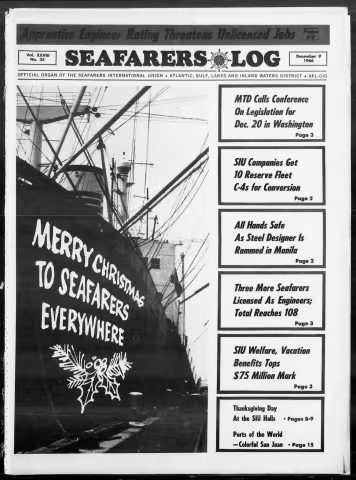
No. 25 SEAFARERSW LOG
OFFICIAL ORGAN OF THE SEAFARERS INTERNATIONAL UNION • ATLANTIC, GULF, LAKES AND INLAND WATERS DISTRICT • AFL-CIO
/
MTD Calls Conference
On Legislation tor
Dec. 20 in Washington
Page 3
SiU Companies Get
10 Reserve Hoot
C-4s for Conversion
Page 2
Aii Hmds Safe
As Steel Designer is
RanuneJ in Manila
Page 2
Three More Seafarers
Licensed As Engineers;
Total Reaches 108
Page 3
SiU Welfare, Vacation
Benefits Tops
$75 Miiiien Mark
Page 3
Thanksgiving Day
At the SIU Halls • Pages 8-9
Ports of the World
—Colorful San Juan • Page is
Page Two SEAFARERS LOG i December 9, 1966
-*,s.
•Hir
sl SlU-Contracted Companies Allocated
Ten Reserve Fleet C-4 Troopships
WASHEVGTON—SIU contracted companies will operate 10 of the 15 C-4 type reserve fleet troop
ships recently allocated by the Government for conversion to break bulk dry cargo and heavy
lift cargo ships for charter to MSTS to serve in the Vietnam sealift.
Of the SIU contracted com
panies named by the Govern
ment, Isthmian Lines and
Waterman Steamship were allo
cated three ships each, Hudson
Waterways received two ships,
and Consolidated Mariners and
Bulk Transport received one ship
each.
The 15 just-released vessels are
part of a group of 25 troopships
offered by the Government to un-
subsidized operators last August
under the Ship Exchange Act.
The 10 remaining vessels have
been withheld at the request of
the Navy pending completion of
studies on the advisability of con
verting them to containerships.
Although only 25 C-4 type
troopships were slated for alloca
tion to American-flag commercial
operators last August, the Mari
time Administration received bids
from 27 companies submitting
proposals to convert 87 C-4s.
The recently released World
War II built troopships are 523-
foot, 15,000-ton steamships with
a rated speed of 17 knots. Under
terms of the exchange, they will
be converted, equipped with
heavy lift cargo handling gear of
a type specified by the Navy De
partment, and are to be offered to
MSTS for charter after conver
sion.
Under present plans, conver
sion of the two vessels allocated
to SlU-contracted Hudson Water
ways will include 200-ton booms
and 50-ton rolling gantries. A
62-foot midbody will increase
cubic capacity of the vessels.
Dollies will be fitted for moving
2Q0-ton lifts forward.
On all breakbulk conversions,
plans call for some reduction in
the number- of holds with a cor
responding increase in their size.
All will have heavy lift booms
serving one or more of the large
holds with the remainder served
by booms ranging from five to 25
tons.
Isthmian plans to convert its
three newly-allocated troopships
to container vessels and make
three ships of its present fleet
available for charter to MSTS
within three months. Under terms
of the exchange agreement, com
panies have one year to complete
conversion of the troopships and
make them available for MSTS
charter. The new Isthmian ships
will become container vessels
capable of transporting 400 stand
ard 20-foot containers and break-
bulk in small end hatches by 10-
ton booms. Containers will be
handled by terminal cranes.
Isthmian plans to use the con
tainerships after conversion in
service from the East Coast to
Hawaii.
Conversion of the troopships
into commercial type heavy-lift
breakbulk dry cargo ships is ex
pected to cost between $4 million
and $5.5 million, depending on
the type of conversion.
Commenting on the 15 recently
released vessels. Acting Maritime
Administrator James W. Gulick
noted, "These are the best ships
left in the reserve fleet for con
versions of this type and we shall
be glad to have them in opera
tion serving our nation, defense
and trade."
The three ships allocated to
Waterman are the Gen. M. B.
Stewart, Gen. H. F. Hodges, and
Gen. J. H. McRae. Isthmian will
get the Gen. Stuart Heintzelman,
Gen. C. C. Ballou, and Gen. W.
G. Hann. Hudson Waterways
gets the Marine Adder and Ma
rine Lynx; Consolidated Mariners
the Gen. S. D. Sturgis; and Bulk
Transport the Marine Phoenix.
SEAFARERSmLOG
Dec. 9. 1966 • Vol. XXVIII, No. 25
Official Publication of the
Seafarers International Union
of North America,
Atlantic, Gulf, Lakes
and Inland Waters District,
AFL-CIO
Executive Board
PAUL HALL, President
CAL TANNER
Exec. Vice-Pree.
AL KERR
Sec.-Treas.
ROBERT MATTHEWS
EARL SHEPARD
Vice-President
LINDSET WILLIAMS
Vice-President
AL TANNER
Vice-President Vice-President
HERBERT BRAND
Director of Organieing and
Publications
Managing Editor Art Editor
MIKE POLLACK BERNARD SEAMAN
Assistant Editor
NATHAN SKYER Staff Writers
PETER WEILL
PBTBR WEISS
ED RUBBNSTEIN
Pibllshed biweskly at 810 Rhodt Island Avtnie
N.E., Washington, 0. C. 20018 by tho Seafar-
ers International Union, Atlantic, Golf, Lakes
and Inland Waters District, AFL-CIO, 675
Foarth Avsnio, Brooklyn, N.Y. 11232. Tel.
HYaelnth 9-6600. Socond class postage paid
at Wasblngton, D. C.
POSTMASTER'S ATTENTION: Form 3579
cards shocid be sent to Sufarcrs Intsrnatlonal
UnlcB, Atlantic, Golf, LakH and Inland Waters
District, AFL-CIO, 675 Foirth Avcnio, Brook
lyn, N.r. 11232.
, IT
SlUNA-Affiliated Oil Workers Take Part
Jo/at West Coast Union Committee
Pians Action Against Standard Oil
SAN FRANCISCO—A strike vote and boycott action against
Standard Oil of California has been called for by a committee of
unions, including the SIUNA-affiliated International Union of
Petroleum Workers, who repre
sent the overwhelming majority
of the giant company's employ
ees.
The strike vote and boycott ac
tion was requested after company
representatives walked out on
SIUNA-affiliated lUPW negotia
tors because representatives of
other Standard Oil employee un
ions were present at the meeting.
Company negotiators also walked
out of a session with the Rich
mond Lodge 824 of the Machin
ists with a similar excuse.
The committee has also called
for a conference of all unions hav
ing contracts with major produc
ers of petroleum products for the
purposes of coordinating their col
lective bargaining efforts in cur
rent negotiations as well as in
future contracts in the industry.
The conference is to be held at
Tulsa, Oklahoma, on December
17th and 18th.
The initial meetings of the
United Union Coordinating Com
mittee discussed matters dealing
primarily with Standard Oil nego
tiations, but future meetings will
take up problems in the entire
industry.
The unions representing Stand
ard Oil of California employees
had formed a United Coordinat
ing Committee to end traditional
fragmentation of bargaining with
Standard Oil of California and
had agreed that its affiliates should
permit other Standard Oil union
representatives to attend bargain
ing sessions as observers.
The SIUNA-IUPW and Mach
inists' Lodge 824 announced plans
to file unfair labor practice
charges against the Company with
the National Labor Relations
Board.
At the Los Angeles meeting of
the union coordinating committee
at which the strike vote and boy
cott action were asked, the com
mittee also urged a December 31
deadline after which Standard Oil
contracts would be considered
terminated, opening the way for
action against the compMny unless
it comes up with a satisfactory
offer before that time.
The unions are seeking wage
increases, a company financed
Health and Welfare Fund, in
creased job security, the union
shop, and elimination of wage,
retirement and vacation inequities.
Standard Oil of California has
forced unions representing its em
ployees to take boycott action sev
eral times in recent years.
The SIUNA-IUPW declared
and enforced a boycott of Stand
ard of California products in
1962. In late 1964 the Oil, Chem
ical and Atomic Workers and
other unions declared a similar
boycott because of the firm's re
fusal to match settlements in the
rest of the oil industry. After
three months the Company agreed
to satisfactory terms and the boy
cott was cancelled.
The Unions' United Coordinat
ing Committee is composed of
representatives from the following
unions:
SIUNA-affiliated International
Union of Petroleum Workers; Oil,
Chemical and Atomic Workers
Local 1-561, Richmond and
1-547, El Segundo; Machinists
Lodge 824; Operating Engineers
in El Paso and Big Springs, Texas;
Petroleum Workers Union Local
1. in the San Francisco Bay area,
and Local 9 in Sacramento;
Western States Service Station
Employees Union; Pipefitters
Local 159, Richmond; Sheet
Metal Workers Local 216 in Ala
meda and Contra Costa Counties;
Boilermakers Locals 317, Rich
mond 351, El Segundo; Richmond
Carpenters Local 642; Interna
tional Brotherhood of Electrical
Workers Contra Costa County Lo
cal 302; Teamsters Locals 315,
Contra Costa County and 986, Los
Angeles; and Operating Engineers
Local 12, Los Angeles,
Report of
International President
by Paul Hall
The recent release of C-4 type troopships from the U.S. reserve fleet
for conversion to break bulk dry cargo and heavy lift cargo ships comes
as a bit of good news both for the maritime industry and for the nation
as a whole. Although they are old. World War Il-built tonnage, they
will still serve to upgrade the American-flag merchant fleet somewhat
and will aid immensely in meeting the demands of the Vietnam sealift.
The release of the latest batch of reserve vessels also brings out an
other interesting fact however. When the Government announced last
August that 25 C-4 troopships would be released under the vessel ex
change program, bids were requested from American operators who
wanted to trade in older tonnage to get the C-4s for conversion.
Twenty-seven U.S.-flag companies responded, submitting proposals
to convert a total of 87 C-4s.
Since the cost of converting these vessels is estimated at between $4
million and $5.5 million depending on the type of conversion under
taken, it is obvious that U.S. operators are willing and even anxious
to invest in the upgrading and modernization of their fleets.
The SIU and other maritime unions have repeatedly called for a
new maritime policy through which the Government would live up to
its lawful responsibility of assuring the nation of a merchant marine
adequate to its trade and security needs. Such a policy would also as
sure American-flag operators of a reasonable return on the investment
of new capital in the industry.
A firm policy is needed, one that would end the vacillation and drift
which has characterized U.S. maritime policy in the past. Strict ad
herence to the intent of the 1936 Merchant Marine Act and of the
50-50 and Cargo Preference laws is essential.
Fulfillment by the Government of its obligations to maritime under
U.S. law would provide a healthy atmosphere in which the industry
could once again prosper and grow.
* m *
The recent action of the Intergovernmental Maritime Consultative
Organization in approving U.S. recommendations for more stringent
safety regulations applying to passenger vessels is an encouraging
development in the campaign supported by the SIU and other maritime
unions to stiffen the laws regulating such vessels.
The need for more stringent safety regulations was made over
whelmingly clear by the disastrous fires at sea that claimed the Lakonia,
Yarmouth Castle and Viking Princess—all old, foreign flag passenger
vessels—at a cost of almost 200 lives, many of them American.
None of these ships could have met U.S. safety standards, but since
they flew the flags of foreign nations they could call, if they wished, at
U.S. ports to take aboard American passengers.
Under prodding by various interested groups in the United States,
including American maritime labor. Congress acted to bar such vessels
from picking up passengers in U.S. ports unless they met U.S. safety
standards.
With these new safety standards in effect worldwide, perhaps we can
look forward to a day when there will be no more floating firetraps on
the high seas.
Steel Designer Severely Damaged
in Manila Mishap; No Seafarers Hurt
MANILA—No Seafarers were
Manila harbor in which the SIU-
extensive damage. ^
In a letter to the LOG, Sea
farer Bob Clarke, who witnessed
the collision from the Designer's
deck, described the incident.
injured in a recent collision in
manned Steel Designer suffered
Photo submitted to LOG by
crewmembers Bob Clarke and
Stanley Cieslak shows the exten
sive damage suffered by Steel
Designer in Manila collision. The
man in picture was not identified.
The Designer was leaving Ma
nila on a voyage to Saigon late
on the morning of October 26,
Clarke said, when she was in
volved in the collision with a
vessel identified as the Brookville.
The Designer was rammed on the
starboard side, opening a gash in
the Number 2 Hold from the deck
to well below the waterline.
Although the Designer took on
quite a bit of water in the Number
2 Hold, the vessel remained under
control and was in no danger of
sinking.
According to Seafarer Clarke,
"We took on water but were very
lucky that it was not in Number
3 Hold. Everyone said the ship
might have sunk if it were."
Cargo was discharged from the
Number 2 Hold and temporary
repairs were made at Manila. The
ship was then slated to proceed
to Hong Kong for permanent re
pairs.
Clarke commented that the
Designer crew has been on arti
cles for about three months now
and with the collision and neces
sary time out for repairs it looks
like the voyage will take about
five-and-a-half months to com
plete.
December ^9, 1966
"7
SEAFARERS LOG Page Three
SlU Welfare, Vacation Plans
Pay $75 Million In Benefits
NEW YORK—SIU members and their dependents have col
lected a total of over $75.2 million in welfare and vacation benefits
since the inception of the Seafarers Welfare and Vacation Plans.
The $75.2 million total was
reached at the end of October,
1966.
Since 1950, when the plan
was organized, over $30 mi
lion has been paid out in hospi
tal, death, disability, maternity,
dependent, optical and out-patient
benefits.
The SIU Vacation Plan, which
went into operation in February
1952 has provided Seafarers with
more than $44.2 million in bene
fits in the past 14 years.
Pays For Hospital Expenses
Since the Union Welfare Plan
was organized, a total of $5.4 mil
lion has been paid out to SIU
members and their dependents for
hospital expenses and $1.4 million
for maternity costs.
The welfare plan has also paid
out more than $2.5 million in out
patient benefits and $6.7 million in
disability benefits.
In addition, over $7 million in
dependents benefits has been paid
out since the Welfare Plan was
established.
Death benefits to the surviv
ors of departed Seafarers have
amounted to more than $7.4 mil
lion.
Among typical medical serv
ices covered by the Welfare Plan
are hospital expenses, including
room, board and extras, blood
L
Sm Inland Boatmen
Maintain Firm Stand
In Baltimore Strike
BALTIMORE —The SlU-In-
land Boatmen Union strike
against three Baltimore tugboat
companies has entered its ninth
week.
The two sides have not been
face to face since Nov. 16th, when
mutual confrontation with a Fed
eral mediator lasted just one hour
before the companies walked out
on the Union committee.
According to SIU Vice Presi
dent Robert A. Matthews, who is
coordinating strike action with
SIU Vice President Earl "Bull"
Shepard, "The union is prepared
to meet anytime, anywhere, on
short notice even, to discuss the
issues."
Demand Tayoff Notice"
The union's major demand , is
for the companies to provide 24-
hour notice before layoff. "We're
fighting," explained Matthews,
"for conditions to be as good here
in Baltimore as they are for our
men working in Philadelphia for
Curtis Bay."
With 160 tugboat personnel
idle, no tugboats in the Port of
Baltimore region are assisting in
any docking or undocking proce
dures, except for SIU-IBU mem
bers, who continue to dock and
undock, without pay, MARAD-
certified military cargo vessels
bound for Viet Nam.
The three struck tugboat com
panies are the Baker-Whiteley
Towing Co., the Baltimore Tow
age and Lighterage Co., and the
Curtis Bay Towing Co.
Maritime Legislation to Be Discussed
AFL-CIO and chairman of the
MTD Martime Legislative Com
mittee.
The Maritime Trades Depart
ment consists of 34 intemationa
unions representing seven million
members with 700,000 engaged in
the maritime trades.
Hall and Gleason said that the
purpose of the conference will be
to provide a forum in which rep-
presentatives of Maritime Labor,
the Maritime Industry, the Con
gress and the executive branch
agencies of the government can
express their views regarding the
need for new maritime legislation
during the forthcoming session oi
Congress.
transfusions, as well as surgical
and maternity benefits.
The $75,296,974.93 sum paid
out in benefits under Welfare and
Vacation Plans since 1950 does
not represent the total assistance
which Seafarers and their families
received from these plans. The
total value of Welfare benefits is
considerably higher, since the cost
of scholarship payments, meals,
books, training facilities and medi
cal examinations for SIU members
and their dependents have not
been included in the $75 million
figure.
The Seafarers Welfare Plan is
maintained entirely by employer
contributions, based on man-days
worked.
The Plan is administered by a
Board of Trustees consisting of an
equal number of Union and em
ployer representatives.
—/
Right Begins New Campaign
For Legisiation Banning Union Shop
WASHINGTON—A new right-wing drive to outlaw the union
shop in additional states is under way, spurred by conservative
gains in a number of legislatures which the National Right to Work
Committee says has put "new
steam" behind its campaign.
At a closed door meeting in
Oklahoma City, top officials of
the national "work" organization
met with the leadership of Okla-
homans for Right to Work, an or
ganization which maintained its
full-time headquarters even after
the state rejected a constitutional
amendment to ban the union shop
in a 1964 referendum.
The "right-to-work" coalition,
ranging from conservative, small
businessmen to radical right ex
tremist, was making noises also
in such perennial battlegrounds as
Idaho, New Mexico, Montana
and Delaware. And the national
committee publicly identified as
targets a group of big industrial
states including California, New
York, Pennsylvania, Illinois, Mas
sachusetts and Missouri.
MTD Caiis Legisiative Conference
For Dec. 20 in Nations Capitai
WASHINGTON—The AFL-CIO Maritime Trades Department will sponsor a special legis
lative conference at the Statler-Hilton Hotel here on Tuesday, December 20th, it was announced
today by Paul HaU, president of the AFL-CIO Maritime Trades Department, and Teddy Gleason,
president of the International ^
Longshoremen's Association
Indiana Junked R-T-W
Indiana is the only northern in
dustrial state which ever suc
cumbed to a "right-to-work" law,
and that was a short-lived experi
ment which was repealed early in
1965. Nor does the "work" com
mittee claim a majority in any of
the big state legislatures.
'New right-to-work laws will
not be passed overnight in these
states," the committee readily con
cedes. But it claims that the elec
tion returns and the failure of the
9th Congress to repeal Taft-
iartley's Section 14(b) have
Toosted "the long-range pros-
jects" for outlawing what its
iropaganda calls "the compulsory
union shop." That's the phrase it
uses to describe the right of work
ers and employers to negotiate a
union shop agreement.
Moving away from the defen
sive at the congressional as well
as the legislature level, the "work"
committee claims that the election
also "paved the way for serious
consideration of federal laws to
restrict compulsory unionism."
The election returns were hard
ly dry before the full-time director
of the Oklahoma "work" commit
tee was in Washington for strategy
sessions with the national organ
ization. And the visit was returned
Nov. 22 at the Oklahoma City
board meeting.
R-T-W Strategy
The state "work" organization
said it will concentrate on trying
to get a constitutional amendment
proposal through the legislature,
but will resort to a petition cam
paign to place the issue on a
referendum ballot if the legisla
ture refuses to act. That's what
happened several years back, re
sulting in a massive battle between
a coalition of right-wing groups,
the Chamber of Commerce and
the Farm Bureau on one hand,
and a coalition of labor, liberals,
Negroes and small farmers in op
position.
Despite the fact that union
membership in the state is rela
tively small, voters rejected the
union shop ban by a margin of
about 25,000 out of 720,000 votes
cast.
Idaho Threat Revived
The Republican sweep in Idaho
revived the threat of "right-to-
work" in the legislature and the
State AFL-CIO predicts "a big
push" for a union shop ban. A
group of supposedly "moderate"
Republicans in the State Senate
holds the balance of power. The
state's Republican governor-elect
has said he would sign a "work"
bill if it should pass the legisla
ture, but indicated he would not
seek its passage.
Idaho voters rejected "right-to-
work" in a 1958 referendum in an
election year which saw proposi
tions to outlaw the union shop de
feated by massive margins in Cali
fornia, Colorado, Ohio and Wash
ington.
They added that they expected
the principal attention to be di
rected to the possibility of having
the maritime administration re
constituted as a completely inde
pendent and autonomous federal
agency.
During the last session of Con
gress, Maritime Labor, along with
various segments of maritime
management, was successful in
having the maritime administra
tion excluded from the new De
partment of Transportation pro
posed by President Johnson.
However, at present the Mari
time Administration remains in
the Department of Commerce, and
it is the feeling of Maritime labor,
as well as a broad segment of the
industry, that the American Mer
chant Marine, which has drasti
cally declined since the end of
World War II, can be restored to
its proper position of size, strength
and prestige only by having the
Maritime Administration removed
from commerce and reestablished
as an independent agency.
Meanwhile, Peter M. McOavin,
executive secretary treasurer of the
MTD, announced that invitations
to attend the conference have been
sent to more then 500 representa
tives of labor, management and
the government, and that arrange
ments are being made for speakers
from labor and the government, as
well as from every segment of the
maritime industry.
McGavin also noted that the
conference will signal the start of
a greatly expanded program of
MTD activity for 1967, including
the publication of an enlarged
MTD monthly magazine and
weekly luncheon meetings as
well as a monthly seminar, in
which representatives of labor,
management and the government
will be invited to participate.
3 More Seafarers Licensed
As Engineers; Total Now 108
Three more Seafarers have passed the U.S. Coast Guard exam
inations and hav^ been issued their engineer's licenses after attend
ing the training school jointly sponsored by the SIU and District 2,
of the Marine Engineers Bene
ficial Association. A total of
108 Seafarers have now
received engineer's licenses as a
result of the joint program.
The newly-licensed engineers
are sailing or about to sail in engi
neer's berths aboard American-
flag ships.
Based on past experience, and
the fact that the SIUNA affiliated
Marine Firemen on the West
Coast have started their engineer's
upgrading program, it is estimated
that the SIU will supply between
400 and 500 licensed engineers
in the coming year.
Those SIU men who passed
their Coast Guard examinations
<?>
-1
Schopfer Cabrera
this week and were licensed as
Third Assistant Engineers were:
Kuno Schopfer, 50, who has
sailed as a junior engineer, pump
man, FWT and electrician since
oining the SIU in New York nine
years ago.
Raoul Cabrera, 49, who has
)een a member of the SIU since
1953 and shipped out as an oiler,
FWT and engine utility man.
The newly-licensed Second As
sistant Engineer is:
Stanley Novak, 36, who joined
the SIU in 1950 and sailed as a
fireman-oiler, watertender.
Seafarers who enroll in the pro
gram are eligible to apply for any
of the upgrading courses offered
at the Engineers School if they
are 19 years of age or older and
have 18 months of QMED watch
standing time in the engine depart
ment plus six months' experience
as wiper or equivalent.
The joint SIU-MEBA District
2 upgrading school offers Seafar
ers and Engineers
qualified instruc
tion in preparing
for their Third
Assistant E n g i-
neer, Temporary
Third Assistant
Engineer or Orig
inal Second Engi
neer's licenses in
either steam or
motor vessel classifications.
SIU engine department men
who have the necessary require
ments and who want to enroll in
the school can obtain additional
information and apply for the
course at any SIU hall or write
directly to SIU headquarters at
675 Fourth Avenue, Brooklyn,
New York, 11232. The telephone
number is HYacinth 9-6600.
Novak
SIU Xmas Parties
Set for All Ports
SIU members and their i
families are reminded that
the traditional Christmas Day
dinners and parties will be
i held again this year in all
SIU ports.
Information regarding the
time and place of the cele
bration can be obtained from
any SIU office.
Again this year, SIU rep-
I resentatives will visit Seafar
ers in the hospitals to present
i each of them with a $25 cash
payment and a carton of
i cigarettes.
Page Four SEAFARERS LOG December 9, 1966
,0^ ^
^ World Maritime Nations Okay New
Passenger Ship Safety Measares
World maritime nations meeting in London have approved broad safety measures against risks of
fire aboard passenger line and pleasure cruisers, despite total lack of support from a dozen nations
on hand from the Soviet bloc.
The conference of the Inter
governmental Maritime Consul
tative Organization, a United
Nations agency, gave approval to
new safety regulations based
largely on proposals pressed for
ward by the United States dele
gation.
The new fire safety measures
for passenger ships define struc
tural, wiring, and fire prevention
standards on all ships, whether old
or new. The convention voted for
the recommendation that wiring
standards also be adopted by
freighters.
Also, the new law provides that
all new ships install automatic
closures for ventilation systems
and remote closure devices for
fire doors. A method of control
ling fire main pressure outside the
engine room and a special alarm
for crew quarters also were rec
ommended.
As a result of these incidents,
the 89th Congress passed legisla
tion barring from U.S. ports any
foreign-flag vessels failing to com
ply with the 1960 provisions of
the safety-of-life-at-sea conven
tion. The Congressional law goes
into effect after Nov. 2, 1968.
The latest IMCO gathering still
must resolve technical aspects of
its regulations and is considering
) Poland To Build
45 Vessels For
Soviet Union
The Soviet Union signed an
other giant shipbuilding order re
cently, this time with Communist
Poland, calling for the construc
tion and delivery of 45 vessels
totalling 554,000 deadweight tons.
This contract alone, one of the
largest single peace-time contracts
ever drawn for merchant ship
construction, is almost equal to
all the tonnage that is currently
being built by the United States
on a commercial basis.
It brings to 606 the total num
ber of ships now on order by the
Soviet Union. The contract with
Poland will, in just four years,
add to the Russian fleet twenty dry
cargo ships, nine tankers, seven
ore carriers, and nine research
oceanographic ships.
At the present pace of its ship
building program, Russia may well
be able to control freight rates on
the high seas as well as to deter
mine the movement of the major
portion of world cargoes.
SlU Pension Benefits
increased to $175
Retired Seafarers are now re
ceiving monthly pension benefits
of $175 as a result of recent ac
tion by the Seafarers Pension Plan
Board of Trustees. The increase
in monthly pension benefits from
$150 to $175 became effective on
Oct. 1, 1966.
Since the inception of the plan,
approximately 1,400 Seafarers
have retired on SIU pensions.
Since its establishment, the pen
sion plan has paid out a total of
almost $7 million.
other safety recommendations as
well.
Three congressional observers
were among the 12-man U.S. dele
gation headed by William K. Mil
ler, director of the Office of Mari
time Affairs in the Department of
State.
The congressmen were Repre
sentatives Garmatz (D., Md.),
chairman of the House Merchant
Marine and Fisheries Committee;
Clark (D., Pa.) also of the Mer
chant Marine committee; and Paul
Rogers (D., Fla.).
The Communist bloc nations
that almost prevented passage of
the new safety measures, urged
primarily by the U.S., did so by
abstaining from the vote, on which
a two-thirds majority was re
quired. An abstention therefore
gave weight to the "no" votes.
The aligned Communist nations
were the Soviet Union, Poland,
Yugoslavia, Cuba, Czechoslova
kia, Bulgaria, Indonesia, Algeria,
Ghana, India, Kuwait, and the
United Arab Republic.
Greece, Spain and India, each
with a number of old ships regis
tered under their flags, voted
against every safety proposal.
Representative Garmatz termed
this style of voting "a callous and
mercenary approach to the pas
senger and cruise ship business."
The U.S. Congress, he asserted,
"would not tolerate such indiffer
ence to safety at sea."
However, Garmatz emphasized
that he was "gratified that most
member nations realize the im
portance of modernizing their
safety standards. Such actions
clearly demonstrate their sense of
responsibility and their sincere
desire to protect innocent passen
gers from the horror and the
tragedy of a fire at sea."
An^CIOOiyammg Gains in 1966
Cott^e 3-Year Saecess Pattern
AFL-CIO unions broke all recent yearly records for organiz
ing success in fiscal 1966.
For the year ended last June 30, affiliated unions won 3,159
representation elections conducted by the National Labor Re
lations Board—the highest number in 13 years—and took part
in 5,461 elections, also the greatest number for the period.
The percentage of wins was 57.8, highest since fiscal 1956.
As a result, AFL-CIO unions were certified as bargaining
agents for 243,994 workers—the highest such number in seven
years.
The fiscal 1966 figures were assembled from monthly NLRB
reports by the AFL-CIO Dept. of Organization, which noted
that they followed sharp gains in 1965 and 1964 in every
category—the number of elections, number won, percentage of
elections won, and number of persons covered. In fiscal 1964,
affiliated unions had established a post-merger record for the
number of persons newly represented, and compiled the second
best score for the number of elections participated in and the
number won, the analysis showed.
Organizing Department Director William L. Kircher said the
record constituted "a three-year demonstration that AFL-CIO
unions are organizing more, and are organizing more effectively."
SIU Bosun Renny Retires On Pension
The Atlantic Coast
by Earl (Bull) Shepard, Vice-President, Atlantic Coast Area
An answer to some critics who claim the labor movement is losing
its organizing momentum is supplied in the organizing totals of 1966
which show that AFL-CIO unions have broken all recent records for
organizing success.
Affiliated unions won a greater
tions Board elections this past
year than they had since 1956.
As a result, nearly a quarter-of-a-
million workers won the right of
collective bargaining by joining
the AFL-CIO ranks.
There remain many more areas
for the labor movement to orga
nize, so this isn't any time to sit
back and relax. Thousands of
workers remain exploited. They're
not compensated for their skills
as workers and need the protection
of a union to stop the unfair treat
ment that they have been forced
to accept by unscrupulous em
ployers.
New York
Seafarer Winston Renny (right) receives his first pension check
from New York Port Agent Leon Hall. Brother Renny, who
sailed Bosun, was born in British West Indies. He joined Sea
farers in 1938 in New York City, where he makes his home.
Just returned from Viet Nam
off the Express Virginia is An
tonio Diaz, who'll pass some time
on the beach before taking his
next ship. Harry "Happy" Harper,
who has been sailing SIU for 27
years, has been about the beach
these past few weeks following
pay off on the Western Hunter.
Boston
A number of seasoned SIU men
have been by the union hall lately.
Thomas Brennan, who last sailed
as AB on the R/V Anton Bruun,
was congratulated by the Brothers
on his marriage that took place
in Chile, one of the spots where
the Anton Bruun held over. Tom
my says that marriage is the best
contract he ever made. Messman
Munroe Hall last shipped on the
Norfolk and is now waiting for
what he's sure will be a very in
teresting trip on a research vessel.
Munroe is a 25-year SlU-er look
ing forward to the change of a
research expedition. William Stew
art, who last served as wiper on
the Keva Ideal, is waiting for his
FFD and he'll be ready to grab the
first wiper's job to hit the board.
Philadelphia
Happy to report that shipping
in the Port of Philadelphia has
picked up in the last 2 weeks and
we're hoping for the momentum to
be maintained.
Fred Israel, who has been with
the SIU for 21 years, just wound
up a few relaxing months at home
and is ready to go again, either as
bosun or AB.
C. Szymanski also passed some
time at home after his last stint
aboard the Lynfield Victory as
chief cook. He's registered and
ready to go again at any time.
Walter Cressman, who sails in
the black gang, will stay in port
for the holidays before shipping
out again.
William Sladko enjoyed the
summer months at home. He's
registered now and is looking for
a job as FWT aboard the Henry.
Baltimore
While shipping has been good
for the past two weeks, we're even
more optimistic about prospects
for the next two. Presently tied
up with new crews are the Almar,
the Losmar, the Ohio and the
Maine. There's no report yet on
when these'll crew. But during
the past two weeks things were
hopping as we paid off 5, signed
on 3, and had 3 ships in transit.
James H. Hayes and Nick Mu-
percentage of National Labor Rela-
^
tin, both on SIU pensions, stopped
by lately to see some old friends.
Hayes sailed the deck department
for a solid 22 years. He says the
SIU is the best thing that ever
came his way, for without his
SIU pension he "just wouldn't
know what to do." Mutin sailed
steadily in the steward department
for about 20 years until he retired.
Another Seafarer seen around the
Union lately is Paul Huggjns, who
sails in the engine department with
22 years of experience behind him.
Recently, Huggins paid off the
Alcoa Trader after returning from
a run to the Persian Gulf. He's
taking a few weeks off before
hustling aboard the first ship to
come up.
Puerto Rico
After 6 months on the Ellza-
bethport, which made two trips
Harper Diaz
to Okinawa, Bob Lasso is back on
the island, taking in some of the
Puerto Rico sunshine before ship
ping out again.
Julio Ruiz, just off the Alcoa
Runner, signed on almost immedi
ately for another voyage, this one
aboard the Falrland.
One of our neighboring islands,
St. Thomas, was the scene of some
supermarket picketing recently by
the "Let's Pay Less Committee,"
echoing those sentiments ex
pressed by statesiders.
The U.S. Congress in 1967 will
probably consider a Puerto Rico
Statehood bill. Justo Mendez,
chairman of the Statehood Repub
lican Party's executive committee,
has predicted that more than 20
Congressmen will sponsor the
statehood for Puerto Rio bill.
Norfolk
Although there have been no
payoffs or sign ons during the
past period, 10 ships have been in
transit.
Prescott Spinney, a SIU pen
sioner, is seen around the hall
daily shooting the bull with his
fellow Seafarers at the Union cafe
teria.
John Harris, a 19-year SIU man
who last shipped in the steward
department aboard the Duval, is
spending the holiday period with
his family and will be ready to
ship again shortly afterward.
Frank Shackelford's been sail
ing SIU for the past dozen years
and recently had an interesting
voyage as steward aboard the
Alice Brown, which he paid off
after its return from Viet Nam.
Frank's registered once more,
looking for another steward's job.
Another 12-year SIU man, Dal
las Newsome, was sailing as oiler
aboard the Globe Carrier when he
had to leave the ship for hospital
ization. Dallas' buddies are all
hoping for his speedy recovery.
"TTF
Derember 9, 1966 SEAFARERS LOG Page Five
Bght Additional Seafarer Veterans
Added to Growing Pension Roster
The Gulf Coast
by Lindsay Williams, Vice-President, Gulf Area
All candidates and issues backed by the Maritime Trades Council of
Greater New Orleans and Vicinity, AFL-CIO enjoyed overwhelming
success on November 8. Some examples: MTD-endorsed candidate
for Congress T. Hale Boggs outpaced his opponent 38,151 to 15,507;
MTD-endorsed candidate for New Orleans school board Robert C.
Smith polled 3,196 votes more
than was required to beat three
opponents.
Constitutional amendments en
dorsed by MTD also showed
great strength in the New Orleans
area, all passing by substantial
margins. Of particular interest
was the amendment authorizing
the construction of a domed sta
dium in New Orleans to house the
recently acquired pro football
team. It passed by over 80,000
votes in New Orleans, represent
ing a five to one margin.
Mobile
Tommie Jenkins recently spent
six months on Bloomfield's Ros-
woid Victory. Tommie thought it
Swanson Sbriglio
a good ship, but wants to see
what Mobile looks like for awhile.
Nine months as oiler on the Al
coa Roamer is enough for Sea
farer S. L. Gibson. Gibson intends
to vacation with his family at
their home in upstate Alabama.
Ira W. Griggers will go into dry-
dock to have a hernia repaired.
Griggers suffered his hernia on his
last ship the Neva West where he
was sailing AB. The Neva West
had just completed a four and
half month trip to Viet Nam.
Griggers makes his home in Ever
green, Alabama.
Shipping prospects for the com
ing month are on the slow down.
The beach is now small, but ship
ping is low. The Alcoa Roamer is
laid up.
James E. Williams just finished
a trip on the York using his new
AB's ticket for the first time. Wil
liams received his new ticket in
New Orleans four months ago.
After a long trip on the Neva
West Jack Green is taking it easy
on the beach. Jack held down the
FOWT billet on the Neva West.
He is married and makes his
home in Mobile. James R. (Bean)
Douglas is currently registered in
group three steward dept. Bean
spent quite a bit of time aboard
the Alcoa Roamer traveling the
bauxite circuit.
New Orleans
Mickey Doyle, wife of Seafarer
John Doyle, was the fashion star
of the Thanksgiving Dinner at
the Hall. John and the Mrs. with
their children were among the
many Seafarers sharing Thanks
giving Day together at the hall.
Also, enjoying the Thanksgiving
feast was pensioner Nib Lomsen.
Lornsen has enjoyed the holiday
meals at the hall since his retire
ment ten years ago. He said every
thing was first class. His last ship
was the Del Mar on which he
sailed as AB. Sam Hurst, another
retired Seafarer, shared his day
with old friends around the
turkey. Hurst was last on the
Westchester as deck engineer.
Antoine Landry, relaxing with
his newspaper in the comfort of
one of the hall's lounge chairs,
said that he was planning to take
it easy for awhile before shipping
out again. His last ship was the
Alcoa Runner. After a bout with
pneumonia, Paul Capo says he's
looking forward to another ship
heading for Buenos Aires. Paul's
last trip was on the Del Mar, on
which he sailed as bellboy.
Justin Wolff paid off on the Del
Norte, where he was an AB, to
take a long vacation with his wife
and family. Wolff will be looking
for another Delta liner when he
finishes his vacation.
Houston
A number of old-timers are
here on the beach. Sal Sbriglio of
the deck department just signed
off the TransErie and has set foot
on land to work out his income
taxes, after which he'll ship out
on another run.
W. Kazouniz found his visit to
India on the Trans Hartford
fascinating. He's now on the
beach taking in some relaxation
before looking for a ship on the
Viet Nam run.
Virgil Swanson, who just com
pleted 14 months on the Trans-
hudson, is back home for the holi
days and after a little time off
he'll be looking for another grain
run.
SlU Welfare Plan Clarifies Regulations
Governing Private Hospital Care
Because of several recent cases involving members' claims for
benefits arising out of confinement in private hospitals, the SlU
Welfare Plan wishes to clarify the rules governing payment of
such benefits.
The Welfare Plan regulations state that a Seafarer is to be re
imbursed from the Seafarers' Welfare Plan for confinements in
private hospitals under the following conditions:
• If he is not eligible for care at a USPHS facility.
• If he required emergency hospitalization and the USPHS,
after being duly notified of his confinement, denied liability or is
not responsible for the charges. In all cases, a Seafarer must notify
the nearest USPHS facility within 48 hours of the beginning of
his confinement.
• If he received emergency treatment at a hospital which did
not involve confinement.
Awareness of, and adherence to these regulations will assure
that all members will receive both the hospital care and the SlU
Welfare Plan coverage to which they are entitled.
Renny Jensen Farrow Cuuningbam Foster Schenk
Eight new names were added to the growing list of Seafarers collecting an SIU pension. The new
comers to the pension ranks include: Winston Renny, Marius Jensen, Joe Farrow, CJiarles Cunning
ham, Crittenden Foster, Joseph Schenk, Albert Schwab and Leigh Facer.
Winston Renny was bom in
the British West Indies and re
sides in New York City where
he joined the union. An AB, Ren-
ney was shipped as a bosun. His
last vessel was the Warrior.
Marius Jensen was a member of
the Deck department. He joined
the union in New York City. Born
in Denmark, he lives in Cumber
land, Md. Jensen last shipped on
the Seamar.
Schwab Facer
Joe Farrow sailed as chief cook
and chief steward and joined the
SIU in the port of Savannah. Bom
in Georgia, he lives in Columbus,
Ga. His last ship was the Portmar.
Charles Cunningham was born
in New Orleans and resides in
Hmite, La., with his wife, Susie.
He joined the union in Mobile
and sailed in the Engine depart
ment under various ratings. His
last vessel was the Neva West.
Crittenden Foster resides in
Pearisburg, Va. and joined the
union in the port of New York.
A native of Ohio, he shipped in
the Deck department as AB. His
last ship was the Yorkmar.
Joseph Schenk shipped' in the
SlU-UIW Stores Was
/ii Two Men NLRB
R^uvseatatioa Votes
BALTIMORE^The SlU-Unit-
ed Industrial Workers has won col
lective bargaining rights for 180
employees of two companies after
recent National Labor Relations
Board election victories.
Employees of the H. Klaff Co.,
who provides scrap service to
Baltimore area industrial plants,
chose the SlU-UIW as bargaining
agent over Teamsters Local No.
311 by a vote of 40 to 25. Six
ballots were challenged.
Employees of the H. Schwartz
Leather Co., Inc., of Edgewater,
N.J., voted for the SlU-UIW over
Leather Workers Union Local No.
27 by a vote of more than 2 to 1;
31 to 12, with 4 votes opposed to
any representation. Fifty employ
ees will enjoy collective bargain
ing rights as a result of the elec
tion.
The H. Klaff Co. election took
place last May and the SIU United
Industrial Workers recently
signed a new pact with the com
pany.
Engine department. He was bom
in Austria and resides in Balti
more with his wife, Mary. Schenk
joined the SIU in Baltimore. His
last ship was the BethFlor.
Schwab was employed by the
N. Y. Central R. R. and joined
the SIU in the port of New York.
Born in Weehawken, N. J., he
and his wife, Nora, are residents
of Union City, N. J. He was em
ployed as a bridgeman.
Leigh Facer joined the union
in the port of Detroit. He was
born in Port Hope, Mich., and
lives there with his wife, Mary.
An AB, Facer sailed in the
SIU Great Lakes District.
by Fred Farnen, Secretary-Treasurer,Great Lakes
The Duluth Board of Trade recently reported that for the first time
grain shipments from the twin ports have topped the 200-million bushel
mark.
The up-grading program is under way once more so we urge all
members with 6 months or over in the engine department and 12
months and over in the deck ^
department to contact the nearest
SIU hall, after layup, to enroll in
the program.
Ed Pierce, the director of the
School of Engineering and Navi
gation, wishes to remind SIU
Great Lakes District men who
plan to attend the school in Toledo
to have the following material
ready when they register:
1. The Coast Guard application
signed by the master and chief
engineer (the application is avail
able at any Coast Guard office or
by writing to Ed Pierce directly).
2. A letter from the company
verifying time.
3. A certified birth certificate.
The school will begin at 9 A.M.
on January 4th in Toledo, Ohio, at
925 Summit Street.
Ken Lund registered in Duluth
and shipped out as second cook
on the Joe Morrow. This is the
6th vessel of the year for busy
Ken.
Detroit
Great Lakes SIU members will
start collecting benefits from the
new vacation plan in 1967. The
first trustee meeting held in New
York recently worked out the
qualifying rules and regulations.
The new benefits will be paid by
the SIU Great Lakes District Va
cation Fund from contributions
made by the contracted companies
under terms of the 1965-68 collec
tive bargaining agreements. At a
later date, SIU members will be
notified regarding their eligibility
for specific benefits.
Chicago
Exceptionally good weather en
joyed throughout this area for the
duration of the season made this a
)anner season for shipping.
One of the first ships to retire
or the '66 season was the EM
Ford of the Huron Portland Ce
ment Co. She laid up Nov. 23rd
in Milwaukee.
The SlU-affiliated UIW Local
300 recently concluded contract
negotiations with its largest plant
under contract, the Cinch Manu
facturing Co. The package is the
largest ever to be negotiated be
tween the Union and Cinch and
was recently ratified by the mem
bership.
Buffalo
Even in the final weeks of the
shipping season, orders for crews
are continuing to come in, result
ing in a very active shipping pic
ture.
The winter storage fleet in Buf
falo will total about 20 ships, so
of course those men who choose
to stay this far north for the win
ter months will certainly be pro
vided with some work right
through the year.
Frankfort
The fight for severance pay due
Ann Arbor No. 5 crewmembers
continues. The National Railway
Adjustment Board has set the next
hearing date for January 20.
Just a couple of days after
Thanksgiving, at a time when
many fellows were already out on
or planning a deer hunting trip,
a severe snow and sleet storm
showered the area, producing
scattered power failures and block
ing carferry traffic to Frankfort.
Some schools, homes and busi
nesses were without heat, but at
least it looks as if those deer will
be safe for another year.
Alpina
Plenty of jobs going begging
here this winter season. Even
though crews from Huron Port
land Cement's EM Ford and JB
Ford are layed up with us here.
There are still plenty of jobs avail
able.
'•"I
'i
I vr-
J-
Page Six SEAFARERS LOG December 9, 1966
.)• -
f n CG.rHRiAT TO 'm Mi
^£Nna RKIMSR" RA TING
AT a hearing before the U.S.
Coast Guard November
22, SIUNA registered its
firm opposition to the proposed
establishment of an "apprentice
engineer's" rating aboard U.S.
fiag ships, which threatens the
jobs of American seamen, partic
ularly that of engine room per
sonnel.
The hearing was held in re
sponse to SIU demands for an
opportunity for all parties con
cerned to present their positions
after the Coast Guard proposed
the "apprentice engineer's" rat
ings as part of a suggested train
ing program to produce licensed
engineers, on the grounds that it
would help develop licensed
engineers to meet the needs of
the Viet Nam crisis.
The SIU attacked the appren
tice engineers plan as a threat
to the jobs of American seamen
and the jurisdiction of unli
censed unions. It cited its suc
cessful joint program with
MEBA, District 2 which has
produced well over 100 new
engineers since it began func
tioning earlier this year, as well
as upgrading approximately 50
licensed engineers in the same
period. Under the apprentice
engineer's plan, it would take
a minimum of two years to pro
vide engineers.
Appearing for the SIU at the
hearing were SIUNA President
Paul Hall; Vice-President Wil
liam Jordan, who also heads the
SlU-affiliated Marine Firemen's
union, and Fred Famen, Secre
tary-Treasurer of the SIU Great
Lakes District. The text of the
SIU position as presented by
Vice-President Jordan is re
printed below.
At the hearing, Leon Berlage,
Secretary-Treasurer of MEBA
District 2 pointed to the success
of the joint SIU-MEBA District
2 training program and insisted
it was the best answer to the
problem of the engineers short
age. The MEBA District 2 posi
tion as presented by Secretary-
Treasurer Berlage appears on
the adjoining page.
MEBA District 1 initiated the
apprentice engineer's proposal,
which was supported by the Na
tional Maritime Union, the Mas
ters, Mates and Pilots, and the
Steelworkers Union.
DISTRICT 1SPUTS MEBA ON PROGRAM
To meet the shortage of li
censed engineers arising out
of the Viet Nam conflict,
MEBA District 2 and the
SIU Atlantic and Gulf Dis
trict established earlier this
year a jointly sponsored
training program that has
been successfully producing
licensed engineers from the
ranks of unlicensed engine de
partment personnel and up
grading the licenses of engine
officers. The program has en
abled vessels under contract
to the two unions to sail with
out delay.
At the Coast Guard hear
ing Nov. 22 on the proposed
plan to place an apprentice
engineer aboard all Ameri
can-flagships as a means of
producing more licensed engi
neers, MEBA District 2 re
affirmed its conviction that
its jointly operated program
with the SIU is the best
method of meeting the short
age for all parties concerned.
MEBA District 1, however.
initiated and supported the
apprentice engineer proposal
which represents a clear dan
ger to the jurisdiction of the
unlicensed unions, and, more
specifically, poses a direct
threat to the jobs and security
of the unlicensed seaman, the
engine department men in
particular.
Although the SIU opposes
the plan, the NMU has ac
cepted it. Therefore, while
the plan threatens the jobs
of all unlicensed seamen, it is
a most immediate threat to
members of the National
Maritime Union because if
the proposal is approved it
would be effective on vessels
under contract to MEBA Dis
trict 1 whose jurisdiction
covers NMU-manned ships.
As SIU President Paul Hall
pointed out following the
Coast Guard hearing, "The
fundarnental issue here is the
protection of the jobs and live
lihoods of the unlicensed
members of the engine de
partment on all American-
flag ships. Any tampering
with the present ship person
nel structure, as suggested by
the apprentice engineer pro
posals obviously threatens the
security of unlicensed seamen
in general and unlicensed en
gine room men in particular."
Vice-President Jordan,
commenting on the appren
tice engineer plan, said that
"the contention of District 1
that licensed engineers would
only do the work of licensed
engineers and would not
touch the work of unlicensed
men does not square with the
facts of engine department
life. Experienced engine room
men know there is an over
lap between the work of li
censed engineers and the un
licensed men. ,
"For one example," Jordan
said, "licensed engineers fre
quently do identical work per
formed by unlicensed junior
engineers and other un
licensed engine department
personnel. Nothing can
change this fact of shipboard
life."
Text of SIUNA POSITION AGAINST COAST GUARD PROPOSAL
Presented by WILLIAM JORDAN, VICE PRESIDENT OF SEAFARERS INTERNATIONAL
UNION OF NORTH AMERICA; PRESIDENT OF MARINE FIREMEN'S UNION, SIUNA, AFL-CIO
The Marine Firemen and
other affiliated unions of the
SIUNA represent the unlicensed
personnel aboard over 500
American-flag deep sea vessels,
including many of those engaged
in the Vietnam sealift, and in
behalf of these men we are op
posing the changes which have
been requested in 46 CFR, parts
10, 11 and 12, relating to engine
room personnel, as set forth in
the Coast Guard's proposed rule
dated September 6, 1966.
These changes, according to
the September 6th notice, have
been requested by two unions
of licensed marine officers, as
well as one industry association.
It should be noted at this point,
however, that while one of the
licensed unions requesting the
changes is the Marine Engineers
Beneficial Association, the re
quest does not represent the
views of the entire MEBA mem
bership but is in fact being
strongly opposed by District 2
of the MEBA.
In any event, as we understand
the proposed changes, they call
upon the Coast Guard to ap
prove:
(a) The establishment of a
new merchant seaman's entry
rating for apprentice engineers.
(Part 12, Subpart 12.25)
(b) The employment of such
apprentice engineers aboard
ship, under the supervision of
the chief engineer, as part of
a two-year apprentice engineer
training program to be recog
nized by the Coast Guard as
qualifying time for a license as
temporary third assistant engi
neer. (Part 11, Subpart 11.10)
(c) The extension of the two-
year program, when the tempo
rary licensing program is termi
nated, to a three-year program
to be recognized as qualifying
time for a license as a third as
sistant engineer. (Part 10, Sub
part 10.10)
The SIUNA is strongly op
posed to all of these requested
changes for a number of reasons.
First, with respect to the es
tablishment of an apprentice
engineer's classification, as called
for in Part 12, Subpart 12.25,
it must be recognized that the
affiliates of the SIUNA, as well
as other unions of unlicensed
seamen, have established juris
dictions under law, as well as
collective bargaining agreements
governing the employment of
unlicensed seamen within these
jurisdictions.
Certainly, we of the SIUNA
would consider any attempt to
place any of these apprentice
engineers aboard any vessel hav
ing a collective bargaining agree
ment with any of our affiliated
unions as an attempt to infringe
upon our jurisdiction and to vio
late our contracts, and all of the
affiliated unions of the SIUNA
which are concerned with this
matter have, in fact, notified
their respectively contracted
shipping companies on all coasts
that they would consider any
attempt to place such apprentice
engineers aboard their con
tracted vessels as an infringement
of their jurisdiction and a viola
tion of their contractual agree
ments.
Thus it is evident that ap
proval by the Coast Guard of
this new classification of appren
tice engineer would serve only
to foment jurisdictional disputes
between the licensed and unli
censed unions and to precipitate
possible tie-ups or delays of
American-flag merchant ships at
a time when they are critically
needed for the Vietnam war
emergency.
Second, it must be recognized
that the largest single source
of skilled, reliable and efficient
licensed engineers for the Amer
ican-flag merchant fleet has tra
ditionally been the pool of un
licensed engine room personnel
coming up through the ranks
from wiper through the various
Q.M.E.D. ratings.
Moreover, it is estimated that
there are at least 2,000 skilled
unlicensed engine room men
available today, with years of
experience in Q.M.E.D. ratings,
who possess all of the necessary
Coast Guard qualifications for
an engineer's license, and the
unions representing these unli
censed men have programs for
upgrading such qualified men to
licensed engineers' ratings within
months, rather than the years
proposed in the programs of the
licensed unions which have re- .
quested these changes.
To cite a concrete example of
what I am talking about, I might
point to the marine engineers'
training school which is jointly
sponsored by the SIU Atlantic
and Gulf District and District 2
of the MEBA.
This school recognizes the
fact that in the past the chief
deterrents to the advancement of
unlicensed engine room person
nel to licensed engineers' ratings
have been the financial inability
of unlicensed men to support
their dependents while studying
ashore and the fear of these men
of losing their vested pension
rights in their unlicensed unions.
To overcome these two deter
rents the school has a subsistence
payment and pension-transfer
program which enables career
seamen to come ashore and
study for their engineers' licenses
without losing either their earn
ing ability or their pensioii bene
fits.
It seems obvious to us that
the programs proposed by the
licensed unions, which admit
tedly would not produce new
licensed engineers for at least
two years, and thus leaves their
effectiveness in meeting the
emergency demands of the Viet
nam crisis open to serious ques
tion, is really an ill-concealed
attempt by these licensed unions
to by-pass the pool of skilled un
licensed engine room personnel
already available in the unli
censed unions and to infiltrate
the jurisdictions of unlicensed
unions with new non-career sea
men selected by the licensed
unions.
The Coast Guard, by approv
ing these proposals, would be
participating with these licensed
unions in their plan to ignore the
available pool of skilled unli
censed seamen already in ex
istence in favor of a program
which would delay the creation
of new licensed engineers for at
least two years and thus dras
tically reduce the ability of the
merchant marine effectively to
serve the nation in this time of
need.
The apprentice engineer's en
dorsement as indicated in the
proposed rule changes, would
not authorize the holder to fill
any regular rating aboard ship.
Essentially, therefore, he would
be merely an observer and our
past experience with cadet engi
neers—even with their added
benefit of college training—has
convinced us that this type of
observational procedure results
only in the production of li
censed engineers weak in practi
cal working knowledge and op
erational experience.
Coast Guard recognition of
time spent as an apprentice en
gineer could therefore lead only
to a downgrading of the enviable
record of skill, efficiency and
safety established by the present
corps of marine engineers and
cause deterioration in the pro
ductive quality of the American-
flag fleet while at the same time
increasing its costs of operation.
'r '
ki ..r
f.
December 9, 1966 SEAFARERS LOG Page Seven
Af£R4 Mr. 2 SUPPORTS JOINT TRAINING PROGRAM
WITH SlU AS BEST ANSWER TO ENGINEER SHORTAGE
MEBA, District 2 and the
Seafarers International Union,
Atlantic and Gulf District rec
ognize the current shortage of
marine engineers during the
Vietnam crisis. We also note
that, in part, one of the reasons
for this shortage is the failure
of any significant number of un
licensed men to obtain marine
engineers' licenses. The reason
for this slowness is because of
the concern on the part of the
unlicensed personnel of the loss
of their pension credits and lack
of protection of seniority rights
in the event of shipping slow
downs. We are agreed that if
, these problems are met we will
then be in a better position to
encourage a significant number
of upgradings from unlicensed
to licensed personnel. It is with
the hope of assisting in answer
ing the engineer shortage in the
Vietnam crisis as well as at
tempting to establish rules for
avoiding such problems in the
future that these two unions
have reached the following un
derstanding:
Subject to the constitutions of
the above organizations and to
applicable laws, the following
shall be the rules of the Joint
Training Program:
1. The requirements for SIU
member applicants to the school
shall be at a place mutually
agreeable to both parties. The
cost of housing such school shall
be pro-rated between the two
unions.
5. The period of instruction
shall be up to ninety (90) days.
9. A joint Welfare Committee
is hereby established for the
purpose of guaranteeing contin
ued welfare benefit coverage
during the transition period from
unlicensed rating to shipping as
a licensed engineer.
AGREEMENT between DISTRICT 2 MEBA and SIU
shall be the same requirements
as the United States Coast
Guard's for obtaining original
licenses.
2. Seafarers who apply and
are accepted to become students
in the Engineering School shall
be paid subsistence payments in
the amount of $110.00 per week
while in training. It shall be the
responsibility of the SIU to meet
this obligation. They shall also
be provided with meals and ho
tel lodging.
3. Instructors in the school
shall be provided by and paid
for by MEBA District 2.
4. The location of the school
6. It shall be the responsibility
of the instructor to determine
at what point each student is to
take the U.S. Coast Guard ex
amination.
7. MEBA District 2 shall
waive its $1,000.00 initiation fee
for SIU members who graduate
from this Engineering School.
This rule shall apply for the
duration of the Vietnam crisis,
at which time this matter shall
be subject to review.
8. Seafarers shall not be re
quired to drop their SIU mem
bership and/or seniority classi
fication within the SIU unless
they desire to do so.
10. A joint Pension Commit
tee is hereby established for the
purpose of protecting the pen
sion credits accrued by unli
censed seamen. The rules gov
erning this matter shall be as
follows:
Upon his first engineer's as
signment, each graduate shall
have the option of notifying
District 2 MEBA of his desire
to protect his accrued benefits
in the SIU Pension Plan. If he
exercises such option, the fol
lowing rules shall be observed;
a. Upon collection of pension
plan payments from its contrac
tual employers, MEBA District
Text of MEBA DIST. 2 POSITION ACAINST COAST GUARD PROPOSAL
Presented by LEON W. BERLAGE,. SECRETARY-TREASURER OF DISTRICT 2,
MARINE ENGINEERS BENEFICIAL ASSOCIATION, AFL-CIO
Let me say at the outset that
District 2 MEBA is opposed to
the proposed changes in 46 CFR
Part 10, 11 and 12 relating to
engineroom personnel as set
forth in the amended rules pro
posed in the document issued by
the US Coast Guard on Septem
ber 6, 1966.
We in District 2 MEBA are
sure that you have heard from
other sources the problems that
would arise if the proposed "ap
prentice engineer" program is
approved. While we acknowl
edge that there is a shortage of
licensed personnel to meet the
requirements of the Vietnam
sealift, and possibly of future
peacetime shipping, we would
like to point out that there is a
method whereby the shortage of
licensed marine engineers can
be alleviated without changing
the existing rules and without
creating the problems that would
be occasioned" by the proposed
"apprentice engineer" rating.
Since February 1966, District
2 MEBA and the SIU Atlantic
and Gulf District have been
working together in a joint pro
gram which is doing the job of
relieving the shortage of licensed
marine engineers by training for
licensed qualified men from the
SIU who have chosen the sea as
their profession. These men have
been trained and received their
licenses without any change in
the existing Coast Guard regula
tions. Further, our program is
financed solely by the industry,
with no cost to the Government
or the taxpayer.
As of today, November 22,
100 unlicensed men have ob
tained their original licenses
after studying at the District 2
MEBA School of Marine Engi
neering. This is virtually the
same number of men who grad
uated in 1966 from the United
States Merchant Marine Acad
emy at Kings Point, the largest
of the Federal and State Mari
time Colleges. At present, there
are 47 men attending the Dis
trict 2 MEBA school and 71
applicants awaiting entry. From
our experience to date, we are
convinced that the District 2
School can continue to produce
at least 15 to 25 new licenses
per month, and probably more.
We would like to point out fur
ther that these newly licensed
men are coming out of school
right now, when they are needed
for the Vietnam sealift. We will
not have to wait for two years or
longer to see the results of this
program.
Opponents of the joint Dis
trict 2-SIU, A & G program
have objected to our approach
on the ground that the average
age of the newly licensed men
will be too high. In our view,
the average age of the men with
new licenses is not too high, and
it will continue to go down a's
the program progresses. For the
record, we would like to note
that of the first 100 graduates
of the District 2 School the aver
age age was 41 years, that the
average age of the men presently
attending the school for new li
censes is 37 and the average age
of the applicants who are wait
ing to enter the school is 35.
From the figures cited above,
it should be clear that most of
the men who have already ob
tained their new licenses at the
School will be able to sail as li
censed engineers for at least 10
to 20 years. The men who come
up from the unlicensed ranks in
the future under our program
will also be available for many
years to come.
The unlicensed unions, by and
large, give the entry ratings
some training before these men
go to sea. After six months of
sailing experience, these men
are qualified for their first
QMED rating as firemen-water-
tender. Again, the unlicensed
unions, by and large, have pro
grams in which these entry
ratings receive training before
taking the Coast Guard exami
nation for their first QMED rat
ing. After another six months at
sea as firemen and watertender,
these men are qualified to sit for
their endorsement as oiler. Fol
lowing further training at the
union school, these men take
the Coast Guard examination
and, upon passing, receive the
next QMED rating. After an
other six months of seatime as
an oiler, these men are qualified
to sit for their original licenses
as 3rd assistant engineers. The
entire process can take a little
over two years under the present
regulations. By and large these
men are fully qualified to pre
pare for their licenses. Our ex
perience at the District 2 School
of Marine Engineering shows
that these men can be prepared
for their original licenses in
classroom sessions and field trips
in a period ranging from IVi to
3 months, depending upon the
individual's ability.
Under the upgrading ap
proach used by District 2 and
the SIU, a member of an unli
censed union can prepare for his
original license in a compara
tively short time while working
in the industry. If he fails to ob
tain his engineer's license, he
can still obtain advanced train
ing for such posts as junior
engineer, unlicensed deck engi
neer and electrician.
In summary, the approach
used by District 2 and SIU
serves all the needs of the in
dividual, the industry and the
unions involved. It is doubtful
whether any„ other approach
could be equally satisfactory.
Our experience proves that
licensed engineers, in substantial
numbers, can be developed from
the ranks of the unlicensed if
certain problems of" training,
pension credits and initiation
fees are resolved. Our program
in many respects parallels the
very successful program devel
oped by the Government to train
licensed merchant marine offi
cers in World War II, when men
came from the ranks of the li
censed and trained for licenses.
Since so many of the unlicensed
unions already have programs
for training their members for
QMED ratings, however, we
suggest that upgrading for offi-
2 shall remit to the SIU Pension
Plan an amount equal to regular
SIU pension payments and shall
place the remaining amount into
its own plan as a supplemental
pension fund for all graduates
who ship as engineers.
b. Thereafter, upon the mem
ber's retirement, he shall receive
his full SIU pension payments
plus that fractional amount
which he has accumulated while
sailing as a licensed engineer.
11. SIU, A&G men who al
ready possess licenses and who
are not now sailing on them be
cause of questions relative to
their seniority, union member
ship, loss of pension credits, etc.,
shall be eligible for the benefits
of this program.
12. There is hereby created
a Joint Educational Committee
between the aforementioned or
ganizations. This committee's
responsibilities shall be the man
aging of this entire program as
outlined above and taking the
necessary steps to guarantee its
fulfillment.
cers' licenses should be handled
by the unions and the industry,
without Government interven
tion or cost.
Under our approach, the in
dustry enjoys the services of the
unlicensed man while he's pre
paring for his license, as well as
after he obtains his license. If
he fails to obtain a higher
QMED rating anywhere along
the line, or to obtain his license,
he is still available to the indus
try. In the proposed "apprentice
engineer" program, a man
would no longer be available to
the industry if he failed his li
censing exam.
Under the program developed
by District 2 and the SIU, the
man who advances from the
ranks to become a licensed engi
neer is guaranteed to have con
siderable practical experience in
his chosen craft. He will also
have had sufficient time in the
industry to decide whether he
wants to make a career of
sailing.
Finally, our approach permits
the man who wants to make a
career in the merchant marine
an opportunity to work his way
up as high as Chief Engineer, if
he has the ability and is willing
to obtain the training to do it.
Consequently, in all respects,
this system satisfies the needs
of the individual, the industry
and the union.
5"i
Vf
a
Page Eight SEAFARERS LOG December 9, 1966
.-•ly
M'
•X^
•||ILK.4^'
fL
Among the ports holding
a Thanksgiving dinner for
the Seafarers, their fami-
^ lies, and invited guests,
was San Francisco. The
turkey went fast and the
turnout was large. Thanks-
giving dinner is a tradi-
-tional event at SlU Halls
in ports around the nation.
it.:
mm
(P» •
Seafarer' Harold ArlTnghaus of Deck "mi famllt^^^eafar
^dlepartmeat.and guest enjoyed dinner, ura a»c} W^i^aTOOster
.>U
Kianksglving
at SlU Halls
m.
The families of pumpman John Faircloth and T ed May, oiler, attended dinner in Houston Hall.
.1*:
t- ^
1^; k
Tony Denddo (center) and family. Tony was John Zereis, who sails as bosun, enjoyed din-
member of Steward dept., now on pension ner with guests. John is an oldtimer with SlU.
r—.fK- ,iK.-
Among guests in Houston hall were Mr. and Danny Balerio, who sails as a wiper, took his
Mrs. C. King. He is an official of ILA local 1331. family to enjoy turkey and all the trimmings..
Hungry Seafarers and families kept things jumping in the Wilmington Hall.
' v'-i py'
f,.
Page Nine
Ha
_ ^r—-
Among the many families attending dinner in Mew York HalT Sharing a table are Nellie Rios, Anna Accurso, Charles Ostasewski of the Deck dept., Danny Ellis, a guest,
was that of Seafarer F. T. DiCarlo of Steward department, and Tony Barnes who sails in Deck department, and Mike Connor of the Engine dept., enjoyed turkey dinner.
JefF Davis and John Rondano, who sail in the Engine dept., Teddy Tobiassen of the Engine department came Seated are Miss H. Haftgidimitriou, Angelo Roulis who sails
came with guests, Mrs. H.Arlinghouse and Barbara Buchanan, with daughters, Jane Ann, 7, and Lorraine, 9. in Deck dept., C. Tsambis and A. Agapitos of Engine de^
1 1
Page Ten SEAFARERS LOG December 9, 1966
r-:
J New National Group Forms
To Combat Extremist Threat
A new national organization has been formed to combat the "mer
chants of fear," extremist "hate" groups of the radical right and the
radical left.
An immediate target of the Institute for American Democracy will
be the John Birch Society and the interlocking directorate of extreme
right-wing groups in the Birch Society's orbit.
A committee of 48 prominent leaders in religion, public affairs, edu
cation, labor and business is sponsoring the institute. Its chairman is
Dr. Franklin H. Littel, president of Iowa Wesleyan College and a
Methodist clergyman who served in post-war Germany as a religious
adviser to the U.S. high commissioner.
* ' Dr. Littel told a Washington news conference that his experience in
Germany and elsewhere convinced him that extremists can't be dis
missed as harmless "kooks." Both the Communists and the radical right
leaders "are playing for keeps," he warned, adding that "they are
flesh eaters."
One of the tasks of the new institute, he said, will be to provide local
groups with facts to combat extremists who try to take over parent-
teacher associations, schools, town councils and library boards and who
seek to discredit religious, trade union and civic organizations.
He warned that the Birchers and the groups they dominate are en
gaged in a "lavishly financed effort to sell a predetermined set of fears
and prejudices to the American people."
In many communities, he noted, "extremists have made life miserable
for good citizens—through spying, nocturnal phone calls, economic and
social pressure, stonings, even bombings."
The institute's chief contribution, he said, will be the "full time,
day-in, day-out methodical correction of record, exposure of unworthy
tactics and focusing of the national conscience on local harassments in
the hope that gradually a greater measure of decency and dignity can
be restored to the American political dialogue."
Birch Society leaders can be found in key positions in dozens of
far right organizations, he said. Some of these groups "sound more
shrill than the Birchers and some play in a lower key, but they echo
-* versions f the Birch line, and their impact is cumulative."
Among the organizations he described as in the Birch 5k)ciety's
"orbit" were Let Freedom Ring, the Liberty Lobby, Americans for
Constitutional Action, American's Future Christian Crusade, Man-
ion Forum, Dan Smoot Report, National Economic Council, Church
League of America and We the People.
Dr. Littel said he is a Republican but that the members of the
sponsoring committee include persons identified with both political
parties and with all major religions.
Auto Workers Pres. Walter P. Reuther and Clothing Workers
Pres. Jacob S. Potofsky are on the committee, as are Democratic
Senators Gale McGee of Wyoming and Frank Moss of Utah, and
Republican Sen. Clifford P. Case of New Jersey. Charles R. Baker is
the executive director, and the Institute for American Democracy has
set up a permanent office at 1330 Massachusetts Ave., N.W., Washing
ton, D.C. 20005.
"...And All Through The House..."
The Locomotive Firemen and
Enginemen have settled a basic
contract with the nation's rail
roads which provides for a 5 per
cent wage increase as well as
other improvements.
A union negotiating committee
is currently working out details,
such as exact contract wording,
with representatives of each rail
line.
The across-the-board pay raise
is retroactive to August 12. Fire
men, engineers, hostlers and
hostler helpers also won an im
proved vacation plan and correc
tion of several inequities in holi
day pay.
* * *
The AFL-CIO's International
Union of Operating Engineers will
offer on-the-job training for han
dling heavy equipment to 80
youths in the Job Corps in Tennes
see. The Union will assist in the
placement of trainees who com
plete the one-year program. Mem
bers of Local 917 are to serve as
instructors at the training center
in Cherokee National Forest in
Eastern Tennessee. The President
of the lUOE, Hunter P. Wharton,
cited two reasons for his Union's
involvement: The first, he said,
was its responsibility to help the
less fortunate, and the second was
the program's opening of a reser
voir of potential talent for the
Union.
The longest and possibly the
most bitter strike to occur in the
20th Century, a six-year walkout
by United Auto Workers Local
833 against the Kohler Co. of
Sheboygan, Wis., which resulted
in a dispute that took twelve years
to settle, has finally come to a
close.
Kohler wound up the battle
having to pay strikers a total of
$4.5 million, $3 million represent
ing back pay and $1.5 million
being a restoration of pension
rights. The money, which goes to
the National Labor Relations
Board for distribution to workers,
is the largest amount ever collected
by the NLRB in settlement of an
unfair labor practice dispute, or in
any similar settlement ever nego
tiated in the history of labor-man
agement relations.
* « *
The boycott against Sears, Roe
buck & Co.'s nationwide stores
has been intensified by locals of
the Retail Clerks in order to dis
courage Christmas shopping at the
retail outlets. The Executive Coun
cil of the AFL-CIO has stated re
cently that it was convinced the
company was engaged in a calcu
lated and concerted effort to de
prive employees of their rights to
union protection. The Council
called on all union members and
their friends to support the boy
cott.
With people throughout the world pre
paring to celebrate the Christmas season, we
are once again reminded that the nature of
seafaring employment denies to Seafarers
the opportunity enjoyed by most other
workers to observe the holiday among their
families and friends.
This Christmas, as in the past, most Sea
farers will be aboard their ships plying the
seas of the world or in strange and distant
ports. They will have to be content with
thoughts of those they hold dear and look
ahead in the hopes that they can share to
gether the warmth of this holiday season
another time.
But men of the sea accept and adjust to
this condition of their employment. On the
eve of Christmas, Seafarers aboard ship will
prepare to observe the holiday in their own
Soviets Plan for the Future
Possible Soviet domination of the world's
sea lanes in the near future came a step
closer recently when Russia signed a con
tract with Poland—a communist satellite, for
the construction of 45 vessels totalling 554,-
000 deadweight tons. This one Soviet order
is almost equivalent to the total tonnage
being built for the U.S. at this time.
While the U.S. fleet continues to deterio
rate at an ever-increasing rate, the Soviet
Union is building merchant ships at breakr
neck sp>eed. Even computations of total rel
ative tonnages are not indicative of the true
seriousness of the situation because the So
viet tonnage increase represents new, mod
em, fast vessels while the great bulk of
America's tonnage is already obsolete and
of marginal value in the highly competitive
world of commercial shipping.
way. They will attempt to capture a meas
ure of the festive spirit of the day and make
the ship as happy a place as possible under
the circumstances. They will improvise
Christmas decorations to grace the ships'
messrooms, as a reminder that even while
away at sea. Seafarers retain the spirit of
Christmas. On Christmas day they will ex
change greetings as they partake of holiday
fare prepared with special care and feeling.
Meanwhile, their Union brothers who
are ashore in SIU ports that day will observe
the occasion with their families and friends
at Christmas dinners which are a traditional
event in all SIU Union halls.
We join with them in extending to all
Union brothers at sea and ashore, and to
their families, the very warmest of greetings
for A Merry Christmas.
This commercial challenge on the high
seas is too serious for the U.S. to continue
to ignore much longer. The possibility of
Soviet control over worldwide freight rates,
which it could exercise with the aid of the
huge merchant fleet it is presently building,
represents a threat to the economic future
of the United States as a trading nation.,
The U.S. must have a merchant fleet ade
quate to meet all its commercial and defense
needs, as called for in the 1936 Merchant
Marine Act. This means a large, fast, mod
ern fleet flying the American flag and manned
by American seamen. Time is growing short
for those Government agencies responsible
for enforcing the Merchant Marine Act to
acknowledge the nation's vital maritime
needs and to take action to avoid possible
disaster.
December 9, 1966 SEAFARERS LOG Page Eleven
V/
Comment On Civil Rights In AFL-CIO 'Federationist'
Stronger Labor, Civil Rights Links
Soon As Aid to U.S. Social Reform
The labor and civil rights movements should strengthen their natural alliance in pursuit of social
and economic programs that will benefit all Americans.
This was the basic argument put forward by contributors to the November issue of the AFL-CIO
Federationist. The theme of the
32-page edition was "Equal
Rights: To Realize the Promise."
The unemployed and lower-
income Negroes and whites all
would benefit if unions and civil
rights groups united to fight for
full employment, adequate train
ing and more and better schools
and housing, the writers agreed.
Professor Ray Marshall of the
University of Texas declared that
if the labor and civil rights move
ments united behind common ob
jectives, they could become a pow
erful force for the national good.
Divided, he warned, they would
strengthen their common adver
saries.
Bayard Rustin, a leading civil
rights strategist, wrote that the
civil rights movement is at a cross
roads. He said the movement
must ally itself with labor and lib
erals to fight for the Freedom
Budget or else be led by the appeal
of "black power" into strife and a
racial nightmare.
Other articles in the magazine
dealt with the moral basis of civil
riehts. the roles of organized labor
and civil rights groups in expand
ing opportunities and making civil
rights laws work more effectively.
AFL-CIO President George
Meany, in an editorial on "Labor's
Commitment" stated labor's po
sition:
"The AFL-CIO is firmly deter
mined to achieve full equality in
America in all fields—education,
employment, accommodations,
housing and justice."
Meany also deplored the so-
called white backlash. He blamed
it on demagogues exploiting un
reasonable fears stimulated by
cries of "black power." He said
labor opposes both black suprem
acy and white supremacy and be
lieves America has only one clash
—citizen—"the highest and most
meaningful title in a democracy."
These were the main points
made by the authors:
• A. Philip Randolph, discuss
ing "The Moral Basis of Civil
Rights," makes the point that all
men are brothers and so entitled
to equal treatment.
Randolph, president of the
Sleeping Car Porters and an AFL-
CIO vice president, criticized
"black power" as a slogan that
cannot solve social and economic
problems. He urged cooperation
between labor and civil rights
groups in support of the Freedom
Budget and the goal of full em
ployment.
• Dr. Marshall traced "The
Roots of the Negro-Union Alli
ance." He proposed a variety of
approaches through which dis
crimination might be reduced
and opportunities expanded
through cooperative action by la
bor and civil rights groups.
• Donald Slaiman, director of
the AFL-CIO Civil Rights Dept.,
described the close working alli
ance between civil rights groups
and labor in winning rights legis
lation and on labor issues. He
spelled out in detail labor's policy
and program for eliminating the
discrimination remaining in un
ions.
• The Workers Defense League
of New York City explained how
it organized information on ap
prenticeship opportunities and
worked closely with unions in
placing Negro youths seeking to
learn a trade.
• Whitney Young, Executive
Director of the National Urban
League, detailed the wide range of
NUL programs aimed at opening
the doors of opportunity to mi
norities.
• Rustin, who is executive di
rector of the A. Philip Randolph
Institute, posed the choice facing
"Civil Rights at the Crossroads."
He urged a Negro-labor-liberal co
alition to achieve progress. The
alternative, he warned, is social
chaos.
• Nathaniel Goldfinger, direc
tor of the AFL-CIO Dept. of Re
search, wrote on "Negroes and
Jobs" and analyzed the factors be
hind the high unemployment rates
of Negro adults and Negro teen
agers.
• Walter G. Davis, newly-ap
pointed director of the AFL-CIO
Dept. of Education, discussed the
whole range of government pro-
prams in his article, "Making
Equal Rights Laws Work."
• Roy Wilkins, executive di
rector of the National Association
for the Advancement of Colored
People, wrote on "The NAACP
and the New Strategy" aimed at
the economic improvement of all
lower income groups, Negro and
white.
The Pacific Coast
by Frank Orozak, West Coast Representative
A new contract has just been won by the SIU United Industrial
Workers—Pacific District, for SIU-UIW members in the Alaskan port
cities of Valdez, Kenai, Petersburg, Homer and Kodiak who are em
ployed by the North Star Terminal and Stevedoring Co., Amess
Terminal Inc., SeaLand, Alaska Steamship, and the City of Kodiak.
In addition, the UlW-Pacific
District won a 47-2 union repre
sentation election at the Mountain
Village Fish Co., Inc., in the Low
er Yukon region.
San Francisco
Shipping here is very good, with
many slots available for AB's Oil
ers, FWT's, electricians, cooks,
and bakers.
Paying off for the past period
were the Rachel V, Alice Brown,
Ridgefield Victory, Jefferson City
Victory, Burbank Victory, Colum
bia Victory, Linfield Victory,
Young America, Cosmos Trader,
and Longview Victory.
Crews signed aboard the Mai
den Victory, Northwestern Vic
tory, Ridgefield Victory, Burbank
Victory, Linfiield Victory, Young
America, Cosmos Trader, and the
Longview Victory.
Ships in transit were the Cal-
mar, Penn Challenger, Trenton,
and Marymar.
Visiting the SIU Hall recently
was oldtimer G. J. Vesagas, a
SIU pensioner whose last ship was
DISPATCHERS REPORT Atlantic, Gulf & Inland Waters District
From November 18 to December 1, 1966
DECK DEPARTMENT
TOTAL REGISTERED TOTAL SHIPPED REGISTERED on BEACH
All Groups All Groups All Groups
Port Class A Class B Class A Class B Class C Class A Class B
Boston 1 2 1 1 0 25 4
New York 58 27 57 21 45 253 72
Philadelphia 21 8 11 3 5 24 15
Baltimore 27 20 19 16 5 108 23
Norfolk 9 6 1 4 4 26 14
Jacksonville 6 3 7 5 1 9 10
Tampa 6 5 8 3 0 11 3
Mobile 26 3 13 5 5 95 20
New Orleans 45 25 19 11 0 170 78
Houston 43 23 37 20 13 159 99
Wilmington 8 7 12 4 14 21 1
San Francisco .... 42 18 43 56 56 56 1
Seattle 14 12 18 11 14 43 2
Totals 306 159 246 160 162 980 342
ENGINE DEPARTMENT
TOTAL REGISTERED TOTAL SHIPPED REGISTERED on BEACH
All Groups All Groups AH Groups
Port Class A Class B Class A Class B Class C Class A Class B
Boston 4 1 1 0 0 11 2
New York 45 27 30 32 27 183 149
Philadelphia 17 9 10 8 4 17 2
Baltimore 18 19 17 13 6 76 41
Norfolk 2 1 1 3 6 15 7
Jacksonville 5 1 5 2 6 6 7
Tampa 7 3 2 3 3 8 1
Mobile 14 16 12 4 2 48 18
New Orleans 35 32 12 19 5 84 67
Houston 27 28 10 22 5 146 102
Wilmington 4 6 4 3 8 9 0
San Francisco .... 25 19 30 41 41 33 0
Seattle 7 2 9 8 30 8 2
Totals 211 164 143 158 143 644 398
STEWARD DEPARTMENT
TOTAL REGISTERED TOTAL SHIPPED REGISTERED on BEACH
All Groups All Groups AH Groups
Port Class A Class B Class A Class B Class C Class A Class B
Boston 4 2 0 0 1 13 4
New York 37 13 34 9 30 65 25
Philadelphia 14 3 5 7 2 15 5
Baltimore 18 14 20 8 5 66 35
Norfolk 5 11 3 3 2 14 22
Jacksonville 5 4 4 1 7 7 6
Tampa 3 2 5 2 0 7 2
Mobile 7 6 3 2 2 57 8
New Orleans 41 21 15 17 5 128 65
Houston 39 18 21 9 3 91 60
Wilmington 9 3 2 3 7 19 0
San Francisco 24 9 20 58 58 30 0
Seattle 19 6 17 7 14 17 0
Totals 225 114 149 126 136 529 232
in 1959 as a cook and baker.
Vesagas, who makes his home
here, found his visit to the Hall
a very pleasant one, during which
he swapped stories with some still-
active Seafarers.
H. Alexanderian has just signed
on the Columbia Victory as night
cook and baker.
Wilmington
Wilmington shipping looks very
good for the next couple of weeks
and we've got plenty of jobs for
rated men in all depar'ments.
During the past few weeks, the
Citadel Victory paid off and signed
on, the Transyork paid off, and the
Vesagas Alexanderian
Beloit Victory paid off coastwise
and signed on intercoastal.
This year's SIU Thanksgiving
dinner was held at the Twin
Wheels Restaurant in Long Beach,
where SIU members attended in
large numbers along with their
families to participate in the holi
day celebration.
Guy Wbitehurst, who sailed
SIU for many years before retiring
on pension, has decided to spend
Christmas holidays in Acapuico,
Mexico.
Seattle
Northwest shipping is also
booming, with SIU members hav
ing choices of ships and runs. All
indications point to a continued
boom, so if any of you East and
Gulf Coasters are interested in
immediate shipping you should
consider hustling out to Seattle.
The Puget Sound Maritime Port
Council has officially opposed the
Apprentice Engineering Program
as proposed by the U.S. Coast
Guard and sent telegrams of pro
test to various government officials
as well as to Vice Admiral C. P.
Murphy.
The Maritime Port Council of
Portland & Vicinity has similarly
opposed the program and sent
wires to government officials, as
well as to the U.S. Coast Guard
commander.
Payoffs this last period were the
Lynn Victory, Santa Emilia, Over
seas Rose, Beaver Victory, and the
Longview Victory.
Sign ons included the Columbia
and the Oceanic Wave, while ships
in transit included the Anchorage,
Penmar, Seattle, and Walter Rice.
George H. Bryan, who has been
a SIU member for a solid quarter-
of-a-century, recently piled off the
Overseas Rose and immediately
took a chief steward's spot on the
Longview Victory. After a little
hunting outing, M. Dembrovrski is
ready to go again. He last shipped
on t!.e Transnortbem as steward
and has been a member of the
Union for over 20 years. John
Reed just completed a long trip
on the Vantage Progress.
Page Twelve SEAFARERS LOG December 9, 1966
t'
• ..1.1
I
I •rf
MONEY DUE
Isthmian Steamship Co. is holding checks for unclaimed wages
for the crewmembers of the Margarett Brown listed below. The
checks may be claimed by writing the Paymaster, c/o Isthmian
Steamship Co., 26 Broadway, New York, N. Y. Please indicate
your Social Security number, and the address where you would
like your check sent.
Name
Walter Brown
Egan D. Christiansen
Jay C. Cohen
James Crandall
Will Daniels
James Johnson
Walter McMillion
Robert J. Manthei
John Nouwen
Charles Paiford
George E. Paulson
Joe Petrone
Ronald Sutton
Rating
Chief Cook
Bosun
Oiler
Oiler
Third Cook
Cook/Baker
F.W.T.
OS.
F.W.T.
A.B.
UT/MM
A.B.
UT/MM
Amount
$34.91
189.29
185.56
199.75
194.32
25.28
14.68
21.49
27.52
185.56
208.70
7.58
205.45
Milton C. Hahrat, 54: Brother
Habrat died of a heart attack in
a San Francisco
hotel recently. A
member of the
union since 1947,
he was born in
Pittsburgh, and
lived there with
his family. He
joined the union
I in New York
City. He shipped in the Engine
Department .as a fireman-oiler-
water tender. He was a veteran
of the Army.
Jack Caudle, 63, Capt. Caudle
died on Aug. 21 in Tidelands
Hospital, Harris
County, Texas,
from a hemor
rhage. A tugboat
• captain, he joined
the SIU in the
port of Houston,
where he lived
with his wife,
Marie. Born in
Texas, Capt. Caudle was an em
ployee of the G and H Towing Co.
Burial was in San Jacinto Memo
rial Cemetery, Houston, Texas.
Archie Lee Sawyer, 39: A heart
attack caused the death of Broth
er Sawyer. He
died in Albemarle
Hospital, Cam
den, N.C. Sawyer
was employed at
the Old Domin
ion Ship Yard in
Camden, where
he made his home
with his wife and
five children. He was born in
Columbia, N.C.
John W. Picou, 58: Heart dis
ease claimed the life of Brother
- • Picou. He shipped
out of New Or
leans in the stew
ard dept. He died
in USPHS Hospi
tal, New Orleans.
He lived with his
family in the town
of Metairie, La.
s He was born at
Head Island, La. He joined the
union in 1941, in New Orleans.
——
Edward Sawicki, 23: Brother
Sawicki died on Aug. 29, after
an automobile ac
cident, in West
Jersey Hospital,
Camden, N.J. He
• was a member of
the SIU United
Industrial Work
ers and employed
by the Hussmann
Refrigerator Co.
Born in Woodbury, N.J., he lived
in Blenheim, N.J. and joined the
union in Philadelphia. He is sur
vived by his mother, Mrs. Mar
guerite Sawicki.
George F. Blackmore, 70:
Brother Blackmore died as the
result of an acci
dental drowning
in Chelsea Creek,
Chelsea, Mass.
Born in Massa
chusetts, he re
sided in the town
of Everett, Mass.
A World War I
Navy veteran, he
sailed in the deck department, as
an AB. He joined the Union in
1945, in the Port of Boston.
Crew members aboard the Andrew Jackson (Waterman) celebrated a real American style Thanks
giving while in the Viet Nam war zone, thanks to the fine work of the Steward department. Ship
delegate L. A. Mhchell asked the Log to print part of the menu that was served aboard the S.S.
Andrew Jackson on Thanksgiv-
ing Day in the port of Canrn
Ranh Bay, Viet Nam, "to show
the other fellows around what
kind of lunch their friends hac
while they were in the war zone."
Brother Mitchell,
who serves as
Chief Cook, re
ports that he.
Chief H. Ride
way, and the rest
of the Steward
department were
I given a vote of
u II thanks by the
members
and officers for the fine meal. The
Thanksgiving.Day dinner included
such appetizers as shrimp and oys
ter cocktail, a choice of four main
courses, including roast young tom
turkey, with giblet gravy, shrimp
dressing and cranberry sauce, and
baked smoked Virginia ham with
pineapple sauce. Candied sweet
yams, of course, were included in
the wide choice of vegetables.
Among dessert choices were
pumpkin pie, mince meat pie and
fruit cake.
<I>
Crewmembers on the Ridgefield
Victory (Columbia) will have some
protection from
hot climates with
the building of an
awning in the aft
section of the
ship. Meeting
Chairman Roy
Pierce writes. The
materials should
arrive shortly.
Pierce said, and
begin work. A
unanimous vote of thanks was
given to the steward department.
The payoff is scheduled for San
Francisco.
R. Pierce
Seafarers will
"Lots of oldtimers and an un
usually good Steward department
make up the crew
of the Coe Vic-
toiy, bound from
the Eastern Sea
board to Japan
and Viet Nam,"
F. Caspar, meet
ing chairman re
ports. The fine
^ chow is one rea-
son things are
running well with no major beefs,
Caspar writes. Maxie Katzoff has
been unanimously elected ship's
treasurer, R. Ferebee, meeting
secretary reported. His first job is
to take charge of the receipt for
a ship's fund of $26.55, kept in
the captain's safe.
Russo
MacArtbur
Meeting chairman Frank Russo
aboard the Del Santos (Delta) re
ports that a new
ship's delegate,
W. H, Newsom,
was elected by ac
clamation. A new
bunch of keys has
been made up
and given to the
steward depart
ment to lock up
crew quarters and
messrooms. A resolution was also
passed to cut the noise in the
messroom during the meal hour.
The steward department. Brother
Russo reports "is doing a fine job.
Seafarers on the Steel Architect
(Isthmian) want American cur
rency instead of
travelers checks
in foreign ports,
William MacAr
tbur, meeting
chairman, writes
as crewmembers
have had some
trouble cashing
their checks. Jon
Maslow, meeting
secretary, reports that the Union
has heen contacted regarding the
need for another ice cube ma
chine. The one on hand does not
produce enough ice for three
meals. Ship's Delegate James
Santiago reported that the ship's
treasury contains $104.25.
The Jefferson City Victory
(Victory Carriers) will have to get
• along without a
bosun for awhile,
since he was
hospitalized in
Subic Bay. Two
V other members of
the crew were also
hospitalized, E.
Morris, meeting
chairman, writes.
Meeting Secre
tary J. Calvert reports a total of
$7.50 in the ship's fund. The ship
will be paying off in San Francisco.
—^—
Seafarers on the Platte (Orien
tal Exporters) have plenty of good
reading matter on
hand and in good
order thanks to
the efforts of the
wife of the Chief
Engineer, who
^ sailed as ship's li-
^ brarian. A vote of
< thanks was ex-
„ tended by crew-
Corcoran members to Mrs.
Mary E. Booker for her efforts.
Meeting Chairman J. W. Corco-
Clarke
ran reports. According to P. Hen
dricks, meeting secretary, the
steward department was extended
a vote of thanks by the crew.
Some disputed overtime, Hen
dricks writes, but the trip is a
smooth one.
<I>
A vote of thanks was extended
to the steward department on the
Floridian (South
Atlantic and Car
ibbean) for their
fine job, Tony
) Aronlca, meeting
chairman, reports.
According to F.
\ Alvarez, meeting
secretary, every-
thing is running
smoothly and there are no beefs
reported by department delegates.
The Chief Mate will see that the
galley screen is fixed, Alvarez re
ports. H. Miranda replaced Nick
Sabin as ship's delegate after the
latter resigned. Sabin was extended
a vote of thanks for his fine job.
——
Two crewmembers on the
Globe Explorer (Maritime Over
seas) were hit by
illness and acci
dents recently.
Meeting Chair
man C. S. Jacks
reports. Ray As-
said was hospital
ized in Karachi
after an accident
and pneumonia
sidelined MaxweU
McPbaii in Aden. Co-operation
was excellent, F. J. Comndly,
meeting clerk reports. The chief
cook and night baker gave a vote
of thanks to the crew for their
fine co-operation and Seafarers in
retutrn gave a vote of thanks to
the Steward department for a job
well done. Meeting Chairman
David Eby reports that there was
some disputed overtime but no
beefs.
——
Everything is running smooth
ly on the Transglobe (Hudson) as
the ship completes
its Viet Nam run,
E. W. Pierce,
meeting chair
man, reports. Red
Dean, ship's del
egate, reports $28
in the fund. The
Seafarers extend
ed their thanks to
SIU headquarters
lor the overtime sheets and com
munications. Meeting Secretary
A. Stephen reports logs and
mail are coming in regularly.
E. Pierce
i
CM... ABOUTJ VkA/OW- T VEMf
GBrrmGABHORE'l lOHCEUAO jVWATDIO
SlOe dog AMD A SHORE-SID^ YOU DOf
GETTLING VOWM^ JOS... /
i
I DREAMED
ABOUT eoine
TO SEA .. -
[December 9, 1966
Legislator Exposes
Maritime Plight
To The Editor:
I think Representative High
Lt Carey should be applauded
for exposing the deficiencies in
the U.S. merchant marine
brought about by years of offi-
cial neglect on the part of U.S.
Government administrators.
I hope the resolution he \viil
introduce in the next session of
Congress calling for a national
conference on a modern mer
chant marine is a success. The
idea of including representatives
of maritime labor is a sound
one, I think.
Chet Alexander
^
New Safety Law
Is Long Overdue
To The Editor:
I read SIU vice president Bull
Shepard's column with great in
terest. To tell the truth, I was
unaware of the new safety law.
r think it's a major step as it
provides that U.S,-owned run
away vessels will have to come
up to U.S. maritime safety
standards.
I think that it's about time
our government took this step.
I hope this is just the beginning
of the government's setting and
enforcing maritime safety
standards.
Rudolf Tollefson
SEAFARERS LOG
Page Thirteen
LETTERS
To The Editor
Log 'Ports' Feature
Stirs Memories
To The Editor:
I docked at Port Swettenham
about three years ago and both
ered to visit the main city near
by, Kuala Lumpur. Your photo
graphic story on Kuala Lumpur
brought back to my memory
that visit which was so interest
ing. You're right. There are
three ways to get from the port
to Kuala Lumpur, by taxi, bus,
or rail. The taxi cost is sky high
and a waste. The bus is maybe
one-tenth or less the cost of
taxi but ten times as dangerous.
The drivers are so careless on
the narrow winding roads 1
nearly got seasick on land! Best
bet is rail. Takes slightly longer,
is a few cents cheaper, but
worth your life in safety!
Chas. Hurik
Urges Support of
Kingsport Fund
To The Editor:
I've been following news
stories on the Kingsport Press
Strike in Tennessee. These men
on strike for 2'A years de.serve
support from the whole labor
movement. I admire their cour
age and strength. The Kingsport
Press Strikers Christmas Fund is
a good idea and a fine way for
the labor movement to show its
appreciation.
Johnny Thomas!
Editor's Note: Contributions
to the kingsport Press Strikers
Christmas Fund may be sent
to; Union Label and Services
fTrade Dept., AFL-CIO Room
1402 AFL-CIO BIdg.; 815 16th
iSb. N:W„ Washington, DC.
120006.
Unionists Have Role
In Political Action
To The Editor:
I couldn't agree more with the
AFL-CIO Executive Council
declaring that the accomplish
ments of the 89th Congress
must be both protected and
broadened. I am sure that all
my fellow unionists feel the
same way.
1 think every member of the
AFL-CIO should do all he can
to further this aim. I myself am
a member of a local political
organization. Naturally, every
one can't become as involved as
I am in politics, but 1 do think
that we should all write our
Congressmen, telling them how
we feel about basic issues.
Julius Wylc
Pharmacist Mate
School Praised
To The Editor:
I think that the starting of the
new Pharmacist Mate Training
School for SIU staff officers is a
great idea. It will provide the
men of some SlU-manned ships
with good medical protection,
which they haven't had since
the end of WW 11. I hope the
day will come when all Sea
farers can have this kind of
medical protection while at sea.
Jack Storey
S/ff Bosun Almost Swept Overboord
When Heavy Seas Swamp Deck
ever, su.stain injuries which hospitalized him. '
According to erewmcmber •—
Air Pollution
Remedy Needed
To The Editor;
New York City's air pollu
tion problem recently made
great headlines in all the papers.
Due to what they call "atmos
pheric inversion," the pollution
that is "normal" or safe collect
ed up to a deadly point instead
of being blown away by the
wind.
No individual then in New
York, as I was, will forget the
thickening of the air, the wateiy
eyes, and the dry, dirty feeling
in the throat. You kind of
walked around wondering how
bad it could get, while fearful
of whether or not you could
survive it.
U reminded me of a catastro
phe in Donora, Pa., some years
ago when 300 people died from
industrial fumes that collected
due to "atmospheric, inversion."
Imagine the same thing striking
New York! The death toll could
be staggering.
It's time for corporations and
industries to improve their op
erations .so as not to infect the
air with poisons.
After all, how criminal can
you get? Do they save money
and make higher profits this
way?
Paul Corem
Aids U,S, Through
VietSealift
To The Editor:
The Vietnam conflict in which
this nation is involved deserves
the attention of every Seafarer.
I saw action in World War II
and regret that I'm too old now
to enlist. There is ^mething I
can do. though, and that is to
participate in the Vietnam Sea-
lift which brings vital supplies
to our soldiers stationed there.
William Cameron, the mishap
occurred on a beautiful day,
with a moderate sea and wind.
The deck was dry enough to be
painted, and .some of the deck
hands were working aft of the
midship house, while some were
working up forward in the paint
locker. Bosun Elderman was go
ing forward to get two cans of
paint from the paint locker, when
a sea hit the port bow, then cov
ered the entire deck. Elderman
grabbed the closest thing to him, a
No. 4 wing tank top.
Man Overboard?
As the sea hit him, he was be
ing watched from the bridge by
an A.B. "It happened so fast,"
said Cameron, "that when the sea
hit Elderman, the A.B. thought
for sure that Elderman was over
the side, since he could not see
anything but water rolling off the
deck. A split-second later he
grabbed a life ring to throw into
the water, but meanwhile he kept
an eye on the deck below, still
looking for Elderman. Sure
enough, he saw him on the deck,
but his legs were through the rails
and he was bear-hugging the stan
chion. The sailor on the bridge
made a mad dash below to give
him a hand."
On his way down, according
to Cameron, he passed the chief
officer and told him that the bosun
was almost knocked overboard.
"Since he was going so fast, it
seems that the only thing the mate
heard were the words 'bosun' and
'overboard.' He turned pale as a
ghost, it was said later, and almost
fainted." Both men reached the
main deck and found Billy Elder-
man, "wet as a rat" and bleeding
from a gash in the face. Had the
gash been sustained a half-inch
to the left or right, it would have
cost the Bosun an eye. He was
helped to the hospital on the next
deck, where the chief officer gave
him first aid. Later, when things
calmed down, he was asked what
hurt him, and he replied "My arm,
my back, my leg, my head, my
knee and my shoulder." Someone
stopped him, saying. "In other
words, you hurt all over." Cor
rect, Elderman replied.
He was put ashore when the
National Defender reached Ma
dras, remaining in the hospital
for a week. He later joined the
ship when it sailed for the States.
At the payoff, Elderman said
he would enter a hospital for a
complete check-up and stay on
the beach for a while to recuper
ate.
SIU
ARRIVALS
Log Feature
Recalls OU Days
Of Sailing Barks
The Log's October 14 picture
story on Santos, Brazil, brought
back many memories to Captain
R. J. Peterson, who first encoun
tered Brazil's most active coffee
exporting port back in 1913, when
he served as boatswain on the
.sailing barque Dovenby.
Relating his adventures as a
young man in a letter to the Log,
Captain Peterson began "We
sailed from Sheernes, London,
with a load of cement and made
a passage of 50 days, under a
captain who paced the poop on
his stiff legs. He, when once the
mate of a ship, had been knocked
down by a graybeard off the Horn,
and had both legs broken.
"Many is the sailor that the
yellow jacket killed in Santos,"
said Captain Peterson, recalling
the not-so-good old days when yel
low fever decimated the popula
tions of warm countries. For that I
rea.son, the captain continued, I
"before my time, it was hard to I
get men for ships going to Santos. I
1 could tell why when 1 saw a few |
dead .ships outside the harbor." 1
Then Captain Peterson recalled '
the sailing ships and the blue water I
sailors he encountered in Santos: I
"Urania, a big barque, was there I
with a youthful crew that had a B
band in the focsle and played I
music late, beating the big drum I
to keep the captain awake. Gwy- I
dor Ca.stle was there too, a queer I
barque, with a crew that, in the I
focsle. spoke Welsh proudly, say
ing 'We are the ancient Britons.' "
Constance Finnerfy, born No
vember I, 1966. to the Robert F.
Finnertys. Bedford, Ohio.
- ^
Richard Brewer, born June 3,
1966, to the Jack Brewers, New
Orleans, La.
Michael Schlau, Jr., born Octo
ber II, 1966, to the Leonard A.
Schlaus, Jr., Buffalo, New York.
„ .
Terri Renee Shaneyfelt, born
September 7. 1966, to the Gary N.
Shaneyfelts, Mobile, Ala.
^
Ettie Germaine Gibson, born
October 27, 1966, to the Isiah A.
Gibsons, Silsbee, Texas.
Tad Aron Swackhammer, born
September 10, 1966, to the Ed
ward Swackhammers, Houston,
Texas.
^
Teresa Ann Remy, born August
15, 1966, to the Robert J. Remeys.
Castalia, Ohio.
<1>
Marilyn Lee Eckley, born Octo
ber 10, 1966, to the Robert G.
Eckleys, Philipsbiirg, Pa.
Paul LaBorde, born September
16, 1966, to the Paul LaBordes,
New Orleans, La.
Joyce Brown, born November
17, 1966, to the Rafael Browns,
Ponce. P. R.
Orlando Hector, Jr., born Octo
ber 13. 1966. to the Orlando H.
Lopez's, Levittown, P. R.
—
Bobbie Ann DePlnto, born No-
vember 9. 1966, to the Pasquale
DePintos. Brooklyn, New York
... —^—
Tma Louise Huval, born Sep
tember I, 1966, to the Reeves
Huvals, Breaux Bridge, La.
Jennifer Wadsworth, born No
vember 14, 1966, to the Charles
Wadsworths, Milton, Fla.
i
Neil Lindeman, born November
7, 1966. to the Larry A. Linde-
mans. Manistoe, Mich.
<1>
Jeffrey Leiand Bryant, born Oc
tober 29, 1966, to the Lloyd Br>'-
ants. Mobile, Ala.
<I>
Melissa Ottelin, born July IS,
1966, to the Charles J. Ottelins,
Cleveland, Ohio.
SalVdor Rueda, born October
20, 1966. to the Juan Salvador
Ruedas, Yauco. P. R.
<I>
Gordon Stecker, born October
20, 1966. to the Vaughn E. Steck-
ers. Dearborn Heights, Mich.
——
Whit Steven Williams, born Oc
tober 28. 1966. to the Herbert
Williams, Swan Quarter, N. C.
1
I
Editor,
SEAFARERS LOG,
675 Fourth Ave.,
Brooklyn, N. Y. 11232
Lwould like to receive the SEAFARERS LOG-please put my
name on your mailing list. (PfinHnformathn)
NAME
' . . , I
I
i
I
I
I
I
STREET ADDRE^ ,
.STATE....;.., ZIP
subscriber and have a change
give your former address below: • •
» 4r ^ g#
L -rrw I
CmT e.kee^en. STATE ZIP,,, I
•'.I
a
Page Fourteen SEAFARERS LOG December 9, 1966
TOUR * , 't 41 :
FINANCIAL REPORTS. The constitution of the SIU Atlantic, Gulf, Lakes and
Inland Waters District makes specific provision for safetruardinK the membership's
money and Union finances. The constitution requires a detailed CPA audit every
three months by a rank and file auditing committee elected by the membership. All
Union records are available at SIU headquarters in Brooklyn.
TRUST FUNDS. All trust funds of the SIU Atlantic, Gulf, Lakes and Inland
Waters District are adn^nistered in accordance with the provisions of various trust
fund agreements. All these agreements specify that the trustees in charge of these funds
shali equally consist of union and management representatives and their alternates.
All expenditures and disbursements of trust fun^ are made only upon approval
by a majority of the trustees. All trust fund financial records are available at the
headquarters of the various trust funds.
SHIPPING RIGHTS. Your shipping rights and seniority are protected exclusively
by the contracts between the Union and the shipowners. Get to know your shipping
rights. Copies of these contracts are posted and available in all Union halis. If you
feel there has been any violation of your shipping or seniority rights as contained in
the contracts between the Union and the shipowners, notify the Seafarers Appeals
Board by certified mail, return receipt requested. The proper address for this is:
Eari Shepard, Chairman, Seafarers Appeals Board
17 Battery Place, Suite 1930, New York 4, N. Y.
Full copies of contracts as referred to are available to you at all times, either by
writing directly to the Union or to the Seafarers Appeals Board.
CONTRACTS. Copies of all SIU contracts are available in all SIU halls. These
contracts specify the wages and conditions under which you work and live aboard
ship. Know your contract rights, as well as your obligations, such as filing for OT
on the proper sheets and in the proper manner. If, at any time, any SIU patrolman
or other Union official, in your opinion, fails to protect your contract rights prop
erly, contact the nearest SIU port agent.
EDITORIAL POLICY—SEAFARERS LOG. The LOG has traditionally refrained
from publishing any article serving the political purposes of any individual in the
Union, officer or member. It has also refrained from publishing articles deemed
harmful to the Union or its collective membership. This established policy has been
reaffirmed by membership action at the September, 1960, meetings in all constitu
tional ports. The responsibility for LOG policy is vested in an editorial board which
consists of the Executive Board of the Union. The Executive Board may delegate,
from among its ranks, one individual to carry out this responsibility.
PAYMENT OF MONIES. No monies are to be paid to anyone in any official
capacity in the SIU" unless an official Union receipt is given for same. Under no
circumstances should any member pay any money for any reason unless he is given
such receipt. In the event anyone attempts to require any such payment be made
without supplying a receipt, or if a member is required to make a payment and is
given an official receipt, but feels that he should not have been required to make
such payment, this should immediately be reported to headquarters.
CONSTITUTIONAL RIGHTS AND OBLIGATIONS. The SIU publishes every six
months in the SEAFARHJRS LOG a verbatim copy of its constitution. In addition,
copies are available in all Union halls. All members should obtain copies of this
constitution so as to familiarize themselves with its contents. Any time you feel any
member or officer is attempting to deprive you of any constitutional right or obli
gation by any methods such as dealing with charges, trials, etc., as well as all other
details, then the member so affected should immediately notify headquarters.
RETIRED SEAFARERS. Old-time SIU members drawing disability-pension bene
fits have always been encouraged to continue their union activities, including attend
ance at membership meetings. And like all other SIU members at these Union meet
ings, they are encouraged to take an active role in all rank-and-file functions, in
cluding service on rank-and-file committees. Because these oldtimers cannot take
shipboard employment, the membership has reaffirmed the long-standing Union pol
icy of allowing them to retain their good standing through the waiving of their dues.
EQUAL RIGHTS. All Seafarers are guaranteed equal rights in employment and
as members of the SIU. These rights are cleariy set forth in the SIU constitution
and in the contracts which the Union has negotiated with the employers. Conse
quently, no Seafarer may be discriminated against because of race, creed, color,
nationai or geographic origin. If any member feels that he is denied the equal rights
to which he is entitled, he should notify headquarters.
SEAFARERS POLITICAL ACTIVITY DONATIONS. One of the basic rights of
Seafarers is the right to pursue legislative and poiitical objectives which will serve
the best interests of themselves, their families and their Union. To achieve these
objectives, the Seafarers Political Activity Donation was established. Donations to
SPAD are entirely voluntary and constitute the funds through which legislative and
political activities are conducted for the benefit of the membership and the Union.
If at any time a Seafarer fcela that any of the above rights have been violated,
or that he has been denied his constitutional right of access to Union records or in
formation, he shonld immediately notify SIU President Psni Hall at headquarters by
certified mail, return receipt requested.
SIU-AGLIWD Meetings
New Orleans Jan. 10—2:30 p.m.
Mobile Jan. 11—2:30 p.m.
Wilmington .Jan. 16—2:00 p.m.
SanFrancisco Jan. 18—2:00 p.m.
Seattle Jan. 20—2:00 p.m.
New York ..Jan. 3—2:30p.m.
•2:30 p.m.
'2:30 p.m.
2:30 p.m.
.Jan. 9—2:30 p.m.
Philadelphia
Baltimore .
Detroit . ..
Houston . .
Jan. 3-
.Jan. 4-
.Jan. 13-
Great Lakes SIU Meetings
Detroit .
Alpena
Buffalo .
Chicago .
Cleveland
Duluth . .
Frankfort
. . .Dec. 19—2:00 p.m.
...Dec. 19—7:00 p.m.
... Dec. 19—7:00 p.m.
...Dec. 19—7:00 p.m.
. .Dec. 19—7:00 p.m.
. . Dec. 19—7:00 p.m.
. . Dec. 19—7:00 p.m.
United Industrial Workers
New Orleans Jan. 10—7:00 p.m.
Mobile Jan. 11—7:00 p.m.
New York . . Feb. 6—7:00 p.m.
Philadelphia . Jan. 3—7:00 p.m.
Baltimore ...Jan. 4—7:00p.m.
^Houston . . .Jan. 9—7:00 p.m.
•t Meeting held at Labor Temple, Sauit
Ste. Marie, Mich.
* Meeting held at Labor Temple, New
port News.
t Meeting held at Galveston wharves.
4 ' • ,
DIRECTOItyoJ
DNIC»fHAlJUS
Great Lakes Tug and
Dredge Region
Chicago . . . .Jan. 10—7:30 p.m.
tSault Ste. Marie
Jan. 12—7:30 p.m.
Buffalo Jan. 11—7:30 p.m.
Duluth Jan. 13—7:30 p.m.
Cleveland . . .Jan. 13—7:30 p.m.
Toledo ..
Detroit . .
Milwaukee
..Jan. 13—7:30 p.m.
..Jan. 9—7:30 p.m.
. .Jan. 9—7:30 p.m.
SIU Inland Boatmen's Union
New Orleans Jan. 10—5:00 p.m.
Mobile Jan. 11—5:00 p.m.
Philadelphia Jan. 3—5:00 p.m.
Baltimore (licensed and
unlicensed) Jan. 4—5:00 p.m.
Norfolk ... .Jan. 5—5:00 p.m.
Houston .. .Jan. 9—5:00 p.m.
Railway Marine Region
Philadelphia
Jan. 10—10 a.m. & 8 p.m.
Baltimore
Jan. 11—10 a.m. & 8 p.m.
•Norfolk
Jan. 12—10 a.m. & 8 p.m.
Jersey City
Jan. 9—10 a.m. & 8 p.m.
SIU Atlantic, Gulf, Lakes
& Inland Waters
Inland Boatmen's Union
United Industrial Workers
PRESIDENT
Paul Hall
EXECUTIVE VICE PRESIDENT
Cal Tanner
VICE PRESIDENTS
Earl Shepard Lindsey Williams
A! Tanner Robert Matthews
SECRETARY-TREASURER
Al Kerr
HEADQUARTERS 675 4lh Ave., Bklvn.
NY 9-6600
127 River SI.
EL 4 3616
1216 E. Balllmore Si.
EA 7-4900
177 Stale St.
Rl 2-0140
... 735 Washington St.
TL 3-9259
9383 Ewinq Ave,
SA I 0733
1420 W, 25th St.
MA 1-5450
10225 W. Jefferson Ave.
VI 3-4741
312 W. 2nd St.
RA 2-4110
P.O. Bo* 287
415 Main Si,
EL 7-2441
5804 Canal St.
WA 8-3207
.2608 Pearl St.
EL 3 0987
Montgomery St.
HE 3-0104
.. I South Lawrence St.
HE 2-1754
630 Jackson Ave.
Tel. 529-7546
115 3rd SI.
Tel. 622-1892
-...2604 S. 4th St.
DE 6-3818
.1348 Seventh St.
350 Freemont St.
DO 2-4401
.1313 Fernandez Juncos
Stop 20
Tel. 723-8594
2505 First Avenue
MA 3-4334
805 Del Mar
CE-l-1434
312 Harrison St.
Tel. 229-2788
WILMINGTON, Calif. ...505 N. Marine Ave.
834-2528
ALPENA, Mich. .
BALTIMORE, MD. .
BOSTON, Mass.
BUFFALO, N.Y. ..
CHICAGO, III. . .
CLEVELAND, Ohio
DETROIT, Mich. ..
DULUTH, Minn
FRANKFORT, Mich.
HOUSTON, Te*
JACKSONVILLE, Fla.
JERSEY CITY, N.J. ..
MOBILE. Ala.
NEW ORLEANS, La.
NORFOLK, Va
PHILADELPHIA, Pa
PORT ARTHUR, Te*
SAN FRANCISCO, Calif.
SANTURCE. P.R.
SEATTLE, Wash.
ST. LOUIS. Mo.
TAMPA, Fla. ...
99
TRANSHUDSON (Hudaon Waterways),
November fr—Chairman, James Lee ; Sec
retary, R. Chriatensen. One wiper missed
ship in Okinawa. One -member rccomr
mended a 20-year bust out for retirement,
14 years sea time or 20 years with Union.
STEEL APPRENTICE (Isthmian), Oc
tober 30—Chairman, Richard Cummings ;
Secretary, John Welkeski. $20.00 in ship's
fund. No beefs and no disputed OT re
ported. Vote of thanks to the steward
department for a job weil done, especially
the galley force for the good and well
prepared food they put out.
STEEL DESIGNER (Isthmdan). Octo
ber 9—Chairman, Robert A. Clarke; Sec-;
retarv. Eugene Sneil. $12.50 in ship's
fund. Donations accepted to build up
fund. No beefs reported by department
delegates,.
RIDGEFIELD VICTORY (Columbia),
October—Chairman, Raymdnd Pierce ;
Secretary, Frank 0. Airey. Disputed OT :
and other matters to be taken up ..with-
patrolman. One naan missed ship in
Yokohama. Vote of thanks to the steward
idepartmCni for a job well dtine.
PRODUCER (Marine Carriers). Oeto-
ber 16—Chairman. Leon Luickey; Secre
tary, Berry Tippnis. Brother I,eon Lackey
-was elected to serve as ship's delegate.
No beefja, reported by the department
delegates.
VOLUSIA tSuwannce), October 16-^
Chairman, Torsten Forsberg; Secretary,
Eugene O, Salvador. All be^s have beeii
cleared and all is running smoothly.
Crewnsembers were requested to keep the
messroom and pantry clean.
DIGEST
of SIU
MEETINGS
' • ANDREW- JACKSON •:i'W atort»van;).j';
September li-—Chairman, E. P. iAchee:
Secretary, H; Tlldgewny; $13.26 in ship's,
fund. NO beef# Tvere reported by depart#
ment delegates^ Brother ;L. A. Mitchell;:;
was elected to serve |is ship's delegate.
Suggestion was made to have all rooms
sougeed and painted. Vote of thanks ex
tended to the steward department for a
job well done.
VANTAGE PROGRESS (Pioneer Mari
time), October SO-.-r.Chairman. J. Lewis ;
Secretary; J. Reed. Disputed OT in deck-
department. Brother B. Weinberg was
elected to. setve as ship's delegate. Vote •
of thanks to thevstdward department;:' es#
pecially crew messmah for his outstand
ing performance of serving meals. Com
pany agent in Saigon is not forwdrdihg
personal mail and LOGS to the crew.
JEFFERSON CITY VICTORY (Victory
Carriers), October 30—Chairman, E. Mor
ris ; Secretary J. Calvert. Repairs of last
voyage still not completed. $7.60 in ship's
fund. Disputed OT in deck and engine
departments. Steward department re
ceived complaint about food not being
served properly. Motion made to bring-
pension plan up to par with the rest of
the other martime unions. Motion made
that union officials have at least one
month sea time for each current term-,
served, in order to know what is going,
on aboard the ships. Motion made that£
ship's crew be paid off and signed on by;
duly elected officials. Motion made that^^
appointed jobs around the Union halls bei;
held by dependent rank and file members.
PRODUCER (Marine Carrier), Novem
ber 10—Chairman, John Murphy ; Sccrc.
tary. Berry Tippins. Some disputed OT i
in steward department. Crew requested '
to keep laundry room and washing ma
chine clean.
DEL MAR (Delta), November 6-S
Chairman, Joseph McLaren ; Secretary V.
S. Alford, Jr. Everything Is running
smoothly. $386.00 in movie fund and
$26,40 in barbecue fund. Brother Mc
Laren resigned as ship's delegate and
Brother Alford. Jr., was elected to serve
• in his place.
, -3^ESTERNXOMEt/(:We8iern':Age^^ ^
August 14—'Chairman. Alfred Hirsch
Secretary. Thomas Lynch. $4,65 in ship's
fund. Six men missed ship in Subic Bay.
and two men went to hospital. Chief
pumpman was asked to leave by depart
ment head. Chief steward was replaced
in Bahrain; No beefs and no disputed OTi"
WESTERN COMET (Western Agency),
November 6—Chairman. Joe Wagner;
Secretary, Tommy Lynch. Brother Kari
Tteeiartfi was elected to serve a.s ship's
delegate. Department delegates reported
that everything is going along 0,K.
• ::WALTER RICE (Reynolds Metal); No4 :
i vember 20—Chairman', Don Horn; Seere-
lary. James Mann. No beefs reported by |
, deixirtment delegates. Ship .sailed short j
two flremen-watertenders from Texas.'!
;:;V6t6-of;:tliank3: to;: the:ste'a'a'r4;'department''I
for a job well done. a
IBERVILLE (Waterman), October 30—
'Chairmah;- ;;IR>mW': Sv: jScbroede •v:Sedrc('
tary, Robert E. Raffcrty; No beefs re
ported by department delegates. Brother
Cliff Prevatt Was elected to serve as anip's
delegate. Discussion about food.
;:GQUER. D'ALENEfVlC'mRYi-NoveihS;
ber'13—Chairman; P. S. HoMi; Secretairf-
-^C, KemptwftSki.-?:: -BTOther: A. ;:.W.. ̂ Spanraft:;-
was elected to serve as ship's delegate;'
i;.:No;rBsefS' and::ih<>:; disputed ''Ol' ;.aboard,v
Pension plan was brought up and disr
cus.sed. Dedicated one minute of silence
,.:to: the - late 'Sargf?. Hands, one, of the
Ugreateat friends the SJH ever had.
WESTERN CLIPPER (Western Agen
cy), November S—Chairman, Arthur S.
Tarnefl :;';Secr,rtary>:;:;^MV;j;M;;''-YHaiReb)frii^^
$13.16 in ship'a fund. Beef about rusty
wash water. Discussion about shortage
LOS ANGELES (Sea-Land), November
1;:'M''#:Chairroau;¥LC;--'iBahick:f;-:;Secretary;-''
-Frank K. I.,ewis. One A.B. missing in
deck department and one Oiler and one '
.r'Wiper.-Ymjsaingr-i department
* '•• ' •n'eth.ijti'
UNBAm
TO LABOB
REBECCA (Maritime Overseas). Octo
ber 23—Chairman Ofazio Farrara ; Secre
tary, D. Fitzpatrick. Motion made to air-
condition ship when possible. Left Nor
folk with 90 days stores, and" swindled
into shuttle run. Company to be con- '
tacted about income tax if ship is out ;
after December 81, 1966.
STEEL EXECUTIVE (tsthmian), Oc-i
tober 30—Chairman, P. Seenyle; SeerI
, tary,; Lacy J. Walker. , Ship's delegate!
reported that everything is in good older. |
laoprovement in food and service this trip. i
Brother Lacy Walker was elected to serve f
as new ship's delegate. , '
DEL AIRES (Delta), October 30—
(Dbairmah, Dexter A. L. Worrell; SecrO-~
tary, Junius Quinn. $1,60 in ship's fund; '
Matter of no launch service and restric- •
tion to the ship in Monrovia wili be taken
up with hoarding patrolman. Some dia- i
puted OT in each department. Vote of '
thanks to the steward department for a;
job well done. ; - ;
DO NOT BUY
Seafarers and their families are
urged to support a consumer boy
cott by trade unionists against
various companies whose products
are produced under non-union
conditions, or which are "unfair
to labor." (This listing carries the
name of the AFL-CIO unions in
volved, and will be amended from
time to time.)
Sears, Roebuck Company
Retail stores & products
(Retail Clerks)
Stitzel-Weller Distilleries
"Old Fitzgerald," "Old Elk"
"Cabin Still," W. L. Weller
Bourbon whiskeys
(Distillery Workers)
Kingsport Press
"World Book," "Cbildcraft"
(Printing Pressmen)
(Typographers, Bookbinders)
(Machinists, Stereotypers)
Jamestown Sterling Corp.
(United Furniture Workers)
White Furniture Co.
(United Furniture Workers of
America)
Genesco Shoe Mfg. Co.
Work Shoes . . .
Sentry, Cedar Chest,
Statler
Men's Shoes . . .
Jarman, Johnson &
Murphy, Crestworth,
(Boot and Shoe Workers' Union)
Di Giorgio Fruit Corp.
S and W Fine Foods
Treesweet
(National Farm Workers
Association)
Baltimore Luggage Co.
Lady Baltimore, Amelia Earhart
Starlite luggage
Starflite luggage
(International Leather Goods,
Plastics and Novelty Workers
Union)
"HIS" brand men's clothes
Kavnec Boyswear, Judy Bond
blouses, Haiies Knitwear, Randa
Ties, Boss Gloves, Richman
Brothers and Sewell Suits,
Wing Shirts
(Amalgamated Clothing Workers
of America)
i
R. J. Reynolds Tobacco Co.
Camels, Winston, Tempo,
Brandon, Cavalier and Salem
cigarettes
(Tobacco Workers International
Union)
——
Peavy Paper Mill Products
(United Papermakers and
Paperworkers Union)
Comet Rice Mills Co. products
(International Union of United
Brewery, Flour, Cereal, Soft
Drinks and Distillery Workers)
MONTE (Dvlta), Octob«r 16—.
I Chairman, A. G. Eapenada; Secretary, A,
? G- Espcneda. Ship's «lel4tfais raportad
everything is running smoothly.
hrisc 9- to
Motion maile that the Union do something
about a retirement' plan, something better
than what we have. • •
McKEE SONS (.Amoraand Steamship),
November 17—Chnirwan, D. Comuier-
'cretgjy, R, Freaton. $2.90 in
. -«k. 46- -'k 'A. i. k- * -*• ""k A
Antonio Pefelli Minctti ft Sons
Ambassador, Eleven Cellars
Red Rooster, Greystone, Guasti,
Calwa, F. I., Tribuno Vermouth,
Aristocrat, Victor Hugo, A. R.
Morrow Wines and Brandies.
(National Farm Workers
Association)
-^1
A •
A
•1T
vf
•vl
I
• %
/: A '-5
"tl
:|!
5^;'
^ •
^ ^ <
vX lip » .J
PORTS
ofthe
World SAN
, E;
SAN JUAN—Swimming, sun bathing, water
skiing, surfing, fishing, skin diving, snorkeling,
golfing, tennis, baseball, horse racing. The old and
the new.
All this is San Juan, Puerto Rico, a perfect
paradise on the northern part of an island sur
rounded by the Atlantic Ocean on the north and
by the Caribbean Sea on the south.
Average temperatures are in the high 70's, cre
ating a year-round spring-like atmosphere. Except
for hurricanes that occasionally intrude, weather
is basically ideal.
In San Juan itself, there are two unique sections
of the city, one delightfully old, the other bra
zenly new.
Modem San Juan is a thriving area laced with
broad thoroughfares lined with smart shops, exotic
restaurants, and unique new buildings.
Old San Juan offers an abrupt change of pace.
The feeling one has here is of distinctly belonging
to the very early part of the island's history. Streets
paved with bluish-colored stones are over 300
years old. Homes are one hundred or more years
old, fully furnished now as they were then. Several
churches go back a few centuries and possess
priceless works of religious art.
Shopping in Old San Juan is an experience quite
far removed from the bustle and boredom of a
modem department store. Here in the shopping
district are more than 400 shops with bargains to
be found at every one. Local handicrafts, antiques,
and unusual gifts of every variety are in plentiful
supply.
San Juan, old and new, has something to offer
everyone. Only a p)olar bear might be uncomfort
able in this semi-tropical paradise.
Industry, in the form of modern factories such as
the one pictured above, has been making inroads
on the Island's traditional agricultural economy.
Modern hotels line the Caribbean sea
shores of the island-city of San Juan.
Causeway joins Puerto Rican Islands.
Delta Line vessels like the Del Sud
(above) are among many SlU-manned
ships making regular calls at San Juan.
The Capitol Building in San Juan is where the Puerto Rico
Assembly meets. Since achieving the status of Commonwealth,
Puerto Rico has complete charge of its own internal affairs.
La Fortaleza is the historic executive mansion on San Juan.
Boat landing stage at left leads to ancient gate through
stone wall that once surrounded entire city of old San Juan.
Hydroponic farming techniques are being tested to boost the
Island's food production. Crops are grown in gravel without
soil with the aid of mineral nutrients in chemical solutions.
Circular weighted nets are still used
to catch small fish. Frightened by
splash, they swim toward net's center.
Aerial view shows San Juan as it looks today. At bottom of
photo is the fortress of El Morro which is still in use to
day as part of military operations guarding the Caribbean.
-t
-' • •i I
t
1
li
•f
3
V
I
1
Vol. XXViii
No. 25 SEAFARERSaLOG December 9
1966
OFFICIAL ORGAN OF THE SEAFARERS INTERNATIONAL UNION . ATL ANTIC, GULF, LAKES AND INLAND WATERS DISTRICT • AFL-CIO
Vol. XXVill
No. 25 SEAFARERSW LOG
OFFICIAL ORGAN OF THE SEAFARERS INTERNATIONAL UNION • ATLANTIC, GULF, LAKES AND INLAND WATERS DISTRICT • AFL-CIO
/
MTD Calls Conference
On Legislation tor
Dec. 20 in Washington
Page 3
SiU Companies Get
10 Reserve Hoot
C-4s for Conversion
Page 2
Aii Hmds Safe
As Steel Designer is
RanuneJ in Manila
Page 2
Three More Seafarers
Licensed As Engineers;
Total Reaches 108
Page 3
SiU Welfare, Vacation
Benefits Tops
$75 Miiiien Mark
Page 3
Thanksgiving Day
At the SIU Halls • Pages 8-9
Ports of the World
—Colorful San Juan • Page is
Page Two SEAFARERS LOG i December 9, 1966
-*,s.
•Hir
sl SlU-Contracted Companies Allocated
Ten Reserve Fleet C-4 Troopships
WASHEVGTON—SIU contracted companies will operate 10 of the 15 C-4 type reserve fleet troop
ships recently allocated by the Government for conversion to break bulk dry cargo and heavy
lift cargo ships for charter to MSTS to serve in the Vietnam sealift.
Of the SIU contracted com
panies named by the Govern
ment, Isthmian Lines and
Waterman Steamship were allo
cated three ships each, Hudson
Waterways received two ships,
and Consolidated Mariners and
Bulk Transport received one ship
each.
The 15 just-released vessels are
part of a group of 25 troopships
offered by the Government to un-
subsidized operators last August
under the Ship Exchange Act.
The 10 remaining vessels have
been withheld at the request of
the Navy pending completion of
studies on the advisability of con
verting them to containerships.
Although only 25 C-4 type
troopships were slated for alloca
tion to American-flag commercial
operators last August, the Mari
time Administration received bids
from 27 companies submitting
proposals to convert 87 C-4s.
The recently released World
War II built troopships are 523-
foot, 15,000-ton steamships with
a rated speed of 17 knots. Under
terms of the exchange, they will
be converted, equipped with
heavy lift cargo handling gear of
a type specified by the Navy De
partment, and are to be offered to
MSTS for charter after conver
sion.
Under present plans, conver
sion of the two vessels allocated
to SlU-contracted Hudson Water
ways will include 200-ton booms
and 50-ton rolling gantries. A
62-foot midbody will increase
cubic capacity of the vessels.
Dollies will be fitted for moving
2Q0-ton lifts forward.
On all breakbulk conversions,
plans call for some reduction in
the number- of holds with a cor
responding increase in their size.
All will have heavy lift booms
serving one or more of the large
holds with the remainder served
by booms ranging from five to 25
tons.
Isthmian plans to convert its
three newly-allocated troopships
to container vessels and make
three ships of its present fleet
available for charter to MSTS
within three months. Under terms
of the exchange agreement, com
panies have one year to complete
conversion of the troopships and
make them available for MSTS
charter. The new Isthmian ships
will become container vessels
capable of transporting 400 stand
ard 20-foot containers and break-
bulk in small end hatches by 10-
ton booms. Containers will be
handled by terminal cranes.
Isthmian plans to use the con
tainerships after conversion in
service from the East Coast to
Hawaii.
Conversion of the troopships
into commercial type heavy-lift
breakbulk dry cargo ships is ex
pected to cost between $4 million
and $5.5 million, depending on
the type of conversion.
Commenting on the 15 recently
released vessels. Acting Maritime
Administrator James W. Gulick
noted, "These are the best ships
left in the reserve fleet for con
versions of this type and we shall
be glad to have them in opera
tion serving our nation, defense
and trade."
The three ships allocated to
Waterman are the Gen. M. B.
Stewart, Gen. H. F. Hodges, and
Gen. J. H. McRae. Isthmian will
get the Gen. Stuart Heintzelman,
Gen. C. C. Ballou, and Gen. W.
G. Hann. Hudson Waterways
gets the Marine Adder and Ma
rine Lynx; Consolidated Mariners
the Gen. S. D. Sturgis; and Bulk
Transport the Marine Phoenix.
SEAFARERSmLOG
Dec. 9. 1966 • Vol. XXVIII, No. 25
Official Publication of the
Seafarers International Union
of North America,
Atlantic, Gulf, Lakes
and Inland Waters District,
AFL-CIO
Executive Board
PAUL HALL, President
CAL TANNER
Exec. Vice-Pree.
AL KERR
Sec.-Treas.
ROBERT MATTHEWS
EARL SHEPARD
Vice-President
LINDSET WILLIAMS
Vice-President
AL TANNER
Vice-President Vice-President
HERBERT BRAND
Director of Organieing and
Publications
Managing Editor Art Editor
MIKE POLLACK BERNARD SEAMAN
Assistant Editor
NATHAN SKYER Staff Writers
PETER WEILL
PBTBR WEISS
ED RUBBNSTEIN
Pibllshed biweskly at 810 Rhodt Island Avtnie
N.E., Washington, 0. C. 20018 by tho Seafar-
ers International Union, Atlantic, Golf, Lakes
and Inland Waters District, AFL-CIO, 675
Foarth Avsnio, Brooklyn, N.Y. 11232. Tel.
HYaelnth 9-6600. Socond class postage paid
at Wasblngton, D. C.
POSTMASTER'S ATTENTION: Form 3579
cards shocid be sent to Sufarcrs Intsrnatlonal
UnlcB, Atlantic, Golf, LakH and Inland Waters
District, AFL-CIO, 675 Foirth Avcnio, Brook
lyn, N.r. 11232.
, IT
SlUNA-Affiliated Oil Workers Take Part
Jo/at West Coast Union Committee
Pians Action Against Standard Oil
SAN FRANCISCO—A strike vote and boycott action against
Standard Oil of California has been called for by a committee of
unions, including the SIUNA-affiliated International Union of
Petroleum Workers, who repre
sent the overwhelming majority
of the giant company's employ
ees.
The strike vote and boycott ac
tion was requested after company
representatives walked out on
SIUNA-affiliated lUPW negotia
tors because representatives of
other Standard Oil employee un
ions were present at the meeting.
Company negotiators also walked
out of a session with the Rich
mond Lodge 824 of the Machin
ists with a similar excuse.
The committee has also called
for a conference of all unions hav
ing contracts with major produc
ers of petroleum products for the
purposes of coordinating their col
lective bargaining efforts in cur
rent negotiations as well as in
future contracts in the industry.
The conference is to be held at
Tulsa, Oklahoma, on December
17th and 18th.
The initial meetings of the
United Union Coordinating Com
mittee discussed matters dealing
primarily with Standard Oil nego
tiations, but future meetings will
take up problems in the entire
industry.
The unions representing Stand
ard Oil of California employees
had formed a United Coordinat
ing Committee to end traditional
fragmentation of bargaining with
Standard Oil of California and
had agreed that its affiliates should
permit other Standard Oil union
representatives to attend bargain
ing sessions as observers.
The SIUNA-IUPW and Mach
inists' Lodge 824 announced plans
to file unfair labor practice
charges against the Company with
the National Labor Relations
Board.
At the Los Angeles meeting of
the union coordinating committee
at which the strike vote and boy
cott action were asked, the com
mittee also urged a December 31
deadline after which Standard Oil
contracts would be considered
terminated, opening the way for
action against the compMny unless
it comes up with a satisfactory
offer before that time.
The unions are seeking wage
increases, a company financed
Health and Welfare Fund, in
creased job security, the union
shop, and elimination of wage,
retirement and vacation inequities.
Standard Oil of California has
forced unions representing its em
ployees to take boycott action sev
eral times in recent years.
The SIUNA-IUPW declared
and enforced a boycott of Stand
ard of California products in
1962. In late 1964 the Oil, Chem
ical and Atomic Workers and
other unions declared a similar
boycott because of the firm's re
fusal to match settlements in the
rest of the oil industry. After
three months the Company agreed
to satisfactory terms and the boy
cott was cancelled.
The Unions' United Coordinat
ing Committee is composed of
representatives from the following
unions:
SIUNA-affiliated International
Union of Petroleum Workers; Oil,
Chemical and Atomic Workers
Local 1-561, Richmond and
1-547, El Segundo; Machinists
Lodge 824; Operating Engineers
in El Paso and Big Springs, Texas;
Petroleum Workers Union Local
1. in the San Francisco Bay area,
and Local 9 in Sacramento;
Western States Service Station
Employees Union; Pipefitters
Local 159, Richmond; Sheet
Metal Workers Local 216 in Ala
meda and Contra Costa Counties;
Boilermakers Locals 317, Rich
mond 351, El Segundo; Richmond
Carpenters Local 642; Interna
tional Brotherhood of Electrical
Workers Contra Costa County Lo
cal 302; Teamsters Locals 315,
Contra Costa County and 986, Los
Angeles; and Operating Engineers
Local 12, Los Angeles,
Report of
International President
by Paul Hall
The recent release of C-4 type troopships from the U.S. reserve fleet
for conversion to break bulk dry cargo and heavy lift cargo ships comes
as a bit of good news both for the maritime industry and for the nation
as a whole. Although they are old. World War Il-built tonnage, they
will still serve to upgrade the American-flag merchant fleet somewhat
and will aid immensely in meeting the demands of the Vietnam sealift.
The release of the latest batch of reserve vessels also brings out an
other interesting fact however. When the Government announced last
August that 25 C-4 troopships would be released under the vessel ex
change program, bids were requested from American operators who
wanted to trade in older tonnage to get the C-4s for conversion.
Twenty-seven U.S.-flag companies responded, submitting proposals
to convert a total of 87 C-4s.
Since the cost of converting these vessels is estimated at between $4
million and $5.5 million depending on the type of conversion under
taken, it is obvious that U.S. operators are willing and even anxious
to invest in the upgrading and modernization of their fleets.
The SIU and other maritime unions have repeatedly called for a
new maritime policy through which the Government would live up to
its lawful responsibility of assuring the nation of a merchant marine
adequate to its trade and security needs. Such a policy would also as
sure American-flag operators of a reasonable return on the investment
of new capital in the industry.
A firm policy is needed, one that would end the vacillation and drift
which has characterized U.S. maritime policy in the past. Strict ad
herence to the intent of the 1936 Merchant Marine Act and of the
50-50 and Cargo Preference laws is essential.
Fulfillment by the Government of its obligations to maritime under
U.S. law would provide a healthy atmosphere in which the industry
could once again prosper and grow.
* m *
The recent action of the Intergovernmental Maritime Consultative
Organization in approving U.S. recommendations for more stringent
safety regulations applying to passenger vessels is an encouraging
development in the campaign supported by the SIU and other maritime
unions to stiffen the laws regulating such vessels.
The need for more stringent safety regulations was made over
whelmingly clear by the disastrous fires at sea that claimed the Lakonia,
Yarmouth Castle and Viking Princess—all old, foreign flag passenger
vessels—at a cost of almost 200 lives, many of them American.
None of these ships could have met U.S. safety standards, but since
they flew the flags of foreign nations they could call, if they wished, at
U.S. ports to take aboard American passengers.
Under prodding by various interested groups in the United States,
including American maritime labor. Congress acted to bar such vessels
from picking up passengers in U.S. ports unless they met U.S. safety
standards.
With these new safety standards in effect worldwide, perhaps we can
look forward to a day when there will be no more floating firetraps on
the high seas.
Steel Designer Severely Damaged
in Manila Mishap; No Seafarers Hurt
MANILA—No Seafarers were
Manila harbor in which the SIU-
extensive damage. ^
In a letter to the LOG, Sea
farer Bob Clarke, who witnessed
the collision from the Designer's
deck, described the incident.
injured in a recent collision in
manned Steel Designer suffered
Photo submitted to LOG by
crewmembers Bob Clarke and
Stanley Cieslak shows the exten
sive damage suffered by Steel
Designer in Manila collision. The
man in picture was not identified.
The Designer was leaving Ma
nila on a voyage to Saigon late
on the morning of October 26,
Clarke said, when she was in
volved in the collision with a
vessel identified as the Brookville.
The Designer was rammed on the
starboard side, opening a gash in
the Number 2 Hold from the deck
to well below the waterline.
Although the Designer took on
quite a bit of water in the Number
2 Hold, the vessel remained under
control and was in no danger of
sinking.
According to Seafarer Clarke,
"We took on water but were very
lucky that it was not in Number
3 Hold. Everyone said the ship
might have sunk if it were."
Cargo was discharged from the
Number 2 Hold and temporary
repairs were made at Manila. The
ship was then slated to proceed
to Hong Kong for permanent re
pairs.
Clarke commented that the
Designer crew has been on arti
cles for about three months now
and with the collision and neces
sary time out for repairs it looks
like the voyage will take about
five-and-a-half months to com
plete.
December ^9, 1966
"7
SEAFARERS LOG Page Three
SlU Welfare, Vacation Plans
Pay $75 Million In Benefits
NEW YORK—SIU members and their dependents have col
lected a total of over $75.2 million in welfare and vacation benefits
since the inception of the Seafarers Welfare and Vacation Plans.
The $75.2 million total was
reached at the end of October,
1966.
Since 1950, when the plan
was organized, over $30 mi
lion has been paid out in hospi
tal, death, disability, maternity,
dependent, optical and out-patient
benefits.
The SIU Vacation Plan, which
went into operation in February
1952 has provided Seafarers with
more than $44.2 million in bene
fits in the past 14 years.
Pays For Hospital Expenses
Since the Union Welfare Plan
was organized, a total of $5.4 mil
lion has been paid out to SIU
members and their dependents for
hospital expenses and $1.4 million
for maternity costs.
The welfare plan has also paid
out more than $2.5 million in out
patient benefits and $6.7 million in
disability benefits.
In addition, over $7 million in
dependents benefits has been paid
out since the Welfare Plan was
established.
Death benefits to the surviv
ors of departed Seafarers have
amounted to more than $7.4 mil
lion.
Among typical medical serv
ices covered by the Welfare Plan
are hospital expenses, including
room, board and extras, blood
L
Sm Inland Boatmen
Maintain Firm Stand
In Baltimore Strike
BALTIMORE —The SlU-In-
land Boatmen Union strike
against three Baltimore tugboat
companies has entered its ninth
week.
The two sides have not been
face to face since Nov. 16th, when
mutual confrontation with a Fed
eral mediator lasted just one hour
before the companies walked out
on the Union committee.
According to SIU Vice Presi
dent Robert A. Matthews, who is
coordinating strike action with
SIU Vice President Earl "Bull"
Shepard, "The union is prepared
to meet anytime, anywhere, on
short notice even, to discuss the
issues."
Demand Tayoff Notice"
The union's major demand , is
for the companies to provide 24-
hour notice before layoff. "We're
fighting," explained Matthews,
"for conditions to be as good here
in Baltimore as they are for our
men working in Philadelphia for
Curtis Bay."
With 160 tugboat personnel
idle, no tugboats in the Port of
Baltimore region are assisting in
any docking or undocking proce
dures, except for SIU-IBU mem
bers, who continue to dock and
undock, without pay, MARAD-
certified military cargo vessels
bound for Viet Nam.
The three struck tugboat com
panies are the Baker-Whiteley
Towing Co., the Baltimore Tow
age and Lighterage Co., and the
Curtis Bay Towing Co.
Maritime Legislation to Be Discussed
AFL-CIO and chairman of the
MTD Martime Legislative Com
mittee.
The Maritime Trades Depart
ment consists of 34 intemationa
unions representing seven million
members with 700,000 engaged in
the maritime trades.
Hall and Gleason said that the
purpose of the conference will be
to provide a forum in which rep-
presentatives of Maritime Labor,
the Maritime Industry, the Con
gress and the executive branch
agencies of the government can
express their views regarding the
need for new maritime legislation
during the forthcoming session oi
Congress.
transfusions, as well as surgical
and maternity benefits.
The $75,296,974.93 sum paid
out in benefits under Welfare and
Vacation Plans since 1950 does
not represent the total assistance
which Seafarers and their families
received from these plans. The
total value of Welfare benefits is
considerably higher, since the cost
of scholarship payments, meals,
books, training facilities and medi
cal examinations for SIU members
and their dependents have not
been included in the $75 million
figure.
The Seafarers Welfare Plan is
maintained entirely by employer
contributions, based on man-days
worked.
The Plan is administered by a
Board of Trustees consisting of an
equal number of Union and em
ployer representatives.
—/
Right Begins New Campaign
For Legisiation Banning Union Shop
WASHINGTON—A new right-wing drive to outlaw the union
shop in additional states is under way, spurred by conservative
gains in a number of legislatures which the National Right to Work
Committee says has put "new
steam" behind its campaign.
At a closed door meeting in
Oklahoma City, top officials of
the national "work" organization
met with the leadership of Okla-
homans for Right to Work, an or
ganization which maintained its
full-time headquarters even after
the state rejected a constitutional
amendment to ban the union shop
in a 1964 referendum.
The "right-to-work" coalition,
ranging from conservative, small
businessmen to radical right ex
tremist, was making noises also
in such perennial battlegrounds as
Idaho, New Mexico, Montana
and Delaware. And the national
committee publicly identified as
targets a group of big industrial
states including California, New
York, Pennsylvania, Illinois, Mas
sachusetts and Missouri.
MTD Caiis Legisiative Conference
For Dec. 20 in Nations Capitai
WASHINGTON—The AFL-CIO Maritime Trades Department will sponsor a special legis
lative conference at the Statler-Hilton Hotel here on Tuesday, December 20th, it was announced
today by Paul HaU, president of the AFL-CIO Maritime Trades Department, and Teddy Gleason,
president of the International ^
Longshoremen's Association
Indiana Junked R-T-W
Indiana is the only northern in
dustrial state which ever suc
cumbed to a "right-to-work" law,
and that was a short-lived experi
ment which was repealed early in
1965. Nor does the "work" com
mittee claim a majority in any of
the big state legislatures.
'New right-to-work laws will
not be passed overnight in these
states," the committee readily con
cedes. But it claims that the elec
tion returns and the failure of the
9th Congress to repeal Taft-
iartley's Section 14(b) have
Toosted "the long-range pros-
jects" for outlawing what its
iropaganda calls "the compulsory
union shop." That's the phrase it
uses to describe the right of work
ers and employers to negotiate a
union shop agreement.
Moving away from the defen
sive at the congressional as well
as the legislature level, the "work"
committee claims that the election
also "paved the way for serious
consideration of federal laws to
restrict compulsory unionism."
The election returns were hard
ly dry before the full-time director
of the Oklahoma "work" commit
tee was in Washington for strategy
sessions with the national organ
ization. And the visit was returned
Nov. 22 at the Oklahoma City
board meeting.
R-T-W Strategy
The state "work" organization
said it will concentrate on trying
to get a constitutional amendment
proposal through the legislature,
but will resort to a petition cam
paign to place the issue on a
referendum ballot if the legisla
ture refuses to act. That's what
happened several years back, re
sulting in a massive battle between
a coalition of right-wing groups,
the Chamber of Commerce and
the Farm Bureau on one hand,
and a coalition of labor, liberals,
Negroes and small farmers in op
position.
Despite the fact that union
membership in the state is rela
tively small, voters rejected the
union shop ban by a margin of
about 25,000 out of 720,000 votes
cast.
Idaho Threat Revived
The Republican sweep in Idaho
revived the threat of "right-to-
work" in the legislature and the
State AFL-CIO predicts "a big
push" for a union shop ban. A
group of supposedly "moderate"
Republicans in the State Senate
holds the balance of power. The
state's Republican governor-elect
has said he would sign a "work"
bill if it should pass the legisla
ture, but indicated he would not
seek its passage.
Idaho voters rejected "right-to-
work" in a 1958 referendum in an
election year which saw proposi
tions to outlaw the union shop de
feated by massive margins in Cali
fornia, Colorado, Ohio and Wash
ington.
They added that they expected
the principal attention to be di
rected to the possibility of having
the maritime administration re
constituted as a completely inde
pendent and autonomous federal
agency.
During the last session of Con
gress, Maritime Labor, along with
various segments of maritime
management, was successful in
having the maritime administra
tion excluded from the new De
partment of Transportation pro
posed by President Johnson.
However, at present the Mari
time Administration remains in
the Department of Commerce, and
it is the feeling of Maritime labor,
as well as a broad segment of the
industry, that the American Mer
chant Marine, which has drasti
cally declined since the end of
World War II, can be restored to
its proper position of size, strength
and prestige only by having the
Maritime Administration removed
from commerce and reestablished
as an independent agency.
Meanwhile, Peter M. McOavin,
executive secretary treasurer of the
MTD, announced that invitations
to attend the conference have been
sent to more then 500 representa
tives of labor, management and
the government, and that arrange
ments are being made for speakers
from labor and the government, as
well as from every segment of the
maritime industry.
McGavin also noted that the
conference will signal the start of
a greatly expanded program of
MTD activity for 1967, including
the publication of an enlarged
MTD monthly magazine and
weekly luncheon meetings as
well as a monthly seminar, in
which representatives of labor,
management and the government
will be invited to participate.
3 More Seafarers Licensed
As Engineers; Total Now 108
Three more Seafarers have passed the U.S. Coast Guard exam
inations and hav^ been issued their engineer's licenses after attend
ing the training school jointly sponsored by the SIU and District 2,
of the Marine Engineers Bene
ficial Association. A total of
108 Seafarers have now
received engineer's licenses as a
result of the joint program.
The newly-licensed engineers
are sailing or about to sail in engi
neer's berths aboard American-
flag ships.
Based on past experience, and
the fact that the SIUNA affiliated
Marine Firemen on the West
Coast have started their engineer's
upgrading program, it is estimated
that the SIU will supply between
400 and 500 licensed engineers
in the coming year.
Those SIU men who passed
their Coast Guard examinations
<?>
-1
Schopfer Cabrera
this week and were licensed as
Third Assistant Engineers were:
Kuno Schopfer, 50, who has
sailed as a junior engineer, pump
man, FWT and electrician since
oining the SIU in New York nine
years ago.
Raoul Cabrera, 49, who has
)een a member of the SIU since
1953 and shipped out as an oiler,
FWT and engine utility man.
The newly-licensed Second As
sistant Engineer is:
Stanley Novak, 36, who joined
the SIU in 1950 and sailed as a
fireman-oiler, watertender.
Seafarers who enroll in the pro
gram are eligible to apply for any
of the upgrading courses offered
at the Engineers School if they
are 19 years of age or older and
have 18 months of QMED watch
standing time in the engine depart
ment plus six months' experience
as wiper or equivalent.
The joint SIU-MEBA District
2 upgrading school offers Seafar
ers and Engineers
qualified instruc
tion in preparing
for their Third
Assistant E n g i-
neer, Temporary
Third Assistant
Engineer or Orig
inal Second Engi
neer's licenses in
either steam or
motor vessel classifications.
SIU engine department men
who have the necessary require
ments and who want to enroll in
the school can obtain additional
information and apply for the
course at any SIU hall or write
directly to SIU headquarters at
675 Fourth Avenue, Brooklyn,
New York, 11232. The telephone
number is HYacinth 9-6600.
Novak
SIU Xmas Parties
Set for All Ports
SIU members and their i
families are reminded that
the traditional Christmas Day
dinners and parties will be
i held again this year in all
SIU ports.
Information regarding the
time and place of the cele
bration can be obtained from
any SIU office.
Again this year, SIU rep-
I resentatives will visit Seafar
ers in the hospitals to present
i each of them with a $25 cash
payment and a carton of
i cigarettes.
Page Four SEAFARERS LOG December 9, 1966
,0^ ^
^ World Maritime Nations Okay New
Passenger Ship Safety Measares
World maritime nations meeting in London have approved broad safety measures against risks of
fire aboard passenger line and pleasure cruisers, despite total lack of support from a dozen nations
on hand from the Soviet bloc.
The conference of the Inter
governmental Maritime Consul
tative Organization, a United
Nations agency, gave approval to
new safety regulations based
largely on proposals pressed for
ward by the United States dele
gation.
The new fire safety measures
for passenger ships define struc
tural, wiring, and fire prevention
standards on all ships, whether old
or new. The convention voted for
the recommendation that wiring
standards also be adopted by
freighters.
Also, the new law provides that
all new ships install automatic
closures for ventilation systems
and remote closure devices for
fire doors. A method of control
ling fire main pressure outside the
engine room and a special alarm
for crew quarters also were rec
ommended.
As a result of these incidents,
the 89th Congress passed legisla
tion barring from U.S. ports any
foreign-flag vessels failing to com
ply with the 1960 provisions of
the safety-of-life-at-sea conven
tion. The Congressional law goes
into effect after Nov. 2, 1968.
The latest IMCO gathering still
must resolve technical aspects of
its regulations and is considering
) Poland To Build
45 Vessels For
Soviet Union
The Soviet Union signed an
other giant shipbuilding order re
cently, this time with Communist
Poland, calling for the construc
tion and delivery of 45 vessels
totalling 554,000 deadweight tons.
This contract alone, one of the
largest single peace-time contracts
ever drawn for merchant ship
construction, is almost equal to
all the tonnage that is currently
being built by the United States
on a commercial basis.
It brings to 606 the total num
ber of ships now on order by the
Soviet Union. The contract with
Poland will, in just four years,
add to the Russian fleet twenty dry
cargo ships, nine tankers, seven
ore carriers, and nine research
oceanographic ships.
At the present pace of its ship
building program, Russia may well
be able to control freight rates on
the high seas as well as to deter
mine the movement of the major
portion of world cargoes.
SlU Pension Benefits
increased to $175
Retired Seafarers are now re
ceiving monthly pension benefits
of $175 as a result of recent ac
tion by the Seafarers Pension Plan
Board of Trustees. The increase
in monthly pension benefits from
$150 to $175 became effective on
Oct. 1, 1966.
Since the inception of the plan,
approximately 1,400 Seafarers
have retired on SIU pensions.
Since its establishment, the pen
sion plan has paid out a total of
almost $7 million.
other safety recommendations as
well.
Three congressional observers
were among the 12-man U.S. dele
gation headed by William K. Mil
ler, director of the Office of Mari
time Affairs in the Department of
State.
The congressmen were Repre
sentatives Garmatz (D., Md.),
chairman of the House Merchant
Marine and Fisheries Committee;
Clark (D., Pa.) also of the Mer
chant Marine committee; and Paul
Rogers (D., Fla.).
The Communist bloc nations
that almost prevented passage of
the new safety measures, urged
primarily by the U.S., did so by
abstaining from the vote, on which
a two-thirds majority was re
quired. An abstention therefore
gave weight to the "no" votes.
The aligned Communist nations
were the Soviet Union, Poland,
Yugoslavia, Cuba, Czechoslova
kia, Bulgaria, Indonesia, Algeria,
Ghana, India, Kuwait, and the
United Arab Republic.
Greece, Spain and India, each
with a number of old ships regis
tered under their flags, voted
against every safety proposal.
Representative Garmatz termed
this style of voting "a callous and
mercenary approach to the pas
senger and cruise ship business."
The U.S. Congress, he asserted,
"would not tolerate such indiffer
ence to safety at sea."
However, Garmatz emphasized
that he was "gratified that most
member nations realize the im
portance of modernizing their
safety standards. Such actions
clearly demonstrate their sense of
responsibility and their sincere
desire to protect innocent passen
gers from the horror and the
tragedy of a fire at sea."
An^CIOOiyammg Gains in 1966
Cott^e 3-Year Saecess Pattern
AFL-CIO unions broke all recent yearly records for organiz
ing success in fiscal 1966.
For the year ended last June 30, affiliated unions won 3,159
representation elections conducted by the National Labor Re
lations Board—the highest number in 13 years—and took part
in 5,461 elections, also the greatest number for the period.
The percentage of wins was 57.8, highest since fiscal 1956.
As a result, AFL-CIO unions were certified as bargaining
agents for 243,994 workers—the highest such number in seven
years.
The fiscal 1966 figures were assembled from monthly NLRB
reports by the AFL-CIO Dept. of Organization, which noted
that they followed sharp gains in 1965 and 1964 in every
category—the number of elections, number won, percentage of
elections won, and number of persons covered. In fiscal 1964,
affiliated unions had established a post-merger record for the
number of persons newly represented, and compiled the second
best score for the number of elections participated in and the
number won, the analysis showed.
Organizing Department Director William L. Kircher said the
record constituted "a three-year demonstration that AFL-CIO
unions are organizing more, and are organizing more effectively."
SIU Bosun Renny Retires On Pension
The Atlantic Coast
by Earl (Bull) Shepard, Vice-President, Atlantic Coast Area
An answer to some critics who claim the labor movement is losing
its organizing momentum is supplied in the organizing totals of 1966
which show that AFL-CIO unions have broken all recent records for
organizing success.
Affiliated unions won a greater
tions Board elections this past
year than they had since 1956.
As a result, nearly a quarter-of-a-
million workers won the right of
collective bargaining by joining
the AFL-CIO ranks.
There remain many more areas
for the labor movement to orga
nize, so this isn't any time to sit
back and relax. Thousands of
workers remain exploited. They're
not compensated for their skills
as workers and need the protection
of a union to stop the unfair treat
ment that they have been forced
to accept by unscrupulous em
ployers.
New York
Seafarer Winston Renny (right) receives his first pension check
from New York Port Agent Leon Hall. Brother Renny, who
sailed Bosun, was born in British West Indies. He joined Sea
farers in 1938 in New York City, where he makes his home.
Just returned from Viet Nam
off the Express Virginia is An
tonio Diaz, who'll pass some time
on the beach before taking his
next ship. Harry "Happy" Harper,
who has been sailing SIU for 27
years, has been about the beach
these past few weeks following
pay off on the Western Hunter.
Boston
A number of seasoned SIU men
have been by the union hall lately.
Thomas Brennan, who last sailed
as AB on the R/V Anton Bruun,
was congratulated by the Brothers
on his marriage that took place
in Chile, one of the spots where
the Anton Bruun held over. Tom
my says that marriage is the best
contract he ever made. Messman
Munroe Hall last shipped on the
Norfolk and is now waiting for
what he's sure will be a very in
teresting trip on a research vessel.
Munroe is a 25-year SlU-er look
ing forward to the change of a
research expedition. William Stew
art, who last served as wiper on
the Keva Ideal, is waiting for his
FFD and he'll be ready to grab the
first wiper's job to hit the board.
Philadelphia
Happy to report that shipping
in the Port of Philadelphia has
picked up in the last 2 weeks and
we're hoping for the momentum to
be maintained.
Fred Israel, who has been with
the SIU for 21 years, just wound
up a few relaxing months at home
and is ready to go again, either as
bosun or AB.
C. Szymanski also passed some
time at home after his last stint
aboard the Lynfield Victory as
chief cook. He's registered and
ready to go again at any time.
Walter Cressman, who sails in
the black gang, will stay in port
for the holidays before shipping
out again.
William Sladko enjoyed the
summer months at home. He's
registered now and is looking for
a job as FWT aboard the Henry.
Baltimore
While shipping has been good
for the past two weeks, we're even
more optimistic about prospects
for the next two. Presently tied
up with new crews are the Almar,
the Losmar, the Ohio and the
Maine. There's no report yet on
when these'll crew. But during
the past two weeks things were
hopping as we paid off 5, signed
on 3, and had 3 ships in transit.
James H. Hayes and Nick Mu-
percentage of National Labor Rela-
^
tin, both on SIU pensions, stopped
by lately to see some old friends.
Hayes sailed the deck department
for a solid 22 years. He says the
SIU is the best thing that ever
came his way, for without his
SIU pension he "just wouldn't
know what to do." Mutin sailed
steadily in the steward department
for about 20 years until he retired.
Another Seafarer seen around the
Union lately is Paul Huggjns, who
sails in the engine department with
22 years of experience behind him.
Recently, Huggins paid off the
Alcoa Trader after returning from
a run to the Persian Gulf. He's
taking a few weeks off before
hustling aboard the first ship to
come up.
Puerto Rico
After 6 months on the Ellza-
bethport, which made two trips
Harper Diaz
to Okinawa, Bob Lasso is back on
the island, taking in some of the
Puerto Rico sunshine before ship
ping out again.
Julio Ruiz, just off the Alcoa
Runner, signed on almost immedi
ately for another voyage, this one
aboard the Falrland.
One of our neighboring islands,
St. Thomas, was the scene of some
supermarket picketing recently by
the "Let's Pay Less Committee,"
echoing those sentiments ex
pressed by statesiders.
The U.S. Congress in 1967 will
probably consider a Puerto Rico
Statehood bill. Justo Mendez,
chairman of the Statehood Repub
lican Party's executive committee,
has predicted that more than 20
Congressmen will sponsor the
statehood for Puerto Rio bill.
Norfolk
Although there have been no
payoffs or sign ons during the
past period, 10 ships have been in
transit.
Prescott Spinney, a SIU pen
sioner, is seen around the hall
daily shooting the bull with his
fellow Seafarers at the Union cafe
teria.
John Harris, a 19-year SIU man
who last shipped in the steward
department aboard the Duval, is
spending the holiday period with
his family and will be ready to
ship again shortly afterward.
Frank Shackelford's been sail
ing SIU for the past dozen years
and recently had an interesting
voyage as steward aboard the
Alice Brown, which he paid off
after its return from Viet Nam.
Frank's registered once more,
looking for another steward's job.
Another 12-year SIU man, Dal
las Newsome, was sailing as oiler
aboard the Globe Carrier when he
had to leave the ship for hospital
ization. Dallas' buddies are all
hoping for his speedy recovery.
"TTF
Derember 9, 1966 SEAFARERS LOG Page Five
Bght Additional Seafarer Veterans
Added to Growing Pension Roster
The Gulf Coast
by Lindsay Williams, Vice-President, Gulf Area
All candidates and issues backed by the Maritime Trades Council of
Greater New Orleans and Vicinity, AFL-CIO enjoyed overwhelming
success on November 8. Some examples: MTD-endorsed candidate
for Congress T. Hale Boggs outpaced his opponent 38,151 to 15,507;
MTD-endorsed candidate for New Orleans school board Robert C.
Smith polled 3,196 votes more
than was required to beat three
opponents.
Constitutional amendments en
dorsed by MTD also showed
great strength in the New Orleans
area, all passing by substantial
margins. Of particular interest
was the amendment authorizing
the construction of a domed sta
dium in New Orleans to house the
recently acquired pro football
team. It passed by over 80,000
votes in New Orleans, represent
ing a five to one margin.
Mobile
Tommie Jenkins recently spent
six months on Bloomfield's Ros-
woid Victory. Tommie thought it
Swanson Sbriglio
a good ship, but wants to see
what Mobile looks like for awhile.
Nine months as oiler on the Al
coa Roamer is enough for Sea
farer S. L. Gibson. Gibson intends
to vacation with his family at
their home in upstate Alabama.
Ira W. Griggers will go into dry-
dock to have a hernia repaired.
Griggers suffered his hernia on his
last ship the Neva West where he
was sailing AB. The Neva West
had just completed a four and
half month trip to Viet Nam.
Griggers makes his home in Ever
green, Alabama.
Shipping prospects for the com
ing month are on the slow down.
The beach is now small, but ship
ping is low. The Alcoa Roamer is
laid up.
James E. Williams just finished
a trip on the York using his new
AB's ticket for the first time. Wil
liams received his new ticket in
New Orleans four months ago.
After a long trip on the Neva
West Jack Green is taking it easy
on the beach. Jack held down the
FOWT billet on the Neva West.
He is married and makes his
home in Mobile. James R. (Bean)
Douglas is currently registered in
group three steward dept. Bean
spent quite a bit of time aboard
the Alcoa Roamer traveling the
bauxite circuit.
New Orleans
Mickey Doyle, wife of Seafarer
John Doyle, was the fashion star
of the Thanksgiving Dinner at
the Hall. John and the Mrs. with
their children were among the
many Seafarers sharing Thanks
giving Day together at the hall.
Also, enjoying the Thanksgiving
feast was pensioner Nib Lomsen.
Lornsen has enjoyed the holiday
meals at the hall since his retire
ment ten years ago. He said every
thing was first class. His last ship
was the Del Mar on which he
sailed as AB. Sam Hurst, another
retired Seafarer, shared his day
with old friends around the
turkey. Hurst was last on the
Westchester as deck engineer.
Antoine Landry, relaxing with
his newspaper in the comfort of
one of the hall's lounge chairs,
said that he was planning to take
it easy for awhile before shipping
out again. His last ship was the
Alcoa Runner. After a bout with
pneumonia, Paul Capo says he's
looking forward to another ship
heading for Buenos Aires. Paul's
last trip was on the Del Mar, on
which he sailed as bellboy.
Justin Wolff paid off on the Del
Norte, where he was an AB, to
take a long vacation with his wife
and family. Wolff will be looking
for another Delta liner when he
finishes his vacation.
Houston
A number of old-timers are
here on the beach. Sal Sbriglio of
the deck department just signed
off the TransErie and has set foot
on land to work out his income
taxes, after which he'll ship out
on another run.
W. Kazouniz found his visit to
India on the Trans Hartford
fascinating. He's now on the
beach taking in some relaxation
before looking for a ship on the
Viet Nam run.
Virgil Swanson, who just com
pleted 14 months on the Trans-
hudson, is back home for the holi
days and after a little time off
he'll be looking for another grain
run.
SlU Welfare Plan Clarifies Regulations
Governing Private Hospital Care
Because of several recent cases involving members' claims for
benefits arising out of confinement in private hospitals, the SlU
Welfare Plan wishes to clarify the rules governing payment of
such benefits.
The Welfare Plan regulations state that a Seafarer is to be re
imbursed from the Seafarers' Welfare Plan for confinements in
private hospitals under the following conditions:
• If he is not eligible for care at a USPHS facility.
• If he required emergency hospitalization and the USPHS,
after being duly notified of his confinement, denied liability or is
not responsible for the charges. In all cases, a Seafarer must notify
the nearest USPHS facility within 48 hours of the beginning of
his confinement.
• If he received emergency treatment at a hospital which did
not involve confinement.
Awareness of, and adherence to these regulations will assure
that all members will receive both the hospital care and the SlU
Welfare Plan coverage to which they are entitled.
Renny Jensen Farrow Cuuningbam Foster Schenk
Eight new names were added to the growing list of Seafarers collecting an SIU pension. The new
comers to the pension ranks include: Winston Renny, Marius Jensen, Joe Farrow, CJiarles Cunning
ham, Crittenden Foster, Joseph Schenk, Albert Schwab and Leigh Facer.
Winston Renny was bom in
the British West Indies and re
sides in New York City where
he joined the union. An AB, Ren-
ney was shipped as a bosun. His
last vessel was the Warrior.
Marius Jensen was a member of
the Deck department. He joined
the union in New York City. Born
in Denmark, he lives in Cumber
land, Md. Jensen last shipped on
the Seamar.
Schwab Facer
Joe Farrow sailed as chief cook
and chief steward and joined the
SIU in the port of Savannah. Bom
in Georgia, he lives in Columbus,
Ga. His last ship was the Portmar.
Charles Cunningham was born
in New Orleans and resides in
Hmite, La., with his wife, Susie.
He joined the union in Mobile
and sailed in the Engine depart
ment under various ratings. His
last vessel was the Neva West.
Crittenden Foster resides in
Pearisburg, Va. and joined the
union in the port of New York.
A native of Ohio, he shipped in
the Deck department as AB. His
last ship was the Yorkmar.
Joseph Schenk shipped' in the
SlU-UIW Stores Was
/ii Two Men NLRB
R^uvseatatioa Votes
BALTIMORE^The SlU-Unit-
ed Industrial Workers has won col
lective bargaining rights for 180
employees of two companies after
recent National Labor Relations
Board election victories.
Employees of the H. Klaff Co.,
who provides scrap service to
Baltimore area industrial plants,
chose the SlU-UIW as bargaining
agent over Teamsters Local No.
311 by a vote of 40 to 25. Six
ballots were challenged.
Employees of the H. Schwartz
Leather Co., Inc., of Edgewater,
N.J., voted for the SlU-UIW over
Leather Workers Union Local No.
27 by a vote of more than 2 to 1;
31 to 12, with 4 votes opposed to
any representation. Fifty employ
ees will enjoy collective bargain
ing rights as a result of the elec
tion.
The H. Klaff Co. election took
place last May and the SIU United
Industrial Workers recently
signed a new pact with the com
pany.
Engine department. He was bom
in Austria and resides in Balti
more with his wife, Mary. Schenk
joined the SIU in Baltimore. His
last ship was the BethFlor.
Schwab was employed by the
N. Y. Central R. R. and joined
the SIU in the port of New York.
Born in Weehawken, N. J., he
and his wife, Nora, are residents
of Union City, N. J. He was em
ployed as a bridgeman.
Leigh Facer joined the union
in the port of Detroit. He was
born in Port Hope, Mich., and
lives there with his wife, Mary.
An AB, Facer sailed in the
SIU Great Lakes District.
by Fred Farnen, Secretary-Treasurer,Great Lakes
The Duluth Board of Trade recently reported that for the first time
grain shipments from the twin ports have topped the 200-million bushel
mark.
The up-grading program is under way once more so we urge all
members with 6 months or over in the engine department and 12
months and over in the deck ^
department to contact the nearest
SIU hall, after layup, to enroll in
the program.
Ed Pierce, the director of the
School of Engineering and Navi
gation, wishes to remind SIU
Great Lakes District men who
plan to attend the school in Toledo
to have the following material
ready when they register:
1. The Coast Guard application
signed by the master and chief
engineer (the application is avail
able at any Coast Guard office or
by writing to Ed Pierce directly).
2. A letter from the company
verifying time.
3. A certified birth certificate.
The school will begin at 9 A.M.
on January 4th in Toledo, Ohio, at
925 Summit Street.
Ken Lund registered in Duluth
and shipped out as second cook
on the Joe Morrow. This is the
6th vessel of the year for busy
Ken.
Detroit
Great Lakes SIU members will
start collecting benefits from the
new vacation plan in 1967. The
first trustee meeting held in New
York recently worked out the
qualifying rules and regulations.
The new benefits will be paid by
the SIU Great Lakes District Va
cation Fund from contributions
made by the contracted companies
under terms of the 1965-68 collec
tive bargaining agreements. At a
later date, SIU members will be
notified regarding their eligibility
for specific benefits.
Chicago
Exceptionally good weather en
joyed throughout this area for the
duration of the season made this a
)anner season for shipping.
One of the first ships to retire
or the '66 season was the EM
Ford of the Huron Portland Ce
ment Co. She laid up Nov. 23rd
in Milwaukee.
The SlU-affiliated UIW Local
300 recently concluded contract
negotiations with its largest plant
under contract, the Cinch Manu
facturing Co. The package is the
largest ever to be negotiated be
tween the Union and Cinch and
was recently ratified by the mem
bership.
Buffalo
Even in the final weeks of the
shipping season, orders for crews
are continuing to come in, result
ing in a very active shipping pic
ture.
The winter storage fleet in Buf
falo will total about 20 ships, so
of course those men who choose
to stay this far north for the win
ter months will certainly be pro
vided with some work right
through the year.
Frankfort
The fight for severance pay due
Ann Arbor No. 5 crewmembers
continues. The National Railway
Adjustment Board has set the next
hearing date for January 20.
Just a couple of days after
Thanksgiving, at a time when
many fellows were already out on
or planning a deer hunting trip,
a severe snow and sleet storm
showered the area, producing
scattered power failures and block
ing carferry traffic to Frankfort.
Some schools, homes and busi
nesses were without heat, but at
least it looks as if those deer will
be safe for another year.
Alpina
Plenty of jobs going begging
here this winter season. Even
though crews from Huron Port
land Cement's EM Ford and JB
Ford are layed up with us here.
There are still plenty of jobs avail
able.
'•"I
'i
I vr-
J-
Page Six SEAFARERS LOG December 9, 1966
.)• -
f n CG.rHRiAT TO 'm Mi
^£Nna RKIMSR" RA TING
AT a hearing before the U.S.
Coast Guard November
22, SIUNA registered its
firm opposition to the proposed
establishment of an "apprentice
engineer's" rating aboard U.S.
fiag ships, which threatens the
jobs of American seamen, partic
ularly that of engine room per
sonnel.
The hearing was held in re
sponse to SIU demands for an
opportunity for all parties con
cerned to present their positions
after the Coast Guard proposed
the "apprentice engineer's" rat
ings as part of a suggested train
ing program to produce licensed
engineers, on the grounds that it
would help develop licensed
engineers to meet the needs of
the Viet Nam crisis.
The SIU attacked the appren
tice engineers plan as a threat
to the jobs of American seamen
and the jurisdiction of unli
censed unions. It cited its suc
cessful joint program with
MEBA, District 2 which has
produced well over 100 new
engineers since it began func
tioning earlier this year, as well
as upgrading approximately 50
licensed engineers in the same
period. Under the apprentice
engineer's plan, it would take
a minimum of two years to pro
vide engineers.
Appearing for the SIU at the
hearing were SIUNA President
Paul Hall; Vice-President Wil
liam Jordan, who also heads the
SlU-affiliated Marine Firemen's
union, and Fred Famen, Secre
tary-Treasurer of the SIU Great
Lakes District. The text of the
SIU position as presented by
Vice-President Jordan is re
printed below.
At the hearing, Leon Berlage,
Secretary-Treasurer of MEBA
District 2 pointed to the success
of the joint SIU-MEBA District
2 training program and insisted
it was the best answer to the
problem of the engineers short
age. The MEBA District 2 posi
tion as presented by Secretary-
Treasurer Berlage appears on
the adjoining page.
MEBA District 1 initiated the
apprentice engineer's proposal,
which was supported by the Na
tional Maritime Union, the Mas
ters, Mates and Pilots, and the
Steelworkers Union.
DISTRICT 1SPUTS MEBA ON PROGRAM
To meet the shortage of li
censed engineers arising out
of the Viet Nam conflict,
MEBA District 2 and the
SIU Atlantic and Gulf Dis
trict established earlier this
year a jointly sponsored
training program that has
been successfully producing
licensed engineers from the
ranks of unlicensed engine de
partment personnel and up
grading the licenses of engine
officers. The program has en
abled vessels under contract
to the two unions to sail with
out delay.
At the Coast Guard hear
ing Nov. 22 on the proposed
plan to place an apprentice
engineer aboard all Ameri
can-flagships as a means of
producing more licensed engi
neers, MEBA District 2 re
affirmed its conviction that
its jointly operated program
with the SIU is the best
method of meeting the short
age for all parties concerned.
MEBA District 1, however.
initiated and supported the
apprentice engineer proposal
which represents a clear dan
ger to the jurisdiction of the
unlicensed unions, and, more
specifically, poses a direct
threat to the jobs and security
of the unlicensed seaman, the
engine department men in
particular.
Although the SIU opposes
the plan, the NMU has ac
cepted it. Therefore, while
the plan threatens the jobs
of all unlicensed seamen, it is
a most immediate threat to
members of the National
Maritime Union because if
the proposal is approved it
would be effective on vessels
under contract to MEBA Dis
trict 1 whose jurisdiction
covers NMU-manned ships.
As SIU President Paul Hall
pointed out following the
Coast Guard hearing, "The
fundarnental issue here is the
protection of the jobs and live
lihoods of the unlicensed
members of the engine de
partment on all American-
flag ships. Any tampering
with the present ship person
nel structure, as suggested by
the apprentice engineer pro
posals obviously threatens the
security of unlicensed seamen
in general and unlicensed en
gine room men in particular."
Vice-President Jordan,
commenting on the appren
tice engineer plan, said that
"the contention of District 1
that licensed engineers would
only do the work of licensed
engineers and would not
touch the work of unlicensed
men does not square with the
facts of engine department
life. Experienced engine room
men know there is an over
lap between the work of li
censed engineers and the un
licensed men. ,
"For one example," Jordan
said, "licensed engineers fre
quently do identical work per
formed by unlicensed junior
engineers and other un
licensed engine department
personnel. Nothing can
change this fact of shipboard
life."
Text of SIUNA POSITION AGAINST COAST GUARD PROPOSAL
Presented by WILLIAM JORDAN, VICE PRESIDENT OF SEAFARERS INTERNATIONAL
UNION OF NORTH AMERICA; PRESIDENT OF MARINE FIREMEN'S UNION, SIUNA, AFL-CIO
The Marine Firemen and
other affiliated unions of the
SIUNA represent the unlicensed
personnel aboard over 500
American-flag deep sea vessels,
including many of those engaged
in the Vietnam sealift, and in
behalf of these men we are op
posing the changes which have
been requested in 46 CFR, parts
10, 11 and 12, relating to engine
room personnel, as set forth in
the Coast Guard's proposed rule
dated September 6, 1966.
These changes, according to
the September 6th notice, have
been requested by two unions
of licensed marine officers, as
well as one industry association.
It should be noted at this point,
however, that while one of the
licensed unions requesting the
changes is the Marine Engineers
Beneficial Association, the re
quest does not represent the
views of the entire MEBA mem
bership but is in fact being
strongly opposed by District 2
of the MEBA.
In any event, as we understand
the proposed changes, they call
upon the Coast Guard to ap
prove:
(a) The establishment of a
new merchant seaman's entry
rating for apprentice engineers.
(Part 12, Subpart 12.25)
(b) The employment of such
apprentice engineers aboard
ship, under the supervision of
the chief engineer, as part of
a two-year apprentice engineer
training program to be recog
nized by the Coast Guard as
qualifying time for a license as
temporary third assistant engi
neer. (Part 11, Subpart 11.10)
(c) The extension of the two-
year program, when the tempo
rary licensing program is termi
nated, to a three-year program
to be recognized as qualifying
time for a license as a third as
sistant engineer. (Part 10, Sub
part 10.10)
The SIUNA is strongly op
posed to all of these requested
changes for a number of reasons.
First, with respect to the es
tablishment of an apprentice
engineer's classification, as called
for in Part 12, Subpart 12.25,
it must be recognized that the
affiliates of the SIUNA, as well
as other unions of unlicensed
seamen, have established juris
dictions under law, as well as
collective bargaining agreements
governing the employment of
unlicensed seamen within these
jurisdictions.
Certainly, we of the SIUNA
would consider any attempt to
place any of these apprentice
engineers aboard any vessel hav
ing a collective bargaining agree
ment with any of our affiliated
unions as an attempt to infringe
upon our jurisdiction and to vio
late our contracts, and all of the
affiliated unions of the SIUNA
which are concerned with this
matter have, in fact, notified
their respectively contracted
shipping companies on all coasts
that they would consider any
attempt to place such apprentice
engineers aboard their con
tracted vessels as an infringement
of their jurisdiction and a viola
tion of their contractual agree
ments.
Thus it is evident that ap
proval by the Coast Guard of
this new classification of appren
tice engineer would serve only
to foment jurisdictional disputes
between the licensed and unli
censed unions and to precipitate
possible tie-ups or delays of
American-flag merchant ships at
a time when they are critically
needed for the Vietnam war
emergency.
Second, it must be recognized
that the largest single source
of skilled, reliable and efficient
licensed engineers for the Amer
ican-flag merchant fleet has tra
ditionally been the pool of un
licensed engine room personnel
coming up through the ranks
from wiper through the various
Q.M.E.D. ratings.
Moreover, it is estimated that
there are at least 2,000 skilled
unlicensed engine room men
available today, with years of
experience in Q.M.E.D. ratings,
who possess all of the necessary
Coast Guard qualifications for
an engineer's license, and the
unions representing these unli
censed men have programs for
upgrading such qualified men to
licensed engineers' ratings within
months, rather than the years
proposed in the programs of the
licensed unions which have re- .
quested these changes.
To cite a concrete example of
what I am talking about, I might
point to the marine engineers'
training school which is jointly
sponsored by the SIU Atlantic
and Gulf District and District 2
of the MEBA.
This school recognizes the
fact that in the past the chief
deterrents to the advancement of
unlicensed engine room person
nel to licensed engineers' ratings
have been the financial inability
of unlicensed men to support
their dependents while studying
ashore and the fear of these men
of losing their vested pension
rights in their unlicensed unions.
To overcome these two deter
rents the school has a subsistence
payment and pension-transfer
program which enables career
seamen to come ashore and
study for their engineers' licenses
without losing either their earn
ing ability or their pensioii bene
fits.
It seems obvious to us that
the programs proposed by the
licensed unions, which admit
tedly would not produce new
licensed engineers for at least
two years, and thus leaves their
effectiveness in meeting the
emergency demands of the Viet
nam crisis open to serious ques
tion, is really an ill-concealed
attempt by these licensed unions
to by-pass the pool of skilled un
licensed engine room personnel
already available in the unli
censed unions and to infiltrate
the jurisdictions of unlicensed
unions with new non-career sea
men selected by the licensed
unions.
The Coast Guard, by approv
ing these proposals, would be
participating with these licensed
unions in their plan to ignore the
available pool of skilled unli
censed seamen already in ex
istence in favor of a program
which would delay the creation
of new licensed engineers for at
least two years and thus dras
tically reduce the ability of the
merchant marine effectively to
serve the nation in this time of
need.
The apprentice engineer's en
dorsement as indicated in the
proposed rule changes, would
not authorize the holder to fill
any regular rating aboard ship.
Essentially, therefore, he would
be merely an observer and our
past experience with cadet engi
neers—even with their added
benefit of college training—has
convinced us that this type of
observational procedure results
only in the production of li
censed engineers weak in practi
cal working knowledge and op
erational experience.
Coast Guard recognition of
time spent as an apprentice en
gineer could therefore lead only
to a downgrading of the enviable
record of skill, efficiency and
safety established by the present
corps of marine engineers and
cause deterioration in the pro
ductive quality of the American-
flag fleet while at the same time
increasing its costs of operation.
'r '
ki ..r
f.
December 9, 1966 SEAFARERS LOG Page Seven
Af£R4 Mr. 2 SUPPORTS JOINT TRAINING PROGRAM
WITH SlU AS BEST ANSWER TO ENGINEER SHORTAGE
MEBA, District 2 and the
Seafarers International Union,
Atlantic and Gulf District rec
ognize the current shortage of
marine engineers during the
Vietnam crisis. We also note
that, in part, one of the reasons
for this shortage is the failure
of any significant number of un
licensed men to obtain marine
engineers' licenses. The reason
for this slowness is because of
the concern on the part of the
unlicensed personnel of the loss
of their pension credits and lack
of protection of seniority rights
in the event of shipping slow
downs. We are agreed that if
, these problems are met we will
then be in a better position to
encourage a significant number
of upgradings from unlicensed
to licensed personnel. It is with
the hope of assisting in answer
ing the engineer shortage in the
Vietnam crisis as well as at
tempting to establish rules for
avoiding such problems in the
future that these two unions
have reached the following un
derstanding:
Subject to the constitutions of
the above organizations and to
applicable laws, the following
shall be the rules of the Joint
Training Program:
1. The requirements for SIU
member applicants to the school
shall be at a place mutually
agreeable to both parties. The
cost of housing such school shall
be pro-rated between the two
unions.
5. The period of instruction
shall be up to ninety (90) days.
9. A joint Welfare Committee
is hereby established for the
purpose of guaranteeing contin
ued welfare benefit coverage
during the transition period from
unlicensed rating to shipping as
a licensed engineer.
AGREEMENT between DISTRICT 2 MEBA and SIU
shall be the same requirements
as the United States Coast
Guard's for obtaining original
licenses.
2. Seafarers who apply and
are accepted to become students
in the Engineering School shall
be paid subsistence payments in
the amount of $110.00 per week
while in training. It shall be the
responsibility of the SIU to meet
this obligation. They shall also
be provided with meals and ho
tel lodging.
3. Instructors in the school
shall be provided by and paid
for by MEBA District 2.
4. The location of the school
6. It shall be the responsibility
of the instructor to determine
at what point each student is to
take the U.S. Coast Guard ex
amination.
7. MEBA District 2 shall
waive its $1,000.00 initiation fee
for SIU members who graduate
from this Engineering School.
This rule shall apply for the
duration of the Vietnam crisis,
at which time this matter shall
be subject to review.
8. Seafarers shall not be re
quired to drop their SIU mem
bership and/or seniority classi
fication within the SIU unless
they desire to do so.
10. A joint Pension Commit
tee is hereby established for the
purpose of protecting the pen
sion credits accrued by unli
censed seamen. The rules gov
erning this matter shall be as
follows:
Upon his first engineer's as
signment, each graduate shall
have the option of notifying
District 2 MEBA of his desire
to protect his accrued benefits
in the SIU Pension Plan. If he
exercises such option, the fol
lowing rules shall be observed;
a. Upon collection of pension
plan payments from its contrac
tual employers, MEBA District
Text of MEBA DIST. 2 POSITION ACAINST COAST GUARD PROPOSAL
Presented by LEON W. BERLAGE,. SECRETARY-TREASURER OF DISTRICT 2,
MARINE ENGINEERS BENEFICIAL ASSOCIATION, AFL-CIO
Let me say at the outset that
District 2 MEBA is opposed to
the proposed changes in 46 CFR
Part 10, 11 and 12 relating to
engineroom personnel as set
forth in the amended rules pro
posed in the document issued by
the US Coast Guard on Septem
ber 6, 1966.
We in District 2 MEBA are
sure that you have heard from
other sources the problems that
would arise if the proposed "ap
prentice engineer" program is
approved. While we acknowl
edge that there is a shortage of
licensed personnel to meet the
requirements of the Vietnam
sealift, and possibly of future
peacetime shipping, we would
like to point out that there is a
method whereby the shortage of
licensed marine engineers can
be alleviated without changing
the existing rules and without
creating the problems that would
be occasioned" by the proposed
"apprentice engineer" rating.
Since February 1966, District
2 MEBA and the SIU Atlantic
and Gulf District have been
working together in a joint pro
gram which is doing the job of
relieving the shortage of licensed
marine engineers by training for
licensed qualified men from the
SIU who have chosen the sea as
their profession. These men have
been trained and received their
licenses without any change in
the existing Coast Guard regula
tions. Further, our program is
financed solely by the industry,
with no cost to the Government
or the taxpayer.
As of today, November 22,
100 unlicensed men have ob
tained their original licenses
after studying at the District 2
MEBA School of Marine Engi
neering. This is virtually the
same number of men who grad
uated in 1966 from the United
States Merchant Marine Acad
emy at Kings Point, the largest
of the Federal and State Mari
time Colleges. At present, there
are 47 men attending the Dis
trict 2 MEBA school and 71
applicants awaiting entry. From
our experience to date, we are
convinced that the District 2
School can continue to produce
at least 15 to 25 new licenses
per month, and probably more.
We would like to point out fur
ther that these newly licensed
men are coming out of school
right now, when they are needed
for the Vietnam sealift. We will
not have to wait for two years or
longer to see the results of this
program.
Opponents of the joint Dis
trict 2-SIU, A & G program
have objected to our approach
on the ground that the average
age of the newly licensed men
will be too high. In our view,
the average age of the men with
new licenses is not too high, and
it will continue to go down a's
the program progresses. For the
record, we would like to note
that of the first 100 graduates
of the District 2 School the aver
age age was 41 years, that the
average age of the men presently
attending the school for new li
censes is 37 and the average age
of the applicants who are wait
ing to enter the school is 35.
From the figures cited above,
it should be clear that most of
the men who have already ob
tained their new licenses at the
School will be able to sail as li
censed engineers for at least 10
to 20 years. The men who come
up from the unlicensed ranks in
the future under our program
will also be available for many
years to come.
The unlicensed unions, by and
large, give the entry ratings
some training before these men
go to sea. After six months of
sailing experience, these men
are qualified for their first
QMED rating as firemen-water-
tender. Again, the unlicensed
unions, by and large, have pro
grams in which these entry
ratings receive training before
taking the Coast Guard exami
nation for their first QMED rat
ing. After another six months at
sea as firemen and watertender,
these men are qualified to sit for
their endorsement as oiler. Fol
lowing further training at the
union school, these men take
the Coast Guard examination
and, upon passing, receive the
next QMED rating. After an
other six months of seatime as
an oiler, these men are qualified
to sit for their original licenses
as 3rd assistant engineers. The
entire process can take a little
over two years under the present
regulations. By and large these
men are fully qualified to pre
pare for their licenses. Our ex
perience at the District 2 School
of Marine Engineering shows
that these men can be prepared
for their original licenses in
classroom sessions and field trips
in a period ranging from IVi to
3 months, depending upon the
individual's ability.
Under the upgrading ap
proach used by District 2 and
the SIU, a member of an unli
censed union can prepare for his
original license in a compara
tively short time while working
in the industry. If he fails to ob
tain his engineer's license, he
can still obtain advanced train
ing for such posts as junior
engineer, unlicensed deck engi
neer and electrician.
In summary, the approach
used by District 2 and SIU
serves all the needs of the in
dividual, the industry and the
unions involved. It is doubtful
whether any„ other approach
could be equally satisfactory.
Our experience proves that
licensed engineers, in substantial
numbers, can be developed from
the ranks of the unlicensed if
certain problems of" training,
pension credits and initiation
fees are resolved. Our program
in many respects parallels the
very successful program devel
oped by the Government to train
licensed merchant marine offi
cers in World War II, when men
came from the ranks of the li
censed and trained for licenses.
Since so many of the unlicensed
unions already have programs
for training their members for
QMED ratings, however, we
suggest that upgrading for offi-
2 shall remit to the SIU Pension
Plan an amount equal to regular
SIU pension payments and shall
place the remaining amount into
its own plan as a supplemental
pension fund for all graduates
who ship as engineers.
b. Thereafter, upon the mem
ber's retirement, he shall receive
his full SIU pension payments
plus that fractional amount
which he has accumulated while
sailing as a licensed engineer.
11. SIU, A&G men who al
ready possess licenses and who
are not now sailing on them be
cause of questions relative to
their seniority, union member
ship, loss of pension credits, etc.,
shall be eligible for the benefits
of this program.
12. There is hereby created
a Joint Educational Committee
between the aforementioned or
ganizations. This committee's
responsibilities shall be the man
aging of this entire program as
outlined above and taking the
necessary steps to guarantee its
fulfillment.
cers' licenses should be handled
by the unions and the industry,
without Government interven
tion or cost.
Under our approach, the in
dustry enjoys the services of the
unlicensed man while he's pre
paring for his license, as well as
after he obtains his license. If
he fails to obtain a higher
QMED rating anywhere along
the line, or to obtain his license,
he is still available to the indus
try. In the proposed "apprentice
engineer" program, a man
would no longer be available to
the industry if he failed his li
censing exam.
Under the program developed
by District 2 and the SIU, the
man who advances from the
ranks to become a licensed engi
neer is guaranteed to have con
siderable practical experience in
his chosen craft. He will also
have had sufficient time in the
industry to decide whether he
wants to make a career of
sailing.
Finally, our approach permits
the man who wants to make a
career in the merchant marine
an opportunity to work his way
up as high as Chief Engineer, if
he has the ability and is willing
to obtain the training to do it.
Consequently, in all respects,
this system satisfies the needs
of the individual, the industry
and the union.
5"i
Vf
a
Page Eight SEAFARERS LOG December 9, 1966
.-•ly
M'
•X^
•||ILK.4^'
fL
Among the ports holding
a Thanksgiving dinner for
the Seafarers, their fami-
^ lies, and invited guests,
was San Francisco. The
turkey went fast and the
turnout was large. Thanks-
giving dinner is a tradi-
-tional event at SlU Halls
in ports around the nation.
it.:
mm
(P» •
Seafarer' Harold ArlTnghaus of Deck "mi famllt^^^eafar
^dlepartmeat.and guest enjoyed dinner, ura a»c} W^i^aTOOster
.>U
Kianksglving
at SlU Halls
m.
The families of pumpman John Faircloth and T ed May, oiler, attended dinner in Houston Hall.
.1*:
t- ^
1^; k
Tony Denddo (center) and family. Tony was John Zereis, who sails as bosun, enjoyed din-
member of Steward dept., now on pension ner with guests. John is an oldtimer with SlU.
r—.fK- ,iK.-
Among guests in Houston hall were Mr. and Danny Balerio, who sails as a wiper, took his
Mrs. C. King. He is an official of ILA local 1331. family to enjoy turkey and all the trimmings..
Hungry Seafarers and families kept things jumping in the Wilmington Hall.
' v'-i py'
f,.
Page Nine
Ha
_ ^r—-
Among the many families attending dinner in Mew York HalT Sharing a table are Nellie Rios, Anna Accurso, Charles Ostasewski of the Deck dept., Danny Ellis, a guest,
was that of Seafarer F. T. DiCarlo of Steward department, and Tony Barnes who sails in Deck department, and Mike Connor of the Engine dept., enjoyed turkey dinner.
JefF Davis and John Rondano, who sail in the Engine dept., Teddy Tobiassen of the Engine department came Seated are Miss H. Haftgidimitriou, Angelo Roulis who sails
came with guests, Mrs. H.Arlinghouse and Barbara Buchanan, with daughters, Jane Ann, 7, and Lorraine, 9. in Deck dept., C. Tsambis and A. Agapitos of Engine de^
1 1
Page Ten SEAFARERS LOG December 9, 1966
r-:
J New National Group Forms
To Combat Extremist Threat
A new national organization has been formed to combat the "mer
chants of fear," extremist "hate" groups of the radical right and the
radical left.
An immediate target of the Institute for American Democracy will
be the John Birch Society and the interlocking directorate of extreme
right-wing groups in the Birch Society's orbit.
A committee of 48 prominent leaders in religion, public affairs, edu
cation, labor and business is sponsoring the institute. Its chairman is
Dr. Franklin H. Littel, president of Iowa Wesleyan College and a
Methodist clergyman who served in post-war Germany as a religious
adviser to the U.S. high commissioner.
* ' Dr. Littel told a Washington news conference that his experience in
Germany and elsewhere convinced him that extremists can't be dis
missed as harmless "kooks." Both the Communists and the radical right
leaders "are playing for keeps," he warned, adding that "they are
flesh eaters."
One of the tasks of the new institute, he said, will be to provide local
groups with facts to combat extremists who try to take over parent-
teacher associations, schools, town councils and library boards and who
seek to discredit religious, trade union and civic organizations.
He warned that the Birchers and the groups they dominate are en
gaged in a "lavishly financed effort to sell a predetermined set of fears
and prejudices to the American people."
In many communities, he noted, "extremists have made life miserable
for good citizens—through spying, nocturnal phone calls, economic and
social pressure, stonings, even bombings."
The institute's chief contribution, he said, will be the "full time,
day-in, day-out methodical correction of record, exposure of unworthy
tactics and focusing of the national conscience on local harassments in
the hope that gradually a greater measure of decency and dignity can
be restored to the American political dialogue."
Birch Society leaders can be found in key positions in dozens of
far right organizations, he said. Some of these groups "sound more
shrill than the Birchers and some play in a lower key, but they echo
-* versions f the Birch line, and their impact is cumulative."
Among the organizations he described as in the Birch 5k)ciety's
"orbit" were Let Freedom Ring, the Liberty Lobby, Americans for
Constitutional Action, American's Future Christian Crusade, Man-
ion Forum, Dan Smoot Report, National Economic Council, Church
League of America and We the People.
Dr. Littel said he is a Republican but that the members of the
sponsoring committee include persons identified with both political
parties and with all major religions.
Auto Workers Pres. Walter P. Reuther and Clothing Workers
Pres. Jacob S. Potofsky are on the committee, as are Democratic
Senators Gale McGee of Wyoming and Frank Moss of Utah, and
Republican Sen. Clifford P. Case of New Jersey. Charles R. Baker is
the executive director, and the Institute for American Democracy has
set up a permanent office at 1330 Massachusetts Ave., N.W., Washing
ton, D.C. 20005.
"...And All Through The House..."
The Locomotive Firemen and
Enginemen have settled a basic
contract with the nation's rail
roads which provides for a 5 per
cent wage increase as well as
other improvements.
A union negotiating committee
is currently working out details,
such as exact contract wording,
with representatives of each rail
line.
The across-the-board pay raise
is retroactive to August 12. Fire
men, engineers, hostlers and
hostler helpers also won an im
proved vacation plan and correc
tion of several inequities in holi
day pay.
* * *
The AFL-CIO's International
Union of Operating Engineers will
offer on-the-job training for han
dling heavy equipment to 80
youths in the Job Corps in Tennes
see. The Union will assist in the
placement of trainees who com
plete the one-year program. Mem
bers of Local 917 are to serve as
instructors at the training center
in Cherokee National Forest in
Eastern Tennessee. The President
of the lUOE, Hunter P. Wharton,
cited two reasons for his Union's
involvement: The first, he said,
was its responsibility to help the
less fortunate, and the second was
the program's opening of a reser
voir of potential talent for the
Union.
The longest and possibly the
most bitter strike to occur in the
20th Century, a six-year walkout
by United Auto Workers Local
833 against the Kohler Co. of
Sheboygan, Wis., which resulted
in a dispute that took twelve years
to settle, has finally come to a
close.
Kohler wound up the battle
having to pay strikers a total of
$4.5 million, $3 million represent
ing back pay and $1.5 million
being a restoration of pension
rights. The money, which goes to
the National Labor Relations
Board for distribution to workers,
is the largest amount ever collected
by the NLRB in settlement of an
unfair labor practice dispute, or in
any similar settlement ever nego
tiated in the history of labor-man
agement relations.
* « *
The boycott against Sears, Roe
buck & Co.'s nationwide stores
has been intensified by locals of
the Retail Clerks in order to dis
courage Christmas shopping at the
retail outlets. The Executive Coun
cil of the AFL-CIO has stated re
cently that it was convinced the
company was engaged in a calcu
lated and concerted effort to de
prive employees of their rights to
union protection. The Council
called on all union members and
their friends to support the boy
cott.
With people throughout the world pre
paring to celebrate the Christmas season, we
are once again reminded that the nature of
seafaring employment denies to Seafarers
the opportunity enjoyed by most other
workers to observe the holiday among their
families and friends.
This Christmas, as in the past, most Sea
farers will be aboard their ships plying the
seas of the world or in strange and distant
ports. They will have to be content with
thoughts of those they hold dear and look
ahead in the hopes that they can share to
gether the warmth of this holiday season
another time.
But men of the sea accept and adjust to
this condition of their employment. On the
eve of Christmas, Seafarers aboard ship will
prepare to observe the holiday in their own
Soviets Plan for the Future
Possible Soviet domination of the world's
sea lanes in the near future came a step
closer recently when Russia signed a con
tract with Poland—a communist satellite, for
the construction of 45 vessels totalling 554,-
000 deadweight tons. This one Soviet order
is almost equivalent to the total tonnage
being built for the U.S. at this time.
While the U.S. fleet continues to deterio
rate at an ever-increasing rate, the Soviet
Union is building merchant ships at breakr
neck sp>eed. Even computations of total rel
ative tonnages are not indicative of the true
seriousness of the situation because the So
viet tonnage increase represents new, mod
em, fast vessels while the great bulk of
America's tonnage is already obsolete and
of marginal value in the highly competitive
world of commercial shipping.
way. They will attempt to capture a meas
ure of the festive spirit of the day and make
the ship as happy a place as possible under
the circumstances. They will improvise
Christmas decorations to grace the ships'
messrooms, as a reminder that even while
away at sea. Seafarers retain the spirit of
Christmas. On Christmas day they will ex
change greetings as they partake of holiday
fare prepared with special care and feeling.
Meanwhile, their Union brothers who
are ashore in SIU ports that day will observe
the occasion with their families and friends
at Christmas dinners which are a traditional
event in all SIU Union halls.
We join with them in extending to all
Union brothers at sea and ashore, and to
their families, the very warmest of greetings
for A Merry Christmas.
This commercial challenge on the high
seas is too serious for the U.S. to continue
to ignore much longer. The possibility of
Soviet control over worldwide freight rates,
which it could exercise with the aid of the
huge merchant fleet it is presently building,
represents a threat to the economic future
of the United States as a trading nation.,
The U.S. must have a merchant fleet ade
quate to meet all its commercial and defense
needs, as called for in the 1936 Merchant
Marine Act. This means a large, fast, mod
ern fleet flying the American flag and manned
by American seamen. Time is growing short
for those Government agencies responsible
for enforcing the Merchant Marine Act to
acknowledge the nation's vital maritime
needs and to take action to avoid possible
disaster.
December 9, 1966 SEAFARERS LOG Page Eleven
V/
Comment On Civil Rights In AFL-CIO 'Federationist'
Stronger Labor, Civil Rights Links
Soon As Aid to U.S. Social Reform
The labor and civil rights movements should strengthen their natural alliance in pursuit of social
and economic programs that will benefit all Americans.
This was the basic argument put forward by contributors to the November issue of the AFL-CIO
Federationist. The theme of the
32-page edition was "Equal
Rights: To Realize the Promise."
The unemployed and lower-
income Negroes and whites all
would benefit if unions and civil
rights groups united to fight for
full employment, adequate train
ing and more and better schools
and housing, the writers agreed.
Professor Ray Marshall of the
University of Texas declared that
if the labor and civil rights move
ments united behind common ob
jectives, they could become a pow
erful force for the national good.
Divided, he warned, they would
strengthen their common adver
saries.
Bayard Rustin, a leading civil
rights strategist, wrote that the
civil rights movement is at a cross
roads. He said the movement
must ally itself with labor and lib
erals to fight for the Freedom
Budget or else be led by the appeal
of "black power" into strife and a
racial nightmare.
Other articles in the magazine
dealt with the moral basis of civil
riehts. the roles of organized labor
and civil rights groups in expand
ing opportunities and making civil
rights laws work more effectively.
AFL-CIO President George
Meany, in an editorial on "Labor's
Commitment" stated labor's po
sition:
"The AFL-CIO is firmly deter
mined to achieve full equality in
America in all fields—education,
employment, accommodations,
housing and justice."
Meany also deplored the so-
called white backlash. He blamed
it on demagogues exploiting un
reasonable fears stimulated by
cries of "black power." He said
labor opposes both black suprem
acy and white supremacy and be
lieves America has only one clash
—citizen—"the highest and most
meaningful title in a democracy."
These were the main points
made by the authors:
• A. Philip Randolph, discuss
ing "The Moral Basis of Civil
Rights," makes the point that all
men are brothers and so entitled
to equal treatment.
Randolph, president of the
Sleeping Car Porters and an AFL-
CIO vice president, criticized
"black power" as a slogan that
cannot solve social and economic
problems. He urged cooperation
between labor and civil rights
groups in support of the Freedom
Budget and the goal of full em
ployment.
• Dr. Marshall traced "The
Roots of the Negro-Union Alli
ance." He proposed a variety of
approaches through which dis
crimination might be reduced
and opportunities expanded
through cooperative action by la
bor and civil rights groups.
• Donald Slaiman, director of
the AFL-CIO Civil Rights Dept.,
described the close working alli
ance between civil rights groups
and labor in winning rights legis
lation and on labor issues. He
spelled out in detail labor's policy
and program for eliminating the
discrimination remaining in un
ions.
• The Workers Defense League
of New York City explained how
it organized information on ap
prenticeship opportunities and
worked closely with unions in
placing Negro youths seeking to
learn a trade.
• Whitney Young, Executive
Director of the National Urban
League, detailed the wide range of
NUL programs aimed at opening
the doors of opportunity to mi
norities.
• Rustin, who is executive di
rector of the A. Philip Randolph
Institute, posed the choice facing
"Civil Rights at the Crossroads."
He urged a Negro-labor-liberal co
alition to achieve progress. The
alternative, he warned, is social
chaos.
• Nathaniel Goldfinger, direc
tor of the AFL-CIO Dept. of Re
search, wrote on "Negroes and
Jobs" and analyzed the factors be
hind the high unemployment rates
of Negro adults and Negro teen
agers.
• Walter G. Davis, newly-ap
pointed director of the AFL-CIO
Dept. of Education, discussed the
whole range of government pro-
prams in his article, "Making
Equal Rights Laws Work."
• Roy Wilkins, executive di
rector of the National Association
for the Advancement of Colored
People, wrote on "The NAACP
and the New Strategy" aimed at
the economic improvement of all
lower income groups, Negro and
white.
The Pacific Coast
by Frank Orozak, West Coast Representative
A new contract has just been won by the SIU United Industrial
Workers—Pacific District, for SIU-UIW members in the Alaskan port
cities of Valdez, Kenai, Petersburg, Homer and Kodiak who are em
ployed by the North Star Terminal and Stevedoring Co., Amess
Terminal Inc., SeaLand, Alaska Steamship, and the City of Kodiak.
In addition, the UlW-Pacific
District won a 47-2 union repre
sentation election at the Mountain
Village Fish Co., Inc., in the Low
er Yukon region.
San Francisco
Shipping here is very good, with
many slots available for AB's Oil
ers, FWT's, electricians, cooks,
and bakers.
Paying off for the past period
were the Rachel V, Alice Brown,
Ridgefield Victory, Jefferson City
Victory, Burbank Victory, Colum
bia Victory, Linfield Victory,
Young America, Cosmos Trader,
and Longview Victory.
Crews signed aboard the Mai
den Victory, Northwestern Vic
tory, Ridgefield Victory, Burbank
Victory, Linfiield Victory, Young
America, Cosmos Trader, and the
Longview Victory.
Ships in transit were the Cal-
mar, Penn Challenger, Trenton,
and Marymar.
Visiting the SIU Hall recently
was oldtimer G. J. Vesagas, a
SIU pensioner whose last ship was
DISPATCHERS REPORT Atlantic, Gulf & Inland Waters District
From November 18 to December 1, 1966
DECK DEPARTMENT
TOTAL REGISTERED TOTAL SHIPPED REGISTERED on BEACH
All Groups All Groups All Groups
Port Class A Class B Class A Class B Class C Class A Class B
Boston 1 2 1 1 0 25 4
New York 58 27 57 21 45 253 72
Philadelphia 21 8 11 3 5 24 15
Baltimore 27 20 19 16 5 108 23
Norfolk 9 6 1 4 4 26 14
Jacksonville 6 3 7 5 1 9 10
Tampa 6 5 8 3 0 11 3
Mobile 26 3 13 5 5 95 20
New Orleans 45 25 19 11 0 170 78
Houston 43 23 37 20 13 159 99
Wilmington 8 7 12 4 14 21 1
San Francisco .... 42 18 43 56 56 56 1
Seattle 14 12 18 11 14 43 2
Totals 306 159 246 160 162 980 342
ENGINE DEPARTMENT
TOTAL REGISTERED TOTAL SHIPPED REGISTERED on BEACH
All Groups All Groups AH Groups
Port Class A Class B Class A Class B Class C Class A Class B
Boston 4 1 1 0 0 11 2
New York 45 27 30 32 27 183 149
Philadelphia 17 9 10 8 4 17 2
Baltimore 18 19 17 13 6 76 41
Norfolk 2 1 1 3 6 15 7
Jacksonville 5 1 5 2 6 6 7
Tampa 7 3 2 3 3 8 1
Mobile 14 16 12 4 2 48 18
New Orleans 35 32 12 19 5 84 67
Houston 27 28 10 22 5 146 102
Wilmington 4 6 4 3 8 9 0
San Francisco .... 25 19 30 41 41 33 0
Seattle 7 2 9 8 30 8 2
Totals 211 164 143 158 143 644 398
STEWARD DEPARTMENT
TOTAL REGISTERED TOTAL SHIPPED REGISTERED on BEACH
All Groups All Groups AH Groups
Port Class A Class B Class A Class B Class C Class A Class B
Boston 4 2 0 0 1 13 4
New York 37 13 34 9 30 65 25
Philadelphia 14 3 5 7 2 15 5
Baltimore 18 14 20 8 5 66 35
Norfolk 5 11 3 3 2 14 22
Jacksonville 5 4 4 1 7 7 6
Tampa 3 2 5 2 0 7 2
Mobile 7 6 3 2 2 57 8
New Orleans 41 21 15 17 5 128 65
Houston 39 18 21 9 3 91 60
Wilmington 9 3 2 3 7 19 0
San Francisco 24 9 20 58 58 30 0
Seattle 19 6 17 7 14 17 0
Totals 225 114 149 126 136 529 232
in 1959 as a cook and baker.
Vesagas, who makes his home
here, found his visit to the Hall
a very pleasant one, during which
he swapped stories with some still-
active Seafarers.
H. Alexanderian has just signed
on the Columbia Victory as night
cook and baker.
Wilmington
Wilmington shipping looks very
good for the next couple of weeks
and we've got plenty of jobs for
rated men in all depar'ments.
During the past few weeks, the
Citadel Victory paid off and signed
on, the Transyork paid off, and the
Vesagas Alexanderian
Beloit Victory paid off coastwise
and signed on intercoastal.
This year's SIU Thanksgiving
dinner was held at the Twin
Wheels Restaurant in Long Beach,
where SIU members attended in
large numbers along with their
families to participate in the holi
day celebration.
Guy Wbitehurst, who sailed
SIU for many years before retiring
on pension, has decided to spend
Christmas holidays in Acapuico,
Mexico.
Seattle
Northwest shipping is also
booming, with SIU members hav
ing choices of ships and runs. All
indications point to a continued
boom, so if any of you East and
Gulf Coasters are interested in
immediate shipping you should
consider hustling out to Seattle.
The Puget Sound Maritime Port
Council has officially opposed the
Apprentice Engineering Program
as proposed by the U.S. Coast
Guard and sent telegrams of pro
test to various government officials
as well as to Vice Admiral C. P.
Murphy.
The Maritime Port Council of
Portland & Vicinity has similarly
opposed the program and sent
wires to government officials, as
well as to the U.S. Coast Guard
commander.
Payoffs this last period were the
Lynn Victory, Santa Emilia, Over
seas Rose, Beaver Victory, and the
Longview Victory.
Sign ons included the Columbia
and the Oceanic Wave, while ships
in transit included the Anchorage,
Penmar, Seattle, and Walter Rice.
George H. Bryan, who has been
a SIU member for a solid quarter-
of-a-century, recently piled off the
Overseas Rose and immediately
took a chief steward's spot on the
Longview Victory. After a little
hunting outing, M. Dembrovrski is
ready to go again. He last shipped
on t!.e Transnortbem as steward
and has been a member of the
Union for over 20 years. John
Reed just completed a long trip
on the Vantage Progress.
Page Twelve SEAFARERS LOG December 9, 1966
t'
• ..1.1
I
I •rf
MONEY DUE
Isthmian Steamship Co. is holding checks for unclaimed wages
for the crewmembers of the Margarett Brown listed below. The
checks may be claimed by writing the Paymaster, c/o Isthmian
Steamship Co., 26 Broadway, New York, N. Y. Please indicate
your Social Security number, and the address where you would
like your check sent.
Name
Walter Brown
Egan D. Christiansen
Jay C. Cohen
James Crandall
Will Daniels
James Johnson
Walter McMillion
Robert J. Manthei
John Nouwen
Charles Paiford
George E. Paulson
Joe Petrone
Ronald Sutton
Rating
Chief Cook
Bosun
Oiler
Oiler
Third Cook
Cook/Baker
F.W.T.
OS.
F.W.T.
A.B.
UT/MM
A.B.
UT/MM
Amount
$34.91
189.29
185.56
199.75
194.32
25.28
14.68
21.49
27.52
185.56
208.70
7.58
205.45
Milton C. Hahrat, 54: Brother
Habrat died of a heart attack in
a San Francisco
hotel recently. A
member of the
union since 1947,
he was born in
Pittsburgh, and
lived there with
his family. He
joined the union
I in New York
City. He shipped in the Engine
Department .as a fireman-oiler-
water tender. He was a veteran
of the Army.
Jack Caudle, 63, Capt. Caudle
died on Aug. 21 in Tidelands
Hospital, Harris
County, Texas,
from a hemor
rhage. A tugboat
• captain, he joined
the SIU in the
port of Houston,
where he lived
with his wife,
Marie. Born in
Texas, Capt. Caudle was an em
ployee of the G and H Towing Co.
Burial was in San Jacinto Memo
rial Cemetery, Houston, Texas.
Archie Lee Sawyer, 39: A heart
attack caused the death of Broth
er Sawyer. He
died in Albemarle
Hospital, Cam
den, N.C. Sawyer
was employed at
the Old Domin
ion Ship Yard in
Camden, where
he made his home
with his wife and
five children. He was born in
Columbia, N.C.
John W. Picou, 58: Heart dis
ease claimed the life of Brother
- • Picou. He shipped
out of New Or
leans in the stew
ard dept. He died
in USPHS Hospi
tal, New Orleans.
He lived with his
family in the town
of Metairie, La.
s He was born at
Head Island, La. He joined the
union in 1941, in New Orleans.
——
Edward Sawicki, 23: Brother
Sawicki died on Aug. 29, after
an automobile ac
cident, in West
Jersey Hospital,
Camden, N.J. He
• was a member of
the SIU United
Industrial Work
ers and employed
by the Hussmann
Refrigerator Co.
Born in Woodbury, N.J., he lived
in Blenheim, N.J. and joined the
union in Philadelphia. He is sur
vived by his mother, Mrs. Mar
guerite Sawicki.
George F. Blackmore, 70:
Brother Blackmore died as the
result of an acci
dental drowning
in Chelsea Creek,
Chelsea, Mass.
Born in Massa
chusetts, he re
sided in the town
of Everett, Mass.
A World War I
Navy veteran, he
sailed in the deck department, as
an AB. He joined the Union in
1945, in the Port of Boston.
Crew members aboard the Andrew Jackson (Waterman) celebrated a real American style Thanks
giving while in the Viet Nam war zone, thanks to the fine work of the Steward department. Ship
delegate L. A. Mhchell asked the Log to print part of the menu that was served aboard the S.S.
Andrew Jackson on Thanksgiv-
ing Day in the port of Canrn
Ranh Bay, Viet Nam, "to show
the other fellows around what
kind of lunch their friends hac
while they were in the war zone."
Brother Mitchell,
who serves as
Chief Cook, re
ports that he.
Chief H. Ride
way, and the rest
of the Steward
department were
I given a vote of
u II thanks by the
members
and officers for the fine meal. The
Thanksgiving.Day dinner included
such appetizers as shrimp and oys
ter cocktail, a choice of four main
courses, including roast young tom
turkey, with giblet gravy, shrimp
dressing and cranberry sauce, and
baked smoked Virginia ham with
pineapple sauce. Candied sweet
yams, of course, were included in
the wide choice of vegetables.
Among dessert choices were
pumpkin pie, mince meat pie and
fruit cake.
<I>
Crewmembers on the Ridgefield
Victory (Columbia) will have some
protection from
hot climates with
the building of an
awning in the aft
section of the
ship. Meeting
Chairman Roy
Pierce writes. The
materials should
arrive shortly.
Pierce said, and
begin work. A
unanimous vote of thanks was
given to the steward department.
The payoff is scheduled for San
Francisco.
R. Pierce
Seafarers will
"Lots of oldtimers and an un
usually good Steward department
make up the crew
of the Coe Vic-
toiy, bound from
the Eastern Sea
board to Japan
and Viet Nam,"
F. Caspar, meet
ing chairman re
ports. The fine
^ chow is one rea-
son things are
running well with no major beefs,
Caspar writes. Maxie Katzoff has
been unanimously elected ship's
treasurer, R. Ferebee, meeting
secretary reported. His first job is
to take charge of the receipt for
a ship's fund of $26.55, kept in
the captain's safe.
Russo
MacArtbur
Meeting chairman Frank Russo
aboard the Del Santos (Delta) re
ports that a new
ship's delegate,
W. H, Newsom,
was elected by ac
clamation. A new
bunch of keys has
been made up
and given to the
steward depart
ment to lock up
crew quarters and
messrooms. A resolution was also
passed to cut the noise in the
messroom during the meal hour.
The steward department. Brother
Russo reports "is doing a fine job.
Seafarers on the Steel Architect
(Isthmian) want American cur
rency instead of
travelers checks
in foreign ports,
William MacAr
tbur, meeting
chairman, writes
as crewmembers
have had some
trouble cashing
their checks. Jon
Maslow, meeting
secretary, reports that the Union
has heen contacted regarding the
need for another ice cube ma
chine. The one on hand does not
produce enough ice for three
meals. Ship's Delegate James
Santiago reported that the ship's
treasury contains $104.25.
The Jefferson City Victory
(Victory Carriers) will have to get
• along without a
bosun for awhile,
since he was
hospitalized in
Subic Bay. Two
V other members of
the crew were also
hospitalized, E.
Morris, meeting
chairman, writes.
Meeting Secre
tary J. Calvert reports a total of
$7.50 in the ship's fund. The ship
will be paying off in San Francisco.
—^—
Seafarers on the Platte (Orien
tal Exporters) have plenty of good
reading matter on
hand and in good
order thanks to
the efforts of the
wife of the Chief
Engineer, who
^ sailed as ship's li-
^ brarian. A vote of
< thanks was ex-
„ tended by crew-
Corcoran members to Mrs.
Mary E. Booker for her efforts.
Meeting Chairman J. W. Corco-
Clarke
ran reports. According to P. Hen
dricks, meeting secretary, the
steward department was extended
a vote of thanks by the crew.
Some disputed overtime, Hen
dricks writes, but the trip is a
smooth one.
<I>
A vote of thanks was extended
to the steward department on the
Floridian (South
Atlantic and Car
ibbean) for their
fine job, Tony
) Aronlca, meeting
chairman, reports.
According to F.
\ Alvarez, meeting
secretary, every-
thing is running
smoothly and there are no beefs
reported by department delegates.
The Chief Mate will see that the
galley screen is fixed, Alvarez re
ports. H. Miranda replaced Nick
Sabin as ship's delegate after the
latter resigned. Sabin was extended
a vote of thanks for his fine job.
——
Two crewmembers on the
Globe Explorer (Maritime Over
seas) were hit by
illness and acci
dents recently.
Meeting Chair
man C. S. Jacks
reports. Ray As-
said was hospital
ized in Karachi
after an accident
and pneumonia
sidelined MaxweU
McPbaii in Aden. Co-operation
was excellent, F. J. Comndly,
meeting clerk reports. The chief
cook and night baker gave a vote
of thanks to the crew for their
fine co-operation and Seafarers in
retutrn gave a vote of thanks to
the Steward department for a job
well done. Meeting Chairman
David Eby reports that there was
some disputed overtime but no
beefs.
——
Everything is running smooth
ly on the Transglobe (Hudson) as
the ship completes
its Viet Nam run,
E. W. Pierce,
meeting chair
man, reports. Red
Dean, ship's del
egate, reports $28
in the fund. The
Seafarers extend
ed their thanks to
SIU headquarters
lor the overtime sheets and com
munications. Meeting Secretary
A. Stephen reports logs and
mail are coming in regularly.
E. Pierce
i
CM... ABOUTJ VkA/OW- T VEMf
GBrrmGABHORE'l lOHCEUAO jVWATDIO
SlOe dog AMD A SHORE-SID^ YOU DOf
GETTLING VOWM^ JOS... /
i
I DREAMED
ABOUT eoine
TO SEA .. -
[December 9, 1966
Legislator Exposes
Maritime Plight
To The Editor:
I think Representative High
Lt Carey should be applauded
for exposing the deficiencies in
the U.S. merchant marine
brought about by years of offi-
cial neglect on the part of U.S.
Government administrators.
I hope the resolution he \viil
introduce in the next session of
Congress calling for a national
conference on a modern mer
chant marine is a success. The
idea of including representatives
of maritime labor is a sound
one, I think.
Chet Alexander
^
New Safety Law
Is Long Overdue
To The Editor:
I read SIU vice president Bull
Shepard's column with great in
terest. To tell the truth, I was
unaware of the new safety law.
r think it's a major step as it
provides that U.S,-owned run
away vessels will have to come
up to U.S. maritime safety
standards.
I think that it's about time
our government took this step.
I hope this is just the beginning
of the government's setting and
enforcing maritime safety
standards.
Rudolf Tollefson
SEAFARERS LOG
Page Thirteen
LETTERS
To The Editor
Log 'Ports' Feature
Stirs Memories
To The Editor:
I docked at Port Swettenham
about three years ago and both
ered to visit the main city near
by, Kuala Lumpur. Your photo
graphic story on Kuala Lumpur
brought back to my memory
that visit which was so interest
ing. You're right. There are
three ways to get from the port
to Kuala Lumpur, by taxi, bus,
or rail. The taxi cost is sky high
and a waste. The bus is maybe
one-tenth or less the cost of
taxi but ten times as dangerous.
The drivers are so careless on
the narrow winding roads 1
nearly got seasick on land! Best
bet is rail. Takes slightly longer,
is a few cents cheaper, but
worth your life in safety!
Chas. Hurik
Urges Support of
Kingsport Fund
To The Editor:
I've been following news
stories on the Kingsport Press
Strike in Tennessee. These men
on strike for 2'A years de.serve
support from the whole labor
movement. I admire their cour
age and strength. The Kingsport
Press Strikers Christmas Fund is
a good idea and a fine way for
the labor movement to show its
appreciation.
Johnny Thomas!
Editor's Note: Contributions
to the kingsport Press Strikers
Christmas Fund may be sent
to; Union Label and Services
fTrade Dept., AFL-CIO Room
1402 AFL-CIO BIdg.; 815 16th
iSb. N:W„ Washington, DC.
120006.
Unionists Have Role
In Political Action
To The Editor:
I couldn't agree more with the
AFL-CIO Executive Council
declaring that the accomplish
ments of the 89th Congress
must be both protected and
broadened. I am sure that all
my fellow unionists feel the
same way.
1 think every member of the
AFL-CIO should do all he can
to further this aim. I myself am
a member of a local political
organization. Naturally, every
one can't become as involved as
I am in politics, but 1 do think
that we should all write our
Congressmen, telling them how
we feel about basic issues.
Julius Wylc
Pharmacist Mate
School Praised
To The Editor:
I think that the starting of the
new Pharmacist Mate Training
School for SIU staff officers is a
great idea. It will provide the
men of some SlU-manned ships
with good medical protection,
which they haven't had since
the end of WW 11. I hope the
day will come when all Sea
farers can have this kind of
medical protection while at sea.
Jack Storey
S/ff Bosun Almost Swept Overboord
When Heavy Seas Swamp Deck
ever, su.stain injuries which hospitalized him. '
According to erewmcmber •—
Air Pollution
Remedy Needed
To The Editor;
New York City's air pollu
tion problem recently made
great headlines in all the papers.
Due to what they call "atmos
pheric inversion," the pollution
that is "normal" or safe collect
ed up to a deadly point instead
of being blown away by the
wind.
No individual then in New
York, as I was, will forget the
thickening of the air, the wateiy
eyes, and the dry, dirty feeling
in the throat. You kind of
walked around wondering how
bad it could get, while fearful
of whether or not you could
survive it.
U reminded me of a catastro
phe in Donora, Pa., some years
ago when 300 people died from
industrial fumes that collected
due to "atmospheric, inversion."
Imagine the same thing striking
New York! The death toll could
be staggering.
It's time for corporations and
industries to improve their op
erations .so as not to infect the
air with poisons.
After all, how criminal can
you get? Do they save money
and make higher profits this
way?
Paul Corem
Aids U,S, Through
VietSealift
To The Editor:
The Vietnam conflict in which
this nation is involved deserves
the attention of every Seafarer.
I saw action in World War II
and regret that I'm too old now
to enlist. There is ^mething I
can do. though, and that is to
participate in the Vietnam Sea-
lift which brings vital supplies
to our soldiers stationed there.
William Cameron, the mishap
occurred on a beautiful day,
with a moderate sea and wind.
The deck was dry enough to be
painted, and .some of the deck
hands were working aft of the
midship house, while some were
working up forward in the paint
locker. Bosun Elderman was go
ing forward to get two cans of
paint from the paint locker, when
a sea hit the port bow, then cov
ered the entire deck. Elderman
grabbed the closest thing to him, a
No. 4 wing tank top.
Man Overboard?
As the sea hit him, he was be
ing watched from the bridge by
an A.B. "It happened so fast,"
said Cameron, "that when the sea
hit Elderman, the A.B. thought
for sure that Elderman was over
the side, since he could not see
anything but water rolling off the
deck. A split-second later he
grabbed a life ring to throw into
the water, but meanwhile he kept
an eye on the deck below, still
looking for Elderman. Sure
enough, he saw him on the deck,
but his legs were through the rails
and he was bear-hugging the stan
chion. The sailor on the bridge
made a mad dash below to give
him a hand."
On his way down, according
to Cameron, he passed the chief
officer and told him that the bosun
was almost knocked overboard.
"Since he was going so fast, it
seems that the only thing the mate
heard were the words 'bosun' and
'overboard.' He turned pale as a
ghost, it was said later, and almost
fainted." Both men reached the
main deck and found Billy Elder-
man, "wet as a rat" and bleeding
from a gash in the face. Had the
gash been sustained a half-inch
to the left or right, it would have
cost the Bosun an eye. He was
helped to the hospital on the next
deck, where the chief officer gave
him first aid. Later, when things
calmed down, he was asked what
hurt him, and he replied "My arm,
my back, my leg, my head, my
knee and my shoulder." Someone
stopped him, saying. "In other
words, you hurt all over." Cor
rect, Elderman replied.
He was put ashore when the
National Defender reached Ma
dras, remaining in the hospital
for a week. He later joined the
ship when it sailed for the States.
At the payoff, Elderman said
he would enter a hospital for a
complete check-up and stay on
the beach for a while to recuper
ate.
SIU
ARRIVALS
Log Feature
Recalls OU Days
Of Sailing Barks
The Log's October 14 picture
story on Santos, Brazil, brought
back many memories to Captain
R. J. Peterson, who first encoun
tered Brazil's most active coffee
exporting port back in 1913, when
he served as boatswain on the
.sailing barque Dovenby.
Relating his adventures as a
young man in a letter to the Log,
Captain Peterson began "We
sailed from Sheernes, London,
with a load of cement and made
a passage of 50 days, under a
captain who paced the poop on
his stiff legs. He, when once the
mate of a ship, had been knocked
down by a graybeard off the Horn,
and had both legs broken.
"Many is the sailor that the
yellow jacket killed in Santos,"
said Captain Peterson, recalling
the not-so-good old days when yel
low fever decimated the popula
tions of warm countries. For that I
rea.son, the captain continued, I
"before my time, it was hard to I
get men for ships going to Santos. I
1 could tell why when 1 saw a few |
dead .ships outside the harbor." 1
Then Captain Peterson recalled '
the sailing ships and the blue water I
sailors he encountered in Santos: I
"Urania, a big barque, was there I
with a youthful crew that had a B
band in the focsle and played I
music late, beating the big drum I
to keep the captain awake. Gwy- I
dor Ca.stle was there too, a queer I
barque, with a crew that, in the I
focsle. spoke Welsh proudly, say
ing 'We are the ancient Britons.' "
Constance Finnerfy, born No
vember I, 1966. to the Robert F.
Finnertys. Bedford, Ohio.
- ^
Richard Brewer, born June 3,
1966, to the Jack Brewers, New
Orleans, La.
Michael Schlau, Jr., born Octo
ber II, 1966, to the Leonard A.
Schlaus, Jr., Buffalo, New York.
„ .
Terri Renee Shaneyfelt, born
September 7. 1966, to the Gary N.
Shaneyfelts, Mobile, Ala.
^
Ettie Germaine Gibson, born
October 27, 1966, to the Isiah A.
Gibsons, Silsbee, Texas.
Tad Aron Swackhammer, born
September 10, 1966, to the Ed
ward Swackhammers, Houston,
Texas.
^
Teresa Ann Remy, born August
15, 1966, to the Robert J. Remeys.
Castalia, Ohio.
<1>
Marilyn Lee Eckley, born Octo
ber 10, 1966, to the Robert G.
Eckleys, Philipsbiirg, Pa.
Paul LaBorde, born September
16, 1966, to the Paul LaBordes,
New Orleans, La.
Joyce Brown, born November
17, 1966, to the Rafael Browns,
Ponce. P. R.
Orlando Hector, Jr., born Octo
ber 13. 1966. to the Orlando H.
Lopez's, Levittown, P. R.
—
Bobbie Ann DePlnto, born No-
vember 9. 1966, to the Pasquale
DePintos. Brooklyn, New York
... —^—
Tma Louise Huval, born Sep
tember I, 1966, to the Reeves
Huvals, Breaux Bridge, La.
Jennifer Wadsworth, born No
vember 14, 1966, to the Charles
Wadsworths, Milton, Fla.
i
Neil Lindeman, born November
7, 1966. to the Larry A. Linde-
mans. Manistoe, Mich.
<1>
Jeffrey Leiand Bryant, born Oc
tober 29, 1966, to the Lloyd Br>'-
ants. Mobile, Ala.
<I>
Melissa Ottelin, born July IS,
1966, to the Charles J. Ottelins,
Cleveland, Ohio.
SalVdor Rueda, born October
20, 1966. to the Juan Salvador
Ruedas, Yauco. P. R.
<I>
Gordon Stecker, born October
20, 1966. to the Vaughn E. Steck-
ers. Dearborn Heights, Mich.
——
Whit Steven Williams, born Oc
tober 28. 1966. to the Herbert
Williams, Swan Quarter, N. C.
1
I
Editor,
SEAFARERS LOG,
675 Fourth Ave.,
Brooklyn, N. Y. 11232
Lwould like to receive the SEAFARERS LOG-please put my
name on your mailing list. (PfinHnformathn)
NAME
' . . , I
I
i
I
I
I
I
STREET ADDRE^ ,
.STATE....;.., ZIP
subscriber and have a change
give your former address below: • •
» 4r ^ g#
L -rrw I
CmT e.kee^en. STATE ZIP,,, I
•'.I
a
Page Fourteen SEAFARERS LOG December 9, 1966
TOUR * , 't 41 :
FINANCIAL REPORTS. The constitution of the SIU Atlantic, Gulf, Lakes and
Inland Waters District makes specific provision for safetruardinK the membership's
money and Union finances. The constitution requires a detailed CPA audit every
three months by a rank and file auditing committee elected by the membership. All
Union records are available at SIU headquarters in Brooklyn.
TRUST FUNDS. All trust funds of the SIU Atlantic, Gulf, Lakes and Inland
Waters District are adn^nistered in accordance with the provisions of various trust
fund agreements. All these agreements specify that the trustees in charge of these funds
shali equally consist of union and management representatives and their alternates.
All expenditures and disbursements of trust fun^ are made only upon approval
by a majority of the trustees. All trust fund financial records are available at the
headquarters of the various trust funds.
SHIPPING RIGHTS. Your shipping rights and seniority are protected exclusively
by the contracts between the Union and the shipowners. Get to know your shipping
rights. Copies of these contracts are posted and available in all Union halis. If you
feel there has been any violation of your shipping or seniority rights as contained in
the contracts between the Union and the shipowners, notify the Seafarers Appeals
Board by certified mail, return receipt requested. The proper address for this is:
Eari Shepard, Chairman, Seafarers Appeals Board
17 Battery Place, Suite 1930, New York 4, N. Y.
Full copies of contracts as referred to are available to you at all times, either by
writing directly to the Union or to the Seafarers Appeals Board.
CONTRACTS. Copies of all SIU contracts are available in all SIU halls. These
contracts specify the wages and conditions under which you work and live aboard
ship. Know your contract rights, as well as your obligations, such as filing for OT
on the proper sheets and in the proper manner. If, at any time, any SIU patrolman
or other Union official, in your opinion, fails to protect your contract rights prop
erly, contact the nearest SIU port agent.
EDITORIAL POLICY—SEAFARERS LOG. The LOG has traditionally refrained
from publishing any article serving the political purposes of any individual in the
Union, officer or member. It has also refrained from publishing articles deemed
harmful to the Union or its collective membership. This established policy has been
reaffirmed by membership action at the September, 1960, meetings in all constitu
tional ports. The responsibility for LOG policy is vested in an editorial board which
consists of the Executive Board of the Union. The Executive Board may delegate,
from among its ranks, one individual to carry out this responsibility.
PAYMENT OF MONIES. No monies are to be paid to anyone in any official
capacity in the SIU" unless an official Union receipt is given for same. Under no
circumstances should any member pay any money for any reason unless he is given
such receipt. In the event anyone attempts to require any such payment be made
without supplying a receipt, or if a member is required to make a payment and is
given an official receipt, but feels that he should not have been required to make
such payment, this should immediately be reported to headquarters.
CONSTITUTIONAL RIGHTS AND OBLIGATIONS. The SIU publishes every six
months in the SEAFARHJRS LOG a verbatim copy of its constitution. In addition,
copies are available in all Union halls. All members should obtain copies of this
constitution so as to familiarize themselves with its contents. Any time you feel any
member or officer is attempting to deprive you of any constitutional right or obli
gation by any methods such as dealing with charges, trials, etc., as well as all other
details, then the member so affected should immediately notify headquarters.
RETIRED SEAFARERS. Old-time SIU members drawing disability-pension bene
fits have always been encouraged to continue their union activities, including attend
ance at membership meetings. And like all other SIU members at these Union meet
ings, they are encouraged to take an active role in all rank-and-file functions, in
cluding service on rank-and-file committees. Because these oldtimers cannot take
shipboard employment, the membership has reaffirmed the long-standing Union pol
icy of allowing them to retain their good standing through the waiving of their dues.
EQUAL RIGHTS. All Seafarers are guaranteed equal rights in employment and
as members of the SIU. These rights are cleariy set forth in the SIU constitution
and in the contracts which the Union has negotiated with the employers. Conse
quently, no Seafarer may be discriminated against because of race, creed, color,
nationai or geographic origin. If any member feels that he is denied the equal rights
to which he is entitled, he should notify headquarters.
SEAFARERS POLITICAL ACTIVITY DONATIONS. One of the basic rights of
Seafarers is the right to pursue legislative and poiitical objectives which will serve
the best interests of themselves, their families and their Union. To achieve these
objectives, the Seafarers Political Activity Donation was established. Donations to
SPAD are entirely voluntary and constitute the funds through which legislative and
political activities are conducted for the benefit of the membership and the Union.
If at any time a Seafarer fcela that any of the above rights have been violated,
or that he has been denied his constitutional right of access to Union records or in
formation, he shonld immediately notify SIU President Psni Hall at headquarters by
certified mail, return receipt requested.
SIU-AGLIWD Meetings
New Orleans Jan. 10—2:30 p.m.
Mobile Jan. 11—2:30 p.m.
Wilmington .Jan. 16—2:00 p.m.
SanFrancisco Jan. 18—2:00 p.m.
Seattle Jan. 20—2:00 p.m.
New York ..Jan. 3—2:30p.m.
•2:30 p.m.
'2:30 p.m.
2:30 p.m.
.Jan. 9—2:30 p.m.
Philadelphia
Baltimore .
Detroit . ..
Houston . .
Jan. 3-
.Jan. 4-
.Jan. 13-
Great Lakes SIU Meetings
Detroit .
Alpena
Buffalo .
Chicago .
Cleveland
Duluth . .
Frankfort
. . .Dec. 19—2:00 p.m.
...Dec. 19—7:00 p.m.
... Dec. 19—7:00 p.m.
...Dec. 19—7:00 p.m.
. .Dec. 19—7:00 p.m.
. . Dec. 19—7:00 p.m.
. . Dec. 19—7:00 p.m.
United Industrial Workers
New Orleans Jan. 10—7:00 p.m.
Mobile Jan. 11—7:00 p.m.
New York . . Feb. 6—7:00 p.m.
Philadelphia . Jan. 3—7:00 p.m.
Baltimore ...Jan. 4—7:00p.m.
^Houston . . .Jan. 9—7:00 p.m.
•t Meeting held at Labor Temple, Sauit
Ste. Marie, Mich.
* Meeting held at Labor Temple, New
port News.
t Meeting held at Galveston wharves.
4 ' • ,
DIRECTOItyoJ
DNIC»fHAlJUS
Great Lakes Tug and
Dredge Region
Chicago . . . .Jan. 10—7:30 p.m.
tSault Ste. Marie
Jan. 12—7:30 p.m.
Buffalo Jan. 11—7:30 p.m.
Duluth Jan. 13—7:30 p.m.
Cleveland . . .Jan. 13—7:30 p.m.
Toledo ..
Detroit . .
Milwaukee
..Jan. 13—7:30 p.m.
..Jan. 9—7:30 p.m.
. .Jan. 9—7:30 p.m.
SIU Inland Boatmen's Union
New Orleans Jan. 10—5:00 p.m.
Mobile Jan. 11—5:00 p.m.
Philadelphia Jan. 3—5:00 p.m.
Baltimore (licensed and
unlicensed) Jan. 4—5:00 p.m.
Norfolk ... .Jan. 5—5:00 p.m.
Houston .. .Jan. 9—5:00 p.m.
Railway Marine Region
Philadelphia
Jan. 10—10 a.m. & 8 p.m.
Baltimore
Jan. 11—10 a.m. & 8 p.m.
•Norfolk
Jan. 12—10 a.m. & 8 p.m.
Jersey City
Jan. 9—10 a.m. & 8 p.m.
SIU Atlantic, Gulf, Lakes
& Inland Waters
Inland Boatmen's Union
United Industrial Workers
PRESIDENT
Paul Hall
EXECUTIVE VICE PRESIDENT
Cal Tanner
VICE PRESIDENTS
Earl Shepard Lindsey Williams
A! Tanner Robert Matthews
SECRETARY-TREASURER
Al Kerr
HEADQUARTERS 675 4lh Ave., Bklvn.
NY 9-6600
127 River SI.
EL 4 3616
1216 E. Balllmore Si.
EA 7-4900
177 Stale St.
Rl 2-0140
... 735 Washington St.
TL 3-9259
9383 Ewinq Ave,
SA I 0733
1420 W, 25th St.
MA 1-5450
10225 W. Jefferson Ave.
VI 3-4741
312 W. 2nd St.
RA 2-4110
P.O. Bo* 287
415 Main Si,
EL 7-2441
5804 Canal St.
WA 8-3207
.2608 Pearl St.
EL 3 0987
Montgomery St.
HE 3-0104
.. I South Lawrence St.
HE 2-1754
630 Jackson Ave.
Tel. 529-7546
115 3rd SI.
Tel. 622-1892
-...2604 S. 4th St.
DE 6-3818
.1348 Seventh St.
350 Freemont St.
DO 2-4401
.1313 Fernandez Juncos
Stop 20
Tel. 723-8594
2505 First Avenue
MA 3-4334
805 Del Mar
CE-l-1434
312 Harrison St.
Tel. 229-2788
WILMINGTON, Calif. ...505 N. Marine Ave.
834-2528
ALPENA, Mich. .
BALTIMORE, MD. .
BOSTON, Mass.
BUFFALO, N.Y. ..
CHICAGO, III. . .
CLEVELAND, Ohio
DETROIT, Mich. ..
DULUTH, Minn
FRANKFORT, Mich.
HOUSTON, Te*
JACKSONVILLE, Fla.
JERSEY CITY, N.J. ..
MOBILE. Ala.
NEW ORLEANS, La.
NORFOLK, Va
PHILADELPHIA, Pa
PORT ARTHUR, Te*
SAN FRANCISCO, Calif.
SANTURCE. P.R.
SEATTLE, Wash.
ST. LOUIS. Mo.
TAMPA, Fla. ...
99
TRANSHUDSON (Hudaon Waterways),
November fr—Chairman, James Lee ; Sec
retary, R. Chriatensen. One wiper missed
ship in Okinawa. One -member rccomr
mended a 20-year bust out for retirement,
14 years sea time or 20 years with Union.
STEEL APPRENTICE (Isthmian), Oc
tober 30—Chairman, Richard Cummings ;
Secretary, John Welkeski. $20.00 in ship's
fund. No beefs and no disputed OT re
ported. Vote of thanks to the steward
department for a job weil done, especially
the galley force for the good and well
prepared food they put out.
STEEL DESIGNER (Isthmdan). Octo
ber 9—Chairman, Robert A. Clarke; Sec-;
retarv. Eugene Sneil. $12.50 in ship's
fund. Donations accepted to build up
fund. No beefs reported by department
delegates,.
RIDGEFIELD VICTORY (Columbia),
October—Chairman, Raymdnd Pierce ;
Secretary, Frank 0. Airey. Disputed OT :
and other matters to be taken up ..with-
patrolman. One naan missed ship in
Yokohama. Vote of thanks to the steward
idepartmCni for a job well dtine.
PRODUCER (Marine Carriers). Oeto-
ber 16—Chairman. Leon Luickey; Secre
tary, Berry Tippnis. Brother I,eon Lackey
-was elected to serve as ship's delegate.
No beefja, reported by the department
delegates.
VOLUSIA tSuwannce), October 16-^
Chairman, Torsten Forsberg; Secretary,
Eugene O, Salvador. All be^s have beeii
cleared and all is running smoothly.
Crewnsembers were requested to keep the
messroom and pantry clean.
DIGEST
of SIU
MEETINGS
' • ANDREW- JACKSON •:i'W atort»van;).j';
September li-—Chairman, E. P. iAchee:
Secretary, H; Tlldgewny; $13.26 in ship's,
fund. NO beef# Tvere reported by depart#
ment delegates^ Brother ;L. A. Mitchell;:;
was elected to serve |is ship's delegate.
Suggestion was made to have all rooms
sougeed and painted. Vote of thanks ex
tended to the steward department for a
job well done.
VANTAGE PROGRESS (Pioneer Mari
time), October SO-.-r.Chairman. J. Lewis ;
Secretary; J. Reed. Disputed OT in deck-
department. Brother B. Weinberg was
elected to. setve as ship's delegate. Vote •
of thanks to thevstdward department;:' es#
pecially crew messmah for his outstand
ing performance of serving meals. Com
pany agent in Saigon is not forwdrdihg
personal mail and LOGS to the crew.
JEFFERSON CITY VICTORY (Victory
Carriers), October 30—Chairman, E. Mor
ris ; Secretary J. Calvert. Repairs of last
voyage still not completed. $7.60 in ship's
fund. Disputed OT in deck and engine
departments. Steward department re
ceived complaint about food not being
served properly. Motion made to bring-
pension plan up to par with the rest of
the other martime unions. Motion made
that union officials have at least one
month sea time for each current term-,
served, in order to know what is going,
on aboard the ships. Motion made that£
ship's crew be paid off and signed on by;
duly elected officials. Motion made that^^
appointed jobs around the Union halls bei;
held by dependent rank and file members.
PRODUCER (Marine Carrier), Novem
ber 10—Chairman, John Murphy ; Sccrc.
tary. Berry Tippins. Some disputed OT i
in steward department. Crew requested '
to keep laundry room and washing ma
chine clean.
DEL MAR (Delta), November 6-S
Chairman, Joseph McLaren ; Secretary V.
S. Alford, Jr. Everything Is running
smoothly. $386.00 in movie fund and
$26,40 in barbecue fund. Brother Mc
Laren resigned as ship's delegate and
Brother Alford. Jr., was elected to serve
• in his place.
, -3^ESTERNXOMEt/(:We8iern':Age^^ ^
August 14—'Chairman. Alfred Hirsch
Secretary. Thomas Lynch. $4,65 in ship's
fund. Six men missed ship in Subic Bay.
and two men went to hospital. Chief
pumpman was asked to leave by depart
ment head. Chief steward was replaced
in Bahrain; No beefs and no disputed OTi"
WESTERN COMET (Western Agency),
November 6—Chairman. Joe Wagner;
Secretary, Tommy Lynch. Brother Kari
Tteeiartfi was elected to serve a.s ship's
delegate. Department delegates reported
that everything is going along 0,K.
• ::WALTER RICE (Reynolds Metal); No4 :
i vember 20—Chairman', Don Horn; Seere-
lary. James Mann. No beefs reported by |
, deixirtment delegates. Ship .sailed short j
two flremen-watertenders from Texas.'!
;:;V6t6-of;:tliank3: to;: the:ste'a'a'r4;'department''I
for a job well done. a
IBERVILLE (Waterman), October 30—
'Chairmah;- ;;IR>mW': Sv: jScbroede •v:Sedrc('
tary, Robert E. Raffcrty; No beefs re
ported by department delegates. Brother
Cliff Prevatt Was elected to serve as anip's
delegate. Discussion about food.
;:GQUER. D'ALENEfVlC'mRYi-NoveihS;
ber'13—Chairman; P. S. HoMi; Secretairf-
-^C, KemptwftSki.-?:: -BTOther: A. ;:.W.. ̂ Spanraft:;-
was elected to serve as ship's delegate;'
i;.:No;rBsefS' and::ih<>:; disputed ''Ol' ;.aboard,v
Pension plan was brought up and disr
cus.sed. Dedicated one minute of silence
,.:to: the - late 'Sargf?. Hands, one, of the
Ugreateat friends the SJH ever had.
WESTERN CLIPPER (Western Agen
cy), November S—Chairman, Arthur S.
Tarnefl :;';Secr,rtary>:;:;^MV;j;M;;''-YHaiReb)frii^^
$13.16 in ship'a fund. Beef about rusty
wash water. Discussion about shortage
LOS ANGELES (Sea-Land), November
1;:'M''#:Chairroau;¥LC;--'iBahick:f;-:;Secretary;-''
-Frank K. I.,ewis. One A.B. missing in
deck department and one Oiler and one '
.r'Wiper.-Ymjsaingr-i department
* '•• ' •n'eth.ijti'
UNBAm
TO LABOB
REBECCA (Maritime Overseas). Octo
ber 23—Chairman Ofazio Farrara ; Secre
tary, D. Fitzpatrick. Motion made to air-
condition ship when possible. Left Nor
folk with 90 days stores, and" swindled
into shuttle run. Company to be con- '
tacted about income tax if ship is out ;
after December 81, 1966.
STEEL EXECUTIVE (tsthmian), Oc-i
tober 30—Chairman, P. Seenyle; SeerI
, tary,; Lacy J. Walker. , Ship's delegate!
reported that everything is in good older. |
laoprovement in food and service this trip. i
Brother Lacy Walker was elected to serve f
as new ship's delegate. , '
DEL AIRES (Delta), October 30—
(Dbairmah, Dexter A. L. Worrell; SecrO-~
tary, Junius Quinn. $1,60 in ship's fund; '
Matter of no launch service and restric- •
tion to the ship in Monrovia wili be taken
up with hoarding patrolman. Some dia- i
puted OT in each department. Vote of '
thanks to the steward department for a;
job well done. ; - ;
DO NOT BUY
Seafarers and their families are
urged to support a consumer boy
cott by trade unionists against
various companies whose products
are produced under non-union
conditions, or which are "unfair
to labor." (This listing carries the
name of the AFL-CIO unions in
volved, and will be amended from
time to time.)
Sears, Roebuck Company
Retail stores & products
(Retail Clerks)
Stitzel-Weller Distilleries
"Old Fitzgerald," "Old Elk"
"Cabin Still," W. L. Weller
Bourbon whiskeys
(Distillery Workers)
Kingsport Press
"World Book," "Cbildcraft"
(Printing Pressmen)
(Typographers, Bookbinders)
(Machinists, Stereotypers)
Jamestown Sterling Corp.
(United Furniture Workers)
White Furniture Co.
(United Furniture Workers of
America)
Genesco Shoe Mfg. Co.
Work Shoes . . .
Sentry, Cedar Chest,
Statler
Men's Shoes . . .
Jarman, Johnson &
Murphy, Crestworth,
(Boot and Shoe Workers' Union)
Di Giorgio Fruit Corp.
S and W Fine Foods
Treesweet
(National Farm Workers
Association)
Baltimore Luggage Co.
Lady Baltimore, Amelia Earhart
Starlite luggage
Starflite luggage
(International Leather Goods,
Plastics and Novelty Workers
Union)
"HIS" brand men's clothes
Kavnec Boyswear, Judy Bond
blouses, Haiies Knitwear, Randa
Ties, Boss Gloves, Richman
Brothers and Sewell Suits,
Wing Shirts
(Amalgamated Clothing Workers
of America)
i
R. J. Reynolds Tobacco Co.
Camels, Winston, Tempo,
Brandon, Cavalier and Salem
cigarettes
(Tobacco Workers International
Union)
——
Peavy Paper Mill Products
(United Papermakers and
Paperworkers Union)
Comet Rice Mills Co. products
(International Union of United
Brewery, Flour, Cereal, Soft
Drinks and Distillery Workers)
MONTE (Dvlta), Octob«r 16—.
I Chairman, A. G. Eapenada; Secretary, A,
? G- Espcneda. Ship's «lel4tfais raportad
everything is running smoothly.
hrisc 9- to
Motion maile that the Union do something
about a retirement' plan, something better
than what we have. • •
McKEE SONS (.Amoraand Steamship),
November 17—Chnirwan, D. Comuier-
'cretgjy, R, Freaton. $2.90 in
. -«k. 46- -'k 'A. i. k- * -*• ""k A
Antonio Pefelli Minctti ft Sons
Ambassador, Eleven Cellars
Red Rooster, Greystone, Guasti,
Calwa, F. I., Tribuno Vermouth,
Aristocrat, Victor Hugo, A. R.
Morrow Wines and Brandies.
(National Farm Workers
Association)
-^1
A •
A
•1T
vf
•vl
I
• %
/: A '-5
"tl
:|!
5^;'
^ •
^ ^ <
vX lip » .J
PORTS
ofthe
World SAN
, E;
SAN JUAN—Swimming, sun bathing, water
skiing, surfing, fishing, skin diving, snorkeling,
golfing, tennis, baseball, horse racing. The old and
the new.
All this is San Juan, Puerto Rico, a perfect
paradise on the northern part of an island sur
rounded by the Atlantic Ocean on the north and
by the Caribbean Sea on the south.
Average temperatures are in the high 70's, cre
ating a year-round spring-like atmosphere. Except
for hurricanes that occasionally intrude, weather
is basically ideal.
In San Juan itself, there are two unique sections
of the city, one delightfully old, the other bra
zenly new.
Modem San Juan is a thriving area laced with
broad thoroughfares lined with smart shops, exotic
restaurants, and unique new buildings.
Old San Juan offers an abrupt change of pace.
The feeling one has here is of distinctly belonging
to the very early part of the island's history. Streets
paved with bluish-colored stones are over 300
years old. Homes are one hundred or more years
old, fully furnished now as they were then. Several
churches go back a few centuries and possess
priceless works of religious art.
Shopping in Old San Juan is an experience quite
far removed from the bustle and boredom of a
modem department store. Here in the shopping
district are more than 400 shops with bargains to
be found at every one. Local handicrafts, antiques,
and unusual gifts of every variety are in plentiful
supply.
San Juan, old and new, has something to offer
everyone. Only a p)olar bear might be uncomfort
able in this semi-tropical paradise.
Industry, in the form of modern factories such as
the one pictured above, has been making inroads
on the Island's traditional agricultural economy.
Modern hotels line the Caribbean sea
shores of the island-city of San Juan.
Causeway joins Puerto Rican Islands.
Delta Line vessels like the Del Sud
(above) are among many SlU-manned
ships making regular calls at San Juan.
The Capitol Building in San Juan is where the Puerto Rico
Assembly meets. Since achieving the status of Commonwealth,
Puerto Rico has complete charge of its own internal affairs.
La Fortaleza is the historic executive mansion on San Juan.
Boat landing stage at left leads to ancient gate through
stone wall that once surrounded entire city of old San Juan.
Hydroponic farming techniques are being tested to boost the
Island's food production. Crops are grown in gravel without
soil with the aid of mineral nutrients in chemical solutions.
Circular weighted nets are still used
to catch small fish. Frightened by
splash, they swim toward net's center.
Aerial view shows San Juan as it looks today. At bottom of
photo is the fortress of El Morro which is still in use to
day as part of military operations guarding the Caribbean.
-t
-' • •i I
t
1
li
•f
3
V
I
1
Vol. XXViii
No. 25 SEAFARERSaLOG December 9
1966
OFFICIAL ORGAN OF THE SEAFARERS INTERNATIONAL UNION . ATL ANTIC, GULF, LAKES AND INLAND WATERS DISTRICT • AFL-CIO