Media
Issue Date
1966-04-15
Volume
28
Issue Number
8
Plaintext
SEAFARERS*U>G
OFFICIAL ORGAN OF THE SEAFARERS INTERNATIONAL UNION . ATLANTIC, GULF, LAKES AND INLAND WATERS DISTRICT . AFL-CIO
I
i-'
""iiMtlwIiMi^T IMI ji iQ' rtijiT 'Iiirri m\\»
SlU Backs Plan for Domestic Shipping
Page 3 ...
Louisiana State Fed Urges Fleet Build-Up
Page 2 . . .'
SlU Atlantic Fishermen Win Pension Plan S~J;SS
Pages 8-9 . . .
The Kingsport Strike—3 Years of Struggle
-^4
I ' t*' •• •', . J' r ' ' N • I .V -5^3
I; tii«-
I '•
till ioGd-
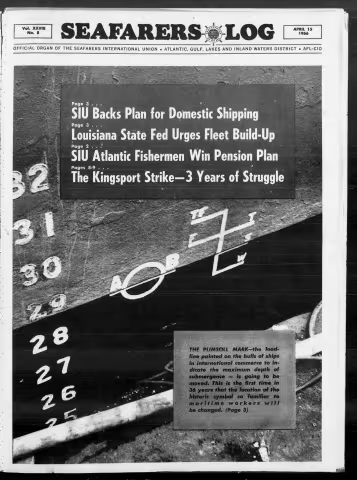
line painted dn the hulls dt ships
In ffit^rnciftonaf cofiiinerce td in-
dkdtB fhe ntdkimum depth df^
submdrgdncd ^ ts gding td be
md^ed
36 years that the location of thd
hi^prh^^ so fdhiiliar td
lit o t f f i III e work ers will
be changed, (Poge 3)
>V 3
IPS
Page Two SEAFARERS LOG April 15, 1966
Del Mar Wins Annual Delta Line Safety Award
I
j
Ackert, who heads the Atlantic
Fishermen's Union, said that
the newly-instituted pension plan
will cover the Boston fishermen
who work on trawlers out of this
port. The new agreement was
reached after protracted negotia
tions with the Federated Boat
Owners of Boston and New York.
Under the precedent - setting
agreement, the SIU fishermen will
get an approximate 50 per cent in
crease in their health and welfare-
hospitalization benefits. An in
crease was also negotiated in the
death benefits payable to survivors,
with the exact amounts to be de
termined by actuaries administer
ing the plans.
The contract also orovidfs
"lumpers" who unload the vessels
will now earn $22 a day for the
first 100,000 pounds of fish un
loaded, plus two dollars for every
additional 10,000 pounds over that
amount.
One of the issues in the contract
negotiations involved responsi
bility for buying of electronic
equipment to increase the catch.
Max Harrison Dies in Mobile;
Was First Welfare Plan Head
MOBILE—Max Harrison, administrator of the Seafarers Wel
fare Plan from its inception in 1950 until 1955 and president of
the American Maritime Association until his resignation last Oct.
31, died of a heart ailment in f
the Mobile Infirmary on April
4 at the age of 51. He lived in
Mobile.
Harrison
Harrison be
gan his career
in the mari
time industry
with the Wa
terman Steam
ship Company
here. He went
with the com
pany after
playing profes
sional football following his grad
uation in 1938, from Auburn
University where he played end
on the football team. He served
in various capacities for Water
man. For three years he directed
labor relations for the Gulf Ship
building Corporation, a Waterman
subsidiary. He was later pro
moted to the same post in the
parent company.
In 1949 Harrison opened his
own labor relations firm in Mobile
representing a number of shipping
concerns, including Waterman. He
sensed as chairman of the negoti
ating committee of Atlantic and
Gulf Steamship Companies in col
lective bargaining with the SIU,
the Marine Engineers Beneficial
Association, the Masters, Mates
and Pilots and the Radio Officers
Union.
When the Seafarers Welfare
Plan was established in 1950, the
trustees of the plan named Harri
son as its first administrator. He
also administered several other un
ion welfare and pension plan.
In 1961, Harrison was elected
president of the American Mari
time Association, a post he held
until his resignation last October.
The AM A represented 75 shipping
companies operating some 400
ships.
Harrison was a familiar figure
to Seafarers, particularly in the
Gulf ports and in New York. He
addressed several of the SIU's in
ternational biennial conventions.
Harrison is survived by his wife,
the former Frances Green; three
sons. Dr. J. Max Jr. of Birming
ham and Thomas Earl and Wil
liam Paul, both of Mobile; four
daughters, Mrs. Patricia Yost, and
the Misses Rosemary, Dianne and
Debbra Lynn, also of Mobile, and
a granddaughter.
Funeral services were held on
April 6 in St. Mary's Roman Cath
olic Church in Mobile.
/
v7
Viking Princess
Couldn't Meet
U.S. Safety Rules
The increasing need for
standardized safety regulations
for foreign-flag vessels operat
ing out of American ports was
pointed up recently in the burn
ing of the Viking Princess while
returning from a South American
cruise.
Two persons were reported
dead from the Miami-bound lux
ury liner in a disaster similar to
that of the Yarmouth Castle sev
eral months before. Neither of the
two ships were required to meet
American Maritime safety stand
ards—even though they both were
carrying American citizens.
What made the Viking Princess,
as well as the Yarmouth Castle
particularly susceptible to fire
was the flammable wood and paint
used in the vessels' construction
and decoration. Neither ship
would have been cleared for sail
ing under American-flag safety
standards.
The SlU-manned Del Mar has been awarded the annual Delta Line Fleet -Safety Award. Talcing part
in presentation ceremonies held recently aboard the vessel in New Orleans are (l-r, above): Del Mar
chief engineer R. A. Love; Delta Safety Director Paul Pollatt; Del Mar master J, D. Kourian; Port Capt.
E. R. Seamen: and Seafarers J. Procell, bosun; V. Romolo, chief steward and electrician Orlando Guerrero.
SIU Atlantic Fishermen Win Pensions
BOSTON—The SIUNA-affiliated Atlantic Fishermen's Union has won a new two-year agreement
which for the first time provides pension coverage for approximately 500 Boston fishermen. The con
tract went into effect on April 1 after overwhelming membership ratification.
SIUNA Vice-President James ^
The union maintained that this re
sponsibility rested with the boat
owners. Under the old contract
the fishermen were required to pay
a substantial part of the costs for
radar and sounding machines.
The new agreement provides
that the boat owners, in the first
vear of the contract, will take over
ffie cost of paying for radar
aboard the fishing vessels, and in
the second year will assume the
costs of the sounding machines
used on fishing trips.
Because of the union's firm posi
tion in its contract demands, talks
were stalemated on several occa
sions and federal and state media
tors were called into the nego
tiations.
With this pact successfully con
cluded. the SIU Atlantic Fisher
men's Union will shortly reopen
nesotiations in Gloucester cover
ing another 350 fishermen in that
port.
Report of
International President
by Paul Hall
The fact that foreign-flag vessels are not required to meet the same
safety standards as American-flag ships should be a matter of con
tinuing concern to all Americans. The fiery destruction of the cruise
liner Viking Princess under similar conditions as those causing the fire
aboard the Yarmouth Castle has again prompted renewed demands
for safety legislation—demands that the Seafarers International Union
and other groups have been making continuously for many years. But
disaster after disaster has brought little or no action toward protecting
American citizens travelling on foreign-flag passenger vessels on the
high seas.
The response of Congress and the U. S. public has been one of
indignation immediately following the disaster, an outcry which seems
to last only a short while with no real action being taken. Then the
foreign- and runaway-flag vessels are free to again endanger the lives
of American citizens. The operators of these shabby vessels seem to
regard a few more dollars in their pocket more highly than human life,
and they have demonstrated that they have no intention of stepping
up safety practices, unless forced to do so by law.
The standards of the 1948 Safety of Life at Sea Convention does
not bar the use of wood and flammable paints in many parts of the
ship, while the American Maritime safety laws, adopted after the
disastrous fire on the Morro Castle in 1934, require non-flammable
materials and paint to be used virtually throughout the ship. Under
the American standard of safety, the Viking Princess would have never
been allowed to operate.
Unless the protest against the unsafe standards are heeded, the lives
of American citizens will continue to be jeopardized in foreign-flag
firetraps, owned by ruthless operators. The SIU will not relax its
demands until adequate safety standards are adopted to prevent the
further loss of American lives.
• • »
Alarmed by the increasing losses to American shipping by the failure
of the Federal Government to implement the Merchant Marine Act
of 1936, the legislatures of two states. New York and Michigan, have
gone on record as calling for Congress to rigorously pursue the provi
sions of the Act. More and more people are coming to recognize that
Congress is letting down one of the most important segments of the
American economy. While other segments of our economy, such as
farming receive their share of subsidies, the U.S. merchant marine is
being ignored.
It is a measure of the growing concern over the problem when two
of the largest states in the country in effect censure the Federal Gov
ernment's laxity in giving the merchant marine the support it deserves
and needs. The two state legislatures took note of the fact that U. S.
bottoms are now carrying substantially less than nine per cent of our
own commerce, a point we of the SIU have been making for years.
In the struggle now in Viet Nam, our boys are depending on our
merchant marine to bring them supplies. Despite the arguments of
Secretary McNamara, the facts still remain that air power is not
carrying the bulk of the supplies that keep American soldiers in the
field in Viet Nam. And the 1936 Merchant Marine Act specifically
calls for vessels to be constructed in the United States, flying the U. S.
flag and manned by U. S. citizens.
N. Y. Legislature to Congress:
'Enforce Marine Act of 1936'
ALBANY, N.Y.—The Federal Government's failure to enforce
the Merchant Marine Act of 1935 and support and protect the
American-flag merchant marine has come under fire from the
New York State Legislature.
The New Y'ork State body
has adopted a resolution con
demning the laxity of Federal
enforcement which has allowed
the total of U.S. waterborne
foreign commerce carried on
American flag ships to drop to
less than 9 percent. In addition,
the resolution points out that the
U.S. merchant marine is being
given less support and protection
than is the practice in all other
maritime nations.
Coming close on the heels of a
similar resolution passed by the
Michigan State Legislature, the
N.Y. resolution represents just one
more example of the increasing
alarm being felt by responsible
legislators from coast to coast over
the continuing deterioration of the
U.S. merchant fleet.
The New York legislators
point out that the active U.S.
merchant marine today consists of
approximately 900 ships, which
is less than pre-World War II
strength, and further notes that
U.S. shipbuilding capacity is
dwindling dangerously even
though our worldwide responsi
bilities are increasing steadily.
In urging that the Federal Gov
ernment strictly enforce the pro
visions of the 1935 Merchant
Marine Act by every means at its
disposal, the New York legisla
tors point with alarm to the con
tinuing growth of the Soviet mer
chant fleet, which at its present
rate of growth will dominate the
world's oceans by 1970.
Pointing out that the mainten
ance and encouragement of a
strong U.S.-flag merchant fleet is
of growing importance to the na
tional security of the United
States, copies of the N.Y. Legis
lature resolution are being trans
mitted for action to the President
of the United States, to the Presi
dent of the U.S. Senate and the
Speaker of the House of Repre
sentatives, and to each member of
the New York delegation in Con
gress.
April 15» 1966 SEAFARERS LOG Page Tiiree
1 -
•a- is
Plimsoll Mark to Be Raised
For First Time in 36 Years
A move has been made that will raise the position of the
Plimsoll mark on ships' hulls for the first time in 36 years.
The Plimsoll mark—a familiar symbol to Seafarers and other
maritime workers — is
the name for the load-
line mark whtich is
conspicuously painted
on a vessel's sides to in-
dicate the legal maxi-
mum depth the ship
can be submerged when
engaged in interna
tional commerce.
The change in the
position of the Plimsoll mark is the result of a new load-line
agreement signed in London early this month by 60 maritime
nations. It took five weeks of discussions by the member nations
of the United Nations Inter-Govemmental Maritime Consulta
tive Organization before final agreement was reached.
Under the new convention—as international agreements of
this nature are called—the Plimsoll mark will be raised by 10
to 20 per cent on tankers, ore carriers and bulk carriers of more
than 328 feet.
Ships that carry, dry cargo also will benefit by an increase of
about 10 per cent, if they are fitted with watertight hatch covers.
The new regulations will apply to all ships in the above cate
gories that are built in the future and also to existing ships if
they comply with certain safety regulations.
The present regulations determining the position of the Plim
soll mark were established in 1930.
Before the new agreement becomes maritime law it must be
ratified by each of the nations.
(Editor's Note: The Plimsoll mark or line is named for Samuel
Plimsoll, an Englishman who was bom in 1824 and died in 1898.
Plimsoll was a reformer with a great interest in the welfare of
sailors. He was especially concerned with the loss of crewmem-
bers* lives on ships sunk at sea as a result of overloading, a
practice which many British shipowners persisted in because if
their vessels were lost at sea they profited handsomely from the
insurance. As a member of Parliament from Derby from 1868-
80, Plimsoll fought vigorously and successfully for the enact
ment of a law limiting the loading of ships. As a result a load
line was required to be marked on the hulls of aO British ves
sels showing the depth to which the law allowed them to be
submerged through loading. Other maritime nations followed
suit and the Plimsoll mark became international law. Plimsoll,
incidentally, was the author of a book entitled "Our Seamen,"
published in EMand in 1872.)
ITF Plans Campaign Step-up
Against Runaway Flag Ships
The Seafarers and Dockers section of the International Trans
port Workers Federation agreed at a meeting held in Hamburg,
Germany to intensify its efforts in organizing crews sailing under
the runaway flags of FanLib-"^
Hon nations.
Representing the SIUNA at
the conference were vice-presi-
April IS, 1966 V«i. XXVIilj No, 8
Ofitcisl PubiSeailnn of the SIUNA
Atlxntie, GuJf, hakes & Inland Waters
niatrict, AFL-CIO
PAUL HAU,, president
,
A'wee. Vicif-Pres. Viee'President':- ^
Az. Kena LtMnaGv WnxiAS
S»e.'Tre»i. , VietS'PrteM
BoBacrt MATTHE-VV'S AX TANN
VieS'Prosldtntt Vieg-PreBiie
HBSBERV PKAND
Wreetsr of Orpanizing and
PubUeatwna
B POIXAOK
AtrisPmt EdUsr
Art Editor
StolS Wr.trrs j
WtUXAM DAV '
nkltilMt titwMly at saO M»*i lUtoi
dents Cal Tanner and Earl (Bull)
Shepard.
The ITF sessions were held
from March 28 to March 31.
The resolution to intensify or
ganizing efforts on PanLiHon
ships was made after a report pre
sented by the Boycott Committee
of the ITF. The committee was
set up to deal with the so-called
"flags of convenience" ships
under the registry of Panama, Li
beria and the Honduras.
The Boycott Committee re
ported to the ITF delegates that
it had been successful in increas
ing the number of PanLibHon
vessels under collective bargain
ing agreement.
During the course of the con
ference, general discussions were,
held among thfe affiliated mari
time unions concerning such items
as automation, safety, wages and
working conditions.
Another item on the agenda
was a proposal made to move the
secretariat from its present loca
tion in London to Geneva,
Switzerland. The proposal met
with favorable reaction from most
of the affiliated unions, but a final
decision on the matter will be
mad^ at a later date. .
SlU Ba€ks MAC Subcommittee Plan
To Expand Domestic Shipping Fleet
NEW YORK—The Seafarers International Union has urged implementation of a seven-point
program to reinvigorate the domestic segment of the American merchant marine advanced by a
three-man subcommittee of the President's Maritime Advisory Committee.
The union's position was set
forth in a letter sent by SIUNA
president Paul Hall, a member
of the President's committee to
Secretary of Commerce John T.
Connor, the committee's chair
man.
Secretary Connor had requested
comments on a report on domes
tic shipping prepared by a sub
committee consisting of Thomas
P. Guerin, general manager of the
Portland Public Docks in Oregon;
J. Paul St. Sure, president of the
Pacific Maritime Association and
Lane Kirkland, executive assistant
to AFL-CIO president George
Meany. The subcommittee had
been appointed by Secretary Con
nor at the last meeting of the Ad
visory Committee on November
30th.
The report on domestic shipping
does not recommend direct sub
sidies to the domestic fleet but calls
for a number of other measures to
replace, expand and modernize
the existing fleet, bring economic
stability into the industry, and at
tract new capital to it.
The three-man subcommittee
proposed that the following steps
be taken to revitalize the U.S.-
flag fleet:
• Replacement, expansion and
modernization of the present fleet.
• Ships operators should be
guaranteed a reasonable return on
their investment through govern
ment action giving domestic oper
ators faster write off of deprecia
tion and enabling them to establish
tax-free construction reserve
funds.
• Provision for domestic op-
^erators to obtain reserve-fleet ves
sels, at low cost, on an interim
basis until new capital is attracted
to the industry and modern vessels
are built.
• Recommends thait all do
mestic shipping rates be under the
jurisdiction of one federal agency,
operating under one set of rules,
and that a sound carrier certifica
tion program be instituted.
• Opposition to any change in
the nation's cabotage laws and
maintenance of laws reserving
domestic shipping for American-
flag vessels.
• Adoption of the subcommit
tee's proposal that domestic ship
ping should be entitled to the full
benefits of automated shipping.
(The SIU, in its letter to Secretary
Connor pointed out that there can
be no realistic approach to the
problems of automation unless de
mands for the reduction of jobs
per ship are accompanied by a pro
gram looking for more ships and
more job opportunities.)
• Advocated that intercoastal
operators be relieved of their bur
den of paying Panama Canal tolls.
The SIU also stated that the re
port was a "worthy corrolary" of
the public members report which
was adopted by a majority of the
Maritime Advisory Committee
members at their last (Nov. 30)
meeting.
Linking the report on domestic
shipping with the public members'
report, which dealt with U.S.-
flag merchant vessels engaged in
the foreign trades, the SIU de
clared that "we believe that the
recommendations of both of these
reports, if properly implemented,
would go far toward restoring the
American merchant marine to its
rightful place upon the seas."
The public members' report was
prepared by three members of the
President's panel representing the
public—Professor James J. Healy
of Harvard University; Mr. Gue
rin, and Theodore W. Kheel, New
York City labor-management me
diator—and was adopted by the
full Advisory Committee by an
11 -2 vote at its November 30th
meeting.
The public members' report calls
essentially for increased Federal
assistance in building up the
American-flag merchant marine to
a point where it will carry at least
30% of this nation's waterborne
cargoes, and is in contradiction to
a report prepared by a group of
Federal agency representatives,
called the Interagency Maritime
Task Force, which recommends
decreased Federal assistance and
a smaller merchant marine, both
in terms of the number of ships
and in terms of the percentage of
U.S. cargoes which these vessels
would carry.
Louisiana State Fed Votes Support
Of Strong Merchant Marine Program
NEW ORLEANS—The Louisiana AFL-CIO held its eleventh annual convention here from April
4-7, taking action on issues of importance to both maritime labor and the U. S. labor movement as
a whole.
SIU Vice-President Lindsey ^
Williams headed the Seafarers
delegation to the convention.
The opening day session in
cluded panel discussion on
"What's Wrong With Louisiana's
Workmen's Compensation Laws,"
"Is A Sales Tax Fair to Every
one," "Is Property Tax Equaliza
tion Needed In Louisiana."
SIU Resolutions
During the course of the con
vention, the AFL-CIO Maritime
Trades Department of New Or
leans and the SIUNA submitted
resolutions to the convention
which:
• Called upon all departments
of the federal government, in par
ticular the departments of state
and defense to renounce the theory
of "effective control" and espe
cially urged the Defense Depart
ment to discount these runaway-
flag vessels in estimating the ade
quacy of the American-flag fleet
for defense purposes. Legislation
was also supported which would
require, runaway ship operators to
pay their fair share of American
taxes.
• Urged that appropriate offi
cials of the federal government
take prompt and positive action
to restore the domestic fleet, par
ticularly by rejecting the domestic
shipping proposals of the Inter
agency Task Force, by enacting
legislation which would permit
domestic operators to establish
tax-free reserves for vessel replace
ment, and by reconstituting the
ICC to provide for representation
of the shipping point of view.
• Pointed out that the Viet
nam situation has clearly demon
strated the inadequacy of the
American merchant fleet and
urged the Defense Department
to officially acknowledge this in
adequacy and bend its efforts to
ward the rebuilding and revitaliza-
tion of the fleet.
• Rejected any government
plan for building ships abroad and
urged.that any federal program
developed for the merchant mar
ine must be based on the require
ment that all vessels under this
program must be built in Ameri
can yards.
• Opposed all efforts to under
mine or eliminate the cargo pre
ference requirement and supported
all efforts to give American-flag
vessels a greater share of the car
goes generated by their govern
ment.
Supports Boycott
• Supported the boycott of
ships trading with North Vietnam
by maritime unions because this
trade with North Vietnam puts
blood money in the pockets of
shipowners and other profiteers of
so-called allied nations. The re
solution stated that further aid
to the nations which are engaged
in aggression against the South
Vietnamese people and against the
U. S. and allied troops must be
met by firm, direct and uncom
promising action by our country.
The MTD and SIU resolutions
were adopted unanimously.
Also attending the convention
were William L. Kircher, AFL-
CIO Director of Organizing, Mrs.
Winthrop Rockefeller, president
of the National Association for
Mental Health, U. Alexis John
son, U.S. Deputy Under Secretary
of Political Affairs, Dr. George
Wakerlin, medical director of the
American Heart Association and
Marshall T. Cappel, director of
Louisiana Civil Defense.
a
Pace Four SEAFARERS LOG April IS, 1966
i
J
To Aid American Fishermen
Congressman Urges U.S. Establish
Territorial Limit of Twelve Miles
WASHINGTON—A bill to extend the territorial limit of the United States from three to 12 miles
has been introduced in the House of Representatives by Congressman Hastings Keith (R., Mass.).
The measure, if enacted, would establish that the nation had exclusive fishing rights out to a 12-mile
limit by claiming a zone nine
miles beyond our present three-
mile territorial sea.
"We should not handicap our
fishermen," Representative Keith
said, "by refusing to them the
same protection given to foreign
fleets by their governments. This
proposal is another step in our
efforts to improve the fortunes of
our fishing industry."
Keith pointed out that, while
in former years there were rela
tively few foreign vessels using
this stretch of water and interfer
ing with our fishermen, recent de
velopments in ocean-going vessels
and "factory" ships by other coun
tries have radically changed the
picture. "The longer we allow
The Gulf Coast
by Lindsay Williams, Vice-President, Gu/f Area
The Louisiana AFL-CIO held its 1966 convention in New Orleans
from April 4 to the 7th. The convention was unique due to panel
discussions being held during the afternoon session. Some of the panel
discussions centered around such topics as: "What's wrong with Lousi-
ana's workmen's compensation laws?" "Is a sales tax fair to everyone?"
"Is property tax equalization ^
needed in Louisiana?'
The SIU and the Maritime
Trades Department of greater
New Orleans also submitted reso
lutions to the convention to con
sider. Some of these topics were:
The question of runaway-flag
ships; government action to re
store the domestic fleet; a resolu
tion declaring the inadequacy of
the American merchant fleet to
meet our needs in Viet Nam and
a resolution supporting all efforts
to give American-flag vessels a
greater share of U, S. generated
cargoes.
New Orleans
John Luther has
just come back
from a four
month trip to Viet
Nam on the Bel
gium Victory. He
said it was a good
trip with plenty
of overtime. He
ships engine room
and will be ready
short time on the
Luther
to go after a
beach.
Felix Jaroncinski is on the
beach looking for a Hudson Wa
terways ship. Felix said he really
had an interesting time last year
when the Manhattan went to
Russia.
Houston
Activity in the Houston area is
very good and many activities are
going on. The last meeting of the
West Gulf ports council of the
Maritime Trades Department
adopted a resolution condemning
the Teamsters Union for raiding
the Brewery Workers. The fol
lowing night the same resolution
was adopted by the Harris County
Central Labor Council.
Politics is getting very hot here
for the May 1 primaries and to
add some coal to the fire, the
Maritime Trades Department is
supporting Jim Clark, candidate
for the State Legislature from Dis
trict 24.
Mobile
We have had quite a number
of oldtimers in to see us and it
is always good to see your old
friends come back to visit. Ship
ping has been good and anybody
who wants to ship out has been
able to find a spot.
Claude Webb who is currently
registered group one deck depart
ment is on the beach. He was on
the LaSalle for a couple of years
and has been sailing out of the
Gulf Area for the
last twenty years.
Brother A. J.
Melanson, who
was last on the
Ocean Ulla as an
oiler, is looking
for another good
trip. He makes
his home in Tam
pa, Florida with
his wife.
Also coming in after a long
trip on the Ocean Ulla was group-
one steward Wiley Hinton. Wiley
makes his home in Lucedale, Mis
sissippi and has been shipping out
of the Gulf Area most of the time.
Hiiiton
IBU. UIW
Votes Set
For June
Members of the SIU United
Industrial Workers and the SIU
Inland Boatmen's Union will cast
their ballots in June in the fourth
regular election of officers in the
Atlantic and Gulf regions of the
UIW and IBU.
Balloting for UIW and IBU
members in Atlantic and Gulf re
gions will be held on June Union
meeting dates in each respective
city where meetings are held from
7 p.m. to 9 p.m. and also the day
after the meeting from 7 p. m.
to 9 p. m. In addition, mail bal
lots are being sent out for the con
venience of the members in cities
where the constitution makes no
provisions for members to vote
in person.
All members should familiarize
themselves with the provisions of
the constitution regarding voting
and election procedures in ad
vance of actual balloting.
other countries to operate within
our waters, the more "customary"
will their presence become," he
said, "until, through international
usage, we are forced to consider
their presence as 'traditional'."
Congressman Keith explained
that as the world population ex
plosion continues, the demand for
fish products will eventually ex
ceed the supply unless the country
takes steps now to prevent the
"fishing out" of large, productive
areas.
Keith also noted the growing
competition from Russia, coupled
with the fact that they are en
croaching in our waters^ more and
more each year. "Last June hun
dreds of Russian ships were found
operating off Cape Cod," he said.
Five Sea Unions
Urge Raising of
MSTS Vacations
WASHINGTON—Five AFL-
CIO maritime unions have
launched a campaign to gain pas
sage of legislation which would
bring the vacation provisions for
seamen on government vessels up
to the level that has been estab
lished for union seamen sailing on
privately-owned vessels.
The five unions—including the
Seafarers International Union, the
National Maritime Union, the
Marine Engineers Beneficial As
sociation, the Masters Mates and
Pilots and the Radio Officers
Union—met at SIU headquarters
here early this month to coordi
nate their efforts in bringing about
passage of the legislation (HR
3002) by Congress.
Participating in the joint five-
union meeting were SIUNA vice-
president Frank Drozak, Joe Leal,
secretary-treasurer of the SIUNA-
affiliated Military Sea Transporta
tion Union, Bernard Winstock of
the MEBA, Pat King of the MMP,
Pete Bocker of the NMU and Joe
Glynn of the ROU.
Meetings were also held with
Congressman Frank Morrison (D-
La.) who introduced the Bill.
The bill, if enacted, would ex
empt merchant seaman on gov
ernment vessels from coverage
under the "Annual and Sick
Leave Act of 1951." This would
then enable them to receive the
same leave benefits as seamen in
private industry.
Prior to the pasage of the "An
nual and Sick Leave Act of 1951"
seamen employed on government
ships had their compensation de
termined by the "Classification
Act of 1949."
The Act specifically excluded
seaman from its coverage and
stated that "officers and members
of crews of vessels . . . compensa
tion shall be- fixed and adjusted
from time to time as nearly as is
consistent with the public interest
in accordance with prevailing
rates and practices in the mari
time industry."
The Atlantic Coast
by Earl (Bull) Shepard, Vice-President, Atiantic Coast Area]
NEW YORK—Along with SIU vice-president A1 Tanner I recently
attended the meeting of the Seafarers section of the International
Transportworkers Federation which was held in Hamburg. The em
phasis at the meeting was the problem of runaway-flag shipping on
which the ITF will step up its campaign to obtain contracts covering
crewmembers on the PanLibHon fleet.
Shipping is still boomirig here^
Ae1r>w%e:/> onH friYm ^
the Chief Steward.
Juan Polo, who just paid off an
Isthmian ship in New York,
dropped by the hall to say
"hello" to his friends. After a
brief visit with his friends and
family here he'll be ready for a
chief cook's job on anything, go
ing anywhere.
Philadelphia
Vic D'India, who sails deck en
gineer, is around the hall and get
ting ready to ship out again.
Chief Steward
James McPhauI
will be ready to
go after spending
a short time on
the beach. His
last ship was the
Globe Carrier.
Harry Rost has
been around the
hall lately and
was a Bos'n on the Globe Prog
ress the last time out.
DeBarere
on the Atlantic Coast and from
all indications it will continue to
1 b o o m through
out the summer.
Guy De Barere
just got off the
Hurricane and
will be spending
a month on the
beach. Brother
CUfford Martin
just got off the
Azalea City and
will be looking for the first inter-
coastal run that hits the boards.
Elias P. Nava gave the hall a
visit last week to say hello to
some old friends. He is on the
Steel Seafarer. Ham K. Bere is
looking for a coaster after a run
on the Steel Scientist.
Norfolk
George Forrest came into town
last week to take advantage of
the good shipping here. We put
him right on the Transartlc. Jo
seph Robertson, who was last on
the Hanover, is now registered
and waiting for a ship. Elbert
Winslow is waiting for his clinic
card and hopes to get an AB job
for the summer on one of the coal
boats going to Holland.
Boston
Shipping has been a little slow
in this area but every indication
is that it will pick up in the com
ing weeks.
Thomas Fleming is in drydock
at present and will grab the first
AB job that is put on the board.
Elmer Grose is also waiting for
a good steward department job
to come up.
Puerto Rico
Shipping is good from this port
and Azalea City was back on
Island run last week after a short
absence. Johnny Johnson was
holding down the Bos'n job on
Rost
Baltimore
Shipping has been good. With
the Venore and the Losmar due
to crew up in the next ten days,
plus the possibility of the Alamar
signing on a crew, it all adds up to
good prospects for the coming
period. We've had three payoffs
and two sign-ons in the last two
weeks and there are 13 ships in
transit.
Clarence R. Brockett has been
in drydock since he got off the
Calmar in Seattle with blood poi
soning in his right hand. Clarence
said that he's feeling fine now
and expects to be ready to ship
again around the end of the
month.
Old-timer Robert M. Moore
has gotten off the Waller Rice
and said that he plans to stay on
the beach for a couple of months
and then he'll be ready to take
any run.
Discussing U, S. Merchant Marine
Representatives of organized labor participated in Tulane Univer
sity's recent annual Transportation Institute. Above, SIU President
•Paul Hall addresses session on problems of American merchant
marine. Left to right are Charles Logan, chairman of the merchant
marine panel: Hall; Ray Murdock, executive director of the Andrew
F-uruseth Maritime Research Foundation and panel moderator, and
Mrs, Helen Delich Bentley, maritime editor of the Baltimore Sun,
who with Capt. John Clark, president of Delta Steamship Lines, com
pleted the panel. Other union representatives present included ILA
vice-presidents Clarence Henry, Al Chittenden, "Hoppy" Hopkinspn
and Ralph Massey, all of whom are from the Gulf Coast area.
April IS, 1966 SEAFARERS LOG Page Five
The Great Lakes
m
U'r:'-
by
Al Tanner, Vice-President and Fred Farnen, Secretary-Treasurer,6reat Lakes
Warmer weather and generally ice-free conditions in navigation chan
nels has prompted St. Lawrence Seaway officials to open the shipping
season on April 1. This is the earliest opening since the seaway was
completed in 1959. A new all time in cargo tonnage is anticipated, with
a predicted total of 47 million tons of bulk and general cargo expected
to move through the seaway dur-"®*^
ing the 1966 season.
The SIU's Great Lakes District,
recently played host to three rep
resentatives of the "All Japanese
Seamens Union." Captain Naba-
sama, vice president of the union,
along with two of his staff, are
touring the United States under a
government-sponsored, reciprocal
educational program. The Japan
ese group was in the Detroit and
Toledo area for five days, during
which time they were briefed on
the structure of the SIU on such
matters as contract grievance pro
cedures, seniority and rotary ship
ping. Officials of the Maritime
Trades Department, along with
representatives of affiliated organ
izations, turned out in the Toledo
area to welcome Captain Naba-
sama and his delegation in behalf
of their respective organizations.
The Japanese group's itinerary
also included Chicago, New Or
leans and several West Coast ports
before their return to Japan.
The SIU's Great Lakes District
recently rapped recommendations
put forth by various Great Lakes
operators concerning a proposed
reduction of crews on various
Lakes vessels which are already
automated or are scheduled to be
automated. The SIU, in a state
ment before the Office of Marine
Inspection of the United States
Coast Guard, said that the recom
mendations for cutting engine
room crews on these vessels did
not take into consideration even
the minimum requirements in
volving work on watch, general
maintenance as well as health and
safety.
After taking a strike vote
throughout the Great Lakes area,
the Marine Engineers Beneficial
Association of the AFL-CIO was
successful in signing new con
tracts with several Lake operators,
including Pittsburgh. Great Lakes
District SlU-contracted compan
ies that have also signed to date
are Poland, Reiss, Tomlinson and
Buckeye. Meetings are scheduled
with the balance of the compan
ies over the next few weeks.
After "wintering" in Viet Nam,
Vern Battering, Larry Buldoc and
Scottie Quinlivah have returned
to their home ports in the Great
Lakes. The boys had been aboard
the SlU-contracted John C. The
vessel, operated by the Atlantic
Carriers Corporation, had been
carrying military cargoes to the
Far £ast for the past nine months,
hitting 47 ports during the trip.
The Steamer F. E. House has
been purchased by the Kinsman
Transit Corporation and renamed
the Kinsman Independent. The
vessel is 585 feet in length with
18 hatches and an iron deckhand
and is capable of carrying a 13,-
384-ton load. The Kinsman In
dependent will fit out in the port
of Duluth in late April, bringing
the total number of vessels oper
ated by the company to nine.
Sche^y^ Industries Yields To Union Solidarity
Grape Strikers Win Breakthrough
As Giant Grower OK's Bargaining
LOS ANGELES—A major breakthrough on the farm labor battlefront in California came April
6 when Schenley Industries Corp. agreed to begin negotiations for a collective bargaining contract
with the striking grape workers in Delano.
It was the first break in the'®'
seven-month-old dispute which
has pitted several of the giants
of California's $3.8 billion agri
cultural industry against a handful
of destitute farm workers.
And it came as demands for
legislation, both state and na
tional, were mounting to give col
lective bargaining rights to agri
cultural workers after the nation's
attention was focused on their
plight.
The union recognition agree
ment specifying the National Farm
Workers Association as the bar
gaining agent for some 400 Schen
ley grape workers in Kern and
Tulare counties was signed at the
Los Angeles County Federation
of Labor headquarters.
Week of Discussions
It was the culmination of a
week of discussions with Schenley
executives and key union leaders,
including William L. Kircher, na
tional organizing director of the
AFL-CIO. Kircher announced the
agreement at a press conference
held shortly after the signing.
The agreement calls for nego
tiations for a written collective
bargaining agreement to begin
within 30 days with a pledge that
both parties will make every ef
fort to' conclude an agreement
within 60 days.
Kircher predicted that the rec
ognition would prove a giant step
iix More SIU Oldtiriiers
Sturgjs Wilcken Hall Thomas Dccareaux Mazzariello
Six additional Seafarers have been added to the growing list of SIU veterans already enjoying
the security of a $150-a-month pension. The six new pensioners are: Ignace Decareaux, Francis
Sturgis, William P. Wilcken, Lloyd James Thomas, Walter O. Hall, and A. A. Mazzariello.
Brother Decareaux joined the "®
SIU over 25 years ago in New
Orleans. He sailed in the deck
department as a Bosun. He last
sailed on the Del Norte and had
over 25 years on American flag
ships. Brother DeCareaux is cur
rently living with his sister, May
Hight in New Orleans,
Francis Sturgis sailed with the
SIU as a cook and baker in the
steward department. He joined the
SIU in his native Baltimore and
was with the union over 20 years.
He and his wife Eunice are now
making their home in Snow Hill,
Maryland.
Brother Wilcken's experience
aboard ships stretches over 40
years. He is a native New Yorker
who joined the union in his na
tive city. He sailed with the
SIU's railway tug division with
the B&O Railroad. He will spend
his retirement with his wife Mary
in their home on Staten Island.
Thomas joined the SIU in Nor
folk and is a native of West Vir
ginia. He now lives with his sis
ter, Gladys Coldwell, in Tampa,
Florida. While with the SIU he
was in the deck department and
sailed as a Bosun. His last vessel
was the Trans India of the Hud
son Waterways company.
Brother Hall is currently living
in Baltimore, Maryland. He joined
the SIU in Baltimore and worked
for the Western Maryland Rail
road as a bargeman. He retired
from the SIU with a disability
pension and lives with his wife,
Marjorie.
Brother Mazzariello joined the
SIU in his native New York. He
was a member of the deck de
partment and sailed on B&O rail
way tugs. During World War II
he saw service in the Army. He
is now living in Staten Island,
New York.
toward eventual union organiza
tion of all workers on large cor
porate farms. Schenley owns about
3,500 acres of vineyards in the
Delano area out of the 4'7,000
acres involved in the dispute.
Sidney Korshak, attorney for
Schenley Industries, signed the
agreement for the company and
Cesar Chavez, director of the
NFWA, signed for the union.
Kircher signed as a witness.
The AFL-CIO Agricultural
Workers Organizing Committee,
jointly conducted the strike in
Delano with NFWA. The Schen
ley Workers were members of
the independent union. At the
press conference Chavez indicated
that talks were underway with
the national AFL-CIO for even
tual affiliation of NFWA with the
federation. He said also the agree
ment ended the NFWA boycott
against Schenley products.
Comments Favorable
In commenting upon the agree
ment, Kircher said, "I would like
to commend Cesar Chavez and his
fellow leaders. The role of AFL-
CIO indicates our respect for the
NFWA. We look forward to the
day when this movement is part
of the great mainstream of or
ganized labor, the AFL-CIO. The
needs of the farm workers, so long
forgotten, demand the total
strength and solidarity of all of
organized labor.
"I want to also commend the
wonderful labor movement of
California. The great and con
tinued leadership and support of
the State AFL-CIO under Tom
Pitts and the Los Angeles County
Federation of Labor under Bill
Bassett have been invaluable in
this accomplishment," Kircher
continued.
"The Schenley Corporation is
to be congratulated for its for
ward-looking posture in this mat
ter. In a sense they have become
a pioneer in the breakthrough
against the last frontier in this
nation where workers are still
denied the right to organize and
bargain collectively. The AFL-
CIO has always appreciated the
100 percent union operation and
good relationship of the Schenley
Corporation."
The Pacific Coast
by Frank Drozak, West Coast Representative
Shipping is booming up and down the coast. From every Hall there
is a call for every rating in every department and Seafarers who want
to ship out in a hurry are urged to head for the West Coast ports
and throw in for a job as soon'®^
as possible.
San Francisco
There have been five sign-ons in
the last period and there are plenty
of jobs for Seafarers in every de
partment. Shipping continues to
be very good and it looks like it
will continue this way for a long
time.
Paid off during this period were
the Transpacific, Express Virginia,
Fairwind, Overseas Joyce, Trans-
erie and the Northwestern Vic
tory. In transit were the Penmar,
Steel Artisan, Steel Admiral, Sum
mit and the San Francisco.
In the next two weeks the Rio
Grande, Neva West, Jefferson City
Victory, Ocean Dinny, Transwest-
ern and the Delaware are all ex
pected in for payoffs.
Some of the Brothers on the
beach are anxious to get the Viet
nam run. Just out
of the hospital and
feeling much bet
ter is old timer
T. L. Thompson
who is looking for
a steward depart
ment slot. He says
it's a Viet trip for
him.
As a sample of
the way things are moving around
here F. Bally just registered and
was ready to go as a baker. Now
he's on his way to the North
western VicttMy.
Thompson
Seattle
Shipping continues at a rapid
pace here in the Pacific North
west. From all indications the
next months will be the same.
There are several payoffs sched
uled and any member that likes
the Far East or India can catch
a ship on these runs immediately.
Payoffs this last period were
held on the Choctaw Victory, Ex
press Buffalo, Desoto, Linfield
Victory and the Longview Vic
tory.
Old timer Al Dowd stopped by
the Union Hall and talked about
the SIU Blood Bank program and
how much it meant to him and
his wife. When Al's wife had a
very serious operation the SIU
Blood Bank here in Seattle was
able to supply the needed blood.
John Clapp was last on the
Northwestern Victory as an AB.
Twenty-year member John piled
off after a long
trip and will take
it easy here for a
while. Another
twenty-year
Union man now
around the hall is
Edmund Eriksen.
Brother Eriksen's
last vessel was
the Choctaw Vic
tory. Ed is real happy about the
recent boost in vacation benefits
and thinks the vacation pay is
tops in the industry.
Clapp
Page Six SEAFARERS LOG April IS, 1966
il
r.
Lifeboat Class No, 148 Graduates
Successful graduates of SlU Lifeboat Class No. 148 assembled for
their picture after completing lifeboat training course at the Harry
Lundeberg School.of Seamanship. Latest batch of lifeboat ticket
holders includes (bottom row, l-r): Robert Wilson, Lawrence Robinson,
Mashacic Battle and John Schoonover. Back row, l-r are: Donald
Freedman, Tom Howell, Jack Caffey and instructor Ami Bjornsson.
INQUIRING
Smith
With all these reports circulate
ing ahout unidentified flying ob
jects or flying saucers, what is
your opinion of these sightings?
William Smith: I frankly don't
know what to make out of the
whole confusing
business of flying
saucers; but there
must be some
thing to it, be
cause many repu
table people have
claimed £o have
seen them. It's
not any bunch of
deranged people. One thing is
certain, however, and that is if
Uncle Sam knows anything about
it, he's not admitting it.
Felix Bonefort: As far as I'm
concerned, there is no such thing
as unidentified fly
ing objects or fly
ing saucers. The
sightings could be
planes, weather
balloons or just
ordinary mirages.
Then, too, there's
Bonefort
of person who
goes around looking for a little
publicity. I was in the service for
some time and think that, if there
were really anything up there, the
Air Force would have found out
what it was a long time ago. At
any rate, I don't worry about it
one way or the other.
W. J. Geary: I think there's
something to these reports about
flying saucers,
since quite a few
intelligent people,
such as Air Force
pilots, have seen
them on many oc
casions. All these
people would not
have come out
with their state
ments, if there wasn't something to
it. But as for saying what exactly
these unidentified flying objects
are, well, that's another thing en
tirely. That is probably the reason
that the government hasn't come
Geary
out with any concrete statements
as to the identity of the things.
<I>
Felipe Aponte: The only thing
I am sure of is that people are
actually seeing
these strange
lights in the sky,
but I wouldn't go
so far as to call
them flying sau
cers. Under prop
er atmospheric
conditions, you
can see lights in
any swampy area or place where
people or animals are buried.
These lights are called "fuego
fatuo" in Spanish, and I have seen
them on several occasions myself.
It is caused .by illuminating gases
which cause balls of fire to appear
in the night.
Aponte
D. Forest Fry: I think these
so-called flying saucers are simply
reflections from
satellites or possi
bly debris from
rockets. If any
body bothers to
pursue them in
airplanes, I think
they will find
themselves chas
ing shadows.
Mind you, I'm not saying that the
sightings are people's imagination,
I just think they are actual objects.
The sightings occur, I notice, only
at certain times of the year, and
I don't think they'll keep up all
summer.
Harvey Early: Though I find
the reports of flying saucers
mighty hard to
figure, I'm in
clined to think
that there must be
something to it,
especially after
those numerous
reports in Michi
gan. They must be
gas pockets, as far
as I can figure, or else the people
are experiencing optical illusions.
Early
REPORT
March 26 to April 8/ 1966
DECK DEPARTMENT
TOTAL REGISTERED
All Groups
NOW ON THE BEACH
Boston
New York ..
Philadelphia
Baltimore ...
Norfolk
Jacksonville .
Tampa
Mobile
New Orleans
Houston
Wilmington .
San Francisco
Seattle_^_;^_^
Totals
Class A Class B
9
68
9
24
11
9
5
19
54
51
11
30
32
2
26
6
11
5
2
0
9
22
28
6
22
11
332 150
All Groups All Groups
Class A Class B Class C Class A Class B
4 0 0 20 4
46 19 18 167 58
7 3 2 31 18
25 7 1 88 43
8 11 1 21 12
1 3 0 13 12
2 10 15 10
32 12 2 60 14
41 24 3 148 62
39 36 19 150 55
8 5 2 30 0
38 20 24 57 26
23 13 12 28 8
274 154 84 828 322
ENGINE DEPARTMENT
TOTAL REGISTERED TOTAL SHIPPED NOW ON THE BEACH
Port Class A Class B Class A Class B Class C Class A Class B
Boston 1 2 1 2 0 9 4
New York 61 27 53 17 26 132 56
Philadelphia 6 9 5 2 0 20 19
Baltimore 15 11 18 3 0 53 47
Norfolk 9 12 3 5 2 22 16
Jacksonville 3 4 3 2 3 9 9
Tampa 3 1 0 2 0 8 2
Mobile 13 6 18 15 5 37 14
New Orleans 41 27 13 15 10 100 70
Houston 46 31 42 39 21 87 62
Wilmington 8 7 7 5 3 10 1
San Francisco 21 23 24 19 23 40 17
Seattle 14 19 15 18 19 18 3
Totals 241 179 202 144 112 545 320
STE ARD DEPARTMENT
TOTAL REGISTERED TOTAL SHIPPED NOW ON THE BEACH
All Groups All Groups All Groups
Port Class A Class B Class A Class B Class C Class A Class B
Boston 3 0 1 0 1 5 2
New York 29 3 35 12 7 131 21
Philadelphia 7 3 3 3 0 9 7
Baltimore 11 14 11 13 2 65 33
Norfolk 3 6 4 6 3 8 11
Jacksonville 1 2 0 2 3 4 4
Tampa 0 1 0 0 1 6 3
Mobile 13 3 20 13 7 50 13
New Orleans 47 33 31 24 3 153 98
Houston 28 22 30 18 15 89 35
Wilmington 7 5 3 6 4 19 0
San Francisco 28 14 23 8 46 41 11
Seattle 25 12 12 10 11 21 11
Totals 202 118 173 115 103 601 249
Bntain Boosts Merchant Fleet Aid,
While U.S. Ignores Growing Problem
The Government of Great Britain recently announced its endorsement of a plan which includes
$189.5 million in shipbuilding subsidies for revitalizing the declining British merchant marine. The
plan calls for a combined effort between Government and industry.
The basis of the proposed
shipbuilding program is a report
made by a seven-member com
mittee after a year of studying
the problem. Among the propo
sals in the report is recommenda
tion that British yards consolidate
into four or five groups, each spe
cializing in particular types of
ships. Other recommendations in
clude: lowering steel prices for
shipbuilding; finding ways to cut
the cost of pre-manufactured
equipment; improving industrial
relations in shipyards; providing
indirect tax rebates to shipbuild
ers; and developing a new agency,
the Shipbuilding Industry Board,
to administer financial aid.
The size of the commitment
which the British Government is
willing to undertake in shipbuild
ing makes the feeble efforts of
our own Maritime Administra
tion look anemic in comparison.
While the relatively small island-
nation is prepared to spend nearly
$190 million to build new ships,
MarAd has grudgingly asked for
only $85 million to construct re
placement vessels for the aging
U. S. fleet.
Yet the wealth (GNP) pro
duced by the U. S. in 1964 was
nearly seven times that generated
in Britain, and our population is
more than three and one half
times as great. Moreover, at the
end of 1964, the latest date for
which complete figures are avail
able, the total British fleet con
sisted of 2,097 ships, while the
active U. S. fleet contained less
than 2,000 ships.
The difference is one of atti
tudes. The British realize that a
strong merchant fleet is essential
to the economic health of their
nation. Thus the British are con
sidering strong steps to correct
the decline of their fleet before it
reaches the disastrous levels to
which the U. S. fleet has fallen.
SlU ClimExams^AII Pdsis
EXAMS THIS PERIOD: Jan. 1>Jan. 30, 1966
Port SeoitiM ^1^^ Children TO^I
Boston
icsitlmore
Houston .
Now York ,
Norfolk.
Phitocielphla.,....
Tompa.
Son Francisco... 1,
Superior .
Now Orleans.....
Seattle
Buffalo.......
Mobil©
no
135
461
31
35
44
:1T2^
242
> 42
16
Ti
32
^5„,-
24
O <
fA J :
••.ir-v,:- ••
;
2
22
4
16
0
8
0
0
5
6':
©
1
1
19
164
144
501
31
59
45
172
11
265
42
-;:19,
81
TOTAl. 1,384 104 ,65:;;;;:;iT,S53-
liiMM
1
-1 -
SEAFARERS LOG Page Seven
A labor-endorsed tire safety bill, the first legislation of the year
directed toward protecting the American consumer, has been unani
mously passed by the U. S. Senate. The bill would set minimum safety
standards for new and retread tires, ban the sale of hazardous "re-
grooved" tires, and direct the Government to issue a meaningful
grading system.
At present, consumers have no way of knowing whether one manu
facturer's "premium" tire is equal to another brand's "first line" or a
third company's "100 level."
The AFL-CIO Convention last December urged both safety stand
ards and a grading system for tires. In a letter to Senate Commerce
Committee Chairman Warren G. Magnuson, sponsor of the recently
passed bill, AFL-CIO Legislative Director Andrew J. Biemiller had
criticized the "confusing mish-mash" in tire labeling and declared:
"We believe it is absolutely vital to the safety of the American
people that all automobile tires sold conform to federal minimum
safety and performance standards. Furthermore, we believe that the
welfare of the consumer public requires a uniform, federally-enforced
system of tire-grading and tire-labelling."
President Johnson endorsed the bill, which passed by a vote of
79-0, in his March 2, transportation message, citing evidence that "in
creasing numbers of inferior tires are being sold to unwitting cus
tomers throughout the country."
The Senate-passed bill directs the Secretary of Commerce to:
• Promulgate not later than January 31, 1967, interim minimum
safe performance standards for new tires, based on existing public and
private standards.
• Establish not later than January 31, 1967, revised standards
for new tires and minimum standards for retreads, based on a com
prehensive program of research and testing. These standards would
also include maximum permissible loads for each size of tire—a pro
vision Magnuson termed "very important." At present, he noted, car
manufacturers sometimes try to cut costs by supplying a smaller size
tire than needed by the weight of the car and its potential load.
• Prescribe within two years after enactment a uniform quality
grading system for tires to help consumers "make an informed choice."
The grade designations would take effect six months after their pub
lication in the Federal Register.
Pay hikes and overtime rates
are among the benefits that 2,600
workers in 40 Horn & Hardart
restaurants, cafeterias and auto
mats in New York will get under
a first contract negotiated by Cafe
teria Employes Local 302 of the
Hotel & Restaurant Employes.
Members elected a negotiating
committee January 24, and six
weeks later ratified a three-year
contract providing wage increases
of $3.60 a week for waitresses and
$5.60 for other employes; an ad
ditional $3 a week for those whose
workweek is reduced from 45
hours to 40; time and a half for
all hours over eight per day and
40 per week. The pact also pro
vides vacations up to three weeks
after ten years of service; up to
three days funeral leave; health
and pension benefits; grievance
procedure including a permanent
arbitrator; a promotion clause and
other benefits.
\I>
Success after 15 years of or
ganizing effort was achieved by
the United Shoe workers at the
Eddlebrick Shoe Company in
Greenup, 111. The workers voted
for the union, 155-71, in a Na
tional Labor Relations Board elec
tion.
The American Bakery and Con
fectionary Workers turned back
an attack by the combined forces
of two unions expelled from the
AFL-CIO because of corruption
in the leadership and won bar
gaining rights at a new plant of
the National Biscuit Company in
Buena Park, Calif. The election,
conducted by the NLRB, gave the
ABC a 66-6 win over the Team
sters and the Bakery and Confec
tionery Workers, scored with the
aid of the AFL-CIO Los Angeles-
Orange Counties Organizing Com
mittee.
The Sheet Metal Workers won
bargaining rights in a second
election in Bowling Green, Ken
tucky, at the plant of the Master
Vibrator Company. The vote,
ordered by the National Labor
Relations Board, was 77 for the
Sheet Metal Workers, 10 opposed.
The union fell short of a majority
in an election 14 months ago, but
won the right to a runoff vote
when the NLRB ordered a re
count of 32 challenged ballots
which gave it 24 more votes and
a plurality.
A contract package called "the
best in many years" has been ne
gotiated with the dredging indus
try by Local 25 of the Operating
Engineers' marine division, repre
senting 3,000 dredgemen in states
of the northeast. The new pact,
announced by Local 25 President
Stephen J. Leslie, calls for a union
hiring hall, job protection, im
proved working conditions, a wage
increase of 18 cents this year, and
an additional 14 cents in each of
the two following years. In addi
tion, a hike of $5 a week in the
subsistence rate was won for all
classifications of workers covered
by the contract.
^
John G. Blair, associate editor
of the Cleveland, O., Plain Dealer
and a news reporter since 1938,
has been named publications di
rector of the State, County &
Municipal Employes.
Blair was editor of the Cleve
land Record during the Cleveland
mwsoaper shutdown of 1961-62.
The Record, published by nine un
ions, achieved a circulation of
150,000.
"The Time and The Place"
The American organized labor movement
has successfully faced many challenges in
the past. Economic booms and depressions,
waves of immigration, technological revolu
tions and employer antagonisms have all
presented serious threats which were met
head-on and dealt with successfully. Today
organized labor is facing a new challenge,
brought about by the rapidly-changing na
ture of American society and the makeup of
the work force.
These changes in the makeup of the work
force include a relative shrinking of the
number of so-called "blue-collar" industrial
workers in proportion to the increasing num
ber of "white-collar" workers. It is among
the numerically increasing white collar work
ers in the United States that the organizing
efforts have met with the greatest difficulty.
In addition, as stated recently by AFL-
CIO Director of Organizing William L.
Kircher, the increasing number of young
workers entering the work force—those bom
after World War II—have no memories of
the labor stmggles of the past or the condi
tions which prevailed before the rise of labor
unions in America. They will not only have
to be informed of and familiarized with the
history of great traditions of the American
labor movement, but will have to be shown
how strong union organizations can help
them achieve and maintain the high stand
ards of wages and working conditions which
are the right of every American worker.
Also, the continuing diversification of Amer
ican industry is creating many job oppor
tunities in places, such as the South and
other rural areas, where unionism has in the
past faced its most difficult organizing tasks.
To succeed in meeting these challenges
the American trade union movement will
have to face squarely the new problems
before it as it has done so often in the past.
New techniques will have to be developed to
inform the young worker of just what the
labor movement is about, what it means to
him and what it can help him to achieve in
terms of wages, working conditions, welfare,
security and the well-being of himself and
his family. Union organizing will have to
pay increasing attention to the special prob
lems of the white collar workers who will
make up an ever greater portion of the
work force. Increased attention will have to
be paid to organizing in southern and rural
areas where anti-union resistance has always
been strongest.
The task will not be an easy one. Amer
ican business has not changed its basic atti
tude toward the labor movement over the
years and will fight tooth and nail to thwart
every attempt by unions to organize new
workers. Many employers have already
begun to deluge their workers with a flood
of anti-union propaganda and have made
clear their intention to fight with everything
at their disposal to keep the unions out.
Anti-labor agitation, threats of replacement
with scabs, the planting of finks and spies
will all be used again.
All this, in addition to the vast changes
in American society and industry, will tax
eveiy resource of the labor movement. But
the battle will be joined and the labor move
ment will once more succeed as it has so
often in the past.
!! f
: I
It
;1!-n :
>•
flm
Page Eig^t SEAFARERS LOG April 15, 1966 April 15, 1966
f - .W.
Vi\\
THE
AM0TH&R TEST FOK THF AMERICAN WORKER
':Utm
a: • V; -:1. •• J-'
t>yr..v :>
. "'aa e; ;•;
I
_ _ „., MV'r ••-T -'4
•-
atst :fl
hr three yews
too wwkers hatOe
the sOikebreakers
mi snAs
•. ' 't; •-• • •
I'S;
-Sfei
FOR over three years a group of AFL-GIQ'
unions have been waging a bitter and impor
tant struggle a^iinst a union-busting em^^
pioyer diat Is of great-concern to all trade union
i workers. The struggle Involves a Tennessee book
publishing firm, the Kingsport Press, printers of
text bo<dcs and ^cyclopedias which are purchased
by schools In communities throughout the nation.
Since March 11, 1963 more than 1,200 work
ers have been manning the pickedines in a strike
a^inst die company's refu^i to Iratg^ in good
faidi on Wages, hours and working cdndidons.
Kingsport Press has employed scahs and strike-
breakers in the hope that it will break the spirit
erf the woricers and the unions that represent
them. But the spirit of uidonism is sdU as strong
as ever among the Kingsport strikers who are
befing backed by the entire American labor move
ment.
The Kingsport Press strike is important to Sea-
foreis and all other union workers hecause it is
reminiscent of the long, bitter batdes which ^-
: 4 I' faring men and other segments of organized labw
had to wage before employers were forced to
' ' recogidze- the rights of dieir employes to bar-
gaining collectively in order to improve their
wages and working conditions and enjoy job
• ' security,
- • •
|\ V •ttw'isrssqfiic^y
KIKGSPORT PRESb, INC.
PRIVATE ROAD
—I
KIN.CSP0H1 PRimihc
^ntSSMtN & ASSISiaNU
tlON LOCAL 336. irvCB
ON
STRIKE
AOSINSI
^SPORT PRESS!
m Anew
-
Hi0
vV,--
ON
^^OlKE
|Young Darrell Collins, who's dad is a striking book-
fbinder, takes his turn in the Kingsport Press picket
'' ? lihe alongside striking pressman L V. Slaughter.
_ 'HE^ strike by the production employes of
JL Kingsport Press, Inc., Kingsport, Tennessee,
one of the largest printers of books and
• 'iy
T-Mr
-IH.'
• • '.S '•••V.'i! - •
fi--
lencyclopedias in the United States, began on
•March 11, 1963. They are still on strike today.
AFL-CIO unions
'representing the Kingsport workers after the com-
: pany absolutely refused to bargain in good faith
^^pth the unions on a number of issues involving
i^^t only wages, which were well below the pre
vailing industry rate, but also on hours, fringe
benefits and ^ievance procedures, all of which
were substantially below standards prevailing in
the rest of the industry. The jive unions involved
--•th^ Typographers, Electrotypers, Pressmen,
Bookbinders and Machinists—made every effort
to avoid the strike through negotiation before
hitting the bricks. , _
However both before and since the strike began
the employer's only answer to attempts at negotia
tion has been the same—"This is our final, irre
vocable decision. Either take it or leave it and
'.Si
my
Sfij
wviMJ
Shoes and clofhing for children of Kingsport Press
striken were distributed from this donated center —w• • • w«
at Christmas time as strike dragged into third year. - T' ,'
. ; !"-••• • •• ; W ^
a':xkiif5iS'4
'MS
II-.H
Vii«
J
IIP:
Spi'':
mm fPs,
: Kingsport Press strikers use mobile radio-equipped
Ipatrols to keep in touch on a widely-separated but
Iprderiy picket line outside the Tennessee plant^^
y
xMV.,-
•?i^«
KMGmrTmotfHii
UWON.LOCAL«M
m-cio
ON
STRIKE
AfiAMr
iKINg^PPRTPRESS^
IMMRTntciaoT>nis
MBLlhCAlNC
iruio
ON
STRIKE
KINGSPORT
•onrnwc^,
• I1W1,UI0C£M,„„
5 ON
STRIKI
ACAam
[KRIRISPORT PRE
..... i^S" **«»«««
I. ' MLcm
ON
otcspom nmriec
mtmn % AS&RTMTS-
aMHM LflCAL 136. ¥1-06
ON
STRIKE
RfiMSr
I KINGSPORT PRESS!
Unity on the picket line is demonstrated by members ' port, Tenn., one of the biggest U.S. publishers of
of the five unions whose members have been on strike hard-bound boob. The unions are the Typographers,
since March 11, 1963 against Kingsport Press, Kings- Electrotypers, Machinists, Bookbinders and Pressmen.
we will replace you." The company has flatly
refused arbitration on any issues in the dispute
and has stubbornly maintained its insistence that
it be the sole judge of what is best for its em
ployes, regardless of how they feel. It is because
of this contemptuous attitude that thej strike has
continued for three years. '
The company replaced many of the striking
workers with scabs and strikebreakers, and has
since added a further impediment to settlement
by demanding that the employment rights of the
scabs and strikebiCakers hired since the strike
are superior to the riglits of the strikers—^should
they return.
THE union-busting attitude of Kingsport
management throughout the dispute has
been almost a direct throwback to the ear
liest days of trade-union struggles in America.
Kingsport's union-busting intentions are very
obvious. When several of the striking imions were
granted representatioh elections at Kingsport
Press, by the National Labor Relations Board in
than 4,500 union members and their families
^tstand at attention for the singing of the national
ianthem ak^ East Tennessee labor rally called in
yT''
Kingsport, Tenn., to solidify support behind the five
printing trade unions which have been on strike now
for over three years against the Kingsport Press.
1964, the company first tried to stop the elections
by court injunction and then began a massive
propaganda campaign to influence strikers and
non-strikers to reject the union. When the union
won the el^tions, the company fought the NLRB
decision -ail the way up to the Supreme Court
without success.
The exceptionally clear-cut attempt at old-
style union-busting being attempted by Kingsport
Press management has aroused the indignation of
the entire American labor movement, which has
thrown its solid support behind the Kingsport
Press strikers. Resolutions of support for the
Kingsport strikers were adopted at the conven
tions of the AFL-CIO, the SIU, the MTD and
other labor bodies throughout the nation.
The AFL-CIO has instituted a boycott of books
produced at Kingsport Press, which is being
actively pursued on every level. State and local
labor bodies across 'the coimtry are exerting their
influence to get school boards, boards of educa
tion and colleges to refuse to buy any textbooks
or encyclopedias produced by scab labor at Kings-
port Press.
IN line with this boycott, AFL-CIO President
George Meany has said: "I regard this pro
gram as another test of the ability of the
American labor movement to mobilize its strength
behind a common cause and against a common
foe. We have succeeded before and I am confi
dent that we will accept this new challenge and
each do our part to succeed again. The issues
and principles involved in this matter are so
crucial that we simply must not fail."
All-out participation by each and every Ameri
can union member in the boycott of Kingsport
Press-produced books is of the utmost importance.
Every union member should make it clear to his
local school board and library that he does not
want his tax money spent to purchase, and thus
subsidize scab-produced Kingsport Press text
books or encyclopedias. A quick look at the title
page of any book will tell, immediately where it
was printed. In addition every union member
should urge his friends and family to avoid buying
the World Book Encyclopedia,- Childcraft, the
Book of Knowledge and Grolier Council encyclo
pedias, all of which are printed at Kingsport Press.
The Kingspvrt Press strike is a struggle m. which
all union members have a stake.
j':) •• y.y :5;v''
.. Wf
Page Ten SEAFARERS LOG April 15, 1966
Third Cook S+imon Dezee from San Francisco
had plenty of chicken and potatoes for the
crew. Seafarer Fred Lewis got his plate filled.
Ronald Bliksvaer whose
been sailing with Union
since 1956 liked ship.
Seafarer Leo Wills Electrician Harry R.
came out of the engine Crabtree relaxing while
hole to say 'good trip.' waiting to get paidofF.
Gene Legg looks into
the hold on the Rose
as ship is unloaded.
Just so he will know what his rights are as a
Seafarer if any beefs arise Union rep. T. L.
Robertson explains rules to Jack GroeneK AB.
Seafarer Patty Carrol Kitcben uti![ty™^man A. Sammie Nelson was the Signing back on was
found he had some Yabai was one of the new FWT. He had just Seafarer George Bryr
pipe fitting to handle. Rose's capable crew. boarded on the Coast. ant Jr., who liked trip>
Chisries Dawson doesn't believe in making hard
work in va situation where a fey« brains can
make it easy. Here goes a suitcase by rope.
Seafarer Nelson picfe Salon Mess Oiler V; Tdorfil;dil"^has ConMng up ths gang-
up his bag as it is Ipvi^- Taylor helps keep crew -made several 'images: way to the Rose is Deck
ered to him by Dawson. happy with good chow. aboard Oyerseas, Rose.. Department's Rinaldi.
rr'iir'
0
1
f
i:
.u
<v
"jf-
'4
^' 4
- • 't
-1.
'i nit
.• T..
V . J L- ^ « •. . -• i-. ^ V «, » ,
April 15, 1966 SEAFARERS LOG Page Eleven
A Changing Port
In Time of Need
The following report on a new port facility being congtructed in
Cam Ronh Bay in South Viet Nam was written by Seafarer James
Patrick Conley. Conley, who has been in and out of Viet Nam for
the past twenty years, explains how the development of the new
port will aid in alleviating the tieup of ships carrying vital supplies
for our mUitary effort in South Viet Nam. In his article, Seafarer
Conley also gives some historical information on the Bay area, and
reldtes some of the construction problems encountered during the
building of the new port facilities, and their eventual solutions.
In a previous issue of the LOG (Feb. 4, 1966) Seafarer Conley
related his observations after recently returning to Saigon after an
absence of many years.
DEVELOPING of a vast new port facility at Cam Ranh Bay
looks like a major step towards alleviating the shipping
bottleneck that is plaguing Vietnamese ports. Since the United
States stepped up its activity in Vietnam the port of Saigon has
struggled to keep up with the flow of ships. Cargo-laden vessels
waiting to be unloaded clog the Saigon harbor and many are
anchored down river.
Some of the pressure on the Saigon port is being relieved by
the partly finished Cam Ranh Bay facility. Construction started
last summer, yet about 200 ships were unloaded in 1965, bringing
thousands of tons of fuel and ammunition and equipment to the
fighting forces in Viet Nam.
Largest Port
Two piers are in use and four more are scheduled to be in
operation in a few months. Scores of new buildings have gone
up and 12,000 servicemen are based here. An existing air-strip
has been improved and work on a concrete strip for Air Force
jets is well under way. The "Bay" is on its way to becoming the
largest American-operated port outside the United States. The
speculation here is that it will replace Okinawa as the forward base
of the American defense force in Asia.
This large base has grown from what seven months ago was
swirling sand, old buildings and a pier clustered around a natural
harbor in central South Vietnam. It has been described as one
of six natural harbors in the world and is very safe in rough
weather. Two curving peninsulas nearly come together like pin
cers, leaving a blade of water more than five miles long sheltered
against the mainland. The harbor is 200 feet at its center and
30-40 feet deep at the piers.
Former Prison
The Viet Minh once used it as the site for a prison and later
the Republic of Vietnam Navy saw its great potential. This was
the history until the spring of 1965 when the U.S. came on scene.
By late June the 35th Engineering Brigade of the U.S. Army had
started work. A month later the first elements of the U.S. 1st
Logistical Command had started work and the face-lifting of
the bay was in full swing.
The first problem was the sand. Like an invisible monster that
strikes without warning it found its way over roads and fouled up
equipment thus making life and work miserable. The 35th
engineers found the answer to the sand problem by coating the
area with crude oil, adding a base of rock and more oil and
toping off the project with surface gravel.
" Just six months after construction started they erected 10
warehouses, 43 other buildings and 265 bases for tents. Seven
miles of 6 inch pipeline had been laid to take oil from the ships
to the waiting storage tanks.
Floatine Pier
At the heart of the activity in the bay was a long floating pier
which was put in place in November after a 6,000 mile voyage
from the United States. The pier can handle two large ships and
a smaller one at the same time. Two more of the 300-foot piers
are to be operating by mid-summer along with two 45-foot am
munition docks. Future plans are in the offing for handling cargo
from container ships.
Port facilities at the nearby village of Cam Ranh did some
growing of their own. Bars, restaurants, snack stands, souvenir
shops and enterprises of all kinds seemed to pop out of the sand.
Everyone seemed to prosper for awhile—until the village was
put off limits for security reasons. Now the men find recreation
around the base where the beaches are fine for football and volly-
ball. The sparkling bright water also offers some relief from
the intense heat and sand-burn.
An industrial complex is now on the drawing boards for the
mainland side of the bay. It could very well become the largest
industrial development and peacetime port in the nation.
1
dt
,
With spring here and summer on its way the Seafarers abroad the Delfware (Oriental Exports) are
doing some early spring cleaning. William F. Chapman, ship's delegate, plans on turning in the repair
list early this year. In the line of repairs and replacements, new screens have been ordered as well as
some new bunks and the new ^
Chapman
rule for the washing machine is
clean it after each use. Deck
delegate James N.
Bryant reports
that the Brothers
have already in
stalled screens in
the port holes and
have made a reso
lution to keep
screendoors
closed when in
port. Max L. Ste
wart is the delegate from the en
gine department. Meeting secre
tary James Egan reports there
were no beefs.
— ^ —
"Brother Sullivan wants to
thank all of the crew that helped
him out when he
was ill", writes J.
Wells from the
Hastings (Water
man). After leav
ing Inchon, Ko
rea the ship is
heading for a
payoff in Seattle.
The men are
looking forward
to the new TV set that is going
to be installed when this voyage
is completed. "Take care of the
washing machines" is the warn
ing of Warren Lewis of the Stew
ard Department. It's been a good
crew and their delegates have
been on the ball. Brother Roy,
Evans has kept things on an even
keel with his work as ship's dele
gate. And as for the food, the
crew have voted a round of
thanks to the steward's depart
ment.
Wells
F. Domey
There was a lively discussion
aboard the Oceanic Spray (Trans
World) during a
recent shipboard
meeting. Ship's
delegate Fred F.
Domey told the
Brothers "Let
your delegates
take care of all
beefs." He then
filled in the mem
bers on how to
enroll in the Engine Dept. Up
grading Program. Meeting Secre
tary Frank Natalc reports that
steward delegate G. Vinlaum re
minded the Brothers to be sure
and help keep the mess hall clean
and bring cups back to the pan
try. Men who show little consid
eration for Seafarers who are
sleeping came in for some harsh
words from H. (Tiny) Kennedy
who says the night shift can't
get any rest when people go
around slamming doors. There
was $ 15 in the ship's fund and no.
beefs from any department.
Tarallo
On a run to Viet Nam E. C.
Caudill reports that the Brothers
on the Pecos
(Oriental Export-
e r s) appreciate
the job being
done by ship's
delegate Vincent
J. TaraUo and
have voted him
and the ship's
steward a vote of
thanks for jobs
well done. There have been no
beefs and the chief stewkrd has
been elected treasurer. The ship,
is heading to Da Nang, Viet Nam
before proceeding to its payoff in
San Francisco, California.
When the ship's delegate re
ceives a vote of thanks and then
is reelected by ac
clamation and ev
erything is run-
n i n g smoothly
with no beefs at
all, it all adds up
to a good voy
age with a good
crew. That's the
case, according
to W, E. Morse,
John B. Waterman
(Waterman) where ship's delegate
J. Misakian was so honored. The
crew has been happy to receive
mail and they are looking ahead
to the nightlife of Rotterdam and
then Bremerhaven before return
ing to their New Orleans' payoff.
C. Donery
Morse
aboard the
John Flanagan, writing as meet
ing secretary on the ship Trans-
hatteras (Hudson
Waterways), is
headed for Bom
bay by way of
Singapore. The
word is that his
shipmates are
looking forward
to putting into
port especially
since there are
some Seafarers aboard who are
making the India run for the first
time. Ship's delegate Edward C.
Donery says veteran Seafarers
aboard take it all in their stride.
Steward delegate Samuel Eper-
emza told the crew that the stew
ard is spending more time than
usual in the mess hall making sure
that the place is cleaned up right
and that it's up to the men to help.
— —
W. M. Wallace reports that
W. J. Miles has been elected
ship's delegate
aboard the Steel
Fabricator (Isth
mian Lines) by
acclamation. Af
ter thanking the
brothers for their
support Brother
Miles asked the
cooperation of
all Seafarers in
bringing any beefs to their de
partment delegates and draw lists
to ship's delegate together.
Wallace
LOG-A-RHYTHM
"Old Man"
By John Liebman
Boots caked with black and oozing, mud.
An old man walked along the banks
Where a falling tide had exposed the shore
Fraught with rusty iron
And all the other artifacts
Of an abandoned and time-worn channel.
Stuck there groaning was an old deserted tug,
Making gurgling sounds as the water
Daily moved through her rotting hull.
Like a sentient animal
Varily protesting its inevitable death
In a woods that cries, "alone."
Stepping from plank to plank
His boots squishing in mud's suction.
The old man reached her side
And climbed aboard her corroded decks.
As all the while
The tide was falling.
Along, as lonely as the ship.
He stood high in the wheelhouse
Where there KAJ now no helm at all
And watched the blank and .sinuous stretches
Of tidal creeks and saltings
Where blue herons plucked fish from shallows.
Circling and swooping, an osprey hovered
Over water where in youth he had rowed
Out to pull the nets with his father
Who had taught him to love the sea.
But now, he reflected, there were no young men
With a will to learn.
C.
AllC£TOriA\felt)U
fiHoMzo. Souoom
O.K.'?
POOD'S P/egfry
GOOD, TUOUOU,
HUH?
FELLAS IH
THE CRBW-f
r I T.
HOPS
THAT NEyV FELLA
LOOKS URE HE'LL
DOFIHE...
• i]
m
Page Twelve SEAFARERS LOG April 15, 1966
V\
Seafarer Witnessed "The Big Day"
When Malta AehievedIndependente
"There were jublilant shouts in the streets of the small country," said Seafarer Owen Quinn, "with
RAF planes flying overhead, like the American 'Blue Angels,' executing starbirds, rolls and splits.
Bands were playing at full blast, and there was a long parade down the main streets of the city."
Brother Quinn, a member of ^
the deck department who lives in
New York City was present with
other Seafarers when the Isle of
Malta was granted its independ
ence from Great Britain in Sep
tember of 1964. Their ship, the
SlU-contracted Rio Grande, had
stopped at the island for a month
of repairs. "And it was not only
a good place to be on the beach,"
Quinn explained, "but it was a
good time to be there. We had
spent three and a half months in
India and were ready to let off
steam in a good port of call."
The United States, Great Brit
ain, Italy and many other nations
were represented at the festivities
by their respective Navies and
visiting dignitaries, said Quinn.
"Flags were flying from the vari
ous ships, and Prince Phillip was
present to represent England."
The young Seafarer went on to
say, "Crack marching teams from
both England and the island itself
marched in the main parade."
But aside from the excitement
of the festivities on Malta's big
day. Brother Quinn made many
other pleasant observations about
the island and he was fortunate
enough to have plenty of time to
travel around leisurely.
"There was much to see in
Malta," noted Quinn. "As most
people who have lived through
World War II probably know, the
island was a natural fortress guard
ing the passage between Sicily and
Tunisia; and because it was so
often under fire, many of the
dwellings are built into solid rock
for protection against the bomb
ing. Religious figurines stand in
front of each of the houses.
"Then, too," he went on to say,
"we would get together on week
ends and rent a car—^usually an
old Studebaker convertible—and
head up to the mountains to swim.
Every guy had a girl; in fact the
ratio of women to men on the
island was two to one. Needless to
say, no one objected to that pro
portion, nor the proportions of the
women either. TTiey were of Ara
bic and Italian descent and very
friendly, as were all of the people
on the island."
According to Quinn, the places
Seafarer Owen Quinn, who sails
as an A. B. in the deck depart
ment, spins a sea tale for LOG
staffer, as he puts a coat of
•paint on the wheelhouse doorway.
where he and the other Seafarers
went to swim were some of the
better spots they had ever found.
He described the mountainous area
as one of "lagoons, small beaches
and beautiful clear water. One
particular lagoon, he recalled, was
under a steep cliff with a deep
drop down to the water, but steps
had been cut in the rock which
led down to the lagoon.
"And the beauty of the coun
try," Brother Quinn went on to
explain, "was not confined to the
mountains and the countryside.
There was a small, shaded park
with a bandstand where the local
people were singing, and the bands
playing. Seafarers Dino and
George Yeagle, Hugh Curran,
Walter Bruner and Chief Mate
Walter Bruner would often sit here
under the trees in the afternoon,
order a few beers and relax and
listen. If I ever went back to a
country," he declared, "It would
be there."
The island, it seems, has been
the target over numerous invasions
over the years, and Quinn, seem
ing to take in the life about him,
came back with many interesting
stories and legends. One of his
favorites was the time that the is
land was invaded, and the Maltese
lost the battle.
"But," the Seafarer said, "the
invaders made one disastrous mis
take: as they were leaving in their
boats, they attempted to carry
away the ten-foot high, silver
statue of the Blessed Virgin. The
Islanders rallied, defeated the foe
that had before trounced them
soundly and recovered the statue.
"Of course," he added, "I
couldn't tell you whether the tale
was true or not, but I myself like
to believe it; and the figure still
stands in the main square of the
village, bedizened with bright
jewels."
Quinn described the Rio Grande
as "the best ship I have ever sailed
on, giving credit not so much to
the vessel itself, but to comraderie
that existed among the Seafarers.
"It was literally our floating
home," he said, "and we had
enough equipment aboard to sup
ply a small gymnasium: weights,
speed bags, two sets of boxing
gloves, springs and a skip rope.
"On one occasion," he said, "the
middle champion of the island,
Charley Seguna, who had just
fought Randy Turpin, came down
to the Rio Grande, because he had
gotten the word that we were in
terested in boxing. He was a
friendly guy and gave us a few
good pointers, then invited us up
to the place where he trained.
"Best trip, best crew, lovely
girls, friendly people, beautiful
scenery," Quinn concluded, "is the
way I would sum up that trip.
Who could ask for more?"
LOG-A-RHYTHM:
Sailors Request
By
A Seafarer Aboard
The STEEL NAVIGATOR
Looking back to one score
and eleven
Our pathway of life was
'tween hades and heaven
Until I realized that all
was not right
I tried very hard, with all
of my might.
Setting a pace that was
easy to follow
Enjoying the oceans and
watching the swallows
To me you are still the same
girl I wed
Others may say not, just
believe what I said.
Keep faith in me always,
don't ever despair
Even when gossips may foul
up the air
Remember the good things
that I may have done
Never condemn me, even
in fun.
Even though often we are too
long apart
Endless are my thoughts from
where I depart
Coming to this phase or part
of the poem
Understand, darling, that I'm
far from home.
Relying upon your trust in me
Letting my actions, a judge
to be
Even when I'm angry, or just
a plain bore
Yes, I still love, you—of that
I am sure.
Secifaror to Trdvol
To the Editor
I want to thank the SIU for
all it has done for me since I
retired. For the firet time in ray
life I was able to travel without
it being part of my job.
This last winter I traveled all
over the Southern part of the
country. I spent a number of
days in Florida and had a good
time meetirig old time friends
and I stayed in Miami a number
of days and really enjoyed bask
ing in the sunshine.
I was lucky enough to be visit
ing old friends in New Orleans
during, the Mardi Gras and was
able to see this festive event for
the first time. I enjoyed it very
much and kept thinking how
lucky I was to be on pension and
have no worries at all.
I am now on my way to Cali
fornia and looking forward to
seeing some of the sites in that
great state. I plan on .staying in
Los Angeles for awhile and
then heading up to San Fran
cisco to see some old friends.
I will stay with my daughter
in Seattle for the rest of the year
and will again plan another trip
next year with the money I re
ceive from the SIU welfare plan.
Paul Sladamere
On Goy't Work^iri
To The Edttort I
I was glad to read about
stand taken by the AFL-CI
Executive Council in support
the right of state and local gow
emment employes to union p;
tection. When the cost of liv
ing goes up, it goes up for every
one, and everyone needs a gi
•wage whether they work for
company, the state, or the gov
ernment, • , -vrSv
James
LETTERS
To The Editor
Retired Seafarer
Enfoys Reading log
To the Editor
I am retired and have moved
to the Sunshine State .of Florida.
I have enjoyed very much seeing
the LOG through the years that
I have been ashore and still get
it regularly. ;>
It has been excellent reading
and a good source of exact in
formation on the maritime in-;
dustry and labor in general.
Henry (Harry) Connolly
Please contact Joe Trainor at
the Philadelphia SIU Hall. He is
holding a paycheck for you.
Income Tax Refunds
Income tax refund checks are
being held for the following Sea
farers at the SIU hall in San Fran
cisco: Andre W. Deriger, Hans
J. L. Pedersen (2).
<I>
Gregory Troche
Please contact Attorney Marvin
E. Segal at 38 Park Row, New
York, N. Y., at your earliest pos
sible convenience.
— —
Manuel Sanchez
Please contact attorney Thomas
M. Breen, 160 Broadway, New
York, N. Y.
Alonzo Sistrunk
Please get in contact with at
torney George J. Garzotte at 1040
Maison Blanche Building, New
Orleans, La.
^
Jochim F. Cicirello
Contact attorney Alfred Mar-
roletti at 3 Penn. Center Plaza,
Philadelphia, Pa., as soon as you
can.
Joseph Nagy
Please get in touch with Charles
Misak at 500 3rd Ave., New York,
N. Y.
Paul Zimmer
Contact John H. Fix, Reading
R.D. 1, Reading, Pa., as soon as
you can.
Juan Santos
Mrs. Carmen Cintron at 584
East 137th Street, Bronx, N. Y.,
would, like to hear from you soon.
Charlie Copeman
Please call or write Thelma
Wise at Barrett Ave., Holtsville,
L. I., as soon as you can.
—
Charles V. Bedell
Please contact your daughter at
2926 Huntington Ave., Baltimore,
Md., as soon as you can.
Richard Geiling
Contact Mary Geiling at 665
Geary St., San Francisco, Calif.,
as soon as you can.
Carroll Rollins
Attorney C. Arthur Rutter, Jr.,
500 Helena Building, Norfolk,
Va., would like you to contact
him as soon as it is possible.
Adrian Fecteau
D. L. Adams, 4224 So. Der-
bigny St., New Orleans, La., re
quests that you get in touch with
him concerning your mail and
post office box.
— ^3> —
Charlie Harman
Please contact William G. Davis
at 1852 Sul Ross St., Houston,
Texas.
^J>
BUI WaddeU
Contact Robert Hoch at 21210
Clare Ave., Maple Heights, Ohio,
as soon as you can.
<I>
Money Due
Seafarers listed below have back
pay waiting for them at the Texas
City Refining Co., Texas City,
Texas. To receive pay, a signed
request plus social security and Z
number are required. Also, in
structions regarding payment.
Those who have money due to
them are: William S. Allen, John
E. Funk, Edward G. Gorman,
Donald E. Mackey, Vincent A.
Quinn an.d Wp|in R. Corry.
J
\
'•*>
V
A
April 15, 1966
SEAFARERS LOG Page Thirteen
FINAL DEPARTURES
Daniel Walte HiB, 58: A cere-
oral edema claimed the life of
Brother Hill while
at his home port
of Baltimore, Md.
He joined the Un
ion in Baltimore
and shipped wtih
the steward de
partment. He is
survived by his
sister, Mrs. Wini
fred Hill Lovejoy, and her son,
who live in Hollywood, Florida.
He was cremated at the Loudon
Park Crematory, Baltimore, Md.
-t.
Anthony P. Dl Nicola, 61:
Brother Di Nicola passed away
in New Orleans
in January. He
was buried in the
Greenwood Cem
etery. He joined
the Union in
1941 in New Or
leans which was
his place of
^ birth. Survivors
include his sister,
Mrs. Mamie Mandala, and his
wife, Mrs. Lillian Di Nicola of
Metairie, La. Death was the re
sult of arteriosclerotic heart dis
ease. Di Nicola sailed with the
steward department as a bar
tender.
Reyes Escolastlco, 66: Brother
Escolastico passed away on March
S' —1 12th of this year
in the USPHS
Hospital in States
Island, New
York. He was a
[ veteran of over
144 years at sea.
Bom in the Phil-
lippines he served
in the U. S. Navy
in WW 1. Brother Escolastico
sailed as chief steward. He joined
the Union in 1943 in the port of
New York. He is survived by his
wife, Sara, and his son, Richard
Reyes Escolastico. He was buried
in the National Cemetery at Pine-
lawn, New York.
^ —
Charles Y. Lakin, 40: Brother
Lakin passed away in Rio de Jan-
erio, Brazil in No
vember, 1965,
while shipping on
the Del Norte.
His death resulted
from a heart at
tack. The body
I was returned to
the United States
' on the, Del Norte
for burial. He is survived by his
mother, Mrs. Elsie Lakin, his sis
ter, Mrs. Patrick Parker of Hous
ton, his wife, Mary Ann Pickens,
and their son, Charles David La
kin, of Gallipolis, Ohio.
^
William Fay Langley, 41: Broth
er Langley died of Lobar pneu
monia in Decem
ber, 1965. He
passed away
while at sea on
the Hudson. Bom
in North Dakota
the engine depart
ment member
joined the Union
in New York in 1949. He is sur
vived by his wife Ruth Langley of
Anchorage, Alaska and his sister,
Mrs. Frances Bowman of Ta-
coma, Washington. Brother Lang
ley was buried in Tacoma, Wash
ington.
Archie Bishop, 31; Brother Bis
hop was killed in an accident
aboard the Couer
De Alene (Vic
tory) in January,
while sailing as a
deck maintenance
man on the Viet
Nam run. His
body was flown
back to the
United States. A
native of Alabama, Brother Bishop
joined the Union in 1952 in Mo
bile, Ala. He is survived by his
mother Ethel Bishop of Fairhope,
Alabama.
Roy Davis Roberts, 34: Brother
Roberts passed away in April
1964. A native of
Flint, Michigan
he joined the
Union in 1947 in
Baltimore. He
sailed with the
deck department
as an AB. Brother
Roberts is sur-
vived by his
mother, Mrs. Sandra Roberts of
Flint, Michigan.
^
Cleon Mixon, 51: Brother
Mixon died of cancer in February
at the New Or
leans USPHS
Hospital. He
joined the Union
in 1937 in Mo
bile, Alabama
and sailed with
the engine depart
ment as an oiler,
fireman-waterten-
der. Brother Mixon is survived by
his wife Josephine, and their five
children, daughters Cleo, Jo Ann,
and Marion, and two sons, John
and Harold.
MWN TO THR SiA
FOR SCIENCE
I
I H ^1 1^ I
- -• Editor, .
J .SEAFARERS LOG,
- I 675 Fourth Ave., '
J Brooklyn, N. Y, 11232 .. .
I I would like to receive the SEAFARERS LOG-please put my
I; . name on your mailing list. (PrM inh>rmon<,n}
.NAME
BP;,y/Vt»tlKK»a .-.J ,i<
It is always fascinating to watch specimens being
brought aboard in the Anton Bruun's nets. Observing
the procedure above are (!-r): Seafarer Ray Bielanin.
scientist R; Ovalcnine, Seafarer Eight Mdon Wong.!
'THSERE are maay Seafarers a*
-a- wmk ab(K«rdl ocean researcfi Vftp-
seis imgi^ed in probing the world's
in search of scientiflc inftHwa-
fion to benelb all nianidnd. Photos on :
fliis page were taken dorii^ Scientiiic
Cruise No. 14 of tte SlU-manned
Anton Broun. They depict some ni
flic daily evrate ahiWd an ocean re
search ship which help to ntate e^ii
vcvyage a distinct and onRatpttfabfe
experience ftsr everyone alMmrd. Scien
tiflc Cm^ No. 14 was terminated
at CaOao, Peru on M^ch 16, 1966.
—i
Seafarers and scientists swing aboard Maico shark,
I believed to be second-largest ever netted, measuring
9 feet-8 inches overall. Largest shark of this type on
record is only slightl.y larger at 10 feet-6 inches.
.
; .- : ..a
Big Moon-fish netted by Anton Bruun , ;]
is being held for camera by (l-r) scien- "
fist R. Ovaknine and two crew mem-
bars, Sottschlich and Hank Murranka,
jl •
I
Seafarer Sottschlich (top)
who helped land giant shark,
•watches as scientists prepare •
to dissect specimen for study.
While shark is being examined for gill parasites, other I
scientists study metabolism, pulse rate and blood pressure ' I
•. . .V
^ •
h
si'
.. .:i-' p
I. ;
VOID DUPLICATIONi It yog an old subwriber «nd b«ve « change
plsa«»<giv« yoor fbrrnV addniw boloW:
^•.
5] :
<'A'
Page Fcnuteen SEAFARERS LOG April IS, 1966 I
Membership Meetings
..... •.-•-.qr, .
SIU-AGLIWD Meetings
New York .. May 2—2:30 p.m.
Philadelphia . May 3—2:30 p.m.
Baltimore ... May 4—2:30 p.m.
Detroit May 6—2:30 p.m.
Houston .... May 9—2:30 p.m.
New Orleans. May 10—2:30 p.m.
Mobile May 11—2:30 p.m.
Wilmington .Apr. 18—2 p.m.
San Francisco
Apr. 20—2 p.m.
Seattle Apr. 22—2 p.m.
Great Lakes SIU Meetings
Detroit Apr. 18—2 p.m.
Alpena Apr. 18—7 p.m.
Buffalo Apr. 18—7 p.m.
Chicago Apr. 18—7 p.m.
Cleveland Apr. 18—7 p.m.
Duluth Apr. 18—7 p.m.
Frankfurt Apr. 18—7 p.m.
^Houston May 9—7 p.m.
Mobile May 10—7 p.m.
New Orleans . .May 11—7 p.m.
* Meeting held at Labor Temple, New
port News.
t Meeting held at Labor Temple, Sanlt
Ste. Marie, Mich,
t Meeting held at Galveston wharves.
DIRECTORYof
UNION HALLS
Great Lakes Tug and
Dredge Region
Detroit . . . .May 9—^7:30
Milwaukee .May 9—7:30
Chicago .. . May 10—7:30
Buffalo May 11—7:30
tSault St. Marie
May 10—7:30
Duluth . .. .May 13—7:30
Cleveland . .May 13—7:30
Toledo May 13—7:30
p.m.
p.m.
p.m.
p.m.
SIU Atlantic, Gulf, Lakes
& Inland Waters
Inland Boatmen's Union
United Industrial Workers
PRESIDENT
Paul Hall
, |BXP»E88 VIRGINXA (Marine 0»r-
SltTfers), March 26—Chairman, I.ce J. Hnr-
* vey; Secretary. Gregory F. Gannon. $6.00
'in ship's funi Some disputed OT in deck
and engine departments to be taken up
with boarding patrolman. Motion was
made to see the patrolman about getting
tho wddlng machine moved from" the
main deck passageway. Motion made to
see patrolman about getting a new refrig
erator In the crew's pantry. The boeun
requested that the ship's delegate talk to
patrolman regarding the painting of the
engine department quarters, and get same
straightened out.
<1>
PANWOOD .(Waterman), March 20—
Chairman, Seymour Hclntllng; Secretary,
S. Bscehar. $16,94 in ship's fund denoted
to SPAD. Some disputed OT in deck and
steward department. -One man hospital
ized in Saigon and two men missed ship
in Greece.
TRANSHUDSON (Hudson Waterways),
March 26—Chairman, F. Kon; S.ecretary,
A. Violante. Brother K- C. Smith was
elected to serve as ship,- delegate. No
beefs reported by department delegates.
4^—•
MOUNT WASHINGTON (Victory Car
riers), March 26—Chairman, M. C. Bar
ton ; Secretory, C. Gamer. Two men
were hospitalized in Has Tanura. Head
quarters notldcd. Brother M. C. Barton
was elected ship's delegrate. Some disputed
O-T in deck depBrtment.
4^
EXECUTIVE VICE PRESIDENT
Cal Tanner
VICE PRESIDENTS
Earl Shepard Lindsay Williams
AI Tanner Robert Matthews
p.m.
p.m.
p.m.
p.m.
SIU Inland Boatmen's Union
Philadelphia . . May 3—5 p.m.
Baltimore (licensed and
unlicensed) May 4—5 p.m.
Houston ..... May 9—5 p.m.
Norfolk May 5—5 p.m.
New Orleans .. May 10—5 p.m.
Mobile May 11—5 p.m.
Railway Marine Region
Jersey City
May 9—10 a.m. & 8 p.m.
Philadelphia
May 10—10 a.m. & 8 p.m.
Baltimore
May 11—10 a.m. & 8 p.m.
•Norfolk
May 12—10 a.m. & 8 p.m.
United Industrial Workers
New York May 2—7 p.m.
Baltimore ,,.. May 3—7 p.m.
Philadelphia .. May 4—7 p.m.
SECRETARY-TREASURER
AI Kerr
HEADQUARTERS 675 4th Ave., Bklyn.
HY 9-6600
ALPENA. Mich 127 River St.
EL 4-3616
BALTIMORE, MD 1216 E. Baltimore St.
EA 7-4900
BOSTON, Mass 177 State St.
Rl 2-0140
BUFFALO, N.Y 735 Washington St.
TL 3-9259
CHICAGO, III 93B3 Ewing Ave.
SA 1-0733
CLEVELAND, Ohio 1420 W. 25th St.
MA 1-5450
DETROIT, Mich. .. 10225 W. Jefferson Ave.
VI 3-474!
DULUTH. Minn 312 W. 2nd St.
RA 2-4110
FRANKFORT, Mich P.O. Box 287
415 Main St.
EL 7-2441
HOUSTON, Tex 5804 Canal St.
WA 8-3207
JACKSONVILLE, Fla 2608 Pearl St.
EL 3-0987
JERSEY CITY, N.J 99 Montgomery St.
HE 3-0104
MOBILE, Ala I South Lawrence St.
HE 2-1754
NEW ORLEANS. La 630 Jackson Ave.
Tel. 529-7546
NORFOLK, Va 115 3rd St.
Tel. 622-1892
PHILADELPHIA. Pa 2604 S. 4th St.
DE 6-3818
PORT ARTHUR, Tex 1348 Seventh St.
SAN FRANCISCO, Calif, 350 Freemont St.
DO 2-4401
SANTURCE, P.R, ...1313 Fernandez Juncos
Stop 20
Tel. 723-8594
SEATTLE, Wash 2505 First Avenue
MA 3-4334
ST. LOUIS, Mo 805 Del Mar
CE-l-1434
TAMPA, Fla 312 Harrison St.
Tel. 229-2788
WILMINGTON, Calif. ...SOS N. Marine Ave.
TE 4-2S23
AlxCOA MAHKETER (Alcoa). April 1
—- Chairman, Guy DiVisio; Secretary,
Wm. Cronan. .Ship's delegate report^
that everything is running fine. Finest
crew aboard both officers and men. $50.02
in ship's fund. Discussion about fresh
milk.
, ALCOA MASTER (Alcoa), March 28—
> Chairman, Ballard Browning; Secretary.
FVantc Allen. No beefs reported by de-i
„ partment delegates. Brother Lieon Penton
I was elected to serve as ship's delegate.-
i Each delegate asked to check quarters
; for repsifs slid to tarn report in to ship's
* delegate.
STEEL FLYER (Isthmian). March 18—
Chairman. Kevin Ryan: Secretary, Felix*
P. Amors. Smoijth payoff. Issue made
about reduction of manning scale without
* notifying the crew. In this, voyage the
steward department' fa short one galley-
; man. Motion wac made to write head-
I quarters asking for ciariiication regard-
; ing manning scale. Brother Elwell was
f re-elected to serve as ship's delegate and
was given a vote of thanks for a job
well done. It was suggested that topside
{ extra rooms be available to crewmembers
; tp ease congested living condittons. -i
4^
CHILORB (Venoro Transportation),,
I March 27—-Chcirman, G. Perdue ; Secre-
I tary. Piggy Sahuque. No beefs reported—
I everything is running smoothly.
<1>
BOWX.ING GRBKSf (Pan Atteldan
Tarikero), March IS^^halrm^, Walter,
i Nash; Secretary. J. J. McDurmott.:,
' Brother S. !>. McCormlck was elected tp
serve as ship's delegate. Vote of thanks
I was extended to the steward department.
for the good food and good service. Dis
cussion about Maritinie Adyancesneiit
Program, .
ROBERT D. CONRAR (Mafttime Op-..... . ..... ... .. ..
etations), March 12—^Chairman; C. Bi
Gappc i Seeretaryi None. One lUnn
ship in Mexico. No bee& * fqjorted *.hy
department delcgaies;/"' - •
Tftmco •: ^ - Shipping* ^eS.?).,:'. JsEiwh-,'
16-—Chairman, Michael Dombrowski; S«c»
T^siry, M. Ai, LaPontaine. No disputed
OT and ho beefs reported by deparfaneht
delegates. Byother George Peinihah was
elecfed sto Serve esVshipfa deleg^^
COLORADO (Waterman), March 18—
Chairman, Edward C. Ruley; Secretary,
Arthur G. Andersen. Few hours disputed
OT in each department to be brought to
attention of patrolman, also the inade
quate stop etunt.
<|>
WILMAR (Caimar), March 13—Chair
man, C. L. Flshel: Secretary, Frederick
W. Darrey. One man hospitalized in
Okinawa. One man missed ship in Sai
gon. Discussion on getting information
on exact bonus zone.
COLORADO (Watcrnsnn), Jonuary 6—
Chairman. Edward C. Buley; Secretary,
Arthur G. Andersen. Brother Andersen
was elected to serve as ship's delegate.
Suggestion was made to hold fire and
boat drills midship due to deck cargo.
No beefs reported by department dele
gates.
4^
DEL SOL (Delta), March IS—Chtfir-
man, R. B. Stough, Jr. Secretary. Bern
ard Feely. $69.50 in ship's fund. Some
disputed OT in engine department.
4f
IBERVILLE (Waterman). March 14—
Chairman, Thomas Liles, Jr.; Secretary, ,,
Vincent J. Fitzgerald. No beefs reported,*?;
by department delegates.
DEL MONTE (Delta), March 14
Chairman, Howard Menz.; Secretary, AI-?.
bert Efapeneda. Crew extended a vote of ig
thanks to the ship's delegate, who was J
re-elected to serve. $2.00 in ship's ftind. ;
No beefs reported by department dele
gates.
DIQEST
of SIU
MEETINGS
MOUNT VERNON VICTORY (Victory „
Carriers), February 13—Chairman, C. |
Morris; Secretary, S. Fieraon. Disputed |
OT in deck and engine departments, |
Brother Henry Delgado was elected to Ji
serve as new ship's delegate. Vote of j
thanks to tho steward department for ;
good holiday service. S
4^
GENEVA (U.S. Steel>. March 15 —
Chairman. Ricliard Heftley; Secretary,
Clyde L. Van Bpps. No beefs reported by
department'^delegatcs. Ship's delegate to
see the Captain about time off for fire
men, oilers and members of the steward
dejiartment.
4^
i. FBNN VICTORY (Waterman), March
17—Chairman, S, A. Holden: Secretary,
Lawrence Andrews. Two men taken off
ship due to illness. Some disputed OT in
engine department. Vote of Hianka ex?,
tended to the steward dapartmcnt for a
job well done.
<1>
; WINGL^S VICTORY (GonsolSdate
Mariner),: March 26—Dhairmah, D. A.
Ramsey ; Secretary, Jfames B. Morton,
No beefs reported by uepartnioiit delei
gates.; Ship should be fumigated for rats
and roaches.
v/V'-
ROBIN laR^^ MdrchWia—
CbalrriiaB. R, Hutchins; Secretary,;* Wi
Bak». $22.66 in ship's fund. Some dis
puted OT in deefc : department. Brother
a Lisenby was eleot^ tb aerve as ship's
delegate. Headqnartm to be contacted
regarding condition of wash water tanks;
FINANCIAL REPORTS. The constitution of the SIU Atlantic, Gulf, Lakes and
Inland Waters District makes specific provision for safeguarding the membnship's
money and Union finances. The constitution requires a detailed CPA audit every
three months by a rank and file auditing committee elected by the membership. All
Union records are available at SIU headquarters in Brooklyn.
TRUST FUNDS. All trust funds of the SIU Atlantic, Gulf, Lakes and Inland
Waters District are administered in accordance with the provisions of various trust
fund agreements. All these agreements specify that the trustees in charge of these funds
shall equally consist of union and management representatives and their alternates.
All expenditures and disbursements of trust fun& are made only upon approval
by a majority of the trustees. All trust fund financial records are available at the
headquarters of the various trust funds.
PAYMENT OP MONIES. No monies are to be paid to anyone in any official
capacity in the SIU* unless an official Union receipt fa given for same. Under no
circumstances should any member pay any money for any reason unless be fa given
such receipt. In the event anyone attempts to require any such payment be made
without supplying a receipt, or if a member fa required to make a payment and fa
given an official receipt, but feels that he should not have been required to make
such payment, this shmdd immediately be reported to headquarters.
SHIPPING EIGHTS. Your shipping rights and seniority are protected exclusively
by the contracts between the Union and Ae shipowners. Get to know your shipping
rights. Copies of these contracts are posted and available in all Union halls. If you
feel there has been any violation of your shipping or seniority rights as contained in
the contacts between the Union and the 8hii>owners, notify the Seafarers Appeals
Board by certified mail, return receipt requested. The proper address for this fa:
CONSTITUTIONAL RIGHTS AND OBLIGATIONS. The SIU publishes every six
months in the SEIAFARERS LiOG a verbatim copy of its constitution. In addition,
copies are available in all Union halls. All members should obtain copies of this
constitution so as to familiarize themselves with its contents. Any time you feel any
member or officer is attempting to deprive you of any constitutional right or obli
gation by any methods such as dealing with charges, trials, etc., as well as all other
details, then the member so affected should immediately notify headquarters.
Earl Shepard, Chairman, Seafarers Appeals Board
17 Battery Place. Suite 1986, New York 4, N. Y.
Full copies of contracts as referred to are available to you at all times, either by
writing directly to the Union or to the Seafarers Appeals Board.
RETIRED SEAFARERS. Old-time SIU members drawing disability-pension bene
fits have always been encouraged to continue their union activities, including attend
ance at membership meetings. And like all other SIU members at these Union meet
ings, they are encouraged to take an active role in all rank-and-file functions, in
cluding service on rank-and-file committees. Because these oldtimers cannot take
shipboard employment, the membership has reaffirmed the long-standing Union pol
icy of allowing them to retain their good standing through the waiving of their dues.
CONTRACTS. Copies of all SIU contracts are available in all SIU halls. These
contracts specify the wages and conditions under which you work and live aboard
ship. Know your contract rights, as well as your obligations, such as filing for OT
on the proper sheets and in the proper manner. If, at any time, any SIU patrolman
or other Union official, in your opinion, fails to protect your contract rights prop
erly, contact the nearest SIU port agent.
EDITORIAL POLICY—SEAFARERS LOG. The LOG has traditionally refrained
from publishing any article serving the political purposes of any individual in the
Union, officer or member. It has also refrained from publishing articles deemed
harmful to the Union or its collective membership. This established policy has been
EQUAL RIGHTS. Ail Seafarers are guaranteed equal rights in employment and
as members of the SIU. These rights are clearly set forth in the SIU constitution
and in the contracts which the Union has negotiated with the employers. Conse
quently, no Seafarer may be discriminated against because of race, creed, color,
national or geographic ori^n. If any member feels that he is denied the equal righta
to which be fa entitled, be should notify headquarters.
SEAFARERS POLITICAL ACTIVITT DONATIONS. One of the buie righto of
eafarers is the right to pursue legislative and poiitieai objectives which will serve
the best interests of themselves, their families and their Union. To achieve the
objectives, the Seafarers Political Activity Donation was established. Donations to
SPAD are entirely voluntary and constitute the funds through which legislative and
political activities are conducted for the benefit of the membenhip and the Union.
UNFAIR
TO LABOR
DO NOT BUY
Seafarers and their families are
urged to support a consumer boy
cott by trade unionists against
various companies whose products
are produced under non-union
conditions, or which are "unfair
to labor." (This listing carries the
name of the AFL-CIO unions in
volved, and will be amended from
time to time.)
"Lee" brand tires
(United Rubber, Cork, Linoleum
& Plastic Workers)
4 -./X"
H. I. Siegel
"HIS" brand men's clothes
(Amalgamated Clothing Workers)
4^
Sears, Roebuck Company
Retail stores & products
(Retail Clerks)
4f
Stitzel-Weller Distilleries
"Old Fitzgerald," "Old Elk"
"Cabin Still," W. L, Weller
Bourbon whiskeys
(Distillery Workers) ' -rS
4f
J. R. Simplot Potato Co.
Frozen potato products
(Grain Millers)
Kingsport Press
"World Book," "Cbildcraft"
(Printing Pressmen)
(Typographers, Bookbinders)
(Machinists, Stereotypers)
4f
Jamestovm. Sterling Corp.
Southern Furniture Mfg. Co.
Furniture and Bedding
(United Furniture Workers)
4f
Empire State Bedding Co.
"Sealy Mattresses"
(Textile Workers)
White Furniture Co.
(United Furniture Workers of
America)
.8
vt>
Genesco Shoe Mfg. Co.
Work Shoes . . .
Sentry, Cedar Chest,
Statler
Men's Shoes . . .
Jarinan, Johnstm &
Murphy, Crestwmth,
W. L. Douglas, Flf^g
Brothers, Kingston,
Davidson.
(Boot and Shoe Workers' Union)
*"»
4f
from among its ranks, one individual to carry out. thU responsibility.
If at any ttana a Ssafarar fscb tint any of tba above righto have been vMated,
er that ha has bten denied hie constHntienal right ef access to Unien rscords or in-
forMtian, hs shenM immsdUtely netlfy 8IU Prasldsnt Pan! HaU at bsadqaartars by
csrtited nwU, rstnm racsipt ra
Tyson's Poultry, Inc.
Rock C4Knish I^son's Pride
Manor House-Safeway
Wishhone-Kroger
Cornish Game-Armour
and A &,Ps Super-
Righf Cornish Game Hen
(Food Handlers Local 425 of the
Amalgamated Meat Cutters &
Butcher Workmen of N. America)
41*
-r!'
'i
<
Aire
Bitterness of Industrial conflict in U. S. was evi
denced in Lawrence, Mass., textile strike. Here
federal troops hem in a strikers' demonstration.
/TlAe twentieth century was to see the Amer-
JL ican labor movement adopt a new mili
tancy. Despite setbacks it suffered in the
previous decades the union movement had
proved it would keep fighting and that it was a
force to be reckoned with. At the AFL conven-
tidn in 1900, Samuel Gompers reported: "It is
noteworthy, that while in every previous indus
trial crisis the trade unions were literally mowed
down and swept out of existence, the urdondi
now in existence have manifested not only the
power of resistance, but of stabiilty and perma
nence." Change ̂ as in the air.
Following the stunning defeat labor suffered
in the Pennsylvania hard-coal (anthracite)
mining regions during the "Long Strike" of
1874-75, deporable working conditions had
continued tmd become even worse. ITie Mine-
workers, who had been actively ofganizihg
in both the hard-coal and bituminous or soft-
coal regions and had carried out successful
strike actions there, returned to organize the
Pennsylvania hard-coal miners in 1902. After
long and fruitless negotiations with the coal
companies it became obvious that the mine-
owners would not negotiate in good faith and
a strike was called in May.
The mineowners resorted to the same terror
tactics which had broken the "Long Strike"
many years before. The Coal and Iron Police
was mobilized and many new "deputies" added.
Scabs were recruited from all over the country.
Most of the scabs were afraid to go down into
the dangerous underground mine-shafts how
ever. The UMW maintained strict discipline
among the strikers, who ignored much provo
cation from the Coal and Iron Police goons
in order to avoid violence and bloodshed. The
strike dragged for months, and as winter
neared, coal reserves to feed factory furnaces
and heat homes were dangerously low. It was
obvious that fault for the prolonged strike lay
with the mineowners and President Theodore
Roosevelt finally stepped in to end their in
transigence. He told management that if they
refused to negotiate or submit the dispute to
arbitration he would send in troops—r:not as
strikebreakers—but to seize and run the mines
in the national interest. Faced by an angry
public and a President who had had all he
could take of their stalling, the mineowners
agreed to arbitration, called in their goons, and
soon reached a settlement with the union.
ill ' One of organized labor's biggest problems in
this period were the court injunctions which
restricted its fights against the eniployers, and
which led Gompers to comment: "God save
labor fibm the courts." A classic example was
the Danbiiry Hatters case. In 1908, 250 strike
ing members of the Hatters Union at a Dan-
bury, Conn., plant, were ordered to pay
$310,000 in damages because the court ruled it
had violated the Sherman anti-trust law by
organizing a boycott against the company. The
strikers lost their saving, their homes were
attached for 14 years, until the AFL paid the
damages.
LABOR progress was continuing on many
fronts during this period. The conditions
under which American seasrm labored
was receiving publicity for the first time and
Andrew Furuseth, leader of the International
Seamens Union and the Sailors Union of the
Pacific had begun his long fight to obtain free
dom for searnen of the United States—and of
the world.
Soon after the UMW victory in the Pennsyl
vania hard-coal mines, another militant brand
of unionism grew up in the American West—
the Industrial Workers of the World — the
IWW, better known as the Wobblies.
The IWW was formed at a Chicago conven
tion in 1905 attended by an assortment of
unionists, socialists and radicals. It took a lot
of sorting out to produce some unity out of
such diversity of beliefs—a unity which was
never really solidly achieved and led eventually
to the IWW's downfall. But a working unity
was finally hammered out, and the IWW
emerged, led by William (Big Bill) Haywood
of the Western Federation of Miners. The IWW
motto was "One Big Union" made up of all
the working men and women in the nation.
As often as not the IWW did not initiate strike
action, but rushed trained and able organizers
to the scene of a spontaneous but unorganized
walkout anywhere in the country.
THE Wobbly concepts of trade unionism
struck real fear into the hearts of Amer
ica's big-business establishment, and it
wasn't long after the Chicago convention that
an attempt was made to frame Big Bill Hay
wood for murder. He and two other, officials
of the Western Federation of Miners were ac
cused of killing a former Idaho governor who
had used stem measures to break a series of
strikes by the WFM while he was Governor
of the state.
The well-known anti-labor Pinkerton Detec
tive Agency was hired to collect the evidence
against Haywood. The case was placed in the
hands of J^es McParlan, the same man who
had produced the "evidence" used to convict
union officials and break the "Long Strike" in
the Pennsylvania coal fields in 1875. He soon
produced a "confession" from a WFM member
with a shady past, who claimed he had com-
mitted not one but 27 murders under the direc
tion of the WFM leaders. The IWW hired the
famous criminal lawyer Clarence Darrow for
the defense.
In short order, Darrow punched so many
holes in the prosecution charges that the Idaho
jury could bring back nothing but a "Not
Guilty" verdict. In similar situations, other
IWW members and organizers were not so
lucky. Many were lynched, beaten and jailed.
Joe Hill, famed IWW songwriter and organizer
was tried and executed by the state of Utah fw
a murder most historians still feel he did not
commit. In spite of eveiything however, the
IWW carried on, organizing farm workers,
shoreside and seagoing maritime workers, lum
berjacks, factory workers—anyone who wanted
union representation.
THE IWW used direct methods to dis
courage anti-labor violence. When the
"Pennsylvania Cossacks," a constabulary
force, noted for its brutality against strikers,
killed a worker during a strike at the Pressed
Steel Car Company in 1909, the IWW strike
committee threatened that in the future a "Cos
sack" would be killed for every striker killed.
The anti-striker violence ended suddenly and
the strike was won.
The IWW also adhered to its pledge to go
anywhere to provide leadership to unorganized
workers engaged in a spontaneous walkout.
This was the case in 1912 when textile work
ers, most of them foreign-born women, struck
the American Woolen Company in Lawrence,
Massachusetts, after wages had been cut below
the level even of sheer survival. IWW orga
nizers rushed to the scene, organized picket
lines, soup kitchens, printed leaflets and pro
vided leadership to the striking women. The
strike dragged on into a bitterly-cold winter,
but it was the employer who broke first. The
police were ordered to break the strike by at
tacking a group of women and children, who
were clubbed and beaten. The townspeople
were so sickened by the display of brutality
that even the local anti-labor newspaper con
demned the employer. Soon afterward the
Company gave in and the strike was won.
In the end however, the IWW, whose mem
bership never was more than 250,000, col
lapsed because of the anti-war position of the
leadership and because of its organizational
failures. When the United States entered
World War I in 1917, many of its leaders de
nounced the action and refused to support the
war effort. Many, including Haywood were
imprisoned and the leaderless organization col
lapsed. However, the IWW wrote a fiery pa^
in the history of the American labor movement.
ti ' ^ •
-'.V-
4
I:
I
SEAFARERS*I.OG
OFFICIAL ORGAN OF THE SEAFARERS INTERNATIONAL UNION • ATLANTIC, GULF, LAKES AND INLAND WATERS DISTRICT • AFL-CIO
SEAFARERS
VACATION
",
BEFORE 1951, when the Seafarers fiiMmiiiohal
Union revolutionized the system of vacation pay
for seamen, very few seafaring men were able to
enjoy the benefits of a paid vacation. Under the tradi
tional system, seamen were eligible for vacation only if
1 they stayed in the steady employment of a single company
for as long as a jrear. Since the majority of seamen move
from ship to ship, most of them neyer qualified for vaca
tion pay. The SIU maintained that this traditional vaca
tion setup was outmoded and unfair and that a more
equitable system was in order. The Union then nego
tiated and won from the shipowners the first industry
wide vacation plan in maritime.
Under the precedent-setting SIU plan, shipowners were
required to contribute to a central vacation fund; on the
basis of each man-day worked. Seafarers wCre eligible
for vacation money in accordance with the ^ji^mber of
days of shipboard employment, regardless of number
of companies or ships on which they were employed dur
ing the period. Cash vacation benefits were based on a
year of emplojinent, but a Seafarer could collect his bene
fits on a pro-rated quarterly basis after each 90 days of
work. And to receive his vacation pay a Seafarer simply
had to fill out a simple application and present it with his
discharges at any Union office for prompt collection.
When the Seafarers Vacation Plan was instituted in
1951, the first vacation pay wa? $115. Shortly thereafter,
the Union won an increase to $140, and it continued
winning increases steadily to the point where, on January 1
of this year, vacation payments to Seafarers went into
effect at the rate of $1,000. (The chart belbw highlights
the major increases in SIU vacation pay.)
' . " I I I'l M III
OFFICIAL ORGAN OF THE SEAFARERS INTERNATIONAL UNION . ATLANTIC, GULF, LAKES AND INLAND WATERS DISTRICT . AFL-CIO
I
i-'
""iiMtlwIiMi^T IMI ji iQ' rtijiT 'Iiirri m\\»
SlU Backs Plan for Domestic Shipping
Page 3 ...
Louisiana State Fed Urges Fleet Build-Up
Page 2 . . .'
SlU Atlantic Fishermen Win Pension Plan S~J;SS
Pages 8-9 . . .
The Kingsport Strike—3 Years of Struggle
-^4
I ' t*' •• •', . J' r ' ' N • I .V -5^3
I; tii«-
I '•
till ioGd-
line painted dn the hulls dt ships
In ffit^rnciftonaf cofiiinerce td in-
dkdtB fhe ntdkimum depth df^
submdrgdncd ^ ts gding td be
md^ed
36 years that the location of thd
hi^prh^^ so fdhiiliar td
lit o t f f i III e work ers will
be changed, (Poge 3)
>V 3
IPS
Page Two SEAFARERS LOG April 15, 1966
Del Mar Wins Annual Delta Line Safety Award
I
j
Ackert, who heads the Atlantic
Fishermen's Union, said that
the newly-instituted pension plan
will cover the Boston fishermen
who work on trawlers out of this
port. The new agreement was
reached after protracted negotia
tions with the Federated Boat
Owners of Boston and New York.
Under the precedent - setting
agreement, the SIU fishermen will
get an approximate 50 per cent in
crease in their health and welfare-
hospitalization benefits. An in
crease was also negotiated in the
death benefits payable to survivors,
with the exact amounts to be de
termined by actuaries administer
ing the plans.
The contract also orovidfs
"lumpers" who unload the vessels
will now earn $22 a day for the
first 100,000 pounds of fish un
loaded, plus two dollars for every
additional 10,000 pounds over that
amount.
One of the issues in the contract
negotiations involved responsi
bility for buying of electronic
equipment to increase the catch.
Max Harrison Dies in Mobile;
Was First Welfare Plan Head
MOBILE—Max Harrison, administrator of the Seafarers Wel
fare Plan from its inception in 1950 until 1955 and president of
the American Maritime Association until his resignation last Oct.
31, died of a heart ailment in f
the Mobile Infirmary on April
4 at the age of 51. He lived in
Mobile.
Harrison
Harrison be
gan his career
in the mari
time industry
with the Wa
terman Steam
ship Company
here. He went
with the com
pany after
playing profes
sional football following his grad
uation in 1938, from Auburn
University where he played end
on the football team. He served
in various capacities for Water
man. For three years he directed
labor relations for the Gulf Ship
building Corporation, a Waterman
subsidiary. He was later pro
moted to the same post in the
parent company.
In 1949 Harrison opened his
own labor relations firm in Mobile
representing a number of shipping
concerns, including Waterman. He
sensed as chairman of the negoti
ating committee of Atlantic and
Gulf Steamship Companies in col
lective bargaining with the SIU,
the Marine Engineers Beneficial
Association, the Masters, Mates
and Pilots and the Radio Officers
Union.
When the Seafarers Welfare
Plan was established in 1950, the
trustees of the plan named Harri
son as its first administrator. He
also administered several other un
ion welfare and pension plan.
In 1961, Harrison was elected
president of the American Mari
time Association, a post he held
until his resignation last October.
The AM A represented 75 shipping
companies operating some 400
ships.
Harrison was a familiar figure
to Seafarers, particularly in the
Gulf ports and in New York. He
addressed several of the SIU's in
ternational biennial conventions.
Harrison is survived by his wife,
the former Frances Green; three
sons. Dr. J. Max Jr. of Birming
ham and Thomas Earl and Wil
liam Paul, both of Mobile; four
daughters, Mrs. Patricia Yost, and
the Misses Rosemary, Dianne and
Debbra Lynn, also of Mobile, and
a granddaughter.
Funeral services were held on
April 6 in St. Mary's Roman Cath
olic Church in Mobile.
/
v7
Viking Princess
Couldn't Meet
U.S. Safety Rules
The increasing need for
standardized safety regulations
for foreign-flag vessels operat
ing out of American ports was
pointed up recently in the burn
ing of the Viking Princess while
returning from a South American
cruise.
Two persons were reported
dead from the Miami-bound lux
ury liner in a disaster similar to
that of the Yarmouth Castle sev
eral months before. Neither of the
two ships were required to meet
American Maritime safety stand
ards—even though they both were
carrying American citizens.
What made the Viking Princess,
as well as the Yarmouth Castle
particularly susceptible to fire
was the flammable wood and paint
used in the vessels' construction
and decoration. Neither ship
would have been cleared for sail
ing under American-flag safety
standards.
The SlU-manned Del Mar has been awarded the annual Delta Line Fleet -Safety Award. Talcing part
in presentation ceremonies held recently aboard the vessel in New Orleans are (l-r, above): Del Mar
chief engineer R. A. Love; Delta Safety Director Paul Pollatt; Del Mar master J, D. Kourian; Port Capt.
E. R. Seamen: and Seafarers J. Procell, bosun; V. Romolo, chief steward and electrician Orlando Guerrero.
SIU Atlantic Fishermen Win Pensions
BOSTON—The SIUNA-affiliated Atlantic Fishermen's Union has won a new two-year agreement
which for the first time provides pension coverage for approximately 500 Boston fishermen. The con
tract went into effect on April 1 after overwhelming membership ratification.
SIUNA Vice-President James ^
The union maintained that this re
sponsibility rested with the boat
owners. Under the old contract
the fishermen were required to pay
a substantial part of the costs for
radar and sounding machines.
The new agreement provides
that the boat owners, in the first
vear of the contract, will take over
ffie cost of paying for radar
aboard the fishing vessels, and in
the second year will assume the
costs of the sounding machines
used on fishing trips.
Because of the union's firm posi
tion in its contract demands, talks
were stalemated on several occa
sions and federal and state media
tors were called into the nego
tiations.
With this pact successfully con
cluded. the SIU Atlantic Fisher
men's Union will shortly reopen
nesotiations in Gloucester cover
ing another 350 fishermen in that
port.
Report of
International President
by Paul Hall
The fact that foreign-flag vessels are not required to meet the same
safety standards as American-flag ships should be a matter of con
tinuing concern to all Americans. The fiery destruction of the cruise
liner Viking Princess under similar conditions as those causing the fire
aboard the Yarmouth Castle has again prompted renewed demands
for safety legislation—demands that the Seafarers International Union
and other groups have been making continuously for many years. But
disaster after disaster has brought little or no action toward protecting
American citizens travelling on foreign-flag passenger vessels on the
high seas.
The response of Congress and the U. S. public has been one of
indignation immediately following the disaster, an outcry which seems
to last only a short while with no real action being taken. Then the
foreign- and runaway-flag vessels are free to again endanger the lives
of American citizens. The operators of these shabby vessels seem to
regard a few more dollars in their pocket more highly than human life,
and they have demonstrated that they have no intention of stepping
up safety practices, unless forced to do so by law.
The standards of the 1948 Safety of Life at Sea Convention does
not bar the use of wood and flammable paints in many parts of the
ship, while the American Maritime safety laws, adopted after the
disastrous fire on the Morro Castle in 1934, require non-flammable
materials and paint to be used virtually throughout the ship. Under
the American standard of safety, the Viking Princess would have never
been allowed to operate.
Unless the protest against the unsafe standards are heeded, the lives
of American citizens will continue to be jeopardized in foreign-flag
firetraps, owned by ruthless operators. The SIU will not relax its
demands until adequate safety standards are adopted to prevent the
further loss of American lives.
• • »
Alarmed by the increasing losses to American shipping by the failure
of the Federal Government to implement the Merchant Marine Act
of 1936, the legislatures of two states. New York and Michigan, have
gone on record as calling for Congress to rigorously pursue the provi
sions of the Act. More and more people are coming to recognize that
Congress is letting down one of the most important segments of the
American economy. While other segments of our economy, such as
farming receive their share of subsidies, the U.S. merchant marine is
being ignored.
It is a measure of the growing concern over the problem when two
of the largest states in the country in effect censure the Federal Gov
ernment's laxity in giving the merchant marine the support it deserves
and needs. The two state legislatures took note of the fact that U. S.
bottoms are now carrying substantially less than nine per cent of our
own commerce, a point we of the SIU have been making for years.
In the struggle now in Viet Nam, our boys are depending on our
merchant marine to bring them supplies. Despite the arguments of
Secretary McNamara, the facts still remain that air power is not
carrying the bulk of the supplies that keep American soldiers in the
field in Viet Nam. And the 1936 Merchant Marine Act specifically
calls for vessels to be constructed in the United States, flying the U. S.
flag and manned by U. S. citizens.
N. Y. Legislature to Congress:
'Enforce Marine Act of 1936'
ALBANY, N.Y.—The Federal Government's failure to enforce
the Merchant Marine Act of 1935 and support and protect the
American-flag merchant marine has come under fire from the
New York State Legislature.
The New Y'ork State body
has adopted a resolution con
demning the laxity of Federal
enforcement which has allowed
the total of U.S. waterborne
foreign commerce carried on
American flag ships to drop to
less than 9 percent. In addition,
the resolution points out that the
U.S. merchant marine is being
given less support and protection
than is the practice in all other
maritime nations.
Coming close on the heels of a
similar resolution passed by the
Michigan State Legislature, the
N.Y. resolution represents just one
more example of the increasing
alarm being felt by responsible
legislators from coast to coast over
the continuing deterioration of the
U.S. merchant fleet.
The New York legislators
point out that the active U.S.
merchant marine today consists of
approximately 900 ships, which
is less than pre-World War II
strength, and further notes that
U.S. shipbuilding capacity is
dwindling dangerously even
though our worldwide responsi
bilities are increasing steadily.
In urging that the Federal Gov
ernment strictly enforce the pro
visions of the 1935 Merchant
Marine Act by every means at its
disposal, the New York legisla
tors point with alarm to the con
tinuing growth of the Soviet mer
chant fleet, which at its present
rate of growth will dominate the
world's oceans by 1970.
Pointing out that the mainten
ance and encouragement of a
strong U.S.-flag merchant fleet is
of growing importance to the na
tional security of the United
States, copies of the N.Y. Legis
lature resolution are being trans
mitted for action to the President
of the United States, to the Presi
dent of the U.S. Senate and the
Speaker of the House of Repre
sentatives, and to each member of
the New York delegation in Con
gress.
April 15» 1966 SEAFARERS LOG Page Tiiree
1 -
•a- is
Plimsoll Mark to Be Raised
For First Time in 36 Years
A move has been made that will raise the position of the
Plimsoll mark on ships' hulls for the first time in 36 years.
The Plimsoll mark—a familiar symbol to Seafarers and other
maritime workers — is
the name for the load-
line mark whtich is
conspicuously painted
on a vessel's sides to in-
dicate the legal maxi-
mum depth the ship
can be submerged when
engaged in interna
tional commerce.
The change in the
position of the Plimsoll mark is the result of a new load-line
agreement signed in London early this month by 60 maritime
nations. It took five weeks of discussions by the member nations
of the United Nations Inter-Govemmental Maritime Consulta
tive Organization before final agreement was reached.
Under the new convention—as international agreements of
this nature are called—the Plimsoll mark will be raised by 10
to 20 per cent on tankers, ore carriers and bulk carriers of more
than 328 feet.
Ships that carry, dry cargo also will benefit by an increase of
about 10 per cent, if they are fitted with watertight hatch covers.
The new regulations will apply to all ships in the above cate
gories that are built in the future and also to existing ships if
they comply with certain safety regulations.
The present regulations determining the position of the Plim
soll mark were established in 1930.
Before the new agreement becomes maritime law it must be
ratified by each of the nations.
(Editor's Note: The Plimsoll mark or line is named for Samuel
Plimsoll, an Englishman who was bom in 1824 and died in 1898.
Plimsoll was a reformer with a great interest in the welfare of
sailors. He was especially concerned with the loss of crewmem-
bers* lives on ships sunk at sea as a result of overloading, a
practice which many British shipowners persisted in because if
their vessels were lost at sea they profited handsomely from the
insurance. As a member of Parliament from Derby from 1868-
80, Plimsoll fought vigorously and successfully for the enact
ment of a law limiting the loading of ships. As a result a load
line was required to be marked on the hulls of aO British ves
sels showing the depth to which the law allowed them to be
submerged through loading. Other maritime nations followed
suit and the Plimsoll mark became international law. Plimsoll,
incidentally, was the author of a book entitled "Our Seamen,"
published in EMand in 1872.)
ITF Plans Campaign Step-up
Against Runaway Flag Ships
The Seafarers and Dockers section of the International Trans
port Workers Federation agreed at a meeting held in Hamburg,
Germany to intensify its efforts in organizing crews sailing under
the runaway flags of FanLib-"^
Hon nations.
Representing the SIUNA at
the conference were vice-presi-
April IS, 1966 V«i. XXVIilj No, 8
Ofitcisl PubiSeailnn of the SIUNA
Atlxntie, GuJf, hakes & Inland Waters
niatrict, AFL-CIO
PAUL HAU,, president
,
A'wee. Vicif-Pres. Viee'President':- ^
Az. Kena LtMnaGv WnxiAS
S»e.'Tre»i. , VietS'PrteM
BoBacrt MATTHE-VV'S AX TANN
VieS'Prosldtntt Vieg-PreBiie
HBSBERV PKAND
Wreetsr of Orpanizing and
PubUeatwna
B POIXAOK
AtrisPmt EdUsr
Art Editor
StolS Wr.trrs j
WtUXAM DAV '
nkltilMt titwMly at saO M»*i lUtoi
dents Cal Tanner and Earl (Bull)
Shepard.
The ITF sessions were held
from March 28 to March 31.
The resolution to intensify or
ganizing efforts on PanLiHon
ships was made after a report pre
sented by the Boycott Committee
of the ITF. The committee was
set up to deal with the so-called
"flags of convenience" ships
under the registry of Panama, Li
beria and the Honduras.
The Boycott Committee re
ported to the ITF delegates that
it had been successful in increas
ing the number of PanLibHon
vessels under collective bargain
ing agreement.
During the course of the con
ference, general discussions were,
held among thfe affiliated mari
time unions concerning such items
as automation, safety, wages and
working conditions.
Another item on the agenda
was a proposal made to move the
secretariat from its present loca
tion in London to Geneva,
Switzerland. The proposal met
with favorable reaction from most
of the affiliated unions, but a final
decision on the matter will be
mad^ at a later date. .
SlU Ba€ks MAC Subcommittee Plan
To Expand Domestic Shipping Fleet
NEW YORK—The Seafarers International Union has urged implementation of a seven-point
program to reinvigorate the domestic segment of the American merchant marine advanced by a
three-man subcommittee of the President's Maritime Advisory Committee.
The union's position was set
forth in a letter sent by SIUNA
president Paul Hall, a member
of the President's committee to
Secretary of Commerce John T.
Connor, the committee's chair
man.
Secretary Connor had requested
comments on a report on domes
tic shipping prepared by a sub
committee consisting of Thomas
P. Guerin, general manager of the
Portland Public Docks in Oregon;
J. Paul St. Sure, president of the
Pacific Maritime Association and
Lane Kirkland, executive assistant
to AFL-CIO president George
Meany. The subcommittee had
been appointed by Secretary Con
nor at the last meeting of the Ad
visory Committee on November
30th.
The report on domestic shipping
does not recommend direct sub
sidies to the domestic fleet but calls
for a number of other measures to
replace, expand and modernize
the existing fleet, bring economic
stability into the industry, and at
tract new capital to it.
The three-man subcommittee
proposed that the following steps
be taken to revitalize the U.S.-
flag fleet:
• Replacement, expansion and
modernization of the present fleet.
• Ships operators should be
guaranteed a reasonable return on
their investment through govern
ment action giving domestic oper
ators faster write off of deprecia
tion and enabling them to establish
tax-free construction reserve
funds.
• Provision for domestic op-
^erators to obtain reserve-fleet ves
sels, at low cost, on an interim
basis until new capital is attracted
to the industry and modern vessels
are built.
• Recommends thait all do
mestic shipping rates be under the
jurisdiction of one federal agency,
operating under one set of rules,
and that a sound carrier certifica
tion program be instituted.
• Opposition to any change in
the nation's cabotage laws and
maintenance of laws reserving
domestic shipping for American-
flag vessels.
• Adoption of the subcommit
tee's proposal that domestic ship
ping should be entitled to the full
benefits of automated shipping.
(The SIU, in its letter to Secretary
Connor pointed out that there can
be no realistic approach to the
problems of automation unless de
mands for the reduction of jobs
per ship are accompanied by a pro
gram looking for more ships and
more job opportunities.)
• Advocated that intercoastal
operators be relieved of their bur
den of paying Panama Canal tolls.
The SIU also stated that the re
port was a "worthy corrolary" of
the public members report which
was adopted by a majority of the
Maritime Advisory Committee
members at their last (Nov. 30)
meeting.
Linking the report on domestic
shipping with the public members'
report, which dealt with U.S.-
flag merchant vessels engaged in
the foreign trades, the SIU de
clared that "we believe that the
recommendations of both of these
reports, if properly implemented,
would go far toward restoring the
American merchant marine to its
rightful place upon the seas."
The public members' report was
prepared by three members of the
President's panel representing the
public—Professor James J. Healy
of Harvard University; Mr. Gue
rin, and Theodore W. Kheel, New
York City labor-management me
diator—and was adopted by the
full Advisory Committee by an
11 -2 vote at its November 30th
meeting.
The public members' report calls
essentially for increased Federal
assistance in building up the
American-flag merchant marine to
a point where it will carry at least
30% of this nation's waterborne
cargoes, and is in contradiction to
a report prepared by a group of
Federal agency representatives,
called the Interagency Maritime
Task Force, which recommends
decreased Federal assistance and
a smaller merchant marine, both
in terms of the number of ships
and in terms of the percentage of
U.S. cargoes which these vessels
would carry.
Louisiana State Fed Votes Support
Of Strong Merchant Marine Program
NEW ORLEANS—The Louisiana AFL-CIO held its eleventh annual convention here from April
4-7, taking action on issues of importance to both maritime labor and the U. S. labor movement as
a whole.
SIU Vice-President Lindsey ^
Williams headed the Seafarers
delegation to the convention.
The opening day session in
cluded panel discussion on
"What's Wrong With Louisiana's
Workmen's Compensation Laws,"
"Is A Sales Tax Fair to Every
one," "Is Property Tax Equaliza
tion Needed In Louisiana."
SIU Resolutions
During the course of the con
vention, the AFL-CIO Maritime
Trades Department of New Or
leans and the SIUNA submitted
resolutions to the convention
which:
• Called upon all departments
of the federal government, in par
ticular the departments of state
and defense to renounce the theory
of "effective control" and espe
cially urged the Defense Depart
ment to discount these runaway-
flag vessels in estimating the ade
quacy of the American-flag fleet
for defense purposes. Legislation
was also supported which would
require, runaway ship operators to
pay their fair share of American
taxes.
• Urged that appropriate offi
cials of the federal government
take prompt and positive action
to restore the domestic fleet, par
ticularly by rejecting the domestic
shipping proposals of the Inter
agency Task Force, by enacting
legislation which would permit
domestic operators to establish
tax-free reserves for vessel replace
ment, and by reconstituting the
ICC to provide for representation
of the shipping point of view.
• Pointed out that the Viet
nam situation has clearly demon
strated the inadequacy of the
American merchant fleet and
urged the Defense Department
to officially acknowledge this in
adequacy and bend its efforts to
ward the rebuilding and revitaliza-
tion of the fleet.
• Rejected any government
plan for building ships abroad and
urged.that any federal program
developed for the merchant mar
ine must be based on the require
ment that all vessels under this
program must be built in Ameri
can yards.
• Opposed all efforts to under
mine or eliminate the cargo pre
ference requirement and supported
all efforts to give American-flag
vessels a greater share of the car
goes generated by their govern
ment.
Supports Boycott
• Supported the boycott of
ships trading with North Vietnam
by maritime unions because this
trade with North Vietnam puts
blood money in the pockets of
shipowners and other profiteers of
so-called allied nations. The re
solution stated that further aid
to the nations which are engaged
in aggression against the South
Vietnamese people and against the
U. S. and allied troops must be
met by firm, direct and uncom
promising action by our country.
The MTD and SIU resolutions
were adopted unanimously.
Also attending the convention
were William L. Kircher, AFL-
CIO Director of Organizing, Mrs.
Winthrop Rockefeller, president
of the National Association for
Mental Health, U. Alexis John
son, U.S. Deputy Under Secretary
of Political Affairs, Dr. George
Wakerlin, medical director of the
American Heart Association and
Marshall T. Cappel, director of
Louisiana Civil Defense.
a
Pace Four SEAFARERS LOG April IS, 1966
i
J
To Aid American Fishermen
Congressman Urges U.S. Establish
Territorial Limit of Twelve Miles
WASHINGTON—A bill to extend the territorial limit of the United States from three to 12 miles
has been introduced in the House of Representatives by Congressman Hastings Keith (R., Mass.).
The measure, if enacted, would establish that the nation had exclusive fishing rights out to a 12-mile
limit by claiming a zone nine
miles beyond our present three-
mile territorial sea.
"We should not handicap our
fishermen," Representative Keith
said, "by refusing to them the
same protection given to foreign
fleets by their governments. This
proposal is another step in our
efforts to improve the fortunes of
our fishing industry."
Keith pointed out that, while
in former years there were rela
tively few foreign vessels using
this stretch of water and interfer
ing with our fishermen, recent de
velopments in ocean-going vessels
and "factory" ships by other coun
tries have radically changed the
picture. "The longer we allow
The Gulf Coast
by Lindsay Williams, Vice-President, Gu/f Area
The Louisiana AFL-CIO held its 1966 convention in New Orleans
from April 4 to the 7th. The convention was unique due to panel
discussions being held during the afternoon session. Some of the panel
discussions centered around such topics as: "What's wrong with Lousi-
ana's workmen's compensation laws?" "Is a sales tax fair to everyone?"
"Is property tax equalization ^
needed in Louisiana?'
The SIU and the Maritime
Trades Department of greater
New Orleans also submitted reso
lutions to the convention to con
sider. Some of these topics were:
The question of runaway-flag
ships; government action to re
store the domestic fleet; a resolu
tion declaring the inadequacy of
the American merchant fleet to
meet our needs in Viet Nam and
a resolution supporting all efforts
to give American-flag vessels a
greater share of U, S. generated
cargoes.
New Orleans
John Luther has
just come back
from a four
month trip to Viet
Nam on the Bel
gium Victory. He
said it was a good
trip with plenty
of overtime. He
ships engine room
and will be ready
short time on the
Luther
to go after a
beach.
Felix Jaroncinski is on the
beach looking for a Hudson Wa
terways ship. Felix said he really
had an interesting time last year
when the Manhattan went to
Russia.
Houston
Activity in the Houston area is
very good and many activities are
going on. The last meeting of the
West Gulf ports council of the
Maritime Trades Department
adopted a resolution condemning
the Teamsters Union for raiding
the Brewery Workers. The fol
lowing night the same resolution
was adopted by the Harris County
Central Labor Council.
Politics is getting very hot here
for the May 1 primaries and to
add some coal to the fire, the
Maritime Trades Department is
supporting Jim Clark, candidate
for the State Legislature from Dis
trict 24.
Mobile
We have had quite a number
of oldtimers in to see us and it
is always good to see your old
friends come back to visit. Ship
ping has been good and anybody
who wants to ship out has been
able to find a spot.
Claude Webb who is currently
registered group one deck depart
ment is on the beach. He was on
the LaSalle for a couple of years
and has been sailing out of the
Gulf Area for the
last twenty years.
Brother A. J.
Melanson, who
was last on the
Ocean Ulla as an
oiler, is looking
for another good
trip. He makes
his home in Tam
pa, Florida with
his wife.
Also coming in after a long
trip on the Ocean Ulla was group-
one steward Wiley Hinton. Wiley
makes his home in Lucedale, Mis
sissippi and has been shipping out
of the Gulf Area most of the time.
Hiiiton
IBU. UIW
Votes Set
For June
Members of the SIU United
Industrial Workers and the SIU
Inland Boatmen's Union will cast
their ballots in June in the fourth
regular election of officers in the
Atlantic and Gulf regions of the
UIW and IBU.
Balloting for UIW and IBU
members in Atlantic and Gulf re
gions will be held on June Union
meeting dates in each respective
city where meetings are held from
7 p.m. to 9 p.m. and also the day
after the meeting from 7 p. m.
to 9 p. m. In addition, mail bal
lots are being sent out for the con
venience of the members in cities
where the constitution makes no
provisions for members to vote
in person.
All members should familiarize
themselves with the provisions of
the constitution regarding voting
and election procedures in ad
vance of actual balloting.
other countries to operate within
our waters, the more "customary"
will their presence become," he
said, "until, through international
usage, we are forced to consider
their presence as 'traditional'."
Congressman Keith explained
that as the world population ex
plosion continues, the demand for
fish products will eventually ex
ceed the supply unless the country
takes steps now to prevent the
"fishing out" of large, productive
areas.
Keith also noted the growing
competition from Russia, coupled
with the fact that they are en
croaching in our waters^ more and
more each year. "Last June hun
dreds of Russian ships were found
operating off Cape Cod," he said.
Five Sea Unions
Urge Raising of
MSTS Vacations
WASHINGTON—Five AFL-
CIO maritime unions have
launched a campaign to gain pas
sage of legislation which would
bring the vacation provisions for
seamen on government vessels up
to the level that has been estab
lished for union seamen sailing on
privately-owned vessels.
The five unions—including the
Seafarers International Union, the
National Maritime Union, the
Marine Engineers Beneficial As
sociation, the Masters Mates and
Pilots and the Radio Officers
Union—met at SIU headquarters
here early this month to coordi
nate their efforts in bringing about
passage of the legislation (HR
3002) by Congress.
Participating in the joint five-
union meeting were SIUNA vice-
president Frank Drozak, Joe Leal,
secretary-treasurer of the SIUNA-
affiliated Military Sea Transporta
tion Union, Bernard Winstock of
the MEBA, Pat King of the MMP,
Pete Bocker of the NMU and Joe
Glynn of the ROU.
Meetings were also held with
Congressman Frank Morrison (D-
La.) who introduced the Bill.
The bill, if enacted, would ex
empt merchant seaman on gov
ernment vessels from coverage
under the "Annual and Sick
Leave Act of 1951." This would
then enable them to receive the
same leave benefits as seamen in
private industry.
Prior to the pasage of the "An
nual and Sick Leave Act of 1951"
seamen employed on government
ships had their compensation de
termined by the "Classification
Act of 1949."
The Act specifically excluded
seaman from its coverage and
stated that "officers and members
of crews of vessels . . . compensa
tion shall be- fixed and adjusted
from time to time as nearly as is
consistent with the public interest
in accordance with prevailing
rates and practices in the mari
time industry."
The Atlantic Coast
by Earl (Bull) Shepard, Vice-President, Atiantic Coast Area]
NEW YORK—Along with SIU vice-president A1 Tanner I recently
attended the meeting of the Seafarers section of the International
Transportworkers Federation which was held in Hamburg. The em
phasis at the meeting was the problem of runaway-flag shipping on
which the ITF will step up its campaign to obtain contracts covering
crewmembers on the PanLibHon fleet.
Shipping is still boomirig here^
Ae1r>w%e:/> onH friYm ^
the Chief Steward.
Juan Polo, who just paid off an
Isthmian ship in New York,
dropped by the hall to say
"hello" to his friends. After a
brief visit with his friends and
family here he'll be ready for a
chief cook's job on anything, go
ing anywhere.
Philadelphia
Vic D'India, who sails deck en
gineer, is around the hall and get
ting ready to ship out again.
Chief Steward
James McPhauI
will be ready to
go after spending
a short time on
the beach. His
last ship was the
Globe Carrier.
Harry Rost has
been around the
hall lately and
was a Bos'n on the Globe Prog
ress the last time out.
DeBarere
on the Atlantic Coast and from
all indications it will continue to
1 b o o m through
out the summer.
Guy De Barere
just got off the
Hurricane and
will be spending
a month on the
beach. Brother
CUfford Martin
just got off the
Azalea City and
will be looking for the first inter-
coastal run that hits the boards.
Elias P. Nava gave the hall a
visit last week to say hello to
some old friends. He is on the
Steel Seafarer. Ham K. Bere is
looking for a coaster after a run
on the Steel Scientist.
Norfolk
George Forrest came into town
last week to take advantage of
the good shipping here. We put
him right on the Transartlc. Jo
seph Robertson, who was last on
the Hanover, is now registered
and waiting for a ship. Elbert
Winslow is waiting for his clinic
card and hopes to get an AB job
for the summer on one of the coal
boats going to Holland.
Boston
Shipping has been a little slow
in this area but every indication
is that it will pick up in the com
ing weeks.
Thomas Fleming is in drydock
at present and will grab the first
AB job that is put on the board.
Elmer Grose is also waiting for
a good steward department job
to come up.
Puerto Rico
Shipping is good from this port
and Azalea City was back on
Island run last week after a short
absence. Johnny Johnson was
holding down the Bos'n job on
Rost
Baltimore
Shipping has been good. With
the Venore and the Losmar due
to crew up in the next ten days,
plus the possibility of the Alamar
signing on a crew, it all adds up to
good prospects for the coming
period. We've had three payoffs
and two sign-ons in the last two
weeks and there are 13 ships in
transit.
Clarence R. Brockett has been
in drydock since he got off the
Calmar in Seattle with blood poi
soning in his right hand. Clarence
said that he's feeling fine now
and expects to be ready to ship
again around the end of the
month.
Old-timer Robert M. Moore
has gotten off the Waller Rice
and said that he plans to stay on
the beach for a couple of months
and then he'll be ready to take
any run.
Discussing U, S. Merchant Marine
Representatives of organized labor participated in Tulane Univer
sity's recent annual Transportation Institute. Above, SIU President
•Paul Hall addresses session on problems of American merchant
marine. Left to right are Charles Logan, chairman of the merchant
marine panel: Hall; Ray Murdock, executive director of the Andrew
F-uruseth Maritime Research Foundation and panel moderator, and
Mrs, Helen Delich Bentley, maritime editor of the Baltimore Sun,
who with Capt. John Clark, president of Delta Steamship Lines, com
pleted the panel. Other union representatives present included ILA
vice-presidents Clarence Henry, Al Chittenden, "Hoppy" Hopkinspn
and Ralph Massey, all of whom are from the Gulf Coast area.
April IS, 1966 SEAFARERS LOG Page Five
The Great Lakes
m
U'r:'-
by
Al Tanner, Vice-President and Fred Farnen, Secretary-Treasurer,6reat Lakes
Warmer weather and generally ice-free conditions in navigation chan
nels has prompted St. Lawrence Seaway officials to open the shipping
season on April 1. This is the earliest opening since the seaway was
completed in 1959. A new all time in cargo tonnage is anticipated, with
a predicted total of 47 million tons of bulk and general cargo expected
to move through the seaway dur-"®*^
ing the 1966 season.
The SIU's Great Lakes District,
recently played host to three rep
resentatives of the "All Japanese
Seamens Union." Captain Naba-
sama, vice president of the union,
along with two of his staff, are
touring the United States under a
government-sponsored, reciprocal
educational program. The Japan
ese group was in the Detroit and
Toledo area for five days, during
which time they were briefed on
the structure of the SIU on such
matters as contract grievance pro
cedures, seniority and rotary ship
ping. Officials of the Maritime
Trades Department, along with
representatives of affiliated organ
izations, turned out in the Toledo
area to welcome Captain Naba-
sama and his delegation in behalf
of their respective organizations.
The Japanese group's itinerary
also included Chicago, New Or
leans and several West Coast ports
before their return to Japan.
The SIU's Great Lakes District
recently rapped recommendations
put forth by various Great Lakes
operators concerning a proposed
reduction of crews on various
Lakes vessels which are already
automated or are scheduled to be
automated. The SIU, in a state
ment before the Office of Marine
Inspection of the United States
Coast Guard, said that the recom
mendations for cutting engine
room crews on these vessels did
not take into consideration even
the minimum requirements in
volving work on watch, general
maintenance as well as health and
safety.
After taking a strike vote
throughout the Great Lakes area,
the Marine Engineers Beneficial
Association of the AFL-CIO was
successful in signing new con
tracts with several Lake operators,
including Pittsburgh. Great Lakes
District SlU-contracted compan
ies that have also signed to date
are Poland, Reiss, Tomlinson and
Buckeye. Meetings are scheduled
with the balance of the compan
ies over the next few weeks.
After "wintering" in Viet Nam,
Vern Battering, Larry Buldoc and
Scottie Quinlivah have returned
to their home ports in the Great
Lakes. The boys had been aboard
the SlU-contracted John C. The
vessel, operated by the Atlantic
Carriers Corporation, had been
carrying military cargoes to the
Far £ast for the past nine months,
hitting 47 ports during the trip.
The Steamer F. E. House has
been purchased by the Kinsman
Transit Corporation and renamed
the Kinsman Independent. The
vessel is 585 feet in length with
18 hatches and an iron deckhand
and is capable of carrying a 13,-
384-ton load. The Kinsman In
dependent will fit out in the port
of Duluth in late April, bringing
the total number of vessels oper
ated by the company to nine.
Sche^y^ Industries Yields To Union Solidarity
Grape Strikers Win Breakthrough
As Giant Grower OK's Bargaining
LOS ANGELES—A major breakthrough on the farm labor battlefront in California came April
6 when Schenley Industries Corp. agreed to begin negotiations for a collective bargaining contract
with the striking grape workers in Delano.
It was the first break in the'®'
seven-month-old dispute which
has pitted several of the giants
of California's $3.8 billion agri
cultural industry against a handful
of destitute farm workers.
And it came as demands for
legislation, both state and na
tional, were mounting to give col
lective bargaining rights to agri
cultural workers after the nation's
attention was focused on their
plight.
The union recognition agree
ment specifying the National Farm
Workers Association as the bar
gaining agent for some 400 Schen
ley grape workers in Kern and
Tulare counties was signed at the
Los Angeles County Federation
of Labor headquarters.
Week of Discussions
It was the culmination of a
week of discussions with Schenley
executives and key union leaders,
including William L. Kircher, na
tional organizing director of the
AFL-CIO. Kircher announced the
agreement at a press conference
held shortly after the signing.
The agreement calls for nego
tiations for a written collective
bargaining agreement to begin
within 30 days with a pledge that
both parties will make every ef
fort to' conclude an agreement
within 60 days.
Kircher predicted that the rec
ognition would prove a giant step
iix More SIU Oldtiriiers
Sturgjs Wilcken Hall Thomas Dccareaux Mazzariello
Six additional Seafarers have been added to the growing list of SIU veterans already enjoying
the security of a $150-a-month pension. The six new pensioners are: Ignace Decareaux, Francis
Sturgis, William P. Wilcken, Lloyd James Thomas, Walter O. Hall, and A. A. Mazzariello.
Brother Decareaux joined the "®
SIU over 25 years ago in New
Orleans. He sailed in the deck
department as a Bosun. He last
sailed on the Del Norte and had
over 25 years on American flag
ships. Brother DeCareaux is cur
rently living with his sister, May
Hight in New Orleans,
Francis Sturgis sailed with the
SIU as a cook and baker in the
steward department. He joined the
SIU in his native Baltimore and
was with the union over 20 years.
He and his wife Eunice are now
making their home in Snow Hill,
Maryland.
Brother Wilcken's experience
aboard ships stretches over 40
years. He is a native New Yorker
who joined the union in his na
tive city. He sailed with the
SIU's railway tug division with
the B&O Railroad. He will spend
his retirement with his wife Mary
in their home on Staten Island.
Thomas joined the SIU in Nor
folk and is a native of West Vir
ginia. He now lives with his sis
ter, Gladys Coldwell, in Tampa,
Florida. While with the SIU he
was in the deck department and
sailed as a Bosun. His last vessel
was the Trans India of the Hud
son Waterways company.
Brother Hall is currently living
in Baltimore, Maryland. He joined
the SIU in Baltimore and worked
for the Western Maryland Rail
road as a bargeman. He retired
from the SIU with a disability
pension and lives with his wife,
Marjorie.
Brother Mazzariello joined the
SIU in his native New York. He
was a member of the deck de
partment and sailed on B&O rail
way tugs. During World War II
he saw service in the Army. He
is now living in Staten Island,
New York.
toward eventual union organiza
tion of all workers on large cor
porate farms. Schenley owns about
3,500 acres of vineyards in the
Delano area out of the 4'7,000
acres involved in the dispute.
Sidney Korshak, attorney for
Schenley Industries, signed the
agreement for the company and
Cesar Chavez, director of the
NFWA, signed for the union.
Kircher signed as a witness.
The AFL-CIO Agricultural
Workers Organizing Committee,
jointly conducted the strike in
Delano with NFWA. The Schen
ley Workers were members of
the independent union. At the
press conference Chavez indicated
that talks were underway with
the national AFL-CIO for even
tual affiliation of NFWA with the
federation. He said also the agree
ment ended the NFWA boycott
against Schenley products.
Comments Favorable
In commenting upon the agree
ment, Kircher said, "I would like
to commend Cesar Chavez and his
fellow leaders. The role of AFL-
CIO indicates our respect for the
NFWA. We look forward to the
day when this movement is part
of the great mainstream of or
ganized labor, the AFL-CIO. The
needs of the farm workers, so long
forgotten, demand the total
strength and solidarity of all of
organized labor.
"I want to also commend the
wonderful labor movement of
California. The great and con
tinued leadership and support of
the State AFL-CIO under Tom
Pitts and the Los Angeles County
Federation of Labor under Bill
Bassett have been invaluable in
this accomplishment," Kircher
continued.
"The Schenley Corporation is
to be congratulated for its for
ward-looking posture in this mat
ter. In a sense they have become
a pioneer in the breakthrough
against the last frontier in this
nation where workers are still
denied the right to organize and
bargain collectively. The AFL-
CIO has always appreciated the
100 percent union operation and
good relationship of the Schenley
Corporation."
The Pacific Coast
by Frank Drozak, West Coast Representative
Shipping is booming up and down the coast. From every Hall there
is a call for every rating in every department and Seafarers who want
to ship out in a hurry are urged to head for the West Coast ports
and throw in for a job as soon'®^
as possible.
San Francisco
There have been five sign-ons in
the last period and there are plenty
of jobs for Seafarers in every de
partment. Shipping continues to
be very good and it looks like it
will continue this way for a long
time.
Paid off during this period were
the Transpacific, Express Virginia,
Fairwind, Overseas Joyce, Trans-
erie and the Northwestern Vic
tory. In transit were the Penmar,
Steel Artisan, Steel Admiral, Sum
mit and the San Francisco.
In the next two weeks the Rio
Grande, Neva West, Jefferson City
Victory, Ocean Dinny, Transwest-
ern and the Delaware are all ex
pected in for payoffs.
Some of the Brothers on the
beach are anxious to get the Viet
nam run. Just out
of the hospital and
feeling much bet
ter is old timer
T. L. Thompson
who is looking for
a steward depart
ment slot. He says
it's a Viet trip for
him.
As a sample of
the way things are moving around
here F. Bally just registered and
was ready to go as a baker. Now
he's on his way to the North
western VicttMy.
Thompson
Seattle
Shipping continues at a rapid
pace here in the Pacific North
west. From all indications the
next months will be the same.
There are several payoffs sched
uled and any member that likes
the Far East or India can catch
a ship on these runs immediately.
Payoffs this last period were
held on the Choctaw Victory, Ex
press Buffalo, Desoto, Linfield
Victory and the Longview Vic
tory.
Old timer Al Dowd stopped by
the Union Hall and talked about
the SIU Blood Bank program and
how much it meant to him and
his wife. When Al's wife had a
very serious operation the SIU
Blood Bank here in Seattle was
able to supply the needed blood.
John Clapp was last on the
Northwestern Victory as an AB.
Twenty-year member John piled
off after a long
trip and will take
it easy here for a
while. Another
twenty-year
Union man now
around the hall is
Edmund Eriksen.
Brother Eriksen's
last vessel was
the Choctaw Vic
tory. Ed is real happy about the
recent boost in vacation benefits
and thinks the vacation pay is
tops in the industry.
Clapp
Page Six SEAFARERS LOG April IS, 1966
il
r.
Lifeboat Class No, 148 Graduates
Successful graduates of SlU Lifeboat Class No. 148 assembled for
their picture after completing lifeboat training course at the Harry
Lundeberg School.of Seamanship. Latest batch of lifeboat ticket
holders includes (bottom row, l-r): Robert Wilson, Lawrence Robinson,
Mashacic Battle and John Schoonover. Back row, l-r are: Donald
Freedman, Tom Howell, Jack Caffey and instructor Ami Bjornsson.
INQUIRING
Smith
With all these reports circulate
ing ahout unidentified flying ob
jects or flying saucers, what is
your opinion of these sightings?
William Smith: I frankly don't
know what to make out of the
whole confusing
business of flying
saucers; but there
must be some
thing to it, be
cause many repu
table people have
claimed £o have
seen them. It's
not any bunch of
deranged people. One thing is
certain, however, and that is if
Uncle Sam knows anything about
it, he's not admitting it.
Felix Bonefort: As far as I'm
concerned, there is no such thing
as unidentified fly
ing objects or fly
ing saucers. The
sightings could be
planes, weather
balloons or just
ordinary mirages.
Then, too, there's
Bonefort
of person who
goes around looking for a little
publicity. I was in the service for
some time and think that, if there
were really anything up there, the
Air Force would have found out
what it was a long time ago. At
any rate, I don't worry about it
one way or the other.
W. J. Geary: I think there's
something to these reports about
flying saucers,
since quite a few
intelligent people,
such as Air Force
pilots, have seen
them on many oc
casions. All these
people would not
have come out
with their state
ments, if there wasn't something to
it. But as for saying what exactly
these unidentified flying objects
are, well, that's another thing en
tirely. That is probably the reason
that the government hasn't come
Geary
out with any concrete statements
as to the identity of the things.
<I>
Felipe Aponte: The only thing
I am sure of is that people are
actually seeing
these strange
lights in the sky,
but I wouldn't go
so far as to call
them flying sau
cers. Under prop
er atmospheric
conditions, you
can see lights in
any swampy area or place where
people or animals are buried.
These lights are called "fuego
fatuo" in Spanish, and I have seen
them on several occasions myself.
It is caused .by illuminating gases
which cause balls of fire to appear
in the night.
Aponte
D. Forest Fry: I think these
so-called flying saucers are simply
reflections from
satellites or possi
bly debris from
rockets. If any
body bothers to
pursue them in
airplanes, I think
they will find
themselves chas
ing shadows.
Mind you, I'm not saying that the
sightings are people's imagination,
I just think they are actual objects.
The sightings occur, I notice, only
at certain times of the year, and
I don't think they'll keep up all
summer.
Harvey Early: Though I find
the reports of flying saucers
mighty hard to
figure, I'm in
clined to think
that there must be
something to it,
especially after
those numerous
reports in Michi
gan. They must be
gas pockets, as far
as I can figure, or else the people
are experiencing optical illusions.
Early
REPORT
March 26 to April 8/ 1966
DECK DEPARTMENT
TOTAL REGISTERED
All Groups
NOW ON THE BEACH
Boston
New York ..
Philadelphia
Baltimore ...
Norfolk
Jacksonville .
Tampa
Mobile
New Orleans
Houston
Wilmington .
San Francisco
Seattle_^_;^_^
Totals
Class A Class B
9
68
9
24
11
9
5
19
54
51
11
30
32
2
26
6
11
5
2
0
9
22
28
6
22
11
332 150
All Groups All Groups
Class A Class B Class C Class A Class B
4 0 0 20 4
46 19 18 167 58
7 3 2 31 18
25 7 1 88 43
8 11 1 21 12
1 3 0 13 12
2 10 15 10
32 12 2 60 14
41 24 3 148 62
39 36 19 150 55
8 5 2 30 0
38 20 24 57 26
23 13 12 28 8
274 154 84 828 322
ENGINE DEPARTMENT
TOTAL REGISTERED TOTAL SHIPPED NOW ON THE BEACH
Port Class A Class B Class A Class B Class C Class A Class B
Boston 1 2 1 2 0 9 4
New York 61 27 53 17 26 132 56
Philadelphia 6 9 5 2 0 20 19
Baltimore 15 11 18 3 0 53 47
Norfolk 9 12 3 5 2 22 16
Jacksonville 3 4 3 2 3 9 9
Tampa 3 1 0 2 0 8 2
Mobile 13 6 18 15 5 37 14
New Orleans 41 27 13 15 10 100 70
Houston 46 31 42 39 21 87 62
Wilmington 8 7 7 5 3 10 1
San Francisco 21 23 24 19 23 40 17
Seattle 14 19 15 18 19 18 3
Totals 241 179 202 144 112 545 320
STE ARD DEPARTMENT
TOTAL REGISTERED TOTAL SHIPPED NOW ON THE BEACH
All Groups All Groups All Groups
Port Class A Class B Class A Class B Class C Class A Class B
Boston 3 0 1 0 1 5 2
New York 29 3 35 12 7 131 21
Philadelphia 7 3 3 3 0 9 7
Baltimore 11 14 11 13 2 65 33
Norfolk 3 6 4 6 3 8 11
Jacksonville 1 2 0 2 3 4 4
Tampa 0 1 0 0 1 6 3
Mobile 13 3 20 13 7 50 13
New Orleans 47 33 31 24 3 153 98
Houston 28 22 30 18 15 89 35
Wilmington 7 5 3 6 4 19 0
San Francisco 28 14 23 8 46 41 11
Seattle 25 12 12 10 11 21 11
Totals 202 118 173 115 103 601 249
Bntain Boosts Merchant Fleet Aid,
While U.S. Ignores Growing Problem
The Government of Great Britain recently announced its endorsement of a plan which includes
$189.5 million in shipbuilding subsidies for revitalizing the declining British merchant marine. The
plan calls for a combined effort between Government and industry.
The basis of the proposed
shipbuilding program is a report
made by a seven-member com
mittee after a year of studying
the problem. Among the propo
sals in the report is recommenda
tion that British yards consolidate
into four or five groups, each spe
cializing in particular types of
ships. Other recommendations in
clude: lowering steel prices for
shipbuilding; finding ways to cut
the cost of pre-manufactured
equipment; improving industrial
relations in shipyards; providing
indirect tax rebates to shipbuild
ers; and developing a new agency,
the Shipbuilding Industry Board,
to administer financial aid.
The size of the commitment
which the British Government is
willing to undertake in shipbuild
ing makes the feeble efforts of
our own Maritime Administra
tion look anemic in comparison.
While the relatively small island-
nation is prepared to spend nearly
$190 million to build new ships,
MarAd has grudgingly asked for
only $85 million to construct re
placement vessels for the aging
U. S. fleet.
Yet the wealth (GNP) pro
duced by the U. S. in 1964 was
nearly seven times that generated
in Britain, and our population is
more than three and one half
times as great. Moreover, at the
end of 1964, the latest date for
which complete figures are avail
able, the total British fleet con
sisted of 2,097 ships, while the
active U. S. fleet contained less
than 2,000 ships.
The difference is one of atti
tudes. The British realize that a
strong merchant fleet is essential
to the economic health of their
nation. Thus the British are con
sidering strong steps to correct
the decline of their fleet before it
reaches the disastrous levels to
which the U. S. fleet has fallen.
SlU ClimExams^AII Pdsis
EXAMS THIS PERIOD: Jan. 1>Jan. 30, 1966
Port SeoitiM ^1^^ Children TO^I
Boston
icsitlmore
Houston .
Now York ,
Norfolk.
Phitocielphla.,....
Tompa.
Son Francisco... 1,
Superior .
Now Orleans.....
Seattle
Buffalo.......
Mobil©
no
135
461
31
35
44
:1T2^
242
> 42
16
Ti
32
^5„,-
24
O <
fA J :
••.ir-v,:- ••
;
2
22
4
16
0
8
0
0
5
6':
©
1
1
19
164
144
501
31
59
45
172
11
265
42
-;:19,
81
TOTAl. 1,384 104 ,65:;;;;:;iT,S53-
liiMM
1
-1 -
SEAFARERS LOG Page Seven
A labor-endorsed tire safety bill, the first legislation of the year
directed toward protecting the American consumer, has been unani
mously passed by the U. S. Senate. The bill would set minimum safety
standards for new and retread tires, ban the sale of hazardous "re-
grooved" tires, and direct the Government to issue a meaningful
grading system.
At present, consumers have no way of knowing whether one manu
facturer's "premium" tire is equal to another brand's "first line" or a
third company's "100 level."
The AFL-CIO Convention last December urged both safety stand
ards and a grading system for tires. In a letter to Senate Commerce
Committee Chairman Warren G. Magnuson, sponsor of the recently
passed bill, AFL-CIO Legislative Director Andrew J. Biemiller had
criticized the "confusing mish-mash" in tire labeling and declared:
"We believe it is absolutely vital to the safety of the American
people that all automobile tires sold conform to federal minimum
safety and performance standards. Furthermore, we believe that the
welfare of the consumer public requires a uniform, federally-enforced
system of tire-grading and tire-labelling."
President Johnson endorsed the bill, which passed by a vote of
79-0, in his March 2, transportation message, citing evidence that "in
creasing numbers of inferior tires are being sold to unwitting cus
tomers throughout the country."
The Senate-passed bill directs the Secretary of Commerce to:
• Promulgate not later than January 31, 1967, interim minimum
safe performance standards for new tires, based on existing public and
private standards.
• Establish not later than January 31, 1967, revised standards
for new tires and minimum standards for retreads, based on a com
prehensive program of research and testing. These standards would
also include maximum permissible loads for each size of tire—a pro
vision Magnuson termed "very important." At present, he noted, car
manufacturers sometimes try to cut costs by supplying a smaller size
tire than needed by the weight of the car and its potential load.
• Prescribe within two years after enactment a uniform quality
grading system for tires to help consumers "make an informed choice."
The grade designations would take effect six months after their pub
lication in the Federal Register.
Pay hikes and overtime rates
are among the benefits that 2,600
workers in 40 Horn & Hardart
restaurants, cafeterias and auto
mats in New York will get under
a first contract negotiated by Cafe
teria Employes Local 302 of the
Hotel & Restaurant Employes.
Members elected a negotiating
committee January 24, and six
weeks later ratified a three-year
contract providing wage increases
of $3.60 a week for waitresses and
$5.60 for other employes; an ad
ditional $3 a week for those whose
workweek is reduced from 45
hours to 40; time and a half for
all hours over eight per day and
40 per week. The pact also pro
vides vacations up to three weeks
after ten years of service; up to
three days funeral leave; health
and pension benefits; grievance
procedure including a permanent
arbitrator; a promotion clause and
other benefits.
\I>
Success after 15 years of or
ganizing effort was achieved by
the United Shoe workers at the
Eddlebrick Shoe Company in
Greenup, 111. The workers voted
for the union, 155-71, in a Na
tional Labor Relations Board elec
tion.
The American Bakery and Con
fectionary Workers turned back
an attack by the combined forces
of two unions expelled from the
AFL-CIO because of corruption
in the leadership and won bar
gaining rights at a new plant of
the National Biscuit Company in
Buena Park, Calif. The election,
conducted by the NLRB, gave the
ABC a 66-6 win over the Team
sters and the Bakery and Confec
tionery Workers, scored with the
aid of the AFL-CIO Los Angeles-
Orange Counties Organizing Com
mittee.
The Sheet Metal Workers won
bargaining rights in a second
election in Bowling Green, Ken
tucky, at the plant of the Master
Vibrator Company. The vote,
ordered by the National Labor
Relations Board, was 77 for the
Sheet Metal Workers, 10 opposed.
The union fell short of a majority
in an election 14 months ago, but
won the right to a runoff vote
when the NLRB ordered a re
count of 32 challenged ballots
which gave it 24 more votes and
a plurality.
A contract package called "the
best in many years" has been ne
gotiated with the dredging indus
try by Local 25 of the Operating
Engineers' marine division, repre
senting 3,000 dredgemen in states
of the northeast. The new pact,
announced by Local 25 President
Stephen J. Leslie, calls for a union
hiring hall, job protection, im
proved working conditions, a wage
increase of 18 cents this year, and
an additional 14 cents in each of
the two following years. In addi
tion, a hike of $5 a week in the
subsistence rate was won for all
classifications of workers covered
by the contract.
^
John G. Blair, associate editor
of the Cleveland, O., Plain Dealer
and a news reporter since 1938,
has been named publications di
rector of the State, County &
Municipal Employes.
Blair was editor of the Cleve
land Record during the Cleveland
mwsoaper shutdown of 1961-62.
The Record, published by nine un
ions, achieved a circulation of
150,000.
"The Time and The Place"
The American organized labor movement
has successfully faced many challenges in
the past. Economic booms and depressions,
waves of immigration, technological revolu
tions and employer antagonisms have all
presented serious threats which were met
head-on and dealt with successfully. Today
organized labor is facing a new challenge,
brought about by the rapidly-changing na
ture of American society and the makeup of
the work force.
These changes in the makeup of the work
force include a relative shrinking of the
number of so-called "blue-collar" industrial
workers in proportion to the increasing num
ber of "white-collar" workers. It is among
the numerically increasing white collar work
ers in the United States that the organizing
efforts have met with the greatest difficulty.
In addition, as stated recently by AFL-
CIO Director of Organizing William L.
Kircher, the increasing number of young
workers entering the work force—those bom
after World War II—have no memories of
the labor stmggles of the past or the condi
tions which prevailed before the rise of labor
unions in America. They will not only have
to be informed of and familiarized with the
history of great traditions of the American
labor movement, but will have to be shown
how strong union organizations can help
them achieve and maintain the high stand
ards of wages and working conditions which
are the right of every American worker.
Also, the continuing diversification of Amer
ican industry is creating many job oppor
tunities in places, such as the South and
other rural areas, where unionism has in the
past faced its most difficult organizing tasks.
To succeed in meeting these challenges
the American trade union movement will
have to face squarely the new problems
before it as it has done so often in the past.
New techniques will have to be developed to
inform the young worker of just what the
labor movement is about, what it means to
him and what it can help him to achieve in
terms of wages, working conditions, welfare,
security and the well-being of himself and
his family. Union organizing will have to
pay increasing attention to the special prob
lems of the white collar workers who will
make up an ever greater portion of the
work force. Increased attention will have to
be paid to organizing in southern and rural
areas where anti-union resistance has always
been strongest.
The task will not be an easy one. Amer
ican business has not changed its basic atti
tude toward the labor movement over the
years and will fight tooth and nail to thwart
every attempt by unions to organize new
workers. Many employers have already
begun to deluge their workers with a flood
of anti-union propaganda and have made
clear their intention to fight with everything
at their disposal to keep the unions out.
Anti-labor agitation, threats of replacement
with scabs, the planting of finks and spies
will all be used again.
All this, in addition to the vast changes
in American society and industry, will tax
eveiy resource of the labor movement. But
the battle will be joined and the labor move
ment will once more succeed as it has so
often in the past.
!! f
: I
It
;1!-n :
>•
flm
Page Eig^t SEAFARERS LOG April 15, 1966 April 15, 1966
f - .W.
Vi\\
THE
AM0TH&R TEST FOK THF AMERICAN WORKER
':Utm
a: • V; -:1. •• J-'
t>yr..v :>
. "'aa e; ;•;
I
_ _ „., MV'r ••-T -'4
•-
atst :fl
hr three yews
too wwkers hatOe
the sOikebreakers
mi snAs
•. ' 't; •-• • •
I'S;
-Sfei
FOR over three years a group of AFL-GIQ'
unions have been waging a bitter and impor
tant struggle a^iinst a union-busting em^^
pioyer diat Is of great-concern to all trade union
i workers. The struggle Involves a Tennessee book
publishing firm, the Kingsport Press, printers of
text bo<dcs and ^cyclopedias which are purchased
by schools In communities throughout the nation.
Since March 11, 1963 more than 1,200 work
ers have been manning the pickedines in a strike
a^inst die company's refu^i to Iratg^ in good
faidi on Wages, hours and working cdndidons.
Kingsport Press has employed scahs and strike-
breakers in the hope that it will break the spirit
erf the woricers and the unions that represent
them. But the spirit of uidonism is sdU as strong
as ever among the Kingsport strikers who are
befing backed by the entire American labor move
ment.
The Kingsport Press strike is important to Sea-
foreis and all other union workers hecause it is
reminiscent of the long, bitter batdes which ^-
: 4 I' faring men and other segments of organized labw
had to wage before employers were forced to
' ' recogidze- the rights of dieir employes to bar-
gaining collectively in order to improve their
wages and working conditions and enjoy job
• ' security,
- • •
|\ V •ttw'isrssqfiic^y
KIKGSPORT PRESb, INC.
PRIVATE ROAD
—I
KIN.CSP0H1 PRimihc
^ntSSMtN & ASSISiaNU
tlON LOCAL 336. irvCB
ON
STRIKE
AOSINSI
^SPORT PRESS!
m Anew
-
Hi0
vV,--
ON
^^OlKE
|Young Darrell Collins, who's dad is a striking book-
fbinder, takes his turn in the Kingsport Press picket
'' ? lihe alongside striking pressman L V. Slaughter.
_ 'HE^ strike by the production employes of
JL Kingsport Press, Inc., Kingsport, Tennessee,
one of the largest printers of books and
• 'iy
T-Mr
-IH.'
• • '.S '•••V.'i! - •
fi--
lencyclopedias in the United States, began on
•March 11, 1963. They are still on strike today.
AFL-CIO unions
'representing the Kingsport workers after the com-
: pany absolutely refused to bargain in good faith
^^pth the unions on a number of issues involving
i^^t only wages, which were well below the pre
vailing industry rate, but also on hours, fringe
benefits and ^ievance procedures, all of which
were substantially below standards prevailing in
the rest of the industry. The jive unions involved
--•th^ Typographers, Electrotypers, Pressmen,
Bookbinders and Machinists—made every effort
to avoid the strike through negotiation before
hitting the bricks. , _
However both before and since the strike began
the employer's only answer to attempts at negotia
tion has been the same—"This is our final, irre
vocable decision. Either take it or leave it and
'.Si
my
Sfij
wviMJ
Shoes and clofhing for children of Kingsport Press
striken were distributed from this donated center —w• • • w«
at Christmas time as strike dragged into third year. - T' ,'
. ; !"-••• • •• ; W ^
a':xkiif5iS'4
'MS
II-.H
Vii«
J
IIP:
Spi'':
mm fPs,
: Kingsport Press strikers use mobile radio-equipped
Ipatrols to keep in touch on a widely-separated but
Iprderiy picket line outside the Tennessee plant^^
y
xMV.,-
•?i^«
KMGmrTmotfHii
UWON.LOCAL«M
m-cio
ON
STRIKE
AfiAMr
iKINg^PPRTPRESS^
IMMRTntciaoT>nis
MBLlhCAlNC
iruio
ON
STRIKE
KINGSPORT
•onrnwc^,
• I1W1,UI0C£M,„„
5 ON
STRIKI
ACAam
[KRIRISPORT PRE
..... i^S" **«»«««
I. ' MLcm
ON
otcspom nmriec
mtmn % AS&RTMTS-
aMHM LflCAL 136. ¥1-06
ON
STRIKE
RfiMSr
I KINGSPORT PRESS!
Unity on the picket line is demonstrated by members ' port, Tenn., one of the biggest U.S. publishers of
of the five unions whose members have been on strike hard-bound boob. The unions are the Typographers,
since March 11, 1963 against Kingsport Press, Kings- Electrotypers, Machinists, Bookbinders and Pressmen.
we will replace you." The company has flatly
refused arbitration on any issues in the dispute
and has stubbornly maintained its insistence that
it be the sole judge of what is best for its em
ployes, regardless of how they feel. It is because
of this contemptuous attitude that thej strike has
continued for three years. '
The company replaced many of the striking
workers with scabs and strikebreakers, and has
since added a further impediment to settlement
by demanding that the employment rights of the
scabs and strikebiCakers hired since the strike
are superior to the riglits of the strikers—^should
they return.
THE union-busting attitude of Kingsport
management throughout the dispute has
been almost a direct throwback to the ear
liest days of trade-union struggles in America.
Kingsport's union-busting intentions are very
obvious. When several of the striking imions were
granted representatioh elections at Kingsport
Press, by the National Labor Relations Board in
than 4,500 union members and their families
^tstand at attention for the singing of the national
ianthem ak^ East Tennessee labor rally called in
yT''
Kingsport, Tenn., to solidify support behind the five
printing trade unions which have been on strike now
for over three years against the Kingsport Press.
1964, the company first tried to stop the elections
by court injunction and then began a massive
propaganda campaign to influence strikers and
non-strikers to reject the union. When the union
won the el^tions, the company fought the NLRB
decision -ail the way up to the Supreme Court
without success.
The exceptionally clear-cut attempt at old-
style union-busting being attempted by Kingsport
Press management has aroused the indignation of
the entire American labor movement, which has
thrown its solid support behind the Kingsport
Press strikers. Resolutions of support for the
Kingsport strikers were adopted at the conven
tions of the AFL-CIO, the SIU, the MTD and
other labor bodies throughout the nation.
The AFL-CIO has instituted a boycott of books
produced at Kingsport Press, which is being
actively pursued on every level. State and local
labor bodies across 'the coimtry are exerting their
influence to get school boards, boards of educa
tion and colleges to refuse to buy any textbooks
or encyclopedias produced by scab labor at Kings-
port Press.
IN line with this boycott, AFL-CIO President
George Meany has said: "I regard this pro
gram as another test of the ability of the
American labor movement to mobilize its strength
behind a common cause and against a common
foe. We have succeeded before and I am confi
dent that we will accept this new challenge and
each do our part to succeed again. The issues
and principles involved in this matter are so
crucial that we simply must not fail."
All-out participation by each and every Ameri
can union member in the boycott of Kingsport
Press-produced books is of the utmost importance.
Every union member should make it clear to his
local school board and library that he does not
want his tax money spent to purchase, and thus
subsidize scab-produced Kingsport Press text
books or encyclopedias. A quick look at the title
page of any book will tell, immediately where it
was printed. In addition every union member
should urge his friends and family to avoid buying
the World Book Encyclopedia,- Childcraft, the
Book of Knowledge and Grolier Council encyclo
pedias, all of which are printed at Kingsport Press.
The Kingspvrt Press strike is a struggle m. which
all union members have a stake.
j':) •• y.y :5;v''
.. Wf
Page Ten SEAFARERS LOG April 15, 1966
Third Cook S+imon Dezee from San Francisco
had plenty of chicken and potatoes for the
crew. Seafarer Fred Lewis got his plate filled.
Ronald Bliksvaer whose
been sailing with Union
since 1956 liked ship.
Seafarer Leo Wills Electrician Harry R.
came out of the engine Crabtree relaxing while
hole to say 'good trip.' waiting to get paidofF.
Gene Legg looks into
the hold on the Rose
as ship is unloaded.
Just so he will know what his rights are as a
Seafarer if any beefs arise Union rep. T. L.
Robertson explains rules to Jack GroeneK AB.
Seafarer Patty Carrol Kitcben uti![ty™^man A. Sammie Nelson was the Signing back on was
found he had some Yabai was one of the new FWT. He had just Seafarer George Bryr
pipe fitting to handle. Rose's capable crew. boarded on the Coast. ant Jr., who liked trip>
Chisries Dawson doesn't believe in making hard
work in va situation where a fey« brains can
make it easy. Here goes a suitcase by rope.
Seafarer Nelson picfe Salon Mess Oiler V; Tdorfil;dil"^has ConMng up ths gang-
up his bag as it is Ipvi^- Taylor helps keep crew -made several 'images: way to the Rose is Deck
ered to him by Dawson. happy with good chow. aboard Oyerseas, Rose.. Department's Rinaldi.
rr'iir'
0
1
f
i:
.u
<v
"jf-
'4
^' 4
- • 't
-1.
'i nit
.• T..
V . J L- ^ « •. . -• i-. ^ V «, » ,
April 15, 1966 SEAFARERS LOG Page Eleven
A Changing Port
In Time of Need
The following report on a new port facility being congtructed in
Cam Ronh Bay in South Viet Nam was written by Seafarer James
Patrick Conley. Conley, who has been in and out of Viet Nam for
the past twenty years, explains how the development of the new
port will aid in alleviating the tieup of ships carrying vital supplies
for our mUitary effort in South Viet Nam. In his article, Seafarer
Conley also gives some historical information on the Bay area, and
reldtes some of the construction problems encountered during the
building of the new port facilities, and their eventual solutions.
In a previous issue of the LOG (Feb. 4, 1966) Seafarer Conley
related his observations after recently returning to Saigon after an
absence of many years.
DEVELOPING of a vast new port facility at Cam Ranh Bay
looks like a major step towards alleviating the shipping
bottleneck that is plaguing Vietnamese ports. Since the United
States stepped up its activity in Vietnam the port of Saigon has
struggled to keep up with the flow of ships. Cargo-laden vessels
waiting to be unloaded clog the Saigon harbor and many are
anchored down river.
Some of the pressure on the Saigon port is being relieved by
the partly finished Cam Ranh Bay facility. Construction started
last summer, yet about 200 ships were unloaded in 1965, bringing
thousands of tons of fuel and ammunition and equipment to the
fighting forces in Viet Nam.
Largest Port
Two piers are in use and four more are scheduled to be in
operation in a few months. Scores of new buildings have gone
up and 12,000 servicemen are based here. An existing air-strip
has been improved and work on a concrete strip for Air Force
jets is well under way. The "Bay" is on its way to becoming the
largest American-operated port outside the United States. The
speculation here is that it will replace Okinawa as the forward base
of the American defense force in Asia.
This large base has grown from what seven months ago was
swirling sand, old buildings and a pier clustered around a natural
harbor in central South Vietnam. It has been described as one
of six natural harbors in the world and is very safe in rough
weather. Two curving peninsulas nearly come together like pin
cers, leaving a blade of water more than five miles long sheltered
against the mainland. The harbor is 200 feet at its center and
30-40 feet deep at the piers.
Former Prison
The Viet Minh once used it as the site for a prison and later
the Republic of Vietnam Navy saw its great potential. This was
the history until the spring of 1965 when the U.S. came on scene.
By late June the 35th Engineering Brigade of the U.S. Army had
started work. A month later the first elements of the U.S. 1st
Logistical Command had started work and the face-lifting of
the bay was in full swing.
The first problem was the sand. Like an invisible monster that
strikes without warning it found its way over roads and fouled up
equipment thus making life and work miserable. The 35th
engineers found the answer to the sand problem by coating the
area with crude oil, adding a base of rock and more oil and
toping off the project with surface gravel.
" Just six months after construction started they erected 10
warehouses, 43 other buildings and 265 bases for tents. Seven
miles of 6 inch pipeline had been laid to take oil from the ships
to the waiting storage tanks.
Floatine Pier
At the heart of the activity in the bay was a long floating pier
which was put in place in November after a 6,000 mile voyage
from the United States. The pier can handle two large ships and
a smaller one at the same time. Two more of the 300-foot piers
are to be operating by mid-summer along with two 45-foot am
munition docks. Future plans are in the offing for handling cargo
from container ships.
Port facilities at the nearby village of Cam Ranh did some
growing of their own. Bars, restaurants, snack stands, souvenir
shops and enterprises of all kinds seemed to pop out of the sand.
Everyone seemed to prosper for awhile—until the village was
put off limits for security reasons. Now the men find recreation
around the base where the beaches are fine for football and volly-
ball. The sparkling bright water also offers some relief from
the intense heat and sand-burn.
An industrial complex is now on the drawing boards for the
mainland side of the bay. It could very well become the largest
industrial development and peacetime port in the nation.
1
dt
,
With spring here and summer on its way the Seafarers abroad the Delfware (Oriental Exports) are
doing some early spring cleaning. William F. Chapman, ship's delegate, plans on turning in the repair
list early this year. In the line of repairs and replacements, new screens have been ordered as well as
some new bunks and the new ^
Chapman
rule for the washing machine is
clean it after each use. Deck
delegate James N.
Bryant reports
that the Brothers
have already in
stalled screens in
the port holes and
have made a reso
lution to keep
screendoors
closed when in
port. Max L. Ste
wart is the delegate from the en
gine department. Meeting secre
tary James Egan reports there
were no beefs.
— ^ —
"Brother Sullivan wants to
thank all of the crew that helped
him out when he
was ill", writes J.
Wells from the
Hastings (Water
man). After leav
ing Inchon, Ko
rea the ship is
heading for a
payoff in Seattle.
The men are
looking forward
to the new TV set that is going
to be installed when this voyage
is completed. "Take care of the
washing machines" is the warn
ing of Warren Lewis of the Stew
ard Department. It's been a good
crew and their delegates have
been on the ball. Brother Roy,
Evans has kept things on an even
keel with his work as ship's dele
gate. And as for the food, the
crew have voted a round of
thanks to the steward's depart
ment.
Wells
F. Domey
There was a lively discussion
aboard the Oceanic Spray (Trans
World) during a
recent shipboard
meeting. Ship's
delegate Fred F.
Domey told the
Brothers "Let
your delegates
take care of all
beefs." He then
filled in the mem
bers on how to
enroll in the Engine Dept. Up
grading Program. Meeting Secre
tary Frank Natalc reports that
steward delegate G. Vinlaum re
minded the Brothers to be sure
and help keep the mess hall clean
and bring cups back to the pan
try. Men who show little consid
eration for Seafarers who are
sleeping came in for some harsh
words from H. (Tiny) Kennedy
who says the night shift can't
get any rest when people go
around slamming doors. There
was $ 15 in the ship's fund and no.
beefs from any department.
Tarallo
On a run to Viet Nam E. C.
Caudill reports that the Brothers
on the Pecos
(Oriental Export-
e r s) appreciate
the job being
done by ship's
delegate Vincent
J. TaraUo and
have voted him
and the ship's
steward a vote of
thanks for jobs
well done. There have been no
beefs and the chief stewkrd has
been elected treasurer. The ship,
is heading to Da Nang, Viet Nam
before proceeding to its payoff in
San Francisco, California.
When the ship's delegate re
ceives a vote of thanks and then
is reelected by ac
clamation and ev
erything is run-
n i n g smoothly
with no beefs at
all, it all adds up
to a good voy
age with a good
crew. That's the
case, according
to W, E. Morse,
John B. Waterman
(Waterman) where ship's delegate
J. Misakian was so honored. The
crew has been happy to receive
mail and they are looking ahead
to the nightlife of Rotterdam and
then Bremerhaven before return
ing to their New Orleans' payoff.
C. Donery
Morse
aboard the
John Flanagan, writing as meet
ing secretary on the ship Trans-
hatteras (Hudson
Waterways), is
headed for Bom
bay by way of
Singapore. The
word is that his
shipmates are
looking forward
to putting into
port especially
since there are
some Seafarers aboard who are
making the India run for the first
time. Ship's delegate Edward C.
Donery says veteran Seafarers
aboard take it all in their stride.
Steward delegate Samuel Eper-
emza told the crew that the stew
ard is spending more time than
usual in the mess hall making sure
that the place is cleaned up right
and that it's up to the men to help.
— —
W. M. Wallace reports that
W. J. Miles has been elected
ship's delegate
aboard the Steel
Fabricator (Isth
mian Lines) by
acclamation. Af
ter thanking the
brothers for their
support Brother
Miles asked the
cooperation of
all Seafarers in
bringing any beefs to their de
partment delegates and draw lists
to ship's delegate together.
Wallace
LOG-A-RHYTHM
"Old Man"
By John Liebman
Boots caked with black and oozing, mud.
An old man walked along the banks
Where a falling tide had exposed the shore
Fraught with rusty iron
And all the other artifacts
Of an abandoned and time-worn channel.
Stuck there groaning was an old deserted tug,
Making gurgling sounds as the water
Daily moved through her rotting hull.
Like a sentient animal
Varily protesting its inevitable death
In a woods that cries, "alone."
Stepping from plank to plank
His boots squishing in mud's suction.
The old man reached her side
And climbed aboard her corroded decks.
As all the while
The tide was falling.
Along, as lonely as the ship.
He stood high in the wheelhouse
Where there KAJ now no helm at all
And watched the blank and .sinuous stretches
Of tidal creeks and saltings
Where blue herons plucked fish from shallows.
Circling and swooping, an osprey hovered
Over water where in youth he had rowed
Out to pull the nets with his father
Who had taught him to love the sea.
But now, he reflected, there were no young men
With a will to learn.
C.
AllC£TOriA\felt)U
fiHoMzo. Souoom
O.K.'?
POOD'S P/egfry
GOOD, TUOUOU,
HUH?
FELLAS IH
THE CRBW-f
r I T.
HOPS
THAT NEyV FELLA
LOOKS URE HE'LL
DOFIHE...
• i]
m
Page Twelve SEAFARERS LOG April 15, 1966
V\
Seafarer Witnessed "The Big Day"
When Malta AehievedIndependente
"There were jublilant shouts in the streets of the small country," said Seafarer Owen Quinn, "with
RAF planes flying overhead, like the American 'Blue Angels,' executing starbirds, rolls and splits.
Bands were playing at full blast, and there was a long parade down the main streets of the city."
Brother Quinn, a member of ^
the deck department who lives in
New York City was present with
other Seafarers when the Isle of
Malta was granted its independ
ence from Great Britain in Sep
tember of 1964. Their ship, the
SlU-contracted Rio Grande, had
stopped at the island for a month
of repairs. "And it was not only
a good place to be on the beach,"
Quinn explained, "but it was a
good time to be there. We had
spent three and a half months in
India and were ready to let off
steam in a good port of call."
The United States, Great Brit
ain, Italy and many other nations
were represented at the festivities
by their respective Navies and
visiting dignitaries, said Quinn.
"Flags were flying from the vari
ous ships, and Prince Phillip was
present to represent England."
The young Seafarer went on to
say, "Crack marching teams from
both England and the island itself
marched in the main parade."
But aside from the excitement
of the festivities on Malta's big
day. Brother Quinn made many
other pleasant observations about
the island and he was fortunate
enough to have plenty of time to
travel around leisurely.
"There was much to see in
Malta," noted Quinn. "As most
people who have lived through
World War II probably know, the
island was a natural fortress guard
ing the passage between Sicily and
Tunisia; and because it was so
often under fire, many of the
dwellings are built into solid rock
for protection against the bomb
ing. Religious figurines stand in
front of each of the houses.
"Then, too," he went on to say,
"we would get together on week
ends and rent a car—^usually an
old Studebaker convertible—and
head up to the mountains to swim.
Every guy had a girl; in fact the
ratio of women to men on the
island was two to one. Needless to
say, no one objected to that pro
portion, nor the proportions of the
women either. TTiey were of Ara
bic and Italian descent and very
friendly, as were all of the people
on the island."
According to Quinn, the places
Seafarer Owen Quinn, who sails
as an A. B. in the deck depart
ment, spins a sea tale for LOG
staffer, as he puts a coat of
•paint on the wheelhouse doorway.
where he and the other Seafarers
went to swim were some of the
better spots they had ever found.
He described the mountainous area
as one of "lagoons, small beaches
and beautiful clear water. One
particular lagoon, he recalled, was
under a steep cliff with a deep
drop down to the water, but steps
had been cut in the rock which
led down to the lagoon.
"And the beauty of the coun
try," Brother Quinn went on to
explain, "was not confined to the
mountains and the countryside.
There was a small, shaded park
with a bandstand where the local
people were singing, and the bands
playing. Seafarers Dino and
George Yeagle, Hugh Curran,
Walter Bruner and Chief Mate
Walter Bruner would often sit here
under the trees in the afternoon,
order a few beers and relax and
listen. If I ever went back to a
country," he declared, "It would
be there."
The island, it seems, has been
the target over numerous invasions
over the years, and Quinn, seem
ing to take in the life about him,
came back with many interesting
stories and legends. One of his
favorites was the time that the is
land was invaded, and the Maltese
lost the battle.
"But," the Seafarer said, "the
invaders made one disastrous mis
take: as they were leaving in their
boats, they attempted to carry
away the ten-foot high, silver
statue of the Blessed Virgin. The
Islanders rallied, defeated the foe
that had before trounced them
soundly and recovered the statue.
"Of course," he added, "I
couldn't tell you whether the tale
was true or not, but I myself like
to believe it; and the figure still
stands in the main square of the
village, bedizened with bright
jewels."
Quinn described the Rio Grande
as "the best ship I have ever sailed
on, giving credit not so much to
the vessel itself, but to comraderie
that existed among the Seafarers.
"It was literally our floating
home," he said, "and we had
enough equipment aboard to sup
ply a small gymnasium: weights,
speed bags, two sets of boxing
gloves, springs and a skip rope.
"On one occasion," he said, "the
middle champion of the island,
Charley Seguna, who had just
fought Randy Turpin, came down
to the Rio Grande, because he had
gotten the word that we were in
terested in boxing. He was a
friendly guy and gave us a few
good pointers, then invited us up
to the place where he trained.
"Best trip, best crew, lovely
girls, friendly people, beautiful
scenery," Quinn concluded, "is the
way I would sum up that trip.
Who could ask for more?"
LOG-A-RHYTHM:
Sailors Request
By
A Seafarer Aboard
The STEEL NAVIGATOR
Looking back to one score
and eleven
Our pathway of life was
'tween hades and heaven
Until I realized that all
was not right
I tried very hard, with all
of my might.
Setting a pace that was
easy to follow
Enjoying the oceans and
watching the swallows
To me you are still the same
girl I wed
Others may say not, just
believe what I said.
Keep faith in me always,
don't ever despair
Even when gossips may foul
up the air
Remember the good things
that I may have done
Never condemn me, even
in fun.
Even though often we are too
long apart
Endless are my thoughts from
where I depart
Coming to this phase or part
of the poem
Understand, darling, that I'm
far from home.
Relying upon your trust in me
Letting my actions, a judge
to be
Even when I'm angry, or just
a plain bore
Yes, I still love, you—of that
I am sure.
Secifaror to Trdvol
To the Editor
I want to thank the SIU for
all it has done for me since I
retired. For the firet time in ray
life I was able to travel without
it being part of my job.
This last winter I traveled all
over the Southern part of the
country. I spent a number of
days in Florida and had a good
time meetirig old time friends
and I stayed in Miami a number
of days and really enjoyed bask
ing in the sunshine.
I was lucky enough to be visit
ing old friends in New Orleans
during, the Mardi Gras and was
able to see this festive event for
the first time. I enjoyed it very
much and kept thinking how
lucky I was to be on pension and
have no worries at all.
I am now on my way to Cali
fornia and looking forward to
seeing some of the sites in that
great state. I plan on .staying in
Los Angeles for awhile and
then heading up to San Fran
cisco to see some old friends.
I will stay with my daughter
in Seattle for the rest of the year
and will again plan another trip
next year with the money I re
ceive from the SIU welfare plan.
Paul Sladamere
On Goy't Work^iri
To The Edttort I
I was glad to read about
stand taken by the AFL-CI
Executive Council in support
the right of state and local gow
emment employes to union p;
tection. When the cost of liv
ing goes up, it goes up for every
one, and everyone needs a gi
•wage whether they work for
company, the state, or the gov
ernment, • , -vrSv
James
LETTERS
To The Editor
Retired Seafarer
Enfoys Reading log
To the Editor
I am retired and have moved
to the Sunshine State .of Florida.
I have enjoyed very much seeing
the LOG through the years that
I have been ashore and still get
it regularly. ;>
It has been excellent reading
and a good source of exact in
formation on the maritime in-;
dustry and labor in general.
Henry (Harry) Connolly
Please contact Joe Trainor at
the Philadelphia SIU Hall. He is
holding a paycheck for you.
Income Tax Refunds
Income tax refund checks are
being held for the following Sea
farers at the SIU hall in San Fran
cisco: Andre W. Deriger, Hans
J. L. Pedersen (2).
<I>
Gregory Troche
Please contact Attorney Marvin
E. Segal at 38 Park Row, New
York, N. Y., at your earliest pos
sible convenience.
— —
Manuel Sanchez
Please contact attorney Thomas
M. Breen, 160 Broadway, New
York, N. Y.
Alonzo Sistrunk
Please get in contact with at
torney George J. Garzotte at 1040
Maison Blanche Building, New
Orleans, La.
^
Jochim F. Cicirello
Contact attorney Alfred Mar-
roletti at 3 Penn. Center Plaza,
Philadelphia, Pa., as soon as you
can.
Joseph Nagy
Please get in touch with Charles
Misak at 500 3rd Ave., New York,
N. Y.
Paul Zimmer
Contact John H. Fix, Reading
R.D. 1, Reading, Pa., as soon as
you can.
Juan Santos
Mrs. Carmen Cintron at 584
East 137th Street, Bronx, N. Y.,
would, like to hear from you soon.
Charlie Copeman
Please call or write Thelma
Wise at Barrett Ave., Holtsville,
L. I., as soon as you can.
—
Charles V. Bedell
Please contact your daughter at
2926 Huntington Ave., Baltimore,
Md., as soon as you can.
Richard Geiling
Contact Mary Geiling at 665
Geary St., San Francisco, Calif.,
as soon as you can.
Carroll Rollins
Attorney C. Arthur Rutter, Jr.,
500 Helena Building, Norfolk,
Va., would like you to contact
him as soon as it is possible.
Adrian Fecteau
D. L. Adams, 4224 So. Der-
bigny St., New Orleans, La., re
quests that you get in touch with
him concerning your mail and
post office box.
— ^3> —
Charlie Harman
Please contact William G. Davis
at 1852 Sul Ross St., Houston,
Texas.
^J>
BUI WaddeU
Contact Robert Hoch at 21210
Clare Ave., Maple Heights, Ohio,
as soon as you can.
<I>
Money Due
Seafarers listed below have back
pay waiting for them at the Texas
City Refining Co., Texas City,
Texas. To receive pay, a signed
request plus social security and Z
number are required. Also, in
structions regarding payment.
Those who have money due to
them are: William S. Allen, John
E. Funk, Edward G. Gorman,
Donald E. Mackey, Vincent A.
Quinn an.d Wp|in R. Corry.
J
\
'•*>
V
A
April 15, 1966
SEAFARERS LOG Page Thirteen
FINAL DEPARTURES
Daniel Walte HiB, 58: A cere-
oral edema claimed the life of
Brother Hill while
at his home port
of Baltimore, Md.
He joined the Un
ion in Baltimore
and shipped wtih
the steward de
partment. He is
survived by his
sister, Mrs. Wini
fred Hill Lovejoy, and her son,
who live in Hollywood, Florida.
He was cremated at the Loudon
Park Crematory, Baltimore, Md.
-t.
Anthony P. Dl Nicola, 61:
Brother Di Nicola passed away
in New Orleans
in January. He
was buried in the
Greenwood Cem
etery. He joined
the Union in
1941 in New Or
leans which was
his place of
^ birth. Survivors
include his sister,
Mrs. Mamie Mandala, and his
wife, Mrs. Lillian Di Nicola of
Metairie, La. Death was the re
sult of arteriosclerotic heart dis
ease. Di Nicola sailed with the
steward department as a bar
tender.
Reyes Escolastlco, 66: Brother
Escolastico passed away on March
S' —1 12th of this year
in the USPHS
Hospital in States
Island, New
York. He was a
[ veteran of over
144 years at sea.
Bom in the Phil-
lippines he served
in the U. S. Navy
in WW 1. Brother Escolastico
sailed as chief steward. He joined
the Union in 1943 in the port of
New York. He is survived by his
wife, Sara, and his son, Richard
Reyes Escolastico. He was buried
in the National Cemetery at Pine-
lawn, New York.
^ —
Charles Y. Lakin, 40: Brother
Lakin passed away in Rio de Jan-
erio, Brazil in No
vember, 1965,
while shipping on
the Del Norte.
His death resulted
from a heart at
tack. The body
I was returned to
the United States
' on the, Del Norte
for burial. He is survived by his
mother, Mrs. Elsie Lakin, his sis
ter, Mrs. Patrick Parker of Hous
ton, his wife, Mary Ann Pickens,
and their son, Charles David La
kin, of Gallipolis, Ohio.
^
William Fay Langley, 41: Broth
er Langley died of Lobar pneu
monia in Decem
ber, 1965. He
passed away
while at sea on
the Hudson. Bom
in North Dakota
the engine depart
ment member
joined the Union
in New York in 1949. He is sur
vived by his wife Ruth Langley of
Anchorage, Alaska and his sister,
Mrs. Frances Bowman of Ta-
coma, Washington. Brother Lang
ley was buried in Tacoma, Wash
ington.
Archie Bishop, 31; Brother Bis
hop was killed in an accident
aboard the Couer
De Alene (Vic
tory) in January,
while sailing as a
deck maintenance
man on the Viet
Nam run. His
body was flown
back to the
United States. A
native of Alabama, Brother Bishop
joined the Union in 1952 in Mo
bile, Ala. He is survived by his
mother Ethel Bishop of Fairhope,
Alabama.
Roy Davis Roberts, 34: Brother
Roberts passed away in April
1964. A native of
Flint, Michigan
he joined the
Union in 1947 in
Baltimore. He
sailed with the
deck department
as an AB. Brother
Roberts is sur-
vived by his
mother, Mrs. Sandra Roberts of
Flint, Michigan.
^
Cleon Mixon, 51: Brother
Mixon died of cancer in February
at the New Or
leans USPHS
Hospital. He
joined the Union
in 1937 in Mo
bile, Alabama
and sailed with
the engine depart
ment as an oiler,
fireman-waterten-
der. Brother Mixon is survived by
his wife Josephine, and their five
children, daughters Cleo, Jo Ann,
and Marion, and two sons, John
and Harold.
MWN TO THR SiA
FOR SCIENCE
I
I H ^1 1^ I
- -• Editor, .
J .SEAFARERS LOG,
- I 675 Fourth Ave., '
J Brooklyn, N. Y, 11232 .. .
I I would like to receive the SEAFARERS LOG-please put my
I; . name on your mailing list. (PrM inh>rmon<,n}
.NAME
BP;,y/Vt»tlKK»a .-.J ,i<
It is always fascinating to watch specimens being
brought aboard in the Anton Bruun's nets. Observing
the procedure above are (!-r): Seafarer Ray Bielanin.
scientist R; Ovalcnine, Seafarer Eight Mdon Wong.!
'THSERE are maay Seafarers a*
-a- wmk ab(K«rdl ocean researcfi Vftp-
seis imgi^ed in probing the world's
in search of scientiflc inftHwa-
fion to benelb all nianidnd. Photos on :
fliis page were taken dorii^ Scientiiic
Cruise No. 14 of tte SlU-manned
Anton Broun. They depict some ni
flic daily evrate ahiWd an ocean re
search ship which help to ntate e^ii
vcvyage a distinct and onRatpttfabfe
experience ftsr everyone alMmrd. Scien
tiflc Cm^ No. 14 was terminated
at CaOao, Peru on M^ch 16, 1966.
—i
Seafarers and scientists swing aboard Maico shark,
I believed to be second-largest ever netted, measuring
9 feet-8 inches overall. Largest shark of this type on
record is only slightl.y larger at 10 feet-6 inches.
.
; .- : ..a
Big Moon-fish netted by Anton Bruun , ;]
is being held for camera by (l-r) scien- "
fist R. Ovaknine and two crew mem-
bars, Sottschlich and Hank Murranka,
jl •
I
Seafarer Sottschlich (top)
who helped land giant shark,
•watches as scientists prepare •
to dissect specimen for study.
While shark is being examined for gill parasites, other I
scientists study metabolism, pulse rate and blood pressure ' I
•. . .V
^ •
h
si'
.. .:i-' p
I. ;
VOID DUPLICATIONi It yog an old subwriber «nd b«ve « change
plsa«»<giv« yoor fbrrnV addniw boloW:
^•.
5] :
<'A'
Page Fcnuteen SEAFARERS LOG April IS, 1966 I
Membership Meetings
..... •.-•-.qr, .
SIU-AGLIWD Meetings
New York .. May 2—2:30 p.m.
Philadelphia . May 3—2:30 p.m.
Baltimore ... May 4—2:30 p.m.
Detroit May 6—2:30 p.m.
Houston .... May 9—2:30 p.m.
New Orleans. May 10—2:30 p.m.
Mobile May 11—2:30 p.m.
Wilmington .Apr. 18—2 p.m.
San Francisco
Apr. 20—2 p.m.
Seattle Apr. 22—2 p.m.
Great Lakes SIU Meetings
Detroit Apr. 18—2 p.m.
Alpena Apr. 18—7 p.m.
Buffalo Apr. 18—7 p.m.
Chicago Apr. 18—7 p.m.
Cleveland Apr. 18—7 p.m.
Duluth Apr. 18—7 p.m.
Frankfurt Apr. 18—7 p.m.
^Houston May 9—7 p.m.
Mobile May 10—7 p.m.
New Orleans . .May 11—7 p.m.
* Meeting held at Labor Temple, New
port News.
t Meeting held at Labor Temple, Sanlt
Ste. Marie, Mich,
t Meeting held at Galveston wharves.
DIRECTORYof
UNION HALLS
Great Lakes Tug and
Dredge Region
Detroit . . . .May 9—^7:30
Milwaukee .May 9—7:30
Chicago .. . May 10—7:30
Buffalo May 11—7:30
tSault St. Marie
May 10—7:30
Duluth . .. .May 13—7:30
Cleveland . .May 13—7:30
Toledo May 13—7:30
p.m.
p.m.
p.m.
p.m.
SIU Atlantic, Gulf, Lakes
& Inland Waters
Inland Boatmen's Union
United Industrial Workers
PRESIDENT
Paul Hall
, |BXP»E88 VIRGINXA (Marine 0»r-
SltTfers), March 26—Chairman, I.ce J. Hnr-
* vey; Secretary. Gregory F. Gannon. $6.00
'in ship's funi Some disputed OT in deck
and engine departments to be taken up
with boarding patrolman. Motion was
made to see the patrolman about getting
tho wddlng machine moved from" the
main deck passageway. Motion made to
see patrolman about getting a new refrig
erator In the crew's pantry. The boeun
requested that the ship's delegate talk to
patrolman regarding the painting of the
engine department quarters, and get same
straightened out.
<1>
PANWOOD .(Waterman), March 20—
Chairman, Seymour Hclntllng; Secretary,
S. Bscehar. $16,94 in ship's fund denoted
to SPAD. Some disputed OT in deck and
steward department. -One man hospital
ized in Saigon and two men missed ship
in Greece.
TRANSHUDSON (Hudson Waterways),
March 26—Chairman, F. Kon; S.ecretary,
A. Violante. Brother K- C. Smith was
elected to serve as ship,- delegate. No
beefs reported by department delegates.
4^—•
MOUNT WASHINGTON (Victory Car
riers), March 26—Chairman, M. C. Bar
ton ; Secretory, C. Gamer. Two men
were hospitalized in Has Tanura. Head
quarters notldcd. Brother M. C. Barton
was elected ship's delegrate. Some disputed
O-T in deck depBrtment.
4^
EXECUTIVE VICE PRESIDENT
Cal Tanner
VICE PRESIDENTS
Earl Shepard Lindsay Williams
AI Tanner Robert Matthews
p.m.
p.m.
p.m.
p.m.
SIU Inland Boatmen's Union
Philadelphia . . May 3—5 p.m.
Baltimore (licensed and
unlicensed) May 4—5 p.m.
Houston ..... May 9—5 p.m.
Norfolk May 5—5 p.m.
New Orleans .. May 10—5 p.m.
Mobile May 11—5 p.m.
Railway Marine Region
Jersey City
May 9—10 a.m. & 8 p.m.
Philadelphia
May 10—10 a.m. & 8 p.m.
Baltimore
May 11—10 a.m. & 8 p.m.
•Norfolk
May 12—10 a.m. & 8 p.m.
United Industrial Workers
New York May 2—7 p.m.
Baltimore ,,.. May 3—7 p.m.
Philadelphia .. May 4—7 p.m.
SECRETARY-TREASURER
AI Kerr
HEADQUARTERS 675 4th Ave., Bklyn.
HY 9-6600
ALPENA. Mich 127 River St.
EL 4-3616
BALTIMORE, MD 1216 E. Baltimore St.
EA 7-4900
BOSTON, Mass 177 State St.
Rl 2-0140
BUFFALO, N.Y 735 Washington St.
TL 3-9259
CHICAGO, III 93B3 Ewing Ave.
SA 1-0733
CLEVELAND, Ohio 1420 W. 25th St.
MA 1-5450
DETROIT, Mich. .. 10225 W. Jefferson Ave.
VI 3-474!
DULUTH. Minn 312 W. 2nd St.
RA 2-4110
FRANKFORT, Mich P.O. Box 287
415 Main St.
EL 7-2441
HOUSTON, Tex 5804 Canal St.
WA 8-3207
JACKSONVILLE, Fla 2608 Pearl St.
EL 3-0987
JERSEY CITY, N.J 99 Montgomery St.
HE 3-0104
MOBILE, Ala I South Lawrence St.
HE 2-1754
NEW ORLEANS. La 630 Jackson Ave.
Tel. 529-7546
NORFOLK, Va 115 3rd St.
Tel. 622-1892
PHILADELPHIA. Pa 2604 S. 4th St.
DE 6-3818
PORT ARTHUR, Tex 1348 Seventh St.
SAN FRANCISCO, Calif, 350 Freemont St.
DO 2-4401
SANTURCE, P.R, ...1313 Fernandez Juncos
Stop 20
Tel. 723-8594
SEATTLE, Wash 2505 First Avenue
MA 3-4334
ST. LOUIS, Mo 805 Del Mar
CE-l-1434
TAMPA, Fla 312 Harrison St.
Tel. 229-2788
WILMINGTON, Calif. ...SOS N. Marine Ave.
TE 4-2S23
AlxCOA MAHKETER (Alcoa). April 1
—- Chairman, Guy DiVisio; Secretary,
Wm. Cronan. .Ship's delegate report^
that everything is running fine. Finest
crew aboard both officers and men. $50.02
in ship's fund. Discussion about fresh
milk.
, ALCOA MASTER (Alcoa), March 28—
> Chairman, Ballard Browning; Secretary.
FVantc Allen. No beefs reported by de-i
„ partment delegates. Brother Lieon Penton
I was elected to serve as ship's delegate.-
i Each delegate asked to check quarters
; for repsifs slid to tarn report in to ship's
* delegate.
STEEL FLYER (Isthmian). March 18—
Chairman. Kevin Ryan: Secretary, Felix*
P. Amors. Smoijth payoff. Issue made
about reduction of manning scale without
* notifying the crew. In this, voyage the
steward department' fa short one galley-
; man. Motion wac made to write head-
I quarters asking for ciariiication regard-
; ing manning scale. Brother Elwell was
f re-elected to serve as ship's delegate and
was given a vote of thanks for a job
well done. It was suggested that topside
{ extra rooms be available to crewmembers
; tp ease congested living condittons. -i
4^
CHILORB (Venoro Transportation),,
I March 27—-Chcirman, G. Perdue ; Secre-
I tary. Piggy Sahuque. No beefs reported—
I everything is running smoothly.
<1>
BOWX.ING GRBKSf (Pan Atteldan
Tarikero), March IS^^halrm^, Walter,
i Nash; Secretary. J. J. McDurmott.:,
' Brother S. !>. McCormlck was elected tp
serve as ship's delegate. Vote of thanks
I was extended to the steward department.
for the good food and good service. Dis
cussion about Maritinie Adyancesneiit
Program, .
ROBERT D. CONRAR (Mafttime Op-..... . ..... ... .. ..
etations), March 12—^Chairman; C. Bi
Gappc i Seeretaryi None. One lUnn
ship in Mexico. No bee& * fqjorted *.hy
department delcgaies;/"' - •
Tftmco •: ^ - Shipping* ^eS.?).,:'. JsEiwh-,'
16-—Chairman, Michael Dombrowski; S«c»
T^siry, M. Ai, LaPontaine. No disputed
OT and ho beefs reported by deparfaneht
delegates. Byother George Peinihah was
elecfed sto Serve esVshipfa deleg^^
COLORADO (Waterman), March 18—
Chairman, Edward C. Ruley; Secretary,
Arthur G. Andersen. Few hours disputed
OT in each department to be brought to
attention of patrolman, also the inade
quate stop etunt.
<|>
WILMAR (Caimar), March 13—Chair
man, C. L. Flshel: Secretary, Frederick
W. Darrey. One man hospitalized in
Okinawa. One man missed ship in Sai
gon. Discussion on getting information
on exact bonus zone.
COLORADO (Watcrnsnn), Jonuary 6—
Chairman. Edward C. Buley; Secretary,
Arthur G. Andersen. Brother Andersen
was elected to serve as ship's delegate.
Suggestion was made to hold fire and
boat drills midship due to deck cargo.
No beefs reported by department dele
gates.
4^
DEL SOL (Delta), March IS—Chtfir-
man, R. B. Stough, Jr. Secretary. Bern
ard Feely. $69.50 in ship's fund. Some
disputed OT in engine department.
4f
IBERVILLE (Waterman). March 14—
Chairman, Thomas Liles, Jr.; Secretary, ,,
Vincent J. Fitzgerald. No beefs reported,*?;
by department delegates.
DEL MONTE (Delta), March 14
Chairman, Howard Menz.; Secretary, AI-?.
bert Efapeneda. Crew extended a vote of ig
thanks to the ship's delegate, who was J
re-elected to serve. $2.00 in ship's ftind. ;
No beefs reported by department dele
gates.
DIQEST
of SIU
MEETINGS
MOUNT VERNON VICTORY (Victory „
Carriers), February 13—Chairman, C. |
Morris; Secretary, S. Fieraon. Disputed |
OT in deck and engine departments, |
Brother Henry Delgado was elected to Ji
serve as new ship's delegate. Vote of j
thanks to tho steward department for ;
good holiday service. S
4^
GENEVA (U.S. Steel>. March 15 —
Chairman. Ricliard Heftley; Secretary,
Clyde L. Van Bpps. No beefs reported by
department'^delegatcs. Ship's delegate to
see the Captain about time off for fire
men, oilers and members of the steward
dejiartment.
4^
i. FBNN VICTORY (Waterman), March
17—Chairman, S, A. Holden: Secretary,
Lawrence Andrews. Two men taken off
ship due to illness. Some disputed OT in
engine department. Vote of Hianka ex?,
tended to the steward dapartmcnt for a
job well done.
<1>
; WINGL^S VICTORY (GonsolSdate
Mariner),: March 26—Dhairmah, D. A.
Ramsey ; Secretary, Jfames B. Morton,
No beefs reported by uepartnioiit delei
gates.; Ship should be fumigated for rats
and roaches.
v/V'-
ROBIN laR^^ MdrchWia—
CbalrriiaB. R, Hutchins; Secretary,;* Wi
Bak». $22.66 in ship's fund. Some dis
puted OT in deefc : department. Brother
a Lisenby was eleot^ tb aerve as ship's
delegate. Headqnartm to be contacted
regarding condition of wash water tanks;
FINANCIAL REPORTS. The constitution of the SIU Atlantic, Gulf, Lakes and
Inland Waters District makes specific provision for safeguarding the membnship's
money and Union finances. The constitution requires a detailed CPA audit every
three months by a rank and file auditing committee elected by the membership. All
Union records are available at SIU headquarters in Brooklyn.
TRUST FUNDS. All trust funds of the SIU Atlantic, Gulf, Lakes and Inland
Waters District are administered in accordance with the provisions of various trust
fund agreements. All these agreements specify that the trustees in charge of these funds
shall equally consist of union and management representatives and their alternates.
All expenditures and disbursements of trust fun& are made only upon approval
by a majority of the trustees. All trust fund financial records are available at the
headquarters of the various trust funds.
PAYMENT OP MONIES. No monies are to be paid to anyone in any official
capacity in the SIU* unless an official Union receipt fa given for same. Under no
circumstances should any member pay any money for any reason unless be fa given
such receipt. In the event anyone attempts to require any such payment be made
without supplying a receipt, or if a member fa required to make a payment and fa
given an official receipt, but feels that he should not have been required to make
such payment, this shmdd immediately be reported to headquarters.
SHIPPING EIGHTS. Your shipping rights and seniority are protected exclusively
by the contracts between the Union and Ae shipowners. Get to know your shipping
rights. Copies of these contracts are posted and available in all Union halls. If you
feel there has been any violation of your shipping or seniority rights as contained in
the contacts between the Union and the 8hii>owners, notify the Seafarers Appeals
Board by certified mail, return receipt requested. The proper address for this fa:
CONSTITUTIONAL RIGHTS AND OBLIGATIONS. The SIU publishes every six
months in the SEIAFARERS LiOG a verbatim copy of its constitution. In addition,
copies are available in all Union halls. All members should obtain copies of this
constitution so as to familiarize themselves with its contents. Any time you feel any
member or officer is attempting to deprive you of any constitutional right or obli
gation by any methods such as dealing with charges, trials, etc., as well as all other
details, then the member so affected should immediately notify headquarters.
Earl Shepard, Chairman, Seafarers Appeals Board
17 Battery Place. Suite 1986, New York 4, N. Y.
Full copies of contracts as referred to are available to you at all times, either by
writing directly to the Union or to the Seafarers Appeals Board.
RETIRED SEAFARERS. Old-time SIU members drawing disability-pension bene
fits have always been encouraged to continue their union activities, including attend
ance at membership meetings. And like all other SIU members at these Union meet
ings, they are encouraged to take an active role in all rank-and-file functions, in
cluding service on rank-and-file committees. Because these oldtimers cannot take
shipboard employment, the membership has reaffirmed the long-standing Union pol
icy of allowing them to retain their good standing through the waiving of their dues.
CONTRACTS. Copies of all SIU contracts are available in all SIU halls. These
contracts specify the wages and conditions under which you work and live aboard
ship. Know your contract rights, as well as your obligations, such as filing for OT
on the proper sheets and in the proper manner. If, at any time, any SIU patrolman
or other Union official, in your opinion, fails to protect your contract rights prop
erly, contact the nearest SIU port agent.
EDITORIAL POLICY—SEAFARERS LOG. The LOG has traditionally refrained
from publishing any article serving the political purposes of any individual in the
Union, officer or member. It has also refrained from publishing articles deemed
harmful to the Union or its collective membership. This established policy has been
EQUAL RIGHTS. Ail Seafarers are guaranteed equal rights in employment and
as members of the SIU. These rights are clearly set forth in the SIU constitution
and in the contracts which the Union has negotiated with the employers. Conse
quently, no Seafarer may be discriminated against because of race, creed, color,
national or geographic ori^n. If any member feels that he is denied the equal righta
to which be fa entitled, be should notify headquarters.
SEAFARERS POLITICAL ACTIVITT DONATIONS. One of the buie righto of
eafarers is the right to pursue legislative and poiitieai objectives which will serve
the best interests of themselves, their families and their Union. To achieve the
objectives, the Seafarers Political Activity Donation was established. Donations to
SPAD are entirely voluntary and constitute the funds through which legislative and
political activities are conducted for the benefit of the membenhip and the Union.
UNFAIR
TO LABOR
DO NOT BUY
Seafarers and their families are
urged to support a consumer boy
cott by trade unionists against
various companies whose products
are produced under non-union
conditions, or which are "unfair
to labor." (This listing carries the
name of the AFL-CIO unions in
volved, and will be amended from
time to time.)
"Lee" brand tires
(United Rubber, Cork, Linoleum
& Plastic Workers)
4 -./X"
H. I. Siegel
"HIS" brand men's clothes
(Amalgamated Clothing Workers)
4^
Sears, Roebuck Company
Retail stores & products
(Retail Clerks)
4f
Stitzel-Weller Distilleries
"Old Fitzgerald," "Old Elk"
"Cabin Still," W. L, Weller
Bourbon whiskeys
(Distillery Workers) ' -rS
4f
J. R. Simplot Potato Co.
Frozen potato products
(Grain Millers)
Kingsport Press
"World Book," "Cbildcraft"
(Printing Pressmen)
(Typographers, Bookbinders)
(Machinists, Stereotypers)
4f
Jamestovm. Sterling Corp.
Southern Furniture Mfg. Co.
Furniture and Bedding
(United Furniture Workers)
4f
Empire State Bedding Co.
"Sealy Mattresses"
(Textile Workers)
White Furniture Co.
(United Furniture Workers of
America)
.8
vt>
Genesco Shoe Mfg. Co.
Work Shoes . . .
Sentry, Cedar Chest,
Statler
Men's Shoes . . .
Jarinan, Johnstm &
Murphy, Crestwmth,
W. L. Douglas, Flf^g
Brothers, Kingston,
Davidson.
(Boot and Shoe Workers' Union)
*"»
4f
from among its ranks, one individual to carry out. thU responsibility.
If at any ttana a Ssafarar fscb tint any of tba above righto have been vMated,
er that ha has bten denied hie constHntienal right ef access to Unien rscords or in-
forMtian, hs shenM immsdUtely netlfy 8IU Prasldsnt Pan! HaU at bsadqaartars by
csrtited nwU, rstnm racsipt ra
Tyson's Poultry, Inc.
Rock C4Knish I^son's Pride
Manor House-Safeway
Wishhone-Kroger
Cornish Game-Armour
and A &,Ps Super-
Righf Cornish Game Hen
(Food Handlers Local 425 of the
Amalgamated Meat Cutters &
Butcher Workmen of N. America)
41*
-r!'
'i
<
Aire
Bitterness of Industrial conflict in U. S. was evi
denced in Lawrence, Mass., textile strike. Here
federal troops hem in a strikers' demonstration.
/TlAe twentieth century was to see the Amer-
JL ican labor movement adopt a new mili
tancy. Despite setbacks it suffered in the
previous decades the union movement had
proved it would keep fighting and that it was a
force to be reckoned with. At the AFL conven-
tidn in 1900, Samuel Gompers reported: "It is
noteworthy, that while in every previous indus
trial crisis the trade unions were literally mowed
down and swept out of existence, the urdondi
now in existence have manifested not only the
power of resistance, but of stabiilty and perma
nence." Change ̂ as in the air.
Following the stunning defeat labor suffered
in the Pennsylvania hard-coal (anthracite)
mining regions during the "Long Strike" of
1874-75, deporable working conditions had
continued tmd become even worse. ITie Mine-
workers, who had been actively ofganizihg
in both the hard-coal and bituminous or soft-
coal regions and had carried out successful
strike actions there, returned to organize the
Pennsylvania hard-coal miners in 1902. After
long and fruitless negotiations with the coal
companies it became obvious that the mine-
owners would not negotiate in good faith and
a strike was called in May.
The mineowners resorted to the same terror
tactics which had broken the "Long Strike"
many years before. The Coal and Iron Police
was mobilized and many new "deputies" added.
Scabs were recruited from all over the country.
Most of the scabs were afraid to go down into
the dangerous underground mine-shafts how
ever. The UMW maintained strict discipline
among the strikers, who ignored much provo
cation from the Coal and Iron Police goons
in order to avoid violence and bloodshed. The
strike dragged for months, and as winter
neared, coal reserves to feed factory furnaces
and heat homes were dangerously low. It was
obvious that fault for the prolonged strike lay
with the mineowners and President Theodore
Roosevelt finally stepped in to end their in
transigence. He told management that if they
refused to negotiate or submit the dispute to
arbitration he would send in troops—r:not as
strikebreakers—but to seize and run the mines
in the national interest. Faced by an angry
public and a President who had had all he
could take of their stalling, the mineowners
agreed to arbitration, called in their goons, and
soon reached a settlement with the union.
ill ' One of organized labor's biggest problems in
this period were the court injunctions which
restricted its fights against the eniployers, and
which led Gompers to comment: "God save
labor fibm the courts." A classic example was
the Danbiiry Hatters case. In 1908, 250 strike
ing members of the Hatters Union at a Dan-
bury, Conn., plant, were ordered to pay
$310,000 in damages because the court ruled it
had violated the Sherman anti-trust law by
organizing a boycott against the company. The
strikers lost their saving, their homes were
attached for 14 years, until the AFL paid the
damages.
LABOR progress was continuing on many
fronts during this period. The conditions
under which American seasrm labored
was receiving publicity for the first time and
Andrew Furuseth, leader of the International
Seamens Union and the Sailors Union of the
Pacific had begun his long fight to obtain free
dom for searnen of the United States—and of
the world.
Soon after the UMW victory in the Pennsyl
vania hard-coal mines, another militant brand
of unionism grew up in the American West—
the Industrial Workers of the World — the
IWW, better known as the Wobblies.
The IWW was formed at a Chicago conven
tion in 1905 attended by an assortment of
unionists, socialists and radicals. It took a lot
of sorting out to produce some unity out of
such diversity of beliefs—a unity which was
never really solidly achieved and led eventually
to the IWW's downfall. But a working unity
was finally hammered out, and the IWW
emerged, led by William (Big Bill) Haywood
of the Western Federation of Miners. The IWW
motto was "One Big Union" made up of all
the working men and women in the nation.
As often as not the IWW did not initiate strike
action, but rushed trained and able organizers
to the scene of a spontaneous but unorganized
walkout anywhere in the country.
THE Wobbly concepts of trade unionism
struck real fear into the hearts of Amer
ica's big-business establishment, and it
wasn't long after the Chicago convention that
an attempt was made to frame Big Bill Hay
wood for murder. He and two other, officials
of the Western Federation of Miners were ac
cused of killing a former Idaho governor who
had used stem measures to break a series of
strikes by the WFM while he was Governor
of the state.
The well-known anti-labor Pinkerton Detec
tive Agency was hired to collect the evidence
against Haywood. The case was placed in the
hands of J^es McParlan, the same man who
had produced the "evidence" used to convict
union officials and break the "Long Strike" in
the Pennsylvania coal fields in 1875. He soon
produced a "confession" from a WFM member
with a shady past, who claimed he had com-
mitted not one but 27 murders under the direc
tion of the WFM leaders. The IWW hired the
famous criminal lawyer Clarence Darrow for
the defense.
In short order, Darrow punched so many
holes in the prosecution charges that the Idaho
jury could bring back nothing but a "Not
Guilty" verdict. In similar situations, other
IWW members and organizers were not so
lucky. Many were lynched, beaten and jailed.
Joe Hill, famed IWW songwriter and organizer
was tried and executed by the state of Utah fw
a murder most historians still feel he did not
commit. In spite of eveiything however, the
IWW carried on, organizing farm workers,
shoreside and seagoing maritime workers, lum
berjacks, factory workers—anyone who wanted
union representation.
THE IWW used direct methods to dis
courage anti-labor violence. When the
"Pennsylvania Cossacks," a constabulary
force, noted for its brutality against strikers,
killed a worker during a strike at the Pressed
Steel Car Company in 1909, the IWW strike
committee threatened that in the future a "Cos
sack" would be killed for every striker killed.
The anti-striker violence ended suddenly and
the strike was won.
The IWW also adhered to its pledge to go
anywhere to provide leadership to unorganized
workers engaged in a spontaneous walkout.
This was the case in 1912 when textile work
ers, most of them foreign-born women, struck
the American Woolen Company in Lawrence,
Massachusetts, after wages had been cut below
the level even of sheer survival. IWW orga
nizers rushed to the scene, organized picket
lines, soup kitchens, printed leaflets and pro
vided leadership to the striking women. The
strike dragged on into a bitterly-cold winter,
but it was the employer who broke first. The
police were ordered to break the strike by at
tacking a group of women and children, who
were clubbed and beaten. The townspeople
were so sickened by the display of brutality
that even the local anti-labor newspaper con
demned the employer. Soon afterward the
Company gave in and the strike was won.
In the end however, the IWW, whose mem
bership never was more than 250,000, col
lapsed because of the anti-war position of the
leadership and because of its organizational
failures. When the United States entered
World War I in 1917, many of its leaders de
nounced the action and refused to support the
war effort. Many, including Haywood were
imprisoned and the leaderless organization col
lapsed. However, the IWW wrote a fiery pa^
in the history of the American labor movement.
ti ' ^ •
-'.V-
4
I:
I
SEAFARERS*I.OG
OFFICIAL ORGAN OF THE SEAFARERS INTERNATIONAL UNION • ATLANTIC, GULF, LAKES AND INLAND WATERS DISTRICT • AFL-CIO
SEAFARERS
VACATION
",
BEFORE 1951, when the Seafarers fiiMmiiiohal
Union revolutionized the system of vacation pay
for seamen, very few seafaring men were able to
enjoy the benefits of a paid vacation. Under the tradi
tional system, seamen were eligible for vacation only if
1 they stayed in the steady employment of a single company
for as long as a jrear. Since the majority of seamen move
from ship to ship, most of them neyer qualified for vaca
tion pay. The SIU maintained that this traditional vaca
tion setup was outmoded and unfair and that a more
equitable system was in order. The Union then nego
tiated and won from the shipowners the first industry
wide vacation plan in maritime.
Under the precedent-setting SIU plan, shipowners were
required to contribute to a central vacation fund; on the
basis of each man-day worked. Seafarers wCre eligible
for vacation money in accordance with the ^ji^mber of
days of shipboard employment, regardless of number
of companies or ships on which they were employed dur
ing the period. Cash vacation benefits were based on a
year of emplojinent, but a Seafarer could collect his bene
fits on a pro-rated quarterly basis after each 90 days of
work. And to receive his vacation pay a Seafarer simply
had to fill out a simple application and present it with his
discharges at any Union office for prompt collection.
When the Seafarers Vacation Plan was instituted in
1951, the first vacation pay wa? $115. Shortly thereafter,
the Union won an increase to $140, and it continued
winning increases steadily to the point where, on January 1
of this year, vacation payments to Seafarers went into
effect at the rate of $1,000. (The chart belbw highlights
the major increases in SIU vacation pay.)
' . " I I I'l M III