Media
Issue Date
1966-04-29
Volume
28
Issue Number
9
Plaintext
Vol. XXViii
No. 9 SEAFARER&*LOC
•OFFICIAL ORGAN OF THE SEAFARERS INTERNATIONAL UNION • ATLANTIC, GULF, LAKES AND INLAND WATERS DISTRICT • AFL-CIO
/'f?"
''xi
:
I
\
11
I
(j
i :S S
*
'"J
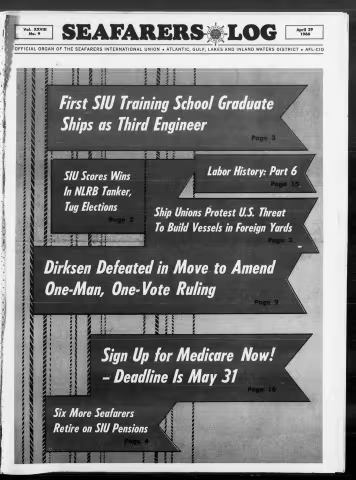
i/£( Jcore^ Wins
In NLRB Tanker,
Tug flertions
Labor History: Part 6
Ship Unions Protest U,S, Threat
To Build Vessels in Foreign Yards
Dirksen Defeated in Move to Amend
One-Man, One- Vote Ruling
^ 'IS ii
» • ' . J : ffl
8 i ' JS
i
i 0-' J
0 1 0 i
jf 1 ^ S ^ \ ^ s
5 ^ « V
g i
i
! S <
:
TT"
f
If
i|:«-f
r I I 1
Sign Up for Meditate Now!
^ Deadline Is Mav 31_mm
vBm^m
- ^
- p
Six More Seafarers
Retire on SlU Pensions S ••
Page Two SEAFARERS LOG April 29, 1966
r
Report of
International President
by Paul Hall
House Merchant Marine Committee chairman Edward A. Garmatz
noted recently that one of the best ways in which the Government
can avoid intensifying the adverse U.S. balance of payments deficit
is by dropping all plans of building American-flag ships in foreign
shipyards. This is a position which the SIU along with other marine
unions has maintained for many years.
Government proposals to build U.S. ships in foreign yards at the
same time when serious attempts are being made to improve our
balance of payments deficit are obviously self-defeating. Money which
would be kept in the United States through various other measures
would simply leave the country forever to buy foreign machinery and
pay foreign workers' wages. This money would be spent in foreign
nations, improve foreign economies, enrich the tax structures of foreign
countries—and the United States would be the loser as valuable U.S.
gold reserves flowed continually out of the country. American ship
yard workers would be faced with unemployment, and their lost wages
would eventually be felt by thousands upon thousands of other Amer
ican workers who would normally provide the goods and services
which shipyard workers buy with their wages. At the same time,
the Government itself would lose the valuable tax dollars produced
by a strong economy.
E>ropping plans to build American ships in foreign yards will be a
long step toward preventing the balance of payments deficit from
becoming worse. But the fact is that the balance of payments situation
is already bad and steps must be taken not only to prevent the outward
gold flow from increasing, but to also eliminate many of the routes
by which it is already escaping. Only then will the U.S. again achieve
a favorable balance of payments situation.
As the SIU has pointed out in the past, one of these continuing
dollar drains is brought about by the inadequacy of the present U.S.
merchant fleet, which is unable to haul more than a small proportion
of U.S. foreign commerce. Over 90 percent of U.S. foreign trade
presently moves aboard foreign-flag ships. This results in a huge
amount of revenue for foreign shippers—all paid for in U.S. dollars.
This money leaves the U.S. forever. At the same time, American sea
men are denied jobs and wages, and those other American workers
who would normally provide goods and services for America's seamen
also lose wages. The total result is to slow down the entire U.S. economy.
There is no single solution to the U.S. balance of payments deficit
because it results from the interplay of many different factors in many
different areas of the economy. A good beginning, however, would be
strict adherence to two policies—Build American and Ship American.
American-flag merchant ships must be built in American shipyards by
American workers.
Senate Defeats Third Try by DIrksen
To Amend One-Man, One-Vote Ruling
The Senate slammed the door on a constitutional amendment to overturn the Supreme Court's
one man, one vote ruling, handing Republican Leader Everett McKinley Dirksen his third succes
sive defeat on the issue.
Dirksen's supporters had
mounted a lavishly-financed
campaign to drum up backing
for his amendment. But when the
roll was called, the 55-38 margin
was seven short of the two-thirds
majority required. The only vote
switch from last August's rollcall
was a gain for the one man, one
vote forces.
AFL-CIO President George
Meany hailed the outcome, de
claring;
"Basic democracy won a ma
jor victory when the Senate re
jected Sen. Dirksen's proposal
which would have negated the
American principle of one man,
one vote.
"We in the AFL-CIO are ex
tremely pleased. We have long
fought for equality of citizenship
and the Senate action insures that
right."
Dirksen first tried to block re
apportionment of state legisla
tures in the summer of 1964 by
proposing a four-year moratorium
on court reapportionment orders
—with the expressed hope that a
constitutional amendment would
be adopted during that period by
minority-elected legislatures.
The AFL-CIO was one of the
first groups to sound the alarm
against the plan and the Senate
turned it down.
Last August, after failing to get
Judiciary Committee approval for
his proposed amendment to allow
one house of a legislature to be
set up without regard to popula
tion, Dirksen sought to substitute
his plan for an unrelated bill then
before the Senate. But the most
he could muster was a 57-39 vote,
well shy of the needed two-thirds.
It was after this defeat, in
which labor again played a key
role, that the GOP leader launched
his filibusters which kept the Sen
ate from considering the House-
passed bill to repeal Section 14(b)
of Taft-Hartley.
/
v/ U.S. Bars 258 Foreign Ships
For Trade With Cuha, N. Viet
WASHINGTON—The U. S. Government blacklist of ships
which are ineligible to carry U. S. foreign aid cargoes because
they continue to trade with Cuba or North Vietnam now stands
at 258 vessels flying the flags of ^
15 nations.
The list includes 251 ships
that have traded with Cuba and
10 ships that have been to North
Vietnam. Three of this 10 have
also been to Cuba.
According to the latest Mari
time Administration compilation
of figures 91 ships of 14 nations
have been removed from the list
and reacquired eligibility to carry
foreign aid cargoes following
promises by their owners that the
vessels will be kept out of the
Cuban trade in the future. None
of the ships blacklisted for trading
with North Vietnam have been re
moved from the list.
Of the 251 ships on the black
list for trading with Cuba, 72 are
British, 57 fly the Lebanese flag,
35 are Greek, 18 each from Pol
and and Cyprus and two each
iggBAE4IUE!HS^LOG^
|April 29, 1966 Vol. XXVIII, No. 9
1 Official Publication of the SIUNA
lAtlantic, Gulf, Lakes & Inland Waters
I : . V District, AFL-CIO
^ Executive Board
PAUI. Preeident
-CAITAWNBR ' : ' '•"^•^EARtSHEPARD ^^ r'
i^Epee. Viee-Pree. Vice-Preeident
5 v nAt KERR > LIND3BV WH.UAMS •
- See.-Treajt. Vice-President
jvJWRisrr MATTHEWS At TANNER
Vpee-President Vice-Preeident
I 0al:L. HERBTOTBRANU ; V
I Vxreetor of Organtzing and
Publications W'
i'0tanaging Editor Art Editor
' MIKE POLIACK BERNARD SEAMAN
P^^AseietantEditor ' . v''
|1^T^AN.SKYBR staff Writers
MBEVIN PDBV»
EDWIN F. FRANCIS
RI^:
liMictiy at 810 Made iilanii AssniM
VtiWiiltoB, 0. C- 20018 by «» Swh
iifnai Oalan, AtiUtIc, Ciif, Lsim anii
midm mftp:, AFt-6(0, <$75 foatth Ai
Tel. HYaeWI
iiNeOO.; Seeert pali at *aili!
foa, 0. C.
ATJ*«TJOi«: Fiitti 3579 satil
m-CI8, -jsr| ftmb AWM, trooklyn. HM
Norway, Sweden and' the
Netherlands.
'Project Recruit'
Graduates 15
West Va. Youths
NEW YORK—Fifteen youths
from West Virginia poverty areas
have completed 60 days of train
ing for shipboard entry ratings in
a program jointly sponsored by
the West Virginia AFL-CIO and
the Seafarers International Union.
At commencement ceremonies
at the SIU's Harry Lundeberg
School of Seamanship where the
group received its training in the
techniques of seamanship, certifi
cates were awarded attesting to
the competence of the school's
graduates.
The jointly-sponsored program
is known as "Project Recruit" and
is an example of the organized
labor movement's participation in
the national antipoverty program.
The training qualified the West
Virginia youths for entry ratings
in the three shipboard depart
ments—deck, engine and steward.
West Virginia AFL-CIO Presi
dent Miles C. Stanley, who is also
a special assistant to AFL-CIO
President George Meany for anti-
poverty activities, and SIU Presi
dent Paul Hall spoke at the com
mencement exercises.
The Lundeberg School gradu
ates came from nine different
West Virginia communities and
ranged from the ages of 17 to 19.
They were recruited through the
13 AFL-CIO local central labor
bodies and the Virginia State
AFL-CIO as part of labor's cam
paign to assist workers in impov
erished communities.
The two issues, Meany told the
AFL-CIO convention last Decem
ber, were "solidly and inescap
ably intertwined."
Professionals Used
The drive for the Dirksen
amendment took on a high pro
fessional gloss when the West
Coast public relations firm of
Whittaker & Baxter was hired to
develop "grass roots" pressure.
So-called "citizens committees"
were set up in each state, high-
paid lobbyists with both Demo
cratic and Republican connections
were hired. But the ground-swell
for the amendment never got
much further than editorials in a
number of small town news
papers.
Up until the eve of the vote,
Dirksen searched for additional
supporters by modifying his
amendment to take account of
some of the criticisms. He even
accepted a proposal he had once
firmly turned down. He agreed to
require that a legislature be re
apportioned on a one man, one
vote basis before it could submit
to referendum an apportionment
plan departing from those princi
ples. Dirksen explained his change
of heart by noting that some 37
legislatures are already reappor
tioned and therefore the require
ment would have little effect.
Ironically the giant of the Sen
ate in rallying opposition to the
Dirksen amendment was his Illi
nois colleague—Democrat Paul
H. Douglas.
^Labor Croup Cites Hall for 'Aid to Community Services'
NEW YORK—AFL-CIO unions including the SIU, and a score of community service agencies
participated in an all-day Community Services and Rehabilitation Institute at the Hotel Commodore
here on April 16.
Sponsored by the New York
City Central Labor Council,
AFL-CIO, in cooperation with
the Greater New York Fund, the
annual event included a series of
panel discussions on consumer
education, on maintaining family
health and on the role of older
workers in the labor force.
The Institute is part of the La
bor Rehabilitation Liaison Proj
ect established several years ago
by the central labor body's Com
munity Services Committee to
coordinate the community service
activities of AFL-CIO unions in
the New York metropolitan area.
SIU President Paul Hall was
honored by the Community Serv
ices with its "distinguished service
award" as "a trade union leader
who has contributed a great deal
to community services and reha
bilitation work."
In presenting its award the com
mittee cited Hall's "outstanding
contribution to the Labor Move
ment in general and the Com
munity Services program in par
ticular." A similar award outside
the labor field was presented to
Richard E. Booth, executive di
rector of the Greater New York
Fund.
Both awards were presented by
Michael Sampson, a vice-presi
dent of the Central Labor Council
Michael Sampson, Chairman of the N. Y. C. Central Labor Council
Community Services Committee (left). Council President Harry Van
Arsdale (center) and SIU President Paul Hall, are photographed
with plaque presented to Hall by Council's Community Services
and Rehabilitation Institute "for his outstanding contribution to
the labor movement . . . and to the community services program."
-
and chairman of its Community
Services Committee.
Louis L. Levine is director of
the Labor Rehabilitation Liaison
Project, which provides for care
and counseling to youth, the aged,
consumer groups and others
throughout the metropolitan area.
j
i,
j'
Anderson Is First To Obtain License Under New Program
SlU Training School Graduate Ships as 3rd Engineer
NEW YORK—Seafarer Robert Anderson be
came the first man to obtain his engineer's license
after preparing for his examination at the recently-
instituted engineer's training school jointly sponsored
by the Seafarers International Union and District 2
of the Marine Engineer's Beneficial Association. An
derson signed on the Steel Designer as Third Engineer
after being issued his license by the Coast Guard.
A member of the SIU since 1952, Anderson, who
is 37 years old, had been shipping in the engine de
partment as Fireman-Watertender and Oiler. When
the unprecedented joint program for training engine
department Seafarers to sit for their engineer's li
censes was announced by the SIU and District 2 of
MEBA, Anderson threw in his application. He was
among the first group to begin the course of study
and training when classes were started at SIU Head
quarters on February 1.
Within two months of beginning the intensive study
course, Anderson was ready to sit for his license ex
amination. He started the exam on April 7 and after
completing it successfully he was issued his Third's
license on April 14. Almost immediately he obtained
the Third Engineer's job on the Steel Designer for
the voyage which began on April 21.
Anderson said that "if it hadn't been for the train
ing program started by the union, I would never be
on this Third Engineer's job."
The training program, operated under a reciprocal
agreement between the SIU and District 2 of MEBA,
is the first of its type in the maritime industry. SIU
men who enroll in the program for instruction are
provided with meals, hotel lodgings and subsistence
payments of $110 per week while in training.
Seafarers who receive their licenses and sail as en
gineers will get full credit and protection for all of
their pension benefits built up under the SIU Pension
Plan. In addition, their SIU pensions will be sup
plemented by the District 2, MEBA Pension Plan in
approximately an equal amount while they sail as en
gineer, and welfare benefits are also covered and pro
tected. SIU men who qualify for their engineers'
licenses and sail aboard MEBA District 2-contracted
ships will not be required to pay the MEBA $1,000
initiation fee, which that union will waive. Nor will
they be required to drop their SIU membership if
they do not wish to.
Engine department Seafarers are eligible to apply
for the training program if they are 19 years of age
or over and have three years of watch-standing time
in the engine department. The period of instruction
ranges from 30 to 90 days and will he determined
by the member's individual ability and knowledge and
the instructor's satisfaction of his readiness to take
the exam. Applicants can begin receiving instruc
tion at any time.
There''are 58 men presently receiving instruction
under the joint Union training program which was
instituted to enable Seafarers to obtain their licenses
and to help meet the shortage of marine engineers
arising out of the Viet Nam conflict.
SIU engine men interested in the program should
apply immediately at any SIU hall, or directly to SIU
Headquarters at 675 Fourth Avenue, Brooklyn, N. Y.
The telephone number in HYacinth 9-6600.
SIU member Robert Anderson (right) accepts congrat
ulations of Seafarer Leroy Whitlow, FWT, on obtain
ing his Third Engineer's license as first graduate
of .joint SlU-District 2 MEBA licensed engineers train
ing program. Scene is engine room of Steel De
signer on which Anderson shipped as Third Engineer.
Time Cut for Temporary Srd;
SIU Program Offers Training
The SIU's training program for engine department men seeking
engineers' licenses has been expanded to include Seafarers wishing
to qualify for a temporary Third Engineer's license now obtainable
under a newly-issued Coast
Guard ruling.
Under the new Coast Guard
ruling, an engine room man with
18 months as a Fireman-Water
tender, Oiler or Junior Engineer,
together with six months as a
Wiper, is eligible to sit for a Coast
Guard examination for a Tem
porary Third Engineer's license.
Engine department Seafarers
possessing the necessary qualifica
tions to sit for the Temporary
Third's license can take advantage
of the licensed engineers training
program that is being offered
jointly by the SIU and District 2
of the MEBA. (For benefits and
assistance given to Seafarers en
rolled in the engineer's training
program see story above.)
A special feature of the new
Coast Guard ruling on temporary
engineers licenses provides that a
Seafarer who obtains a Tempo
rary license can move automati
cally to his permanent license
without another examination after
the completion of an additional
12 months seatime.
In addition, Electricians or Re
frigeration Engineers can receive
their Temporary Third Engineer's
license with the same amount of
sea time, when specifically recom
mended by the Chief Engineer of
a vessel and by the superintending
engineer of a company on whose
vessel he has served. Previous re
quirements called for two years
and six months as a qualified
member of the engine department,
18 months of which must have
been spent as a watch stander, in
addition to the six months wiper
time.
The change in Coast Guard
regulations is a result of the war
in Vietnam and the resulting
shortage of marine engineers.
Seafarers wishing to take ad
vantage of the opportunity to ob
tain instruction for the Temporary
Third Engineer's license, with the
assistance and benefits provided
by the joint SIU-MEBA District
2 training program, should make
application immediately at any
SIU Hall or directly to SIU Head
quarters.
SIU Wins Votes
On Tanker, Tug
The Seafarers IntemationalE)
Union scored two organizing 1
victories in the New England i
area recently. In New Bed- ;
ford, Mass., the SlU has been
certified bargaining agent for
able bodied seamen and me- :
chanics aboard the fuel tank- ;
C^r Nepco 10, operated by thfe j
e w E n gl a n d Pe t r o 1 eum !
In New London, Conn, i
the Sltf has been recognized j
as bargaining agent for crew-
members of the tugboat Wil
cox, opmted by the D.CtKv !
,'Corp. ^
Certification of the SIU
aboard the Nepco 10 fol
lowed an NLRB election held
on March 23 in which sea
men and mechanics voted
overwhelmingly for thej
Union. The fuel tanker op^' |
crates in many pons along
the East Coast, including.
New London, Providen
and Newport, R, L
Coast Ship Unions Protest Threat
By US to Builii Vessels Abroad
SAN FRANCISCO—Members of unions affiliated with the Pacific Coast Metal Trades Council,
supported by the San Francisco Bay Area Port Council of the Maritime Trades Department, staged
a demonstration in front of the Federal building here on April 14 to protest a reported plan by the
U. S. Government to build mer
chant ships in Japanese shipyards.
The demonstration was headed
by Thomas A. Rotell, executive
secretary of the Pacific Coast
Metal Trades Council which has
20,000 members in coast ship
yards. The protest was touched
off by Tokyo newspaper reports
that Maritime Administrator Nich
olas Johnson had told a news con
ference in Japan that the U. S.
wanted to buy ships built abroad.
Rotell said Johnson's remarks im
plied the closing down of U. S.
shipyards, and a move to change
the subsidy laws to eliminate the
requirement that vessels must be
built in American yards to qualify
for subsidy funds.
Hurt Recruiting Drive
The Metal Trades Council offi
cer said that the statements attrib
uted to Johnson already have
"crippled" the unions' recruiting
drive for skilled help in meeting
the increase in work in Western
yards resulting from the Viet Nam
conflict.
Rotell charged that the Johnson
statements were part of a "pattern
of organized campaigning for
adoption of a policy which calls
for the end of the American mer
chant marine and American ship
yards."
Among the hundreds of union
members participating in the dem
onstration were delegations headed
by SI UNA Vice-Presidents Morris
Weisberger, of the Sailors Union
for yoiifh V; minorihcs
Willie OilTrui;f builds
Billions of
Foreign-Builf Ships'
(kf
rt'f liJ<-'H:
•SiK'./uiK.wi'fitmi
iitq ft' ^itivf ffv kmwsf
Mffi'l'i!;!/ Mtdine m fk
m'f/th'i! fkhsohsttis III
fk
4?/>
,V}<t •{-}>, /'ly,*
'imm:
Trade unionists from shipbuilding, seafaring and other maritime
crafts staged demonstration in San Francisco to protest threats
by U. S. to switch shipbuilding contracts to Japan. Seafarer Juan
Reinosa (foreground) was among demonstrators from SI UNA unions.
of the Pacific; Frank Drozak of
the Atlantic, Gulf, Lakes and In
land Waters District, and Ed
Turner, of the Marine Cooks and
Stewards Union.
The day following the protest
demonstration. Acting Maritime
Administrator J. W. Gulick in
formed Rotell that the Maritime
Administrator would meet with
Rotell.
House Merchant Marine Com
mittee Chairman Edward Garmatz
informed Secretary of Commerce
John O'Connor of his concern
over the remarks attributed to
Johnson which he said did not
reflect the views of his committee
or of the Congress as a whole.
Page Fonr SEAFARERS LOG April 29, 1966
! 1
) I
Six Additional Seafarer Veterans
Join Growing SlU Pension Roster
Baay Blanco Baltheshofer Cleveland Sparpaglione
Six more SIU members have been added to the growing list of retired members who receive a pen
sion check of $150 every month. The Seafarer oldtimers who have been added to the retirement
rolls are: Cornells Baay, Peter Blanco, Leonard Baltheshofer, Elmer P. Cleveland, Anthony J. No-
watski and Charles Sparpag- ^
Hone.
Seafarer Cornelius Baay
became a member of the SIU in
the Port of New York. Born in
Holland, he had worked for the
New York Central Railroad since
1925 as a deck hand. He and his
wife, Helen, make their home in
New Jersey. Brother Baay joined
the SIU pension list jn December
of last year.
Blanco became a member of the
Union in 1940 at the Port of San
Francisco. He last sailed on the
Erna Elizabeth. He has been mak
ing his home in Jamaica, New
York; but, the native Floridian will
make his home in San Francisco
during his retirement years. He
received his first SIU pension
check this month.
Baltheshofer went on pension in
February of this year. He joined
The Gulf Coast
by LIndsey Williams, Vice-President, Guif Area
The SIU was honored by a visit from a delegation of officials from
the All Japan Seamen's Union. The delegation included Captain
Yutaka Nabasama, Vice-President; Tsunenori Mori, Vice Director for
Research and Kanji Shikiba, Vice Director of the Education Depart
ment.
During their stay in New Or
leans, from March 29 to April 4th,
they visited SlU-manned Delta
Line ships in port as well as the
Union's facilities. They also at
tended COPE and the Central
body meetings with a visit to the
Louisiana AFL-CIO Convention
rounding out their visit.
It's election time in Louisiana
and throughout the state voters
have been turning out for what
have proved to be closely run
primary elections, the April 9th
elections were so close that a num
ber of races will have to be set
tled in a May 14th runoff.
Now that the all important
primaries are over the general
elections will be held on June 14th.
The importance of Seafarers
registering to vote was pointed out
by the close races. In one com
munity, Harahan, the mayor was
elected by 43 votes. In Scott, La.,
by 14; Franklin by 8 votes; and
in Tickfaw (where several SIU
members live) the margin of vic
tory was a mere two votes!
New Orleans
Seafarer Larry Taffargue is a
proud new father. Papa Laffar-
gue's daughter, Bonnie Theresa
(7 lbs., 10 oz., 19 inches long)
arrived at noon on February 2nd.
Larry's last ship was the Alice
Brown; Now he plans on stick
ing around close to home for
awhile to be with his wife and
child.
Mike Dunn has been on the
beach for nearly six months re
pairing the datriage done to his
home by Hurricane Betsy. After
IS months as Chief Baker on the
Del Sud, he is now waiting for
another Delta Line passenger ship.
Brother Dunn says he'd like to
get back on the Del Sud as "it
was a ship on a good run to South
America."
After a lengthy stay on the
beach Louis (Polly) Arena is ready
to grab any group. One job that
hits the board. His last ship was
the Translndia. Illness knocked
him off this good ship and he had
to be flown home.
Norris (Gus) Bartlett is off the
Del Rio after a long trip as Sec
ond Electrician. Now it's time
for a well earned vacation and a
chance to do some much needed
chores around the house. Broth
er Bariett says he'll be ready to
go in about a month.
J. P. "Sloppy" Creel has been
making life at the Hall more en
joyable by his frequent visits. On
pension, Sloppy's got lots of time
to swap sea stories with the other
old-timers and he can really tell
them. He's recently moved from
New Orleans to McComb, Mis
sissippi.
Mobile
After a six month trip to Viet
nam, Korea, Japan and the Phil
ippines, Bernard Graham is cur
rently on the
beach. His last trip
was on the Citadel
Victory. Brother
Graham, a mem
ber of the Union
since its incep
tion, says he wants
to stick close to
home. He intends
to "do a lot of
fishing and shrimping before sail
ing that way again."
Now registered group one deck
department is George L. Bales
whose last vessel was the Marga-
rett Brown where he was deck
maintenance for a 90 day trip
to Vietnam. George is another
old timer who has been with the
Union since the beginning. He
and his wife make their home in
Mobile.
Graham
the SIU in the port of New York.
Sailing with the deck department,
he had been employed by the New
York Central Railroad Marine
Division since 1919. Born in
Brooklyn, he still lives there with
his wife Elizabeth.
Nowatski joined the SIU in
his home port of Philadelphia, Pa.
He sailed last on the tugboat the
Brant (Curtis Bay Towing) and
received went his first SIU pen
sion check this month. Born in
New Jersey, and now a resident of
Philadelphia where he lives with
his sister, Mrs. Mary Maronski.
He eventually plans to make his
retirement home in Deltona, Flor
ida^ He sailed with the steward
department as cook.
Sparpaglione joined the SIU in
the port of Philadelphia. Born in
New Jersey, he now makes his
home, with his wife Florence, in
Frankford, Delaware. He sailed as
a deckhand for the Independent
Towing Company since 1934. His
last vessel was the tug Venus.
Seafarer Elmer Cleveland's pen
sion went into effect in February
of this year. Born in Texas, where
he still lives with his wife Louise,
he joined the Seafarers in Port
Arthur. He sailed as captain of
the tug Hermes (Sabine Towing).
SIU Vessel
Opens 1966
Seaway Year
At 8:12 a. m. on the first of
April the SIU of Canada con
tracted vessel French River,
moved into the St. Lawrence Sea
way's St. Lambert Lock to offi=
cially open the 1966 shipping
season. The trip through the locks
took 45 minutes.
This is the earliest that the Sea
way has opened. Because of the
early spring officials indicate they
believe that last year's record of
43 million tons carried on the sea
way will be surpassed by over 5
million tons.
The last vessel to pass through
the locks during the 1965 season
was the SIU of Canada-crewed
Rimouski, which made the run
on December 16. The Rimouski
is also operated by Canada Steam
ship Lines.
The entire system was operat
ing by April 4 when the Welland
Canal was opened.
Mr. Joseph H. McCann, Ad
ministrative head of the St. Law
rence Seaway Development Cor
poration recently stated that no
action will be taken to raise tolls
on the seaway without public
hearings.
The Atlantic Coast
intercoastal trip aboard
Francisco was Angelo
by Earl (But!) Shepard, Vice-President, Atlantic Coast Area
The SIU is fully behind the State, County and Municipal Employees
union in their fight to repeal New York States Condon-Wadlin act
which denies public employees the right-to-strike.
A panel recently appointed by Governor Nelson Rockefeller to rec
ommend revisions in the act came up with a set of proposals which
recommend the continuance of the ^
Condon-Wadlin Ban, requiring all
public employees unions to sign
no-strike pledges, and establishing
penalties for strikers ranging from
reprimand to dismissal.
The proposals were denounced
by leaders of the AFSCME as
"Mad Hatter" proposals and the
SIU will continue to support the
union in their effort to have this
oppressive piece of legislation re
moved from the books.
Baltimore
Shipping has been excellent in
the port of Baltimore for the past
two weeks and the outlook for
the future also looks promising.
Andy Lufaves, is waiting
'around her for a grain run to In
dia after paying
off the Mount
Vernon Victory.
Norm Peppier, a
20-year SIU vet
eran is waiting
around for a
short trip after
paying off the
Seamar. Also on
the beach here is
Charley McDonald, an 18-year
SIU veteran, who's waiting around
for an intercoastal run after pay
ing off the Transyork.
Norfolk
Shipping has been fair in the
port of Norfolk and the outlook
for the future is the same.
Norm Wroton is on the beach
here and is waiting for a spot on
the Beaver Victory after signing
off the Steel Scientist. J. B. Harris,
who's last ship was the Transarc-
tic, had to get off the ship in Balti
more in order to attend to some
personal business. He's now reg
istered in Baltimore and is anxious
to get going again. Also on the
beach waiting to ship is B. D. El
liot, a 21-year SIU veteran who
last shipped on the Natalie.
New York
Shipping in the port of New
York has been exceptionally good.
Around to collect his vacation pay
Lutaves
after an
the San
Romero.
Some of the other oldtimers
who stopped by the New York
Hall recently to say hello included
Louis Almeida, who is just out of
drydock and Paul Howell who re
cently paid off the Steel Voyager.
On the beach in New York are
OIlie H. Kuykendall, Dewey
Thomas, Nick Nomikos, Peter
Notias, Matthews Fanos and
Frank White. All are looking for
a slot on the Viet Nam run.
Philadelphia
Shipping has been fair here in
Philadelphia.
Ready to go again after signing
off the Manhattan is veteran Sea-
farer Comas
Knight. Elmer
Wheeler is spend
ing a few weeks
at home after
shipping on the
Columbia. He
, stopped at the
^ Union Hall here
WTieeler to say hello re
cently. Also visit
ing with us recently was Art
Shaw, an engine department mem
ber who last sailed on the Globe
Carrier and is going to take it easy
for a couple of weeks.
Boston
Shipping has been on the sloiW
bell this period, but it is expected
to pickup with the summer boats
calling for crews.
"Big Mike" Gison visited the
Boston hall recently and said that
he will grab the first coast hug
ger that comes along. Mike last
shipped on the Robin Trent as an
AB. Alvoie Green was sorry to
have to sign off the Manhattan
because of illness in the family.
Francis Donovan said that he
is tired of feeding the horses and
that he will grab the first AB's job
that is put on the board. Fran has
been a member of the SIU for
25 years.
How To Keep A Runaway Afloat
The Arion, shown above in a Baltimore drydock, was built in the
United States, is owned by Panamanian interests, registered in Liberia,
and nearly sank recently off Bermuda. To caulk a 25-foot crack
which opened in the ship's hull during an Atlantic storm, a collection
of ship's linen, pillowcases, blankets and mattresses was stuffed in the
gash by a Bermuda salvage firm, enabling the vessel to sail to Balti
more for repairs. Captain Jiannis Hobitis exafnines damaged hull.
April 29, 1966 SEAFARERS LOG Page Five
The Great Lakes
by
Al Tanner, Vice-President and Fred Farnen, Secretary-Treasurer,Great Lakes
Fit-out is just about completed in the port of Detroit as all SlU-con-
tracted vessels recently steamed out of port.
Some of the oldtimers sailing aboard the LaLiberte included Arne
Graham, John Rottaris and Dennis Frarck. Also aboard the LaLiberte
are cook Ben Williams, porters Andy Treshak and Bill Heinz and sec
ond cook Herb Jacobs.
Gus Scholle, president of the
Michigan Federation of Labor,
AFL-CIO, was recently given a
dinner by labor in recognition of
his over forty years of service to
the labor movement. Scholle
played an important role in the
passage of the "one man, one
vote" rule. The proceeds of the
dinner will be used to set up
.scholarships for Israeli students
under the auspices of Histradrut.
Toledo
All SlU-contracted vessels here
have completed fit-out and have
already sailed with the steamer
Sylvania of the Tomlinson fleet
the last to leave the dock.
Some of the oldtimers who re
turned here this Spring to ship out
included Bernard Rosquist of the
steamer Sylvania, Joe Bults from
the Richard Reiss, Clarence Elder
from the J. F. Schollkopf and
Horace (Andy) Anderson from the
C. A. Reiss.
The Democratic candidate for
the Governor of Ohio, State Sena-
tor Frazer Ream spoke before the
Toledo Fort Council recently. Sen
ator Ream, in his address, said
that he had sailed on the Gt.
Lakes during his college years and
that he is acutely aware of the
problems on the Gt. Lakes, and
particularly the unemployment
practices employed by the state of
Ohio where unemployment com
pensation for seamen is con
cerned.
Buffalo
Fit-out for the port of Buffalo
was recently completed with the
callback of the crew for the R. S.
Webster. There was some delay
of vessels sailing due to the heavy
windrowed ice.
Some of the oldtimers who re
cently shipped out were Tony
Mankavitch on the George Stein-
brenner. Axel Sorenson on the
Paul Tietjen, and Bennie Baker
on the Niagara. Most of the ves
sels that layed up in this port are
now underway, with the J. C. Mil
ler being the first vessel to sail.
The Pacific Coast
by Frank Drozak, West Coast Representative
The SIU played host this week to a delegation from the Japanese
Seamen's Union who were visiting San Francisco. We extended to
them our heartiest welcome and hope that they had an enjoyable visit
with their fellow seamen here in the port of San Francisco.
Shipping here in the port of San Francisco is still very active and
we have plenty of jobs open for rT~ . . ,
ADv cwT': had not intended to retire just as AB's, oilers, FWT's, electricians,
cooks and bakers.
Paying off during the last ship
ping period were the Delaware,
Jefferson City Victory, Andrew
Jackson, Margaret Brown and the
Alcoa Voyager.
Signing on we had the Anti-
nous, Margaret Brown, Ocean
Dinny, Steel Architect, Jefferson
City Victory and the Transwest-
ern.
In transit we had the Seamar.
Ships due in shortly include
the De Soto, Vantage Progress,
Hastings, Young America, San
Juan, Steel Worker, Lima Victory,
Steel Apprentice, Elizabethport
and the Long Beach.
Pete Goodyuk just pulled in off
the Ocean Dinny and visted us
at the hall for a few days after
a long trip to the Far East.
Wilmington
Shipping remained active dur
ing the last period as we had the
Vantage Progress and the Carrol
Victory sign on and also had seven
ships in transit. There are still
plenty of jobs available here for
AB's, FOWT's and electricians.
The outlook for the coming
shipping period here is also very
good with several ships due in
transit, but at the present time
no payoffs are scheduled.
Alex Gurskie, after 27 years
sailing time with the SIU in the
steward department, has decided
that his seafaring days are over
and he has just received his first
pension check from the SIU. Alex
yet, but a heart attack last Decem
ber set him back. We hate to
lose a good cook like Alex, but
we wish him the best of luck
during his retirement.
Ed Loflin who just moved to
the coast from the East is ready
to grab the first FWT or oilers
job that comes across the board.
We are glad to have him here and
will be able to ship him with no
difficulty.
The local Catholic Maritime
Club luncheon for April was spon
sored by the harbor area unions
in Long Beach and Los Angeles.
We were pleased to be a part of
this activity and a successful
luncheon was enjoyed by all in
attendance.
Seattle
Shipping continues to boom
here in the Northwest and any
Seafarer can have his choice of
jobs out of this port.
On the beach here is Al Thom
as, .who said that his last ship,
the Northwestern Victory, was a
fine ship with a
good crew. Al
said that he'll be
taking it easy for
awhile before
shipping out on
the Alaskan run.
Frank Brodzik
walked into the
hall recently and
took an AB's job
on the Anchorage. Frank has
been a member of the SIU for
the past twenty years. *
Brodzik
FIT-OUT on the LAKES
The annual fit-out of Great Lakes
ships signals the beginning of the
shipping season on the Lakes as soon
as the ice breaks up. There is plenty
of work to be done by Great Lakes
Seafarers to get the many vessels,
which have been in layup during the
winter, back into shipshape condition.
The photos shown were taken at Stur
geon Bay and Manitowoc, Wisconsin.
SIU Great Lakes District-
manned ore carrier Fred A.
Manske (American Steamship
Co.) prepares to leave Stur
geon Bay, Wisconsin after
being put in tip-top condi
tion for coming season. Lakes
cargoes include iron ore,
coal, steel products, auto
mobiles and other products
of American and Canadian
industry and agriculture.
Annual fit-out involves plenty of hard work for SIU crewmen, and
chow time is important time of day. Seafarers shown above are
gathered for lunch aboard the A. E. Cornelius in Manitowoc, Wis.
Galley gang aboard Steamer
Mc-Kee-Sons poses for photo
at Sturgeon Bay after getting
ship's galley ready for action.
Although many SIU Great
Lakes ships carry cargoes
such as coal and iron ore,
kitchens are kept spotlessly
clean at all times to insure
health and welfare of crews.
Crewmen aboard the Hennpin in Manitowoc
leave their fit-out chores temporarily to enjoy
hot coffee in the vessel's messhall. some
J. Martin and H. Wolgast (l-r) get lapel pins
from SIU Port Agent Jackie Hall before going
aboard H.N. Snyder, docked at Sturgeon Bay.
Page Six SEAFARERS LOG April 29, 1966
I I
maOB SEAFARER
When you receive your copy
of (he LOG, what do you read
first and why?
Philip Salino: I mostly read
general union news, so I can find
out where we
stand on such is
sues as contracts,
benefits and the
like. Then, too, I
pick up other in
formation on im
portant topics.
For example, the
LOG has been
concentrating on the runaway-
flag ship problem, which should
be of interest to all Seafarers;
since they are carrying American
passengers and cargo without any
regard for safety or decent pay
scales.
— —
Herman Ricci; I just look for
the most interesting articles when
I pick up my
copy of the LOG;
it gives you some
idea about what's
going on in the
maritime world.
Also, I skim over
the shipping fig
ures and registra
tions to see how
job prospects are, and the digests
of ships' meetings gives you some
inkling as to how fellow Seafarers
are getting along and where they
are now.' It's good to hear about
old friends, sort of a way to keep
in touch.
Oskar R. Kala: I usually start
off with the President's report,
then follow up
with shipping and
labor news in
general. Since I'm
in the business, I
like to keep up
with what's going
on. Never can tell
when these pieces
of information
might come in handy. Just the
last issue, I read about how obso
lete our American-flag ships are
becoming due to the government's
failure to properly subsidize the
seen in years.
fleet. It helps me to decide how
to vote to keep the American mer
chant marine in business.
James Oehlenslagen I turn to
the obituaries when I first pick
up the LOG.
Every once in a
while I see the
name of an old
shipmate who has
left for the big
payoff. Next, I
look at the mem
bership pages for
friends I haven't
Now and then a
familiar face still pops up, along
with the information as to where
the man is now and what he's
doing. Just my way of keeping
up with acquaintances, I guess..
John Ellis: I like to see what's
new in maritime or labor news;
there's bound to
be something of
interest. ' The
paper always lets
a man know how
the shipping pic
ture is, and I'm
particularly inter
ested in what the
government is go
ing to do about our declining mer
chant marine. When I find out
how things are rolling along in
the merchant marine, I know what
the future holds for the merchant
seaman.
.
Earl Cain: I read the front page
first simply because it's the first
thing that catches
my eye. The cov
ers are usually
very colorful, so
I guess it's just
natural for them
to catch my eye.
After I've glanced
at the front page,
I ramble on
through the paper quickly to pick
out those articles I plan to read
later. Several of the regulars for
me are such things as the final
departures, the pension list and
the ship's digests.
Seamen ,
ew Orleans Slu played host recently to delegation from the All-
Japan Seaman's Union. Visit included discussions of seamen's problems
in both countries, tour of the New Orleans SIU hall and tour of docks
including a visit to the SlU-manned Del Sud. S
T. Mori, AJSU Vice Dir. for Research: Luke Le Blanc, IBD New Orleans
l^ep;r K^^hikibai A JSjU: V Dept.; Y. Nabasama, AJSt|
Vice President; Buck Stephens, SlU New Oreans Port Agent; Y. Hit
interpreter; R. Canha, U.S. State Dept.;' and K'^ Mafsuo
TOTAL REGISTERED
All Groups
Atlantic, Gulf |k inlffod Wotors DIftrlct
April 9 to April 22, 1966
DECK DEPARTMENT
TOTAL SHIPPED
Port Class A Class B
Boston 2 0
New York 59 38
Philadelphia 7 5
Baltimore 23 14
Norfolk 9 8
Jacksonville 5 3
Tampa 2 0
Mobile 36 9
New Orleans 27 22
Houston 42 19
Wilmington 6 5
San Francisco .... 27 25
Seattle 21 14
Totals 266 162
NOW ON THE BEACH
All Groups
Class A Class B Class C Class A Class B
61 31 18 168 69
4 6 1 30 15
24 12 6 89 51
4 1 0 26 19
6 4 1 13 10
2 1 3 16 3
8 5 0 81 17
34 19 1 115 53
36 23 8 148 60
5 3 3 30 0
25 21 39 78 22
13 11 11 31 8
222 137 91 825 327
ENGINE DEPARTMENT
TOTAL REGISTERED TOTAL SHIPPED NOW ON THE BEACH
All Groups
Port Class A Class B Class A Class B Class C Class A Class B
Boston 0 1
New York 46 31 32 31 31 145 55
Philadelphia 7 3 6 0 1 22 20
Baltimore 19 17 13 14 5 46 64
Norfolk 4 6 2 3 0 25 18
Jacksonville 3 3 3 4 1 7 9
Tampa 3 1 2 1 2 9 4
Mobile 20 11 5 .4 0 51 18
New Orleans 26 18 30 21 4 79 56
Houston 30 13 33 22 8 90 33
Wilmington 8 6 2 5 3 17 1
San Francisco 25 13 26 17 44 47 15
Seattle- 18 8 9 15 13 26 4
Totals 209 131 163 137 112 564 287
STEWARD DEPARTMENT
TOTAL REGISTERED TOTAL SHIPPED NOW ON THE BEACH
All Groups All Groups All Groups
Port Class A Class B Class A Class B Class C Class A Class B
Boston 1 1
New York 47 21 30 13 19 109 25
Philadelphia 2 2 1 3 1 11 8
Baltimore 10 16 9 12 2 54 39
Norfolk 6 6 3 4 1 8 13
Jacksonville 1 6 0 4 2 5 6
Tampa 1 0 1 0 0 6 7
Mobile 14 4 6 2 1 57 13
New Orleans 20 22 20 22 2 146 80
Houston 29 21 22 10 4 92 43
Wilmington 1 3 4" 2 4 18 1
San Francisco 27 9 18 7 37 55 18
Seattle 9 10 8 11 9 25 13
Totals/ 168 121 122 90 82 586 266
Plans To Build U.S. Ships Abroad
Attacked As Source Of Gold Drain
WASHINGTON—Recent Government decisions to reduce the U.S. balance of payments defi
cit by cutting overseas spending should scuttle, once and for all, proposals to build American-flag
ships in foreign shipyards, according to Edward P. Garmatz (D-Md.), chairman of the House Mer
chant Marine Committee. ^
Administration officials have
reportedly decided recently that
overseas spending for defense
and foreign aid must be trimmed
drastically. "In searching for ways
to stop the drain of dollars from
this country," Garmatz said, "our
economists should not overlook
our domestic shipbuilding indus
try. I find the build-abroad phil
osophy to be diametrically op
posed to and impossible to recon
cile with the avowed objective to
reduce the balance of payments
deficit."
A recent study by the Ship
builders Council of America has
shown the great value to the
American economy of building
our merchant ships in U.S. yards.
The Council study showed that
the construction of one modern
cargo vessel, which cost about
$10.5 million to build, will gen
erate about $60 million worth of
work for the overall national,
economy, out of which the Gov
ernment will realize about $10
million in taxes.
Lakes Fleet Declines
Meanwhile, the rapidly deteri
orating condition of the U.S.
Great Lakes Fleet was described
as "cause for alarm" by John M. I
Drewry, Chief Counsel Jor the
House Merchant Marine Com
mittee, speaking before the Lakes
Carriers Association.
Drewry noted that in 1964 the
U.S. Great Lakes fleet had de
clined to 269 ships, 60 percent
of which were over 40 years old.
Today, about one-half of the U.S.
Great Lakes ships are more than
50 years old, he said."
To reverse the present trend,
he noted, will require fast, new
modern ships designed to take
productive advantage of the im
proved harbors and terminals
which have followed the opening
of the St. Lawrence Seaway and
the enlarged locks, deeper chan
nels, larger turning basins, and
the other improvements made at
heavy public expense."
SlU Welfare, Vacation Plans
Cosh Benefits Paid-Feb. l-Feb. 28, 1966
Hospital Benefits (Welfare)
Death Benefits ......
Disability Benefits
Maternity Benefits
Dckplei^ Beliefs:
Optical Benefits ..
0«it-Patient Benefits
Summary (Welfare)
V^albfidn-BkinefltS''^'. ; < .
Number of
Benefits
$ 5,734
20
844
51
546
11,929
1,20^
Amount
Paid
$ 60,089.50
57,903.00
126,600.00
10,197.65
77,110.81
8,097.46
3^132.40
377*130.82
476,346.31
TOTAL WELFARE, VACATION
BENEFITS PAID THIS PERIOD :tt3,132 853*477^1 J
April 29, 1966
SEAFARERS LOG Page Seven
COPE Conferences |
Show Record Turnouts |
WASHINGTON—Trade unionists are determined to work harder
in 1966 recognizing that the stakes are higher than in any previous
off-year congressional election.
This conclusion emerged from soundings taken among delegates to
this year's series of area conferences conducted by the AFL-CIO
Committee on Political Education, National COPE Director Alexander
E. Barkan reported.^ A record number of more than 7,000 state,
central body and local union leaders and members attended 13 COPE
conferences in as many cities. i
The numbers and enthusiasm of delegates and their response to the
conferences show they're ready to go all-out to help re-elect our liberal
friends, Barkan said. "There was real recognition of the importance
of the accomplishments of the 89th Congress, despite open and obvious
disappointment over failure of 14(b) repeal."
Members seemed particularly aware of the great contribution of the
51 new liberals elected to the House in 1964 who made the flow of
progressive legislation possible, Barkan reported.
"But our members know the score," he said, "and they're aware of
the obstacles the newcomers must overcome to win re-election in
November. They know that the conservatives will be throwing more
money and manpower into this election than any previous off-year
election. But they seem ready for a full-scale effort, and that's just
what we'll need."
Barkan said materials distributed at the conferences showed how
narrowly most of the newcomers won in 1964—despite President John
son's landslide victory—and how important their votes had been to
passage of key liberal legislation like medicare, aid to education,
housing, voting rights, anti-poverty programs, public works and other
job-creating measures.
Other materials showed that off-year balloting usually cuts heavily
into the congressional strength of the party in control of the White
House. The average loss over the past 60 years has been 37 seats in
the House and five in the Senate.
Barkan said any comparable loss this year would "cripple hopes for
more good legislation and would probably place control of Congress in
conservative hands for years to come."
The Amalgamated Clothing
Workers have negotiated a three-
year contract providing wage and
benefit increases valued at 52
cents an hour for 400 alteration
tailors in most of Philadelphia's
clothing stores and men's apparel
departments. The alteration
workers, called bushelmen by the
trade, will get wage hikes of $5 a
year each year of the agreement;
a third week of vacation, a seventh
paid holiday, an increase in insur
ance and pension benefits, and
overtime pay after eight hours of
work. Benefits are retroactive to
March 1. The new pact also calls
for a boost in the fitters' minimum
wage.
The Iron Workers, bargaining
agent for 369 workers at the
Harnischfeger Corp. plant in
Cudahy, Wisconsin, near Milwau
kee, has defeated an attempted
raid by the expelled United Elec
trical Workers. The vote in a Na
tional Labor Relations Board elec
tion was Iron Workers 200, UE
124, neither 8. The victory was
reported by the Iron Workers and
the AFL-CIO regional office. The
plant was bought by Harnisch
feger 20 months ago from the
Novo Industrial Corp., Milwaukee
Crane division.
— _
Action on a proposed merger
between the National Federation
of Postal Clerks and the National
Postal Union was referred to the
federation's convention -next Au
gust after a special convention in
Cleveland narrowly defeated a
plan previously worked out. A
two-thirds vote of the special con
vention was required. The ratifi
cation vote of 605 and one-twelfth
to 334 and eleven-twelfths was 21
votes short. The NPU had previ
ously approved the merger agree
ment by a 7-1 margin in a special
convention and a membership
referendum. President E. C. Hall-
beck of the Postal Clarks and
NPU President Sidney A. Good
man announced that merger talks
will be resumed, starting April 21
in Washington.
— <i> —
Nearly 7,000 teachers at over
seas schools operated by the De
fense Department for families of
Americans serving abroad have
won a long battle for pay equity
in a bill cleared by Congress and
sent to the White House. At both
House and Senate hearings, repre
sentatives of the AFL-CIO, the
American Federation of Teachers
and the AFL-CIO Government
Employes Council protested a pay
policy which gave many experi
enced teachers a salary below that
of government clerk-typists. In its
final form, the legislation guaran
tees teachers pay equal to the
average of classroom teachers in
U.S. cities of more than 100,000
population.
^1/
The entire membership of the
Wilmington, Delaware Fire De
partment has joined the Fire
Fighters and has received its
charter as a local, Raymond C.
Fogarty, district \ijce president of
the union, has announced. The lo
cal is the first established in Dela
ware, which was the only state in
the country without a Fire Fighter
unit, Fogarty said. The depart
ment has about 245 members.
lAFF President William D. Buck
expressed gratification at the "ma
jor breakthrough" for the union
in the Delaware area. Fogarty
also announced the chartering of
new locals in Anne Arundel
County, Hagerstown and Indian
Head, Md., and Farrell, Pa.
'77/ Never Learn That A/ew Math"
Senator Everett McKinley Dirksen (R-
III.) has lost another round in his continuing
fight against the 20th Century. Flushed with
his recent success in blocking the will of the
American people by preventing his fellow
senators from voting on the bill calling for
repeal of Section 14B of the Taft-Hartley
Act, Dirksen immediately sallied forth on
another of his recurrent attempts to over
throw the Supreme Court's historic one man,
one vote decision calling for reapportion
ment of state legislatures.
This time he made a mistake however, by
allowing his fellow senators to vote on the
issue, and they promptly rejected his pro
posed amendment to the Constitution. This
represents Dirksen's third consecutive fail
ure on this issue and most of his colleagues
agree that the matter is now dead for good.
Like Repeal of 14B, the one man, one
vote ruling has the full support of the Amer
ican labor movement. Reapportionment is
long overdue and made increasingly neces
sary by the continuing shifts of population
from rural areas to the cities in recent years.
This population shift to urban areas has
produced problems of housing, schools, mass
transit, air and water pollution and recrea
tion with which rural-oriented legislatures
are unable and unwilling to deal. Under
the old system, rural areas with relatively
few people were vastly over-represented
while the millions of city residents were
vastly under-represented.
The political old-guard, represented by
Dirksen in the Senate, is bitterly opposed
to the one man, one vote ruling because it
spells the doom of their well-oiled and long
standing reactionary political machines,
which have for years allowed them to wield
power grossly out of proportion to the num
bers of people they represent. The one man.
one vote decision opens the way to progres
sive, liberal, forward looking legislation,
without which many of the problems facing
the nation cannot be solved..
The American labor movement, led by
the AFL-CIO, waged a long campaign to
reform apportionment of state legislatures—
a campaign which culminated in the Su
preme Court's one man, one vote decision.
In this the American labor movement was
acting, as it has so often in the past, as
the "people's lobby"—representing the rights
of millions of American citizens who were
getting a raw deal from machine politicians,
who often cared for little beyond the main
tenance of their own power.
Many feel that organized labor's strong
campaign for the one man, one vote concept
was the main cause of Dirksen's savage op
position to 14B repeal. AFL-CIO President
Meany has said that the two issues—14B
repeal and reapportionment—are "solidly
and inescapably intertwined" as far as Dirk
sen is concerned. Dirksen's filibuster block
ing 14B repeal has been described by Meany
as being, in effect, an ultimatum to the Amer
ican labor movement—'Give up your op
position to the reapportionment amendment
and you can have 14B repeal.' This is
the sort of log-rolling, pork-barreling machine
politics which Dirksen understands but
which organized labor refuses to endorse.
With reapportionment now the law of
the land, the American labor movement
will continue the fight for 14B repeal. Dirk
sen's fight against reapportionment met de
feat because it was an unpopular, unethical,
reactionary cause out of step with the times.
The fight for 14B repeal is destined for
success because it represents the needs and
desires of the American people in the 20th
Century.
SBiii
' I .1
Page Eight SEAFARERS LOG April 29, 1966
-11 '•"
OOM..
* U.S. MDUSTRT BIES
111';: (.•
' I
V
, I. .
r ;)• : •
„ 1-
r I
i
I
i I
April 29, 1966
SEAFARERS LOG Page Nine
J ;>
. DOWN... DOWN
BUSINESS is soaring in the United States.
Since the current period of economic ex
pansion began in 1961 the nation's gross
national product (GNP) has climbed steadily to
new record highs. Profits and production of
American industry have reached the highest point
in history. The first quarter of 1966 saw the
nation's GNP grow by nearly $17 billion, the
steepest quarterly advance since 1961. More
automobiles are being produced and sold each
year. The plastics and drug industries are pushing
to new peaks. Aircraft and aerospace are enjoy
ing unprecedented activity. Almost everywhere
there are evidences of boom.
Yet in spite of the continuing boom of Ameri
can industry generally, one of. the nation's vital
industries—maritime—is declining steadily. Our
merchant fleet today is down to about 900 vessels,
of which two-thirds are obsolete. At the end
of World War II our fleet- consisted of some
6,000 ships and we were the strongest merchant
marine power in the world. Today our ships carry
less than 9 percent of our foreign commerce as
opposed to over 40 percent during the early post
war period.
The decline of the U. S. maritime industry has
affected not only the number of our ships but
also bur shipbuilding, ship servicing, repairing
and supply industries. The maritime industry
today provides employment for about 40,000 sea
men. During the early post war years it employed
some 80,000 men. A corresponding decline has
taken place in shipyard employment. While most
American industries lead the world in production
and employment, the U. S. maritime industry
has slipped down to fifth place with respect to
the size of our merchant fleet and twelfth place
in shipbuilding.
TO understand the reason for this paradox
in which American industries are booming
but maritime goes down and down, we need
but look at the role which government attitude
and policy has played in influencing the condition
of American industry. Government must provide
the atmosphere in which industry can grow. And
a look at the industries where government pro
vides a climate conducive to growth points up
that fact. The steel industry, for example, enjoys
a number of Government growth aids, including
investment tax credit and generous depreciation
and depletion allowances. In addition to similar
aids, the automotive industry also benefits from
Government contracts for military vehicles. The
petroleum industry enjoys a huge depletion allow
ance in addition to investment tax credits and
foreign tax credits. The aircraft and aerospace
industry benefits from similar aids in addition to
various Government contracts. Government-spon
sored research and development and accelerated
depreciation benefits. In all these industries and
in many others. Government has provided an
atmosphere in which industry can develop and
expand.
This has not been true in the maritime industry
however. In all the years since the end of World
War II the Government has never formulated a
firm and constructive policy toward the maritime
industry. This apparent lack of interest by the
Government has led to continuing uncertainty
and confusion about the future of the industry
and created a climate in which new operators
have not been attracted to the industry and the
existing operators have not been encouraged to
expand their operations. An example of this lack
of positive Government policy which is throttling
the maritime industry is the recent Interagency
Task Force Report—or Boyd Report—in which
a group of government bureaucrats has recom
mended that foreign-flag and foreign-built vessels
be permitted to enter the domestic trades to com
pete against established U. S. operators. Although
no definite action has been taken on the Boyd
Report its dissemination has already done much
damage to maritime by increasing the uncertainty
and confusion regarding the future of the indus-
trjj, As long as this indecision and confusion con
tinues it is doubtful that the maritime industry
can be considered a worthy area for the invest
ment of capital .and effort with a reasonable ex
pectation of future returns on that investment.
GOVERNMENT administrators and bureau
crats seek to duck responsibility for their
shameful indecision and neglect of the needs
of maritime. They have hidden behind a variety
of charges designed to shift the responsibility for
the industry's condition. At various times they
have blamed the industry's decline on unsatisfac
tory labor-management relations. At other times
they have charged that it is not wise economically
for the U. S. maritime industry to even try to com
pete with foreign maritime interests which can do
the job more cheaply.
Under examination however, these arguments
do not stand up. Other U. S. industries, which
are undergoing record growth and expansion, also
have collective bargaining relationships with
unions. Many industries maintain relationships
with several unions at the same time, as is the
case in maritime and for which it has been casti
gated. Although disputes and differences occur in
these industries they have not prevented these
industries from flourishing, and the argument that
the U. S. maritime industry should be allowed to
expire simply because foreign maritime fleets can
operate more cheaply and that the United States
therefore does not need a strong merchant fleet
but can depend on foreign ships to carry our vital
foreign and domestic commerce is a highly danger
ous concept. Were this theory of "going where it
is cheaper" applied to other American industry,
such as the automobile or steel or aero-space in
dustries, the results would be disastrous and the
whole structure of the U. S. economy could come
crashing down. Yet this is what the Boyd Report
has recommended.
MORE voices are being raised to express
alarm at U. S. maritime's continuing de
cline, with its inherent danger to the na
tional interest and security. Progressive, forward-
looking recommendations have been made which,
if adopted by the Government, would put the
maritime industry in a position where it could
adequately serve our nation's needs. Many of such
recommendations are contained in the President's
Maritime Advisory Committee's Report, which
offers a program for strengthening maritime as
opposed to the destructive purposes of the Boyd
report.
Up to now however, the Government has shown
no inclination to act on the recommendations con
tained in the Advisory Committee Report. But
until it does decide on a positive, constructive,
forward-looking policy for the maritime industry
the responsibility for perpetuating the paradoxi
cal and dangerous situation that allows American
industry to climb but smothers maritime will rest
with Government alone.
Page Ten SEAFARERS LOG April 29, 1966
•t:
11
I?
>1
J,"
•f-
liS
!}!
ei;
w. w
d!
I 'p
I
I
• Vji
.V R '-iV,.. , ft '
' •I'-T
.•:s.v I
On the Ships
From coast to coast, Seafarers man the
nation's merchant ships which call at
ports all over the world. Pictures on
this page depict Seafarers at work aboard
some SlU-contracted vessels by LOG pho
tographer when the vessels put into port.
Steel Surveyor deck department members get the vessel shipshape before leaving
Erie Basin. Included (l-r) are: Frank Fromm, AB: Charles Cliburn, OS; Leonard Buga-
jewski, AB; Gus Venardis, OS; George Clements, OS; and Sophoklis Tzortzakis, AB.
Paul Cortissoz, AB, puts coat
of fresh paint on Robin Hood
wheelhouse before ship leaves.
Seafarer R. Nugent takes time
out to pour some coffee in
the Surveyor's Engine Room.
Preparations for the evening's meal begin early
aboard the SlU-manned Steel Surveyor. Galley gang
includes Marshall Burns (at left) and Bill Matson.
Seafarer Frank U. Fromm, AB, coils a
mooring line as Surveyor prepares
to leave Erie Basin for Middle East.
Steel Surveyor crewman (l-r) Francisco
Tirado, steward and Davad Rojas, 2nd
electrician posed for LOG photo.
Deck delegate A. Miranda (left) and ship's delegate Elmer Clarke, Jr. (right) flank SlU Vice Pres
ident Bob Matthews as he notes repair list compiled by Steel Surveyor crew members during ship's
Persian Gulf run. There were few beefs except the routine one about hot Middle East weather.
Robin Hood deckmen (l-r) Stanley
Kroll, AB; William Emerson, AB; and
John Piselle, OS, stow the ship's lines.
Santos E. Martinez, fwt, signs for his pay during
payoff of Del Rio in New Orleans, as bosun Dick
Ransome waits his turn. Purser has back to camera.
Seafarers (from left to right) Carl Moore, A. B. Williams, J. P. Andrew and
Jake Levin, all AB's, take tirhe out to survey part of work left to be done before
Robin Hood sets sail from Brooklyn, N.Y. dock on voyage to Capetown, S. Africa.
A
„F5i iifet'S-'-i-V a ;>• rj, tlv .- -«. •-*'
April 29, 1966 SEAFARERS LOG Page Eleven
Seafarer's Spare Time On Beath
Spent In Pursuit Of Auto Hobby
An old dilapidated car combined with a lot of hard work can add up to something worthwhile,
according to Seafarer Carey Heywood who hails from Virginia Beach, Virginia. Heywood picked
up a 1955 Chevrolet for $50 and is now in the process of completely rebuilding the auto from en
gine to seat covers.
"When I bought the car,"
Heywood explained, "boy, was
it a heap. Since the Chevy had
been owned by a family living on
the ocean front, the body was
rusted out, and the upholstery had
gone bad from years of hard use.
Heaven only knows how many
miles were on that engine, be
cause the speedometer had been
out of commission for several
years. In other words, I had quite
a project on my hands."
So Brother Heywood rolled up
his sleeves and went to work. Na
turally, the job was slated to be a
long one, because he spent most
of his time at sea on Mediterra
nean and North Europe runs.
"Just couldn't fit the car in on
the ship," he said. "Lucky those
people who take up photography
or something like that, because
they can take their camera along
wherever they go.
Deck Department Seafarers
Brother Heywood, who ships
out in the deck department, is
not a man who likes to let other
people do his work. He first
tackled the task of completely re
painting the auto, then moved on
to ripping out the old radio and
installed a new stereo set with
speakers in the back and front.
"It's not that I don't often have
to call on help from the real
experts who know more than I do
about automobiles," he explained.
"There are many problems that
I wouldn't consider handling on
my own; but the things I can do
with my own two hands, I use
tho.se same two hands to do it.
After all, that's the purpose in
having a hobby. Those people
who call automobiles their past-
time and then pay someone else
to work on them, well, I have my
opinions about that sort of opera
tion."
One of the chores that Hey
wood always seeks outside advice
on are problems with the engine.
Although his auto now has a
small six-cylinder, he plans on in
stalling an eight in order to, as he
put it, "keep up with the power
equivalent of today.
No Drag Racer
"Not that I believe in this hot-
rodding bit," Heywood said, "but
it's just that there are times when
you have to have power on these
modern highways. Though there's
a lot of boys who get their kicks
from drag racing, I just happen
not to be one of them."
Heywood plans on installing a
rebuilt engine in his car when
he .scrapes up the cash. "It's less
costly," he declared, "and prob
ably just as good. I plan on an
engine with good possibilities for
transferring parts—and I don't go
to the junk yard for the material.
If a man is putting a lot of work
and money into an auto, he wants
something that can be depended
on.
"And after I get the new engine
in," said Brother Heywood, "there
are a wide range of possibilities
of improvement, but that's the
time I'll really have to look to
those boys who know their busi
ness. You know, when you drill
an engine block to compensate
for a shorter stroke, it takes a real
expert to determine whether the
block will take any more thinning
of the cylinder walls. But all this
sort of thing is probably too tech
nical to discuss, both for me and
anyone else who might choose to
read my comments. But I'm still
trying to learn."
ROBIN GOODFELLOW (Moore-McCor-
niAck), March 20—Chairman, George
Stanley: Secretary, Aussie Shrimpton.
{20.00 in ship's fund. Some disputed OT
in engine department. Food plan repre
sentative to be contacted upon arrival in
States.
^
MARORE (Venore), February 20—
ChairiBan, W. L. Hammock; Secretary,
W. J. McNeely. No beefs reported by
department delegates. • Brother W. L.
Hammock was elected to serve as ship's
delegate.
ANDREW JACKSON (Waterman),
April 8—Chairman, T. J. Hilburn; Sec
retary, L. Mitchell. One man missed
ship in Japan. Jll.OO in -ship's fund.
Some disputed OT in deck department to
be taken up with boarding patrolman.
Motion made that all watches stood in
Port between the hours of 5:00 P.M. and
8:00 A.M. be OT and said OT be split
equal among the watches, to be paid
regardless whether cargo is being worked
or not. Vote of thanks to the steward
department for a fine job.
YOUNG AMERICA (Burbank), March
13—Chairman, Lawrence Hitchner; Sec
retary, Werner P^ersen. Ship's delegate
reported that ship has a good crew and
everything is running smoothly. No beefs
reported by department delegates. Vote
of thanks to the steward department for
the good chow.
4>
ROBIN GOODFELLOW (Moore-McCor-
mack), February 19—Chairman, George
Stanley; Secretary, Aussie Shrimpton.
Brother George Stanley was elected to
serve as ship's delegate. TV purchased
and installed to everyone's pleasure and
satisfaction. Letter of thanks was writ
ten to the Seaman's Church Institute, in
appreciation for the Christmas gifts re
ceived by the ship last trip. A sum- of
$45.00 was donated and much appreci
ated by a visiting Chaplain from the
SCI. No beefs reported by department
delegates.
ROBIN LOCKSLEY (Moore-McCor-
mack), March 26—Chairman, Frank
Myatt; Secretary, Luther Gadson. Ship's
delegate reported that everything is ship
shape. Few hours disputed OT in engine
department.
ALCOA MARKETER (Alcoa), April 8
—Chairman, Guy DiViaio; Secretary, J.
A. Shea. All beefs were squared away.
Two men in deck department missed ship
in Charleston, S. C. and one man was hos
pitalized in Charleston, from steward de-
partment. Motion made that all hands
donate $1.00 to build up ship's fund.
Vote of thanks extended to Guy DiViftio,
chief, and Cecil Kane, 2nd electrician for
a job well done on TV and antenna.
SEATRAIN LOUISIANA (Seatrain),
March 21—Chairman, Roy Pappan ; fe
retory, Frank Naklicki. $120.38 in ship s
fund. No beefs reported by department
delegates. Few hours disputed OT for 9rd
cook in steward department. Motion made
to contact headquarters to get definite
information regarding pension plan.
COLUMBIA (U.S. Steel), March 2—
Chairman, R. T. Lavoine; Secretary, M.
S. Sospina. Ship's delegate was hos
pitalized in Cristobal, Panama Canal.
Brother Alexander McElhenny was el
ected to serve in his place. Vote of
thanks to the entire steward department
for 3 job well done. No hccfs reported
by department oelegates.
ALCOA EXPLORER (Alcoa), March
IS—Chairman, L. Jones; Secretary, None.
Some disputed OT otherwise everything
is in g^ shape. Chief steward ex
tended a vote of thanks to the entire
crew for their good behavior and coop
eration during the voyage. The crew
likewise extended a vote of thanks to
the steward department for a job well
done. Patrolman to be contacted regard
ing retiring time for pension.
MERBIMAC (Oriental Exporters).
March 13—Chairman, Nicholas Hatgi-
misios; Secretary, Charles Welch. Ship's
delegate report^ that everything was
O.K. Deck delegrate resigned and Brother
Jack Pierce was elected to serve as new
deck delegate. Vote of thanks extended
to the steward department for a job
well-idoneip ' .. ..
DIOEST
of SIU
MEETINQS
OCEAN PIONEER (Pioneer Tankers),
March 20—Chairman, Joe C. Selby; Sec
retary, D. Simmons. No major beefs
brought to attention of the ship's dele
gate. Motion made that headquarters
comonunications, OT sheets and clarifica
tion of Proposed Agreements be fori
warded to next port of call. Vote of
thanks to the steward department for a
job well done.
OCEAN EVELYN (Maritime Over
seas), April 9—Chairman, M. M. Cross ;
Secretary, Herb Knowles. General dis
cussion on the welfare of the crew as a
whole. No beefs reported by department
delegates.
^ _
DEL OHO (Delta), April 3—Chairman,
L. J. Bollinger; Secretary, T. J. Lewis.
$100.00 Safety Award has been awarded
crewmembers. Brother Dexter Worrell
waa elected to serve as ship's delegate
and he will keep safety award money in,
ship's fund. .
W:-~. • : -ff;
DEL CAMPO (Delta), April 8—Chair
man, Clayton Thompson; Secretary; N>
Pat Ragas. Department delegates re
ported that everything is running smooth
with no beefs. Vote of thanks to the
steward department for a job well done.
Food was very good.
Lifeboat Class No. 149 Casts Off
Graduates of SIU Lifeboat Class No. 149 gathered for their class
photo after successfully completing course of lifeboat training at
the Harry Lundeberg School of Seamanship. Latest group of life
boat ticket holders includes (kneeling, l-r): John Griffin and Warren
Ness. Middle row, l-r: Robert Mathews, Willy Lindsay, Krim
Blackwel! and Rafael Robles. Rear, l-r: Erik Nordeng, William
Slayton, Cleveland Snead and class instructor Ami Bjornsson.
Fortes
Marcus R. Fortes, 58: Brother
Fortes joined the Union in Balti
more in 1943. He sailed with the
engine depart
ment as an oiler.
Brother Fortes
died in Djibouti
French Somali-
land in August,
1964 while ship
ping on the Over
seas Joyce. Death
came from a heart
attack while he was on duty in
the engine room. At the same
time of his death he had been
at sea over 35 years. He is sur
vived by his wife Georgiana For
tes of Brooklyn, New York. He
was born in the Cape Verde Is
lands in 1906.
John Crosswell, 59: Brother
Crosswell succumbed to a linger
ing heart ailment
in Houston, Tex
as. He was a na
tive of South
Carolina and
joined the SIU in
Galveston. While
with the SIU he
sailed as a mem
ber of the stew
ard department. Brother Cross-
well was a resident of Houston
and will be buried in the Texas
city. He is survived by a daugh
ter, Sandra Kay Crosswell, also of
Houston.
Crosswell
Juan C. Ruiz, 66: Brother Ruiz
joined the SIU in 1956 at the port
of Wilmington,
Calif. While with
the SIU he sailed
as a messman in
the steward de
partment. Ruiz
died of an heart
ailment while on
a visit to his na
tive Phillipines
Islands. He made his home in
Wilmington, Calif. He is survived
by a daughter, Carozon M. Ruiz,
of Cebu, Phillipines Islands. His
final resting place will be near his
ancestral home in Cebu, the
Phillipines.
Ruiz
Louis Dee LeBIeu, 37: Brother
LeBleu died in March, 1966 in
Ville Platte. Louisiana of an acci
dental death. A
native of Louisi
ana, he began
sailing with the
Union in 1956
and joined in Port
Arthur, Texas.
Brother LeBleu
sailed with the
deck department.
He is survived by his wife, Lau-
rice Courrille LeBleu of Marks-
vilie. La., and their two children,
Joseph Kerney and Debra Lynn.
He was buried in St. Ann's Ceme
tery, Mamou, La.
LeBleu
irSAVs; J
J"
Page Twelve SEAFARERS LOG April 29, 1966
Ships at Sea
On a long voyage there's nothing like a good crew of Seafarers who keep the place in ship-shape.
That's the case on the Del Santos (Delta) down South America way where Joseph Suarez has been
doing a fine job in keeping passageways and other hard to clean places spotlessly clean. The deck
delegate accepted the crew's vote
Meehan
of thanks to Brother Joe. Since
leaving Paranagua, Brazil, Bill
Meehan has been
elected the new
ship's delegate.
Bill reports that
the brothers give a
vote of thanks to
Elmer Lane and
the rest of the
steward's depart-
m e n t for the
"consistently good
feeding and extra sweets during
coffee breaks." Things are run
ning smoothly with no beefs as
the ship heads for the port of
Rio de Janeiro.
Frank Naklicki reports the men
on the Seatrain Louisiana (Sea-
train Lines) were
very interested,
during a recent
stop
York,
about
school
Naklicki
in New
to hear
the new
deal for
engineer training
from a Union Pa-
trolman. "No
beefs reported,"
say meeting chairman Roy Pap-
pas. The ship has been getting its
mail regularly.
The crew aboard the Wild
Ranger, according to meeting sec
retary Robert W.
Ferrandiz, gave a
big vote of thanks
to the steward de
partment for put
ting up a real fine
New Year's din
ner. The ship is
running quite well
and there are no
significant beefs.
In addition Meeting Chairman
Arthur Beck has reported that the
Captain aboard the Wild Ranger
said that this one of the best trips
that he had had the pleasure to
sail on.
Men of the St. Christopher (St.
Lawrence Carriers) had a wel
come break in the
form of a pleasant
18-day stay in
San Francisco
while the ship un
derwent repairs
before its trip to
Norfolk, reports
meeting secretary
Edward Sherris.
Arnold Hindenes
was elected ship's treasurer. Every
thing is going smooth, no beefs.
Hindenes
McRae
Viloria
Edward Davidson has been
elected as ship's delegate aboard
the Pen Vanguard
(Penn Shipping
Co.) Meeting sec
retary Richard
Nelson reports a
vote of thanks to
J. S. McRae, the
outgoing delegate
for "a job well
done." No beefs.
The ship's next
port is Ceuta.
^
'Walter Kristianson is the new
deck delegate aboard the Sea
Pioneer (Pioneer
Tankers). Meet
ing secretary Ro
man Viloria re
ports there has
been do disputed
overtime or other
beefs. The new
ship's delegate is
W. W. Jacohson.
Meeting chairman
was Wilherf Wentling.
<I>
Crew members of the Del Norte
(Delta Steamship Lines) will have
plenty of movie
time after they
leave Galveston,
and their 10 day
lay up, for Rio de
Janeiro. Treas
urer Bill Kaiser
got 22 movies in
Houston. The en
gine department's
Kurt K. Bine-
manis was elected ship's delegate
by acclamation on a motion by
Douglas "Smiley" Claussen that
was seconded by Francis Howard.
Washing on the long voyage south
should be a breeze with some good
advice from Robert Callahan on
how to prevent damage to the new
washing machines. Callahan called
attention to proper filling of the
machines to prevent agitator wear
and resulting ripped clothing.
Callahan
Ship's delegate Juan A. C. Cruz
reports a vote of thanks to the
steward's depart
ment aboard the
Del C a m p o.
There have been
no beefs so far as
the ship sails for
its payoff in New
Orleans by way
of Houston re
ports Richard G.
Martinez meeting
secretary.
Cruz
I
I
I
I
I
I
I
I
i
r
I:
I
I
Editor,
SEAFARERS LOG, -
675 Fourth Ave.,
Brooklyn, N. Y. 11232
I would like to receive the SEAFARERS LOG--please put smy
name on your mailing list, fprinnnformofioni
NAME
STREET ADDRESS
CITY ........ ZIP........
TO AVOID DUPllCATtON; If you are an old subscriber and have a change
" of address, please give your former address below j
H. Bjeiring
Babin
Meeting secretary H. Bjerring
reports the steward on the Los
Angeles (Sea
Land) has been
working hard to
keep things clean
in the pantry. Pa
trolman Campbell
has brought the
brothers up to
date about SIU
upgrading for en-
gine ratings.
Meeting chairman G. Castro re
ports Bosun Nil Eriksson was
unanimously elected ship's treas
urer.
Louis Bahin writes from the Del
Valle, that the food on this trip
has been the best
in his memory.
Ray H. Casanova,
Charles Dowling
and Floyd Nolan
were all given
single commenda
tions for putting
out the best food
"this side of heav
en." The ship also
wishes to express their deep grati
tude to al! SIU representatives for
making this a very happy New
Year.
No beefs and a smooth running
ship since she left Port Elizabeth
is the story of the
man on the Robin
Gray (Moore
MacCormack) as
they voted thanks
to the steward de
partment for the
good work being
done on their long
trip to South Af
rica: Nicholas An-
gelozzl reports that Tom Buckley
has been active in making his
shipmates safety conscious.
Reports of outstanding holiday
menus have come from the Del
Mundo (Delta)
where ship's dele
gate Benjamin C.
Bengert gave the
Chief Steward
and the entire
steward's depart
ment a vote of
thanks for their
good service. Ac
cording to meet
ing secretary Joseph N. Powers,
the purser was also in for a vote
of thanks for his handling of the
crew's mail.
^l>
Safety First! The Seafarers
aboard the Colorado (Waterman)
will be holding
fire and boat drills
no matter what
problems come
up. Deck dele
gate Edward Czo-
mowski passed on
the word that the
drills will be held
midship due to
the location of
deck cargo. Arthur G. Andersen
is the newly elected ship's dele
gate and reports there are no beefs
at present. The crew has been
keeping the place shipshape and
got rid of their old washing ma
chine after it ground to a halt.
Angelozzi
Powers
Andersen
SIU
ARRIVALS
Carolyn Janet Rumhall, born
November 9, 1965, to the Robert
F. Rumballs, Erie, Pa.
John Thomas PfelfFelman, born
January 23, 1966, to the Edward
L. Pfeiffelmans, Mackinac Is.,
Mich.
Cheryl Cherry, born January
.17, 1966, to the Wilbert L. Cher-
rys, Norfolk, Va.
<1>
Wesley Coats, born January 25,
1966, to the Jackie Coats, Port
Arthur, Texas.
<t>
Jacqueline Ewell, born January
28, 1966, to the Richard Ewells,
Baltimore, Md.
4/
Paul Titus, born January 25,
1966, to the James C. Titus, Port
Arthur, Texas.
<I>
Thomas Michael Stann, born
November 2, 1965, to the Roy
Stanns, New Orleans, La.
4>
Thomas Edward Kent, born
February 6, 1966, to the Elkin
Kents, New Orleans, La.
Albert Brooke, born October 23,
1965, to the Osborne M. Brookes,
Jr., Chickasaw, Ala.
^
David Russell Leo Parsons, born
November 9, 1965, to the F. E.
Parsons, Mobile, Ala.
<|>
Martha Wall, born December
14, 1965, to the James O. Walls,
Arcadia, Texas.
Michele DeForrest, born Janu
ary 6, 1966, to the Howard De-
Forrests, Warren Ohio.
Marie Gutierrez, born January
30, 1966, to the Thomas Gutier-
rezs, Houston, Texas.
Hector Marcial, born January
28, 1966, to the Pedro Marcials,
Bayamon, P. R.
4/
Elizabeth Hong, born February
7, 1966, to the Tom Hongs, San
Francisco, Calif.
Danny McGrew, born August
4, 1965, to the Lloyd E. Mc-
Grews, Leitchfield, Ky.
<1>
Karen Lee Fox, born February
14, 1966, to the Warren F. Foxs,
Pasadena, Md.
Joy Rennee Kelley, born Janu
ary 13, 1966, to the Bob Kelleys,
Port Neches, Texas.
Maria Reyes, born January 10,
1966, to the Jesus Deles Reyes,
New Orleans, La.
Janie Rocker, born December 9,
1965, to the James Rockers, Carl
ton, Ala.
Warren Lawrence, born Decem
ber 17, 1965, to the H. D. Law
rences, Jr., Norfolk, Va.
Mary Alice Kleman, born No
vember 27, 1965, to the Robert
Klemans, Bay City, Mich.
Thomas A. Farrell
Please contact Marilyn; Walter
has been very sick. Her new ad
dress is: 14095 NW 6th Ave.,
Miami, Fla. and phone is: 688-
3054.
<1>
Warren Ray Gordon
"Z" No.: 1117169. Contact
your attorney at once. Sherman
F. Raphael, 1237 Maison Blanche
Building, New Orleans, La. 70112.
L. Hargesheimer
Please contact Leonor L. Led-
din, Belgrano 2938—Munro (B)
F.C.N.G.B.—Vte. Lopez—Prov.
BsAs, Republica Argentina, South
America, Telephone: 740-9309.
<1>
Roscoe J. Hampton
Contact Chilton Bryan, 550 The
Main Building, 1212 Main St.,
Houston, Texas 77002 immedi
ately.
^
N. R. Peters
Please contact your mother as
soon as you can. It is very im
portant. Phone: 366-0872. Mrs.
Stella Peters, 418 Balton St.', Fair-
mount, West Virginia.
Eric Avers and Ed Palmer
Please contact Thurston Lewis,
Oiler, S/S Del Oro, Delta Lines,
1300 Hibernia Bank Bldg., New
Orleans, La.
<I>
Claude A. Brown
Important! Please get in touch
with your wife Sarah, 1232 Bay-
and St., Baltimore, Md.
— —
Henry S. Cavanaugh
Contact your attorney in New
Orleans. George J. Garzotto, 104
Maison Blanche, New Orleans,
La. 70112.
Charles Kastanis
Please contact your brother,
Ted Kastanis. C/0 E. Martinez,
331 De Graw St., Brooklyn, New
York 11231.
Williams George
Please contact your attorney in
New Orleans immediately.
R. R. Paschae
Please get in touch with Mrs.
Eva Mae Smith. You have a pack
age. 1619 Marengo Dr., Prichard,
Ala. Phone is 456-5122.
April 29, 1966
SEAFARERS LOG Page Thirteen
Member Says 'Limit
Union Term of Office'
To die Editor:
I should like to express in the
"Letters" columns my opinion
in regard to the tenure of office
for union officials. I am a critic
and an opponent of the present
system which allows incumbent
officials to run for office without
restriction.
It is my view that a time limit
should be placed on the number
of terms elected officials can
serve consecutively. If a union
official goes back to sea after a
fixed term of office, he will, in
my opinion, be in a better posi
tion to maintain touch with the
problems of the seafaring man.
This could be healthy for our
union. Even the President of the
United States is restricted to two
consecutive terms in office. As
a matter of fact, several states
only allow their governors to
serve one term in office.
I have raised this issue with
several union officials and they
have pointed out that our Union
constitution allows any eligible
SIU member to run for any elec
tive office he wishes. While, as
we all know, this is true, it does
not meet the point I raise.
The argument has also been
made that under my proposal we
could be faced with the possi
bility of a complete set of new
union officials lacking experi
ence being elected at one time.
This, of course, could happen at
any time anyway, but even so we
could develop a procedure to
deal with such a possibility along
the lines in effect in the elections
to the U. S. Senate, where only
one-third of the Senators come
up for election every two years.
]R. B. Laytin
Seafarers Wife
Enjoys LOG
Dear Editor:
I thought you might be in
terested to hear that I enjoy
reading every issue of the Sea
farers Log that my husband re
ceives. I find it very informative
and look forward to receiving
each .issue. The features in the
current edition "Story of Ameri
can Labor," plus the aceompany-
ing photos, is very good and
very well written.
Many other wiyes probably
enjoy the paper too.
Thank you from my husband
and me.
Mrs. Estelle Elbert
Says Labor^s Story
is Needed keading
TotheEditon
: - X •
I couldn't agree more that
I there is a need for the: people
of this country to be reminded
of the history of the American
union movement. The Seafarers
Log is doing a service in present
ing that story and you" couldn't
have picked a better title than
•'All This Happened."
Many of our younger people
perhaps find it difficult to be
lieve that their parents who are
union members—^and their par
ents befbm them^had to jwage
such tcrnble struggles in order
to win even miniittuin detent
tieafinent an4 the r some
seeuri^. <
Mr
Fleet Inadequate
For Vietnam Needs
To The Editor:
I think all Seafarers should
be concerned that American bot
toms are losing a great deal in
trade each month because they
can't handle the Viet Nam war
demands and the commercial
trade at the same time.
To me this points up the in
adequacy of a Governmental
Maritime Policy that permits for
eign flags to take our trade while
letting our own fleet run down.
I think that the maritime un
ions should continue to put pres
sure on the proper governmental
agencies to rebuild our merchant
fleet. There is no question that
the war in Viet Nam really
proves the point that unions
have been making about the in
adequacy of the U.S. flag fleet.
Walter Biimside
LETTERS
To The Editor
Sees Old Pals
In Log Feature
To The Editor:
I always enjoy seeing pictures
of old buddies in the Log. It is
rare that I don't see some Sea
farers who I have sailed with
many times when yoxf devote
a page to one of the happiest
times in a seaman's iife, the
Payoff! Keep up the good work.
There's nothing like receiving
your mail and The Log when on
a long trip far from home.
Jimmy Peters
Seafarers Heroism
Taken For Granted
Dear Editor:
Reading about the recent close
shave of the Seafarers on the
Steel Architect when the Viet
Cong hit the vessel in front of
them in the Saigon River called
my attention to just how much
our efforts mean to the protec
tion of our country.
I was proud to read how calni
the Seafarers on the entire ship
were in the face of what might
have been a real tragedy.
Joseph Brodski
Cites Govt. Apathy
Toward U.S. Fleet
To The Editor:
In a recent issue of the Log
I read two articles that, con
sidered together, are very uft--
setting. One noted the failure
of governmental agencies to prox:
tect American Flag Merchant
Marine. The other called atten
tion to an expert's report show*
ing that Russia is rapidly e^y
panding her merchant fleet. : -
How much longer can this
trend continue? Are the mari
time'unions the only spokesmen
in raising their voices to alert
the American public of this dan-i|
gerous trend?
When American troops have
needed supplies her merchahf^
mtuine has always been coutttetfl*
on. I hope this terrible experi
ence of Viet Nam at least will.
open the eyes of some people
of the need to protect the U.S.
merchant fleet.
Seafarer Destribes Indian Sport
Of the Mongoose Versus the Cobra
"I find life at sea to be a great adventure," said Seafarer Howard Whitely, "the reason being that
you get to see what goes on at the other side of the world. And my hobby is souvenir collecting,
but not in the customary way people collect mementoes from foreign countries."
What Brother Whitely meant ^
was that he collects his souvenirs
through the mental recollections
he gathers in all parts of the world.
He counts the Pyramids of Egypt
and the Taj Mahal of India among
his souvenirs.
Favorite Impressions
One of the 19-year SIU vete
ran's favorite impressions was the
time when he was on the beach
for eight days in India, because it
was the mansu or rainy season,
and the people didn't want to
work on unloading the ship. "One
minute it would be pouring rain,"
Whitely explained, "then the sun
would come out for a while before
it began to rain again. The weather
just couldn't make up its mind,
but 1 did have plenty of spare time
to spend on the beach—time
enough to see one of the most
colorful attractions in all of India,
the fights in Bombay staged be
tween the mongoose and the co
bra."
Brother Whitely explained that
the mongoose was a small animal,
somewhat like a cat, somewhat
like a dog and even longer than a
squirrel. He said that the mon
goose was a sneaky creature and
one of the fastest things he'd ever
seen. The event that Whitely at
tended was between the famous
snake-killer and four cobras.
Fight Begins
"To begin the fight," he ex
plained, "they let all four snakes
out of their cages, then released
the mongoose. While one of the
cobras was lying down playing
possum, the tiny swift animal
raced in and grabbed the snake
behind the neck, and that part of
the contest was over in seconds.
The cobra was stretched out like
a yardstick, and the mongoose be
gan to circle around the other
three, waiting for an opening like
a boxer.
"Though the snakes kept trying
to hit the mongoose," Brother
Whitely continued, "they had no
success at all. The vipers would
curl up and strike out time and
time again, bqt when they struck
out front, the mongoose was be
hind; when they lashed out to
the right, the animal seemed to
be on the left. It was almost as
exciting as a good bullfight."
Snakes Done In
But Brother Whitely had to ad
mit that the contest between the
cobras was not anywhere as long
as a bullfight. In less than twenty
minutes, all four snakes were
stretched out dead. The mongoose
would find his opening quickly,
dash in and sink its teeth in the
neck of the cobra, then dart on
to his next opponent.
"1 count my seeing the contest
between the mongoose and the
cobras," Whitely said, "as one of
better souvenirs. When 1 come
to think of it, some of the most
amazing things I've ever seen were
in India, like the Taj Mahal, one
of the Seven Wonders of the
World."
A Brief Case
A veteran Seafarer, who requested that he only be
identified as Book IS umber B-125, submitted the fol
lowing short sketch for publication in the LOG. The
Seafarer has been shipping out for over 33 years and
says that he finds writing an excellent way to while away
his off-duty hours aboard ship.
Looking up, I nodded and grinned. Next time I looked that
way the kid had gone.
How does one share himself fairly amongst thirty-three young
sters? this one, "young Mike" to us, seemed to exist for his thirty-
third share. 1 couldn't help it that nite when 1 found myself
knocking on the door of what seemed a comfortable home, 1 felt
sure that the big man who answered my knock was Mike's father.
He could well be a football tackier also. After a split second ap
praisal he asked, "Can 1 help you"? 1 felt it would be better if
God helped, and right now! 1 heard my voice making an intro
duction, "1 am Mike's teacher." As he looked at me, he seemed
like a huge rock that was saying "If you detour and go carefully
you will get by o.k."
Though he almost filled the doorspace, I could just see down the
hall, there stood a hall-stand and on it a brief case. I took a chance
and said, "Would you move that brief case a little more to the
right and when Mike comes in tell -him you have been noticing
how much he has grown; and would he now share with you, your
stand. Thank you for hearing me out and good evening."
I had no need in the morning to check to see. if Mike was pres
ent. Always there had been a small valise near where I left my
case. Now for the first time 1 knew it had been Mike's and today
it was not there!
In the evening I was back knocking on Mike's door and no
plan! "Mike Senior" once again answered my knock. He put his
big hand on my shoulder and led me into his home, he was crying.
He said Mike will be at school in the morning; he had slept plum
through the noisy alarm, his mom did and me too. On my way
out, through blurred eyes, I saw two brief cases side-by-side in the
hall.
Family Day At SIU Clinic
Mrs. Theodore Goodman, whose husband is now shipping in the steward department on the SIU-
contracted Robin Gray, stopped by the Union clinic on Thursday afternoon, which is the time
allotted for families of Seafarers to visit. She is shown with her twin daughters, Karen and Sharon,
conferring with Dr. Weisler. Karen had been complaining of frequent sore throats, while her
sister, Sharon, just dropped by for a routine checkup of her physical condition by the doctor.
r-.t «.f fA-
m •r'
Page Foarteen SEAFARERS LOG April 29, 1966
UNFAIR
TO LABOR
DO NOT BUY
Seafarers and their famiiies are
urged to support a consumer boy
cott by trade unionists against
various companies whose products
are produced under non-union
conditions, or which are "unfair
to labor." (This listing carries the
name of the AFL-CIO unions in
volved, and will be amended from
time to time.)
"Lee" brand tires
(United Rubber, Cork, Linoleum
& Plastic Workers)
H. I. Siege!
"HIS" brand men's clothes
(Amalgamated Clothing Workers)
Sears, Roebuck Company
Retail stores & products
(Retail Clerks)
Stitzel-Weller Distilleries
"Old Fitzgerald," "Old Elk"
"Cabin Still," W. L. Weller
Bourbon whiskeys
(Distillery Workers)
-i,
J. R. Simplot Potato Co.
Frozen potato products
(Grain Millers)
— —
Kingsport Press
"World Book," "Childcraft"
(Printing Pressmen)
(Typographers, Bookbinders)
(Machinists, Stereotypers)
^
Jamestown Sterling Corp.
Southern Furniture Mfg. Co.
Furniture and Bedding
(United Furniture Workers)
<I>
Empire State Bedding Co.
"Sealy Mattresses"
(Textile Workers)
<1>
White Furniture Co.
(United Furniture Workers of
America)
Genewo Shoe Mfg. Co.
Work Shoes . . .
Sentry, Cedar Chest,
• Sfatler
Men's Shoes . . .
Jarman, Johnson &
Murphy, Crestworth,
W. L. Douglas, Flagg
Brothers, Kingston,
Davidson.
(Boot and Shoe Workers' Union)
Tyson's Poultry, Inc.
Rock Comi^ Tyson's Pride
Manor House-Safeway
Wishbone-Kroger
Cornish Game-Armour
and A & Fs Super-
R^t Cmrnish Game Hen
(Food Handlers Local 425 of the
Amalgamated Meat Cutters &
Butcher Workmen of N. America)
OCEAN PIONEER (Pioneer Tankers)
January 8—Chairman, J. Selby; Secre
tary, T. R. Sanford. Brother Sanford
re.siKned as ship's delegate and Brother
Simmons was elected to serve in his
place. No beefs were reported by de
partment delegates.
VENORE (Venore), February 13—
Chairman, Robert A. Clarke; Secretary,
M. Olson. No beefs reported by depart
ment delegates. Some disputed Oi" in
deck and engine departments.
WALTER RICE (Reynolds Metals).
February 20—Chairman, P. T. Maldon-
ado; Secretary, W. B. Yarbrough. Every
thing is running smoothly. No beefs
and no disputed OT reported. Crew re-
guested crew to continue to keep to co
operate and keep ship clean.
PENN SAILOR (Penn Shipping). Feb
ruary 22—Chairman, Jimmie Jackson ;
Secretary. John D. Pennell. Disputed OT
reported in engine and deck departments.
AU beefs will be taken up with board
ing patrolman. Vote of thanks to the
entire steward department.
LINFIELD VICTORY (Alcoa), Feb
ruary 19—Chairman, John Nash; Secre
tary, Norman D. Tober. No beefs re
ported by department delegates. Every
thing is running smoothly.
COLUMBIA (Oriental), January 16—
Chairman, E. Wheeler; Secretary, J.
Wong. No beefs reported by department
delegates. New trip—nothing to report.
ALCOA RANGER (Alcoa). March 8—
Chairman, Henry W. Miller: Secretary,
T. H, Sanchez. Disputed OT to be taken
up with boarding patrolman. Donation
taken up for one brother who left ship
due to illness. Motion made that regard
less of what articles a crew signs, they
be paid day for day.
CHATHAM (Waterman), March 3—
Chairman, M. T. Morris; Secretary. T. A.
Jackson. Performing in engine depart
ment to be taken up with patrolman at
payoff. Vote of thanks to the steward
for getting milk.
TAMARA GUILDEN (Transport Com
mercial), March 6—Chairman, H. Dar-
row; Secretary, E. Carrigan. Some dis
puted OT in deck department. To contact
patrolmen regarding duties of steward
utility.
ERNA ELIZABETH (Albatross Tank
er), Februaiy 20—Chairman, Peter Pat
rick ; Secretary, Ira K. Coats. Crew
awaiting answer from headquarters re
garding draws. Union should contact
company i^arding the forwarding of
mail.
DE SOTO (Waterman), January 80—
Chairman, William McAithur. Jr.; Sec
retary, J. F. Castronover. $20.76 in ship's
fund. No beefs reported by department
delegates.
OCEAN ULLA (Maritime Overseas),
March 6—Chairman, Bill Clement; Se^
retary, James M. Nelson. Few. hours
disputed OT in deck department to be
taken up with patrolman. Otherwise,
everything is O.K. Vote of thanks to the
steward department for a job well done.
Special thanks to the chief cook, Wiley
Hinton and the 3rd cook, Charles Thorpe.
BETHFLOR (Bethlehem Steel), March
13—Chairman, John Mehalov; Secretary,
W. Young. Few beefs to be taken- up
with boarding patrolman.
LONGVIEW VICTORY (Victory Car
riers), February 23—Chairman, Henry
Sieber; Secretary, W. C. Sink. $9.07 in
ship's fund. Motion made to contact
headquarters regarding draws in Japa
nese Yen instead of American money
while in Yokohama. Vote of thanks to
the steward department, ship's delegate
and to the first assistant engineer for
their cooperation.
WESTERN COMET (Western Tank
ers), February 22—Chairman, W. Fern-
wood : Secretary, J. A. McDougall,
Brother H. Kaufman was elected to serve
as ship's delegate. No beefs reported by
department delegates.
TRANSHAITTERAS - WatCTr,.
ways), February 14—Chairman, Karl
Hellman; Secretary, John Flanagan.
Few hours disputed OT in deck depart
ment.
MT. WASHINGTON (Victory Carriers),
February 20—Chairman, T. 1,. Moore;
Secretary, M. C. Barton. Ship is short
seven men. Vote of thanks extended to
the steward department for job well done
in spite of being short four men in the
department.
DEL ORG (Delta), March 6—Chairman,
Louis J. Bollinger; Secretory, Ramon
Irizarry. $23.56 in ship's fund. Every
thing is running smoothly. Some dis
puted OT in engine deportment.
LUCILLE BLOOMFTELO (Bloomfleld),
March 20—Chairman, Harold BJ. Rose-
crans; Secretary, Angeles Z. Deheza.
Brother Joseph Sarver was elected to
serve as ship's delegate. No beefs re
ported by department delegates. All is
fine.
OCEANIC TIDE (Trans-World Ma-
rine), March 16—Chairman, L. W. Moore;
Secretary, E. M. Bryant. No beefs re
ported by department delegates. One man
taken off ship in Panama Canal due to
illness.
ALDINA (Wall Street Trader^, March
6—Chairman, P. E. Taylor; feretary,
George Wm. Luke. Brother W. Kuhl was
elected to serve as ship's delegate. Patrol
man will be contacted regarding no
drinking fountain in mcssrooni. Two men
taken off ship in Freeport to be repatri
ated back to States.
DIGEST
of SIU
MEETINGS
EXPRESS BUFFALO (Transmarine
Navigation), March 20—Chairman. John
Rossow: Secretary, Gerald Erlinger. One
man missed ship in Oakland. Gear
packed and inventoried for chief engineer.
Captain compliment crew as being one
of the finest he's sailed with. No dis
puted OT reported by department dele
gates.
EXPRESS VIRGINIA (Marine Car
riers), March 13—Chairman George Van
Ettea: Secretary. Gregory F. Gannon.
Discussioti to have union make Company
move welding machine from passageway
and stop chipping. Discussion about deck
department painting engine quarters. Dis
cussion about Skipper giving travelers
checks in first port. $6.25 in ship's fund.
OCEAN ULLA (Maritime Overseas),
J. Kiichta; Secretary, J. McDonald.
Brother J. Kuchta was elected to serve
as ship's delegate. Various repairs still
to be made since last voyage. Congenial
crew aboard.
REBECCA (Maritime Overseas), March
80—Chairman, J. W. Canard; Secretary,
H. R. Huston. $5.00 out of ship's fund
spent for extra K/S, balance in fund
$11.00. Ship sailed short" two men. One
man taken off ship and hospitalized in
the Azores. Chief pumpman extended a
vote of thanks to the captain, chief engi
neer and chief mate and 1st assistant for
their assistance to sick pumpman. Vote
of thanks to the steward department for
their fine groceries.
STEEL EXECUTIVE (Isthmiam),
March 27—Chairman. Mazur S. Charles:
Secretary. Bennett L. Harris. $4.00 in
ship's fund. No beefs reported by de-:
partment delegates. New ship's delegate
to be elected.
SIU-AGLIWD Meetings
Philadelphia May .3—2:30 p.m.
New York . May 2—2:30 p.m.
Baltimore . . May 4—2:30 p.m.
Detroit .... May 6—2:30 p.m.
Houston . .. May 7—2:30 p.m.
New Orleans
May 8—2:30 p.m.
Mobile . . . .May 11—2:30 p.m.
Wilmington May 16—2:00 p.m.
San Francisco
May 18—2:00 p.m.
Seattle .... May 20—2:00 p.m.
Great Lakes SIU Meetings
Detroit May 2—2 p.m.
Alpena May 2—7 p.m.
Buffalo May 2—7 p.m.
Chicago May 2—7 p.m.
Cleveland May 2—7 p.m.
Duluth May 2—7 p.m.
Frankfurt May 2—7 p.m.
Great Lakes Tug and
Dredge Region
Detroit .... May 9—7:30 p.m.
Milwaukee May 9—7:30 p.m.
Chicago . . .May 10—7:30p.m.
Buffalo ... .May 11—7:30 p.m.
tSauIt Ste. Marie
May 12—7:30 p.m.
Duluth .... May 13—7:30 p.m.
Cleveland . . May 13—7:30 p.m.
Toledo ... .May 13—7:30 p.m.
SIU Inland Boatmen's Union
Philadelphia . . May 3—5 p.m.
Baltimore (licensed and
unlicensed) . May 4—5 p.m.
Houston May 9—5 p.m.
Norfolk May 5—5 p.m.
New Orleans . . May 10—5 p.m.
Mobile May 11—5 p.m.
Railway Marine Region
Jwsey City
May 9—10 a.m. & 8 p.m.
Philadelphia
May 10—10 a.m. & 8 p.m.
Baltimore
May 11—10 a.m. & 8 p.m.
•Norfolk
May 12—10 a.m. & 8 p.m.
United Industrial Workers
New York May 2—7 p.m.
Baltimore May 4—7 p.m.
Philadelphia ... May 3—7 p.m.
^Houston May 9—7 p.m.
Mobile May 10—7 p.ni.
New Orleans ..May 11—7 p.m.
* Meeting held at Labor Temple, New
port News.
t Meeting held at Labor Temple, Sault
Ste. Marie, Mich.
$ Meeting held at Galveston wharves.
DIRECTORYof
UNION HALLS
SIU Atlantic, Gulf, Lakes
& Inland Waters
Inland Boatmen's Union
United Industrial Workers
PRESIDENT
Paul Hall
EXECUTIVE VICE PRESIDENT
Cal Tannar
VICE PRESIDENTS
Earl Shapard Lindsay Williami
Al Tannar Robert Matthews
SECRETARY-TREASURER
Al Kerr
HEADQUARTERS 475 4th Ave., Bklyn.
HY 9-4600
ALPENA, Mich 127 River St.
EL 4-3414
BALTIMORE, MD 1214 E. Baltimore St.
EA 7-4900
BOSTON, Mats 177 State St.
Rl 2-0140
BUFFALO. N.Y 735 Washington St.
TL 3-97S9
CHICAGO, III 9383 Ewing Ave."
SA 1-0733
CLEVELAND, Ohio 1420 W. ?Sth St.
MA 1-5450
DETROIT, Mich. .. 10225 W. Jefferson Ave
VI 3-4741
DULUTH, Minn 312 W. 2nd St.
RA 2-4110
FRANKFORT. Mich P.O. Box 287
415 Main Sf.
EL 7-244!
HOUSTON. Tex 5804 Canal Sf.
WA 8-3207
JACKSONVILLE, Fla 2408 Pearl St.
EL 3-0987
JERSEY CITY, N.J 99 Montgomery Sf.
HE 3-0104
MOBILE, Ala I South Lawrence St.
HE 2-1754
NEW ORLEANS, La 430 Jackson Ave.
Tel. 529-7544
NORFOLK, Va 115 3rd St.
Tel. 622-1892
PHILADELPHIA. Pa 2404 S. 4th St.
DE 4-3818
PORT ARTHUR, Tax 1348 Seventh St.
SAN FRANCISCO, Calif. 350 Freemont St.
DO 2-4401
SANTURCE, P.R. ...1313 Fernandez Juncos
Stop 20
Tel. 723-8594
SEAnLE, Wash 2505 First Avenue
MA 3-4334
ST. LOUIS. Mo 805 Del Mar
CE-l-1434
TAMPA, Fla 312 Harrison St.
^ Tel. 229-2788
WILMINGTON, Calif. ...505 N. Marine Ave.
TE 4-2523
Know YOUR RIGHTS
FINANCIAL REPORTS. The constitution of the SIU Atlantic, Gulf, Lakes and
Inland Waters District makes specific provision for safeguarding the membership's
money and Union finances. The constitution requires a detailed CPA audit every
three months by a rank and file auditing committee elected by the membership. All
Union records are available at SIU headquarters in Brooklyn.
TRUST FUNDS. All trust funds of the SIU Atlantic, Gulf, Lakes and Inland
Waters District are administered in accordance with the provisions of various trust
fund agreements. All these agreements specify that the trustees in charge of these funds
shall equally consist of union and management representatives and their alternates.
All expenditures and disbursements of trust funds are made only upon approval
by a majority of the trustees. All trust fund financial records are available at the
headquarters of the various trust funds. ,
SHIPPING RIGHTS. Your shipping rights and seniority are protected exclusively
by the contracts between the Union and the shipowners. Get to know your shipping
rights. Copies of these contracts are posted and available in all Union halls. If you
feel there has been any violation of your shipping or seniority rights as contained in
the contracts between the Union and the shipowners, notify the Seafarers Appeals
Board by certified mail, r^um receipt request^. The proper address for this is:
Earl Shepard, Chairman, Seafarers Appeals Board
17 Battery Place, Suite 1930, New York 4, N. Y.
Full copies of contracts as referred to are available to you at all times, either by
writing directly to the Union or to the Seafarers Appeals Board.
CONTRACTS. Copies of all SIU contracts are available in all SIU halls. These
contracts specify the wages and conditions under which you work and live aboard
ship. Know your contract rights, as well as your obligations, such as filing for OT
on the proper sheets and in the proper manner. If, at any time, any SIU patrolman
or other Union official, in your opinion, fails to protect your contract rights prop
erly, contact the nearest SIU port agent.
EDITORIAL POLICY—SEAFARERS LOG. The LOG has traditionally refrained .
from publishing any article serving the political purposea of any individual in the
Union, officer or member. It has also refrained from publishing articles deemed
harmful to the Union or its collective membership. This established policy has been
reaffirmed by membenhip action at the September, 1960, meetings in all constitu
tional ports. The responsibility for LOG policy is vested in an editorial board which
consists of the Executive Board of the Union. The Executive Beard may delegate,
from among its ranks, one individual to carry out thU reaponsibiilty.
PAYMENT OF MONIES. /No monies are to be paid to anyone in any official
capacity in the SIU unless an official Union receipt is given for same. Under no
circumstances should any member pay any money for any reason unless he is {riven
such receipt. In the event anyone attempts to require any such payment be made
without supplying a receipt, or if a member is required to make a payment and is
given an official receipt, but feels that he should not have been required to make
such payment, this should immediately be reported to headquarters.
CONSTITUTIONAL RIGHTS AND OBLIGATIONS. The SIU publishes every six
months in the SEAFARERS LOG a verbatim copy of its constitution. In Edition,
copies are available in all Union hails. Ail members should obtoin copies of this
conBtituv'on so as to familiarize themselves with its contents. Any time you feel any
member or officer is attempting to deprive you of any constitutional right or obli
gation by any methods such as dealing with charges, trials, etc., as well as all other
details, then the member so affected should immediately notify headquarten.
RETIRED SEAFARERS. Old-time SIU members drawing disability-pension bene-
flta have always been encouraged to continue their union activities, including attend
ance at membership meetings. And like all other SIU members at these Union meet
ings, they are encouraged to take an active role in all rank-and-file functions, in
cluding service on rank-and-file committees. Because these oldtimers cannot take
shipboard employment, the membership has reaffirmed the long-standing Union pol
icy of allowing them to retain their good standing through the waiving of their dues.
EQUAL RIGHTS. All S^farera are guaranteed equal rights In employment and
as members of the SIU. -These righto arc clearly set forth in the SIU constitution
and in the contracts which the Union has negotiated with the employers Conse
quently, no Seofsrer may be discriminated against because of race, creed color
national or geographic origin. If any member feels that he to denied the euuai riehta
to which be to entitled, he should notify headquarters. ^ *
SEAFARERS POLITICAL ACTIVITY DONATIONS. One of the basic righto of
Seafarers to the ri^t to punue l^tolative and political objectives which will servo
the best interests of themselves, their familiee and their Union. To achieve theae
objectives, the Seafarers PoliUcal Activity Donation was eatabitohed. Donations to
SPAD are entirely voluntary and constitute the funds through which legislative and
political activities are conducted for the benefit of the membership and the Union.
If at any time a Seafarsr feela that any of the above righto have been violated
or that ha has been deniad hto eonstltiiUonal right of aeeeae to U^M ri^rds to:
fornuitlan, he shonld inmedlately notify SIU Praaident Pan! Hall at headqnartera bv
eertlisd nail, retnm rocolpt raqnasted. '
<f
d
4
April 29, 1966 SEAFARERS LOG Page Fifteen
1 fi!-\. • ,
ilUllllS
HAPPHEI
THE STORY OF
AMERICAN LABOR
J. T -M«5f;*»ifc«rawih
T!0^ li ,>thNkt
* A A
V^K\tonKkC«)«V\fTiF5
ON&STEELW^iffi£RS
tte American ftderation of laboc
• • • •
H-r-
fef ^
HE policies of President Woodrow WilsorM^i^
had strong labor backing as the United ; '
States entered World War 1. Wilson enr
joyed great popularity with American labor. He
was the first President to address an AFL con
vention and the first to hold that the right to
organize was in the public interest. It was
during Wilson's first administration that the
Clayton Act was passed, clearly stating that
labor unions were not "trusts" or combinations
in restraint of trade—a charge made by many
employers in an attempt to thwart union action.
It was also under his administration that a
separate Labor Department was established,
with the Secretary of Labor a member of the
President's Cabinet, The firk Labor Secretary
was William B, Wilson, former secretary-treas
urer of the AFL United Mine Workers Union,
Unions grew in membership in the war pe
riod, By 1920 the AFL unions represented
four million workers,
WITH the United-States' entrance into
the war, most American unions adhered
to a "no-strike" pledge to assure Ameri
can soldiers an uninterrupted stream of Ameri
can war production. Prices soon began to rise
however, and although industry's war profits
soared, American workers met increasing-tttffi-
culty making ends meet. Many workers found it
impossible to live up to their no-strike pledge,
and before the end of 1917 almost 4,500 strikes
were in progress involving over a million work
ers. The War Labor Board was created to
alleviate the situation. Through the Board, a
living wage was established in each industry
involved in war production and unions were
authorized to act as bargaining agents for the
workers. American business accepted labor's
new position because war profits were at record
highs and a "don't rock the boat" philosophy
prevailed. But American employers were sim
ply biding their time. With the end of the war
and the flooding of the labor market by 2
million returning soldiers, "getting back to
normal" became the national slogan. For most
employers this meant a return to their old anti-
labor agitation, wage slashing, and a rejection
of Federally controlled wages and hours and
f compulsory union recognition.
AT the same time that the employers' anti-
labor activity climbed toward its peak,
t post war prices and living costs were
skyrocketing. American workers were caught
in a bind for which there was only one ans\yer.
^ During 1919-1920 well over a million work
ers went on strike. The employers used all
Steel workers strike of 1919 was overwhelmingly
supported by organized labor movement. Here
are signs displayed outside strike headquarters.
In 1919 strike police gave strikers the usual hard^
time. Here they drive pickets from gates of one;||
of struck companies, Lackawanna Steel in Buffalo.^
••3 .;;•
Yi 9..
Of the traditional union-busting devices against
them, plus a new one—rthe "Big Red Scare.
Employers did their best to link each American
strike with the Communist Revolution which
had just taken place in Russia. Simple strikes
for higher wages were greeted by screaming
headlines like "The Bolsheviks Are Taking
Over!" Some strikes were in fact undermined
by the Red Scare tactics. In most cases how
ever, the walkouts continued because the strik
ers were not radicals of any sort and certainly
not Communist sympathizers. They were sim
ply working men who could not live on what
the employer offered and took the only action
available to them to better their condition.
During" the war, the steel industry remained
non-union and when 24 AFL unions joined
in 1919 to organize steel workers the workers
joined the unions by the thousands. As fast as
they joined the union, they were laid off. A
strike followed and the steel towns were scenes
of violence and repression. Eighteen lives were
lost and the strike was smashed.
The Red Scare madness reached its height
in the famous Sacco and Vanzetti case. Nicola
Sacco, a shoemaker and Bartolomeo Vanzetti,
a fish-peddler, were anarchist labor organizers
arrested in 1920 and charged with a payroll
holdup and murder. The evidence against them
was extremely weak and it was generally felt
that they were being tried for their radical
anarchist views and labor backgrounds, rather
than for any involvement in the Braintree,
Massachusetts robbery. The Red Scare was
at its height however, and the two men were
convicted and executed, although they con
tinued to proclaim their innocence to the very
end.
FOR the badly abused American seamen,
much progress was made during the period
just before World War I and during the
presidency of Woodrow Wilson. A' campaign
by the Sailors Union of the Pacific had al
ready led, in 1892, to the enactment of legis
lation abolishing penalties for desertion on
coastwise vessels. In addition, assignment of
wages and the attachment of seamen's,cloth
ing on coastwise ships was made illegal. This
legislation was later partly nullified, but new
legislation limited penalties to forfeiture of
wages and clothing on coastwise runs; The'
penalty for desertion in foreign ports was lim
ited to one month's imprisonment. At last the
American seaman had some legal rights, if
still very few. Bui spurred by Andrew Furu-
seth, leader of the International Seamen's Union
and head of the Sailors Union of the Pacific,
the fight was continued and legislation destii
to become the Seamen's Act of 1915 was
introduced into Congress by Senator Robert .
M. La Follette and Representative William B. :
Wilson (who would later become the nation's
first Secretary of Labor).
The struggle leading up to passage of the
Seamen's Act lasted for over 20 years. During
that time there were some small successes and
many great disappointments. Through all that
time, Furuseth haunted the halls of Congress.
He acted as the conscience of an entire nation
—a strong, rich nation, yet one which had al
lowed greedy shipowners to force such vile
conditions upon seamen that a journalist could
write with absolute truth in 1896 "the differ
ence between a deep-water sailor and a slave
is $15 per month."
FURUSETH obtained invaluable and un
selfish support and assistance from Senator
Robert La Follette. Furuseth lobbied con
stantly for legislation to improve the lot of
American seamen. He wrote magazine articles,
debated the issue with anyone at the drop of
a hat, actively lined up support in Congress.
When the Seamen's Act was finally passed in
1915 and signed into law by President Wilson,
it was in large measure a personal triumph of
one man's devotion to his fellow men.
The Seamen's Act definitely abolished im
prisonment for desertion, guaranteed half pay
in every port of loading and unloading, in
creased foc'sle space, and improved the scale
of provisions. In addition, it set definite stand
ards of experience for able-bodied seamen,
limited work in port to 9 hours daily, abolished
all but necessary work on Sundays and holidays,
legislated that 65 percent of the deck crew had
to be ABs and 75 percent of each department
had to understand the language of the officers.
It made mandatory the provision of sufficient
lifeboats for everyone aboard, assured payment
for injuries received at work, and much more.
ALTHOUGH some of the Act's provisions
were later undermined through lax and
discriminatory enforcement by the De
partment of Commerce and conflicting legisla
tion, and many other important improvements
had to wait for later years to be realized, the
Seamen's Act has been aptly called the Eman
cipation Proclamation of Seamen because it
released them from virtual slave conditions.
And jFuruseth's long and great battle to secure
its passage inscribed his name indelibly in
the history of the sesunen's union movement
as "the Patron Saint of Seafarers."
SEAFARERS^LOG
OFFICIAL ORGAN OF THE SEAFARERS INTERNATIONAL UNION • ATLANTIC, GULF, LAKES AND INLAND WATERS DISTRICT • AFL-CIO
FOR AGE AND OVER
V
• v
^ - V^- " ^
TO ALL SEAFARERS AND THEIR SPOUSES WHO WERE 64 YEARS ; :
OLD ON JUNE T, 1965 OR AFrER~-AND WHETHER TllEY ARE • ; 1 ^
^WORKING, NOT WORKING OR ON PENSION— • - ^ ' *
..' r
For maximum coverage of hospital and-medical expenses under the Medi- . . '• " •i
s care program and the Seafarers Welfare Prpgrdm, Seafarers and their \vives
who became 64 years of age on June 1, 1965 or after must file an application'
, - v >.'.
^'^smtrnm'o for the basic and #pplemeritary benefits under the Medicare program by
, May 31, 1966. If the Seafarer w^ 1, 1965, he must file, regard- }
. less of his wife's age. If the wife was 64 on that date she should file regardless
' of her husband's age.
deadline for enrollment in the Medicare program has been extended from . i,
Ma enable thpse who failed to file to obtain this important
protection.
Under Medicare, everyone 65 or over on July 1, 1966 will have paid-up
I / insurance for their hospital expenses, with exception of minor deductible
' ' • figures- - • - - - - - -
msrnm?^
the program begins in July, you must sign up for this supplementary benefit
by May 31, 1966 at the nearest Social Security otfice. The supplementary
benefit costs $3.00 per month which will be deducted from your Social Secur-. ;. „. -* .
ity payments. If you are not drawing Social Security you will pay the $3.00 ^ •
> directly, r:.
But the Seafarers Welfare Plan will reimburse you for each of the $3.00 f
monthly payments. SO THE SUPPLEMENTARY BENEFIT COVERAGE
WILL COST YOU NOTHING.
V--...:.,.... .....v:^*.,-.-;9arB;are^
fully covered you must file the application for supplementary medical
benefits at once. You will be reimbursed by the Seafarers Welfare Plan
a ' • ••
I I
^^ ®9 |3i00 mpiithly charges. Also, make certain that
for the supplementary medical benefits if she became 64 years old on
June 1, 1965 or after, so that she can enjoy maximum coverage. You ! I
as well. > < , I
: effective until 1968.
Protect your rights and benefits.. You can apply by getting in touch with
your nearest Social Security office. t
Details and further information may be obtained from the SIU by con
tacting the SIU Social Security Department, 675 Fourth Avenue, Brooklyn,
New York 11232. ^
Make sure you register now! • , .
•* i
' V
' i
, I
No. 9 SEAFARER&*LOC
•OFFICIAL ORGAN OF THE SEAFARERS INTERNATIONAL UNION • ATLANTIC, GULF, LAKES AND INLAND WATERS DISTRICT • AFL-CIO
/'f?"
''xi
:
I
\
11
I
(j
i :S S
*
'"J
i/£( Jcore^ Wins
In NLRB Tanker,
Tug flertions
Labor History: Part 6
Ship Unions Protest U,S, Threat
To Build Vessels in Foreign Yards
Dirksen Defeated in Move to Amend
One-Man, One- Vote Ruling
^ 'IS ii
» • ' . J : ffl
8 i ' JS
i
i 0-' J
0 1 0 i
jf 1 ^ S ^ \ ^ s
5 ^ « V
g i
i
! S <
:
TT"
f
If
i|:«-f
r I I 1
Sign Up for Meditate Now!
^ Deadline Is Mav 31_mm
vBm^m
- ^
- p
Six More Seafarers
Retire on SlU Pensions S ••
Page Two SEAFARERS LOG April 29, 1966
r
Report of
International President
by Paul Hall
House Merchant Marine Committee chairman Edward A. Garmatz
noted recently that one of the best ways in which the Government
can avoid intensifying the adverse U.S. balance of payments deficit
is by dropping all plans of building American-flag ships in foreign
shipyards. This is a position which the SIU along with other marine
unions has maintained for many years.
Government proposals to build U.S. ships in foreign yards at the
same time when serious attempts are being made to improve our
balance of payments deficit are obviously self-defeating. Money which
would be kept in the United States through various other measures
would simply leave the country forever to buy foreign machinery and
pay foreign workers' wages. This money would be spent in foreign
nations, improve foreign economies, enrich the tax structures of foreign
countries—and the United States would be the loser as valuable U.S.
gold reserves flowed continually out of the country. American ship
yard workers would be faced with unemployment, and their lost wages
would eventually be felt by thousands upon thousands of other Amer
ican workers who would normally provide the goods and services
which shipyard workers buy with their wages. At the same time,
the Government itself would lose the valuable tax dollars produced
by a strong economy.
E>ropping plans to build American ships in foreign yards will be a
long step toward preventing the balance of payments deficit from
becoming worse. But the fact is that the balance of payments situation
is already bad and steps must be taken not only to prevent the outward
gold flow from increasing, but to also eliminate many of the routes
by which it is already escaping. Only then will the U.S. again achieve
a favorable balance of payments situation.
As the SIU has pointed out in the past, one of these continuing
dollar drains is brought about by the inadequacy of the present U.S.
merchant fleet, which is unable to haul more than a small proportion
of U.S. foreign commerce. Over 90 percent of U.S. foreign trade
presently moves aboard foreign-flag ships. This results in a huge
amount of revenue for foreign shippers—all paid for in U.S. dollars.
This money leaves the U.S. forever. At the same time, American sea
men are denied jobs and wages, and those other American workers
who would normally provide goods and services for America's seamen
also lose wages. The total result is to slow down the entire U.S. economy.
There is no single solution to the U.S. balance of payments deficit
because it results from the interplay of many different factors in many
different areas of the economy. A good beginning, however, would be
strict adherence to two policies—Build American and Ship American.
American-flag merchant ships must be built in American shipyards by
American workers.
Senate Defeats Third Try by DIrksen
To Amend One-Man, One-Vote Ruling
The Senate slammed the door on a constitutional amendment to overturn the Supreme Court's
one man, one vote ruling, handing Republican Leader Everett McKinley Dirksen his third succes
sive defeat on the issue.
Dirksen's supporters had
mounted a lavishly-financed
campaign to drum up backing
for his amendment. But when the
roll was called, the 55-38 margin
was seven short of the two-thirds
majority required. The only vote
switch from last August's rollcall
was a gain for the one man, one
vote forces.
AFL-CIO President George
Meany hailed the outcome, de
claring;
"Basic democracy won a ma
jor victory when the Senate re
jected Sen. Dirksen's proposal
which would have negated the
American principle of one man,
one vote.
"We in the AFL-CIO are ex
tremely pleased. We have long
fought for equality of citizenship
and the Senate action insures that
right."
Dirksen first tried to block re
apportionment of state legisla
tures in the summer of 1964 by
proposing a four-year moratorium
on court reapportionment orders
—with the expressed hope that a
constitutional amendment would
be adopted during that period by
minority-elected legislatures.
The AFL-CIO was one of the
first groups to sound the alarm
against the plan and the Senate
turned it down.
Last August, after failing to get
Judiciary Committee approval for
his proposed amendment to allow
one house of a legislature to be
set up without regard to popula
tion, Dirksen sought to substitute
his plan for an unrelated bill then
before the Senate. But the most
he could muster was a 57-39 vote,
well shy of the needed two-thirds.
It was after this defeat, in
which labor again played a key
role, that the GOP leader launched
his filibusters which kept the Sen
ate from considering the House-
passed bill to repeal Section 14(b)
of Taft-Hartley.
/
v/ U.S. Bars 258 Foreign Ships
For Trade With Cuha, N. Viet
WASHINGTON—The U. S. Government blacklist of ships
which are ineligible to carry U. S. foreign aid cargoes because
they continue to trade with Cuba or North Vietnam now stands
at 258 vessels flying the flags of ^
15 nations.
The list includes 251 ships
that have traded with Cuba and
10 ships that have been to North
Vietnam. Three of this 10 have
also been to Cuba.
According to the latest Mari
time Administration compilation
of figures 91 ships of 14 nations
have been removed from the list
and reacquired eligibility to carry
foreign aid cargoes following
promises by their owners that the
vessels will be kept out of the
Cuban trade in the future. None
of the ships blacklisted for trading
with North Vietnam have been re
moved from the list.
Of the 251 ships on the black
list for trading with Cuba, 72 are
British, 57 fly the Lebanese flag,
35 are Greek, 18 each from Pol
and and Cyprus and two each
iggBAE4IUE!HS^LOG^
|April 29, 1966 Vol. XXVIII, No. 9
1 Official Publication of the SIUNA
lAtlantic, Gulf, Lakes & Inland Waters
I : . V District, AFL-CIO
^ Executive Board
PAUI. Preeident
-CAITAWNBR ' : ' '•"^•^EARtSHEPARD ^^ r'
i^Epee. Viee-Pree. Vice-Preeident
5 v nAt KERR > LIND3BV WH.UAMS •
- See.-Treajt. Vice-President
jvJWRisrr MATTHEWS At TANNER
Vpee-President Vice-Preeident
I 0al:L. HERBTOTBRANU ; V
I Vxreetor of Organtzing and
Publications W'
i'0tanaging Editor Art Editor
' MIKE POLIACK BERNARD SEAMAN
P^^AseietantEditor ' . v''
|1^T^AN.SKYBR staff Writers
MBEVIN PDBV»
EDWIN F. FRANCIS
RI^:
liMictiy at 810 Made iilanii AssniM
VtiWiiltoB, 0. C- 20018 by «» Swh
iifnai Oalan, AtiUtIc, Ciif, Lsim anii
midm mftp:, AFt-6(0, <$75 foatth Ai
Tel. HYaeWI
iiNeOO.; Seeert pali at *aili!
foa, 0. C.
ATJ*«TJOi«: Fiitti 3579 satil
m-CI8, -jsr| ftmb AWM, trooklyn. HM
Norway, Sweden and' the
Netherlands.
'Project Recruit'
Graduates 15
West Va. Youths
NEW YORK—Fifteen youths
from West Virginia poverty areas
have completed 60 days of train
ing for shipboard entry ratings in
a program jointly sponsored by
the West Virginia AFL-CIO and
the Seafarers International Union.
At commencement ceremonies
at the SIU's Harry Lundeberg
School of Seamanship where the
group received its training in the
techniques of seamanship, certifi
cates were awarded attesting to
the competence of the school's
graduates.
The jointly-sponsored program
is known as "Project Recruit" and
is an example of the organized
labor movement's participation in
the national antipoverty program.
The training qualified the West
Virginia youths for entry ratings
in the three shipboard depart
ments—deck, engine and steward.
West Virginia AFL-CIO Presi
dent Miles C. Stanley, who is also
a special assistant to AFL-CIO
President George Meany for anti-
poverty activities, and SIU Presi
dent Paul Hall spoke at the com
mencement exercises.
The Lundeberg School gradu
ates came from nine different
West Virginia communities and
ranged from the ages of 17 to 19.
They were recruited through the
13 AFL-CIO local central labor
bodies and the Virginia State
AFL-CIO as part of labor's cam
paign to assist workers in impov
erished communities.
The two issues, Meany told the
AFL-CIO convention last Decem
ber, were "solidly and inescap
ably intertwined."
Professionals Used
The drive for the Dirksen
amendment took on a high pro
fessional gloss when the West
Coast public relations firm of
Whittaker & Baxter was hired to
develop "grass roots" pressure.
So-called "citizens committees"
were set up in each state, high-
paid lobbyists with both Demo
cratic and Republican connections
were hired. But the ground-swell
for the amendment never got
much further than editorials in a
number of small town news
papers.
Up until the eve of the vote,
Dirksen searched for additional
supporters by modifying his
amendment to take account of
some of the criticisms. He even
accepted a proposal he had once
firmly turned down. He agreed to
require that a legislature be re
apportioned on a one man, one
vote basis before it could submit
to referendum an apportionment
plan departing from those princi
ples. Dirksen explained his change
of heart by noting that some 37
legislatures are already reappor
tioned and therefore the require
ment would have little effect.
Ironically the giant of the Sen
ate in rallying opposition to the
Dirksen amendment was his Illi
nois colleague—Democrat Paul
H. Douglas.
^Labor Croup Cites Hall for 'Aid to Community Services'
NEW YORK—AFL-CIO unions including the SIU, and a score of community service agencies
participated in an all-day Community Services and Rehabilitation Institute at the Hotel Commodore
here on April 16.
Sponsored by the New York
City Central Labor Council,
AFL-CIO, in cooperation with
the Greater New York Fund, the
annual event included a series of
panel discussions on consumer
education, on maintaining family
health and on the role of older
workers in the labor force.
The Institute is part of the La
bor Rehabilitation Liaison Proj
ect established several years ago
by the central labor body's Com
munity Services Committee to
coordinate the community service
activities of AFL-CIO unions in
the New York metropolitan area.
SIU President Paul Hall was
honored by the Community Serv
ices with its "distinguished service
award" as "a trade union leader
who has contributed a great deal
to community services and reha
bilitation work."
In presenting its award the com
mittee cited Hall's "outstanding
contribution to the Labor Move
ment in general and the Com
munity Services program in par
ticular." A similar award outside
the labor field was presented to
Richard E. Booth, executive di
rector of the Greater New York
Fund.
Both awards were presented by
Michael Sampson, a vice-presi
dent of the Central Labor Council
Michael Sampson, Chairman of the N. Y. C. Central Labor Council
Community Services Committee (left). Council President Harry Van
Arsdale (center) and SIU President Paul Hall, are photographed
with plaque presented to Hall by Council's Community Services
and Rehabilitation Institute "for his outstanding contribution to
the labor movement . . . and to the community services program."
-
and chairman of its Community
Services Committee.
Louis L. Levine is director of
the Labor Rehabilitation Liaison
Project, which provides for care
and counseling to youth, the aged,
consumer groups and others
throughout the metropolitan area.
j
i,
j'
Anderson Is First To Obtain License Under New Program
SlU Training School Graduate Ships as 3rd Engineer
NEW YORK—Seafarer Robert Anderson be
came the first man to obtain his engineer's license
after preparing for his examination at the recently-
instituted engineer's training school jointly sponsored
by the Seafarers International Union and District 2
of the Marine Engineer's Beneficial Association. An
derson signed on the Steel Designer as Third Engineer
after being issued his license by the Coast Guard.
A member of the SIU since 1952, Anderson, who
is 37 years old, had been shipping in the engine de
partment as Fireman-Watertender and Oiler. When
the unprecedented joint program for training engine
department Seafarers to sit for their engineer's li
censes was announced by the SIU and District 2 of
MEBA, Anderson threw in his application. He was
among the first group to begin the course of study
and training when classes were started at SIU Head
quarters on February 1.
Within two months of beginning the intensive study
course, Anderson was ready to sit for his license ex
amination. He started the exam on April 7 and after
completing it successfully he was issued his Third's
license on April 14. Almost immediately he obtained
the Third Engineer's job on the Steel Designer for
the voyage which began on April 21.
Anderson said that "if it hadn't been for the train
ing program started by the union, I would never be
on this Third Engineer's job."
The training program, operated under a reciprocal
agreement between the SIU and District 2 of MEBA,
is the first of its type in the maritime industry. SIU
men who enroll in the program for instruction are
provided with meals, hotel lodgings and subsistence
payments of $110 per week while in training.
Seafarers who receive their licenses and sail as en
gineers will get full credit and protection for all of
their pension benefits built up under the SIU Pension
Plan. In addition, their SIU pensions will be sup
plemented by the District 2, MEBA Pension Plan in
approximately an equal amount while they sail as en
gineer, and welfare benefits are also covered and pro
tected. SIU men who qualify for their engineers'
licenses and sail aboard MEBA District 2-contracted
ships will not be required to pay the MEBA $1,000
initiation fee, which that union will waive. Nor will
they be required to drop their SIU membership if
they do not wish to.
Engine department Seafarers are eligible to apply
for the training program if they are 19 years of age
or over and have three years of watch-standing time
in the engine department. The period of instruction
ranges from 30 to 90 days and will he determined
by the member's individual ability and knowledge and
the instructor's satisfaction of his readiness to take
the exam. Applicants can begin receiving instruc
tion at any time.
There''are 58 men presently receiving instruction
under the joint Union training program which was
instituted to enable Seafarers to obtain their licenses
and to help meet the shortage of marine engineers
arising out of the Viet Nam conflict.
SIU engine men interested in the program should
apply immediately at any SIU hall, or directly to SIU
Headquarters at 675 Fourth Avenue, Brooklyn, N. Y.
The telephone number in HYacinth 9-6600.
SIU member Robert Anderson (right) accepts congrat
ulations of Seafarer Leroy Whitlow, FWT, on obtain
ing his Third Engineer's license as first graduate
of .joint SlU-District 2 MEBA licensed engineers train
ing program. Scene is engine room of Steel De
signer on which Anderson shipped as Third Engineer.
Time Cut for Temporary Srd;
SIU Program Offers Training
The SIU's training program for engine department men seeking
engineers' licenses has been expanded to include Seafarers wishing
to qualify for a temporary Third Engineer's license now obtainable
under a newly-issued Coast
Guard ruling.
Under the new Coast Guard
ruling, an engine room man with
18 months as a Fireman-Water
tender, Oiler or Junior Engineer,
together with six months as a
Wiper, is eligible to sit for a Coast
Guard examination for a Tem
porary Third Engineer's license.
Engine department Seafarers
possessing the necessary qualifica
tions to sit for the Temporary
Third's license can take advantage
of the licensed engineers training
program that is being offered
jointly by the SIU and District 2
of the MEBA. (For benefits and
assistance given to Seafarers en
rolled in the engineer's training
program see story above.)
A special feature of the new
Coast Guard ruling on temporary
engineers licenses provides that a
Seafarer who obtains a Tempo
rary license can move automati
cally to his permanent license
without another examination after
the completion of an additional
12 months seatime.
In addition, Electricians or Re
frigeration Engineers can receive
their Temporary Third Engineer's
license with the same amount of
sea time, when specifically recom
mended by the Chief Engineer of
a vessel and by the superintending
engineer of a company on whose
vessel he has served. Previous re
quirements called for two years
and six months as a qualified
member of the engine department,
18 months of which must have
been spent as a watch stander, in
addition to the six months wiper
time.
The change in Coast Guard
regulations is a result of the war
in Vietnam and the resulting
shortage of marine engineers.
Seafarers wishing to take ad
vantage of the opportunity to ob
tain instruction for the Temporary
Third Engineer's license, with the
assistance and benefits provided
by the joint SIU-MEBA District
2 training program, should make
application immediately at any
SIU Hall or directly to SIU Head
quarters.
SIU Wins Votes
On Tanker, Tug
The Seafarers IntemationalE)
Union scored two organizing 1
victories in the New England i
area recently. In New Bed- ;
ford, Mass., the SlU has been
certified bargaining agent for
able bodied seamen and me- :
chanics aboard the fuel tank- ;
C^r Nepco 10, operated by thfe j
e w E n gl a n d Pe t r o 1 eum !
In New London, Conn, i
the Sltf has been recognized j
as bargaining agent for crew-
members of the tugboat Wil
cox, opmted by the D.CtKv !
,'Corp. ^
Certification of the SIU
aboard the Nepco 10 fol
lowed an NLRB election held
on March 23 in which sea
men and mechanics voted
overwhelmingly for thej
Union. The fuel tanker op^' |
crates in many pons along
the East Coast, including.
New London, Providen
and Newport, R, L
Coast Ship Unions Protest Threat
By US to Builii Vessels Abroad
SAN FRANCISCO—Members of unions affiliated with the Pacific Coast Metal Trades Council,
supported by the San Francisco Bay Area Port Council of the Maritime Trades Department, staged
a demonstration in front of the Federal building here on April 14 to protest a reported plan by the
U. S. Government to build mer
chant ships in Japanese shipyards.
The demonstration was headed
by Thomas A. Rotell, executive
secretary of the Pacific Coast
Metal Trades Council which has
20,000 members in coast ship
yards. The protest was touched
off by Tokyo newspaper reports
that Maritime Administrator Nich
olas Johnson had told a news con
ference in Japan that the U. S.
wanted to buy ships built abroad.
Rotell said Johnson's remarks im
plied the closing down of U. S.
shipyards, and a move to change
the subsidy laws to eliminate the
requirement that vessels must be
built in American yards to qualify
for subsidy funds.
Hurt Recruiting Drive
The Metal Trades Council offi
cer said that the statements attrib
uted to Johnson already have
"crippled" the unions' recruiting
drive for skilled help in meeting
the increase in work in Western
yards resulting from the Viet Nam
conflict.
Rotell charged that the Johnson
statements were part of a "pattern
of organized campaigning for
adoption of a policy which calls
for the end of the American mer
chant marine and American ship
yards."
Among the hundreds of union
members participating in the dem
onstration were delegations headed
by SI UNA Vice-Presidents Morris
Weisberger, of the Sailors Union
for yoiifh V; minorihcs
Willie OilTrui;f builds
Billions of
Foreign-Builf Ships'
(kf
rt'f liJ<-'H:
•SiK'./uiK.wi'fitmi
iitq ft' ^itivf ffv kmwsf
Mffi'l'i!;!/ Mtdine m fk
m'f/th'i! fkhsohsttis III
fk
4?/>
,V}<t •{-}>, /'ly,*
'imm:
Trade unionists from shipbuilding, seafaring and other maritime
crafts staged demonstration in San Francisco to protest threats
by U. S. to switch shipbuilding contracts to Japan. Seafarer Juan
Reinosa (foreground) was among demonstrators from SI UNA unions.
of the Pacific; Frank Drozak of
the Atlantic, Gulf, Lakes and In
land Waters District, and Ed
Turner, of the Marine Cooks and
Stewards Union.
The day following the protest
demonstration. Acting Maritime
Administrator J. W. Gulick in
formed Rotell that the Maritime
Administrator would meet with
Rotell.
House Merchant Marine Com
mittee Chairman Edward Garmatz
informed Secretary of Commerce
John O'Connor of his concern
over the remarks attributed to
Johnson which he said did not
reflect the views of his committee
or of the Congress as a whole.
Page Fonr SEAFARERS LOG April 29, 1966
! 1
) I
Six Additional Seafarer Veterans
Join Growing SlU Pension Roster
Baay Blanco Baltheshofer Cleveland Sparpaglione
Six more SIU members have been added to the growing list of retired members who receive a pen
sion check of $150 every month. The Seafarer oldtimers who have been added to the retirement
rolls are: Cornells Baay, Peter Blanco, Leonard Baltheshofer, Elmer P. Cleveland, Anthony J. No-
watski and Charles Sparpag- ^
Hone.
Seafarer Cornelius Baay
became a member of the SIU in
the Port of New York. Born in
Holland, he had worked for the
New York Central Railroad since
1925 as a deck hand. He and his
wife, Helen, make their home in
New Jersey. Brother Baay joined
the SIU pension list jn December
of last year.
Blanco became a member of the
Union in 1940 at the Port of San
Francisco. He last sailed on the
Erna Elizabeth. He has been mak
ing his home in Jamaica, New
York; but, the native Floridian will
make his home in San Francisco
during his retirement years. He
received his first SIU pension
check this month.
Baltheshofer went on pension in
February of this year. He joined
The Gulf Coast
by LIndsey Williams, Vice-President, Guif Area
The SIU was honored by a visit from a delegation of officials from
the All Japan Seamen's Union. The delegation included Captain
Yutaka Nabasama, Vice-President; Tsunenori Mori, Vice Director for
Research and Kanji Shikiba, Vice Director of the Education Depart
ment.
During their stay in New Or
leans, from March 29 to April 4th,
they visited SlU-manned Delta
Line ships in port as well as the
Union's facilities. They also at
tended COPE and the Central
body meetings with a visit to the
Louisiana AFL-CIO Convention
rounding out their visit.
It's election time in Louisiana
and throughout the state voters
have been turning out for what
have proved to be closely run
primary elections, the April 9th
elections were so close that a num
ber of races will have to be set
tled in a May 14th runoff.
Now that the all important
primaries are over the general
elections will be held on June 14th.
The importance of Seafarers
registering to vote was pointed out
by the close races. In one com
munity, Harahan, the mayor was
elected by 43 votes. In Scott, La.,
by 14; Franklin by 8 votes; and
in Tickfaw (where several SIU
members live) the margin of vic
tory was a mere two votes!
New Orleans
Seafarer Larry Taffargue is a
proud new father. Papa Laffar-
gue's daughter, Bonnie Theresa
(7 lbs., 10 oz., 19 inches long)
arrived at noon on February 2nd.
Larry's last ship was the Alice
Brown; Now he plans on stick
ing around close to home for
awhile to be with his wife and
child.
Mike Dunn has been on the
beach for nearly six months re
pairing the datriage done to his
home by Hurricane Betsy. After
IS months as Chief Baker on the
Del Sud, he is now waiting for
another Delta Line passenger ship.
Brother Dunn says he'd like to
get back on the Del Sud as "it
was a ship on a good run to South
America."
After a lengthy stay on the
beach Louis (Polly) Arena is ready
to grab any group. One job that
hits the board. His last ship was
the Translndia. Illness knocked
him off this good ship and he had
to be flown home.
Norris (Gus) Bartlett is off the
Del Rio after a long trip as Sec
ond Electrician. Now it's time
for a well earned vacation and a
chance to do some much needed
chores around the house. Broth
er Bariett says he'll be ready to
go in about a month.
J. P. "Sloppy" Creel has been
making life at the Hall more en
joyable by his frequent visits. On
pension, Sloppy's got lots of time
to swap sea stories with the other
old-timers and he can really tell
them. He's recently moved from
New Orleans to McComb, Mis
sissippi.
Mobile
After a six month trip to Viet
nam, Korea, Japan and the Phil
ippines, Bernard Graham is cur
rently on the
beach. His last trip
was on the Citadel
Victory. Brother
Graham, a mem
ber of the Union
since its incep
tion, says he wants
to stick close to
home. He intends
to "do a lot of
fishing and shrimping before sail
ing that way again."
Now registered group one deck
department is George L. Bales
whose last vessel was the Marga-
rett Brown where he was deck
maintenance for a 90 day trip
to Vietnam. George is another
old timer who has been with the
Union since the beginning. He
and his wife make their home in
Mobile.
Graham
the SIU in the port of New York.
Sailing with the deck department,
he had been employed by the New
York Central Railroad Marine
Division since 1919. Born in
Brooklyn, he still lives there with
his wife Elizabeth.
Nowatski joined the SIU in
his home port of Philadelphia, Pa.
He sailed last on the tugboat the
Brant (Curtis Bay Towing) and
received went his first SIU pen
sion check this month. Born in
New Jersey, and now a resident of
Philadelphia where he lives with
his sister, Mrs. Mary Maronski.
He eventually plans to make his
retirement home in Deltona, Flor
ida^ He sailed with the steward
department as cook.
Sparpaglione joined the SIU in
the port of Philadelphia. Born in
New Jersey, he now makes his
home, with his wife Florence, in
Frankford, Delaware. He sailed as
a deckhand for the Independent
Towing Company since 1934. His
last vessel was the tug Venus.
Seafarer Elmer Cleveland's pen
sion went into effect in February
of this year. Born in Texas, where
he still lives with his wife Louise,
he joined the Seafarers in Port
Arthur. He sailed as captain of
the tug Hermes (Sabine Towing).
SIU Vessel
Opens 1966
Seaway Year
At 8:12 a. m. on the first of
April the SIU of Canada con
tracted vessel French River,
moved into the St. Lawrence Sea
way's St. Lambert Lock to offi=
cially open the 1966 shipping
season. The trip through the locks
took 45 minutes.
This is the earliest that the Sea
way has opened. Because of the
early spring officials indicate they
believe that last year's record of
43 million tons carried on the sea
way will be surpassed by over 5
million tons.
The last vessel to pass through
the locks during the 1965 season
was the SIU of Canada-crewed
Rimouski, which made the run
on December 16. The Rimouski
is also operated by Canada Steam
ship Lines.
The entire system was operat
ing by April 4 when the Welland
Canal was opened.
Mr. Joseph H. McCann, Ad
ministrative head of the St. Law
rence Seaway Development Cor
poration recently stated that no
action will be taken to raise tolls
on the seaway without public
hearings.
The Atlantic Coast
intercoastal trip aboard
Francisco was Angelo
by Earl (But!) Shepard, Vice-President, Atlantic Coast Area
The SIU is fully behind the State, County and Municipal Employees
union in their fight to repeal New York States Condon-Wadlin act
which denies public employees the right-to-strike.
A panel recently appointed by Governor Nelson Rockefeller to rec
ommend revisions in the act came up with a set of proposals which
recommend the continuance of the ^
Condon-Wadlin Ban, requiring all
public employees unions to sign
no-strike pledges, and establishing
penalties for strikers ranging from
reprimand to dismissal.
The proposals were denounced
by leaders of the AFSCME as
"Mad Hatter" proposals and the
SIU will continue to support the
union in their effort to have this
oppressive piece of legislation re
moved from the books.
Baltimore
Shipping has been excellent in
the port of Baltimore for the past
two weeks and the outlook for
the future also looks promising.
Andy Lufaves, is waiting
'around her for a grain run to In
dia after paying
off the Mount
Vernon Victory.
Norm Peppier, a
20-year SIU vet
eran is waiting
around for a
short trip after
paying off the
Seamar. Also on
the beach here is
Charley McDonald, an 18-year
SIU veteran, who's waiting around
for an intercoastal run after pay
ing off the Transyork.
Norfolk
Shipping has been fair in the
port of Norfolk and the outlook
for the future is the same.
Norm Wroton is on the beach
here and is waiting for a spot on
the Beaver Victory after signing
off the Steel Scientist. J. B. Harris,
who's last ship was the Transarc-
tic, had to get off the ship in Balti
more in order to attend to some
personal business. He's now reg
istered in Baltimore and is anxious
to get going again. Also on the
beach waiting to ship is B. D. El
liot, a 21-year SIU veteran who
last shipped on the Natalie.
New York
Shipping in the port of New
York has been exceptionally good.
Around to collect his vacation pay
Lutaves
after an
the San
Romero.
Some of the other oldtimers
who stopped by the New York
Hall recently to say hello included
Louis Almeida, who is just out of
drydock and Paul Howell who re
cently paid off the Steel Voyager.
On the beach in New York are
OIlie H. Kuykendall, Dewey
Thomas, Nick Nomikos, Peter
Notias, Matthews Fanos and
Frank White. All are looking for
a slot on the Viet Nam run.
Philadelphia
Shipping has been fair here in
Philadelphia.
Ready to go again after signing
off the Manhattan is veteran Sea-
farer Comas
Knight. Elmer
Wheeler is spend
ing a few weeks
at home after
shipping on the
Columbia. He
, stopped at the
^ Union Hall here
WTieeler to say hello re
cently. Also visit
ing with us recently was Art
Shaw, an engine department mem
ber who last sailed on the Globe
Carrier and is going to take it easy
for a couple of weeks.
Boston
Shipping has been on the sloiW
bell this period, but it is expected
to pickup with the summer boats
calling for crews.
"Big Mike" Gison visited the
Boston hall recently and said that
he will grab the first coast hug
ger that comes along. Mike last
shipped on the Robin Trent as an
AB. Alvoie Green was sorry to
have to sign off the Manhattan
because of illness in the family.
Francis Donovan said that he
is tired of feeding the horses and
that he will grab the first AB's job
that is put on the board. Fran has
been a member of the SIU for
25 years.
How To Keep A Runaway Afloat
The Arion, shown above in a Baltimore drydock, was built in the
United States, is owned by Panamanian interests, registered in Liberia,
and nearly sank recently off Bermuda. To caulk a 25-foot crack
which opened in the ship's hull during an Atlantic storm, a collection
of ship's linen, pillowcases, blankets and mattresses was stuffed in the
gash by a Bermuda salvage firm, enabling the vessel to sail to Balti
more for repairs. Captain Jiannis Hobitis exafnines damaged hull.
April 29, 1966 SEAFARERS LOG Page Five
The Great Lakes
by
Al Tanner, Vice-President and Fred Farnen, Secretary-Treasurer,Great Lakes
Fit-out is just about completed in the port of Detroit as all SlU-con-
tracted vessels recently steamed out of port.
Some of the oldtimers sailing aboard the LaLiberte included Arne
Graham, John Rottaris and Dennis Frarck. Also aboard the LaLiberte
are cook Ben Williams, porters Andy Treshak and Bill Heinz and sec
ond cook Herb Jacobs.
Gus Scholle, president of the
Michigan Federation of Labor,
AFL-CIO, was recently given a
dinner by labor in recognition of
his over forty years of service to
the labor movement. Scholle
played an important role in the
passage of the "one man, one
vote" rule. The proceeds of the
dinner will be used to set up
.scholarships for Israeli students
under the auspices of Histradrut.
Toledo
All SlU-contracted vessels here
have completed fit-out and have
already sailed with the steamer
Sylvania of the Tomlinson fleet
the last to leave the dock.
Some of the oldtimers who re
turned here this Spring to ship out
included Bernard Rosquist of the
steamer Sylvania, Joe Bults from
the Richard Reiss, Clarence Elder
from the J. F. Schollkopf and
Horace (Andy) Anderson from the
C. A. Reiss.
The Democratic candidate for
the Governor of Ohio, State Sena-
tor Frazer Ream spoke before the
Toledo Fort Council recently. Sen
ator Ream, in his address, said
that he had sailed on the Gt.
Lakes during his college years and
that he is acutely aware of the
problems on the Gt. Lakes, and
particularly the unemployment
practices employed by the state of
Ohio where unemployment com
pensation for seamen is con
cerned.
Buffalo
Fit-out for the port of Buffalo
was recently completed with the
callback of the crew for the R. S.
Webster. There was some delay
of vessels sailing due to the heavy
windrowed ice.
Some of the oldtimers who re
cently shipped out were Tony
Mankavitch on the George Stein-
brenner. Axel Sorenson on the
Paul Tietjen, and Bennie Baker
on the Niagara. Most of the ves
sels that layed up in this port are
now underway, with the J. C. Mil
ler being the first vessel to sail.
The Pacific Coast
by Frank Drozak, West Coast Representative
The SIU played host this week to a delegation from the Japanese
Seamen's Union who were visiting San Francisco. We extended to
them our heartiest welcome and hope that they had an enjoyable visit
with their fellow seamen here in the port of San Francisco.
Shipping here in the port of San Francisco is still very active and
we have plenty of jobs open for rT~ . . ,
ADv cwT': had not intended to retire just as AB's, oilers, FWT's, electricians,
cooks and bakers.
Paying off during the last ship
ping period were the Delaware,
Jefferson City Victory, Andrew
Jackson, Margaret Brown and the
Alcoa Voyager.
Signing on we had the Anti-
nous, Margaret Brown, Ocean
Dinny, Steel Architect, Jefferson
City Victory and the Transwest-
ern.
In transit we had the Seamar.
Ships due in shortly include
the De Soto, Vantage Progress,
Hastings, Young America, San
Juan, Steel Worker, Lima Victory,
Steel Apprentice, Elizabethport
and the Long Beach.
Pete Goodyuk just pulled in off
the Ocean Dinny and visted us
at the hall for a few days after
a long trip to the Far East.
Wilmington
Shipping remained active dur
ing the last period as we had the
Vantage Progress and the Carrol
Victory sign on and also had seven
ships in transit. There are still
plenty of jobs available here for
AB's, FOWT's and electricians.
The outlook for the coming
shipping period here is also very
good with several ships due in
transit, but at the present time
no payoffs are scheduled.
Alex Gurskie, after 27 years
sailing time with the SIU in the
steward department, has decided
that his seafaring days are over
and he has just received his first
pension check from the SIU. Alex
yet, but a heart attack last Decem
ber set him back. We hate to
lose a good cook like Alex, but
we wish him the best of luck
during his retirement.
Ed Loflin who just moved to
the coast from the East is ready
to grab the first FWT or oilers
job that comes across the board.
We are glad to have him here and
will be able to ship him with no
difficulty.
The local Catholic Maritime
Club luncheon for April was spon
sored by the harbor area unions
in Long Beach and Los Angeles.
We were pleased to be a part of
this activity and a successful
luncheon was enjoyed by all in
attendance.
Seattle
Shipping continues to boom
here in the Northwest and any
Seafarer can have his choice of
jobs out of this port.
On the beach here is Al Thom
as, .who said that his last ship,
the Northwestern Victory, was a
fine ship with a
good crew. Al
said that he'll be
taking it easy for
awhile before
shipping out on
the Alaskan run.
Frank Brodzik
walked into the
hall recently and
took an AB's job
on the Anchorage. Frank has
been a member of the SIU for
the past twenty years. *
Brodzik
FIT-OUT on the LAKES
The annual fit-out of Great Lakes
ships signals the beginning of the
shipping season on the Lakes as soon
as the ice breaks up. There is plenty
of work to be done by Great Lakes
Seafarers to get the many vessels,
which have been in layup during the
winter, back into shipshape condition.
The photos shown were taken at Stur
geon Bay and Manitowoc, Wisconsin.
SIU Great Lakes District-
manned ore carrier Fred A.
Manske (American Steamship
Co.) prepares to leave Stur
geon Bay, Wisconsin after
being put in tip-top condi
tion for coming season. Lakes
cargoes include iron ore,
coal, steel products, auto
mobiles and other products
of American and Canadian
industry and agriculture.
Annual fit-out involves plenty of hard work for SIU crewmen, and
chow time is important time of day. Seafarers shown above are
gathered for lunch aboard the A. E. Cornelius in Manitowoc, Wis.
Galley gang aboard Steamer
Mc-Kee-Sons poses for photo
at Sturgeon Bay after getting
ship's galley ready for action.
Although many SIU Great
Lakes ships carry cargoes
such as coal and iron ore,
kitchens are kept spotlessly
clean at all times to insure
health and welfare of crews.
Crewmen aboard the Hennpin in Manitowoc
leave their fit-out chores temporarily to enjoy
hot coffee in the vessel's messhall. some
J. Martin and H. Wolgast (l-r) get lapel pins
from SIU Port Agent Jackie Hall before going
aboard H.N. Snyder, docked at Sturgeon Bay.
Page Six SEAFARERS LOG April 29, 1966
I I
maOB SEAFARER
When you receive your copy
of (he LOG, what do you read
first and why?
Philip Salino: I mostly read
general union news, so I can find
out where we
stand on such is
sues as contracts,
benefits and the
like. Then, too, I
pick up other in
formation on im
portant topics.
For example, the
LOG has been
concentrating on the runaway-
flag ship problem, which should
be of interest to all Seafarers;
since they are carrying American
passengers and cargo without any
regard for safety or decent pay
scales.
— —
Herman Ricci; I just look for
the most interesting articles when
I pick up my
copy of the LOG;
it gives you some
idea about what's
going on in the
maritime world.
Also, I skim over
the shipping fig
ures and registra
tions to see how
job prospects are, and the digests
of ships' meetings gives you some
inkling as to how fellow Seafarers
are getting along and where they
are now.' It's good to hear about
old friends, sort of a way to keep
in touch.
Oskar R. Kala: I usually start
off with the President's report,
then follow up
with shipping and
labor news in
general. Since I'm
in the business, I
like to keep up
with what's going
on. Never can tell
when these pieces
of information
might come in handy. Just the
last issue, I read about how obso
lete our American-flag ships are
becoming due to the government's
failure to properly subsidize the
seen in years.
fleet. It helps me to decide how
to vote to keep the American mer
chant marine in business.
James Oehlenslagen I turn to
the obituaries when I first pick
up the LOG.
Every once in a
while I see the
name of an old
shipmate who has
left for the big
payoff. Next, I
look at the mem
bership pages for
friends I haven't
Now and then a
familiar face still pops up, along
with the information as to where
the man is now and what he's
doing. Just my way of keeping
up with acquaintances, I guess..
John Ellis: I like to see what's
new in maritime or labor news;
there's bound to
be something of
interest. ' The
paper always lets
a man know how
the shipping pic
ture is, and I'm
particularly inter
ested in what the
government is go
ing to do about our declining mer
chant marine. When I find out
how things are rolling along in
the merchant marine, I know what
the future holds for the merchant
seaman.
.
Earl Cain: I read the front page
first simply because it's the first
thing that catches
my eye. The cov
ers are usually
very colorful, so
I guess it's just
natural for them
to catch my eye.
After I've glanced
at the front page,
I ramble on
through the paper quickly to pick
out those articles I plan to read
later. Several of the regulars for
me are such things as the final
departures, the pension list and
the ship's digests.
Seamen ,
ew Orleans Slu played host recently to delegation from the All-
Japan Seaman's Union. Visit included discussions of seamen's problems
in both countries, tour of the New Orleans SIU hall and tour of docks
including a visit to the SlU-manned Del Sud. S
T. Mori, AJSU Vice Dir. for Research: Luke Le Blanc, IBD New Orleans
l^ep;r K^^hikibai A JSjU: V Dept.; Y. Nabasama, AJSt|
Vice President; Buck Stephens, SlU New Oreans Port Agent; Y. Hit
interpreter; R. Canha, U.S. State Dept.;' and K'^ Mafsuo
TOTAL REGISTERED
All Groups
Atlantic, Gulf |k inlffod Wotors DIftrlct
April 9 to April 22, 1966
DECK DEPARTMENT
TOTAL SHIPPED
Port Class A Class B
Boston 2 0
New York 59 38
Philadelphia 7 5
Baltimore 23 14
Norfolk 9 8
Jacksonville 5 3
Tampa 2 0
Mobile 36 9
New Orleans 27 22
Houston 42 19
Wilmington 6 5
San Francisco .... 27 25
Seattle 21 14
Totals 266 162
NOW ON THE BEACH
All Groups
Class A Class B Class C Class A Class B
61 31 18 168 69
4 6 1 30 15
24 12 6 89 51
4 1 0 26 19
6 4 1 13 10
2 1 3 16 3
8 5 0 81 17
34 19 1 115 53
36 23 8 148 60
5 3 3 30 0
25 21 39 78 22
13 11 11 31 8
222 137 91 825 327
ENGINE DEPARTMENT
TOTAL REGISTERED TOTAL SHIPPED NOW ON THE BEACH
All Groups
Port Class A Class B Class A Class B Class C Class A Class B
Boston 0 1
New York 46 31 32 31 31 145 55
Philadelphia 7 3 6 0 1 22 20
Baltimore 19 17 13 14 5 46 64
Norfolk 4 6 2 3 0 25 18
Jacksonville 3 3 3 4 1 7 9
Tampa 3 1 2 1 2 9 4
Mobile 20 11 5 .4 0 51 18
New Orleans 26 18 30 21 4 79 56
Houston 30 13 33 22 8 90 33
Wilmington 8 6 2 5 3 17 1
San Francisco 25 13 26 17 44 47 15
Seattle- 18 8 9 15 13 26 4
Totals 209 131 163 137 112 564 287
STEWARD DEPARTMENT
TOTAL REGISTERED TOTAL SHIPPED NOW ON THE BEACH
All Groups All Groups All Groups
Port Class A Class B Class A Class B Class C Class A Class B
Boston 1 1
New York 47 21 30 13 19 109 25
Philadelphia 2 2 1 3 1 11 8
Baltimore 10 16 9 12 2 54 39
Norfolk 6 6 3 4 1 8 13
Jacksonville 1 6 0 4 2 5 6
Tampa 1 0 1 0 0 6 7
Mobile 14 4 6 2 1 57 13
New Orleans 20 22 20 22 2 146 80
Houston 29 21 22 10 4 92 43
Wilmington 1 3 4" 2 4 18 1
San Francisco 27 9 18 7 37 55 18
Seattle 9 10 8 11 9 25 13
Totals/ 168 121 122 90 82 586 266
Plans To Build U.S. Ships Abroad
Attacked As Source Of Gold Drain
WASHINGTON—Recent Government decisions to reduce the U.S. balance of payments defi
cit by cutting overseas spending should scuttle, once and for all, proposals to build American-flag
ships in foreign shipyards, according to Edward P. Garmatz (D-Md.), chairman of the House Mer
chant Marine Committee. ^
Administration officials have
reportedly decided recently that
overseas spending for defense
and foreign aid must be trimmed
drastically. "In searching for ways
to stop the drain of dollars from
this country," Garmatz said, "our
economists should not overlook
our domestic shipbuilding indus
try. I find the build-abroad phil
osophy to be diametrically op
posed to and impossible to recon
cile with the avowed objective to
reduce the balance of payments
deficit."
A recent study by the Ship
builders Council of America has
shown the great value to the
American economy of building
our merchant ships in U.S. yards.
The Council study showed that
the construction of one modern
cargo vessel, which cost about
$10.5 million to build, will gen
erate about $60 million worth of
work for the overall national,
economy, out of which the Gov
ernment will realize about $10
million in taxes.
Lakes Fleet Declines
Meanwhile, the rapidly deteri
orating condition of the U.S.
Great Lakes Fleet was described
as "cause for alarm" by John M. I
Drewry, Chief Counsel Jor the
House Merchant Marine Com
mittee, speaking before the Lakes
Carriers Association.
Drewry noted that in 1964 the
U.S. Great Lakes fleet had de
clined to 269 ships, 60 percent
of which were over 40 years old.
Today, about one-half of the U.S.
Great Lakes ships are more than
50 years old, he said."
To reverse the present trend,
he noted, will require fast, new
modern ships designed to take
productive advantage of the im
proved harbors and terminals
which have followed the opening
of the St. Lawrence Seaway and
the enlarged locks, deeper chan
nels, larger turning basins, and
the other improvements made at
heavy public expense."
SlU Welfare, Vacation Plans
Cosh Benefits Paid-Feb. l-Feb. 28, 1966
Hospital Benefits (Welfare)
Death Benefits ......
Disability Benefits
Maternity Benefits
Dckplei^ Beliefs:
Optical Benefits ..
0«it-Patient Benefits
Summary (Welfare)
V^albfidn-BkinefltS''^'. ; < .
Number of
Benefits
$ 5,734
20
844
51
546
11,929
1,20^
Amount
Paid
$ 60,089.50
57,903.00
126,600.00
10,197.65
77,110.81
8,097.46
3^132.40
377*130.82
476,346.31
TOTAL WELFARE, VACATION
BENEFITS PAID THIS PERIOD :tt3,132 853*477^1 J
April 29, 1966
SEAFARERS LOG Page Seven
COPE Conferences |
Show Record Turnouts |
WASHINGTON—Trade unionists are determined to work harder
in 1966 recognizing that the stakes are higher than in any previous
off-year congressional election.
This conclusion emerged from soundings taken among delegates to
this year's series of area conferences conducted by the AFL-CIO
Committee on Political Education, National COPE Director Alexander
E. Barkan reported.^ A record number of more than 7,000 state,
central body and local union leaders and members attended 13 COPE
conferences in as many cities. i
The numbers and enthusiasm of delegates and their response to the
conferences show they're ready to go all-out to help re-elect our liberal
friends, Barkan said. "There was real recognition of the importance
of the accomplishments of the 89th Congress, despite open and obvious
disappointment over failure of 14(b) repeal."
Members seemed particularly aware of the great contribution of the
51 new liberals elected to the House in 1964 who made the flow of
progressive legislation possible, Barkan reported.
"But our members know the score," he said, "and they're aware of
the obstacles the newcomers must overcome to win re-election in
November. They know that the conservatives will be throwing more
money and manpower into this election than any previous off-year
election. But they seem ready for a full-scale effort, and that's just
what we'll need."
Barkan said materials distributed at the conferences showed how
narrowly most of the newcomers won in 1964—despite President John
son's landslide victory—and how important their votes had been to
passage of key liberal legislation like medicare, aid to education,
housing, voting rights, anti-poverty programs, public works and other
job-creating measures.
Other materials showed that off-year balloting usually cuts heavily
into the congressional strength of the party in control of the White
House. The average loss over the past 60 years has been 37 seats in
the House and five in the Senate.
Barkan said any comparable loss this year would "cripple hopes for
more good legislation and would probably place control of Congress in
conservative hands for years to come."
The Amalgamated Clothing
Workers have negotiated a three-
year contract providing wage and
benefit increases valued at 52
cents an hour for 400 alteration
tailors in most of Philadelphia's
clothing stores and men's apparel
departments. The alteration
workers, called bushelmen by the
trade, will get wage hikes of $5 a
year each year of the agreement;
a third week of vacation, a seventh
paid holiday, an increase in insur
ance and pension benefits, and
overtime pay after eight hours of
work. Benefits are retroactive to
March 1. The new pact also calls
for a boost in the fitters' minimum
wage.
The Iron Workers, bargaining
agent for 369 workers at the
Harnischfeger Corp. plant in
Cudahy, Wisconsin, near Milwau
kee, has defeated an attempted
raid by the expelled United Elec
trical Workers. The vote in a Na
tional Labor Relations Board elec
tion was Iron Workers 200, UE
124, neither 8. The victory was
reported by the Iron Workers and
the AFL-CIO regional office. The
plant was bought by Harnisch
feger 20 months ago from the
Novo Industrial Corp., Milwaukee
Crane division.
— _
Action on a proposed merger
between the National Federation
of Postal Clerks and the National
Postal Union was referred to the
federation's convention -next Au
gust after a special convention in
Cleveland narrowly defeated a
plan previously worked out. A
two-thirds vote of the special con
vention was required. The ratifi
cation vote of 605 and one-twelfth
to 334 and eleven-twelfths was 21
votes short. The NPU had previ
ously approved the merger agree
ment by a 7-1 margin in a special
convention and a membership
referendum. President E. C. Hall-
beck of the Postal Clarks and
NPU President Sidney A. Good
man announced that merger talks
will be resumed, starting April 21
in Washington.
— <i> —
Nearly 7,000 teachers at over
seas schools operated by the De
fense Department for families of
Americans serving abroad have
won a long battle for pay equity
in a bill cleared by Congress and
sent to the White House. At both
House and Senate hearings, repre
sentatives of the AFL-CIO, the
American Federation of Teachers
and the AFL-CIO Government
Employes Council protested a pay
policy which gave many experi
enced teachers a salary below that
of government clerk-typists. In its
final form, the legislation guaran
tees teachers pay equal to the
average of classroom teachers in
U.S. cities of more than 100,000
population.
^1/
The entire membership of the
Wilmington, Delaware Fire De
partment has joined the Fire
Fighters and has received its
charter as a local, Raymond C.
Fogarty, district \ijce president of
the union, has announced. The lo
cal is the first established in Dela
ware, which was the only state in
the country without a Fire Fighter
unit, Fogarty said. The depart
ment has about 245 members.
lAFF President William D. Buck
expressed gratification at the "ma
jor breakthrough" for the union
in the Delaware area. Fogarty
also announced the chartering of
new locals in Anne Arundel
County, Hagerstown and Indian
Head, Md., and Farrell, Pa.
'77/ Never Learn That A/ew Math"
Senator Everett McKinley Dirksen (R-
III.) has lost another round in his continuing
fight against the 20th Century. Flushed with
his recent success in blocking the will of the
American people by preventing his fellow
senators from voting on the bill calling for
repeal of Section 14B of the Taft-Hartley
Act, Dirksen immediately sallied forth on
another of his recurrent attempts to over
throw the Supreme Court's historic one man,
one vote decision calling for reapportion
ment of state legislatures.
This time he made a mistake however, by
allowing his fellow senators to vote on the
issue, and they promptly rejected his pro
posed amendment to the Constitution. This
represents Dirksen's third consecutive fail
ure on this issue and most of his colleagues
agree that the matter is now dead for good.
Like Repeal of 14B, the one man, one
vote ruling has the full support of the Amer
ican labor movement. Reapportionment is
long overdue and made increasingly neces
sary by the continuing shifts of population
from rural areas to the cities in recent years.
This population shift to urban areas has
produced problems of housing, schools, mass
transit, air and water pollution and recrea
tion with which rural-oriented legislatures
are unable and unwilling to deal. Under
the old system, rural areas with relatively
few people were vastly over-represented
while the millions of city residents were
vastly under-represented.
The political old-guard, represented by
Dirksen in the Senate, is bitterly opposed
to the one man, one vote ruling because it
spells the doom of their well-oiled and long
standing reactionary political machines,
which have for years allowed them to wield
power grossly out of proportion to the num
bers of people they represent. The one man.
one vote decision opens the way to progres
sive, liberal, forward looking legislation,
without which many of the problems facing
the nation cannot be solved..
The American labor movement, led by
the AFL-CIO, waged a long campaign to
reform apportionment of state legislatures—
a campaign which culminated in the Su
preme Court's one man, one vote decision.
In this the American labor movement was
acting, as it has so often in the past, as
the "people's lobby"—representing the rights
of millions of American citizens who were
getting a raw deal from machine politicians,
who often cared for little beyond the main
tenance of their own power.
Many feel that organized labor's strong
campaign for the one man, one vote concept
was the main cause of Dirksen's savage op
position to 14B repeal. AFL-CIO President
Meany has said that the two issues—14B
repeal and reapportionment—are "solidly
and inescapably intertwined" as far as Dirk
sen is concerned. Dirksen's filibuster block
ing 14B repeal has been described by Meany
as being, in effect, an ultimatum to the Amer
ican labor movement—'Give up your op
position to the reapportionment amendment
and you can have 14B repeal.' This is
the sort of log-rolling, pork-barreling machine
politics which Dirksen understands but
which organized labor refuses to endorse.
With reapportionment now the law of
the land, the American labor movement
will continue the fight for 14B repeal. Dirk
sen's fight against reapportionment met de
feat because it was an unpopular, unethical,
reactionary cause out of step with the times.
The fight for 14B repeal is destined for
success because it represents the needs and
desires of the American people in the 20th
Century.
SBiii
' I .1
Page Eight SEAFARERS LOG April 29, 1966
-11 '•"
OOM..
* U.S. MDUSTRT BIES
111';: (.•
' I
V
, I. .
r ;)• : •
„ 1-
r I
i
I
i I
April 29, 1966
SEAFARERS LOG Page Nine
J ;>
. DOWN... DOWN
BUSINESS is soaring in the United States.
Since the current period of economic ex
pansion began in 1961 the nation's gross
national product (GNP) has climbed steadily to
new record highs. Profits and production of
American industry have reached the highest point
in history. The first quarter of 1966 saw the
nation's GNP grow by nearly $17 billion, the
steepest quarterly advance since 1961. More
automobiles are being produced and sold each
year. The plastics and drug industries are pushing
to new peaks. Aircraft and aerospace are enjoy
ing unprecedented activity. Almost everywhere
there are evidences of boom.
Yet in spite of the continuing boom of Ameri
can industry generally, one of. the nation's vital
industries—maritime—is declining steadily. Our
merchant fleet today is down to about 900 vessels,
of which two-thirds are obsolete. At the end
of World War II our fleet- consisted of some
6,000 ships and we were the strongest merchant
marine power in the world. Today our ships carry
less than 9 percent of our foreign commerce as
opposed to over 40 percent during the early post
war period.
The decline of the U. S. maritime industry has
affected not only the number of our ships but
also bur shipbuilding, ship servicing, repairing
and supply industries. The maritime industry
today provides employment for about 40,000 sea
men. During the early post war years it employed
some 80,000 men. A corresponding decline has
taken place in shipyard employment. While most
American industries lead the world in production
and employment, the U. S. maritime industry
has slipped down to fifth place with respect to
the size of our merchant fleet and twelfth place
in shipbuilding.
TO understand the reason for this paradox
in which American industries are booming
but maritime goes down and down, we need
but look at the role which government attitude
and policy has played in influencing the condition
of American industry. Government must provide
the atmosphere in which industry can grow. And
a look at the industries where government pro
vides a climate conducive to growth points up
that fact. The steel industry, for example, enjoys
a number of Government growth aids, including
investment tax credit and generous depreciation
and depletion allowances. In addition to similar
aids, the automotive industry also benefits from
Government contracts for military vehicles. The
petroleum industry enjoys a huge depletion allow
ance in addition to investment tax credits and
foreign tax credits. The aircraft and aerospace
industry benefits from similar aids in addition to
various Government contracts. Government-spon
sored research and development and accelerated
depreciation benefits. In all these industries and
in many others. Government has provided an
atmosphere in which industry can develop and
expand.
This has not been true in the maritime industry
however. In all the years since the end of World
War II the Government has never formulated a
firm and constructive policy toward the maritime
industry. This apparent lack of interest by the
Government has led to continuing uncertainty
and confusion about the future of the industry
and created a climate in which new operators
have not been attracted to the industry and the
existing operators have not been encouraged to
expand their operations. An example of this lack
of positive Government policy which is throttling
the maritime industry is the recent Interagency
Task Force Report—or Boyd Report—in which
a group of government bureaucrats has recom
mended that foreign-flag and foreign-built vessels
be permitted to enter the domestic trades to com
pete against established U. S. operators. Although
no definite action has been taken on the Boyd
Report its dissemination has already done much
damage to maritime by increasing the uncertainty
and confusion regarding the future of the indus-
trjj, As long as this indecision and confusion con
tinues it is doubtful that the maritime industry
can be considered a worthy area for the invest
ment of capital .and effort with a reasonable ex
pectation of future returns on that investment.
GOVERNMENT administrators and bureau
crats seek to duck responsibility for their
shameful indecision and neglect of the needs
of maritime. They have hidden behind a variety
of charges designed to shift the responsibility for
the industry's condition. At various times they
have blamed the industry's decline on unsatisfac
tory labor-management relations. At other times
they have charged that it is not wise economically
for the U. S. maritime industry to even try to com
pete with foreign maritime interests which can do
the job more cheaply.
Under examination however, these arguments
do not stand up. Other U. S. industries, which
are undergoing record growth and expansion, also
have collective bargaining relationships with
unions. Many industries maintain relationships
with several unions at the same time, as is the
case in maritime and for which it has been casti
gated. Although disputes and differences occur in
these industries they have not prevented these
industries from flourishing, and the argument that
the U. S. maritime industry should be allowed to
expire simply because foreign maritime fleets can
operate more cheaply and that the United States
therefore does not need a strong merchant fleet
but can depend on foreign ships to carry our vital
foreign and domestic commerce is a highly danger
ous concept. Were this theory of "going where it
is cheaper" applied to other American industry,
such as the automobile or steel or aero-space in
dustries, the results would be disastrous and the
whole structure of the U. S. economy could come
crashing down. Yet this is what the Boyd Report
has recommended.
MORE voices are being raised to express
alarm at U. S. maritime's continuing de
cline, with its inherent danger to the na
tional interest and security. Progressive, forward-
looking recommendations have been made which,
if adopted by the Government, would put the
maritime industry in a position where it could
adequately serve our nation's needs. Many of such
recommendations are contained in the President's
Maritime Advisory Committee's Report, which
offers a program for strengthening maritime as
opposed to the destructive purposes of the Boyd
report.
Up to now however, the Government has shown
no inclination to act on the recommendations con
tained in the Advisory Committee Report. But
until it does decide on a positive, constructive,
forward-looking policy for the maritime industry
the responsibility for perpetuating the paradoxi
cal and dangerous situation that allows American
industry to climb but smothers maritime will rest
with Government alone.
Page Ten SEAFARERS LOG April 29, 1966
•t:
11
I?
>1
J,"
•f-
liS
!}!
ei;
w. w
d!
I 'p
I
I
• Vji
.V R '-iV,.. , ft '
' •I'-T
.•:s.v I
On the Ships
From coast to coast, Seafarers man the
nation's merchant ships which call at
ports all over the world. Pictures on
this page depict Seafarers at work aboard
some SlU-contracted vessels by LOG pho
tographer when the vessels put into port.
Steel Surveyor deck department members get the vessel shipshape before leaving
Erie Basin. Included (l-r) are: Frank Fromm, AB: Charles Cliburn, OS; Leonard Buga-
jewski, AB; Gus Venardis, OS; George Clements, OS; and Sophoklis Tzortzakis, AB.
Paul Cortissoz, AB, puts coat
of fresh paint on Robin Hood
wheelhouse before ship leaves.
Seafarer R. Nugent takes time
out to pour some coffee in
the Surveyor's Engine Room.
Preparations for the evening's meal begin early
aboard the SlU-manned Steel Surveyor. Galley gang
includes Marshall Burns (at left) and Bill Matson.
Seafarer Frank U. Fromm, AB, coils a
mooring line as Surveyor prepares
to leave Erie Basin for Middle East.
Steel Surveyor crewman (l-r) Francisco
Tirado, steward and Davad Rojas, 2nd
electrician posed for LOG photo.
Deck delegate A. Miranda (left) and ship's delegate Elmer Clarke, Jr. (right) flank SlU Vice Pres
ident Bob Matthews as he notes repair list compiled by Steel Surveyor crew members during ship's
Persian Gulf run. There were few beefs except the routine one about hot Middle East weather.
Robin Hood deckmen (l-r) Stanley
Kroll, AB; William Emerson, AB; and
John Piselle, OS, stow the ship's lines.
Santos E. Martinez, fwt, signs for his pay during
payoff of Del Rio in New Orleans, as bosun Dick
Ransome waits his turn. Purser has back to camera.
Seafarers (from left to right) Carl Moore, A. B. Williams, J. P. Andrew and
Jake Levin, all AB's, take tirhe out to survey part of work left to be done before
Robin Hood sets sail from Brooklyn, N.Y. dock on voyage to Capetown, S. Africa.
A
„F5i iifet'S-'-i-V a ;>• rj, tlv .- -«. •-*'
April 29, 1966 SEAFARERS LOG Page Eleven
Seafarer's Spare Time On Beath
Spent In Pursuit Of Auto Hobby
An old dilapidated car combined with a lot of hard work can add up to something worthwhile,
according to Seafarer Carey Heywood who hails from Virginia Beach, Virginia. Heywood picked
up a 1955 Chevrolet for $50 and is now in the process of completely rebuilding the auto from en
gine to seat covers.
"When I bought the car,"
Heywood explained, "boy, was
it a heap. Since the Chevy had
been owned by a family living on
the ocean front, the body was
rusted out, and the upholstery had
gone bad from years of hard use.
Heaven only knows how many
miles were on that engine, be
cause the speedometer had been
out of commission for several
years. In other words, I had quite
a project on my hands."
So Brother Heywood rolled up
his sleeves and went to work. Na
turally, the job was slated to be a
long one, because he spent most
of his time at sea on Mediterra
nean and North Europe runs.
"Just couldn't fit the car in on
the ship," he said. "Lucky those
people who take up photography
or something like that, because
they can take their camera along
wherever they go.
Deck Department Seafarers
Brother Heywood, who ships
out in the deck department, is
not a man who likes to let other
people do his work. He first
tackled the task of completely re
painting the auto, then moved on
to ripping out the old radio and
installed a new stereo set with
speakers in the back and front.
"It's not that I don't often have
to call on help from the real
experts who know more than I do
about automobiles," he explained.
"There are many problems that
I wouldn't consider handling on
my own; but the things I can do
with my own two hands, I use
tho.se same two hands to do it.
After all, that's the purpose in
having a hobby. Those people
who call automobiles their past-
time and then pay someone else
to work on them, well, I have my
opinions about that sort of opera
tion."
One of the chores that Hey
wood always seeks outside advice
on are problems with the engine.
Although his auto now has a
small six-cylinder, he plans on in
stalling an eight in order to, as he
put it, "keep up with the power
equivalent of today.
No Drag Racer
"Not that I believe in this hot-
rodding bit," Heywood said, "but
it's just that there are times when
you have to have power on these
modern highways. Though there's
a lot of boys who get their kicks
from drag racing, I just happen
not to be one of them."
Heywood plans on installing a
rebuilt engine in his car when
he .scrapes up the cash. "It's less
costly," he declared, "and prob
ably just as good. I plan on an
engine with good possibilities for
transferring parts—and I don't go
to the junk yard for the material.
If a man is putting a lot of work
and money into an auto, he wants
something that can be depended
on.
"And after I get the new engine
in," said Brother Heywood, "there
are a wide range of possibilities
of improvement, but that's the
time I'll really have to look to
those boys who know their busi
ness. You know, when you drill
an engine block to compensate
for a shorter stroke, it takes a real
expert to determine whether the
block will take any more thinning
of the cylinder walls. But all this
sort of thing is probably too tech
nical to discuss, both for me and
anyone else who might choose to
read my comments. But I'm still
trying to learn."
ROBIN GOODFELLOW (Moore-McCor-
niAck), March 20—Chairman, George
Stanley: Secretary, Aussie Shrimpton.
{20.00 in ship's fund. Some disputed OT
in engine department. Food plan repre
sentative to be contacted upon arrival in
States.
^
MARORE (Venore), February 20—
ChairiBan, W. L. Hammock; Secretary,
W. J. McNeely. No beefs reported by
department delegates. • Brother W. L.
Hammock was elected to serve as ship's
delegate.
ANDREW JACKSON (Waterman),
April 8—Chairman, T. J. Hilburn; Sec
retary, L. Mitchell. One man missed
ship in Japan. Jll.OO in -ship's fund.
Some disputed OT in deck department to
be taken up with boarding patrolman.
Motion made that all watches stood in
Port between the hours of 5:00 P.M. and
8:00 A.M. be OT and said OT be split
equal among the watches, to be paid
regardless whether cargo is being worked
or not. Vote of thanks to the steward
department for a fine job.
YOUNG AMERICA (Burbank), March
13—Chairman, Lawrence Hitchner; Sec
retary, Werner P^ersen. Ship's delegate
reported that ship has a good crew and
everything is running smoothly. No beefs
reported by department delegates. Vote
of thanks to the steward department for
the good chow.
4>
ROBIN GOODFELLOW (Moore-McCor-
mack), February 19—Chairman, George
Stanley; Secretary, Aussie Shrimpton.
Brother George Stanley was elected to
serve as ship's delegate. TV purchased
and installed to everyone's pleasure and
satisfaction. Letter of thanks was writ
ten to the Seaman's Church Institute, in
appreciation for the Christmas gifts re
ceived by the ship last trip. A sum- of
$45.00 was donated and much appreci
ated by a visiting Chaplain from the
SCI. No beefs reported by department
delegates.
ROBIN LOCKSLEY (Moore-McCor-
mack), March 26—Chairman, Frank
Myatt; Secretary, Luther Gadson. Ship's
delegate reported that everything is ship
shape. Few hours disputed OT in engine
department.
ALCOA MARKETER (Alcoa), April 8
—Chairman, Guy DiViaio; Secretary, J.
A. Shea. All beefs were squared away.
Two men in deck department missed ship
in Charleston, S. C. and one man was hos
pitalized in Charleston, from steward de-
partment. Motion made that all hands
donate $1.00 to build up ship's fund.
Vote of thanks extended to Guy DiViftio,
chief, and Cecil Kane, 2nd electrician for
a job well done on TV and antenna.
SEATRAIN LOUISIANA (Seatrain),
March 21—Chairman, Roy Pappan ; fe
retory, Frank Naklicki. $120.38 in ship s
fund. No beefs reported by department
delegates. Few hours disputed OT for 9rd
cook in steward department. Motion made
to contact headquarters to get definite
information regarding pension plan.
COLUMBIA (U.S. Steel), March 2—
Chairman, R. T. Lavoine; Secretary, M.
S. Sospina. Ship's delegate was hos
pitalized in Cristobal, Panama Canal.
Brother Alexander McElhenny was el
ected to serve in his place. Vote of
thanks to the entire steward department
for 3 job well done. No hccfs reported
by department oelegates.
ALCOA EXPLORER (Alcoa), March
IS—Chairman, L. Jones; Secretary, None.
Some disputed OT otherwise everything
is in g^ shape. Chief steward ex
tended a vote of thanks to the entire
crew for their good behavior and coop
eration during the voyage. The crew
likewise extended a vote of thanks to
the steward department for a job well
done. Patrolman to be contacted regard
ing retiring time for pension.
MERBIMAC (Oriental Exporters).
March 13—Chairman, Nicholas Hatgi-
misios; Secretary, Charles Welch. Ship's
delegate report^ that everything was
O.K. Deck delegrate resigned and Brother
Jack Pierce was elected to serve as new
deck delegate. Vote of thanks extended
to the steward department for a job
well-idoneip ' .. ..
DIOEST
of SIU
MEETINQS
OCEAN PIONEER (Pioneer Tankers),
March 20—Chairman, Joe C. Selby; Sec
retary, D. Simmons. No major beefs
brought to attention of the ship's dele
gate. Motion made that headquarters
comonunications, OT sheets and clarifica
tion of Proposed Agreements be fori
warded to next port of call. Vote of
thanks to the steward department for a
job well done.
OCEAN EVELYN (Maritime Over
seas), April 9—Chairman, M. M. Cross ;
Secretary, Herb Knowles. General dis
cussion on the welfare of the crew as a
whole. No beefs reported by department
delegates.
^ _
DEL OHO (Delta), April 3—Chairman,
L. J. Bollinger; Secretary, T. J. Lewis.
$100.00 Safety Award has been awarded
crewmembers. Brother Dexter Worrell
waa elected to serve as ship's delegate
and he will keep safety award money in,
ship's fund. .
W:-~. • : -ff;
DEL CAMPO (Delta), April 8—Chair
man, Clayton Thompson; Secretary; N>
Pat Ragas. Department delegates re
ported that everything is running smooth
with no beefs. Vote of thanks to the
steward department for a job well done.
Food was very good.
Lifeboat Class No. 149 Casts Off
Graduates of SIU Lifeboat Class No. 149 gathered for their class
photo after successfully completing course of lifeboat training at
the Harry Lundeberg School of Seamanship. Latest group of life
boat ticket holders includes (kneeling, l-r): John Griffin and Warren
Ness. Middle row, l-r: Robert Mathews, Willy Lindsay, Krim
Blackwel! and Rafael Robles. Rear, l-r: Erik Nordeng, William
Slayton, Cleveland Snead and class instructor Ami Bjornsson.
Fortes
Marcus R. Fortes, 58: Brother
Fortes joined the Union in Balti
more in 1943. He sailed with the
engine depart
ment as an oiler.
Brother Fortes
died in Djibouti
French Somali-
land in August,
1964 while ship
ping on the Over
seas Joyce. Death
came from a heart
attack while he was on duty in
the engine room. At the same
time of his death he had been
at sea over 35 years. He is sur
vived by his wife Georgiana For
tes of Brooklyn, New York. He
was born in the Cape Verde Is
lands in 1906.
John Crosswell, 59: Brother
Crosswell succumbed to a linger
ing heart ailment
in Houston, Tex
as. He was a na
tive of South
Carolina and
joined the SIU in
Galveston. While
with the SIU he
sailed as a mem
ber of the stew
ard department. Brother Cross-
well was a resident of Houston
and will be buried in the Texas
city. He is survived by a daugh
ter, Sandra Kay Crosswell, also of
Houston.
Crosswell
Juan C. Ruiz, 66: Brother Ruiz
joined the SIU in 1956 at the port
of Wilmington,
Calif. While with
the SIU he sailed
as a messman in
the steward de
partment. Ruiz
died of an heart
ailment while on
a visit to his na
tive Phillipines
Islands. He made his home in
Wilmington, Calif. He is survived
by a daughter, Carozon M. Ruiz,
of Cebu, Phillipines Islands. His
final resting place will be near his
ancestral home in Cebu, the
Phillipines.
Ruiz
Louis Dee LeBIeu, 37: Brother
LeBleu died in March, 1966 in
Ville Platte. Louisiana of an acci
dental death. A
native of Louisi
ana, he began
sailing with the
Union in 1956
and joined in Port
Arthur, Texas.
Brother LeBleu
sailed with the
deck department.
He is survived by his wife, Lau-
rice Courrille LeBleu of Marks-
vilie. La., and their two children,
Joseph Kerney and Debra Lynn.
He was buried in St. Ann's Ceme
tery, Mamou, La.
LeBleu
irSAVs; J
J"
Page Twelve SEAFARERS LOG April 29, 1966
Ships at Sea
On a long voyage there's nothing like a good crew of Seafarers who keep the place in ship-shape.
That's the case on the Del Santos (Delta) down South America way where Joseph Suarez has been
doing a fine job in keeping passageways and other hard to clean places spotlessly clean. The deck
delegate accepted the crew's vote
Meehan
of thanks to Brother Joe. Since
leaving Paranagua, Brazil, Bill
Meehan has been
elected the new
ship's delegate.
Bill reports that
the brothers give a
vote of thanks to
Elmer Lane and
the rest of the
steward's depart-
m e n t for the
"consistently good
feeding and extra sweets during
coffee breaks." Things are run
ning smoothly with no beefs as
the ship heads for the port of
Rio de Janeiro.
Frank Naklicki reports the men
on the Seatrain Louisiana (Sea-
train Lines) were
very interested,
during a recent
stop
York,
about
school
Naklicki
in New
to hear
the new
deal for
engineer training
from a Union Pa-
trolman. "No
beefs reported,"
say meeting chairman Roy Pap-
pas. The ship has been getting its
mail regularly.
The crew aboard the Wild
Ranger, according to meeting sec
retary Robert W.
Ferrandiz, gave a
big vote of thanks
to the steward de
partment for put
ting up a real fine
New Year's din
ner. The ship is
running quite well
and there are no
significant beefs.
In addition Meeting Chairman
Arthur Beck has reported that the
Captain aboard the Wild Ranger
said that this one of the best trips
that he had had the pleasure to
sail on.
Men of the St. Christopher (St.
Lawrence Carriers) had a wel
come break in the
form of a pleasant
18-day stay in
San Francisco
while the ship un
derwent repairs
before its trip to
Norfolk, reports
meeting secretary
Edward Sherris.
Arnold Hindenes
was elected ship's treasurer. Every
thing is going smooth, no beefs.
Hindenes
McRae
Viloria
Edward Davidson has been
elected as ship's delegate aboard
the Pen Vanguard
(Penn Shipping
Co.) Meeting sec
retary Richard
Nelson reports a
vote of thanks to
J. S. McRae, the
outgoing delegate
for "a job well
done." No beefs.
The ship's next
port is Ceuta.
^
'Walter Kristianson is the new
deck delegate aboard the Sea
Pioneer (Pioneer
Tankers). Meet
ing secretary Ro
man Viloria re
ports there has
been do disputed
overtime or other
beefs. The new
ship's delegate is
W. W. Jacohson.
Meeting chairman
was Wilherf Wentling.
<I>
Crew members of the Del Norte
(Delta Steamship Lines) will have
plenty of movie
time after they
leave Galveston,
and their 10 day
lay up, for Rio de
Janeiro. Treas
urer Bill Kaiser
got 22 movies in
Houston. The en
gine department's
Kurt K. Bine-
manis was elected ship's delegate
by acclamation on a motion by
Douglas "Smiley" Claussen that
was seconded by Francis Howard.
Washing on the long voyage south
should be a breeze with some good
advice from Robert Callahan on
how to prevent damage to the new
washing machines. Callahan called
attention to proper filling of the
machines to prevent agitator wear
and resulting ripped clothing.
Callahan
Ship's delegate Juan A. C. Cruz
reports a vote of thanks to the
steward's depart
ment aboard the
Del C a m p o.
There have been
no beefs so far as
the ship sails for
its payoff in New
Orleans by way
of Houston re
ports Richard G.
Martinez meeting
secretary.
Cruz
I
I
I
I
I
I
I
I
i
r
I:
I
I
Editor,
SEAFARERS LOG, -
675 Fourth Ave.,
Brooklyn, N. Y. 11232
I would like to receive the SEAFARERS LOG--please put smy
name on your mailing list, fprinnnformofioni
NAME
STREET ADDRESS
CITY ........ ZIP........
TO AVOID DUPllCATtON; If you are an old subscriber and have a change
" of address, please give your former address below j
H. Bjeiring
Babin
Meeting secretary H. Bjerring
reports the steward on the Los
Angeles (Sea
Land) has been
working hard to
keep things clean
in the pantry. Pa
trolman Campbell
has brought the
brothers up to
date about SIU
upgrading for en-
gine ratings.
Meeting chairman G. Castro re
ports Bosun Nil Eriksson was
unanimously elected ship's treas
urer.
Louis Bahin writes from the Del
Valle, that the food on this trip
has been the best
in his memory.
Ray H. Casanova,
Charles Dowling
and Floyd Nolan
were all given
single commenda
tions for putting
out the best food
"this side of heav
en." The ship also
wishes to express their deep grati
tude to al! SIU representatives for
making this a very happy New
Year.
No beefs and a smooth running
ship since she left Port Elizabeth
is the story of the
man on the Robin
Gray (Moore
MacCormack) as
they voted thanks
to the steward de
partment for the
good work being
done on their long
trip to South Af
rica: Nicholas An-
gelozzl reports that Tom Buckley
has been active in making his
shipmates safety conscious.
Reports of outstanding holiday
menus have come from the Del
Mundo (Delta)
where ship's dele
gate Benjamin C.
Bengert gave the
Chief Steward
and the entire
steward's depart
ment a vote of
thanks for their
good service. Ac
cording to meet
ing secretary Joseph N. Powers,
the purser was also in for a vote
of thanks for his handling of the
crew's mail.
^l>
Safety First! The Seafarers
aboard the Colorado (Waterman)
will be holding
fire and boat drills
no matter what
problems come
up. Deck dele
gate Edward Czo-
mowski passed on
the word that the
drills will be held
midship due to
the location of
deck cargo. Arthur G. Andersen
is the newly elected ship's dele
gate and reports there are no beefs
at present. The crew has been
keeping the place shipshape and
got rid of their old washing ma
chine after it ground to a halt.
Angelozzi
Powers
Andersen
SIU
ARRIVALS
Carolyn Janet Rumhall, born
November 9, 1965, to the Robert
F. Rumballs, Erie, Pa.
John Thomas PfelfFelman, born
January 23, 1966, to the Edward
L. Pfeiffelmans, Mackinac Is.,
Mich.
Cheryl Cherry, born January
.17, 1966, to the Wilbert L. Cher-
rys, Norfolk, Va.
<1>
Wesley Coats, born January 25,
1966, to the Jackie Coats, Port
Arthur, Texas.
<t>
Jacqueline Ewell, born January
28, 1966, to the Richard Ewells,
Baltimore, Md.
4/
Paul Titus, born January 25,
1966, to the James C. Titus, Port
Arthur, Texas.
<I>
Thomas Michael Stann, born
November 2, 1965, to the Roy
Stanns, New Orleans, La.
4>
Thomas Edward Kent, born
February 6, 1966, to the Elkin
Kents, New Orleans, La.
Albert Brooke, born October 23,
1965, to the Osborne M. Brookes,
Jr., Chickasaw, Ala.
^
David Russell Leo Parsons, born
November 9, 1965, to the F. E.
Parsons, Mobile, Ala.
<|>
Martha Wall, born December
14, 1965, to the James O. Walls,
Arcadia, Texas.
Michele DeForrest, born Janu
ary 6, 1966, to the Howard De-
Forrests, Warren Ohio.
Marie Gutierrez, born January
30, 1966, to the Thomas Gutier-
rezs, Houston, Texas.
Hector Marcial, born January
28, 1966, to the Pedro Marcials,
Bayamon, P. R.
4/
Elizabeth Hong, born February
7, 1966, to the Tom Hongs, San
Francisco, Calif.
Danny McGrew, born August
4, 1965, to the Lloyd E. Mc-
Grews, Leitchfield, Ky.
<1>
Karen Lee Fox, born February
14, 1966, to the Warren F. Foxs,
Pasadena, Md.
Joy Rennee Kelley, born Janu
ary 13, 1966, to the Bob Kelleys,
Port Neches, Texas.
Maria Reyes, born January 10,
1966, to the Jesus Deles Reyes,
New Orleans, La.
Janie Rocker, born December 9,
1965, to the James Rockers, Carl
ton, Ala.
Warren Lawrence, born Decem
ber 17, 1965, to the H. D. Law
rences, Jr., Norfolk, Va.
Mary Alice Kleman, born No
vember 27, 1965, to the Robert
Klemans, Bay City, Mich.
Thomas A. Farrell
Please contact Marilyn; Walter
has been very sick. Her new ad
dress is: 14095 NW 6th Ave.,
Miami, Fla. and phone is: 688-
3054.
<1>
Warren Ray Gordon
"Z" No.: 1117169. Contact
your attorney at once. Sherman
F. Raphael, 1237 Maison Blanche
Building, New Orleans, La. 70112.
L. Hargesheimer
Please contact Leonor L. Led-
din, Belgrano 2938—Munro (B)
F.C.N.G.B.—Vte. Lopez—Prov.
BsAs, Republica Argentina, South
America, Telephone: 740-9309.
<1>
Roscoe J. Hampton
Contact Chilton Bryan, 550 The
Main Building, 1212 Main St.,
Houston, Texas 77002 immedi
ately.
^
N. R. Peters
Please contact your mother as
soon as you can. It is very im
portant. Phone: 366-0872. Mrs.
Stella Peters, 418 Balton St.', Fair-
mount, West Virginia.
Eric Avers and Ed Palmer
Please contact Thurston Lewis,
Oiler, S/S Del Oro, Delta Lines,
1300 Hibernia Bank Bldg., New
Orleans, La.
<I>
Claude A. Brown
Important! Please get in touch
with your wife Sarah, 1232 Bay-
and St., Baltimore, Md.
— —
Henry S. Cavanaugh
Contact your attorney in New
Orleans. George J. Garzotto, 104
Maison Blanche, New Orleans,
La. 70112.
Charles Kastanis
Please contact your brother,
Ted Kastanis. C/0 E. Martinez,
331 De Graw St., Brooklyn, New
York 11231.
Williams George
Please contact your attorney in
New Orleans immediately.
R. R. Paschae
Please get in touch with Mrs.
Eva Mae Smith. You have a pack
age. 1619 Marengo Dr., Prichard,
Ala. Phone is 456-5122.
April 29, 1966
SEAFARERS LOG Page Thirteen
Member Says 'Limit
Union Term of Office'
To die Editor:
I should like to express in the
"Letters" columns my opinion
in regard to the tenure of office
for union officials. I am a critic
and an opponent of the present
system which allows incumbent
officials to run for office without
restriction.
It is my view that a time limit
should be placed on the number
of terms elected officials can
serve consecutively. If a union
official goes back to sea after a
fixed term of office, he will, in
my opinion, be in a better posi
tion to maintain touch with the
problems of the seafaring man.
This could be healthy for our
union. Even the President of the
United States is restricted to two
consecutive terms in office. As
a matter of fact, several states
only allow their governors to
serve one term in office.
I have raised this issue with
several union officials and they
have pointed out that our Union
constitution allows any eligible
SIU member to run for any elec
tive office he wishes. While, as
we all know, this is true, it does
not meet the point I raise.
The argument has also been
made that under my proposal we
could be faced with the possi
bility of a complete set of new
union officials lacking experi
ence being elected at one time.
This, of course, could happen at
any time anyway, but even so we
could develop a procedure to
deal with such a possibility along
the lines in effect in the elections
to the U. S. Senate, where only
one-third of the Senators come
up for election every two years.
]R. B. Laytin
Seafarers Wife
Enjoys LOG
Dear Editor:
I thought you might be in
terested to hear that I enjoy
reading every issue of the Sea
farers Log that my husband re
ceives. I find it very informative
and look forward to receiving
each .issue. The features in the
current edition "Story of Ameri
can Labor," plus the aceompany-
ing photos, is very good and
very well written.
Many other wiyes probably
enjoy the paper too.
Thank you from my husband
and me.
Mrs. Estelle Elbert
Says Labor^s Story
is Needed keading
TotheEditon
: - X •
I couldn't agree more that
I there is a need for the: people
of this country to be reminded
of the history of the American
union movement. The Seafarers
Log is doing a service in present
ing that story and you" couldn't
have picked a better title than
•'All This Happened."
Many of our younger people
perhaps find it difficult to be
lieve that their parents who are
union members—^and their par
ents befbm them^had to jwage
such tcrnble struggles in order
to win even miniittuin detent
tieafinent an4 the r some
seeuri^. <
Mr
Fleet Inadequate
For Vietnam Needs
To The Editor:
I think all Seafarers should
be concerned that American bot
toms are losing a great deal in
trade each month because they
can't handle the Viet Nam war
demands and the commercial
trade at the same time.
To me this points up the in
adequacy of a Governmental
Maritime Policy that permits for
eign flags to take our trade while
letting our own fleet run down.
I think that the maritime un
ions should continue to put pres
sure on the proper governmental
agencies to rebuild our merchant
fleet. There is no question that
the war in Viet Nam really
proves the point that unions
have been making about the in
adequacy of the U.S. flag fleet.
Walter Biimside
LETTERS
To The Editor
Sees Old Pals
In Log Feature
To The Editor:
I always enjoy seeing pictures
of old buddies in the Log. It is
rare that I don't see some Sea
farers who I have sailed with
many times when yoxf devote
a page to one of the happiest
times in a seaman's iife, the
Payoff! Keep up the good work.
There's nothing like receiving
your mail and The Log when on
a long trip far from home.
Jimmy Peters
Seafarers Heroism
Taken For Granted
Dear Editor:
Reading about the recent close
shave of the Seafarers on the
Steel Architect when the Viet
Cong hit the vessel in front of
them in the Saigon River called
my attention to just how much
our efforts mean to the protec
tion of our country.
I was proud to read how calni
the Seafarers on the entire ship
were in the face of what might
have been a real tragedy.
Joseph Brodski
Cites Govt. Apathy
Toward U.S. Fleet
To The Editor:
In a recent issue of the Log
I read two articles that, con
sidered together, are very uft--
setting. One noted the failure
of governmental agencies to prox:
tect American Flag Merchant
Marine. The other called atten
tion to an expert's report show*
ing that Russia is rapidly e^y
panding her merchant fleet. : -
How much longer can this
trend continue? Are the mari
time'unions the only spokesmen
in raising their voices to alert
the American public of this dan-i|
gerous trend?
When American troops have
needed supplies her merchahf^
mtuine has always been coutttetfl*
on. I hope this terrible experi
ence of Viet Nam at least will.
open the eyes of some people
of the need to protect the U.S.
merchant fleet.
Seafarer Destribes Indian Sport
Of the Mongoose Versus the Cobra
"I find life at sea to be a great adventure," said Seafarer Howard Whitely, "the reason being that
you get to see what goes on at the other side of the world. And my hobby is souvenir collecting,
but not in the customary way people collect mementoes from foreign countries."
What Brother Whitely meant ^
was that he collects his souvenirs
through the mental recollections
he gathers in all parts of the world.
He counts the Pyramids of Egypt
and the Taj Mahal of India among
his souvenirs.
Favorite Impressions
One of the 19-year SIU vete
ran's favorite impressions was the
time when he was on the beach
for eight days in India, because it
was the mansu or rainy season,
and the people didn't want to
work on unloading the ship. "One
minute it would be pouring rain,"
Whitely explained, "then the sun
would come out for a while before
it began to rain again. The weather
just couldn't make up its mind,
but 1 did have plenty of spare time
to spend on the beach—time
enough to see one of the most
colorful attractions in all of India,
the fights in Bombay staged be
tween the mongoose and the co
bra."
Brother Whitely explained that
the mongoose was a small animal,
somewhat like a cat, somewhat
like a dog and even longer than a
squirrel. He said that the mon
goose was a sneaky creature and
one of the fastest things he'd ever
seen. The event that Whitely at
tended was between the famous
snake-killer and four cobras.
Fight Begins
"To begin the fight," he ex
plained, "they let all four snakes
out of their cages, then released
the mongoose. While one of the
cobras was lying down playing
possum, the tiny swift animal
raced in and grabbed the snake
behind the neck, and that part of
the contest was over in seconds.
The cobra was stretched out like
a yardstick, and the mongoose be
gan to circle around the other
three, waiting for an opening like
a boxer.
"Though the snakes kept trying
to hit the mongoose," Brother
Whitely continued, "they had no
success at all. The vipers would
curl up and strike out time and
time again, bqt when they struck
out front, the mongoose was be
hind; when they lashed out to
the right, the animal seemed to
be on the left. It was almost as
exciting as a good bullfight."
Snakes Done In
But Brother Whitely had to ad
mit that the contest between the
cobras was not anywhere as long
as a bullfight. In less than twenty
minutes, all four snakes were
stretched out dead. The mongoose
would find his opening quickly,
dash in and sink its teeth in the
neck of the cobra, then dart on
to his next opponent.
"1 count my seeing the contest
between the mongoose and the
cobras," Whitely said, "as one of
better souvenirs. When 1 come
to think of it, some of the most
amazing things I've ever seen were
in India, like the Taj Mahal, one
of the Seven Wonders of the
World."
A Brief Case
A veteran Seafarer, who requested that he only be
identified as Book IS umber B-125, submitted the fol
lowing short sketch for publication in the LOG. The
Seafarer has been shipping out for over 33 years and
says that he finds writing an excellent way to while away
his off-duty hours aboard ship.
Looking up, I nodded and grinned. Next time I looked that
way the kid had gone.
How does one share himself fairly amongst thirty-three young
sters? this one, "young Mike" to us, seemed to exist for his thirty-
third share. 1 couldn't help it that nite when 1 found myself
knocking on the door of what seemed a comfortable home, 1 felt
sure that the big man who answered my knock was Mike's father.
He could well be a football tackier also. After a split second ap
praisal he asked, "Can 1 help you"? 1 felt it would be better if
God helped, and right now! 1 heard my voice making an intro
duction, "1 am Mike's teacher." As he looked at me, he seemed
like a huge rock that was saying "If you detour and go carefully
you will get by o.k."
Though he almost filled the doorspace, I could just see down the
hall, there stood a hall-stand and on it a brief case. I took a chance
and said, "Would you move that brief case a little more to the
right and when Mike comes in tell -him you have been noticing
how much he has grown; and would he now share with you, your
stand. Thank you for hearing me out and good evening."
I had no need in the morning to check to see. if Mike was pres
ent. Always there had been a small valise near where I left my
case. Now for the first time 1 knew it had been Mike's and today
it was not there!
In the evening I was back knocking on Mike's door and no
plan! "Mike Senior" once again answered my knock. He put his
big hand on my shoulder and led me into his home, he was crying.
He said Mike will be at school in the morning; he had slept plum
through the noisy alarm, his mom did and me too. On my way
out, through blurred eyes, I saw two brief cases side-by-side in the
hall.
Family Day At SIU Clinic
Mrs. Theodore Goodman, whose husband is now shipping in the steward department on the SIU-
contracted Robin Gray, stopped by the Union clinic on Thursday afternoon, which is the time
allotted for families of Seafarers to visit. She is shown with her twin daughters, Karen and Sharon,
conferring with Dr. Weisler. Karen had been complaining of frequent sore throats, while her
sister, Sharon, just dropped by for a routine checkup of her physical condition by the doctor.
r-.t «.f fA-
m •r'
Page Foarteen SEAFARERS LOG April 29, 1966
UNFAIR
TO LABOR
DO NOT BUY
Seafarers and their famiiies are
urged to support a consumer boy
cott by trade unionists against
various companies whose products
are produced under non-union
conditions, or which are "unfair
to labor." (This listing carries the
name of the AFL-CIO unions in
volved, and will be amended from
time to time.)
"Lee" brand tires
(United Rubber, Cork, Linoleum
& Plastic Workers)
H. I. Siege!
"HIS" brand men's clothes
(Amalgamated Clothing Workers)
Sears, Roebuck Company
Retail stores & products
(Retail Clerks)
Stitzel-Weller Distilleries
"Old Fitzgerald," "Old Elk"
"Cabin Still," W. L. Weller
Bourbon whiskeys
(Distillery Workers)
-i,
J. R. Simplot Potato Co.
Frozen potato products
(Grain Millers)
— —
Kingsport Press
"World Book," "Childcraft"
(Printing Pressmen)
(Typographers, Bookbinders)
(Machinists, Stereotypers)
^
Jamestown Sterling Corp.
Southern Furniture Mfg. Co.
Furniture and Bedding
(United Furniture Workers)
<I>
Empire State Bedding Co.
"Sealy Mattresses"
(Textile Workers)
<1>
White Furniture Co.
(United Furniture Workers of
America)
Genewo Shoe Mfg. Co.
Work Shoes . . .
Sentry, Cedar Chest,
• Sfatler
Men's Shoes . . .
Jarman, Johnson &
Murphy, Crestworth,
W. L. Douglas, Flagg
Brothers, Kingston,
Davidson.
(Boot and Shoe Workers' Union)
Tyson's Poultry, Inc.
Rock Comi^ Tyson's Pride
Manor House-Safeway
Wishbone-Kroger
Cornish Game-Armour
and A & Fs Super-
R^t Cmrnish Game Hen
(Food Handlers Local 425 of the
Amalgamated Meat Cutters &
Butcher Workmen of N. America)
OCEAN PIONEER (Pioneer Tankers)
January 8—Chairman, J. Selby; Secre
tary, T. R. Sanford. Brother Sanford
re.siKned as ship's delegate and Brother
Simmons was elected to serve in his
place. No beefs were reported by de
partment delegates.
VENORE (Venore), February 13—
Chairman, Robert A. Clarke; Secretary,
M. Olson. No beefs reported by depart
ment delegates. Some disputed Oi" in
deck and engine departments.
WALTER RICE (Reynolds Metals).
February 20—Chairman, P. T. Maldon-
ado; Secretary, W. B. Yarbrough. Every
thing is running smoothly. No beefs
and no disputed OT reported. Crew re-
guested crew to continue to keep to co
operate and keep ship clean.
PENN SAILOR (Penn Shipping). Feb
ruary 22—Chairman, Jimmie Jackson ;
Secretary. John D. Pennell. Disputed OT
reported in engine and deck departments.
AU beefs will be taken up with board
ing patrolman. Vote of thanks to the
entire steward department.
LINFIELD VICTORY (Alcoa), Feb
ruary 19—Chairman, John Nash; Secre
tary, Norman D. Tober. No beefs re
ported by department delegates. Every
thing is running smoothly.
COLUMBIA (Oriental), January 16—
Chairman, E. Wheeler; Secretary, J.
Wong. No beefs reported by department
delegates. New trip—nothing to report.
ALCOA RANGER (Alcoa). March 8—
Chairman, Henry W. Miller: Secretary,
T. H, Sanchez. Disputed OT to be taken
up with boarding patrolman. Donation
taken up for one brother who left ship
due to illness. Motion made that regard
less of what articles a crew signs, they
be paid day for day.
CHATHAM (Waterman), March 3—
Chairman, M. T. Morris; Secretary. T. A.
Jackson. Performing in engine depart
ment to be taken up with patrolman at
payoff. Vote of thanks to the steward
for getting milk.
TAMARA GUILDEN (Transport Com
mercial), March 6—Chairman, H. Dar-
row; Secretary, E. Carrigan. Some dis
puted OT in deck department. To contact
patrolmen regarding duties of steward
utility.
ERNA ELIZABETH (Albatross Tank
er), Februaiy 20—Chairman, Peter Pat
rick ; Secretary, Ira K. Coats. Crew
awaiting answer from headquarters re
garding draws. Union should contact
company i^arding the forwarding of
mail.
DE SOTO (Waterman), January 80—
Chairman, William McAithur. Jr.; Sec
retary, J. F. Castronover. $20.76 in ship's
fund. No beefs reported by department
delegates.
OCEAN ULLA (Maritime Overseas),
March 6—Chairman, Bill Clement; Se^
retary, James M. Nelson. Few. hours
disputed OT in deck department to be
taken up with patrolman. Otherwise,
everything is O.K. Vote of thanks to the
steward department for a job well done.
Special thanks to the chief cook, Wiley
Hinton and the 3rd cook, Charles Thorpe.
BETHFLOR (Bethlehem Steel), March
13—Chairman, John Mehalov; Secretary,
W. Young. Few beefs to be taken- up
with boarding patrolman.
LONGVIEW VICTORY (Victory Car
riers), February 23—Chairman, Henry
Sieber; Secretary, W. C. Sink. $9.07 in
ship's fund. Motion made to contact
headquarters regarding draws in Japa
nese Yen instead of American money
while in Yokohama. Vote of thanks to
the steward department, ship's delegate
and to the first assistant engineer for
their cooperation.
WESTERN COMET (Western Tank
ers), February 22—Chairman, W. Fern-
wood : Secretary, J. A. McDougall,
Brother H. Kaufman was elected to serve
as ship's delegate. No beefs reported by
department delegates.
TRANSHAITTERAS - WatCTr,.
ways), February 14—Chairman, Karl
Hellman; Secretary, John Flanagan.
Few hours disputed OT in deck depart
ment.
MT. WASHINGTON (Victory Carriers),
February 20—Chairman, T. 1,. Moore;
Secretary, M. C. Barton. Ship is short
seven men. Vote of thanks extended to
the steward department for job well done
in spite of being short four men in the
department.
DEL ORG (Delta), March 6—Chairman,
Louis J. Bollinger; Secretory, Ramon
Irizarry. $23.56 in ship's fund. Every
thing is running smoothly. Some dis
puted OT in engine deportment.
LUCILLE BLOOMFTELO (Bloomfleld),
March 20—Chairman, Harold BJ. Rose-
crans; Secretary, Angeles Z. Deheza.
Brother Joseph Sarver was elected to
serve as ship's delegate. No beefs re
ported by department delegates. All is
fine.
OCEANIC TIDE (Trans-World Ma-
rine), March 16—Chairman, L. W. Moore;
Secretary, E. M. Bryant. No beefs re
ported by department delegates. One man
taken off ship in Panama Canal due to
illness.
ALDINA (Wall Street Trader^, March
6—Chairman, P. E. Taylor; feretary,
George Wm. Luke. Brother W. Kuhl was
elected to serve as ship's delegate. Patrol
man will be contacted regarding no
drinking fountain in mcssrooni. Two men
taken off ship in Freeport to be repatri
ated back to States.
DIGEST
of SIU
MEETINGS
EXPRESS BUFFALO (Transmarine
Navigation), March 20—Chairman. John
Rossow: Secretary, Gerald Erlinger. One
man missed ship in Oakland. Gear
packed and inventoried for chief engineer.
Captain compliment crew as being one
of the finest he's sailed with. No dis
puted OT reported by department dele
gates.
EXPRESS VIRGINIA (Marine Car
riers), March 13—Chairman George Van
Ettea: Secretary. Gregory F. Gannon.
Discussioti to have union make Company
move welding machine from passageway
and stop chipping. Discussion about deck
department painting engine quarters. Dis
cussion about Skipper giving travelers
checks in first port. $6.25 in ship's fund.
OCEAN ULLA (Maritime Overseas),
J. Kiichta; Secretary, J. McDonald.
Brother J. Kuchta was elected to serve
as ship's delegate. Various repairs still
to be made since last voyage. Congenial
crew aboard.
REBECCA (Maritime Overseas), March
80—Chairman, J. W. Canard; Secretary,
H. R. Huston. $5.00 out of ship's fund
spent for extra K/S, balance in fund
$11.00. Ship sailed short" two men. One
man taken off ship and hospitalized in
the Azores. Chief pumpman extended a
vote of thanks to the captain, chief engi
neer and chief mate and 1st assistant for
their assistance to sick pumpman. Vote
of thanks to the steward department for
their fine groceries.
STEEL EXECUTIVE (Isthmiam),
March 27—Chairman. Mazur S. Charles:
Secretary. Bennett L. Harris. $4.00 in
ship's fund. No beefs reported by de-:
partment delegates. New ship's delegate
to be elected.
SIU-AGLIWD Meetings
Philadelphia May .3—2:30 p.m.
New York . May 2—2:30 p.m.
Baltimore . . May 4—2:30 p.m.
Detroit .... May 6—2:30 p.m.
Houston . .. May 7—2:30 p.m.
New Orleans
May 8—2:30 p.m.
Mobile . . . .May 11—2:30 p.m.
Wilmington May 16—2:00 p.m.
San Francisco
May 18—2:00 p.m.
Seattle .... May 20—2:00 p.m.
Great Lakes SIU Meetings
Detroit May 2—2 p.m.
Alpena May 2—7 p.m.
Buffalo May 2—7 p.m.
Chicago May 2—7 p.m.
Cleveland May 2—7 p.m.
Duluth May 2—7 p.m.
Frankfurt May 2—7 p.m.
Great Lakes Tug and
Dredge Region
Detroit .... May 9—7:30 p.m.
Milwaukee May 9—7:30 p.m.
Chicago . . .May 10—7:30p.m.
Buffalo ... .May 11—7:30 p.m.
tSauIt Ste. Marie
May 12—7:30 p.m.
Duluth .... May 13—7:30 p.m.
Cleveland . . May 13—7:30 p.m.
Toledo ... .May 13—7:30 p.m.
SIU Inland Boatmen's Union
Philadelphia . . May 3—5 p.m.
Baltimore (licensed and
unlicensed) . May 4—5 p.m.
Houston May 9—5 p.m.
Norfolk May 5—5 p.m.
New Orleans . . May 10—5 p.m.
Mobile May 11—5 p.m.
Railway Marine Region
Jwsey City
May 9—10 a.m. & 8 p.m.
Philadelphia
May 10—10 a.m. & 8 p.m.
Baltimore
May 11—10 a.m. & 8 p.m.
•Norfolk
May 12—10 a.m. & 8 p.m.
United Industrial Workers
New York May 2—7 p.m.
Baltimore May 4—7 p.m.
Philadelphia ... May 3—7 p.m.
^Houston May 9—7 p.m.
Mobile May 10—7 p.ni.
New Orleans ..May 11—7 p.m.
* Meeting held at Labor Temple, New
port News.
t Meeting held at Labor Temple, Sault
Ste. Marie, Mich.
$ Meeting held at Galveston wharves.
DIRECTORYof
UNION HALLS
SIU Atlantic, Gulf, Lakes
& Inland Waters
Inland Boatmen's Union
United Industrial Workers
PRESIDENT
Paul Hall
EXECUTIVE VICE PRESIDENT
Cal Tannar
VICE PRESIDENTS
Earl Shapard Lindsay Williami
Al Tannar Robert Matthews
SECRETARY-TREASURER
Al Kerr
HEADQUARTERS 475 4th Ave., Bklyn.
HY 9-4600
ALPENA, Mich 127 River St.
EL 4-3414
BALTIMORE, MD 1214 E. Baltimore St.
EA 7-4900
BOSTON, Mats 177 State St.
Rl 2-0140
BUFFALO. N.Y 735 Washington St.
TL 3-97S9
CHICAGO, III 9383 Ewing Ave."
SA 1-0733
CLEVELAND, Ohio 1420 W. ?Sth St.
MA 1-5450
DETROIT, Mich. .. 10225 W. Jefferson Ave
VI 3-4741
DULUTH, Minn 312 W. 2nd St.
RA 2-4110
FRANKFORT. Mich P.O. Box 287
415 Main Sf.
EL 7-244!
HOUSTON. Tex 5804 Canal Sf.
WA 8-3207
JACKSONVILLE, Fla 2408 Pearl St.
EL 3-0987
JERSEY CITY, N.J 99 Montgomery Sf.
HE 3-0104
MOBILE, Ala I South Lawrence St.
HE 2-1754
NEW ORLEANS, La 430 Jackson Ave.
Tel. 529-7544
NORFOLK, Va 115 3rd St.
Tel. 622-1892
PHILADELPHIA. Pa 2404 S. 4th St.
DE 4-3818
PORT ARTHUR, Tax 1348 Seventh St.
SAN FRANCISCO, Calif. 350 Freemont St.
DO 2-4401
SANTURCE, P.R. ...1313 Fernandez Juncos
Stop 20
Tel. 723-8594
SEAnLE, Wash 2505 First Avenue
MA 3-4334
ST. LOUIS. Mo 805 Del Mar
CE-l-1434
TAMPA, Fla 312 Harrison St.
^ Tel. 229-2788
WILMINGTON, Calif. ...505 N. Marine Ave.
TE 4-2523
Know YOUR RIGHTS
FINANCIAL REPORTS. The constitution of the SIU Atlantic, Gulf, Lakes and
Inland Waters District makes specific provision for safeguarding the membership's
money and Union finances. The constitution requires a detailed CPA audit every
three months by a rank and file auditing committee elected by the membership. All
Union records are available at SIU headquarters in Brooklyn.
TRUST FUNDS. All trust funds of the SIU Atlantic, Gulf, Lakes and Inland
Waters District are administered in accordance with the provisions of various trust
fund agreements. All these agreements specify that the trustees in charge of these funds
shall equally consist of union and management representatives and their alternates.
All expenditures and disbursements of trust funds are made only upon approval
by a majority of the trustees. All trust fund financial records are available at the
headquarters of the various trust funds. ,
SHIPPING RIGHTS. Your shipping rights and seniority are protected exclusively
by the contracts between the Union and the shipowners. Get to know your shipping
rights. Copies of these contracts are posted and available in all Union halls. If you
feel there has been any violation of your shipping or seniority rights as contained in
the contracts between the Union and the shipowners, notify the Seafarers Appeals
Board by certified mail, r^um receipt request^. The proper address for this is:
Earl Shepard, Chairman, Seafarers Appeals Board
17 Battery Place, Suite 1930, New York 4, N. Y.
Full copies of contracts as referred to are available to you at all times, either by
writing directly to the Union or to the Seafarers Appeals Board.
CONTRACTS. Copies of all SIU contracts are available in all SIU halls. These
contracts specify the wages and conditions under which you work and live aboard
ship. Know your contract rights, as well as your obligations, such as filing for OT
on the proper sheets and in the proper manner. If, at any time, any SIU patrolman
or other Union official, in your opinion, fails to protect your contract rights prop
erly, contact the nearest SIU port agent.
EDITORIAL POLICY—SEAFARERS LOG. The LOG has traditionally refrained .
from publishing any article serving the political purposea of any individual in the
Union, officer or member. It has also refrained from publishing articles deemed
harmful to the Union or its collective membership. This established policy has been
reaffirmed by membenhip action at the September, 1960, meetings in all constitu
tional ports. The responsibility for LOG policy is vested in an editorial board which
consists of the Executive Board of the Union. The Executive Beard may delegate,
from among its ranks, one individual to carry out thU reaponsibiilty.
PAYMENT OF MONIES. /No monies are to be paid to anyone in any official
capacity in the SIU unless an official Union receipt is given for same. Under no
circumstances should any member pay any money for any reason unless he is {riven
such receipt. In the event anyone attempts to require any such payment be made
without supplying a receipt, or if a member is required to make a payment and is
given an official receipt, but feels that he should not have been required to make
such payment, this should immediately be reported to headquarters.
CONSTITUTIONAL RIGHTS AND OBLIGATIONS. The SIU publishes every six
months in the SEAFARERS LOG a verbatim copy of its constitution. In Edition,
copies are available in all Union hails. Ail members should obtoin copies of this
conBtituv'on so as to familiarize themselves with its contents. Any time you feel any
member or officer is attempting to deprive you of any constitutional right or obli
gation by any methods such as dealing with charges, trials, etc., as well as all other
details, then the member so affected should immediately notify headquarten.
RETIRED SEAFARERS. Old-time SIU members drawing disability-pension bene-
flta have always been encouraged to continue their union activities, including attend
ance at membership meetings. And like all other SIU members at these Union meet
ings, they are encouraged to take an active role in all rank-and-file functions, in
cluding service on rank-and-file committees. Because these oldtimers cannot take
shipboard employment, the membership has reaffirmed the long-standing Union pol
icy of allowing them to retain their good standing through the waiving of their dues.
EQUAL RIGHTS. All S^farera are guaranteed equal rights In employment and
as members of the SIU. -These righto arc clearly set forth in the SIU constitution
and in the contracts which the Union has negotiated with the employers Conse
quently, no Seofsrer may be discriminated against because of race, creed color
national or geographic origin. If any member feels that he to denied the euuai riehta
to which be to entitled, he should notify headquarters. ^ *
SEAFARERS POLITICAL ACTIVITY DONATIONS. One of the basic righto of
Seafarers to the ri^t to punue l^tolative and political objectives which will servo
the best interests of themselves, their familiee and their Union. To achieve theae
objectives, the Seafarers PoliUcal Activity Donation was eatabitohed. Donations to
SPAD are entirely voluntary and constitute the funds through which legislative and
political activities are conducted for the benefit of the membership and the Union.
If at any time a Seafarsr feela that any of the above righto have been violated
or that ha has been deniad hto eonstltiiUonal right of aeeeae to U^M ri^rds to:
fornuitlan, he shonld inmedlately notify SIU Praaident Pan! Hall at headqnartera bv
eertlisd nail, retnm rocolpt raqnasted. '
<f
d
4
April 29, 1966 SEAFARERS LOG Page Fifteen
1 fi!-\. • ,
ilUllllS
HAPPHEI
THE STORY OF
AMERICAN LABOR
J. T -M«5f;*»ifc«rawih
T!0^ li ,>thNkt
* A A
V^K\tonKkC«)«V\fTiF5
ON&STEELW^iffi£RS
tte American ftderation of laboc
• • • •
H-r-
fef ^
HE policies of President Woodrow WilsorM^i^
had strong labor backing as the United ; '
States entered World War 1. Wilson enr
joyed great popularity with American labor. He
was the first President to address an AFL con
vention and the first to hold that the right to
organize was in the public interest. It was
during Wilson's first administration that the
Clayton Act was passed, clearly stating that
labor unions were not "trusts" or combinations
in restraint of trade—a charge made by many
employers in an attempt to thwart union action.
It was also under his administration that a
separate Labor Department was established,
with the Secretary of Labor a member of the
President's Cabinet, The firk Labor Secretary
was William B, Wilson, former secretary-treas
urer of the AFL United Mine Workers Union,
Unions grew in membership in the war pe
riod, By 1920 the AFL unions represented
four million workers,
WITH the United-States' entrance into
the war, most American unions adhered
to a "no-strike" pledge to assure Ameri
can soldiers an uninterrupted stream of Ameri
can war production. Prices soon began to rise
however, and although industry's war profits
soared, American workers met increasing-tttffi-
culty making ends meet. Many workers found it
impossible to live up to their no-strike pledge,
and before the end of 1917 almost 4,500 strikes
were in progress involving over a million work
ers. The War Labor Board was created to
alleviate the situation. Through the Board, a
living wage was established in each industry
involved in war production and unions were
authorized to act as bargaining agents for the
workers. American business accepted labor's
new position because war profits were at record
highs and a "don't rock the boat" philosophy
prevailed. But American employers were sim
ply biding their time. With the end of the war
and the flooding of the labor market by 2
million returning soldiers, "getting back to
normal" became the national slogan. For most
employers this meant a return to their old anti-
labor agitation, wage slashing, and a rejection
of Federally controlled wages and hours and
f compulsory union recognition.
AT the same time that the employers' anti-
labor activity climbed toward its peak,
t post war prices and living costs were
skyrocketing. American workers were caught
in a bind for which there was only one ans\yer.
^ During 1919-1920 well over a million work
ers went on strike. The employers used all
Steel workers strike of 1919 was overwhelmingly
supported by organized labor movement. Here
are signs displayed outside strike headquarters.
In 1919 strike police gave strikers the usual hard^
time. Here they drive pickets from gates of one;||
of struck companies, Lackawanna Steel in Buffalo.^
••3 .;;•
Yi 9..
Of the traditional union-busting devices against
them, plus a new one—rthe "Big Red Scare.
Employers did their best to link each American
strike with the Communist Revolution which
had just taken place in Russia. Simple strikes
for higher wages were greeted by screaming
headlines like "The Bolsheviks Are Taking
Over!" Some strikes were in fact undermined
by the Red Scare tactics. In most cases how
ever, the walkouts continued because the strik
ers were not radicals of any sort and certainly
not Communist sympathizers. They were sim
ply working men who could not live on what
the employer offered and took the only action
available to them to better their condition.
During" the war, the steel industry remained
non-union and when 24 AFL unions joined
in 1919 to organize steel workers the workers
joined the unions by the thousands. As fast as
they joined the union, they were laid off. A
strike followed and the steel towns were scenes
of violence and repression. Eighteen lives were
lost and the strike was smashed.
The Red Scare madness reached its height
in the famous Sacco and Vanzetti case. Nicola
Sacco, a shoemaker and Bartolomeo Vanzetti,
a fish-peddler, were anarchist labor organizers
arrested in 1920 and charged with a payroll
holdup and murder. The evidence against them
was extremely weak and it was generally felt
that they were being tried for their radical
anarchist views and labor backgrounds, rather
than for any involvement in the Braintree,
Massachusetts robbery. The Red Scare was
at its height however, and the two men were
convicted and executed, although they con
tinued to proclaim their innocence to the very
end.
FOR the badly abused American seamen,
much progress was made during the period
just before World War I and during the
presidency of Woodrow Wilson. A' campaign
by the Sailors Union of the Pacific had al
ready led, in 1892, to the enactment of legis
lation abolishing penalties for desertion on
coastwise vessels. In addition, assignment of
wages and the attachment of seamen's,cloth
ing on coastwise ships was made illegal. This
legislation was later partly nullified, but new
legislation limited penalties to forfeiture of
wages and clothing on coastwise runs; The'
penalty for desertion in foreign ports was lim
ited to one month's imprisonment. At last the
American seaman had some legal rights, if
still very few. Bui spurred by Andrew Furu-
seth, leader of the International Seamen's Union
and head of the Sailors Union of the Pacific,
the fight was continued and legislation destii
to become the Seamen's Act of 1915 was
introduced into Congress by Senator Robert .
M. La Follette and Representative William B. :
Wilson (who would later become the nation's
first Secretary of Labor).
The struggle leading up to passage of the
Seamen's Act lasted for over 20 years. During
that time there were some small successes and
many great disappointments. Through all that
time, Furuseth haunted the halls of Congress.
He acted as the conscience of an entire nation
—a strong, rich nation, yet one which had al
lowed greedy shipowners to force such vile
conditions upon seamen that a journalist could
write with absolute truth in 1896 "the differ
ence between a deep-water sailor and a slave
is $15 per month."
FURUSETH obtained invaluable and un
selfish support and assistance from Senator
Robert La Follette. Furuseth lobbied con
stantly for legislation to improve the lot of
American seamen. He wrote magazine articles,
debated the issue with anyone at the drop of
a hat, actively lined up support in Congress.
When the Seamen's Act was finally passed in
1915 and signed into law by President Wilson,
it was in large measure a personal triumph of
one man's devotion to his fellow men.
The Seamen's Act definitely abolished im
prisonment for desertion, guaranteed half pay
in every port of loading and unloading, in
creased foc'sle space, and improved the scale
of provisions. In addition, it set definite stand
ards of experience for able-bodied seamen,
limited work in port to 9 hours daily, abolished
all but necessary work on Sundays and holidays,
legislated that 65 percent of the deck crew had
to be ABs and 75 percent of each department
had to understand the language of the officers.
It made mandatory the provision of sufficient
lifeboats for everyone aboard, assured payment
for injuries received at work, and much more.
ALTHOUGH some of the Act's provisions
were later undermined through lax and
discriminatory enforcement by the De
partment of Commerce and conflicting legisla
tion, and many other important improvements
had to wait for later years to be realized, the
Seamen's Act has been aptly called the Eman
cipation Proclamation of Seamen because it
released them from virtual slave conditions.
And jFuruseth's long and great battle to secure
its passage inscribed his name indelibly in
the history of the sesunen's union movement
as "the Patron Saint of Seafarers."
SEAFARERS^LOG
OFFICIAL ORGAN OF THE SEAFARERS INTERNATIONAL UNION • ATLANTIC, GULF, LAKES AND INLAND WATERS DISTRICT • AFL-CIO
FOR AGE AND OVER
V
• v
^ - V^- " ^
TO ALL SEAFARERS AND THEIR SPOUSES WHO WERE 64 YEARS ; :
OLD ON JUNE T, 1965 OR AFrER~-AND WHETHER TllEY ARE • ; 1 ^
^WORKING, NOT WORKING OR ON PENSION— • - ^ ' *
..' r
For maximum coverage of hospital and-medical expenses under the Medi- . . '• " •i
s care program and the Seafarers Welfare Prpgrdm, Seafarers and their \vives
who became 64 years of age on June 1, 1965 or after must file an application'
, - v >.'.
^'^smtrnm'o for the basic and #pplemeritary benefits under the Medicare program by
, May 31, 1966. If the Seafarer w^ 1, 1965, he must file, regard- }
. less of his wife's age. If the wife was 64 on that date she should file regardless
' of her husband's age.
deadline for enrollment in the Medicare program has been extended from . i,
Ma enable thpse who failed to file to obtain this important
protection.
Under Medicare, everyone 65 or over on July 1, 1966 will have paid-up
I / insurance for their hospital expenses, with exception of minor deductible
' ' • figures- - • - - - - - -
msrnm?^
the program begins in July, you must sign up for this supplementary benefit
by May 31, 1966 at the nearest Social Security otfice. The supplementary
benefit costs $3.00 per month which will be deducted from your Social Secur-. ;. „. -* .
ity payments. If you are not drawing Social Security you will pay the $3.00 ^ •
> directly, r:.
But the Seafarers Welfare Plan will reimburse you for each of the $3.00 f
monthly payments. SO THE SUPPLEMENTARY BENEFIT COVERAGE
WILL COST YOU NOTHING.
V--...:.,.... .....v:^*.,-.-;9arB;are^
fully covered you must file the application for supplementary medical
benefits at once. You will be reimbursed by the Seafarers Welfare Plan
a ' • ••
I I
^^ ®9 |3i00 mpiithly charges. Also, make certain that
for the supplementary medical benefits if she became 64 years old on
June 1, 1965 or after, so that she can enjoy maximum coverage. You ! I
as well. > < , I
: effective until 1968.
Protect your rights and benefits.. You can apply by getting in touch with
your nearest Social Security office. t
Details and further information may be obtained from the SIU by con
tacting the SIU Social Security Department, 675 Fourth Avenue, Brooklyn,
New York 11232. ^
Make sure you register now! • , .
•* i
' V
' i
, I