Media
Issue Date
1966-06-10
Volume
28
Issue Number
12
Plaintext
Vol. xxviii
No. 12 SEAFARERSaLOG
OFFICIAL ORGAN OF THE SEAFARERS INTERNATIONAL UNION • ATLANTIC, GULF, LAKES AND INLAND WATERS DISTRICT • AFL-CIO
-A", •
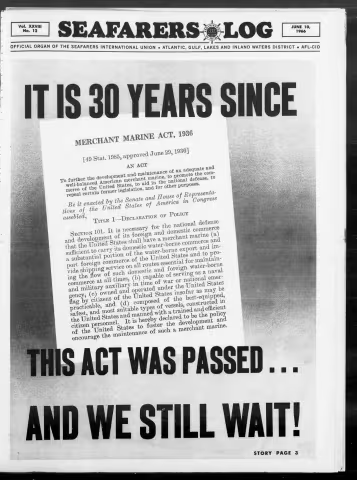
MERCHANT MARINE ACT, 1936
[48 S»l. 1*. wpW"! •!»" ®'
^ „£ an adequate aud
To further oatloMl defense, to
repeal certain form Eepresenta-
. is?
assebled, „ I__DECEAKATION OF POLICT
" ,• STORY PAGE 3
I if)- si'r' t' *-« f'«v . Ar ti- * -<- r " „ ,•
\ • .
'} •*?
'• i •
V I
. ''."J
5 n I Li!'.
Page Two SEAFARERS LOG
/
Z Jooa 10, 1966
Meony Urges Civil Rights Bill Passage
White House Civil Rights Conference
Charts Program To End Racial Injustice
WASHINGTON—An action program to bridge the gap between America's promise and per
formance in overcoming centuries of racial injustice was laid before 2,400 delegates summoned by
President Johnson to a White House civil rights conference.
Representatives of the Sea
farers International Union were
among conference delegates,
who were urged, in a message
from AFL-CIO President George
Meany, to keep in mind the over
riding importance of a full em
ployment economy to make equal
opportunity meaningful.
Meany's message called for pas
sage of the pending civil rights
bill and urged "a far faster pace"
of school desegregation aided by
"a special multi-billion dollar fed
eral school fund."
Above all, he said, "there must
be jobs at good wages for all who
can work. There must be an ade
quate system of income main
tenance for those who cannot."
The program drawn up by con
ference leaders called for bold new
steps at every level of government
and by private groups to:
• Create immediate job oppor
tunities for Negroes at all levels of
skill, coupled with stepped-up
training for better jobs.
• Provide "quality education
for all" equal to that now available
to "the fortunate few," while re
ducing racial concentrations in
schools through "color-conscious"
planning.
• Provide adequate open hous
ing for low and moderate income
families and, in the process, break
down the ghetto walls of inner
cities and the exclusion barriers
of the suburbs.
• Assure equality in justice and
law enforcement, protect Negroes
seeking to exercise new-won rights
in the South, and strive to defuse
the powder-keg relations between
police and Negro communities.
The action program was drafted
by a 30-member leadership coun
cil, headed by Ben. W. Heineman,
chairman of the Chicago & North
Western Railway. AFL-CIO Vice
President A. Philip Randolph,
served as honorary chairman.
Vice President Hubert H.
Humphery sounded the keynote,
declaring the 20 million Negro
Americans "will no longer be paci
fied by slogans or tokens . . . nor
should they."
Fulfilling the legitimate expecta
tions of the civil right revolution,
Humphrey said, "will be
America's most urgent domestic
task for many years to come."
/In a dozen workshops, the dele
gates began the dialogue—seek
ing to break down broad generali
ties into specific actions they can
undertake in their home com
munities and programs they can
present to their organizations.
Joining in the two days of dis
cussions was a cross-section of
concerned America — Negro and
white, college deans and slum
dwellers, union ofiicials and cor
poration presidents, civil rights
militants and moderate white
southerners, clergymen of all
faiths and ranks. Labor's contin
gent of about 100 came from
large and small unions and from
state and.city central bodies.
3More Free WorU Ships Blacklisted
For Cuba Trade; Total Now at 255
Three more ships have been added to the list of Free World
vessels which have called at Cuban ports since Jan. 1, 1963, ac
cording to a Maritime Administration report issued last week
The three vessels are the Brit
ish-flag Ardrossmore, of 5,820
gross tons; the Italian tanker
Elia, of 11,377 gross tons, and the
Cypriot-flag Aktor, of 6,993 gross
tons.
(The Aktor was reported sunk
800 miles southwest of San Diego,
Calif., on June 1. The 441-foot
ship, believed to be carrying a
cargo of sugar to the Orient, sank
stern first after pumps dropped by
a Coast Guard plane failed to curb
the flooding. The Coast Guard
rescued the 27 persons aboard.)
According to the Maritime Ad
ministration report, none of the
ships which formerly called at
Cuban ports and were placed on
the U.S. blacklist and thereby lost
Leon Climenko, Labor Aide,
Dies at 53; Was SlU Member
NEW YORK—Leon Climenko, Deputy Industrial Commis
sioner of the New York Labor Department and a member of the
Seafarers International Union, died suddenly on May 29. He was
53 years old.
Climenko
civil
Brother
tending a
rights seminar at
Unity House of
the International
Ladies Garment
Workers Union
when he was
stricken. He was
in charge of the
New York Office LeonCKmenko
of the Labor De
partment and had been appointed
deputy commissioner in April,
1965, after having served in the
department since 1945.
Born in New York, Brother
Climenko attended Fordham Uni
versity for three years. He be
came an SIU member while sail
ing aboard SlU-contracted ships
during World War II. He then
served as an assistant to the late
Matthew Woll, first vice-president
of the American Federation of
Labor.
While working in the AFL's
League for Human Rights, Broth
er Climenko becafhfe actively in
terested in refugee problems, an
interest he maintained after he
joined the Labor Department.
Former Governor Thomas Dewey
appointed him executive secretary
of the New York State Commit
tee on EMsplaced Persons.
His first job with the Labor De
partment was editor of the Indus
trial Bulletin. When he took over
his latest position as deputy in
dustrial Commissioner, Brother
Climenko was given wider admin
istrative and planning responsibili
ties within the department. He was
respected and admired for seeking
to interpret the state's unemploy
ment insurance laws liberally dur
ing strikes.
SIU representatives attended
the funeral services which were
conducted in New York on May
31.
Brother Climenko is survived
by his wife, Sylvia; two daughters,
Mrs. Laura Johnson and Miss Jo
hanna Climenko; his mother, Mrs.
Busky Climenko; a brother, Jesse,
and a sister, Mrs. Lillian Taufef. '
their eligibility to carry govern
ment-financed cargoes from the
United States have reacquired that
eligibility since the last Marad
report in May.
Of the 255 ships that have
called at Cuba since Jan. 1, 1963.
British-flag ships led with 73. The
rest consisted of 57 Lebanese, 36
Greek, 19 Cypriot, 18 Polish, 15
Italian, nine Yugoslav, seven
French, five Moroccan, five Mal
tese, four Finnish, two Dutch, two
Norwegian, two Swedish, and one
Monacoan.
SIU Beats Teamos
In Balto. Vote
BALTIMORE — The SIU
United Industrial Workers Union
has been certified bargaining agent
for employees of H. Klaff and
Company here, following a recent
NLRB election victory over Team
sters Local 311. Contract nego
tiations with the Baltimore scrap
metal processing firm are already
underway.
Of the 71 eligible voters among
Klaff employees, 40 supported the
SIU-UIW and 25 voted for the
Teamsters. Not a single vote was
cast for "no union" although the
Teamsters challenged six SIU
votes—not enough to effect the
election outcome.
Teamsters Local 311 had made
two earlier attempts to organize
the Klaff employees but lost NLRB
elections each time. In the mbst
recent election the SIU-UIW in
tervened in the election petition
and won the May 20 NLRB bal
loting.
The UIW also recently won a
first-time contract for limousine
drivers employed by the Baltimore
Hotel in St. Louis, Missouri. Con
tract negotiations, which were
completed after the UIW was
recognized as bargaining agent for
the limousine drivers, doubles
their hourly wages, an eight-hour
day with extra pay for overtime,
vacation and holiday pay and
other benefits.
Report of
International President
by Paul Hail
Maritime Day has once again come and gone amid speeches all
across the nation lauding the contribution of the maritime industry
to the nation's history and calling for the development of a strong, mod
em American-flag merchant fleet to meet the future commercial and
defense needs of the nation.
Many of these sentiments are expressed in good faith by men who
are truly interested in the future of the American merchant marine and
alarmed at its steady decline in recent years.
For some others however, this is merely standard procedure for Mari
time Day. Then, after the speechmaking is over and the news cameras
stop grinding, most of the high resolve to do something about our
deteriorating martime situation is quietly shelved until next Maritime
Day, and pretty soon it is again only the maritime unions and a few
truly interested parties who continue to call for action and make con
structive suggestions for putting the brakes on U.S. maritime's down
ward slide.
The lip-service paid to maritime once a year represents a substantial
about-face when compared with the lack of interest displayed by most
legislators and government officials during the rest of the year. Obvi
ously, as their speeches indicate, they recognize the important role that
maritime has played in the nation's histor y both in peacetime and war
time, and acknowledge that a strong maritime capability is one of the
major foundation blocks for the nation's future greatness. Yet, when
it comes to doing something about assuring that we have a strong, mod
em merchant fleet capable of meeting our future needs, constructive
action becomes bogged down in red tape and petty bureaucratic rival
ries and nothing is done.
An example of the way this type of thinking continually works
against maritime is the Interagency Task Force report, which, under the
guise of proposing constructive action to assure the future strength of
the U.S. merchant fleet, would actually, if adopted, lead to the certain
death not only of the U.S. merchant fleet but of the nation's shipbuild
ing capability as well. It was the SIU and other maritime unions that
pointed out the dangerous contradictions of the Task Force and sup
ported instead the report of the President's Maritime Advisory Com
mittee, which contains many truly constructive proposals regarding
the rejuvenation of American maritime.
Both reports are presently before the President of the United
States and have been for some time, yet nothing has been done to
act on them. Testimony is taken, proposals are made, many platitudes
are mouthed, yet nothing constructive is done. This is typical of the
attitude of neglect and lack of interest which the government is dis
playing towards maritime.
For these reasons. Maritime Day is usually a tragic farce. Speakers
recall the vital role played by American maritime I'uring the two
world wars and Korea in making victory possible by supplying our
fighting men with huge masses of supplies and equipment in the face
of enemy fire and the ravages of the sea. But they continue to ignore
the fact that the American merchant fleet has been allowed to fall into
such a condition of decay that it cannot meet the needs of our fighting
men in the present conflict in Vietnam.
President Johnson has promised a new policy towards maritime, yet
all that the responsible government agencies have come up with is the
Maritime Task Force report, which if adopted would spell the doom of
the U.S. maritime industry,, and the proposed inclusion of maritime in
a new Department of Transportation—which would have the same
effect of destroying what is left of the maritime industry by submerging
it in such a maze of red tape and petty bureaucratic rivalries that it
could not survive.
At the same time, the President's Maritime Advisory Committee
Report and other concrete and constructive proposals to aid maritime
and stop its continuing decline are ignored, gathering dust on some
bureaucrat's shelf.
It is no wonder then that the yearly Maritime Day speechmaking
comes with a hollow ring.
Gov. Brown and Seafarers
California's Governor Pat Brown was guest speaker at recent Los An
geles County Federation of Labor luncheon in Wilmington. Left to
right in photo are: Frank Boyne, SIU Wilmington Port Agent; Gov
ernor Brown: Frank Gill, Wilmington Patrolman for the SIU Pacific
District'M'arine Cooks and Stewards and Seafarer-Mike•Ohannqsjan,
Inne 10, 1966 SEAFARERS LOG Page Three
For Viet Ham Area
Based <m reports received from Saigon, the Maritime Admin
istration has advised the SIU of the latest regulations governing
liberty for merchant seamen aboard vessels in Viet Nam ports, SIU
representatives have participated in a series of meetings with rep
resentatives of the Maritime Administration and other agencies in
an effort to obtain the most liberal possible shore leave provisions
consistent with the necessities of the military situation., The follow
ing is the most recent report on liberty in the Viet Nam area:
1. Nha Tnmg
2. Cam Ranh Bay
3. (C^ l4U»)
4.V ViBBg. .Tao
, ' J,-
No restrictions; curfew from 2400 to
0500.
No liberty Cam Ranh peninsula com
plex.
C^n for liberty; use of ship's boats TC-
^ufeed.''' ,•
Liberty pemiissibte; use of sMp's boats
required; [Krsonnel permitted to land only
betwmt 0800 and^ 1730 in c(»npliance
with Area Commander's Security Regu
lations issued 9 April 1966; curfew from
2400 to (MOO.
Liberty permissflsle; not-ewer S3 per cent;
of crew on ^re at any one time.
No liberty. • ^
- ' Ji' <•
<$>-
SlUliA lasers Umoa Reaves Sdm!
Fwr Phta-madst-Mate hatrmdon
NEW YORK—The SIUNA-affiliated Staff Officers Association
of America has taken a major step toward providing upgrading
training for its members with the proposed opening soon of a
pharmacist mate training school.
The SOA has obtained a facility
in which to conduct the program
at the Marine Hospital at Staple-
ton, Staten Island, N. Y., which
makes the establishment of the
school a virtual certainty, accord
ing to SOA Secretary-Treasurer
Burt Lanpher.
Opening day of the reinstituted
purser-pharmacist mate program,
which became extinct following
World War II, will culminate more
than two years of a vigorous cam
paign by SOA officers.
The school, which will offer new
opportunity for job advancement,
represents a victory for the union
which had labored arduously
through a maze of red tape and
a labyrinth of inter-connecting
Federal, state and local agencies.
Secretary - Treasurer Lanpher
said the program will be conducted
under the auspices of the U. S.
Public Health Service under the
immediate supervision of Dr.
Thomas Shinnick and the New
York State Board of Education
under the direction of Dr. John
Leslie. It will be a joint project
with the Union, the New York
Iviitt 16,1««6 Vol. XXVIII, No. 1:
SOfflcIal PubKotion of the SITJNA
• Ottlf. Lakes & Inland -Wi
, Distriet, AFL-CIO
Sm9e%i,ihnBo»m
HAU,
®AIUi SHKPABD
:T.
WII.UAI«S
;• -i rAt TANNrai'' •'
.t. fANilER
pi.Viee-Prea.
•A Ah K«im' ^
'' ' N
MATTBEWa
. 'HESBBIW BBABD '
Vireetof of Oiganitma aiiA
fuMieatiena
: '^aHaai»a Editor
M^KJB POUACIC
A*»i»tant Editor
•-,NAt)ttAN:SKy«R:
Art Editor
BiiiaKABnSKAiit)!^^.
Staff Writers
MBUVJN PURVIS
Psrm WB)SS
pibll*N>i WWMH* *t no Rtirts AW*
«Wtrtlssten. 0. C. 20018 ky. th#
IsUniitlsMl UalM, AManMe, Oilt, Ukts anit
IttlMd WUtrt OlitrUt, AFt-CIO, (575 Fesftb A«-|
««, BrMWys, l».y. 11232. T.I. HYatlfltIt
9.6600. StMSF «lM. iitttw paid at Waihlnil
ton. D. C.
FOSrilASTErS ATTESTIOB! FOMB 3579 Wdl
(Aaald ka Mttt te Saafarar. Inftrnatlenal Unianl
Atiantla. Calf, Lakti a«d Intanil Vattn Dl.tr>«t|
AFt-CIO, 675 FoiHli A».B«. ' Braallyii, A-TI
11232.
State Board of Education and the
Federal Government sharing in
development of the training pro
gram, he added.
Graduates of the purser-phar
macist school, which is expected
to open sometime in September,
will be certified by the . United
States Coast Guard. Instructors
will be members of the staff of the
Stapleton Hospital—both doctors
and nurses.
Under present plans, the school
term will be at least nine months;
and in addition, purser-pharmacist
mate graduates will have special
training for shipboard conditions
and will be qualified to handle
radio pratique.
It is contemplated that some
20 to 30 purser students will at
tend the first term of school. They
will not reside at the hospital but
will receive a per diem allowance
contributed by the SOA and the
Department of Labor. The funds
for the schools operation will come
from the Federal Government,
though the New York State Board
of Education and the Public
Health Service will provide the
classroom facilities.
Questiotinaires concerning ap
plication for study at the school
have already been distributed
among SOA members.
tmergemy Conference Summoned
To Save American Merchant Marine
WASHINGTON—A national emergency conference to chart a course for action to revitalize the
American maritime industry will be held here on the thirtieth anniversary of the passage of the
Merchant Marine Act of 1936.
More than 500 persons will attend the two-day conference on June 28-29 which has been called
by the American Committee to Save Our Shipping, sponsored by the AFL-CIO Maritime Trades De
partment and the AFL-CIO Maritime Committee. The two AFL-CIO maritime units represent the
great majority of the nation's ^
shipboard and shoreside mari
time workers.
The highlight of the confer
ence will take place on June 29,
when conference delegates will
call personally on members of
both houses of Congress to ac
quaint them with the dire condi
tion of the American merchant
marine and to impress them with
the urgency of prompt action to
halt its further decline and to re
store it to its required position in
the interests of the nation.
The co-chairman of the Ameri
can Committee to Save Our Ship
ping are Russell Berg, president
of the International Brotherhood
of Boilermaker and Shipbuilders;
Thomas Gleason, president of the
International Longshoremens As
sociation; Joseph Curran, presi
dent of the National Maritime
Union, and Paul Hall, president
of the Seafarers International
Union of North America. .
In issuing the call for the emer
gency conference to save American
shipping, the Committee said that
its action was prompted by "the
fact that the U.S. merchant ma
rine is now physically and eco
nomically obsolete and carries less
than nine percent of our foreign
commerce."
50 Percent Carriage
Under the Merchant Marine
Act of 1936/lhe committee said,
the intent ^d goal was to realize
the carriage of 50 percent of the
nation's foreign commerce in
American bottoms.
The committee charged that
failure to achieve the intent of
the 1936 Act results from the fact
y
that the "law has never been im
plemented."
The committee pointed out that
the fate of the American merchant
marine will be determined by the
course of action which President
Johnson will take with respect to
two alternative programs for the
future of the U.S. merchant ma
rine that are presently on his desk.
One, the Interagency Maritime
Task Force Report would condemn
U.S. flag shipping to death, the
committee said, while the other,
the President's Maritime Advisory
Committee Report, calls for action
to implement the Merchant Ma
rine Act of 1936.
The conference will be ad
dressed by representatives of la
bor, management and government.
Policy for the campaign to save
the American merchant marine
which will be launched at the con
ference, will be drafted by the
delegates.
(Seafarers will be advised of
all details of the campaign and
of the ways in which they can
assist in achieving the confer
ence goal for revitalizing Amer
ican shipping at SIU halls in all
ports and through the Seafarers
Log.)
The conference climax on June
29, the 30th anniversary of the
1936 Merchant Marine Act, has
special significance inasmuch as
the Act had as its purpose a mer
chant fleet capable of adequately
serving the nation's needs in peace
and in war. However, instead of a
strong fleet that was the objective
of the Act, the U. S. merchant
fleet has steadily deteriorated in
the 30 intervening years.
The privately-owned American
flag-fleet has decreased by some 25
percent since the passage of the
Act, the volume of American
foreign commerce carried by U.S.
ships has declined by about two-
thirds. coastwise and intercoastal
shipping has virtually disappeared,
tramp ships face extinction, in
dependent tankers must struggle
for survival, and the bulk cargo
fleet is outrageously inadequate for
the carriage of vital U. S. supplies.
Yet when the 1936 Merchant
Marine Act was signed into law by
Pres. Franklin D. Roosevelt it was
designed to accomplish the fol
lowing:
1) Maintain a fleet able to
carry the nation's domestic trade
as well as a substantial portion of
our foreign trade and provide
shipping services on trade routes
deemed essential by the Govern
ment.
2) Keep a fleet which could
serve as a military auxiliary.
3) Make certain that the mer
cantile fleet be owned and oper
ated under United States registry
and run by United States citizens.
4) Have a fleet consisting of the
best equipped American-built
ships afloat.
Responsibility for the decline of
the American merchant marine
rests with the administrative agen
cies which have failed or refused
to carry out the intent of the mari
time law over the years. It is the
maladministration and the failure
of these agencies to properly im
plement the 1936 Act's intent that
the American Committee to Save
our Shipping will campaign vigor
ously to correct.
AFL-CIO Marine Unions Move to Prevent
Switch of U.S. Cargoes to Foreign Ships
NEW YORK—American seamen, shipyard workers and longshoremen served notice today that
they would "use all legal means available to us to prevent the chartering of foreign-flag vessels
KS>-
and their carriage of American cargoes.'
The notice was contained in
a statement jointly issued by
Russell K. Berg, president of
the International Brotherhood of
Boilermakers, which represents
DelMonte's Crewmen Commended
For Resrue of Yneht in Heavy Sens
MIAMI—The crew of the SlU-contracted freighter Del Monte
(Delta Steamship) has been commended by the Coast Guard for
the touch-and-go rescue of the foundering pleasure yacht Honey
Bee II in stormy seas off the f
Bahamas.
The crew's performance in
hunting down the small yacht in
heavy seas was hailed as being in
the "best tradition of the sea" by
the commandant of , the Seventh
District Coast Guard Headquar
ters in Miami.
Towed to Safety
The commendation stressed the
crew's willingness to tow the
-Honey Bee -II 'to< a -• position- of
safety. The Del Monte was de
layed for 12 hours in order to
rescue the foundering yacht and
its occupants.
The mercy mission took place
May 20 in response to an emer
gency AMVER radio call. The
Amver system, operated by the
Coast Guard, is a maritime mu
tual assistance program that co
ordinates search and rescue ope
rations in the Atlantic Ocean,
Caribbean Sea, Gulf of Mexico
and Pacific Ocean. » .. .»
shipyard workers; Joseph Curran,
president of the National Maritime
Union; Thomas W. Gleason, presi
dent of the International Long
shoremen's Association, and Paul
Hall, president of the Seafarers
International Union of North
America.
The Unions said they had
learned that the Department of
Commerce had agreed to allow
subsidized American shipping
companies to charter foreign-flag
vessels to carry this nation's com-
merical cargoes while the Ameri
can-flag vessels were diverted to
military service in Vietnam.
They said that the condition of
the American-flag fleet in the
Vietnam emergency is due to past
Government indifference and neg
lect and charged that the com
panies involved are now "display
ing a readiness and a willingness
to participate with the Govern
ment in this action which will
serve only to compound the errors
of the past.
"Rather than insisting upon
firm and positive steps to correct
these errors," the unions said,
"these companies are seizing upon
the expedient of chartering for
eign flags. Thus they are not only
displaying extreme short-sighted
ness with respect to their own fu
ture welfare, but providing a con
venient escape hatch for the same
Government officials whose in
difference or lack of sound judg
ment has led us into the present
critical situation."
The unions urged that as a tem
porary measure the Government
immediately step up its program
of reactivating American-flag ves
sels from the reserve fleets and
that meanwhile it proceed imme
diately with the implementation
of a long-range program to restore
the American fleet to its proper
strength, based upon the recom
mendations made last November
by the President's Maritime Ad-
vispry Onnmitt^,,.,. . ! t J
If
[*age Four SEAFARERS LOG Jane 10; 1966
Seatrain Plans Expansion Program,
Adding Eight New Vessels To Fleet
The SlU-contracted Seatrain Lines is moving ahead with a major expansion program that will add
eight newer, larger and faster container ships to the company fleet.
The new Seatrain freighters are being converted at the Newport News Shipbuilding and Drydock
Co., Newport News, Va., from
former Mission-type tankers.
The modem container ships will
be two knots faster than the 14.5
knot ships now used by Seatrain.
Seatrain announced the expan
sion right after a $1.85 million
Defense Department contract was
awarded to Seatrain for the use
of three container ships in haul
ing military supplies. The com
pany expects delivery of the three
new ships within a few weeks.
The new ships moving into
Seatrain berths are the Seatrains
Puerto Rico, Carolina and Mary
land. They will replace the slower
Seatrains Texas, New Jersey and
Savannah which are now being
used on the Military Sea Trans
portation Service run to Puerto
Rico.
Faster Vessels
Each converted Mission-tytpe
tanker is being made over at a
$2.5 million cost and features an
expanded cargo carrying capacity.
The specialized freighters will
hold 177 containers measuring 40
by eight feet and 36 rail cars of
55-foot length. They are two
knots faster than 14.5-knot ves
sels now serving the Puerto Rican
run.
Seatrain said that along with the
company's fleet expansion the
company would add new ports of
call, construct new shore facilities
and increase the capacity of its
existing facilities.
It was noted by the company
that the total cost of converting
the ships comes to more than $30
million. This includes the pur
chase price of new containers,
construction of new facilities and
the enlargement of existing facili
ties.
The SlU-contracted Sea-Land
Service Inc. was also awarded a
Defense Department contract for
the use of container ships for
service to Viet Nam.
Sea-Land operates 19 ships and
has on order six new, container
vessels.
No Serious Injuries Reported
As SlU Pacific Ships Collide
SEATTLE—There were no serious injuries reported to Seafarers
in the recent collision of the SIU Pacific District-contracted vessels
Washington Mail (American Mail) and Ohio (State Line), in a
heavy fog off the coast of Korea. ^
Both vessels suffered exten
sive damage and are presently
undergoing repairs in Japan. The
7,900-ton C-3 Ohio was struck
near the No. 2 hold and was
cut through as far as the star
board hatch combing. For some
time she was in danger of sink
ing and her crew was taken
aboard the Washington Mail,
which suffered severe bow" dam
age but remained seaworthy.
The collision occurred on the
morning of April 25, about 100
The Great Lakes
by
Al Tanner, Vice-President and Fred Farnen, Secretary-Treasurer,Great Lakes
The 660 foot self-unloader, Adam E. Cornelius, operated by the
Boland and Cornelius Steamship Company of Buffalo, ran aground
on the northern tip of Russel's Island in the St. Clair River approxi
mately 300 yards from the Algonac Service Center. The grounding
occurred Sunday, May 22nd, in a heavy fog. Two SIU-IBU tugs were
summoned from Detroit to move ^
the vessel off the bottom, with
no success. It was necessary for
the Adam E. to discharge part of
her cargo into another vessel
using the unloading boom in order
to lighten her enough to be freed
from the bottom. No injuries or
damage were reported.
All local union and local cen
tral labor bodies affiliated with the
Michigan State AFL-CIO have
been notified to designate their
respective" delegates for the pur
pose of attending a special meet
ing on June 1st, in Lansing, Mich
igan.
All delegates present will be
polled in order to determine which
candidates will receive COPE en
dorsements, for the offices of Gov
ernor and U. S. Senator. From
all appearances, former Governor
G. Mennen "Soapy" Williams is
a "shoe-in" for United States
Senator, having already • received
the support of many unions in
this area. Detroit Mayor Jerome
Cavanaugh is also seeking the
Democratic nomination. The SIU
.will send delegates to this all im
portant meeting.
Maritime Day, 1966
Ceremonies were held Monday,
May 23rd, at Detroit's WJBp
Hall honoring Maritime Day. The
ceremonies were attended by Mr.
Frank Alter, representing the U.S.
Department of Commerce; Mr.
Edward L. Baker, U.S. Postmas
ter; Fred Farnen, Secretary-Treas
urer of the SIU's Great Lakes
District. Detroit Mayor Jerome
Cavanaugh issued a proclamation
designating the week of May 23rd,
as Maritime Week.
Wyandotte Chemical Settlement
After several meetings over the
winter months with representa
tives of the Wyandotte Chemical
Company, the SIU has won sever
ance pay for all members of the
SIU Great Lakes District who
were employed by the company.
The fact that Wyandotte Trans
portation Company did not ac
tually go out of business, but
rather got out of the shipping
end of it, presented a strong legal
point that enabled the union to
make monetary demands in be
half of all Wyandotte men for
merly employed by this company.
In addition, although the Wyan
dotte vessels have been sold, the
Wyandotte plants are still receiv
ing materials at their dock facili
ties that are used in the manufac-
turipg of. ywqijs, ,
miles off the southwest coast of
Korea in rain and fog.
The collision was described by
crewman Mike Grimison aboard
the Ohio, who said he was awak
ened from sleep by a "big crash."
"The Washington Mail was
sticking half way through the
Ohio," he said. "Then in 10 or
15 minutes, our captain told them
to back out. I thought we were
cut clean in two. She went into
the'No. 2 hold and went clear
through to the starboard side of
the ship clear down."
Taking Water
After the ships came apart the
Ohio began taking water badly.
The sea rushed into the 30-foot
hole in her side faster than her
pumps could clear it out. It was
at this point that her crew, with
the exception of several officers,
was taken off as a precautionary
measure.
The Ohio was later taken in
tow by a Japanese tug and
beached near Pusan, Korea. It
was taken in tow only after at
tempting the run to Pusan under
its own power with the Washing
ton Mail standing by. Eventually
however, the Ohio went so far
down in the bow that its propeller
was out of the water.
Another Ohio crewmember,
carpenter Frank Wawroski, com
mented "It's a wonder she stayed
afloat. . . . The water came up
awfully fast in No. 1 hold. She
was sinking a foot an hour."
The only injury in the collision
was reported by crewman W. E.
Sumner, who was lookout in the
Ohio's bow who was severely
bruised when knocked from his
feet by the force of the collision
and thrown about the deck. The
crash was described by all hands
as a metal splintering, bone jar
ring impact that threw many
crewmen to the decks of both
vessels.
Damage to the Ohio was esti
mated at about half a million dol
lars. At latest report she was
awaiting drydock facilities at
Shimonoseki, Japan. Repairs will
take about 60 days according to
present estimates. Repairs to the
Washington Mail, presently un
derway at Yokahama, are expect
ed to 'take about 45 days.
The crews of both vessels were
repatriated fiy.W . .
The Gulf Coast
by Undsey Williams, Vice-President, Gulf Area
The Louisiana Legislature opened its 1966 session recently and it
looks like it will be a busy legislative year for labor in the Gulf area.
Of the almost 550 bills already introduced into both houses of the
State Legislature, the Louisiana AFL-CIO tabulation shows that labor
has a vital interest in more than 44 percent of pending legislation.
In addition, it's beginning to*®^
look like a "right-to-work" pro
posal will be introduced by the
Council of Associated General
Contractors in an attempt to re-
enact a "right-to-work" law in the
state. Labor was able to repeal
this anti-labor proposal in 1956,
but the anti-labor "right-to-work"
people have neyer given up. If
such a proposal really is brought
up again, organized labor in this
area will marshall all of its re
sources to prevent passage.
On a brighter note, the river
town of Yazoo City, Mississippi
recently saw the christening of its
first vessel since the Confederacy.
On May 11 the new towboat Little
Helen, built at Greenville for the
SlU-Inland Boatmen's union con
tracted Coyle Lines of New Or
leans, was given its official sendoff
there.
New Orleans
After laying up for 12 days for
repairs, the Del Sud re-crewed re
cently and it was like old home
week around the hall here for
Delta regulars. Eddie Fnselier
got off the Sud after a stay of
about six months as passenger
bedroom steward. He spent some
time visiting relatives in the area.
Oyde Lanier, chief steward, spent
most of his layoff time around the
hall. Others were Al Tocho, bar
tender; and Lloyd Schenk, elec
trician. Lloyd
signed on again
when she re-
. crewed as third
electrician. Others
signing on were
Bobby Gam, deck
maintenance;
Mike Dunn, chief
baker; John
Adams, butcher;
and Otto Tinun, waiter.
Gam
Mobile
When the Claibome put in here
for repairs after her recent colli
sion with a Liberian tanker, sev
eral SIU oldtimers found them
selves on the beach temporarily.
Among them are C. D. Merrill
who was sailing in the Claiborne's
Nail
deck department. Married, Mer
rill makes his home in Mobile.
Until repairs are completed on the
Claiborne, he intends to spend his
time catching up on his hobby of
fresh water fishing. Another Sea
farer who had to get off the Clai
borne is Carl B. Andrews who was
aboard her as oiler. Andrews also
wants to sign on again as soon
as repairs are complete.
Several Seafarers whose last ves
sel was the Monticello Victory
are taking it easy
here. Among
them are Clarence
J. Nail, whose
regular shipboard
slot is steward.
Nail intends to
rest up for a short
while at his home
in Mobile before
shipping again.
Jack Green was last aboard the
Monticello Victory as FWT.
Groen has shipped out of the Gulf
for over 20 years and makes his
home in Mobile with his wife and
children. He intends to get in a
little vacation time before shipping
out again. Another former Mon
ticello Victory crewmember who
wants to get some rest before
looking for another berth is Ray
mond F. Devine, who sails as
second cook. An SIU member of
long standing, he also makes his
home in Mobile.
Houston
Bill N. Thompson has been
around the hall here looking for
a trip to the Far East. TTiompson,
who- last sailed aboard the Qioc-
taw Victory, wants a steward de
partment slot. Another Seafarer
who is raring to go is Kenneth Ga-
bagan. After spending some lei
sure time exploring New Mexico,
Gahagan is keeping his eye peeled
for a deck job on a ship going to
India. Another man with India
on his mind is Eugene W. Wil
liam who last sailed aboard the
Azalea City as FWT. After riding
coasters for a while, a long run
sounds good to him and he says
India would be just fine.
Unfair Labor Practite Charges
Hike NLRB Case load in 1965
The National Labor Relations Board report for the year 1965
showed that refusal to bargain charges leveled against employers
were up 25 percent over the prior year and that illegal discharge
and other forms of discrimination against employees continued to
be the. dominant charge against employers.
Unions won 4,680 elections in the 12-month period, or about 60
percent of the total, the board reported.
Thirty years ago the National Labor Relations Board, in its
first year of existence, handled 31 employee elections. In the fiscal
year 1965 the figure was 7,824—a measure of the increase im
activity in the area of labor-management relations.
The NLRB made the comparison in its 30th annual report.
Putting its statisticians to work, the agency found that over the
30-year period it had handled 200,000 unfair labor practice cases
and had conducted for than 140,000 representation elections
which permitted more than 19 million workers to decide whether
they wanted to bargain collectively with their employer through
a union.
il •' Y ' t
f
•I
June 10, 1966 SEAF ERS LOG Page Five
The Pacific Coast
by Frank Orozak, West Coast Representative
An all California voter poll taken last week shows .that Governor
Edmund G. Brown is trailing both Republican candidates in voter
preference at the present time.
The poll was conducted among a cross section of eligible voters of
both parties throughout the State. The California primary is this week.
.Representative Robert Duncan
won the Oregon primary over
Howard Morgan for the Demo
cratic senate seat. Duncan will
oppose Governor Mark Hatfield
in the November general election.
San Francisco
Shipping is still going good in
the Port of San Francisco. Plenty
of jobs are available for FWTs,
Oilers and Electricians.
Last period we paid off and
signed on the following ships:
Wild Ranger and Topa Topa. In
transit are the: Marymar, Steel
Designer, Geneva and Port Mar.
Ships due in for the next period
for possible payoffs: De Alba, Mt.
Vernon Victory, Fairport, San
Juan, Anniston Victory, Antinous,
San Francisco, Vantage Press,
Iberville, Desoto and Ocean Eve
lyn.
On the beach for a short spell,
and waiting to make his fourth
trip to the Far East this year, is
Chester Lee Owen, Fireman-Oiler.
James Stroud is
just off the Topa
Topa after a 2Vi
month Far East
voyage. Brother
Stroud, an AB,
wants a slot on
the first ship head
ed for the West
ern Pacific.
George Zintz
Jr., a 14-year member of the SIU,
fresh off the Topa Topa, will
check in for a physical exam be
fore returning to sea. Brother
Zintz, an AB, is known for his
"bottle writing escapades." After
14 attempts at enclosing messages
in bottles at sea, he finally found
a pen pal in the person of Sergeant
John White, British Army, who's
located in the British protectorate
of Sharjah Trucial Oman in the
Persian Gulf.
Seattle
Shipping slacked off a little
since the last report, but is now
going good again for all ratings,
and indications are that it will
continue.
The following ships paid off:
Anchorage, Seattle, Hattiesburg
Victory, Brigham Victory and
IVlinot Victory. Signed on were
the: Anchorage, Seattle and Hat
tiesburg Victory.
In transit are the Inger, Pmt-
mar, Losmm-, Pennmar, Seattle
and Anchorage. Ships due to pay
Stroud
mmm PAYOFfT
LEAVE CLIAN SHIP
Seafarers are reminded that
when they leave a ship after
articles expire in a foreign port,
tha obligation to leave a clean
ship for the next crew is the
same as in any Stateside port.
Attention to details of house
keeping and efforts to leave
quarters, messrooms and other
working ^aces dean will be
appreciated by the new Orew
, when it comes aboard.
the:
Pendergraf
off in the near future are
Kyska Thetus and Choctaw.
Billie Harris's ship was the
Alcoa Voyage on which he sailed
as bosun. He piled off in San
Francisco after a trip to Vietnam,
and is now ready to go the first
group 1 job that hits the board.
Billie has been with the SIU 18
years.
James Pender
graf has been on
the beach for a
while but now is
ready to ship. Jim
has been an SIU
member for 21
years and thinks
the vacation plan
and sickness and
accident benefits
are two of the finest things that
any Maritime union has ever
achieved. Steve Dontes just ar
rived from the East Coast to take
a Vietnam run and is now waiting
for a BR slot.
Wilmington
Shipping in the Wilmington
area remains active and brisk. And
there are plenty jof jobs for key
rated men in all departments. The
Halaula Victory paid off after a
three-month trip to the Far East.
Constanino Antoniou, deck
delegate abroad the Hercules Vic
tory, dropped by the office to pick
up some logs. Fred Blunkberg,
deck maintenance on the Roswell
Victory, also came by while his
ship was in for bunkers to pick
up a delegate's kit. F^ed is headed
for yietnam.
£a/res SIU Sets Vote for August;
Nominutions for Officers Open July 1
DETROIT—Procedures are now underway for the biennial election of officers of the Great Lakes
SIU under the terms of the Union's constitution. The procedures require the completion of nomina
tion by July 15 so that actual voting can be held during the month of August.
In accordance with the Sec- f
retary-Treasurer's pre-balloting
report, six Great Lakes posts
are to be filled by a secret ballot
vote of the Lakes SIU member
ship, as a result of action taken
on the secretary-treasurer's pre-
balloting report at meetings held
in Great Lakes District ports on
June 6. The report recommends
the number and locations of ports
and the number of Assistant Sec
retary-Treasurers and Agents to
be elected.
A notice spelling out the offices
to be voted on and the eligibility
requirements for nominees was
sent to all Great Lakes members.
It provides for a July 1-15 nomi
nations period during which nomi
nations can be made by mail, in
person or at the regular port
meetings of the Lakes SIU during
the first half of July.
Posts to be filled during the elec
tion are those of Secretary-Treas
urer and Assistant Secretary-
Treasurer and for Port Agents in
Duluth, Chicago, Frankfort and
Buffalo.
Two Ballots
Two ballots will be used in the
election. The first one will be for
all offices except the post of Frank
fort Port Agent, as provided in the
constitution. This first ballot will
be used by all Lakes SIU mem
bers, except carferrymen. The
carferrymen will use the second
ballot, which will carry the names
of nominees for Frankfort Port
Agent, as well as for Secretary-
Treasurer and Assistant Secretary-
Treasurer.
To Maritime Urged
House Bill Would Spur
New Ship Construction
WASHINGTON—A bill designed to aid the development of a
modern American-flag merchant fleet by encouraging replacement
and modernization of obsolete vessels has been introduced into the
House by Representative John
W. Byrnes (R-Wis.).
The bill would allow ship
owners to deposit amounts from
earnings in a tax-free construc
tion reserve fund and would pro
vide for a depreciation allowance
of 15 percent, provided the money
saved through increased deprecia
tion is placed in the construction
reserve fund.
In addition, the bill would
change the present requirement
that construction or reconstruc
tion must begin within two years
of the time deposits in the fund
are made.
In introducing his proposed
legislation, Byrnes commented on
the serious deterioration which
has taken place in the U.S.-flag
fleet.
Problem Remains
"Over 100 years ago," he re
minded his fellow Congressmen,
"a select committee of the House
of Representatives lamented the
decline of America's status as a
maritime nation and emphasized
the. need for. Ihe development of
our maritime capacity. We are
still struggling with this problem
today."
He noted that "despite the
clearly stated goal" of the Mer
chant Marine Act of 1936 to pro
mote a strong merchant marine,
"the American merchant marine
has been continuing its decline in
recent years."
Addressing himself specifically
to the American-flag Great Lakes
fleet, Byrnes noted that "the per
centage of the Great Lakes ship
ping carried by American fleet
ships has been declining substan
tially in recent years." He pointed
out that "No new American-flag
Great Lakes ships have been con
structed since 1960, and there
have been no conversions since
1961. During this time there has
been a decline in our carrying
capacity of Great Lakes vessels as
well as a decline in our share of
the Great Lakes trade. . . . This
is a sad commentary on our rec
ord of meeting the objective of
the Merchant Marine Abt."-'- V '
As in 1964, since the Secretary-
Treasurer of the Lakes SIU is sta
tioned in Detroit, no position of
Port Agent for Detroit is included
on the Lakes SIU ballot.
A credentials committee of
three rank-and-file members will
check the qualifications and eligi
bility of air nominees and see to
the preparation of the ballots.
The actual voting will take
place throughout the month of
August at Lakes SIU halls in Al
pena, Buffalo, Chicago, Cleveland,
Detroit, Duluth and Frankfort be
tween the hours of 9 A.M.-5 P.M-.
Mondays through Saturdays. In
addition, the constitution estab
lishes a specific procedure for
shipboard balloting during the
voting period in August.
Accordingly, all members are
urged to carry their membership
books with them at all times during
the month of August and to in
form themselves on the constitu
tional procedures covering ballot
ing.
The Atlantic Coast
by Earl (Bull) Shepard, Vice-President, Atiantic Coast Area
The SIU is happy to welcome the employees of H. Klaff and Com
pany in Baltimore to the union after they voted for the SIU United
Industrial Workers Union as their bargaining ageilt in a NLRB elec
tion against the Teamster Local 311. Negotiations with the scrap metal
firm for a contract, are being held now.
New York
Shipping is exceptionally good
in New York for all ratings and
from all indications will remain
that way. In the hall to say hello
was Dutch Palmer. Dutch is ship's
delegate on the Steel Recorder
which paid off clean and in good
shape. Palmer was assisted by the
other delegates, namely Joe Duffy,
S. Wala and Alii Nasroen in
bringing the ship back with few
beefs. This ship had quite a few
old timers on it.
Baltimore
Shipping has been good during
the past two weeks with plenty of
jobs on the board and prospects
for the coming two weeks look
very good. At present, the Santore,
Alamar and ^amar are laid up.
The Seamar is due to crew up
June 4 and the Santore, June 6.
No report yet on the Alamar.
During the last period, there were
three payoffs, three sign-ons and
six ships in transit.
James Long, a 25-year SIU
veteran who last sailed as Bosun
on the Seamar is waiting for the
vessel to come out of layup, and
would like to sign on her again.
Jose Martinez, AB on the Seamar,
hopes to sail with the Santore
when it makes a grain run to Tur
key. Bill Simmons would like the
same trip, sailing as a deck engi
neer. His last job was on the Beth-
tex.
Boston
Shipping has been on the slow
bell this period but the outlook
for the next period is good with
the summer boats starting on June
15.
Remigius McDonald, a 20-year
union man, is happy to spend time
with his family after two trips
to the Far East. His last vessel
was the Robin Trent. George
Swift is back in good health after
a spell in drydock. He's OK now
and ready to ship out again.
George Hubner, another SIU
oldtimer, is fit for duty after six
months in drydock. He said he
will grab the first job put on the
board. His last ship was the Spit
fire where he sailed'as aV AB."
<$>-
Philadelphia
Riley Carey who sails in the
deck department, visited the hall
after spending a few weeks in
Boston. Carey will take the first
AB's job that comes along. Frank
McGarry, is ready, willing and
able to take the first deck job that
hits the boards after spending a
few weeks on the beach here.
Frank visited his brother who is
stationed at the Philadelpha Navy
Yard. Fred Clopton, an oldtimer
with the union is registered and
will visit old friends before ship
ping out. His last ship was the
Columbia. Ywaswant Somani is
now fit for duty and should be
ready for a pumpman's job soon.
We have five payoffs, five sign-
ons and 11 ships in transit for
this period.
Puerto Rico
The Supreme Court of Puerto
Rico has decided that labor con
tracts between industry and work
ers remain in effect even though
the workers change their union
before the contract expires. Pepe
Garcia is shipping as an AB on
the Ponce after sprucing up his
home. Juan Sanchez is taking it
easy for a while after a long voy
age on the Alcoa Explorer. Teddy
Ruiz is looking for a Seatrain ship.
Norfolk
Henri Robin a 16-year SIU
veteran is registered and waiting
for a stewards
job. His last ship
was the Potomac
as Chief cook.
Thomas Stubbs, a
12-year union vet
eran, is on the
beach looking af-
Vi ter some personal
business after sail
ing as an oiler on
the Yellowstone. Elbert Winslow
paid off the Commander in Phila
delphia when he heard the Balti
more was in a shipyard here and
is waiting for it to .crew up so
he can get an AB job^im-the ves
sel. Thomas Gower, a 14-year SIU
veteran, is fit for duty after a stay
in Staten Island Hospital for three
weeks:
Stubbs
(
Page Six SEAFARERS LOG June 10, 1966
Seafarer On Pension
I
i
Seafarer Frank Meggle (right) picked up his first regular $150 monthly
SlU pension check at New York headquarters recently from Union rep
Leon Hall. The new pensioner, a native of Panama who now makes his
home in New York with his wife Florence, has been a Union member for
over twenty years. His last ship was the Mankato Victory, on which
he sailed as chief steward on a trip to Vietnam and Ankara, Turkey.
THE INQUmiNO SgAgABBM
QUESTION: Of all the ports
that you have visited which one
do you consider the most expen
sive for a Seafarer and why?
. Juan Lerni: I would say that
Naples, Italy, is the most expen-
'sive port I've ever
visited. In fact, I
would say that it
just costs too
much money to
go there, because
it seems that they
have raised their
prices just for
seamen. Take, for
example a few of
the thing that I myself have
bought over there: dolls for my
children and bedspreads to take
home. I found out later that they
were priced higher than they
would have cost in other ports.
Edward Yaniga: Strange as it
may seem, I find New York to be
the most expen
sive port a sea
man can visit.
This is probably
because of the
high taxes on
such items as cig
arettes. Then, too,
going out for a
meal is very cost-
1 y. I f a m a n
wants to go to a restaurant for
supper, he ends up paying through
the nose. Also, the price of a
decent room in a hotel is very
expensive. The least a man can
pay for this is five dollars.
— —
Bill Norman: Of course, the
cost of going ashore anywhere
depends on
whether a man
plans to spend a
lot of money.
One fellow can
go ashore and
spend a couple of
I; F bucks, while an
other might blow
a hundred. But
as far as ports of
call go/ I'd call Saigon the most
expensive. There's a lot of Amer
ican money floating around over
there due to the war, and I guess
that automatically runs the prices
"P- . ^ .
Willie Lindsay: I would pick
Barcelona, Spain, as the most ex
pensive port I've
ever visited; al
though it might
be due to the fact
that I like the
place better than
most. I'm a fel
low that likes to
pick up a souve-
• nir or two when
i I'm in Spain, and
I find the prices very high. When
I arrive back in the States, I usu
ally have with me such Spanish
souvenirs as perfume and wood-
carving; and when I get back to
the States with those items, I find
my pocketbook quite a bit lighter.
^
Pete Cortes: I would say that
Japan is the most expensive place
for a seaman to
go a s h o r e. Al
though I'd be the
first to admit that
the place is clean
in the American
way, anything
you buy over
there really costs
a lot. You take
for example food,
drinks and lodging. The quality
and service is excellent, but the
high prices go right with it. It's
completely different in South
America where a man can get
along on practically nothing, pro
viding he knows what he's doing.
A lot of things, such as clothing
and watches, are real cheap in
places like Brazil.
^
Arte Lange: Although it didn't
used to be that way, I find the
various German
ports very expen
sive. I haven't
spent any great
length of time
over there, for
the simple reason
that a Seafarer's
got to get back
to the ship; but
the few times I've
been on the beach there have cost
a good bit of money. I imagine
the reason is that the country is
getting more modern and so prices
are bound to go up.
REPORT Atiantic# Gwif & Inttind W^*rs Dlitrict
May 21 to June 3, 1966
DECK DEPARTMENT
TOTAL REGISTERED TOTAL SHIPPED NOW ON THE BEACH
All Groups
Port Class A Class B
Boston 5 1
New York 45 17
Philadelphia 9 1
Baltimore 20 13
Norfolk 8 5
Jacksonville 10 4
Tampa 9 3
Mobile 13 9
New Orleans 40 13
Houston 52 20
Wilmington 16 8
San Francisco 22 8
Seattle 38 22
Totals 287 124
All Groups All Groups
Class A Class B Class C Class A Class B
4 2 0 20 0
34 16 9 175 61
7 3 0 54 16
15 6 5 109 33
4 3 0 18 19
5 3 3 19 7
5 1 1 19 8
17 5 0 83 22
39 17 3 134 68
40 26 16 147 63
4 7 7 21 1
27 11 22 58 0
23 19 12 35 3
224 119 78 892 301
ENGINE DEPARTMENT
TOTAL REGISTERED TOTAL SHIPPED NOW ON THE BEACH
All Groups All Groups All Groups
Port Class A Class B Class A Class B Class C Class A Class B
Boston 1 4 1 3 1 7 2
New York 51 20 30 12 13 154 48
Philadelphia ..... 5 5 4 7 4 30 25
Baltimore 23 10 13 9 2 87 63
Norfolk 4 2 4 2 1 21 20
Jacksonville 2 7 5 5 3 4 8
Tampa 7 3 3 1 2 7 7
Mobile 13 8 18 8 1 46 21
New Orleans 27 21 34 27 3 86 68
Houston 32 26 24 21 7 94 78
Wilmington 7 6 9 3 S 16 6
San Francisco .... 19 22 20 16 18 40 0
Seattle 38 19 37 20 11 24 5
Totals 229 153 202 134 69 616 351
STE^ IVi ARD DEPARTMENT
TOTAL REGISTERED TOTAL SHIPPED NOW ON THE BEACH
All Groups All Groups All Groups
Port Class A Class B Class A Class B Class C Class A Class B
Boston 0 0 0 1 0 5 3
New York 25 5 22 7 7 122 34
Philadelphia 2 4 5 3 0 21 3
Baltimore 19 8 13 10 0 63 44
Norfolk 3 7 0 2 0 8 19
Jacksonville 4 0 3 3 6 6 3
Tampa 14 1 0 0 2 16 3
Mobile 15 4 9 7 0 64 15
New Orleans 33 21 51 25 0 124 80
Houston 21 15 20 16 7 71 24
Wilmington 0 6 4 4 5 9 3
San Francisco .... • 24 5 21 11 20 54 0
Seattle 30 21 37 21 14 29 6
Totals 190 97 185 110 61 592 237
YOmDOO^'SA^^
Seafarer's Guide to Be tter Buying
By Sidney
The Federal Trade Commission's rules for tire ad
vertising and labeling went into effect in May. Hope
fully, they may help you look for values in the early
summer tire sales without being fooled by the tricks
often used in the tire business.
It will pay you to shop the tire sales carefully. Tires
will cost more later this year. Most manufacturers
have announced increases.
Tire advertising and selling for many years has
been a jungle of frequent deceptive pricing and mis
representations of performance and quality. The FTC
reports that despite the Tire Advertising Guides it is
sued in 1958 and subsequent orders to "cease and
desist" from various deceptions, questions of safety,
price misrepresentation and guarantees still arise.
The Better Business Bureaus also have been trying
bravely to stem the near-deceptions and outright mis
representations, sometimes to their own loss. One
large tire manufacturer even discontinued its mem
bership in the St. Louis BBB because of the bureau's
criticism of advertising by the company's local tire
distributor.
The FTC itself says it is convinced by its experi
ences that there is a need for mandatory minimum
safety standards and tire grading. The FTC believes
that existing voluntary safety standards, even as re
cently revised, arc inadequate to assure the public
of safe tires.
Presently you have no way of knowing how good
i "deluxe," "super deluxe," "imperial," "premium,"
first" or "second line" tire really is. A manufacturer's
deluxe" tire may really be his second grade. In fact,
in recent ads one of the largest national chains adver
tised "Premium" tires for as little as $13-$ 19. They
can call that tire "Premium" under present laws. But
the price makes that designation seem dubious. Real
premium tires usually cost twice or more those prices.
Now Congress is about to enact legislation which
will require the Secretary of Commerce to set mini
mum safety standards, and also, tire grades. When
Margolius
that system goes into effect, which may be two or
three years from now, you'll be able to buy with the
assurance that a tire sold as first line or premium,
"Grade 1" or whatever designations are adopted, does
meet at least the minimum quality for that grade.
Tire manufacturers are not fighting the expected
minimum safety standards as much as the proposed
official grade standards. They are aghast at the pros
pect that they may have to follow mandatory grades
when no other industry is required to.
One of the major current controversies is over the
two-ply tires advertised as "four-ply rating." Many
new cars now come equipped with these two-ply tires.
The manufacturers contend that they have stronger
cords and also tend to run cooler. But many auto
owners have insisted on buying real four-ply, not
just "four-ply rating," for replacement tires. One rea
son may be the frequent complaints of car buyers
that tires on their new cars have not lasted as long
as expected. In fact one of the largest chains now
has discontinued selling two-ply tires altogether.
Until tire advertising finally is cleaned up, we sug
gest watching out for these tricks when shopping for
your new tires this summer:
The Odd Size Priced Low: One device is to adver
tise a less-frequently bought size at a very low price.
For example, a big chain currently is advertising
6.50x13 tires at $12.99 in big bold type. But in
smaller type the prices of the more, widely bought
14- and 15-inch tires range from $17.99 to $24.99.
Actually there is only $1 or $2 difference between
the prices of the 13-inch tires and the larger sizes.
Perpetual Sales: Some sellers have perpetual
sales." Their "sale" prices have been found really
to be their regular prices. Comparison-shopping is
your only safeguard against fake tire sales.
Second Tire at Half Price: Don't take this for
granted. Sometimes the combined prices of the two
tires may be much the same as for two tires bought
individually from other retailers.
i/lj Vi! t' ft t I ̂ I .1
lone 10, 1966 SEAFARERS LOG Page Seren
Anti-Pollutioii BHI
The Mu^kie Anti-Water Pollution Bill has gained the support of
the AFL-CIO as an "honest response to a crying need" for water
conservation.
The bill, introduced by Senator Edmund S. Muskie (D., Me.)
contrasted with other proposals in that it "makes more money
available to communities for cleaning up their waters," AFL-CIO
Legislative Rep. James F. Doherty stated on the AFL-CIO radio
program. Labor News Conference.
Doherty told reporters in an interview that "There is plenty of
water in this country." The real need, he noted, is for effective
controls and intelligent use of existing supplies. Although "great
progress" has been made in research and planning under existing
anti-pollution legislation, Doherty doubted that "a single mile of
America's rivers has been cleaned as a result of any legislation
that is now on the books."
Doherty cited money as the major roadblock in pollution con
trol, pointing out that many state and local governments feel they
have reached the maximum tax level. He rejected the concept of
"affluent charges," contained in the Administration's anti-pollution
measure, under which fees or fines would be levied against indus
tries that discharge, pollutants into lakes, rivers and other waste
sources.
He argued that the wealthier industries could afford to pay the
fine and go right on polluting. It would be "a license to pollute,"
Doherty stated.
* * *
The AFL-CIO is urging Congress to pass a law making manu
facturers responsible for putting their goods in standard containers
of clearly defined weights and measures.
Labels such as "super-size quart" and "giant economy size"
which confuse and cheat the American shopper would be wiped
off the market if the bill is passed.
Two strong attacks hit the legislation in the Senate just before
it came to a vote last week.
Senator Norris Cotton, (R.-N.H.) moved to water the bill down
to a simple clarity-in-label law while Senate Majority Leader
Everett Dirksen, 111. said that if Senator Cotton's motion was de
feated he would move to refer the bill to the Senate Judiciary
Committee.
In asking that the Senate vote against Senator Dirksen's motion,
AFL-CIO Legislative Director Andrew J. Biemiller said that
"Sueh a move ean be interpreted as only a hostile effort to kill
this much needed legislation by interminable delay."
An agreement to restore a form
of seniority to the union-manage
ment contract after a lapse of 18
years, was voted on by members
of the Seattle, Washington, Ma
chinists at 38 Boeing company lo
cations. The vote replaces the
controversial performance analy
sis system with a manpower con
trol system.
vl>
Frank C. Barnes, Jr., treasurer
of the Pulp, Sulphite & Paper Mill
Workers, from 1944 until his re
tirement in 1960, died at his home
in Apache Junction, Ariz., after
a long illness at the age of 71. He
joined the union in Longview,
Wash., in 1933 and was an inter
national representative. He also,
served on the union's Research
and Education Department. Sur
viving are his widow and two
children.
^
John T. Haletsky, 48, of Phila
delphia, was elected tenth vice
president of the Retail Clerks,
RCIA President James A. Suff-
ridge reported. Haletsky had
been organizing director of the
eastern division, which includes 13
states and three Canadian prov
inces.
The AFL-CIO Cement Lime &
Gypsum Workers beat back a raid
attempt by the unaffiliated Mine
Workers District 50 to win bar
gaining rights at the Certain Teed
Products Co. plant in Riverside,
Calif. The vote was 57-1 in the
election supervised by the National
Labor Relations Board. Fourteen
workers voted for no union.
Harold Alpert, president of the
Electrical Radio & Machine Work
ers Local 244, Milford, Conn., has
been named winner of the 1966
Labor Education Internship spon
sored by Local 189 of the Ameri
can Federation of Teachers. The
award entitles President Alpert to
eight weeks of labor education
training financed by an $800
scholarship.
^
Lawrence Rogin, AFL-CIO
Education Director has advised
union members that they and their
children will be able to take ad
vantage of the new Cold War GI
Bill now available to servicemen
who were on active duty for at
least six months and were dis
charged after Jan. 31, 1955. The
bill went into effect June 1, 1966.
Benefits for fulltime students range
from $100 a month for a single
veteran with no dependents to
$150 for those with two or more.
Counseling service, Mr. Rogin
said, will be available from Vet
erans Administration offices.
"S. O. S."
The Distress Signal
No one with even a casual knowledge of
the condition of the American merchant
marine will deny that it is in distress. It is
a condition that U.S. shipping has suffered
from for so long that it is a national dis
grace, particularly so since it is within the
power of the United States to correct it.
And in the national interest to do so.
Unfortunately, those in our governmental
structure who are responsible for the main
tenance of a strong merchant fleet show
little or no inclination to fulfill their re
sponsibility.
It is 30 years since the passage of the
Merchant Marine Act of 1936, which was
enacted to assure that this country would be
served by a fleet adequate for its needs in
peace and war. But the implementation of
the Act has continually been obstructed by
bureaucrats over the years to the point where
we are in a crisis.
The S. O. S. which is being sent out by
the American Committee to Save Our Ship
ping in the form of a call to the emergency
national conference to be held in Washing
ton on June 28-29 is therefore timely and
important. The sponsors of the Committee,
the AFL-CIO shipboard and shoreside mari
time unions, the SIU among them, are firmly
united in their resolve to bring to a halt the
decline of U.S. shipping and to get it on
its way to the position it was intended to
hofo. The June 28-29 conference will mark
the launching of such a campaign.
Each and every SIU man can play a part
in this necessary fight. Among other places,
the Congress will be an important area, and
it is in bringing the message to their elected
representatives that Seafarers can do much
good. And the Union will inform them of
how they can help.
Off-Year Elections Are Important
Because the upcoming 1966 congressional
elections Won't get the fanfare and publicity
reserved for presidential election years,
American trade union members must keep
in mind that the off-year elections are of
great importance nevertheless.
It is traditional that the majority party
loses Congressional seats in off-year elec
tions. If this holds true this year, it would
mean the loss of many liberal, pro-labor
legislators who have already proved their de
votion to progress in the legislation intro
duced and acted upon during the last session
of Congress.
Many of these liberal congressmen will be
facing tough reelection battles this year. In
addition to the off-year-election jinx, many
right-wing extremist groups have declared
war against these progressive legislators and
have amassed large war chests to use to bring
about their defeat. The right-wing seeks to
replace them with legislators of strong right-
wing, anti-labor leanings.
In spite of the many accomplishments of
the last session of Congress with regard to
long overdue and much needed liberal legis
lation, there is still much to be done. The
fight to repeal Taft-Hartley Section 14B will
continue, as will the fight for higher mini
mum wage standards and the important situs
picketing bill.
To carry the fight for this important legis
lation through to victory, the votes of liberal
congressmen will be of the utmost impor
tance. It is therefore vital for every trade
union member to get out and vote in the
1966 congressional elections to keep the lib
eral, progressive legislators in Washington—
and to elect even more—so that the nation
and all its people can continue on the road
to progress instead of being led down a de
tour toward reaction.
wi I
. r
11
\ rS
I ̂ • 3
i!- I !• ^
Pmge Eiglit SEAFARERS LOG Jnne 10, 1966 lone 10, 1966 SEAFARERS LOG Pmge Nine
•In.s.tari,
rsrr'r"'«h.. M. r^:TTi. 'I::;...'"."."", "•
porarj;
<l"c-Mions«at,,n,Ih arise as,o„'|n. Asa resa "" *'"> "'""nor
niann.nK cer,i,ica,e far ,he M\ f)i-,moml I k '•
IS |)rei)ariii« (Idemnenr
—
Some of the Duties Required of the Diamond Alkali's Oiler on Watch
Which Coast Guard Apparently Chooses to Ignore—Question Is Why?
CARRYING out the duties of an
oiler aboard the Great Lakes ves
sel MV Diamond Alkali is a busy
job. A man is kept going from one end
of his watch to the other. So when the
SIU learned that the Coast Guard had
arbitrarily made drastic reductions in the
f
m>-n
h""- i
'•SSsl • %
1
/-/
pthe SIU and other maritime un^
the United States Coast Guard
'angton to register their collective
•mw
Since the
with a
opposition tfe^ny arbitrary reduction of manning
scales on Gr^ Lakes ships. The unions vigor
ously insisted^^n. adequate manning requife-
ments to insur®^ximum ship!boafd safety. The
union meeting the Coast Guard stemmed'
from attempts by Cloast Guafd m
make drastic reductions in the engine room man
ning scale.
The SIU's protest Aps^ based on an arbitrary
attempt by the Coast Gimrd to reduce the engine
room manning scale on the SS Diamond Alkali, a
retro-fitted ship, for whiclf%|he Coast Guard—
without advising or consulting^with the union in
any manner—had issued a teiSpprary mannmg
certificate calling for one Q.M.E13(^; (jQuaiified
Member of the Engine Department) to,serve in
place of the three oilers on watch anclti^lJE^
wipers on day work.
In presenting its position, the SIU submitted a^
detailed, documented study of the duties of the
engine room personnel involved and the demands
placed upon them in the interests of the ship's
safety. The SIU's position included a pictorial
summary accompanied by a detailed description
of the oiler's many duties while on watch.
The M/V Diamond Alkali was built in 1917
and was a coalburning vessel until repowered in
1964. In that year she was re-outfitted with a
Nordberg diesel engine of 4,300 h.p. The Dia
mond Alkali has two boilers of 105 pound steam
pressure, both of which are operated by an auto
matic burner control system.
'
King the Diamond Alkali sailed ,
neat of five unlicensed personnel 'J'®
(three watchstandhig olicis and two wipers oh' '
day work). However, the Coast Guard recently
issued a temporary manning certificate which
would have eliminated the oilers on watch.
TTie Coast Guard's arbitrary action was taken
despite the fact that the oilers continue to perform
the same duties and functions they have performed
since fetrofitting." In fact, the oilers have more
work to do now than they had to do before the
ship was changed over to diewl propulsion.
Such a drastic and sweepihg change in; die Man4^^
ning schedule for eiigine robm personnel
course, a matter of concern to all Seafarers, The
safe navigation of the M/V Diamond Alkali is not
possible with only one inan on watch in & eh^ne
room. Moreover, the engineer cannot properly
perform all the duties required of him without tlie
ij^^ting hnlicensed personnel.
As a result of the strong postion made by
SlU and the joint stand taken by all of i'
the^rithne unions, tbe.Coast Guard bavS
announSfdposition.
This, it is presejj^^wHB^ss of doiiii&:i
-"V
m
The photographs and the description of the
oiler's duties appearing on these pages were taken
from the SIU's presentation to the Coast Guard,
The SIU document was set forth in considerably
greater detail and the reproductions here represent
only some of the duties performed by the oiler on
watch. The SIU presentation rebuts the Coast
Guard's unwarranted and flimsy attempt to arbi
trarily reduce manning requirements.
n ' •
i d
U: m
The Diamond Alkali's houriy
Log Indicates the oiler has
many necessaiy functions.
engine room manning scale that would
have eliminated the oilers on watch, it
was easy to present evidence of the Coast
Guard's unjustified action.
The SIU representatives on the Great
Lakes simply set about detailing in words
and pictures some of the multitude of
duties performed by the oiler on the
watch oti Diamond Alkali. The result
was a picture story that exposed the
Coast Guard's arbitrary and unwise ac
tion.
At a meeting in Washington with the
Coast Guard and maritime unions, the
SIU submitted a detailed and docu
mented presentation explaining the duties
of the oiler on watch, along with
the photos of the oiler carrying out his
functions. The duties described in these
columns and pictured in the correspond
ingly numbered photos below are but
some of the duties in which the oiler on
watch is involved. It would seem the
Coast Guard could have made such a
study before it attempted the unwar
ranted manning cut. Anyway, after the
SIU presented its position, the Coast
Guard said it would review its action.
1. Greasing C.P. pump pulleys. Checked
every 20 minutes. Greased manually to
prevent burnout and possible fire danger.
2. Greasing bilge pump. Checked every
20 minutes. Greased manually as needed.
3. Checking O.D. sump tank oil level.
Checked every 20 minutes. Oil added
manually. Tank contains lubricant
pumped to main engine governor.
4. Greasing steering engine. Twelve fit
tings greased manually and linkage oiled
each watch. Cleanup of oil spillage or
leaks very important for safety.
5. Oiling linkage Kemewa. Oil checked
every hour and added as needed. Con
tains many moving parts in addition to
linkage. Controls propeller pitching.
6. Filling out routine hourly Log. Oiler
required to fill in information every hour
for use of engineer on watch. Pressures,
temperatures, etc., collected during oiler's
regular rounds from meters and gauges
all over engine room.
7.' Engineer's station — Engineer Room.
Nordberg diesel engineer checks-out
Nordberg equipment. Nordberg engineers
are on call and often aboard ship.
8. Changing main engine duplex oil
strainer. Done each watch. Removal,
cleaning and replacement takes 15 min
utes. Done more often when main en
gine filters are changed. Clogged strainer
could lead to increased pressure and dam
age to main engine.
9. Checking hourly Log. Oiler must re
cord 56 oil and temperature readings
hourly.
10. Checking sump pump oil level. Level
checked manually every 20 minutes with
dip stick. Oiler must add oil by hand
as needed. This oil lubricates C.P. pump
which controls propeller pitching.
11. Opening. main discharge valve on
ballast pump. Time-consuming chore for
oiler each time ship discharges cargo.
Operated manually to keep vessel straight
while discharging cargo.
12. Checking water level in after-peak.
Done manually each time ship leaves
port, sometimes several times in 24-hour
period. Oiler must go to lower engine
room to start pumps.
13. Adding mud removed before filling
ballast tanks. Empty ballast tanks must
be injected with mud remover before fill
ing to prevent sludge and mud buildup
which could make ship run with danger
ous list.
14. Mixing Zemmite mud remover. Must
be done manually by oiler each time bal
last tanks are filled to assure safe control
of ship when underway.
15. Changing bilge strainers. Done man
ually at least once each watch. Gear is
located in lower engine room.
16. Opening suction on deck wash and
fire pump. Performed whenever ship is
washed down and during fire and ^at
drill. May be done several times in 24-
hour period, at any time of day or night.
Very necessary for safe operation of ship.
This complicated job involves isolating
direct line from fire pump, opening man
ual valves to steam de-icer and steam
regulator on deck, maintaining even tem
perature and manning sanitary pump.
17. Sfartihg auxiliary ballast pump. Must
be operated by oiler each time ship loads
cargo and ballast must be pumped out.
Manual operation of valves from lower
engine room may be required for 3 or 4
hours at a time to maintain ship's stability
and safety. During this time oiler must
also perform all his regular duties and
maintain hourly Log.
18. Checking water level in expansion
. jacket water tank. Checked every 20
minutes and topped off manually at end
of each watch. Breakdown would cause
overheating of main engine.
19. Opening main ballast pump in mani
fold. Performed whenever vessel is bal
lasting. Forty different valves must be
operated rnanually. Necessary to main
tain ship's trim and assure safe navigation
of vessel.
20. Checking reduction gears sump level.
Oil checked every 20 minutes and added
manually as needed. Must be checked
visually because there is no gauge in con
sole room. Reduction gears transmit
power from main engine shaft to pro
peller shaft.
21. Changing strainer on main suction
pumps. Pumps provide raw water for
cooling entire plant, which must be
strained before entering system. Strainer
is changed at least once each watch. But
when sailing in dirty rivers or harbors,
close to bottom or in ice, five men, in
cluding two engineers and all three oilers
may be kept busy keeping strainers clear
of sludge, fresh ice, pulp and other for
eign matter. Clogged strainers could
cause shutdown of entire plant—espe
cially dangerous when ship is moving up
river.
1 1
'5 :
"f-.:
Page Ten SEAFARERS LOG Jniw 10, 1966
SlUNA Affiliate in Cooperative Effort
l/Vest Coast OH Unions Map Program
For Joint Attion in Standard of Cal
San Francisco—Four unions, including the SI UNA affiliated International Union of Petroleum
Workers, have agreed to an unprecedented joint action program within the huge Standard Oil Co.
of California, with cooperation to include mutual organizing efforts.
The agreement also covers ^
J
coordination of collective bar
gaining for the more than
15,000 employees in the four un
ions' jurisdiction. The affected
employees are a majority of non-
supervisory workers in every
phase of the company's opera
tions throughout the West, from
extracting crude oil to selling the
finished product to the motorist.
The four unions are the Oil,
Chemical and Atomic Workers;
the International Union of Petro
leum Workers, an affiliate of the
SIU; the Western States Service
Station Employees, and the Petro
leum Workers. The last two are
unaffiliated.
The trailblazing agreement was
signed after a daylong conference
here. It follows last year's success
ful three-month boycott against
the company.
A conference spokesman, Jo
seph Appelbaum, C>CAW organiz
ing coordinator, declared:
"Standard Oil of California is
one of the five largest and one of
the wealthiest oil firms in the na
tion. It has long been able to play
employee groups off against each
other, frustrating legitimate col
lective bargaining aims.
This agreement is a major step
in ending fragmentation of union
efforts and should result in sub
stantial improvements" for all.
Union Goals
The conference invited unions
not present to join in the agree-
.ment, which provides for:
Joe Misbrener of Richmond; Carl
Anderson of Seattle, representing
WSSSEU; Joseph A. Hughes of
Walnut Creek, representing PWU,
and Dave Kiel of Richmond,
lUPW executive board member.
Data before the San Francisco
meeting indicating that Standard
of Cal can afford to meet reason
able union economic proposals in
cluded the company's $391,200,-
000 net profit in 1965, up 13.3
percent from 1964, a return
which union economists set at
11.9 percent of net company
worth.
• Coordination of collective
bargaining efforts.
• Mutual organizing programs
under which the unions will coop
erate in completing organization
of company workers.
• Joint meetings of officers
and stewards of different unions
joint training efforts.
The conference set up a four-
man subcommittee which is to
meet July 7 at OCAW Local
1561 headquarters in San Pablo,
Calif., to work out implementa
tion of the program. Subcommit
tee meters are OCAW Intl. Rep.
Foreign Cruise Ship Barred
From U.S. Trade as Unsafe
Washington—The SIU and other maritime unions who have
been pressing the Congress to force fire-trap foreign cruise liners
to obey the same safety laws American-flag ships sail under, are
seeing the results of their cam
paigns pay off.
Rep. Paul G. Rogers (D-
Fla.), a member of the House
Merchant Marine and Fisheries
Committee, noted last week that
the 350-passenger Italian liner
Franca C. has sailed back to Italy
empty because the Coast Guard
refused to allow the ship to sail
from Florida on a Caribbean
cruise.
In a switch due to publicity and
union demands the Coast Guard
ruled that the liner possessed fire
AFL-CIO Urges Senate to Defeat
Truth-in-Packaging Bill Amendments
The AFL-CIO urged the Senate to defeat crippling and delaying
amendments to the truth-in-packaging bill, which it termed the
"minimum legislative protection due to the public."
I- .
The Senate opened debate on
the key consumer bill, but put
off votes on the major amend
ments until the week of June 6.
AFL-CIO Legislative Dir. An
drew J. Biemiller noted, in a letter
to all senators, that the legislation
had been somewhat watered down
in the Senate Commerce Commit
tee.
"Frankly, we would prefer a
stronger bill," Biemiller said, "but
we are satisfied that the com
promise legislation proposed will
make a significant contribution to
the interest of the consumer."
Two strong attacks were being
launched at the bill as the Senate
debate got under way.
Sen. Norris Cotton (R-N.H.)
was pressing for an amendment
, which would strike from the bill
all references to packaging—mak
ing it, in the senator's words,
merely a "clarity in labeling" bill.
And Senate Republican Leader
Everett McKinley Dirksen (111.)
served notice that if the Cotton
amendment were beaten, he would
move to refer the entire bill to the
Senate Judiciary Committee, de
spite its approval by the Com
merce Committee.
Asking senators to vote against
this motion, Biemiller said:
"In view of the lengthy period
in which packaging and labeling
practices have been under study
in Congress and the extensive
compromises incorporated in the
present bill, such a move can be
interpreted only as a hostile effort
to kill this much-needed legislation
by interminable delay."
The bill, long-sponsored by Sen.
Philip A. Hart (D-Mich.), sets
standards for labeling which in
clude conspicuous display of
weight and contents, unclouded
with adjectives such as "giant half-
quart."
It authorizes the Food & Drug
Administration and the Federal
Trade Commission to establish
standard weights and measures
where there is presently such a
confusing variety of sizes that a
consumer is hard put to make a
meaningful comparison. However
manufacturers would be given a
full opportunity to adopt volun
tary standards before the govern
ment acts.
Six Republican members of the
Commerce Committee attacked
the packaging section of the bill
as interfering with the "free
choice" of consumers and a step
towards "1984" government dom
ination. They claimed the pub
lic will "rebel in disgust" if the
number of sizes of potato chip
packages is reduced.
hazards. The Coast Guard had
previously allowed the ill-fated
Yarmouth Castle and the Viking
Princess to sail on voyages that
resulted in tragedy at sea.
Representative Rogers noted
that the "Coast Guard suspects
that many foreign-flag cruise ship
operators in South Florida and
elsewhere in the United States will
take the hint and begin upgrading
any potential firetraps."
The Congressman is also push
ing legislation to make foreign-flag
liners declare in their advertising
that their "safety standards do not
match those imposed on United
States passenger vessels."
Last December the AFL-CIO
Maritime Trades Department Con
vention declared as a matter of
policy the need to protect passen
gers and crews from unsafe for
eign ships. The MTD also urged
that vessels in these trades be re
quired to comply with United
States safety standards.
The AFL-CIO has even sailed
out into international waters in
order to keep up the fight for
safer passenger liners.
Robin Line is holding unclaimed money due for the Sea
farers listed below. Men whose names appear on the list can
obtain their money by getting in touch with the Accounting
Services Department, Robin Line — Moore-McCormack, 2
Broadway, New York, N. Y. 10004; phone (212) 363-6600.
NAME SOCIAL SECURITY NO. AMOUNT
Abeam, Ardior J. .. 020 24 1558 .54
BUksvaier, RoaM .. 218 36 0706 121.65
Burgos, Angef .,.., 064 12 3822 24.06
Burnett, D> Jr* .... 013 22 8627 1.30
Chfttenden, DomM . 009 30 7561 121.65
ConneU, Charies ... 025 18 1914 140.90
Dfaiass, George ..... 004 10 5371 120.10
FnschiDo, D. J. .. .... 047 03 4798 35.34
Gordy, Henry S. Jr. . .... 212 14 4739 25.76
Hughes, Thomas P. . 18.43
Ingram, Robert .. 209 12 4441 199.18
Kre^, Stanley 475 32 8898 3.75
Lowe, Edward B. ... 261 07 0043 93.75
Metsnit, John J. ... 065 07 9524 4.81
Nnnn, Nason ......
Quinn, Richard A. . -.
365 12 1542 121.65 Nnnn, Nason ......
Quinn, Richard A. . -. .... 119 28 4596 189.75
Salemo, I. T. ...... 117 05 0794 18.43
Scheuing, Lewis .... ,,.. 139 05 8579 121.65
Schneider, Paul L. . 116 34 5769 20.63
Schopfer, Kuno G. G. ... 077 26 4608 22.27
SmiA, James H.„ . . , 101 24 4223 22.83
Taylor, Franz C. ... 530 01 8730 232.49
Valladares, Clande . 006 24 3951 2.93
Ward, Francis ..... 159 12 5666 4.40
White, William D. .. 103 26 7925 23.13
White, Yemon G. . . 93.75
Yablonsky, T. £. ... 221 03 8428 ^ 22.36
US Seeks to Halt Russian Threat
To Deplete Hew Bi^land Fish Run
BOSTON—A determined effort to stop Russia's destructive
fishing off New England and other coastal waters of the U.S. will
be made at the meeting of the International Fisheries Commission
at Madrid, Spain this month, o
SIUNA fish unions in New Eng
land are supporting the move.
John B. Skerry, chief resources
manager of the Northeast Region,
U.S. Bureau of Commercial Fish
eries, at Gloucester, said he be
lieved that one approach by the
United States will be a discussion
of the possibility of establishing
fishing quotas for various nations
in off-shore international waters.
Such quotas, he said, may be
the way to protect the American
multi-million dollar fishing indus
try in the years to come.
While there are many problems
in quota systems, such as how
big a catch should be assigned to
Striking for Union Security
Officers of AFL-CIO American Newspaper Guild join picketline at
Bureau of National Affairs. Guild struck because of SNA anti-labor
practices, including refusal to grant union security. At left is American
Newspaper Guild Exec. Vice-Pres. William Parson, Picket chairman
Matt Amberg and American Newspaper Guild Pres. Arthur Rosenstock.
each nation, and whether on a
monthly, quarterly or annual
basis, the United States and Can
ada have already cooperated suc
cessfully in a halibut quota ar
rangement, he noted.
Time schedules would be im
portant with a quota system since
one nation might appear early, for
example, "to cream" the cyclical
appearance of various species of
fish during the year.
There is optimism in some
quarters that the United States,
which has strong backing of sev
eral other members of the Com
mission, might be able to prevail
upon Russia at least to modify
her intensive operations off the
New England coast.
"The plain truth," said one
U.S. expert, "is that if the big,
scientific Russian fishing fleets
keep at it for another four or
five years we'll be in trouble. The
rate of depletion can't keep up
forever.
"The supply of many species
will be exhausted from a com
mercial standpoint. Even, our
own vessels have to work harder
all the time to catch less. And
some popular species of fish are
showing signs of becoming less
numerous."
It was reported that Russia is
still going forward in building the
world's largest scientific fishing
fleet, constructing trawlers not
only in her own shipyards but on
order also from Japan, East and
West Germany, Denmark, Po
land, Sweden and Finland.
U.S. officials say the new
equipment won't do Russia much
good if the catching of fish be
comes uneconomic. "It would be
like a farmer pouring salt on his
land," commented one U.S. offi
cial.
June 10, 1966
SEAFARERS LOG Page Eleven
5IU Lifeboat Class No, 152 Graduates
w- .J I
"^7" r/AJlf
&/2AC>L/^r^Aj(S
/9^
Successful graduates of SlU Lifeboat Class No. 152 have their class
photo taken following graduating ceremonies. The latest group of
lifeboat ticket holders to complete course at the Harry Lundeberg
School of Seamanship in New York includes (seated, l-r): Pedro
Velez, Nelson Saez and Kary Thomas. Standing (l-r) are: Mike Ryarfi
Henry Reed, Christobal Morales and class instructor Ami Bjornsson.
m
Leroy Donald
Please get in touch with John
Dorman at 135 South 19th St.,
Philadelphia, Pa., as soon as you
can.
Haik J. Alexanderian
Please contact your brother,
S. A. Alexanderian at 165-14 65th
Ave., Flushing 65, N. Y., as soon
as you can.
Audly Foster
Please contact your wife at
911 Clinton St., Apt. 11, Hobo-
ken, N. J., as soon as possible.
^J>
W. Alderman, A-95
Please contact your Mother at
2186 N. W. Glison, Portland,
Oregon, 97210. Also, send her
your forwarding address, as she
is holding your 1965 W-2 forms
until she hears from you.
Harry Lowry
Please contact James McDonald
regarding his gear which you have,
at 1515 Wisconsin Ave., Racine,
Wisconsin.
<l>
Patrick Scanlon
It is very important that you
contact A1 Bernstein at the Union
Hall, 675 Fourth Ave., as soon
as you can.
Rem Carroway
Please contact your wife. You
Wha Ja Carraway, c/o Cha Sung"
Joon, No. 2, 3Ka, Jung Ang Dong,
Inchon, Korea, as soon as you
possibly can. •
Friend of Larry
Ray, my address is 2330 1st Ave.,
C/O Catholic Seaman's Club,
Seattle, Washington.
Anthony Williams
Please contact your wife im
mediately, as one of your nep
hews is seriously ill.
^
J. P. Morris
Please call your brother collect
at his number in Houston, Texas.
He is holding some important mail
for you and would like to talk with
you on some business matters.
^
Joseph Wagner
Please contact your wife at her
address in Montevideo, Uruguay.
^
Jose M. Gomez
Please contact your wife at 19
Windwardside, Saba, Netherlands,
Antilles.
Watch Lost
Would anyone who found a Tis-
sot watch with a stopwatch hand
in the Brooklyn Union Hall, please
contact John Gearie, at 445
Wilkens Avenue, Norfolk, "Vir
ginia.
Seafarer Recounts Rollicking Times
WithLatePlaywrightBrenJanBehan
A new book, "Confessions of an Irish Rebel," by Brendan Behan, holds special significance to Sea
farer Pete Arthurs, a friend of the hard drinking, colorful author-playwright who died in 1964.
Pete was one of the guests at a recent party tendered by Bernard Geis, publishers, in honor of
the book, which was released f
after Behan's death. The lunch
eon, as wild as a Behan party
should be, was held in Downey's
at a corner table the author used
to occupy. The guests, all friends
of the Irish playwright, were re
calling Behan tales and Pete was
no exception.
Among the guests were. The
Reverend Thomas A. Fox, Ural
Wilson, a member of Katherine
Dunham's dancing troupe, George
Kleinsinger, musician, Bernie
Hoffman, writer and Jeanne Gar-
finkle, owner of the Oasis bar
near the Hotel Chelsea, a favorite
Behan hangout.
Pete's association with the au
thor began in Hollywood, Calif.,
under "unusual circumstances,"
the seafarer related. It was in May
and Pete was swimming in the
Hollywood YMCA pool when
Behan, who was on the diving
board, dove on top of him. Behan
repeated this a few times to the
chapin of Seafarer Arthurs who
decided he would tell this fellow
off.
Although the seafarer knew of
Behan and that the author was
in town for his play, "The Host
age," he did not recognize the
writer. Pete always pictured him
as tall and fat while in reality,
he was a short man, about 5'5.
Pete caught up with Behan and
began to admonish him. Recog
nizing the seafarer's Irish accent,
the writer replied "You meet bas
tards like you everyday." The
writer decided to invite his fellow
Irishman for a drink and the two
became good friends. Pete wound
up playing the part of a junior
warden in the film version of
Behan's "The Quare Fellow,"
filmed in Ireland.
It was Pete who introduced
Behan to Arthur Miller at the
Chelsea Hotel, where Pete fre
quently stays in New York. He
also brought Behan to the SIU
hall for a look at the union's
facilities.
The Seafarer remembers one
incident in particular while he was
filming "The Quare Fellow." Pete
was staying at the author's home
while Mrs. Behan was ill. Behan
came home after a drinking bout
and pounded on the door. "He
never heard of opening a door,
even when he had a key," Pete
recalls.
Fell Forward
"When I opened the door, he
fell forward over my shoulder and
I carried him up the steps to his
room," Pete said. However,
Behan, who was quite drunk, top
pled over and fell down the steps.
'I thought he had fractured his
skull," Pete said, but as soon as
he sobered up, he asked me to join
him for another drink. I told him
he was in no condition, Pete re-
One incident in a restaurant
which Pete remembers with fond
ness, occurred at a well-known
Chinese restaurant on 48th St.
"We had a big meal and Brendan
Pete Arthurs, second from right, is shown at a Los Angeles party
with Brendan Behan, third from left, a few years ago. From left
to right are Beatrice Behan, the author's wife: Michael O'Her-
lihy, a movie executive: Behan, Laurie Shields, Arthur Shields,
Irish actor: Pete Authurs, and Kenneth Vils, Los Angeles resident.
members, but the writer was in
no mood to be admonished. "You
young fellows," he said, "I'll eat
cabbages on your grave."
The house Behan lived in was
located on Anglsea Road across
the street from the famous Dublin
Horse Show. While Pete lived
there he had a bit part in the film,
"Of Human Bondage," with Kim
Novak and Laurence Harvey, a
movie he would just as soon for
get.
When Behan was working on
his autobiography in New York's
Chelsea Hotel, Pete would help
him tape his material for about
three hours a day. Behan stayed
at the hotel from April to June
of 1963 at the seaman's sug
gestion.
Pete remembers Behan as a
sentimental man. Once, at a place
called the "Five Spot" in Green
wich Village, they ran into a man
with a bulldog and the animal
tried to bite the author, who
promptly told him off. "I asked
Brendan how he could do a thing
like that," Pete said. When the
writer was stymied, Pete told him
that the man had been lame.
Fdt Remorse
Behan was remorseful and
spent hours looking for the man
to apologize. "I also remember his
appetite," Pete said. "He would go
into a restaurant and eat a hugh
meal, then we'd leave, walk a few
minutes and pass another restau
rant. Brendan would look inside
and suggest we get something to
eat. When I told him we just had
a meal, he'd say what meal?—and
he'd want to start eating again."
gave the waiter $20. When the
change arrived, Behan complained
he was shortchanged. The waite<
called the host and Brendan stated
he had given the waiter a 10
pound Irish note worth $28."
"I told him the fellow probably
never even heard of an Irish note,
but that didn't faze him." To
make it worse, Pete said, Brendan
started talking Gaelic which he
and I would frequently do when
we wanted to leave some place
without offending anyone."
Ordered To Leave
"There's a Spanish Restaurant
near the Chelsea called "El Co-
hoyte," Pete recollected. "It's a
famous place and they once order
ed Brendan to leave. When they
found out who he was, they
changed their minds and offered
him a free meal. Brendan invited
me and we ate $40 worth of
lobster. Irishmen love to fight on
a full stomach and we got into
an argument. The host stopped
me just as I was going to dump
some lobster on Brendan."
Pete Arthurs recounted the
Behan story while waiting to ship
out of New York. He recalled that
he came to America in 1959, on
St. Patrick's day. His career in
cludes the 63-pound boxing cham
pionship of Ireland when he was
12 years old, a milkman at 13, a
circus roustabout, stowaway,
butcher boy, plumber's helper,
ferry hand, sparring partner,
dredgeman and seaman.
t. I
Page Twelve SEAFARERS LOG JiiD« 10, 1966
1
I
<S>-
Albeit Pfisterer, who ships in the steward department, hopes any
futlire trips he makes on the Hercules Victory will be more relaxing
than the last voyage he made on the Wall Street Traders vessel.
According to the 20-year vet-
. eran, two of the ship's three
boilers broke down between
San Francisco and Panama. For
days the Hercules Victory was
forced to plod along at five or
six knots an hour instead of the
usual 16 the vessel is capable of
doing. Finally,
the ship made it
to Brooklyn where
her cargo of
lumber was un
loaded and she
was dispatched to
a shipyard in Ho-
boken for the nec
essary repairs.
The Hercules Vic
tory soon made it back to sea
again for a trip to the Far East.
Pfisterer
There's often a vote of thanks
for a job well done but the crew
aboard the Del
Monte (Delta)
have outdone
themselves.
First there was
the vote of
thanks to the
steward depart
ment and the
ship's delegate
and then they
topped it off with votes of praise
to Ae three department delegates,
Lee Snow (Deck), H. Menz (En
gine), and Ben Jam^ (Steward),
reports Alberto G. Espeneda.
With every department coming
through to take care of problems,
everything is running smoothly
since leaving Santos, Brazil. The
ship is in shape after some re
pairs. "No beefs and the repair
work has been taken care of",
says Frank Sullivan.
HeHman
Sullivan
The crew of the Steel Recorder
(Isthmian) will be reclining iq
new aluminum
chairs soon.
Meeting chairman
Bill Hcmie reports
a motion was
made and ac
cepted by the
crew to purchase
the chairs out of
the ship's fund.
Seafarer Home's
suggestion that a TV set be placed
on every ship, foreign or coast-
hugger, met with unanimous ap
proval. Meeting secretary Angel
Seda reports that there are no
beefs and everything is running
smoothly on the vessel.
Home
Armando
A motion was made by the crew
of the Transhatteras (Hudson Wa
terways) that ef
forts be made to
have air condi
tioning installed
on ships sched
uled for conver
sion. Karl Hell-
man, meeting
chairman sends
word that Sea
farers aboard the
vessel would like American dol
lars for draw instead of travelers
checks in the port of Bombay.
^
The new ship's delegate on the
Steel Navigator (Isthmian) is
.< Michael Arman
do. It was sug
gested at the ships
meeting that re
pair lists be hand
ed in before the
ship arrives at
the last port.
Meeting chairman
I. W. Paradeau
reports there are
no beefs. The crew will visit
Beirut, Bombay, Madras and Cal
cutta before their payoff in New
Orleans.
—
The best crew of seafarers in
many years was the way Captain
E. E. Butler de
scribed the crew
of the Penn
Transporter (Penn
Shipping) and he
has hopes of sail
ing with them
again. Philip
^ Payne, ship's dele-
Alexander gate' rePof ® that
the crew felt just
as strongly toward the captain.
Meeting chairman A. G. Alexan
der said the steward department
did a fine job.
— ^
The Robin Goodfellow reports
that George Stanley has been
elected ships dele
gate. Stanley re
ported that the
captain was very
cooperative re
garding union
matters and he
would take up the
matter of paint
ing the crew's
fo'castles with
him at the earliest opportunity.
Ship's treasurer Aussie Shrimp-
ton reports that the ships fund
was used to purchase a television
that was set up in the Messhall.
Stanley
I Editor,
I SEAEARERS LOG;
1= 675 Fourth Ave.;
1
I Brooklyn, N. Y. 11232 I
I I would tike to receive the SEAFARERS tOG-please put my "
li h^me Oh your mailing li8t^"V{W«»t tnftwmafien; •
; I
I STREET ADDRESS .v.. V I
I CITY STATE........ ZIP I
1 TO AVOID DUPLICATION: If you are an old subscriber and have a change |
2 address, please give your former address below: |
. STATE
Pre-Unlon Days Of Tanker Shipping
Recalled By Seafarer Deck Veteran
"It was rough back in those days to get anybody to man a ship," said SIU pensioner Raymond
J. Reddick, "because the conditions were so bad. The food was lousy, and there were bedbugs
galore—as natural a phenomena as the wind blowing now and then."
Seafarer Reddick, a real old-
timer in the SIU deck depart
ment, first shipped out in 1925.
It happened that he was walking
down the street in the shipping
district of Tampa, Florida, and ran
across a fellow by the name of
Captain Thames, who was sitting
on a bench across from the local
poolroom.
"Who are you,"
the man asked
Reddick.
"Nobody,"
Reddick said.
"Ever been to
sea?" he asked.
"No," Reddick
replied.
"Where are
Captain Thames
Reddick
your clothes?
asked.
"On my back," said Reddick.
"Then let's go on down to the
ship," the Captain said, "we need
another ordinary seaman."
And that is the story of how
Seafarer Reddick first went to sea.
It turned out that this "Captain
Thames" was employed by the
ship company to find men to man
the tankers, and he was paid by
the head—one seaman, two dol
lars; two seamen, four dollars, and
so on.
"Shanghai-man"
"I also found out," said Red
dick, "that Thames was the
"Shanghai-man" for the company,
and that he wasn't really a captain
at all. It turned out that the feed
was so bad on that tanker that
the last crew had stayed abroad
only long enough to sample one
meal, and then they had left.
When I'd seen that so-called "cap
tain" cast his eye in my direction,
I should have known something
was up, but I didn't have a job,
so I went ahead."
According to Reddick, the other
crew that left the ship after a
single meal had good judgment.
The staple food aboard the ves
sel was grits and spoiled liver,
although eggs were served for
breakfast twice a week. These
eggs, however, were served in a
heap on a tin platter. The eggs
were cooked in this platter, black
on the bottom and rare on the
top. The seamen, when they were
hungry enough to stomach the
dish, simply reached in and helped
themselves to a pile of the food.
Quite A Trip
"That was quite a trip even for
the year 1925," said Seafarer Red
dick. "The ship was named the
Norman Bridge, and on it were
the damndest assortment of people
you've ever seen. We were on the
Tampa-Cuba-Tampico run. One
educated kid had taken the job
just for a lark. I was on watch on
the bow and noticed that the ves
sel was zig-zagging. I went up top
side and relieved hjm, and he told
me later. To tell you the truth,
Raymond, I almost died at that
wheel. I never worked harder
before in my life. That blasted
magnetic compass was rolling all
around, and my feet were so tired
I thought I was going to collapse
any minute.'
Seafarer Reddick, living on a
salary of $48 a month, spent the
Gbristmas of 1925 in' Tampieb,"
Mexico, along with the rest of the
crew of the Norman Bridge. The
ship had unloaded her cargo of
crude oil, and he was unlucky
enough to get the gangplank watch
for the holidays.
"There was a Dutch seaman
aboard the ship," said Reddick,
"who had gone out with a com
panion to celebrate the Christmas
season, and they came back really
loaded. The friend, who was a
small fellow, was attempting to
carry the big Dutchman. They
pair of them got safely through
the midship area, but someone had
left the cover off the fuel tank.
The Dutchman grabbed for the
railing, missed and fell into the
empty tank.
Gantline Used
"We had quite a time getting
him out," Reddick went on to say.
"One of the crew went down in a
bosun chair, and we finally raised
him up with a gantline. When we
got him topside, a Mexican doctor
was called in. The doctor poked
around a few times and concluded
that the man was a hospital case:
he had broken a leg, his knee and
hip and two ribs."
When Brother Reddick started
out as a seaman, there was no
such thing as overtime. To the
seaman an eight-hour day was un
heard of and he had to stand
watch at night, without any com
pensation for his extra time. .
"There was no such thing as a
shower aboard ship either," he
said. "When you wanted to wash,
you Just lathered down with soap
and rinsed yourself off with a
bucket of water. The mattresses
were stuffed with excelsior and
wood shavings. That was because
the bedbugs liked cotton so much.
But," he went on to say, "I really
don't know who suffered the most,
the bedbugs with nothing to eat,
or me sleeping on those lumpy
mattresses.
"Somehow, though," Reddick
concluded, "I survived those times
of bad wages and poor conditions,
and now the union has changed
all that. For the better, it goes
without saying."
SIU
Theresa Burton, bom December
3, 1965, to the Herman Burtons,
Gastonville, Pa.
\I>
Michelle Denise Goodwin, born
December 17, 1965 to the John
C. Goodwins, Balti., Md.
Bernard Rodrignes, born April
14, 1966, to the L. B. Rodrigues,
Constancia, Ponce, P.R.
David Watkins, born March 5,
1966, to the John Watkins, Lin-
denwood, N.J.
Brian Herbert, born May 9,
1966, to the Paul Herberts, New
Orleans, la.
<|>
Cynthia Cede, born May 8,
1966, to the Robert Coles, Mobile,
Ala.
:
George Henry Herbison, born
April 4, 1966, to the George
Herbisons, Guttenberg, N. J.
Virginia Diltz, bom April 4,
1966, to the Cecil Diltzs, New Or
leans, La.
<I>
Johnny Foley, bom May 7,
1966, to the Harold Foleys, Port
Arthur, Texas.
<I>
Yadirai Passapera, born May
5, 1966, to the J. Passaperas,
Bronx 19, N. Y.
— <i> —
Tyrone Slack, born April 27,
1966, to the George J. Slacks, Ber
keley, Calif.
^
Owen Patrick Thompson, born
February 8, 1966, to the I. W.
Thompsons, Lafayette, La
^
Connie Denice Thompson, born
December 16, 1965, to the Carl
Thompsdnslj^ HiloUaaj-Ala»
Edward Fike, bom May 6,
1966, to the Edward Fikes, Parma,
Ohio.
<I>
Ronald Fondren, born April 10,
1966, to the Ronald J. Fondrens,
Dallas, Tex.
vl>
Jennifer Creef, bom March 2,
1966, to the Del^rt Creefs, Nor
folk, Va.
Kenneth James Medford, bom
May 8, 1966, to the Harvey Med-
fords, Lynwood, Wash.
Larry Barnes, bom April 21,
1966, to the Larry Bames, Padu-
cah, Ky.
Arthur Leo Harrington, bom
May 6, 1966, to the Arthur C.
Harringtons, Charlestown, Mass.
Robert Pnhl, born May 5, 1966,
to the John Pubis, Ecorse, Michi
gan.
David Sears, born April 7,
1966, to the Dick Sears, Houston,
Texas.
^
Lanette Whisman, born May
18, 1966, to the John Lauren
Whismans, Long Beach, Calif.
<1>
Linda Ong, born May 8, 1966,
to the Ching S. Ongs, San Fran
cisco, Calif.
<I>
Karen Schnltz, born April 19,
1966, to the Burckhard V.
Schultzs, New York, New York.
Chrisie Ann Marrero, born May
18, 1966, to the Angel Marreros,
Philadelphia, Pa.
.t,—
Tina Trevisano, born May 14,
1966, to the Dominick Trevisanos,
Bfoofciyh;
June 10, 19^ SEAFARERS LOG Page Thirteen
Rajf9s V.S^ Potion
tin MSr€ha0ftPet
To the Editor.
I see where another National
Maritime Day has come and
gone. As usual, our legislators
spoke glowingly of the American
Merchant Marine and what a
great contribution it makes.
The fact is, their do-nothing
attitude toward the Merchant
Marine hai let a once strong
ihdustry lag behind other na
tions to a point where some peo-,
pie believe it is heading for ex
tinction. Much smaller nations
Kke Sweden and Japan are ahead
of us, while the Soviet Union
is expanding its cargo fleet. Only
the United States seems to feel
a Merchant Marine is no longer
necessary.
Not only does the U. S, do
nothing for the industry, to make
matters worse, they give business
to foreign flag vessels, many of
whom do not even meet the
•safety standards set for Ameri
can ships. Fortunately, the Mari
time unions reco^ize the prob
lem and are doing something
about it although they are get
ting little encouragement from
our Washington representatives.
Perhaps, if they keep plugging
away, the public will understand
the gravity of the situation and
demand that Washington- do
something about it,
BiU Stacey.
LETTERS
To The Editor
Seafarers Snjoy
LOG in Foreign Port
To the Editor:
I wish to express thanks on
behalf of the seamen who have
come to this port of New Kan-
dla, India, and who enjoy the
copies of the Seafarers Log
which you mail to me,
-The men were surprised and
happy to see the Seafarers Log
in this.port,
( Several members of your
union who visited our shop here
|-ecehtly wish to include their
signature on this letter to show
how much they appreciate your
;providing me with a copy of the
i^Seafarers'Log for them to read
in this lonely place. They are
ifirom the SS Platte and their
names are Willie L. Mitchell,
Oliver P. Oakley and Charles
pemovielle,
R, A. Menfa.
Curios International
He*s
f0Ung 'BelfeT:
To the Editor:
I am just dropping a Sfee to
let all my friends know that I
am now in the McComb, Miss.,
hospital after having been under
the weather for awhile and I
would really appreciate hearing
from some of my, buddies who
have shipped out with me over
the:-yearsv'v
If some of my friends saw me
flpW they pr^^ would not
•recpgoizeihie
•hiu, httle-iBht:;!
lug a lot better now and I am
looking fbrWard td the day wheti
I csm check out of hete ai^
able to enjoy the beautiful sce
nery down here again.
Cffes Importance
Of COPS Action
ToHKEdKon
I read in the fast issue of
the LOG that the Maritime un- :
ions were instrumental in the
government's decision to retain
USPHS Hospitals that would
have otherwise been forced out
of existence. It seems to prove
to me mat the SIU and our
COPE dollars are at work in
Washington and on other polit
ical fronts.
Someone once said that "in
unity there is strength," and the
retention of our USPHS Hos
pitals is an excellent example
of this type of action at workJ
Aside from the advantages of
USPHS services to Seafarers^ if
would seem awfully strange to
discontinue any kind of medical
care in the United States when
there is such a shortage of hos
pital beds throughout the nation,
I, for one, am a witness to
the decent. care we Seafarers
have received in those hospitals,
and I personally know that my
fellow members of the SIU, owe
their lives to the USPHS Hos
pitals.
Again my thanks to the union
for their successful stand in
Washington and their derrionstra-
tion that the COPE dollars con
tributed by Seafarers are not
going to waste.
Reginald P. Davis.
SIU Member Thanks
(Crew for Kindness
To the EditoK *
On behalf of my mother and
myself I would like to. voice our
thanks and appreciation to the
crew of "Our Lady of Peace"
for their condolences and con
tribution upon learning of the
death of my father. I would
just like to add that we have a
damn good bunch of fellows',
aboard ship and their aid in our
time of need.is greatly appreci
ated,
Valdermars Redins»
Right'Wing Groeps
Menace to U. S.
To tlte Editor:
I saw an article in the last
issue Of the LOG about the at
tempts of the National Right-to-
Work committee to extend their
organization to 30 states by the
end of the year. The story also i
said that one newly^oiganized:
group is in the state of Missouri
where I live.
I am very familiar with the
methods used by right-wing or
ganizations as this state is full of
such or^nisEatiphs and you can
turn on your radio and catch
one of the shows that they spon
sor at about any time of the
night OP day.
These organizations are anti-
everything, I* have never heard
them say what they are for—the
only thing they seem intent on
doing are destroying institutions ,
such as the labor movement
which are the backbone of our
free society. r
I have found that these organi- ;
zations are far from harmless.
They represent a threat not only •-
to the labor movement but to in
stitutions whose function it is to
better the lot of the U.S. citizen. '
Skindiver Lost At Sea Owes Life
To Sharp-Cared Seafarer Lookout
A young Florida skindiver marooned 15 hours in choppy seas off Jacksonville Beach, Florida,
is alive today thanks to the fast action of an alert crewman aboard the SlU-manned Azalea City.
Stephen Obsharsky, who had drifted for 11 hours after getting lost on a skin-diving excursion,
owes his life to the sharp ears ^
of Seafarer Polo Vazquez, who
was lookout on the Azalea City
at the time.
Brother Vazquez's role in sav
ing Obsharsky's life might have
all but gone unnoticed except for
a letter sent to the Log by his
shipmate A. C. Carpenter.
Carpenter said
that the "Coast
Guard and radio
broadcasts didn't
mention us at
all," but added
that he knew
Brother Vazquez
would "get just
credit in the
Log."
life and death
struggle against the sea started
as a pleasant Sunday afternoon
of fishing and skindiving some 16
miles off Jacksonville Beach.
His trouble began after he
speared a plump 20-pound group
er. He spotted a 12-foot white
shark about 20 feet from him that
was contemplating the grouper as
hungrily as he was. White sharks
are considered man-eaters and
reach maximum lengths of about
30 feet.
"This one was stilt a baby. I
didn't bother him but he kept
Vasquez
Obsharsky's
following me, eyeing the fish I
speared," Obsharsky said.
"I went ahead and let him have
it," he said, "but it mustn't have
been big enough because he kept
looking at my feet."
At that point Obsharsky de
cided he had enough of cat and
mouse with the shark. He sur
faced quickly and started to wave
as hard as he could to his com
panions who were 20 yards away
in a boat. The shark, attracted
by all the noise and splashing,
began to come even closer.
Shark's Nose Sensitive
In a panic Obsharsky pulled off
his six-pound weighted belt and
using it as a weapon dropped it on
the man-eater, hitting him on the
nose. A shark's nose is its most
sensitive area and the belt did
the trick. The shark was fright
ened away.
In outwitting the shark Ob
sharsky had manuevered himself
far away from his companions
and the safety of their boat. He
had a long swim ahead.
"There was a bad current push
ing the other way. I just couldn't
make good time," he said. In
order to be able to make time and
swim the distance he decided to
drop his heavy skin diving equip
ment. He kept his suit, mask, fins
snorkle and knife and swan to an
18-inch square styrofoam buoy.
Once at the buoy he prepared
to swim a final 25 yards to reach
the safety of the boat. But his
friends had moved around him
searching in the other direction.
Giving up hope they returned to
shore and asked for help.
Civilian, Coast Guard, Navy
and Florida Air National Guard
pressed the search. No sight of
the stranded Obsharsky was re
ported.
"Around midnight I heard a
freighter close by and hollered.
They tried to throw a light on me
but missed. I yelled again and
they hit me with a light,"
The light went on again for
Obsharsky because of Seafarer
Vazquez who was lookout on the
Azalea City at that time. He
called the bridge and they spotted
the swimmer.
Since the Azalea City was sail
ing too fast to pick up the swim
mer they radioed the Coast Guard.
"That freighter put the Coast
Guard right on me. They came
and got me," Obsharsky said.
The Azalea City had radioed
the Coast Guard cutter Point
Roberts and Obsharsky was picked
up at 1:30 a.m. Monday, a few
hours after Vasquez spotted him.
FINAL DEPARTURES
John Garber, Jr., 37: Brother
Garber drowned near Pier 4, Pratt
St., Baltimore,
Md., April , 18.
He was born in
Ohio in 1928 and
had been living in
Baltimore. He
joined the union
in Norfolk as a
member of the
Deck department.
A veteran of the Army, Brother
Garber served in Korea. He is sur
vived by his wife, Evelyn, of Bal
timore, where the burial was held.
James McCarthy, 62: Brother
McCarthy died in New Orleans
on February 14,
from a liver ail
ment. He was
born in New Or
leans and joined
the SIU in the
port of New
York. He sailed
in the Engine de
partment as an
FOW. His last vessel was the Del
Santos. Surviving is his niece,
Mrs. David N. Smith of New Or-
eans where Brother McCarthy
was buried.
Robert Scales, 69: An intesti
nal disease claimed the life of
Seafarer Scales in
Church Home
Hospital, Balti
more, Md., March
19. Bom in Flor
ida, he had been
making his home
in Baltimore. He
sailed in the Deck
department and
was. AutoufTyear veteran of, the
Navy. Brother Scales joined the
SIU in the port of Galveston, Tex.
He had been on a pension at the
time of his death. A widower,
burial for Scales was in Baltimore
National Cemetery.
\J>
Sten Zetterman, 38: A brain
laceration resulting from the crash
of a plane he was
pilotingcausedthe
death of Brother
Zetterman, near
Seattle, Wash.,
March 4. Bom in
, Sweden, he joined
the union in the
port of Norfolk,
Va. He sailed on
American ships since 1947 and
was a member of the Deck depart
ment. Zetterman made his home
in Seattle. A friend, Ivar Lund-
quist of Seattle, was the designated
beneficiary. Burial was in Yak
ima, Wash.
Harry Phillips, 64: Heat pros
tration claimed the life of Brother
Phillips in Cal
cutta, India, Ap
ril 15, 1966 while
serving aboard the
Hudson in the ca
pacity of cook in
the steward de-
partment. He
joined the SIU in
the port of New
York. Born in Kansas, he lived
in Califon, N. J., with his wife,
Julia. A 26-year veteran of the
Navy, he had experience as a
baker, steward and butcher.
^
John Fergusen, 68: Brothet'
Fergusen, who was on disability
pension, passed
away in Savan
nah, Ga., due to
pneumonia and
emphysema. He
had sailed on SIU
ships since 1939,
joining in the port
of Savannah.
Holding a FOW
rating, he sailed in the engine de
partment. He served in the Army
in 1916 and 1917. Burial was in
Savannah.
Boyd Wilbur Spear, 47: A pan
creas ailment claimed the life of
Seafarer Spear,
July 31, 1965, at
the USPHS Hos
pital, Seattle,
Washington. He
sailed in the deck
department as an
AB. Brother
Spear joined the
SIU in 1949 in
the port of New York. Surviving
is his daughter, Martha Spear of
Greeneville, Tennessee. Burial
was in Hood River, Ore.
— <t.—
Antoni Wojcicid, 56: Brother
Wojcicki died in Miami, Fla., at
Jackson Memor
ial Hospital, from
a liver ailment,
December 30,
1965. Sailing in
the Deck depart
ment, he joined
the SIU in the
port of Tampa.
Burial was in
Southem Memorial Park, Miami.
Surviving is his wife, Antpipgtte
.wpjcickj, of MiamV v.y.;,
AV.
m!
Page Fourteen SEAFARERS LOG June 10, 1966
STEEL »I3»1GNER (Isthmian), ttarch
26—Chairman, F. McCall; Secretary, Ray
Crane. $27.00 in ships fund. New TV
antenna to be urcbased out of al
fund. Vote of thanks extended to tl
steward department.
.LA SALLE (Waterman), May 15—
Chairman, Allen Bell; Secretary, Jack
Goldman. No beefs reported by deport
ment deleRates. Motion made to issue
•;I D cards to dependents for emergency
use in the event dependent has to go to
hospital.
VOLUSIA (Suwannee), May 10—Chair
man, Wilson Deal: Secretary. R. McCul-
loch. Hot water beef still pending. No
disputed OT reported by deportment dele
gates. Brother Wilson Deal was elected
•to serve as ships delegate.
DEL SANTOS (Delta), May 15—Chair-
nan, A. R, Booth: Secretary, W. J.
deehan. The secretary advised the mem
bership that the captain had expressed
}hLs sincerest appreciation for their eiforta
In keeping the ship free of safety hazards.
Vote of thanks extended to the steward
tdepartment for a job well done.
BEAM AH (Calmarl, May 7—Chairman,
F. C. Greeff; Secretary, R. R. Obidos.
Brother Bennie F. Gresham was elected
to serve as new ship's delegate. No beefs
reported by department delegates. Vote of
thanks to the steward department for a
job well done.
LONG BEACH (Sea-Land), April 27—
Chairman, D. Harrison; Secretary, J,
Roberts. Brother Grant Mariett was
elected to serve as ship's delegate. Vote
of thanks to the steward department for
a job well done.
STEEL FLYER (Isthmian). May 1—
Chairman, Kiven Ryan: Secretary, Mike
Ard. Ship's delegate reported that money
due from last trip will be paid at' payoff.
$8.46 in ship's fund. Some disputed OT
in steward department to be taken up
with patrolman. Vote of thanks to the
steward department for a job well done.
Various topics discussed.
Schedule of
Membership Meetings
ANDREW JACKSON (Waterman),
April 80—Chairman, Lawrence Mitchell;
Secretary, Ralph H. Smith. $8.00 in ship's
fund. No beefs reported by department
delegates. Brother Alfred Niineberg was
elected to serve as ship's delegate. Vote
of thanks to the steward department fo*
a job well done.
30SBSIIMAN^ VICTORY iWiiUaann).
May 8—Chairman, Luke A; Cianiboii ;
Secretary, E- Salvador. Repairs frpm last
%oyBge not completed. Brother Lake A.
Ciambou was , elected to serve as new
ships, delegate. Vote of thanks to «*-
ship's delegate. Brother T. Robinson.
MERIDIAN VICTORY (Waterman),
April 9—Chairman. Edward Martin; Sec
retary, &gene O. Salvador, Brother
Thomas Robinson was elected to serve as
new ship's delegate. Brother Robinson is
chief cocA, and a vote of thanks was
extended to him and Brother E^ene
Salvador, chief steward, for the fine food,
and to the entire steward department for
a job well done. Disputed OT In deck and
•^bteward department to be taken up with
i'lmtrolman.
PETER REKB (Reiss), May 7—Chair
man, Al Nobel; Secretary, Thomas J.
; Velliguett. Crew complaining about food.
Would like some action taken to improve
meals.
; qOEUR D'ALBNE VICTORY (Victory
S Carriers). May 21—Chairman, A. H.
|Reaako; Secretary, Robert Kennedy. Be-
I pairs from last voyage not completed as
!
yet. Brother Mike Curry was elected to
serve as new ship's delegate. Vote of
thanks was extended to former ship's
delegate. Brother C, Cook. Request for
$1.00 from each crewmember for ship's
fund. No beefs reported by department
" elegates.
GLOBE TRAVELER (Maritime Over-
s), April 19—Chairman, Elmer 0.
Samhill; Secretary, Robert D, Brown.
Pew beefs and some disputed OT to be
ken up with patrolman.
ROBIN SHERWOOD (Moore-MeCor-
jilnack). May 16—Chairman Duke Gardner ;
JSecretary, Charles Gilchist. Ship's delegate
•areported that everything is running
|smoothly. No beefs and no disputed OT.
i|Vote of thanks extended to the steward
department for the good food and service,
S:. TRANSHATTERAS (Hudson Water-
S^ays), April 12—Chairman, Karl Hell-
apian; Secretary, John Flanagan. Some
disputed OT in each department. Motion
jinade to have American dollars for draw
::|nstcad of travelers checks. In Bombay
ithere is a $10.00 loss on travelers checks.
i|Wotion made to have Union meet with
dH companies in regard to having all
future conversions, such as mission tank-
llersj air conditioned. Vote of thanks
ie*tended to the steward for the great
PSNN TRANSPORTER (Pam N«v^
tion). May 22—Chairman, A. G. Alex
ander : Samatary, P. P. Payne. Tim
captain informed the crew that this was
the best crew he sailed with in many
years, and he weald like to keeji tlria
crew to sail with again. The crew prai*^
Captain Batler. and said Hmt dl the
officers were very fins shipmates. No beefs
were reported by department. Sb^ abould
he fumigated for rata. Vote of tbanka to
the steward department for a job watt'
done.
IBERVILLE (Waterman of Calift
May 14—Chairman; Thomas Lild^ Jr.,
Secretaiy, James S; U/adiBS'. No beefs
reported by department ckdegaten. Sonia
disputed OT in engine department.
MANHATTAN (Hudson Waterways).
May 1—Chairman, Leonard Karalunas;
Secretary, Homer Ringo. No beefs . re
ported by department delegates.
DEL SUD (Delta), April 4—Chairmsa,
1. Glass; Secretary, H. Crane. No 'beefa
reported by department delegates. BroUwr:>
Hans Spiegel was eleeted to serve aa
ship's delegate.
STEEL NAVIGATOR (Isthmian),
March 13—Chairman. I. W. Paradeau;
Secretary, C. A. Coliins. $81.10 in ship's
fund. No beefs reported by department
delegates. Brother Michael Armando was
elected to serve as ship's delegate. Dis-
eussioh regarding wash water being unfit
for washing clothes. This matter to be
taken up with chief engineer, as these
tanks have to be cleaned.
FAIRISLE (Pan Oceanic Tankers),,
April 24—Chairman, Ira C. Brown; Sec
retary, T. J. Hubbard. No disputed OfT
and no beefs iiending. A meeting will be
requested in San Francisco with an
elected official present regarding madl^
delivery to ship, catwalks over deck car
goes, and ship's toilets. *0
EXPRESS VIRGINIA (Marine Car
riers), May 7—Chairman. Bed Welch;
Secretary. A. F, Lesh. $12.36 in ship's
fund. No beefs reported by department
delegates.
STEEL RECORDER (Isthmian), Jan
uary 16—Chairman, Bill Home; Secre
tary, Angel Seda. $249.00 in ship's fund. '
Some disputed OT in deck and engine
departments to be taken up with boarding
patrolman.
GLOBE CARRIER (Maritime Over-
seas). May 8—Chairman, T. L. FarreU;f;
Secretary, None. No bMfs reported by«
department delegates. One man missed
ship in Newport News.
COLUMBIA (U. S. Steel), April 10—
Chairman, R. T. Lavoine; Siecretary, M,
S. Sospina. ESverything is running smooth
ly. No beefs reported by department
delegates. Suggestion was made that the
patrolman cheek with the Port Cemtaih
regarding the air conditioning and "TV
in the crew messhail. Crew extended a i
vote of thanks to the three O.S.'s for
showing Uie movies. Vote of thanks to .
the steward "department for a job well S
SIU-AGLIWD Meetings
New York ..July 5—2:30 p.m.
Philadelphia July 5—2:30 p.m.
Baltimore ..July 6—2:30p.m.
Detroit ....July 8—2:30p.m.
Houston . . .July 11—2:30 p.m.
New Orleans July 12—2:30 p.m.
Mobile . . . .July 13—2:30 p.m.
Wilmington June 20—2 p.m.
San Francisco
Jnnc 22—2 p.ni.
Seattle Jniie24—2 p.m.
Great Lakes Meetings
Detroit jHne20—2p.ni.
Alpena Jnne 20—7 p.in.
Buffalo Jnne 20—7p.in.
Chicago Jnne 20—7p.B.
Cleveland ' Jnnc 20—7 p.m.
Duluth June 20—7 p.m.
Frankport ... .June 20—7 p.m.
Great Lakes Tug and
Dredge Region
Detroit .. . .July 11—7:30 p.m.
Milwaukee .July 11—7:30 p.m.
Chicago .. .June 14—7:30 p.ni.
tSault Ste. Marie
Jnne 14—^7:30 p.ni.
Buffalo June 15—7:30 p.m.
Duluth ... .June 17—7:30 p.m.
Cleveland . .June 17—7:50 p.m.
Toledo June 17—7:30 p.m
SIU Inland Boatmen's Union
Philadelphia ...July 5—rSp.m.
Baltimore (licensed and
unlicensed) ..July 6—5p.m.
Norfolk July 7—5 p.m.
Houston July 11—5 p.m.
New Orleans . .July 12—5 p.m.
Mobile June 15—5 p.m.
Railway Marine Region
Jersey City
July 11—10 a.m. & 8 p.m.
Philadelphia
June 14—10 a.m. & 8 p.m.
Baltimore
June 15—10 a.m. & 8 p.m.
•Norfolk
June 16—10 a.m. & 8 p.m.
United Industrial Workers
New York July 5—7 p.m.
Philadelphia . . .July 5—7 p.m.
Baltimore July 6—7 p.m.
j:Houston July 11—7 p.m.
New Orleans . .July 12—7 p.m.
Mobile July 13—7 p.m.
• Meeting held at Labor Temple, New
port News.
t Meeting held at Labor Temple, Sanlt
Ste. Marie, Mich.
SIU Atlantic, Gulf, Lakes
& Inland Waters
Inland Boatmen's Union
United Industrial Workers
PRESIDENT
Paul Hall
EXECUTIVE VICE PRESIDENT
Gal Tanner
VICE PRESIDENTS
Earl Shapard Lindiey Williams
Al Tanner Robert Matthews
SECRETARY-TREASURER
Al Karr
HEADQUARTERS 675 . 4tb Ave., Bklyn.
HY 9-6600
ALPENA. Mich 127 River St.
EL 4-3616
BALTIMORE. MD 1216 E. Baltimore St.
EA 7-4900
BOSTON, Mass 177 State St.
Rl 2-0I4O
BUFFALO. N.Y 735 Washington St.
TL 3-9259
CHICAGO. Ill 9383 Ewing Ave.
SA 1-0733
CLEVELAND, Ohio 1420 W. 25th St.
- MA 1-5450
DETROIT, Mich. .. I022S W. Jefferson Ave.
VI 3-4741
DULUTH. Minn 312 W. 2nd St.
RA 2-4110
FRANKFORT. Mich P.O. Box 287
4IS Main St.
EL 7-2441
HOUSTON, Tox 5804 Canal St.
WA 8-3207
JACKSONVILLE. Fla 2608 Pearl St.
EL 3-0987
JERSEY CITY. N.J 99 Montgomery St.
HE 3-0104
MOBILE. Ala I South Lawrence St.
HE 2-1754
NEW ORLEANS. La 630 Jackson Ave.
Tel. 529-7546
NORFOLK, Va 115 3rd St.
Tel. 622-1892
PHILADELPHIA. Pa 2604 S. 4th St.
DE 6-3818
PORT ARTHUR, Tex 1348 Seventh St.
SAN FRANCISCO. Calif. 350 Freemont St.
DO 2-4401
SANTURCE, P.R. ...1313 Fernandez Juncos
Stop 20
Tel. 723-8594
SEATTLE, Wash 2505 First Avenue
MA 3-4334
ST. LOUIS. Mo 805 Del Mer
CE-l-1434
TAMPA. Fla 312 Harrison Sit.
Tel. 229-2788
WILMINGTON. Calif. .. .505 N. Marine Ave.
TE 4-2523
FINANCIAL REPORTS. The constitution of the SIU Atlantic, Gulf, Lakes and
Inland Waters District makes specific provision for safeguarding the membership's
money and Union finances. The constitution requires a detailed CPA audit every
three months by a rank and file auditing committee eleeted by the membership. All
Union records are available at SIU headquarters in Brooklyn.
TRUST FUNDS. All trust funds of the SIU Atlantic, Gulf, Lakes and Inland
Waters District are administered in accordance with the provisions of various trust
fund agreements. All these agreements specify that the trustees in charge of these funds
shall equally consist of union and management representatives and their alternates.
All expenditures and disbursements of trust fun^ are made only upon approval
by a majority of the trustees. All trust fund financial records are available at the
headquarters of the various trust funds.
.SHIPPING RIGHTS. Your shipping rights and seniority are protected exclusively
by the contracts between the Union and the shipowners. Get to know your shipping
rights. Copies of these contracts are posted and available in all Union halls. If you
feel there has been any violation of your shipping or seniority rights as contained in
the contracts between the Union and the shipowners, notify the Seafarers Appeals
Board by certified mail, return receipt requested. The proper address for this is:
i Esrl Shepard, Chairman, Seafarers Appeals Board
17 Battery Place, Suite 1980, New York 4, N. Y.
Full copies of contracts as referred to are available to you at all times, either by
writing directly to the Union or to the Seafarers Appeals Board.
CONTRACTS. Copies of all SIU contracts are available in all SIU halls. These
contracts specify the wages and conditions under which you work and live aboard
ship. Know your contract rights, as well as your obligations, such as filing for OT
on the proper sheets and in the proper manner. If, at any time, any SIU patrolman
or other Union official, in your opinion, fails to protect your contract rights prop
erly, contact the nearest SIU port agent.
EDITORIAL POLICY—SEAFARERS LOG. The LOG has traditionally refrained
from publishing any article serving the political purposes of any individual in the
Union, officer or mernbOT. It has also refrained from publishing articles deemed
harmful to the Union or its collective membership. This established policy has been
reaffirmed by membership action at the September, 1960, meetings in ail constitu
tional ports. The responsibility for LOG policy is vested in an editorial board which
consists of the Ehcecutive Board of the Union. The Ehcecutive Board may delegate,
from among its ranks, one individual to carry out this responsibility.
PAYMENT OP MONIES. No monies are to be paid to anyone in any official
capacity in the SIU unless an official Union receipt is given for same. Under no
circumstances should any member pay any money for any reason unless he is given
such receipt. In the event anyone attempts to require any such paymept be made
without supplying a receipt, or if a member is required to make a payment and is
given an official receipt, but feels that he should not have been required to make
such payment, this should immediately be reported to headquarters.
CONSTITUTIONAL RIGHTS AND OBLIGATIONS. The SIU publishes pvery six
months in the SEAFARERS LOG a verbatim copy of its constitution. In addition,
copies are available in ail Union bails. All members should obtain copies of this
constitution so as to familiarize themselves with its contents. Any time you feel any
member or officer is attempting to deprive you of any constitutional right or obli
gation by any methods such as dealing with charges, trials, etc., as well as all other
details, then the member so affected should immediately notify headquartera.
RETIRED SEAFARERS. Old-time SIU members drawing disability-pension bene
fits have always been encouraged to continue their union activities, including attend
ance at membership meetings. And like all other SIU members at these Union meet
ings, they are encouraged to take an active role in ail rank-and-file functione, in
cluding service on rank-and-file committees. Because these oldtimers cannot take
shipboard employment, the membership has reaffirmed the long-standing Union pol
icy of allowing them to retain their good standing through the waiving of their dues. .
EQUAL RIGHTS. All Seafarers are guaranteed equal rights in employment and
as members of the SIU. These rights are clearly set forth in the SIU constitution
and in the contracts which the Union has negotiated with the employers. Conse
quently, no Seafarer may be discriminated against because of race, creed, color,
national or geographic origin. If any member feels that he is denied the equal rights
to which he is entitled, he should notify headquarters.
SEAFARERS POLITICAL ACTIVITY DONATIONS. One of the basic rights of
Sesfsrers is the right to pursue legislative and political objectives which will serve
the best interests of themselves, their famliies and their Union. To achieve these
objectives, the Seafarers Political Activity Donation was established. Donations to
SPAD are entirely voluntary and constitute the funds through which legislative and
iwiiticai activities are conducted for the benefit of the membership and the Union.
If at any time a Seafarer feels that any of the ubove rights have been violated,
or that he has been denied hie eonstitntional right of accesa to Union records or In-
forraation, he should Immediately notify SIU President Pan! Hall at headquarters hy
certified mail, return receipt reqnested.
UNFAIB
TO LABOR
DO NOT BUY
Seafarers and their families are
urged to support a consumer boy
cott by trade unionists against
various companies whose products
are produced under non-union
conditions, or which are "unfair
to labor." (This listing carries the
name of the AFL-CIO unions in
volved, and will be amended from
time to time.)
"Lee" brand tires
(United Rubber, Cork, Linoleum
& Plastic Workers)
H. I. Siegel
"HIS" brand men's ciotiies
(Amalgamated Clothing Workers)
Sears, Roebuck Company
Retail stores & products
(Retail Clerks)
— —
Stitzei-Weller DistiUeries
"Old Fitzgerald," "Old Elk"
"Cabin StlU," W. L. Weller
Bourbon whiskeys
(Distillery Workers)
J.' R. Simpiot Potato Co.
Frozen potato products
(Grain Millers)
Kingsport Press
"World Book," "ChUdcraft"
(Printing Pressmen)
(Typographers, Bookbinders)
(Machinists, Stereotypers)
Jamestown Sterling Corp.
Southern Furniture Mfg. Co.
Furniture and Bedding
(United Furniture Workers)
Empire State Bedding Co.
"Sealy Mattresses"
(Textile Workers)
<I>
White Furniture Co.
(United Furniture Workers of
America)
Genesco Shoe Mfg. Co.
Wm-k Shoes . . .
Sentry, Cedar Cbest,
Statler
Men's Shoes . . .
Jarman, Johnson &
Murphy, Crestworth,
(Boot and Shoe Workers' Union)
Tyson's Poultry, Inc.
Rock Cornish Tyson's Pride
Manor House-Safeway
Cornish Game-Armour
and A & P's Super-
Right Cornish Game Hen
(Food Handlers Local 425 of the
Amalgamated Meat Cutters &
Butcher Workmen of N. America)
4^
Di Gioi^o Fruit Corp.
S and W Fine Foods
Treesweet
(National Farm Workers
Association)
10, 1966 SEAFARERS LOG Page Fifteen
£niiaii4iii^^
sr^xTpifis--!, * ^
•\:il-^ &V0,\ jSEiS' Siix- M
wfedb like ^it en Uhifed Slefes ships
iitHeci in a lots of 1,554 American vessels in
l^rld War II af a cost of 6,000 seamen's live^
m
UlTHIS
Km
THE STORY OF
AMERICAN EABOR AFL and CIO were mergedl on Dec, 5, 1955.
Scene here is of historic first convention of
J AFL-CIO whidi was held in New Yc«4c Cityi;
Si
S y| ̂ ̂ hoj diwe during Wo^ War I, Amerl-
Fan Labor threw its full support to the
g. war effort after the Japanese attack on
'fPearl Harbor in 1941. The AFL and the CIO
§unions put victory over the forces of totalitari-§
anism as their number one objective. Deipffe
'rising living posts and mounting grievances, ,
~$abor took a hc^strike pledge for the wads dtL
... ••••••-.••• • ' i
Ircfton. StatiMcs show that during the four war
^ears only one one-hundreths of one percent of
Scheduled working hours was lost through
'Strikes. Union members across the nation
^^^ked virtually without let-up to provide
3imerican fighting men in Europe ana the Far-
pific with the huge quantities of supplies and
0qmpmeM necessary for victory.
Hfe' iriipSr role play^ by American
union members in achieving victory was
If exemplified by the nation's seamen, who
l^ed the terror of Nazi U-boats and dive-
limbers to keep the sea lanes open. The mer
chant marine as a whole lost 6,000 men, dead
pi- missing, during the war. Man for man, the
Inerchant marine suffered greater losses than
lihy of the armed services. More than 1,500
p[U members gave their lives at sea during the
Ivar while engaged in delivering vital war sup
plies to the fighting fronts. Such widely scatr-
ired bodies of water as the North Atlantic and^
the Gulf of Mexico became the graveyards for
thousands of American seanien, particularly in
the early period of the war when merchant
ships braved the run to our allies with little or
I no protection.
^ At the end of World War II, American work-
^ ers found themselves faced with many of the
s 4 same problems encountered by labor after
fi; World War I. Prices had skyrocketed during;
the war years, as had business profits. Yet be
cause of their adherence to their no-strike
i pledge, workers' wages had hot kept pace With
rising prices. During the war, wOrkers w^ref
r often able to make Up the lag in buying power f
to some extent by working harder;^
was often available and the wage-price pinch
could be overcome. With the war ended how-
-ever, workers could no longer ignore the fact
that wages lagged far behind prices.
: Another similarity to the period after World
War I was the fact that American business
came out of the second conflict fat with profits
' and assumed an arrogant, anti-labor stance,
SffS®
''S|4
But organized labor also emerged from the I
.war strong and determined, and clashes between
labor and management were inevitable. In the
early post-war years strikes occurred in almost
every major industry as workers tried to catch
,:up with rising living costs. Major strikes took
place in the automobile industry, steel, the raib®
roads, coalfields, maritime, and many other!
major industries. In addition to wages, new
union contracts resulting from these post-war
conflicts also began to place increased stress
on other necessary improvements, such as
health, welfare and retirement benefits fm^ tSII
workers.
T was in the immediate post-war period that -
the first general sWike in maritimeuccurred. I
The strike was called in 1946 when the |
Wage Stabilization Board, a Government •
agency, refused to allow wage gains negotiated p
by the SIU and SUP with the shop operators.
The SIU and SUP immediately threw up pick- i
etlines in every U. S. port, which were respected
by all unions connected in any way with the
waterfront. Within hours every port in the •
U. S. was completely tied up.
The week-long strike ended in complete vic
tory for the SIU-SUP as the Wage Stabilization
Board reversed its previous ruling. The SIU-
SUP victory over the WSB was a victory for
the entire labor movement because it put an
abrupt end to Government attempts in peace
time to abridge labor's right to free collective
bargaining and led directly to the elimination ;
of WvSB authority over wages.
It was also during these early post-war years
that many American unions began to rid them-
• selves of communist infiltrators who had man-,
aged to attain positions of influence and control
during the depression and the war years. Amer
ican labor reaffirmed its strict adherence to the
betterment of the conditions of American labor
and rejected those who sought to use the Amer
ican labor movement as a pawn in an inter
national ideological struggle.
NTI-LABOR business forces were also
hard at work duirng this period^ Their
. chief victory was Congressional passage
of the Taft-Hartley Act in 1947 over the veto
of President Harry S. Truman.
In many ways the Taft-Hartley Act, with its
infamous, anti-labor Section 14(b), had a pre^ • cursor in the 1943 Smith-Connally Act
duced and pushed through Congress by two
notoriously anti-labor congressmen, Howard W.
Smith of Virginia and Tom Connally of Texas. I
It outlawed strikes for a 30-day "cooling off!
period," during which a strike vote had to M
taken by the NLRB; provided for government
seizure of strike-threatened plants, criminal
prosecution of strike leaders, and made un
contributions to political campaigns illegal.
The provisions of the post-war, 1947 Talfel
Hartley Act wete drawn up in large measiuej
according to suggestions made by the National |
Association of Manufacturers, a notoriousiyi
anti-labor management group. The T-H Act
hampered the organizing efforts of the unions - . |
!rr-paMcularly in the South. Section 14(b) cd\ '
the Act permits individual states to pass so-:
called "right-to-work" laws which outlaws
union shop. Section 14(b) has allowed 19 i
states, mainly in the South, to exploit theirl
workers by giving greedy, unscrupulous en|^|
ployers a free hand in union busting.
T HE sharp rise in anti-labor fervor in Con
gress, which culminated in theTaft-Hartley
Act served to spotlight the fact that the
continued split between the AFL and the CIO
was hurting the American labor movement. Sea
rious efforts at reunification began in 1946, and
were intensified greatly by Taft-Hartley passage
in 1947. But unification of the two major labor
organizations was spurred by the Republican
victory in the 1952 presidential election op^^
platform that totally rejected almost all of la?,
bor's goals and made it clear to all that
tion, for greater strength, was a must.
In 1952 a change occurred in leadership in
both the AFL and the CIO. Philip Murray,
who had led the CIO since John L. Lewis'
resignation in 1940, passed away in Novembef
1952 and was replaced by Walter Reuthei:|
Only 12 days later William Green, long-time
AFL President, also passed away and was re^!
placed by AFL Secretary-treasurer George
Meany. The basis for unity between the AFll?
and CIO took place hi 1953, with the signing
of a no-raiding agreement by 65 AFL and 29
CIO unions.
On Dec. 5, 1955, the American Federation
of Labor and the Congress of Industrial Or
ganizations merged, and George Meany was
elected president of the new AFL-CIO.
E.
Vol. XXVill
No. 12
ynciAL ORGAN OF THF
SEAC4RERS
: J
io'^
INTERNATIONAL UNION . ATLANTI ~
-llOG JUNe 10,
1966
GULF, LAKES AND INLAND WATERS DISTRICT .
14 Seafarers Get engineers Licenses^
Under SlUs New Training Program
Eleven more SIU engine department men have passed the United States Coast Guard examina
tions and received their Engineer's licenses after preparing at the engineer's training school jointly
sponsored by the Seafarers International Union of North America and District 2 of the Marine
Officers Beneficial Association.
This brings to 14 the number
of Seafarers who have obtained
engineer's licenses and who are
sailing or are about to sail in
licensed berths as a result of the
recently-instituted union program.
The following SIU engine de
partment men received their orig
inal Third Engineer's license dur
ing the past two weeks:
• Leif K. Dalen, 41, a native
of Norway who joined the SIU in
1959. (Dalen also received his
First Assistant's DieseJ license);
• Thomas Rejevich, 38 who
joined the SIU in 1946;
• Robert Poore, 26, who has
been a member of the Union since
1956;
• William Powell, 31, who
joined the SIU in 1959;
• Joseph Sojak, 42, who has
been a member of the SIU since
1959;
• Michael Aversano, 32, who
joined the SIU in 1952, (Aversano
also received his Second Assist
ant's Diesel license).
The following SIU engine de
partment men received their orig-
•
inal Second Engineer's licenses
during the past two weeks:
• Kenneth Singh, 39, who has
been a member of the SIU for
16 years;
• Harry Singleton, 49, who
joined the SIU in 1939;
• Robert Geddings, 39, who
has been a member of the Union
since 1946;
• William Oppenhorst, 39,
who joined the SIU in 1951;
• William Logan, 33, an SIU
member since 1953, (Logan also
received his Third Assistant's Die
sel license).
In obtaining their engineers
licenses, these 11 SIU members
followed on th^ heels of three
other Seafarers who were the first
group to be issued original Third's
licenses under the program. They
were:
• Robert Anderson, 37, a
member of the SIU since 1937;
• Robert Wray Perry, 35, an
SIU man since 1958;
• Kenneth G. Laughlin, 24,
who has been a Union member
since 1958.
The training program is the first
of its kind in maritime history. It
allows engine department Seafar
ers to obtain instruction in prepa
ration for their Third Engineer's
License, their Temporary Third
Engineer's License, or their origi
nal Second Assistant Engineer's
License in either steam or motor
vessel classifications. The training
school is operated under a recip
rocal agreement between the SIU
and District 2 of MEBA. SIU
men who enroll in the program
are provided with meals, hotel
lodging and subsistence payment
of $110 per week while in train
ing. (See additional details below.)
Engine department Seafarers
are eligible to apply for any of the
upgrading programs if they are
19 years of age or older and have
18 months of Q.M.E.D. watch
standing time in the engine depart
ment, plus six months experience
as a wiper, or equivalent.
The joint Union training pro
gram was instituted to enable Sea
farers to obtain their licenses and
to help meet the shortage of ma
rine enginers arising out of the
crisis in Viet Nam.
AFL-CIO
Kefeykh
- fe
SUbij^ktoa
'•giKfc'a
- A >1
u
Of the 14 Seaif " ®^'^enced hv fi,
h'censes in tf,~ ^^o have ah/J success
sfitution of time obtained
or over " WI'Mm must be jo „
W lor b/s Temp
together with c- tnan or inn; ' O""
.A apeorCur?nas a
S rSe2""""T rul.
movet^r •"««« a Te^'''
^'•t^'out anoth '^^^y to his peZ
msfruction a. PP^'oants can heoh !i. the
SIU iSt wh'r
In addition, their Sirt
niented by the n.! • . Pensions will h»
approximLly 2, ^EBA pTnsion
Sd S11-
hcense and emni^^^'"®" had
"• •J^setve:""""''-"' - -Sl-Vatf t;
No. 12 SEAFARERSaLOG
OFFICIAL ORGAN OF THE SEAFARERS INTERNATIONAL UNION • ATLANTIC, GULF, LAKES AND INLAND WATERS DISTRICT • AFL-CIO
-A", •
MERCHANT MARINE ACT, 1936
[48 S»l. 1*. wpW"! •!»" ®'
^ „£ an adequate aud
To further oatloMl defense, to
repeal certain form Eepresenta-
. is?
assebled, „ I__DECEAKATION OF POLICT
" ,• STORY PAGE 3
I if)- si'r' t' *-« f'«v . Ar ti- * -<- r " „ ,•
\ • .
'} •*?
'• i •
V I
. ''."J
5 n I Li!'.
Page Two SEAFARERS LOG
/
Z Jooa 10, 1966
Meony Urges Civil Rights Bill Passage
White House Civil Rights Conference
Charts Program To End Racial Injustice
WASHINGTON—An action program to bridge the gap between America's promise and per
formance in overcoming centuries of racial injustice was laid before 2,400 delegates summoned by
President Johnson to a White House civil rights conference.
Representatives of the Sea
farers International Union were
among conference delegates,
who were urged, in a message
from AFL-CIO President George
Meany, to keep in mind the over
riding importance of a full em
ployment economy to make equal
opportunity meaningful.
Meany's message called for pas
sage of the pending civil rights
bill and urged "a far faster pace"
of school desegregation aided by
"a special multi-billion dollar fed
eral school fund."
Above all, he said, "there must
be jobs at good wages for all who
can work. There must be an ade
quate system of income main
tenance for those who cannot."
The program drawn up by con
ference leaders called for bold new
steps at every level of government
and by private groups to:
• Create immediate job oppor
tunities for Negroes at all levels of
skill, coupled with stepped-up
training for better jobs.
• Provide "quality education
for all" equal to that now available
to "the fortunate few," while re
ducing racial concentrations in
schools through "color-conscious"
planning.
• Provide adequate open hous
ing for low and moderate income
families and, in the process, break
down the ghetto walls of inner
cities and the exclusion barriers
of the suburbs.
• Assure equality in justice and
law enforcement, protect Negroes
seeking to exercise new-won rights
in the South, and strive to defuse
the powder-keg relations between
police and Negro communities.
The action program was drafted
by a 30-member leadership coun
cil, headed by Ben. W. Heineman,
chairman of the Chicago & North
Western Railway. AFL-CIO Vice
President A. Philip Randolph,
served as honorary chairman.
Vice President Hubert H.
Humphery sounded the keynote,
declaring the 20 million Negro
Americans "will no longer be paci
fied by slogans or tokens . . . nor
should they."
Fulfilling the legitimate expecta
tions of the civil right revolution,
Humphrey said, "will be
America's most urgent domestic
task for many years to come."
/In a dozen workshops, the dele
gates began the dialogue—seek
ing to break down broad generali
ties into specific actions they can
undertake in their home com
munities and programs they can
present to their organizations.
Joining in the two days of dis
cussions was a cross-section of
concerned America — Negro and
white, college deans and slum
dwellers, union ofiicials and cor
poration presidents, civil rights
militants and moderate white
southerners, clergymen of all
faiths and ranks. Labor's contin
gent of about 100 came from
large and small unions and from
state and.city central bodies.
3More Free WorU Ships Blacklisted
For Cuba Trade; Total Now at 255
Three more ships have been added to the list of Free World
vessels which have called at Cuban ports since Jan. 1, 1963, ac
cording to a Maritime Administration report issued last week
The three vessels are the Brit
ish-flag Ardrossmore, of 5,820
gross tons; the Italian tanker
Elia, of 11,377 gross tons, and the
Cypriot-flag Aktor, of 6,993 gross
tons.
(The Aktor was reported sunk
800 miles southwest of San Diego,
Calif., on June 1. The 441-foot
ship, believed to be carrying a
cargo of sugar to the Orient, sank
stern first after pumps dropped by
a Coast Guard plane failed to curb
the flooding. The Coast Guard
rescued the 27 persons aboard.)
According to the Maritime Ad
ministration report, none of the
ships which formerly called at
Cuban ports and were placed on
the U.S. blacklist and thereby lost
Leon Climenko, Labor Aide,
Dies at 53; Was SlU Member
NEW YORK—Leon Climenko, Deputy Industrial Commis
sioner of the New York Labor Department and a member of the
Seafarers International Union, died suddenly on May 29. He was
53 years old.
Climenko
civil
Brother
tending a
rights seminar at
Unity House of
the International
Ladies Garment
Workers Union
when he was
stricken. He was
in charge of the
New York Office LeonCKmenko
of the Labor De
partment and had been appointed
deputy commissioner in April,
1965, after having served in the
department since 1945.
Born in New York, Brother
Climenko attended Fordham Uni
versity for three years. He be
came an SIU member while sail
ing aboard SlU-contracted ships
during World War II. He then
served as an assistant to the late
Matthew Woll, first vice-president
of the American Federation of
Labor.
While working in the AFL's
League for Human Rights, Broth
er Climenko becafhfe actively in
terested in refugee problems, an
interest he maintained after he
joined the Labor Department.
Former Governor Thomas Dewey
appointed him executive secretary
of the New York State Commit
tee on EMsplaced Persons.
His first job with the Labor De
partment was editor of the Indus
trial Bulletin. When he took over
his latest position as deputy in
dustrial Commissioner, Brother
Climenko was given wider admin
istrative and planning responsibili
ties within the department. He was
respected and admired for seeking
to interpret the state's unemploy
ment insurance laws liberally dur
ing strikes.
SIU representatives attended
the funeral services which were
conducted in New York on May
31.
Brother Climenko is survived
by his wife, Sylvia; two daughters,
Mrs. Laura Johnson and Miss Jo
hanna Climenko; his mother, Mrs.
Busky Climenko; a brother, Jesse,
and a sister, Mrs. Lillian Taufef. '
their eligibility to carry govern
ment-financed cargoes from the
United States have reacquired that
eligibility since the last Marad
report in May.
Of the 255 ships that have
called at Cuba since Jan. 1, 1963.
British-flag ships led with 73. The
rest consisted of 57 Lebanese, 36
Greek, 19 Cypriot, 18 Polish, 15
Italian, nine Yugoslav, seven
French, five Moroccan, five Mal
tese, four Finnish, two Dutch, two
Norwegian, two Swedish, and one
Monacoan.
SIU Beats Teamos
In Balto. Vote
BALTIMORE — The SIU
United Industrial Workers Union
has been certified bargaining agent
for employees of H. Klaff and
Company here, following a recent
NLRB election victory over Team
sters Local 311. Contract nego
tiations with the Baltimore scrap
metal processing firm are already
underway.
Of the 71 eligible voters among
Klaff employees, 40 supported the
SIU-UIW and 25 voted for the
Teamsters. Not a single vote was
cast for "no union" although the
Teamsters challenged six SIU
votes—not enough to effect the
election outcome.
Teamsters Local 311 had made
two earlier attempts to organize
the Klaff employees but lost NLRB
elections each time. In the mbst
recent election the SIU-UIW in
tervened in the election petition
and won the May 20 NLRB bal
loting.
The UIW also recently won a
first-time contract for limousine
drivers employed by the Baltimore
Hotel in St. Louis, Missouri. Con
tract negotiations, which were
completed after the UIW was
recognized as bargaining agent for
the limousine drivers, doubles
their hourly wages, an eight-hour
day with extra pay for overtime,
vacation and holiday pay and
other benefits.
Report of
International President
by Paul Hail
Maritime Day has once again come and gone amid speeches all
across the nation lauding the contribution of the maritime industry
to the nation's history and calling for the development of a strong, mod
em American-flag merchant fleet to meet the future commercial and
defense needs of the nation.
Many of these sentiments are expressed in good faith by men who
are truly interested in the future of the American merchant marine and
alarmed at its steady decline in recent years.
For some others however, this is merely standard procedure for Mari
time Day. Then, after the speechmaking is over and the news cameras
stop grinding, most of the high resolve to do something about our
deteriorating martime situation is quietly shelved until next Maritime
Day, and pretty soon it is again only the maritime unions and a few
truly interested parties who continue to call for action and make con
structive suggestions for putting the brakes on U.S. maritime's down
ward slide.
The lip-service paid to maritime once a year represents a substantial
about-face when compared with the lack of interest displayed by most
legislators and government officials during the rest of the year. Obvi
ously, as their speeches indicate, they recognize the important role that
maritime has played in the nation's histor y both in peacetime and war
time, and acknowledge that a strong maritime capability is one of the
major foundation blocks for the nation's future greatness. Yet, when
it comes to doing something about assuring that we have a strong, mod
em merchant fleet capable of meeting our future needs, constructive
action becomes bogged down in red tape and petty bureaucratic rival
ries and nothing is done.
An example of the way this type of thinking continually works
against maritime is the Interagency Task Force report, which, under the
guise of proposing constructive action to assure the future strength of
the U.S. merchant fleet, would actually, if adopted, lead to the certain
death not only of the U.S. merchant fleet but of the nation's shipbuild
ing capability as well. It was the SIU and other maritime unions that
pointed out the dangerous contradictions of the Task Force and sup
ported instead the report of the President's Maritime Advisory Com
mittee, which contains many truly constructive proposals regarding
the rejuvenation of American maritime.
Both reports are presently before the President of the United
States and have been for some time, yet nothing has been done to
act on them. Testimony is taken, proposals are made, many platitudes
are mouthed, yet nothing constructive is done. This is typical of the
attitude of neglect and lack of interest which the government is dis
playing towards maritime.
For these reasons. Maritime Day is usually a tragic farce. Speakers
recall the vital role played by American maritime I'uring the two
world wars and Korea in making victory possible by supplying our
fighting men with huge masses of supplies and equipment in the face
of enemy fire and the ravages of the sea. But they continue to ignore
the fact that the American merchant fleet has been allowed to fall into
such a condition of decay that it cannot meet the needs of our fighting
men in the present conflict in Vietnam.
President Johnson has promised a new policy towards maritime, yet
all that the responsible government agencies have come up with is the
Maritime Task Force report, which if adopted would spell the doom of
the U.S. maritime industry,, and the proposed inclusion of maritime in
a new Department of Transportation—which would have the same
effect of destroying what is left of the maritime industry by submerging
it in such a maze of red tape and petty bureaucratic rivalries that it
could not survive.
At the same time, the President's Maritime Advisory Committee
Report and other concrete and constructive proposals to aid maritime
and stop its continuing decline are ignored, gathering dust on some
bureaucrat's shelf.
It is no wonder then that the yearly Maritime Day speechmaking
comes with a hollow ring.
Gov. Brown and Seafarers
California's Governor Pat Brown was guest speaker at recent Los An
geles County Federation of Labor luncheon in Wilmington. Left to
right in photo are: Frank Boyne, SIU Wilmington Port Agent; Gov
ernor Brown: Frank Gill, Wilmington Patrolman for the SIU Pacific
District'M'arine Cooks and Stewards and Seafarer-Mike•Ohannqsjan,
Inne 10, 1966 SEAFARERS LOG Page Three
For Viet Ham Area
Based <m reports received from Saigon, the Maritime Admin
istration has advised the SIU of the latest regulations governing
liberty for merchant seamen aboard vessels in Viet Nam ports, SIU
representatives have participated in a series of meetings with rep
resentatives of the Maritime Administration and other agencies in
an effort to obtain the most liberal possible shore leave provisions
consistent with the necessities of the military situation., The follow
ing is the most recent report on liberty in the Viet Nam area:
1. Nha Tnmg
2. Cam Ranh Bay
3. (C^ l4U»)
4.V ViBBg. .Tao
, ' J,-
No restrictions; curfew from 2400 to
0500.
No liberty Cam Ranh peninsula com
plex.
C^n for liberty; use of ship's boats TC-
^ufeed.''' ,•
Liberty pemiissibte; use of sMp's boats
required; [Krsonnel permitted to land only
betwmt 0800 and^ 1730 in c(»npliance
with Area Commander's Security Regu
lations issued 9 April 1966; curfew from
2400 to (MOO.
Liberty permissflsle; not-ewer S3 per cent;
of crew on ^re at any one time.
No liberty. • ^
- ' Ji' <•
<$>-
SlUliA lasers Umoa Reaves Sdm!
Fwr Phta-madst-Mate hatrmdon
NEW YORK—The SIUNA-affiliated Staff Officers Association
of America has taken a major step toward providing upgrading
training for its members with the proposed opening soon of a
pharmacist mate training school.
The SOA has obtained a facility
in which to conduct the program
at the Marine Hospital at Staple-
ton, Staten Island, N. Y., which
makes the establishment of the
school a virtual certainty, accord
ing to SOA Secretary-Treasurer
Burt Lanpher.
Opening day of the reinstituted
purser-pharmacist mate program,
which became extinct following
World War II, will culminate more
than two years of a vigorous cam
paign by SOA officers.
The school, which will offer new
opportunity for job advancement,
represents a victory for the union
which had labored arduously
through a maze of red tape and
a labyrinth of inter-connecting
Federal, state and local agencies.
Secretary - Treasurer Lanpher
said the program will be conducted
under the auspices of the U. S.
Public Health Service under the
immediate supervision of Dr.
Thomas Shinnick and the New
York State Board of Education
under the direction of Dr. John
Leslie. It will be a joint project
with the Union, the New York
Iviitt 16,1««6 Vol. XXVIII, No. 1:
SOfflcIal PubKotion of the SITJNA
• Ottlf. Lakes & Inland -Wi
, Distriet, AFL-CIO
Sm9e%i,ihnBo»m
HAU,
®AIUi SHKPABD
:T.
WII.UAI«S
;• -i rAt TANNrai'' •'
.t. fANilER
pi.Viee-Prea.
•A Ah K«im' ^
'' ' N
MATTBEWa
. 'HESBBIW BBABD '
Vireetof of Oiganitma aiiA
fuMieatiena
: '^aHaai»a Editor
M^KJB POUACIC
A*»i»tant Editor
•-,NAt)ttAN:SKy«R:
Art Editor
BiiiaKABnSKAiit)!^^.
Staff Writers
MBUVJN PURVIS
Psrm WB)SS
pibll*N>i WWMH* *t no Rtirts AW*
«Wtrtlssten. 0. C. 20018 ky. th#
IsUniitlsMl UalM, AManMe, Oilt, Ukts anit
IttlMd WUtrt OlitrUt, AFt-CIO, (575 Fesftb A«-|
««, BrMWys, l».y. 11232. T.I. HYatlfltIt
9.6600. StMSF «lM. iitttw paid at Waihlnil
ton. D. C.
FOSrilASTErS ATTESTIOB! FOMB 3579 Wdl
(Aaald ka Mttt te Saafarar. Inftrnatlenal Unianl
Atiantla. Calf, Lakti a«d Intanil Vattn Dl.tr>«t|
AFt-CIO, 675 FoiHli A».B«. ' Braallyii, A-TI
11232.
State Board of Education and the
Federal Government sharing in
development of the training pro
gram, he added.
Graduates of the purser-phar
macist school, which is expected
to open sometime in September,
will be certified by the . United
States Coast Guard. Instructors
will be members of the staff of the
Stapleton Hospital—both doctors
and nurses.
Under present plans, the school
term will be at least nine months;
and in addition, purser-pharmacist
mate graduates will have special
training for shipboard conditions
and will be qualified to handle
radio pratique.
It is contemplated that some
20 to 30 purser students will at
tend the first term of school. They
will not reside at the hospital but
will receive a per diem allowance
contributed by the SOA and the
Department of Labor. The funds
for the schools operation will come
from the Federal Government,
though the New York State Board
of Education and the Public
Health Service will provide the
classroom facilities.
Questiotinaires concerning ap
plication for study at the school
have already been distributed
among SOA members.
tmergemy Conference Summoned
To Save American Merchant Marine
WASHINGTON—A national emergency conference to chart a course for action to revitalize the
American maritime industry will be held here on the thirtieth anniversary of the passage of the
Merchant Marine Act of 1936.
More than 500 persons will attend the two-day conference on June 28-29 which has been called
by the American Committee to Save Our Shipping, sponsored by the AFL-CIO Maritime Trades De
partment and the AFL-CIO Maritime Committee. The two AFL-CIO maritime units represent the
great majority of the nation's ^
shipboard and shoreside mari
time workers.
The highlight of the confer
ence will take place on June 29,
when conference delegates will
call personally on members of
both houses of Congress to ac
quaint them with the dire condi
tion of the American merchant
marine and to impress them with
the urgency of prompt action to
halt its further decline and to re
store it to its required position in
the interests of the nation.
The co-chairman of the Ameri
can Committee to Save Our Ship
ping are Russell Berg, president
of the International Brotherhood
of Boilermaker and Shipbuilders;
Thomas Gleason, president of the
International Longshoremens As
sociation; Joseph Curran, presi
dent of the National Maritime
Union, and Paul Hall, president
of the Seafarers International
Union of North America. .
In issuing the call for the emer
gency conference to save American
shipping, the Committee said that
its action was prompted by "the
fact that the U.S. merchant ma
rine is now physically and eco
nomically obsolete and carries less
than nine percent of our foreign
commerce."
50 Percent Carriage
Under the Merchant Marine
Act of 1936/lhe committee said,
the intent ^d goal was to realize
the carriage of 50 percent of the
nation's foreign commerce in
American bottoms.
The committee charged that
failure to achieve the intent of
the 1936 Act results from the fact
y
that the "law has never been im
plemented."
The committee pointed out that
the fate of the American merchant
marine will be determined by the
course of action which President
Johnson will take with respect to
two alternative programs for the
future of the U.S. merchant ma
rine that are presently on his desk.
One, the Interagency Maritime
Task Force Report would condemn
U.S. flag shipping to death, the
committee said, while the other,
the President's Maritime Advisory
Committee Report, calls for action
to implement the Merchant Ma
rine Act of 1936.
The conference will be ad
dressed by representatives of la
bor, management and government.
Policy for the campaign to save
the American merchant marine
which will be launched at the con
ference, will be drafted by the
delegates.
(Seafarers will be advised of
all details of the campaign and
of the ways in which they can
assist in achieving the confer
ence goal for revitalizing Amer
ican shipping at SIU halls in all
ports and through the Seafarers
Log.)
The conference climax on June
29, the 30th anniversary of the
1936 Merchant Marine Act, has
special significance inasmuch as
the Act had as its purpose a mer
chant fleet capable of adequately
serving the nation's needs in peace
and in war. However, instead of a
strong fleet that was the objective
of the Act, the U. S. merchant
fleet has steadily deteriorated in
the 30 intervening years.
The privately-owned American
flag-fleet has decreased by some 25
percent since the passage of the
Act, the volume of American
foreign commerce carried by U.S.
ships has declined by about two-
thirds. coastwise and intercoastal
shipping has virtually disappeared,
tramp ships face extinction, in
dependent tankers must struggle
for survival, and the bulk cargo
fleet is outrageously inadequate for
the carriage of vital U. S. supplies.
Yet when the 1936 Merchant
Marine Act was signed into law by
Pres. Franklin D. Roosevelt it was
designed to accomplish the fol
lowing:
1) Maintain a fleet able to
carry the nation's domestic trade
as well as a substantial portion of
our foreign trade and provide
shipping services on trade routes
deemed essential by the Govern
ment.
2) Keep a fleet which could
serve as a military auxiliary.
3) Make certain that the mer
cantile fleet be owned and oper
ated under United States registry
and run by United States citizens.
4) Have a fleet consisting of the
best equipped American-built
ships afloat.
Responsibility for the decline of
the American merchant marine
rests with the administrative agen
cies which have failed or refused
to carry out the intent of the mari
time law over the years. It is the
maladministration and the failure
of these agencies to properly im
plement the 1936 Act's intent that
the American Committee to Save
our Shipping will campaign vigor
ously to correct.
AFL-CIO Marine Unions Move to Prevent
Switch of U.S. Cargoes to Foreign Ships
NEW YORK—American seamen, shipyard workers and longshoremen served notice today that
they would "use all legal means available to us to prevent the chartering of foreign-flag vessels
KS>-
and their carriage of American cargoes.'
The notice was contained in
a statement jointly issued by
Russell K. Berg, president of
the International Brotherhood of
Boilermakers, which represents
DelMonte's Crewmen Commended
For Resrue of Yneht in Heavy Sens
MIAMI—The crew of the SlU-contracted freighter Del Monte
(Delta Steamship) has been commended by the Coast Guard for
the touch-and-go rescue of the foundering pleasure yacht Honey
Bee II in stormy seas off the f
Bahamas.
The crew's performance in
hunting down the small yacht in
heavy seas was hailed as being in
the "best tradition of the sea" by
the commandant of , the Seventh
District Coast Guard Headquar
ters in Miami.
Towed to Safety
The commendation stressed the
crew's willingness to tow the
-Honey Bee -II 'to< a -• position- of
safety. The Del Monte was de
layed for 12 hours in order to
rescue the foundering yacht and
its occupants.
The mercy mission took place
May 20 in response to an emer
gency AMVER radio call. The
Amver system, operated by the
Coast Guard, is a maritime mu
tual assistance program that co
ordinates search and rescue ope
rations in the Atlantic Ocean,
Caribbean Sea, Gulf of Mexico
and Pacific Ocean. » .. .»
shipyard workers; Joseph Curran,
president of the National Maritime
Union; Thomas W. Gleason, presi
dent of the International Long
shoremen's Association, and Paul
Hall, president of the Seafarers
International Union of North
America.
The Unions said they had
learned that the Department of
Commerce had agreed to allow
subsidized American shipping
companies to charter foreign-flag
vessels to carry this nation's com-
merical cargoes while the Ameri
can-flag vessels were diverted to
military service in Vietnam.
They said that the condition of
the American-flag fleet in the
Vietnam emergency is due to past
Government indifference and neg
lect and charged that the com
panies involved are now "display
ing a readiness and a willingness
to participate with the Govern
ment in this action which will
serve only to compound the errors
of the past.
"Rather than insisting upon
firm and positive steps to correct
these errors," the unions said,
"these companies are seizing upon
the expedient of chartering for
eign flags. Thus they are not only
displaying extreme short-sighted
ness with respect to their own fu
ture welfare, but providing a con
venient escape hatch for the same
Government officials whose in
difference or lack of sound judg
ment has led us into the present
critical situation."
The unions urged that as a tem
porary measure the Government
immediately step up its program
of reactivating American-flag ves
sels from the reserve fleets and
that meanwhile it proceed imme
diately with the implementation
of a long-range program to restore
the American fleet to its proper
strength, based upon the recom
mendations made last November
by the President's Maritime Ad-
vispry Onnmitt^,,.,. . ! t J
If
[*age Four SEAFARERS LOG Jane 10; 1966
Seatrain Plans Expansion Program,
Adding Eight New Vessels To Fleet
The SlU-contracted Seatrain Lines is moving ahead with a major expansion program that will add
eight newer, larger and faster container ships to the company fleet.
The new Seatrain freighters are being converted at the Newport News Shipbuilding and Drydock
Co., Newport News, Va., from
former Mission-type tankers.
The modem container ships will
be two knots faster than the 14.5
knot ships now used by Seatrain.
Seatrain announced the expan
sion right after a $1.85 million
Defense Department contract was
awarded to Seatrain for the use
of three container ships in haul
ing military supplies. The com
pany expects delivery of the three
new ships within a few weeks.
The new ships moving into
Seatrain berths are the Seatrains
Puerto Rico, Carolina and Mary
land. They will replace the slower
Seatrains Texas, New Jersey and
Savannah which are now being
used on the Military Sea Trans
portation Service run to Puerto
Rico.
Faster Vessels
Each converted Mission-tytpe
tanker is being made over at a
$2.5 million cost and features an
expanded cargo carrying capacity.
The specialized freighters will
hold 177 containers measuring 40
by eight feet and 36 rail cars of
55-foot length. They are two
knots faster than 14.5-knot ves
sels now serving the Puerto Rican
run.
Seatrain said that along with the
company's fleet expansion the
company would add new ports of
call, construct new shore facilities
and increase the capacity of its
existing facilities.
It was noted by the company
that the total cost of converting
the ships comes to more than $30
million. This includes the pur
chase price of new containers,
construction of new facilities and
the enlargement of existing facili
ties.
The SlU-contracted Sea-Land
Service Inc. was also awarded a
Defense Department contract for
the use of container ships for
service to Viet Nam.
Sea-Land operates 19 ships and
has on order six new, container
vessels.
No Serious Injuries Reported
As SlU Pacific Ships Collide
SEATTLE—There were no serious injuries reported to Seafarers
in the recent collision of the SIU Pacific District-contracted vessels
Washington Mail (American Mail) and Ohio (State Line), in a
heavy fog off the coast of Korea. ^
Both vessels suffered exten
sive damage and are presently
undergoing repairs in Japan. The
7,900-ton C-3 Ohio was struck
near the No. 2 hold and was
cut through as far as the star
board hatch combing. For some
time she was in danger of sink
ing and her crew was taken
aboard the Washington Mail,
which suffered severe bow" dam
age but remained seaworthy.
The collision occurred on the
morning of April 25, about 100
The Great Lakes
by
Al Tanner, Vice-President and Fred Farnen, Secretary-Treasurer,Great Lakes
The 660 foot self-unloader, Adam E. Cornelius, operated by the
Boland and Cornelius Steamship Company of Buffalo, ran aground
on the northern tip of Russel's Island in the St. Clair River approxi
mately 300 yards from the Algonac Service Center. The grounding
occurred Sunday, May 22nd, in a heavy fog. Two SIU-IBU tugs were
summoned from Detroit to move ^
the vessel off the bottom, with
no success. It was necessary for
the Adam E. to discharge part of
her cargo into another vessel
using the unloading boom in order
to lighten her enough to be freed
from the bottom. No injuries or
damage were reported.
All local union and local cen
tral labor bodies affiliated with the
Michigan State AFL-CIO have
been notified to designate their
respective" delegates for the pur
pose of attending a special meet
ing on June 1st, in Lansing, Mich
igan.
All delegates present will be
polled in order to determine which
candidates will receive COPE en
dorsements, for the offices of Gov
ernor and U. S. Senator. From
all appearances, former Governor
G. Mennen "Soapy" Williams is
a "shoe-in" for United States
Senator, having already • received
the support of many unions in
this area. Detroit Mayor Jerome
Cavanaugh is also seeking the
Democratic nomination. The SIU
.will send delegates to this all im
portant meeting.
Maritime Day, 1966
Ceremonies were held Monday,
May 23rd, at Detroit's WJBp
Hall honoring Maritime Day. The
ceremonies were attended by Mr.
Frank Alter, representing the U.S.
Department of Commerce; Mr.
Edward L. Baker, U.S. Postmas
ter; Fred Farnen, Secretary-Treas
urer of the SIU's Great Lakes
District. Detroit Mayor Jerome
Cavanaugh issued a proclamation
designating the week of May 23rd,
as Maritime Week.
Wyandotte Chemical Settlement
After several meetings over the
winter months with representa
tives of the Wyandotte Chemical
Company, the SIU has won sever
ance pay for all members of the
SIU Great Lakes District who
were employed by the company.
The fact that Wyandotte Trans
portation Company did not ac
tually go out of business, but
rather got out of the shipping
end of it, presented a strong legal
point that enabled the union to
make monetary demands in be
half of all Wyandotte men for
merly employed by this company.
In addition, although the Wyan
dotte vessels have been sold, the
Wyandotte plants are still receiv
ing materials at their dock facili
ties that are used in the manufac-
turipg of. ywqijs, ,
miles off the southwest coast of
Korea in rain and fog.
The collision was described by
crewman Mike Grimison aboard
the Ohio, who said he was awak
ened from sleep by a "big crash."
"The Washington Mail was
sticking half way through the
Ohio," he said. "Then in 10 or
15 minutes, our captain told them
to back out. I thought we were
cut clean in two. She went into
the'No. 2 hold and went clear
through to the starboard side of
the ship clear down."
Taking Water
After the ships came apart the
Ohio began taking water badly.
The sea rushed into the 30-foot
hole in her side faster than her
pumps could clear it out. It was
at this point that her crew, with
the exception of several officers,
was taken off as a precautionary
measure.
The Ohio was later taken in
tow by a Japanese tug and
beached near Pusan, Korea. It
was taken in tow only after at
tempting the run to Pusan under
its own power with the Washing
ton Mail standing by. Eventually
however, the Ohio went so far
down in the bow that its propeller
was out of the water.
Another Ohio crewmember,
carpenter Frank Wawroski, com
mented "It's a wonder she stayed
afloat. . . . The water came up
awfully fast in No. 1 hold. She
was sinking a foot an hour."
The only injury in the collision
was reported by crewman W. E.
Sumner, who was lookout in the
Ohio's bow who was severely
bruised when knocked from his
feet by the force of the collision
and thrown about the deck. The
crash was described by all hands
as a metal splintering, bone jar
ring impact that threw many
crewmen to the decks of both
vessels.
Damage to the Ohio was esti
mated at about half a million dol
lars. At latest report she was
awaiting drydock facilities at
Shimonoseki, Japan. Repairs will
take about 60 days according to
present estimates. Repairs to the
Washington Mail, presently un
derway at Yokahama, are expect
ed to 'take about 45 days.
The crews of both vessels were
repatriated fiy.W . .
The Gulf Coast
by Undsey Williams, Vice-President, Gulf Area
The Louisiana Legislature opened its 1966 session recently and it
looks like it will be a busy legislative year for labor in the Gulf area.
Of the almost 550 bills already introduced into both houses of the
State Legislature, the Louisiana AFL-CIO tabulation shows that labor
has a vital interest in more than 44 percent of pending legislation.
In addition, it's beginning to*®^
look like a "right-to-work" pro
posal will be introduced by the
Council of Associated General
Contractors in an attempt to re-
enact a "right-to-work" law in the
state. Labor was able to repeal
this anti-labor proposal in 1956,
but the anti-labor "right-to-work"
people have neyer given up. If
such a proposal really is brought
up again, organized labor in this
area will marshall all of its re
sources to prevent passage.
On a brighter note, the river
town of Yazoo City, Mississippi
recently saw the christening of its
first vessel since the Confederacy.
On May 11 the new towboat Little
Helen, built at Greenville for the
SlU-Inland Boatmen's union con
tracted Coyle Lines of New Or
leans, was given its official sendoff
there.
New Orleans
After laying up for 12 days for
repairs, the Del Sud re-crewed re
cently and it was like old home
week around the hall here for
Delta regulars. Eddie Fnselier
got off the Sud after a stay of
about six months as passenger
bedroom steward. He spent some
time visiting relatives in the area.
Oyde Lanier, chief steward, spent
most of his layoff time around the
hall. Others were Al Tocho, bar
tender; and Lloyd Schenk, elec
trician. Lloyd
signed on again
when she re-
. crewed as third
electrician. Others
signing on were
Bobby Gam, deck
maintenance;
Mike Dunn, chief
baker; John
Adams, butcher;
and Otto Tinun, waiter.
Gam
Mobile
When the Claibome put in here
for repairs after her recent colli
sion with a Liberian tanker, sev
eral SIU oldtimers found them
selves on the beach temporarily.
Among them are C. D. Merrill
who was sailing in the Claiborne's
Nail
deck department. Married, Mer
rill makes his home in Mobile.
Until repairs are completed on the
Claiborne, he intends to spend his
time catching up on his hobby of
fresh water fishing. Another Sea
farer who had to get off the Clai
borne is Carl B. Andrews who was
aboard her as oiler. Andrews also
wants to sign on again as soon
as repairs are complete.
Several Seafarers whose last ves
sel was the Monticello Victory
are taking it easy
here. Among
them are Clarence
J. Nail, whose
regular shipboard
slot is steward.
Nail intends to
rest up for a short
while at his home
in Mobile before
shipping again.
Jack Green was last aboard the
Monticello Victory as FWT.
Groen has shipped out of the Gulf
for over 20 years and makes his
home in Mobile with his wife and
children. He intends to get in a
little vacation time before shipping
out again. Another former Mon
ticello Victory crewmember who
wants to get some rest before
looking for another berth is Ray
mond F. Devine, who sails as
second cook. An SIU member of
long standing, he also makes his
home in Mobile.
Houston
Bill N. Thompson has been
around the hall here looking for
a trip to the Far East. TTiompson,
who- last sailed aboard the Qioc-
taw Victory, wants a steward de
partment slot. Another Seafarer
who is raring to go is Kenneth Ga-
bagan. After spending some lei
sure time exploring New Mexico,
Gahagan is keeping his eye peeled
for a deck job on a ship going to
India. Another man with India
on his mind is Eugene W. Wil
liam who last sailed aboard the
Azalea City as FWT. After riding
coasters for a while, a long run
sounds good to him and he says
India would be just fine.
Unfair Labor Practite Charges
Hike NLRB Case load in 1965
The National Labor Relations Board report for the year 1965
showed that refusal to bargain charges leveled against employers
were up 25 percent over the prior year and that illegal discharge
and other forms of discrimination against employees continued to
be the. dominant charge against employers.
Unions won 4,680 elections in the 12-month period, or about 60
percent of the total, the board reported.
Thirty years ago the National Labor Relations Board, in its
first year of existence, handled 31 employee elections. In the fiscal
year 1965 the figure was 7,824—a measure of the increase im
activity in the area of labor-management relations.
The NLRB made the comparison in its 30th annual report.
Putting its statisticians to work, the agency found that over the
30-year period it had handled 200,000 unfair labor practice cases
and had conducted for than 140,000 representation elections
which permitted more than 19 million workers to decide whether
they wanted to bargain collectively with their employer through
a union.
il •' Y ' t
f
•I
June 10, 1966 SEAF ERS LOG Page Five
The Pacific Coast
by Frank Orozak, West Coast Representative
An all California voter poll taken last week shows .that Governor
Edmund G. Brown is trailing both Republican candidates in voter
preference at the present time.
The poll was conducted among a cross section of eligible voters of
both parties throughout the State. The California primary is this week.
.Representative Robert Duncan
won the Oregon primary over
Howard Morgan for the Demo
cratic senate seat. Duncan will
oppose Governor Mark Hatfield
in the November general election.
San Francisco
Shipping is still going good in
the Port of San Francisco. Plenty
of jobs are available for FWTs,
Oilers and Electricians.
Last period we paid off and
signed on the following ships:
Wild Ranger and Topa Topa. In
transit are the: Marymar, Steel
Designer, Geneva and Port Mar.
Ships due in for the next period
for possible payoffs: De Alba, Mt.
Vernon Victory, Fairport, San
Juan, Anniston Victory, Antinous,
San Francisco, Vantage Press,
Iberville, Desoto and Ocean Eve
lyn.
On the beach for a short spell,
and waiting to make his fourth
trip to the Far East this year, is
Chester Lee Owen, Fireman-Oiler.
James Stroud is
just off the Topa
Topa after a 2Vi
month Far East
voyage. Brother
Stroud, an AB,
wants a slot on
the first ship head
ed for the West
ern Pacific.
George Zintz
Jr., a 14-year member of the SIU,
fresh off the Topa Topa, will
check in for a physical exam be
fore returning to sea. Brother
Zintz, an AB, is known for his
"bottle writing escapades." After
14 attempts at enclosing messages
in bottles at sea, he finally found
a pen pal in the person of Sergeant
John White, British Army, who's
located in the British protectorate
of Sharjah Trucial Oman in the
Persian Gulf.
Seattle
Shipping slacked off a little
since the last report, but is now
going good again for all ratings,
and indications are that it will
continue.
The following ships paid off:
Anchorage, Seattle, Hattiesburg
Victory, Brigham Victory and
IVlinot Victory. Signed on were
the: Anchorage, Seattle and Hat
tiesburg Victory.
In transit are the Inger, Pmt-
mar, Losmm-, Pennmar, Seattle
and Anchorage. Ships due to pay
Stroud
mmm PAYOFfT
LEAVE CLIAN SHIP
Seafarers are reminded that
when they leave a ship after
articles expire in a foreign port,
tha obligation to leave a clean
ship for the next crew is the
same as in any Stateside port.
Attention to details of house
keeping and efforts to leave
quarters, messrooms and other
working ^aces dean will be
appreciated by the new Orew
, when it comes aboard.
the:
Pendergraf
off in the near future are
Kyska Thetus and Choctaw.
Billie Harris's ship was the
Alcoa Voyage on which he sailed
as bosun. He piled off in San
Francisco after a trip to Vietnam,
and is now ready to go the first
group 1 job that hits the board.
Billie has been with the SIU 18
years.
James Pender
graf has been on
the beach for a
while but now is
ready to ship. Jim
has been an SIU
member for 21
years and thinks
the vacation plan
and sickness and
accident benefits
are two of the finest things that
any Maritime union has ever
achieved. Steve Dontes just ar
rived from the East Coast to take
a Vietnam run and is now waiting
for a BR slot.
Wilmington
Shipping in the Wilmington
area remains active and brisk. And
there are plenty jof jobs for key
rated men in all departments. The
Halaula Victory paid off after a
three-month trip to the Far East.
Constanino Antoniou, deck
delegate abroad the Hercules Vic
tory, dropped by the office to pick
up some logs. Fred Blunkberg,
deck maintenance on the Roswell
Victory, also came by while his
ship was in for bunkers to pick
up a delegate's kit. F^ed is headed
for yietnam.
£a/res SIU Sets Vote for August;
Nominutions for Officers Open July 1
DETROIT—Procedures are now underway for the biennial election of officers of the Great Lakes
SIU under the terms of the Union's constitution. The procedures require the completion of nomina
tion by July 15 so that actual voting can be held during the month of August.
In accordance with the Sec- f
retary-Treasurer's pre-balloting
report, six Great Lakes posts
are to be filled by a secret ballot
vote of the Lakes SIU member
ship, as a result of action taken
on the secretary-treasurer's pre-
balloting report at meetings held
in Great Lakes District ports on
June 6. The report recommends
the number and locations of ports
and the number of Assistant Sec
retary-Treasurers and Agents to
be elected.
A notice spelling out the offices
to be voted on and the eligibility
requirements for nominees was
sent to all Great Lakes members.
It provides for a July 1-15 nomi
nations period during which nomi
nations can be made by mail, in
person or at the regular port
meetings of the Lakes SIU during
the first half of July.
Posts to be filled during the elec
tion are those of Secretary-Treas
urer and Assistant Secretary-
Treasurer and for Port Agents in
Duluth, Chicago, Frankfort and
Buffalo.
Two Ballots
Two ballots will be used in the
election. The first one will be for
all offices except the post of Frank
fort Port Agent, as provided in the
constitution. This first ballot will
be used by all Lakes SIU mem
bers, except carferrymen. The
carferrymen will use the second
ballot, which will carry the names
of nominees for Frankfort Port
Agent, as well as for Secretary-
Treasurer and Assistant Secretary-
Treasurer.
To Maritime Urged
House Bill Would Spur
New Ship Construction
WASHINGTON—A bill designed to aid the development of a
modern American-flag merchant fleet by encouraging replacement
and modernization of obsolete vessels has been introduced into the
House by Representative John
W. Byrnes (R-Wis.).
The bill would allow ship
owners to deposit amounts from
earnings in a tax-free construc
tion reserve fund and would pro
vide for a depreciation allowance
of 15 percent, provided the money
saved through increased deprecia
tion is placed in the construction
reserve fund.
In addition, the bill would
change the present requirement
that construction or reconstruc
tion must begin within two years
of the time deposits in the fund
are made.
In introducing his proposed
legislation, Byrnes commented on
the serious deterioration which
has taken place in the U.S.-flag
fleet.
Problem Remains
"Over 100 years ago," he re
minded his fellow Congressmen,
"a select committee of the House
of Representatives lamented the
decline of America's status as a
maritime nation and emphasized
the. need for. Ihe development of
our maritime capacity. We are
still struggling with this problem
today."
He noted that "despite the
clearly stated goal" of the Mer
chant Marine Act of 1936 to pro
mote a strong merchant marine,
"the American merchant marine
has been continuing its decline in
recent years."
Addressing himself specifically
to the American-flag Great Lakes
fleet, Byrnes noted that "the per
centage of the Great Lakes ship
ping carried by American fleet
ships has been declining substan
tially in recent years." He pointed
out that "No new American-flag
Great Lakes ships have been con
structed since 1960, and there
have been no conversions since
1961. During this time there has
been a decline in our carrying
capacity of Great Lakes vessels as
well as a decline in our share of
the Great Lakes trade. . . . This
is a sad commentary on our rec
ord of meeting the objective of
the Merchant Marine Abt."-'- V '
As in 1964, since the Secretary-
Treasurer of the Lakes SIU is sta
tioned in Detroit, no position of
Port Agent for Detroit is included
on the Lakes SIU ballot.
A credentials committee of
three rank-and-file members will
check the qualifications and eligi
bility of air nominees and see to
the preparation of the ballots.
The actual voting will take
place throughout the month of
August at Lakes SIU halls in Al
pena, Buffalo, Chicago, Cleveland,
Detroit, Duluth and Frankfort be
tween the hours of 9 A.M.-5 P.M-.
Mondays through Saturdays. In
addition, the constitution estab
lishes a specific procedure for
shipboard balloting during the
voting period in August.
Accordingly, all members are
urged to carry their membership
books with them at all times during
the month of August and to in
form themselves on the constitu
tional procedures covering ballot
ing.
The Atlantic Coast
by Earl (Bull) Shepard, Vice-President, Atiantic Coast Area
The SIU is happy to welcome the employees of H. Klaff and Com
pany in Baltimore to the union after they voted for the SIU United
Industrial Workers Union as their bargaining ageilt in a NLRB elec
tion against the Teamster Local 311. Negotiations with the scrap metal
firm for a contract, are being held now.
New York
Shipping is exceptionally good
in New York for all ratings and
from all indications will remain
that way. In the hall to say hello
was Dutch Palmer. Dutch is ship's
delegate on the Steel Recorder
which paid off clean and in good
shape. Palmer was assisted by the
other delegates, namely Joe Duffy,
S. Wala and Alii Nasroen in
bringing the ship back with few
beefs. This ship had quite a few
old timers on it.
Baltimore
Shipping has been good during
the past two weeks with plenty of
jobs on the board and prospects
for the coming two weeks look
very good. At present, the Santore,
Alamar and ^amar are laid up.
The Seamar is due to crew up
June 4 and the Santore, June 6.
No report yet on the Alamar.
During the last period, there were
three payoffs, three sign-ons and
six ships in transit.
James Long, a 25-year SIU
veteran who last sailed as Bosun
on the Seamar is waiting for the
vessel to come out of layup, and
would like to sign on her again.
Jose Martinez, AB on the Seamar,
hopes to sail with the Santore
when it makes a grain run to Tur
key. Bill Simmons would like the
same trip, sailing as a deck engi
neer. His last job was on the Beth-
tex.
Boston
Shipping has been on the slow
bell this period but the outlook
for the next period is good with
the summer boats starting on June
15.
Remigius McDonald, a 20-year
union man, is happy to spend time
with his family after two trips
to the Far East. His last vessel
was the Robin Trent. George
Swift is back in good health after
a spell in drydock. He's OK now
and ready to ship out again.
George Hubner, another SIU
oldtimer, is fit for duty after six
months in drydock. He said he
will grab the first job put on the
board. His last ship was the Spit
fire where he sailed'as aV AB."
<$>-
Philadelphia
Riley Carey who sails in the
deck department, visited the hall
after spending a few weeks in
Boston. Carey will take the first
AB's job that comes along. Frank
McGarry, is ready, willing and
able to take the first deck job that
hits the boards after spending a
few weeks on the beach here.
Frank visited his brother who is
stationed at the Philadelpha Navy
Yard. Fred Clopton, an oldtimer
with the union is registered and
will visit old friends before ship
ping out. His last ship was the
Columbia. Ywaswant Somani is
now fit for duty and should be
ready for a pumpman's job soon.
We have five payoffs, five sign-
ons and 11 ships in transit for
this period.
Puerto Rico
The Supreme Court of Puerto
Rico has decided that labor con
tracts between industry and work
ers remain in effect even though
the workers change their union
before the contract expires. Pepe
Garcia is shipping as an AB on
the Ponce after sprucing up his
home. Juan Sanchez is taking it
easy for a while after a long voy
age on the Alcoa Explorer. Teddy
Ruiz is looking for a Seatrain ship.
Norfolk
Henri Robin a 16-year SIU
veteran is registered and waiting
for a stewards
job. His last ship
was the Potomac
as Chief cook.
Thomas Stubbs, a
12-year union vet
eran, is on the
beach looking af-
Vi ter some personal
business after sail
ing as an oiler on
the Yellowstone. Elbert Winslow
paid off the Commander in Phila
delphia when he heard the Balti
more was in a shipyard here and
is waiting for it to .crew up so
he can get an AB job^im-the ves
sel. Thomas Gower, a 14-year SIU
veteran, is fit for duty after a stay
in Staten Island Hospital for three
weeks:
Stubbs
(
Page Six SEAFARERS LOG June 10, 1966
Seafarer On Pension
I
i
Seafarer Frank Meggle (right) picked up his first regular $150 monthly
SlU pension check at New York headquarters recently from Union rep
Leon Hall. The new pensioner, a native of Panama who now makes his
home in New York with his wife Florence, has been a Union member for
over twenty years. His last ship was the Mankato Victory, on which
he sailed as chief steward on a trip to Vietnam and Ankara, Turkey.
THE INQUmiNO SgAgABBM
QUESTION: Of all the ports
that you have visited which one
do you consider the most expen
sive for a Seafarer and why?
. Juan Lerni: I would say that
Naples, Italy, is the most expen-
'sive port I've ever
visited. In fact, I
would say that it
just costs too
much money to
go there, because
it seems that they
have raised their
prices just for
seamen. Take, for
example a few of
the thing that I myself have
bought over there: dolls for my
children and bedspreads to take
home. I found out later that they
were priced higher than they
would have cost in other ports.
Edward Yaniga: Strange as it
may seem, I find New York to be
the most expen
sive port a sea
man can visit.
This is probably
because of the
high taxes on
such items as cig
arettes. Then, too,
going out for a
meal is very cost-
1 y. I f a m a n
wants to go to a restaurant for
supper, he ends up paying through
the nose. Also, the price of a
decent room in a hotel is very
expensive. The least a man can
pay for this is five dollars.
— —
Bill Norman: Of course, the
cost of going ashore anywhere
depends on
whether a man
plans to spend a
lot of money.
One fellow can
go ashore and
spend a couple of
I; F bucks, while an
other might blow
a hundred. But
as far as ports of
call go/ I'd call Saigon the most
expensive. There's a lot of Amer
ican money floating around over
there due to the war, and I guess
that automatically runs the prices
"P- . ^ .
Willie Lindsay: I would pick
Barcelona, Spain, as the most ex
pensive port I've
ever visited; al
though it might
be due to the fact
that I like the
place better than
most. I'm a fel
low that likes to
pick up a souve-
• nir or two when
i I'm in Spain, and
I find the prices very high. When
I arrive back in the States, I usu
ally have with me such Spanish
souvenirs as perfume and wood-
carving; and when I get back to
the States with those items, I find
my pocketbook quite a bit lighter.
^
Pete Cortes: I would say that
Japan is the most expensive place
for a seaman to
go a s h o r e. Al
though I'd be the
first to admit that
the place is clean
in the American
way, anything
you buy over
there really costs
a lot. You take
for example food,
drinks and lodging. The quality
and service is excellent, but the
high prices go right with it. It's
completely different in South
America where a man can get
along on practically nothing, pro
viding he knows what he's doing.
A lot of things, such as clothing
and watches, are real cheap in
places like Brazil.
^
Arte Lange: Although it didn't
used to be that way, I find the
various German
ports very expen
sive. I haven't
spent any great
length of time
over there, for
the simple reason
that a Seafarer's
got to get back
to the ship; but
the few times I've
been on the beach there have cost
a good bit of money. I imagine
the reason is that the country is
getting more modern and so prices
are bound to go up.
REPORT Atiantic# Gwif & Inttind W^*rs Dlitrict
May 21 to June 3, 1966
DECK DEPARTMENT
TOTAL REGISTERED TOTAL SHIPPED NOW ON THE BEACH
All Groups
Port Class A Class B
Boston 5 1
New York 45 17
Philadelphia 9 1
Baltimore 20 13
Norfolk 8 5
Jacksonville 10 4
Tampa 9 3
Mobile 13 9
New Orleans 40 13
Houston 52 20
Wilmington 16 8
San Francisco 22 8
Seattle 38 22
Totals 287 124
All Groups All Groups
Class A Class B Class C Class A Class B
4 2 0 20 0
34 16 9 175 61
7 3 0 54 16
15 6 5 109 33
4 3 0 18 19
5 3 3 19 7
5 1 1 19 8
17 5 0 83 22
39 17 3 134 68
40 26 16 147 63
4 7 7 21 1
27 11 22 58 0
23 19 12 35 3
224 119 78 892 301
ENGINE DEPARTMENT
TOTAL REGISTERED TOTAL SHIPPED NOW ON THE BEACH
All Groups All Groups All Groups
Port Class A Class B Class A Class B Class C Class A Class B
Boston 1 4 1 3 1 7 2
New York 51 20 30 12 13 154 48
Philadelphia ..... 5 5 4 7 4 30 25
Baltimore 23 10 13 9 2 87 63
Norfolk 4 2 4 2 1 21 20
Jacksonville 2 7 5 5 3 4 8
Tampa 7 3 3 1 2 7 7
Mobile 13 8 18 8 1 46 21
New Orleans 27 21 34 27 3 86 68
Houston 32 26 24 21 7 94 78
Wilmington 7 6 9 3 S 16 6
San Francisco .... 19 22 20 16 18 40 0
Seattle 38 19 37 20 11 24 5
Totals 229 153 202 134 69 616 351
STE^ IVi ARD DEPARTMENT
TOTAL REGISTERED TOTAL SHIPPED NOW ON THE BEACH
All Groups All Groups All Groups
Port Class A Class B Class A Class B Class C Class A Class B
Boston 0 0 0 1 0 5 3
New York 25 5 22 7 7 122 34
Philadelphia 2 4 5 3 0 21 3
Baltimore 19 8 13 10 0 63 44
Norfolk 3 7 0 2 0 8 19
Jacksonville 4 0 3 3 6 6 3
Tampa 14 1 0 0 2 16 3
Mobile 15 4 9 7 0 64 15
New Orleans 33 21 51 25 0 124 80
Houston 21 15 20 16 7 71 24
Wilmington 0 6 4 4 5 9 3
San Francisco .... • 24 5 21 11 20 54 0
Seattle 30 21 37 21 14 29 6
Totals 190 97 185 110 61 592 237
YOmDOO^'SA^^
Seafarer's Guide to Be tter Buying
By Sidney
The Federal Trade Commission's rules for tire ad
vertising and labeling went into effect in May. Hope
fully, they may help you look for values in the early
summer tire sales without being fooled by the tricks
often used in the tire business.
It will pay you to shop the tire sales carefully. Tires
will cost more later this year. Most manufacturers
have announced increases.
Tire advertising and selling for many years has
been a jungle of frequent deceptive pricing and mis
representations of performance and quality. The FTC
reports that despite the Tire Advertising Guides it is
sued in 1958 and subsequent orders to "cease and
desist" from various deceptions, questions of safety,
price misrepresentation and guarantees still arise.
The Better Business Bureaus also have been trying
bravely to stem the near-deceptions and outright mis
representations, sometimes to their own loss. One
large tire manufacturer even discontinued its mem
bership in the St. Louis BBB because of the bureau's
criticism of advertising by the company's local tire
distributor.
The FTC itself says it is convinced by its experi
ences that there is a need for mandatory minimum
safety standards and tire grading. The FTC believes
that existing voluntary safety standards, even as re
cently revised, arc inadequate to assure the public
of safe tires.
Presently you have no way of knowing how good
i "deluxe," "super deluxe," "imperial," "premium,"
first" or "second line" tire really is. A manufacturer's
deluxe" tire may really be his second grade. In fact,
in recent ads one of the largest national chains adver
tised "Premium" tires for as little as $13-$ 19. They
can call that tire "Premium" under present laws. But
the price makes that designation seem dubious. Real
premium tires usually cost twice or more those prices.
Now Congress is about to enact legislation which
will require the Secretary of Commerce to set mini
mum safety standards, and also, tire grades. When
Margolius
that system goes into effect, which may be two or
three years from now, you'll be able to buy with the
assurance that a tire sold as first line or premium,
"Grade 1" or whatever designations are adopted, does
meet at least the minimum quality for that grade.
Tire manufacturers are not fighting the expected
minimum safety standards as much as the proposed
official grade standards. They are aghast at the pros
pect that they may have to follow mandatory grades
when no other industry is required to.
One of the major current controversies is over the
two-ply tires advertised as "four-ply rating." Many
new cars now come equipped with these two-ply tires.
The manufacturers contend that they have stronger
cords and also tend to run cooler. But many auto
owners have insisted on buying real four-ply, not
just "four-ply rating," for replacement tires. One rea
son may be the frequent complaints of car buyers
that tires on their new cars have not lasted as long
as expected. In fact one of the largest chains now
has discontinued selling two-ply tires altogether.
Until tire advertising finally is cleaned up, we sug
gest watching out for these tricks when shopping for
your new tires this summer:
The Odd Size Priced Low: One device is to adver
tise a less-frequently bought size at a very low price.
For example, a big chain currently is advertising
6.50x13 tires at $12.99 in big bold type. But in
smaller type the prices of the more, widely bought
14- and 15-inch tires range from $17.99 to $24.99.
Actually there is only $1 or $2 difference between
the prices of the 13-inch tires and the larger sizes.
Perpetual Sales: Some sellers have perpetual
sales." Their "sale" prices have been found really
to be their regular prices. Comparison-shopping is
your only safeguard against fake tire sales.
Second Tire at Half Price: Don't take this for
granted. Sometimes the combined prices of the two
tires may be much the same as for two tires bought
individually from other retailers.
i/lj Vi! t' ft t I ̂ I .1
lone 10, 1966 SEAFARERS LOG Page Seren
Anti-Pollutioii BHI
The Mu^kie Anti-Water Pollution Bill has gained the support of
the AFL-CIO as an "honest response to a crying need" for water
conservation.
The bill, introduced by Senator Edmund S. Muskie (D., Me.)
contrasted with other proposals in that it "makes more money
available to communities for cleaning up their waters," AFL-CIO
Legislative Rep. James F. Doherty stated on the AFL-CIO radio
program. Labor News Conference.
Doherty told reporters in an interview that "There is plenty of
water in this country." The real need, he noted, is for effective
controls and intelligent use of existing supplies. Although "great
progress" has been made in research and planning under existing
anti-pollution legislation, Doherty doubted that "a single mile of
America's rivers has been cleaned as a result of any legislation
that is now on the books."
Doherty cited money as the major roadblock in pollution con
trol, pointing out that many state and local governments feel they
have reached the maximum tax level. He rejected the concept of
"affluent charges," contained in the Administration's anti-pollution
measure, under which fees or fines would be levied against indus
tries that discharge, pollutants into lakes, rivers and other waste
sources.
He argued that the wealthier industries could afford to pay the
fine and go right on polluting. It would be "a license to pollute,"
Doherty stated.
* * *
The AFL-CIO is urging Congress to pass a law making manu
facturers responsible for putting their goods in standard containers
of clearly defined weights and measures.
Labels such as "super-size quart" and "giant economy size"
which confuse and cheat the American shopper would be wiped
off the market if the bill is passed.
Two strong attacks hit the legislation in the Senate just before
it came to a vote last week.
Senator Norris Cotton, (R.-N.H.) moved to water the bill down
to a simple clarity-in-label law while Senate Majority Leader
Everett Dirksen, 111. said that if Senator Cotton's motion was de
feated he would move to refer the bill to the Senate Judiciary
Committee.
In asking that the Senate vote against Senator Dirksen's motion,
AFL-CIO Legislative Director Andrew J. Biemiller said that
"Sueh a move ean be interpreted as only a hostile effort to kill
this much needed legislation by interminable delay."
An agreement to restore a form
of seniority to the union-manage
ment contract after a lapse of 18
years, was voted on by members
of the Seattle, Washington, Ma
chinists at 38 Boeing company lo
cations. The vote replaces the
controversial performance analy
sis system with a manpower con
trol system.
vl>
Frank C. Barnes, Jr., treasurer
of the Pulp, Sulphite & Paper Mill
Workers, from 1944 until his re
tirement in 1960, died at his home
in Apache Junction, Ariz., after
a long illness at the age of 71. He
joined the union in Longview,
Wash., in 1933 and was an inter
national representative. He also,
served on the union's Research
and Education Department. Sur
viving are his widow and two
children.
^
John T. Haletsky, 48, of Phila
delphia, was elected tenth vice
president of the Retail Clerks,
RCIA President James A. Suff-
ridge reported. Haletsky had
been organizing director of the
eastern division, which includes 13
states and three Canadian prov
inces.
The AFL-CIO Cement Lime &
Gypsum Workers beat back a raid
attempt by the unaffiliated Mine
Workers District 50 to win bar
gaining rights at the Certain Teed
Products Co. plant in Riverside,
Calif. The vote was 57-1 in the
election supervised by the National
Labor Relations Board. Fourteen
workers voted for no union.
Harold Alpert, president of the
Electrical Radio & Machine Work
ers Local 244, Milford, Conn., has
been named winner of the 1966
Labor Education Internship spon
sored by Local 189 of the Ameri
can Federation of Teachers. The
award entitles President Alpert to
eight weeks of labor education
training financed by an $800
scholarship.
^
Lawrence Rogin, AFL-CIO
Education Director has advised
union members that they and their
children will be able to take ad
vantage of the new Cold War GI
Bill now available to servicemen
who were on active duty for at
least six months and were dis
charged after Jan. 31, 1955. The
bill went into effect June 1, 1966.
Benefits for fulltime students range
from $100 a month for a single
veteran with no dependents to
$150 for those with two or more.
Counseling service, Mr. Rogin
said, will be available from Vet
erans Administration offices.
"S. O. S."
The Distress Signal
No one with even a casual knowledge of
the condition of the American merchant
marine will deny that it is in distress. It is
a condition that U.S. shipping has suffered
from for so long that it is a national dis
grace, particularly so since it is within the
power of the United States to correct it.
And in the national interest to do so.
Unfortunately, those in our governmental
structure who are responsible for the main
tenance of a strong merchant fleet show
little or no inclination to fulfill their re
sponsibility.
It is 30 years since the passage of the
Merchant Marine Act of 1936, which was
enacted to assure that this country would be
served by a fleet adequate for its needs in
peace and war. But the implementation of
the Act has continually been obstructed by
bureaucrats over the years to the point where
we are in a crisis.
The S. O. S. which is being sent out by
the American Committee to Save Our Ship
ping in the form of a call to the emergency
national conference to be held in Washing
ton on June 28-29 is therefore timely and
important. The sponsors of the Committee,
the AFL-CIO shipboard and shoreside mari
time unions, the SIU among them, are firmly
united in their resolve to bring to a halt the
decline of U.S. shipping and to get it on
its way to the position it was intended to
hofo. The June 28-29 conference will mark
the launching of such a campaign.
Each and every SIU man can play a part
in this necessary fight. Among other places,
the Congress will be an important area, and
it is in bringing the message to their elected
representatives that Seafarers can do much
good. And the Union will inform them of
how they can help.
Off-Year Elections Are Important
Because the upcoming 1966 congressional
elections Won't get the fanfare and publicity
reserved for presidential election years,
American trade union members must keep
in mind that the off-year elections are of
great importance nevertheless.
It is traditional that the majority party
loses Congressional seats in off-year elec
tions. If this holds true this year, it would
mean the loss of many liberal, pro-labor
legislators who have already proved their de
votion to progress in the legislation intro
duced and acted upon during the last session
of Congress.
Many of these liberal congressmen will be
facing tough reelection battles this year. In
addition to the off-year-election jinx, many
right-wing extremist groups have declared
war against these progressive legislators and
have amassed large war chests to use to bring
about their defeat. The right-wing seeks to
replace them with legislators of strong right-
wing, anti-labor leanings.
In spite of the many accomplishments of
the last session of Congress with regard to
long overdue and much needed liberal legis
lation, there is still much to be done. The
fight to repeal Taft-Hartley Section 14B will
continue, as will the fight for higher mini
mum wage standards and the important situs
picketing bill.
To carry the fight for this important legis
lation through to victory, the votes of liberal
congressmen will be of the utmost impor
tance. It is therefore vital for every trade
union member to get out and vote in the
1966 congressional elections to keep the lib
eral, progressive legislators in Washington—
and to elect even more—so that the nation
and all its people can continue on the road
to progress instead of being led down a de
tour toward reaction.
wi I
. r
11
\ rS
I ̂ • 3
i!- I !• ^
Pmge Eiglit SEAFARERS LOG Jnne 10, 1966 lone 10, 1966 SEAFARERS LOG Pmge Nine
•In.s.tari,
rsrr'r"'«h.. M. r^:TTi. 'I::;...'"."."", "•
porarj;
<l"c-Mions«at,,n,Ih arise as,o„'|n. Asa resa "" *'"> "'""nor
niann.nK cer,i,ica,e far ,he M\ f)i-,moml I k '•
IS |)rei)ariii« (Idemnenr
—
Some of the Duties Required of the Diamond Alkali's Oiler on Watch
Which Coast Guard Apparently Chooses to Ignore—Question Is Why?
CARRYING out the duties of an
oiler aboard the Great Lakes ves
sel MV Diamond Alkali is a busy
job. A man is kept going from one end
of his watch to the other. So when the
SIU learned that the Coast Guard had
arbitrarily made drastic reductions in the
f
m>-n
h""- i
'•SSsl • %
1
/-/
pthe SIU and other maritime un^
the United States Coast Guard
'angton to register their collective
•mw
Since the
with a
opposition tfe^ny arbitrary reduction of manning
scales on Gr^ Lakes ships. The unions vigor
ously insisted^^n. adequate manning requife-
ments to insur®^ximum ship!boafd safety. The
union meeting the Coast Guard stemmed'
from attempts by Cloast Guafd m
make drastic reductions in the engine room man
ning scale.
The SIU's protest Aps^ based on an arbitrary
attempt by the Coast Gimrd to reduce the engine
room manning scale on the SS Diamond Alkali, a
retro-fitted ship, for whiclf%|he Coast Guard—
without advising or consulting^with the union in
any manner—had issued a teiSpprary mannmg
certificate calling for one Q.M.E13(^; (jQuaiified
Member of the Engine Department) to,serve in
place of the three oilers on watch anclti^lJE^
wipers on day work.
In presenting its position, the SIU submitted a^
detailed, documented study of the duties of the
engine room personnel involved and the demands
placed upon them in the interests of the ship's
safety. The SIU's position included a pictorial
summary accompanied by a detailed description
of the oiler's many duties while on watch.
The M/V Diamond Alkali was built in 1917
and was a coalburning vessel until repowered in
1964. In that year she was re-outfitted with a
Nordberg diesel engine of 4,300 h.p. The Dia
mond Alkali has two boilers of 105 pound steam
pressure, both of which are operated by an auto
matic burner control system.
'
King the Diamond Alkali sailed ,
neat of five unlicensed personnel 'J'®
(three watchstandhig olicis and two wipers oh' '
day work). However, the Coast Guard recently
issued a temporary manning certificate which
would have eliminated the oilers on watch.
TTie Coast Guard's arbitrary action was taken
despite the fact that the oilers continue to perform
the same duties and functions they have performed
since fetrofitting." In fact, the oilers have more
work to do now than they had to do before the
ship was changed over to diewl propulsion.
Such a drastic and sweepihg change in; die Man4^^
ning schedule for eiigine robm personnel
course, a matter of concern to all Seafarers, The
safe navigation of the M/V Diamond Alkali is not
possible with only one inan on watch in & eh^ne
room. Moreover, the engineer cannot properly
perform all the duties required of him without tlie
ij^^ting hnlicensed personnel.
As a result of the strong postion made by
SlU and the joint stand taken by all of i'
the^rithne unions, tbe.Coast Guard bavS
announSfdposition.
This, it is presejj^^wHB^ss of doiiii&:i
-"V
m
The photographs and the description of the
oiler's duties appearing on these pages were taken
from the SIU's presentation to the Coast Guard,
The SIU document was set forth in considerably
greater detail and the reproductions here represent
only some of the duties performed by the oiler on
watch. The SIU presentation rebuts the Coast
Guard's unwarranted and flimsy attempt to arbi
trarily reduce manning requirements.
n ' •
i d
U: m
The Diamond Alkali's houriy
Log Indicates the oiler has
many necessaiy functions.
engine room manning scale that would
have eliminated the oilers on watch, it
was easy to present evidence of the Coast
Guard's unjustified action.
The SIU representatives on the Great
Lakes simply set about detailing in words
and pictures some of the multitude of
duties performed by the oiler on the
watch oti Diamond Alkali. The result
was a picture story that exposed the
Coast Guard's arbitrary and unwise ac
tion.
At a meeting in Washington with the
Coast Guard and maritime unions, the
SIU submitted a detailed and docu
mented presentation explaining the duties
of the oiler on watch, along with
the photos of the oiler carrying out his
functions. The duties described in these
columns and pictured in the correspond
ingly numbered photos below are but
some of the duties in which the oiler on
watch is involved. It would seem the
Coast Guard could have made such a
study before it attempted the unwar
ranted manning cut. Anyway, after the
SIU presented its position, the Coast
Guard said it would review its action.
1. Greasing C.P. pump pulleys. Checked
every 20 minutes. Greased manually to
prevent burnout and possible fire danger.
2. Greasing bilge pump. Checked every
20 minutes. Greased manually as needed.
3. Checking O.D. sump tank oil level.
Checked every 20 minutes. Oil added
manually. Tank contains lubricant
pumped to main engine governor.
4. Greasing steering engine. Twelve fit
tings greased manually and linkage oiled
each watch. Cleanup of oil spillage or
leaks very important for safety.
5. Oiling linkage Kemewa. Oil checked
every hour and added as needed. Con
tains many moving parts in addition to
linkage. Controls propeller pitching.
6. Filling out routine hourly Log. Oiler
required to fill in information every hour
for use of engineer on watch. Pressures,
temperatures, etc., collected during oiler's
regular rounds from meters and gauges
all over engine room.
7.' Engineer's station — Engineer Room.
Nordberg diesel engineer checks-out
Nordberg equipment. Nordberg engineers
are on call and often aboard ship.
8. Changing main engine duplex oil
strainer. Done each watch. Removal,
cleaning and replacement takes 15 min
utes. Done more often when main en
gine filters are changed. Clogged strainer
could lead to increased pressure and dam
age to main engine.
9. Checking hourly Log. Oiler must re
cord 56 oil and temperature readings
hourly.
10. Checking sump pump oil level. Level
checked manually every 20 minutes with
dip stick. Oiler must add oil by hand
as needed. This oil lubricates C.P. pump
which controls propeller pitching.
11. Opening. main discharge valve on
ballast pump. Time-consuming chore for
oiler each time ship discharges cargo.
Operated manually to keep vessel straight
while discharging cargo.
12. Checking water level in after-peak.
Done manually each time ship leaves
port, sometimes several times in 24-hour
period. Oiler must go to lower engine
room to start pumps.
13. Adding mud removed before filling
ballast tanks. Empty ballast tanks must
be injected with mud remover before fill
ing to prevent sludge and mud buildup
which could make ship run with danger
ous list.
14. Mixing Zemmite mud remover. Must
be done manually by oiler each time bal
last tanks are filled to assure safe control
of ship when underway.
15. Changing bilge strainers. Done man
ually at least once each watch. Gear is
located in lower engine room.
16. Opening suction on deck wash and
fire pump. Performed whenever ship is
washed down and during fire and ^at
drill. May be done several times in 24-
hour period, at any time of day or night.
Very necessary for safe operation of ship.
This complicated job involves isolating
direct line from fire pump, opening man
ual valves to steam de-icer and steam
regulator on deck, maintaining even tem
perature and manning sanitary pump.
17. Sfartihg auxiliary ballast pump. Must
be operated by oiler each time ship loads
cargo and ballast must be pumped out.
Manual operation of valves from lower
engine room may be required for 3 or 4
hours at a time to maintain ship's stability
and safety. During this time oiler must
also perform all his regular duties and
maintain hourly Log.
18. Checking water level in expansion
. jacket water tank. Checked every 20
minutes and topped off manually at end
of each watch. Breakdown would cause
overheating of main engine.
19. Opening main ballast pump in mani
fold. Performed whenever vessel is bal
lasting. Forty different valves must be
operated rnanually. Necessary to main
tain ship's trim and assure safe navigation
of vessel.
20. Checking reduction gears sump level.
Oil checked every 20 minutes and added
manually as needed. Must be checked
visually because there is no gauge in con
sole room. Reduction gears transmit
power from main engine shaft to pro
peller shaft.
21. Changing strainer on main suction
pumps. Pumps provide raw water for
cooling entire plant, which must be
strained before entering system. Strainer
is changed at least once each watch. But
when sailing in dirty rivers or harbors,
close to bottom or in ice, five men, in
cluding two engineers and all three oilers
may be kept busy keeping strainers clear
of sludge, fresh ice, pulp and other for
eign matter. Clogged strainers could
cause shutdown of entire plant—espe
cially dangerous when ship is moving up
river.
1 1
'5 :
"f-.:
Page Ten SEAFARERS LOG Jniw 10, 1966
SlUNA Affiliate in Cooperative Effort
l/Vest Coast OH Unions Map Program
For Joint Attion in Standard of Cal
San Francisco—Four unions, including the SI UNA affiliated International Union of Petroleum
Workers, have agreed to an unprecedented joint action program within the huge Standard Oil Co.
of California, with cooperation to include mutual organizing efforts.
The agreement also covers ^
J
coordination of collective bar
gaining for the more than
15,000 employees in the four un
ions' jurisdiction. The affected
employees are a majority of non-
supervisory workers in every
phase of the company's opera
tions throughout the West, from
extracting crude oil to selling the
finished product to the motorist.
The four unions are the Oil,
Chemical and Atomic Workers;
the International Union of Petro
leum Workers, an affiliate of the
SIU; the Western States Service
Station Employees, and the Petro
leum Workers. The last two are
unaffiliated.
The trailblazing agreement was
signed after a daylong conference
here. It follows last year's success
ful three-month boycott against
the company.
A conference spokesman, Jo
seph Appelbaum, C>CAW organiz
ing coordinator, declared:
"Standard Oil of California is
one of the five largest and one of
the wealthiest oil firms in the na
tion. It has long been able to play
employee groups off against each
other, frustrating legitimate col
lective bargaining aims.
This agreement is a major step
in ending fragmentation of union
efforts and should result in sub
stantial improvements" for all.
Union Goals
The conference invited unions
not present to join in the agree-
.ment, which provides for:
Joe Misbrener of Richmond; Carl
Anderson of Seattle, representing
WSSSEU; Joseph A. Hughes of
Walnut Creek, representing PWU,
and Dave Kiel of Richmond,
lUPW executive board member.
Data before the San Francisco
meeting indicating that Standard
of Cal can afford to meet reason
able union economic proposals in
cluded the company's $391,200,-
000 net profit in 1965, up 13.3
percent from 1964, a return
which union economists set at
11.9 percent of net company
worth.
• Coordination of collective
bargaining efforts.
• Mutual organizing programs
under which the unions will coop
erate in completing organization
of company workers.
• Joint meetings of officers
and stewards of different unions
joint training efforts.
The conference set up a four-
man subcommittee which is to
meet July 7 at OCAW Local
1561 headquarters in San Pablo,
Calif., to work out implementa
tion of the program. Subcommit
tee meters are OCAW Intl. Rep.
Foreign Cruise Ship Barred
From U.S. Trade as Unsafe
Washington—The SIU and other maritime unions who have
been pressing the Congress to force fire-trap foreign cruise liners
to obey the same safety laws American-flag ships sail under, are
seeing the results of their cam
paigns pay off.
Rep. Paul G. Rogers (D-
Fla.), a member of the House
Merchant Marine and Fisheries
Committee, noted last week that
the 350-passenger Italian liner
Franca C. has sailed back to Italy
empty because the Coast Guard
refused to allow the ship to sail
from Florida on a Caribbean
cruise.
In a switch due to publicity and
union demands the Coast Guard
ruled that the liner possessed fire
AFL-CIO Urges Senate to Defeat
Truth-in-Packaging Bill Amendments
The AFL-CIO urged the Senate to defeat crippling and delaying
amendments to the truth-in-packaging bill, which it termed the
"minimum legislative protection due to the public."
I- .
The Senate opened debate on
the key consumer bill, but put
off votes on the major amend
ments until the week of June 6.
AFL-CIO Legislative Dir. An
drew J. Biemiller noted, in a letter
to all senators, that the legislation
had been somewhat watered down
in the Senate Commerce Commit
tee.
"Frankly, we would prefer a
stronger bill," Biemiller said, "but
we are satisfied that the com
promise legislation proposed will
make a significant contribution to
the interest of the consumer."
Two strong attacks were being
launched at the bill as the Senate
debate got under way.
Sen. Norris Cotton (R-N.H.)
was pressing for an amendment
, which would strike from the bill
all references to packaging—mak
ing it, in the senator's words,
merely a "clarity in labeling" bill.
And Senate Republican Leader
Everett McKinley Dirksen (111.)
served notice that if the Cotton
amendment were beaten, he would
move to refer the entire bill to the
Senate Judiciary Committee, de
spite its approval by the Com
merce Committee.
Asking senators to vote against
this motion, Biemiller said:
"In view of the lengthy period
in which packaging and labeling
practices have been under study
in Congress and the extensive
compromises incorporated in the
present bill, such a move can be
interpreted only as a hostile effort
to kill this much-needed legislation
by interminable delay."
The bill, long-sponsored by Sen.
Philip A. Hart (D-Mich.), sets
standards for labeling which in
clude conspicuous display of
weight and contents, unclouded
with adjectives such as "giant half-
quart."
It authorizes the Food & Drug
Administration and the Federal
Trade Commission to establish
standard weights and measures
where there is presently such a
confusing variety of sizes that a
consumer is hard put to make a
meaningful comparison. However
manufacturers would be given a
full opportunity to adopt volun
tary standards before the govern
ment acts.
Six Republican members of the
Commerce Committee attacked
the packaging section of the bill
as interfering with the "free
choice" of consumers and a step
towards "1984" government dom
ination. They claimed the pub
lic will "rebel in disgust" if the
number of sizes of potato chip
packages is reduced.
hazards. The Coast Guard had
previously allowed the ill-fated
Yarmouth Castle and the Viking
Princess to sail on voyages that
resulted in tragedy at sea.
Representative Rogers noted
that the "Coast Guard suspects
that many foreign-flag cruise ship
operators in South Florida and
elsewhere in the United States will
take the hint and begin upgrading
any potential firetraps."
The Congressman is also push
ing legislation to make foreign-flag
liners declare in their advertising
that their "safety standards do not
match those imposed on United
States passenger vessels."
Last December the AFL-CIO
Maritime Trades Department Con
vention declared as a matter of
policy the need to protect passen
gers and crews from unsafe for
eign ships. The MTD also urged
that vessels in these trades be re
quired to comply with United
States safety standards.
The AFL-CIO has even sailed
out into international waters in
order to keep up the fight for
safer passenger liners.
Robin Line is holding unclaimed money due for the Sea
farers listed below. Men whose names appear on the list can
obtain their money by getting in touch with the Accounting
Services Department, Robin Line — Moore-McCormack, 2
Broadway, New York, N. Y. 10004; phone (212) 363-6600.
NAME SOCIAL SECURITY NO. AMOUNT
Abeam, Ardior J. .. 020 24 1558 .54
BUksvaier, RoaM .. 218 36 0706 121.65
Burgos, Angef .,.., 064 12 3822 24.06
Burnett, D> Jr* .... 013 22 8627 1.30
Chfttenden, DomM . 009 30 7561 121.65
ConneU, Charies ... 025 18 1914 140.90
Dfaiass, George ..... 004 10 5371 120.10
FnschiDo, D. J. .. .... 047 03 4798 35.34
Gordy, Henry S. Jr. . .... 212 14 4739 25.76
Hughes, Thomas P. . 18.43
Ingram, Robert .. 209 12 4441 199.18
Kre^, Stanley 475 32 8898 3.75
Lowe, Edward B. ... 261 07 0043 93.75
Metsnit, John J. ... 065 07 9524 4.81
Nnnn, Nason ......
Quinn, Richard A. . -.
365 12 1542 121.65 Nnnn, Nason ......
Quinn, Richard A. . -. .... 119 28 4596 189.75
Salemo, I. T. ...... 117 05 0794 18.43
Scheuing, Lewis .... ,,.. 139 05 8579 121.65
Schneider, Paul L. . 116 34 5769 20.63
Schopfer, Kuno G. G. ... 077 26 4608 22.27
SmiA, James H.„ . . , 101 24 4223 22.83
Taylor, Franz C. ... 530 01 8730 232.49
Valladares, Clande . 006 24 3951 2.93
Ward, Francis ..... 159 12 5666 4.40
White, William D. .. 103 26 7925 23.13
White, Yemon G. . . 93.75
Yablonsky, T. £. ... 221 03 8428 ^ 22.36
US Seeks to Halt Russian Threat
To Deplete Hew Bi^land Fish Run
BOSTON—A determined effort to stop Russia's destructive
fishing off New England and other coastal waters of the U.S. will
be made at the meeting of the International Fisheries Commission
at Madrid, Spain this month, o
SIUNA fish unions in New Eng
land are supporting the move.
John B. Skerry, chief resources
manager of the Northeast Region,
U.S. Bureau of Commercial Fish
eries, at Gloucester, said he be
lieved that one approach by the
United States will be a discussion
of the possibility of establishing
fishing quotas for various nations
in off-shore international waters.
Such quotas, he said, may be
the way to protect the American
multi-million dollar fishing indus
try in the years to come.
While there are many problems
in quota systems, such as how
big a catch should be assigned to
Striking for Union Security
Officers of AFL-CIO American Newspaper Guild join picketline at
Bureau of National Affairs. Guild struck because of SNA anti-labor
practices, including refusal to grant union security. At left is American
Newspaper Guild Exec. Vice-Pres. William Parson, Picket chairman
Matt Amberg and American Newspaper Guild Pres. Arthur Rosenstock.
each nation, and whether on a
monthly, quarterly or annual
basis, the United States and Can
ada have already cooperated suc
cessfully in a halibut quota ar
rangement, he noted.
Time schedules would be im
portant with a quota system since
one nation might appear early, for
example, "to cream" the cyclical
appearance of various species of
fish during the year.
There is optimism in some
quarters that the United States,
which has strong backing of sev
eral other members of the Com
mission, might be able to prevail
upon Russia at least to modify
her intensive operations off the
New England coast.
"The plain truth," said one
U.S. expert, "is that if the big,
scientific Russian fishing fleets
keep at it for another four or
five years we'll be in trouble. The
rate of depletion can't keep up
forever.
"The supply of many species
will be exhausted from a com
mercial standpoint. Even, our
own vessels have to work harder
all the time to catch less. And
some popular species of fish are
showing signs of becoming less
numerous."
It was reported that Russia is
still going forward in building the
world's largest scientific fishing
fleet, constructing trawlers not
only in her own shipyards but on
order also from Japan, East and
West Germany, Denmark, Po
land, Sweden and Finland.
U.S. officials say the new
equipment won't do Russia much
good if the catching of fish be
comes uneconomic. "It would be
like a farmer pouring salt on his
land," commented one U.S. offi
cial.
June 10, 1966
SEAFARERS LOG Page Eleven
5IU Lifeboat Class No, 152 Graduates
w- .J I
"^7" r/AJlf
&/2AC>L/^r^Aj(S
/9^
Successful graduates of SlU Lifeboat Class No. 152 have their class
photo taken following graduating ceremonies. The latest group of
lifeboat ticket holders to complete course at the Harry Lundeberg
School of Seamanship in New York includes (seated, l-r): Pedro
Velez, Nelson Saez and Kary Thomas. Standing (l-r) are: Mike Ryarfi
Henry Reed, Christobal Morales and class instructor Ami Bjornsson.
m
Leroy Donald
Please get in touch with John
Dorman at 135 South 19th St.,
Philadelphia, Pa., as soon as you
can.
Haik J. Alexanderian
Please contact your brother,
S. A. Alexanderian at 165-14 65th
Ave., Flushing 65, N. Y., as soon
as you can.
Audly Foster
Please contact your wife at
911 Clinton St., Apt. 11, Hobo-
ken, N. J., as soon as possible.
^J>
W. Alderman, A-95
Please contact your Mother at
2186 N. W. Glison, Portland,
Oregon, 97210. Also, send her
your forwarding address, as she
is holding your 1965 W-2 forms
until she hears from you.
Harry Lowry
Please contact James McDonald
regarding his gear which you have,
at 1515 Wisconsin Ave., Racine,
Wisconsin.
<l>
Patrick Scanlon
It is very important that you
contact A1 Bernstein at the Union
Hall, 675 Fourth Ave., as soon
as you can.
Rem Carroway
Please contact your wife. You
Wha Ja Carraway, c/o Cha Sung"
Joon, No. 2, 3Ka, Jung Ang Dong,
Inchon, Korea, as soon as you
possibly can. •
Friend of Larry
Ray, my address is 2330 1st Ave.,
C/O Catholic Seaman's Club,
Seattle, Washington.
Anthony Williams
Please contact your wife im
mediately, as one of your nep
hews is seriously ill.
^
J. P. Morris
Please call your brother collect
at his number in Houston, Texas.
He is holding some important mail
for you and would like to talk with
you on some business matters.
^
Joseph Wagner
Please contact your wife at her
address in Montevideo, Uruguay.
^
Jose M. Gomez
Please contact your wife at 19
Windwardside, Saba, Netherlands,
Antilles.
Watch Lost
Would anyone who found a Tis-
sot watch with a stopwatch hand
in the Brooklyn Union Hall, please
contact John Gearie, at 445
Wilkens Avenue, Norfolk, "Vir
ginia.
Seafarer Recounts Rollicking Times
WithLatePlaywrightBrenJanBehan
A new book, "Confessions of an Irish Rebel," by Brendan Behan, holds special significance to Sea
farer Pete Arthurs, a friend of the hard drinking, colorful author-playwright who died in 1964.
Pete was one of the guests at a recent party tendered by Bernard Geis, publishers, in honor of
the book, which was released f
after Behan's death. The lunch
eon, as wild as a Behan party
should be, was held in Downey's
at a corner table the author used
to occupy. The guests, all friends
of the Irish playwright, were re
calling Behan tales and Pete was
no exception.
Among the guests were. The
Reverend Thomas A. Fox, Ural
Wilson, a member of Katherine
Dunham's dancing troupe, George
Kleinsinger, musician, Bernie
Hoffman, writer and Jeanne Gar-
finkle, owner of the Oasis bar
near the Hotel Chelsea, a favorite
Behan hangout.
Pete's association with the au
thor began in Hollywood, Calif.,
under "unusual circumstances,"
the seafarer related. It was in May
and Pete was swimming in the
Hollywood YMCA pool when
Behan, who was on the diving
board, dove on top of him. Behan
repeated this a few times to the
chapin of Seafarer Arthurs who
decided he would tell this fellow
off.
Although the seafarer knew of
Behan and that the author was
in town for his play, "The Host
age," he did not recognize the
writer. Pete always pictured him
as tall and fat while in reality,
he was a short man, about 5'5.
Pete caught up with Behan and
began to admonish him. Recog
nizing the seafarer's Irish accent,
the writer replied "You meet bas
tards like you everyday." The
writer decided to invite his fellow
Irishman for a drink and the two
became good friends. Pete wound
up playing the part of a junior
warden in the film version of
Behan's "The Quare Fellow,"
filmed in Ireland.
It was Pete who introduced
Behan to Arthur Miller at the
Chelsea Hotel, where Pete fre
quently stays in New York. He
also brought Behan to the SIU
hall for a look at the union's
facilities.
The Seafarer remembers one
incident in particular while he was
filming "The Quare Fellow." Pete
was staying at the author's home
while Mrs. Behan was ill. Behan
came home after a drinking bout
and pounded on the door. "He
never heard of opening a door,
even when he had a key," Pete
recalls.
Fell Forward
"When I opened the door, he
fell forward over my shoulder and
I carried him up the steps to his
room," Pete said. However,
Behan, who was quite drunk, top
pled over and fell down the steps.
'I thought he had fractured his
skull," Pete said, but as soon as
he sobered up, he asked me to join
him for another drink. I told him
he was in no condition, Pete re-
One incident in a restaurant
which Pete remembers with fond
ness, occurred at a well-known
Chinese restaurant on 48th St.
"We had a big meal and Brendan
Pete Arthurs, second from right, is shown at a Los Angeles party
with Brendan Behan, third from left, a few years ago. From left
to right are Beatrice Behan, the author's wife: Michael O'Her-
lihy, a movie executive: Behan, Laurie Shields, Arthur Shields,
Irish actor: Pete Authurs, and Kenneth Vils, Los Angeles resident.
members, but the writer was in
no mood to be admonished. "You
young fellows," he said, "I'll eat
cabbages on your grave."
The house Behan lived in was
located on Anglsea Road across
the street from the famous Dublin
Horse Show. While Pete lived
there he had a bit part in the film,
"Of Human Bondage," with Kim
Novak and Laurence Harvey, a
movie he would just as soon for
get.
When Behan was working on
his autobiography in New York's
Chelsea Hotel, Pete would help
him tape his material for about
three hours a day. Behan stayed
at the hotel from April to June
of 1963 at the seaman's sug
gestion.
Pete remembers Behan as a
sentimental man. Once, at a place
called the "Five Spot" in Green
wich Village, they ran into a man
with a bulldog and the animal
tried to bite the author, who
promptly told him off. "I asked
Brendan how he could do a thing
like that," Pete said. When the
writer was stymied, Pete told him
that the man had been lame.
Fdt Remorse
Behan was remorseful and
spent hours looking for the man
to apologize. "I also remember his
appetite," Pete said. "He would go
into a restaurant and eat a hugh
meal, then we'd leave, walk a few
minutes and pass another restau
rant. Brendan would look inside
and suggest we get something to
eat. When I told him we just had
a meal, he'd say what meal?—and
he'd want to start eating again."
gave the waiter $20. When the
change arrived, Behan complained
he was shortchanged. The waite<
called the host and Brendan stated
he had given the waiter a 10
pound Irish note worth $28."
"I told him the fellow probably
never even heard of an Irish note,
but that didn't faze him." To
make it worse, Pete said, Brendan
started talking Gaelic which he
and I would frequently do when
we wanted to leave some place
without offending anyone."
Ordered To Leave
"There's a Spanish Restaurant
near the Chelsea called "El Co-
hoyte," Pete recollected. "It's a
famous place and they once order
ed Brendan to leave. When they
found out who he was, they
changed their minds and offered
him a free meal. Brendan invited
me and we ate $40 worth of
lobster. Irishmen love to fight on
a full stomach and we got into
an argument. The host stopped
me just as I was going to dump
some lobster on Brendan."
Pete Arthurs recounted the
Behan story while waiting to ship
out of New York. He recalled that
he came to America in 1959, on
St. Patrick's day. His career in
cludes the 63-pound boxing cham
pionship of Ireland when he was
12 years old, a milkman at 13, a
circus roustabout, stowaway,
butcher boy, plumber's helper,
ferry hand, sparring partner,
dredgeman and seaman.
t. I
Page Twelve SEAFARERS LOG JiiD« 10, 1966
1
I
<S>-
Albeit Pfisterer, who ships in the steward department, hopes any
futlire trips he makes on the Hercules Victory will be more relaxing
than the last voyage he made on the Wall Street Traders vessel.
According to the 20-year vet-
. eran, two of the ship's three
boilers broke down between
San Francisco and Panama. For
days the Hercules Victory was
forced to plod along at five or
six knots an hour instead of the
usual 16 the vessel is capable of
doing. Finally,
the ship made it
to Brooklyn where
her cargo of
lumber was un
loaded and she
was dispatched to
a shipyard in Ho-
boken for the nec
essary repairs.
The Hercules Vic
tory soon made it back to sea
again for a trip to the Far East.
Pfisterer
There's often a vote of thanks
for a job well done but the crew
aboard the Del
Monte (Delta)
have outdone
themselves.
First there was
the vote of
thanks to the
steward depart
ment and the
ship's delegate
and then they
topped it off with votes of praise
to Ae three department delegates,
Lee Snow (Deck), H. Menz (En
gine), and Ben Jam^ (Steward),
reports Alberto G. Espeneda.
With every department coming
through to take care of problems,
everything is running smoothly
since leaving Santos, Brazil. The
ship is in shape after some re
pairs. "No beefs and the repair
work has been taken care of",
says Frank Sullivan.
HeHman
Sullivan
The crew of the Steel Recorder
(Isthmian) will be reclining iq
new aluminum
chairs soon.
Meeting chairman
Bill Hcmie reports
a motion was
made and ac
cepted by the
crew to purchase
the chairs out of
the ship's fund.
Seafarer Home's
suggestion that a TV set be placed
on every ship, foreign or coast-
hugger, met with unanimous ap
proval. Meeting secretary Angel
Seda reports that there are no
beefs and everything is running
smoothly on the vessel.
Home
Armando
A motion was made by the crew
of the Transhatteras (Hudson Wa
terways) that ef
forts be made to
have air condi
tioning installed
on ships sched
uled for conver
sion. Karl Hell-
man, meeting
chairman sends
word that Sea
farers aboard the
vessel would like American dol
lars for draw instead of travelers
checks in the port of Bombay.
^
The new ship's delegate on the
Steel Navigator (Isthmian) is
.< Michael Arman
do. It was sug
gested at the ships
meeting that re
pair lists be hand
ed in before the
ship arrives at
the last port.
Meeting chairman
I. W. Paradeau
reports there are
no beefs. The crew will visit
Beirut, Bombay, Madras and Cal
cutta before their payoff in New
Orleans.
—
The best crew of seafarers in
many years was the way Captain
E. E. Butler de
scribed the crew
of the Penn
Transporter (Penn
Shipping) and he
has hopes of sail
ing with them
again. Philip
^ Payne, ship's dele-
Alexander gate' rePof ® that
the crew felt just
as strongly toward the captain.
Meeting chairman A. G. Alexan
der said the steward department
did a fine job.
— ^
The Robin Goodfellow reports
that George Stanley has been
elected ships dele
gate. Stanley re
ported that the
captain was very
cooperative re
garding union
matters and he
would take up the
matter of paint
ing the crew's
fo'castles with
him at the earliest opportunity.
Ship's treasurer Aussie Shrimp-
ton reports that the ships fund
was used to purchase a television
that was set up in the Messhall.
Stanley
I Editor,
I SEAEARERS LOG;
1= 675 Fourth Ave.;
1
I Brooklyn, N. Y. 11232 I
I I would tike to receive the SEAFARERS tOG-please put my "
li h^me Oh your mailing li8t^"V{W«»t tnftwmafien; •
; I
I STREET ADDRESS .v.. V I
I CITY STATE........ ZIP I
1 TO AVOID DUPLICATION: If you are an old subscriber and have a change |
2 address, please give your former address below: |
. STATE
Pre-Unlon Days Of Tanker Shipping
Recalled By Seafarer Deck Veteran
"It was rough back in those days to get anybody to man a ship," said SIU pensioner Raymond
J. Reddick, "because the conditions were so bad. The food was lousy, and there were bedbugs
galore—as natural a phenomena as the wind blowing now and then."
Seafarer Reddick, a real old-
timer in the SIU deck depart
ment, first shipped out in 1925.
It happened that he was walking
down the street in the shipping
district of Tampa, Florida, and ran
across a fellow by the name of
Captain Thames, who was sitting
on a bench across from the local
poolroom.
"Who are you,"
the man asked
Reddick.
"Nobody,"
Reddick said.
"Ever been to
sea?" he asked.
"No," Reddick
replied.
"Where are
Captain Thames
Reddick
your clothes?
asked.
"On my back," said Reddick.
"Then let's go on down to the
ship," the Captain said, "we need
another ordinary seaman."
And that is the story of how
Seafarer Reddick first went to sea.
It turned out that this "Captain
Thames" was employed by the
ship company to find men to man
the tankers, and he was paid by
the head—one seaman, two dol
lars; two seamen, four dollars, and
so on.
"Shanghai-man"
"I also found out," said Red
dick, "that Thames was the
"Shanghai-man" for the company,
and that he wasn't really a captain
at all. It turned out that the feed
was so bad on that tanker that
the last crew had stayed abroad
only long enough to sample one
meal, and then they had left.
When I'd seen that so-called "cap
tain" cast his eye in my direction,
I should have known something
was up, but I didn't have a job,
so I went ahead."
According to Reddick, the other
crew that left the ship after a
single meal had good judgment.
The staple food aboard the ves
sel was grits and spoiled liver,
although eggs were served for
breakfast twice a week. These
eggs, however, were served in a
heap on a tin platter. The eggs
were cooked in this platter, black
on the bottom and rare on the
top. The seamen, when they were
hungry enough to stomach the
dish, simply reached in and helped
themselves to a pile of the food.
Quite A Trip
"That was quite a trip even for
the year 1925," said Seafarer Red
dick. "The ship was named the
Norman Bridge, and on it were
the damndest assortment of people
you've ever seen. We were on the
Tampa-Cuba-Tampico run. One
educated kid had taken the job
just for a lark. I was on watch on
the bow and noticed that the ves
sel was zig-zagging. I went up top
side and relieved hjm, and he told
me later. To tell you the truth,
Raymond, I almost died at that
wheel. I never worked harder
before in my life. That blasted
magnetic compass was rolling all
around, and my feet were so tired
I thought I was going to collapse
any minute.'
Seafarer Reddick, living on a
salary of $48 a month, spent the
Gbristmas of 1925 in' Tampieb,"
Mexico, along with the rest of the
crew of the Norman Bridge. The
ship had unloaded her cargo of
crude oil, and he was unlucky
enough to get the gangplank watch
for the holidays.
"There was a Dutch seaman
aboard the ship," said Reddick,
"who had gone out with a com
panion to celebrate the Christmas
season, and they came back really
loaded. The friend, who was a
small fellow, was attempting to
carry the big Dutchman. They
pair of them got safely through
the midship area, but someone had
left the cover off the fuel tank.
The Dutchman grabbed for the
railing, missed and fell into the
empty tank.
Gantline Used
"We had quite a time getting
him out," Reddick went on to say.
"One of the crew went down in a
bosun chair, and we finally raised
him up with a gantline. When we
got him topside, a Mexican doctor
was called in. The doctor poked
around a few times and concluded
that the man was a hospital case:
he had broken a leg, his knee and
hip and two ribs."
When Brother Reddick started
out as a seaman, there was no
such thing as overtime. To the
seaman an eight-hour day was un
heard of and he had to stand
watch at night, without any com
pensation for his extra time. .
"There was no such thing as a
shower aboard ship either," he
said. "When you wanted to wash,
you Just lathered down with soap
and rinsed yourself off with a
bucket of water. The mattresses
were stuffed with excelsior and
wood shavings. That was because
the bedbugs liked cotton so much.
But," he went on to say, "I really
don't know who suffered the most,
the bedbugs with nothing to eat,
or me sleeping on those lumpy
mattresses.
"Somehow, though," Reddick
concluded, "I survived those times
of bad wages and poor conditions,
and now the union has changed
all that. For the better, it goes
without saying."
SIU
Theresa Burton, bom December
3, 1965, to the Herman Burtons,
Gastonville, Pa.
\I>
Michelle Denise Goodwin, born
December 17, 1965 to the John
C. Goodwins, Balti., Md.
Bernard Rodrignes, born April
14, 1966, to the L. B. Rodrigues,
Constancia, Ponce, P.R.
David Watkins, born March 5,
1966, to the John Watkins, Lin-
denwood, N.J.
Brian Herbert, born May 9,
1966, to the Paul Herberts, New
Orleans, la.
<|>
Cynthia Cede, born May 8,
1966, to the Robert Coles, Mobile,
Ala.
:
George Henry Herbison, born
April 4, 1966, to the George
Herbisons, Guttenberg, N. J.
Virginia Diltz, bom April 4,
1966, to the Cecil Diltzs, New Or
leans, La.
<I>
Johnny Foley, bom May 7,
1966, to the Harold Foleys, Port
Arthur, Texas.
<I>
Yadirai Passapera, born May
5, 1966, to the J. Passaperas,
Bronx 19, N. Y.
— <i> —
Tyrone Slack, born April 27,
1966, to the George J. Slacks, Ber
keley, Calif.
^
Owen Patrick Thompson, born
February 8, 1966, to the I. W.
Thompsons, Lafayette, La
^
Connie Denice Thompson, born
December 16, 1965, to the Carl
Thompsdnslj^ HiloUaaj-Ala»
Edward Fike, bom May 6,
1966, to the Edward Fikes, Parma,
Ohio.
<I>
Ronald Fondren, born April 10,
1966, to the Ronald J. Fondrens,
Dallas, Tex.
vl>
Jennifer Creef, bom March 2,
1966, to the Del^rt Creefs, Nor
folk, Va.
Kenneth James Medford, bom
May 8, 1966, to the Harvey Med-
fords, Lynwood, Wash.
Larry Barnes, bom April 21,
1966, to the Larry Bames, Padu-
cah, Ky.
Arthur Leo Harrington, bom
May 6, 1966, to the Arthur C.
Harringtons, Charlestown, Mass.
Robert Pnhl, born May 5, 1966,
to the John Pubis, Ecorse, Michi
gan.
David Sears, born April 7,
1966, to the Dick Sears, Houston,
Texas.
^
Lanette Whisman, born May
18, 1966, to the John Lauren
Whismans, Long Beach, Calif.
<1>
Linda Ong, born May 8, 1966,
to the Ching S. Ongs, San Fran
cisco, Calif.
<I>
Karen Schnltz, born April 19,
1966, to the Burckhard V.
Schultzs, New York, New York.
Chrisie Ann Marrero, born May
18, 1966, to the Angel Marreros,
Philadelphia, Pa.
.t,—
Tina Trevisano, born May 14,
1966, to the Dominick Trevisanos,
Bfoofciyh;
June 10, 19^ SEAFARERS LOG Page Thirteen
Rajf9s V.S^ Potion
tin MSr€ha0ftPet
To the Editor.
I see where another National
Maritime Day has come and
gone. As usual, our legislators
spoke glowingly of the American
Merchant Marine and what a
great contribution it makes.
The fact is, their do-nothing
attitude toward the Merchant
Marine hai let a once strong
ihdustry lag behind other na
tions to a point where some peo-,
pie believe it is heading for ex
tinction. Much smaller nations
Kke Sweden and Japan are ahead
of us, while the Soviet Union
is expanding its cargo fleet. Only
the United States seems to feel
a Merchant Marine is no longer
necessary.
Not only does the U. S, do
nothing for the industry, to make
matters worse, they give business
to foreign flag vessels, many of
whom do not even meet the
•safety standards set for Ameri
can ships. Fortunately, the Mari
time unions reco^ize the prob
lem and are doing something
about it although they are get
ting little encouragement from
our Washington representatives.
Perhaps, if they keep plugging
away, the public will understand
the gravity of the situation and
demand that Washington- do
something about it,
BiU Stacey.
LETTERS
To The Editor
Seafarers Snjoy
LOG in Foreign Port
To the Editor:
I wish to express thanks on
behalf of the seamen who have
come to this port of New Kan-
dla, India, and who enjoy the
copies of the Seafarers Log
which you mail to me,
-The men were surprised and
happy to see the Seafarers Log
in this.port,
( Several members of your
union who visited our shop here
|-ecehtly wish to include their
signature on this letter to show
how much they appreciate your
;providing me with a copy of the
i^Seafarers'Log for them to read
in this lonely place. They are
ifirom the SS Platte and their
names are Willie L. Mitchell,
Oliver P. Oakley and Charles
pemovielle,
R, A. Menfa.
Curios International
He*s
f0Ung 'BelfeT:
To the Editor:
I am just dropping a Sfee to
let all my friends know that I
am now in the McComb, Miss.,
hospital after having been under
the weather for awhile and I
would really appreciate hearing
from some of my, buddies who
have shipped out with me over
the:-yearsv'v
If some of my friends saw me
flpW they pr^^ would not
•recpgoizeihie
•hiu, httle-iBht:;!
lug a lot better now and I am
looking fbrWard td the day wheti
I csm check out of hete ai^
able to enjoy the beautiful sce
nery down here again.
Cffes Importance
Of COPS Action
ToHKEdKon
I read in the fast issue of
the LOG that the Maritime un- :
ions were instrumental in the
government's decision to retain
USPHS Hospitals that would
have otherwise been forced out
of existence. It seems to prove
to me mat the SIU and our
COPE dollars are at work in
Washington and on other polit
ical fronts.
Someone once said that "in
unity there is strength," and the
retention of our USPHS Hos
pitals is an excellent example
of this type of action at workJ
Aside from the advantages of
USPHS services to Seafarers^ if
would seem awfully strange to
discontinue any kind of medical
care in the United States when
there is such a shortage of hos
pital beds throughout the nation,
I, for one, am a witness to
the decent. care we Seafarers
have received in those hospitals,
and I personally know that my
fellow members of the SIU, owe
their lives to the USPHS Hos
pitals.
Again my thanks to the union
for their successful stand in
Washington and their derrionstra-
tion that the COPE dollars con
tributed by Seafarers are not
going to waste.
Reginald P. Davis.
SIU Member Thanks
(Crew for Kindness
To the EditoK *
On behalf of my mother and
myself I would like to. voice our
thanks and appreciation to the
crew of "Our Lady of Peace"
for their condolences and con
tribution upon learning of the
death of my father. I would
just like to add that we have a
damn good bunch of fellows',
aboard ship and their aid in our
time of need.is greatly appreci
ated,
Valdermars Redins»
Right'Wing Groeps
Menace to U. S.
To tlte Editor:
I saw an article in the last
issue Of the LOG about the at
tempts of the National Right-to-
Work committee to extend their
organization to 30 states by the
end of the year. The story also i
said that one newly^oiganized:
group is in the state of Missouri
where I live.
I am very familiar with the
methods used by right-wing or
ganizations as this state is full of
such or^nisEatiphs and you can
turn on your radio and catch
one of the shows that they spon
sor at about any time of the
night OP day.
These organizations are anti-
everything, I* have never heard
them say what they are for—the
only thing they seem intent on
doing are destroying institutions ,
such as the labor movement
which are the backbone of our
free society. r
I have found that these organi- ;
zations are far from harmless.
They represent a threat not only •-
to the labor movement but to in
stitutions whose function it is to
better the lot of the U.S. citizen. '
Skindiver Lost At Sea Owes Life
To Sharp-Cared Seafarer Lookout
A young Florida skindiver marooned 15 hours in choppy seas off Jacksonville Beach, Florida,
is alive today thanks to the fast action of an alert crewman aboard the SlU-manned Azalea City.
Stephen Obsharsky, who had drifted for 11 hours after getting lost on a skin-diving excursion,
owes his life to the sharp ears ^
of Seafarer Polo Vazquez, who
was lookout on the Azalea City
at the time.
Brother Vazquez's role in sav
ing Obsharsky's life might have
all but gone unnoticed except for
a letter sent to the Log by his
shipmate A. C. Carpenter.
Carpenter said
that the "Coast
Guard and radio
broadcasts didn't
mention us at
all," but added
that he knew
Brother Vazquez
would "get just
credit in the
Log."
life and death
struggle against the sea started
as a pleasant Sunday afternoon
of fishing and skindiving some 16
miles off Jacksonville Beach.
His trouble began after he
speared a plump 20-pound group
er. He spotted a 12-foot white
shark about 20 feet from him that
was contemplating the grouper as
hungrily as he was. White sharks
are considered man-eaters and
reach maximum lengths of about
30 feet.
"This one was stilt a baby. I
didn't bother him but he kept
Vasquez
Obsharsky's
following me, eyeing the fish I
speared," Obsharsky said.
"I went ahead and let him have
it," he said, "but it mustn't have
been big enough because he kept
looking at my feet."
At that point Obsharsky de
cided he had enough of cat and
mouse with the shark. He sur
faced quickly and started to wave
as hard as he could to his com
panions who were 20 yards away
in a boat. The shark, attracted
by all the noise and splashing,
began to come even closer.
Shark's Nose Sensitive
In a panic Obsharsky pulled off
his six-pound weighted belt and
using it as a weapon dropped it on
the man-eater, hitting him on the
nose. A shark's nose is its most
sensitive area and the belt did
the trick. The shark was fright
ened away.
In outwitting the shark Ob
sharsky had manuevered himself
far away from his companions
and the safety of their boat. He
had a long swim ahead.
"There was a bad current push
ing the other way. I just couldn't
make good time," he said. In
order to be able to make time and
swim the distance he decided to
drop his heavy skin diving equip
ment. He kept his suit, mask, fins
snorkle and knife and swan to an
18-inch square styrofoam buoy.
Once at the buoy he prepared
to swim a final 25 yards to reach
the safety of the boat. But his
friends had moved around him
searching in the other direction.
Giving up hope they returned to
shore and asked for help.
Civilian, Coast Guard, Navy
and Florida Air National Guard
pressed the search. No sight of
the stranded Obsharsky was re
ported.
"Around midnight I heard a
freighter close by and hollered.
They tried to throw a light on me
but missed. I yelled again and
they hit me with a light,"
The light went on again for
Obsharsky because of Seafarer
Vazquez who was lookout on the
Azalea City at that time. He
called the bridge and they spotted
the swimmer.
Since the Azalea City was sail
ing too fast to pick up the swim
mer they radioed the Coast Guard.
"That freighter put the Coast
Guard right on me. They came
and got me," Obsharsky said.
The Azalea City had radioed
the Coast Guard cutter Point
Roberts and Obsharsky was picked
up at 1:30 a.m. Monday, a few
hours after Vasquez spotted him.
FINAL DEPARTURES
John Garber, Jr., 37: Brother
Garber drowned near Pier 4, Pratt
St., Baltimore,
Md., April , 18.
He was born in
Ohio in 1928 and
had been living in
Baltimore. He
joined the union
in Norfolk as a
member of the
Deck department.
A veteran of the Army, Brother
Garber served in Korea. He is sur
vived by his wife, Evelyn, of Bal
timore, where the burial was held.
James McCarthy, 62: Brother
McCarthy died in New Orleans
on February 14,
from a liver ail
ment. He was
born in New Or
leans and joined
the SIU in the
port of New
York. He sailed
in the Engine de
partment as an
FOW. His last vessel was the Del
Santos. Surviving is his niece,
Mrs. David N. Smith of New Or-
eans where Brother McCarthy
was buried.
Robert Scales, 69: An intesti
nal disease claimed the life of
Seafarer Scales in
Church Home
Hospital, Balti
more, Md., March
19. Bom in Flor
ida, he had been
making his home
in Baltimore. He
sailed in the Deck
department and
was. AutoufTyear veteran of, the
Navy. Brother Scales joined the
SIU in the port of Galveston, Tex.
He had been on a pension at the
time of his death. A widower,
burial for Scales was in Baltimore
National Cemetery.
\J>
Sten Zetterman, 38: A brain
laceration resulting from the crash
of a plane he was
pilotingcausedthe
death of Brother
Zetterman, near
Seattle, Wash.,
March 4. Bom in
, Sweden, he joined
the union in the
port of Norfolk,
Va. He sailed on
American ships since 1947 and
was a member of the Deck depart
ment. Zetterman made his home
in Seattle. A friend, Ivar Lund-
quist of Seattle, was the designated
beneficiary. Burial was in Yak
ima, Wash.
Harry Phillips, 64: Heat pros
tration claimed the life of Brother
Phillips in Cal
cutta, India, Ap
ril 15, 1966 while
serving aboard the
Hudson in the ca
pacity of cook in
the steward de-
partment. He
joined the SIU in
the port of New
York. Born in Kansas, he lived
in Califon, N. J., with his wife,
Julia. A 26-year veteran of the
Navy, he had experience as a
baker, steward and butcher.
^
John Fergusen, 68: Brothet'
Fergusen, who was on disability
pension, passed
away in Savan
nah, Ga., due to
pneumonia and
emphysema. He
had sailed on SIU
ships since 1939,
joining in the port
of Savannah.
Holding a FOW
rating, he sailed in the engine de
partment. He served in the Army
in 1916 and 1917. Burial was in
Savannah.
Boyd Wilbur Spear, 47: A pan
creas ailment claimed the life of
Seafarer Spear,
July 31, 1965, at
the USPHS Hos
pital, Seattle,
Washington. He
sailed in the deck
department as an
AB. Brother
Spear joined the
SIU in 1949 in
the port of New York. Surviving
is his daughter, Martha Spear of
Greeneville, Tennessee. Burial
was in Hood River, Ore.
— <t.—
Antoni Wojcicid, 56: Brother
Wojcicki died in Miami, Fla., at
Jackson Memor
ial Hospital, from
a liver ailment,
December 30,
1965. Sailing in
the Deck depart
ment, he joined
the SIU in the
port of Tampa.
Burial was in
Southem Memorial Park, Miami.
Surviving is his wife, Antpipgtte
.wpjcickj, of MiamV v.y.;,
AV.
m!
Page Fourteen SEAFARERS LOG June 10, 1966
STEEL »I3»1GNER (Isthmian), ttarch
26—Chairman, F. McCall; Secretary, Ray
Crane. $27.00 in ships fund. New TV
antenna to be urcbased out of al
fund. Vote of thanks extended to tl
steward department.
.LA SALLE (Waterman), May 15—
Chairman, Allen Bell; Secretary, Jack
Goldman. No beefs reported by deport
ment deleRates. Motion made to issue
•;I D cards to dependents for emergency
use in the event dependent has to go to
hospital.
VOLUSIA (Suwannee), May 10—Chair
man, Wilson Deal: Secretary. R. McCul-
loch. Hot water beef still pending. No
disputed OT reported by deportment dele
gates. Brother Wilson Deal was elected
•to serve as ships delegate.
DEL SANTOS (Delta), May 15—Chair-
nan, A. R, Booth: Secretary, W. J.
deehan. The secretary advised the mem
bership that the captain had expressed
}hLs sincerest appreciation for their eiforta
In keeping the ship free of safety hazards.
Vote of thanks extended to the steward
tdepartment for a job well done.
BEAM AH (Calmarl, May 7—Chairman,
F. C. Greeff; Secretary, R. R. Obidos.
Brother Bennie F. Gresham was elected
to serve as new ship's delegate. No beefs
reported by department delegates. Vote of
thanks to the steward department for a
job well done.
LONG BEACH (Sea-Land), April 27—
Chairman, D. Harrison; Secretary, J,
Roberts. Brother Grant Mariett was
elected to serve as ship's delegate. Vote
of thanks to the steward department for
a job well done.
STEEL FLYER (Isthmian). May 1—
Chairman, Kiven Ryan: Secretary, Mike
Ard. Ship's delegate reported that money
due from last trip will be paid at' payoff.
$8.46 in ship's fund. Some disputed OT
in steward department to be taken up
with patrolman. Vote of thanks to the
steward department for a job well done.
Various topics discussed.
Schedule of
Membership Meetings
ANDREW JACKSON (Waterman),
April 80—Chairman, Lawrence Mitchell;
Secretary, Ralph H. Smith. $8.00 in ship's
fund. No beefs reported by department
delegates. Brother Alfred Niineberg was
elected to serve as ship's delegate. Vote
of thanks to the steward department fo*
a job well done.
30SBSIIMAN^ VICTORY iWiiUaann).
May 8—Chairman, Luke A; Cianiboii ;
Secretary, E- Salvador. Repairs frpm last
%oyBge not completed. Brother Lake A.
Ciambou was , elected to serve as new
ships, delegate. Vote of thanks to «*-
ship's delegate. Brother T. Robinson.
MERIDIAN VICTORY (Waterman),
April 9—Chairman. Edward Martin; Sec
retary, &gene O. Salvador, Brother
Thomas Robinson was elected to serve as
new ship's delegate. Brother Robinson is
chief cocA, and a vote of thanks was
extended to him and Brother E^ene
Salvador, chief steward, for the fine food,
and to the entire steward department for
a job well done. Disputed OT In deck and
•^bteward department to be taken up with
i'lmtrolman.
PETER REKB (Reiss), May 7—Chair
man, Al Nobel; Secretary, Thomas J.
; Velliguett. Crew complaining about food.
Would like some action taken to improve
meals.
; qOEUR D'ALBNE VICTORY (Victory
S Carriers). May 21—Chairman, A. H.
|Reaako; Secretary, Robert Kennedy. Be-
I pairs from last voyage not completed as
!
yet. Brother Mike Curry was elected to
serve as new ship's delegate. Vote of
thanks was extended to former ship's
delegate. Brother C, Cook. Request for
$1.00 from each crewmember for ship's
fund. No beefs reported by department
" elegates.
GLOBE TRAVELER (Maritime Over-
s), April 19—Chairman, Elmer 0.
Samhill; Secretary, Robert D, Brown.
Pew beefs and some disputed OT to be
ken up with patrolman.
ROBIN SHERWOOD (Moore-MeCor-
jilnack). May 16—Chairman Duke Gardner ;
JSecretary, Charles Gilchist. Ship's delegate
•areported that everything is running
|smoothly. No beefs and no disputed OT.
i|Vote of thanks extended to the steward
department for the good food and service,
S:. TRANSHATTERAS (Hudson Water-
S^ays), April 12—Chairman, Karl Hell-
apian; Secretary, John Flanagan. Some
disputed OT in each department. Motion
jinade to have American dollars for draw
::|nstcad of travelers checks. In Bombay
ithere is a $10.00 loss on travelers checks.
i|Wotion made to have Union meet with
dH companies in regard to having all
future conversions, such as mission tank-
llersj air conditioned. Vote of thanks
ie*tended to the steward for the great
PSNN TRANSPORTER (Pam N«v^
tion). May 22—Chairman, A. G. Alex
ander : Samatary, P. P. Payne. Tim
captain informed the crew that this was
the best crew he sailed with in many
years, and he weald like to keeji tlria
crew to sail with again. The crew prai*^
Captain Batler. and said Hmt dl the
officers were very fins shipmates. No beefs
were reported by department. Sb^ abould
he fumigated for rata. Vote of tbanka to
the steward department for a job watt'
done.
IBERVILLE (Waterman of Calift
May 14—Chairman; Thomas Lild^ Jr.,
Secretaiy, James S; U/adiBS'. No beefs
reported by department ckdegaten. Sonia
disputed OT in engine department.
MANHATTAN (Hudson Waterways).
May 1—Chairman, Leonard Karalunas;
Secretary, Homer Ringo. No beefs . re
ported by department delegates.
DEL SUD (Delta), April 4—Chairmsa,
1. Glass; Secretary, H. Crane. No 'beefa
reported by department delegates. BroUwr:>
Hans Spiegel was eleeted to serve aa
ship's delegate.
STEEL NAVIGATOR (Isthmian),
March 13—Chairman. I. W. Paradeau;
Secretary, C. A. Coliins. $81.10 in ship's
fund. No beefs reported by department
delegates. Brother Michael Armando was
elected to serve as ship's delegate. Dis-
eussioh regarding wash water being unfit
for washing clothes. This matter to be
taken up with chief engineer, as these
tanks have to be cleaned.
FAIRISLE (Pan Oceanic Tankers),,
April 24—Chairman, Ira C. Brown; Sec
retary, T. J. Hubbard. No disputed OfT
and no beefs iiending. A meeting will be
requested in San Francisco with an
elected official present regarding madl^
delivery to ship, catwalks over deck car
goes, and ship's toilets. *0
EXPRESS VIRGINIA (Marine Car
riers), May 7—Chairman. Bed Welch;
Secretary. A. F, Lesh. $12.36 in ship's
fund. No beefs reported by department
delegates.
STEEL RECORDER (Isthmian), Jan
uary 16—Chairman, Bill Home; Secre
tary, Angel Seda. $249.00 in ship's fund. '
Some disputed OT in deck and engine
departments to be taken up with boarding
patrolman.
GLOBE CARRIER (Maritime Over-
seas). May 8—Chairman, T. L. FarreU;f;
Secretary, None. No bMfs reported by«
department delegates. One man missed
ship in Newport News.
COLUMBIA (U. S. Steel), April 10—
Chairman, R. T. Lavoine; Siecretary, M,
S. Sospina. ESverything is running smooth
ly. No beefs reported by department
delegates. Suggestion was made that the
patrolman cheek with the Port Cemtaih
regarding the air conditioning and "TV
in the crew messhail. Crew extended a i
vote of thanks to the three O.S.'s for
showing Uie movies. Vote of thanks to .
the steward "department for a job well S
SIU-AGLIWD Meetings
New York ..July 5—2:30 p.m.
Philadelphia July 5—2:30 p.m.
Baltimore ..July 6—2:30p.m.
Detroit ....July 8—2:30p.m.
Houston . . .July 11—2:30 p.m.
New Orleans July 12—2:30 p.m.
Mobile . . . .July 13—2:30 p.m.
Wilmington June 20—2 p.m.
San Francisco
Jnnc 22—2 p.ni.
Seattle Jniie24—2 p.m.
Great Lakes Meetings
Detroit jHne20—2p.ni.
Alpena Jnne 20—7 p.in.
Buffalo Jnne 20—7p.in.
Chicago Jnne 20—7p.B.
Cleveland ' Jnnc 20—7 p.m.
Duluth June 20—7 p.m.
Frankport ... .June 20—7 p.m.
Great Lakes Tug and
Dredge Region
Detroit .. . .July 11—7:30 p.m.
Milwaukee .July 11—7:30 p.m.
Chicago .. .June 14—7:30 p.ni.
tSault Ste. Marie
Jnne 14—^7:30 p.ni.
Buffalo June 15—7:30 p.m.
Duluth ... .June 17—7:30 p.m.
Cleveland . .June 17—7:50 p.m.
Toledo June 17—7:30 p.m
SIU Inland Boatmen's Union
Philadelphia ...July 5—rSp.m.
Baltimore (licensed and
unlicensed) ..July 6—5p.m.
Norfolk July 7—5 p.m.
Houston July 11—5 p.m.
New Orleans . .July 12—5 p.m.
Mobile June 15—5 p.m.
Railway Marine Region
Jersey City
July 11—10 a.m. & 8 p.m.
Philadelphia
June 14—10 a.m. & 8 p.m.
Baltimore
June 15—10 a.m. & 8 p.m.
•Norfolk
June 16—10 a.m. & 8 p.m.
United Industrial Workers
New York July 5—7 p.m.
Philadelphia . . .July 5—7 p.m.
Baltimore July 6—7 p.m.
j:Houston July 11—7 p.m.
New Orleans . .July 12—7 p.m.
Mobile July 13—7 p.m.
• Meeting held at Labor Temple, New
port News.
t Meeting held at Labor Temple, Sanlt
Ste. Marie, Mich.
SIU Atlantic, Gulf, Lakes
& Inland Waters
Inland Boatmen's Union
United Industrial Workers
PRESIDENT
Paul Hall
EXECUTIVE VICE PRESIDENT
Gal Tanner
VICE PRESIDENTS
Earl Shapard Lindiey Williams
Al Tanner Robert Matthews
SECRETARY-TREASURER
Al Karr
HEADQUARTERS 675 . 4tb Ave., Bklyn.
HY 9-6600
ALPENA. Mich 127 River St.
EL 4-3616
BALTIMORE. MD 1216 E. Baltimore St.
EA 7-4900
BOSTON, Mass 177 State St.
Rl 2-0I4O
BUFFALO. N.Y 735 Washington St.
TL 3-9259
CHICAGO. Ill 9383 Ewing Ave.
SA 1-0733
CLEVELAND, Ohio 1420 W. 25th St.
- MA 1-5450
DETROIT, Mich. .. I022S W. Jefferson Ave.
VI 3-4741
DULUTH. Minn 312 W. 2nd St.
RA 2-4110
FRANKFORT. Mich P.O. Box 287
4IS Main St.
EL 7-2441
HOUSTON, Tox 5804 Canal St.
WA 8-3207
JACKSONVILLE. Fla 2608 Pearl St.
EL 3-0987
JERSEY CITY. N.J 99 Montgomery St.
HE 3-0104
MOBILE. Ala I South Lawrence St.
HE 2-1754
NEW ORLEANS. La 630 Jackson Ave.
Tel. 529-7546
NORFOLK, Va 115 3rd St.
Tel. 622-1892
PHILADELPHIA. Pa 2604 S. 4th St.
DE 6-3818
PORT ARTHUR, Tex 1348 Seventh St.
SAN FRANCISCO. Calif. 350 Freemont St.
DO 2-4401
SANTURCE, P.R. ...1313 Fernandez Juncos
Stop 20
Tel. 723-8594
SEATTLE, Wash 2505 First Avenue
MA 3-4334
ST. LOUIS. Mo 805 Del Mer
CE-l-1434
TAMPA. Fla 312 Harrison Sit.
Tel. 229-2788
WILMINGTON. Calif. .. .505 N. Marine Ave.
TE 4-2523
FINANCIAL REPORTS. The constitution of the SIU Atlantic, Gulf, Lakes and
Inland Waters District makes specific provision for safeguarding the membership's
money and Union finances. The constitution requires a detailed CPA audit every
three months by a rank and file auditing committee eleeted by the membership. All
Union records are available at SIU headquarters in Brooklyn.
TRUST FUNDS. All trust funds of the SIU Atlantic, Gulf, Lakes and Inland
Waters District are administered in accordance with the provisions of various trust
fund agreements. All these agreements specify that the trustees in charge of these funds
shall equally consist of union and management representatives and their alternates.
All expenditures and disbursements of trust fun^ are made only upon approval
by a majority of the trustees. All trust fund financial records are available at the
headquarters of the various trust funds.
.SHIPPING RIGHTS. Your shipping rights and seniority are protected exclusively
by the contracts between the Union and the shipowners. Get to know your shipping
rights. Copies of these contracts are posted and available in all Union halls. If you
feel there has been any violation of your shipping or seniority rights as contained in
the contracts between the Union and the shipowners, notify the Seafarers Appeals
Board by certified mail, return receipt requested. The proper address for this is:
i Esrl Shepard, Chairman, Seafarers Appeals Board
17 Battery Place, Suite 1980, New York 4, N. Y.
Full copies of contracts as referred to are available to you at all times, either by
writing directly to the Union or to the Seafarers Appeals Board.
CONTRACTS. Copies of all SIU contracts are available in all SIU halls. These
contracts specify the wages and conditions under which you work and live aboard
ship. Know your contract rights, as well as your obligations, such as filing for OT
on the proper sheets and in the proper manner. If, at any time, any SIU patrolman
or other Union official, in your opinion, fails to protect your contract rights prop
erly, contact the nearest SIU port agent.
EDITORIAL POLICY—SEAFARERS LOG. The LOG has traditionally refrained
from publishing any article serving the political purposes of any individual in the
Union, officer or mernbOT. It has also refrained from publishing articles deemed
harmful to the Union or its collective membership. This established policy has been
reaffirmed by membership action at the September, 1960, meetings in ail constitu
tional ports. The responsibility for LOG policy is vested in an editorial board which
consists of the Ehcecutive Board of the Union. The Ehcecutive Board may delegate,
from among its ranks, one individual to carry out this responsibility.
PAYMENT OP MONIES. No monies are to be paid to anyone in any official
capacity in the SIU unless an official Union receipt is given for same. Under no
circumstances should any member pay any money for any reason unless he is given
such receipt. In the event anyone attempts to require any such paymept be made
without supplying a receipt, or if a member is required to make a payment and is
given an official receipt, but feels that he should not have been required to make
such payment, this should immediately be reported to headquarters.
CONSTITUTIONAL RIGHTS AND OBLIGATIONS. The SIU publishes pvery six
months in the SEAFARERS LOG a verbatim copy of its constitution. In addition,
copies are available in ail Union bails. All members should obtain copies of this
constitution so as to familiarize themselves with its contents. Any time you feel any
member or officer is attempting to deprive you of any constitutional right or obli
gation by any methods such as dealing with charges, trials, etc., as well as all other
details, then the member so affected should immediately notify headquartera.
RETIRED SEAFARERS. Old-time SIU members drawing disability-pension bene
fits have always been encouraged to continue their union activities, including attend
ance at membership meetings. And like all other SIU members at these Union meet
ings, they are encouraged to take an active role in ail rank-and-file functione, in
cluding service on rank-and-file committees. Because these oldtimers cannot take
shipboard employment, the membership has reaffirmed the long-standing Union pol
icy of allowing them to retain their good standing through the waiving of their dues. .
EQUAL RIGHTS. All Seafarers are guaranteed equal rights in employment and
as members of the SIU. These rights are clearly set forth in the SIU constitution
and in the contracts which the Union has negotiated with the employers. Conse
quently, no Seafarer may be discriminated against because of race, creed, color,
national or geographic origin. If any member feels that he is denied the equal rights
to which he is entitled, he should notify headquarters.
SEAFARERS POLITICAL ACTIVITY DONATIONS. One of the basic rights of
Sesfsrers is the right to pursue legislative and political objectives which will serve
the best interests of themselves, their famliies and their Union. To achieve these
objectives, the Seafarers Political Activity Donation was established. Donations to
SPAD are entirely voluntary and constitute the funds through which legislative and
iwiiticai activities are conducted for the benefit of the membership and the Union.
If at any time a Seafarer feels that any of the ubove rights have been violated,
or that he has been denied hie eonstitntional right of accesa to Union records or In-
forraation, he should Immediately notify SIU President Pan! Hall at headquarters hy
certified mail, return receipt reqnested.
UNFAIB
TO LABOR
DO NOT BUY
Seafarers and their families are
urged to support a consumer boy
cott by trade unionists against
various companies whose products
are produced under non-union
conditions, or which are "unfair
to labor." (This listing carries the
name of the AFL-CIO unions in
volved, and will be amended from
time to time.)
"Lee" brand tires
(United Rubber, Cork, Linoleum
& Plastic Workers)
H. I. Siegel
"HIS" brand men's ciotiies
(Amalgamated Clothing Workers)
Sears, Roebuck Company
Retail stores & products
(Retail Clerks)
— —
Stitzei-Weller DistiUeries
"Old Fitzgerald," "Old Elk"
"Cabin StlU," W. L. Weller
Bourbon whiskeys
(Distillery Workers)
J.' R. Simpiot Potato Co.
Frozen potato products
(Grain Millers)
Kingsport Press
"World Book," "ChUdcraft"
(Printing Pressmen)
(Typographers, Bookbinders)
(Machinists, Stereotypers)
Jamestown Sterling Corp.
Southern Furniture Mfg. Co.
Furniture and Bedding
(United Furniture Workers)
Empire State Bedding Co.
"Sealy Mattresses"
(Textile Workers)
<I>
White Furniture Co.
(United Furniture Workers of
America)
Genesco Shoe Mfg. Co.
Wm-k Shoes . . .
Sentry, Cedar Cbest,
Statler
Men's Shoes . . .
Jarman, Johnson &
Murphy, Crestworth,
(Boot and Shoe Workers' Union)
Tyson's Poultry, Inc.
Rock Cornish Tyson's Pride
Manor House-Safeway
Cornish Game-Armour
and A & P's Super-
Right Cornish Game Hen
(Food Handlers Local 425 of the
Amalgamated Meat Cutters &
Butcher Workmen of N. America)
4^
Di Gioi^o Fruit Corp.
S and W Fine Foods
Treesweet
(National Farm Workers
Association)
10, 1966 SEAFARERS LOG Page Fifteen
£niiaii4iii^^
sr^xTpifis--!, * ^
•\:il-^ &V0,\ jSEiS' Siix- M
wfedb like ^it en Uhifed Slefes ships
iitHeci in a lots of 1,554 American vessels in
l^rld War II af a cost of 6,000 seamen's live^
m
UlTHIS
Km
THE STORY OF
AMERICAN EABOR AFL and CIO were mergedl on Dec, 5, 1955.
Scene here is of historic first convention of
J AFL-CIO whidi was held in New Yc«4c Cityi;
Si
S y| ̂ ̂ hoj diwe during Wo^ War I, Amerl-
Fan Labor threw its full support to the
g. war effort after the Japanese attack on
'fPearl Harbor in 1941. The AFL and the CIO
§unions put victory over the forces of totalitari-§
anism as their number one objective. Deipffe
'rising living posts and mounting grievances, ,
~$abor took a hc^strike pledge for the wads dtL
... ••••••-.••• • ' i
Ircfton. StatiMcs show that during the four war
^ears only one one-hundreths of one percent of
Scheduled working hours was lost through
'Strikes. Union members across the nation
^^^ked virtually without let-up to provide
3imerican fighting men in Europe ana the Far-
pific with the huge quantities of supplies and
0qmpmeM necessary for victory.
Hfe' iriipSr role play^ by American
union members in achieving victory was
If exemplified by the nation's seamen, who
l^ed the terror of Nazi U-boats and dive-
limbers to keep the sea lanes open. The mer
chant marine as a whole lost 6,000 men, dead
pi- missing, during the war. Man for man, the
Inerchant marine suffered greater losses than
lihy of the armed services. More than 1,500
p[U members gave their lives at sea during the
Ivar while engaged in delivering vital war sup
plies to the fighting fronts. Such widely scatr-
ired bodies of water as the North Atlantic and^
the Gulf of Mexico became the graveyards for
thousands of American seanien, particularly in
the early period of the war when merchant
ships braved the run to our allies with little or
I no protection.
^ At the end of World War II, American work-
^ ers found themselves faced with many of the
s 4 same problems encountered by labor after
fi; World War I. Prices had skyrocketed during;
the war years, as had business profits. Yet be
cause of their adherence to their no-strike
i pledge, workers' wages had hot kept pace With
rising prices. During the war, wOrkers w^ref
r often able to make Up the lag in buying power f
to some extent by working harder;^
was often available and the wage-price pinch
could be overcome. With the war ended how-
-ever, workers could no longer ignore the fact
that wages lagged far behind prices.
: Another similarity to the period after World
War I was the fact that American business
came out of the second conflict fat with profits
' and assumed an arrogant, anti-labor stance,
SffS®
''S|4
But organized labor also emerged from the I
.war strong and determined, and clashes between
labor and management were inevitable. In the
early post-war years strikes occurred in almost
every major industry as workers tried to catch
,:up with rising living costs. Major strikes took
place in the automobile industry, steel, the raib®
roads, coalfields, maritime, and many other!
major industries. In addition to wages, new
union contracts resulting from these post-war
conflicts also began to place increased stress
on other necessary improvements, such as
health, welfare and retirement benefits fm^ tSII
workers.
T was in the immediate post-war period that -
the first general sWike in maritimeuccurred. I
The strike was called in 1946 when the |
Wage Stabilization Board, a Government •
agency, refused to allow wage gains negotiated p
by the SIU and SUP with the shop operators.
The SIU and SUP immediately threw up pick- i
etlines in every U. S. port, which were respected
by all unions connected in any way with the
waterfront. Within hours every port in the •
U. S. was completely tied up.
The week-long strike ended in complete vic
tory for the SIU-SUP as the Wage Stabilization
Board reversed its previous ruling. The SIU-
SUP victory over the WSB was a victory for
the entire labor movement because it put an
abrupt end to Government attempts in peace
time to abridge labor's right to free collective
bargaining and led directly to the elimination ;
of WvSB authority over wages.
It was also during these early post-war years
that many American unions began to rid them-
• selves of communist infiltrators who had man-,
aged to attain positions of influence and control
during the depression and the war years. Amer
ican labor reaffirmed its strict adherence to the
betterment of the conditions of American labor
and rejected those who sought to use the Amer
ican labor movement as a pawn in an inter
national ideological struggle.
NTI-LABOR business forces were also
hard at work duirng this period^ Their
. chief victory was Congressional passage
of the Taft-Hartley Act in 1947 over the veto
of President Harry S. Truman.
In many ways the Taft-Hartley Act, with its
infamous, anti-labor Section 14(b), had a pre^ • cursor in the 1943 Smith-Connally Act
duced and pushed through Congress by two
notoriously anti-labor congressmen, Howard W.
Smith of Virginia and Tom Connally of Texas. I
It outlawed strikes for a 30-day "cooling off!
period," during which a strike vote had to M
taken by the NLRB; provided for government
seizure of strike-threatened plants, criminal
prosecution of strike leaders, and made un
contributions to political campaigns illegal.
The provisions of the post-war, 1947 Talfel
Hartley Act wete drawn up in large measiuej
according to suggestions made by the National |
Association of Manufacturers, a notoriousiyi
anti-labor management group. The T-H Act
hampered the organizing efforts of the unions - . |
!rr-paMcularly in the South. Section 14(b) cd\ '
the Act permits individual states to pass so-:
called "right-to-work" laws which outlaws
union shop. Section 14(b) has allowed 19 i
states, mainly in the South, to exploit theirl
workers by giving greedy, unscrupulous en|^|
ployers a free hand in union busting.
T HE sharp rise in anti-labor fervor in Con
gress, which culminated in theTaft-Hartley
Act served to spotlight the fact that the
continued split between the AFL and the CIO
was hurting the American labor movement. Sea
rious efforts at reunification began in 1946, and
were intensified greatly by Taft-Hartley passage
in 1947. But unification of the two major labor
organizations was spurred by the Republican
victory in the 1952 presidential election op^^
platform that totally rejected almost all of la?,
bor's goals and made it clear to all that
tion, for greater strength, was a must.
In 1952 a change occurred in leadership in
both the AFL and the CIO. Philip Murray,
who had led the CIO since John L. Lewis'
resignation in 1940, passed away in Novembef
1952 and was replaced by Walter Reuthei:|
Only 12 days later William Green, long-time
AFL President, also passed away and was re^!
placed by AFL Secretary-treasurer George
Meany. The basis for unity between the AFll?
and CIO took place hi 1953, with the signing
of a no-raiding agreement by 65 AFL and 29
CIO unions.
On Dec. 5, 1955, the American Federation
of Labor and the Congress of Industrial Or
ganizations merged, and George Meany was
elected president of the new AFL-CIO.
E.
Vol. XXVill
No. 12
ynciAL ORGAN OF THF
SEAC4RERS
: J
io'^
INTERNATIONAL UNION . ATLANTI ~
-llOG JUNe 10,
1966
GULF, LAKES AND INLAND WATERS DISTRICT .
14 Seafarers Get engineers Licenses^
Under SlUs New Training Program
Eleven more SIU engine department men have passed the United States Coast Guard examina
tions and received their Engineer's licenses after preparing at the engineer's training school jointly
sponsored by the Seafarers International Union of North America and District 2 of the Marine
Officers Beneficial Association.
This brings to 14 the number
of Seafarers who have obtained
engineer's licenses and who are
sailing or are about to sail in
licensed berths as a result of the
recently-instituted union program.
The following SIU engine de
partment men received their orig
inal Third Engineer's license dur
ing the past two weeks:
• Leif K. Dalen, 41, a native
of Norway who joined the SIU in
1959. (Dalen also received his
First Assistant's DieseJ license);
• Thomas Rejevich, 38 who
joined the SIU in 1946;
• Robert Poore, 26, who has
been a member of the Union since
1956;
• William Powell, 31, who
joined the SIU in 1959;
• Joseph Sojak, 42, who has
been a member of the SIU since
1959;
• Michael Aversano, 32, who
joined the SIU in 1952, (Aversano
also received his Second Assist
ant's Diesel license).
The following SIU engine de
partment men received their orig-
•
inal Second Engineer's licenses
during the past two weeks:
• Kenneth Singh, 39, who has
been a member of the SIU for
16 years;
• Harry Singleton, 49, who
joined the SIU in 1939;
• Robert Geddings, 39, who
has been a member of the Union
since 1946;
• William Oppenhorst, 39,
who joined the SIU in 1951;
• William Logan, 33, an SIU
member since 1953, (Logan also
received his Third Assistant's Die
sel license).
In obtaining their engineers
licenses, these 11 SIU members
followed on th^ heels of three
other Seafarers who were the first
group to be issued original Third's
licenses under the program. They
were:
• Robert Anderson, 37, a
member of the SIU since 1937;
• Robert Wray Perry, 35, an
SIU man since 1958;
• Kenneth G. Laughlin, 24,
who has been a Union member
since 1958.
The training program is the first
of its kind in maritime history. It
allows engine department Seafar
ers to obtain instruction in prepa
ration for their Third Engineer's
License, their Temporary Third
Engineer's License, or their origi
nal Second Assistant Engineer's
License in either steam or motor
vessel classifications. The training
school is operated under a recip
rocal agreement between the SIU
and District 2 of MEBA. SIU
men who enroll in the program
are provided with meals, hotel
lodging and subsistence payment
of $110 per week while in train
ing. (See additional details below.)
Engine department Seafarers
are eligible to apply for any of the
upgrading programs if they are
19 years of age or older and have
18 months of Q.M.E.D. watch
standing time in the engine depart
ment, plus six months experience
as a wiper, or equivalent.
The joint Union training pro
gram was instituted to enable Sea
farers to obtain their licenses and
to help meet the shortage of ma
rine enginers arising out of the
crisis in Viet Nam.
AFL-CIO
Kefeykh
- fe
SUbij^ktoa
'•giKfc'a
- A >1
u
Of the 14 Seaif " ®^'^enced hv fi,
h'censes in tf,~ ^^o have ah/J success
sfitution of time obtained
or over " WI'Mm must be jo „
W lor b/s Temp
together with c- tnan or inn; ' O""
.A apeorCur?nas a
S rSe2""""T rul.
movet^r •"««« a Te^'''
^'•t^'out anoth '^^^y to his peZ
msfruction a. PP^'oants can heoh !i. the
SIU iSt wh'r
In addition, their Sirt
niented by the n.! • . Pensions will h»
approximLly 2, ^EBA pTnsion
Sd S11-
hcense and emni^^^'"®" had
"• •J^setve:""""''-"' - -Sl-Vatf t;