Media
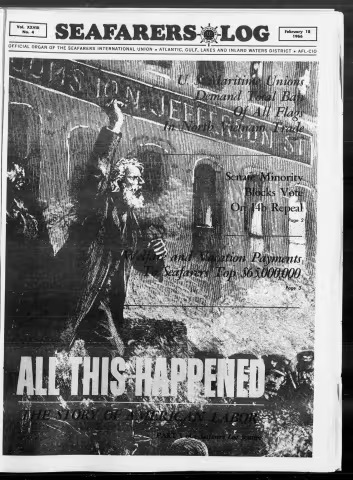
Issue Date
1966-02-18
Volume
28
Issue Number
4
Plaintext
SEAFARERS^LOG February 18
1966
OFFICIAL ORGAN OF THE SEAFARERS INTERNATIONAL UNION . ATLANTIC, GULF, LAKES AND INLAND WATERS DISTRICT .
t-
.•t's
K-'.
Page Two SEAFARERS LOG
February 18, 1966
Dirksen Leads Senate Filibuster
To Block Vote on Mb Repeal Bill
WASHINGTON—Anti-labor forces in the U. S. Senate succeeded last week in blocking a vote on
the measure to repeal section 14b of the Taft-Hartley Act, which permits states to enact so-called
'right-to-work' laws.
Lacking sufficient votes to^
prevent the repeal of 14b, op
ponents of the repeal measure,
led by Senator Dirksen, resorted
to a filibuster to keep the bill from
coming to a vote.
Supporters of repeal tried to
close debate but fell short of the
two-thirds majority required by
Senate rules. The first vote on
February 8 was 51-48 to close
debate. A second vote two days
later was 50-49 to limit debate.
AFL - CIO President George
Meany said the cloture vote "con
clusively proves that a majority
of the Senate favors repeal of
14b and will so vote if permitted
to do so."
Meany said "The AFL-CIO is,
of course, deeply disappointed
that the democratic process in the
Senate has been thwarted by the
shabby parliamentary tactics of
Sen. Dirksen and a minority of
senators. Our future plans will be
discussed at the next AFL-CIO
Executive Council meeting which
will open on Feb. 21."
Support for Repeal
The actual majority for repeal
was known to be higher, since
several senators traditionally op
posed to cloture have said they
would support the repeal bill—if
it ever got to a vote. And one
strong repeal supporter, Michi
gan's Pat McNamara (D) wa.s in
Senate
bilities.'
'to face up to its responsi-
tfie hospital during the two votes.
Actually the Senate never even
got to the stage of considering the
House-passed repeal bill. As hap
pened last fall, &nate Republican
Leader Everett McKinley Dirksen
mounted a filibuster against Mans
field's routine motion to make the
repeal bill the business before the
Senate.
Majority Leader Mike Mans
field made a final appeal to the
As part of the President's pro
gram, Mansfield said, the repeal
bill "deserves the decent and re
spectful attention of Congress." It
is "a matter of considerable im
portance to many millions of
Americans."
The routine motion to take up
the bill "should have carried with
out debate," Mansfield said. In
stead it brought down "an attack,
not only on a perfectly proper bill
of the House of Representatives,
but on the Senate committee
which had the temerity to report
it; on the whole of organized la
bor which had the effrontery to
advocate it; and on the President
who had the gall to recommend
its passage . . . Out poured the
resentments, the irritations, the
vendettas, and the whatevers
against organized labor which
were pent up over the decades."
Mansfield defended his decision
not to order around-the-clock ses
sions in an effort to break the fili
buster declaring that such tactics
have been unsuccessful in the past.
When "reason and restraint"
are lacking, Mansfield said, "the
Senate invariably reaches an im
passe of futility."
Dirksen defended his filibuster
because, he claimed, the Senate
majority has been intimidated by
"pressure" and the minority rep
resents the will of the people.
An angry Sen. Warren Magnu-
son (D-Wash.) retorted: "I cannot
sit idly by and listen to the min
ority leader talk about the will of
the people on this issue. Voters
of my state also have expressed
their will on this issue. The state
of Washington has voted not once,
but three times on this issue. . . .
At Domei Convention in Tokyo
SIUNA President Paul Hall as he addressed Japanese Confederation
of Labor Convention recently. With him is Mauri K. Kobayashi of
the University of Tokyo who served as interpreter.
Senator John O. Pastore (D.,
R. I.) called on Dirksen to allow
the Senate to consider the 14b
issue on its merits "and let there
be a clear-cut decision." The fili
buster, he said, denied the Ameri
can people the right to have the
legislation even discussed on the
merits of the case.
Hall confers with Koichi Kihata, Director of International Affairs of
the Japanese Confederation of Labor, during convention session.
- /
Shepard Attends
London Talks
On Ship Safety
The Intergovernmental Mari
time Consultative Organization's
safety committee agreed at its
meeting in London recently to
consider more stringent fire pre
vention standards to prevent re
currences of the tragedy which
resulted in the sinking of the run
away-flag Yarmouth Castle. SIU
Vice-President Earl (Bull) Shepard
participated in the sessions as the
labor representative from the
United States.
Shepard reix>rted that the full
range of life-saving equipment
and facilities were discussed at
the sessions. Interest in the
raising of international safety,
standards was heightened by the
flash fire which swept the run
away-flag cruise ship Yarmouth
Castle last November and went
down in the Atlantic with a loss
of 90 lives.
Shepard pointed out that inter
national action is essential to close
the loopholes which permit run
away-flag ships to operate below
the minimum standards required
under U.S. registry.
Commenting on the role of
maritime labor in the IMCO de
liberations, he said that U.S. sea
men must be represented at this
level because "the subjects under
discussion are of considerable
concern to them, as well as sea
men generally throughout the
world."
Feb. 18, 1966 Vel. XXVIII, No. 4
Official rublieation of llio SIUNA
Atlantic, Gulf, Lakes & Inland Waters
District, AFL-CIO
Executive Board
PAUL HALL, President
CAL TANNER
Exec. Vice-Pres.
AL KERR
Sec.-Treas.
ROBERT MATTHEWS
Vice-President
EARL SHEPARD
Vice-President
LINDSEV WILLIAMS
Vice-President
AL TANNER
Vice-President
HERBERT BRAND
Director of Organizing and
Publications
Managing Editor
MIKE POLLACK
Assistant Editor
NATHAN SKYER
Art Editor
BERNARD SEAMAN
Stag Writers
MELVIN PURVIS
WILLIAM DAY
Piblilhed biwttkly at 810 Rtio4« liland Avenie
N.E., Waikinaton. D. C. 20018 by thi Seafarm
iRtcmatloRal Pnlon, Atlantic. Galf, Labo and
Inland Watcn Oictrlet, AFL-CIO, 675 Foirth Ave-
nit, Brooklyn, H.V. 11232. Tol. HVaelnth
9-6600. Second clasi pottaic paid at Washinp-
ton. D. C.
POSTMASTEII'S ATTENTION; Form 3579 cards
shoeld be sent to Seafarers International Union,
Atlantic, Galf. Lakes and Inland Waters District,
AFL-CIO, 675 Foarth Avenac, Brooklyn, N.V.
11232.
Report of
International President
by Paul Hall
The filibuster by which anti-labor forces prevented a vote on the is
sue of section 14b of the Taft-Hartley law was a setback for work
ers in the right-to-work states who are among the nation's lowest, least
protected and most abused members of the nation s work force.
As a result of their use of the filibuster as a parliamentary device, a
minority group in the Senate orevented the issue from being voted on.
It is apparent that a majority of the Senate favored and would have
voted to repeal 14b—which gives states the right to ban union shops.
The anti-union forces thus were able to impose the will of a minority
over the majority. Knowing that they lacked sufficient votes to turn
back the 14b repeal measure if it came to a vote on the Senate floor,
they resorted to the filibuster tactic. In order to halt this filibuster tac
tic, a simple majority is not enough. A two-thirds vote of the Senate is
required to limit debate.
Supporter of Repeal in Majority
When the supporters of the move to repeal section 14b sought to close
debate, the vote was 51-48 in favor. However under the two-thirds
rule this was not enough.
As a result the attempt to repeal section 14b has been dropped.
It is unfortunate from the standpoint of the democratic process, that
the issue itself was never allowed to come up for a vote. It is quite obvi
ous, that if it had, 14b would have been repealed. This then was a de
feat for the democratic process because, to repeat, it enabled a minority
to employ a parliamentary tactic to block the sentiment of the majority.
The result is that the workers in the so-called right-to-work states
lost an opportunity to improve their wages and working conditions
and to attain job security.
The failure to repeal section 14b plays right into the hands of greedy
cut-rate employers in right-to-work states, who can now continue to
exploit their employes.
The 19 right-to-work states are notorious for their almost uniformly
low wage level and lack of benefits and protection that are enjoyed by
workers in the non right-to-work states.
The American labor movement must and will continue to fight
for the elimination of this and other forms of workers repression. This
is the function of organized labor none of whose advances came easily.
Dignity is Right of AD
The struggle to wipe out the inequities such as those created by the
right-to-work laws will not cease. Decent wages, decent conditions, job
security and dignity on the job should be the right "of all workers in
whatever state they may work.
As the record shows, they cannot have it under the so-called phony
right-to-work laws which are clearly an instrument to protect greedy,
union evading employers.
It is rather ironic, that at the present time when there is so much
talk and emphasis on the need to launch a strong attack on the condi
tions which create and foster poverty in many areas of our society, one
of the key contributing factors—section 14b of the Taft-Hartley Act
remains on the books to thwart the national objective.
Maritime Administrator Johnson
At SIU Engineers License Training Class
Johnson and aides are briefed on SIU ship activity by SIU
Rep. John Yarmola. From left to right, Art Friedberg, as
sistant to Administrator for Manpower; Ivan Scott, special
assistant: "Yarmola, and Capt. Tom King of Marad,
Maritime Administrator Nicholas Johnson talks to SIU men
studying for engineers license in Brooklyn. At right is SIU
Vice President Earl Shepard.
•• t
1 -
> /•
<
r
f •
\ 1
tl February 18, 1966
/ * MRt? jinree
URGE BAN ON SHIPS TO NORTH VIET
Text Of Joint Union Wire
« /o/W/n^ is the text of the telegram sent jointly by the
iLA, NMU^ and SIU to President Johnson, Secretary of Stati
Dean Rusk, Commerce Secretary John Connor and Labor Secre
te Willard Wirtz in regard to the blacklist of ships trading with
North Viet Nam.
Continuing trade with North Viet-Nam by the ships ot
supposedly friendly nations has been a matter of grave ctm-
cern to the membership of our unions.
"Hie recent decision to bar ships which engage in such
trade from participating in U. S. foreign aid programs is a
slap on the wrist which will in no way deter foreign ship
owners or their governments and will not curtaU the assist-
which Ae North Vietnamese receive from them. We
believe the time for pussyfooting is long past.
- ^ fighting and dying along with the loyal SouA
i^iet^ese forces and those of our other allies. Trade wiA
North Viet Nam puts blood money in the pockets of ship
pwners and oAer profiteers in so-called allied nations. We
express the sentiments of the seamen and longshoremen who
comprise our unions and Ae other maritime unions when
we say that such aid to Ae nations which are engaged in
a^ession against the South Vietoamese people and against
U. S. and ^ied t^ps must be met by firm, direct and un-
compromismg action by our country.
In any case, American seamen and longshoremen are de-
temined to take action to discourage Ae flow of supplies
which strengAen North Vietaam and Aeir puppets the Viet
Cong m Aeir aggression. We must inform you, therefore,
very soon our members will begin to demonstrate Aeir pro
tests on all waterfronts in this country Arected against any
a^ ^all ships of Aose nations which permit trade with
NorA Vietnam.
Thomas W. Gleason, ILA
Joseph Curran, NMU
Paul Hall, SIU
ILA^ NMU andSIU to Stage Protests
Against Ships In Trade With Enemy
govemmente from supplying the North Vietnamese regime. snipowners or their
In a joint position, the^
International Longshoremen's
Association, the National
Maritime Union and the Seafarers
International Union of North
America, said that the time for
"pussyfooting is long past" and
that they would soon begin "pro
test demonstrations" in all U. S.
ports against vessels of those na
tions which permit trade with
North Viet Nam.
The joint union position was
set foith in a telegram to Presi
dent Lyndon B. Johnson on Feb
ruary 14. Identical wires were
also sent to Commerce Secretary
John Connor, Labor Secretary
Willard Wirtz and Secretary of
State Dean Rusk.
Limited Blacklist
Under the terms of the State
Department blacklist announced
earlier this week, non-commuriist
and Polish ships that carry mate
rial to North Viet Nam are pro
hibited from picking up American
foreign aid cargoes in United
States ports. Polish ships are in
cluded because Poland receives
U. S. foreign aid.
The Viet Nam blacklist will be
a roster of ships observed by U. S.
spotters on their way to North
Viet Nam ports. As of February
14, the list of vessels barred from
picking up U. S. foreign aid car
goes consisted of the following
five: the British freighters Shien-
foon, Shirley Christine and Wa-
kasa Day; the Cypriot vessel Amon
and the Greek ship Agenor.
The unions maintained in their
statement that "continuing trade
with North Viet Nam by the ships
of supposedly friendly nations has
been a matter of grave concern
to the membership of our unions."
"Our boys are fighting and dy
ing along with the loyal South
Vietnamese forces and those of
our other allies," the unions said.
'Blood Money'
"The trade with North Viet
Nam puts blood money in Ae
pockets of ship owners and other
profiteers in so-called allied na
tions. We express the sentiments
of the seamen and longshoremen
who comprise our unions and the
other maritime unions when we
say that such aid to the nations .. .
engaged in aggression against the
South Vietnamese people and al
lied troops must be met by firm
and uncompromising action by
our country."
The joint union statement said
that American seamen and long
shoremen are set on action to dis
courage the shipment of supplies
to North Viet Nam and its pup
pets, the Viet Cong.
The SIU and other AFL-CIO
maritime unions have consistently
condemned the State Department
for its refusal to effectively ban
from U. S. ports those ships en
gaged in commerce with Cuba and
North Viet Nam.
SIU Call for Action
At the SIUNA's twelfth bien
nial convention last May, dele
gates adopted a resolution calling
for passage of federal legislation
which would prohibit the carriage
of U. S. commerce by foreign-flag
ships which had traded wiA NorA
Viet Nam. Similar action has been
urged by the AFUCIO Maritime
Trades Department.
Last December, the convention
of the AFL-CIO called upon the
State Department to re-evaluate
its position and support legislation
to bar from U. S. commerce
foreign-flag vessels which have
been trading wiA NorA Viet
Nam.
The unions' position makes it
clear that the only effective black
list is one that bans all ships of
any nation which permits any ves
sel flying its flag to trade with
North Viet Nam.
Bernsfein Named N»w Heod of Deportment
SIU Welfare Service To Make Study
Of Puhlic Health Hospital Facilities
of representative for many years, has been appointed as Director
of the Seafarers Welfare Services and Social Security Department ppomiea as uirector
° •'""lie Health
West and Gulf Coasts and the
Great Lakes area. The purpose
of the study will be to review the
services already available to Sea
farers in the USPHS facilities wiA
a view to improvement.
In addition, the Welfare Serv
ices director said efforts will be
made to further expedite the pay
ment of welfare claims to Sea
farers and their families and to
assist individual members with
their welfare problems.
Field representatives will cover
the USPHS facilities on East, West
and Gulf Coasts and Great Lakes
to study existing in-patient and
out-patient services. In addition,
they will review possible methods
for improving and expanding serv
ices for active and pensioned Sea
farers, and their dependents.
The newly-appointed director
pointed out that the Department
will continue to make the maxi
mum effort to assure the proper
medical care for Seafarers and
their families.
Among the typical medical serv
ices covered by the Seafarers Wel
fare Plan are hospital expenses, in
cluding room, board and extras,
blood transfusions, surgical bene
fits, maternity expenses, as well as
optical benefits and disability ben
efits. The Seafarers Welfare Plan
also provides for the payment of
death benefits to the beneficiaries
of deceased Seafarers.
Seafarers Welfare Services are discussed by (left to right) SIU
President Paul Hall, newly-appointed Welfare Services Director
Cr!™n"
Seafarers Welfare Benefits
Exceed $65 Million Mark
I YORK—SIU members and their dependents have col
lected a total of over $65.2 million in welfare and vacation benefits
Seafarers Welfare and Vacation Plans.
ine $65.2 million total was"^"-;
tion of the welfare plan, survivors
of departed Seafarers have col
lected over $6.7 million in death
benefits.
Among the typical medical serv
ices covered by the Welfare Plan
are hospital expenses, including
room, board and extras, blood
transfusions, surgical and mater
nity benefits.
The $65,233,615.25 sum paid
out in benefits under the Welfare
and Vacation Plans since 1950
does not represent the total assist
ance which Seafarers and their
families received from these plans.
The total value of Welfare benefits
is considerably higher since the
cost of scholarship payments, meal
books, training facilities and medi
cal examinations for SIU mem
bers and their dependents have
not been included in the $65 mil
lion figure.
"Hie Seafarers Welfare Plan is
maintained entirely by employer
contributions, based on man-days
worked.
The Plan is administered by a
Board of Trustees consisting of
an equal number of Union and
employer representatives.
reached at the end of December
1965.
Since 1950, when the Welfare
Plan was organized, over $26.9
million has been paid out in hos
pital, death, disability, maternity,
dependent, optical and out-patient
benefits.
The SIU Vacation Plan, which
went into operation in February,
1952 has provided Seafarers with
more than $38.3 million in bene
fits in the past 15 years.
Since the Union Welfare Plan
was organized, a total of $4.8 mil
lion has been paid out to SIU
members and their dependents to
cover hospital expenses and 1.3
million in maternity benefits.
At the end of 1965, the welfare
plan had also paid out over $2.1
million in out-patient benefits and
$5.4 million in disability benefits.
In addition, over $6 million in
dependents benefits had been paid
out at the end of 1965.
The SIU Welfare Plan also
jrovides for the payment of death
lenefits to the survivors of de
parted Seafarers. Since the incep-
: 1
'tlrf
Page Four SEAFARERS LOG February 18, 1966
•m
- '.Tf
] 18
' n
!ii
'' I
' : 1
SlU-UIW Wins First-Time Part
After Seven Day Chicago Strike
CHICAGO—Members of the SIUNA-afTiliated Transportation Services and Allied Workers-
United Industrial Workers Local 300 have won bargaining rights at the Mctalmasters Company
here recently after a successful seven-day strike that was called after management refused to recog
nize the union as bargaining agent <$> —
for the workers.
Union members at the company
returned to their jobs after the
company agreed to sign a new con
tract with the union which called
for substantial improvement in
wages, working conditions and job
security for employees at the plant.
The strike was ordered by a
unanimous vote of the Mctalmas
ters membership after Local 300
President Gregory Grana brought
a final recognition demand to the
officials of the corporation. His
demand for union representation
and a new contract was turned
down by the company with the
statement that the employees of
TSAW-United Industrial Workers members man picket line out
side Metalmasters, Inc.. in Chicago, led by UIW Local 300
president Gregory Grana and union rep. Charlie Moses. Strike
lasted seven days and resulted in first union contract for the
plant's 60 employees.
LORAN-FOR PINPOINT
WORLDWIDE NAVIGATION
The loran system, by which a ship or aircraft can determine
its position anywhere in the world with an error of no more than
500 feet is based around a clock so accurate it will vary by only
one second in 3,171 years. ^
Loran, which stands for "long
range aid to navigation," has
its main station in a one-story
building on a hilltop in Bermuda
which, in conjunction with other
stations around the world and
shipbome or airborne receivers,
allows a navigator to fix his exact
position within three minutes, in
any weather, without resorting to
celestial navigation.
Loran works by converting dis
tance to time and measuring the
time difference electronicially. The
yardstick involved is an electronic
impulse and the time it takes
that impulse to reach any point on
earth from its point of trans
mission.
How It Woriis
Two or more loran transmit
ting stations constitute a loran
system. It works like this:
The fixed short stations trans
mit short impulses of radio en
ergy. Aboard ship the loran
receiver-indicator receives the
pulses from two or more stations
and displays them, permitting the
navigator to measure the differ
ence in time of receipt. A special
chart which accompanies the re
ceiver-indicator then gives the
navigator his exact position.
Although the main loran sta
tion in Bermuda is an expensive
complex of electronic niachinery,
the only device needed at sea to
get a fix is the receiver-indicator,
which only costs about $500.
The loran system is now used
by ships and aircraft of all nations
and has been credited with doing
more for safety at sea and in the
air than any discovery since celes
tial navigation. Before loran, it
took the best navigator 45 minutes
to plot his position by shooting
the stars, and in heavy weather
anybody's guess was about as good
as anyone else's.
mtysNrnw^Look
The iSeafarers Xog hia| 1
ehanged its pripting pfocesi^ j
|rh|s is the second issue siitcb f
fhe change, which was made f
with the view of improving |
the appearance and rieadabil-1
ity of the paper, |
We invite the comments of I
all readers. Let us hear from |
the company would "never strike."
Grana brought news of the re
fusal to Local 300 members who
had assembled in the company
parking lot during their lunch
break. The workers unanimously
ordered that a strike begin imme
diately.
What started out as a routine
lunch break ended seven days later
in a signed contract that calls for
paid holidays, a sound grievance
procedure and the establishment
of seniority rights.
Under the terms of the new
Local 300 contract, Metalmasters
employees will receive annual paid
vacations and the company has
also agreed to supply work gloves
to the employees. Prior to the
strike, work gloves were an issue
because Metalmasters employees
had to spend some $30 each year
for hand protection.
The company manufacturers
zinc castings for the automotive
and electronic industry.
Senate Gets '66
Ship Construction
Subsidy Request
WASHINGTON—Senator
^ L. Bartlett (D-Alaska) has
made the regular yearly re
quest to the ^retary of Com
merce to extend ship construc
tion-differential subsidy pay
ments on new construction of
merchant vessels from June
30, 1966 to June 30, 1968.
He had hoped, Bartlett said,
that he would not have to in
troduce the measure this year
because "I had hoped that .
; Congress by now would have '
before it the statement of the ;
^ President's new maritime pol- '
icy program, an action which :
V might well have obviated the
L necessity of independent con- ,
; S'deration of this proposed |
legislation.
The Atlantic Coast
McDermott
ious to ship
by Earl (Bull) Shepard, Vice-President, Atlantic Coast Area|
I recently returned from London after attending the 12th session of
the Maritime Safety Committee of the Intergovernmental Maritime
Consultative Organization. I was honored to be a representative of
the U.S. organized labor movement at the convention.
The purpose of the meeting was to examine existing international
safety codes concerning shipping ^
and to suggest any changes that
might be important.
New York
Among oldtimers seen around
the hall here recently are John
McDermott who
just returned
from a trip
around the world
aboard the Steel
Apprentice in
cluding two stops
at Vietnam. After
taking time out
for a short vaca
tion, he is anx-
out again. Also
watching the board here is New
ton Pain, whose last ship was the
Bienville and who came up from
Houston to ship out of New
York.
Baltimore
The SlU-United Industrial
Workers Union has signed up em
ployees of Web Tex Company
here and added them to the grow
ing SIU-UIW family. A new con
tract calling for improved wages
and working conditions went into
effect early this month.
Shipping has been slow here
during the last period, but prom
ises to pick up again soon. In
recent weeks we paid off five
ships, signed on one and serviced
nine in transit. The Alamar and
Portmar are laid up here with
the Alamar expected to crew up
soon.
Pete Mistretta, who last sailed
as AB aboard the Falrisle on a
trip to Vietnam, is keeping his
eye on the board here for a long
trip.
Off the Steel Advocate, on
which he sailed as messman, is
Zen Osman who is now looking
for a ship to the Far East or
Hawaii. James Temple, on the
other hand, says he will take a
chief stewards slot and doesn't
care what ship it's on or where
it's going. Just off the Longlines,
Willie Albert wants a third cook's
job on a long trip to the Far
East or India.
Norfolk
SIU-UIW contracts with Co
lumbia Yacht Corp. and Colum
bian Rope have been ratified and
signed recently. SIU-IBU con
tracts with Lynch Towing Line
and GATCO, Wilmington have
been renewed and the contract
with C. G. Willis, Inc., is pres
ently being written.
Shipping has been good for the
past period in Norfolk, and
should remain good for the com
ing period. We registered two
payoffs, one sign-on and serviced
five ships in transit in recent
weeks.
William Donald, who last sailed
aboard the Express Virginia as
bosun on a trip
to Vietnam is
taking a short va
cation before
shipping again.
After being laid
up for a spell
Henry Horton
has his ffd again
and intends to
ship right away.
His last trip was as oiler aboard
the Keva Ideal. McDonald Slade,
who sails as fwt, is mighty proud
of his new lifeboat ticket after
completing the course at the SIU
Lifeboat School. Charles Majette
has his ffd again and is ready to
ship. He was taken sick aboard
the Achilles on which he sailed as
bosun.
Philadelphia
Shipping has held pretty steady
here during the last period and
should remain so. In the last cou
ple of weeks we paid off six ships,
(Continued on page 6)
Donald
Future Of U.S. Maritime Discussed
House Merchant Marine and Fisheries Committee Chairman Edward A. Garmatz declared he is "un
alterably opposed" to any plan which calls for overseas construction of ships destined for subsidized
operations under the U.S. flag, at a recent nieeting with representatives of maritime and shipbuild
ing labor. Above, Garmatz (seated) talks with (l-r) AFL-CIO Maritime Trades Department Sec.-
Treas. Peter McGavin; Harold J. Buoy of the Boilermakers: Edwin M. Hood of the Shipbuilders Coun
cil: and Page Groton of the Iron Shipbuilders International Marine Council,
Fireman Eusibio Andaya (left) and engine department delegate
S. W, Lewis enjoying lunchtime 'aboard the Steel King while
waiting for the ship to pay off at Port Newark, N. J.
Wiper Thomas Vain (left) and
oiler Johnnie Green, had their
picture taken in the eng'ine
room.
Waiting for payoff, deckman
George Jones chose some good
reading matter from the ship's
SlU library.
PAYOFF
Left to right. Bill Isbell, AB; Tom Karatzas, carpenter; C. J. Brauner,
AB, ship's delegate; and P. J. Douzat, deck maintenance, were working
on deck when the LOS photographer came aboard.
STEEL KING
With lunchtime approaching, pan- Seafarer Robert Lipscomb (stand-
tryman Robert Mateo was whip- ing), cook & baker, signed on the
ping up some tasty salads for the dotted line for his pay.
crew.
Galley department members (l-r) G. Grajales, third cook; E. Kitchen,
galleyman; and Robert Lipscomb were all on hand when the main noon
time course, broiled salmon steaks, came out of the oven.
Seafarers Tom Karatzas, Bill
Isbell and C. J. Brauner all
lent a hand with the moor
ing lines.
Paymaster counts out the
long green as second elec
trician Luis Campos signs for
L> !<• M
Deckman Frank Cornier was
on hand in the paint locker
to stow away supplies for
ship maintenance.
Seafarer S. W. Lewis leans over to sign for
his pay while crewmate P. J. Douzat (far
right) and Isthmian representative (seated)
look on.
Crewmember W. W. Quin (left), said hello
to SlU rep. Bob Matthews, who was aboard
for the payoff and to settle any problems that
might arise.
{•
11
ii
:fll
,ir;.
. »
~r
ii'
Page Six SEAFARERS LOG Febmary 18, 1966
Ci
\4K
I
1
•••M !
:!
Lifeboat Class No, 144 Graduates
SIU Lifeboat Class No. 144 assembled for graduation picture
after successfully completing lifeboat training course at the
Harry Lundeberg School of Seamanship. Latest group of life
boat ticketholders are (l-r, bottom row): Wayne Carpenter, Con-
stantinos Benzilos, Aristides Karras and Kenneth P. Sudds. Back
row: Leif T. Nielsen, Allan Aragon, John Rusk, Allan Mattson
and instructor Ami Bjornsson.
Question: How do you spend
your off duty hours aboard ship
when you're on a long trip?
Antolne Johnson: I spend most
of my time reading. I like inter
national news a
great deal and get
most of it from
weekly news mag
azines. In the way
I of books, I prefer
science fiction but
also do a great
deal of reading in
the classics. I also
find the radio quite enjoyable es
pecially when you can get some
real good music on it. I find that
I can get the best reception on my
radio when I am in the Pacific.
If I am on a ship that has a TV
I usually don't watch it because
most of the programs are bad.
Carl LInebeny: Reading west
erns, science fiction and any book
that has some
thing to do with
the sea are the
things I like to do
with my time be
tween duty hours.
I like listening to
the radio when I
can get good re
ception, this usu
ally means at night. The last trip
I had was to Puerto Rico and I
found that I could pick up most
of the good American stations at
night. For this reason I usually
like to ship to Puerto Rico or
along the coast. I Like TV a great
deal but don't get much of a
chance to watch it on the trips
I have been on.
<1>
Joseph Fereuc: My favorite off-
duty pastime is for more duty. I
really like to pull
that overtime. My
major reasons for
this is that it keeps
me busy and it
means more
money. When I
read I like a real
good detective
story. On TV I
like the question and answer pro
grams and when I get the opportu
nity I really like to watch the
wrestling shows. When I retire I
am really looking forward to the
time when I can see all the wres
tling I want to.
E. P. Rosenquist: Mostly read
ing. Classics, detectives and sea
stories are my fa
vorites. I also
draw a great deal
of satisfaction out
of working with
fancy sea knots. I
learned this art
many years ago
and found it to be
a most rewarding
way to pass the time of day.
Keeping up with the news takes
a lot of time and it is something
I feel everyone should do. I get
most of my information from the
radio and TV and am thankful
that these two things exist. I
really like to get on a ship that
stays in a place where we can
get good reception.
Jona Gerfler: Reading, reading
and more reading. I have gone
through more
books since I have
gone to sea that I
can't even count
the numbers.
Good novels and
JI classics usually
•H . JB make up most of
my reading diet
but 1 do like a
hardy dose of U. S. magazines to
find out what the latest news is.
—7- vl>
Konstantinos Benizelos: One of
my favorite pastimes on ship is to
just plain rest. I
find that the best
thing to do be
tween watches is
to sleep. Of
course the next
best thing is roll
ing up that good
overtime. Money
is always some
thing that I can use. Reading U. S.
magazines has always been a fa
vorite because it helps in improv
ing my English. Radio and TV are
quite good to because they afford
me the opportunity to hear Eng
lish pronounced the, right way.
January 29 to February IL
DECK DEPARTMENT
1966
Wafai«
Port
Boston
New York ...
Philadelphia .
Baltimore
Norfolk
Jacksonville ..
Tampa
Mobile
New Orleans .
Houston
Wilmington ..
San Francisco
Seattle
Totals
TOTAL REGISTERED
All Groups
TOTAL SHIPPED
All Groups
Class A Class 8
3
54
7
19
4
1
4
11
40
42
8
26
18
1
17
7
8
6
6
2
12
17
20
6
17
6
236 124
Class A Class B " (liiass^
1 2 0
66 22 12
7 2 0
7 1 0
8 5 2
1 0 0
5 3 0
3 2 0
48 10 1
36 19 2
6 6 3
17 14 21
6 6 4
211 91 45
All Groups
Class A Class B
10 3
193 65
37 14
111 54
16 20
12 12
10 9
70 29
171 121
57 153
14 16
48 18
38 6
787 510
ENGINE DEPARTMENT
TOTAL REGISTERED TOTAL SHIPPED NOW ON THE BEACH
All Groups
Port Class A Class B Class A Class B Class C Class A Class B
Boston 5 2 2 1 1 10 2
New York 35 22 46 33 20 139 53
Philadelphia 9 5 7 0 0 31 19
Baltimore 10 15 5 7 3 52 49
Norfolk 6 4 11 3 1 16 20
Jacksonville 1 3 3 2 1 5 11
Tampa 6 3 2 4 2 7 4
Mobile 13 5 9 6 X 37 15
New Orleans 32 17 36 22 0 138 93
Houston 35 30 38 26 4 89 116
Wilmington 16 9 11 8 7 15 2
San Francisco 27 22 20 13 23 38 9
Seattle 21 4 11 8 11 23 4
Totals 216 141 201 132 74 600 397
STEWARD DEPARTMENT
TOTAL REGISTERED TOTAL SHIPPED NOW ON THE BEACH
All Groups All Groups All Groups
Port Class A Class B Class A Class B Class C Class A Class B
Boston 2 3 1 0 0 8 3
New York 42 10 64 17 7 133 22
Philadelphia 5 2 2 1 1 24 9
Baltimore 19 13 7 5 0 73 29
Norfolk 3 8 2 6 1 16 18
Jacksonville 3 3 0 2 4 4 8
Tampa 0 3 6 0 1 6 5
Mobile 8 6 5 6 0 50 21
New Orleans 40 26 45 27 0 152 112
Houston 21 10 21 13 8 39 61
Wilmington ". 6^ 1 5 1 6 12 0
San Francisco 29 12 23 5 32 21 8
Seattle 10 7 8 6 6 17 8
Totals 188 104 189 89 66 555 304
Charge Gov't Laxity Toward Merchant Fleet
Michigan Legislators Urge Congress
Enforce 1936 Merchant Marine Act
Alarmed by the continuing deterioiration of the American merchant fleet, the Legislature of the
State of Michigan has gone on record with a formal resolution calling on Congress to enforce the
provisions of the 1936 Merchant Marine Act, and to rigorously pursue every channel of such en-
•orcement. ^
The Michigan legislators
charge the Federal Government
with laxity in enforcing the man
dates of the 1936 Act and failure
to give the American merchant
marine the support and protec
tion it needs.
The resolution begins by point
ing out that the Merchant Marine
Act of 1936 is still the law of the
and, and notes that the Act calls
or a strong U.S. merchant marine,
adequate for national defense
emergencies, for carrying all do
mestic waterborne commerce and
a substantial part of waterborne
export and import commerce.
It also notes that the Act man
dates that the vessels be construct
ed in the United States, of the
most modern and efficient designs,
ying the U.S. flag and manned
by U.S. citizens.
Enforcement of these mandates
has become so lax that today
U.S. ships carry less than 9 per
cent of the total U.S. waterborne
dreign commerce," the resolution
continues, "because of failure by
the Federal Government to sup
port and protect the U.S. merchant
marine, providing less support, less
J » 'k G . i-'k • rV- 1 LL t I
is the practice
other maritime
protection than
common to all
nations."
The resolution further notes that
the active U.S. merchant fleet now
consists of only about 900 vessels
—less than pre-World War II
strength, and that shipbuilding ca
pacity has dangerously dwindled
in spite of the fact that our na
tional responsibilities and the in
ternational dangers we are facing
are "gravely increasing."
By contrast, the resolution points
out, the Soviet Union is increas
ing its maritime strength contin
ually and may already surpass the
U.S. with the "avowed purpose to
dominate world maritime power
by 1970 — and meanwhile the
United States allows its maritime
force to diminish."
THE ATLANTIC COAST
Continued from page 4
signed on three and serviced six
in transit.
Jose Carames is ready to take
the first engine department job
that comes along after getting his
FFD again. Guy Divlalo and John
Flanagan .both want pumpman
jobs. Flanagan says if nothing
turns up here he may. head for
the west coast. Marceiino Santi
ago is registered and waiting for
bosun slot.
Boston
Shipping here has been on the
slow bell this period but is ex
pected to pick up during the next
period. We have had two payoffs,
one sign on and serviced one ship
in transit during the last period.
Elton Hamaty has taken a job
on a small tanker running in the
sound so he can be close to his
home and family. His previous
slot was AB aboard the Miami.
Leonardo Ruggiero is looking for
a coast-hugger after a long Per
sian Gulf run as oiler aboard the
Sea Pioneer.
Puerto Rico
Sea Land of Puerto Rico has
inaugurated a new $1 million
trailer tank service for shipping
liquid cargo at controlled tem
peratures between the mainland
February 18, 1966 SEAFARERS LOG
WASHINGTON—Right-wing extremists will be "playing for keeps"
in the 1966 congressional elections, the AFL-CIO Committee on
Political Education warns.
A new COPE pamphlet reports that the John Birch Society and
other radical right groups are raising multi-million dollar war chests
to expand an already large-scale political and propaganda operation.
The society already has a staff of 250 paid workers and a net
work of 360 bookstores. It has an announced goal of recruiting 1,000
members in each of 325 congressional districts. And, COPE reports,
"it will swing its sharpest hatchet in the 51 districts that switched in
1964 from conservative to liberal." The goal, COPE declares, is
"to take over Congress or, at the very least, to destroy the present
liberal majority."
Aiding their efforts will be the historical pattern that the party in
control of the White House loses seats in off-year elections—and the
pattern that the drop-off in voter turnout in non-presidential years is
heaviest among workers and their families.
The Birchers aren't the only right-wing extremists mobilizing for
the November election, the (X)PE pamphlet notes. Old and new
ultra-right groups have been stepping up their propaganda. Before
the 1964 political campaign, some 6,000 extremist programs were
carried weekly on radio and television in more than 500 cities. Cur
rently, says COPE, "more than 10,700 programs are broadcast each
week in more than 1,000 communities."
Copies of the COPE pamphlet, "They're Playing for Keeps," are
available free of charge. Request Publication No. 163C from AFL-
CIO Committee on Political Education, 815 16th Street, N.W., Wash
ington, D. C. 20006.
Congress passed its first major legislation of the new session—a
permanent GI Bill of Rights including educational and housing benefits
for all persons serving at least six months in the armed forces. Eligibil
ity will date back to January 31, 1965, when the benefit program set
up for Korean War veterans expired.
The House and Senate votes were unanimous, speeding the measure
to the President. The House quickly agreed to the single Senate amend
ment. A similar bill, with somewhat bigger benefits, passed the Senate
last year with strong support from labor and vetetrans' groups.
Although the -Senate sidetracked its own bill in favor of the House
version, the legislation was a major victory from Senator Ralph W.
Yarborough (D-Tex.), longtime sponsor of a "Cold War GI Bill of
Rights."
The Hatter's Union still hasn't
found a buyer for the plant they've
owned for seven years accor^ng
to President Alex Rose. Due to
a seasonal lull in manufacturing
operations between December 6
and February 1 they had intensi
fied efforts to sell the Merrimac
Hat Co. to private enterprise.
The buyer of the Amesbury,
Mass., plant would have to guar
antee the workers' jobs and that
the factory would remain in the
industry. The union is the ma
jority stockholder after saving the
plant from liquidation seven years
ago with a $500,000 stock pur
chase. They retained the old man
agement and have shown a profit
every year.
California employers might
have kept $4.5 million in unpair
wages in 1965 except for the
work of the Department Indus
trial Relation's Division of Labor
Law Enforcement. Employers are
kept from knowingly, or unknow
ingly, cheating their workers by a
state law covering those not pro
tected by the federal minimum
wage law. In 1965 wrongfully
withheld wages were up over
11%, or one million dollars, over
1964. The annual report of La
bor Commissioner Sigmund Ary-
witz revealed his office helped
workers collect $778,000 from
employers who failed to make
payments to employee benefit
funds. The Division had more
than 67,670 individual claims at
its 22 offices. Fifty thousand were
claims for unpaid wages.
—-
By a unanimous vote the Balti
more City Council attacked the
fiiibustering against 14(h) and
called for a Senate vote. Balti
more AFL-CIO central body
President Dominic N. Fornaro re
ported that the 20 members pres
ent, of the 21 man council, by
passed the customary referral to
committee to urge repeal of 14(b)
of the Taft-Hartley Act.
Francis E. Dowd, Jr. has been
named an assistant general NLRB
counsel by General Counsel Ar
nold Ordman. Dowd will super
vise board offices in Indianapolis,
Milwaukee, Minneapolis, Albu
querque, N. M., and Winston-
Salem, N. C.
Frank H. Cassell has been ap
pointed director of the U. S. Em
ployment Service by W. Wiliard
Wi^ Cassell has been director
of personnel administration and
manager of industrial relations for
the Inland Steel Co. of Chicago.
He follows Louis Levine who has
become assistant manpower ad
ministrator.
Clarence T. Lundquist, Labor
Department's Wage-Hour Admin
istrator, has made the first deter
mination of minimum wages
based on an area's prevailing
wages and benefits. Maricopa
County, Ariz, was the locality for
the first determination under the
terms of the McNamara-O'Hara
Service Contract Act. Lundquist
directed service employes work
ing on federal contracts over $2,-
500 be paid from $1.66 to $3.50
an hour, receive one week's paid
vacation after one year, and re
ceive six paid holidays.
The enemies of the American labor movement,
led by Senator Everett McKinley Dirksen, have
won a temporary victory against progress by deny
ing their fellow senators a chance to even vote on
the measure calling for repeal of Section 14b of
the Taft-Hartley Act. Had the Senate been allowed
to vote, repeal of 14b would have been certain,
since a majority of the senators favor repeal. The
measure had already been passed by the House.
To prevent a vote on the issue, Dirksen again
dragged out the long-discredited but undeniably
effective strategem of the filibuster—in which one
or two senators endlessly spout reams and reams
of nonsense. They talk and talk, and while they are
talking the rest of the Senate can only sit and
listen—or walk out in disgust. No business of any
kind can be undertaken while a filibuster is in
progress. In effect, the filibustering senators give
their fellow legislators an ultimatum—"Either
you let me have my way or I won't let you get on
with any business of any kind, no matter how im
portant, for the rest of the session."
The success of these tactics in preventing 14b
repeal from coming to a vote represents a defeat
for every worker in America, and a victory for
every union-buster, sweatshopper and wage
chiseler in the nation. 14b will remain on the
books for a little while longer and those states
which have anti-labor "right-to-work" laws as a
result of 14b will continue to allow their workers
to be abused by union-busting employers and de
nied the right to bargain collectively for decent
wages and working conditions from a position of
strength.
Organized labor will redouble its efforts in the
months ahead to make good its vow that this piece
of legislation will be stricken from the books. At
the next meeting of the AFL-CIO Executive
Council, scheduled for February 21, plans will be
formulated for continuing the fight for repeal.
The issue of 14b is a matter of importance to
every American, even if he does not live in one of
the states which have "right-to-work" laws. The
continued existence of Section 14b, raises seri
ous questions about American politics and state
of democratic process in America. The continu
ance of Section 14b poses serious questions on the
future of the President's war on poverty because
14b denies many workers the right to better their
condition through the most effective means of all—
collective bargaining.
The states which have jumped on the 14b band
wagon and have passed "right-to-work" laws are
the states with the highest incidence of hard core
poverty. They are the states where wages and
working conditions are the poorest and where the
lowest standards of living prevail. These are the
conditions which Section 14b seeks to perpetuate.
They are the very same conditions which most
Americans consider a national disgrace and have
vowed to eliminate.
Section 14b of the Taft-Hartley Act deserves
to be repealed because it is a bad piece of legisla
tion. It is not only anti-labor but also un-Ameri
can in the concept. It denies traditional demo
cratic process because it denies America's tradi
tional concept of rule by the majority. It is a road
block standing in the way of American social prog
ress, which will fall under the pressure of public
opinion and the relentless march of progress.
Medicare Deadline
The deadline for filing for supplementary medicare
benefits is March 31, 1966. In order for an indi
vidual to get coverage for doctor bills and other
medical costs under social security, he must sign up
by March 31. Those who do not sign up by this
date cannot get coverage again until October 1967.
Everyone who is 65 or over whether he is working
or not, should protect himself by signing up right
away.
•il
':i 'J'
-i
I
• 'V
Page Eight SEAFARERS LOG Febrnaiy 18, 1966
r!
'.5
T'-ii'
OF AMERICAN LABOR
THE STORY
of a Seafarers Log feature
The indenture system was nothing more
than a form of slavery—but for a specific
time, usually about five years—after which
the indentured person l^camc a free man
(or woman). Many poor workers and even
entire families, without hope in Europe,
indentured themselves in return for the
passage to America which they could not
otherwise afford. These were often skilled
craftsmen-blacksmiths, carpenters, weav
ers, shoemakers, sliversmiths, etc.
. i ~ -1
'1 ** »
1 . >5 1 •
- i" V
Ire American trade union movement
goes back to the very birth of our
nation in the years immediately fol
lowing the Revolutionary War. Low
III wages, Imig hours and poor working con-
ditions were the basic reasons behind the
^ariiest labor organizations. Workers in
many states didn't have the right to vote,
hpr were their children able to get a decent
The original indenture contract bound
the worker to pay the ship's captain all of
his wages for a five-year period as pay-
ment for his passage to the new world.
What happened however, is that the ship "
captain, to get a quick turnover on his ^
money, sold the worker, with the inden
ture, at public auction as soon as the ship '*
docked. Mothers, fathers and children ^
were often separated. The indentured were "
virtual slaves for the indenture period. ^
They received no wages, could hot marry
without their owner's permission, were '
clad in cast-off rags and could be flogged
at the owner's whim. Instead of finding
l^ucatipn. , From the very beginning prgai opportunity in the new world,
.tiized Workers had to fight anti-labor IJOSS- ; '?• • pb®' bf Ibbh'g^nnts fppnd pven
;s in addition to courts, newspapers, and || ^^^ker conditions than those they left
iioliticai organizations controlled largely
W moneyed classes—as is often the case u
f tsi B; y the early 1750'Sr however, thou
sands of these bondsmen had worked
off their period of indenture, becotne
free-men, and had gone into business for
themselves. Being craftsmen, they usually ^
:To meet the growing demancl for labor, the colonial
rnoriea depended on Negro slaves, along with bound
hite labor. These groups corKfituted 80 per cent of
e immigrants before the Revotufion. During this pe-
|iod, the economy was hj^d on farming.
- ,
J
oday. In addition to these disadvantages^
^^ariy labor organizations, because they
the groundwork, had little or
pb experience on which to draw. They had
|ri proceed mainly on a trial and eririr|i Ip shops in towns and villages.
|asi$ and made many mistakes in those V When the master craftsman got more
pearly days. What they lacked in experience orders than he could handle , alone, he
jljhowever, they more than made up forh§ j| |hired a journeyman. The joumeymatr was
enthuriasm. They learned quickly from less skilled than the master arid Was will-
t--eir mistake^ ar^ dre strength and stK||||pijig to put in long hours for modest' pay
cess of organized labor today pm be credr - in order to learn from the master and im-
ited, in large measure, tq the devotion, - K prove his skill. When the journeyman felt
determination and ability of those earliest . | he had developed his skill sufficiently, he
trade.unionists; , .
Prior to the War for Independences
country had no trade unions in the mode
meaning of fte term, and the early trade-|
, union cannot be fully understood in to-J
day's terms. It must W temembered tba#
In addition to jourpeymen, many mas-
Ibr c*"®ft®'nen also employed several ap-
Shtices-—usually young boys bound to
pe master for a pericMi of years to tearfl
. . ^ the trade. They received no wages, but _
we are dealing with a time when raanu- Were fed, clothed and housed by the master ^ i
facturmg of^y kmd was just beginnirig | —eventually becoming journeymen and
m Amenea, Pittsburgh was just a fron- then master craftsmen,
tier village and Cmcmati Was the far west, v
r Various labor bodies existed within a
I wur'rig the eariy colonial the ;; 'trade, but they were mainly benevolent
American wonomy was based on farming 4; and fraternal associations—not labor uns
--•withwealthy lando^ere who had been p- ions in today's meariings. These associap ^
pven hu^ grants of land in the colonies tions of shoemakers, weavers, etc. looked
by the Bntish crown, supervising the la- ^ out for fellow craftsmen in times of sick-*
bor of mdentured workers. To meet the, J| pess or financial stress, paid doctor bUls
Iribriiarid for labor, the colonies depended and made small loam to get fellow mem-
on bound white labor and Negro slaves bers back on their feet in time of need;
who constituted 80% of the immigrants to " t
America before the Revolution.
in the early Ameriean barrel
jpriured here labor has bow
and sp^ajized fo pcnnf wherepta^^
can soon fake over.
fri irily days, thP |^
was the most imporfant man
In town. Almost everyone
required h» rirryioeW - I
rW^he Revolutionary War arid the; rati?
iJt ficatiori of a Constituticm in 1791,,
I : all that.
K into three kmds. The mdentured servants, jiation, unfettered by colonial status and®«
.7 Who were the most important source; free ties to British^ Americans great
. I who were hired for wag^, and Sea- 5^ expansion began. Tariff walls between Pe^''
. f fanng labor which included Sailors, fisher- -l| states were brokoft down. Foreign jeapital
men and whalers. , iSiiifirid.- credit;:ehlered;-Pe ••newlnatioh.^
-J"*'-
Febmarj 18, 1966 SEAFARERS LOG Page Nine
y, V. . ' J: -
' 111 V''i I'i'r -f" f-"Vii*'VifM"ii«iiiiiiiii'M'^iariii.itSi«^^ s:?*
The story of American labor is a vital part of American history. It
is a story that is too often neglected and distorted in the schools. It
certainly has been distorted in the press. It is a story that should be
told. The history of American labor is a stirring story of people-^in
most instances unnamed people-—and their continuing struggle to real
ize^ the hopes and aspirations of the American people. We and our
children should be reminded of what the labor movement is and what
it has achieved. On these pages, the SEAFARERS LOG begins ^'The
Story of American Labor,which will be continued in future issues,
ll^tier began to expand westward past and sodn dissolved after their demands!
Iflte Alleghenies. Canals and new roads u* had been met. With the union dissolved it '
rfecilitated transportation. Manufactured ,::,was usually not long before the employer«
[ goods were now needed in far off places ;; withdrew the pay raises and the workers |
the craftsmen could no longer deal V were right back where they started,
directly with his customers. This situation "
Time
Arranjedeoi
fiS
©as.
.i
OP TUB
• 7 4; M . '** * '•* *• ra
'
"••R*
"•MRl
11
ve rise to a new and special type of
msinessmen-—a middleman, wholesale
^ jobber or merchant capitalist.
He was basically a distributor. He pro-.
s duced nothing. He was not interested in
making goods but in making money. He
bought and sold, arid his motto was "Buy
Cheap—Sell Dear."
The merchant did everything he could
to depress the price of the goods he
bought, and the craftsman, who was now
under the power of the middleman, had-
' The Cordwainers had a permanent or-' ^
ganization, but were destined to learn an
even tougher lesson about the difficulties of ^
fighting for improved wages and working
conditions against unscrupulous bosses^ |^1
They discovered that the courts and the
nation's press were usually just as anti-
labor as the employers and would help
the employer destroy the union by every
means at their disposal.
•/>
r-— "'-I rr*ifr
The Cordwainers struck in 1799 to re
sist further reductions of wages that av
eraged from only $6.0(X tb $11.^5 per
the cost of the^L' week. One of the membere was paid to
goods he made—lower the quality of what||^^'picket" by making the rounds cff Phil^
only two ways to reduce the cost of -the,/' •
/ he produced and cut wages and working
p conditions for his journeymen and ap- r
[ , iMentices. Thus, the master craftsman was|
j/^wly forced to become an employer nfi
IV the naodern meaning of the word. [= i
• The merchant middlemen put further
(^|»rasrife or the master critsinen bf irii^ ^
IS
/^ridelphia's shoemaking shops to make sure
that all the cordwainers had left work;|/||
A Union committee then presented the ;
toster^naployera^ list of deni^nds|
including a demand that current wage
scales be retained. After mine weeks ol
/porting vast aihouht of cheajp foreign ij
goods manufactured in Europe by Childy||
/labor or prison labor. They also encpur-^ |
/aged the division of labor where each ^
if Worker performed only one part of the to-
fal pperation and therefore could be rela- |
tively Unskilled, lowrpaid, arid replaced c
if he complained about wajges or hours.
mands. Not lorig aftUr the roof
fell in on them. • '
or
age, usually from five fo seven
years. Indentured workers got -
no pay, could not marry with
out consent of their master and
could be resold at will. They
were flogged often.
Tailors in Buffalo, ship carpenters in Phil- indenture contracts
adelphia, cabinetmakers in Baltimore all ®
got the same treatment from the press.
During strikes by painters, stonecutters
and day laborers in New York, the police
usually proved to be just as anti-labor as
the courts and newspapers.
Strikers by the score were beaten,
i iriaimed and sometinies killed 1^ ppU^
and employer-hired goons, and were ofteft '
unceremoniously jailed by the police for
picketing.
N 1805 the union asked for a modesi
. raise in wages and was flatly refused,' .
Again the cordwainers resorted to a-.. ' "
strike—^but this time the employers were
ready for them. The Cordwainers soon
Under these conditions the old master-
journeyman-apprentice system began to.
w.eak down completely. Busier than ever , ,
Ibut mal^hig less on each hem, the em- r.'> The employers had planned well. TTr
found themselves indicted on trumped up '
charges of criminal conspiracy—based, no . ,.
, less on old English common law.
S if conditions were not bad enougji
for Anaericari workers during these
years after the Revolutionary TYar,
they were destined to become infinitely
wOrse following the War of 1812,
• ployer-master cut wages» and increased
2 "^/he hours of his journeymen, often re-
*0' placing them entirely with young unskilled'
; 2! apprentices. Friendship between master ^
and journejmen sioon vanished under f
|;th^ conditions, and for the first time /
The War of 1812 between the United
ates and Great Britain was fought for
a variety of economic and political rea-
cordwainers' crime was having formed a sons, but was touched off by one of the
there were "workers" and "employers.
union. The conspiracy was banding to-||
gether to raise wages. The press poured
out invective against the strikers. The
judge openly favored the employers
throughout the trial. The jury was made
up of 12 businessriieri Who did ti^
• The journeymen began banding' together hide their bias against the striking
ii'.M their own organizations, formed to pro-^ workers. Not only were the cordwainers
I met them from the abuses of tlie master- / convicted on these trumped up charges
most infamous practices ever used against
working men—the impressment of Ameri-
1 can merchant seamen on British naVai
' ships. American merchant ships were be-
;« ing intercepted on the high seas by British
men-of-war, and the youngest and strong- New England spinning min own-
; . est of the American crew members were
- forced to board the British ships as yir-
1 tual slayes. CoriditioM^ British
ers, protected by law, worked-
children fo point of ej^austion.
Schedule was Irom bell to bell.
'jeooployer. The American trade-unibn
4 movement was bom.
• based on non-existent law, but the con- naval ships of the time were unbelievably
pyictiori waa upheld by a higher court. The bad—that Was the main reason th^ could /•
merica's first trade union came into
being in Philadelphia in 1794 'and
was called the Federal Society of
Journeymen Cordwainers (shoemakers); '
was a true trade union. Its purposf/s|
s to resist cuts in wage scales. It was «
idesigned to be a permmtent organization :;
yith a constitution, dues, elected officers ^
re^arly scheduled meetings. i
decision not dnly doomed the nation's-
-J first union, the Federal Society of Journey-?
2; men Cordwainers, but by extension made|
•}: all trado uriioris illegal in thp kJni^^
States.
.j The Philadelphia defeat did not stop^
" the organization of trade unions however.;
The Cordwainers called the first
As wages, hours and working conditions
/.continued to deteriorate journeymen-l
/ workers everywhere banded together iri^
"or- trade unions. At the same time the em-
?'strike in 1799, There had been ji ifve? their tactics
.BS strikes or "tnmonts" previonsly i' un-on-bustmg, njclu^ng racreasing re-
iBeaby ™s si,ieU ff^^^^ j- ™ ^ "-ned scabs
•men organized into societies for the pur- .r • Newspapers were more than willing to
*j>ose. Some, like the journeymen printers "»( support the bosses by stirring-up public
jvho struck m'New York in 1786 for || sentiment against the workers. Boston
a $I per day wage even succeeded. But / carpenters were depicted as "foreign agita-
, their orgahii^^^ were not permanent, tors" when they struck for a IQthour day.
ot get British seamen to take the jobs
d resorted instead to this worst form
j|?f piracy. The United and Britain
nt to war oyer the issue; British troops
ven managed to bum Washington, the
nation's capital, but were eventually de-
' ated. America was victorious.
^ With the supply of British manufactured
goods cut off by the war however, the
merican economy turned another comer
hich was to spell misery for millions
of American workers for the next hundred
years. Factories began springing up all
over the nation, bringing with them child
and women labor, actual starvation wages,
18-hour workdays, illiteracy, slums—and
for the factory owners unprecedented
profits at the expense of unprecedented
; human misery.
^ V,..-
. S ... .rt
V
J
I
iii
/
Page Ten
-i
•*v,
SEAFARERS LOG February 18, 1966
y
Wage-Hour Law Improvements
Called for by Labor Sec. Wirtz
WASHINGTON—Past improvements in the wage-hour law have helped the economy and further
"substantial" changes are now needed, Labor Secretary W. Willard Wirtz told Congress recently.
wage
Wirtz said the Labor Department has carefully surveyed the impact of 1961-65 increases in the
floor and expansion of ^
coverage to determine whether
there were any adverse effects—
either in loss of jobs or price
inflation, and had found that there
were none.
By every measurement, employ
ment went up in the industries
affected, profits rose and prices
remained relatively stable.
The chief effect, the Labor De
partment found, was to raise the
earnings of more than 3.5 million
workers by approximately $1.2
billion a year.
As "a conservative estimate,"
Wirtz said, "this much additional
consumer purchasing power re
sults in the creation of 100,000
additional jobs in the economy to
satisfy the enlarged demand for
goods and services."
Department investigators care
fully tracked down all reports of
loss of jobs resulting from the
1961 amendments to the Fair
Labor Standards Act. Here is
what the department reported to
Congress;
The Pacific Coast
by Frank Drozak, West Coast Representative
Union membership hit a new high in the state of California ac
cording to a report just issued by Ernest B. Webb, director of indus
trial relationship.
"Continuing a steady four-year advance, enrollment in California
' labor unions reached a record high of 1,871,700 members in July
1965," the report said. The net ^
gain over the previous year was
47,000 members, a 2.6 percent
jump in membership.
In the five-county San Fran
cisco-Oakland Metropolitan area,
union membership totaled 465,-
800 in July 1965, ^900 more than
in the previous July. This was a
rise of 1.7 for the year.
San Francisco
Shipping continues to be very
good in all departments and all
ratings especially in the engine
and steward departments ratings.
In transit were the Steel Re
corder, Eagle Voyager, Summit,
Maiymar, Elizabeth, Neva West
and the Penn Challenger.
Ships due in during the next
shipping period include the Trans-
york, Transhudson, Coe Vlctmy,
Cour d' Alene, Montpeller Vic
tory, Ames Victory, Falrlsle, and
the Oceanic Wave.
Signing on were the Express
Virginia, Wild Ranger, Kyska,
Santa Emella and Express Buffalo.
Payoffs during the last ship
ping period included the Express
Buffalo, Oceanic Spray, Express
Virginia and the Kyska.
On the beach here we have
J. W. GIvens, Cook and Steward
who is in the hos
pital. He has bad
luck in making
the hospital lately,
but is making a
speedy recov^.
We're sorry he
couldn't make
the trip on the
Express Virginia.
Seafarers B.
Price, Bosun, and L. Price, mess-
man, two brothers who pulled in
here from Norfolk and Houston,
recently signed aboard the Ex
press Buffalo. G. Van Etten, a
member of the steward depart
ment also signed aboard the Ex
press Buffalo.
Wllmii^on
During the past two week pe
riod, we had the Wild Ranger
payoff and the Vantage Progress
signed on. Five ships were through
in transit. Shipping was very good
GIvens
for all ratings and the outlook for
the coming period is also very
good.
Walker Ward, electrician, just
got back into this area after four
months on the Morning Light.
With shipping the way it is here
he doesn't plan to stay on the
beach very long.
A1 Allen just came into town
after 8-months on the Express
Buffalo. He feels this was one of
the most eventful voyages, On
their first trip to the far east the
ship was out nearly six months
with 43 days seatime and 89 days
on the hook in Subic Bay. It
wasn't really so bad though, as
launch service was very good. He
plans a short stay with his wife
and then a short trip before tak
ing a real vacation this summer.
Seatfle
Shipping is still booming in
Seattle and two laid up ships are
expected to crew shortly, so mem
bers can have their pick of jobs.
Payoffs in Seattle included the
Pan Oceanic Faith, LInfield Vic
tory, Young America and the An
chorage.
In transit were the Seamar and
the Maiymar.
On the beach now waiting for
AB slot is Marshall (Whitey)
Townsend. Whitey was on the
Achilles for four months and now
wants a run to Alaska, so he can
, - be home a little
more often.
Whitey is a mem-
ber in good
standing for 23
years.
Robert Kongel-
hak, Deck Main
tenance, is now
sweating the hall
for the Sharang
job. Bob has been a member for
12 years.
A1 Keenum was an oiler on the
Transorleans. He took it easy for
awhile and has just shipped to
the Linfleld Victory as an oiler.
He has been in the union for 15
years and thinks the vacation
benefit is the best in the industry.
Kongdhak
"Almost none have proved to
be rooted in fact.
"A typical report received was
of the closing down of the crab
processing industry in North Car
olina. Reportedly, 18 plants shut
their doors on Sept. 3, 1965 be
cause of the increased minimum
wage, throwing 1,800 workers out
of work. Investigation disclosed
that 17 plants had actually closed;
but that all except one of them
had reopened within the month
and the last one two weeks later."
Insufficient Coverage
The weakness of the Fair Labor
Standards Act, Wirtz said, is that
it doesn't cover enough workers
and sets a wage floor below the
poverty level. His report showed:
• More than 17 million non-
supervisory workers are still ex
cluded from wage-hour coverage.
This excluded group includes a
high concentration of lower paid
workers.
• Almost two-thirds of all
white workers are covered by the
law, but less than half of all non-
white workers.
• Full-time workers at the
minimum wage earn only $2,600
a year, substantially under the
$3,000 poverty level.
Neither in his report nor, in a
news conference did Wirtz put a
figure on the increase in the mini
mum wage sought or supported
by the Administration. He did
tell newsmen that the $1.75-an-
hour recommended last year by
the House Labor Committee was
too high to fit the anti-inflation
"guidelines" the Administration
has urged.
WouM Close
U.S. P(^ te Ships
pading With N. Viet^ •
I;; WASHINCJTON —• Legislatioti
recently proposed in the House bj|
Representative Paul - A. Fiho
^.y.) would close U.S. ports t
lessels engaged in trade with NorthI
Vietnam. The proposal calls foi
forfeiture of such vessels and tliei
cargoes should they enter U
ports except for repairs or emef
gencies recognized under intermi
tional law.
The measiire has been refeire
to the Committee on jporeign Af
fairs for corisideratidn;
In a stateinent ^companY^^^
the proposal, Fino said his puipi
p to serve nDWce *'on some of
a'Ues" that while the United Stan
Itinerates dissent front i^ war aims,
it does not tolerate trade with i
enemies in warmateriail whie
jmenaceS American troops, I
; "My bill will not affect many ;
Ships,'' he said; "The ships that!
trade in southeast Asian waterspi
not often %call: in. Ameriear
ports. The teal intent of niy l^i
islatiori is to serve notice on du
opportunistic allies that we hay
had enough of their tr^e witj
North Vietnam In war goods, I
believe that adoption of my bil
might be just what we need t
make our point without harshe
The Great Lakes
by
A! Tanner, Vice-President and Fred Farnen, Secretary-Treasurer,Great Lakes
According to the late.st figures released as of December 31, 1965,
there were 2,104 grain cargoes carried by vessels on the Great Lakes.
American vessels moved a little better than 12 percent of these ship
ments. Canadian Lakers and foreign deep sea vessels carried the
remaining 88 percent. Canadian vessels are carrying five times the
amount compared to American
ships. This is a staggering figure
when one considers that the bulk
of the grain is shipped from
American ports.
We finally got a break in the
weather after a month of sub-zero
temperatures. This was the long
est cold spell since 1912 and we
hope the good weather is here to
stay.
More than 50 members at
tended the February 7th member
ship meeting and this is a sure
sign that fit-out is just around the
corner.
All Ports report that the train
ing and upgrading program is go
ing along at a brisk pace with Du-
luth leading the way. According
to the Duluth Fort Agent, more
than 200 men have taken the
training course since January 1,
1966.
Some of the oldtimers now on
the beach in Detroit are Alton
"Digger" Boyd, Joe Arnold, Ralph
Butts, Carl Green, Otto Nitz and
Dino Gazi.
Shipping for the 1966 season
looks like another record break
ing year and we expect this trend
to continue for sometime.
All members are once again re
minded to take this, opportunity
and upgrade themselves as soon
as possible.
Many good job opportunities
will be in the offering at fit-out
and the higher rate of pay is yours
for the asking.
The Ninth Regional District of
the United Coast Guard is hold
ing its Annual Meeting in Cleve
land on February 24th and this
Union will have representatives
there in attendance. One of the
major issues will be the discus
sion of manning on retro-fit and
fully automated vessels. Most
Great Lakes ship owners are of
the opinion that the installation
of oil fired Engine Rooms con
stitute labor saving equipment.
This same equipment has been
in operation aboard deep sea ves
sels for more than thirty years.
Some of the Lakes vessels in ques
tion are more than 50 years old
and when converted from coal to
oil or diesel, the shipowner feels
they have the right to cut crews
and working rules. We intenfl to
negotiate on all issues of manning
according to the amount of work
and safety conditions that require
a vessel to operate with a normal
complement. We do not intend to
eliminate jobs and working rules
just to give the shipowner a big
ger profit and he in turn does
nothing to help the sagging Amer
ican Flag Fleets.
ill Hits Foreign Craft
Exploiting U. S. Waters
WASHINGTON—Legislation requiring that all vessels or rigs
taking part in the exploration or extraction of natural resources
from United States,territorial waters be built in American shipyards,
has been introduced into the Sen
ate by Senator Daniel B. Brewster
(D-Md.).
In addition, the bill would re
quire that offshort drilling rigs
and other equipment be owned by
American citizens and licensed
under U.S. law.
Brewster points out that under
existing law these rigs are not
considered to be in trade requir
ing license and are therefore not
required to be U.S.-built. -
"The present loophole which
could permit more than $100,-
000,000 worth of shipyard work
to be lost to foreign yards cannot,
be allowed to go implugged,"
Brewster said.
In urging action, he noted that
a number of contracts for rigs
destined to operate in U.S. ter
ritorial waters have already been
placed with overseas shipyards.
"More will follow rapidly," he
warned, "if foreign yards are al
lowed to consolidate their foot
hold." Brewester noted that a
source of shipyard business of
major importance could be per
manently lost if action is not
taken.
As an example, he pointed to
a $6 million rig built in the
Netherlands which is scheduled
for delivery this month. Had
Brewster's proposed legislation
been on the books, this work
would have gone to a U.S. ship
yard.
In a separate statement on his
proposal, Brewster notes that in
1789 the first Congress estab-
lilshed that adjacent waters of the
United States be restricted to ships
built in this country, as one of
the best possible means of pro
moting vitally needed U.S. ship
building and ship repair industry.
In 1956 and 1960, he said, "We
closed gaps in our shipping laws
which had permitted rebuilding
abroad and importation of for
eign midbodies. Today we must
act again."
International conditions today
make "it vital to our national
interest that maritime legislation
be directed toward the prcunotion
of our domestic shipyards," he
concluded.
LEAVi CLIAN SHIP
Seafarers are reminded
when they leave a ship after
articles expire in a foreign port,
the obligation to leave a clean
ship for the next crew is the
same as in any Stateside port.
Attention to details of house
keeping and efforts to leave
quarters, messrooms and other
working spaces clean will be
appreciated by the new crew
;when -ft:':comcS"^^abdarh;K;:®gr
February 18, 1966
I
- f--
SEAFARERS LOG Page Eleven
TOUR DOLLAR'S WORTH |
Seafarer's Guide tp,Be11ei* Buying|
^ "l
; '-v
•"4
-- T
'
J
K
J >•
By Sidney Margolius
A major cause of family financial predicaments is unexpected big
medical bills.
Such unanticipated medical and dental expenses often are the be
ginning of deeper difficulties when families resort to loan companies
to consolidate medical bills without realizing the cost of this type of
credit, reports Meredith Jones, home economist at the Cincinnati Fam
ily Service agency.
A large Tennessee credit bureau estimates that large doctor and hos
pital bills cause about one-third of family financial troubles, "especially
where families have no insurance, or medical expenses are far above
the insurance carried." In fact, an American Bar Association commit
tee found that medical bills are those most often turned over to bill col
lectors.
If your family is typical, your medical expenses have been rising
almost twice as fast as other living costs, not only because of higher
hospital and doctor fees, but because families have been seeking more
care.
Medical expenses cannot be reduced as easily as food or recreation or
even housing costs. Certainly the trend to getting more care is desirable.
Most of the really effective solutions to rising medical costs can only
be accomplished on a community-wide basis, such as more efficient dis
tribution of facilities to avoid duplication, and greater use of the com
prehensive care provided by group health plans.
These plans, such as Community Health in Detroit, Kaiser in Cali
fornia, Health Insurance Plan of New York, Group Health of Wash
ington, and Group Health of Puget Sound have their own medical cen
ters and staffs. H.I.P. now is seeking to have its own hospitals, as
kaiser has. Some labor unions also have their own group care centers.
The SIU maintains its own clinic facilities and provides hospital
and surgical benefits for Seafarers and their dependents.
These plans keep down costs, and also provide better than moderate-
income families often get, because they are able to use teams of doc
tors, specialists and technicians, and modern diagnostic and laboratory
equipment. Unfortunately, such plans are not yet available in all towns
or even to all families. Many enroll only groups, such as employee
groups.
Since the realistic prospect is that we must expect to spend still more
for medical expenses, families need to prepare better financial defenses
against medical expenses than many have.
Especially susceptible to the dangers of unexpected medical bills are
young families with several children, families who have committed all
surplus income to installment payments, and retired couples. The re
tirees, or at least those who have reached 65, will have the protection
of Medicare beginning July 1, if they also sign up for the optional Plan
B, which will pay for doctor bills.
For younger families, the only possible way to budget for unexpected
hospital and medical expenses is through insurance. Many families,
however, have only inadequate insurance, usually in an effort to keep
down the expense. Sometimes it is because they fail to buy the most
suitable kind for their needs, or are misled by false bargains, or don't
understand the need. It is especially risky to buy insurance by mail from
a company you don't know and that may not be licensed in your state.
It is difficult for state insurance departments to regulate the companies
that sell by mail.
The real need is for as comprehensive a policy as you can afford. A
policy with a large "deductible" (that part of the expense you pay), for
example, the first $500 of an illness, will not protect against the tonsil
lectomies, broken arms, etc.
SIU Members in Puerto Rko Give
Face-Lift to Oldest U. S. Tug
The seagoing tug Mamie Coyle is undergoing hull repairs at the SIU Puerto Rico Division-con
tracted Wagner Shipyard at Isla Verde, P. R. Those who know her are not surprised by the fact
that her hull needs some repairs, for the vessel is almost 100 years old and has been in continuing
all that time. service
Launched at the Bath Iron
Works in Maine in 1869, the
Mamie Coyle is the oldest com
mercial vessel now operating un
der the American flag, and possi
bly the oldest working tugboat in
the world.
The Mamie Coyle was hard at
work towing heavy vessels and
strings of barges when Buffalo Bill
was supplying bison meat to feed
the workers building the first
transcontinental railroad, and al
ready had rust spots on her black
iron hull when Custer made his
last stand at the Little Big Horn.
Lofty clipper ships with their
acres of sail were still plying the
world's trade routes when the
Mamie Coyle began her life's
work. Sail gave way to steam
and then turbines and diesels,
wood gave way to iron, steel,
aluminum and fiberglass as the
Mamie Coyle went unconcernedly
about her business.
Hand Riveted
Built of black iron plates, all
riveted by hand with sledgeham
mers, the 80-foot-long, 80-ton tug
has a grace about her unlike pres
ent-day tugboats. She is narrower
and deeper than an ordinary tug,
built rather like an old-fashioned
deep-draft yankee fishing schoo
ner, with long lines and a grace
ful overhanding stern.
Equipped with a slow-speed 200
horsepower Catepillar diesel turn
ing a big propeller she is some
what underpowered by today's
standards for seagoing tugs but is
still able to pull her loads. With
the repairs now being done on her
the Mamie Coyle is expected to be
able to continue her work for
another 40 or 50 years—so well
was she built.
In a working life of almost a
hundred years she has had many
owners—numerous tugboat and
water transportation companies up
and down the East Coast. Her
present owner is the Land Au-
Opening Ceremonies Of New Toledo MBBA Hall
Members of Toledo Maritime Trades Department Port Council played host recently to Congressman
Thomas Lud Ashley (D-O. who officiated at opening of new MEBA hall in Toledo. Pictured above at
opening ceremonies are, (eft to right): Ted Barton, DAW Local 12: Don Bensman of the Toledo SIU,
Port Council Executive Sec.-Treas.; Fred Kunz, Grain Millers Local 58, Port Council President: Cleo Syph,
ILA Local I3I7-A, Council Business Agent: Congressman Ashley, Melvin H. Pelfrey, District 2 MEBA
Vice-President: Charles Hendrix, Public Employees Council 46, Port Council Exec. Board member: Fred
Whitman a/id^ Joh.9;. Ken^ Employees ̂ Council 46. ^ ̂
thority of Puerto Rico, which
bought her and a special sugar-
hauling barge for a dollar each
from a Hawaii-based firm. After
repairs she will haul sugar from
Vieques to Humacao to help sup
port the Vieques farmers.
Somewhere, in a tiny New Eng
land churchyard, is a weathered
stone bearing the brief history of
the original Mamie Coyle, for
gotten now by her closest living
ancestors. But her name lives on
—and will for some time.
In drydock at the SIU Puerto Rico Division-contracted Wagner
Shipyard at Isla Verde, P.R., the seagoing tug Mamie Coyle is
undergoing hull repairs after almost 100 years of continuous
service.
The Gulf Coast
by Lindsay Williams, Vice-President, Gulf Area
Shipping in the Gulf area is slow at the present time. From all
indications it will be picking up soon. Many ships previously making
the run from New Orleans to North Europe have been chartered
for the West Coast trade. Four C-2s of the Bloomfield Steamship
Company have been chartered to the MSTS for a year.
Fred Sullivan, steward depart- ^
ment, got off the Neva West
and is waiting for another trip
to North Europe. He calls the
West "a good ship with a good
crew." Harold Rowbotham is on
the beach after shipping on the
M/V Pensacola. TTie Pensacola
towed the Penrod Oil Drilling rigs
to Belle Chasse, Louisiana some
300 miles above New Orleans.
E. A. Johnson is waiting for a
group one deck department job
going any place at any time. His
last ship was the D^l Mnndo.
Frank Conforto's last ship, the
Midland has been laid up. He is
waiting for a job on a Delta Line
passenger ship to South America.
Anthony Ducotc says his last
ship was the Del Oro and he
said that it was a good ship with
a good crew. He's registered
Group one, deck, and waiting for
a carpenter maintenance job on
any ship.
Houston
C. E. Zlateff, one of the old-
timers in the steward department,
has registered in
Houston. He is
waiting for a for
eign trip, prefer-
ably India. C. C.
Llal says he's
been on the beach
long enough. He's
eagerly awaiting
something coast
wise. S. R. Mer-
Inger is ready to go after a few
weeks on the idle list. Brother
Meringer sails deck department.
He states that the welfare plan
kept him "on his feet while in
drydock.
Zlateff
Kelley
A, ,
.»I' >•' I > »
Mobfle
Shipping has been slow in the
port of Mobile.
Robot L. Kelly bas been ship
ping out of Mobile since 1940.
Last year Kelly was on the Wal
ter Rice (Reynolds Metal Co.).
He's registered
group two deck
department. Louis
Pugb is about
ready to ship out.
A hernia forced
him off the May
flower. The 20-
year union mem
ber lives in Mo-
b i 1 e with his
motlier. He says "you can't beat
coastwise tankers for money."
Oscar Ferguson, engine depart
ment is currently registered group
two. His last trip was to India
and Pakistan on the Transeastem.
Another oldtimer, he's been ship
ping the Gulf area for 20 years.
Ferguson and his wife make their
home in Waveland, Miss. Oiler
Robert N. Kelley of Jackson, Ala.
is another 20-year "Gulf Coast
regular." His last ship was the
Sea Train.
Cleveland R. Wolfe is regis
tered as group-one steward. He is
off the Mayflower where he spent
five months. Wolfe has been ship
ping the Gulf area over 10 years.
He makes his home in Mobile.
Theodore T. Harris is another
group-one steward department
member who calls Mobile home.
Harris has been chief cook for
the last seven months on the
Maiden Creek. , . , ,
I u ^ ^ 1 I L- . % * W L I
..x
Si,
Page Tvrelve SEAFARERS LOG
Seafarer Drops Anrhor in Hawaii,
Plans Basy Life of Work and Piny
After shipping through the port of Honolulu on many occasions during all seasons of the year,
Seafarer Thomas Vain has decided that he will set up permanent residence in Hawaii and use his
new home there as a base of operations.
Vain, who serves in the en- ^
gine department and hails from
Baltimore, first shipped out to
Honolulu in 1959.
"Now that I have learned my
way around the Islands," said
Vain, "I find it a nice place to live.
I'll be staying with friends at first,
people whom I've gotten to know
very well during my numerous
visits to Honolulu."
In fact. Vain has become so
accustomed to life on the islands
that he no longer considers him
self a tourist. And he finds the
people most interesting—includ
ing a certain girl he's been seeing
for some time now.
"Hawaii is a land of many
different naticmalities," he ex
plained, "and the best thing about
this divergence among the peoples
is that they get along so well
together. They either like you or
they don't and once they've made
up their mind, there's no chang
ing. .
"But, on the other hand," Vain
went on to say, "they are very
much like Americans who live
right here in the United States.
They live, for the most part, in
American-style homes and play
American music at their parties."
Seafarer Vain spent the Christ
mas and New Year's holidays in
Honolulu, before shipping back to
this country on the Steel King to
tend to some unfinished business.
He observes also that Hawaiians
spend their holiday celebrations in
much the same way as people liv
ing within the continental limits
of the United States.
"I could hardly tell the differ
ence," he said, "things were so
much the same. Each family had
a Christmas tree, thought not
quite so gaudily decorated, and
friends and kinsmen exchanged
presents the same way we do here.
All in all, I would call it an ex
cellent season.
"For one thing," he went on, "I
was able to visit around from one
house to another, meeting the dif
ferent families and observing their
way of life. The fact that I was
presently living with native Hawai
ians enabled me to meet people
who weren't tourists. Christmas
and New Years is a good time for
dropping in on friends, just like it
is here."
Brother Vain was also im
pressed with the weather in
Hawaii, since he is enthusiastic
about outdoor sports. He tells us
that there is very small difference
in temperature year round, and
with the trade winds blowing all
the time, there's no air pollution.
Thomas Vain
"Simply a good clean climate,"
he explained, "with plenty of
beaches for water sports such as
surfing, which I plan to take up
between voyages on SIU ships.
Then, too, I'm a golfer, and the
islands abound in excellent golf
courses under skies that are usu
ally sunny. Of course, I can hard
ly afford the more expensive places
where the tourists hang out, but
then again I've long discovered
that it doesn't take a stack of
money to enjoy yourself once
you've learned the ropes. Although
a good bit of the goods sold in
Hawaiian stores are imported,
prices still run about the same as
they do here with the exception of
a few items. There is a good bit
of farming on the islands and
some scattered industry."
Seafarer Vain also noticed that
the presence of so many diverse
people has given rise to a wide
variety of dishes, all of which he
enjoys when he and his girl go out
to eat. Japanese, Filipino, Chinese
and native Hawaiian cooking are
some of Vain's favorites.
"I'm beginning to like oriental
dishes more and more," he said,
"many of which very few people
have ever heard of. Since the sea
plays an important part in the life
on the islands, fish is a main fea
ture in their foods, sort of like
mashed potatoes in our diet here.
And I really don't have any par
ticular favorite, I simply like them
all. Since my girl was bom and
raised in Hawaii, she is able to
recommend the different places
with the unusual dishes.
In addition to his getting ac
climated around the new state.
Seafarer Vain has found time to
wander around, looking at the
usual sights in Hawaii. One of his
favorite places is Wakiki Beach,
and he has also visited the monu
ments at Pearl Harbor and Scho-
field Barracks, where World War
II began with the Japanese air
raid.
"It almost makes you feel you
were there when the war began,"
he noted, "just walking around the
harbor. Despite the passage of
many years since the tragic events
in December of 1941, grim re-
miners still remain.
Chow Time On The Robin Goodfellow
T. R. Deloach checks a pan o+ country style steaks aboard the
ship, while hungry Seafarers wait to be served in the mess hall.
Careful preparation of all dishes is one thing SIU steward's de
partment members take pride in.
siu
ARRIVALS
Karl A. Stewart, born Septem
ber 9, 1965, to the Edward L.
Stewarts, New Orleans, La.
Elaine Wems, born November
24. 1965. to the Harold G. Werns,
Oconomowoc, Wise.
\3>
Robert Bowman, born Septem
ber 15, 1965, to the Robert Bow-
mans, Orange, Texas.
<1>
Wayne S. Swearingen, born
November 13, 1965, to the Bar
ney S. Swearingens, Jacksonville,
Fla.
Richard Rasmus, born July 15,
1965, to the Roman R. Rasmus,
Mantua, New Jersey.
Stephen Tannish, III, born Oc
tober 22, 1965, to the Stephen
Tannishs, Jr., Ashtabula, Ohio.
Hope Ann Callahan, born De
cember 15, 1965, to the Charles
Callahans, Collingdale, Pa.
Lisa Linette Ballard, born No
vember 7, 1965, to the James R.
Ballards, Flat Rock, N.C.
<1^
Keith & Kenneth Bazil, born
October 30, 1965, to the Leo
Bazils, New Orleans, La.
Tammy Phillips, born Septem
ber 15, 1965, to the Theodore
S. Phillips, Bay City, Mich.
Ronda Lyn Dobson, born De
cember 16, 1965, to the Ronald
Dobsons, Frankfort, Mich.
Cheryl Lynn Nottage, born No
vember 11, 1965, to the David
Nottages, Toledo, Ohio.
Charles Rohertson, born Oc
tober 22, 1965, to the James Rob
ertsons, Prichard, Ala.
Joseph Edward Piazza, born
November 7, 1965, to the Joseph
Piazzas, Groves, Texas.
Stephanie Lee Williams, born
November 10, 1965, to the Wal
ter H. Williams', Gretna, La.
John Formich, born October
24, 1965, to the Fred Formichs,
Milville, N.J.
4^
Cynthia Ann Lopez, bom No
vember 14, 1965, to the Roberto
Lopezs, Metairie, La.
•if
Shona Smith, born November
5, 1965, to the Robroy Smiths,
Philadelphia, Pa.
•if
Lola Ann Trail, born Novem
ber 22, 1965, to the Junior B.
Trails, Cleveland, Ohio.
if
Warren Scott Ellis, born Oc
tober 5, 1965, to the Fines A.
Ellis, Kreole, Miss.
if
Yzamar Velez, born June 23,
1965, to the Porfirio Velezs, Rio
Piedras, P.R.
if
John Robert Smith, born No
vember 14, 1965, to the Robert
L. Smiths, Manistique, Mich.
if
Dorothy Carey, born April 23,
1965, to the Thomas E. Careys,
Brooklyn, New York.
if
Katherine Skendelas, born Sep
tember 18, 1965, to the Gus
Skendelas, Seattle, Wash.
if
Randall M. Cone, born October
16, 1965, to the William M.
Cones, Genoa, Ohio.
if
Deborah Mercer, born October
3, 1965, to the James F. Mer
cers, Glen Ellyn, 111.
if
Sharon Denise Mallory, born
October 22, 1965, to the Grady
Mallorys, Mobile, Ala.
if
Peter Jay Olson, horn Novem
ber 18, 1965, to the Floyd D.
Olsons, Duluth, Minn.
<1>
Sandra Joy Baxter, born Oc
tober 30, 1965, to the Bradley A.
Baxters, New Orleans, La.
February 18, 1966 * !•
,> -!
if.
r
.4
'•Oi %•'
%
V.,*
H/,(3APA/.'/guRLV,I
WAHNATALK
JO YOU-
WUATS THIS I HEAl?
A&30T You DATWS
A MBRMAIP f
SEE, CAP'hil- DON'T TELL 1
MEYOUBEUEUE THAT THERE
ARE SUCH TH'NSSAS
lEgMAIDS.
Pssrt MAM/El
aEfri^'
A
ft
t*
4
February 18, 1966 SEAFARERS LOG Page Thirteen
McNatt
I
; i<
)
•t
•ir
^ .
I
On the Transglobe, Stanley
Pacewicz was elected the new
ship's delegate.
His first order of
business was to
thank the entire
steward depart
ment for the great
food it has served
during the entire
trip. Meeting
Chairman W.
Clegg also writes
that this is one of the best ships
he has been on and that there are
no beefs.
Clegg
From the Cities Service Norfolk
comes word that John €. Hunt
has been elected
as the new ship's
delegate. Along
with Brother
Hunt, - jhn Lyons
was renamed to
his post as meet
ing secretary. The
steward depart
ment was given a
big round of
thanks by members of the crew
for really doing a great job on the
trip.
Hunt
A new T.V. antenna greeted members of the Delta ship Del Ore when it sailed last month. Tne
antenna was bought with the ship's fund and, according to meeting secretary Ramon Irizairy, will be
installed as soon as possible. The ship is in good shape and all repairs were taken care of in the home
port. A new Ship's Delegate,
Robert E. McNalf, was elected
to serve as ship's delegate by ac
clamation. Meet
ing Chairman,
Walter Dunn, said
that the steward
department was
doing a real good
job and should be
congratulated for
preparing some
real great food for
the crew. This
view was accepted with a vote of
thanks by the crew.
Joe Wallace, meeting chairman
aboard the Mankato Victory, re
ports that the
water and heat
conditions aboard
the ship have been
straightened out
and that most of
the quarters have
been painted on
|> the ship. It was
also reported by
C. W. Crafford,
meeting secretary, that the ship
had $6.75 in the ship's fund. At
the conclusion of the meeting one
minute of silence was held for our
SlU brothers who have given their
life in their duties on the sea.
John Fedesovich, meeting chair
man aboard the D^I Oro, reports
that everything is
O.K. and that
they are going to
have the T.V. re-
paired soon.
Meeting Secretary
Ramon Irizarry
told the Brothers
that there was a
total of $43.55 in
the ship's fund. A
was extended to
Crafford
Fedesovich
vote of thanks
the Steward's Department.
Christos Tsambis
Please contact your attorney
Jose A. Miranda, 160 Broadway,
New York, N.Y.
4^
William Mitchell
Please contact Abraham Weis-
berg at 38 Park Row, New York,
N.Y. Also the Southmore Hos
pital and Clinic, 906 E. South-
more, Pasadena, Texas.
Nick Magash
Please get in touch with your
wife immediately. She is staying
with your mother.
<|>
E. J. Gaylor
Your seabag is still on the Fan-
wood. Since the ship will not re
turn until May please write to the
ship in regards to your property.
Mail Being Held
Mail for the following Seafarers
is being held in the Port of Chi-
Welfare Benefits
Come in Handy
To the Editor:
We wish to express our heart
felt gratitude for the aid extend
ed to us during our illness. Both
of us underwent major surgery
and we don't know what we
would have done if had not been
for the S&A benefits and the wel
fare plan of the SIU. There just
isn't any way we can thank the
union enou^. We will always
be grateful to the SIU for the aid
extended to us and, because of
this, it really makes me proud to
be a member of this union.
Respectfully yours,
Charles Brack
Xmas Bonus
Appreciated
To the Editor:
My wife and I wish to thank
the SIU for the Christmas check
that was sent to me and also to
let the union know that we ap
preciate all that it has done for
us.
Sincerely,
B. Fleming
Thanks Union
For Hearing Aid
To the Editor:
I would like to voice my ap
preciation of the Union for the
badly needed hearing aid which
I received through the Seafarers
Welfare Plan. This means that
I will probably be able to ship
out again.
Yours fraternally,
Frederick H. Houck
Aid Appreciated
In Time of Need
To the Editor:
I would like to thank those
Seafarers who were kind enough
to send expressions of sympathy
when my wife passed away, and
for the aid that the union pro
vided during my wife's illness.
Respectfully yours,
James W. (Jay Bird) Fleming
cago branch office: Walter Ander
son, Clarence Anthony, Gary
Bach, Francis Baker, Roy Bain-
bridge, Richard Chapman, Ken
neth Christensen, Chester Chris-
tensen, Lagene Davis, Donald
Evenson, Robert Fromm, Bern
ard Grivas, Charles Hank^, Ross
Hansen, Wayne Hardesty, Samuel
Hargas, Joseph Kurpas, George
LaCross, Riley Liford Jr., Theo
dore Lonzo Jr., Jack E. Nestor,
Orville Patrick Jr., Luther Phil
lips, Charles Purdy, Joe Spak,
P. J. Stauffacher, Kent K. Stoor,
Alton Wahlin, Worley E. Wilkon-
sou.
Charles Rogers
Your son has just joined the
Navy and is presently taking
training at the Great Lakes Train
ing Station in Illinois.
Please contact your mother as
soon as possible.
Job Call In New York
In a crowd of fellow Seafarers, Felix Marquez (center) throws
in his book for an electrician's slot. The job openings are placed
on the Rotary Shipping Board and announced over the loud
speaker system by Union dispatcher Ted Babkowski.
Joe Landry
Contact Harry Darrah, Com
pass Center, Seattle, Washington.
Seafarer Billy McCaithy (center), a member of the deck department,
throws in his book after dispatcher Ted Babkowski announced job call.
Shipping in the port of New York has been on the busy side. Brother
McCaithy is looking forward to a good trip.
Relaxing Over A Friendly Game of Pinochle
I %
Seafarers Arnold Torella, Pete Gonzales and George Meltzer, all members of the steward depart
ment, enjoy a hand or two of cards at the Union Hall in Brooklyn. The hall serves as a gathering
place for Seafarers, in addition to its many other functions.
-m
Page Foarteen SEAFARERS LOG Febniair 18, 1966
I
Hunting Tops List of Attivities
In Seafarer's Leisure Mements
Most Seafarers have their own individual way of spending their time on the beach. A few take up
bowling, others prefer hiking or golf, and then there are those who'd simply rather sit at home with
the family—in this weather, by a nice warm fire.
Jemnigan
Seafarer Clyde H. Jemnigan
is a hunter, even though he does
not belong to a club, nor does
he own his own pack of dogs.
There are no formalities, so far
as he's concerned. The only re
quirements are a gun, an early
morning and a small patch of
woods he might have spotted
days, even years
before, where he
can park his auto
Ir.. 1 before daybreak.
"I like to get up
early in the morn
ing by myself and
be there before
anything is stir
ring around," he
said. "If you start
out then and you go by yourself,
there's no way to blame anybody
else if you happen to have bad
luck. There are certain draw
backs," Jemnigan explained, "to
getting in the woods before dawn.
I happen to be a rifle hunter, and
if you try to start firing too soon,
it's pretty rough lining up your
sights with so little light.
Brother Jemnigan applies this
philosophy to all types of hunting
from squirrel and rabbit to white-
tail deer, which abound the Savan
nah, Georgia, swamp country
where he was bom. And although
he has occasionally set out after
deer, Jemnigan still prefers the
challenge of the smaller game.
"Sure," he explains, "I'd rather
shoot a buck than a rabbit, but
at the moment I'm just eating the
venison that my friends bring in.
To go on a successful deer drive,
a man must be a member of one
of the hunt clubs that can afford
to keep up dogs and lease the nec
essary land. Since I can't tell ex
actly when I'll be shipping out and
when I'll be on the beach, it's
hardly worth the money."
But Jemnigan has let the lack of
membership in organized hunting
clubs worry him very little when
he gets the "urge" to bring home
the venison. Like so many other
real hunters like himself, he just
finds out where the big deer drives
are going to be held and stations
himself on the adjoining land.
"The big bucks have to mn
somewhere," he said, "They don't
particularly care whether they stay
on the land the hunting club has
rented or not. In fact, I'd say
they'd be smarter to break out for
other parts. Those "other parts"
is where I station myself. Most of
the time the deer don't mn past
where I'm standing, but when they
do, it's worth all the other days
I've spent there waiting."
Engine Department Veteran
Jemnigan, a 21-year veteran of
the engine department, presently
lives with his wife, Alice, in Jack
sonville, Florida, although he is a
native of Savannah. He describes
the fishing in and around Jackson
ville as being some of the best in
the world.
Remembering his earlier days as
a sportsman. Brother Jemnigan
said that he first recalled fishing as
a boy with his brother, LeRoy,
who was one of the Seafarers who
gave his life for his country during
World War II. "My brother," said
Jemnigan, "was going to sea back
then on SIU ships. He was on the
'James Edward Oglethorpe,' the
first vessel that was launched dur
ing the war out of Savannah. He
went down with his ship in the
North Atlantic after being torpe
doed bv a German submarine. We
were both shipping out SIU then—
and taking a little time out briefly
for fishing."
Stores of Memories
Brother Jemnigan, like most
Seafarers who has been shipping
Ship's Chores While In Port
-
Galley man Charles Collins aboard the SlU-contracted Robin
Goodfellow performs part of his routine duties while the ship
is in port in Brooltlyn. He is shown dumping the refuse from
a day's meal into garbage barrels adjacent to vessel.
out for upwards of 25 years, has a
big store of memories, things that
have happened to him in the past
that he best remembers. He espe
cially recalls one incident when he
had "hopped a freight" during the
war, trying to get home in time for
Christmas. "We just flat out got
caught by the railroad detectives,"
he said, "and spent the night in
jail in a small southem town.
"When we went before the judge
the next morning, he asked us
whether we'd eaten yet or not. The
friend and I allowed how we'd had
a little breakfast. We were sure he
tvas making a bad joke."
"Where're you boys going?" the
Judge went on to ask.
"Just trying like hell to get home
in time for Christmas," I answered
politely.
"Could you use a little more to
eat?" he asked, and I thought he
was really trying to make us feel
bad.
"Sure," my friend told him.
"Then," he told the policeman,
who had us in tow, "take these
boys down to the Westem and buy
'em a good meal and put 'em on
the highway. Boys," he said to us,
"don't go back to the train yards
looking for a ride, it's against the
law. Stand out on the highway,
and somebody'll pick you up. You
see, my own son's on his way
home, trying to get here best he
can. Just hope somebody'll help
him along, too."
MALDEN VICTORT (Aleo« Steam
ship). Jan. 17—Chairman, J. Wallace;
Secretary. C. Crawford. $6.75 in ship's i
rfund. Some disputed OT in deck and i
len^ine departments. Motion made to have
;a new scale for the baker and to have
the mixins machine fixed.
rjunior Peace Corps
TRAN6EASTERN, (Hudson). Dee. 22 '
—Chairman. R. G. Newell; Secretary. M. i
^B. Elilott. Had discussion on <6aws, •
Vpainting; all room, and also some dls-
-puted OT. Had discussion on TV. Vote
of thanks to the steward depaidment <
for fine thanksKlvine dinner.
? LOS ANGELA (Sea-Land). Jam 29 i
Jt^hairman, G. Castro; Secretary, H. i
IBjerrinR. $14.00 in ship's fund. No dis- |
pnted OT reported by department dele- i
rates. Crew was requested to please try :
to keep pantry clean at night. i
SCANTIGNT (Cities Service), Dec. 19— i
Chairman, M. Dofaerty; Secretary. W. i
Morris. Some disputed OT reported in '
deck ' department. Discussion held on i
painting crew's quarters as they have
not been painted in two years.
Of SIU
MEETIKGS
L DEL ORO (Dehay. Dec, 13---Chatirhii^
p. FedcsovichJ Secretary, Ramon Irisarr^'-'
143.65 in ship's fund Some disputed OOp
reported by deck and steward depart®
^ents. Suggestion for a new antenna Oi
"the TV be purchased I? old one cannot T
fixed. Vote of thanks to the stewa:
nent for job^^dl done.'
TRANSGLOBB (Hudson: iRTaterwe^l
See. 2—Chairman, yr. Cletor; Secretary
ft A. RioB. No disputed OT reported bj
ffepartment dekgates. BroOwr Pacewlc)
(Ivas elected to serve as oCTv ship's delc«
jtate. Vote of thanlm to the steward
l«te'
WILD RANGER (Waterman). Jan. 25
hairman, Arthur Beck; Secretafy,
W. Ferrandis. Captain said Uda
m best crew he ever sailed with
t thanks.'tp alL New weshSng'ma^
needed 14^00 1» shb)** fund. No
repdiy^d'^ :dciMtrtinent.. delegates
"(Hudioo .Waterwayak
G.. J, •.Mi|rryv;sSe«t»'
V,;,L.,: • E-.-D....Fiersoni '• Shin's:
ted eVrt^ing running emoi^yi Ho
:.i<spert«d.. hp:: 'delintsbMi,
,,,.,,._.-,,/ls.;'r(kin«»<*d tn::toefc.' '»n .'do<ii»«iM
'.to; "lUNm.i''Indiana "rfrnin'tultnit
(Seafarer Joseph Pasinosky is a serious student of world affairs.
He believes the Peace Corps is an effective instrument for promoting
international good feeling and. that its expansion by the creation of
a Junior Peace Corps could be an additional step to lasting peace.
In this article, he explains his idea.)
By Joseph Pasmosky
It has been said that we have never lost a war or won the peace.
I believe that if we set our minds to the task we could not only
win the peace but "provide bread for the tables of the world" in
the process. If the decent. God-fearing, law abiding teenagers
were given a chance to show what they could do, they could win
the peace hands down. We have the means, all that we need is
the will.
One method of accomplishing the task is to launch the Battle
of Armegeddon and create a philosophy that will unite the en
tire free world in the great crusade that mankind must wage and
win before a lasting peace can be assured and a brotherhood of
man firmly established on a universal principle. Only in this way
will we be assured that future generations will be spared the hor
rors of war and poverty.
If we interprete Chapters 19 and 20 of Revelations as a philos
ophers dream of a brotherhood of man we must conclude that the
final struggle will not be a hot war but a peaceful one. The pen is
mightier than the sword, the only weapon that a true philosopher
would dream of using. The pen, a symbol of edcation, knowl
edge, and knowledge is to civilization what food is to animal life.
Without knowledge man would be no better than the brute
animals.
The Peace Corps is the key to the solution. They are the mod
ern missionaries. They are accepted by all nations regardless of
race, creed or color. However, they are not fully developed or
effective enough for the task for their numbers are small. What
we must do is to expand the role that the Peace Corps will play
in this struggle. We must create a Junior Peace Corps so that
teenagers and their families can make a major contribution to the
effort.
Encouraged to Write
Teenagers in their junior and senior year of high school would
be encouraged to write to a teenager of their own age and sex in
a foreign country of their choice. They could make arrangements
to live with their new found friend for a year. The foreign
parents would agree to care for the American student in the same
way as their own children. At the end of the year the American
student and their friend would return to the United States and
the American parents would agree to care for their foreign guest in
the same way. In this way the cost for food and shelter would be
equalized over the two-year period.
Living with the people and sharing their standard of living the
American student would gain an intimate knowledge of their
customs, culture and their social and economic problems. At the
same time they could organize informal classes and teach chil
dren who would otherwise be neglected due to the lack of school
facilities in many countries.
While the foreign student would live in the United States they
would not only have an opportunity to learn to read, write and
speak our language but they would have an 'on the spot' chance
to study our social and economic problems and our democratic
institutions as well. The local high school, unions, business asso
ciations and other organizations would be in a position to teach
them American know how so that when they returned home they
would be more efficient producers of the necessities of life. In
addition they would become a potential reservoir of native Peace
Corps members, their ranks growing year by year.
Eligible for Assignment
After the American students finished their schooling they would
be eligible for assignment as Senior Peace Corps members. Their
intimate knowledge of their friends way of life would enable
them to exert a great influence in convincing the people that
democratic institutions are more desirable than those offered by
the communists.
If only ten percent of the student population would be willing
to be a junior Peace Corps member we could have at least half
a million active soldiers of peace. It would be the greatest social,
cultural and educational exchange that the world have ever seen.
It would result in developing friendships at the grass root level
and allow individual Americans to make a direct contribution to
this effort. The students who would be eligible for such an as
signment would be chosen by their local Parent-Teacher Asso
ciation. This would be desirable for it would assure all students
of acceptable character equal opportunity regardless of race,
color, creed, social or economic status.
It might be difficult to make contact with foreign teenagers in
the beginning. However, students could direct their mail to the
mayor of the town where they would like to live and the mayor
could pass it on to a religious order or others who would be
willing to assist in such a program. Once a sufficient number
of students were established throughout the world they could
act as contacts and advisers for the students at home.
Armegeddon is a dream that has laid dormant for two thousand
years. The same fate could befall "bread for the tables of the
world," universal peace and the brotherhood of man. I believe
that they can be realized in our own lifetime.
Those who are of the same opinion should write to President
Johnson and urge him to create a Junior Peace Corps.
February 18, 1966 SEAFARERS LOG Page Fifteen
DO NOT BUY
Seafarers and their families are
'^rged to support a consumer boy
cott by trade unionists against
various companies whose products
are produced under non-union
conditions, or which are "unfair
to labor." (This listing carries the
name of the AFL-CIO unions in
volved, and will be amended from
time to time.)
"Lee" brand tires
llUnited Rubber, Cork, Linoleum
& Plastic Workers)
^
Eastern Air Lines
(Flight Engineers)
^
H. 1. Siege!
' "HIS" brand men's clothes
(Amalgamated Clothing Workers)
Sears, Roebuck Company
Retail stores & products
(Retail Clerks)
Stitzel-Weller DistiUeries
"Old Fitzgerald," "Old Elk"
"Cabin Still," W. L. Weller
Bourbon whiskeys
(Distillery Workers)
— -if —
J. R. Simplot Potato Co.
Frozen potato products
(Grain Millers)
Kingsport Press
"Worid Book," "Cbildcraft"
(Printing Pressmen)
(Typographers, Bookbinders)
(Machinists, Stereotypers)
Jamestown Sterling Corp.
Southern Furniture Mfg. Co.
Furniture and Bedding
(United Furniture Workers)
Empire State Bedding Co.
"Sealy Mattresses"
(Textile Workers)
— —
White Furniture Co.
United Furniture Workers of
America)
Schedule of
Membership Meetings
SIU-AGLIWD Meetings
New York Mar. 7—2:30 p.m.
Philadelphia Mar. 8—2:30 p.m.
Baltimore . . Mar. 9—2:30 p.m.
Detroit . . . .Mar. 11—2:30p.m.
Houston . . . Mar. 14—2:30 p.m.
New Orleans Mar. 15—2:30 p.m.
Mobile ... .Mar. 16—2:30 p.m.
Wilmington Mar. 21—2 p.m.
San Francisco
Mar. 23—2 p.m.
Seattle Mar. 25—2 p.m.
Great Lakes SIU Meetings
Detroit Mar. 7—2 p.m.
Alpena Mar. 7—7 p.m.
Buffalo Mar. 7—7 p.m.
Chic^o Mar. 7—7 p.m.
Cleveland .... Mar. 7—7 p.m.
Duluth Mar. 7—7 p.m.
Frankfurt Mar. 7—^7 p.m.
Great Lakes Tug and
Dredge Region
Detroit .... Mar. 14—7:30 p.m.
Milwaukee .Mar. 14—7:30 p.m.
Chicago . .. .Mar. 15—7:30 p.m.
Buffalo ... .Mar. 16—7:30 p.m.
tSault Ste. Marie
Mar. 15—7:30 p.m.
Duluth Mar. 18—7:30 p.m.
Cleveland . .Mar. 18—7:30 p.m.
Toledo ... .Mar. 18—7:30 p.m.
SIU Inland Boatmen's Union
Philadelphia ..Mar. 8—5 p.m.
Baltimore (licensed and
unh'censed) .. Mar. 9—5 p.m.
Houston Mar. 14—5 p.m.
Norfolk Mar. 10—S p.m.
New Orieans . .Mar. 15—5 p.m.
Mobile Mar. 16—5 p.m.
Railway Marine Region
Jersey City
Mar. 14—10 a.m. & 8 p.m.
Philadelphia
Mar. 15—10 a.m. & 8 p.m.
Bidtimore
Mar. 16—10 a.m. & 8 p.m.
'Norfolk
Mar. 17—10 a.m. & 8 p.m.
United Industrial Workers
New York .... Mar. 7—1 p.m.
BaltUiore Mar. 9—7 p.m.
Philadelphia ..Mar. 8—7p.m.
•Wife?! (t-'uti Cce&iii
,22=ChiiinnaT!; ,Hrown
- ::;i'f! Iretaiv'. McKenneth Collins. Some minor'
J. • lorKe amount of re-
itrietion OT to bo taken up with patrol-
lan at payoff. $10.00 in ship's fund,
hip should be fumisated for rats and
ihes. Ship's delegate stated that it
ad been a long and tiresome trip and
Lrt vithat he believed that the good mprale
ienjwed by the crew throughout the voy-
ISnge eould be credited to Kenneth (Scot-
de) ColUris and a first-rate steward d^
artment.
: "Service). Jan, za-^hairman, J. G. Hunt:
• Secretary, John Lyona. Some disputed OT
in deck department.
NATIONAL DEFENDER (National
Shipping), Jan. 16—Chairman, ^iiliam
Joyner; Secretary, William Cameron.
Ship's delegate reported everything run
ning smoothly. $S.OO in ship's fund. No
beefs reported by department delegates.
DELHVNDO (Delta), January 28—
haii-man, Eugene P. Leonard: Secret
ry, Joseph N- Powers. Ship's delegatd" '
tended a vote of thanks to the chief '
sward for the "outstanding holiday '
lenus. Thanked the steward for writ--
K letters and reports for him during;
10 voyage. Also thanked the entire
iteward department for their good serv-
. Thanked crew for keeping the rec-
tion room locked while in the African
, rts. Balahce in ship's fund, $27.39.
, Some disputed OT in deck and engine
»i departments. Vote of thanks extended to
ffifthe Purser for his cooperation in han-
v^ dlitiK all crew mall, etc.
GENEVA (U.S. Steel), January SO—
^aiman, none; Secretary, Clyde L. Van
Enen. One man misaed ship in Balti-
worCi No beefs reported.
^tDBL AIRES (Delta), Januai?) 16—
Chairman, Chavlsa P. Johnson; Secret
towv d^iph K. Maldopado. Brother Ar.
"LJ®, ^ was elected to serve as
ships ̂ delegate. One man hospitalised in
I^keCWrlee. One man failed to join ship.
X reported by departinent , dele- .
gafeSv Vp^ of thfuiM to the balciBt' for
tho sppd pMtrya
DIOE3ST
of SIU
MEETINGS
TAMAR GUILDEN (Transport Com-
merclale), Jan, 24—Chairman, II, Ken
nedy; Secretary, H. Connoly. No beefs
reported by department' delegates. Brother
E- Rogg was rtolected' to Serve as new
ship's delegate. Crew was requested, to
,try to koap messh cltoh.
•DEL OBO (Delta), Jan. 9—Chairman,
W. Dunn; Storetary, Kanion Jriaarry.
Ship's delegate rwpwted everything la
running smoothly, $28,85 to ship's fund.
No beefs n^rtad by " department dele-
BtotSet';" R.; McNatt was elected
to'serve he new ship's • delegate.
SIU Atlantic, Gulf, Lakes
& Inland Waters
Inland Boatmen's Union
United Industrial Workers
PRESIDENT
Paul Hall
EXECUTIVE VICE PRESIDENT
Cal Tanner
VICE PRESIDENTS
Earl Shepard Llndsey Williams
A! Tanner Robert Matthews
SECRETARY-TREASURER
Al Kerr
HEADQUARTERS...
ALPENA, Mich. ...
BALTIMORE, MD. .
BOSTON, Mass. .
BUFFALO, N.Y. ..
CHICAGO, III. .
CLEVELAND, Ohio
DETROIT, Mich. .. I
DULUTH, Minn
FRANKFORT, Mich.
HOUSTON, Te*. ..
JACKSONVILLE, Fla
JERSEY CITY, N.J.
MOBILE, Ala
NEW ORLEANS, La.
NORFOLK, V,
PHILADELPHIA, Pa.
PORT ARTHUR, Tei.
675 4th Ave., Bklyn.
HY 9-6600
127 River St.
EL 4-3616
. 1216 E. Baltimore St.
EA 7-4900
177 State St.
Ri 2-0140
.. 735 Washington St.
TL 3-9259
9383 Ewing Ave.
SA 1-0733
1420 W. 25th St.
MA 1-5450
0225 W. Jefferson Ave.
VI 3-4741
312 W. 2nd St.
RA 2-41 to
P.O. Bo* 287
415 Main St.
EL 7-244!
5804 Canal St.
WA 8-3207
2608 Pearl St.
EL 3-0987
...99 Montgomery St.
HE 3-0104
. South Lawrence St.
HE 2-1754
—630 Jackson Ave.
Tel. 529-7546
115 3rd St.
Tel. 622-1892
2604 S. 4lh St.
DE 6-3818
1348 Seventh St.
SAN FRANCISCO, Calif. 350 Freemont St.
DO 2-4401
SANTURCE, P.R. ...1313 Fernandez Juncos
Stop 20
Tel. 723-8594
SEATTLE, Wash 2505 First Avenue
MA 3-4334
ST. LOUIS, Mo 805 Del Mar
CE-l-1434
TAMPA, Fla 312 Harrison St.
Tel. 229-2788
WILMINGTON, Calif. ...SOS N. Marine Ave.
TE 4-2523
Chnirmhn,; Htdmrt .CellBhah: Secretary^':
Bill Kaitor. $68.84 in ship's fund,
Brother K. Binemanis was elected to
serve as. new ship's delegate. No beefs
reported by department delegates.
FAiNWOOO (Waterman), 'December 26
-rtChairman, Seymour Heinfling; Secret ,
tary, D. Missiner. Ship's delegate re
port^ that the .crew> gave a Vote of
thanks to the captain for the assistance;,
he rendered to the United Seamens Scaw^;
fee in Yokohama for their Chrisi
dinner. No beefs rejmrted by departmen
delegates. Vote of. thanks to the stew'
and de?)artment for job well done.
FAN WOOD (Watermah) . Jan.
Chairman, Seymour HMnfling;
tary, S. Biscobar. Ship's delegate repor
that all repairs were done. No beefs
ported by department delegates. Brother!
S. Heinfling was reelected to serve as
new ship's delegate.
—J
ALCOA RUNNER (Alcoa), Jan. 24—1
Chairman, C. E. Turner: Secretary. G.;|
Ortiz. Ship's delegate reported everything
rnnning smoothly. No beefs reported by
department, delegates. Vote of thanks to
toe steward departmepi for job wvU
.done;' '
STBKL VENDOR (lithtofah), Jan. 91
—Chairman, J. Dunn; Secretary, P.|
Shaia. ^ip's-delegate reported evcrything|
so far OK, No beefs reported by de-|
partment delegates. Motion made to have|
seamen retire after 20 years sea time|
regardless.of age. Galley crew was askedi
to keep tbe noise down «• mueh as|
.possible.. ' . .1
^Houston Mar. 14—7 p.m.
Mobile Mar. 16—7 p.m.
New Orleans . .Mar. 15—7 p.m.
* Meeting held at Labor Temple, New
port News.
t Meeting held at Labor Temple, Sanlt
Ste. Marie, Mich.
$ Meeting held at Galveston wharves.
KNOW YOUR RIGHTS
FINANCIAL REPORTS. The constitution of tbe SIU Atlantic, Gulf, Lakes and
Inland Waters District makes specific provision for safeguarding the membership's
money and Union finances. The eonstitntion requires a detailed CPA audit every
three months by a rank and file auditing committee elected by the membership. All
Union records are available at SIU headquarters in Brookljm.
TRUST FUNDS. All trust funds of the SIU Atlantic, Gulf, Lakes and Inland
Waters District are administered in accordance with the provisions of various trust
fund agreements. All these agreements specify that the trustees in charge of these funds
shall equally consist of union and management representatives and their alternates.
All expenditures and disbursements of trust funds are made only upon approval
by a majority of the trustees. All trust fund financial records are available at tbe
headquarters of tbe various trust funds.
SHIPPING RIGHTS. Your shipping rights and seniority arc protected exclusively
by the contracts between the Union and the shipowners. Get to know yonr shipping
rights. Copies of these contracts are posted and available in all Union halls. If you
feel there has been any violation of your shipping or seniority rights as contained in
tbe contracts between the Union and the shipowners, notify Hie Seafarers Appeals
Board by certified mail, return receipt requested. The proper address for this is:
Earl Shepard, Chairman, Seafarers Appeals Board
17 Battery Place, Suite 1930, New York 4, N. Y.
Full copies of contracts as referred to are available to you at all times, either by
writing directly to the Union or to the Seafarers Appeal: Board.
CONTRACTS. Copies of ail SIU contracts are avaflahle in all SIU halls. These
contracts specify the wages and conditions under which you work and live aboard
ship. Know your contract rights, as well as your obligations, such as filing for OT
on the proper sheets and in the proper manner. If, at any time, any SIU patrolman
or other Union official, in your opinion, fails to protect your contract rights prop
erly, contact the nearest SlU port agent.
EDITORIAL POLICY—SEAFARERS LOG. The LOG has traditionally refrained
{turn publishing any article serving the political purposes of any individual in the
Uninn, officer or member. It has also refrained from publishing articles deemed
harmful to the Union or its collective membership. This established policy has been
reaffirmed by membership action at the Septcmher, 1960, meetings in all constitu
tional ports. The responsibility for LOG policy is vested in an editorial hoard which
consists of the Executive Board of the Union. The Executive Board may delegate,
from among its ranks, one individual to carry out this responsibility.
PAYMENT OF MONIES. No monies are to be paid to anyone in any official
capacity in the SIU unless an official Union receipt is given for same. Under no
circumstances should any member pay any money for any reason unless he is given
such receipt. In the event anyone attempts to require any such payment be made
withont supplying a receipt, or if a member is required to make a payment and is
given an official receipt, but feels that he should not have been required to make
such payment, this should immediately he reported to headquarters.
CONSTITUTIONAL RIGHTS AND OBLIGATIONS. The SIU puhlUhes every six
months in the SEAFARERS LOG a verbatim copy of its constitution. In addition,
copies are available in all Union halls. All members should obtain copies of this
constitution so as to tamiliarize themselves with its contents. Any time you feel any
member or officer is attempting to deprive you of any constitutional right or obli
gation by any methods such as dealing with charges, trials, etc., as well as ail other
details, then the member so affected should immediately notify headquarters.
RETIRED SEAFARERS. Old-time SIU members drawing^ dirahility-pension bene
fits have always been enconraged to continue their union activities, including attend
ance at membership meetings. And like all other SIU members at these Union meet
ings, they are enconraged to take an active role in all rank-and-file functions, in
cluding service on rank-and-file committees. Because these oldtimers cannot take
shipboard employment, the membership has reaffirmed the long-standing Union pol
icy of allowing taem to retain their g(^ standing through the wqiving of their dues.
EQUAL BIGHTS. All Seafarers are guaranteed equal rights in employment and
as members of tbe SIU. These rights are clearly set forth in the SIU constitution
and in the contracts which the Union has negotiated with the onployers. Conse
quently, no Seafarer may be discriminated against hecauM of race, creed, <»lor,
national or geographic origin. If any member feels that he is denied the equal rights
to which he is entitled, he should notify headquarters.
SEAFARERS POLITICAL ACTIVITY DONATIONS. One of the basic righte of
Seafarers is the right to pursue legislative and political objectives which will serve
the best interests of themselves, their families and their Union. To achieve these
objectives, the Seafarers Political Activity Donation was established. Donations to
SPAD are entirely voluntary and constitute the funds through which legislative and
political activities are conducted for the benefit of the membership and the Union.
If at any time a Seafarer feds that any of the above rights have been violated,
or that he has hecn denied his constitutional right of access to Union records or in
formation, he should immediately notify SIU President Paul Hall at headquarters by
certified mail, return receipt requested.
FINAL DEPARTURES
Earl T. Hardeman, 65: A heart
attack claimed the life of Brother
Hardeman while
he was at his
home at Marrero,
Louisiana. He was
buried in the West
View Cemetery of
Augusta, Georgia.
He joined the
S.I.U. over 20
years ago in the
port of New York. Brother Har
deman was a member of the un
ion in good standing and was a
member of the deck department.
He is survived by his brother,
Charles Griffin, who lives in Au
gusta.
Editor,
SEAFARERS LOG,
675 Fourth Ave.,
Brooklyn, N. Y. 11232
I would like to receive the SEAFARERS LOG—please put my
name on your mailing list. (Mnt informaiion)
NAME
STREET ADDRESS
CITY
TO AVOID DUPLICATION: If you are an old subscriber and have a change
of address, please give your former address below:
John Arthur Queary: 38, Broth
er Queary died at sea last October
from a heart con
dition. He was
bom in Brooklyn
over 38 years ago
and was a mem
ber of the steward
department. For
the last 15 years
Brother Queary
sailed with the
S.LU. and joined the Union in
his native New York. Before
joining the S.I.U. he was in the
U. S. Navy and saw action in the
Second World War. He is sur
vived by his friend P. Nergler
who lives in Brooklyn.
1
I
I
I
I
I
I
I
I
I
i
I
I
I
STATE.. ZIP.
ADDRESS
CITY .... STATE
I
I
1
l"
I 4
I
t.
' te .
ZIP..
-•-.V
SEAEARERS#LOG
OFFICIAL ORGAN OF THE SEAFARERS INTERNATIONAL UNION • ATLANTIC, GULF, LAKES AND INLAND WATERS DISTRICT • AFL-CIO
i I
• f.-
'i-
Vi.'•••"'
,Ix
F I "ihe restricted nature of shipboard
life, with its very limited recrea
tional facilities, makes reading one
of the few leisure pastimes for Sea
farers. Thus the demand for shipboard
reading material is high. To provide
SIU men with an adequate, steady
supply of reading matter the SIU in
1953 instituted the Seafarers Log Li
brary program under which the Union
delivers to all SlU-contracted ships a
new assortment of paperback volumes
every three months.
SIU library packages are also deliv
ered regularly to all U. S. Public Serv
ice Hospitals and are maintained in
all SIU Union halls.
In a year's time an SlU-contracted
ship will receive a minimum of 200
new titles, covering the range of Sea
farers' reading preferences. Since the
program's inception almost two and a
half million pocket size books have
been made available to Seafarers.
1966
OFFICIAL ORGAN OF THE SEAFARERS INTERNATIONAL UNION . ATLANTIC, GULF, LAKES AND INLAND WATERS DISTRICT .
t-
.•t's
K-'.
Page Two SEAFARERS LOG
February 18, 1966
Dirksen Leads Senate Filibuster
To Block Vote on Mb Repeal Bill
WASHINGTON—Anti-labor forces in the U. S. Senate succeeded last week in blocking a vote on
the measure to repeal section 14b of the Taft-Hartley Act, which permits states to enact so-called
'right-to-work' laws.
Lacking sufficient votes to^
prevent the repeal of 14b, op
ponents of the repeal measure,
led by Senator Dirksen, resorted
to a filibuster to keep the bill from
coming to a vote.
Supporters of repeal tried to
close debate but fell short of the
two-thirds majority required by
Senate rules. The first vote on
February 8 was 51-48 to close
debate. A second vote two days
later was 50-49 to limit debate.
AFL - CIO President George
Meany said the cloture vote "con
clusively proves that a majority
of the Senate favors repeal of
14b and will so vote if permitted
to do so."
Meany said "The AFL-CIO is,
of course, deeply disappointed
that the democratic process in the
Senate has been thwarted by the
shabby parliamentary tactics of
Sen. Dirksen and a minority of
senators. Our future plans will be
discussed at the next AFL-CIO
Executive Council meeting which
will open on Feb. 21."
Support for Repeal
The actual majority for repeal
was known to be higher, since
several senators traditionally op
posed to cloture have said they
would support the repeal bill—if
it ever got to a vote. And one
strong repeal supporter, Michi
gan's Pat McNamara (D) wa.s in
Senate
bilities.'
'to face up to its responsi-
tfie hospital during the two votes.
Actually the Senate never even
got to the stage of considering the
House-passed repeal bill. As hap
pened last fall, &nate Republican
Leader Everett McKinley Dirksen
mounted a filibuster against Mans
field's routine motion to make the
repeal bill the business before the
Senate.
Majority Leader Mike Mans
field made a final appeal to the
As part of the President's pro
gram, Mansfield said, the repeal
bill "deserves the decent and re
spectful attention of Congress." It
is "a matter of considerable im
portance to many millions of
Americans."
The routine motion to take up
the bill "should have carried with
out debate," Mansfield said. In
stead it brought down "an attack,
not only on a perfectly proper bill
of the House of Representatives,
but on the Senate committee
which had the temerity to report
it; on the whole of organized la
bor which had the effrontery to
advocate it; and on the President
who had the gall to recommend
its passage . . . Out poured the
resentments, the irritations, the
vendettas, and the whatevers
against organized labor which
were pent up over the decades."
Mansfield defended his decision
not to order around-the-clock ses
sions in an effort to break the fili
buster declaring that such tactics
have been unsuccessful in the past.
When "reason and restraint"
are lacking, Mansfield said, "the
Senate invariably reaches an im
passe of futility."
Dirksen defended his filibuster
because, he claimed, the Senate
majority has been intimidated by
"pressure" and the minority rep
resents the will of the people.
An angry Sen. Warren Magnu-
son (D-Wash.) retorted: "I cannot
sit idly by and listen to the min
ority leader talk about the will of
the people on this issue. Voters
of my state also have expressed
their will on this issue. The state
of Washington has voted not once,
but three times on this issue. . . .
At Domei Convention in Tokyo
SIUNA President Paul Hall as he addressed Japanese Confederation
of Labor Convention recently. With him is Mauri K. Kobayashi of
the University of Tokyo who served as interpreter.
Senator John O. Pastore (D.,
R. I.) called on Dirksen to allow
the Senate to consider the 14b
issue on its merits "and let there
be a clear-cut decision." The fili
buster, he said, denied the Ameri
can people the right to have the
legislation even discussed on the
merits of the case.
Hall confers with Koichi Kihata, Director of International Affairs of
the Japanese Confederation of Labor, during convention session.
- /
Shepard Attends
London Talks
On Ship Safety
The Intergovernmental Mari
time Consultative Organization's
safety committee agreed at its
meeting in London recently to
consider more stringent fire pre
vention standards to prevent re
currences of the tragedy which
resulted in the sinking of the run
away-flag Yarmouth Castle. SIU
Vice-President Earl (Bull) Shepard
participated in the sessions as the
labor representative from the
United States.
Shepard reix>rted that the full
range of life-saving equipment
and facilities were discussed at
the sessions. Interest in the
raising of international safety,
standards was heightened by the
flash fire which swept the run
away-flag cruise ship Yarmouth
Castle last November and went
down in the Atlantic with a loss
of 90 lives.
Shepard pointed out that inter
national action is essential to close
the loopholes which permit run
away-flag ships to operate below
the minimum standards required
under U.S. registry.
Commenting on the role of
maritime labor in the IMCO de
liberations, he said that U.S. sea
men must be represented at this
level because "the subjects under
discussion are of considerable
concern to them, as well as sea
men generally throughout the
world."
Feb. 18, 1966 Vel. XXVIII, No. 4
Official rublieation of llio SIUNA
Atlantic, Gulf, Lakes & Inland Waters
District, AFL-CIO
Executive Board
PAUL HALL, President
CAL TANNER
Exec. Vice-Pres.
AL KERR
Sec.-Treas.
ROBERT MATTHEWS
Vice-President
EARL SHEPARD
Vice-President
LINDSEV WILLIAMS
Vice-President
AL TANNER
Vice-President
HERBERT BRAND
Director of Organizing and
Publications
Managing Editor
MIKE POLLACK
Assistant Editor
NATHAN SKYER
Art Editor
BERNARD SEAMAN
Stag Writers
MELVIN PURVIS
WILLIAM DAY
Piblilhed biwttkly at 810 Rtio4« liland Avenie
N.E., Waikinaton. D. C. 20018 by thi Seafarm
iRtcmatloRal Pnlon, Atlantic. Galf, Labo and
Inland Watcn Oictrlet, AFL-CIO, 675 Foirth Ave-
nit, Brooklyn, H.V. 11232. Tol. HVaelnth
9-6600. Second clasi pottaic paid at Washinp-
ton. D. C.
POSTMASTEII'S ATTENTION; Form 3579 cards
shoeld be sent to Seafarers International Union,
Atlantic, Galf. Lakes and Inland Waters District,
AFL-CIO, 675 Foarth Avenac, Brooklyn, N.V.
11232.
Report of
International President
by Paul Hall
The filibuster by which anti-labor forces prevented a vote on the is
sue of section 14b of the Taft-Hartley law was a setback for work
ers in the right-to-work states who are among the nation's lowest, least
protected and most abused members of the nation s work force.
As a result of their use of the filibuster as a parliamentary device, a
minority group in the Senate orevented the issue from being voted on.
It is apparent that a majority of the Senate favored and would have
voted to repeal 14b—which gives states the right to ban union shops.
The anti-union forces thus were able to impose the will of a minority
over the majority. Knowing that they lacked sufficient votes to turn
back the 14b repeal measure if it came to a vote on the Senate floor,
they resorted to the filibuster tactic. In order to halt this filibuster tac
tic, a simple majority is not enough. A two-thirds vote of the Senate is
required to limit debate.
Supporter of Repeal in Majority
When the supporters of the move to repeal section 14b sought to close
debate, the vote was 51-48 in favor. However under the two-thirds
rule this was not enough.
As a result the attempt to repeal section 14b has been dropped.
It is unfortunate from the standpoint of the democratic process, that
the issue itself was never allowed to come up for a vote. It is quite obvi
ous, that if it had, 14b would have been repealed. This then was a de
feat for the democratic process because, to repeat, it enabled a minority
to employ a parliamentary tactic to block the sentiment of the majority.
The result is that the workers in the so-called right-to-work states
lost an opportunity to improve their wages and working conditions
and to attain job security.
The failure to repeal section 14b plays right into the hands of greedy
cut-rate employers in right-to-work states, who can now continue to
exploit their employes.
The 19 right-to-work states are notorious for their almost uniformly
low wage level and lack of benefits and protection that are enjoyed by
workers in the non right-to-work states.
The American labor movement must and will continue to fight
for the elimination of this and other forms of workers repression. This
is the function of organized labor none of whose advances came easily.
Dignity is Right of AD
The struggle to wipe out the inequities such as those created by the
right-to-work laws will not cease. Decent wages, decent conditions, job
security and dignity on the job should be the right "of all workers in
whatever state they may work.
As the record shows, they cannot have it under the so-called phony
right-to-work laws which are clearly an instrument to protect greedy,
union evading employers.
It is rather ironic, that at the present time when there is so much
talk and emphasis on the need to launch a strong attack on the condi
tions which create and foster poverty in many areas of our society, one
of the key contributing factors—section 14b of the Taft-Hartley Act
remains on the books to thwart the national objective.
Maritime Administrator Johnson
At SIU Engineers License Training Class
Johnson and aides are briefed on SIU ship activity by SIU
Rep. John Yarmola. From left to right, Art Friedberg, as
sistant to Administrator for Manpower; Ivan Scott, special
assistant: "Yarmola, and Capt. Tom King of Marad,
Maritime Administrator Nicholas Johnson talks to SIU men
studying for engineers license in Brooklyn. At right is SIU
Vice President Earl Shepard.
•• t
1 -
> /•
<
r
f •
\ 1
tl February 18, 1966
/ * MRt? jinree
URGE BAN ON SHIPS TO NORTH VIET
Text Of Joint Union Wire
« /o/W/n^ is the text of the telegram sent jointly by the
iLA, NMU^ and SIU to President Johnson, Secretary of Stati
Dean Rusk, Commerce Secretary John Connor and Labor Secre
te Willard Wirtz in regard to the blacklist of ships trading with
North Viet Nam.
Continuing trade with North Viet-Nam by the ships ot
supposedly friendly nations has been a matter of grave ctm-
cern to the membership of our unions.
"Hie recent decision to bar ships which engage in such
trade from participating in U. S. foreign aid programs is a
slap on the wrist which will in no way deter foreign ship
owners or their governments and will not curtaU the assist-
which Ae North Vietnamese receive from them. We
believe the time for pussyfooting is long past.
- ^ fighting and dying along with the loyal SouA
i^iet^ese forces and those of our other allies. Trade wiA
North Viet Nam puts blood money in the pockets of ship
pwners and oAer profiteers in so-called allied nations. We
express the sentiments of the seamen and longshoremen who
comprise our unions and Ae other maritime unions when
we say that such aid to Ae nations which are engaged in
a^ession against the South Vietoamese people and against
U. S. and ^ied t^ps must be met by firm, direct and un-
compromismg action by our country.
In any case, American seamen and longshoremen are de-
temined to take action to discourage Ae flow of supplies
which strengAen North Vietaam and Aeir puppets the Viet
Cong m Aeir aggression. We must inform you, therefore,
very soon our members will begin to demonstrate Aeir pro
tests on all waterfronts in this country Arected against any
a^ ^all ships of Aose nations which permit trade with
NorA Vietnam.
Thomas W. Gleason, ILA
Joseph Curran, NMU
Paul Hall, SIU
ILA^ NMU andSIU to Stage Protests
Against Ships In Trade With Enemy
govemmente from supplying the North Vietnamese regime. snipowners or their
In a joint position, the^
International Longshoremen's
Association, the National
Maritime Union and the Seafarers
International Union of North
America, said that the time for
"pussyfooting is long past" and
that they would soon begin "pro
test demonstrations" in all U. S.
ports against vessels of those na
tions which permit trade with
North Viet Nam.
The joint union position was
set foith in a telegram to Presi
dent Lyndon B. Johnson on Feb
ruary 14. Identical wires were
also sent to Commerce Secretary
John Connor, Labor Secretary
Willard Wirtz and Secretary of
State Dean Rusk.
Limited Blacklist
Under the terms of the State
Department blacklist announced
earlier this week, non-commuriist
and Polish ships that carry mate
rial to North Viet Nam are pro
hibited from picking up American
foreign aid cargoes in United
States ports. Polish ships are in
cluded because Poland receives
U. S. foreign aid.
The Viet Nam blacklist will be
a roster of ships observed by U. S.
spotters on their way to North
Viet Nam ports. As of February
14, the list of vessels barred from
picking up U. S. foreign aid car
goes consisted of the following
five: the British freighters Shien-
foon, Shirley Christine and Wa-
kasa Day; the Cypriot vessel Amon
and the Greek ship Agenor.
The unions maintained in their
statement that "continuing trade
with North Viet Nam by the ships
of supposedly friendly nations has
been a matter of grave concern
to the membership of our unions."
"Our boys are fighting and dy
ing along with the loyal South
Vietnamese forces and those of
our other allies," the unions said.
'Blood Money'
"The trade with North Viet
Nam puts blood money in Ae
pockets of ship owners and other
profiteers in so-called allied na
tions. We express the sentiments
of the seamen and longshoremen
who comprise our unions and the
other maritime unions when we
say that such aid to the nations .. .
engaged in aggression against the
South Vietnamese people and al
lied troops must be met by firm
and uncompromising action by
our country."
The joint union statement said
that American seamen and long
shoremen are set on action to dis
courage the shipment of supplies
to North Viet Nam and its pup
pets, the Viet Cong.
The SIU and other AFL-CIO
maritime unions have consistently
condemned the State Department
for its refusal to effectively ban
from U. S. ports those ships en
gaged in commerce with Cuba and
North Viet Nam.
SIU Call for Action
At the SIUNA's twelfth bien
nial convention last May, dele
gates adopted a resolution calling
for passage of federal legislation
which would prohibit the carriage
of U. S. commerce by foreign-flag
ships which had traded wiA NorA
Viet Nam. Similar action has been
urged by the AFUCIO Maritime
Trades Department.
Last December, the convention
of the AFL-CIO called upon the
State Department to re-evaluate
its position and support legislation
to bar from U. S. commerce
foreign-flag vessels which have
been trading wiA NorA Viet
Nam.
The unions' position makes it
clear that the only effective black
list is one that bans all ships of
any nation which permits any ves
sel flying its flag to trade with
North Viet Nam.
Bernsfein Named N»w Heod of Deportment
SIU Welfare Service To Make Study
Of Puhlic Health Hospital Facilities
of representative for many years, has been appointed as Director
of the Seafarers Welfare Services and Social Security Department ppomiea as uirector
° •'""lie Health
West and Gulf Coasts and the
Great Lakes area. The purpose
of the study will be to review the
services already available to Sea
farers in the USPHS facilities wiA
a view to improvement.
In addition, the Welfare Serv
ices director said efforts will be
made to further expedite the pay
ment of welfare claims to Sea
farers and their families and to
assist individual members with
their welfare problems.
Field representatives will cover
the USPHS facilities on East, West
and Gulf Coasts and Great Lakes
to study existing in-patient and
out-patient services. In addition,
they will review possible methods
for improving and expanding serv
ices for active and pensioned Sea
farers, and their dependents.
The newly-appointed director
pointed out that the Department
will continue to make the maxi
mum effort to assure the proper
medical care for Seafarers and
their families.
Among the typical medical serv
ices covered by the Seafarers Wel
fare Plan are hospital expenses, in
cluding room, board and extras,
blood transfusions, surgical bene
fits, maternity expenses, as well as
optical benefits and disability ben
efits. The Seafarers Welfare Plan
also provides for the payment of
death benefits to the beneficiaries
of deceased Seafarers.
Seafarers Welfare Services are discussed by (left to right) SIU
President Paul Hall, newly-appointed Welfare Services Director
Cr!™n"
Seafarers Welfare Benefits
Exceed $65 Million Mark
I YORK—SIU members and their dependents have col
lected a total of over $65.2 million in welfare and vacation benefits
Seafarers Welfare and Vacation Plans.
ine $65.2 million total was"^"-;
tion of the welfare plan, survivors
of departed Seafarers have col
lected over $6.7 million in death
benefits.
Among the typical medical serv
ices covered by the Welfare Plan
are hospital expenses, including
room, board and extras, blood
transfusions, surgical and mater
nity benefits.
The $65,233,615.25 sum paid
out in benefits under the Welfare
and Vacation Plans since 1950
does not represent the total assist
ance which Seafarers and their
families received from these plans.
The total value of Welfare benefits
is considerably higher since the
cost of scholarship payments, meal
books, training facilities and medi
cal examinations for SIU mem
bers and their dependents have
not been included in the $65 mil
lion figure.
"Hie Seafarers Welfare Plan is
maintained entirely by employer
contributions, based on man-days
worked.
The Plan is administered by a
Board of Trustees consisting of
an equal number of Union and
employer representatives.
reached at the end of December
1965.
Since 1950, when the Welfare
Plan was organized, over $26.9
million has been paid out in hos
pital, death, disability, maternity,
dependent, optical and out-patient
benefits.
The SIU Vacation Plan, which
went into operation in February,
1952 has provided Seafarers with
more than $38.3 million in bene
fits in the past 15 years.
Since the Union Welfare Plan
was organized, a total of $4.8 mil
lion has been paid out to SIU
members and their dependents to
cover hospital expenses and 1.3
million in maternity benefits.
At the end of 1965, the welfare
plan had also paid out over $2.1
million in out-patient benefits and
$5.4 million in disability benefits.
In addition, over $6 million in
dependents benefits had been paid
out at the end of 1965.
The SIU Welfare Plan also
jrovides for the payment of death
lenefits to the survivors of de
parted Seafarers. Since the incep-
: 1
'tlrf
Page Four SEAFARERS LOG February 18, 1966
•m
- '.Tf
] 18
' n
!ii
'' I
' : 1
SlU-UIW Wins First-Time Part
After Seven Day Chicago Strike
CHICAGO—Members of the SIUNA-afTiliated Transportation Services and Allied Workers-
United Industrial Workers Local 300 have won bargaining rights at the Mctalmasters Company
here recently after a successful seven-day strike that was called after management refused to recog
nize the union as bargaining agent <$> —
for the workers.
Union members at the company
returned to their jobs after the
company agreed to sign a new con
tract with the union which called
for substantial improvement in
wages, working conditions and job
security for employees at the plant.
The strike was ordered by a
unanimous vote of the Mctalmas
ters membership after Local 300
President Gregory Grana brought
a final recognition demand to the
officials of the corporation. His
demand for union representation
and a new contract was turned
down by the company with the
statement that the employees of
TSAW-United Industrial Workers members man picket line out
side Metalmasters, Inc.. in Chicago, led by UIW Local 300
president Gregory Grana and union rep. Charlie Moses. Strike
lasted seven days and resulted in first union contract for the
plant's 60 employees.
LORAN-FOR PINPOINT
WORLDWIDE NAVIGATION
The loran system, by which a ship or aircraft can determine
its position anywhere in the world with an error of no more than
500 feet is based around a clock so accurate it will vary by only
one second in 3,171 years. ^
Loran, which stands for "long
range aid to navigation," has
its main station in a one-story
building on a hilltop in Bermuda
which, in conjunction with other
stations around the world and
shipbome or airborne receivers,
allows a navigator to fix his exact
position within three minutes, in
any weather, without resorting to
celestial navigation.
Loran works by converting dis
tance to time and measuring the
time difference electronicially. The
yardstick involved is an electronic
impulse and the time it takes
that impulse to reach any point on
earth from its point of trans
mission.
How It Woriis
Two or more loran transmit
ting stations constitute a loran
system. It works like this:
The fixed short stations trans
mit short impulses of radio en
ergy. Aboard ship the loran
receiver-indicator receives the
pulses from two or more stations
and displays them, permitting the
navigator to measure the differ
ence in time of receipt. A special
chart which accompanies the re
ceiver-indicator then gives the
navigator his exact position.
Although the main loran sta
tion in Bermuda is an expensive
complex of electronic niachinery,
the only device needed at sea to
get a fix is the receiver-indicator,
which only costs about $500.
The loran system is now used
by ships and aircraft of all nations
and has been credited with doing
more for safety at sea and in the
air than any discovery since celes
tial navigation. Before loran, it
took the best navigator 45 minutes
to plot his position by shooting
the stars, and in heavy weather
anybody's guess was about as good
as anyone else's.
mtysNrnw^Look
The iSeafarers Xog hia| 1
ehanged its pripting pfocesi^ j
|rh|s is the second issue siitcb f
fhe change, which was made f
with the view of improving |
the appearance and rieadabil-1
ity of the paper, |
We invite the comments of I
all readers. Let us hear from |
the company would "never strike."
Grana brought news of the re
fusal to Local 300 members who
had assembled in the company
parking lot during their lunch
break. The workers unanimously
ordered that a strike begin imme
diately.
What started out as a routine
lunch break ended seven days later
in a signed contract that calls for
paid holidays, a sound grievance
procedure and the establishment
of seniority rights.
Under the terms of the new
Local 300 contract, Metalmasters
employees will receive annual paid
vacations and the company has
also agreed to supply work gloves
to the employees. Prior to the
strike, work gloves were an issue
because Metalmasters employees
had to spend some $30 each year
for hand protection.
The company manufacturers
zinc castings for the automotive
and electronic industry.
Senate Gets '66
Ship Construction
Subsidy Request
WASHINGTON—Senator
^ L. Bartlett (D-Alaska) has
made the regular yearly re
quest to the ^retary of Com
merce to extend ship construc
tion-differential subsidy pay
ments on new construction of
merchant vessels from June
30, 1966 to June 30, 1968.
He had hoped, Bartlett said,
that he would not have to in
troduce the measure this year
because "I had hoped that .
; Congress by now would have '
before it the statement of the ;
^ President's new maritime pol- '
icy program, an action which :
V might well have obviated the
L necessity of independent con- ,
; S'deration of this proposed |
legislation.
The Atlantic Coast
McDermott
ious to ship
by Earl (Bull) Shepard, Vice-President, Atlantic Coast Area|
I recently returned from London after attending the 12th session of
the Maritime Safety Committee of the Intergovernmental Maritime
Consultative Organization. I was honored to be a representative of
the U.S. organized labor movement at the convention.
The purpose of the meeting was to examine existing international
safety codes concerning shipping ^
and to suggest any changes that
might be important.
New York
Among oldtimers seen around
the hall here recently are John
McDermott who
just returned
from a trip
around the world
aboard the Steel
Apprentice in
cluding two stops
at Vietnam. After
taking time out
for a short vaca
tion, he is anx-
out again. Also
watching the board here is New
ton Pain, whose last ship was the
Bienville and who came up from
Houston to ship out of New
York.
Baltimore
The SlU-United Industrial
Workers Union has signed up em
ployees of Web Tex Company
here and added them to the grow
ing SIU-UIW family. A new con
tract calling for improved wages
and working conditions went into
effect early this month.
Shipping has been slow here
during the last period, but prom
ises to pick up again soon. In
recent weeks we paid off five
ships, signed on one and serviced
nine in transit. The Alamar and
Portmar are laid up here with
the Alamar expected to crew up
soon.
Pete Mistretta, who last sailed
as AB aboard the Falrisle on a
trip to Vietnam, is keeping his
eye on the board here for a long
trip.
Off the Steel Advocate, on
which he sailed as messman, is
Zen Osman who is now looking
for a ship to the Far East or
Hawaii. James Temple, on the
other hand, says he will take a
chief stewards slot and doesn't
care what ship it's on or where
it's going. Just off the Longlines,
Willie Albert wants a third cook's
job on a long trip to the Far
East or India.
Norfolk
SIU-UIW contracts with Co
lumbia Yacht Corp. and Colum
bian Rope have been ratified and
signed recently. SIU-IBU con
tracts with Lynch Towing Line
and GATCO, Wilmington have
been renewed and the contract
with C. G. Willis, Inc., is pres
ently being written.
Shipping has been good for the
past period in Norfolk, and
should remain good for the com
ing period. We registered two
payoffs, one sign-on and serviced
five ships in transit in recent
weeks.
William Donald, who last sailed
aboard the Express Virginia as
bosun on a trip
to Vietnam is
taking a short va
cation before
shipping again.
After being laid
up for a spell
Henry Horton
has his ffd again
and intends to
ship right away.
His last trip was as oiler aboard
the Keva Ideal. McDonald Slade,
who sails as fwt, is mighty proud
of his new lifeboat ticket after
completing the course at the SIU
Lifeboat School. Charles Majette
has his ffd again and is ready to
ship. He was taken sick aboard
the Achilles on which he sailed as
bosun.
Philadelphia
Shipping has held pretty steady
here during the last period and
should remain so. In the last cou
ple of weeks we paid off six ships,
(Continued on page 6)
Donald
Future Of U.S. Maritime Discussed
House Merchant Marine and Fisheries Committee Chairman Edward A. Garmatz declared he is "un
alterably opposed" to any plan which calls for overseas construction of ships destined for subsidized
operations under the U.S. flag, at a recent nieeting with representatives of maritime and shipbuild
ing labor. Above, Garmatz (seated) talks with (l-r) AFL-CIO Maritime Trades Department Sec.-
Treas. Peter McGavin; Harold J. Buoy of the Boilermakers: Edwin M. Hood of the Shipbuilders Coun
cil: and Page Groton of the Iron Shipbuilders International Marine Council,
Fireman Eusibio Andaya (left) and engine department delegate
S. W, Lewis enjoying lunchtime 'aboard the Steel King while
waiting for the ship to pay off at Port Newark, N. J.
Wiper Thomas Vain (left) and
oiler Johnnie Green, had their
picture taken in the eng'ine
room.
Waiting for payoff, deckman
George Jones chose some good
reading matter from the ship's
SlU library.
PAYOFF
Left to right. Bill Isbell, AB; Tom Karatzas, carpenter; C. J. Brauner,
AB, ship's delegate; and P. J. Douzat, deck maintenance, were working
on deck when the LOS photographer came aboard.
STEEL KING
With lunchtime approaching, pan- Seafarer Robert Lipscomb (stand-
tryman Robert Mateo was whip- ing), cook & baker, signed on the
ping up some tasty salads for the dotted line for his pay.
crew.
Galley department members (l-r) G. Grajales, third cook; E. Kitchen,
galleyman; and Robert Lipscomb were all on hand when the main noon
time course, broiled salmon steaks, came out of the oven.
Seafarers Tom Karatzas, Bill
Isbell and C. J. Brauner all
lent a hand with the moor
ing lines.
Paymaster counts out the
long green as second elec
trician Luis Campos signs for
L> !<• M
Deckman Frank Cornier was
on hand in the paint locker
to stow away supplies for
ship maintenance.
Seafarer S. W. Lewis leans over to sign for
his pay while crewmate P. J. Douzat (far
right) and Isthmian representative (seated)
look on.
Crewmember W. W. Quin (left), said hello
to SlU rep. Bob Matthews, who was aboard
for the payoff and to settle any problems that
might arise.
{•
11
ii
:fll
,ir;.
. »
~r
ii'
Page Six SEAFARERS LOG Febmary 18, 1966
Ci
\4K
I
1
•••M !
:!
Lifeboat Class No, 144 Graduates
SIU Lifeboat Class No. 144 assembled for graduation picture
after successfully completing lifeboat training course at the
Harry Lundeberg School of Seamanship. Latest group of life
boat ticketholders are (l-r, bottom row): Wayne Carpenter, Con-
stantinos Benzilos, Aristides Karras and Kenneth P. Sudds. Back
row: Leif T. Nielsen, Allan Aragon, John Rusk, Allan Mattson
and instructor Ami Bjornsson.
Question: How do you spend
your off duty hours aboard ship
when you're on a long trip?
Antolne Johnson: I spend most
of my time reading. I like inter
national news a
great deal and get
most of it from
weekly news mag
azines. In the way
I of books, I prefer
science fiction but
also do a great
deal of reading in
the classics. I also
find the radio quite enjoyable es
pecially when you can get some
real good music on it. I find that
I can get the best reception on my
radio when I am in the Pacific.
If I am on a ship that has a TV
I usually don't watch it because
most of the programs are bad.
Carl LInebeny: Reading west
erns, science fiction and any book
that has some
thing to do with
the sea are the
things I like to do
with my time be
tween duty hours.
I like listening to
the radio when I
can get good re
ception, this usu
ally means at night. The last trip
I had was to Puerto Rico and I
found that I could pick up most
of the good American stations at
night. For this reason I usually
like to ship to Puerto Rico or
along the coast. I Like TV a great
deal but don't get much of a
chance to watch it on the trips
I have been on.
<1>
Joseph Fereuc: My favorite off-
duty pastime is for more duty. I
really like to pull
that overtime. My
major reasons for
this is that it keeps
me busy and it
means more
money. When I
read I like a real
good detective
story. On TV I
like the question and answer pro
grams and when I get the opportu
nity I really like to watch the
wrestling shows. When I retire I
am really looking forward to the
time when I can see all the wres
tling I want to.
E. P. Rosenquist: Mostly read
ing. Classics, detectives and sea
stories are my fa
vorites. I also
draw a great deal
of satisfaction out
of working with
fancy sea knots. I
learned this art
many years ago
and found it to be
a most rewarding
way to pass the time of day.
Keeping up with the news takes
a lot of time and it is something
I feel everyone should do. I get
most of my information from the
radio and TV and am thankful
that these two things exist. I
really like to get on a ship that
stays in a place where we can
get good reception.
Jona Gerfler: Reading, reading
and more reading. I have gone
through more
books since I have
gone to sea that I
can't even count
the numbers.
Good novels and
JI classics usually
•H . JB make up most of
my reading diet
but 1 do like a
hardy dose of U. S. magazines to
find out what the latest news is.
—7- vl>
Konstantinos Benizelos: One of
my favorite pastimes on ship is to
just plain rest. I
find that the best
thing to do be
tween watches is
to sleep. Of
course the next
best thing is roll
ing up that good
overtime. Money
is always some
thing that I can use. Reading U. S.
magazines has always been a fa
vorite because it helps in improv
ing my English. Radio and TV are
quite good to because they afford
me the opportunity to hear Eng
lish pronounced the, right way.
January 29 to February IL
DECK DEPARTMENT
1966
Wafai«
Port
Boston
New York ...
Philadelphia .
Baltimore
Norfolk
Jacksonville ..
Tampa
Mobile
New Orleans .
Houston
Wilmington ..
San Francisco
Seattle
Totals
TOTAL REGISTERED
All Groups
TOTAL SHIPPED
All Groups
Class A Class 8
3
54
7
19
4
1
4
11
40
42
8
26
18
1
17
7
8
6
6
2
12
17
20
6
17
6
236 124
Class A Class B " (liiass^
1 2 0
66 22 12
7 2 0
7 1 0
8 5 2
1 0 0
5 3 0
3 2 0
48 10 1
36 19 2
6 6 3
17 14 21
6 6 4
211 91 45
All Groups
Class A Class B
10 3
193 65
37 14
111 54
16 20
12 12
10 9
70 29
171 121
57 153
14 16
48 18
38 6
787 510
ENGINE DEPARTMENT
TOTAL REGISTERED TOTAL SHIPPED NOW ON THE BEACH
All Groups
Port Class A Class B Class A Class B Class C Class A Class B
Boston 5 2 2 1 1 10 2
New York 35 22 46 33 20 139 53
Philadelphia 9 5 7 0 0 31 19
Baltimore 10 15 5 7 3 52 49
Norfolk 6 4 11 3 1 16 20
Jacksonville 1 3 3 2 1 5 11
Tampa 6 3 2 4 2 7 4
Mobile 13 5 9 6 X 37 15
New Orleans 32 17 36 22 0 138 93
Houston 35 30 38 26 4 89 116
Wilmington 16 9 11 8 7 15 2
San Francisco 27 22 20 13 23 38 9
Seattle 21 4 11 8 11 23 4
Totals 216 141 201 132 74 600 397
STEWARD DEPARTMENT
TOTAL REGISTERED TOTAL SHIPPED NOW ON THE BEACH
All Groups All Groups All Groups
Port Class A Class B Class A Class B Class C Class A Class B
Boston 2 3 1 0 0 8 3
New York 42 10 64 17 7 133 22
Philadelphia 5 2 2 1 1 24 9
Baltimore 19 13 7 5 0 73 29
Norfolk 3 8 2 6 1 16 18
Jacksonville 3 3 0 2 4 4 8
Tampa 0 3 6 0 1 6 5
Mobile 8 6 5 6 0 50 21
New Orleans 40 26 45 27 0 152 112
Houston 21 10 21 13 8 39 61
Wilmington ". 6^ 1 5 1 6 12 0
San Francisco 29 12 23 5 32 21 8
Seattle 10 7 8 6 6 17 8
Totals 188 104 189 89 66 555 304
Charge Gov't Laxity Toward Merchant Fleet
Michigan Legislators Urge Congress
Enforce 1936 Merchant Marine Act
Alarmed by the continuing deterioiration of the American merchant fleet, the Legislature of the
State of Michigan has gone on record with a formal resolution calling on Congress to enforce the
provisions of the 1936 Merchant Marine Act, and to rigorously pursue every channel of such en-
•orcement. ^
The Michigan legislators
charge the Federal Government
with laxity in enforcing the man
dates of the 1936 Act and failure
to give the American merchant
marine the support and protec
tion it needs.
The resolution begins by point
ing out that the Merchant Marine
Act of 1936 is still the law of the
and, and notes that the Act calls
or a strong U.S. merchant marine,
adequate for national defense
emergencies, for carrying all do
mestic waterborne commerce and
a substantial part of waterborne
export and import commerce.
It also notes that the Act man
dates that the vessels be construct
ed in the United States, of the
most modern and efficient designs,
ying the U.S. flag and manned
by U.S. citizens.
Enforcement of these mandates
has become so lax that today
U.S. ships carry less than 9 per
cent of the total U.S. waterborne
dreign commerce," the resolution
continues, "because of failure by
the Federal Government to sup
port and protect the U.S. merchant
marine, providing less support, less
J » 'k G . i-'k • rV- 1 LL t I
is the practice
other maritime
protection than
common to all
nations."
The resolution further notes that
the active U.S. merchant fleet now
consists of only about 900 vessels
—less than pre-World War II
strength, and that shipbuilding ca
pacity has dangerously dwindled
in spite of the fact that our na
tional responsibilities and the in
ternational dangers we are facing
are "gravely increasing."
By contrast, the resolution points
out, the Soviet Union is increas
ing its maritime strength contin
ually and may already surpass the
U.S. with the "avowed purpose to
dominate world maritime power
by 1970 — and meanwhile the
United States allows its maritime
force to diminish."
THE ATLANTIC COAST
Continued from page 4
signed on three and serviced six
in transit.
Jose Carames is ready to take
the first engine department job
that comes along after getting his
FFD again. Guy Divlalo and John
Flanagan .both want pumpman
jobs. Flanagan says if nothing
turns up here he may. head for
the west coast. Marceiino Santi
ago is registered and waiting for
bosun slot.
Boston
Shipping here has been on the
slow bell this period but is ex
pected to pick up during the next
period. We have had two payoffs,
one sign on and serviced one ship
in transit during the last period.
Elton Hamaty has taken a job
on a small tanker running in the
sound so he can be close to his
home and family. His previous
slot was AB aboard the Miami.
Leonardo Ruggiero is looking for
a coast-hugger after a long Per
sian Gulf run as oiler aboard the
Sea Pioneer.
Puerto Rico
Sea Land of Puerto Rico has
inaugurated a new $1 million
trailer tank service for shipping
liquid cargo at controlled tem
peratures between the mainland
February 18, 1966 SEAFARERS LOG
WASHINGTON—Right-wing extremists will be "playing for keeps"
in the 1966 congressional elections, the AFL-CIO Committee on
Political Education warns.
A new COPE pamphlet reports that the John Birch Society and
other radical right groups are raising multi-million dollar war chests
to expand an already large-scale political and propaganda operation.
The society already has a staff of 250 paid workers and a net
work of 360 bookstores. It has an announced goal of recruiting 1,000
members in each of 325 congressional districts. And, COPE reports,
"it will swing its sharpest hatchet in the 51 districts that switched in
1964 from conservative to liberal." The goal, COPE declares, is
"to take over Congress or, at the very least, to destroy the present
liberal majority."
Aiding their efforts will be the historical pattern that the party in
control of the White House loses seats in off-year elections—and the
pattern that the drop-off in voter turnout in non-presidential years is
heaviest among workers and their families.
The Birchers aren't the only right-wing extremists mobilizing for
the November election, the (X)PE pamphlet notes. Old and new
ultra-right groups have been stepping up their propaganda. Before
the 1964 political campaign, some 6,000 extremist programs were
carried weekly on radio and television in more than 500 cities. Cur
rently, says COPE, "more than 10,700 programs are broadcast each
week in more than 1,000 communities."
Copies of the COPE pamphlet, "They're Playing for Keeps," are
available free of charge. Request Publication No. 163C from AFL-
CIO Committee on Political Education, 815 16th Street, N.W., Wash
ington, D. C. 20006.
Congress passed its first major legislation of the new session—a
permanent GI Bill of Rights including educational and housing benefits
for all persons serving at least six months in the armed forces. Eligibil
ity will date back to January 31, 1965, when the benefit program set
up for Korean War veterans expired.
The House and Senate votes were unanimous, speeding the measure
to the President. The House quickly agreed to the single Senate amend
ment. A similar bill, with somewhat bigger benefits, passed the Senate
last year with strong support from labor and vetetrans' groups.
Although the -Senate sidetracked its own bill in favor of the House
version, the legislation was a major victory from Senator Ralph W.
Yarborough (D-Tex.), longtime sponsor of a "Cold War GI Bill of
Rights."
The Hatter's Union still hasn't
found a buyer for the plant they've
owned for seven years accor^ng
to President Alex Rose. Due to
a seasonal lull in manufacturing
operations between December 6
and February 1 they had intensi
fied efforts to sell the Merrimac
Hat Co. to private enterprise.
The buyer of the Amesbury,
Mass., plant would have to guar
antee the workers' jobs and that
the factory would remain in the
industry. The union is the ma
jority stockholder after saving the
plant from liquidation seven years
ago with a $500,000 stock pur
chase. They retained the old man
agement and have shown a profit
every year.
California employers might
have kept $4.5 million in unpair
wages in 1965 except for the
work of the Department Indus
trial Relation's Division of Labor
Law Enforcement. Employers are
kept from knowingly, or unknow
ingly, cheating their workers by a
state law covering those not pro
tected by the federal minimum
wage law. In 1965 wrongfully
withheld wages were up over
11%, or one million dollars, over
1964. The annual report of La
bor Commissioner Sigmund Ary-
witz revealed his office helped
workers collect $778,000 from
employers who failed to make
payments to employee benefit
funds. The Division had more
than 67,670 individual claims at
its 22 offices. Fifty thousand were
claims for unpaid wages.
—-
By a unanimous vote the Balti
more City Council attacked the
fiiibustering against 14(h) and
called for a Senate vote. Balti
more AFL-CIO central body
President Dominic N. Fornaro re
ported that the 20 members pres
ent, of the 21 man council, by
passed the customary referral to
committee to urge repeal of 14(b)
of the Taft-Hartley Act.
Francis E. Dowd, Jr. has been
named an assistant general NLRB
counsel by General Counsel Ar
nold Ordman. Dowd will super
vise board offices in Indianapolis,
Milwaukee, Minneapolis, Albu
querque, N. M., and Winston-
Salem, N. C.
Frank H. Cassell has been ap
pointed director of the U. S. Em
ployment Service by W. Wiliard
Wi^ Cassell has been director
of personnel administration and
manager of industrial relations for
the Inland Steel Co. of Chicago.
He follows Louis Levine who has
become assistant manpower ad
ministrator.
Clarence T. Lundquist, Labor
Department's Wage-Hour Admin
istrator, has made the first deter
mination of minimum wages
based on an area's prevailing
wages and benefits. Maricopa
County, Ariz, was the locality for
the first determination under the
terms of the McNamara-O'Hara
Service Contract Act. Lundquist
directed service employes work
ing on federal contracts over $2,-
500 be paid from $1.66 to $3.50
an hour, receive one week's paid
vacation after one year, and re
ceive six paid holidays.
The enemies of the American labor movement,
led by Senator Everett McKinley Dirksen, have
won a temporary victory against progress by deny
ing their fellow senators a chance to even vote on
the measure calling for repeal of Section 14b of
the Taft-Hartley Act. Had the Senate been allowed
to vote, repeal of 14b would have been certain,
since a majority of the senators favor repeal. The
measure had already been passed by the House.
To prevent a vote on the issue, Dirksen again
dragged out the long-discredited but undeniably
effective strategem of the filibuster—in which one
or two senators endlessly spout reams and reams
of nonsense. They talk and talk, and while they are
talking the rest of the Senate can only sit and
listen—or walk out in disgust. No business of any
kind can be undertaken while a filibuster is in
progress. In effect, the filibustering senators give
their fellow legislators an ultimatum—"Either
you let me have my way or I won't let you get on
with any business of any kind, no matter how im
portant, for the rest of the session."
The success of these tactics in preventing 14b
repeal from coming to a vote represents a defeat
for every worker in America, and a victory for
every union-buster, sweatshopper and wage
chiseler in the nation. 14b will remain on the
books for a little while longer and those states
which have anti-labor "right-to-work" laws as a
result of 14b will continue to allow their workers
to be abused by union-busting employers and de
nied the right to bargain collectively for decent
wages and working conditions from a position of
strength.
Organized labor will redouble its efforts in the
months ahead to make good its vow that this piece
of legislation will be stricken from the books. At
the next meeting of the AFL-CIO Executive
Council, scheduled for February 21, plans will be
formulated for continuing the fight for repeal.
The issue of 14b is a matter of importance to
every American, even if he does not live in one of
the states which have "right-to-work" laws. The
continued existence of Section 14b, raises seri
ous questions about American politics and state
of democratic process in America. The continu
ance of Section 14b poses serious questions on the
future of the President's war on poverty because
14b denies many workers the right to better their
condition through the most effective means of all—
collective bargaining.
The states which have jumped on the 14b band
wagon and have passed "right-to-work" laws are
the states with the highest incidence of hard core
poverty. They are the states where wages and
working conditions are the poorest and where the
lowest standards of living prevail. These are the
conditions which Section 14b seeks to perpetuate.
They are the very same conditions which most
Americans consider a national disgrace and have
vowed to eliminate.
Section 14b of the Taft-Hartley Act deserves
to be repealed because it is a bad piece of legisla
tion. It is not only anti-labor but also un-Ameri
can in the concept. It denies traditional demo
cratic process because it denies America's tradi
tional concept of rule by the majority. It is a road
block standing in the way of American social prog
ress, which will fall under the pressure of public
opinion and the relentless march of progress.
Medicare Deadline
The deadline for filing for supplementary medicare
benefits is March 31, 1966. In order for an indi
vidual to get coverage for doctor bills and other
medical costs under social security, he must sign up
by March 31. Those who do not sign up by this
date cannot get coverage again until October 1967.
Everyone who is 65 or over whether he is working
or not, should protect himself by signing up right
away.
•il
':i 'J'
-i
I
• 'V
Page Eight SEAFARERS LOG Febrnaiy 18, 1966
r!
'.5
T'-ii'
OF AMERICAN LABOR
THE STORY
of a Seafarers Log feature
The indenture system was nothing more
than a form of slavery—but for a specific
time, usually about five years—after which
the indentured person l^camc a free man
(or woman). Many poor workers and even
entire families, without hope in Europe,
indentured themselves in return for the
passage to America which they could not
otherwise afford. These were often skilled
craftsmen-blacksmiths, carpenters, weav
ers, shoemakers, sliversmiths, etc.
. i ~ -1
'1 ** »
1 . >5 1 •
- i" V
Ire American trade union movement
goes back to the very birth of our
nation in the years immediately fol
lowing the Revolutionary War. Low
III wages, Imig hours and poor working con-
ditions were the basic reasons behind the
^ariiest labor organizations. Workers in
many states didn't have the right to vote,
hpr were their children able to get a decent
The original indenture contract bound
the worker to pay the ship's captain all of
his wages for a five-year period as pay-
ment for his passage to the new world.
What happened however, is that the ship "
captain, to get a quick turnover on his ^
money, sold the worker, with the inden
ture, at public auction as soon as the ship '*
docked. Mothers, fathers and children ^
were often separated. The indentured were "
virtual slaves for the indenture period. ^
They received no wages, could hot marry
without their owner's permission, were '
clad in cast-off rags and could be flogged
at the owner's whim. Instead of finding
l^ucatipn. , From the very beginning prgai opportunity in the new world,
.tiized Workers had to fight anti-labor IJOSS- ; '?• • pb®' bf Ibbh'g^nnts fppnd pven
;s in addition to courts, newspapers, and || ^^^ker conditions than those they left
iioliticai organizations controlled largely
W moneyed classes—as is often the case u
f tsi B; y the early 1750'Sr however, thou
sands of these bondsmen had worked
off their period of indenture, becotne
free-men, and had gone into business for
themselves. Being craftsmen, they usually ^
:To meet the growing demancl for labor, the colonial
rnoriea depended on Negro slaves, along with bound
hite labor. These groups corKfituted 80 per cent of
e immigrants before the Revotufion. During this pe-
|iod, the economy was hj^d on farming.
- ,
J
oday. In addition to these disadvantages^
^^ariy labor organizations, because they
the groundwork, had little or
pb experience on which to draw. They had
|ri proceed mainly on a trial and eririr|i Ip shops in towns and villages.
|asi$ and made many mistakes in those V When the master craftsman got more
pearly days. What they lacked in experience orders than he could handle , alone, he
jljhowever, they more than made up forh§ j| |hired a journeyman. The joumeymatr was
enthuriasm. They learned quickly from less skilled than the master arid Was will-
t--eir mistake^ ar^ dre strength and stK||||pijig to put in long hours for modest' pay
cess of organized labor today pm be credr - in order to learn from the master and im-
ited, in large measure, tq the devotion, - K prove his skill. When the journeyman felt
determination and ability of those earliest . | he had developed his skill sufficiently, he
trade.unionists; , .
Prior to the War for Independences
country had no trade unions in the mode
meaning of fte term, and the early trade-|
, union cannot be fully understood in to-J
day's terms. It must W temembered tba#
In addition to jourpeymen, many mas-
Ibr c*"®ft®'nen also employed several ap-
Shtices-—usually young boys bound to
pe master for a pericMi of years to tearfl
. . ^ the trade. They received no wages, but _
we are dealing with a time when raanu- Were fed, clothed and housed by the master ^ i
facturmg of^y kmd was just beginnirig | —eventually becoming journeymen and
m Amenea, Pittsburgh was just a fron- then master craftsmen,
tier village and Cmcmati Was the far west, v
r Various labor bodies existed within a
I wur'rig the eariy colonial the ;; 'trade, but they were mainly benevolent
American wonomy was based on farming 4; and fraternal associations—not labor uns
--•withwealthy lando^ere who had been p- ions in today's meariings. These associap ^
pven hu^ grants of land in the colonies tions of shoemakers, weavers, etc. looked
by the Bntish crown, supervising the la- ^ out for fellow craftsmen in times of sick-*
bor of mdentured workers. To meet the, J| pess or financial stress, paid doctor bUls
Iribriiarid for labor, the colonies depended and made small loam to get fellow mem-
on bound white labor and Negro slaves bers back on their feet in time of need;
who constituted 80% of the immigrants to " t
America before the Revolution.
in the early Ameriean barrel
jpriured here labor has bow
and sp^ajized fo pcnnf wherepta^^
can soon fake over.
fri irily days, thP |^
was the most imporfant man
In town. Almost everyone
required h» rirryioeW - I
rW^he Revolutionary War arid the; rati?
iJt ficatiori of a Constituticm in 1791,,
I : all that.
K into three kmds. The mdentured servants, jiation, unfettered by colonial status and®«
.7 Who were the most important source; free ties to British^ Americans great
. I who were hired for wag^, and Sea- 5^ expansion began. Tariff walls between Pe^''
. f fanng labor which included Sailors, fisher- -l| states were brokoft down. Foreign jeapital
men and whalers. , iSiiifirid.- credit;:ehlered;-Pe ••newlnatioh.^
-J"*'-
Febmarj 18, 1966 SEAFARERS LOG Page Nine
y, V. . ' J: -
' 111 V''i I'i'r -f" f-"Vii*'VifM"ii«iiiiiiiii'M'^iariii.itSi«^^ s:?*
The story of American labor is a vital part of American history. It
is a story that is too often neglected and distorted in the schools. It
certainly has been distorted in the press. It is a story that should be
told. The history of American labor is a stirring story of people-^in
most instances unnamed people-—and their continuing struggle to real
ize^ the hopes and aspirations of the American people. We and our
children should be reminded of what the labor movement is and what
it has achieved. On these pages, the SEAFARERS LOG begins ^'The
Story of American Labor,which will be continued in future issues,
ll^tier began to expand westward past and sodn dissolved after their demands!
Iflte Alleghenies. Canals and new roads u* had been met. With the union dissolved it '
rfecilitated transportation. Manufactured ,::,was usually not long before the employer«
[ goods were now needed in far off places ;; withdrew the pay raises and the workers |
the craftsmen could no longer deal V were right back where they started,
directly with his customers. This situation "
Time
Arranjedeoi
fiS
©as.
.i
OP TUB
• 7 4; M . '** * '•* *• ra
'
"••R*
"•MRl
11
ve rise to a new and special type of
msinessmen-—a middleman, wholesale
^ jobber or merchant capitalist.
He was basically a distributor. He pro-.
s duced nothing. He was not interested in
making goods but in making money. He
bought and sold, arid his motto was "Buy
Cheap—Sell Dear."
The merchant did everything he could
to depress the price of the goods he
bought, and the craftsman, who was now
under the power of the middleman, had-
' The Cordwainers had a permanent or-' ^
ganization, but were destined to learn an
even tougher lesson about the difficulties of ^
fighting for improved wages and working
conditions against unscrupulous bosses^ |^1
They discovered that the courts and the
nation's press were usually just as anti-
labor as the employers and would help
the employer destroy the union by every
means at their disposal.
•/>
r-— "'-I rr*ifr
The Cordwainers struck in 1799 to re
sist further reductions of wages that av
eraged from only $6.0(X tb $11.^5 per
the cost of the^L' week. One of the membere was paid to
goods he made—lower the quality of what||^^'picket" by making the rounds cff Phil^
only two ways to reduce the cost of -the,/' •
/ he produced and cut wages and working
p conditions for his journeymen and ap- r
[ , iMentices. Thus, the master craftsman was|
j/^wly forced to become an employer nfi
IV the naodern meaning of the word. [= i
• The merchant middlemen put further
(^|»rasrife or the master critsinen bf irii^ ^
IS
/^ridelphia's shoemaking shops to make sure
that all the cordwainers had left work;|/||
A Union committee then presented the ;
toster^naployera^ list of deni^nds|
including a demand that current wage
scales be retained. After mine weeks ol
/porting vast aihouht of cheajp foreign ij
goods manufactured in Europe by Childy||
/labor or prison labor. They also encpur-^ |
/aged the division of labor where each ^
if Worker performed only one part of the to-
fal pperation and therefore could be rela- |
tively Unskilled, lowrpaid, arid replaced c
if he complained about wajges or hours.
mands. Not lorig aftUr the roof
fell in on them. • '
or
age, usually from five fo seven
years. Indentured workers got -
no pay, could not marry with
out consent of their master and
could be resold at will. They
were flogged often.
Tailors in Buffalo, ship carpenters in Phil- indenture contracts
adelphia, cabinetmakers in Baltimore all ®
got the same treatment from the press.
During strikes by painters, stonecutters
and day laborers in New York, the police
usually proved to be just as anti-labor as
the courts and newspapers.
Strikers by the score were beaten,
i iriaimed and sometinies killed 1^ ppU^
and employer-hired goons, and were ofteft '
unceremoniously jailed by the police for
picketing.
N 1805 the union asked for a modesi
. raise in wages and was flatly refused,' .
Again the cordwainers resorted to a-.. ' "
strike—^but this time the employers were
ready for them. The Cordwainers soon
Under these conditions the old master-
journeyman-apprentice system began to.
w.eak down completely. Busier than ever , ,
Ibut mal^hig less on each hem, the em- r.'> The employers had planned well. TTr
found themselves indicted on trumped up '
charges of criminal conspiracy—based, no . ,.
, less on old English common law.
S if conditions were not bad enougji
for Anaericari workers during these
years after the Revolutionary TYar,
they were destined to become infinitely
wOrse following the War of 1812,
• ployer-master cut wages» and increased
2 "^/he hours of his journeymen, often re-
*0' placing them entirely with young unskilled'
; 2! apprentices. Friendship between master ^
and journejmen sioon vanished under f
|;th^ conditions, and for the first time /
The War of 1812 between the United
ates and Great Britain was fought for
a variety of economic and political rea-
cordwainers' crime was having formed a sons, but was touched off by one of the
there were "workers" and "employers.
union. The conspiracy was banding to-||
gether to raise wages. The press poured
out invective against the strikers. The
judge openly favored the employers
throughout the trial. The jury was made
up of 12 businessriieri Who did ti^
• The journeymen began banding' together hide their bias against the striking
ii'.M their own organizations, formed to pro-^ workers. Not only were the cordwainers
I met them from the abuses of tlie master- / convicted on these trumped up charges
most infamous practices ever used against
working men—the impressment of Ameri-
1 can merchant seamen on British naVai
' ships. American merchant ships were be-
;« ing intercepted on the high seas by British
men-of-war, and the youngest and strong- New England spinning min own-
; . est of the American crew members were
- forced to board the British ships as yir-
1 tual slayes. CoriditioM^ British
ers, protected by law, worked-
children fo point of ej^austion.
Schedule was Irom bell to bell.
'jeooployer. The American trade-unibn
4 movement was bom.
• based on non-existent law, but the con- naval ships of the time were unbelievably
pyictiori waa upheld by a higher court. The bad—that Was the main reason th^ could /•
merica's first trade union came into
being in Philadelphia in 1794 'and
was called the Federal Society of
Journeymen Cordwainers (shoemakers); '
was a true trade union. Its purposf/s|
s to resist cuts in wage scales. It was «
idesigned to be a permmtent organization :;
yith a constitution, dues, elected officers ^
re^arly scheduled meetings. i
decision not dnly doomed the nation's-
-J first union, the Federal Society of Journey-?
2; men Cordwainers, but by extension made|
•}: all trado uriioris illegal in thp kJni^^
States.
.j The Philadelphia defeat did not stop^
" the organization of trade unions however.;
The Cordwainers called the first
As wages, hours and working conditions
/.continued to deteriorate journeymen-l
/ workers everywhere banded together iri^
"or- trade unions. At the same time the em-
?'strike in 1799, There had been ji ifve? their tactics
.BS strikes or "tnmonts" previonsly i' un-on-bustmg, njclu^ng racreasing re-
iBeaby ™s si,ieU ff^^^^ j- ™ ^ "-ned scabs
•men organized into societies for the pur- .r • Newspapers were more than willing to
*j>ose. Some, like the journeymen printers "»( support the bosses by stirring-up public
jvho struck m'New York in 1786 for || sentiment against the workers. Boston
a $I per day wage even succeeded. But / carpenters were depicted as "foreign agita-
, their orgahii^^^ were not permanent, tors" when they struck for a IQthour day.
ot get British seamen to take the jobs
d resorted instead to this worst form
j|?f piracy. The United and Britain
nt to war oyer the issue; British troops
ven managed to bum Washington, the
nation's capital, but were eventually de-
' ated. America was victorious.
^ With the supply of British manufactured
goods cut off by the war however, the
merican economy turned another comer
hich was to spell misery for millions
of American workers for the next hundred
years. Factories began springing up all
over the nation, bringing with them child
and women labor, actual starvation wages,
18-hour workdays, illiteracy, slums—and
for the factory owners unprecedented
profits at the expense of unprecedented
; human misery.
^ V,..-
. S ... .rt
V
J
I
iii
/
Page Ten
-i
•*v,
SEAFARERS LOG February 18, 1966
y
Wage-Hour Law Improvements
Called for by Labor Sec. Wirtz
WASHINGTON—Past improvements in the wage-hour law have helped the economy and further
"substantial" changes are now needed, Labor Secretary W. Willard Wirtz told Congress recently.
wage
Wirtz said the Labor Department has carefully surveyed the impact of 1961-65 increases in the
floor and expansion of ^
coverage to determine whether
there were any adverse effects—
either in loss of jobs or price
inflation, and had found that there
were none.
By every measurement, employ
ment went up in the industries
affected, profits rose and prices
remained relatively stable.
The chief effect, the Labor De
partment found, was to raise the
earnings of more than 3.5 million
workers by approximately $1.2
billion a year.
As "a conservative estimate,"
Wirtz said, "this much additional
consumer purchasing power re
sults in the creation of 100,000
additional jobs in the economy to
satisfy the enlarged demand for
goods and services."
Department investigators care
fully tracked down all reports of
loss of jobs resulting from the
1961 amendments to the Fair
Labor Standards Act. Here is
what the department reported to
Congress;
The Pacific Coast
by Frank Drozak, West Coast Representative
Union membership hit a new high in the state of California ac
cording to a report just issued by Ernest B. Webb, director of indus
trial relationship.
"Continuing a steady four-year advance, enrollment in California
' labor unions reached a record high of 1,871,700 members in July
1965," the report said. The net ^
gain over the previous year was
47,000 members, a 2.6 percent
jump in membership.
In the five-county San Fran
cisco-Oakland Metropolitan area,
union membership totaled 465,-
800 in July 1965, ^900 more than
in the previous July. This was a
rise of 1.7 for the year.
San Francisco
Shipping continues to be very
good in all departments and all
ratings especially in the engine
and steward departments ratings.
In transit were the Steel Re
corder, Eagle Voyager, Summit,
Maiymar, Elizabeth, Neva West
and the Penn Challenger.
Ships due in during the next
shipping period include the Trans-
york, Transhudson, Coe Vlctmy,
Cour d' Alene, Montpeller Vic
tory, Ames Victory, Falrlsle, and
the Oceanic Wave.
Signing on were the Express
Virginia, Wild Ranger, Kyska,
Santa Emella and Express Buffalo.
Payoffs during the last ship
ping period included the Express
Buffalo, Oceanic Spray, Express
Virginia and the Kyska.
On the beach here we have
J. W. GIvens, Cook and Steward
who is in the hos
pital. He has bad
luck in making
the hospital lately,
but is making a
speedy recov^.
We're sorry he
couldn't make
the trip on the
Express Virginia.
Seafarers B.
Price, Bosun, and L. Price, mess-
man, two brothers who pulled in
here from Norfolk and Houston,
recently signed aboard the Ex
press Buffalo. G. Van Etten, a
member of the steward depart
ment also signed aboard the Ex
press Buffalo.
Wllmii^on
During the past two week pe
riod, we had the Wild Ranger
payoff and the Vantage Progress
signed on. Five ships were through
in transit. Shipping was very good
GIvens
for all ratings and the outlook for
the coming period is also very
good.
Walker Ward, electrician, just
got back into this area after four
months on the Morning Light.
With shipping the way it is here
he doesn't plan to stay on the
beach very long.
A1 Allen just came into town
after 8-months on the Express
Buffalo. He feels this was one of
the most eventful voyages, On
their first trip to the far east the
ship was out nearly six months
with 43 days seatime and 89 days
on the hook in Subic Bay. It
wasn't really so bad though, as
launch service was very good. He
plans a short stay with his wife
and then a short trip before tak
ing a real vacation this summer.
Seatfle
Shipping is still booming in
Seattle and two laid up ships are
expected to crew shortly, so mem
bers can have their pick of jobs.
Payoffs in Seattle included the
Pan Oceanic Faith, LInfield Vic
tory, Young America and the An
chorage.
In transit were the Seamar and
the Maiymar.
On the beach now waiting for
AB slot is Marshall (Whitey)
Townsend. Whitey was on the
Achilles for four months and now
wants a run to Alaska, so he can
, - be home a little
more often.
Whitey is a mem-
ber in good
standing for 23
years.
Robert Kongel-
hak, Deck Main
tenance, is now
sweating the hall
for the Sharang
job. Bob has been a member for
12 years.
A1 Keenum was an oiler on the
Transorleans. He took it easy for
awhile and has just shipped to
the Linfleld Victory as an oiler.
He has been in the union for 15
years and thinks the vacation
benefit is the best in the industry.
Kongdhak
"Almost none have proved to
be rooted in fact.
"A typical report received was
of the closing down of the crab
processing industry in North Car
olina. Reportedly, 18 plants shut
their doors on Sept. 3, 1965 be
cause of the increased minimum
wage, throwing 1,800 workers out
of work. Investigation disclosed
that 17 plants had actually closed;
but that all except one of them
had reopened within the month
and the last one two weeks later."
Insufficient Coverage
The weakness of the Fair Labor
Standards Act, Wirtz said, is that
it doesn't cover enough workers
and sets a wage floor below the
poverty level. His report showed:
• More than 17 million non-
supervisory workers are still ex
cluded from wage-hour coverage.
This excluded group includes a
high concentration of lower paid
workers.
• Almost two-thirds of all
white workers are covered by the
law, but less than half of all non-
white workers.
• Full-time workers at the
minimum wage earn only $2,600
a year, substantially under the
$3,000 poverty level.
Neither in his report nor, in a
news conference did Wirtz put a
figure on the increase in the mini
mum wage sought or supported
by the Administration. He did
tell newsmen that the $1.75-an-
hour recommended last year by
the House Labor Committee was
too high to fit the anti-inflation
"guidelines" the Administration
has urged.
WouM Close
U.S. P(^ te Ships
pading With N. Viet^ •
I;; WASHINCJTON —• Legislatioti
recently proposed in the House bj|
Representative Paul - A. Fiho
^.y.) would close U.S. ports t
lessels engaged in trade with NorthI
Vietnam. The proposal calls foi
forfeiture of such vessels and tliei
cargoes should they enter U
ports except for repairs or emef
gencies recognized under intermi
tional law.
The measiire has been refeire
to the Committee on jporeign Af
fairs for corisideratidn;
In a stateinent ^companY^^^
the proposal, Fino said his puipi
p to serve nDWce *'on some of
a'Ues" that while the United Stan
Itinerates dissent front i^ war aims,
it does not tolerate trade with i
enemies in warmateriail whie
jmenaceS American troops, I
; "My bill will not affect many ;
Ships,'' he said; "The ships that!
trade in southeast Asian waterspi
not often %call: in. Ameriear
ports. The teal intent of niy l^i
islatiori is to serve notice on du
opportunistic allies that we hay
had enough of their tr^e witj
North Vietnam In war goods, I
believe that adoption of my bil
might be just what we need t
make our point without harshe
The Great Lakes
by
A! Tanner, Vice-President and Fred Farnen, Secretary-Treasurer,Great Lakes
According to the late.st figures released as of December 31, 1965,
there were 2,104 grain cargoes carried by vessels on the Great Lakes.
American vessels moved a little better than 12 percent of these ship
ments. Canadian Lakers and foreign deep sea vessels carried the
remaining 88 percent. Canadian vessels are carrying five times the
amount compared to American
ships. This is a staggering figure
when one considers that the bulk
of the grain is shipped from
American ports.
We finally got a break in the
weather after a month of sub-zero
temperatures. This was the long
est cold spell since 1912 and we
hope the good weather is here to
stay.
More than 50 members at
tended the February 7th member
ship meeting and this is a sure
sign that fit-out is just around the
corner.
All Ports report that the train
ing and upgrading program is go
ing along at a brisk pace with Du-
luth leading the way. According
to the Duluth Fort Agent, more
than 200 men have taken the
training course since January 1,
1966.
Some of the oldtimers now on
the beach in Detroit are Alton
"Digger" Boyd, Joe Arnold, Ralph
Butts, Carl Green, Otto Nitz and
Dino Gazi.
Shipping for the 1966 season
looks like another record break
ing year and we expect this trend
to continue for sometime.
All members are once again re
minded to take this, opportunity
and upgrade themselves as soon
as possible.
Many good job opportunities
will be in the offering at fit-out
and the higher rate of pay is yours
for the asking.
The Ninth Regional District of
the United Coast Guard is hold
ing its Annual Meeting in Cleve
land on February 24th and this
Union will have representatives
there in attendance. One of the
major issues will be the discus
sion of manning on retro-fit and
fully automated vessels. Most
Great Lakes ship owners are of
the opinion that the installation
of oil fired Engine Rooms con
stitute labor saving equipment.
This same equipment has been
in operation aboard deep sea ves
sels for more than thirty years.
Some of the Lakes vessels in ques
tion are more than 50 years old
and when converted from coal to
oil or diesel, the shipowner feels
they have the right to cut crews
and working rules. We intenfl to
negotiate on all issues of manning
according to the amount of work
and safety conditions that require
a vessel to operate with a normal
complement. We do not intend to
eliminate jobs and working rules
just to give the shipowner a big
ger profit and he in turn does
nothing to help the sagging Amer
ican Flag Fleets.
ill Hits Foreign Craft
Exploiting U. S. Waters
WASHINGTON—Legislation requiring that all vessels or rigs
taking part in the exploration or extraction of natural resources
from United States,territorial waters be built in American shipyards,
has been introduced into the Sen
ate by Senator Daniel B. Brewster
(D-Md.).
In addition, the bill would re
quire that offshort drilling rigs
and other equipment be owned by
American citizens and licensed
under U.S. law.
Brewster points out that under
existing law these rigs are not
considered to be in trade requir
ing license and are therefore not
required to be U.S.-built. -
"The present loophole which
could permit more than $100,-
000,000 worth of shipyard work
to be lost to foreign yards cannot,
be allowed to go implugged,"
Brewster said.
In urging action, he noted that
a number of contracts for rigs
destined to operate in U.S. ter
ritorial waters have already been
placed with overseas shipyards.
"More will follow rapidly," he
warned, "if foreign yards are al
lowed to consolidate their foot
hold." Brewester noted that a
source of shipyard business of
major importance could be per
manently lost if action is not
taken.
As an example, he pointed to
a $6 million rig built in the
Netherlands which is scheduled
for delivery this month. Had
Brewster's proposed legislation
been on the books, this work
would have gone to a U.S. ship
yard.
In a separate statement on his
proposal, Brewster notes that in
1789 the first Congress estab-
lilshed that adjacent waters of the
United States be restricted to ships
built in this country, as one of
the best possible means of pro
moting vitally needed U.S. ship
building and ship repair industry.
In 1956 and 1960, he said, "We
closed gaps in our shipping laws
which had permitted rebuilding
abroad and importation of for
eign midbodies. Today we must
act again."
International conditions today
make "it vital to our national
interest that maritime legislation
be directed toward the prcunotion
of our domestic shipyards," he
concluded.
LEAVi CLIAN SHIP
Seafarers are reminded
when they leave a ship after
articles expire in a foreign port,
the obligation to leave a clean
ship for the next crew is the
same as in any Stateside port.
Attention to details of house
keeping and efforts to leave
quarters, messrooms and other
working spaces clean will be
appreciated by the new crew
;when -ft:':comcS"^^abdarh;K;:®gr
February 18, 1966
I
- f--
SEAFARERS LOG Page Eleven
TOUR DOLLAR'S WORTH |
Seafarer's Guide tp,Be11ei* Buying|
^ "l
; '-v
•"4
-- T
'
J
K
J >•
By Sidney Margolius
A major cause of family financial predicaments is unexpected big
medical bills.
Such unanticipated medical and dental expenses often are the be
ginning of deeper difficulties when families resort to loan companies
to consolidate medical bills without realizing the cost of this type of
credit, reports Meredith Jones, home economist at the Cincinnati Fam
ily Service agency.
A large Tennessee credit bureau estimates that large doctor and hos
pital bills cause about one-third of family financial troubles, "especially
where families have no insurance, or medical expenses are far above
the insurance carried." In fact, an American Bar Association commit
tee found that medical bills are those most often turned over to bill col
lectors.
If your family is typical, your medical expenses have been rising
almost twice as fast as other living costs, not only because of higher
hospital and doctor fees, but because families have been seeking more
care.
Medical expenses cannot be reduced as easily as food or recreation or
even housing costs. Certainly the trend to getting more care is desirable.
Most of the really effective solutions to rising medical costs can only
be accomplished on a community-wide basis, such as more efficient dis
tribution of facilities to avoid duplication, and greater use of the com
prehensive care provided by group health plans.
These plans, such as Community Health in Detroit, Kaiser in Cali
fornia, Health Insurance Plan of New York, Group Health of Wash
ington, and Group Health of Puget Sound have their own medical cen
ters and staffs. H.I.P. now is seeking to have its own hospitals, as
kaiser has. Some labor unions also have their own group care centers.
The SIU maintains its own clinic facilities and provides hospital
and surgical benefits for Seafarers and their dependents.
These plans keep down costs, and also provide better than moderate-
income families often get, because they are able to use teams of doc
tors, specialists and technicians, and modern diagnostic and laboratory
equipment. Unfortunately, such plans are not yet available in all towns
or even to all families. Many enroll only groups, such as employee
groups.
Since the realistic prospect is that we must expect to spend still more
for medical expenses, families need to prepare better financial defenses
against medical expenses than many have.
Especially susceptible to the dangers of unexpected medical bills are
young families with several children, families who have committed all
surplus income to installment payments, and retired couples. The re
tirees, or at least those who have reached 65, will have the protection
of Medicare beginning July 1, if they also sign up for the optional Plan
B, which will pay for doctor bills.
For younger families, the only possible way to budget for unexpected
hospital and medical expenses is through insurance. Many families,
however, have only inadequate insurance, usually in an effort to keep
down the expense. Sometimes it is because they fail to buy the most
suitable kind for their needs, or are misled by false bargains, or don't
understand the need. It is especially risky to buy insurance by mail from
a company you don't know and that may not be licensed in your state.
It is difficult for state insurance departments to regulate the companies
that sell by mail.
The real need is for as comprehensive a policy as you can afford. A
policy with a large "deductible" (that part of the expense you pay), for
example, the first $500 of an illness, will not protect against the tonsil
lectomies, broken arms, etc.
SIU Members in Puerto Rko Give
Face-Lift to Oldest U. S. Tug
The seagoing tug Mamie Coyle is undergoing hull repairs at the SIU Puerto Rico Division-con
tracted Wagner Shipyard at Isla Verde, P. R. Those who know her are not surprised by the fact
that her hull needs some repairs, for the vessel is almost 100 years old and has been in continuing
all that time. service
Launched at the Bath Iron
Works in Maine in 1869, the
Mamie Coyle is the oldest com
mercial vessel now operating un
der the American flag, and possi
bly the oldest working tugboat in
the world.
The Mamie Coyle was hard at
work towing heavy vessels and
strings of barges when Buffalo Bill
was supplying bison meat to feed
the workers building the first
transcontinental railroad, and al
ready had rust spots on her black
iron hull when Custer made his
last stand at the Little Big Horn.
Lofty clipper ships with their
acres of sail were still plying the
world's trade routes when the
Mamie Coyle began her life's
work. Sail gave way to steam
and then turbines and diesels,
wood gave way to iron, steel,
aluminum and fiberglass as the
Mamie Coyle went unconcernedly
about her business.
Hand Riveted
Built of black iron plates, all
riveted by hand with sledgeham
mers, the 80-foot-long, 80-ton tug
has a grace about her unlike pres
ent-day tugboats. She is narrower
and deeper than an ordinary tug,
built rather like an old-fashioned
deep-draft yankee fishing schoo
ner, with long lines and a grace
ful overhanding stern.
Equipped with a slow-speed 200
horsepower Catepillar diesel turn
ing a big propeller she is some
what underpowered by today's
standards for seagoing tugs but is
still able to pull her loads. With
the repairs now being done on her
the Mamie Coyle is expected to be
able to continue her work for
another 40 or 50 years—so well
was she built.
In a working life of almost a
hundred years she has had many
owners—numerous tugboat and
water transportation companies up
and down the East Coast. Her
present owner is the Land Au-
Opening Ceremonies Of New Toledo MBBA Hall
Members of Toledo Maritime Trades Department Port Council played host recently to Congressman
Thomas Lud Ashley (D-O. who officiated at opening of new MEBA hall in Toledo. Pictured above at
opening ceremonies are, (eft to right): Ted Barton, DAW Local 12: Don Bensman of the Toledo SIU,
Port Council Executive Sec.-Treas.; Fred Kunz, Grain Millers Local 58, Port Council President: Cleo Syph,
ILA Local I3I7-A, Council Business Agent: Congressman Ashley, Melvin H. Pelfrey, District 2 MEBA
Vice-President: Charles Hendrix, Public Employees Council 46, Port Council Exec. Board member: Fred
Whitman a/id^ Joh.9;. Ken^ Employees ̂ Council 46. ^ ̂
thority of Puerto Rico, which
bought her and a special sugar-
hauling barge for a dollar each
from a Hawaii-based firm. After
repairs she will haul sugar from
Vieques to Humacao to help sup
port the Vieques farmers.
Somewhere, in a tiny New Eng
land churchyard, is a weathered
stone bearing the brief history of
the original Mamie Coyle, for
gotten now by her closest living
ancestors. But her name lives on
—and will for some time.
In drydock at the SIU Puerto Rico Division-contracted Wagner
Shipyard at Isla Verde, P.R., the seagoing tug Mamie Coyle is
undergoing hull repairs after almost 100 years of continuous
service.
The Gulf Coast
by Lindsay Williams, Vice-President, Gulf Area
Shipping in the Gulf area is slow at the present time. From all
indications it will be picking up soon. Many ships previously making
the run from New Orleans to North Europe have been chartered
for the West Coast trade. Four C-2s of the Bloomfield Steamship
Company have been chartered to the MSTS for a year.
Fred Sullivan, steward depart- ^
ment, got off the Neva West
and is waiting for another trip
to North Europe. He calls the
West "a good ship with a good
crew." Harold Rowbotham is on
the beach after shipping on the
M/V Pensacola. TTie Pensacola
towed the Penrod Oil Drilling rigs
to Belle Chasse, Louisiana some
300 miles above New Orleans.
E. A. Johnson is waiting for a
group one deck department job
going any place at any time. His
last ship was the D^l Mnndo.
Frank Conforto's last ship, the
Midland has been laid up. He is
waiting for a job on a Delta Line
passenger ship to South America.
Anthony Ducotc says his last
ship was the Del Oro and he
said that it was a good ship with
a good crew. He's registered
Group one, deck, and waiting for
a carpenter maintenance job on
any ship.
Houston
C. E. Zlateff, one of the old-
timers in the steward department,
has registered in
Houston. He is
waiting for a for
eign trip, prefer-
ably India. C. C.
Llal says he's
been on the beach
long enough. He's
eagerly awaiting
something coast
wise. S. R. Mer-
Inger is ready to go after a few
weeks on the idle list. Brother
Meringer sails deck department.
He states that the welfare plan
kept him "on his feet while in
drydock.
Zlateff
Kelley
A, ,
.»I' >•' I > »
Mobfle
Shipping has been slow in the
port of Mobile.
Robot L. Kelly bas been ship
ping out of Mobile since 1940.
Last year Kelly was on the Wal
ter Rice (Reynolds Metal Co.).
He's registered
group two deck
department. Louis
Pugb is about
ready to ship out.
A hernia forced
him off the May
flower. The 20-
year union mem
ber lives in Mo-
b i 1 e with his
motlier. He says "you can't beat
coastwise tankers for money."
Oscar Ferguson, engine depart
ment is currently registered group
two. His last trip was to India
and Pakistan on the Transeastem.
Another oldtimer, he's been ship
ping the Gulf area for 20 years.
Ferguson and his wife make their
home in Waveland, Miss. Oiler
Robert N. Kelley of Jackson, Ala.
is another 20-year "Gulf Coast
regular." His last ship was the
Sea Train.
Cleveland R. Wolfe is regis
tered as group-one steward. He is
off the Mayflower where he spent
five months. Wolfe has been ship
ping the Gulf area over 10 years.
He makes his home in Mobile.
Theodore T. Harris is another
group-one steward department
member who calls Mobile home.
Harris has been chief cook for
the last seven months on the
Maiden Creek. , . , ,
I u ^ ^ 1 I L- . % * W L I
..x
Si,
Page Tvrelve SEAFARERS LOG
Seafarer Drops Anrhor in Hawaii,
Plans Basy Life of Work and Piny
After shipping through the port of Honolulu on many occasions during all seasons of the year,
Seafarer Thomas Vain has decided that he will set up permanent residence in Hawaii and use his
new home there as a base of operations.
Vain, who serves in the en- ^
gine department and hails from
Baltimore, first shipped out to
Honolulu in 1959.
"Now that I have learned my
way around the Islands," said
Vain, "I find it a nice place to live.
I'll be staying with friends at first,
people whom I've gotten to know
very well during my numerous
visits to Honolulu."
In fact. Vain has become so
accustomed to life on the islands
that he no longer considers him
self a tourist. And he finds the
people most interesting—includ
ing a certain girl he's been seeing
for some time now.
"Hawaii is a land of many
different naticmalities," he ex
plained, "and the best thing about
this divergence among the peoples
is that they get along so well
together. They either like you or
they don't and once they've made
up their mind, there's no chang
ing. .
"But, on the other hand," Vain
went on to say, "they are very
much like Americans who live
right here in the United States.
They live, for the most part, in
American-style homes and play
American music at their parties."
Seafarer Vain spent the Christ
mas and New Year's holidays in
Honolulu, before shipping back to
this country on the Steel King to
tend to some unfinished business.
He observes also that Hawaiians
spend their holiday celebrations in
much the same way as people liv
ing within the continental limits
of the United States.
"I could hardly tell the differ
ence," he said, "things were so
much the same. Each family had
a Christmas tree, thought not
quite so gaudily decorated, and
friends and kinsmen exchanged
presents the same way we do here.
All in all, I would call it an ex
cellent season.
"For one thing," he went on, "I
was able to visit around from one
house to another, meeting the dif
ferent families and observing their
way of life. The fact that I was
presently living with native Hawai
ians enabled me to meet people
who weren't tourists. Christmas
and New Years is a good time for
dropping in on friends, just like it
is here."
Brother Vain was also im
pressed with the weather in
Hawaii, since he is enthusiastic
about outdoor sports. He tells us
that there is very small difference
in temperature year round, and
with the trade winds blowing all
the time, there's no air pollution.
Thomas Vain
"Simply a good clean climate,"
he explained, "with plenty of
beaches for water sports such as
surfing, which I plan to take up
between voyages on SIU ships.
Then, too, I'm a golfer, and the
islands abound in excellent golf
courses under skies that are usu
ally sunny. Of course, I can hard
ly afford the more expensive places
where the tourists hang out, but
then again I've long discovered
that it doesn't take a stack of
money to enjoy yourself once
you've learned the ropes. Although
a good bit of the goods sold in
Hawaiian stores are imported,
prices still run about the same as
they do here with the exception of
a few items. There is a good bit
of farming on the islands and
some scattered industry."
Seafarer Vain also noticed that
the presence of so many diverse
people has given rise to a wide
variety of dishes, all of which he
enjoys when he and his girl go out
to eat. Japanese, Filipino, Chinese
and native Hawaiian cooking are
some of Vain's favorites.
"I'm beginning to like oriental
dishes more and more," he said,
"many of which very few people
have ever heard of. Since the sea
plays an important part in the life
on the islands, fish is a main fea
ture in their foods, sort of like
mashed potatoes in our diet here.
And I really don't have any par
ticular favorite, I simply like them
all. Since my girl was bom and
raised in Hawaii, she is able to
recommend the different places
with the unusual dishes.
In addition to his getting ac
climated around the new state.
Seafarer Vain has found time to
wander around, looking at the
usual sights in Hawaii. One of his
favorite places is Wakiki Beach,
and he has also visited the monu
ments at Pearl Harbor and Scho-
field Barracks, where World War
II began with the Japanese air
raid.
"It almost makes you feel you
were there when the war began,"
he noted, "just walking around the
harbor. Despite the passage of
many years since the tragic events
in December of 1941, grim re-
miners still remain.
Chow Time On The Robin Goodfellow
T. R. Deloach checks a pan o+ country style steaks aboard the
ship, while hungry Seafarers wait to be served in the mess hall.
Careful preparation of all dishes is one thing SIU steward's de
partment members take pride in.
siu
ARRIVALS
Karl A. Stewart, born Septem
ber 9, 1965, to the Edward L.
Stewarts, New Orleans, La.
Elaine Wems, born November
24. 1965. to the Harold G. Werns,
Oconomowoc, Wise.
\3>
Robert Bowman, born Septem
ber 15, 1965, to the Robert Bow-
mans, Orange, Texas.
<1>
Wayne S. Swearingen, born
November 13, 1965, to the Bar
ney S. Swearingens, Jacksonville,
Fla.
Richard Rasmus, born July 15,
1965, to the Roman R. Rasmus,
Mantua, New Jersey.
Stephen Tannish, III, born Oc
tober 22, 1965, to the Stephen
Tannishs, Jr., Ashtabula, Ohio.
Hope Ann Callahan, born De
cember 15, 1965, to the Charles
Callahans, Collingdale, Pa.
Lisa Linette Ballard, born No
vember 7, 1965, to the James R.
Ballards, Flat Rock, N.C.
<1^
Keith & Kenneth Bazil, born
October 30, 1965, to the Leo
Bazils, New Orleans, La.
Tammy Phillips, born Septem
ber 15, 1965, to the Theodore
S. Phillips, Bay City, Mich.
Ronda Lyn Dobson, born De
cember 16, 1965, to the Ronald
Dobsons, Frankfort, Mich.
Cheryl Lynn Nottage, born No
vember 11, 1965, to the David
Nottages, Toledo, Ohio.
Charles Rohertson, born Oc
tober 22, 1965, to the James Rob
ertsons, Prichard, Ala.
Joseph Edward Piazza, born
November 7, 1965, to the Joseph
Piazzas, Groves, Texas.
Stephanie Lee Williams, born
November 10, 1965, to the Wal
ter H. Williams', Gretna, La.
John Formich, born October
24, 1965, to the Fred Formichs,
Milville, N.J.
4^
Cynthia Ann Lopez, bom No
vember 14, 1965, to the Roberto
Lopezs, Metairie, La.
•if
Shona Smith, born November
5, 1965, to the Robroy Smiths,
Philadelphia, Pa.
•if
Lola Ann Trail, born Novem
ber 22, 1965, to the Junior B.
Trails, Cleveland, Ohio.
if
Warren Scott Ellis, born Oc
tober 5, 1965, to the Fines A.
Ellis, Kreole, Miss.
if
Yzamar Velez, born June 23,
1965, to the Porfirio Velezs, Rio
Piedras, P.R.
if
John Robert Smith, born No
vember 14, 1965, to the Robert
L. Smiths, Manistique, Mich.
if
Dorothy Carey, born April 23,
1965, to the Thomas E. Careys,
Brooklyn, New York.
if
Katherine Skendelas, born Sep
tember 18, 1965, to the Gus
Skendelas, Seattle, Wash.
if
Randall M. Cone, born October
16, 1965, to the William M.
Cones, Genoa, Ohio.
if
Deborah Mercer, born October
3, 1965, to the James F. Mer
cers, Glen Ellyn, 111.
if
Sharon Denise Mallory, born
October 22, 1965, to the Grady
Mallorys, Mobile, Ala.
if
Peter Jay Olson, horn Novem
ber 18, 1965, to the Floyd D.
Olsons, Duluth, Minn.
<1>
Sandra Joy Baxter, born Oc
tober 30, 1965, to the Bradley A.
Baxters, New Orleans, La.
February 18, 1966 * !•
,> -!
if.
r
.4
'•Oi %•'
%
V.,*
H/,(3APA/.'/guRLV,I
WAHNATALK
JO YOU-
WUATS THIS I HEAl?
A&30T You DATWS
A MBRMAIP f
SEE, CAP'hil- DON'T TELL 1
MEYOUBEUEUE THAT THERE
ARE SUCH TH'NSSAS
lEgMAIDS.
Pssrt MAM/El
aEfri^'
A
ft
t*
4
February 18, 1966 SEAFARERS LOG Page Thirteen
McNatt
I
; i<
)
•t
•ir
^ .
I
On the Transglobe, Stanley
Pacewicz was elected the new
ship's delegate.
His first order of
business was to
thank the entire
steward depart
ment for the great
food it has served
during the entire
trip. Meeting
Chairman W.
Clegg also writes
that this is one of the best ships
he has been on and that there are
no beefs.
Clegg
From the Cities Service Norfolk
comes word that John €. Hunt
has been elected
as the new ship's
delegate. Along
with Brother
Hunt, - jhn Lyons
was renamed to
his post as meet
ing secretary. The
steward depart
ment was given a
big round of
thanks by members of the crew
for really doing a great job on the
trip.
Hunt
A new T.V. antenna greeted members of the Delta ship Del Ore when it sailed last month. Tne
antenna was bought with the ship's fund and, according to meeting secretary Ramon Irizairy, will be
installed as soon as possible. The ship is in good shape and all repairs were taken care of in the home
port. A new Ship's Delegate,
Robert E. McNalf, was elected
to serve as ship's delegate by ac
clamation. Meet
ing Chairman,
Walter Dunn, said
that the steward
department was
doing a real good
job and should be
congratulated for
preparing some
real great food for
the crew. This
view was accepted with a vote of
thanks by the crew.
Joe Wallace, meeting chairman
aboard the Mankato Victory, re
ports that the
water and heat
conditions aboard
the ship have been
straightened out
and that most of
the quarters have
been painted on
|> the ship. It was
also reported by
C. W. Crafford,
meeting secretary, that the ship
had $6.75 in the ship's fund. At
the conclusion of the meeting one
minute of silence was held for our
SlU brothers who have given their
life in their duties on the sea.
John Fedesovich, meeting chair
man aboard the D^I Oro, reports
that everything is
O.K. and that
they are going to
have the T.V. re-
paired soon.
Meeting Secretary
Ramon Irizarry
told the Brothers
that there was a
total of $43.55 in
the ship's fund. A
was extended to
Crafford
Fedesovich
vote of thanks
the Steward's Department.
Christos Tsambis
Please contact your attorney
Jose A. Miranda, 160 Broadway,
New York, N.Y.
4^
William Mitchell
Please contact Abraham Weis-
berg at 38 Park Row, New York,
N.Y. Also the Southmore Hos
pital and Clinic, 906 E. South-
more, Pasadena, Texas.
Nick Magash
Please get in touch with your
wife immediately. She is staying
with your mother.
<|>
E. J. Gaylor
Your seabag is still on the Fan-
wood. Since the ship will not re
turn until May please write to the
ship in regards to your property.
Mail Being Held
Mail for the following Seafarers
is being held in the Port of Chi-
Welfare Benefits
Come in Handy
To the Editor:
We wish to express our heart
felt gratitude for the aid extend
ed to us during our illness. Both
of us underwent major surgery
and we don't know what we
would have done if had not been
for the S&A benefits and the wel
fare plan of the SIU. There just
isn't any way we can thank the
union enou^. We will always
be grateful to the SIU for the aid
extended to us and, because of
this, it really makes me proud to
be a member of this union.
Respectfully yours,
Charles Brack
Xmas Bonus
Appreciated
To the Editor:
My wife and I wish to thank
the SIU for the Christmas check
that was sent to me and also to
let the union know that we ap
preciate all that it has done for
us.
Sincerely,
B. Fleming
Thanks Union
For Hearing Aid
To the Editor:
I would like to voice my ap
preciation of the Union for the
badly needed hearing aid which
I received through the Seafarers
Welfare Plan. This means that
I will probably be able to ship
out again.
Yours fraternally,
Frederick H. Houck
Aid Appreciated
In Time of Need
To the Editor:
I would like to thank those
Seafarers who were kind enough
to send expressions of sympathy
when my wife passed away, and
for the aid that the union pro
vided during my wife's illness.
Respectfully yours,
James W. (Jay Bird) Fleming
cago branch office: Walter Ander
son, Clarence Anthony, Gary
Bach, Francis Baker, Roy Bain-
bridge, Richard Chapman, Ken
neth Christensen, Chester Chris-
tensen, Lagene Davis, Donald
Evenson, Robert Fromm, Bern
ard Grivas, Charles Hank^, Ross
Hansen, Wayne Hardesty, Samuel
Hargas, Joseph Kurpas, George
LaCross, Riley Liford Jr., Theo
dore Lonzo Jr., Jack E. Nestor,
Orville Patrick Jr., Luther Phil
lips, Charles Purdy, Joe Spak,
P. J. Stauffacher, Kent K. Stoor,
Alton Wahlin, Worley E. Wilkon-
sou.
Charles Rogers
Your son has just joined the
Navy and is presently taking
training at the Great Lakes Train
ing Station in Illinois.
Please contact your mother as
soon as possible.
Job Call In New York
In a crowd of fellow Seafarers, Felix Marquez (center) throws
in his book for an electrician's slot. The job openings are placed
on the Rotary Shipping Board and announced over the loud
speaker system by Union dispatcher Ted Babkowski.
Joe Landry
Contact Harry Darrah, Com
pass Center, Seattle, Washington.
Seafarer Billy McCaithy (center), a member of the deck department,
throws in his book after dispatcher Ted Babkowski announced job call.
Shipping in the port of New York has been on the busy side. Brother
McCaithy is looking forward to a good trip.
Relaxing Over A Friendly Game of Pinochle
I %
Seafarers Arnold Torella, Pete Gonzales and George Meltzer, all members of the steward depart
ment, enjoy a hand or two of cards at the Union Hall in Brooklyn. The hall serves as a gathering
place for Seafarers, in addition to its many other functions.
-m
Page Foarteen SEAFARERS LOG Febniair 18, 1966
I
Hunting Tops List of Attivities
In Seafarer's Leisure Mements
Most Seafarers have their own individual way of spending their time on the beach. A few take up
bowling, others prefer hiking or golf, and then there are those who'd simply rather sit at home with
the family—in this weather, by a nice warm fire.
Jemnigan
Seafarer Clyde H. Jemnigan
is a hunter, even though he does
not belong to a club, nor does
he own his own pack of dogs.
There are no formalities, so far
as he's concerned. The only re
quirements are a gun, an early
morning and a small patch of
woods he might have spotted
days, even years
before, where he
can park his auto
Ir.. 1 before daybreak.
"I like to get up
early in the morn
ing by myself and
be there before
anything is stir
ring around," he
said. "If you start
out then and you go by yourself,
there's no way to blame anybody
else if you happen to have bad
luck. There are certain draw
backs," Jemnigan explained, "to
getting in the woods before dawn.
I happen to be a rifle hunter, and
if you try to start firing too soon,
it's pretty rough lining up your
sights with so little light.
Brother Jemnigan applies this
philosophy to all types of hunting
from squirrel and rabbit to white-
tail deer, which abound the Savan
nah, Georgia, swamp country
where he was bom. And although
he has occasionally set out after
deer, Jemnigan still prefers the
challenge of the smaller game.
"Sure," he explains, "I'd rather
shoot a buck than a rabbit, but
at the moment I'm just eating the
venison that my friends bring in.
To go on a successful deer drive,
a man must be a member of one
of the hunt clubs that can afford
to keep up dogs and lease the nec
essary land. Since I can't tell ex
actly when I'll be shipping out and
when I'll be on the beach, it's
hardly worth the money."
But Jemnigan has let the lack of
membership in organized hunting
clubs worry him very little when
he gets the "urge" to bring home
the venison. Like so many other
real hunters like himself, he just
finds out where the big deer drives
are going to be held and stations
himself on the adjoining land.
"The big bucks have to mn
somewhere," he said, "They don't
particularly care whether they stay
on the land the hunting club has
rented or not. In fact, I'd say
they'd be smarter to break out for
other parts. Those "other parts"
is where I station myself. Most of
the time the deer don't mn past
where I'm standing, but when they
do, it's worth all the other days
I've spent there waiting."
Engine Department Veteran
Jemnigan, a 21-year veteran of
the engine department, presently
lives with his wife, Alice, in Jack
sonville, Florida, although he is a
native of Savannah. He describes
the fishing in and around Jackson
ville as being some of the best in
the world.
Remembering his earlier days as
a sportsman. Brother Jemnigan
said that he first recalled fishing as
a boy with his brother, LeRoy,
who was one of the Seafarers who
gave his life for his country during
World War II. "My brother," said
Jemnigan, "was going to sea back
then on SIU ships. He was on the
'James Edward Oglethorpe,' the
first vessel that was launched dur
ing the war out of Savannah. He
went down with his ship in the
North Atlantic after being torpe
doed bv a German submarine. We
were both shipping out SIU then—
and taking a little time out briefly
for fishing."
Stores of Memories
Brother Jemnigan, like most
Seafarers who has been shipping
Ship's Chores While In Port
-
Galley man Charles Collins aboard the SlU-contracted Robin
Goodfellow performs part of his routine duties while the ship
is in port in Brooltlyn. He is shown dumping the refuse from
a day's meal into garbage barrels adjacent to vessel.
out for upwards of 25 years, has a
big store of memories, things that
have happened to him in the past
that he best remembers. He espe
cially recalls one incident when he
had "hopped a freight" during the
war, trying to get home in time for
Christmas. "We just flat out got
caught by the railroad detectives,"
he said, "and spent the night in
jail in a small southem town.
"When we went before the judge
the next morning, he asked us
whether we'd eaten yet or not. The
friend and I allowed how we'd had
a little breakfast. We were sure he
tvas making a bad joke."
"Where're you boys going?" the
Judge went on to ask.
"Just trying like hell to get home
in time for Christmas," I answered
politely.
"Could you use a little more to
eat?" he asked, and I thought he
was really trying to make us feel
bad.
"Sure," my friend told him.
"Then," he told the policeman,
who had us in tow, "take these
boys down to the Westem and buy
'em a good meal and put 'em on
the highway. Boys," he said to us,
"don't go back to the train yards
looking for a ride, it's against the
law. Stand out on the highway,
and somebody'll pick you up. You
see, my own son's on his way
home, trying to get here best he
can. Just hope somebody'll help
him along, too."
MALDEN VICTORT (Aleo« Steam
ship). Jan. 17—Chairman, J. Wallace;
Secretary. C. Crawford. $6.75 in ship's i
rfund. Some disputed OT in deck and i
len^ine departments. Motion made to have
;a new scale for the baker and to have
the mixins machine fixed.
rjunior Peace Corps
TRAN6EASTERN, (Hudson). Dee. 22 '
—Chairman. R. G. Newell; Secretary. M. i
^B. Elilott. Had discussion on <6aws, •
Vpainting; all room, and also some dls-
-puted OT. Had discussion on TV. Vote
of thanks to the steward depaidment <
for fine thanksKlvine dinner.
? LOS ANGELA (Sea-Land). Jam 29 i
Jt^hairman, G. Castro; Secretary, H. i
IBjerrinR. $14.00 in ship's fund. No dis- |
pnted OT reported by department dele- i
rates. Crew was requested to please try :
to keep pantry clean at night. i
SCANTIGNT (Cities Service), Dec. 19— i
Chairman, M. Dofaerty; Secretary. W. i
Morris. Some disputed OT reported in '
deck ' department. Discussion held on i
painting crew's quarters as they have
not been painted in two years.
Of SIU
MEETIKGS
L DEL ORO (Dehay. Dec, 13---Chatirhii^
p. FedcsovichJ Secretary, Ramon Irisarr^'-'
143.65 in ship's fund Some disputed OOp
reported by deck and steward depart®
^ents. Suggestion for a new antenna Oi
"the TV be purchased I? old one cannot T
fixed. Vote of thanks to the stewa:
nent for job^^dl done.'
TRANSGLOBB (Hudson: iRTaterwe^l
See. 2—Chairman, yr. Cletor; Secretary
ft A. RioB. No disputed OT reported bj
ffepartment dekgates. BroOwr Pacewlc)
(Ivas elected to serve as oCTv ship's delc«
jtate. Vote of thanlm to the steward
l«te'
WILD RANGER (Waterman). Jan. 25
hairman, Arthur Beck; Secretafy,
W. Ferrandis. Captain said Uda
m best crew he ever sailed with
t thanks.'tp alL New weshSng'ma^
needed 14^00 1» shb)** fund. No
repdiy^d'^ :dciMtrtinent.. delegates
"(Hudioo .Waterwayak
G.. J, •.Mi|rryv;sSe«t»'
V,;,L.,: • E-.-D....Fiersoni '• Shin's:
ted eVrt^ing running emoi^yi Ho
:.i<spert«d.. hp:: 'delintsbMi,
,,,.,,._.-,,/ls.;'r(kin«»<*d tn::toefc.' '»n .'do<ii»«iM
'.to; "lUNm.i''Indiana "rfrnin'tultnit
(Seafarer Joseph Pasinosky is a serious student of world affairs.
He believes the Peace Corps is an effective instrument for promoting
international good feeling and. that its expansion by the creation of
a Junior Peace Corps could be an additional step to lasting peace.
In this article, he explains his idea.)
By Joseph Pasmosky
It has been said that we have never lost a war or won the peace.
I believe that if we set our minds to the task we could not only
win the peace but "provide bread for the tables of the world" in
the process. If the decent. God-fearing, law abiding teenagers
were given a chance to show what they could do, they could win
the peace hands down. We have the means, all that we need is
the will.
One method of accomplishing the task is to launch the Battle
of Armegeddon and create a philosophy that will unite the en
tire free world in the great crusade that mankind must wage and
win before a lasting peace can be assured and a brotherhood of
man firmly established on a universal principle. Only in this way
will we be assured that future generations will be spared the hor
rors of war and poverty.
If we interprete Chapters 19 and 20 of Revelations as a philos
ophers dream of a brotherhood of man we must conclude that the
final struggle will not be a hot war but a peaceful one. The pen is
mightier than the sword, the only weapon that a true philosopher
would dream of using. The pen, a symbol of edcation, knowl
edge, and knowledge is to civilization what food is to animal life.
Without knowledge man would be no better than the brute
animals.
The Peace Corps is the key to the solution. They are the mod
ern missionaries. They are accepted by all nations regardless of
race, creed or color. However, they are not fully developed or
effective enough for the task for their numbers are small. What
we must do is to expand the role that the Peace Corps will play
in this struggle. We must create a Junior Peace Corps so that
teenagers and their families can make a major contribution to the
effort.
Encouraged to Write
Teenagers in their junior and senior year of high school would
be encouraged to write to a teenager of their own age and sex in
a foreign country of their choice. They could make arrangements
to live with their new found friend for a year. The foreign
parents would agree to care for the American student in the same
way as their own children. At the end of the year the American
student and their friend would return to the United States and
the American parents would agree to care for their foreign guest in
the same way. In this way the cost for food and shelter would be
equalized over the two-year period.
Living with the people and sharing their standard of living the
American student would gain an intimate knowledge of their
customs, culture and their social and economic problems. At the
same time they could organize informal classes and teach chil
dren who would otherwise be neglected due to the lack of school
facilities in many countries.
While the foreign student would live in the United States they
would not only have an opportunity to learn to read, write and
speak our language but they would have an 'on the spot' chance
to study our social and economic problems and our democratic
institutions as well. The local high school, unions, business asso
ciations and other organizations would be in a position to teach
them American know how so that when they returned home they
would be more efficient producers of the necessities of life. In
addition they would become a potential reservoir of native Peace
Corps members, their ranks growing year by year.
Eligible for Assignment
After the American students finished their schooling they would
be eligible for assignment as Senior Peace Corps members. Their
intimate knowledge of their friends way of life would enable
them to exert a great influence in convincing the people that
democratic institutions are more desirable than those offered by
the communists.
If only ten percent of the student population would be willing
to be a junior Peace Corps member we could have at least half
a million active soldiers of peace. It would be the greatest social,
cultural and educational exchange that the world have ever seen.
It would result in developing friendships at the grass root level
and allow individual Americans to make a direct contribution to
this effort. The students who would be eligible for such an as
signment would be chosen by their local Parent-Teacher Asso
ciation. This would be desirable for it would assure all students
of acceptable character equal opportunity regardless of race,
color, creed, social or economic status.
It might be difficult to make contact with foreign teenagers in
the beginning. However, students could direct their mail to the
mayor of the town where they would like to live and the mayor
could pass it on to a religious order or others who would be
willing to assist in such a program. Once a sufficient number
of students were established throughout the world they could
act as contacts and advisers for the students at home.
Armegeddon is a dream that has laid dormant for two thousand
years. The same fate could befall "bread for the tables of the
world," universal peace and the brotherhood of man. I believe
that they can be realized in our own lifetime.
Those who are of the same opinion should write to President
Johnson and urge him to create a Junior Peace Corps.
February 18, 1966 SEAFARERS LOG Page Fifteen
DO NOT BUY
Seafarers and their families are
'^rged to support a consumer boy
cott by trade unionists against
various companies whose products
are produced under non-union
conditions, or which are "unfair
to labor." (This listing carries the
name of the AFL-CIO unions in
volved, and will be amended from
time to time.)
"Lee" brand tires
llUnited Rubber, Cork, Linoleum
& Plastic Workers)
^
Eastern Air Lines
(Flight Engineers)
^
H. 1. Siege!
' "HIS" brand men's clothes
(Amalgamated Clothing Workers)
Sears, Roebuck Company
Retail stores & products
(Retail Clerks)
Stitzel-Weller DistiUeries
"Old Fitzgerald," "Old Elk"
"Cabin Still," W. L. Weller
Bourbon whiskeys
(Distillery Workers)
— -if —
J. R. Simplot Potato Co.
Frozen potato products
(Grain Millers)
Kingsport Press
"Worid Book," "Cbildcraft"
(Printing Pressmen)
(Typographers, Bookbinders)
(Machinists, Stereotypers)
Jamestown Sterling Corp.
Southern Furniture Mfg. Co.
Furniture and Bedding
(United Furniture Workers)
Empire State Bedding Co.
"Sealy Mattresses"
(Textile Workers)
— —
White Furniture Co.
United Furniture Workers of
America)
Schedule of
Membership Meetings
SIU-AGLIWD Meetings
New York Mar. 7—2:30 p.m.
Philadelphia Mar. 8—2:30 p.m.
Baltimore . . Mar. 9—2:30 p.m.
Detroit . . . .Mar. 11—2:30p.m.
Houston . . . Mar. 14—2:30 p.m.
New Orleans Mar. 15—2:30 p.m.
Mobile ... .Mar. 16—2:30 p.m.
Wilmington Mar. 21—2 p.m.
San Francisco
Mar. 23—2 p.m.
Seattle Mar. 25—2 p.m.
Great Lakes SIU Meetings
Detroit Mar. 7—2 p.m.
Alpena Mar. 7—7 p.m.
Buffalo Mar. 7—7 p.m.
Chic^o Mar. 7—7 p.m.
Cleveland .... Mar. 7—7 p.m.
Duluth Mar. 7—7 p.m.
Frankfurt Mar. 7—^7 p.m.
Great Lakes Tug and
Dredge Region
Detroit .... Mar. 14—7:30 p.m.
Milwaukee .Mar. 14—7:30 p.m.
Chicago . .. .Mar. 15—7:30 p.m.
Buffalo ... .Mar. 16—7:30 p.m.
tSault Ste. Marie
Mar. 15—7:30 p.m.
Duluth Mar. 18—7:30 p.m.
Cleveland . .Mar. 18—7:30 p.m.
Toledo ... .Mar. 18—7:30 p.m.
SIU Inland Boatmen's Union
Philadelphia ..Mar. 8—5 p.m.
Baltimore (licensed and
unh'censed) .. Mar. 9—5 p.m.
Houston Mar. 14—5 p.m.
Norfolk Mar. 10—S p.m.
New Orieans . .Mar. 15—5 p.m.
Mobile Mar. 16—5 p.m.
Railway Marine Region
Jersey City
Mar. 14—10 a.m. & 8 p.m.
Philadelphia
Mar. 15—10 a.m. & 8 p.m.
Bidtimore
Mar. 16—10 a.m. & 8 p.m.
'Norfolk
Mar. 17—10 a.m. & 8 p.m.
United Industrial Workers
New York .... Mar. 7—1 p.m.
BaltUiore Mar. 9—7 p.m.
Philadelphia ..Mar. 8—7p.m.
•Wife?! (t-'uti Cce&iii
,22=ChiiinnaT!; ,Hrown
- ::;i'f! Iretaiv'. McKenneth Collins. Some minor'
J. • lorKe amount of re-
itrietion OT to bo taken up with patrol-
lan at payoff. $10.00 in ship's fund,
hip should be fumisated for rats and
ihes. Ship's delegate stated that it
ad been a long and tiresome trip and
Lrt vithat he believed that the good mprale
ienjwed by the crew throughout the voy-
ISnge eould be credited to Kenneth (Scot-
de) ColUris and a first-rate steward d^
artment.
: "Service). Jan, za-^hairman, J. G. Hunt:
• Secretary, John Lyona. Some disputed OT
in deck department.
NATIONAL DEFENDER (National
Shipping), Jan. 16—Chairman, ^iiliam
Joyner; Secretary, William Cameron.
Ship's delegate reported everything run
ning smoothly. $S.OO in ship's fund. No
beefs reported by department delegates.
DELHVNDO (Delta), January 28—
haii-man, Eugene P. Leonard: Secret
ry, Joseph N- Powers. Ship's delegatd" '
tended a vote of thanks to the chief '
sward for the "outstanding holiday '
lenus. Thanked the steward for writ--
K letters and reports for him during;
10 voyage. Also thanked the entire
iteward department for their good serv-
. Thanked crew for keeping the rec-
tion room locked while in the African
, rts. Balahce in ship's fund, $27.39.
, Some disputed OT in deck and engine
»i departments. Vote of thanks extended to
ffifthe Purser for his cooperation in han-
v^ dlitiK all crew mall, etc.
GENEVA (U.S. Steel), January SO—
^aiman, none; Secretary, Clyde L. Van
Enen. One man misaed ship in Balti-
worCi No beefs reported.
^tDBL AIRES (Delta), Januai?) 16—
Chairman, Chavlsa P. Johnson; Secret
towv d^iph K. Maldopado. Brother Ar.
"LJ®, ^ was elected to serve as
ships ̂ delegate. One man hospitalised in
I^keCWrlee. One man failed to join ship.
X reported by departinent , dele- .
gafeSv Vp^ of thfuiM to the balciBt' for
tho sppd pMtrya
DIOE3ST
of SIU
MEETINGS
TAMAR GUILDEN (Transport Com-
merclale), Jan, 24—Chairman, II, Ken
nedy; Secretary, H. Connoly. No beefs
reported by department' delegates. Brother
E- Rogg was rtolected' to Serve as new
ship's delegate. Crew was requested, to
,try to koap messh cltoh.
•DEL OBO (Delta), Jan. 9—Chairman,
W. Dunn; Storetary, Kanion Jriaarry.
Ship's delegate rwpwted everything la
running smoothly, $28,85 to ship's fund.
No beefs n^rtad by " department dele-
BtotSet';" R.; McNatt was elected
to'serve he new ship's • delegate.
SIU Atlantic, Gulf, Lakes
& Inland Waters
Inland Boatmen's Union
United Industrial Workers
PRESIDENT
Paul Hall
EXECUTIVE VICE PRESIDENT
Cal Tanner
VICE PRESIDENTS
Earl Shepard Llndsey Williams
A! Tanner Robert Matthews
SECRETARY-TREASURER
Al Kerr
HEADQUARTERS...
ALPENA, Mich. ...
BALTIMORE, MD. .
BOSTON, Mass. .
BUFFALO, N.Y. ..
CHICAGO, III. .
CLEVELAND, Ohio
DETROIT, Mich. .. I
DULUTH, Minn
FRANKFORT, Mich.
HOUSTON, Te*. ..
JACKSONVILLE, Fla
JERSEY CITY, N.J.
MOBILE, Ala
NEW ORLEANS, La.
NORFOLK, V,
PHILADELPHIA, Pa.
PORT ARTHUR, Tei.
675 4th Ave., Bklyn.
HY 9-6600
127 River St.
EL 4-3616
. 1216 E. Baltimore St.
EA 7-4900
177 State St.
Ri 2-0140
.. 735 Washington St.
TL 3-9259
9383 Ewing Ave.
SA 1-0733
1420 W. 25th St.
MA 1-5450
0225 W. Jefferson Ave.
VI 3-4741
312 W. 2nd St.
RA 2-41 to
P.O. Bo* 287
415 Main St.
EL 7-244!
5804 Canal St.
WA 8-3207
2608 Pearl St.
EL 3-0987
...99 Montgomery St.
HE 3-0104
. South Lawrence St.
HE 2-1754
—630 Jackson Ave.
Tel. 529-7546
115 3rd St.
Tel. 622-1892
2604 S. 4lh St.
DE 6-3818
1348 Seventh St.
SAN FRANCISCO, Calif. 350 Freemont St.
DO 2-4401
SANTURCE, P.R. ...1313 Fernandez Juncos
Stop 20
Tel. 723-8594
SEATTLE, Wash 2505 First Avenue
MA 3-4334
ST. LOUIS, Mo 805 Del Mar
CE-l-1434
TAMPA, Fla 312 Harrison St.
Tel. 229-2788
WILMINGTON, Calif. ...SOS N. Marine Ave.
TE 4-2523
Chnirmhn,; Htdmrt .CellBhah: Secretary^':
Bill Kaitor. $68.84 in ship's fund,
Brother K. Binemanis was elected to
serve as. new ship's delegate. No beefs
reported by department delegates.
FAiNWOOO (Waterman), 'December 26
-rtChairman, Seymour Heinfling; Secret ,
tary, D. Missiner. Ship's delegate re
port^ that the .crew> gave a Vote of
thanks to the captain for the assistance;,
he rendered to the United Seamens Scaw^;
fee in Yokohama for their Chrisi
dinner. No beefs rejmrted by departmen
delegates. Vote of. thanks to the stew'
and de?)artment for job well done.
FAN WOOD (Watermah) . Jan.
Chairman, Seymour HMnfling;
tary, S. Biscobar. Ship's delegate repor
that all repairs were done. No beefs
ported by department delegates. Brother!
S. Heinfling was reelected to serve as
new ship's delegate.
—J
ALCOA RUNNER (Alcoa), Jan. 24—1
Chairman, C. E. Turner: Secretary. G.;|
Ortiz. Ship's delegate reported everything
rnnning smoothly. No beefs reported by
department, delegates. Vote of thanks to
toe steward departmepi for job wvU
.done;' '
STBKL VENDOR (lithtofah), Jan. 91
—Chairman, J. Dunn; Secretary, P.|
Shaia. ^ip's-delegate reported evcrything|
so far OK, No beefs reported by de-|
partment delegates. Motion made to have|
seamen retire after 20 years sea time|
regardless.of age. Galley crew was askedi
to keep tbe noise down «• mueh as|
.possible.. ' . .1
^Houston Mar. 14—7 p.m.
Mobile Mar. 16—7 p.m.
New Orleans . .Mar. 15—7 p.m.
* Meeting held at Labor Temple, New
port News.
t Meeting held at Labor Temple, Sanlt
Ste. Marie, Mich.
$ Meeting held at Galveston wharves.
KNOW YOUR RIGHTS
FINANCIAL REPORTS. The constitution of tbe SIU Atlantic, Gulf, Lakes and
Inland Waters District makes specific provision for safeguarding the membership's
money and Union finances. The eonstitntion requires a detailed CPA audit every
three months by a rank and file auditing committee elected by the membership. All
Union records are available at SIU headquarters in Brookljm.
TRUST FUNDS. All trust funds of the SIU Atlantic, Gulf, Lakes and Inland
Waters District are administered in accordance with the provisions of various trust
fund agreements. All these agreements specify that the trustees in charge of these funds
shall equally consist of union and management representatives and their alternates.
All expenditures and disbursements of trust funds are made only upon approval
by a majority of the trustees. All trust fund financial records are available at tbe
headquarters of tbe various trust funds.
SHIPPING RIGHTS. Your shipping rights and seniority arc protected exclusively
by the contracts between the Union and the shipowners. Get to know yonr shipping
rights. Copies of these contracts are posted and available in all Union halls. If you
feel there has been any violation of your shipping or seniority rights as contained in
tbe contracts between the Union and the shipowners, notify Hie Seafarers Appeals
Board by certified mail, return receipt requested. The proper address for this is:
Earl Shepard, Chairman, Seafarers Appeals Board
17 Battery Place, Suite 1930, New York 4, N. Y.
Full copies of contracts as referred to are available to you at all times, either by
writing directly to the Union or to the Seafarers Appeal: Board.
CONTRACTS. Copies of ail SIU contracts are avaflahle in all SIU halls. These
contracts specify the wages and conditions under which you work and live aboard
ship. Know your contract rights, as well as your obligations, such as filing for OT
on the proper sheets and in the proper manner. If, at any time, any SIU patrolman
or other Union official, in your opinion, fails to protect your contract rights prop
erly, contact the nearest SlU port agent.
EDITORIAL POLICY—SEAFARERS LOG. The LOG has traditionally refrained
{turn publishing any article serving the political purposes of any individual in the
Uninn, officer or member. It has also refrained from publishing articles deemed
harmful to the Union or its collective membership. This established policy has been
reaffirmed by membership action at the Septcmher, 1960, meetings in all constitu
tional ports. The responsibility for LOG policy is vested in an editorial hoard which
consists of the Executive Board of the Union. The Executive Board may delegate,
from among its ranks, one individual to carry out this responsibility.
PAYMENT OF MONIES. No monies are to be paid to anyone in any official
capacity in the SIU unless an official Union receipt is given for same. Under no
circumstances should any member pay any money for any reason unless he is given
such receipt. In the event anyone attempts to require any such payment be made
withont supplying a receipt, or if a member is required to make a payment and is
given an official receipt, but feels that he should not have been required to make
such payment, this should immediately he reported to headquarters.
CONSTITUTIONAL RIGHTS AND OBLIGATIONS. The SIU puhlUhes every six
months in the SEAFARERS LOG a verbatim copy of its constitution. In addition,
copies are available in all Union halls. All members should obtain copies of this
constitution so as to tamiliarize themselves with its contents. Any time you feel any
member or officer is attempting to deprive you of any constitutional right or obli
gation by any methods such as dealing with charges, trials, etc., as well as ail other
details, then the member so affected should immediately notify headquarters.
RETIRED SEAFARERS. Old-time SIU members drawing^ dirahility-pension bene
fits have always been enconraged to continue their union activities, including attend
ance at membership meetings. And like all other SIU members at these Union meet
ings, they are enconraged to take an active role in all rank-and-file functions, in
cluding service on rank-and-file committees. Because these oldtimers cannot take
shipboard employment, the membership has reaffirmed the long-standing Union pol
icy of allowing taem to retain their g(^ standing through the wqiving of their dues.
EQUAL BIGHTS. All Seafarers are guaranteed equal rights in employment and
as members of tbe SIU. These rights are clearly set forth in the SIU constitution
and in the contracts which the Union has negotiated with the onployers. Conse
quently, no Seafarer may be discriminated against hecauM of race, creed, <»lor,
national or geographic origin. If any member feels that he is denied the equal rights
to which he is entitled, he should notify headquarters.
SEAFARERS POLITICAL ACTIVITY DONATIONS. One of the basic righte of
Seafarers is the right to pursue legislative and political objectives which will serve
the best interests of themselves, their families and their Union. To achieve these
objectives, the Seafarers Political Activity Donation was established. Donations to
SPAD are entirely voluntary and constitute the funds through which legislative and
political activities are conducted for the benefit of the membership and the Union.
If at any time a Seafarer feds that any of the above rights have been violated,
or that he has hecn denied his constitutional right of access to Union records or in
formation, he should immediately notify SIU President Paul Hall at headquarters by
certified mail, return receipt requested.
FINAL DEPARTURES
Earl T. Hardeman, 65: A heart
attack claimed the life of Brother
Hardeman while
he was at his
home at Marrero,
Louisiana. He was
buried in the West
View Cemetery of
Augusta, Georgia.
He joined the
S.I.U. over 20
years ago in the
port of New York. Brother Har
deman was a member of the un
ion in good standing and was a
member of the deck department.
He is survived by his brother,
Charles Griffin, who lives in Au
gusta.
Editor,
SEAFARERS LOG,
675 Fourth Ave.,
Brooklyn, N. Y. 11232
I would like to receive the SEAFARERS LOG—please put my
name on your mailing list. (Mnt informaiion)
NAME
STREET ADDRESS
CITY
TO AVOID DUPLICATION: If you are an old subscriber and have a change
of address, please give your former address below:
John Arthur Queary: 38, Broth
er Queary died at sea last October
from a heart con
dition. He was
bom in Brooklyn
over 38 years ago
and was a mem
ber of the steward
department. For
the last 15 years
Brother Queary
sailed with the
S.LU. and joined the Union in
his native New York. Before
joining the S.I.U. he was in the
U. S. Navy and saw action in the
Second World War. He is sur
vived by his friend P. Nergler
who lives in Brooklyn.
1
I
I
I
I
I
I
I
I
I
i
I
I
I
STATE.. ZIP.
ADDRESS
CITY .... STATE
I
I
1
l"
I 4
I
t.
' te .
ZIP..
-•-.V
SEAEARERS#LOG
OFFICIAL ORGAN OF THE SEAFARERS INTERNATIONAL UNION • ATLANTIC, GULF, LAKES AND INLAND WATERS DISTRICT • AFL-CIO
i I
• f.-
'i-
Vi.'•••"'
,Ix
F I "ihe restricted nature of shipboard
life, with its very limited recrea
tional facilities, makes reading one
of the few leisure pastimes for Sea
farers. Thus the demand for shipboard
reading material is high. To provide
SIU men with an adequate, steady
supply of reading matter the SIU in
1953 instituted the Seafarers Log Li
brary program under which the Union
delivers to all SlU-contracted ships a
new assortment of paperback volumes
every three months.
SIU library packages are also deliv
ered regularly to all U. S. Public Serv
ice Hospitals and are maintained in
all SIU Union halls.
In a year's time an SlU-contracted
ship will receive a minimum of 200
new titles, covering the range of Sea
farers' reading preferences. Since the
program's inception almost two and a
half million pocket size books have
been made available to Seafarers.