Media
Issue Date
1966-03-04
Volume
28
Issue Number
5
Plaintext
EB
CT• AFL-CIO
DE
Pqe.Two
Plaque for Meritorious Service in the Cause .or
Port Council. MTO, at ceremonies held flt the
Buono, Local 25, Operating Engineer.s~ J c
and Vice-President of Port Council; urray .-... mr.o .. _
mond Williams, ILA Local 1248: L M. Jones_, llA 1Dai1
ILA Local 1458. Back row are (1-r}, J H. .unmmmn, ...
+ary-T reasurer and SIU Norfolk port agen+, M
Moser, SIU Inland Boatmen's Union.
J Garmatz OHers l'J
Roads
row). Peter
Aa:IDIL llA local I 19
•dent; Ray-
M.H. Boone.
ti!Cllldlla ~pie11rcer, '-01JJ1CJ-I Secre
and c. A.
With an eye toward dispelling ''the atmosphere nf rlespajr in~:JS - om maritime pro-
gram," Representative Edward A Garmatz (Dem..., House Merchant Marine
& Fisheries Committee, has laid down tbe five and expanded
maritime program. He laid down ~·-----------------------=---
his formula for reviving the U. S.
merchant marine at a meeting
of the Propeller Club in Washing
ton last week.
Remarking that he was "tired
of reading" the endless analysis of
the lnteragency Maritime Task
Force and the Maritime Advisory
Committee, Representative Gar
matz expressed confidence that
President Johnson would take ac
tion to bolster the U. S. merchant
marine. ' 'The picture is not en
tirely bleak," he said.
Garmatz said he considered the
following points to be essential for
a new maritime program:
1. More vessels "must" be built
for operation un<;Jer the U. S. flag.
2. A "realistic program" is
needed for helping U. S.-flag bulk
carriers and tankers.
3. "Government interference"
with shipping should be mini
mized to give management the
widest possible freedom to exer
cise its prerogatives.
4. Subsidies should be direct ./
rather than indfrect. Jorda
Of
March 4, 1966
by Paul Hall
The recent minority-bloc success in the Senate by which the filibuster
was used to prevent the majority from voting on repeal of 14(b) of the
Taft-Hartley Act was but one element in the battle waged by anti-labor
forces which would keep American workers in the 19 so-called "right
to-work" states under the thumbs of the sweat-shoppers, union-busters
and wage chiselers.
All across the land the fight to keep 14(b) on the books was supported
by a massive, heavily-financed propaganda barrage directed by pro
fessional promoters acting for those who are intent on preserving low
wages. weak unions and the very least of social benefits.
It was a smoothly coordinated campaign of union-busting empioyers
and the right-wing hate-dispensers of every stripe. Their agents invaded
communities throughout the nation and poured their "right-to-work"
propaganda, including phony letters to the editor and canned editorials,
to local newspapers and radio and television stations. And these media
of information and opinion more often than not passed it on to the
public without so much as a twinge of their consciences.
As the AFL-CIO Executive Council declared last week, ''The prop
aganda barrage against 14(b) repeal, based on the most outrageous and
infiammatory falsehoods, has misled thousands of well-meaning citizens.
There was literally no place where most citizens outside the labor. move
ment could find an objective statement of the 14(b) issue or of the
trade union position. The wells of information . . . were for the most
part poisoned by ... deliberate dishonesty."
The determination of the American labor movement to carry on
the fight against the "right-to-workers" and what they stand for was
made crystal clear when it sounded the call for intensified political
action and "an even greater united effort by the labor movement."
• • •
Actions of considerable importance to everyone in our nation as well
as to the workers represented were taken at the recent meeting of the
AFL-CIO Maritime Trades Department Executive Committee. The
press and other information media devoted considerable attention to the
MTIYs support for the boycott plans announced earlier by the ILA,
SIU and NMU against ships trading with North Viet Nam.
It is hard to believe that vessels who trade with the North Vietnamese
and Vietcong, who are locked in combat with Americ~n forces and
their allies, are permitted to come and go into U. S. ports bringing and
hauling away commercial cargoes.
lbe Departmenes Executive Board acted on a number of matters of
importance to the American merchant marine. Included among these
was a call for the creation of an independent federal maritime admin
~tor. The . Department holds that an independent agency to ad-
1DJD1ster this country's maritime laws could focus greater attention on .
~e American merchant marine with the objective of revitalizing the
mdustry .. ~ndeterre~ _by c~nfticts that exist under the present setup,.
The Manbme Admimstration is but one of several branches of the
Department of Commerce and consequently does not receive the atten-
tion and consideration which this vital industry merits. .
The Maritime Trades Department is consequently going to press for
the passage of legislation which would give maritime an independent
agency whic~ is_ so essential to its improvement and effective operation.
Another significant step taken by the MTD Board was the decision
to set up a legislative committee. This will enable affiliates with an
interest in maritime matters to coordinate their activities on the leg
islative front.
This committee would also work in cooperation with the legislative
department of the AFL-CIO and with COPE. It was the thinking of
the ~d .~at greater impetus would be given to the legislative needs
of ~e md1v~d~al organiza~ions within the MTD that would provide a
vehicle_ for JOmt efforts with other AFL-CIO groups in seeking imple
mentation of the AFL-CIO's American merchant marine policy.
-~ -
I ~
! ,_
I '
·-
I
I ·
r ..
L
I -.
I .
1,.
( -
March 4, 1966 SE .4 F ..4 EK S L 0 G / Page Three
;;>
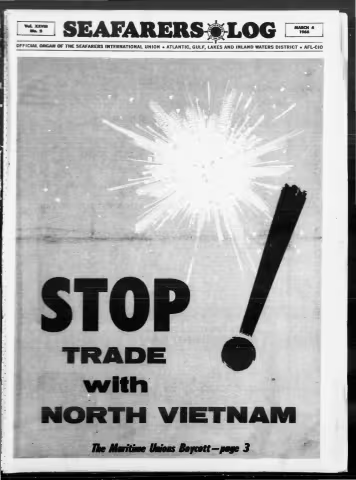
MTD Bae s Boycott of Ships
Trad·ng ith North Viet Nam
BAL HARBO~ FL A .. - Tbe executive bo-ard of the 30-union AFL-CIO Maritime Trades De
p~ent voted unanimously oo Feb. 18 to support a boycott against ships of nations permitting trade
with North Viet Nam. Plans for the boycott bad been announced earlier in the week by SIU President
PaulHall,who head.s eldTD: ~-~~~~~~~~~~~~~~~~~~~~~~~-
ILA President Thomas _ Gka- ,-essefs. the MID resolution point-
son, and NMU Pres~ Joseph ed out. ""but the State Department
Curran in a joint to bas steadfastly refused to lend its
President Johnson criticizine the port to any of these bills."
Adm.inistration·s "'pUSS'Yf~_ - in
curbing trade with N "\-
Nam by ships of '"·gqiposedh"
friend1y nations."'
At a news conference followine:
an AFL-CIO Executi\·e Cou:ncii
session, Federation P residen
George Meany to!d news ft"W1IRT'I"'""'
that the hoycott .of- · ·_ dear
with North Viet Nam as roposed
by three AFl..-CIO maritime un
ions "makes a lot f ~ -
expressed himself as in aJ1JJ
sympathy with their app
"in general agreement with
attitude."
In their wire, 1!be SIU, ILA
NMU presidents declared t the
three unions wouJd stage protest
demonstrations in U S. ports
against vesse'ls of nati m permit
ting trade with the enemy
"puts blood money in the pockets
of shipowners and ether :fiteas
in so-caUed allied nations.... 1Dev
said th'at "American seam and
longshoremen are derennioed m
take action to disoollra!!e the How
of supplies" to North -Vi Nam
and the V1et Cong.
The Maritime Trades Depart
ment boycott resolurion said that
"while America is engaged in
military effort in Viet N:am . _ .
foreign-flag sbips- mciudio:. rrnmy
from the NA TO conncries
which the Defense Depanment
has claimed we can rely-- kn-e
been profiting from a rying
American cargoes while a
same time trading with
mies of democracy.~·
A number· of lbitts ha e been in
troduced in tbe Congress c.allin"°
for positive action against ese
At a pres.s conference on Feb.
::!3. G leason, Hall and Curran said
t strategy for the boycott was
being developed but that it could I
begin at any moment. (Long
men refused to work the
British flag Cunard liner Queen
• fary when he arrived in New
Yo · last week, but turned to
after ompany officials assured
them that none of Cunard s ships
w-ould carry cargoes to North
Viet Nam.)
After the press conference Sec
retary of Labor Willard Wirtz met
1rith G leason. Hall and Curran to
• cuss the boycott plan.
The AFL-CIO sea unions boy
cott plans came after the State
Department revealed on Feb. 13
that ships carrying materials to
. ·orth Viet Nam would be pro
hi ited from picking up American
ai cargoes in U. S. ports which
unions held ' was a slap on the
wrist- that will not deter shipown
ers or their go emments from sup
plying the North Vietnamese.
Blacklist Weak
The first blacklist contained the
names of five ships. three British,
ne Cypriot and one Greek. Al
though barred from picking up
L S. aid cargoes, the blacklisted
"\CS5els were unrestricted in every
odler respect which pointed up the
mlio · contention that the ban
was ineffective and weak.
In another action taken at its
IO-day meet in g the Maritime
Tra es Department executive
board called for prompt action by
Presi ent Johnson and Congress
m step up U. S. ship construction.
Page G roton administrative direc
t of the Brotherhood of Boiler-
makers and Iron Shipbuilders, said
that the budget reduction by $51
million to $85 million for ship
construction in 1967 will provide
for only 13 ships, at a time when
the nation's ship replacement pro
gram is already over 90 vessels
behind schedule. Groton said the
advocates of ship construction
abroad were "still working hard."
MID President Hall pointed
om that less than half of the ap
proximately 1.000 deep sea re
serve ships would be usable if the
Viet Nam situation worsened He
also questioned U . S. dependence
on ships of nations in the North
Atlantic Treaty Organization, es
pecially since some of them are
currently trading with North Viet
Nam.
Other Board Actions
The MTD Executive Board also
took the following actions:
· • Called for Federal legisla
tion to impose "the same safety
standards on foreign-flag cruise
ships required of U . S.-fl.ag ves
sels."
• Denounced Interior Depart
ment plans to build a fishing
trawler in communist Poland.
• Created a legislative com
mittee to deal with pending legis
lation of concern to member un-
ions.
• Condemned the Interagency
Maritime Task Force report and
urged its rejection by the Admin
istration and the Congress. The
Board endorsed the Maritime Ad
visory Committee report and urged
its implementation by the gov
ernment.
• Rejected all suggestions for
building of U . S. ships abroad and
urged a requirement that any Fed
eral program for the Merchant
Marine specify that all ships be
built in American yards.
- -- - - - - -- - - --- - - - - . - --
. AFL-CIO .Sets Goals for '66-- -
BAL llARBO~ FLA .. -lnrensified and
stFengtbened poti6cal to increase the
number of liberals in House and Senate
emerged as a major ..,, of the AFL-CIO
for 1966.
The stepped-up drive in the otf-year elec-
tions took shape against background of
the failure to over; GOP-Dixiecrat fili-
buster blocking repeal f Section I ~ of the
Taft-H.artJey Act, differences on the content
of a minimum W3!~ bill,, opposition to "one
way" guidelines esigned to hold dow-n w-~
incr.eases, and economic and political problems.
SIU Pries.. Hall attended the council meeting.
The AFL-CIO E.xec:utire Council at its
winter meeting in the Americana Hotel,
spelled out the roach in i1s statement deal-
ing with the I ~ repeal fihOu:ster. declaring:
•'The liberals in the Home and Senate must
be r.e-e1ected in the I %6 and their
ranks · increased. This means an even greater
united effort by the oxn1!1Dellt.""
Pres. George Meany put the 1 %6 effort in
a framework of independent - n, telling re
porters that the labor movement will make
its own way politically and that it doesn't have
to ~oady along behind"" any politicaJ party.
Stressing that the labor men-anent is non
partisan politically, Meany said. ""I don't buy
tlhe idea that we have no place to go. Labor
h:as Jlived through many administrations, he
noted, where lhe Presiden1 did agree with
blbor's °'!jectives but the unions tept fighting
for their point of view.
Assessing the filibuster against 14(b) repeal
led by Senate GOP Leader Everett McKinley
Dirksen, the AFL-CIO president saio labor
would give close scrutiny to the role of the
Republican Party. Its record of liberalism is
not good. he said, and while the GOP gener
ally has an affirmative attitude on anything
that big business wants, it takes a negative ap
proach on anything that organized labor pro
poses.
The Council also:
• Urged prompt congressional action on
minimum wage legislation as a "down-pay
ment for America's working poor."
• Spelled out labor's determination to con
tinue the battle to win repeal of 14(b), certain
that the repeal measure has the necessary sup
port for passage if the Senate filibuster can be
overcome.
• Called for greater utilization of the
1964-65 Civil Rights Acts, more efficient en
forcement and a greater degree of compliance
by local communities.
• Urged a "top priority" in Congress to
"revitalize" the unemployment compensation
system at the current session.
• Supported a National Urban League
labor program to enhance job and promotion
opportunities for Negroes. Meany later de
scribed the program as a "very positive" ap
proach and pledged full AFL-CIO coopera
tion.
You can use a simpler return
(Form 1040A), printed on a
p h card, if:
l. Your income was less than
ro.ooo AND
2. It consisted of wages re
ported on withholding statements
(Forms W-2) and not more than
S200 total of other wages, in
ex- I terest. and dividends, AND
::::: 3. Instead of itemizing deduc-
tm you wish to use the tax
table or to take the standard de
duction which is generally the
higher of:
(a the I 0-percent standard de
dw:tion-about IO percent
of your income or
the minimum standard de
duction-and amount equal
to S200 ($100 if married
and filing separate return)
plus SlOO for each exemp
tion claimed on item 15 on
the back of your Form
1040A.
If your income is ~ than $5,
you can choose to have the
Imet:nal Revenue Service figure
Yi tax for you. A hu.sband and
1 wife may file a joint return Form
1 iA if their combined incomes
not exceed these limits.
DO~ USE FORM 1040A IF
( l ) You wish to take any de
doct:ions for specific items, ., such
as unreimbursed employee ex
penses_
_ You wish to claim a re
tirement income credit.
(3) Yoo wish to compute your
tax under the head-of-household
rates or to claim "surviving
spouse" benefits . .
(4) Yoo wish to claim any ex
clusion for wages or salary you
I
received for a period while you
were sick and this amount is
shown on your Form W-2.
dl::!ti1ine (5) Yoo wish to claim credit
for payments of estimated tax
for the taxable year or for an
overpayment from 1964.
(6) Your wife (or husband) is
- g a separate return on Form
1040 and itemizes her (or his)
deductions.
(7) You have a nonresident
alien mltus.
HOW TO PAY
The balance of tax shown to
be due on your return must be
paid in full with your return if
it anrounts to SI o more. Make
chects or money order payable
to "'Internal Revenue Service."
ROUNDING OFF TO WHOLE
DOILARS
The money items on your re
turn and schedules may be shown
· whole dollars. This means
that you eliminate any amount
less than SO cents, and increase
amount from SO cents through
99 cads to the next higher dollar.
SE.4F.4RERS LOG
ADV ANT AGFS OF A JOINT still count as a deiiien<ileill
RETURN. Generally it is advan
tageous for a married couple to
file a joint return. There are bene
fits in figuring the tax on a joint
return which often result in a
Long-Trip Tax PnMlllDIS
A major beef of seamen iaxes -
are not withheld on earnings in the year:
money, but in the year the pay ook
For example, a seaman signed
trip in September, 1965. payinj alf • Jammy
have all the five months earnings appear
slip and all the taxes Withheld in 1966.
incmme his taxes in 1965. ew:n though -
ings might be Jess than thme in 1965.
"1bere are ways to mwnimin: the • m
For example, -While on the Jlbip in 1965~
doubtedly took, draws and may have EUt ancm.:nts
- These can be reported as 1965 inc>eHe
Unfortunately~ this raises -anodw:r coaq>&::atioa
man who n;por11- these earninp in 1965
(withholding .saatement) aJVaing thml... Be WI
all aDotments, draws and slops on the tu ~ and CSl'lllill
why be doesn t have a W-2 for diem.. Fm--~ ..sim:e
no ~ WI11 have been withheld on 1hcse earnings •
will have to pay the .tun tax oo dim1 • his ---.
pen:ent·or upwards, drpeMing on his 1u hial:d..
The eamin~ will show up on 1lis 1966 W-2.
then, on his 1966 :rdDm, wuul'1 ~ 10 aplain dial
ICpOI1ed some of the eamiap ia 1965- and pBl ma ma
them. Be would get a tax nfuod wwwdiagiy_
In essence, the ••nmo wau1d pay 1Da twice
income and st a 1efaod a J1mr lala:.
. tbe seaman some tax Jlli1DeY ill die ... nm. ·
is-out«~ on some his hDMv far a
--be gm Munded.
This procedure_ would :ahiO ............. aty came I 2 wwwl
~ue to examine his nfu•us, Jilll:e die iln DijiUiitd
would not jibe with the tola1s .. his W-2 :rm:-.
- That raile 1he qt""'im, ii tis ••• eilae - ii
J ff • ...,... ...WQ .. iM ---~
... ft67 e a II .. • ... Odwaai&. 1-·
samg • minor and probablJ' 1llOl
lower tax than would result from
separate returns.
CHANGES IN MARJTAL
ST A TUS. If you are married at
the end of 1965, you are consid
ered married for the entire year.
If you are divorced or legally
separated on or before the end
of 1964, you are considered sin
gle for the entire year. If your
wife or husband died during 1965,
you are considered married for
the entire year. Generaily, a joint
return may be filed for 1965 pro
vided you have not remarried
before the end of 1965.
EXEMPTIONS. Each taxpayer
is entitled to a personal exemp
tion of $600 for himself., $600
for his wife, and additional $600
if he is over 65 and another $600
if he is blind. The exemptions
for age and blindness apply also
to a taxpayer's wife, and can also
be claimed by both of them. •
. In cases where a man's wife
lives in -a foreign country, he can
still claim the $600 exemption for
her.
In addition, a taxpayer can
claim $600 for each child, parent,
grandparent, brother, brother-in
law, sister, sister-in-law, and each
uncle, aunt, neph~ or niece de
pendent on him, if he provides
more than one-half of 1'heir sup
port during the calendar ydlr. 'The
dependent must have less than
$600 income and live in the u_ s..
Canada, Panama or the Canal
Zone.
A cbild under 19, or a student
over 19 can earn av~ $<iOO and
of the SIJEPC>rl if a dependent to
claim an exemption for that in
dMdual, provided 1he con
tributors file a declaration 1hat
they will not claim the dependent
that year.
Gllildden. Sr., - _ ~
~ 68., and
Lee joined .the Union in Sm'im
nah in 1939. He still mes ibf:r:e
with his wife, Mary Frances..
their three children. lli .sa1Jea
with the SIU in 1he deCk depan
menL Lee last sailed nn -fhe Sreel
Age (Isthmian Lines). Afrer 5nlJr
MIBdD!D are I ping Ont for 26 years, Lee :ls .gnm~
along I to spend his rime at llmne
There Savannah with his familv _
_ ~ I W erldand joined the Union -
_daring New York and When ]re P...Iire
I
I
I
it climaxed a lik of ov.er 2 }'eaI5
at sea_ He shipperl m 1he JlecK
deparnnent. WeillaruI's last ves
sel was the Tmm (Mobile T~
Co.). He was born :in _ -~
and now lives wi1.h ills -wife..
c.arrie. in Sprin.gbill _,-\lab.ama.
He will spend his :r=.iiremem :yeaE
in Springhill.
Barton was r etired on FciJnran·
1. 1966. He was bm:n :in -~
1
Orleans. La., and now Jives -
Brooklyn. - y _ .Ilurron jaim:d
I the Union in ew Orleans
r 1?39 . . He shipr...d ol11in1he Bn-
1 gme aepartmem 2S AD airer.
last ship ·was the Atlas (Buibarik
Brother .Bmton now Ji1ans
spend-his retirement -vears 1n :a
warm climate. -
Erickson was born :in 5ontb
Amboy, New Jersey: an k
was .:retired F.ebr
uary 1. 1 .aft
er 43~nf
in .CO:n1:m
service in fha1 position 'ilDfi1 Ila:..
- 31, 1965. Erickson lives in Xev-
.lD-~rr- ....,-~ JS -
~ 1 port, ew J ersey_ Be .and liis
-- wife Sarah have ~ dmmhter:
~ Oaire Laugh1in. .Bmiher Bl:'id
son will make hisreriremem ~
with his wife :in Keypm:t.
O/tlti•ers
easion Roster
Jo Saiad has been shipping
since 194 J _ He now lives in
_ Tew York with his wife Con-
- and er daughter Ramona
Bo in e Phili ine Islands in
8'93. his last ship was the Steel
er <Isthmian). He was placed
pension on February L 1966.
He sailed with the deck depart
His reti:remen time will be
spen in _ 1ew York.
·mmum Wage
Economic Need
mmmmm ~oe, with
"eved without ovastrai:niog
!i::e::i~ :::i:r::c::L:I~ a:c~:::::!2·_ ro a report y the Conference on
fedairal law. It cires the unem-
1 _ · compensation program
as example of sta e laws resulting
from federal legislation.
U. S. Foreign v
T racle Up, U. S._
Share Down
W ASHIXGTON - America's
foreign trade increased in both
~and tODm:<>e during the first
three quarters of 1965 according
to the Maritime Administration.
the amounts carried by Amer-
ca:IH!a.2 '\'"essels ntinued to de-
shalply .
There was a drop of almast SI
I in the V3lue of cargoes car-
c:n:IDiimn I riaL from - .500.000 in 1964 to
S4.700Jl00 in 1965. and a ton-
h:s:i::::eil!' _ decline from 19.- 00.000 tons
to I _ 00.000 t ns..
In the nation ·s toral foreign
~B:Wf:ef=i:::;.g_ - I tra hovteTI7. tonnage showed
• be an 11 million ron - increase over
co11esponding 1964 period,
d its value increased by mil-
1965
reached I 32.400,000 tons.
S9.600.000.000.
The increased foreign trade was
sed largely on imports. the re
shows... In this category ton-
- increased J _ percent over
I 964 and value rose 8 percent.
&ports decreased sligbdy, by ~
than ooe-balf percent in value
1q>1ucnting a drop of about 3
pdt'Cllt in export wlume.
j Page Six SE.4.F.4.RERS LOG
February 12 to February 25,
DECK DEPARTMENT
March 4, 1966
Two 'Missing Link' Channels
Urged For U. S. Waterways TOT AL REGISTERED TOT AL SHIPPED NOW ON THE BEACH
All Groups All Groups All G roubs
A proposal that the Federal government ~ppropriate ~1.2 ?illion
dollars to dredge two "missing link" channels m the American mland
waterway sytem may be very close to happening.
The two links that are needed ~·--------------
to complete the waterway system waterway and that the combined
are a 120-mile channel to connect traffic on the two channels should
Cleveland with the Ohio River run over 9~million tons annually.
and a link with the Tennessee and Wilkins pointed out, however,
Tombigbee · rivers. The two con- that the Corps is traditionally
necting channels would complete "ultra-conservative" in their estim-
a 1,745-mile through waterway ates and that by the year 2000
from Cleveland to Mobile. the waterways should be carrying
Under present conditions water- over 240 million tons.
Port
Boston ..........
New York .......
Philadelphia .....
Baltimore ........
Norfolk .. . .......
Jacksonville ......
Tampa ...........
Mobile ...........
New Orleans .....
Houston ..........
Wilmington . .....
San Francisco ... .
Seattle . . ........ .
Totals . .. ........
C1ass A
3
58
13
13
23
7
2
20
25
47
21
26
14
272
Class B Class A Class B
0 1 0
20 63 21
7 6 3
8 27 3
5 5 8
0 1 1
2 3 0
7 1 3
22 21 7
29 68 35
10 4 8
12 25 19
12 18 12
134 243 120
ENGINE DEPARTMENT
Class<.; Class A Class B
0 11 2
19 190 53
3 33 15
1 97 44
1 18 13
0 18 10
0 7 8
0 75 23
0 151 86
13 136 76
10 23 0
23 50 17
11 40 8
81 849 355
borne cargo must first move 7 40 Wilkins also pointed out that
miles across Lakes Erie, Huron the Federal government should be
and Michigan and then down the able to find the money to finance
Illinois and Mississippi Rivers and the billion-dollar I 0-year project.
then along the Gulf Intercoastal He said that the 123 billion per
Waterway to get from Cleveland year that would be needed for the
to Mobile. The new waterway project represented less than 5.
would reduce the trip by about per cent of the total Federal out-
700 miles. lays on water resource develop-
TOTAL REGISTERED TOT AL SHIPPED NOW ON THE BEACH
All Groups All GrouPS I G Al roups
Port Class A Class B Class A Class B Class C Class A Class B
Boston . . ...... . . 1 2 1 1 2 10 3
New York ... .... 45 26 50 19 17 149 55
Philadelphia ..... 6 8 8 0 0 22 20
Baltimore .. ..... . 10 8 6 14 1 43 32
Norfolk .. . .... .. . 4 3 6 4 0 11 15
The new optimism, according ment in 1965.
0 3 1 10 13 Jacksonville .... .. 6 3
0 3 6 3 2 0 3 Tampa .... .. .. . .
Mobile ..... . . . ... 12 10 6 2 1 42 17
New Orleans . . . . . 32 20 32 16 2 99 76
H ouston .. . ...... 26 31 35 33 10 90 99
Wilmington ...... 7 4 7 3 10 9 1
San Francisco .. . . 12 8 21 16 17 39 10
Seattle .......... 11 10 18 12 21 17 3
Totals . ......... - 17( 133 193 123 85 547 3~7
STEWARD DEPARTMENT
to Glover Wilkins, administrator "The total I ~year outlay of
of the Tennessee-Tombigbee Wa- $1.2 billion should be set in the
terway Development Authority, is context of the $2 billion economy
caused by the fact that the new the waterways will serve. The new
channels account for only 20 per waterways need not increase Fed
cent of the project and that if era) water resource expenditures.
the government would appropri- Former projects will be coming
ate the money the projects could to completion and outlays on
be completed. h TOT AL RE GISTERED - TOT AL SHIPPED NOW ON THE REACH
Wilkins stated that the Army them will taper off as t e new
Corps of Engineers has given a ones get underway," Wilkins con
favorable report on the proposed eluded.
Question: Do you prefer long
deepsea ·trips or short coastwise
ones, and why?
Ivan Buckley: I'm a deepsea
man. I've tried them all and the
only way to ship
is across the
ocean. I think
the one thing I
really like about
the foreign trips
is the chance a
fellow has to see
other lands. It
gives you a
chance to understand and appre-
ciate other cultures besides the
one you are familiar with. Yep,
I've tried them all and for my
money you can't beat a deepsea
run.
Arthur Sequeira: Give me the
deep sea·. I never had a coaster
and never want
one. I was born
in Singapore and
every time I get
a chance to go to
that end of the
world I always
take advantage of
it. The last time
I was out I really
had a good time and I really like
getting out and seeing the world.
On a deepsea trip you also have
time to do a great deal of think
ing.
Robert J. Feeney: I'll take a
coastwise trip every time. You
have no language
problem and in
American ports
you always know
what to expect.
On a coaster you
have a bunch of
guys who are
pretty much alike
and most of them
are stable fellows. On coasters
you also can get fresh milk and
this is important to me because I
sail in the steward department. I
have taken a number of foreign
jobs but I prefer coasters and have
no difficulity in getting a coast
wise job.
Earl Javins: I like deepsea runs
because you can really get away
from everything.
Along with get
ting away from
every t hing you
can have a better
time in the for
eign ports and
you make more
money. When I
get a ship I usu
ally try to get one for Germany
because you can really spend your
money there and it seems just
like the good old U.S.A.
Erman Parodi Rienosa: I really
like the long trips so I would
naturally like for
eign runs. The
co a stwise trips
mean you have
to get off every
two or three days
and you won't
have a chance to
save any money.
On the deepsea
trips you also get a chance to
visit such wonderful countries as
India. I like that country because
the people are poor and friendly.
You also get a chance to do a lot
of thinking on the offshore runs.
Thomas "Kid Candle" Dan
beck: I'll take a deepsea run any
time because it
means more
money, more fun
and more and
better compan
ionship in foreign
ports. On the last
ship I was on we
hit all the really
good ports in the!
world: Yokohama, Hong Kong
and Spain. If it were not for the
Union and the chance they have
given me I would never have the
chance to see and do the things
I have in the past years.
All Groups All Groups All G rOUPS
Port Class A Class B Class A Class B Class C Class A Class B
Boston . ... ..... . 1 0 0 1 0 7 2
New York ........ - 33 5 38 7 7 128 17
Philadelphia ... .. 3 5 2 0 0 24 10
Baltimor e .. . . . .. . 11 5 13 15 0 51 26
Norfolk .. . .. . .. · · 1 3 5 7 2 10 14
J acksonville .. . . . . 0 0 0 0 1 4 7
Tampa . .... ..... 4 0 0 1 1 11 5
Mobile ........... 16 7 4 1 0 54 21
New Orleans .. .. . 29 19 31 ·16 0 137 95
Houston ... .. ... . 29 18 22 15 8 73 41
Wilmington ... . .. 5 4 6 1 15 9 0
San Francisco . .. . 21 1 17 5 30 26 9
Seattle ..... . ... . 11 9 12 4 8 12 6
Tot als . . . .. . . . ... . . 164 76 150 73 72 546 253
The AFL-CIO Maritime T rades Department, at its quarterly executive board meeting February
17 and 18, again' called on Federal Agencies-particularly th~ Sta_te and. Defe~s.e departments-. to
renounce the theory of 'effective control," by which they rat1onahze their pos1t1on that American
owned and controlled ships reg- •
Panama, Liberia, and Honduras
istered under r unaw a y flags and owned by U.S. citizens are
would be available to the United supposed to be committed to the
States in time of emergency. use of the U.S. Government in
The MTD, the SIU and other time of emergency. Runaway
maritime groups have long con- ships flying the flags of other na
tested the validity of the so-called tions, which include Lebanon,
effective control theory. Haiti and Costa Rica, are not as-
The question of just how "cf- sumed to be under U.S. effective
fective" is the United States' well
advertised "effective control over
runaway-flag ships was also raised
recently in hearings before the
House Committee on Merchant
Marine and Fisheries.
Representative Rogers of Flor
ida asked Maritime Adminis
trator Nicholas Johnson, called to
testify before the Committee, if
any thought had been given to
bringing runaway ships "back" to
carry military cargoes to Viet
nam. Johnson parried the ques
tion, but left little doubt that
MarAd and the Department of
Defense have not discarded such
a possibility.
The question is: How much
"control" does the U.S. have over
runaway flags and is it really .. ef
fective"?
Under the theory of "effective
control," which has long been
supported by the State Depart
ment and the Defense Depart
ment, ships flying the flags of
control, however.
Owned By Oil Companies
The majority of tankers in the
U.S. "effective control fleet" are
owned by the large American oil
companies, while most American
owned bulk carriers in this fleet
are held by successful commer
cial ship operators. In both in
stances, ships are registered un
der foreign flags so that they may
avoid U.S. taxes and exploit the
low standards of living of foreign
seamen. Runaway flags do not
necessarily use crews from the na
tion whose flag they fly, but seek
out crewmembers of any nation
ality who will submit to poor
working conditions and low
wages. .
Runaway shipping is not a new
idea-it was practiced in both
the Revolutionary and Civil Wars.
However, it is only- in modern
times that U.S. runaways have
reached significant proportions.
American runaway operations ex
isted in the 1930's when one of
the major oil companies moved a
group of tankers to the German
flag and later transferred them
to Panamian registry prior to
World War II. The practice de
veloped on a large scale after
the war's end and by 1965 the
U.S. "effective control fleet" con
sisted of 267 tankers totalling
9,200,000 deadweight tons, and
79 dry bulk carriers, totalling 2,-
408,000 deadweight tons, not in
cluding U.S. runaways over
which the U.S. realizes that we
have no control whatsoever. Most
of the vessels in this "fleet" are
much more modern and much
faster than their U.S.-registered
counterparts, but their availabil
ity to the U.S. under any circum
stances, including national emer
gency, is questionable.
The SIU has long pointed out
that in time of conflict a ship
owner cannot serve two masters
-he is bound by the rules and
regulations under which Jiis ves
sel is registered. A recent ex.per
ience with the Mexican freighter
El Mexicano brought this point
home. The EI Mexicano had
been chartered to carry supplies
(Continued on page JO)
I
I
.l
J
.1
.!.
\
·''-
~!' . -
~ ..
- -
-1 -
· l ....
...
1-
-I
~,
_,
Marda 4, 1966 /
'
O•Man,
Takes
The one man. one vote principle, digging in at the congressional and
state legislative levels despite Sen. Everett Dirksen s detemiined diort
to uproot it. also is taking bold dramatically at the county and mu
nicipaj Jeve1s.
Already, citizens in nearly 20 states. claiming to be under-repre
sented in city or county governments.. have filed suits in comt to strike
a ba1ance under the one many. one vote ruling.
The consequence of these efforts could be widespread and significant,.
affecting the balance of power in important local government units
like city and county councils. school boards and even in special dis
tricts dealing with matters like sewage, snow removal and garbage
collections.
In cities especially, a change to one ~ one vote l'epresentation
could have vital impact, bringing more political influence to minority
and working class groups. And in counties, the voice of suburbanite
would gain strength while the ·oice of ro:ral interests decline.
Such changes could lead to be~ter city-nm welfare programs. better
schools for youngsters in central city , be _ for urban
dwellers, better parks and play areas, better transportation..
The Wall Street Jou I, in a lengthy article on !he ~ quotes one
expert on local reapportionment as saying. ~e pressures of reappor
tionment are more likely to be in the direction of a higher level of local
service and spending~ than in the direction of skinflint economy at the
expense of needed services.
As yet, the Supreme Court has not required o e man one vote appli
cation beyond the state and federal levels, though it is expected to do
so eventua1ly. However, the Jomnal reports, lower federal and state
courts in N ew York. California, Michigan and WISCOBSin have ordered
reapportionment of county or city voting districts. In California and
Wisconsin, the state legislatures responded by pasisng laws requiring
all county boards to redistrict. WISCOnsin has set an April deadline.
Meanwhile, Senator Everett Dirksen has shifted gears in his drive
to knock down the Supreme Court one man. one vote ruling. The
wheels are now turning for a massive, well-1inanced nationwide public
relations campaign to get public sentiment behind Dirlrsen s proposed
constitutional amendment to wreck the one man, one vote rule. The
money is expected to come from powerful business and agricultural
interests.
D irksen's amendment fell short in a vote in the Senate last A~
but he is expected to bring it up again this year after the PR cam
paign has had a chance to build support.
I LABOR BOUND-UP I
Organized labor scored a major
breakthrough in Simpson County,
Mkmsippi, whe n the county's
~ industrial employer ~
the al'ea's first union contract after
two year., of bitter opposition. The
three-year agreement gives about
950 members of the International
Brotherhood of E lectrical Work
ers, employed by the Universal
Manufacturing Corp.. a total of
46 cents an hour in wage in
creases, three additional holidays.
a vacation schedule and insurance
protection. In addition fom dis
charged members of the local.
ineluding President James Bird.
were reinstated.
- 4 -
'lbe Building Senice Employcs
of New Yodc have ndi&ed a new
tlfte..year coldnld ~ 25,000
wOlkers in 2,480 otlice 8llc1 loft
buildings an $11 wage increase.
The agreement also provides pins
in pension benefits. sic k p a y,
health and welfare coverage, job
definition, vacations and termina
tion pay. The contract, ending
three m onths of negotiations ~
tween BSEIU Local 32B and em
ployers, went into diect on ratifi
cation by the union executive
board. its n egotiating committee
and employer-members of the Re
alty Advisory Board on Labor Re
lations, Inc. Under the renewal
pact, building senrice workers will
get wage boosts of $4 a week re
troactive to Jan. I; an additional
$3 one year later and another $4
on Jan. 1, 1968. It was agreed
that . the union-industry welfare
fund will provide additional hos-
pitaliz.ation and surgical benefits.
and will fiD in the gaps in the
Medicare program by refunding
the deductible portion of the hos
pitalization plan and by paying the
$3 a month fee for supplementary
medical benefits.
- 4' -
A special ~of die
al&6atN Na6omd PosDI 1Jllioa
~ eWftsed a to wqe
with die AFLCIO U • Fed
eration of Postal Oerts. The
rolk:aII vote for approval of the
merger, climaxing a three-day
convention in Washington. D. C.,
was 45,.901 to 3,4-86. The p~
posa1 must now be submitted to
a mail membenhip referendum
for final ratification.. NPU Presi
dent Sidney A. Gildman said the
referendum should be complete by
mid-iMan:b.. Be predicted strong
support for the meaga which
would heal an eight-year division
in postal clert ~
-~-
AliLCIO ••i as iacreased
..... daft al...,. ... its.
1965, • Nm mi Lallor ....
6tms .... - npodeL A&
ates won S8.6 pen:ent of lhe e1ec-
tions in which they participated
in the first half of 1965, and 57_s ·
percent in the sranl ~ Their
pcn::entage of wins -was SS. 7 in
1964"s latter half, SU in the first
half, according to the NLRB n:c
onls. A report for the last half
of l96S ~ that for electiom
participated in by AFL-CIO un
ions, there lftre 109 681 eligi"ble
members in units won by aftiliates..
SE.4F .4RERS LOG
./ "You-Are
Never before in the nation's history has the
business community enjoyed such record pros
perity. Profits are booming and are abetted by
rising prices.
In this climate, the organized American labor
movement is pushing for a broad program of
Page Se.ea
Too Fat!"
- · ~~
(5~ LOG '
workers in the retail trades, restaurants, laundries,
hotels and motels, hospitals and farm laborers.
These are often among the most poorly paid in
the nation and are entitled to the same protection
as other American workers who are covered under
the Fair Labor Standards Act.
social and economic legislation that will insure In our presently expanding economy it is also
American workers of a fair share of the prosperity important not to forget our elderly citizens-who
that they contributed to by such a large margin have no means of keeping up with the continually
through their unparalleled productivity. rising cost of living. Extended social security ben
. While management is forced to let out its efits are needed if our elderly citizens are to be
belt to accommodate another year of record prof- ensured of a secure, dignified retirement free from
its--it reacts to labor's call for the adoption of poverty·
new minimum wage legislation, the extension of These goals and much other sorely needed leg
the unemployment compensation system and ex- islation is receiving the full support of the or
panded social security benefits-with the cry that ganized American labor movement.
labor has enough already-labor is too fat. If the country and its workers are to enjoy the
The need for pursuing these goals is clear. bounties brought about by the productivity of its
Despite our booming economy, A War on Pov- workers, it will, as it has in the past, result from _
erty has been declared in this country in attempt the efforts of the organized labor movement.
to aid the millions of Americans living in abject
poverty.
High on the priority list of the AFL-CIO is
the elimination of poverty in the United States
through the enactment of realistic and up-to-date
minimum wage legislation. The present minimum
wage of $1.25 an hour still leaves the. worker far
below the administration's official "poverty level"
income. While profits have zoomed astronomi
cally, those workers without the benefit of union
protection are still forced to labor for a wage
that in no way reflects their skills and productivity.
Another important AFL-CIO goal is the estab
lishment of a modem up-to-date unemployment
compensation system geared to the present day
cost and standard of living. Vast inequities exist
today in the administration of the unemployment
compensation system and federal standards are
needed to create a unified system incorporating
increased and extended benefits.
Minimum wage legislation must also be ex
tended to cover more than 7 .5 million American
workers not presently covered. These include
S'IU Blood Bank
When we're walking around feeling fit and en
joying each breath of fresh air, it's easy to forget
that there may be rough weather ahead, as far
as our health is concerned. If such rough weather
ever does hit us, it's good to know there are
resources available to aid recovery. A case in
point is contained in the letter to the editor from
Seafarer Manuel Rivas appearing on another page
in this issue.
Faced with the need for blood transfusions so
that a badly-needed operation would not be de
layed, Brother Rivas was able to draw the life
saving fluid immediately from the SIU Blood
Bank, which is sustained by contributions of SID
men.
The SIU Blood Bank is one of the most pre
cious life-saving facilities available to Seafarers
and their families. This might be a good time to
remember the value of contributing to the bank.
SE.41'.4RERS LOG
TO A
~ 2 of a fearure
The Knights of St. Crispin was one of the e_arly national unions. A
union of skilled shoemaken, it fought against encroachment of ma
chines. Shown here are factory conditions against which it · fought.
In winter of 1874 New Y orlc workers assembled in Tompkins Square to
protest unemployment and starvation. As shown in picture, mounted
police rode into crowd, breaking heads and trampling the workers.
One of the most infamous of early union busten was James McParlan,
• e.,.t of Pinkerton agency. Picture shows McParlan (kneeling) as
he IWNll loyalty to Molly Maguires, wliich he was soon to betray.
T he United States' victory in the War
of 1812 against Great Britain sig
naled the beginning of a period of
vast industrial growth for the n'ation, and
of unimagined hardships for American
worke~'S. Economic boons and busts fol
lowed one another rythmically. Each
economic cycle, as it rolled across the
land, ground the vast majority of Ameri
can workers further down into poverty
and despair.
It was a time when almost every at
tempt by desperate workers to better their
condition was met and suppressed by
force and violence. It was a time when
giant corporations, vastly wea/Jhy and
inhumanly callous, would hire thousands
of armed thugs to break a strike. If these
hired goons did not succeed in breaking
fhe strikers' will, they often found them
selves . faced with armed militia - dis
patched to break the. strike by a govern
ment which had ears only for the demands
of rich corporations. If even that failed
the courts were 'lllways willing to issue
injunctions making the walkouts iUegaJ
which then justified the jailing of the
strike leaders and the eventual collapse
of the strike. And all the while the press
poured out a constant stream of invectjve
against the workers and their legitimate
aims.
These years saw the "Long Strike" in
the Pennsylvania coal fields and the
"Great Strike" by railroad workers. the
Homestead Strike and the Pul.lman. Strike
-llll fJf which were viciously broken by
an anti-labor combination of the corpora
tions, the couits and the government. It
was the heyday of the ''Pinkerton Fin/cs."
It was the time of the "Baltimore Mas
sacre" and the "Haymarket Square Mas
sacre" of the workers.
But it ·was also the period in which the
infant American labor movement drew
strength and grew-learned hard lessons
and fought back against ~nse odds to
carve out a place for American workers
in the nation's future.
T he growth of factories began with a
vengeance in the United States when
War of 1812 cut off our supplies of
manufactured goods from Great Britain.
As a direct result of the new factory sys
tem, on~ of the worst abuses of labor that
ever existed took root o a large sca1e
in the United States--cbild labor. By
1820 more than half the factory workers
in the United States were between nine
and ten years old. They worked an aver
age 13-hour-day for as little as 33 cents
a week.
Economic exploitation of children, and
later of young women, was a direct result
ofi growth of factories. Skills was not nec
essary, cheap labOr meant bigger profits,
and children or young women could be
hired for much Jess than a worker, even
unskilled, with a family to support. These
working children received no education
at all and remained totally illiterate. They
toiled long, exhausting hours in dark,
. dirty, unhealthy factories without rewanl
0r hope. And as more. and more children
became ''Productive" by entering the labor
market, more and more skilled aduh
workers, with f~es and responsi"bilities,
became unemployed.
In additi~n to the competition of child
labor, American workers suffered another
serious blow in 1819 when the first of
what was to prove a cycle of economic
and financial depressions struck the na- r
tion. Unemployment, already widespread,
became mass unemployment as bank
ruptcies shut factories, shops and stores ··
all over the ~tion. Hunger stalked the
American worker. Those mills and fac
tories that remained open sliced wages
and increased working hours, kn.owing
that their workers had to accept whatever
was offered.
T he depression, which did not end ~
unitI 1822, wiped out. many trade
unions. But as business picked up
and · workers again found employment,
labor unions were again formed with new
:zeal In 1827 labor took a significant
step.
In that year the carpenters in Phila
delphia. launched a strike for a 10-bour · ·
day. Facing bitter employer opposition
and receiving no aid from other Phila
delphia unions, the carpenters were d~
feated. B1;1t they recogni7.ed the ft.aw in
organization which bad defeated them,
and that same year the first central union
council, the Mechanics Union of Trade
Associations, was formed by the Phila
delphia unions. It was the first city-wide
labor organi:zation in the world and no
longer would a striking union in Phila
delphia stand alone against the bosses.
At the same time another· "first step"
was taken by Pliiladelpliia workets, wlien
they formed the world's first political
labor party-the Worldngmen's Party. ~
The idea caught on and by 1834 spread ._
to many cities, working politically for free
public education for their children, the -
abolition of imprisonment for debt, the
outlawing of child labor, the universal
10-bour day and other reforms.
Attac\ed by the p~ as "anti-reli
gious," ''unwashed rabble" and "dirty
shirts," their rallies invaded and disrupted
by goons hired by local politicians, their
adherents fired from their jobs for sup
porting their platform, the various Work
ingmens' Parties r.emained active only a
few years. In that short time however
t,lteir success was astonishing. As a resuft
of their efforts, imprisonment for debt
was abolished and in 1834 the nation's
first free public school system was set up
in Pennsylvania.
Meanwhile, the nation grew, opening
new markets. Roads and waterway traffic
pushed westward, and to these traditional
modes of transportation wer.e added the
new railroads. Gold strikes in the far west
opened - new markets and demand for
products grew faster and faster. To feed
these demands for manUfactured items
simple factories grew into huge industries.
The Machine Age dawned with a ft.ood of ·
immigration which swelled the labor force
and spelled new trouble for American ,,
workers.
As industry grew more complex, with ~
operations in many states, . the need for
unions to organize on a nationwide, in
stead of a citywide basis, grew as well. r
The first of these was the National Typo- _
,graphical Union, the first permanent na
tional union, founded in 1852. Follow
ing the lead of the NTU, about 10 na
tional unions Came into being between -
1850 and 1860.
.-
SE.4.F.4.RERS LOG Pap Nine
1-
In the mid-eighties, the entire community worked in the factories. Children accompanied
their mothers and fathers to the plants where they worked from dawn to dusk. No special
consideration was shown for the very old-men or women-or the very young worker.
F rom 1861 to 1965 the nation was
tom by the Civil War, which in more
ways than one was brought about
by the rapid industrialization going on
in the United States. It was basically a
conJlict of national interests between the
industrial North and the Agararian South.
_The primary issue of slavery, over which
-, the war was fought, was itself produced
by the introduction o( a machine, the ·
Cotton Gin, which made cotton a profita
,ble crop and ·led to the southern Planta
tion System, with its dependence on vast
number of enslaved .negro laborers. Until
the -inventio,i of the Cot~on Gin in 1793
.. there were few negro slaves .in the U.S.
_ ::- By, 1860 hpwever)· there ·were over 4
. miµion negro salves in the south, where
"~otton was king."
After the Civil War, cotton was de
p~d and industriy was king. As industry
_ .: was Jtjng the captains of industry who
"controlled great wealth in concentrated
: capital,, ruJed like feudal lords over a labor
force swollen with immigrants from for
eigii lands· and newly-freed negroes. La:
bor was considered a commodity to be
. bought as cheaply as possible ai:id dis
carded at will. As hugely wealthy indus-
booming, speculation was plunging wildly
ahead, money ft.owed freely, fortunes were
made overnight. The frenzied business
activity had no real foundations however,
and in 1873 the bubble burst, plunging
the nation into another long depression,
far worse than the depression of 1819.
The "Panic of '73" left 4 million Amer
ican workers jobless out of a total work
force of only 38 million and brought on
conditions which could only be described
as chaos . . Men, women and children in
industrial cities starved for lack of the
few pennies to buy bread. The depression
of 1873, which was to last for seven hor
hible years also signaled the beginning of
·- ·two• ·decades of ·an-out war waged by
American capital against American labor.
. trialists became ever more powerful
American workers were threatened with
the loss of eyen those gains they had al
ready made. Labor needed an organiza
tion through which action could be taken
on a major national scale. For this pur
pose the National Labor Union was
formed in 1866, the first nationwide
federation of · labor unions.
In city after city, gatherings of unem
ployed ·workers seeking jobs through
which to earn money to buy food for their
families were brutally broken up by club
swinging mounted police and militiamen.
Men, women and children were trampled
and beaten. Newspapers again jumped into
the fray verbally, calling the unemployed
workers "anarchists" and "foreign agita
tors." With so many unemployed, wealthy
industrialists cut wages to the bone, and
prepared to meet strikes by desperate
workers with club-swinging goons, armed
scabs, state militia, Federal troops, court
injunctions and . a callous disregard for
'
The NLU did not last lonlt, mainly
because it pinned its hopes for improving
working conditions on political action in
stead of on militant trade unionism. By
1873 ·the NLU h~d disintegrated, but not
before it had achieved two major goals-
repeal of the Contract Labor Act of 1864
and the establishment of the 8-hour day
for Federal employees.
The Contract Labor Act was nothing
but a return to the indenture systeni of
colonial times, under which European
workers were brought to the ,P.S. by
American employers, pledging their. first
~ear's wag~s to repay transportation costs
and fUrth~r _year's wages to repay their
maintenance costs for the first year. This
gave employers virtually free labor which
they used to depress American workers'
wages.
T be 1870's began with the promise
of -unparalleled prosperity for the
United States. Big Business was
human suffering. ·
In 1874-75 the "Long Strike" para
lyzed the Pennsylvania coal fields. To
break the strike the mineowners brought
in the most infamous of the union-busters
-Allan Pinkerton. Pinkerton sent his
own a~ent, James McPaFlan, as a labor
spy to .ioin the strikers' union-the Work
ingmen's Benevolent Association-and
destroy it from within. Violence flared
frequently during the long, hitter strike,
and when several mine foremen were
shot. Although the union had nothing
to do with the violence in spite of much ·
provocation, a secret organization of em
bittered miners, known as the "Molly
Ma~es," waged a long war of terror.
Pinkerton's spy managed to round up
lying "witnesses" and hearsay evidence
for a willing court to indict many of the
"Mollies" and striking union's leaders.
Convicted by the boss-oriented court, 10
men died on the gallows and 14 ·were
sentenced to long jail terms. The "Long
Striie" was broken and the names Pinker
ton and McParlan became infamous. To
ilisure future labor "peace," the mine
owners pr~JDptly recruited a private, -
~~
Overwhelming maiority of workers who came from the old world to Amer
ica in quest of a better life traveled a road of endless poverty. Brought
over by the boatload they soon confronted exploitation and disillusionment.
heavily-armed army called the Coal and
Iron Police who did not hesitate to use
whip, gun or club on any worker who
complained about wages, hours or work
ing conditions.
An even larger strike was soon to break
out in the railroad industry however.
When the depression of 1873 hit the
nation, railroad companies had seized the
opportunity to . slash wages by 25 perce_nt
although they continued te earn record
profits. Then, in 1877, the Baltimore and
Ohio Railroad announced another wage
cut of 10 percent. Faced with starvation
wage~, -a B&O train ~w walked off th~
job. others followed tffiougbOOi the Whole
system and soon the line was paralyzed .
The so-called "Great Strike" was on.
The railroad magnates reacted quickly.
Although the walkout was completely
peaceful, they demanded protection f«
railroad property from the state capitals.
State politicians, indebted to the hugely
wealthy· railroad magnates for many
things, responded quickly with 3.911ed mi
litia. Instead of "protecting property,"
these armed militiamen were used to break
up strike meetings-firing first into a meet
ing of strikers in Martinsburg, W. Va.,
leaving several dead strikers in their wake.
Enraged non-striking townspeople at
tacked the militia in tum, destroyed roll
ing stock and telegraph wires and even
ripped up tracks in their anger. Unjusti
fied violence gave the strike momentum,
and the strike spread from coast to coast.
State militia flied on strikers again and
again and the death toll climbed. Fmally
many militiamen, disgusted by what they
were called upon to do. deserted and
ioined the workers' picketlines rather than
fire on their fellow townsmen. The en
raged railroad millionair~ screamed for
Federal troops and the big business
oriented government of the time was
quick to comply. Federal troops soon
·~arrived, enraging townspeople even more.
In the infamous "Baltimore Massacre"
troops shot down 10 strikers in cold
blood. In one month over 100 American
workers were shot dead and over 300
wounded by American soldiers. Con
fronted by the entire U.S. Army, the
strikers were beaten and the "Great
Strike" was broken. To prevent strikes
in the future, state government built
armories crammed with heavy weapons
and militiamen in many towns. The rail
roads themselves hired armed hoodlums
as "special police."
The public school sys
tem as it is known to
day owes its brigins
largely to the vigorous
agitation of America's
first labor movement,
whose goal was free
education for everyone.
, .
- .
. .
- ,
Pase Ten / SE .4 F .4 RE RS L 0 G
J
U.1 Mertbant Fleet Detline Stirs
lntreasing Congressional Contern
W ASIDNGTON-Congressmen in both the House and the Senate have hit the deck recently to deplore
the continuing deterioration of the American-flag merchant fleet in the face of the accelerated growth of
the merchant marine of the Soviet Union.
can ships are carrying only nine
percent of our exports."
chartered by a United States Gov
ernment agency or private com
pany it means that gold must be
paid out, adding to our payments
deficit."
Mareh 4, 1966
Al Tanner, Vice-President and Fred Farnen, Secretary-Treasurer,Great Lakes
Great Lakes members and their dependents have been taking full
advantage of the free physical exams given at the new Toledo clinic.
Over fifty members and their dependents have received physical exams
to date. All members are reminded to take advantage of this additional
welfare benefit. Appointments and general information on the physical
exams can be obtained through •
all SIU halls.
Detroit ..
Senator Harrison Williams, Jr.,
(D-N. J.), who serves on the La
bor and Public Welfare Commit
tee, and Representative Jack. Ed
wards (R-Ala.), a member of the
House Merchant Marine and
Fisheries Committee, went on rec
ord criticizing the current U. S.
maritime policy which bas per
mitted Soviet Russia to gain on
the United States.
While Senator Williams was
pointing out the immense strategic
and political advantage of a dom
inant merchant marine, Repre
sentative Edwards was voicing his
disapproval of our country's be
ing forced to rely on foreign bot
toms to transport vital supplies to
During Edward's remarks, Rep
resentative Downing of Virginia
congratulated his colleague on
pointing out how Russia is trying
to be the No. 1 maritime nation
of the world "and will be in 1975
if she continues at the present
pace."
The Peter Reiss was named the
winter run vessel in the Reiss fleet
and has been operating on the coal
run between Toledo and Detroit
since December 20. It has been
held up because of ice conditions
but should resume the run on
March 1 if ice conditions permit.
ward Garmatz of the House Mer
chant Marine and Fisheries CQm
mitiee, Pat Sullivan, Vice-Presi
dent of the Buffalo Longshoremen,
stated that: "any change in mari
time policy should include priority
for the Great Lakes, especially in
the area of government subsidies."
Mr. Sullivan also pointed out the
fact that many foreign vessels
carrying grain to India employ
Chinese crews hired out of Hong
Kong that could very well be sail
ing on vessels hitting Communist
Chinese ports.
·Viet Nam. "Aside from the ob
vious disadvantages," he said,
"every time a foreign ship is
"The cold fact," said Repre
sentative Edwards, "is that we
are allowing our once-proud Mer
chant Marine to sink in a sea of
confusion, neglect, lack of leader
ship and bureaucratic twaddle.
"And what is worse," he con
tinued, "we don't even have a.
government policy to deal with
the problem. Our Merchant Ma
rine is drifting aimlessly without
a compass, and without a rud
der."
Myth of 'Effective Control'
The crews for the steamers
Iglehart and Crapo have been no
tified to report to these vessels on
February 21 in the steward and
engine departments. No notices
have been sent out for the deck
department as yet.
(Continued from page 6)
to Vietnam in August of 1965.
The Mexican Government, using
a Mexican law forbidding ships
under Mexican registry from en
tering a war zone, ordered the El
Mexicano not to carry the mili
tary cargo to Vietnam where it
was sorely needed.
. . ' \
Simultaneously, New Jersey
Senator Williams pointed out that
in less than ten years the Russians
have moved from 12th to 7th
place among maritime nations.
"They are adding merchant ton
nage at the rate of a million tons
a year," he said. "The Russian
fleet is already larger than the
active American fleet.
In order to protect its regis
try, the EI Mexicano complied
with the Mexican Government's
demand, and the cargo was re
scheduled to go aboard a Greek
freighter, Stamatios E. Embiri
cos. Despite the promise of a
$10,000 bonus, the crew of the
Greek-flag freighter refused to
sail with the Vietnam-bound
cargo. Finally, after much expen•
sive loading and unloading, the
- .; ,
"In startling contrast," the New
Jersey Democrat went on to say,
"our merchant fleet has declined
sharply in size. Today the Rus
sian fleet carries the greatest part
of its foreign trade, while Ameri-
by Lindsey Williams, Vice-President, Gulf Area
The cr~w of_ the _Del Mar ran into some real good luck this trip,
as the ship arrived m New Orleans, February 17 and didn't have to
sail until February 28. The crew was thus able to enjoy the carnival
season and was in port for Mardi Gras Day.
The Louisiana State AFL-CIO and the Greater New Orleans. AFL
CIO joined the Maritime Trades <.:•>-------------
Council of New Orleans and vi
cinity in making known to the
Louisiana Congressional Delega
tion their views towards the res
olution No. 217 passed unanai
mously by the AFL-CIO conven
tion that calls for a strong ex
pected merchant marine.
New Orleans
Milton Beasley, whose last ship
Beasley
was the Olga, is
now on the beach
looking for an
other run. His
last trip lasted
six months and
had plenty of·
overtime.
Robert (Bobby)
Foster, who made
his first trip in 14
months on the Ocean Anna is
now ready to go any place on
any ship as an AB.
Im Brown is just got off the
Oceanic Wave where he was the
Steward for two and one-half
years. He is now ready to go any
place on any ship, as Steward, but
would prefer a ship going to Viet
Nam.
Frank West is now ready to go
to any place on any ship as Chief
Cook.
Houston
Charles Thomson Big is just
off the Henry and after a trip to
India is on the beach celebrating
. and getting ready for another
long one.
J. Moncrief has been idle for
a few weeks and is waiting for
the right one to come along. He
says he is not particular but wants
a long run to Brazil to sport his
new auto.
Mobile
Frank E. Parson, who was last
on the Coe Victory, is currently
on the beach and looking for
another good run. He has been
shipping out of the Gulf Coast
Area for the last fifteen years.
George M.
:Weldy and James
B. Harrison who
both make their
home in Mobile
are currently
looking for trips
in the engine
dept.
Hudson Robert A. San-
chez and Louie
E. Hudson who both make their
homes in Mobile, have been mem
bers of the SIU for a number of
years . are looking for Steward 1
Department jobs shipping out of
. the Gulf Coast,
cargo was shipped on a U.S.-flag
vessel manned by American sea
men.
The experience with the Greek
freighter pointed up another Iong
held SIU contention: that for
eign seamen cannot be depended
upon to act in the interest of the
United States. All runaw:iy ships
supposedly under "effective con
trol" are manned by foreign sea
men, and so long as this situa
tion persists, the U.S. cannot
count .on any control of runaway
vessels at all. The SIU has also
pointed to instances when foreign
crew member.s have seized com
mand of ships, which were then
effectively controlled by no na
tion. In time of emergency, the
U.S. can only depend· on crews
consisting wholly of American
citizens to meet national needs,
as American merchant seamen
did in World War II and Korea.
Another objection which the
SIU has maintained against the
theory ·of "effective control" is
that it depends upon the good
will of the runaway-flag nations.
In 1963 the Honduran govern
ment was overthrown by its
armed forces and the U.S. imme
diately suspended diplomatic re
lations, and, in 1964, Panama
broke off U. S. diplomatic rela
tions with the support of Premier
Khrushchev. Obviously, the U.S.
has little control over vessels reg
istered with foreign nations under
such circumstances.
The after end and galley crews
for the steamer John J. Boland
have been notified to report on
March 1 and March 9th.
Buffalo
Chicago
Chicago reports that remodel
ing of the new building is progres
sing nicely. The new facility will
house all SIU affiliates in the Chi
cago area and will also house a
clinic for all members and their
families.
All members are reminded to
register at any of the seven SIU
halls located in the Great Lakes
District for employment during
the 1966 season. Registration
starts March 1.
A report from the port of Buf
falo indicates that continued pres
sure by waterfront unions in Buf- '
falo is being put on Washington
due fo the shrinking American
Flag fleet on the Great Lakes. Re
cently, in/ wire to Chairman Ed-
lns~rers Discard Rate Hike
Threat To U. S. Cargo Fleet
LONDON-Faced with a storm of protest by American ship
owners at a meeting here, British marine insurance underwriters
have backed down from a proposal to apply new penalty insurance
rates on all ships 20 years old•
or more. Had the new penalty
rates gone through, 83 per cent
of American-flag ships would
have been under the new schedule,
which would have raised the op
erational cost of these vessels so
high that in some cases it would
no longer have been profitable to
operate them.
In a rush trip to London,
United States' maritime industry
representatives filed a strong pro
test against the penalty rate, which
would have amounted to 100 per
cent of the normal insurance costs
for U. S.-flag ships. Had the pro
test failed, it would have left only
150 American merchant vessels,
built since World War II, still
eligible for the current lower
rates. The remainder of the na
tion's aging ships, consisting of
350 dry cargo vessels engaged in
liner trades and 400 tramp ships
and tankers, would have been
forced to pay the penalty rates.
Experts in the maritime indus
try called the new penalty rates "a
critical threat to the American
lifeboat Class No. 145 Graduates
Merchant Marine," speculating
that at least one-third of the
United States' 900-ship merchant
fleet would have been forced out
of business by the new rates, if the
proposal by the British marine
underwriters had not been headed
off.
The spokesmen for the U. S.
maritime industry argued that a
' tremendous volume of business
would have been diverted from
I
SIµ Lifeboat Class No. 145 . assembled for graduation picture after[
successfully completing lifeboat training course at the Harry Lunde
berg School of Seamanship. Latest group of lifeboat ticket holders ll
are (1-r, bottoro row): Henry Reed and Theodor Augustus. Middle
row: Antonie Trevino, T~rrance Kibler, Otho Babb and Harry Abr:·J'
hamian. Back · rc:w: Archie Finney, Frank Haviland, Peter Mallozzi,
1 American-flag vessels had the new
penalty rates been put into effect.
One shipping man has already
noted that his company has lost
an important cargo consignment,
because the insurance penalty
would have increased the shipper's
bill by eight per cent. Thus, most
of the foreign merchant ·ships,
which have kept abreast of the
times with their ship building pro
grams, would have stood to pre
empt our nation's cargoes and
profit by the new 'insurance .sched-
9hatlts }~h~~~r.i, .!_aul._~ar_!y ~~d instructor Arni e·ornsson, . · .
. -- -- ........ --- -·~·---·
• I~·
ules ..
American ship comp·anies are
already losing many cargoes to
newer ships sailed by foreign com
petitors .•
March 4, )JJ66 SE.4F.4RERS LOG
\./
Community Level Program Proposed
Aggressive Anti-Poverty Campaign
Stressed for Organized Labor
WASHINGTON-Organized labor has been urged to set up its community level anti-poverty activities
lest the fruits of legislation be lost.
Miles C. Stanley assistant to AFL-CIO President George Meany, made the appeal at a three-day Con
ference on Civil Rights for All (!)•-------------- --------------
People through Community Ac- people who opposed the bills while
tion, held by the Electrical, Radio the AFL-CIO and its affiliates
& Machine Workers (JUE). Aim were working to get them through
of the program is to develop "com- Congress-"the chambers of com
munity stewards" to represent the merce, the boards of trade"-will
poor, the unemployed, the unedu- take over.
cated and the victims of discrim
ination, thus complementing the
work of shop stewards in the
plants.
Stanley and other speakers
stressed the tie-in between civil
rights and the war on poverty.
Emphasizing that it is at the com
munity level that "this war must
be fought and where it will be
won," Stanley warned strongly
against a let-down following la
bor's successful fight for legisla
tion.
"AH our work will be forfeited,"
he declared, "if we do not rise to
the challenge of seeing that the
laws we helped bring into being
are implemented properly." Un
less organized labor acts "to make
its greatest contribution" in the
follow-up, he warned, the very
wages.
DEATH BENEFIT EXCLTJ.
SION. If you receive pension pay
ments as a beneficiary of a de
ceased employee, and the em
ployee had received no retirement
pension payment, you may be en
titled to a death benefit exclusion
of up to $5,000.
GAMBLING GAINS. All net
gains from gambling must be re
ported as income. However, if
more was lost than gained during
the year, the losses are not de
ductible, but simply cancel out
the gains.
INVESTMENT CREDIT.
Form 3468 is to be used by a
Seafarer claiming the investment
credit. The credit is allowed for
investment in tangible depreciable
personal property used ·in business.
The credit is an amount equal to
7 % of such investment and ap~
p:ied against your income tax.
INCOME AVERAGING. A
Seafarer who has an unusually
large amount of taxable income
for 1965 may be able to reduce
the total amount of his tax by
using the income averaging meth
od. This method permits · a part
of the usually large amount of
taxable income to be taxed in
lower brackets, resulting in a re
duction of the over-an amount of
tax due.
The following items can be used
as deductions against income (IF
YOU DO NOT TAKE THE
STANDARD DEDUCTION):
CONTRIBUTIONS. A tax
payer can deduct up to 20 per
cent of gross income for contribu
tions to charitable institutions, and
an additional ten percent in con-
"The labor movement can make
a take-over by special interests ex
tremely difficult without becoming
overly aggressive itself," he said.
"But my experience indicates the
labor movement has not been ag
gressive enough.''
AFL-CIO Civil Rights Director
Donald Slaiman, who presided at
a forum on How Can Labor Fight
Discrimination and Poverty in the
Community, pointed to the "very
direct" relationship of poverty and
civil rights.
In spite of gains on the legis
lative front, Slaiman said, the in
come gap between minority groups
and the total population has start
ed to widen after years of narrow
ing. This is due at least in part,
he went on, to educational defi
ciencies of minority groups and
(Continued ·from page 4)
tributrons to churches, hospitals
and educational institutions.
INTEREST. Interest paid to
banks and individuals on loans,
mortgages, etc., is deductible.
TAXES. In general, you can
deduct: personal property taxes,
real estate taxes, state or local re
tail sales taxes, state gasoline taxes
and state income taxes actually
paid within the year. You cannot
deduct: Federal excise taxes, Fed
eral Social Security taxes, hunting
and dog licenses, auto inspection
fees, tags, drivers licenses, alco
holic beverage, cigarette and to
bacco taxes, water taxes and taxes
paid by you for another person.
MEDICAL AND DENTAL
EXPENSES. All expenses over
three percent of adjusted gross
income for doctor and dental bills,
hospital bills, medical and hos
pital insurance, nurse care and
similar costs can be deducted.
Other such costs include such
items· as eyeglasses, ambulance
service, transportation to doctors'
offices, rental of wheelchairs and
similar equipment, hearing aids,
artifical limbs and corrective de
vices.
However, if the Seafarer is re-
their consequent lack of qualifica
tions to fill increasingly complex
jobs in a world of steadily ad
vancing technology.
"Opening the door doesn't mean
much," he said, "if a young Ne
gro man or woman doesn't know
where the door is or is distrustful
of going through it because of his
past experience."
To implement properly the laws
that off er a future of hope to the
poverty-stricken, Slaiman said, la
bor must not "leave the field to
businessmen, lawyers, politicians
or welfare workers," but must
learn how to make the programs
work in city slums and "rural
Appalachias."
"And it's going to be pretty
rough to live up to what we have
to do," Q.e added.
IUE Pres. Paul Jennings told a
conference dinner that the job of
the active union leader is not only
to represent his members in the
shop, but "to act as a steward for
the community."
imbursed by the Seafarers Wel
fare Plan for any of these costs,
such as family, hospital and sur
gical expenses, he cannot deduct
the whole bill, only that part in
excess of the benefits paid by the
Plan.
All expenses over one percent
of adjusted gross income for
drugs and medicine can be de
ducted. The deductible portion
is then combined, with other medi
cal and dental expenses which are
subject to the normal three per
cent rule.
Special Rule for Certain Per
sons 65 or over:
The unreimbursed portion of
the medical and dental expenses
including medicine and drugs are
deductible in full for the follow
ing persons:
(a) The taxpayer and his wife
if EITHER is 65 years of age or
over;
(b) A dependent who is 65 or
over and who is the mother or
father of the taxpayer or his wife.
CARE OF CHILDREN AND
OTHER DEPENDENTS. If de
ductions are itemized, a woman
or a widower (including men who
are divorced or legally separated
under a decree and who have not
remarried) or a husband whose
wife is incapacitated or is institu
tionalized for at least 90 consecu
tive days or a shorter period if
she dies, may deduct expenses
paid, not to exceed a total of $600,
for one dependent, or not to ex.
ceed a total of $900 for two or
more dependents for the care of:
(a) dependent children under 13
years of age; Ol"
(b) dependent persons (excluding
husband or wife) physically
Page Eleven
by Frank Drozak, West Coast Representative
The maritime trades department at its last meeting reelected its offi
cers. Morris Weisberger was elected president, Al Clem was named
vice president and Stan Lore, secretary-treasurer.
The San Diego port council meeting will be held on March 3 for
the purpose of adopting a constitution. Peter McGavin, secretary-
treasurer of the AFL-CIO Mari- , •• , _____________ _
time Trades Department, will be
on hand at the inauguration of
officers for the new port council.
At present, Lester Balinger, is act
ing as chairman until permanent
officers are elected.
San Francisco
Shipping continues to be very
good in all departments and all
ratings. Several ships were in for
sign ons during the past week.
Ships in for pay off this period
were the Coe Victory, the Trans
hudson, the Rice Victory, the Cour
D'Alene and the Robin Trent.
Signing on for the period were the
Coe Victory, the Rice Victory, the
Oceanic Spray and the Cour
D'Alene.
Ed E. Luzier is just off the
Cuba Victory as AB. Ed has been
in the union for
19 years and plans
to take it easy for
a week or so and
then catch the first
AB job that hits
the board. F.
Miller was last on
the Eagle Voyager
as AB. Miller has
been on the beach
for awhile and now is ready to
take the ,first ,Viet Nam run that
comes along.
Vincente Lawsin was last on the
Norberto Capay. Vince spent 14
months on this ship and plans to
get married and take it easy for
awhile before shipping out again .
He thinks the vacation is one of
the finest benefits the Union has ..
Wilmington
Shipping activity has been
booming here and the outlook for
the coming two weeks is very
good. We are short all ratings in
all departments. During the past
two week period we had three
pay-offs, two sign-ons and six
ships were in transit.
M. T. Little said he heard we
or mentally incapable of
caring for themselves;
if such care is to enable the tax
payer to be gainfully employed
or to actively seek gainful em
ployment.
ALIMONY. Periodic payment
of alimony to a wife in accord
with a written agreement between
them can be deducted.
CASUALTY LOSSES. The
reasonable value of all clothing
and gear lost at sea due to storm,
vessel damage, etc., for which the
taxpayer is not otherwise compen
sated, can be deducted .as an ex
pense. The same applies to fire
loss or losses in auto accidents
which are not compensated by in
surance. These losses are limited
to the amount in excess of $1 00
for each loss.
WORK CLOTHES, TOOLS.
The cost and cleaning of uni
forms and work clothes which or
dinarily cannot be used as dress
wear can be deducted. This in
cludes protective work shoes,
gloves, caps, foul weather gear,
clothing ruined by grease or paint,
manpower and came in
Little
from the east
coast to ship out.
He was right
about us needing
help and we
shipped him as a
bos'n on the
Robin Trent. A.
O. Roy came in
from New Or
leans and shipped
as deck maintenance on the Trans
hudson heading for India. He said
he heard shipping was good but
d-idn't know it was this good.
Pat Fox just paid off the No
berto Ca pay a few weeks ago and
is spending a leisurely vacation
on the beach. After a few more
days on the beach he will be ready
to grab the first oiler slot that
comes along. He won't have any
trouble shipping as jobs are plen
tiful.
Paul Whitlow, ship's delegate
on the Transyork, dropped by the
hall to say hello and picked up
some overtime sheets and logs for
the crew.
fn transit were the San Fran
cisco, the Summit, the Montpelier
Victory and the Calmar.
Ships due in for the next period
are the Whitehall, the Choctau,
the De Soto, the Fairport, the
Wild Ranger and the Express Bal
timore.
On the beach we have F. LaRosa
who was just paid off the Rice
Victory and says he had a nice
trip.
Seattle
Shipping continues to be ex
cellent on all ratings and all de
partments. Most of the ships are
going to Japan, Korea and Viet
Nam, although we still have the
grain run to India which is mov
ing out of this area. Any member
can choose his run from the Se
attle area.
plus tools bought for use on the
job, or books and periodicals
used in direct connection with
work.
UNION DUES. Dues and ini
tiation fees paid to labor organiza
tions and most union assessments
can be deducted.
PURCHASE OF U.S. SAV
INGS BONDS. If you are entitled
to a refund, you may apply it to
the purchase of Series E. U.S.
Savings Bonds. If you check the
appropriate box you will be is
sued as many bonds as your re
fund will buy in multiples of $18.-
75 for each $25 face value bond.
DECLARATION OF ESTI
MATED TAX. The purpose of
this declaration is to provide for
current payment of taxes not col
lected through wit~holding, where
a taxpayer may have a consider
able amount of outs\de income.
In such cases, a Seafarer should
check the instructions on his tax
return carefully, as the .. Declara
tion of Estimated Tax" also must
be filed on or before April 15,
1966,
--
-
--,
'
. _,.....
~ --- - ~ ~-- ~ - -
- Page Twelve SEAFARER S LOG
Two Seafarers Settle $LSD Debt
At Surprise Meeting In Viet Nam
When Seafarers get together around the Union Hall or at a strange table in some foreign
port of call, they exchange stories and get to know each other, knowing all the while that
paths are very unlikely to ever cross again. Most likely, they are shipping out on different
vessels and will go their own •
way.
With Seafarers Eric Chit
tenden of the deck department
and Electrician Frank Weatherly
it was _a different story. -· They got together in the hall
in New York about four years
ago, and Eric borrowed a dollar
and a half from his fellow SIU
member, and such was their last
meeting for quite a while. Then,
only last month, Brother Weath
erly was at the Olympia Bar in
Viet Nam, a place where Sea
farers are accustomed to gather.
It was quite a while before they'd
be shipping out again, due to the
backlog of ships yet . to be un
loaded.
Weatherly was sitting quietly at
the bar, relaxing over beer and
awaiting the time when his ship
was due to weigh anchor and
start home again.
Meanwhile, Brother Chittenden
walked in the front door, but
ducked back long enough to reach
in his pocket and pull out a dollar
- ' and a half. When the old buddies
met, Chittenden pulled out the
money, as if he'd had it ready all
the time and handed it over to his
friend.
All Weatherly could say was,
"Good God, · Eric, you remem
bered that after four years!"
Recalls Da Nang
..... . ·
Chittenden, himself, recalls the
Da Nang harbor, a horseshoe
shaped affair which he describes
as "lit up at night almost as if it
were day." There, he went on to
say, "is where the munitions, the
ammunition and the gasoline, is
shipped in to the soldiers, and
the flares and the tracer shells
light up the sky all night Jong.
One can · feel the rumble of the
artillery that seem to fire all night
long."
-
"But this is the city," Weatherly
puts in, "that was once called the
'Paris of the Orient,' when the
French were there. Now the piace
just stinks. Garbage is allowed
to sit in the streets and draw flies ,
and artillery is continuously being
dragged up and down the once
beautiful tree-lined avenues. Bars
have been placed across the doors
· and windows of the bars and res
taurants to keep grenades from
Seafarers Eric Chittenden and Frank Weatherly meet again by acci
dent in front of the SIU Hall in Brooklyn after running across each
other in Saigon some few months before. They met at the hall about
four years ago, and their paths finally crossed again in Viet Nam.
coming in."
Between the times he is shipping
out, Chittenden busies himself
with many and varied activities.
After paying off the Steel Traveler
a while back, he took up flying
and is now the proud owner of
a private pilot's license. During
his stay on the beach in Viet Nam,
Chittenden took the opportunity
to fly about the country on com
mercial airlines-from Saigon to
Qui Nhon to Pleiku to Trang and
back to Saigon.
During his excursion around
the country, Chittenden managed
to talk to American Armed Forces
men, who were serving their na
tion in varied capacities. One of
his most moving experiences was
a conversation with a GI who was
recuperating from his wounds in
an army hospital. ''The boy was
shot in the side, his leg was tom
up, and his face burnt, but never
once did he cry or complain."
Both Seafarers were noticeably
distressed at the lack of facilities
for seaman, not only in Saigon,
but in pretty near an the ports
they had been touching for the
past several years. Too, both
agreed that going ashore in the
war-torn country was moderately
safe-if one obeyed the rules of
common sense. As Weatherly put
it, "A man has to stay sober, keep
his wits about him and know
where he's going. In Saigon,
money flows like lava, and there
are plenty of people available who
will help a man get rid of his
wallet. I find this to be typical of
any country where confusion has
been created by war. With sup
plies and soldiers and freighters
coming in and out constantly, it's
impossib.Ie to run a port city
cJeanly and efficiently, and con
fusion is a very excellent cover
for thieves and other illicit activi-
ties."
Now there is a large backlog
of ship!) waiting to be unloaded
outside the Viet Nam harbor fa
cilities, and although the two Sea
farers were much in favor of the
100 % bonus they received while
waiting, there's still the problem
of passing the time. According to
Brother Chittenden, there's a good
bit of story-telling, some fishing,
and he and another Seafarer ac
tually took time for SCUBA div
ing off a small island in the bay.
They went in a sma11 fishing boat
with a two-cycle engine and didn't
find out until the next day that
the place was rumored to be teem
ing with Viet Cong.
Luckily, Chittenden and his
friend just had a close call, for
in one case while they were in
Saigon a seaman reportedly dis
appeared and has never been
heard from again, On iiDOther
occasion, an SIU man was hit by
snipers who were firing at U. S.
soldiers in the boat just ahead of
them.
So now, with all this adventures
behind him, Chittenden has re
-ceived his passport and is planning
a little vacation in England and
Spain before shipping out again.
WELL, ~l(IPPER
ITfs ER-E.R-ER-
March 4, 1966
SI Member Raps
14(bJ a,epeal .. Defeat LETTERS
To the Editor: To The Edi tox-
Union get to "ride free" on the
benefits that we io the labor
movement have fought so bard
for. You don't find any of them
turning back the salary increases
the Union got for them ~ithet.
Most of the time they are just
hoping ro stay on good teJDl$
with the boss so they can get
spe.cial favors. There's always a
few with thick sku1Js that don't
realize . the only way for the
working man to get the rights
he deserves is 1o unioni~ and
bargain collectively.
· Myself and many oth~r Amer
icans . are still pulliqg .for, the
re~al of 14(b), al~ng with the
· defeat of those senators who
«:either don't think the :wQrking
. '•
-~,
. . ~
I·
~ - r-
' I -
;-
c
' ,
1
~ ,.
~
' .. I "#<
..
'~
Pe
pe
wi·
Se
Sn
wa
March 4, 1966 SEAFARERS LOG
1
Seafarer Finis Sunny Puerto Rita
lantl 01 Warmth Anti Hospitality
"Though I often get a few days' freedom in the port of San Juan," said Seafarer Joe Sarnicola, dur
ing a recent visit to the Log office. "I don't spend any time hanging around the city if I can help
it. I rent a car and drive out to the nearby islands, away from the flashy attractions and the typical
tourist traps. Since we're usu- •
ally on the beach for two or about Puerto Rico, as if I were
three days there, there's ample not a visitor, but just a part of
time to wander around and see the people."
what the real Puerto Rico is like." Brother Sarnicola noted the dif-
Brother Sarncola, who ships out ferences between the way of life in
in the engine depaFtment, is strict- Puerto Rico as compared with
ly a coast-wise man, and for good the American style of living. He
reasorl'. His two girls, Stacy, aged found that most of the natives get
13 months, and Wendy, aged 4 by on a lot less of the material
weeks, along with his wife Kath- things, sometimes the barest es
leen, just make it nice to be able sentials, devoid of luxury, because
to spend a little time around the of the lower income scale. "Peo
house whenever possible. pie living a good simple life," he
So Sarnicola is usually found said, "but every bit as happy as
shipping out on Sea-land or Sea- people who live in the continental
train Lines. He was last off the United States.
Seatrain Texas, and has turned "The majority of the people I
out to be an avid admirer of the came in contact with," Sarnicola
scenery on Puerto Rican beaches. went on to say, "worked on shore
"The last time I was there," gangs, as stevedores and long
Sarnicola
he said, "I trav- shoremen. Their diet is rather
eled around with much on the light side, because of
a shipmate 0 f the warm weather down there.
mine, Juan Feli- Fish , rice, beans and chicken are
ciano, who has a few of items usually found on
quite a few rela- their table.
tives on the is- · "All in all," Brother Sarnicola
land. We wan- concluded, "I found the people
dered around, en- very helpful, warm and friendly.
joying the sights My shipmate's friends and rela
and swimming in tives acted as if they had known
the coastal areas, and went to visit me all my life. They opened their
his relatives. It really made me home to me."
feel that I was learning something Also, the young Seafarer has
made the rounds of taking in the
historical sights of the city, such
as EI Moro Castle. "It's like some
thing out of a Spanish storybook,"
he said. "There are gun slits,
dungeons and an old jail, which
is open to the public to inspect.
Then, of course, there are a num
ber of ancient Catholic churches
which I would consider worth
while for anybody to see. Some
are still in good condition, and
most of those that are not are
now being patched up.
"On the whole," Sarnicola con
cluded, "I enjoy my visits to
Puerto Rico. Any Seafarer who
takes care to avoid the waterfront
joints where a man can get rolled,
can have a good time there." .
Although Sarnicola u s u a I 1 y
found his way to the beaches when
there were a few days to spare
in Puerto, he didn't ignore the
sights and advantages in the city
of San Juan. Occasionally, he
,gets around to taking in a bull
fight , although they don't kill the
bull in Puerto Rico like they do
in Spain and Mexico, and a lot of
the fighters are imported from the
outside. "Too," he observed, "I
find it kind of artificial , when they
file down the bull's horns.
FINAL DEPARTURES
Arthur Cash, 57: Brother Cash
died of a prolonged heart aliment
in Los Angeles.
He joined the Un
ion in 1961 in the
port of Wilming
ton, California
and was a sea
man all his life.
He was buried in
the Wilmington
r ~ cemetery. Broth
er Cash is survived by a brother,
Wilbur L. Cash of Ikmulgee,
Oklahoma.
Roscoe Milton, 63: Brother
Milton died in November of last
" year of heart
trouble. He was
• born in Thomas
ville, Georgia and
lived his later life
in Mobile, Ala
bama. He joined
the Union over
20 years ago in
Norfolk, Virgin
ia. Brother Milton is survived by
his wife who also lives in Mobile,
Alabama.
Organizing Drives Recalled by SIU Pensioner
Pensioned old-timer Daniel J. Gorman (right) recounts his union ex
periences, including past organizing drives in which he was active,
with He~dquarters Representative . Leon Hall (left) and Welfare
Services Director Al Bernstein. Brother Gorman, who now lives at
Snug Harbor, L9n9 Island, was on the first ship to pass through the
waterlocks of the 'Panama Canal. ·
Edward Rydon, 47: Brother
Rydon died of a liver ailment in
New Orleans last
year. A member
of the deck de
partment, he
joined the Union
over 20 years ago
in the port of
New York. He
was a resident of
Hitchcock, Texas
and was buried in that town. He
was a native of Boston and sailed
with the SIU as bosun. He is
survived by his wife who lives in
Hitchcock, Texas.
Vito Comerico, 60: Brother
Comerico succumbed to pneumo
nia in Norfolk,
Virginia. He was
a member of the
SIU for the last
9 years and sailed
in the steward de
partment. He
joined the Union
" in his native Nor-
folk. He was
buried in Norfolk and named his
son and daughter as his bene
ficiarys.
William Oswinkle, 52: Brother
Oswinkle died in Galveston re
c;_ently of a respir
atory disorder
that had kept him
down for an ex
tended time. His
last ship was the
Cabins, on which
he sailed in the
steward depart
- ment. He joined
the Union in 1943 in the port of
New York. He is survived by his
son William Oswinkle, Jr., and
was buried in Essex, ·Maryland.
Page Thirteen
PERSONALS
John A. Dunne
Please contact your brother by
mail at 4866 Camelia St., New
Orleans, La.
-w-
Paul Aubain
Please contact Mrs. E. T. Bar
nett at 12002 Anchick, Houston,
Texas as soon as you can.
-w-
Friends of Manuel Vegas
Brother Vegas would like to
keep in touch with all of his old
buddies in the engine department
now that he is retired at 18 Wood
row Drive, St. Augustine; Florida.
He wants his friends to simply
drop him a card to let him know
how they're getting along.
-w-
John Rudolph
Important! Your wife would
like you to write her immediately.
-w-
Murray Davis
Please phone your wife im
mediately.
-w-
Joe Kirk
The luggage you left accident
ally in your hotel room in Seattle
is being held by A. L. Smith at
his residence at 4456 Winthrop
Street, Spokane, Washington.
--w--
Lenwood E. Wilson
Please contact Mrs. Lenwood
E. Wilson, 640 E. Union Street,
Jacksonville, Florida.
--w-
James H. Achord
Please contact Mrs. Henry
Achord, Route 1 Box 221, Var
nado, Louisiana.
--w-
James Dhein
Please contact Mrs. Hugo
Dhein, 132 Stewart St., Clinton
ville, Wisconsin.
-w-
John R. Blow
Has been under the weather
lately and would like to hear from
all his old SIU buddies who know
his address in Jacksonville, Flor
ida.
w--
. Henry S. Cavanaugh
Please contact Ggorge J. Gar
zotto at once.
--w--
Checks are being held for the
following members at the dis
patcher's counter of "the SIU hall
in New York: Eugene R. Hall,
Frederick Merinerth, Jose Mon
talvo, J. Ross and Hugh Wells.
Evit Ardoin and Pablo Pacheco
Checks are being held for you
in the Baltimore SIU office.
--w--
William E. Odum
Please contact Mrs. Tessie
Odum at 7119 Avenue 0, Hous
ton 11, Texas.
--w
J. T. Hagan
Please contact Mrs. J. T . Hagan
at 21 Kitchell Ave., Wharton,
New Jersey.
--w--
Income tax refund checks are
being held at the SUP Building,
450 Harrison St., San Francisco
5, California for the fol.lowing
Seafarers: Andre W. Deriger,
Potenciano Paculba and Hans J.
L. Pederson.
-w-
Kenneth B. Emery
Please contact George J. Gar
zotte, I 040 Maison Blanche Build
ing, New Orleans, Louisiana.
--w--
Rafael Evans
Please contact Julio Evans at
Puerto Real Box 447, Fajardo,
Puerto Rico.
--w
Luigi Antonio Gaudino
Please contact your family im
mediately. Also contact Angelo
G . Faraci at 25 Main St. , East
Rochester, New York.
--w--
John Godwin
Please contact your mother at
224 McRae St. , Atmore, Ala.
--w--
Miguel Louis Medina
Please· contact M. Medina, Jr. ,
at 56 William St., East Orange,
N. J.
--w--
Gear Being Held
Isthmian Lines is holding gear
at company offices at Erie Basin
for the following Seafarers: J.
Masakianm, Steel Flyer; Gilbert
Wilson, Steel Director; P. Konis,
Steel Artisan; P. Martinovich,
Steel Fabricator; Wm. T. Farrell,
Steel Rover; Wm. Fitzpatrick,
Steel Advocate; J . Martakos, Steel
Advocate; Harrin Macip, Steel
Seafarer; Ray Mcnally, Steel Age;
Antonia Lipari, Steel Age; Bagio
Di Mento, Steel Age; George
Hall, Steel Surveyor. Seafarers
Silva, L.areen, Sawyer and Cavan
also have . gear at the Isthmian
Lines Brooklyn warehouse.
-........ \
. ... ,
,,._ .. ..
Page Fourteen SEAFARE RS LOG
Brother Uses Time Spent In Drytlotk
. "'"
For Interesting Hobby anti Business Julie Ann Welch, born Novem
ber l 7, 1965, to the Leroy
Welchs, Groves, Texas. What happens when an injury puts a Seafarer in the hospital for an extended period of time? Some
people would just lull away their time and have nothing to show for the· period. For · seafarer George
Flood, however, the six months spent in the USPHS Staten Island Hospital were well spent because he
found a way to keep busy and •
--4--
Anna Mae Workman, born Oc-
tober 25, 1965, to the Homer
Workmans, New Orleans, Louisi-make money at the same time.
While in the hospital with a
back injury he sustained aboard
ship, Brother Flood found he had
a great deal of time with nothing
to do. To solve this problem he
decided to take up one .of the
crafts taught to patients in
USPHS hospitals.
"I was really in a fit over what
I could do with myself while in
the hospital. I have always
worked, especially with my hands,
and the idea of just sitting around
not doing anything was really
frightening to me," Brother F lood
stated.
In the hospital's craftshop
Brother Flood came across the old
craft of fancy needle work. Under
the guidance of Mrs. Webber, the
director of the craft shop, Brother
Flood learned how to work with
the needle and thread and create
pictures on black felt.
"I really think that working
with needle and thread is good for
an old Seafarer like myself. In
the old days when we were un
der sail the seafarer was probably
the best sewer around. Even today
you can find some oldtimers who
can sew as good as any seam
stress."
The pictures sell for 12 dollars
and, according to Brother Flood,
sell quite well. He usually brings
two or three pictures with him to
the hall just in case some Seafarer
is interested in purchasing art.
Seafarer George Flood proudly displays examples of his handiwork
which he brough•t along to the SIU Hall in Brooklyn to show to his
fellow Seafarers. Brother Flood learned to work with the needle and
thread while he was laid up in the hospital.
When he first started to do the
needle work it took him about a
week to finish a picture. Now it
takes less than two days. He uses
his own colors and bis pictures
range from flags to kittens
Brother Flood plans to continue
his avocation and help suppli
ment his retirement money and
keep busy at the same time.
Brother Flood sews the pictures
around designs he buys and then
puts frames around the finished
pictures. Materials used by Broth-
er Flood for the pictures are wool,
yarn, black velvet and plenty of
time. Another ingredient that is
indispenable in fancy needle work
is patience. Without it, accord
ing to Brother Flood, you just
cannot do the work.
"When I first started to make
the pictures I had someone sell
them for me because I thought
they would be hard to sell, but
since then I have discovered that
they really sell themselves and I
have no problem."
ana.
--4--
Anne Marie Amora, born De
cember 20, 1965, to the Felix
P. Amoras, San Francisco, Cali
fornia.
--4--
David Evans, born December
15, 1965, to the George Evans,
Newark, New Jersey.
-- 4 --
Donna Fahriou, born January
2, 1966, to the Vincent Fahrious,
Bayonne, New Jersey.
--4--
Tracy Lee Barton, born Decem
ber 13, 1965, to the Rodney Bar
tons, Houston, Texas.
--4--
Samantha D' Amico, born Janu
ary 2, 1966, to the Charles
D'Amicos, Jr. , Houston, Texas.
--4--
. Lisa Ann Gray, born Novem
ber 15, 1965, to the Jack W.
Grays, Seattle, Washington.
--Ji--
Joseph Michael Grasso, born
November 18, 1965, to the Basil
Grassos, Baton Rouge, Louisiana.
--4--
Kevin Joseph Anderson, born
December 27, 1965, to the Don
ald V. Andersons, Manistique,
Mich.
--4--
Shawn Kevin Clifford, born
November 17, 1965, to the
Michael J. Cliff ords, Buffalo,
N. Y.
--w--
JAMES L. TUCKER reports from the Del Sud that everything is going along well on the trip and that
all beefs from the voyage have been settled. Edward A vrard was ·elected to serve as ship's delegate for the
voyage, which will include San l••;~---------------------------
Cynthia Kilby, born December
2, 1965, to the Burl Kilbys, Balti
more, Maryland.
--w--
Julie Marie Howard, born No
vember 17, 1965, to the Danny
Howards, Jeffersonville, Indiana.
Juan, Barbados and Rio. The ship thanks from the crew for doing
is scheduled to be back in New Or- such a good job. According to
leans by April. the crew they never failed to come
-4-
L. S. Johnny Johnston, ship's
delegate abroad the Del Sud, re
Johnston
ports that the
crew hated to
leave New Or-
._,. leans the day be
fl fore Chri s tmas
but that the old
saying "Ships and
Tides Wait For
No Man" applied
in their case. The
crew at the first
meeting, the day after Christmas,
voted to extend a vote of thanks,
and a job well done, to the stew
to the steward department.
-4-
Good news has arrived from
E.W. Cox aboard the Cities Serv
ice ship Bradford.
An amplifier for
the T.V. set has
arrived and the
crew can now get
plenty of tele
vision watching
time. A. Johns,
meeting chair
man, reports that Cox
no one has any
beefs and that the trip is running
quite well. The steward depart
ment was given a big round of
through with a sumptuous meal.
Good food goes a long way in
keeping all hands happy.
-4-
Smooth sailing from Philadel
phia and Pittsburgh has resulted in
1 no beefs from the
men of Geneva
(U.S. Steel) Secre
tary Clyde L. Van
Epps says the ship
bas been ~etting
its mail regtilarly
and everything is
O.K. According
to meeting chair-Van Epps
man Richard
Hemey the ship will end its
voyage with a payoff and sign on
in Baltimore.
-4-
From Kazmin Lynch, meeting
chairman, aboard the Iberville
(Waterman)
comes word there
has · been no dis
puted overtime.
After leaving Yo-
" kohama the men
,.,. are happy about
t drawing overtime
pay with 14 days
Fitzgerald in Cam Rahn Bay
and 31 days in
Ohinon. A. R. Guidry was elected
ship's delegate at the beginning of
voyage 161, reports meeting secre
tary J.P. Fitzgerald. According to
the crew, it was one of the
smoothest trips they had been on
in a long time, and are looking
forward to a good voyage on 162.
LOG-A-RHYTHM
--w--
Che Chan Ho, born October
11, 1965, to the Yung KongHos,
San Francisco, Calif.
--w--
Joseph Bernard Lovett, born
November 10, 1965, to the Wil
liam Lovetts, New York, N. Y.
--w--
Lola Ann Trail, born Novem
ber 22, 1965, to the Junior B.
Trails, Cleveland, Ohfo.
Indian Summer
By Roy Lee Hinson
Now, 'tis season's end. Indian Summer is here,
The Great Spirit has come to erase all fear;
Nature's beautiful world is read, golden and brown,
Dead leaves are fa/line from trees to the ground.
The red and brown faces are painted so neat,
They choose the chieftain, then honor his seat.
A I/ people will gather from far and near
To come hear their chief, both prophet and seer .
Wise council is given to the children of men,
A . villain is dispersed for mistreating his kin.
The chiefs are cited for their wisdom and duty,
The squaws are chosen "for their charm and beauty.
Work is now finished, nature must rest,
The sun withdraws from the beautiful West.
There is nothing on earth that has fear of death,
For all things are kissed by nature's breath.
March 4, 1966
Leslie Rachael Childr~ born
October 17, 1965, to the Fuller
Childress, Fairhope, Alabama.
--w--
Jacky Ann Pierce, born Octo-
ber 4, 1965, to the George L.
Pierces, Manitowoc, Wisc.
--w--
Esther ·Mae Cooley, born No-
vember 2, 1965, to the Benjamin
F. Cooleys, Citronelle, A1a.
--w--
Lisa Pickett, born November 5,
1965, to the Robert Picketts,
Houston, Texas.
--4--
Stephanie Faye Santos, born
September 24, 1965, to the Robert
Santos, Galveston, Texas.
--w--
Gwen Susan Lopez, born De-
cember 18, 1965, to the Manuel
Lopezs, Chicago, III.
--w--
Robin Hornberger, born Octo-
ber 20, 1965, to the Robert Horn
bergers, Elysberg, Pa.
--4--
Kevin Maskell, born December
10, 1965, to the Elmer Meskells,
Alpena, Mich .
P..BNN V.&.NGUABD -('Pean Sblppiq),
F@riF,r ~lrman l . . S. llellae;
Seetetan; . meiUii Nel9911. Bblp ~
9hori t'hrte aie11. , No beef• ~ 117
~nt •c!elepta, Bl'other Echr&rcl1
DavtdlOn waa 'elected to aerve a Dew"
ilhlp1a deleP,te.: Vof.e of ~ ~ded
to B~her ;s. ' 8. l(eRae, .lonlll!l' iblp'1
del~Wl ,... · .... ':··
Ym ·(W~~i:nu.r,. ~ll,af'.r
m,_n, •Donalo A.ltt ~~. Donilo ,Alt
No aNN!fi 'l'!IVO~ bJ' d~t deleJ
ptes. · Brothel' .. F. ,·C. Ta~ J"r. wu.
elec~ w, Mr.ve u ~"'° ~fp~~J!p_;;..
:Vote of ~nice to~be ~~--~~
. aaADJ'OR.D"lS°L,AND (Oftt• Sirvloe),
Febi-~· lh-Chairnlan, A. Johll•· aee
t"etai.!:Y. E. ·w. Oox. Brother J. W, ir11m.
wait eleeui!l to serve aa abtp'a~ delesatci.
·s.12.$8 bl shlp'~_!u!1d after' bui!Dlr amplt
fter (Qr TV. aoiue · dfaJl\ltAl.d O'J' ln deck
d~e.at. Dfaeuatona reirarclblS heat
on ahlp l0naahoiemen'a holYat ii ~
pa, .a;;f , U11ion takln1r aome acttoa oD
:re~t plap. . ' . I'
I DEL CAMPO (MllalaSJPpl); ' :J~b~
21J..:.:!6bairman, .Juan .ll·' c. Oiui&~: • .
taey, ' lUebal'il G. 'Jlal'tl~ez. Some mfllO
bee/If . to be ·taken , up with bOardJns.
lbolmari . . Motton made to eltaft · tbe
l'etlreml!llt plan tcio 20 7ean bl .the 1Jlll0n.
Shi.J>. . •bOuld · be fumlPt.ed tor -rats. an
t oUheii. "Vo~of tbanlra atencled. 'tc> the
tew&l'd depal'~ent fur ~ job .eU do,ne.
DIGEST
of SIU
SHIP
MEETINGS
. ,.
) Ii-...
. ~ ..
• J 4
. - .
• J '
· 1 ·'
'"
. ,.
t-
....
March 4, 1966
PIN ANClAL REPORTS. 'nle con•tltution of the SIU Atlantic, Gulf Lakes and
Inland Waters Diltrfct makes •peclflc provlBlon fur B&feiruardlnir the iiiembenblp'a
money and Union flnanCeB. The constitution requires a detailed CPA audit every
three months by a rank and flle audltlnir committee elected by the membership. All
Union record• are available at SIU headquarters In Brooklyn. ·
TRUST FUNDS. All trust fund• of the SIU Atlantic, Gulf, Lake. and Inland
,Watera District are admlnlBtered In accordance with the provlalona of varloUB truat
iund agreements. All these airreementa specify 'that th(: tru•tees In charire of these fundB
shall equally consist of union and manairement repreaent::.t.lvea and their alternates.
All expenditure. and disbursements of trust funds art: m.'d~ Ollly upon approval
by a majority of the trUBteea. All trust fund financial recor. .;!- al'l? available at the
he:i.dquarters of the various trUBt funds.
SHIPPING RIGHTS. Your shlpplnir riirhts and seniority are iJrotected exclusively
by the contracts between the Union. and the sblpownens. Get to know your sbipplnir
rlgbta. Coples of theee contracts are posted and available In all Union balls. If you
feel there has been any violation of your shipping or seniority rlirhta aa contained In
the contl')lcta between the Union and the •hipowners, notify the Seaf:1rers Appeals
Board by certified mall, return receipt requeeted. ~""he proper addreee for this la:
Earl Shepard, Chairman, Seafarers Appeals Board
17 Batt.ery Place, Suite 1980, New York 4, N. Y.
Full copies of contracts aa referred to are available to you at all times, either by
writinir directly to the Union or to the Seafarers Appeals Board.
CONTRACTS. Coples of all SIU contracts are available In all SIU halls. The.e
contracts specify the wages and conditions under which you work and live aboard
ship. Know your contract rights, as well as your obligations, such as filing for OT
on the proper sheets and In the proper manner. If, at any time, any SIU patrolman
or other Union oftlclal, In your opinion, falls to protect your contract rights prop
erly, contact the nearest SIU port airent. .
EDITORIAL POLICY-SEAF AKERS LOG. The LOG baa traditionally refrained
from publlahlnir any article aervlnir the political purJ>0114!11 of any Individual In the
Union, officer or member. It bu also refrained from publlahlnir articles deemed
harmful to the Union or Its collective membership. Thia established policy has been
reaffirmed by membenblp action at the_ September, 1960, meetlnp in all constitu
tional ports. The responsibility for LOG policy la vested in an editorial board which
conslats of the Executive Board of the Union. The Executive Board may delegate,
from· amonir Its ranks, one individual to carry out tbla responsibility.
PAYMENT OF MONU:S. No monies are to be paid to anyone in any official
capacity In the SIU unleu ••· official Union receipt la irfven for aame. Under no
clrcumetancea 1hould· &DJ' member pay any mane,. for any reason unless he la irfven
such receipt. In the event anyone attempts to require any such paym.ent be made
without aupplylnir a receipt, or If a member I• required to make s payment and la
given an official receipt, but teele that he should not have been required to make
such payment, thil should immediately be reported to headquarters.
CONSTITUTIONAL RIGHTS AND OBLIGATIONS. ·The· SIU pub.llahes every six
months In the SEAFARERS LOG a verbatim copy of . Its constitution. In addition,
copies are available in all Union hsU.. All membera ahoold obtain copies of thie
c0natltution eo u to familiarize themselves with Its contents. Any time you feel any
member or officer ii attemptinir to deprive you of any constitutional rlirht or obli
gation b'Y any methodB such u dealing with charges, trlale, etc., u well as sll other
detaile, then the member eo affected should Immediately notify beadquartera.
RETIRED SEAFARERS. Old-time SIU memben drawlnir dlaablllty-penslon bene
fits have_,,}wa:ra been encouraired to contb1•1e their union activities, lncludlnir sttend
ance at membenhip meetlnira. And like all other SIU memben at these Union meet
inp, they are encouraired to take an active role In all rank-and-flle functions, in
cluding servl::e on rank-and-ftle commltt.eea. Because these oldtlmen cannot take
shipboard employment, the membenhlp baa reaffirmed the long-standing Union pol
icy of allowlnir them to retain their irood standing throuirh the waivlnir of tbefr dues.
EQUAL RIGHTS. All Seafarers are iruaranteed equal rights In employment and
u members ot the SIU. These rights are clearly set forth In the SIU constitution
and In the contracta which the Union baa neirotlated with the employers. Conse
quently, no Seafarer may be· dlacriminated airal1111t because of race, creed, color,
national or geoirrapblc ortirin. If any member feela that he la denied the equal rtirhts
to which .be la .entitled, he .ahl>Uld notify headquarters.
SEAFARERS POLITICAL ACTIVITY DONATIONS. One of the .basic riirhts of
Sl!llfaren.1_. ~ the rtirht to pursue leirfalative and political objectives which will serve
the I>e.t bilerat8"'oCthemiielvee: their families and their Union. To achieve these
objectives-; the Seafarers Political Activity Donation wu established. Donations to
SP AD are entirely volltntary and constitute the funda tbrouirh which legislative and
·political activities are conducted for the benefit of the membership and the Union.
It at •111' time a Seafarer feell that &DJ' of the 11boTe rlchta han been Tlolated,
or that he hu bHn denied hla -8tltatlonal rhrht of - to Union records or in
formation, he ahoald lmmedtate!J' notlfJ' SIU President Paal Hall at headqaarteu b,.
certlled aall, retam reeefpt reciuested.
of SIU
SHI
I
SEA.FA.HERS LOO.
SIU-AGLIWD Meetings
New York .Mar. 7-2:30 p.m.
Philadelphia Mar. 8-2:30 p.m.
Baltimore .. Mar. 9-2:30 p.m.
Detroit .... Mar. 11-2:30 p.m.
U:ouston ... Mar. 14-2:30 p.m.
New Orleans Mar. 15-2:30 p.m.
Mobile . ... Mar. 16-2:30 p.m.
Wilmington Mar. 21-2 p.m.
San Francisco
Mar. 23-2 p.m.
Seattle ..... Mar. 25-2 p.m.
Great Lakes SIU Meetings
Detroit ....... Mar. 7-2 p.m.
Alpena ....... Mar. 7-7 p.m.
Buffalo ....... Mar. 7-7 p.m.
Chicago ...... Mar. 7-7 p.m.
Cleveland .... Mar. 7-7 p.m.
Duluth ....... Mar. 7-7 p.m.
Frankfurt ..... Mar. 7-7 p.m.
Great Lakes Tug and
Dredge Region
Detroit .... Mar.14-7:30 p.m.
Milwaukee .Mar.14-7:30 p.m.
Chicago .... Mar.15-7:30 p.m.
Buffalo .... Mar. 16-7:30 p.m.
tSault Ste. Marie
Mar. 15-7:30 p.m.
Duluth .... Mar.18-7:30 p.m.
Oeveland .. Mar.18-7:30 p.m.
Toledo .... Mar.18-7:30 p.m.
SIU Inland Boatmen's Union
Philadelphia .. Mar. 8-5 p.m.
Baltimore (licensed and
unlicensed) .. Mar. 9-5 p.m.
Houston ...... Mar. 14-5 p.m.
Norfolk ...... Mar.10-5 p.m.
New Orleans .. Mar.15-5 p.m.
Mobile ....... Mar.16-5 p.m.
Railway Marine Region
Jersey City
Mar. 14-10 a.m. & 8 p.m.
Philadelphia
Mar.15-10 a.m. & 8 p.m.
Baltimore
Mar. 16-10 a.m. & 8 p.m.
*Norfolk
Mar. 17-10 a.m. & 8 p.m.
United Industrial Workers
New York .... Mar. 7-7 p.m.
Baltimore ..... Mar. 9-7 p.m.
Philadelphia .·.Mar. 8-7 p.m.
:f:Houston ..... Mar. 14-7 p.m.
Mobile ... .... Mar.16-7 p.m.
New Orleans .. Mar.15-7 p.m.
• Mfftinir held at Labor Temple, New
port News.
t Meetinir held at Labor Temple Sault
Ste. Marie, Mich. ' * Meetinir held at Galveston whanes.
DIRECTORY of
UNIONSLLS
SIU Atlantic, Gulf, Lakes
& Inland Waters
Inland Boatmen's Union
United Industrial Workers
PRESIDENT
Paul Hall
EXECUTIVE VICE PRESIDENT
Cal Tanner
VICE PRESIDENTS
Earl Shepard
Al Tanner
Lindsey Williams
Robert Matthews
SECRETARY-TREASURER
Al Kerr
HEADQUARTERS ..... 675 4th Ave., Bklyn .
HY 9-6600
ALPENA, Mich. . . . . . . . . . . . . . . 127 River St.
EL 4-3616
BALTIMORE, MD •. ... 1216 E. Baltimore Sit.
EA 7-4900
BOSTON, Mass. . . . . . . . . . . . . . 1n State St.
RI 2-0140
BUFFALO, N.Y. . ... . . 735 Washingtton St.
TL 3-9259
CHICAGO, Ill. 9383 Ewing Ave.
SA 1-0733
CLEVELAND, Ohio 1420 W. 25th St.
MA 1-5450
DETROIT, Mich •. . 10225 W. Jefferson Ave.
VI 3-4741
DULUTH, Minn .. . ..... .. . 312 W. 2nd St.
RA 2-4110
FRANKFORT, Mich. . . . . . . . . P.O. Box 287
415 Main St.
EL 7·2441
HOUSTON, Tex. . . . . . . . . . . 5804 Canal St.
WA 8·3207
JACKSONVILLE, Fla. . ..... 2608 Pearl St.
EL 3-0987
JERSEY CITY, N.J • .... 99 Montgomery St.
HE 3-0104
MOBILE, Ala. . ..... I South Lawrence St.
HE2-1754
NEW ORLEANS, _La .... . 630 Jackson Ave .
Tel. 529-7546
NORFOLK, Va • ... . .. . . ... ...... 115 3rd St.
Tel. 622-1892
PHILADELPHIA, Pa ... . ...... 2604 S. 4th St.
DE 6-3818
PORT ARTHUR, Tex . ...... 1348 Seventh St.
SAN FRANCISCO, Calif. 350 Freemont St.
DO 2-4401
SANTURCE, P.R •... 1313 Fernandez Juncos
Stop 20
Tel. 723.9594
SEATTLE, Wash • ........ . 2505 First Avenue
MA 3-4334
ST. LOUIS, Mo •.... . ... .. .... 805 Del Mar
CE-1-1434
TAMPA, Fla . ..... .... ..... 312 Harrison Sit .
Tel. 229-2788
WILMINGTON, Calif .. .. 505 N. Marine Ave .
TE 4-2523
PqeFUteen
Seafarers and their families are
urged to support a consumer boy
cott by trade unionists against
various companies whose products
are produced under non-union
conditions, or which are "unfair
to labor." (This listing carries the
name of the AFL-CIO unions in
volved, and will be amended from
time to time.)
''Lee" brand tires
(United Rubber, Cork, Linoleum
& Plastic Workers)
-JJ-
Eastern Air Lines
(Flight Engineers)
-JJ-
H. I. Siegel
"IDS" brand men's clothes
(Amalgamated Clothing Workers)
-JJ-
Sears, Roebuck Company
Retail stores & products
(Retail Clerks)
-JJ-
Stitzel-Weller Distilleries
"Old Fitzgerald," "Old Elk"
"Cabin Still," W. L Weller
Bourbon whiskeys
(Distillery Workers)
-JJ-
J. R. Simplot Potato Co.
Frozen potato products
(Grain Millers)
-JJ-
Kingsport Pr~
"World Book," "Childcraft"
(Printing Pressmen)
(Typographers, Bookbinders)
(Machinists, Stereotypers)
-JJ-
Jamestown Sterling Corp.
Southern Furniture Mfg. Co.
Furniture and Bedding
(United Furniture Workers)
-JJ-
Empire State Bedding Co.
"Sealy Mattresses"
(Textile Workers)
-JJ-
White Furniture Co.
United Furniture Workers of
America)
-w-
Genesco Shoe Mfg. Co.
Work Shoes
Sentry, Cedar Chest,
Statler
Men's Shoes • • •
Jannan, Johnson &
Murphy, Crestworth,
W. L. Douglas, Flagg
Brothers, Kingston,
Davidson.
(Boot and Shoe Workers' Union)
-JJ-
Tyson's Poultry, Inc.
Rock Cornish Tyson's Pride
Manor House-Safeway
Wishbone-Kroger
Comish Game-Armour
and A & P's Super-
Right Comish Game Hen
(Food Handlers Local 425 of the
Amalgamated Meat Cutters &
Butcher Workmen of N. America)
~· -
_,.J
·.'
- ..... .
.. ""' I ,
Vol. XXVlll
No. 5 SEAl'AR Rs .. :11~ .. LOG _I ~.:_ ..
#O'tNI ~~T'~
------------------------------------------------------------------------- · ---------------------------------------OFFICIAL ORGAN OF THE SEAFARERS INTERN.ATIQNAL UNION • ATLANTIC, GULF, LAKES AND INLAND WATERS DISTRICT • AFL-CIO
AFL-CIO President George
Meany has urged. the entire labor
movement to do everything in its
power to make sure that a1I union
members 65 or over and their fam- ·
ilies enroll for medical benefits ·Un
der Social Security ~fore Mar. 31.
"It would he a 1ngedy · H _die
Medicare program for which the
· ~O fought so long and hard
should faD short of hs o~es
because ifs intended .he.ilelaHes
, are unaware of the fads," Meany
~ .....
E \NI
March 31, 1966 is a most important date for all
persons 65 years of age or older.
March 31, 1966 is the deadline for registration for
the benefits under the Medicare program.
Everyone who wiU be 65 or over on next JuJy l wiJI
have paid-up hospital insurance under Medicare-but
to get coverage of their doctor bills and other medical
expenses when the program starts in JuJy they must
sign up by March 31 for these suppJementary benefits
which cost onJy $3.00 a month.
Here Are the Simple Details:
All i}ersons 65 or over whether they are working or
on pension retirement-and whether or not they were
covered under the Social Security or railroad retirement
program-are eligible for coverage.
What Happens If They Don't:
Those who don't sign up by March 31 will have to
wait at least two years to get this protection. The next
enrollment period isn't until the end of 1967 and cover
age won't become effective unti1 July 1968.
What To Do:
Anyone over 65 who has not received a Medicare
enrollment application in the mail or who has mislaid
his application should get in touch with the nearest
Social Security office at once.
Younger people with wives, husbands, parents and
other relations, union brothers or sisters, 65 or over,
should remind these older persons to sign up!
IF YOUjP S OR OVER
REGISTER NOVV I
0 s p E NTARY BE Fl S U DER
MEDICARE
..
. I ·
- I -
1-
•
- l:. j-·
I
• t·
r ,
. . .
. '.f
. f.1, •
. I .
CT• AFL-CIO
DE
Pqe.Two
Plaque for Meritorious Service in the Cause .or
Port Council. MTO, at ceremonies held flt the
Buono, Local 25, Operating Engineer.s~ J c
and Vice-President of Port Council; urray .-... mr.o .. _
mond Williams, ILA Local 1248: L M. Jones_, llA 1Dai1
ILA Local 1458. Back row are (1-r}, J H. .unmmmn, ...
+ary-T reasurer and SIU Norfolk port agen+, M
Moser, SIU Inland Boatmen's Union.
J Garmatz OHers l'J
Roads
row). Peter
Aa:IDIL llA local I 19
•dent; Ray-
M.H. Boone.
ti!Cllldlla ~pie11rcer, '-01JJ1CJ-I Secre
and c. A.
With an eye toward dispelling ''the atmosphere nf rlespajr in~:JS - om maritime pro-
gram," Representative Edward A Garmatz (Dem..., House Merchant Marine
& Fisheries Committee, has laid down tbe five and expanded
maritime program. He laid down ~·-----------------------=---
his formula for reviving the U. S.
merchant marine at a meeting
of the Propeller Club in Washing
ton last week.
Remarking that he was "tired
of reading" the endless analysis of
the lnteragency Maritime Task
Force and the Maritime Advisory
Committee, Representative Gar
matz expressed confidence that
President Johnson would take ac
tion to bolster the U. S. merchant
marine. ' 'The picture is not en
tirely bleak," he said.
Garmatz said he considered the
following points to be essential for
a new maritime program:
1. More vessels "must" be built
for operation un<;Jer the U. S. flag.
2. A "realistic program" is
needed for helping U. S.-flag bulk
carriers and tankers.
3. "Government interference"
with shipping should be mini
mized to give management the
widest possible freedom to exer
cise its prerogatives.
4. Subsidies should be direct ./
rather than indfrect. Jorda
Of
March 4, 1966
by Paul Hall
The recent minority-bloc success in the Senate by which the filibuster
was used to prevent the majority from voting on repeal of 14(b) of the
Taft-Hartley Act was but one element in the battle waged by anti-labor
forces which would keep American workers in the 19 so-called "right
to-work" states under the thumbs of the sweat-shoppers, union-busters
and wage chiselers.
All across the land the fight to keep 14(b) on the books was supported
by a massive, heavily-financed propaganda barrage directed by pro
fessional promoters acting for those who are intent on preserving low
wages. weak unions and the very least of social benefits.
It was a smoothly coordinated campaign of union-busting empioyers
and the right-wing hate-dispensers of every stripe. Their agents invaded
communities throughout the nation and poured their "right-to-work"
propaganda, including phony letters to the editor and canned editorials,
to local newspapers and radio and television stations. And these media
of information and opinion more often than not passed it on to the
public without so much as a twinge of their consciences.
As the AFL-CIO Executive Council declared last week, ''The prop
aganda barrage against 14(b) repeal, based on the most outrageous and
infiammatory falsehoods, has misled thousands of well-meaning citizens.
There was literally no place where most citizens outside the labor. move
ment could find an objective statement of the 14(b) issue or of the
trade union position. The wells of information . . . were for the most
part poisoned by ... deliberate dishonesty."
The determination of the American labor movement to carry on
the fight against the "right-to-workers" and what they stand for was
made crystal clear when it sounded the call for intensified political
action and "an even greater united effort by the labor movement."
• • •
Actions of considerable importance to everyone in our nation as well
as to the workers represented were taken at the recent meeting of the
AFL-CIO Maritime Trades Department Executive Committee. The
press and other information media devoted considerable attention to the
MTIYs support for the boycott plans announced earlier by the ILA,
SIU and NMU against ships trading with North Viet Nam.
It is hard to believe that vessels who trade with the North Vietnamese
and Vietcong, who are locked in combat with Americ~n forces and
their allies, are permitted to come and go into U. S. ports bringing and
hauling away commercial cargoes.
lbe Departmenes Executive Board acted on a number of matters of
importance to the American merchant marine. Included among these
was a call for the creation of an independent federal maritime admin
~tor. The . Department holds that an independent agency to ad-
1DJD1ster this country's maritime laws could focus greater attention on .
~e American merchant marine with the objective of revitalizing the
mdustry .. ~ndeterre~ _by c~nfticts that exist under the present setup,.
The Manbme Admimstration is but one of several branches of the
Department of Commerce and consequently does not receive the atten-
tion and consideration which this vital industry merits. .
The Maritime Trades Department is consequently going to press for
the passage of legislation which would give maritime an independent
agency whic~ is_ so essential to its improvement and effective operation.
Another significant step taken by the MTD Board was the decision
to set up a legislative committee. This will enable affiliates with an
interest in maritime matters to coordinate their activities on the leg
islative front.
This committee would also work in cooperation with the legislative
department of the AFL-CIO and with COPE. It was the thinking of
the ~d .~at greater impetus would be given to the legislative needs
of ~e md1v~d~al organiza~ions within the MTD that would provide a
vehicle_ for JOmt efforts with other AFL-CIO groups in seeking imple
mentation of the AFL-CIO's American merchant marine policy.
-~ -
I ~
! ,_
I '
·-
I
I ·
r ..
L
I -.
I .
1,.
( -
March 4, 1966 SE .4 F ..4 EK S L 0 G / Page Three
;;>
MTD Bae s Boycott of Ships
Trad·ng ith North Viet Nam
BAL HARBO~ FL A .. - Tbe executive bo-ard of the 30-union AFL-CIO Maritime Trades De
p~ent voted unanimously oo Feb. 18 to support a boycott against ships of nations permitting trade
with North Viet Nam. Plans for the boycott bad been announced earlier in the week by SIU President
PaulHall,who head.s eldTD: ~-~~~~~~~~~~~~~~~~~~~~~~~-
ILA President Thomas _ Gka- ,-essefs. the MID resolution point-
son, and NMU Pres~ Joseph ed out. ""but the State Department
Curran in a joint to bas steadfastly refused to lend its
President Johnson criticizine the port to any of these bills."
Adm.inistration·s "'pUSS'Yf~_ - in
curbing trade with N "\-
Nam by ships of '"·gqiposedh"
friend1y nations."'
At a news conference followine:
an AFL-CIO Executi\·e Cou:ncii
session, Federation P residen
George Meany to!d news ft"W1IRT'I"'""'
that the hoycott .of- · ·_ dear
with North Viet Nam as roposed
by three AFl..-CIO maritime un
ions "makes a lot f ~ -
expressed himself as in aJ1JJ
sympathy with their app
"in general agreement with
attitude."
In their wire, 1!be SIU, ILA
NMU presidents declared t the
three unions wouJd stage protest
demonstrations in U S. ports
against vesse'ls of nati m permit
ting trade with the enemy
"puts blood money in the pockets
of shipowners and ether :fiteas
in so-caUed allied nations.... 1Dev
said th'at "American seam and
longshoremen are derennioed m
take action to disoollra!!e the How
of supplies" to North -Vi Nam
and the V1et Cong.
The Maritime Trades Depart
ment boycott resolurion said that
"while America is engaged in
military effort in Viet N:am . _ .
foreign-flag sbips- mciudio:. rrnmy
from the NA TO conncries
which the Defense Depanment
has claimed we can rely-- kn-e
been profiting from a rying
American cargoes while a
same time trading with
mies of democracy.~·
A number· of lbitts ha e been in
troduced in tbe Congress c.allin"°
for positive action against ese
At a pres.s conference on Feb.
::!3. G leason, Hall and Curran said
t strategy for the boycott was
being developed but that it could I
begin at any moment. (Long
men refused to work the
British flag Cunard liner Queen
• fary when he arrived in New
Yo · last week, but turned to
after ompany officials assured
them that none of Cunard s ships
w-ould carry cargoes to North
Viet Nam.)
After the press conference Sec
retary of Labor Willard Wirtz met
1rith G leason. Hall and Curran to
• cuss the boycott plan.
The AFL-CIO sea unions boy
cott plans came after the State
Department revealed on Feb. 13
that ships carrying materials to
. ·orth Viet Nam would be pro
hi ited from picking up American
ai cargoes in U. S. ports which
unions held ' was a slap on the
wrist- that will not deter shipown
ers or their go emments from sup
plying the North Vietnamese.
Blacklist Weak
The first blacklist contained the
names of five ships. three British,
ne Cypriot and one Greek. Al
though barred from picking up
L S. aid cargoes, the blacklisted
"\CS5els were unrestricted in every
odler respect which pointed up the
mlio · contention that the ban
was ineffective and weak.
In another action taken at its
IO-day meet in g the Maritime
Tra es Department executive
board called for prompt action by
Presi ent Johnson and Congress
m step up U. S. ship construction.
Page G roton administrative direc
t of the Brotherhood of Boiler-
makers and Iron Shipbuilders, said
that the budget reduction by $51
million to $85 million for ship
construction in 1967 will provide
for only 13 ships, at a time when
the nation's ship replacement pro
gram is already over 90 vessels
behind schedule. Groton said the
advocates of ship construction
abroad were "still working hard."
MID President Hall pointed
om that less than half of the ap
proximately 1.000 deep sea re
serve ships would be usable if the
Viet Nam situation worsened He
also questioned U . S. dependence
on ships of nations in the North
Atlantic Treaty Organization, es
pecially since some of them are
currently trading with North Viet
Nam.
Other Board Actions
The MTD Executive Board also
took the following actions:
· • Called for Federal legisla
tion to impose "the same safety
standards on foreign-flag cruise
ships required of U . S.-fl.ag ves
sels."
• Denounced Interior Depart
ment plans to build a fishing
trawler in communist Poland.
• Created a legislative com
mittee to deal with pending legis
lation of concern to member un-
ions.
• Condemned the Interagency
Maritime Task Force report and
urged its rejection by the Admin
istration and the Congress. The
Board endorsed the Maritime Ad
visory Committee report and urged
its implementation by the gov
ernment.
• Rejected all suggestions for
building of U . S. ships abroad and
urged a requirement that any Fed
eral program for the Merchant
Marine specify that all ships be
built in American yards.
- -- - - - - -- - - --- - - - - . - --
. AFL-CIO .Sets Goals for '66-- -
BAL llARBO~ FLA .. -lnrensified and
stFengtbened poti6cal to increase the
number of liberals in House and Senate
emerged as a major ..,, of the AFL-CIO
for 1966.
The stepped-up drive in the otf-year elec-
tions took shape against background of
the failure to over; GOP-Dixiecrat fili-
buster blocking repeal f Section I ~ of the
Taft-H.artJey Act, differences on the content
of a minimum W3!~ bill,, opposition to "one
way" guidelines esigned to hold dow-n w-~
incr.eases, and economic and political problems.
SIU Pries.. Hall attended the council meeting.
The AFL-CIO E.xec:utire Council at its
winter meeting in the Americana Hotel,
spelled out the roach in i1s statement deal-
ing with the I ~ repeal fihOu:ster. declaring:
•'The liberals in the Home and Senate must
be r.e-e1ected in the I %6 and their
ranks · increased. This means an even greater
united effort by the oxn1!1Dellt.""
Pres. George Meany put the 1 %6 effort in
a framework of independent - n, telling re
porters that the labor movement will make
its own way politically and that it doesn't have
to ~oady along behind"" any politicaJ party.
Stressing that the labor men-anent is non
partisan politically, Meany said. ""I don't buy
tlhe idea that we have no place to go. Labor
h:as Jlived through many administrations, he
noted, where lhe Presiden1 did agree with
blbor's °'!jectives but the unions tept fighting
for their point of view.
Assessing the filibuster against 14(b) repeal
led by Senate GOP Leader Everett McKinley
Dirksen, the AFL-CIO president saio labor
would give close scrutiny to the role of the
Republican Party. Its record of liberalism is
not good. he said, and while the GOP gener
ally has an affirmative attitude on anything
that big business wants, it takes a negative ap
proach on anything that organized labor pro
poses.
The Council also:
• Urged prompt congressional action on
minimum wage legislation as a "down-pay
ment for America's working poor."
• Spelled out labor's determination to con
tinue the battle to win repeal of 14(b), certain
that the repeal measure has the necessary sup
port for passage if the Senate filibuster can be
overcome.
• Called for greater utilization of the
1964-65 Civil Rights Acts, more efficient en
forcement and a greater degree of compliance
by local communities.
• Urged a "top priority" in Congress to
"revitalize" the unemployment compensation
system at the current session.
• Supported a National Urban League
labor program to enhance job and promotion
opportunities for Negroes. Meany later de
scribed the program as a "very positive" ap
proach and pledged full AFL-CIO coopera
tion.
You can use a simpler return
(Form 1040A), printed on a
p h card, if:
l. Your income was less than
ro.ooo AND
2. It consisted of wages re
ported on withholding statements
(Forms W-2) and not more than
S200 total of other wages, in
ex- I terest. and dividends, AND
::::: 3. Instead of itemizing deduc-
tm you wish to use the tax
table or to take the standard de
duction which is generally the
higher of:
(a the I 0-percent standard de
dw:tion-about IO percent
of your income or
the minimum standard de
duction-and amount equal
to S200 ($100 if married
and filing separate return)
plus SlOO for each exemp
tion claimed on item 15 on
the back of your Form
1040A.
If your income is ~ than $5,
you can choose to have the
Imet:nal Revenue Service figure
Yi tax for you. A hu.sband and
1 wife may file a joint return Form
1 iA if their combined incomes
not exceed these limits.
DO~ USE FORM 1040A IF
( l ) You wish to take any de
doct:ions for specific items, ., such
as unreimbursed employee ex
penses_
_ You wish to claim a re
tirement income credit.
(3) Yoo wish to compute your
tax under the head-of-household
rates or to claim "surviving
spouse" benefits . .
(4) Yoo wish to claim any ex
clusion for wages or salary you
I
received for a period while you
were sick and this amount is
shown on your Form W-2.
dl::!ti1ine (5) Yoo wish to claim credit
for payments of estimated tax
for the taxable year or for an
overpayment from 1964.
(6) Your wife (or husband) is
- g a separate return on Form
1040 and itemizes her (or his)
deductions.
(7) You have a nonresident
alien mltus.
HOW TO PAY
The balance of tax shown to
be due on your return must be
paid in full with your return if
it anrounts to SI o more. Make
chects or money order payable
to "'Internal Revenue Service."
ROUNDING OFF TO WHOLE
DOILARS
The money items on your re
turn and schedules may be shown
· whole dollars. This means
that you eliminate any amount
less than SO cents, and increase
amount from SO cents through
99 cads to the next higher dollar.
SE.4F.4RERS LOG
ADV ANT AGFS OF A JOINT still count as a deiiien<ileill
RETURN. Generally it is advan
tageous for a married couple to
file a joint return. There are bene
fits in figuring the tax on a joint
return which often result in a
Long-Trip Tax PnMlllDIS
A major beef of seamen iaxes -
are not withheld on earnings in the year:
money, but in the year the pay ook
For example, a seaman signed
trip in September, 1965. payinj alf • Jammy
have all the five months earnings appear
slip and all the taxes Withheld in 1966.
incmme his taxes in 1965. ew:n though -
ings might be Jess than thme in 1965.
"1bere are ways to mwnimin: the • m
For example, -While on the Jlbip in 1965~
doubtedly took, draws and may have EUt ancm.:nts
- These can be reported as 1965 inc>eHe
Unfortunately~ this raises -anodw:r coaq>&::atioa
man who n;por11- these earninp in 1965
(withholding .saatement) aJVaing thml... Be WI
all aDotments, draws and slops on the tu ~ and CSl'lllill
why be doesn t have a W-2 for diem.. Fm--~ ..sim:e
no ~ WI11 have been withheld on 1hcse earnings •
will have to pay the .tun tax oo dim1 • his ---.
pen:ent·or upwards, drpeMing on his 1u hial:d..
The eamin~ will show up on 1lis 1966 W-2.
then, on his 1966 :rdDm, wuul'1 ~ 10 aplain dial
ICpOI1ed some of the eamiap ia 1965- and pBl ma ma
them. Be would get a tax nfuod wwwdiagiy_
In essence, the ••nmo wau1d pay 1Da twice
income and st a 1efaod a J1mr lala:.
. tbe seaman some tax Jlli1DeY ill die ... nm. ·
is-out«~ on some his hDMv far a
--be gm Munded.
This procedure_ would :ahiO ............. aty came I 2 wwwl
~ue to examine his nfu•us, Jilll:e die iln DijiUiitd
would not jibe with the tola1s .. his W-2 :rm:-.
- That raile 1he qt""'im, ii tis ••• eilae - ii
J ff • ...,... ...WQ .. iM ---~
... ft67 e a II .. • ... Odwaai&. 1-·
samg • minor and probablJ' 1llOl
lower tax than would result from
separate returns.
CHANGES IN MARJTAL
ST A TUS. If you are married at
the end of 1965, you are consid
ered married for the entire year.
If you are divorced or legally
separated on or before the end
of 1964, you are considered sin
gle for the entire year. If your
wife or husband died during 1965,
you are considered married for
the entire year. Generaily, a joint
return may be filed for 1965 pro
vided you have not remarried
before the end of 1965.
EXEMPTIONS. Each taxpayer
is entitled to a personal exemp
tion of $600 for himself., $600
for his wife, and additional $600
if he is over 65 and another $600
if he is blind. The exemptions
for age and blindness apply also
to a taxpayer's wife, and can also
be claimed by both of them. •
. In cases where a man's wife
lives in -a foreign country, he can
still claim the $600 exemption for
her.
In addition, a taxpayer can
claim $600 for each child, parent,
grandparent, brother, brother-in
law, sister, sister-in-law, and each
uncle, aunt, neph~ or niece de
pendent on him, if he provides
more than one-half of 1'heir sup
port during the calendar ydlr. 'The
dependent must have less than
$600 income and live in the u_ s..
Canada, Panama or the Canal
Zone.
A cbild under 19, or a student
over 19 can earn av~ $<iOO and
of the SIJEPC>rl if a dependent to
claim an exemption for that in
dMdual, provided 1he con
tributors file a declaration 1hat
they will not claim the dependent
that year.
Gllildden. Sr., - _ ~
~ 68., and
Lee joined .the Union in Sm'im
nah in 1939. He still mes ibf:r:e
with his wife, Mary Frances..
their three children. lli .sa1Jea
with the SIU in 1he deCk depan
menL Lee last sailed nn -fhe Sreel
Age (Isthmian Lines). Afrer 5nlJr
MIBdD!D are I ping Ont for 26 years, Lee :ls .gnm~
along I to spend his rime at llmne
There Savannah with his familv _
_ ~ I W erldand joined the Union -
_daring New York and When ]re P...Iire
I
I
I
it climaxed a lik of ov.er 2 }'eaI5
at sea_ He shipperl m 1he JlecK
deparnnent. WeillaruI's last ves
sel was the Tmm (Mobile T~
Co.). He was born :in _ -~
and now lives wi1.h ills -wife..
c.arrie. in Sprin.gbill _,-\lab.ama.
He will spend his :r=.iiremem :yeaE
in Springhill.
Barton was r etired on FciJnran·
1. 1966. He was bm:n :in -~
1
Orleans. La., and now Jives -
Brooklyn. - y _ .Ilurron jaim:d
I the Union in ew Orleans
r 1?39 . . He shipr...d ol11in1he Bn-
1 gme aepartmem 2S AD airer.
last ship ·was the Atlas (Buibarik
Brother .Bmton now Ji1ans
spend-his retirement -vears 1n :a
warm climate. -
Erickson was born :in 5ontb
Amboy, New Jersey: an k
was .:retired F.ebr
uary 1. 1 .aft
er 43~nf
in .CO:n1:m
service in fha1 position 'ilDfi1 Ila:..
- 31, 1965. Erickson lives in Xev-
.lD-~rr- ....,-~ JS -
~ 1 port, ew J ersey_ Be .and liis
-- wife Sarah have ~ dmmhter:
~ Oaire Laugh1in. .Bmiher Bl:'id
son will make hisreriremem ~
with his wife :in Keypm:t.
O/tlti•ers
easion Roster
Jo Saiad has been shipping
since 194 J _ He now lives in
_ Tew York with his wife Con-
- and er daughter Ramona
Bo in e Phili ine Islands in
8'93. his last ship was the Steel
er <Isthmian). He was placed
pension on February L 1966.
He sailed with the deck depart
His reti:remen time will be
spen in _ 1ew York.
·mmum Wage
Economic Need
mmmmm ~oe, with
"eved without ovastrai:niog
!i::e::i~ :::i:r::c::L:I~ a:c~:::::!2·_ ro a report y the Conference on
fedairal law. It cires the unem-
1 _ · compensation program
as example of sta e laws resulting
from federal legislation.
U. S. Foreign v
T racle Up, U. S._
Share Down
W ASHIXGTON - America's
foreign trade increased in both
~and tODm:<>e during the first
three quarters of 1965 according
to the Maritime Administration.
the amounts carried by Amer-
ca:IH!a.2 '\'"essels ntinued to de-
shalply .
There was a drop of almast SI
I in the V3lue of cargoes car-
c:n:IDiimn I riaL from - .500.000 in 1964 to
S4.700Jl00 in 1965. and a ton-
h:s:i::::eil!' _ decline from 19.- 00.000 tons
to I _ 00.000 t ns..
In the nation ·s toral foreign
~B:Wf:ef=i:::;.g_ - I tra hovteTI7. tonnage showed
• be an 11 million ron - increase over
co11esponding 1964 period,
d its value increased by mil-
1965
reached I 32.400,000 tons.
S9.600.000.000.
The increased foreign trade was
sed largely on imports. the re
shows... In this category ton-
- increased J _ percent over
I 964 and value rose 8 percent.
&ports decreased sligbdy, by ~
than ooe-balf percent in value
1q>1ucnting a drop of about 3
pdt'Cllt in export wlume.
j Page Six SE.4.F.4.RERS LOG
February 12 to February 25,
DECK DEPARTMENT
March 4, 1966
Two 'Missing Link' Channels
Urged For U. S. Waterways TOT AL REGISTERED TOT AL SHIPPED NOW ON THE BEACH
All Groups All Groups All G roubs
A proposal that the Federal government ~ppropriate ~1.2 ?illion
dollars to dredge two "missing link" channels m the American mland
waterway sytem may be very close to happening.
The two links that are needed ~·--------------
to complete the waterway system waterway and that the combined
are a 120-mile channel to connect traffic on the two channels should
Cleveland with the Ohio River run over 9~million tons annually.
and a link with the Tennessee and Wilkins pointed out, however,
Tombigbee · rivers. The two con- that the Corps is traditionally
necting channels would complete "ultra-conservative" in their estim-
a 1,745-mile through waterway ates and that by the year 2000
from Cleveland to Mobile. the waterways should be carrying
Under present conditions water- over 240 million tons.
Port
Boston ..........
New York .......
Philadelphia .....
Baltimore ........
Norfolk .. . .......
Jacksonville ......
Tampa ...........
Mobile ...........
New Orleans .....
Houston ..........
Wilmington . .....
San Francisco ... .
Seattle . . ........ .
Totals . .. ........
C1ass A
3
58
13
13
23
7
2
20
25
47
21
26
14
272
Class B Class A Class B
0 1 0
20 63 21
7 6 3
8 27 3
5 5 8
0 1 1
2 3 0
7 1 3
22 21 7
29 68 35
10 4 8
12 25 19
12 18 12
134 243 120
ENGINE DEPARTMENT
Class<.; Class A Class B
0 11 2
19 190 53
3 33 15
1 97 44
1 18 13
0 18 10
0 7 8
0 75 23
0 151 86
13 136 76
10 23 0
23 50 17
11 40 8
81 849 355
borne cargo must first move 7 40 Wilkins also pointed out that
miles across Lakes Erie, Huron the Federal government should be
and Michigan and then down the able to find the money to finance
Illinois and Mississippi Rivers and the billion-dollar I 0-year project.
then along the Gulf Intercoastal He said that the 123 billion per
Waterway to get from Cleveland year that would be needed for the
to Mobile. The new waterway project represented less than 5.
would reduce the trip by about per cent of the total Federal out-
700 miles. lays on water resource develop-
TOTAL REGISTERED TOT AL SHIPPED NOW ON THE BEACH
All Groups All GrouPS I G Al roups
Port Class A Class B Class A Class B Class C Class A Class B
Boston . . ...... . . 1 2 1 1 2 10 3
New York ... .... 45 26 50 19 17 149 55
Philadelphia ..... 6 8 8 0 0 22 20
Baltimore .. ..... . 10 8 6 14 1 43 32
Norfolk .. . .... .. . 4 3 6 4 0 11 15
The new optimism, according ment in 1965.
0 3 1 10 13 Jacksonville .... .. 6 3
0 3 6 3 2 0 3 Tampa .... .. .. . .
Mobile ..... . . . ... 12 10 6 2 1 42 17
New Orleans . . . . . 32 20 32 16 2 99 76
H ouston .. . ...... 26 31 35 33 10 90 99
Wilmington ...... 7 4 7 3 10 9 1
San Francisco .. . . 12 8 21 16 17 39 10
Seattle .......... 11 10 18 12 21 17 3
Totals . ......... - 17( 133 193 123 85 547 3~7
STEWARD DEPARTMENT
to Glover Wilkins, administrator "The total I ~year outlay of
of the Tennessee-Tombigbee Wa- $1.2 billion should be set in the
terway Development Authority, is context of the $2 billion economy
caused by the fact that the new the waterways will serve. The new
channels account for only 20 per waterways need not increase Fed
cent of the project and that if era) water resource expenditures.
the government would appropri- Former projects will be coming
ate the money the projects could to completion and outlays on
be completed. h TOT AL RE GISTERED - TOT AL SHIPPED NOW ON THE REACH
Wilkins stated that the Army them will taper off as t e new
Corps of Engineers has given a ones get underway," Wilkins con
favorable report on the proposed eluded.
Question: Do you prefer long
deepsea ·trips or short coastwise
ones, and why?
Ivan Buckley: I'm a deepsea
man. I've tried them all and the
only way to ship
is across the
ocean. I think
the one thing I
really like about
the foreign trips
is the chance a
fellow has to see
other lands. It
gives you a
chance to understand and appre-
ciate other cultures besides the
one you are familiar with. Yep,
I've tried them all and for my
money you can't beat a deepsea
run.
Arthur Sequeira: Give me the
deep sea·. I never had a coaster
and never want
one. I was born
in Singapore and
every time I get
a chance to go to
that end of the
world I always
take advantage of
it. The last time
I was out I really
had a good time and I really like
getting out and seeing the world.
On a deepsea trip you also have
time to do a great deal of think
ing.
Robert J. Feeney: I'll take a
coastwise trip every time. You
have no language
problem and in
American ports
you always know
what to expect.
On a coaster you
have a bunch of
guys who are
pretty much alike
and most of them
are stable fellows. On coasters
you also can get fresh milk and
this is important to me because I
sail in the steward department. I
have taken a number of foreign
jobs but I prefer coasters and have
no difficulity in getting a coast
wise job.
Earl Javins: I like deepsea runs
because you can really get away
from everything.
Along with get
ting away from
every t hing you
can have a better
time in the for
eign ports and
you make more
money. When I
get a ship I usu
ally try to get one for Germany
because you can really spend your
money there and it seems just
like the good old U.S.A.
Erman Parodi Rienosa: I really
like the long trips so I would
naturally like for
eign runs. The
co a stwise trips
mean you have
to get off every
two or three days
and you won't
have a chance to
save any money.
On the deepsea
trips you also get a chance to
visit such wonderful countries as
India. I like that country because
the people are poor and friendly.
You also get a chance to do a lot
of thinking on the offshore runs.
Thomas "Kid Candle" Dan
beck: I'll take a deepsea run any
time because it
means more
money, more fun
and more and
better compan
ionship in foreign
ports. On the last
ship I was on we
hit all the really
good ports in the!
world: Yokohama, Hong Kong
and Spain. If it were not for the
Union and the chance they have
given me I would never have the
chance to see and do the things
I have in the past years.
All Groups All Groups All G rOUPS
Port Class A Class B Class A Class B Class C Class A Class B
Boston . ... ..... . 1 0 0 1 0 7 2
New York ........ - 33 5 38 7 7 128 17
Philadelphia ... .. 3 5 2 0 0 24 10
Baltimor e .. . . . .. . 11 5 13 15 0 51 26
Norfolk .. . .. . .. · · 1 3 5 7 2 10 14
J acksonville .. . . . . 0 0 0 0 1 4 7
Tampa . .... ..... 4 0 0 1 1 11 5
Mobile ........... 16 7 4 1 0 54 21
New Orleans .. .. . 29 19 31 ·16 0 137 95
Houston ... .. ... . 29 18 22 15 8 73 41
Wilmington ... . .. 5 4 6 1 15 9 0
San Francisco . .. . 21 1 17 5 30 26 9
Seattle ..... . ... . 11 9 12 4 8 12 6
Tot als . . . .. . . . ... . . 164 76 150 73 72 546 253
The AFL-CIO Maritime T rades Department, at its quarterly executive board meeting February
17 and 18, again' called on Federal Agencies-particularly th~ Sta_te and. Defe~s.e departments-. to
renounce the theory of 'effective control," by which they rat1onahze their pos1t1on that American
owned and controlled ships reg- •
Panama, Liberia, and Honduras
istered under r unaw a y flags and owned by U.S. citizens are
would be available to the United supposed to be committed to the
States in time of emergency. use of the U.S. Government in
The MTD, the SIU and other time of emergency. Runaway
maritime groups have long con- ships flying the flags of other na
tested the validity of the so-called tions, which include Lebanon,
effective control theory. Haiti and Costa Rica, are not as-
The question of just how "cf- sumed to be under U.S. effective
fective" is the United States' well
advertised "effective control over
runaway-flag ships was also raised
recently in hearings before the
House Committee on Merchant
Marine and Fisheries.
Representative Rogers of Flor
ida asked Maritime Adminis
trator Nicholas Johnson, called to
testify before the Committee, if
any thought had been given to
bringing runaway ships "back" to
carry military cargoes to Viet
nam. Johnson parried the ques
tion, but left little doubt that
MarAd and the Department of
Defense have not discarded such
a possibility.
The question is: How much
"control" does the U.S. have over
runaway flags and is it really .. ef
fective"?
Under the theory of "effective
control," which has long been
supported by the State Depart
ment and the Defense Depart
ment, ships flying the flags of
control, however.
Owned By Oil Companies
The majority of tankers in the
U.S. "effective control fleet" are
owned by the large American oil
companies, while most American
owned bulk carriers in this fleet
are held by successful commer
cial ship operators. In both in
stances, ships are registered un
der foreign flags so that they may
avoid U.S. taxes and exploit the
low standards of living of foreign
seamen. Runaway flags do not
necessarily use crews from the na
tion whose flag they fly, but seek
out crewmembers of any nation
ality who will submit to poor
working conditions and low
wages. .
Runaway shipping is not a new
idea-it was practiced in both
the Revolutionary and Civil Wars.
However, it is only- in modern
times that U.S. runaways have
reached significant proportions.
American runaway operations ex
isted in the 1930's when one of
the major oil companies moved a
group of tankers to the German
flag and later transferred them
to Panamian registry prior to
World War II. The practice de
veloped on a large scale after
the war's end and by 1965 the
U.S. "effective control fleet" con
sisted of 267 tankers totalling
9,200,000 deadweight tons, and
79 dry bulk carriers, totalling 2,-
408,000 deadweight tons, not in
cluding U.S. runaways over
which the U.S. realizes that we
have no control whatsoever. Most
of the vessels in this "fleet" are
much more modern and much
faster than their U.S.-registered
counterparts, but their availabil
ity to the U.S. under any circum
stances, including national emer
gency, is questionable.
The SIU has long pointed out
that in time of conflict a ship
owner cannot serve two masters
-he is bound by the rules and
regulations under which Jiis ves
sel is registered. A recent ex.per
ience with the Mexican freighter
El Mexicano brought this point
home. The EI Mexicano had
been chartered to carry supplies
(Continued on page JO)
I
I
.l
J
.1
.!.
\
·''-
~!' . -
~ ..
- -
-1 -
· l ....
...
1-
-I
~,
_,
Marda 4, 1966 /
'
O•Man,
Takes
The one man. one vote principle, digging in at the congressional and
state legislative levels despite Sen. Everett Dirksen s detemiined diort
to uproot it. also is taking bold dramatically at the county and mu
nicipaj Jeve1s.
Already, citizens in nearly 20 states. claiming to be under-repre
sented in city or county governments.. have filed suits in comt to strike
a ba1ance under the one many. one vote ruling.
The consequence of these efforts could be widespread and significant,.
affecting the balance of power in important local government units
like city and county councils. school boards and even in special dis
tricts dealing with matters like sewage, snow removal and garbage
collections.
In cities especially, a change to one ~ one vote l'epresentation
could have vital impact, bringing more political influence to minority
and working class groups. And in counties, the voice of suburbanite
would gain strength while the ·oice of ro:ral interests decline.
Such changes could lead to be~ter city-nm welfare programs. better
schools for youngsters in central city , be _ for urban
dwellers, better parks and play areas, better transportation..
The Wall Street Jou I, in a lengthy article on !he ~ quotes one
expert on local reapportionment as saying. ~e pressures of reappor
tionment are more likely to be in the direction of a higher level of local
service and spending~ than in the direction of skinflint economy at the
expense of needed services.
As yet, the Supreme Court has not required o e man one vote appli
cation beyond the state and federal levels, though it is expected to do
so eventua1ly. However, the Jomnal reports, lower federal and state
courts in N ew York. California, Michigan and WISCOBSin have ordered
reapportionment of county or city voting districts. In California and
Wisconsin, the state legislatures responded by pasisng laws requiring
all county boards to redistrict. WISCOnsin has set an April deadline.
Meanwhile, Senator Everett Dirksen has shifted gears in his drive
to knock down the Supreme Court one man. one vote ruling. The
wheels are now turning for a massive, well-1inanced nationwide public
relations campaign to get public sentiment behind Dirlrsen s proposed
constitutional amendment to wreck the one man, one vote rule. The
money is expected to come from powerful business and agricultural
interests.
D irksen's amendment fell short in a vote in the Senate last A~
but he is expected to bring it up again this year after the PR cam
paign has had a chance to build support.
I LABOR BOUND-UP I
Organized labor scored a major
breakthrough in Simpson County,
Mkmsippi, whe n the county's
~ industrial employer ~
the al'ea's first union contract after
two year., of bitter opposition. The
three-year agreement gives about
950 members of the International
Brotherhood of E lectrical Work
ers, employed by the Universal
Manufacturing Corp.. a total of
46 cents an hour in wage in
creases, three additional holidays.
a vacation schedule and insurance
protection. In addition fom dis
charged members of the local.
ineluding President James Bird.
were reinstated.
- 4 -
'lbe Building Senice Employcs
of New Yodc have ndi&ed a new
tlfte..year coldnld ~ 25,000
wOlkers in 2,480 otlice 8llc1 loft
buildings an $11 wage increase.
The agreement also provides pins
in pension benefits. sic k p a y,
health and welfare coverage, job
definition, vacations and termina
tion pay. The contract, ending
three m onths of negotiations ~
tween BSEIU Local 32B and em
ployers, went into diect on ratifi
cation by the union executive
board. its n egotiating committee
and employer-members of the Re
alty Advisory Board on Labor Re
lations, Inc. Under the renewal
pact, building senrice workers will
get wage boosts of $4 a week re
troactive to Jan. I; an additional
$3 one year later and another $4
on Jan. 1, 1968. It was agreed
that . the union-industry welfare
fund will provide additional hos-
pitaliz.ation and surgical benefits.
and will fiD in the gaps in the
Medicare program by refunding
the deductible portion of the hos
pitalization plan and by paying the
$3 a month fee for supplementary
medical benefits.
- 4' -
A special ~of die
al&6atN Na6omd PosDI 1Jllioa
~ eWftsed a to wqe
with die AFLCIO U • Fed
eration of Postal Oerts. The
rolk:aII vote for approval of the
merger, climaxing a three-day
convention in Washington. D. C.,
was 45,.901 to 3,4-86. The p~
posa1 must now be submitted to
a mail membenhip referendum
for final ratification.. NPU Presi
dent Sidney A. Gildman said the
referendum should be complete by
mid-iMan:b.. Be predicted strong
support for the meaga which
would heal an eight-year division
in postal clert ~
-~-
AliLCIO ••i as iacreased
..... daft al...,. ... its.
1965, • Nm mi Lallor ....
6tms .... - npodeL A&
ates won S8.6 pen:ent of lhe e1ec-
tions in which they participated
in the first half of 1965, and 57_s ·
percent in the sranl ~ Their
pcn::entage of wins -was SS. 7 in
1964"s latter half, SU in the first
half, according to the NLRB n:c
onls. A report for the last half
of l96S ~ that for electiom
participated in by AFL-CIO un
ions, there lftre 109 681 eligi"ble
members in units won by aftiliates..
SE.4F .4RERS LOG
./ "You-Are
Never before in the nation's history has the
business community enjoyed such record pros
perity. Profits are booming and are abetted by
rising prices.
In this climate, the organized American labor
movement is pushing for a broad program of
Page Se.ea
Too Fat!"
- · ~~
(5~ LOG '
workers in the retail trades, restaurants, laundries,
hotels and motels, hospitals and farm laborers.
These are often among the most poorly paid in
the nation and are entitled to the same protection
as other American workers who are covered under
the Fair Labor Standards Act.
social and economic legislation that will insure In our presently expanding economy it is also
American workers of a fair share of the prosperity important not to forget our elderly citizens-who
that they contributed to by such a large margin have no means of keeping up with the continually
through their unparalleled productivity. rising cost of living. Extended social security ben
. While management is forced to let out its efits are needed if our elderly citizens are to be
belt to accommodate another year of record prof- ensured of a secure, dignified retirement free from
its--it reacts to labor's call for the adoption of poverty·
new minimum wage legislation, the extension of These goals and much other sorely needed leg
the unemployment compensation system and ex- islation is receiving the full support of the or
panded social security benefits-with the cry that ganized American labor movement.
labor has enough already-labor is too fat. If the country and its workers are to enjoy the
The need for pursuing these goals is clear. bounties brought about by the productivity of its
Despite our booming economy, A War on Pov- workers, it will, as it has in the past, result from _
erty has been declared in this country in attempt the efforts of the organized labor movement.
to aid the millions of Americans living in abject
poverty.
High on the priority list of the AFL-CIO is
the elimination of poverty in the United States
through the enactment of realistic and up-to-date
minimum wage legislation. The present minimum
wage of $1.25 an hour still leaves the. worker far
below the administration's official "poverty level"
income. While profits have zoomed astronomi
cally, those workers without the benefit of union
protection are still forced to labor for a wage
that in no way reflects their skills and productivity.
Another important AFL-CIO goal is the estab
lishment of a modem up-to-date unemployment
compensation system geared to the present day
cost and standard of living. Vast inequities exist
today in the administration of the unemployment
compensation system and federal standards are
needed to create a unified system incorporating
increased and extended benefits.
Minimum wage legislation must also be ex
tended to cover more than 7 .5 million American
workers not presently covered. These include
S'IU Blood Bank
When we're walking around feeling fit and en
joying each breath of fresh air, it's easy to forget
that there may be rough weather ahead, as far
as our health is concerned. If such rough weather
ever does hit us, it's good to know there are
resources available to aid recovery. A case in
point is contained in the letter to the editor from
Seafarer Manuel Rivas appearing on another page
in this issue.
Faced with the need for blood transfusions so
that a badly-needed operation would not be de
layed, Brother Rivas was able to draw the life
saving fluid immediately from the SIU Blood
Bank, which is sustained by contributions of SID
men.
The SIU Blood Bank is one of the most pre
cious life-saving facilities available to Seafarers
and their families. This might be a good time to
remember the value of contributing to the bank.
SE.41'.4RERS LOG
TO A
~ 2 of a fearure
The Knights of St. Crispin was one of the e_arly national unions. A
union of skilled shoemaken, it fought against encroachment of ma
chines. Shown here are factory conditions against which it · fought.
In winter of 1874 New Y orlc workers assembled in Tompkins Square to
protest unemployment and starvation. As shown in picture, mounted
police rode into crowd, breaking heads and trampling the workers.
One of the most infamous of early union busten was James McParlan,
• e.,.t of Pinkerton agency. Picture shows McParlan (kneeling) as
he IWNll loyalty to Molly Maguires, wliich he was soon to betray.
T he United States' victory in the War
of 1812 against Great Britain sig
naled the beginning of a period of
vast industrial growth for the n'ation, and
of unimagined hardships for American
worke~'S. Economic boons and busts fol
lowed one another rythmically. Each
economic cycle, as it rolled across the
land, ground the vast majority of Ameri
can workers further down into poverty
and despair.
It was a time when almost every at
tempt by desperate workers to better their
condition was met and suppressed by
force and violence. It was a time when
giant corporations, vastly wea/Jhy and
inhumanly callous, would hire thousands
of armed thugs to break a strike. If these
hired goons did not succeed in breaking
fhe strikers' will, they often found them
selves . faced with armed militia - dis
patched to break the. strike by a govern
ment which had ears only for the demands
of rich corporations. If even that failed
the courts were 'lllways willing to issue
injunctions making the walkouts iUegaJ
which then justified the jailing of the
strike leaders and the eventual collapse
of the strike. And all the while the press
poured out a constant stream of invectjve
against the workers and their legitimate
aims.
These years saw the "Long Strike" in
the Pennsylvania coal fields and the
"Great Strike" by railroad workers. the
Homestead Strike and the Pul.lman. Strike
-llll fJf which were viciously broken by
an anti-labor combination of the corpora
tions, the couits and the government. It
was the heyday of the ''Pinkerton Fin/cs."
It was the time of the "Baltimore Mas
sacre" and the "Haymarket Square Mas
sacre" of the workers.
But it ·was also the period in which the
infant American labor movement drew
strength and grew-learned hard lessons
and fought back against ~nse odds to
carve out a place for American workers
in the nation's future.
T he growth of factories began with a
vengeance in the United States when
War of 1812 cut off our supplies of
manufactured goods from Great Britain.
As a direct result of the new factory sys
tem, on~ of the worst abuses of labor that
ever existed took root o a large sca1e
in the United States--cbild labor. By
1820 more than half the factory workers
in the United States were between nine
and ten years old. They worked an aver
age 13-hour-day for as little as 33 cents
a week.
Economic exploitation of children, and
later of young women, was a direct result
ofi growth of factories. Skills was not nec
essary, cheap labOr meant bigger profits,
and children or young women could be
hired for much Jess than a worker, even
unskilled, with a family to support. These
working children received no education
at all and remained totally illiterate. They
toiled long, exhausting hours in dark,
. dirty, unhealthy factories without rewanl
0r hope. And as more. and more children
became ''Productive" by entering the labor
market, more and more skilled aduh
workers, with f~es and responsi"bilities,
became unemployed.
In additi~n to the competition of child
labor, American workers suffered another
serious blow in 1819 when the first of
what was to prove a cycle of economic
and financial depressions struck the na- r
tion. Unemployment, already widespread,
became mass unemployment as bank
ruptcies shut factories, shops and stores ··
all over the ~tion. Hunger stalked the
American worker. Those mills and fac
tories that remained open sliced wages
and increased working hours, kn.owing
that their workers had to accept whatever
was offered.
T he depression, which did not end ~
unitI 1822, wiped out. many trade
unions. But as business picked up
and · workers again found employment,
labor unions were again formed with new
:zeal In 1827 labor took a significant
step.
In that year the carpenters in Phila
delphia. launched a strike for a 10-bour · ·
day. Facing bitter employer opposition
and receiving no aid from other Phila
delphia unions, the carpenters were d~
feated. B1;1t they recogni7.ed the ft.aw in
organization which bad defeated them,
and that same year the first central union
council, the Mechanics Union of Trade
Associations, was formed by the Phila
delphia unions. It was the first city-wide
labor organi:zation in the world and no
longer would a striking union in Phila
delphia stand alone against the bosses.
At the same time another· "first step"
was taken by Pliiladelpliia workets, wlien
they formed the world's first political
labor party-the Worldngmen's Party. ~
The idea caught on and by 1834 spread ._
to many cities, working politically for free
public education for their children, the -
abolition of imprisonment for debt, the
outlawing of child labor, the universal
10-bour day and other reforms.
Attac\ed by the p~ as "anti-reli
gious," ''unwashed rabble" and "dirty
shirts," their rallies invaded and disrupted
by goons hired by local politicians, their
adherents fired from their jobs for sup
porting their platform, the various Work
ingmens' Parties r.emained active only a
few years. In that short time however
t,lteir success was astonishing. As a resuft
of their efforts, imprisonment for debt
was abolished and in 1834 the nation's
first free public school system was set up
in Pennsylvania.
Meanwhile, the nation grew, opening
new markets. Roads and waterway traffic
pushed westward, and to these traditional
modes of transportation wer.e added the
new railroads. Gold strikes in the far west
opened - new markets and demand for
products grew faster and faster. To feed
these demands for manUfactured items
simple factories grew into huge industries.
The Machine Age dawned with a ft.ood of ·
immigration which swelled the labor force
and spelled new trouble for American ,,
workers.
As industry grew more complex, with ~
operations in many states, . the need for
unions to organize on a nationwide, in
stead of a citywide basis, grew as well. r
The first of these was the National Typo- _
,graphical Union, the first permanent na
tional union, founded in 1852. Follow
ing the lead of the NTU, about 10 na
tional unions Came into being between -
1850 and 1860.
.-
SE.4.F.4.RERS LOG Pap Nine
1-
In the mid-eighties, the entire community worked in the factories. Children accompanied
their mothers and fathers to the plants where they worked from dawn to dusk. No special
consideration was shown for the very old-men or women-or the very young worker.
F rom 1861 to 1965 the nation was
tom by the Civil War, which in more
ways than one was brought about
by the rapid industrialization going on
in the United States. It was basically a
conJlict of national interests between the
industrial North and the Agararian South.
_The primary issue of slavery, over which
-, the war was fought, was itself produced
by the introduction o( a machine, the ·
Cotton Gin, which made cotton a profita
,ble crop and ·led to the southern Planta
tion System, with its dependence on vast
number of enslaved .negro laborers. Until
the -inventio,i of the Cot~on Gin in 1793
.. there were few negro slaves .in the U.S.
_ ::- By, 1860 hpwever)· there ·were over 4
. miµion negro salves in the south, where
"~otton was king."
After the Civil War, cotton was de
p~d and industriy was king. As industry
_ .: was Jtjng the captains of industry who
"controlled great wealth in concentrated
: capital,, ruJed like feudal lords over a labor
force swollen with immigrants from for
eigii lands· and newly-freed negroes. La:
bor was considered a commodity to be
. bought as cheaply as possible ai:id dis
carded at will. As hugely wealthy indus-
booming, speculation was plunging wildly
ahead, money ft.owed freely, fortunes were
made overnight. The frenzied business
activity had no real foundations however,
and in 1873 the bubble burst, plunging
the nation into another long depression,
far worse than the depression of 1819.
The "Panic of '73" left 4 million Amer
ican workers jobless out of a total work
force of only 38 million and brought on
conditions which could only be described
as chaos . . Men, women and children in
industrial cities starved for lack of the
few pennies to buy bread. The depression
of 1873, which was to last for seven hor
hible years also signaled the beginning of
·- ·two• ·decades of ·an-out war waged by
American capital against American labor.
. trialists became ever more powerful
American workers were threatened with
the loss of eyen those gains they had al
ready made. Labor needed an organiza
tion through which action could be taken
on a major national scale. For this pur
pose the National Labor Union was
formed in 1866, the first nationwide
federation of · labor unions.
In city after city, gatherings of unem
ployed ·workers seeking jobs through
which to earn money to buy food for their
families were brutally broken up by club
swinging mounted police and militiamen.
Men, women and children were trampled
and beaten. Newspapers again jumped into
the fray verbally, calling the unemployed
workers "anarchists" and "foreign agita
tors." With so many unemployed, wealthy
industrialists cut wages to the bone, and
prepared to meet strikes by desperate
workers with club-swinging goons, armed
scabs, state militia, Federal troops, court
injunctions and . a callous disregard for
'
The NLU did not last lonlt, mainly
because it pinned its hopes for improving
working conditions on political action in
stead of on militant trade unionism. By
1873 ·the NLU h~d disintegrated, but not
before it had achieved two major goals-
repeal of the Contract Labor Act of 1864
and the establishment of the 8-hour day
for Federal employees.
The Contract Labor Act was nothing
but a return to the indenture systeni of
colonial times, under which European
workers were brought to the ,P.S. by
American employers, pledging their. first
~ear's wag~s to repay transportation costs
and fUrth~r _year's wages to repay their
maintenance costs for the first year. This
gave employers virtually free labor which
they used to depress American workers'
wages.
T be 1870's began with the promise
of -unparalleled prosperity for the
United States. Big Business was
human suffering. ·
In 1874-75 the "Long Strike" para
lyzed the Pennsylvania coal fields. To
break the strike the mineowners brought
in the most infamous of the union-busters
-Allan Pinkerton. Pinkerton sent his
own a~ent, James McPaFlan, as a labor
spy to .ioin the strikers' union-the Work
ingmen's Benevolent Association-and
destroy it from within. Violence flared
frequently during the long, hitter strike,
and when several mine foremen were
shot. Although the union had nothing
to do with the violence in spite of much ·
provocation, a secret organization of em
bittered miners, known as the "Molly
Ma~es," waged a long war of terror.
Pinkerton's spy managed to round up
lying "witnesses" and hearsay evidence
for a willing court to indict many of the
"Mollies" and striking union's leaders.
Convicted by the boss-oriented court, 10
men died on the gallows and 14 ·were
sentenced to long jail terms. The "Long
Striie" was broken and the names Pinker
ton and McParlan became infamous. To
ilisure future labor "peace," the mine
owners pr~JDptly recruited a private, -
~~
Overwhelming maiority of workers who came from the old world to Amer
ica in quest of a better life traveled a road of endless poverty. Brought
over by the boatload they soon confronted exploitation and disillusionment.
heavily-armed army called the Coal and
Iron Police who did not hesitate to use
whip, gun or club on any worker who
complained about wages, hours or work
ing conditions.
An even larger strike was soon to break
out in the railroad industry however.
When the depression of 1873 hit the
nation, railroad companies had seized the
opportunity to . slash wages by 25 perce_nt
although they continued te earn record
profits. Then, in 1877, the Baltimore and
Ohio Railroad announced another wage
cut of 10 percent. Faced with starvation
wage~, -a B&O train ~w walked off th~
job. others followed tffiougbOOi the Whole
system and soon the line was paralyzed .
The so-called "Great Strike" was on.
The railroad magnates reacted quickly.
Although the walkout was completely
peaceful, they demanded protection f«
railroad property from the state capitals.
State politicians, indebted to the hugely
wealthy· railroad magnates for many
things, responded quickly with 3.911ed mi
litia. Instead of "protecting property,"
these armed militiamen were used to break
up strike meetings-firing first into a meet
ing of strikers in Martinsburg, W. Va.,
leaving several dead strikers in their wake.
Enraged non-striking townspeople at
tacked the militia in tum, destroyed roll
ing stock and telegraph wires and even
ripped up tracks in their anger. Unjusti
fied violence gave the strike momentum,
and the strike spread from coast to coast.
State militia flied on strikers again and
again and the death toll climbed. Fmally
many militiamen, disgusted by what they
were called upon to do. deserted and
ioined the workers' picketlines rather than
fire on their fellow townsmen. The en
raged railroad millionair~ screamed for
Federal troops and the big business
oriented government of the time was
quick to comply. Federal troops soon
·~arrived, enraging townspeople even more.
In the infamous "Baltimore Massacre"
troops shot down 10 strikers in cold
blood. In one month over 100 American
workers were shot dead and over 300
wounded by American soldiers. Con
fronted by the entire U.S. Army, the
strikers were beaten and the "Great
Strike" was broken. To prevent strikes
in the future, state government built
armories crammed with heavy weapons
and militiamen in many towns. The rail
roads themselves hired armed hoodlums
as "special police."
The public school sys
tem as it is known to
day owes its brigins
largely to the vigorous
agitation of America's
first labor movement,
whose goal was free
education for everyone.
, .
- .
. .
- ,
Pase Ten / SE .4 F .4 RE RS L 0 G
J
U.1 Mertbant Fleet Detline Stirs
lntreasing Congressional Contern
W ASIDNGTON-Congressmen in both the House and the Senate have hit the deck recently to deplore
the continuing deterioration of the American-flag merchant fleet in the face of the accelerated growth of
the merchant marine of the Soviet Union.
can ships are carrying only nine
percent of our exports."
chartered by a United States Gov
ernment agency or private com
pany it means that gold must be
paid out, adding to our payments
deficit."
Mareh 4, 1966
Al Tanner, Vice-President and Fred Farnen, Secretary-Treasurer,Great Lakes
Great Lakes members and their dependents have been taking full
advantage of the free physical exams given at the new Toledo clinic.
Over fifty members and their dependents have received physical exams
to date. All members are reminded to take advantage of this additional
welfare benefit. Appointments and general information on the physical
exams can be obtained through •
all SIU halls.
Detroit ..
Senator Harrison Williams, Jr.,
(D-N. J.), who serves on the La
bor and Public Welfare Commit
tee, and Representative Jack. Ed
wards (R-Ala.), a member of the
House Merchant Marine and
Fisheries Committee, went on rec
ord criticizing the current U. S.
maritime policy which bas per
mitted Soviet Russia to gain on
the United States.
While Senator Williams was
pointing out the immense strategic
and political advantage of a dom
inant merchant marine, Repre
sentative Edwards was voicing his
disapproval of our country's be
ing forced to rely on foreign bot
toms to transport vital supplies to
During Edward's remarks, Rep
resentative Downing of Virginia
congratulated his colleague on
pointing out how Russia is trying
to be the No. 1 maritime nation
of the world "and will be in 1975
if she continues at the present
pace."
The Peter Reiss was named the
winter run vessel in the Reiss fleet
and has been operating on the coal
run between Toledo and Detroit
since December 20. It has been
held up because of ice conditions
but should resume the run on
March 1 if ice conditions permit.
ward Garmatz of the House Mer
chant Marine and Fisheries CQm
mitiee, Pat Sullivan, Vice-Presi
dent of the Buffalo Longshoremen,
stated that: "any change in mari
time policy should include priority
for the Great Lakes, especially in
the area of government subsidies."
Mr. Sullivan also pointed out the
fact that many foreign vessels
carrying grain to India employ
Chinese crews hired out of Hong
Kong that could very well be sail
ing on vessels hitting Communist
Chinese ports.
·Viet Nam. "Aside from the ob
vious disadvantages," he said,
"every time a foreign ship is
"The cold fact," said Repre
sentative Edwards, "is that we
are allowing our once-proud Mer
chant Marine to sink in a sea of
confusion, neglect, lack of leader
ship and bureaucratic twaddle.
"And what is worse," he con
tinued, "we don't even have a.
government policy to deal with
the problem. Our Merchant Ma
rine is drifting aimlessly without
a compass, and without a rud
der."
Myth of 'Effective Control'
The crews for the steamers
Iglehart and Crapo have been no
tified to report to these vessels on
February 21 in the steward and
engine departments. No notices
have been sent out for the deck
department as yet.
(Continued from page 6)
to Vietnam in August of 1965.
The Mexican Government, using
a Mexican law forbidding ships
under Mexican registry from en
tering a war zone, ordered the El
Mexicano not to carry the mili
tary cargo to Vietnam where it
was sorely needed.
. . ' \
Simultaneously, New Jersey
Senator Williams pointed out that
in less than ten years the Russians
have moved from 12th to 7th
place among maritime nations.
"They are adding merchant ton
nage at the rate of a million tons
a year," he said. "The Russian
fleet is already larger than the
active American fleet.
In order to protect its regis
try, the EI Mexicano complied
with the Mexican Government's
demand, and the cargo was re
scheduled to go aboard a Greek
freighter, Stamatios E. Embiri
cos. Despite the promise of a
$10,000 bonus, the crew of the
Greek-flag freighter refused to
sail with the Vietnam-bound
cargo. Finally, after much expen•
sive loading and unloading, the
- .; ,
"In startling contrast," the New
Jersey Democrat went on to say,
"our merchant fleet has declined
sharply in size. Today the Rus
sian fleet carries the greatest part
of its foreign trade, while Ameri-
by Lindsey Williams, Vice-President, Gulf Area
The cr~w of_ the _Del Mar ran into some real good luck this trip,
as the ship arrived m New Orleans, February 17 and didn't have to
sail until February 28. The crew was thus able to enjoy the carnival
season and was in port for Mardi Gras Day.
The Louisiana State AFL-CIO and the Greater New Orleans. AFL
CIO joined the Maritime Trades <.:•>-------------
Council of New Orleans and vi
cinity in making known to the
Louisiana Congressional Delega
tion their views towards the res
olution No. 217 passed unanai
mously by the AFL-CIO conven
tion that calls for a strong ex
pected merchant marine.
New Orleans
Milton Beasley, whose last ship
Beasley
was the Olga, is
now on the beach
looking for an
other run. His
last trip lasted
six months and
had plenty of·
overtime.
Robert (Bobby)
Foster, who made
his first trip in 14
months on the Ocean Anna is
now ready to go any place on
any ship as an AB.
Im Brown is just got off the
Oceanic Wave where he was the
Steward for two and one-half
years. He is now ready to go any
place on any ship, as Steward, but
would prefer a ship going to Viet
Nam.
Frank West is now ready to go
to any place on any ship as Chief
Cook.
Houston
Charles Thomson Big is just
off the Henry and after a trip to
India is on the beach celebrating
. and getting ready for another
long one.
J. Moncrief has been idle for
a few weeks and is waiting for
the right one to come along. He
says he is not particular but wants
a long run to Brazil to sport his
new auto.
Mobile
Frank E. Parson, who was last
on the Coe Victory, is currently
on the beach and looking for
another good run. He has been
shipping out of the Gulf Coast
Area for the last fifteen years.
George M.
:Weldy and James
B. Harrison who
both make their
home in Mobile
are currently
looking for trips
in the engine
dept.
Hudson Robert A. San-
chez and Louie
E. Hudson who both make their
homes in Mobile, have been mem
bers of the SIU for a number of
years . are looking for Steward 1
Department jobs shipping out of
. the Gulf Coast,
cargo was shipped on a U.S.-flag
vessel manned by American sea
men.
The experience with the Greek
freighter pointed up another Iong
held SIU contention: that for
eign seamen cannot be depended
upon to act in the interest of the
United States. All runaw:iy ships
supposedly under "effective con
trol" are manned by foreign sea
men, and so long as this situa
tion persists, the U.S. cannot
count .on any control of runaway
vessels at all. The SIU has also
pointed to instances when foreign
crew member.s have seized com
mand of ships, which were then
effectively controlled by no na
tion. In time of emergency, the
U.S. can only depend· on crews
consisting wholly of American
citizens to meet national needs,
as American merchant seamen
did in World War II and Korea.
Another objection which the
SIU has maintained against the
theory ·of "effective control" is
that it depends upon the good
will of the runaway-flag nations.
In 1963 the Honduran govern
ment was overthrown by its
armed forces and the U.S. imme
diately suspended diplomatic re
lations, and, in 1964, Panama
broke off U. S. diplomatic rela
tions with the support of Premier
Khrushchev. Obviously, the U.S.
has little control over vessels reg
istered with foreign nations under
such circumstances.
The after end and galley crews
for the steamer John J. Boland
have been notified to report on
March 1 and March 9th.
Buffalo
Chicago
Chicago reports that remodel
ing of the new building is progres
sing nicely. The new facility will
house all SIU affiliates in the Chi
cago area and will also house a
clinic for all members and their
families.
All members are reminded to
register at any of the seven SIU
halls located in the Great Lakes
District for employment during
the 1966 season. Registration
starts March 1.
A report from the port of Buf
falo indicates that continued pres
sure by waterfront unions in Buf- '
falo is being put on Washington
due fo the shrinking American
Flag fleet on the Great Lakes. Re
cently, in/ wire to Chairman Ed-
lns~rers Discard Rate Hike
Threat To U. S. Cargo Fleet
LONDON-Faced with a storm of protest by American ship
owners at a meeting here, British marine insurance underwriters
have backed down from a proposal to apply new penalty insurance
rates on all ships 20 years old•
or more. Had the new penalty
rates gone through, 83 per cent
of American-flag ships would
have been under the new schedule,
which would have raised the op
erational cost of these vessels so
high that in some cases it would
no longer have been profitable to
operate them.
In a rush trip to London,
United States' maritime industry
representatives filed a strong pro
test against the penalty rate, which
would have amounted to 100 per
cent of the normal insurance costs
for U. S.-flag ships. Had the pro
test failed, it would have left only
150 American merchant vessels,
built since World War II, still
eligible for the current lower
rates. The remainder of the na
tion's aging ships, consisting of
350 dry cargo vessels engaged in
liner trades and 400 tramp ships
and tankers, would have been
forced to pay the penalty rates.
Experts in the maritime indus
try called the new penalty rates "a
critical threat to the American
lifeboat Class No. 145 Graduates
Merchant Marine," speculating
that at least one-third of the
United States' 900-ship merchant
fleet would have been forced out
of business by the new rates, if the
proposal by the British marine
underwriters had not been headed
off.
The spokesmen for the U. S.
maritime industry argued that a
' tremendous volume of business
would have been diverted from
I
SIµ Lifeboat Class No. 145 . assembled for graduation picture after[
successfully completing lifeboat training course at the Harry Lunde
berg School of Seamanship. Latest group of lifeboat ticket holders ll
are (1-r, bottoro row): Henry Reed and Theodor Augustus. Middle
row: Antonie Trevino, T~rrance Kibler, Otho Babb and Harry Abr:·J'
hamian. Back · rc:w: Archie Finney, Frank Haviland, Peter Mallozzi,
1 American-flag vessels had the new
penalty rates been put into effect.
One shipping man has already
noted that his company has lost
an important cargo consignment,
because the insurance penalty
would have increased the shipper's
bill by eight per cent. Thus, most
of the foreign merchant ·ships,
which have kept abreast of the
times with their ship building pro
grams, would have stood to pre
empt our nation's cargoes and
profit by the new 'insurance .sched-
9hatlts }~h~~~r.i, .!_aul._~ar_!y ~~d instructor Arni e·ornsson, . · .
. -- -- ........ --- -·~·---·
• I~·
ules ..
American ship comp·anies are
already losing many cargoes to
newer ships sailed by foreign com
petitors .•
March 4, )JJ66 SE.4F.4RERS LOG
\./
Community Level Program Proposed
Aggressive Anti-Poverty Campaign
Stressed for Organized Labor
WASHINGTON-Organized labor has been urged to set up its community level anti-poverty activities
lest the fruits of legislation be lost.
Miles C. Stanley assistant to AFL-CIO President George Meany, made the appeal at a three-day Con
ference on Civil Rights for All (!)•-------------- --------------
People through Community Ac- people who opposed the bills while
tion, held by the Electrical, Radio the AFL-CIO and its affiliates
& Machine Workers (JUE). Aim were working to get them through
of the program is to develop "com- Congress-"the chambers of com
munity stewards" to represent the merce, the boards of trade"-will
poor, the unemployed, the unedu- take over.
cated and the victims of discrim
ination, thus complementing the
work of shop stewards in the
plants.
Stanley and other speakers
stressed the tie-in between civil
rights and the war on poverty.
Emphasizing that it is at the com
munity level that "this war must
be fought and where it will be
won," Stanley warned strongly
against a let-down following la
bor's successful fight for legisla
tion.
"AH our work will be forfeited,"
he declared, "if we do not rise to
the challenge of seeing that the
laws we helped bring into being
are implemented properly." Un
less organized labor acts "to make
its greatest contribution" in the
follow-up, he warned, the very
wages.
DEATH BENEFIT EXCLTJ.
SION. If you receive pension pay
ments as a beneficiary of a de
ceased employee, and the em
ployee had received no retirement
pension payment, you may be en
titled to a death benefit exclusion
of up to $5,000.
GAMBLING GAINS. All net
gains from gambling must be re
ported as income. However, if
more was lost than gained during
the year, the losses are not de
ductible, but simply cancel out
the gains.
INVESTMENT CREDIT.
Form 3468 is to be used by a
Seafarer claiming the investment
credit. The credit is allowed for
investment in tangible depreciable
personal property used ·in business.
The credit is an amount equal to
7 % of such investment and ap~
p:ied against your income tax.
INCOME AVERAGING. A
Seafarer who has an unusually
large amount of taxable income
for 1965 may be able to reduce
the total amount of his tax by
using the income averaging meth
od. This method permits · a part
of the usually large amount of
taxable income to be taxed in
lower brackets, resulting in a re
duction of the over-an amount of
tax due.
The following items can be used
as deductions against income (IF
YOU DO NOT TAKE THE
STANDARD DEDUCTION):
CONTRIBUTIONS. A tax
payer can deduct up to 20 per
cent of gross income for contribu
tions to charitable institutions, and
an additional ten percent in con-
"The labor movement can make
a take-over by special interests ex
tremely difficult without becoming
overly aggressive itself," he said.
"But my experience indicates the
labor movement has not been ag
gressive enough.''
AFL-CIO Civil Rights Director
Donald Slaiman, who presided at
a forum on How Can Labor Fight
Discrimination and Poverty in the
Community, pointed to the "very
direct" relationship of poverty and
civil rights.
In spite of gains on the legis
lative front, Slaiman said, the in
come gap between minority groups
and the total population has start
ed to widen after years of narrow
ing. This is due at least in part,
he went on, to educational defi
ciencies of minority groups and
(Continued ·from page 4)
tributrons to churches, hospitals
and educational institutions.
INTEREST. Interest paid to
banks and individuals on loans,
mortgages, etc., is deductible.
TAXES. In general, you can
deduct: personal property taxes,
real estate taxes, state or local re
tail sales taxes, state gasoline taxes
and state income taxes actually
paid within the year. You cannot
deduct: Federal excise taxes, Fed
eral Social Security taxes, hunting
and dog licenses, auto inspection
fees, tags, drivers licenses, alco
holic beverage, cigarette and to
bacco taxes, water taxes and taxes
paid by you for another person.
MEDICAL AND DENTAL
EXPENSES. All expenses over
three percent of adjusted gross
income for doctor and dental bills,
hospital bills, medical and hos
pital insurance, nurse care and
similar costs can be deducted.
Other such costs include such
items· as eyeglasses, ambulance
service, transportation to doctors'
offices, rental of wheelchairs and
similar equipment, hearing aids,
artifical limbs and corrective de
vices.
However, if the Seafarer is re-
their consequent lack of qualifica
tions to fill increasingly complex
jobs in a world of steadily ad
vancing technology.
"Opening the door doesn't mean
much," he said, "if a young Ne
gro man or woman doesn't know
where the door is or is distrustful
of going through it because of his
past experience."
To implement properly the laws
that off er a future of hope to the
poverty-stricken, Slaiman said, la
bor must not "leave the field to
businessmen, lawyers, politicians
or welfare workers," but must
learn how to make the programs
work in city slums and "rural
Appalachias."
"And it's going to be pretty
rough to live up to what we have
to do," Q.e added.
IUE Pres. Paul Jennings told a
conference dinner that the job of
the active union leader is not only
to represent his members in the
shop, but "to act as a steward for
the community."
imbursed by the Seafarers Wel
fare Plan for any of these costs,
such as family, hospital and sur
gical expenses, he cannot deduct
the whole bill, only that part in
excess of the benefits paid by the
Plan.
All expenses over one percent
of adjusted gross income for
drugs and medicine can be de
ducted. The deductible portion
is then combined, with other medi
cal and dental expenses which are
subject to the normal three per
cent rule.
Special Rule for Certain Per
sons 65 or over:
The unreimbursed portion of
the medical and dental expenses
including medicine and drugs are
deductible in full for the follow
ing persons:
(a) The taxpayer and his wife
if EITHER is 65 years of age or
over;
(b) A dependent who is 65 or
over and who is the mother or
father of the taxpayer or his wife.
CARE OF CHILDREN AND
OTHER DEPENDENTS. If de
ductions are itemized, a woman
or a widower (including men who
are divorced or legally separated
under a decree and who have not
remarried) or a husband whose
wife is incapacitated or is institu
tionalized for at least 90 consecu
tive days or a shorter period if
she dies, may deduct expenses
paid, not to exceed a total of $600,
for one dependent, or not to ex.
ceed a total of $900 for two or
more dependents for the care of:
(a) dependent children under 13
years of age; Ol"
(b) dependent persons (excluding
husband or wife) physically
Page Eleven
by Frank Drozak, West Coast Representative
The maritime trades department at its last meeting reelected its offi
cers. Morris Weisberger was elected president, Al Clem was named
vice president and Stan Lore, secretary-treasurer.
The San Diego port council meeting will be held on March 3 for
the purpose of adopting a constitution. Peter McGavin, secretary-
treasurer of the AFL-CIO Mari- , •• , _____________ _
time Trades Department, will be
on hand at the inauguration of
officers for the new port council.
At present, Lester Balinger, is act
ing as chairman until permanent
officers are elected.
San Francisco
Shipping continues to be very
good in all departments and all
ratings. Several ships were in for
sign ons during the past week.
Ships in for pay off this period
were the Coe Victory, the Trans
hudson, the Rice Victory, the Cour
D'Alene and the Robin Trent.
Signing on for the period were the
Coe Victory, the Rice Victory, the
Oceanic Spray and the Cour
D'Alene.
Ed E. Luzier is just off the
Cuba Victory as AB. Ed has been
in the union for
19 years and plans
to take it easy for
a week or so and
then catch the first
AB job that hits
the board. F.
Miller was last on
the Eagle Voyager
as AB. Miller has
been on the beach
for awhile and now is ready to
take the ,first ,Viet Nam run that
comes along.
Vincente Lawsin was last on the
Norberto Capay. Vince spent 14
months on this ship and plans to
get married and take it easy for
awhile before shipping out again .
He thinks the vacation is one of
the finest benefits the Union has ..
Wilmington
Shipping activity has been
booming here and the outlook for
the coming two weeks is very
good. We are short all ratings in
all departments. During the past
two week period we had three
pay-offs, two sign-ons and six
ships were in transit.
M. T. Little said he heard we
or mentally incapable of
caring for themselves;
if such care is to enable the tax
payer to be gainfully employed
or to actively seek gainful em
ployment.
ALIMONY. Periodic payment
of alimony to a wife in accord
with a written agreement between
them can be deducted.
CASUALTY LOSSES. The
reasonable value of all clothing
and gear lost at sea due to storm,
vessel damage, etc., for which the
taxpayer is not otherwise compen
sated, can be deducted .as an ex
pense. The same applies to fire
loss or losses in auto accidents
which are not compensated by in
surance. These losses are limited
to the amount in excess of $1 00
for each loss.
WORK CLOTHES, TOOLS.
The cost and cleaning of uni
forms and work clothes which or
dinarily cannot be used as dress
wear can be deducted. This in
cludes protective work shoes,
gloves, caps, foul weather gear,
clothing ruined by grease or paint,
manpower and came in
Little
from the east
coast to ship out.
He was right
about us needing
help and we
shipped him as a
bos'n on the
Robin Trent. A.
O. Roy came in
from New Or
leans and shipped
as deck maintenance on the Trans
hudson heading for India. He said
he heard shipping was good but
d-idn't know it was this good.
Pat Fox just paid off the No
berto Ca pay a few weeks ago and
is spending a leisurely vacation
on the beach. After a few more
days on the beach he will be ready
to grab the first oiler slot that
comes along. He won't have any
trouble shipping as jobs are plen
tiful.
Paul Whitlow, ship's delegate
on the Transyork, dropped by the
hall to say hello and picked up
some overtime sheets and logs for
the crew.
fn transit were the San Fran
cisco, the Summit, the Montpelier
Victory and the Calmar.
Ships due in for the next period
are the Whitehall, the Choctau,
the De Soto, the Fairport, the
Wild Ranger and the Express Bal
timore.
On the beach we have F. LaRosa
who was just paid off the Rice
Victory and says he had a nice
trip.
Seattle
Shipping continues to be ex
cellent on all ratings and all de
partments. Most of the ships are
going to Japan, Korea and Viet
Nam, although we still have the
grain run to India which is mov
ing out of this area. Any member
can choose his run from the Se
attle area.
plus tools bought for use on the
job, or books and periodicals
used in direct connection with
work.
UNION DUES. Dues and ini
tiation fees paid to labor organiza
tions and most union assessments
can be deducted.
PURCHASE OF U.S. SAV
INGS BONDS. If you are entitled
to a refund, you may apply it to
the purchase of Series E. U.S.
Savings Bonds. If you check the
appropriate box you will be is
sued as many bonds as your re
fund will buy in multiples of $18.-
75 for each $25 face value bond.
DECLARATION OF ESTI
MATED TAX. The purpose of
this declaration is to provide for
current payment of taxes not col
lected through wit~holding, where
a taxpayer may have a consider
able amount of outs\de income.
In such cases, a Seafarer should
check the instructions on his tax
return carefully, as the .. Declara
tion of Estimated Tax" also must
be filed on or before April 15,
1966,
--
-
--,
'
. _,.....
~ --- - ~ ~-- ~ - -
- Page Twelve SEAFARER S LOG
Two Seafarers Settle $LSD Debt
At Surprise Meeting In Viet Nam
When Seafarers get together around the Union Hall or at a strange table in some foreign
port of call, they exchange stories and get to know each other, knowing all the while that
paths are very unlikely to ever cross again. Most likely, they are shipping out on different
vessels and will go their own •
way.
With Seafarers Eric Chit
tenden of the deck department
and Electrician Frank Weatherly
it was _a different story. -· They got together in the hall
in New York about four years
ago, and Eric borrowed a dollar
and a half from his fellow SIU
member, and such was their last
meeting for quite a while. Then,
only last month, Brother Weath
erly was at the Olympia Bar in
Viet Nam, a place where Sea
farers are accustomed to gather.
It was quite a while before they'd
be shipping out again, due to the
backlog of ships yet . to be un
loaded.
Weatherly was sitting quietly at
the bar, relaxing over beer and
awaiting the time when his ship
was due to weigh anchor and
start home again.
Meanwhile, Brother Chittenden
walked in the front door, but
ducked back long enough to reach
in his pocket and pull out a dollar
- ' and a half. When the old buddies
met, Chittenden pulled out the
money, as if he'd had it ready all
the time and handed it over to his
friend.
All Weatherly could say was,
"Good God, · Eric, you remem
bered that after four years!"
Recalls Da Nang
..... . ·
Chittenden, himself, recalls the
Da Nang harbor, a horseshoe
shaped affair which he describes
as "lit up at night almost as if it
were day." There, he went on to
say, "is where the munitions, the
ammunition and the gasoline, is
shipped in to the soldiers, and
the flares and the tracer shells
light up the sky all night Jong.
One can · feel the rumble of the
artillery that seem to fire all night
long."
-
"But this is the city," Weatherly
puts in, "that was once called the
'Paris of the Orient,' when the
French were there. Now the piace
just stinks. Garbage is allowed
to sit in the streets and draw flies ,
and artillery is continuously being
dragged up and down the once
beautiful tree-lined avenues. Bars
have been placed across the doors
· and windows of the bars and res
taurants to keep grenades from
Seafarers Eric Chittenden and Frank Weatherly meet again by acci
dent in front of the SIU Hall in Brooklyn after running across each
other in Saigon some few months before. They met at the hall about
four years ago, and their paths finally crossed again in Viet Nam.
coming in."
Between the times he is shipping
out, Chittenden busies himself
with many and varied activities.
After paying off the Steel Traveler
a while back, he took up flying
and is now the proud owner of
a private pilot's license. During
his stay on the beach in Viet Nam,
Chittenden took the opportunity
to fly about the country on com
mercial airlines-from Saigon to
Qui Nhon to Pleiku to Trang and
back to Saigon.
During his excursion around
the country, Chittenden managed
to talk to American Armed Forces
men, who were serving their na
tion in varied capacities. One of
his most moving experiences was
a conversation with a GI who was
recuperating from his wounds in
an army hospital. ''The boy was
shot in the side, his leg was tom
up, and his face burnt, but never
once did he cry or complain."
Both Seafarers were noticeably
distressed at the lack of facilities
for seaman, not only in Saigon,
but in pretty near an the ports
they had been touching for the
past several years. Too, both
agreed that going ashore in the
war-torn country was moderately
safe-if one obeyed the rules of
common sense. As Weatherly put
it, "A man has to stay sober, keep
his wits about him and know
where he's going. In Saigon,
money flows like lava, and there
are plenty of people available who
will help a man get rid of his
wallet. I find this to be typical of
any country where confusion has
been created by war. With sup
plies and soldiers and freighters
coming in and out constantly, it's
impossib.Ie to run a port city
cJeanly and efficiently, and con
fusion is a very excellent cover
for thieves and other illicit activi-
ties."
Now there is a large backlog
of ship!) waiting to be unloaded
outside the Viet Nam harbor fa
cilities, and although the two Sea
farers were much in favor of the
100 % bonus they received while
waiting, there's still the problem
of passing the time. According to
Brother Chittenden, there's a good
bit of story-telling, some fishing,
and he and another Seafarer ac
tually took time for SCUBA div
ing off a small island in the bay.
They went in a sma11 fishing boat
with a two-cycle engine and didn't
find out until the next day that
the place was rumored to be teem
ing with Viet Cong.
Luckily, Chittenden and his
friend just had a close call, for
in one case while they were in
Saigon a seaman reportedly dis
appeared and has never been
heard from again, On iiDOther
occasion, an SIU man was hit by
snipers who were firing at U. S.
soldiers in the boat just ahead of
them.
So now, with all this adventures
behind him, Chittenden has re
-ceived his passport and is planning
a little vacation in England and
Spain before shipping out again.
WELL, ~l(IPPER
ITfs ER-E.R-ER-
March 4, 1966
SI Member Raps
14(bJ a,epeal .. Defeat LETTERS
To the Editor: To The Edi tox-
Union get to "ride free" on the
benefits that we io the labor
movement have fought so bard
for. You don't find any of them
turning back the salary increases
the Union got for them ~ithet.
Most of the time they are just
hoping ro stay on good teJDl$
with the boss so they can get
spe.cial favors. There's always a
few with thick sku1Js that don't
realize . the only way for the
working man to get the rights
he deserves is 1o unioni~ and
bargain collectively.
· Myself and many oth~r Amer
icans . are still pulliqg .for, the
re~al of 14(b), al~ng with the
· defeat of those senators who
«:either don't think the :wQrking
. '•
-~,
. . ~
I·
~ - r-
' I -
;-
c
' ,
1
~ ,.
~
' .. I "#<
..
'~
Pe
pe
wi·
Se
Sn
wa
March 4, 1966 SEAFARERS LOG
1
Seafarer Finis Sunny Puerto Rita
lantl 01 Warmth Anti Hospitality
"Though I often get a few days' freedom in the port of San Juan," said Seafarer Joe Sarnicola, dur
ing a recent visit to the Log office. "I don't spend any time hanging around the city if I can help
it. I rent a car and drive out to the nearby islands, away from the flashy attractions and the typical
tourist traps. Since we're usu- •
ally on the beach for two or about Puerto Rico, as if I were
three days there, there's ample not a visitor, but just a part of
time to wander around and see the people."
what the real Puerto Rico is like." Brother Sarnicola noted the dif-
Brother Sarncola, who ships out ferences between the way of life in
in the engine depaFtment, is strict- Puerto Rico as compared with
ly a coast-wise man, and for good the American style of living. He
reasorl'. His two girls, Stacy, aged found that most of the natives get
13 months, and Wendy, aged 4 by on a lot less of the material
weeks, along with his wife Kath- things, sometimes the barest es
leen, just make it nice to be able sentials, devoid of luxury, because
to spend a little time around the of the lower income scale. "Peo
house whenever possible. pie living a good simple life," he
So Sarnicola is usually found said, "but every bit as happy as
shipping out on Sea-land or Sea- people who live in the continental
train Lines. He was last off the United States.
Seatrain Texas, and has turned "The majority of the people I
out to be an avid admirer of the came in contact with," Sarnicola
scenery on Puerto Rican beaches. went on to say, "worked on shore
"The last time I was there," gangs, as stevedores and long
Sarnicola
he said, "I trav- shoremen. Their diet is rather
eled around with much on the light side, because of
a shipmate 0 f the warm weather down there.
mine, Juan Feli- Fish , rice, beans and chicken are
ciano, who has a few of items usually found on
quite a few rela- their table.
tives on the is- · "All in all," Brother Sarnicola
land. We wan- concluded, "I found the people
dered around, en- very helpful, warm and friendly.
joying the sights My shipmate's friends and rela
and swimming in tives acted as if they had known
the coastal areas, and went to visit me all my life. They opened their
his relatives. It really made me home to me."
feel that I was learning something Also, the young Seafarer has
made the rounds of taking in the
historical sights of the city, such
as EI Moro Castle. "It's like some
thing out of a Spanish storybook,"
he said. "There are gun slits,
dungeons and an old jail, which
is open to the public to inspect.
Then, of course, there are a num
ber of ancient Catholic churches
which I would consider worth
while for anybody to see. Some
are still in good condition, and
most of those that are not are
now being patched up.
"On the whole," Sarnicola con
cluded, "I enjoy my visits to
Puerto Rico. Any Seafarer who
takes care to avoid the waterfront
joints where a man can get rolled,
can have a good time there." .
Although Sarnicola u s u a I 1 y
found his way to the beaches when
there were a few days to spare
in Puerto, he didn't ignore the
sights and advantages in the city
of San Juan. Occasionally, he
,gets around to taking in a bull
fight , although they don't kill the
bull in Puerto Rico like they do
in Spain and Mexico, and a lot of
the fighters are imported from the
outside. "Too," he observed, "I
find it kind of artificial , when they
file down the bull's horns.
FINAL DEPARTURES
Arthur Cash, 57: Brother Cash
died of a prolonged heart aliment
in Los Angeles.
He joined the Un
ion in 1961 in the
port of Wilming
ton, California
and was a sea
man all his life.
He was buried in
the Wilmington
r ~ cemetery. Broth
er Cash is survived by a brother,
Wilbur L. Cash of Ikmulgee,
Oklahoma.
Roscoe Milton, 63: Brother
Milton died in November of last
" year of heart
trouble. He was
• born in Thomas
ville, Georgia and
lived his later life
in Mobile, Ala
bama. He joined
the Union over
20 years ago in
Norfolk, Virgin
ia. Brother Milton is survived by
his wife who also lives in Mobile,
Alabama.
Organizing Drives Recalled by SIU Pensioner
Pensioned old-timer Daniel J. Gorman (right) recounts his union ex
periences, including past organizing drives in which he was active,
with He~dquarters Representative . Leon Hall (left) and Welfare
Services Director Al Bernstein. Brother Gorman, who now lives at
Snug Harbor, L9n9 Island, was on the first ship to pass through the
waterlocks of the 'Panama Canal. ·
Edward Rydon, 47: Brother
Rydon died of a liver ailment in
New Orleans last
year. A member
of the deck de
partment, he
joined the Union
over 20 years ago
in the port of
New York. He
was a resident of
Hitchcock, Texas
and was buried in that town. He
was a native of Boston and sailed
with the SIU as bosun. He is
survived by his wife who lives in
Hitchcock, Texas.
Vito Comerico, 60: Brother
Comerico succumbed to pneumo
nia in Norfolk,
Virginia. He was
a member of the
SIU for the last
9 years and sailed
in the steward de
partment. He
joined the Union
" in his native Nor-
folk. He was
buried in Norfolk and named his
son and daughter as his bene
ficiarys.
William Oswinkle, 52: Brother
Oswinkle died in Galveston re
c;_ently of a respir
atory disorder
that had kept him
down for an ex
tended time. His
last ship was the
Cabins, on which
he sailed in the
steward depart
- ment. He joined
the Union in 1943 in the port of
New York. He is survived by his
son William Oswinkle, Jr., and
was buried in Essex, ·Maryland.
Page Thirteen
PERSONALS
John A. Dunne
Please contact your brother by
mail at 4866 Camelia St., New
Orleans, La.
-w-
Paul Aubain
Please contact Mrs. E. T. Bar
nett at 12002 Anchick, Houston,
Texas as soon as you can.
-w-
Friends of Manuel Vegas
Brother Vegas would like to
keep in touch with all of his old
buddies in the engine department
now that he is retired at 18 Wood
row Drive, St. Augustine; Florida.
He wants his friends to simply
drop him a card to let him know
how they're getting along.
-w-
John Rudolph
Important! Your wife would
like you to write her immediately.
-w-
Murray Davis
Please phone your wife im
mediately.
-w-
Joe Kirk
The luggage you left accident
ally in your hotel room in Seattle
is being held by A. L. Smith at
his residence at 4456 Winthrop
Street, Spokane, Washington.
--w--
Lenwood E. Wilson
Please contact Mrs. Lenwood
E. Wilson, 640 E. Union Street,
Jacksonville, Florida.
--w-
James H. Achord
Please contact Mrs. Henry
Achord, Route 1 Box 221, Var
nado, Louisiana.
--w-
James Dhein
Please contact Mrs. Hugo
Dhein, 132 Stewart St., Clinton
ville, Wisconsin.
-w-
John R. Blow
Has been under the weather
lately and would like to hear from
all his old SIU buddies who know
his address in Jacksonville, Flor
ida.
w--
. Henry S. Cavanaugh
Please contact Ggorge J. Gar
zotto at once.
--w--
Checks are being held for the
following members at the dis
patcher's counter of "the SIU hall
in New York: Eugene R. Hall,
Frederick Merinerth, Jose Mon
talvo, J. Ross and Hugh Wells.
Evit Ardoin and Pablo Pacheco
Checks are being held for you
in the Baltimore SIU office.
--w--
William E. Odum
Please contact Mrs. Tessie
Odum at 7119 Avenue 0, Hous
ton 11, Texas.
--w
J. T. Hagan
Please contact Mrs. J. T . Hagan
at 21 Kitchell Ave., Wharton,
New Jersey.
--w--
Income tax refund checks are
being held at the SUP Building,
450 Harrison St., San Francisco
5, California for the fol.lowing
Seafarers: Andre W. Deriger,
Potenciano Paculba and Hans J.
L. Pederson.
-w-
Kenneth B. Emery
Please contact George J. Gar
zotte, I 040 Maison Blanche Build
ing, New Orleans, Louisiana.
--w--
Rafael Evans
Please contact Julio Evans at
Puerto Real Box 447, Fajardo,
Puerto Rico.
--w
Luigi Antonio Gaudino
Please contact your family im
mediately. Also contact Angelo
G . Faraci at 25 Main St. , East
Rochester, New York.
--w--
John Godwin
Please contact your mother at
224 McRae St. , Atmore, Ala.
--w--
Miguel Louis Medina
Please· contact M. Medina, Jr. ,
at 56 William St., East Orange,
N. J.
--w--
Gear Being Held
Isthmian Lines is holding gear
at company offices at Erie Basin
for the following Seafarers: J.
Masakianm, Steel Flyer; Gilbert
Wilson, Steel Director; P. Konis,
Steel Artisan; P. Martinovich,
Steel Fabricator; Wm. T. Farrell,
Steel Rover; Wm. Fitzpatrick,
Steel Advocate; J . Martakos, Steel
Advocate; Harrin Macip, Steel
Seafarer; Ray Mcnally, Steel Age;
Antonia Lipari, Steel Age; Bagio
Di Mento, Steel Age; George
Hall, Steel Surveyor. Seafarers
Silva, L.areen, Sawyer and Cavan
also have . gear at the Isthmian
Lines Brooklyn warehouse.
-........ \
. ... ,
,,._ .. ..
Page Fourteen SEAFARE RS LOG
Brother Uses Time Spent In Drytlotk
. "'"
For Interesting Hobby anti Business Julie Ann Welch, born Novem
ber l 7, 1965, to the Leroy
Welchs, Groves, Texas. What happens when an injury puts a Seafarer in the hospital for an extended period of time? Some
people would just lull away their time and have nothing to show for the· period. For · seafarer George
Flood, however, the six months spent in the USPHS Staten Island Hospital were well spent because he
found a way to keep busy and •
--4--
Anna Mae Workman, born Oc-
tober 25, 1965, to the Homer
Workmans, New Orleans, Louisi-make money at the same time.
While in the hospital with a
back injury he sustained aboard
ship, Brother Flood found he had
a great deal of time with nothing
to do. To solve this problem he
decided to take up one .of the
crafts taught to patients in
USPHS hospitals.
"I was really in a fit over what
I could do with myself while in
the hospital. I have always
worked, especially with my hands,
and the idea of just sitting around
not doing anything was really
frightening to me," Brother F lood
stated.
In the hospital's craftshop
Brother Flood came across the old
craft of fancy needle work. Under
the guidance of Mrs. Webber, the
director of the craft shop, Brother
Flood learned how to work with
the needle and thread and create
pictures on black felt.
"I really think that working
with needle and thread is good for
an old Seafarer like myself. In
the old days when we were un
der sail the seafarer was probably
the best sewer around. Even today
you can find some oldtimers who
can sew as good as any seam
stress."
The pictures sell for 12 dollars
and, according to Brother Flood,
sell quite well. He usually brings
two or three pictures with him to
the hall just in case some Seafarer
is interested in purchasing art.
Seafarer George Flood proudly displays examples of his handiwork
which he brough•t along to the SIU Hall in Brooklyn to show to his
fellow Seafarers. Brother Flood learned to work with the needle and
thread while he was laid up in the hospital.
When he first started to do the
needle work it took him about a
week to finish a picture. Now it
takes less than two days. He uses
his own colors and bis pictures
range from flags to kittens
Brother Flood plans to continue
his avocation and help suppli
ment his retirement money and
keep busy at the same time.
Brother Flood sews the pictures
around designs he buys and then
puts frames around the finished
pictures. Materials used by Broth-
er Flood for the pictures are wool,
yarn, black velvet and plenty of
time. Another ingredient that is
indispenable in fancy needle work
is patience. Without it, accord
ing to Brother Flood, you just
cannot do the work.
"When I first started to make
the pictures I had someone sell
them for me because I thought
they would be hard to sell, but
since then I have discovered that
they really sell themselves and I
have no problem."
ana.
--4--
Anne Marie Amora, born De
cember 20, 1965, to the Felix
P. Amoras, San Francisco, Cali
fornia.
--4--
David Evans, born December
15, 1965, to the George Evans,
Newark, New Jersey.
-- 4 --
Donna Fahriou, born January
2, 1966, to the Vincent Fahrious,
Bayonne, New Jersey.
--4--
Tracy Lee Barton, born Decem
ber 13, 1965, to the Rodney Bar
tons, Houston, Texas.
--4--
Samantha D' Amico, born Janu
ary 2, 1966, to the Charles
D'Amicos, Jr. , Houston, Texas.
--4--
. Lisa Ann Gray, born Novem
ber 15, 1965, to the Jack W.
Grays, Seattle, Washington.
--Ji--
Joseph Michael Grasso, born
November 18, 1965, to the Basil
Grassos, Baton Rouge, Louisiana.
--4--
Kevin Joseph Anderson, born
December 27, 1965, to the Don
ald V. Andersons, Manistique,
Mich.
--4--
Shawn Kevin Clifford, born
November 17, 1965, to the
Michael J. Cliff ords, Buffalo,
N. Y.
--w--
JAMES L. TUCKER reports from the Del Sud that everything is going along well on the trip and that
all beefs from the voyage have been settled. Edward A vrard was ·elected to serve as ship's delegate for the
voyage, which will include San l••;~---------------------------
Cynthia Kilby, born December
2, 1965, to the Burl Kilbys, Balti
more, Maryland.
--w--
Julie Marie Howard, born No
vember 17, 1965, to the Danny
Howards, Jeffersonville, Indiana.
Juan, Barbados and Rio. The ship thanks from the crew for doing
is scheduled to be back in New Or- such a good job. According to
leans by April. the crew they never failed to come
-4-
L. S. Johnny Johnston, ship's
delegate abroad the Del Sud, re
Johnston
ports that the
crew hated to
leave New Or-
._,. leans the day be
fl fore Chri s tmas
but that the old
saying "Ships and
Tides Wait For
No Man" applied
in their case. The
crew at the first
meeting, the day after Christmas,
voted to extend a vote of thanks,
and a job well done, to the stew
to the steward department.
-4-
Good news has arrived from
E.W. Cox aboard the Cities Serv
ice ship Bradford.
An amplifier for
the T.V. set has
arrived and the
crew can now get
plenty of tele
vision watching
time. A. Johns,
meeting chair
man, reports that Cox
no one has any
beefs and that the trip is running
quite well. The steward depart
ment was given a big round of
through with a sumptuous meal.
Good food goes a long way in
keeping all hands happy.
-4-
Smooth sailing from Philadel
phia and Pittsburgh has resulted in
1 no beefs from the
men of Geneva
(U.S. Steel) Secre
tary Clyde L. Van
Epps says the ship
bas been ~etting
its mail regtilarly
and everything is
O.K. According
to meeting chair-Van Epps
man Richard
Hemey the ship will end its
voyage with a payoff and sign on
in Baltimore.
-4-
From Kazmin Lynch, meeting
chairman, aboard the Iberville
(Waterman)
comes word there
has · been no dis
puted overtime.
After leaving Yo-
" kohama the men
,.,. are happy about
t drawing overtime
pay with 14 days
Fitzgerald in Cam Rahn Bay
and 31 days in
Ohinon. A. R. Guidry was elected
ship's delegate at the beginning of
voyage 161, reports meeting secre
tary J.P. Fitzgerald. According to
the crew, it was one of the
smoothest trips they had been on
in a long time, and are looking
forward to a good voyage on 162.
LOG-A-RHYTHM
--w--
Che Chan Ho, born October
11, 1965, to the Yung KongHos,
San Francisco, Calif.
--w--
Joseph Bernard Lovett, born
November 10, 1965, to the Wil
liam Lovetts, New York, N. Y.
--w--
Lola Ann Trail, born Novem
ber 22, 1965, to the Junior B.
Trails, Cleveland, Ohfo.
Indian Summer
By Roy Lee Hinson
Now, 'tis season's end. Indian Summer is here,
The Great Spirit has come to erase all fear;
Nature's beautiful world is read, golden and brown,
Dead leaves are fa/line from trees to the ground.
The red and brown faces are painted so neat,
They choose the chieftain, then honor his seat.
A I/ people will gather from far and near
To come hear their chief, both prophet and seer .
Wise council is given to the children of men,
A . villain is dispersed for mistreating his kin.
The chiefs are cited for their wisdom and duty,
The squaws are chosen "for their charm and beauty.
Work is now finished, nature must rest,
The sun withdraws from the beautiful West.
There is nothing on earth that has fear of death,
For all things are kissed by nature's breath.
March 4, 1966
Leslie Rachael Childr~ born
October 17, 1965, to the Fuller
Childress, Fairhope, Alabama.
--w--
Jacky Ann Pierce, born Octo-
ber 4, 1965, to the George L.
Pierces, Manitowoc, Wisc.
--w--
Esther ·Mae Cooley, born No-
vember 2, 1965, to the Benjamin
F. Cooleys, Citronelle, A1a.
--w--
Lisa Pickett, born November 5,
1965, to the Robert Picketts,
Houston, Texas.
--4--
Stephanie Faye Santos, born
September 24, 1965, to the Robert
Santos, Galveston, Texas.
--w--
Gwen Susan Lopez, born De-
cember 18, 1965, to the Manuel
Lopezs, Chicago, III.
--w--
Robin Hornberger, born Octo-
ber 20, 1965, to the Robert Horn
bergers, Elysberg, Pa.
--4--
Kevin Maskell, born December
10, 1965, to the Elmer Meskells,
Alpena, Mich .
P..BNN V.&.NGUABD -('Pean Sblppiq),
F@riF,r ~lrman l . . S. llellae;
Seetetan; . meiUii Nel9911. Bblp ~
9hori t'hrte aie11. , No beef• ~ 117
~nt •c!elepta, Bl'other Echr&rcl1
DavtdlOn waa 'elected to aerve a Dew"
ilhlp1a deleP,te.: Vof.e of ~ ~ded
to B~her ;s. ' 8. l(eRae, .lonlll!l' iblp'1
del~Wl ,... · .... ':··
Ym ·(W~~i:nu.r,. ~ll,af'.r
m,_n, •Donalo A.ltt ~~. Donilo ,Alt
No aNN!fi 'l'!IVO~ bJ' d~t deleJ
ptes. · Brothel' .. F. ,·C. Ta~ J"r. wu.
elec~ w, Mr.ve u ~"'° ~fp~~J!p_;;..
:Vote of ~nice to~be ~~--~~
. aaADJ'OR.D"lS°L,AND (Oftt• Sirvloe),
Febi-~· lh-Chairnlan, A. Johll•· aee
t"etai.!:Y. E. ·w. Oox. Brother J. W, ir11m.
wait eleeui!l to serve aa abtp'a~ delesatci.
·s.12.$8 bl shlp'~_!u!1d after' bui!Dlr amplt
fter (Qr TV. aoiue · dfaJl\ltAl.d O'J' ln deck
d~e.at. Dfaeuatona reirarclblS heat
on ahlp l0naahoiemen'a holYat ii ~
pa, .a;;f , U11ion takln1r aome acttoa oD
:re~t plap. . ' . I'
I DEL CAMPO (MllalaSJPpl); ' :J~b~
21J..:.:!6bairman, .Juan .ll·' c. Oiui&~: • .
taey, ' lUebal'il G. 'Jlal'tl~ez. Some mfllO
bee/If . to be ·taken , up with bOardJns.
lbolmari . . Motton made to eltaft · tbe
l'etlreml!llt plan tcio 20 7ean bl .the 1Jlll0n.
Shi.J>. . •bOuld · be fumlPt.ed tor -rats. an
t oUheii. "Vo~of tbanlra atencled. 'tc> the
tew&l'd depal'~ent fur ~ job .eU do,ne.
DIGEST
of SIU
SHIP
MEETINGS
. ,.
) Ii-...
. ~ ..
• J 4
. - .
• J '
· 1 ·'
'"
. ,.
t-
....
March 4, 1966
PIN ANClAL REPORTS. 'nle con•tltution of the SIU Atlantic, Gulf Lakes and
Inland Waters Diltrfct makes •peclflc provlBlon fur B&feiruardlnir the iiiembenblp'a
money and Union flnanCeB. The constitution requires a detailed CPA audit every
three months by a rank and flle audltlnir committee elected by the membership. All
Union record• are available at SIU headquarters In Brooklyn. ·
TRUST FUNDS. All trust fund• of the SIU Atlantic, Gulf, Lake. and Inland
,Watera District are admlnlBtered In accordance with the provlalona of varloUB truat
iund agreements. All these airreementa specify 'that th(: tru•tees In charire of these fundB
shall equally consist of union and manairement repreaent::.t.lvea and their alternates.
All expenditure. and disbursements of trust funds art: m.'d~ Ollly upon approval
by a majority of the trUBteea. All trust fund financial recor. .;!- al'l? available at the
he:i.dquarters of the various trUBt funds.
SHIPPING RIGHTS. Your shlpplnir riirhts and seniority are iJrotected exclusively
by the contracts between the Union. and the sblpownens. Get to know your sbipplnir
rlgbta. Coples of theee contracts are posted and available In all Union balls. If you
feel there has been any violation of your shipping or seniority rlirhta aa contained In
the contl')lcta between the Union and the •hipowners, notify the Seaf:1rers Appeals
Board by certified mall, return receipt requeeted. ~""he proper addreee for this la:
Earl Shepard, Chairman, Seafarers Appeals Board
17 Batt.ery Place, Suite 1980, New York 4, N. Y.
Full copies of contracts aa referred to are available to you at all times, either by
writinir directly to the Union or to the Seafarers Appeals Board.
CONTRACTS. Coples of all SIU contracts are available In all SIU halls. The.e
contracts specify the wages and conditions under which you work and live aboard
ship. Know your contract rights, as well as your obligations, such as filing for OT
on the proper sheets and In the proper manner. If, at any time, any SIU patrolman
or other Union oftlclal, In your opinion, falls to protect your contract rights prop
erly, contact the nearest SIU port airent. .
EDITORIAL POLICY-SEAF AKERS LOG. The LOG baa traditionally refrained
from publlahlnir any article aervlnir the political purJ>0114!11 of any Individual In the
Union, officer or member. It bu also refrained from publlahlnir articles deemed
harmful to the Union or Its collective membership. Thia established policy has been
reaffirmed by membenblp action at the_ September, 1960, meetlnp in all constitu
tional ports. The responsibility for LOG policy la vested in an editorial board which
conslats of the Executive Board of the Union. The Executive Board may delegate,
from· amonir Its ranks, one individual to carry out tbla responsibility.
PAYMENT OF MONU:S. No monies are to be paid to anyone in any official
capacity In the SIU unleu ••· official Union receipt la irfven for aame. Under no
clrcumetancea 1hould· &DJ' member pay any mane,. for any reason unless he la irfven
such receipt. In the event anyone attempts to require any such paym.ent be made
without aupplylnir a receipt, or If a member I• required to make s payment and la
given an official receipt, but teele that he should not have been required to make
such payment, thil should immediately be reported to headquarters.
CONSTITUTIONAL RIGHTS AND OBLIGATIONS. ·The· SIU pub.llahes every six
months In the SEAFARERS LOG a verbatim copy of . Its constitution. In addition,
copies are available in all Union hsU.. All membera ahoold obtain copies of thie
c0natltution eo u to familiarize themselves with Its contents. Any time you feel any
member or officer ii attemptinir to deprive you of any constitutional rlirht or obli
gation b'Y any methodB such u dealing with charges, trlale, etc., u well as sll other
detaile, then the member eo affected should Immediately notify beadquartera.
RETIRED SEAFARERS. Old-time SIU memben drawlnir dlaablllty-penslon bene
fits have_,,}wa:ra been encouraired to contb1•1e their union activities, lncludlnir sttend
ance at membenhip meetlnira. And like all other SIU memben at these Union meet
inp, they are encouraired to take an active role In all rank-and-flle functions, in
cluding servl::e on rank-and-ftle commltt.eea. Because these oldtlmen cannot take
shipboard employment, the membenhlp baa reaffirmed the long-standing Union pol
icy of allowlnir them to retain their irood standing throuirh the waivlnir of tbefr dues.
EQUAL RIGHTS. All Seafarers are iruaranteed equal rights In employment and
u members ot the SIU. These rights are clearly set forth In the SIU constitution
and In the contracta which the Union baa neirotlated with the employers. Conse
quently, no Seafarer may be· dlacriminated airal1111t because of race, creed, color,
national or geoirrapblc ortirin. If any member feela that he la denied the equal rtirhts
to which .be la .entitled, he .ahl>Uld notify headquarters.
SEAFARERS POLITICAL ACTIVITY DONATIONS. One of the .basic riirhts of
Sl!llfaren.1_. ~ the rtirht to pursue leirfalative and political objectives which will serve
the I>e.t bilerat8"'oCthemiielvee: their families and their Union. To achieve these
objectives-; the Seafarers Political Activity Donation wu established. Donations to
SP AD are entirely volltntary and constitute the funda tbrouirh which legislative and
·political activities are conducted for the benefit of the membership and the Union.
It at •111' time a Seafarer feell that &DJ' of the 11boTe rlchta han been Tlolated,
or that he hu bHn denied hla -8tltatlonal rhrht of - to Union records or in
formation, he ahoald lmmedtate!J' notlfJ' SIU President Paal Hall at headqaarteu b,.
certlled aall, retam reeefpt reciuested.
of SIU
SHI
I
SEA.FA.HERS LOO.
SIU-AGLIWD Meetings
New York .Mar. 7-2:30 p.m.
Philadelphia Mar. 8-2:30 p.m.
Baltimore .. Mar. 9-2:30 p.m.
Detroit .... Mar. 11-2:30 p.m.
U:ouston ... Mar. 14-2:30 p.m.
New Orleans Mar. 15-2:30 p.m.
Mobile . ... Mar. 16-2:30 p.m.
Wilmington Mar. 21-2 p.m.
San Francisco
Mar. 23-2 p.m.
Seattle ..... Mar. 25-2 p.m.
Great Lakes SIU Meetings
Detroit ....... Mar. 7-2 p.m.
Alpena ....... Mar. 7-7 p.m.
Buffalo ....... Mar. 7-7 p.m.
Chicago ...... Mar. 7-7 p.m.
Cleveland .... Mar. 7-7 p.m.
Duluth ....... Mar. 7-7 p.m.
Frankfurt ..... Mar. 7-7 p.m.
Great Lakes Tug and
Dredge Region
Detroit .... Mar.14-7:30 p.m.
Milwaukee .Mar.14-7:30 p.m.
Chicago .... Mar.15-7:30 p.m.
Buffalo .... Mar. 16-7:30 p.m.
tSault Ste. Marie
Mar. 15-7:30 p.m.
Duluth .... Mar.18-7:30 p.m.
Oeveland .. Mar.18-7:30 p.m.
Toledo .... Mar.18-7:30 p.m.
SIU Inland Boatmen's Union
Philadelphia .. Mar. 8-5 p.m.
Baltimore (licensed and
unlicensed) .. Mar. 9-5 p.m.
Houston ...... Mar. 14-5 p.m.
Norfolk ...... Mar.10-5 p.m.
New Orleans .. Mar.15-5 p.m.
Mobile ....... Mar.16-5 p.m.
Railway Marine Region
Jersey City
Mar. 14-10 a.m. & 8 p.m.
Philadelphia
Mar.15-10 a.m. & 8 p.m.
Baltimore
Mar. 16-10 a.m. & 8 p.m.
*Norfolk
Mar. 17-10 a.m. & 8 p.m.
United Industrial Workers
New York .... Mar. 7-7 p.m.
Baltimore ..... Mar. 9-7 p.m.
Philadelphia .·.Mar. 8-7 p.m.
:f:Houston ..... Mar. 14-7 p.m.
Mobile ... .... Mar.16-7 p.m.
New Orleans .. Mar.15-7 p.m.
• Mfftinir held at Labor Temple, New
port News.
t Meetinir held at Labor Temple Sault
Ste. Marie, Mich. ' * Meetinir held at Galveston whanes.
DIRECTORY of
UNIONSLLS
SIU Atlantic, Gulf, Lakes
& Inland Waters
Inland Boatmen's Union
United Industrial Workers
PRESIDENT
Paul Hall
EXECUTIVE VICE PRESIDENT
Cal Tanner
VICE PRESIDENTS
Earl Shepard
Al Tanner
Lindsey Williams
Robert Matthews
SECRETARY-TREASURER
Al Kerr
HEADQUARTERS ..... 675 4th Ave., Bklyn .
HY 9-6600
ALPENA, Mich. . . . . . . . . . . . . . . 127 River St.
EL 4-3616
BALTIMORE, MD •. ... 1216 E. Baltimore Sit.
EA 7-4900
BOSTON, Mass. . . . . . . . . . . . . . 1n State St.
RI 2-0140
BUFFALO, N.Y. . ... . . 735 Washingtton St.
TL 3-9259
CHICAGO, Ill. 9383 Ewing Ave.
SA 1-0733
CLEVELAND, Ohio 1420 W. 25th St.
MA 1-5450
DETROIT, Mich •. . 10225 W. Jefferson Ave.
VI 3-4741
DULUTH, Minn .. . ..... .. . 312 W. 2nd St.
RA 2-4110
FRANKFORT, Mich. . . . . . . . . P.O. Box 287
415 Main St.
EL 7·2441
HOUSTON, Tex. . . . . . . . . . . 5804 Canal St.
WA 8·3207
JACKSONVILLE, Fla. . ..... 2608 Pearl St.
EL 3-0987
JERSEY CITY, N.J • .... 99 Montgomery St.
HE 3-0104
MOBILE, Ala. . ..... I South Lawrence St.
HE2-1754
NEW ORLEANS, _La .... . 630 Jackson Ave .
Tel. 529-7546
NORFOLK, Va • ... . .. . . ... ...... 115 3rd St.
Tel. 622-1892
PHILADELPHIA, Pa ... . ...... 2604 S. 4th St.
DE 6-3818
PORT ARTHUR, Tex . ...... 1348 Seventh St.
SAN FRANCISCO, Calif. 350 Freemont St.
DO 2-4401
SANTURCE, P.R •... 1313 Fernandez Juncos
Stop 20
Tel. 723.9594
SEATTLE, Wash • ........ . 2505 First Avenue
MA 3-4334
ST. LOUIS, Mo •.... . ... .. .... 805 Del Mar
CE-1-1434
TAMPA, Fla . ..... .... ..... 312 Harrison Sit .
Tel. 229-2788
WILMINGTON, Calif .. .. 505 N. Marine Ave .
TE 4-2523
PqeFUteen
Seafarers and their families are
urged to support a consumer boy
cott by trade unionists against
various companies whose products
are produced under non-union
conditions, or which are "unfair
to labor." (This listing carries the
name of the AFL-CIO unions in
volved, and will be amended from
time to time.)
''Lee" brand tires
(United Rubber, Cork, Linoleum
& Plastic Workers)
-JJ-
Eastern Air Lines
(Flight Engineers)
-JJ-
H. I. Siegel
"IDS" brand men's clothes
(Amalgamated Clothing Workers)
-JJ-
Sears, Roebuck Company
Retail stores & products
(Retail Clerks)
-JJ-
Stitzel-Weller Distilleries
"Old Fitzgerald," "Old Elk"
"Cabin Still," W. L Weller
Bourbon whiskeys
(Distillery Workers)
-JJ-
J. R. Simplot Potato Co.
Frozen potato products
(Grain Millers)
-JJ-
Kingsport Pr~
"World Book," "Childcraft"
(Printing Pressmen)
(Typographers, Bookbinders)
(Machinists, Stereotypers)
-JJ-
Jamestown Sterling Corp.
Southern Furniture Mfg. Co.
Furniture and Bedding
(United Furniture Workers)
-JJ-
Empire State Bedding Co.
"Sealy Mattresses"
(Textile Workers)
-JJ-
White Furniture Co.
United Furniture Workers of
America)
-w-
Genesco Shoe Mfg. Co.
Work Shoes
Sentry, Cedar Chest,
Statler
Men's Shoes • • •
Jannan, Johnson &
Murphy, Crestworth,
W. L. Douglas, Flagg
Brothers, Kingston,
Davidson.
(Boot and Shoe Workers' Union)
-JJ-
Tyson's Poultry, Inc.
Rock Cornish Tyson's Pride
Manor House-Safeway
Wishbone-Kroger
Comish Game-Armour
and A & P's Super-
Right Comish Game Hen
(Food Handlers Local 425 of the
Amalgamated Meat Cutters &
Butcher Workmen of N. America)
~· -
_,.J
·.'
- ..... .
.. ""' I ,
Vol. XXVlll
No. 5 SEAl'AR Rs .. :11~ .. LOG _I ~.:_ ..
#O'tNI ~~T'~
------------------------------------------------------------------------- · ---------------------------------------OFFICIAL ORGAN OF THE SEAFARERS INTERN.ATIQNAL UNION • ATLANTIC, GULF, LAKES AND INLAND WATERS DISTRICT • AFL-CIO
AFL-CIO President George
Meany has urged. the entire labor
movement to do everything in its
power to make sure that a1I union
members 65 or over and their fam- ·
ilies enroll for medical benefits ·Un
der Social Security ~fore Mar. 31.
"It would he a 1ngedy · H _die
Medicare program for which the
· ~O fought so long and hard
should faD short of hs o~es
because ifs intended .he.ilelaHes
, are unaware of the fads," Meany
~ .....
E \NI
March 31, 1966 is a most important date for all
persons 65 years of age or older.
March 31, 1966 is the deadline for registration for
the benefits under the Medicare program.
Everyone who wiU be 65 or over on next JuJy l wiJI
have paid-up hospital insurance under Medicare-but
to get coverage of their doctor bills and other medical
expenses when the program starts in JuJy they must
sign up by March 31 for these suppJementary benefits
which cost onJy $3.00 a month.
Here Are the Simple Details:
All i}ersons 65 or over whether they are working or
on pension retirement-and whether or not they were
covered under the Social Security or railroad retirement
program-are eligible for coverage.
What Happens If They Don't:
Those who don't sign up by March 31 will have to
wait at least two years to get this protection. The next
enrollment period isn't until the end of 1967 and cover
age won't become effective unti1 July 1968.
What To Do:
Anyone over 65 who has not received a Medicare
enrollment application in the mail or who has mislaid
his application should get in touch with the nearest
Social Security office at once.
Younger people with wives, husbands, parents and
other relations, union brothers or sisters, 65 or over,
should remind these older persons to sign up!
IF YOUjP S OR OVER
REGISTER NOVV I
0 s p E NTARY BE Fl S U DER
MEDICARE
..
. I ·
- I -
1-
•
- l:. j-·
I
• t·
r ,
. . .
. '.f
. f.1, •
. I .