Media
Issue Date
1965-07-23
Volume
27
Issue Number
15
Plaintext
SEAFARERS
OFFICIAL ORGAN OF THE SEAFARERS INTERNATIONAL UNION • ATLANTIC, GULF, LAKES AND INLAND WATERS DISTRICT • AFL-CIO
^LOG
• • • Rage 3
T|ir» SiEAF4HVRS t^OG tt, i«8f
Voting Rights Legislation
Advances To Conference
WASHINGTON—Members of a joint Senate-House conference committee have been
named to iron out differences in the Administration-backed voting rights bill 'which has
passed both houses in slightly different versions. The bill, which is designed to wipe out
discrimination at the polls,
ranks high on the legislative
priority list of the AFL-CIO
and the Johnson Adminstration.
President Johnson praised the
House for rejecting, Z48-171, the
Republican substitute which, he
said, "would have seriously
damaged and diluted the guaran
tee of the right to vote."
House Republican leaders shot
back a statement attacking John
son's civil rights record as a sena-
\or from Texas. But the President
had the last word.
He told a news conference
that times have changed, his
responsibilities have changed
"and I'm going to provide all
the leadership that I can not
withstanding the fact that
someone may point to a mis
take or a hundred mistakes
that I made in the past."
The House bill is similar to the
Senate bill in its provisions for
federal examiners to register
voters and suspend literacy tests
in states where discriminatory
tests have been used to keep
Negroes from the polls. It provides
strong guarantees against intimi
dation of voters and persons at
tempting to register.
While the Senate bill finds that
poll taxes have been used'to dis
criminate and directs the Attorney
General to challenge them in
court, the House bill would flatly
ban all poll taxes as a require
ment for voting. This difference
between the two bills is expected
to be the thorniest problem for
House and Senate conferees to
resolve. While poll taxes are pro
hibited under the Constitution in
federal elections, four states still
levy them as a requirement for
voting and local elections.
The bill which was backed by
the House GOP leadership had no
automatic "triggering" device for
appointment of federal registrars,
did not suspend literacy tests, and
required applicants to seek first
AFL-CIO Mourns
Stevenson's Death
The death of Adlai Stevenson "shocked and saddened" union
members, AFL-CIO President George Meany said as he praised
Stevenson as "one of the great Americans of our generation" and
as "a true friend of workers everywhere."
He noted that in the presidential campaigns of 1952 and 1956
"the labor movement clearly expressed its warm admiration and
affection" for Stevenson.
The U.S. ambassador to the United Nations, Meany said, "truly
believed in freedom and democracy; he had a complete hatred of
oppression and tyranny; he had a true love for his fellow man."
From President Johnson and world leaders down to the man
in the street came tributes to Stevenson.
He imparted "nobility to public life," Johnson said, calling on
the nation to "weep for one who was a friend, who was a guide
to all mankind."
to register with state authorities
before coming to a iederal
examiner.
While most sontbern Demo
crats followed the advice of
Virginia's Representative Wfl-
11am M. Tuck, who expressed
the hope that all opponents of
voting rights legislation would
vote for the GOP snbstltnte,
20 of the southerners voted
both against the GOP anb-
stltute and for final passage
of the stronger bill.
Representative Hale B o g g s
(D.-La.), assistant majority leader,
brought the debate to a climax
when he rose to answer a colleague
from Louisiana who complained
that his state was "maligned" by
the presumption in the bill that
there has been discrimination.
"I wish I could say," he told a
hushed House, "that there has not
been discrimination. But unfortu
nately it is not so."
He told of areas of Louisiana
where only a handful of Negroes
are able to vote, and concluded:
"I shall support this bill because
I believe the fundamental right to
vote must be part of the great ex
periment in human progress under
freedom which is America."
Other voices from the South
were also raised for the bill.
The bill might be "drastic,"
as critics charged. Representa
tive Charles Weltner (D.-Ga.)
said. But, he stressed, "the
problem Is drastic, and the
need Is drastic."
Before voting down the Republi
can substitute bill, the House
amended it to Incorporate a poll
tax ban identical to that in the
Judiciary Committee bill—a move
which lost the support (rf some
southerners from poll tax states.
On the key vote, only 115 Re
publicans and 56 Democrats sup
ported the substitute bill. It- was
opposed by 227 Democrats and 21
Republicans.
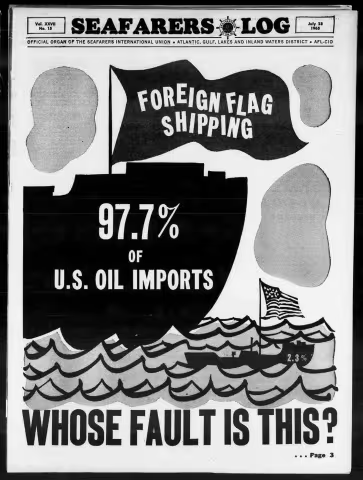
The proposed 30 percent oil import quota recently recommended by
a special subcommittee of the President's Maritime Advisory Commit
tee could be of great help In Improving American-flag shipping. Such
a quota, if adopted by the Government, would aimply provide that 30
percent of all crude oil and petroleum prodoota imported Into this
country be resmwed for American-flag sh^
There is an urgent need for the adoption such a recommendation.
The American-flag tanker fleet has dwindled to an alarming point.
Tankers under the U.S. flag must seek grain cargo, which has an impact
on other segments of the U.S.-flag merchant fleet, particularly the dry
cargo vessels, which would otherwise have a better chance to participate
in the grain trade if they were not faced with the additional competition
of tankers in that trade.
Of the 123 million tons of crude and refined petroleum imported
into the U.S. last year, American-flag tankers carried slightly more than
two percent.
This situation, as the SIU has pointy out many times in the past,
requires Inunediate attention. The SIU has continuously fought for the
adoption of an oil quota, pointing out what could happen in a national
emergency when foreign-flag tankers would be diverted from U.S.
foreign trade, thus preventing our nation's petroleum transportation
requirements from being met. In addition, we have shown that the
chief beneficiary of foreign-flag tanker paiiicipation in the import of
oil to the United States is the runaway ship operator.
The runaway ship operators have attacked the proposed oil import
quota, by maintaining that the proposed oil import quota would be
discriminatory and that it would invite retaliation by .other nations
against U.S. shipping.
We have heard the hollow cry of discrimination by fdreign maritime
nations before. And we've heard our o>^ State Department allege that
if U,S. shipping were favored, foreign nations would retaliate. In the
case of our nation's peteoleum transportation trade, the following facts
present a shocking picture:
Fifty-five percent of Umted States oil and petroleum products are
imported on the runaway Panamanian and Liberian-flag ships.
Norwegian-flag ships carry 17.8 percent of this country's total oil
imports and 17.3 percent of all U.S; imports. Remember, too, that U.S.-
flag ships carry only 8.5 percent of this country's total foreign trade.
At the same time, Norwegian-fiag ships carry 42.7 percent of Norwegian
trade,—and a considerable portion of the trade of other nations—or
more than five times as much of their own national trade as American-
flag ships do. Considering the trade only between the United States and
Norway, the figures are even more startling. American-flag vessels
carry only 1.9 percent of the trade between the United States and
Norway, while Norwegian-flag vessels carry 82.1 percent of this trade,
or more than 40 times the amount carried by American vessels.
In view of all these facts, the SIU has stated before the Advisory
Committee that it would be interesting to leam from the State Depart
ment, for instance, just how much more a country like Norway could
retaliate against us. To say that the proposed oil import quota ought to
be scrapped, ps has been urged by its opponents, on the grounds that
there might be some form of retaliation is sheer nonsense. The quota
program remains a simple solution to a vital problem, the rejuvenation
of the U.S.-flag tanker fleet
Meany Urges ICFTU Action
In Fight For World Freedom
AMSTERDAM—^Free world union delegates attending the
Eighth World Congress of the International Confederation
of Free Trade Unions, held here recently, heard AFL-CIO
President George Meany call"*"
AFL-CIO delegetei to the Eighth Worlel Congress of the International Confederation of
Free Trade Unions In Amsterdam listen attentively to discussion in Amsteidam, Hollend.
The American delegation included (l-r) James Suffridge, president, Retail Clerin; Joseph
Keenan, president, Electrical Workers; Richard Walsh, president, Theatrical Stage Employees;
Paul Hall, president, SlUNA; Hunter Wharton, president. Operating Engineers; Edward Car-
lough, president Sheet Metal Workers; A. Philip Randolph, president. Sleeping Car Porters;
and Jay Lovestone, director, AFL-CIO International AfFairs Department. SlUNA president
Hall, who is an AFL-CIO vice president, served on the Finance and Administration committee
of the Eighth ICFTU Congress.
upon the organization to free
mankind from poA^rty and to
free the more than one billion
people livng imder dictatorship.
SlUNA President Paul Hall, who
Is an AFL-CIO "Vice President, at
tended the ICFTU World Congress
as a member of the delegation from
the U.S. labor federation.
Freedom A Necessity
Speaking for North American
workers, Meany said, "we firmly
believe that any social system
which Is maintained at the price
of degrading human dignity and
debasing living conditions is too
costly from the human point of
view."
He told the leaders of labor organ
izations from throughout the free
world that "when the ICFTU helps
woikers anywhere in the world to
build effective free unions, we are
making a definite contribution to
world peace. Permanent peace can
only come where men are free.
Free unions are the hallmarks of
a free society," Meany de
clared.
He said further "we must never
forget that what unites us in this
historic Congress is far stronger
than that which may at one time
or another divide us."
The AFL-CIO delegation to the
ICFTU Congress was headed by
Meany and included AFL-CIO Vice
Presidents Walter P. Reuther,
Joseph D. Keenan, Paul L. Phillips,
James A. Suffridge, Joseph Curran,
A. Philip Randolph, Herman D.
Renin, Richard F. Walsh, Paul Hall,
Lee W. Minton and K^rl F. Feller.
Also in ttie delegation were
Hunter P. Wharton, president.
Operating Engineers; Edward F.
Carlough, president. Sheet Metal
Workers; Max Greenberg, presi
dent, Retail, Wholesale & Dept.
Store Union; John McCartin, as
sistant to the president. Plumbers
8t Pipe Fitters; Jay Lovestone, di
rector, and Ernest Lee, assistant
director, AFL-CIO Department of
International Affairs.
•I J
y.i
ti, il^
House-Senate
Conferees OK
Medicare Draft
House and Senate conferees have concluded work on a
final draft of a medicare bill which will include social security
benefits and nursing home benefits, a supplementary medic^
Insurance program, and higher"^
monthly social security- pen
sions.
Approval of the final text of the
medicare bill has already been
announced by the conferees.
Every indication points to a
prompt ratification of the confer
ence agreement by the Senate and
the House, which would then send
the bill to President Johnson for
his signature by the end of next
week.
No major obstacle to final agree
ment was expected in the wake
of the bill's 68-21 passage by the
Senate. It passed the House three
months ago in slightly different
form, 313-115 thus prompting the
need for a conference committee
to iron out the final draft.
President Johnson hailed the
Senate action as "a great day for
America." It means, he said, that
"older citizens will no longer have
to fear that illness will wipe out
their savings, eat up their income,
and destroy lifelong hope of
dignity and independence."
Persons already on the social
security retirement rolls are as
sured of a 7 percent increase in
monthly benefits retroactive to Jan.
1, 1965.
Conferees voted to provide part
payment for an additional 30 days
of hospital care after a patient ex
hausts the 60 days allowed for each
Illness. The patient would pay $10
for each day of the extended care,
with the government paying the
difference. The House bill had no
provision for more than 60 days of
hospitalization; the Senate bill had
allowed unlimited hospitalization at
the $10-a-day rate.
Also included in the bill is a
labor-supported provision for in
cluding tips as wages for social
security taxes. However, the com
promise agreement stipulates that
only the employees share of the
tax would be payable. The em
ployer will be exempt from pay
ing half of the tax on tip earnings.
Specialist costs Deleted
While the final version of the
bill is reported to conform in all
fundamental aspects-to President
Johnson recommendations, mem
bers of the conference committee
were said to have deleted from
the bill an amendment adopted by
the Senate which would have in
cluded as part of the basic hospital
insurance benefit, payment of
physician specialist services nor
mally billed by the hospital, such
as a radiologist. The administra
tion and labor had strongly sup
ported the adoption of this amend
ment.
The most direct attack on the
health care program as the Senate
passed the bill was an amendment
proposed by Senator Carl T. Curtis
(R.-Neb.) to kill the medicare sec
tions of the bill. It was decisively
beaten, 64-26.
The closest major vote was on
another Curtis amendment—to tie
the deductible amount which each
person must pay toward his hospi
tal expense to his previous year's
Income. Under the House and Sen
ate bills, there is a $40 deductible
for hospitalization. The attempt to
set a "means test" for social se
curity hospital benefits was beaten,
52-40.
On final passage, 55 Democrats
and 18 Republicans voted for the
Senate medicare billr 14 Republi
cans an seven Democrats were
opposed. I
SlU Urges Govt. Action
On Oil Import Quota Plan
To Aid U.S. Tanker Fleet
WASHINGTON, D.C.—The Seafarers International Union of North Amer
ica sharply challenged assertions by international oil company spokesmen that an
oil import quota for American-flag merchant vessels would be discriminatory and
would invite retaliation by
foreign maritime nations.
A proposal that 30% of
all crude oil and petroleum
products imported into this
country be reserved for
American-flag ships was pre
sented to the President's Mari
time Advisory Committee at
its last meeting on June 21 by a
subcommittee consisting of Theo
dore W. Kheel, New York City
labor-management arbitrator; Lane
Kirkland, executive assistant to
AFL-CIO President George Meany,
and J. Paul St. Sure, president of
the Pacific Maritime Association.
The proposal had been attacked
as discriminatory by Joseph An-
dreae, general manager of the
marine department of the Hum
ble Oil Company, which is the
chief domestic affiliate of Stand
ard Oil of New Jersey.
Esso is the largest operator of
runaway tankers which are owned
or controlled by American inter
ests but registered under the fiags
of Panama,. Liberia, or Honduras.
The SlU rebuttal was set forth
in a statement sent on July 12 to
ail members of the Maritime Ad
visory Committee, which was cre
ated by President Johnson a year
ago to recommend solutions to the
problems besetting the American
maritime industry.
The committee consists of Sec
retary of C6mmerce John T. Con
nor, chairman; Secretary of Labor
W. Willard Wirtz, and 15 non-
Government representatives of
maritime management, labor and
the public. The SIU representa
tive on the Committee is its inter
national president, Paul Hall.
Copies of the SIU statement
were sent to the Department of
the Interior, which administers the
present oil import program, as
well as to members of the House
Merchant Marine Committee, Sen
ate Commerce Committee, Joint
Economic Committee and other
Government agencies.
The SIU noted in its statement
that Panamanian and Liberian-
flag vessels, according to the latest
Maritime Administration statistics,
carry 55% of all of our imported
oil and petroleum products, and
that the only legitimate maritime
nation transporting a significant
volume of these imports is Nor
way, which carries 17.8%. Ameri
can-flag tankers carry only 2.3%.
The SIU pointed out that
American-flag ships now carry
less than 2% of the trade be
tween the United States and
Norway, and none of the
tanker cargoes moving be
tween these two countries,
and declared that "in view of
these facts, it would be inter
esting to learn from the State
Department, for instance, just
how much more a country like
Norway could 'retaliate'
against us."
The State Department has con
sistently supported the position of
the oil companies in holding that
an oil. quota for American-flag
vessels would invite discrimination
again American shipping.
"The simple fact," the SIU de
clared, "is that an oil Import quota
aside possibly from Norway would
fall primarily on those vessels
which are owned by Americans
but registered under spurious flags
in order to evade American wages,
working conditions, taxes and
other legal obligations. Such ac
tion against ships which are really
American vessels can hardly b*
said to constitute 'discrimination'
against the flags of legitimate ma
ritime nations."
The SIU, in its presentation, also
made the following points;
• Runaway operators have
frequently threatened to trans
fer their ships from runaway
flags to the flags of other for
eign countries, completely be
yond the reach of American
authorities. This, the SIU
said, makes a mockery of the
theory of "effective control"
which is supported by our de<?
partments of State and De
fense, and which holds that
these runaways will be avail
able to the United States in
time of war or national emer
gency.
• The ability of the the run
away operators to evade th«
52% tax on corporate earn
ings, paid by domestic Ameri
can companies, not only en
ables these operators to es
cape making a full and fair
contribution to the American
economy, but gives them an
unwarranted competitive ad
vantage over domestic ship
operators and domestic oil
companies.
• Whereas American-flag ves
sels reduce our balance of
payments deficit by $1 biUion
a year, the runaways help to
create a deficit of a billion
a year in the petroleum
trades, thus wiping out tho
contributions of the American-
flag fleet in this area.
The SIU lu-ged in its statement
that, in addition to advocating an
(Continued on page 18)
Major Cains Won
In SIU Taxi Pact
CHICAGO—^Taxi worker members of Democratic Union
Organizing Committee Local 777 of the SIU-Transportation,
Services and Allied Workers District, voted overwhelmingly
to end their 23-day strike and •
Striking taxi drivers and garage workers of DUOC Local 777 of the SlU-Transportation Serv
ices and Allied Workers District picket outside Yellow Cab Company Garage No. 3 in Chicago
in support of better wages and working conditions. DUOC members who work for the
Checker and Yellow Cab companies recently voted to accept a new contract with important
gains in commissions, wages and benefits. The new pact ended a 23-day walkout by the 6,000
taxi workers.
return to work after winning
a new three-year contract
•with substantial gains in commis
sions, pensions and medical bene
fits. The 6,000 DUOC cab drivers
and garage workers hit the bricks
on June 26 in front of Yellow and
Checker cab company garages
when the owners refused to negoti
ate a satisfactory contract.
The cab union's new three-year
contract pushes commissions for
drivers up to a maximum of 47V^
percent and achieved an Important
break-through on pensions, estab
lishing payments of $82.50 per
month for drivers and inside men.
The new pension plan represents
an increase of $45 per month over
the old pension agreement.
The two cab companies also
agreed to contribute toward the
establishment of a diagnostic clinic
which will offer complete medical
services to taxi workers and their
dependents. DUOC members also
gained a 50 percent increase in
hospitalization benefits as well as
major gains in sick pay, surgical
and survivor benefits. The cost of
the improved welfare program in
the new contract will be paid for
by the employers.
The new agreement provides
that garage workers will now work
a reduced work week with no loss
in pay.
Other contract gains include
breakdown pay on the basis of
$17.50 a day and $17.^0 per day
in accident pay.
Drivers and Inside men will be
eligible to collect all increases in
commissions, wages and other pay
ments retroactively to April 1
under the terms of the new con
tract.
Contract talks with the cab com
panies began right after Local 777
overwhelmingly turned back a
raiding attempt by the Teamsters
Union. In an NLRB representa
tion election in May, the SIU-
affiliate whipped the Teamsters by
a three-to-one margin. More than
5,000 cab workers took part in
the election.
CJS''
Pac* Foar Sf;AFAREW9 hoc
Union Pensions Awarded
To 13 Veteran iViembers
Tote Bridge Sovoge Zee Bell Fuller
Thirteen additional SIU veterans have joined the growing ranks of Seafarers whose
retirement years are protected by a lifetime of $150 monthly pension checks.
The thirteen additional pensioners are Samuel Tate, 63, Theodore Popa, 56, John Bridge,
61, Brougham Savage, 65, John >•-
S. Zee, 65, Vincente Remolar,
65, Gorden Bell, 58, Woodrow
Fuller, 51, William G. Callis, 61,
Daniel Zeller, 65, Paul Brady, 65,
Calixto Montoya, 65, Zygmunt B.
Bratkowski, 52.
Tate joined the SIU in the port
of Savannah, Georgia, sailing as
Jersey with his wife Phoebe. He
last sailed for the New York Cen
tral Bailroad.
Callis Brady
a messman in the steward depart
ment. Born in Morgantown, North
Carolina, he still makes his home
there with his wife Dora. He last
sailed aboard the Kyska.
Popa sailed as a bosun in the
deck department after joining the
SIU in the port of Philadelphia.
Born in the state of Ohio, he now
makes his home in Cleveland. He
last shipped out aboard the Wild
Ranger.
Bridge signed on with the SIU
Inland Boatmens Union in the
port of Houston, Texas where^ he
sailed as a member of the deck
department. Born in Philadelphia,
he now makes his home in Corpus
Christi, Texas with his wife June.
He last sailed for the G&H Towing
Company.
Savage sailed as a member of
the deck department after joining
the SIU Railway Marine Region
in the port of New York. A native
of Great Britain's Isle of Man, he
now lives in Cliffside Park, New
Zee joined the SIU Inland Boat
mens Union in the port of Chicago,
sailing as a member of the deck
department. He and his wife Mary
continue to make their home in
Chicago. He last sailed for Hannah
Inland Waterways.
Remolar sailed as a member of
the steward department after sign
ing up with the SIU in the port
of Savannah. A native of the sunny
Phillipine Islands, he now makes
his home in New York City with
his wife Juliana. He last shipped
out aboard the Azalea City.
Bell joined the SIU in the port
of Norfolk, sailing as a member of
the engine department. Born in
North Carolina, he still makes his
home there in the city of Moore-
head. He last sailed aboard the
De Soto.
Fuller signed on with the SIU
Railway Marine Region in the port
of New York, sailing as a deck
hand. Born in Brooklyn, he con
tinues to make his home there with
his wife Alice. He last sailed for
the Bush Terminal Railroad Com
pany.
Callis sailed as a deckhand after
joining the RMR in the port of
Norfolk. Born in Redart, Virginia,
he and his wife Mary now make
their home in the town of New-
point, Virginia. He last sailed for
the Pennsylvania- Railroad Com
pany.
Zeller joined the RMR in the
Port of New York, sailing as a
member of the-deck department.
Born in New York, he Rves in
Receiving best wishes for smooth sailing during his retire
ment years Seafarer Vincente Remolar (left) accepts his first
Union pension check from SIU rep Ed Mooney at New York
headquarters. Remolar, who sailed in the steward depart
ment, last paid off the J^leo City (Sea-Land). He plans to
retire on his SIU pension to his homo in New York.
Montoya Bratkowski
Brooklyn with his wife Catherine.
He last sailed for the New York
Central Railroad.
Brady sailed as a member of
the steward department after join
ing the SIU in the port of Mobile,
Alabama. Born in Maryland, he
now makes his home in Lake
Charles, Louisiana with^ his wife
Dorothy. He last shipped out
aboard the Cabins.
Montoya signed on with the SIU
in the port of New York, shipping
out as a member of the steward
department. Bom in the Philll-
pines, he now lives in New Orleans.
He last sailed aboard the Halcyon
Panther.
Seafarer Theodore Popa
(left) receives his first
$150 monthly pension
check from SIU Cleveland
port agent Stan Wares. A
veteran member of the
deck department, Popa is
planning to retire to his
home in Cleveland. His last
ship was the Wild ^Ranger
(Waterman).
Conference On
Safety Held
In Puerto Rico
SIU Safety Director Joe Algina
participated in a four-day ses
sion of the Labor Conference
which met in Puerto Rico recently
to discuss safety conditions both
on and off the job. An impressive
array of safety programs and de
vices were studied and evaluated
by the conference which included
labor delegations from such wide
spread home bases as Canada,
California, Colorado and Puerto
Rico.
The Seafarers International
Union and the Puerto Rico Federa
tion of Labor sponsored the Con
ference in conjunction with the
Puerto R i c a n Department of
Labor and other civic and labor
organizations.
The Conference passed a resolu
tion extending its congratulations
to President Johnson for "his
dynamic safety program for
federal employees and for his
recognition of the role of labor
unions in occupational safety."
Conference members also
promised to support and cooperate
with "all labor unions having
federal employee members," in
their efforts to achieve safety
goals outlined by the President.
Bratkowski sailed as a barge
captain after joining the SIU In
land Boatmens Union in the port
of Baltimore, Maryland. Born in
Baltimore, he continues to make
his home there with his wife
Margeret.
Daniel 2Mler, member of
the SlU-Railway Marine
Region, (right) sports a
big smile as he receives his
first $150 SIU pension
check from SlU-RMR re
gional director G. PT
McGinty. Zeller last sailed
as a deckhand for the New
York Central, and will
spend his retirement years
with, hit wife, Catherine, in
, Brooklyn. .
By Earl (Bull) Shepard, Vice-President, Atkmfic
Cabbies Rally At N.Y. Hall
SIU Headquartem In Brooklyn was the scene last week of. a mass out
door raUy held by the New York Taxi Drivers' Organizing Committee.-
The hackmen are engaged in an all out fight to have a union represent
them. Seafarers are fully supporting the cabbies in their efforts to win
decent wages and working conditions. The TDOC won a majority
of the garages contested in an NLRB election held this week.
The rally was a resounding success as a huge turnout of cabbies at
tended the meeting.
New York
Shipping is exceptionally good in New York, with a shortage in all
ratings. The outlook for the coming weeks is very favorable. Gerald
Graff has been making the rounds in the New York hall this week
after paying off the Sohin Goodfellow. While working around the
house, Gerry fell, through a storm window and injured his right wing.
Israel Ramos and his old buddy Ramon Agular are both on the New
York scene. Israel piled off the Beauregard and Ramon paid off the
Bienville. Both are ready to take any good runs that hit the board. In
to coUect his vacation money was T. Murphy." Murph is renewing old
acquaintances after getting off the Express Baltimore.
Boston
Shipping is moving at a fair
clip in Boston and is expected to
pickup iij the coming weeks. High
on the list of oldtimers around
the hall is 20-year Union man
John Kulaa who last shipped out
as a oiler aboard the Steel Navi
gator. John says those long trips
are okay, but this time he's going .
to wait for a coast hugger. Also
off the Steel Navigator is Midge
McDonald, another 20-year SIU
veteran. Midge, who sails as an
AB, is going to try to get on the
Island Boats for the summer so
that he can be near his family.
Everybody around the hall was
glad to see that Kenny La Rose, a
16-year man, is out of drydock and
anxious to get back to sea. Kenny
last sailed aboard the Sea Pioneer
as OS.
PhUadelphia
The shipping situation in Phila
delphia is holding steady and
should be picking up in the next
couple of weeks. Old timer John
Sriialler is telling everybody that
he's raring to go. John will'take
the first baker's job available.
Richard Slor just piled off the
Globe Progress after two years siid
is now looking forward to taking
a vacation with his family. John
Shannon reports that he's had
some real good poker hands lately.
He • swears that the Geheva is
the best around. After getting ofl'
the Glohe Cjurier wh^re he sailed
as a bosun. Angel Rosa says that
he's ready to go again.
Balltmore
Seafarers in Balitmore have
found that shipping is proceeding
on the slow bell but is expected
to pick up some steam in the next
(Continued on page 23)
SEAFARERS LOG
July 23, '65 Vol. XXVII, No. 15
Official Publication of the SIUNA
Atlantic, Gulf, Lakes & Inland Waters
District. AFL-CIO
Executive Board
PAUI, HAIJ,. President
CAL TANNDI EAHL SHEPARD
Exec. Vice-Pres. Vice-President
Al. KERR LINDSEV WILLIAMS
Vice-President
AL TAHveR
Vice-President
Sec.-Treas.
ROB. A. MATTHEWS
Vice-President
HERBERT BRAND
Director of Organizing and
Publications
managing Editor: MIKE POLLACK; Asst
Editor: NATHAN SKYER; Staff Writers:
ROBERT ABONSOM. PETE CARMEN; RQBEM
HILCROM; Art Editor: BERNARD SEAMAN.
Published biweekly ef the headquert«r
If** ^"•'••'••International Union, At
. S"!*' Lakes and Inland Wateis
District# APL-CIO, 67S Fourth Avenue,
Brooklyn, NY, 11232. Tel. HVaclnth WtaS.
Second class postage paid at the Post. postage paid at the
-— ... oklyn, •
of Aug. 24. 1»12.
I2f
i\
A I
I
'i
1:.
i|
m
ifM SlEjlFAklERt ' rtf^nn
M
MTD Charges 8 Co's
'thwarf Contract Talks
The Maritime Trades Department, AFL-CIO, has charged that the efforts to resolve the
eurrent •collective bargaining dispute in maritime which has immobilized more than 100
vessels is "being thwarted by a handful of willful shipping company .officials, representing
Just eight companies, who^
have refused to conclude
agreements with any of the
maritime unions whose contracts
•re now open for renegotiation."
MTD President Paul Hall said
In a statement forwarded from
Amsterdam, Holland, where he had
been attending the International
Confederation of Free Trade Un
ion Congress as an AFL-CIO
delegate, that "this situation is of
grave concern to the Maritime
Trades Department which repre
sents hundreds of thousands of
•workers who are dependent upon
the maritime Industry for their
livelihoods."
"It is of particular concern at
this time when a tripartite effort
on the part of maritime labor,
management and the government
is being made to find ways and
means of strengthening and im
proving the American-flag mer
chant fleet." the MTD president
said.
"It is most unfortunate that this
effort is being thwarted by a hand
ful of willful shipping company
officials, representing just eight
companies who have refused to
conclude agreements with any of
the maritime unions whose con
tracts are now open for renegotia
tion." The eight companies are:
United States Lines, Lykes
Brothers, Moore-McCormack Lines,
Grace Lines, Farrell Lines,
Bloomfield Steamship Company,
Prudential Lines, and Gulf and
South American Steamship Com
pany.
In behalf of the hundreds of
thousands of maritime workers who
are affected. Hall urged the "eight
companies involved in the current
dispute to sit down immediately
with the union representatives and
to stay with a discussion of the
issues until they are resolved."
Sharp Contrast
The MTD president's statement
added: "The position of these
eight shipping companies is in
sharp contrast to that of the
hundreds of other American ship
ping companies both subsidized
and unsubsidized, operating some
700 passenger, dry cargo apd
tanker vessels from the Atlantic,
Gulf and Pacific Coast ports which
have either concluded agreements
with all of the maritime unions
whose contracts have been open,
or else are in the process of
negotiating such agreements while
their vessels, meanwhile, remain
free to sail.
"The very nature of this situa
tion makes it obvious that this
totally unnecessary strike was pre
cipitated and is being perpetuated
only because of the refusal of the
eight companies involved to nego
tiate the issues.
"The simple fact is that these
eight companies have refused,
despite the urgings of federal
medistion officials, even to meet
for meaningful discussions with
union representatives. During the
past several weeks, as a matter of
fact, actual meetings between the
management and union representa
tives have totalled no more than
a few hours, although the union
representatives have on numerous
occassions indicated their readi
ness to partieipate in such meet
ings at any time.
"Certainly, no issue can bp re
solved unless there is an honest,
face-to-face meeting, across the
table, of the parties involved.-
"The companies involved have
attempted to cover their unwilling
ness to negotiate by charging that
one of the unions involved — the
Marine Engineers Beneficial Asso
ciation — has a fixed position on
three specific issues. The fact is
that there are many issues In
volved in the dispute between
MEBA and these companies and
the companies have refused to
negotiate on any of them.
"These tactics of the ship
owners have created a climate of
distortion and confusion as to the
underlying causes of the dispute,
and this distortion has been com
pounded by the National Maritime
Union "president who has publicly
attacked MEBA as 'irresponsible.'
This has encouraged the ship
owner to maintain his adamant
position.
"The eight companies involved
in this strike are not only all
subsidized operators, but are
among the largest beneficiaries of
the government's subsidy program.
As such they have a special re
sponsibility to attempt to resolve
the issues which are standing in
the way of full operation of the
American-flag fleet. If these offi
cials continue with their 'public-
be-damned' attitude, certainly
their subsidization by public money
might well be open to question
and scrutiny."
SlU Hosts N.Y. Taxi Union-Rally
SlU Welfare, Vacation Plans
A pre-election rally conducted by the New York Taxi Drivers Organizing Committee lAFL-
CIO) was held at the SlU headquarters in Brooklyn last week. These photos show part of the
600 New York cab drivers who heard speakers uge a "yes" vote for the TDOC. The AFL-
CIO unit scored an overwhelming victory in an NLRB election held this week. Among those
addressing the meeting were SlU rep Ed Mooney, Harry Van Arsdale, Jr., president of the
New York City Central Labor Council; Michael Mann, AFL-CIO regional director; Michael
Sampson, Utility Workers president; Peter Ottley, President, Local 144, Building Service Em
ployes; and Chris Plunkett, TDOC director.
Cash Benefits Paid — June,
CLAIMS
Hospital Benefits 8395
Death Benefits 33
Pension-Disability Benefits 754
Maternity Benefits 44
Dependent Benefits 863
Optical Benefits 482
Out-Patient Benefits 4,114
Vacation Benefits 1,412
1965
AMOUNT PAID
$ 67,626.44
78,982.45
113,100.00
8,582.06
111,435.25
6,327.35
32,912.00
472,279.80
TOTAL WELFARE, VACATION
BENEFITS PAID THIS PERIOD... 16,097 $891,245.35
By Al Kerr, Secretary-Treasurer
SlU Benefit Programs Outlined
This column reviews the various benefit programs for SIU members
to help our brothers obtain those which they are eligible for without un.
necessary delay. We realize that the wide range of benefits available
under the SIU welfars program makes it hard for many of our members
to keep track of specific plans. In response to many questions, we will
again review the maternity, hospital and optical benefits which are
provided for membership use.
MATERNITY BENEFIT. Those seamen who have 90 days of sea-
time in the calendar year prior to the birth of a child and one day's
seatime in. the six months prior to the birth of a child, are eligible
under the Plan for a $200 maternity benefit when their wives give
birth, provided they present proper proof and claims within one year
of the birth. In those cases where there are multiple births (twins,
triplets, etc.), there is provision for an individual maternity bentfit of
$200 for each child.
For births occurring on and after August 1, 1962, delivery by ceasa-
rean section shall be reimbursed in accordance with the hospital and
surgical fee as specified in the Schedule of Dependents' Benefits. In
addition, an applicant must present proof of marriage and a photo
static copy of the baby's birth certificate. The birth certificate must
contain the name of both parents.
An eligible seaman's wife is en
titled to the maternity benefit if
her husband dies during her preg
nancy, and may also claim the
maternity benefit if her husband
is at sea at the time the child is
born. A seaman is eligible for this
benefit only if the child is born in
the Continental United States or
its territories — Puerto Rico and
the Virgin Islands. Tlie only ex
ception to this is Canada, which
is also covered under this benefit.
Lastly, if an eligible seaman dies
before his wife gives birth, the
benefit shall be paid even though
the child is born more than 90 days
after the deceased employee's last
employment.
OPTICAL BENEFIT. Eligibility
for this benefit is the same as
for the maternity benefit. The pro
gram provides for the following:
One pair of eyeglasses every two
years, except in cases requiring
glasses more frequently due to
pathological reasons, in which case
the additional glasses may be au
thorized by the trustees. The un
derstanding is that the frames will
be those known as "Shell Ful-
Vue," with lenses of the required
prescription. The cost of fancy
frames, tri-focal lenses, sunglasses,
and the like, shall be paid by the
eligible. The optical benefit is
available and extended to eligible
dependents under the same rules
as those governing the eligible sea
man. Safety glasses for dependent
children also may be provided,
however.
HOSPITAL BENEFITS FOR
ELIGIBLES: Eligibility for hospi
tal benefits is the same as out
lined above. The hospital benefit
program is actually broken down
into three items, consisting of a
$1.00-a-day hospital benefit, a
$3.00-a-day hospital benefit, and
an $8.00-a-day hospital benefit.
which is known as the In-H::3pital
Benefit. Each of these is dealt
with separately below.
$I.OO-a-Day Hospital Benefit—
Eligibility for this benefit requires
one day's seatime in tlie ye.>r prior
to admittance to the hospital. This
benefit has been in effect from
the day that the Seafarers Welfare
Plan came into existence.
S.'S.OO-a-Day Hospital Benefit—
The eligibility rule for this benefit
requires a seaman to have had 90
days of employment in the calen
dar year prior to his admittance
to the hospital, as well as one day's
employment in the six-month
period preceding his admission. He
will then receive $3 GO per day for
the period of time that he is hos
pitalized.
$8.00-a-Day Hospital Benefit—
This payment actually falls under
the S & A benefit program but is
paid in the hospital to the individ
ual. Many eligibles become con
fused and feel that this is an
$8.00-a-day hospital in - patient
benefit. Under the hospital benefit
section of the Plan it is, but it
falls under the S & A rules.
A patient is entitled to tills
benefit during the time he or she
is a patient in any USPHS Hospi
tal or an approved private hospital
in the US, Puerto Rico, the Virgin
Islands or Canada. This benefit is
payable from the first day of hos
pitalization but not for a period to
exceed 39 weeks.
The hospital benefits of $1.00-a-
day and $3.00-a-day are paid to
patients who qualify for as long a
period as they remain a patient in
the hospital, regardless of the
length of stay. In some cases, par
ticularly those of chronic illness,
this period has extended for as
long as seven and eight years.
Pa«» iHx 5® A F AR E'R S L O « Jair 2S, INi
{Figures On This Page Cover Deep Sea Shipping Only in the SlU Atlantic Gtdf Lakes and Inland Waters District.)
July 3 to July
Total job calls during the past two weeks amounted to
1^92 men, virtually unchanged from the preceding
period's total of 1,391. Class A and Class B men who
shipped out during the past period totaled 1,186 men, and
thus represented a slight increase over the earlier period,
when 1,176 Class A and Class B men shipped out.
During the same two periods, registrations of Class A
and Class B men decreased by 980 seamen. As a result
the job situation brightened appreciably.
This decrease in new registrations along with the hold
ing of the high level of men shipped has helped to cut into
the number of men registered on the beach. The overall
figure for this category dropped from 3,539 to 3,522 sea
men. Of this total, 1,412 were in the deck department,
1.079 were in the Engine department and 1,031 in the
Steward department.
A department breakdown of registrations shows that
all three departments marked a decline when contrasted
with the previous period. The Engine department rang
up the sharnest dron which was followed bv the Deck
and Steward departments in that order. The Steward
16, 1965
department benefited "most from the decline in reg
istrations because at the same time it was the only de
partment to experienice a rise in the number of men
shipped. The number of members answering deck
department calls remained steady, while engine depart
ment jobs dropped slightly.
The seniority picture snowed little or no change from
period to period. Class A men still account for 49%,
of the men shipped. Class Bjnen increased by 1% to
36% while Class C seamen dipped 1% and now account
for 15% of the Seafarers shipped.
A port by port analysis shows considerable variation
in performance. New York and Houston, both of which
have high levels of men shipped indicate little change
from last time. Mobile and Seattle shipping became
tighter, while New Orleans and Wilmington took up the
slack.
Total Shioping-Activity rose again this period,'increas
ing from 209 to 220. Sign-Ons increased by 9 rising from
38 to 47. There were 3 more Pay-offs and 1 less In-transit
than there were 2 weeks ago.
Ship AcfiWfy
fmf Sifd la
Off Oat Traai. TOTAL
Battoa. 1 0 1 A
Naw .Yaafc .... 17 4 20 43
Philadalpbia.. 5 4 8 17
iaitimora .... 4 3 '7 14
Narfolfc ...... 3 3 4 10
Jacksoavllla .. 0 0 11 11
Tam|M 0 0 4 4
4 ' 3 •i 13
Naw Orlaaat.. 13 10 8 31
Hauften 10 13 20 43
Wiiaiinftea .. 2 0 5 7
Saa Franchce. 5 4 4 15
SaaNia 1 1 4 4
TOTALS ... 49 47 104 220
Port
Boston
New York ...
Philadelphia .
naitimore ...
Norfolk ..,
•Tacksonville .
Tampa
Mobile
TTew Orleans.
T'ouston
Wilmington
'"-n Francisco
Flattie
TOTALS
Reqistered
CLASS A
DECK DEPARTMENT
Registered
CLASS B
GRO'ip GROUP GROUP
1 o 3 ALL 1 2 3 ALL I 2
4 .1 3 12 0 1 1 2 0 2
31 3.5 9 75 3 10 9 22 12 41
6 6 3 15 0 3 7 10 2 3
3 11 2 16 0 5 9 14 7 6
4 2 0 6 0 8 5 13 2 8
1 0 5 6 1 5 7 i 13 1 2
2 0 0 2 0 1 4 ' ' 5 1 0
9 10 3 22 2 4 9 1 1.5 3 -11
12 23 6 4.6 0 17 16 ! .33 20 27
20 34 5 59 10 14 8 33 17 22
3 4 2 9 0 2 2 4 3 5
16 20 3 39. 4 11 13 28 15 20
3 10 5 18 0 8 7 15 5 7
114 lf5 46 1
CO
20 ' 89 97 1 206 0
0
0
0
1
154
ped Shipped Shipped TOTAL Registered On The Beaeh
S A CLASS B 1 CLASS C Shipped CLASS A CLASS 8
1 GROUP GROUP CLASS GROUP GROUP
3 ALL 1 2 3 ALL 1 2 3 Al.L A B C ALL 1 2 3 ALL 1 2 3 ALL
1 3 0 1" 1 ' 2 0 1 0 1> 3 2 1 6 10 10 4 24 0 3 5 8
3 56 1 15 14 30' 0 8 11 19 56 30 19 105 80 128 28 236 1 26 49 76
3 8 0 2 4 6 0 2 4 6 8 6 6 20 13 13 6 32 0 5 20 2s
1 14 1 4 1 6 0 1 0 1 14 6 1 21! 34 69 9 112 5 14 32 51
0 10 1 3 4 8 0 0 2 2 10 8 2 20 9 14 2 25 1 4 15 20
0 3 2 1 2 5 0 0 1 1 3 5 1 9 9 9 0 18 2 7 9 18
0 1 0 1 0 1 0 0 0 0 1 1 0 2 1 3 0 4 0 1 3 4
0 14 0 5 2 7, 0 0 1 1 14 7 1 22 30 26 5 61 2 4 21 27
4 51! 3 18 21 40 0 1 0 1 51 40 1 92 59 79 9 147 3 32 52 87
3 42 8 18 11 37, 0 2 7 9 42 37 9 88 57 82 15 154 6 25 39 70
1 9 3 1 6 10 0 0 1 1 9 10 1 20 17 19 3 39 0 8 7 15
10 45 5 18 6 29 1 10 13 24 45 29 24 98 25 17 2 44 4 8 18 30
1 13 1 4 5 10, 0 2 1 3 13 10 3 26 23 23 8 54 2 19 10 31
27 1 269 25 89 77 "1 191 i 1 27 41 1 69 269 191 69 1 529 367 492 91 "l 950 26 156 280 1 462
ENGINE DEPARTMENT
Registered CLASS B Shipped Shipped Shipped TOTAL Registered On The Beach
CLASS A Registered CLASS A ClASS B CLASS C Shipped CLASS A ClASS B
GROUP GROUP GROUP GROUP GROUP CLASS GROUP GROUP Poif 1 2 3 ALL 1 2 3 Al.L 1 2 3 ALL 1 2 3 ALL 1 2 3 ALL A B C ALL 1 2 3 ALL 1 2 3 ALL
Boston 1 2 0 3 0 1 0 1 0 1 0 1 0 0 0 0, 1 1 0 2 1 0 2 3 5 9 2 16 1 2 1 4
I'ew York 17 38 5 60 1 13 7 21 9 27 3 39 2 14 7 23 0 2 9 11 39 23 11 73 51 96 12 159 8 44 45 97-
I'iiiladeiphia 0 14 3 17 0 9 7 16 0 8 1 9 0 5 1 8, 0 1 0 1| 9 6 1 16 2 19 2 23 0 10 14 24
naltimore 6 13 4 23 1 7 8 16 1 io 3 14 0 8 2 lo! 0 0 1 i! 14 10 1 25 12 72 6 90 3 27 19 49
Norfolk 2 8 1 11 0 2 1 3 1 8 1 10 0 4 3 7, 0 2 1 J 10 7 3 20 6 16 2 24 1 10
8
7 18
Jacksonville 0 7 0 7 1 8 1 10 1 1 0 2 0 2 1 3 0 2 2 4 2 3 4 9 1 8 0 9 2
10
8 3 13
Tampa 0 2 0 2 0 0 0. 0 0 0 1 1 0 2 1 3 0 0 1 1 1 3 1 5 1 3 0 4 0 1 1 2
rTobile 2 15 2 19 0 5 3 8 3 10 0 13 1 5 3 9 0 1 2 3 13 9 3 25 8 18 6 32 0 5 7 12
Orleans 6 20 1 27 3 17 5 25 13 27 5 45 5 20 16 41' 0 7 4 11 45 41 11 97 24 64 10 98 5 34 37 76
Touston 11 29 5 45 3 23 12 38 5 25 11 41 0 20 19 39 0 4 8 12 41 39 12 92 14 73 2 89 5 39 41 85
Wilmington 4 2 2 8 3 6 3 12 3 3 1 7 2 6 3 llj 0 0 0 0 7 11 0 18 9 7 4 20, 4 6 1 11
t-an Francisco 7 19 3 29 3 4 8 15 7 16 3 26 2 5 8 15, 1 13 10 24 26 15 24 65 6 31 6 43i 3 7 14 24
Seattle 0 9 0 9 2 8 1 11 1 5 1 7 0 6 4 10 1 0 1 2 7 10 2 19 7 3 39, 2 12 4 18
TOTALS 55 178 26 1 260 17 103 56 1 176 44 141 30 1 215 12 97 68 1 177 3 33 39 1 JIS 215 177 75 1 467 146~
_
"445 55"|
1.
646 34 205 194 1 433
STEWARD DEPARTMENT
Registered Registered Shipped Shipped Shipped TOTAL Registered On The Beaeh
CLASS A CLASS B CLASS A CLASS B CLASS C Shipped CLASS A CLASS B
my _M.
GROUP GROUP GROUP GROUP GROUP CLASS GROUP GROUP Port 1-8 1 2 3 ALL 1 2 3 ALL' 1-s 1 2 3 ALL 1 2 3 ALL 1 2 3 ALL A B C ALL 1-8 1 2 3 ALL 1 2 3 ALL
Bos 1 2 0 0 3 1 0 1 2 0 0 0 0 0 0 1 ""0 1 0 0 ~1 1 e 1 1 2 1 3 2 1 7 1 0 2 3
NY 4 10 4 19 37 0 1 8 9 7 9 9 20 45 0 1 5 6 0 2 16 18 45 6 18 69 24 SO 25 59 158 5 9 39 53
Phil 0 5 2 4 11 1 0 5 6 0 2 2 3 7 0 0 4 4 0 0 8 6 7 4 6 17 4 10 5 12 31 1 1 12 14
Bai 0 9 6 9 24 1 0 11 12 0 4 2 5 11 0 0 6 6 0 0 1 1 11 6 1 18 11 29 18 25 83 4 0 45 49 Nor 0 3 0 1 4 0 1 5 6 0 1 2 1 4 1 0 6 7, 0 1 1 2 4 7 2 13 2 5 5 7 19 1 5 14 20 Jac 0 1 2 1 4 0 0 3 3 0 0 0 1 1 0 1 3 4; 0 0 2 2 1 4 2 7 1 2 4 1 8 0 1 4 5 Tarn 1 0 0 2 3 1 0 0 1 0 1 0 1 2 0 0 1 1> 0 .0 0 0 2 , 1 0 . 3 3 2 0 4 9 0 0 0 0 Mob 2 3 1 4 10 0 0 6 6 0 2 1 5 8 0 0 7 7 . 0 0 1 1 8 7 1 16 9 12 11 13 45 0 0 6 6
NO 1 14 7 19 41 3 0 39 42 3 11 10 18 42 6 2 39- 47 0 0 1 1 42 47 1 90 17 32 18 57 124 5 3 92 100
Hou 6 7 8 8 29 4 ,4 12 20 1 11 8 9 29 7 7 13 27, 2 1 16 19 29 27 19 75 12 40 •22 22 96 5 14 38 57
Wil e 1 2 1 4 1 0 3 4 1 • 3 1 2 7 0 0 4 • 4' 0 0 0 0 . 7 4 0 11 5 2 7 6 20 1 0 3 4
SP 6 3 8 10 27 2 3 4 9 5 10 6 10 31 0 1 6 7 5 0 15 20 31 7 20 ' 58 5 12 10 12 39 •4 4 5 13
Sea 3 4 2 1 10 1 0 8 9 1 3 2 4 10 2 4 _ 6 0 0 1 1 10 6 1 17 7 14 2 11 34 4 5 25 34
TOTALS ~24 62 42 79 1 207 15 9 105 1 129 18 57 43 79 1 1 197 16 "^13 M 1 127 7 4 61 1 1 72197 127 •72 1 396 101 213 129 230 1 673 31 42 285 1 358
DECK
ENGINE
Registered
CLASS A _
OROUF
I 2 3 ALL
Registered
CLASS B
GROUP
12 3 ALf.
SHIPPED
CLASS A
SUMMARY
SHIPPED
CLASS B
GROUP
I 2 3 ALL
GROUP
123 ALL
SHIPPED
CLASS C
GROUP
3 ALL
TOTAL
SHIPPED
CLASS
A B C ALL
Registered On The Beaeh
CLASS A f CLASS I
GROUP I GROUP
1 2 3 ALL 1 2 3 ALL
1 27 41 i 63 269 191 69 1 529 367 492 91 I 959 26 156 280 1 462
STEWARD
GRAND TOTALS
114 165 46 I 325 20 89 97 | 206 88 154 27 | 269 25 89 77 | 191
"56 178 26 1 260 17 103 56 | 176 44 141 30 | 215 12 97 68 | 177j 3 33 39 f 75 215 177 75 | 467 146 445 55 t 646 34 205 194 | 433
~86 42 79 I 267 15 9 105 { 129 75 43 79 | 197 16 13 98 [ 127l 7- 4 61 [ 72197 1!^ 72 | 396 314 129~230 [ 673 'SI 42 285 | 358
256 385 151 j 792 52 261 258 1 511207 338 136 | 681 53 199 243 j 495 ~3l 64 141 t 216 681 495 216 |1392 827 1066 376 |2269. 91 403 759 |1253
Arir n. iNf
\
with his wife. Osborne M. Brooks
is registered for an engine room
berth after piling off the Maiden
Creek with Ted 'Harris, and Lotus
Stone. Seafarers around the hall
were wondering how come his
billfold was so fat and Ozzie
promptly satisfied their curiosity
by proudly pulling out snapshots
of his nine children. Oldtimer
William F. (Dub) Simmons is wait
ing for a deck job after piling off
the Ocean Ulla where he sailed as
AB. • Dub says that he'd like to get
a chance to drop by, Mississippi
and see his wife before shipping
out.
By Lindsey WBIiams, Viee-President, Gulf
Gulf Shipping Picture Bright
Shipping has been booming in the gulf area as an increased number
of payoffs has sent the statistics soaring. The outlook for the coming
weeks is extremely favorable and ail rated men are urged to register.
New Orleans
Job calls have been hot and heavy in the port of New Orleans, and
the forecast is for more of the same in coming weeks. On the beach
after spending a long stretch on the Del Norte as steward, JaOt Cobb
is spreading the news that he is going to just take it easy for a while
on a well-earned vacation. Waiting for a long run after a short stay
on the Colorado is George (Lucky) Neyrey. Lucky is telling all the boys
around the hall that he wants a real long one. Also on the beach after
a quick run on the Colorado is Frank Russo. August (Gus) Brosig is
on the ailing list after a run as steward on the Del Valie. Gus is taking
treatments for a bum leg. Seafarers around the hall were all sorry to
learn that Irwin (Monk) Sherman is having trouble with his hip. Monk
last sailed aboard the Del Sud.
Houston
Shipping has been good in Houston and is expected to hold solid for
the coming period. Old timer Homer Pashcall is glad to have his FFD
and is ready and willing to ship anywhere. His last run was a fine trip
to Bombay. India aboard the Penn^
Carrier. Homer sails in the en-'
gine department. SIU vet
eran Sal Frank is down from
Rhode Island. Sal is bragging
about the SIU welfare plan. He
says that he can renieniber the
days when a seaman had no pro
tection at all. Sal says that he's
ready to ship to any port in his
usual deck rating. Mike (The
Beard) Doherty is a welcome sight
around the hall after piling off the
Del Norte where he sailed as quar
termaster. Although he likes the
run to South America, right now
Mike is looking for a berth to
India. Another welfare plan apos
tle around the hall is Steve Kolina.
Steve is proud and happy about
the plan. Now on the beach after
a good run to India, Steve says
that he is ready and raring to go
again.
MobUe
Shipping activity is fair in Mo
bile, but is expected to pick up
some steam in the next few weeks.
The Midlands and Trans Texas
are laid up in port.
Lotus Stone is registered for a
deck department job down here.
He last shipped as an AB aboard
the Maiden Creek on her run to
India. Lotus is married and makes
his home in Mobile. He has been
shipping out of the gulf area for
25 years. Herman Wilkerson is
saying hello to a lot of old friends
after piling off the Norfolk where
he sailed as chief pumpman. When
he's not around the hall, Herman
is spending all bis time with his
wife in their Mobile home. He says
that he stiU prefers tankers to
anything else. Herman is an en-
gineroom man who has been ship
ping on the Gulf for the last twenty
years. Another long-time Gulf man
is Charlie Wahl who is waiting for a
steward's berth. Charlie last sailed
aboard the Transindia as chief
cook. He's telling everybody about
his home in Fairhope, Alabama
where he lives with his parents.
He says that he hopes to get down
there soon.
The boys around the hall were
all giving the glad hand to 25-year
Gulf sailor Theodore Harris who
is off the Maiden Ch-eek after a
voyage to India. Ted is waiting
for a choice steward's job and
spending his spare time at home
CHAN6»l6AmEgso/U
^iMMUmisrP
iNaooE
SIU Company
Christens Huge
Lakes Carrier
CLEVELAND — The 501-foot
J. A. W. Iglehart, the largest
cement carrier on the Great Lakes
was christened hero recently by
the SIU-Great Lakes-contracted
Huron Portland Cement Division
of the National Gypsum Co.
The new cement carrier is the
latest and fastest addition to the
Huron Portland Cement fleet.
The Iglehart, a former tanker
was converted by the American
Shipbuilding Company of Chicago.
During the remodeling, a new
forward deckhouse, including a
pilot house and passenger quarters
was built. The tanker's midship
deckhouse was removed and the
aft deckhouse underwent exten
sive remodeling. Unloading
machinery was also installed under
the cargo hold.
The J. A. W. icpiehait, the largest cement carrier on the Great
Lakes, awaits christening at ceremonies held recently in
Cleveland. Operated by the SIU-Great Lakes District-
contracted Huron Portland Cement Division of the National
Gypsum Company, the huge vessel is named after a director
of the parent corporation. Jane Purinton of Baltimore,
granddaughter of J. A. W. Iglehart, stands ready to do the
honors with the traditional bottle of champagne.
Congressman Urges Bar To U.5. Ports
Report Progress On Barring
Ships In North Vietnam Trade
WASHINGTON—^Representative Paul Rogers (R.-Fla.) reports he is gaining support in
his fight to close United States ports to the ships of any nation that permits its merchant
fleet to transport supplies to Communist North Vietnam. In addition to introducing a bill
(HR 6154) that would ban"*"
these vessels, the Florida con
gressman is also calling upon
the State Department to declare
Cure Seen For Water-Short Areas
Atomic Power Held Key
To Low-Cost DesaHing
LOS ANGELES—^Reports that sea water can be desalted in
expensively through the use of atomic power are being studied
hopefully by government officials in drought-stricken areas
across the nation. While many
desalting processes are cur
rently in use, government of
ficials are especially Interested in
the use of atomic power to make
fresh water, since a U.S.-sponsored
study estimates that seawater can
be converted at one-fifth of the
normal cost.
According to the report, a $300
million desalting plant built near
Los Angeles could provide 150 mil
lion gallons of fresh water per day
for residents of the parched area
at a cost of 22 cents per thousand
gallons. Experts from Southern
California estimate that this would
be the cost that the ai-ea would
pay for drinking water piped in
from its normal inland soiu-ces.
Power By-Product '
The proposed plant would pro
duce enough water for the daily
needs of 750,000 persons. The use
of controlled nuclear fission in the
desalting plant would generate
1,800 megawatts of power, enough
electricity to satisfy the needs of
a city <4 2 million people. Since
only part of this immense power
would be used ' in the desalting
process, the report envisions that
the surplus could be used to gen
erate electricity at a cost low
raough to compete with presently
used fuels.
The report, which has aroused
so much interest among govern
ment officials in arid Southern
California and the north eastern
U.S., now in its seventh year of a
crucial water shortage, was pre
pared by the Bechtel Corporation,
one of the country's largest engi
neering firms. The U.S. Depart
ment of Interim, the Atomic En
ergy Commission and the Metro
politan Water District of Southern
California commissioned the study
at a cost of $420,000. Southern
California was chosen for the
study since it contains the largest
population living in an area which
is chronically short of water.
UUlities Interested
Three large private utility com
panies have already made known
their interest to build a desalting
plant in conjunction with the
Southern California Metropolitan
Water District, following the rec
ommendations in the Bechtel
study. The utility concerns have
stated that they are ready to en
gage in the project if the cost
estimates in the study are actually
borne out.
The estimated 150 million gal
lons per day capacity of the pro
posed plant is regarded as highly
significant when compared to de-
salinization facilities now in opera
tion. The largest such plant,
which operates on conventional
non-nuclear fuels, produces 3.5
million gallons of fresh water per
day on the Caribbean island of
Aruba. The proposed Southern
California plant would produce
nearly 50 times as much drinking
water.
a boycott which would forbid the
operators of these ships from car
rying government-generated car
goes.
Angered by the loss of American
fighting men in Vietnam who are
killed while attempting to elimi
nate the Communist Viet Cong's
overland transportation system,
Rogers has branded the mounting
U.S. death 'toll as "senseless" in
the face of- the continued ocean
movement of supplies by Free
World shipowners. Under these
circumstances, the arrival of just
one Free World ship with cargo
for North Vietnam "is one too
many," he declared recently.
The Florida Republican now has
the support of eight of his fellow
congressmen in his struggle to se
cure House passage of his bill. As
a member of the House Merchant
Marine Committee, Rogers has the
additional advantage of being able
to sit in on the hearings when his
committee considers his own bill.
SIU Backs BUI
The Seafarer's International Un
ion of North America, the Interna
tional Longshoremen's Association
and other maritime Industry
groups are supporting passage of
Rogers' bill. Using a list of ships
flying the flags of Free World na
tions that have visited North Viet
nam, the ILA has pledged itself
to boycott these vessels should
they appear in any U.S. port from
Maine to Texas.
Bringing the public and his fel
low congressmen up to date on the
growing trade of Free World ships
with Red North Vietnam, Rogers
reported that 41 ships flying the
flags of Western nations made 55
trips to ports controlled by the
Hanoi government during the flrst
five months of 1965. He asserted
that many of these ships were en
gaged in trade with Cuba during
the Russian missile crisis in 1962.
According to Rogers' lat^t stat
istics, vessels sailing under the
British flag have continued to
make the most calls to North Viet
nam of any Free World govern
ment. When the Florida represen
tative first made public the list of
ships flying the flags of Western
nations that had supplied the
Hanoi government last April,
Great Britain also stood at the top
of the list at that time.
Hanoi Shuttle Service
His list showed that certain
British-flag ships were maintaining
a kind of shuttle service between
Hong Kong and North Vietnamese
ports. One such freighter, the Car-
doss, was found to have made four
voyages between Hong Kong and
Haiphong on the Gulf of Tonkin
during the last five months.
Rogers assailed the State De
partment announcement that Free
World ship movements to North
Vietnam had dropped by 20 per
cent in the first three months of
1965. The announcement also
stated that this traffic was respon
sible for only 17 percent of the
non-strategic goods imported by
the Hanoi government. The Con
gressman declared that these sup
plies seemed far from insignificant
when a count was made of the 191
Americans who were killed while
fighting the Viet Oong during the
first six months of 1965.
The State Department has for
mally accused Communist North
Vietnam of directing and supply
ing the Viet Cong rebellion against
the legitimate government of
South Vietnam with men, arms
and other necessities. United States
planes have been bombing North
Vietnam for several months to
persuade the Hanoi government to
cease its assistance to the Com-
mimist insurgents operating in the
southern part of the country.
Rogers asserts the recent intel
ligence reports that work is almost
completed on four missle launch
ing sites in the area of the Viet
namese port of Haiphong are evi
dence 6f the importance the Com
munists attach to the continued
availability of shipping.
Type Minutes
When Possible
In order to assure accurate
digests of shipboard meetings
in the LOG, it is desirable that
the reports of shipboard meet
ings be typed if at all possible
Pafe Eifht ^J^4F4RERS LOG Jtdr XI. UW
NLRB Policy Shift Hits Runaway ffmp/oyer«
Runaway Company Ordered
To Bargain At New Plant
The National Labor Relations Board, fashioning a new policy for "runaway" employers,
has ordered a Miami swimsuit manufacturer to bargain with the union he tried to evade.
The new ruling does not require the unions to show proof of a majority at the new location.
The manufacturer was the
Garwin Corp., which closed its
New York plant in 1963, dis
charged its employees and hired
new workers in Miami, where it
does business as S'Agaro, Inc.
The Ladies' Garment Workers
filed unfair labor practice charges
and an NLRB examiner ruled that
the firm had moved to deprive its
New York employees of their
rights and to avoid dealing with
the union. He issued an order,
following customary NLRB prac
tice, that S'Agaro would have to
bargain when the union could "re
establish its representative status"
at the Miami plant.
The ILGWU, objected, saying
this would permit the firm to
reap the fruits of Its illegal ac
tivity. The board agreed with
the union that the New York
employees probably would not
accept reinstatement at the Mi
ami plant.
Besides, the NLRB declared, the
"continuing coercive effects" of
the firm's unfair labor practices
"renders it highly probable that
the issuance of a conditional bar
gaining order will enable the re
spondents [management] to achieve
their primary illegal objective—
to escape bargaining."
Abandoned Workers' Rights
On balance, the NLRB said, the
rights of the new employees in
Miami should not take preference
over the rights of the abandoned
workers in New York. Therefore it
charged the examiner's recom
mended order to require the em
ployer to recognize and bargain
with the union, on request, wher
ever the company locates.
Since the new employees have
a continuous- interest In their
working conditions and effective
collective bargaining, the NLRB
voted to approve a "minor re
laxation" of its normal contract-
bar rules.
"If . . . upon compliance with
our order herein," it declared, "the
union can reestablish its majority
at the Florida plant, the normal
contract bar rules shall apply. If
. . . the union is unable to rees
tablish its majority, we shall deem
any collective bargaining agree
ment resulting from our order to
bargain as a bar to a timely peti
tion . . . filed for a period of only
one year from the date of execu
tion" of a new contract.
The Garwin Corp. formerly made
ladies and Junior swioisuits at a
plant In Queens, N.Y. Its owners
formed a new corporation, S'Agaro,
Inc., which makes more than $400,-
000 worth of swimsuits a year from
a new plant at Hialeah, Fla. Dur
ing 1963, Garwin produced gar
ments under its own name and un
der the labels Nettle Rosenstein,
Tall Girls and Costa del Sol, ac
cording to the examiner.
DDT Traces Found
In Bleak Antarctic
WASHINGTON—Seafarers who have regarded Antartica
has the last natural refuge in a world saturated by the chemi
cals and pesticides which have changed man's environment
so much since World War 11,
are in for a rude shock. A sci
entist recently returned from
the globe's southem-moet contin
ent has announced that Antarctica
is no different than any other part
of the world In bearing traces of
DDT contamination.
Dr. John L. George of the Penn
sylvania University reports that he
has found traces of DDT in seals,
penguins and fish In the Antarctic
region .The questions arising in
the minds of Dr. George's scientific
colleagues were how did the pesti
cide get there since the continent
is separated from other land
masses by hundreds of miles of
open ocean in addition to the fact
that there has never been any use
of DDT in the region's frozen
wastes.
The National Science Foundation
(NSF) gave Dr. George a grant to
help answer this riddle. The
Pennsylvania University scientist
has been studying appearances of
SlU Veteran Receives Pension
Ifiii
SlU deck department veteran Charles Goldstein (right)
receives his first Union pension check and hearty congratu
lations from SlU rep Al Santiago at New York headquarters.
Brother Goldstein, who last sailed on the Robin Hood (Robin
Lines), is planning to spend his retirement at his home in
Weehawken, N.J.
DDT for years in odd corners of
the world. He has previously re
ported finding it in the waters of
both the northern Atlantic and Pa
cific Oceans.
Travel Exposure
Dr. George found there were no
traces of DDT in the snows of An
tarctica or in its invertebrate crea
tures, such as starfish, shellfish,
etc. This raised the possibility that
the seals, fish and penguins con
taminated by the pesticide might
have picked it up in their migra
tions away from the continent.
Research by Dr. George lends
support to this theory. According
to the scientist, DDT sprayed on
crops washes into nearby streams
and eventually finds its way to the
sea. Here it is picked up plankton,
the microscopic organisms living
in the ocean, which are fed upon
by various forms of marine Ufe.
In the savage life of the undersea
world, traces of DDT are passed on
as one kind of sea creature de-
voiu's another. In this way, the
poismi could end up at the bottom
of the world In Antarctica, far from
the usual track of man.
While Dr. George's research
i^ows that sea life might be re
sponsible for the spread of DDT to
the unpopulated areas of the world,
the NSF was quick to reassure the
public that no danger was involved
in this process. Officials of the
agency say that all DDT residues
that have been discovered have
been quite low.
Steel Recorder
Still Safest
Ship In Fleet
The SlU-manned Steel Re
corder (Isthmian) made a clean
sweep as it won its third
straight fleet safety award.
Seafarers on the Recorder
have won high praise for main
taining the highes>t standards
of safety in the Isthmian fleet
by capturing the semi-annual
award for the third time in a
row. The Recorder first won
the crown as safest ship in the
25-vessel Isthmian fleet when
it took the title for the last
six months of 1963. SIU crew-
members followed this victory
up by winning the award for
both halves of 1964.
By Al Tonner, Vice President
ond Fred Fornen, Secretory-Treosurer, Greot Lokes
Lakes Reports Good Shipping
Shipping remains good in the port of Detroit. Over the July 4tli
holidays many requests came into headquarters for vacation reliefs
creating a shortage of firemen and ABs. It is expected that after the
hot spell has subsided there will be more normal shipping for rated
men. As it is, we are still experiencing a shortage in certain key ratings.
Negotiations are still going on with representatives of GLAMO.' From
all appearances we expect no difficulty in arriving at a good settlement
for the contract covering the next two years. The membership will be
kept informed as negotiations proceed.
Chicago
Shipping as usual Is at a peak with vacation relief requests coming
In. We are experiencing some difficulty in obtaining relief men in the
rated capacities. Again we urge all members to upgrade their classifi
cations as soon as they have enough sailing time. Members are urged
to better themselves in their work and take advantage of the higher
rated man's pay.
Buffalo
This port, as well as Cleveland, witnessed the christening of a' Great
Lakes vessel this past week. The Steamer Uhlmann Brothers, owned
and operated by Kinsman Marine Transit Company, received the usual
bottle of champagne. The cere--f-
monies were attended by SIU rep
resentatives and various notables
from shipping and government
circles. In a brief speech to those
In attendance, George Stein-
brenner. President of Kinsman
Marine Transit Company, stressed
the fact that it would be greatly
desirable to get more grain in
American bottoms. This would
certainly tend to Improve the em
ployment situation on the Buffalo
waterfront for many of the mari
time unions, Steinbrenner said.
Shipping from this poit remains
good and we are always hopeful
that more rated men will make
themselves available for shipping.
The Buffalo Maritime Trades
Department Port Council is
actively engaged in seeking a solu
tion to the closing of the General
Mills plant and elevators here in
the port of Buffalo.
It was recently reported in the
Buffalo Evening News that the
American Steamship Company,
identified with Boland & Corne
lius, plans a $2,000,000 expansion
program of it's self-unloader fleet.
Adam E. Cornelius, President of
the American Steamship Com
pany, ' said the self-unloaders
Detroit Edison, and Joseph Young
will be lengthened next winter
to increase their carrying capacity
per season by 300,000 tons each.
The Detroit Edison will receive
a new 72 foot long mid-section at
the Eraser Shipyards in "Superior,
Wisconsin. The Joseph Young will
also receive a new mid-section to
increase her length from 488 feet
to 672 feet. American Steamship
Company has in operation 13 self-
unloaders. American operates the
largest fleet of self-unloaders on
the Great Lakes.
Duluth
Shipping remains good in . the
port of Duluth. ABs, firemen and
oilers jobs have been slow to fill.
Firemen and AB registrations on
the board are few. All members
are again advised to remain on
board their vessel until their relief
arrives.
Frank Sheehan has been around
the port of Duluth awaiting the
first permanent OS vacancy on a
salt water ship; If nothing comes
up on the board in the immediate
future, Frank will in ajl proba
bility. grab a temporary entry
rating job on a Lakes carrier.
John Grant was recently re
leased from USPHS after being
confined for several weeks under
going leg treatments. John is not
quite ready to ship out as yet due
to the slow healing of his leg.
Cleveland
This port proved again that it is
tlie capital of the Great Lakes
shipping companies with the hold
ing of two chrlstemng ceremoniw
in the Cleveland area during the
past moqth. First, the Steamer
Paul Tietjen, which is now desig
nated as the flag ship of the Kins
man fleet; second, the Steamer
J* !*• W. Iglebart, which is now
the largest cement carrying vessel
on the Great Lakes, went through
its christening ceremonies. Both
of these ships are manned by SIU
crews.
Shipping is still good in this
port; AB jobs moving at a very
steady pace. We presently have a
good supply of entry ratings. All
entry ratings on the beach with
sufficient sea time are urged to
take Coast Guard exams and up
grade themselves.
Shipping remains good in this
port. We have had several short
ages of rated men in the deck and
engine departments due primarily
to the hot weather we have been
experiencing as of late.
Alpena
As usual, shipping has been good
in this port. Still short rated men.
Shipping looks at this point very
bright and will undoubtedly re
main so until the end of the
season.
Chairman of the Public Works
Committee, Senator Patrick
McNamara (D-Mieh.) recently an
nounced the approval by Congress
of appropriation of $806,000 for
the Alpena Harbor Navigation
Improvement project. This has
been a long awaited program which
will undoubtedly mean additional
employment for members of the
various maritime trade unions in
the Alpena ^rea.
i rVRTC/CALL
blS'/^A/S,
IMdALflMlRB
\2i6iMtriMoiie
if
ii
-•r
if
!'
n.i-. .-u . "
Mr 23, IMS r-i f •>• , . f..
I^'INM
T HE magic glitter of sunken
treasure is luring hoards of scuba-
divers and other treasure-seekers
to Florida's official "Treasure
Coast"—a golden stretch of shore
midway between Palm Beach and
U Cape Kennedy where shallow
waters and far-flung reefs have
combined to tear the bottoms out
of countless vessels over the cen
turies. Spurred on by a recent sal
vage find of $1.6 million worth of
18th centui*y Spanish treasure, the
modern-day "gold rush" has picked
up so much momentum that the
once lonely shore is crowded with
hopeful beach combers and would-
be salv."-e divers hungry for the
"big score."
Amateur treasure hunters
abound. They rush off in all direc
tions in a never-ending quest for a
"new find," "an old map," and even
"the bearded old beach hermit who
knows the location of precious
cargo, half eroded and buried in
Atlantic sand and coral long ago."
Predictablv, the amateurs are rare
ly Successful. Most of the signifi
cant finds have been made by sea
soned professionals using the latest
techniques and scientific equip
ment.
The Florida "Gold Rush" started
back in 1928 when local fishermen
dredged up three ancient cannons
and a huge time-eroded anchor.
Discovery came upon the heels of
discovery, and the rush was on.
Necklaces, rings, jewels and coins
trickled and sometimes poured into
the surrounding towns. Flocks of
tourists swarmed into the surf,
swimming, diving and even wading
after treasure. Maps of suspicious
origin began to appear—for a price.
At one point, the city of Fort Pierce
was flooded with counterfeit dou
bloons, After the historic 1964 $1.6
million find, the traffic became so
great that a Vast tourist industry
sprang up along the newly-titled
"Treasure Coast,"
The GOLD RUSH
This salvaged necklace is valued at $30,000. The solid
gold links of ornate petal design measure more than 70
inches in length.
This recovered pile of silver pieces of eight was worth
about 12'/] cents. ' In the background is a modern day
treasure map of Florida.
Diver examines objects he discovered along the keel of
Captain Blight's legendary ship, The Bounty, scuttled in
1790. An oarlock and hull fittings turned up.
This Spanish gold escudo ('heads' on rt., 'tails' on left)
was part of $2 million Florida treasure find uncovered
by stuba divers.
Diver brings up sledge hammers from ship
believed sailing from England to Colonies
in the early I700's.
...V
Part of household and hardware cargo
shipped te American Colonies over 200
years ago includes silverware and specs.
The two-plastic-enclosed royal eight escudos at upper
left are worth $10,000. In center, a clump of silver
coins fused by ocean. At right, pieces of eight.
fac«.Tea, SEAFARERS Ja|yJM,4tU
By Robert A. Matthews,
Vice-President, Contracts, & Bill Hall, Headquarters Rep.
We have received a number of interesting questions recently, one of
which concerns the painting of quarters, another which calls for clarifi
cation of grain loading procedures aboard tankers, and one which takes
up tb« problem of dividing overtime.
In a recent inquiry from the ship's delegate aboard the Transhatteras,
the following question is raised:
Question: Please advise which department paints Engineer's quarters.
Answer: It is the Deck Department's job or duty to paint out not only
the engineer's officer's quarters, but also the Captain's and Deck offi
cer's quarters.
Reference: Standard Freightship Agreement, Article III, Section 34,
which reads as follows: "Additional Work, (a) In all ports, members of
the Deck Department may be required to chip, sougee, scale, prime and
paint the vessel over the sides.
(b) Overtime shall be paid when sailors are required, either in port
or at sea, to chip, sougee, scale, prime or paint galley, pantry, saloon,
living quarters, forecastles, lavatories and washrooms, which are not
used by the Unlicensed Deck Department. This shall also apply to all
enclosed passageways with doors or bulkheads at both ends.
(c) Non-permanent transient or irregular foreign shore labor shall
not be employed to perform any of f —
the work in the licensed or un
licensed quarters, store rooms,
passageways, galleys and mess
rooms, except in those instances
where the Company uses estab
lished shore labor. Companies on
regular trade routes who, prior to
June 7, 1954, used established
shore labor in foreign ports may
continue such practice.
AFL-CiO Urges Hike
In Jobless Insurance
WASHINGTON—The McCarthy-Mills bill now before Con
gress will make the first major improvements in unemploy
ment insurance legislation since the system was enacted in
1935, Ray Munts, assistant di--*-
(d) At sea or in port, the deck
department may be required to
sand and varnish all outside rails,
storm and screen doors.
We had a recent inquiry from a
tanker carrying grain, which is as
follows:
Question: As you know, the Sea
farers are required to work around
the bridge area while the ship is
at sea and on the iron "mike."
When we load grain, this ship
will come under the Freightship
agreement. I would like to know
whether the Seafarers will be re
quired to work around the bridge
area under the Freightship Agree
ment or not, as on all freighters,
this is not permitted.
Answer: The Freightship Work
ing Rules will apply, therefore, the
man on the wheel will perform no
work on the bridge while on the
wheel.
Reference: Standard Freightship
Agreement, Article III, Section 7,
which reads as follows: "Men
Standing Sea Watches, (a) Men
standing sea watches shall be paid
overtime for Saturday, Sunday,
and Holiday watches and for all
work in excess of 8 hours between
midnight and midnight each day.
No work except for the safe navi
gation of the vessel is to be done
after 5 p.m. and before 8 a.m.,
Monday through Friday, and on
Saturdays, Sundays, and Holidays
without payment of overtime.
(b) If a man standing regular
watch at sea or in port on Sat
urdays, Sundays, and Holidays for
which, he receives overtime is re
quired to work, he shall be paid
overtime in addition to the over
time he receives for standing the
regular sea watches on Saturdays,
Sundays, or Holidays with the fol
lowing exceptions:'
1. Routine work for the safe
navigation of the vessel.
2. Cleaning quarters.
3. Docking, undocking.
(c) If a man standing sea
watches on Saturdays, Sundays, or
Holidays is required to do long
shore work, tank cleaning or han
dle explosives during his watch,
be shall not receive the regular
overtime but he shall be paid the
overtime rate as specified in this
agreement for that type of work
in lieu of the regular overtime
rate.
The next question, dealing with
the division of wages of the chief
cook has been sent in by Clarence
Edwards, ship's delegate aboard
the Natalie.
Question: "The Captain has
made the Chief Cook Steward and
says the wages of the Chief Cook
is to be split between the Chief
Cook, the Baker and the Third
Cook. Now, I am under the im
pression that the Galley Man
should share in this spilt of wages
and not the Baker. Please advise
who should share in this spilt" of
wages . . ."
Answer: Only those men who
perform the missing man's duties
would be allowed a division of
these monies.
Reference: Standard Freight-
ship Agreement, Article V, Sec
tion 7, Paragraph (b): "If a vessel
sails without the full complement
in the Steward Department as re
quired by this agreement, then the
men who do the missing men's
work will receive, in addition to a
division of wages of the missing
men, the overtime that the missing
men would normally have made on
a Saturday, Sunday or Holiday."
Money Due
R. V. Robert Conrad—Disputed
Overtime; Readus R. Wheelington.
Hercules Victory — Disputed
Overtime; Edward Jensen, Robert
Smith, George Stanley.
Valiant Hope — Transportation:
Thomas E. Hanson, Edward E. Ed-
inger, Donald Kershaw.
St. Lawrence — Subsistence:
Nicholas Sakellarides.
Ames Victory — Transportation:
Ralph L. Jones.
Niagara — Disputed Overtime —
Richard Heckman, Francis M.
Greenwell. Lodgings: John Ben-
net, William Knapp, Warren Weiss.
Natalie — Wages: James N.
Boone, Sptros D. Cassimis, Howard
W. Gibbs, Joseph Ortigiierra, Frank
G. Valerie.
Transorleans — Disputed Over
time: Seymour Sikes.
Penn Carrier — Disputed Over
time: Earl Beamer, Walter Smith.
Seatrain New York — Disputed
Lodging Allowance: Pedro Agtuca,
Luis Cepeda, William Dooling,
James Gleason, Ruben Negron,
Pred Patersson, Earl Resmondo,
Francisco Rodriguez, Alfonse Val-
lejo.
S. T. Elena Lisa—Transportation
Differential: Byron C. Broadus,
Arnoldo Guevara (or Guenara),
James W. Higgens, Anthony Nix,
WilUe E. Smith, John David Vid-
rine.. , >
rector of the AFL-CIO Depart
ment of Social Security,
declared in a network radio
interview.
The changes have been long
needed, Munts asserted, because
unemployment continues un
usually high and the unemployed
and their families are currently
denied adequate benefit pay
ments.
"For a while after the program
was adopted," said Munts, "state
programs were more or less of
equal and good quality, but after
the war, state legislatures did not
raise the benefits commensurate
with the increase in wage levels.
For example, today the typical
worker receives a benefit of less
than a third of his lost wage."
Would Hike Benefits
The new Administration-backed
legislation would require most
states to pay higher weekly
amounts, with maximums raised in
steps until they reach two-thirds
of the state's average weekly wage.
Munts, speaking on the AFL-
CIO public service program Labor
News Conference, heard on the
Mutual Broadcasting System each
week, noted that the new legisla
tion would also provide extended
federal benefits for long-term
jobless. Payments would continue
at the state weekly amount for up
to six additional months for
eligible jobless workers who
exhaust their state benefits.
The McCarthy-Mills bill, Munts
added, would also correct in
equities in some states.
"For example, we encourage
workers to look for jobs," he said.
"The government makes surveys
of where jobs are available and
encourages workers to go look for
them. However, some states
actually reduce the worker's un
employment benefits if he goes
outside the state. If he leaves
Ohio, where he has been drawing
a benefit of $43 and goes to West
Virginia, he may drop to as low
as $24."
Retraining Aid
The AFL-CIO spokesman also
pointed out that some states cut
off unemployment benefits when
a worker begins a retraining pro
gram to learn a skill for a new
Job.
The new bill, he continued,
would in fact disqualify a
jobless worker if he is referred to
training and refuses it.
As a further feature, Munts
said, the McCarthy-Mills bill
would be extended to cover small
businesses with one or more em
ployees and workers In non-profit
institutions, such as hospitals,
universities, and foundations.
The House Ways and Means
Committee has scheduled hearings
to start Aug. 2 on the AFL-CIO
supported Administration bill to
extend and improve the unemploy
ment compensation program.
Seaway Sets
Record For
June Traffic
DETROIT — The St. Law
rence Seaway chalked up an
all-time record for tonnage
carried during the month of
June, reports Joseph McCann,
administrator of the water
way.
A total of 5.7 million tons
of cargo moved through the
seaway in June, as contrasted
to 5.3 million tons during May,
1964 when the previous record
was set. The seaway admini
stration reports that the 14.3
million tons of cargo moving
during the April-May-June
period puts it almost 600,000
tons a}iead of the same three
months in 1964.
Traffic upbound through
the seaway rose 35 percent to
more than 3 million tons in
June over the previous period
in 1964. Downbound traffic
failed to show an Increase
again, standing at 2.6 million
tons at the end of June. This
figure represented a 9.5 per
cent decrease which has been
caused by lower wheat ship
ments this year.
General cargo tonnage
rocketed to 818,000 tons in
June, over the 458,000 tons
recorded a year ago.
SlU-UIW Members At Work
Demonstrating their skills at assembltng sofas and couches,
Wilbur Pearman (left) and Calhoun Claxton (right), mem
bers of the SlU United Industrial Workers, are pictured
working on the production line at the Haven Manufacturing
Company in Baltimore, Md. The UlW-contracted firm is a
well known, (ns^nufacturer.cf jofas and, convertible couche^,
QUESTION: What interesting
superstitions about the sea have
you come across in your sailing
experience?
•
Jimmle Heyllger: There are so
many sailing superstitions that I
really don't know
where to begin.
One of the'most
widely held be
liefs is the one
about whistling
on board bring
ing bad luck. An
other famous
sailor .supersti
tion is that sea
men are never supposed to shake
hands when parting.
t
Bert Winfield: There is a belief
among seamen that if you don't
pay your "bills"
in your last port,
you are sure to
have bad luck
for the rest of
the voyage. This
superstition was
probably started
by the "shop
keepers" to make
certain that they
got their cash. I've heard that
killing a seagull brings bad luck.
J" 4" 4
Perry Martin Petersen: The old
est superstition of them all is the
one about rats
leaving a sinking
ship. I first heard
that one from
my grandfather
who was a sea
captain on wood
en sailing bar
ques. I've also
heard that if a
pelican sits on
the rail it means nice weather.
4" 4" 4
Louis N. Cirignano: Porpoises
always mean good luck for the
Seafarer. This
belief dates back
to the torpedo
days of World
War II. Sailors
learned. to love
the purpoise be
cause this fish
kept the sharks
away from the
lifeboats after a
vessel had been sent to the bot
tom by German U-boats.
4 4 4>
John Karl: Many, many seamen
believe that whistling on board
brings bad luck.
Some sailors
even believe that
bringing women
on board a ves
sel is a sure way
to court disaster.
Then there ars
those that be
lieve that the ap
pearance of dol
phins or porpoises is a sign of
impending good fortune.
4 4 4'
Jerry Zlnn: I can tell you from
personal experience that there is
no surer sign of
bad luck than a
full moon. Every
time mother-
moon shows her
full face, I know
I'm in for trou
ble. It means bad
luck for the
ship, bad luck
for me, and bad
luck for everyone else. I'd rather
see paqk of, sharks. •. , ,
IHS
ANTI-LABOR BILLS REVOKED—A package of bills repealing the
harsh, union-busting provisions <rf the Hutchinson Act and providing
collective bargaining rights for Michigan public employes has been
passed by the Michigan House.
One bill eliminates the Hutchinson Act provision that calls for imme
diate firing and loss of benefits of any public employe who participates
In a strike.
The same bill grants public employes the right to organize into unions
and to bargain collectively and requires public employers to recognize
this right. Collective bargaining agreements between government
agencies and public employe unions are also sanctioned in the bill.
Another bill passed by the Michigan lawmakers authorizes the State
Labor Mediation Board to conduct representation election for public
employes and sets up a system of handling charges of unfair labor
practices.
A third measure would restore to state employes many of the political
activities enjoyed by private industry employes which are now prohibited
by order of the Civil Service Commission.
The bill's chief sponsor, Repr^ntative Dominic Jacobetti (D-Mich.),
called the measure "a citizen participation bill." The measure has
the support of the Michigan State Employes Union, AFL-CIO. "We
b^eve state employes should not be second class eitziens," said MSEU
Director Robert C. Grosvenor.
X. H. X
IMPORTANT ELECTldN's National COPE Director Alexander E.
Barkan this week urged union members to "give a dollar to COPE now
to help re-elect our friends in Congress next year who have gone down
the line for Great Society programs."
Barkan said, "On roll call after roll call on key issues, the men and
women whom union members' dollars helped elect to Congress in 1964
have voted for the welfare of working people and for progress for the
nation."
He cited the vote on. medicare la the House of Representatives as a
prime example of how the COPE Dollar helps lead to liberal legislation.
"Last year, we were able to elect 51 new liberals to the House. Medi
care passed the House by only 48 votes. It doesn't take a slide rule to
figure out that without the men and women our votes and dollars helped
elect we wouldn't have medicare."
The COPE Director warned that many of the liberal congressmen
voting for these programs "will be vulnerable next year and will need
all the help working people can give them."
Members of the International
AssoclatiiMi of Machinists at Aero-
Jet-Gieneral plants in Sacramento
and Azusa, California won a three-
year, 51 cent per hour wage and
benefit package recently, beating
off a management attack on con
tract gains won in past years. Aero
jet-General employees voted to ac
cept the new contract and end their
strike after assurances that com
pany "take-away" demands would
be withdrawn. The new pact in
cludes a 24-cent general wage in
crease plus improvements in den
tal, hospital, major medical insur
ance, pension and retirement bene
fits. The JAM also won the right
to retain cost-of-living escalator
clauses in the new agreement.
X jji • 4«
The national convention of the
American Veterans Committee has
urged Congress to repeal section
14(b) of the Taft-Hartley Act. The
veterans' association charged that
using the umbrella of 14(b), states
have passed "right-to-work" laws
which are intended to weaken the
labor movement and which have
the effect of^rkeeping wages lower
in the states which enact them. The
AVC declared that section 14(b)
should be repealed to "restore full
freedom of collective bargaining in
each of our 50 states."
^ 5*
Unions affiliated with the CaU-
fornia AFL-CIO contributed $83,-
000 to a Red Cross flood relief
drive to assist survivors of the
disastrous floods which occurred
In the state earlier this year.
Thomas Pitts, secrctary-treasiirer'
of the state labor federation, re
ported that these donations were
in addition to the substantial con
tributions by California unions to
the annual Red Cross appeal in
March. The California AFL-CIO
began its flood relief drive in Jan
uary after flood waters killed 24
state residents, injured 1,653 and
left thousands homeless in the
northern section of the state.
XXX
U.S. Secretary of Labor W. Wil-
lard Wirtz has reappointed Assis
tant Director Richard E. Shoe
maker of the AFL-CIO Department
of Social Security and Secretary
Wilbur Daniels of the National
Board of the Coat and Suit Indus
try, as labor members of the Fed
eral Advisory Council on employee
welfare and pension plans.
XXX
Sealy mattresses, manufactured
by the Empire State Bedding Co.,
Inc., have been added to the "Un
fair to Labor, Do Not Buy" list.
The Textile Workers Union of
America has asked all union mem
bers to support a "don't buy" cam
paign. TWUA employees at the
Albany, N.Y. plant of Empire Bed
ding are in the third month of a
strike caused by management's in
sistence that it be given the uni
lateral right to change wages, hours
and other conditions of employ
ment. In addition to charging man
agement with the refusal to bargain
in good faith, the union also re
ports Sealy has ueen recruiting
strike breakers in newsp^er ads,
prontisidg '^rhianedt"'' jdbs'.' '
U.S. maritime industry is still "kick
ing" today, despite the best efforts of run
away flag operators and their supporters in
Washington who have done their best" to
cast the U.S. fleet completely adrift.
The establishment of the SIU's proposed
oil import quota program would lead the
way toward righting this situation and get
ting the U.S.-flag merchant marine back on
its feet.
Recognizing the shot in the arm which an
oil import quota program would mean to
the sagging U.S. fleet, the runaway-flag
operators, a majority of whom are the na
tion's largest petroleum companies, are rely
ing on their friends in various U.S. govern
ment agencies to defeat the Union's proposed
30 percent quota on all crude oil and petro
leum products.
U.S. State Department officials, for in
stance, have consistently echoed the oil com
panies' line that the establishment of an oil
quota for the U.S.-flag tanker fleet would
only cause retaliatory discrimination by for
eign governments. This argument is nothing
but a clever smokescreen to defend the
greedy operations of the runaway flag opera
tors.
The runaway operators register their ves
sels under the flags of Panama, Liberia and
Honduras to evade U.S. taxes, safety and
working conditions. It is far from a coincid
ence that Panamanian and Liherian flag ves-
- —"»nt all oil and
petroleum imported into the U.S. As usual,
the runaway-flag operators are looking after
their own interests.
The U.S. maritime industry, however, has
learned not to be surprised at governmental
policies which operate to its complete disad
vantage. The dismal record of the Agri
culture Department in granting waivers to
foreign-flag vessels from the nation's cargo
preference laws is all too plain.
In addition to this agency, the Defense
Dep&rtment icohtinues t(i deciicate itself to
perpetuating the American maritime indus
try's decline by making the myth of "effec
tive control" of runaway vessels its official
policy.
There were no protests from Defense
officials when runaway operators threatened
recently to transfer their vessels from those
of the "Pan-Lih-Hon" nations to countries
completely beyond the reach of American
authorities These threats serve to illustrate
the mockery which "effective control" has
become—a mockery which hears an ugly re
semblance to blackmail by the runaways.
In the face of statements such as these,
how can the State and Defense departments
continue to say that the vessels of runaway
operators will be available to the U.S. in the
event of a national emergency or outright
war?
The establishment of an oil import quota
system would definitely require a change of
attitude by the bureaucrats in Washington
ITT
ment agencies and departments which seem
dedicated to defending the operations of the
runaway companies would have to start de
voting their efforts to upgrading our rapidly
aging fleet.
The SIU has urged the Government
to support a four-point program which would
reject Washington's toleration of the con
tinued existence of the runaway fleet. The,
program calls for the renouncing of the
theory of "effective control," the imposition
of corporate taxes on runaway operators
which they now escape, and the use of the
revenues from these taxes to rebuild the
American-flag fleet. Last, but not least, the
Union has asked that the runaway ship crews
sliould have the opportunity to select the
unions of their choice, a right guaranteed by
U.S. law to every American working man.
Adoption of this program would give evi
dence that our Government was no longer
discriminating in favor of the runaway opera
tors at the expense of the country's own
merchant marine; ' - - • »
Par* Twelva SEAFARERS LOG July M, Xlfi
Canada SlU Mans New Ship Maritime Group Warns
Of Soviet Fieet Buildup
NEW YORK—^The American Maritime Association has dr«
dared its concern over Russia's "burgeoning maritime
strength" in comparison with the rapid deterioration of the
United States' merchant fleet. —
The AMA expressed its alarm
QUEBEC—A spanking naw Canadian-built
bulk carrier, th* Don de Dieu, was christened
here on June 9, and will shortly go into service
es part of the SlU of Canada-contracted fleet.
The Don de Dieu, built for the Papachristidis
Company, Ltd., of Montreal, cost $7.5 million.
The vessel displaces 26,375 deadweight tons and
Is 730 feet from bow to stern.
The shipbuilder was Vickers of Canada. Be
cause the company could not construct the
entire vessel at its Quebec facility, the bow sec
tion had to be built at Lauzon, further down the
river.
The Don de Dieu is the sister ship of two other
vessels built in the same manner, the Quebecois
and the Montrealais. A tanker, the 42,000-ton
Emerillon, was built for the Papachristidis inter
ests several years ago.
In all, Papachristidis has spent more than $32
million for new bottoms in recent years. The
company now operates nearly 200,000 tons of
shipping, with assured contracts for iron ore and
grain cargoes in the American market.
Ocean Science Studies
Facing New Chaiienge
WASHINGTON ^The startling discoveries made by oceanographers and technologists in
recent years are now encountering a period of growing pains which call for much hard work
to make the dreams of today actually turn into the realities of tomorrow. This capsule de-
in a report called "Growth of
the U.S.S.R, Foreign Trade Fleet."
The report tells the detailed
story of how the Soviet merchant
fleet has grown from Insignificance
In 1939 when It had only 354 ves
sels to Its imposing size of 1,746
ships today. Also included in the
study are the size, tonnage, pro
pulsion and design of the vessels
within the Russian fleet.
U. S. Policy Needed
The Association warned the John
son Administration of the need
for the development of a national
shipping philosophy. In a letter to
Secretary Connor, which accom
panied the report, the Association
asserted that failure to buUd this
philosophy will mean the emer
gence of the Soviet Union as the
"victor" in the race between the
European powers and Russia to
gain control of the world's oceans.
The AMA report predicts that
the Soviet tanker fleet will in
crease five times from its present
status. Russia's seven-year plan
called for a 240 percent increase in
tanker tonnage, and tliis goal was
reached at the end of 1963. The
AMA emphasized that these sta
tistics Illustrate the importance
that the Russians attach to their
maritime industry when drawing
up their national planning goals.
, 2 Ships Per Week
In describing the Soviet ship,
ping build-up, the AMA points out
the Russians are commissioning
merchant ships at the rate of two
or more per week. These ships in
clude the technological advances
and designs which have been de
veloped by the Western nations,
the report declares.
In the all-important bulk carry
ing segment of its fieet, the So
viet Union fleet rose from 20 in
1956 to 163 at the end of last year.
The AMA also reports that freight
ers, which now make up the larg
est part of the Russian merchant
fieet, number 780 with 327 more
under construction or on order MM
of May 1, 1965.
scription of the state of ocean
science was made at the first
conference on ocean science
and engineering held recently in
Washington, B.C.
Ocean science and technology
was described as in an "awkward
state" of knowledge by Dr. Harris
B. Stewart, Jr., chief oceanog-
rapher for the U.S. Coast and
Geodetic Survey, in the conclud-
ing address at the conference,
which was sponsored by the
Marine Technology Society and
the American Society of Limnol
ogy (fresh water science) and
Oceanography. He emphasized that
marine engineers will have many
years of hard work to make the
visionary discoveries of the marine
scientists into t h e products,
processes and services which will
benefit man in his every day life.
Way Behind Land
As an example of this lag be
tween scientific vision and hard
practical utility. Dr. Stewart
pointed to the absence of organized
data on the various stresses which
underwater structures must with
stand. In his opinion, marine
engineering is "way behind any
thing that is on land."
Examples of progress, both
visionary and real, were exhibited
and de.scribed throughout the
Washington conference. One fas
cinating illustration was the sug
gestion that an atomic powered
submarine could swim with tuna
schools to learn where they go
after they leave coastal waters. The
U.S. Bureau of Commercial Fish
eries is now holding talks with the
Electric Boat Division of the Gen
eral Dynamics Corp. on building
such a boat at a cost of $25 million.
Global Weather Data
The conference heard plans for
a world-wide information center
that would give a complete run
down on sea conditions and
weather at any point on the globe.
The weather center would depend
on a vast system of bouys on
oceans around the world that
would report on the height of
waves, water temperature, air
temperature and humidity.
Powered by radioactive isotopes,
these bouys would l)roadcast their
information to an overhead satel
lite which would feed the data into
a centrally located computer. The
speed with which this information
would be available would permit
ships to choose their best courses,
saving valuable time and money.
Not everything that was de
scribed at the conference
envisioned the future as rosy.
Some of the difficulties of deep
water exploration were reported
by Captain Jacques Oousteau,
famed • undersea explorer, and
Commander Don Walsh, who was
aboard the bathysphere Trieste
when it dropped into the deepest
hole in the ocean.
Troubles Are Cubed
Costeau warned that there are
definite limits beyond which man
cannot go without the protection
of pressure gear when exploring
the ocean depths. Commander
Walsh's wry warning on deep-
water explorations was that for
every new step downward, the
scientist must multiply his dif
ficulties by three times.
An example of the more practi
cal aspects of some of the exhibits
was what looked like a simple
electrical cord and plug connec
tion. This simple electrical con
nection turned out to have the
advantage of being able to operate
under water without electrocuting
or shocking the person Inserting
or pulling the plug.
By Cal Tanner, Executive Vice-President
Navy Plan Detrimental To Maritime
With American shipyards now running at approximately 55 percent
capacity. It seems Ironic that the U.S. Navy recently submitted •
plan to purchase $50 million of non-combatant naval ships from Eng
land. The plan has already drawn sharp criticism from members of
the' House of Representatives.
It seems even more ironic when we consider that the government
plans to close down the Brooklyn Navy Yard, supposedly because the
country has an excess of shipbuilding capacity. In other words, the
U.S. Navy is now proposing the purchase of ships from a foreign
power while the closing notice is being posted In the Brooklyn Navy
Yard, which has always been used for to build support ships and
vessels. The ships built by the 9,600 men at the Brooklyn Navy Yard
have always been subject to the highest U.S. Inspection standards,
while in contrast, the U.S. would not have any effective control over
inspection, procurement and bidding if the vessels were built out
side the United Stats.
Edwin W. Hood, president of the Shipbuilders Council of America^
charged recently that the action on the part of the Navy Department
demonstrated a complete lack of awareness of the plight of both
private and naval shipyards in this country.
He reminded the Navy that its own chief of Naval Operations
Admiral David McDonald had said in a 1964 speech that the U.S must
be vitally concerned with "preserving and maintaining our repository
of trained manpower resources found in our shipyard facilities.
Hood declared that the British shipbuilding industry could not
build better ships than those constructed in American yards. Ho
added that "they have no experience with precise standards ot
quality control and assurance reliability which U.S. shipyards are
required to maintain."
Several members of the House of• Representatives including Rep
resentatives Emanuel Celler and Hugh L. Carey of New York and
Representative Paul Rogers of Florida have attacked the Navy's plan
Representative Carey demanded to know why this country seemed
intent on giving this bonanza of jobs and contracts to British labor
and business firms when the U.S. Shipbuilding industry desperately
needs this type of work. . ^
f shipbuilders also drew
« Representative Celler because it would make the U.S.
balance of payments problem more difficult. In direct contravention to
SfrLm tte U.S."'"''' "" •>""">« »'
P^'oposal to build the vessels abroad
mnttr? « to save money at the risk of an inferior product. This
iriotive IS essentially the same as the shipowner who registers his
ships under a runaway flag. There are no U.S. laws to p^Slbirthese
fhruT'Jaritimi continued decline of
» ^ maritime industry that jopardizes both the economic health
of this country and the employment of its citizens.
.^1
flOr M, 1988 SEAFARERS LOG rv TMrtmt
Ij:;
i
i
ft
I
TO TELL THE TRUTH
AFL-CIO President George Meany. in a recent article
in the Virginia Law Weekly, spelled out the thinking
behind the AFL-CIO'a decision to mount a campaign
against the growing use of so-called lie detectors. Labor's
primary objection, Meany pointed out. 'is to the invasion
of privacy—a right of American citizens we believe to be
most precious" and he cited the use of the lie detector
as one of the many widte-spread and uncontrolled invasions
of individual privacy" besetting the country. In addi
tion, Meany emphasized) that labor has no faith in the
accuracy of the machines or the competency of its opera-
tors. The AFL-CIO President also added that the labor
movement historically and presently "is devoted to the
protection of basic human rights and that its concern
is not limited to union members alone." A full and com
prehensive study of the abusive ways in which the lie
detector is used and scientific opinion on its unreliability
are presented in this special LOG feature.
Expert opinion is pretty much unanimous on
one aspect of the polygraph, or lie detector—^it's
not reliable—not by a long shot.
Says F.B.I. Director J. Edgar Hoover—"It should
be pointed out that the polygraph, often referred
to as 'lie detector,' is not in fact such a device.
This instrument is designed to record under proper
stimuli emotional responses in the form of physi
ological variations which may indicate and ac
company deception. The F.B.I, feels that the poly
graph technique is not sufficiently precise to per
mit absolute judgments of deception or truth ..."
The Warren Commission wrote—. . In evalu
ating the polygraph, due consideration must be
given to the fact that a physiological response
may be caused by factors other than deception,
such as fear, anxiety, neurosis, dislike and other
emotions. There are no valid statistics as to the
reliability of the polygraph . .."
Yet each year, more and more U.S. employers
are using these so-called lie detectors to screen
both prospective employees and long-term em
ployees as well. Employers have been using the
results of these tests for many purposes—from
thinning pro-union men from their staffs to de-
S- * •: -. . *
The undependablo lie detectors ere being used
by employers in e continuing effort to screen out
pro-union {ob applicants.
nying employment to members of minority groups.
In doing this, they feel they have the perfect
out. What they say, in effect, is "go argue with
the machine."
The AFL-CIO is mounting a drive aimed at
doing just that. As the anti-labor abuses inherent
in the use of these machines in hiring becomes
increasingly apparent, the American labor move
ment is taking measures to abolish their use
through both legislative action and by means of
collective bargaining agreements.
WHAT IS A POLYGRAPH?—It is a machine
which detects and records bodily reactions. It
does not detect lies—^just bodily reactions—and
this is an important point to remember. These
reactions include blood pressure, pulse, breathing
rate and perspiration rate. Supporters of the poly
graph contend that telling a lie will greatly ac
tivate responses and by detecting this fact the
machine will have detected a lie. Their thinking
goes—1. Telling a lie causes the person to become
emotionally upset. 2. This will bring about bodi
ly changes which will be detected by the ma
chine. 3. These physical reactions cannot be con
trolled. 4. Therefore the machine is infallible
and its use justified.
In contradiction to this thinking, three Harvard
University professors wrote in an article titled
"Don't Trust the Lie Detector," — "In short,
there is nothing to document the claims of ac
curacy or effectiveness (of the lie detector's abil
ity) ...
The truth is that each of the claims made by
the polygraph's supporters can be refuted scien
tifically—as well as morally and legally.
First of all. lying does not necessarily bring
about emotional reactions in the liar, while cer-
tain "loaded questions" are very likely to cause
emotional upset in completely honest. Innocent
persons.
The pathological or "professional" liar for in
stance, is not likely to show any response upon
telling a lie. Either because he is mentally sick
or simply has told so many lies that the act no
longer means anything to him, he might as well
be hooked up to a fire hydrant as a polygraph
The subject must also, obviously, believe he is
telling a lie for any emotional upset to take
place. If he really believes, for instance, that
he was born in 1928 when actually he was born
in some other year, nothing will register. By
the same token, the so-called infallible machine
will give a clean bill of health to an insane per
son who really "believes" that he is George
Washington and commanded the American troops
at Valley Forge. According to the machine, then,
the pathological liar, the well-practiced liar or
the totally insane person would be given a clean
biU of health.
Another fact in the case against the lie
detector is that bodily reactions to emotion
occur differently in different people and for
different reasons. Even when a question is
asked and a reaction noted by the machine,
there is no way to be sure that the reaction
was triggered by tbe telling of a lie. The in
dividual being tested may need his job badly
and fear that a "wrong" answer to any ques
tion could result in his being fired—or not
hired at all. This nervousness would be
enough to cause a reaction on the machine.
Depending on the individual, a question may
touch on some disturbing incident of the far
away past, or from childhood perhaps, which
would cause a response which the machine
could not tell from a lie. The machine meas
ures responses, not lies, and is not a lie de
tector but a response detector.
In short, many things besides a lie will send
the machine into a fit resulting in the m-!aning-
less squiggles which some people insist they can
"read."
Another point which must be accepted if the
results of the machine are to be relied upon is
the belief that emotional reactions cannot be con
trolled by the individual. If these reactions are
controllable, if a person can keep himself from
reacting, then the lie detector is useless. Asked
if the human nervous system is entirely auto
matic and therefore unable to be controlled at
will by the individual, a noted research scientist
has stated "I think it is so clear that it is not."
Therefore the machine is in fact useless.
Even if it were worth something, the machine
would be only as reliable as the people who op
erate it—who must "read" and interpret" what
the machine purports to "measure"—and for the
(Continued on page 21)
'.'Lie detector" measures pulse and breath rates.
Experts have found the devices highly inaccurate
and unreliable.
ig«' Favrtcea' SEAFAMEtiS XO0 JolrFf/lNI'^
SlU-UIW Organizing Driva
Stepping up its organizing drive in the Baltimore area, the SlU United Industrial Workers
distributed organizing leaflets to employees at the Sheraton Manufacturing Company in Balti
more. Distributing the leaflets are UIW reps Warren Leader (left) and Jack Johns (center).
The organizing drive at Sheraton was a successful one as the employees chose the SlU United
Industrial Workers as their bargaining agent in an NLRB election held recently.
ixplorer Starts Fifth Trip
fo Find Noah's Ark Remains
SAN FRANCISCO—An undaunted explorer from this city has set out for a remote sec-
ion of Turkey to make another attempt to find the vessel belonging to history's most famous
eafarer. John Libi, whose efforts to find Noah's Ark have brought him world-wide fame,
as embarked on his fifth ex--*- ^
edition to Mount Ararat to
nd the remains of the biblical
f sssel.
Libi's four previous experitions
!) find the ark in the wilds of
urkey have won numerous trib-
1 tes to his persistence, even though
e has yet to achieve success,
[owever, the 69 year-old California
xplorer hasn't let bad luck deter
im from his self-chosen mission,
'o date, he has suffered falls from
12dges, been injured in an auto
ccident, chased by wild bears and
' een put flat on his back by a
case of pneumonia on his previous
expeditions.
According to the Old Testament,
Noah's animal-laden ark was
beached on Mt. Ararat, following
the flood which God caused to
cover the earth. Twentieth cen
tury maps place the 16,946-foot Mt.
Ararat in eastern Turkey, near
that country's border with the
Soviet Union.
Mysterious Corrals
Libl reports that he wants to
devote the major part of his explora-
Astronaut 'Walks' Inspire
New Sport-Space Diving
Not too many years ago scuba-diving was the rage with well-
heeled, sports-minded individuals. Then, as scuba-diving became
increasingiy popular, they took up a new sport—^sky diving—
for even greater thrills. Now, after the spectacular "space walks"
of a Russian and an American astronaut, a new thrill sport is
being suggested—space diving.
"New re-entry expandable foam materials will permit in
dividual emergency re-entry, if the space station or spacecraft
cannot be reached, before the portable life support system gives
out," a space scientist pre-
/(01V4U.I
INBtVlS
AWA' Vom
dieted recently. What he is
suggesting is a fiery dive by
the individual from outer
space—^bursting through the
earth's atmosphere from 50
or more miles up, blazing
like a meteoric fireball
against the star-studded
night sky, to land—presum
ably gently — on the green
earth with the aid of a para
chute, opened at the last
minute.
For the truly adept, the
time may come when be
neath his spacesuit the
sportsman will wear sky-diving gear, beneath which he will have
his scuba gear all in place and ready for action. After his
flaming fireball entry into the atmosphere, he will quickly shed
his spacesuit and soar like a gull on fabric wings. Then, with
the sea rising rapidly beneath him, he will quickly shed the
wings of the sky-diver, assume a perfect half-gainer position
and plunge into the sea to swim • gracefully down the depths
inhabited only by the denizens of the deep.
Foi- the dedicated sportsman, the door is now open wide.
tions this time to Inspecting three
corrals which have been mysteri
ously built 500 feet from the
mountain's peak. He theorizes that
the stone fences which form the
corrals were erected either by the
ark's inhabitants or their offspring
to signify the place where the
vessel landed after the flood.
In order to find out if this theory
is true, the expedition's workers
will have to excavate beneath ̂ the
covering blanket of snow on the
mountain and into the sandstone
imder it. Libi is hoping to uncover
the ark's remains in the form
of petrified wood.
One thing that may block these
plans is the destruction caused by
a mighty eruption which occurred
when Mt. Ararat was a volcano.
Libl admits there is no hope of
finding the ark if the volcanic ex
plosion took place after Noah set
down on the mountain. It is his
opinion that the ark landed after
the eruption.
Pays Own Way
The California explorer expects
to be on Mt. Ararat at the end of
July with his 25-man expedition.
The group plans to establish a base
camp at 3,000 feet and another
outpost at 7,000 feet. The $5,000
cost of the expedition is borne by
Libi, himself.
Libi's last attempt to find Noah's
ark came to an impasse because
of an internal political upheaval
in Turkey. As a result of an un
successful attempt to overthrow
the government, officials in Istan
bul refused to permit the Call-
fomian to travel to eastern Turkey,
and the expedition never even
reached Mt. Ararat. Libi hopes
that his year's mission will prove
a success.
ly Frank Droiofc. West Coast RoprasentotKro
'Landmark' Decision For Calif. Court
The Supreme Court of California has ruled here in a 6-1 deiflalon
that workers who receive severance or dismissal pay under a nnlea
contract are not disqualified for state unemployment insurance.
Reversing a lower court ruling, the California Supreme Court found
that the legislature intended to exclude severance and dismissal pay,
as well as supplementary unemployment benefits, from consideration
as wages when it amended the state law in 1959. The amendment was
sponsored by the California AFL-CIO.
Secretary-Treasurer Thomas L. Pitts of the state central body, called
the decision a "landmark" in establishing the rights of laid-off workers.
The decision culminated a 15-year battle by the Newspaper Guild and
other unions in cooperation with the state federation.
Striking machinists of the Aerojet General Corporation here have
ratified a three-year contract by a vote of 2,220 to 906. The new ppet
calls for a 24-cent an hour wage hike over the next three years and
also provides for grievance procedures, seniority clauses and shop
steward representation, which were the mSin obstacles toward ah early
settlement of the strike. The machinists bargaining team had recom
mended rejection of a previous contract proposal before the current
ratification voting was held. •»
Local No. 3 of the Operating En
gineers here also recently ratified
a new contract with Associated
General Contractors.
San Francisco
Shipping has been extremely
good in the Port of San Francisco
during the past few weeks for all
entry ratings in the three depart
ments, and the future looks just
as bright. Ships that paid off re
cently included the Transhudson,
Northwestern Victory, Topa Topa,
Choctaw, Whitehall and the Wele-
ware. Ships that signed on recent
ly included the Kidgefield "^^ictory,
Choctaw, Morning Light and the
Whitehall. Ships in transit in
cluded the Penmar, San Francisco,
Yorkmar and the Elizabethport.
Ships that are due for payoff in
San Francisco shortly include the
Express Baltimore, Wild Ranger,
DeSoto, Columbia Victory, Iber
ville and the St. Artesian.
M. Cross, a bosun off the Topa
Topa visited the San Francisco
Hall the other day aud said that he
had a real good trip. J. W. Martine
who just signed off the Transhud
son said that he'd like to make
some more trips on the ship before
it heads for India with a load of
grain.
A. S. Wang, third cook and H.
Alexanderian, chief cook were
around the San Francisco Hall the
other day and said that they would
try out the Choctaw for a trip to
Korea. C. C. Smith, who just
signed off the Choctaw, said that
we would like to make another
trip to Korea aboard" the vessel.
E. R. Ray, chief steward aboard
the Natalie, just pulled in from
the Gulf after being laid up thcie.
Wilmington
Shipping activity has picked up
in Wilmington during the last few
weeks and the outlook for the next
two weeks looks good.
During the past several weeks
we have had the Penmar. Steel
Artisan, San Francisco and Seamar
in-transK, with the Antinous and
the Ocean Spray having paid off.
A good time was had by many
Seafarers and members of SlUNA
affiliates at a testimonial dinner
held here several weeks ago in
honor of Andrea Gomez, the re
tired president of the SIUNA-
affiliated Cannery Workers Union
of the Pacific, Los Angeles. The
testimonial dinner was given in
appreciation for the thirty years
that Sister Gomez has devoted to
the Cannery Workers and the la
bor movement.
Augustin Morales is registered
on the beach iii Wilmington and is
anxious to ship out right away. He
said that he will take the first,
steward's job that comes up. Ray
Austria, just paid off as chief cook
aboard the Alcoa Master and plans .
a vacation with his family beforo
shipping again. He says that every
time he comes home it seems that
his little boy has grown three
inehes.
Seattte
Shipping in the port of Seattle
has been fair and the next several
weeks should bring quite an im
provement.
We recently paid off the Pilot
Rock and signed on a new crew
aboard the Express Virginia. In-
transit vessels were the Summit,
Anchorage, Walter Rice and the
Seattle.
Some of the oldtimers on the
beach in Seattle include Louis L.
Meyers who sails as a chief cook
or steward. He had to get off his
last ship, the Cottonwood Creek,
in India, due to an illness.
Henry (Harry) Connolly, who
sails as baker, is another oldtimer
who's on the beach in Seattle. His
last trip was to India, aboard the
Wild Ranger, and he now plans to
take it easy for a couple of weeks
and then take a bakers job going
anywhere. He is a 22 year veteran
of the SIU and would not change
his life as a Seafarer^or any other
profession.
Coast Seafarers
All Safe After
Oakland Crash
OAKLAND — Crew-
members of the SlU-Pacific
D i s t r i c t-manned Hawaiian
Packer were reported all safe
after the Matson freighter
suffered a collision as it was
loading military cargo in the
^)uter harbor of Oakland,
Calif.
The Packer suffered minor
damage above the water line
when it was struck by the
freighter American Hunter.
Damage to the Hunter was
confined to a bent bow. No
injuries were reported as a
result of the collision.
This is the second time in
the last four months th-t the
Packer encountered ba.. jick.
The Matson vessel was hit by
a salt barge near Pittsburg,
Calif., last spring, suffering a
long gash in its starboard side.
The American Hunter also
made headlines six years ago
when she collided with the
Cunard liner Queen Elizabeth
In New York harbor. The
Hunter lost the "skin'' on the
starboard side . of its "nose"
In that crash.
> I
11
'"I i
i —
jidjt M, i»n SEAF4lt,KRS Fif• fi«Ma
Furled saiif at dusk are a familiar itgh't In the
calm waters of Le Havre's golden harbor.
Tomb of the Unknown Soldier
remained Intact through War.
SEAFARERS PORTS OP THE WORLD
The port of Le Havre, located at the mouth ofihe world-
renowned River Seine, is one of the most beautiful as well
as one of the most busy harbors in France. A familiar stop
to Seafarers on the North Atlantic and Northern Europe run,
Le Havre lies almost directly across the English Channel
from the active British port of Southampton.
Among the SlU-contracted vessels which may be found
leaving or taking on cargo in Le Havre on any work day are
those of Waterman and Bloomfield Lines. The port is also
a regular stop for large U.S. liners.
Le Havre was founded in 1517, surviving as a center of
trade imtil 1944, when the port was almost totally devastated
during the Allied invasion of France. A new city — an
acknowledged work of art—has risen above the rubble of
the old, however. A spectacular attraction in the new city
is the tunnel that rims between High and Low Towns.
Leading north from the dock area is the Rue de Paris, one
of the city's major arteries. At the top of the street is the
Normandy Hotel, one of the best hostelries in town. Nearby
is the main post office. South of the post office, on the op
posite side of the Bassin du Commerce, is the Museum of
Ancient Havre, containing artifacts of-the old city, many
of them dating back to medieval times. To the north, in the
area aroimd Rond Point, the city's main amusement area
is located. Here are theatres, clubs and other entertainment
attractions.
The Graville Abbey, begun in the 11th century and now
housing an archaeological museum, is worth visiting in the
Rond Point section. Moving in a westerly direction across
the city, the visitor will reach the Boulevard Albert I, which
runs north along the coast. Fishing, boating and swimming
are all available here during the summer months. The nicest
restaurant in the area is Le Grand Large.
The local drink in Le Havre is Calvados, a strong apple
brandy. Cider is also popular with the local residents. Two
of the best nightclubs are the Habana and the Europ'
Cabaret, both located in the Cours de la Republique. The
city has more than a dozen movie houses, many of which
show English-language films. For those who have the time
travel outside the town, Paris is only two hours away by
train, and even closer is the beautiful fishing port of Fecamp,
home of the famed liquer Benedictine.
Further along the coast are high society sea resorts of
TrouviUe and Deauville. For seagoing golfers, there is a
good course at Octeville, about six miles from the heart of
the city.
The SlU-manned OcMii Evelyn (Ocean Transporta
tion) Includes Le Havre on Its regular list of stops.
Metropolitan Le Havre provides an impressive example of clean, modern architectural construction.
The city has come a long way from the renaissance trading center originally built In 1517.
Sixteci itAFkktkB tbb
Unionists Piay Key Roie
In Anti-Poverty Program
WASHINGTON—The Labor Advisory Council of the Office of Economic Opportunity
has reported to OEO Director Sargent Shriver that 150 labor union representatives are par
ticipating in 130 anti-poverty projects in 25 states.
Advisory Council Chairman^
David Sullivan and Miles C.
Stanley, assistant to AFL-CIQ
President George Meany, told
Shriver that state and local cen
tral bodies and other union groups
have acted on Meany's request for
all-out involvement in the drive
on poverty but that more can be
done.
Labor, said Sullivan, "will have
to find ways to get more people
and more activities involved in
the over-all poverty program."
Sullivan, president of the Build
ing Service Employes, is one of the
11 union representatives named to
the Council by Shriver last Decem
ber 23. He was elected chairman
at the Council's first meeting
January 29. Stanley was named by
Meany April 1 to help stimulate
labor involvement in the anti-
poverty program.
All Out Support
Sullivan and Stanley related
that, as Meany had testified before
the House Anti-Poverty sub
committee, labor intends to sup
port "with all our vigor" the Ad
ministration's plans to expand and
improve the program designed to
help the 35 million citizens who
live in poverty, and the 15 million
on the edges of destitution.
Through the advisory group and
through its representation on the
overall National Advisory Com
mittee, labor has been heavily in
volved in the relief of poverty
•ince the OEO program's incep
tion.
In addition, Sullivan declared,
AFL-CIO staff members imple
mented labor's involvement in
action programs at meetings with
more than 1,500 central body of
ficers at 12 conferencet in major
U.S. cities.
Sullivan led a labor delegation
which viewed a Community Action
project in Washington, D.C., and
went to Camp Kilmer, N.J., for a
tour of an OEO job training
center where 900 young men are
being trained in living, health,
recreation and work.
Shriver told the union advisors
that iabor's interest and support
for the drive against poverty is
"absolutely essential" to its
success.
Won't Admit Need
He noted that in wars with
military enemy, the will to win
comes easily and naturally to unite
all groups of citizens but the drive
against poverty has psychological
difficulties because some Ameri
cans refuse to admit there is
need for such a war.
Some Americans feel, perhaps
subconsciously, that the existence
of poverty indicates a weakness,
and a failure on the part of the
American economic system, Shri
ver said. But labor, he added, has
long been enlisted in a war on
poverty and is "psychologically
attuned to participating enthusi
astically."
The poverty program. In its nine
months of existence, has com
mitted 90 percent of the funds
made available by Congress for its
activities, the meeting was told.
Progress reports were given on
the work of the Job Corps, which
seeks to help impoverished young
people prepare themselves for
jobs, and Community Action pro-
Wirtz Urges Laws
Aiding Farm Labor
The spread of majority rule and the end of rural domination
over legislatures mean farm workers soon will enjoy the same
labor and social welfare protection as other workers, Labor
Secretary W. Willard Wirtz
told Congress as he urged
passage of a legislative pro
gram to aid migrant labor.
Wirtz, testifying before a Senate
Labor subcommittee, expressed Ad
ministration support of a bill to end
child labor in agriculture and of
other bills aimed at providing sub
stantially year-round work for farm
laborers.
He gave his personal backing for
a farm minimum wage and coilec-
tive bargaining rights for farm
workers, explaining there was no
Administration position on these
issues at this time.
"So far as the application of
the labor laws is concerned," said
Wirtz, "the exemptions of farm
labor appear now to be largely
an anachronistic carryover from
the period of disproportionate
political influence by rural vot
ers.
"The national acceptance of the
principle of one man, one vote
foretells the end of the exclusion of
agricultural employment from the
coverage of state and federal laws
regarding minimum wages, health
and sanitation, unemployment in-
furance, workmen's compensation
and collective bargaining."
On child labor, Wirtz endorsed
a bill which would put an age limit
of 14 on work in agriculture out
side school hours and empower the
secretary of labor to ban hazardous
farm work for children.
"The hiring out to others of chil
dren 10 to 13 years old, and even
younger, violates everything we be
lieve in," Wirtz declared. "The only
reason this is permitted to go on is
that most people don't know or
believe that it happens. It does."
400,000 Children
He pointed out that a special
Census Bureau survey in 1961
showed that nearly 400,000 chil
dren, 10 to 13 years of age, were
employed in farm work that year.
On the proposal aimed at sta
bilizing the employment of farm
workers, the secretary asserted
that underlying the human prob
lem of migirant families "wander
ing hopelessly — and almost
helplessly" around the nation is
the economic fact that much
farm production requires labor
only part of the year.
To develop "substantially year-
round work opportunities," he con
tinued, either year-round programs
can be devised for those who fol
low the crops or industry could be
developed in farm areas to occupy
farm workers in the "off season."
grams which have been enlisting
an increasing number of labor
representatives.
Both Shriver and his deputy.
Jack Conway, hailed the success
of OEO in setting up procedures
and approving projects on a
"crash" basis in recent months.
View Varied Program
The labor delegation met with
neighborhood workers at a base
ment in southeast Washington, and
at a credit union office in another
neighborhood where the poverty
fighters have launched a program
for consumer education, coopera
tive buying, housing, social work
services, legal aid, and ways to
make use of the public welfare
system.
Housing Bill Moves
Closer To Passage
The Senate moved towards passage of the Admlnistration'i
high-priority $6 billion housing bill after tiurning down a
Republican attempt to kill a rent subsidy program for low-
income families. '
A similar bill has alreadj
been passed by the House
The legislation would generate an
estimated 750,000 units of low-in
come housing over the next four
years—compared to less than 200,-
000 units built under government
programs during the past four
years.
As in the House, the GOP cen
tered its fire on the new rent sub
sidy provision, designed to expand
the housing available to low in
come families, many of whom are
on the end of long waiting lists
for a limited number of public
housing units.
The subsidy plan, which would
be limited to housing built by non-
By Joseph B. Logue, MD, Medical Director
Exercise Important To Good Health
As reported In HEALTH BULLETIN, Insufficient exercise and ten
sion are the most serious diseases afflicting today's Americans, accord'
ing to a back specialist who attended President John F. Kennedy.
Dr. Hans Kraus, Associate Professor of Physical Medicine and Re
habilitation at New York University Medical Center, hopes Americans
and their doctors will wake up to the serious health hazards caused
by underexercise. After coming to this country from Vienna in 1938,
Dr. Kraus began his campaign to educate the medical profession about
the need for more physical activity. A few years ago, he wrote Hypo
kinetic Diseases and later Therapeutic Exercise, two medical books
pointing out the role of exercise in the practice of medicine.
Practicing what he preaches, the 59 year-old physician actively
participates in vigorous sports including mountain climbing, skiing
and running. He told Health Bulletin, "I haven't been keeping up
with my personal exercise program lately, so I tried the low-carbo
hydrate, high-polyunsaturate diet to control my weight and found
it beneficial." Although on a relaxed exercise program, his schedule
is stiil rigorous enough to embarrass young men balf his age. Prompted
by an interest in exercise and sports, he and Jack Kelly sold the
need for fitness to President Eisenhower in 1953. Later the President
appointed Him to the President's Council on Youth Fitness.
Dr. Kraus feels physical fitness is getting nothing more than lip
service from the leaders of the American Health community. After
years of appealing to the medical profession with only lukewarm
response, he decided to take his case to the public with a new book.
The Cause, Prevention and Treatment of Backache, Stress and Tension
(Simon and Schuster, $4.50). His niain point is that hypokinesia (under
exercise) plus tension can lead to emotional and physical problems.
The back muscles are the first casualties of urban inactivity, but
lack of proper exercise also can cause ulcers, diabetes and heart
disease, he says.
Dr. Kraus disagrees with the idea that goif, football and little
league baseball are good exercise. These sports either generate too
much tension, create risk of injury or don't provide enough exercise,
he believes. The book contains exercise diagrams and a novel calorie
chart for weight watchers. Prepared by Dr. Jean Mayer,- Professor
of Nutrition at Harvard School of Public Health, the chart shows
the number of calories used in performing various activities. Wrestling,
rowing and swimming require the most calories. The housewife gets
the most benefit from polishing and the handyman's most vigorous
chore is sawing wood, according to the chart. Although stating that
people should avoid starches and sugars. Dr. Kraus feels that physical
exercise, and not diet, should be emphasized.
"Millions of government dollars are being spent for cardiovascular
disease research, but practitioners who want to solve a great part of
the solution to this problem by Increased exercise programs receive
no support," Dr. Kraus told Health Bulletin. "In Russia, Eastern
Europe and West Germany, the government sets up physical recon
ditioning institutes including 'night sanatoria' for the under-exercised
citizen. Such a program should be part of President Johnson's cam
paign against heart disease and stroke," he said.
Dr. Kraus says an over-concern with status is a prime reason for
the medical and educational professions' lack of interest in exercise.
'The trend today is to surgery and research, therefore, doctors hesi
tate about prescribing detailed exercise. Yet many neurological and
orthopedic operations could be avoided if more exrcise were pre
scribed, Dr. Kraus explained. Physical educators in schools are also
too concerned with status. "They would rather supervise games than
conduct useful exercise sessions." The family physician or general
practitioner can help cure hypokinesia by recommending exercise to
his patients and informing the community of thajtroblems of under
activity, Dr. Kraus concluded.
profit groups under FHA programs,
would enable low-income families
to pay 25 percent of thir income
for rent — with the government
paying the balance. Under the
Senate bill, up to 10 percent of
the subsidy funds would be ear
marked for housing for the elderly
programs.
An amendment by Senator John
G. Tower (R-Tex.) to kill the rent
subsidy section was defeated 47-
40.
Both the House and Senate rent
subsidy provisions are limited to
persons whose incomes are low
enough to qualify them for public
housing. This is a departure from
the original Administration pro
posal to make rent subsidies avail
able to moderate-income families
who couldn't qualify for public
housing and couldn't afford ade
quate private housing.
Other portions of the Senate
housing bill:
Authorize 60,000 low-rent
public housing units each year,
with an estimated 35,000 to foe
new construction and the balance
to be rehabilitated from existing
housing or leased from private
owners.
e Provide FHA mortgage insur
ance for land development In sub
divisions consistent with compre
hensive area plans.
Limit the interest on direct
housing loans for the elderly and
handicapped and for displaced
families to 3 percent, as compared
with the present, 4 percent.
• Extend the urban renewal pro
gram for four years, with a $2.9
billion authorization.
Provide matching grants to
cities and towns for water and
sewer facilities, up to $700 million
over four years.
Subsidize the cost of rehabili
tating homes of low-income fami
lies in urban renewal areas to
save them from the bulldozer.
In other congressional develop
ments:
The House passed a rapid-
transit bill for the metropolitan
Washington area^inanced partly
by the federal government, partly
by the District of Columbia gov
ernment, and partly by a bond is
sue.
In a letter to House members,
AFL-CIO Legislative Director An
drew J. Biemiller had given la
bor's support for the program,
terming it "essential" to meet the
transportation problems of the
nation's capital. He noted that the
bill provided "assurance that the
rights and interests of existing
employees would be adequately
protected."
The Senate Judiciary Com
mittee put off for a week a show
down vote on the "Dirksen Amend
ment"—^the proposal to change the
Constitution to allow one house of
a legislature to be apportioned on
a basis other than population.
Chairman James Roosevelt
(D-Calif.) told newsmen there is a
"general consensus" In his House
l^abor subcommittee that the min
imum wage should be increased in
J lending amendments to the Fair
Labor Standards Act. The sub
committee held its first executive
session on FLSA amendments after
completing public hearings.
laly fl,.196B
^' ' -
BfSAFABERS. J^QG Par* SeventeeB
By Fred Stewart & Ed Moeney
Headquarters Representatives
Thia month, the Seniority Uprradinr School will accept a new group
of Class B Seafarers who v^h to upgrade themselves to Class A status.
The training course, which was inaugurated by the Seafarers Appeals
Board, is a move to assure the availability of qualified Seafarers to meet
current manning needs in the face of the lessening availablity of Class
A men due to retirement on pension, and longer vacation time on the
beach.
Among the many areas to be covered at the Upgrading school will
be safety measures. For example, the Seafarer will be instructed on
the danger of loose gear and equipment obstructions, slippery decks,
the use of goggles, the use of electrical appliances, the effect that various
solvents have on the body, the proper firefighting methods and many
other important safety area.
Above all, he will be taught the importance of good discipline. By
this, we mean the ability to discipline himself in such a manner that he
performs his functions on board ship in the best manner possible.
Instruction on the proper use of the ship's gear will also b« an Im
portant part of the upgrading course.
In addition, the following areas will be stressed during the course of
the training program:
THE KNOWLEDGE OF CONTRACTS—This is a very important area
for every Seafarer. A full knowledge of a Seafarer's rights aboard
ship and the responsibilities which he must carry out is essential to the
welfare of the Union and the individual Seafarer.
HOW TO CONDUCT A UNION MEETING—T ie shipboard meeting
must be conducted in the proper manner, in orde r to giv* each Seafarer
• chance to express himself on any beefs he may have and also as a
means to alert the union of any conditions aboard ship which may need
immediate attention and correction.
RESPONSIBILITIES OF THE SEAFARER—The union contract
•pells out very clearly the responsibilities that the shipowner has to the
Seafarer. It is also very important for the Seafarer to know what his
responsibilities are as regards his job on board ship.
STANDARD WOES'PROCEDURE—An understanding of the func
tions of each job will be outlined at the upgrading course in order that
every Seafarer taking the course will be able to perform his job in the
best manner possible.
The necessity for a seniority upgrading program as we explained
before, is more important than ever. In addition to training for job
proficiency, more and more is being done to encourage the Seafarer
to qualify for advancement by special study and to pursue programs
calculated to broaden his general outlook.
Large-Size Ships Boost
Panama Canai Receipts
BALBOA, C. Z.—The Panama Canal reported that its toll
receipts climbed 7.4 percent during the 1965 fiscal year which
ended June 30 as more king-size commercial ihips transited
the waterway. Vessels using*
the canal had an average in
crease in size of 7 percent and
carried 8.4 percent more cargo
than in the previous year.
Several canal officials assert
that these figures demonstrate the
waterway is not yet obsolete, al
though they admit that a bigger
canal at sea level will eventually
have to be built.
The number of merchant ships
using the canal also rose in fiscal
1965, increasing to 11,834 over 11,-
808 the previous year. In addition,
284 U.S. government-operated ships
and 83 vessels classified ^ "free
transits" transited during 1965,
making a grand total of 12,201
hulls that passed throug the "Big
Ditch."
Marks Fourth Year
The canal authorities report that
1965 marked the fourth year in a
row that more than 11,000 mer
chant vessels used the waterway.
These officials point out that every
year the Panama Canal handles
more and bigger ships which pass
through the waterway at a faster
rate of speed. Even when shipping
was heavier than usual in March
and Aprfl and one of the water
way's two lanes was undergoing
repairs, the officials say there were
only minor delays.
Since canal tolls are based on
the load potential of a vessel
rather than actual cargo, the larger
size of the ships is reflected in
the $67.1 million collected in rev-
^ . ! ! i . 1 ! . ' . . 1 1 i ,
enues, ai compared to the $62.5
million received in 1664.
Tampa Keeps
Florida Title
As Top Port
TAMPA — This city still wears
the crown as Florida'a foremost as
an additional 2.3 million tons of
cargo moved across ite piers dur
ing 1964, according to official
figures.
Statistics released by the city's
port authority show that 16,540,732
tons of cargo moved through the
port. Imports aocounted for 8.9
million tons of the total, and ex
ports were 7.5 million tons. Barge
traffic registered a substantial in
crease during the year, rising by
400,000 to 2.2 million tons.
Port officials are optimistic over
Tampa's future since construc
tion is proceeding on a liquid phos
phoric acid terminal, the first such
facility in the nation. Barges will
bring acid to the new $500,000 ter
minal which is located at Kreher
Terminals, a 60 acre industrial site
owned by the port authority. Con
struction of a 500,000 gallon tank
for storing caustic soda is planned
at the terminal. This chemical will
also be shipped by barge.
Two Russian fishing trawlers from the large Soviet fleet operating on the Georges Bank, hunt
for fish schools off Cape Cod. The Russian fishing fleet, which is giving New England fisher
men serious competition, consists of larger, newer and more modern vessels than those
operated by the U.S. fishermen. SlUNA-affiliated fishing unions have protested the presence
of the Russian fleet in the waters traditionally fished by Americans.
New England Fishermen Blast
Size Of Soviet Herring Catch
BOSTON—New England-based fishermen, who have long protested the invasion of the
Soviet fishing fleet into traditional U.S. fishing grounds off Cape Cod, have asserted that their
catches are suffering because of the huge numbers of herring taken by the Russians each year.
In voicing their protests,"^
representatives of the SIUNA-
affiliated Atlantic Fishermen's
Union and New Bedford Fisher
men's Union, explain that their
catches are diminishing because
the fish that they hunt for feed on
the herring schools which are be
coming rapidly scarcer. The New
England fishermen generally set
their nets for cod, haddock, sole,
black-backed flounder, pollack,
yellow tail and wolf fish.
These fish, U.S. fishermen point
out, feed on the herring taken in
such large numbers by their Soviet
counterparts. In addition to her
ring, the Russians also concentrate
on whiting and red and silver
hake.
Home Waters Depleted
U.S. fishermen angrily comment
that the Russians Jsegan their in
cursions into the Georges and
Grand Banks in the North Atlantic,
only after they over-fished their
traditional grounds in the Caspian,
Black and Baltic Seas. Since the
two famous North Atlantic fishing
grounds are in international
waters, any nation can fish them.
An idea of the extent and effi
ciency of the Russian operations
in the two areas can be seen in
the almost complete absence of
sea gulls around the Red fleet.
Normally, the gulls are attracted
by the remains which are dumped
overboard after the catch Is pro
cessed, however, the Soviet vessels
are so efficient that nothing Is left
for the birds to feed upon.
Officials of the U.S. Navy and
the Bureau of Commercial Fisher
ies who keep tabs on the Soviet
flshlng operations, estimate that
the Russian fleet has 43 stern
trawlers, 94 side trawlers, which
are slightly smaller; 10 base or
"mother" ships with facilities for
processing and refrigeration, and
a tanker which supplies water and
fuel.
Floating Factories
The Russians are using trawlers
of the Pushkin class in their oper
ations off Cape Cod which are
equipped to both catch and process
the fish they fake. These floating
factories carry a crew of 100, and
are equipped to can and render
fish, using the remains to make fish
meal as a substitute feed for ani
mals. Their processing plants can
freeze, 50. tons , pf fish in 24 hours.
The Russians are reportedly
pouring $320 million per year into
their deep sea fishing fleet. Amer
ican experts estimate that the
Soviets hauled in an approximate
catch of 1,679,093 metric tons dur
ing the 1963 fishing season in the
North Atlantic. This figure repre
sents about four times the total
catch of U.S. fishermen that year.
These are a few of the reasons
why the Soviet Union is now
ranked as the fourth among the
fishing nations of the world, be
hind Japan, Peru and Communist
China.
Red Age Advantage
One of the major reasons the
Russian fishing fleet is so strong
is its relative youth. Most of the
Red trawlers seen off North Amer
ica are b<»tween five and ten
years of age. The typical American
boat, by comparison is 40 to 50
years old and is made of wood. The
Soviets use modern steel construc
tion on their craft, and, as noted
previously, often equip them with
complete processing plants.
Another distribing element of
(the Russian invasion of North
Hawser Heaver
Taking dead aim with a
hawser, SlU-Railway Ma
rine Region member Harry
Joyea (left), gets ready to
heave a line to Frank Stew
ard, waiting on the deck of
New Haven Railtug Trans-
(, fer No. 23. .
American fishing grounds is the
training program the Soviets are
operating for Cuban fishermen.
According to a recent treaty be
tween the Kremlin and Havana, the
Russians are using Havana as a
base of operations for a portion of
their fishing fleet.
In return, the Soviet trawlers
provide on-the-job training for a
number of Cubans. Russian traw
lers operating under this arrange
ment have been seen not only in
the Gulf of Mexico, but also at
Georges Bank and the Grand
Banks. American fishermen say
they expect Cuban fishing boat*
to also start operating in these
areas in the future.
UN Convention
Affirms Right
Of Sea Access
UNITED NATIONS. New York
—Landlocked nations have a right
to have access to the open sea, an
international convention composed
of 62 countries declared here on
July 8.
When ratified by a sufficient
number of countries, the principle
of "free access" will provide the
basis for bilateral treaties between
states and will give a welcome
boost to the promotion of freer
trade.
The principle of "free access"
was adopted by the convention by
a 46 to 0 vote, with seven nations
abstaining for various reasons. The
United States voted in favor of
the principle and is expected to
initial the convention in the near
future.
The first three nations to ratify
were Laos, Afghanistan and Yugo
slavia. The first two are land
locked, and the last is a so-called
"transit" nation, through which
cargoes to and from landlocked
European nations are shipped.
The convention is most im
mediately expected to help the
trade of 21 landlocked nations,
most of which are in Africa. To
be fully implemented, the conven
tion will require approval by the
legislative bodies of the signatory
nations.
naiiieai SEAPAREMS jMc M. mt
y.:afs-1
-•xr-'.w Channel Tunnel Backers
Predict Project Success
LONDON—Plans for a 32-imle tunnel across the English channel are ready to move
off the drawing boards and into the hands of construction contractors. While the idea of
a tunnel under the stormy channel between England and France has topped up countless
times during the last 150 years,
supporters of the project are
confident that digging can be
gin in the very near future.
The chief difficulties which have
barred work on the tunnel project
in the past have been doubts about
strength of the rock structure be
neath the channel floor, political
differences between the two coun
tries and the always-present prob
lem of money. Substantial progress
in all three of these problem areas
has moved planning for the tun
nel to the actual work stage.
An extensive geological survey
has proven that a tunnel beneath
the channel is definitely feasible.
The English and French govern
ments put up $5 million for the
survey which was conducted by
the Channel Tunnel Study Group,
a combination of U.S., French and
British companies.
Favorable Report
Using two converted landing
craft and several drilling plat
forms, the geologists obtained core
samples from the roc^ beneath the
channel bed. Scientists attached to
the project were impressed with
the results of these borings and
seismic tests which have shown the
rock to be fairly free of fissures
or cracks.
Despite the fact that France's
President Charles DeGaulle re
buffed England when she tried to
enter the European Common Mar
ket, the French are giving active
cooperation to the tunnel project.
The English, who have been beset
by severe financial problems, are
aiso enthusiastic about the idea.
Although there have been pro
tests in the past that Great
Britain's comfortable isolation
from the Continent would be dis
turbed by the easy access provided
by a channel tunnel, there have
been few outcries from the British
public on the subject.
Upcoming Decision
Proof of whether the govern-
Oil Imports
(Continued from page 3)
oil import quota, the Maritime
Advisory Committee recoimmended
to the appropriate Government
officials the following actions:
1. A declaration by the Presi
dent that the existence of an
American -owned runaway - flag
fleet is inconsistent with the pur
poses expressed in the Merchant
Marine Act of 1936 and Inimical
to the American-flag merchant
marine.
2. Renunciation by the Depart
ments of Defense and State of the
concept of "effective control."
3. Passage of legislation subject
ing American runaway operators
to the same corporate taxes now
paid by domestic American com
panies, with the increased Federal
revenues _to be used for building
new American-flag vessels, partic
ularly bulk carriers.
4. Appropriate steps to provide
the National Labor Relations
Board with definitive jurisdiction
over runaway-flag vessels in Amer
ican commerce, so that the crews
of these vessels would have the
opportunity to be represented in
collective bargaining by the union
of their choice.
BALVMORS
•f-
ments of the two countries really
want the tunnel link will foe forth
coming in the near future. The
Channel Study Group intends to
place its formal report in the
hands of lawmakers in London and
Paris by the end of this year or
early 1966. If the two parliaments
give the go-ahead, the first con
struction contracts are expected
to be let shortly after the decision.
Financial problems connected
with the project haven't appeared
to have fazed its supporters. Both
countries are expected to chip in
to help raise the necessary $400
million for the construction of the
tunnel. Private bankers have also
indicated they are ready to help.
The survey work has served to
show the feasibility of the various
plans of what form the channel
link should actually take. The idea
of a bridge across the waterway,
for instance, has just about ruled
out, while a proposed dam clear
across the straits has been almost
completely ignored.
Tunnel Wins Out
Although engineers on the proj
ect face extremely difficult prob
lems, they have settled on a plan
which calls for boring .three tubes
through, the rock beneath the
channel parallel to each other. The
two outside tubes, which would be
21-feet in diameter, would foe used
to carry traffic. A smaller middle
tube would handle drainage and
service equipment. The smaller
central tube would also serve as a
pilot tunnel in the actual construc
tion to give engineers a chance
to find cracks in the rock structure
and other unknown problems.
The tunnel planners propose to
use special electric trains to han
dle traffic through the tubes.
These trains would be capable of
carrying cars, trucks, passengers
and rail freight cars.
In planning for a tunnel drilled
out of the rock beneath the chan
nel, the project engineers dis
carded the popular proposal of a
tube laid on the floor of the water
way. In rejecting this idea, the
engineers cited the difficulties
presented by sabotage, damage by
passing ships and the problem of
cutting a path through the numer
ous wrecks of vessels that have
been claimed by the treacherous
winds and tides of the channel.
Company Spy Plan Misfires;
NLRB Orders New Election
WASHINGTON — An electronic firm's high-powered anti
union campaign, which included planting a spy in the ladies'
rest room and the organization of a "freedom" committee that
made anti-labor signs out of-*-
company materials, backfired
recwitly when the National
Labor Relations Board used these
facts to throw out the results of
a representation election. An
NLRB board examiner said these
incidents constituted illegal inter
ference with a 1963 election lost
by the International Brotherhood
of Electrical Workers at Sarkes
Tarbian, Inc., a big TV and radio
parts manufacturer In Blooming-
ton, Ind.
Reversing his own previous
rulings in the face of new evidence
submitted by the IBEW, Trial
Examiner Phil Saunders listed
these further findings of miscon
duct;
• A woman employer who
helped the union sign new mem
bers, offered to switch her allegi
ance and reported regularly to
management officials on union
activities.
Management paid for an un
listed telephone installed in the
female spy's home, instructed her
to report regularly to company
officials and paid her $743 to move
By SIDNEY MARGOLIUS
Price Of Baked Goods Going Up
again Significantly, there were no decreases In the
price of bread when flour prices declined in
If Congress and the Adrntatstnttoii doa't try to do
something useful about suggesting ways the baking
You can expect a pound loaf of bread soon may
cost you 2 cents more—a price hike of over 9 per
cent—as the combined result of a new wheat bill
now moving through Congress, and bakers' plans to
capitalize on this bill. Other baked goods also will
cost more soon.
The bill itself, by reducing the present Govern
ment subsidy on the price of wheat, will increase
the price' of the flour going into a pound of bread
by just about two-thirds of a cent. But the flour-
milling-and bread-baling industry has warned that
the price will go up 2 cents. That's about three times
the increased cost of the flour.
The Cooperative League of the U. S. A., which
includes both consumer and farm groups, supports
the increase in* the price of wheat as helping to
stabilize farm income. But the League says there is
no reason for bakers to raise the price of bread
more than a cent a loaf, and not even that much
for other baked goods, according to David Angevine,
its information director.
The National Farmers Union asserts that the
milling and baking industries are fighting the wheat
bill because they want to put the blame on the Ad
ministration for the coming increase in bread prices.
You're in the middle of this battte over the price
of wheat. Even a penny increase in the price of
bread wQl be a burden on working families in this
year of rising food prices. A two-cent hike can mean
an extra cost of about $23 a year for a working family
with several children.
Thus the pending bread price hike will wipe out
almost half the estimated savings to moderate-in
come families of the recent reductions in excise
taxes. (The Treasury Department figures that the
excise tax cut will save families an average of about
$57 a year.)
In considering the new wheat bill. Congress has
an opportunity, if it acts on it, to help both con
sumers and farmers by investigating what makes a
loaf of bread cost so much when the ingredients are
so relatively cheap.
Angevine points out tiiat the average one^ound
loaf of bread sellis for 2V/t cents, but the value of
the wheat in it is just about 2V2 cents. Ten years
ago, when the average pound loaf sold for 14V^ cents,
the farmer still got 2V^ cents for the wheat. Today
consumers are paying 7 cents more, while the farmer
is getting apia-oximately the same return for his
wheat.
The worst feature of the new bill may be that it
gives the baking industry a chance to raise prices
industry can reduce its present Mtb selilnr expeMes,
you'll have to be your own mice poUeenien. Within
the limits available, this means trying to make every
penny spent for bread, other baked goods and flour,
bring home full value.
Most families don't. A leading bakery corporation
recently reported that the average supermarket
shopper spends just three seconds buying her baked
goods. That's not enough time even to glance at the
net weight on the wrapper, to see if the loaf is a
"balloon" loaf, which looks bigger than it weighs,
or a regular loaf.
More Bread for Your Money
First step in getting your money's worth in bread
is to dieck the net weight. So-called "balloon bread"
is a one-pound loaf baked in a IVi-pound pan so it
puffs up and looks big. In a few states, balloon bread
is not permitted or must be plainly labeled such,
but in most places, you won't know unless you look.
Next step is to buy the simplest forai of bread.
Extension home economists have pointed out that
you can pay as little as 21 cents a pound for ordinary
bread (even less in some cities), 30 cents for special
breads and as much as 50 to 70 cents for party-sUced
rye and rolls.
Special types of bread sometimes claimed to have
extra nutrition or special "health" properties, actu
ally differ only superficially from ordinary bread.
Government authorities have found.
In buying crackers too, the price per pound goes
up inordinately for simple ^a crackers, as against
those with glazed coatings, or small additions such
as sesame seeds. Ordinary saltines cost 31 cents a
pound; glazed round crackers, 41; thin sesame, 69,
experts point out.
You save further by buying supermarkets private-
brand breads. The.big markets are kind of cagey about
the way they price their own brands of bread. They
manage to stay within two or three cents of the
advertised brands, raising their prices along with
the national brand bakers. StUl, the savings are a
good 10 to 15 per cent of the cost of this basic, often-
bought food Item.
Fourth way to save is to buy the larger sizes. In
a few cases this writer has found the same brand of
bread costing the same per oimce as between one-
pound and two-pound loaves. But often you can
save about eight per cent of th# cost by buying the
two-pound loat j
out of IndiaDa when union mem
bers discovered her double-dealing.
• Another woman worker testi
fied that she was instructed by
management to lurk in the ladies*
room, listening and reporting em
ployee conversations.
• The same worker told of re
porting to Vice President Mary
Tarzian, wife of the company presi
dent, that "all of us girls" are
"using an awfully lot of material
from the tool crib" to make anti-"
union signs and that Mrs. Tarzian
replied:
"That's all right. You use any
thing you need." (The witness
added: "Which we did."
'Most Endowed' WoilKer
Management denied that the pre.
tended union supporter was given
unusual consideration, but the
examiner declared that she was
"undoubtedly the most endowed
and unique employee" in company
history. Further company denials
he called "ridiculous and untrue."
As to the check that management
gave its double-agent when she
prepared • to move to the West
Coast, Saunders said the "so-called
loan was nothing more than com
pensation" for her spying on the
union.
The evidence, the examiner said,
adds up to the fact that Sarkes
Tarzian management unlawfully
Interfered with employee rights.
The election should be set aside
and a new one held, he recom
mended.
A protest against activities of the
company labor consnUant in the
spy case was filed with Labor
Secretary W. Willard Wirtz by
IBEW President Gordon M. Free
man. Wlrtz said he would withhold
an investigation until completion
of the NLRB proceedings.
Scientist Spots
Mystery Object
In Gulf Stream
FORT FIERCE, Fla.—A mysteri
ous pear-shaped object, moving
along quickly at a constant rate
of speed, has been detected at the
bottom of the Gulf Stream off the
coast of Florida by a marine sci
entist preparing for a full-scale
underwater expedition beneath the
full length of the warm water
cnrrent.
In telling how he sighted the
strange object from a one-man
submarine. Dr. Dmitirl Rebikoff
reported that although it gave off
no signals, he was able to photo
graph it, The success of Dr. Rebi-
koff's camera vvork is not yet
known. He suggested that the fast-
moving object could- have been
run by a robot pilot.
The marine scientist observed
the mysterious phenomenon wfaUe
gathering data for Dr. Jacques Pic-
card who plans an underwater
exploration expedition of the Gulf
Stream from Florida to Newfound
land and the Continental Shelf.
Piccard, who Is the son of famed
ocean scientist Auguste Piccard, in
tends to drift along the bottom of
the Gulf Stream in a specially
constructed observation submarine.
1
jmui'nm sWAPA itEk'9' e rmgm
IMIffy IMmt On LOO MnU
AM S^gfaeeew Ifaime. evgtat ai eiwlk laao* at th» SEAFABEHS
LOG «r» mafited evevjr twa waein to aH SIU ahlp* as we&: as to
•UiBeraus diibs, bara aaif ot^ overseas spots where Seafarers
ffOBfvegato «diara^ Vm proeedfso fn maOlag the LOG favotves
ealliaff alt SIO steansUp compaaies for the itineraries of their
Aips. Oft the hesiiv of the Infomation supplied by the sMp oper-
etar, fmur copies of toe LOG, and minutes forms are thai ahr-
•Milied te the agenf to the next pert
StndlwiT, the seamenls elUba get various quantities of LOGs
at every mat^g;. The LOG is not to ny club wben a Seafbrcr
sequests it by notMying the LOG office that 9eaf«ers con
gregate there;
As always the tJnion would iihe to hear promptly team SFUi
ships whenever the LOG and ship's mail is not dcBvexed so that
the Union can maintain a day-to-diay check on the accuracy of
its mailing lists.
TRANSHARTPORO (HudMO Water
way), June 20 — Clnirman, Frank
Cainaf Saeratery, i; Calhaum Brother
J. Bryant was elected' to serve as
ship's delegate; Beefs, concerning
ice-water fountains squared away
prior to sailing Some disputed OT
Ini deck and' engine departments.
Discussion on sign-on. procedures.
beefs were reported by department
delegates. Ship's delegate to see the
mate about medical chest being ade
quately stocked and checked by
patrolman. It was suggested that the
ship be fumigated. Also that a first-
aid kit be placed in galley.
ALAMAR (Caimar), June S—Chair
man, Wm. J. Smith; S e c r e t» r y,
Chanes N. Ratcliir. Everything Is
running smoothly except for some
disputed OT in deck and engine de
partments which will be taken up
with patrolman. Medical supplies ere
Inadequate. Vote of thanks extended
to the steward department.
OVERSEAS ROSE (Maritime Over
seas), May 9 — Chaiitnan, Tom Mar;-
tineau; Secretary, Stantey Schuyler.
Brother Leo Wilis was elected t*
serve as ship's delegate. Everything
is running smoothly. $50 in ship's
fund.
OVERSEAS ROSE (Maritime Over-
sea^, June 2fr-Chairman; Lee WHISi
Secretary, Stanley F. Schuyler. Dis
puted OT in deck- and engine de
partments, otherwise everything Is
running smoothly. Port side gangway
to be repaired; Vote of thanks to
the steward department.
COLUMBfA VICTIUtV (Columbia),
June 19—Chairman, DOnaM Nalson;
Secretary, Francesco Fraone. One
man hospitalized In Southampton,
England. Vote of thanks to the stew
ard departmmt for doing » good job
even though they are short handed-.
PONCE (Sea-Land), Juna 27—Chair
man, J; M. Fosterr. Saeratery, J. R.
Ut» Ship's delegate reported that
everything Is r u n n I rrg smoothly.
Ship's fund will be made up from
voluntary contributions. Members
aboard decldeff to postpone voting
on acceptance of new retirement
plan until mora Information concern
ing szmie Is received from New York
hall;
JOHN B. WATERMAN (Waiarman),
Juna 20—Cftatrman, ft E. CRanmii;
Saeratary, W. M. Morse; Sonra napainr
have been taken care ot buk-^dbnie
stili remain to bo done. Mr beefh
were reported' by department dele
gates. A new ship's deiegato was
elected.
DEL SANTOS (Delta), May 3»—
Chaiimen, John T> Rottinson;. Seera-
taiy, Herman MiaUte; New ship's
detegate to be ellsctadl $9 Irr ship's
fundi No beefs reported by depart
ment deiiagatBS. Mbtlorr made to
write letter to Uiiion ra new contract
and proposed merger with NMU.
PENN TRANSPORTER (Penn Navi
gation), June 9 — Chairman, W. R.
Simpaan; Secretary, R. E. Ayers. No
TAMARA CUILOEN (Trans|mrt. Com-
merciat), Juna 20 — CttatmMm, K,
Gahagan; Secretary, "Duka" Bardnsr.
Brother W. Powell was elected to
serve as ship's delegate. No beete
were reported by department dele
gates. Patrolman to be informed
about having emergMicy spare parte
put aboard ship for air-conditionIng
repairs. Also to have fiesit water
tanks 'cleaned and cemented while
ship is in drydock at Mobile^ at the
end of this voyage;
GLOBE TRAVELER (Maritime Over
seas), June 17—Chairman, L. Kar-
EBSheimtr; Secrsteiy, Frank Van Ou-
sen. $3.07 In ship's fund. No beefs
reported. Brother L. Hargeshelmer
was elected to serve as ship's dele
gate. Vote of thanks to the steward
department.
LA SALLE (Waterman), Juna 28 —
Chairman, Leo J. WeMi; Secretary,
Leo J; Gomes. Everything is running
smoothly. No beefs and no disputed
OT reported. Brother Leo J. Gomes
was re-elected to serve as stiip's
delegate, and was extended a vote
of thanks for a job well done. Vote
of thanks to the steward department.
HUDSON (Victory Transport), June
9—Chairman, Fred l^num; Secretary,
N. Robert Weissman. One man was
hospitalized In Honolulu. No beefs
were reported by department dele
gates, and everybody Is happy. The
Bosun called It a good trip and
helped retain as many of the crew
as possible. Vote of thanks to the
steward department. The crew aiso
expressed appreciation to tha crew's
messman, Hamed,
STEEL VENDOR (Isthmian), July 4
—Chairman, Fred Shaia; Secretary,
R. Morgan. $22.31 in ship's fund.
Some disputed OT in engine depart
ment. Motion to have petreiman look
Into probiwn of insufficient medical
supplies.
ALCOA MASTER (Alcaa), July 4 —
Chairman, John Cantreii; Secretary,
Robert Goldy. Deiaysxt sailing beef
to be taken up with patrolman, other
wise no beefs were reported by de
partment delegates.
TRANSGLOBE (Hudson Waterways),
-July 5—Chairman, A. Palino; Secre
tary, H. R. Oombrowski, $28 In ship's
fund. Repairs taken care of. New
medicine cabinets to be ordered. No
beefs reported by department dele-
gaes. Brother James Balmy was aiecb-
ed to serve as new ship's delegate;
and treasurer. Vote of thanks to the
departing ship's del<igate, Brother A.
Quinn.
STEEL VOYAGER (Isthmian), June
27—Chairman, None; Secretary, None.
No- beefs or disputed OT reported
by deinrtmcnt delegates,
MAOAKET (imrtarman), June 9t —
Chainirait, Thomas Litest Jr.; Sacrm^
«ir]^ Cae A; Scliwandfc Dtsputed OT
in deck and steward dapartmants;
When it's chow time on the high seas, members of the SIU stewards departments—
bakersr cooks, mesaxien, know that they have one of the most demanding clienteles in the
world to please. The skills of the galley staffa are known and appreciated the world
over. The foUowing steward •
Horrell
departments,, earning the
praise of their fellow crew-
members, nave been given this
period's Seafarer's Ck>ldea Galley
Award of Honor for chow and
service above and beyond the call
of duty:
incer (R^rnold's Metal Com
pany), Lee Angeles (Sea-Land),
Steel nyer (Isthmdan), Monarck
the Seas (Sea-Land), Hudson
(Victory Transport), La SaHe
(Waterman Steamship), Globe
Traveltev (Maritime Overseas),
Robin Kirk (Bobin Lines), Trans-
boy (Waterman Steamship), Hud
son (Victory Steamship), and the
Oceanic eioud, (Transworld).
t 4- t
steel Scientist (Isthmian) Ship's
delegate William H. Harrell re
ports that from
now on Dinner
wiU be a "full
dress" affair
aboard the vessel.
"I'm not saying
that the boys
have to wear
white tie and
tails," announces
Brother Harrell.
"What I am say
ing is that members of the crew
have decided that everyone must
be properly and neatly dressed
when using the messhall. Seafarers
sailing aboard the Steel Scientist
are all agreed that SIU standards
must be lived up to in all phases
of a voyage."
4 4 4
Seafarers sailing the Transbay
(Waterman Steam.ship) partook in
a give and take fouod-table type
discussion recently. The subject
of the debate was the coffee-break
period and, according to delegate
M. W. Roberto the hoys had a lot
of good suggestions. Suggestions
were made as to the needs of
those members of the crew who
wanted tea instead of Java. The
point was also raised that now that
summer is on the scene, more cold
drinks ought to be served during
the coffee-break time. "All and
all it was a very satisfactory meet
ing," Brother Roberto says.
4 4 4
Resourceful Seafarers are doing
their best in an all out struggle to
beat the heat of
summer sailing.
The latest report
from the front
lines of this
struggle comes
from BiU Padgett
ship's delegate
aboard the M V
Tamara Giillden
(Transport Com
mercial). "T h e
crew has decided that all doors
and ports will be kept dosed so
that we win receive the maximum
benefits from the air-conditioning
system that services the vessel,"
PcMigett
he says. "There is no doubt that
when the men keep cool, every
thing proceeds more smoothly,"
declares Brother Padgett.
4 4 4
Ship^s delegate Rodel^ Lane
ot the Hftdaoi* (Victory Transport)
reports that ttie bos'n was so im
pressed with ttie efforts of the
crew that he issued a special state
ment of praise for them. "The
bos'n called it a 'fine trip'" reports
Brother Lane, "and he said that
he hoped that the entire crew
would remain with the vessel."
Stewards delegate Harry Dean
I^ses along another vote of
praise, this one by the entire crew.
"The crew was very appredative
of the efforts made 1^ Brother
Hamed, the crew's messman," says
delegate Dean. "He did a really
bang-up job in the true SIU galley
tradition." Deck delegate D. M.
Masses passes along one sadder
bit of news, reporting that one of
the crew took sick and had to be
hospitalized in Honolulu.
4 4 4
Safety is always a matter of
grave concern to Seafarers and
the men who sail
under the SIU
banner are among
the most safety-
conscious on the
seas. Time and
time again, SIU
crews have
walked off with
coveted safety
awards. In this
tradition, crew-
Morris
members aboard the Oceanic Cloud
(Trans World Marine) have agreed
to form a safety committee that
will meet once a month to discuss
safety measures and procedures
to be implemented during the
voyage. Ship's delegate Edward W.
Morris says that he is confident
that the committee will be 100 per
cent successful. "Safety counts,"
says Brother Morris. "And," he
insists, "we aim to guarantee that
SIU standards are met."
4 4 4
Deck delegate Robert Callahan
passes along the sad news that
Brother Hal Ellis died on May 28
and his body was sent back to the
states from San Juan. The crew
sent radio-grams about Brother
Ellis' death to his family and to
headquarters. "The hoys also con
tributed $25 to purchase a funeral
wreath," Brother Callahan says.
Brother Leroy Rinker, ship's
movie director, reports that the
movie projector and inverter are
t»ck and in ship shape condition.
"The boys are all looking forward
to returning to some fine film
viewing," he says.
4 4 4
Girls in SIU ports all over the
world will he rushing home to sit
by theh: telephones when they
learn ot ttie announcement made
LorsoN
by Ship's meeting chairman
Clarence Mantoie ot the W. E.
Fftegerald (Gartland). According
to Brother Mandrie, the erew
aboard the W. E. Fitzgerald has
voted to chip in 25-cents per man
on every pay day to. cover the
costs of phone calls. "I just know
that's going to make the women
happy," Brother Mandrie smiles.
"And what's more," he says, "it's
unannounced."
4 4 4
Martin F. Larson, ship's dele
gate aboard the Alcoa Voyager
(Alcoa) has a lot
o f compliments
for the SIU crew
aboard the ship.
"I would espec
ially like to com
mend Thomas A.
Lukas, our ship's
reporter," con
tinues Brother
Larson. The job
he did taking
care of Union business was terrific
as was the job he did carrying out
his duties as a seaman.
4 4 4
Summer is just starting to play
havoc with sun-weary SIU crews.
However, as
usual. Seafarers
are proving
worthy ' of the
challenge and
are coming up
with some in-
g e n i 0 u s and
time - honored
means of put
ting heat prob
lems on ice. One
sure and pleasant device for keep
ing cool when summer puts the
heat on is the one requested by
crewmembers sailing aboard the
Transerie (Hudson Waterways).
According to ships delegate N.
M. Berry, the boys are anxiously
awaiting the installation of the
new ice cream freezer that they
recently asked for. "Did you ever
watch kids in the summer?" asks
Brother Berry. "They've always
got an ice cream pop stuck in
their mouth. No kidding, those
kids know what's good. You know
the old saying about 'out of the
mouths of babes'."
Quitting Ship?
Notify Union
A reminder from SIU head
quarters cautions all Seafarers
leaving their ships to contact
the hall in ample time to allow
the Union to dispatch a replace
ment. Failure to give notice be
fore paying off may cause r de
layed sailing, force the ^ip to
sail short Of the manning re
quirements and needlessly mako
the work tougher for your ship
mates.
Berry
AND THEBEfe A
BLUE SAF'FACeO
SKY SPARROW-
HMMM...NE\/BB
SAW ONE OF
TMOSE gEFORE.,..
Paf* Twenty S^AF A RER S VOG" July m, im
Seafarer Receives Response
iTo Bottles Cast Into Ocean
' Seafarer Lenny Zintz, currently sailing as an AB aboard the Chatam, finally met with
success when he recently received a reply after fifteen fruitless years of launching bottled
messages upon the high seas. Seafaring men and others have been casting bottled notes
upon the waters for centuries,
and none but this very special
Something Fishy
breed of man knows the ex
citement that an answer brings.
"I can't tell you how absolutely
thrilled I was," says Brother Zintz.
"There is no comparison I can use
that appropriately
communicates
my feelings. I
guess the closest
I can come is to
say it's like find
ing a treasured
childhood posses
sion that you
thought was lost
forever many,
many years ago.
And then suddenly, there it
right in your hand."
Actually, Brother Zintz never
dreamed that any of his carefully
corked and floated messages would
ever be found or answered. He was
as shocked as he was pleased when
someone finally did discover one of
his missives and replied to him.
Zintz
is,
'For more than fifteen years
now I have been putting notes into
sealed bottles and tossing them into
the sea," he says. "To tell the
truth, I never once really believed
that I would actually receive an
answer. Still, with a little prayer,
I would toss several bottles from
every vessel I sailed upon, no mat
ter what waters we were in. Maybe
the Good Lord heard my prayers
because they were finally answered
and someone responded to one of
the notes."
Got Word In NOLA
Zintz was on the beach in New
Orleans when he learned • of his
good fortune.
"I piled off the Manhattan in
Portland April 4th and then came
to New Orleans to visit my mom
for Mother's Day. It was a long
trip io New Orleans and I was
plenty tired. But I woke up fast
when I found a letter waiting for
me from a British soldier attached
to the Trucial, Oman Scouts in Tru-
LOG-A-RHYTHM;
The Ripening Life Of Man
By Roy Lee Hinson
Out of the home came forth a son.
Entering the race where others have run.
Learning, accepting, refusing the truth.
In infancy, childhood even in youth.
Living on earth which Heaven affords.
Enticed by armies with flashing swords.
Listening to flattering constructive remarks,
Sitting, lounging around- in the parks.
At the sounding of trumpets of young manhood.
Accepting his place where others have stood.
Succeeding, and failing where others did fail.
He trod and blazed a brand new trail.
Leading a life where others are free.
Leaving a trail that others can see.
Never to know what he has done.
Except through the mirror, his own dear son.
What wrong he did or good he rendered.
Who he blessed or who he hindered.
What he did he cannot see.
Except through those whom he set free.
The ripening life is man's life,
A life or words can entice.
Some people whom he knew long before.
Or clay he marred or things he tore.
The things he made and words he wrote.
Are like a tiny beam or moat.
They are casting power upon the sea.
Or like the foam upon the lea.
He is an heir of the free.
Once in his possession is the key.
His every good and bad is hid.
All he can see is what others did.
cial, Oman. Oman is a little in-
depent state occupying the south
eastern part of the Arabian Penin
sula. It has been a British protec
torate since the nineteenth century.
It is best known for its dates and
its riding camels which are con
sidered to be among the finest in
the world. Corporal John White,
who is serving there, found my
bottle on the beach between the
villages of Sharjah and Dubai. He
picked it up on April 13, 1965. I
had dropped the bottle into the sea
November 22, 1963 from off the
Steel Voyager. That gives it 18
months and a few days sea time be
fore it was discovered. It was quite
a thrill and quite a surprise to re
ceive an answer after all those
years."
Improved Odds
In truth, there is no reason for
Brother Zintz to be so surprised
that his note received a reply. The
chances of a bottle message being
found and answered or returned to
its owner are being improved all
the time. As nations grow, and
more and more beaches lose their
"remote" status, the odds of some
one picking up a launched bottle
shorten every day. For example,
SIU member James Balmy who also
casts messages adrift as a hobby,
estimates that of all the bottles he
has thrown over the side, as many
as 20 per cent have received re
plies. Brother Balmy, a veteran
member of the engine department
who has been sailing with the SIU
since 1951, has been tossing at least
three bottled messages over the
side of every ship he has sailed
upon since he began shipping out.
He isn't particular about the type
of bottles in which he floats his
messages, so long as they're glass,
sealed and bouyant. The note in
side the bottle states his name,
home address, position of the ship,
date, time and a request that the
finder send him a postcard telling
him where and when the bottle was
found.
For the benefit of some of his
more cynical crewmates. Balmy an
nounces that of the fifty bottles he
has thrown overboard, he has re
ceived nine answering cards In
return. His latest success occurred
when he was aboard the Trans-
globe bound from Bremerhaven to
New York.
Bottled Help
Not all bottled messages have
been sent out of curiosity or in pur
suance of a hobby. There are many
cases on record where shipwrecked
sailors have been rescued and their
lives saved by rescue crews re
sponding to a bottled SOS message.
As for Seafarer Zintz, he plans
continue casting his bottles upon
the waters for a long, long time to
come.
"I first started in 1950," he says,
"when I enlisted In the Navy. I
guess I'm really hooked by now
because I've been doing it ever
since and expect to keep right on.
I even Intend to start up a corre
spondence with John White and
maybe someday we'll even get to
meet. Who knows . . ."
Zintz joined the SIU in 1958 and
since then has been sailing as an
AB out of his home port in New
Orleans.
"The SIU is tops with me," he
says. "Bottle-tossing is my hobby,
but the SIU is my livelihood and
my life."
Fish were really jumping for Seafarer S. C. Hanks over the
July 4 weekend. Using live shrimp for bait, brother Hanks
netted the above string of 84 (count 'em) flounder while
casting his lines upon the waters of Florida's Escambria
River. "Come on down," says the happy Seafarer.
SEAMAR (Calmar), July 4—Chair,
man, J. Long; Secretary, M. Herring.
Brother R. Maldonaldo was elected
to serve as ship's delegate. No beefs
reported by department delegates.
INGER (Reynolds Metals), July 2—
Chairman, R. D. Schwarz; Secretary,
H. E. Newberry. Ship's delegate re
ported that this was a smooth trip.
Few hours disputed OT in deck and
engine departments. Vote of thanks
to the steward department.
TAMARA GUILDEN (Transport Com-
mercial), June B—Chairman, Billia
Padgett; Secretary, M. Beaching. Beef
concerning the mate and captain to
be taken up with patrolman. Some
disputed OT In deck and engine de
partments.
new washing machine. Renew or re
pair screen doors main deck passage
way. Paint recreation hall.
GLOBE CARRIER (Maritime Over-
seas), July 4—Chairman, E. Abualyi
Secretary, J. McPhaul; Everything is
going along smoothly with no beefs.
Brother F. Clarke was elected to
serve as ship's delegate for next voy
age.
GLOBE EXPLORER (Maritime Over
seas), June 6—Chairman, S. Kraw-
czynski; Secretary, John R. Talbot.
No beefs reported by department
delegates.
TRANSYORK (Hudson Waterways),
July 4—Chairman, Harry Limbaugh;
Secretary, Leon D. Lucas. OT beef
for being restricted to the ship In
Cape Saint John, to be taken up
with patrolman.
ALCOA VOYAGER (Alcoa), June 30—
Chairman, L. A. Williams; Secretary,
T. A. Lucas. No beefs were reported
by department delegates. Ship's
delegate extended a vote of thanks
to a new member of the Union, T. A.
Lucas, who did a fine job of taking
care of Union business.
EAGLE VOYAGER (United Maritime),
June 8—Chairman, H. E. Bates; Sec
retary, J. Head. No beefs reported
by department delegates. ' Brother
Marco Mora was elected to serve as
ship's delegate.
YAKA (Waterman), June 23—Chair
man, Oick Ware, Jr.; Secretary, R. La-
Bombard. Minor beefs and disputed
OT In deck department to be straight
ened out. The matter of Inadequate
slop chest and medical supplies to
be taken up with patrolman. Also
have patrolman clarify penalty cargo
pay for crew, and to clarify restric
tion to the ship in Casablanca..
NEVA WEST (Bloomfield), July 5—
Chairman, James C. Dial; Secretary,
W. R. Geis. Disputed OT in engine
department. To see patrolman about
ROBIN LOCKSLEY (Robin Lines),
June 27—Chairman, Emil Gretsky;
Secretary, Luther Gadson.. Brother
Stephen Bergeria was elected to
serve as ship's delegate. Every
thing Is in ship-shape condition. No
beefs and no disputed OT.
YORK (American Bulk Carriers),
June 27—Chairman, Seymour Hein*
fling; Secretary, Al Doud. $1.06 In
ship's fund. Disputed OT In deck
and- engine departments. One man
hospitalized In Aden, and re oined
ship In Suez. Beef regarding nade-
quate launch service In Aden, and
poor mall service to crew, to bo
turned over to boarding patrolman.
Resolution signed by crewmembers
was sent to Washington, regarding
the closing of USPHS hospitals.
FLORIDA STATE (Everglades), July
3—Chairman, V. C. Smith; Secretary,
Ben Prager. $ii in ship's fund. Ship's
delegate reported tbat all Is In order.
No beefs reported by department
delegates.
DEL NORTE (Delta), June 30 —
Chairman, Robert Callahan; Secretary,
Bill Kaiser. No beefs were reported
by department delegates. $244.60 in
ship's fund and $88.38 In movie fund.
Brother Stanley Wright was elected
to serve as new ship's delegate.
STEEL FLYER (Isthmian), June 13—
Chairman, George R. Stanley; Secre
tary, R. Weaver. $14.50 In ship's
fund. No beefs reported by depart
ment delegates. Vote of thanks to
the engine department. Brother
George Stanley for his donation to
the ship's fund, and to the steward
department.
LOS ANGELES (Sea-Land), July 4—
Chairman, Leo Bruce; Secretary, S. M.
Simos. $4 in ship's fund. Few hours
disputed OT in deck department to
be brought to the attention of the
patrolman. Vote of thanks to the
steward department for good food
and service.
PENN TRANSPORTER (Penn Navi-
Ration), June 5 — Chairman, W. R.
Simpson; Secretary, R. Ayus. Ship's
delegate informed crew that he will
ask headquarters to contact company
in regard to expediting mall delivery.
No beefs reported ,tay department
delegates. Ship's delegate to see the
mate about the medicine chest being
adequately stocked and checked by
patrolman. It was suggested that
ship be fumigated.
'.v.i.. • ..'•,
m
mn S E A W d KEiR^Ei E OKG* •«••*•.
The Lie Defect or
'-To Tell The Truth?
(Continued from page 13)
most p^ Uiese operators have been demopstrated to be highly lacking
In skil^ training and motivation. The truth is that the field is shot
through with "quack" operatm-s who, with little or no training or
experience, buy , a .polygraph machine and set up shop. For a fee,
many are more than glad to find an employee or prospective employee
"guilty" or "not guilty" according to the Boss's wishes. The Boss's
wishes are often based on whether the employee being tested is pro or
anti-union, a member of a minority group, etc.
Many of these machines are being used by departments of the U.S.
Government to screen employees, as well as by American business.
Half of these departments and agencies require the operator to have
no mm-e than a high school diploma and some special training ranging
from a five-day course of training to a seven-week course, depend
ing on the specific federal agency involved. However noted scientists,
all well-versed in the operation of these machines, have testified that
minimum requirements should be a college degree, six months' training
in the use of the polygraph, plus six months of closely-supervised
Internship. Other experts feel that even this much training would
prove worthless unless a complete grounding in psychiatry is Included.
Still others feel the polygraph is worthless no matter how much train
ing the operator brings to this task.
On legal and moral grounds the polygraph or lie detector takes
its biggest shellacking from all sides. On moral and legal grounds
the use of these machines for any purpose is indefensible. Their
results are not accepted by the court and there is wide agree
ment that the use of these machines violates the constitutional
rights of the individual—specifically the Fourth Amendment, which
guarantees "The right of the people to be secure in their persons,
houses, papers and effects, against unreasonable searchers and
seizures . . ." and the Fifth Amendment which guarantees that no
person "shall be compelled in any criminal case to be a witness
against himself."
However the constitutional guarantees protect only against action
by the government or someone acting by authority of the government.
They also apply only to forced testimony and to the seizure of evidence,
while persons submitting to lie detector tests are asked to give their
consent.
This consent is the employer's ace in the hole. Does the job seeker
or the employee without a union to protect him have any choice
but to consent? If he does not consent to take the test he will be
summarily eliminated from consideration for the job or fired If he
is already an employee. Thus the Boss has a tool and an excuse for
eliminating the pro-union employee, the veteran employee with senior
ity, etc. This is why, in spite of their demonstrated unreliability, the
use of these machines is increasing constantly.
Just as one rotten apple will infect a whole barrel-full, the use of
these un-American, undemocratic and un-constitutional polygraph ma
chines has already begun to eat away at the foundations of our free
dom and society in a manner resembling the tactics in a police state.
The operators of these lie detector machines are themselves guilty
of vast amounts of secrecy and deceit, which they claim is "necessary"
to conduct their "business."
The'first deceit they employ is by spreading the lie that the poly
graph is "infallible." This is carefully calcuated to strike fear into
the heart of the pubic concerning the powers of the machine—and
fear itself is a danger to the democratic process.
Next, unknown to the subject, the operators of these polygraph
machines are trained to covertly observe his actions and to report
them secretly to the examiner—^who must largely rely on the informa
tion supplied by this "spy" because his machine, in actuality, can tell
him very little.
As if this were not enough, the rooms in which the examinations
are given are often supplied with a "two-way" mirror, through which
the subject can be observed without his knowledge and further spied
upon by hidden microphones. The subject is also often ordered to
inform on any of his fellow workers whom he even suspects of wrong
doing, and is threatened that if he does not inform on them, the
machine will trip him up even in his silence.
A.11 this, of course, represents pure police state tactics. If all this
Is to be allowed,, why not injections of truth-serums? The answer is
aimple. None'^ of this must be allowed to continue.
The AFL-CIO has blasted the use of polygraphs along with
other spying devices. In virtually every case where a union-
member has been dismissed for no other proof than the fact that
the machine took a dislike to him, the NLRB has supported the
union stand and re-instated the worker. The AFL-CIO has been
instrumental in getting four states—Alaska, California, Massacha-
setts and Oregon—to pass legislation outlawing the use of poly
graphs in all private employment and (with the exception of Cali
fornia) public employment.
Several other states,- under strong AFL-CIO pressure, are currently
considering similar legislation. The American labor movement will
continue to press for legislation in other states.
Summarizing the position of the entire AFL-CIO on this subject,
the Executive Council said recently—"Neither the Government nor
private employers^ should be pemitted to engage in this sort of police
state surveillance of the lives of individual citizens," not only because
such devices are unreliable but "because they infringe on the funda
mental rights of American citizens."
Seafarer Discovers Gifts
May Take Strange Forms
The first installment of Seafarer William Calefato'9 colorful tale appeared in the July 9 issue of the LOG.
In this second and concluding installment. Brother Calefato relates his further adventures among the hi-
dian longshoremen of Bahgnavar.
Seafarer William Calefato, whom the native Indian longshoremen had re-named Taign,
was getting a first hand education in the working habits and living conditions of the ordinary
Indian citizen. As he watched them pursue their daily tasks aboard the Rachel V in Bahvna-
gar, he came more and more *
to understand their way of I
life. Then came the inevitable
Calefa^
problem of conununication between
people who wanted to make friends
but did not speak one another's lan
guage. They solved the problem
through the time honored gestures
of pantomime.
When one of the old Indian men
pointed to his palm, the Seafarer
knew he wanted some tobacco.
When the request was granted, the
old man put the tobacco carefully
into a. pouch which was tucked
into the folds of his flowing
robe. From another pouch he
pinched a generous portion of
hi; own tobacco and handed it to
the Seafarer.
Among some Indians, the above
scene has other meanings. The first
gesture indicated, in the language
of native custom, that the Amer
ican had lots of tobacco and was
willing to share it with his Indian
brethren. The fundamental signif
icance of the gesture was that the
American Seafarer had what In
dians call "an open heart."
The message spread like wild
fire among the native longshore
men that there
was a seaman on
board who had
good tobacco and
was not adverse
to passing it
out. Thereafter,
it was not un
usual for curious
and picturesque
characters to ap-
p e a r suddenly
and mysteriously at the Seafarer's
side.
Then, one day, suddenly they
stopped asking for tobacco. While
the Seafarer wondered about the
silence, he sensed that someone
nearby was watching. He turned to
look. There was a native standing
beside him staring steadily and in
tently, deep in concentration like
a" hypnotist. The man nodded,
beckoning' with robed arm.
"Taign, come," he said.
Without realizing why, Taign, as
the natives called the Seafarer, fol
lowed'the strange native. Embers
from dj'ing fires threw eerie
shadows across the deck and over
natives that squatted motionless in
the flickering light. As Taign
passed, faces half hidden in robes
were touclied by brief flame All
eyes were fixed unwaveringly
upon him.
One cook who seemed influential
among the rest sat near the puzzled
crewman, a hand darting swiftly
from the folds of his robe. In it
was a dagger. The Indian was smil
ing, his eyes silent. No one spoke.
All acted as if they were waiting
for the seaman to react. The blade
was only inches from his face.
Finally the Indian nodded as if
to say "take it."
At first glance it looked like an
Ordinary weapon. But there was
something strange and mysterious
about it. The metal was forged
bright and hard. The point was like
a needle. The edge honed to a thin,
razor sharpness. There were no
ornaments on it, but the shape was
somehow peculiar, reminiscent of a
scimiter. The blade was set into
a small handle that was typical of
Asiatic swords and knives. In light
The decks of the Rachel V are crowded with native Indian
longshoremen. The Indians, who ate and slept on deck of the
ship, got along famously with the SlU crew.
of these features, Taign suspected
that the unexpected meeting was
one of some importance.
Suddenly, a second native moved
swiftly forward. In his hand was a
similar dagger. The fiast cook held
out his palm and asked jokingly:
"One rupee? One rupee? No? Five
rupee?"
But his eyes were downcast, as
if he regretted having asked a price
for his weapon. In the midst of
this activity, a silent man stood
watching from the shadows. He
looked like an acrobat dressed for
a pageant. He stood as still as a
statue with his arms folded. Two
earings glittered like eyes in the
firelight beneath the cocked angle'
of the spangled fez on his head.
His face was expressionless and his
eyes motionless. He glided toward
the Seafarer. His English was
perfect.
"We do not take out our daggers
for any small reason," he said
softly. "Sometimes for ceremony,"
he paused, "and sometimes for
blood. Our religion and traditions
decree it so. Tonight," he paused
again and smiled. "Tonight, it was
for ceremony. Those two," he
pointed, "only mean to honor you
by drawing their daggers."
"Then what the heck is all the
yelling about rupees for?" Taign
wanted to know.
"Hah!" the Indian grinned. "A
mistake. He wanted to make it a
gift to you. A gift of honor, you
might say. You did not accept im
mediately. And to us, that means
refusal."
The interpreter was staring. His
eyes were small and very dark.
Expressionless, they shone darkly,
reflecting the . flickering ships
lights. Nearly all the longshore
men wore golden, jeweled ear
rings, each one seemingly different
and each with its own significance.
Not a single native would answer
questions about the jewelry and all
were equally disturbed when curi
osity about them was displayed by
an interested foreigner.
The interpreter blinked one eye
and nodded toward a small boy.
It was the little boy named Hamir.
The crew knew him as the ubi
quitous elf who wasn't there—but
was everywhere. Hamir handed
Taign a small bundle. It contained
a large package of sandlewood in
cense, cookies and cigarettes.
"Please accept this," said the
colorful man wiUi the fez, this
time in a soft, musical voice and
with a very slight smile.
Taign was taken back. Here h*
was being offered a gift from peo
ple so poor that all American
standards of poverty had no rele
vance. Like many others, he did
not fully understand the poor of
other nations and was often too
quick to judge them all as beggers.
And now the poorest of the poor
were offering him gifts.
Taign came out of his revery as
a cook said something to the in
terpreter who then spoke to Taign.
"We know how kind you have
been to many of us," he said. "We
know how generous you have been
Hamir and the group of cooks
that he worked with were under
the illusion that most of the crew
resented these gifts of friendship.
An oiler once jokingly shouted,
"Don't keep these guys around
looking for handouts. No wonder
the steward has to keep everything
locked up tighter than the win
dows in Davy Jones' locker."
Unfortunately, the natives must
have taken these jokes seriously
and when Taign did not appear for
a few days, Hamir informed his
elders that the crew had doubt
lessly handcuffed him in the brig
or beaten him very badly for hav
ing given things away. In fact,
that was how Taign himself joked
with any of the natives who asked
him for anything. He would peer
with niock caution over his shoul
der and communicate in stage
whispers that it was "very, very
dangerous." Then he would pre
tend that he was afraid the cap
tain or the steward would put him
under arrest. The natives took this
seriously because not too long be
fore, the British and French mer
chant marine did keep their erring
crewmembers in brigs.
The night that the last of the
cargo was discharged and all the
natives were leaving the ship,
someone was at Taign's porthole
calling in a frightened voice.
"Taign. Taign."
Later an AB came and said:
"where the heck wei-e you? That
kid and all those people were
looking for you. Looked like the
kid had a round package for you.
I think it was onevof those' bread
cakes. Hey, what was this all
about?"
It wasn't an easy question to
answer. All that Taign could re
member were a pair of dark, mys
terious eyes and two fMhirig
daggers.
iPweniyJiit* ilBAFklkklks mif iM. tm
BUT ASOEOVASMB and
All of the following SIU families have received maternity benefits from the Seafarers
Welfare Plan, plus a $25 bond from the Union in the baby's namet
Jamie Thomas, born May 14,
1965, to the Jamie Thomas, Pensa-
cola, Florida.
i" 4" 4"
Michael Palumbo, born May 7,
1965, to the Bartolomeo Palumbos,
Union City, New Jersey.
4" 4" 4"
•William Steven Male, born Feb
ruary 23, 1965, to the Norman
Males, Alpena, Michigan.
4i 3^
Jason Andrew Werda, born May
4, 1965, to the John Werdas, Alpe
na, Michigan.
4i 4'
Nora Jean Lofton, born June 2,
1965, to the Jack Loftons, Chicka
saw, Alabama.
3^ 4" 4"
Billy Gondzar, born December
18, 1964, to the Stanley Gondzars,
Baltimore, Md.
3ji 4 4'
Russell Meyers, born May 1,
1965, to the Russell Meyers,
Mobile ,Ala.
Taml Jackson, born June 8, 196S,
to the Bobby Jacksons, New
Orleans, La.
4 4 4
Veronica Ann Freeman, bom
April 2, 1965, to the Richard F.
Freemans, Cottagevllle, S.C.
4 4 4
Nancy Anderson, bom June 8,
1965, to the William Andersons,
Pittsburgh, Pa.
4 4 4
Jeffrey Wayne Willis, born March
27, 1965, to the Perley Willis, Sul
phur, La.
4 4 4
Pamela Dawn Clifford, born May
31, 1965, to the Robert Cliffords,
Trenton, Mich.
4 4 4
Brian Keith Boyer, born June 0,
1965, to the Stanley Boyers, Clay-
mont, Delaware.
4 4 4
Edwin Kruse, bom February 13,
1965, to the Edwin Kruses, Alpena,
Michigan.
The deaths of the following Seafarers have been reported
to the Seafarers Welfare Plan (any apparent delay in payment
of claims is normally due to late filing, lack of beneficiary
card or necessary litigation for the disposition of estates) t
Concepcion Rodriguez Rivera,
49: Brother Rivera died of heart
failure May 8,
1965 at the San
Juan, Puerto
Rico USPHS
Hospital. A
member of the
Union since
1948, he sailed
as a fireman-
watertender in
the engine de
partment. He is survived by his
wife Yolanda. Place of burial was
in Puerto Rico.
4 4 4
Donald Augustine Ruddy, 51:
Bronchial pneumonia proved
fatal to Brother
Ruddy May 16,
1965 at his home
in San Fran
cisco, California.
A member of
the Union since
1955, he sailed
as a steward. He
is survied by his
wife Mary. Place
of burial was Gates of Heaven
Cemetery, Mt. Pleasant, New
York.
4 4 4
George F. Fahey, 61: Brother
Fahey died of natural causes May
17, 1965 at St.
Mary's Hospital,
Hoboken, New
Jersey. A mem
ber of the Union
since 1963, he
sailed in the
deck depart
ment. He is sur
vived by his sis
ter Florence Dil
lon. Place of burial was Hoboken
Cemetery, N. Bergen, New Jersey.
4 4 4
Herman Davis Carney, 62:
Heart failure proved fatal to
Brother Carney
May 21, 1965 in
Colly Township,
North Carolina.
A member of
the steward
department, he
joined the Union
in 1947. He is
survived by his
wife Lillie Mae.
He was buried in Marshburn Ceme
tery, North Carolina.
Julio Colon Gonzalez, 65: Brother
Gonzalez died of natural causes
June 7, 1965 at
the St a ten Is
land USPHS
Hospital. A
member of the
Union since
1944, he sailed
as a member of
the engine de
partment. He is
survived by his
niece Ana M. Melendez. Place of
burial was the Evergreen Ceme
tery, Brooklyn, New York.
4 4 4
Arthur Felix Saboorln, 61:
Brother Sabourin died of pneu
monia June 2,
1965 at the Gal
veston USPHS
Hospital. A
member of the
Union since
1964, he sailed
as an FWT
in the engine
department. No
beneficiary was
designated. Place of burial was
South Park Cemetery, Houston,
Texas.
4 4 4
Vincent Do Paul Becker, 68:
Brother Becker succumbed to a
heart attack June
1, 1965 at the
Galveston USPHS
Hospital. A
member of the
steward depart
ment he joined
the SIU in 1950.
He is survived
by his wife Mar
garet. Place of
burial was Mt. Olivet Cemetery,
Dickinson, Texas.
4 4 4
Fred Leroy Travis, 63: Brother
Travis died of heart disease May
21, 1965, at his
home in the
Bronx, New
York. A member
of the Union
since 1941, he
sailed in the en
gine department.
He Is survived
by his wife
Pearl. Place of
burial was the Forest Lawn Ceme
tery, Buffalo, New York.
Beatrice Toonr, born June 4,
1965, to the Jack Youngs, Bay City,
Mich.
4 4 4
Loretta Boone, born April 10,
1965, to the William H. Boones,
Pasadena, Texas.
4 4 4
Todd Lee Martini, born June 14,
1965, to the Leo A. Martinis, Ridge-
wood, New Jersey.
4 4 4
Susan Ottofaro, born March 30,
1965, to the Domenic Ottofaros,
Newport News, Va.
4 4 4
Margaret Ann Monahan, bom
June 24, 1965, to the Harry Mona-
hans, Jersey City, New Jersey.
4 4 4
Vlcki Lynn Seidenstricker, born
March 26, 1965, to the William J.
Seidenstrickers, Baltimore, Mary
land.
4 4 4
Franklin Dewey Shaw, born May
12, 1965, to the Charles Shaws,
Toms Brook, Va.
SIU Atlantic, Gulf, LakM
& Inland Waters
PRESIDENT
Paul HaU ^
EXECUTIVE VICE-PRESIDENT
Cal Tanner
VICE PRESIDENTS
Earl Shepard ' Dindaey WlUlama
A1 Tanner Robert Matthawa
SECRBFARY-TREASURER
A1 Kerr
HEADQUARTERS REPRESENTATIVES
BUI HaU Ed Mooney Fred Stewart
BALTIMORE UlS E. Baltimore St.
Rex Dickey, Agent EAstem 7-4900
BOSTON 177 State St.
Ed RUey. Agent Richmond 2-0140
DETROn 10229 W. Jefferson Ave.
VInewood 3-4741
HEADQUARTERS ....679 4th Ave., Bklyn
HYacinth 0-6600
HOUSTON 6804 Canal St.
Paul Drozak. Agent WAlnut 8-3207
JACKSONVILLE. 2608 Pearl St.. SE.. Jax
wmiam MorrU, Agent ......ELgin 3C987
MIAMI 744 W. Flagler St.
Ben Gonzales, Agent FRankUn 7-3964
MOBILE 1 South Lawrence St.
Louis Neira. Agent HEmlock 2-1794
NEW ORLEANS 630 Jackson Ave.
Buck Stephens, Agent Tel. 929-7946
NEW YORK 679 4th Ave., Brooklyn
HYacinth 9-6600
NORFOLK 119 3rd St.
Gordon Spencer, Acting Agent ..622-1892
PHILADELPHIA 2604 S. 4th St.
John Fay, Actiiw Agent . DEwey 6-3818
SAN FRANCISCO 890 Freemont St.
Paul Gonsorchlk, Agent ..DOuglas 2-4401
Frank Drozak. West Coast Rep. .
SANTURCB PR ..1313 Fernande* Juneos
Stop 20
Keith Terpe, Hq. Rep Phone 723-8904
Know Your Rights
FINANCIAL REPORTS. The constitution of the SIU Atlantic^ Gulf. Lakei
ana Inland Wateri District makes specific provision fop safeguarding the
membership's money anc^ Union finances. The constitution requires a detailed
CPA audit every three months by a rank and file auditing committee elected
by the membership. All Union records are available at SIU headquartera
In Brooklyn,
TRUST FUNDS. All trust funds of the SIU Atlantic, Gulf, Lakes and Inland
waters District are administered in accordance with the provisions of
various trust fund agreements. All these agreements specify that the trustees
in charge of these funds shall consist equally of union and management
representative, and their alternates. AU expenditures and disbursements ot
trust funds are made only upon approval by a majority of the trustees. AR
trust fund financial records are availabl. at the headquarters of the various
trust funds.
SHIPPINO RIGHTS. Your shipping rights and seniority ar, protected
exclusively by the contracts between the Union and the shipowners. Get to
know your shipping rights. Copies of these contracts are posted and avail
able la all Union halls. If you feel there has been any violation of your
shipping or seniority rights as contained In the contracts between the Union
and the shipowners, notify the Seafarers Appeals Board by certified malL
return receipt requested. The proper address for this Is:
Earl Shepard. Chairman, Seafarers Appeals Board
17 Battery Place, Suit, 1930, New York 4, N.Y.
Pull copies of contracts as referred to are available to you «t aU time,,
either by writing directly to the Union or to the Seafarer, Anpeals Board.
CONTRACTt. Cople, of all SIU contract, are available In all SIU haU,.
These contracts specify the wages and conditions under which you work and
live aboard ship. Know your contract rights, as well as your obligations,
such as filing for OT on the proper sheets and In the proper manner. U,
at any time, any SIU patrolman or other Union official. In your opinion,
falls to protect your contract rights properly, contact tho nearest SIU port
agent.
EDITORIAL POLICY—SEAFARERS LOO. The LOO has traditionally
refrained from publishing any article serving the poUtlcal purposes of any
Individual In the Union, officer or memher. It has also refrained from pub
lishing articles deemed harmful to the Union or Its collective membership.
This established policy has been reaffirmed by membership action at the
September, 1960, meetings In all constitutional ports. The responsibility for
LOG policy U vested In an editorial hoard which consists of the Executive
Board of the Union. The Executive Board may delegate, from among It,
ranks, one individual to carry out thl, responsibility.
PAYMENT OP MONIES. No monies are to he paid to anyone in any
official capacity In tho SIU unless an official Union receipt Is given for
tame. Under no circumstance should any memher pay any money for any
reason unless ho Is given such receipt. In the event anyone attempts to
require any such payment be made without supplying a receipt, or If a
member 1, required to make a payment and It given an official receipt, but
feels that he should not have been required to make such payment, thl,
should Immediately be reported to headquarters.
CONSTITUTIONAL RIGHTS AND OBLIGATIONS. The SIU pubUshe,
every six months in the SEAFARERS LOG a verbatim copy of Its constitu
tion. In addition, copies are available In aU Union halls. AU member,
should obtain copies of this constitution so as to familiarize themselves
with Its contents. Any time you feel any member or officer Is attempting
to deprive you of any constitutional right or obligation by any methods such
as dealing with charges, trials, etc., as well as aU other detaUs. then the
member so affected should Immediately notify headquarters.
RETIRED SEAFARERS. Old-time SIU members drawing dlsablUty-pensIon
benefits have always been encouraged to continue their union activities.
Including attendance at membership meetings. And like aU other SIU mem
bers at these Union meetings, they are encouraged to take an active role in
aU rank-and-fila functions. Including service on rank-and-file committees.
Because these oldtimers cannot take shipboard employment, the membership
has reaffirmed the long-standing Union policy of allowing them to retain
their good standing through the waiving of their dues.
EQUAL RIGHTS. AU Seafarers are guaranteed equal rights In employment
and as members of the SIU. These rights are clearly set forth In the SIU
constitution and In the contracts which the Uiiion has negotiated with the
employers. ConsequenUy, no Seafarer may be discriminated against because
of race, creed, color, national or geographic origin. If any member feels
that he Is denied the equal rights to which be is entitled, be should notify
headquarters.
SEAFARERS POLITICAL ACTIVITY DONATIONS. One of the basic rights
of Seafarers Is the right to pursue legislative and poUtieal objectives which
wlU serve the best Interests of themselves, their families and their Union.
To achieve these objectives, the Seafarers Political Activity Donation was
estahUshed. Donations to SPAD are entirely voluntary and constitute the
funds through which legislative and poUtlcal activities are conducted for
the benefit of the membership and the Union.
If ,f any tim, • Seafarer feels that any of th, abev, right, hav, b,,n
violated, or-that h, has been denied his constitutional right of access to
Union records or Information, ho should Immediately notify SIU Frosldont
Paul Hall at haadquartara by cartlflqd mall, return receipt raquattad.
SEATTLE ISOB M AT*.
Tad BahkowakL Agent MAln 8-4^
TAMPA 818 Barrlaon St
Jeff GlUetto, Agent 828^88
WUUmNOTON, CaUf 908 N. Marine Ave.
Frank Boyne, Agent ....TErmlnal 4-2928
Great Lakes
SECRETARY-TREASURER
Fred J. Famen
ASSISTANT SECRETARY-TREASURER
Roy Boudrean
ALPENA 127 Rlvar St
EL. 4-3618
BUFFALO. NY 738 Waahington
TL 3-9299
CHICAGO 8383 Ewing Ave.
So. Chicago, Ul. SAglnaw 1-0733
CLEVELAND 1420 Weit 29th St
MAin 1-9490
DULUTH 312 W. 2nd St
RAndolpb 2-4110
FRANKFORT. Mich 419 Main St.
MaU Addresa: P.O. Box 287 ELgln 7-2441
HEADQUARTERS 10229 W. Jefferson Av.
River Rougo IB Mich. VInewood 3-4741
Inland Boatmen's Union
NATIONAL DIRECTOR
Robert Matthews
GREAT LAKES AREA DIRECTOR
A1 Tanner
BALTIMORB ....1216 E. Baltimoro St
.EAstem 7-4900
BOSTON 276 State St
.Richmond 2-0140
HEADQUARTERS 079 4Ui Ave., Brooklyn
HYacinth 0-6600
HOUSTON 9804 Canal St
WAlnut 8-3207
JACKSONVILLE 2608 Pearl St.. SE. Jax
.ELgln 3-0987
W. Flagler St MIAMI 744
FRanklin 7-3564
MOBILE 1 South Lawrence St.
HEmlock 2-1754
NEW ORLEANS 630 Jackson Ave.
Tel. 529-7546
PHILADELPHIA 2604 S 4th St
Tel. 622-1892-3
NORFOLK 113 Third St.
DEwey 6-3038
TAMPA 312 Harrison St
Tel. 239-2788
GREAT LAKES TUG I DREDGE REGION
REGIONAL DIRECTOR
Robert Jones
Dradga Workara Section
ASSISTANT DIRECTOR
Richard L. TlUman
BUFFALO 94 benrletta Ave.
Arthur MUler, Agent TR 9-1538
CHICAGO 2300 N. KlmhaU
Trygve Varden, Agent ....ALbany 2-1154
CLEVELAND 1420 W. 29th St
Tom Gerrlty, Agent 621-9450
DETROIT 2308 Hubbard St.
Harold Yon, Agent TA 9-9723
DULUTH 309 W. 9th St.
Paul Greco, Agent RA 2-3732
SAULT STE. MARIE
Address maU to Brlmley, Mich.
Wayne Weston, Agent..BRlmley 14-R 9
TOLEDO 423 Central St.
LesUe WlUard, Agent 243-6659
Tug Firemen, Linemen,
OlUra S Watchmen's Section
ASSISTANT DIRECTOR
Tom Burns
ASHTABULA, 0 1644 W. Third St.
John Mero. Agent WOodman 4-8532
BUFFALO 18 PortUnd St
Tom Burns, Agent TA 3-7099
CHICAGO 9363 Ewlng, S. Chicago
Robert Affleck. Agent ESsex 5-9570
CLEVELAND 1420 W. 25th St
W. Hearns, Pro-Tern Agont MA 1-9490
DETROIT-TOLEDO 12948 Edison St
Byron Kelly, Agent 14599 Regina,
Allentown Park. Mich.
386-6264
DULUTH Box No. 68
South Range, Wis.
Ray Thomson, Agent EXport 4-4383
LORAIN, 0 118 E. ParUh St.
Sandusky, Ohio
Harpld Ruthsatz, Agent ....HAln 6-4573
MILWAUKEE ....2722 A. So. Shore Dr.
Joseph MiUer, Agent ..SHerman 4-6643
SAULT STE. MARIE 219 Brady St.
John Bernard, Agent MESrose 2-8963
TOLEDO 2706 106th St.
Owen Cone, Agent RA 6-4823
Rivera Saclion
ST. LOUIS, MO 809 Del Mar
L. J. Colvls, Agent ,..CE 1-1434
PORT ARTHUR, Tex 1348 7th St
Arthur Bendheim, Agent
RAILWAY MARINE REGION
HEADQUARTERS ....99 Montgomery St.
Jersey City 2. NJ HEoderson 3-0104
REGIONAL DIRECTOR
G. P. MoGlnty
ASSISTANT REGIONAL DIRECTORS
E. B. Pulver R. H. Avery
BALTIMORE....1216 X. Baltimore St
EAstem 7-4900
NORFOLK lis Third St
622-1892-3
PHILADELPHIA 2604 S. 4th St.
DEwey 6-3818
United. Industrial Workers
BALTIMORE
BOSTON
HEADQUARTERS
HOUSTON
JACKSONVILLE .
MIAMI
MOBILE
NEW ORLEANS .
NORFOLK
PHILADELPHIA .
TAMPA
..1216 E. Baltimore St.
EAstem 7-4900
276 State St.
Richmond 2-0140
678 4th Ave- Brooklyiv
HYacinth 9-6600
5804 Canal St.
WAlnut 8-3207
2608 Pearl St. SE
. ELgln 3-0987
744 W. Flagler St.
FRankUn 7-3564
1 S. Lawrence St.
HEmlock 2-1754
630 Jackson Ave.
Phone 929-7548
119 Third St.
Phone 622-1892-3
; .2604 S. 4th St.
DEwey 6-3818
..312 Harrison St.
Phone 229-2788
Jqly mw ¥»$• l^cBtjr-Tln* I
Sdledublrf
Memjb^^
SIU-AGLIWD Meetings
Regular membership meetings for members of the SIU Atlantic,
Gulf, Lakes and Inland Waters District are held regularly once a
month on days indicated by the SIU Constitution, at 2:30 PM in the
listed SIU ports below. All Seafarers are expected to attend.
Those who wish to be excused should request permission by tele
gram (be sure to Include registration number). The. next SIU _
meetings will be:
New York ...Aug. 2 Detroit Aug. 13
Philadelphia Aug. 3 Houston Aug. 9
Baltimore Aug. 4 New Orleans Aug. 10
MobUe Aug. 11
S) t
West Coast SIU-AGLIWD Meetings
SIU headquarters has issued the following schedule for the
monthly informational meetings to be held in West Coast ports for
the benefit of Seafarers shipping from Wilmington, San Francisco
and Seattle, or who are due to return from the Far East, All
Seafarers are expected to attend these meetings, in accord with
an Executive Board resolution adopted in December, 1961. Meet
ings in Wilmington are on Monday, San Francisco on Wednesday
and Seattle on Friday, starting at 2 PM local time.
Wilmington
Aug. 16
San Francisco
Aug. 18
Seattle
Aug. 20
Great Lakes SIU Meetings
Reguiar membership meetings
on the Great lakes are held on
the first and third Mondays of
each month in all ports at 7 PM
local time, except at Detroit,
where meetings are held at 2 PM.
The next meetings will be:
Detroit Aug. 2—2 P.M.
Alpena, Buffalo, Chicago,
Cleveland, Duluth, Frankfort,
Aug. 2—7 P.M.
it 4" it
SIU Inland Boatmen's Union
Regular membership meetings
for IBU members are scheduled
each month in various ports. The
next meetings will be:
Phila Aug. 3—5 PJ«.
Baltimore (licensed and un
licensed ,, .Aug. 4—5 P.M.
Houston Aug. 9—5 P.M.
Norfolk Aug. 5—5 P.M.
N'Orleans ...Aug. 10—5 P.M.
Mobile Aug. 11^5 P.M.
RAILWAY MARINl REGION
Regular membership meetings
for Railway Ma.T-ine Region-IBU
members are scheduled each
month in the various ports at 10
AM and 8 PM, The next meetings
will be:
Jersey City .Aug. 9
Philadelphia. Aug. 10
Baltimore Aug. 11
*Norfolk .Aug. 12
GREAT LAKES TUG AND DREDGE
REGION
Regular membership meet
ings for Great Lakes Tug and
Dredge Region IBU memlers are
scheduled each month in the vari
ous ports at 7:30 PM, The next
meetings will ue:
Detroit Aug. 9..
Milwaukee Aug. 9
Chicago Aug. 10
Buffalo Aug. 11
tSault Ste. Marie ,.. Aug. 12
Duluth.. Aug. 13
(For pieeting place, contaci Har
old Ruthsatz, 118 Ease Parish.
Sandusky, Ohio),
Cleveland Aug. 13
Toledo Aug. 13
Ashtabula Aug. 13
(For meeting place, contact John
Mero, 1644 West 3rd Street, Ash
tabula, Ohio),
4 4 4^
United Industrial Workers
Regular membership meetings
for UIW members are scheduled
each month at 7 PM in various
ports. The next meetings will be:
New York Aug. 2
Baltimore Aug. 4
Philadelphia Aug. 3
^Houston... Aug. 9
MobUe Aug. 11
New Orleans Aug. 10
* Meetlngi held eT Laoer Temple, New-'
pert Newf.
t Meeting held at Labor Temple, Sault
Ite, Maria, Mich,
t Meeting held at Galveston wharves.
EVERY
MONTHS
If any SIU ship has no
library or needs a new
supply of books, contact
any SIU hall.
YOUR
SIU SHIP'S LIBRARY
All hospitalized Seafarers w^dd a^redato mail and visits whenever possible. Tho
following is the latest available list of SIU men in the hospital:
USPHS HOSPITAL
JACKSONVILLE, FLORIDA
D. H. Brazell B. W. Pierce
J. H. Morris
USPHS HOSPITAL
NEW ORLEANS, LOUISIANA
John E. Adams Lawyer McGrew
Stanley J. Barras Robbie Maas
M. P, Belanger R. A. Medicug
Houston C. Bell Cleon Mixon
Ardell Burkett W. O. Moncrief
Byrd O, Buzbee F. H. Nobles
Clarence A. Christ Clarence Osborne
Mallory J. Coffey Eddie A. Patingo
Alien Collins, Jr. B. E. Pemell
A. E, Cunningham G. E. Richardson
C. E. Cummings Robert B, Rickcr
Adrain Ease David A. Rogers
Jack T. Fillingim R. M. Rutledge
Marshal E. Foster Patrick I. Scanlan
W. R. Gammons T. L. Simonds
J. G. Goutreaux James Singletary
George Gierczic Ernest Smallwood
H, H. Hickman Sam Stanley
Hughey Hodges Arthur Strong
J. R. Holladay James J. Swank
O, J. Kendrick Harold W. Sweet
Joseph F. Lae Joe H, Weems
J, W, McFarlni Marion C, Wells
USPHS HOSPITAL
SEATTLE, WASHINGTON
Max Acosta G, D, Marbuiy
T. W, Carter George Milo
M. C. Gibby Eddy B, Pascua
John S. Hauser Lyn O. Sears
William G. Kelly Henry Presto
Charles W. Lane B. Spear
A. Loguidis
USPHS HOSPITAL
SAN FRANCISCO, CALIFORNIA
Ruel G. Barr Francis X. Keelan
S. 0. Cassimis Pablo R, Diem
E, W. Christenserf Carios L. ^
Charles R, Gilbert Ding H. Woo
USPHS HOSPITAL
GALVESTON, TEXAS
Joe B. Black James O, Thomas
Charles Copeman J. R. Thompson
Joe T. Eder Paul Tullis
Hugh Grove Bernard Turk
G. W. Jones James T, Walker
Joseph Pratreck Edw, C, Yeamans
Thomas E, Smith
- '
Do NOT BUY
Seafarers and tbeir families are
urged to support a consumer boy
cott by trade unionists against
various companies whose products
are prodi""f under non-union
conditions, or which are "unfair
to labor," (This listing carries the
name of the AFL-CIO unions in
volved. and will be amended from
time to time.)
"Lee" brand tires
(United Rubber, Cork, Linoleum
& Plastic Workers)
4 4 4
Eastern Alt Lines
(Flight Engineers)
i Si
H. I. Siege!
"mS" brand men's elothes
(Amalgamated Clothing Workers)
4 4 4
sears. Roebuck Company
Retail stores & products
(ReteU Clerks)
4 4 4
Stitzel-WeUer DistiUeries
"Old Fitzgerald." "Old Elk"
"Cabin Still," «W. L. Weller"
Bourbon whiskeys
(Distillery Workers)
Si Si 4
J. B. SImplot Potato Co.
Frozen potato products
(Grain Millers)
4 4 4
Kingsport Press
"World Book," "Childcraft"
(Printing Pressmen) '
(Typographers, Bookbinders)
(Machinists, Stereotypers)
4 4 4
Jamestown Sterling Corp.
Southern Furniture Mfg. Co.
Furniture and Bedding
(United Furniture Workers)
4 4 4
Empire State Bedding Co.
"Sealy Mattresses"
(Textile Workers)
4 4 4
Pepsi Cola Company
(Soft Drink Workers, Local 812)
USPHS HOSPITAL
NORFOLK, VIRGINIA
Leslie B. Bryant Egbert C. Palmer
Homer Cross Prescott Spinney
H, M, Fentress John E. Thomas
Clarence J. Hobbs
USPHS HOSPITAL
DETROIT, MICHIGAN
Thaer Ahmea Saleh A. Oudeif
Comer Burney James Pardue
Walter Duffy John Patterson
Anselm Kenny John Small
Joseph R. Lambert H. E. Thilhom
Lucian Lorenzi Clarence Troy
Otto Miller Milton Waldrop
USPHS HOSPITAL
STATEN ISLAND, NEW YORK
Vernon Anderson G. P, Marcotte
E. V. Balfaloukat C. Melpignariu
J, Bergeria G. Miller
H. Burgesser A. Niineberg
R, Burton Val Elbert
C. Coumas Kurt E. Olson
D. Couvaney Julio Quinonez
Jeff Davis James A. Ray
R. Donovan A. Scaturro
A. 0. Echevarria Olav Seim
N. V, Eriksson A. Seraga
Dominick Fois H. R. Sojak
Jason GIbbs T. Torres
L. Hertzog M. Velez
Alfred Hirsch R, E. Waterfield
W. Hunneycutt U. Weems
James Lewis J. E. Williams
M. Loretto J. Wirtas
John Lynch
USPHS HOSPITAL
BALTIMORE, MARYLAND
Sidney Berger Bobby Mangold
R. W. Collins Andy C. Noah
Allen Cooper James Portway
N. Douglias James W. Puckett
N. J. Duhadaway Harry Reynolds
John F. French -Andrew Sammons
Claude Garnett Wm. J. Stormer
Norman Jackson Paul Strickland
Eric Johnson John Sypniewski
Evan Kays N. Psaousahls
L. J .Konigkremer John J. Yendral
R. McCulloch A. E. Zielinski
VA HOSPITAL
ANN ARBOR, MICHIGAN
Robert Asbahr
USPHS HOSPITAL
FORT WORTH, TEXAS
Benjamin Oeibler Abraham Mander
Abe Gordon Max Olson
Thomas Lehay
SAILORS' SNUG HARBOR
STATEN ISLAND, NEW YORK
Daniel Gorman William Kenny
A. Gutierrez Harry MacDonald
Edwin Harriman
U.S. SOLDIERS HOME HOSPITAL
WASHINGTON, D.C,
William Thomson
VA HOSPITAL
HOUSTON, TEXAS
Thomas Manion
VA HOSPITAL
WEST HAVEN, CONN.
Paul Kolesnick
VA HOSPITAL
HINES, ILLINOIS
Oscar Kvaas
VA HOSPITAL
LONG BEACH, CALIF.
R. Arsenault
. Dallas Robertson
You are requested to contact
Walter H. Stovall at 25 South
Street, New York City.
4 4 4
S. Foucistzortzakis
Please contact Bob Milgrom at
the Seafarer's LOG office, 675
4th Avenue, Brooklyn, New York.
4 4 4
Charles Skldmore
You are asked to contact your
mother Mrs, Thomas Skidmore at
P.O, Box 3*^2, East Paltka.
Florida,
4 4 4
Paige A. Mitchell
You are requested to contact
Mr, A, H, Dewees, 2832 East
Grand Boulevard, Detroit 11,
Michigan.
4 4 4
W. M. Wagstaff-
You are asked to contact Ben-
net Wagstaff at Route 2, Box 330,
Burgaw, North Carolina,
4 4 4
Charles Buchanan
You are requested to contact
your wife Rosa at 1104 Park Ave
nue, Hoboken, New Jersey,
4 4 4
Larry Haig
You are requested to contact
your brother John C, Haig at 23
Old Mill Road, Mount Hogarth,
New Jersey.
4 4 4
T. Siegal
You are asked to contact your
father Douglas at 193 2nd Avenue,
New Ycrk City.
4 4 4
P. Bertone
You are asked to contact M,
Pece regarding a message of per
sonal importance.
Atlantic Coast Column
few weeks. Michael Duco is prais
ing—the new Calmar to all who
will listen. On his last run Mike
caught one of the largest fish in
the Gulf of Mexico — a giant
dolphin. The crew was enjoying
swell fish dinners for the rest of
the voyage. Registered and waiting
to ship Sea-Land is Walter (Cue-
ball) Szczepanek. Walter, whose
last trip was aboard the Bethflor,
says that he will also consider an
ore run, near or far. The boys
around the Balitmore Hall are
giying the glad hand to Joe Ryan
who they are always glad to see.
Joe is holding out for an Isthmian
or far East run after piling off
his last floating hotel the Steel
Maker. Old-timer Pete Mistrctta is
spreading it around that he is
waiting to ship Calmar or on any
far east run. Pete is off the
Seamar.
Norfolk
Shipping has been very good
in all departments and the outlook
is for an even better job situation
in the coming weeks. American
Bulk has a ship in the yard being
converted and it will be taking
on a full crew pretty soon. Bullard
Jackson, an SIU veteran of 24
years, is registered and looking
to " catch something headed for
the Far East. He last shipped
aboard the Globe Progress. Cruis
ing the streets of Norfolk in his
brand new Oldsmobile is Clarence
(Continued from page 4)
Crowder. Clarence is real proud
of his new buggy and will use it
throughout his present vacation.
Ralph McDaries is exchanging
greetings and news with his bud
dies around tlie hall. Ralph is real
sad about having to pile off the
Robin Hood which he claims is the
finest ship afloat.
Puerto Rico
The Cities Service Company has
announced that it will build a
petrochemical plant in Puerto Rico
if the government will grant it a
permit to import 32,000 barrels of
oil per day and send 16,000 bar
rels of gasoline to the mainland.
The Puerto Rican chapter of the
American Newspaper Guild has
won an election in the mechanical
department of the newspaper El
Mundo. The Guild defeated the
Teamsters in the election by a vote
of 93 to 33.
Seafarers in Puerto Rico were
glad to see the MV Floridian chalk
up her 150th trip between Miami
and San Juan.
One of our real old time stew
ards, Mario Farulla, is telling
everybody how badly he felt about
having to leave the Floridian be
cause of a broken arm. The Flori
dian is one of Mario's favorite
ships, carrying a fine crew and
officer's staff. Jose. Suarez said
goodbye to all his friends in the
hall and caught a fireman's berth
on the Ponce.
Vol. XXVII
No. IS SEAFARERS «LOG July St
ml
OFFICIAL ORGAN OF THE BEAFARERi INTERNATIONAL UNION e ATLANTIC. GULF. LAKES AND INLAND WATERf DltTRICT • ARL-OlO
-i
•1 •
i' •
• I
«r|ii
JL J
I HE AFL-CIO has done more good for more
people than any other group in America*
It helps everyone — young, old and middle-aged*
That is my conception of an organization working
in the public interest.'*
President Lyndon B. Johnson
T
HE AFL-CIO has never limited it's concern, solely
to the members of organized labor. It is also con
cerned with improving the welfare of all U.S. citizens
whether they be union members or not. It's horizons are
unlimited and it's goal is a better way of life for all the
people of the United States.
President Johnson took recognition of the AFL-
CIO's fight for a better standard
of living for all the American
people in remarks made at the
White House during ceremonies
marking the signing of the Older
Citizens Act.
The President, in his remarks at
the ceremony, credited the AFL-
CIO with "doing more good for
more people than any other group
in America. It helps everyone—
young, old and middle-aged. That
is my conception of an organization
working in the public interest." »
The Older Citizens Act, or the
Fogarty-McNamara Bill, creates an
Administration of Aging in the
Department of Health Education
and Welfare and authorizes $17.5
milion in federal funds to promote
cooperative efforts toward enriching the retirement years
of elderly citizens.
In a short time, another bill to aid our senior citizens,
the Medicare Bill, will become a reality. With it's signing
into law, the burden of medical expenses that our aged
must now bear will be considerably eased.
These measures will not solve all the problems that beset
the aged, but they do show a
recognition by the government for
action in this vital area.
The problems of the aged, the
problem of unemployment, the
problem of poverty, the problem of
disease: these are all areas that
require prompt attention by the
Government in the form of mean
ingful legislation that will conquer
these scourges that afflict a great
many citizens in this country.
The role that organized labor hat
played in supporting important
welfare legislation is a matter of
record. It has demonstrated the
contribution of the labor movement
to the continuing effort to ensure a
better way of life for all Americant.
President Johnson greets AFL-CIO Social Secu
rity Director Nelson H. Cruilcshanic at White
House ceremony after the President signed
bill to aid older citizens.
. -t i, , ^ ...
OFFICIAL ORGAN OF THE SEAFARERS INTERNATIONAL UNION • ATLANTIC, GULF, LAKES AND INLAND WATERS DISTRICT • AFL-CIO
^LOG
• • • Rage 3
T|ir» SiEAF4HVRS t^OG tt, i«8f
Voting Rights Legislation
Advances To Conference
WASHINGTON—Members of a joint Senate-House conference committee have been
named to iron out differences in the Administration-backed voting rights bill 'which has
passed both houses in slightly different versions. The bill, which is designed to wipe out
discrimination at the polls,
ranks high on the legislative
priority list of the AFL-CIO
and the Johnson Adminstration.
President Johnson praised the
House for rejecting, Z48-171, the
Republican substitute which, he
said, "would have seriously
damaged and diluted the guaran
tee of the right to vote."
House Republican leaders shot
back a statement attacking John
son's civil rights record as a sena-
\or from Texas. But the President
had the last word.
He told a news conference
that times have changed, his
responsibilities have changed
"and I'm going to provide all
the leadership that I can not
withstanding the fact that
someone may point to a mis
take or a hundred mistakes
that I made in the past."
The House bill is similar to the
Senate bill in its provisions for
federal examiners to register
voters and suspend literacy tests
in states where discriminatory
tests have been used to keep
Negroes from the polls. It provides
strong guarantees against intimi
dation of voters and persons at
tempting to register.
While the Senate bill finds that
poll taxes have been used'to dis
criminate and directs the Attorney
General to challenge them in
court, the House bill would flatly
ban all poll taxes as a require
ment for voting. This difference
between the two bills is expected
to be the thorniest problem for
House and Senate conferees to
resolve. While poll taxes are pro
hibited under the Constitution in
federal elections, four states still
levy them as a requirement for
voting and local elections.
The bill which was backed by
the House GOP leadership had no
automatic "triggering" device for
appointment of federal registrars,
did not suspend literacy tests, and
required applicants to seek first
AFL-CIO Mourns
Stevenson's Death
The death of Adlai Stevenson "shocked and saddened" union
members, AFL-CIO President George Meany said as he praised
Stevenson as "one of the great Americans of our generation" and
as "a true friend of workers everywhere."
He noted that in the presidential campaigns of 1952 and 1956
"the labor movement clearly expressed its warm admiration and
affection" for Stevenson.
The U.S. ambassador to the United Nations, Meany said, "truly
believed in freedom and democracy; he had a complete hatred of
oppression and tyranny; he had a true love for his fellow man."
From President Johnson and world leaders down to the man
in the street came tributes to Stevenson.
He imparted "nobility to public life," Johnson said, calling on
the nation to "weep for one who was a friend, who was a guide
to all mankind."
to register with state authorities
before coming to a iederal
examiner.
While most sontbern Demo
crats followed the advice of
Virginia's Representative Wfl-
11am M. Tuck, who expressed
the hope that all opponents of
voting rights legislation would
vote for the GOP snbstltnte,
20 of the southerners voted
both against the GOP anb-
stltute and for final passage
of the stronger bill.
Representative Hale B o g g s
(D.-La.), assistant majority leader,
brought the debate to a climax
when he rose to answer a colleague
from Louisiana who complained
that his state was "maligned" by
the presumption in the bill that
there has been discrimination.
"I wish I could say," he told a
hushed House, "that there has not
been discrimination. But unfortu
nately it is not so."
He told of areas of Louisiana
where only a handful of Negroes
are able to vote, and concluded:
"I shall support this bill because
I believe the fundamental right to
vote must be part of the great ex
periment in human progress under
freedom which is America."
Other voices from the South
were also raised for the bill.
The bill might be "drastic,"
as critics charged. Representa
tive Charles Weltner (D.-Ga.)
said. But, he stressed, "the
problem Is drastic, and the
need Is drastic."
Before voting down the Republi
can substitute bill, the House
amended it to Incorporate a poll
tax ban identical to that in the
Judiciary Committee bill—a move
which lost the support (rf some
southerners from poll tax states.
On the key vote, only 115 Re
publicans and 56 Democrats sup
ported the substitute bill. It- was
opposed by 227 Democrats and 21
Republicans.
The proposed 30 percent oil import quota recently recommended by
a special subcommittee of the President's Maritime Advisory Commit
tee could be of great help In Improving American-flag shipping. Such
a quota, if adopted by the Government, would aimply provide that 30
percent of all crude oil and petroleum prodoota imported Into this
country be resmwed for American-flag sh^
There is an urgent need for the adoption such a recommendation.
The American-flag tanker fleet has dwindled to an alarming point.
Tankers under the U.S. flag must seek grain cargo, which has an impact
on other segments of the U.S.-flag merchant fleet, particularly the dry
cargo vessels, which would otherwise have a better chance to participate
in the grain trade if they were not faced with the additional competition
of tankers in that trade.
Of the 123 million tons of crude and refined petroleum imported
into the U.S. last year, American-flag tankers carried slightly more than
two percent.
This situation, as the SIU has pointy out many times in the past,
requires Inunediate attention. The SIU has continuously fought for the
adoption of an oil quota, pointing out what could happen in a national
emergency when foreign-flag tankers would be diverted from U.S.
foreign trade, thus preventing our nation's petroleum transportation
requirements from being met. In addition, we have shown that the
chief beneficiary of foreign-flag tanker paiiicipation in the import of
oil to the United States is the runaway ship operator.
The runaway ship operators have attacked the proposed oil import
quota, by maintaining that the proposed oil import quota would be
discriminatory and that it would invite retaliation by .other nations
against U.S. shipping.
We have heard the hollow cry of discrimination by fdreign maritime
nations before. And we've heard our o>^ State Department allege that
if U,S. shipping were favored, foreign nations would retaliate. In the
case of our nation's peteoleum transportation trade, the following facts
present a shocking picture:
Fifty-five percent of Umted States oil and petroleum products are
imported on the runaway Panamanian and Liberian-flag ships.
Norwegian-flag ships carry 17.8 percent of this country's total oil
imports and 17.3 percent of all U.S; imports. Remember, too, that U.S.-
flag ships carry only 8.5 percent of this country's total foreign trade.
At the same time, Norwegian-fiag ships carry 42.7 percent of Norwegian
trade,—and a considerable portion of the trade of other nations—or
more than five times as much of their own national trade as American-
flag ships do. Considering the trade only between the United States and
Norway, the figures are even more startling. American-flag vessels
carry only 1.9 percent of the trade between the United States and
Norway, while Norwegian-flag vessels carry 82.1 percent of this trade,
or more than 40 times the amount carried by American vessels.
In view of all these facts, the SIU has stated before the Advisory
Committee that it would be interesting to leam from the State Depart
ment, for instance, just how much more a country like Norway could
retaliate against us. To say that the proposed oil import quota ought to
be scrapped, ps has been urged by its opponents, on the grounds that
there might be some form of retaliation is sheer nonsense. The quota
program remains a simple solution to a vital problem, the rejuvenation
of the U.S.-flag tanker fleet
Meany Urges ICFTU Action
In Fight For World Freedom
AMSTERDAM—^Free world union delegates attending the
Eighth World Congress of the International Confederation
of Free Trade Unions, held here recently, heard AFL-CIO
President George Meany call"*"
AFL-CIO delegetei to the Eighth Worlel Congress of the International Confederation of
Free Trade Unions In Amsterdam listen attentively to discussion in Amsteidam, Hollend.
The American delegation included (l-r) James Suffridge, president, Retail Clerin; Joseph
Keenan, president, Electrical Workers; Richard Walsh, president, Theatrical Stage Employees;
Paul Hall, president, SlUNA; Hunter Wharton, president. Operating Engineers; Edward Car-
lough, president Sheet Metal Workers; A. Philip Randolph, president. Sleeping Car Porters;
and Jay Lovestone, director, AFL-CIO International AfFairs Department. SlUNA president
Hall, who is an AFL-CIO vice president, served on the Finance and Administration committee
of the Eighth ICFTU Congress.
upon the organization to free
mankind from poA^rty and to
free the more than one billion
people livng imder dictatorship.
SlUNA President Paul Hall, who
Is an AFL-CIO "Vice President, at
tended the ICFTU World Congress
as a member of the delegation from
the U.S. labor federation.
Freedom A Necessity
Speaking for North American
workers, Meany said, "we firmly
believe that any social system
which Is maintained at the price
of degrading human dignity and
debasing living conditions is too
costly from the human point of
view."
He told the leaders of labor organ
izations from throughout the free
world that "when the ICFTU helps
woikers anywhere in the world to
build effective free unions, we are
making a definite contribution to
world peace. Permanent peace can
only come where men are free.
Free unions are the hallmarks of
a free society," Meany de
clared.
He said further "we must never
forget that what unites us in this
historic Congress is far stronger
than that which may at one time
or another divide us."
The AFL-CIO delegation to the
ICFTU Congress was headed by
Meany and included AFL-CIO Vice
Presidents Walter P. Reuther,
Joseph D. Keenan, Paul L. Phillips,
James A. Suffridge, Joseph Curran,
A. Philip Randolph, Herman D.
Renin, Richard F. Walsh, Paul Hall,
Lee W. Minton and K^rl F. Feller.
Also in ttie delegation were
Hunter P. Wharton, president.
Operating Engineers; Edward F.
Carlough, president. Sheet Metal
Workers; Max Greenberg, presi
dent, Retail, Wholesale & Dept.
Store Union; John McCartin, as
sistant to the president. Plumbers
8t Pipe Fitters; Jay Lovestone, di
rector, and Ernest Lee, assistant
director, AFL-CIO Department of
International Affairs.
•I J
y.i
ti, il^
House-Senate
Conferees OK
Medicare Draft
House and Senate conferees have concluded work on a
final draft of a medicare bill which will include social security
benefits and nursing home benefits, a supplementary medic^
Insurance program, and higher"^
monthly social security- pen
sions.
Approval of the final text of the
medicare bill has already been
announced by the conferees.
Every indication points to a
prompt ratification of the confer
ence agreement by the Senate and
the House, which would then send
the bill to President Johnson for
his signature by the end of next
week.
No major obstacle to final agree
ment was expected in the wake
of the bill's 68-21 passage by the
Senate. It passed the House three
months ago in slightly different
form, 313-115 thus prompting the
need for a conference committee
to iron out the final draft.
President Johnson hailed the
Senate action as "a great day for
America." It means, he said, that
"older citizens will no longer have
to fear that illness will wipe out
their savings, eat up their income,
and destroy lifelong hope of
dignity and independence."
Persons already on the social
security retirement rolls are as
sured of a 7 percent increase in
monthly benefits retroactive to Jan.
1, 1965.
Conferees voted to provide part
payment for an additional 30 days
of hospital care after a patient ex
hausts the 60 days allowed for each
Illness. The patient would pay $10
for each day of the extended care,
with the government paying the
difference. The House bill had no
provision for more than 60 days of
hospitalization; the Senate bill had
allowed unlimited hospitalization at
the $10-a-day rate.
Also included in the bill is a
labor-supported provision for in
cluding tips as wages for social
security taxes. However, the com
promise agreement stipulates that
only the employees share of the
tax would be payable. The em
ployer will be exempt from pay
ing half of the tax on tip earnings.
Specialist costs Deleted
While the final version of the
bill is reported to conform in all
fundamental aspects-to President
Johnson recommendations, mem
bers of the conference committee
were said to have deleted from
the bill an amendment adopted by
the Senate which would have in
cluded as part of the basic hospital
insurance benefit, payment of
physician specialist services nor
mally billed by the hospital, such
as a radiologist. The administra
tion and labor had strongly sup
ported the adoption of this amend
ment.
The most direct attack on the
health care program as the Senate
passed the bill was an amendment
proposed by Senator Carl T. Curtis
(R.-Neb.) to kill the medicare sec
tions of the bill. It was decisively
beaten, 64-26.
The closest major vote was on
another Curtis amendment—to tie
the deductible amount which each
person must pay toward his hospi
tal expense to his previous year's
Income. Under the House and Sen
ate bills, there is a $40 deductible
for hospitalization. The attempt to
set a "means test" for social se
curity hospital benefits was beaten,
52-40.
On final passage, 55 Democrats
and 18 Republicans voted for the
Senate medicare billr 14 Republi
cans an seven Democrats were
opposed. I
SlU Urges Govt. Action
On Oil Import Quota Plan
To Aid U.S. Tanker Fleet
WASHINGTON, D.C.—The Seafarers International Union of North Amer
ica sharply challenged assertions by international oil company spokesmen that an
oil import quota for American-flag merchant vessels would be discriminatory and
would invite retaliation by
foreign maritime nations.
A proposal that 30% of
all crude oil and petroleum
products imported into this
country be reserved for
American-flag ships was pre
sented to the President's Mari
time Advisory Committee at
its last meeting on June 21 by a
subcommittee consisting of Theo
dore W. Kheel, New York City
labor-management arbitrator; Lane
Kirkland, executive assistant to
AFL-CIO President George Meany,
and J. Paul St. Sure, president of
the Pacific Maritime Association.
The proposal had been attacked
as discriminatory by Joseph An-
dreae, general manager of the
marine department of the Hum
ble Oil Company, which is the
chief domestic affiliate of Stand
ard Oil of New Jersey.
Esso is the largest operator of
runaway tankers which are owned
or controlled by American inter
ests but registered under the fiags
of Panama,. Liberia, or Honduras.
The SlU rebuttal was set forth
in a statement sent on July 12 to
ail members of the Maritime Ad
visory Committee, which was cre
ated by President Johnson a year
ago to recommend solutions to the
problems besetting the American
maritime industry.
The committee consists of Sec
retary of C6mmerce John T. Con
nor, chairman; Secretary of Labor
W. Willard Wirtz, and 15 non-
Government representatives of
maritime management, labor and
the public. The SIU representa
tive on the Committee is its inter
national president, Paul Hall.
Copies of the SIU statement
were sent to the Department of
the Interior, which administers the
present oil import program, as
well as to members of the House
Merchant Marine Committee, Sen
ate Commerce Committee, Joint
Economic Committee and other
Government agencies.
The SIU noted in its statement
that Panamanian and Liberian-
flag vessels, according to the latest
Maritime Administration statistics,
carry 55% of all of our imported
oil and petroleum products, and
that the only legitimate maritime
nation transporting a significant
volume of these imports is Nor
way, which carries 17.8%. Ameri
can-flag tankers carry only 2.3%.
The SIU pointed out that
American-flag ships now carry
less than 2% of the trade be
tween the United States and
Norway, and none of the
tanker cargoes moving be
tween these two countries,
and declared that "in view of
these facts, it would be inter
esting to learn from the State
Department, for instance, just
how much more a country like
Norway could 'retaliate'
against us."
The State Department has con
sistently supported the position of
the oil companies in holding that
an oil. quota for American-flag
vessels would invite discrimination
again American shipping.
"The simple fact," the SIU de
clared, "is that an oil Import quota
aside possibly from Norway would
fall primarily on those vessels
which are owned by Americans
but registered under spurious flags
in order to evade American wages,
working conditions, taxes and
other legal obligations. Such ac
tion against ships which are really
American vessels can hardly b*
said to constitute 'discrimination'
against the flags of legitimate ma
ritime nations."
The SIU, in its presentation, also
made the following points;
• Runaway operators have
frequently threatened to trans
fer their ships from runaway
flags to the flags of other for
eign countries, completely be
yond the reach of American
authorities. This, the SIU
said, makes a mockery of the
theory of "effective control"
which is supported by our de<?
partments of State and De
fense, and which holds that
these runaways will be avail
able to the United States in
time of war or national emer
gency.
• The ability of the the run
away operators to evade th«
52% tax on corporate earn
ings, paid by domestic Ameri
can companies, not only en
ables these operators to es
cape making a full and fair
contribution to the American
economy, but gives them an
unwarranted competitive ad
vantage over domestic ship
operators and domestic oil
companies.
• Whereas American-flag ves
sels reduce our balance of
payments deficit by $1 biUion
a year, the runaways help to
create a deficit of a billion
a year in the petroleum
trades, thus wiping out tho
contributions of the American-
flag fleet in this area.
The SIU lu-ged in its statement
that, in addition to advocating an
(Continued on page 18)
Major Cains Won
In SIU Taxi Pact
CHICAGO—^Taxi worker members of Democratic Union
Organizing Committee Local 777 of the SIU-Transportation,
Services and Allied Workers District, voted overwhelmingly
to end their 23-day strike and •
Striking taxi drivers and garage workers of DUOC Local 777 of the SlU-Transportation Serv
ices and Allied Workers District picket outside Yellow Cab Company Garage No. 3 in Chicago
in support of better wages and working conditions. DUOC members who work for the
Checker and Yellow Cab companies recently voted to accept a new contract with important
gains in commissions, wages and benefits. The new pact ended a 23-day walkout by the 6,000
taxi workers.
return to work after winning
a new three-year contract
•with substantial gains in commis
sions, pensions and medical bene
fits. The 6,000 DUOC cab drivers
and garage workers hit the bricks
on June 26 in front of Yellow and
Checker cab company garages
when the owners refused to negoti
ate a satisfactory contract.
The cab union's new three-year
contract pushes commissions for
drivers up to a maximum of 47V^
percent and achieved an Important
break-through on pensions, estab
lishing payments of $82.50 per
month for drivers and inside men.
The new pension plan represents
an increase of $45 per month over
the old pension agreement.
The two cab companies also
agreed to contribute toward the
establishment of a diagnostic clinic
which will offer complete medical
services to taxi workers and their
dependents. DUOC members also
gained a 50 percent increase in
hospitalization benefits as well as
major gains in sick pay, surgical
and survivor benefits. The cost of
the improved welfare program in
the new contract will be paid for
by the employers.
The new agreement provides
that garage workers will now work
a reduced work week with no loss
in pay.
Other contract gains include
breakdown pay on the basis of
$17.50 a day and $17.^0 per day
in accident pay.
Drivers and Inside men will be
eligible to collect all increases in
commissions, wages and other pay
ments retroactively to April 1
under the terms of the new con
tract.
Contract talks with the cab com
panies began right after Local 777
overwhelmingly turned back a
raiding attempt by the Teamsters
Union. In an NLRB representa
tion election in May, the SIU-
affiliate whipped the Teamsters by
a three-to-one margin. More than
5,000 cab workers took part in
the election.
CJS''
Pac* Foar Sf;AFAREW9 hoc
Union Pensions Awarded
To 13 Veteran iViembers
Tote Bridge Sovoge Zee Bell Fuller
Thirteen additional SIU veterans have joined the growing ranks of Seafarers whose
retirement years are protected by a lifetime of $150 monthly pension checks.
The thirteen additional pensioners are Samuel Tate, 63, Theodore Popa, 56, John Bridge,
61, Brougham Savage, 65, John >•-
S. Zee, 65, Vincente Remolar,
65, Gorden Bell, 58, Woodrow
Fuller, 51, William G. Callis, 61,
Daniel Zeller, 65, Paul Brady, 65,
Calixto Montoya, 65, Zygmunt B.
Bratkowski, 52.
Tate joined the SIU in the port
of Savannah, Georgia, sailing as
Jersey with his wife Phoebe. He
last sailed for the New York Cen
tral Bailroad.
Callis Brady
a messman in the steward depart
ment. Born in Morgantown, North
Carolina, he still makes his home
there with his wife Dora. He last
sailed aboard the Kyska.
Popa sailed as a bosun in the
deck department after joining the
SIU in the port of Philadelphia.
Born in the state of Ohio, he now
makes his home in Cleveland. He
last shipped out aboard the Wild
Ranger.
Bridge signed on with the SIU
Inland Boatmens Union in the
port of Houston, Texas where^ he
sailed as a member of the deck
department. Born in Philadelphia,
he now makes his home in Corpus
Christi, Texas with his wife June.
He last sailed for the G&H Towing
Company.
Savage sailed as a member of
the deck department after joining
the SIU Railway Marine Region
in the port of New York. A native
of Great Britain's Isle of Man, he
now lives in Cliffside Park, New
Zee joined the SIU Inland Boat
mens Union in the port of Chicago,
sailing as a member of the deck
department. He and his wife Mary
continue to make their home in
Chicago. He last sailed for Hannah
Inland Waterways.
Remolar sailed as a member of
the steward department after sign
ing up with the SIU in the port
of Savannah. A native of the sunny
Phillipine Islands, he now makes
his home in New York City with
his wife Juliana. He last shipped
out aboard the Azalea City.
Bell joined the SIU in the port
of Norfolk, sailing as a member of
the engine department. Born in
North Carolina, he still makes his
home there in the city of Moore-
head. He last sailed aboard the
De Soto.
Fuller signed on with the SIU
Railway Marine Region in the port
of New York, sailing as a deck
hand. Born in Brooklyn, he con
tinues to make his home there with
his wife Alice. He last sailed for
the Bush Terminal Railroad Com
pany.
Callis sailed as a deckhand after
joining the RMR in the port of
Norfolk. Born in Redart, Virginia,
he and his wife Mary now make
their home in the town of New-
point, Virginia. He last sailed for
the Pennsylvania- Railroad Com
pany.
Zeller joined the RMR in the
Port of New York, sailing as a
member of the-deck department.
Born in New York, he Rves in
Receiving best wishes for smooth sailing during his retire
ment years Seafarer Vincente Remolar (left) accepts his first
Union pension check from SIU rep Ed Mooney at New York
headquarters. Remolar, who sailed in the steward depart
ment, last paid off the J^leo City (Sea-Land). He plans to
retire on his SIU pension to his homo in New York.
Montoya Bratkowski
Brooklyn with his wife Catherine.
He last sailed for the New York
Central Railroad.
Brady sailed as a member of
the steward department after join
ing the SIU in the port of Mobile,
Alabama. Born in Maryland, he
now makes his home in Lake
Charles, Louisiana with^ his wife
Dorothy. He last shipped out
aboard the Cabins.
Montoya signed on with the SIU
in the port of New York, shipping
out as a member of the steward
department. Bom in the Philll-
pines, he now lives in New Orleans.
He last sailed aboard the Halcyon
Panther.
Seafarer Theodore Popa
(left) receives his first
$150 monthly pension
check from SIU Cleveland
port agent Stan Wares. A
veteran member of the
deck department, Popa is
planning to retire to his
home in Cleveland. His last
ship was the Wild ^Ranger
(Waterman).
Conference On
Safety Held
In Puerto Rico
SIU Safety Director Joe Algina
participated in a four-day ses
sion of the Labor Conference
which met in Puerto Rico recently
to discuss safety conditions both
on and off the job. An impressive
array of safety programs and de
vices were studied and evaluated
by the conference which included
labor delegations from such wide
spread home bases as Canada,
California, Colorado and Puerto
Rico.
The Seafarers International
Union and the Puerto Rico Federa
tion of Labor sponsored the Con
ference in conjunction with the
Puerto R i c a n Department of
Labor and other civic and labor
organizations.
The Conference passed a resolu
tion extending its congratulations
to President Johnson for "his
dynamic safety program for
federal employees and for his
recognition of the role of labor
unions in occupational safety."
Conference members also
promised to support and cooperate
with "all labor unions having
federal employee members," in
their efforts to achieve safety
goals outlined by the President.
Bratkowski sailed as a barge
captain after joining the SIU In
land Boatmens Union in the port
of Baltimore, Maryland. Born in
Baltimore, he continues to make
his home there with his wife
Margeret.
Daniel 2Mler, member of
the SlU-Railway Marine
Region, (right) sports a
big smile as he receives his
first $150 SIU pension
check from SlU-RMR re
gional director G. PT
McGinty. Zeller last sailed
as a deckhand for the New
York Central, and will
spend his retirement years
with, hit wife, Catherine, in
, Brooklyn. .
By Earl (Bull) Shepard, Vice-President, Atkmfic
Cabbies Rally At N.Y. Hall
SIU Headquartem In Brooklyn was the scene last week of. a mass out
door raUy held by the New York Taxi Drivers' Organizing Committee.-
The hackmen are engaged in an all out fight to have a union represent
them. Seafarers are fully supporting the cabbies in their efforts to win
decent wages and working conditions. The TDOC won a majority
of the garages contested in an NLRB election held this week.
The rally was a resounding success as a huge turnout of cabbies at
tended the meeting.
New York
Shipping is exceptionally good in New York, with a shortage in all
ratings. The outlook for the coming weeks is very favorable. Gerald
Graff has been making the rounds in the New York hall this week
after paying off the Sohin Goodfellow. While working around the
house, Gerry fell, through a storm window and injured his right wing.
Israel Ramos and his old buddy Ramon Agular are both on the New
York scene. Israel piled off the Beauregard and Ramon paid off the
Bienville. Both are ready to take any good runs that hit the board. In
to coUect his vacation money was T. Murphy." Murph is renewing old
acquaintances after getting off the Express Baltimore.
Boston
Shipping is moving at a fair
clip in Boston and is expected to
pickup iij the coming weeks. High
on the list of oldtimers around
the hall is 20-year Union man
John Kulaa who last shipped out
as a oiler aboard the Steel Navi
gator. John says those long trips
are okay, but this time he's going .
to wait for a coast hugger. Also
off the Steel Navigator is Midge
McDonald, another 20-year SIU
veteran. Midge, who sails as an
AB, is going to try to get on the
Island Boats for the summer so
that he can be near his family.
Everybody around the hall was
glad to see that Kenny La Rose, a
16-year man, is out of drydock and
anxious to get back to sea. Kenny
last sailed aboard the Sea Pioneer
as OS.
PhUadelphia
The shipping situation in Phila
delphia is holding steady and
should be picking up in the next
couple of weeks. Old timer John
Sriialler is telling everybody that
he's raring to go. John will'take
the first baker's job available.
Richard Slor just piled off the
Globe Progress after two years siid
is now looking forward to taking
a vacation with his family. John
Shannon reports that he's had
some real good poker hands lately.
He • swears that the Geheva is
the best around. After getting ofl'
the Glohe Cjurier wh^re he sailed
as a bosun. Angel Rosa says that
he's ready to go again.
Balltmore
Seafarers in Balitmore have
found that shipping is proceeding
on the slow bell but is expected
to pick up some steam in the next
(Continued on page 23)
SEAFARERS LOG
July 23, '65 Vol. XXVII, No. 15
Official Publication of the SIUNA
Atlantic, Gulf, Lakes & Inland Waters
District. AFL-CIO
Executive Board
PAUI, HAIJ,. President
CAL TANNDI EAHL SHEPARD
Exec. Vice-Pres. Vice-President
Al. KERR LINDSEV WILLIAMS
Vice-President
AL TAHveR
Vice-President
Sec.-Treas.
ROB. A. MATTHEWS
Vice-President
HERBERT BRAND
Director of Organizing and
Publications
managing Editor: MIKE POLLACK; Asst
Editor: NATHAN SKYER; Staff Writers:
ROBERT ABONSOM. PETE CARMEN; RQBEM
HILCROM; Art Editor: BERNARD SEAMAN.
Published biweekly ef the headquert«r
If** ^"•'••'••International Union, At
. S"!*' Lakes and Inland Wateis
District# APL-CIO, 67S Fourth Avenue,
Brooklyn, NY, 11232. Tel. HVaclnth WtaS.
Second class postage paid at the Post. postage paid at the
-— ... oklyn, •
of Aug. 24. 1»12.
I2f
i\
A I
I
'i
1:.
i|
m
ifM SlEjlFAklERt ' rtf^nn
M
MTD Charges 8 Co's
'thwarf Contract Talks
The Maritime Trades Department, AFL-CIO, has charged that the efforts to resolve the
eurrent •collective bargaining dispute in maritime which has immobilized more than 100
vessels is "being thwarted by a handful of willful shipping company .officials, representing
Just eight companies, who^
have refused to conclude
agreements with any of the
maritime unions whose contracts
•re now open for renegotiation."
MTD President Paul Hall said
In a statement forwarded from
Amsterdam, Holland, where he had
been attending the International
Confederation of Free Trade Un
ion Congress as an AFL-CIO
delegate, that "this situation is of
grave concern to the Maritime
Trades Department which repre
sents hundreds of thousands of
•workers who are dependent upon
the maritime Industry for their
livelihoods."
"It is of particular concern at
this time when a tripartite effort
on the part of maritime labor,
management and the government
is being made to find ways and
means of strengthening and im
proving the American-flag mer
chant fleet." the MTD president
said.
"It is most unfortunate that this
effort is being thwarted by a hand
ful of willful shipping company
officials, representing just eight
companies who have refused to
conclude agreements with any of
the maritime unions whose con
tracts are now open for renegotia
tion." The eight companies are:
United States Lines, Lykes
Brothers, Moore-McCormack Lines,
Grace Lines, Farrell Lines,
Bloomfield Steamship Company,
Prudential Lines, and Gulf and
South American Steamship Com
pany.
In behalf of the hundreds of
thousands of maritime workers who
are affected. Hall urged the "eight
companies involved in the current
dispute to sit down immediately
with the union representatives and
to stay with a discussion of the
issues until they are resolved."
Sharp Contrast
The MTD president's statement
added: "The position of these
eight shipping companies is in
sharp contrast to that of the
hundreds of other American ship
ping companies both subsidized
and unsubsidized, operating some
700 passenger, dry cargo apd
tanker vessels from the Atlantic,
Gulf and Pacific Coast ports which
have either concluded agreements
with all of the maritime unions
whose contracts have been open,
or else are in the process of
negotiating such agreements while
their vessels, meanwhile, remain
free to sail.
"The very nature of this situa
tion makes it obvious that this
totally unnecessary strike was pre
cipitated and is being perpetuated
only because of the refusal of the
eight companies involved to nego
tiate the issues.
"The simple fact is that these
eight companies have refused,
despite the urgings of federal
medistion officials, even to meet
for meaningful discussions with
union representatives. During the
past several weeks, as a matter of
fact, actual meetings between the
management and union representa
tives have totalled no more than
a few hours, although the union
representatives have on numerous
occassions indicated their readi
ness to partieipate in such meet
ings at any time.
"Certainly, no issue can bp re
solved unless there is an honest,
face-to-face meeting, across the
table, of the parties involved.-
"The companies involved have
attempted to cover their unwilling
ness to negotiate by charging that
one of the unions involved — the
Marine Engineers Beneficial Asso
ciation — has a fixed position on
three specific issues. The fact is
that there are many issues In
volved in the dispute between
MEBA and these companies and
the companies have refused to
negotiate on any of them.
"These tactics of the ship
owners have created a climate of
distortion and confusion as to the
underlying causes of the dispute,
and this distortion has been com
pounded by the National Maritime
Union "president who has publicly
attacked MEBA as 'irresponsible.'
This has encouraged the ship
owner to maintain his adamant
position.
"The eight companies involved
in this strike are not only all
subsidized operators, but are
among the largest beneficiaries of
the government's subsidy program.
As such they have a special re
sponsibility to attempt to resolve
the issues which are standing in
the way of full operation of the
American-flag fleet. If these offi
cials continue with their 'public-
be-damned' attitude, certainly
their subsidization by public money
might well be open to question
and scrutiny."
SlU Hosts N.Y. Taxi Union-Rally
SlU Welfare, Vacation Plans
A pre-election rally conducted by the New York Taxi Drivers Organizing Committee lAFL-
CIO) was held at the SlU headquarters in Brooklyn last week. These photos show part of the
600 New York cab drivers who heard speakers uge a "yes" vote for the TDOC. The AFL-
CIO unit scored an overwhelming victory in an NLRB election held this week. Among those
addressing the meeting were SlU rep Ed Mooney, Harry Van Arsdale, Jr., president of the
New York City Central Labor Council; Michael Mann, AFL-CIO regional director; Michael
Sampson, Utility Workers president; Peter Ottley, President, Local 144, Building Service Em
ployes; and Chris Plunkett, TDOC director.
Cash Benefits Paid — June,
CLAIMS
Hospital Benefits 8395
Death Benefits 33
Pension-Disability Benefits 754
Maternity Benefits 44
Dependent Benefits 863
Optical Benefits 482
Out-Patient Benefits 4,114
Vacation Benefits 1,412
1965
AMOUNT PAID
$ 67,626.44
78,982.45
113,100.00
8,582.06
111,435.25
6,327.35
32,912.00
472,279.80
TOTAL WELFARE, VACATION
BENEFITS PAID THIS PERIOD... 16,097 $891,245.35
By Al Kerr, Secretary-Treasurer
SlU Benefit Programs Outlined
This column reviews the various benefit programs for SIU members
to help our brothers obtain those which they are eligible for without un.
necessary delay. We realize that the wide range of benefits available
under the SIU welfars program makes it hard for many of our members
to keep track of specific plans. In response to many questions, we will
again review the maternity, hospital and optical benefits which are
provided for membership use.
MATERNITY BENEFIT. Those seamen who have 90 days of sea-
time in the calendar year prior to the birth of a child and one day's
seatime in. the six months prior to the birth of a child, are eligible
under the Plan for a $200 maternity benefit when their wives give
birth, provided they present proper proof and claims within one year
of the birth. In those cases where there are multiple births (twins,
triplets, etc.), there is provision for an individual maternity bentfit of
$200 for each child.
For births occurring on and after August 1, 1962, delivery by ceasa-
rean section shall be reimbursed in accordance with the hospital and
surgical fee as specified in the Schedule of Dependents' Benefits. In
addition, an applicant must present proof of marriage and a photo
static copy of the baby's birth certificate. The birth certificate must
contain the name of both parents.
An eligible seaman's wife is en
titled to the maternity benefit if
her husband dies during her preg
nancy, and may also claim the
maternity benefit if her husband
is at sea at the time the child is
born. A seaman is eligible for this
benefit only if the child is born in
the Continental United States or
its territories — Puerto Rico and
the Virgin Islands. Tlie only ex
ception to this is Canada, which
is also covered under this benefit.
Lastly, if an eligible seaman dies
before his wife gives birth, the
benefit shall be paid even though
the child is born more than 90 days
after the deceased employee's last
employment.
OPTICAL BENEFIT. Eligibility
for this benefit is the same as
for the maternity benefit. The pro
gram provides for the following:
One pair of eyeglasses every two
years, except in cases requiring
glasses more frequently due to
pathological reasons, in which case
the additional glasses may be au
thorized by the trustees. The un
derstanding is that the frames will
be those known as "Shell Ful-
Vue," with lenses of the required
prescription. The cost of fancy
frames, tri-focal lenses, sunglasses,
and the like, shall be paid by the
eligible. The optical benefit is
available and extended to eligible
dependents under the same rules
as those governing the eligible sea
man. Safety glasses for dependent
children also may be provided,
however.
HOSPITAL BENEFITS FOR
ELIGIBLES: Eligibility for hospi
tal benefits is the same as out
lined above. The hospital benefit
program is actually broken down
into three items, consisting of a
$1.00-a-day hospital benefit, a
$3.00-a-day hospital benefit, and
an $8.00-a-day hospital benefit.
which is known as the In-H::3pital
Benefit. Each of these is dealt
with separately below.
$I.OO-a-Day Hospital Benefit—
Eligibility for this benefit requires
one day's seatime in tlie ye.>r prior
to admittance to the hospital. This
benefit has been in effect from
the day that the Seafarers Welfare
Plan came into existence.
S.'S.OO-a-Day Hospital Benefit—
The eligibility rule for this benefit
requires a seaman to have had 90
days of employment in the calen
dar year prior to his admittance
to the hospital, as well as one day's
employment in the six-month
period preceding his admission. He
will then receive $3 GO per day for
the period of time that he is hos
pitalized.
$8.00-a-Day Hospital Benefit—
This payment actually falls under
the S & A benefit program but is
paid in the hospital to the individ
ual. Many eligibles become con
fused and feel that this is an
$8.00-a-day hospital in - patient
benefit. Under the hospital benefit
section of the Plan it is, but it
falls under the S & A rules.
A patient is entitled to tills
benefit during the time he or she
is a patient in any USPHS Hospi
tal or an approved private hospital
in the US, Puerto Rico, the Virgin
Islands or Canada. This benefit is
payable from the first day of hos
pitalization but not for a period to
exceed 39 weeks.
The hospital benefits of $1.00-a-
day and $3.00-a-day are paid to
patients who qualify for as long a
period as they remain a patient in
the hospital, regardless of the
length of stay. In some cases, par
ticularly those of chronic illness,
this period has extended for as
long as seven and eight years.
Pa«» iHx 5® A F AR E'R S L O « Jair 2S, INi
{Figures On This Page Cover Deep Sea Shipping Only in the SlU Atlantic Gtdf Lakes and Inland Waters District.)
July 3 to July
Total job calls during the past two weeks amounted to
1^92 men, virtually unchanged from the preceding
period's total of 1,391. Class A and Class B men who
shipped out during the past period totaled 1,186 men, and
thus represented a slight increase over the earlier period,
when 1,176 Class A and Class B men shipped out.
During the same two periods, registrations of Class A
and Class B men decreased by 980 seamen. As a result
the job situation brightened appreciably.
This decrease in new registrations along with the hold
ing of the high level of men shipped has helped to cut into
the number of men registered on the beach. The overall
figure for this category dropped from 3,539 to 3,522 sea
men. Of this total, 1,412 were in the deck department,
1.079 were in the Engine department and 1,031 in the
Steward department.
A department breakdown of registrations shows that
all three departments marked a decline when contrasted
with the previous period. The Engine department rang
up the sharnest dron which was followed bv the Deck
and Steward departments in that order. The Steward
16, 1965
department benefited "most from the decline in reg
istrations because at the same time it was the only de
partment to experienice a rise in the number of men
shipped. The number of members answering deck
department calls remained steady, while engine depart
ment jobs dropped slightly.
The seniority picture snowed little or no change from
period to period. Class A men still account for 49%,
of the men shipped. Class Bjnen increased by 1% to
36% while Class C seamen dipped 1% and now account
for 15% of the Seafarers shipped.
A port by port analysis shows considerable variation
in performance. New York and Houston, both of which
have high levels of men shipped indicate little change
from last time. Mobile and Seattle shipping became
tighter, while New Orleans and Wilmington took up the
slack.
Total Shioping-Activity rose again this period,'increas
ing from 209 to 220. Sign-Ons increased by 9 rising from
38 to 47. There were 3 more Pay-offs and 1 less In-transit
than there were 2 weeks ago.
Ship AcfiWfy
fmf Sifd la
Off Oat Traai. TOTAL
Battoa. 1 0 1 A
Naw .Yaafc .... 17 4 20 43
Philadalpbia.. 5 4 8 17
iaitimora .... 4 3 '7 14
Narfolfc ...... 3 3 4 10
Jacksoavllla .. 0 0 11 11
Tam|M 0 0 4 4
4 ' 3 •i 13
Naw Orlaaat.. 13 10 8 31
Hauften 10 13 20 43
Wiiaiinftea .. 2 0 5 7
Saa Franchce. 5 4 4 15
SaaNia 1 1 4 4
TOTALS ... 49 47 104 220
Port
Boston
New York ...
Philadelphia .
naitimore ...
Norfolk ..,
•Tacksonville .
Tampa
Mobile
TTew Orleans.
T'ouston
Wilmington
'"-n Francisco
Flattie
TOTALS
Reqistered
CLASS A
DECK DEPARTMENT
Registered
CLASS B
GRO'ip GROUP GROUP
1 o 3 ALL 1 2 3 ALL I 2
4 .1 3 12 0 1 1 2 0 2
31 3.5 9 75 3 10 9 22 12 41
6 6 3 15 0 3 7 10 2 3
3 11 2 16 0 5 9 14 7 6
4 2 0 6 0 8 5 13 2 8
1 0 5 6 1 5 7 i 13 1 2
2 0 0 2 0 1 4 ' ' 5 1 0
9 10 3 22 2 4 9 1 1.5 3 -11
12 23 6 4.6 0 17 16 ! .33 20 27
20 34 5 59 10 14 8 33 17 22
3 4 2 9 0 2 2 4 3 5
16 20 3 39. 4 11 13 28 15 20
3 10 5 18 0 8 7 15 5 7
114 lf5 46 1
CO
20 ' 89 97 1 206 0
0
0
0
1
154
ped Shipped Shipped TOTAL Registered On The Beaeh
S A CLASS B 1 CLASS C Shipped CLASS A CLASS 8
1 GROUP GROUP CLASS GROUP GROUP
3 ALL 1 2 3 ALL 1 2 3 Al.L A B C ALL 1 2 3 ALL 1 2 3 ALL
1 3 0 1" 1 ' 2 0 1 0 1> 3 2 1 6 10 10 4 24 0 3 5 8
3 56 1 15 14 30' 0 8 11 19 56 30 19 105 80 128 28 236 1 26 49 76
3 8 0 2 4 6 0 2 4 6 8 6 6 20 13 13 6 32 0 5 20 2s
1 14 1 4 1 6 0 1 0 1 14 6 1 21! 34 69 9 112 5 14 32 51
0 10 1 3 4 8 0 0 2 2 10 8 2 20 9 14 2 25 1 4 15 20
0 3 2 1 2 5 0 0 1 1 3 5 1 9 9 9 0 18 2 7 9 18
0 1 0 1 0 1 0 0 0 0 1 1 0 2 1 3 0 4 0 1 3 4
0 14 0 5 2 7, 0 0 1 1 14 7 1 22 30 26 5 61 2 4 21 27
4 51! 3 18 21 40 0 1 0 1 51 40 1 92 59 79 9 147 3 32 52 87
3 42 8 18 11 37, 0 2 7 9 42 37 9 88 57 82 15 154 6 25 39 70
1 9 3 1 6 10 0 0 1 1 9 10 1 20 17 19 3 39 0 8 7 15
10 45 5 18 6 29 1 10 13 24 45 29 24 98 25 17 2 44 4 8 18 30
1 13 1 4 5 10, 0 2 1 3 13 10 3 26 23 23 8 54 2 19 10 31
27 1 269 25 89 77 "1 191 i 1 27 41 1 69 269 191 69 1 529 367 492 91 "l 950 26 156 280 1 462
ENGINE DEPARTMENT
Registered CLASS B Shipped Shipped Shipped TOTAL Registered On The Beach
CLASS A Registered CLASS A ClASS B CLASS C Shipped CLASS A ClASS B
GROUP GROUP GROUP GROUP GROUP CLASS GROUP GROUP Poif 1 2 3 ALL 1 2 3 Al.L 1 2 3 ALL 1 2 3 ALL 1 2 3 ALL A B C ALL 1 2 3 ALL 1 2 3 ALL
Boston 1 2 0 3 0 1 0 1 0 1 0 1 0 0 0 0, 1 1 0 2 1 0 2 3 5 9 2 16 1 2 1 4
I'ew York 17 38 5 60 1 13 7 21 9 27 3 39 2 14 7 23 0 2 9 11 39 23 11 73 51 96 12 159 8 44 45 97-
I'iiiladeiphia 0 14 3 17 0 9 7 16 0 8 1 9 0 5 1 8, 0 1 0 1| 9 6 1 16 2 19 2 23 0 10 14 24
naltimore 6 13 4 23 1 7 8 16 1 io 3 14 0 8 2 lo! 0 0 1 i! 14 10 1 25 12 72 6 90 3 27 19 49
Norfolk 2 8 1 11 0 2 1 3 1 8 1 10 0 4 3 7, 0 2 1 J 10 7 3 20 6 16 2 24 1 10
8
7 18
Jacksonville 0 7 0 7 1 8 1 10 1 1 0 2 0 2 1 3 0 2 2 4 2 3 4 9 1 8 0 9 2
10
8 3 13
Tampa 0 2 0 2 0 0 0. 0 0 0 1 1 0 2 1 3 0 0 1 1 1 3 1 5 1 3 0 4 0 1 1 2
rTobile 2 15 2 19 0 5 3 8 3 10 0 13 1 5 3 9 0 1 2 3 13 9 3 25 8 18 6 32 0 5 7 12
Orleans 6 20 1 27 3 17 5 25 13 27 5 45 5 20 16 41' 0 7 4 11 45 41 11 97 24 64 10 98 5 34 37 76
Touston 11 29 5 45 3 23 12 38 5 25 11 41 0 20 19 39 0 4 8 12 41 39 12 92 14 73 2 89 5 39 41 85
Wilmington 4 2 2 8 3 6 3 12 3 3 1 7 2 6 3 llj 0 0 0 0 7 11 0 18 9 7 4 20, 4 6 1 11
t-an Francisco 7 19 3 29 3 4 8 15 7 16 3 26 2 5 8 15, 1 13 10 24 26 15 24 65 6 31 6 43i 3 7 14 24
Seattle 0 9 0 9 2 8 1 11 1 5 1 7 0 6 4 10 1 0 1 2 7 10 2 19 7 3 39, 2 12 4 18
TOTALS 55 178 26 1 260 17 103 56 1 176 44 141 30 1 215 12 97 68 1 177 3 33 39 1 JIS 215 177 75 1 467 146~
_
"445 55"|
1.
646 34 205 194 1 433
STEWARD DEPARTMENT
Registered Registered Shipped Shipped Shipped TOTAL Registered On The Beaeh
CLASS A CLASS B CLASS A CLASS B CLASS C Shipped CLASS A CLASS B
my _M.
GROUP GROUP GROUP GROUP GROUP CLASS GROUP GROUP Port 1-8 1 2 3 ALL 1 2 3 ALL' 1-s 1 2 3 ALL 1 2 3 ALL 1 2 3 ALL A B C ALL 1-8 1 2 3 ALL 1 2 3 ALL
Bos 1 2 0 0 3 1 0 1 2 0 0 0 0 0 0 1 ""0 1 0 0 ~1 1 e 1 1 2 1 3 2 1 7 1 0 2 3
NY 4 10 4 19 37 0 1 8 9 7 9 9 20 45 0 1 5 6 0 2 16 18 45 6 18 69 24 SO 25 59 158 5 9 39 53
Phil 0 5 2 4 11 1 0 5 6 0 2 2 3 7 0 0 4 4 0 0 8 6 7 4 6 17 4 10 5 12 31 1 1 12 14
Bai 0 9 6 9 24 1 0 11 12 0 4 2 5 11 0 0 6 6 0 0 1 1 11 6 1 18 11 29 18 25 83 4 0 45 49 Nor 0 3 0 1 4 0 1 5 6 0 1 2 1 4 1 0 6 7, 0 1 1 2 4 7 2 13 2 5 5 7 19 1 5 14 20 Jac 0 1 2 1 4 0 0 3 3 0 0 0 1 1 0 1 3 4; 0 0 2 2 1 4 2 7 1 2 4 1 8 0 1 4 5 Tarn 1 0 0 2 3 1 0 0 1 0 1 0 1 2 0 0 1 1> 0 .0 0 0 2 , 1 0 . 3 3 2 0 4 9 0 0 0 0 Mob 2 3 1 4 10 0 0 6 6 0 2 1 5 8 0 0 7 7 . 0 0 1 1 8 7 1 16 9 12 11 13 45 0 0 6 6
NO 1 14 7 19 41 3 0 39 42 3 11 10 18 42 6 2 39- 47 0 0 1 1 42 47 1 90 17 32 18 57 124 5 3 92 100
Hou 6 7 8 8 29 4 ,4 12 20 1 11 8 9 29 7 7 13 27, 2 1 16 19 29 27 19 75 12 40 •22 22 96 5 14 38 57
Wil e 1 2 1 4 1 0 3 4 1 • 3 1 2 7 0 0 4 • 4' 0 0 0 0 . 7 4 0 11 5 2 7 6 20 1 0 3 4
SP 6 3 8 10 27 2 3 4 9 5 10 6 10 31 0 1 6 7 5 0 15 20 31 7 20 ' 58 5 12 10 12 39 •4 4 5 13
Sea 3 4 2 1 10 1 0 8 9 1 3 2 4 10 2 4 _ 6 0 0 1 1 10 6 1 17 7 14 2 11 34 4 5 25 34
TOTALS ~24 62 42 79 1 207 15 9 105 1 129 18 57 43 79 1 1 197 16 "^13 M 1 127 7 4 61 1 1 72197 127 •72 1 396 101 213 129 230 1 673 31 42 285 1 358
DECK
ENGINE
Registered
CLASS A _
OROUF
I 2 3 ALL
Registered
CLASS B
GROUP
12 3 ALf.
SHIPPED
CLASS A
SUMMARY
SHIPPED
CLASS B
GROUP
I 2 3 ALL
GROUP
123 ALL
SHIPPED
CLASS C
GROUP
3 ALL
TOTAL
SHIPPED
CLASS
A B C ALL
Registered On The Beaeh
CLASS A f CLASS I
GROUP I GROUP
1 2 3 ALL 1 2 3 ALL
1 27 41 i 63 269 191 69 1 529 367 492 91 I 959 26 156 280 1 462
STEWARD
GRAND TOTALS
114 165 46 I 325 20 89 97 | 206 88 154 27 | 269 25 89 77 | 191
"56 178 26 1 260 17 103 56 | 176 44 141 30 | 215 12 97 68 | 177j 3 33 39 f 75 215 177 75 | 467 146 445 55 t 646 34 205 194 | 433
~86 42 79 I 267 15 9 105 { 129 75 43 79 | 197 16 13 98 [ 127l 7- 4 61 [ 72197 1!^ 72 | 396 314 129~230 [ 673 'SI 42 285 | 358
256 385 151 j 792 52 261 258 1 511207 338 136 | 681 53 199 243 j 495 ~3l 64 141 t 216 681 495 216 |1392 827 1066 376 |2269. 91 403 759 |1253
Arir n. iNf
\
with his wife. Osborne M. Brooks
is registered for an engine room
berth after piling off the Maiden
Creek with Ted 'Harris, and Lotus
Stone. Seafarers around the hall
were wondering how come his
billfold was so fat and Ozzie
promptly satisfied their curiosity
by proudly pulling out snapshots
of his nine children. Oldtimer
William F. (Dub) Simmons is wait
ing for a deck job after piling off
the Ocean Ulla where he sailed as
AB. • Dub says that he'd like to get
a chance to drop by, Mississippi
and see his wife before shipping
out.
By Lindsey WBIiams, Viee-President, Gulf
Gulf Shipping Picture Bright
Shipping has been booming in the gulf area as an increased number
of payoffs has sent the statistics soaring. The outlook for the coming
weeks is extremely favorable and ail rated men are urged to register.
New Orleans
Job calls have been hot and heavy in the port of New Orleans, and
the forecast is for more of the same in coming weeks. On the beach
after spending a long stretch on the Del Norte as steward, JaOt Cobb
is spreading the news that he is going to just take it easy for a while
on a well-earned vacation. Waiting for a long run after a short stay
on the Colorado is George (Lucky) Neyrey. Lucky is telling all the boys
around the hall that he wants a real long one. Also on the beach after
a quick run on the Colorado is Frank Russo. August (Gus) Brosig is
on the ailing list after a run as steward on the Del Valie. Gus is taking
treatments for a bum leg. Seafarers around the hall were all sorry to
learn that Irwin (Monk) Sherman is having trouble with his hip. Monk
last sailed aboard the Del Sud.
Houston
Shipping has been good in Houston and is expected to hold solid for
the coming period. Old timer Homer Pashcall is glad to have his FFD
and is ready and willing to ship anywhere. His last run was a fine trip
to Bombay. India aboard the Penn^
Carrier. Homer sails in the en-'
gine department. SIU vet
eran Sal Frank is down from
Rhode Island. Sal is bragging
about the SIU welfare plan. He
says that he can renieniber the
days when a seaman had no pro
tection at all. Sal says that he's
ready to ship to any port in his
usual deck rating. Mike (The
Beard) Doherty is a welcome sight
around the hall after piling off the
Del Norte where he sailed as quar
termaster. Although he likes the
run to South America, right now
Mike is looking for a berth to
India. Another welfare plan apos
tle around the hall is Steve Kolina.
Steve is proud and happy about
the plan. Now on the beach after
a good run to India, Steve says
that he is ready and raring to go
again.
MobUe
Shipping activity is fair in Mo
bile, but is expected to pick up
some steam in the next few weeks.
The Midlands and Trans Texas
are laid up in port.
Lotus Stone is registered for a
deck department job down here.
He last shipped as an AB aboard
the Maiden Creek on her run to
India. Lotus is married and makes
his home in Mobile. He has been
shipping out of the gulf area for
25 years. Herman Wilkerson is
saying hello to a lot of old friends
after piling off the Norfolk where
he sailed as chief pumpman. When
he's not around the hall, Herman
is spending all bis time with his
wife in their Mobile home. He says
that he stiU prefers tankers to
anything else. Herman is an en-
gineroom man who has been ship
ping on the Gulf for the last twenty
years. Another long-time Gulf man
is Charlie Wahl who is waiting for a
steward's berth. Charlie last sailed
aboard the Transindia as chief
cook. He's telling everybody about
his home in Fairhope, Alabama
where he lives with his parents.
He says that he hopes to get down
there soon.
The boys around the hall were
all giving the glad hand to 25-year
Gulf sailor Theodore Harris who
is off the Maiden Ch-eek after a
voyage to India. Ted is waiting
for a choice steward's job and
spending his spare time at home
CHAN6»l6AmEgso/U
^iMMUmisrP
iNaooE
SIU Company
Christens Huge
Lakes Carrier
CLEVELAND — The 501-foot
J. A. W. Iglehart, the largest
cement carrier on the Great Lakes
was christened hero recently by
the SIU-Great Lakes-contracted
Huron Portland Cement Division
of the National Gypsum Co.
The new cement carrier is the
latest and fastest addition to the
Huron Portland Cement fleet.
The Iglehart, a former tanker
was converted by the American
Shipbuilding Company of Chicago.
During the remodeling, a new
forward deckhouse, including a
pilot house and passenger quarters
was built. The tanker's midship
deckhouse was removed and the
aft deckhouse underwent exten
sive remodeling. Unloading
machinery was also installed under
the cargo hold.
The J. A. W. icpiehait, the largest cement carrier on the Great
Lakes, awaits christening at ceremonies held recently in
Cleveland. Operated by the SIU-Great Lakes District-
contracted Huron Portland Cement Division of the National
Gypsum Company, the huge vessel is named after a director
of the parent corporation. Jane Purinton of Baltimore,
granddaughter of J. A. W. Iglehart, stands ready to do the
honors with the traditional bottle of champagne.
Congressman Urges Bar To U.5. Ports
Report Progress On Barring
Ships In North Vietnam Trade
WASHINGTON—^Representative Paul Rogers (R.-Fla.) reports he is gaining support in
his fight to close United States ports to the ships of any nation that permits its merchant
fleet to transport supplies to Communist North Vietnam. In addition to introducing a bill
(HR 6154) that would ban"*"
these vessels, the Florida con
gressman is also calling upon
the State Department to declare
Cure Seen For Water-Short Areas
Atomic Power Held Key
To Low-Cost DesaHing
LOS ANGELES—^Reports that sea water can be desalted in
expensively through the use of atomic power are being studied
hopefully by government officials in drought-stricken areas
across the nation. While many
desalting processes are cur
rently in use, government of
ficials are especially Interested in
the use of atomic power to make
fresh water, since a U.S.-sponsored
study estimates that seawater can
be converted at one-fifth of the
normal cost.
According to the report, a $300
million desalting plant built near
Los Angeles could provide 150 mil
lion gallons of fresh water per day
for residents of the parched area
at a cost of 22 cents per thousand
gallons. Experts from Southern
California estimate that this would
be the cost that the ai-ea would
pay for drinking water piped in
from its normal inland soiu-ces.
Power By-Product '
The proposed plant would pro
duce enough water for the daily
needs of 750,000 persons. The use
of controlled nuclear fission in the
desalting plant would generate
1,800 megawatts of power, enough
electricity to satisfy the needs of
a city <4 2 million people. Since
only part of this immense power
would be used ' in the desalting
process, the report envisions that
the surplus could be used to gen
erate electricity at a cost low
raough to compete with presently
used fuels.
The report, which has aroused
so much interest among govern
ment officials in arid Southern
California and the north eastern
U.S., now in its seventh year of a
crucial water shortage, was pre
pared by the Bechtel Corporation,
one of the country's largest engi
neering firms. The U.S. Depart
ment of Interim, the Atomic En
ergy Commission and the Metro
politan Water District of Southern
California commissioned the study
at a cost of $420,000. Southern
California was chosen for the
study since it contains the largest
population living in an area which
is chronically short of water.
UUlities Interested
Three large private utility com
panies have already made known
their interest to build a desalting
plant in conjunction with the
Southern California Metropolitan
Water District, following the rec
ommendations in the Bechtel
study. The utility concerns have
stated that they are ready to en
gage in the project if the cost
estimates in the study are actually
borne out.
The estimated 150 million gal
lons per day capacity of the pro
posed plant is regarded as highly
significant when compared to de-
salinization facilities now in opera
tion. The largest such plant,
which operates on conventional
non-nuclear fuels, produces 3.5
million gallons of fresh water per
day on the Caribbean island of
Aruba. The proposed Southern
California plant would produce
nearly 50 times as much drinking
water.
a boycott which would forbid the
operators of these ships from car
rying government-generated car
goes.
Angered by the loss of American
fighting men in Vietnam who are
killed while attempting to elimi
nate the Communist Viet Cong's
overland transportation system,
Rogers has branded the mounting
U.S. death 'toll as "senseless" in
the face of- the continued ocean
movement of supplies by Free
World shipowners. Under these
circumstances, the arrival of just
one Free World ship with cargo
for North Vietnam "is one too
many," he declared recently.
The Florida Republican now has
the support of eight of his fellow
congressmen in his struggle to se
cure House passage of his bill. As
a member of the House Merchant
Marine Committee, Rogers has the
additional advantage of being able
to sit in on the hearings when his
committee considers his own bill.
SIU Backs BUI
The Seafarer's International Un
ion of North America, the Interna
tional Longshoremen's Association
and other maritime Industry
groups are supporting passage of
Rogers' bill. Using a list of ships
flying the flags of Free World na
tions that have visited North Viet
nam, the ILA has pledged itself
to boycott these vessels should
they appear in any U.S. port from
Maine to Texas.
Bringing the public and his fel
low congressmen up to date on the
growing trade of Free World ships
with Red North Vietnam, Rogers
reported that 41 ships flying the
flags of Western nations made 55
trips to ports controlled by the
Hanoi government during the flrst
five months of 1965. He asserted
that many of these ships were en
gaged in trade with Cuba during
the Russian missile crisis in 1962.
According to Rogers' lat^t stat
istics, vessels sailing under the
British flag have continued to
make the most calls to North Viet
nam of any Free World govern
ment. When the Florida represen
tative first made public the list of
ships flying the flags of Western
nations that had supplied the
Hanoi government last April,
Great Britain also stood at the top
of the list at that time.
Hanoi Shuttle Service
His list showed that certain
British-flag ships were maintaining
a kind of shuttle service between
Hong Kong and North Vietnamese
ports. One such freighter, the Car-
doss, was found to have made four
voyages between Hong Kong and
Haiphong on the Gulf of Tonkin
during the last five months.
Rogers assailed the State De
partment announcement that Free
World ship movements to North
Vietnam had dropped by 20 per
cent in the first three months of
1965. The announcement also
stated that this traffic was respon
sible for only 17 percent of the
non-strategic goods imported by
the Hanoi government. The Con
gressman declared that these sup
plies seemed far from insignificant
when a count was made of the 191
Americans who were killed while
fighting the Viet Oong during the
first six months of 1965.
The State Department has for
mally accused Communist North
Vietnam of directing and supply
ing the Viet Cong rebellion against
the legitimate government of
South Vietnam with men, arms
and other necessities. United States
planes have been bombing North
Vietnam for several months to
persuade the Hanoi government to
cease its assistance to the Com-
mimist insurgents operating in the
southern part of the country.
Rogers asserts the recent intel
ligence reports that work is almost
completed on four missle launch
ing sites in the area of the Viet
namese port of Haiphong are evi
dence 6f the importance the Com
munists attach to the continued
availability of shipping.
Type Minutes
When Possible
In order to assure accurate
digests of shipboard meetings
in the LOG, it is desirable that
the reports of shipboard meet
ings be typed if at all possible
Pafe Eifht ^J^4F4RERS LOG Jtdr XI. UW
NLRB Policy Shift Hits Runaway ffmp/oyer«
Runaway Company Ordered
To Bargain At New Plant
The National Labor Relations Board, fashioning a new policy for "runaway" employers,
has ordered a Miami swimsuit manufacturer to bargain with the union he tried to evade.
The new ruling does not require the unions to show proof of a majority at the new location.
The manufacturer was the
Garwin Corp., which closed its
New York plant in 1963, dis
charged its employees and hired
new workers in Miami, where it
does business as S'Agaro, Inc.
The Ladies' Garment Workers
filed unfair labor practice charges
and an NLRB examiner ruled that
the firm had moved to deprive its
New York employees of their
rights and to avoid dealing with
the union. He issued an order,
following customary NLRB prac
tice, that S'Agaro would have to
bargain when the union could "re
establish its representative status"
at the Miami plant.
The ILGWU, objected, saying
this would permit the firm to
reap the fruits of Its illegal ac
tivity. The board agreed with
the union that the New York
employees probably would not
accept reinstatement at the Mi
ami plant.
Besides, the NLRB declared, the
"continuing coercive effects" of
the firm's unfair labor practices
"renders it highly probable that
the issuance of a conditional bar
gaining order will enable the re
spondents [management] to achieve
their primary illegal objective—
to escape bargaining."
Abandoned Workers' Rights
On balance, the NLRB said, the
rights of the new employees in
Miami should not take preference
over the rights of the abandoned
workers in New York. Therefore it
charged the examiner's recom
mended order to require the em
ployer to recognize and bargain
with the union, on request, wher
ever the company locates.
Since the new employees have
a continuous- interest In their
working conditions and effective
collective bargaining, the NLRB
voted to approve a "minor re
laxation" of its normal contract-
bar rules.
"If . . . upon compliance with
our order herein," it declared, "the
union can reestablish its majority
at the Florida plant, the normal
contract bar rules shall apply. If
. . . the union is unable to rees
tablish its majority, we shall deem
any collective bargaining agree
ment resulting from our order to
bargain as a bar to a timely peti
tion . . . filed for a period of only
one year from the date of execu
tion" of a new contract.
The Garwin Corp. formerly made
ladies and Junior swioisuits at a
plant In Queens, N.Y. Its owners
formed a new corporation, S'Agaro,
Inc., which makes more than $400,-
000 worth of swimsuits a year from
a new plant at Hialeah, Fla. Dur
ing 1963, Garwin produced gar
ments under its own name and un
der the labels Nettle Rosenstein,
Tall Girls and Costa del Sol, ac
cording to the examiner.
DDT Traces Found
In Bleak Antarctic
WASHINGTON—Seafarers who have regarded Antartica
has the last natural refuge in a world saturated by the chemi
cals and pesticides which have changed man's environment
so much since World War 11,
are in for a rude shock. A sci
entist recently returned from
the globe's southem-moet contin
ent has announced that Antarctica
is no different than any other part
of the world In bearing traces of
DDT contamination.
Dr. John L. George of the Penn
sylvania University reports that he
has found traces of DDT in seals,
penguins and fish In the Antarctic
region .The questions arising in
the minds of Dr. George's scientific
colleagues were how did the pesti
cide get there since the continent
is separated from other land
masses by hundreds of miles of
open ocean in addition to the fact
that there has never been any use
of DDT in the region's frozen
wastes.
The National Science Foundation
(NSF) gave Dr. George a grant to
help answer this riddle. The
Pennsylvania University scientist
has been studying appearances of
SlU Veteran Receives Pension
Ifiii
SlU deck department veteran Charles Goldstein (right)
receives his first Union pension check and hearty congratu
lations from SlU rep Al Santiago at New York headquarters.
Brother Goldstein, who last sailed on the Robin Hood (Robin
Lines), is planning to spend his retirement at his home in
Weehawken, N.J.
DDT for years in odd corners of
the world. He has previously re
ported finding it in the waters of
both the northern Atlantic and Pa
cific Oceans.
Travel Exposure
Dr. George found there were no
traces of DDT in the snows of An
tarctica or in its invertebrate crea
tures, such as starfish, shellfish,
etc. This raised the possibility that
the seals, fish and penguins con
taminated by the pesticide might
have picked it up in their migra
tions away from the continent.
Research by Dr. George lends
support to this theory. According
to the scientist, DDT sprayed on
crops washes into nearby streams
and eventually finds its way to the
sea. Here it is picked up plankton,
the microscopic organisms living
in the ocean, which are fed upon
by various forms of marine Ufe.
In the savage life of the undersea
world, traces of DDT are passed on
as one kind of sea creature de-
voiu's another. In this way, the
poismi could end up at the bottom
of the world In Antarctica, far from
the usual track of man.
While Dr. George's research
i^ows that sea life might be re
sponsible for the spread of DDT to
the unpopulated areas of the world,
the NSF was quick to reassure the
public that no danger was involved
in this process. Officials of the
agency say that all DDT residues
that have been discovered have
been quite low.
Steel Recorder
Still Safest
Ship In Fleet
The SlU-manned Steel Re
corder (Isthmian) made a clean
sweep as it won its third
straight fleet safety award.
Seafarers on the Recorder
have won high praise for main
taining the highes>t standards
of safety in the Isthmian fleet
by capturing the semi-annual
award for the third time in a
row. The Recorder first won
the crown as safest ship in the
25-vessel Isthmian fleet when
it took the title for the last
six months of 1963. SIU crew-
members followed this victory
up by winning the award for
both halves of 1964.
By Al Tonner, Vice President
ond Fred Fornen, Secretory-Treosurer, Greot Lokes
Lakes Reports Good Shipping
Shipping remains good in the port of Detroit. Over the July 4tli
holidays many requests came into headquarters for vacation reliefs
creating a shortage of firemen and ABs. It is expected that after the
hot spell has subsided there will be more normal shipping for rated
men. As it is, we are still experiencing a shortage in certain key ratings.
Negotiations are still going on with representatives of GLAMO.' From
all appearances we expect no difficulty in arriving at a good settlement
for the contract covering the next two years. The membership will be
kept informed as negotiations proceed.
Chicago
Shipping as usual Is at a peak with vacation relief requests coming
In. We are experiencing some difficulty in obtaining relief men in the
rated capacities. Again we urge all members to upgrade their classifi
cations as soon as they have enough sailing time. Members are urged
to better themselves in their work and take advantage of the higher
rated man's pay.
Buffalo
This port, as well as Cleveland, witnessed the christening of a' Great
Lakes vessel this past week. The Steamer Uhlmann Brothers, owned
and operated by Kinsman Marine Transit Company, received the usual
bottle of champagne. The cere--f-
monies were attended by SIU rep
resentatives and various notables
from shipping and government
circles. In a brief speech to those
In attendance, George Stein-
brenner. President of Kinsman
Marine Transit Company, stressed
the fact that it would be greatly
desirable to get more grain in
American bottoms. This would
certainly tend to Improve the em
ployment situation on the Buffalo
waterfront for many of the mari
time unions, Steinbrenner said.
Shipping from this poit remains
good and we are always hopeful
that more rated men will make
themselves available for shipping.
The Buffalo Maritime Trades
Department Port Council is
actively engaged in seeking a solu
tion to the closing of the General
Mills plant and elevators here in
the port of Buffalo.
It was recently reported in the
Buffalo Evening News that the
American Steamship Company,
identified with Boland & Corne
lius, plans a $2,000,000 expansion
program of it's self-unloader fleet.
Adam E. Cornelius, President of
the American Steamship Com
pany, ' said the self-unloaders
Detroit Edison, and Joseph Young
will be lengthened next winter
to increase their carrying capacity
per season by 300,000 tons each.
The Detroit Edison will receive
a new 72 foot long mid-section at
the Eraser Shipyards in "Superior,
Wisconsin. The Joseph Young will
also receive a new mid-section to
increase her length from 488 feet
to 672 feet. American Steamship
Company has in operation 13 self-
unloaders. American operates the
largest fleet of self-unloaders on
the Great Lakes.
Duluth
Shipping remains good in . the
port of Duluth. ABs, firemen and
oilers jobs have been slow to fill.
Firemen and AB registrations on
the board are few. All members
are again advised to remain on
board their vessel until their relief
arrives.
Frank Sheehan has been around
the port of Duluth awaiting the
first permanent OS vacancy on a
salt water ship; If nothing comes
up on the board in the immediate
future, Frank will in ajl proba
bility. grab a temporary entry
rating job on a Lakes carrier.
John Grant was recently re
leased from USPHS after being
confined for several weeks under
going leg treatments. John is not
quite ready to ship out as yet due
to the slow healing of his leg.
Cleveland
This port proved again that it is
tlie capital of the Great Lakes
shipping companies with the hold
ing of two chrlstemng ceremoniw
in the Cleveland area during the
past moqth. First, the Steamer
Paul Tietjen, which is now desig
nated as the flag ship of the Kins
man fleet; second, the Steamer
J* !*• W. Iglebart, which is now
the largest cement carrying vessel
on the Great Lakes, went through
its christening ceremonies. Both
of these ships are manned by SIU
crews.
Shipping is still good in this
port; AB jobs moving at a very
steady pace. We presently have a
good supply of entry ratings. All
entry ratings on the beach with
sufficient sea time are urged to
take Coast Guard exams and up
grade themselves.
Shipping remains good in this
port. We have had several short
ages of rated men in the deck and
engine departments due primarily
to the hot weather we have been
experiencing as of late.
Alpena
As usual, shipping has been good
in this port. Still short rated men.
Shipping looks at this point very
bright and will undoubtedly re
main so until the end of the
season.
Chairman of the Public Works
Committee, Senator Patrick
McNamara (D-Mieh.) recently an
nounced the approval by Congress
of appropriation of $806,000 for
the Alpena Harbor Navigation
Improvement project. This has
been a long awaited program which
will undoubtedly mean additional
employment for members of the
various maritime trade unions in
the Alpena ^rea.
i rVRTC/CALL
blS'/^A/S,
IMdALflMlRB
\2i6iMtriMoiie
if
ii
-•r
if
!'
n.i-. .-u . "
Mr 23, IMS r-i f •>• , . f..
I^'INM
T HE magic glitter of sunken
treasure is luring hoards of scuba-
divers and other treasure-seekers
to Florida's official "Treasure
Coast"—a golden stretch of shore
midway between Palm Beach and
U Cape Kennedy where shallow
waters and far-flung reefs have
combined to tear the bottoms out
of countless vessels over the cen
turies. Spurred on by a recent sal
vage find of $1.6 million worth of
18th centui*y Spanish treasure, the
modern-day "gold rush" has picked
up so much momentum that the
once lonely shore is crowded with
hopeful beach combers and would-
be salv."-e divers hungry for the
"big score."
Amateur treasure hunters
abound. They rush off in all direc
tions in a never-ending quest for a
"new find," "an old map," and even
"the bearded old beach hermit who
knows the location of precious
cargo, half eroded and buried in
Atlantic sand and coral long ago."
Predictablv, the amateurs are rare
ly Successful. Most of the signifi
cant finds have been made by sea
soned professionals using the latest
techniques and scientific equip
ment.
The Florida "Gold Rush" started
back in 1928 when local fishermen
dredged up three ancient cannons
and a huge time-eroded anchor.
Discovery came upon the heels of
discovery, and the rush was on.
Necklaces, rings, jewels and coins
trickled and sometimes poured into
the surrounding towns. Flocks of
tourists swarmed into the surf,
swimming, diving and even wading
after treasure. Maps of suspicious
origin began to appear—for a price.
At one point, the city of Fort Pierce
was flooded with counterfeit dou
bloons, After the historic 1964 $1.6
million find, the traffic became so
great that a Vast tourist industry
sprang up along the newly-titled
"Treasure Coast,"
The GOLD RUSH
This salvaged necklace is valued at $30,000. The solid
gold links of ornate petal design measure more than 70
inches in length.
This recovered pile of silver pieces of eight was worth
about 12'/] cents. ' In the background is a modern day
treasure map of Florida.
Diver examines objects he discovered along the keel of
Captain Blight's legendary ship, The Bounty, scuttled in
1790. An oarlock and hull fittings turned up.
This Spanish gold escudo ('heads' on rt., 'tails' on left)
was part of $2 million Florida treasure find uncovered
by stuba divers.
Diver brings up sledge hammers from ship
believed sailing from England to Colonies
in the early I700's.
...V
Part of household and hardware cargo
shipped te American Colonies over 200
years ago includes silverware and specs.
The two-plastic-enclosed royal eight escudos at upper
left are worth $10,000. In center, a clump of silver
coins fused by ocean. At right, pieces of eight.
fac«.Tea, SEAFARERS Ja|yJM,4tU
By Robert A. Matthews,
Vice-President, Contracts, & Bill Hall, Headquarters Rep.
We have received a number of interesting questions recently, one of
which concerns the painting of quarters, another which calls for clarifi
cation of grain loading procedures aboard tankers, and one which takes
up tb« problem of dividing overtime.
In a recent inquiry from the ship's delegate aboard the Transhatteras,
the following question is raised:
Question: Please advise which department paints Engineer's quarters.
Answer: It is the Deck Department's job or duty to paint out not only
the engineer's officer's quarters, but also the Captain's and Deck offi
cer's quarters.
Reference: Standard Freightship Agreement, Article III, Section 34,
which reads as follows: "Additional Work, (a) In all ports, members of
the Deck Department may be required to chip, sougee, scale, prime and
paint the vessel over the sides.
(b) Overtime shall be paid when sailors are required, either in port
or at sea, to chip, sougee, scale, prime or paint galley, pantry, saloon,
living quarters, forecastles, lavatories and washrooms, which are not
used by the Unlicensed Deck Department. This shall also apply to all
enclosed passageways with doors or bulkheads at both ends.
(c) Non-permanent transient or irregular foreign shore labor shall
not be employed to perform any of f —
the work in the licensed or un
licensed quarters, store rooms,
passageways, galleys and mess
rooms, except in those instances
where the Company uses estab
lished shore labor. Companies on
regular trade routes who, prior to
June 7, 1954, used established
shore labor in foreign ports may
continue such practice.
AFL-CiO Urges Hike
In Jobless Insurance
WASHINGTON—The McCarthy-Mills bill now before Con
gress will make the first major improvements in unemploy
ment insurance legislation since the system was enacted in
1935, Ray Munts, assistant di--*-
(d) At sea or in port, the deck
department may be required to
sand and varnish all outside rails,
storm and screen doors.
We had a recent inquiry from a
tanker carrying grain, which is as
follows:
Question: As you know, the Sea
farers are required to work around
the bridge area while the ship is
at sea and on the iron "mike."
When we load grain, this ship
will come under the Freightship
agreement. I would like to know
whether the Seafarers will be re
quired to work around the bridge
area under the Freightship Agree
ment or not, as on all freighters,
this is not permitted.
Answer: The Freightship Work
ing Rules will apply, therefore, the
man on the wheel will perform no
work on the bridge while on the
wheel.
Reference: Standard Freightship
Agreement, Article III, Section 7,
which reads as follows: "Men
Standing Sea Watches, (a) Men
standing sea watches shall be paid
overtime for Saturday, Sunday,
and Holiday watches and for all
work in excess of 8 hours between
midnight and midnight each day.
No work except for the safe navi
gation of the vessel is to be done
after 5 p.m. and before 8 a.m.,
Monday through Friday, and on
Saturdays, Sundays, and Holidays
without payment of overtime.
(b) If a man standing regular
watch at sea or in port on Sat
urdays, Sundays, and Holidays for
which, he receives overtime is re
quired to work, he shall be paid
overtime in addition to the over
time he receives for standing the
regular sea watches on Saturdays,
Sundays, or Holidays with the fol
lowing exceptions:'
1. Routine work for the safe
navigation of the vessel.
2. Cleaning quarters.
3. Docking, undocking.
(c) If a man standing sea
watches on Saturdays, Sundays, or
Holidays is required to do long
shore work, tank cleaning or han
dle explosives during his watch,
be shall not receive the regular
overtime but he shall be paid the
overtime rate as specified in this
agreement for that type of work
in lieu of the regular overtime
rate.
The next question, dealing with
the division of wages of the chief
cook has been sent in by Clarence
Edwards, ship's delegate aboard
the Natalie.
Question: "The Captain has
made the Chief Cook Steward and
says the wages of the Chief Cook
is to be split between the Chief
Cook, the Baker and the Third
Cook. Now, I am under the im
pression that the Galley Man
should share in this spilt of wages
and not the Baker. Please advise
who should share in this spilt" of
wages . . ."
Answer: Only those men who
perform the missing man's duties
would be allowed a division of
these monies.
Reference: Standard Freight-
ship Agreement, Article V, Sec
tion 7, Paragraph (b): "If a vessel
sails without the full complement
in the Steward Department as re
quired by this agreement, then the
men who do the missing men's
work will receive, in addition to a
division of wages of the missing
men, the overtime that the missing
men would normally have made on
a Saturday, Sunday or Holiday."
Money Due
R. V. Robert Conrad—Disputed
Overtime; Readus R. Wheelington.
Hercules Victory — Disputed
Overtime; Edward Jensen, Robert
Smith, George Stanley.
Valiant Hope — Transportation:
Thomas E. Hanson, Edward E. Ed-
inger, Donald Kershaw.
St. Lawrence — Subsistence:
Nicholas Sakellarides.
Ames Victory — Transportation:
Ralph L. Jones.
Niagara — Disputed Overtime —
Richard Heckman, Francis M.
Greenwell. Lodgings: John Ben-
net, William Knapp, Warren Weiss.
Natalie — Wages: James N.
Boone, Sptros D. Cassimis, Howard
W. Gibbs, Joseph Ortigiierra, Frank
G. Valerie.
Transorleans — Disputed Over
time: Seymour Sikes.
Penn Carrier — Disputed Over
time: Earl Beamer, Walter Smith.
Seatrain New York — Disputed
Lodging Allowance: Pedro Agtuca,
Luis Cepeda, William Dooling,
James Gleason, Ruben Negron,
Pred Patersson, Earl Resmondo,
Francisco Rodriguez, Alfonse Val-
lejo.
S. T. Elena Lisa—Transportation
Differential: Byron C. Broadus,
Arnoldo Guevara (or Guenara),
James W. Higgens, Anthony Nix,
WilUe E. Smith, John David Vid-
rine.. , >
rector of the AFL-CIO Depart
ment of Social Security,
declared in a network radio
interview.
The changes have been long
needed, Munts asserted, because
unemployment continues un
usually high and the unemployed
and their families are currently
denied adequate benefit pay
ments.
"For a while after the program
was adopted," said Munts, "state
programs were more or less of
equal and good quality, but after
the war, state legislatures did not
raise the benefits commensurate
with the increase in wage levels.
For example, today the typical
worker receives a benefit of less
than a third of his lost wage."
Would Hike Benefits
The new Administration-backed
legislation would require most
states to pay higher weekly
amounts, with maximums raised in
steps until they reach two-thirds
of the state's average weekly wage.
Munts, speaking on the AFL-
CIO public service program Labor
News Conference, heard on the
Mutual Broadcasting System each
week, noted that the new legisla
tion would also provide extended
federal benefits for long-term
jobless. Payments would continue
at the state weekly amount for up
to six additional months for
eligible jobless workers who
exhaust their state benefits.
The McCarthy-Mills bill, Munts
added, would also correct in
equities in some states.
"For example, we encourage
workers to look for jobs," he said.
"The government makes surveys
of where jobs are available and
encourages workers to go look for
them. However, some states
actually reduce the worker's un
employment benefits if he goes
outside the state. If he leaves
Ohio, where he has been drawing
a benefit of $43 and goes to West
Virginia, he may drop to as low
as $24."
Retraining Aid
The AFL-CIO spokesman also
pointed out that some states cut
off unemployment benefits when
a worker begins a retraining pro
gram to learn a skill for a new
Job.
The new bill, he continued,
would in fact disqualify a
jobless worker if he is referred to
training and refuses it.
As a further feature, Munts
said, the McCarthy-Mills bill
would be extended to cover small
businesses with one or more em
ployees and workers In non-profit
institutions, such as hospitals,
universities, and foundations.
The House Ways and Means
Committee has scheduled hearings
to start Aug. 2 on the AFL-CIO
supported Administration bill to
extend and improve the unemploy
ment compensation program.
Seaway Sets
Record For
June Traffic
DETROIT — The St. Law
rence Seaway chalked up an
all-time record for tonnage
carried during the month of
June, reports Joseph McCann,
administrator of the water
way.
A total of 5.7 million tons
of cargo moved through the
seaway in June, as contrasted
to 5.3 million tons during May,
1964 when the previous record
was set. The seaway admini
stration reports that the 14.3
million tons of cargo moving
during the April-May-June
period puts it almost 600,000
tons a}iead of the same three
months in 1964.
Traffic upbound through
the seaway rose 35 percent to
more than 3 million tons in
June over the previous period
in 1964. Downbound traffic
failed to show an Increase
again, standing at 2.6 million
tons at the end of June. This
figure represented a 9.5 per
cent decrease which has been
caused by lower wheat ship
ments this year.
General cargo tonnage
rocketed to 818,000 tons in
June, over the 458,000 tons
recorded a year ago.
SlU-UIW Members At Work
Demonstrating their skills at assembltng sofas and couches,
Wilbur Pearman (left) and Calhoun Claxton (right), mem
bers of the SlU United Industrial Workers, are pictured
working on the production line at the Haven Manufacturing
Company in Baltimore, Md. The UlW-contracted firm is a
well known, (ns^nufacturer.cf jofas and, convertible couche^,
QUESTION: What interesting
superstitions about the sea have
you come across in your sailing
experience?
•
Jimmle Heyllger: There are so
many sailing superstitions that I
really don't know
where to begin.
One of the'most
widely held be
liefs is the one
about whistling
on board bring
ing bad luck. An
other famous
sailor .supersti
tion is that sea
men are never supposed to shake
hands when parting.
t
Bert Winfield: There is a belief
among seamen that if you don't
pay your "bills"
in your last port,
you are sure to
have bad luck
for the rest of
the voyage. This
superstition was
probably started
by the "shop
keepers" to make
certain that they
got their cash. I've heard that
killing a seagull brings bad luck.
J" 4" 4
Perry Martin Petersen: The old
est superstition of them all is the
one about rats
leaving a sinking
ship. I first heard
that one from
my grandfather
who was a sea
captain on wood
en sailing bar
ques. I've also
heard that if a
pelican sits on
the rail it means nice weather.
4" 4" 4
Louis N. Cirignano: Porpoises
always mean good luck for the
Seafarer. This
belief dates back
to the torpedo
days of World
War II. Sailors
learned. to love
the purpoise be
cause this fish
kept the sharks
away from the
lifeboats after a
vessel had been sent to the bot
tom by German U-boats.
4 4 4>
John Karl: Many, many seamen
believe that whistling on board
brings bad luck.
Some sailors
even believe that
bringing women
on board a ves
sel is a sure way
to court disaster.
Then there ars
those that be
lieve that the ap
pearance of dol
phins or porpoises is a sign of
impending good fortune.
4 4 4'
Jerry Zlnn: I can tell you from
personal experience that there is
no surer sign of
bad luck than a
full moon. Every
time mother-
moon shows her
full face, I know
I'm in for trou
ble. It means bad
luck for the
ship, bad luck
for me, and bad
luck for everyone else. I'd rather
see paqk of, sharks. •. , ,
IHS
ANTI-LABOR BILLS REVOKED—A package of bills repealing the
harsh, union-busting provisions <rf the Hutchinson Act and providing
collective bargaining rights for Michigan public employes has been
passed by the Michigan House.
One bill eliminates the Hutchinson Act provision that calls for imme
diate firing and loss of benefits of any public employe who participates
In a strike.
The same bill grants public employes the right to organize into unions
and to bargain collectively and requires public employers to recognize
this right. Collective bargaining agreements between government
agencies and public employe unions are also sanctioned in the bill.
Another bill passed by the Michigan lawmakers authorizes the State
Labor Mediation Board to conduct representation election for public
employes and sets up a system of handling charges of unfair labor
practices.
A third measure would restore to state employes many of the political
activities enjoyed by private industry employes which are now prohibited
by order of the Civil Service Commission.
The bill's chief sponsor, Repr^ntative Dominic Jacobetti (D-Mich.),
called the measure "a citizen participation bill." The measure has
the support of the Michigan State Employes Union, AFL-CIO. "We
b^eve state employes should not be second class eitziens," said MSEU
Director Robert C. Grosvenor.
X. H. X
IMPORTANT ELECTldN's National COPE Director Alexander E.
Barkan this week urged union members to "give a dollar to COPE now
to help re-elect our friends in Congress next year who have gone down
the line for Great Society programs."
Barkan said, "On roll call after roll call on key issues, the men and
women whom union members' dollars helped elect to Congress in 1964
have voted for the welfare of working people and for progress for the
nation."
He cited the vote on. medicare la the House of Representatives as a
prime example of how the COPE Dollar helps lead to liberal legislation.
"Last year, we were able to elect 51 new liberals to the House. Medi
care passed the House by only 48 votes. It doesn't take a slide rule to
figure out that without the men and women our votes and dollars helped
elect we wouldn't have medicare."
The COPE Director warned that many of the liberal congressmen
voting for these programs "will be vulnerable next year and will need
all the help working people can give them."
Members of the International
AssoclatiiMi of Machinists at Aero-
Jet-Gieneral plants in Sacramento
and Azusa, California won a three-
year, 51 cent per hour wage and
benefit package recently, beating
off a management attack on con
tract gains won in past years. Aero
jet-General employees voted to ac
cept the new contract and end their
strike after assurances that com
pany "take-away" demands would
be withdrawn. The new pact in
cludes a 24-cent general wage in
crease plus improvements in den
tal, hospital, major medical insur
ance, pension and retirement bene
fits. The JAM also won the right
to retain cost-of-living escalator
clauses in the new agreement.
X jji • 4«
The national convention of the
American Veterans Committee has
urged Congress to repeal section
14(b) of the Taft-Hartley Act. The
veterans' association charged that
using the umbrella of 14(b), states
have passed "right-to-work" laws
which are intended to weaken the
labor movement and which have
the effect of^rkeeping wages lower
in the states which enact them. The
AVC declared that section 14(b)
should be repealed to "restore full
freedom of collective bargaining in
each of our 50 states."
^ 5*
Unions affiliated with the CaU-
fornia AFL-CIO contributed $83,-
000 to a Red Cross flood relief
drive to assist survivors of the
disastrous floods which occurred
In the state earlier this year.
Thomas Pitts, secrctary-treasiirer'
of the state labor federation, re
ported that these donations were
in addition to the substantial con
tributions by California unions to
the annual Red Cross appeal in
March. The California AFL-CIO
began its flood relief drive in Jan
uary after flood waters killed 24
state residents, injured 1,653 and
left thousands homeless in the
northern section of the state.
XXX
U.S. Secretary of Labor W. Wil-
lard Wirtz has reappointed Assis
tant Director Richard E. Shoe
maker of the AFL-CIO Department
of Social Security and Secretary
Wilbur Daniels of the National
Board of the Coat and Suit Indus
try, as labor members of the Fed
eral Advisory Council on employee
welfare and pension plans.
XXX
Sealy mattresses, manufactured
by the Empire State Bedding Co.,
Inc., have been added to the "Un
fair to Labor, Do Not Buy" list.
The Textile Workers Union of
America has asked all union mem
bers to support a "don't buy" cam
paign. TWUA employees at the
Albany, N.Y. plant of Empire Bed
ding are in the third month of a
strike caused by management's in
sistence that it be given the uni
lateral right to change wages, hours
and other conditions of employ
ment. In addition to charging man
agement with the refusal to bargain
in good faith, the union also re
ports Sealy has ueen recruiting
strike breakers in newsp^er ads,
prontisidg '^rhianedt"'' jdbs'.' '
U.S. maritime industry is still "kick
ing" today, despite the best efforts of run
away flag operators and their supporters in
Washington who have done their best" to
cast the U.S. fleet completely adrift.
The establishment of the SIU's proposed
oil import quota program would lead the
way toward righting this situation and get
ting the U.S.-flag merchant marine back on
its feet.
Recognizing the shot in the arm which an
oil import quota program would mean to
the sagging U.S. fleet, the runaway-flag
operators, a majority of whom are the na
tion's largest petroleum companies, are rely
ing on their friends in various U.S. govern
ment agencies to defeat the Union's proposed
30 percent quota on all crude oil and petro
leum products.
U.S. State Department officials, for in
stance, have consistently echoed the oil com
panies' line that the establishment of an oil
quota for the U.S.-flag tanker fleet would
only cause retaliatory discrimination by for
eign governments. This argument is nothing
but a clever smokescreen to defend the
greedy operations of the runaway flag opera
tors.
The runaway operators register their ves
sels under the flags of Panama, Liberia and
Honduras to evade U.S. taxes, safety and
working conditions. It is far from a coincid
ence that Panamanian and Liherian flag ves-
- —"»nt all oil and
petroleum imported into the U.S. As usual,
the runaway-flag operators are looking after
their own interests.
The U.S. maritime industry, however, has
learned not to be surprised at governmental
policies which operate to its complete disad
vantage. The dismal record of the Agri
culture Department in granting waivers to
foreign-flag vessels from the nation's cargo
preference laws is all too plain.
In addition to this agency, the Defense
Dep&rtment icohtinues t(i deciicate itself to
perpetuating the American maritime indus
try's decline by making the myth of "effec
tive control" of runaway vessels its official
policy.
There were no protests from Defense
officials when runaway operators threatened
recently to transfer their vessels from those
of the "Pan-Lih-Hon" nations to countries
completely beyond the reach of American
authorities These threats serve to illustrate
the mockery which "effective control" has
become—a mockery which hears an ugly re
semblance to blackmail by the runaways.
In the face of statements such as these,
how can the State and Defense departments
continue to say that the vessels of runaway
operators will be available to the U.S. in the
event of a national emergency or outright
war?
The establishment of an oil import quota
system would definitely require a change of
attitude by the bureaucrats in Washington
ITT
ment agencies and departments which seem
dedicated to defending the operations of the
runaway companies would have to start de
voting their efforts to upgrading our rapidly
aging fleet.
The SIU has urged the Government
to support a four-point program which would
reject Washington's toleration of the con
tinued existence of the runaway fleet. The,
program calls for the renouncing of the
theory of "effective control," the imposition
of corporate taxes on runaway operators
which they now escape, and the use of the
revenues from these taxes to rebuild the
American-flag fleet. Last, but not least, the
Union has asked that the runaway ship crews
sliould have the opportunity to select the
unions of their choice, a right guaranteed by
U.S. law to every American working man.
Adoption of this program would give evi
dence that our Government was no longer
discriminating in favor of the runaway opera
tors at the expense of the country's own
merchant marine; ' - - • »
Par* Twelva SEAFARERS LOG July M, Xlfi
Canada SlU Mans New Ship Maritime Group Warns
Of Soviet Fieet Buildup
NEW YORK—^The American Maritime Association has dr«
dared its concern over Russia's "burgeoning maritime
strength" in comparison with the rapid deterioration of the
United States' merchant fleet. —
The AMA expressed its alarm
QUEBEC—A spanking naw Canadian-built
bulk carrier, th* Don de Dieu, was christened
here on June 9, and will shortly go into service
es part of the SlU of Canada-contracted fleet.
The Don de Dieu, built for the Papachristidis
Company, Ltd., of Montreal, cost $7.5 million.
The vessel displaces 26,375 deadweight tons and
Is 730 feet from bow to stern.
The shipbuilder was Vickers of Canada. Be
cause the company could not construct the
entire vessel at its Quebec facility, the bow sec
tion had to be built at Lauzon, further down the
river.
The Don de Dieu is the sister ship of two other
vessels built in the same manner, the Quebecois
and the Montrealais. A tanker, the 42,000-ton
Emerillon, was built for the Papachristidis inter
ests several years ago.
In all, Papachristidis has spent more than $32
million for new bottoms in recent years. The
company now operates nearly 200,000 tons of
shipping, with assured contracts for iron ore and
grain cargoes in the American market.
Ocean Science Studies
Facing New Chaiienge
WASHINGTON ^The startling discoveries made by oceanographers and technologists in
recent years are now encountering a period of growing pains which call for much hard work
to make the dreams of today actually turn into the realities of tomorrow. This capsule de-
in a report called "Growth of
the U.S.S.R, Foreign Trade Fleet."
The report tells the detailed
story of how the Soviet merchant
fleet has grown from Insignificance
In 1939 when It had only 354 ves
sels to Its imposing size of 1,746
ships today. Also included in the
study are the size, tonnage, pro
pulsion and design of the vessels
within the Russian fleet.
U. S. Policy Needed
The Association warned the John
son Administration of the need
for the development of a national
shipping philosophy. In a letter to
Secretary Connor, which accom
panied the report, the Association
asserted that failure to buUd this
philosophy will mean the emer
gence of the Soviet Union as the
"victor" in the race between the
European powers and Russia to
gain control of the world's oceans.
The AMA report predicts that
the Soviet tanker fleet will in
crease five times from its present
status. Russia's seven-year plan
called for a 240 percent increase in
tanker tonnage, and tliis goal was
reached at the end of 1963. The
AMA emphasized that these sta
tistics Illustrate the importance
that the Russians attach to their
maritime industry when drawing
up their national planning goals.
, 2 Ships Per Week
In describing the Soviet ship,
ping build-up, the AMA points out
the Russians are commissioning
merchant ships at the rate of two
or more per week. These ships in
clude the technological advances
and designs which have been de
veloped by the Western nations,
the report declares.
In the all-important bulk carry
ing segment of its fieet, the So
viet Union fleet rose from 20 in
1956 to 163 at the end of last year.
The AMA also reports that freight
ers, which now make up the larg
est part of the Russian merchant
fieet, number 780 with 327 more
under construction or on order MM
of May 1, 1965.
scription of the state of ocean
science was made at the first
conference on ocean science
and engineering held recently in
Washington, B.C.
Ocean science and technology
was described as in an "awkward
state" of knowledge by Dr. Harris
B. Stewart, Jr., chief oceanog-
rapher for the U.S. Coast and
Geodetic Survey, in the conclud-
ing address at the conference,
which was sponsored by the
Marine Technology Society and
the American Society of Limnol
ogy (fresh water science) and
Oceanography. He emphasized that
marine engineers will have many
years of hard work to make the
visionary discoveries of the marine
scientists into t h e products,
processes and services which will
benefit man in his every day life.
Way Behind Land
As an example of this lag be
tween scientific vision and hard
practical utility. Dr. Stewart
pointed to the absence of organized
data on the various stresses which
underwater structures must with
stand. In his opinion, marine
engineering is "way behind any
thing that is on land."
Examples of progress, both
visionary and real, were exhibited
and de.scribed throughout the
Washington conference. One fas
cinating illustration was the sug
gestion that an atomic powered
submarine could swim with tuna
schools to learn where they go
after they leave coastal waters. The
U.S. Bureau of Commercial Fish
eries is now holding talks with the
Electric Boat Division of the Gen
eral Dynamics Corp. on building
such a boat at a cost of $25 million.
Global Weather Data
The conference heard plans for
a world-wide information center
that would give a complete run
down on sea conditions and
weather at any point on the globe.
The weather center would depend
on a vast system of bouys on
oceans around the world that
would report on the height of
waves, water temperature, air
temperature and humidity.
Powered by radioactive isotopes,
these bouys would l)roadcast their
information to an overhead satel
lite which would feed the data into
a centrally located computer. The
speed with which this information
would be available would permit
ships to choose their best courses,
saving valuable time and money.
Not everything that was de
scribed at the conference
envisioned the future as rosy.
Some of the difficulties of deep
water exploration were reported
by Captain Jacques Oousteau,
famed • undersea explorer, and
Commander Don Walsh, who was
aboard the bathysphere Trieste
when it dropped into the deepest
hole in the ocean.
Troubles Are Cubed
Costeau warned that there are
definite limits beyond which man
cannot go without the protection
of pressure gear when exploring
the ocean depths. Commander
Walsh's wry warning on deep-
water explorations was that for
every new step downward, the
scientist must multiply his dif
ficulties by three times.
An example of the more practi
cal aspects of some of the exhibits
was what looked like a simple
electrical cord and plug connec
tion. This simple electrical con
nection turned out to have the
advantage of being able to operate
under water without electrocuting
or shocking the person Inserting
or pulling the plug.
By Cal Tanner, Executive Vice-President
Navy Plan Detrimental To Maritime
With American shipyards now running at approximately 55 percent
capacity. It seems Ironic that the U.S. Navy recently submitted •
plan to purchase $50 million of non-combatant naval ships from Eng
land. The plan has already drawn sharp criticism from members of
the' House of Representatives.
It seems even more ironic when we consider that the government
plans to close down the Brooklyn Navy Yard, supposedly because the
country has an excess of shipbuilding capacity. In other words, the
U.S. Navy is now proposing the purchase of ships from a foreign
power while the closing notice is being posted In the Brooklyn Navy
Yard, which has always been used for to build support ships and
vessels. The ships built by the 9,600 men at the Brooklyn Navy Yard
have always been subject to the highest U.S. Inspection standards,
while in contrast, the U.S. would not have any effective control over
inspection, procurement and bidding if the vessels were built out
side the United Stats.
Edwin W. Hood, president of the Shipbuilders Council of America^
charged recently that the action on the part of the Navy Department
demonstrated a complete lack of awareness of the plight of both
private and naval shipyards in this country.
He reminded the Navy that its own chief of Naval Operations
Admiral David McDonald had said in a 1964 speech that the U.S must
be vitally concerned with "preserving and maintaining our repository
of trained manpower resources found in our shipyard facilities.
Hood declared that the British shipbuilding industry could not
build better ships than those constructed in American yards. Ho
added that "they have no experience with precise standards ot
quality control and assurance reliability which U.S. shipyards are
required to maintain."
Several members of the House of• Representatives including Rep
resentatives Emanuel Celler and Hugh L. Carey of New York and
Representative Paul Rogers of Florida have attacked the Navy's plan
Representative Carey demanded to know why this country seemed
intent on giving this bonanza of jobs and contracts to British labor
and business firms when the U.S. Shipbuilding industry desperately
needs this type of work. . ^
f shipbuilders also drew
« Representative Celler because it would make the U.S.
balance of payments problem more difficult. In direct contravention to
SfrLm tte U.S."'"''' "" •>""">« »'
P^'oposal to build the vessels abroad
mnttr? « to save money at the risk of an inferior product. This
iriotive IS essentially the same as the shipowner who registers his
ships under a runaway flag. There are no U.S. laws to p^Slbirthese
fhruT'Jaritimi continued decline of
» ^ maritime industry that jopardizes both the economic health
of this country and the employment of its citizens.
.^1
flOr M, 1988 SEAFARERS LOG rv TMrtmt
Ij:;
i
i
ft
I
TO TELL THE TRUTH
AFL-CIO President George Meany. in a recent article
in the Virginia Law Weekly, spelled out the thinking
behind the AFL-CIO'a decision to mount a campaign
against the growing use of so-called lie detectors. Labor's
primary objection, Meany pointed out. 'is to the invasion
of privacy—a right of American citizens we believe to be
most precious" and he cited the use of the lie detector
as one of the many widte-spread and uncontrolled invasions
of individual privacy" besetting the country. In addi
tion, Meany emphasized) that labor has no faith in the
accuracy of the machines or the competency of its opera-
tors. The AFL-CIO President also added that the labor
movement historically and presently "is devoted to the
protection of basic human rights and that its concern
is not limited to union members alone." A full and com
prehensive study of the abusive ways in which the lie
detector is used and scientific opinion on its unreliability
are presented in this special LOG feature.
Expert opinion is pretty much unanimous on
one aspect of the polygraph, or lie detector—^it's
not reliable—not by a long shot.
Says F.B.I. Director J. Edgar Hoover—"It should
be pointed out that the polygraph, often referred
to as 'lie detector,' is not in fact such a device.
This instrument is designed to record under proper
stimuli emotional responses in the form of physi
ological variations which may indicate and ac
company deception. The F.B.I, feels that the poly
graph technique is not sufficiently precise to per
mit absolute judgments of deception or truth ..."
The Warren Commission wrote—. . In evalu
ating the polygraph, due consideration must be
given to the fact that a physiological response
may be caused by factors other than deception,
such as fear, anxiety, neurosis, dislike and other
emotions. There are no valid statistics as to the
reliability of the polygraph . .."
Yet each year, more and more U.S. employers
are using these so-called lie detectors to screen
both prospective employees and long-term em
ployees as well. Employers have been using the
results of these tests for many purposes—from
thinning pro-union men from their staffs to de-
S- * •: -. . *
The undependablo lie detectors ere being used
by employers in e continuing effort to screen out
pro-union {ob applicants.
nying employment to members of minority groups.
In doing this, they feel they have the perfect
out. What they say, in effect, is "go argue with
the machine."
The AFL-CIO is mounting a drive aimed at
doing just that. As the anti-labor abuses inherent
in the use of these machines in hiring becomes
increasingly apparent, the American labor move
ment is taking measures to abolish their use
through both legislative action and by means of
collective bargaining agreements.
WHAT IS A POLYGRAPH?—It is a machine
which detects and records bodily reactions. It
does not detect lies—^just bodily reactions—and
this is an important point to remember. These
reactions include blood pressure, pulse, breathing
rate and perspiration rate. Supporters of the poly
graph contend that telling a lie will greatly ac
tivate responses and by detecting this fact the
machine will have detected a lie. Their thinking
goes—1. Telling a lie causes the person to become
emotionally upset. 2. This will bring about bodi
ly changes which will be detected by the ma
chine. 3. These physical reactions cannot be con
trolled. 4. Therefore the machine is infallible
and its use justified.
In contradiction to this thinking, three Harvard
University professors wrote in an article titled
"Don't Trust the Lie Detector," — "In short,
there is nothing to document the claims of ac
curacy or effectiveness (of the lie detector's abil
ity) ...
The truth is that each of the claims made by
the polygraph's supporters can be refuted scien
tifically—as well as morally and legally.
First of all. lying does not necessarily bring
about emotional reactions in the liar, while cer-
tain "loaded questions" are very likely to cause
emotional upset in completely honest. Innocent
persons.
The pathological or "professional" liar for in
stance, is not likely to show any response upon
telling a lie. Either because he is mentally sick
or simply has told so many lies that the act no
longer means anything to him, he might as well
be hooked up to a fire hydrant as a polygraph
The subject must also, obviously, believe he is
telling a lie for any emotional upset to take
place. If he really believes, for instance, that
he was born in 1928 when actually he was born
in some other year, nothing will register. By
the same token, the so-called infallible machine
will give a clean bill of health to an insane per
son who really "believes" that he is George
Washington and commanded the American troops
at Valley Forge. According to the machine, then,
the pathological liar, the well-practiced liar or
the totally insane person would be given a clean
biU of health.
Another fact in the case against the lie
detector is that bodily reactions to emotion
occur differently in different people and for
different reasons. Even when a question is
asked and a reaction noted by the machine,
there is no way to be sure that the reaction
was triggered by tbe telling of a lie. The in
dividual being tested may need his job badly
and fear that a "wrong" answer to any ques
tion could result in his being fired—or not
hired at all. This nervousness would be
enough to cause a reaction on the machine.
Depending on the individual, a question may
touch on some disturbing incident of the far
away past, or from childhood perhaps, which
would cause a response which the machine
could not tell from a lie. The machine meas
ures responses, not lies, and is not a lie de
tector but a response detector.
In short, many things besides a lie will send
the machine into a fit resulting in the m-!aning-
less squiggles which some people insist they can
"read."
Another point which must be accepted if the
results of the machine are to be relied upon is
the belief that emotional reactions cannot be con
trolled by the individual. If these reactions are
controllable, if a person can keep himself from
reacting, then the lie detector is useless. Asked
if the human nervous system is entirely auto
matic and therefore unable to be controlled at
will by the individual, a noted research scientist
has stated "I think it is so clear that it is not."
Therefore the machine is in fact useless.
Even if it were worth something, the machine
would be only as reliable as the people who op
erate it—who must "read" and interpret" what
the machine purports to "measure"—and for the
(Continued on page 21)
'.'Lie detector" measures pulse and breath rates.
Experts have found the devices highly inaccurate
and unreliable.
ig«' Favrtcea' SEAFAMEtiS XO0 JolrFf/lNI'^
SlU-UIW Organizing Driva
Stepping up its organizing drive in the Baltimore area, the SlU United Industrial Workers
distributed organizing leaflets to employees at the Sheraton Manufacturing Company in Balti
more. Distributing the leaflets are UIW reps Warren Leader (left) and Jack Johns (center).
The organizing drive at Sheraton was a successful one as the employees chose the SlU United
Industrial Workers as their bargaining agent in an NLRB election held recently.
ixplorer Starts Fifth Trip
fo Find Noah's Ark Remains
SAN FRANCISCO—An undaunted explorer from this city has set out for a remote sec-
ion of Turkey to make another attempt to find the vessel belonging to history's most famous
eafarer. John Libi, whose efforts to find Noah's Ark have brought him world-wide fame,
as embarked on his fifth ex--*- ^
edition to Mount Ararat to
nd the remains of the biblical
f sssel.
Libi's four previous experitions
!) find the ark in the wilds of
urkey have won numerous trib-
1 tes to his persistence, even though
e has yet to achieve success,
[owever, the 69 year-old California
xplorer hasn't let bad luck deter
im from his self-chosen mission,
'o date, he has suffered falls from
12dges, been injured in an auto
ccident, chased by wild bears and
' een put flat on his back by a
case of pneumonia on his previous
expeditions.
According to the Old Testament,
Noah's animal-laden ark was
beached on Mt. Ararat, following
the flood which God caused to
cover the earth. Twentieth cen
tury maps place the 16,946-foot Mt.
Ararat in eastern Turkey, near
that country's border with the
Soviet Union.
Mysterious Corrals
Libl reports that he wants to
devote the major part of his explora-
Astronaut 'Walks' Inspire
New Sport-Space Diving
Not too many years ago scuba-diving was the rage with well-
heeled, sports-minded individuals. Then, as scuba-diving became
increasingiy popular, they took up a new sport—^sky diving—
for even greater thrills. Now, after the spectacular "space walks"
of a Russian and an American astronaut, a new thrill sport is
being suggested—space diving.
"New re-entry expandable foam materials will permit in
dividual emergency re-entry, if the space station or spacecraft
cannot be reached, before the portable life support system gives
out," a space scientist pre-
/(01V4U.I
INBtVlS
AWA' Vom
dieted recently. What he is
suggesting is a fiery dive by
the individual from outer
space—^bursting through the
earth's atmosphere from 50
or more miles up, blazing
like a meteoric fireball
against the star-studded
night sky, to land—presum
ably gently — on the green
earth with the aid of a para
chute, opened at the last
minute.
For the truly adept, the
time may come when be
neath his spacesuit the
sportsman will wear sky-diving gear, beneath which he will have
his scuba gear all in place and ready for action. After his
flaming fireball entry into the atmosphere, he will quickly shed
his spacesuit and soar like a gull on fabric wings. Then, with
the sea rising rapidly beneath him, he will quickly shed the
wings of the sky-diver, assume a perfect half-gainer position
and plunge into the sea to swim • gracefully down the depths
inhabited only by the denizens of the deep.
Foi- the dedicated sportsman, the door is now open wide.
tions this time to Inspecting three
corrals which have been mysteri
ously built 500 feet from the
mountain's peak. He theorizes that
the stone fences which form the
corrals were erected either by the
ark's inhabitants or their offspring
to signify the place where the
vessel landed after the flood.
In order to find out if this theory
is true, the expedition's workers
will have to excavate beneath ̂ the
covering blanket of snow on the
mountain and into the sandstone
imder it. Libi is hoping to uncover
the ark's remains in the form
of petrified wood.
One thing that may block these
plans is the destruction caused by
a mighty eruption which occurred
when Mt. Ararat was a volcano.
Libl admits there is no hope of
finding the ark if the volcanic ex
plosion took place after Noah set
down on the mountain. It is his
opinion that the ark landed after
the eruption.
Pays Own Way
The California explorer expects
to be on Mt. Ararat at the end of
July with his 25-man expedition.
The group plans to establish a base
camp at 3,000 feet and another
outpost at 7,000 feet. The $5,000
cost of the expedition is borne by
Libi, himself.
Libi's last attempt to find Noah's
ark came to an impasse because
of an internal political upheaval
in Turkey. As a result of an un
successful attempt to overthrow
the government, officials in Istan
bul refused to permit the Call-
fomian to travel to eastern Turkey,
and the expedition never even
reached Mt. Ararat. Libi hopes
that his year's mission will prove
a success.
ly Frank Droiofc. West Coast RoprasentotKro
'Landmark' Decision For Calif. Court
The Supreme Court of California has ruled here in a 6-1 deiflalon
that workers who receive severance or dismissal pay under a nnlea
contract are not disqualified for state unemployment insurance.
Reversing a lower court ruling, the California Supreme Court found
that the legislature intended to exclude severance and dismissal pay,
as well as supplementary unemployment benefits, from consideration
as wages when it amended the state law in 1959. The amendment was
sponsored by the California AFL-CIO.
Secretary-Treasurer Thomas L. Pitts of the state central body, called
the decision a "landmark" in establishing the rights of laid-off workers.
The decision culminated a 15-year battle by the Newspaper Guild and
other unions in cooperation with the state federation.
Striking machinists of the Aerojet General Corporation here have
ratified a three-year contract by a vote of 2,220 to 906. The new ppet
calls for a 24-cent an hour wage hike over the next three years and
also provides for grievance procedures, seniority clauses and shop
steward representation, which were the mSin obstacles toward ah early
settlement of the strike. The machinists bargaining team had recom
mended rejection of a previous contract proposal before the current
ratification voting was held. •»
Local No. 3 of the Operating En
gineers here also recently ratified
a new contract with Associated
General Contractors.
San Francisco
Shipping has been extremely
good in the Port of San Francisco
during the past few weeks for all
entry ratings in the three depart
ments, and the future looks just
as bright. Ships that paid off re
cently included the Transhudson,
Northwestern Victory, Topa Topa,
Choctaw, Whitehall and the Wele-
ware. Ships that signed on recent
ly included the Kidgefield "^^ictory,
Choctaw, Morning Light and the
Whitehall. Ships in transit in
cluded the Penmar, San Francisco,
Yorkmar and the Elizabethport.
Ships that are due for payoff in
San Francisco shortly include the
Express Baltimore, Wild Ranger,
DeSoto, Columbia Victory, Iber
ville and the St. Artesian.
M. Cross, a bosun off the Topa
Topa visited the San Francisco
Hall the other day aud said that he
had a real good trip. J. W. Martine
who just signed off the Transhud
son said that he'd like to make
some more trips on the ship before
it heads for India with a load of
grain.
A. S. Wang, third cook and H.
Alexanderian, chief cook were
around the San Francisco Hall the
other day and said that they would
try out the Choctaw for a trip to
Korea. C. C. Smith, who just
signed off the Choctaw, said that
we would like to make another
trip to Korea aboard" the vessel.
E. R. Ray, chief steward aboard
the Natalie, just pulled in from
the Gulf after being laid up thcie.
Wilmington
Shipping activity has picked up
in Wilmington during the last few
weeks and the outlook for the next
two weeks looks good.
During the past several weeks
we have had the Penmar. Steel
Artisan, San Francisco and Seamar
in-transK, with the Antinous and
the Ocean Spray having paid off.
A good time was had by many
Seafarers and members of SlUNA
affiliates at a testimonial dinner
held here several weeks ago in
honor of Andrea Gomez, the re
tired president of the SIUNA-
affiliated Cannery Workers Union
of the Pacific, Los Angeles. The
testimonial dinner was given in
appreciation for the thirty years
that Sister Gomez has devoted to
the Cannery Workers and the la
bor movement.
Augustin Morales is registered
on the beach iii Wilmington and is
anxious to ship out right away. He
said that he will take the first,
steward's job that comes up. Ray
Austria, just paid off as chief cook
aboard the Alcoa Master and plans .
a vacation with his family beforo
shipping again. He says that every
time he comes home it seems that
his little boy has grown three
inehes.
Seattte
Shipping in the port of Seattle
has been fair and the next several
weeks should bring quite an im
provement.
We recently paid off the Pilot
Rock and signed on a new crew
aboard the Express Virginia. In-
transit vessels were the Summit,
Anchorage, Walter Rice and the
Seattle.
Some of the oldtimers on the
beach in Seattle include Louis L.
Meyers who sails as a chief cook
or steward. He had to get off his
last ship, the Cottonwood Creek,
in India, due to an illness.
Henry (Harry) Connolly, who
sails as baker, is another oldtimer
who's on the beach in Seattle. His
last trip was to India, aboard the
Wild Ranger, and he now plans to
take it easy for a couple of weeks
and then take a bakers job going
anywhere. He is a 22 year veteran
of the SIU and would not change
his life as a Seafarer^or any other
profession.
Coast Seafarers
All Safe After
Oakland Crash
OAKLAND — Crew-
members of the SlU-Pacific
D i s t r i c t-manned Hawaiian
Packer were reported all safe
after the Matson freighter
suffered a collision as it was
loading military cargo in the
^)uter harbor of Oakland,
Calif.
The Packer suffered minor
damage above the water line
when it was struck by the
freighter American Hunter.
Damage to the Hunter was
confined to a bent bow. No
injuries were reported as a
result of the collision.
This is the second time in
the last four months th-t the
Packer encountered ba.. jick.
The Matson vessel was hit by
a salt barge near Pittsburg,
Calif., last spring, suffering a
long gash in its starboard side.
The American Hunter also
made headlines six years ago
when she collided with the
Cunard liner Queen Elizabeth
In New York harbor. The
Hunter lost the "skin'' on the
starboard side . of its "nose"
In that crash.
> I
11
'"I i
i —
jidjt M, i»n SEAF4lt,KRS Fif• fi«Ma
Furled saiif at dusk are a familiar itgh't In the
calm waters of Le Havre's golden harbor.
Tomb of the Unknown Soldier
remained Intact through War.
SEAFARERS PORTS OP THE WORLD
The port of Le Havre, located at the mouth ofihe world-
renowned River Seine, is one of the most beautiful as well
as one of the most busy harbors in France. A familiar stop
to Seafarers on the North Atlantic and Northern Europe run,
Le Havre lies almost directly across the English Channel
from the active British port of Southampton.
Among the SlU-contracted vessels which may be found
leaving or taking on cargo in Le Havre on any work day are
those of Waterman and Bloomfield Lines. The port is also
a regular stop for large U.S. liners.
Le Havre was founded in 1517, surviving as a center of
trade imtil 1944, when the port was almost totally devastated
during the Allied invasion of France. A new city — an
acknowledged work of art—has risen above the rubble of
the old, however. A spectacular attraction in the new city
is the tunnel that rims between High and Low Towns.
Leading north from the dock area is the Rue de Paris, one
of the city's major arteries. At the top of the street is the
Normandy Hotel, one of the best hostelries in town. Nearby
is the main post office. South of the post office, on the op
posite side of the Bassin du Commerce, is the Museum of
Ancient Havre, containing artifacts of-the old city, many
of them dating back to medieval times. To the north, in the
area aroimd Rond Point, the city's main amusement area
is located. Here are theatres, clubs and other entertainment
attractions.
The Graville Abbey, begun in the 11th century and now
housing an archaeological museum, is worth visiting in the
Rond Point section. Moving in a westerly direction across
the city, the visitor will reach the Boulevard Albert I, which
runs north along the coast. Fishing, boating and swimming
are all available here during the summer months. The nicest
restaurant in the area is Le Grand Large.
The local drink in Le Havre is Calvados, a strong apple
brandy. Cider is also popular with the local residents. Two
of the best nightclubs are the Habana and the Europ'
Cabaret, both located in the Cours de la Republique. The
city has more than a dozen movie houses, many of which
show English-language films. For those who have the time
travel outside the town, Paris is only two hours away by
train, and even closer is the beautiful fishing port of Fecamp,
home of the famed liquer Benedictine.
Further along the coast are high society sea resorts of
TrouviUe and Deauville. For seagoing golfers, there is a
good course at Octeville, about six miles from the heart of
the city.
The SlU-manned OcMii Evelyn (Ocean Transporta
tion) Includes Le Havre on Its regular list of stops.
Metropolitan Le Havre provides an impressive example of clean, modern architectural construction.
The city has come a long way from the renaissance trading center originally built In 1517.
Sixteci itAFkktkB tbb
Unionists Piay Key Roie
In Anti-Poverty Program
WASHINGTON—The Labor Advisory Council of the Office of Economic Opportunity
has reported to OEO Director Sargent Shriver that 150 labor union representatives are par
ticipating in 130 anti-poverty projects in 25 states.
Advisory Council Chairman^
David Sullivan and Miles C.
Stanley, assistant to AFL-CIQ
President George Meany, told
Shriver that state and local cen
tral bodies and other union groups
have acted on Meany's request for
all-out involvement in the drive
on poverty but that more can be
done.
Labor, said Sullivan, "will have
to find ways to get more people
and more activities involved in
the over-all poverty program."
Sullivan, president of the Build
ing Service Employes, is one of the
11 union representatives named to
the Council by Shriver last Decem
ber 23. He was elected chairman
at the Council's first meeting
January 29. Stanley was named by
Meany April 1 to help stimulate
labor involvement in the anti-
poverty program.
All Out Support
Sullivan and Stanley related
that, as Meany had testified before
the House Anti-Poverty sub
committee, labor intends to sup
port "with all our vigor" the Ad
ministration's plans to expand and
improve the program designed to
help the 35 million citizens who
live in poverty, and the 15 million
on the edges of destitution.
Through the advisory group and
through its representation on the
overall National Advisory Com
mittee, labor has been heavily in
volved in the relief of poverty
•ince the OEO program's incep
tion.
In addition, Sullivan declared,
AFL-CIO staff members imple
mented labor's involvement in
action programs at meetings with
more than 1,500 central body of
ficers at 12 conferencet in major
U.S. cities.
Sullivan led a labor delegation
which viewed a Community Action
project in Washington, D.C., and
went to Camp Kilmer, N.J., for a
tour of an OEO job training
center where 900 young men are
being trained in living, health,
recreation and work.
Shriver told the union advisors
that iabor's interest and support
for the drive against poverty is
"absolutely essential" to its
success.
Won't Admit Need
He noted that in wars with
military enemy, the will to win
comes easily and naturally to unite
all groups of citizens but the drive
against poverty has psychological
difficulties because some Ameri
cans refuse to admit there is
need for such a war.
Some Americans feel, perhaps
subconsciously, that the existence
of poverty indicates a weakness,
and a failure on the part of the
American economic system, Shri
ver said. But labor, he added, has
long been enlisted in a war on
poverty and is "psychologically
attuned to participating enthusi
astically."
The poverty program. In its nine
months of existence, has com
mitted 90 percent of the funds
made available by Congress for its
activities, the meeting was told.
Progress reports were given on
the work of the Job Corps, which
seeks to help impoverished young
people prepare themselves for
jobs, and Community Action pro-
Wirtz Urges Laws
Aiding Farm Labor
The spread of majority rule and the end of rural domination
over legislatures mean farm workers soon will enjoy the same
labor and social welfare protection as other workers, Labor
Secretary W. Willard Wirtz
told Congress as he urged
passage of a legislative pro
gram to aid migrant labor.
Wirtz, testifying before a Senate
Labor subcommittee, expressed Ad
ministration support of a bill to end
child labor in agriculture and of
other bills aimed at providing sub
stantially year-round work for farm
laborers.
He gave his personal backing for
a farm minimum wage and coilec-
tive bargaining rights for farm
workers, explaining there was no
Administration position on these
issues at this time.
"So far as the application of
the labor laws is concerned," said
Wirtz, "the exemptions of farm
labor appear now to be largely
an anachronistic carryover from
the period of disproportionate
political influence by rural vot
ers.
"The national acceptance of the
principle of one man, one vote
foretells the end of the exclusion of
agricultural employment from the
coverage of state and federal laws
regarding minimum wages, health
and sanitation, unemployment in-
furance, workmen's compensation
and collective bargaining."
On child labor, Wirtz endorsed
a bill which would put an age limit
of 14 on work in agriculture out
side school hours and empower the
secretary of labor to ban hazardous
farm work for children.
"The hiring out to others of chil
dren 10 to 13 years old, and even
younger, violates everything we be
lieve in," Wirtz declared. "The only
reason this is permitted to go on is
that most people don't know or
believe that it happens. It does."
400,000 Children
He pointed out that a special
Census Bureau survey in 1961
showed that nearly 400,000 chil
dren, 10 to 13 years of age, were
employed in farm work that year.
On the proposal aimed at sta
bilizing the employment of farm
workers, the secretary asserted
that underlying the human prob
lem of migirant families "wander
ing hopelessly — and almost
helplessly" around the nation is
the economic fact that much
farm production requires labor
only part of the year.
To develop "substantially year-
round work opportunities," he con
tinued, either year-round programs
can be devised for those who fol
low the crops or industry could be
developed in farm areas to occupy
farm workers in the "off season."
grams which have been enlisting
an increasing number of labor
representatives.
Both Shriver and his deputy.
Jack Conway, hailed the success
of OEO in setting up procedures
and approving projects on a
"crash" basis in recent months.
View Varied Program
The labor delegation met with
neighborhood workers at a base
ment in southeast Washington, and
at a credit union office in another
neighborhood where the poverty
fighters have launched a program
for consumer education, coopera
tive buying, housing, social work
services, legal aid, and ways to
make use of the public welfare
system.
Housing Bill Moves
Closer To Passage
The Senate moved towards passage of the Admlnistration'i
high-priority $6 billion housing bill after tiurning down a
Republican attempt to kill a rent subsidy program for low-
income families. '
A similar bill has alreadj
been passed by the House
The legislation would generate an
estimated 750,000 units of low-in
come housing over the next four
years—compared to less than 200,-
000 units built under government
programs during the past four
years.
As in the House, the GOP cen
tered its fire on the new rent sub
sidy provision, designed to expand
the housing available to low in
come families, many of whom are
on the end of long waiting lists
for a limited number of public
housing units.
The subsidy plan, which would
be limited to housing built by non-
By Joseph B. Logue, MD, Medical Director
Exercise Important To Good Health
As reported In HEALTH BULLETIN, Insufficient exercise and ten
sion are the most serious diseases afflicting today's Americans, accord'
ing to a back specialist who attended President John F. Kennedy.
Dr. Hans Kraus, Associate Professor of Physical Medicine and Re
habilitation at New York University Medical Center, hopes Americans
and their doctors will wake up to the serious health hazards caused
by underexercise. After coming to this country from Vienna in 1938,
Dr. Kraus began his campaign to educate the medical profession about
the need for more physical activity. A few years ago, he wrote Hypo
kinetic Diseases and later Therapeutic Exercise, two medical books
pointing out the role of exercise in the practice of medicine.
Practicing what he preaches, the 59 year-old physician actively
participates in vigorous sports including mountain climbing, skiing
and running. He told Health Bulletin, "I haven't been keeping up
with my personal exercise program lately, so I tried the low-carbo
hydrate, high-polyunsaturate diet to control my weight and found
it beneficial." Although on a relaxed exercise program, his schedule
is stiil rigorous enough to embarrass young men balf his age. Prompted
by an interest in exercise and sports, he and Jack Kelly sold the
need for fitness to President Eisenhower in 1953. Later the President
appointed Him to the President's Council on Youth Fitness.
Dr. Kraus feels physical fitness is getting nothing more than lip
service from the leaders of the American Health community. After
years of appealing to the medical profession with only lukewarm
response, he decided to take his case to the public with a new book.
The Cause, Prevention and Treatment of Backache, Stress and Tension
(Simon and Schuster, $4.50). His niain point is that hypokinesia (under
exercise) plus tension can lead to emotional and physical problems.
The back muscles are the first casualties of urban inactivity, but
lack of proper exercise also can cause ulcers, diabetes and heart
disease, he says.
Dr. Kraus disagrees with the idea that goif, football and little
league baseball are good exercise. These sports either generate too
much tension, create risk of injury or don't provide enough exercise,
he believes. The book contains exercise diagrams and a novel calorie
chart for weight watchers. Prepared by Dr. Jean Mayer,- Professor
of Nutrition at Harvard School of Public Health, the chart shows
the number of calories used in performing various activities. Wrestling,
rowing and swimming require the most calories. The housewife gets
the most benefit from polishing and the handyman's most vigorous
chore is sawing wood, according to the chart. Although stating that
people should avoid starches and sugars. Dr. Kraus feels that physical
exercise, and not diet, should be emphasized.
"Millions of government dollars are being spent for cardiovascular
disease research, but practitioners who want to solve a great part of
the solution to this problem by Increased exercise programs receive
no support," Dr. Kraus told Health Bulletin. "In Russia, Eastern
Europe and West Germany, the government sets up physical recon
ditioning institutes including 'night sanatoria' for the under-exercised
citizen. Such a program should be part of President Johnson's cam
paign against heart disease and stroke," he said.
Dr. Kraus says an over-concern with status is a prime reason for
the medical and educational professions' lack of interest in exercise.
'The trend today is to surgery and research, therefore, doctors hesi
tate about prescribing detailed exercise. Yet many neurological and
orthopedic operations could be avoided if more exrcise were pre
scribed, Dr. Kraus explained. Physical educators in schools are also
too concerned with status. "They would rather supervise games than
conduct useful exercise sessions." The family physician or general
practitioner can help cure hypokinesia by recommending exercise to
his patients and informing the community of thajtroblems of under
activity, Dr. Kraus concluded.
profit groups under FHA programs,
would enable low-income families
to pay 25 percent of thir income
for rent — with the government
paying the balance. Under the
Senate bill, up to 10 percent of
the subsidy funds would be ear
marked for housing for the elderly
programs.
An amendment by Senator John
G. Tower (R-Tex.) to kill the rent
subsidy section was defeated 47-
40.
Both the House and Senate rent
subsidy provisions are limited to
persons whose incomes are low
enough to qualify them for public
housing. This is a departure from
the original Administration pro
posal to make rent subsidies avail
able to moderate-income families
who couldn't qualify for public
housing and couldn't afford ade
quate private housing.
Other portions of the Senate
housing bill:
Authorize 60,000 low-rent
public housing units each year,
with an estimated 35,000 to foe
new construction and the balance
to be rehabilitated from existing
housing or leased from private
owners.
e Provide FHA mortgage insur
ance for land development In sub
divisions consistent with compre
hensive area plans.
Limit the interest on direct
housing loans for the elderly and
handicapped and for displaced
families to 3 percent, as compared
with the present, 4 percent.
• Extend the urban renewal pro
gram for four years, with a $2.9
billion authorization.
Provide matching grants to
cities and towns for water and
sewer facilities, up to $700 million
over four years.
Subsidize the cost of rehabili
tating homes of low-income fami
lies in urban renewal areas to
save them from the bulldozer.
In other congressional develop
ments:
The House passed a rapid-
transit bill for the metropolitan
Washington area^inanced partly
by the federal government, partly
by the District of Columbia gov
ernment, and partly by a bond is
sue.
In a letter to House members,
AFL-CIO Legislative Director An
drew J. Biemiller had given la
bor's support for the program,
terming it "essential" to meet the
transportation problems of the
nation's capital. He noted that the
bill provided "assurance that the
rights and interests of existing
employees would be adequately
protected."
The Senate Judiciary Com
mittee put off for a week a show
down vote on the "Dirksen Amend
ment"—^the proposal to change the
Constitution to allow one house of
a legislature to be apportioned on
a basis other than population.
Chairman James Roosevelt
(D-Calif.) told newsmen there is a
"general consensus" In his House
l^abor subcommittee that the min
imum wage should be increased in
J lending amendments to the Fair
Labor Standards Act. The sub
committee held its first executive
session on FLSA amendments after
completing public hearings.
laly fl,.196B
^' ' -
BfSAFABERS. J^QG Par* SeventeeB
By Fred Stewart & Ed Moeney
Headquarters Representatives
Thia month, the Seniority Uprradinr School will accept a new group
of Class B Seafarers who v^h to upgrade themselves to Class A status.
The training course, which was inaugurated by the Seafarers Appeals
Board, is a move to assure the availability of qualified Seafarers to meet
current manning needs in the face of the lessening availablity of Class
A men due to retirement on pension, and longer vacation time on the
beach.
Among the many areas to be covered at the Upgrading school will
be safety measures. For example, the Seafarer will be instructed on
the danger of loose gear and equipment obstructions, slippery decks,
the use of goggles, the use of electrical appliances, the effect that various
solvents have on the body, the proper firefighting methods and many
other important safety area.
Above all, he will be taught the importance of good discipline. By
this, we mean the ability to discipline himself in such a manner that he
performs his functions on board ship in the best manner possible.
Instruction on the proper use of the ship's gear will also b« an Im
portant part of the upgrading course.
In addition, the following areas will be stressed during the course of
the training program:
THE KNOWLEDGE OF CONTRACTS—This is a very important area
for every Seafarer. A full knowledge of a Seafarer's rights aboard
ship and the responsibilities which he must carry out is essential to the
welfare of the Union and the individual Seafarer.
HOW TO CONDUCT A UNION MEETING—T ie shipboard meeting
must be conducted in the proper manner, in orde r to giv* each Seafarer
• chance to express himself on any beefs he may have and also as a
means to alert the union of any conditions aboard ship which may need
immediate attention and correction.
RESPONSIBILITIES OF THE SEAFARER—The union contract
•pells out very clearly the responsibilities that the shipowner has to the
Seafarer. It is also very important for the Seafarer to know what his
responsibilities are as regards his job on board ship.
STANDARD WOES'PROCEDURE—An understanding of the func
tions of each job will be outlined at the upgrading course in order that
every Seafarer taking the course will be able to perform his job in the
best manner possible.
The necessity for a seniority upgrading program as we explained
before, is more important than ever. In addition to training for job
proficiency, more and more is being done to encourage the Seafarer
to qualify for advancement by special study and to pursue programs
calculated to broaden his general outlook.
Large-Size Ships Boost
Panama Canai Receipts
BALBOA, C. Z.—The Panama Canal reported that its toll
receipts climbed 7.4 percent during the 1965 fiscal year which
ended June 30 as more king-size commercial ihips transited
the waterway. Vessels using*
the canal had an average in
crease in size of 7 percent and
carried 8.4 percent more cargo
than in the previous year.
Several canal officials assert
that these figures demonstrate the
waterway is not yet obsolete, al
though they admit that a bigger
canal at sea level will eventually
have to be built.
The number of merchant ships
using the canal also rose in fiscal
1965, increasing to 11,834 over 11,-
808 the previous year. In addition,
284 U.S. government-operated ships
and 83 vessels classified ^ "free
transits" transited during 1965,
making a grand total of 12,201
hulls that passed throug the "Big
Ditch."
Marks Fourth Year
The canal authorities report that
1965 marked the fourth year in a
row that more than 11,000 mer
chant vessels used the waterway.
These officials point out that every
year the Panama Canal handles
more and bigger ships which pass
through the waterway at a faster
rate of speed. Even when shipping
was heavier than usual in March
and Aprfl and one of the water
way's two lanes was undergoing
repairs, the officials say there were
only minor delays.
Since canal tolls are based on
the load potential of a vessel
rather than actual cargo, the larger
size of the ships is reflected in
the $67.1 million collected in rev-
^ . ! ! i . 1 ! . ' . . 1 1 i ,
enues, ai compared to the $62.5
million received in 1664.
Tampa Keeps
Florida Title
As Top Port
TAMPA — This city still wears
the crown as Florida'a foremost as
an additional 2.3 million tons of
cargo moved across ite piers dur
ing 1964, according to official
figures.
Statistics released by the city's
port authority show that 16,540,732
tons of cargo moved through the
port. Imports aocounted for 8.9
million tons of the total, and ex
ports were 7.5 million tons. Barge
traffic registered a substantial in
crease during the year, rising by
400,000 to 2.2 million tons.
Port officials are optimistic over
Tampa's future since construc
tion is proceeding on a liquid phos
phoric acid terminal, the first such
facility in the nation. Barges will
bring acid to the new $500,000 ter
minal which is located at Kreher
Terminals, a 60 acre industrial site
owned by the port authority. Con
struction of a 500,000 gallon tank
for storing caustic soda is planned
at the terminal. This chemical will
also be shipped by barge.
Two Russian fishing trawlers from the large Soviet fleet operating on the Georges Bank, hunt
for fish schools off Cape Cod. The Russian fishing fleet, which is giving New England fisher
men serious competition, consists of larger, newer and more modern vessels than those
operated by the U.S. fishermen. SlUNA-affiliated fishing unions have protested the presence
of the Russian fleet in the waters traditionally fished by Americans.
New England Fishermen Blast
Size Of Soviet Herring Catch
BOSTON—New England-based fishermen, who have long protested the invasion of the
Soviet fishing fleet into traditional U.S. fishing grounds off Cape Cod, have asserted that their
catches are suffering because of the huge numbers of herring taken by the Russians each year.
In voicing their protests,"^
representatives of the SIUNA-
affiliated Atlantic Fishermen's
Union and New Bedford Fisher
men's Union, explain that their
catches are diminishing because
the fish that they hunt for feed on
the herring schools which are be
coming rapidly scarcer. The New
England fishermen generally set
their nets for cod, haddock, sole,
black-backed flounder, pollack,
yellow tail and wolf fish.
These fish, U.S. fishermen point
out, feed on the herring taken in
such large numbers by their Soviet
counterparts. In addition to her
ring, the Russians also concentrate
on whiting and red and silver
hake.
Home Waters Depleted
U.S. fishermen angrily comment
that the Russians Jsegan their in
cursions into the Georges and
Grand Banks in the North Atlantic,
only after they over-fished their
traditional grounds in the Caspian,
Black and Baltic Seas. Since the
two famous North Atlantic fishing
grounds are in international
waters, any nation can fish them.
An idea of the extent and effi
ciency of the Russian operations
in the two areas can be seen in
the almost complete absence of
sea gulls around the Red fleet.
Normally, the gulls are attracted
by the remains which are dumped
overboard after the catch Is pro
cessed, however, the Soviet vessels
are so efficient that nothing Is left
for the birds to feed upon.
Officials of the U.S. Navy and
the Bureau of Commercial Fisher
ies who keep tabs on the Soviet
flshlng operations, estimate that
the Russian fleet has 43 stern
trawlers, 94 side trawlers, which
are slightly smaller; 10 base or
"mother" ships with facilities for
processing and refrigeration, and
a tanker which supplies water and
fuel.
Floating Factories
The Russians are using trawlers
of the Pushkin class in their oper
ations off Cape Cod which are
equipped to both catch and process
the fish they fake. These floating
factories carry a crew of 100, and
are equipped to can and render
fish, using the remains to make fish
meal as a substitute feed for ani
mals. Their processing plants can
freeze, 50. tons , pf fish in 24 hours.
The Russians are reportedly
pouring $320 million per year into
their deep sea fishing fleet. Amer
ican experts estimate that the
Soviets hauled in an approximate
catch of 1,679,093 metric tons dur
ing the 1963 fishing season in the
North Atlantic. This figure repre
sents about four times the total
catch of U.S. fishermen that year.
These are a few of the reasons
why the Soviet Union is now
ranked as the fourth among the
fishing nations of the world, be
hind Japan, Peru and Communist
China.
Red Age Advantage
One of the major reasons the
Russian fishing fleet is so strong
is its relative youth. Most of the
Red trawlers seen off North Amer
ica are b<»tween five and ten
years of age. The typical American
boat, by comparison is 40 to 50
years old and is made of wood. The
Soviets use modern steel construc
tion on their craft, and, as noted
previously, often equip them with
complete processing plants.
Another distribing element of
(the Russian invasion of North
Hawser Heaver
Taking dead aim with a
hawser, SlU-Railway Ma
rine Region member Harry
Joyea (left), gets ready to
heave a line to Frank Stew
ard, waiting on the deck of
New Haven Railtug Trans-
(, fer No. 23. .
American fishing grounds is the
training program the Soviets are
operating for Cuban fishermen.
According to a recent treaty be
tween the Kremlin and Havana, the
Russians are using Havana as a
base of operations for a portion of
their fishing fleet.
In return, the Soviet trawlers
provide on-the-job training for a
number of Cubans. Russian traw
lers operating under this arrange
ment have been seen not only in
the Gulf of Mexico, but also at
Georges Bank and the Grand
Banks. American fishermen say
they expect Cuban fishing boat*
to also start operating in these
areas in the future.
UN Convention
Affirms Right
Of Sea Access
UNITED NATIONS. New York
—Landlocked nations have a right
to have access to the open sea, an
international convention composed
of 62 countries declared here on
July 8.
When ratified by a sufficient
number of countries, the principle
of "free access" will provide the
basis for bilateral treaties between
states and will give a welcome
boost to the promotion of freer
trade.
The principle of "free access"
was adopted by the convention by
a 46 to 0 vote, with seven nations
abstaining for various reasons. The
United States voted in favor of
the principle and is expected to
initial the convention in the near
future.
The first three nations to ratify
were Laos, Afghanistan and Yugo
slavia. The first two are land
locked, and the last is a so-called
"transit" nation, through which
cargoes to and from landlocked
European nations are shipped.
The convention is most im
mediately expected to help the
trade of 21 landlocked nations,
most of which are in Africa. To
be fully implemented, the conven
tion will require approval by the
legislative bodies of the signatory
nations.
naiiieai SEAPAREMS jMc M. mt
y.:afs-1
-•xr-'.w Channel Tunnel Backers
Predict Project Success
LONDON—Plans for a 32-imle tunnel across the English channel are ready to move
off the drawing boards and into the hands of construction contractors. While the idea of
a tunnel under the stormy channel between England and France has topped up countless
times during the last 150 years,
supporters of the project are
confident that digging can be
gin in the very near future.
The chief difficulties which have
barred work on the tunnel project
in the past have been doubts about
strength of the rock structure be
neath the channel floor, political
differences between the two coun
tries and the always-present prob
lem of money. Substantial progress
in all three of these problem areas
has moved planning for the tun
nel to the actual work stage.
An extensive geological survey
has proven that a tunnel beneath
the channel is definitely feasible.
The English and French govern
ments put up $5 million for the
survey which was conducted by
the Channel Tunnel Study Group,
a combination of U.S., French and
British companies.
Favorable Report
Using two converted landing
craft and several drilling plat
forms, the geologists obtained core
samples from the roc^ beneath the
channel bed. Scientists attached to
the project were impressed with
the results of these borings and
seismic tests which have shown the
rock to be fairly free of fissures
or cracks.
Despite the fact that France's
President Charles DeGaulle re
buffed England when she tried to
enter the European Common Mar
ket, the French are giving active
cooperation to the tunnel project.
The English, who have been beset
by severe financial problems, are
aiso enthusiastic about the idea.
Although there have been pro
tests in the past that Great
Britain's comfortable isolation
from the Continent would be dis
turbed by the easy access provided
by a channel tunnel, there have
been few outcries from the British
public on the subject.
Upcoming Decision
Proof of whether the govern-
Oil Imports
(Continued from page 3)
oil import quota, the Maritime
Advisory Committee recoimmended
to the appropriate Government
officials the following actions:
1. A declaration by the Presi
dent that the existence of an
American -owned runaway - flag
fleet is inconsistent with the pur
poses expressed in the Merchant
Marine Act of 1936 and Inimical
to the American-flag merchant
marine.
2. Renunciation by the Depart
ments of Defense and State of the
concept of "effective control."
3. Passage of legislation subject
ing American runaway operators
to the same corporate taxes now
paid by domestic American com
panies, with the increased Federal
revenues _to be used for building
new American-flag vessels, partic
ularly bulk carriers.
4. Appropriate steps to provide
the National Labor Relations
Board with definitive jurisdiction
over runaway-flag vessels in Amer
ican commerce, so that the crews
of these vessels would have the
opportunity to be represented in
collective bargaining by the union
of their choice.
BALVMORS
•f-
ments of the two countries really
want the tunnel link will foe forth
coming in the near future. The
Channel Study Group intends to
place its formal report in the
hands of lawmakers in London and
Paris by the end of this year or
early 1966. If the two parliaments
give the go-ahead, the first con
struction contracts are expected
to be let shortly after the decision.
Financial problems connected
with the project haven't appeared
to have fazed its supporters. Both
countries are expected to chip in
to help raise the necessary $400
million for the construction of the
tunnel. Private bankers have also
indicated they are ready to help.
The survey work has served to
show the feasibility of the various
plans of what form the channel
link should actually take. The idea
of a bridge across the waterway,
for instance, has just about ruled
out, while a proposed dam clear
across the straits has been almost
completely ignored.
Tunnel Wins Out
Although engineers on the proj
ect face extremely difficult prob
lems, they have settled on a plan
which calls for boring .three tubes
through, the rock beneath the
channel parallel to each other. The
two outside tubes, which would be
21-feet in diameter, would foe used
to carry traffic. A smaller middle
tube would handle drainage and
service equipment. The smaller
central tube would also serve as a
pilot tunnel in the actual construc
tion to give engineers a chance
to find cracks in the rock structure
and other unknown problems.
The tunnel planners propose to
use special electric trains to han
dle traffic through the tubes.
These trains would be capable of
carrying cars, trucks, passengers
and rail freight cars.
In planning for a tunnel drilled
out of the rock beneath the chan
nel, the project engineers dis
carded the popular proposal of a
tube laid on the floor of the water
way. In rejecting this idea, the
engineers cited the difficulties
presented by sabotage, damage by
passing ships and the problem of
cutting a path through the numer
ous wrecks of vessels that have
been claimed by the treacherous
winds and tides of the channel.
Company Spy Plan Misfires;
NLRB Orders New Election
WASHINGTON — An electronic firm's high-powered anti
union campaign, which included planting a spy in the ladies'
rest room and the organization of a "freedom" committee that
made anti-labor signs out of-*-
company materials, backfired
recwitly when the National
Labor Relations Board used these
facts to throw out the results of
a representation election. An
NLRB board examiner said these
incidents constituted illegal inter
ference with a 1963 election lost
by the International Brotherhood
of Electrical Workers at Sarkes
Tarbian, Inc., a big TV and radio
parts manufacturer In Blooming-
ton, Ind.
Reversing his own previous
rulings in the face of new evidence
submitted by the IBEW, Trial
Examiner Phil Saunders listed
these further findings of miscon
duct;
• A woman employer who
helped the union sign new mem
bers, offered to switch her allegi
ance and reported regularly to
management officials on union
activities.
Management paid for an un
listed telephone installed in the
female spy's home, instructed her
to report regularly to company
officials and paid her $743 to move
By SIDNEY MARGOLIUS
Price Of Baked Goods Going Up
again Significantly, there were no decreases In the
price of bread when flour prices declined in
If Congress and the Adrntatstnttoii doa't try to do
something useful about suggesting ways the baking
You can expect a pound loaf of bread soon may
cost you 2 cents more—a price hike of over 9 per
cent—as the combined result of a new wheat bill
now moving through Congress, and bakers' plans to
capitalize on this bill. Other baked goods also will
cost more soon.
The bill itself, by reducing the present Govern
ment subsidy on the price of wheat, will increase
the price' of the flour going into a pound of bread
by just about two-thirds of a cent. But the flour-
milling-and bread-baling industry has warned that
the price will go up 2 cents. That's about three times
the increased cost of the flour.
The Cooperative League of the U. S. A., which
includes both consumer and farm groups, supports
the increase in* the price of wheat as helping to
stabilize farm income. But the League says there is
no reason for bakers to raise the price of bread
more than a cent a loaf, and not even that much
for other baked goods, according to David Angevine,
its information director.
The National Farmers Union asserts that the
milling and baking industries are fighting the wheat
bill because they want to put the blame on the Ad
ministration for the coming increase in bread prices.
You're in the middle of this battte over the price
of wheat. Even a penny increase in the price of
bread wQl be a burden on working families in this
year of rising food prices. A two-cent hike can mean
an extra cost of about $23 a year for a working family
with several children.
Thus the pending bread price hike will wipe out
almost half the estimated savings to moderate-in
come families of the recent reductions in excise
taxes. (The Treasury Department figures that the
excise tax cut will save families an average of about
$57 a year.)
In considering the new wheat bill. Congress has
an opportunity, if it acts on it, to help both con
sumers and farmers by investigating what makes a
loaf of bread cost so much when the ingredients are
so relatively cheap.
Angevine points out tiiat the average one^ound
loaf of bread sellis for 2V/t cents, but the value of
the wheat in it is just about 2V2 cents. Ten years
ago, when the average pound loaf sold for 14V^ cents,
the farmer still got 2V^ cents for the wheat. Today
consumers are paying 7 cents more, while the farmer
is getting apia-oximately the same return for his
wheat.
The worst feature of the new bill may be that it
gives the baking industry a chance to raise prices
industry can reduce its present Mtb selilnr expeMes,
you'll have to be your own mice poUeenien. Within
the limits available, this means trying to make every
penny spent for bread, other baked goods and flour,
bring home full value.
Most families don't. A leading bakery corporation
recently reported that the average supermarket
shopper spends just three seconds buying her baked
goods. That's not enough time even to glance at the
net weight on the wrapper, to see if the loaf is a
"balloon" loaf, which looks bigger than it weighs,
or a regular loaf.
More Bread for Your Money
First step in getting your money's worth in bread
is to dieck the net weight. So-called "balloon bread"
is a one-pound loaf baked in a IVi-pound pan so it
puffs up and looks big. In a few states, balloon bread
is not permitted or must be plainly labeled such,
but in most places, you won't know unless you look.
Next step is to buy the simplest forai of bread.
Extension home economists have pointed out that
you can pay as little as 21 cents a pound for ordinary
bread (even less in some cities), 30 cents for special
breads and as much as 50 to 70 cents for party-sUced
rye and rolls.
Special types of bread sometimes claimed to have
extra nutrition or special "health" properties, actu
ally differ only superficially from ordinary bread.
Government authorities have found.
In buying crackers too, the price per pound goes
up inordinately for simple ^a crackers, as against
those with glazed coatings, or small additions such
as sesame seeds. Ordinary saltines cost 31 cents a
pound; glazed round crackers, 41; thin sesame, 69,
experts point out.
You save further by buying supermarkets private-
brand breads. The.big markets are kind of cagey about
the way they price their own brands of bread. They
manage to stay within two or three cents of the
advertised brands, raising their prices along with
the national brand bakers. StUl, the savings are a
good 10 to 15 per cent of the cost of this basic, often-
bought food Item.
Fourth way to save is to buy the larger sizes. In
a few cases this writer has found the same brand of
bread costing the same per oimce as between one-
pound and two-pound loaves. But often you can
save about eight per cent of th# cost by buying the
two-pound loat j
out of IndiaDa when union mem
bers discovered her double-dealing.
• Another woman worker testi
fied that she was instructed by
management to lurk in the ladies*
room, listening and reporting em
ployee conversations.
• The same worker told of re
porting to Vice President Mary
Tarzian, wife of the company presi
dent, that "all of us girls" are
"using an awfully lot of material
from the tool crib" to make anti-"
union signs and that Mrs. Tarzian
replied:
"That's all right. You use any
thing you need." (The witness
added: "Which we did."
'Most Endowed' WoilKer
Management denied that the pre.
tended union supporter was given
unusual consideration, but the
examiner declared that she was
"undoubtedly the most endowed
and unique employee" in company
history. Further company denials
he called "ridiculous and untrue."
As to the check that management
gave its double-agent when she
prepared • to move to the West
Coast, Saunders said the "so-called
loan was nothing more than com
pensation" for her spying on the
union.
The evidence, the examiner said,
adds up to the fact that Sarkes
Tarzian management unlawfully
Interfered with employee rights.
The election should be set aside
and a new one held, he recom
mended.
A protest against activities of the
company labor consnUant in the
spy case was filed with Labor
Secretary W. Willard Wirtz by
IBEW President Gordon M. Free
man. Wlrtz said he would withhold
an investigation until completion
of the NLRB proceedings.
Scientist Spots
Mystery Object
In Gulf Stream
FORT FIERCE, Fla.—A mysteri
ous pear-shaped object, moving
along quickly at a constant rate
of speed, has been detected at the
bottom of the Gulf Stream off the
coast of Florida by a marine sci
entist preparing for a full-scale
underwater expedition beneath the
full length of the warm water
cnrrent.
In telling how he sighted the
strange object from a one-man
submarine. Dr. Dmitirl Rebikoff
reported that although it gave off
no signals, he was able to photo
graph it, The success of Dr. Rebi-
koff's camera vvork is not yet
known. He suggested that the fast-
moving object could- have been
run by a robot pilot.
The marine scientist observed
the mysterious phenomenon wfaUe
gathering data for Dr. Jacques Pic-
card who plans an underwater
exploration expedition of the Gulf
Stream from Florida to Newfound
land and the Continental Shelf.
Piccard, who Is the son of famed
ocean scientist Auguste Piccard, in
tends to drift along the bottom of
the Gulf Stream in a specially
constructed observation submarine.
1
jmui'nm sWAPA itEk'9' e rmgm
IMIffy IMmt On LOO MnU
AM S^gfaeeew Ifaime. evgtat ai eiwlk laao* at th» SEAFABEHS
LOG «r» mafited evevjr twa waein to aH SIU ahlp* as we&: as to
•UiBeraus diibs, bara aaif ot^ overseas spots where Seafarers
ffOBfvegato «diara^ Vm proeedfso fn maOlag the LOG favotves
ealliaff alt SIO steansUp compaaies for the itineraries of their
Aips. Oft the hesiiv of the Infomation supplied by the sMp oper-
etar, fmur copies of toe LOG, and minutes forms are thai ahr-
•Milied te the agenf to the next pert
StndlwiT, the seamenls elUba get various quantities of LOGs
at every mat^g;. The LOG is not to ny club wben a Seafbrcr
sequests it by notMying the LOG office that 9eaf«ers con
gregate there;
As always the tJnion would iihe to hear promptly team SFUi
ships whenever the LOG and ship's mail is not dcBvexed so that
the Union can maintain a day-to-diay check on the accuracy of
its mailing lists.
TRANSHARTPORO (HudMO Water
way), June 20 — Clnirman, Frank
Cainaf Saeratery, i; Calhaum Brother
J. Bryant was elected' to serve as
ship's delegate; Beefs, concerning
ice-water fountains squared away
prior to sailing Some disputed OT
Ini deck and' engine departments.
Discussion on sign-on. procedures.
beefs were reported by department
delegates. Ship's delegate to see the
mate about medical chest being ade
quately stocked and checked by
patrolman. It was suggested that the
ship be fumigated. Also that a first-
aid kit be placed in galley.
ALAMAR (Caimar), June S—Chair
man, Wm. J. Smith; S e c r e t» r y,
Chanes N. Ratcliir. Everything Is
running smoothly except for some
disputed OT in deck and engine de
partments which will be taken up
with patrolman. Medical supplies ere
Inadequate. Vote of thanks extended
to the steward department.
OVERSEAS ROSE (Maritime Over
seas), May 9 — Chaiitnan, Tom Mar;-
tineau; Secretary, Stantey Schuyler.
Brother Leo Wilis was elected t*
serve as ship's delegate. Everything
is running smoothly. $50 in ship's
fund.
OVERSEAS ROSE (Maritime Over-
sea^, June 2fr-Chairman; Lee WHISi
Secretary, Stanley F. Schuyler. Dis
puted OT in deck- and engine de
partments, otherwise everything Is
running smoothly. Port side gangway
to be repaired; Vote of thanks to
the steward department.
COLUMBfA VICTIUtV (Columbia),
June 19—Chairman, DOnaM Nalson;
Secretary, Francesco Fraone. One
man hospitalized In Southampton,
England. Vote of thanks to the stew
ard departmmt for doing » good job
even though they are short handed-.
PONCE (Sea-Land), Juna 27—Chair
man, J; M. Fosterr. Saeratery, J. R.
Ut» Ship's delegate reported that
everything Is r u n n I rrg smoothly.
Ship's fund will be made up from
voluntary contributions. Members
aboard decldeff to postpone voting
on acceptance of new retirement
plan until mora Information concern
ing szmie Is received from New York
hall;
JOHN B. WATERMAN (Waiarman),
Juna 20—Cftatrman, ft E. CRanmii;
Saeratary, W. M. Morse; Sonra napainr
have been taken care ot buk-^dbnie
stili remain to bo done. Mr beefh
were reported' by department dele
gates. A new ship's deiegato was
elected.
DEL SANTOS (Delta), May 3»—
Chaiimen, John T> Rottinson;. Seera-
taiy, Herman MiaUte; New ship's
detegate to be ellsctadl $9 Irr ship's
fundi No beefs reported by depart
ment deiiagatBS. Mbtlorr made to
write letter to Uiiion ra new contract
and proposed merger with NMU.
PENN TRANSPORTER (Penn Navi
gation), June 9 — Chairman, W. R.
Simpaan; Secretary, R. E. Ayers. No
TAMARA CUILOEN (Trans|mrt. Com-
merciat), Juna 20 — CttatmMm, K,
Gahagan; Secretary, "Duka" Bardnsr.
Brother W. Powell was elected to
serve as ship's delegate. No beete
were reported by department dele
gates. Patrolman to be informed
about having emergMicy spare parte
put aboard ship for air-conditionIng
repairs. Also to have fiesit water
tanks 'cleaned and cemented while
ship is in drydock at Mobile^ at the
end of this voyage;
GLOBE TRAVELER (Maritime Over
seas), June 17—Chairman, L. Kar-
EBSheimtr; Secrsteiy, Frank Van Ou-
sen. $3.07 In ship's fund. No beefs
reported. Brother L. Hargeshelmer
was elected to serve as ship's dele
gate. Vote of thanks to the steward
department.
LA SALLE (Waterman), Juna 28 —
Chairman, Leo J. WeMi; Secretary,
Leo J; Gomes. Everything is running
smoothly. No beefs and no disputed
OT reported. Brother Leo J. Gomes
was re-elected to serve as stiip's
delegate, and was extended a vote
of thanks for a job well done. Vote
of thanks to the steward department.
HUDSON (Victory Transport), June
9—Chairman, Fred l^num; Secretary,
N. Robert Weissman. One man was
hospitalized In Honolulu. No beefs
were reported by department dele
gates, and everybody Is happy. The
Bosun called It a good trip and
helped retain as many of the crew
as possible. Vote of thanks to the
steward department. The crew aiso
expressed appreciation to tha crew's
messman, Hamed,
STEEL VENDOR (Isthmian), July 4
—Chairman, Fred Shaia; Secretary,
R. Morgan. $22.31 in ship's fund.
Some disputed OT in engine depart
ment. Motion to have petreiman look
Into probiwn of insufficient medical
supplies.
ALCOA MASTER (Alcaa), July 4 —
Chairman, John Cantreii; Secretary,
Robert Goldy. Deiaysxt sailing beef
to be taken up with patrolman, other
wise no beefs were reported by de
partment delegates.
TRANSGLOBE (Hudson Waterways),
-July 5—Chairman, A. Palino; Secre
tary, H. R. Oombrowski, $28 In ship's
fund. Repairs taken care of. New
medicine cabinets to be ordered. No
beefs reported by department dele-
gaes. Brother James Balmy was aiecb-
ed to serve as new ship's delegate;
and treasurer. Vote of thanks to the
departing ship's del<igate, Brother A.
Quinn.
STEEL VOYAGER (Isthmian), June
27—Chairman, None; Secretary, None.
No- beefs or disputed OT reported
by deinrtmcnt delegates,
MAOAKET (imrtarman), June 9t —
Chainirait, Thomas Litest Jr.; Sacrm^
«ir]^ Cae A; Scliwandfc Dtsputed OT
in deck and steward dapartmants;
When it's chow time on the high seas, members of the SIU stewards departments—
bakersr cooks, mesaxien, know that they have one of the most demanding clienteles in the
world to please. The skills of the galley staffa are known and appreciated the world
over. The foUowing steward •
Horrell
departments,, earning the
praise of their fellow crew-
members, nave been given this
period's Seafarer's Ck>ldea Galley
Award of Honor for chow and
service above and beyond the call
of duty:
incer (R^rnold's Metal Com
pany), Lee Angeles (Sea-Land),
Steel nyer (Isthmdan), Monarck
the Seas (Sea-Land), Hudson
(Victory Transport), La SaHe
(Waterman Steamship), Globe
Traveltev (Maritime Overseas),
Robin Kirk (Bobin Lines), Trans-
boy (Waterman Steamship), Hud
son (Victory Steamship), and the
Oceanic eioud, (Transworld).
t 4- t
steel Scientist (Isthmian) Ship's
delegate William H. Harrell re
ports that from
now on Dinner
wiU be a "full
dress" affair
aboard the vessel.
"I'm not saying
that the boys
have to wear
white tie and
tails," announces
Brother Harrell.
"What I am say
ing is that members of the crew
have decided that everyone must
be properly and neatly dressed
when using the messhall. Seafarers
sailing aboard the Steel Scientist
are all agreed that SIU standards
must be lived up to in all phases
of a voyage."
4 4 4
Seafarers sailing the Transbay
(Waterman Steam.ship) partook in
a give and take fouod-table type
discussion recently. The subject
of the debate was the coffee-break
period and, according to delegate
M. W. Roberto the hoys had a lot
of good suggestions. Suggestions
were made as to the needs of
those members of the crew who
wanted tea instead of Java. The
point was also raised that now that
summer is on the scene, more cold
drinks ought to be served during
the coffee-break time. "All and
all it was a very satisfactory meet
ing," Brother Roberto says.
4 4 4
Resourceful Seafarers are doing
their best in an all out struggle to
beat the heat of
summer sailing.
The latest report
from the front
lines of this
struggle comes
from BiU Padgett
ship's delegate
aboard the M V
Tamara Giillden
(Transport Com
mercial). "T h e
crew has decided that all doors
and ports will be kept dosed so
that we win receive the maximum
benefits from the air-conditioning
system that services the vessel,"
PcMigett
he says. "There is no doubt that
when the men keep cool, every
thing proceeds more smoothly,"
declares Brother Padgett.
4 4 4
Ship^s delegate Rodel^ Lane
ot the Hftdaoi* (Victory Transport)
reports that ttie bos'n was so im
pressed with ttie efforts of the
crew that he issued a special state
ment of praise for them. "The
bos'n called it a 'fine trip'" reports
Brother Lane, "and he said that
he hoped that the entire crew
would remain with the vessel."
Stewards delegate Harry Dean
I^ses along another vote of
praise, this one by the entire crew.
"The crew was very appredative
of the efforts made 1^ Brother
Hamed, the crew's messman," says
delegate Dean. "He did a really
bang-up job in the true SIU galley
tradition." Deck delegate D. M.
Masses passes along one sadder
bit of news, reporting that one of
the crew took sick and had to be
hospitalized in Honolulu.
4 4 4
Safety is always a matter of
grave concern to Seafarers and
the men who sail
under the SIU
banner are among
the most safety-
conscious on the
seas. Time and
time again, SIU
crews have
walked off with
coveted safety
awards. In this
tradition, crew-
Morris
members aboard the Oceanic Cloud
(Trans World Marine) have agreed
to form a safety committee that
will meet once a month to discuss
safety measures and procedures
to be implemented during the
voyage. Ship's delegate Edward W.
Morris says that he is confident
that the committee will be 100 per
cent successful. "Safety counts,"
says Brother Morris. "And," he
insists, "we aim to guarantee that
SIU standards are met."
4 4 4
Deck delegate Robert Callahan
passes along the sad news that
Brother Hal Ellis died on May 28
and his body was sent back to the
states from San Juan. The crew
sent radio-grams about Brother
Ellis' death to his family and to
headquarters. "The hoys also con
tributed $25 to purchase a funeral
wreath," Brother Callahan says.
Brother Leroy Rinker, ship's
movie director, reports that the
movie projector and inverter are
t»ck and in ship shape condition.
"The boys are all looking forward
to returning to some fine film
viewing," he says.
4 4 4
Girls in SIU ports all over the
world will he rushing home to sit
by theh: telephones when they
learn ot ttie announcement made
LorsoN
by Ship's meeting chairman
Clarence Mantoie ot the W. E.
Fftegerald (Gartland). According
to Brother Mandrie, the erew
aboard the W. E. Fitzgerald has
voted to chip in 25-cents per man
on every pay day to. cover the
costs of phone calls. "I just know
that's going to make the women
happy," Brother Mandrie smiles.
"And what's more," he says, "it's
unannounced."
4 4 4
Martin F. Larson, ship's dele
gate aboard the Alcoa Voyager
(Alcoa) has a lot
o f compliments
for the SIU crew
aboard the ship.
"I would espec
ially like to com
mend Thomas A.
Lukas, our ship's
reporter," con
tinues Brother
Larson. The job
he did taking
care of Union business was terrific
as was the job he did carrying out
his duties as a seaman.
4 4 4
Summer is just starting to play
havoc with sun-weary SIU crews.
However, as
usual. Seafarers
are proving
worthy ' of the
challenge and
are coming up
with some in-
g e n i 0 u s and
time - honored
means of put
ting heat prob
lems on ice. One
sure and pleasant device for keep
ing cool when summer puts the
heat on is the one requested by
crewmembers sailing aboard the
Transerie (Hudson Waterways).
According to ships delegate N.
M. Berry, the boys are anxiously
awaiting the installation of the
new ice cream freezer that they
recently asked for. "Did you ever
watch kids in the summer?" asks
Brother Berry. "They've always
got an ice cream pop stuck in
their mouth. No kidding, those
kids know what's good. You know
the old saying about 'out of the
mouths of babes'."
Quitting Ship?
Notify Union
A reminder from SIU head
quarters cautions all Seafarers
leaving their ships to contact
the hall in ample time to allow
the Union to dispatch a replace
ment. Failure to give notice be
fore paying off may cause r de
layed sailing, force the ^ip to
sail short Of the manning re
quirements and needlessly mako
the work tougher for your ship
mates.
Berry
AND THEBEfe A
BLUE SAF'FACeO
SKY SPARROW-
HMMM...NE\/BB
SAW ONE OF
TMOSE gEFORE.,..
Paf* Twenty S^AF A RER S VOG" July m, im
Seafarer Receives Response
iTo Bottles Cast Into Ocean
' Seafarer Lenny Zintz, currently sailing as an AB aboard the Chatam, finally met with
success when he recently received a reply after fifteen fruitless years of launching bottled
messages upon the high seas. Seafaring men and others have been casting bottled notes
upon the waters for centuries,
and none but this very special
Something Fishy
breed of man knows the ex
citement that an answer brings.
"I can't tell you how absolutely
thrilled I was," says Brother Zintz.
"There is no comparison I can use
that appropriately
communicates
my feelings. I
guess the closest
I can come is to
say it's like find
ing a treasured
childhood posses
sion that you
thought was lost
forever many,
many years ago.
And then suddenly, there it
right in your hand."
Actually, Brother Zintz never
dreamed that any of his carefully
corked and floated messages would
ever be found or answered. He was
as shocked as he was pleased when
someone finally did discover one of
his missives and replied to him.
Zintz
is,
'For more than fifteen years
now I have been putting notes into
sealed bottles and tossing them into
the sea," he says. "To tell the
truth, I never once really believed
that I would actually receive an
answer. Still, with a little prayer,
I would toss several bottles from
every vessel I sailed upon, no mat
ter what waters we were in. Maybe
the Good Lord heard my prayers
because they were finally answered
and someone responded to one of
the notes."
Got Word In NOLA
Zintz was on the beach in New
Orleans when he learned • of his
good fortune.
"I piled off the Manhattan in
Portland April 4th and then came
to New Orleans to visit my mom
for Mother's Day. It was a long
trip io New Orleans and I was
plenty tired. But I woke up fast
when I found a letter waiting for
me from a British soldier attached
to the Trucial, Oman Scouts in Tru-
LOG-A-RHYTHM;
The Ripening Life Of Man
By Roy Lee Hinson
Out of the home came forth a son.
Entering the race where others have run.
Learning, accepting, refusing the truth.
In infancy, childhood even in youth.
Living on earth which Heaven affords.
Enticed by armies with flashing swords.
Listening to flattering constructive remarks,
Sitting, lounging around- in the parks.
At the sounding of trumpets of young manhood.
Accepting his place where others have stood.
Succeeding, and failing where others did fail.
He trod and blazed a brand new trail.
Leading a life where others are free.
Leaving a trail that others can see.
Never to know what he has done.
Except through the mirror, his own dear son.
What wrong he did or good he rendered.
Who he blessed or who he hindered.
What he did he cannot see.
Except through those whom he set free.
The ripening life is man's life,
A life or words can entice.
Some people whom he knew long before.
Or clay he marred or things he tore.
The things he made and words he wrote.
Are like a tiny beam or moat.
They are casting power upon the sea.
Or like the foam upon the lea.
He is an heir of the free.
Once in his possession is the key.
His every good and bad is hid.
All he can see is what others did.
cial, Oman. Oman is a little in-
depent state occupying the south
eastern part of the Arabian Penin
sula. It has been a British protec
torate since the nineteenth century.
It is best known for its dates and
its riding camels which are con
sidered to be among the finest in
the world. Corporal John White,
who is serving there, found my
bottle on the beach between the
villages of Sharjah and Dubai. He
picked it up on April 13, 1965. I
had dropped the bottle into the sea
November 22, 1963 from off the
Steel Voyager. That gives it 18
months and a few days sea time be
fore it was discovered. It was quite
a thrill and quite a surprise to re
ceive an answer after all those
years."
Improved Odds
In truth, there is no reason for
Brother Zintz to be so surprised
that his note received a reply. The
chances of a bottle message being
found and answered or returned to
its owner are being improved all
the time. As nations grow, and
more and more beaches lose their
"remote" status, the odds of some
one picking up a launched bottle
shorten every day. For example,
SIU member James Balmy who also
casts messages adrift as a hobby,
estimates that of all the bottles he
has thrown over the side, as many
as 20 per cent have received re
plies. Brother Balmy, a veteran
member of the engine department
who has been sailing with the SIU
since 1951, has been tossing at least
three bottled messages over the
side of every ship he has sailed
upon since he began shipping out.
He isn't particular about the type
of bottles in which he floats his
messages, so long as they're glass,
sealed and bouyant. The note in
side the bottle states his name,
home address, position of the ship,
date, time and a request that the
finder send him a postcard telling
him where and when the bottle was
found.
For the benefit of some of his
more cynical crewmates. Balmy an
nounces that of the fifty bottles he
has thrown overboard, he has re
ceived nine answering cards In
return. His latest success occurred
when he was aboard the Trans-
globe bound from Bremerhaven to
New York.
Bottled Help
Not all bottled messages have
been sent out of curiosity or in pur
suance of a hobby. There are many
cases on record where shipwrecked
sailors have been rescued and their
lives saved by rescue crews re
sponding to a bottled SOS message.
As for Seafarer Zintz, he plans
continue casting his bottles upon
the waters for a long, long time to
come.
"I first started in 1950," he says,
"when I enlisted In the Navy. I
guess I'm really hooked by now
because I've been doing it ever
since and expect to keep right on.
I even Intend to start up a corre
spondence with John White and
maybe someday we'll even get to
meet. Who knows . . ."
Zintz joined the SIU in 1958 and
since then has been sailing as an
AB out of his home port in New
Orleans.
"The SIU is tops with me," he
says. "Bottle-tossing is my hobby,
but the SIU is my livelihood and
my life."
Fish were really jumping for Seafarer S. C. Hanks over the
July 4 weekend. Using live shrimp for bait, brother Hanks
netted the above string of 84 (count 'em) flounder while
casting his lines upon the waters of Florida's Escambria
River. "Come on down," says the happy Seafarer.
SEAMAR (Calmar), July 4—Chair,
man, J. Long; Secretary, M. Herring.
Brother R. Maldonaldo was elected
to serve as ship's delegate. No beefs
reported by department delegates.
INGER (Reynolds Metals), July 2—
Chairman, R. D. Schwarz; Secretary,
H. E. Newberry. Ship's delegate re
ported that this was a smooth trip.
Few hours disputed OT in deck and
engine departments. Vote of thanks
to the steward department.
TAMARA GUILDEN (Transport Com-
mercial), June B—Chairman, Billia
Padgett; Secretary, M. Beaching. Beef
concerning the mate and captain to
be taken up with patrolman. Some
disputed OT In deck and engine de
partments.
new washing machine. Renew or re
pair screen doors main deck passage
way. Paint recreation hall.
GLOBE CARRIER (Maritime Over-
seas), July 4—Chairman, E. Abualyi
Secretary, J. McPhaul; Everything is
going along smoothly with no beefs.
Brother F. Clarke was elected to
serve as ship's delegate for next voy
age.
GLOBE EXPLORER (Maritime Over
seas), June 6—Chairman, S. Kraw-
czynski; Secretary, John R. Talbot.
No beefs reported by department
delegates.
TRANSYORK (Hudson Waterways),
July 4—Chairman, Harry Limbaugh;
Secretary, Leon D. Lucas. OT beef
for being restricted to the ship In
Cape Saint John, to be taken up
with patrolman.
ALCOA VOYAGER (Alcoa), June 30—
Chairman, L. A. Williams; Secretary,
T. A. Lucas. No beefs were reported
by department delegates. Ship's
delegate extended a vote of thanks
to a new member of the Union, T. A.
Lucas, who did a fine job of taking
care of Union business.
EAGLE VOYAGER (United Maritime),
June 8—Chairman, H. E. Bates; Sec
retary, J. Head. No beefs reported
by department delegates. ' Brother
Marco Mora was elected to serve as
ship's delegate.
YAKA (Waterman), June 23—Chair
man, Oick Ware, Jr.; Secretary, R. La-
Bombard. Minor beefs and disputed
OT In deck department to be straight
ened out. The matter of Inadequate
slop chest and medical supplies to
be taken up with patrolman. Also
have patrolman clarify penalty cargo
pay for crew, and to clarify restric
tion to the ship in Casablanca..
NEVA WEST (Bloomfield), July 5—
Chairman, James C. Dial; Secretary,
W. R. Geis. Disputed OT in engine
department. To see patrolman about
ROBIN LOCKSLEY (Robin Lines),
June 27—Chairman, Emil Gretsky;
Secretary, Luther Gadson.. Brother
Stephen Bergeria was elected to
serve as ship's delegate. Every
thing Is in ship-shape condition. No
beefs and no disputed OT.
YORK (American Bulk Carriers),
June 27—Chairman, Seymour Hein*
fling; Secretary, Al Doud. $1.06 In
ship's fund. Disputed OT In deck
and- engine departments. One man
hospitalized In Aden, and re oined
ship In Suez. Beef regarding nade-
quate launch service In Aden, and
poor mall service to crew, to bo
turned over to boarding patrolman.
Resolution signed by crewmembers
was sent to Washington, regarding
the closing of USPHS hospitals.
FLORIDA STATE (Everglades), July
3—Chairman, V. C. Smith; Secretary,
Ben Prager. $ii in ship's fund. Ship's
delegate reported tbat all Is In order.
No beefs reported by department
delegates.
DEL NORTE (Delta), June 30 —
Chairman, Robert Callahan; Secretary,
Bill Kaiser. No beefs were reported
by department delegates. $244.60 in
ship's fund and $88.38 In movie fund.
Brother Stanley Wright was elected
to serve as new ship's delegate.
STEEL FLYER (Isthmian), June 13—
Chairman, George R. Stanley; Secre
tary, R. Weaver. $14.50 In ship's
fund. No beefs reported by depart
ment delegates. Vote of thanks to
the engine department. Brother
George Stanley for his donation to
the ship's fund, and to the steward
department.
LOS ANGELES (Sea-Land), July 4—
Chairman, Leo Bruce; Secretary, S. M.
Simos. $4 in ship's fund. Few hours
disputed OT in deck department to
be brought to the attention of the
patrolman. Vote of thanks to the
steward department for good food
and service.
PENN TRANSPORTER (Penn Navi-
Ration), June 5 — Chairman, W. R.
Simpson; Secretary, R. Ayus. Ship's
delegate informed crew that he will
ask headquarters to contact company
in regard to expediting mall delivery.
No beefs reported ,tay department
delegates. Ship's delegate to see the
mate about the medicine chest being
adequately stocked and checked by
patrolman. It was suggested that
ship be fumigated.
'.v.i.. • ..'•,
m
mn S E A W d KEiR^Ei E OKG* •«••*•.
The Lie Defect or
'-To Tell The Truth?
(Continued from page 13)
most p^ Uiese operators have been demopstrated to be highly lacking
In skil^ training and motivation. The truth is that the field is shot
through with "quack" operatm-s who, with little or no training or
experience, buy , a .polygraph machine and set up shop. For a fee,
many are more than glad to find an employee or prospective employee
"guilty" or "not guilty" according to the Boss's wishes. The Boss's
wishes are often based on whether the employee being tested is pro or
anti-union, a member of a minority group, etc.
Many of these machines are being used by departments of the U.S.
Government to screen employees, as well as by American business.
Half of these departments and agencies require the operator to have
no mm-e than a high school diploma and some special training ranging
from a five-day course of training to a seven-week course, depend
ing on the specific federal agency involved. However noted scientists,
all well-versed in the operation of these machines, have testified that
minimum requirements should be a college degree, six months' training
in the use of the polygraph, plus six months of closely-supervised
Internship. Other experts feel that even this much training would
prove worthless unless a complete grounding in psychiatry is Included.
Still others feel the polygraph is worthless no matter how much train
ing the operator brings to this task.
On legal and moral grounds the polygraph or lie detector takes
its biggest shellacking from all sides. On moral and legal grounds
the use of these machines for any purpose is indefensible. Their
results are not accepted by the court and there is wide agree
ment that the use of these machines violates the constitutional
rights of the individual—specifically the Fourth Amendment, which
guarantees "The right of the people to be secure in their persons,
houses, papers and effects, against unreasonable searchers and
seizures . . ." and the Fifth Amendment which guarantees that no
person "shall be compelled in any criminal case to be a witness
against himself."
However the constitutional guarantees protect only against action
by the government or someone acting by authority of the government.
They also apply only to forced testimony and to the seizure of evidence,
while persons submitting to lie detector tests are asked to give their
consent.
This consent is the employer's ace in the hole. Does the job seeker
or the employee without a union to protect him have any choice
but to consent? If he does not consent to take the test he will be
summarily eliminated from consideration for the job or fired If he
is already an employee. Thus the Boss has a tool and an excuse for
eliminating the pro-union employee, the veteran employee with senior
ity, etc. This is why, in spite of their demonstrated unreliability, the
use of these machines is increasing constantly.
Just as one rotten apple will infect a whole barrel-full, the use of
these un-American, undemocratic and un-constitutional polygraph ma
chines has already begun to eat away at the foundations of our free
dom and society in a manner resembling the tactics in a police state.
The operators of these lie detector machines are themselves guilty
of vast amounts of secrecy and deceit, which they claim is "necessary"
to conduct their "business."
The'first deceit they employ is by spreading the lie that the poly
graph is "infallible." This is carefully calcuated to strike fear into
the heart of the pubic concerning the powers of the machine—and
fear itself is a danger to the democratic process.
Next, unknown to the subject, the operators of these polygraph
machines are trained to covertly observe his actions and to report
them secretly to the examiner—^who must largely rely on the informa
tion supplied by this "spy" because his machine, in actuality, can tell
him very little.
As if this were not enough, the rooms in which the examinations
are given are often supplied with a "two-way" mirror, through which
the subject can be observed without his knowledge and further spied
upon by hidden microphones. The subject is also often ordered to
inform on any of his fellow workers whom he even suspects of wrong
doing, and is threatened that if he does not inform on them, the
machine will trip him up even in his silence.
A.11 this, of course, represents pure police state tactics. If all this
Is to be allowed,, why not injections of truth-serums? The answer is
aimple. None'^ of this must be allowed to continue.
The AFL-CIO has blasted the use of polygraphs along with
other spying devices. In virtually every case where a union-
member has been dismissed for no other proof than the fact that
the machine took a dislike to him, the NLRB has supported the
union stand and re-instated the worker. The AFL-CIO has been
instrumental in getting four states—Alaska, California, Massacha-
setts and Oregon—to pass legislation outlawing the use of poly
graphs in all private employment and (with the exception of Cali
fornia) public employment.
Several other states,- under strong AFL-CIO pressure, are currently
considering similar legislation. The American labor movement will
continue to press for legislation in other states.
Summarizing the position of the entire AFL-CIO on this subject,
the Executive Council said recently—"Neither the Government nor
private employers^ should be pemitted to engage in this sort of police
state surveillance of the lives of individual citizens," not only because
such devices are unreliable but "because they infringe on the funda
mental rights of American citizens."
Seafarer Discovers Gifts
May Take Strange Forms
The first installment of Seafarer William Calefato'9 colorful tale appeared in the July 9 issue of the LOG.
In this second and concluding installment. Brother Calefato relates his further adventures among the hi-
dian longshoremen of Bahgnavar.
Seafarer William Calefato, whom the native Indian longshoremen had re-named Taign,
was getting a first hand education in the working habits and living conditions of the ordinary
Indian citizen. As he watched them pursue their daily tasks aboard the Rachel V in Bahvna-
gar, he came more and more *
to understand their way of I
life. Then came the inevitable
Calefa^
problem of conununication between
people who wanted to make friends
but did not speak one another's lan
guage. They solved the problem
through the time honored gestures
of pantomime.
When one of the old Indian men
pointed to his palm, the Seafarer
knew he wanted some tobacco.
When the request was granted, the
old man put the tobacco carefully
into a. pouch which was tucked
into the folds of his flowing
robe. From another pouch he
pinched a generous portion of
hi; own tobacco and handed it to
the Seafarer.
Among some Indians, the above
scene has other meanings. The first
gesture indicated, in the language
of native custom, that the Amer
ican had lots of tobacco and was
willing to share it with his Indian
brethren. The fundamental signif
icance of the gesture was that the
American Seafarer had what In
dians call "an open heart."
The message spread like wild
fire among the native longshore
men that there
was a seaman on
board who had
good tobacco and
was not adverse
to passing it
out. Thereafter,
it was not un
usual for curious
and picturesque
characters to ap-
p e a r suddenly
and mysteriously at the Seafarer's
side.
Then, one day, suddenly they
stopped asking for tobacco. While
the Seafarer wondered about the
silence, he sensed that someone
nearby was watching. He turned to
look. There was a native standing
beside him staring steadily and in
tently, deep in concentration like
a" hypnotist. The man nodded,
beckoning' with robed arm.
"Taign, come," he said.
Without realizing why, Taign, as
the natives called the Seafarer, fol
lowed'the strange native. Embers
from dj'ing fires threw eerie
shadows across the deck and over
natives that squatted motionless in
the flickering light. As Taign
passed, faces half hidden in robes
were touclied by brief flame All
eyes were fixed unwaveringly
upon him.
One cook who seemed influential
among the rest sat near the puzzled
crewman, a hand darting swiftly
from the folds of his robe. In it
was a dagger. The Indian was smil
ing, his eyes silent. No one spoke.
All acted as if they were waiting
for the seaman to react. The blade
was only inches from his face.
Finally the Indian nodded as if
to say "take it."
At first glance it looked like an
Ordinary weapon. But there was
something strange and mysterious
about it. The metal was forged
bright and hard. The point was like
a needle. The edge honed to a thin,
razor sharpness. There were no
ornaments on it, but the shape was
somehow peculiar, reminiscent of a
scimiter. The blade was set into
a small handle that was typical of
Asiatic swords and knives. In light
The decks of the Rachel V are crowded with native Indian
longshoremen. The Indians, who ate and slept on deck of the
ship, got along famously with the SlU crew.
of these features, Taign suspected
that the unexpected meeting was
one of some importance.
Suddenly, a second native moved
swiftly forward. In his hand was a
similar dagger. The fiast cook held
out his palm and asked jokingly:
"One rupee? One rupee? No? Five
rupee?"
But his eyes were downcast, as
if he regretted having asked a price
for his weapon. In the midst of
this activity, a silent man stood
watching from the shadows. He
looked like an acrobat dressed for
a pageant. He stood as still as a
statue with his arms folded. Two
earings glittered like eyes in the
firelight beneath the cocked angle'
of the spangled fez on his head.
His face was expressionless and his
eyes motionless. He glided toward
the Seafarer. His English was
perfect.
"We do not take out our daggers
for any small reason," he said
softly. "Sometimes for ceremony,"
he paused, "and sometimes for
blood. Our religion and traditions
decree it so. Tonight," he paused
again and smiled. "Tonight, it was
for ceremony. Those two," he
pointed, "only mean to honor you
by drawing their daggers."
"Then what the heck is all the
yelling about rupees for?" Taign
wanted to know.
"Hah!" the Indian grinned. "A
mistake. He wanted to make it a
gift to you. A gift of honor, you
might say. You did not accept im
mediately. And to us, that means
refusal."
The interpreter was staring. His
eyes were small and very dark.
Expressionless, they shone darkly,
reflecting the . flickering ships
lights. Nearly all the longshore
men wore golden, jeweled ear
rings, each one seemingly different
and each with its own significance.
Not a single native would answer
questions about the jewelry and all
were equally disturbed when curi
osity about them was displayed by
an interested foreigner.
The interpreter blinked one eye
and nodded toward a small boy.
It was the little boy named Hamir.
The crew knew him as the ubi
quitous elf who wasn't there—but
was everywhere. Hamir handed
Taign a small bundle. It contained
a large package of sandlewood in
cense, cookies and cigarettes.
"Please accept this," said the
colorful man wiUi the fez, this
time in a soft, musical voice and
with a very slight smile.
Taign was taken back. Here h*
was being offered a gift from peo
ple so poor that all American
standards of poverty had no rele
vance. Like many others, he did
not fully understand the poor of
other nations and was often too
quick to judge them all as beggers.
And now the poorest of the poor
were offering him gifts.
Taign came out of his revery as
a cook said something to the in
terpreter who then spoke to Taign.
"We know how kind you have
been to many of us," he said. "We
know how generous you have been
Hamir and the group of cooks
that he worked with were under
the illusion that most of the crew
resented these gifts of friendship.
An oiler once jokingly shouted,
"Don't keep these guys around
looking for handouts. No wonder
the steward has to keep everything
locked up tighter than the win
dows in Davy Jones' locker."
Unfortunately, the natives must
have taken these jokes seriously
and when Taign did not appear for
a few days, Hamir informed his
elders that the crew had doubt
lessly handcuffed him in the brig
or beaten him very badly for hav
ing given things away. In fact,
that was how Taign himself joked
with any of the natives who asked
him for anything. He would peer
with niock caution over his shoul
der and communicate in stage
whispers that it was "very, very
dangerous." Then he would pre
tend that he was afraid the cap
tain or the steward would put him
under arrest. The natives took this
seriously because not too long be
fore, the British and French mer
chant marine did keep their erring
crewmembers in brigs.
The night that the last of the
cargo was discharged and all the
natives were leaving the ship,
someone was at Taign's porthole
calling in a frightened voice.
"Taign. Taign."
Later an AB came and said:
"where the heck wei-e you? That
kid and all those people were
looking for you. Looked like the
kid had a round package for you.
I think it was onevof those' bread
cakes. Hey, what was this all
about?"
It wasn't an easy question to
answer. All that Taign could re
member were a pair of dark, mys
terious eyes and two fMhirig
daggers.
iPweniyJiit* ilBAFklkklks mif iM. tm
BUT ASOEOVASMB and
All of the following SIU families have received maternity benefits from the Seafarers
Welfare Plan, plus a $25 bond from the Union in the baby's namet
Jamie Thomas, born May 14,
1965, to the Jamie Thomas, Pensa-
cola, Florida.
i" 4" 4"
Michael Palumbo, born May 7,
1965, to the Bartolomeo Palumbos,
Union City, New Jersey.
4" 4" 4"
•William Steven Male, born Feb
ruary 23, 1965, to the Norman
Males, Alpena, Michigan.
4i 3^
Jason Andrew Werda, born May
4, 1965, to the John Werdas, Alpe
na, Michigan.
4i 4'
Nora Jean Lofton, born June 2,
1965, to the Jack Loftons, Chicka
saw, Alabama.
3^ 4" 4"
Billy Gondzar, born December
18, 1964, to the Stanley Gondzars,
Baltimore, Md.
3ji 4 4'
Russell Meyers, born May 1,
1965, to the Russell Meyers,
Mobile ,Ala.
Taml Jackson, born June 8, 196S,
to the Bobby Jacksons, New
Orleans, La.
4 4 4
Veronica Ann Freeman, bom
April 2, 1965, to the Richard F.
Freemans, Cottagevllle, S.C.
4 4 4
Nancy Anderson, bom June 8,
1965, to the William Andersons,
Pittsburgh, Pa.
4 4 4
Jeffrey Wayne Willis, born March
27, 1965, to the Perley Willis, Sul
phur, La.
4 4 4
Pamela Dawn Clifford, born May
31, 1965, to the Robert Cliffords,
Trenton, Mich.
4 4 4
Brian Keith Boyer, born June 0,
1965, to the Stanley Boyers, Clay-
mont, Delaware.
4 4 4
Edwin Kruse, bom February 13,
1965, to the Edwin Kruses, Alpena,
Michigan.
The deaths of the following Seafarers have been reported
to the Seafarers Welfare Plan (any apparent delay in payment
of claims is normally due to late filing, lack of beneficiary
card or necessary litigation for the disposition of estates) t
Concepcion Rodriguez Rivera,
49: Brother Rivera died of heart
failure May 8,
1965 at the San
Juan, Puerto
Rico USPHS
Hospital. A
member of the
Union since
1948, he sailed
as a fireman-
watertender in
the engine de
partment. He is survived by his
wife Yolanda. Place of burial was
in Puerto Rico.
4 4 4
Donald Augustine Ruddy, 51:
Bronchial pneumonia proved
fatal to Brother
Ruddy May 16,
1965 at his home
in San Fran
cisco, California.
A member of
the Union since
1955, he sailed
as a steward. He
is survied by his
wife Mary. Place
of burial was Gates of Heaven
Cemetery, Mt. Pleasant, New
York.
4 4 4
George F. Fahey, 61: Brother
Fahey died of natural causes May
17, 1965 at St.
Mary's Hospital,
Hoboken, New
Jersey. A mem
ber of the Union
since 1963, he
sailed in the
deck depart
ment. He is sur
vived by his sis
ter Florence Dil
lon. Place of burial was Hoboken
Cemetery, N. Bergen, New Jersey.
4 4 4
Herman Davis Carney, 62:
Heart failure proved fatal to
Brother Carney
May 21, 1965 in
Colly Township,
North Carolina.
A member of
the steward
department, he
joined the Union
in 1947. He is
survived by his
wife Lillie Mae.
He was buried in Marshburn Ceme
tery, North Carolina.
Julio Colon Gonzalez, 65: Brother
Gonzalez died of natural causes
June 7, 1965 at
the St a ten Is
land USPHS
Hospital. A
member of the
Union since
1944, he sailed
as a member of
the engine de
partment. He is
survived by his
niece Ana M. Melendez. Place of
burial was the Evergreen Ceme
tery, Brooklyn, New York.
4 4 4
Arthur Felix Saboorln, 61:
Brother Sabourin died of pneu
monia June 2,
1965 at the Gal
veston USPHS
Hospital. A
member of the
Union since
1964, he sailed
as an FWT
in the engine
department. No
beneficiary was
designated. Place of burial was
South Park Cemetery, Houston,
Texas.
4 4 4
Vincent Do Paul Becker, 68:
Brother Becker succumbed to a
heart attack June
1, 1965 at the
Galveston USPHS
Hospital. A
member of the
steward depart
ment he joined
the SIU in 1950.
He is survived
by his wife Mar
garet. Place of
burial was Mt. Olivet Cemetery,
Dickinson, Texas.
4 4 4
Fred Leroy Travis, 63: Brother
Travis died of heart disease May
21, 1965, at his
home in the
Bronx, New
York. A member
of the Union
since 1941, he
sailed in the en
gine department.
He Is survived
by his wife
Pearl. Place of
burial was the Forest Lawn Ceme
tery, Buffalo, New York.
Beatrice Toonr, born June 4,
1965, to the Jack Youngs, Bay City,
Mich.
4 4 4
Loretta Boone, born April 10,
1965, to the William H. Boones,
Pasadena, Texas.
4 4 4
Todd Lee Martini, born June 14,
1965, to the Leo A. Martinis, Ridge-
wood, New Jersey.
4 4 4
Susan Ottofaro, born March 30,
1965, to the Domenic Ottofaros,
Newport News, Va.
4 4 4
Margaret Ann Monahan, bom
June 24, 1965, to the Harry Mona-
hans, Jersey City, New Jersey.
4 4 4
Vlcki Lynn Seidenstricker, born
March 26, 1965, to the William J.
Seidenstrickers, Baltimore, Mary
land.
4 4 4
Franklin Dewey Shaw, born May
12, 1965, to the Charles Shaws,
Toms Brook, Va.
SIU Atlantic, Gulf, LakM
& Inland Waters
PRESIDENT
Paul HaU ^
EXECUTIVE VICE-PRESIDENT
Cal Tanner
VICE PRESIDENTS
Earl Shepard ' Dindaey WlUlama
A1 Tanner Robert Matthawa
SECRBFARY-TREASURER
A1 Kerr
HEADQUARTERS REPRESENTATIVES
BUI HaU Ed Mooney Fred Stewart
BALTIMORE UlS E. Baltimore St.
Rex Dickey, Agent EAstem 7-4900
BOSTON 177 State St.
Ed RUey. Agent Richmond 2-0140
DETROn 10229 W. Jefferson Ave.
VInewood 3-4741
HEADQUARTERS ....679 4th Ave., Bklyn
HYacinth 0-6600
HOUSTON 6804 Canal St.
Paul Drozak. Agent WAlnut 8-3207
JACKSONVILLE. 2608 Pearl St.. SE.. Jax
wmiam MorrU, Agent ......ELgin 3C987
MIAMI 744 W. Flagler St.
Ben Gonzales, Agent FRankUn 7-3964
MOBILE 1 South Lawrence St.
Louis Neira. Agent HEmlock 2-1794
NEW ORLEANS 630 Jackson Ave.
Buck Stephens, Agent Tel. 929-7946
NEW YORK 679 4th Ave., Brooklyn
HYacinth 9-6600
NORFOLK 119 3rd St.
Gordon Spencer, Acting Agent ..622-1892
PHILADELPHIA 2604 S. 4th St.
John Fay, Actiiw Agent . DEwey 6-3818
SAN FRANCISCO 890 Freemont St.
Paul Gonsorchlk, Agent ..DOuglas 2-4401
Frank Drozak. West Coast Rep. .
SANTURCB PR ..1313 Fernande* Juneos
Stop 20
Keith Terpe, Hq. Rep Phone 723-8904
Know Your Rights
FINANCIAL REPORTS. The constitution of the SIU Atlantic^ Gulf. Lakei
ana Inland Wateri District makes specific provision fop safeguarding the
membership's money anc^ Union finances. The constitution requires a detailed
CPA audit every three months by a rank and file auditing committee elected
by the membership. All Union records are available at SIU headquartera
In Brooklyn,
TRUST FUNDS. All trust funds of the SIU Atlantic, Gulf, Lakes and Inland
waters District are administered in accordance with the provisions of
various trust fund agreements. All these agreements specify that the trustees
in charge of these funds shall consist equally of union and management
representative, and their alternates. AU expenditures and disbursements ot
trust funds are made only upon approval by a majority of the trustees. AR
trust fund financial records are availabl. at the headquarters of the various
trust funds.
SHIPPINO RIGHTS. Your shipping rights and seniority ar, protected
exclusively by the contracts between the Union and the shipowners. Get to
know your shipping rights. Copies of these contracts are posted and avail
able la all Union halls. If you feel there has been any violation of your
shipping or seniority rights as contained In the contracts between the Union
and the shipowners, notify the Seafarers Appeals Board by certified malL
return receipt requested. The proper address for this Is:
Earl Shepard. Chairman, Seafarers Appeals Board
17 Battery Place, Suit, 1930, New York 4, N.Y.
Pull copies of contracts as referred to are available to you «t aU time,,
either by writing directly to the Union or to the Seafarer, Anpeals Board.
CONTRACTt. Cople, of all SIU contract, are available In all SIU haU,.
These contracts specify the wages and conditions under which you work and
live aboard ship. Know your contract rights, as well as your obligations,
such as filing for OT on the proper sheets and In the proper manner. U,
at any time, any SIU patrolman or other Union official. In your opinion,
falls to protect your contract rights properly, contact tho nearest SIU port
agent.
EDITORIAL POLICY—SEAFARERS LOO. The LOO has traditionally
refrained from publishing any article serving the poUtlcal purposes of any
Individual In the Union, officer or memher. It has also refrained from pub
lishing articles deemed harmful to the Union or Its collective membership.
This established policy has been reaffirmed by membership action at the
September, 1960, meetings In all constitutional ports. The responsibility for
LOG policy U vested In an editorial hoard which consists of the Executive
Board of the Union. The Executive Board may delegate, from among It,
ranks, one individual to carry out thl, responsibility.
PAYMENT OP MONIES. No monies are to he paid to anyone in any
official capacity In tho SIU unless an official Union receipt Is given for
tame. Under no circumstance should any memher pay any money for any
reason unless ho Is given such receipt. In the event anyone attempts to
require any such payment be made without supplying a receipt, or If a
member 1, required to make a payment and It given an official receipt, but
feels that he should not have been required to make such payment, thl,
should Immediately be reported to headquarters.
CONSTITUTIONAL RIGHTS AND OBLIGATIONS. The SIU pubUshe,
every six months in the SEAFARERS LOG a verbatim copy of Its constitu
tion. In addition, copies are available In aU Union halls. AU member,
should obtain copies of this constitution so as to familiarize themselves
with Its contents. Any time you feel any member or officer Is attempting
to deprive you of any constitutional right or obligation by any methods such
as dealing with charges, trials, etc., as well as aU other detaUs. then the
member so affected should Immediately notify headquarters.
RETIRED SEAFARERS. Old-time SIU members drawing dlsablUty-pensIon
benefits have always been encouraged to continue their union activities.
Including attendance at membership meetings. And like aU other SIU mem
bers at these Union meetings, they are encouraged to take an active role in
aU rank-and-fila functions. Including service on rank-and-file committees.
Because these oldtimers cannot take shipboard employment, the membership
has reaffirmed the long-standing Union policy of allowing them to retain
their good standing through the waiving of their dues.
EQUAL RIGHTS. AU Seafarers are guaranteed equal rights In employment
and as members of the SIU. These rights are clearly set forth In the SIU
constitution and In the contracts which the Uiiion has negotiated with the
employers. ConsequenUy, no Seafarer may be discriminated against because
of race, creed, color, national or geographic origin. If any member feels
that he Is denied the equal rights to which be is entitled, be should notify
headquarters.
SEAFARERS POLITICAL ACTIVITY DONATIONS. One of the basic rights
of Seafarers Is the right to pursue legislative and poUtieal objectives which
wlU serve the best Interests of themselves, their families and their Union.
To achieve these objectives, the Seafarers Political Activity Donation was
estahUshed. Donations to SPAD are entirely voluntary and constitute the
funds through which legislative and poUtlcal activities are conducted for
the benefit of the membership and the Union.
If ,f any tim, • Seafarer feels that any of th, abev, right, hav, b,,n
violated, or-that h, has been denied his constitutional right of access to
Union records or Information, ho should Immediately notify SIU Frosldont
Paul Hall at haadquartara by cartlflqd mall, return receipt raquattad.
SEATTLE ISOB M AT*.
Tad BahkowakL Agent MAln 8-4^
TAMPA 818 Barrlaon St
Jeff GlUetto, Agent 828^88
WUUmNOTON, CaUf 908 N. Marine Ave.
Frank Boyne, Agent ....TErmlnal 4-2928
Great Lakes
SECRETARY-TREASURER
Fred J. Famen
ASSISTANT SECRETARY-TREASURER
Roy Boudrean
ALPENA 127 Rlvar St
EL. 4-3618
BUFFALO. NY 738 Waahington
TL 3-9299
CHICAGO 8383 Ewing Ave.
So. Chicago, Ul. SAglnaw 1-0733
CLEVELAND 1420 Weit 29th St
MAin 1-9490
DULUTH 312 W. 2nd St
RAndolpb 2-4110
FRANKFORT. Mich 419 Main St.
MaU Addresa: P.O. Box 287 ELgln 7-2441
HEADQUARTERS 10229 W. Jefferson Av.
River Rougo IB Mich. VInewood 3-4741
Inland Boatmen's Union
NATIONAL DIRECTOR
Robert Matthews
GREAT LAKES AREA DIRECTOR
A1 Tanner
BALTIMORB ....1216 E. Baltimoro St
.EAstem 7-4900
BOSTON 276 State St
.Richmond 2-0140
HEADQUARTERS 079 4Ui Ave., Brooklyn
HYacinth 0-6600
HOUSTON 9804 Canal St
WAlnut 8-3207
JACKSONVILLE 2608 Pearl St.. SE. Jax
.ELgln 3-0987
W. Flagler St MIAMI 744
FRanklin 7-3564
MOBILE 1 South Lawrence St.
HEmlock 2-1754
NEW ORLEANS 630 Jackson Ave.
Tel. 529-7546
PHILADELPHIA 2604 S 4th St
Tel. 622-1892-3
NORFOLK 113 Third St.
DEwey 6-3038
TAMPA 312 Harrison St
Tel. 239-2788
GREAT LAKES TUG I DREDGE REGION
REGIONAL DIRECTOR
Robert Jones
Dradga Workara Section
ASSISTANT DIRECTOR
Richard L. TlUman
BUFFALO 94 benrletta Ave.
Arthur MUler, Agent TR 9-1538
CHICAGO 2300 N. KlmhaU
Trygve Varden, Agent ....ALbany 2-1154
CLEVELAND 1420 W. 29th St
Tom Gerrlty, Agent 621-9450
DETROIT 2308 Hubbard St.
Harold Yon, Agent TA 9-9723
DULUTH 309 W. 9th St.
Paul Greco, Agent RA 2-3732
SAULT STE. MARIE
Address maU to Brlmley, Mich.
Wayne Weston, Agent..BRlmley 14-R 9
TOLEDO 423 Central St.
LesUe WlUard, Agent 243-6659
Tug Firemen, Linemen,
OlUra S Watchmen's Section
ASSISTANT DIRECTOR
Tom Burns
ASHTABULA, 0 1644 W. Third St.
John Mero. Agent WOodman 4-8532
BUFFALO 18 PortUnd St
Tom Burns, Agent TA 3-7099
CHICAGO 9363 Ewlng, S. Chicago
Robert Affleck. Agent ESsex 5-9570
CLEVELAND 1420 W. 25th St
W. Hearns, Pro-Tern Agont MA 1-9490
DETROIT-TOLEDO 12948 Edison St
Byron Kelly, Agent 14599 Regina,
Allentown Park. Mich.
386-6264
DULUTH Box No. 68
South Range, Wis.
Ray Thomson, Agent EXport 4-4383
LORAIN, 0 118 E. ParUh St.
Sandusky, Ohio
Harpld Ruthsatz, Agent ....HAln 6-4573
MILWAUKEE ....2722 A. So. Shore Dr.
Joseph MiUer, Agent ..SHerman 4-6643
SAULT STE. MARIE 219 Brady St.
John Bernard, Agent MESrose 2-8963
TOLEDO 2706 106th St.
Owen Cone, Agent RA 6-4823
Rivera Saclion
ST. LOUIS, MO 809 Del Mar
L. J. Colvls, Agent ,..CE 1-1434
PORT ARTHUR, Tex 1348 7th St
Arthur Bendheim, Agent
RAILWAY MARINE REGION
HEADQUARTERS ....99 Montgomery St.
Jersey City 2. NJ HEoderson 3-0104
REGIONAL DIRECTOR
G. P. MoGlnty
ASSISTANT REGIONAL DIRECTORS
E. B. Pulver R. H. Avery
BALTIMORE....1216 X. Baltimore St
EAstem 7-4900
NORFOLK lis Third St
622-1892-3
PHILADELPHIA 2604 S. 4th St.
DEwey 6-3818
United. Industrial Workers
BALTIMORE
BOSTON
HEADQUARTERS
HOUSTON
JACKSONVILLE .
MIAMI
MOBILE
NEW ORLEANS .
NORFOLK
PHILADELPHIA .
TAMPA
..1216 E. Baltimore St.
EAstem 7-4900
276 State St.
Richmond 2-0140
678 4th Ave- Brooklyiv
HYacinth 9-6600
5804 Canal St.
WAlnut 8-3207
2608 Pearl St. SE
. ELgln 3-0987
744 W. Flagler St.
FRankUn 7-3564
1 S. Lawrence St.
HEmlock 2-1754
630 Jackson Ave.
Phone 929-7548
119 Third St.
Phone 622-1892-3
; .2604 S. 4th St.
DEwey 6-3818
..312 Harrison St.
Phone 229-2788
Jqly mw ¥»$• l^cBtjr-Tln* I
Sdledublrf
Memjb^^
SIU-AGLIWD Meetings
Regular membership meetings for members of the SIU Atlantic,
Gulf, Lakes and Inland Waters District are held regularly once a
month on days indicated by the SIU Constitution, at 2:30 PM in the
listed SIU ports below. All Seafarers are expected to attend.
Those who wish to be excused should request permission by tele
gram (be sure to Include registration number). The. next SIU _
meetings will be:
New York ...Aug. 2 Detroit Aug. 13
Philadelphia Aug. 3 Houston Aug. 9
Baltimore Aug. 4 New Orleans Aug. 10
MobUe Aug. 11
S) t
West Coast SIU-AGLIWD Meetings
SIU headquarters has issued the following schedule for the
monthly informational meetings to be held in West Coast ports for
the benefit of Seafarers shipping from Wilmington, San Francisco
and Seattle, or who are due to return from the Far East, All
Seafarers are expected to attend these meetings, in accord with
an Executive Board resolution adopted in December, 1961. Meet
ings in Wilmington are on Monday, San Francisco on Wednesday
and Seattle on Friday, starting at 2 PM local time.
Wilmington
Aug. 16
San Francisco
Aug. 18
Seattle
Aug. 20
Great Lakes SIU Meetings
Reguiar membership meetings
on the Great lakes are held on
the first and third Mondays of
each month in all ports at 7 PM
local time, except at Detroit,
where meetings are held at 2 PM.
The next meetings will be:
Detroit Aug. 2—2 P.M.
Alpena, Buffalo, Chicago,
Cleveland, Duluth, Frankfort,
Aug. 2—7 P.M.
it 4" it
SIU Inland Boatmen's Union
Regular membership meetings
for IBU members are scheduled
each month in various ports. The
next meetings will be:
Phila Aug. 3—5 PJ«.
Baltimore (licensed and un
licensed ,, .Aug. 4—5 P.M.
Houston Aug. 9—5 P.M.
Norfolk Aug. 5—5 P.M.
N'Orleans ...Aug. 10—5 P.M.
Mobile Aug. 11^5 P.M.
RAILWAY MARINl REGION
Regular membership meetings
for Railway Ma.T-ine Region-IBU
members are scheduled each
month in the various ports at 10
AM and 8 PM, The next meetings
will be:
Jersey City .Aug. 9
Philadelphia. Aug. 10
Baltimore Aug. 11
*Norfolk .Aug. 12
GREAT LAKES TUG AND DREDGE
REGION
Regular membership meet
ings for Great Lakes Tug and
Dredge Region IBU memlers are
scheduled each month in the vari
ous ports at 7:30 PM, The next
meetings will ue:
Detroit Aug. 9..
Milwaukee Aug. 9
Chicago Aug. 10
Buffalo Aug. 11
tSault Ste. Marie ,.. Aug. 12
Duluth.. Aug. 13
(For pieeting place, contaci Har
old Ruthsatz, 118 Ease Parish.
Sandusky, Ohio),
Cleveland Aug. 13
Toledo Aug. 13
Ashtabula Aug. 13
(For meeting place, contact John
Mero, 1644 West 3rd Street, Ash
tabula, Ohio),
4 4 4^
United Industrial Workers
Regular membership meetings
for UIW members are scheduled
each month at 7 PM in various
ports. The next meetings will be:
New York Aug. 2
Baltimore Aug. 4
Philadelphia Aug. 3
^Houston... Aug. 9
MobUe Aug. 11
New Orleans Aug. 10
* Meetlngi held eT Laoer Temple, New-'
pert Newf.
t Meeting held at Labor Temple, Sault
Ite, Maria, Mich,
t Meeting held at Galveston wharves.
EVERY
MONTHS
If any SIU ship has no
library or needs a new
supply of books, contact
any SIU hall.
YOUR
SIU SHIP'S LIBRARY
All hospitalized Seafarers w^dd a^redato mail and visits whenever possible. Tho
following is the latest available list of SIU men in the hospital:
USPHS HOSPITAL
JACKSONVILLE, FLORIDA
D. H. Brazell B. W. Pierce
J. H. Morris
USPHS HOSPITAL
NEW ORLEANS, LOUISIANA
John E. Adams Lawyer McGrew
Stanley J. Barras Robbie Maas
M. P, Belanger R. A. Medicug
Houston C. Bell Cleon Mixon
Ardell Burkett W. O. Moncrief
Byrd O, Buzbee F. H. Nobles
Clarence A. Christ Clarence Osborne
Mallory J. Coffey Eddie A. Patingo
Alien Collins, Jr. B. E. Pemell
A. E, Cunningham G. E. Richardson
C. E. Cummings Robert B, Rickcr
Adrain Ease David A. Rogers
Jack T. Fillingim R. M. Rutledge
Marshal E. Foster Patrick I. Scanlan
W. R. Gammons T. L. Simonds
J. G. Goutreaux James Singletary
George Gierczic Ernest Smallwood
H, H. Hickman Sam Stanley
Hughey Hodges Arthur Strong
J. R. Holladay James J. Swank
O, J. Kendrick Harold W. Sweet
Joseph F. Lae Joe H, Weems
J, W, McFarlni Marion C, Wells
USPHS HOSPITAL
SEATTLE, WASHINGTON
Max Acosta G, D, Marbuiy
T. W, Carter George Milo
M. C. Gibby Eddy B, Pascua
John S. Hauser Lyn O. Sears
William G. Kelly Henry Presto
Charles W. Lane B. Spear
A. Loguidis
USPHS HOSPITAL
SAN FRANCISCO, CALIFORNIA
Ruel G. Barr Francis X. Keelan
S. 0. Cassimis Pablo R, Diem
E, W. Christenserf Carios L. ^
Charles R, Gilbert Ding H. Woo
USPHS HOSPITAL
GALVESTON, TEXAS
Joe B. Black James O, Thomas
Charles Copeman J. R. Thompson
Joe T. Eder Paul Tullis
Hugh Grove Bernard Turk
G. W. Jones James T, Walker
Joseph Pratreck Edw, C, Yeamans
Thomas E, Smith
- '
Do NOT BUY
Seafarers and tbeir families are
urged to support a consumer boy
cott by trade unionists against
various companies whose products
are prodi""f under non-union
conditions, or which are "unfair
to labor," (This listing carries the
name of the AFL-CIO unions in
volved. and will be amended from
time to time.)
"Lee" brand tires
(United Rubber, Cork, Linoleum
& Plastic Workers)
4 4 4
Eastern Alt Lines
(Flight Engineers)
i Si
H. I. Siege!
"mS" brand men's elothes
(Amalgamated Clothing Workers)
4 4 4
sears. Roebuck Company
Retail stores & products
(ReteU Clerks)
4 4 4
Stitzel-WeUer DistiUeries
"Old Fitzgerald." "Old Elk"
"Cabin Still," «W. L. Weller"
Bourbon whiskeys
(Distillery Workers)
Si Si 4
J. B. SImplot Potato Co.
Frozen potato products
(Grain Millers)
4 4 4
Kingsport Press
"World Book," "Childcraft"
(Printing Pressmen) '
(Typographers, Bookbinders)
(Machinists, Stereotypers)
4 4 4
Jamestown Sterling Corp.
Southern Furniture Mfg. Co.
Furniture and Bedding
(United Furniture Workers)
4 4 4
Empire State Bedding Co.
"Sealy Mattresses"
(Textile Workers)
4 4 4
Pepsi Cola Company
(Soft Drink Workers, Local 812)
USPHS HOSPITAL
NORFOLK, VIRGINIA
Leslie B. Bryant Egbert C. Palmer
Homer Cross Prescott Spinney
H, M, Fentress John E. Thomas
Clarence J. Hobbs
USPHS HOSPITAL
DETROIT, MICHIGAN
Thaer Ahmea Saleh A. Oudeif
Comer Burney James Pardue
Walter Duffy John Patterson
Anselm Kenny John Small
Joseph R. Lambert H. E. Thilhom
Lucian Lorenzi Clarence Troy
Otto Miller Milton Waldrop
USPHS HOSPITAL
STATEN ISLAND, NEW YORK
Vernon Anderson G. P, Marcotte
E. V. Balfaloukat C. Melpignariu
J, Bergeria G. Miller
H. Burgesser A. Niineberg
R, Burton Val Elbert
C. Coumas Kurt E. Olson
D. Couvaney Julio Quinonez
Jeff Davis James A. Ray
R. Donovan A. Scaturro
A. 0. Echevarria Olav Seim
N. V, Eriksson A. Seraga
Dominick Fois H. R. Sojak
Jason GIbbs T. Torres
L. Hertzog M. Velez
Alfred Hirsch R, E. Waterfield
W. Hunneycutt U. Weems
James Lewis J. E. Williams
M. Loretto J. Wirtas
John Lynch
USPHS HOSPITAL
BALTIMORE, MARYLAND
Sidney Berger Bobby Mangold
R. W. Collins Andy C. Noah
Allen Cooper James Portway
N. Douglias James W. Puckett
N. J. Duhadaway Harry Reynolds
John F. French -Andrew Sammons
Claude Garnett Wm. J. Stormer
Norman Jackson Paul Strickland
Eric Johnson John Sypniewski
Evan Kays N. Psaousahls
L. J .Konigkremer John J. Yendral
R. McCulloch A. E. Zielinski
VA HOSPITAL
ANN ARBOR, MICHIGAN
Robert Asbahr
USPHS HOSPITAL
FORT WORTH, TEXAS
Benjamin Oeibler Abraham Mander
Abe Gordon Max Olson
Thomas Lehay
SAILORS' SNUG HARBOR
STATEN ISLAND, NEW YORK
Daniel Gorman William Kenny
A. Gutierrez Harry MacDonald
Edwin Harriman
U.S. SOLDIERS HOME HOSPITAL
WASHINGTON, D.C,
William Thomson
VA HOSPITAL
HOUSTON, TEXAS
Thomas Manion
VA HOSPITAL
WEST HAVEN, CONN.
Paul Kolesnick
VA HOSPITAL
HINES, ILLINOIS
Oscar Kvaas
VA HOSPITAL
LONG BEACH, CALIF.
R. Arsenault
. Dallas Robertson
You are requested to contact
Walter H. Stovall at 25 South
Street, New York City.
4 4 4
S. Foucistzortzakis
Please contact Bob Milgrom at
the Seafarer's LOG office, 675
4th Avenue, Brooklyn, New York.
4 4 4
Charles Skldmore
You are asked to contact your
mother Mrs, Thomas Skidmore at
P.O, Box 3*^2, East Paltka.
Florida,
4 4 4
Paige A. Mitchell
You are requested to contact
Mr, A, H, Dewees, 2832 East
Grand Boulevard, Detroit 11,
Michigan.
4 4 4
W. M. Wagstaff-
You are asked to contact Ben-
net Wagstaff at Route 2, Box 330,
Burgaw, North Carolina,
4 4 4
Charles Buchanan
You are requested to contact
your wife Rosa at 1104 Park Ave
nue, Hoboken, New Jersey,
4 4 4
Larry Haig
You are requested to contact
your brother John C, Haig at 23
Old Mill Road, Mount Hogarth,
New Jersey.
4 4 4
T. Siegal
You are asked to contact your
father Douglas at 193 2nd Avenue,
New Ycrk City.
4 4 4
P. Bertone
You are asked to contact M,
Pece regarding a message of per
sonal importance.
Atlantic Coast Column
few weeks. Michael Duco is prais
ing—the new Calmar to all who
will listen. On his last run Mike
caught one of the largest fish in
the Gulf of Mexico — a giant
dolphin. The crew was enjoying
swell fish dinners for the rest of
the voyage. Registered and waiting
to ship Sea-Land is Walter (Cue-
ball) Szczepanek. Walter, whose
last trip was aboard the Bethflor,
says that he will also consider an
ore run, near or far. The boys
around the Balitmore Hall are
giying the glad hand to Joe Ryan
who they are always glad to see.
Joe is holding out for an Isthmian
or far East run after piling off
his last floating hotel the Steel
Maker. Old-timer Pete Mistrctta is
spreading it around that he is
waiting to ship Calmar or on any
far east run. Pete is off the
Seamar.
Norfolk
Shipping has been very good
in all departments and the outlook
is for an even better job situation
in the coming weeks. American
Bulk has a ship in the yard being
converted and it will be taking
on a full crew pretty soon. Bullard
Jackson, an SIU veteran of 24
years, is registered and looking
to " catch something headed for
the Far East. He last shipped
aboard the Globe Progress. Cruis
ing the streets of Norfolk in his
brand new Oldsmobile is Clarence
(Continued from page 4)
Crowder. Clarence is real proud
of his new buggy and will use it
throughout his present vacation.
Ralph McDaries is exchanging
greetings and news with his bud
dies around tlie hall. Ralph is real
sad about having to pile off the
Robin Hood which he claims is the
finest ship afloat.
Puerto Rico
The Cities Service Company has
announced that it will build a
petrochemical plant in Puerto Rico
if the government will grant it a
permit to import 32,000 barrels of
oil per day and send 16,000 bar
rels of gasoline to the mainland.
The Puerto Rican chapter of the
American Newspaper Guild has
won an election in the mechanical
department of the newspaper El
Mundo. The Guild defeated the
Teamsters in the election by a vote
of 93 to 33.
Seafarers in Puerto Rico were
glad to see the MV Floridian chalk
up her 150th trip between Miami
and San Juan.
One of our real old time stew
ards, Mario Farulla, is telling
everybody how badly he felt about
having to leave the Floridian be
cause of a broken arm. The Flori
dian is one of Mario's favorite
ships, carrying a fine crew and
officer's staff. Jose. Suarez said
goodbye to all his friends in the
hall and caught a fireman's berth
on the Ponce.
Vol. XXVII
No. IS SEAFARERS «LOG July St
ml
OFFICIAL ORGAN OF THE BEAFARERi INTERNATIONAL UNION e ATLANTIC. GULF. LAKES AND INLAND WATERf DltTRICT • ARL-OlO
-i
•1 •
i' •
• I
«r|ii
JL J
I HE AFL-CIO has done more good for more
people than any other group in America*
It helps everyone — young, old and middle-aged*
That is my conception of an organization working
in the public interest.'*
President Lyndon B. Johnson
T
HE AFL-CIO has never limited it's concern, solely
to the members of organized labor. It is also con
cerned with improving the welfare of all U.S. citizens
whether they be union members or not. It's horizons are
unlimited and it's goal is a better way of life for all the
people of the United States.
President Johnson took recognition of the AFL-
CIO's fight for a better standard
of living for all the American
people in remarks made at the
White House during ceremonies
marking the signing of the Older
Citizens Act.
The President, in his remarks at
the ceremony, credited the AFL-
CIO with "doing more good for
more people than any other group
in America. It helps everyone—
young, old and middle-aged. That
is my conception of an organization
working in the public interest." »
The Older Citizens Act, or the
Fogarty-McNamara Bill, creates an
Administration of Aging in the
Department of Health Education
and Welfare and authorizes $17.5
milion in federal funds to promote
cooperative efforts toward enriching the retirement years
of elderly citizens.
In a short time, another bill to aid our senior citizens,
the Medicare Bill, will become a reality. With it's signing
into law, the burden of medical expenses that our aged
must now bear will be considerably eased.
These measures will not solve all the problems that beset
the aged, but they do show a
recognition by the government for
action in this vital area.
The problems of the aged, the
problem of unemployment, the
problem of poverty, the problem of
disease: these are all areas that
require prompt attention by the
Government in the form of mean
ingful legislation that will conquer
these scourges that afflict a great
many citizens in this country.
The role that organized labor hat
played in supporting important
welfare legislation is a matter of
record. It has demonstrated the
contribution of the labor movement
to the continuing effort to ensure a
better way of life for all Americant.
President Johnson greets AFL-CIO Social Secu
rity Director Nelson H. Cruilcshanic at White
House ceremony after the President signed
bill to aid older citizens.
. -t i, , ^ ...