Media
Issue Date
1970-01-01
Volume
23
Issue Number
4
Plaintext
SEAFARERS^LOG
OFFICIAL ORGAN OF THE SEAFARERS INTERNATIONAL UNjON • ATLANTIC, GULF, LAKES AND INLAND WATERS DISTRICT • AFL-CIO
Joinf Bargaining Action
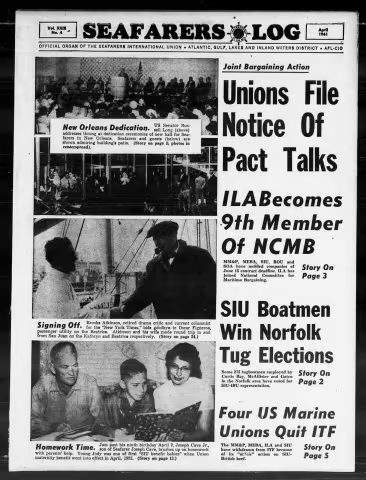
addresses throng at dedication ceremonies of new hall for Sea
farers in New Orleans. Seafarers and guests (below) are
shown admiring building's patio. (Story on page 3; photos in
cepterspread).
Unions File
Notice Of
V
ILABecomes
9th Member
Of NCMB
MM&P, MEBA, SIU, ROU and
SOA have notified companies of
June 15 contract deadline. ILA has
joined National Committee for
Maritime Bargaining.
Story On
Page 3
CiMnsn#* f%44 Brooks Atkinson, retired drama critic and current columnist
^I9"'ng \4¥W» for the "New York Times," bids gohdbye»to Oscar Figueroa,
passenger utility on the Beatrice. Atkinson and his wife made round trip to and
from San Juan on the Kathryn and Beatrice respectively. (Story on page 24.)
SIU Boatmen
Win Norfolk
Tug Elections
Some 275 tughoatmen employed by
Curtis Bay, McAllister and Gatco
in the Norfolk area have voted for
SlU^lBU representation.
Story On
Page 2
Homework Time. Just past his ninth birthday April 2, Joseph Cave Jr.,
son of Seafarer Joseph Cave, brushes up on homework
with parents' help. Young Jody was one of first "SIU benefit babies" when Union
maternity benefit went into effect in April, 1952. (Story on page 13.)
Four US Marine
Unions Quit ITF
Story On
Page 5
The MM&P, MEBA, ILA and SIU
have withdrawn from ITF because
of its "unfair" action on SIU-
British beef.
Vu\
race Tii« SEAFARERS LOG April. INl
SlU Boatmen WinThree New tlU Ship Ready For High Seas
Norfolk Tug Fleets
NORFOLK—The Inland Boatmen's Union of the SIU won another major election vic
tory when tug workers of three Hampton Roads towing concerns voted for IBU representa
tion in balloting conducted by the National Labor Relations Board.
The clean sweep by the SIU-^
came in Labor Board votes
among workers of McAllister
Towing, Curtis Bay Towing and
Gulf Atlantic Towing. As a result,
some 275 additional boatmen will
be brought under IBU-SIU con
tract
Only Norfolk Union
In the process, the IBCJ "stab-
lished itself as 'he only union of
tugboat workers in the Hampton
Roads area, by eliminating from
the tug picture here the catch-all
D strict 50 of the United Mine
Workers. Previously, the SlU-af-
filiated boatmen had won represen
tation rights for railroad marine
employees in this port working for
the Chesapeake and Ohio and the
Norfolk and Western Railways the
two big coal-carrying roads.
At the same time, tugmen of Mc
Allister and Curtis Bay voted 64 to
54 for SIU representation on Apdl
14, with District 50 again coming
out on the short end. There were
11 challenged ballots, seven of
them being District 50 challenges
and only four by the SIU.
IBU organizers said that a key
element in the election victory was
the strong support received from
(Continued on page 8)
Bull Line Being Sold;
Amcoal Ta Dissolve
Gatco Big Win
The biggest win for the IBU
came in the voting among 120 eli
gible employes of Gulf Atlantic
(Gatco). They voted overwhelm
ingly 84 to 14 for SIU representa
tion by mail ballot. In addition to
doing docking and undocking work,
the ten Gatco tugs are employed in
barge-hauling operations along the
Virginia and Carolina coasts, to
Wilmington and Morehead City,
North Carolina.
New Jobless
Benefit Law
Legislation providing for
temporary extension of unem
ployment insurance benefits has
gone into effect in those states
which have agreed to adopt the
Federal program. Among the
states involved is New York.
The legislation provides an
additional 13 weeks of Federal
benefits when state benefits
have been exhausted.
(For details on the program,
see the SIU Social Security De
partment, page 13.)
NEW YORK—American Coal Shipping is closing out its ill-
fated venture into the shipping industry by selling its last
holding, the SIU contracted Bull Line. The subsidiary com
pany is being sold either to-*'
McLean Industries, Inc., oper
ators of the SlU-contracted
Waterman and Sea-Land com
panies, or to Kulukundis Marine
Inc., another SIU operator, prob
ably the latter.
The new owners of Bull Line
are expected to activate long-
pending plans to trade in Libertys
and seam-type vessels for more
modern C-type ships in the reserve
fleet. The C-type ships would then
be converted into partial or com
plete container carriers. Legisla
tion providing for such trade-ins
was passed by Congress last yea%.
American Coal Shipping was set
up in the fall of 1956 at a time
when there was a severe shortage
of coal in Europe and a heavy flow
of coal shipments out of Hampton
Roads. The company announqpd
plans for chartering as many as 80
Libertys from the Maritime Ad
ministration for the coal export
trade.
To qualify as a legitimate steam
ship operator for purposes of ob
taining Government charters, the
company purchased a single Lib
erty ship, the Chian Trader, and
subsequently bought out Bull Line
for a sum variously reported as
$28 million and up.
Bloomfield
Has 100%
Clean Fleet
Recontly-lanuched, SlU-manned Dal Rio (Delta) is shown
before her maiden voyage (top). Below, chief mate Worraa
Wyman shows how to dog down automatic hatches. Looking
on are Seafarers Haniy Moss and Llonai Antoina.
Year-Long Safety Record
Marking a full year without a disabling lost-time accident
aboard the ship, Iberville SIU crewmen pose with second
six-month SIU safety award issued recently. Pictured (I to
r) are Seafarers Nils C. Beck, bosun; J. Jensen, electrician;
Horace Carmichael, steward, and Lawrence A. Holt, mess-
man. Steward Carmichael and four' other crewmembers
(not shown) have been aboard a full year without an acci
dent.
HOUSTON—For the second con
secutive year, the SlU-contracted
Bloomfield . Steamship Company
has achieved a remarkable record
of 100 percent in vessel sanitation
on all four of its ships.
Third Year Running
The notification from the Public
Health Service came on ApHl 13,
when the company was presented
with a PHS Sanitation Award. This
is the third year in a row in which
th company has qualified for the
citation.
PHS awards are issued to steam
ship companies when their vessels
achieve a rating of 95 percent or
better on a comprehensive check
list of sanitation items, especially
in the food-handling area.
Rare Rating
Bloomfield ships have long had a
reputation for cleanliness and ex
cellent feeding, with well-run
steward departments. Ratings of
100 percent for ships are extremely
rare, making the fleetwlde rating
an unusual achievement.
In a letter of congratulations to
the company, M. D. Hollis, assist
ant surgeon general, declared that
"This outstanding record signifies
a major contribution to the efforts
of the Public Health Service to
reduce the incidence of prevent
able disease."
Chlorine Fumes Inhaled
By 150 On 55 Frances
BALTIMORE—^A maritime disaster of major proportion#
was narrowly averted aboard the SS Frances here when con
tainer of chlorine gas sprung a leak. As a result 150 men,
•most of them longshoremen.
INDEX
To Departments
The SIU iaioiMi BeotimiR
—Pages 8. 8
The SIU Indaslrloi Worker
—Page 25
SIU Social Security Dep't
—Page IS
SIU Safety DeiNirtmeiit
—Page »
The Pacific Coast Seafarer
—Pages 22. 23
SIU Medical Department
—Page 19
The Great Lake# Seafarer .
—Pages 10. 11
SIU Food, Ship Sanitation
Dep't —Page 20
The Fisherman and
Cannery Worker
Page 18
Editorial Cartoon —Page 15
A&G Deep Sea Shipping
Report —Page 6
The Canadian Seoforer
—Page 21
Shipboord News
. —Pages 27. 28. 29. 30
had to be treated for inhaling
the deadly gas. Many of them
were knocked unconscious.
The chlorine fumes were re
leased as the containers were being
loaded out of No. 5 hold aft onto
a fiatcar at Pier 8, Locust Point.
Since the wind was blowing from
the ship to the dock, most of the
longshoremen on the dock, as well
as many on deck, inhaled the
fumes.
Quick Action By Chief Mate
. Baltimore port agent Rex Dickey
credited quick action by the chief
mate in saving most crewmembers
from exposure to the fumes. When
the leak was detected he herded
most of the crew to the windward
side of the deck and also saw to
it that all ports were closed.
Chief electrician Bob Bacon, who
spent several hours in the hospital
before being discharged, reported
that he got a full whiff of the
chlorine while heading down the
gangway. The result was impair
ment of breathing, nausea and eye
irritation.
I y
-J
Apm, i9fi SEAFARERS LOG Ps£s T&res
Sea Unions Call For Pact Talks
ILA Joins Nafl
Bargaining Body
NEW YORK—^The 70,000-member International Longshore
men's Association has joined the National Committee for
Maritime Bargaining and will take part in the forthcoming
contract negotiations. 1LA-* ^
General Organizer Thomas
"Teddy" Gleasoa formally no
tified the group that' the longshore
union was enroliing as a committee
member.
In his letter to the committee in
forming them of his organization's.
Intention to participate, Gieason
said that the NCMB appealed
to the ILA for several reasons,
among" them being the fact that
each participating union retained
autonomy as to negotiation of its
own agreements, with others ob
serving and supporting those^ ne
gotiations. He stressed that '"the
main issue we are concerned with,
and are pleased to say the NCMB
is advocating full participation in,
is the right of maritime labor to
establish itself in a position
whereby it will be able to discuss
not simply part of, but all of, the
problems that aifect the maritime
industry."
Panama Closing
As an example of the need foi'
coordinated marine union policy,
and action on larger problems,
Gieason referred to the closing
down of the Panama Line service
at a cost of several hundred long
shoremen's jobs. This decision, he
said, was taken uniiateraliy "with
out even the courtesy of an in
vitation to our international
union' to discpss the issues in
volved.
(The Panama Line, owned by the
Panama Railroad Company, which
operates the Panama Canal, was
discontinOed by Administration
order. It had been under attack
from the American Merchant
Marine Institute and particuiarly
from the. Grace Line, a competing
carrier. SlUNA spokesmen had op
posed the closing, particularly at
this time, because of its impact on
the jobs of a large group of long
shoremen and other waterfront
Workers in a period of recession
and high unemployment. The NMU,
whose members man the Panama
Line ships, had supported the
shutdown.)
Gieason declared that the ILA
looked forward to future meetings
with all the other marine unions
Union Book
Renewals Up
With SIU membership book re
newals coming up at the end of
1961 for many Seafarers, applica
tions for renewal have already
been made available in all ports.
Those Seafarers who have already
paid their dues for the fuil year
of 1961 can now apply for and
receive a new membership book.
The new'books are made neces
sary by the fact that space for
due* payment entries in many
membership books runs out at the
end of 1961. This would be true
for all membership books issued
during 1952, when the entire Union
book membership at the time re
ceived new books and new mem
bership numbers.
Headquarters has emphasized
that those who have used up all
the entry space In their books
should make their new book ap
plications now instead of waiting
until the end of the year.
participating in the NCMB stating,
"We further pledge our full coop
eration and support by all sections
of our organization in the carry
ing out of these programs."
ILA representatives, including
Gieason, ILA President William
Bradley •and ILA Vice-President
Anthony Anastasio, had been pres
ent at the December 16, 1960,
meeting at which the Committee
was established and its bargaining
programs approved. Also repre
sented at the December 16 meet
ing was Local 807 of the Inter
national Brotherhood of Team
sters, which handles most of the
waterfront trucking in the New
York metropolitan area.
SIU MEETINGS
SIU membership meet
ings are held regularly
once a month on days in
dicated by the SIU Con
stitution, at 2:30 PM in
the listed SIU ports below.
All Seafarers are ex
pected to attend. Those
who wish to be excused
should request permission
by telegram {be sure to
include registration num
ber). The next SIU meet
ings will be:
New York
Philadelphia
Baltimore
Detroit
Houston
New Orleans
Mobile
May 8
May 9
May 10
May 12
May 15
May 16
May 17
Officers, Radiomen,
SIU Notify Owners
The plans of the National Committee for Maritime
Bargaining to negotiate on an industry-wide basis were
advanced l3ist week when the unions involved notified
their respective contracted! '
companies of their desire to
negotiate a new agreement,
effective June 15, 1961.
Meanwhile, the Commit
tee announced that the In
ternational Longshoremen's
Association had formally
agreed to becoma a full-
fledged member of the group. The
ILA's action in joining the Com
mittee made it the ninth member
union and also made the Commit
tee spokesman for 130,000 workers
The formal notiflcations to the
operators were sent out by the
Masters, Mates and Pilots, the
Marine Engineers Beneficial As
sociation, the Radio Officers
Dedicate New Orleans Hail;
More Than 1,000 Attend
hnSW. ORLEANS—^An overflow crowd of more than 1,000 Seafarers, members of their
families and guests jammed the 850-seat auditorium past its capacity to participate in dedi
cation ceremonies of the new'hall for Seafarers in this port. The April 8 proceedings included
a tribute to the Union and its>'
members from major political
leaders in the state, including
us Senator Russell Long and New
Orleans Mayor deLesseps S. Mor
rison.
Complete Union Facilities
The new hall in this city, located
at 630 Jackson Avenue, has been
in operation since March 6. It in
cludes complete facilities for all
Union functions and recreational
activities as well as the New
Orleans clinic of the Seafarers
Medical Program.
In welcoming SIU men and
guests to the ceremonies, SIUNA
President Paul Hall said that the
new building symbolized the status
of seamen as first class citizens In
New Orleans. Seamen are recog
nized as such, he said, "by every
one from the head of the govern
ment to the man In the street.
This is what we've been striving
for."
Senator Long, who made the
dedication address emphasized the
development of union responsibil
ity both In the civic area and In
union concern for the well-being
of the industry In which its mem
bers are employed.
Similarly, Mayor Morrison ap
plauded the role played by the
ILA Gulf Leaders At Dedication
SIU in the Port of New Orleans.
After the dedication program,
the audience toured the building
whose facilities include the large
auditorium; a theatre room which
can be used as a lecture hall or
for the showing of motion pic
tures and television; the complete
ly equipped clinic which serves as
a diagnostic center for Seafarers
and their dependents; a cafeteria;
a lounge and an outdoor patio; a
sea chest store; the hiring hall;
Union administrative offices and
other facilities.
The cafeteria and lounge area is
dominated by a large five-panel
mural depicting the history of ma
rine unions. The mural was painted
by LOG art editor Bernard Seaman.
French Quarter Style
Architecturally, the building
conforms to the style of the French
Qharter with generous use of
grillwork, a curved staircase, and
large whits columns at the en
trance to the building. Extensive
use is made of shrubbery and
sculpture to add to the hall's
attraction.
Union, the Staff Officers Associa
tion and the SIU, representing all
categories of shipboard personneL
The officers union contracts were
scheduied for expiration on June
15. The SIU contract is an open-
end agreement.
In its notification to the opera
tors, maiied out on April 6, the
SIU declared that it would advise
the operators shortly as to speclfie
contract proposals.
The National Committee had
previously announced its intention
to bargain with the operators on a
wide range of issues affecting sea
men's job security, going beyond
wage and hour issues. Each mem
ber union of t he group will ne
gotiate its own bread and butter
contract Issues, with the other
member unions participating and
having full liaison in all issues.
On the broader issues, the Com
mittee Is concerned with develop
ing a program dealing with
such issues as the operation of
runaway shipping by American
owners, assistance to the domestio
trades, automation on board ship
and on the dock, revision of sub
sidies to conform with changing
patterns of foreign trade, action
on the perennial problem of com
petition from the Military Sea
Transportation Service, promotion
of American-flag bulk cargo opera
tions and similar matters.
The object of this program is to
give American seamen a voice on
major economic issues which de
termine whether or not they can
count on reasonably steady em
ployment.
The eight sea-going unions in
the Committee hold contracts with
operators representing 90 percent
of all American-flag shipping. They
include the Masters, Mates and
Pilots; Marine Engineers Bene
ficial Association; the SIU At
lantic, Gulf, Lakes and Inland
Waters District; the Sailors Union
of the Pacific; the Marine Fire
men's Union; the Marine Cooks
and Stewards Union; the Radio
Officers Union and the Staff Of
ficers Association. West Coast
union contracts involved expire In
September, but they will partici
pate directly In the discussions.
The chairman of the NCMB Is
Jesse Calhoon, secretary - treas
urer of the MEBA, while Captain
Charles Crooks, MM&P president,
is the Committee's secretary.
La. Leaders, Union Heads
Attend Building Ceremony
Among ILA representatives present «t the
idei
New Orleans
dedication were Al Chittenden (top, left) and Clarence
Henry (top, right). New Orleans; George Dixon (bottom,
left), Mobile and Ralph Massey, Galveston,
NEW ORLEANS—The dedica-4-
tion ceremonies of the new hall In
New Orleans were attended by a
large turnout of political leaders
and trade union representatives.
They Included Senator Russell B.
Long, who delivered the dedication
address. Mayor deLesseps Morri
son, who presented SIUNA Presi
dent Hall with the key to the city.
City Councilman Paul Burke, who
welcomed the Union to Its new
location, and Seymour Weiss,
former president of the Dock
Board.
Speaker Include Union Repe
Speakers from the union ranks
included Al Chittenden, president
of Local 1418, International Long
shoremen's Association and Clar
ence Henry, president of ILA
Local 1419, both of them New
Orleans locals of the ILA; Ed Alt-
man, president of the Marine Engi
neers Beneficial Association; Vic
tor Bussie, the president of th®
Louisiana State Labor Council,
AFL-CIO; A. P. Stoddard, presi
dent of the New Orleans Central
Labor Council, and E. L. WiUiame,
AFL-CIO.
The group was also addressed by
Charles Logan, employer truste®
of the Seafarers Welfare Plan
SIU Vice-President Lindsey Wil
liams served as master of cere
monies.
1
Wage SEAFARERS LOG AprO, INK
What Ship Charter Terms Mean
Rdbin Hood Coffee
1?*^
By Capt. Milton Williams
C Ed. note: This is the third ii} a series of articles written for the
SEAFARERS LOG by Captain Milton Williams, formerly vi^e-president
and operating manager of Bull Lines. Captain Williams, who is now
retired, will discuss the various phases of American-flag ship opera
tion in these articles from an independent management viewpoint.)
In this article we shall at
tempt to familiarize the reader
with the common terms used
In ship chartering, by giving a
broad and, of necessity, somewhat
sketchy outline of the meaning
of the various terms. Most of you,
of course, are aware that a charter
Is merely an agreement between
the shipowner on one side and
another party to lease or rent a
ship or part thereof. The other
pa-ty may be another owner, a
shipper of cargo, or an agent. The
term CHARTER PARTY is applied
to the agreement signed by both
parties and may be compared to
the lease for an apartment. Actu
ally, it is a contract.
To minimize disputes, over the
various clauses of the charter par
ty, standard forms are generally
used. These forms are changed or
modified to suit the particular con
tract in question. Standard char
ter party forms cover a wide vari
ety of cargoes—coal, oil, grain,
sulphur, ore, rock and many oth
ers. Special standard forms are j
used in certain trade routes where j the charterer's
eonditions warrant them.
BAREBOAT CHARTER—As in
dicated in this type of charter, the
shipowner leases the ship to the
charterer in seaworthy condiiton.
with all her fittings and gear
aboard, but without a crew, stores,
fuel, water, dunnage and so on. In
other words, the bare boat. The
charterer then assumes all of the
expenses of operating the ship,
Including hiring a crew. The mas
ter and chief engineer are, in most
cases, hired subject to approval of
the shipowner. The operational
control is the charterer's, with the
owner having no say whatever as
to cargo, voyages and routes, pro
vided. these are within the scope
agreed to in the charter party.
Obviously, a shipowner will not
enter into a bareboat charter with
any but the most-reputable firms
and then only for a long period of
time. When the vessel is delivered
to go on charter, a survey is made
to determine the vessel's condition,
with a similar survey on redelivery
to the owner when the charter is
completed.
The charterer is responsible for
all repairs, except those items
which can be considered ordinary
wear and tear. Upon delivery of
the ship, the charterer may elect
to keep and pay for the fuel and
water on board at the time. Con
versely, the shipowner has the
the type and kind of cargo that
can be carried.
The shipowner is responsible for
the crew, stores, Insurance (again
except as provided in the charter)
and all operating costs of the ship
itself. He pays for the water used
by the crew and for galley fuel.
All other charges are paid by the
charterer, including engine fuel,
boiler water, cargo handling
charges, pilotage, wharfage, port
dues, tolls, fumigation (if required
because of the cargo carried) cus
toms, consular fees and the many
other charges which are incurred
in the operation of -the ship in
connection with service to the
charterer. For example, overtime
for the crew caused by the charter
er's schedule of working cargo is
chargeable to the charterer. The
time charter rate is usually based
on the ship's known performance',
her deadweight and cubic capac
ity. A survey is made on delivery
and redelivery of the ship to de
termine the amount of fuel and
water on board. Damage caused
operation are
his responsibility.
VOYAGE CHARTER — Under
this charter, an agreement is
reached between owner and char
terer for a full or part cargo to be
transported between certain ports.
This may be one or more ports
named in the charter party. A
mutually-satisfactory rate is agreed
upon in advance and the freight
is paid on the amount carried. In
some cases a charter is on a dead
weight basis, in which case the
rate is determined by the amount
of deadweight made available.
Unless otherwise specified, the
shipowner pays ALL expenses, in
cluding fuel, dues, tugs, pilotage,
cargo cost, wharfage, insurance
and all wages, including crew OT.
LAY DAYS—This term has two
meanings in the charter market.
In instance it indicates the num
ber of days that were agreed upon,
in advance, for the loading and
discharging operation. The second
meaning indicates when the vessel
is required to report, ready to go
on charter. The cancelling date
indicates when the charterer has
the option to cancel if the ship
fails to report at the time stated.
If the charter party provides lay
days to commence January 10 to
January 24, the charterer does not
have to accept the ship before the
10th of January, even though the
ship is ready before then. Failure
to report prior to the time speci
fied on January 24 gives the char
terer the right to cancel.
DEMURRAGE — The shipowner
is compensated here for any delay
in loading and dlscnarging over
and above the time provided for
in the charter party. The rate of
demurrage is generally based on
the daily operating cost of the
ship. There are, of course, excep
tions to this rule of rate of de
murrage charges.
DESPATCH—The time saved in
loading and/or discharging a ves
sel under charter which provided
lay days is called "despatch" and
referred,to as despatch time. Char
ter parties generally provide for
despatch money to be paid to the
charterer for this time saved on
the cargo operation. Most, but
not all, charters provide for re
versible lay days—that is, the time
used in loading and discharging
are added to arrive at the despatch
'Food For Peace' Goal:
$11 Billion Surplus Cargo
WASHINGTON—A proposed "food for pe&ce" program in
volving the distribution of $11 billion worth of farm surplus
over the next five years has been submitted to President
Kennedy and will probably*^ —
be transmitted to Congress in
similar form. The program
would have considerable impact on
US-flag shipping and ship employ
ment since a large proportion of
these shipments would go on
American vessels.
Farm surplus shipments are cov
ered by the "50-50" law which calls
for shipment of at least 50 percent
of all Government-financed cargoes
on US vessels. In addition, the In
ternational Cooperation Adminis
tration, which administers foreign
same privilege on redelivery. Be- programs, recently ordered all
cause of the problems involved,
few American shipowners bare
boat their ships. However, most
Government owned ships, during
and after World War II, were op
erated by private firms under bare
boat charter.
TIME CHARTER—Under this
type of charter, the owner leases
the vessel, or part thereof, to the
chai terers for a fixed period. This
may be for one or more conseeu-
tive voyages, for a nionth, two
months or more. The charter
party for time charters usually de
fines the trading limits as well as
cargoes to be carried on US ships
where the United States pays the
freight costs. If such aid is carried
on a foreign-flag ship, the receiv
ing country will have to pay the
freight charges.
The propoi-sd expansion of the
food program would make Its
scope world-wide and would re
sult in the shipment of meat, milk,
fat, poultry and eggs, in addition
to the present grain shipments. In
many parts of the world, food
would take the place of money for
workers on Industrial development
projects.
On a yearly basis, the proposed
plan would increase farm surplus
shipments by about a half-billion
dollars. As a long-range effort, the
program would draw participation
from more foreign nations because
it would Involve guarantees of
stable operation over a long period
of time.
SEAFARERS LOG
April, 1961 Vol. XXIII, No. 4
PAUL HALL, President
HCRBERT BRAND, Editor. BERNARD SEA
MAN, Art Editor. HERMAN ARTHUR,
AL -MASKIN, CRARLsa BEAUMET, ALBERT
AMATEAU, ARTHUR MARKOWITE, Staff
Writers.
Publlthta moniTily
of tho Saafirori Intornatienal Union,
at Ttio haadquartara
anal Union, At
lantic Oulf, Lakai and Inland Watart
Dlatrict, AFL-CIO, *71 Fourth Avanua,
Brooklyn 32, NY. Tal. HYacinth 9-6400.
Sacond clan postaga paid at tha Paat
Office In Brooklyn, NY, undar tha Act
of AuB. 24, 1912.
time and money earned. Despatch
money as a rule is one-half of the
demurrage rate on the theory that
both the owner and charterer
should participate in the time
saved.
SPACE CHARTERS—These ere
sometimes used by a large shipper
to insure that his cargo will not
be shut out of a certain ship sail
ing on a scheduled date. This is
usually used with ships on berth
services.
CHARTERING BROKERS and
CHARTERING AGENTS are, as
Indicated by the terms, interme
diaries who represent the owners
and charterers in arriving at a sat
isfactory agreement in the charter
ing of ships. They do the negotiat
ing and draw up the various'
clauses, agree on all detail and
have their principals sign the
charter party. They, like aii bro
kers, act on a fee basis.
It's eoffeetime on the Robin
Hood as saloon pantryman
Juan Ortora prepares to
Eour some of the steaming
rew after the ship docked
at the Mooremac terminal
in Brooklyn.
LABOR
'ROUND THE WORLD
UNPAID OVERTIME IS THE KIND OF PRACTICE guaranteed to
put anybody on edge, and the Hungarian worker is no exception.
The Hungarian trade union publication recently carried letters of com
plaint from several plants about this practice. One worker employed
at the Csepei motor works (which became famous as a center of resist
ance during the 1956 rebellion) charged that at the beginning of tha
month the work crews jire laid off with nothing to do. Then at the end
of the month "we have to work day" and night, being forced some
times to stay 16 to 24 hours in the plant without a break." The news
paper noted that no overtime is paid for this practice. Another worker,
employed at a shipyard, complains abouT being turned to at 6 AM on
Sunday, and never knowing when the day's work will end.
In some plants, overtime Is paid at the expense of bonus money. Tha
newspaper places the blame squarely on the trade union authorities
who are supposed to authorize such work before it takes place.
i. ^ ^
RECENT UNREST AND REBELLION IN ANGOLA has been at
tributed to the dissatisfaction of African working on the coffee planta
tions. The International Confederation of Free Trade Unions reports
that the plantation workers are subject to forced labor by the Portu
guese authorities. Tribal chiefs are made to produce recruits to work
on the plantations, and the labor laws of the colony as such can compel
the Africans to sign work contracts. Under the law, any African who
fails to seek work to Improve "their social conditions" can be drafted
for public works and signed over to a private employer.
It's no surprise then, to read of uprisings in the back country and
the massacre of planters and overseers by the conscripted Africans.
t. t, t.
TATTLING ON THE BOSS IS BAD FORM everywhere it seems. A
Communist youth organization newspaper published a letter from a col
lective farm employee in which she complained about falsification of
production reports. The letter pointed out that sowing and harvesting
were both later than reported and production figures were inflated as
well. The Communist publication investigated her complaints and
found them Justified, also noting that she was fired from'the job for
writing the letter.
l" 4< '
WATERFRONT WORKERS IN THE CARIBBEAN showed some fine
teamwork recently in connection with a strike of clerical workers on
the island of Grenada. The clerical workers, who were employed by
the Nutmeg Association, appealed to the Grenada Trade Union Congress
for support. The result was that Grenada dockworkers, members of
the Seamen and Waterfront Workers Union, boycotted ships carrying
nutipeg. The port operators then attempted to divert all traffic to
Trinidad in retaliation, but Trinidad, Barbados and St. Lucia unions
refused to handle any diverted ships. As a result, the Nutmeg Associ
ation reinstated all the clerical workers with two months' pay and
started negotiations.
t> t- it
A SPEED-UP BY ANY OTHER NAME Is still a speed-up and still
unpopular. That's the conclusion to be drawn after reading the com
plaints about the operation of the "Socialist Competition" progi-am in
Czechoslovakia, The Communist trade union publication "Prace" notes
that despite two years of tub-thumbing, "at the present time there are
only 350,000 Woi'kers In the movement of the socialist labor brigades."
The paper blames the slow progress of the program on people who "do
not have the courage to pledge themselves to such tasks" or those who
"are used to working In the routine of old methods."
"Socialist competition" is the Communist label for programs of in
creasing output per worker, usually through speed-up techniques. By
pitting groups of workers against each other in the "socialist labor
brigades," ilic authorllies constantly increase the production standard
expected of all the w^rk force.
SSSI SEAFAUSnS LOG f»t» Fitr*
Cubs Scout Union Headquarters Four US Unions Leave ITF;
Hit Unfair Action On SlU
Four major American maritime unions have withdrawn from the International Trans-
portworkers Federation, the world-wide organization, of transport unions.
The four unions, the International Longshoremen's Association, the Masters, Mat^s and
Pilots, the Marine Engineers-^
Mike Carlin, SlU patrolman, explains function and purpose
of rotary shipping board to members of a West New York,
NJ cub scout pack who were visiting headquarters.
Tax Men Focusing
On Hunaway Dodge
WASHINGTON—^The Internal Revenue Service is under
taking a special factual survey to determine the extent of tax
abuses engaged in by American firms in their runaway oper
ations overseas. !
The survey, strongly op
posed by the runaway con
cerns, is being done by the IRS
with a view toward correcting the
abuses through the enactment ot
appropriate iegislation by Con
gress.
the study is sponsored by the
ipS Office of Internationai Opera
tions and will take an especially
close look a companies operating
out of the tax-havens of Lichten-
-Etein, Panama, Liberia and Hon
duras. Runaway shipowners usually
operate out of the latter three
nations.
Agents of the IRS will try to
discover the nature, source and
amounts of money that the run
away concerns have at their dis
posal and do not report on their
US income taxes. The key diffi
culty is in obtaining reports about
the inter-company dealings of the
more sophisticated corporations.
"We may never get the full story,"
Clarence I. Cox, director of the
Investigations said.
He said that funds are shifted
among the foreign companies and
never returned to the parent-
American concern. US tax laws
do not apply to these funds until
they are returned to the US and
distributed as corporation divi
dends.
Runaway Profit
Runaway shipowners have
claimed that they repatriate the
profits made by their foreign sub
sidiaries and these funds are then
taxed by the Government. The
SIU and other seafaring unions
have pointed out that this is not
so and that the. runaway operators
keep their profits overseas or
bring them back as interest-free
loans, so that they cannot be taxed
under US laws.
Present tax laws require that
US corporations detail information
on the financial transactions be
tween the parent concern and the
subsidiary. Transactions between
companies held by the subsidiaries
or between the subsidiaries—where
most of the profits are made—are
not covered by the law and the
major change in legislation would
probably come in this area.
Beneficial Association and the
Seafarers International Union
of North America, all affiliated
with the AFL-CIO, sent a cable
on April 18 to Peter De Vries,
general secretary of the ITF in
London, informing him that they
were withdrawing from the world
transport body because of the
"unfair manner" in which it had
suspended the SIU over the dis
pute between the National Union
of Seamen of Great Britain and
the SIUNA.
The cable also pointed out that
all four unions previously had spe
cifically requested that the issues
involved in the dispute be referred
back t<T the Seafarers Section of
the ITF, but that this request had
been ignored and the Executive
Committee of the ITF, meeting in
Tel Aviv last week, had suspended
the SIUNA pending final action by
the next ITF Congress.
The organizations said, "that
consequently they can no longer
be bound by ITF policy and pro
cedure. Our withdrawal is effec
tive as of the date of this message."
The text of the cable to Mr.
De Vries, signed by Captain Wil
liam Bradley,. president of the
ILA; Paul Hall, president of the
SIUNA; Captain John Bishop, sec
retary-treasurer of the MM&P and
Ray McKay, executive vice-presi
dent of the MEBA, is as follows:
"In view of the precipitous ac-
,tion taken by the ITF Executive
Committee in Tel Aviv in sus
pending the SIU as a result of the
dispute between the SIU and the
British National Union of Seamen,
particularly after a request by
American unions that this ques
tion be referred back to the Sea
farers Section for resolution was
ignored, we hereby record our dis
satisfaction with the unfair man
ner in which you have acted. In
light of the ITF action, the under
signed organizations have no al
ternative but to advise you of their
withdrawal as member organiza
tions of the ITF and that conse
quently they cai;^ no longer be
bound by ITF policy and proced
ure. Our withdrawal is effective
as of date of this message."
The issue which led to the with
drawal of the four unions arose
out of the practice of Canadian
and American shipowners in using
British Commonwealth flags to
escape North American standards.
As a result of this practice, a writ
ten agreement was reached be
tween the SIUNA and Sir Thomas
Yates, then head of the National
Union of Seamen of Great Britain,
in which the British seamen agreed
that they would not permit the
British flag to be used as an es
cape hatch for North American
shipowners seeking to lower their
wage scales and shipboard condi
tions.
However, this agreement was
never enforced by the British
union.
Last summer, when a rank and
file revolt broke put in the NU3
in a rebellion against contract
conditions, tying up ships in vari
ous parts of the world, the SIU
of Canada gave financial assistanca
(Continued on page 12)
Houston Engineers' Hall
Memorializes Keiiogg
HOUSTON—Leaders in maritime labor and management
paid tribute early this month to- the late William G. Kellogg,
executive vice president of the Marine Engineers Beneficial
Association, at the dedication"^'
of the remodeled MEBA hall
here.
Among those attending the cere
monies here April 12 were Ed Alt-
man, MEBA international presi
dent; Lee Pressman, MEBA gen
eral counsel; R. A. Amador, presi
dent of the MEBA Houston local;
Jesse Calhoon, MEBA interna
tionai secretary-treasurer; Paul
Hall, president of the Seafarers
International Union; Ralph D.
Casey and William Mullins, presi
dent and vice president of the
American Merchant Marine Insti
tute, and representatives of ship
ping interests.
Kellogg, in addition to holding
the MEBA executive vice presi
dent post, was also a member of
the union's National Administra
tive Committee at the MEBA con
vention last May. At the time of
his death March 17, he was also
chairman of MEBA District 1;
branch agent in Houston and
chairman of the Boards of Trus
tees of the union's dry cargo and
tanker welfare, pension and vaca
tion plans.
A plaque in memory of Kellogg
was unveiled at the building by
his widow. A brother and two
sisters also survive the MEBA
leader.
Speaking at the dedication of
the building at 314 Broadway, Alt-
man declared "Bill Kellogg's nam*
will stand for many years in th*
annals of maritime for his ac
complishments in representing en
gineers. The purpose of this dedi
cation is to leave something tangi
ble for posterity."
Pressman praised Kellogg's
"highest purpose and profound
convictions," and called on tho
union to carry out Kellogg's ideals
and improve the lot of working
engineers who sail ships of the
American flag.
Helped Set Up NCMB
Amador and Calhoon noted
Kellogg's concern with the fam
ilies of marine engineers and
pledged to finish the agenda of
objectives outlined by Kellogg.
Kellogg was a key figure in the
establishment of the National
Committee for Maritime Bargain
ing early this year.
SIU President Paul Hall de
scribed Kellogg as "a fighting man
in every sense of the word." Hall
said the best way to honor Kel
logg is for all maritime leaders to
fight for the good of the industry.
Casey of the AMMI noted that
Kellogg was "tough but fair and
a man whose word was as good as
his bond." Other speakers at the
dedication of the building were
Mullins and William B. Chatfield
of Philadelphia, operating manager
of Keystone Shipping Co.
RESIDEhfTS 6ET
PIGHTTO VOTB )fsl PRESIDEbmAl-
ELECT/ONS AG U.S. CONSTITUTIONAL
AMENDMENT 15 APPROVED.
EARTH FOR lOSMINUTK/VriZOOO
M\LBS PEFZHOUR^OvkR-iOOMIL&UR
MICHMANNTR\AL OPENS IN
JERUSALEM... ACCUSED OF
DIRECTING MURDER OF SIX
MILLIIDN JEWS IN NAZI
DEATH CAMPS#
UN REpoprrs WORLD POPULATION
DUE TO R^CH THREE BILLION THIS
YEAR... INCREASING BY 45 TO 55"
MILLION ANNUALLY,
RED TROOFS SCOR
ING GAINS IN LAOS
AS RUSSIA STALLS
ON CEASE FIRE.
PROPOSALS,
UcS' PBACB
CORPS VOL-
U/srfEERS TO
TRAIN AT
.pueRro,,Kico
JUNGLt'CAMP.
PRESIDENT i<ENNEC^To
VISIT FRANCE AT END OF MAY/
CONFER WITH PEOAULLE ON
NUCLEAR. TESTING. ALGERIA
PEACE, OTHER ISSUES .
Pare Six SEAFARERS LOG April. INt
SEAFARERS
ROTARY SHIPPING ROARD
(Figures On This Page Cover Deep Sea Shipping Only In the SIU Atlantic, Gulf, Lakes and Inland Waters District.)
March 1 Through March 31
A sharp upsurge in virtually every phase of shipping
activity was registered in SIU ports during the month
of March. Not only did the job total make a consider
able comeback from winter lows but it even ap-
f)roached the boom shipping figures for December. The
atter month is traditionally the year's best for job
turnover because of men getting off for the holidays.
The total of jobs shipped, 2,689, was 685 jobs more
than the February figure. In fact, it was some 500 jobs
over the total of class A men left on the beach at the
end of the month, which reflects superior shipping op
portunities for class A men.
All seniority groups shared in the job rise, with class
C, the lowest seniority group, surging to a total of 274
jobs shipped. tZIlass A picked up an additional 363
shipboard berths with Class B getting 207 more spots
than in February.
Ship activity showed a rise in every category with
489 ship calls compared to 430 in February and 449
vessels hitting SIU ports in January.
In the face of the rise in ship activity and shipping
the registered-on-the-beach total declined.
In the new registration group for chief steward,
group 1-S, the figures show a total of*95 men register
ing in that category for all ports. A truer picture of
the group 1-S status will come in the April figures,
since chief stewards started shipping exclusively out
of 1-S in that month.
Ship Activity
Pay Sign fa
OHs Om Trans. TOTAi;
Boston 8 0 10 IB
Now York 43 15 48 106
Philadolphia ..4 1 26 31
Bolrimoro ....21 8 10 30
Norfolk 2 0 22 24
Jocksonvillo ..6 1 14 21
MIomI 1 0 8 9
Mobile 10 5 7 22
Now Orloans..11 10 46 67
HoHston 23 4 65 92
Wilmington ... 0 0 19 19
San Francisco.. 3 4 14 21
Soottlo 9 9 5 23
TOTALS ....138 57 294 489
DECK DEPARTMENT
Port
Registered
CLASS A
Registered
CLASS B
Shipped
CLASS A
Shipped
CLASS 8
Shipped
CLASS C
TOTAL
SHIPPED
' Registered 0
CLASS A
n The Beach
CLASS B
Port
GROUP
1 2 S ALL
GROUP
12 3 ALL
GROUP
12 3 ALL
GROUP
12 3 ALL
GROUP
1 2 3 ALL
CLASS
A B C ALL
GROUP
1 .2 3 ALL
GROUP
12 3 ALL
Boston 3 9 1 13 0 1 4 5 7 6 3 16 1 3 1 5 0 0 0 0 16 5 0 21 7 14 2 23 1 0 5 6
New York 31 80 30 141 1 17 27 45 35 95 20 150 1 25 24 60 0 6 11 16 150 50 16 216 61 112 38 211 3 15 38 56
Philadelphia 7 19 7 33 0 3 2 5 5 10 2 17 0 0 5 5 0 0 0 0 17 5 0 22 14 25 7 46 0 6 1 7
Baltimore 19 46 14 79 1 13 21 35 13 47 12 72 0 2 16 18 0 0 1 1 72 18 1 91 34 65 16 115 3 26 38 67
Norfolk 6 9 4 19 0 14 7 21 8 14 6 28 0 1 5 6 0 0 0 0 28 6 0 34 4 9 1 14 1 5 4 10
Jacksonville 8 9 1 18 1 6 5 12 3 5 7 15 5 8 9 22 1 6 6 13 15 22 13 60 7 14 1 22 0 4 2 6
Miami 0 1 0 1 0 0 0 0 0 2 0 2 0 .0 0 0 0 0 0 0 2 0 0 2 1 4 0 5 0 - 0 0 0
Mobile \ , 9 17 5 31 1 2 3 6 15 23 10 48 3 2 9 14 Q- 1 0 1 48 14 1 63 23 29 6 68 0 0 6 6
New Orleans 31 55 11 97 2 10 24 36 26 42 20 88 3 12 13 28 0 0 4 4 88 28 4 120 60 87 18 165 8 24 31 63
Houston 66 102 26 194 7 37 53 97 44 84 27 155 9 33 34 76 0 1 5 6 155 76 6 237 30 40 23 93 5 19 21 45
Wilmington 8. 10 2 20 1 4 3 8 8 4 1 13 5 3 6 14 3 1 3 7 13 14 7 34 11 15 1 27 2 5 2 9
San Francisco 13 10 13 36 1 1 2 4 12 9 8 29 0 0 5 5 0 0 0 0 29 5 0 34 22 26 2 50 3 9 5 17
Seattle 14 18 7 39 5 17 10 *32 13 27 8 48 6 14 6 26 2 8 8 18 48 26 18 92 13 8 4 25 4 10 13 27
TOTAI S 215 385 121 1 1 721 20 125 161 306 189 368 124 1 681 33 103 133 1 269 6 22 38 1 66 671 269 66 1016 287 448 119 854 30 123 166 1 i 319
ENCINE DEPARTMENT
Port
Registered
CLASS A
Registered
CLASS B
Shipped
CLASS A
Shipped
CLASS B
Shipped.
CLASS C
TOTAL
SHIPPED
Registered Oi
CLASS A
n The Beach
CLASS B
Port
GROUP
1 2 3 AIL
GROUP
12 3 ALL
GROUP
12 3 ALL
GROUP
12 3 ALL
GROUP
1 .2 3 ALL
CLASS
A B C ALL
GROUP
1 2 3 ALL
GROUP
1 2 3 ALL
Boston
New York
Philadelphia
Baltimore
Norfolk
5 3 0 8 2 2 3 7 1 4 1 6 0 1 1 2 0 1 0 1 6 2 1 9 5 4 1 10 2 0 5 7 Boston
New York
Philadelphia
Baltimore
Norfolk
30 78 9 117 3 35 28 66 19 78 10 107 3 37 16 56 3 19 2 42 107 56 42 205 35 96 18 149 5 28 28 61
Boston
New York
Philadelphia
Baltimore
Norfolk
2 22 5 29 0 3 2 5 3 9 2 14 0 0 0 0 0 0 0 0 14 0 0 14 1 33 6 40 0 3 6 9
Boston
New York
Philadelphia
Baltimore
Norfolk
6 35 9 50 1 22 12 ss; ! 1 43 8 52 2 17 •14 33 0 1 0 1 52 33 1 86 12 53 8 73 4 38 28 70
Boston
New York
Philadelphia
Baltimore
Norfolk 4 11 2 17 0 5 3 8; i 5 2 5 12 1 1 1 3 0 0 0 0 12 3 0 15 5 6 1 12 2 2 3 7
Jacksonville
Miami
Mobile ."....
New Orleans
Houston
Wilmington
San Francisco
Seattle
3 12 1 16 1 6 4 111 1 2 5 2 9 0 6 3 9 0 5 5 10 9 9 10 28 2 8 1 11 0 3 1 4 Jacksonville
Miami
Mobile ."....
New Orleans
Houston
Wilmington
San Francisco
Seattle
0 0 0 0 0 1 0 1 ' 0 1 0 1 - 0 0 0 0 0 0 0 0 1 0 0 1 1 0 0 1 0 2 0 2
Jacksonville
Miami
Mobile ."....
New Orleans
Houston
Wilmington
San Francisco
Seattle
3 20 3 26 1 9 3 13 4 20 4 28 0 7 14 21 0 8 0 8 28 21 8 57 12 33 5 60 0 4 2 6
Jacksonville
Miami
Mobile ."....
New Orleans
Houston
Wilmington
San Francisco
Seattle
13 63 8 84 1 18 13 32 14 65 15 94 0 16 11 27 0 5 12 17 94 27 17 138 32 73 6, 111 0 26 22 48
Jacksonville
Miami
Mobile ."....
New Orleans
Houston
Wilmington
San Francisco
Seattle
32 122 8 162 5 50 35 90 30 92 12 134 38 43 84 4 21 6 31 134 84 31 249 35 45 10 -90 7 19 9 35
Jacksonville
Miami
Mobile ."....
New Orleans
Houston
Wilmington
San Francisco
Seattle
3 6 3 12 3 5 4 12 5 6 3 14 1 10 7 18 0 0 4 4 14 18 4 36 1 11 2 14 3 3 4 10
Jacksonville
Miami
Mobile ."....
New Orleans
Houston
Wilmington
San Francisco
Seattle
7 20 1 28 0 6 1 7 5 11 8 24 0 2 1 3 /o 0 0 0 24 3 0 27 6 35 2 43 0 7 8 15
Jacksonville
Miami
Mobile ."....
New Orleans
Houston
Wilmington
San Francisco
Seattle 4 38 6 48 2 8 4 14 5 33 4 42 2 7 8 17 1 7 9 13 42 17 13 72 2 21 7 30 0 4 4 8
TOTALS m 430 55 |~597 19 170 112 1 301 94 369 74 1 537 12 142 119 273 8 67 52 127 537 273 127 937 149 418 67 1 1 634 23 139 120 282
STEWARD DEPARTMENT
Registered Registered Shipped Shipped Shipped TOTAL Registered On The Beach
CLASS A CLASS B CLASS A CLASS B CLASS C SHIPPED CLASS A CLASS B
1-9
GROUP
AT.f.
GROUP GROUP GROUP . GROUP CLASS GROUP GROUP
forf 1-9 1 2 3 AT.f. 1 2 3 ALL 1-9 1 2 3 ALL 1 2 3 ALL 1 2 3 ALL A B C ALL 1-9 1 2 3 ALL 1 2 3 ALL
Bos .....
*T n.T
1 1 0 0 2 0 0 3 3 2 2 1 5 1 0 3 4 0 0 1 1 5 4 1 10 1 1 0 2 4 2 0 2 4 N. Y...,. 20 27 9 64 120 3 6 26 35 — 43 15 60 118 3 2 21 26 1 1 13 15 118 26 15 159 20 63 19 87 179 4 6 50 60
Phil
— 1
5 3 3 8 19 1 0 10 11 1 3 3 4 11 1 0 6 7 0 0 1 1 11 7 1 19 4 7 6 9 26 0 0 11 11
12 7 8 37 64 1 0 13 14 19 8 27 54 1 0 7 Z \JI 0 0 0 54 8 0 62 12 26 11 36 85 4 3 33 40
Nor
f _ _
1 3 0 4 8 1 0 3 4 1 3 3 6 13 0 0 8 8 0 0 1 1 13 8 1 22 3 4 3 3 13 1 3 4 8
Jac
/r . _
1 3 2 1 7 0 0 1 1 1 2 2 7 12 1 0 3 4 0 1 15 16 12 4 16 32 2 4 2 2 10 1 0 1 2
Mia 1 0 0 2 3 0 0 0 0 0 0 0 1 1 0 0 0 0 0 0 0 0 1 0 0 1 1 2 0 4 7 0 2 0 2
Mob 11 4 4 7 26 0 0 12 12 0 7 2 20 29 0 0 15 15 0 0 0 0 29 15 0 44 11 23 9 32 75 0 0 15 15
No 19 17 16 59 111 1 1 26 28 6 14 11 60 91 , 1 0 24 25 0 0 12 12 91 25 12 128 13 39 19 100 171 2 1 54 57 Hou 10 32 22 27 91 2 8 42 52 5 26 15 39 85 3 4 50 57 2 1 8 11 85 57 11 153 10 12 15 18 55 7 10 17 34
Wil 2 6 1 6 15 0 1 1 2 0 0 1 3 4 2 ' 1 3 6 0 1 4 5 4 6 5 15 5 6 2 4 17 1 0 4 5
S. F 6 6 2 21 35 0 1 3 4 5 6 1 10 22 2 0 4 6 0 0 0 0 22 6 0 28 2 17 6 21 46 0 1 9 10
Sea . 6 8 4 9 27 4 3 15 22 0 12 2 9 23 4 1 16 21 3 2 14 19 23 .21 19 63 6, 4 3 7 20 5 3 9 17
TOTALS 95 117 71 245 1 5281 13 20 155 1 188 19 137 65 247 1 1 468 19 8 160" j~i87 6 6 "69" 1 ~81 468 187 81 1 1 736 90 198 95 325 798 27 29 209 1 265
SUMMARY
Registered Registered Shipped Shipped Shipped TOTAL Registered On The Beach
CLASS A CLASS B CLASS A CLASS B CLASS C SHIPPED CLASS A CLASS B
GROUP GROUP GROUP GROUP GROUP CLASS GROUP GROUP
123 ALL 123 ALL 1 2 3 ALL 1 2 3 ALL 1 2 3 ALL ABC ALL 1 2 3 ALL 1 2 3 ALL
DECK 215 385 121 1 721 20 125 161 1 306 189 368 124 681 33 103 133 1 269 6 22 38 1 66 681 269 66 |1016 287 448 119 854 30 123 166 1 319
ENGINE 112 430 55 1 597 19 170 112 1 301 94 369 74 537 12 142 119 1 273 8 67 52 1 127 537 273 127 | 937 149 418 67 634 23 139 120 1 282
*STEWARD 212 71 245 1 52« 13 20 155 1 188 156 65 247 468 19 • 8 160 1 187 6 6 69 1 81 468 187 81 1 736 288 95 325 708 27 29 209 1 265
GRAND TOTALS 539 886 421 |1846 52 315 428 1 795 439 802 445 11686 64 253 412 1 729 20 95 159 1 274 1686 729 274 2689 724 961 511 2196 80 291 495 1 866
* The 1-S totals are included In the grand total of group 1, steward. For a breakdown on l-s shipping, see steward department section of the report.
April. 1»«1 SKAfARERS LOG Par* Serea
, (r /.''.v.
Joe Alcina, Safety Director
What's A 'Routine' Accident?
An analysis of the accidents reported to us by SIU companies during
1960 has just been issued by the Safety Department and forwarded
to ait operators, ships and Union offices. The findings in the 1960
accident analysis refeal no sUrtling differences since 1959; in fact, the
overall pattern of a year ago seems to apply again in almost every
instance.
This is no cause for alarm or pessimism regarding the progress of
shipboard safety campaigns. Actually, the findings for 1960, as they
match 1959, confirm what should be obvious to everyone in the in
dustry by now. In essence, they show that maritime work is a risky,
affair, that many Jobs and work practices feature built-in hazards
and no amount of safety training and education can'l>ossibly eliminate
all accidents.
No safety program drorth its salt is dedicated to the proposition that
all accidents can be prevented since allowance must be made for so-
called "human error." We can try, by education, training and con
stant repetition, to forestall a lot of accidents by making everyone
aware of potential dangers in a common-sense manner. This is the
objective of the Joint Safety Program of the SIU and its contracted
companies.
The value of the statistics accumulated by the Safety Department
over the past four years lies in the fact that they pinpoint the prob
lems which require special attention. They also provide us, for the
first tijne, with a reliable body of figures to measure one year's record
against the next and to see where our efforts may have fallen down
or produced improvement.
On the basis of several years' experience, we can predict, for ex
ample, that only one out of every three shipboard accidents is usually
aerious enough to cause i^t time on the job. We know, too, that almost
nine of every ten accidents on SIU ships is reported to the depart
ment head on board the vessel at some time during the 24-hour period
after it occurs.
These findings, and others, are far different than the vague generali
ties pubiicized about seamen a few short years ago. The picture we
get is not that seamen are a bunch of accident-prone, claim-happy
characters; they are hard-working men doing their best in the face
of the hazardous conditions that make up shipboard life.
What can be done, and is done, is to highlight what went wrong
before and how to avoid the same pitfalls. It's pretty clear thafmany
types of work engaged in when accidents occur are difficult to classify
as anything other than "routine duties."
This is because a guy usually takes some care when he's working
with something hot, or sharp, or with an acid, but he'll think nothing
of taking an extra-quick step, or turning his head or not wearing
goggles "just fdr a second." It's already too late then and his mind
Isn't on what he's supposed to be doing. All of this is a roundabout
way of saying that "routine" accidents are made up of "routine" things
that cause most accidents. This is true whether you're on a ship, at
the work bench ashoi;^e, at home, in the kitchen or on the highway.
It's no secret, however, that the past couple of years have witnessed
a sharp arid usually noticeable change in work habits aboard ship.
Non-skid paints, yellow markers, warning signs and a good dose of
common sense fostered by joint safety campaigns are making a dif
ference and are helping to cut down accidents. Work habits don't
change overnight but we all can see changes taking place around us.
This is all to the good and a welcome omen for the future.
- fComments and tuggestums are Invited by the Department and can
he submitted to this column, care of the SEAFARERS LOG.)
NY Port Council Opposes
Anti-Union Dock Curbs
A
NEW YORK—^The fight against proposed expansion of the powers of the Bi-State Water
front Commission has shifted to New Jersey as New York Governor Nelson Rockefeller
signed legislation opposed by AFL-CIO President George Meany and the New York Port
Council of The Maritime
Trades Department.
The measure signed by the
Governor greatly expands the
jurisdiction of the Commission and
gives it the right to punish long
shoremen and other harbor work
ers for participating in "illegal"
work stoppages.
The Greater New York Port
Council of the MTD and the
AFL-CIO both raised partic
ular objection to the latter pro
vision which, in effect, gives the
Commission a club to hold over
the heads of longshoremen should
they support strikes and job ac
tions by other unions on the
waterfront.
New Jersey Hearing
Under the Federal law setting
up the Bi-State Commission, all
legislation governing the commis
sion must be acted on by the leg
islatures of New York and New
Jersey. A public hearing on ̂ the
issues has been scheduled in New
Jersey for April 28 and at that
time labor representatives will
have an opportunity to testify on
the measure.
A meeting of the New York
Port Council was held on Thurs
day, April 20. Delegates represent
ing the member unions of the
council heard a full report on the
council's activities in fighting the
Mitchell Bill and its program for
vigorously opposing companion
legislation in New Jersey.
In addition to giving the Water
front Commission authority over
strike actions, the Mitchell Bill ex
tends the group's jurisdiction to
include many groups of waterfront
workers who are not longshore
men, such as chenangoes, and em
ployees of the ILA and of welfare
and pension funds in the harbor.
Prohibits Tliegai' Stoppages
Under the authority over strikes,
the Commission is given broad
powers to prohibit alleged illegal
interference with the work of long
shoremen. Consequently any time
any waterfront union posted
a picket line, longshoremen who
respected that line as well as the
picketing unions could be charged
with violating the law and be sub
ject to severe penalties..
Examples of such cases in which
waterfront picketing might be
deemed illegal include picket lines
on runaway-flag ships, such as the
lucres Line beef in which the
courts held that the unions did not
have the right to hang up the ship.
Longshoremen then, would be lia
ble to Commission harassment.
The Port Council has also, been
seeking to modify the Waterfront
Commission's hearing procedures
so that longshoremen would have
an appeal from the Commission's
decisions to a board consisting of
representatives of the employer,
the employees and the Commis
sion. '
At present, the only recours®
for longshoremen is an appeal to
the courts, a costly and time-con
suming process which thej' cannot
afford.
Sea-Land Enters Intercoastal Trade.
A new element has been injected into the intercoastal shipping picture wi& the an
nouncement that the SlU-contracted Sea-Land Service, Inc., is reentering the intercoastal
trade. Sea-Land has already put Waterman C-2s on this run on time charters, pending
completion of plans to convert •
up to five vessels into inter
coastal containerships. The
converted vessels are scheduled to
enter service in the middle.of 1962.
The Sea-Land move into inter
coastal service came as a result of
the withdrawal of the Luckenbach
Steamship Company from this
trade foliowing heavy losses sus
tained in recent years. The losses
were a direct result of railroad
selective rate cutting on such items
as California canned fruits and
vegetables. Previously American-
Hawaiian, currently inactive, had
announced plans to build contain
erships for this service.
Sea-Land admittedly will take
a financial beating running C-2s in
the intercoastal service until such
time as it can get containerships
on the run.
Plan T-2 or C Ship Conversion
The planned trailerships would
involve either conversion of T-2
tankers . or C-type ships which
would be acquired for this pur
pose. Each of the proposed trail
erships would be able to carry 476
85-foot trailer boxes, or more than
twice as many boxes as are now
carried by the converted C-2s in
Sea-Land's coastwise and Puerto
Rico service. Sea-Land already has
contracts with a German shipyard
for erlarging and converting two
T-2s for this purpose, but no work
has actually begun as yet. The
other three conversions would
have to be done In American yards
since Congress passed legislation
forbidding American operators
from signing any more contracts
to build midbodies iii foreign ship
yards. •
The total cost of the program
is an estimated $27 million which
the company says it will try to
raise through private financing.
Sea-Land (formerly known as
Pan-Atlantic) had previously oper
ated in the intercoastal tiade with
conventional C-2s, but got out of
the service in the latter part of
1958 as a result of heavy financial
Josses. However, the company re
tained the Arrow Line operating
certificate for this trade.
Waterman's Fairport, which had
been running between the West
Coast and Puerto Rico, inaugurat
ed the intercoastal service on April
16, from Portland, with the addi
tion of New York to its planned
itinerary. The Choctaw will start
service in the trade from San
Francisco on April 28.
American-Hawaiian Applies
American - Hawaiian, which has
been inactive for several years,
has had an application pending for
some time for construction of three
new trailerships carrying 1,000
boxes at a 25-knot speed.
Until Sea-Land reentered the
service, the withdrawal of Lucken
bach meant that not a single
American-flag common carrier was
servicing the once-flourishing In-
terooastal trade. There are no
coastwise ship operations left on
the West Coast and just two com
panies, Sea-Land and Seatratn, on
the East Coast.
The only ships hinning inter
coastal aside from Sea-Land are
offshore ships making intercoastal
calls, and vessels such as the Cal-
mar Line ships in the employ of a
single industrial firm.
Ship Leaky, Eel Proves
To Be Handy Fix-It
Capt. Selmer T. Sorensen gives once-over to slippery char
acter which got itself into a hole — on the underside of
Alcoa Pioneer and blocked a leak in the process.
MOBILE—Around the Aloca offices here there's talk of
changing the company house ̂ lag and substituting the emblem
of an eel as a result of a incident involving the Alcoa Pioneer.
The bizarre incident, which
made Ripley's "Believe It Or
Not," took place while the
Pioneer was enroute to Gulfport,
Mississippi, from Trinidad. In the
course of the voyage, it was dis
covered that a leak had developed
in one of the holds and the ship
was taking water on rapidly. Con
sequently, the vessel headed for
the Alabama Drydock In Mobile so
that the breach in the plates could
be repaired.
However, one day before the ves
sel was scheduled for drydocklng.
the leak stopped as mysteriously as
it began. When the ship was put
in drydock and the plates exam
ined, shipyard workers discovered
that the leak had been plugged by
an eel which had gotten halfway
into the hold and then jammed in
there.
What happened to the heroic eel
after that is a matter of conjecture,
but the company is positive that it
was NOT sen'^ to the crew for
breakfast disguised as smoked her
ring.
^ e A *=* A
PORT O' CALL
•izie E.SALTiiV«>eE
We^ SSs&S SEAFA&EStS zee i8S2
-J-
" -.. '-l/.
Lakes Tug, Dredge Men
Approve IBU Affiliation
DETROIT—Members of the SlU-affiliated Dredge Work
ers Union and Tug Workers Union this month each voted
to affiliate with the SIU's Inland Boatmen's Union.
The vote means that the two
RMR Tows Freight To City
Unions will be governed by
the IBU constitution and also
a separate Great Lakes constitu
tion.
The presidents of both Unions
—Gus Wolf of the Tug Workers
and Bob Jones of the Dredge Work
ers—lauded the results of the near-
unanimous vote. They said that
Euch an affiliation would "prove
highly successful and bencfic.al to
all our members."
Vote Results
The results of the voting, showed
that the Dredge members voted for
affilation by a 139-26 count and the
Tug Workers by a 213-92 margin
for affiliation.
With the addition of the two
unions in the IBU, the latter group
is now composed of three sections.
Making Fast
Deckhand Frank Smith of
tug Christina (T & A)
makes fast the bowline at
Philly pier.
including the two newly-affiliated
unions and other marine workers.
Each ieciun will aegotialo and
ratify its own contracts and will
protect the rights of their respec
tive memberships and seniority
under provisions in their own con
stitutions.
The coun'ing and tallying of the
ballots was done in the presence
of membership-elected committees
from both unions after the ballots
had been opened by an outside su
pervisor.
The original recommendation to
submit the affiliation proposal to
a membership vote was made sev
eral weeks ago after the executive
boards of the Tugmen and Dredge
Workers met and aproved the
move. Both Unions have been
working closely together since their
affiliation with the SIU, and have
recognized that such a relationship
has given them added strength
and protection for their respective
members.
The two groups of Lakes work
ers had previously been directly
affiliated with the SIU. Their vote
to affiliate with the Inland Boat
men's Union of the SIU means they
will be working together on mat
ters of common interest with other
sections of the IBU membership.'
RMR Sponsors
Little Leaguers
JERSEY CITY—The' familiar
SIU "trade mark"—the Brother
hood of the Sea symbol—will be
seen in numerous ball parks here
next month when a group of young
sters—the Greenville American
Little Leaguers—takes to the dia
mond under the sponsorship of the
SIU's Railway Marine Region.
Sixteen youngsters comprise the
team and their first scheduled
game is in Jersey City on May 7th.
Pre-game activity consists of a
parade through the center of the-
city to kick off the start of the
season. Dates for future games Are
being discussed presently.
It's hoped that all Jersey area
RMR men who have the time
get out and support "their" team
on Sunday, May 7th.
CHAhiSlNe
/iDDReSS CM LOG
MA\LN6 USX Pl^GB
INCLUDE
\PcGTAL7C^£l
I
New York Dock locomotive with string of freight cars in tow,
backs in toward RMR-manned carfloat (left, off camera)
where cars will be loaded and transported cross-river.
Charge Gov't Rates
Injure Towing Go's
WASHINGTON—A spokesman for inland waterways op
erators recently blamed the Government for rate wars that
result from competition for Government traffic under the
Interstate Commerce Act's"^ :
Section 22 rates. Consequent
ly, he said this caused the
barge and towing industry to shy
away from such traffic.
The speaker, Robert M. Tyrie of
Union Barge Line, pointed out that
although the government got itself
out of the barge line business sev
eral years ago, "it (the Govern
ment), is still a ppwferfuf force that
competes directly and adversely
with the regulated common car
riers operating on the Mississippi
River system."
Tyrie, who was testifying in be
half of the American Waterways
Operators, directed the subcommit
tee's attention to Section 22 of the
Act, which permits carriers to per
form major transportation for Jhe
government at free or reduced
rates. This section, Tyrie contend
ed, was in violation of the na
tional transportation policy
Norfolk Tugs
Vote Tor SIU
(Continued from pag? 2)
other AFL-CIO unions, including
the Masters, Mates and Pilots, the
Marine Engineers Beneficial As
sociation and the Operating En
gineers, all of whom urged the tug-
men to vote for the SIU and Join
the AFL-CIO family. •
With these three victories, ac
complished, IBU organizers are
now turning their attention to six
other companies in the Virginia-
Carolina area, all of them presently
non-union operations. It is ex
pected that the election victories
will give a big'boost to the SIU
organizing drive. ^
Norfolk is the latest port on the
Atlantic and Gulf coa.st to go IBU.
Other ports in which IBU rep
resents all, or virtually all harbor
operations are Philadelphia, Bal
timore, Mobile, New Orleans and
the Houston-Galveston area. In
addition, the IBU represents tug
employees in a number of other
ports as well as railroad marine
employees in New York harbor,
tugboatmen on the Mississippi and
other inland waters and on the
Great Lakes.
West Coast tugboatmen are
members of the Inlandboatmen's
Union of the Pacific, an SIU Of
North America affiliate.
The activities of the various
inland boatmen, railroad marine
tugs, deep sea tugs and harbor
craft under the SIU banner are
dealt with here. The SIU fam
ily includes various groups of
boatmen throughout the nation
—on the Atlantic and Gulf
Coasts, on the Mississippi and
Ohio Rivers, the Great Lakes
and in Pacific Coast ports.
These craft operate in support
of deep sea shipping and sup
plement such shipping in con
fined waters. Their activities
concern all seafaring trades.
Times Have Changed In inland Waters
The photo above, taken some twenty years ago, illustrated how things were in inland water
transportation during that era. No doubt there are many IBU members around today who
may have worked aboard syeh a towboat, which is shown making its way down the Ohio
River enroute from Pittsburgh to New Orleans with 20 barges in tow.
April, im SEAFARERS LOG Far> NiM
SIU Will AHiliate
With Rail Labor Unit
NEW YORK—In a move to give added strength and repre
sentation to its Railway Marine Region, the SIU has taken
steps to affiliate with the Railway Labor Executives Associa
tion.
The proposed affiliation is
the result of a unanimous ac
tion taken at the recent SIUNA
convention in San Juan. Once the
SIU officially becdtnes a member
of the RLEA, it will be the twenty-
third major labor union with a
railroad membership to join the
Association which now represents
In excess of .one-million workers.
A Coordinating: Body
Though the RLEA has no respon-
aibiiitytis far as collective bargain
ing is concerned, It functions as a
coordinating and policy-making
body on legislative and other mat
ters of mutual interest to railway
workers — especially proposals
which are pending before Govern-
.ment agencies. As such, the organ
ization is the principal coordinat
ing agency of railroad labor in
practically all fields of activity.
The RLEA was formed in 1926,
immediately following the enact
ment of the Railway Labor Act.
But even prior to this, there had
been more or less an informal co
ordinating body among several
railway labor organizations. First-
efforts at forming such an interest
date back to 1897, when a "Fed
eration of American Railway Em
ployees" was attempted at Peoria,
111. This, then may be considered
the forerunner of the RLEA, and It
was survived by other, simiiar, but
informal groups until 1926, when
the RLEA was officially fprmed.
Today, the Association holds
monthly meetings aT its headquar
ters in Washington, DC. There are
usualiy as many as 50 items on the
agenda at these sessions, all deal
ing with items of current import
ance' to railway workers and their
families. Reports from various
standing committees—there are
eight in ail—are received and
acted upon; also, consideration is
given regularly to the functioning
of the Railroad Retirement Board,
Railroad Retirement and Railroad
Unemployment Insurance Systems,
and the operations of the Railway
Labor Act and the National Media
tion Board. In addition, related
legislative matters pending before
Congress and state legislatures are
given attention at these sessions.
SIU, Roads In Panel Talks
On RR Welfare Benefits
NEW YORK—A three-man panel met earlier this month In
New York to deal with pending welfare issues which re
mained unsettled after the railway harbor strike last January.
The panel consisted of a rep- '
resentative for the three mari
time unions concerned—the
Railway Marine Region of the
SIU, the Masters, Mates and Pliots
and the Marine Engineers Bene
ficial Association; one for the rail
roads pius a neutral member.
The members were Claude Sim
mons, vice president In charge of
contracts for the SIU, as union
spokesman and John Gaherin, New
Haven Railroad, for management.
A neutral panelist. Dr. Donald
Shaughnessy of Columbia Univer
sity, was appointed to the com
mittee by Secretary of Labor Ar
thur Goldberg, Governor Nelson
Rockefeller and Mayor Robert F.
Wagner. The latter three officials
had participated in meetings which
led to the settlement of the harbot
strike in January, and the appoint
ment of the group to work out
specific welfare issues stems from
an earlier Union-railroad agree
ment.
The three unions involved had
held that railway marine workers
were entitled to the same kind of
welfare coverage enjoyed by their
other members in maritime opera
tions. The railroads had held out
for continuation of existing insur
ance coverage for these workers.
Discuss IBU Dredge Pact
ViC Tugman
Lauded For
Saving Crew
An IBU of the Pacific member
last month was lauded for his
courage in rescuing many crevT-
members of the Greek freighter
Dominator, which went aground in
a heavy surf off the Palos Verdes
Peninsula, south of Los Angeles.
The IBU rescuer, Felex Luciene,
braving heavy swells and winds,
maneuvered his company's launch
to the scene of the wrecked ship
a few hundred yards off-shore to
reach stranded crewmembers. The
men scrambled down a Jacob's
ladder into the launch and were
taken ashora by Luciene. For
some 48 hours in a row. Brother
Luciene made trips to the vessel
to bring salvage personnel aboard.
The freighter, a World War II
Liberty, and her cargo were val
ued at an estimated $1,000,000. '
Dredge Worlceri' President Bob Jones (standing) discusses
contract proposals with Local 25, Operating Engineers at
Detroit meeting. Seated, right is Local 25 President Steve
Leslie and Bill Hoch, business representative.
Carriers' Losses
Laid To Rate Cuts
The Interstate Commerce Com
mission, after inve-stigating last
year's declining profits of water
ways and other common carriers,
has concluded that the condition
can be blamed on "competitive cut
ting rates" of the carriers.
In seeking to aiieviate this situa
tion, the ICC has proposed a spe
cial 14-point plan that urges Con
gress to strengthen the Commis
sion's regulatory function. Points
of the plan Include:
• The renewal of its request
that the water carrier bulk com
modity exemption be repealed.
• A request for authority to pre
scribe safety operations for privats
carriers.
• A provision calling for ths
voluntary establishment of through
rates and joint rates between dif
ferent water and motor common
carriers between Alaska and Ha
waii and other states.
On The Scene With Baitimere, Philly Tugmen
IBU crewmen of various tugs in Baltimore and Philadelphia were caught by photog during
recent visit to the two outports. In top photo, cook Sam Roman (standing at left) watches
hungry crewmen toss down victuals aboard Tug Brand (Curtis Bay) in.Philly. Seated from left
are Lou Rollo, deckhand; Sam Roman, Jr., mate; Ronald Enoch, engr., and Pete Turner, skip
per. For hard-working tugboatmen, there's nothing like sitting down to a well-prepared
meal, and those on the Tug Brand are no exception. There was good, hot food—and plenty
of it—when this photo was made. Bottom left (I to r.) Ed Kerpisz, R. F. Schwotka and
J. Hamilton confer with Bait. IBU patrolman Ray Herald aboard Tug Britannia. Herold
was on a routine servicing viiit to the Britannia. Right: Philly IBU rep. iohis Hoare (at
left) conducts Union business with Henry Gordon, fireman, aboard Tug Justine.
SEAFAMEnS tOG tm
51U Wins Welfare Plan On Lakes
Contract Gains
Also Obtained
DETROIT—The long-sought
comprehensive Welfare Plan
has been won for-Lakes sea
men and their dependents as
a result of negotiations com
pleted between the Great
Lakes District and contracted
operators.
As a result, seamen and their
lamilies on the Lakes are now en
joying the benefits of compre
hensive welfare coverage (see story
on this page.)
At the same time, Lakes nego
tiators have won an inproved con
tract which provides for four to
eix-cent hourly increase as well as
a strengthened Job Security Pro
gram to cover in-season lay-ups.
Great Lakes members in all port
meetings April 3rd overwhelmingly
ratified the new agreement. All
Increases are effective March 1,
The amendment in the Job Se
curity Program provided that when
a vessel lays up during the operat
ing season, the crew will be reas
signed within that, fleet on the
basis of their seniority.
Secretary-Treasurer Fred Far-
nen said that the amendment would
"provide for employment of high
seniority men immediately" while
maintaining the rights of low seni
ority men to have first call for
vacancies as they afise.
A major result of the collective
bargaining talks was the agreement
with the operators to the SlU-spon-
Eored Great Lakes Seamen's Wel
fare Plan.
The employers have agreed to
contribute 95 cents per man per
day for each unlicensed crew mem
ber covered by the plan in their
fleet beginning April 1, 1961.
The Welfare Plan is operated
end administered by six trustees,
three of whom represent the SIU
and three represent the employers.
At the first meeting of the trus
tees in Deti-oit on March 29 the
trustees agreed to the establish
ment of benefits to be paid under
the Welfare Plan.
The benefits are:
• Death benefits coverage of
$4,000.
• Reimbi^rsement of the actual
costs of room and board for the
Beaman on the basis of a semi-
arivate room for a maximum of 120
days.
Meeting in Detroit to approve benefits for the newly ratified Welfare Plan are members
of the Plan's Board of Trustees. Seated (I. to r.) are Al Valentine, Dan McCarthy, Robert
Stack, trustees representing the employers; Stanley Thompson, employee alternate; Ed Do-
herty, Ray Denison, Ered Farnen, representing the employees; standing, James Lucier, Troy
Browning, employer alternates.
• Full cost of hospital extras
while in the hospital for laboratory
fees, x-ray fees, costs of drugs and
medicine^, anesthesia fees and
costs of other services for diag-
"hostic purposes up to $200.
• A surgical benefit up to $300
fee by a licensed surgeon.
• An in-hospital benefit of $14
per week to eligible members in a
PHS Hospital.
• Sickness and accident benefit
of $56 per week while under the
care of a licensed physician for a
maximum of 26 weeks for em
ployees who become unfit for duty
by reason of sickness or accidental
injury aboard ship. Eligible men in
USPHS Hospitals and all persons
out of hospitals who are not fit for
duty receive this. Men in prfvate
hospitals do not receive this bene
fit while they are in the hospital
but are eligible when they are dis
charged and remain unfit for duty.
The sickness and accident benefit
is paid wh§n men are hospitalized
The SIU Great Lakes Union
is a union of, by and for Great
Lakes seamen which has made
tremendous progress in advanc
ing the security of SIU men
sailing under its banner. One
of its greatest accomplishments
is the seniority and job security
system which gives Lakes men
protection under the seasonal
shipping set-up. Once confined
to inland waters, activities of
SIU men on the Lakes now have
greater significance with Uie
opening of the Seaway and its
use by hundreds of deep sea
ships I'he Lakes have become
America's fourth seacoast and
developments there are of in
creasing interest to all men in
the SIU family of unions.
New Fleets
Ratify Rules
Crewmembers of the Boland-
Cornelius fleet, Steinbrenner,
Buckeye and Pioneer have ratified
their first working rules agreement
with their companies since voting
for the SIU in 1960.
Upon completion of negotiations
with the companies, the SIU re
ported to the members in separate
special meetings in all Great Lakes
ports, and outlined the agreements
clause by clause.
Crewmembers of these fleets
are being recalled on the basis of
the SIU's Job Security Program.
Those men who are members of
fleets operating fewer vessels this
year have an opportunity to take
jobs in other fleets while retaining
seniority in their own fleet.
The SIU urges members who
have not been recalled to register
at SIU Great Lakes halls so that
they may take jobs with other
companies when they are available.
The Union pointed out the ad
vantages of seamen who voted for
the SIU in 1960 which clearly
shows the benefit of the Job Se
curity Program. Seamen in non-
SlU fleets which have reduced
operation are either without jobs
or are seeking them in other indus
tries or through lake carriers.
or,under a doctor's care while em
ployed by an SlU-contracted com
pany.
• Special disability 'benefit of
$100 per month to men totally dis
abled with 4,380 days of employ
ment with SIU companies. The
benefit is retroactive and time al
ready served on all SIU vessels
counts towards this benefit. Eligi
ble members can collect this bene
fit in addition to social security
benefits and may also have an In
come up to $1,200 per year.
• A maternity benefit of $150
is paid regardless of whether the
birth is in a hospital or not.
• Under provisions of the Plan
the wife and dependent single
single children under 18 of eligible
SIU members are also eligible for
hospital expense benefits, Indud-
Ing room and board and hospital
extras and for the surgical ex
pense benefit.
To be eligible for benefits under
the plan a SIU member must have
90 days of work In the previous
calendar year and one day of work
in the past six months.
SIU Great Lakes
Union Halls
HEADQUARTERS
1022S W. Jefferson, River Rouse i8. Mich.
Vlnewood 3-4741
Fred J. Farnen, Secretary-Treasurer
Stanley F. Thompson. Asst. Sec.-Treas.
ALPENA 127 River St.
Norman Jolicoeur. Agent. Elmwood 4-3616
BUFFALO, NY 735 Washington St.
Roy J. Boudreau, Agent TL 3-B259
rHICAGO 9383 Ewing Ave.
Ernest Aubusson, Agent
South Chicago, ni.
_ SAginaw 1-0733
CLEVELAND 1420 W. 23 St.
Stanley Wares, Agent MAin 1-0147
DULUTH 312 W. 2nd St.
Gerald Westphal, Agent. RAndolph 2-4110
FRANKFORT, Mich 415 Main St.
Address MaU to: P.O. Box 287
Floyd Hanmer, Agent ELgin 7-2441
Tni.EDO 120 Summit St.
Ed Doherty, Agent CHerry 8-2431
Shipping Doubles
in End Of March
DETROIT—The number of men
shipped during this period more
than doubled over the previous
period as the Great Lakes shipping
season got underway. The total
number shipped is 393 compared
to a total of 198 for the previous
, period.
The port of Detroit again shipped
the largest number of men with
a total of 141; The port of Toledo
showed a large increase over last
period from 38 to 133 men shipped
putting that port in second place.
Only two Great Lakes ports re
ported no men shipped: Cleveland
and the far-northern port of Du-
luth.
Frankfort shipped 96 men, Al
pena, three; Buffalo, 14; Chicago,
four to round out the totals.
The shipping summary shows
168 deckhands, 163 engine, and 62
stewards department men shipped
during the current period.
As the shipping season swings
into high gear next month's report
will show a large Increase in the
number of SIU members shipped.
Great Lakes Shipping
March 11,1961 Throu^ March 31,1961
PORT DECK ENGINE STEWARD TOTAL
Alpena 1 ' 1 1 3
Buffalo 0 13 1 14
Chicago 1 3 0 4'
Cleveland 0 0 0 0
Detroit 66 56 19 141
Duluth 0 0 0 0
Frankfort 37 37 22 96
Toledo 63 53 19 135
TOTAIT 168 163 62 393
Covers Seamen
And Families
The Great Lakes Seamen'i
Welfare Plan which was rati
fied by Dijtrict members
April 3 provided for extensive
benefits covering health Insurance,
surgical coverage, sickness and
accident benefits, a special disa*
bility benefit for long term em
ployees, coverage for dependents,
and maternity benefits.
The Plan and its benefits became
effective April 1. To be eligible
for benefits, seamen must have at
least 90 days of employment in
the preceding calendar year and
one day of employment during the
last six months. The employment
must be served aboard a vessel
whose owners have signed the
Plan. Virtually all SlU-contracted
companies are parties to the Plan.
Notable Welfare Gain
SIU Lakes Vice President Al
Tanner hailed the plan aS a "no
table and outstanding contribution
to the welfare and security of SIU
members and their families."
"The Plan is operated and ad-
Inihistered by six trustees, three
selected by the operators and three
named by the SIU. Union trustees
are Fred Farnen, secretary-treas
urer; Stanley F. Thompson, assis
tant secretary-treasurer and Ray
Denison, international representa
tive.
Companies are: American Steam
ship, Tomlinson, Reiss, Erie Sand,
Erie Navigation, Midland, Redland,
Gartland, Wyandotte, Huron, Penn-
Dixie, Chicago-Duluth, Wisconsin-
Michigan, Boblo, Browning, Mc
Carthy, Roen, Michigan Tanker,
Pioneer, Kinsman and Toth, Brow
ing Tankw, Boland & Cornelius
and Steinbrenner. Buckeye, which
is undergoing a management
change, has not yet signed but has
given an oral commitment.
A claim for benefits must bs
submitted, in writing, to the Plan's
administrator within 90 days fol
lowing surgery disability or dis
charge from the hospital. Claim's
for the death benefit must be sub
mitted within one year from tho
date of death.
The death benefit will be paid
to the beneficiary named by tho
beneficiary named by the SIU
member. Forms will be provided
to all members for the purpose of
naming their beneficiary and en
rolling their dependents.
Claims Must Be In Writing
It was stressed by Tanner that
all SIU members should name a
beneficiary and fill out there en
rollment card as soon as possible.
Tanner also called attention to
the fact that dependents are-lim
ited to a member's wife or un
married children under 18 years,
of age, including stepchildren, if
they have been living in the mem
ber's home for the entire previous
calandar year and have received
the major portion of their support
from the member.
Dependents are eligible for the
Plan's hospital benefits, including
room and board and extra hospital
services, and the surgical expense
benefit.
The maternity benefit of $150 is
payable in place of all other bene
fits.
ML tm 3SAFARSRS LOG Faff* EIcTea
KES S
Spring Conies To Lakes;
Shipping Outlook Hopeful
DETROIT—Despite late season snowstorms and other un
settled weather, shipping on the Lakes is getting underway
full blast. In the" face of bleak forecasts by shipowners, Lakes
seamen are hopeful on the"
long-range shipping outlook
for the year.
The early part of April saw
massive ice break-ups on the Lakes,
but most ports were ice-free by
the middle of the month with
minor exceptions.
Doleful predictions as to poor
shipping may not be as valid as
indicated, although iron ore stock
piles are admittedly at record
highs.
Forty-three SlU-contracted ves
sels have already started their fit-
outs. Three more vessels: the De
troit Edison at Manitowoc; Dia
mond Alkali at Sturgeon; and the
Henry LaLiberte at Buffalo were
scheduled to begin their fitouts
en April 17.
Several companies have already
announced their plans for the 1961
navigation season. Gartland will
operate alP seven of their vessels.
Other companies that have an
nounced plans to operate their en
tire fleets are: Wisconsin-Michigan,
Wyandotte, Erie Sand and Gravel,
Chicago-Duluth, Michigan Tanker,
Penn-Dixie, Erie Navigation and
Eoen.
Roland and Cornelius will
operate 15 of their vessels this
season and the Reiss fleet has
announced slans to put 11' of
their ships on the Lakes this
year. This Is the number of
vessels that Reiss laid up last
year.
Recently, in Detroit, the major
automotive producers have an
nounced plans to step up produc
tion in the spring and early sum
mer and their economists have pre
dicted that the market for.jauto-
mobiles will pick up drastically
this summer.
Early venturer on the Great
Lakes, the SlU-contracted
auto-carrier George H. In-
gttlls (McCarthy) istrapped
in slush ice. Two Coast
Icebreakers are shown
clearing a path to the ves
sel while the tanker Mer
cury waits its turn to be
freed. Lingering winter
weather has hampered
shipping.
See Lakes Grain
Export Increase
A "substantial" Increase in export grain traffic for tho
Great Lakes and St. Lawrence Seaway in 1961 was predicted
by Robert C. Haldeman, Department of Agriculture trans
portation economist.
He said that the increase on
Seaway grain shipments for
this season was duo to "more ade
quate transfer facilities at the
Great Lakes ports and deepened
harbor and "channel depths."
Since 1958 the share of grain in
spected for export has shown a de
cline from 22.6 percent to 16 per
cent at North Atlantic ports. 1958
was the year prior to the opening
of the seaway.
Grain shipments from Pacific
ports dropped from 21.3 percent to
18.9 percent and Gulf port ship
ments declined from 52.4 percent
to 51.1 percent, according to Hal
deman.
At the same time, the share of
grain shipmepts from Great Lakes
ports showed an increase from 3.7
percent in 1958 to 13.9 percent in
1960.
The increase in Great Lakes
grain shipments meant little to the
American seaman in the past as
foreign flag vessels virtually cap
tured the entire grain trade, re-
^For Greater Job Security .. /
Tells Why He Joined The SlU
Sometimes when you hold the same job for a long time you begin to take for granted
the many advantages you have. One of the many new SIU members is Wayne Flanery,
ordinary seaman, who has been sailing on the Great Lakes for only one season.
His story of the advantages'^'
Member's Letter
Cites Blood Bank
DETROIT — The importance of
the SIU Blood Bank to members
and their families was again dem
onstrated when a letter from SIU
member Alfred S. Matulewicz, of
Bay City, was read at the March
meeting of the Great Lakes Dis
trict.
The letter, addressed to all SIU
members reads:
"Your contributions of blood,
your thoughtfulness, your warm
response . . . words cannot describe
or elevate our thanks.
"In the past you have come to
help ... in the present you are
•till helping ... in the future you
and I shall help our brothers and
their loved ones.
"My wife, Romaine, has asked
me to relay this message to you.
In her daily prayers she shall ask
God to guide you, to protect you, to
lighten your burdens. I, too, shall
ask God this small favor.
of Great Lakes shipping, par
ticularly on a SIU ship, points
out the improvement in conditions
on the Lakes which were won by
the SIU and which are enjoyed
by its members.
Flanery, a 24-year old- lifelong
resident of River Rouge, Michigan,
worked in a steel
mill before decid
ing to become
Seafarer.
The reason for
the change? Fla
nery, cited "the
greater job secu
rlty I enjoy as
a seaman."
nanery ^
great deal of the time while at the
steel mill. "Sometimes," he said,
"you wouldn't even be given a
notice. Just told not to come back
until they called you."
He said that as a seaman "work
is steadier and I really enjoy it,
especially after working inside the
steel mill."
Flanery's first vessel was the
Ashley of the Pioneer fleet. He
also sailed on the Philip Minch
for two months and laid up the
Dow Chemical of the Boland fleet
following the winter run.
Although Flanery says that the
work in the winter is harder, he
added that he wouldn't mind going
through it ali again. The decks
are icy and extra care has to be
taken to insure that the cargo
doesn't freeze. "But it's interest
ing apd I'll do it again," he said.
The SIU was given a good deal
of praise by Flanery for its Job
Security Program: "I really ap
preciate that after my years in the
steel mills. They had you guessing
all the time," he said.
The SIU efforts to improve work
ing conditions were also praised
by Flanery. He recalled working
on a non-SlU ship. "They used
to call me out seven times a day,"
he said, "and then when they they
didn't need you they let you stand
around. This was supposed to make
up for the ovetime hours you put
in," he added.
suiting in the loss of scores of grain
cargoes heretofore carried on
American Lakes ships.
The recent order signed by Pres
ident Kennedy, directing that
where transportation costs of for
eign aid cargoes are paid by the
United States they are to go on
American vessels, is being counted
on to increase the share of the
growing Lakes grain trade for US
shipping.
Mackinac Men
Vote For SIU
ST. IGNACE, Mich. — The SIU
was chosen overwhelmingly by the
seamen of the Mackinac Transpor
tation Company in a National Med
iation Board representation eleo-
tion here.
The seamen of the two-vessel
company, which operates year
round carrying railroad cars be
tween Mackinaw City and St Ig-
nace, renounced the Independent
Mackinac Straits Seaman's Union
by a 15-8 margin.
The representative election vic
tory is the first for the SIU in its
1961 organizational campaign and
follows on the heels of four major
election victories in 1960. SIU
is preparing to file for elections In
the Interlakes Steamship Company
fleet of 30 vessels ard the Ameri
can Steel and "W'^iro fleet which
operates one ship
The two Mackinac ships are th»
Chief Wawaton and the Saint
Marie.
Lakes Port Reports
Late Dulufh Ore Start
DULUTH—Port Agent Gerald
Westphal reports that the Great
Lakes shipping season will prob
ably bo opened in Duluth by a
foreign-flag ship rather than the
ti-aditional Gi'eat Lakes Ore Car
rier . , . Indications are, that due
to the large stockpiles of iron ore
in lower lake docks, the iron ore
season will get a late start . . .
4< t 4"
Detroit Picks Up
DETROIT—Shipping in the Port
of Detroit has continued to pick
up and a few temporary jobs have
been shipped to various vessels.
Detroit has been busy with ships
fitting out and with contacting
crew members on these vessels.
Six vessels have been serviced by
this port since the last report.
4 t t
Cleveland Opens Season
CLEVELAND — Stanley Wares,
Cleveland port agent, reports that
the first man to open the season
was Eric Sager, a member of the
Steinbrenner fleet, who reported,
in line vf'th the Seniority Pro
gram, aboard the ship as an oiler."
First SIU ship to enter the port
was the J. B. Ford, a Ruron Port
land Cement ship . . . Reports from
Coliimhiis, the state capitol, are
that the SIU letter-writing cam
paign in the fight to amend the
Ohio unemployment compensation
law was the major factor in getting
a hearing scheduled on the bill.
4 4 4
Toledo Is Busy
TOLEDO—The Port of Toledo
is again looking like a busy ship
ping center, report agent Ed
Doherty. Most of the ships that
laid up are either now fitting out
or have scheduled the fit out for
the near future. While shipping
has been good the port still has a
lot of men registered and available
for jobs.
4 4 4
Alpena Opened March 31
ALPENA—Port Agent Norman
Jolicouer reports that for the sec
ond consecutive year the port^vas
officially opened by the J. B. Ford,
which arrived March 31. She was
followed by the S. T. Crape and
the M. V. Townsend. The E. M.
Ford is undergoing repairs in
Superior, Wise., and the crew is
anxiously awaiting their call.
Arnold Transportation has begun
service between Mackinac Island
and St. Tgnace by putting the M. V.
Mackinac Islander into service.
4 4 4
Buffalo End Shifting
BUFFALO—The season was offi
cially opened with the fitting out
of the Norman W. Foy. Agent Roy
Boudreau also reports that crews
have been called for the Henry
Piatt and the Harry Findlay.
Checks are being held for the
crewmembers of the Piatt for dis
puted overtime that was settled
with the company during the win
ter. Shifting jobs, which came to
an end with the last gang being
shipped to the LaLiberte, ac
counted for approximately 300 jobs
since the SIU took them over in
Januarj'.
4 4 4
Frankfort Ships 65
FRANKFORT — Shipping has
picked up in Frankfort, agent
Floyd Hanmer reports. Last month
65 men were shipped. The crew
of the Ann Arbor No. 5 was called
back on March 21. The ship, laid
up since December 8, 1960, is now
running on a 20 and 8 schedule ..,
Waf Twelve SEAFARERS LOG Ai^ 19t£;
Still Fit For Duty At 83
Taking care of some business in headquarters with patrol
man Marty BreithofF is Joseph E. Caron, 83, the oldest
active SlU member. Caron, who scorns talk of retiring, ships
as a night cook and baker. A veteran of the American Coal
beef, he was last on the CS Norfolk. Now living in Norfolk,
Va., with his wife, Caron has three married daughters.
By SIDNEY MARGOLIUS
Drive On Against Price-Fixers
Ever notice how all the major brands of tooth paste and other
toiletries cost the same; that major brands of breads have the same
price tag; that many of the milk companies on your route are likely
to charge the same price; that even diaper services and other services
In your area charge the same rate?
The price rigging of electrical equipment for which several corpora
tion executives recently were jailed, actually is only a small part of
the price fixing that goes on, and that compels you to pay high charges
for many necessities.
In the drug business, the tendency of manufacturers to exact the
same fee for vital drugs, such as the antibiotics, compels you to pay
from two to eight times as much as these drugs normally should sell
for, investgiations have shown.
For example. Dr. Wachtel, medical director of the Nassau County,
NY Public Welfare Department, tells this reporter that encouraging
doctors to prescribe drugs by their generic (scientific) names rather
than by brand names, has reduced the prices of prescriptions often by
one-half.
In the bread business, a survey
by a firm of management directors
found that local bakeries often get*
together to set the prices at which
they will sell to stores.
In the milk business, the Gov
ernment itself, and in some cases
state authorities, encourage price ^
fixing by limiting licensing of deal- -
ers,- and by fixing the prices
farmers are paid for milk, often
to the detriment of the farmers as
well as you, the milk consumer.
Then the dairies themselves fre
quently fix the prices on the retail
level. The Federal Trade Com
mission recently charged that two
big mid-Western dairies had con
spired to fix prices in Kansas, Mis
souri, Kentucky and Illinois and
had coerced their competitors into
maintaining-these prices'.
In the-auto-parts industry, the
Federal Trade Commission has
cited a number of manufacturers and wholesalers for regulating the
prices at which they sell repair parts, seat covers and other car needs.
One of the toughest situation is in the bread business. It is a fact
that bread could be priced as much as seven cents a loaf less than it
now sells for if the distribution problems of the bakers could be solved.
But what happens is that the bakeries tend to set their prices at the
level required by the highest-cost bakeries. This allows the chain
stores an excellent opportunity to bring out their own brands of
bread at a lower price than the advertised brands. Since the chains do
not have the same distribution problems as the bakeries, such as servic
ing a large number of small stores, they can under-cut prices just a lit
tle and still make a satisfactory proiit.
How can you protect yourself from this widespread price-fixing? In
the last analysis, the situation can only be corrected by vigorous action
by the US Justice Department, the Federal Trade Commission and
your own state authorities.
Runaways Evade Bid To Block
Them From Red Oil Charters
NEW YORK—Standard Oil of New Jersey, the world's biggest oil company, has virtu
ally admitted that it is impossible to keep runaway flag and other foreign-flag operator*
from carrying oil for the Russians. Consequently, it is reported, the company is now con
sidering modification of its
statement of last July when it
declared it would not. give
charters to any tanker operators
who dealt with the Russians.
The "Journal of Commerce," au
thoritative business ^ publication,
reporteti in its April 7, 1961, issue
that In the months since the warn
ing "It appears the Russians have
encountered little difficulty In ar
ranging tanker charter;; for their
oil, despite the Jersey Standard
warning of last July . . ."
News of this development is re-
Supreme Court Upholds
Hiring Hall Legality
WASHINGTON—The US Supreme Court has, in effect,
declared union hiring halls legal under the Taft-Hartley Act.
The high court voted 8-0 to uphold the legality of the hiring
hall providing there is no dis--*
crimination against job seek
ers on the basis of union mem
bership.
The decision was made in two
cases involving the International
Brotherhood of Teamsters. The
Teamster Iqcals involved maintain
seniority lists, rating workers re
gardless of union membership.
Reverse NLRB Ruling
The high court decision reverses
a National Labor Relations Board
ruling which found the hiring halls
of the locals Involved illegal on the
ground that they coerced union
membership. The Board said that
a hiring hall managed by a union
could be legal only if certain meas
ures were taken, including permit
ting the employer the right to re
ject anyone referred by the union.
Justice William O. Douglas, who
wrote the opinion of the Supreme
Court-, said that the NLRB tried
to rewrite the Taft-Hartley law,
which does not ban the union hir
ing hall. Douglas, said that provi
sions for seniority ratings regard
less of union membership make the
hiring hall conform to the law.
garded as another blow to the
theory of "^'effective control" ped-
^Ibd by the major oil companies.
The theory held that runaway-flag
ships could be considered as being
under the "effective control" of
the US and could be counted upon
to abide by US policies in war and
peace.
The "effective control" theory
was seriously undermined last
summer when several major run
away tanker operators took on
long-terra charters to carry Rus
sian oil In international trade.
The SEAFARERS LOG pointed
out at the time the only "control"
exercised over the runaways "con
sisted solely of these lucrative
charters in "American dollars. As
longi as US oil companies dangled
dollars trader the noses of the
runaways, the US had 'effective
control.' But when the charter
market got an attack of anemia
and the Russians started offering
fatter rewards, the runaways sud
denly forgot their 'loyalty' to
the US . . ."
Four Unions
Leave ITF
(Continued from page 5)
to the strikers who left their ships
and were without funds.
The British union then filed
charges against the SIUNA, al
leging interference in its internal
affairs. The suspension of the
SIUNA followed without the
SIUNA having had the opportunity
to defend its position. SIUNA rep
resentatives had been unable to
attend a Seafarers Section meeting
in Antwerp at which the issue
came up because of the railroad
tug strike and the campaign in
conjunction with the ILA on
waterfront commission legislation.
Because of llxis, all four unions
had requested that action at the
Antwerp meeting be postponed
until all parties had an opportunity
to discuss the issues. This reqpest
was denied, and the Antwerp meet
ing instructed the ITF executive
committee to suspend the SIUNA,
unless the SIUNA apologized and
promised no future interference
in NUS affairs.
At the Executive Committee in
Tel Aviv last week several Ameri
can unions, among them the rail
road brotherhoods and the four
maritime unions sent messages
urging that the matter be referred
back to the Seafarers Section so
that the entire dispute could be
properly resolved within the
framework of the ITP.
The sentiment of the American
unions was that the British union
blocked the proposal for referral
of the matter to the Seafarers
Section because of its desire to
use the SIUNA as the scapegoat
for its internal difficulties and the
unrest among its membership.
Question: What is your opinion of a Coast Guard proposal
that a helmsman may not be ordered away from the wheel whilo
the "iron mike" is in operation? (Asked aboard the Robin Hood)*
Steve Bergeria, AB: I think this
proposal has its merits. On wheel-
watch, I have
seen the Iron
mike conk out
dozens of times.
I f you're not
watching, (maybe
you've been sent
to the paint lock
er by the mate),
the ship can
swing off course
many degrees—depending on how
long you've been gone from your
post. Even when a mate tells you
he'll take over, this Is not reliable
because he has his own duties,
t 4"
Ammon Pabe, AB: I think the
proposed regulation Is absolutely
necessary, and
here's why: First
of all, there's no
physical alarm
system built into
the gyrocompass
to Mgnal when
the ship gets off
course. There
must be a man
to watch this in
dicator. If no one watches this in
strument, that means trouble, be
cause when two vessels are travel
ling toward each other at 15-20
knots an accident could occur with
in a matter of 15 minutes.
•t
Julio Napoleonis, MM: I think
this would be a good idea. I ob
served an Inci
dent last year on
a tanker that re
lates to this situ
ation. The mate
was on the bridge
alone and had ap
parently sent the
OS on watch to
paint nearby. He
then saw a ship
closing fast and ran to the OS to
get him back on the wheel. Had
there been a collision, it would
have been bad for the mate to have
been on the wheel.
Keith Donnelley, 2d elcc.: Auto
matic gadgets such as the iron miko
—and in the case
of my depart
ment, the Bailey
Board — are util
ized in the inter
est of economy.
N e vertheless,
such controls aro
constantly subject
to failure and be
cause of this,
need a man to watch them. In short,
manual control over machines is an
absolute necessity. I feel that tho
proposal "put forth Is in the inter
est of safety.
George Stanley, carp.: If the
Coast Guard put this regulation
through, it would
be the best thing
that happened,
safety wise. Once,
when I was an
AB reporting for
wheel watch I
was told to re
lieve the previous
watch — who was
painting atop the
the radar mast. From time to time
during the next four hours the mate
would call me down to change
course—even though this mate had
the responsibility on the bridge
himself.
4i t 4
C. Terry; bosun: Certain ships on
which I've sailed have a right to
work a wheel
watch elsewhere
—if such vessels
are equipped with
an iron mike. The
point Is you can
be ordered to
work on the wings
and the flying
bridge when
you're supposed
to steer—but when you're dong the
latter job and have to visit the
head, the mate invariably requires
you to get a relief before you can
leave tho whcclhouse.
19€S SEAFARERS f.OG Pv» TUrieea
V -^
"i!j
Boys Edge Out Girls In 4,307
5IU Benefit Babies Since '52
The pioneer program of its kind in the maritime industry, the nine-year-old SIU
maternity benefit program has provided SIU families with $861,400 in cash payments since
it began in 1952. The total represents 4,307 baby benefits paid through the end of March.
In addition to the regular
$200 cash benefit for each
youngster from the SIU Wel
fare. Plan, the Union has issued
lis savings bonds in the name of
each child with a total maturity
value of $107,675. A unique fea
ture of the program is the pay
ment of duplicate benefits for mul
tiple births, which include 36 sets
of twins and two sets of triplets.
These figures highlight changes
in the status of the average sailor
over the past decade and his trans
formation, largely because of
Union wages and conditions, info a
family man with a home and per
manent ties ashore. The picture
was completely reversed 9-10 years
ago.
Match National Average
A survey of the baby benefits
paid to dat6 also reveals that birth
patterns among SIU families
closely match published national
averages. Of the 4,307 births since
1952, an estimated 2,208 children
were boys and 2,099 were girls.
This coincides with latest avail
able national estimates of 1,049
-male births for every 1,000 arrivals
of the so-called "weaker sex," a
ratio that has been slowly nar
rowing—in the favor of the ladies
—since 1950. Women continue to
predominate among the population
as a whole anyvvay, largely because
the "weaker" gals live much
longer.
The edge for the boys among
SIU benefit babies carries over into
the multiple births. Among the
twins, there were 39 boys and. 33
girls; the spilt was four boys to two
girls among the two sets of SIU
triplets.
However, these proportions didn't
follow in the case of the two most
recent twin births reported. Evelyn
event, on December 8, 1960, intro
duced Rose and Cqfolyn Gracia to
the world at Houston, Texas. Gra
cia, who's 28, has been sailing in
the steward department with the
SIU-since 1955. The twins are his
first children.
Two latest SIU fathers of
twins are Seafarers Louis
Gracia of Houston (left)
and Fructuoso Camacho of
Brooklyn.
and David Camacho made their
debut on March 15, 1961 and in
creased the Brooklyn family of
Seafarer f ructuoso Camacho to
seven children. Camacho is 42 and
has been shipping SIU in the black
gang since 1940.
Seafarer Louis Gracia's double
New Welfare'Plan Claim Form
ROIIKirr T. CHKA8ET.
AaaiNianiAToa
•BATARERS- WELFARE M.AN
«I JIROADWAV
WEW JTOBK A. K. Y.
IMPORTANT
VBntol.u, 3.9020 I
tM>73U I
I. EBOW. JOHN bog
1. Iniploy.,-, AdJwii 1
CLAIM ETATEMENT
-Soa 8K. Wo 999-99-9999
*. iBploymtt* Rttorli
(•) gATIIAIKI NEWVfuif
0) °ODqr>P FiniiiuiCila«)itYar
Veteran SIU
Pair Okayed
For Pension
Two more veteran Seafarers
who've earned their leisure with a
combined total of 85 years' seatime
have just been approved for the
SIU disability-pension.
The applications of Berge Ber-
gesen, 65, and Leonard Rhino, 67,
for the $35 Wfeekly benefit were
okayed by Union and company
trustees of the SIU Welfare Plan
early this month. Both now qualify
for lifetime benefits plus the regu
lar medical-hospital-surgical cov
erage and other benefits of the
Plan.
Native Of Norway
A native of Norway, Brother
Bergesen lists a sailing career that
began just before World War 1
Bergesen Rhino
gPTEABER 12. Ifttfl
® . ON#
quiIifiTi one dijr In 6 monthi prior to iui;pi7', I
I,«taiHiraqr iniinaA
I. •IV Mow,-,
(•) Marriage certi£cat«
<h) fltnh CCRi&dM of drfWfwU.*
(c) EntoUment card (ligned)
»ai t, p.
(d) DepcnJmt ptmit
(«) Attending phyikian'e, «ufwooV god
hotpiul Ul, 4$ own bai hud
A ir fajuml. Wlien tUd acoldtiit occurr
• ADDII rr .. ^ ^ ^ Da
fgg't <in DtPENPgNT'a SltlNA-ruilB '
A new "Employee Claim Statement" form is being used by
the SIU Welfare Plan to simplify filing of benefit claims.
For the convenience of Seafarers and their dependents, the
revision eliminates duplication of questions normally handled
In the doctor's statement on the reverse side of the form.
To ovoid delays in processing, Seafarers should always have
copies of their marriage license and children's birth certifi
cates on file wirii the Plan, end should be certain to furnish
all information requested. Copies of the new form are being
made available at all SIU halls.
and wound up a year ago after his
last trip on the SS Flomar (Cal-
mar). Except for two years on
foreign-flag ships, he shipped on
US bottoms for well over 40 years.
He's a black gang oldtimer and had
sailed for several years recently
as a deck engineer.
Tagged not fit for duty perma-
mently due to heart disease, Ber
gesen resides in Baltimore today.
He joined the SIU back in 1946
at the Port of New York. A daugh
ter, Miss Agness Bergesen, of Erie,
Pa., is listed as his next of kin.
Early Member Of SIU
One of the earliest members of
the Union in the Port of Savannah,
Brother Rhino threw in with the
SIU in December, 1938. He's mar
ried, a New Yorker and a veteran
of the steward department with 38
years of US seatime behind him.
He paid off his last ship, the SS
Steel Voyager (Isthmian), in Octo
ber. His medical abstract states
"not fit for duty permanently" due
to heart disease and defective
vision.
Joseph Volpian, Social Security Director
New US Benefits Aid The Jobless
One of the severai weapons brought to bear by the new Administra
tion in Washington on the current recession is the Temporary Ex
tended Unemployment Compensation Act of 1961. Adopted by Con
gress last month and promptly signed into law by the President, this
measure went into effect on April 8 and is stirring some optimism
among the unemployed in the various sections of the country with
"distressed" areas.-
With hard cash again available to the many hundreds of thousands
who long ago used up their regular state unemployment benefits,
this program is proving to be a lifesaver.
The situation is different today in many states. We have what th«
economists call "pockets of unemployment" surrounded bjt wide areas
where everything somehow seems very normaL It seems tougher to
be caught in that kind of situation. The new TEC law at least gives
those eligible for its benefits the feeling that they aren't the "for
gotten men."
Since it is an emergency measure, it's important for anyone who
may be eligible not to delay in filing. As with regular unemployment
compensation, delayed filing means a loss of benefits. Few active,
professional Seafarers are likely to be in the position of having used
up their rights to regular jobless benefits but they should pass this
informatioh on to any members of their family, or friends, or neigh
bors, who may be affected.
Briefly, those eligible for TEC benefits must be tinemployed . . .
must have established eligibility for state unemployment compensa
tion and used up those benefits after June 30, 1960 ... <10 not havs
available benefit rights in any other state . . . have not been dis
qualified and meet the registration and other weekly requirements of
the law in their own state. One other major requirement is Jhat the
state must sign an agreement to participate in the program; some
have not yet done so.
The benefits available, as with regular unemployment benefits, will
differ state by state. Generally, the TEC law provides up to half the
regular entitlement. In New York, which normally provides 26 weeks
of benefits up to a maximum of $50 weekly, the new law will provide
for 13 more weeks of benefits up to the regular $50 ceiling.
A state which regularly provides $30 a' week for 20 weeks will pay
$30 a week for ten weeks under the TEC program. In- states which
normally provide more than 26 weeks of benefits, the TEC benefits
plus regular benefits may not exceed 39 times the weekly rate.
Claims are filed in the same number and in the same office as for
regular state benefits, and there is no waiting period for TEC once
a worker has exhausted his regular benefits.
(Comments and suggestions are invited by the Department and can
be submitted to this column care of the SEAFARERS LOG.)
2 More Seafarers Draw
College Degrees In June
Scliolars and seamen both, two Seafarer-winners of SIU
scholarship awards are expected to receive their baccalaureata
degrees this June upon completion of their college studies.
Latest in line for the tradi-"*"
tional sheepskins are Sea
farers Donald Peterson and
Edward Skorupski.
They will join a growing roster
of SIU men and members' children
who have graduated from college
with the aid of the Union's schol
arship program. Thirty - eight
scholarships have been awarded
since 1953 when the program be
gan and, to date, these have been
evenly distributed between active
seamen and children of SIU men.
Meanwhile, the meeting of the
1961 scholarship awards commit
tee has been scheduled for early
next month in New York. The com
mittee of college educators and
administrators will sift the records
of an estimated 30 applicants to
formulate its recommendations to
the trustees of the program.
Five scholarships are awarded
annually, each worth up to $6,000
for four years of college or uni
versity study in any field. One
award each year is reserved for an
active seaman.
In several prior years, despite
competition with youngsters fresh
Peterson Skorupski
out of school, seamen were suc
cessful in winning the lion's share
of tlie five awards.
A major in history, Peterson is
due for a BA degree from Swarth-
more College in Pennsylvania and
earlier indicated plans to go on
to teaching. He sailed for a num
ber of years in the deck depart
ment and received his award in
1959. Now 28 years of age, he fi
nanced his prior schooling by go
ing to sea.
Skorupski, who's 32. shipped in
the black gang as a chief electri
cian and will be drawing his BA,
in English, from New York Uni
versity.
&
Fa«« Fonricexi SSEAFAHERS LOG April, £df|
Retired Seafarer
Sailed 40 Years
MOBILE—One of the earliest members of the SIU here in
the Azalea City today, Seafarer Lawrence "Andy" Andersen
can look back on a full 40 years of seatime covering almost
every type of ship and run in"*
the book. Still a "youngster,"
he'll be 61 in Jvme.
Retired for the past year on an
BIU disability-pension, "Andy" Is
a well-known oldtimer to the mem
bership and can supply a yarn
about "the old days" at a drop of a
hat. His first trip to sea out of
his native Norway was on August
4, 1916 and he stayed with it al
most continually until retirement.
Like many a veteran seaman,
he confides that he's had "so many
experiences in a life of seafaring
. . . good . . . and bad ... It
would take a book to get it all down
on paper." A bad spell of sick-
Seafarer Lawrence ''Andy'
Anderson 4s shown with a
slightly shrunken fish he
caught on the Ames Vic
tory.
ness after his last time out on
the Wacosta (Waterman) forced
him to anchor ashore permanent
ly and he went on the $35 weekly
filU disability benefit in January,
1960.
Between the beginning and wind-
up of his sailing career, however,
he lists union membership, in the
old ISU, back to 1920, after sev
eral years' shipping on foreign-
flag vessels. From then on, ex
cept for a one-year stint in the
Coast Guard during the 20's, he
rode US-fiag merchant ships stead
ily. "Andy" threw in with the
SIU right at the start, at his home
port of Mobile, on November 4,
1938.
He recalls the long runs as the
best, no matter where they took
him, because when they were over
he could manage to stay home a
while. The ships he sailed covered
the whole field from schooners to
tankers, plus everything in be
tween.
With plenty of deck gang experi
ence behind him, he tried the
shoreside life by working as a
rigger for the Alabama Drydock
during World War II. But'that
was the only occasion, and he went
UoomiMsusr
INCtWeFoSTAL
XOMSMUMBER
TOSP6EP
back to sea after a while to log
some more convo^ time.
These days, aside from visits to
the hall and the waterfront, he
spends a bit of time gardening
around the home he and his wife,
Eula, have had here for years or
keeps busy with the stairp and
coin collection he accumulated dur
ing his travels. But the best pas
time is still shooting the breeze
with the boys, and reliving some
of "the old days."
Plan Sea-Level Panama Canal
WASHINGTON — The Administration is studying long-dormant proposals to build «
new trans-Panama canal to replace the present canal which is fast becoming obsolete.
A new canal would be of obvious advantage to shipping in eliminating the ttoe-coii>
suming and costly delays in-'
volved in getting through the
present canal. It would be of
particular value in permitting the
use of many large supertankers,
bulk carriers and other giant ves
sels which cannot be accommo
dated in the present canal.
, Chances are that the new water
way would be a sea level canal.
If nuclear explosives are used, it
could be built at a cost of $IVi
billion.
While a sea level canal would
be more costly to construct, since
it would literally involve moving
mountains out of the way, it would
be cheaper fo maintain and operate
and offers several obvious advan
tages. Transit would be swifter
and the canal could be widened
or deepened from time to time by
dredging when needed. A tea level
canal would be able to operate on
a more moderate toll schedule.
It is estimated it would take
from ten to 15 years to construct
the new waterway. Since the pre
sent canal will be deemed to have
largely outlived its usefulness by
1975, the project would have to
be started in the very near future.
Traffic on the present canal is
growing year by year, with more
than 80 percent of the cargo in
volved being in US foreign trade.
The House Merchant Marine
Committee, together with the Pan
ama Canal Company, has been
studying the proposals, as well ag
the ticklish problems involved I4
building the canal on the soil of
another nation.
Union Has
Cable Address
Seafarers overseas who want
to get in touch with headquar
ters in a hurry can do so by
cabling the Union at its cable
address, SEAFARERS NEW
YORK.
Use of this address will assure^
speedy transmission on all mes
sages and faster service for the
men involved.
Seafarers In Drydock
The following is the latest available list of Seafarers in
hospitals around the country:
WUIiam Aaron
Mack Acosta
WiUiam Adams
Edward Allen
Thomas Brightful
John Carr
Lonnle Cola Jr.
WilUam Crawford
Leonard Davis
Oswald Eigle
Benjamin Gary
Chester Green
Gorman Glaza
George Hazen
USPHS HOSPITAL
BALTIMORE, MD.
Lars Johansen
WiUiam Jordan
John Kelsoa
Peter King
Stanley Lowery
Avis Meadows
Thomas Mungo
Henry Pruitt
Robert Scales
Henry Shepeta
Winson Walker
Bruce Webb
Clyde Wise
John Zohil
USPHS HOSPITAL
BRIGHTON, MASS.
WiUiam S. Costa Albert E. Wasstrom
USPHS HOSPITAL
SAVANNAH, GA.
Crelghton Brady Ernest Webb
Edward Roig
, USPHS HOSPITAL
GALVESTON. TEXAS
Earl Harkey
Edward O'Rourke
Earl Overman
Lawrence Sanderi
Stlcel Thompson
James Bugge
Joe Eder
Simon Giove
WiUiam H. Gray
Chester Hatch. Jr.
USPHS HOSPITAL
NEW ORLEANS. LA.
Wm. J. BarriUeaux D. McCorkindale
Clyde C. Brown Duggan McCrary
Henry S. Chemel Henry McKay
Paul R. Cook Salvador Modica
James A. Crawford Alonzo W. Morris
Robert E. Croto James L. Morrison
Ancil Cunningham Arthur J. Nelson
Charles Cummings
Thomas Dalley
Alfredo Duarte
Ramose N. EUlott
Jesse F. Everett
Peter Galindo
Virgil L. Harding
Wade B. HarreU
Everett T. Hudson
Justice P. Hughes
Jacobino Huisman
Benjamin Jarrett
Edward Knapp
Harold Kyle
Leo Lang
Norman Llghtell
James Lippencott
John Maples
WUIiam E. McCay
USPHS HOSPITAL
STATEN ISLAND, NY
Restetuto Olarte
Eugene T. O'Mara
Charles L. Palmer
Harold Plunkett
Henry M. Robinson
Calvin Rome
Eilain Rosario
John F. Roux. Jr.
Elmer W. Rushing
Donald R. Sander
Earl Sillin
Raymond Smith
Chas. E. Taylor
Lucien Theriot
Billy C. Ward
Georg eorge WiUiams
Eranest L. Waters
Ernest Wilson
Arthur Ballu
Bacilo Bonafont
Robert Burton
Daniel Cerment
Clarence Colliiii
Gabriel Colon
Tamler Deyoub
Hugh Dick
Willie Edwards
Claude Fay
George Fiance
.Joseph Guillory
Frank Guitson
Luciano Herrers
F. Higgason
August Jensen
D. Kambanso
Charles Kinnke
Harry King
Thomas Lauer
Juan Leiba
Frank Lillle
Dldel Lukban
Kaymiry Lynch
Mai McAllsler
Paul McDaniel
Samuel Merkerson
Herman Meyre
Frank Nelson
Robert Nielson
James Parker
Pletro Paulin
Carl Peterson
George Phifer. Jr.
Angelo Romero
Robert Smith
WiUiam Turk
WiUiam Vaughan
Jose Saavedra
Ladislans Ziembka
USPHS HOSPITAL
NORFOLK. VA.
Walter Conner Talmadge .Johnson
Horace Conway Hertford Rice
Frank .James George Trimyer
Flemming Jensen Jessie Voliva
USPHS HOSPITAL
SAN FRANCl.SCO. CALIF.
E. J. Aokerman
James Barrett
Morris Berlowitz
Matthew Bruno
James DePietro
Edward E. Edinger
J.ucien R. Elie
S..A. Heinfling
Mike Coins
USPHS HOSPITAL
SEATTLE. WASH.
Ray Coffey Kenneth Miller
Samuel McCurdy Steu Zetterman
MOUNT WILSON STATE HOSPITAL
MOUNT WILSON, MD.
Tom Danzey Allen Nauman
Thomas F. Maher
Joseph Pitetta
Philip Rubis
A. J. Scheving
WiUiam J. Strike
Edward J. Smith
Frank G. Wall
Howard Watts
VICTOR CULLEN STATE HOSPITAL
CULLEN. MD.
Alvino Terrazas
VA HOSPITAL
FORT HOWARD. MD.
WUbert Hughes
VA HOSPITAL
NEW ORLEANS. VA.
Clarcnc* Mazoue
USPHS HOSPITAL
CHICAGO. ILLINOIS
WUson Deal
VA HOSPITAL
WEST ROXBURY. MASS.
R. Arsenault
USPHS HOSPITAL
FORT WORTH. TEXAS
Davis Danos Max Olson
Benjamin Delbler Willie A. Young
Thomas Lehay Bozo Zelencic
Thomas Manion
VA HOSPITAL
HOUSTON. TEXAS
•. McElhenny
VA HOSPITAL
WEST HAVEN. CONN.
John DrlscoU Henry Smith
SAILORS SNUG HARBOR
ST.ATEN I.Sr .AND. NY
Hennlng Bjork Alberto Gutierrez
Bart Guranick Thomas Isaksen
LUCIEN MOSS HOSPITAL
PHILADELPHIA. PA.
Baldo Coccla
PINE CREST HAVEN
COVINGTON. LA.
Frank Martin
NATIONAL INSTITUTE OF HEALTH
BETHESDA. MD.
Henry J. Foy
VA HOSPITAL
TEMPLE. TEXAS
Wm. E. Nelson
US SOLDIERS* HOME
WASHINGTON. DC
Wm. Thomson
VA HOSPITAL
KERRVILLE. TEXAS
Wlllard T. CahiU
VA HOSPITAL
NEW YORK. NY
Chas. O. Bergagna
TRIBORO HOSPITAL
JAMAICA. LONG ISLAND. NY
James Russell.
JACKSON MEMORIAL HOSPITAL
MIAMI. FLORIDA
Carl Hargroves
SAN DIEGO NAVAL HOSPITAL
SAN DIEGO. CALIF.
N. J. Oppedisano
PRESBYTERIAN HOSPITAL
SAN JUAN. PUERTO RICO
Donald Brooks
LANDJS STATE HOSPITAL
PHILADELPHIA. PA.
Thomas Murphy
SIU Blood Bank
Inventory
Period: February, 1961
Pints Contributed 63
Pints Rejected 0
Pints Credited 31V4
"(Under a standard arrangement
with the Brooklyn Donor Center
Inc., 50% is alloted for service,
processing and storage.)
Credits Returned ..... 2
Previous Balance SOV^
84
Pints Used 15
Balance On Hand
March 1, 1961 .... 69
IkOOD DOMOa CUTtflCATI
An SIU Blood Donor Certificate (sample above) is given to every
person donating to the SIU Blood Bank, which is maintained through
the SIU Clinic in Brooklyn. The bank supplies Seafarers or membera
of their families anywhere in the United States and has been in
operation since January, 1959. Through an arrangement with a
national clearing house, blood can be supplied on short notice in any
emergency. Donors can arrange appointments on the 2nd deck at
SIU headquarters, one block from the Clinic. The whole procedure
takes only a short time.
SIU Welfare, Vacation Plans
Cash Benefits Paid
February 20—March 19, 1961
Number
Of Benefits
Hospital Benefits (Welfare) .... 5988
Death Benefits (Welfare) 11 ^
Disability Benefits (Welfare).. 801
Maternity Benefits (Welfare).. 26
Dependents Benefits (Welfare) . 197
Optical Benefits (Welfare) .... 182
-AMOUNT PAID
$19,378.51
40.983.00
28,035.00
5,200.00
33,582.10
1,899.59
Summary (Welfare) 7205 $129,078.20
Vacation Benefits 1171 $190,264.7t
TOTAL WELFARE, VACATION
BENEFITS PAID THIS PERIOD... 8376 $319,342.98
None of the figures in the above summaries indicate the amounts
paid for various other Welfare Benefits for SIU men and their de
pendents, such as scholarship payments, meal books, training facilities,
medical examinations, and similar items.
Physical fxoms— All SIU Clinies
Month Of February, 1961
Port Seamen Wives Children TOTAL
Baltimore .. .......... 1 5 63
Houston 6 8 79
Mobile .... 5 10 80
New Orleans 5 6 152
New York .. 29 14 325
TOTAL ....." 46 43 699
3»n SEAFARERS LOG Fag» Hfleea H
Top Hat'
The commotion set off by the activities
of the latest self-styled "anti-Communist"
group, the John Birch Society, reflects a
persistent pattern of Fascist-tainted poli
tical activity in the US. Groups like the
Birch Society come and go with monoto
nous regularity, but they all hew to a pre
dictable pattern. While posing as super-
patriots and anti-Communists, they seem
to find unions and union members handy
whipping boys.
Consequently, it follows that these out
fits always attract a goojf deal of hard cash
from well-to-do businessmen who can't
stand the thought of having to pay decent
wages and Social Security contributions
as well.
It's no surprise then, to find that the
Birch Society would "fight Communism"
by outlawing collective bargaining, de
priving workers of voting rights, repealing
all social legislation such as the Social Se
curity Act, unemployment insurance, min
imum wage apd the like. In other ways
it would set up a political and economic
climate in which industrialists would have
a huge pool of cheap labor to manipulate
as they pleased.
NAM Participation
Nor is it surprising to find three former
presidents of the National Association of
Manufacturers in the ranks of the organi
sation as well as other "respectable" peo
ple.
For while the crackpot approach of the
society and other groups like it (such as
calling ex-President Eisenhower a "con
scious agent" of Communism^ may make
It distasteful to the so-called "respectable"
leaders of the community, there is a wide
cross-section of business leadership which
sympathizes wholeheartedly with its ob
jectives. "These are the people in the NAM
^ and Chambers of Commerce who spend a
good deal of their time promoting "right
to work" legislation and similar moves to
strip unions of their Strength. These same
people bitterly opposed every action by
Congress, down through the years, to pro
tect Americans against the hazards of un
employment, old age, sweatshop conditions
and other evils. Secretly or openly they
seek to destroy all these protective devices.
Abuses Of Labor
The proof of the pudding after all, lies
in the fact that where loopholes have been
left in such legislation, as, for sample,
in the farm labor field, the most vicious
kind of exploitation of labor can be found
on a wide scale.
• Some of the conditions in the migrant
labor field are carbon copies of those
which seamen had to endure in the days
before strong maritime unions and protec
tive legislation. It is this kind of existence
to which the Birch Society and others of
its ilk would like to condemn all American
workers.'
Consequently, outfits like the John Birch
- Society serve a very useful purpose—they
bring out into the open what a larger
group of "respectables" thinks and feels
about unions and union members but
doesn't express openly. The existence of
,the Birch Society and groups like it are
storm warnings to unions of the continu
ing and relentless activity of anti-union
elements in the ranks of management and
other influential groups. Trade unions and
their members, as well as those who We-
lieVeTin the rights of unions and in the pro
gram of social legislation enacted in the
last three decades must, of necessity, ex
pose and fight the activities of these groups
wherever they raise their beads.
*
Rar Mnrdock, Director
MARITIME STATISTICS—MA has announced that as of March 1,
1961, there were 947 vessels of 1,000 gross tons or more in the activo
oceangoing US merchant fleet. This Is three less than the February 1
figure. Of these, 46 were Government-owned and 901 were privately-
owned. These figures do not include privateiy-owned vessels which are
temporarily Inactive, nor do they include Government-owned vessels
used "in loading grain for storage. The privately-owned fleet decreased
by four active vessels and increased by one inactive vessel. One tanker
was delivered from construction, and two freighters were traded into
the Government. Two more freighters were sold foreign for scrap
ping, and one was converted from a tanker. The
privately-owned fleet decreased by three to 990.
MA's active fleet increased by one ship, while Its in
active decreased by 17. Twenty-one Liberty ships
were sold for scrap. Two privately-owned ships
were traded into the Government, and tliree Navy-
owned vessels were traded into the Government, and
three Navy-owned vessels were placed in reserve
fleet custody. MA's fleet was thus increased by 16
to 2,017. The total United States merchant fleet de- —
creased by 19 to 3,007. The continued program of selling reserve fleet
Liberty ships is now beginning to have its impact on the size of th«
total US-owned merchant fleet. Despite objections which have been
raised in some quarters, it is expected the MA will continue its program
of gradually disposing of most of the World War II Liberty ships whicb
it has in the various fleet reserves.
FISH REPORTS.—Better haddock catches from Georges Bank ar«
expected during 1961, but prospects for 1962 are dim, according to the
Woods Hole Laboratory. The past year has been a good scrod year
as a new year-class (1958) grew to marketable size. This year-class was
found on the banks during the surveys conducted two years ago, at
which time the laboratory predicted better scrod fishing in 1960. This
year-class will support the fishery in 1961, and since the fish will ba
larger, land should hold up well . . . Little is known at the present
time of the size of the tuna stocks of the Atlantic, but the physical
and biological conditions off the African west coast are generally simi
lar to those in the major American Pacific tuna fishing grounds off tha
west coast of Central and South America. There appears to be a very
strong probability that the new Atlantic fishing grounds can support
a large scale production on a continuing basis . . . Between 1948 and
1958, the world production of shrimp increased nearly 80 percent. Total
production for 1959 has been estimated at about 766 million pounds,
compared with 747 million pounds in 1958. United States import in
1960 continued-to increase over those of the previous year; inventories
also showed an increase. Prices for shrimp, although slightly better
than in 1959, were substantially lower than in 1958 . . . Increased fislt
production of OEEC member countries has been achieved by the in
troduction of bigger and more efficient vessels, with improved gear and
techniques. A recent OEEC report indicates that catches per man
have risen considerably, but catches per ton of fishing fleet have de
clined. The total catch of fisliiiig vessels in ilie OEEC lUeiiiber coun
tries rose from 6,100,000 short tons in 1938 to about 8 million tons in
1958 . . . The Japanese government authorized the construction of 840
fishing vessels during the period from April 1 to December 5, 1960.
Of this number 570 were wooden vessels (22,621 gross tons> and 270
steel vessels (82,329 gross tons). The street vessels included largo
supply vessels and trawlers .. . Bills of interest to fishermen now pend
ing before the Congress include S. 1265, a bill to amend the National
Labor Relations Act so as to extend coverage of that Act to members
of crews of certain fishing vessels; .S. 1230, a bill to amend the Ken-
nedy-Saltonstall Act so as to establish an additional fund for fishing
research programs and fisheries rehabilitation and development proj
ects; and H.R. 3159, designed to permit certain foreign-flag vessels to
lan(Ltheir catches of fish in the "Virgin Islands in certain circumstances.
SIUNA fishing unions are also interested in securing legislation which
would clarify their position insofar as anti-rtrust regulation is concerned,
since rigid interpretation of such regulation has hampered them in
signing agreements with boat owners . . . The Justice Department has
been extremely active in recent weeks in the area of consumer pricing
of various products, including food products.
t 5)
PANAMA LINE.—Testimony before the House Subcommittee on tha
Panama Canal concerning the future of the Panama Steamship Lina
showed maritime unions divided in their view as to whether the Gov
ernment-owned line should continue in operation. The SIU representa
tive suported the ILA, the Canal Zone trade unions, and others in
their contention that fhe Panama Line should not be discontinued. Tlie
NMU^spokesman, despite the fact that NMU members man the vessels
involved, came out wholeheartedly for termination of the Line's opera
tion. In his testimony before the Sullivan Subcommittee, the SHI
spokesman explained that the unions he represented believed, as a
general rule, that the Government should stay out of the commercial
shipping industry. He pointed out, however, that the problem under
consideration dealt with a factual situation u-hich could not be ap
proached on a theoretical basis, but could only be handled as a practical
matter. After pointing out that the Panama Line was a vital and in
dispensable part of the Canal operation, the SIU spokesman empha
sized he fact that no proof had been offered before the Commit te#
that private enterprise either would or could replace the Panama Line.
"Our discussions with labor leaders from the Canal Zone," he said,
"have convinced us that the abandonment of the Line would, to a large
extent, be tantamount to the abandonment of our long-standing policy
governing the Canal, the Canal Zone, and its inhabitants." The SIU
representative further stated that the Panama Line provided steady
emplyoment for 600 to 1,000 longshoremen and other related crafts, the
elimination of which would be a serious blow to the maritime industry.
Despite the opposition of the SIUNA, the Government has gone ahead
with its order to discontinue the Panama Line operation and end the
employment of the maritime workers involved.
SI'--
tagt SfxiMB SeA^ARtSHS LOG April, IMl
REGARDED as one of the most unique
buildings for union members any
where, the new hall ior SlU men in
New Orleans attracted an admiring crowd
at its dedication, April 8. The atmosphere
of the French Quarter "has been incor
porated through use of 150-yedr-old bricks,
grillwork facings, an elegant curved stair
way and large white column's at the en-
tranceway. But despite the antique air, the
building is completely modern throughout
and fully air-conditioned.
The facilities—850-seat auditorium, hir
ing hall, cafeteria, lounge, sea chest store,
television and movie theater, clinic. Union
administrative offices and offices of the
SlU Welfare and Vacation Plans — hove
been ornamented with antiques and rep
licas of sailing ship days.
Not the feast of the hall's attractions is
the spacious patio surrounded by tables
and chairs on three sides and containing a
large barbecue pit, sculptured water foun
tain and extensive landscaping.
The outstanding feature of the cafeteria
end lounge is the five-section mural de
picting the history of New Orleans and
the seamen's movement, which was done by
SEAFARERS LOG art editor Bernard Sea
man.
NEW HALL OPENS IN
NEW ORLEANS
Head-on view of new hall In^ew Orleans shows architectural features reminiscent of French Quarter style statell
white columns, outside iron staircase and Iron grillwork. Building bricks are ISO years old.
It was standing room only as overflow crowd at dedication filled all 850
seats for dedication ceremonies. Event got considerable coverage In New
Orleans press and drew laudatory comment.
SlU President Hall Is shown addressing the overflow audience during the
dedication. He stressed seamen's achievement of first-class status In the
community of which the new hall Is an example.
Guests are shown in lobby during inspection tour of the new building.
Curved staircase in rear, which has no visible supports, is one of architec
tural features of the hall.
a.
Weather proved cooperative for outdoor buffet. Seafarers, family mem
bers and guests are shown enjoying food and refreshments In parking lot
area of building after ceremonies.
APFO, im SEAFARERS LOG Fai* SercBtMB
ST ' ' f/'" X ^ JL'
I ' :
Section of 850-seat auditorium is shown here, it
can be entered from outside, without disturbing
Union activity.
Hiring hall has mural on ceiling showing the four
winds, one of several artistic embellishments in
the new hall.
Topi guests help themselves to chicken buffet. Center,
Papa Celestin's jazx band plays for dancers (bottom
photo). Picnic tables were set up in the parking area.
Greeting guests are SlU President Paul Hall (left) and Vice President Lindsey Williams
(2ndi-right), with Senator Russell Long, (2nd left) and New Orleans Mayor deLesseps
Morrison. Senator and mayor hailed union's activities.
: I
f' X I
Iff
"i
EirtteM SEAFARERS tOff April, IMt
>1
Si.
'•
i;
Two SiU Tuna Uniolis
Consider Mei^ier Plan
SAN JUAN, PR—Two West Coast tuna unions affiliated
with the SIUNA are considering a merger.
The two unions, The Seine and Line Fisherifien's Union of
••^San Pedro, and the Cannery
Workers and Fishermen's Un-
SIUNA Fishermen In Convention
New Bedford
Plans Fish
P/er^ Dike
NEW BEDFORD—Members of
the New Bedford Fishermen's
Union have, endorsed plans which
are expected to increase th^ value
of this city as a fishing'port
Together with city and boat
owner interests, the NBFU has
approved a program for a vitally-
needed new fishing pier in this
port The Union has created a five-
man committee to work with a
commission which Is developing
the new pier.
Plans for the new pier have
been generally approved by the
New Bedford Har^r Development
Commission. Action is expected
from the city fathers and from the
state of Massechusetts on financing
for the pier.
The commission also Intends to
take over the New Bedford Dock
when its present operator moves to
a new lo^tion.
A third project,, the building of
a hurricane dike, has recei^'ed the
full support of the Union.
The dike would provide a safe
anchorage for fishing fleets during
storms and would also enable
docks and fish-processing plants to
be built further up river.
The dike might also provide em
ployment for many older fisher
men. Many boats and lighters
would be used in the building of
the dike, and care and mainten
ance would provide further em
ployment epportunities.
These proposed projects are ex
pected to greatly increase the
value of the hariror and make It
more attractive to waterfront in
vestors. \
NBFU Men
Saved When
Boat Sinks
NEW BEDFORD —The sixth
casualty in the fishing fleet con
tracted to the New Bedford Fisher
men's Union took place late in
February when a vessel sank in
the fog two miles northeast of
Buezard's Bay lightship.
The Hilda Garston, an 89-foot
scalloper, struck a submerged ob
ject while making her way through
the fog and sank within minutes.
The crew of 13, lead by Capt.
Joseph Maillet, scrambled into two
dories just before the vessel went
down, and rowed seven miles to
shore. Coast Guard cutters re
ported the fog so thick they could
noflocate the sinking boat nor the
two dories.
The New Bedford Fishermen's
Union, an SIU aiXtliate, lost five
other boats slaoe November, 136Q,
as a result of fires, blizzard, and
ice.
ion of San Diego, have been
discussing with the International
the possibility of combining into
one union within the SIUNA.
Both unions operate in the Pacific
tuna fisheries and have similar
problems. In fact, 50 percent of
their contracts with purse seine
boats are signed in the name of
both unions.
Purse Seine Fleet
It was the development of tiie
purse seine tuna fleet which in
part led the two unions, to consider
a merger. Other factors include
the increased cost of operation
under the Landrum-Griffin bill; the
traditional interference of NLRB
and anti-trust laws within fishing
markets; imports, and the control
of fishing boats by large proces
sors.
Fish canneries actually control
many boats by mortgage, even
though the vessels are operated by
"independent" owners. The Labor
Board has refused to process peti
tions for elections on some of these
boats on the grounds that the fish
ermen are "small independent
businessmen," while they are ac
tually employees of the cannery.
Landnutt-Gfiffith Act
the Landrum-Griffin Act en
abled one boat owner to disregard
a valid labor confract;, held by the
SIUNA San Diego fishermen, 4md
si^ a sweetlieart contract with
Harry Bridge's union.
The rising tide of imports has
diminished the American-flag fish
ing fleet, throwing many fishermen
out of work. At the SIUNA con
vention here last month, the Inter-
naticMial supported Federal legisla
tion to provide American fisher
men with an adequate share of the
market. Purse seine boate which
make faster trips also tend to re
strict the number of boats needed.
These developments affect other
fishing unions im the West Coast.
In 1959, The United Fishermen of
Kodiak, SIUNA, dissolved after
continued charges of fish price
fixing. A revision of section 2 of
the National Labor Relations Act
could relieve the situation.
The proposed merger of the San
Diego and San Pedro Unions will
help SIUNA fishermen gain the
strength that Is vital to secure a
fair share of their catches and will
enable them to fight for the good
of the Industry.
Addressing The lOth Convention of the SIUNA in San Juan is Merle Adium deft}, executive
secretary-treasurer of the Alflska ilfi— Oisfriet UiiiM «f risfcenwciii. CoBMiy Woriien oiid
AHied Trades. Thomas O'Brien (photo right), head of the Alkwtic Hsheimea't UiiioB, gives
his report to the International.
Fishing Boat Building Subsidy
Founders On Increasing Costs
BOSTON—^The Federal subsidy wbich would allow fisbermen to collect up to one-third
of the co^ of new boat construction from the Government has helped no one yet in spite of
the cooperative assistance of the Department of the Interior which administers the pro-
Ammg anions In ilie SIU ore
a number of groups of commer
cial Hshermen on all coasts, as
well as shoreside fish canneries
and processors. They are in
volved in such widely-diversi
fied fishing operations as scal
loping. tuna fishing, salmon
fisheries, cod, halibut and many
others. Groups involved include
the New Bedford Fishermen's
Union, Alaska Fishennen's
Union, tuna fish and cannery
nniens operating out of Cali
fornia ports and groups In
Bristol Bay, Kodiak, and else
where in, the far northwest
Padfie.
gram.
Industry spokesmen com
plain that in light of the small
profit margins the cost of main
taining a fishing boat is too high
to lure prospective Investors in the
industry. A 50 percent subsidy on
new fishing vessel cAistruction
might tempt prospectivo boat own
ers, however.
Long range projectimis show that
with the present Government sub
sidy of 33 percent of the cost of
new boats, a fishing boat Investor
could realist t 20 percent return
on his Initial cost, at first.
But this return would diminish
each year and virtually no profits
would be realised by the end of the
15th year. As fishing boats get
older, they require more and more
expensive maintenance. Stehl cable
and net sdiich most be replaced
yearly are rising steadily in cost,
while off-the^essel fish prices are
either stable or declining.
Because of the nature of the
trade, fishing boat hulls take a
rou^ beating, rougher than larger
deep-sea ships. Complex electronic
gear on fishing boats such as fish-
finders and radios also raise the
cost of maintenance. More repairs
are made as boats get older; days
of fishing are lost; revenue Is lost.
Construetioii Snbsi^
A SO percent subsi^ on boat
construction would make a boat
ownm-'s first year profit rise sharp
ly from the expected 20 percent of
the first year and might cushion
the phmging ;fetums of subsequent
years.
However, evoi s largw subsidy
on new boat construction would
bring comparatively few new
American-flag vessels to the fish
eries. No vessels have been built
with the present one-third subsidy,
but applications are being consid
ered on two New Bedfm-d fishing
boats.
The SIUHdfilUted Atlantic Fish-
Doctors, Food Authorities
Say We Should Eat Fish
The campaign to get Americans to eat more seafood* has
been started by industry groups and fishing imions and it
looks as if they might have a powerful and authoritative ally
ermen's Union and New Bedford
Fishermen's Union, are woriting ta
make the industry a more secure
and rewarding one in which ta
work and do business. One of tha
problems is finding ways other
than subsidies to overcome Uia
lethargy of the industry.
in their efforts.
Many medical authorities
and nutritionists have become
convinced that American consumer
eats too much meat and too little
fish for his own good.
It used to be folk knowledge—
with some medical authority—
thgt fish is a "brain food." Now,
doctors, especially heart and blood
specialists, see evidence that sea
food is a "blood vessel" fimd too.
The evidence of heart and cir
culatory disease in Americans has
been attributed by some authorities
to the presence of cholesterol in
the blood sticam. The substance
is a fatly material believe^ to be
caused by excess consumption of
animal fats.
One respected doctor who be
liefs that Americans eat too much
meat and not enough fish is Dr.
Paul Dudley White, noted Boston
physician who attended fonner
President Dwight D. Eisenhower.
A medical statistics team con
ducted a study of tfae<incidence of
high blood pressure to be prevalent
among Americans and relatively
low among the fish consuming peo
ples—Japanese and Scandinavians.
Of course, the fashion world is
helping seafood promotion with its
"ematiated" look. The new slogan
may be "A fish a day keeps the
doctor away."
The promotion of seafood Is be
ing carried out by producers asso-j
ciations in New Bedford.
US Fishing
Problems
Discussed
GLOUCESTER—The plight «f
the New England fishing industry
was the subject of a series of ar
ticles in a New York newspapw
last month.
The series of four articles, by
William G. Wing, appeared in the
"New York Herald Tribune"
March 26-29.
The stories pointed out that
there were mure than 4G0 fishiug
boats working out of Gloucester II
years ago, while today the number
has dwindled to around 100. Many
of the boats still operating are in
precarious financial shape.
Much of the series was devoted
to the impact of frozen fish impofti
on the US filing industry.
FMinies Cost Sqoeeie
The cost-squeeze on New Eng
land fished^ was also cited. Fish
ermen continue to sell at the prices
of a decade ago, while this cost of
things' they buy has sharply in
creased,
Fishermen also face the baste
problem of American taste, the
articles noted. "Surrounded by the
most lavi^ supplies and varietieu
of fish any nation ever enjoyed,
Americans are relatively indif- •
ferent."
Another strain on Gloucester^
fish industiy is the fact that inoSt
fishing Is done by the menhaden •
fleet for industrial purposes, Ihe
menhaden fisheries are in northern
Virginia. JVfost of New England is
chiefly interested in the edible fish.
SEAFARERS LOG Pace NlnetecB
Joieph Lofue, MD, Medical Director
'Low Back Pain's Always A Puzzle
Low back pain is one of the most frequent and most baffling condi
tions the practitioner is called upon to diagnose and treat. Doctor M. E.
Knapp, writing In "Archives, Industrial Health," described^ the con
servative treatment of this very frequent and disabling condition.
To intelligently care for low back pain. It is first necessary to make
an accurate diagnosis of the cause of the pain. The next slcp is to
remove the cause, if possible; if not possible, then to treat the factors
that cause the pain. An accurate diagnosis is often difficult because of
the complex problems involved. The cases are often grouped together
In ill-defined categories as "disc," "low ^ack pain," or' "sacro-iliac."
There have been waves of popular diagnosis, such as "lumbago,"
"sciatica," or "sacro-iliac," depending on the location or whether the
pain radiates down.the leg or not. The idea of a protruded interverbal
disQ has been so popularized that many consider most back pains the
result of injury or protrusion of the disc between the vertebra.
Many years ago, it was thought that the pain was caused by a fibrosis
of the ligament extending down the lateral part of the thigh from the
ilium (ilio tibial band). As a matter of fact, many of these cases were
operated by the writer and most of them with remarkable results.
Doctor G. S. Hackett, according to "Industrial Medicine," is of the
opinion that chronic low back pain is primarily caused by incompetent
ligaments and tendons which do not maintain normal tensile strength.
This relaxation causes joint instability. The instability causes the
weakened lijgaments and tendons to stretch, thus putting tension on the
nerves and producing the pjin.
He makes his diagnosis by trigger-point tenderness over specific
articular ligaments. He confirms the diagnosis by intraligamentous ten-
donous needling with local anaesthetic solution, which reproduces the
pain and sometimes the referred pain that disappears shortly after
the anaesthetic takes place.
This relaxation or damage to certain ligaments and tendons allows
excessive movement and strain and stretching of other ligaments and
nerves. This is seen in patients with pain radiating down the back of
the thigh (sciatica) and often extending to the toes.
Dr. Hackett treats these cases by prolotheraphy (rehabilitation of an
incompetent structure by proliferation of new cells). Prolotheraphy is
accomplished by intraligamentous injection of a proliferating solution
combined with a local anaesthetic solution. This stimulates the pro
duction of new bone and fibrous tissue, strengthens the fibrous tissue
weld to bone and permanently eliminates pain and disability.
Using conservative management, Dr. Knapp prescribes specific modal
ities for low back pain including diathermy, massage and traction. If
specific physiotheraphy does not give relief, it is discontinued.
Acute Pain. Acute pain is treated by bed rest and traction with sup
port to the back, hot packs and various supports in addition to sedation.
Muscle Spasm. Muscle spasm usually accompanies the pain, and the
procedures which are used for relieving the pain wil also relieve the
mustle^pasm.
Muscle Contracture. Muscle contracture is present to some degree
In all cases, whether the low back pain hqs been of long or short dura
tion. These contractures may be present even following disc or other
operative procedures and are often the cause of pain in the back after
the ogending condition has been corrected.
Muscle Weakness. Muscle weakness Is caused by interruption of the
nerve by pressure from a protruded disc or tumor, and the proper treat
ment is the removal of this pressure by surgery at the earliest possible
time. Many patients become weak because of forced inactivity due to
the back condition; even a short stay in bed may produce weakness.
The weakness must be treated by exercise.
Manipulation. Manipulation is often used with good results in cases
of sudden onset of acute back pain, after a bending or twisting motion.
Manipulation may also be of value in facet syndrome.
Dr. Knapp concludes that back pain is a difficult problem to solve by
conservative treatment but, if approached analytically, much can be
accomplished. Certainly, in a great majority of cases, there must be a
factor of relaxation of ligaments or tendons which, by allowing abnor
mal movement, put stress on the nerves and produce acute episodes of
low back pain.
These acute attacks occur when there is a bending or twisting motion
which is an insignificant force to set up such an acute episode of low
back pain. Whatever tlie modality of treatment. It requires weeks for
the pain, muscle spasm and muscle spasticity to subside.
(Commentg and suggestions are'invited by the Department and can
be submitted to this column care of the SEAFAERS LOO.)
NLRB Rejects Runaway Appeal
WASHINGTON—Runaway ship operators have been unsuccessful in their first move to
overturn the National Labor Relations Board decision giving the SIU the right to represent
runaway crews. The NLRB denied a motion by the West India Fruit and Steamship Com
pany asking that it rehear the'*'"
case involved.
The NLRB, on February 16,
Issued a decision in which it found
that SIU had the right to organize
and represent crewmembers em
ployed by the company. The Board
based its ruling on the American
ownership of the company and on
its regular participation in Amer
ican foreign commerce. It also
found West India guilty of unfair
labor practices in coercing crew-
members into repudiating SIU
pledge cards.
First In A Series
The rehearing move was the
first in. what is expected to be a
long series of legal maneuvers by
runaway operators' organization,
the so-called "American Commit
tee For the Flags of Necessity," to
modify or overturn the NLRB rul
ing. It is anticipated that the op
erators will take the issue to the
Federal courts. Either way the
lower courts rule, there is certain
to be an appeal to the Supreme
Court eventually, because of the
importance of the case.
The NLRB, recognizing the
significance of its ruling, based it
very heavily on prior Supreme
Court and Federal court decisions.
Would Grant Organizing Rights
Should the NLRB findings be
upheld in the courts, it would give
the SIU ahd other US maritime
unions clear rights to organize and
represent crews of all American-
owned runaway ships participating
in American foreign commerce. An
estimated 450 to 500 vessels fall
into this category, most of them
bulk ore carriers or supertankers,
plus a number of Caribbean and
transatlantic passenger vessels.
The NLRB, in its ruling, held
that the registry of the vessel was
immaterial. What really counted,
it said, is that the ship Involved is
American - owned, engaged in
In the hospital?
Call SID Hall immediately!
Excess Load
Costs $5,000
American foreign commerce and
operates regularly out of an
American port.
A number of other cases Involv
ing action' against runaways ar«
still pending before the NLRB, In
cluding SIU cases against Eastern
Steamship and P&O.
Landrum Spearheading
'Right To Woth' Drives
Rep. Phil Lan(3rura (Dem.-Ga.) has turned up as a spear
head of the "right-to-work" campaign to impose further re
straints on trade unions at the state level. The co-author of
the Landrum-Griffin Act is-*
SOUTHAMPTON, England—The
skipper of a Liberian-flag tinker
was fined nearly $5,000 for pulling
into this port so heavily overloaded
that the vessel's Plimsoll mark
was more than 15 inches below the
surface.
Captain Kerlacos ^erovassilas,
skipper of the 20,000-ton Liberian
tanker Speedway, paid the fine in
a local British court. The vessel
was on charter to Standard Oil of
New Jersey, carrying oil from
Venezuela to the Esso Refinery
here.
American operators and chart
erers of Liberian-flag tonnage have
r^patedly boasted that their
Likerian-flag vessels match the top
safety standards of US-flag ships.
making appearances in vari
ous areas promoting proposed
"right to work" legislation.
Landrum's action is no surprise
to organized labor in light of his
sponsorship of the Federal restric
tions on unions. It points up what
organized labor has long main
tained, namely, that the real inter
est of the sponsors of Landrum-
Grliiin was restraint on legitimate
trade union activity under the
guise of "cleaning up" corruption
in union ranks.
Appearing in Oklahoma City,
bkla. In behalf of the "right-to-
work" campaign in that state, Lan
drum delivered a speech attacking
the labor movement and called for
the enactment of a "right-to-work"
law in that state.
In other states the "right-to-
work" campaign shapes up as fol
lows:
Attempts to pass such laws in
Idaho and New Mexico were de
feated for the present. However,
efforts to recover some ground
failed in Indiana and Utah when
the legislatures in those states
voted to keep their "right-to-work"
statutes on the books.
Maine Group
A state-wide "right-to-work"
group has been organized in Main#
with headquarters in Augusta and
is conducting a campaign using the
press, telephone, brochures and
speeches In an attempt to secure
passage of a bill now before the
legislature.
Sill Training Season On
With-milder weather making outdoor drills possible, the sec
ond SIU lifeboat class of 196! goes through its paces under
the watchful eye of Instructor Bill Doak (seated, center /
rear).
KNOWING YOUR
SIU CONTRACT
ARTICLE II. SECTION 10. CUSTOMARY DU'HES. Members of all
departments shall perform the necessary and customary duties of that
department. Each member of all departments shall perform only the
recognized and customary duties of his particular rating.
ARTICLE IV. SECTION 28. WIPERS, (i) They may be required to
assist in repair work but they shall not be assigned to a repair job by
themselves without the payment of overtime. This is not to include dis
mantling equipment in connection with cleaning, such as grease ex
tractor, bilge strainers and evaporators, etc. „
On one SIU ship recently there was a case involving members of
the deck department being assigned to do work which was outside the
scope of their customary duties as per Article II, Section 10, above.
In this instance, the deck department gang was assigned to do some
work on a C02 system in a deep tank. Consequently, overtime was
submitted by the deck department men involved, some 42Vi hours in
all, which was disputed.
At the payoff, the patrolman established that the overtime should
be paid as being outside the scope of the customary duties clause. But
it was also pointed out that the wipers could have done the same job
without payment of overtime as long as they were working under the
supervision of an engineer, as per section 28 of the engine department
working rules.
VMTt Tirortr SEAFARERS LOG Avto. im
SITJ roOD Audi
Cliff Wilson, Food and Ship Sanitation Director
Some Basic Rules On Cookery
Since the chief steward's primary responsibility aboard ship Is to
provide well prepared and served meals to the crew day in and day
out, he must have at least a good working knowledge of the correct
principles of cookery.
Cookery is the science of preparing food in such a way that it will
appeal to the eye, be tasty, be easily digested and furnish nourishment
to the body. Cookery includes the choice of proper food combinations,
the preparation of foods, the actual cooking, seasoning and garnishing.
A cook can meet this objective if he brings to bear in his work
knowledge of the foods available, the effects of the season of the year
or climatic conditions, crew preference, and the limitations and pos
sibilities of his cooking equipment.
Each meal should represent his best effort. He should take pride in
his work rather than be satisfied with slipping by; he should take
advantage of every opportunity to find new and pleasing ways to
prepare food, and he should use available cookbooks and recipes to
improve his skill.
One basic consideration in good cookery is an understanding of the
many cooking processes available. There are two primary methods;
(1) Using moist heat; (21 using dry heat.
The moist heat method means that the food is cooked in a liquid.
This is generally used for less tender cuts of meat and for Vegetables.
There are four types of cooking with moist heat: Pressure cooking or
steaming; boiling; simpiering and braising.
Steaming is cooking in the stean> rising from boiling water or other
liquid and is done by using the steam-jacketed kettle or pressure
cooker. Boiling means heating a liquid until it bubbles; the bubbles rise
to the surface and pass off in the form of steam. If the cooking vessel
is uncovered and the steam passes off, the temperature of the liquid
will never be higher than its boiling point. The boiling point of water
is 212° F., execpt at high altitudes when it is lower.
Simmering is cooking in water below boiling point, between 180° F.
—210° F. When the temperature is right for simmering, bubbles of
steam will rise from the bottom of the vessel but will disappear before
reaching the surface of the water. Beef stew is an example of a food
that is simmered.- Braising is similar Jo simmering, except that the food
is first browned in a small amount of fat and is "then simmered in a
small amount of liquid until done. Braising makes possible long, slow
cooking and, therefore, is very desirable for the less tender cuts of
meat.
There is no liquid added when cooking is done with dry heat. In
most dry heat cooking, the fats cook out of the food itsrff and prevent
burning. Dry heat is generally used to cook the tender cuts of meats,
and includes five separate cooking methods; Roasting; broiling; pan or
grill broiling; frying and deep-fat frying.
Roasting means cooking with dry heat in an oven. The dish or pan
must be uncovered; otherwise, the food will steam Instead of roast.
Roasting is essentially the same as baking, and originally meant cooking
before an open fire or by covering with hot coals. Although the same
methods are used, roasting today applies only to meats and baking
applies to bread and similar products.
Broiling Is cuukiiig by direct heat over coals or under a gas flame or
electric unit. It is usually used only with meats. It is an extremely
simple and very quick method, but is limited to the more tender cuts
of meat, steaks and chops. Pan or grill broiling is cooking on top of
the stove in a frying pan or on a griddle using only the fat of the
meat itself. Frying differs from pan broiling in the amount of fat used.
Pan frying is done with enough added fat to definitely cook the food
in fat. It should be emphasized that certain foods are particularly
adapted to pan frying, while others are suited only for deep-fat frying.
Deep-Yat frying is the cooking of food by completely surrounding it
with fat heated from 350° — 380° F. If the fat is kept at this tempera
ture, foods are cooked quickly enough to prevent thefr absorbing fat.
This same condition cannot be adapted to any other method of cooking.
Do not hold the frying fat at high temperatures when it is not ip use.
(Comments and suggestions are invited by the Department and can
be submited to this column care of the SEAFARERS LOG.)
Unions, Social Gains Targets
Of 'Super-Patriotic' Society
A new movement which aims its fire in good part against trade unions and their mem
bers has come in for public attention recently. Under the guise of "fighting Communism,"
thw movement, which calls itself the John Birch Society, seeks to strip unions and their
members of basic rights and"^
protection.
The head of the movement,
retired Boston manufacturer,
Robert H. W. Welch, has been de
scribed on the Senate floor as a
"little Hitler" by Sen. Stephen M.
Young (Dem.-Ohio). The society's
objectives have all the earmarks
of a fascist state.
(An example of the extremist na-
Ssgs
After repeatedly denying that it
planned to move to a non-union
community, the Norge Division of
the Borg Warner Corp. announced
that it will close its Muskegon,
Mich, refrigerator plant this sum
mer and move into a new factory
at Greenwood, Ark., financed by
a tax-exempt bond issue, of which
the company bought a large share.
The decision—the latest example
of "industrial piracy"—will add
,400 ftiembers of the Allied In
dustrial Workers union to the
growing unemployment roll of
Muskegon. At no time did the
company offer to discuss the in
dustrial situation with the union.
4" 4" t
Workers who have lost jobs be
cause their employer has run away
are entitled to damages even
though thc^ expired contract did
not have any transfer clause, a US
Court of Appeals has ruled. The
2-1 decision, the first of its kind
from an Appeals court, reversed
a lower Federal Court. It stated
that the runaway concern, the Glid-
den Co., is subject to a damage
suit® by five members of Team
ster Local 852 who argued that
they were entitled to job offers in
the new plant based on seniority
rights acquired at the original fac
tory.
4" 4" ^
Zoological employees, members
of Local 1501, State, County &
Municipal Employes Union, strik
ing against the j^ronx Zoo and the
Coney Island Aquarium, staged a
pet show on the picket lines when
they marched with boa constrictors,
rock pythons, monkeys, sheep and
goats. A skeleton staff of the union,
which represents menagerie keep
ers, maintenance workers,^ office,
restaurant and clerical employees
are on duty to care for the animals
while the union strikes "against
the management, not the kids or
Setting Them Up For Mealtime
the animals" for recognition and a
contract.
4> 4« &
A merged union representing all
bakery and confectionery workers
may result from . an agreement
signed by the AFL-CIO affiliated
American Bakery & Confectionery
Workers and the 75 year-old
Bakery & Confectionery Workers,
expelled from the Federation in
1957 for corruption. The agreement
pledged to end raiding between the
unions and initiate "negotiations
looking toward a merger." ABC,
which has a larger membership
than B&C after winning a number
of organizing elections, was formed
by locals opposed to the leadership
of B&C president James Cross
who, together with secretary-treas
urer Peter Olson, will be tried by
B&C's executive board on charges
of misappropriating $35,000 in
union funds.
iC> it
Japanese is being used by the
Amalgamated "Clothing Workers of
Anierica in unionizing efforts in
Hawaii where many Japanese
speaking workers are employed by
clothing companies—and the un
usual-looking leaflets are winning
results with representative elec
tion victories by the ACWA at two
plants and petitions expects at
others .soon. The handbills-printed
in English and Japanese—carry
two principal messages; "You are
the Union" and "The Amalgamated
Way is the American Way."
ture of the group is a quotation
from Welch's writings describing
former President Eisenhower as a
"dedicated, conscious agent" of the
Communist conspiracy and calling
for the impeachment of Chief Jus
tice Earl Warren of the US Su
preme Court. Former Presidents
Roosevelt and Truman are attacke.1
in much the same terms as is forr
mer Secretary of State John Foster
Dulles.
Despite its extreme position, or
rather because of it, the group is
aible to peddle membership on a
fairly wide scale at $1,000 per head
for an initiation fee. At least two
members of 'Congress have ad
mitted to signing up.
, Three, points in the group's so-
called "anti-Communist" program
would be particularly damaging to
American workpris in general and
unions in particular. They includa
repeal of all social legislation, elim
ination of all civil rights and aboli
tion of the Income tax.
Social legislation repeal would
mean repeal of labor relations leg
islation under which unions func
tion, the Social Security Act, mini
mum wage act, child labor laws,
unemployment insurance, housing
and slum clearance programs,
workmen's compensation benefits
and so on.
Elimination of civil rights would
include eliminating the right to
strike and picket as well as all
other forms of free speech and
freedom of association. The aboli
tion of the income tax would in
evitably lead to the tax burden
being placed directly upon workers
and their families throu-'h heavy
sales taxes on all daily necessities,
with the well-to-do and fhose of
modest incomes paying at the same
tax rate.
•The group's success In recruiting
ample financial support, if not a
mass following, is prompting pro
posals for Congressional investiga
tion of its activities.
Hunaway Motto: ̂ 5 hit ting
Saved Is Shilling Earned'
LONDON-pTean Paul Getty, reputedly the world's richest
man has added to his reputation as a tight man with a shill-.
mg by installing pay telephones in his British mansion.
Getty -complained that too-*-
many of his guests were mak
ing long distance telephone
calls. To top it off, the hired help
was running up phone bills by call-
Galley utilityman Cecil Hughes (left) removes roast from oven aboard the Ocean Evelyn.
At right, chief cook CJiarlie Parker on the Jean, quarters heads of cabbage.
ing their families in Scotland.
Under the British telephone sys
tem, a call from London to Glas
gow, Scotland, costs 42 cents.
The monthly charge for telephone
for local call use is less than $3.
Getty Fortune Runs High
Getty, whose personal fortune
has been estimated as upwards of
$800 million, owns the largest hunk
of the Tidewater Oil Company and
the Getty Oil Company. He is a
major operator of runaway-flag
tanker tonnage, having several of
the world's biggest and most mod
ern tarikers in operation under the
Tidewater house flag.
Getty has gotten into the news
on severkl occasions for his reluct-""
ance to spend money. He bought
the old British mansion as his
headquarters because he found that
his executives ran up hotel bills
every time they were called to
London for a conference. Now the
executives stay at
Presumably, they'll
the pay telephone
calls.
the mansion,
have to use
for personal
!\
MI. Ufl SEAFARERS LOG rage Twcatr-Oa*
Seaway Opening
Is Earliest Yet
MONTREAL—The St. Lawrence Seaway opened its third
season on the morning of April 15 when the firtt ship moved
through St. Lambert lock: here.
. The Seaway opening was
the earliest in the waterway's
short history and was made
despite late ice conditions which
are expected to slow down traffic
until late in April. The 1061 open
ing was three days ahead of last
year.
Traffic was restricted to daylight
hours between the Iroquois lock
near Prescot, Ont., and the Mon
treal section because of ice condi
tions the first few days of naviga
tion.
A runaway laker, the Cloverdale,
formerly of the CSL, which re
cently transferred to Bermuda-flag
registry, was the first ship through
St. Lambert locks at the eastern
terminus of the Seaway.
The Welland Canal, connecting
Lake Erie with Lake Ontario,
opened April 3, two days behind
Lakes Owners
Ponder Switch
TORONTO—Some of Canada's
major Lakes shipping companies
are planning a blow to the nation's
maritime industry, according to un
official reports here.
The "Toronto Telegram" early
this month said that the big Lakes
companies are considering placing
their fleets under Bermuda regis
try to compete more effectively
with British flag vessels operating
In the St. Lawrence Seaway.
The report points up the serious
ness of the Canadian maritime sit
uation. Great Lakes labor unions
on both sides of the border, under
the leadership of SlU of Canada
president Hal C. Banks, have be
gun efforts to stem the flood of
foreign-flag and runaway-flag com
petition.
The Lakes companies plans to
switch their vessels to Bermuda
registry have not been confirmed.
A spokesman for the Dominion
Marine Association, to which most
Canadian shipping companies be-'
long, said his organization does not
know anything about the report.
However, the association leader
admitted that one or more carriers
may be considering switching to
Bermuda registry on their own
without informing the association.
Under the proposed runaway
Bermuda flag, the shipowners
would have the same rights they
do now because they would fly a
Commonwealth flag.
schedule.
Another important link In the
Seaway system, the Sault St. Marie
Canal connecting Lake Huron and
Superior, opened early In April on
time.
Key points in the Great Lakes
were opened to navigation earlier
than the St. Lawrence Seaway, but
bad weather and ice conditions
caused delays on the Lakes in addi
tion to blocking traffic on the
river.
Though the Seaway opened on
schedule, normal traffic was not
expected on the waterway until the
last week in April.
Below Montreal, late ice condi
tions delayed the arrival of deep-
sea vessels into the harbor. The
worst ice condition in years has
been reported from Newfoundland
to the Lakehead. Delays are ex
pected at the Welland Canal after
the first rush of ships down the
Seaway.
During two of the three years
of its existance, the Seaway open
ing was later than expected. Vet
eran observers along the St. Law
rence River attribute the late
break-up to the very existence of
the Seaway.
It has been noted that prior to
the Seaway, the rush of water
broke up the ice by mid April. But
with the dams in the river which
control the level of Lake Ontario,
and as a result slow the river cur
rent, the break-up has been occur
ring later.
Waterfront Union Men At Montreal
Representatives of unlicensed seamen, marine engineers, longshoremen, waterfront team
sters and other maritime workers meet in Montreal at the SlU of Canada hall to discuss
ways of combatting unfair competition of runaway-flag and British-flag vessels in Ameri
can and Canadian waters.
4 «
Maritime Unions Map Out Program
To Fight Lakes Runaway Operations
MONTREAL—Nine international labor unions, including the SIU, met here early this
month to chart plans to combat low-wag^, cut-rate competition by foreign-flag shipowner#
in American and Canadian Lakes waters.
The Canadian maritime in-"
dustry has been hit hardest by
runaway-flag operations. Its
deepsea fleet has virtually disap
peared and Canadian Lakes trade is
open to all cut-rate foreign flag
operations. Canada, unlike the US,
In Canadian Ports
SIU Canadian
District Halls
ronx WILLIAM 408 Simpson St.
Ontario Phone: 3-3221
HALIFAX. N.S 128Va Mollis St.
' Phone 3-8911
MONTREAL 634 St. James St. West
Victor 2-8161
aUEBEC 44 SauIt-au-Matelot
Quebec LAfontaine 3-1569
THOnOLD, Ontario B2 .St. David St.
CAnal 7-5212
TORONTO. Ontario 272 King St. E.
EMpire 4-5719
VANCOUVER. BC 298 Main St.
BT. JOHN. NB 177 Frinca William St.
OX 2-54.71
Montreal Fitout
MONTREAL—This port is look
ing forward to an active spring
fitout with about 47 vessels laid
up in the Montreal harbor area.
All Hall Corporation tankers now
have their new "Transport" names.
British ships are expected to
monopolize the Montreal-Hamilton-
Toronto-Newfoundlantr^- run this
summer.
Halifax Hall Painted
HALIFAX—The Canuk Trader
has been back here after a winter
trip to Germany with a full SIU
crew Including mates and engi
neers. The Halifax SIU hall under
went renovation this spring, in
cluding a complete paint job and
new tile decks installed.
i
Wesf Coast Has Fog
VANCOUVER—Fog in this har
bor caused a series of accidents
this winter involving SlU-con-
tracted tugs Arctic Straits and the
TEV Princess Patricia. The British
Columbia Air-Sea Rescue Service
has moved to a new and bigger
coordination center and the serv
ice is getting new cutters and 'air
craft. The SIU joins the Teamsters
in opposing u.se of union funds in
financing the New Party, a new
political group.
Quebec Men In Race
QUEBEC—St. Charles Trans
portation has begun a ship Im
provement program, building mess-
rooms and planning foc'sle work.
The Union has been meeting with
the company to woi'k out details on
the improvements. SIU men en
tered the traditional cioss-river
race during the Winter Carnival
and did quite well.
SI i t>
Toronto Harbor Job
TORONTO — The Government
has earmarked $1,700,000 for im
proving the harbor here. Dredging
will enable the largest vessels
which transit the Seaway to pass
through the harbor and the ship
channel.
S> SI SI
New Ships At Thorold
THOROLD—The . Seaway Au
thority has served notice that very
high frequency (VIIF) radio tele
phone equipment will be compul
sory on the Welland Canal at the
opening of navigation next year
and it is expected that the equip
ment will be required for the rest
of the Seaway. Fitout will see
crews on new CSL and Misener
craft. The Wheat King is also
scheduled to ciew up for deepsea
grain trade.
has no shipping company subsidies,
and its domestic maritime trade Is
not restricted to Canadian-flag
ships.
The unions, representing every
phase of waterfront activity, have
joined in the fight against runa
ways. The labor organizations last
November formed the Great Lakes
Council of the Maritime Trades
Department and set up machinery
to coordinate Lakes and Seaway
labor.
The 50-member delegation met
again this month and declared its
determination "to forcefully pur
sue a policy of centralizing the ef
forts of many militant trade unions
which make up the Maiitime
Trades Council." -
Chairman of the meeting was
Hal C. Banks, SIU Canada presi
dent and executive vice president
of the SIUNA.
Othei-s involved in the program
Include Fred Smith of Toronto,
representing waterfront Team
sters; John Chroback of Cleve
land, representing the United
Steelworkers of America District
5000, vice chairman of the com
mittee; Patrick Sullivan of Buffalo,
representing the International
Longshoremen's Association; Pat
King of Boston, a vice president of
the Masters, Mates and Pilots; Ray
McKay," a vice president of th«
Marine Engineers Beneficial Asso
ciation; H. Ingram of the Interna
tional Union of Operating Engi
neers, and representatives of the
Boilermakers and Carpenters
Unions from both sides of the
.Great Lakes.
In addition to conventional Pan-
libhonco flag ships, there are many
Ameiican and Canadian-owned
ships flying United Kingdom and
British West Indies flags operating
in the Lakes at cut rates.
Banks noted that at the begin
ning of this year 49 British-flag
deepsea vessels were t-eding on
the lakes, and at least 72 vessels
in 14 fleets switched from Cana
dian to British flag.
Several Canadian seamen who
sailed the ships before the vessels
switched regislery visited their for
mer ships and were shocked by the
changes. In many instances, equip
ment such as refrigerators and
heads which had been .standard
while the shius were flying the Ca
nadian flag were removed before
the Canadian ci'ews got off.
Canadian Seafarers, members
of the SIU of Canada
are a vital element in the mari
time picture generally and in
the SIU family of-unions. They
man ships under Canadian
•flag across-the-board—deep sea
off the Atlantic Coast, on the
Canadian West Coast, on the
Great Lakes and. the Seaway.
The Canadian SIU also repre
sents large groups of Canadian
tugboatnien, dredgemen and al
lied crafts. The Canadian Dis
trict works closely with the
other SIU unions throughout
North America and the mutual
relationship has been of great
advantage to all SIU members.
Pafi* Twenty-Tw* SEAFARERS tOG Avrtt Itft
I'l^
mmp
\
McNamara Pledges
MST5 Investigation
WASHINGl'ON—US Secretary of Defense Robert. McNa
mara. will investigate the Military Sea Transportation Serv
ice's operation of 17 cargo ships in the Pacific.
The Sailors Union of the Pa-'
MFOW Family Raunlon
cific and the Masters, Mates
and Pilots Jbave called for a
probe of the MSTS operation. The
vessels, which fly the American
flag, are manned by Japanese
crews. An estimated 750 jobs are
thus lost by members of the three
SIU Pacific District unions.
McNamara, who sailed with the
SUP during
school vacations
about 25 years
ago, said that he
has asked the
Navy to review
the situation with
him in detail.
The joint de
mand for an in
vestigation was ^
made earlier this McNamara
year by Morris Weisberger of the
SUP and Capt. Robert Durkin of
the West Coast local of the Mas
ters, Mates and Pilots.
Congressmen Support Probe
Since the demand, several Con
gressmen and Senators have in
dicated their support of the Unions'
position. Congressman Thomas M.
Pelly of Washington, member of
the House Merchant Marine and
Fisheries Committee; Senator War
ren Magnuson of Washington,
chairman of the Senate Merchant
Marine Committee, and Senator J.
Strom Thurmond of South Carolina
have all wired their support of the
SUP and MM&P position.
The MSTS operation of the ships
with foreign crews has taken about
$85 million out of the US economy
in recent years. The yearly cost for
the foreign crews and operating
expenses has been estimated at $8
million.
The ships are being erewed by
Japanese in spite of the fact that
there is a shortage of Japanese
seamen and naany American sea
men are on the beach. The San
Francisco "Call-Bulletin" support
ed the position of the two unions.
MC&S Sets
June Dates
On Cenference
SAN FRANCISCO—The Marine
Cooks and Stewards Union's Coast
wise Conference, tentatively sched
uled for June 15-18 in San Fran
cisco,' will be coordinated by As
sistant Secretary-Treasurer James
Willoughby.
The conference will be held in
conjunction with the 10th anniver
sary of the MCS charter from the
SIUNA.
Agenda Drafted
A tentative agenda for the con
ference is being drawn up by head
quarters, the branch ports and by
shipboard delegates. Among the
problems to be considered is the
coming negotiation with shipown
ers, shipboard discipline, member
ship education and enforcement of
work rules.
All groups of ratings from all
ships are expected to be represent
ed at the conference, resulting in
the broadest possible viewpoint on
all matters affecting the Union.
Final plans for the meeting were
drawn up last month at a confer
ence of Union port agents from all
MC&S branches.
En|oying,a reunion with part of hit a family at the San Fran
cisco PHS hospital it MFOW member Sam Matthewt who
wat severely injured more than a year ago when he wat
attacked in New York. Contributions by SIU Pacific District
members made possible Sam's reunion with (I to r) his wifej
Darnell, 7; Keith, 17; Dalford, 15, and Samuette, 10. The
family's home is in Honolulu.
Pacific Port News
MC&S Steward At His Desk
Chief staward Pet* Blanch! of the MC&S goes over inventory
sheets in hit office aboard the President Monroe (APL).
The ship was in en East Coast port.
Seatii3 Mate Beef
SEATTLE—Mates on the SS
Utah here have been working aloft,
doing sailors' job, the SUP reports,
but a port committee is squaring
away the problem. MFOW, MCS
and SUP fighting Alaska state
income tax on non-resident seamen,
iS' $• it
Portland Ships Grain
PORTLAND—Shipping has been
good here as grain ships move in
the river. MCS membership met
to hear about proposed medical
clinics. MFOW Portland agent R.
N. Sweeney assumes seat in Un
ion's board of trustees relinquished
by Stanley Mish,
t t t
Optical Program Starts
SAN FRANCISCO—MFOW opti
cal program has begun which will
enable members to get one pair of
glasses and frames each year. Old
building next to MC&S hall is
coming down and will be replaced
by new MEBA hall.
t t t
Ships Transit Hawaii
HONOLULU—^A large number
of ships were in transit here last
month, SUP reports. , Carl Heck of
the Sailors was in the hospital at
the beginning of last month. Sam
Matthews' family has returned
hero.
& &
Build Grain Elevators
SAN PEDRO—Black gang ship
ping has not changed much from
this port from last month, MFOW
reports, MFOW trying to assure
that Pacific District Unions will
man all trial runs from this port
and look for success. Long Beach
grain elevator which is being built
may mean better shipping in the
future.
i if
New York Fair
NEW YORK—Shipping has been
good here, according to SUP. Sail
ors here negotiating with Ameri
can-Hawaiian on Intercoastal oper
ation, but nothing definite yet.
MCS shipping has been rather
slow.
if t '
Wilmington Slow
WILMINGTON — Shipping
dropped off slightly at the begin
ning of last month and failed to
gain miich headway, SUP reports.
Sailors increased deckhand wages
on the SS Catalina. MCS and SUP
foil attempts by Matson to cut
manning on vessels.
West Coast
Lauds NLRB
Appointee
SAN FRANCISCO—Pacific Dis
trict Unions of tho SIUNA and
other West Coast labor organiza
tions Joined in welcoming'the ap
pointment of Gerald L. Brown as
a member of the National Labor
Relations Board.
Brown, who was regional direo-
tor of the NLRB in San Francisco,
was named to the Board by Presi
dent Kennedy last month. He la
the only West Coast representative
in the NLRB Washington adminis
tration.
Pacific District Wires
Just prior to his appointment,
the Pacific District wired the Presi
dent: "Our Unions have always
found Gerald Brown to be honest,
able and conscientious. Outstand
ing public servants such as Gerald
Brown etiould be promoted. The
Pacific Coast has no representative
on the National Labor Relations
Board and we believe Mr. Brown,
in view of his long experience on
the Pacific Coast, would contribute
valuable knowledge to the admin
istration of the NLRB."
Labor Council Backing
The SIUNA endorsement fol
lowed the unanimous adoption by
the San Francisco Labor Council
of a resolution calling upon the
President to fill the NLRB vacancy
with a qualified man from the West
Coast.
Brown replaces Joseph A. Jen
kins who resigned from the five-
man national board late last month.
Since 1947, Browp has been di
rector of the NLRB for Northern
California, Hawaii, Nevada and
Utah.
On these pages is news of
activities of the SIU Paclfio
District representing the three
West Coast unlicensed unions,
the Sailors Union of the Pa
cific, the Marine Firemen's
Union and the Marine Cooks
and Stewards Union, who sail
under the SIU banner predomi
nantly in the Pacific trades to
Hawaii, Alaska, the Far East
and on 'round-the-world runs.
The SIU Pacific District Unions
are a key group in the SIUNA,
representing as they do the
entire maritime industry on the
West Coast.
SIU Pacific
District Halls
SUP
HONOLULU piar 8, Room 208
NEW ORLEANS St!
NEW YORK 675 4th AvoHTrookfm
PORTLAND....: 21l"l?vniars°t'
SAN FRANCISCO 45oUm'sonfu
SEATTLE
WILMINGTON BOS MaAne ^A^e"
Terminal 5-0617
MC&S
HONOLULU Room 206. Pier 8
NEW ORLEANS 823 BVeA?vnie"sL
NEW YORK .675 4th A"1T B" ookl^n
PORTLAND 2u"^Sw" Clay® St?
SAN FRANCISCO 3501?remont®ft?
SEATTLE .^250™ Ut'lv^
WILMINGTON 602 "Broa/'Ave^
TErmlnal 4-8533
HONOLULU... 56
NEW ORLEANS..
NEW YORK
PORTLAND
SAN FRANCISCO.
SAN PEDRO
SEATTLE
>w
North Nlmltz Highway
PHone 5-6077
523 Bienville St.
MAgnoIia 0404
130 Greenwich St.
COrtland 7-7094
...822 NW Everett St.
CApItol 3-7207-8
240 Sei'ond St.
Douglas 2-4592
2»8 West 7th St.
., .2333 Western Ave.
UAln 2-6323
IMl SEAPAKERa 10€ Fac« Twcirfi^nvM
MC&S Galley Gang On President Monroe
The lion's share of the MC&S steward department aboard the President Monroe (APL) poses
for its portrait while the ship was docked in New York harbor last winter.
SUP Wins Pay, Kayos
'Desertion' Rap On 2 AB's
SAN PEDRO—The Sailors Union of the Pacific last month went to bat in court for two
sailors who became ill aboard their ship and were charged with desertion by the company
when they went to the hospital. The two. men were acquitted and their pay was restored.
The false Charges stemmed™
from the Linrline's holiday
cruise, Jerome Dominquez
and Earl Burris, both ABs, be
came ill at sea. Dominquez had
an abscessed tooth and Burris suf-
ferred a pinched nerve in the
shoulder.
Both were treated aboard the
vessel and were given master's
certificates for treatment at the
San Pedro Public Health Hospital
when the ship reached that port.
However, the master, acting un
der orders from Matson, refused
them a mutual consent payoff at
Wilmington. The company insisted
that the two men had to ride the
vessel to San Francisco for treat
ment.
This insistence came in spite of
the fact that two qualified and
healthy men were waiting as re
placements at Wilmington.
Dominquez and Burris went
ashore for medical treatment and
were found "not fit for duty" at
the Public Health clinic in San
Pedro. Dominquez had his ab
scessed tooth extracted and Burris
underwent treatment for the
pinched nerve.
The Lurline then sailed without
the two men and they were logged
as deserters. Their wages were de
posited in the Federal Court in
San Francisco.
Morris Weisberger, secretary-
treasurer of the SUP, instructed
the.Union attorneys to assist the
two men in recovering ^heir
money. The procedure involved
filing petitions, taking the testi
mony of the master, staff captain
and doctor on the Lurline. It also
entailed two full days of court
hearings early in March.
Pacific District Shipping
Port SUP
2/fl to 3/6
MFOW
3/1 to 3/31
MC&S
3/1 to 3/31
Total
San Fran. 569 191 354 1,114
Seattle 98 -65 39 202
Portland 106 80 62 248
Wilmington 297 (no hall) 59 356
New York 85 58 27 170
New Orleans 73 (no hall) 3 76
Honolulu 22 35 (no figures) 67
San Pedro (no hall) 66 (no hall) 66
^289^ Total f 1,250 495 544
66
^289^
Under cross-examination, the
ship's officers were unable to sub
stantiate the. loggings. The court
returned the money to Dominquez
and Burris. It found that Matson
had acted arbitrarily for its own
purposes in refusing the two deck
hands treatment at Wilmington.
The court found that the two
men were fully justified in going
ashore for treatment and were not
deserting the ship.
Hires
Ship After
Barge Loss
HONOLULU—A Honolulu con
struction company, fed up with
losing two unmanned sea-going
barges loaded with equipment, has
chartered a ship for the second
time to transport gear to the Mar
shall Islands.
The PMZ Company chartered
the SS Nenana (Alaska Steamship)
which sailed late' last month for
Kwajalein with an SIUNA Pacific
District unlicensed crew.
Late last year, the company lost
two unmanned sea-going barges en-
route to the Marshalls. After that
they chartered the Nenana for the
first time.
Arrangements have been made
for the crew aboard the Nenana
to work the cargo in the Islands.
The charter, although not par
ticularly lucrative for Alaska
Steamship, keeps the Nenana run
ning. The ship will return directly
to the -Alaska ti'ade after,the run.;
SlU Pacific Unions
Hit Ship Poiicies
SAN JUAN — Progress and problems of the SIU Pacific
District Unions, the Sailors Union of the Pacific, the Marine
Firemen's Union and the Marine Cooks and Stewards, were
highlighted at the Tenth
Biennial Convention of the
SIUNA here last month.
Tlie concern of the Pacific Dis
trict Unions with the state of the
States SS
Will Build
2 Mariners
SAN FRANCISCO — States
Steamship, an SIU Pacific District
contract company, will build two
Mariner-type cargo ships for the
transpacific trade.
A $22,220,000 contract for the
two vessels has been signed by
States and the Federal Maritime
Board, with National Steel and
Shipbuilding Co., of San Diego.
The first ship is to, be delivered
within two years, and the second
vessel will be completed about
two months after its sister ship.
States Orders 6 Ships
This is the second group of
ships contracted for by the com
pany. A year ago. States ordered
four similar Mariners to be built
in East Coast shipyards.
The six ships on order are part
of the State Line replacement pro
gram which will eventually cover
13 ships of its fleet. .
A construction differential rate
hss been established for the two
ships at 47.7 per cent, based on
the cost of producing similar ships
in West German yards.
The keel for the first vessel will
be laid July 29. The ships are 20-
knot vessels with a length of 565
feet, a 76-foot beam and will have
a lift capacity of 14,320 tons. The
propulsion machinery will gen
erate 17,500 horsepower.
'American-flag merchant marine
was voiced by Morris Weisberger,
secretary-treasurer of the SUP and
SIUNA executive vice-president.
Weisberger noted that the Gov
ernment spent more on peanut
butter and cheese production prob
lems than on the US-flag merchant
marine.
The SUP, MC&S and MFOW
noted the attrition of jobs caused
by runaway flag operations and
MSTS policies of crewing its
American-flag ships with foreign
seamen. The unions said they in
tend to continue efforts to improve
the US-flag merchant marine.
Note Welfare Gains
Welfare benefit gains for Pacific
District members were also out
lined at the convention. The three
Unions reported on the proposal
to build more homes for retired
members at the Stewards Training
School near Santa Rosa, Calif.
A number of retired members of
all three unions are presently
enjoying the comforts of bungalow-
style retirement homes of ths
Santa Rosa Center.
Final approval of an optical pro
gram, financed by employer eon-
tributions, wjs also reported.
Surveys in all ports are being
made to set up a uniform plan for
all members. Negotiations are con
tinuing for the establishment of
medical clinics for West Coast
Seafarers. Financing by .ship
owner contribution is already in
effect, but the Unions are fighting
proposals by the owners to estab
lish "superman" standards for
shipboard employment.
Jurisdiction Defended
Successful defense of SIU-
Pacific District jurisdiction on bulk
carriers against Harry Bridges'
longshoremen in Hawaii as well
as the stalling of Bridges raids
on West Coast fishermen were also
noted.
Marine Fireman At Work
Inserting a burner on the President Monroe (APL) Is George
Aibono, FWT, a member of the MFOW. Photo was taken
while the ship was recently in Jersey City, NJ.
*5 #»(• Twenty-Faar SEAFARERS LOG AwM, INl
Coiumnisf Extois Sea Trave!
NEW YORK—The virtues of sea travel as compared to the "hurry-hurry"jet airlines,
were expounded by "New York Times" columnist Brooks Atkinson, following a leisurely
voyage to San Juan aboard the Kathryn (Bull Line). Atkinson, former drama critic for the
.•"Times"- and currently a rov
ing columnist, was impressed
3«iifair«r's Wateh Fariiiera
Maritime Roundup
The St. Lawrence Seaway pre
pares to open tliis month with the
expectation of increased toll reve
nues, but the amount may not be
enough to off^t growing financial
difficulties. Tolls in the past two
years of operation have not lived
up to forecasts which envision
amortization of the seaway's cost
by $2,008. If the present diffi
culties continue the authority may
review the tolls before the 1964
date required by law, and possibly
increase the charge.
t
A new method of lifting: massive
canal gates off their bases was used
by Panama Canal engineers in
their periodic overhaul of the
Gatun Locks. The method, which
reduces the amount of time the
locks are out of commission, in
volves floating the gates off their
hinges into special docks along
the wall while the locks 'were half
full of water. After the locks were
emptied, repairs on the gates and
on the canal system were then
completed.
4» i
A record total of tonnage was
sold for scrap last year, and the
concern that compiled the figures
predicted that 1961 would also be
a good year. During 1960 the ship-
breakers bought a total of 3,828,-
000 gross tons of ships for scrap
ping. Two factors were cited: high
er scrap prices and the belief of
many shipowners that shipping
rates would not rise until surplus
tonnage had been eliminated.
I Tankers were the main type of
ships scrapped,
i
Use of the nation's inland water
ways system has increased at a
rate twice that of the average for
all other forms of transportation,
according to a Princeton Univer
sity conference report. It was es
timated that by 1980 the US will
need transportation system with
a capacity double the present one,
and that the inland waterways
system will handle a significant
portion of this increase.
t
Accidents involving ships were
more expensive last year than in
1959, the American Hull Insurance
Syndicate reported. Twenty-three
major ship casualties cost the in
surance group $5,750,000 in claims
last year, an average of almost
$250,000 each. This was "sig
nificantly" above the average for
1959 and does not include the cost
of the multitude of minor acci
dents that occur around the clock
each day among the 3,000 ships
insured by the group. This year-
did not get off to a goad start
either, with the losses of the Pine
Ridge and the Sinclair Petrolore,
the latter having one of the high
est insurance coverages on record.
Get Polio Shots,
PHS Urges
The Public Health Service
urges Seafarers who have not
already done so to get their
polio shot§ as soon as possible.
The shots can be gotten at any
PHS hospital without charge.
Plenty of vaccine is available so
there is no delay in the admin
istering of the shots. The few
minutes a Seafarer takes to in
sure himself against the crip
pling disease by getting the
shots are well worth the saving
of time, money and, most of all,
the avoidance of suffering and
possible disability.
by the restfulness of the Puer
to Rico run. He caught the Kath
ryn out of Brooklyn, and subse
quently returned to New York via
the Beatrice. While In Puerto Rico,
he did several articles dealing with
the economic revival of the island,
as well as.the attractions of its
climate and leisurely manner of
living. His initial, article in the
series he has written - dealt with
the trip south on the Kathryn. (See
illustration.)
Another Celebrity
Another theatrical celebrity to
travel on the San Juan run not
too long ago was Gypsy Rose Lee,
whom the oldtimers will remem
ber nostalgically as the Queen of
the strippers during the 1930's.
Subsequently her career in scanties^
was immortalized in a successful
Broadway musical.
Airline Competition
There have been no full-scale
passenger services to Puerto Rico
since Bull Line'Sold the SS Puerto
Rico to foreign owners. Airline
competition destroyed what looked
like a promising passenger trade
when Bull Line entered it back in
1950, with most people apparently
preferring the rush of jet travel
to the soothing relaxation of a sea
voyage.
Like all other C-2s, Bull Lines'
ships on the Puerto Rico run have
accommodations for 12 passeiigers.
|E NEW YORK TIMES, TUESDAY. MARCH 28,
niiilliiuilllliiu
Critic at Large
I Scene Aboard a Cargo Ship t6 Puerto Rico
Is Tranquil, in a Setting of Blue
By BROOKS ATKINSON
ABOARD THE KATHRYN, at Sea.
ALTHOUGH planes get to^
Puerto Rico in three and*
one-half hours from NewYork,
the sea passage hjis one great
advantage. It takes four days.
It begins on the batt^
Rrnnuiirn watcrfi'ont
Lh is
energy, that will get us where
we are going.
. As soon as she is out of
soundings she rubs the philos
opher's stone. Time and space
become infinite. Although she
pushes ahead at sixteen and
one-half knots, she ^remains
at • the —
Excerpt from "New York Times" columnist Brooks Atkinson's
report on his trip abroad the Kathryn. He made his return
trip to New York on the Beatrice. Atkinson praised the
quality of service offered by SlU steward department men.
Seafarer and Mrs. Georgs W. Key and their two twin boys
Anthony (left) and Robert, are shown taking tour of Union
headquarters just after boys had their check-up at SlU clinic.
Minimum Wage Fight
Shifts To Senate
WASHINGTON—^The fight to provide minimum wage pro
tection for maritime workers on tugs and inland boats has
now shifted to the Senate. The House'of Representatives, in
passing a modified minimum^' ^
wage bill, knocked out cover
age for seamen.
As a result. Senator Pat Mc-
Namara (Dem.-Mich.) has intro
duced a measure in the Senate
which would restore the provi
sions knocked out in the House
bill. McNamara's proposal would
establish a $1.25 hourly wage min
imum and cover seamen on the
minimum but not on the overtime
provisions of the Act.
The House defeated a similar bill
by one vote, after ship operators
had lined up In opposition to cov
erage for seamen. The SIU and
all other maritime unions had sup
ported the coverage, pointing out
that while deep sea seamen are not
affected, there are many workers
in the Inland boat field who earn
less than the prevailing minimum
wage.
The shipowners had objected to
minimum wage coverage last year
on the ground that time and one
half for overtime would distort
present overtime payments on deep
sea ships. The seamen were specif
ically exempted from overtime pro
visions in this year's bill, but the
shipowners opposed it neverthe
less.
The $1.25 wage minimum, plus
coverage for seamen is supported
by the Kennedy Administration.
The one vote defeat in the House
came about as a result of a coali
tion of Republicans and Southern
Democrats. It is expected that the
Senate will pass a bill closer to the
Administration's wishes.
SANTA EMILIA (J. H. Winchester),
Feb. 19—Chairman, E. Winters; Secre
tary, R. O'Connor. Ship's delegate re
ported no beefs. Everything under
control. New ship's delegate elected.
STEEL SCIENTIST (isthmian), Feb.
3—Chairman, John Dunne; Secretary,
A. C. Beck. No LOG delivered to ship.
$16 in ship's fund. Crew request clari
fication on draws in foreign ports.
Crew request patrolman cheek medi
cal supplies aboard this vessel. Ask
LOG editor why Union periodical
carries information and articles on
other unions. Motion made that trav
elers' checks be replaced by US cur
rency in foreign ports. Motion that
headquarters negotiate with ail SIU-
contracted companies to raise the pre
vailing wages and OT rate to West
Coast scale. Discussion on Food Plan.
Grade A meats and bacon are not
used aboard vessel as headquarter'!
Food Plan requested.
at Alexandria, UAH. Crewmember
Parkiuau wished to hold his papers
and personal effects for the Union
hail but was overruled by topside. A
hearty vote of thanks to ship's dele
gate for doing a fine job. Also, a vote
of thanks to the Steward department.
Ail men requested to sign crew list
for headquarter's Hie.
ELIE V (Ocean Cargoes), Jan. 29—
Chairman, M. Welch; Secretary, R.
McNeil. M. Welch was elected ship's
delegate. Crew request new washing
machine as the present one is out of
order most of the time. They also
request that fans be placed in every
room. Company's reason for not hav
ing done this before is that there is
a blower system for the rooms but
blower has not worked but three days
this trip and half the time on the last
trip.
ORIENT POINT (Cargo & TankshIp),
Feb. 19—Chairman, D. Chestnut; Sec
retary, Raymond Perry. Ship's dele
gate reported that the Union advised
him that men with 60 days aboard the
ship were "B" or "C" men would
have to leave ship. Some disputed OT
in deck and engine departments.
Jan. 16—Chairmen, E. Cretsky; Sec
retary, Raymond Perry. No ship's
delegate as ship's delegate missed
ship. One man in deck department
missed ship in Hoboken and his gear
is still aboard. One man in engine
department missed ship and one re
placement failed to join ship. Gear
was left by man who missed ship.
Robert Mitchell elected ship's dele
gate. He was asked to see captain
and request him to buy cigarets while
on coastwise articles and sell them at
shore prices. He was also requested
to have missing men's gear packed.
last voyage while In Singapore was
approved. $6.71 left in treasury. B.v-
ron Barns, ship's treasurer resigned.
Motion that the practice of SIU pa
trolman demanding donations from
SUP members on the ships, and visa
versa, be stopped. Crew asked to
leave quarters in good SIU order for
next man. Suggestion made to have
US currency replace traAciers' checks
for foreign draws. Request that repair
list be made up several weeks in ad
vance and handed In, also that needed
everything Is In good order. B. Kai-
mierski elected new ship's delegate.
Crew reminded to return books to
library when Hnished with them. Vote
of thanks to Brother Rogg. for building
bookcase for crew. Crew asked to
keep ship clean.
OCEAN ULLA (Marltlma Overseas),
Feb. 22—Chairman, Robert Lambert;
Secretary, Joseph Buzalewskl. S6.2S
in treasury. No beefs reported. Wil
liam Smith elected ship's delegate.
Motion made to have washing machine
repaired as it has broken agitator.
Drinking water rusty. There are in
sufficient pots and pans in galley.
Grill promised has never been de
livered.
)
MYRIAM III (International Naviga
tion), Feb. 26—Chairman, R. L. Mor-
rcv;; Sacrstsry.. A. L. Sargent. .Shin's
delegate reported no beefs and all is
well with departments running
smouliiiy. Telegram sent to Wilming
ton requesting a ship's library and
OT sheets. All crewmembers asked
to share the expense which is $5.86.
Discussion on the operation and eaia
of washing machine. Ail crewmembers
were asked to cooperate in keeping
washing machine room clean. Stew
ard requested all members ot refrain
from throwing linen on the decks.
Request was made to allow the men
on watch, place and receive their
meals first with preference to the
engine men as they have the shortest
time to eat.
repairs be brought to the tatentlon
of the departments Involved.
ALCOA PARTNER (Alcoa), Feb. 12
—Chairman, H. Hume; Secretary, E.
W. Auer. Ship's delegate reports no
beefs and everything running smooth
ly. One man was left In the hospital
SANTA VENETIA (Elam), Feb. 5—
Chairman, John Doyle; Secretary,
Harold F. Hurlburt. Beef regarding
no launch service will be brought to
attention of boarding patrolman at
payoff. Charles Leo elected new ship's
delegate.
STEEL VOYAGER (Isthmian), Feb.
19—Chairman, H. A. Orlando; Secre
tary, T. Jonas. Ship's delegate report
no beefs. Ship had good payoff last
voyage. $17.23 In ship's fund. H. Or
lando elected ship's treasurer. All
repairs taken care of except two
Items. Steward to see chief engineer
about scuppers in galley.
SEATRAIN SAVANNAH (Seatrain),
Fab. 22—Chairman, W. Walker; Secre
tary, J. J. Tobln. Elected ship's dele
gate, F. Oetgen. J. Tanner elected
ship's treasurer. No beets reported.
Crew to get new television set. Will
consult with patrolman regarding
transpqdtatlon from Jacksonville to
Savannah. Vote of thanks to steward
department for a good job. W. (Windy)
Walker, chief cook will be missed
due to his departure, not only for his
culinary expertness but for his color
ful Hctlonal tales.
SEATRAIN TEXAS (Seatrain), Feb.
14—Chairman, S. P. (Sarcia; Secretary,
J. (Sord. Ship's delegate reported no
beefs. $197.20 in ship's fund. One man
missed ship in Texas City. One man
left ship in New York a few minutes
before sailing. Discussion on ship's
fund and TV._TV to be given to the
patrolman for the Seatrain Texas on
the next voyage when she crews up.
Ship's fund to be divided.
STEEL FLYER (Isthmian), Feb. 19—
Chairman, Don Keddy; Secretary,
Robert Black. Room aiiowance from
WACOSTA (Waterman), Feb. 19—
Chairman, E. Yates; Secretary, J.
RIslly. Ship's delegate reported all
repairs have been taken care of and
ELIZABETH (Albatross Tanker),
Feb. 24—Chairman, 6. Quinones; Sec
retary, P. Patrick. C. Foto elected
ship's delegate. Department dele
gates report no beefs. Motion made
to write headquarters regarding mat
tresses. No satisfaction was received
from company. Steward department
told not ti> dump garbage overside,
but aft.
MERMAID (Metro Petroleum), Feb.
14—Chairman, Harry DIddlebock; Sec
retary, W. C. Sink. $4 in ship's fund.
Discussioi} on draws and repairs. Sug
gestion to wire Seattle agent from
Alaska and have him meet the ship
and square away all beefs in Portland.
Suggest that the maternity benefit
be increased to $400 and a $50 baby
bond. Motion was made that "C" card,
who walked off ship at sailing time
be brought to the attention of head
quarters.
April. l»n SEAFARERS LOG Fare Tiroilr-flfP
UIW March Benefits
top $10,000 Total
The United Industrial Workers Welfare Plan paid out 48
benefit claims to UIW members or their dependents during
March. Checks for these claims amounted to a total of $10,-
404.46, which is a high for the'*
year, according to Plan offi
cials.
Though the highest welfare
eiaim check was $814.00—this went
to Enrico Montemarano of Wisor-
Emlth Metal—several other large
welfare benefit claims were paid
out. These Included a check for
$806.30 to Nat Arico of New York
Canvas and Rope; another for
$799.50 to Willoby Marsh of Air-
master Corporation and one for
$726.33 disbursed to John Worrell
of A. A. Gallagher Warehousing.
Welfare Benefit Checks
In addition, 11 checks for $200
or better were paid out during the
month to the following members.
Hllkiah Murray, Display and Ad
vertising, $497.00; Ruth Sandler,
Echaevitz Engineering, $454.92;
Michael Padilla, Beam Matic, $410;
Alfred Mimms, Airmaster, $378.36;
Edward Tochman, C & S Canvas &
Rope, $351.10; Petro Andrisz^,
Southwark Cooperage, $298.75;
John Wiesemann, Schaevitz Engi
neering, $295.34; piarence Gadson,
Eudhom Corp., $282.85; Porter
Glover, Airmaster Corp., $272.98;
Robert Pope, Airmaster Corp.,
$225.57 and Hensley McKenzie,
Cisplay and Advertising, $206.50.
Maternity Benefits
Eight UIW members collected
maternity benefits during the
month, ^cording to the Plan.
Of the 48 claims^ paid out during
March, 54 went to members and
the other 24 to their dependents.
Renegotiate
UIW Poets
At 4 Plants
NEW YORK—The United Indus
trial Workers Union of the SIU is
currently in the process of rene-
Cbtiating new contracts with four
UlW-contracted shops in this area.
Current contracts at these compa
nies expire on the 30th of this
month.
The names and locations of these
plants are;
New Contracts
Morsan Tents, 1015 50th Ave.,
Eong Island City; Beam Matic,
25-11 49th St., Long Island City;
Independent Cordage, 397 Wash
ington St., New York City; and
Eastern Automotive, 897 E. 134th
St., Bronx.
Also, as reported in last month's
LOG, a new contract is being
worked out by the Union with the
management of the Jay-Kay Cor
poration of 3300 Northern Blvd.,
Long Island City. Jay-Kay em
ploys more than 700 during peak
season and about half that number
during slack times. The UIW was
recently certified by the NLRB'as
bargaining ?igent for the workers
at this plant. The campaign to or
ganize and bring the firm under a
UIW eontract was fought bitterly
for more than a year by Local 355
which previously held the contract.
Local 355 is affiliated with the
"catch-all" District 50 of the UMW.
Classify Jobs
At Jay-Kay
NEW YORK—During the past
two weeks, UIW organizers have
been at work classifying the Jobs
performed by more than 300
workers at the newly^won Jay-Kay
plant in Long Island City.
The job classifications will be
used as a basis for establishing
new Improved hourly wages for
the various UIW members at Jay-
Kay, where electric rotisseries and
other similar gadgets are manu
factured.
At present, several meetings be
tween the Union and the manage
ment at Jay-Kay have taken place.
Thus far, only general contract de
mands have been discussed. The
next meetings will delve into actual
wage demands, for workers in the
various job classifications.
There are 20' departments oper
ating at the plant, where more than
700 workers are employed during
Jay-Kay's peak season which is
starting about now.
Jay-Kay Contract Talks Progressing
UIW Workman
Tony Fosano inserts shelf
rests in medicine cabinets
at UlW-contracted Stand
ard Metals, Brooklyn.
The news on this page deals
with people working under the
SIU banner in shoreside estab
lishments engaged in maritime
production and allied fields.
Included aihong the items
made are cordage, canvas,
lifesaving equipment, ship's
gear and related industrial
products. Because there had
not been any organization avail
able to them, many of these
workers were formerly without
any union protection, until they
cdme under the SIU banner.
Developments in their area wiil
be reported here because they
are an important part of the
maritime, industry.
Jay-Kay management officials (back to camera) lend their attention to point made by UIW
organizer Ralph Quinnonez (lower right) during negotiation meeting held at headquarters.
Others in photo are (I. to r.)t UIW National Director Steve Cardulio (at head of table) UIW
representative Sal Maccarone and plant negotiating committee members Charles Heardg
Mary S^mallwood and Enoch Lloyd.
These Are Your
Union Meetings
—Attend Them!
All union members should
regularly offend fhe member
ship meefings in their area.
These meefings are devoted
to discussions of matters vital to
the welfare and security of
every UIW member and his
family.
What's more, these meetings
provide every UIW member
with the opportunity to speak up
and state his views about these
vital matters.
Here is the schedule of the
next meetings:
NEW YORK-Tuesday, May
2, at 6 PM, SIU Hall, 675
Fourth Ave., B'klyn.
BALTIMORE-Frlday, May
5, at 8 PM, SIU Hall, 1216
E. Baltimore St.
SUNBURY - Sunday, May
14, at 2 PM, Friendship Fire
Company.
PHILADELPHIA = Tuesday,
May 9, at 7:30 PM, SIU Hall,
2604 S. 4th Street.
Delegates Being Elected
For 1st UIW Convention
NEW YORK — The United Industrial Workers Union of
the SIU will hold its first annual convention at headquarters
of the Union in Brooklyn, May 24.
The election of the conven-"*'
UIW Asks Vote
At Weatherall
BALTIMORE — The United In
dustrial Workers Union has filed
a preliminary petition with the
National Labor Relations board for
an election at W. G. Weatherall
'Co., a steel fabricating plant em
ploying 15 workers here, according
to Warren Leader, UIW organizer.
An Initial hearing at the NLRB
—at which time it was presumed
that an election date would be set
—was held earlier this month, says
Leader, who is the new UIW or
ganizer in this port.
Leader also reported that a
stepped-up campaign was being
planned in this area and that al
ready several shops which look
very favorable are being surveyed.
tion delegates as authorized
by the UIW constitution is
currently in progress. Nominations
for delegates opened April 10 and
closed April 15. Any member of
the UlW who is eligible iindef the
terms of the UIW constitution was
able to nominate himself for the
convention post.
Ballots have been mailed to each
member at his last known home
address as listed in Union records.
Each member was notified in a
covering communication that the
ballot, after being marked, should
be sent to the designated Post Of
fice box by not later than May 12.
A special UIW membei-ship
meeting has been scheduled for
May 15 at which time a rank-and-
file tallying committee will be
elected for the purpose of count
ing the ballots and reporting the
findings.
The convention will hear reports
on the progress of the UIW to date
At Convention
UIW delegate Sal Macar-
rone addresses gathering
at SlUNA's convention last-
month in San Juan.
and is expected to draft plans for
further organizing Campaigns in
the field.
UIW Company
Moving To NJ
PHILADELPHIA — The UIW-
contracted Porter Matthews plant
in this city is moving to a new loca
tion next month in Princeton, NJ
due to a general expansion of the
firm's operations, it has been re
ported.
Though the plant presently em
ploys 20 UIW members, it's ex
pected that a total work force of
between 50 and 75 will be needed
after the firm has set up operationg
at a brand new plant in Princeton.
According to sources here, most
of-the present employees intend
to make the move with Porter-
Matthews next month.
The UlW-contraeted plant,
which specializes in metal fabricat
ing, was one of the original in
dustrial concerns to sign a contract
with the then-MAWD in 1956. .
Porter Matthews will attempt to
obtain soma initial government-
contracted work in the near future,
says a reliable source here.
Cite Correction
In UIW Poster
All UIW shop stewards and
members should take note that an
incorrect telephone number ap
pears on the small white posters
recently distributed, which list Un
ion numbers to call on matters
concerning welfare and grievances;
Under welfare, the number that
should have appeared is: WHite-
hall 3-3020. This should bs
changed as soon as possible to
avoid delay and get speedy serv
ice on their welfare benefit claims.
Fcr« Tweaty-as SEAFAnERS LOG INl
All of the following 5IU families have re
ceived a $200 maternity benefit plus a $25
bond from the Union in the baby's name,*
representing a total of $5,600 in maternity
benefits and a maturity value of $650 in
bonds:
Rose L. and Carolyn L. Gracia, born December 9, 1960, to Seafarer
and Mrs. Louis Gracia, Houston, Texas.
' ~ David Danne, born February 18, 1961, to Seafarer and Mrs. Adolph
Danne, Mobile, Ala.
Randy Isenhart, born January 17, 1961, to Seafarer and Mrs. Harry
Isenhart, Lowland, North Carolina. '
Anastasia Daniels, born January 24, 1961, to Seafarer and. Mrs.
Harold Daniels, Atlantic, North Carolina.
Emmett Toal, born March 10, 1961, to Seafarer wd Mrs. Harry Toal,
Metairie, La.
Kimberly Keller, born January 3, 1961, to Seafarer and Mrs. John
Keller, Evanston, 111.
Dale Eldemire, born February 27, 1961, to Seafarer and Mrs. Dele-
ware Eldemire, Tampa, Florida.
Donald C. Kress, born February 13, 1961, to Seafarer and Mrs. Carl
A. Kress, Glenburnie, Md.
Raymond F. Beattie, born March 6, 1961, to Seafarer and Mrs. Samuel
H. Beattie, Union City, New Jersey.
Anthony Buterakos, born February 28, 1961, to Seafarer and Mrs.
Thomas Buterakos, Winchester, Va.
Evelyn and David Camacho, born March 15, 1961, to Seafarer and
Mrs. Fructuoso Camacho, Brooklyn, New York.
Stephen McLeod, born February 15, 1961, to Seafarer and Mrs.
Douglas McLeod, Houston, Texas.
James C. Dudley, born January 23, 1961, to Seafarer and Mrs. Henry
Dudley, Alta Loma, Texas.
Dudley Leon Johnson, born February 27, 1961, to Seafarer and Mrs.
Vernon C. Johnson, Houston, Texas.
Edward J. Pizzitola, born December 20, 1960, to Seafarer and Mrs.
George Pizzitola, La Porte, Texas.
Linda L. Dring, born January 1, 1961, to Seafarer and Mrs. Arthur
E. Bring, Aransas Pass, Texas.
Ivan R. Salis, born February 17, 1961, to Seafarer and Mrs. Marion
B. Sails, New Orleans, La.
Dana Mate Bellefountain, born September 29, 1960, to Seafarer and
Mrs. Ronald Bellefountain, Portland, Maine.
Carol J. Chiarmonte, born January 1, 1961, to Seafarer and Mrs.
Joseph Chiarmonte, Brooklyn, New York.
Donny M, Johns, born January 23, 1901, to Seafarer and Mrs. IVW
J. Johns, Jacksonville, Florida.
Robert Johnson, born March 23, 1961, to Seafarer and Mrs. John
S. Johnson, Parlln, New Jersey.
Nora Olveia, born February 17, 1961, to Seafarer and Mrs. Manuel
L. Olveia, Brownsville, Texas.
Michele C. Stanton, born January B, 1961, to Seafarer and Mrs.
Joseph C. Stanton, Philadelphia, Pa.
Robert Todd, born February 8, 1961, to Seafarer and Mrs. Ralph
Todd, Ovett, Mississippi.
Terry Le Blanc, Jr., born December 17, 1960, to Seafarer and Mrs.
Terry Le Blanc, "Aransas Pass, Texas.
Mark Ganger, born February 27, 1961, to Seafarer and Mrs. Harry
Ganger, Sulphur, La.
The deaths of the following Seafarers have been reported to the
Seafarers Welfare Plgn and a total of $56,000 in benefits was paid.
{Any apparent delay in payment of claims is normally due to late
filing, lack of a beneficiary card or necessary litigation for the dis
position of estates.)
Seafarer's Son Fit For Play
Young Wayne Martin, Jr. has his anatomy checked over by
doctor a' clinic in the new hall at New Orleans. Wayne,
whose d d is with the IBU, apparently-was fit as a fiddle.
Charles Ramsey, 51: Brother
Ramsey passed away oh February
26, 1961 at St.
Joseph's Hospital,
Houston, Texas,
as the result of a
cerebral h e m -
orrhage. He had
shipped SIU since
1952 in the deck
department and
is survived by
his widow, Mrs.
Ivabelle Ramsey, of Philadelphia,
Pa. Burial was in Philadelphia.
Total benefit: $4,000.
^ ^
Leo Rrmdario, 61; Brother Ron-
dario passed away due to a lung
ailment on Feb
ruary 1, 1961 at
the USPHS Hos
pital, San Fran
cisco, Calif. He
had been sailing
SIU in the engine
department since
1947. Surviving
is his widow,
Mrs. Emilia A.
Rondafio, of San Francisco. The
place of burial was San Francisco
Cemetery. Total benefit: $4,000.
i S>
Howard M. Coale, 51: A gastric
hemorrhage was the cause of death
to Brother Coale
at Lake Charles,
La., on December
17, 1960. He had
shipped with the
SIU since ISS
in the steward
department. His
survivors include
his mother, a
brother and a
sister, Mrs. Carol Root, of San
Diego, Calif. Burial was at Ingle-
wood Cemetery, Inglewood, Calif.
Total benefit: $4,000.
Harold Restucher, 45: Brother
Restucher died of broncho-pneu
monia on Janu
ary 30, 1961 at
the USPHS hos
pital,^ New Or
leans, La. He had
shipped in the
SIU engine and
steward depart
ments since 1939.
H i s daughter,
Mrs. Elizabeth R.
Vaughan, of Port Sulphur, La., sur
vives. Interment was at St.
Michaels Cemetery, PensaCola, Fla.
Total benefit: $4,000.
$1 ^
Frank Cardoza, 66: A heart con
dition and diabetes were the cause
of death to
Brother Cardoza
at Harlem Hos
pital, New York,
NY, on February
10, 1961. He be
gan shipping SIU
in the steward
department in
1941 and had
been receiving
special disability benefits since
1959. Surviving is his widow, Mrs.
Sadie Cardoza, of New York City.
Burial was at Pinelawn, NY. Total
benefit: $4,000.
Olin Bourne, 57: Brother. Bourne
passed away from a cerebral hem
orrhage on Feb
ruary 28, 1961 at
the Woodland
Nursing Home,
Calcutta, India.
He had been a
member of the
SIU deck depart
ment since 1938.
His widow, Mrs.
Eva Bourne, of
Daniels, Howard County, Md., sur
vives. The place of burial is not
known. Total benefit: $4,000.
Oscar Volght, 58: A heart ail
ment caused the passing of Brother
Voight on Janu
ary 27, 1961 at
the Church &
Homo Hospital,
Baltimore, Md.
He had been an
engineer on SIU
tugboats since
1957. His widow,
Mrs. Alphosine
Voight, of Balti
more, was named administratrix of
his estate. Cathedral Cemetery,
Baltimore, yas the place of burial.
Total benefit; $4,000.
i. a,
Oka! Jones, 58: Brother Jones
died of cerebral throipbosis at the
USPHS Hospital,
Baltimore, Md.,
on January 30,
1961. He had
been sailing in
the SIU engine
department since
1949. His widow,
Mrs. Virginia
Jones, of Balti
more, survives.
Interment was at Memorial Park
Normandy, Miss. Total benefit:
$4,000.
^ t
Earnest Bailey, 56: Brother
Bailey passed away as the result of
a lung condition
on Marchi'O, 1961
at the Mobile In
firmary, Mobile,
Ala; He had
shipped since
f939 in the SIU
• ^engine depart
ment. Surviving
is his widow,
Mrs. Lola Bailey,
of Mobile, "interment was at Rose
Hill Cemetery, Ashburn, Ga. Total
benefit: $4,000.
Michael Szeliga, 56: Brother
Szeliga passed away as the result
of a heart ail
ment on Novem
ber 11, 1960 at
the Mercy Hos
pital, Baltimore,
Md. He had
shipped since
1956 as a member
of the engine de
partment, on SIU
tugs and is sur
vived by his wldQ,w, Mrs. Jennie
Rita Szeliga, of Baltimore. Burial
was at Holy Redeemer Cemetery,
Baltimore. Total benefit: $4,000.
4> it
John Yuknas, 45: Brother Yuk-
nas passed away as the result of a
brain tumor on
N o v e mber 22,
1960 at the
USPHS Hospital,
Baltimore, Md.
He had been a
member of the
.SIU deck depart
ment since 1948.
Surviving is a %is-
ter, Mrs. Helen
Lee Lock, of Plains, Pa. Burial was
at St. Casimir Cemetery, Muhlen-
burg. Pa. Total benefit: $4,000.
4" 4>
Frank Kantorskl, 65: A kidney
ailment was the cause of death to
Brother Kantor
skl oa January 1,
1961 ^at the
USPIIS Hospital,
Baltimore, Md.
He began ship-
PUOfOS
?6efRY
&C'
ping as an SIU
bargeman in 1958
and had been re
ceiving special
disability benefits
since 1958. Surviving is his widow,
Mrs. Theresa Kantorski, of Balti
more. Burial was at Holy Rosaiy
Cemetery, Baltimore. Total bene
fit: $4,000.,
% % X
Oscar Adams, 60: Brother Adams
died as the result of injuries in
a fall at the
USPHS Hospital,
Stat en Island,
NY, on December
23, 1960. He be
gan shipping with
the SIU in the en
gine department
in 1951 and is
survived by a sis
ter, Iris Wilson,
of Astoria, Long Island, NY. His
place of burial was St. Michael's
Cemetery, Elmhurst, NY. Total
benefit: $4,000.
$1
Benjamin Sumskl, 45: An Internal
hemorrhage was the cause of death
to Brother Sum
skl on February
11, 1961 at Meyer
Memorial Hospi
tal, Buifalo, NY.
A member of the.
deck department,
he had shipped
with the SIU
since 1943. jSur-
viving . is his
widow, Mrs. Anna Sumski, of Buf
falo. St. Stanislaus Cemetery; Buf
falo, was the place of burial. Total
benefit: $4,000.
Aprfl, 1961 SEAFARERS LOO Fare Twentr-Scrca
Difficulties in getting draws in
foreign ports has resulted in a
number of beefs aboard many
ships. Local laws governing the
amount of money that can be taken
ashore have added to the problem.
Aboard the Thetis (Admanthos)
the ship's delegate reports that
the captain is out of American
currency and does not carry travel
ers' checks. The same problem
arose on the previous trip, and the
crew has called on headquarters to
take some action.
One line of action was suggested
by the crew of Gateway City (Sea-
land) which suggest that persons
who are going ashore be paid off
first.
The Steel Surveyor (Isthmian) il
lustrated the problem that seamen
face in foreign ports. The ships'
delegates report that the crew has
been advised to draw their money
in traveler's checks while the ship
is at sea because Indian law in
Calcutta won't allow the captain to
issue any draw but in rupees.
Crew washing machines are get
ting a good workout from, reports
sent in by ship delegates. On the
Jean (Bull) the crew moved to
either repair the crew washer or
replace it with a new one from
the officers' laundry. The Penn
Transporter (Penn) voted to obtain
two new machines. On the Alcoa
-Runner (Alcoa) the washer is
scheduled to be repaired or re
placed. The Yaka (Waterman)
wants to have at least two agita
tors for the machines before leav
ing on the next voyage.
First Out Of NO
'Sea Spray' -by Seafarer "Red" Fink
IT'S YOUR
PATRIOTIC
DUTY
TO gPENO YOUR
MONEY
Robert Rudolph was the first
Seafarer to ship out of the
new New Orleans ball, get
ting a deck maintenance .job
aboard the Dei Sud (Delta
Lines! at the 9 AM call on
March 6.
LOG-A-RHYTHM:
My Hands
___ By Henri Perklkow
My hands, once strong and straight
Raised girder upon girder, brick
upon brick.
These now awkward, trembling
hands
Anchored cables under rivers, over
mountains
Laid rails, wires that circle the
land.
My hands welded, moUlded,
Seeded and plowed.
Picked cotton and corn.
My hands tore from the earth
Coal, copper, silver and gold.
Faster, faster, my hands were
driven.
They were good hands,
Wanted at the marketplace of
hands.
Small hands, big hands.
Fine hands, calloused hands.
White hands, black hands.
All powerful hands.
All hands for sale.
Where I sold my two hands.
Now my mutilated hands are re?
fused.
No more market for my hands.
Jefferson Victory
\ips Phosphorus Fire
(The following article, concerning an accident on the Jefferson dtp
Victory, was submitted to the LOG by ship's delegate S. E. Walsh.)
About 0300 on March 6, the general emergency alarm rang
for all hands to turn out. Five drums of phosphorus, weight
ing 450 pounds each, had become separated from about 50
other drums which included"*' "
eight driuns of ether, more
phosphorus and other chemi
cals, all stored on the main deck
at No. 5 hatch.
The five drums that came adrift
rolled forward toward the house
and No. 4 hatch. In doing so, they
were damaged and burst into
flames.
In a few minutes af<^er being
aroused, the crew had five streams
of water on the "jumping fire
balls." The deck crews secured the
remaining drums, many of them
rolling tospy turvy, to prevent
them from getting out of hand.
By shoring with hatch boards, ad
ditional wire rope and turnbuckles,
etc. they soon had the containers
under control.
In the meantime the engine and
steward department were doing a
bang-up job of keeping the fire
under control. All hands then took
over the job of getting these drums
over the side. This was no simple j
task; the drums were rolling and
jumping, also bursting into flames,
as the ship was in a confused sea
and it was impossible to keep the
vessel on an even keel.
It was quite a feat to snag one,
put a line around it, then have all
hands on the ,boat deck except
those on the hoses haul away, hoist
ing the drum to the ship's rail,
pushing it overboard and cutting
it adrift.
In the meantime two drums of
ether became damaged and the
area was heavily saturated with
fumes, which added to the fire
hazard. Fortunately no damage was
done. One favorable aspect was the
fact that the drums that were adrift
went forward and were kept there.
Quick application of water and the
grim determination of the crew
not to let the fire get out of hand
may be more important than we
realized. If the' fire had contacted
the escaping ether it could hav*
been the real thing.
It sure looked like a slip-up of
safety regulations in stowing the
cargo by placing drums of phos
phorus, a burning agent, alongside
of ether, a potential explosive. In
addition, it was not properly se
cured when put aboard.
^Topside was well pleased with
the prompt response and quick ac
tion taken by the crew. After the
emergency was over, around-the-
clock fire watch was maintained
until we arrived at Erie Basin on
March 11. Once there, the shore
gang regrouped the drums and
properly secured them, encasing
them in heavy boxes, strongly re
inforced. The two drums of ether
that were damaged were removed
and the other six were placed in a
receptacle on the opposite side of
the hatch.
Mail Crew Lists
To Union Office
In order to keep Union rec
ords up to date and., to fully-
protect Seafarer's rights to
welfare and other benefits, it is
important that all ship's dele
gates mail a complete SIU crew
list in to headquarters after the
sign on. The crew lists are
particularly valuable in an
emergency when it's necessary
to establish seatime eligibility
for benefits on the part of a
Seafarer, or a member of his
family, particularly if he should
be away at sea at^he time.
Crew list forms are being
mailed to all ships with this
issue of the LOG and can be
obtained from Union patiolineu
in any port.
\
STEEL SURVEYOR (Isthmian), Feb.
32—Chairman, Paul Arthofer; Secre
tary, Melano S. Sospina. Ship's dele-
Kate reported everything running
smoothly. Suggested that anyone hav
ing enough money coming should
draw sufficient in travelers' checks
because of India law. Engine delegate
suggested all passageway doors and
rooms should be closed at all times
in port. Crew asked to keep ship
clean at all times. S13r64 in ship's
fund. No OT beefs.
Sacrstary, Louis A. Oardler. Crew
thanked captain for fast service put
ting two cnewmembsrs 'ashore in hos
pital. One brother missed the ship,
and one man paid off on account of
his father's illness. Beef regarding
lodging in Hamburg. Asked the chief
engineer to clear scuppers in the gal
ley. More medicine needed. Vote of
thanks to steward department for
good service.
to keep ship's delegate iob, and ex
tended vote of thanks for job well
done on voyage 76. Locks need re
pair on messman's room. Crew asked
to Jceep pantry clean, to put dirty
cups in sinks and close bread box. etc.
CAPT. NICHOLAS SITINAS (Cargo
A Tankship), March 5—Chairman, H.
C. Wilson; Secretary, Joe Case. Ship's
delegate got money draw beef
straightened out. No 'beefs pending.
COEUR D'ALENB VICTORY (Vic
tory Carriers), March 11—Chairman,
Carl Lausen; Secreta^, F. O. Alrey.
No beefs reported. Four new mat
tresses needed. Crew asked to put
all cups in sinks after coffee time.
Ship Just came out of lay-up and
there is much work to be attended to.
SEAMAR (Calmer), March i—Chair
man, D. Hayes; Secretary, J. Nelson.
Ship's delegate reported about half
the repairs were taken care of. the
remaining repairs will probably be
held over for shipyard. He wishes to
resign and thanks the department
delegates for their cooperation. W. R.
Smith elected new ship's delegate.
Crew asked to remove clothes from
lines as soon as they are dry.
GATEWAY) CITY (Sca-Land), Feb. f
—Chairman, R. Harford. Disputed OT
from previous voyage will be brought
to attention of patrolman. Steward
was elected ship's treasurer. No
money in ship's fund at present. Mo
tion made to see patrolman about
having crew measroom and 4-8 deck
foc'slcs painted. Steward department
toilet needs painting. Suggestion
made that members going ashore be
paid off first. Vote of thanks to
steward department. Pressure of sani
tary water is low back aft.
DOROTHY (Bull), March 12—Chair
man, W. M. Wallace; Secretary, C. R.
West. No beefs reported. A check
HENRY (Progressive), March If—
Chairman, J. McKreth; Secretary, J.
M. Dalton. Captain stated draw would
be put out in American dollars or
Singapore dollars. Deck maintenance
could have fan from recreation room.
No disputed OT. New ship's delegate
elected. W. E. Battle. Leo Fonterat
outgoing ship's delegate has done a
good Job. Need new belt and motor
^ for washing machine. Water is rusty
from dirty tanks. Vote of thanks for
steward department.
KYSKA (Waterman), March 12—
Chairman, J. V. Bissonet; Secretary,
R. H. Simpson. Ship's delegate re
ported there is some disputed OT but
outside of that everything is running
smoothly. Vote of thanks for .slill>'s
delegate for a Job well done, and a
vote of thanks to the steward depart
ment.
Jured seamen. Two new washing ma
chines to be obtained. New fans to
be ordered, as per Union agreement
for each of the foc'sles. New screens
and vents for portholes. Letter sent
to headquarters regarding fans.
JEAN (Bull), March 12—Chairman,
Jimmy Siaven; Secretary, Keith Rich
ardson. Ship's delegate reported no
work has yet been performed by en
gine department as was requested at
start of trip for welfare of crew.
\T. L. Hammock elected ship's secre
tary. Motion to have chief mate place
locks on all doors to keep all un
authorized people out of ship in all
ports. Chief engineer to fix toilet
lines to allow more pressure so
toilets will flush properly. Also to
repair crew washer or replace with
new one from officer's wash room.
sea. $20 to be donated to ship's fund
from arrival pool. Washing machin*
to be repaired or replaced,
garding same. Talked to purser re
garding putting out draws before 4
PM. Vote of thanks to steward de
partment.
ROBIN GOODFELLOW (Moorc-Mc-
Cormack), March 12—Chairman, Jack
Smith; Secretary, Jack Sweeney. Ship's
delegate had nothing to report. $18..75
in ship's fund. Request that ship's
delegate see patrolman regarding
brand of soap being used.
DEL MAR (Delta), March 19—Chair
man, N. Funken; Secretary, L.
Nicholas, No beefs were reported.
Crew to purchase movies this trip.
NATIONAL DEFENDER (National
Shipping A Trading), March 26—
Chairman, Joseph C. Wallace; Secre
tary, Simeon M. Simos. Ship's dele
gate reported one man missed ship in
Sasebo, Japan. One man was hos-
piCalize'd. Everything else running
smoothly. Department delegate re
ported no beefs. Discussion about the
afternoon coffee on weekends if this
has to bo made by watchstanders on
12-4.
will be made by steward and new
mattresses will be replaced to crew
where needed. R, E. Kledinger elected
new ship's delegate. Steward asked
crew to see him if any beefs are
pending and if any new kind of dishes
be served to better the feeding, as
ship has good galley force and plenty
of stores.
GATEWAY CITY (Sea-Land Service),
Feb. S—Chairman, F. Oestman; Secre
tary, T. W. Medllng. $5.33 in ship's
fund. Recommendation to contact
patrolman regarding steward who was
treasurer and was in possession of
funds when he left ship. G. Ortiz
elected new ship's delegate. Toilets
are not flushing properly. Ceiling in
baker's room leaks.
ALCOA RUNNER (Alcoa), Jan. 24—
Chairman, J. T. Robinson; Secretary,
W. R. Stone. Esaw A. Wright elected
ship's delegate. Captain states new
law only allows him to carry a lim
ited supply of cigarets. Patrolman to
be contacted regarding this matter.
Repair list turned in. Ship's fund.
$10.62. Arrival pool to be held with
$20 to go to ship's fund. Patrolman
to investigate screen doors for galley
and crew messroom. '
YAKA (Waterman), March 19—
Chairman, George Troche; Secretary,
Jack Oosse, Jr. Ship's delegate con
sulted captain regarding draw prior
to arriving in New York. Man missed
ship in Wilmington. Calif. No replace
ment. Motion made to have more milk
put aboard ship if the licensed men
are to have same. Patrolman to take
this up with the company. Crew re
quested to shut off washing machine
after using.
JACQUELINE SOMEK (Peninsular
Nav.), April 6—Chairman, P. McAne-
ney; Secretary, D. Sacher. Department
delegates reported no beefs. All dele
gates asked to have repair list made
up.
ALCOA POLARIS (Alcoa), March S
—Chairman, O. Lopez; Secretary, G.
D. Parker. No beefs reported. Steward
W. Young elected ship's treasurer.
Crew asked to donate all small change
up to 50 cents for TV fund.
CHICKASAW (Waterman), March 11
—Chairman, Howard Menz; Secretary,
Frpnk Kustura. Ship's delegate ad
vised all to put in for lodgings for
one day. being without hot water.
Rooms to be painted. Vote of thanks
to steward department. Discussion on
new transportation pay deal. All to
cooperate in keeping messroom and
pantry clean.
OCEAN EVELYN (Maritime Over
seas), April 2—Chairman, Juan Reycu
ARIZPA (Waterman), March 12—
Chairman, J. W. Keysar; Secretary,
Thomas Liles. Ship's delegate re
ported that crew has been given
runaround on repairs. Crew asked not
to wake ship's delegate in middle of
night. Brother Jack Kennedy asked
PENN TRANSPORTER (Penn Navi
gation), Jan. 15—Chairman, William
Anderson; Secretary, Keith M. Cola.
Ship's delegate resigned. New ship's
delegate elected. Raymond C. Steele.
Vote of thanks to former ship's dele
gate for a Job well done. Crew com
plained about meat obtained in ship
yard in Germany on previous trip.
Steward saw captain and obtained
permission to Jettison approximately
1.000 lbs. of meat. Discussion on
master's certificate for ill and in-
THETIS (Admanthos), March 15—
Chairman, Krawczynski; Secretary, W.
C. Hail. Ship's delegate reported that
the captain is out of American cur
rency and does not carry traveler's
checks for second trip in succession.
Letter being sent to headquarters re-
ALCOA RUNNER (Alcoa), Feb. 15—
Chairman, C. J. Beck; Secretary, W.
R. Stone. Ship's delegate consulted
captain and patrolman about limited
variety of cigarets during last voyage,
and to do the same this voyage. Ship's
fund. $10.62. Some disputed OT In
deck department due to foreign labor
painting inside passageways, etc. Men
on standby at night asked to close
forward watertight doors if ship takes
March 5—Chairman, George J.
Troche; Secretary, Jack Oosse, Jr.
Deck delegate reported no heat in
unlicensed quarters aft. Three men
sent to Yokohama from Tokyo without
any money, and left there to get back
the best way they could. Also no
transportation was furnished. Mo
tion was made to find out why no
transportation or money was given
to men going to hospital. Also to
have patrolman or someone to check
medical attention aboard ship. Re
quest that at least one side of all ves
sels be free of debris for men that
live and sleep aft on this type of ship.
STEEL FLYER (Isthmian), March 19
—Chairman, Don Keddy; Secretary,
Robert Black. Ship's delegate reported
that lumber for aft awning is on
board and awning will be constructed
this trip. Carpenter has gear to re
pair faulty locks. Subsistence for
two voyages past while in Port
Sweteiiliam, was not approved. Bal
ance of $3.66 in ship's treasury. Dona
tion made to Seaman's Library fund,
and telephone call expenses. Bosun
made motion that call out in deck
department on OT should be 30 min
utes in advance of turning to, in
stead of the present 15 minutes. Scut
tlebutt in passageway to be repaired.
Crew asked to cooperate to keep out
longshoremen in foreign ports.
fkg* Twentr-Bfiit SEAFARERS LOG April, IMi
Emilia Seafarers Appear In Film;
Scenes Set In 'Bar' In Japan
(The jollowina article was submitted to the LOG by Seafarer Charles Edvoard Rawlings.) •
The SS Emilia arrived in Kobe, Japan, on March 3, from Yokohama. On March 4, two
Japane::e came aboard about breakfast time asking the crew if they wanted to appear as
extras in a film that was being made in Kyoto. We didn't take this request to heart imme
diately, but a little later we>
talked it over, and discovered
that it was a 20th Century Fox
film. We decided to look Into the
situation, considering the fact that
It was an expense paid journey
and there was a salary involved.
Nine crew members went. We
were ushered into four cabs and
taken to the Motomachi Station In
Kobe, where we boarded a train to
Kyoto. In Kyoto, we were again
ushered into cabs and driven to
20th Century Fox Studio's set in
this shrine city.
Into The Bright Lights
We passed through the courtyard
and into a huge building, behind
several large partitions and onto
the sound-stage right smack into
the bright lights. It seemed, as
though it was one of the deals that
you read about but never partic
ipate in. I was both amused and
surprised, for directly in front of
me stood a most famous director—
Raoul Walsh. The gent is much
more plea.=ant than his bark and
he does bark when the show is go
ing lousy. This we experienced
later in the game.
Well, on the sound-stage they
had a b^ constructed and as pretty
a bar as one would find on any
Oriental street. Of course, it was
a movie, so the whiskey was noth
ing but Pepsi-Cola and water. You
can just picture some of our sea-
farering shipmates when they dis
covered the phony drinks! To top
it all, we all seemed to fit into this
make-believe Den-of-Evil. Before
too long a period, the assistant di
rector, Milt Carter, came about,
placing us according to the script.
Mr. Carter called over the make-up
man when he saw Michael Schale-
stock's bald head and told the man
to grow some hair on him.
George Lowe, another crewmem-
ber, was placed on the dance floor
of the "All Nations Bar" and had
the best part, dancing with a lovely
lass. Before long we werd all
placed about the joint and the re
hearsal began, I guess we were in
about every sequence that was
filmed in the nearly six hours we
spent there.
I smoked about three packs of
cigarettes just to help the man
make the joint more full of smoke.
In one sequence, I'm entering the
"bar" from a make-believe entrance
with a lovely Japanese gal on one
arm and Antonio Piccirillo is be-
hind»me sporting an engineer's cap.
In another scene, I'am standing at
the bar with a different Japanese
lovely and the ship's baker, Ned
Remley. At intervals, I am able to
scout around and find some infor
mation as to what was taking place.
But before going into that, here
are the other SIU brothers that
were enjoying it all: Mike Kamins-
lel^fy^LoL
M
kl, Carl Madsen, Stanley Warhnla
and Melville McKinney. Nine
"movie stars" In all. We are still
running about the ship calling each
other Clark Gable and Robert
Taylor. Lowe, who was the closest
to the camera has received the of
ficial nickname, "George (Clark
Gable) Lowe."
The na/ne of the film is "Marines,
Let's Go." I met Tom Reese, the
tough marine In the pic and his
side kick, Tom Tyron. I didn't have
any time to talk with Linda Hutch-
ings, who, I believe, has the star
ring role..
In "Marines, Let's Go," Miss
Hutchings plays the role of a girl
that is captured during the war and
placed in a Japanese prison camp.
She learned about sex at an early
age and discovers that through sex
she can have her way. She buys her
way from the Jap prison camp with
her body and continues to be a
prostitute during the occupation.
Her combat Marine boyfriend is
shocked and disillusioned on dis
covering her circumstances while
in Japan on leave from the Koi-ean
war.
The film is directed by Walsh,
assisted by Carter and, of course,
many other nice people including
us Seafarers. In sharing a small
portion of the filming of this fllm,
even if they-didn't use us in all of
the scenes taken, you can rest as
sured that we enjoyed'it no end.
The many rehearsals, the miseries
of the bright lights, the sudden
anger, the terrible headaches and
organized confusion will all he re
membered with smiles.
Iberville's Troubadour
Relaxing on the Ib^rvill* (Waterman) while saloon messman
Cooper strums like a troubadour of older days are Abramt.
wiper-(left), and Morgan, AB. The photo was taken by Sea
farer Cameron, who later joined the festivities'.
Remember When The Robin Wentiey..
It was reunion time for Robin Line seafarers at the Port Of
Call in Brooklyn as (I. to r.) Gene Howers, bosun; Captain
B. Seimons, wno sails as a chief mate; Oskar Kaelep, AB;
Frank MeGarry, bosun and Howard Bickford, steward de
partment talk over old times. They all shipped on the Robin
Wentiey in past years.
m
ORION STAR (Orion). Dec. 11—
Cnairman, R. Pierce; Secretary, Dick
inson. Ship's delegate reported three
men missed ship in Yoko.suka. Paid off
li.v mliiUai consent, 'i'here are an un
usual amount of beefs in steward
department. Suggested to let captain
see minutes of last meeting as stew
ard objected to some parts of them
being sent to headquarters. Captain
said that if some of the beefs had
been brought to his attention he
might have been able to do some
thing about them. Majorit.v of mem
bers agreed to show minutes of pre
vious meeting to captain. $7 in ship's
fund. Crew on record to contact Union
to learn why the answer to communi
cation was returned to steward in
stead of ship's delegate. Discussion
regarding men not attending meeting.
flour, etc.) checked to satisfaction of
the steward and crew. Also to see
that all proper safety equipment is
ahn.ird. DiscU9.sinn nn quality of mcuta
and foodstuffs. Ship to be fumigated.
Resolutions regarding pay vouchers
being given at the end of each year,
thereby easing lax burden on brothers
on Jong voyages. Resolution regarding
ships being air-conditioned. Resolu
tion regarding SIU Food Plan on
lengthy voyages not working out.
fund. Ship's delegates to cheek with
captain concerning catwalk being
rigged, when practicable from port
aide since all stewaid Uepartment Kaf
no inside shower and has to use pas
sageway when returning from shower.
OREMAR (Ore), Nov. 5—Chairman,
Charles E. Rawlings; Secretary, H. E.
Fasett. Ship's delegate to cheek food
problem with patrolman. Crew re
quest fumigation of ship more often.
BENTS FORT (Cities Service), Jan.
if—Chairman, R. B. Jones; Secretary,
K. C. ttagstrom. Brightwell elected
ship's delegate. No beefs aboard ship.
Vote of thanks to steward department
for a Job well done.
AZALEA CITY (Sea-Land), January
meeting—Chairman, J. Boyd; Secre
tary, C. B. Jensen. George McAlpine
elected new ship's delegate. Vacation
pay can be secured in Puerto Rico.
and pans. Engine department roomi
still unpalnted.
JOHN B. WATERMAN iWafefmah),
Jan. 15—Chairman, Eugene L. Cef
tano; Secretary, A. 6. Espenda. Ship's
delegate-.requested crew that If they
hav never filled out beneficiary card,
they should do so at once and send
to-Seafarers Welfare Plan, 11 Broad
way, New York. Electrician was
picked up In Kobe and fined by
Japanese police, til % ship's fund.
Ship needs to be fumigated.
elected ship's delegate. Motion was
made that anyone leaving ship duo to
Illness shall be entitled to S.IO If he
hag donated his regular $3 donation.
A vote of thanks to the steward de
partment for a Job well done.
CHICKASAW (Waterman), Jan. 12—
Chairman, W. F.i Simmons; Secretary,
Frank Kusture. Ship's delegate re
quested that fighting and drinking be
stopped and that mess hall be kept
clean. $1.5.05 in ship's fund.
MONTEGO SKY— (Standard Marine),
Jan. 8—Chairman, W. Lawton; Secre
tary, J. Harty. Ship's delegate reported
that repairs are being taken care of.
No beets reported in all departments.
Discussion on menus. Steward to get
together with chief cook and baker
regarding better menu.
MANKATO VICTORY (Victory), Jan.
15—Chajrman; Donald Forrest; Secre
tary, Paul Howe. Ship's delegate re
ported some friction with master but
no outstanding beefs. Several replace
ments in Honolulu but left without
an AB. One AB sent to hospital with
an injured foot. Members requested
as.si.slancc i.n securing bnljjnce of wind-
scoops promised to this vessel. A.sks
that the reluctance of the master to
issue hospital certificates be nego
tiated. Motion was made to approach
master with a request to honor re
quisitions to overcome food shortages
which may not be the present stew
ard's responsibility.
WILD RANGER (Waterman), Jan.
18—Chairman, O. Lawson; Secretary,
A. Aaron. Ship's delegate reported
that $240 has been given by crew and
officers to the survivors of Pacific
Seafarer (Columbian Registry) who
were rescued by our ship. Vote of
thanks to steward department.
CALMAR (Calmer), Dec. 25—Chair
man, L. C. Clark; Secretary, N. Kon-
dylas. Shlp'a delegate reported every
thing OK. No beefa aboard ahip. One
man hospitalized in Newport and two
men In Vancouver. Vote of thanks
to the ateward department.
CAPT. N. SITINAS (Cargo A Tank-
ship), Feb. 11—Chairman, A. C. Wil
son; Secretary, K. J. McCullough. AB
hurt his foot in Baltimore and was
sent to hospital. One man missed
ship in New Orleans. Discussion held
regarding captain attempting to hold
back on money draws and a days pay.
Vote of thanks to steward department.
ORION COMET (Orion), Jan. 7—
Chairman, Vincent Meehan; Sacratary,
Clifton Barg. Shlp'a delegate reported
that chief cook and oUed missed ship
In Yokosuka, Japan. Their gear was
packed, listed and turned over to the
chief mate. Deck maintenance. Joe
Pendelton was sent ashore to. be hos
pitalized In Singapore Dec. .31, 1960.
Discussion on mall service from Ras
Tanura.
ANTtNOUS (Waterman), Feb. 12—
Chairman, Jerome I. Hacker; Secre
tary, P. B. Gladden, .Sr. Ship's dele
gate reported one man hospitalized in
Barcelona. No major beefs aboard
ship. Discussion regarding food not
properly cooked, and better me>>us.
ALCOA PATRIOT (Alcoa), Jan. 15—
Chairman, V. C. Greet; Secretary, K.
Martinez. Ship's delegate reported
that the ship cleared In Virgin Island.
$7.90 In ^ishlp's treasury. No beets
reported.
SEATRAIN GEORGIA (Seatrain),
Jan. 2»-^Chalrman, F. Avkirs; Sacre-
tary, F. Flanagan. Sixteen hours hot
water beef to be taken up with
patrolman. $12.56 in ship's fund. New
treasurer elected. Milton MarllUo.
Deck department is shorted on their
time off in the South. Request that
company be contacted to see if mate
won't give men the time off allotted
to other men by their despected
departments on the ship.
$14.70 In ship's fund. Dispute between
mate and bosun to be taken up with
patrolman at payoff.
PETROCHEM (Valentine Chemical),
Jan. 22—Chairman, Steve Prokopuki
Secretary, James McHough. $9.48 in
ship's fund. H. Romera elected ship's
delegate.
MAIDEN CREEK (Waterman), Jan.
22—Chairman, Benny Foster, Sacra
tary, Thorglli Webar. Ship's delegate
reporti that the captain la aallsfied
with the crew. Some disputed over
time. Safety suggcatlons were dis-
Guaaed for aafety meeting.
CITY OP AtMA (Waterman), Feb.
13—Chairman, J. Pulllam; Sacratary,
V. Harding. No beefa reported. A
movie committee to be formed to pick
movies for next trip. Repair list
handed in. New ship's delegate re
quired but motion was made to let
present ship's delegate carry on until
after the payoff at Npw York. Dis
cussion on reason for vessel's paying
cargo for Gulf ports on board. Thanks
off at New York while still having
to steward department.
ROYAL OAK (Cities Service), Jan.
15—Chairman, W. J. Barnes; Secre
tary, Leonard Bailey, No beeis re
ported. W. J. Barnes elected new
ship's delegate. Crew took up collec
tion of $121 and sent to Mrs. Webb
whose husband, one of the 3rd asst.
engineers, died of a heart attack on
December 20th, Brother Wel>b had
joined the ship three days before in
Boston.
MICHAEL (Carras), Jan. 24—Chair
man, Nevin Ellis; Secretary, James M.
Nelson. $2.0(f In ship's fund. Ship's
delegate reported ship will pay off
through Jan. 28. Wants list of any
disputed OT. Also list of men getting
off. Patrolman to meet ship on ar
rival on Sunday for crewmembcri
who wish to pay dues and assessments.
OMNIUM FREIGHTER (Mol), Jan.
22—Chairmen, Fulton Hendrix; Secre
tary, Frank P. Russe. Ship's delegate
- thanked crewmembers for their co
operation. Some disputed OT in deck
department will be submitted at first
arrival port. Crew would like soma
reading material aboard for the next
trip, and asked for a library from
the nearest hall.
SAN MARINO (Peninsular Nay.),
Jan. 15—Chairman, Pamei A. Hollen;
Secretary, Leonard J. Olbrentz. Ship's
delegate reported captain said shots
will be given ashore at Port Said.
No money for crew. Captain said. ha
will not pay for souvenirs. Ship in
good running condition and crew
doing an excellent Job.
GLOBE EXPLORER (Maritime Over
seas), Feb. 4—Chairman, Wm. Souder;
Secretary, T. Brightful. William Sou
der was elected ship's delegate. One
man quit ship in Port Arthur. Texas.
O.S., 12-4 watqhstander . was logged
for drinking on' watch. Vote of thanks
to steward department for Job well
done.
ELEMIR (Marine Carriers), Jan. 2—
Chairman, Arthur Knight; Secretary,
Ai Van Dyke. No beefs reported. See •
patrolman regarding new washing ma
chine put a'ucard before next voyage.
Also to have stores (meats, eggs.
STEEL MAKER (Isthmian), Jan. 15
—Chairman, Moose; Secretary, Ains-
worth. Ship's delegate reported that
most repairs have been takeh care
of and they are working on the rest
o^ them. S32.05 in sliip's fund. No
beefs aboard ship.
IBERVILLE (Waterman), Jan. 22—
Chairman,. N. J. Morgan; Secretary,
Tom Kelsey. No beefs. *188.40 bal
ance in movie fund. $4.06 In ship's
THE CABINS (Texas City), Jan. 11
—Chairman, James Mathews; Secre
tary, Gerald Erlingar. Ship's delegate
reported complaints about dishes not
properly cleaned. Chief steward hos
pitalized and had no time to secure
replacement from Houston hall. Letter
on disputed OT unanswered. Beef
was squared away in Houston. Balance
in ship's fund $19.28. Wire sent to
Baltimore hal! requesting patrolman
and SIU food consultant to meet ship
on arrival. Chairman discussed poor
service in messhall and will refer
matter Iq food cuiisultanl. D.nproper
facilities In galley fur wasiilng puts
BRADFORD ISLAND-(Cities Serv
ice), Jan. 23—Chairman, John H. Mor
ris; Sacratary, Claslak. Ship's dele
gate reported $43.95 due on TV set.
Balance in ship's fund, $4.28. No dis-.
puted OT.
DEBARDELEBEN MARINE NO. 1
(Tampa Maripa Corp.), Feb. 7—Chair
man, F. F. Raid, Jr.; Secretary, J. P,
Leblanc. Collection for a floral wreath
for btu'lal at sea of SIU oldtimcr Fred
Miller, taken up bV ship's delegate.
E. F. Reid elected as ship's treasurer.
Brother Justus was elected new ship's
delegate to take over after payoff.
FAIRLAND (Sea-Land), Fab. 14—
Chairman, R, Pridaaux; Secretary,
William Nesta. $12.58 In ship's fund.
No beefs reported. Donald Wagner
was elected new ship's delegate. Vote
of thanks to the stoward department
for a good Job. Bosun thanks the
deck department for the good Work
that they have done.
DEL ;.MIs»l»«lppl), Feb. 12—
Chah-man, N. Funken; Secretary, L.
NIcMlat. Ship's fund. $494. J. Spina
ALCOA PEGASUS (Alcoa), Feb. 12
—Chairman, C. Slover; Secretary, R.
Masters. Ship's delggate reported
everything running smoothly except
for some disputed OT in deck ancl
steward departments. This will bo
brought to the attention of the board
ing patrolman. Repair lists made up
and turned in. Crew claim they are
not receiving LOGs or mall of any
kind. $5.10 in ship's fund. Sdme dis
puted OT in dock anil steward de
partments to be brought to the at
tention of the boarding patrolman.
April. IMl SEAFARERS LOG Pace Twen^-
Seafarer Thanks
Hospital Staff
To the Editor:
I wish to thank the staff of
doctors, nurses and aides at St.
Vincent's Hospital in Manhattan
for the wonderful and courteous
treatment they gave me during
my stay there for an operation.
I was a patient at St. Vin
cent's for seven weeks and am
going to be on the beach for
a month before I am scheduled
to. return to the hospital for an
additional operation.
I aiso wish to extend thanks
to all SIU officials and members
who afforded me the opportun-
—y of such wonderful medical
care.
Joe Pilutia
New Orleans .
Hall Is Tops
To the Editor:
A miliion cheers for a Job
well done.
I know that all SIU brothers
will appreciate the wonderful
efforts that our Union leaders
have made for our welfare. In
looking over the new hall in
New Orleans, I cannot help but
write about it.
At first glance it looks like a
palace—a colonial style build
ing that has glass doors, a water
fountain in the front and a spot
light beam on it. Inside, a spiral
staircase leads upstairs. Also
private offices in the rear of the
registration office.
Private baths; two theatres:
one for TV shows and the other
for stage or movie shows; a med-
icai clinic so that all SIU broth
ers can get a free physical
check-up.
A flower garden in the rear,
also with a fountain; a cafeteria
tbat is one of the best—with
silverware of the finest just like
on our Gulf luxury liners and
chairs that are made of a special
kind of wood; tables of the
same wood, all handsome. Also
a kitchen that is the most mod=
ern I've ever seen.
When one enters the glass
door, one steps on a marble
floor which looks like it was
imported. Also a wonderful
SIU crest in the middle. The
brick in the building is sure to
last hundreds of years. The TV
room has a sloped floor and it
can seat at least a hundred,
I say again, brothers, no bar
—only soft drinks from vending
machines. I am sure, brothers,
we are all in favor of a million
cheers to our leaders of the
SIU. They are really doing
their utmost in favor of our wel
fare.
I am sorry I have not many
more years left, as I am 72. years
old now. I wish I was thirty
80 that I could keep paying my
dues'ail over again—dues spent
tor a Union which has the finest
of leadership brings back many
times over what you spend—for
instance wage increases, over
time, health and welfare bene
fits such as insurance, clinic, etc.
I remember in 1907 I worked
as a deckhand for $25 per
month, and out o( that I had
to.pay for my work gear, which
was more than half. On top of
that, I had to work 12 hours a
day, four en and four off, seven
days a week.
I am not retiring yet, as I
believe that putting one's dues
in a Union that does all it can
for the welfare and benefit of
All letters to the editor for'
publication in the SEAFARERS
LOG must be signed by the
writer. Names will be vAthheld
upon request.
its members is money well
spent.
I alTnost forgot—there is also
parking space for about 75 cars.
Also other rooms for confer
ences and meetings. In other
words, our new building is one
of the fine.st, bar none.
Wm. J. "Professor" McKay.
i i 4 -
Seafarer
III In Madras
To the Editor:
This is to inform the brothers
of the hospitalization of Robert
F. Nielsen, due to a heart at
tack suffered early on the morn
ing of January 14, 1961.
Brother Nielsen is now rest
ing comfortably in the Lady
Wiliingdon Nursing Home at
Number 4. Pycrofts Gardens,
Nungambakkam, Madras 6,
India.
As of this writing, every pos
sible action has been taken to
insure Brother Nielsen' of the
best care and treatment in ac
cordance with SIU policy. I
have been advised by the com
pany doctor and the captain
that Brother Nielsen will be
confined to the hospital for at
least six weeks.
Nielsen was sailing In the
capacity of deck engineer
aboard the Mount Rainier
(Cargo & Tankship Mgt.).
Vance T. Wells
Ship's delegate
4 4 4
LOG Medical
Column Lauded
To the Editor: ~
As a Seafarers wife, I look
forward to every copy of the
LOG and read it with a great
deal of interest. May I congrat
ulate you on the articles en
titled "SIU Medical Depart
ment" and "Your Dollar's
Worth." They are very clearly
written and have proven help
ful many times. Thanks very
much for your kindness and the
fine newspaper you publish.
Mrs. Herbert C. Berner
Thanks For
Hospital Bed
To the Editor:
My son and I wish to convey
our thanks'to the Union and its
Welfare Plan.' Especially we
thank you for the hospital bed
that we received for my hus
band which he needed so badly.
The Welfare Plan has helped us
in many other ways, as it has
done for others. I hope you
continue your fine work.
Mrs. John Ossmow
4 4 4
Thanks SIU
Welfare Plan
To the Editor:
I want to thank you for all
the help you gave me with the
check from the SIU Welfare
Plan. It will pay my bills. It's
really difficult to choose the
words that express my sincere
and lasting gratitude for all
your kindness. My thanks comes
from the heart.
Mrs. Cecilia Lopez.
4 4 4
Ex-Seafarer
Is Proud Papa
To the Editor:
Along with a change of ad
dress I am enclosing a contribu
tion to the LOG.
I am now in retirement, but
would it still be possible to put
in the LOG the fact that I am
now a proud papa? The baby is
a boy, born February 21 out
here in Las Vegas.
Oh, his name is Michael
James.
Richard J. Maley
4 4 4
Sends Regards
To All Members
To the Editor:
Howdy brother Seafarers.
Just a few lines to send all
Union officers and members my
best regards and hope that all
Seafarers will have many, many
pleasant voyages.
I've been on the beach for
awhile, but I hope to be able
to ship out soon. Steady as she
goes.
G. "Spideif' KeroHa
4 4 4
Thanks Welfare
For Benefit Check
To the Editor:
My daughter and I wish to
thank the_SIU for the benefit
check we received on the death
of my husband, Augustus
Francis, who passed away at
home.
Your promptness and courte
ous attention to all matters
makes me proud to know that
my husband was a member of
such a wonderful Union.
We again wish to thank you
and may God bless all the mem
bers of the SIU.
Mrs. Rosalie Franci
and daughte:
Clipping Seamen-
On Clipper Ships
The following article recalling the experiences seamen
faced on an unnamed clipper ship was submitted to the LOO
by Captain R. J. Peterson.
The clipper ship days may be a legend to landlubbers to
day, but not so to the men that sailed before the mast. A
Yankee clipper sailed from New York to 'Frisco with general
•'cargo. The master, drove the
A -» • R' r* ship and crew under two Another View
On Vacation
(The following article was sub
mitted to the LOG by Seafarer
"William R. Cameron). ^
To add a little light to the
proposal made by many other
members regarding the vaca
tion plan, I would like to make
known to some of the members
some more of the facts.
Job security is the only thing
most of the Seafarers really want.
But when we start trying to do as
other unions are doing, we are go
ing to have the same trouble they
are having.
There would be no need for a
man to ever quit a ship if he is al
lowed to take a vacation and go
back on the same ship. But there
would be a few regular jobs. A
man will be more than ever tempt
ed to do things contrary to the Un
ion agreement in order to work.
A ship I was on sailed short
one man, - and upon arriving at
Bremerhaven, Germany we were
able to get a replacement—an
NMU nian. -During his stay on
the ship we had quite a conversa
tion. I asked him how their ship
ping was, and I found he hadn't
shipped in a year, and he was wor
ried about whether he would make
the deadline for getting a Job to
keep his seniority rating.
He showed me their paper which
gave shipping figures. It's unbe
lievable that a union as large as
that could only ship that amount in
REGULAR JOBS. I don't remem
ber the exact figures, but, brother,
I hope I never see the day they
pass such a rule in the SIU.
I still feel—and it's my personal
opinion—that if a man sweats out
that shipping list he is entitled to
the job he takes for as long as he
keeps doing a job and has a clean
record. But when it comes time
for a man to get off the ship and
take a vacation, and then come
back to the same job on the same
ship—that's killing something our
Union men fought for way back
when I was too young to know
about it: our shipping rights, job
security, and Union.
The facts and figures on ship
ping are in every issue of the LOG
and the only thing that I can see
to improve our shipping and keep
our agreement with the shipowners
to furnish crews is to have the Un
ion pick up the good brothers by
limousine from their homes or lo
cal ginmills when they are at the
head of the shipping list and carry
them to the ships.
bucko mates that called the
men SOB's and struck them with
the belaying pin. She made
the passage, with fair winds and
foul, in 90 days, with bad weather
off the Horn for 30 days, and three
men lost from aloft.
Fast Passage
She discharged in 'Frisco then bal
lasted and sailed for Portland, Ore
gon, to load lumber for Lorenco
Marques. She made a fast passage
through the Trades in flying fish
weather, but no watch below on
that ship in the afternoon. The
two buck# mates kept the men'#
noses to the grindstone. Masts,
yards, rigging were painted, decks
were holystoned, and spun yarn
was made in the dog watches.
When she sailed into Lorenco
Marques, she looked like a phan
tom ship—her masts and yards
and rigging all white, shined in
the sunshine, and, as she tacked,
beating to windward, her white
sails shivered, the shackles of the
clews jingled aloft, but the chain
sheets below groaned.
Nighttime Clipping
In the evening a boat came
alongside and 11 men went ashore
never to return to that ship again.
The next day, the only sailor on
shore leave came aboard, singing.
But the mates ran out, knocked
him down, tied his feet with the
end of a tripping line of staysail,
and hoisted him up by the feet
some 20 feet. The sailor cried for
help. It happened that the captain
had some visitors aboard. They
heard the cries for help. And so
the t'Mplaiii came out and ordered
his mates to lower the man down.
That night the sailor jumped
overboard and swam ashore.
What about the six months pay
the sailors left behind? The cap
tain took one half. The shipowner
the rest.
Happy Birthday
Seafarer Clarence L. Cous-
Inii wants to send birthday
greetings to his friend Marie
Grossman, and the LOG is
glad to oblige.
T •su/ze, I WEA/r TEM BOUMDS wirhi Y yep, POUSHT
MNzoNERi; epW/^ieton wnu I YKNOW-
iMc;BTc.,erc.. pmrs
Fa(« Thirty SEAFARERS 100 AptO, IMl
Seafarer Recalls 1927 Deal:
Mate Did Work Of Two Men
(The following article was submitted to the LOO by Seafarer James Russell.)
The LOG may be Interested In the following story about the SS Gulf Prince and Its
chief mate, a hard-working man in more ways than one with the nickname of Dirty Jack,
with whom I worked as a quartermaster back in 1927. Because of a situation he had become
involved in, he wound up do
ing two men's jobs aboard
ship—his own duties as mate
plus eight hours' extra work on
deck every day.
He had been on the beach for
a year before he came on the Gulf
Prince, because he had got in bad
with the company and lost a skip
per's job on another tanker, the
Trinidadian.
Whiie master of the Trinidadian,
he had gone ashore in Jacksonville
to get the payroll. But he had
some bad luck. He stopped at
some brew joint for a few drinks
and got rolled for the payroll.
That was the end of his skipper's
Job.
After he had been on the beach
about one year, looking for a job,
he got in touch with the company's
port captain and made a deal with
him to get the company to give
him a chief mate's job. In return,
he would pay back the money that
was stolen from him out of his
wages, plus doing an extra man's
work on deck.
Back To Work
The company agreed and put
him back .to work on the Gulf
Prince as its chief mate.
I think the company made a
good deal. That mate was a work
ing fool. Nothing was too tough
for him on deck. One day I was'
painting tank tops and he was
painting two tops to my one. My
wages were $65 a month as AB
quartermaster. He was doing
about twice the work I was doing
on deck, which comes to about
$1311. a month, plus the money he
paid back from his chief mate's
pay every month. I don't thing
the company made a bad deal for
itself.
These days, of course, with
strong Union contracts, the ABs
would bo collecting overtime for
every hour's work the mate put in
on deck.
Incidentally, this mate must have
been pretty weU known along the
coast, especially around Port Ar
thur, Texas. Many times I came
ashore and went to some home
brew Joint called the White Way
House. The woman would ask me
'Did Dirty Jack come ashore?"
Bill Dodd's Choctaw Scrapbook
The Choctaw (Waterman) (s
a good vessel to ship—and
eat^—ori. That seems to bo
aptly_ illustrated by AB Bill
Dodd's photographs, snapped
on a recent trip. It begins
when chief cook Johnnie Si
mon (top, left) prepares to
make the first cut on a succu
lent turkey. The good eating
presents a problem to some
times oiler land fulltime
chow hound) Charles Mehl
and electrician Bill Seamen
looking over a menu (top,
right)—how do you decide?
Messman Frank LaRosa has a
hard time (right) finding a
place to put those side dishes.
That heroio pose before the
bow (bottom) features Dodd.
TWIN FALLS VICTORY (StiwannM),
Jan. »—Chairman, J. Trotelalr; Sac-
ratary, J, H. Naylor. No baefs aboard
ahlp. CoUectlon of $47 taken tor
brothar who had to laava the ahlp.
ALCOA FOLARIS (Alcoa), Fab. 4—
Chairman, F. Marinda; Sacrotary, O.
Lopax. No beefa reported. $1544 in
the TV fund, $76 In the movie fund
which la In the captain'a aafe for aafa
keeplnf.
DOROTHY (Bull), Fab. 19—Chair
man, Eugene W. NIchoiton; Secretary,
John Hartman. Ship will be painted
next trip. No beefa reported. Motion
that there ahould be a revision on
pension plan—after U yeara seatlme.
ropUcement In Naha. AU men settlas
off asked to turn In their keys.
_ MARINER (Penn Shipplns),
Feb. 12—Chairman, Ai Tremor; Sacro-
tiry« P. Ds Z^ilntra Ship's delegate n*
ported everythlne okay aboard ahlp.
Had a very nice trip with a Very sood
crew. Received no 1(X1 last two trlpa.
ILEMIR (Marina Carriars), Fab. 1$
—Chairman, Wm. L. Pernundork; Sao-
rotary, Kenneth Collins. Contacted
headquarters regarding breaking of
watches. Good food aboard fhlpa •w*!
good crew. No beefs. *
regardless of health, at age of .62.
Vote of thanka to the ateward depart
ment.
.."A®": 'BAFARER (Isthmian), Jan.
22—Chairman, Lencalot Alexander;
Seeretar^y, Dick Grant. Shlp'a delegate
reported no beefs. Everything run
ning smoothly. $15.38 In ship's fund.
Vote of thanks to the steward de
partment for a 8mooth-running'"de-
partment and good food and service.
SUZANNE (Bull), Jan. 23—Chairman,
J. Hoggie; Secretary, R. N. Swayna.
Ship s delegate reported no beefs
aboafd ship. $7.77 In ship's fund. Mo-
tlon that schedules be drawn by
Union and incorporated in agreement.
Vote of thanks to the stewards de
partment for wonderful chow. SlUp
must be fumigated as pests are out
of control.
ACHILLES (KAM Ship Mgmnt), Jan.
29—Chairman, David Jones; Secretary,
L. B. Bryant, Jr. Ship's delegate re
ported everything In order in all de
partments. No beefs. Request for
light on catwalk. ••
OCEAN DEBORAH (Maritime Over
seas), Feb. 19—Chairman, D. Barry;
Secretary, N. Krohn. Motion mada to
see that safety measures are taken up
with patrolman, also repairs with spe
cial emphasis, as the port and storm
doors are In very bad condition. Vote
of thanks to steward department.
$$ VILLAGB (Consolidated Mari
ners), Feb. 16—Chairman, Robinson;
Secretary, Walsh. Ship's delegate re
ported everything going along OK.
Craw is dissatisfied with the Food
Plan. Only two issues of the LOG re
ceived in past four months.
"USADER (Suwannee),
Feb. 24—Chairman, Jack Nelsen; Sec
retary, Bill Parrlsh. Ship's delegate,
Joe Sprlto resigned, Blackle Stephens
elected new ship's delegate. $11.05 In
ship's treasury. No beefs reported.
Vote of thanks to steward department.
ELIZABETH (Bull), Feb. 22—Chair
man, F. Sachlo; Sacretary, R. Neman-
oei. Ship's delegate reported no
beefs aboard ship. $15.60 in ship's
treasury. Ship needs painting.
ALCOA PLANTER (Alcoa), Feb. 12
—Chairman, D. L. Dobronich; Secre
tary, Paul Tatman. Ship's delegate
reported no beefs. Everything run
ning smoothly. $28.85 In ship's fund.
Paid out for ship's library in New
York $5. Balance $23.85. Collection
taken up for survivors of the fishing
boat San Clemente In the amount of
$128. The vessel was damaged by
heavy seas and crew was rescued by
Captain L. A. Youngs and crew.
DEL SOL (Mississippi), Feb. 5 —
Chairman, Julius E. Parks; Secretary,
Ramon Irlzarry. Ship's delegate re-
ported that znost of the repairs were
taken care of. No beefs were re
ported. $33.38 In ship's fund.
ALCOA RANGER (Alcoa), Feb. 23—
Chairman/ L. J. Pate; Secretary, A. J.
Clement. Ship's delegate reported
that fumigating equipment was put on
^ard as ordered. $3.48 in ship's fund.
No beefs reported.
_^STEEL ADVOCATE (Isthmian), Feb.
"—Chairman, L. Guellnitz; Secretary,
A, Carpenter. No beefs reported by
grip 8 delegate. $5.89 in treasury.
Major beef in deck department to be
brought up later. Members requested
a special meeting in New York with
either top Union official and a Coast
Guard representative. This brother
states there is a question about hU
Work.
MONTAUK POINT (Cargo A Tank-
thlp), Feb. 19—Chairman, Jamas W.
Corcoran; Secretary, Luke Bracd. Re
pairs from last trip not completed.
Motion made to " see patrolman In
Boston In reference to crew getting
. wages while Master, Matee
& Pilots and MEBA getting tanker
wages and transportation. E. Ruler
«'ected new ship's delegate. Former
Ship s delegate, James Corcoran, has
done a good job trying to get all re
pairs completed.
_ Df- SANTOS (Mississippi), Jan. 22—
Chairman, W. O. Wandell; Socretary,
M. J. Phelps. Ship's delegate elected.
Brother Wandell. Motion made that
Ship s delegate see patrolman about
ship s fund which was left on deposit
4 2®" lay-up. Discussion
about keeping natives out of crew's
quarters In Monrovia. Crew reminded
and expected to cooperate in keeping
crew laundry area clean.
ANGELINA (Bull), Feb. 24—Chalp-
man, T. E. Yablonsky; Secretary, D.
Rundblad. Few minor . beefs to be
taken up with patrolman. Discussion
on launch service in San Juan (crew
, launch serv
ice ) This matter to be taken up with
patrolman. Vote of thanks to steward
department for a Jdb weU done.
ANDREW JACKSON (Waterman),
Jan. 1—Chairman, B. B. Price; Secre
tary, James K. Pursell. Everything OK
aboard ship. No beefs reported. John
Ward elected ship's delegate. Vote of
thanks to steward department.
MONTEGO SKY (Standard Marine),
Feb. 24—Chairman, W. Lawton; Sec
retary, J. Narty. Ship's delegate re
ported fine cooperation between offi
cers and crew. $25 In ship s fund to
be turned over to captain for next
crew. No beefs. Vote of thanks to
cooks and crew mess. Crew pantry
also doing a fine Job.
FAISPORT (Waterman), Feb. 24—
Chairman, L. E. Schmidt; Secretary,
G. B. Lothrop. Two men hospitalized
In Japan. Steward department and
captain have not been getting along
durlna (ha voyage. Otherwise no
beefs reported.
EAGLE VOYAGER (Sea Transport),
Feb. 24—Chairman, S. Mansfield; Sec
retary, 8. U. Johnson. Ship's dele
gate reported a letter was mailed to
headquarters concerning transporta
tion and travel time allowed from
Honolulu at payoff, dispute between
master and crew concerning his
FOUgeeln'g and painting deck of his
his room and office.. Crew ask to
take care of their Jobs while vessel is
In shipyard. $17.88 In ship's fund.
Motion made to submit another repair
list on replacements of mattresses
and washing machine for crew, also
that two fans be Installed when more
than one person Is in room. All beefs
to be taken up with boarding patrol
man at payoff.
DEL AIRES (Mississippi), Feb. 19—
Chairman, M. Pabrlcant; Sacratary, J.
Wllilama. Crew report no Improve
ment In food situation. $16 in treas
ury. Clayton Thompson elected ship's
delegate.
MICHAEL fJ. M. Carras), Feb. 24—
Chairman, Joseph Pullen; Secretary,
ship's treasurer reported
$13.60 in ship's fund. No beefs aboard
ship.
'Overseas Navigation),
Feb. 10—Chairman, Samuel Doyle;
Secretary, Edmund Oliver. Ship's dele
gate notified headquarters that Jamee
M. Ahern and Robert Bartholome
failed to Join the ship In Okinawa,
and that Gerald Tuck had to leave
vessel in Singapore because of Injury.
New ship's delegate elected. Vote of
Hianks was given to the chief steward,
Sam ijoyle, for well balanced menus,
well prepared food and good service.
E (Transeastern),
Feb. 14—Chairman, Ballard Browning;
Secretary, Fletcher Johnson. Ship's
delegate reported that C. Hargroves,
was hurt seriously in a 30-foot
fall In forward tank. Hargroves was
removed at Miami by Coast Guard
who rushed him to the hospital. Crew
asked to fill out welfare cards and
mail to headquarters. Vote of thanks
to Ballard Browning for doing a real
top ship's delegate job. Steward de
partment given a vote of thanks
good food and good menus.
MONARCH OF THE SEAS (Water-
man), Feb. 17—Chairman, Victor Bru-
Secretary, Henry W. Miller.
Ship s delegate notified crew that
ship is laying up for repairs, and that
crew leave all rooms clean and turn in
room keys to either chief mate or
ship s delegate. No beefs reported.
Vote of thanks to ship's delegate and
department delegates.
VILLAGE (Consolidated Mariners),
Dec. 4—Chairman, Wm. L. Robinson;
Secretary, W. J. Walsh. Ship^s dele
gate had nothing much to report. No
beefs at the present time except that
crew is not satisfied with the food
plan. Allowance on some items should
be increased. A contribution of $25
was made by crew members for a
wreath for deceased father of Charles
Eishenbachs who is a crew member
aboard ship.
ROYAL OAK (Cities Service), Feb.
22—Chairman, O. W. Rhoades; Secre-
tary A, R. Dyer. Ship's delegate re-
ported no beefs. Three men getting
off ship. Motion was mpde that com
pany be forced to hire men on day
of arrival when ship sails short from
last port. Change of stewards resulted
in improvement in meals. Poor qual
ity of stores was discussed.
•TB8L MAKER (Isthmian), Feb, If
•-Chairman, Moose; Secretary, Toner.
No beeff reported. $30.09 in ship's
fund. One man went to the hospital
la Yokohama. Picked SUP man for
TRAVELER (Isthmian), Feb.
26—Chairman, James Welsh; Secre-
tary, Walter Nash. Ship's delegate
reported no beefs. $27.41 in ship's
fund. Food menu not up to par. Will
ask patrolman to see mate and find
out why he didn't teU the carpenter
to repair catwalk.
AprU, 1991 SEAFARERS LOG ffagv TUHJT-OM
FINANCIAL REPORTS. The constitution of the SIU Atlantic, Gulf, Lakes and Xn-
land <«aters District Makes specific provision for safeguarding the membership'
Mnep and Union finances. The constitution requires a detailed CPA audit
every three months by a rank and file auditing committee elected by the mem
bership. 'All Union records are-available at siu headquarters In Brooklyn.
Should any member, for any reason, be refused his constitutional right to In
spect these records, notify SIU President Paul Hall by certified mall, return
receipt requested.
; m misiimxx. mfiimim
TRUST FUNDS. All trust funds Of the SIU Atlantic, Gulf, Lakes and Inland
Waters District are administered In accordance with the provisions of various
trust fund agreements. All these agreements specify that the trustees In
charge of these funds shall consist equally of union and management represent
atives and their'alternates. All expenditures and disbursements of trust funds
are made only upon approval by a majority of the trustees. All trust fund
financial records are available at the headquarters of the various trust funds.
If, at any time, -you are denied information about any SIU trust fund, notify
SIU President Paul Hall at SIU.headquarters"by certified mall, return receipt
requested.
SHIPPING RIGHTS. YoUr shipping rights and seniority are protected by the con
tracts of the SIU Atlantic, Gulf, Lakes and Inland Waters District, and by
Union shipping rules, which are incorporated in the contract. Get to know
your shipping rights. If you feel there has been any violation of your ship
ping or seniority rights, first notify the Seafarers Appeals Board. Also
notify SIU President Paul Hall at headquarters, by certified mall, return re
ceipt requested.
CONTRACTS. Copies of all SIU contracts are available in all SIU halls. These
contracts specify the wages and conditions under which you work and live aboard
ship. Know your contract rights, as well as your obligations, such as filing
for or on the proper sheets and In the proper manner. If, at any time, any
SIU patrolman or other Union official, in your opinion, falls to protect your
contract rights properly, contact the nearest SIU port agent. In addition,
notify SIU President Paul Hall by certified nail, return receipt requested.
EDITORIAL POLICY—SEAFARERS LOG. The LOG has traditionally refrained from
publishing any article serving the political purposes of any Individual In thm
Union, officer or member. It has also refrained from publishing articles deem
ed liarmful to the Union or its collective membership. This established policy
has been reaffirmed by membership action at the September meetings In all
constitutional ports. The responsibility for LOG policy Is vested In an edi--
torial board which consif^ts of the Executive Board of the Union. The Exeo-
utive Board may delegate, from among Its ranks, one individual to Carry out
this responsibility.
PAYHEIfT OF MONIES. No monies are to be paid to anyone In any official capacity
in the SIU unless an official Union receipt Is given for same. Under no cir
cumstance should any member pay any money for any reason unless he Is given
such receipt. If in the event anyone attempts to require any such, payment be
made without supplying a receipt, or If a member is required to make a payment
and-^ given an official receipt, but feels that he should not have been re
quired to make such payment, this should Immediately be called to the attention
of SIU President Paul Hall by certified mall, return receipt requested.
tiM
COHSTITUriONAL RIGHTS AND OBLIGATIONS. The SIU publishes every six months In
the .IRAFARERS LOG a verbatim copy of Its constitution. In addition, copies
are avsilshie In all Union halls. All members should obtain copies of this
constitution so as to familiarize themselves with Its contents. Any time you
feel any member or officer Is attempting to deprive you of any constitutional
right or o'oligation by any methods such as dealing with charges, trials, etc.,
as well as all other details, then the member so affected should Immediately
notify SIU President Paul Hall by certified mall, return receipt requested.
m
RETIRED SEAFARERS. Old-time SIU members drawing disability-pension bene
fits have always been encouraged to continue their union activities., in
cluding attendance at membership meetings. And like all other SIU members
at these Union meetings, they are encouraged to take an active role in all.
rank-and-i'xle functions. Including service on rank-and-file committees.
Because these oldtlmers cannot take shipboard employment, the membership
has reaffirmed the long-standing Union policy of allowing them to retain
their good standing through the waiving of their dues.
Ship Automation Plans Annonnced
WASHINGTON—Automation of shipboard functions is loorning as, a problem of the
near future judging from two recent reports. Both the US Maritime Administration and
the Norwegian Marine Technical Research Institute have announced projects to automate
certain navigation functions"^
on ships.
The Maritime Administra
tion is inviting electronics firms to
bid on an integrated bridge con
trol system, which would be able
to perform automatically many of
the routine functions of the deck
watch officer. The MA, in its re
lease, described the purpose of the
project as providing "assistance"
to the deck watch officer's decision
making by releasing him fi-om
routine duties and leaving him free
to devote attention to more im
portant matters.
Bridge Controls
The MA plans call for construc
tion of experimental bridge control
systems which would be installed
on existing merchant ships for
testing and experimentation. The
control system would handle such
items as routing, position plotting,
control of course and speed, com
munications, evaluation of weather,
etc., leaving the deck watch officer
the job of drinking coffee.
Theoretically, the deck watch
would monitor the control console.
Bargaining Subject
Maritime unions, already con
cerned about the impact of auto
mation, have proposed through the
National Committee for Maritime
Bargaining, that automation he one
of the subjects discussed at forth-
doming collective bargaining ses
sions with the shipowners, along
with a number of other issues vi
tally affecting seamen's job secur
ity.
The Norwegian plans are more
advanced. The Norwegian Institute
is drafting designs for a tanker in
which automated controls would
take over much of the functions pf
the deck and engine watch, by
centering all watch activities in
one control room. The Norwegians
estimate that on a large tanker, the
control systems would do the work
of six officers and six to 12 watch-
standers in both departments.
The prototype tanker would be
used on the Middle East-North
Europe oil run. The project is al
ready in the blueprint stage.
Income tax refund checks are
being held for the following men
by Jack Lynch, Room 201, SUP
Building, 45Q Harrison Street, San
Francisco: Ernest C. Anderson,
Theodoros G. Calopothakos, John
J. Doyle, Steve Krkovlch, James
F. Lee, Jr., John Misakian, Alii
Nasroen, Carl Scott, Ah Sal Wong,
D'ing Hal Woo,
Sidney D. Turner
Contact Mrs, Genevieve E.
Cousins, 6438 Gen. Diaz Street,
New Orleans, Louisiana.
Juan Feliciano
Contact Department of Welfare,
250 Church Street, New York 13,
New York, attention Mr. L. Capo-
biano,'Industrial Survey Union.
Ex-Mt. McKinley
Cargo and Tankship Mgt. has
forwarded checks to SIU Baltimore
hall for the following men: James
L. Smith, Donald R. Hopkins, Ange
Panagopoulos, John W. McDonald.
Bill Turlington
Very important you get in touch
with Lewis Van Benschoten, Route
7, Box 151 K, Jacksonville 5, Fla.
Ex-Coeur D' Alene Victory
Crewmemhers who paid off this
ship in Portland on March 23, 1961,
are entitled to nine days' lodging
in lieu of shower facilities. They
should contact Mr. J. J. Jacobick,
paymaster, Victory Carriers, 655
Madison Ave., NYC, and list ad
dresses to which cheeks may he
sent.
Edward C. Ruley
Get In touch with Mr. Davies,
Ore Navigation, 25 Broadway, for
mail being held for you.
Anthony Paul Rogers
Contact your wife at once. Any
body knowing the whereabouts of
the above, please get in touch with
Mrs. Delia Rogers, 123 West 85
St., New York 24, NY, SU 7-4890
Raymond Queen
Write your mother Immediately
as she is anxious to hear from you.
Anyone knowing whereabouts of
the above urged to contact Mrs.
Peachie Queen, Cove Gap, West
Virginia.
Terrence McNee
Contact Ed Kennedy or Leon
White at 2745 Yarnold Road, Balti
more Highlands, BaUlinoie, Md.
Robert Benjamin
ex-Alcoa Runner
Contact Roger Hall, chief stew
ard, SS Inez, c/o A, H. Bull Com
pany, 21st Street and 3rd Avenue,
Brooklyn, NY.
Albert R. Ormsby
Get in touch with Hospitals Trust
Ltd. (Irish Sweepstakes) at Balls-
hridge, Dublin, Ireland, concerning
a small sum of money due you.
Eric Adams, Eddy Farrell
George Edmuiiston
Burl Halre
Urgent you contact Rose Lali-
herte, 3311 San Juan Street, Apt.
5, Tampa, Florida.
Charles Hippard
Please call or write your family
In Miami. Important.
John Mahoney
Please call Wanda Alennis,
Export 7-9878, East Chicago, In
diana. Very important.
William V. Click
Extremely urgent you contact
Ruth at Galena, Ohio. It concerns
your father.
Bill Frisbie
Please phone ELdorado 5-6241
about Hal. Ask for Bell.
Ralph P. Mueller
Please write or call Eugene Cal
vert at 250 Church St., NYC.
Ex-Waterman Crewmemhers
Waterman Corp. of California is
holding gear at 310 Hansone St.,
San Francisco, Calif, which w^l he
disposed of if not claimed within
90 days. The men having gear there
are Jack Reimer, J. Goetz, Harding,
Richard Hestes, Barton G. Corhett,
Charles Lynsky, Otis Harden, L. A.
Wright, O. Figueroa, D. Pressley,
Calvin Moose. Charles Cawley,
William A. Wade, Bossnot, William
Ward, Stephen Sohczyk and
Charles T. McAvoy.
Rudy Maples
Please write Floyd Williams at
2443 Losmor, Memphis, Tenn., or
call Memphis collect FA 7-3582,
Gustave Walter Bechert
Important you contact imme
diately your wife or mother-in-law
at 509 N. Ensor St., Bait. 2, Md., or
phone Mulberry 5-2353 or CEnter
3-2146. Anyone knowing where
abouts of Gus Bechert please con
tact above.
WUliam M. Hudson
Please contact your mother
quickly at 2873 Frederick St., Mo
bile, Ala. Phone GR 88-788. Anyone
knowing whereabouts of William
Hudson please contact Mrs. Ruby
Hudson at above address.
Ex-SS Pacific Venture
Ex-SS Pacific Carrier
Ex-SS Westport
W-2 forms have been sent by
Internal Revenue to crewmen early
in April. If crewmemhers changed
address or did not receive forms,
contact US Treasury, IRS, 707
North Calvert St., Bait. 2, Md., at
tention L. A. Mattheiss, Room 158,
and a duplicate W-2 form will be
mailed.
George F. Martin
Mother needs financial help.
Urgent. Contact at temporary ad
dress 6246 Stanhry Ave., Parma,
Cleveland, Ohio.
Julio C. Bernard
Ex-SS Valiant Hope
Please get in touch with David
C. McCIung, c/o Gill, Doi, Shi.
Naito & McCIung, Honolulu Mdse.
Mart Building 13, Hawaii,,
Irish Sweepstakes Holder
Will Seafarer who got Sweep
stake ticket from Garcia on Sea-
train Texas please send postcard
with your name and address and
ticket number to S. Garcia, 1125
Lake Road, LaMarque, Texas.
Income tax refund checks are
being held for the following by
Jack Lynch, Room 201, SUP
Building, 450 Harrison Street, San
Francisco 5: Ernest C. Anderson,
Theodoros G. Calopothakos, John
J. Doyle, Richard Johnson, Fong
Yao King, King Sea Koo, Steve
Krkovich, James F. Lee, Jr., An-
gelo Maglio, Edward J. Smith,
Joseph Yonick.
SIU Atlantic, Gulf
Lakes & Inland Waters
District
PRESIDENT
Paul Hall
EXECUTIVE VICE-PRESIDENT
Cal Tanner
VICE PRESIDENTS
Claude Simmons Lindsey WllHamt
Earl Shepard A1 Tanner
SECRETARY-TREASURER
A1 Kerr
HE.4DQUARTERS REPRESENTATIVES
Bill Hall Ed Mooney Fred Stewart
BALTIMORE 1216 E. Baltimore St.
Rex Dickey, Agent EAstern 7-4900
BOSTON . 276 State St.
John Arabasc*. Agent Richmond 2-0140
DETROIT 10225 VV. Jefferson Ave.
Paul Drozak, Agent VInewood 3-4741
HEADQUARTERS 673 4th Ave., Bkivn
HYacinth 9-6600
HOUSTON 4202 Canal St.
R. Matthews. Agent CApitai .3-4089: 3-4080
JACKSONVILLE 2608 Pearl St., SE.. .J;>x
William Morris. Agent ELgln 3-0987
MIA.Ml 744 W Flagler St.
Ben Oonzales, Agent FRanklin 7-.3.364
MOBILE 1 South Lawrence St.
Louis Neira. Agent HEmlock 2-''754
NEW ORLEANS ... 630 Jackson Ave.
Buck Stephens, Agent . . Tel. 529-7548
NEW YORK 675 4th Ave., Brooklyn
HYacinth 9-6600
NORFOLK 416 Collev Ave.
Paul Gonsorchik, Agent MAdison 7-1083
PHILADELPHIA 2604 S 4th St.
S. Cardullo, Agent DEwey 6-:-«I8
SAN FRANCISCO . . 450 Harrison St.
Walter Sibley Agent Douglas 2-4401
SANTURCE. PR 1313 Fernandez Juncoa.
Stoo 20
Keith Terpe, Hq. Rep. Phone 2-.'>996
SEA FTLE . 2505 1st Ave.
i-fl P.ihkowskl. Agent Uain .'t •!334
WILMINGTON. Calif 503 N .M.nine Ave.
Reed Humphries. Agent Terminal 4-2528
. (
7¥'
Vol. XXIil
No. 4 SEAFARERS LCiS ^wrll
1961
OFFICIAL ORGAN OF THE SEAFARERS INTERNATIONAL UNION . ATLANTIC. GULF, LAKES AND INLAND WATERS DISTRICT . AFL-CIO
. VACATIONS
. CONTRACTS
. HO>N TO
rLci A
BBtSATWOU)^
Now being readied for distri
bution to Seafarers is an SiU
handbook containing com
plete information on all im
portant matters of concern
to them. Included in the
handbook ore the texts of
all SIU contracts, the
Union constitution, pro
visions of the SIU Wef.
fare Plan and similar
items. Every Seafarer
then, will have avail
able to him, in his
, *
possession, the in
formation he needs
about his Union
and his job.
UHlW
(NtAND
V^ATERS DISTRICT
OFFICIAL ORGAN OF THE SEAFARERS INTERNATIONAL UNjON • ATLANTIC, GULF, LAKES AND INLAND WATERS DISTRICT • AFL-CIO
Joinf Bargaining Action
addresses throng at dedication ceremonies of new hall for Sea
farers in New Orleans. Seafarers and guests (below) are
shown admiring building's patio. (Story on page 3; photos in
cepterspread).
Unions File
Notice Of
V
ILABecomes
9th Member
Of NCMB
MM&P, MEBA, SIU, ROU and
SOA have notified companies of
June 15 contract deadline. ILA has
joined National Committee for
Maritime Bargaining.
Story On
Page 3
CiMnsn#* f%44 Brooks Atkinson, retired drama critic and current columnist
^I9"'ng \4¥W» for the "New York Times," bids gohdbye»to Oscar Figueroa,
passenger utility on the Beatrice. Atkinson and his wife made round trip to and
from San Juan on the Kathryn and Beatrice respectively. (Story on page 24.)
SIU Boatmen
Win Norfolk
Tug Elections
Some 275 tughoatmen employed by
Curtis Bay, McAllister and Gatco
in the Norfolk area have voted for
SlU^lBU representation.
Story On
Page 2
Homework Time. Just past his ninth birthday April 2, Joseph Cave Jr.,
son of Seafarer Joseph Cave, brushes up on homework
with parents' help. Young Jody was one of first "SIU benefit babies" when Union
maternity benefit went into effect in April, 1952. (Story on page 13.)
Four US Marine
Unions Quit ITF
Story On
Page 5
The MM&P, MEBA, ILA and SIU
have withdrawn from ITF because
of its "unfair" action on SIU-
British beef.
Vu\
race Tii« SEAFARERS LOG April. INl
SlU Boatmen WinThree New tlU Ship Ready For High Seas
Norfolk Tug Fleets
NORFOLK—The Inland Boatmen's Union of the SIU won another major election vic
tory when tug workers of three Hampton Roads towing concerns voted for IBU representa
tion in balloting conducted by the National Labor Relations Board.
The clean sweep by the SIU-^
came in Labor Board votes
among workers of McAllister
Towing, Curtis Bay Towing and
Gulf Atlantic Towing. As a result,
some 275 additional boatmen will
be brought under IBU-SIU con
tract
Only Norfolk Union
In the process, the IBCJ "stab-
lished itself as 'he only union of
tugboat workers in the Hampton
Roads area, by eliminating from
the tug picture here the catch-all
D strict 50 of the United Mine
Workers. Previously, the SlU-af-
filiated boatmen had won represen
tation rights for railroad marine
employees in this port working for
the Chesapeake and Ohio and the
Norfolk and Western Railways the
two big coal-carrying roads.
At the same time, tugmen of Mc
Allister and Curtis Bay voted 64 to
54 for SIU representation on Apdl
14, with District 50 again coming
out on the short end. There were
11 challenged ballots, seven of
them being District 50 challenges
and only four by the SIU.
IBU organizers said that a key
element in the election victory was
the strong support received from
(Continued on page 8)
Bull Line Being Sold;
Amcoal Ta Dissolve
Gatco Big Win
The biggest win for the IBU
came in the voting among 120 eli
gible employes of Gulf Atlantic
(Gatco). They voted overwhelm
ingly 84 to 14 for SIU representa
tion by mail ballot. In addition to
doing docking and undocking work,
the ten Gatco tugs are employed in
barge-hauling operations along the
Virginia and Carolina coasts, to
Wilmington and Morehead City,
North Carolina.
New Jobless
Benefit Law
Legislation providing for
temporary extension of unem
ployment insurance benefits has
gone into effect in those states
which have agreed to adopt the
Federal program. Among the
states involved is New York.
The legislation provides an
additional 13 weeks of Federal
benefits when state benefits
have been exhausted.
(For details on the program,
see the SIU Social Security De
partment, page 13.)
NEW YORK—American Coal Shipping is closing out its ill-
fated venture into the shipping industry by selling its last
holding, the SIU contracted Bull Line. The subsidiary com
pany is being sold either to-*'
McLean Industries, Inc., oper
ators of the SlU-contracted
Waterman and Sea-Land com
panies, or to Kulukundis Marine
Inc., another SIU operator, prob
ably the latter.
The new owners of Bull Line
are expected to activate long-
pending plans to trade in Libertys
and seam-type vessels for more
modern C-type ships in the reserve
fleet. The C-type ships would then
be converted into partial or com
plete container carriers. Legisla
tion providing for such trade-ins
was passed by Congress last yea%.
American Coal Shipping was set
up in the fall of 1956 at a time
when there was a severe shortage
of coal in Europe and a heavy flow
of coal shipments out of Hampton
Roads. The company announqpd
plans for chartering as many as 80
Libertys from the Maritime Ad
ministration for the coal export
trade.
To qualify as a legitimate steam
ship operator for purposes of ob
taining Government charters, the
company purchased a single Lib
erty ship, the Chian Trader, and
subsequently bought out Bull Line
for a sum variously reported as
$28 million and up.
Bloomfield
Has 100%
Clean Fleet
Recontly-lanuched, SlU-manned Dal Rio (Delta) is shown
before her maiden voyage (top). Below, chief mate Worraa
Wyman shows how to dog down automatic hatches. Looking
on are Seafarers Haniy Moss and Llonai Antoina.
Year-Long Safety Record
Marking a full year without a disabling lost-time accident
aboard the ship, Iberville SIU crewmen pose with second
six-month SIU safety award issued recently. Pictured (I to
r) are Seafarers Nils C. Beck, bosun; J. Jensen, electrician;
Horace Carmichael, steward, and Lawrence A. Holt, mess-
man. Steward Carmichael and four' other crewmembers
(not shown) have been aboard a full year without an acci
dent.
HOUSTON—For the second con
secutive year, the SlU-contracted
Bloomfield . Steamship Company
has achieved a remarkable record
of 100 percent in vessel sanitation
on all four of its ships.
Third Year Running
The notification from the Public
Health Service came on ApHl 13,
when the company was presented
with a PHS Sanitation Award. This
is the third year in a row in which
th company has qualified for the
citation.
PHS awards are issued to steam
ship companies when their vessels
achieve a rating of 95 percent or
better on a comprehensive check
list of sanitation items, especially
in the food-handling area.
Rare Rating
Bloomfield ships have long had a
reputation for cleanliness and ex
cellent feeding, with well-run
steward departments. Ratings of
100 percent for ships are extremely
rare, making the fleetwlde rating
an unusual achievement.
In a letter of congratulations to
the company, M. D. Hollis, assist
ant surgeon general, declared that
"This outstanding record signifies
a major contribution to the efforts
of the Public Health Service to
reduce the incidence of prevent
able disease."
Chlorine Fumes Inhaled
By 150 On 55 Frances
BALTIMORE—^A maritime disaster of major proportion#
was narrowly averted aboard the SS Frances here when con
tainer of chlorine gas sprung a leak. As a result 150 men,
•most of them longshoremen.
INDEX
To Departments
The SIU iaioiMi BeotimiR
—Pages 8. 8
The SIU Indaslrloi Worker
—Page 25
SIU Social Security Dep't
—Page IS
SIU Safety DeiNirtmeiit
—Page »
The Pacific Coast Seafarer
—Pages 22. 23
SIU Medical Department
—Page 19
The Great Lake# Seafarer .
—Pages 10. 11
SIU Food, Ship Sanitation
Dep't —Page 20
The Fisherman and
Cannery Worker
Page 18
Editorial Cartoon —Page 15
A&G Deep Sea Shipping
Report —Page 6
The Canadian Seoforer
—Page 21
Shipboord News
. —Pages 27. 28. 29. 30
had to be treated for inhaling
the deadly gas. Many of them
were knocked unconscious.
The chlorine fumes were re
leased as the containers were being
loaded out of No. 5 hold aft onto
a fiatcar at Pier 8, Locust Point.
Since the wind was blowing from
the ship to the dock, most of the
longshoremen on the dock, as well
as many on deck, inhaled the
fumes.
Quick Action By Chief Mate
. Baltimore port agent Rex Dickey
credited quick action by the chief
mate in saving most crewmembers
from exposure to the fumes. When
the leak was detected he herded
most of the crew to the windward
side of the deck and also saw to
it that all ports were closed.
Chief electrician Bob Bacon, who
spent several hours in the hospital
before being discharged, reported
that he got a full whiff of the
chlorine while heading down the
gangway. The result was impair
ment of breathing, nausea and eye
irritation.
I y
-J
Apm, i9fi SEAFARERS LOG Ps£s T&res
Sea Unions Call For Pact Talks
ILA Joins Nafl
Bargaining Body
NEW YORK—^The 70,000-member International Longshore
men's Association has joined the National Committee for
Maritime Bargaining and will take part in the forthcoming
contract negotiations. 1LA-* ^
General Organizer Thomas
"Teddy" Gleasoa formally no
tified the group that' the longshore
union was enroliing as a committee
member.
In his letter to the committee in
forming them of his organization's.
Intention to participate, Gieason
said that the NCMB appealed
to the ILA for several reasons,
among" them being the fact that
each participating union retained
autonomy as to negotiation of its
own agreements, with others ob
serving and supporting those^ ne
gotiations. He stressed that '"the
main issue we are concerned with,
and are pleased to say the NCMB
is advocating full participation in,
is the right of maritime labor to
establish itself in a position
whereby it will be able to discuss
not simply part of, but all of, the
problems that aifect the maritime
industry."
Panama Closing
As an example of the need foi'
coordinated marine union policy,
and action on larger problems,
Gieason referred to the closing
down of the Panama Line service
at a cost of several hundred long
shoremen's jobs. This decision, he
said, was taken uniiateraliy "with
out even the courtesy of an in
vitation to our international
union' to discpss the issues in
volved.
(The Panama Line, owned by the
Panama Railroad Company, which
operates the Panama Canal, was
discontinOed by Administration
order. It had been under attack
from the American Merchant
Marine Institute and particuiarly
from the. Grace Line, a competing
carrier. SlUNA spokesmen had op
posed the closing, particularly at
this time, because of its impact on
the jobs of a large group of long
shoremen and other waterfront
Workers in a period of recession
and high unemployment. The NMU,
whose members man the Panama
Line ships, had supported the
shutdown.)
Gieason declared that the ILA
looked forward to future meetings
with all the other marine unions
Union Book
Renewals Up
With SIU membership book re
newals coming up at the end of
1961 for many Seafarers, applica
tions for renewal have already
been made available in all ports.
Those Seafarers who have already
paid their dues for the fuil year
of 1961 can now apply for and
receive a new membership book.
The new'books are made neces
sary by the fact that space for
due* payment entries in many
membership books runs out at the
end of 1961. This would be true
for all membership books issued
during 1952, when the entire Union
book membership at the time re
ceived new books and new mem
bership numbers.
Headquarters has emphasized
that those who have used up all
the entry space In their books
should make their new book ap
plications now instead of waiting
until the end of the year.
participating in the NCMB stating,
"We further pledge our full coop
eration and support by all sections
of our organization in the carry
ing out of these programs."
ILA representatives, including
Gieason, ILA President William
Bradley •and ILA Vice-President
Anthony Anastasio, had been pres
ent at the December 16, 1960,
meeting at which the Committee
was established and its bargaining
programs approved. Also repre
sented at the December 16 meet
ing was Local 807 of the Inter
national Brotherhood of Team
sters, which handles most of the
waterfront trucking in the New
York metropolitan area.
SIU MEETINGS
SIU membership meet
ings are held regularly
once a month on days in
dicated by the SIU Con
stitution, at 2:30 PM in
the listed SIU ports below.
All Seafarers are ex
pected to attend. Those
who wish to be excused
should request permission
by telegram {be sure to
include registration num
ber). The next SIU meet
ings will be:
New York
Philadelphia
Baltimore
Detroit
Houston
New Orleans
Mobile
May 8
May 9
May 10
May 12
May 15
May 16
May 17
Officers, Radiomen,
SIU Notify Owners
The plans of the National Committee for Maritime
Bargaining to negotiate on an industry-wide basis were
advanced l3ist week when the unions involved notified
their respective contracted! '
companies of their desire to
negotiate a new agreement,
effective June 15, 1961.
Meanwhile, the Commit
tee announced that the In
ternational Longshoremen's
Association had formally
agreed to becoma a full-
fledged member of the group. The
ILA's action in joining the Com
mittee made it the ninth member
union and also made the Commit
tee spokesman for 130,000 workers
The formal notiflcations to the
operators were sent out by the
Masters, Mates and Pilots, the
Marine Engineers Beneficial As
sociation, the Radio Officers
Dedicate New Orleans Hail;
More Than 1,000 Attend
hnSW. ORLEANS—^An overflow crowd of more than 1,000 Seafarers, members of their
families and guests jammed the 850-seat auditorium past its capacity to participate in dedi
cation ceremonies of the new'hall for Seafarers in this port. The April 8 proceedings included
a tribute to the Union and its>'
members from major political
leaders in the state, including
us Senator Russell Long and New
Orleans Mayor deLesseps S. Mor
rison.
Complete Union Facilities
The new hall in this city, located
at 630 Jackson Avenue, has been
in operation since March 6. It in
cludes complete facilities for all
Union functions and recreational
activities as well as the New
Orleans clinic of the Seafarers
Medical Program.
In welcoming SIU men and
guests to the ceremonies, SIUNA
President Paul Hall said that the
new building symbolized the status
of seamen as first class citizens In
New Orleans. Seamen are recog
nized as such, he said, "by every
one from the head of the govern
ment to the man In the street.
This is what we've been striving
for."
Senator Long, who made the
dedication address emphasized the
development of union responsibil
ity both In the civic area and In
union concern for the well-being
of the industry In which its mem
bers are employed.
Similarly, Mayor Morrison ap
plauded the role played by the
ILA Gulf Leaders At Dedication
SIU in the Port of New Orleans.
After the dedication program,
the audience toured the building
whose facilities include the large
auditorium; a theatre room which
can be used as a lecture hall or
for the showing of motion pic
tures and television; the complete
ly equipped clinic which serves as
a diagnostic center for Seafarers
and their dependents; a cafeteria;
a lounge and an outdoor patio; a
sea chest store; the hiring hall;
Union administrative offices and
other facilities.
The cafeteria and lounge area is
dominated by a large five-panel
mural depicting the history of ma
rine unions. The mural was painted
by LOG art editor Bernard Seaman.
French Quarter Style
Architecturally, the building
conforms to the style of the French
Qharter with generous use of
grillwork, a curved staircase, and
large whits columns at the en
trance to the building. Extensive
use is made of shrubbery and
sculpture to add to the hall's
attraction.
Union, the Staff Officers Associa
tion and the SIU, representing all
categories of shipboard personneL
The officers union contracts were
scheduied for expiration on June
15. The SIU contract is an open-
end agreement.
In its notification to the opera
tors, maiied out on April 6, the
SIU declared that it would advise
the operators shortly as to speclfie
contract proposals.
The National Committee had
previously announced its intention
to bargain with the operators on a
wide range of issues affecting sea
men's job security, going beyond
wage and hour issues. Each mem
ber union of t he group will ne
gotiate its own bread and butter
contract Issues, with the other
member unions participating and
having full liaison in all issues.
On the broader issues, the Com
mittee Is concerned with develop
ing a program dealing with
such issues as the operation of
runaway shipping by American
owners, assistance to the domestio
trades, automation on board ship
and on the dock, revision of sub
sidies to conform with changing
patterns of foreign trade, action
on the perennial problem of com
petition from the Military Sea
Transportation Service, promotion
of American-flag bulk cargo opera
tions and similar matters.
The object of this program is to
give American seamen a voice on
major economic issues which de
termine whether or not they can
count on reasonably steady em
ployment.
The eight sea-going unions in
the Committee hold contracts with
operators representing 90 percent
of all American-flag shipping. They
include the Masters, Mates and
Pilots; Marine Engineers Bene
ficial Association; the SIU At
lantic, Gulf, Lakes and Inland
Waters District; the Sailors Union
of the Pacific; the Marine Fire
men's Union; the Marine Cooks
and Stewards Union; the Radio
Officers Union and the Staff Of
ficers Association. West Coast
union contracts involved expire In
September, but they will partici
pate directly In the discussions.
The chairman of the NCMB Is
Jesse Calhoon, secretary - treas
urer of the MEBA, while Captain
Charles Crooks, MM&P president,
is the Committee's secretary.
La. Leaders, Union Heads
Attend Building Ceremony
Among ILA representatives present «t the
idei
New Orleans
dedication were Al Chittenden (top, left) and Clarence
Henry (top, right). New Orleans; George Dixon (bottom,
left), Mobile and Ralph Massey, Galveston,
NEW ORLEANS—The dedica-4-
tion ceremonies of the new hall In
New Orleans were attended by a
large turnout of political leaders
and trade union representatives.
They Included Senator Russell B.
Long, who delivered the dedication
address. Mayor deLesseps Morri
son, who presented SIUNA Presi
dent Hall with the key to the city.
City Councilman Paul Burke, who
welcomed the Union to Its new
location, and Seymour Weiss,
former president of the Dock
Board.
Speaker Include Union Repe
Speakers from the union ranks
included Al Chittenden, president
of Local 1418, International Long
shoremen's Association and Clar
ence Henry, president of ILA
Local 1419, both of them New
Orleans locals of the ILA; Ed Alt-
man, president of the Marine Engi
neers Beneficial Association; Vic
tor Bussie, the president of th®
Louisiana State Labor Council,
AFL-CIO; A. P. Stoddard, presi
dent of the New Orleans Central
Labor Council, and E. L. WiUiame,
AFL-CIO.
The group was also addressed by
Charles Logan, employer truste®
of the Seafarers Welfare Plan
SIU Vice-President Lindsey Wil
liams served as master of cere
monies.
1
Wage SEAFARERS LOG AprO, INK
What Ship Charter Terms Mean
Rdbin Hood Coffee
1?*^
By Capt. Milton Williams
C Ed. note: This is the third ii} a series of articles written for the
SEAFARERS LOG by Captain Milton Williams, formerly vi^e-president
and operating manager of Bull Lines. Captain Williams, who is now
retired, will discuss the various phases of American-flag ship opera
tion in these articles from an independent management viewpoint.)
In this article we shall at
tempt to familiarize the reader
with the common terms used
In ship chartering, by giving a
broad and, of necessity, somewhat
sketchy outline of the meaning
of the various terms. Most of you,
of course, are aware that a charter
Is merely an agreement between
the shipowner on one side and
another party to lease or rent a
ship or part thereof. The other
pa-ty may be another owner, a
shipper of cargo, or an agent. The
term CHARTER PARTY is applied
to the agreement signed by both
parties and may be compared to
the lease for an apartment. Actu
ally, it is a contract.
To minimize disputes, over the
various clauses of the charter par
ty, standard forms are generally
used. These forms are changed or
modified to suit the particular con
tract in question. Standard char
ter party forms cover a wide vari
ety of cargoes—coal, oil, grain,
sulphur, ore, rock and many oth
ers. Special standard forms are j
used in certain trade routes where j the charterer's
eonditions warrant them.
BAREBOAT CHARTER—As in
dicated in this type of charter, the
shipowner leases the ship to the
charterer in seaworthy condiiton.
with all her fittings and gear
aboard, but without a crew, stores,
fuel, water, dunnage and so on. In
other words, the bare boat. The
charterer then assumes all of the
expenses of operating the ship,
Including hiring a crew. The mas
ter and chief engineer are, in most
cases, hired subject to approval of
the shipowner. The operational
control is the charterer's, with the
owner having no say whatever as
to cargo, voyages and routes, pro
vided. these are within the scope
agreed to in the charter party.
Obviously, a shipowner will not
enter into a bareboat charter with
any but the most-reputable firms
and then only for a long period of
time. When the vessel is delivered
to go on charter, a survey is made
to determine the vessel's condition,
with a similar survey on redelivery
to the owner when the charter is
completed.
The charterer is responsible for
all repairs, except those items
which can be considered ordinary
wear and tear. Upon delivery of
the ship, the charterer may elect
to keep and pay for the fuel and
water on board at the time. Con
versely, the shipowner has the
the type and kind of cargo that
can be carried.
The shipowner is responsible for
the crew, stores, Insurance (again
except as provided in the charter)
and all operating costs of the ship
itself. He pays for the water used
by the crew and for galley fuel.
All other charges are paid by the
charterer, including engine fuel,
boiler water, cargo handling
charges, pilotage, wharfage, port
dues, tolls, fumigation (if required
because of the cargo carried) cus
toms, consular fees and the many
other charges which are incurred
in the operation of -the ship in
connection with service to the
charterer. For example, overtime
for the crew caused by the charter
er's schedule of working cargo is
chargeable to the charterer. The
time charter rate is usually based
on the ship's known performance',
her deadweight and cubic capac
ity. A survey is made on delivery
and redelivery of the ship to de
termine the amount of fuel and
water on board. Damage caused
operation are
his responsibility.
VOYAGE CHARTER — Under
this charter, an agreement is
reached between owner and char
terer for a full or part cargo to be
transported between certain ports.
This may be one or more ports
named in the charter party. A
mutually-satisfactory rate is agreed
upon in advance and the freight
is paid on the amount carried. In
some cases a charter is on a dead
weight basis, in which case the
rate is determined by the amount
of deadweight made available.
Unless otherwise specified, the
shipowner pays ALL expenses, in
cluding fuel, dues, tugs, pilotage,
cargo cost, wharfage, insurance
and all wages, including crew OT.
LAY DAYS—This term has two
meanings in the charter market.
In instance it indicates the num
ber of days that were agreed upon,
in advance, for the loading and
discharging operation. The second
meaning indicates when the vessel
is required to report, ready to go
on charter. The cancelling date
indicates when the charterer has
the option to cancel if the ship
fails to report at the time stated.
If the charter party provides lay
days to commence January 10 to
January 24, the charterer does not
have to accept the ship before the
10th of January, even though the
ship is ready before then. Failure
to report prior to the time speci
fied on January 24 gives the char
terer the right to cancel.
DEMURRAGE — The shipowner
is compensated here for any delay
in loading and dlscnarging over
and above the time provided for
in the charter party. The rate of
demurrage is generally based on
the daily operating cost of the
ship. There are, of course, excep
tions to this rule of rate of de
murrage charges.
DESPATCH—The time saved in
loading and/or discharging a ves
sel under charter which provided
lay days is called "despatch" and
referred,to as despatch time. Char
ter parties generally provide for
despatch money to be paid to the
charterer for this time saved on
the cargo operation. Most, but
not all, charters provide for re
versible lay days—that is, the time
used in loading and discharging
are added to arrive at the despatch
'Food For Peace' Goal:
$11 Billion Surplus Cargo
WASHINGTON—A proposed "food for pe&ce" program in
volving the distribution of $11 billion worth of farm surplus
over the next five years has been submitted to President
Kennedy and will probably*^ —
be transmitted to Congress in
similar form. The program
would have considerable impact on
US-flag shipping and ship employ
ment since a large proportion of
these shipments would go on
American vessels.
Farm surplus shipments are cov
ered by the "50-50" law which calls
for shipment of at least 50 percent
of all Government-financed cargoes
on US vessels. In addition, the In
ternational Cooperation Adminis
tration, which administers foreign
same privilege on redelivery. Be- programs, recently ordered all
cause of the problems involved,
few American shipowners bare
boat their ships. However, most
Government owned ships, during
and after World War II, were op
erated by private firms under bare
boat charter.
TIME CHARTER—Under this
type of charter, the owner leases
the vessel, or part thereof, to the
chai terers for a fixed period. This
may be for one or more conseeu-
tive voyages, for a nionth, two
months or more. The charter
party for time charters usually de
fines the trading limits as well as
cargoes to be carried on US ships
where the United States pays the
freight costs. If such aid is carried
on a foreign-flag ship, the receiv
ing country will have to pay the
freight charges.
The propoi-sd expansion of the
food program would make Its
scope world-wide and would re
sult in the shipment of meat, milk,
fat, poultry and eggs, in addition
to the present grain shipments. In
many parts of the world, food
would take the place of money for
workers on Industrial development
projects.
On a yearly basis, the proposed
plan would increase farm surplus
shipments by about a half-billion
dollars. As a long-range effort, the
program would draw participation
from more foreign nations because
it would Involve guarantees of
stable operation over a long period
of time.
SEAFARERS LOG
April, 1961 Vol. XXIII, No. 4
PAUL HALL, President
HCRBERT BRAND, Editor. BERNARD SEA
MAN, Art Editor. HERMAN ARTHUR,
AL -MASKIN, CRARLsa BEAUMET, ALBERT
AMATEAU, ARTHUR MARKOWITE, Staff
Writers.
Publlthta moniTily
of tho Saafirori Intornatienal Union,
at Ttio haadquartara
anal Union, At
lantic Oulf, Lakai and Inland Watart
Dlatrict, AFL-CIO, *71 Fourth Avanua,
Brooklyn 32, NY. Tal. HYacinth 9-6400.
Sacond clan postaga paid at tha Paat
Office In Brooklyn, NY, undar tha Act
of AuB. 24, 1912.
time and money earned. Despatch
money as a rule is one-half of the
demurrage rate on the theory that
both the owner and charterer
should participate in the time
saved.
SPACE CHARTERS—These ere
sometimes used by a large shipper
to insure that his cargo will not
be shut out of a certain ship sail
ing on a scheduled date. This is
usually used with ships on berth
services.
CHARTERING BROKERS and
CHARTERING AGENTS are, as
Indicated by the terms, interme
diaries who represent the owners
and charterers in arriving at a sat
isfactory agreement in the charter
ing of ships. They do the negotiat
ing and draw up the various'
clauses, agree on all detail and
have their principals sign the
charter party. They, like aii bro
kers, act on a fee basis.
It's eoffeetime on the Robin
Hood as saloon pantryman
Juan Ortora prepares to
Eour some of the steaming
rew after the ship docked
at the Mooremac terminal
in Brooklyn.
LABOR
'ROUND THE WORLD
UNPAID OVERTIME IS THE KIND OF PRACTICE guaranteed to
put anybody on edge, and the Hungarian worker is no exception.
The Hungarian trade union publication recently carried letters of com
plaint from several plants about this practice. One worker employed
at the Csepei motor works (which became famous as a center of resist
ance during the 1956 rebellion) charged that at the beginning of tha
month the work crews jire laid off with nothing to do. Then at the end
of the month "we have to work day" and night, being forced some
times to stay 16 to 24 hours in the plant without a break." The news
paper noted that no overtime is paid for this practice. Another worker,
employed at a shipyard, complains abouT being turned to at 6 AM on
Sunday, and never knowing when the day's work will end.
In some plants, overtime Is paid at the expense of bonus money. Tha
newspaper places the blame squarely on the trade union authorities
who are supposed to authorize such work before it takes place.
i. ^ ^
RECENT UNREST AND REBELLION IN ANGOLA has been at
tributed to the dissatisfaction of African working on the coffee planta
tions. The International Confederation of Free Trade Unions reports
that the plantation workers are subject to forced labor by the Portu
guese authorities. Tribal chiefs are made to produce recruits to work
on the plantations, and the labor laws of the colony as such can compel
the Africans to sign work contracts. Under the law, any African who
fails to seek work to Improve "their social conditions" can be drafted
for public works and signed over to a private employer.
It's no surprise then, to read of uprisings in the back country and
the massacre of planters and overseers by the conscripted Africans.
t. t, t.
TATTLING ON THE BOSS IS BAD FORM everywhere it seems. A
Communist youth organization newspaper published a letter from a col
lective farm employee in which she complained about falsification of
production reports. The letter pointed out that sowing and harvesting
were both later than reported and production figures were inflated as
well. The Communist publication investigated her complaints and
found them Justified, also noting that she was fired from'the job for
writing the letter.
l" 4< '
WATERFRONT WORKERS IN THE CARIBBEAN showed some fine
teamwork recently in connection with a strike of clerical workers on
the island of Grenada. The clerical workers, who were employed by
the Nutmeg Association, appealed to the Grenada Trade Union Congress
for support. The result was that Grenada dockworkers, members of
the Seamen and Waterfront Workers Union, boycotted ships carrying
nutipeg. The port operators then attempted to divert all traffic to
Trinidad in retaliation, but Trinidad, Barbados and St. Lucia unions
refused to handle any diverted ships. As a result, the Nutmeg Associ
ation reinstated all the clerical workers with two months' pay and
started negotiations.
t> t- it
A SPEED-UP BY ANY OTHER NAME Is still a speed-up and still
unpopular. That's the conclusion to be drawn after reading the com
plaints about the operation of the "Socialist Competition" progi-am in
Czechoslovakia, The Communist trade union publication "Prace" notes
that despite two years of tub-thumbing, "at the present time there are
only 350,000 Woi'kers In the movement of the socialist labor brigades."
The paper blames the slow progress of the program on people who "do
not have the courage to pledge themselves to such tasks" or those who
"are used to working In the routine of old methods."
"Socialist competition" is the Communist label for programs of in
creasing output per worker, usually through speed-up techniques. By
pitting groups of workers against each other in the "socialist labor
brigades," ilic authorllies constantly increase the production standard
expected of all the w^rk force.
SSSI SEAFAUSnS LOG f»t» Fitr*
Cubs Scout Union Headquarters Four US Unions Leave ITF;
Hit Unfair Action On SlU
Four major American maritime unions have withdrawn from the International Trans-
portworkers Federation, the world-wide organization, of transport unions.
The four unions, the International Longshoremen's Association, the Masters, Mat^s and
Pilots, the Marine Engineers-^
Mike Carlin, SlU patrolman, explains function and purpose
of rotary shipping board to members of a West New York,
NJ cub scout pack who were visiting headquarters.
Tax Men Focusing
On Hunaway Dodge
WASHINGTON—^The Internal Revenue Service is under
taking a special factual survey to determine the extent of tax
abuses engaged in by American firms in their runaway oper
ations overseas. !
The survey, strongly op
posed by the runaway con
cerns, is being done by the IRS
with a view toward correcting the
abuses through the enactment ot
appropriate iegislation by Con
gress.
the study is sponsored by the
ipS Office of Internationai Opera
tions and will take an especially
close look a companies operating
out of the tax-havens of Lichten-
-Etein, Panama, Liberia and Hon
duras. Runaway shipowners usually
operate out of the latter three
nations.
Agents of the IRS will try to
discover the nature, source and
amounts of money that the run
away concerns have at their dis
posal and do not report on their
US income taxes. The key diffi
culty is in obtaining reports about
the inter-company dealings of the
more sophisticated corporations.
"We may never get the full story,"
Clarence I. Cox, director of the
Investigations said.
He said that funds are shifted
among the foreign companies and
never returned to the parent-
American concern. US tax laws
do not apply to these funds until
they are returned to the US and
distributed as corporation divi
dends.
Runaway Profit
Runaway shipowners have
claimed that they repatriate the
profits made by their foreign sub
sidiaries and these funds are then
taxed by the Government. The
SIU and other seafaring unions
have pointed out that this is not
so and that the. runaway operators
keep their profits overseas or
bring them back as interest-free
loans, so that they cannot be taxed
under US laws.
Present tax laws require that
US corporations detail information
on the financial transactions be
tween the parent concern and the
subsidiary. Transactions between
companies held by the subsidiaries
or between the subsidiaries—where
most of the profits are made—are
not covered by the law and the
major change in legislation would
probably come in this area.
Beneficial Association and the
Seafarers International Union
of North America, all affiliated
with the AFL-CIO, sent a cable
on April 18 to Peter De Vries,
general secretary of the ITF in
London, informing him that they
were withdrawing from the world
transport body because of the
"unfair manner" in which it had
suspended the SIU over the dis
pute between the National Union
of Seamen of Great Britain and
the SIUNA.
The cable also pointed out that
all four unions previously had spe
cifically requested that the issues
involved in the dispute be referred
back t<T the Seafarers Section of
the ITF, but that this request had
been ignored and the Executive
Committee of the ITF, meeting in
Tel Aviv last week, had suspended
the SIUNA pending final action by
the next ITF Congress.
The organizations said, "that
consequently they can no longer
be bound by ITF policy and pro
cedure. Our withdrawal is effec
tive as of the date of this message."
The text of the cable to Mr.
De Vries, signed by Captain Wil
liam Bradley,. president of the
ILA; Paul Hall, president of the
SIUNA; Captain John Bishop, sec
retary-treasurer of the MM&P and
Ray McKay, executive vice-presi
dent of the MEBA, is as follows:
"In view of the precipitous ac-
,tion taken by the ITF Executive
Committee in Tel Aviv in sus
pending the SIU as a result of the
dispute between the SIU and the
British National Union of Seamen,
particularly after a request by
American unions that this ques
tion be referred back to the Sea
farers Section for resolution was
ignored, we hereby record our dis
satisfaction with the unfair man
ner in which you have acted. In
light of the ITF action, the under
signed organizations have no al
ternative but to advise you of their
withdrawal as member organiza
tions of the ITF and that conse
quently they cai;^ no longer be
bound by ITF policy and proced
ure. Our withdrawal is effective
as of date of this message."
The issue which led to the with
drawal of the four unions arose
out of the practice of Canadian
and American shipowners in using
British Commonwealth flags to
escape North American standards.
As a result of this practice, a writ
ten agreement was reached be
tween the SIUNA and Sir Thomas
Yates, then head of the National
Union of Seamen of Great Britain,
in which the British seamen agreed
that they would not permit the
British flag to be used as an es
cape hatch for North American
shipowners seeking to lower their
wage scales and shipboard condi
tions.
However, this agreement was
never enforced by the British
union.
Last summer, when a rank and
file revolt broke put in the NU3
in a rebellion against contract
conditions, tying up ships in vari
ous parts of the world, the SIU
of Canada gave financial assistanca
(Continued on page 12)
Houston Engineers' Hall
Memorializes Keiiogg
HOUSTON—Leaders in maritime labor and management
paid tribute early this month to- the late William G. Kellogg,
executive vice president of the Marine Engineers Beneficial
Association, at the dedication"^'
of the remodeled MEBA hall
here.
Among those attending the cere
monies here April 12 were Ed Alt-
man, MEBA international presi
dent; Lee Pressman, MEBA gen
eral counsel; R. A. Amador, presi
dent of the MEBA Houston local;
Jesse Calhoon, MEBA interna
tionai secretary-treasurer; Paul
Hall, president of the Seafarers
International Union; Ralph D.
Casey and William Mullins, presi
dent and vice president of the
American Merchant Marine Insti
tute, and representatives of ship
ping interests.
Kellogg, in addition to holding
the MEBA executive vice presi
dent post, was also a member of
the union's National Administra
tive Committee at the MEBA con
vention last May. At the time of
his death March 17, he was also
chairman of MEBA District 1;
branch agent in Houston and
chairman of the Boards of Trus
tees of the union's dry cargo and
tanker welfare, pension and vaca
tion plans.
A plaque in memory of Kellogg
was unveiled at the building by
his widow. A brother and two
sisters also survive the MEBA
leader.
Speaking at the dedication of
the building at 314 Broadway, Alt-
man declared "Bill Kellogg's nam*
will stand for many years in th*
annals of maritime for his ac
complishments in representing en
gineers. The purpose of this dedi
cation is to leave something tangi
ble for posterity."
Pressman praised Kellogg's
"highest purpose and profound
convictions," and called on tho
union to carry out Kellogg's ideals
and improve the lot of working
engineers who sail ships of the
American flag.
Helped Set Up NCMB
Amador and Calhoon noted
Kellogg's concern with the fam
ilies of marine engineers and
pledged to finish the agenda of
objectives outlined by Kellogg.
Kellogg was a key figure in the
establishment of the National
Committee for Maritime Bargain
ing early this year.
SIU President Paul Hall de
scribed Kellogg as "a fighting man
in every sense of the word." Hall
said the best way to honor Kel
logg is for all maritime leaders to
fight for the good of the industry.
Casey of the AMMI noted that
Kellogg was "tough but fair and
a man whose word was as good as
his bond." Other speakers at the
dedication of the building were
Mullins and William B. Chatfield
of Philadelphia, operating manager
of Keystone Shipping Co.
RESIDEhfTS 6ET
PIGHTTO VOTB )fsl PRESIDEbmAl-
ELECT/ONS AG U.S. CONSTITUTIONAL
AMENDMENT 15 APPROVED.
EARTH FOR lOSMINUTK/VriZOOO
M\LBS PEFZHOUR^OvkR-iOOMIL&UR
MICHMANNTR\AL OPENS IN
JERUSALEM... ACCUSED OF
DIRECTING MURDER OF SIX
MILLIIDN JEWS IN NAZI
DEATH CAMPS#
UN REpoprrs WORLD POPULATION
DUE TO R^CH THREE BILLION THIS
YEAR... INCREASING BY 45 TO 55"
MILLION ANNUALLY,
RED TROOFS SCOR
ING GAINS IN LAOS
AS RUSSIA STALLS
ON CEASE FIRE.
PROPOSALS,
UcS' PBACB
CORPS VOL-
U/srfEERS TO
TRAIN AT
.pueRro,,Kico
JUNGLt'CAMP.
PRESIDENT i<ENNEC^To
VISIT FRANCE AT END OF MAY/
CONFER WITH PEOAULLE ON
NUCLEAR. TESTING. ALGERIA
PEACE, OTHER ISSUES .
Pare Six SEAFARERS LOG April. INt
SEAFARERS
ROTARY SHIPPING ROARD
(Figures On This Page Cover Deep Sea Shipping Only In the SIU Atlantic, Gulf, Lakes and Inland Waters District.)
March 1 Through March 31
A sharp upsurge in virtually every phase of shipping
activity was registered in SIU ports during the month
of March. Not only did the job total make a consider
able comeback from winter lows but it even ap-
f)roached the boom shipping figures for December. The
atter month is traditionally the year's best for job
turnover because of men getting off for the holidays.
The total of jobs shipped, 2,689, was 685 jobs more
than the February figure. In fact, it was some 500 jobs
over the total of class A men left on the beach at the
end of the month, which reflects superior shipping op
portunities for class A men.
All seniority groups shared in the job rise, with class
C, the lowest seniority group, surging to a total of 274
jobs shipped. tZIlass A picked up an additional 363
shipboard berths with Class B getting 207 more spots
than in February.
Ship activity showed a rise in every category with
489 ship calls compared to 430 in February and 449
vessels hitting SIU ports in January.
In the face of the rise in ship activity and shipping
the registered-on-the-beach total declined.
In the new registration group for chief steward,
group 1-S, the figures show a total of*95 men register
ing in that category for all ports. A truer picture of
the group 1-S status will come in the April figures,
since chief stewards started shipping exclusively out
of 1-S in that month.
Ship Activity
Pay Sign fa
OHs Om Trans. TOTAi;
Boston 8 0 10 IB
Now York 43 15 48 106
Philadolphia ..4 1 26 31
Bolrimoro ....21 8 10 30
Norfolk 2 0 22 24
Jocksonvillo ..6 1 14 21
MIomI 1 0 8 9
Mobile 10 5 7 22
Now Orloans..11 10 46 67
HoHston 23 4 65 92
Wilmington ... 0 0 19 19
San Francisco.. 3 4 14 21
Soottlo 9 9 5 23
TOTALS ....138 57 294 489
DECK DEPARTMENT
Port
Registered
CLASS A
Registered
CLASS B
Shipped
CLASS A
Shipped
CLASS 8
Shipped
CLASS C
TOTAL
SHIPPED
' Registered 0
CLASS A
n The Beach
CLASS B
Port
GROUP
1 2 S ALL
GROUP
12 3 ALL
GROUP
12 3 ALL
GROUP
12 3 ALL
GROUP
1 2 3 ALL
CLASS
A B C ALL
GROUP
1 .2 3 ALL
GROUP
12 3 ALL
Boston 3 9 1 13 0 1 4 5 7 6 3 16 1 3 1 5 0 0 0 0 16 5 0 21 7 14 2 23 1 0 5 6
New York 31 80 30 141 1 17 27 45 35 95 20 150 1 25 24 60 0 6 11 16 150 50 16 216 61 112 38 211 3 15 38 56
Philadelphia 7 19 7 33 0 3 2 5 5 10 2 17 0 0 5 5 0 0 0 0 17 5 0 22 14 25 7 46 0 6 1 7
Baltimore 19 46 14 79 1 13 21 35 13 47 12 72 0 2 16 18 0 0 1 1 72 18 1 91 34 65 16 115 3 26 38 67
Norfolk 6 9 4 19 0 14 7 21 8 14 6 28 0 1 5 6 0 0 0 0 28 6 0 34 4 9 1 14 1 5 4 10
Jacksonville 8 9 1 18 1 6 5 12 3 5 7 15 5 8 9 22 1 6 6 13 15 22 13 60 7 14 1 22 0 4 2 6
Miami 0 1 0 1 0 0 0 0 0 2 0 2 0 .0 0 0 0 0 0 0 2 0 0 2 1 4 0 5 0 - 0 0 0
Mobile \ , 9 17 5 31 1 2 3 6 15 23 10 48 3 2 9 14 Q- 1 0 1 48 14 1 63 23 29 6 68 0 0 6 6
New Orleans 31 55 11 97 2 10 24 36 26 42 20 88 3 12 13 28 0 0 4 4 88 28 4 120 60 87 18 165 8 24 31 63
Houston 66 102 26 194 7 37 53 97 44 84 27 155 9 33 34 76 0 1 5 6 155 76 6 237 30 40 23 93 5 19 21 45
Wilmington 8. 10 2 20 1 4 3 8 8 4 1 13 5 3 6 14 3 1 3 7 13 14 7 34 11 15 1 27 2 5 2 9
San Francisco 13 10 13 36 1 1 2 4 12 9 8 29 0 0 5 5 0 0 0 0 29 5 0 34 22 26 2 50 3 9 5 17
Seattle 14 18 7 39 5 17 10 *32 13 27 8 48 6 14 6 26 2 8 8 18 48 26 18 92 13 8 4 25 4 10 13 27
TOTAI S 215 385 121 1 1 721 20 125 161 306 189 368 124 1 681 33 103 133 1 269 6 22 38 1 66 671 269 66 1016 287 448 119 854 30 123 166 1 i 319
ENCINE DEPARTMENT
Port
Registered
CLASS A
Registered
CLASS B
Shipped
CLASS A
Shipped
CLASS B
Shipped.
CLASS C
TOTAL
SHIPPED
Registered Oi
CLASS A
n The Beach
CLASS B
Port
GROUP
1 2 3 AIL
GROUP
12 3 ALL
GROUP
12 3 ALL
GROUP
12 3 ALL
GROUP
1 .2 3 ALL
CLASS
A B C ALL
GROUP
1 2 3 ALL
GROUP
1 2 3 ALL
Boston
New York
Philadelphia
Baltimore
Norfolk
5 3 0 8 2 2 3 7 1 4 1 6 0 1 1 2 0 1 0 1 6 2 1 9 5 4 1 10 2 0 5 7 Boston
New York
Philadelphia
Baltimore
Norfolk
30 78 9 117 3 35 28 66 19 78 10 107 3 37 16 56 3 19 2 42 107 56 42 205 35 96 18 149 5 28 28 61
Boston
New York
Philadelphia
Baltimore
Norfolk
2 22 5 29 0 3 2 5 3 9 2 14 0 0 0 0 0 0 0 0 14 0 0 14 1 33 6 40 0 3 6 9
Boston
New York
Philadelphia
Baltimore
Norfolk
6 35 9 50 1 22 12 ss; ! 1 43 8 52 2 17 •14 33 0 1 0 1 52 33 1 86 12 53 8 73 4 38 28 70
Boston
New York
Philadelphia
Baltimore
Norfolk 4 11 2 17 0 5 3 8; i 5 2 5 12 1 1 1 3 0 0 0 0 12 3 0 15 5 6 1 12 2 2 3 7
Jacksonville
Miami
Mobile ."....
New Orleans
Houston
Wilmington
San Francisco
Seattle
3 12 1 16 1 6 4 111 1 2 5 2 9 0 6 3 9 0 5 5 10 9 9 10 28 2 8 1 11 0 3 1 4 Jacksonville
Miami
Mobile ."....
New Orleans
Houston
Wilmington
San Francisco
Seattle
0 0 0 0 0 1 0 1 ' 0 1 0 1 - 0 0 0 0 0 0 0 0 1 0 0 1 1 0 0 1 0 2 0 2
Jacksonville
Miami
Mobile ."....
New Orleans
Houston
Wilmington
San Francisco
Seattle
3 20 3 26 1 9 3 13 4 20 4 28 0 7 14 21 0 8 0 8 28 21 8 57 12 33 5 60 0 4 2 6
Jacksonville
Miami
Mobile ."....
New Orleans
Houston
Wilmington
San Francisco
Seattle
13 63 8 84 1 18 13 32 14 65 15 94 0 16 11 27 0 5 12 17 94 27 17 138 32 73 6, 111 0 26 22 48
Jacksonville
Miami
Mobile ."....
New Orleans
Houston
Wilmington
San Francisco
Seattle
32 122 8 162 5 50 35 90 30 92 12 134 38 43 84 4 21 6 31 134 84 31 249 35 45 10 -90 7 19 9 35
Jacksonville
Miami
Mobile ."....
New Orleans
Houston
Wilmington
San Francisco
Seattle
3 6 3 12 3 5 4 12 5 6 3 14 1 10 7 18 0 0 4 4 14 18 4 36 1 11 2 14 3 3 4 10
Jacksonville
Miami
Mobile ."....
New Orleans
Houston
Wilmington
San Francisco
Seattle
7 20 1 28 0 6 1 7 5 11 8 24 0 2 1 3 /o 0 0 0 24 3 0 27 6 35 2 43 0 7 8 15
Jacksonville
Miami
Mobile ."....
New Orleans
Houston
Wilmington
San Francisco
Seattle 4 38 6 48 2 8 4 14 5 33 4 42 2 7 8 17 1 7 9 13 42 17 13 72 2 21 7 30 0 4 4 8
TOTALS m 430 55 |~597 19 170 112 1 301 94 369 74 1 537 12 142 119 273 8 67 52 127 537 273 127 937 149 418 67 1 1 634 23 139 120 282
STEWARD DEPARTMENT
Registered Registered Shipped Shipped Shipped TOTAL Registered On The Beach
CLASS A CLASS B CLASS A CLASS B CLASS C SHIPPED CLASS A CLASS B
1-9
GROUP
AT.f.
GROUP GROUP GROUP . GROUP CLASS GROUP GROUP
forf 1-9 1 2 3 AT.f. 1 2 3 ALL 1-9 1 2 3 ALL 1 2 3 ALL 1 2 3 ALL A B C ALL 1-9 1 2 3 ALL 1 2 3 ALL
Bos .....
*T n.T
1 1 0 0 2 0 0 3 3 2 2 1 5 1 0 3 4 0 0 1 1 5 4 1 10 1 1 0 2 4 2 0 2 4 N. Y...,. 20 27 9 64 120 3 6 26 35 — 43 15 60 118 3 2 21 26 1 1 13 15 118 26 15 159 20 63 19 87 179 4 6 50 60
Phil
— 1
5 3 3 8 19 1 0 10 11 1 3 3 4 11 1 0 6 7 0 0 1 1 11 7 1 19 4 7 6 9 26 0 0 11 11
12 7 8 37 64 1 0 13 14 19 8 27 54 1 0 7 Z \JI 0 0 0 54 8 0 62 12 26 11 36 85 4 3 33 40
Nor
f _ _
1 3 0 4 8 1 0 3 4 1 3 3 6 13 0 0 8 8 0 0 1 1 13 8 1 22 3 4 3 3 13 1 3 4 8
Jac
/r . _
1 3 2 1 7 0 0 1 1 1 2 2 7 12 1 0 3 4 0 1 15 16 12 4 16 32 2 4 2 2 10 1 0 1 2
Mia 1 0 0 2 3 0 0 0 0 0 0 0 1 1 0 0 0 0 0 0 0 0 1 0 0 1 1 2 0 4 7 0 2 0 2
Mob 11 4 4 7 26 0 0 12 12 0 7 2 20 29 0 0 15 15 0 0 0 0 29 15 0 44 11 23 9 32 75 0 0 15 15
No 19 17 16 59 111 1 1 26 28 6 14 11 60 91 , 1 0 24 25 0 0 12 12 91 25 12 128 13 39 19 100 171 2 1 54 57 Hou 10 32 22 27 91 2 8 42 52 5 26 15 39 85 3 4 50 57 2 1 8 11 85 57 11 153 10 12 15 18 55 7 10 17 34
Wil 2 6 1 6 15 0 1 1 2 0 0 1 3 4 2 ' 1 3 6 0 1 4 5 4 6 5 15 5 6 2 4 17 1 0 4 5
S. F 6 6 2 21 35 0 1 3 4 5 6 1 10 22 2 0 4 6 0 0 0 0 22 6 0 28 2 17 6 21 46 0 1 9 10
Sea . 6 8 4 9 27 4 3 15 22 0 12 2 9 23 4 1 16 21 3 2 14 19 23 .21 19 63 6, 4 3 7 20 5 3 9 17
TOTALS 95 117 71 245 1 5281 13 20 155 1 188 19 137 65 247 1 1 468 19 8 160" j~i87 6 6 "69" 1 ~81 468 187 81 1 1 736 90 198 95 325 798 27 29 209 1 265
SUMMARY
Registered Registered Shipped Shipped Shipped TOTAL Registered On The Beach
CLASS A CLASS B CLASS A CLASS B CLASS C SHIPPED CLASS A CLASS B
GROUP GROUP GROUP GROUP GROUP CLASS GROUP GROUP
123 ALL 123 ALL 1 2 3 ALL 1 2 3 ALL 1 2 3 ALL ABC ALL 1 2 3 ALL 1 2 3 ALL
DECK 215 385 121 1 721 20 125 161 1 306 189 368 124 681 33 103 133 1 269 6 22 38 1 66 681 269 66 |1016 287 448 119 854 30 123 166 1 319
ENGINE 112 430 55 1 597 19 170 112 1 301 94 369 74 537 12 142 119 1 273 8 67 52 1 127 537 273 127 | 937 149 418 67 634 23 139 120 1 282
*STEWARD 212 71 245 1 52« 13 20 155 1 188 156 65 247 468 19 • 8 160 1 187 6 6 69 1 81 468 187 81 1 736 288 95 325 708 27 29 209 1 265
GRAND TOTALS 539 886 421 |1846 52 315 428 1 795 439 802 445 11686 64 253 412 1 729 20 95 159 1 274 1686 729 274 2689 724 961 511 2196 80 291 495 1 866
* The 1-S totals are included In the grand total of group 1, steward. For a breakdown on l-s shipping, see steward department section of the report.
April. 1»«1 SKAfARERS LOG Par* Serea
, (r /.''.v.
Joe Alcina, Safety Director
What's A 'Routine' Accident?
An analysis of the accidents reported to us by SIU companies during
1960 has just been issued by the Safety Department and forwarded
to ait operators, ships and Union offices. The findings in the 1960
accident analysis refeal no sUrtling differences since 1959; in fact, the
overall pattern of a year ago seems to apply again in almost every
instance.
This is no cause for alarm or pessimism regarding the progress of
shipboard safety campaigns. Actually, the findings for 1960, as they
match 1959, confirm what should be obvious to everyone in the in
dustry by now. In essence, they show that maritime work is a risky,
affair, that many Jobs and work practices feature built-in hazards
and no amount of safety training and education can'l>ossibly eliminate
all accidents.
No safety program drorth its salt is dedicated to the proposition that
all accidents can be prevented since allowance must be made for so-
called "human error." We can try, by education, training and con
stant repetition, to forestall a lot of accidents by making everyone
aware of potential dangers in a common-sense manner. This is the
objective of the Joint Safety Program of the SIU and its contracted
companies.
The value of the statistics accumulated by the Safety Department
over the past four years lies in the fact that they pinpoint the prob
lems which require special attention. They also provide us, for the
first tijne, with a reliable body of figures to measure one year's record
against the next and to see where our efforts may have fallen down
or produced improvement.
On the basis of several years' experience, we can predict, for ex
ample, that only one out of every three shipboard accidents is usually
aerious enough to cause i^t time on the job. We know, too, that almost
nine of every ten accidents on SIU ships is reported to the depart
ment head on board the vessel at some time during the 24-hour period
after it occurs.
These findings, and others, are far different than the vague generali
ties pubiicized about seamen a few short years ago. The picture we
get is not that seamen are a bunch of accident-prone, claim-happy
characters; they are hard-working men doing their best in the face
of the hazardous conditions that make up shipboard life.
What can be done, and is done, is to highlight what went wrong
before and how to avoid the same pitfalls. It's pretty clear thafmany
types of work engaged in when accidents occur are difficult to classify
as anything other than "routine duties."
This is because a guy usually takes some care when he's working
with something hot, or sharp, or with an acid, but he'll think nothing
of taking an extra-quick step, or turning his head or not wearing
goggles "just fdr a second." It's already too late then and his mind
Isn't on what he's supposed to be doing. All of this is a roundabout
way of saying that "routine" accidents are made up of "routine" things
that cause most accidents. This is true whether you're on a ship, at
the work bench ashoi;^e, at home, in the kitchen or on the highway.
It's no secret, however, that the past couple of years have witnessed
a sharp arid usually noticeable change in work habits aboard ship.
Non-skid paints, yellow markers, warning signs and a good dose of
common sense fostered by joint safety campaigns are making a dif
ference and are helping to cut down accidents. Work habits don't
change overnight but we all can see changes taking place around us.
This is all to the good and a welcome omen for the future.
- fComments and tuggestums are Invited by the Department and can
he submitted to this column, care of the SEAFARERS LOG.)
NY Port Council Opposes
Anti-Union Dock Curbs
A
NEW YORK—^The fight against proposed expansion of the powers of the Bi-State Water
front Commission has shifted to New Jersey as New York Governor Nelson Rockefeller
signed legislation opposed by AFL-CIO President George Meany and the New York Port
Council of The Maritime
Trades Department.
The measure signed by the
Governor greatly expands the
jurisdiction of the Commission and
gives it the right to punish long
shoremen and other harbor work
ers for participating in "illegal"
work stoppages.
The Greater New York Port
Council of the MTD and the
AFL-CIO both raised partic
ular objection to the latter pro
vision which, in effect, gives the
Commission a club to hold over
the heads of longshoremen should
they support strikes and job ac
tions by other unions on the
waterfront.
New Jersey Hearing
Under the Federal law setting
up the Bi-State Commission, all
legislation governing the commis
sion must be acted on by the leg
islatures of New York and New
Jersey. A public hearing on ̂ the
issues has been scheduled in New
Jersey for April 28 and at that
time labor representatives will
have an opportunity to testify on
the measure.
A meeting of the New York
Port Council was held on Thurs
day, April 20. Delegates represent
ing the member unions of the
council heard a full report on the
council's activities in fighting the
Mitchell Bill and its program for
vigorously opposing companion
legislation in New Jersey.
In addition to giving the Water
front Commission authority over
strike actions, the Mitchell Bill ex
tends the group's jurisdiction to
include many groups of waterfront
workers who are not longshore
men, such as chenangoes, and em
ployees of the ILA and of welfare
and pension funds in the harbor.
Prohibits Tliegai' Stoppages
Under the authority over strikes,
the Commission is given broad
powers to prohibit alleged illegal
interference with the work of long
shoremen. Consequently any time
any waterfront union posted
a picket line, longshoremen who
respected that line as well as the
picketing unions could be charged
with violating the law and be sub
ject to severe penalties..
Examples of such cases in which
waterfront picketing might be
deemed illegal include picket lines
on runaway-flag ships, such as the
lucres Line beef in which the
courts held that the unions did not
have the right to hang up the ship.
Longshoremen then, would be lia
ble to Commission harassment.
The Port Council has also, been
seeking to modify the Waterfront
Commission's hearing procedures
so that longshoremen would have
an appeal from the Commission's
decisions to a board consisting of
representatives of the employer,
the employees and the Commis
sion. '
At present, the only recours®
for longshoremen is an appeal to
the courts, a costly and time-con
suming process which thej' cannot
afford.
Sea-Land Enters Intercoastal Trade.
A new element has been injected into the intercoastal shipping picture wi& the an
nouncement that the SlU-contracted Sea-Land Service, Inc., is reentering the intercoastal
trade. Sea-Land has already put Waterman C-2s on this run on time charters, pending
completion of plans to convert •
up to five vessels into inter
coastal containerships. The
converted vessels are scheduled to
enter service in the middle.of 1962.
The Sea-Land move into inter
coastal service came as a result of
the withdrawal of the Luckenbach
Steamship Company from this
trade foliowing heavy losses sus
tained in recent years. The losses
were a direct result of railroad
selective rate cutting on such items
as California canned fruits and
vegetables. Previously American-
Hawaiian, currently inactive, had
announced plans to build contain
erships for this service.
Sea-Land admittedly will take
a financial beating running C-2s in
the intercoastal service until such
time as it can get containerships
on the run.
Plan T-2 or C Ship Conversion
The planned trailerships would
involve either conversion of T-2
tankers . or C-type ships which
would be acquired for this pur
pose. Each of the proposed trail
erships would be able to carry 476
85-foot trailer boxes, or more than
twice as many boxes as are now
carried by the converted C-2s in
Sea-Land's coastwise and Puerto
Rico service. Sea-Land already has
contracts with a German shipyard
for erlarging and converting two
T-2s for this purpose, but no work
has actually begun as yet. The
other three conversions would
have to be done In American yards
since Congress passed legislation
forbidding American operators
from signing any more contracts
to build midbodies iii foreign ship
yards. •
The total cost of the program
is an estimated $27 million which
the company says it will try to
raise through private financing.
Sea-Land (formerly known as
Pan-Atlantic) had previously oper
ated in the intercoastal tiade with
conventional C-2s, but got out of
the service in the latter part of
1958 as a result of heavy financial
Josses. However, the company re
tained the Arrow Line operating
certificate for this trade.
Waterman's Fairport, which had
been running between the West
Coast and Puerto Rico, inaugurat
ed the intercoastal service on April
16, from Portland, with the addi
tion of New York to its planned
itinerary. The Choctaw will start
service in the trade from San
Francisco on April 28.
American-Hawaiian Applies
American - Hawaiian, which has
been inactive for several years,
has had an application pending for
some time for construction of three
new trailerships carrying 1,000
boxes at a 25-knot speed.
Until Sea-Land reentered the
service, the withdrawal of Lucken
bach meant that not a single
American-flag common carrier was
servicing the once-flourishing In-
terooastal trade. There are no
coastwise ship operations left on
the West Coast and just two com
panies, Sea-Land and Seatratn, on
the East Coast.
The only ships hinning inter
coastal aside from Sea-Land are
offshore ships making intercoastal
calls, and vessels such as the Cal-
mar Line ships in the employ of a
single industrial firm.
Ship Leaky, Eel Proves
To Be Handy Fix-It
Capt. Selmer T. Sorensen gives once-over to slippery char
acter which got itself into a hole — on the underside of
Alcoa Pioneer and blocked a leak in the process.
MOBILE—Around the Aloca offices here there's talk of
changing the company house ̂ lag and substituting the emblem
of an eel as a result of a incident involving the Alcoa Pioneer.
The bizarre incident, which
made Ripley's "Believe It Or
Not," took place while the
Pioneer was enroute to Gulfport,
Mississippi, from Trinidad. In the
course of the voyage, it was dis
covered that a leak had developed
in one of the holds and the ship
was taking water on rapidly. Con
sequently, the vessel headed for
the Alabama Drydock In Mobile so
that the breach in the plates could
be repaired.
However, one day before the ves
sel was scheduled for drydocklng.
the leak stopped as mysteriously as
it began. When the ship was put
in drydock and the plates exam
ined, shipyard workers discovered
that the leak had been plugged by
an eel which had gotten halfway
into the hold and then jammed in
there.
What happened to the heroic eel
after that is a matter of conjecture,
but the company is positive that it
was NOT sen'^ to the crew for
breakfast disguised as smoked her
ring.
^ e A *=* A
PORT O' CALL
•izie E.SALTiiV«>eE
We^ SSs&S SEAFA&EStS zee i8S2
-J-
" -.. '-l/.
Lakes Tug, Dredge Men
Approve IBU Affiliation
DETROIT—Members of the SlU-affiliated Dredge Work
ers Union and Tug Workers Union this month each voted
to affiliate with the SIU's Inland Boatmen's Union.
The vote means that the two
RMR Tows Freight To City
Unions will be governed by
the IBU constitution and also
a separate Great Lakes constitu
tion.
The presidents of both Unions
—Gus Wolf of the Tug Workers
and Bob Jones of the Dredge Work
ers—lauded the results of the near-
unanimous vote. They said that
Euch an affiliation would "prove
highly successful and bencfic.al to
all our members."
Vote Results
The results of the voting, showed
that the Dredge members voted for
affilation by a 139-26 count and the
Tug Workers by a 213-92 margin
for affiliation.
With the addition of the two
unions in the IBU, the latter group
is now composed of three sections.
Making Fast
Deckhand Frank Smith of
tug Christina (T & A)
makes fast the bowline at
Philly pier.
including the two newly-affiliated
unions and other marine workers.
Each ieciun will aegotialo and
ratify its own contracts and will
protect the rights of their respec
tive memberships and seniority
under provisions in their own con
stitutions.
The coun'ing and tallying of the
ballots was done in the presence
of membership-elected committees
from both unions after the ballots
had been opened by an outside su
pervisor.
The original recommendation to
submit the affiliation proposal to
a membership vote was made sev
eral weeks ago after the executive
boards of the Tugmen and Dredge
Workers met and aproved the
move. Both Unions have been
working closely together since their
affiliation with the SIU, and have
recognized that such a relationship
has given them added strength
and protection for their respective
members.
The two groups of Lakes work
ers had previously been directly
affiliated with the SIU. Their vote
to affiliate with the Inland Boat
men's Union of the SIU means they
will be working together on mat
ters of common interest with other
sections of the IBU membership.'
RMR Sponsors
Little Leaguers
JERSEY CITY—The' familiar
SIU "trade mark"—the Brother
hood of the Sea symbol—will be
seen in numerous ball parks here
next month when a group of young
sters—the Greenville American
Little Leaguers—takes to the dia
mond under the sponsorship of the
SIU's Railway Marine Region.
Sixteen youngsters comprise the
team and their first scheduled
game is in Jersey City on May 7th.
Pre-game activity consists of a
parade through the center of the-
city to kick off the start of the
season. Dates for future games Are
being discussed presently.
It's hoped that all Jersey area
RMR men who have the time
get out and support "their" team
on Sunday, May 7th.
CHAhiSlNe
/iDDReSS CM LOG
MA\LN6 USX Pl^GB
INCLUDE
\PcGTAL7C^£l
I
New York Dock locomotive with string of freight cars in tow,
backs in toward RMR-manned carfloat (left, off camera)
where cars will be loaded and transported cross-river.
Charge Gov't Rates
Injure Towing Go's
WASHINGTON—A spokesman for inland waterways op
erators recently blamed the Government for rate wars that
result from competition for Government traffic under the
Interstate Commerce Act's"^ :
Section 22 rates. Consequent
ly, he said this caused the
barge and towing industry to shy
away from such traffic.
The speaker, Robert M. Tyrie of
Union Barge Line, pointed out that
although the government got itself
out of the barge line business sev
eral years ago, "it (the Govern
ment), is still a ppwferfuf force that
competes directly and adversely
with the regulated common car
riers operating on the Mississippi
River system."
Tyrie, who was testifying in be
half of the American Waterways
Operators, directed the subcommit
tee's attention to Section 22 of the
Act, which permits carriers to per
form major transportation for Jhe
government at free or reduced
rates. This section, Tyrie contend
ed, was in violation of the na
tional transportation policy
Norfolk Tugs
Vote Tor SIU
(Continued from pag? 2)
other AFL-CIO unions, including
the Masters, Mates and Pilots, the
Marine Engineers Beneficial As
sociation and the Operating En
gineers, all of whom urged the tug-
men to vote for the SIU and Join
the AFL-CIO family. •
With these three victories, ac
complished, IBU organizers are
now turning their attention to six
other companies in the Virginia-
Carolina area, all of them presently
non-union operations. It is ex
pected that the election victories
will give a big'boost to the SIU
organizing drive. ^
Norfolk is the latest port on the
Atlantic and Gulf coa.st to go IBU.
Other ports in which IBU rep
resents all, or virtually all harbor
operations are Philadelphia, Bal
timore, Mobile, New Orleans and
the Houston-Galveston area. In
addition, the IBU represents tug
employees in a number of other
ports as well as railroad marine
employees in New York harbor,
tugboatmen on the Mississippi and
other inland waters and on the
Great Lakes.
West Coast tugboatmen are
members of the Inlandboatmen's
Union of the Pacific, an SIU Of
North America affiliate.
The activities of the various
inland boatmen, railroad marine
tugs, deep sea tugs and harbor
craft under the SIU banner are
dealt with here. The SIU fam
ily includes various groups of
boatmen throughout the nation
—on the Atlantic and Gulf
Coasts, on the Mississippi and
Ohio Rivers, the Great Lakes
and in Pacific Coast ports.
These craft operate in support
of deep sea shipping and sup
plement such shipping in con
fined waters. Their activities
concern all seafaring trades.
Times Have Changed In inland Waters
The photo above, taken some twenty years ago, illustrated how things were in inland water
transportation during that era. No doubt there are many IBU members around today who
may have worked aboard syeh a towboat, which is shown making its way down the Ohio
River enroute from Pittsburgh to New Orleans with 20 barges in tow.
April, im SEAFARERS LOG Far> NiM
SIU Will AHiliate
With Rail Labor Unit
NEW YORK—In a move to give added strength and repre
sentation to its Railway Marine Region, the SIU has taken
steps to affiliate with the Railway Labor Executives Associa
tion.
The proposed affiliation is
the result of a unanimous ac
tion taken at the recent SIUNA
convention in San Juan. Once the
SIU officially becdtnes a member
of the RLEA, it will be the twenty-
third major labor union with a
railroad membership to join the
Association which now represents
In excess of .one-million workers.
A Coordinating: Body
Though the RLEA has no respon-
aibiiitytis far as collective bargain
ing is concerned, It functions as a
coordinating and policy-making
body on legislative and other mat
ters of mutual interest to railway
workers — especially proposals
which are pending before Govern-
.ment agencies. As such, the organ
ization is the principal coordinat
ing agency of railroad labor in
practically all fields of activity.
The RLEA was formed in 1926,
immediately following the enact
ment of the Railway Labor Act.
But even prior to this, there had
been more or less an informal co
ordinating body among several
railway labor organizations. First-
efforts at forming such an interest
date back to 1897, when a "Fed
eration of American Railway Em
ployees" was attempted at Peoria,
111. This, then may be considered
the forerunner of the RLEA, and It
was survived by other, simiiar, but
informal groups until 1926, when
the RLEA was officially fprmed.
Today, the Association holds
monthly meetings aT its headquar
ters in Washington, DC. There are
usualiy as many as 50 items on the
agenda at these sessions, all deal
ing with items of current import
ance' to railway workers and their
families. Reports from various
standing committees—there are
eight in ail—are received and
acted upon; also, consideration is
given regularly to the functioning
of the Railroad Retirement Board,
Railroad Retirement and Railroad
Unemployment Insurance Systems,
and the operations of the Railway
Labor Act and the National Media
tion Board. In addition, related
legislative matters pending before
Congress and state legislatures are
given attention at these sessions.
SIU, Roads In Panel Talks
On RR Welfare Benefits
NEW YORK—A three-man panel met earlier this month In
New York to deal with pending welfare issues which re
mained unsettled after the railway harbor strike last January.
The panel consisted of a rep- '
resentative for the three mari
time unions concerned—the
Railway Marine Region of the
SIU, the Masters, Mates and Pliots
and the Marine Engineers Bene
ficial Association; one for the rail
roads pius a neutral member.
The members were Claude Sim
mons, vice president In charge of
contracts for the SIU, as union
spokesman and John Gaherin, New
Haven Railroad, for management.
A neutral panelist. Dr. Donald
Shaughnessy of Columbia Univer
sity, was appointed to the com
mittee by Secretary of Labor Ar
thur Goldberg, Governor Nelson
Rockefeller and Mayor Robert F.
Wagner. The latter three officials
had participated in meetings which
led to the settlement of the harbot
strike in January, and the appoint
ment of the group to work out
specific welfare issues stems from
an earlier Union-railroad agree
ment.
The three unions involved had
held that railway marine workers
were entitled to the same kind of
welfare coverage enjoyed by their
other members in maritime opera
tions. The railroads had held out
for continuation of existing insur
ance coverage for these workers.
Discuss IBU Dredge Pact
ViC Tugman
Lauded For
Saving Crew
An IBU of the Pacific member
last month was lauded for his
courage in rescuing many crevT-
members of the Greek freighter
Dominator, which went aground in
a heavy surf off the Palos Verdes
Peninsula, south of Los Angeles.
The IBU rescuer, Felex Luciene,
braving heavy swells and winds,
maneuvered his company's launch
to the scene of the wrecked ship
a few hundred yards off-shore to
reach stranded crewmembers. The
men scrambled down a Jacob's
ladder into the launch and were
taken ashora by Luciene. For
some 48 hours in a row. Brother
Luciene made trips to the vessel
to bring salvage personnel aboard.
The freighter, a World War II
Liberty, and her cargo were val
ued at an estimated $1,000,000. '
Dredge Worlceri' President Bob Jones (standing) discusses
contract proposals with Local 25, Operating Engineers at
Detroit meeting. Seated, right is Local 25 President Steve
Leslie and Bill Hoch, business representative.
Carriers' Losses
Laid To Rate Cuts
The Interstate Commerce Com
mission, after inve-stigating last
year's declining profits of water
ways and other common carriers,
has concluded that the condition
can be blamed on "competitive cut
ting rates" of the carriers.
In seeking to aiieviate this situa
tion, the ICC has proposed a spe
cial 14-point plan that urges Con
gress to strengthen the Commis
sion's regulatory function. Points
of the plan Include:
• The renewal of its request
that the water carrier bulk com
modity exemption be repealed.
• A request for authority to pre
scribe safety operations for privats
carriers.
• A provision calling for ths
voluntary establishment of through
rates and joint rates between dif
ferent water and motor common
carriers between Alaska and Ha
waii and other states.
On The Scene With Baitimere, Philly Tugmen
IBU crewmen of various tugs in Baltimore and Philadelphia were caught by photog during
recent visit to the two outports. In top photo, cook Sam Roman (standing at left) watches
hungry crewmen toss down victuals aboard Tug Brand (Curtis Bay) in.Philly. Seated from left
are Lou Rollo, deckhand; Sam Roman, Jr., mate; Ronald Enoch, engr., and Pete Turner, skip
per. For hard-working tugboatmen, there's nothing like sitting down to a well-prepared
meal, and those on the Tug Brand are no exception. There was good, hot food—and plenty
of it—when this photo was made. Bottom left (I to r.) Ed Kerpisz, R. F. Schwotka and
J. Hamilton confer with Bait. IBU patrolman Ray Herald aboard Tug Britannia. Herold
was on a routine servicing viiit to the Britannia. Right: Philly IBU rep. iohis Hoare (at
left) conducts Union business with Henry Gordon, fireman, aboard Tug Justine.
SEAFAMEnS tOG tm
51U Wins Welfare Plan On Lakes
Contract Gains
Also Obtained
DETROIT—The long-sought
comprehensive Welfare Plan
has been won for-Lakes sea
men and their dependents as
a result of negotiations com
pleted between the Great
Lakes District and contracted
operators.
As a result, seamen and their
lamilies on the Lakes are now en
joying the benefits of compre
hensive welfare coverage (see story
on this page.)
At the same time, Lakes nego
tiators have won an inproved con
tract which provides for four to
eix-cent hourly increase as well as
a strengthened Job Security Pro
gram to cover in-season lay-ups.
Great Lakes members in all port
meetings April 3rd overwhelmingly
ratified the new agreement. All
Increases are effective March 1,
The amendment in the Job Se
curity Program provided that when
a vessel lays up during the operat
ing season, the crew will be reas
signed within that, fleet on the
basis of their seniority.
Secretary-Treasurer Fred Far-
nen said that the amendment would
"provide for employment of high
seniority men immediately" while
maintaining the rights of low seni
ority men to have first call for
vacancies as they afise.
A major result of the collective
bargaining talks was the agreement
with the operators to the SlU-spon-
Eored Great Lakes Seamen's Wel
fare Plan.
The employers have agreed to
contribute 95 cents per man per
day for each unlicensed crew mem
ber covered by the plan in their
fleet beginning April 1, 1961.
The Welfare Plan is operated
end administered by six trustees,
three of whom represent the SIU
and three represent the employers.
At the first meeting of the trus
tees in Deti-oit on March 29 the
trustees agreed to the establish
ment of benefits to be paid under
the Welfare Plan.
The benefits are:
• Death benefits coverage of
$4,000.
• Reimbi^rsement of the actual
costs of room and board for the
Beaman on the basis of a semi-
arivate room for a maximum of 120
days.
Meeting in Detroit to approve benefits for the newly ratified Welfare Plan are members
of the Plan's Board of Trustees. Seated (I. to r.) are Al Valentine, Dan McCarthy, Robert
Stack, trustees representing the employers; Stanley Thompson, employee alternate; Ed Do-
herty, Ray Denison, Ered Farnen, representing the employees; standing, James Lucier, Troy
Browning, employer alternates.
• Full cost of hospital extras
while in the hospital for laboratory
fees, x-ray fees, costs of drugs and
medicine^, anesthesia fees and
costs of other services for diag-
"hostic purposes up to $200.
• A surgical benefit up to $300
fee by a licensed surgeon.
• An in-hospital benefit of $14
per week to eligible members in a
PHS Hospital.
• Sickness and accident benefit
of $56 per week while under the
care of a licensed physician for a
maximum of 26 weeks for em
ployees who become unfit for duty
by reason of sickness or accidental
injury aboard ship. Eligible men in
USPHS Hospitals and all persons
out of hospitals who are not fit for
duty receive this. Men in prfvate
hospitals do not receive this bene
fit while they are in the hospital
but are eligible when they are dis
charged and remain unfit for duty.
The sickness and accident benefit
is paid wh§n men are hospitalized
The SIU Great Lakes Union
is a union of, by and for Great
Lakes seamen which has made
tremendous progress in advanc
ing the security of SIU men
sailing under its banner. One
of its greatest accomplishments
is the seniority and job security
system which gives Lakes men
protection under the seasonal
shipping set-up. Once confined
to inland waters, activities of
SIU men on the Lakes now have
greater significance with Uie
opening of the Seaway and its
use by hundreds of deep sea
ships I'he Lakes have become
America's fourth seacoast and
developments there are of in
creasing interest to all men in
the SIU family of unions.
New Fleets
Ratify Rules
Crewmembers of the Boland-
Cornelius fleet, Steinbrenner,
Buckeye and Pioneer have ratified
their first working rules agreement
with their companies since voting
for the SIU in 1960.
Upon completion of negotiations
with the companies, the SIU re
ported to the members in separate
special meetings in all Great Lakes
ports, and outlined the agreements
clause by clause.
Crewmembers of these fleets
are being recalled on the basis of
the SIU's Job Security Program.
Those men who are members of
fleets operating fewer vessels this
year have an opportunity to take
jobs in other fleets while retaining
seniority in their own fleet.
The SIU urges members who
have not been recalled to register
at SIU Great Lakes halls so that
they may take jobs with other
companies when they are available.
The Union pointed out the ad
vantages of seamen who voted for
the SIU in 1960 which clearly
shows the benefit of the Job Se
curity Program. Seamen in non-
SlU fleets which have reduced
operation are either without jobs
or are seeking them in other indus
tries or through lake carriers.
or,under a doctor's care while em
ployed by an SlU-contracted com
pany.
• Special disability 'benefit of
$100 per month to men totally dis
abled with 4,380 days of employ
ment with SIU companies. The
benefit is retroactive and time al
ready served on all SIU vessels
counts towards this benefit. Eligi
ble members can collect this bene
fit in addition to social security
benefits and may also have an In
come up to $1,200 per year.
• A maternity benefit of $150
is paid regardless of whether the
birth is in a hospital or not.
• Under provisions of the Plan
the wife and dependent single
single children under 18 of eligible
SIU members are also eligible for
hospital expense benefits, Indud-
Ing room and board and hospital
extras and for the surgical ex
pense benefit.
To be eligible for benefits under
the plan a SIU member must have
90 days of work In the previous
calendar year and one day of work
in the past six months.
SIU Great Lakes
Union Halls
HEADQUARTERS
1022S W. Jefferson, River Rouse i8. Mich.
Vlnewood 3-4741
Fred J. Farnen, Secretary-Treasurer
Stanley F. Thompson. Asst. Sec.-Treas.
ALPENA 127 River St.
Norman Jolicoeur. Agent. Elmwood 4-3616
BUFFALO, NY 735 Washington St.
Roy J. Boudreau, Agent TL 3-B259
rHICAGO 9383 Ewing Ave.
Ernest Aubusson, Agent
South Chicago, ni.
_ SAginaw 1-0733
CLEVELAND 1420 W. 23 St.
Stanley Wares, Agent MAin 1-0147
DULUTH 312 W. 2nd St.
Gerald Westphal, Agent. RAndolph 2-4110
FRANKFORT, Mich 415 Main St.
Address MaU to: P.O. Box 287
Floyd Hanmer, Agent ELgin 7-2441
Tni.EDO 120 Summit St.
Ed Doherty, Agent CHerry 8-2431
Shipping Doubles
in End Of March
DETROIT—The number of men
shipped during this period more
than doubled over the previous
period as the Great Lakes shipping
season got underway. The total
number shipped is 393 compared
to a total of 198 for the previous
, period.
The port of Detroit again shipped
the largest number of men with
a total of 141; The port of Toledo
showed a large increase over last
period from 38 to 133 men shipped
putting that port in second place.
Only two Great Lakes ports re
ported no men shipped: Cleveland
and the far-northern port of Du-
luth.
Frankfort shipped 96 men, Al
pena, three; Buffalo, 14; Chicago,
four to round out the totals.
The shipping summary shows
168 deckhands, 163 engine, and 62
stewards department men shipped
during the current period.
As the shipping season swings
into high gear next month's report
will show a large Increase in the
number of SIU members shipped.
Great Lakes Shipping
March 11,1961 Throu^ March 31,1961
PORT DECK ENGINE STEWARD TOTAL
Alpena 1 ' 1 1 3
Buffalo 0 13 1 14
Chicago 1 3 0 4'
Cleveland 0 0 0 0
Detroit 66 56 19 141
Duluth 0 0 0 0
Frankfort 37 37 22 96
Toledo 63 53 19 135
TOTAIT 168 163 62 393
Covers Seamen
And Families
The Great Lakes Seamen'i
Welfare Plan which was rati
fied by Dijtrict members
April 3 provided for extensive
benefits covering health Insurance,
surgical coverage, sickness and
accident benefits, a special disa*
bility benefit for long term em
ployees, coverage for dependents,
and maternity benefits.
The Plan and its benefits became
effective April 1. To be eligible
for benefits, seamen must have at
least 90 days of employment in
the preceding calendar year and
one day of employment during the
last six months. The employment
must be served aboard a vessel
whose owners have signed the
Plan. Virtually all SlU-contracted
companies are parties to the Plan.
Notable Welfare Gain
SIU Lakes Vice President Al
Tanner hailed the plan aS a "no
table and outstanding contribution
to the welfare and security of SIU
members and their families."
"The Plan is operated and ad-
Inihistered by six trustees, three
selected by the operators and three
named by the SIU. Union trustees
are Fred Farnen, secretary-treas
urer; Stanley F. Thompson, assis
tant secretary-treasurer and Ray
Denison, international representa
tive.
Companies are: American Steam
ship, Tomlinson, Reiss, Erie Sand,
Erie Navigation, Midland, Redland,
Gartland, Wyandotte, Huron, Penn-
Dixie, Chicago-Duluth, Wisconsin-
Michigan, Boblo, Browning, Mc
Carthy, Roen, Michigan Tanker,
Pioneer, Kinsman and Toth, Brow
ing Tankw, Boland & Cornelius
and Steinbrenner. Buckeye, which
is undergoing a management
change, has not yet signed but has
given an oral commitment.
A claim for benefits must bs
submitted, in writing, to the Plan's
administrator within 90 days fol
lowing surgery disability or dis
charge from the hospital. Claim's
for the death benefit must be sub
mitted within one year from tho
date of death.
The death benefit will be paid
to the beneficiary named by tho
beneficiary named by the SIU
member. Forms will be provided
to all members for the purpose of
naming their beneficiary and en
rolling their dependents.
Claims Must Be In Writing
It was stressed by Tanner that
all SIU members should name a
beneficiary and fill out there en
rollment card as soon as possible.
Tanner also called attention to
the fact that dependents are-lim
ited to a member's wife or un
married children under 18 years,
of age, including stepchildren, if
they have been living in the mem
ber's home for the entire previous
calandar year and have received
the major portion of their support
from the member.
Dependents are eligible for the
Plan's hospital benefits, including
room and board and extra hospital
services, and the surgical expense
benefit.
The maternity benefit of $150 is
payable in place of all other bene
fits.
ML tm 3SAFARSRS LOG Faff* EIcTea
KES S
Spring Conies To Lakes;
Shipping Outlook Hopeful
DETROIT—Despite late season snowstorms and other un
settled weather, shipping on the Lakes is getting underway
full blast. In the" face of bleak forecasts by shipowners, Lakes
seamen are hopeful on the"
long-range shipping outlook
for the year.
The early part of April saw
massive ice break-ups on the Lakes,
but most ports were ice-free by
the middle of the month with
minor exceptions.
Doleful predictions as to poor
shipping may not be as valid as
indicated, although iron ore stock
piles are admittedly at record
highs.
Forty-three SlU-contracted ves
sels have already started their fit-
outs. Three more vessels: the De
troit Edison at Manitowoc; Dia
mond Alkali at Sturgeon; and the
Henry LaLiberte at Buffalo were
scheduled to begin their fitouts
en April 17.
Several companies have already
announced their plans for the 1961
navigation season. Gartland will
operate alP seven of their vessels.
Other companies that have an
nounced plans to operate their en
tire fleets are: Wisconsin-Michigan,
Wyandotte, Erie Sand and Gravel,
Chicago-Duluth, Michigan Tanker,
Penn-Dixie, Erie Navigation and
Eoen.
Roland and Cornelius will
operate 15 of their vessels this
season and the Reiss fleet has
announced slans to put 11' of
their ships on the Lakes this
year. This Is the number of
vessels that Reiss laid up last
year.
Recently, in Detroit, the major
automotive producers have an
nounced plans to step up produc
tion in the spring and early sum
mer and their economists have pre
dicted that the market for.jauto-
mobiles will pick up drastically
this summer.
Early venturer on the Great
Lakes, the SlU-contracted
auto-carrier George H. In-
gttlls (McCarthy) istrapped
in slush ice. Two Coast
Icebreakers are shown
clearing a path to the ves
sel while the tanker Mer
cury waits its turn to be
freed. Lingering winter
weather has hampered
shipping.
See Lakes Grain
Export Increase
A "substantial" Increase in export grain traffic for tho
Great Lakes and St. Lawrence Seaway in 1961 was predicted
by Robert C. Haldeman, Department of Agriculture trans
portation economist.
He said that the increase on
Seaway grain shipments for
this season was duo to "more ade
quate transfer facilities at the
Great Lakes ports and deepened
harbor and "channel depths."
Since 1958 the share of grain in
spected for export has shown a de
cline from 22.6 percent to 16 per
cent at North Atlantic ports. 1958
was the year prior to the opening
of the seaway.
Grain shipments from Pacific
ports dropped from 21.3 percent to
18.9 percent and Gulf port ship
ments declined from 52.4 percent
to 51.1 percent, according to Hal
deman.
At the same time, the share of
grain shipmepts from Great Lakes
ports showed an increase from 3.7
percent in 1958 to 13.9 percent in
1960.
The increase in Great Lakes
grain shipments meant little to the
American seaman in the past as
foreign flag vessels virtually cap
tured the entire grain trade, re-
^For Greater Job Security .. /
Tells Why He Joined The SlU
Sometimes when you hold the same job for a long time you begin to take for granted
the many advantages you have. One of the many new SIU members is Wayne Flanery,
ordinary seaman, who has been sailing on the Great Lakes for only one season.
His story of the advantages'^'
Member's Letter
Cites Blood Bank
DETROIT — The importance of
the SIU Blood Bank to members
and their families was again dem
onstrated when a letter from SIU
member Alfred S. Matulewicz, of
Bay City, was read at the March
meeting of the Great Lakes Dis
trict.
The letter, addressed to all SIU
members reads:
"Your contributions of blood,
your thoughtfulness, your warm
response . . . words cannot describe
or elevate our thanks.
"In the past you have come to
help ... in the present you are
•till helping ... in the future you
and I shall help our brothers and
their loved ones.
"My wife, Romaine, has asked
me to relay this message to you.
In her daily prayers she shall ask
God to guide you, to protect you, to
lighten your burdens. I, too, shall
ask God this small favor.
of Great Lakes shipping, par
ticularly on a SIU ship, points
out the improvement in conditions
on the Lakes which were won by
the SIU and which are enjoyed
by its members.
Flanery, a 24-year old- lifelong
resident of River Rouge, Michigan,
worked in a steel
mill before decid
ing to become
Seafarer.
The reason for
the change? Fla
nery, cited "the
greater job secu
rlty I enjoy as
a seaman."
nanery ^
great deal of the time while at the
steel mill. "Sometimes," he said,
"you wouldn't even be given a
notice. Just told not to come back
until they called you."
He said that as a seaman "work
is steadier and I really enjoy it,
especially after working inside the
steel mill."
Flanery's first vessel was the
Ashley of the Pioneer fleet. He
also sailed on the Philip Minch
for two months and laid up the
Dow Chemical of the Boland fleet
following the winter run.
Although Flanery says that the
work in the winter is harder, he
added that he wouldn't mind going
through it ali again. The decks
are icy and extra care has to be
taken to insure that the cargo
doesn't freeze. "But it's interest
ing apd I'll do it again," he said.
The SIU was given a good deal
of praise by Flanery for its Job
Security Program: "I really ap
preciate that after my years in the
steel mills. They had you guessing
all the time," he said.
The SIU efforts to improve work
ing conditions were also praised
by Flanery. He recalled working
on a non-SlU ship. "They used
to call me out seven times a day,"
he said, "and then when they they
didn't need you they let you stand
around. This was supposed to make
up for the ovetime hours you put
in," he added.
suiting in the loss of scores of grain
cargoes heretofore carried on
American Lakes ships.
The recent order signed by Pres
ident Kennedy, directing that
where transportation costs of for
eign aid cargoes are paid by the
United States they are to go on
American vessels, is being counted
on to increase the share of the
growing Lakes grain trade for US
shipping.
Mackinac Men
Vote For SIU
ST. IGNACE, Mich. — The SIU
was chosen overwhelmingly by the
seamen of the Mackinac Transpor
tation Company in a National Med
iation Board representation eleo-
tion here.
The seamen of the two-vessel
company, which operates year
round carrying railroad cars be
tween Mackinaw City and St Ig-
nace, renounced the Independent
Mackinac Straits Seaman's Union
by a 15-8 margin.
The representative election vic
tory is the first for the SIU in its
1961 organizational campaign and
follows on the heels of four major
election victories in 1960. SIU
is preparing to file for elections In
the Interlakes Steamship Company
fleet of 30 vessels ard the Ameri
can Steel and "W'^iro fleet which
operates one ship
The two Mackinac ships are th»
Chief Wawaton and the Saint
Marie.
Lakes Port Reports
Late Dulufh Ore Start
DULUTH—Port Agent Gerald
Westphal reports that the Great
Lakes shipping season will prob
ably bo opened in Duluth by a
foreign-flag ship rather than the
ti-aditional Gi'eat Lakes Ore Car
rier . , . Indications are, that due
to the large stockpiles of iron ore
in lower lake docks, the iron ore
season will get a late start . . .
4< t 4"
Detroit Picks Up
DETROIT—Shipping in the Port
of Detroit has continued to pick
up and a few temporary jobs have
been shipped to various vessels.
Detroit has been busy with ships
fitting out and with contacting
crew members on these vessels.
Six vessels have been serviced by
this port since the last report.
4 t t
Cleveland Opens Season
CLEVELAND — Stanley Wares,
Cleveland port agent, reports that
the first man to open the season
was Eric Sager, a member of the
Steinbrenner fleet, who reported,
in line vf'th the Seniority Pro
gram, aboard the ship as an oiler."
First SIU ship to enter the port
was the J. B. Ford, a Ruron Port
land Cement ship . . . Reports from
Coliimhiis, the state capitol, are
that the SIU letter-writing cam
paign in the fight to amend the
Ohio unemployment compensation
law was the major factor in getting
a hearing scheduled on the bill.
4 4 4
Toledo Is Busy
TOLEDO—The Port of Toledo
is again looking like a busy ship
ping center, report agent Ed
Doherty. Most of the ships that
laid up are either now fitting out
or have scheduled the fit out for
the near future. While shipping
has been good the port still has a
lot of men registered and available
for jobs.
4 4 4
Alpena Opened March 31
ALPENA—Port Agent Norman
Jolicouer reports that for the sec
ond consecutive year the port^vas
officially opened by the J. B. Ford,
which arrived March 31. She was
followed by the S. T. Crape and
the M. V. Townsend. The E. M.
Ford is undergoing repairs in
Superior, Wise., and the crew is
anxiously awaiting their call.
Arnold Transportation has begun
service between Mackinac Island
and St. Tgnace by putting the M. V.
Mackinac Islander into service.
4 4 4
Buffalo End Shifting
BUFFALO—The season was offi
cially opened with the fitting out
of the Norman W. Foy. Agent Roy
Boudreau also reports that crews
have been called for the Henry
Piatt and the Harry Findlay.
Checks are being held for the
crewmembers of the Piatt for dis
puted overtime that was settled
with the company during the win
ter. Shifting jobs, which came to
an end with the last gang being
shipped to the LaLiberte, ac
counted for approximately 300 jobs
since the SIU took them over in
Januarj'.
4 4 4
Frankfort Ships 65
FRANKFORT — Shipping has
picked up in Frankfort, agent
Floyd Hanmer reports. Last month
65 men were shipped. The crew
of the Ann Arbor No. 5 was called
back on March 21. The ship, laid
up since December 8, 1960, is now
running on a 20 and 8 schedule ..,
Waf Twelve SEAFARERS LOG Ai^ 19t£;
Still Fit For Duty At 83
Taking care of some business in headquarters with patrol
man Marty BreithofF is Joseph E. Caron, 83, the oldest
active SlU member. Caron, who scorns talk of retiring, ships
as a night cook and baker. A veteran of the American Coal
beef, he was last on the CS Norfolk. Now living in Norfolk,
Va., with his wife, Caron has three married daughters.
By SIDNEY MARGOLIUS
Drive On Against Price-Fixers
Ever notice how all the major brands of tooth paste and other
toiletries cost the same; that major brands of breads have the same
price tag; that many of the milk companies on your route are likely
to charge the same price; that even diaper services and other services
In your area charge the same rate?
The price rigging of electrical equipment for which several corpora
tion executives recently were jailed, actually is only a small part of
the price fixing that goes on, and that compels you to pay high charges
for many necessities.
In the drug business, the tendency of manufacturers to exact the
same fee for vital drugs, such as the antibiotics, compels you to pay
from two to eight times as much as these drugs normally should sell
for, investgiations have shown.
For example. Dr. Wachtel, medical director of the Nassau County,
NY Public Welfare Department, tells this reporter that encouraging
doctors to prescribe drugs by their generic (scientific) names rather
than by brand names, has reduced the prices of prescriptions often by
one-half.
In the bread business, a survey
by a firm of management directors
found that local bakeries often get*
together to set the prices at which
they will sell to stores.
In the milk business, the Gov
ernment itself, and in some cases
state authorities, encourage price ^
fixing by limiting licensing of deal- -
ers,- and by fixing the prices
farmers are paid for milk, often
to the detriment of the farmers as
well as you, the milk consumer.
Then the dairies themselves fre
quently fix the prices on the retail
level. The Federal Trade Com
mission recently charged that two
big mid-Western dairies had con
spired to fix prices in Kansas, Mis
souri, Kentucky and Illinois and
had coerced their competitors into
maintaining-these prices'.
In the-auto-parts industry, the
Federal Trade Commission has
cited a number of manufacturers and wholesalers for regulating the
prices at which they sell repair parts, seat covers and other car needs.
One of the toughest situation is in the bread business. It is a fact
that bread could be priced as much as seven cents a loaf less than it
now sells for if the distribution problems of the bakers could be solved.
But what happens is that the bakeries tend to set their prices at the
level required by the highest-cost bakeries. This allows the chain
stores an excellent opportunity to bring out their own brands of
bread at a lower price than the advertised brands. Since the chains do
not have the same distribution problems as the bakeries, such as servic
ing a large number of small stores, they can under-cut prices just a lit
tle and still make a satisfactory proiit.
How can you protect yourself from this widespread price-fixing? In
the last analysis, the situation can only be corrected by vigorous action
by the US Justice Department, the Federal Trade Commission and
your own state authorities.
Runaways Evade Bid To Block
Them From Red Oil Charters
NEW YORK—Standard Oil of New Jersey, the world's biggest oil company, has virtu
ally admitted that it is impossible to keep runaway flag and other foreign-flag operator*
from carrying oil for the Russians. Consequently, it is reported, the company is now con
sidering modification of its
statement of last July when it
declared it would not. give
charters to any tanker operators
who dealt with the Russians.
The "Journal of Commerce," au
thoritative business ^ publication,
reporteti in its April 7, 1961, issue
that In the months since the warn
ing "It appears the Russians have
encountered little difficulty In ar
ranging tanker charter;; for their
oil, despite the Jersey Standard
warning of last July . . ."
News of this development is re-
Supreme Court Upholds
Hiring Hall Legality
WASHINGTON—The US Supreme Court has, in effect,
declared union hiring halls legal under the Taft-Hartley Act.
The high court voted 8-0 to uphold the legality of the hiring
hall providing there is no dis--*
crimination against job seek
ers on the basis of union mem
bership.
The decision was made in two
cases involving the International
Brotherhood of Teamsters. The
Teamster Iqcals involved maintain
seniority lists, rating workers re
gardless of union membership.
Reverse NLRB Ruling
The high court decision reverses
a National Labor Relations Board
ruling which found the hiring halls
of the locals Involved illegal on the
ground that they coerced union
membership. The Board said that
a hiring hall managed by a union
could be legal only if certain meas
ures were taken, including permit
ting the employer the right to re
ject anyone referred by the union.
Justice William O. Douglas, who
wrote the opinion of the Supreme
Court-, said that the NLRB tried
to rewrite the Taft-Hartley law,
which does not ban the union hir
ing hall. Douglas, said that provi
sions for seniority ratings regard
less of union membership make the
hiring hall conform to the law.
garded as another blow to the
theory of "^'effective control" ped-
^Ibd by the major oil companies.
The theory held that runaway-flag
ships could be considered as being
under the "effective control" of
the US and could be counted upon
to abide by US policies in war and
peace.
The "effective control" theory
was seriously undermined last
summer when several major run
away tanker operators took on
long-terra charters to carry Rus
sian oil In international trade.
The SEAFARERS LOG pointed
out at the time the only "control"
exercised over the runaways "con
sisted solely of these lucrative
charters in "American dollars. As
longi as US oil companies dangled
dollars trader the noses of the
runaways, the US had 'effective
control.' But when the charter
market got an attack of anemia
and the Russians started offering
fatter rewards, the runaways sud
denly forgot their 'loyalty' to
the US . . ."
Four Unions
Leave ITF
(Continued from page 5)
to the strikers who left their ships
and were without funds.
The British union then filed
charges against the SIUNA, al
leging interference in its internal
affairs. The suspension of the
SIUNA followed without the
SIUNA having had the opportunity
to defend its position. SIUNA rep
resentatives had been unable to
attend a Seafarers Section meeting
in Antwerp at which the issue
came up because of the railroad
tug strike and the campaign in
conjunction with the ILA on
waterfront commission legislation.
Because of llxis, all four unions
had requested that action at the
Antwerp meeting be postponed
until all parties had an opportunity
to discuss the issues. This reqpest
was denied, and the Antwerp meet
ing instructed the ITF executive
committee to suspend the SIUNA,
unless the SIUNA apologized and
promised no future interference
in NUS affairs.
At the Executive Committee in
Tel Aviv last week several Ameri
can unions, among them the rail
road brotherhoods and the four
maritime unions sent messages
urging that the matter be referred
back to the Seafarers Section so
that the entire dispute could be
properly resolved within the
framework of the ITP.
The sentiment of the American
unions was that the British union
blocked the proposal for referral
of the matter to the Seafarers
Section because of its desire to
use the SIUNA as the scapegoat
for its internal difficulties and the
unrest among its membership.
Question: What is your opinion of a Coast Guard proposal
that a helmsman may not be ordered away from the wheel whilo
the "iron mike" is in operation? (Asked aboard the Robin Hood)*
Steve Bergeria, AB: I think this
proposal has its merits. On wheel-
watch, I have
seen the Iron
mike conk out
dozens of times.
I f you're not
watching, (maybe
you've been sent
to the paint lock
er by the mate),
the ship can
swing off course
many degrees—depending on how
long you've been gone from your
post. Even when a mate tells you
he'll take over, this Is not reliable
because he has his own duties,
t 4"
Ammon Pabe, AB: I think the
proposed regulation Is absolutely
necessary, and
here's why: First
of all, there's no
physical alarm
system built into
the gyrocompass
to Mgnal when
the ship gets off
course. There
must be a man
to watch this in
dicator. If no one watches this in
strument, that means trouble, be
cause when two vessels are travel
ling toward each other at 15-20
knots an accident could occur with
in a matter of 15 minutes.
•t
Julio Napoleonis, MM: I think
this would be a good idea. I ob
served an Inci
dent last year on
a tanker that re
lates to this situ
ation. The mate
was on the bridge
alone and had ap
parently sent the
OS on watch to
paint nearby. He
then saw a ship
closing fast and ran to the OS to
get him back on the wheel. Had
there been a collision, it would
have been bad for the mate to have
been on the wheel.
Keith Donnelley, 2d elcc.: Auto
matic gadgets such as the iron miko
—and in the case
of my depart
ment, the Bailey
Board — are util
ized in the inter
est of economy.
N e vertheless,
such controls aro
constantly subject
to failure and be
cause of this,
need a man to watch them. In short,
manual control over machines is an
absolute necessity. I feel that tho
proposal "put forth Is in the inter
est of safety.
George Stanley, carp.: If the
Coast Guard put this regulation
through, it would
be the best thing
that happened,
safety wise. Once,
when I was an
AB reporting for
wheel watch I
was told to re
lieve the previous
watch — who was
painting atop the
the radar mast. From time to time
during the next four hours the mate
would call me down to change
course—even though this mate had
the responsibility on the bridge
himself.
4i t 4
C. Terry; bosun: Certain ships on
which I've sailed have a right to
work a wheel
watch elsewhere
—if such vessels
are equipped with
an iron mike. The
point Is you can
be ordered to
work on the wings
and the flying
bridge when
you're supposed
to steer—but when you're dong the
latter job and have to visit the
head, the mate invariably requires
you to get a relief before you can
leave tho whcclhouse.
19€S SEAFARERS f.OG Pv» TUrieea
V -^
"i!j
Boys Edge Out Girls In 4,307
5IU Benefit Babies Since '52
The pioneer program of its kind in the maritime industry, the nine-year-old SIU
maternity benefit program has provided SIU families with $861,400 in cash payments since
it began in 1952. The total represents 4,307 baby benefits paid through the end of March.
In addition to the regular
$200 cash benefit for each
youngster from the SIU Wel
fare. Plan, the Union has issued
lis savings bonds in the name of
each child with a total maturity
value of $107,675. A unique fea
ture of the program is the pay
ment of duplicate benefits for mul
tiple births, which include 36 sets
of twins and two sets of triplets.
These figures highlight changes
in the status of the average sailor
over the past decade and his trans
formation, largely because of
Union wages and conditions, info a
family man with a home and per
manent ties ashore. The picture
was completely reversed 9-10 years
ago.
Match National Average
A survey of the baby benefits
paid to dat6 also reveals that birth
patterns among SIU families
closely match published national
averages. Of the 4,307 births since
1952, an estimated 2,208 children
were boys and 2,099 were girls.
This coincides with latest avail
able national estimates of 1,049
-male births for every 1,000 arrivals
of the so-called "weaker sex," a
ratio that has been slowly nar
rowing—in the favor of the ladies
—since 1950. Women continue to
predominate among the population
as a whole anyvvay, largely because
the "weaker" gals live much
longer.
The edge for the boys among
SIU benefit babies carries over into
the multiple births. Among the
twins, there were 39 boys and. 33
girls; the spilt was four boys to two
girls among the two sets of SIU
triplets.
However, these proportions didn't
follow in the case of the two most
recent twin births reported. Evelyn
event, on December 8, 1960, intro
duced Rose and Cqfolyn Gracia to
the world at Houston, Texas. Gra
cia, who's 28, has been sailing in
the steward department with the
SIU-since 1955. The twins are his
first children.
Two latest SIU fathers of
twins are Seafarers Louis
Gracia of Houston (left)
and Fructuoso Camacho of
Brooklyn.
and David Camacho made their
debut on March 15, 1961 and in
creased the Brooklyn family of
Seafarer f ructuoso Camacho to
seven children. Camacho is 42 and
has been shipping SIU in the black
gang since 1940.
Seafarer Louis Gracia's double
New Welfare'Plan Claim Form
ROIIKirr T. CHKA8ET.
AaaiNianiAToa
•BATARERS- WELFARE M.AN
«I JIROADWAV
WEW JTOBK A. K. Y.
IMPORTANT
VBntol.u, 3.9020 I
tM>73U I
I. EBOW. JOHN bog
1. Iniploy.,-, AdJwii 1
CLAIM ETATEMENT
-Soa 8K. Wo 999-99-9999
*. iBploymtt* Rttorli
(•) gATIIAIKI NEWVfuif
0) °ODqr>P FiniiiuiCila«)itYar
Veteran SIU
Pair Okayed
For Pension
Two more veteran Seafarers
who've earned their leisure with a
combined total of 85 years' seatime
have just been approved for the
SIU disability-pension.
The applications of Berge Ber-
gesen, 65, and Leonard Rhino, 67,
for the $35 Wfeekly benefit were
okayed by Union and company
trustees of the SIU Welfare Plan
early this month. Both now qualify
for lifetime benefits plus the regu
lar medical-hospital-surgical cov
erage and other benefits of the
Plan.
Native Of Norway
A native of Norway, Brother
Bergesen lists a sailing career that
began just before World War 1
Bergesen Rhino
gPTEABER 12. Ifttfl
® . ON#
quiIifiTi one dijr In 6 monthi prior to iui;pi7', I
I,«taiHiraqr iniinaA
I. •IV Mow,-,
(•) Marriage certi£cat«
<h) fltnh CCRi&dM of drfWfwU.*
(c) EntoUment card (ligned)
»ai t, p.
(d) DepcnJmt ptmit
(«) Attending phyikian'e, «ufwooV god
hotpiul Ul, 4$ own bai hud
A ir fajuml. Wlien tUd acoldtiit occurr
• ADDII rr .. ^ ^ ^ Da
fgg't <in DtPENPgNT'a SltlNA-ruilB '
A new "Employee Claim Statement" form is being used by
the SIU Welfare Plan to simplify filing of benefit claims.
For the convenience of Seafarers and their dependents, the
revision eliminates duplication of questions normally handled
In the doctor's statement on the reverse side of the form.
To ovoid delays in processing, Seafarers should always have
copies of their marriage license and children's birth certifi
cates on file wirii the Plan, end should be certain to furnish
all information requested. Copies of the new form are being
made available at all SIU halls.
and wound up a year ago after his
last trip on the SS Flomar (Cal-
mar). Except for two years on
foreign-flag ships, he shipped on
US bottoms for well over 40 years.
He's a black gang oldtimer and had
sailed for several years recently
as a deck engineer.
Tagged not fit for duty perma-
mently due to heart disease, Ber
gesen resides in Baltimore today.
He joined the SIU back in 1946
at the Port of New York. A daugh
ter, Miss Agness Bergesen, of Erie,
Pa., is listed as his next of kin.
Early Member Of SIU
One of the earliest members of
the Union in the Port of Savannah,
Brother Rhino threw in with the
SIU in December, 1938. He's mar
ried, a New Yorker and a veteran
of the steward department with 38
years of US seatime behind him.
He paid off his last ship, the SS
Steel Voyager (Isthmian), in Octo
ber. His medical abstract states
"not fit for duty permanently" due
to heart disease and defective
vision.
Joseph Volpian, Social Security Director
New US Benefits Aid The Jobless
One of the severai weapons brought to bear by the new Administra
tion in Washington on the current recession is the Temporary Ex
tended Unemployment Compensation Act of 1961. Adopted by Con
gress last month and promptly signed into law by the President, this
measure went into effect on April 8 and is stirring some optimism
among the unemployed in the various sections of the country with
"distressed" areas.-
With hard cash again available to the many hundreds of thousands
who long ago used up their regular state unemployment benefits,
this program is proving to be a lifesaver.
The situation is different today in many states. We have what th«
economists call "pockets of unemployment" surrounded bjt wide areas
where everything somehow seems very normaL It seems tougher to
be caught in that kind of situation. The new TEC law at least gives
those eligible for its benefits the feeling that they aren't the "for
gotten men."
Since it is an emergency measure, it's important for anyone who
may be eligible not to delay in filing. As with regular unemployment
compensation, delayed filing means a loss of benefits. Few active,
professional Seafarers are likely to be in the position of having used
up their rights to regular jobless benefits but they should pass this
informatioh on to any members of their family, or friends, or neigh
bors, who may be affected.
Briefly, those eligible for TEC benefits must be tinemployed . . .
must have established eligibility for state unemployment compensa
tion and used up those benefits after June 30, 1960 ... <10 not havs
available benefit rights in any other state . . . have not been dis
qualified and meet the registration and other weekly requirements of
the law in their own state. One other major requirement is Jhat the
state must sign an agreement to participate in the program; some
have not yet done so.
The benefits available, as with regular unemployment benefits, will
differ state by state. Generally, the TEC law provides up to half the
regular entitlement. In New York, which normally provides 26 weeks
of benefits up to a maximum of $50 weekly, the new law will provide
for 13 more weeks of benefits up to the regular $50 ceiling.
A state which regularly provides $30 a' week for 20 weeks will pay
$30 a week for ten weeks under the TEC program. In- states which
normally provide more than 26 weeks of benefits, the TEC benefits
plus regular benefits may not exceed 39 times the weekly rate.
Claims are filed in the same number and in the same office as for
regular state benefits, and there is no waiting period for TEC once
a worker has exhausted his regular benefits.
(Comments and suggestions are invited by the Department and can
be submitted to this column care of the SEAFARERS LOG.)
2 More Seafarers Draw
College Degrees In June
Scliolars and seamen both, two Seafarer-winners of SIU
scholarship awards are expected to receive their baccalaureata
degrees this June upon completion of their college studies.
Latest in line for the tradi-"*"
tional sheepskins are Sea
farers Donald Peterson and
Edward Skorupski.
They will join a growing roster
of SIU men and members' children
who have graduated from college
with the aid of the Union's schol
arship program. Thirty - eight
scholarships have been awarded
since 1953 when the program be
gan and, to date, these have been
evenly distributed between active
seamen and children of SIU men.
Meanwhile, the meeting of the
1961 scholarship awards commit
tee has been scheduled for early
next month in New York. The com
mittee of college educators and
administrators will sift the records
of an estimated 30 applicants to
formulate its recommendations to
the trustees of the program.
Five scholarships are awarded
annually, each worth up to $6,000
for four years of college or uni
versity study in any field. One
award each year is reserved for an
active seaman.
In several prior years, despite
competition with youngsters fresh
Peterson Skorupski
out of school, seamen were suc
cessful in winning the lion's share
of tlie five awards.
A major in history, Peterson is
due for a BA degree from Swarth-
more College in Pennsylvania and
earlier indicated plans to go on
to teaching. He sailed for a num
ber of years in the deck depart
ment and received his award in
1959. Now 28 years of age, he fi
nanced his prior schooling by go
ing to sea.
Skorupski, who's 32. shipped in
the black gang as a chief electri
cian and will be drawing his BA,
in English, from New York Uni
versity.
&
Fa«« Fonricexi SSEAFAHERS LOG April, £df|
Retired Seafarer
Sailed 40 Years
MOBILE—One of the earliest members of the SIU here in
the Azalea City today, Seafarer Lawrence "Andy" Andersen
can look back on a full 40 years of seatime covering almost
every type of ship and run in"*
the book. Still a "youngster,"
he'll be 61 in Jvme.
Retired for the past year on an
BIU disability-pension, "Andy" Is
a well-known oldtimer to the mem
bership and can supply a yarn
about "the old days" at a drop of a
hat. His first trip to sea out of
his native Norway was on August
4, 1916 and he stayed with it al
most continually until retirement.
Like many a veteran seaman,
he confides that he's had "so many
experiences in a life of seafaring
. . . good . . . and bad ... It
would take a book to get it all down
on paper." A bad spell of sick-
Seafarer Lawrence ''Andy'
Anderson 4s shown with a
slightly shrunken fish he
caught on the Ames Vic
tory.
ness after his last time out on
the Wacosta (Waterman) forced
him to anchor ashore permanent
ly and he went on the $35 weekly
filU disability benefit in January,
1960.
Between the beginning and wind-
up of his sailing career, however,
he lists union membership, in the
old ISU, back to 1920, after sev
eral years' shipping on foreign-
flag vessels. From then on, ex
cept for a one-year stint in the
Coast Guard during the 20's, he
rode US-fiag merchant ships stead
ily. "Andy" threw in with the
SIU right at the start, at his home
port of Mobile, on November 4,
1938.
He recalls the long runs as the
best, no matter where they took
him, because when they were over
he could manage to stay home a
while. The ships he sailed covered
the whole field from schooners to
tankers, plus everything in be
tween.
With plenty of deck gang experi
ence behind him, he tried the
shoreside life by working as a
rigger for the Alabama Drydock
during World War II. But'that
was the only occasion, and he went
UoomiMsusr
INCtWeFoSTAL
XOMSMUMBER
TOSP6EP
back to sea after a while to log
some more convo^ time.
These days, aside from visits to
the hall and the waterfront, he
spends a bit of time gardening
around the home he and his wife,
Eula, have had here for years or
keeps busy with the stairp and
coin collection he accumulated dur
ing his travels. But the best pas
time is still shooting the breeze
with the boys, and reliving some
of "the old days."
Plan Sea-Level Panama Canal
WASHINGTON — The Administration is studying long-dormant proposals to build «
new trans-Panama canal to replace the present canal which is fast becoming obsolete.
A new canal would be of obvious advantage to shipping in eliminating the ttoe-coii>
suming and costly delays in-'
volved in getting through the
present canal. It would be of
particular value in permitting the
use of many large supertankers,
bulk carriers and other giant ves
sels which cannot be accommo
dated in the present canal.
, Chances are that the new water
way would be a sea level canal.
If nuclear explosives are used, it
could be built at a cost of $IVi
billion.
While a sea level canal would
be more costly to construct, since
it would literally involve moving
mountains out of the way, it would
be cheaper fo maintain and operate
and offers several obvious advan
tages. Transit would be swifter
and the canal could be widened
or deepened from time to time by
dredging when needed. A tea level
canal would be able to operate on
a more moderate toll schedule.
It is estimated it would take
from ten to 15 years to construct
the new waterway. Since the pre
sent canal will be deemed to have
largely outlived its usefulness by
1975, the project would have to
be started in the very near future.
Traffic on the present canal is
growing year by year, with more
than 80 percent of the cargo in
volved being in US foreign trade.
The House Merchant Marine
Committee, together with the Pan
ama Canal Company, has been
studying the proposals, as well ag
the ticklish problems involved I4
building the canal on the soil of
another nation.
Union Has
Cable Address
Seafarers overseas who want
to get in touch with headquar
ters in a hurry can do so by
cabling the Union at its cable
address, SEAFARERS NEW
YORK.
Use of this address will assure^
speedy transmission on all mes
sages and faster service for the
men involved.
Seafarers In Drydock
The following is the latest available list of Seafarers in
hospitals around the country:
WUIiam Aaron
Mack Acosta
WiUiam Adams
Edward Allen
Thomas Brightful
John Carr
Lonnle Cola Jr.
WilUam Crawford
Leonard Davis
Oswald Eigle
Benjamin Gary
Chester Green
Gorman Glaza
George Hazen
USPHS HOSPITAL
BALTIMORE, MD.
Lars Johansen
WiUiam Jordan
John Kelsoa
Peter King
Stanley Lowery
Avis Meadows
Thomas Mungo
Henry Pruitt
Robert Scales
Henry Shepeta
Winson Walker
Bruce Webb
Clyde Wise
John Zohil
USPHS HOSPITAL
BRIGHTON, MASS.
WiUiam S. Costa Albert E. Wasstrom
USPHS HOSPITAL
SAVANNAH, GA.
Crelghton Brady Ernest Webb
Edward Roig
, USPHS HOSPITAL
GALVESTON. TEXAS
Earl Harkey
Edward O'Rourke
Earl Overman
Lawrence Sanderi
Stlcel Thompson
James Bugge
Joe Eder
Simon Giove
WiUiam H. Gray
Chester Hatch. Jr.
USPHS HOSPITAL
NEW ORLEANS. LA.
Wm. J. BarriUeaux D. McCorkindale
Clyde C. Brown Duggan McCrary
Henry S. Chemel Henry McKay
Paul R. Cook Salvador Modica
James A. Crawford Alonzo W. Morris
Robert E. Croto James L. Morrison
Ancil Cunningham Arthur J. Nelson
Charles Cummings
Thomas Dalley
Alfredo Duarte
Ramose N. EUlott
Jesse F. Everett
Peter Galindo
Virgil L. Harding
Wade B. HarreU
Everett T. Hudson
Justice P. Hughes
Jacobino Huisman
Benjamin Jarrett
Edward Knapp
Harold Kyle
Leo Lang
Norman Llghtell
James Lippencott
John Maples
WUIiam E. McCay
USPHS HOSPITAL
STATEN ISLAND, NY
Restetuto Olarte
Eugene T. O'Mara
Charles L. Palmer
Harold Plunkett
Henry M. Robinson
Calvin Rome
Eilain Rosario
John F. Roux. Jr.
Elmer W. Rushing
Donald R. Sander
Earl Sillin
Raymond Smith
Chas. E. Taylor
Lucien Theriot
Billy C. Ward
Georg eorge WiUiams
Eranest L. Waters
Ernest Wilson
Arthur Ballu
Bacilo Bonafont
Robert Burton
Daniel Cerment
Clarence Colliiii
Gabriel Colon
Tamler Deyoub
Hugh Dick
Willie Edwards
Claude Fay
George Fiance
.Joseph Guillory
Frank Guitson
Luciano Herrers
F. Higgason
August Jensen
D. Kambanso
Charles Kinnke
Harry King
Thomas Lauer
Juan Leiba
Frank Lillle
Dldel Lukban
Kaymiry Lynch
Mai McAllsler
Paul McDaniel
Samuel Merkerson
Herman Meyre
Frank Nelson
Robert Nielson
James Parker
Pletro Paulin
Carl Peterson
George Phifer. Jr.
Angelo Romero
Robert Smith
WiUiam Turk
WiUiam Vaughan
Jose Saavedra
Ladislans Ziembka
USPHS HOSPITAL
NORFOLK. VA.
Walter Conner Talmadge .Johnson
Horace Conway Hertford Rice
Frank .James George Trimyer
Flemming Jensen Jessie Voliva
USPHS HOSPITAL
SAN FRANCl.SCO. CALIF.
E. J. Aokerman
James Barrett
Morris Berlowitz
Matthew Bruno
James DePietro
Edward E. Edinger
J.ucien R. Elie
S..A. Heinfling
Mike Coins
USPHS HOSPITAL
SEATTLE. WASH.
Ray Coffey Kenneth Miller
Samuel McCurdy Steu Zetterman
MOUNT WILSON STATE HOSPITAL
MOUNT WILSON, MD.
Tom Danzey Allen Nauman
Thomas F. Maher
Joseph Pitetta
Philip Rubis
A. J. Scheving
WiUiam J. Strike
Edward J. Smith
Frank G. Wall
Howard Watts
VICTOR CULLEN STATE HOSPITAL
CULLEN. MD.
Alvino Terrazas
VA HOSPITAL
FORT HOWARD. MD.
WUbert Hughes
VA HOSPITAL
NEW ORLEANS. VA.
Clarcnc* Mazoue
USPHS HOSPITAL
CHICAGO. ILLINOIS
WUson Deal
VA HOSPITAL
WEST ROXBURY. MASS.
R. Arsenault
USPHS HOSPITAL
FORT WORTH. TEXAS
Davis Danos Max Olson
Benjamin Delbler Willie A. Young
Thomas Lehay Bozo Zelencic
Thomas Manion
VA HOSPITAL
HOUSTON. TEXAS
•. McElhenny
VA HOSPITAL
WEST HAVEN. CONN.
John DrlscoU Henry Smith
SAILORS SNUG HARBOR
ST.ATEN I.Sr .AND. NY
Hennlng Bjork Alberto Gutierrez
Bart Guranick Thomas Isaksen
LUCIEN MOSS HOSPITAL
PHILADELPHIA. PA.
Baldo Coccla
PINE CREST HAVEN
COVINGTON. LA.
Frank Martin
NATIONAL INSTITUTE OF HEALTH
BETHESDA. MD.
Henry J. Foy
VA HOSPITAL
TEMPLE. TEXAS
Wm. E. Nelson
US SOLDIERS* HOME
WASHINGTON. DC
Wm. Thomson
VA HOSPITAL
KERRVILLE. TEXAS
Wlllard T. CahiU
VA HOSPITAL
NEW YORK. NY
Chas. O. Bergagna
TRIBORO HOSPITAL
JAMAICA. LONG ISLAND. NY
James Russell.
JACKSON MEMORIAL HOSPITAL
MIAMI. FLORIDA
Carl Hargroves
SAN DIEGO NAVAL HOSPITAL
SAN DIEGO. CALIF.
N. J. Oppedisano
PRESBYTERIAN HOSPITAL
SAN JUAN. PUERTO RICO
Donald Brooks
LANDJS STATE HOSPITAL
PHILADELPHIA. PA.
Thomas Murphy
SIU Blood Bank
Inventory
Period: February, 1961
Pints Contributed 63
Pints Rejected 0
Pints Credited 31V4
"(Under a standard arrangement
with the Brooklyn Donor Center
Inc., 50% is alloted for service,
processing and storage.)
Credits Returned ..... 2
Previous Balance SOV^
84
Pints Used 15
Balance On Hand
March 1, 1961 .... 69
IkOOD DOMOa CUTtflCATI
An SIU Blood Donor Certificate (sample above) is given to every
person donating to the SIU Blood Bank, which is maintained through
the SIU Clinic in Brooklyn. The bank supplies Seafarers or membera
of their families anywhere in the United States and has been in
operation since January, 1959. Through an arrangement with a
national clearing house, blood can be supplied on short notice in any
emergency. Donors can arrange appointments on the 2nd deck at
SIU headquarters, one block from the Clinic. The whole procedure
takes only a short time.
SIU Welfare, Vacation Plans
Cash Benefits Paid
February 20—March 19, 1961
Number
Of Benefits
Hospital Benefits (Welfare) .... 5988
Death Benefits (Welfare) 11 ^
Disability Benefits (Welfare).. 801
Maternity Benefits (Welfare).. 26
Dependents Benefits (Welfare) . 197
Optical Benefits (Welfare) .... 182
-AMOUNT PAID
$19,378.51
40.983.00
28,035.00
5,200.00
33,582.10
1,899.59
Summary (Welfare) 7205 $129,078.20
Vacation Benefits 1171 $190,264.7t
TOTAL WELFARE, VACATION
BENEFITS PAID THIS PERIOD... 8376 $319,342.98
None of the figures in the above summaries indicate the amounts
paid for various other Welfare Benefits for SIU men and their de
pendents, such as scholarship payments, meal books, training facilities,
medical examinations, and similar items.
Physical fxoms— All SIU Clinies
Month Of February, 1961
Port Seamen Wives Children TOTAL
Baltimore .. .......... 1 5 63
Houston 6 8 79
Mobile .... 5 10 80
New Orleans 5 6 152
New York .. 29 14 325
TOTAL ....." 46 43 699
3»n SEAFARERS LOG Fag» Hfleea H
Top Hat'
The commotion set off by the activities
of the latest self-styled "anti-Communist"
group, the John Birch Society, reflects a
persistent pattern of Fascist-tainted poli
tical activity in the US. Groups like the
Birch Society come and go with monoto
nous regularity, but they all hew to a pre
dictable pattern. While posing as super-
patriots and anti-Communists, they seem
to find unions and union members handy
whipping boys.
Consequently, it follows that these out
fits always attract a goojf deal of hard cash
from well-to-do businessmen who can't
stand the thought of having to pay decent
wages and Social Security contributions
as well.
It's no surprise then, to find that the
Birch Society would "fight Communism"
by outlawing collective bargaining, de
priving workers of voting rights, repealing
all social legislation such as the Social Se
curity Act, unemployment insurance, min
imum wage apd the like. In other ways
it would set up a political and economic
climate in which industrialists would have
a huge pool of cheap labor to manipulate
as they pleased.
NAM Participation
Nor is it surprising to find three former
presidents of the National Association of
Manufacturers in the ranks of the organi
sation as well as other "respectable" peo
ple.
For while the crackpot approach of the
society and other groups like it (such as
calling ex-President Eisenhower a "con
scious agent" of Communism^ may make
It distasteful to the so-called "respectable"
leaders of the community, there is a wide
cross-section of business leadership which
sympathizes wholeheartedly with its ob
jectives. "These are the people in the NAM
^ and Chambers of Commerce who spend a
good deal of their time promoting "right
to work" legislation and similar moves to
strip unions of their Strength. These same
people bitterly opposed every action by
Congress, down through the years, to pro
tect Americans against the hazards of un
employment, old age, sweatshop conditions
and other evils. Secretly or openly they
seek to destroy all these protective devices.
Abuses Of Labor
The proof of the pudding after all, lies
in the fact that where loopholes have been
left in such legislation, as, for sample,
in the farm labor field, the most vicious
kind of exploitation of labor can be found
on a wide scale.
• Some of the conditions in the migrant
labor field are carbon copies of those
which seamen had to endure in the days
before strong maritime unions and protec
tive legislation. It is this kind of existence
to which the Birch Society and others of
its ilk would like to condemn all American
workers.'
Consequently, outfits like the John Birch
- Society serve a very useful purpose—they
bring out into the open what a larger
group of "respectables" thinks and feels
about unions and union members but
doesn't express openly. The existence of
,the Birch Society and groups like it are
storm warnings to unions of the continu
ing and relentless activity of anti-union
elements in the ranks of management and
other influential groups. Trade unions and
their members, as well as those who We-
lieVeTin the rights of unions and in the pro
gram of social legislation enacted in the
last three decades must, of necessity, ex
pose and fight the activities of these groups
wherever they raise their beads.
*
Rar Mnrdock, Director
MARITIME STATISTICS—MA has announced that as of March 1,
1961, there were 947 vessels of 1,000 gross tons or more in the activo
oceangoing US merchant fleet. This Is three less than the February 1
figure. Of these, 46 were Government-owned and 901 were privately-
owned. These figures do not include privateiy-owned vessels which are
temporarily Inactive, nor do they include Government-owned vessels
used "in loading grain for storage. The privately-owned fleet decreased
by four active vessels and increased by one inactive vessel. One tanker
was delivered from construction, and two freighters were traded into
the Government. Two more freighters were sold foreign for scrap
ping, and one was converted from a tanker. The
privately-owned fleet decreased by three to 990.
MA's active fleet increased by one ship, while Its in
active decreased by 17. Twenty-one Liberty ships
were sold for scrap. Two privately-owned ships
were traded into the Government, and tliree Navy-
owned vessels were traded into the Government, and
three Navy-owned vessels were placed in reserve
fleet custody. MA's fleet was thus increased by 16
to 2,017. The total United States merchant fleet de- —
creased by 19 to 3,007. The continued program of selling reserve fleet
Liberty ships is now beginning to have its impact on the size of th«
total US-owned merchant fleet. Despite objections which have been
raised in some quarters, it is expected the MA will continue its program
of gradually disposing of most of the World War II Liberty ships whicb
it has in the various fleet reserves.
FISH REPORTS.—Better haddock catches from Georges Bank ar«
expected during 1961, but prospects for 1962 are dim, according to the
Woods Hole Laboratory. The past year has been a good scrod year
as a new year-class (1958) grew to marketable size. This year-class was
found on the banks during the surveys conducted two years ago, at
which time the laboratory predicted better scrod fishing in 1960. This
year-class will support the fishery in 1961, and since the fish will ba
larger, land should hold up well . . . Little is known at the present
time of the size of the tuna stocks of the Atlantic, but the physical
and biological conditions off the African west coast are generally simi
lar to those in the major American Pacific tuna fishing grounds off tha
west coast of Central and South America. There appears to be a very
strong probability that the new Atlantic fishing grounds can support
a large scale production on a continuing basis . . . Between 1948 and
1958, the world production of shrimp increased nearly 80 percent. Total
production for 1959 has been estimated at about 766 million pounds,
compared with 747 million pounds in 1958. United States import in
1960 continued-to increase over those of the previous year; inventories
also showed an increase. Prices for shrimp, although slightly better
than in 1959, were substantially lower than in 1958 . . . Increased fislt
production of OEEC member countries has been achieved by the in
troduction of bigger and more efficient vessels, with improved gear and
techniques. A recent OEEC report indicates that catches per man
have risen considerably, but catches per ton of fishing fleet have de
clined. The total catch of fisliiiig vessels in ilie OEEC lUeiiiber coun
tries rose from 6,100,000 short tons in 1938 to about 8 million tons in
1958 . . . The Japanese government authorized the construction of 840
fishing vessels during the period from April 1 to December 5, 1960.
Of this number 570 were wooden vessels (22,621 gross tons> and 270
steel vessels (82,329 gross tons). The street vessels included largo
supply vessels and trawlers .. . Bills of interest to fishermen now pend
ing before the Congress include S. 1265, a bill to amend the National
Labor Relations Act so as to extend coverage of that Act to members
of crews of certain fishing vessels; .S. 1230, a bill to amend the Ken-
nedy-Saltonstall Act so as to establish an additional fund for fishing
research programs and fisheries rehabilitation and development proj
ects; and H.R. 3159, designed to permit certain foreign-flag vessels to
lan(Ltheir catches of fish in the "Virgin Islands in certain circumstances.
SIUNA fishing unions are also interested in securing legislation which
would clarify their position insofar as anti-rtrust regulation is concerned,
since rigid interpretation of such regulation has hampered them in
signing agreements with boat owners . . . The Justice Department has
been extremely active in recent weeks in the area of consumer pricing
of various products, including food products.
t 5)
PANAMA LINE.—Testimony before the House Subcommittee on tha
Panama Canal concerning the future of the Panama Steamship Lina
showed maritime unions divided in their view as to whether the Gov
ernment-owned line should continue in operation. The SIU representa
tive suported the ILA, the Canal Zone trade unions, and others in
their contention that fhe Panama Line should not be discontinued. Tlie
NMU^spokesman, despite the fact that NMU members man the vessels
involved, came out wholeheartedly for termination of the Line's opera
tion. In his testimony before the Sullivan Subcommittee, the SHI
spokesman explained that the unions he represented believed, as a
general rule, that the Government should stay out of the commercial
shipping industry. He pointed out, however, that the problem under
consideration dealt with a factual situation u-hich could not be ap
proached on a theoretical basis, but could only be handled as a practical
matter. After pointing out that the Panama Line was a vital and in
dispensable part of the Canal operation, the SIU spokesman empha
sized he fact that no proof had been offered before the Commit te#
that private enterprise either would or could replace the Panama Line.
"Our discussions with labor leaders from the Canal Zone," he said,
"have convinced us that the abandonment of the Line would, to a large
extent, be tantamount to the abandonment of our long-standing policy
governing the Canal, the Canal Zone, and its inhabitants." The SIU
representative further stated that the Panama Line provided steady
emplyoment for 600 to 1,000 longshoremen and other related crafts, the
elimination of which would be a serious blow to the maritime industry.
Despite the opposition of the SIUNA, the Government has gone ahead
with its order to discontinue the Panama Line operation and end the
employment of the maritime workers involved.
SI'--
tagt SfxiMB SeA^ARtSHS LOG April, IMl
REGARDED as one of the most unique
buildings for union members any
where, the new hall ior SlU men in
New Orleans attracted an admiring crowd
at its dedication, April 8. The atmosphere
of the French Quarter "has been incor
porated through use of 150-yedr-old bricks,
grillwork facings, an elegant curved stair
way and large white column's at the en-
tranceway. But despite the antique air, the
building is completely modern throughout
and fully air-conditioned.
The facilities—850-seat auditorium, hir
ing hall, cafeteria, lounge, sea chest store,
television and movie theater, clinic. Union
administrative offices and offices of the
SlU Welfare and Vacation Plans — hove
been ornamented with antiques and rep
licas of sailing ship days.
Not the feast of the hall's attractions is
the spacious patio surrounded by tables
and chairs on three sides and containing a
large barbecue pit, sculptured water foun
tain and extensive landscaping.
The outstanding feature of the cafeteria
end lounge is the five-section mural de
picting the history of New Orleans and
the seamen's movement, which was done by
SEAFARERS LOG art editor Bernard Sea
man.
NEW HALL OPENS IN
NEW ORLEANS
Head-on view of new hall In^ew Orleans shows architectural features reminiscent of French Quarter style statell
white columns, outside iron staircase and Iron grillwork. Building bricks are ISO years old.
It was standing room only as overflow crowd at dedication filled all 850
seats for dedication ceremonies. Event got considerable coverage In New
Orleans press and drew laudatory comment.
SlU President Hall Is shown addressing the overflow audience during the
dedication. He stressed seamen's achievement of first-class status In the
community of which the new hall Is an example.
Guests are shown in lobby during inspection tour of the new building.
Curved staircase in rear, which has no visible supports, is one of architec
tural features of the hall.
a.
Weather proved cooperative for outdoor buffet. Seafarers, family mem
bers and guests are shown enjoying food and refreshments In parking lot
area of building after ceremonies.
APFO, im SEAFARERS LOG Fai* SercBtMB
ST ' ' f/'" X ^ JL'
I ' :
Section of 850-seat auditorium is shown here, it
can be entered from outside, without disturbing
Union activity.
Hiring hall has mural on ceiling showing the four
winds, one of several artistic embellishments in
the new hall.
Topi guests help themselves to chicken buffet. Center,
Papa Celestin's jazx band plays for dancers (bottom
photo). Picnic tables were set up in the parking area.
Greeting guests are SlU President Paul Hall (left) and Vice President Lindsey Williams
(2ndi-right), with Senator Russell Long, (2nd left) and New Orleans Mayor deLesseps
Morrison. Senator and mayor hailed union's activities.
: I
f' X I
Iff
"i
EirtteM SEAFARERS tOff April, IMt
>1
Si.
'•
i;
Two SiU Tuna Uniolis
Consider Mei^ier Plan
SAN JUAN, PR—Two West Coast tuna unions affiliated
with the SIUNA are considering a merger.
The two unions, The Seine and Line Fisherifien's Union of
••^San Pedro, and the Cannery
Workers and Fishermen's Un-
SIUNA Fishermen In Convention
New Bedford
Plans Fish
P/er^ Dike
NEW BEDFORD—Members of
the New Bedford Fishermen's
Union have, endorsed plans which
are expected to increase th^ value
of this city as a fishing'port
Together with city and boat
owner interests, the NBFU has
approved a program for a vitally-
needed new fishing pier in this
port The Union has created a five-
man committee to work with a
commission which Is developing
the new pier.
Plans for the new pier have
been generally approved by the
New Bedford Har^r Development
Commission. Action is expected
from the city fathers and from the
state of Massechusetts on financing
for the pier.
The commission also Intends to
take over the New Bedford Dock
when its present operator moves to
a new lo^tion.
A third project,, the building of
a hurricane dike, has recei^'ed the
full support of the Union.
The dike would provide a safe
anchorage for fishing fleets during
storms and would also enable
docks and fish-processing plants to
be built further up river.
The dike might also provide em
ployment for many older fisher
men. Many boats and lighters
would be used in the building of
the dike, and care and mainten
ance would provide further em
ployment epportunities.
These proposed projects are ex
pected to greatly increase the
value of the hariror and make It
more attractive to waterfront in
vestors. \
NBFU Men
Saved When
Boat Sinks
NEW BEDFORD —The sixth
casualty in the fishing fleet con
tracted to the New Bedford Fisher
men's Union took place late in
February when a vessel sank in
the fog two miles northeast of
Buezard's Bay lightship.
The Hilda Garston, an 89-foot
scalloper, struck a submerged ob
ject while making her way through
the fog and sank within minutes.
The crew of 13, lead by Capt.
Joseph Maillet, scrambled into two
dories just before the vessel went
down, and rowed seven miles to
shore. Coast Guard cutters re
ported the fog so thick they could
noflocate the sinking boat nor the
two dories.
The New Bedford Fishermen's
Union, an SIU aiXtliate, lost five
other boats slaoe November, 136Q,
as a result of fires, blizzard, and
ice.
ion of San Diego, have been
discussing with the International
the possibility of combining into
one union within the SIUNA.
Both unions operate in the Pacific
tuna fisheries and have similar
problems. In fact, 50 percent of
their contracts with purse seine
boats are signed in the name of
both unions.
Purse Seine Fleet
It was the development of tiie
purse seine tuna fleet which in
part led the two unions, to consider
a merger. Other factors include
the increased cost of operation
under the Landrum-Griffin bill; the
traditional interference of NLRB
and anti-trust laws within fishing
markets; imports, and the control
of fishing boats by large proces
sors.
Fish canneries actually control
many boats by mortgage, even
though the vessels are operated by
"independent" owners. The Labor
Board has refused to process peti
tions for elections on some of these
boats on the grounds that the fish
ermen are "small independent
businessmen," while they are ac
tually employees of the cannery.
Landnutt-Gfiffith Act
the Landrum-Griffin Act en
abled one boat owner to disregard
a valid labor confract;, held by the
SIUNA San Diego fishermen, 4md
si^ a sweetlieart contract with
Harry Bridge's union.
The rising tide of imports has
diminished the American-flag fish
ing fleet, throwing many fishermen
out of work. At the SIUNA con
vention here last month, the Inter-
naticMial supported Federal legisla
tion to provide American fisher
men with an adequate share of the
market. Purse seine boate which
make faster trips also tend to re
strict the number of boats needed.
These developments affect other
fishing unions im the West Coast.
In 1959, The United Fishermen of
Kodiak, SIUNA, dissolved after
continued charges of fish price
fixing. A revision of section 2 of
the National Labor Relations Act
could relieve the situation.
The proposed merger of the San
Diego and San Pedro Unions will
help SIUNA fishermen gain the
strength that Is vital to secure a
fair share of their catches and will
enable them to fight for the good
of the Industry.
Addressing The lOth Convention of the SIUNA in San Juan is Merle Adium deft}, executive
secretary-treasurer of the Alflska ilfi— Oisfriet UiiiM «f risfcenwciii. CoBMiy Woriien oiid
AHied Trades. Thomas O'Brien (photo right), head of the Alkwtic Hsheimea't UiiioB, gives
his report to the International.
Fishing Boat Building Subsidy
Founders On Increasing Costs
BOSTON—^The Federal subsidy wbich would allow fisbermen to collect up to one-third
of the co^ of new boat construction from the Government has helped no one yet in spite of
the cooperative assistance of the Department of the Interior which administers the pro-
Ammg anions In ilie SIU ore
a number of groups of commer
cial Hshermen on all coasts, as
well as shoreside fish canneries
and processors. They are in
volved in such widely-diversi
fied fishing operations as scal
loping. tuna fishing, salmon
fisheries, cod, halibut and many
others. Groups involved include
the New Bedford Fishermen's
Union, Alaska Fishennen's
Union, tuna fish and cannery
nniens operating out of Cali
fornia ports and groups In
Bristol Bay, Kodiak, and else
where in, the far northwest
Padfie.
gram.
Industry spokesmen com
plain that in light of the small
profit margins the cost of main
taining a fishing boat is too high
to lure prospective Investors in the
industry. A 50 percent subsidy on
new fishing vessel cAistruction
might tempt prospectivo boat own
ers, however.
Long range projectimis show that
with the present Government sub
sidy of 33 percent of the cost of
new boats, a fishing boat Investor
could realist t 20 percent return
on his Initial cost, at first.
But this return would diminish
each year and virtually no profits
would be realised by the end of the
15th year. As fishing boats get
older, they require more and more
expensive maintenance. Stehl cable
and net sdiich most be replaced
yearly are rising steadily in cost,
while off-the^essel fish prices are
either stable or declining.
Because of the nature of the
trade, fishing boat hulls take a
rou^ beating, rougher than larger
deep-sea ships. Complex electronic
gear on fishing boats such as fish-
finders and radios also raise the
cost of maintenance. More repairs
are made as boats get older; days
of fishing are lost; revenue Is lost.
Construetioii Snbsi^
A SO percent subsi^ on boat
construction would make a boat
ownm-'s first year profit rise sharp
ly from the expected 20 percent of
the first year and might cushion
the phmging ;fetums of subsequent
years.
However, evoi s largw subsidy
on new boat construction would
bring comparatively few new
American-flag vessels to the fish
eries. No vessels have been built
with the present one-third subsidy,
but applications are being consid
ered on two New Bedfm-d fishing
boats.
The SIUHdfilUted Atlantic Fish-
Doctors, Food Authorities
Say We Should Eat Fish
The campaign to get Americans to eat more seafood* has
been started by industry groups and fishing imions and it
looks as if they might have a powerful and authoritative ally
ermen's Union and New Bedford
Fishermen's Union, are woriting ta
make the industry a more secure
and rewarding one in which ta
work and do business. One of tha
problems is finding ways other
than subsidies to overcome Uia
lethargy of the industry.
in their efforts.
Many medical authorities
and nutritionists have become
convinced that American consumer
eats too much meat and too little
fish for his own good.
It used to be folk knowledge—
with some medical authority—
thgt fish is a "brain food." Now,
doctors, especially heart and blood
specialists, see evidence that sea
food is a "blood vessel" fimd too.
The evidence of heart and cir
culatory disease in Americans has
been attributed by some authorities
to the presence of cholesterol in
the blood sticam. The substance
is a fatly material believe^ to be
caused by excess consumption of
animal fats.
One respected doctor who be
liefs that Americans eat too much
meat and not enough fish is Dr.
Paul Dudley White, noted Boston
physician who attended fonner
President Dwight D. Eisenhower.
A medical statistics team con
ducted a study of tfae<incidence of
high blood pressure to be prevalent
among Americans and relatively
low among the fish consuming peo
ples—Japanese and Scandinavians.
Of course, the fashion world is
helping seafood promotion with its
"ematiated" look. The new slogan
may be "A fish a day keeps the
doctor away."
The promotion of seafood Is be
ing carried out by producers asso-j
ciations in New Bedford.
US Fishing
Problems
Discussed
GLOUCESTER—The plight «f
the New England fishing industry
was the subject of a series of ar
ticles in a New York newspapw
last month.
The series of four articles, by
William G. Wing, appeared in the
"New York Herald Tribune"
March 26-29.
The stories pointed out that
there were mure than 4G0 fishiug
boats working out of Gloucester II
years ago, while today the number
has dwindled to around 100. Many
of the boats still operating are in
precarious financial shape.
Much of the series was devoted
to the impact of frozen fish impofti
on the US filing industry.
FMinies Cost Sqoeeie
The cost-squeeze on New Eng
land fished^ was also cited. Fish
ermen continue to sell at the prices
of a decade ago, while this cost of
things' they buy has sharply in
creased,
Fishermen also face the baste
problem of American taste, the
articles noted. "Surrounded by the
most lavi^ supplies and varietieu
of fish any nation ever enjoyed,
Americans are relatively indif- •
ferent."
Another strain on Gloucester^
fish industiy is the fact that inoSt
fishing Is done by the menhaden •
fleet for industrial purposes, Ihe
menhaden fisheries are in northern
Virginia. JVfost of New England is
chiefly interested in the edible fish.
SEAFARERS LOG Pace NlnetecB
Joieph Lofue, MD, Medical Director
'Low Back Pain's Always A Puzzle
Low back pain is one of the most frequent and most baffling condi
tions the practitioner is called upon to diagnose and treat. Doctor M. E.
Knapp, writing In "Archives, Industrial Health," described^ the con
servative treatment of this very frequent and disabling condition.
To intelligently care for low back pain. It is first necessary to make
an accurate diagnosis of the cause of the pain. The next slcp is to
remove the cause, if possible; if not possible, then to treat the factors
that cause the pain. An accurate diagnosis is often difficult because of
the complex problems involved. The cases are often grouped together
In ill-defined categories as "disc," "low ^ack pain," or' "sacro-iliac."
There have been waves of popular diagnosis, such as "lumbago,"
"sciatica," or "sacro-iliac," depending on the location or whether the
pain radiates down.the leg or not. The idea of a protruded interverbal
disQ has been so popularized that many consider most back pains the
result of injury or protrusion of the disc between the vertebra.
Many years ago, it was thought that the pain was caused by a fibrosis
of the ligament extending down the lateral part of the thigh from the
ilium (ilio tibial band). As a matter of fact, many of these cases were
operated by the writer and most of them with remarkable results.
Doctor G. S. Hackett, according to "Industrial Medicine," is of the
opinion that chronic low back pain is primarily caused by incompetent
ligaments and tendons which do not maintain normal tensile strength.
This relaxation causes joint instability. The instability causes the
weakened lijgaments and tendons to stretch, thus putting tension on the
nerves and producing the pjin.
He makes his diagnosis by trigger-point tenderness over specific
articular ligaments. He confirms the diagnosis by intraligamentous ten-
donous needling with local anaesthetic solution, which reproduces the
pain and sometimes the referred pain that disappears shortly after
the anaesthetic takes place.
This relaxation or damage to certain ligaments and tendons allows
excessive movement and strain and stretching of other ligaments and
nerves. This is seen in patients with pain radiating down the back of
the thigh (sciatica) and often extending to the toes.
Dr. Hackett treats these cases by prolotheraphy (rehabilitation of an
incompetent structure by proliferation of new cells). Prolotheraphy is
accomplished by intraligamentous injection of a proliferating solution
combined with a local anaesthetic solution. This stimulates the pro
duction of new bone and fibrous tissue, strengthens the fibrous tissue
weld to bone and permanently eliminates pain and disability.
Using conservative management, Dr. Knapp prescribes specific modal
ities for low back pain including diathermy, massage and traction. If
specific physiotheraphy does not give relief, it is discontinued.
Acute Pain. Acute pain is treated by bed rest and traction with sup
port to the back, hot packs and various supports in addition to sedation.
Muscle Spasm. Muscle spasm usually accompanies the pain, and the
procedures which are used for relieving the pain wil also relieve the
mustle^pasm.
Muscle Contracture. Muscle contracture is present to some degree
In all cases, whether the low back pain hqs been of long or short dura
tion. These contractures may be present even following disc or other
operative procedures and are often the cause of pain in the back after
the ogending condition has been corrected.
Muscle Weakness. Muscle weakness Is caused by interruption of the
nerve by pressure from a protruded disc or tumor, and the proper treat
ment is the removal of this pressure by surgery at the earliest possible
time. Many patients become weak because of forced inactivity due to
the back condition; even a short stay in bed may produce weakness.
The weakness must be treated by exercise.
Manipulation. Manipulation is often used with good results in cases
of sudden onset of acute back pain, after a bending or twisting motion.
Manipulation may also be of value in facet syndrome.
Dr. Knapp concludes that back pain is a difficult problem to solve by
conservative treatment but, if approached analytically, much can be
accomplished. Certainly, in a great majority of cases, there must be a
factor of relaxation of ligaments or tendons which, by allowing abnor
mal movement, put stress on the nerves and produce acute episodes of
low back pain.
These acute attacks occur when there is a bending or twisting motion
which is an insignificant force to set up such an acute episode of low
back pain. Whatever tlie modality of treatment. It requires weeks for
the pain, muscle spasm and muscle spasticity to subside.
(Commentg and suggestions are'invited by the Department and can
be submitted to this column care of the SEAFAERS LOO.)
NLRB Rejects Runaway Appeal
WASHINGTON—Runaway ship operators have been unsuccessful in their first move to
overturn the National Labor Relations Board decision giving the SIU the right to represent
runaway crews. The NLRB denied a motion by the West India Fruit and Steamship Com
pany asking that it rehear the'*'"
case involved.
The NLRB, on February 16,
Issued a decision in which it found
that SIU had the right to organize
and represent crewmembers em
ployed by the company. The Board
based its ruling on the American
ownership of the company and on
its regular participation in Amer
ican foreign commerce. It also
found West India guilty of unfair
labor practices in coercing crew-
members into repudiating SIU
pledge cards.
First In A Series
The rehearing move was the
first in. what is expected to be a
long series of legal maneuvers by
runaway operators' organization,
the so-called "American Commit
tee For the Flags of Necessity," to
modify or overturn the NLRB rul
ing. It is anticipated that the op
erators will take the issue to the
Federal courts. Either way the
lower courts rule, there is certain
to be an appeal to the Supreme
Court eventually, because of the
importance of the case.
The NLRB, recognizing the
significance of its ruling, based it
very heavily on prior Supreme
Court and Federal court decisions.
Would Grant Organizing Rights
Should the NLRB findings be
upheld in the courts, it would give
the SIU ahd other US maritime
unions clear rights to organize and
represent crews of all American-
owned runaway ships participating
in American foreign commerce. An
estimated 450 to 500 vessels fall
into this category, most of them
bulk ore carriers or supertankers,
plus a number of Caribbean and
transatlantic passenger vessels.
The NLRB, in its ruling, held
that the registry of the vessel was
immaterial. What really counted,
it said, is that the ship Involved is
American - owned, engaged in
In the hospital?
Call SID Hall immediately!
Excess Load
Costs $5,000
American foreign commerce and
operates regularly out of an
American port.
A number of other cases Involv
ing action' against runaways ar«
still pending before the NLRB, In
cluding SIU cases against Eastern
Steamship and P&O.
Landrum Spearheading
'Right To Woth' Drives
Rep. Phil Lan(3rura (Dem.-Ga.) has turned up as a spear
head of the "right-to-work" campaign to impose further re
straints on trade unions at the state level. The co-author of
the Landrum-Griffin Act is-*
SOUTHAMPTON, England—The
skipper of a Liberian-flag tinker
was fined nearly $5,000 for pulling
into this port so heavily overloaded
that the vessel's Plimsoll mark
was more than 15 inches below the
surface.
Captain Kerlacos ^erovassilas,
skipper of the 20,000-ton Liberian
tanker Speedway, paid the fine in
a local British court. The vessel
was on charter to Standard Oil of
New Jersey, carrying oil from
Venezuela to the Esso Refinery
here.
American operators and chart
erers of Liberian-flag tonnage have
r^patedly boasted that their
Likerian-flag vessels match the top
safety standards of US-flag ships.
making appearances in vari
ous areas promoting proposed
"right to work" legislation.
Landrum's action is no surprise
to organized labor in light of his
sponsorship of the Federal restric
tions on unions. It points up what
organized labor has long main
tained, namely, that the real inter
est of the sponsors of Landrum-
Grliiin was restraint on legitimate
trade union activity under the
guise of "cleaning up" corruption
in union ranks.
Appearing in Oklahoma City,
bkla. In behalf of the "right-to-
work" campaign in that state, Lan
drum delivered a speech attacking
the labor movement and called for
the enactment of a "right-to-work"
law in that state.
In other states the "right-to-
work" campaign shapes up as fol
lows:
Attempts to pass such laws in
Idaho and New Mexico were de
feated for the present. However,
efforts to recover some ground
failed in Indiana and Utah when
the legislatures in those states
voted to keep their "right-to-work"
statutes on the books.
Maine Group
A state-wide "right-to-work"
group has been organized in Main#
with headquarters in Augusta and
is conducting a campaign using the
press, telephone, brochures and
speeches In an attempt to secure
passage of a bill now before the
legislature.
Sill Training Season On
With-milder weather making outdoor drills possible, the sec
ond SIU lifeboat class of 196! goes through its paces under
the watchful eye of Instructor Bill Doak (seated, center /
rear).
KNOWING YOUR
SIU CONTRACT
ARTICLE II. SECTION 10. CUSTOMARY DU'HES. Members of all
departments shall perform the necessary and customary duties of that
department. Each member of all departments shall perform only the
recognized and customary duties of his particular rating.
ARTICLE IV. SECTION 28. WIPERS, (i) They may be required to
assist in repair work but they shall not be assigned to a repair job by
themselves without the payment of overtime. This is not to include dis
mantling equipment in connection with cleaning, such as grease ex
tractor, bilge strainers and evaporators, etc. „
On one SIU ship recently there was a case involving members of
the deck department being assigned to do work which was outside the
scope of their customary duties as per Article II, Section 10, above.
In this instance, the deck department gang was assigned to do some
work on a C02 system in a deep tank. Consequently, overtime was
submitted by the deck department men involved, some 42Vi hours in
all, which was disputed.
At the payoff, the patrolman established that the overtime should
be paid as being outside the scope of the customary duties clause. But
it was also pointed out that the wipers could have done the same job
without payment of overtime as long as they were working under the
supervision of an engineer, as per section 28 of the engine department
working rules.
VMTt Tirortr SEAFARERS LOG Avto. im
SITJ roOD Audi
Cliff Wilson, Food and Ship Sanitation Director
Some Basic Rules On Cookery
Since the chief steward's primary responsibility aboard ship Is to
provide well prepared and served meals to the crew day in and day
out, he must have at least a good working knowledge of the correct
principles of cookery.
Cookery is the science of preparing food in such a way that it will
appeal to the eye, be tasty, be easily digested and furnish nourishment
to the body. Cookery includes the choice of proper food combinations,
the preparation of foods, the actual cooking, seasoning and garnishing.
A cook can meet this objective if he brings to bear in his work
knowledge of the foods available, the effects of the season of the year
or climatic conditions, crew preference, and the limitations and pos
sibilities of his cooking equipment.
Each meal should represent his best effort. He should take pride in
his work rather than be satisfied with slipping by; he should take
advantage of every opportunity to find new and pleasing ways to
prepare food, and he should use available cookbooks and recipes to
improve his skill.
One basic consideration in good cookery is an understanding of the
many cooking processes available. There are two primary methods;
(1) Using moist heat; (21 using dry heat.
The moist heat method means that the food is cooked in a liquid.
This is generally used for less tender cuts of meat and for Vegetables.
There are four types of cooking with moist heat: Pressure cooking or
steaming; boiling; simpiering and braising.
Steaming is cooking in the stean> rising from boiling water or other
liquid and is done by using the steam-jacketed kettle or pressure
cooker. Boiling means heating a liquid until it bubbles; the bubbles rise
to the surface and pass off in the form of steam. If the cooking vessel
is uncovered and the steam passes off, the temperature of the liquid
will never be higher than its boiling point. The boiling point of water
is 212° F., execpt at high altitudes when it is lower.
Simmering is cooking in water below boiling point, between 180° F.
—210° F. When the temperature is right for simmering, bubbles of
steam will rise from the bottom of the vessel but will disappear before
reaching the surface of the water. Beef stew is an example of a food
that is simmered.- Braising is similar Jo simmering, except that the food
is first browned in a small amount of fat and is "then simmered in a
small amount of liquid until done. Braising makes possible long, slow
cooking and, therefore, is very desirable for the less tender cuts of
meat.
There is no liquid added when cooking is done with dry heat. In
most dry heat cooking, the fats cook out of the food itsrff and prevent
burning. Dry heat is generally used to cook the tender cuts of meats,
and includes five separate cooking methods; Roasting; broiling; pan or
grill broiling; frying and deep-fat frying.
Roasting means cooking with dry heat in an oven. The dish or pan
must be uncovered; otherwise, the food will steam Instead of roast.
Roasting is essentially the same as baking, and originally meant cooking
before an open fire or by covering with hot coals. Although the same
methods are used, roasting today applies only to meats and baking
applies to bread and similar products.
Broiling Is cuukiiig by direct heat over coals or under a gas flame or
electric unit. It is usually used only with meats. It is an extremely
simple and very quick method, but is limited to the more tender cuts
of meat, steaks and chops. Pan or grill broiling is cooking on top of
the stove in a frying pan or on a griddle using only the fat of the
meat itself. Frying differs from pan broiling in the amount of fat used.
Pan frying is done with enough added fat to definitely cook the food
in fat. It should be emphasized that certain foods are particularly
adapted to pan frying, while others are suited only for deep-fat frying.
Deep-Yat frying is the cooking of food by completely surrounding it
with fat heated from 350° — 380° F. If the fat is kept at this tempera
ture, foods are cooked quickly enough to prevent thefr absorbing fat.
This same condition cannot be adapted to any other method of cooking.
Do not hold the frying fat at high temperatures when it is not ip use.
(Comments and suggestions are invited by the Department and can
be submited to this column care of the SEAFARERS LOG.)
Unions, Social Gains Targets
Of 'Super-Patriotic' Society
A new movement which aims its fire in good part against trade unions and their mem
bers has come in for public attention recently. Under the guise of "fighting Communism,"
thw movement, which calls itself the John Birch Society, seeks to strip unions and their
members of basic rights and"^
protection.
The head of the movement,
retired Boston manufacturer,
Robert H. W. Welch, has been de
scribed on the Senate floor as a
"little Hitler" by Sen. Stephen M.
Young (Dem.-Ohio). The society's
objectives have all the earmarks
of a fascist state.
(An example of the extremist na-
Ssgs
After repeatedly denying that it
planned to move to a non-union
community, the Norge Division of
the Borg Warner Corp. announced
that it will close its Muskegon,
Mich, refrigerator plant this sum
mer and move into a new factory
at Greenwood, Ark., financed by
a tax-exempt bond issue, of which
the company bought a large share.
The decision—the latest example
of "industrial piracy"—will add
,400 ftiembers of the Allied In
dustrial Workers union to the
growing unemployment roll of
Muskegon. At no time did the
company offer to discuss the in
dustrial situation with the union.
4" 4" t
Workers who have lost jobs be
cause their employer has run away
are entitled to damages even
though thc^ expired contract did
not have any transfer clause, a US
Court of Appeals has ruled. The
2-1 decision, the first of its kind
from an Appeals court, reversed
a lower Federal Court. It stated
that the runaway concern, the Glid-
den Co., is subject to a damage
suit® by five members of Team
ster Local 852 who argued that
they were entitled to job offers in
the new plant based on seniority
rights acquired at the original fac
tory.
4" 4" ^
Zoological employees, members
of Local 1501, State, County &
Municipal Employes Union, strik
ing against the j^ronx Zoo and the
Coney Island Aquarium, staged a
pet show on the picket lines when
they marched with boa constrictors,
rock pythons, monkeys, sheep and
goats. A skeleton staff of the union,
which represents menagerie keep
ers, maintenance workers,^ office,
restaurant and clerical employees
are on duty to care for the animals
while the union strikes "against
the management, not the kids or
Setting Them Up For Mealtime
the animals" for recognition and a
contract.
4> 4« &
A merged union representing all
bakery and confectionery workers
may result from . an agreement
signed by the AFL-CIO affiliated
American Bakery & Confectionery
Workers and the 75 year-old
Bakery & Confectionery Workers,
expelled from the Federation in
1957 for corruption. The agreement
pledged to end raiding between the
unions and initiate "negotiations
looking toward a merger." ABC,
which has a larger membership
than B&C after winning a number
of organizing elections, was formed
by locals opposed to the leadership
of B&C president James Cross
who, together with secretary-treas
urer Peter Olson, will be tried by
B&C's executive board on charges
of misappropriating $35,000 in
union funds.
iC> it
Japanese is being used by the
Amalgamated "Clothing Workers of
Anierica in unionizing efforts in
Hawaii where many Japanese
speaking workers are employed by
clothing companies—and the un
usual-looking leaflets are winning
results with representative elec
tion victories by the ACWA at two
plants and petitions expects at
others .soon. The handbills-printed
in English and Japanese—carry
two principal messages; "You are
the Union" and "The Amalgamated
Way is the American Way."
ture of the group is a quotation
from Welch's writings describing
former President Eisenhower as a
"dedicated, conscious agent" of the
Communist conspiracy and calling
for the impeachment of Chief Jus
tice Earl Warren of the US Su
preme Court. Former Presidents
Roosevelt and Truman are attacke.1
in much the same terms as is forr
mer Secretary of State John Foster
Dulles.
Despite its extreme position, or
rather because of it, the group is
aible to peddle membership on a
fairly wide scale at $1,000 per head
for an initiation fee. At least two
members of 'Congress have ad
mitted to signing up.
, Three, points in the group's so-
called "anti-Communist" program
would be particularly damaging to
American workpris in general and
unions in particular. They includa
repeal of all social legislation, elim
ination of all civil rights and aboli
tion of the Income tax.
Social legislation repeal would
mean repeal of labor relations leg
islation under which unions func
tion, the Social Security Act, mini
mum wage act, child labor laws,
unemployment insurance, housing
and slum clearance programs,
workmen's compensation benefits
and so on.
Elimination of civil rights would
include eliminating the right to
strike and picket as well as all
other forms of free speech and
freedom of association. The aboli
tion of the income tax would in
evitably lead to the tax burden
being placed directly upon workers
and their families throu-'h heavy
sales taxes on all daily necessities,
with the well-to-do and fhose of
modest incomes paying at the same
tax rate.
•The group's success In recruiting
ample financial support, if not a
mass following, is prompting pro
posals for Congressional investiga
tion of its activities.
Hunaway Motto: ̂ 5 hit ting
Saved Is Shilling Earned'
LONDON-pTean Paul Getty, reputedly the world's richest
man has added to his reputation as a tight man with a shill-.
mg by installing pay telephones in his British mansion.
Getty -complained that too-*-
many of his guests were mak
ing long distance telephone
calls. To top it off, the hired help
was running up phone bills by call-
Galley utilityman Cecil Hughes (left) removes roast from oven aboard the Ocean Evelyn.
At right, chief cook CJiarlie Parker on the Jean, quarters heads of cabbage.
ing their families in Scotland.
Under the British telephone sys
tem, a call from London to Glas
gow, Scotland, costs 42 cents.
The monthly charge for telephone
for local call use is less than $3.
Getty Fortune Runs High
Getty, whose personal fortune
has been estimated as upwards of
$800 million, owns the largest hunk
of the Tidewater Oil Company and
the Getty Oil Company. He is a
major operator of runaway-flag
tanker tonnage, having several of
the world's biggest and most mod
ern tarikers in operation under the
Tidewater house flag.
Getty has gotten into the news
on severkl occasions for his reluct-""
ance to spend money. He bought
the old British mansion as his
headquarters because he found that
his executives ran up hotel bills
every time they were called to
London for a conference. Now the
executives stay at
Presumably, they'll
the pay telephone
calls.
the mansion,
have to use
for personal
!\
MI. Ufl SEAFARERS LOG rage Twcatr-Oa*
Seaway Opening
Is Earliest Yet
MONTREAL—The St. Lawrence Seaway opened its third
season on the morning of April 15 when the firtt ship moved
through St. Lambert lock: here.
. The Seaway opening was
the earliest in the waterway's
short history and was made
despite late ice conditions which
are expected to slow down traffic
until late in April. The 1061 open
ing was three days ahead of last
year.
Traffic was restricted to daylight
hours between the Iroquois lock
near Prescot, Ont., and the Mon
treal section because of ice condi
tions the first few days of naviga
tion.
A runaway laker, the Cloverdale,
formerly of the CSL, which re
cently transferred to Bermuda-flag
registry, was the first ship through
St. Lambert locks at the eastern
terminus of the Seaway.
The Welland Canal, connecting
Lake Erie with Lake Ontario,
opened April 3, two days behind
Lakes Owners
Ponder Switch
TORONTO—Some of Canada's
major Lakes shipping companies
are planning a blow to the nation's
maritime industry, according to un
official reports here.
The "Toronto Telegram" early
this month said that the big Lakes
companies are considering placing
their fleets under Bermuda regis
try to compete more effectively
with British flag vessels operating
In the St. Lawrence Seaway.
The report points up the serious
ness of the Canadian maritime sit
uation. Great Lakes labor unions
on both sides of the border, under
the leadership of SlU of Canada
president Hal C. Banks, have be
gun efforts to stem the flood of
foreign-flag and runaway-flag com
petition.
The Lakes companies plans to
switch their vessels to Bermuda
registry have not been confirmed.
A spokesman for the Dominion
Marine Association, to which most
Canadian shipping companies be-'
long, said his organization does not
know anything about the report.
However, the association leader
admitted that one or more carriers
may be considering switching to
Bermuda registry on their own
without informing the association.
Under the proposed runaway
Bermuda flag, the shipowners
would have the same rights they
do now because they would fly a
Commonwealth flag.
schedule.
Another important link In the
Seaway system, the Sault St. Marie
Canal connecting Lake Huron and
Superior, opened early In April on
time.
Key points in the Great Lakes
were opened to navigation earlier
than the St. Lawrence Seaway, but
bad weather and ice conditions
caused delays on the Lakes in addi
tion to blocking traffic on the
river.
Though the Seaway opened on
schedule, normal traffic was not
expected on the waterway until the
last week in April.
Below Montreal, late ice condi
tions delayed the arrival of deep-
sea vessels into the harbor. The
worst ice condition in years has
been reported from Newfoundland
to the Lakehead. Delays are ex
pected at the Welland Canal after
the first rush of ships down the
Seaway.
During two of the three years
of its existance, the Seaway open
ing was later than expected. Vet
eran observers along the St. Law
rence River attribute the late
break-up to the very existence of
the Seaway.
It has been noted that prior to
the Seaway, the rush of water
broke up the ice by mid April. But
with the dams in the river which
control the level of Lake Ontario,
and as a result slow the river cur
rent, the break-up has been occur
ring later.
Waterfront Union Men At Montreal
Representatives of unlicensed seamen, marine engineers, longshoremen, waterfront team
sters and other maritime workers meet in Montreal at the SlU of Canada hall to discuss
ways of combatting unfair competition of runaway-flag and British-flag vessels in Ameri
can and Canadian waters.
4 «
Maritime Unions Map Out Program
To Fight Lakes Runaway Operations
MONTREAL—Nine international labor unions, including the SIU, met here early this
month to chart plans to combat low-wag^, cut-rate competition by foreign-flag shipowner#
in American and Canadian Lakes waters.
The Canadian maritime in-"
dustry has been hit hardest by
runaway-flag operations. Its
deepsea fleet has virtually disap
peared and Canadian Lakes trade is
open to all cut-rate foreign flag
operations. Canada, unlike the US,
In Canadian Ports
SIU Canadian
District Halls
ronx WILLIAM 408 Simpson St.
Ontario Phone: 3-3221
HALIFAX. N.S 128Va Mollis St.
' Phone 3-8911
MONTREAL 634 St. James St. West
Victor 2-8161
aUEBEC 44 SauIt-au-Matelot
Quebec LAfontaine 3-1569
THOnOLD, Ontario B2 .St. David St.
CAnal 7-5212
TORONTO. Ontario 272 King St. E.
EMpire 4-5719
VANCOUVER. BC 298 Main St.
BT. JOHN. NB 177 Frinca William St.
OX 2-54.71
Montreal Fitout
MONTREAL—This port is look
ing forward to an active spring
fitout with about 47 vessels laid
up in the Montreal harbor area.
All Hall Corporation tankers now
have their new "Transport" names.
British ships are expected to
monopolize the Montreal-Hamilton-
Toronto-Newfoundlantr^- run this
summer.
Halifax Hall Painted
HALIFAX—The Canuk Trader
has been back here after a winter
trip to Germany with a full SIU
crew Including mates and engi
neers. The Halifax SIU hall under
went renovation this spring, in
cluding a complete paint job and
new tile decks installed.
i
Wesf Coast Has Fog
VANCOUVER—Fog in this har
bor caused a series of accidents
this winter involving SlU-con-
tracted tugs Arctic Straits and the
TEV Princess Patricia. The British
Columbia Air-Sea Rescue Service
has moved to a new and bigger
coordination center and the serv
ice is getting new cutters and 'air
craft. The SIU joins the Teamsters
in opposing u.se of union funds in
financing the New Party, a new
political group.
Quebec Men In Race
QUEBEC—St. Charles Trans
portation has begun a ship Im
provement program, building mess-
rooms and planning foc'sle work.
The Union has been meeting with
the company to woi'k out details on
the improvements. SIU men en
tered the traditional cioss-river
race during the Winter Carnival
and did quite well.
SI i t>
Toronto Harbor Job
TORONTO — The Government
has earmarked $1,700,000 for im
proving the harbor here. Dredging
will enable the largest vessels
which transit the Seaway to pass
through the harbor and the ship
channel.
S> SI SI
New Ships At Thorold
THOROLD—The . Seaway Au
thority has served notice that very
high frequency (VIIF) radio tele
phone equipment will be compul
sory on the Welland Canal at the
opening of navigation next year
and it is expected that the equip
ment will be required for the rest
of the Seaway. Fitout will see
crews on new CSL and Misener
craft. The Wheat King is also
scheduled to ciew up for deepsea
grain trade.
has no shipping company subsidies,
and its domestic maritime trade Is
not restricted to Canadian-flag
ships.
The unions, representing every
phase of waterfront activity, have
joined in the fight against runa
ways. The labor organizations last
November formed the Great Lakes
Council of the Maritime Trades
Department and set up machinery
to coordinate Lakes and Seaway
labor.
The 50-member delegation met
again this month and declared its
determination "to forcefully pur
sue a policy of centralizing the ef
forts of many militant trade unions
which make up the Maiitime
Trades Council." -
Chairman of the meeting was
Hal C. Banks, SIU Canada presi
dent and executive vice president
of the SIUNA.
Othei-s involved in the program
Include Fred Smith of Toronto,
representing waterfront Team
sters; John Chroback of Cleve
land, representing the United
Steelworkers of America District
5000, vice chairman of the com
mittee; Patrick Sullivan of Buffalo,
representing the International
Longshoremen's Association; Pat
King of Boston, a vice president of
the Masters, Mates and Pilots; Ray
McKay," a vice president of th«
Marine Engineers Beneficial Asso
ciation; H. Ingram of the Interna
tional Union of Operating Engi
neers, and representatives of the
Boilermakers and Carpenters
Unions from both sides of the
.Great Lakes.
In addition to conventional Pan-
libhonco flag ships, there are many
Ameiican and Canadian-owned
ships flying United Kingdom and
British West Indies flags operating
in the Lakes at cut rates.
Banks noted that at the begin
ning of this year 49 British-flag
deepsea vessels were t-eding on
the lakes, and at least 72 vessels
in 14 fleets switched from Cana
dian to British flag.
Several Canadian seamen who
sailed the ships before the vessels
switched regislery visited their for
mer ships and were shocked by the
changes. In many instances, equip
ment such as refrigerators and
heads which had been .standard
while the shius were flying the Ca
nadian flag were removed before
the Canadian ci'ews got off.
Canadian Seafarers, members
of the SIU of Canada
are a vital element in the mari
time picture generally and in
the SIU family of-unions. They
man ships under Canadian
•flag across-the-board—deep sea
off the Atlantic Coast, on the
Canadian West Coast, on the
Great Lakes and. the Seaway.
The Canadian SIU also repre
sents large groups of Canadian
tugboatnien, dredgemen and al
lied crafts. The Canadian Dis
trict works closely with the
other SIU unions throughout
North America and the mutual
relationship has been of great
advantage to all SIU members.
Pafi* Twenty-Tw* SEAFARERS tOG Avrtt Itft
I'l^
mmp
\
McNamara Pledges
MST5 Investigation
WASHINGl'ON—US Secretary of Defense Robert. McNa
mara. will investigate the Military Sea Transportation Serv
ice's operation of 17 cargo ships in the Pacific.
The Sailors Union of the Pa-'
MFOW Family Raunlon
cific and the Masters, Mates
and Pilots Jbave called for a
probe of the MSTS operation. The
vessels, which fly the American
flag, are manned by Japanese
crews. An estimated 750 jobs are
thus lost by members of the three
SIU Pacific District unions.
McNamara, who sailed with the
SUP during
school vacations
about 25 years
ago, said that he
has asked the
Navy to review
the situation with
him in detail.
The joint de
mand for an in
vestigation was ^
made earlier this McNamara
year by Morris Weisberger of the
SUP and Capt. Robert Durkin of
the West Coast local of the Mas
ters, Mates and Pilots.
Congressmen Support Probe
Since the demand, several Con
gressmen and Senators have in
dicated their support of the Unions'
position. Congressman Thomas M.
Pelly of Washington, member of
the House Merchant Marine and
Fisheries Committee; Senator War
ren Magnuson of Washington,
chairman of the Senate Merchant
Marine Committee, and Senator J.
Strom Thurmond of South Carolina
have all wired their support of the
SUP and MM&P position.
The MSTS operation of the ships
with foreign crews has taken about
$85 million out of the US economy
in recent years. The yearly cost for
the foreign crews and operating
expenses has been estimated at $8
million.
The ships are being erewed by
Japanese in spite of the fact that
there is a shortage of Japanese
seamen and naany American sea
men are on the beach. The San
Francisco "Call-Bulletin" support
ed the position of the two unions.
MC&S Sets
June Dates
On Cenference
SAN FRANCISCO—The Marine
Cooks and Stewards Union's Coast
wise Conference, tentatively sched
uled for June 15-18 in San Fran
cisco,' will be coordinated by As
sistant Secretary-Treasurer James
Willoughby.
The conference will be held in
conjunction with the 10th anniver
sary of the MCS charter from the
SIUNA.
Agenda Drafted
A tentative agenda for the con
ference is being drawn up by head
quarters, the branch ports and by
shipboard delegates. Among the
problems to be considered is the
coming negotiation with shipown
ers, shipboard discipline, member
ship education and enforcement of
work rules.
All groups of ratings from all
ships are expected to be represent
ed at the conference, resulting in
the broadest possible viewpoint on
all matters affecting the Union.
Final plans for the meeting were
drawn up last month at a confer
ence of Union port agents from all
MC&S branches.
En|oying,a reunion with part of hit a family at the San Fran
cisco PHS hospital it MFOW member Sam Matthewt who
wat severely injured more than a year ago when he wat
attacked in New York. Contributions by SIU Pacific District
members made possible Sam's reunion with (I to r) his wifej
Darnell, 7; Keith, 17; Dalford, 15, and Samuette, 10. The
family's home is in Honolulu.
Pacific Port News
MC&S Steward At His Desk
Chief staward Pet* Blanch! of the MC&S goes over inventory
sheets in hit office aboard the President Monroe (APL).
The ship was in en East Coast port.
Seatii3 Mate Beef
SEATTLE—Mates on the SS
Utah here have been working aloft,
doing sailors' job, the SUP reports,
but a port committee is squaring
away the problem. MFOW, MCS
and SUP fighting Alaska state
income tax on non-resident seamen,
iS' $• it
Portland Ships Grain
PORTLAND—Shipping has been
good here as grain ships move in
the river. MCS membership met
to hear about proposed medical
clinics. MFOW Portland agent R.
N. Sweeney assumes seat in Un
ion's board of trustees relinquished
by Stanley Mish,
t t t
Optical Program Starts
SAN FRANCISCO—MFOW opti
cal program has begun which will
enable members to get one pair of
glasses and frames each year. Old
building next to MC&S hall is
coming down and will be replaced
by new MEBA hall.
t t t
Ships Transit Hawaii
HONOLULU—^A large number
of ships were in transit here last
month, SUP reports. , Carl Heck of
the Sailors was in the hospital at
the beginning of last month. Sam
Matthews' family has returned
hero.
& &
Build Grain Elevators
SAN PEDRO—Black gang ship
ping has not changed much from
this port from last month, MFOW
reports, MFOW trying to assure
that Pacific District Unions will
man all trial runs from this port
and look for success. Long Beach
grain elevator which is being built
may mean better shipping in the
future.
i if
New York Fair
NEW YORK—Shipping has been
good here, according to SUP. Sail
ors here negotiating with Ameri
can-Hawaiian on Intercoastal oper
ation, but nothing definite yet.
MCS shipping has been rather
slow.
if t '
Wilmington Slow
WILMINGTON — Shipping
dropped off slightly at the begin
ning of last month and failed to
gain miich headway, SUP reports.
Sailors increased deckhand wages
on the SS Catalina. MCS and SUP
foil attempts by Matson to cut
manning on vessels.
West Coast
Lauds NLRB
Appointee
SAN FRANCISCO—Pacific Dis
trict Unions of tho SIUNA and
other West Coast labor organiza
tions Joined in welcoming'the ap
pointment of Gerald L. Brown as
a member of the National Labor
Relations Board.
Brown, who was regional direo-
tor of the NLRB in San Francisco,
was named to the Board by Presi
dent Kennedy last month. He la
the only West Coast representative
in the NLRB Washington adminis
tration.
Pacific District Wires
Just prior to his appointment,
the Pacific District wired the Presi
dent: "Our Unions have always
found Gerald Brown to be honest,
able and conscientious. Outstand
ing public servants such as Gerald
Brown etiould be promoted. The
Pacific Coast has no representative
on the National Labor Relations
Board and we believe Mr. Brown,
in view of his long experience on
the Pacific Coast, would contribute
valuable knowledge to the admin
istration of the NLRB."
Labor Council Backing
The SIUNA endorsement fol
lowed the unanimous adoption by
the San Francisco Labor Council
of a resolution calling upon the
President to fill the NLRB vacancy
with a qualified man from the West
Coast.
Brown replaces Joseph A. Jen
kins who resigned from the five-
man national board late last month.
Since 1947, Browp has been di
rector of the NLRB for Northern
California, Hawaii, Nevada and
Utah.
On these pages is news of
activities of the SIU Paclfio
District representing the three
West Coast unlicensed unions,
the Sailors Union of the Pa
cific, the Marine Firemen's
Union and the Marine Cooks
and Stewards Union, who sail
under the SIU banner predomi
nantly in the Pacific trades to
Hawaii, Alaska, the Far East
and on 'round-the-world runs.
The SIU Pacific District Unions
are a key group in the SIUNA,
representing as they do the
entire maritime industry on the
West Coast.
SIU Pacific
District Halls
SUP
HONOLULU piar 8, Room 208
NEW ORLEANS St!
NEW YORK 675 4th AvoHTrookfm
PORTLAND....: 21l"l?vniars°t'
SAN FRANCISCO 45oUm'sonfu
SEATTLE
WILMINGTON BOS MaAne ^A^e"
Terminal 5-0617
MC&S
HONOLULU Room 206. Pier 8
NEW ORLEANS 823 BVeA?vnie"sL
NEW YORK .675 4th A"1T B" ookl^n
PORTLAND 2u"^Sw" Clay® St?
SAN FRANCISCO 3501?remont®ft?
SEATTLE .^250™ Ut'lv^
WILMINGTON 602 "Broa/'Ave^
TErmlnal 4-8533
HONOLULU... 56
NEW ORLEANS..
NEW YORK
PORTLAND
SAN FRANCISCO.
SAN PEDRO
SEATTLE
>w
North Nlmltz Highway
PHone 5-6077
523 Bienville St.
MAgnoIia 0404
130 Greenwich St.
COrtland 7-7094
...822 NW Everett St.
CApItol 3-7207-8
240 Sei'ond St.
Douglas 2-4592
2»8 West 7th St.
., .2333 Western Ave.
UAln 2-6323
IMl SEAPAKERa 10€ Fac« Twcirfi^nvM
MC&S Galley Gang On President Monroe
The lion's share of the MC&S steward department aboard the President Monroe (APL) poses
for its portrait while the ship was docked in New York harbor last winter.
SUP Wins Pay, Kayos
'Desertion' Rap On 2 AB's
SAN PEDRO—The Sailors Union of the Pacific last month went to bat in court for two
sailors who became ill aboard their ship and were charged with desertion by the company
when they went to the hospital. The two. men were acquitted and their pay was restored.
The false Charges stemmed™
from the Linrline's holiday
cruise, Jerome Dominquez
and Earl Burris, both ABs, be
came ill at sea. Dominquez had
an abscessed tooth and Burris suf-
ferred a pinched nerve in the
shoulder.
Both were treated aboard the
vessel and were given master's
certificates for treatment at the
San Pedro Public Health Hospital
when the ship reached that port.
However, the master, acting un
der orders from Matson, refused
them a mutual consent payoff at
Wilmington. The company insisted
that the two men had to ride the
vessel to San Francisco for treat
ment.
This insistence came in spite of
the fact that two qualified and
healthy men were waiting as re
placements at Wilmington.
Dominquez and Burris went
ashore for medical treatment and
were found "not fit for duty" at
the Public Health clinic in San
Pedro. Dominquez had his ab
scessed tooth extracted and Burris
underwent treatment for the
pinched nerve.
The Lurline then sailed without
the two men and they were logged
as deserters. Their wages were de
posited in the Federal Court in
San Francisco.
Morris Weisberger, secretary-
treasurer of the SUP, instructed
the.Union attorneys to assist the
two men in recovering ^heir
money. The procedure involved
filing petitions, taking the testi
mony of the master, staff captain
and doctor on the Lurline. It also
entailed two full days of court
hearings early in March.
Pacific District Shipping
Port SUP
2/fl to 3/6
MFOW
3/1 to 3/31
MC&S
3/1 to 3/31
Total
San Fran. 569 191 354 1,114
Seattle 98 -65 39 202
Portland 106 80 62 248
Wilmington 297 (no hall) 59 356
New York 85 58 27 170
New Orleans 73 (no hall) 3 76
Honolulu 22 35 (no figures) 67
San Pedro (no hall) 66 (no hall) 66
^289^ Total f 1,250 495 544
66
^289^
Under cross-examination, the
ship's officers were unable to sub
stantiate the. loggings. The court
returned the money to Dominquez
and Burris. It found that Matson
had acted arbitrarily for its own
purposes in refusing the two deck
hands treatment at Wilmington.
The court found that the two
men were fully justified in going
ashore for treatment and were not
deserting the ship.
Hires
Ship After
Barge Loss
HONOLULU—A Honolulu con
struction company, fed up with
losing two unmanned sea-going
barges loaded with equipment, has
chartered a ship for the second
time to transport gear to the Mar
shall Islands.
The PMZ Company chartered
the SS Nenana (Alaska Steamship)
which sailed late' last month for
Kwajalein with an SIUNA Pacific
District unlicensed crew.
Late last year, the company lost
two unmanned sea-going barges en-
route to the Marshalls. After that
they chartered the Nenana for the
first time.
Arrangements have been made
for the crew aboard the Nenana
to work the cargo in the Islands.
The charter, although not par
ticularly lucrative for Alaska
Steamship, keeps the Nenana run
ning. The ship will return directly
to the -Alaska ti'ade after,the run.;
SlU Pacific Unions
Hit Ship Poiicies
SAN JUAN — Progress and problems of the SIU Pacific
District Unions, the Sailors Union of the Pacific, the Marine
Firemen's Union and the Marine Cooks and Stewards, were
highlighted at the Tenth
Biennial Convention of the
SIUNA here last month.
Tlie concern of the Pacific Dis
trict Unions with the state of the
States SS
Will Build
2 Mariners
SAN FRANCISCO — States
Steamship, an SIU Pacific District
contract company, will build two
Mariner-type cargo ships for the
transpacific trade.
A $22,220,000 contract for the
two vessels has been signed by
States and the Federal Maritime
Board, with National Steel and
Shipbuilding Co., of San Diego.
The first ship is to, be delivered
within two years, and the second
vessel will be completed about
two months after its sister ship.
States Orders 6 Ships
This is the second group of
ships contracted for by the com
pany. A year ago. States ordered
four similar Mariners to be built
in East Coast shipyards.
The six ships on order are part
of the State Line replacement pro
gram which will eventually cover
13 ships of its fleet. .
A construction differential rate
hss been established for the two
ships at 47.7 per cent, based on
the cost of producing similar ships
in West German yards.
The keel for the first vessel will
be laid July 29. The ships are 20-
knot vessels with a length of 565
feet, a 76-foot beam and will have
a lift capacity of 14,320 tons. The
propulsion machinery will gen
erate 17,500 horsepower.
'American-flag merchant marine
was voiced by Morris Weisberger,
secretary-treasurer of the SUP and
SIUNA executive vice-president.
Weisberger noted that the Gov
ernment spent more on peanut
butter and cheese production prob
lems than on the US-flag merchant
marine.
The SUP, MC&S and MFOW
noted the attrition of jobs caused
by runaway flag operations and
MSTS policies of crewing its
American-flag ships with foreign
seamen. The unions said they in
tend to continue efforts to improve
the US-flag merchant marine.
Note Welfare Gains
Welfare benefit gains for Pacific
District members were also out
lined at the convention. The three
Unions reported on the proposal
to build more homes for retired
members at the Stewards Training
School near Santa Rosa, Calif.
A number of retired members of
all three unions are presently
enjoying the comforts of bungalow-
style retirement homes of ths
Santa Rosa Center.
Final approval of an optical pro
gram, financed by employer eon-
tributions, wjs also reported.
Surveys in all ports are being
made to set up a uniform plan for
all members. Negotiations are con
tinuing for the establishment of
medical clinics for West Coast
Seafarers. Financing by .ship
owner contribution is already in
effect, but the Unions are fighting
proposals by the owners to estab
lish "superman" standards for
shipboard employment.
Jurisdiction Defended
Successful defense of SIU-
Pacific District jurisdiction on bulk
carriers against Harry Bridges'
longshoremen in Hawaii as well
as the stalling of Bridges raids
on West Coast fishermen were also
noted.
Marine Fireman At Work
Inserting a burner on the President Monroe (APL) Is George
Aibono, FWT, a member of the MFOW. Photo was taken
while the ship was recently in Jersey City, NJ.
*5 #»(• Twenty-Faar SEAFARERS LOG AwM, INl
Coiumnisf Extois Sea Trave!
NEW YORK—The virtues of sea travel as compared to the "hurry-hurry"jet airlines,
were expounded by "New York Times" columnist Brooks Atkinson, following a leisurely
voyage to San Juan aboard the Kathryn (Bull Line). Atkinson, former drama critic for the
.•"Times"- and currently a rov
ing columnist, was impressed
3«iifair«r's Wateh Fariiiera
Maritime Roundup
The St. Lawrence Seaway pre
pares to open tliis month with the
expectation of increased toll reve
nues, but the amount may not be
enough to off^t growing financial
difficulties. Tolls in the past two
years of operation have not lived
up to forecasts which envision
amortization of the seaway's cost
by $2,008. If the present diffi
culties continue the authority may
review the tolls before the 1964
date required by law, and possibly
increase the charge.
t
A new method of lifting: massive
canal gates off their bases was used
by Panama Canal engineers in
their periodic overhaul of the
Gatun Locks. The method, which
reduces the amount of time the
locks are out of commission, in
volves floating the gates off their
hinges into special docks along
the wall while the locks 'were half
full of water. After the locks were
emptied, repairs on the gates and
on the canal system were then
completed.
4» i
A record total of tonnage was
sold for scrap last year, and the
concern that compiled the figures
predicted that 1961 would also be
a good year. During 1960 the ship-
breakers bought a total of 3,828,-
000 gross tons of ships for scrap
ping. Two factors were cited: high
er scrap prices and the belief of
many shipowners that shipping
rates would not rise until surplus
tonnage had been eliminated.
I Tankers were the main type of
ships scrapped,
i
Use of the nation's inland water
ways system has increased at a
rate twice that of the average for
all other forms of transportation,
according to a Princeton Univer
sity conference report. It was es
timated that by 1980 the US will
need transportation system with
a capacity double the present one,
and that the inland waterways
system will handle a significant
portion of this increase.
t
Accidents involving ships were
more expensive last year than in
1959, the American Hull Insurance
Syndicate reported. Twenty-three
major ship casualties cost the in
surance group $5,750,000 in claims
last year, an average of almost
$250,000 each. This was "sig
nificantly" above the average for
1959 and does not include the cost
of the multitude of minor acci
dents that occur around the clock
each day among the 3,000 ships
insured by the group. This year-
did not get off to a goad start
either, with the losses of the Pine
Ridge and the Sinclair Petrolore,
the latter having one of the high
est insurance coverages on record.
Get Polio Shots,
PHS Urges
The Public Health Service
urges Seafarers who have not
already done so to get their
polio shot§ as soon as possible.
The shots can be gotten at any
PHS hospital without charge.
Plenty of vaccine is available so
there is no delay in the admin
istering of the shots. The few
minutes a Seafarer takes to in
sure himself against the crip
pling disease by getting the
shots are well worth the saving
of time, money and, most of all,
the avoidance of suffering and
possible disability.
by the restfulness of the Puer
to Rico run. He caught the Kath
ryn out of Brooklyn, and subse
quently returned to New York via
the Beatrice. While In Puerto Rico,
he did several articles dealing with
the economic revival of the island,
as well as.the attractions of its
climate and leisurely manner of
living. His initial, article in the
series he has written - dealt with
the trip south on the Kathryn. (See
illustration.)
Another Celebrity
Another theatrical celebrity to
travel on the San Juan run not
too long ago was Gypsy Rose Lee,
whom the oldtimers will remem
ber nostalgically as the Queen of
the strippers during the 1930's.
Subsequently her career in scanties^
was immortalized in a successful
Broadway musical.
Airline Competition
There have been no full-scale
passenger services to Puerto Rico
since Bull Line'Sold the SS Puerto
Rico to foreign owners. Airline
competition destroyed what looked
like a promising passenger trade
when Bull Line entered it back in
1950, with most people apparently
preferring the rush of jet travel
to the soothing relaxation of a sea
voyage.
Like all other C-2s, Bull Lines'
ships on the Puerto Rico run have
accommodations for 12 passeiigers.
|E NEW YORK TIMES, TUESDAY. MARCH 28,
niiilliiuilllliiu
Critic at Large
I Scene Aboard a Cargo Ship t6 Puerto Rico
Is Tranquil, in a Setting of Blue
By BROOKS ATKINSON
ABOARD THE KATHRYN, at Sea.
ALTHOUGH planes get to^
Puerto Rico in three and*
one-half hours from NewYork,
the sea passage hjis one great
advantage. It takes four days.
It begins on the batt^
Rrnnuiirn watcrfi'ont
Lh is
energy, that will get us where
we are going.
. As soon as she is out of
soundings she rubs the philos
opher's stone. Time and space
become infinite. Although she
pushes ahead at sixteen and
one-half knots, she ^remains
at • the —
Excerpt from "New York Times" columnist Brooks Atkinson's
report on his trip abroad the Kathryn. He made his return
trip to New York on the Beatrice. Atkinson praised the
quality of service offered by SlU steward department men.
Seafarer and Mrs. Georgs W. Key and their two twin boys
Anthony (left) and Robert, are shown taking tour of Union
headquarters just after boys had their check-up at SlU clinic.
Minimum Wage Fight
Shifts To Senate
WASHINGTON—^The fight to provide minimum wage pro
tection for maritime workers on tugs and inland boats has
now shifted to the Senate. The House'of Representatives, in
passing a modified minimum^' ^
wage bill, knocked out cover
age for seamen.
As a result. Senator Pat Mc-
Namara (Dem.-Mich.) has intro
duced a measure in the Senate
which would restore the provi
sions knocked out in the House
bill. McNamara's proposal would
establish a $1.25 hourly wage min
imum and cover seamen on the
minimum but not on the overtime
provisions of the Act.
The House defeated a similar bill
by one vote, after ship operators
had lined up In opposition to cov
erage for seamen. The SIU and
all other maritime unions had sup
ported the coverage, pointing out
that while deep sea seamen are not
affected, there are many workers
in the Inland boat field who earn
less than the prevailing minimum
wage.
The shipowners had objected to
minimum wage coverage last year
on the ground that time and one
half for overtime would distort
present overtime payments on deep
sea ships. The seamen were specif
ically exempted from overtime pro
visions in this year's bill, but the
shipowners opposed it neverthe
less.
The $1.25 wage minimum, plus
coverage for seamen is supported
by the Kennedy Administration.
The one vote defeat in the House
came about as a result of a coali
tion of Republicans and Southern
Democrats. It is expected that the
Senate will pass a bill closer to the
Administration's wishes.
SANTA EMILIA (J. H. Winchester),
Feb. 19—Chairman, E. Winters; Secre
tary, R. O'Connor. Ship's delegate re
ported no beefs. Everything under
control. New ship's delegate elected.
STEEL SCIENTIST (isthmian), Feb.
3—Chairman, John Dunne; Secretary,
A. C. Beck. No LOG delivered to ship.
$16 in ship's fund. Crew request clari
fication on draws in foreign ports.
Crew request patrolman cheek medi
cal supplies aboard this vessel. Ask
LOG editor why Union periodical
carries information and articles on
other unions. Motion made that trav
elers' checks be replaced by US cur
rency in foreign ports. Motion that
headquarters negotiate with ail SIU-
contracted companies to raise the pre
vailing wages and OT rate to West
Coast scale. Discussion on Food Plan.
Grade A meats and bacon are not
used aboard vessel as headquarter'!
Food Plan requested.
at Alexandria, UAH. Crewmember
Parkiuau wished to hold his papers
and personal effects for the Union
hail but was overruled by topside. A
hearty vote of thanks to ship's dele
gate for doing a fine job. Also, a vote
of thanks to the Steward department.
Ail men requested to sign crew list
for headquarter's Hie.
ELIE V (Ocean Cargoes), Jan. 29—
Chairman, M. Welch; Secretary, R.
McNeil. M. Welch was elected ship's
delegate. Crew request new washing
machine as the present one is out of
order most of the time. They also
request that fans be placed in every
room. Company's reason for not hav
ing done this before is that there is
a blower system for the rooms but
blower has not worked but three days
this trip and half the time on the last
trip.
ORIENT POINT (Cargo & TankshIp),
Feb. 19—Chairman, D. Chestnut; Sec
retary, Raymond Perry. Ship's dele
gate reported that the Union advised
him that men with 60 days aboard the
ship were "B" or "C" men would
have to leave ship. Some disputed OT
in deck and engine departments.
Jan. 16—Chairmen, E. Cretsky; Sec
retary, Raymond Perry. No ship's
delegate as ship's delegate missed
ship. One man in deck department
missed ship in Hoboken and his gear
is still aboard. One man in engine
department missed ship and one re
placement failed to join ship. Gear
was left by man who missed ship.
Robert Mitchell elected ship's dele
gate. He was asked to see captain
and request him to buy cigarets while
on coastwise articles and sell them at
shore prices. He was also requested
to have missing men's gear packed.
last voyage while In Singapore was
approved. $6.71 left in treasury. B.v-
ron Barns, ship's treasurer resigned.
Motion that the practice of SIU pa
trolman demanding donations from
SUP members on the ships, and visa
versa, be stopped. Crew asked to
leave quarters in good SIU order for
next man. Suggestion made to have
US currency replace traAciers' checks
for foreign draws. Request that repair
list be made up several weeks in ad
vance and handed In, also that needed
everything Is In good order. B. Kai-
mierski elected new ship's delegate.
Crew reminded to return books to
library when Hnished with them. Vote
of thanks to Brother Rogg. for building
bookcase for crew. Crew asked to
keep ship clean.
OCEAN ULLA (Marltlma Overseas),
Feb. 22—Chairman, Robert Lambert;
Secretary, Joseph Buzalewskl. S6.2S
in treasury. No beefs reported. Wil
liam Smith elected ship's delegate.
Motion made to have washing machine
repaired as it has broken agitator.
Drinking water rusty. There are in
sufficient pots and pans in galley.
Grill promised has never been de
livered.
)
MYRIAM III (International Naviga
tion), Feb. 26—Chairman, R. L. Mor-
rcv;; Sacrstsry.. A. L. Sargent. .Shin's
delegate reported no beefs and all is
well with departments running
smouliiiy. Telegram sent to Wilming
ton requesting a ship's library and
OT sheets. All crewmembers asked
to share the expense which is $5.86.
Discussion on the operation and eaia
of washing machine. Ail crewmembers
were asked to cooperate in keeping
washing machine room clean. Stew
ard requested all members ot refrain
from throwing linen on the decks.
Request was made to allow the men
on watch, place and receive their
meals first with preference to the
engine men as they have the shortest
time to eat.
repairs be brought to the tatentlon
of the departments Involved.
ALCOA PARTNER (Alcoa), Feb. 12
—Chairman, H. Hume; Secretary, E.
W. Auer. Ship's delegate reports no
beefs and everything running smooth
ly. One man was left In the hospital
SANTA VENETIA (Elam), Feb. 5—
Chairman, John Doyle; Secretary,
Harold F. Hurlburt. Beef regarding
no launch service will be brought to
attention of boarding patrolman at
payoff. Charles Leo elected new ship's
delegate.
STEEL VOYAGER (Isthmian), Feb.
19—Chairman, H. A. Orlando; Secre
tary, T. Jonas. Ship's delegate report
no beefs. Ship had good payoff last
voyage. $17.23 In ship's fund. H. Or
lando elected ship's treasurer. All
repairs taken care of except two
Items. Steward to see chief engineer
about scuppers in galley.
SEATRAIN SAVANNAH (Seatrain),
Fab. 22—Chairman, W. Walker; Secre
tary, J. J. Tobln. Elected ship's dele
gate, F. Oetgen. J. Tanner elected
ship's treasurer. No beets reported.
Crew to get new television set. Will
consult with patrolman regarding
transpqdtatlon from Jacksonville to
Savannah. Vote of thanks to steward
department for a good job. W. (Windy)
Walker, chief cook will be missed
due to his departure, not only for his
culinary expertness but for his color
ful Hctlonal tales.
SEATRAIN TEXAS (Seatrain), Feb.
14—Chairman, S. P. (Sarcia; Secretary,
J. (Sord. Ship's delegate reported no
beefs. $197.20 in ship's fund. One man
missed ship in Texas City. One man
left ship in New York a few minutes
before sailing. Discussion on ship's
fund and TV._TV to be given to the
patrolman for the Seatrain Texas on
the next voyage when she crews up.
Ship's fund to be divided.
STEEL FLYER (Isthmian), Feb. 19—
Chairman, Don Keddy; Secretary,
Robert Black. Room aiiowance from
WACOSTA (Waterman), Feb. 19—
Chairman, E. Yates; Secretary, J.
RIslly. Ship's delegate reported all
repairs have been taken care of and
ELIZABETH (Albatross Tanker),
Feb. 24—Chairman, 6. Quinones; Sec
retary, P. Patrick. C. Foto elected
ship's delegate. Department dele
gates report no beefs. Motion made
to write headquarters regarding mat
tresses. No satisfaction was received
from company. Steward department
told not ti> dump garbage overside,
but aft.
MERMAID (Metro Petroleum), Feb.
14—Chairman, Harry DIddlebock; Sec
retary, W. C. Sink. $4 in ship's fund.
Discussioi} on draws and repairs. Sug
gestion to wire Seattle agent from
Alaska and have him meet the ship
and square away all beefs in Portland.
Suggest that the maternity benefit
be increased to $400 and a $50 baby
bond. Motion was made that "C" card,
who walked off ship at sailing time
be brought to the attention of head
quarters.
April. l»n SEAFARERS LOG Fare Tiroilr-flfP
UIW March Benefits
top $10,000 Total
The United Industrial Workers Welfare Plan paid out 48
benefit claims to UIW members or their dependents during
March. Checks for these claims amounted to a total of $10,-
404.46, which is a high for the'*
year, according to Plan offi
cials.
Though the highest welfare
eiaim check was $814.00—this went
to Enrico Montemarano of Wisor-
Emlth Metal—several other large
welfare benefit claims were paid
out. These Included a check for
$806.30 to Nat Arico of New York
Canvas and Rope; another for
$799.50 to Willoby Marsh of Air-
master Corporation and one for
$726.33 disbursed to John Worrell
of A. A. Gallagher Warehousing.
Welfare Benefit Checks
In addition, 11 checks for $200
or better were paid out during the
month to the following members.
Hllkiah Murray, Display and Ad
vertising, $497.00; Ruth Sandler,
Echaevitz Engineering, $454.92;
Michael Padilla, Beam Matic, $410;
Alfred Mimms, Airmaster, $378.36;
Edward Tochman, C & S Canvas &
Rope, $351.10; Petro Andrisz^,
Southwark Cooperage, $298.75;
John Wiesemann, Schaevitz Engi
neering, $295.34; piarence Gadson,
Eudhom Corp., $282.85; Porter
Glover, Airmaster Corp., $272.98;
Robert Pope, Airmaster Corp.,
$225.57 and Hensley McKenzie,
Cisplay and Advertising, $206.50.
Maternity Benefits
Eight UIW members collected
maternity benefits during the
month, ^cording to the Plan.
Of the 48 claims^ paid out during
March, 54 went to members and
the other 24 to their dependents.
Renegotiate
UIW Poets
At 4 Plants
NEW YORK—The United Indus
trial Workers Union of the SIU is
currently in the process of rene-
Cbtiating new contracts with four
UlW-contracted shops in this area.
Current contracts at these compa
nies expire on the 30th of this
month.
The names and locations of these
plants are;
New Contracts
Morsan Tents, 1015 50th Ave.,
Eong Island City; Beam Matic,
25-11 49th St., Long Island City;
Independent Cordage, 397 Wash
ington St., New York City; and
Eastern Automotive, 897 E. 134th
St., Bronx.
Also, as reported in last month's
LOG, a new contract is being
worked out by the Union with the
management of the Jay-Kay Cor
poration of 3300 Northern Blvd.,
Long Island City. Jay-Kay em
ploys more than 700 during peak
season and about half that number
during slack times. The UIW was
recently certified by the NLRB'as
bargaining ?igent for the workers
at this plant. The campaign to or
ganize and bring the firm under a
UIW eontract was fought bitterly
for more than a year by Local 355
which previously held the contract.
Local 355 is affiliated with the
"catch-all" District 50 of the UMW.
Classify Jobs
At Jay-Kay
NEW YORK—During the past
two weeks, UIW organizers have
been at work classifying the Jobs
performed by more than 300
workers at the newly^won Jay-Kay
plant in Long Island City.
The job classifications will be
used as a basis for establishing
new Improved hourly wages for
the various UIW members at Jay-
Kay, where electric rotisseries and
other similar gadgets are manu
factured.
At present, several meetings be
tween the Union and the manage
ment at Jay-Kay have taken place.
Thus far, only general contract de
mands have been discussed. The
next meetings will delve into actual
wage demands, for workers in the
various job classifications.
There are 20' departments oper
ating at the plant, where more than
700 workers are employed during
Jay-Kay's peak season which is
starting about now.
Jay-Kay Contract Talks Progressing
UIW Workman
Tony Fosano inserts shelf
rests in medicine cabinets
at UlW-contracted Stand
ard Metals, Brooklyn.
The news on this page deals
with people working under the
SIU banner in shoreside estab
lishments engaged in maritime
production and allied fields.
Included aihong the items
made are cordage, canvas,
lifesaving equipment, ship's
gear and related industrial
products. Because there had
not been any organization avail
able to them, many of these
workers were formerly without
any union protection, until they
cdme under the SIU banner.
Developments in their area wiil
be reported here because they
are an important part of the
maritime, industry.
Jay-Kay management officials (back to camera) lend their attention to point made by UIW
organizer Ralph Quinnonez (lower right) during negotiation meeting held at headquarters.
Others in photo are (I. to r.)t UIW National Director Steve Cardulio (at head of table) UIW
representative Sal Maccarone and plant negotiating committee members Charles Heardg
Mary S^mallwood and Enoch Lloyd.
These Are Your
Union Meetings
—Attend Them!
All union members should
regularly offend fhe member
ship meefings in their area.
These meefings are devoted
to discussions of matters vital to
the welfare and security of
every UIW member and his
family.
What's more, these meetings
provide every UIW member
with the opportunity to speak up
and state his views about these
vital matters.
Here is the schedule of the
next meetings:
NEW YORK-Tuesday, May
2, at 6 PM, SIU Hall, 675
Fourth Ave., B'klyn.
BALTIMORE-Frlday, May
5, at 8 PM, SIU Hall, 1216
E. Baltimore St.
SUNBURY - Sunday, May
14, at 2 PM, Friendship Fire
Company.
PHILADELPHIA = Tuesday,
May 9, at 7:30 PM, SIU Hall,
2604 S. 4th Street.
Delegates Being Elected
For 1st UIW Convention
NEW YORK — The United Industrial Workers Union of
the SIU will hold its first annual convention at headquarters
of the Union in Brooklyn, May 24.
The election of the conven-"*'
UIW Asks Vote
At Weatherall
BALTIMORE — The United In
dustrial Workers Union has filed
a preliminary petition with the
National Labor Relations board for
an election at W. G. Weatherall
'Co., a steel fabricating plant em
ploying 15 workers here, according
to Warren Leader, UIW organizer.
An Initial hearing at the NLRB
—at which time it was presumed
that an election date would be set
—was held earlier this month, says
Leader, who is the new UIW or
ganizer in this port.
Leader also reported that a
stepped-up campaign was being
planned in this area and that al
ready several shops which look
very favorable are being surveyed.
tion delegates as authorized
by the UIW constitution is
currently in progress. Nominations
for delegates opened April 10 and
closed April 15. Any member of
the UlW who is eligible iindef the
terms of the UIW constitution was
able to nominate himself for the
convention post.
Ballots have been mailed to each
member at his last known home
address as listed in Union records.
Each member was notified in a
covering communication that the
ballot, after being marked, should
be sent to the designated Post Of
fice box by not later than May 12.
A special UIW membei-ship
meeting has been scheduled for
May 15 at which time a rank-and-
file tallying committee will be
elected for the purpose of count
ing the ballots and reporting the
findings.
The convention will hear reports
on the progress of the UIW to date
At Convention
UIW delegate Sal Macar-
rone addresses gathering
at SlUNA's convention last-
month in San Juan.
and is expected to draft plans for
further organizing Campaigns in
the field.
UIW Company
Moving To NJ
PHILADELPHIA — The UIW-
contracted Porter Matthews plant
in this city is moving to a new loca
tion next month in Princeton, NJ
due to a general expansion of the
firm's operations, it has been re
ported.
Though the plant presently em
ploys 20 UIW members, it's ex
pected that a total work force of
between 50 and 75 will be needed
after the firm has set up operationg
at a brand new plant in Princeton.
According to sources here, most
of-the present employees intend
to make the move with Porter-
Matthews next month.
The UlW-contraeted plant,
which specializes in metal fabricat
ing, was one of the original in
dustrial concerns to sign a contract
with the then-MAWD in 1956. .
Porter Matthews will attempt to
obtain soma initial government-
contracted work in the near future,
says a reliable source here.
Cite Correction
In UIW Poster
All UIW shop stewards and
members should take note that an
incorrect telephone number ap
pears on the small white posters
recently distributed, which list Un
ion numbers to call on matters
concerning welfare and grievances;
Under welfare, the number that
should have appeared is: WHite-
hall 3-3020. This should bs
changed as soon as possible to
avoid delay and get speedy serv
ice on their welfare benefit claims.
Fcr« Tweaty-as SEAFAnERS LOG INl
All of the following 5IU families have re
ceived a $200 maternity benefit plus a $25
bond from the Union in the baby's name,*
representing a total of $5,600 in maternity
benefits and a maturity value of $650 in
bonds:
Rose L. and Carolyn L. Gracia, born December 9, 1960, to Seafarer
and Mrs. Louis Gracia, Houston, Texas.
' ~ David Danne, born February 18, 1961, to Seafarer and Mrs. Adolph
Danne, Mobile, Ala.
Randy Isenhart, born January 17, 1961, to Seafarer and Mrs. Harry
Isenhart, Lowland, North Carolina. '
Anastasia Daniels, born January 24, 1961, to Seafarer and. Mrs.
Harold Daniels, Atlantic, North Carolina.
Emmett Toal, born March 10, 1961, to Seafarer wd Mrs. Harry Toal,
Metairie, La.
Kimberly Keller, born January 3, 1961, to Seafarer and Mrs. John
Keller, Evanston, 111.
Dale Eldemire, born February 27, 1961, to Seafarer and Mrs. Dele-
ware Eldemire, Tampa, Florida.
Donald C. Kress, born February 13, 1961, to Seafarer and Mrs. Carl
A. Kress, Glenburnie, Md.
Raymond F. Beattie, born March 6, 1961, to Seafarer and Mrs. Samuel
H. Beattie, Union City, New Jersey.
Anthony Buterakos, born February 28, 1961, to Seafarer and Mrs.
Thomas Buterakos, Winchester, Va.
Evelyn and David Camacho, born March 15, 1961, to Seafarer and
Mrs. Fructuoso Camacho, Brooklyn, New York.
Stephen McLeod, born February 15, 1961, to Seafarer and Mrs.
Douglas McLeod, Houston, Texas.
James C. Dudley, born January 23, 1961, to Seafarer and Mrs. Henry
Dudley, Alta Loma, Texas.
Dudley Leon Johnson, born February 27, 1961, to Seafarer and Mrs.
Vernon C. Johnson, Houston, Texas.
Edward J. Pizzitola, born December 20, 1960, to Seafarer and Mrs.
George Pizzitola, La Porte, Texas.
Linda L. Dring, born January 1, 1961, to Seafarer and Mrs. Arthur
E. Bring, Aransas Pass, Texas.
Ivan R. Salis, born February 17, 1961, to Seafarer and Mrs. Marion
B. Sails, New Orleans, La.
Dana Mate Bellefountain, born September 29, 1960, to Seafarer and
Mrs. Ronald Bellefountain, Portland, Maine.
Carol J. Chiarmonte, born January 1, 1961, to Seafarer and Mrs.
Joseph Chiarmonte, Brooklyn, New York.
Donny M, Johns, born January 23, 1901, to Seafarer and Mrs. IVW
J. Johns, Jacksonville, Florida.
Robert Johnson, born March 23, 1961, to Seafarer and Mrs. John
S. Johnson, Parlln, New Jersey.
Nora Olveia, born February 17, 1961, to Seafarer and Mrs. Manuel
L. Olveia, Brownsville, Texas.
Michele C. Stanton, born January B, 1961, to Seafarer and Mrs.
Joseph C. Stanton, Philadelphia, Pa.
Robert Todd, born February 8, 1961, to Seafarer and Mrs. Ralph
Todd, Ovett, Mississippi.
Terry Le Blanc, Jr., born December 17, 1960, to Seafarer and Mrs.
Terry Le Blanc, "Aransas Pass, Texas.
Mark Ganger, born February 27, 1961, to Seafarer and Mrs. Harry
Ganger, Sulphur, La.
The deaths of the following Seafarers have been reported to the
Seafarers Welfare Plgn and a total of $56,000 in benefits was paid.
{Any apparent delay in payment of claims is normally due to late
filing, lack of a beneficiary card or necessary litigation for the dis
position of estates.)
Seafarer's Son Fit For Play
Young Wayne Martin, Jr. has his anatomy checked over by
doctor a' clinic in the new hall at New Orleans. Wayne,
whose d d is with the IBU, apparently-was fit as a fiddle.
Charles Ramsey, 51: Brother
Ramsey passed away oh February
26, 1961 at St.
Joseph's Hospital,
Houston, Texas,
as the result of a
cerebral h e m -
orrhage. He had
shipped SIU since
1952 in the deck
department and
is survived by
his widow, Mrs.
Ivabelle Ramsey, of Philadelphia,
Pa. Burial was in Philadelphia.
Total benefit: $4,000.
^ ^
Leo Rrmdario, 61; Brother Ron-
dario passed away due to a lung
ailment on Feb
ruary 1, 1961 at
the USPHS Hos
pital, San Fran
cisco, Calif. He
had been sailing
SIU in the engine
department since
1947. Surviving
is his widow,
Mrs. Emilia A.
Rondafio, of San Francisco. The
place of burial was San Francisco
Cemetery. Total benefit: $4,000.
i S>
Howard M. Coale, 51: A gastric
hemorrhage was the cause of death
to Brother Coale
at Lake Charles,
La., on December
17, 1960. He had
shipped with the
SIU since ISS
in the steward
department. His
survivors include
his mother, a
brother and a
sister, Mrs. Carol Root, of San
Diego, Calif. Burial was at Ingle-
wood Cemetery, Inglewood, Calif.
Total benefit: $4,000.
Harold Restucher, 45: Brother
Restucher died of broncho-pneu
monia on Janu
ary 30, 1961 at
the USPHS hos
pital,^ New Or
leans, La. He had
shipped in the
SIU engine and
steward depart
ments since 1939.
H i s daughter,
Mrs. Elizabeth R.
Vaughan, of Port Sulphur, La., sur
vives. Interment was at St.
Michaels Cemetery, PensaCola, Fla.
Total benefit: $4,000.
$1 ^
Frank Cardoza, 66: A heart con
dition and diabetes were the cause
of death to
Brother Cardoza
at Harlem Hos
pital, New York,
NY, on February
10, 1961. He be
gan shipping SIU
in the steward
department in
1941 and had
been receiving
special disability benefits since
1959. Surviving is his widow, Mrs.
Sadie Cardoza, of New York City.
Burial was at Pinelawn, NY. Total
benefit: $4,000.
Olin Bourne, 57: Brother. Bourne
passed away from a cerebral hem
orrhage on Feb
ruary 28, 1961 at
the Woodland
Nursing Home,
Calcutta, India.
He had been a
member of the
SIU deck depart
ment since 1938.
His widow, Mrs.
Eva Bourne, of
Daniels, Howard County, Md., sur
vives. The place of burial is not
known. Total benefit: $4,000.
Oscar Volght, 58: A heart ail
ment caused the passing of Brother
Voight on Janu
ary 27, 1961 at
the Church &
Homo Hospital,
Baltimore, Md.
He had been an
engineer on SIU
tugboats since
1957. His widow,
Mrs. Alphosine
Voight, of Balti
more, was named administratrix of
his estate. Cathedral Cemetery,
Baltimore, yas the place of burial.
Total benefit; $4,000.
i. a,
Oka! Jones, 58: Brother Jones
died of cerebral throipbosis at the
USPHS Hospital,
Baltimore, Md.,
on January 30,
1961. He had
been sailing in
the SIU engine
department since
1949. His widow,
Mrs. Virginia
Jones, of Balti
more, survives.
Interment was at Memorial Park
Normandy, Miss. Total benefit:
$4,000.
^ t
Earnest Bailey, 56: Brother
Bailey passed away as the result of
a lung condition
on Marchi'O, 1961
at the Mobile In
firmary, Mobile,
Ala; He had
shipped since
f939 in the SIU
• ^engine depart
ment. Surviving
is his widow,
Mrs. Lola Bailey,
of Mobile, "interment was at Rose
Hill Cemetery, Ashburn, Ga. Total
benefit: $4,000.
Michael Szeliga, 56: Brother
Szeliga passed away as the result
of a heart ail
ment on Novem
ber 11, 1960 at
the Mercy Hos
pital, Baltimore,
Md. He had
shipped since
1956 as a member
of the engine de
partment, on SIU
tugs and is sur
vived by his wldQ,w, Mrs. Jennie
Rita Szeliga, of Baltimore. Burial
was at Holy Redeemer Cemetery,
Baltimore. Total benefit: $4,000.
4> it
John Yuknas, 45: Brother Yuk-
nas passed away as the result of a
brain tumor on
N o v e mber 22,
1960 at the
USPHS Hospital,
Baltimore, Md.
He had been a
member of the
.SIU deck depart
ment since 1948.
Surviving is a %is-
ter, Mrs. Helen
Lee Lock, of Plains, Pa. Burial was
at St. Casimir Cemetery, Muhlen-
burg. Pa. Total benefit: $4,000.
4" 4>
Frank Kantorskl, 65: A kidney
ailment was the cause of death to
Brother Kantor
skl oa January 1,
1961 ^at the
USPIIS Hospital,
Baltimore, Md.
He began ship-
PUOfOS
?6efRY
&C'
ping as an SIU
bargeman in 1958
and had been re
ceiving special
disability benefits
since 1958. Surviving is his widow,
Mrs. Theresa Kantorski, of Balti
more. Burial was at Holy Rosaiy
Cemetery, Baltimore. Total bene
fit: $4,000.,
% % X
Oscar Adams, 60: Brother Adams
died as the result of injuries in
a fall at the
USPHS Hospital,
Stat en Island,
NY, on December
23, 1960. He be
gan shipping with
the SIU in the en
gine department
in 1951 and is
survived by a sis
ter, Iris Wilson,
of Astoria, Long Island, NY. His
place of burial was St. Michael's
Cemetery, Elmhurst, NY. Total
benefit: $4,000.
$1
Benjamin Sumskl, 45: An Internal
hemorrhage was the cause of death
to Brother Sum
skl on February
11, 1961 at Meyer
Memorial Hospi
tal, Buifalo, NY.
A member of the.
deck department,
he had shipped
with the SIU
since 1943. jSur-
viving . is his
widow, Mrs. Anna Sumski, of Buf
falo. St. Stanislaus Cemetery; Buf
falo, was the place of burial. Total
benefit: $4,000.
Aprfl, 1961 SEAFARERS LOO Fare Twentr-Scrca
Difficulties in getting draws in
foreign ports has resulted in a
number of beefs aboard many
ships. Local laws governing the
amount of money that can be taken
ashore have added to the problem.
Aboard the Thetis (Admanthos)
the ship's delegate reports that
the captain is out of American
currency and does not carry travel
ers' checks. The same problem
arose on the previous trip, and the
crew has called on headquarters to
take some action.
One line of action was suggested
by the crew of Gateway City (Sea-
land) which suggest that persons
who are going ashore be paid off
first.
The Steel Surveyor (Isthmian) il
lustrated the problem that seamen
face in foreign ports. The ships'
delegates report that the crew has
been advised to draw their money
in traveler's checks while the ship
is at sea because Indian law in
Calcutta won't allow the captain to
issue any draw but in rupees.
Crew washing machines are get
ting a good workout from, reports
sent in by ship delegates. On the
Jean (Bull) the crew moved to
either repair the crew washer or
replace it with a new one from
the officers' laundry. The Penn
Transporter (Penn) voted to obtain
two new machines. On the Alcoa
-Runner (Alcoa) the washer is
scheduled to be repaired or re
placed. The Yaka (Waterman)
wants to have at least two agita
tors for the machines before leav
ing on the next voyage.
First Out Of NO
'Sea Spray' -by Seafarer "Red" Fink
IT'S YOUR
PATRIOTIC
DUTY
TO gPENO YOUR
MONEY
Robert Rudolph was the first
Seafarer to ship out of the
new New Orleans ball, get
ting a deck maintenance .job
aboard the Dei Sud (Delta
Lines! at the 9 AM call on
March 6.
LOG-A-RHYTHM:
My Hands
___ By Henri Perklkow
My hands, once strong and straight
Raised girder upon girder, brick
upon brick.
These now awkward, trembling
hands
Anchored cables under rivers, over
mountains
Laid rails, wires that circle the
land.
My hands welded, moUlded,
Seeded and plowed.
Picked cotton and corn.
My hands tore from the earth
Coal, copper, silver and gold.
Faster, faster, my hands were
driven.
They were good hands,
Wanted at the marketplace of
hands.
Small hands, big hands.
Fine hands, calloused hands.
White hands, black hands.
All powerful hands.
All hands for sale.
Where I sold my two hands.
Now my mutilated hands are re?
fused.
No more market for my hands.
Jefferson Victory
\ips Phosphorus Fire
(The following article, concerning an accident on the Jefferson dtp
Victory, was submitted to the LOG by ship's delegate S. E. Walsh.)
About 0300 on March 6, the general emergency alarm rang
for all hands to turn out. Five drums of phosphorus, weight
ing 450 pounds each, had become separated from about 50
other drums which included"*' "
eight driuns of ether, more
phosphorus and other chemi
cals, all stored on the main deck
at No. 5 hatch.
The five drums that came adrift
rolled forward toward the house
and No. 4 hatch. In doing so, they
were damaged and burst into
flames.
In a few minutes af<^er being
aroused, the crew had five streams
of water on the "jumping fire
balls." The deck crews secured the
remaining drums, many of them
rolling tospy turvy, to prevent
them from getting out of hand.
By shoring with hatch boards, ad
ditional wire rope and turnbuckles,
etc. they soon had the containers
under control.
In the meantime the engine and
steward department were doing a
bang-up job of keeping the fire
under control. All hands then took
over the job of getting these drums
over the side. This was no simple j
task; the drums were rolling and
jumping, also bursting into flames,
as the ship was in a confused sea
and it was impossible to keep the
vessel on an even keel.
It was quite a feat to snag one,
put a line around it, then have all
hands on the ,boat deck except
those on the hoses haul away, hoist
ing the drum to the ship's rail,
pushing it overboard and cutting
it adrift.
In the meantime two drums of
ether became damaged and the
area was heavily saturated with
fumes, which added to the fire
hazard. Fortunately no damage was
done. One favorable aspect was the
fact that the drums that were adrift
went forward and were kept there.
Quick application of water and the
grim determination of the crew
not to let the fire get out of hand
may be more important than we
realized. If the' fire had contacted
the escaping ether it could hav*
been the real thing.
It sure looked like a slip-up of
safety regulations in stowing the
cargo by placing drums of phos
phorus, a burning agent, alongside
of ether, a potential explosive. In
addition, it was not properly se
cured when put aboard.
^Topside was well pleased with
the prompt response and quick ac
tion taken by the crew. After the
emergency was over, around-the-
clock fire watch was maintained
until we arrived at Erie Basin on
March 11. Once there, the shore
gang regrouped the drums and
properly secured them, encasing
them in heavy boxes, strongly re
inforced. The two drums of ether
that were damaged were removed
and the other six were placed in a
receptacle on the opposite side of
the hatch.
Mail Crew Lists
To Union Office
In order to keep Union rec
ords up to date and., to fully-
protect Seafarer's rights to
welfare and other benefits, it is
important that all ship's dele
gates mail a complete SIU crew
list in to headquarters after the
sign on. The crew lists are
particularly valuable in an
emergency when it's necessary
to establish seatime eligibility
for benefits on the part of a
Seafarer, or a member of his
family, particularly if he should
be away at sea at^he time.
Crew list forms are being
mailed to all ships with this
issue of the LOG and can be
obtained from Union patiolineu
in any port.
\
STEEL SURVEYOR (Isthmian), Feb.
32—Chairman, Paul Arthofer; Secre
tary, Melano S. Sospina. Ship's dele-
Kate reported everything running
smoothly. Suggested that anyone hav
ing enough money coming should
draw sufficient in travelers' checks
because of India law. Engine delegate
suggested all passageway doors and
rooms should be closed at all times
in port. Crew asked to keep ship
clean at all times. S13r64 in ship's
fund. No OT beefs.
Sacrstary, Louis A. Oardler. Crew
thanked captain for fast service put
ting two cnewmembsrs 'ashore in hos
pital. One brother missed the ship,
and one man paid off on account of
his father's illness. Beef regarding
lodging in Hamburg. Asked the chief
engineer to clear scuppers in the gal
ley. More medicine needed. Vote of
thanks to steward department for
good service.
to keep ship's delegate iob, and ex
tended vote of thanks for job well
done on voyage 76. Locks need re
pair on messman's room. Crew asked
to Jceep pantry clean, to put dirty
cups in sinks and close bread box. etc.
CAPT. NICHOLAS SITINAS (Cargo
A Tankship), March 5—Chairman, H.
C. Wilson; Secretary, Joe Case. Ship's
delegate got money draw beef
straightened out. No 'beefs pending.
COEUR D'ALENB VICTORY (Vic
tory Carriers), March 11—Chairman,
Carl Lausen; Secreta^, F. O. Alrey.
No beefs reported. Four new mat
tresses needed. Crew asked to put
all cups in sinks after coffee time.
Ship Just came out of lay-up and
there is much work to be attended to.
SEAMAR (Calmer), March i—Chair
man, D. Hayes; Secretary, J. Nelson.
Ship's delegate reported about half
the repairs were taken care of. the
remaining repairs will probably be
held over for shipyard. He wishes to
resign and thanks the department
delegates for their cooperation. W. R.
Smith elected new ship's delegate.
Crew asked to remove clothes from
lines as soon as they are dry.
GATEWAY) CITY (Sca-Land), Feb. f
—Chairman, R. Harford. Disputed OT
from previous voyage will be brought
to attention of patrolman. Steward
was elected ship's treasurer. No
money in ship's fund at present. Mo
tion made to see patrolman about
having crew measroom and 4-8 deck
foc'slcs painted. Steward department
toilet needs painting. Suggestion
made that members going ashore be
paid off first. Vote of thanks to
steward department. Pressure of sani
tary water is low back aft.
DOROTHY (Bull), March 12—Chair
man, W. M. Wallace; Secretary, C. R.
West. No beefs reported. A check
HENRY (Progressive), March If—
Chairman, J. McKreth; Secretary, J.
M. Dalton. Captain stated draw would
be put out in American dollars or
Singapore dollars. Deck maintenance
could have fan from recreation room.
No disputed OT. New ship's delegate
elected. W. E. Battle. Leo Fonterat
outgoing ship's delegate has done a
good Job. Need new belt and motor
^ for washing machine. Water is rusty
from dirty tanks. Vote of thanks for
steward department.
KYSKA (Waterman), March 12—
Chairman, J. V. Bissonet; Secretary,
R. H. Simpson. Ship's delegate re
ported there is some disputed OT but
outside of that everything is running
smoothly. Vote of thanks for .slill>'s
delegate for a Job well done, and a
vote of thanks to the steward depart
ment.
Jured seamen. Two new washing ma
chines to be obtained. New fans to
be ordered, as per Union agreement
for each of the foc'sles. New screens
and vents for portholes. Letter sent
to headquarters regarding fans.
JEAN (Bull), March 12—Chairman,
Jimmy Siaven; Secretary, Keith Rich
ardson. Ship's delegate reported no
work has yet been performed by en
gine department as was requested at
start of trip for welfare of crew.
\T. L. Hammock elected ship's secre
tary. Motion to have chief mate place
locks on all doors to keep all un
authorized people out of ship in all
ports. Chief engineer to fix toilet
lines to allow more pressure so
toilets will flush properly. Also to
repair crew washer or replace with
new one from officer's wash room.
sea. $20 to be donated to ship's fund
from arrival pool. Washing machin*
to be repaired or replaced,
garding same. Talked to purser re
garding putting out draws before 4
PM. Vote of thanks to steward de
partment.
ROBIN GOODFELLOW (Moorc-Mc-
Cormack), March 12—Chairman, Jack
Smith; Secretary, Jack Sweeney. Ship's
delegate had nothing to report. $18..75
in ship's fund. Request that ship's
delegate see patrolman regarding
brand of soap being used.
DEL MAR (Delta), March 19—Chair
man, N. Funken; Secretary, L.
Nicholas, No beefs were reported.
Crew to purchase movies this trip.
NATIONAL DEFENDER (National
Shipping A Trading), March 26—
Chairman, Joseph C. Wallace; Secre
tary, Simeon M. Simos. Ship's dele
gate reported one man missed ship in
Sasebo, Japan. One man was hos-
piCalize'd. Everything else running
smoothly. Department delegate re
ported no beefs. Discussion about the
afternoon coffee on weekends if this
has to bo made by watchstanders on
12-4.
will be made by steward and new
mattresses will be replaced to crew
where needed. R, E. Kledinger elected
new ship's delegate. Steward asked
crew to see him if any beefs are
pending and if any new kind of dishes
be served to better the feeding, as
ship has good galley force and plenty
of stores.
GATEWAY CITY (Sea-Land Service),
Feb. S—Chairman, F. Oestman; Secre
tary, T. W. Medllng. $5.33 in ship's
fund. Recommendation to contact
patrolman regarding steward who was
treasurer and was in possession of
funds when he left ship. G. Ortiz
elected new ship's delegate. Toilets
are not flushing properly. Ceiling in
baker's room leaks.
ALCOA RUNNER (Alcoa), Jan. 24—
Chairman, J. T. Robinson; Secretary,
W. R. Stone. Esaw A. Wright elected
ship's delegate. Captain states new
law only allows him to carry a lim
ited supply of cigarets. Patrolman to
be contacted regarding this matter.
Repair list turned in. Ship's fund.
$10.62. Arrival pool to be held with
$20 to go to ship's fund. Patrolman
to investigate screen doors for galley
and crew messroom. '
YAKA (Waterman), March 19—
Chairman, George Troche; Secretary,
Jack Oosse, Jr. Ship's delegate con
sulted captain regarding draw prior
to arriving in New York. Man missed
ship in Wilmington. Calif. No replace
ment. Motion made to have more milk
put aboard ship if the licensed men
are to have same. Patrolman to take
this up with the company. Crew re
quested to shut off washing machine
after using.
JACQUELINE SOMEK (Peninsular
Nav.), April 6—Chairman, P. McAne-
ney; Secretary, D. Sacher. Department
delegates reported no beefs. All dele
gates asked to have repair list made
up.
ALCOA POLARIS (Alcoa), March S
—Chairman, O. Lopez; Secretary, G.
D. Parker. No beefs reported. Steward
W. Young elected ship's treasurer.
Crew asked to donate all small change
up to 50 cents for TV fund.
CHICKASAW (Waterman), March 11
—Chairman, Howard Menz; Secretary,
Frpnk Kustura. Ship's delegate ad
vised all to put in for lodgings for
one day. being without hot water.
Rooms to be painted. Vote of thanks
to steward department. Discussion on
new transportation pay deal. All to
cooperate in keeping messroom and
pantry clean.
OCEAN EVELYN (Maritime Over
seas), April 2—Chairman, Juan Reycu
ARIZPA (Waterman), March 12—
Chairman, J. W. Keysar; Secretary,
Thomas Liles. Ship's delegate re
ported that crew has been given
runaround on repairs. Crew asked not
to wake ship's delegate in middle of
night. Brother Jack Kennedy asked
PENN TRANSPORTER (Penn Navi
gation), Jan. 15—Chairman, William
Anderson; Secretary, Keith M. Cola.
Ship's delegate resigned. New ship's
delegate elected. Raymond C. Steele.
Vote of thanks to former ship's dele
gate for a Job well done. Crew com
plained about meat obtained in ship
yard in Germany on previous trip.
Steward saw captain and obtained
permission to Jettison approximately
1.000 lbs. of meat. Discussion on
master's certificate for ill and in-
THETIS (Admanthos), March 15—
Chairman, Krawczynski; Secretary, W.
C. Hail. Ship's delegate reported that
the captain is out of American cur
rency and does not carry traveler's
checks for second trip in succession.
Letter being sent to headquarters re-
ALCOA RUNNER (Alcoa), Feb. 15—
Chairman, C. J. Beck; Secretary, W.
R. Stone. Ship's delegate consulted
captain and patrolman about limited
variety of cigarets during last voyage,
and to do the same this voyage. Ship's
fund. $10.62. Some disputed OT In
deck department due to foreign labor
painting inside passageways, etc. Men
on standby at night asked to close
forward watertight doors if ship takes
March 5—Chairman, George J.
Troche; Secretary, Jack Oosse, Jr.
Deck delegate reported no heat in
unlicensed quarters aft. Three men
sent to Yokohama from Tokyo without
any money, and left there to get back
the best way they could. Also no
transportation was furnished. Mo
tion was made to find out why no
transportation or money was given
to men going to hospital. Also to
have patrolman or someone to check
medical attention aboard ship. Re
quest that at least one side of all ves
sels be free of debris for men that
live and sleep aft on this type of ship.
STEEL FLYER (Isthmian), March 19
—Chairman, Don Keddy; Secretary,
Robert Black. Ship's delegate reported
that lumber for aft awning is on
board and awning will be constructed
this trip. Carpenter has gear to re
pair faulty locks. Subsistence for
two voyages past while in Port
Sweteiiliam, was not approved. Bal
ance of $3.66 in ship's treasury. Dona
tion made to Seaman's Library fund,
and telephone call expenses. Bosun
made motion that call out in deck
department on OT should be 30 min
utes in advance of turning to, in
stead of the present 15 minutes. Scut
tlebutt in passageway to be repaired.
Crew asked to cooperate to keep out
longshoremen in foreign ports.
fkg* Twentr-Bfiit SEAFARERS LOG April, IMi
Emilia Seafarers Appear In Film;
Scenes Set In 'Bar' In Japan
(The jollowina article was submitted to the LOG by Seafarer Charles Edvoard Rawlings.) •
The SS Emilia arrived in Kobe, Japan, on March 3, from Yokohama. On March 4, two
Japane::e came aboard about breakfast time asking the crew if they wanted to appear as
extras in a film that was being made in Kyoto. We didn't take this request to heart imme
diately, but a little later we>
talked it over, and discovered
that it was a 20th Century Fox
film. We decided to look Into the
situation, considering the fact that
It was an expense paid journey
and there was a salary involved.
Nine crew members went. We
were ushered into four cabs and
taken to the Motomachi Station In
Kobe, where we boarded a train to
Kyoto. In Kyoto, we were again
ushered into cabs and driven to
20th Century Fox Studio's set in
this shrine city.
Into The Bright Lights
We passed through the courtyard
and into a huge building, behind
several large partitions and onto
the sound-stage right smack into
the bright lights. It seemed, as
though it was one of the deals that
you read about but never partic
ipate in. I was both amused and
surprised, for directly in front of
me stood a most famous director—
Raoul Walsh. The gent is much
more plea.=ant than his bark and
he does bark when the show is go
ing lousy. This we experienced
later in the game.
Well, on the sound-stage they
had a b^ constructed and as pretty
a bar as one would find on any
Oriental street. Of course, it was
a movie, so the whiskey was noth
ing but Pepsi-Cola and water. You
can just picture some of our sea-
farering shipmates when they dis
covered the phony drinks! To top
it all, we all seemed to fit into this
make-believe Den-of-Evil. Before
too long a period, the assistant di
rector, Milt Carter, came about,
placing us according to the script.
Mr. Carter called over the make-up
man when he saw Michael Schale-
stock's bald head and told the man
to grow some hair on him.
George Lowe, another crewmem-
ber, was placed on the dance floor
of the "All Nations Bar" and had
the best part, dancing with a lovely
lass. Before long we werd all
placed about the joint and the re
hearsal began, I guess we were in
about every sequence that was
filmed in the nearly six hours we
spent there.
I smoked about three packs of
cigarettes just to help the man
make the joint more full of smoke.
In one sequence, I'm entering the
"bar" from a make-believe entrance
with a lovely Japanese gal on one
arm and Antonio Piccirillo is be-
hind»me sporting an engineer's cap.
In another scene, I'am standing at
the bar with a different Japanese
lovely and the ship's baker, Ned
Remley. At intervals, I am able to
scout around and find some infor
mation as to what was taking place.
But before going into that, here
are the other SIU brothers that
were enjoying it all: Mike Kamins-
lel^fy^LoL
M
kl, Carl Madsen, Stanley Warhnla
and Melville McKinney. Nine
"movie stars" In all. We are still
running about the ship calling each
other Clark Gable and Robert
Taylor. Lowe, who was the closest
to the camera has received the of
ficial nickname, "George (Clark
Gable) Lowe."
The na/ne of the film is "Marines,
Let's Go." I met Tom Reese, the
tough marine In the pic and his
side kick, Tom Tyron. I didn't have
any time to talk with Linda Hutch-
ings, who, I believe, has the star
ring role..
In "Marines, Let's Go," Miss
Hutchings plays the role of a girl
that is captured during the war and
placed in a Japanese prison camp.
She learned about sex at an early
age and discovers that through sex
she can have her way. She buys her
way from the Jap prison camp with
her body and continues to be a
prostitute during the occupation.
Her combat Marine boyfriend is
shocked and disillusioned on dis
covering her circumstances while
in Japan on leave from the Koi-ean
war.
The film is directed by Walsh,
assisted by Carter and, of course,
many other nice people including
us Seafarers. In sharing a small
portion of the filming of this fllm,
even if they-didn't use us in all of
the scenes taken, you can rest as
sured that we enjoyed'it no end.
The many rehearsals, the miseries
of the bright lights, the sudden
anger, the terrible headaches and
organized confusion will all he re
membered with smiles.
Iberville's Troubadour
Relaxing on the Ib^rvill* (Waterman) while saloon messman
Cooper strums like a troubadour of older days are Abramt.
wiper-(left), and Morgan, AB. The photo was taken by Sea
farer Cameron, who later joined the festivities'.
Remember When The Robin Wentiey..
It was reunion time for Robin Line seafarers at the Port Of
Call in Brooklyn as (I. to r.) Gene Howers, bosun; Captain
B. Seimons, wno sails as a chief mate; Oskar Kaelep, AB;
Frank MeGarry, bosun and Howard Bickford, steward de
partment talk over old times. They all shipped on the Robin
Wentiey in past years.
m
ORION STAR (Orion). Dec. 11—
Cnairman, R. Pierce; Secretary, Dick
inson. Ship's delegate reported three
men missed ship in Yoko.suka. Paid off
li.v mliiUai consent, 'i'here are an un
usual amount of beefs in steward
department. Suggested to let captain
see minutes of last meeting as stew
ard objected to some parts of them
being sent to headquarters. Captain
said that if some of the beefs had
been brought to his attention he
might have been able to do some
thing about them. Majorit.v of mem
bers agreed to show minutes of pre
vious meeting to captain. $7 in ship's
fund. Crew on record to contact Union
to learn why the answer to communi
cation was returned to steward in
stead of ship's delegate. Discussion
regarding men not attending meeting.
flour, etc.) checked to satisfaction of
the steward and crew. Also to see
that all proper safety equipment is
ahn.ird. DiscU9.sinn nn quality of mcuta
and foodstuffs. Ship to be fumigated.
Resolutions regarding pay vouchers
being given at the end of each year,
thereby easing lax burden on brothers
on Jong voyages. Resolution regarding
ships being air-conditioned. Resolu
tion regarding SIU Food Plan on
lengthy voyages not working out.
fund. Ship's delegates to cheek with
captain concerning catwalk being
rigged, when practicable from port
aide since all stewaid Uepartment Kaf
no inside shower and has to use pas
sageway when returning from shower.
OREMAR (Ore), Nov. 5—Chairman,
Charles E. Rawlings; Secretary, H. E.
Fasett. Ship's delegate to cheek food
problem with patrolman. Crew re
quest fumigation of ship more often.
BENTS FORT (Cities Service), Jan.
if—Chairman, R. B. Jones; Secretary,
K. C. ttagstrom. Brightwell elected
ship's delegate. No beefs aboard ship.
Vote of thanks to steward department
for a Job well done.
AZALEA CITY (Sea-Land), January
meeting—Chairman, J. Boyd; Secre
tary, C. B. Jensen. George McAlpine
elected new ship's delegate. Vacation
pay can be secured in Puerto Rico.
and pans. Engine department roomi
still unpalnted.
JOHN B. WATERMAN iWafefmah),
Jan. 15—Chairman, Eugene L. Cef
tano; Secretary, A. 6. Espenda. Ship's
delegate-.requested crew that If they
hav never filled out beneficiary card,
they should do so at once and send
to-Seafarers Welfare Plan, 11 Broad
way, New York. Electrician was
picked up In Kobe and fined by
Japanese police, til % ship's fund.
Ship needs to be fumigated.
elected ship's delegate. Motion was
made that anyone leaving ship duo to
Illness shall be entitled to S.IO If he
hag donated his regular $3 donation.
A vote of thanks to the steward de
partment for a Job well done.
CHICKASAW (Waterman), Jan. 12—
Chairman, W. F.i Simmons; Secretary,
Frank Kusture. Ship's delegate re
quested that fighting and drinking be
stopped and that mess hall be kept
clean. $1.5.05 in ship's fund.
MONTEGO SKY— (Standard Marine),
Jan. 8—Chairman, W. Lawton; Secre
tary, J. Harty. Ship's delegate reported
that repairs are being taken care of.
No beets reported in all departments.
Discussion on menus. Steward to get
together with chief cook and baker
regarding better menu.
MANKATO VICTORY (Victory), Jan.
15—Chajrman; Donald Forrest; Secre
tary, Paul Howe. Ship's delegate re
ported some friction with master but
no outstanding beefs. Several replace
ments in Honolulu but left without
an AB. One AB sent to hospital with
an injured foot. Members requested
as.si.slancc i.n securing bnljjnce of wind-
scoops promised to this vessel. A.sks
that the reluctance of the master to
issue hospital certificates be nego
tiated. Motion was made to approach
master with a request to honor re
quisitions to overcome food shortages
which may not be the present stew
ard's responsibility.
WILD RANGER (Waterman), Jan.
18—Chairman, O. Lawson; Secretary,
A. Aaron. Ship's delegate reported
that $240 has been given by crew and
officers to the survivors of Pacific
Seafarer (Columbian Registry) who
were rescued by our ship. Vote of
thanks to steward department.
CALMAR (Calmer), Dec. 25—Chair
man, L. C. Clark; Secretary, N. Kon-
dylas. Shlp'a delegate reported every
thing OK. No beefa aboard ahip. One
man hospitalized in Newport and two
men In Vancouver. Vote of thanks
to the ateward department.
CAPT. N. SITINAS (Cargo A Tank-
ship), Feb. 11—Chairman, A. C. Wil
son; Secretary, K. J. McCullough. AB
hurt his foot in Baltimore and was
sent to hospital. One man missed
ship in New Orleans. Discussion held
regarding captain attempting to hold
back on money draws and a days pay.
Vote of thanks to steward department.
ORION COMET (Orion), Jan. 7—
Chairman, Vincent Meehan; Sacratary,
Clifton Barg. Shlp'a delegate reported
that chief cook and oUed missed ship
In Yokosuka, Japan. Their gear was
packed, listed and turned over to the
chief mate. Deck maintenance. Joe
Pendelton was sent ashore to. be hos
pitalized In Singapore Dec. .31, 1960.
Discussion on mall service from Ras
Tanura.
ANTtNOUS (Waterman), Feb. 12—
Chairman, Jerome I. Hacker; Secre
tary, P. B. Gladden, .Sr. Ship's dele
gate reported one man hospitalized in
Barcelona. No major beefs aboard
ship. Discussion regarding food not
properly cooked, and better me>>us.
ALCOA PATRIOT (Alcoa), Jan. 15—
Chairman, V. C. Greet; Secretary, K.
Martinez. Ship's delegate reported
that the ship cleared In Virgin Island.
$7.90 In ^ishlp's treasury. No beets
reported.
SEATRAIN GEORGIA (Seatrain),
Jan. 2»-^Chalrman, F. Avkirs; Sacre-
tary, F. Flanagan. Sixteen hours hot
water beef to be taken up with
patrolman. $12.56 in ship's fund. New
treasurer elected. Milton MarllUo.
Deck department is shorted on their
time off in the South. Request that
company be contacted to see if mate
won't give men the time off allotted
to other men by their despected
departments on the ship.
$14.70 In ship's fund. Dispute between
mate and bosun to be taken up with
patrolman at payoff.
PETROCHEM (Valentine Chemical),
Jan. 22—Chairman, Steve Prokopuki
Secretary, James McHough. $9.48 in
ship's fund. H. Romera elected ship's
delegate.
MAIDEN CREEK (Waterman), Jan.
22—Chairman, Benny Foster, Sacra
tary, Thorglli Webar. Ship's delegate
reporti that the captain la aallsfied
with the crew. Some disputed over
time. Safety suggcatlons were dis-
Guaaed for aafety meeting.
CITY OP AtMA (Waterman), Feb.
13—Chairman, J. Pulllam; Sacratary,
V. Harding. No beefa reported. A
movie committee to be formed to pick
movies for next trip. Repair list
handed in. New ship's delegate re
quired but motion was made to let
present ship's delegate carry on until
after the payoff at Npw York. Dis
cussion on reason for vessel's paying
cargo for Gulf ports on board. Thanks
off at New York while still having
to steward department.
ROYAL OAK (Cities Service), Jan.
15—Chairman, W. J. Barnes; Secre
tary, Leonard Bailey, No beeis re
ported. W. J. Barnes elected new
ship's delegate. Crew took up collec
tion of $121 and sent to Mrs. Webb
whose husband, one of the 3rd asst.
engineers, died of a heart attack on
December 20th, Brother Wel>b had
joined the ship three days before in
Boston.
MICHAEL (Carras), Jan. 24—Chair
man, Nevin Ellis; Secretary, James M.
Nelson. $2.0(f In ship's fund. Ship's
delegate reported ship will pay off
through Jan. 28. Wants list of any
disputed OT. Also list of men getting
off. Patrolman to meet ship on ar
rival on Sunday for crewmembcri
who wish to pay dues and assessments.
OMNIUM FREIGHTER (Mol), Jan.
22—Chairmen, Fulton Hendrix; Secre
tary, Frank P. Russe. Ship's delegate
- thanked crewmembers for their co
operation. Some disputed OT in deck
department will be submitted at first
arrival port. Crew would like soma
reading material aboard for the next
trip, and asked for a library from
the nearest hall.
SAN MARINO (Peninsular Nay.),
Jan. 15—Chairman, Pamei A. Hollen;
Secretary, Leonard J. Olbrentz. Ship's
delegate reported captain said shots
will be given ashore at Port Said.
No money for crew. Captain said. ha
will not pay for souvenirs. Ship in
good running condition and crew
doing an excellent Job.
GLOBE EXPLORER (Maritime Over
seas), Feb. 4—Chairman, Wm. Souder;
Secretary, T. Brightful. William Sou
der was elected ship's delegate. One
man quit ship in Port Arthur. Texas.
O.S., 12-4 watqhstander . was logged
for drinking on' watch. Vote of thanks
to steward department for Job well
done.
ELEMIR (Marine Carriers), Jan. 2—
Chairman, Arthur Knight; Secretary,
Ai Van Dyke. No beefs reported. See •
patrolman regarding new washing ma
chine put a'ucard before next voyage.
Also to have stores (meats, eggs.
STEEL MAKER (Isthmian), Jan. 15
—Chairman, Moose; Secretary, Ains-
worth. Ship's delegate reported that
most repairs have been takeh care
of and they are working on the rest
o^ them. S32.05 in sliip's fund. No
beefs aboard ship.
IBERVILLE (Waterman), Jan. 22—
Chairman,. N. J. Morgan; Secretary,
Tom Kelsey. No beefs. *188.40 bal
ance in movie fund. $4.06 In ship's
THE CABINS (Texas City), Jan. 11
—Chairman, James Mathews; Secre
tary, Gerald Erlingar. Ship's delegate
reported complaints about dishes not
properly cleaned. Chief steward hos
pitalized and had no time to secure
replacement from Houston hall. Letter
on disputed OT unanswered. Beef
was squared away in Houston. Balance
in ship's fund $19.28. Wire sent to
Baltimore hal! requesting patrolman
and SIU food consultant to meet ship
on arrival. Chairman discussed poor
service in messhall and will refer
matter Iq food cuiisultanl. D.nproper
facilities In galley fur wasiilng puts
BRADFORD ISLAND-(Cities Serv
ice), Jan. 23—Chairman, John H. Mor
ris; Sacratary, Claslak. Ship's dele
gate reported $43.95 due on TV set.
Balance in ship's fund, $4.28. No dis-.
puted OT.
DEBARDELEBEN MARINE NO. 1
(Tampa Maripa Corp.), Feb. 7—Chair
man, F. F. Raid, Jr.; Secretary, J. P,
Leblanc. Collection for a floral wreath
for btu'lal at sea of SIU oldtimcr Fred
Miller, taken up bV ship's delegate.
E. F. Reid elected as ship's treasurer.
Brother Justus was elected new ship's
delegate to take over after payoff.
FAIRLAND (Sea-Land), Fab. 14—
Chairman, R, Pridaaux; Secretary,
William Nesta. $12.58 In ship's fund.
No beefs reported. Donald Wagner
was elected new ship's delegate. Vote
of thanks to the stoward department
for a good Job. Bosun thanks the
deck department for the good Work
that they have done.
DEL ;.MIs»l»«lppl), Feb. 12—
Chah-man, N. Funken; Secretary, L.
NIcMlat. Ship's fund. $494. J. Spina
ALCOA PEGASUS (Alcoa), Feb. 12
—Chairman, C. Slover; Secretary, R.
Masters. Ship's delggate reported
everything running smoothly except
for some disputed OT in deck ancl
steward departments. This will bo
brought to the attention of the board
ing patrolman. Repair lists made up
and turned in. Crew claim they are
not receiving LOGs or mall of any
kind. $5.10 in ship's fund. Sdme dis
puted OT in dock anil steward de
partments to be brought to the at
tention of the boarding patrolman.
April. IMl SEAFARERS LOG Pace Twen^-
Seafarer Thanks
Hospital Staff
To the Editor:
I wish to thank the staff of
doctors, nurses and aides at St.
Vincent's Hospital in Manhattan
for the wonderful and courteous
treatment they gave me during
my stay there for an operation.
I was a patient at St. Vin
cent's for seven weeks and am
going to be on the beach for
a month before I am scheduled
to. return to the hospital for an
additional operation.
I aiso wish to extend thanks
to all SIU officials and members
who afforded me the opportun-
—y of such wonderful medical
care.
Joe Pilutia
New Orleans .
Hall Is Tops
To the Editor:
A miliion cheers for a Job
well done.
I know that all SIU brothers
will appreciate the wonderful
efforts that our Union leaders
have made for our welfare. In
looking over the new hall in
New Orleans, I cannot help but
write about it.
At first glance it looks like a
palace—a colonial style build
ing that has glass doors, a water
fountain in the front and a spot
light beam on it. Inside, a spiral
staircase leads upstairs. Also
private offices in the rear of the
registration office.
Private baths; two theatres:
one for TV shows and the other
for stage or movie shows; a med-
icai clinic so that all SIU broth
ers can get a free physical
check-up.
A flower garden in the rear,
also with a fountain; a cafeteria
tbat is one of the best—with
silverware of the finest just like
on our Gulf luxury liners and
chairs that are made of a special
kind of wood; tables of the
same wood, all handsome. Also
a kitchen that is the most mod=
ern I've ever seen.
When one enters the glass
door, one steps on a marble
floor which looks like it was
imported. Also a wonderful
SIU crest in the middle. The
brick in the building is sure to
last hundreds of years. The TV
room has a sloped floor and it
can seat at least a hundred,
I say again, brothers, no bar
—only soft drinks from vending
machines. I am sure, brothers,
we are all in favor of a million
cheers to our leaders of the
SIU. They are really doing
their utmost in favor of our wel
fare.
I am sorry I have not many
more years left, as I am 72. years
old now. I wish I was thirty
80 that I could keep paying my
dues'ail over again—dues spent
tor a Union which has the finest
of leadership brings back many
times over what you spend—for
instance wage increases, over
time, health and welfare bene
fits such as insurance, clinic, etc.
I remember in 1907 I worked
as a deckhand for $25 per
month, and out o( that I had
to.pay for my work gear, which
was more than half. On top of
that, I had to work 12 hours a
day, four en and four off, seven
days a week.
I am not retiring yet, as I
believe that putting one's dues
in a Union that does all it can
for the welfare and benefit of
All letters to the editor for'
publication in the SEAFARERS
LOG must be signed by the
writer. Names will be vAthheld
upon request.
its members is money well
spent.
I alTnost forgot—there is also
parking space for about 75 cars.
Also other rooms for confer
ences and meetings. In other
words, our new building is one
of the fine.st, bar none.
Wm. J. "Professor" McKay.
i i 4 -
Seafarer
III In Madras
To the Editor:
This is to inform the brothers
of the hospitalization of Robert
F. Nielsen, due to a heart at
tack suffered early on the morn
ing of January 14, 1961.
Brother Nielsen is now rest
ing comfortably in the Lady
Wiliingdon Nursing Home at
Number 4. Pycrofts Gardens,
Nungambakkam, Madras 6,
India.
As of this writing, every pos
sible action has been taken to
insure Brother Nielsen' of the
best care and treatment in ac
cordance with SIU policy. I
have been advised by the com
pany doctor and the captain
that Brother Nielsen will be
confined to the hospital for at
least six weeks.
Nielsen was sailing In the
capacity of deck engineer
aboard the Mount Rainier
(Cargo & Tankship Mgt.).
Vance T. Wells
Ship's delegate
4 4 4
LOG Medical
Column Lauded
To the Editor: ~
As a Seafarers wife, I look
forward to every copy of the
LOG and read it with a great
deal of interest. May I congrat
ulate you on the articles en
titled "SIU Medical Depart
ment" and "Your Dollar's
Worth." They are very clearly
written and have proven help
ful many times. Thanks very
much for your kindness and the
fine newspaper you publish.
Mrs. Herbert C. Berner
Thanks For
Hospital Bed
To the Editor:
My son and I wish to convey
our thanks'to the Union and its
Welfare Plan.' Especially we
thank you for the hospital bed
that we received for my hus
band which he needed so badly.
The Welfare Plan has helped us
in many other ways, as it has
done for others. I hope you
continue your fine work.
Mrs. John Ossmow
4 4 4
Thanks SIU
Welfare Plan
To the Editor:
I want to thank you for all
the help you gave me with the
check from the SIU Welfare
Plan. It will pay my bills. It's
really difficult to choose the
words that express my sincere
and lasting gratitude for all
your kindness. My thanks comes
from the heart.
Mrs. Cecilia Lopez.
4 4 4
Ex-Seafarer
Is Proud Papa
To the Editor:
Along with a change of ad
dress I am enclosing a contribu
tion to the LOG.
I am now in retirement, but
would it still be possible to put
in the LOG the fact that I am
now a proud papa? The baby is
a boy, born February 21 out
here in Las Vegas.
Oh, his name is Michael
James.
Richard J. Maley
4 4 4
Sends Regards
To All Members
To the Editor:
Howdy brother Seafarers.
Just a few lines to send all
Union officers and members my
best regards and hope that all
Seafarers will have many, many
pleasant voyages.
I've been on the beach for
awhile, but I hope to be able
to ship out soon. Steady as she
goes.
G. "Spideif' KeroHa
4 4 4
Thanks Welfare
For Benefit Check
To the Editor:
My daughter and I wish to
thank the_SIU for the benefit
check we received on the death
of my husband, Augustus
Francis, who passed away at
home.
Your promptness and courte
ous attention to all matters
makes me proud to know that
my husband was a member of
such a wonderful Union.
We again wish to thank you
and may God bless all the mem
bers of the SIU.
Mrs. Rosalie Franci
and daughte:
Clipping Seamen-
On Clipper Ships
The following article recalling the experiences seamen
faced on an unnamed clipper ship was submitted to the LOO
by Captain R. J. Peterson.
The clipper ship days may be a legend to landlubbers to
day, but not so to the men that sailed before the mast. A
Yankee clipper sailed from New York to 'Frisco with general
•'cargo. The master, drove the
A -» • R' r* ship and crew under two Another View
On Vacation
(The following article was sub
mitted to the LOG by Seafarer
"William R. Cameron). ^
To add a little light to the
proposal made by many other
members regarding the vaca
tion plan, I would like to make
known to some of the members
some more of the facts.
Job security is the only thing
most of the Seafarers really want.
But when we start trying to do as
other unions are doing, we are go
ing to have the same trouble they
are having.
There would be no need for a
man to ever quit a ship if he is al
lowed to take a vacation and go
back on the same ship. But there
would be a few regular jobs. A
man will be more than ever tempt
ed to do things contrary to the Un
ion agreement in order to work.
A ship I was on sailed short
one man, - and upon arriving at
Bremerhaven, Germany we were
able to get a replacement—an
NMU nian. -During his stay on
the ship we had quite a conversa
tion. I asked him how their ship
ping was, and I found he hadn't
shipped in a year, and he was wor
ried about whether he would make
the deadline for getting a Job to
keep his seniority rating.
He showed me their paper which
gave shipping figures. It's unbe
lievable that a union as large as
that could only ship that amount in
REGULAR JOBS. I don't remem
ber the exact figures, but, brother,
I hope I never see the day they
pass such a rule in the SIU.
I still feel—and it's my personal
opinion—that if a man sweats out
that shipping list he is entitled to
the job he takes for as long as he
keeps doing a job and has a clean
record. But when it comes time
for a man to get off the ship and
take a vacation, and then come
back to the same job on the same
ship—that's killing something our
Union men fought for way back
when I was too young to know
about it: our shipping rights, job
security, and Union.
The facts and figures on ship
ping are in every issue of the LOG
and the only thing that I can see
to improve our shipping and keep
our agreement with the shipowners
to furnish crews is to have the Un
ion pick up the good brothers by
limousine from their homes or lo
cal ginmills when they are at the
head of the shipping list and carry
them to the ships.
bucko mates that called the
men SOB's and struck them with
the belaying pin. She made
the passage, with fair winds and
foul, in 90 days, with bad weather
off the Horn for 30 days, and three
men lost from aloft.
Fast Passage
She discharged in 'Frisco then bal
lasted and sailed for Portland, Ore
gon, to load lumber for Lorenco
Marques. She made a fast passage
through the Trades in flying fish
weather, but no watch below on
that ship in the afternoon. The
two buck# mates kept the men'#
noses to the grindstone. Masts,
yards, rigging were painted, decks
were holystoned, and spun yarn
was made in the dog watches.
When she sailed into Lorenco
Marques, she looked like a phan
tom ship—her masts and yards
and rigging all white, shined in
the sunshine, and, as she tacked,
beating to windward, her white
sails shivered, the shackles of the
clews jingled aloft, but the chain
sheets below groaned.
Nighttime Clipping
In the evening a boat came
alongside and 11 men went ashore
never to return to that ship again.
The next day, the only sailor on
shore leave came aboard, singing.
But the mates ran out, knocked
him down, tied his feet with the
end of a tripping line of staysail,
and hoisted him up by the feet
some 20 feet. The sailor cried for
help. It happened that the captain
had some visitors aboard. They
heard the cries for help. And so
the t'Mplaiii came out and ordered
his mates to lower the man down.
That night the sailor jumped
overboard and swam ashore.
What about the six months pay
the sailors left behind? The cap
tain took one half. The shipowner
the rest.
Happy Birthday
Seafarer Clarence L. Cous-
Inii wants to send birthday
greetings to his friend Marie
Grossman, and the LOG is
glad to oblige.
T •su/ze, I WEA/r TEM BOUMDS wirhi Y yep, POUSHT
MNzoNERi; epW/^ieton wnu I YKNOW-
iMc;BTc.,erc.. pmrs
Fa(« Thirty SEAFARERS 100 AptO, IMl
Seafarer Recalls 1927 Deal:
Mate Did Work Of Two Men
(The following article was submitted to the LOO by Seafarer James Russell.)
The LOG may be Interested In the following story about the SS Gulf Prince and Its
chief mate, a hard-working man in more ways than one with the nickname of Dirty Jack,
with whom I worked as a quartermaster back in 1927. Because of a situation he had become
involved in, he wound up do
ing two men's jobs aboard
ship—his own duties as mate
plus eight hours' extra work on
deck every day.
He had been on the beach for
a year before he came on the Gulf
Prince, because he had got in bad
with the company and lost a skip
per's job on another tanker, the
Trinidadian.
Whiie master of the Trinidadian,
he had gone ashore in Jacksonville
to get the payroll. But he had
some bad luck. He stopped at
some brew joint for a few drinks
and got rolled for the payroll.
That was the end of his skipper's
Job.
After he had been on the beach
about one year, looking for a job,
he got in touch with the company's
port captain and made a deal with
him to get the company to give
him a chief mate's job. In return,
he would pay back the money that
was stolen from him out of his
wages, plus doing an extra man's
work on deck.
Back To Work
The company agreed and put
him back .to work on the Gulf
Prince as its chief mate.
I think the company made a
good deal. That mate was a work
ing fool. Nothing was too tough
for him on deck. One day I was'
painting tank tops and he was
painting two tops to my one. My
wages were $65 a month as AB
quartermaster. He was doing
about twice the work I was doing
on deck, which comes to about
$1311. a month, plus the money he
paid back from his chief mate's
pay every month. I don't thing
the company made a bad deal for
itself.
These days, of course, with
strong Union contracts, the ABs
would bo collecting overtime for
every hour's work the mate put in
on deck.
Incidentally, this mate must have
been pretty weU known along the
coast, especially around Port Ar
thur, Texas. Many times I came
ashore and went to some home
brew Joint called the White Way
House. The woman would ask me
'Did Dirty Jack come ashore?"
Bill Dodd's Choctaw Scrapbook
The Choctaw (Waterman) (s
a good vessel to ship—and
eat^—ori. That seems to bo
aptly_ illustrated by AB Bill
Dodd's photographs, snapped
on a recent trip. It begins
when chief cook Johnnie Si
mon (top, left) prepares to
make the first cut on a succu
lent turkey. The good eating
presents a problem to some
times oiler land fulltime
chow hound) Charles Mehl
and electrician Bill Seamen
looking over a menu (top,
right)—how do you decide?
Messman Frank LaRosa has a
hard time (right) finding a
place to put those side dishes.
That heroio pose before the
bow (bottom) features Dodd.
TWIN FALLS VICTORY (StiwannM),
Jan. »—Chairman, J. Trotelalr; Sac-
ratary, J, H. Naylor. No baefs aboard
ahlp. CoUectlon of $47 taken tor
brothar who had to laava the ahlp.
ALCOA FOLARIS (Alcoa), Fab. 4—
Chairman, F. Marinda; Sacrotary, O.
Lopax. No beefa reported. $1544 in
the TV fund, $76 In the movie fund
which la In the captain'a aafe for aafa
keeplnf.
DOROTHY (Bull), Fab. 19—Chair
man, Eugene W. NIchoiton; Secretary,
John Hartman. Ship will be painted
next trip. No beefa reported. Motion
that there ahould be a revision on
pension plan—after U yeara seatlme.
ropUcement In Naha. AU men settlas
off asked to turn In their keys.
_ MARINER (Penn Shipplns),
Feb. 12—Chairman, Ai Tremor; Sacro-
tiry« P. Ds Z^ilntra Ship's delegate n*
ported everythlne okay aboard ahlp.
Had a very nice trip with a Very sood
crew. Received no 1(X1 last two trlpa.
ILEMIR (Marina Carriars), Fab. 1$
—Chairman, Wm. L. Pernundork; Sao-
rotary, Kenneth Collins. Contacted
headquarters regarding breaking of
watches. Good food aboard fhlpa •w*!
good crew. No beefs. *
regardless of health, at age of .62.
Vote of thanka to the ateward depart
ment.
.."A®": 'BAFARER (Isthmian), Jan.
22—Chairman, Lencalot Alexander;
Seeretar^y, Dick Grant. Shlp'a delegate
reported no beefs. Everything run
ning smoothly. $15.38 In ship's fund.
Vote of thanks to the steward de
partment for a 8mooth-running'"de-
partment and good food and service.
SUZANNE (Bull), Jan. 23—Chairman,
J. Hoggie; Secretary, R. N. Swayna.
Ship s delegate reported no beefs
aboafd ship. $7.77 In ship's fund. Mo-
tlon that schedules be drawn by
Union and incorporated in agreement.
Vote of thanks to the stewards de
partment for wonderful chow. SlUp
must be fumigated as pests are out
of control.
ACHILLES (KAM Ship Mgmnt), Jan.
29—Chairman, David Jones; Secretary,
L. B. Bryant, Jr. Ship's delegate re
ported everything In order in all de
partments. No beefs. Request for
light on catwalk. ••
OCEAN DEBORAH (Maritime Over
seas), Feb. 19—Chairman, D. Barry;
Secretary, N. Krohn. Motion mada to
see that safety measures are taken up
with patrolman, also repairs with spe
cial emphasis, as the port and storm
doors are In very bad condition. Vote
of thanks to steward department.
$$ VILLAGB (Consolidated Mari
ners), Feb. 16—Chairman, Robinson;
Secretary, Walsh. Ship's delegate re
ported everything going along OK.
Craw is dissatisfied with the Food
Plan. Only two issues of the LOG re
ceived in past four months.
"USADER (Suwannee),
Feb. 24—Chairman, Jack Nelsen; Sec
retary, Bill Parrlsh. Ship's delegate,
Joe Sprlto resigned, Blackle Stephens
elected new ship's delegate. $11.05 In
ship's treasury. No beefs reported.
Vote of thanks to steward department.
ELIZABETH (Bull), Feb. 22—Chair
man, F. Sachlo; Sacretary, R. Neman-
oei. Ship's delegate reported no
beefs aboard ship. $15.60 in ship's
treasury. Ship needs painting.
ALCOA PLANTER (Alcoa), Feb. 12
—Chairman, D. L. Dobronich; Secre
tary, Paul Tatman. Ship's delegate
reported no beefs. Everything run
ning smoothly. $28.85 In ship's fund.
Paid out for ship's library in New
York $5. Balance $23.85. Collection
taken up for survivors of the fishing
boat San Clemente In the amount of
$128. The vessel was damaged by
heavy seas and crew was rescued by
Captain L. A. Youngs and crew.
DEL SOL (Mississippi), Feb. 5 —
Chairman, Julius E. Parks; Secretary,
Ramon Irlzarry. Ship's delegate re-
ported that znost of the repairs were
taken care of. No beefs were re
ported. $33.38 In ship's fund.
ALCOA RANGER (Alcoa), Feb. 23—
Chairman/ L. J. Pate; Secretary, A. J.
Clement. Ship's delegate reported
that fumigating equipment was put on
^ard as ordered. $3.48 in ship's fund.
No beefs reported.
_^STEEL ADVOCATE (Isthmian), Feb.
"—Chairman, L. Guellnitz; Secretary,
A, Carpenter. No beefs reported by
grip 8 delegate. $5.89 in treasury.
Major beef in deck department to be
brought up later. Members requested
a special meeting in New York with
either top Union official and a Coast
Guard representative. This brother
states there is a question about hU
Work.
MONTAUK POINT (Cargo A Tank-
thlp), Feb. 19—Chairman, Jamas W.
Corcoran; Secretary, Luke Bracd. Re
pairs from last trip not completed.
Motion made to " see patrolman In
Boston In reference to crew getting
. wages while Master, Matee
& Pilots and MEBA getting tanker
wages and transportation. E. Ruler
«'ected new ship's delegate. Former
Ship s delegate, James Corcoran, has
done a good job trying to get all re
pairs completed.
_ Df- SANTOS (Mississippi), Jan. 22—
Chairman, W. O. Wandell; Socretary,
M. J. Phelps. Ship's delegate elected.
Brother Wandell. Motion made that
Ship s delegate see patrolman about
ship s fund which was left on deposit
4 2®" lay-up. Discussion
about keeping natives out of crew's
quarters In Monrovia. Crew reminded
and expected to cooperate in keeping
crew laundry area clean.
ANGELINA (Bull), Feb. 24—Chalp-
man, T. E. Yablonsky; Secretary, D.
Rundblad. Few minor . beefs to be
taken up with patrolman. Discussion
on launch service in San Juan (crew
, launch serv
ice ) This matter to be taken up with
patrolman. Vote of thanks to steward
department for a Jdb weU done.
ANDREW JACKSON (Waterman),
Jan. 1—Chairman, B. B. Price; Secre
tary, James K. Pursell. Everything OK
aboard ship. No beefs reported. John
Ward elected ship's delegate. Vote of
thanks to steward department.
MONTEGO SKY (Standard Marine),
Feb. 24—Chairman, W. Lawton; Sec
retary, J. Narty. Ship's delegate re
ported fine cooperation between offi
cers and crew. $25 In ship s fund to
be turned over to captain for next
crew. No beefs. Vote of thanks to
cooks and crew mess. Crew pantry
also doing a fine Job.
FAISPORT (Waterman), Feb. 24—
Chairman, L. E. Schmidt; Secretary,
G. B. Lothrop. Two men hospitalized
In Japan. Steward department and
captain have not been getting along
durlna (ha voyage. Otherwise no
beefs reported.
EAGLE VOYAGER (Sea Transport),
Feb. 24—Chairman, S. Mansfield; Sec
retary, 8. U. Johnson. Ship's dele
gate reported a letter was mailed to
headquarters concerning transporta
tion and travel time allowed from
Honolulu at payoff, dispute between
master and crew concerning his
FOUgeeln'g and painting deck of his
his room and office.. Crew ask to
take care of their Jobs while vessel is
In shipyard. $17.88 In ship's fund.
Motion made to submit another repair
list on replacements of mattresses
and washing machine for crew, also
that two fans be Installed when more
than one person Is in room. All beefs
to be taken up with boarding patrol
man at payoff.
DEL AIRES (Mississippi), Feb. 19—
Chairman, M. Pabrlcant; Sacratary, J.
Wllilama. Crew report no Improve
ment In food situation. $16 in treas
ury. Clayton Thompson elected ship's
delegate.
MICHAEL fJ. M. Carras), Feb. 24—
Chairman, Joseph Pullen; Secretary,
ship's treasurer reported
$13.60 in ship's fund. No beefs aboard
ship.
'Overseas Navigation),
Feb. 10—Chairman, Samuel Doyle;
Secretary, Edmund Oliver. Ship's dele
gate notified headquarters that Jamee
M. Ahern and Robert Bartholome
failed to Join the ship In Okinawa,
and that Gerald Tuck had to leave
vessel in Singapore because of Injury.
New ship's delegate elected. Vote of
Hianks was given to the chief steward,
Sam ijoyle, for well balanced menus,
well prepared food and good service.
E (Transeastern),
Feb. 14—Chairman, Ballard Browning;
Secretary, Fletcher Johnson. Ship's
delegate reported that C. Hargroves,
was hurt seriously in a 30-foot
fall In forward tank. Hargroves was
removed at Miami by Coast Guard
who rushed him to the hospital. Crew
asked to fill out welfare cards and
mail to headquarters. Vote of thanks
to Ballard Browning for doing a real
top ship's delegate job. Steward de
partment given a vote of thanks
good food and good menus.
MONARCH OF THE SEAS (Water-
man), Feb. 17—Chairman, Victor Bru-
Secretary, Henry W. Miller.
Ship s delegate notified crew that
ship is laying up for repairs, and that
crew leave all rooms clean and turn in
room keys to either chief mate or
ship s delegate. No beefs reported.
Vote of thanks to ship's delegate and
department delegates.
VILLAGE (Consolidated Mariners),
Dec. 4—Chairman, Wm. L. Robinson;
Secretary, W. J. Walsh. Ship^s dele
gate had nothing much to report. No
beefs at the present time except that
crew is not satisfied with the food
plan. Allowance on some items should
be increased. A contribution of $25
was made by crew members for a
wreath for deceased father of Charles
Eishenbachs who is a crew member
aboard ship.
ROYAL OAK (Cities Service), Feb.
22—Chairman, O. W. Rhoades; Secre-
tary A, R. Dyer. Ship's delegate re-
ported no beefs. Three men getting
off ship. Motion was mpde that com
pany be forced to hire men on day
of arrival when ship sails short from
last port. Change of stewards resulted
in improvement in meals. Poor qual
ity of stores was discussed.
•TB8L MAKER (Isthmian), Feb, If
•-Chairman, Moose; Secretary, Toner.
No beeff reported. $30.09 in ship's
fund. One man went to the hospital
la Yokohama. Picked SUP man for
TRAVELER (Isthmian), Feb.
26—Chairman, James Welsh; Secre-
tary, Walter Nash. Ship's delegate
reported no beefs. $27.41 in ship's
fund. Food menu not up to par. Will
ask patrolman to see mate and find
out why he didn't teU the carpenter
to repair catwalk.
AprU, 1991 SEAFARERS LOG ffagv TUHJT-OM
FINANCIAL REPORTS. The constitution of the SIU Atlantic, Gulf, Lakes and Xn-
land <«aters District Makes specific provision for safeguarding the membership'
Mnep and Union finances. The constitution requires a detailed CPA audit
every three months by a rank and file auditing committee elected by the mem
bership. 'All Union records are-available at siu headquarters In Brooklyn.
Should any member, for any reason, be refused his constitutional right to In
spect these records, notify SIU President Paul Hall by certified mall, return
receipt requested.
; m misiimxx. mfiimim
TRUST FUNDS. All trust funds Of the SIU Atlantic, Gulf, Lakes and Inland
Waters District are administered In accordance with the provisions of various
trust fund agreements. All these agreements specify that the trustees In
charge of these funds shall consist equally of union and management represent
atives and their'alternates. All expenditures and disbursements of trust funds
are made only upon approval by a majority of the trustees. All trust fund
financial records are available at the headquarters of the various trust funds.
If, at any time, -you are denied information about any SIU trust fund, notify
SIU President Paul Hall at SIU.headquarters"by certified mall, return receipt
requested.
SHIPPING RIGHTS. YoUr shipping rights and seniority are protected by the con
tracts of the SIU Atlantic, Gulf, Lakes and Inland Waters District, and by
Union shipping rules, which are incorporated in the contract. Get to know
your shipping rights. If you feel there has been any violation of your ship
ping or seniority rights, first notify the Seafarers Appeals Board. Also
notify SIU President Paul Hall at headquarters, by certified mall, return re
ceipt requested.
CONTRACTS. Copies of all SIU contracts are available in all SIU halls. These
contracts specify the wages and conditions under which you work and live aboard
ship. Know your contract rights, as well as your obligations, such as filing
for or on the proper sheets and In the proper manner. If, at any time, any
SIU patrolman or other Union official, in your opinion, falls to protect your
contract rights properly, contact the nearest SIU port agent. In addition,
notify SIU President Paul Hall by certified nail, return receipt requested.
EDITORIAL POLICY—SEAFARERS LOG. The LOG has traditionally refrained from
publishing any article serving the political purposes of any Individual In thm
Union, officer or member. It has also refrained from publishing articles deem
ed liarmful to the Union or its collective membership. This established policy
has been reaffirmed by membership action at the September meetings In all
constitutional ports. The responsibility for LOG policy Is vested In an edi--
torial board which consif^ts of the Executive Board of the Union. The Exeo-
utive Board may delegate, from among Its ranks, one individual to Carry out
this responsibility.
PAYHEIfT OF MONIES. No monies are to be paid to anyone In any official capacity
in the SIU unless an official Union receipt Is given for same. Under no cir
cumstance should any member pay any money for any reason unless he Is given
such receipt. If in the event anyone attempts to require any such, payment be
made without supplying a receipt, or If a member is required to make a payment
and-^ given an official receipt, but feels that he should not have been re
quired to make such payment, this should Immediately be called to the attention
of SIU President Paul Hall by certified mall, return receipt requested.
tiM
COHSTITUriONAL RIGHTS AND OBLIGATIONS. The SIU publishes every six months In
the .IRAFARERS LOG a verbatim copy of Its constitution. In addition, copies
are avsilshie In all Union halls. All members should obtain copies of this
constitution so as to familiarize themselves with Its contents. Any time you
feel any member or officer Is attempting to deprive you of any constitutional
right or o'oligation by any methods such as dealing with charges, trials, etc.,
as well as all other details, then the member so affected should Immediately
notify SIU President Paul Hall by certified mall, return receipt requested.
m
RETIRED SEAFARERS. Old-time SIU members drawing disability-pension bene
fits have always been encouraged to continue their union activities., in
cluding attendance at membership meetings. And like all other SIU members
at these Union meetings, they are encouraged to take an active role in all.
rank-and-i'xle functions. Including service on rank-and-file committees.
Because these oldtlmers cannot take shipboard employment, the membership
has reaffirmed the long-standing Union policy of allowing them to retain
their good standing through the waiving of their dues.
Ship Automation Plans Annonnced
WASHINGTON—Automation of shipboard functions is loorning as, a problem of the
near future judging from two recent reports. Both the US Maritime Administration and
the Norwegian Marine Technical Research Institute have announced projects to automate
certain navigation functions"^
on ships.
The Maritime Administra
tion is inviting electronics firms to
bid on an integrated bridge con
trol system, which would be able
to perform automatically many of
the routine functions of the deck
watch officer. The MA, in its re
lease, described the purpose of the
project as providing "assistance"
to the deck watch officer's decision
making by releasing him fi-om
routine duties and leaving him free
to devote attention to more im
portant matters.
Bridge Controls
The MA plans call for construc
tion of experimental bridge control
systems which would be installed
on existing merchant ships for
testing and experimentation. The
control system would handle such
items as routing, position plotting,
control of course and speed, com
munications, evaluation of weather,
etc., leaving the deck watch officer
the job of drinking coffee.
Theoretically, the deck watch
would monitor the control console.
Bargaining Subject
Maritime unions, already con
cerned about the impact of auto
mation, have proposed through the
National Committee for Maritime
Bargaining, that automation he one
of the subjects discussed at forth-
doming collective bargaining ses
sions with the shipowners, along
with a number of other issues vi
tally affecting seamen's job secur
ity.
The Norwegian plans are more
advanced. The Norwegian Institute
is drafting designs for a tanker in
which automated controls would
take over much of the functions pf
the deck and engine watch, by
centering all watch activities in
one control room. The Norwegians
estimate that on a large tanker, the
control systems would do the work
of six officers and six to 12 watch-
standers in both departments.
The prototype tanker would be
used on the Middle East-North
Europe oil run. The project is al
ready in the blueprint stage.
Income tax refund checks are
being held for the following men
by Jack Lynch, Room 201, SUP
Building, 45Q Harrison Street, San
Francisco: Ernest C. Anderson,
Theodoros G. Calopothakos, John
J. Doyle, Steve Krkovlch, James
F. Lee, Jr., John Misakian, Alii
Nasroen, Carl Scott, Ah Sal Wong,
D'ing Hal Woo,
Sidney D. Turner
Contact Mrs, Genevieve E.
Cousins, 6438 Gen. Diaz Street,
New Orleans, Louisiana.
Juan Feliciano
Contact Department of Welfare,
250 Church Street, New York 13,
New York, attention Mr. L. Capo-
biano,'Industrial Survey Union.
Ex-Mt. McKinley
Cargo and Tankship Mgt. has
forwarded checks to SIU Baltimore
hall for the following men: James
L. Smith, Donald R. Hopkins, Ange
Panagopoulos, John W. McDonald.
Bill Turlington
Very important you get in touch
with Lewis Van Benschoten, Route
7, Box 151 K, Jacksonville 5, Fla.
Ex-Coeur D' Alene Victory
Crewmemhers who paid off this
ship in Portland on March 23, 1961,
are entitled to nine days' lodging
in lieu of shower facilities. They
should contact Mr. J. J. Jacobick,
paymaster, Victory Carriers, 655
Madison Ave., NYC, and list ad
dresses to which cheeks may he
sent.
Edward C. Ruley
Get In touch with Mr. Davies,
Ore Navigation, 25 Broadway, for
mail being held for you.
Anthony Paul Rogers
Contact your wife at once. Any
body knowing the whereabouts of
the above, please get in touch with
Mrs. Delia Rogers, 123 West 85
St., New York 24, NY, SU 7-4890
Raymond Queen
Write your mother Immediately
as she is anxious to hear from you.
Anyone knowing whereabouts of
the above urged to contact Mrs.
Peachie Queen, Cove Gap, West
Virginia.
Terrence McNee
Contact Ed Kennedy or Leon
White at 2745 Yarnold Road, Balti
more Highlands, BaUlinoie, Md.
Robert Benjamin
ex-Alcoa Runner
Contact Roger Hall, chief stew
ard, SS Inez, c/o A, H. Bull Com
pany, 21st Street and 3rd Avenue,
Brooklyn, NY.
Albert R. Ormsby
Get in touch with Hospitals Trust
Ltd. (Irish Sweepstakes) at Balls-
hridge, Dublin, Ireland, concerning
a small sum of money due you.
Eric Adams, Eddy Farrell
George Edmuiiston
Burl Halre
Urgent you contact Rose Lali-
herte, 3311 San Juan Street, Apt.
5, Tampa, Florida.
Charles Hippard
Please call or write your family
In Miami. Important.
John Mahoney
Please call Wanda Alennis,
Export 7-9878, East Chicago, In
diana. Very important.
William V. Click
Extremely urgent you contact
Ruth at Galena, Ohio. It concerns
your father.
Bill Frisbie
Please phone ELdorado 5-6241
about Hal. Ask for Bell.
Ralph P. Mueller
Please write or call Eugene Cal
vert at 250 Church St., NYC.
Ex-Waterman Crewmemhers
Waterman Corp. of California is
holding gear at 310 Hansone St.,
San Francisco, Calif, which w^l he
disposed of if not claimed within
90 days. The men having gear there
are Jack Reimer, J. Goetz, Harding,
Richard Hestes, Barton G. Corhett,
Charles Lynsky, Otis Harden, L. A.
Wright, O. Figueroa, D. Pressley,
Calvin Moose. Charles Cawley,
William A. Wade, Bossnot, William
Ward, Stephen Sohczyk and
Charles T. McAvoy.
Rudy Maples
Please write Floyd Williams at
2443 Losmor, Memphis, Tenn., or
call Memphis collect FA 7-3582,
Gustave Walter Bechert
Important you contact imme
diately your wife or mother-in-law
at 509 N. Ensor St., Bait. 2, Md., or
phone Mulberry 5-2353 or CEnter
3-2146. Anyone knowing where
abouts of Gus Bechert please con
tact above.
WUliam M. Hudson
Please contact your mother
quickly at 2873 Frederick St., Mo
bile, Ala. Phone GR 88-788. Anyone
knowing whereabouts of William
Hudson please contact Mrs. Ruby
Hudson at above address.
Ex-SS Pacific Venture
Ex-SS Pacific Carrier
Ex-SS Westport
W-2 forms have been sent by
Internal Revenue to crewmen early
in April. If crewmemhers changed
address or did not receive forms,
contact US Treasury, IRS, 707
North Calvert St., Bait. 2, Md., at
tention L. A. Mattheiss, Room 158,
and a duplicate W-2 form will be
mailed.
George F. Martin
Mother needs financial help.
Urgent. Contact at temporary ad
dress 6246 Stanhry Ave., Parma,
Cleveland, Ohio.
Julio C. Bernard
Ex-SS Valiant Hope
Please get in touch with David
C. McCIung, c/o Gill, Doi, Shi.
Naito & McCIung, Honolulu Mdse.
Mart Building 13, Hawaii,,
Irish Sweepstakes Holder
Will Seafarer who got Sweep
stake ticket from Garcia on Sea-
train Texas please send postcard
with your name and address and
ticket number to S. Garcia, 1125
Lake Road, LaMarque, Texas.
Income tax refund checks are
being held for the following by
Jack Lynch, Room 201, SUP
Building, 450 Harrison Street, San
Francisco 5: Ernest C. Anderson,
Theodoros G. Calopothakos, John
J. Doyle, Richard Johnson, Fong
Yao King, King Sea Koo, Steve
Krkovich, James F. Lee, Jr., An-
gelo Maglio, Edward J. Smith,
Joseph Yonick.
SIU Atlantic, Gulf
Lakes & Inland Waters
District
PRESIDENT
Paul Hall
EXECUTIVE VICE-PRESIDENT
Cal Tanner
VICE PRESIDENTS
Claude Simmons Lindsey WllHamt
Earl Shepard A1 Tanner
SECRETARY-TREASURER
A1 Kerr
HE.4DQUARTERS REPRESENTATIVES
Bill Hall Ed Mooney Fred Stewart
BALTIMORE 1216 E. Baltimore St.
Rex Dickey, Agent EAstern 7-4900
BOSTON . 276 State St.
John Arabasc*. Agent Richmond 2-0140
DETROIT 10225 VV. Jefferson Ave.
Paul Drozak, Agent VInewood 3-4741
HEADQUARTERS 673 4th Ave., Bkivn
HYacinth 9-6600
HOUSTON 4202 Canal St.
R. Matthews. Agent CApitai .3-4089: 3-4080
JACKSONVILLE 2608 Pearl St., SE.. .J;>x
William Morris. Agent ELgln 3-0987
MIA.Ml 744 W Flagler St.
Ben Oonzales, Agent FRanklin 7-.3.364
MOBILE 1 South Lawrence St.
Louis Neira. Agent HEmlock 2-''754
NEW ORLEANS ... 630 Jackson Ave.
Buck Stephens, Agent . . Tel. 529-7548
NEW YORK 675 4th Ave., Brooklyn
HYacinth 9-6600
NORFOLK 416 Collev Ave.
Paul Gonsorchik, Agent MAdison 7-1083
PHILADELPHIA 2604 S 4th St.
S. Cardullo, Agent DEwey 6-:-«I8
SAN FRANCISCO . . 450 Harrison St.
Walter Sibley Agent Douglas 2-4401
SANTURCE. PR 1313 Fernandez Juncoa.
Stoo 20
Keith Terpe, Hq. Rep. Phone 2-.'>996
SEA FTLE . 2505 1st Ave.
i-fl P.ihkowskl. Agent Uain .'t •!334
WILMINGTON. Calif 503 N .M.nine Ave.
Reed Humphries. Agent Terminal 4-2528
. (
7¥'
Vol. XXIil
No. 4 SEAFARERS LCiS ^wrll
1961
OFFICIAL ORGAN OF THE SEAFARERS INTERNATIONAL UNION . ATLANTIC. GULF, LAKES AND INLAND WATERS DISTRICT . AFL-CIO
. VACATIONS
. CONTRACTS
. HO>N TO
rLci A
BBtSATWOU)^
Now being readied for distri
bution to Seafarers is an SiU
handbook containing com
plete information on all im
portant matters of concern
to them. Included in the
handbook ore the texts of
all SIU contracts, the
Union constitution, pro
visions of the SIU Wef.
fare Plan and similar
items. Every Seafarer
then, will have avail
able to him, in his
, *
possession, the in
formation he needs
about his Union
and his job.
UHlW
(NtAND
V^ATERS DISTRICT