Media
Issue Date
1970-01-01
Volume
23
Issue Number
6
Plaintext
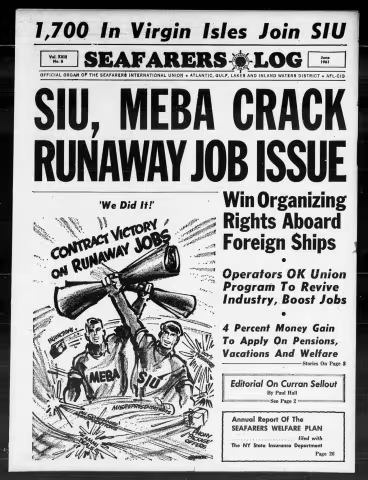
1^700 in Virgin Isles Join SIU
SEAFARERS LOG
OFFICIAL ORGAN Of THE SEAFARERS INTERNATIONAL UNION • ATLANTIC, GULF, LAKES AND INLAND WATERS DISTRICT • AFL-CIO
CRACK
RUNAWAY JOB ISSUE
We Did It!' Win Organizing
Rights Aboard
Foreign Ships
Operators OK Union
Program To Revive
Industry^ Boost Jobs
4 Percent Money Cain
To Apply On Pensions^
Vacations And Welfare
Stories On Page 8
Editorial On Curran Sellout
By Paul Hall
i See Page 2
Annual Report Of The
SEAFARERS WELFARE PLAN
filed with
The NY State Insurance Department
Page 26
Pace TIM SEAFARERS LOG JWM,lNi.»V
Behind The Confracf Smokesereen:
'Courage'-Curran Style
virgin Islands Union Official Visits SiU
By Pa^ HaU
To all outward appearances, the current maritime contract beef is a confused and compli
cated tangle. Actually the issue was simple and clear cut. It was simply whether US sea
men's unions were going to fight to preserve their members' jobs or walk away from the basic
problems created by the^
growth of the runaway fleets.
The confusion was the prod
net of a fog thrown up by NMU Pres
ident Curran to cover up his fiasty
retreat. The fact is, which every
seaman should know, that Curran
surrendered unconditionally in a
completely cowardly manner. From
now on, no runaway shipowner
has anything to fear from the
NMU. He has that guarantee in
writing from Curran. When Cur
ran dropped the issue, he agreed
to turn it over to a fact-finding
board whose recommendations
would not be binding — which
Goffin
Louis Goffin
Dies At 61
NEW YORK—One of the vet
erans of the seafaring union move
ment, Louis Goffin, died here June
26 after a long illness. He was 61.
An active union member for 40
years, Goffin first went to sea in
1921 and took
part in the his
toric 1921 sea
men's strike dur
ing which the
powers of the
Government
were used to
virtually destroy
the International
Seamen's Un
ion. Neverthe
less, Goffin kept up his union at
tachment, continuing to sail dur
ing the dark days of the 1920's
and 1930's. The columns of the
SEAFARERS LOG were often en
livened by his description of what
It was like to ship out of the old
"fink halls" maintained by the
U.S. Shipping Board and how
novice seamen learned their duties
from the bosun's "educated toe."
Goffin transferred from the old
ISU to the SIU in 1939, shortly
after it was chartered and was
active in many of the Union's early
©rganizing drives. Subsequently,
in 1941 he was named as patrol
man in the port of New York. He
aerved at various times as assistant
secretary-treasurer, Philadelphia
agent, and Jacksonville agent.
Since 1947, he had been repeatedly
elected as dock patrolmen or joint
patrolman in the Port of New
York.
He became ill in February of
this year and had been bedridden
since then.
Goffin is survived by his wife,
Dorothy. Funeral services were
held on June 28 at Schwartz
Brothers Funeral Home in Queens.
Burial was in Knollwood Cemetery,
Cypress Hills, Queens.
Union Has
Cable Address
Seafarers overseas who want
to get in touch with headquar
ters in a hurry can do so by
cabling the Union at its cable
iuldress, SEAFARERS NEW
YORK.
Use of this address will assure
speedy transmission on all mes
sages and faster service for the
men involved.
means that Curran put the whole
issue aside for the four years of
the agreement.
Once Opposed Runaways
It should be remembered that
at the beginning, all unions, the
NMU included, made the runaway
problem the Number One issue.
Curran made that clear in several
issues of "The Pilot." He threat
ened that the operators would have
to sign with him for the runaways
or else. His first demand was, "1.
Amendment to the contract
recognition clause to include for
eign-flag vessels which the con
tracting companies were operat
ing."
However, when the operators,
in Curran's words, "took the in
flexible position of not bargain
ing on'any of the union's economic
demands unless the union were
first to withdraw its demand on
the foreign-flag issue," Curran
caved in. He threw away any op
portunity to protect his member
ship against the runaways for the
next four years.
SIU Rejects Sellout
I reported to the SIU headquar
ters meeting on Monday, July 3,
that if our Union had agreed to
drop the runaway-flag issue, we
could have gotten double in the
money package.. But if for a few
measely bucks we would surrender
on so vital an issue affecting sea
men's security, we would have no
right to call ourselves a union.
There was no question but that the
membership agreed fully with this
position. Seamen have long been
clamoring for action on this run
away problem. The meeting unan
imously ratified the provisions of
the contract.
In selling out on this runaway
job issue, Curran did more than
damage his own membership". The
Masters, Mates and Pilots also suf
fered. They had originally been in
agreement with the engineers, and
other member unions of the
NCMB, to stand firm on this issue.
When Curran broke and ran out
on the issue the MM&P leader
ship didn't have the courage to
stand up and fight it through. In
stead, they look the easy way out
by swallowing the Curran line. It
Is interesting to note that the
membership of Local 88, the
largest in the MM&P, has re
pudiated the union leadership and
voted down the contract.
The record shows, when all is
said and done, that only the NCMB
unions stood their ground, and
only they won protection for US
seamen's jobs. It is shameful that
others abandoned their member-
SEAFARERS LOG
June, 19il Vol. XXIII, No. t
PAUL HALL, President
HEBBEBI BRAND, Editor. BERNARD SEA
MAN, Art Editor. HERMAN ARTHUR,
AL MASKIN, CHARLES BEAUMET, ALBERT
AMATEAU, ARTHUR MARKOWITZ, Staff
Writers.
Publlshea mommy at tne headquartart
of tha Seafarart Intarnational Union, At
lantic Gulf, Lakas and Inland Watars
District, AFL-CIO, 675 Fourth Avanua,
Brooklyn 3J, NY. Tel. HYacinth 9-6600.
Second class Dostage paid at tha Post
Office In Brooklyn, NY, under tha Act
of Aug. 24, 1913.
120
ships to the dictates of the ship
owner.' This will make organizing
the runaways considerably more
difficult, but the Job will be done
nevertheless.
It's a. certainty that, having
deserted this important issue, Cur
ran will launch "all out" offensives
to cover his retreat. He will at
tack the other unions with a vari
ety of loose and unfounded mis
representations, which are so
characteristic of him.
Curran's press clippings have
made much of the fact of his well
advertised "militancy" and "cour
age." Unfortunately, what he
showed at these negotiations was
not courage, but something else.
It was plain and simple cowardice
in the face of the enemy. When
,uch cowardice shows up in a sP
uation involving the livelihood and
security of seamen, then it is no
longer a private affair. It becomes
a public issue because of its un
happy impact on the future of
American seamen.
Jersey Tables
Curbs On Port
Union Groups
TRENTON—Organized labor in
the Maritime Port Council of
Greater New York scored a victory
when the New Jersey legislature
adjourned without acting on a
labor curb bill sponsored by the
Bi-State Waterfront Commission.
The bill would have greatly ex
panded the commission's authority
to interfere in the legitimate
picketline and strike activity of
harbor unions.
The legislation had already been
passed in New York State. In ad
dition to the opposition of the Port
Council, it had drawn the fire of
AFL-CIO President George Meany,
as well as of AFL-CIO unions in
the New York-New Jersey area.
Mrs. Ruth Smith, secretary of the Virgin Islands Labor Union,
discusses operations of SIU clinics with Dr. Joseph Loguey
medical director, during visit to SIU headquarters. The'
1,700-member group has affiliated with the SIU.
Virgin Isle Union
Votes To Join SIU
ST. THOMAS, Virgin Islands—The SIU's base in the Carib
bean was considerably strengthened last month with the an
nouncement that the 1,700 member Virgin Islands labor union
had formally affiliated with
the SIU.
Coupled with the 5,000
members of the SIU Puerto Rico
Division, the addition of the Vir
gin Islands group gives the SIU
a membership of 6,700 workers in
the Caribbean area, whiqh is a
center of runaway ship operations.
Maritime Federation
At the last SlUNA convention,
delegates had voted to participate
in a Caribbean maritime federa
tion, which would include SIU
affiliates In the area as well as
maritime unions from the West
Indies Federation, Venezuela and
other Caribbean countries.
The Virgin Islands union already
las close ties with other Caribbean
unions since it is a member of
the Caribbean Congress of Labor.
Union Leader Is Senator
The newly-affiliated Virgin
Islands union is the only union in
the islands with the exception of
the Musician's Union. It is headed
by Earle B. Ottley, who is also a
member of the island's senate.
Mrs. Ruth Smith, treasurer of
the union, said that the group has
a membership goal of 3,000. For
merly affiliated directly with the
AFL-CIO, the union decided on
SIU affiliation after surveying the
operations of the SIU's Puerto Rico
Division.
Publishes Newspaper
Tlie Vlfgin Island's Union is ac
tive on all three of the major
islands-^St. Croix, St. Thomas and
St. John. It represents workers in
shops, manufacturing and other
phases of the island's economy.
The total population of the islands
is in the vicinity of 30,000.
The union, which is just a few
years old, publishes a newspaper
"The Defender" twice a month and
is an active participant in iiSland
affairs.
NCMB Presents Contract Demands
While US ship operators listen attentively, Jesse Calhooh, chairman of the National Com
mittee for Maritime Bargaining details program for revitalizing US maritime and providing
job security for American seamen. Charts illustrate defects in existing maritime policies
and need tor a new approach along lines proposed by the NCMB. (See centerfold.)
Ia^'^lMl>' SEAFARERS £00 Fare Thl^ •- * *% »
Unions Win On Runaways
SIU, MEBA Succeed In Fight
To Strengthen Job Security
NEW YORK—^Maritime unions in the National Committee for Maritime Bar
gaining scored an historic "first" for US seamen when operators represent-!
ing almost half of the US merchant marine agreed that the unions have the right to
organize US operators' for
eign - flag affiliates. The
breakthrough scored by the
SlU and the Marine En
gineers Beneficial Associa
tion came in the face of
fierce opposition from the
American Merchant Marine
Institute, headed by John
Franklin, and its allies, the major
international oil companies.
In addition to the key vic
tory on the runaway issue, the
contract calls for a four per
cent monetary gain, which will
be used, to improve welfare,
pension and vacation benefits
for Seafarers. The agreement
runs for one year.
The agreements signed by the
SIU with Atlantic and Gulf con
tracted operators, by the MEBA
with the same group and with
Pacific Coast operators, specifically
Picketing two Bloomfield SS Company vessels In New
Orleans at the Perry Street wharf are (I. to r.) Seafarers
A. P. Richoux, Raymond Holder, Jomos T. Beasley and Horen
Weintroub and MEBA engineer William E. Danese. Bloom-
field and Alcoa refused to sign a contract.
Future Of Shipping,, Jobs
Was Major Contract Issue
NEW YORK—The basic issue in the maritime contract dispute; now-temporarily halted
by a Taft-Hartley injunction, is between those who want a bigger merchant marine with
more jobs and those.who would like to see it shrink.
On the one side are the one side are
member unions of the Na
tional Committee For Mari
time Bargaining who offered a pro
gram to expand the Industry and
job opportunities for seamen. On
the other side are the policy mak
ers of the American Merchant Ma
rine Institute, consisting of a
handful of subsidized companies
led by John Franklin of US Lines,
and the major international oil
and metals companies who haye a
heavy investment in runaway ships.
The firm alliance between the
Franklin group and the oil com
panies arises out of a situation in
which "one hand washes the
other." The objectives of the group
led by Franklin are nothing less
than a complete monopoly of US
Government maritime appropria
tions. In seeking this monopoly,
the Franklin group would find the
going much easier if they could
seriously cripple the rest of the
merchant marine.
The oil and metals companies,
on their part, are simply out lo
operate their foreign-flag carriers
without interference.
By offering a "package" deal
which would require the unions
to drop their demands on the run
aways and their proposals for a
union voice on a joint policy-mak
ing GommitteSj the AMMl hoped
to accomplish both alms. Eiimina-
tion of the policy-making commit
tee would leave the AMMl with
clear Sailing as the principle voice
of the industry and would enable
it to press its monopoly program
in Washington. Further, the eco
nomic burden of the package would
severely damage the independent,
unsubsidized companies, At the
same time, the package would as
sure total immunity to the runa
ways. Such companies as Texaco,
Gulf, National Bulk, States Marine
and United Fruit would be guar-
(Continued on page 7)
grant.the unions the right to go
aboard their foreign-flag ships for
organizing purposes. The operators
wili bargain with the unions when
ever they show they represent a
majority of any foreign-fiag crew
involved.
The contracts also provide for a
joint union-shipowner committee to
"formulate and take all necessary
steps to effectuate a program and
establish poiicies for the develop
ment and growth of the American
mercfhant marine." .Consequently,
the unions will have a voice in
determining industry policies
which affect the jobs and security
of seamen. ^
The agreement was ratified by
the SIU headquarters membership
meeting on July 3 and is now be
ing acted on in other SIU ports.
Practicaily all SlU-contracted
operators have been accounted for
with the principal exception of
The Maritime Union, und
|Joseph Curran, won a "
money deal :involvini
oi
In - this agreement also was
the dropping of what had once
been the prime demand of all
the unions: bargaining rights
on foreign-fiag ships under
American control but registered
under so-called Vflags of con
venience." Some unions still in
sist on this point, and also on a
pledge to let unions have a voice
in such industry problems bs
subsidy distribution.
Excerpt from "New York
Times" of July 2, 1961, de
scribes nature of AMMl
"package" deal, and drop
ping of runaway flag issue.
Alcoa, which has a sizable runaway-
flag fleet, and Bloomfield, plus a
smattering of small operators. Both
companies had assigned their bar
gaining rights to the AMMl. Con
sequently their crews were still on
strike when the US courts issued
a Taft-Hartley restraining order on
July 3. Also unsettled were the
contracts between the MEBA and
the Institute group.
SIUNA President Paul Hall mads
it clear that as soon as the 80-dar
cooling: off period has ended, the
SIU intends to resume strike action
against those operators who have
not yet signed the agreements.
Despite the SlU's and MEBA'i
success, the National Maritime
Union surrendered on the crucial
runaway issue. It abandoned it^
principal demands in this and other
areas, accepting instead a "pack
age" cooked up by Franklin and
the oil companies. The four-year
NMU agreement took the heat off
the oil and metals companies on the
(Continued on pagf 7t
Here's What Union Won:
The Big Gain: Job Security
Today, as the NCMB pointed out in its pro
gram, there are less than 900 active ships in
the US merchant marine and employment for
seamen Is less than in the depression year of 1939.
The unions of the NCMB agreed that the principal
issue to be faced up to in the negotiations was the
job potentiai of the Industry and its effects on sea
men's job security. The contract negotiated by the
NCMB unions reflects that concern over seamen's
jobs.
4" t 4«
Q. What are the basic contents of the contract
won by the SIU?
A. It has three basic provisions. The first gives
the SIU the right to go aboard foreign-flag ships
affiliated with SlU-contracted companies for the
purposes of organizing. The second kets up a joint
union-industry committee to act on maritime issues
affecting seamen's employment. The third provides
a four percent monetary Improvement to be applied
to various fringe benefits.
i 4- it
Q. How many foreign-fiag ships are involved and
what can we do about them?
A. The SIU group of companies signed thus far
has affiliations with weii over 200 foreign-flag ships.
Over 40 of these are under runaway flags and the
others under other maritime fiags. The number of
ships may turn out to be far greater.
SIU organizers can now board these vessels, just
as an SIU representative can go aboard a contracted
vessel. When a majority of the crew designates the
SIU as bargaining agent, then the operator agrees
to recognize the Union on that ship and to negoti
ate a contract.
4 4
Q. What will be the function of the joint union-
industry committee? Why is it important to seamen?
A. Up until now there has been no central body
speaking for the industry and its workers. As a re
sult, the Franklin group has captured the role of
industry spokesman and has used its position to
favor the major subsidized companies.
The new committee will work to revamp the mer
chant marine program of the United States to bene
fit the entire industry; to support the revival of the
neglected domestic trades; to work toward the es
tablishment of an adequate American-flag fleet in
the bulk cargo and oil cargo field. In the final
analysis, all of this activity would greatly increase
job opportunities for American seamen.
Naturally, in discussing the overhaul of the mer
chant marine program, the subsidy question would
arise. The union members on the committee are
committed to the principle that any subsidy program
must look toward expansion of the industry and de
velopment in areas of changing trade patterns.
4 4 4
Q. How will the four percent monetary settlement
be applied?
A. The Union is making a study, on the basis of
which it will work out a program to apply the four
percent in the areas most needed. Such areas could
include improving existing welfare and disability-
pension benefits, expanding vacation benefits, or
developing new protection for seamen.
The Ship Tie-Up,
Blow By Blow:
The following summarizes
the major events in the ship
contract beef:
• All unions whose contracts
expire June 15 asked for ship
owner concessions on runaway
ships. The AMMl and its allies,
the major tanker companies,
refused to discuss the issue.
s OK June IS and 1«, the
SIU and MEBA signed 65 com
panies with over 260 vessels
to a one year contract provid
ing: the right to organize some
200 US-eontrolled foreign-flag
ships; the establishment of a
joint union-shipowner commit
tee to work for expanded job
opportunities; improvements in
fringe benefits.
» Both unions rejected feel
ers from AMMl that a "pack
age" offer would be available if
they dropped their demands on
the runaways and formation of
the committee.
• The US Government pro
posed a 45-day cooling-off
period with a fact-finding board
to make recommendations. This
was turned down as undermin
ing collective bargaining.
• The NMU surrendered on
the runaway ship issue, in re
turn for a four-year "package"
aeai. Aunsequentiy, tne AKA
and MM&P signed a similar
package.
• The MEBA signed the
Pacific Maritime Association to
its basic program. PMA had
previously been committed to
the AM5II position.
• The Government obtained
a restraining order under Taft-
Hartley, compelling all unions
to return to work, leaving the
following contracts open: AMMl
with MEBA: SIU with Alcoa,
Bloomfield and a handful of
small operators; MM&P with
the Pacific Maritime Associa
tion. SIU Pacific District con
tracts do not expire until Sep
tember 30.
f ^ SEAPARMttS rt&e •Ajimtfgmi
What P&l Insurance Covers
Seafarer-Graduate Discusses Future
by Capt. Milton Williams
(Ed. note: This u the fifth in a series of articles written for the SEAFARERS LOG by Captain
Milton Williams, formerly vice-president and operating manager of Bull Lines. Captain Williams, who
is now retired, will discuss the various phases of American-flag ship operation in these articles from
an independent management viewpoint.)
Most seamen during their years at sea will come into contact with companies insur
ing the vessels on which they sail. This contact may be in the nature of a claim for injury or
as a witness in connection with some aspect of their ship's operation.
The two major groups of '
underwriters are those cover
ing the hull and machinery,
and those providing protec
tion and Indemnity insurance for
the shipowner. Protection and
Indemnity insurance is usually
called P&I insurance. The impor
tance of P&I will become apparent
•when one realizes the great variety
of claims against the owner that
this policy covers.
Marine protection and Indem
nity insurance is insurance to
cover shipowners, charterers, ship
operators and others having an in
curable interest in a vessel against
liabilities arising out of ownership
or operation of a vessel, be it a
email harbor craft or a large
ocean-going liner.
The insurance law of the State
of New York defines marine pro
tection and indemnity insurance as
follows:
"Marine protection and indem
nity insurance, meaning insurance
against, or against legal liability
of the insured, for loss, damage or
expense arising out of, or incident
to, the ownership, operation, char
tering, maintenance, use, repair or
construction of any vessel, craft
or instrumentality in use in ocean
or inland waterways, including
liability of the insured for per
sonal injury, illness or death or
for loss of or damage to the prop
erty of another person."
The name, "protection and in
demnity" means little, if anything,
to the man unfamiliar with ship
ping. A more understandable
name for this class of insurance
would be, "ship operator's liability
insurance."
The rjiipstion might be a.sked,
"Why not change the name so as
to make the meaning clear? The
answer is that P&I is well known
and universally used, so that the
change could cause confusion.
Quite frankly, many volumes
have been written on the various
interpretations which the courts
have put on P&I and there are still
many controversie.s today. .There
fore, I will stick to basic facts
only.
P&I insurance has frequently
been referred to as the catch-all
insurance. This is not exactly cor
rect because it does not cover
all the problems. Nevertheless, It
is a type of insurance which be
comes involved in so many of the
daily shipboard occurrences that
It is considered to cover every
thing not covered by hull and
machinery Insurance.
American shipowners have
available, in the United States,
several P&I insurance companies
which are able to adequately cover
all risks. Prior to World War I,
there were no American compa
nies and most of American-flag
P&I was carried by British firms.
P&I insurance companies were
formed about 1850 in Great Brit
ain to protect the shipowners
against damage resulting from
laws passed in that country.
Originally, P&I insurance cov
ered only loss-of-life claims, but
as time went on the need for broad
protection became increasingly
manifest. Steam supplanted sail.
Vessels increased in size and
value. Voyages became longer and
more frequent. The amount and
value o£- cargo increased.- The
number of persons carried on
board increased. Laws and regula
tions were enacted establishing
the liabilities and responsibilities
of Shipowners.
The coverage under P&I has
been broadened to meet these
changing conditions. Among the
risks now covered are:
1. Liabilities for loss of
life of, and personal injury
to, and illness of seamen, pas
sengers, longshoremen and
other persons.
2. Expenses incurred in re
patriating seamen.
3. Liabilities arising out of
a collision which are not
covered by hull policies. •
4. Liabilities for cargo loss
or damage.
5. Liability for damage to
docks, buoys, bridges, cables
and other fixed or movable
property.
6. Damages caused other
than by collision such as
damage from propeller wash.
7. Fines and penalties.
8. Quarantine expenses.
9. Liability for wreck re
moval.
10. Expenses in defending
unfounded claims of seamen
and other employees.
11. Expenses for putting in
to land an injured or sick
seaman.
12. Liability for uncollect-
able cargo's proportion of
general average.
13. Costs, charges and ex
penses In connection with any
of the above insured liabili
ties.
The above list, while large, does
not include all the items covered
by P&I.
Obviously, it is apparent that a
policy to protect the owner from
all of the claims which may be
made' against him or the ship
must be quite expensive. The
premiums the owner must pay
cannot be determined by looking
in the little black book of tables,
as is the case with life or fire in
surance. On the contrary, the in
surance rates charged by the com
panies are determined as a result
of a study of Company experience.
There is no fixed rate of pre
mium for P&I, nor do the under
writers rate *all risks alike. It is
largely a matter of individual
underwriting judgment. In mak
ing a determination of the P&I
premiums for fleets, various fac
tors are taken into consideration.
The type of vessel, age of the ves-
SlU Moves
Hq Meetings
In order to provide ample seat
ing space for Seafarers, the head
quarters membership meetings are
now being held in Prospect Hall,
at 263 Prospect Avenue, Brook
lyn.
The hall, which is situated be
tween 5th and 6th Avenues, a
short walk from SIU headquar
ters, can accommodate a consid
erably larger number and should
be more than adequate to handle
attendance at Union meetings. In
addition, the new meeting hall
•site will enable the Union to
make more effective use of space
in the present Union hiring hall,
which doubled as a meeting hall
up until now.
sel, the trade in which she may
be .employed, the owner's ojperat-
ing experience, kind of cargo car
ried, loss record, number of pas
sengers carried, if any, and so on.
Also, of course, we must take
into consideration the operating
cost of the underwriters, plus a
margin for catastrophic losses.
The highest cost of premiums
for P&I is paid by passenger ves
sels. Second is the combination
passenger-freight ship, followed
by general cargo ships, tankers,
bulk dry cargo ships and colliers.
' It can readily be seen that it is
to the shipowner's advantage to
reduce his loss record—in other
words, claims. His permiunu are,
in the final analysis, paid on the
basis of the record his company
was able to make over the years
—in other words, his experience
rating.
The cost of P&I insurance on
American-flag ships is very high.
It will be reduced only by the full
and wholehearted cooperation of
every single individual on board,
whether he is the master or mess-
man.
The cost of premiums paid for
by P&I are, of course, an operat
ing expense and reflect. In the
end, the ability of the American
ship to compete for cargo with
foreign operators. This is well
known to Union officials and is re
flected in their ever-increasing
drive to promote safeHy on board,
not only to relieve the suffering
caused by accidents to its mem
bers, but also to reduce the cost
of ship operations.
In future articles, we will go
into more detail on the items cov-;
ered by P&L
Seafarer Ed Skon^f (left), who hat just graduated New
York Univerilty, ditcustet future plans with Profettor Otcar
. Cargill of the NYU faculty. Skorupski is now on the Robin
Locksley as chief electrician.
Two Seafarers Graduate
Via SIU Scholarships
June is graduation month for two more Seafarers who had
been awarded SIU scholarships in past years. Seafarer Ed
ward Skorupski, who sailed as electrician has received his
diploma from New York Uni--^'
versity this month, while Sea
farer Donald Peterson is grad
uating from Swarthmore College,
Swarthmore, Pa.
Skorupski majored in English at
NYU's Washington Square Col
lege. Peterson also took a liberal
arts course and has been accepted
for graduate work at Harvard
University, where he plans to
major in education after a summer
voyage. •
Skorupski, who had sailed for
ten years in the engine depart^
LABOR
'ROUND THE WORLD
Apparently the world Communist movement is growing increasingly
concerned about the activities of the AFL-CIO in combating Communist
penetration of trade unions, as well as in supporting anti-Communist
efforts in other areas. The AFL-CIO's activities in this area were the
target of an angry blast in a recent Issue of "The Worker," official pub
lication of the Communist Party, USA. The inference was that the
Party was finding AFL-CIO backed opposition a serious obstacle to Its
plans.
Among the areas of concern to the Communists, is the AFL-CIO's
support of democratic trade union leaders from Cuba who fled that
country to escape Communist vengeance. Obviously, the Communists
fear that Cuban trade unionists can supply effective leadership to anti-
Castro movements In that country. Another sensitive area Is Berlin,
where the East German Communists have long had a hard time keep
ing rein on German workers, who can see the evidence of greater
prosperity on the other side of the Iron Curtain.
i 4> 3^
Danish seamen, who recently conducted a worldwide strike for a new
contract, faced the problem of scabbing in several are-^s. In New York
for example, one of the downtown Job agencies, which makes a living
supplying $100 a month crewmembers to runaway ships, was happy
to oblige with three shipboards of scabs to take three Maersk ships
out behind the picket lines. But New York wasn't the only trouble
spot. In Helsinki, Finland, the Finnish Seamen's Union reports that
Communist-controlled dockworkers were ordered to unload the struck
ships even though all Scandinavian seamen's and dockworkers unions
agreed to support the beef. In addition, in the Finnish port of Kotka
trainees in the dock foreman's school were ordered to act as strike
breakers.
t)
Workers in Cuba, who are having a hard time getting some of the
basic necessities of living, are now being ordered to go out and cut
sugar cane. All construction work has been halted so that the building
tradesmen are compelled to cut cane, and all public works employees
have also been ordered off their regular jobs for the same purpose.
In addition, other workers are being pressed to "volunteer" for week
end work in the cane fields. The forced labor reflects the lag in the
Cuban sugar harvest upon which the country depends for its foreign
trade.
ment when he got his Scholarship,
won the SIU $6,000 award in 1957.
He has successfully completed his
four-year college studies although
he never finished high school,
since he had to drop out to go to
work at 17. Subsequently he quali
fied for college by taking a test
for a high school equivalency
diploma given by the state of Con
necticut and was successful in
obtaining a scholarship award.
Peterson won his award in 1959,
after putting in some collegB
schooling on his own time, in be
tween trips. The 30-year-old Sea
farer, a Philadelphia resident,
served as a volunteer shipboard
organizer for the SIU on non-union
ships and sailed for a number of
years in the deck department.
Peterson has received permis
sion from the trustees of the Sea
farers Welfare Plan to apply the
balance of his scholarship award'
to graduate studies.
SCHEDULE OF
SIU MEETINGS
SIU membership meet
ings are held regularly
once a month on days in
dicated by the SIU Con
stitution, at 2:30 PM in
the listed SIU ports below.
All Seafarers are ex
pected to attend. Those
who wish to be excused
should request permission
by telegram (be sure to
include registration num
ber). The next SIU meet
ings will be:
New York
Philadelphia
Baltimore
Detroit
Houston
New Orleans
Mobile
August 7
August 8
August 9
Augusft II
August 14
August 15
August 16
\t
nfnM,rlMl ' SEAFARERS LOG Aure Hr«
IBI| Dr^geman Rescued
Ludwig Bednor, a member of the Great Lokes IBU Dredge
Section, was the first man rescued from Great Lakes Dredge
and Dock's Dredge No. 2 which went adrift in the Michigan
City, Indiana, harbor last month. Bednor, 51, suffered back
injuries and was the only member of the five-man crew hurt.
THE SIU
INLAND BOATMAN
The first convention of the Inland Boatmen's Union of the SIU held
in May, mapped a program for aiding the inland waterways industry and
extending the benefits of IBU representation both to unorganized boat
men and to boatmen now represented by organizations which are not
bonafide maritime unions. Officers of the IBU unanimously elected at
the convention are: Robert Matthews, national director; A1 Kerr, secre
tary-treasurer; Earl Shepard, Atlantic Coast area director; Lindsey
Williams, Gulf Coast area director, and August Wolf, Great Lakes area
director.
4- 4"
The Railway Labor Executives Association has unanimously approved
the SIU's application for membership in the million member organi
zation representing 22 major labor unions. The SIU sought member
ship in the RLE A to give added strength and representation to the
IBM Railway Marine Region, since RLEA is the principal coordinating
bbdy for railway labor in many fields of activity.
4' 4» 4'
The National Labor Relations Board upheld the IBU victory in the
Curtis Bay and McAllister fleets in Norfolk when it tnfew out eliarges
filed by District 50. The IBU defeated the "catch-all" district in an
NLRB election in the Hampton Roads area. Tugmen in the Gatco fleet
in the same arda also overwhelmingly voted for IBU representation.
4. -
The Great Lakes Tug and Dredge Region of the IBU signed three first-
time contracts with newly established firms which will operate tugs and
dredges in the Great Lakes region.
4« 4" 4"
Coverage in the Seafarers Welfare Plan is considered likely for mem
bers of the Railway Marine Region of the IBU. RMR and railway
management have been meeting to consider a recommendation by a
neutral party that railway tugmen be covered in the SIU welfare plan.
4- 4' 4'
IBU Railway Marine Region members ended their voting for of
ficials of the Region on June 16. The results of the election showed that
the following candidates had been elected to their respective offices:
G. P. McGinty, regional director, E. B. Pulver, assistant regional direc
tor (Jersey City), C. T. Murre'll, assistant regional director (Norfolk),
Poward Brower, B & O Railroad chairman, William Relyea, New Haven
chairman, Frank Pirone, New York Central chairman, Joe Fadde,
Brooklyn Eastern District chairman, Woodrow Fuller, Bush Terminal
chairman, James Waters, New York Dock chairman, L. A. Burdell,
Pennsylvania Railroad chairman (Philadelphia), and Richard H. Avery
C & O chairman (Norfolk).
4" 4" 4"
Five members of the SIU Great Lakes Inland Boatmen's Union were
rescued after spending a night on a derrick buffeted by high winds in
Michigan City harbor last month. Shortly after the rescue, the craft;
derrick dredge No. 2, owned by the Great Lakes Dredge and Dock Com
pany, sank. One man, Ludwig Bednor, was injured when a wave
slammed him into the winch during the rescue. The other crewmem-
bers, Nick Grbich, H. K. Benell, Ambrose Meagher, and J. J. Sweeney,
were treated for exposure to the high winds and cold water. The acci
dent occurred when the dredge broke loose from the tug which was
towing it into the harbor on May 26. A storm prevented Coast Guard
men from rescuing the crew who had to stay on the vessel for 12 hours.
4« 4" 4"
The IBU arid the Marine Engineers Beneficial Association are com
bining their efforts to organize numerous river fleets in the Midwest.
The major targets include unorganized boatmen and companies pres
ently under contract to District 50 of the United Mine Workers. The
MEBA recently won an important victory by defeating District 50 in a
National Mediation Board election in the Erie-Lackawanna •Railroad.
The electipn involved 51 licensed engineers on Erie-Lackawanna tugs
and ferries.
ICC Reverses Field, Criticizes
RR Bid For Ships' Cargoes
WASHINGTON—Coastwise shipping may finally be getting fairer treatment at tha
hands of the Interstate Commerce Commission. This was indicated by a recent commission
ruling involving Seatrain Lines and Sea-Land, both SlU-contracted companies, and the only
two lines operating in the+'
coastal trade.
The ICC ordered cancella
tion of a proposed reduction of all-
rail rates on paint or varnish driers
as an obvious attempt to take
away the business of the shipping
companies.
The decision was based on the
rule of ratemaking added to the
Interstate Commerce Act in 1958
which, although forbidding the
ICC to hold up rates of one mode
of transportation to protect an
other, requires the commission to
consider the national transporta
tion policy which is to encourage
all modes of transportation and
prohibit destructive rate practices.
Maritime unions and the remain
ing companies in the domestic
trades have complained that the
ICC, in its eagerness to please the
railroads, has studiously ignored
the objectives of the act. The
union charges were largely upheld,
by the Senate subcommittee which
held hearings on the problems of
coastwise shipping last year.
Consequently, maritime unions
are hopeful that the latest ICC
Kennedy Wonid End FMB;
Revise Shipping Agencies
WASHINGTON—A complete overhaul-of Government ma
chinery for regulating the maritime industry has been pro
posed by President Kennedy. The President sent a reorgani
zation plan to Congress which"*'
would abolish the present
Federal Maritime Board and
give the Secretary of Commerce
the job of passing upon subsidy
awards.
The purpose of the reorganiza
tion, is to separate the regulatory
function from the Job of develop
ing and prompting merchant ship
ping. Under the existing set-up,
the Federal Maritime Board and
its related body, the Maritime
Administration, both had regula
tory and promotional functions.
These, the President said, con
flicted with each other, since in
the interest of promoting the in
dustry, the regulatory function
went by the wayside on many occa
sions.
Dilute Responsibilities
"Intermingling of regulatory and
promotional functions has tended,
in this instance to dilute respon
sibility and has led to serious
inadequacies, particularly in the
administration of regulatory func
tions," the President declared.
To complicate matters, the Mari
time Administrator was also chair
man of the FMB, giving him a
split personality as far as regulat
ing and promoting was concerned.
The two agencies also shared other
employees.,
Under the new set-up, a five
man Maritime Commission would
be established. This would be the
"court" for the industry, which
make all the decisions on regula
tion cases. The Maritime Adminis
tration would continue as the
agency responsible for technologi
cal advances, for supervising the
design and construction of new
ships and for the day-to-day ad
ministration of the subsidy pro
gram. The Secretary of Commerce
would have direct authority over
the award of subsidies, a function
which for practical purposes would
be handled by the MA.
ruling represents some respons*
to criticism of its past practices.
The ICC ruling on the paint or
varnish drier rates noted that 1£
railroads were allowed to charge
rates equal to water carriers, Sea-
Land and Seatrain would be able
to" attract very little, if any, of
the traffic and would be threatened
with extinction.
The ruling said that allowing
the rail rates to drop to the water
rates would be in contravention of
the national transportation policy
calling for the development and
preservation of a transport system
by water, highway and rail as well
as other forms adequate to meet
the need of US commerce and na
tional defense.
The ICC referred to a similar
decision in 1960 involving Pan-
Atlantic, Sea-Land's predecessor,
in which the commission estab
lished a six percent differential la
-favor of the water carrier as op
posed to trailer-on-flatcar service.
In the current case, the ICO
ruled unanimously in favor of giv
ing the water carriers the right to
establish Itself as the . "low-cost"
transport medium. In the earlier
ruling, one commissioner protested
the establishment of a water-rail
differential.
Esse, Socony Divvy Up
Afro-Asian Markets
Technically* two separate oil companies since 1911, Stand
ard Oil of New Jersey (Esso) and Standard Oil of New York
(Socony-Mobil) have made a new arrangement to divvy up
oil operations in West Africa,"
Australia, Indonesia, Japan
and Southeast Asia, involving
a total market of close to a billion
people.
The new arrangement involves
a half-interest for each company
in a tanker fleet of 26 wholly-
owned ships, plus another 51 ves
sels under charter. All of the
ships involved are under runaway
flags, or various foreign flags.
Result Of Government Action
The revision in the set-up was
the result of Government anti
trust action dating back to 1953
with respect to foreign marketing
operations. The official Esso pubr
lication "The Lamp," put it this
way:
"Concurrently with the an
nouncement. of the forthcoming
Stanvac reorganization Jersey
signed a consent decree that ended
the litigation, but did not admit
any violation of the law."
Stanvac (Standard Vacuum Oil
PORTO'CALL
-izie E.B'^LTiwoeE
Company) was set up as a jointly-
owned venture of Esso and Socony
in the Eastern Hemisphere back
in 1933, thus disposing of tha
problem of competition in that
area between the two companies.
A map published in the magazina
shows that Esso will take over tha
business in India, Pakistan, Burma,
Thailand, Tanganyika, South Ko
rea, Malaya, the Northern Philip
pines, and South Vietnam among
others. Socony will operate in
Somali, Ethiopia, the Union of
South Africa, New Zealand, the
Rhodesias, the southern half of
the Philippines, New Guinea and
Hong Kong.
Joint Operations
Both companies have agreed to
operate jointly or side by side in
Japan, Indonesia, Formosa and
Australia.
In a gesture of appeasement to
ward the anti-trust division tha
announcement adds that "neither
company is restrained from enter
ing any area where an interest is
received by the other." Observers
would be vastly surprised though
if, for example, Socony Mobil were
to poke its nose into Esso's pre
serve in India or vice-versa.
Don't Send Your
Baggage COD
'Jeafarers are again warned
not to send their baggage COD
to any Union hall. The Union
cannot accept delivery of any
baggage where express charges
have not been prepaid.
Men who send baggage COD
to Union halls face the prospect
of having to go to a lot of trou
ble and red tape with the Rail-
vvay Express Co.
1 ^1
Pace 8tz S^I^AFARSMS lOQ 'Immt, IHI
SEAFARERS
ROTARY SHIPPING HOARD
(Figures On This Page Cover Deep Sea Shipping Only In the SlU AtlantiCj Gulf, Lakes and Inland Waters District.)
May 1 Through May 31, 1961
Sparked by an upsurge in in-transit ships, SIU shipping
made a strong comeback in the month of May. A total of
2,674 jobs were shipped in all ports, well ahead of April's
2,240 totals.
While payoffs and sign-ons varied only slightly from the
March figures, there were an additional 26 ships making in-
transit calls. These apparently were responsible for the in
crease in job opportunities.
New York and Houston again dominated the job picture,
with each port shipping 485 men during the month. Houston
had the most ship calls, 108, with 83 of these being of the in-
transit variety. New Orleans and New York both had 83
ships in, but New York had by far the largest number of
payoffs.
The ratio of registration on the beadh to total jobs shipped
continues to be very favorable for class A men. With 2,331
men on the beach compared to the total of 2,674 jobsahipped,
the class A group is assured of speedy shipping. All three
seniority classes showed sharp increases in shipping during
the month. Shipping in class 1-S also showed a marked im
provement in May, with 33 men going out in the chief stew
ard category compared to 21 in the previous month.
The traditional summertime pattern in engine room ship
ping is showing up again as in past years. As against a total
month's shipping figure of 972 jobs, there were also 643 class
A men registered. In fact, j;he total registration of "A" and
"B" men barely matched the month's shipping. It's always
hard to fill those black gang jobs in the warm weather.
Ship AefMfy
Pay Si«« !•
Offt On TroM. TOTAL
i«stM 2 0 '7 } f
New York ... .'44 9 30 S3
PhilodclpUa ..4 4 21 24
iolHmer* ....II 7 20 30
Norfolk 1 0 23 24
JocfctoRvillo .. 4 2 14 20
Miami 2 0 0 10
Mobllo 10 5 14 31
Now Orioont ..20 It 44 83
Hoottoo 18 7 83 108
Wllminytoa ..1 1 14 14
Son FroocUco.. S 4 12 21
Soottlo ..... 10 10 4 24
TOTALS ...Tiii 40 248 448
DECK DEPARTMENT
1 Registered Registered- Shipped Shipped Shipped TOTAL Registered On The Beach
CLASS A CLASS B CLASS A CLASS B CLASS C SHIPPED CLASS. A CLASS B
Pjtrt
GROUP GROUP GROUP GROUP GROUP CLASS GROUP GROUP
Pjtrt 1 2 S ALL 1 2 3 ALL 1 2 3 ALL 1 2 3 ALL 1 2 3 ALL A B C ALL 1 2 3 ALL 1 2' 3 ALL
Boston 6 13 3 22 0 1 3 4 1 5 3 9 1 1 0 2 0 0 0 0 9 2 0 11 10 18 5 33 0 2 5 7
New York 43 74 18 135 6 26 25 57 38 62 21 121 3 19 18 40 0 18 8 26 121 40 26 187 71 115 27 213 4 17 62 73
Philadelphia 5 5 7 17 0 3 7 10 5 15 5 25 0 2 1 3 0 0 0 0 25 3 0 28 8 19 12 39 0 7 3 10
Baltimore 15 38 11 - 64 1 11 20 32 16 50 15 81 2 0 12 23 2 1 2 5 81 23 5- 109 28 54 16 98 0 23 41 64
Norfolk 2 8 1 11 2 2 4 8 4 3 1 8 1 1 1 3 0 1 0 1 8 3 1 12 6 11 0 17 0 6 4 10
Jacksonville 14 12 5 31 2 4 7 13 8 16 5 29 2 6 4 12 1 6 5 12 29 12 12 53 11 11 1 23 1 1 6 8
Miami .-... 0 0 0 0 0 0 0 0 0 0 0 0 0 0 0 0 0 0 0 0 0 0 0 0 0 1 0 1 0 0 1 1
Mobile 24 34 11 69 1 3 12 16 10 22 5 37 3 3 9 15 0 3 1 4 37 15 4 56 29 33 9 71 0 3 8 11
New Orleans 45 75 20 140 7 16 17 37 28 54 28 40 7 23 20 50 1 6 5 12 110 50 12 172 78 120 8 206 1 19 20 40
Houston 47 77 24 148 2 18 47 29 87 28 144 6 28 30 64 0 2 1 3 144 64 3 211 27 41 24 92 5 19 21 45
Wilmington 4 16 2 22 0 7 2 9 3 12 2 17 2 0 2 4 1 1 7 9 17-- 4 9 31 9 15 2 26 0 6 2 8
San Francisco 18 23 5 46 3 8 4 IS 16 28 4 48 5 13 1 19 0 3 2 5 48 19 5 72 21 22 7 50 0 6 2 8
Seattle 12 26 7 45 2 15 11 28 13 19 8 40 2 12 12 26 0 8 2 10 40 26 10 76 12 17 5 34 2 10- 9 1 21
TOTALS 235 401 114 1 750 23 114 139 1 "276 171 373 125 66'9 34 117 110 261 5 49 33 1 ~87 669 261 87 1 [1017 310 477 116 1 903 13 119 174 1 "306
ENGINE DEPARTMENT
Port
Regiitered
CLASS A
Registered
CLASS B
Shipped
CLASS A
Shipped
CLASS B
Shipped
CLASS C
TOTAL
SHIPPED
Registered Oi
CLASS A
1 The Beach
CLASS B
Port
GROUP
1 2 3 ALL
GROUP
12 3 ALL
GROUP
12 3 ALL
GROUP
12 3 ALL
GROUP
1 2 3 ALL
CLASS
A B C ALL
GROUP
1 2 3 ALL
GROUP
12 3 ALL
Boston 1 8 0 9 0 4 0 4 0 4 2 6 0 1 2 3 0 0 0 0 6 3 0 9 3 15 2 xO 1 3 1 5
New York 27 82 6 115 6 29 24 59 17 66 9 92 4 88 10 52 5 11 17 33 92 62 33 177 39 103 13 155 5 28 41 74
Philadelphia 2 18 3 23 0 2 4 0 a 13 2 20 0 5 3 8 0 1 0 i 20 8 1 29 2 34 5 41 0 3 8 9
Baltimore 5 33 5 43 1 20 18 39 5 39 7 61 3 18 20 41 0 3 1 4 51 41 4 96 10 47 5 b2 2 25 19 46
Norfolk 4 8 3 15 1 6 1 8 1 6 5 12 1 0 2 3 0 0 0 0 12 3 0 15 4 13 1 18 0 5 2 7
Jacksonville 1 9 1 11 0 8 5 13 1 13 1 15 0 4 3 7 1 7 6 14 15 7 14 36 3 6 1 10 0 6 4 10
Miami 0 2 0 2 0 0 1 1 0 0 0 0 0 0 0 0 0 1 0 1 0 0 1 1 0 3 0 3 0 1 2 3
Mobile 7 32 5 44 2 6 4 12 2 22 4 28 1 10 5 16 0 1 1 2 28 16 2 46 10 35 8 53 1 8 6 15
New Orleans
Houston.
12 70 16 98 1 34 20 55 17 70 |17 104 1 24 16 41 1 13 22 36 104 41 36 181 20 84 14 118 4 45 40 89 New Orleans
Houston. 32 95 13 140 3 27 30 60 9 05 15 129 7 51 31 89 1 17 2 20 129 89 20 238 34 39 15 88 9 23 9 41
Wilmington
San Francisco.
Seattle
4 9 2 Id 1 4 3 8 5 6 4 15 1 3 3 7 0 3 6 9 15 7 9 31 3 10 1 14 1 3 6 10 Wilmington
San Francisco.
Seattle
5 23 8 36 2 8 1 11 3 8 1 12 4 9 2 15 0 4 4 8 12 15 8 35 5 32 3 40 0 3 4 7
Wilmington
San Francisco.
Seattle 5 33 6 44 2 17 13 32 4 33 6 43 2 16 7 25 1 8 1 10 43 25 10 78 3 17 1 21 1 8 8 17
TOTALS 105 422 68 |~595 19 165 124 1 308 77 377 73 527 24 179 104 1 1 307 9 69 60 138 527 307 138 j 1 972 136 438 69 643 24 161 148 1 ["333
STEWARD DEPARTMENT
Registered Registered Shipped Shipped Shipped TOTAL Registered On The Beach
CLASS A CLASS B CLASS A CLASS B CLASS C SHIPPED CLASS A CLASS B
1-9
GROUP GROUP GROUP GROUP GROUP CLASS GROUP GROUP
Porf 1-9 1 2 3 ALL 1 2 3 ALL 1-9 1 2 3 ALL 1 2 3 ALL 1 2 S ALL A B C ALL 1-a, 1 2 3 ALL 1 2 3 ALL
Bos 1 0 1 4 6 0 0 0 0 0 0 0 3 3 0 0 0 ' 0 0 0 0 0 3 0 0 3 1 1 1 6 9 0 0 2 2
-N. Y 8 24 19 57 108 3 8 20 81 8 19 12 37 76 1 8 18 27 3 3 12 18 76 27 18 121 28 56 28 111 223 2 7 36 45
Phil 0 9 5 9 23 1 0 5 6 0 1 3 4 8 0 0 8 8 0 0 2 2 8 8 2 18 0 12 7 14 - 33 0 0 11 11
Bal 5 17 10 13 45 3 3 15 21 6 11 8 20 45 2 2 23 27 1 1 9 11 45 27 11 83 9 24 12 23 68 2 24 17 43
Nor 0 5 3 1 9 1 3 5 9 0 1 1 3 5 0 0 1 1 0 0 1 1 5 1 1' 7 2 6 0 2 10 1 1 4 6
Jac 5 7 2 3 17 2 1 3 6 2 4 2 5 13 1 0 5 6 1 0 12 13 13 6 13 82 4 7 2 2 15 2 2 2 6
Mia 0 0 0 1 1 0 0 1 1 0 1 0 0 1 0 0 0 0 0 0 0 0 1 0 0 1 1 1 0 2 4 0 0 0 0
Mob 3 10 6 23 44 0 0 33 33 1 7 2 16 26 1 0 11 12 0 0 3 , 3 26 12 3 41 11 14 9 33 67 0 0 24 24
No 6 25 9 71 111 2 1 22 23 1 18 12 47 78 0 1 27 28 0 0 10 10 78 28 10 116 22 48 18 121 209 4 2 63 69
Hou." 10 32 12 42 96 1 4 33 38 9 28 14 35 86 0 1 45 46 1 0 12 13 86 46 13 145 14 16 24 21 75 11 9 16 36
Wil 3 3 5 5 16 1 0 1 2 1 0 2 7 10 2 0 0 2 0 1 6 7 10 2 7 19 ' 5 3 5 5 18 1 0 3 4
S. F 9 2 2 7 20 0 0 10 10 3 4 2 14 23 0 1 11 12 0 1 10 11 .23 12 11 46 2 11 4 15 32 0 1 11 12 Sea 3 7 3 8 21 3 4 16 23 2 8 3 12 25 3 4 16 23 1 0 4 5 25 23 5 53 7 4 3 8 22 2 4 13 19
TOTALS 53 141 77 246 1 517 1 17" 24 164 { 205 33* 102 61 203 1 .399 10 17 165 1 192 7 6 81 1 1 94 399 192 94 1 685 106" 203 113 363 1 1 785 2N 50 202 1 277
SUMMARY
1
CLASS A Registered
CLASS B
Shipped
CLASS A
Shipped
CLASS B
Shipped
CLASS C
TOTAL
SHIPPED
Registered On The Beach
1 Registered
GROUP
123 ALL
Registered
CLASS B
Shipped
CLASS A
Shipped
CLASS B
Shipped
CLASS C
TOTAL
SHIPPED CLASS A CLASS B 1 Registered
GROUP
123 ALL
GROUP
123 ALL
GROUP
123 ALL
GROUP
1.2 8 ALL
GROUP
1 23 ALL
CLASS
A B C ALL
GROUP
123 ALL
GROUP
1 23 ALL
DECK 235 401 114 1 750 23 114 139 1 276 171 373 125 1 669 34 117 110 261 5 49 33 1 87 669 261 87 |1017 310 477 116 1 903 13 119 174 1 30.6
ENGINE 105 422 68 1 595
194 77 246 | 517
19 165 124 1 308
17 . 24 164 1 205
77 377 73 | 527 24 179 104 307
192
9 69 60 1 138 527 307 138 | 972 136 438 69 | 643 24 161 148 1 333
tSTfWARD
105 422 68 1 595
194 77 246 | 517
19 165 124 1 308
17 . 24 164 1 205 135 61 203 1 399 10 17 165
307
192 . 7 6 81 1 94
21 124 1741319
399 192 94 | 685
1595 760 319 {2654
309 113 363 1 785
755 1028 548 {2331
, 25 50 202 1 2ii
GRAND TOTALS 534 900 428 11862 59 303 427 1 789 383 811 401 {1595 68 313 379 760
. 7 6 81 1 94
21 124 1741319
399 192 94 | 685
1595 760 319 {2654
309 113 363 1 785
755 1028 548 {2331 62 330 524 j 916
t Group 1-s men totals included in Group 1 totals.
• 1 man .shipped 1-s, class B.
"1 man registered on beach 1-s, class B.
i •
^Un SEAFARERS LOG Tf 8enm,
Joe Alclna, Safety Director
Check Up On Personal Safety Gear
One of the key points In any shipboard safety program is provision
for regular inspection and maintenance of personal protective equip
ment, such as respirators, goggles, saftey belts, gas masks, oxygen
breathing apparatus (OBA) and similar gear. There is too little regard
for such safety equipment most of the time; the feeling is that it will
somehow take care of Itself. Yet these Items of personal Safety gear
are subject to the same abuse, wear and tear as all other tools and
equipment.
Frequent Instruction and reminders on the use of the OBA, the
limited value of gas masks (in areas where oxygW" content may be low)
are just as important as regular fire and boat drills. It seems like
"nuisance" sometimes to have to turn out for these instruction periods
and drills; "everybody knows about them" is the atttiude. Anyone who
reacts that way is loading the dice against himself and his shipmates.
Extra Margin Of Safety Is Important
Sure, disaster may never come. But what a break /or the whole gang
if it has gone through the whole procedure on a dry run a couple of
times before. Professionals, firemen ashore, go through the same rou
tine as a drill regularly and this is bound to pay off in an emergency.
The same applies to the personal safety equipment and its use. Some
one has to be delegated as the responsible person for this gear. It has
to be inspected before being issued and after each use. Any cleaning,
repairing or drying out should be taken care of immediately after use
—before the gear is put away. Improper storage will result in deteriora
tion, particularly with canvas and rubber items. Iteplacements or stand
by parts should be readily available.
The extra margin of safety offered by the above, and many other
long-established practices on American ships, drew a sharp blast a few
days ago. The beef by one management spokesman was that US. ships
have "too much" of an edge on safety over foreign ships and manage
ment has to close this gap. He conceded at the same time that Ameri
can ships are the safest in the world but said this accounts for a big
cost item in US ship construction.
Direct Solution; Turn Back The Clock
His solution is simple and direct; Turn the clock back on American
ships and bring the safety level down closer to the standards on the
foreign-flaggers. This is a weird approach to the problem of competi
tion. but typical of the attitude in some management quarters. The rea
soning is that crew and passenger safety and comforts can be sacrificed
right off the bat without hurting anybody.
This comes up at a time when foreign ship lines are building new
vessels with more and more American-style features and accomoda
tions so they can drain off what's left of the US passenger and cargo
trade. The cbmpartmentation and safety protection built into US ships
are being adopted by more foreign lines all the time. These items are
finally being recognized as matters of importance. The foreign vessels
are closing the gap between our ships and their own by bringing their
standards up to the American level. As was noted here, following the
SIUNA convention last March, the US industry would do itself some
good by insisting, as the unions have, on encouraging this trend—not
by stopping it dead in its tracks. A new international cunventiun on
sea safely, dedicated to bringing safety standards on foreign vessels up
to those of the US, could do it.
The SIUNA Convention in March in Puerto Rico urged the American
shipowners to pay strict attention to safety aboard ship as a protection
for passenger and crewmembers. It is a dictate of common sense that
relaxed safety standards aboard American-flag vessels would not con
tribute to the nation's merchant marine, but rather might give away
another competitive advantage to foreign and runaway flag ships.
(Comments and suggestions are invited by the Department and can
be submitte(^ to this column care of the SEAFARERS LOG.)
Seafarer At Ease in Safety Net
Confidence in value'of gangway safety net Is demonstrated
by Seafarer Norman Corthwright, OS on the Kyska
(circled), as he convFortably relaxes in one for a posed shot
by a LOS photographer.
Runaway Operator Testifies
us Companies Finance Constniction
Of Foreign-Owned Bulk Carriers
WASHINGTON—The spokesman for the runaway shipping industry let the cat out of
the bag on the nature of runaway operations when he testified before the House Commit
tee on Ways and Means on proposals to tax runaway earnings. Erling D. Naess, president
of Naess Shipping Company ^ ——
told the Congressmen that
runaway ships, even when not
directly-owned by the companies
or by Americans are financed by
the American companies In whose
behalf they operate.
It has been reported that Ameri
can oil and metals companies, as
well as American ship operators,
directly own some 460 ships under
the runaway flag. (See back page).
But maritime unions have con
tended for some time that they
control far more tonnage than
that under the long-term charter
device, there being some 1,600
ships in all under the runaway
flags of Panama and Liberia.
Naess' testimony confirmed that
for practical purposes, these ships
are built specifically for service in
American trades and are financed
accordingly.
As such, even though they are
not directly American-owned, they
could be subject to the jurisdic
tion of American maritime unions.
The International Transportwork-
ers Federation, representing Euro
pean maritime unions among
others, has recognized that Ameri
can unions are entitled to Juris
diction over ships controlled by
US firms, as well as owned directly
by them.
Naess' testimony reads In part
as follows:
"The majority of the vessels"
[runaway-flag ships—ed.l "are
leased under varying forms of long-
term charters to major oil and
steel companies for the transporta
tion of such bulk cargoes as petro-
lum, iron ore and coal . . .
"The charters themselves serve
as the principal security for ob
taining financing for the construc
tion of the vessels and the major
part of the charter hire paid by
the oil and steel companies is
paid over to the financing institu
tion by way of amortization and
interest."
From the union point of view, if
American companies financed th«
construction of a vessel for their
own use, the vessel is under their
control from the moment it enters
service, no matter what the flag It
flies or who Is. nominally the
owner.
NCMB Unions Viin
(Continued from page 3)
runaway issue and was also de
signed to undermine the non-sub
sidized segment of the Industry
and endanger the jobs of the sea
men they employ. The latter is the
principal objective of the Franklin
group of operators.
The SIU and MEBA flatly re
jected the Franklin package, de
claring that it was "guaranteed to
make a sick industry sicker."
Shipping Future Was At Stake
(Continued from page 3)
anteed freedom from union organ
izing.
The Franklin grdup was not con
cerned about the costs of the pack
age, since as subsidized companies,
they would simply pass these costs
on to the Government. They count
ed on the powerful political influ
ence of their allied oil and metals
companies to help silence any Con
gressional criticism.
The Franklin "package" scored
when the National Maritime Union
bouglit the whole scheme and
dropped Its demands on the runa
ways for at least four ydfers.
Just this past April, NMU Presi
dent Joseph Curran, In an article
in the "Industrial Bulletin," called
the runaway ships "one of the most
potent factors in the decline of
the merchant marine," and a
grave threat to jobs and standards
. . achieved aboard American
ships." He added that it was his
hope that the runaway Issue could
be settled "before it U too late."
Curran also recommended that
"labor, management and Govern
ment" should "come together on a
regular basis to work together on
all the problems confronting us"
such as those of domestic shipping.
Yet the NMU refused to participate
in the NCMB program which called
for just such an arrangement.
Following the NMU action In
putting aside the runaway threat
to jobs and standards, the Ameri
can Radio Association and the
Masters, Mates and Pilots also
dropped the runaway issue.
The stumbling block to this
scheme was the response of the
NCMB unions. They flatly rejected
the "package" as one which would
destroy the jobs and security of
maritime workers. Further, they
asked Congress to fully investigate
the "irresponsibility of the subsi
dized operators who are using Fed
eral money to destroy segments of
the American merchant marine."
Since the Pacific Maritime Asso
ciation also rejected the Franklin
package, it appears certain that
there will be a sfearching Congres
sional look at the maneuvers of the
AMMI group.
The NCMB unions, declaring that
the "AMMI's proposals are guar
anteed to make a sick industry
sicker" added the following:
"No matter how the AMMI sug
ar-coats its offer to make it appear
palatable to seamen, the fact re
mains that the Institute Is deter
mined to shove the runaway-flag
issue under the rug, with the sacri
fice of seamen's jobs and of a con
siderable segment of the American-
flag merchant industry on the altar
of the international oil and metals
companies . . .
"Clearly the position taken by
the AMMI shows that the Institute
is ready to plunder the Federal
treasury with two objectives in
mind—(A) to strengthen the hand
of the subsidized few while forc
ing the independent operators out
of the trade and (B) to shield the
runaway-flag oil and~ metals com
panies, who are themselves depriv
ing the Treasury of untold millions
In tax revenues, as both President
Kennedy and Secretary Dillon have
testified . . .
"We in the NCMB will not ac
cept an AMMI bribe to drop our
position on runaway flags and on
the need for a responsible • ap
proach to the Industry's problems
through joint labor-management
action. We will not sell out the job
security of our members, nor will
we participate in any scheme to
liquidate any section of the US
merchant marine' . . ."
The member unions of the
NCMB at its formation included
the MEBA, Masters Mates & Pi
lots, Radio Operators Union, SIU
Atlantic. Gulf, Lakes and Inland
Waters District, Sailors Union of
the Pacific, Marine Firemen's Un
ion, Marine Cooks and Stewards
Union, Staff Officers Association,
International Longshoremen's As
sociation and Operating Engineers
Local 25. The MM&P participated
in the initial bargaining with the
NCMB but subsequently withdrew.
They added that "No matter how
the AMMI sugar-coats its offer,
the fact remains that the institute
is determined to shove the run
away-flag issue .under the rug . . .
We in the NCMB will not accept
an AMMI bribe to drop our posi
tion . . ."
The NCMB called for a Con
gressional investigation of the
AMMI program.
It was clear that the basic issue
in the dispute was between the
NCMB program to expand US
shipping and jobs, and the AMMI
objective of a small merchant
marine, monopolized by a handful
of subsidized operators. AMMI
President Ralph Casey has, on sev
eral occasions, declared that with
in a very few years the merchant
marine will consist of only some
350 subsidized ships.
Casey has also staunchly defend
ed the runaway-flag device, calling
the runaway ships the "fifth arm
of defense."
It's clear that not all the sub
sidized operators take the same
viewpoint. The Pacific Maritime
Association broke with the Frank
lin program by signing with the
engineers. The PMA agreed that
US seamen's unions should have
the right to organize runaways. It
also approved of the participation
of US unions in determining the
industry's policies and goals.
In setting up the joint union-
industry committee, the unions
plan specific steps to revive the
domestic shipping industry and
the thousands of jobs which once
existed in this trade, to assure US
seamen and ships employment op
portunities in the dominant bulk
cargo trades, and to modernize the
subsidy program so as to meet the
needs of changing trade patterns.
The SIU companies signing the
agreement have «nore . than 40
ships operating under runaway
flags, plus an estimated 200 other
vessels under various foreign flags.
The full -extent of the operators'
participation in the foreign-flag
field is believed to be far larger
than that.
The NCMB program in this area
won important support when the
Seamen and Waterfront Workers'
Trade Union in Trinidad sent
wires offering its full cooperation.
Other Caribbean unions gre ex
pected to do likewise.
The signing of the SIU agree
ments followed upon presentation
of the NCMB's demands at an
open meeting on June 7, attended
by all sections of the shipping in
dustry.
(For the full text of the National
Committee's proposals, see tha
centerspread in this issue.)
Pace BisMr; SKAFARERS LOG 1H1>:
Lakes Welfare Plan
Paying Full Benefits
DETROIT—^With the signing up of two more operators
strengthening the program, SIU members are now collecting
benefits from the SIU Great Lakes Seamen's Welfare Plan,
which went into effect on>
April 1'with a full schedule of
benefits.
The two additional companies
First Lakes Maternity Benefit
which signed the agreement are
the Ann Arbor Company, which
joined May 15, 'and the Michigan-
Ohio Company, which entered the
plan in April a short while after
the program began.
First Maternity Benefit
The first maternity benefit has
been paid to the Donald Cubic
family. They recently welcomed a
bouncing baby girl, Michalene.
The father is a crewmember of the
cruise vessel Aquarama.
The first in-hospital benefit was
presented to Carl Larson, while a
$195 reimbursement payment was
made to Mrs. Edith Johnson, whose
husband, Edmond, is 2nd cook
on the tanker Detroit.
John R. Emery, assistant ad
ministrator of the plan, said claims
are being processed very quickly
since the enrollment cards fu-st be
gan pouring into headquarters.
The latest recipients under the
Plan are: Henry T. Larsen and
Jason Holtry, hospital benefits,
Frankfort; Joseph Scheitz, mater
nity benefit. Little Falls, Minn;
Frederick G. Conly, hospital bene
fit, Attica, Mich.; Gerald Fast,
maternity benefit, Frankfort;
Richard Szumila, maternity bene
fit, Posen, Mich.; Jack Young,
maternity benefit. Bay City; and
Michael Kandow, maternity bene
fit, Alpena.
SIU Representative Dick Hollingsworth presents a maternity
benefit check for-the first baby born under the Welfare Plan
to Mr. and Mrs. Donald Cubic.
Lakes 'Poet Laureate' V/infers
Sings of Sfi/ps/ Sea^ Seamen
DETROIT—The "poet laureate" of the Great Lakes is 52-year-old Robert Winters, who quit
a job as a runner in a New York brokerage firm when he was 17 and caught a liner to
France.
Winters, who used to cor
respond regularly with such
literary greats as Somerset
Maugham, decided that the sea
was the life for him, and has been
shipping out of various ports
Lakes Connecting Channel
Will Hit Bottom By '62
CHICAGO—The Army Corps of Engineers said that jplans
for the Great Lakes connecting chanels project call for provid
ing the full project depth of 27 feet between all of the Lakes
by July of 1962. * •»'
The project, authorized by
Congress in 1956 and now
two-thirds complete, provides for
the deepening of channels in the
St. Marys River, the Straits of
Mackinac, the St. Clair River, Lake
St, Clair and the Detroit River to
minimum depths of 27 feet for
both upbound and downbound
traffic.
Included in the project Is the
replacement of the Foe Lock at
Sault Ste. Marie with a new lock.
The old lock will be removed, cof-
ferdair>s built and excavation made
for the new lock. It is planned that
construction of the new lock will
proceed .at a rate to enable opera
tion of the new lock in five years.
Costs $32.5 Million
The new lock will be 1,000 feet
long, 100 feet wide and have a
depth of 32 feet, it will cost $32.5
million.
In 1960 Congress passed the
Rivers and Harbors Act authorizing
SIU Great Lakes
Union Halls
HEADQUARTERS
10225 W. Jefferson, River Rouge UB, Mich.
Vinewood 3-4741
Fred J. Farnen, Secretary-Treasurer
Stanley F. Thompson. Asst. Sec.-Treas.
ALPENA 127 River St.
Norman Jolicoeur, Agent Elmwood 4-3616
BUFFALO. NV 735 Washington St.
Roy J. Boudreau, Agent TL 3-9259
CHICAno 9383 Ewing Ave..
Ernest Aubusson, Agent
South rhicago. III,
SAginaw 1-0733
CLEVELAND 15614 Detroit Ave.
(Lakewood)
Stanley Wares, Agent MAin 1-0147
DULUTH 312 W. 2nd St.
Gerald Westphal. Agent. RAndolph 2-4110
FRANKFORT, Mich 415 Main St.
Address Mail to: P.O. Box 287
Floyd Hanmer, Agent ELgin 7-2441
TOI.EDO 120 Summit .St.
Neil Mahaney, Agent CHerry 8-2431
the deepening of harbors to 27
feet at Two Harbors, Duluth-
Superior, Ashland, Presque Isle
and Marquette on Lake Superior;
Calumet and Indiana Harbor on
Lake Michigan; Trenton Channel
on the Detroit River; Toledo,
Lorain, Erie and Buffalo on Lake
Erie. Additional deepening to a
lesser depth was authorized at
Sandusky and Rochester.
The entirq Great Lakes Connect
ing Channels project will cost
about $129 million before it is
completed and involves the re
moval of over 65 million yards of
rock and dirt. It Is the largest
project of its kind In the history of
the Great Lakes.
throughout the world ever since.
He is now starting his sixth
year on Lakes vessels.
Sporting a Tyrolean hat and
brimming over with impromptu
verse. Winters is considering hav
ing a collection of his verse pub
lished.
Winters counts as his worst pe
riod the 52 days he once spent in
England's WaHon Gaol (jail) after
he missed his ship. "I hate to say
It," he said, "but the conditions
were horrible.""
Considering his lively career, it
comes as a surprise to discover a
sentimental streak in the dapper
versifier-seaman. He writes with
real feeling about cities, ships,
scarlet women, and men who have
trouble finding jobs after they
reach |5. One
poem, written
after visiting St,
Marks Mission in
New Y o r k's
Bowery, is en
titled, "Rejected,
sir, you're over
45."
His latest en
deavor is some
thing he" calls
"Pygmalion," teaching
Winters
various
people in various'ports his poetic
style. As soon as the pupil masters
the free-and-easy verse method.
Great Lakes Shipping
April 29,1961 Through May 26,1961
PORT DECK ENGINE STEWARD TOTAL
Alpena 19 22 3 44
Buffalo 85 88 13 186
Chicago 29 27 9 65
Cleveland 14 20 5 39
Detroit 105 57 117 279
Duluth 4 6 > 2 11
Frankfort 33 29 27 89
Toledo 54 46 18 118
TOTAL 343 294 194 * ~831
Winters pronounces him "Pygmal
ion," after the Greek mytholpgical
character.
Union Boards
Locate In Hq
DETROIT—Acting to pro
vide greater and more effici
ent service to SIU members,
the Great Lakes Seamen's Ap
peals Board and the newly-
established Great Lakes Seafar
er's Welfare Plan have moved
their offices to the Union's head
quarters, 10225 W. Jefferson, River
Rouge.
The move brings the operation
of the two programs nearer to
members and allows for greater
and more efficient servicing of
members' welfare claims' and Job
Security Program benefits.
More Convenient
John R. Emery, welfare plan
assistant administrator and senior
ity director said the new location
makes the Union "better able to
handle the operation of our offica
and at the same time provides a
more convenient location for the
members."
The growing demands on both
programs were cited as the primary
reason for the move. A tighter,
more efficient internal operation
will also result from the centralized
set-up.
Lakes Port Reports
Toledo Moving
TOLEDO—Shipping got a boost
with the return to service of the
Clemens (Reiss) after a lay-up due
to hull damages, and the cfewlng
of C. S. Robinson (Steinbrenner),
reports Neil Mahaney, Toledo
agent. Ed D o h e r t y, former
agent, has been assigned to head
quarters in Detroit. The SIU was
represented in the all Union con
ference recently in Toledo which
made plans to reactivate the United
Labor Committee, which was
very active during the fight against
the "right to work" bill.
4 4 4
Detroit Fair
DETROIT—Shipping has been
pretty fair, quite a few jobs being
shipped to various ports. Two ad
ditional ships were fit out that
were not expected—the Gene C.
Hutchinson in Muskegon and the
Philip Minch in Buffalo.
4 ' 4 4
Chicago Good
CHICAGO—Shipping had been
fairly good. Wisconsin Steel
Works has not only called back
250 laid off men, it is now taking
more applications. This means a
step-up in ore and it's hoped ad
ditional vessels will be coming in
on their regular runs. A former
SIU member, John Avery, just
signed a contract with the IBU for
his new firm. International Sail
Makers.
4 4 4
Buffalo Host To Unions
BUFFALO ^ — Buffalo reports
shipping for the past month has
been slow, with most replacements
being temporary men. A few
shifting jobs have come in. A
number of unions are now using
the new Buffalo hall for their
meetings. A delegation from the
Southern Ontario Port Council at
tended the last MTD meeting in or
der to Initiate a program of closer
cooperation between the two coun
cils.
4 4 4
Frankfort Pays Benefit
FRANKFORT—Shipping is slow
because the Ann Arbor No. 5 is on
a five-day schedule. Edward Ward
was the first man from the port of
Frankfort to receive maternity
benefits.
4 4 4
Duluth Sees P-M Men
DULUTH—Shipping has been
slow during the month, with a
brighter outlook for the next
month. A total of 19 jobs were
shipped out in the past 30 days,
because of late fit outs. The port
is active in contacting crew mem
bers in the Pickands-Mather fleet.
4 4 4
Alpena Picking Up
ALPENA—Shipping has picked
up considerably. Arnold Transit
has fit out two more motor vessels,
bringing the total to four in opera
tion. The Chief Wawi^tan will bo
put in the shipyards in Manitowac,
and the company will be calling
for a full crew to man the St.
Marie to replace the Wawatan.
Huron Portland Cement is now
operating three boats and is con
templating fitting out the E. M.
Ford.
4 4 4
Cleveland In New Hall
CLEVELAND—Port has settled
down after confusion of moving to
new hall in Lakewood. Latest mem
bership meeting had discussion of
Welfare Plan. Cruiser Aquarama
has been crewed up and is out on
a special cruise before starting
Detroit-Cleveland run later in
month. After a slow start, quite a
few contracted ships are now hit
ting port and things are beginning
to pick up.
StAFAK^ItM^ vac m»--NiM<
»3^-
By SIDNEY MARGOLIVS ^
Saving Money On Homes
This Is a better year than last for shopping for houses, mortgages
to finance them and the appliances to equip them.
We've already told you about tlie sharp reductions this spring on re
frigerators and washing machines, and the first signs of price cuts on
furniture. -
You also now can find excellent values in vacuum cleaners and TV
sets, which are unloaded in June at sharpest reductions to make way for
next year's models.
Other June buying opportunities include sales of women's dresses;
clearances of summer fabrics; seasonal price reductions on lumber,
paints, plumbing and heating equipment, and rug-cleaning specials.
You also get a small break on your food bill this month. Wholesale
food prices recently dropped to the lowest levels since last September.
Here are tips on these and other June buying opportunities:
HOUSES, MORTGAGES: Prices of houses have leveled off, and mort
gage interest rates have declined just a little this spring.
If you're.looking for a place to rent, the National Association of Real
Estate Boards reports that there are more apartments available now.
Single-family homes for rent are harder to find. Apartment rentals
have stopped up and even have decreased slightly in a few cities.
An experiment recently completed by the US Agricultural Research
Service provides some useful tips for home-seekers. Not all modern
hou.sing ideas turned out to be truly practical. The Government speci
alists report that families found floor-to-ceiling windows left too little
wall space in a small house. Tbey also, made it hard to protect in
teriors from sunlight, with resultant fading of furnishings, and heat
and glare. Such windows require a sizable roof overhang, shade trees
or an awning.
A family living in a house that featured "open planning," with only
partial walls or none separating living areas, found that the arrange
ment did provide spaciousness but not enough privacy.
Families also reported that bedroom closets in small houses tend to
be inadequate. Those in the experiment had 4^ feet of rod space.
The Government housing specialists recommend 7^ feet of. rod space
in each bedroom.
A. M. Watkins, building engineer and author of "All About Houses"
suggests five tests of a good plan:
1—Is the family entrance (usually through the kitchen) properly
located to be near the garage and driveway?
2—Is the kitchen centrally located so a mother can observe the
children playing and also be near the front door?
3—Is the front entrance well planned, with a foyer and coat closet?
4—Is there good traffic circulation so that you can go from one room
to another without walking through a third? The living room especi
ally should be free of cross-traffic. It is not. In many low-cost houses
on which builders skimp.
5—^Is it easy to reach outside play area, drying area and patio from
the house?
Despite the increase in the money supply, and the reduced demand
for mortgages, interest rates have been going down only very grudging
ly. The Administration itself has reduced FHA mortgage rates only
one-fourth of one per cent. The effective rate is now six percent,
However, buyers and sellers currently don't have to pay as much
extra discount to get a mortgage, except for VA niortgages. Vets still
have to pay discounts of five or six points for a GI loan. A five-point
discount means that on a $10,000 mortgage, you really get only $9,500
but still have tq repay $10,000 plus the interest.
Watkins reports that closing costs are being trimmed a little. He
advises home buyers to bargain harder over such costs, which often
range from about $300 to as much as $750.
MEBA Delegates Back NCMB;
Strengthen District Structure
LOS ANGELES' -Staunch support for the program of the
National Committee for Maritime Bargaining and action to
strengthen the district structure of the union was voted by
delegates to the 84th national*?'——
convention of the Marine
Engineers Beneficial Associa
tion. -
The meeting here from May IS
to May 19 endorsed the program
of the National Committee as be
ing in the best interests of both
seamen and the industry in which
they are employed.
The delegates voted amend
ments to the national constitution
to provide for effective operation
of the districts, which were ap
proved by the membership in a
referendum vote last year. Before
the establishment of the districts,
the MEBA had been fragmented
into local unions in various port
cities, a structure which created
difficulties when engineers moved
from port to port.
Jesse Calhoon, MEBA secretary-
treasurer, addressed the conven
tion on the issue of maritime bar
gaining, noting the need to reverse
nvrsrltime policies which have led
to loss of ships and employment.
He blamed these losses on man
agement's failure to work for an
effective merchant marine pro
gram, PS well as on the weak
nesses of the present subsidy pro
gram.
Sea Unions United
SIUNA President Paul Hall also
addressed the convention on the
bargaining Issue, calling the joint
bargaining approach the only
means of arresting the decline in
US maritime. Captain Charles
Crooks, president of the Masters,
Mates and Pilots Union, told the
convention that his organization
was working toward a district
structure similar to MEBA's with
the objective of completing a mer
ger with MEBA.
Peter DeVries, general secretary
of the International Transport-
workers Federation, was another
featured speaker. DeVries came
to the US to discuss the with
drawal from ITF of four Ameri
can unions, the MEBA, MM&P,
SIU and the International Long
shoremen's Association.
Accident Mars Contalnership Debut
NEW YORK—The scheduled start of Bull Lines' nfew contalnership service to Puerto
Rico was marred by the death of a fork-lift driver in a loading accident.
The driver, Steve Kolb, 51, drowned when the stem ramp collapsed as he was driving his
fork-lift across it carrying a*'
loaded cargo container. Kolb
was trapp^ in the cab of the
lift. His body was recovered that
afternoon when salvage equipment
lifted the submerged fork-lift out
of the water.
The Florldian had been char
tered by Bun Lines, along with a
sister ship, the New Yorker, from
the Erie & St. Lawrence Corp., as
part of the company's program to
institute container service between
New York and Puerto Rico. The
two vessels have LST-type loading
through stern doors. Unlike an
LST, the ramp is not part of the
vessel but is secured to the stern
of the ship with steel bars fitted
into slots in the hull.
Steel Bar Sheers
Apparently, the total weight of
the load was too great for the bars
to sustain. One of them sheered
off, tipping the load into the water,
and the second one crumpled right
after.
The ramp had been built for the
company at Bethlehem shipyard in
Brooklyn.
Following the accident, the Flo
rldian was shifted to Port Newark
for loading at the Erie & St.
Lawrence facility there. Her sister
ship, the New Yorker, was also
loaded there while a new stern-
loading facility was built for the
Bull Lines pier.
The chartering of the two con
tainer vessels is part of a program
to upgrade the Bull Line fleet. The
company is planning to exchange
two Libertys, the Hilton and Caro
lyn, for two C-4s in the reserve
fleet. It hopes to obtain two more
C-4s in the future. The C-4s would
be modifled to enable them to
carry up to 178 containers in addi
tion to the same amount of break-
bulk cargo as the C-2s can hauL
While Seafarers and longshoremen look on, heavy lift hauls
hi-lo out of water following collapse of stern ramp on
SS Floridlan. Arrow shows where one of two steel bars sup
porting ramp sheered off. Other slot is at left, obscured
by the hi-lo.
Dr. Yfeisberger Scores Medical 'First'
A report on an experiment in which hereditary-determined characteristics of human
cells were altered in the test tube was presented to the Association of American Physicians
by Dr. Austin Weisberger of Western Reserve University. Dr. Weisberger is the brother of
Morris Weisberger, executive^
vice-president of the SIU of
North America and secretary-
treasurer of the Sailors Union of
the Pacific.
Scientist Alterg Cells of Humans
InaTest Tube for the First Time
Abnormal Prodacl Achieved in Heredity
Experiment by Use of DNA, Paper
Given to Doctors'Group Says
By JOHN A. dSMUNDSEN
XTLAOTIO
iuman cells have for the first
lime been altered in the test
lube by treating.them with the
hereditary material extracted
from other, human cells, a sci-
•'list reported here today.
^^•j'YTho achievement appears to
Y hope that man may
>. I be able to control his
J *ritance..
In the experiment described
^ m Austin S. Weisbarger of
ps'eni Reserve University, the
, rfnetic material extracted from
Jno marrow cells of a person
nth one type of anemia altered
one marrow ceils from a per
son with another form of the
Idlsease. An .abnormal and as yet
I unidentified form of hemoglo-
I bin, the pigment of red blooi
ceils, was-produced.
Such an apparen
mo
bglobin as
liil
luiaLLi'iiz^Bat diiordei.
Dr. Weisberger put extracts
of megaloblastic marrow and
nutrients into two flasks.' To
one he .added sickle cell DNA-
to the other, control, flash, he
added physioiogical saline solu
tion. •
® strange
Kind of hemoglobin began to ao-
pear in the first flask. Neither
sickle cell nor megaloblastic
P^emoglobin, the protein was dif-
miTerent from any form of the
"olGcuIe he had ever seen. Dr.
'eisberger said. . .
One jiL^is colleague
I ^ I
J r
W
Shown above are excerpts from ' New York Times"* report
on Dr. Weisberger'f experiment in alicring the character
istics of human cells.
At a recent meeting of the Asso
ciation in Atlantic City, Dr. Weis
berger reported on his experiment,
which was the first successful at
tempt to change the genetics of
human cells in a manner similar
to changes which have been mad®
experimentally in bacteria. Genes
are the carriers of material which
determines human heredity, includ
ing such characteristics as th®
color of eyes, color of hair and
60 on. •
Used Genetic Material
In these experiments, Dr. Weis
berger used genetic material,
known as DNA. from blood cells of
patients afflicted with one type of
anemia. This DNA was added to
red blood cells from a patient af
flicted by an entirely different
form of anemia. The result was
that the molecules of hemoglobin
(the pigment of the red blood cell)
were changed into a new form, one
which differed from any seen
before.
DNA is a complex acid which
acts as the carrier of the genetic
pattern from parent to offspring.
It has long been a dream of
medical researchers to find a way
of' altering hereditary character
istics in human beings. If this
could be done in a controlled
fashion, the technique could b®
used to prevent defects which
are transmitted from parent
to child. Among sucli defects are
physical malformations. color
blindness, and susceptibility to
certain diseases, such as diabetes
and anemia.
Dr. Weisberger's experiment is
seen as the first indication that
some day hereditary patterns in
man could possibly be altered
under controlled conditions aimed
at eliminating such defects.
He plans to do other experi
ments along these lines and will
attempt to grow his transformed
blood cells in tissue cultures.
/
SEArAR'ERS LOG ^;4NI
mssp
100 Delegates Take Part
In MCS Planning Parley
SAN FRANCISCO—The Marine Cooks & Stewards Union's first planning conference
opened here with close to 100 delegates attending.
Representing well over 100 ships, headquarters and five branches, the four day confer
ence started June 14 at the^ ;;
union's hall as the delegates
met to provide concrete
answers to the "changing situa
tions" that are "bringing new
challenges and threats" to the
MCS.
' Active Conference
An active conference, including
14 guest speakers, was set up by
the Conference organization com
mittee.
Final reports and recommenda
tions of the conference will be
used to guide the union's officers
and help determine union policy.
The MCS 1961 Contract Negotia
tions Committee will also study
specific items relating to the
union's contract.
Organizational activities for the
conference were carried on in
all branches and ships under the
direction of conference coordi
nator James O. Willoughby, as
sistant secretary-treasurer.
Members who attended as dele
gates did so on a "trip off" basis.
As delegates they presented the
ideas and suggestions of their
shipmates. Other recommenda
tions for study and action were
forwarded to the meeting from
branches and ships, as were
money to defray conference ex
penses.
Conference Representation
Representation to the meeting
was set up on the following basis:
Three delegates from head
quarters; one delegate from each
outport; one delegate from each
contracted freighter, and one dele
gate for every 50 crewmembers
from each contracted liner.
Conference committees under
took the basic study of pro
posals and made recommendations
conference then took final action
on the committee recommenda
tions.
At the request of 25 delegates.
FIRST AACS
mj^NMING
CONmKNCC
JUNEI5,M^I7,lt,l9(l
SAN FRANQSCO.CAtlF.
DEIiSATE CREDENTIAL
JUNE 5,1961
ACTION PROPOSALS
JUNE 10,1961
CONFERENCE ORGANIZINfi COMUITTEE
MARINE COOBI STEWARDS UNI W .
MC FKtMOOT JT. MNFUNQSCOCMJK
Delegates Receive
Steward Manual,
Automation Study
In addition to its usual
order of business, the first
MCS planning conference also
received copies of the MCS Dele
gates Handbook and a study en
titled, "Seafaring Men and Auto
mation: Some Educational Ap
proaches."
The handbook, simply called
"The Delegate," is designed to give
information and educational mate
rial and specific aid to MCS ship's
delegate. Copies were sent to each
ship and distributed to conference
delegates.
Revise Later Editions
Confeience recominendalions
and comments will be used in re
vising the handbook for further
printing and distribution.
The automation study was done
by Don White, a Coro Foundation
Intern, under the supervision of
the MCS Publicity and R^^earch
Department. It is co-sponsored by
the union and the California De
partment of Industrial Relations.
White, an attorney, used a ques
tionnaire sent to MCS members
In his study. The study will be
used by the committee working
on automation.
One of the notices used to
publicize the first MCS Plan
ning Conference.
motions were voted upon by a roll
call of the registered delegates.
Membership Proposals
rroposals that have already
been sent to the union indicate
that MCS members are interested
in the following:
• Hours of work—Suggestions
include 40 hours at sea, paid legal
holidays at sea and in port, wages
based on a 30-day month, straight
eight-hour day and time off or pay
in lieu of time off.
• Working conditions—Clarifi
cation of work duties, elimination
of extra work by limiting work for
non-seamen and overtime pay for
extra work.
• Time off—Free time and use
of relief seamen in port, relief
for container ships, and other pro
posals to give seamen some time
for themselves.
• Manning scale—Add man "for
bunk work, limit service waiter
to one deck each on liners, reduce
work load on BRs and waiters on
liners.
Other areas of interest include
wages, shipping rules, shipboard
conditions, educational programs,
constitutional changes and trans
portation pay.
Morris Weisberger, secretary of
the Sailors Union ofthe Pacific was
the keynote speaker. Other speak
ers included representatives from
the SIUNA, other Paeific District
unions, government and San Fran
cisco labor groups.
Committees to handle confer
ence work included those on con
tracts, shipping rules, union ser
vices, constitution, food program
and safety.
Bedside Chat In PHS Hospital
11!^
f V
SUP member Robert Henry (In bed) chats with a fellow
patient at the Staten Island Public Health Service hospital
in New York. An OS, Henry was last on a USNS tanker.
1,
Ribicott Presents
PHS Award To APL
SAN FRANCISCO—Abraham Ribicoff, Secretary of
Health, Education and Welfare, presented a Public Health
Service citation to American President Lines last month in
recognition of the company's
inspection of 166 items of sanitary
construction and maintenance.
The award was accepted by APL
president George Killion, who
said he was especially gratified
that Secretary Ribicoff himself
made the presentation.
All those whose efforts made
the citation possible were to be
congratulated on their work,_ Kil
lion added in accepting the award
plaque.
"outstanding record of sanita
tion maintenance" during
I960.
APL received the fleet citation,
awarded for outstanding per
formance in public health aboard
the company's ships, for tht third
consecutive year.
Last year, each of the concern's
24 vessels earned a rating of 95
percent or more from the Public
Health Service during the PHS'
AML Launches New Freighter;
Lays Keel For Another Ship
SAN PEDRO—The SS Washington Mail (American Mail
Lines) was launched here last month. Just 16 hours after the
ship slid down the ways, shipyard workers started laying the
keel of a sister ship, the SS-^'
Philippine Mail.
The ship will be delivered
to the Sitj Pacific District-con
tracted AML in Puget Sound later
this year to start transpacific serv
ice after the fitout and trial runs of
the $13 million vessel are com
pleted.
A 12,600-gross ton Mariner-class
ship, the Washington Mail is 564
feet long, has a speed of 20 knots,
can carry 12 passengers and has
a crew of 58 officers and un
licensed men.
The keel of the Philippine Mail
was laid next to that of the Japan
Mail now abuilding. The three
ships mark the first phase of
AML's eight-vessel replacement
program.
Sponsors Praise Hope's Crew
SAN FRANCISCO—SIU Pacific District
crewmen on the SS Hope are doing an excel
lent job, according to reports reaching
headquarters of the three unions here. Crewmem
bers of all departments have received commenda
tions from the ship's officers, sponsors of the project
and others who have visited the vessel at its many
Asian stops.
Reports reaching here from Indonesia, where the
Hope is now doing its medical mission work, indi
cate that while the crew is shorthanded, the ship
is truly hospital clean—completely painted white,
wooden decks scrubbed and bleached, steel decks
painted green and not a sign of rust anywhere.
The ship's safety record is exceptional. More than
16,000 patients have been carried aboard the vessel
by launches without a single mishap to passengers
or crew. In addition, using power supplied by the
ship plant, doctors have successfully performed
more than 600 operations.
To insure the hospital's cleanliness, black gang
members wear white boiler suits when they go to
public areas aboard ship.
The steward department has shown its exceptional
skill in prepairing special foods for patients in
addition to the 72-man crew.
The vessel—it has an operating budget of $3
million supplied by contributions from unions, in
dustry and individuals—is used to train Asian medi-
'cal personnel besides providing basic health serv
ices to thousands of people, some for the first time.
Chandler Sells
'Aid' Cargoes
SEATTLE — Misuse of
United States foreign aid
cargoes, evident to seamen on
their Asian runs, was brought
home to this port last month.
This occurred when a routine
check of stores in the Military
Sea Transport Service-chartered
freighter Charles C. Dunaif bought
in Pusan, Korea, turned up a sack
of flour with the marking: "Bread
Flour. Enriched. Bleached. Do
nated by the People of the United
States of America. Not to Be Sold
or Exchanged." A sack of rice bore
similar markings. .
Goes Through Black Market
The food apparently had been
sent to Korea under the relief pro
gram. There, through the black
market, it was turned over to a
ship chandler who sold it to the
freighter. Similar things have hap
pened to other "gifts" from Amer
ica to starving people abroad, as
any seaman on a Pacific run can
relate.
SF Honors Seamen
With'MarinePlaza'
SAN FRANCISCO—A plaza
being constructed here at
Market, California and
Drumm Streets was named
"Marine Plaza" following the sug
gestion of the Sailors Union of the
Pacific.
Seamen Helped City Grow
The San Francisco Downtown
Market Street Improvement Asso
ciation, in notifying the SUP of the
action, said the following plaque
will be placed at the plaza:
"Dedicated to the Maritime In
dustry of early San Francisco and
the Seafaring Men who contributed
so greatly toward the founding and
growth of our city—Erected by the
Downtown Market Street Improve
ment Association and the City and
County of San Francisco—April,
1961. Hon. George Christopher,
Mayor."
iHl 8EAFAR,ERS> liPG far* ElerM
Pacific Islands
Will Get More
Ship Services
SAN FRANCISCO—Three
SIU Pacific Districted-con-
tracted companies have
received permission from the Fed
eral Maritime Board to make calls
at US Pacific trustee islands.
States Steamship will add a stop
at Midway to Its Pacific route while
American President Lines and
Pacific Far East Line will add
stops at Midway and the Marshalls.
As this was announced, PFEL
also revealed that It planned to
reorganize Its service from the
West Coast to Guam and other
intermediate Pacific Islands, sub
ject to government approval.
The company, which has been
operating In these areas for 15
years, will transfer such service
to Its wholly-owned subsidiary,
Pacific Mlcroneaslan Line, Inc.
Operating between Guam and
other Intermediate Pacific Islands
for ten years, PML will extend its
service to take in those unsub-
sidized transpacific routes from the
Pacific Coast formerly conducted
by PFEL, which will become gen
eral agent for the new operation.
PFEL says its reorganization will
enable the company to concentrate
on Its primary service between the
West Coast and mainland Asia,
leaving the islands' operation to
its subsidiary concern.
Optical Plan Begins At Portland
The SIU Pacific District optical program began in Portland
when SUP member Paul Schmollte received an authorization
for eyeglasses from agent Frank Fellows. On the first day
the plan went into effect, more than 40 members applied for
eyeglasses from the three unions at all branches.
Praise Vfest Coast Crews
For Rescuing Japanese
SAN FRANCISCO—The SIU Pacific District crew and of
ficers of the 88 American Bear (Pacific Far East) were com
mended by the ship's master for "excellent performance of
duty" in. rescuing seamen ol"^
the Japanese coastal steamer,
Keihan Maru No. 1, which
split In two outside of Osaka Bay,
Japan, In February after colliding
with the American vessel.
Orders Effeotively Executed
In his letter of commendation
sent to the Coast Guard, Captain
R. J. Raymer said orders "were
efficiently executed without any
confusion," and the seamen aided
Seattle 'Fishyback'
SEATTLE — Alaska Steam
"flshybacked" the largest armada
of fishing boats ever to Alaska
from here. The company received
support of the Chamber of Com
merce in Its fight against post-
office plans to send mail north by
Alcan highway Instead of ship.
MCS reports Talkeetna and Olym-
plo Pioneer crewed up, with three
Alaska steamvessels expected to
come out this month.
Si t t
Portland Good
PORTLAND — Shipping con
tinues good. MFOW reports bad
weather holding back Its little
league team. Two members, J. J.
McGee and Walter P. Kotila, fa
thers. Twenty-eight grain ships In
Astoria fleet to be unloaded and
reloaded with surplus red wheat.
Hawaiian Pilot laid up. To be re
named Sonora. MTD asked Coast
Guard for helicopter for emer
gency work In area's waters.
t . 4" t>
N'Orleans Replacement
NEW ORLEANS—Big replace
ment call come In for SUP here.
Tullulah paid off and took on 36
new men.
4* i" 4*
San Pedro Pickets
SAN PEDRO — MFOW helped
man MTD picket lines outside Todd
Shipyard. Operators of Catalina
expect booming season. Now plan
ing three trips a day on some
days to meet demand. Four more
members, S. Kaplan, V. Vidal,
A. A. Miranda and C. M. Camp
bell on pension.
t 4i 4.
SF Maritime Day
SAN FRANCISCO — All unions
took part in Maritime Day rites
which were hailed as "best ever.''
SUP delegate to SF Labor Council,
Ed Wilson, elected to group's ex
ecutive committee. Pope & Talbot
Steamship Company taking over
Pier 20-31 at foot of Sansorae St.
Unions aided Danish seamen's
strike by manning picket lines.
it 4 4>
Honolulu Hydrofoils
HONOLULU—^Two 75-passenger
hydrofoils will be placed In Inter
Island service sometime next year
by Island company. Boats will hit
50 knots. Others to follow will be
combined passenger-freight Jobs.
Ventura, on way to Australia, ran
out of milk. Had plenty put aboard
here, SUP says.
4 4" 4
New York Bargaining
NEW YORK—West Coast unions
taking pal-t in Industry-wide bar
gaining sessions going on here.
F. £. Weyerhaeuser to crew be
ginning of month and John Weyer
haeuser will follow shortly after
ward, MCS reports.
Wilmington Hits Yard
WILMINGTON—MTD struck
Todd Shipyard on undercutting
unions for tryout .run of Moore-
McCormack'S Mormaeglen. Ship
yard workers got Job with a "sweet
heart" contract offering less men,
less pay.
the survivors "with extreme per
sonal kindness and thoughtfulness
using rare Individual Initiative as
•hp situation warranted."
Rescue Took 35 Minutes
He noted that "all hands were
saved . . . and In our hospital with
out Injury to anyone In 35 minutes
from the time of Impact."
Coastwise Trade
Revival Planned
SAN FRANCISCO—The 81U Pacific District Unions and
Olympic-Griffiths Lines of Seattle are holding discussions on
the manning and operating of two container ships which th»
tp use to' company proposes tp use
revive the now defunct coast
wise trade. *
So far, discussions have been
centered on a manning scale pf
32 men in accord with existing
practices. The talks are continu
ing on wages, overtime, quarters
and the balance of the contract. .
Little Coastwise Activity
Outside of two or three steam
schooners, there are no vessels
In the coastwise trade. Conse
quently, Olympic-Griffiths' entry
would be a big step forward.
The company has received
Government assistance for the
construction of two vessels. The
ships they plan to build are to be
diesel-powered with speeds of
over 18 knots.
The ships will make two sail
ings each week on a run between
Seattle, Los Angeles and here.
Each vessel can carry 200 eight
by eight by 20 containers and 75
autos. Shipping rates will Include
door to door pick-up and delivery.
Other Talks Held
In other efforts to increase Job
opportunities for their members,
the three unions are also meeting
Matthews Will Transfer
To Hospital In Honolulu
HONOLULU—Money from the Marine Fireman, Oilers,
Wipers and Watertenders' 8am Matthews Fund is expected to
be used soon to move the partially-paralyzed black gang
member from the 8an Fran-+
Cisco Public Health Hospital
to one in this city so he can
be near his family.
Efforts are to be undertaken
soon by the union and Congress
men Dan Inouye (Dem-Hawaii) and
John Shelly (Dem-Cal.), who have
expressed interest in the case. Ex
cept for a short visit by his wife
and four of his seven children a
few months ago, Matthews has
been separated from his family
for two years.
Rank And File Contribute
The rank and file of the MFOW,
other SIU Pacific District unions
and other maritime unions who
have learned of his plight have
made generous contributions to the
Fund which is being used to pay
for therapy and aids In the sup
port of Matthews' family.
Paralyzed Following Mugging
Matthews has been paralyzed
from the waist down following a
mugging In New York City in 1959.
Doctors say therapy will eventually
enable Matthews to regain the use
of his legs.
Being close to his family will be
a morale boost for Matthews and
will better enable him to undergo
the long period of arduous therapy
prescribed by his doctors.
Alex Jarrett, MFOW agent here,
reports that black gang members
have contributed over $1,000
through this branch.
Pacific District Shipping
Port SUP
4/10 to 5/12
MFOW MC&S
5/5 to 5/31
Total
San Fran. 646 209 323 1,178
Seattle 120 120 77 317
Portland 86 55 27 168
Wilmington 298 (no hall) • 129 427
New York 54 48 • 40 142
New Orleans 64 (no hall) 6 ' 70
Honolulu 40 46 26 112
San Pedro (no hall) 128 (no hall) 128
Total 1,308 606 628 ~.543
with . two other companies and
have Inspected one ship.
Representatives have met with
officials of the West Coast Steam"
ship Company to discuss the man
ning of a Victory replacement for
a Liberty ship that went aground
In Asia. The company has re
ceived tentative approval from the
Federal Maritime Administration
to take over the ship and Is novr
completing the purchase.
Inspect Replacement Ship
The vessel, the SS Alhambra
victory, is now laid up in Suisun
Bay, California. It was inspected
by union officials last month who
said some improvements in tho
foc'sles and messrooms had to b®
made to bring the ship up to un
ion standards. Once this was done,
the ship, a replacement for the
SS Portland Trader, would be ap
proved for crewing.
West Coast is also Interested In
replacing Its Liberty fleet with an
equal number of Vlctorys, sub
ject to FMB approval. Two or
three Victorys would be needed^
depending on the FMB ruling.
Matson Container Discussions
Talks with Matson Steamship
Company are continuing over th»
manning and quick turnabout of
the two container ships, SS Ha
waiian Fisherman and SS Hawai
ian Citizen. The company has
made no offer for the Citizen and
the proposal for the Fisherman—
a trip off arrangement equal to
about five days a month vacatloa
—was unacceptable.
The two Matson ships may be
come pace-setters for the Indus
try as far as automation is con
cerned. The company's offer,
while It was unacceptable to th®
unions, Is the first that shipown
ers have made In regard to thi*
problem and Is a step forward.
SIU Pacific
District Halls
SUP
HONOLULU Pier 8. Room 2M
PHone 502-7TT
NEW ORLEANS 923 Bienville St.
Jackson 5-7428
NEW YORK 879 4th Ave.. Brooklyn
HYaclnth 9-6608
PORTLAND Ill SW Clay St,
CApitol 3-43.38
SAN FRANCISCO 450 Harrison St.
Douglas 2-8363
SEATTLE 2505 1st Ave.
Main 2-029O
WILMINGTON 905 Marine Ave,
Terminal 9-6617
MC&S
HONOLULU. . Room 206, Pier 8
PHone 5-1714
NEW ORLEANS 923 Bienville St.
R.Amond 7-428
NEW YORK 879 4th Ave.. Brooklyn
HVaeinth 9-RPOO
PORTLAND 211 SW Clay St.
CAoitoI 7-3.728
SAN FRANCISCO 3.50 Fremont St.
EXbrook 7-5500
SEATTLE 2505 1st Ave.
MAin 3-0088
WILMINGTON 802 Broad Ave.
TErmlnal 4-8538
MFOW
HONOLULU. 56 North Nimitz Highway
PHone 5 6077
NEW YORK 130 Greenwich St.
COrtland 7-7094
PORTLAND 922 NW Everett St.
CApitol 3-7297-8
SAN FRANCISCO..- 240 Second St.
DOuglas 2-4598
SAN PEDRO 296 West 7th St.
TErminal 34189
SEATTLE 2333 Western Ave.
MAiu 2-6328
Vace Twelra
/
SEAFARERS LOG ifffl
[/•J
'i
A Visitor From Africa
Saying goodbye to some live cargo from South Africa are
(I. to r.) Seafarers Red Ratcliff, AB; Archie Beck, bosun, and
Bill Listen, steward dep't on the Robin Locksiey. Ostrich
was one of consignment brought from South Africa.
West India Selling Out;
Sea Level Up For Grabs
NEW YORK—Apparently hard-hit by the drastic decline
in trade between the United States and Cuba, the West India
Fruit and Steamship Company is offering its six-ship
Liberian-flag fleet for sale. In--t
eluded in the vessels on the
Belling block is the SS Sea
J.evel, the old SS Seatrain.
A factor in the company's deci-
Blon to sell out is undoubtedly the
prospect that under recent Labor
Board and Supreme Court decl-
eions, the company would be ob
ligated to deal with the SlU for its
unlicensed personnel on the Sea
Level and would have to start pay
ing American wages instead of
the bargain basement Liberian-flag
wage scale.
Involved in the projected sale,
aside from the Sea LeVel, are the
carferries City of Havana, City of
New Orleans, Grand Haven, New
Grand Haven and Joseph R. Par-
rott, all of which operated on the
Havana run.
In fact, the sale advertisement
came while the company was still
attempting to get the Federal
Courts to overturn the SIU's land
mark victory in the Sea Level case.
Chances of success in this area are
extremely slim in light of the Su
preme Court's action in upholding
the Labor Board's jurisdiction over
runaways.
Turning Point
Whatever the disposition of the
ehips, the Sea Level case will stand
as the turning point in the fight
of American maritime unions
against the runaways. Coupled with
the previous SlU success in the
SS Florida case, it established the
principle that American-owned
ships cannot escape American un
ions by hauling down the Ameri
can-flag and substituting a runaway
ensign.
The first score in the runaway
fight was made by the SIU in
July, 1958. At that time the Na
tional Labor Relations Board
agreed with the Union's position
that erewmem hers of the Liberian-
flag SS Florida were subject to US
labor law because the ship was
American-owned and operated in
American foreign commerce. The
SIU then won an election on the
ship by a count of 87 to 21.
This victory touched off a mass
ive counterattack, spearheaded by
giant oil, steel and aluminum com
panies which have the biggest
ctake in runaway operations. To
gether with the Department of
Defense and Department of State
in the then Eisenhower Adminis
tration, they sought a reversal
from the Labor Board.
Later that same year, SIU or
ganizers signed up most of the
Cuban crewmembers of the Sea
Level, which operated between
New Orleans and Havana. The com
pany then fired all crewmen who
High Court Again
Nixes Runaways
WASHINGTON — The des
peration bid of runaway ship
owners for a rehearing of the
Ore Monarch case has been re
jected by the Supreme Court.
In April, the high court had
refused to give a hearing to the
runaway? who were seeking a
reversal of a Pennsylvania su
preme court decision. The
Pennsylvania court had told
the ship's operator to go to the
Labor Board if they had any
complaint against US maritime
unions.
The effect of the Supreme
Court's original action was to
uphold the jurisdiction of the
Labor Board over American-
owned runaways, as shown in
the Board's rulings in the SS
Florida and SS Sea Level
cases.
had signed pledge cards, demand
ing that they repudiate the cards
if they wanted to get their jobs
back.
The result was that the SIU filed
unfair labor practice charges
against West India, as weli as
against the owners of the Florida
for refusal to bargain, and against
operators of other runaway ships,
such as the Yarmouth for similar
anti-union acts.
It was then that the Administra
tion and-the "Committee for the
Flags of Necessity" brought their
heaviest guns to bear, putting
enormous pressure on the Board
to reject the SIU's complaint.
Nevertheless, after nearly two
years' delay, the Board ruled in
February of this year that West
India must abide by US labor laws.
SEAFARERS IN DRYDOCK
The following is the lotest available list of Seafarers in hospitals around the country:
Avi« Meadows
Domingo Orbigoso
S. Orkurszewskl
Domingo Ortiz
Vincent San Juaa
Bernard Tapia
Lynden Webber
Chambers Wlnskey
USPHS HOSPITAL
. BALTIMORE, MD.
Elmer W. Carter Dee Kimbrell
George Davis
Patrick Devine
Clifford Donolson
Thomas DriscoU
John Drummond
Andrew Flaherty
Chester Green
James Hclgoth
Walton Hudson
USPHS HOSPITAL
BRIGHTON, MASS.
Wm. S. Costa M. V. Ryswyk
Gilbert G. Edwards S. J. Scevlous
John M. Flaherty Charles G, Swain
N. J. Oppedisano Felix Van Looy
USPHS HOSPITAL
SAVANNAH, GEORGIA
Carroll Rollins Luther Roberts
Billie B. Darley John Tillis
W. McLean Donna Williamson
BurUa Reynolds
USPHS HOSPITAL
GALVESTON, TEXAS
Leo Dlngman George Peteusky
Pedro,Moreno Raymond Stanley
William Millison Ulner Richardson
Lester Peppitt
USPHS HOSPITAL
NEW ORLEANS, LA.
Charles L. Avera Edward P. Belt
Trussell Beatrous Edw. G. Blackman
Colon Boutwell
Ulric C. Boyd
Charlla Burns
Ernest Cochran
Keith Cole
Thomas Conley
Thomas Dalley
E. Douga
James Egan
Edgar Goulet
H. Green
Joseph Gulllory
Wade B. HarreU
B. L. Jarrett
Neres Johnson
Edward Knapp
Leo Lang
Anna A, Lanza
Theodore Lee
Norman Lightell
Ezeb Manuel
Louis T. Marshall
James L. McCarthy
Eddie Michael
USPHS
STATEN
Lupo Alaba
Benjamin Balcer
L. BaUestero
Arthur Camarra
Daniel Cerment
Clarence Collins
Leopoldo. Colon
James Cooper
Jerry Donovan
Salvador Modlca
Anthony Finchook
Lanix F. Reed
George Rhodes
Calvin A. Rome
Franklin St. Mary
Gus Sanchez
Irvln J. Savole
Murray A. Savoy
CyrU H. Sawyer
T. L. SImonds
Chas. D. Simpklns
Charles W. Smith
Wade^V. Smith
Charles Taylor
Stanley S. Taylor
Albert Trevlno
Joseph A. Weke
Sidney A. White
L. R. WUliamson
Herbert Young
Anthony Zancz
G. L. Zintz, Jr.
HOSPITAL
ISLAND, NY
Pedro Esteban
Michael FUosa
Paul Foy
Estell Godfrey
Charles Haymond
Fleming Higgason
August Jensen
D. Kambanos
Charles Klnnke
^000 boMoa a«Tifie*n
An SIU Blood Donor Certificate (sample above) is given to every
person donating to the SIU Blood Bank, which is maintained through
the SIU Clinic in Brooklyn. The bank supplies Seafarers or members
of their families anywhere in the United States and has been in
operation since January, 1959. Through an arrangement with a
national clearing house, blood can be supplied on short nofice in any
emergency. Donors can arrange appointments on the 2nd deck at
SIU headquarters, one block from the Clinic. The whole procedure
takes only a short time.
Physical Exams^AII SIU Clinks
Month Of April, 1961
Port Seamen Wives Children TOTAL
Baltimore 75 19 14 108
Houston 66 5 1 72
Mobile 43 8 5 56
New Orleans 215 * 15 9 239
New York 334 20 17 371
TOTAL 733 67 46 846
SIU Welfare, Vacation Plans
Cash Benefits Paid
April 17-May 14, 1961
Number
Of Benefits
Hospital Benefits (Welfare) .... 5266
Death Benefits (Welfare) 17
Disability Benefits (Welfare) .. BOO
Maternity Benefits (Welfare) .. 35
Dependents Benefits (Welilare) . 236
Optical Benefits (Welfare)..., 117
AMOUNT PAID^
$21,443.44
54,359.62
28,000.00
7,000.00
47,237.45
1,104.02
Get Polio Shots,
PHS Urges
The Public Health Service
urges Seafarers who have not
already done so to get their
polio shots as soon as possible.
The shots can be gotten at any
PHS hospital without charge.
Plenty of vacqine is available so
there is no delay in the admin
istering of the shots. The few
minutes a Seafarer takes to in
sure himself against the crip
pling disease by getting the
shots are well worth the saving
of time, money and, most of all,
the avoidance of suffering and
possible disability.
Norman Krumm
Thomaa Lauer
C. Margartarkia
Herman Meyer
Haakon Mourn
Peter Notios
Falemino Paluma
James Parker
Pietro Paulin
George Phifer
Ramon Ramirez
Michael Ronda
Robert Smith
Frank Soriano
Charlea Talln^aa
Edward Taylor
Eduardo Toro
William Vaughan
George Wass
Thomaa Wabolla
USPHS HOSPITAL
NORFOLK, VIRGINIA
A. Acol
CecU R. Batta
Claude L. Bib
Charles Guinn, Jr.
T. F. Johnson
William Mason
D. J. Nelson
August Princen
Harold T. Spicer
Lacy J. Walker
USPHS HOSPITAL
SAN FRANCISCO, CALIF.
Matthew Bruno
Kermlt Bymaster
Robert Coleman
F. E. Farrell
F. W. Fullbrlght
Mike Coins
A. E. Johansson
Francis X. Keelaa
Jos^h Luburlch
C. E. Neukirchner
John H. Ratcliff
Weldon C. Wade
Richard L. Welch
Summary (Welfare) 6471 $159,144.53
Vacation Benefits 1268 $207,835.95
TOTAL WELFARE, VACATION
BENEFITS PAID THIS PERIOD... 7739 $336,980.48
None of the figures in.the above summaries indicate the amounts
paid for various other Welfare Benefits for SIU men and their de
pendents, such as scholarship payments, meal books, training facilities,
medical examinations, and similar items.
USPHS HOSPITAL
SEATTLE, WASH.
Wm. T. Daniels Raymond Rupperl
Wm. T. PhiUips Sten Zetterman
Quinton Royals
BASE HOSPITAL
PATRICK AF BASE. FLORIDA
Walter Marcus
VA HOSPITAL
SEATTLE, WASH.
S. E. McCurdy
MT. WILSON STATE HOSPITAL
MT. WILSON, MARYLAND
Georga Gass Theodore Valmaa
VICTOR CULLEN STATE HOSPITAL
CULLEN, MARYLAND
Sidney Day . C. A. Robert*
VA HOSPi'l AL
NEW YORK, NY
Chat. O. Bergagna
SAILORS SNUG HARBOR
STATEN ISLAND, NY
Henning Bjork ^ Thomas Isaksea
Alberto Gutierrez
VA HOSPITAL
WEST HAVEN, CONN.
John J. DriscoU Henry E. Smith
USPHS HOSPITAL
FORT WORTH, TEXAS
Davis Danos Max Olson
B. F. Deibler Bozo G. Zelenci*
Thomas Lehay
TRIBORO HOSPITAL
JAMAICA, NY I
James Russell
US SOLDIERS HOME
WASHINGTON, DC
Wm. H. Thomson
VA CENTER
TEMPLE, TEXAS
William E. Nelson
VA HOSPITAL
KERVILLE, TEXAS
WUlard T. Cahill
LANDIS STATE HOSPITAL
PHILADELPHIA, -PA.
Thomas Murphy
PINE CREST HAVEN
COVINGTON, LA.
Frank Martin
SIU Blood Bank
, Inventory
Period: April, J 961
Pints Contributed 68
Pints Rejected 1
Pints Credited S3V4
(Under a standard arrangement
with the Brooklyn Donor Center
Inc., 50% is alloted for service,
processing and storage.)
Previous Balance 84
Credits Returned .... 2
Pints Used ^63
119Vk
Balance On Hand
May 1, 1961 66Vk
im...
J---.
A 'S. X h r h_ X \ \1 ••'
BMAFARERS toe fMa Tkirfeea
'Wfh Both Oars'
With the signing of agreements with the
operators calling for organizing of foreign-
flag affiliates and establishment of a joint
union-industry committee, the maritime in
dustry may now be turning a corner for the
better. For the first time, a constructive pro
gram exists to reverse the decline in ships
and the erosion of seamen's jobs. That pro
gram is the one which had been drafted by
the National Committee for Maritime Bar
gaining and which has been agreed to by
operators representing almost half of the
nation's merchant fleet.
Up until now, US maritime unions have
clearly succeeded in establishing superior
wages, working rules, vacation and welfare
benefits for their members—a vast improve
ment over what existed not too many years
ago. But while the unions have been obtain
ing considerable gains for their membership,
job opportunities for US seamen have been
dwindling because of the growth of runaway-
flag shipping, the gradual shift of US foreign
trade into the bulk cargo area, changes in
trade patterns with which the present sub
sidy program was unable to cope, and the
deterioration of coastwise and intercoastal
shipping under the pressure of predatory
railroad competition.
Unfortunately, the shipping industry has
failed to provide the leadership needed to
combat these problems. Instead, the opera
tors have played the "every man for himself"
game, while US ships and jobs went down
the drain.
Since the operators would do ipothing in a
constructive or coordinated fashion, it re
mained for the maritime unions to act to pro
tect the employment of their respective mem
berships. The program of the NCMB would
do just that. By bringing American-owned
runaway vessels under contract, by working
for an overhaul of the antiquated subsidy
program, by taking specific steps to assure
cargo for US bUlk carriers and by uniting
the industry behind the remaining companies
in the domestic trades, the NCMB program
would assure expanding employment oppor
tunities and better conditions for Amer can
seamen. •
The easy way out for the unions would
have been to .ignore the problems of employ-
ment security and the decline in American
shipping. They could have used their eco
nomic power to obtain further gains and im
proved job conditions. But the unions, look
ing ahead, realized that these gains wouldn't
be worth much if there were no jobs on
which to enjoy them. That kind of approach
would have been "every man for himself" in
stead 0^ protection for the membership as a
whole. The unions rejected such an approach
because it was unwise a'id unsound. They
have chosen Instead to iighl foi a far more
worthy goal—a sound merchant marine, of
fering stability of employment and union
conditions to American seamen.
4' 4*
Subsidy Changes
Even before the NCMB had presented its
formal demands to US shipowners, the Ad
ministration had taken two actions which
tacitly recognized the unions' criticism of
the existing subsidy program. In one in
stance-, the President signed a bill, passed by
Congress, which allows passenger ships to
leave their "essential" trade routes and par
ticipate in the lucrative West Indies cruise
trade.
The NCMB had previously noted that a
subsidy system tied to the "essential" trade
route was unrealistic because it did not al
low for any changing patterns of foreign
trade. The result was that foreign ships cap
tured all available business when new routes
sprang up. A perfect example is foreign do
mination of bulk ore and oil cargoes.
In its second action, the Administration has
asked Congress for funds to provide subsidies
for coverage of more than 100 additional
American-flag vessels. If this Administra
tion move is approved, it will mean a sharp
break with the past practice of reserving sub
sidies for a handful of privileged operators.
Here too, the NCMB had pointed out that the
present system was injurious to an American-
flag merchant marine and tended to freeze
operations in a fixed pattern long after the
pattern had outlived its usefulness.
These two belated Government actions are
further reasons why operators and unions
should work together on a common program
in the area of subsidies as well as other areas.
Xie^islAtive
Z>epartmeiit
Bar Mnrdock, Director
LEGISLATIVE BOUND-UP.—The House Merchant Marine commit
tee has held hearings on bills designed to eliminate the six percent
differential in favor of Pacific Coast shipbuilding companies. Thomas
£. Stakem, Maritime Administrator and FMB Chairman, in an appear
ance before the Committee on behalf of the Department of Commerce
and the board, said MA was not prepared to endorse any particular
percentage as to the amount of the actual differential between East and
West Coast shipbuilding costs. The committee will now meet in execu
tive session to consider formal action on the problem . . . Resolution 21
was reported to the Senate from the Committee on Commerce. The
measure would authorize the Secretary of Commerce to sell not more
than ten Liberty-type vessels from the reserve fleet for conversion to
barges. As reported to the Senate the resolution provides that con
version of the vessels into non-self-propelied barges shall he done in
a United States shipyard at a cost of not less than $100,000 each, and
that the barges he documented under the laws of the United States,
Operation of the barges would he restricted to the domestic trade,
excluding operations to or from ports in Alaska . . . The House has
passed H.R. 4614, establishing an Office of International Travel and
Tourism with a view to encouraging travel to the United States by resi
dents of foreign countries. The measure has been sent to a conference
committee, consisting of members of both Houses of Congress, where
it will he reconciled with S. 610, a similar hill passed by the Senate . . .
Senator Magnuson (Dem.-Wash.) has introduced S. 1886 by request.
The measure would repeal statutes prohibiting the charging or collec
tion of fees for certain services rendered to vessel owners by the Bu
reau of Customs and the United States Coast Guard . . . The Senate
has ratified the International Convention for the Prevention of the
Pollution of the Sea by Oil
4 4 4
REORGANIZATION OF MA.—During the course of a television in
terview recently conducted by Representative Cellar (Dem.-NY),
James M. Landis, Special Assistant to the President, said that Presi
dent Kennedy would submit a reorganization plan designed to aholista
the present FMB to the Congress within the next two weeks. This plan
was initially recommended by Representative Celler. It calls for sepa
ration of the promotional and regulatory functions of the FMB. and
would establish an entirely new and independent agency for regulating
the steamship industry. Mr. Landis indicated that the proposed re
organization has met with general agreement within the Administra
tion, "because it is wholly impractical to combine the promotional
subsidy function with the function of regulation."
4 4 4
SUBSIDIES.—In a National Maritime Day address in New York City,
Admiral Ralph Wilson, FMB member, warned the shipping industry
that it must get more mileage out of the Federal ship subsidies or it
would price itself out of the subsidy market. Government financial aid,
said Admiral Wilson, has its limitations. Only by maintaining or re
ducing the average cost of each voyage and the average construction
subsidy for each ship "can we hope to expand our programs to tha
levels required." Admiral Wilson pointed out that close to $300 million
a year was now being spent on operating and construction-differential
subsidies. In addition, the nation requires a stepped-up ship replace
ment program, otherwise the Ameriean merehnnt marine will be forced
to operate outmoded" and worn-out ships. Although more shipping
subsidies could he Justfied on these grounds, he said, "there is a limita
tion upon what portion of the tax dollar can he rightfully asked fof
one segment of the economy over the over-all requirements for the
rest."
4 4 4
RESEARCH AND DEVELOPMENT.—The National Maritime Service,
Inc. announced that it would place the first of five twin-container, tank
barges into service next montli. The barges, when completed, will
operate on the Mississippi River and other inland water routes. The
barges will have two container sections, an inner section with three
compartments and an outer section with six compartments. This de
sign will permit the use of the other section on the return trip. This
eliminates the necessity of cleaning the barge before taking on a re
turn-trip cargo. The cost of such cleaning usually average about $1,503
per barge. It is estimated that on some liquid commodities, the saving#
passed on to shippers may he as much as 20 percent . . . MA has an
nounced the selection of the Sperry-Picdmont Division 'of the Sperry-
Rand Corporation to design a prototype bridge control systems console.
The project is aimed at construction and evaluation of prototype equip
ment to he used at sea. Features to he developed are aimed, toward
simplification of the deck watch officer's efforts in ship conning and na
vigation. It is expected ttiat safety will he enhanced when equipment
design simplification takes into consideration the integrated needs of
the watch officer in conning the ship.
4 4 4
SCRAPPING.—MA has issued invitations to hid on the sale of eight'
obsolete Liberty-type ships for scrapping. The ships are located in
National Defense Reserve Fleets, as follows: Wilmington, North Caro
lina—SS Thomas J. Jarvis, SS Samokla; Mobile, Alabama—SS Josiah
Snelling, SS Moses Brown; Suisun Bay, California—SS Howard Stans-
hury, SS Juan Fiaco Brown; Astoria, Oregon—SS Henry Failing. SS
Lindley M. Garrison. MA expects to continue offering for sale for
scrapping limited numbers of Liberty ships which are determined to
he in excess of future requirements . . . Approval of the sale of ths
former aircraft carrier USS Altamaha for scrapping in Japan was an
nounced by MA.
4 4 4
PANAMANIAN-FLAG VESSELS.—The Division of Statistics and
Census of the Panamanian government reports that ships registered
under the Panamanian flag in 1960 rose nine percent from 1959. On
December 31, 1960, Panama's merchant marine fleet totaled 1,205 ves
sels with a gross tonnage of 5,410,700 tons. Of these vessels, 640 wer«
cargo vessels, and 76 were combined passenger and freight carriers.
There were also 128 fishing craft, 185 tankers, 76 of miscellaneous cats-
gories, and 110 ships tied up. Of the total, 14 percent were ships of
10,000 gross tons or more; 22 percent were 5,000 to 9,999 and 64 percent
were under 5,000 gross tons.
^ r
Vat* * * » - • *
1 •' » ' » • ; • « • • BMArAmMttS i.O€ IMl
The HCMB Program: .'-Uf:- -•> r"
To Provide Job Security:
To Expand US Shipping
The following is ike full text of the presentation
made to American ship operators by the National
Committee for Maritime Bargaining:
THIS meeting has been called by the National Com
mittee for Maritime Bargaining to initiate contract
negotiations between our deep sea operators and
the member unions of the NOME. The National Commit
tee is composed of nine unions, the Marine Engineers
Beneficial Association; the International Organization of
Masters, Mate and Pilots;, the Seafarers International Un
ion, Atlantic Gulf, Lakes and Inland District; the Radio
Officers Union; the Staff Officers Association; the Interna
tional Longshoremen's Association; the Sailors Union of
the Pacific; the Marine Cooks and Stewards and the Mar
ine Firemen's Union. Our member unions represent 150,-
000 waterfront workers and hold contracts with 90 percent
of the American-flag shipping industry operating some
875 ships on the East, Gulf and West Coasts.
In addition to the representatives of the maritime un
ions named, there are present at this negotiating confer
ence the representatives of the overwhelming number
of US dry cargo-passenger vessel companies of the Pacific
Coast, the dry cargo-passenger vessel companies of the
Atlantic and Gulf Coast, the Atlantic and Gulf Coast tank
er companies and the colliers of the Atlantic and Gulf
Coasts. There is thus present a true representation of
the American merchant marine industry.
This is an unusul meeting. This is the first time that
maritime labor, representing every segment of shipboard
personnel in every phase of the industry, has entered
jointly into contract negotiations. This meeting arises
from a sense of the urgency we feel about the future se
curity of the workers we represent and the future of the
American merchant fleet.
Concern about maritime employment and the future of
the industry is not ours alone. The Government has an
Interest, the general public has an interest. The future
of the industry as an important link in our national trans
portation system and as a vital element of the national
defense is cause for deep national concern.
The American merchant marine, except for periods of
war, has been in a continuous state of depression. It is
universally agreed that the industry is sick and that no
recovery is in sight. As a matter of fact without positive
action, the outlook is for continued decline with less and
less ships and less and less jobs.
Up until now, nobody has come forward with an effec
tive program for reversing this trend. There is a press
ing need for expanding employment and increasing the
area of security for the man who makes his living in the
trade and for providing the nation with merchant ship
ping it requires in peace and war.
What are we talking about when we talk of ou* present
day American merchant marine? We're talking about a
US merchant marine, that carries only three percent of
our essential bulk cargo, including oil, aluminum and
iron ore. We're talking about a US merchant fleet that
has fewer ships today than in the depression year of 1939.
We're talking about a US merchant marine that carries
only 10 percent of our total US foreign trade, while in
contrast, fleets flying the flags of Norway and Liberia each
DECLINE OF PRIVATELY-OWNED
US-FLAG MERCHANT FLEET
1939 1954 1958 1961
1218 SHlfS
m
1007 SHIPS 90S SHIPS
ACTIVE
(86 Inocllvt]
TOTAL US FOREIGN TRADE
WHO CARRIES IT?
7959
Chart f]
.Foreign Shipe
(All COUNTEItS - JO.3*)
PANAMA - 6.2%
1 BRITAIN - 7.4%|
Pimm
Z
o
> •< - 13%
us Shipt
it.r*)
us . J.7%
carry more of our foreign trade than we do, and British
and Panamanian ships only slightly less.
Every other maritime nation, as a matter of national
survival, sees to it that at least hal&of its foreign commerco
is carried by ships flying their own flags and manned by
their own nationals. In contrast, the United States, which
has the world's largest foreign trade, carries only 10 per
cent of our cargo in. American-flag and American-manned
ships.
What are we talking about when we talk of our pres-
end day American merchant marine? We're talking about
a US merchant fleet which has a total of 10 vessels in
its entire coastwise trade now, as compared with 123 ves
sels before World Ward II. We're talking about a US
merchant marine which has shrunk year by year to the
point where today there are less than 1,000 American
flag vessels, while at the same time the runaway-flag fleets
of Panama and Liberia have soared to 1,600 ships and
are still-expanding.
We're talking about an American merchant marine in
which the employment of American seamen is declining
year by year, so that in the last 10 years alone, 11,000
seamen's jobs have disappeared. All these facts are visi
ble in the charts which you see at the front of this room
and which are attached to this statement. Let's take a
close look at these charts and the facts they so dramati
cally demonstrate.
As chart No. 1 indicates, there has been a steady decline
in the numbers of American ships. In the depression year
of 1939, there were 1,218 privately-owned vessels. Today
there are just 905 active vessels at last report. Yet US
foreign trade has grown enormously since 1939, being
four times the amount of cargo. Obviously US shipping,
far from sharing in this growth, has been steadily shrink
ing. In addition, a great many of these 905 vessels arc
becoming over-age, with no replacements in sight, so that
the prospects are for further shrinkage.
Obviously, if foreign trade is growing while the number
of American ships is declining, foreign ships are carrying
the lion's share of our foreign trade. In fact, as chart
No. 2 shows, American ships are carrying less than ten
percent of our total foreign trade. Liberian ships are
carrying three times that amount. Norwegian ships are
carrying far more than American ships, while British and
Panamanian-flag ships between them carry more than
American ships do.
One of the major reasons for the figures in charts 1 and
2, is the radical change in US foreign trade patterns since
the 1930's. As chart No. 3 shows, back in 1939 most of
our trade was in package cargo. Today, bulk cargo is 87
percent of our total foreign trade. Of this amount of
bulk cargo, foreign ships are carrying 97 percent, Ameri
can ships only three percent. .
The foreign ship domination of the bulk trades becomes
clear when we examine the subsidy pattern in chart No.
4. Here, as we see, the liner trade, carrying mostly pack
age cargo, gets 100 percent of US subsidy funds. Bulk-
carrying ships, such as our tramp ships, get no subsidy
assistance whatsoever.
This shift in the patterns of foreign trade has shown the
fnadcEiuaclce end unreallstle nature of eur exiitlaf eub-
^i-aldy program. When the Merchant Marine Act ef 1936
was adopted, Ita objective was to strengthen and expand
the US merchant marine-to the point where. It carried
SO percent of our foreign commerce. At that time, with
the package cargo and passenger trades the dominant fac
tors, chart no. 6 shows that US ships carried SO percent
of our foreign commerce. This SO percent figure was
deemed seriously inadequate, giving rise to the passage
of the act. Today, as chart no. S shows, we are now carry
ing only 9.7 percent of our total foreign commerce.
Today, 30 percent would look wonderful. If we had
maintained the same 3(j percent of our foreign commerce
down through the years, we would have approximately
2,700 ships under the American flag.
Those who claim that the subsidy program as It stands
serves the needs of the industry are proven false bjl the
figures shown on chart no. 6. In spite of the increasing
outlay for subsidies for the handful of steamship compa
nies receiving them, the fleets of the subsidized steamship
companies have failed to grow and the merchant marine
as a whole has declined.
At the end of the second World War, the runaway regis
try device was seized upoii by American shipowners. As
a result, as chart no. 7 shrows, the flags of Panama and
Liberia have some 1,600 deep-sea vessels operating as
compared to the 900-odd ships operating under the Ameri
can flag.
This runaway operation cannot be justified on the
grounds of "effective control" where the interests of this
country and its merchant marine are concerned. The un
ions do not regard these ships as being under the "effec
tive control" of the United States Government, as events
In Cuba and elsewhere have shown.
A horrible example of what can happen to the industry
under a policy of neglect is shown on chart no. 8. No
section of the industry more pointedly demonstrates the
failures of the American maritime industry as a whole
than the fate of the coastwise common carriers. In 1939,
there were 123 common carriers in the Atlantic & Gulf
coastwise trade. Today there are just ten vessels left and
thousands of jobs have disappeared. If we sit idly by,
the same deterioration is possible in our offshore trade.
Here is a case where the industry as a whole has turned
BILK CARGO IS HQW 87 PERCEHT
OF ALL OS F0REI6H TRADE
1 1939 1 1 7960 1
H 20% H
PACKAGE
13%
PACK^G|
AMERICAN SHIPS CARRY
CHLY 3 PERCEHT OF THIS VCLDME!
1 • 1 ' • ' • • •' 1' • ' • EOailGN ••'•f I •
! 1! I'!'!' IHIPS Irtt?-!! i! i! i! i; i! r
1 i'!'!' 11 i'!'!'! 1 J7* I'll! 1; 1! li 1! 1! 1; 1
i Ul SHIPI
5
Why The Preunt Suhsiily PrograB
Is liadequate
HOW SUBSIDIES ARE APPLIED
Owl'4
LINER
TRADE
100 %
jjj..
IMl ^EAFAMEMS LOG
IS Sim' ninemTioi CM'f
II AMEIieM FOREIM TIME
7936' 7959
• SHirj •
^Jjjj
y . ^
y-'ll" /; "-
Bttii
;:.i:^vv I-arm SHirs •
ts back on the problems of one segment of the industry
nd has simply let it die.
This information is not new. It wasn't discovered yes-
erday. This sorry state of 'affairs has been developing
or years. It is quite obvious that our industry, and those
oncerned with its welfare, have failed to convey to the
llpublic the seriousness of the situation. The public feels
that the present subsidy system takes care of the needs
of the merchant marine. "There-is a need here to inform
the public of these facts. We must come up with ma
chinery for informing the public about the conditions,of
the industry which is so important in our transportation
picture from the standpoint of the economy and a» an in-
trument of defense.
What has been done in the face of this situation? We
lave had study after study, analysis after analysis, without
he development of a single constructive program for re-
|vitalizing the industry and expanding the job opportuni
ties of American seamen. As Senator John Butler of the
Senate Interstate and Foreign Commerce Committee said
just last week, "We engage in the bunko game of a never-
ending series of studies, each of which concludes that we
must have a strong and effective merchant and naval fleet
and each of which gathers dust for the lack of energetio
attention." We fully subscribe to Senator Butler's views.
he best that the leading brains of the industry have been
able to come up with is to make American seamen the
acapegoat for the industry's problems. There has been
^no attempt to deal with the industry's problems as a whole
:—only individual attempts to preserve a selfish interest at
'the expense of the industry at large. For example, the La-
Ibor-Management Maritime Committee, consisting of a
|]imited number of companies, functions solely to preserve
their privileges and to oppose any efforts to strengthen
[any other segment of the industry.
It is time to call a halt to this negative, do-nothing ap
proach. What we need to protect our jobs, to build our
|industry, is to demonstrate some vigor, leadership and
magination. We must get behind a program to reverse
he existing decline and provide the means for the indus-
to expand, to provide more jobs for American mari-
ime workers, and to assure the United States of a mer-
hant marine sufficient to meet the needs of our economy
land national defense. Those who would do anything less
are shirking their responsibilities to American seamen,
the industry and national security.
This Is the thinking that impelled the unions represented
here to form the National Committee for Maritime Bar
gaining and to develop a positive program for maritime,
lilt is clear that all of tlie problems of the industry are ap
propriate subjects for collective bargaining and further,"
the only possible way of resolving them is through idus-
try-wide labor-management action. This has never ex
isted. The only existing labor-management group is one
which has a narrow interest, working on one specific pur
pose, often at odds with the rest of the industry.
It should be evident that any joint labor-management
approach which separates the industry's problems from
the collective bargaining process, or which excludes the
majority of unions and ship operators, cannot be effective.
While such narrow and restrictive joint labor-management
groups have existed in the industry! they have not suc
ceeded in resolving arty of the industry's basic difficulties,
nor can they be regarded as authoritative spokesmen for
maritime labor and management.
In the opinion of the nine member unions of the NCMB
these are the problems that should be negotiated in con
tract talks with American seamen's unions:
1) The widespread use of runaway-flag shipping, which
Is the biggest single factor in the decline of the American
merchant marine. Numerous attempts have been made by
management and military spokesmen to justify the use
of runaway-flag fleets on the ground of economic and
military necessity. We believe the first view is extremely
short-sighted and has already made a major contribution
jto the destruction of a true American-flag fleet. We also
eject the military need for runaways, which is based on
the flimsy notion that the United States Government hat
effective control of these vessels and that they form otir
"fifth arm of defense."
The idea that we had effective control of these ships
)?ollaps2d the first time it was tested, when we sought to
limit oil imports into Cuba. In one company, presumably
under effective control, the owner pulled down his Liberian
flag, hoisted a Greek flag and carried his cargo of oil into
Cuba. It is obvious that other owners could and would
do the same thing. The only ships that are under genu
ine American control are those flying the American flag
and manned by American-seamen.
2) The need tb gear the Government subsidy program
to changing trade patterns in foreign trade, including the
need to develop an American-flag bulk carrying fleet.
The inadequacy of the subsidy program is shown by the
fact that in the last ten years alone, while our subsidies
have more than doubled, the American merchant marine
has declined more than 200 ships and huge foreign-flag
fleets have sprung up to carry American bulk cargoes.
3) The need for the industry as a whole to work ener
getically with the unions and the remaining domestic ship
opertors to revive the fast-disappearing domestic trade.
4) The clear need to eliminate Government competition
In the shipping industry, which is depriving private ship
ping of cargo and American seamen of-employment oppor
tunities.
5) In light of the possible serious consequences to em
ployment of sliipboard and shoreside automation, the need
to develop a joint program for protecting the mutual in
terests of waterfront workers and the Industry, without
hindering progressive developments in the industry.
6) The need to develop an effective program for pro
moting safer operation of US merchant ships.
The NCMB feels that the only realistic laargaining pro
gram possible at this time is one in which maritime un
ions and management deal jointly with these problems.
It should not be forgotten that what we in this country do
is of considerable concern to our Government and the na
tional defense, particularly in light of the strategic posi
tion of the shipping industry in the defense picture. Be
cause of the importance of the industry, the President
of the United States has expressed concern about the in
dustry's future. He has specifically stated his interest
in seeing the merchant marine develop on a sound basis,
both offshore and in the domestic and inland trades, as
part of a strong US transportation system. Further, in
this critical period in international relations, he has called
on labor and management in all industries to establish
standing machinery for resolving industry problems on a
Joint basis. He also has asked labor and management
to act responsibly in negotiations and to pool their talents
and know-how to strengthen the American economy so
as to preserve our leadership in world affairs.
The NCMB unions are convinced that the answer to the
Maritime industry's problems lies in this type of approach
and we accept our responsibility. We call upon you in
management to accept similar principles and to begin
work with us at this time towards rebuilding the US mer
chant marine and providing American seamen, shippers
and our natmn with a strong merchant fleet
To implement the objectives of more jobs an'd a thriving
industry, and a sign of our sincere interest in a healthy
merchant fleet, the NCMB submits the following action
program which provides a workable means of solving the
serious problems which confront, the industry as a whole.
This program is being submitted by ttie following in
dividual unions to those companies with which each union
has contracts:
The Marine Enigneers Beneficial Association.
The IntemaUonal Organization of Masters, Mates and
Pilots.
The Radio Officers Union.
The Staff Officers International Union.
The Seafarers International Union.
EXISTING SBBSIDY PROGRAM c...
DOESN'T MEET US SHIPPING NEEDS
US Subsidies A Ships
1960
t2!0 Million
1955 ..---'"""^
MllltOM
1950
^v^1955
I.IOI Jhlpi
SubildUt
Shlpl
*0J Ihlpi |A£||
(Atllvo) 19011
RELATIVE SIZE
I^FLAG ft IIMWAY-FLSG FLEETS
mi
PROGRAM
The maritime unions represented here are fully cog
nizant of the crucial sitution confronting our industry. W«
have witnessed the sharp and continuing decline of vessels
under American flag; with the number of runaway flag
vessels steadily increasing. This has meant fewer jobs for
American seamen and even those jobs are under constant
threat in the face of the substandard wages and working
conditions of the runaway flag vessels operated or owned
by American capital.
Government officials have with increasing insistence in
recent months challenged the industry to revitalize their
activities and openly questioned the correctness of pres
ent policies pertaining to the subsidy program as being
possibly a "subsidy of mediocrity."
The American seaman wants a growing and vital indus
try. In this objective, he has as important a stake as any
shipping company.
To achieve this end, these maritime unions propose tho
following program for the maritime industry with re
spect to all those collective bargaining agreements which
are due to expire this June 15th and September 30th:
1) Each collective barganing agreement between a ship
ping company and the unions involved shall expressly pro
vide that it will cover any vessel owried or operated by
said company or any affiliate or subsidiary thereof, and
not under previous contract with a US maritime union.
2) The shipowners and the maritime unions shall es
tablish forthwith a Joint Committee for the Maritime In
dustry. This committee shall formulate a joint program
en the following matters, to which all parties shall pledge
their earnest and full effort and support:
(a) A rehauling of the subsidy program of the US
Government so that it shall protect and encourage man
agement efficiency and initiative and the development
of trades and cargo shipments truly important to this
country.
<b) A discontinuance of Government operation of
shipping through MSTS or otherwise.
(c) Effective enforcement of the present 50-50 Fed
eral law. To seek legislation which would assure the us*
of American tankers for petroleum on a similar basis.
(d) Effective program for the improvement of safety
measures for the seamen.
3) Final completion of the extended collective bargain
ing agreements shall be subject to discussions between the
companies and the respective unions affected with respect
to certain clarifications of existing provisions in the agree
ments and elimination of certain inequities between the
respective officer unions and between the Atlantic and
Gulf and West Coast agreements.
4) The existing contracts and benefits provided for
therein and the obligations of the companies to continue
the same, and as modified pursuant to the above provi
sions, shall be extended for one year.
The maritime unions sincerely hope that the shipowners
will give their earnest consideration to this proposal and
see the imperative need for its acceptance. With this ap
proach, the industry can avoid increases in cost that might
otherwise imperil the continuing operation of the present
number of vessels under American flag and at the same
time, both industry and the unions, since they do have the
joint responsibility, will endeavor to work out the basic
policies to assure a revitalized US merchant marine.
Each union is now stating that it is prepared to negoti
ate its agreement with the companies with which it has
contracts on the basis of the foregoing program. Our un
ions are prepared to meet with the companies either
through a joint committee or committees which the com
panies may wish to establish, with full authority to con
summate the agreement, or with eacii company separately
as they may wish. The representatives of these unions
are stating that from this moment, they are holding them
selves in readiness for such negotiations, to continue on a
day and night basis.
Our meeting place will be at the office of the MEBA
Pension and Welfare Plan, 17 Battery Place, 23rd floor.
Gentlemen, we invite your questions, discussion and,
we hope, your acceptance of our program.
4
,'r'-'^i?.;^.. '^.
^*-"iia.«i''' ,'JiK .W.-*
Wide Range Of Benefits Aided
8,000 SlU Families Since '55
Just entering its seventh year, the SIU dependents' benefits program has so far 'distrib
uted over $1.6 million in cash benefits to service 8,000 medical emergencies of all types for
Seafarers' families. Coverage and benefits have increased five separate times since the pro-
4, gram began.
The comprehensive welfare
schedule for SIU family mem
bers and Seafarers retired on dis
ability-pensions provides allow
ances for hospital room and board,
extra hospital charges, blood trans
fusions, ambulance service, doc
tors' visits to the hospital and
surgical treatment. Payments since
th? plan began average about $200
per claim although, in recent years,
as hospital costs have risen, the
average has gone up. It was $262.69
during 1960.
The rise in hospital costs since
1955 is reflected in the figure of
$516,000 covering payments over
the past 12 months. This is more
than six times the cost -for the
first year of the program when
there were only one-fourth as many
claims.
Compensating for these In
creased costs, a wide range of Im
provements in benefits and cover
age have been Instituted through
trustee and administrative action
during the past six years.
A $50 deductible provision and
the 31-day limit on hospital pay
ments have been eliminated, al
lowances for hospital room and
board charges are up 50% to $15
per day and the hospital extras
benefit has increased 400% since
1955. This amount is now $200 for
hospital stays of up to 31 days and
an equal amount is' provided for
longer periods. Allowances under
~the surgical schedule have also
been increased up to 50% in many
cases.
Broadened eligibility provisions
now cover dependent parents as
well as dependent, disabled chil-
VacatioHy Welfare
Offices Move
Seafarers are reminded that
the new address for the SIU
Welfare Plan and the SIU Vaca
tion Plaft is 17 Battery Place,
New York 4, New York, in the
event any direct correspond
ence with either office is re
quired. Administrative offices
of both Plans shifted from their
original location at 11 Broadway
earlier this month. The move
provides more space for the
expanding operations of the two
benefit programs serving Sea
farers and their families. The
new telephone number is
WHltehaii 3-5950.
SIU Blood Banks Expand;
Ready In 9 Ports So Far
SIU representatives have established local blood banks cov
ering eight different ports to supplement the Union's main
blood facility in Brooklyn. Arrangements are now being
completed in the remaining ^
coastal ports, Puerto Rico and '
the Great Lakes.
The network of SIU blood banks
will speed the servicing of emer
gency needs for Seafarers and
their families in all areas. Under
the program mapped out last
month, the local banks will han
dle all requirements in their Im-
Drydocked
Lots of a leg in an accident
has permanently beached
Seafarer Bofdo Coecia, cur
rently taking rehabilitation
and treatment at the LUcien
Moss Hospital, Philadelphia.
SIU Welfare Plan is providing
$35 weekly benefits, for Coc-
cia. during .training.
mediate areas so that the Brook
lyn facility can build up a reserve
for large-scale emergencies.
Up until now, the Brooklyn bank
had been the sole source of sup
ply for all blood needs through
out the country. It will continue
to serve as the primary "source for
blood in the New York area as
well as inland locations where the
Union does not maintain any halls.
Revamping of the blood pro
gram was dictated by wholesale
withdrawals at one time from the
Brooklyn bank plus the possibility
that similar emergenices in dif
ferent areas of the country could
deplete all reserves overnight.
Urgent blood requirements for a
Seafarer's eight-month-old baby
in Houston set the new plan in
motion. The child, now a year old
and reported doing well, needed
over 60 pints of blood altogether.
Ports where local banks have
been set up, in conjunction with
US Public Health Service installa
tions or other established agencies,
such as the Red Cross, currently
include the following: Boston, Nor
folk, Jacksonville, Miami, Mobile,
Wilmington, San Francisco and
Seattle.
The expanded operation does
not mean any change for Seafarers
or their families requiring blood
in an emergency. Just as before,
all they need do is contact the
nearest SIU hall and the necessary
arrangements will be made
promptly. Volunteer donors in
Brooklyn or the other ports should
do the aame.
dren over the age of 19. All bene
ficiaries of the program are also
entitled to use the services of SIU
clinics for complete diagnostic
medical examinations at no cost.
This broad coverage is in addi
tion to the SIU maternity benefit
program, which has provided al
most $900,000 in benefits since
1952. Together, these two pro
grams account for $2Vk million in
SIU welfare benefits paid directly
to Seafarers' families.
3 More SIU
Veterans Co
On Pension
A trio of SIU oldtimers repre
senting all departments across the
board is the latest to qualify for
the lifetime SIU disability-pension.
Approval of the benefit applica
tions by Seafarers Alfredo Dnarte,
John H. Ferguson and Robert W.
Scales boosts the number of pen
sioners qualified so far this year to
17.
The $35 weekly payments are in
addition to the regular medical-
hospital - surgical coverage and
other benefits provided by the
Welfare Plan.
A native of Portugal, Brother
Duarte joined the SIU at New
Scales FergnsoR
Duarte
Orleans In 1941
and has sailed
since then in the
black gang and
the steward de
partment. He's 62
years of age and
last shipped in
February as a
messman on the
Del Norte (Mis
sissippi). Side
lined permanently by a heart con
dition, Duarte is married and lives
in New Orleans.
One of the earliest members of
the SIU in the Port of Savannah,
Brother Ferguson is 64 years of
age. He Joined the Union in Jan
uary, 1939, and was a black gang
regular until he had to call it
quits last November. After a final
trip on the Robin Gray (Robin) as
a wiper, he was tagged not fit for
duty permanently due to heart
disease. Ferguson still resides in
Savannah and lists a daughter, Ive
Cooper, as next of kin.
Heart disease has also beached
Brother Scales, who completed his
last trip as an AB on the missile
ship Rose Khot (Suwannee) in
March. He boasts seatime starting
in 1913 at the age of. 17 and Joined
the SIU at Galveston in 1945.
Scales is a resident of Pasadena,
Md., and lists M. B, Willard.of
Baltimore as next of kin.
Joseph Volplan, Social Seenrity Director
New Remedies For Automation
Speedy enactment of a broad. Federally-financed program to re
train and relocate several hundred thousand workers made jobless
by the impact of automation has been urged by the Administration
in Washington. The proposed nation-wide program would deal with
job displacement problems of the three basic kinds: Workers who
need retraining before they can find new Jobs; the unemployed who
need help in relocating to new areas where their regular skills are in
demand and others who need extra training to meet industrial change.
Early hearings are expected on the proposals, already introduced in
Congress, which are designed primarily for the long-term unemployed.
The three-way program would provide trainees with weekly cash al
lowances for up to a year plus half the cost of relocation to new jobs
in other areas. It is likely that this type of planning will meet sharp
opposition in those quarters where resistance to Federal action of any
kind is traditional.
A novel approach to the problems of automation in industry has been
advanced by a new agreement between an AFL-CIO electrical workers
union and a West Coast manufacturing concern. The union, represent
ing a production staff making automated broadcasting equipment, hat
won the establishment of a company-paid trust fund to finance a re
training program for broadcasting workers who may'^be displaced fronii
Jobs when a radio station purchases the company's new wares.
There is an unusual,idea at work here. The union directly involved
In the agreement would seem to have no direct stake in the proceed
ings, such as the possible displacement of radio station personnel by
automated equipment. Actually it has a very large stake indeed, one*
word gets around in the broadcast industry regarding the company's
new product. A lack of planning for the effects of the equipment could
set up a chain of reaction of protests from station workers (some of
whom are represented by the same union) plus resistance to buy on the
part of station management.
The incentive for the onion is the prospect that the retraining pro
gram can soften the shock of automation and, thereby, help produce
steady employment in the manufacturing plant. The fund is based on
employer contribution of 5% from sales of equipment and prograni
services. It provides payments for tuition and fees at established schools
so that displaced station personnel, if any, will be able to learn new
skills either in the broadcast field or in other industries. This approach
to automation could start a trend.
Closer to home is the realization that the "new" SIU Welfare Plan
is practically grown up and almok in its 'teens. The broad SIU welfare
program available today was pioneered when the first payment of bene
fits began on July 1, 1950. There were Just two benefits then; A $7
weekly hospital payment to Seafarers and a $500 death benefit. The
original hospital benefit has tripled to $21 per week and the death
payment is eight times what it was in 1950. These are over a dozen
adu'tional benefits as well.
During its first 12 months of operation, the Plan paid out the modest
sum of $31,733, less than it does in an average week today. This ii
"automation" of another sort—progress which produces no ill effects
and continues to serve Seafarers and their families in every way pds-
sible.
(Comments and suggestions are invited by the Department and can
be submitted to this column care of the SEAFARERS LOG.)
Doesn't Seem To Hurt A Bit
Mrs. Rachel Babitx loolct on as lab tech^^^ takes a blood
sample during medical examination at the Broolciyn SIU
Clinic. Blood tests are part of the complete physical offered
by the clinics in seeking to maintain the hea th of Seafarers
and their dependents through regular check-ups.' Mrs<
Babitz is the wife of Seafarer Nat Babitt, who ships In the
steward department. •'
itn grEAFAREUS lOG
SXI7 MXtoXcAx.
Joseph B. Locue, IMD, Medical Director
Glaucoma: Ofteit Cause Of Blindness
Glaucoma is a condition produced by an increase in the intraocular
tension of one or both eyes. The normal intrar>cular pressure is about
£5 mm. Hg, This pressure depends on the intraocular contents and the
elasticity of the outer covering of the eye.
Since the solid structure in the eye (the lens) changes very little, the
pressure is dependent on the fluid content of the eye, viz: the aqueous
and vitreous humor is constantly being formed and eliminated, and this
formation and elimination is delicately balanced so that at any one time
it is about equal. Anything that causes a disturbance is formation or ab-
eorption of the fluid will change the pressure, unless the changes are
equal.
The aqueous humor is mainly formed by the ciliary processes and
passes into the anterior chamber of the eye, between the iris and lens,
and then goes out through the filtration angle into the canal of
Bchlemm. The fluid is then taken up by the venous tributaries called
the aqueous veins. The production and loss of aqueous fluid is so well
balanced that there is only slight normal variation in the intraocular
pressure.
Pressure Increase Responsible
Any pathological condition or disease which upsets this balance so
that the pressure is constantly increased produces glaucoma. Although
the pressure might be increased by increased production of the aqueous
humor, the great majority of cases of glaucoma are produced by inter
ference with the outflow or absorption of the aqueous fluid.
Secondary Glaucoma: There are many diseases which are accom
panied by an increase in the intraocular pressure, and the glaucoma
then is considered to be a secondary type of glaucoma. The following
ocular diseases are often accompanied by glaucoma: Iritis and Iri
docyclitis, occlusion of the central vein of the retina; Intraocular
tumors; displacement of the lens and trauma, especially if this is ac
companied by hemorrhage into the anterior chamber of the. eye.
Primary Glaucoma: Primary glaucoma may be considered as of two
tyes, that in which the filtration angle is of the narrow type, and that
in which the filtration angle is open or wide. This can be determined
by an instrument for measuring the filtration angle.
Symptoms Of Acute Glaucoma
The narrow angle type can develop an acute glaucoma if the pupil
is dilated and obstructs the narrow angle. This condition has occa
sionally been produced in dilitation of the pupil for refraction. The
glaucoma develops rapidly, usually within a few hours, with congestion
and edema of the lids, excruciating pain, blurred vision, and causes the
eye to feel stony hard to the fingertips. The condition should be rec
ognized and the patient referred immediately to an ophthamologist
for treatment and for surgical care, if necessary. This is one of the few
real ophthalmological surgical emergencies.
Fortunately, this acute type is not frequent. There is, however, a
large' group with narrow angle eyes who develop glaucoma which is
of a sub-acute type. This is usually accompanied by headaches at night
or early morning pain aiiil leiiileriiess In both eyes, as well as mistiness
of vision. The attacks may be very mild at first but, if the condition is
not diagnosed and treated, it will become progressively more severe.
The open angle type of glaucoma makes up the largest group of cases.
It is estimated that 30,000 to 35,000 persons are totally blind in the
United States as a result of this type of glaucoma, and that 800,000 per-
ions have glaucoma that is undiagnosed as such. Most of these cases
could have been saved from blindness had their conditions been diag
nosed and treated in the early stages.
Unfortunately, in the early stages, most of these cases are not rec
ognized by the general practitioner. These cases usually are developed
after the age of 40 and usually are without symptoms. There is no test
that the general practitioner can make except tonometric studies, which
are rarely done except by an ophthalomologist. If every person over 45
years of age could have a tonometric examination every several years,
the number of jieople who go blind from this condition would decrease
drastically.
No Early Symptoms Evident
This type of glaucoma develops very slowly and insidiously, without
symptoms, until the increased intraocular pressure has done sufficient
damage to the optic nerve to produce changes in the visual fields.
The condition can be diagnosed by measuring the increased pressure
by a tonometer and/or charting the visual fields. There also is a con
genital type glaucoma which is found at birth, and should be diagnosed
Immediately if the sight of the child is to,be saved.
Treatment: All cases of glaucoma should be placed under the care of
an ophthalmologist for treatment. In the secondary type, it is im
portant that the disease which is causing the glaucoma also be treated.
In the acute case of narrow angle type of glaucoma, the intraocular
pressure must be controlled immediately by medication and, if not con
trolled, it becomes an urgent surgical emergency, in or-der to save the
sight of the eye. Qhronic narrow angle type of glaucoma may be con
trolled by diligent medical care, but often requires operative interfer
ence and iridotomy.
Glaucoma of the open angle type accounts for the great majority of
the cases of glaucoma. Here conservative medical measure may suf
fice. However, if there is a progressive loss of vision in these cases
under medical care, then some type of surgical treatment is indicated.
Congenital glaucoma must be diagnosed as soon as possible if the sight
is to be saved. These cases formerly lost their sight, but early diagnosis
and modern surgical intervention can save the sight of many of them.
All suspected cases should be seen immediately by a competent ophthal
mologist. (Reference: Gifford's "Textbook of Ophthalmology by
Adler" (W. B. Saunders Company).
• (Comments and suggestions are ininted by the Department and can
be submitted to this column care of the SEAFAERS LOG.)
Seafarer Awaits Patent On
Rotary Engine Invention
Several years of effort and an investrhent of several thousand in personal funds may pay'
off soon for Seafarer Ollie H. Kuykendall. His design for a new type of engine, similar to
the gas turbine, now is in "patent pending" status, at the US Patent Office.
The new engine design-*-
which he describes as a ro
tary-type internal combustion
engine, offers a number of advan
tages over existing diesels and con
ventional automobile four - cycle
engines, Kuykendall said. It would
have fewer moving parts, produce
far more horsepower in proportion
to size than other internal com
bustion engines, and would be
cheaper to build and operate.
For example, he pointed out that
it could operate on a cheap fuel,
similar to home heating oil, which
sells at retail for 15 to 10 cents
per gallon on the East Coast.
Lubrication requirements would be
minimal,'around a quarter pint to
20 gallons of fuel.
One reason for the engine's effi
ciency, he said, is that it is essen
tially a "one-cycle" engine. The
design is such that intake and ex
haust occur on the same stroke.
The conventional two-cycle en
gines waste one stroke of the cycle
in getting rid of the exhaust.
Since the engine operates on
heated gases, the efficiency can be
improved by setting up "slave"
units to operate off the exhaust of
the original combustion unit. Oper
ating pressures within the original
unit would be on the order of 150
pounds per square inch. A com
bination of water and air-cooling
would be used to keep tempera
tures down.
Another advantage of the en
gine, Kuykendall pointed out, is
that it can be reversed easily, sim
ply by altering th'e direction of its
rotary moving parts, thus eliminat
ing dry clutches and complex
transmissions.
Several of Kuykendall's ship
mates have become quite enthusi
astic over, the possibilities of the
engine to the point of assisting in
the Xuiaiicing. Now Kuykendall is
considering setting up a corpora
tion to raise funds for the manu
facture of the engine. His first
task ahead is the costly one of
building an initial working model.
New Cyclone
Satellite Set
For Flight
WASHINGTON — Another
weather satellite, one designed
specifically to locate hurricanes,
will be launched shortly, the Na
tional Aeronautics and Space Ad
ministration reports. The satellite,
known as Tiros III, will have two
television cameras abroad, from
which it is hoped photographs will
be relayed back to the ground
showing the development and
course of cyclonic stoi-ms. Accu
rate predictions of such storms
would greatly assist shipping in
avoiding danger and delays at sea.
Two previous Tiros satellites
have been launched. The second is
still in operation, transmitting
cloud cover photographs which
help meteorologists in their,
weather predictions.
The Administration has asked
for an additional $22 million for
the weather satellite program. The
Weather Bureau hopes to keep at
least one such satellite aloft and
functioning at all times.
It's necessary for this purpose
to be able to launch several such
vehicles, since all of theni even
tually are subject to atmospheric
drag and burn up when their
orbits get too close to the earth.
Seafarer Ollie Kuykendall (second, left) explains features of
his rotary engine design to three former shipmates (I. to r.)
Vincent P. D. Giacomo, electrician; Wong Lee, steward;
John Simoneili, AB.
"This runs into money because It
has to be hand-machined," he ex
plained. "But once you make dies
to go into mass production, the
engine will be relatively cheap to
manufacture."
Kuykendall, who has been sail
ing on SIU ships for the past ten
years as chief electrician, reefer
engineer or deck engineer, got the
idea for the new engine when he
was trying to design a variable
speed transmission. In the process
of working on the transmission, he
started exploring the possibilities
of the gas turbine. He shifted hit
attention to this iirea, working on
the engine design for a number of
years so as to reduce the size and
simplify it. Eventually, he modi
fied it to the degree that it is no
longer a true gas turbine, although
it works on a similar principle.
A resident of Gastonia, North
Carolina, he has been going to sea
since World War II. In addition,
he has spent a number of years
working ashore as a machinist.
I
New York City public achool
teachers are urged to vote yes in
a referendum ballot being con
ducted by the Board of Education
on collective bargaining. The bal
lot asks for a yes or no answer
as to whether teachers want rep
resentatives to bargain for them.
The Board's action came after a
committee set up by the group
recommended a direct choice of
union representation. The referen
dum bypassed this but is expected
to lead to demands for a system-
wide representation election.
^ ^
Both Federal and postal unions
and the AFL-CIO are urging a
Senate Post Office and Civil Serv
ice subcommittee to approve leg
islation permitting Government
workers to retire on a full pension
after 30 years of service. At pres
ent, 30-year workers can retire
at 60 with full annuity or at 55
with a reduced amount. Workers
with less "service can retire with a
prorated pension. The adminis
tration has opposed the bill be
cause it says the Government
"cannot afford to lose these valu
able workers."
a, i 3,
Basing its negotiation position
on the national goals set by the
union's collective bargaining com
mittee meeting held in March, the
Communications Workers of Amer
ica have reached wage rate agree
ments with two Bell System com
panies in two states which, the
union hopes, will set a pattern for
all of its 1961 negotiations. Under-
the reopening clause of its exist
ing three-year contracts the union
won wage increases of 2.8 percent
or $1.50 to $3.50 a week for 12,260
workers. Other provisions include
reductions in the number of steps
needed to reach top pay levels and
reductions in geographical wage
differentials. Negotiations are con
tinuing with the Bell Systems in
nine other states.
t 4" i"
Delaware has been added to the
growing list of states that have out
lawed the importation or use of
strikebreakers. A bill barring
third parties to a labor dispute
from furnishing strikebreakers
awaits the signature of Governor
Elbert N. Carvel (Dem.) after being
passed by the state legislature. So
far, six states have passed such
laws.
a< 4>
A convention of the Shoe Work
ers Union unanimously approved
a report by its president outlining
steps toward a merger with the
Shoe and Boot Workers Union and
approved a proposal to raise per
capita dues from $1.35 to $1.45
per month per member. A iinion-
wide referendum will be held June
20 to vote on the dues increase.
Other convention action 'includes
changes in the constitution, elec
tion of officers every three years,
support for an intensified organ
ization campaign and backing for
a Federal bill to regujate imports.
SEAFARKRS. IOC
Hiring Hall Included
New Bedford To Conduct
Referendum On Contract
NEW BEDFORD—The New Bedford Fishermen's Union will hold a 15-day referendum
on whether to accept a new three-year contract with boatowners. The new contract in
cludes a provision for the establishment of a Union hiring hall arrangement which will be
an important step f ore ward ^ '
for the Union.
The negotiating committee
of the Union worked out the con
tract late in May only hours be
fore a strike deadline. If ap
proved. the new pact will run until
March, 1964. Ifce referendum
has tentatively been set for June
15-30.
If the contract is approved, the
Union will establish a Fishermen's
Registry which will operate as a
hiring hall. While details of the
hiring hall remain to be clarified,
the principle has been agreed
upon. In connection with the reg
istry plan, the Union and boat-
owners have established a com
mittee to work out a plan for an
nual medical examinations to in
sure maintenance of minimum
health standards.
In addition to winning the hir
ing hall provision, the Union was
successful In beating back several
boatowner proposals which could
have destroyed much the Union
has fought for.
Captains who are not boatown
ers will continue to be members
> .
Russian Boats
Active Near
New England
NEW BEDFORD. — Russian
trawlers have been Increasing
their activities, fishing and other
wise, in the Georges Bank area
about 100 miles east of Cape Cod.
The fishing grounds, traditional
area of operations for New Bed
ford Fishermen's Union and At
lantic Fishermen's Union mem
bers, are the sites of two US Air
Force-operated Texas towers.
The Russian vessels have been
operating quite close to the two
otfshoie aircraft observation rigs
knows as Texas Tower I and Texas
Tower II.
In addition to snooping around
the towers. Russian trawlers have
been closely approaching Ameri
can fishing vessels. Captain Johan
Johannssen, skipper of the New
Bedford Fishermen's Union-con
tracted scalloper Stanley B. But
ler, reported that a Soviet trawler
moved in close enough during a
recent voyage to take pictures of
his scalloping operations off Nan
tucket. Russian vessels in the past
have tended to stay away from
American vessels.
Crewmen on Boston fishing
craft now report that American
and Russian vessels have been ap
proaching within hailing distance.
Boston-based vessels Red Jacket,
Swallow and Cambridge reported
Russian vessels; four trawlers and
two mother ships, fishing for her
ring or whiting in the vicinity of
the towers.
In addition, crewmen from Bos
ton vessels Notre Dame, Olympla,
La Rosa and Magellan reported
Russian ves.sels 20 miles off Chat
ham at the elbow of Cape Cod
of the Union. The contracts shall
continue to refer to fishermen as
employees rather than crewmen.
This Insures that Union members
will be fully protected with regard
to employment security, taxes,
maintenance and cure, and re
covery for injury sustained at
work.
Mindful of the hazards of fish
ing and the hardship which in
jury imposes on fishermen, the
Union successfully fought for an
increase in maintenance and cure
benefits from six to seven dollars
per day effective March 31, 1962,
and running for the duration of
the contract.
The new scalloper contract pro-
Good Fishing
In Bering Sea
SEATTLE—The halibut fleet
found good fishing in the cold
waters of the Bering Sea when the
season opened in April. By May,
about 30 vessels were headed home
with record catches of the fish.
The huge catch fetched a fair
price in the market here, running
about five cents higher than the
I960 opening prices. Members of
the Alaska Fishermaa's Union, and
Bering Sea fishing groups, both
affiliated with the SIUNA, operate
in the halibut fleet.
Meanwhile, tuna fishermen who
operate in Southern California and
Central America waters found that
the fish had taken a short vacation
In April.
vides for increases of one-half
percent for the Welfare Fund and
the Seafood Council. Both of
these funds have been extremely
important for NBFU members.
Increased Welfare
The Welfare Fund has been pro
viding ever increasing benefits to
members, and the additional con
tribution was secured to keep the
fund on a sound basis. The Sea
food Council fund has promoted
increased sales of fish products,
and these higher sales directly
affect the price of the catch and
consequently the take-home pay of
fishermen.
The new contract moves closer
to solving the problem of deduc
tions from the earnings of a ves
sel for electronics equipment.
Such deductions will be computed
on a dock-to-dock basis.
A minimum of four days' rest
ashore has been guaranteed in the
new scalloper contract, with an
additional half day rest ashore for
each day of fishing in excess of
six days.
The new contract provides for
an improved grievance procedure,
with a standing comniittee of two
members, one from the boatown
ers and one from the Union, which
will be available at all times to
consider disputes arising under
the contract.
The committee which nego
tiated the new contract for the
Union included Howard W. Nick-
erson, NBFU secretary-treasurer;
William Hayes; Theodore Peder-
sen; Joseph Bourassa; Chester T.
Mackay; Frank Deluga; John
Gomes, and Joseph Hoyle.
Atlantic Fishermen On Deck
Fishermen's Memorial Day
Making adjustments—and just watching—on the deck of
the new Sea-King are Atlantic Fishermen (I to r.) Trygv#
Torkelsen; Gunvald Vik; George Chfdmieili Waldor Stien-
hordt (bending); Harry Gorski; Olof Hanson, and Andrew
Hellman. ^ The Atlantic City-based vessel was at the Fulton
Fish pier in New York City when the photo was taken.
The traditional New Bedford Memorial Day was celebrated
with pierside services for men who have been lost at sea as
well as^ for those who died in the nation's service. The
Memorial Day service was sponsored by the Now Bodford
Fiihonnon's Union and the New Bedford Port Society.
51U Fishermen Hold
Memorial Services
NEW BEDFORD—New Bedford's traditional Memorial Day
services, in honor of men who were lost at sea and of those
who died in the nation's service, began with the wheeling of
the Seamen's Bethel portable^"
organ to the fisihing pier.
The organ is the same one
which was used by whaling fam
ilies a hundred years ago when
New Bedford whaleships sailed to
every ocean In the world.
The Memorial Day program was
sponsored by the New Bedford
Fishermen's Union and the New
Bedford Port Society.
Over SOe Attend Sendee
The Rev. Gene Landry, pastor
of the Seamen's Bethel, delivered
memorial address to the more
than 300 fishermen, their families
and friends who gathered for the
service.
Howard W. Nlckerson, secre
tary-treasurer of the New Bedford
Fishermen's Union, read the
scriptural lesson at the service.
Call to service was sounded by a
ship's bell, and a color guard and
firing squad from the Coast Guard
weather patrol vessel Yakutat
took part In the ceremony. Flow
ers and wreaths from families of
fishermen lost at sea were scat
tered at sea.
AFU Hears
New Pact
In Boston
BOSTON—Agreement in prin
ciple on the first new contract for
the Atlantic Fishermen's Union
since 1946 has been reached with
Boston boatowners. The Boston
membership of the Atlantic Fish
ermen moved that contract nego
tiations continue in line with pro
posals recently submitted.
Pact To Bring Gains
The proposed new contract Is
the result of a revitalization of
the Union since its reaffiliatlon
with the SIUNA under its present
secretary - treasurer TJiomas
"Obie" O'Brien.
Union negotiators declared that
the new pact should bring great
gains for fishermen as well as pro
viding an opportunity, for the. in
dustry to Increase its earnings.
Germans Try
To Sell Boats
To Americans
'GLOUCESTER — German fish
ing interests are pying tq sell 28
beam trawlers to North American
fishermen, according to a recent
report in the "Gloucester Dally
Times."
The vessels being offered for
sale are all larger and more pow
erful than the Boston Beam trawl
ers now operating in the North
Atlantic fisheries. The 28 vessels
were built between 1949 and 19S1
with aid from the United States.
Ironically, the Germans want to
sell these trawlers back to the US
while they go on to build larger
modern factory ships.
However, there is a hitch in the
proposed sale of the German
trawlers to American interests.
Shipping and fishing laws in the
US carry restrictions on the use
of foreign-built vessels operatitig
under the American flag. But
Canadian fishing boat owners are
under no Such restrictions and it
Is likely that they will take up
the bulk of the German vessels
and use them to compete in tho
American fish market.
Among unions in the SIU are
a number of groups of commer
cial fishermen on ail coasts, as
well as shoreside fish canneries
and processors. They are in
volved in such widely-diversi
fied fishing operations as scal
loping, tuna fishing, salmon
fisheries, cod, halibut and many
others. Groups involved Include
the New Bedford Fishermen's
Union, Atlantic Fishermen's
Union, Alaska Fishermen's
Union, tuna fish and cannery
unions operating out of Cali
fornia ports and groups in
Bristol Bay, Kodiak, and else
where in the far northwest
Pacific.
;r» I
SEArjtrtEl£3 LOG * • Pac« NineiceB.
: iT:' • .
Ships
SlU Firm
. Builds
On Subsidy
VANCOUVER—The first con
crete results of the Canadian gov
ernment announcement that it
will assist Canadian shipping were
' shown here when the SIU of Can
ada contracted Northland Naviga
tion Company revealed plans to
construct two new vessels with
the aid of a government subsidy.
At the same time a shipowners'
group, the Canadian Shipowners
Association,; said the government
action would only 'aid domestic
operators, not deep-sea companies.
The SlU-contracted company
said the two ships, to be built in
Canadian yards, would be able to
carry 3,000 tons of cargo each at
18-knots. Accommodations would
be provided for 98 passengers plus
85 automobiles.
Northland operates In the
Canadian coastwise trade out of
here, making more than 110
scheduled stops. Once the new
ships enter service, the company's
passenger vessel, the Canadian
Prince, will be used as a summer
time cruise ship exclusively.
Another ship under contract to
an SIU company being built here
is a log barge for the Klngcome
Navigation Company. The self-un-
loader will be the largest such
vessel ever to be built here, being
339 feet long with a 64-foot beam.
It will be used to go Into bays
and Inlets along the British Co
lumbia coast and pick up logs.
With A capacity of IVi million
board feet, the barge can handle
quite a bit of timber.
The Canadian shipowners As
sociation welcomed the shipbuild
ing subsidy but said that it will
benefit Canadian shipyards to only
a limited extent. The subsidy, the
association said, does nothing to
close the gap between Canadian
operating costs and those of
United Kingdom
Together with the new restric
tions on traffic between Canadian
ports In the Seaway, the subsidy
will encourage domestic operators
to modernize and build-up their
fleets on the Inland waterways.
Banks Attends NCMB Session
Attending the National Committee for Maritime Bargain
ing's opening session with shipowners in New York are
(I. to r.) Hal Banks, SIU of Canada President; Paul Hall,
SlUNA president, and Morris Weisberger, SlUNA executive
vice president for the Pacific District.
Banks Attends First Session
Of US Maritime Bargaining
NEW YORK—^The opening of negotiations between the Na
tional Committee for Maritime Bargaining and US ship
owners early in June was attended by Hal Banks, president
of the SIU of Canada in his-*-
capacity as spokesman for the
Big SIU Victory
Licensed Division
Wins In 9 Fleets
MONTREAL—Engineer officers on the Great Lakes and
East Coast of Canada voted overwhelmingly to be represented
by the Licensed Division of the SlU in recent elections con
ducted by the Canada-Labour Relations Board.
Engineer officers in nine outt
of 10 shipping companies
chose the SIU over' the
Canadian Brotherhood of Hallway
Trainmen and General Workers
(CBRT) and Its defunct afffliate
the National Association of Marine
Engineers (NAME).
In La Verendry Lines and In
Abltibl Power and Paper, the Li
censed Division won certification
as representative of the engineer
officers In previous action.
Other voting results are; Hall
Corporation of Canada, SIU 56,
CBRT 2; N. M. Paterson & Sons,
SIU 57, CBRT 7; Scott Mlsener,
SIU 25, CBRT 3; Algoma Central
& Hudson Bay Railway, SIU 15,
CBRT 0; National Sand & Material,
SIU 2, CBRT 0; Dominion Steel &
Coal, SIU 9,' CBRT 0; Commercial
Cable, SIU 5, CBRT 0.
In only one election. In Upper
Lakes Shipping, did the License
Division lose to the CBRT. It was
pointed out that considerable com-
Great Lakes Conference of
the Maritime Trades Department.
The barganlng committee (NC
MB) presented Its position to
shipowners, stressing Its intention
to Improve the general health of
the maritime industry.
The most significant demand by
the Unions concerned the return
of runaway flag ships to Union
contracts. This Is an Important
one to concern the Canadian SIU
as well as In all maritime unions
In North America.
In addition to the SIU groups,
others who joined the NCMB were
the Marine Engineers Beneficial
Association; the International
Longshoremen's Association; Local
25 of the International Union of
Operating Engineers; Masters,
Mates and Pilots; Staff Officers
Association; Radio Officers As
sociation and others.
Canada SIU Begins Vote
On Proposed
MONTREAL—The SIU of Canada is voting on a new con
stitution to govern the union during the coming period of ex
pansion.
The proposed constitution,
which incorporates amend
ments to the existing constitu
tion adopted in 1954, has been
termed "a most comprehensive
document which should serve sat
isfactorily the needs of the mem
bership" by a legal counselor.
John M. Schleslnger, Montreal
attorney, stated that the autonomy
granted to the licensed division In
the . proposed constitution will
treat the engineers as a separate
entity.
The opinion also stated that the
rest of the proposed document
indicates "an honest desire to
obey the law of the country, while
at the same time there is also to
be found therein throughout a
strong and fervent intentioi^. to
protect the rights of the ordinary
seaman."
The name of the Union In the
new document Is the Seafarers
International Union of Canada.
The new leadei-shlp positions will
Include a president; executive vice
president in charge of contracts
and contract enforcement; vice
president in charge of licensed
personnel; vice president In charge
of the Pacific Coast; vice presi
dent In charge of the Great Lakes;
vice president in charge of the
Atlantic Coast; and secretary-
treasurer.
In Canadian Ports
Montreal FIfouf Smooth
MONTREAL=Thu 1961 fiLuul
In this port went smoothly with
jobs moving fast and furious for.
the first weeks. Dredge activity
picked up when the weather
cleared. Most beefs involved mis
understanding between crews and
mates and skiapers who were as
signed new vessels this year. Some
"do-lt-all" mates have also caused
some problems which were
squared away.
Ft. William htout
FORT WILLIAM—The Mohawk
Deer opened the navigation sea
son here on April 11, and thfe
Murray Bay opened the season for
Port Arthur two days earlier. A
beef has been Settled In favor of
Seafarer Gilbert Moisan and his
wages have been restored.
t. S. t.
BC Curbs Unions
VANCOUVER—The British Co
lumbia Government has passed
legislation to strike back at un-
Canadlan Seafarers, members
of the SIU of Canada
are a vital element in the mari
time picture generally and in
the SIU family of unions. They
man ships under Canadian
flag across-the-board—deep sea
off the Atlantic Coast, on the
Canadian West Coast, on the
Great Lakes and the Seaway.
The Canadian SIU also repre
sents large groups of Cpnadian
tugboatmen, dredgemen and al
lied crafts. The Canadian Dis
trict works closely with the
other SIU unions throughout
North America and the mutual
relationship has been of great
advantage to all SIU members.
ions which have gone Into politics.
If a union uses members' dues to
support a political organization, it
can lose its checkoff rights. The
US Coast Guard will discontinue
its famous Swlftsure Lightship
which guarded the entrance to the
Straights of Juan de Fuca since
1909. Shipping has been picking
up here.
3^ it 4"
Toronto Ships 200
TORONTO—Morfe than 200 men
were shipped from here during the
fitout, but the call for ratings was
still not as high as anticipated.
The Hall Corporation's Stonefax
established the dubious record of
being the first vessel to take' a
crew and the first to lay off en
tire. gang.
ti it
Sandboat at Thorold
THOROLD—The sandboat Ni
agara opened the Port of Hamilton
navigation season, to the surprise
of harbor officials, who expected
a tanker. A Welland canal bottle
neck held up the tanker, enabling
the Niagara, an SlU-contracted
vessel, to open the season. At Port
Weller, the top hat for opening
the navigation season went to the
Cedarbranch, also an SlU-con-
tracted ship.
4 t 3»
New Halifax Cable Ship
H.'VLIFAX—The cable ship John
W. Mackay has been replaced with
a smaller vessel, the Cable Guar
dian. The seven CNS ships, strike
bound for almost four years, are
still here. The ships which were
sold to Cuban Interests about two
years ago are under arrest because
of a suit Instituted by the Troy
Browning Co., against the Cuban
government.
pany pressure was put on engineer
officers In Upper Lakes Shipping.
For the first time in the company's
history, second engineers were "in
vited" to attend the annual com
pany captain's dinner. Despite the
strong pressure, nine engineers in
Upper Lakes voted SIU and it is
expected that others will join the
nine In calling for another chance
to join the Licensed Division be
fore long.
In addition to the resounding
victories, the Licensed Division has
won contract coverage for deck
officers on Winona and Redwood
Steamship. R. E. Law Transporta
tion Co., deck office'Ts are also
covered by Licensed Division con
tracts.
An application has been filed for
certification covering the marine
engineers of the National Habours
Board at Montreal and several
other East Coast companies are be
ing organized by the SIU Licensed
Division.
The election was the end result
of a beef which started last No
vember when thte Lakes Carriers
Association signed a yellow-dog
contract with the CBRT covering
engineer officers. Before the new
year, the 10 companies were in
volved in the dispute before the
Labour Board.
Deckhands
Learn Diving
For 07 Pay
MONTREAL—SlU of Canada
members who work on the dredge
Angus R have been acquiring a
new skill—sklndivlng.
The Angus R, owned by the
Uni'ied Dredging Company, is op-
erat.\ng on the St. Lawrence near
Seven Islands, an area with an
unusually rocky bottom. It is often
necessary to send skindivers be
low to assist in removal of the
rocks.
Consequently, the company set
up a school in Montreal harbor to
give Interested deckhands ten
days' instruction in skindiving.
Once they successfully complete
the course, deckhands are eligible
to work on the dredge as deck
hand-divers. Each time they go
over the side with flippers on,
they collect bonus money.
SIU Canadian
District Halls
FORT W1LL1.\M 408 Simpson St.
Ontiiiio Phone: 3-3221
H.^LIFAX, N.S. IZB'ii HoIIis St.
Phone 3-8911
MONTREAL 634 St. James St West
victor 2-8161
QUEBEC 44 Sault-au-Matelot
Quebec LAfontaine 3-1569
THOROLD. Ontario ... 52 St. David St.
CAnal 7-52?a
TORONTO, Ontario 272 King St. E.
EMpire 4 5719
VANCOUVER. BC. 298 Main St.
ST. JOHN. NB 177 Prince William St.
OX 2-5431
-Pitlfit' Ak^RS' toe
Cliff Wilson, Food and Ship Sanitation Director
Maintaining The Dry Storeroom
The quality of the food served aboard ship depends to a considera
ble extent on the way all subsistence food items are stored and pre
served after being delivered to the vessel. All food must be kept at
proper storage temperatures, as protection against contamination and to
insure that freshness is maintained for as long as possible.
There is a large variety of foods and food products that require no
refrigeration at all; however, since these usually need less carp and at
tention than other items, they often suffer from a complete lack of
attention. These include the food items kept in the dry storeroom,
such as canned fruits, juices and vegetables, condiments, spices, pre
serves, cereal and flour products, coffee, tea and evaporated milk.
Temperatures in the dry storeroom should be maintained as much
as possible at 70° F. and no higher than 80° F. Even items packed in
tin or glass will not last indefinitely. They will keep longer and re
quire less care than others but, the same as all subsistence items, they
are of a perishable nature. Heat, high humidity, rust, insects, rough
..handling, dirt and contamination all combine to shorten the life of these
foods while they're in dry storage.
The only way to avoid eventual spoilage is to follow good rules of
sanitation and to keep this storage space cool, clean and, especially,
dry—just as its name implies. Good sanitation practices require that
every part of the storei'oom be thoroughly clean at all times. This in
cludes all shelves, walls, gratings and decks. The temperature here is
not always easy to control; care should be taken to see that an electric
fan is in service and working properly.
A fan or other good means of ventilation should be directed to where
flour, cereals and related products are stored to help control the in
sect problem. Consultants of the Food and Ship Sanitation Depart
ment have frequently recommended this procedure aboard ship, as they
often find little or no ventilation at all in dry storerooms.
When storing, flour should be placed in the coolest and best ven
tilated spot in the storeroom and never next to foods having strong
odors. A simple, raised platform about eight inches off the deck should
be erected for use in stacking flour bags. Maximum circulation of air
• around the bags can be obtained if they are cross-stacked five or six
sacks high.
Prior to storing, flour remaining from the previous voyage should
be checked to see if it is insect-infested. All traces of dirt and con
tamination should be removed and the gratings and decks be thoroughly
cleaned and aired. When flour is received, it should be spot-checked
for possible weevil contamination right away. If there is any sign
of weevils, the whole lot should be rejected. This can prevent a lot of
grief later on.
In addition, when storing, rearrange the storeroom to make room for.
the new stock. Mark and identify the old stock, usually with the voyage
number, so that it can be used first on the next voyage out. Everything
should be stored so that labels face the front for easy Identification
when needed.
t. X. X
Most recognized, brand names of canned fod are of good quality, but
sometimes a man In the galley will run across a ran that is swellen;
_^dented or rusty. Chances are that the food inside such a can is
'spoiled. Normally, the ends of a can should be flat or slightly concave
(drawn in). If the ends or sides bulge out, it may mean that the con
tents have rotted and produced a gas which causes swelling.
There are other reasons for swelling, such as overstuffing or hot
weather. The contents may still be good, but you can't tell until they're
examined. An important point is never to receive damaged or swollen
cans. If a can in stock becomes swollen, the contents should be
checked carefully before cooking. The food should be thrown out if it
appears softer and "mushier" than it would ordinarily. If it contains
gas bubbles or if it has a peculiar and unnatural odor. Food should
never be tasted if there is any reason to believe it may be bad. A single
taste can cause food poisoning.
(Comments and suggestions are inuited by the Department and can
be submited to this column care of the SEAFARERS LOG.)
"Fit&r a Seafarer!
TUE fc>ov> vaxces/aaifiov^f*
mfm/i£M>m''i'0Rl4SlUCAFBr£/Z/AS
ARB &SAABV fiTR -
THE Ot-ii. ONiai. tWop
in 7hF/\K/.T VMB YaJkEMIHB VAlL.
Ask Change
in NLRB's
Procedures
WASHINGTON—A plan to over
haul the National Labor Relations
Board so as to make it more effi
cient and speed up its procedures
-has been submitted to Congress
by the Administration.
The proposed plan would allow
NLRB Officials at the local level
to dispose of many of the routine
matters which ordinarily clutter
up the Board's calendar. The Board
members would then be free to
act upon more important issues.
Unions have often complained
about the lengthy delays involved
in getting NLRB action on matters
of importance. Delays of a year or
more are not uncommon. While
investigation anci examination of
evidence sometimes take consid
erable time, much of the delay is
the result of a backlog of pending
cases.
Lifeboat Trainees Do Their Stuff
6roup of StU Training School studenti take a trial spin at
the oars ds part of their two-week course of preparation'for
the Coast Guard's test for lifeboat tickets, (bourses are
given periodically by experienced SlU instructors at head
quarters. . " •
Hevr Del Rio Boasts Speed,
Top Cargo-Handling Efficiency
NEW ORLEANS—If the initial performance is any indication, the SlU-manned Del Rio,
first of the newly-built cargo liners to enter service for Mississippi Shipping, has exceeded
the company's expectations.
On her maiden voyage to
South America the vessel de
monstrated cruising speed
which exceeded her rated perform
ance. Rated at 18 knots, the Del
Rio sustained a speed of better
than 19 knots, with her skipper
reporting that she still had 20
percent of her Jiorsepower In re
serve.
From the company's point of
view, the additional speed is wel
come, since, in the long run, it
makes for more voyages in a given
time span.
In addition, the vessel's hatch
arrangements made for far more
itiii
SlU Aflantic, Gulf
Lakes & Inland Waters
District
PRESIDENT
Paul HaU
EXECUTIVE VICE-PRESIDENT
Cal Tanner
VICE PRESIDENTS
Claude Slmmonj Lindaey WiUiamt
Earl Shepard A1 Tanner
SECRETARY-TREASURER
A1 Kerr
HEADQUARTERS REPRESENTATIVES
BiU Hall Ed Mooney Fred Stewart
BALTIMORE 1218 E. Baltimore St.
Rex Dickey. Agent EAstern 7-4900
BOSTON "278 State St.
John Araba^cz, Agent Richmond 2-0140
DETROIT 1022S W. Jefferion Ave.
Paul Drozak. Agent VInewood 3-4741
HEADQUARTERS....679 4tb Ave.. Bklyn
HYaclnth 9-6600
HOUSTON 4202 Canal St.
R. Matthews. Agent CApital 3-4089; 3-408C
JACKSONVIfcLE 2608 Pearl St., SE.. Jax
WUliam Morris, Agent ELgIn 3-0987
MIAMI 744 W. Flagler St.
Ben Gonzales. Agent - FRanklin 7-3564
MOBILE 1 South Lawrence St.
Louis Neira. Agent HEmlock 2-1754
NEW ORLEANS 830 Jackson Ave.
Buck Stephens. Agent Tel. 529-7548
NEW YORK 679 4th Ave.. Brookiyn
HYaclnth 9-6800
NORFOLK 418 Colley Ave.
Paul Gunaorchik. Agent MAdison 7-1083
PHILADELPHIA 2804 S. 4th St.
S. CarduUo, Agent DEwey 8-3818
SAN FRANCISCO 490 HarrUon_%
Walter Sibley, Agent Douglas 2-4401
SANTURCE, PR 1313 Fernandez Juncos.
Stop 20
Keith Terpe, Hq. Rep. Phone 2-5996
SEATTLE 2909 lit Ave.
red Babkowski. Agent Main 3-4334
WILMINGTON. CaUl 909 N. Marine Ave.
Reed Humphries, Agent Terminal 4-2928
rapid loading and unloading. The
mechanical hatch covers are so
arranged that.-most of the cargo
holds have three hatch openings
where normally there would be
only one. Between the forward and
aft deckhouses, there are 15
hatches In five rows of three
abreast, where. normally there
would be just Ave hatch openings.
An additional two hatches are be
hind the after house and forward
of the bridge respectively.
Because of all these openings,
iGHdlng and unloading of small
cargo lots is greatly simplified,
since the numerous hatches make
for easy access to all sections of
the hold. The ship's cargo-handling
gear differs considerably from the
conventional in that it consists of
revolving cranes. In addition, tha
vessel has a 60-ton heavy lift. Most
of the C-type cargo ships have a
35-ton heavy lift, with some.having
50-ton lifts.
The ship's higher speed and
faster turnaround reflect the trend
in the industry towards moving a
greater amount of cargo per ship
and a reduction of the time spent
at the dock, which is costly delay.
The Del Rio is the first of threa
vessels contracted for by Missis
sippi in a long-range replacement
program which will eventually in
volve all of the company's existing
vessels. The total cost of the pro
gram is expected to be in tha
vicinity of $150 million.
Cruise Liners Will Dump
'Essential' Runs, Co South
WASHINGTON—With the passage of a special amendment
to the Federal maritime statutes, six American-flag passenger
liners will enter the busy West Indies cruise trade this fall.
The bill, sponsored original-"^'
ly by Rep. .Herbert C. Bonner
(Dem-NC) permits American
passenger ships to stray from their
specified trade routes during the
slack season without losing their
operating subsidies.
Three American-flag operators,
American Export, Mooremack and
US Lines, plan to enter the trade
which has been dominated by for
eign-flag liners in-recent years.
New Business
Before passage of the bill, ship
opel-ators were compelled to keep
their passenger vessels on the spe
cified trade route all year round.
Now, participation in the Carib
bean cruise service will enable
them to go after other business
during normally slack shipping
periods.
The legislation substantiates the
position of the National Committee
for Maritime Bargaining that the
present "essential trade route"
system of subsidizing American-
flag ship operations Is outmoded.
The NCMB has criticized the pres
ent subsidy system as freezing the
operations of the US merchant
marine into a rigid mold, with
some operators servicing the so-
called "esseutial" routes getting all
of the benefits of subsidy, while
other operators on other routes
are denied assistance.
NCMB Position On Subsidy
Meanwhile, the NCMB has point
ed out, other services, such as tha
Caribbean trade, the ore-carrying
trade, grain export and the oil
import operation, have grown enor
mously, none of them being cov
ered by the subsidy programs.
The plans of the three compa
nies to enter the Caribbean cruise
trade indicate recognition of the
shift in trade patterns. US Lines,
in fact, is reportedly preparing to
put both Its passenger vessels, the
United States and the Amreica^, on
the Caribbean run, abandoning the
"essential" North Atlantic service
in the slack season.
Export Lines plans to use two
of its three passenger vessels on
Caribbean service, while Moore
McCormack will utilize the Argen
tina and the Brazil for West Indies
runs.
mL SEAFARERS IO0 "Wag/t Twcnty-O^
UIW Signs Up New Shop;
Union Organizing 4 More
The United Industrial Workers is on the verge of organizing
four industrial shops in New York, New Jersey and Pennsyl
vania with a total work force of 130. In addition, the Union
has been recognized as bar--*^ as
gaining agent for a Baltimore
plant with 60 workers.
Belfort Instrument Co., of Bal
timore, one of the finest precision
machine shops on the East Coast,
recognized the UIW as bargaining
agent for its 60 employees after
an impartial arbitrator ruled that
the Union represented a majority
of the workers.
Warren Leader, UIW organizer
in Baltimore, noted that Belfort
agreed to a health and welfare
Morsan, Eduhom
Pacts Renewed
NEW YORK — Substantial In
creases in pay and fringe benefits
for UIW members were won re
cently when contracts were re
newed for another two years by
the United Industrial Workers
Union at Morsan Tents and. the
Eduhom Corp.
The Morsan contract covered II
employees at the plant which man
ufactures canvas goods and camp
ing supplies.
More recently, the Union nego
tiated another two-year contract
for UIW members at the Eduhom
Corp., in Queens, which has 20-25
employees during the peak season.
A few other contract renewals
were being discussed in negotia
tions earlier this month. These in
cluded Beam Matic, Long Island
City; Independent Cordage, New
York, and Eastern Automotive,
Bronx. It was expected that these
pacts would be signed before
month's end.
These Are Your
Union Meetings
—Attend Thern!
All union members should
regularly ottend the member
ship meetings in their area.
These meetings are devoted
to discussions of matters vital to
the welfare and security of
every UIW member and his
family.
What's more, these meetings
provide every UIW member
with the opportunity to speak up
and state his views about these
vital matters.
Here is the schedule of the
next meetings:
MEW YORK - Wednesday,
July 5, at 6 PM, SlU Hall, 675
Fourth Ave., B'klyn.
BALTIMORE - Wednesday,
July 5, at 7:30 PM, SlU Hall,
1216 E. Baltimore St.
SUNBURY - Sunday, July 9,
at 2 PM, Friendship Fire
Company.
PHILADELPHIA - Tuesday,
July 11, at 7:30 PM, SlU HG?;
2604 S. 4th Street.
contribution of 10-cents an hour
for each employee, soon after the
UIW was certified.
UIW National Director Steve
Cardullo announced that the Un
ion has petitioned for an NLRB
election at Staten Island Petro
leum Co. (Sipco), an oil retailing
firm employing about 20 drivers,
servicemen, mechanics and others.
The UIW has also petitioned for
an NLRB election at Highway
Trailer Corp., of Newark, NJ,
which also employs about 20 per
sons.
In Philadephia,^ the UIW has
petitioned for an' NLRB election
at Ape Plastics, a company which
has over 30 employees. The Union
is also organizing among the 62
employees at the Trenton Textile
Manufacturing Co., of Trenton, NJ.
UIW Convention Delegates At Work
UIW Welfare
Pays Benefits
The Welfare Plan of the United
Industrial Workers paid a total of
94 claims in May, which totaled
$8,916.04 and IB of the claims
were for $200 or more.
The top claim last month was
for $492.50 which went to Mar
garita Ro&adu wiiu works at Amer
ican Castings in Brooklyn. There
were eight maternity benefits paid
in May, one of them for $245 to
the wife of Gilbert Aviles of Dis
play & Advertising Forwarding
Co., of New York.
James Lee of Seatrain Lines,
Edgewater, NJ, collected a wel
fare benefit check for $464 in May.
Maternity benefit payments
were made included Donald Ram-
ey of Air Master; Ernesto Fer
nandez of All American Metals;
Maria Fardello; Juan Ronda; Gil
bert Aviles; Charles Griffin; John
Greenwood and William Painter.
Three of the delegates to the first .quadrennial UIW convention look over a report before
bringing it up on the convention floor. The three delegates are (I to r] Odell Wafts, Joha
Holiday, and Joseph Walsh, all of Philadelphia.
(/IW Convention Pledges
To Expand Union Activity
A pledge to continue expanding its organizing' activities was made by the United Indus
trial Workers of the Seafarers International Union at its first quadrennial convention in
May.
Steve Cardullo, UIW Na
tional Director, predicted that
the Union's membership will
be greatly ninltiplipd by the time
of the next convention in 1965 in
Philadelphia.
The pledge to conduct aggres
sive organizing campaigns in non
union industrial shops was one of
a dozen resolutions approved by
the delegates to the convention
which began May 24 at Union
headquarters in Brooklyn.
Another key resolution con
demned company unions and
served notice that employers will
not be able to escape paying fair
wages and instituting decent work
ing conditions and contracts
through the company union dodge.
UIW Convention Committee
The Organization and Grievance Committee at the UIW
convention checks over the list of newly organized shops.
The committee included II to r) John Holiday, Phila.;
Warren Leader, Balt.t Jack Miller, Phila. (seated), and
Ralph Quinnonez, NY.
The resolution urged workers to
seek legitimate labor movement
representation.
The convention resolved to im
prove and sticiiglhen the UlW
Welfare Plan. The urgency ot
Federal social legislation was
stressed at the convention vvhen
delegates called for improved So
cial Security benefits and lauded
aid to education, minimum wage
and depressed areas laws.
Unemployment Benefits
Various state unemploymerit in
surance and workmen's compensa
tion benefits are presently inade
quate in the face of rising costs,
the convention noted. The Union
is fighting reactionary legislation
which would limit jobless benefits
in Maryland.
A resolution on automation
called on employers to provide for
retraining in cases where automa
tion displaces workers. The UIW
convention committed the Union
to preserving the jobs of its mem
bers and condemned the false
charges of "featherbedding" fre
quently made by employers when
they desire to throw workers out
of their jobs.
Support Civil Rights
Support for civil rights was
pledged as the convention recalled
the "UIW constitution which de
clares its adherence to equal
rights for all, regardless of race,
religion or national origin. The
convention called for Congres
sional action on a Fair Employ
ment Practices bill.
The anti-labor activities of large
employers such as Sears and Roe
buck were condemned by the con
vention.
Recognizing the great value of
joint union-employer health and
safety programs, the delegates
urged the UIW to investigate the
possibility of establishing a health
and safety program with con
tracted companies for the benefit
of members.
The Union was urged to look
into the possibility of establishing
a UIW newspaper to serve the in
terests of industrial workers.
Delegates also approved the pol
icy of continuing to cooperate
with its affiliates in using joint
facilities such as union halls and
office space.
In the first election of perma
nent officers, Steve Cardullo of
Philadelphia was elected National
Director of the UIW. A1 Kerr,
New York, was vofed Secretary-
Treasurer; Lindsey Williams ol
New Orleans was elected Gulf
Coast Area Director; Jack Miller
of Philadelphia was elected Atlan
tic Coast Area Director and A1
Tanner, Detroit, was elected Great
Lakes Area Director.
Delegates to the convention
were John J. Dwyer, N.Y.; John
Holiday, Phila.; Warren Leader,
Balto.; Sal Maccarone, Phila.;
Ralph Quinnonez, NY; Frederick
Stewart, NY; Joseph Walsh, Phila.;
Odell Watts, Phila.
Convention delegates lauded re
ports from Gulf and Lakes direc
tors which pledged vigorous ef
forts to organize the thousands
of unorganized workers.
The news on this page deals
with people working under the
SIU banner in shoreside estab
lishments engaged in maritime
production and allied fields.
Included among the items
made are cordage, canvas,
lifesaving equipment, ship's
gear and related industrial
products. Because there had
not been any organization avail
able to them, many of these
workers were formerly without
any union protection, until they
came under the SlU banner.
Developments in their area will
be reported here because they
are an important part of the
maritime industry.
iNre Twtnif-'Twm SEAFARERS LOG HikiHi
b:
8
P
At
r
t.
a
c
t
(
1
-.1
1
I
i
'• ,-
All of the following 5IU families have re
ceived a $200 maternity benefit plus a $25
bond from the Unioo in the baby's name,
representing a total of $6,800 in maternity'
benefits and a maturity value of $850 in
bonds:
Cora Endres, bortf March 81,
1961, to Seafarer and Mrs. Michael
Endres, Baltimore, Maryland.
Christian Jensen, Bom April
16, 1961, to Seafarer and Mrs.
Flemming Jensen, Myrtle Beach,
South Carolina.
4. » 1
Johnny Wing, born March 8,
1961, to Seafarer and Mrs. Yao
Fang Wing, San Francisco, Cali
fornia.
4. i t
Manuel Rial, born April 25,
1961, to Seafarer and Mrs. Man
uel Rial, Brooklyn, New York.^
t> t> if
Thomas Bog:uski, born April 22,
1961, to Seafarer and Mrs. Charles
Boguski, Havertown, Pennsyl
vania.
4» t 4»
Roy Davis, bom December 23,
1960, to Seafarer and Mrs. John
T. Davis, Houston, Texas.
4* 4» 4>
. Henry Aiien, born January 18,
1961, to Seafarer and Mrs. James
C. Allen, New Orleans, Louisiana.
4< 4^ 4-
Donna L. Brown, born April 19,
1961, to Seafarer and Mrs. Wood-
row Brown, Tampa, Florida.
4' 4' 4"
Gail L. King, born March 22,
1961, to Seafarer and Mrs. Royal
A. King, New Orleans, Louisiana.
4 4" 4
Micheie Cain, born April 16,
1961, to Seafarer and Mrs. Patrick
Cain, East Boston, Massachusetts.
4 4 4
Jeffrey Lunsford, born February
23, 1961, to Seafarer and Mrs.
Duane Lunsford, Baltimore, Mary
land.
4 4 4
Gloria Ann Bames, born April
20, 1961, to Seafarer and Mrs. Wil
liam Barnes, Houston, Texas.
4 4 4
Randall Murrell, born April 4,
1961, to Seafarer and Mrs. Robert
Murrell, Awendaw, South Caro
lina.
t t •$ '
Kim Robert Welch, born April
9, 1961, to Seafarer and Mrs. El
bert Welch, Covington, Louisiana.
4 4 4
Joan Huber, born May 5, 1961,
to Seafarer and Mrs. Joel Huber,
Portland, Oregon.
4 4 4
Ronald Quanico, born April 16,
1961, to Seafarer and Mrs. Isabclo
Quanico, Jamaica, New York.
4 4 4
Agustin Vazquez, born April 18,
1961, to Seafarer and Mrs. Agus-
tin Vazquez, Brooklyn, New York.
4 4 4
Tammy Lee Bennett, born
March 18, 1961, to Seafarer and
Mrs. Barney Bennett, Pearlington,
Mississsippi.
4 4 4
Michael Keidinger, born March
27, 1961, to Seafarer and Mrs. Rob
ert Kiedinger, Houston, Texas.
4 4 4
Roxanne Rose Rotolo, born
March 31, 1961, to Seafarer and
Mrs. Frank Rotolo, Seattle, Wash
ington.
Philip OToole, born April 13,
1961, to Seafarer and Mrs. John
O'Toole, Baltimore, Maryland. '
4 4 4
James Rose, bom May 13, 1961,
to Seafarer and Mrs. James Rose,
Baltimore, Maryland.
4 4 4
Henry Castronover, born April
8, 1961, to Seafarer and Mrs. John
Castronover, Long Beach, Cali-
fomla.
4 4 4
Linda Bishop, born March 9,
1961, to Seafarer and Mrs. Roy
Bishop, Freeport, Florida.
4 4 4
Bertha Groen, born May 10. 1961,
to Seafarer and Mrs. Jacobus
Groen, Mobile, Alabama.
4 4 4
Susan Fazan, born March 27,
1961, to Seafarer and Mrs. Antonio
Pazan, Merritt Island, Florida.
4 4 4
Donald Wenniberg, born May 6,
1961, to Seafarer and Mrs. William
Wenniberg, St. Louise, Minnesota.
4^ 4 4
Susan Lawrence, born March 26,
1961, to Seafarer and Mrs. Sandy
Lawrence, Jr., South Norfolk, Vir
ginia.
4 4 4
Elizabeth Dawson, born May 13,
1961, to Seafarer and Mrs. William
Dawson, Claiborne, Maryland.
4 4 4
Michelle Graley, born April 24,
1961, to Seafarer and Mrs. William
Graley, Moss Point, Mississippi.
4 4 4
Carol Lee Viilarreai, born Janu
ary 5, 1961, to Seafarer and Mrs.
Alexandre Viilarreai, Galveston,
Texas.
4 4 4
Allan Gasklns, born May 4, 1961,
to Seafarer and Mrs. Lindsay Gas-
kins, Portsmouth, Virginia.
4 4 4
Carol Lee Viilarreai, bora Janu
ary 5, 1961, to Mr. and Mrs. Alejan
dro Viilarreai, Galveston, Texas.
4 4 4
Michelle Graley, born April 24,
1961, to Seafarer and Mrs. William
Graley, Moss Point, Miss.
The deaths of the following Seafarers have been reported to the
Seafarers Welfare Plan and a total of $49,000 in benefits was paid.
(Any apparent delay in payment of claims is normally due to late
fjling, lack of a beneficiary card or necessary litigation for the disr
position of estates.)
Michael Duseviteh, 51: Brother
Dusevitch passed away from a
heart ailment on
March 13, 1961,
in Houston, Texas.
He had shipped
with the SIU since
1948 in the engine
department. His
widow, Mrs. Ther
esa Dusevitch, of
Haverhill, Mass.,
survives. Burial
was at Haverhill Cemetery. Total
beneflt: $4,000.
4 4 4
John F. Eustaee* 32: Brother
Eustace died as the result of gun
shot wounds on
August .19, 1960,
at North Bend,
Oregon. He had
shipped with the
SIU in the deck
department since
1957. Surviving Is
a brother, Robert
Eustace, of New
York City. Burial
was at North Bend. Total bone-
m: $500.
^ 4 4 4
Floyd M. Farris, 40: Brother Far-
ris was assumed drowned and lost
at sea on Novem
ber 21,1959, while
aboard the SS
Valiant Power.
He had shipped
since 1958 with
the SIU in tiie
engine depart
ment. Surviving
is his father,
Marion Farris, of
Valley Station, Kentucky. Total
benefit: $4,000.
4 4 4
Jose Colls, 55: Brother Colls
died of cancer on November 25,
1960 In Puerto
Rico. He had
sailed since 1952
with the SIU as
a member of the
engine depart
ment. Surviving
is his widow,
Mrs. Filomena
Colls, of Lares,
Puerto Rico.
Lares was listed as the place of
burial. Total benefit: $4,000.
In the hospital?
Call SIU Hall immediately!
Donald D. Smith, 35: Brother
Smith died of pneumonia on March
19, 1961 at Se
attle, Washing
ton. He had been
sailing in the
SIU engine de
partment since
1957, His mother,
Mrs. Delma Hop
kins, of Portland,
Oregon, survives.
McMinville, Ore.,
was listed as the place of burial.
Total benefit: $4,000.
4 4 4
Robert C. White, 38: A brain
tumor was the, cause of death to
Brother White on
January 10, 1961
at the French
Hospital, Izmir,
Turkey. He had
shipped with the
SlU engine de
partment since
1957. Surviving
is his w i d o w,
Mrs. Mabel Ann
White, of King, North Carolina. In
terment was at King, NC. Total
benefit: $4,000.
4 4 4
Paul Signorino, 46: Brother Sig-
norino died of a heart disease on
January 19, 1961,
at New Orleans,
Louisiana. H e
had shipped with
the SIU in th~e
steward depart
ment since 1955,
and is survived
by his widow,
Mrs. Dorothy
' Smith, of Gram-
ercy. La. Covington, La., was the
place of burial. Total benefit: $4,000.
4 4 4
George D. Rourke, 58; A kidney
ailment was the cause of death to
Brother Rourke
on April 23, 1961
at Longmeadow,
Mass. He began
shipping in the
SIU deck depart
ment in 1940 and
had been receiv
ing special dis
ability benefits
since last August.
Surviving is his widow, Mrs. Alice
C. Rourke, of Longmeadow. St.
Michael's Cemetery, Springfield,
Mass., was the place of burial. To
tal benefit: $4,000. t
4 4 4
Leonard Munna, 60: A heart at
tack was the cause of death to
Brother Munna
on November 28,
1960 in New Or
leans, La. He had
shipped in the
SIU steward de
partment since
1943. Surviving
is his w i d 0 w,
Mrs. Anna M. L.
Munna; two sons,
Leonard and Raymond, and a
daughter, Dominica, all of New Or
leans. Burial was in New Orleans.
Total benefit: $4,000.
Charles T. McAvoy, 38: Brother
McAvoy died of a heart ailment
aboard the S3
Mount Whitney
at C a St el a r a.
Italy, on May
1960. He ha
sailed since 1952
with the «IU in
the engine de-
partment. A
brother, Edward
McAvoy, of Oak
land, California, survives. Tho
place of burial Is not known. Total
benefit: $4,000.
4 4 4
Theodore Smith, 56: Heart dis
ease was the cause of death to
Brother Smith at
the Duval Medi
cal Center, Jack
sonville, Florida,
on April 13, 1961.
He had been
shipping SIU in
the steward de
partment since
1938. His widow,
Mrs. Wiihelmina
Smith, of Savannah, Georgia, sur
vives. Savannah was listed as the
place of burial. Total benefit:
$4,000.
4 4 4
Golden E. Parker, 60: Brother
Parker passed away of a heart ail
ment on April 27,
1961 at the US-
PHS Hospital.
Baltimore, Mary
land. He had
sailed since 1943
as a member of
the SIU 'engine
department. His
son, Carroll H.
Parker, of Balti
more, survives. Burial was at
Juniper Cemetery, Baltimore. To
tal benefit: $4,000.
Arthur Lythall, 64: Brother Ly-
thall died of heart disease at Penn
sylvania Hospi
tal, Philadelphia,
Pa., on March 22,
1961. He had
sailed as a mem
ber of the SIU
engine depart
ment since 1956.
Thelma Chatelle
of Philadelphia
was named as ad
ministratrix of his estate. Mount
Morris Cemetery, Philadelphia,
was the place of burial. Total ben
efit: $500.
4 4 4
Fred Miller, 69: Brother Miller
passed away at home in Jensen
Beach, Florida,
due to cancer on
September 25,
1960. He began
shipping with the
SIU in the deck
department In
1944. His widow,
Mrs. Ulla Miller,
of Jensen Beach,
survives. Delray
Crematory at Delray Beach, Fla.,
was the place of burial. Total ben
efit: $4,000.
m SEAFARERS LOG Face Twenty-Tlwre#
Steak, Shrimp
Feature Delta
SHIPBOARD SKETCHES
kSOC
"by Bon Graham
Crew Cookout
. TJhie crew of the Del Ore (Delta
Line) goes for tliat outdoor cook
ery, Judging from a report by
ship's delegate Gaintan Montesano
on the vessel's recent trip.
Between brolied steak and
sausage, boiled shrimp and beer,
the cookout was quite a success.
The treasurer reported that |45
from the ship's fund was ex
pended for the vittles plus a bar-
beque grill and some charcoal to
give it all that charcoal-broiled
flavor.
The ship's minutes carried a note
that the crew voted thanks to the
ship's delegate, the steward de
partment and all other crewmem-
bers involved In preparing and
holding the successful cookout
and shrimp boil. The affair could
have continued for the whole
voyage except that the food gave
out.
LOG-A-RHYTHM:
Tragedy At Sea
By Felix Riesenberg
"You know that '100 percent, last-a-lifetime, hand-loomed
oriental rug' you brought home this trip?"
She watched the freighter leave
the shore.
She saw her darling wave.
She heard his final words once
more,
. "My dear, you must be brave."
A war tvas raging on the sea.
And fear was in her heart.
But he must fight to keep her free,
So never more they'd part.
So often things don't go as planned,
And when the ship put in.
Her darling Jimmy didn't land.
For the sea had married him.
Notify Union On LOG Mail
As Seafarers know, copies of each issue of the SEAFARERS
LOG are mailed every month to all SIU ships as well as to
numerous clubs, bars and other overseas spots where Seafarers
congregate ashore. The procedure for mailing the LOG Involves
calling all SIU steamship companies for the itineraries of their
ships. On the basis of the information supplied by the ship oper
ator, three copies of the LOG, the headquarters report and min
utes forms are then airmailed to the company agent in the next
port of call.
Similarly, the seamen's clubs get various quantities of LOGs
at every mailing. The LOG is sent to any club when a Seafarer
so requests it by notifying the LOG office that Seafarers con
gregate there.
As always the Union would like to hear promptly from SIU
ships whenever the LOG and ship's mail is not delivered so that
the Union can maintain a day-to-day check on the accuracy of
its mailing lists.
Action to get ships in shape for the summer sailing ahead,
including repair work detailed on the repair list, is being
taken by crews of many vessels.
The crew of the Yaka-^^
install
ports in
(Waterman) will
screens on messall
addition to seeing that all re
pairs on the old list are done.
Health end safety measures
taken aboard the Ocean Dinny
(Maritime Overseas) include
checking on medical supplies kept
aboard ship and moving of gar
bage barrels aft of deckhouse
when deck cargo is carried. No
garbage will be dumped forward
of the house or out of portholes.
Shade From The Sun
To provide some shade from
the noonday sun, Danny Boy
(Cargo and Tankship) has re
quested awnings for both the port
and starboard sides of the vessel.
The crew will also check on re
pairing of fans..
Fumigation of the midship area
as well as repairs to refrigerators,
decks, passageway and messhall
are being acted upon by the Mon-
tego Sea (Standard Marine). The
crew also ran into some draw dif
ficulties, when company was late
in sending checks to Asian atop-
offs.
The crew of the Zephyrhlll (Pan
American Overseas) also ran into
some draw proble.ns while in Asia.
Both captain and agent insisted
they could not get dollars or trav
elers' checks. The ship's delegate
then proceeded to show them they
could change a draft into dollars
or check by going to American
Express or National City Bank of
New York branch, after which
they cooperated.
Isthmian Ship's Snggestlons
Steel Maker (Isthmian) wants
ship's sickbay moved topside when
vessel goes to shipyard. Also
would like to see Union negotiat*
to have crews on Isthmian ships
get draws in dollars instead of
travelers' checks.
A second Isthmian ship, Steel
Apprentice lists other proposals
for contract negotiation, including
air-conditioning for ships on Per
sian Gulf runs, elimination of top
bunks, increase in hospital bene
fits to $35 for single and $45 for
married men, provide pension for
any member with 20 years' serv
ice regardless of seatime and allow
members to use own doctor and
hospital.
Del Sol (Mississippi) suggests
that crewmembers using brown
soap to wash laundry dissolve ths
soap before putting it into the
washing machine. Undissolved
soap plugs the drain hose and
gums up the machine.
Scholarship Plan
Changes Sought
To the Editor:
It seems to me that some
changes in the SIU scholarship
program are needed, somewhat
along the following:
The SIU should assure its
members that those who would
study on Union grants would
strive in their future to create
a stronger United States mer
chant marine, finer ships and
by their,education to make our
work easier.
I remind the Union, if we do
not help ourselves at every
opportunity, who will help us?^
Is it not strange that those
memfiers who receive the SIU
scholarship awards do not plan
to return to work with us, to
eat our shipboard food and per
haps to teach their fellow
brothers something of the arts
and sciences which we, through
the scholarship program, sent
them to learn?
Arnold Lewine
control of one Government
ness goes. Why bring another
one iil on it?
I would say that the only rea
son is this: The people behind
this must figure that the Coast
Guard has it in for merchant
seaman and would do every
thing in their power to knock
you and me out of a Job on a
ship if they could.
It seems to me the Coast
Guard has plenty to say already
whether or not a man can ship.
Anyway, even if they got the au
thority over physical fitness,
they would have to use Govern
ment doctors to decide whether
a man could ship and that would
put it right back into the Public
Health Service again.
It sounds like a crackpot idea
altogether and I hope that the
Congress does not pay any at
tention to it.
Henry C. Webster
Books To Aid
Developing Lands
To the Editor:
Many undeveloeed nations
have large number of their
people illiterate due to the
shortage of books in these
countries. Seafarers', because
we ship from book-rich nations
to these developing lands in
Asia and Africa, are in an ex
cellent position to make some
positive contributions in this
area of need.
It would require little of our
need help and I believe the
Union would whole-heartedly
support our efforts.
The books could be collected
from friends, libraries that no
longer need them, and those
we ourselves read on long
voyages. They could be stored
in headquarters and in the out-
ports before being sent over
with us.
When one looks at the poten
tial of such a voluntary effort
by seamen, it becomes obvious
that we should gladly under
take the job—and soon.
Harry N. Schorr
it 4 _
Corrects LOG's
Ship Description
Appreciates Aid
In Time Of Need
To the Editor:
I would, like to thank all of
4- 4» i
Gives Thanks
For Flowers
All letters to the editor for
publication in the SEAFARERS
LOG must be signed by the
writer. Names will be withheld
upon request.
i 4» 4"
Opposes CG
Health Role
To the Editor:
I see by reading the SEA
FARERS LOG and the SUP
newspaper that some Califdrnia
Congressman wants to give the
Coast Guard the power to de
cide if we are physically able
to ship.
Right now, all of the union
contracts, so far as I know, say
that the Public Health Service
has the right to decide whether
or not a man is "fit for duty."
agency as far as physical fit-
So seamen are already under
To the Editor:
I ,wish to express my most
sincere thanks to the members
of the SIU for the lovely floral
ofTcring sent upon the death of
my son, John J. Brennan. Mr.
Arabasz was so helpful to me.
I again wish to express my ap
preciation for the time and ef
fort he spent on my behalf.
- The check from the SIU Wel
fare Plan will be a big heli> to
me and if possible I wouM
greatly appreciate it If I could
continue to receive the SEA
FARERS LOG and acknowl
edge this letter in the LOG.
Again, many thanks for all
that you have done for me.
Mrs. Josephine Brennan
time and energy to collect
books and carry them overseas
with us to these lands. The
ship's agent could notify schools,
missions and other groups work
ing.to combat illiteracy to meet
the ship when it docks to pick
Up the books.
Such a program would be an
excellent example of the con
cern that Americans have for
all peoples of the world who
the members of the SIU for
their aid in my time of need.
In addition, the help from my
husband's shipmates was great
ly appreciated.
A word of sincere gratitude
to Reed Humphries, agent in
Wilmington, California, is due
for the help he gave me in ob
taining my maternity benefits.
Myrtle M. Castronover
4 4 4
To the Editor:
I was especially interested in
the picture on page 24 of the
May issue. With due respect,
I want to point out two errors
in the description of the pic
tures. •
The SS Margaret was not a
Hog Islander, as any oldtimer
would know from the silhou
ette. Slie was built at Sparrows
Point, IMaryland, by the Mary
land Steel Company, now Beth
lehem Shipbuilding Company.
The SS Major Wheeler was
not what oldtimers called a
"laker." A lak?r was a steam
er built on the lakes and
brought down through the locks
for World War I service. I for
get where the Major Wheeler
was built, but she was larger
than the lakers, capable of
carrying about 5,000 tons dead
weight, while the lakers were
built to carry about 3.500 tons.
Willard A. Kiggins, Jr.
(Ed. Note: The three ships
involved were all lost in WW 11,
because of enemy uclivii.)
Appreciates
Kind Message
4 4 4
Keep Sending
Copies Of LOG
To the Editor:
I would like to express my
deepest appreciation to the
members of the crew on the
SS De Soto for their kind mes
sage to me upon the death of
my husband's mother. She
passed away while my husband
was on'the ship at sea.
Mrs. F. J. Cunningham
To the Editor:
Its been sometime since I
wrote and thanked you for
mailing copies of the LOG,
which I enjoy reading very
much. I hope to continue re
ceiving copies so that I can
keep up with the progress of
the SIU and the Union in gen
eral and its many changes since
my seafaring days.
Anthony DaBoull
, r-
FJigi -TweBtsr-FyMBT SEAFARERS too IMl
SIU Mans Overseas Rose;
Will Bring It Up To Snuff
(The follou-ing article was submitted by engine delegate Charles J. Welbom.)
The Overseas Rose, formerly the Robert Luckenbach of Luckenbach Steamship Com
pany, is now in service with the SlU-contracted Maritime Overseas Corporation and was
crewed up in Seattle before.^
LOG-A-RHYTHM:
General Alarm
By Alexander J. Letter.
she started on her run to Asia.
A full complement of 32
men was put aboard the ship,
coming from the Seattle hall.
Actually the ship was laid up in
Portland and a bus was charted to
take us there the morning after
the shipping call. Seattle agent Ted
Babkowski was on hand to send
us off in grand style with our lunch
money for the trip down to Port
land.
Our steward, Robert Donnelly,
has been turning out some darn
good menus in spite of the fact
that the ship is not stored accord
ing to the SIU standard and the
meat is not up to the grade we are
used to.
This will all be changed when
we return to the States. At payolt
time, we will also take care of a
few other beefs, all part of shaping
up a new ship to the SIU standard.
Grain For Pakistan
From Portland we took a full
load of grain to Karachi, Pakistan,
which is as hot as usual for this
part of the world. From here we
are supposed to return to a Gull
port for our payoff.
In spite of the fact that this run
is also a sort of shakedown for the
ship, all departments are running
as smooth as can be expected.
Given a little time, this will be
come a good SIU ship to sail on.
"Bridge" . . .
Was the answer to the lookout's
call.
"A ship to starboard!" . « .
The lookout bawls.
The fog closed in as we entered
the bay . . .
A tanker breaks through, head
ing our way.
"Hard over port!" the captain
commands . . .
And jingles to "stop" with
trembling hands.
The mate springs to the general
alarm . . .
Hoping the crew is clear of all
harm.
The tanker's command was also
alert . . .
Down to our starboard ... by
inches to skirt.
Sailors scrambled from quarters
astern ...
They'd never have made it had
both ships not turned.
Crewmembers of the newly
contracted Overseas Rose
snapped by bosun Bob Hot-
cock (I. to r.) top picture
standing, Kushelevski, wiper;
Simms, wiper; Czeslowsk,
oiler; sitting, Gutske, chief
cook; Donnelly, steward. Bot
tom picture, Fowler, oiler;
Henry, AS; Pound, AB; Hat-
cock, bosun, and O'Connor,
DM.
Florida State
Has Unit For
Gas Cooking
A gas cooking outfit—the
third in use by SlU-contracted
companies—^was recently in
stalled on the SS Florida State and
is now cooking meals for the 27-
man Liberty ship crew.
Aside from the Florida State,
'which is owned and operated by
Ponce Products Inc., two Bull Line
operated ships, the Florldlan and
the New Yorker, whose owner is
the Erie and St. Lawrence Com
pany, have gas heat units for cook
ing.
On the Florida State, chief stew
ard William H, Dunham has in
formed the LOG that the unit in
stalled was a new Garland Hotel
gas range. The Fry-o-lator deep
fat fryer and a French steamtabla
also is gas heated.
Bottled Gas Used
The gas supply comes from bot
tled gas containers stored and con
trolled from the old oil tank on
the second deck. The tank has
been converted into a safety shed
for this purpose. After a safety
inspection, the operation received
the approval of the Coast Guard.
The advantages of gas over oil
or electricity—the usual methods
of cooking—are its lower cost as
compared do electricity and the
quick steady heat it provides as
compared to oil.
MARGARET BROWN (Bloomfleld),
April 1—Chairman, Arnot; Secretary,
W. D. Makln. All repairs made as
per agreement. Captain requests all
time off taken be given by head of
each department. OK to have supper
in port at 4:30 PM on Saturdays and
Sundays. James C. Flannagan ship's
secretary.* $20 in ship's fund. De
partments reported no beefs. The
following motions made for clarifica
tion. (1) Is deck maintenance re
quired to take temperatures in cai'go
holds each morning? Is this a regular
routine duty or is it the duty of the
clliel iiiate? Is there OT Invoived for
the deck maintenance? In this in
stance he is required to take them
seven da.vs a week. (2) Deck depart
ment watchstanders are required to
turn the blowers on and off to the
cargo holds. They are in the resister
house and may be considered haz
ardous for anyone not familar with
electrical work and equipment.
rageous postal rates charged crew-
members in the Persian Gulf. Motion
to have negotiating committee try to
get the time and a half OT rate for
painting out officer's quarters. Sug
gestion made that men going to hos
pital arrive there for medical diag
nosis in a sober condition. Discussion
regarding aU the bad fruits and vege
tables they are sending to the ship
and steward is accepting. No coop
eration from the skipper.
ANGELINA (A. H. Bull), April 1«—
Chairman, J, Haggie; Saersfsry, L,
Garabedian. Vote of thanks to stew
ard department. Crew refrigerator to
be put on repair list. Porthole
screens ordered on previous voyage
but odd size ports need special
screens which are to be made and
installed.
gate reported that Rowell not satisfied
with repairs. Letter sent to head
quarters regarding washing machine.
Beefs in New Orleans not settled. $17 '
in ship's fund. Department delegates
reported no beefs. Jimmie Arnold
elected ship's delegate. Complimented
steward department on good chow.
for action. Continued bird-dogging of
crew and disputed overtime. Shipped
one A-book deckhand and one C-card
third cook at Chlttagong. Two men
were hospitalized at Chittagong.
DEL VIENTO (Delta), April 14—
Chairman, William WIsmersk; Secre
tary, Joi. A. Long. Ship's delegate
reported on man who missed ship
twice. No beefs reported. William
Weimers elected new ship's delegate.
HENRY (Progressive), May 4—Chair
man, J B. McKreth; Sevretary, J. E.
McKreth. Ship's delegate reported
everything going fine. No beefs. Re
port to be made to port agent for
better medical care at Bombay, India.
Water has been rusty. Vote of thanks
to entire steward department, and to
the delegates and SIU crewmembers.
ter be called upon to restrain the
chief engineer from entering the
crew's quarters unless accompanied
by both the vessel's master and ship's
delegate. Refrigerator in crew mess
to be repaired or replaced. Sugges
tion that each member reimburse
ship's delegate for his mailing expen
ditures. Vote of thanks to ship's dele
gate for the manner In which he han
dled mailing matters as well as union
affairs.
ALCOA PEGASUS gAlcoa), April I
—Chairman, C. W. White; Secretary,
L. A. Forgeron. Ship's delegate re
ported that some repairs were taken
care of and the remaining repairs will
be done during the trip. No beefs
were reported at present. Sii.lO in
treasury. A petition will be taken up
by ship's delegate for improvement
on welfare and retirement. Motion
made that all rooms be painted out
during voyage, and to have jury
toilet rigged in Far East. Request
ship's delegate to see patrolman about
repairs to washing machine. Vote of
thanks to steward department.
PRODUCER (Marine Carrier), March
12—Chairman, W, Bllger; Secretary,
Guy Walter. Everything running
smoothly. Diseuss draws in Sicily
and Turkey. Have proper dress in
mess room. Discharges coming for
port time. Steward to draw schedule
for cleaning foc'sles of each depart
ment.
RAYVAH (Ocean Cargoes), April 2
—Chairman, Dan Browning; Secretary,
Ken Foster. Ship's delegate reported
that dollars be given for draws as
long as the $5,000 lasts. Contacted
chief engineer in ragerd to more hot
water. Department delegates reported
no beefs. Would like to know from
headquarters whether $5,000 Ameri
can money is all the company has to
put aboard the ship. Vote of thanks
to steward department for good food
and service.
HERCULES VICTORY (Hercules),
May 21—Chairman, B. L. WInborn;
Secretary, J. Sanchez. No beefs re
ported. Motion made to establish ship's
fund. Steward was eleected ship's
treasurer. Suggestion to sougee crew
messroom.
FLORIDA STATE (Ponce), May 17—
Chslrman, J. A. Leslie; Secretary, W,
Dunham. No dispute reported, una
member requested steward for new
mattress which has been ordered but
not delivered as yet. New stove hae
been installed on this ship.
LA SALLE (Waterman), April 2—
Chairman, John Munnerlyn; Secre
tary, Carl Johnson. M. M. McNiel
hospitalized for operation in Nagoya,
Japan, and A. R. Russo hospitalized in
Honolulu. One man logged, no beefs
or disputed overtime. Picked up
NMU deckhand as replacement.
Everything running smoothly.
STEEL SEAFARER (Isthmian), April
16—Chairman, Lancelot Alexandar;
. STEEL EXECUTIVE (IsthmlanI),
"May 21—Chairman, Alexander D, Bro-
die; Secretary, Cedric R. Wood. Dis
cussion on draw system In foreign
ports. $21,80 in ship's fund. Proper
schedule for showing of movies de
cided upon. Vote of thanks to broth
ers who arranged and operated the
movies. New movies will bo obtained
In San Francisco.
CAPRI (Panamerlcan Overseas), Apr.
17—Chairman, Helms; Secretary,
Hayes. No beefs reported. Ross elect
ed ship's terasurer. Members asked to
donate to ship's fund. Suggestion for
an arrival pool. All toilets and showers
need painting. Crew requested to
have all longshoremen out of mess-
rooms and quarters. Crew warned to
go easy on the water, and pay mors
attention to washing machine.
STEEL TRAVELER (Isthmian), April
3—Chairman, J. L. Hodges; Secretary,
E. Finnerty. Ship's delegate reported
no beefs. Walter Mash resigned as
ship's delegate. Carpenter elected
new ship's delegate. Steward elected
treasurer. $26.91 In treasury.
ANTINOUS (Waterman), Chairman,
C. Tobias; Secretary, W. E. Harper.
Ship's delegate reported a smooth
sailing trip. Department delegates re
ported all's well and no beefs. Ship's
delegate requested that everybody
leave the next schedule on the bul
letin board. Not to overload or un
derload the washing machine. Will
request new machine for next voyage.
LUCILE BLOOMFIELD (Bloomfleld),
April 2—Chairman, Frank Rowell;
Secretary, Harry Huston. One man
hospitalized in Bremen. Water to be
checked for rust. Not enough lava
soap. First assistant engineer re
ported using foul language and curs
ing a wiper. Vote o' thanks to stew
ard department.
MOUNT RAINER (Cargo & Tank-
ship;, March 26—Chairman, T. F.
Jernigan; Secretary, Leo Morsette.
Captain notified that washing machine
parts were not put aboard at New
Orleans. Promised agitator for ma
chine in Canal Eu:ie.
ANDREW JACKSON (Waterman),
Jan^ 22—Chairman, James K. Parsell;
Secretary, Joseph Hall. Ship's dele
gate reported everything is OK. No
beefs. Harry Jones elected new ship's
delegate.
March 12—Chairman, Billie Price;
Secretary, James Pursell. Ship's dele
gate reported some disputed OT
otherwise everything OK. Vote of
thanks to steward department. Re
pair list made up.
ORION COMET (Orion), April 2—
Chairman, E. L. Roberts; Secretary,
C.'V. Berg. Two men mis.sed ship in
Sasebo, Japan. Report on letter writ
ten to headquarters in regard to con
ditions existing on ship. Captain will
try to get washing machine agitator
if possible. $20 in ship's fund left.
Deck delegate reported trouble with
chief mate. Several disputed hours
OT and unfair division of OT. ^lotion
to have Union check into tiio out-
PORTMAR (Calmar), April 16 —
Chairman, Charles Bet!?'l; Secretary,
Edward Spooner. Let.er sent to
headquarters in regard to a man
missing ship because of improper
sailing board time. No other beefs
reported. Crew request better grade
of toilet paper. Crew mess to quit
picking on pantryman.
Secretary, Dick Grant. Suggestion to
contact company to try to keep for
eign personnel out of crew areas
while in foreign ports. Vote of thanks
to steward department and ship's
delegate Alexander.
FRANCES (Bull), April 11—Chair
man, J. Walker; Secretary, W. Janish.
One man hospitalized in San Juan,
another In Baltimore. Chief cook
taken off by patrolman in San Juan
because he started fight with second
cook. Ask chief mate to let dockside
office know of changes after 5 PM on
the sailing board. Thanks to sctward
department.
CLOBB EXPLORER (Maritime Over
seas), Apr. 20—Chairman, F. Van Du-
sen; Sevretary, J. Pullen. Some re
pairs were taken care of and new
mattresses are aboard. No beefs re
ported. Request everyone cooperate '
with messman and help keep messhall
clean. Request for first aid kit in fire
room and to see about exhaust vent
in engine department mead. Request
steward to have a wider variety of
vegetables.
PENN SHIPPER (Penn Shipping),
Apr. 11—Chairman, Edward CIcarekr
Secretary, L. Dean. James Moore
elected .ship's delegate. One man
missed ship in Longviwe, and two
men missed ship in San Pedro. Some
disputed OT in ejiRlne department.
Larger fans needed in galley, laundry
room and crew's quarters. Springs
needed for crew's bunks. Cash to be
used Instead of travelers' checks for
draws.
PENN MARINER (Penn Shipping),
Apr. 30—Chairman, Wm. H. Thomp
son; Secretary, H. F. Jaynes. All re
pairs have been made. 'There are no
beefs or disputed OT. Ship's dele
gate reelected with a vote of thanks
for a Job well done. Steward will give
linen to late watch standees.
OCEAN ULLA (Maritime Overseas),
April 13—Chairman, W. Smith; Secre
tary, J. Lopham. Everything in good
order except that drinking is not good
for the morale of the ship or the
good of the Union. $6.33 in ship's
fund. Discussion on good harmony
among crewmembers. Also discussion
on payoffs at Pearl Harbor, and
whether or not the captain could fire
man. Verified transportation clause.
MERMAID (Metro Petroleum), April
16—Chairman, W. C. Sink; Secretary,
Ralph Masters. Letter to headquar
ters to ask that Seattle hall be moved
to Portland where there is more
shipping. Cockroaches getting out of
hand although slevyard sprayed.
BULK LEADER (American Bulk),
March 13—Chairman, G. Hein; Secre
tary, C. Todora. Discuss repairs to be
made on voyage. Steward department
doing excellent Job. Charles Ferkins
is chief steward.
LUCILE BLOOMFIELD (Bloomfleld),
Feb. 26—Chairman, Frank B. Rowell;
Secretary, Harry Huston. Ship's dele-
SANTA VENETIA (Cargo & Tank-
Ship), April 9-^halrman, John P,
Doyle; Secretary, Milton Foley. Amer
ican consul in Chlttagong Ignored
four calls when asked to see about
draws and medical attention for the
crew. Report this to headquarters
SEATRAIN SAVANNAH (Seatrain),
May 14—Chairman, Jorn A. Smith;
Secretary, F. Radzvlla. Crew advised
to fill out welfare cards. No beefs re
ported. To see patrolman about draws
given out late at night, and about
slopchest prices. Foc'sles need sougee-
Ing and keys made to all rooms. Vote
of thanks given to stewards depart
ment for good service and good food.
MARYMAR (Calmar), May 7—Chalr-
mna, John DeCulty; Secreary, Gustav
D. Thobe. Ship's delegate reported on
rusty water. Must see patrolman at
payoff. No disputed OT. Di.scussion
abont oxtails, and about the washing
machine being left spattered with
grease.
MT, MC KINLEY (Cargo A Tank-
ship), May 14—Chairman, Lewis J.
Cayton,-' Secretary,' Monroe C. Gaddy.
Ship's delegate .submitting Hst to pa
trolman regarding draws, medical
care, transportation to and from doc
tor and dentist, cigarets etc. Some dis
puted OT in engine and steward de
partments. Motion made that the mas-
BIENVILLE (Sea-Land), May 14-i
Chairman, S. Stockmarr; Secretary,
McConley Jarrell. Chief mate request
that crew do not hang clothes on
line while In port, and not to bring
beer aboard. $22.96 in treasury. No
beefs reported. One man missed ship
In Newark. Request to change garlla
sauce to mushroom sauce sometimes.
ALCOA RUNNER (Alcoa), May 11—
Chairman, H. J. Koppersmlth; Secre
tary, W. R. Stone. Ship's delegate
reported no beefs. $20.62 in ship's
fund. No beefs reported. Motion that
writing desk be installed in chief
cook' and night baker's room. C. J.
Beck, elected ship's delegate. Any
one desiring a reasonable quantity
of Ice to see steward during his
working hours. It was agreed that
the ship should be stored with a
better quality of toilet ti.ssue.
DEL MUNDO (Delta), May 14—
Chairman, L. Moruls; Secretary, J.
L. Chaitaln, Jr. No beefs reported.
Motion to do away with dehydrated
potatoes. Steward to takee this mat
ter up with Union steward depart
ment representative. Carpenter sug
gests no one payoff until disputed
OT Is paid, or permission is received
from patrolman. Failure of mate to
allow any painting in crew quar
ters after same had been promised
by shore officials in New Orleans.
Steward department given a vote of
thanks.
SEAFARERS E0€ Twdrir-Wfn^
Thanks Del Sud
For Kindness
To the Editor:
I want to thank. the entire
crew of the SS Del Sud for their
kindness toward me. I had an
accident aboard shift and had to
be taken off in Houston, Texas,
and transferred to the PHS
Hospital in New Orleans. I am
now undergoing therapy and
orthopedic treatment as an out
patient.
In the hospital I received a
::V;
Hill, nViiiiiiiiiiii j|i I I. II itnliif »•*
All letters to the Editor for
publication in the SEAFARERS
LOG must be signed by the
writer. Names will be withheld
upon request.
money order from the ship's
delegate from St. Thomas, Vir
gin Islands. The money came
from the ship's fund as did a
second money order from Rio
De Janeiro.
I want everyone concerned
who reads the LOG to know
that it makes me and my fam
ily proud and happy to be a
part of an organization such as
the SIU. Once again my wife
and children join me in ex
pressing our thanks and heart
felt appreciation to a wonderful
bunch at crewmembers aboard
the Del Sud and also to the
entire staff of the New Orleans
USPHS Hospital, whose serv
ice to me in my hour of need
was unsurpassed.
Vic Miorana
J. J.
Suggests Changes
in Medical Plan
To the Editor:
I would like to raise a point
about the medical program and
a part of it that affects the sea
man and his deperidents. It
rhnrrrns the SIU rnnp who lives
inland or a long distance from
the SIU clinic. The clinic is
open to his family and him
self, and they are also entitled
to get eyeglasses. But consider
the distance some members
have to travel, and the expenses
involved, to get to the nearest
clinic.
I hope that in the near future
some provision will be made for
them to obtain these benefits
in their own city, closer to
home.
In addition, seamen do not
come under the hospital plan
as we are entitled to go to the
Public Health Service hospital.
But this holds only if we have
the basic PHS requirement of
60 days' seatime in the last 90
days. To many this means in
convenience and hardship and
probably not the seatime to get
into the hospital when we need
to. I would like to see the
Union hospital plan extended
to take care of all SIU sailors.
I Inuigine ther* aro a great
many Seafarers who feel the
way I do. I hope they write in
so something c.an be done.
John Cardigan
4" l"
Sends Members
Best Regards
To the Editor:
Just a few lines to send all
Union officers and members
my best regards.
New Orleans hall is tops. I
know that all SIU brothers will
appreciate it.
I would like to hear from
brother Bob SchafTer. He can
reach me at Sailors Snug Har
bor, Staten Island, NY.
William Pat Driscoll
4 4 4
Thanks Union
For Kindness -
To the Editor:
I wish to thank the Seafarers
Union for their kindness to me
during my recent serious illness.
I thank the Lord that I am con
valescing and am on my way to
a complete recovery. Again I
thank the Union and the doctors
for all that they have done for
me and cannot find words
enough to fully thank them.
Mrs. James Martin
4 4 4
Appreciates SIU
Aid immenseiy
To the Editor:
I received the letter and Sea
farers Welfare Fund check from
the Union and am most grate
ful.
It is indeed gratifying to
know that Fred's friends and
brother members have extended
this couitesy to me. I know it
would be a great comfort if
Fred could know of this kind
ness. He did mention it, when
he realized he was very ill and
said many times he hoped that
I would be able to receive the
benefit assistance.
So again, I would like to
thank the Union very much for
their aid. Thanks too, to Fred's
friends and brother members. I
appreciate the check and the
Union's consideration im
mensely.
Ulla E. Miller
4 4 4
Receives Benefit
From Welfare
To the Editor:
. I received the Welfare Plan's
benefit check together with a
nice letter and lovely floral
bouquet sent upon the death of
my dear husband Theodore
Smith.
I wish to extend my many
thanks to the Union and to the
crew that he last worked with,
the Raphael Semmes.
I am proud that my husband
was a member of an organiza
tion such as the. SIU. May the
Lord bless each and everyone.
I hope to continue to receive
the LOG.
Wilhelmina Smith
The Sword Knot Drops A'Line... •
The Sword Knot (Suwannee)
dropped a line and Rex HeiH
dersoN snapped pictures of
the fish that were caught. The
missile ship worlcs the down
range rocket run and between
chasing military and moon
shots, the crew fishes. Hen
derson, who ships as a chief
electrician out of New York
took these pictures on a re
cent voyage. His photo gal
lery includes: Charlie Pick-
ren, oiler, holding a small
tuna (top, left). Crew (top)
studies a 14-foot blue shark.
A pregnant female, the shark
had 59 pups inside. One of
the pups is being held by
Pickren (bottom, left). A
weather technician poses
(bottom, center) with a wa-
hoo which was just shy of be
ing six-feet long. "Rusty"
Moslier, bosun, shows a
three-foot dolphin to crew
(bottom, right).
Vow Thieves
Use Portholes
Undersized thieves in foreign
ports have hit on a new way to
gain entrance onto a ship to steal
seamen's personal belongs, the
Alcoa Pioneer (Alcoa) reported. As
a result, the crew is dogging down
portholes in port..
This was necessary, it was point
ed out because "one room was
stripped before docking last trip
by thieves who came alongside in
small boats and climbed a rope and
entered through the open port
hole."
Union Squares Away
Tanker Fleet Beefs
The Union has recently squared away two beefs in fh»
Cities Service fleet.
During the past two months, Seafarers have had two beefs
with the company over ship's
stores which have caused itch
ing, rashes and pimples when
they were used.
The first beef, actually a double
one, involved toilet paper which
seamen said was more like "sand
paper" and soap which caused
"itching and pimples." The second
beef concerned a rust remover
used on king posts and other ship's
gear. The remover evidently con
tained acid and, despite the use of
rubber gloves and eye goggles,
caused rashes, pimples and eys
Irritation.
The Union quickly acted to
square these beefs to the satisfac
tion of the crewmen.
Pare Tweaty-SIs' SEAFAREnS'hO^^ Jimer<^1Mt«*>'>
ANNUAL REPORT
For the fiscal year ended December 31, 1960 ,
SEAFARERS WELFARE FUND
11 Broadway, New York 4, NY
to the
SUPERINTENDENT OF INSURANCE
of the
STATE OF NEW YORK
The data contained herein is for the purpose of providinr general Infor
mation as to the condition and affairs of the fund. The presentation is
necessarily abbreviated. For a more comprehensive treatment, refer to
The Annual Statement, copies of which may be inspected at the office
of the fund, or at the New York State Insurance Department, 123
William Street, New York 38, N.Y.
EXHIBIT B-1
SUMMARY STATEMENT OF ASSETS AND LIABILITIES1
As of December 31, 1960
(Name of plan) Seafarers Welfare Plan
(Address of plan—principal office) 11 Broadway, New York 4, N. Y.
ASSETS^
Column
1,78 40
(1)
1. Cash
2. Bonds and debentures •
(a) Government obligations $1,345,514.90
(b) Non government bonds 2,646,454.06
(c) Total bonds and debentures 3,991,968.96
8. Stocks
(a) Preferred
(b)-Common
4. Common trusts
5. Real estate loans and mortgages
6. Operated real estate
7. Othej: investment assets
8. Accrued interest purchased on invest
ments
9. Prepaid expenses
.10. Other assets
(a) See Attachment
(b) „
(c)
Column
(2)
$ 642,856.75
Colunm»
(3)
Not
Applicable
287,241.19
6,117.98
11. Total assets
LIABILITIES AND FUNDS
12. Insurance and annuity premiums payable
13. Reserve for unpaid claims (not covered
by insurance)
14. Accounts payable. See Attachment ....
15. Accrued payrolls, taxes and other ex
penses
16. Total liabilities
17. Funds and reserves
(a) Reserve for future benefits and
expenses ,
(bi Reserve for ConlingGncies
^ (c) Fund Balance
(d) Total funds and reserves
5,774,796.36
966.88
287,241.19
$6,705,861.18
6,117.98
3,652,857.00
303.018 00
2,74^868.20
18. Total liabilities and funds
6,699,743.20
$6,705,861.18
'Indicate accounting basis by check: Cash X Accrual •. Plans on a cash basis should attach •
•tatement of significant unrecorded assets and liabilities. See Attachment.
siThe assets listed in this statement must be valued in column (1) on the basis regularly used la
valuing investments held in the fund and reported to the U.S. Treasury Department, or shall be
valued at their aggregate cost or present value, whichever is lower, if such a statement is not BO
required to be filed with the U.S. Treasury Department (Act, sec. 7 (e) and (f) (1) (B)). State basis
of determining the amount at which securities are carried and shown in column (1): Bonds at Amortized
Cost. U.S. Treasury Bills and Stocks at cost.
Mf A (2) in item 13, PART III is checked "Yes," show In this column the cost or present value,
whichever is lower, of investments summarized in lines 2c, 3a, and 3b, If such value dllTers from
that reported in column (1).
EXHIBIT B-2
SUMMARY STATEMENT OF RECEIPTS AND DISBURSEMENTS
For year ending December 31, 1960
(Name of plan) Seafarers Welfare Plan
(Address of plan's principal office) 11 Broadway, New York, N. Y.
RECEIPTS
1. Contributions
(a) Employer
(b) Employees
(c) Other (Specify)
2. Interest, dividends, and other investment net income
3. Gain (or loss) from disposal of assets, net
4. Dividends and experience rating refunds from in
surance companies ,.
5. Other receipts
(a) Equipment and office improvements rental..
(b) Interest on delinquent contributions
(c) Miscellaneous
$3,133,829.26
227,961.25
(62.42)
$ 20,686.22
3,885.43
511.12
6. Total lines 1 to 5, inclusive ^...
DISBURSEMENTS
7. Insurance and innuity premiums paid to insurance
companies for participants benefits
8. Benefits provided other than through insurance car
riers or other service organizations. See Attach
ment
9. Administrative expenses
(a) Salaries (Schedule 1)
(b) Fees and commissions
(c) Interest
(d) Taxes
(e) Rent —.
(f) Other acliniiii.strative expenses
25,082.77
3,386,810.86
3,182,264.94
149,470.90
63,161.55
—0—"
• 8,418.75
10,232.96
102,993 55
10. Other disbursements
(a) See Attachment
(b )
64,928.41 ...
11. Total lines 7 to 10, inclusive
12. Excess (deficiency) of receipts over disbursements
(line 6, less line 11)
RECONCILIATION OF FUND BALANCES
13. Fund balance at beginning of year
14. Exce.ss (deficiency) of receipts over disbursements
(line 12) r
15.'Other increases or decreases in funds
(a) Net Increase or decrease by adjustment In
asset values of investments. Amortization
of Bonds (33.00)
(b) Increase in reserve for benefits on eligibles
on special disability and contingencies ... (484.689.26)
(c) Prior years' contributions held In escrow ... 41,087.26
84,928.41
$3,601,471.06
$ (214,660.20)
8.402,163.40
(214,660.20)
16. Fund balance end of year
(443,635.00)
2,743,868.20
Item No.
5B
SEAFARER'S WELFARE PLAN
ATTACHMENT TO ANNUAL REPORT—FORM D-2
FOR THE YEAR ENDED DECEMBER 31, 1960
Seafarers Walfare Plan is identified with various Atlantic and Gulf Coast
Steamship Companies and some tugboat operators who have collective bar
gaining agreements with the Seafarers International Union of North America,
Atlantic, Gulf, Lakes and Inland Waters District.
Classes of Benefits Provided
Death
Hospital
Maternity
Unemploynwjnt
Seamens' Training School
Training for Licenses
Motion Pictures
Interest Free Loans up to $100
Optical
Burial Plots
Scholarships
Special Services
Medical Examination and Safety Program
Sickness and Accident
Disability
Medical
Blood Transfusions
Surgical
Special Therapeutic Equipment
Blood Bank
EXHIBIT B-1
ITEM 10—OTHER ASSETS
Travel Advances
Loans to Eligibles
Investment in Stock of wholly-owned corporation
(At Cost)
Advances to wholly-owned corporations
Miscellaneous receivable
Security 'deposits
Due from Other Plans
Advance to Contractor ;
Capital Donated to Wholly-owned Corporations ....
Less: Reserve for Donated Capital
Fixed Assets
Training Ship "Munoz Rivera"
Training School Facilities—New York, N. Y
Training School Facilities—Mobile, Ala.
Recreational Facilities—New Orleans, La.
Recreational Facilities—Puerto Rico
iuiiiltuie and Fixtures—New York
Medical and Safety Program Facilities—Bklyn.,
N. Y
Medical and Safety Program Facilities, Puerto Rico
Medical and Safety Program Facilities, New
Orleans, La
Furniture and- Fittings — Blood Bank Program,
N. Y., N. Y
Reconversion Costs—New Orleans Bldg
Cemetery Plots
Lifeboat Program Equipment
Less: Reserve for Fixed Assets
$2,138,315.74
1,994,015.74
133,244.20
7,852.97
30,761.47
31,318.11
612.80
193,655.06
91,012.64
38,802.81
22,924.16
558.78
642,355.92
2,103.34
1,932.64
1,197,134.90
1,197,134.90
$ 448.05
43,405.05
14,000.00
60,347.00
3,034.06
134.30
11,572.73
10,000.00
144,300.00
Total Other Assets
ITEM 14—ACCOUNTS PAYABLE
Payroll Taxes Withheld
Overpayments of Loans by Eligibles ..
. Miscellaneous
Contributions held in escrow
$ 287,241.19
$ 4,769.33
199.15
120.10
1,029.40
EXHIBIT B-1—Statement of Significant Unrecorded Assets and Liabilities
ASSETS
$ 6,117.98
Contributions Receivable ....
Interest Receivable on Bonds •r
LIABILITIES '
Incurred Benefits Payable
Liabilities for Fixed Assets Acquired for the Purpose of Providing
Specific Benefits
Administrative Expenses Ptiyable
EXHIBIT B-2—Line 8 . *
Benefits Provided Other than Through Insurance Carrier or other
Service Orjganizatlon Cost of Benefits Paid
Cost of Fixed Assets Acquired for Purpose of Providing Specific
Benefits
EXHIBIT B-2^Line 10
Other Disbursements
Trustees' Meetings
$ 511,635.81
30,554.04
$ 542,189.85
$ 290,668.70
168,041.08
28,176.78
$ 486,886.56
$2,391,193.69
791,071.25
$3,182,264.94
9,218.78
334,277.71 (Continued on page 27)
- it.,...A-
mi' (#1 SEAFARERS LOG Tag* IVCBtg-Sevim
m flHANCIAL nSPORTS. Th« oonatltutlon of tho SIU AtXantlo, Gulf, lakoo and In-and 'Vatars District makea apeclflo provlalon for aafeguardlng tho menborshlp'a
•onor and union flnancea. Tho constitution requires a detailed CPA audit
every three months by a rank and file auditing committee elected by the mem-
berahlp. All Union records are available at SIU headquarters In Brooklyn.
Should any member, for any reason, be refused his constitutional right to in
spect these records, notify SIU President Paul Hall by certified mall, return
receipt requested.
TRUST FUHUe. All trust funds of the SIU Atlantic, Gulf, Lakes and Inland
Waters District are administered In accordance with the provisions of various
trust fund agreements. All these agreements.specify that the trustees In
charge of these funds shall consist equally of union and management represent
atives and their alternates. All expenditures and disbursements of trust funds
are made only upon approval by a majority of the trustees, lAll trust fund
financial records are available at tho headquarters of tho various trust funds.
If, at any time, you are denied Information about any SIU trust fund, notify
SIU President Paul Hall at SIU headquarters by certified mall, return receipt
requested.
FdllPPING RIGHTS. Your shipping rights and seniority are protected by tho coil-
tra'cfs of the SIU Atlantic, Gulf, Lakes aiid Inland Waters District, and by
Union shipping rules, which are Incorporated In tho contract. Get to know
your shipping rights. If you feel there has been any violation of your ship
ping or seniority rights, first notify tho Seafarers Appeals Board. Also
notify SIU President Paul Hall at headquarters, by' certified mall, return re
ceipt requested.
lifi lite
o
.
:•
CONTRACTS. Copies of all SIU contracts are available In all SIU halls. These
•contracts specify the wages and conditions under which you work and live aboard
ship. Know your contract rights, as well as your obligations, such as filing
for or on the proper sheets and In the proper manner. If, at any time, any
SIU patrolman or other Union official. In your opinion, falls to protect your
contract rights properly, contact the nearest SIU port agent. In addition,
notify SIU President Paul Hall by certified mall, return receipt requested.
SK/S
EDITOniAL POLICY—SEAFARERS LOG. The LOG has traditionally refrained from
publishing any article serving the political purposes of any Individual in tho
Union, officer or member. It has also refrained from publishing articles deem
ed Jiarmful to the Union or Its collective membership. This established policy
has been reaffirmed by membership action at the September meetings In all
constitutional ports. The responsibility for LOG policy Is vested In an edl-.
torlal board wIilcU consists of the Executive Board of tho Union. Tho Exec
utive Board may delegate, from among Its ranks, one Individual to carry out
this responsibility.
PAYHEOT OF MONIES. No monies are to be paid to anyone In any official capacity
In the SIU unless an official Union receipt Is given for same. Under no clr-
cur.istance should any member pay any money for any reason unless he Is given
such receipt. If in tho event anyone attempts to require any such payment be
made without supplying a receipt, or If a member is required to make a payment
and ̂ given an official receipt, but feels that he should not have been re
quired to make such payment, this should Immediately be. called to the attention
of SIU President Paul Hall by certified mall, return receipt requested.
CONSTITUTIONAL RIGHTS AND (ffiLIOATIONS. The SIU publishes every six months In
the .TEAFAriEri,0 LOO a verballm Cupy uf its cunstltutlon. In addition, copiga
are available in all Union halls. All members should obtain copies of this
constitution so as to familiarize themselves with its contents. Any time you
feel any member or officer is attempting to deprive you of any constitutional
Tight ot obligation by any methods such as dealing with charges, trials', etc.,
as well as all other details, then the member so affected should immediately
notify SIU President Paul Hall by certified mail, return receipt requested.
iill
iiii
RETIRED SEAFARERS. Old-time SIU members drawing disability-pension bene
fits have always been encouraged to continue ttfbir union activities. In
cluding attendance at membership meetings. And like all other SIU members
at these Union meetings, they are encouraged to take an active role In all
rank-and-file functions. Including service on rank-and-file committees.
Because these oldtimers cannot take shipboard employment, the membership
has reaffirmed the long-standing Union policy of allowing them to retain
tholr good standing through tho waiving of their dues.
28 Bid For Hydrofoil Charter
WASHINGTON—Interest in operating hydrofoil ships is running high in the maritime
Industry, judging from the response of the operators to an invitation to operate the experi
mental hydrofoil ship being built for the Maritime Administration. No less than 28 shipping
companies have applied for 4' '
the charter on the 80-ton H. S.
•Denison, which is under con
struction by the MA as part of its
research program into advanced
ship design.
Among SlU-contracted compa
nies making application for the
vessel are Browning Lines, a Great
Lakes District-contracted operator,
Suwannee Steamship Company,
which operates the missile ship
fleet, and Wilson Steamship Corp.
an IBU-contracted operator of ex
cursion vessels.
Browning would probably use
the vessel on a Lakes run, although
It did not indicate its specific plans
for the ship. Su ,• ariiiee wants it
for mis.<iile range operations, while
Wilson would use it for short coast
wise passenger runs, such as be
tween Boston and Provincetown.
There were a variety of other
proposals submitted, including
service in the inter-island trade
in the Caribbean; a run between
California and Catalina island;
service out of Miami to Nassau;
and Hudson River excursion serv
ice out of New York City.
Completion Expected Soon
The 80-ton experimental vessel,
which will be 104 feet long, is
being built for Maritime by Grum
man Aircraft. Completion is ex
pected within a few weeks, follow
ing which the boat will be tested
for six months (ind then placed
into commercial service, probably
under a general agency agree
ment.
Hydrofoils have been considered
as a solution to the problem of
supplying speedy overwater pas
senger service. While not regarded
as suitable for long offshore runs,
thtf hydrofoil design is believed to
be ideal as a ferry or riverboat
operation at distances of 25 to 200
miles.
Potential speeds of advanced
hydrofoil craft are in the vicinity
of 60 to 80 knots. Several European
companies have hydrofoils in oper
ation. The Russians reportedly
have one running as a passenger
ferry on Inland waterways.
John W. McCanley
Please get In touch with your
wife at PO Box 33, Sulphur, Loui
siana.
Vernon Taylor
Please contact Pauline Cipriano,
204 nth Street, Brooklyn 15, NY.
Mr. Luburich
Get in touch with Mrs. Fqlice
Conover, Srigo Kennels, 1045
Route 18, Old Bridge, New Jersey.
Carnelo Bonafont Garcia
Mrs. -Evelyn Lazu, Bo. Playa
Guayanes, Yabucoa, Puerto Rico,
would like to hear from you.
Albert Wagner
Contact John Hilton, All State
Insurance Company, 201 Old Coun
try Road, Huntington Station, LI,
NY.
William J. Angers
Get in touch with Mrs. Georgia
Santos, 651 N. Walcott Ave., Chi
cago 22, HI.
Lulgi Gallo
Please contact Mary Custer at
724 Benson Ave., Modesto, Calif.
John H. Murray
Important you contact your son
at Brownell Street.
Charles Robinson
Harry Thrash
Important mail for you from
Carl McDaniel is being held at
General Delivery, Seamen's Unit,
New York 1, NY.
James L. Smith
Donald R. Hopkins
Ange Panagopoulos
John McDonald
Contact SIU Baltimore hall con
cerning wages from Cargo and
Tankship Management.
Ben Pritiken
Get in touch with your father at
once. Urgent.
Jack Bowman
John Smith
Very important you get in" touch
with Jake Moody, who sailed with
you on the LaSalle, 103 Rogers
Ave., Apt. 1, Norfolk, Va.
Ex-Valiant Freedom
The following men, formerly
cfewmembers on the Valiant Free
dom, should contact Otto E. Simon,
Suite 1010 Van Antwerp Building,
Mobile 12, Ala., concerning back
pay checks:
Aser Joosepson, Lindsay W. Gas-
kins, Timothy P. Sullivan, Daniel
J. Nelson, Joseph C. Wallace, Ha-
kan Janson, Frederick L. Comer-
ford, Jean S. Long, Julian
Brykczynski, James McGregor, Al-
vln R. Mabe, Clarence A. Gardner,
Earl H. Gates, Disdado Lavador,
Clarence C, Willey, Harry J. Cron-
in, John Eaton, Arthur G. Ander
son, Leon H. Lybert.
Euseblo Rodriqnez
Get in touch with the Williams-
burg Welfare Center, Department
of Welfare, 749 Atlantic Ave.,
Brooklyn 38, NY.
Chris Astyfides
Please contact Mrs. Kiriakl Asty
fides at 22-38 24th Street, Astoria,
Long Island, NY.
Jerry King
Get In touch with Mrs. Barbara
King, c/o Mrs. John Van Losberg,
241 West Main Street, Bayshore,
Long Island.
Hugh Dick
Please contact your son. Staff
Sergeant Eugene G. Dick, AF-
28113942, 924 AC&W Sq., ADC,
APO 439, New Yc-k, NY.
Carmclo Garcia Bonafont
Please get In touch with Evelyn
Lazo Bonafont, Bo. Playa Gua
yanes, Yabucoa, Puerto Rico.
Richard Charles Johnson
Headquarters is holding a letter
for you that was forwarded by th«
Social Security Administration.
Oscar Raynor
Contact your sister, Mrs. Dowdy,
at Box 376, Milan, Georgia.
Robert George Schlagler
Urgent you contact your sister,
Mrs. Dorothy Suter, at 27911 Pom-
pano Ave., Hayward, Calif.
F. KowalskI
Get in touch with your sister,
Mrs. Helen Kidd, 257 Powers
Street, Brooklyn, NY.
Emmett Paul
Contact Mr. Charles Loh, Claims
Department, Northern of New
York Group, 530 Kearny Street,
San Francisco 8. Calif.
George R. Brown
Get in touch with Mr. Georgn
B. Zaller, Robinson's Inc., Glen
Burnie, Md.
Jesse Bain Gibson, Jr.
Please contact James D. Cha\ ers,
Jr., 2607 East Jones Street, Savan
nah, Ga., concerning your mother.
Thomas P. Martin
Please get in toucii with Mr.
W. B. Minyard, Military Highway
& Virginia Reach Boulevard, Nor
folk 2, Va.
Oskar Kirs
Reino Pelaso would like to know
where he can reach you concern
ing the transaction in Houston two
years ago. Contact him c/o SIU,
450 Harrison Street, San Francisco,
Calif.
Louis Basta
Urgent you call your wife at
523-9184, New Orleans, La.
ANNUAL REPORT
(Continued from page 26)
Travel Expenses 2,645.88
Furniture, Fixtures and Equipment 61,634.36
Maintenance of Real Estate 10,225.61
Write off of Loans Due to Death of Eligibles 525.00
Cost of Moving Training Ship to Puerto Rico ... 678.80
$ 84,928.41
ANNUAL MPOIIT OF THX
SIAr/WCRS UtirARE FUND
STAT* or,.
CcvHTi or..'^V*Ai^ .'H W'IL
Tnutm ol OK Fund ind
btinf duly nrom, cnch (or himotlf drpoon nnd myt tkal Oin Annuo) Report it mw to tho bctt ol hit infermt-
tion, 1cnowl«l|« tnd brlwf.
Employtr tgtqtt; v Subtcribtd tnd twoni to bc(of« mt Ihit
. Jty of
Empicytt IniMtoi ,
V stWMtN '• stwMf r. N*"" ^
'C tt 76»»10
I/-
11 .
SEAFARERS
OFFICIAL ORGAN OF THE SEAFARERS INTERNATIONAL UNION .ATLANTIC, GULF, LAKES ANDJNLAND WATFRS DSSTftlCT • AFL-CIO
LOG
MTD CAMPAIGNS AGAINST
RUNAWAYS' TAX DODGING
barrel Jor the oil In Iran and collect $3.50
for it in the New York market.
Should the company hire an American
crew at American wages, as opposed to a
runaway crew, the added cost for a voyage
of 28 days would be $17,920 amounting to
7Vi percent of the $238,000 gross gain.
However, if the company, after subtracting
U.S. crew costs and operating expenses,
were to pay the 52 percent Federal tax,
its tax bill for the single voyage would be
American maritime unions in the AFL-CIO Maritime Trades Depart
ment have opened a campaign against one of the worst abuses of the run
away ship operators—their dodging of US Federal, state and local taxes.
In a strong statement before the ——
Ways and Means Committee of the
House of Representatives, Ed N.
Altman, president of the Marine Engineers
Beneficial Association, and legislative di
rector of the MTD, submitted evidence
showing that the greatest gain involved in
runaway shipping was the operators'
evasion of the 52 percent Federal corpora
tion income tax. Savings in this area, he
showed, amount to as much as five times
the savings in wage costs.
Altman spoke in support of a proposal
In President Kennedy's tax message of
April 20 in which he called for plugging
of the escape hatch on runaway taxes. The
President said in part:
"Profits earned abroad by American
firms operating through foreign sub
sidiaries are under present tax laws,
subject to US tax only when they are
returned to the parent company in the
form, of dividends. In sorne cases, this
tax deferral has made possible in
definite postponement of the US tax;
and in those countries where Income
taxes are lower than in the United
States, the ability to defer the pay
ment of US tax by retaining income
in the subsidiary companies provides
a tax advantage for companies operat
ing through these overseas subsidiaries
that is not available to companies op
erating solely in the United States."
"... I recommend elimination of
the tax haven device anywhere in the
world, even in the underdeveloped
countries, through the elimination of
tax deferral privileges for those forms
of activities . . . that typically seek
out tax haven methods of operation.
There is no valid reason to permit
their remaining untaxed . . ."
The MTD spokesman noted that Presi
dent Kennedy defined a tax haven com
pany as one which received more than 20
percent of its gross profit outside of the
tax haven country. In the case of runaway
shipping, the tax haven company receives
100 percent of its profits outside the
country in which it is registered. Conse
quently, the MTD regards runaway ship
operation as the "most flagrant and out
rageous tax haven device used by
American citizens."
The most revealing sections of the MTD
testimony were those which pinpointed the
fact that tax evasion is the number one
consideration when giant oil, steel and
aluminum companies make use of Li-
berian or Panamanian registry. Involved
in the tax evasion game are 461 ships
wholly-owned by American companies.
Taking the basic T-2 vessel as an ex
ample, the MTD showed that on a typical
runaway-flag voyage from the Persian
Gulf to New York, the value of the cargo
carried would increase by $238,000. In
other words, a company would pay $1.80 a
$92,601.60, more than five times the added
cost of the American wage scale.
Consequently, even if runaway ship
operators were to match American wages
and conditions they would still be' way
ahead of the game through their tax
evasion.
"The wage costs of these runaway flag-
fleets represent a negligible portion of
their income, so small that wages do not
even enter into the incentive which entices
them to seek tax havens."
Aside from the loss in taxes, the US
economy loses in that the construction and
repair of these vessels is done in foreign
yards, and the wages paid to the crews are
lost to the US economy. The MTD state
ment declared, "We have computations
which indicate that much more than a
billion dollars a year is lost to us (the
U.S. economy) because of the foreign-flag
operations of American-owned companies.'*
The most direct impact, of course, is on
American-flag shipping and American sea
men who have lost_ thousands of Jobs be
cause of the runaway operations.
Consequently, the MTD went on record
as fully accepting the recommendations of
the President and the Secretary of, the
Treasury as not only improving the tax
structure but also restoring tlte American
merchant marine.
Excerpts From MTD's Documenfafion
At Congress Hearings On Runaways
'. . . 1 want to call to your attention
what the Maritime Trades Department re
gards as the most flagrant and outrageous
tax haven device used by American citi
zens. I refer to the operation of ships
owned entirely by American citizens under
foreign flags. We call these ships 'runaway-
flag ships.'
". under existing law all the company
has to do ... to completely escape regula
tion by the American government, is to
organize a corporation in Liberia or Pana
ma, transfer the . . . title to the ship and
thereafter operate the ship under the
foreign fiag . . . The ship never goes to
Panama or Liberia ... It continues to en
joy all the blessings of doing business with
America, but it completely escapes the im
pact of American law and it is thereby
abife to increase its profits many foid . . .
". . . Until the profits of the Liberian
operation are transferred . . . to the
American parent corporation the tanker
owners never pay any income tax ... in
a practical sense it amounts to complete
tax avoidcince . . .
"It must be emphasized that the Liberian
corporation does not pay any income tax in
Liberia ... it Is precisely this tax haven
gimmick which induces American inter
national oil companies and American ore
importers, to operate . . . under the Li
berian and Patiaiiianian flag.
". . . (the only) ta.c paid to Liberia . . .
will total $200 a year Tor a minimum of
20 years ... in addition to the non-recur
ring initial registration fee . . . ($1.20 per
net ton) . . .
"Our economy depends to a large ex
tent upon oil ... A substantial percentagef
of the oil we use is now imported . . . only
about three percent of the oil we import
is carried on American-flag ships with
American crews owing allegiance to this
country ...
"More than one-third of the iron ore we
u.se ... is now imported . . . practically all
of it ... on foreign-flag ships. Almost all
of our aluminum is derived from Imported
bauxite, and almost every pound of it is
carried on foreign-flag ships . . . For . . .
oil, iron and aluminum, we are now almost
completely-dependent upon foreign-flag
ships and on foreign crews , , , ail without
loyalty ... to this country and many with
ideologies which are in basic conflict with
. . . American institutions . . .
"While American companies are operat
ing 900 ships under the American flag, as
of December 31, 1960, wholly-owned
American companies were operating 461
ships under foreign flags . . ."
". . . if the wholly Arnerican-owned
ships could be brought back into the
American merchant marine, our shipping
depression would be over ...
". . . the wage costs of these runaway-
flag fleets represent a negligible portion
of their income, so small that wages do
not even enter into the incentive which
entices them to seek tax havens . . .
". . . for one voyage, the . . . added cost
of the American crew is 7 .5 percent of the
increase in value of the cargo resulting
from transporting it from Iran to New
York . .
". . . the net profit is $178,080. The US
Federal tax on that profit, figured at 52
percent is $92,601.60 as compared with the
additional cost of an American crew over
a foreign crew of $17,920. ... It is obvious,
that since the increased cost occasioned by
the American crew represents only 7Vi
percent of the increased value . . . and the
profit after American wages and operating
expenses Is in excess of 40 percent, the
wage differential is negligible . ..
"In all respects, the runaway-flag fleets
fit into the definition of tax haven bene
ficiaries set* forth in the President's mes
sage. Not only 20 percent, but 100 percent
of their income is derived from sources
other than the countries of registry . . . 100
percent of the profits derived from . . .
the runaway-flag ships is sold for consump
tion outside the country of registry . . .
all of the services . . . are performed out
side the country of registry . . .
"We believe that following the recom
mendations of the President . . will not
only improve our tax structure and In
crease our just income from American
enterprise, but will restore the American
merchant marine to the position required
by our national prosperity and our national
defense . .
"In summation, the MTD believes that
the runaway-flag fleets represent the
grossest and least justified abuse of the
tax haven device. The device seriously
depletes the tax Income of the' United
States, wltftout appreciably increasing the
tax Income of the runaway-flag countries.
It Is destroying the shipping industry of
the United States, without contributing
substantially to the economy of the tax
haven countries. It is seriously weakening
our national defense, by making us de
pendent on foreign crews for the most
strategic war materials, by reducing the
size and quality of our merchant marine, by
destroying the incentive of American
business to invest in American-flag ship
ping operations. It is impeding the de
velopment of improved technologies in the
shipping and shipbuilding industries. It is
forcing into other industries highly skilled
seamen, shipbuilders, and other crafts
which are. indispensible to our existence
as a first-rate maritime power. In spite of
the lower costs of the runaway-flag fleets,
their operation has not resulted in any
saving to American consumers, and in
deed enables American international oil
and ore companies to exercise monopolistic
control over prices. The only beneficiaries
of the runaway-flag operations are the
already bloated international cartels in oil
and ore. To satisfy their greed, the Govern,
ment, the American consumer, the
American tax payer, and the American
ship operator are being victimized. The
recommendations of the President and the
Secretary of the Treasury represent the
first effective proposal to eliminate this
great economic evil which has contributed
so much to the weakening of our prestige
as a world power. We hop* and urge that
your Committee and the Congress will act
favorably and promptly «n appropriate
legislation In this field."
SEAFARERS LOG
OFFICIAL ORGAN Of THE SEAFARERS INTERNATIONAL UNION • ATLANTIC, GULF, LAKES AND INLAND WATERS DISTRICT • AFL-CIO
CRACK
RUNAWAY JOB ISSUE
We Did It!' Win Organizing
Rights Aboard
Foreign Ships
Operators OK Union
Program To Revive
Industry^ Boost Jobs
4 Percent Money Cain
To Apply On Pensions^
Vacations And Welfare
Stories On Page 8
Editorial On Curran Sellout
By Paul Hall
i See Page 2
Annual Report Of The
SEAFARERS WELFARE PLAN
filed with
The NY State Insurance Department
Page 26
Pace TIM SEAFARERS LOG JWM,lNi.»V
Behind The Confracf Smokesereen:
'Courage'-Curran Style
virgin Islands Union Official Visits SiU
By Pa^ HaU
To all outward appearances, the current maritime contract beef is a confused and compli
cated tangle. Actually the issue was simple and clear cut. It was simply whether US sea
men's unions were going to fight to preserve their members' jobs or walk away from the basic
problems created by the^
growth of the runaway fleets.
The confusion was the prod
net of a fog thrown up by NMU Pres
ident Curran to cover up his fiasty
retreat. The fact is, which every
seaman should know, that Curran
surrendered unconditionally in a
completely cowardly manner. From
now on, no runaway shipowner
has anything to fear from the
NMU. He has that guarantee in
writing from Curran. When Cur
ran dropped the issue, he agreed
to turn it over to a fact-finding
board whose recommendations
would not be binding — which
Goffin
Louis Goffin
Dies At 61
NEW YORK—One of the vet
erans of the seafaring union move
ment, Louis Goffin, died here June
26 after a long illness. He was 61.
An active union member for 40
years, Goffin first went to sea in
1921 and took
part in the his
toric 1921 sea
men's strike dur
ing which the
powers of the
Government
were used to
virtually destroy
the International
Seamen's Un
ion. Neverthe
less, Goffin kept up his union at
tachment, continuing to sail dur
ing the dark days of the 1920's
and 1930's. The columns of the
SEAFARERS LOG were often en
livened by his description of what
It was like to ship out of the old
"fink halls" maintained by the
U.S. Shipping Board and how
novice seamen learned their duties
from the bosun's "educated toe."
Goffin transferred from the old
ISU to the SIU in 1939, shortly
after it was chartered and was
active in many of the Union's early
©rganizing drives. Subsequently,
in 1941 he was named as patrol
man in the port of New York. He
aerved at various times as assistant
secretary-treasurer, Philadelphia
agent, and Jacksonville agent.
Since 1947, he had been repeatedly
elected as dock patrolmen or joint
patrolman in the Port of New
York.
He became ill in February of
this year and had been bedridden
since then.
Goffin is survived by his wife,
Dorothy. Funeral services were
held on June 28 at Schwartz
Brothers Funeral Home in Queens.
Burial was in Knollwood Cemetery,
Cypress Hills, Queens.
Union Has
Cable Address
Seafarers overseas who want
to get in touch with headquar
ters in a hurry can do so by
cabling the Union at its cable
iuldress, SEAFARERS NEW
YORK.
Use of this address will assure
speedy transmission on all mes
sages and faster service for the
men involved.
means that Curran put the whole
issue aside for the four years of
the agreement.
Once Opposed Runaways
It should be remembered that
at the beginning, all unions, the
NMU included, made the runaway
problem the Number One issue.
Curran made that clear in several
issues of "The Pilot." He threat
ened that the operators would have
to sign with him for the runaways
or else. His first demand was, "1.
Amendment to the contract
recognition clause to include for
eign-flag vessels which the con
tracting companies were operat
ing."
However, when the operators,
in Curran's words, "took the in
flexible position of not bargain
ing on'any of the union's economic
demands unless the union were
first to withdraw its demand on
the foreign-flag issue," Curran
caved in. He threw away any op
portunity to protect his member
ship against the runaways for the
next four years.
SIU Rejects Sellout
I reported to the SIU headquar
ters meeting on Monday, July 3,
that if our Union had agreed to
drop the runaway-flag issue, we
could have gotten double in the
money package.. But if for a few
measely bucks we would surrender
on so vital an issue affecting sea
men's security, we would have no
right to call ourselves a union.
There was no question but that the
membership agreed fully with this
position. Seamen have long been
clamoring for action on this run
away problem. The meeting unan
imously ratified the provisions of
the contract.
In selling out on this runaway
job issue, Curran did more than
damage his own membership". The
Masters, Mates and Pilots also suf
fered. They had originally been in
agreement with the engineers, and
other member unions of the
NCMB, to stand firm on this issue.
When Curran broke and ran out
on the issue the MM&P leader
ship didn't have the courage to
stand up and fight it through. In
stead, they look the easy way out
by swallowing the Curran line. It
Is interesting to note that the
membership of Local 88, the
largest in the MM&P, has re
pudiated the union leadership and
voted down the contract.
The record shows, when all is
said and done, that only the NCMB
unions stood their ground, and
only they won protection for US
seamen's jobs. It is shameful that
others abandoned their member-
SEAFARERS LOG
June, 19il Vol. XXIII, No. t
PAUL HALL, President
HEBBEBI BRAND, Editor. BERNARD SEA
MAN, Art Editor. HERMAN ARTHUR,
AL MASKIN, CHARLES BEAUMET, ALBERT
AMATEAU, ARTHUR MARKOWITZ, Staff
Writers.
Publlshea mommy at tne headquartart
of tha Seafarart Intarnational Union, At
lantic Gulf, Lakas and Inland Watars
District, AFL-CIO, 675 Fourth Avanua,
Brooklyn 3J, NY. Tel. HYacinth 9-6600.
Second class Dostage paid at tha Post
Office In Brooklyn, NY, under tha Act
of Aug. 24, 1913.
120
ships to the dictates of the ship
owner.' This will make organizing
the runaways considerably more
difficult, but the Job will be done
nevertheless.
It's a. certainty that, having
deserted this important issue, Cur
ran will launch "all out" offensives
to cover his retreat. He will at
tack the other unions with a vari
ety of loose and unfounded mis
representations, which are so
characteristic of him.
Curran's press clippings have
made much of the fact of his well
advertised "militancy" and "cour
age." Unfortunately, what he
showed at these negotiations was
not courage, but something else.
It was plain and simple cowardice
in the face of the enemy. When
,uch cowardice shows up in a sP
uation involving the livelihood and
security of seamen, then it is no
longer a private affair. It becomes
a public issue because of its un
happy impact on the future of
American seamen.
Jersey Tables
Curbs On Port
Union Groups
TRENTON—Organized labor in
the Maritime Port Council of
Greater New York scored a victory
when the New Jersey legislature
adjourned without acting on a
labor curb bill sponsored by the
Bi-State Waterfront Commission.
The bill would have greatly ex
panded the commission's authority
to interfere in the legitimate
picketline and strike activity of
harbor unions.
The legislation had already been
passed in New York State. In ad
dition to the opposition of the Port
Council, it had drawn the fire of
AFL-CIO President George Meany,
as well as of AFL-CIO unions in
the New York-New Jersey area.
Mrs. Ruth Smith, secretary of the Virgin Islands Labor Union,
discusses operations of SIU clinics with Dr. Joseph Loguey
medical director, during visit to SIU headquarters. The'
1,700-member group has affiliated with the SIU.
Virgin Isle Union
Votes To Join SIU
ST. THOMAS, Virgin Islands—The SIU's base in the Carib
bean was considerably strengthened last month with the an
nouncement that the 1,700 member Virgin Islands labor union
had formally affiliated with
the SIU.
Coupled with the 5,000
members of the SIU Puerto Rico
Division, the addition of the Vir
gin Islands group gives the SIU
a membership of 6,700 workers in
the Caribbean area, whiqh is a
center of runaway ship operations.
Maritime Federation
At the last SlUNA convention,
delegates had voted to participate
in a Caribbean maritime federa
tion, which would include SIU
affiliates In the area as well as
maritime unions from the West
Indies Federation, Venezuela and
other Caribbean countries.
The Virgin Islands union already
las close ties with other Caribbean
unions since it is a member of
the Caribbean Congress of Labor.
Union Leader Is Senator
The newly-affiliated Virgin
Islands union is the only union in
the islands with the exception of
the Musician's Union. It is headed
by Earle B. Ottley, who is also a
member of the island's senate.
Mrs. Ruth Smith, treasurer of
the union, said that the group has
a membership goal of 3,000. For
merly affiliated directly with the
AFL-CIO, the union decided on
SIU affiliation after surveying the
operations of the SIU's Puerto Rico
Division.
Publishes Newspaper
Tlie Vlfgin Island's Union is ac
tive on all three of the major
islands-^St. Croix, St. Thomas and
St. John. It represents workers in
shops, manufacturing and other
phases of the island's economy.
The total population of the islands
is in the vicinity of 30,000.
The union, which is just a few
years old, publishes a newspaper
"The Defender" twice a month and
is an active participant in iiSland
affairs.
NCMB Presents Contract Demands
While US ship operators listen attentively, Jesse Calhooh, chairman of the National Com
mittee for Maritime Bargaining details program for revitalizing US maritime and providing
job security for American seamen. Charts illustrate defects in existing maritime policies
and need tor a new approach along lines proposed by the NCMB. (See centerfold.)
Ia^'^lMl>' SEAFARERS £00 Fare Thl^ •- * *% »
Unions Win On Runaways
SIU, MEBA Succeed In Fight
To Strengthen Job Security
NEW YORK—^Maritime unions in the National Committee for Maritime Bar
gaining scored an historic "first" for US seamen when operators represent-!
ing almost half of the US merchant marine agreed that the unions have the right to
organize US operators' for
eign - flag affiliates. The
breakthrough scored by the
SlU and the Marine En
gineers Beneficial Associa
tion came in the face of
fierce opposition from the
American Merchant Marine
Institute, headed by John
Franklin, and its allies, the major
international oil companies.
In addition to the key vic
tory on the runaway issue, the
contract calls for a four per
cent monetary gain, which will
be used, to improve welfare,
pension and vacation benefits
for Seafarers. The agreement
runs for one year.
The agreements signed by the
SIU with Atlantic and Gulf con
tracted operators, by the MEBA
with the same group and with
Pacific Coast operators, specifically
Picketing two Bloomfield SS Company vessels In New
Orleans at the Perry Street wharf are (I. to r.) Seafarers
A. P. Richoux, Raymond Holder, Jomos T. Beasley and Horen
Weintroub and MEBA engineer William E. Danese. Bloom-
field and Alcoa refused to sign a contract.
Future Of Shipping,, Jobs
Was Major Contract Issue
NEW YORK—The basic issue in the maritime contract dispute; now-temporarily halted
by a Taft-Hartley injunction, is between those who want a bigger merchant marine with
more jobs and those.who would like to see it shrink.
On the one side are the one side are
member unions of the Na
tional Committee For Mari
time Bargaining who offered a pro
gram to expand the Industry and
job opportunities for seamen. On
the other side are the policy mak
ers of the American Merchant Ma
rine Institute, consisting of a
handful of subsidized companies
led by John Franklin of US Lines,
and the major international oil
and metals companies who haye a
heavy investment in runaway ships.
The firm alliance between the
Franklin group and the oil com
panies arises out of a situation in
which "one hand washes the
other." The objectives of the group
led by Franklin are nothing less
than a complete monopoly of US
Government maritime appropria
tions. In seeking this monopoly,
the Franklin group would find the
going much easier if they could
seriously cripple the rest of the
merchant marine.
The oil and metals companies,
on their part, are simply out lo
operate their foreign-flag carriers
without interference.
By offering a "package" deal
which would require the unions
to drop their demands on the run
aways and their proposals for a
union voice on a joint policy-mak
ing GommitteSj the AMMl hoped
to accomplish both alms. Eiimina-
tion of the policy-making commit
tee would leave the AMMl with
clear Sailing as the principle voice
of the industry and would enable
it to press its monopoly program
in Washington. Further, the eco
nomic burden of the package would
severely damage the independent,
unsubsidized companies, At the
same time, the package would as
sure total immunity to the runa
ways. Such companies as Texaco,
Gulf, National Bulk, States Marine
and United Fruit would be guar-
(Continued on page 7)
grant.the unions the right to go
aboard their foreign-flag ships for
organizing purposes. The operators
wili bargain with the unions when
ever they show they represent a
majority of any foreign-fiag crew
involved.
The contracts also provide for a
joint union-shipowner committee to
"formulate and take all necessary
steps to effectuate a program and
establish poiicies for the develop
ment and growth of the American
mercfhant marine." .Consequently,
the unions will have a voice in
determining industry policies
which affect the jobs and security
of seamen. ^
The agreement was ratified by
the SIU headquarters membership
meeting on July 3 and is now be
ing acted on in other SIU ports.
Practicaily all SlU-contracted
operators have been accounted for
with the principal exception of
The Maritime Union, und
|Joseph Curran, won a "
money deal :involvini
oi
In - this agreement also was
the dropping of what had once
been the prime demand of all
the unions: bargaining rights
on foreign-fiag ships under
American control but registered
under so-called Vflags of con
venience." Some unions still in
sist on this point, and also on a
pledge to let unions have a voice
in such industry problems bs
subsidy distribution.
Excerpt from "New York
Times" of July 2, 1961, de
scribes nature of AMMl
"package" deal, and drop
ping of runaway flag issue.
Alcoa, which has a sizable runaway-
flag fleet, and Bloomfield, plus a
smattering of small operators. Both
companies had assigned their bar
gaining rights to the AMMl. Con
sequently their crews were still on
strike when the US courts issued
a Taft-Hartley restraining order on
July 3. Also unsettled were the
contracts between the MEBA and
the Institute group.
SIUNA President Paul Hall mads
it clear that as soon as the 80-dar
cooling: off period has ended, the
SIU intends to resume strike action
against those operators who have
not yet signed the agreements.
Despite the SlU's and MEBA'i
success, the National Maritime
Union surrendered on the crucial
runaway issue. It abandoned it^
principal demands in this and other
areas, accepting instead a "pack
age" cooked up by Franklin and
the oil companies. The four-year
NMU agreement took the heat off
the oil and metals companies on the
(Continued on pagf 7t
Here's What Union Won:
The Big Gain: Job Security
Today, as the NCMB pointed out in its pro
gram, there are less than 900 active ships in
the US merchant marine and employment for
seamen Is less than in the depression year of 1939.
The unions of the NCMB agreed that the principal
issue to be faced up to in the negotiations was the
job potentiai of the Industry and its effects on sea
men's job security. The contract negotiated by the
NCMB unions reflects that concern over seamen's
jobs.
4" t 4«
Q. What are the basic contents of the contract
won by the SIU?
A. It has three basic provisions. The first gives
the SIU the right to go aboard foreign-flag ships
affiliated with SlU-contracted companies for the
purposes of organizing. The second kets up a joint
union-industry committee to act on maritime issues
affecting seamen's employment. The third provides
a four percent monetary Improvement to be applied
to various fringe benefits.
i 4- it
Q. How many foreign-fiag ships are involved and
what can we do about them?
A. The SIU group of companies signed thus far
has affiliations with weii over 200 foreign-flag ships.
Over 40 of these are under runaway flags and the
others under other maritime fiags. The number of
ships may turn out to be far greater.
SIU organizers can now board these vessels, just
as an SIU representative can go aboard a contracted
vessel. When a majority of the crew designates the
SIU as bargaining agent, then the operator agrees
to recognize the Union on that ship and to negoti
ate a contract.
4 4
Q. What will be the function of the joint union-
industry committee? Why is it important to seamen?
A. Up until now there has been no central body
speaking for the industry and its workers. As a re
sult, the Franklin group has captured the role of
industry spokesman and has used its position to
favor the major subsidized companies.
The new committee will work to revamp the mer
chant marine program of the United States to bene
fit the entire industry; to support the revival of the
neglected domestic trades; to work toward the es
tablishment of an adequate American-flag fleet in
the bulk cargo and oil cargo field. In the final
analysis, all of this activity would greatly increase
job opportunities for American seamen.
Naturally, in discussing the overhaul of the mer
chant marine program, the subsidy question would
arise. The union members on the committee are
committed to the principle that any subsidy program
must look toward expansion of the industry and de
velopment in areas of changing trade patterns.
4 4 4
Q. How will the four percent monetary settlement
be applied?
A. The Union is making a study, on the basis of
which it will work out a program to apply the four
percent in the areas most needed. Such areas could
include improving existing welfare and disability-
pension benefits, expanding vacation benefits, or
developing new protection for seamen.
The Ship Tie-Up,
Blow By Blow:
The following summarizes
the major events in the ship
contract beef:
• All unions whose contracts
expire June 15 asked for ship
owner concessions on runaway
ships. The AMMl and its allies,
the major tanker companies,
refused to discuss the issue.
s OK June IS and 1«, the
SIU and MEBA signed 65 com
panies with over 260 vessels
to a one year contract provid
ing: the right to organize some
200 US-eontrolled foreign-flag
ships; the establishment of a
joint union-shipowner commit
tee to work for expanded job
opportunities; improvements in
fringe benefits.
» Both unions rejected feel
ers from AMMl that a "pack
age" offer would be available if
they dropped their demands on
the runaways and formation of
the committee.
• The US Government pro
posed a 45-day cooling-off
period with a fact-finding board
to make recommendations. This
was turned down as undermin
ing collective bargaining.
• The NMU surrendered on
the runaway ship issue, in re
turn for a four-year "package"
aeai. Aunsequentiy, tne AKA
and MM&P signed a similar
package.
• The MEBA signed the
Pacific Maritime Association to
its basic program. PMA had
previously been committed to
the AM5II position.
• The Government obtained
a restraining order under Taft-
Hartley, compelling all unions
to return to work, leaving the
following contracts open: AMMl
with MEBA: SIU with Alcoa,
Bloomfield and a handful of
small operators; MM&P with
the Pacific Maritime Associa
tion. SIU Pacific District con
tracts do not expire until Sep
tember 30.
f ^ SEAPARMttS rt&e •Ajimtfgmi
What P&l Insurance Covers
Seafarer-Graduate Discusses Future
by Capt. Milton Williams
(Ed. note: This u the fifth in a series of articles written for the SEAFARERS LOG by Captain
Milton Williams, formerly vice-president and operating manager of Bull Lines. Captain Williams, who
is now retired, will discuss the various phases of American-flag ship operation in these articles from
an independent management viewpoint.)
Most seamen during their years at sea will come into contact with companies insur
ing the vessels on which they sail. This contact may be in the nature of a claim for injury or
as a witness in connection with some aspect of their ship's operation.
The two major groups of '
underwriters are those cover
ing the hull and machinery,
and those providing protec
tion and Indemnity insurance for
the shipowner. Protection and
Indemnity insurance is usually
called P&I insurance. The impor
tance of P&I will become apparent
•when one realizes the great variety
of claims against the owner that
this policy covers.
Marine protection and Indem
nity insurance is insurance to
cover shipowners, charterers, ship
operators and others having an in
curable interest in a vessel against
liabilities arising out of ownership
or operation of a vessel, be it a
email harbor craft or a large
ocean-going liner.
The insurance law of the State
of New York defines marine pro
tection and indemnity insurance as
follows:
"Marine protection and indem
nity insurance, meaning insurance
against, or against legal liability
of the insured, for loss, damage or
expense arising out of, or incident
to, the ownership, operation, char
tering, maintenance, use, repair or
construction of any vessel, craft
or instrumentality in use in ocean
or inland waterways, including
liability of the insured for per
sonal injury, illness or death or
for loss of or damage to the prop
erty of another person."
The name, "protection and in
demnity" means little, if anything,
to the man unfamiliar with ship
ping. A more understandable
name for this class of insurance
would be, "ship operator's liability
insurance."
The rjiipstion might be a.sked,
"Why not change the name so as
to make the meaning clear? The
answer is that P&I is well known
and universally used, so that the
change could cause confusion.
Quite frankly, many volumes
have been written on the various
interpretations which the courts
have put on P&I and there are still
many controversie.s today. .There
fore, I will stick to basic facts
only.
P&I insurance has frequently
been referred to as the catch-all
insurance. This is not exactly cor
rect because it does not cover
all the problems. Nevertheless, It
is a type of insurance which be
comes involved in so many of the
daily shipboard occurrences that
It is considered to cover every
thing not covered by hull and
machinery Insurance.
American shipowners have
available, in the United States,
several P&I insurance companies
which are able to adequately cover
all risks. Prior to World War I,
there were no American compa
nies and most of American-flag
P&I was carried by British firms.
P&I insurance companies were
formed about 1850 in Great Brit
ain to protect the shipowners
against damage resulting from
laws passed in that country.
Originally, P&I insurance cov
ered only loss-of-life claims, but
as time went on the need for broad
protection became increasingly
manifest. Steam supplanted sail.
Vessels increased in size and
value. Voyages became longer and
more frequent. The amount and
value o£- cargo increased.- The
number of persons carried on
board increased. Laws and regula
tions were enacted establishing
the liabilities and responsibilities
of Shipowners.
The coverage under P&I has
been broadened to meet these
changing conditions. Among the
risks now covered are:
1. Liabilities for loss of
life of, and personal injury
to, and illness of seamen, pas
sengers, longshoremen and
other persons.
2. Expenses incurred in re
patriating seamen.
3. Liabilities arising out of
a collision which are not
covered by hull policies. •
4. Liabilities for cargo loss
or damage.
5. Liability for damage to
docks, buoys, bridges, cables
and other fixed or movable
property.
6. Damages caused other
than by collision such as
damage from propeller wash.
7. Fines and penalties.
8. Quarantine expenses.
9. Liability for wreck re
moval.
10. Expenses in defending
unfounded claims of seamen
and other employees.
11. Expenses for putting in
to land an injured or sick
seaman.
12. Liability for uncollect-
able cargo's proportion of
general average.
13. Costs, charges and ex
penses In connection with any
of the above insured liabili
ties.
The above list, while large, does
not include all the items covered
by P&I.
Obviously, it is apparent that a
policy to protect the owner from
all of the claims which may be
made' against him or the ship
must be quite expensive. The
premiums the owner must pay
cannot be determined by looking
in the little black book of tables,
as is the case with life or fire in
surance. On the contrary, the in
surance rates charged by the com
panies are determined as a result
of a study of Company experience.
There is no fixed rate of pre
mium for P&I, nor do the under
writers rate *all risks alike. It is
largely a matter of individual
underwriting judgment. In mak
ing a determination of the P&I
premiums for fleets, various fac
tors are taken into consideration.
The type of vessel, age of the ves-
SlU Moves
Hq Meetings
In order to provide ample seat
ing space for Seafarers, the head
quarters membership meetings are
now being held in Prospect Hall,
at 263 Prospect Avenue, Brook
lyn.
The hall, which is situated be
tween 5th and 6th Avenues, a
short walk from SIU headquar
ters, can accommodate a consid
erably larger number and should
be more than adequate to handle
attendance at Union meetings. In
addition, the new meeting hall
•site will enable the Union to
make more effective use of space
in the present Union hiring hall,
which doubled as a meeting hall
up until now.
sel, the trade in which she may
be .employed, the owner's ojperat-
ing experience, kind of cargo car
ried, loss record, number of pas
sengers carried, if any, and so on.
Also, of course, we must take
into consideration the operating
cost of the underwriters, plus a
margin for catastrophic losses.
The highest cost of premiums
for P&I is paid by passenger ves
sels. Second is the combination
passenger-freight ship, followed
by general cargo ships, tankers,
bulk dry cargo ships and colliers.
' It can readily be seen that it is
to the shipowner's advantage to
reduce his loss record—in other
words, claims. His permiunu are,
in the final analysis, paid on the
basis of the record his company
was able to make over the years
—in other words, his experience
rating.
The cost of P&I insurance on
American-flag ships is very high.
It will be reduced only by the full
and wholehearted cooperation of
every single individual on board,
whether he is the master or mess-
man.
The cost of premiums paid for
by P&I are, of course, an operat
ing expense and reflect. In the
end, the ability of the American
ship to compete for cargo with
foreign operators. This is well
known to Union officials and is re
flected in their ever-increasing
drive to promote safeHy on board,
not only to relieve the suffering
caused by accidents to its mem
bers, but also to reduce the cost
of ship operations.
In future articles, we will go
into more detail on the items cov-;
ered by P&L
Seafarer Ed Skon^f (left), who hat just graduated New
York Univerilty, ditcustet future plans with Profettor Otcar
. Cargill of the NYU faculty. Skorupski is now on the Robin
Locksley as chief electrician.
Two Seafarers Graduate
Via SIU Scholarships
June is graduation month for two more Seafarers who had
been awarded SIU scholarships in past years. Seafarer Ed
ward Skorupski, who sailed as electrician has received his
diploma from New York Uni--^'
versity this month, while Sea
farer Donald Peterson is grad
uating from Swarthmore College,
Swarthmore, Pa.
Skorupski majored in English at
NYU's Washington Square Col
lege. Peterson also took a liberal
arts course and has been accepted
for graduate work at Harvard
University, where he plans to
major in education after a summer
voyage. •
Skorupski, who had sailed for
ten years in the engine depart^
LABOR
'ROUND THE WORLD
Apparently the world Communist movement is growing increasingly
concerned about the activities of the AFL-CIO in combating Communist
penetration of trade unions, as well as in supporting anti-Communist
efforts in other areas. The AFL-CIO's activities in this area were the
target of an angry blast in a recent Issue of "The Worker," official pub
lication of the Communist Party, USA. The inference was that the
Party was finding AFL-CIO backed opposition a serious obstacle to Its
plans.
Among the areas of concern to the Communists, is the AFL-CIO's
support of democratic trade union leaders from Cuba who fled that
country to escape Communist vengeance. Obviously, the Communists
fear that Cuban trade unionists can supply effective leadership to anti-
Castro movements In that country. Another sensitive area Is Berlin,
where the East German Communists have long had a hard time keep
ing rein on German workers, who can see the evidence of greater
prosperity on the other side of the Iron Curtain.
i 4> 3^
Danish seamen, who recently conducted a worldwide strike for a new
contract, faced the problem of scabbing in several are-^s. In New York
for example, one of the downtown Job agencies, which makes a living
supplying $100 a month crewmembers to runaway ships, was happy
to oblige with three shipboards of scabs to take three Maersk ships
out behind the picket lines. But New York wasn't the only trouble
spot. In Helsinki, Finland, the Finnish Seamen's Union reports that
Communist-controlled dockworkers were ordered to unload the struck
ships even though all Scandinavian seamen's and dockworkers unions
agreed to support the beef. In addition, in the Finnish port of Kotka
trainees in the dock foreman's school were ordered to act as strike
breakers.
t)
Workers in Cuba, who are having a hard time getting some of the
basic necessities of living, are now being ordered to go out and cut
sugar cane. All construction work has been halted so that the building
tradesmen are compelled to cut cane, and all public works employees
have also been ordered off their regular jobs for the same purpose.
In addition, other workers are being pressed to "volunteer" for week
end work in the cane fields. The forced labor reflects the lag in the
Cuban sugar harvest upon which the country depends for its foreign
trade.
ment when he got his Scholarship,
won the SIU $6,000 award in 1957.
He has successfully completed his
four-year college studies although
he never finished high school,
since he had to drop out to go to
work at 17. Subsequently he quali
fied for college by taking a test
for a high school equivalency
diploma given by the state of Con
necticut and was successful in
obtaining a scholarship award.
Peterson won his award in 1959,
after putting in some collegB
schooling on his own time, in be
tween trips. The 30-year-old Sea
farer, a Philadelphia resident,
served as a volunteer shipboard
organizer for the SIU on non-union
ships and sailed for a number of
years in the deck department.
Peterson has received permis
sion from the trustees of the Sea
farers Welfare Plan to apply the
balance of his scholarship award'
to graduate studies.
SCHEDULE OF
SIU MEETINGS
SIU membership meet
ings are held regularly
once a month on days in
dicated by the SIU Con
stitution, at 2:30 PM in
the listed SIU ports below.
All Seafarers are ex
pected to attend. Those
who wish to be excused
should request permission
by telegram (be sure to
include registration num
ber). The next SIU meet
ings will be:
New York
Philadelphia
Baltimore
Detroit
Houston
New Orleans
Mobile
August 7
August 8
August 9
Augusft II
August 14
August 15
August 16
\t
nfnM,rlMl ' SEAFARERS LOG Aure Hr«
IBI| Dr^geman Rescued
Ludwig Bednor, a member of the Great Lokes IBU Dredge
Section, was the first man rescued from Great Lakes Dredge
and Dock's Dredge No. 2 which went adrift in the Michigan
City, Indiana, harbor last month. Bednor, 51, suffered back
injuries and was the only member of the five-man crew hurt.
THE SIU
INLAND BOATMAN
The first convention of the Inland Boatmen's Union of the SIU held
in May, mapped a program for aiding the inland waterways industry and
extending the benefits of IBU representation both to unorganized boat
men and to boatmen now represented by organizations which are not
bonafide maritime unions. Officers of the IBU unanimously elected at
the convention are: Robert Matthews, national director; A1 Kerr, secre
tary-treasurer; Earl Shepard, Atlantic Coast area director; Lindsey
Williams, Gulf Coast area director, and August Wolf, Great Lakes area
director.
4- 4"
The Railway Labor Executives Association has unanimously approved
the SIU's application for membership in the million member organi
zation representing 22 major labor unions. The SIU sought member
ship in the RLE A to give added strength and representation to the
IBM Railway Marine Region, since RLEA is the principal coordinating
bbdy for railway labor in many fields of activity.
4' 4» 4'
The National Labor Relations Board upheld the IBU victory in the
Curtis Bay and McAllister fleets in Norfolk when it tnfew out eliarges
filed by District 50. The IBU defeated the "catch-all" district in an
NLRB election in the Hampton Roads area. Tugmen in the Gatco fleet
in the same arda also overwhelmingly voted for IBU representation.
4. -
The Great Lakes Tug and Dredge Region of the IBU signed three first-
time contracts with newly established firms which will operate tugs and
dredges in the Great Lakes region.
4« 4" 4"
Coverage in the Seafarers Welfare Plan is considered likely for mem
bers of the Railway Marine Region of the IBU. RMR and railway
management have been meeting to consider a recommendation by a
neutral party that railway tugmen be covered in the SIU welfare plan.
4- 4' 4'
IBU Railway Marine Region members ended their voting for of
ficials of the Region on June 16. The results of the election showed that
the following candidates had been elected to their respective offices:
G. P. McGinty, regional director, E. B. Pulver, assistant regional direc
tor (Jersey City), C. T. Murre'll, assistant regional director (Norfolk),
Poward Brower, B & O Railroad chairman, William Relyea, New Haven
chairman, Frank Pirone, New York Central chairman, Joe Fadde,
Brooklyn Eastern District chairman, Woodrow Fuller, Bush Terminal
chairman, James Waters, New York Dock chairman, L. A. Burdell,
Pennsylvania Railroad chairman (Philadelphia), and Richard H. Avery
C & O chairman (Norfolk).
4" 4" 4"
Five members of the SIU Great Lakes Inland Boatmen's Union were
rescued after spending a night on a derrick buffeted by high winds in
Michigan City harbor last month. Shortly after the rescue, the craft;
derrick dredge No. 2, owned by the Great Lakes Dredge and Dock Com
pany, sank. One man, Ludwig Bednor, was injured when a wave
slammed him into the winch during the rescue. The other crewmem-
bers, Nick Grbich, H. K. Benell, Ambrose Meagher, and J. J. Sweeney,
were treated for exposure to the high winds and cold water. The acci
dent occurred when the dredge broke loose from the tug which was
towing it into the harbor on May 26. A storm prevented Coast Guard
men from rescuing the crew who had to stay on the vessel for 12 hours.
4« 4" 4"
The IBU arid the Marine Engineers Beneficial Association are com
bining their efforts to organize numerous river fleets in the Midwest.
The major targets include unorganized boatmen and companies pres
ently under contract to District 50 of the United Mine Workers. The
MEBA recently won an important victory by defeating District 50 in a
National Mediation Board election in the Erie-Lackawanna •Railroad.
The electipn involved 51 licensed engineers on Erie-Lackawanna tugs
and ferries.
ICC Reverses Field, Criticizes
RR Bid For Ships' Cargoes
WASHINGTON—Coastwise shipping may finally be getting fairer treatment at tha
hands of the Interstate Commerce Commission. This was indicated by a recent commission
ruling involving Seatrain Lines and Sea-Land, both SlU-contracted companies, and the only
two lines operating in the+'
coastal trade.
The ICC ordered cancella
tion of a proposed reduction of all-
rail rates on paint or varnish driers
as an obvious attempt to take
away the business of the shipping
companies.
The decision was based on the
rule of ratemaking added to the
Interstate Commerce Act in 1958
which, although forbidding the
ICC to hold up rates of one mode
of transportation to protect an
other, requires the commission to
consider the national transporta
tion policy which is to encourage
all modes of transportation and
prohibit destructive rate practices.
Maritime unions and the remain
ing companies in the domestic
trades have complained that the
ICC, in its eagerness to please the
railroads, has studiously ignored
the objectives of the act. The
union charges were largely upheld,
by the Senate subcommittee which
held hearings on the problems of
coastwise shipping last year.
Consequently, maritime unions
are hopeful that the latest ICC
Kennedy Wonid End FMB;
Revise Shipping Agencies
WASHINGTON—A complete overhaul-of Government ma
chinery for regulating the maritime industry has been pro
posed by President Kennedy. The President sent a reorgani
zation plan to Congress which"*'
would abolish the present
Federal Maritime Board and
give the Secretary of Commerce
the job of passing upon subsidy
awards.
The purpose of the reorganiza
tion, is to separate the regulatory
function from the Job of develop
ing and prompting merchant ship
ping. Under the existing set-up,
the Federal Maritime Board and
its related body, the Maritime
Administration, both had regula
tory and promotional functions.
These, the President said, con
flicted with each other, since in
the interest of promoting the in
dustry, the regulatory function
went by the wayside on many occa
sions.
Dilute Responsibilities
"Intermingling of regulatory and
promotional functions has tended,
in this instance to dilute respon
sibility and has led to serious
inadequacies, particularly in the
administration of regulatory func
tions," the President declared.
To complicate matters, the Mari
time Administrator was also chair
man of the FMB, giving him a
split personality as far as regulat
ing and promoting was concerned.
The two agencies also shared other
employees.,
Under the new set-up, a five
man Maritime Commission would
be established. This would be the
"court" for the industry, which
make all the decisions on regula
tion cases. The Maritime Adminis
tration would continue as the
agency responsible for technologi
cal advances, for supervising the
design and construction of new
ships and for the day-to-day ad
ministration of the subsidy pro
gram. The Secretary of Commerce
would have direct authority over
the award of subsidies, a function
which for practical purposes would
be handled by the MA.
ruling represents some respons*
to criticism of its past practices.
The ICC ruling on the paint or
varnish drier rates noted that 1£
railroads were allowed to charge
rates equal to water carriers, Sea-
Land and Seatrain would be able
to" attract very little, if any, of
the traffic and would be threatened
with extinction.
The ruling said that allowing
the rail rates to drop to the water
rates would be in contravention of
the national transportation policy
calling for the development and
preservation of a transport system
by water, highway and rail as well
as other forms adequate to meet
the need of US commerce and na
tional defense.
The ICC referred to a similar
decision in 1960 involving Pan-
Atlantic, Sea-Land's predecessor,
in which the commission estab
lished a six percent differential la
-favor of the water carrier as op
posed to trailer-on-flatcar service.
In the current case, the ICO
ruled unanimously in favor of giv
ing the water carriers the right to
establish Itself as the . "low-cost"
transport medium. In the earlier
ruling, one commissioner protested
the establishment of a water-rail
differential.
Esse, Socony Divvy Up
Afro-Asian Markets
Technically* two separate oil companies since 1911, Stand
ard Oil of New Jersey (Esso) and Standard Oil of New York
(Socony-Mobil) have made a new arrangement to divvy up
oil operations in West Africa,"
Australia, Indonesia, Japan
and Southeast Asia, involving
a total market of close to a billion
people.
The new arrangement involves
a half-interest for each company
in a tanker fleet of 26 wholly-
owned ships, plus another 51 ves
sels under charter. All of the
ships involved are under runaway
flags, or various foreign flags.
Result Of Government Action
The revision in the set-up was
the result of Government anti
trust action dating back to 1953
with respect to foreign marketing
operations. The official Esso pubr
lication "The Lamp," put it this
way:
"Concurrently with the an
nouncement. of the forthcoming
Stanvac reorganization Jersey
signed a consent decree that ended
the litigation, but did not admit
any violation of the law."
Stanvac (Standard Vacuum Oil
PORTO'CALL
-izie E.B'^LTiwoeE
Company) was set up as a jointly-
owned venture of Esso and Socony
in the Eastern Hemisphere back
in 1933, thus disposing of tha
problem of competition in that
area between the two companies.
A map published in the magazina
shows that Esso will take over tha
business in India, Pakistan, Burma,
Thailand, Tanganyika, South Ko
rea, Malaya, the Northern Philip
pines, and South Vietnam among
others. Socony will operate in
Somali, Ethiopia, the Union of
South Africa, New Zealand, the
Rhodesias, the southern half of
the Philippines, New Guinea and
Hong Kong.
Joint Operations
Both companies have agreed to
operate jointly or side by side in
Japan, Indonesia, Formosa and
Australia.
In a gesture of appeasement to
ward the anti-trust division tha
announcement adds that "neither
company is restrained from enter
ing any area where an interest is
received by the other." Observers
would be vastly surprised though
if, for example, Socony Mobil were
to poke its nose into Esso's pre
serve in India or vice-versa.
Don't Send Your
Baggage COD
'Jeafarers are again warned
not to send their baggage COD
to any Union hall. The Union
cannot accept delivery of any
baggage where express charges
have not been prepaid.
Men who send baggage COD
to Union halls face the prospect
of having to go to a lot of trou
ble and red tape with the Rail-
vvay Express Co.
1 ^1
Pace 8tz S^I^AFARSMS lOQ 'Immt, IHI
SEAFARERS
ROTARY SHIPPING HOARD
(Figures On This Page Cover Deep Sea Shipping Only In the SlU AtlantiCj Gulf, Lakes and Inland Waters District.)
May 1 Through May 31, 1961
Sparked by an upsurge in in-transit ships, SIU shipping
made a strong comeback in the month of May. A total of
2,674 jobs were shipped in all ports, well ahead of April's
2,240 totals.
While payoffs and sign-ons varied only slightly from the
March figures, there were an additional 26 ships making in-
transit calls. These apparently were responsible for the in
crease in job opportunities.
New York and Houston again dominated the job picture,
with each port shipping 485 men during the month. Houston
had the most ship calls, 108, with 83 of these being of the in-
transit variety. New Orleans and New York both had 83
ships in, but New York had by far the largest number of
payoffs.
The ratio of registration on the beadh to total jobs shipped
continues to be very favorable for class A men. With 2,331
men on the beach compared to the total of 2,674 jobsahipped,
the class A group is assured of speedy shipping. All three
seniority classes showed sharp increases in shipping during
the month. Shipping in class 1-S also showed a marked im
provement in May, with 33 men going out in the chief stew
ard category compared to 21 in the previous month.
The traditional summertime pattern in engine room ship
ping is showing up again as in past years. As against a total
month's shipping figure of 972 jobs, there were also 643 class
A men registered. In fact, j;he total registration of "A" and
"B" men barely matched the month's shipping. It's always
hard to fill those black gang jobs in the warm weather.
Ship AefMfy
Pay Si«« !•
Offt On TroM. TOTAL
i«stM 2 0 '7 } f
New York ... .'44 9 30 S3
PhilodclpUa ..4 4 21 24
iolHmer* ....II 7 20 30
Norfolk 1 0 23 24
JocfctoRvillo .. 4 2 14 20
Miami 2 0 0 10
Mobllo 10 5 14 31
Now Orioont ..20 It 44 83
Hoottoo 18 7 83 108
Wllminytoa ..1 1 14 14
Son FroocUco.. S 4 12 21
Soottlo ..... 10 10 4 24
TOTALS ...Tiii 40 248 448
DECK DEPARTMENT
1 Registered Registered- Shipped Shipped Shipped TOTAL Registered On The Beach
CLASS A CLASS B CLASS A CLASS B CLASS C SHIPPED CLASS. A CLASS B
Pjtrt
GROUP GROUP GROUP GROUP GROUP CLASS GROUP GROUP
Pjtrt 1 2 S ALL 1 2 3 ALL 1 2 3 ALL 1 2 3 ALL 1 2 3 ALL A B C ALL 1 2 3 ALL 1 2' 3 ALL
Boston 6 13 3 22 0 1 3 4 1 5 3 9 1 1 0 2 0 0 0 0 9 2 0 11 10 18 5 33 0 2 5 7
New York 43 74 18 135 6 26 25 57 38 62 21 121 3 19 18 40 0 18 8 26 121 40 26 187 71 115 27 213 4 17 62 73
Philadelphia 5 5 7 17 0 3 7 10 5 15 5 25 0 2 1 3 0 0 0 0 25 3 0 28 8 19 12 39 0 7 3 10
Baltimore 15 38 11 - 64 1 11 20 32 16 50 15 81 2 0 12 23 2 1 2 5 81 23 5- 109 28 54 16 98 0 23 41 64
Norfolk 2 8 1 11 2 2 4 8 4 3 1 8 1 1 1 3 0 1 0 1 8 3 1 12 6 11 0 17 0 6 4 10
Jacksonville 14 12 5 31 2 4 7 13 8 16 5 29 2 6 4 12 1 6 5 12 29 12 12 53 11 11 1 23 1 1 6 8
Miami .-... 0 0 0 0 0 0 0 0 0 0 0 0 0 0 0 0 0 0 0 0 0 0 0 0 0 1 0 1 0 0 1 1
Mobile 24 34 11 69 1 3 12 16 10 22 5 37 3 3 9 15 0 3 1 4 37 15 4 56 29 33 9 71 0 3 8 11
New Orleans 45 75 20 140 7 16 17 37 28 54 28 40 7 23 20 50 1 6 5 12 110 50 12 172 78 120 8 206 1 19 20 40
Houston 47 77 24 148 2 18 47 29 87 28 144 6 28 30 64 0 2 1 3 144 64 3 211 27 41 24 92 5 19 21 45
Wilmington 4 16 2 22 0 7 2 9 3 12 2 17 2 0 2 4 1 1 7 9 17-- 4 9 31 9 15 2 26 0 6 2 8
San Francisco 18 23 5 46 3 8 4 IS 16 28 4 48 5 13 1 19 0 3 2 5 48 19 5 72 21 22 7 50 0 6 2 8
Seattle 12 26 7 45 2 15 11 28 13 19 8 40 2 12 12 26 0 8 2 10 40 26 10 76 12 17 5 34 2 10- 9 1 21
TOTALS 235 401 114 1 750 23 114 139 1 "276 171 373 125 66'9 34 117 110 261 5 49 33 1 ~87 669 261 87 1 [1017 310 477 116 1 903 13 119 174 1 "306
ENGINE DEPARTMENT
Port
Regiitered
CLASS A
Registered
CLASS B
Shipped
CLASS A
Shipped
CLASS B
Shipped
CLASS C
TOTAL
SHIPPED
Registered Oi
CLASS A
1 The Beach
CLASS B
Port
GROUP
1 2 3 ALL
GROUP
12 3 ALL
GROUP
12 3 ALL
GROUP
12 3 ALL
GROUP
1 2 3 ALL
CLASS
A B C ALL
GROUP
1 2 3 ALL
GROUP
12 3 ALL
Boston 1 8 0 9 0 4 0 4 0 4 2 6 0 1 2 3 0 0 0 0 6 3 0 9 3 15 2 xO 1 3 1 5
New York 27 82 6 115 6 29 24 59 17 66 9 92 4 88 10 52 5 11 17 33 92 62 33 177 39 103 13 155 5 28 41 74
Philadelphia 2 18 3 23 0 2 4 0 a 13 2 20 0 5 3 8 0 1 0 i 20 8 1 29 2 34 5 41 0 3 8 9
Baltimore 5 33 5 43 1 20 18 39 5 39 7 61 3 18 20 41 0 3 1 4 51 41 4 96 10 47 5 b2 2 25 19 46
Norfolk 4 8 3 15 1 6 1 8 1 6 5 12 1 0 2 3 0 0 0 0 12 3 0 15 4 13 1 18 0 5 2 7
Jacksonville 1 9 1 11 0 8 5 13 1 13 1 15 0 4 3 7 1 7 6 14 15 7 14 36 3 6 1 10 0 6 4 10
Miami 0 2 0 2 0 0 1 1 0 0 0 0 0 0 0 0 0 1 0 1 0 0 1 1 0 3 0 3 0 1 2 3
Mobile 7 32 5 44 2 6 4 12 2 22 4 28 1 10 5 16 0 1 1 2 28 16 2 46 10 35 8 53 1 8 6 15
New Orleans
Houston.
12 70 16 98 1 34 20 55 17 70 |17 104 1 24 16 41 1 13 22 36 104 41 36 181 20 84 14 118 4 45 40 89 New Orleans
Houston. 32 95 13 140 3 27 30 60 9 05 15 129 7 51 31 89 1 17 2 20 129 89 20 238 34 39 15 88 9 23 9 41
Wilmington
San Francisco.
Seattle
4 9 2 Id 1 4 3 8 5 6 4 15 1 3 3 7 0 3 6 9 15 7 9 31 3 10 1 14 1 3 6 10 Wilmington
San Francisco.
Seattle
5 23 8 36 2 8 1 11 3 8 1 12 4 9 2 15 0 4 4 8 12 15 8 35 5 32 3 40 0 3 4 7
Wilmington
San Francisco.
Seattle 5 33 6 44 2 17 13 32 4 33 6 43 2 16 7 25 1 8 1 10 43 25 10 78 3 17 1 21 1 8 8 17
TOTALS 105 422 68 |~595 19 165 124 1 308 77 377 73 527 24 179 104 1 1 307 9 69 60 138 527 307 138 j 1 972 136 438 69 643 24 161 148 1 ["333
STEWARD DEPARTMENT
Registered Registered Shipped Shipped Shipped TOTAL Registered On The Beach
CLASS A CLASS B CLASS A CLASS B CLASS C SHIPPED CLASS A CLASS B
1-9
GROUP GROUP GROUP GROUP GROUP CLASS GROUP GROUP
Porf 1-9 1 2 3 ALL 1 2 3 ALL 1-9 1 2 3 ALL 1 2 3 ALL 1 2 S ALL A B C ALL 1-a, 1 2 3 ALL 1 2 3 ALL
Bos 1 0 1 4 6 0 0 0 0 0 0 0 3 3 0 0 0 ' 0 0 0 0 0 3 0 0 3 1 1 1 6 9 0 0 2 2
-N. Y 8 24 19 57 108 3 8 20 81 8 19 12 37 76 1 8 18 27 3 3 12 18 76 27 18 121 28 56 28 111 223 2 7 36 45
Phil 0 9 5 9 23 1 0 5 6 0 1 3 4 8 0 0 8 8 0 0 2 2 8 8 2 18 0 12 7 14 - 33 0 0 11 11
Bal 5 17 10 13 45 3 3 15 21 6 11 8 20 45 2 2 23 27 1 1 9 11 45 27 11 83 9 24 12 23 68 2 24 17 43
Nor 0 5 3 1 9 1 3 5 9 0 1 1 3 5 0 0 1 1 0 0 1 1 5 1 1' 7 2 6 0 2 10 1 1 4 6
Jac 5 7 2 3 17 2 1 3 6 2 4 2 5 13 1 0 5 6 1 0 12 13 13 6 13 82 4 7 2 2 15 2 2 2 6
Mia 0 0 0 1 1 0 0 1 1 0 1 0 0 1 0 0 0 0 0 0 0 0 1 0 0 1 1 1 0 2 4 0 0 0 0
Mob 3 10 6 23 44 0 0 33 33 1 7 2 16 26 1 0 11 12 0 0 3 , 3 26 12 3 41 11 14 9 33 67 0 0 24 24
No 6 25 9 71 111 2 1 22 23 1 18 12 47 78 0 1 27 28 0 0 10 10 78 28 10 116 22 48 18 121 209 4 2 63 69
Hou." 10 32 12 42 96 1 4 33 38 9 28 14 35 86 0 1 45 46 1 0 12 13 86 46 13 145 14 16 24 21 75 11 9 16 36
Wil 3 3 5 5 16 1 0 1 2 1 0 2 7 10 2 0 0 2 0 1 6 7 10 2 7 19 ' 5 3 5 5 18 1 0 3 4
S. F 9 2 2 7 20 0 0 10 10 3 4 2 14 23 0 1 11 12 0 1 10 11 .23 12 11 46 2 11 4 15 32 0 1 11 12 Sea 3 7 3 8 21 3 4 16 23 2 8 3 12 25 3 4 16 23 1 0 4 5 25 23 5 53 7 4 3 8 22 2 4 13 19
TOTALS 53 141 77 246 1 517 1 17" 24 164 { 205 33* 102 61 203 1 .399 10 17 165 1 192 7 6 81 1 1 94 399 192 94 1 685 106" 203 113 363 1 1 785 2N 50 202 1 277
SUMMARY
1
CLASS A Registered
CLASS B
Shipped
CLASS A
Shipped
CLASS B
Shipped
CLASS C
TOTAL
SHIPPED
Registered On The Beach
1 Registered
GROUP
123 ALL
Registered
CLASS B
Shipped
CLASS A
Shipped
CLASS B
Shipped
CLASS C
TOTAL
SHIPPED CLASS A CLASS B 1 Registered
GROUP
123 ALL
GROUP
123 ALL
GROUP
123 ALL
GROUP
1.2 8 ALL
GROUP
1 23 ALL
CLASS
A B C ALL
GROUP
123 ALL
GROUP
1 23 ALL
DECK 235 401 114 1 750 23 114 139 1 276 171 373 125 1 669 34 117 110 261 5 49 33 1 87 669 261 87 |1017 310 477 116 1 903 13 119 174 1 30.6
ENGINE 105 422 68 1 595
194 77 246 | 517
19 165 124 1 308
17 . 24 164 1 205
77 377 73 | 527 24 179 104 307
192
9 69 60 1 138 527 307 138 | 972 136 438 69 | 643 24 161 148 1 333
tSTfWARD
105 422 68 1 595
194 77 246 | 517
19 165 124 1 308
17 . 24 164 1 205 135 61 203 1 399 10 17 165
307
192 . 7 6 81 1 94
21 124 1741319
399 192 94 | 685
1595 760 319 {2654
309 113 363 1 785
755 1028 548 {2331
, 25 50 202 1 2ii
GRAND TOTALS 534 900 428 11862 59 303 427 1 789 383 811 401 {1595 68 313 379 760
. 7 6 81 1 94
21 124 1741319
399 192 94 | 685
1595 760 319 {2654
309 113 363 1 785
755 1028 548 {2331 62 330 524 j 916
t Group 1-s men totals included in Group 1 totals.
• 1 man .shipped 1-s, class B.
"1 man registered on beach 1-s, class B.
i •
^Un SEAFARERS LOG Tf 8enm,
Joe Alclna, Safety Director
Check Up On Personal Safety Gear
One of the key points In any shipboard safety program is provision
for regular inspection and maintenance of personal protective equip
ment, such as respirators, goggles, saftey belts, gas masks, oxygen
breathing apparatus (OBA) and similar gear. There is too little regard
for such safety equipment most of the time; the feeling is that it will
somehow take care of Itself. Yet these Items of personal Safety gear
are subject to the same abuse, wear and tear as all other tools and
equipment.
Frequent Instruction and reminders on the use of the OBA, the
limited value of gas masks (in areas where oxygW" content may be low)
are just as important as regular fire and boat drills. It seems like
"nuisance" sometimes to have to turn out for these instruction periods
and drills; "everybody knows about them" is the atttiude. Anyone who
reacts that way is loading the dice against himself and his shipmates.
Extra Margin Of Safety Is Important
Sure, disaster may never come. But what a break /or the whole gang
if it has gone through the whole procedure on a dry run a couple of
times before. Professionals, firemen ashore, go through the same rou
tine as a drill regularly and this is bound to pay off in an emergency.
The same applies to the personal safety equipment and its use. Some
one has to be delegated as the responsible person for this gear. It has
to be inspected before being issued and after each use. Any cleaning,
repairing or drying out should be taken care of immediately after use
—before the gear is put away. Improper storage will result in deteriora
tion, particularly with canvas and rubber items. Iteplacements or stand
by parts should be readily available.
The extra margin of safety offered by the above, and many other
long-established practices on American ships, drew a sharp blast a few
days ago. The beef by one management spokesman was that US. ships
have "too much" of an edge on safety over foreign ships and manage
ment has to close this gap. He conceded at the same time that Ameri
can ships are the safest in the world but said this accounts for a big
cost item in US ship construction.
Direct Solution; Turn Back The Clock
His solution is simple and direct; Turn the clock back on American
ships and bring the safety level down closer to the standards on the
foreign-flaggers. This is a weird approach to the problem of competi
tion. but typical of the attitude in some management quarters. The rea
soning is that crew and passenger safety and comforts can be sacrificed
right off the bat without hurting anybody.
This comes up at a time when foreign ship lines are building new
vessels with more and more American-style features and accomoda
tions so they can drain off what's left of the US passenger and cargo
trade. The cbmpartmentation and safety protection built into US ships
are being adopted by more foreign lines all the time. These items are
finally being recognized as matters of importance. The foreign vessels
are closing the gap between our ships and their own by bringing their
standards up to the American level. As was noted here, following the
SIUNA convention last March, the US industry would do itself some
good by insisting, as the unions have, on encouraging this trend—not
by stopping it dead in its tracks. A new international cunventiun on
sea safely, dedicated to bringing safety standards on foreign vessels up
to those of the US, could do it.
The SIUNA Convention in March in Puerto Rico urged the American
shipowners to pay strict attention to safety aboard ship as a protection
for passenger and crewmembers. It is a dictate of common sense that
relaxed safety standards aboard American-flag vessels would not con
tribute to the nation's merchant marine, but rather might give away
another competitive advantage to foreign and runaway flag ships.
(Comments and suggestions are invited by the Department and can
be submitte(^ to this column care of the SEAFARERS LOG.)
Seafarer At Ease in Safety Net
Confidence in value'of gangway safety net Is demonstrated
by Seafarer Norman Corthwright, OS on the Kyska
(circled), as he convFortably relaxes in one for a posed shot
by a LOS photographer.
Runaway Operator Testifies
us Companies Finance Constniction
Of Foreign-Owned Bulk Carriers
WASHINGTON—The spokesman for the runaway shipping industry let the cat out of
the bag on the nature of runaway operations when he testified before the House Commit
tee on Ways and Means on proposals to tax runaway earnings. Erling D. Naess, president
of Naess Shipping Company ^ ——
told the Congressmen that
runaway ships, even when not
directly-owned by the companies
or by Americans are financed by
the American companies In whose
behalf they operate.
It has been reported that Ameri
can oil and metals companies, as
well as American ship operators,
directly own some 460 ships under
the runaway flag. (See back page).
But maritime unions have con
tended for some time that they
control far more tonnage than
that under the long-term charter
device, there being some 1,600
ships in all under the runaway
flags of Panama and Liberia.
Naess' testimony confirmed that
for practical purposes, these ships
are built specifically for service in
American trades and are financed
accordingly.
As such, even though they are
not directly American-owned, they
could be subject to the jurisdic
tion of American maritime unions.
The International Transportwork-
ers Federation, representing Euro
pean maritime unions among
others, has recognized that Ameri
can unions are entitled to Juris
diction over ships controlled by
US firms, as well as owned directly
by them.
Naess' testimony reads In part
as follows:
"The majority of the vessels"
[runaway-flag ships—ed.l "are
leased under varying forms of long-
term charters to major oil and
steel companies for the transporta
tion of such bulk cargoes as petro-
lum, iron ore and coal . . .
"The charters themselves serve
as the principal security for ob
taining financing for the construc
tion of the vessels and the major
part of the charter hire paid by
the oil and steel companies is
paid over to the financing institu
tion by way of amortization and
interest."
From the union point of view, if
American companies financed th«
construction of a vessel for their
own use, the vessel is under their
control from the moment it enters
service, no matter what the flag It
flies or who Is. nominally the
owner.
NCMB Unions Viin
(Continued from page 3)
runaway issue and was also de
signed to undermine the non-sub
sidized segment of the Industry
and endanger the jobs of the sea
men they employ. The latter is the
principal objective of the Franklin
group of operators.
The SIU and MEBA flatly re
jected the Franklin package, de
claring that it was "guaranteed to
make a sick industry sicker."
Shipping Future Was At Stake
(Continued from page 3)
anteed freedom from union organ
izing.
The Franklin grdup was not con
cerned about the costs of the pack
age, since as subsidized companies,
they would simply pass these costs
on to the Government. They count
ed on the powerful political influ
ence of their allied oil and metals
companies to help silence any Con
gressional criticism.
The Franklin "package" scored
when the National Maritime Union
bouglit the whole scheme and
dropped Its demands on the runa
ways for at least four ydfers.
Just this past April, NMU Presi
dent Joseph Curran, In an article
in the "Industrial Bulletin," called
the runaway ships "one of the most
potent factors in the decline of
the merchant marine," and a
grave threat to jobs and standards
. . achieved aboard American
ships." He added that it was his
hope that the runaway Issue could
be settled "before it U too late."
Curran also recommended that
"labor, management and Govern
ment" should "come together on a
regular basis to work together on
all the problems confronting us"
such as those of domestic shipping.
Yet the NMU refused to participate
in the NCMB program which called
for just such an arrangement.
Following the NMU action In
putting aside the runaway threat
to jobs and standards, the Ameri
can Radio Association and the
Masters, Mates and Pilots also
dropped the runaway issue.
The stumbling block to this
scheme was the response of the
NCMB unions. They flatly rejected
the "package" as one which would
destroy the jobs and security of
maritime workers. Further, they
asked Congress to fully investigate
the "irresponsibility of the subsi
dized operators who are using Fed
eral money to destroy segments of
the American merchant marine."
Since the Pacific Maritime Asso
ciation also rejected the Franklin
package, it appears certain that
there will be a sfearching Congres
sional look at the maneuvers of the
AMMI group.
The NCMB unions, declaring that
the "AMMI's proposals are guar
anteed to make a sick industry
sicker" added the following:
"No matter how the AMMI sug
ar-coats its offer to make it appear
palatable to seamen, the fact re
mains that the Institute Is deter
mined to shove the runaway-flag
issue under the rug, with the sacri
fice of seamen's jobs and of a con
siderable segment of the American-
flag merchant industry on the altar
of the international oil and metals
companies . . .
"Clearly the position taken by
the AMMI shows that the Institute
is ready to plunder the Federal
treasury with two objectives in
mind—(A) to strengthen the hand
of the subsidized few while forc
ing the independent operators out
of the trade and (B) to shield the
runaway-flag oil and~ metals com
panies, who are themselves depriv
ing the Treasury of untold millions
In tax revenues, as both President
Kennedy and Secretary Dillon have
testified . . .
"We in the NCMB will not ac
cept an AMMI bribe to drop our
position on runaway flags and on
the need for a responsible • ap
proach to the Industry's problems
through joint labor-management
action. We will not sell out the job
security of our members, nor will
we participate in any scheme to
liquidate any section of the US
merchant marine' . . ."
The member unions of the
NCMB at its formation included
the MEBA, Masters Mates & Pi
lots, Radio Operators Union, SIU
Atlantic. Gulf, Lakes and Inland
Waters District, Sailors Union of
the Pacific, Marine Firemen's Un
ion, Marine Cooks and Stewards
Union, Staff Officers Association,
International Longshoremen's As
sociation and Operating Engineers
Local 25. The MM&P participated
in the initial bargaining with the
NCMB but subsequently withdrew.
They added that "No matter how
the AMMI sugar-coats its offer,
the fact remains that the institute
is determined to shove the run
away-flag issue .under the rug . . .
We in the NCMB will not accept
an AMMI bribe to drop our posi
tion . . ."
The NCMB called for a Con
gressional investigation of the
AMMI program.
It was clear that the basic issue
in the dispute was between the
NCMB program to expand US
shipping and jobs, and the AMMI
objective of a small merchant
marine, monopolized by a handful
of subsidized operators. AMMI
President Ralph Casey has, on sev
eral occasions, declared that with
in a very few years the merchant
marine will consist of only some
350 subsidized ships.
Casey has also staunchly defend
ed the runaway-flag device, calling
the runaway ships the "fifth arm
of defense."
It's clear that not all the sub
sidized operators take the same
viewpoint. The Pacific Maritime
Association broke with the Frank
lin program by signing with the
engineers. The PMA agreed that
US seamen's unions should have
the right to organize runaways. It
also approved of the participation
of US unions in determining the
industry's policies and goals.
In setting up the joint union-
industry committee, the unions
plan specific steps to revive the
domestic shipping industry and
the thousands of jobs which once
existed in this trade, to assure US
seamen and ships employment op
portunities in the dominant bulk
cargo trades, and to modernize the
subsidy program so as to meet the
needs of changing trade patterns.
The SIU companies signing the
agreement have «nore . than 40
ships operating under runaway
flags, plus an estimated 200 other
vessels under various foreign flags.
The full -extent of the operators'
participation in the foreign-flag
field is believed to be far larger
than that.
The NCMB program in this area
won important support when the
Seamen and Waterfront Workers'
Trade Union in Trinidad sent
wires offering its full cooperation.
Other Caribbean unions gre ex
pected to do likewise.
The signing of the SIU agree
ments followed upon presentation
of the NCMB's demands at an
open meeting on June 7, attended
by all sections of the shipping in
dustry.
(For the full text of the National
Committee's proposals, see tha
centerspread in this issue.)
Pace BisMr; SKAFARERS LOG 1H1>:
Lakes Welfare Plan
Paying Full Benefits
DETROIT—^With the signing up of two more operators
strengthening the program, SIU members are now collecting
benefits from the SIU Great Lakes Seamen's Welfare Plan,
which went into effect on>
April 1'with a full schedule of
benefits.
The two additional companies
First Lakes Maternity Benefit
which signed the agreement are
the Ann Arbor Company, which
joined May 15, 'and the Michigan-
Ohio Company, which entered the
plan in April a short while after
the program began.
First Maternity Benefit
The first maternity benefit has
been paid to the Donald Cubic
family. They recently welcomed a
bouncing baby girl, Michalene.
The father is a crewmember of the
cruise vessel Aquarama.
The first in-hospital benefit was
presented to Carl Larson, while a
$195 reimbursement payment was
made to Mrs. Edith Johnson, whose
husband, Edmond, is 2nd cook
on the tanker Detroit.
John R. Emery, assistant ad
ministrator of the plan, said claims
are being processed very quickly
since the enrollment cards fu-st be
gan pouring into headquarters.
The latest recipients under the
Plan are: Henry T. Larsen and
Jason Holtry, hospital benefits,
Frankfort; Joseph Scheitz, mater
nity benefit. Little Falls, Minn;
Frederick G. Conly, hospital bene
fit, Attica, Mich.; Gerald Fast,
maternity benefit, Frankfort;
Richard Szumila, maternity bene
fit, Posen, Mich.; Jack Young,
maternity benefit. Bay City; and
Michael Kandow, maternity bene
fit, Alpena.
SIU Representative Dick Hollingsworth presents a maternity
benefit check for-the first baby born under the Welfare Plan
to Mr. and Mrs. Donald Cubic.
Lakes 'Poet Laureate' V/infers
Sings of Sfi/ps/ Sea^ Seamen
DETROIT—The "poet laureate" of the Great Lakes is 52-year-old Robert Winters, who quit
a job as a runner in a New York brokerage firm when he was 17 and caught a liner to
France.
Winters, who used to cor
respond regularly with such
literary greats as Somerset
Maugham, decided that the sea
was the life for him, and has been
shipping out of various ports
Lakes Connecting Channel
Will Hit Bottom By '62
CHICAGO—The Army Corps of Engineers said that jplans
for the Great Lakes connecting chanels project call for provid
ing the full project depth of 27 feet between all of the Lakes
by July of 1962. * •»'
The project, authorized by
Congress in 1956 and now
two-thirds complete, provides for
the deepening of channels in the
St. Marys River, the Straits of
Mackinac, the St. Clair River, Lake
St, Clair and the Detroit River to
minimum depths of 27 feet for
both upbound and downbound
traffic.
Included in the project Is the
replacement of the Foe Lock at
Sault Ste. Marie with a new lock.
The old lock will be removed, cof-
ferdair>s built and excavation made
for the new lock. It is planned that
construction of the new lock will
proceed .at a rate to enable opera
tion of the new lock in five years.
Costs $32.5 Million
The new lock will be 1,000 feet
long, 100 feet wide and have a
depth of 32 feet, it will cost $32.5
million.
In 1960 Congress passed the
Rivers and Harbors Act authorizing
SIU Great Lakes
Union Halls
HEADQUARTERS
10225 W. Jefferson, River Rouge UB, Mich.
Vinewood 3-4741
Fred J. Farnen, Secretary-Treasurer
Stanley F. Thompson. Asst. Sec.-Treas.
ALPENA 127 River St.
Norman Jolicoeur, Agent Elmwood 4-3616
BUFFALO. NV 735 Washington St.
Roy J. Boudreau, Agent TL 3-9259
CHICAno 9383 Ewing Ave..
Ernest Aubusson, Agent
South rhicago. III,
SAginaw 1-0733
CLEVELAND 15614 Detroit Ave.
(Lakewood)
Stanley Wares, Agent MAin 1-0147
DULUTH 312 W. 2nd St.
Gerald Westphal. Agent. RAndolph 2-4110
FRANKFORT, Mich 415 Main St.
Address Mail to: P.O. Box 287
Floyd Hanmer, Agent ELgin 7-2441
TOI.EDO 120 Summit .St.
Neil Mahaney, Agent CHerry 8-2431
the deepening of harbors to 27
feet at Two Harbors, Duluth-
Superior, Ashland, Presque Isle
and Marquette on Lake Superior;
Calumet and Indiana Harbor on
Lake Michigan; Trenton Channel
on the Detroit River; Toledo,
Lorain, Erie and Buffalo on Lake
Erie. Additional deepening to a
lesser depth was authorized at
Sandusky and Rochester.
The entirq Great Lakes Connect
ing Channels project will cost
about $129 million before it is
completed and involves the re
moval of over 65 million yards of
rock and dirt. It Is the largest
project of its kind In the history of
the Great Lakes.
throughout the world ever since.
He is now starting his sixth
year on Lakes vessels.
Sporting a Tyrolean hat and
brimming over with impromptu
verse. Winters is considering hav
ing a collection of his verse pub
lished.
Winters counts as his worst pe
riod the 52 days he once spent in
England's WaHon Gaol (jail) after
he missed his ship. "I hate to say
It," he said, "but the conditions
were horrible.""
Considering his lively career, it
comes as a surprise to discover a
sentimental streak in the dapper
versifier-seaman. He writes with
real feeling about cities, ships,
scarlet women, and men who have
trouble finding jobs after they
reach |5. One
poem, written
after visiting St,
Marks Mission in
New Y o r k's
Bowery, is en
titled, "Rejected,
sir, you're over
45."
His latest en
deavor is some
thing he" calls
"Pygmalion," teaching
Winters
various
people in various'ports his poetic
style. As soon as the pupil masters
the free-and-easy verse method.
Great Lakes Shipping
April 29,1961 Through May 26,1961
PORT DECK ENGINE STEWARD TOTAL
Alpena 19 22 3 44
Buffalo 85 88 13 186
Chicago 29 27 9 65
Cleveland 14 20 5 39
Detroit 105 57 117 279
Duluth 4 6 > 2 11
Frankfort 33 29 27 89
Toledo 54 46 18 118
TOTAL 343 294 194 * ~831
Winters pronounces him "Pygmal
ion," after the Greek mytholpgical
character.
Union Boards
Locate In Hq
DETROIT—Acting to pro
vide greater and more effici
ent service to SIU members,
the Great Lakes Seamen's Ap
peals Board and the newly-
established Great Lakes Seafar
er's Welfare Plan have moved
their offices to the Union's head
quarters, 10225 W. Jefferson, River
Rouge.
The move brings the operation
of the two programs nearer to
members and allows for greater
and more efficient servicing of
members' welfare claims' and Job
Security Program benefits.
More Convenient
John R. Emery, welfare plan
assistant administrator and senior
ity director said the new location
makes the Union "better able to
handle the operation of our offica
and at the same time provides a
more convenient location for the
members."
The growing demands on both
programs were cited as the primary
reason for the move. A tighter,
more efficient internal operation
will also result from the centralized
set-up.
Lakes Port Reports
Toledo Moving
TOLEDO—Shipping got a boost
with the return to service of the
Clemens (Reiss) after a lay-up due
to hull damages, and the cfewlng
of C. S. Robinson (Steinbrenner),
reports Neil Mahaney, Toledo
agent. Ed D o h e r t y, former
agent, has been assigned to head
quarters in Detroit. The SIU was
represented in the all Union con
ference recently in Toledo which
made plans to reactivate the United
Labor Committee, which was
very active during the fight against
the "right to work" bill.
4 4 4
Detroit Fair
DETROIT—Shipping has been
pretty fair, quite a few jobs being
shipped to various ports. Two ad
ditional ships were fit out that
were not expected—the Gene C.
Hutchinson in Muskegon and the
Philip Minch in Buffalo.
4 ' 4 4
Chicago Good
CHICAGO—Shipping had been
fairly good. Wisconsin Steel
Works has not only called back
250 laid off men, it is now taking
more applications. This means a
step-up in ore and it's hoped ad
ditional vessels will be coming in
on their regular runs. A former
SIU member, John Avery, just
signed a contract with the IBU for
his new firm. International Sail
Makers.
4 4 4
Buffalo Host To Unions
BUFFALO ^ — Buffalo reports
shipping for the past month has
been slow, with most replacements
being temporary men. A few
shifting jobs have come in. A
number of unions are now using
the new Buffalo hall for their
meetings. A delegation from the
Southern Ontario Port Council at
tended the last MTD meeting in or
der to Initiate a program of closer
cooperation between the two coun
cils.
4 4 4
Frankfort Pays Benefit
FRANKFORT—Shipping is slow
because the Ann Arbor No. 5 is on
a five-day schedule. Edward Ward
was the first man from the port of
Frankfort to receive maternity
benefits.
4 4 4
Duluth Sees P-M Men
DULUTH—Shipping has been
slow during the month, with a
brighter outlook for the next
month. A total of 19 jobs were
shipped out in the past 30 days,
because of late fit outs. The port
is active in contacting crew mem
bers in the Pickands-Mather fleet.
4 4 4
Alpena Picking Up
ALPENA—Shipping has picked
up considerably. Arnold Transit
has fit out two more motor vessels,
bringing the total to four in opera
tion. The Chief Wawi^tan will bo
put in the shipyards in Manitowac,
and the company will be calling
for a full crew to man the St.
Marie to replace the Wawatan.
Huron Portland Cement is now
operating three boats and is con
templating fitting out the E. M.
Ford.
4 4 4
Cleveland In New Hall
CLEVELAND—Port has settled
down after confusion of moving to
new hall in Lakewood. Latest mem
bership meeting had discussion of
Welfare Plan. Cruiser Aquarama
has been crewed up and is out on
a special cruise before starting
Detroit-Cleveland run later in
month. After a slow start, quite a
few contracted ships are now hit
ting port and things are beginning
to pick up.
StAFAK^ItM^ vac m»--NiM<
»3^-
By SIDNEY MARGOLIVS ^
Saving Money On Homes
This Is a better year than last for shopping for houses, mortgages
to finance them and the appliances to equip them.
We've already told you about tlie sharp reductions this spring on re
frigerators and washing machines, and the first signs of price cuts on
furniture. -
You also now can find excellent values in vacuum cleaners and TV
sets, which are unloaded in June at sharpest reductions to make way for
next year's models.
Other June buying opportunities include sales of women's dresses;
clearances of summer fabrics; seasonal price reductions on lumber,
paints, plumbing and heating equipment, and rug-cleaning specials.
You also get a small break on your food bill this month. Wholesale
food prices recently dropped to the lowest levels since last September.
Here are tips on these and other June buying opportunities:
HOUSES, MORTGAGES: Prices of houses have leveled off, and mort
gage interest rates have declined just a little this spring.
If you're.looking for a place to rent, the National Association of Real
Estate Boards reports that there are more apartments available now.
Single-family homes for rent are harder to find. Apartment rentals
have stopped up and even have decreased slightly in a few cities.
An experiment recently completed by the US Agricultural Research
Service provides some useful tips for home-seekers. Not all modern
hou.sing ideas turned out to be truly practical. The Government speci
alists report that families found floor-to-ceiling windows left too little
wall space in a small house. Tbey also, made it hard to protect in
teriors from sunlight, with resultant fading of furnishings, and heat
and glare. Such windows require a sizable roof overhang, shade trees
or an awning.
A family living in a house that featured "open planning," with only
partial walls or none separating living areas, found that the arrange
ment did provide spaciousness but not enough privacy.
Families also reported that bedroom closets in small houses tend to
be inadequate. Those in the experiment had 4^ feet of rod space.
The Government housing specialists recommend 7^ feet of. rod space
in each bedroom.
A. M. Watkins, building engineer and author of "All About Houses"
suggests five tests of a good plan:
1—Is the family entrance (usually through the kitchen) properly
located to be near the garage and driveway?
2—Is the kitchen centrally located so a mother can observe the
children playing and also be near the front door?
3—Is the front entrance well planned, with a foyer and coat closet?
4—Is there good traffic circulation so that you can go from one room
to another without walking through a third? The living room especi
ally should be free of cross-traffic. It is not. In many low-cost houses
on which builders skimp.
5—^Is it easy to reach outside play area, drying area and patio from
the house?
Despite the increase in the money supply, and the reduced demand
for mortgages, interest rates have been going down only very grudging
ly. The Administration itself has reduced FHA mortgage rates only
one-fourth of one per cent. The effective rate is now six percent,
However, buyers and sellers currently don't have to pay as much
extra discount to get a mortgage, except for VA niortgages. Vets still
have to pay discounts of five or six points for a GI loan. A five-point
discount means that on a $10,000 mortgage, you really get only $9,500
but still have tq repay $10,000 plus the interest.
Watkins reports that closing costs are being trimmed a little. He
advises home buyers to bargain harder over such costs, which often
range from about $300 to as much as $750.
MEBA Delegates Back NCMB;
Strengthen District Structure
LOS ANGELES' -Staunch support for the program of the
National Committee for Maritime Bargaining and action to
strengthen the district structure of the union was voted by
delegates to the 84th national*?'——
convention of the Marine
Engineers Beneficial Associa
tion. -
The meeting here from May IS
to May 19 endorsed the program
of the National Committee as be
ing in the best interests of both
seamen and the industry in which
they are employed.
The delegates voted amend
ments to the national constitution
to provide for effective operation
of the districts, which were ap
proved by the membership in a
referendum vote last year. Before
the establishment of the districts,
the MEBA had been fragmented
into local unions in various port
cities, a structure which created
difficulties when engineers moved
from port to port.
Jesse Calhoon, MEBA secretary-
treasurer, addressed the conven
tion on the issue of maritime bar
gaining, noting the need to reverse
nvrsrltime policies which have led
to loss of ships and employment.
He blamed these losses on man
agement's failure to work for an
effective merchant marine pro
gram, PS well as on the weak
nesses of the present subsidy pro
gram.
Sea Unions United
SIUNA President Paul Hall also
addressed the convention on the
bargaining Issue, calling the joint
bargaining approach the only
means of arresting the decline in
US maritime. Captain Charles
Crooks, president of the Masters,
Mates and Pilots Union, told the
convention that his organization
was working toward a district
structure similar to MEBA's with
the objective of completing a mer
ger with MEBA.
Peter DeVries, general secretary
of the International Transport-
workers Federation, was another
featured speaker. DeVries came
to the US to discuss the with
drawal from ITF of four Ameri
can unions, the MEBA, MM&P,
SIU and the International Long
shoremen's Association.
Accident Mars Contalnership Debut
NEW YORK—The scheduled start of Bull Lines' nfew contalnership service to Puerto
Rico was marred by the death of a fork-lift driver in a loading accident.
The driver, Steve Kolb, 51, drowned when the stem ramp collapsed as he was driving his
fork-lift across it carrying a*'
loaded cargo container. Kolb
was trapp^ in the cab of the
lift. His body was recovered that
afternoon when salvage equipment
lifted the submerged fork-lift out
of the water.
The Florldian had been char
tered by Bun Lines, along with a
sister ship, the New Yorker, from
the Erie & St. Lawrence Corp., as
part of the company's program to
institute container service between
New York and Puerto Rico. The
two vessels have LST-type loading
through stern doors. Unlike an
LST, the ramp is not part of the
vessel but is secured to the stern
of the ship with steel bars fitted
into slots in the hull.
Steel Bar Sheers
Apparently, the total weight of
the load was too great for the bars
to sustain. One of them sheered
off, tipping the load into the water,
and the second one crumpled right
after.
The ramp had been built for the
company at Bethlehem shipyard in
Brooklyn.
Following the accident, the Flo
rldian was shifted to Port Newark
for loading at the Erie & St.
Lawrence facility there. Her sister
ship, the New Yorker, was also
loaded there while a new stern-
loading facility was built for the
Bull Lines pier.
The chartering of the two con
tainer vessels is part of a program
to upgrade the Bull Line fleet. The
company is planning to exchange
two Libertys, the Hilton and Caro
lyn, for two C-4s in the reserve
fleet. It hopes to obtain two more
C-4s in the future. The C-4s would
be modifled to enable them to
carry up to 178 containers in addi
tion to the same amount of break-
bulk cargo as the C-2s can hauL
While Seafarers and longshoremen look on, heavy lift hauls
hi-lo out of water following collapse of stern ramp on
SS Floridlan. Arrow shows where one of two steel bars sup
porting ramp sheered off. Other slot is at left, obscured
by the hi-lo.
Dr. Yfeisberger Scores Medical 'First'
A report on an experiment in which hereditary-determined characteristics of human
cells were altered in the test tube was presented to the Association of American Physicians
by Dr. Austin Weisberger of Western Reserve University. Dr. Weisberger is the brother of
Morris Weisberger, executive^
vice-president of the SIU of
North America and secretary-
treasurer of the Sailors Union of
the Pacific.
Scientist Alterg Cells of Humans
InaTest Tube for the First Time
Abnormal Prodacl Achieved in Heredity
Experiment by Use of DNA, Paper
Given to Doctors'Group Says
By JOHN A. dSMUNDSEN
XTLAOTIO
iuman cells have for the first
lime been altered in the test
lube by treating.them with the
hereditary material extracted
from other, human cells, a sci-
•'list reported here today.
^^•j'YTho achievement appears to
Y hope that man may
>. I be able to control his
J *ritance..
In the experiment described
^ m Austin S. Weisbarger of
ps'eni Reserve University, the
, rfnetic material extracted from
Jno marrow cells of a person
nth one type of anemia altered
one marrow ceils from a per
son with another form of the
Idlsease. An .abnormal and as yet
I unidentified form of hemoglo-
I bin, the pigment of red blooi
ceils, was-produced.
Such an apparen
mo
bglobin as
liil
luiaLLi'iiz^Bat diiordei.
Dr. Weisberger put extracts
of megaloblastic marrow and
nutrients into two flasks.' To
one he .added sickle cell DNA-
to the other, control, flash, he
added physioiogical saline solu
tion. •
® strange
Kind of hemoglobin began to ao-
pear in the first flask. Neither
sickle cell nor megaloblastic
P^emoglobin, the protein was dif-
miTerent from any form of the
"olGcuIe he had ever seen. Dr.
'eisberger said. . .
One jiL^is colleague
I ^ I
J r
W
Shown above are excerpts from ' New York Times"* report
on Dr. Weisberger'f experiment in alicring the character
istics of human cells.
At a recent meeting of the Asso
ciation in Atlantic City, Dr. Weis
berger reported on his experiment,
which was the first successful at
tempt to change the genetics of
human cells in a manner similar
to changes which have been mad®
experimentally in bacteria. Genes
are the carriers of material which
determines human heredity, includ
ing such characteristics as th®
color of eyes, color of hair and
60 on. •
Used Genetic Material
In these experiments, Dr. Weis
berger used genetic material,
known as DNA. from blood cells of
patients afflicted with one type of
anemia. This DNA was added to
red blood cells from a patient af
flicted by an entirely different
form of anemia. The result was
that the molecules of hemoglobin
(the pigment of the red blood cell)
were changed into a new form, one
which differed from any seen
before.
DNA is a complex acid which
acts as the carrier of the genetic
pattern from parent to offspring.
It has long been a dream of
medical researchers to find a way
of' altering hereditary character
istics in human beings. If this
could be done in a controlled
fashion, the technique could b®
used to prevent defects which
are transmitted from parent
to child. Among sucli defects are
physical malformations. color
blindness, and susceptibility to
certain diseases, such as diabetes
and anemia.
Dr. Weisberger's experiment is
seen as the first indication that
some day hereditary patterns in
man could possibly be altered
under controlled conditions aimed
at eliminating such defects.
He plans to do other experi
ments along these lines and will
attempt to grow his transformed
blood cells in tissue cultures.
/
SEArAR'ERS LOG ^;4NI
mssp
100 Delegates Take Part
In MCS Planning Parley
SAN FRANCISCO—The Marine Cooks & Stewards Union's first planning conference
opened here with close to 100 delegates attending.
Representing well over 100 ships, headquarters and five branches, the four day confer
ence started June 14 at the^ ;;
union's hall as the delegates
met to provide concrete
answers to the "changing situa
tions" that are "bringing new
challenges and threats" to the
MCS.
' Active Conference
An active conference, including
14 guest speakers, was set up by
the Conference organization com
mittee.
Final reports and recommenda
tions of the conference will be
used to guide the union's officers
and help determine union policy.
The MCS 1961 Contract Negotia
tions Committee will also study
specific items relating to the
union's contract.
Organizational activities for the
conference were carried on in
all branches and ships under the
direction of conference coordi
nator James O. Willoughby, as
sistant secretary-treasurer.
Members who attended as dele
gates did so on a "trip off" basis.
As delegates they presented the
ideas and suggestions of their
shipmates. Other recommenda
tions for study and action were
forwarded to the meeting from
branches and ships, as were
money to defray conference ex
penses.
Conference Representation
Representation to the meeting
was set up on the following basis:
Three delegates from head
quarters; one delegate from each
outport; one delegate from each
contracted freighter, and one dele
gate for every 50 crewmembers
from each contracted liner.
Conference committees under
took the basic study of pro
posals and made recommendations
conference then took final action
on the committee recommenda
tions.
At the request of 25 delegates.
FIRST AACS
mj^NMING
CONmKNCC
JUNEI5,M^I7,lt,l9(l
SAN FRANQSCO.CAtlF.
DEIiSATE CREDENTIAL
JUNE 5,1961
ACTION PROPOSALS
JUNE 10,1961
CONFERENCE ORGANIZINfi COMUITTEE
MARINE COOBI STEWARDS UNI W .
MC FKtMOOT JT. MNFUNQSCOCMJK
Delegates Receive
Steward Manual,
Automation Study
In addition to its usual
order of business, the first
MCS planning conference also
received copies of the MCS Dele
gates Handbook and a study en
titled, "Seafaring Men and Auto
mation: Some Educational Ap
proaches."
The handbook, simply called
"The Delegate," is designed to give
information and educational mate
rial and specific aid to MCS ship's
delegate. Copies were sent to each
ship and distributed to conference
delegates.
Revise Later Editions
Confeience recominendalions
and comments will be used in re
vising the handbook for further
printing and distribution.
The automation study was done
by Don White, a Coro Foundation
Intern, under the supervision of
the MCS Publicity and R^^earch
Department. It is co-sponsored by
the union and the California De
partment of Industrial Relations.
White, an attorney, used a ques
tionnaire sent to MCS members
In his study. The study will be
used by the committee working
on automation.
One of the notices used to
publicize the first MCS Plan
ning Conference.
motions were voted upon by a roll
call of the registered delegates.
Membership Proposals
rroposals that have already
been sent to the union indicate
that MCS members are interested
in the following:
• Hours of work—Suggestions
include 40 hours at sea, paid legal
holidays at sea and in port, wages
based on a 30-day month, straight
eight-hour day and time off or pay
in lieu of time off.
• Working conditions—Clarifi
cation of work duties, elimination
of extra work by limiting work for
non-seamen and overtime pay for
extra work.
• Time off—Free time and use
of relief seamen in port, relief
for container ships, and other pro
posals to give seamen some time
for themselves.
• Manning scale—Add man "for
bunk work, limit service waiter
to one deck each on liners, reduce
work load on BRs and waiters on
liners.
Other areas of interest include
wages, shipping rules, shipboard
conditions, educational programs,
constitutional changes and trans
portation pay.
Morris Weisberger, secretary of
the Sailors Union ofthe Pacific was
the keynote speaker. Other speak
ers included representatives from
the SIUNA, other Paeific District
unions, government and San Fran
cisco labor groups.
Committees to handle confer
ence work included those on con
tracts, shipping rules, union ser
vices, constitution, food program
and safety.
Bedside Chat In PHS Hospital
11!^
f V
SUP member Robert Henry (In bed) chats with a fellow
patient at the Staten Island Public Health Service hospital
in New York. An OS, Henry was last on a USNS tanker.
1,
Ribicott Presents
PHS Award To APL
SAN FRANCISCO—Abraham Ribicoff, Secretary of
Health, Education and Welfare, presented a Public Health
Service citation to American President Lines last month in
recognition of the company's
inspection of 166 items of sanitary
construction and maintenance.
The award was accepted by APL
president George Killion, who
said he was especially gratified
that Secretary Ribicoff himself
made the presentation.
All those whose efforts made
the citation possible were to be
congratulated on their work,_ Kil
lion added in accepting the award
plaque.
"outstanding record of sanita
tion maintenance" during
I960.
APL received the fleet citation,
awarded for outstanding per
formance in public health aboard
the company's ships, for tht third
consecutive year.
Last year, each of the concern's
24 vessels earned a rating of 95
percent or more from the Public
Health Service during the PHS'
AML Launches New Freighter;
Lays Keel For Another Ship
SAN PEDRO—The SS Washington Mail (American Mail
Lines) was launched here last month. Just 16 hours after the
ship slid down the ways, shipyard workers started laying the
keel of a sister ship, the SS-^'
Philippine Mail.
The ship will be delivered
to the Sitj Pacific District-con
tracted AML in Puget Sound later
this year to start transpacific serv
ice after the fitout and trial runs of
the $13 million vessel are com
pleted.
A 12,600-gross ton Mariner-class
ship, the Washington Mail is 564
feet long, has a speed of 20 knots,
can carry 12 passengers and has
a crew of 58 officers and un
licensed men.
The keel of the Philippine Mail
was laid next to that of the Japan
Mail now abuilding. The three
ships mark the first phase of
AML's eight-vessel replacement
program.
Sponsors Praise Hope's Crew
SAN FRANCISCO—SIU Pacific District
crewmen on the SS Hope are doing an excel
lent job, according to reports reaching
headquarters of the three unions here. Crewmem
bers of all departments have received commenda
tions from the ship's officers, sponsors of the project
and others who have visited the vessel at its many
Asian stops.
Reports reaching here from Indonesia, where the
Hope is now doing its medical mission work, indi
cate that while the crew is shorthanded, the ship
is truly hospital clean—completely painted white,
wooden decks scrubbed and bleached, steel decks
painted green and not a sign of rust anywhere.
The ship's safety record is exceptional. More than
16,000 patients have been carried aboard the vessel
by launches without a single mishap to passengers
or crew. In addition, using power supplied by the
ship plant, doctors have successfully performed
more than 600 operations.
To insure the hospital's cleanliness, black gang
members wear white boiler suits when they go to
public areas aboard ship.
The steward department has shown its exceptional
skill in prepairing special foods for patients in
addition to the 72-man crew.
The vessel—it has an operating budget of $3
million supplied by contributions from unions, in
dustry and individuals—is used to train Asian medi-
'cal personnel besides providing basic health serv
ices to thousands of people, some for the first time.
Chandler Sells
'Aid' Cargoes
SEATTLE — Misuse of
United States foreign aid
cargoes, evident to seamen on
their Asian runs, was brought
home to this port last month.
This occurred when a routine
check of stores in the Military
Sea Transport Service-chartered
freighter Charles C. Dunaif bought
in Pusan, Korea, turned up a sack
of flour with the marking: "Bread
Flour. Enriched. Bleached. Do
nated by the People of the United
States of America. Not to Be Sold
or Exchanged." A sack of rice bore
similar markings. .
Goes Through Black Market
The food apparently had been
sent to Korea under the relief pro
gram. There, through the black
market, it was turned over to a
ship chandler who sold it to the
freighter. Similar things have hap
pened to other "gifts" from Amer
ica to starving people abroad, as
any seaman on a Pacific run can
relate.
SF Honors Seamen
With'MarinePlaza'
SAN FRANCISCO—A plaza
being constructed here at
Market, California and
Drumm Streets was named
"Marine Plaza" following the sug
gestion of the Sailors Union of the
Pacific.
Seamen Helped City Grow
The San Francisco Downtown
Market Street Improvement Asso
ciation, in notifying the SUP of the
action, said the following plaque
will be placed at the plaza:
"Dedicated to the Maritime In
dustry of early San Francisco and
the Seafaring Men who contributed
so greatly toward the founding and
growth of our city—Erected by the
Downtown Market Street Improve
ment Association and the City and
County of San Francisco—April,
1961. Hon. George Christopher,
Mayor."
iHl 8EAFAR,ERS> liPG far* ElerM
Pacific Islands
Will Get More
Ship Services
SAN FRANCISCO—Three
SIU Pacific Districted-con-
tracted companies have
received permission from the Fed
eral Maritime Board to make calls
at US Pacific trustee islands.
States Steamship will add a stop
at Midway to Its Pacific route while
American President Lines and
Pacific Far East Line will add
stops at Midway and the Marshalls.
As this was announced, PFEL
also revealed that It planned to
reorganize Its service from the
West Coast to Guam and other
intermediate Pacific Islands, sub
ject to government approval.
The company, which has been
operating In these areas for 15
years, will transfer such service
to Its wholly-owned subsidiary,
Pacific Mlcroneaslan Line, Inc.
Operating between Guam and
other Intermediate Pacific Islands
for ten years, PML will extend its
service to take in those unsub-
sidized transpacific routes from the
Pacific Coast formerly conducted
by PFEL, which will become gen
eral agent for the new operation.
PFEL says its reorganization will
enable the company to concentrate
on Its primary service between the
West Coast and mainland Asia,
leaving the islands' operation to
its subsidiary concern.
Optical Plan Begins At Portland
The SIU Pacific District optical program began in Portland
when SUP member Paul Schmollte received an authorization
for eyeglasses from agent Frank Fellows. On the first day
the plan went into effect, more than 40 members applied for
eyeglasses from the three unions at all branches.
Praise Vfest Coast Crews
For Rescuing Japanese
SAN FRANCISCO—The SIU Pacific District crew and of
ficers of the 88 American Bear (Pacific Far East) were com
mended by the ship's master for "excellent performance of
duty" in. rescuing seamen ol"^
the Japanese coastal steamer,
Keihan Maru No. 1, which
split In two outside of Osaka Bay,
Japan, In February after colliding
with the American vessel.
Orders Effeotively Executed
In his letter of commendation
sent to the Coast Guard, Captain
R. J. Raymer said orders "were
efficiently executed without any
confusion," and the seamen aided
Seattle 'Fishyback'
SEATTLE — Alaska Steam
"flshybacked" the largest armada
of fishing boats ever to Alaska
from here. The company received
support of the Chamber of Com
merce in Its fight against post-
office plans to send mail north by
Alcan highway Instead of ship.
MCS reports Talkeetna and Olym-
plo Pioneer crewed up, with three
Alaska steamvessels expected to
come out this month.
Si t t
Portland Good
PORTLAND — Shipping con
tinues good. MFOW reports bad
weather holding back Its little
league team. Two members, J. J.
McGee and Walter P. Kotila, fa
thers. Twenty-eight grain ships In
Astoria fleet to be unloaded and
reloaded with surplus red wheat.
Hawaiian Pilot laid up. To be re
named Sonora. MTD asked Coast
Guard for helicopter for emer
gency work In area's waters.
t . 4" t>
N'Orleans Replacement
NEW ORLEANS—Big replace
ment call come In for SUP here.
Tullulah paid off and took on 36
new men.
4* i" 4*
San Pedro Pickets
SAN PEDRO — MFOW helped
man MTD picket lines outside Todd
Shipyard. Operators of Catalina
expect booming season. Now plan
ing three trips a day on some
days to meet demand. Four more
members, S. Kaplan, V. Vidal,
A. A. Miranda and C. M. Camp
bell on pension.
t 4i 4.
SF Maritime Day
SAN FRANCISCO — All unions
took part in Maritime Day rites
which were hailed as "best ever.''
SUP delegate to SF Labor Council,
Ed Wilson, elected to group's ex
ecutive committee. Pope & Talbot
Steamship Company taking over
Pier 20-31 at foot of Sansorae St.
Unions aided Danish seamen's
strike by manning picket lines.
it 4 4>
Honolulu Hydrofoils
HONOLULU—^Two 75-passenger
hydrofoils will be placed In Inter
Island service sometime next year
by Island company. Boats will hit
50 knots. Others to follow will be
combined passenger-freight Jobs.
Ventura, on way to Australia, ran
out of milk. Had plenty put aboard
here, SUP says.
4 4" 4
New York Bargaining
NEW YORK—West Coast unions
taking pal-t in Industry-wide bar
gaining sessions going on here.
F. £. Weyerhaeuser to crew be
ginning of month and John Weyer
haeuser will follow shortly after
ward, MCS reports.
Wilmington Hits Yard
WILMINGTON—MTD struck
Todd Shipyard on undercutting
unions for tryout .run of Moore-
McCormack'S Mormaeglen. Ship
yard workers got Job with a "sweet
heart" contract offering less men,
less pay.
the survivors "with extreme per
sonal kindness and thoughtfulness
using rare Individual Initiative as
•hp situation warranted."
Rescue Took 35 Minutes
He noted that "all hands were
saved . . . and In our hospital with
out Injury to anyone In 35 minutes
from the time of Impact."
Coastwise Trade
Revival Planned
SAN FRANCISCO—The 81U Pacific District Unions and
Olympic-Griffiths Lines of Seattle are holding discussions on
the manning and operating of two container ships which th»
tp use to' company proposes tp use
revive the now defunct coast
wise trade. *
So far, discussions have been
centered on a manning scale pf
32 men in accord with existing
practices. The talks are continu
ing on wages, overtime, quarters
and the balance of the contract. .
Little Coastwise Activity
Outside of two or three steam
schooners, there are no vessels
In the coastwise trade. Conse
quently, Olympic-Griffiths' entry
would be a big step forward.
The company has received
Government assistance for the
construction of two vessels. The
ships they plan to build are to be
diesel-powered with speeds of
over 18 knots.
The ships will make two sail
ings each week on a run between
Seattle, Los Angeles and here.
Each vessel can carry 200 eight
by eight by 20 containers and 75
autos. Shipping rates will Include
door to door pick-up and delivery.
Other Talks Held
In other efforts to increase Job
opportunities for their members,
the three unions are also meeting
Matthews Will Transfer
To Hospital In Honolulu
HONOLULU—Money from the Marine Fireman, Oilers,
Wipers and Watertenders' 8am Matthews Fund is expected to
be used soon to move the partially-paralyzed black gang
member from the 8an Fran-+
Cisco Public Health Hospital
to one in this city so he can
be near his family.
Efforts are to be undertaken
soon by the union and Congress
men Dan Inouye (Dem-Hawaii) and
John Shelly (Dem-Cal.), who have
expressed interest in the case. Ex
cept for a short visit by his wife
and four of his seven children a
few months ago, Matthews has
been separated from his family
for two years.
Rank And File Contribute
The rank and file of the MFOW,
other SIU Pacific District unions
and other maritime unions who
have learned of his plight have
made generous contributions to the
Fund which is being used to pay
for therapy and aids In the sup
port of Matthews' family.
Paralyzed Following Mugging
Matthews has been paralyzed
from the waist down following a
mugging In New York City in 1959.
Doctors say therapy will eventually
enable Matthews to regain the use
of his legs.
Being close to his family will be
a morale boost for Matthews and
will better enable him to undergo
the long period of arduous therapy
prescribed by his doctors.
Alex Jarrett, MFOW agent here,
reports that black gang members
have contributed over $1,000
through this branch.
Pacific District Shipping
Port SUP
4/10 to 5/12
MFOW MC&S
5/5 to 5/31
Total
San Fran. 646 209 323 1,178
Seattle 120 120 77 317
Portland 86 55 27 168
Wilmington 298 (no hall) • 129 427
New York 54 48 • 40 142
New Orleans 64 (no hall) 6 ' 70
Honolulu 40 46 26 112
San Pedro (no hall) 128 (no hall) 128
Total 1,308 606 628 ~.543
with . two other companies and
have Inspected one ship.
Representatives have met with
officials of the West Coast Steam"
ship Company to discuss the man
ning of a Victory replacement for
a Liberty ship that went aground
In Asia. The company has re
ceived tentative approval from the
Federal Maritime Administration
to take over the ship and Is novr
completing the purchase.
Inspect Replacement Ship
The vessel, the SS Alhambra
victory, is now laid up in Suisun
Bay, California. It was inspected
by union officials last month who
said some improvements in tho
foc'sles and messrooms had to b®
made to bring the ship up to un
ion standards. Once this was done,
the ship, a replacement for the
SS Portland Trader, would be ap
proved for crewing.
West Coast is also Interested In
replacing Its Liberty fleet with an
equal number of Vlctorys, sub
ject to FMB approval. Two or
three Victorys would be needed^
depending on the FMB ruling.
Matson Container Discussions
Talks with Matson Steamship
Company are continuing over th»
manning and quick turnabout of
the two container ships, SS Ha
waiian Fisherman and SS Hawai
ian Citizen. The company has
made no offer for the Citizen and
the proposal for the Fisherman—
a trip off arrangement equal to
about five days a month vacatloa
—was unacceptable.
The two Matson ships may be
come pace-setters for the Indus
try as far as automation is con
cerned. The company's offer,
while It was unacceptable to th®
unions, Is the first that shipown
ers have made In regard to thi*
problem and Is a step forward.
SIU Pacific
District Halls
SUP
HONOLULU Pier 8. Room 2M
PHone 502-7TT
NEW ORLEANS 923 Bienville St.
Jackson 5-7428
NEW YORK 879 4th Ave.. Brooklyn
HYaclnth 9-6608
PORTLAND Ill SW Clay St,
CApitol 3-43.38
SAN FRANCISCO 450 Harrison St.
Douglas 2-8363
SEATTLE 2505 1st Ave.
Main 2-029O
WILMINGTON 905 Marine Ave,
Terminal 9-6617
MC&S
HONOLULU. . Room 206, Pier 8
PHone 5-1714
NEW ORLEANS 923 Bienville St.
R.Amond 7-428
NEW YORK 879 4th Ave.. Brooklyn
HVaeinth 9-RPOO
PORTLAND 211 SW Clay St.
CAoitoI 7-3.728
SAN FRANCISCO 3.50 Fremont St.
EXbrook 7-5500
SEATTLE 2505 1st Ave.
MAin 3-0088
WILMINGTON 802 Broad Ave.
TErmlnal 4-8538
MFOW
HONOLULU. 56 North Nimitz Highway
PHone 5 6077
NEW YORK 130 Greenwich St.
COrtland 7-7094
PORTLAND 922 NW Everett St.
CApitol 3-7297-8
SAN FRANCISCO..- 240 Second St.
DOuglas 2-4598
SAN PEDRO 296 West 7th St.
TErminal 34189
SEATTLE 2333 Western Ave.
MAiu 2-6328
Vace Twelra
/
SEAFARERS LOG ifffl
[/•J
'i
A Visitor From Africa
Saying goodbye to some live cargo from South Africa are
(I. to r.) Seafarers Red Ratcliff, AB; Archie Beck, bosun, and
Bill Listen, steward dep't on the Robin Locksiey. Ostrich
was one of consignment brought from South Africa.
West India Selling Out;
Sea Level Up For Grabs
NEW YORK—Apparently hard-hit by the drastic decline
in trade between the United States and Cuba, the West India
Fruit and Steamship Company is offering its six-ship
Liberian-flag fleet for sale. In--t
eluded in the vessels on the
Belling block is the SS Sea
J.evel, the old SS Seatrain.
A factor in the company's deci-
Blon to sell out is undoubtedly the
prospect that under recent Labor
Board and Supreme Court decl-
eions, the company would be ob
ligated to deal with the SlU for its
unlicensed personnel on the Sea
Level and would have to start pay
ing American wages instead of
the bargain basement Liberian-flag
wage scale.
Involved in the projected sale,
aside from the Sea LeVel, are the
carferries City of Havana, City of
New Orleans, Grand Haven, New
Grand Haven and Joseph R. Par-
rott, all of which operated on the
Havana run.
In fact, the sale advertisement
came while the company was still
attempting to get the Federal
Courts to overturn the SIU's land
mark victory in the Sea Level case.
Chances of success in this area are
extremely slim in light of the Su
preme Court's action in upholding
the Labor Board's jurisdiction over
runaways.
Turning Point
Whatever the disposition of the
ehips, the Sea Level case will stand
as the turning point in the fight
of American maritime unions
against the runaways. Coupled with
the previous SlU success in the
SS Florida case, it established the
principle that American-owned
ships cannot escape American un
ions by hauling down the Ameri
can-flag and substituting a runaway
ensign.
The first score in the runaway
fight was made by the SIU in
July, 1958. At that time the Na
tional Labor Relations Board
agreed with the Union's position
that erewmem hers of the Liberian-
flag SS Florida were subject to US
labor law because the ship was
American-owned and operated in
American foreign commerce. The
SIU then won an election on the
ship by a count of 87 to 21.
This victory touched off a mass
ive counterattack, spearheaded by
giant oil, steel and aluminum com
panies which have the biggest
ctake in runaway operations. To
gether with the Department of
Defense and Department of State
in the then Eisenhower Adminis
tration, they sought a reversal
from the Labor Board.
Later that same year, SIU or
ganizers signed up most of the
Cuban crewmembers of the Sea
Level, which operated between
New Orleans and Havana. The com
pany then fired all crewmen who
High Court Again
Nixes Runaways
WASHINGTON — The des
peration bid of runaway ship
owners for a rehearing of the
Ore Monarch case has been re
jected by the Supreme Court.
In April, the high court had
refused to give a hearing to the
runaway? who were seeking a
reversal of a Pennsylvania su
preme court decision. The
Pennsylvania court had told
the ship's operator to go to the
Labor Board if they had any
complaint against US maritime
unions.
The effect of the Supreme
Court's original action was to
uphold the jurisdiction of the
Labor Board over American-
owned runaways, as shown in
the Board's rulings in the SS
Florida and SS Sea Level
cases.
had signed pledge cards, demand
ing that they repudiate the cards
if they wanted to get their jobs
back.
The result was that the SIU filed
unfair labor practice charges
against West India, as weli as
against the owners of the Florida
for refusal to bargain, and against
operators of other runaway ships,
such as the Yarmouth for similar
anti-union acts.
It was then that the Administra
tion and-the "Committee for the
Flags of Necessity" brought their
heaviest guns to bear, putting
enormous pressure on the Board
to reject the SIU's complaint.
Nevertheless, after nearly two
years' delay, the Board ruled in
February of this year that West
India must abide by US labor laws.
SEAFARERS IN DRYDOCK
The following is the lotest available list of Seafarers in hospitals around the country:
Avi« Meadows
Domingo Orbigoso
S. Orkurszewskl
Domingo Ortiz
Vincent San Juaa
Bernard Tapia
Lynden Webber
Chambers Wlnskey
USPHS HOSPITAL
. BALTIMORE, MD.
Elmer W. Carter Dee Kimbrell
George Davis
Patrick Devine
Clifford Donolson
Thomas DriscoU
John Drummond
Andrew Flaherty
Chester Green
James Hclgoth
Walton Hudson
USPHS HOSPITAL
BRIGHTON, MASS.
Wm. S. Costa M. V. Ryswyk
Gilbert G. Edwards S. J. Scevlous
John M. Flaherty Charles G, Swain
N. J. Oppedisano Felix Van Looy
USPHS HOSPITAL
SAVANNAH, GEORGIA
Carroll Rollins Luther Roberts
Billie B. Darley John Tillis
W. McLean Donna Williamson
BurUa Reynolds
USPHS HOSPITAL
GALVESTON, TEXAS
Leo Dlngman George Peteusky
Pedro,Moreno Raymond Stanley
William Millison Ulner Richardson
Lester Peppitt
USPHS HOSPITAL
NEW ORLEANS, LA.
Charles L. Avera Edward P. Belt
Trussell Beatrous Edw. G. Blackman
Colon Boutwell
Ulric C. Boyd
Charlla Burns
Ernest Cochran
Keith Cole
Thomas Conley
Thomas Dalley
E. Douga
James Egan
Edgar Goulet
H. Green
Joseph Gulllory
Wade B. HarreU
B. L. Jarrett
Neres Johnson
Edward Knapp
Leo Lang
Anna A, Lanza
Theodore Lee
Norman Lightell
Ezeb Manuel
Louis T. Marshall
James L. McCarthy
Eddie Michael
USPHS
STATEN
Lupo Alaba
Benjamin Balcer
L. BaUestero
Arthur Camarra
Daniel Cerment
Clarence Collins
Leopoldo. Colon
James Cooper
Jerry Donovan
Salvador Modlca
Anthony Finchook
Lanix F. Reed
George Rhodes
Calvin A. Rome
Franklin St. Mary
Gus Sanchez
Irvln J. Savole
Murray A. Savoy
CyrU H. Sawyer
T. L. SImonds
Chas. D. Simpklns
Charles W. Smith
Wade^V. Smith
Charles Taylor
Stanley S. Taylor
Albert Trevlno
Joseph A. Weke
Sidney A. White
L. R. WUliamson
Herbert Young
Anthony Zancz
G. L. Zintz, Jr.
HOSPITAL
ISLAND, NY
Pedro Esteban
Michael FUosa
Paul Foy
Estell Godfrey
Charles Haymond
Fleming Higgason
August Jensen
D. Kambanos
Charles Klnnke
^000 boMoa a«Tifie*n
An SIU Blood Donor Certificate (sample above) is given to every
person donating to the SIU Blood Bank, which is maintained through
the SIU Clinic in Brooklyn. The bank supplies Seafarers or members
of their families anywhere in the United States and has been in
operation since January, 1959. Through an arrangement with a
national clearing house, blood can be supplied on short nofice in any
emergency. Donors can arrange appointments on the 2nd deck at
SIU headquarters, one block from the Clinic. The whole procedure
takes only a short time.
Physical Exams^AII SIU Clinks
Month Of April, 1961
Port Seamen Wives Children TOTAL
Baltimore 75 19 14 108
Houston 66 5 1 72
Mobile 43 8 5 56
New Orleans 215 * 15 9 239
New York 334 20 17 371
TOTAL 733 67 46 846
SIU Welfare, Vacation Plans
Cash Benefits Paid
April 17-May 14, 1961
Number
Of Benefits
Hospital Benefits (Welfare) .... 5266
Death Benefits (Welfare) 17
Disability Benefits (Welfare) .. BOO
Maternity Benefits (Welfare) .. 35
Dependents Benefits (Welilare) . 236
Optical Benefits (Welfare)..., 117
AMOUNT PAID^
$21,443.44
54,359.62
28,000.00
7,000.00
47,237.45
1,104.02
Get Polio Shots,
PHS Urges
The Public Health Service
urges Seafarers who have not
already done so to get their
polio shots as soon as possible.
The shots can be gotten at any
PHS hospital without charge.
Plenty of vacqine is available so
there is no delay in the admin
istering of the shots. The few
minutes a Seafarer takes to in
sure himself against the crip
pling disease by getting the
shots are well worth the saving
of time, money and, most of all,
the avoidance of suffering and
possible disability.
Norman Krumm
Thomaa Lauer
C. Margartarkia
Herman Meyer
Haakon Mourn
Peter Notios
Falemino Paluma
James Parker
Pietro Paulin
George Phifer
Ramon Ramirez
Michael Ronda
Robert Smith
Frank Soriano
Charlea Talln^aa
Edward Taylor
Eduardo Toro
William Vaughan
George Wass
Thomaa Wabolla
USPHS HOSPITAL
NORFOLK, VIRGINIA
A. Acol
CecU R. Batta
Claude L. Bib
Charles Guinn, Jr.
T. F. Johnson
William Mason
D. J. Nelson
August Princen
Harold T. Spicer
Lacy J. Walker
USPHS HOSPITAL
SAN FRANCISCO, CALIF.
Matthew Bruno
Kermlt Bymaster
Robert Coleman
F. E. Farrell
F. W. Fullbrlght
Mike Coins
A. E. Johansson
Francis X. Keelaa
Jos^h Luburlch
C. E. Neukirchner
John H. Ratcliff
Weldon C. Wade
Richard L. Welch
Summary (Welfare) 6471 $159,144.53
Vacation Benefits 1268 $207,835.95
TOTAL WELFARE, VACATION
BENEFITS PAID THIS PERIOD... 7739 $336,980.48
None of the figures in.the above summaries indicate the amounts
paid for various other Welfare Benefits for SIU men and their de
pendents, such as scholarship payments, meal books, training facilities,
medical examinations, and similar items.
USPHS HOSPITAL
SEATTLE, WASH.
Wm. T. Daniels Raymond Rupperl
Wm. T. PhiUips Sten Zetterman
Quinton Royals
BASE HOSPITAL
PATRICK AF BASE. FLORIDA
Walter Marcus
VA HOSPITAL
SEATTLE, WASH.
S. E. McCurdy
MT. WILSON STATE HOSPITAL
MT. WILSON, MARYLAND
Georga Gass Theodore Valmaa
VICTOR CULLEN STATE HOSPITAL
CULLEN, MARYLAND
Sidney Day . C. A. Robert*
VA HOSPi'l AL
NEW YORK, NY
Chat. O. Bergagna
SAILORS SNUG HARBOR
STATEN ISLAND, NY
Henning Bjork ^ Thomas Isaksea
Alberto Gutierrez
VA HOSPITAL
WEST HAVEN, CONN.
John J. DriscoU Henry E. Smith
USPHS HOSPITAL
FORT WORTH, TEXAS
Davis Danos Max Olson
B. F. Deibler Bozo G. Zelenci*
Thomas Lehay
TRIBORO HOSPITAL
JAMAICA, NY I
James Russell
US SOLDIERS HOME
WASHINGTON, DC
Wm. H. Thomson
VA CENTER
TEMPLE, TEXAS
William E. Nelson
VA HOSPITAL
KERVILLE, TEXAS
WUlard T. Cahill
LANDIS STATE HOSPITAL
PHILADELPHIA, -PA.
Thomas Murphy
PINE CREST HAVEN
COVINGTON, LA.
Frank Martin
SIU Blood Bank
, Inventory
Period: April, J 961
Pints Contributed 68
Pints Rejected 1
Pints Credited S3V4
(Under a standard arrangement
with the Brooklyn Donor Center
Inc., 50% is alloted for service,
processing and storage.)
Previous Balance 84
Credits Returned .... 2
Pints Used ^63
119Vk
Balance On Hand
May 1, 1961 66Vk
im...
J---.
A 'S. X h r h_ X \ \1 ••'
BMAFARERS toe fMa Tkirfeea
'Wfh Both Oars'
With the signing of agreements with the
operators calling for organizing of foreign-
flag affiliates and establishment of a joint
union-industry committee, the maritime in
dustry may now be turning a corner for the
better. For the first time, a constructive pro
gram exists to reverse the decline in ships
and the erosion of seamen's jobs. That pro
gram is the one which had been drafted by
the National Committee for Maritime Bar
gaining and which has been agreed to by
operators representing almost half of the
nation's merchant fleet.
Up until now, US maritime unions have
clearly succeeded in establishing superior
wages, working rules, vacation and welfare
benefits for their members—a vast improve
ment over what existed not too many years
ago. But while the unions have been obtain
ing considerable gains for their membership,
job opportunities for US seamen have been
dwindling because of the growth of runaway-
flag shipping, the gradual shift of US foreign
trade into the bulk cargo area, changes in
trade patterns with which the present sub
sidy program was unable to cope, and the
deterioration of coastwise and intercoastal
shipping under the pressure of predatory
railroad competition.
Unfortunately, the shipping industry has
failed to provide the leadership needed to
combat these problems. Instead, the opera
tors have played the "every man for himself"
game, while US ships and jobs went down
the drain.
Since the operators would do ipothing in a
constructive or coordinated fashion, it re
mained for the maritime unions to act to pro
tect the employment of their respective mem
berships. The program of the NCMB would
do just that. By bringing American-owned
runaway vessels under contract, by working
for an overhaul of the antiquated subsidy
program, by taking specific steps to assure
cargo for US bUlk carriers and by uniting
the industry behind the remaining companies
in the domestic trades, the NCMB program
would assure expanding employment oppor
tunities and better conditions for Amer can
seamen. •
The easy way out for the unions would
have been to .ignore the problems of employ-
ment security and the decline in American
shipping. They could have used their eco
nomic power to obtain further gains and im
proved job conditions. But the unions, look
ing ahead, realized that these gains wouldn't
be worth much if there were no jobs on
which to enjoy them. That kind of approach
would have been "every man for himself" in
stead 0^ protection for the membership as a
whole. The unions rejected such an approach
because it was unwise a'id unsound. They
have chosen Instead to iighl foi a far more
worthy goal—a sound merchant marine, of
fering stability of employment and union
conditions to American seamen.
4' 4*
Subsidy Changes
Even before the NCMB had presented its
formal demands to US shipowners, the Ad
ministration had taken two actions which
tacitly recognized the unions' criticism of
the existing subsidy program. In one in
stance-, the President signed a bill, passed by
Congress, which allows passenger ships to
leave their "essential" trade routes and par
ticipate in the lucrative West Indies cruise
trade.
The NCMB had previously noted that a
subsidy system tied to the "essential" trade
route was unrealistic because it did not al
low for any changing patterns of foreign
trade. The result was that foreign ships cap
tured all available business when new routes
sprang up. A perfect example is foreign do
mination of bulk ore and oil cargoes.
In its second action, the Administration has
asked Congress for funds to provide subsidies
for coverage of more than 100 additional
American-flag vessels. If this Administra
tion move is approved, it will mean a sharp
break with the past practice of reserving sub
sidies for a handful of privileged operators.
Here too, the NCMB had pointed out that the
present system was injurious to an American-
flag merchant marine and tended to freeze
operations in a fixed pattern long after the
pattern had outlived its usefulness.
These two belated Government actions are
further reasons why operators and unions
should work together on a common program
in the area of subsidies as well as other areas.
Xie^islAtive
Z>epartmeiit
Bar Mnrdock, Director
LEGISLATIVE BOUND-UP.—The House Merchant Marine commit
tee has held hearings on bills designed to eliminate the six percent
differential in favor of Pacific Coast shipbuilding companies. Thomas
£. Stakem, Maritime Administrator and FMB Chairman, in an appear
ance before the Committee on behalf of the Department of Commerce
and the board, said MA was not prepared to endorse any particular
percentage as to the amount of the actual differential between East and
West Coast shipbuilding costs. The committee will now meet in execu
tive session to consider formal action on the problem . . . Resolution 21
was reported to the Senate from the Committee on Commerce. The
measure would authorize the Secretary of Commerce to sell not more
than ten Liberty-type vessels from the reserve fleet for conversion to
barges. As reported to the Senate the resolution provides that con
version of the vessels into non-self-propelied barges shall he done in
a United States shipyard at a cost of not less than $100,000 each, and
that the barges he documented under the laws of the United States,
Operation of the barges would he restricted to the domestic trade,
excluding operations to or from ports in Alaska . . . The House has
passed H.R. 4614, establishing an Office of International Travel and
Tourism with a view to encouraging travel to the United States by resi
dents of foreign countries. The measure has been sent to a conference
committee, consisting of members of both Houses of Congress, where
it will he reconciled with S. 610, a similar hill passed by the Senate . . .
Senator Magnuson (Dem.-Wash.) has introduced S. 1886 by request.
The measure would repeal statutes prohibiting the charging or collec
tion of fees for certain services rendered to vessel owners by the Bu
reau of Customs and the United States Coast Guard . . . The Senate
has ratified the International Convention for the Prevention of the
Pollution of the Sea by Oil
4 4 4
REORGANIZATION OF MA.—During the course of a television in
terview recently conducted by Representative Cellar (Dem.-NY),
James M. Landis, Special Assistant to the President, said that Presi
dent Kennedy would submit a reorganization plan designed to aholista
the present FMB to the Congress within the next two weeks. This plan
was initially recommended by Representative Celler. It calls for sepa
ration of the promotional and regulatory functions of the FMB. and
would establish an entirely new and independent agency for regulating
the steamship industry. Mr. Landis indicated that the proposed re
organization has met with general agreement within the Administra
tion, "because it is wholly impractical to combine the promotional
subsidy function with the function of regulation."
4 4 4
SUBSIDIES.—In a National Maritime Day address in New York City,
Admiral Ralph Wilson, FMB member, warned the shipping industry
that it must get more mileage out of the Federal ship subsidies or it
would price itself out of the subsidy market. Government financial aid,
said Admiral Wilson, has its limitations. Only by maintaining or re
ducing the average cost of each voyage and the average construction
subsidy for each ship "can we hope to expand our programs to tha
levels required." Admiral Wilson pointed out that close to $300 million
a year was now being spent on operating and construction-differential
subsidies. In addition, the nation requires a stepped-up ship replace
ment program, otherwise the Ameriean merehnnt marine will be forced
to operate outmoded" and worn-out ships. Although more shipping
subsidies could he Justfied on these grounds, he said, "there is a limita
tion upon what portion of the tax dollar can he rightfully asked fof
one segment of the economy over the over-all requirements for the
rest."
4 4 4
RESEARCH AND DEVELOPMENT.—The National Maritime Service,
Inc. announced that it would place the first of five twin-container, tank
barges into service next montli. The barges, when completed, will
operate on the Mississippi River and other inland water routes. The
barges will have two container sections, an inner section with three
compartments and an outer section with six compartments. This de
sign will permit the use of the other section on the return trip. This
eliminates the necessity of cleaning the barge before taking on a re
turn-trip cargo. The cost of such cleaning usually average about $1,503
per barge. It is estimated that on some liquid commodities, the saving#
passed on to shippers may he as much as 20 percent . . . MA has an
nounced the selection of the Sperry-Picdmont Division 'of the Sperry-
Rand Corporation to design a prototype bridge control systems console.
The project is aimed at construction and evaluation of prototype equip
ment to he used at sea. Features to he developed are aimed, toward
simplification of the deck watch officer's efforts in ship conning and na
vigation. It is expected ttiat safety will he enhanced when equipment
design simplification takes into consideration the integrated needs of
the watch officer in conning the ship.
4 4 4
SCRAPPING.—MA has issued invitations to hid on the sale of eight'
obsolete Liberty-type ships for scrapping. The ships are located in
National Defense Reserve Fleets, as follows: Wilmington, North Caro
lina—SS Thomas J. Jarvis, SS Samokla; Mobile, Alabama—SS Josiah
Snelling, SS Moses Brown; Suisun Bay, California—SS Howard Stans-
hury, SS Juan Fiaco Brown; Astoria, Oregon—SS Henry Failing. SS
Lindley M. Garrison. MA expects to continue offering for sale for
scrapping limited numbers of Liberty ships which are determined to
he in excess of future requirements . . . Approval of the sale of ths
former aircraft carrier USS Altamaha for scrapping in Japan was an
nounced by MA.
4 4 4
PANAMANIAN-FLAG VESSELS.—The Division of Statistics and
Census of the Panamanian government reports that ships registered
under the Panamanian flag in 1960 rose nine percent from 1959. On
December 31, 1960, Panama's merchant marine fleet totaled 1,205 ves
sels with a gross tonnage of 5,410,700 tons. Of these vessels, 640 wer«
cargo vessels, and 76 were combined passenger and freight carriers.
There were also 128 fishing craft, 185 tankers, 76 of miscellaneous cats-
gories, and 110 ships tied up. Of the total, 14 percent were ships of
10,000 gross tons or more; 22 percent were 5,000 to 9,999 and 64 percent
were under 5,000 gross tons.
^ r
Vat* * * » - • *
1 •' » ' » • ; • « • • BMArAmMttS i.O€ IMl
The HCMB Program: .'-Uf:- -•> r"
To Provide Job Security:
To Expand US Shipping
The following is ike full text of the presentation
made to American ship operators by the National
Committee for Maritime Bargaining:
THIS meeting has been called by the National Com
mittee for Maritime Bargaining to initiate contract
negotiations between our deep sea operators and
the member unions of the NOME. The National Commit
tee is composed of nine unions, the Marine Engineers
Beneficial Association; the International Organization of
Masters, Mate and Pilots;, the Seafarers International Un
ion, Atlantic Gulf, Lakes and Inland District; the Radio
Officers Union; the Staff Officers Association; the Interna
tional Longshoremen's Association; the Sailors Union of
the Pacific; the Marine Cooks and Stewards and the Mar
ine Firemen's Union. Our member unions represent 150,-
000 waterfront workers and hold contracts with 90 percent
of the American-flag shipping industry operating some
875 ships on the East, Gulf and West Coasts.
In addition to the representatives of the maritime un
ions named, there are present at this negotiating confer
ence the representatives of the overwhelming number
of US dry cargo-passenger vessel companies of the Pacific
Coast, the dry cargo-passenger vessel companies of the
Atlantic and Gulf Coast, the Atlantic and Gulf Coast tank
er companies and the colliers of the Atlantic and Gulf
Coasts. There is thus present a true representation of
the American merchant marine industry.
This is an unusul meeting. This is the first time that
maritime labor, representing every segment of shipboard
personnel in every phase of the industry, has entered
jointly into contract negotiations. This meeting arises
from a sense of the urgency we feel about the future se
curity of the workers we represent and the future of the
American merchant fleet.
Concern about maritime employment and the future of
the industry is not ours alone. The Government has an
Interest, the general public has an interest. The future
of the industry as an important link in our national trans
portation system and as a vital element of the national
defense is cause for deep national concern.
The American merchant marine, except for periods of
war, has been in a continuous state of depression. It is
universally agreed that the industry is sick and that no
recovery is in sight. As a matter of fact without positive
action, the outlook is for continued decline with less and
less ships and less and less jobs.
Up until now, nobody has come forward with an effec
tive program for reversing this trend. There is a press
ing need for expanding employment and increasing the
area of security for the man who makes his living in the
trade and for providing the nation with merchant ship
ping it requires in peace and war.
What are we talking about when we talk of ou* present
day American merchant marine? We're talking about a
US merchant marine, that carries only three percent of
our essential bulk cargo, including oil, aluminum and
iron ore. We're talking about a US merchant fleet that
has fewer ships today than in the depression year of 1939.
We're talking about a US merchant marine that carries
only 10 percent of our total US foreign trade, while in
contrast, fleets flying the flags of Norway and Liberia each
DECLINE OF PRIVATELY-OWNED
US-FLAG MERCHANT FLEET
1939 1954 1958 1961
1218 SHlfS
m
1007 SHIPS 90S SHIPS
ACTIVE
(86 Inocllvt]
TOTAL US FOREIGN TRADE
WHO CARRIES IT?
7959
Chart f]
.Foreign Shipe
(All COUNTEItS - JO.3*)
PANAMA - 6.2%
1 BRITAIN - 7.4%|
Pimm
Z
o
> •< - 13%
us Shipt
it.r*)
us . J.7%
carry more of our foreign trade than we do, and British
and Panamanian ships only slightly less.
Every other maritime nation, as a matter of national
survival, sees to it that at least hal&of its foreign commerco
is carried by ships flying their own flags and manned by
their own nationals. In contrast, the United States, which
has the world's largest foreign trade, carries only 10 per
cent of our cargo in. American-flag and American-manned
ships.
What are we talking about when we talk of our pres-
end day American merchant marine? We're talking about
a US merchant fleet which has a total of 10 vessels in
its entire coastwise trade now, as compared with 123 ves
sels before World Ward II. We're talking about a US
merchant marine which has shrunk year by year to the
point where today there are less than 1,000 American
flag vessels, while at the same time the runaway-flag fleets
of Panama and Liberia have soared to 1,600 ships and
are still-expanding.
We're talking about an American merchant marine in
which the employment of American seamen is declining
year by year, so that in the last 10 years alone, 11,000
seamen's jobs have disappeared. All these facts are visi
ble in the charts which you see at the front of this room
and which are attached to this statement. Let's take a
close look at these charts and the facts they so dramati
cally demonstrate.
As chart No. 1 indicates, there has been a steady decline
in the numbers of American ships. In the depression year
of 1939, there were 1,218 privately-owned vessels. Today
there are just 905 active vessels at last report. Yet US
foreign trade has grown enormously since 1939, being
four times the amount of cargo. Obviously US shipping,
far from sharing in this growth, has been steadily shrink
ing. In addition, a great many of these 905 vessels arc
becoming over-age, with no replacements in sight, so that
the prospects are for further shrinkage.
Obviously, if foreign trade is growing while the number
of American ships is declining, foreign ships are carrying
the lion's share of our foreign trade. In fact, as chart
No. 2 shows, American ships are carrying less than ten
percent of our total foreign trade. Liberian ships are
carrying three times that amount. Norwegian ships are
carrying far more than American ships, while British and
Panamanian-flag ships between them carry more than
American ships do.
One of the major reasons for the figures in charts 1 and
2, is the radical change in US foreign trade patterns since
the 1930's. As chart No. 3 shows, back in 1939 most of
our trade was in package cargo. Today, bulk cargo is 87
percent of our total foreign trade. Of this amount of
bulk cargo, foreign ships are carrying 97 percent, Ameri
can ships only three percent. .
The foreign ship domination of the bulk trades becomes
clear when we examine the subsidy pattern in chart No.
4. Here, as we see, the liner trade, carrying mostly pack
age cargo, gets 100 percent of US subsidy funds. Bulk-
carrying ships, such as our tramp ships, get no subsidy
assistance whatsoever.
This shift in the patterns of foreign trade has shown the
fnadcEiuaclce end unreallstle nature of eur exiitlaf eub-
^i-aldy program. When the Merchant Marine Act ef 1936
was adopted, Ita objective was to strengthen and expand
the US merchant marine-to the point where. It carried
SO percent of our foreign commerce. At that time, with
the package cargo and passenger trades the dominant fac
tors, chart no. 6 shows that US ships carried SO percent
of our foreign commerce. This SO percent figure was
deemed seriously inadequate, giving rise to the passage
of the act. Today, as chart no. S shows, we are now carry
ing only 9.7 percent of our total foreign commerce.
Today, 30 percent would look wonderful. If we had
maintained the same 3(j percent of our foreign commerce
down through the years, we would have approximately
2,700 ships under the American flag.
Those who claim that the subsidy program as It stands
serves the needs of the industry are proven false bjl the
figures shown on chart no. 6. In spite of the increasing
outlay for subsidies for the handful of steamship compa
nies receiving them, the fleets of the subsidized steamship
companies have failed to grow and the merchant marine
as a whole has declined.
At the end of the second World War, the runaway regis
try device was seized upoii by American shipowners. As
a result, as chart no. 7 shrows, the flags of Panama and
Liberia have some 1,600 deep-sea vessels operating as
compared to the 900-odd ships operating under the Ameri
can flag.
This runaway operation cannot be justified on the
grounds of "effective control" where the interests of this
country and its merchant marine are concerned. The un
ions do not regard these ships as being under the "effec
tive control" of the United States Government, as events
In Cuba and elsewhere have shown.
A horrible example of what can happen to the industry
under a policy of neglect is shown on chart no. 8. No
section of the industry more pointedly demonstrates the
failures of the American maritime industry as a whole
than the fate of the coastwise common carriers. In 1939,
there were 123 common carriers in the Atlantic & Gulf
coastwise trade. Today there are just ten vessels left and
thousands of jobs have disappeared. If we sit idly by,
the same deterioration is possible in our offshore trade.
Here is a case where the industry as a whole has turned
BILK CARGO IS HQW 87 PERCEHT
OF ALL OS F0REI6H TRADE
1 1939 1 1 7960 1
H 20% H
PACKAGE
13%
PACK^G|
AMERICAN SHIPS CARRY
CHLY 3 PERCEHT OF THIS VCLDME!
1 • 1 ' • ' • • •' 1' • ' • EOailGN ••'•f I •
! 1! I'!'!' IHIPS Irtt?-!! i! i! i! i; i! r
1 i'!'!' 11 i'!'!'! 1 J7* I'll! 1; 1! li 1! 1! 1; 1
i Ul SHIPI
5
Why The Preunt Suhsiily PrograB
Is liadequate
HOW SUBSIDIES ARE APPLIED
Owl'4
LINER
TRADE
100 %
jjj..
IMl ^EAFAMEMS LOG
IS Sim' ninemTioi CM'f
II AMEIieM FOREIM TIME
7936' 7959
• SHirj •
^Jjjj
y . ^
y-'ll" /; "-
Bttii
;:.i:^vv I-arm SHirs •
ts back on the problems of one segment of the industry
nd has simply let it die.
This information is not new. It wasn't discovered yes-
erday. This sorry state of 'affairs has been developing
or years. It is quite obvious that our industry, and those
oncerned with its welfare, have failed to convey to the
llpublic the seriousness of the situation. The public feels
that the present subsidy system takes care of the needs
of the merchant marine. "There-is a need here to inform
the public of these facts. We must come up with ma
chinery for informing the public about the conditions,of
the industry which is so important in our transportation
picture from the standpoint of the economy and a» an in-
trument of defense.
What has been done in the face of this situation? We
lave had study after study, analysis after analysis, without
he development of a single constructive program for re-
|vitalizing the industry and expanding the job opportuni
ties of American seamen. As Senator John Butler of the
Senate Interstate and Foreign Commerce Committee said
just last week, "We engage in the bunko game of a never-
ending series of studies, each of which concludes that we
must have a strong and effective merchant and naval fleet
and each of which gathers dust for the lack of energetio
attention." We fully subscribe to Senator Butler's views.
he best that the leading brains of the industry have been
able to come up with is to make American seamen the
acapegoat for the industry's problems. There has been
^no attempt to deal with the industry's problems as a whole
:—only individual attempts to preserve a selfish interest at
'the expense of the industry at large. For example, the La-
Ibor-Management Maritime Committee, consisting of a
|]imited number of companies, functions solely to preserve
their privileges and to oppose any efforts to strengthen
[any other segment of the industry.
It is time to call a halt to this negative, do-nothing ap
proach. What we need to protect our jobs, to build our
|industry, is to demonstrate some vigor, leadership and
magination. We must get behind a program to reverse
he existing decline and provide the means for the indus-
to expand, to provide more jobs for American mari-
ime workers, and to assure the United States of a mer-
hant marine sufficient to meet the needs of our economy
land national defense. Those who would do anything less
are shirking their responsibilities to American seamen,
the industry and national security.
This Is the thinking that impelled the unions represented
here to form the National Committee for Maritime Bar
gaining and to develop a positive program for maritime,
lilt is clear that all of tlie problems of the industry are ap
propriate subjects for collective bargaining and further,"
the only possible way of resolving them is through idus-
try-wide labor-management action. This has never ex
isted. The only existing labor-management group is one
which has a narrow interest, working on one specific pur
pose, often at odds with the rest of the industry.
It should be evident that any joint labor-management
approach which separates the industry's problems from
the collective bargaining process, or which excludes the
majority of unions and ship operators, cannot be effective.
While such narrow and restrictive joint labor-management
groups have existed in the industry! they have not suc
ceeded in resolving arty of the industry's basic difficulties,
nor can they be regarded as authoritative spokesmen for
maritime labor and management.
In the opinion of the nine member unions of the NCMB
these are the problems that should be negotiated in con
tract talks with American seamen's unions:
1) The widespread use of runaway-flag shipping, which
Is the biggest single factor in the decline of the American
merchant marine. Numerous attempts have been made by
management and military spokesmen to justify the use
of runaway-flag fleets on the ground of economic and
military necessity. We believe the first view is extremely
short-sighted and has already made a major contribution
jto the destruction of a true American-flag fleet. We also
eject the military need for runaways, which is based on
the flimsy notion that the United States Government hat
effective control of these vessels and that they form otir
"fifth arm of defense."
The idea that we had effective control of these ships
)?ollaps2d the first time it was tested, when we sought to
limit oil imports into Cuba. In one company, presumably
under effective control, the owner pulled down his Liberian
flag, hoisted a Greek flag and carried his cargo of oil into
Cuba. It is obvious that other owners could and would
do the same thing. The only ships that are under genu
ine American control are those flying the American flag
and manned by American-seamen.
2) The need tb gear the Government subsidy program
to changing trade patterns in foreign trade, including the
need to develop an American-flag bulk carrying fleet.
The inadequacy of the subsidy program is shown by the
fact that in the last ten years alone, while our subsidies
have more than doubled, the American merchant marine
has declined more than 200 ships and huge foreign-flag
fleets have sprung up to carry American bulk cargoes.
3) The need for the industry as a whole to work ener
getically with the unions and the remaining domestic ship
opertors to revive the fast-disappearing domestic trade.
4) The clear need to eliminate Government competition
In the shipping industry, which is depriving private ship
ping of cargo and American seamen of-employment oppor
tunities.
5) In light of the possible serious consequences to em
ployment of sliipboard and shoreside automation, the need
to develop a joint program for protecting the mutual in
terests of waterfront workers and the Industry, without
hindering progressive developments in the industry.
6) The need to develop an effective program for pro
moting safer operation of US merchant ships.
The NCMB feels that the only realistic laargaining pro
gram possible at this time is one in which maritime un
ions and management deal jointly with these problems.
It should not be forgotten that what we in this country do
is of considerable concern to our Government and the na
tional defense, particularly in light of the strategic posi
tion of the shipping industry in the defense picture. Be
cause of the importance of the industry, the President
of the United States has expressed concern about the in
dustry's future. He has specifically stated his interest
in seeing the merchant marine develop on a sound basis,
both offshore and in the domestic and inland trades, as
part of a strong US transportation system. Further, in
this critical period in international relations, he has called
on labor and management in all industries to establish
standing machinery for resolving industry problems on a
Joint basis. He also has asked labor and management
to act responsibly in negotiations and to pool their talents
and know-how to strengthen the American economy so
as to preserve our leadership in world affairs.
The NCMB unions are convinced that the answer to the
Maritime industry's problems lies in this type of approach
and we accept our responsibility. We call upon you in
management to accept similar principles and to begin
work with us at this time towards rebuilding the US mer
chant marine and providing American seamen, shippers
and our natmn with a strong merchant fleet
To implement the objectives of more jobs an'd a thriving
industry, and a sign of our sincere interest in a healthy
merchant fleet, the NCMB submits the following action
program which provides a workable means of solving the
serious problems which confront, the industry as a whole.
This program is being submitted by ttie following in
dividual unions to those companies with which each union
has contracts:
The Marine Enigneers Beneficial Association.
The IntemaUonal Organization of Masters, Mates and
Pilots.
The Radio Officers Union.
The Staff Officers International Union.
The Seafarers International Union.
EXISTING SBBSIDY PROGRAM c...
DOESN'T MEET US SHIPPING NEEDS
US Subsidies A Ships
1960
t2!0 Million
1955 ..---'"""^
MllltOM
1950
^v^1955
I.IOI Jhlpi
SubildUt
Shlpl
*0J Ihlpi |A£||
(Atllvo) 19011
RELATIVE SIZE
I^FLAG ft IIMWAY-FLSG FLEETS
mi
PROGRAM
The maritime unions represented here are fully cog
nizant of the crucial sitution confronting our industry. W«
have witnessed the sharp and continuing decline of vessels
under American flag; with the number of runaway flag
vessels steadily increasing. This has meant fewer jobs for
American seamen and even those jobs are under constant
threat in the face of the substandard wages and working
conditions of the runaway flag vessels operated or owned
by American capital.
Government officials have with increasing insistence in
recent months challenged the industry to revitalize their
activities and openly questioned the correctness of pres
ent policies pertaining to the subsidy program as being
possibly a "subsidy of mediocrity."
The American seaman wants a growing and vital indus
try. In this objective, he has as important a stake as any
shipping company.
To achieve this end, these maritime unions propose tho
following program for the maritime industry with re
spect to all those collective bargaining agreements which
are due to expire this June 15th and September 30th:
1) Each collective barganing agreement between a ship
ping company and the unions involved shall expressly pro
vide that it will cover any vessel owried or operated by
said company or any affiliate or subsidiary thereof, and
not under previous contract with a US maritime union.
2) The shipowners and the maritime unions shall es
tablish forthwith a Joint Committee for the Maritime In
dustry. This committee shall formulate a joint program
en the following matters, to which all parties shall pledge
their earnest and full effort and support:
(a) A rehauling of the subsidy program of the US
Government so that it shall protect and encourage man
agement efficiency and initiative and the development
of trades and cargo shipments truly important to this
country.
<b) A discontinuance of Government operation of
shipping through MSTS or otherwise.
(c) Effective enforcement of the present 50-50 Fed
eral law. To seek legislation which would assure the us*
of American tankers for petroleum on a similar basis.
(d) Effective program for the improvement of safety
measures for the seamen.
3) Final completion of the extended collective bargain
ing agreements shall be subject to discussions between the
companies and the respective unions affected with respect
to certain clarifications of existing provisions in the agree
ments and elimination of certain inequities between the
respective officer unions and between the Atlantic and
Gulf and West Coast agreements.
4) The existing contracts and benefits provided for
therein and the obligations of the companies to continue
the same, and as modified pursuant to the above provi
sions, shall be extended for one year.
The maritime unions sincerely hope that the shipowners
will give their earnest consideration to this proposal and
see the imperative need for its acceptance. With this ap
proach, the industry can avoid increases in cost that might
otherwise imperil the continuing operation of the present
number of vessels under American flag and at the same
time, both industry and the unions, since they do have the
joint responsibility, will endeavor to work out the basic
policies to assure a revitalized US merchant marine.
Each union is now stating that it is prepared to negoti
ate its agreement with the companies with which it has
contracts on the basis of the foregoing program. Our un
ions are prepared to meet with the companies either
through a joint committee or committees which the com
panies may wish to establish, with full authority to con
summate the agreement, or with eacii company separately
as they may wish. The representatives of these unions
are stating that from this moment, they are holding them
selves in readiness for such negotiations, to continue on a
day and night basis.
Our meeting place will be at the office of the MEBA
Pension and Welfare Plan, 17 Battery Place, 23rd floor.
Gentlemen, we invite your questions, discussion and,
we hope, your acceptance of our program.
4
,'r'-'^i?.;^.. '^.
^*-"iia.«i''' ,'JiK .W.-*
Wide Range Of Benefits Aided
8,000 SlU Families Since '55
Just entering its seventh year, the SIU dependents' benefits program has so far 'distrib
uted over $1.6 million in cash benefits to service 8,000 medical emergencies of all types for
Seafarers' families. Coverage and benefits have increased five separate times since the pro-
4, gram began.
The comprehensive welfare
schedule for SIU family mem
bers and Seafarers retired on dis
ability-pensions provides allow
ances for hospital room and board,
extra hospital charges, blood trans
fusions, ambulance service, doc
tors' visits to the hospital and
surgical treatment. Payments since
th? plan began average about $200
per claim although, in recent years,
as hospital costs have risen, the
average has gone up. It was $262.69
during 1960.
The rise in hospital costs since
1955 is reflected in the figure of
$516,000 covering payments over
the past 12 months. This is more
than six times the cost -for the
first year of the program when
there were only one-fourth as many
claims.
Compensating for these In
creased costs, a wide range of Im
provements in benefits and cover
age have been Instituted through
trustee and administrative action
during the past six years.
A $50 deductible provision and
the 31-day limit on hospital pay
ments have been eliminated, al
lowances for hospital room and
board charges are up 50% to $15
per day and the hospital extras
benefit has increased 400% since
1955. This amount is now $200 for
hospital stays of up to 31 days and
an equal amount is' provided for
longer periods. Allowances under
~the surgical schedule have also
been increased up to 50% in many
cases.
Broadened eligibility provisions
now cover dependent parents as
well as dependent, disabled chil-
VacatioHy Welfare
Offices Move
Seafarers are reminded that
the new address for the SIU
Welfare Plan and the SIU Vaca
tion Plaft is 17 Battery Place,
New York 4, New York, in the
event any direct correspond
ence with either office is re
quired. Administrative offices
of both Plans shifted from their
original location at 11 Broadway
earlier this month. The move
provides more space for the
expanding operations of the two
benefit programs serving Sea
farers and their families. The
new telephone number is
WHltehaii 3-5950.
SIU Blood Banks Expand;
Ready In 9 Ports So Far
SIU representatives have established local blood banks cov
ering eight different ports to supplement the Union's main
blood facility in Brooklyn. Arrangements are now being
completed in the remaining ^
coastal ports, Puerto Rico and '
the Great Lakes.
The network of SIU blood banks
will speed the servicing of emer
gency needs for Seafarers and
their families in all areas. Under
the program mapped out last
month, the local banks will han
dle all requirements in their Im-
Drydocked
Lots of a leg in an accident
has permanently beached
Seafarer Bofdo Coecia, cur
rently taking rehabilitation
and treatment at the LUcien
Moss Hospital, Philadelphia.
SIU Welfare Plan is providing
$35 weekly benefits, for Coc-
cia. during .training.
mediate areas so that the Brook
lyn facility can build up a reserve
for large-scale emergencies.
Up until now, the Brooklyn bank
had been the sole source of sup
ply for all blood needs through
out the country. It will continue
to serve as the primary "source for
blood in the New York area as
well as inland locations where the
Union does not maintain any halls.
Revamping of the blood pro
gram was dictated by wholesale
withdrawals at one time from the
Brooklyn bank plus the possibility
that similar emergenices in dif
ferent areas of the country could
deplete all reserves overnight.
Urgent blood requirements for a
Seafarer's eight-month-old baby
in Houston set the new plan in
motion. The child, now a year old
and reported doing well, needed
over 60 pints of blood altogether.
Ports where local banks have
been set up, in conjunction with
US Public Health Service installa
tions or other established agencies,
such as the Red Cross, currently
include the following: Boston, Nor
folk, Jacksonville, Miami, Mobile,
Wilmington, San Francisco and
Seattle.
The expanded operation does
not mean any change for Seafarers
or their families requiring blood
in an emergency. Just as before,
all they need do is contact the
nearest SIU hall and the necessary
arrangements will be made
promptly. Volunteer donors in
Brooklyn or the other ports should
do the aame.
dren over the age of 19. All bene
ficiaries of the program are also
entitled to use the services of SIU
clinics for complete diagnostic
medical examinations at no cost.
This broad coverage is in addi
tion to the SIU maternity benefit
program, which has provided al
most $900,000 in benefits since
1952. Together, these two pro
grams account for $2Vk million in
SIU welfare benefits paid directly
to Seafarers' families.
3 More SIU
Veterans Co
On Pension
A trio of SIU oldtimers repre
senting all departments across the
board is the latest to qualify for
the lifetime SIU disability-pension.
Approval of the benefit applica
tions by Seafarers Alfredo Dnarte,
John H. Ferguson and Robert W.
Scales boosts the number of pen
sioners qualified so far this year to
17.
The $35 weekly payments are in
addition to the regular medical-
hospital - surgical coverage and
other benefits provided by the
Welfare Plan.
A native of Portugal, Brother
Duarte joined the SIU at New
Scales FergnsoR
Duarte
Orleans In 1941
and has sailed
since then in the
black gang and
the steward de
partment. He's 62
years of age and
last shipped in
February as a
messman on the
Del Norte (Mis
sissippi). Side
lined permanently by a heart con
dition, Duarte is married and lives
in New Orleans.
One of the earliest members of
the SIU in the Port of Savannah,
Brother Ferguson is 64 years of
age. He Joined the Union in Jan
uary, 1939, and was a black gang
regular until he had to call it
quits last November. After a final
trip on the Robin Gray (Robin) as
a wiper, he was tagged not fit for
duty permanently due to heart
disease. Ferguson still resides in
Savannah and lists a daughter, Ive
Cooper, as next of kin.
Heart disease has also beached
Brother Scales, who completed his
last trip as an AB on the missile
ship Rose Khot (Suwannee) in
March. He boasts seatime starting
in 1913 at the age of. 17 and Joined
the SIU at Galveston in 1945.
Scales is a resident of Pasadena,
Md., and lists M. B, Willard.of
Baltimore as next of kin.
Joseph Volplan, Social Seenrity Director
New Remedies For Automation
Speedy enactment of a broad. Federally-financed program to re
train and relocate several hundred thousand workers made jobless
by the impact of automation has been urged by the Administration
in Washington. The proposed nation-wide program would deal with
job displacement problems of the three basic kinds: Workers who
need retraining before they can find new Jobs; the unemployed who
need help in relocating to new areas where their regular skills are in
demand and others who need extra training to meet industrial change.
Early hearings are expected on the proposals, already introduced in
Congress, which are designed primarily for the long-term unemployed.
The three-way program would provide trainees with weekly cash al
lowances for up to a year plus half the cost of relocation to new jobs
in other areas. It is likely that this type of planning will meet sharp
opposition in those quarters where resistance to Federal action of any
kind is traditional.
A novel approach to the problems of automation in industry has been
advanced by a new agreement between an AFL-CIO electrical workers
union and a West Coast manufacturing concern. The union, represent
ing a production staff making automated broadcasting equipment, hat
won the establishment of a company-paid trust fund to finance a re
training program for broadcasting workers who may'^be displaced fronii
Jobs when a radio station purchases the company's new wares.
There is an unusual,idea at work here. The union directly involved
In the agreement would seem to have no direct stake in the proceed
ings, such as the possible displacement of radio station personnel by
automated equipment. Actually it has a very large stake indeed, one*
word gets around in the broadcast industry regarding the company's
new product. A lack of planning for the effects of the equipment could
set up a chain of reaction of protests from station workers (some of
whom are represented by the same union) plus resistance to buy on the
part of station management.
The incentive for the onion is the prospect that the retraining pro
gram can soften the shock of automation and, thereby, help produce
steady employment in the manufacturing plant. The fund is based on
employer contribution of 5% from sales of equipment and prograni
services. It provides payments for tuition and fees at established schools
so that displaced station personnel, if any, will be able to learn new
skills either in the broadcast field or in other industries. This approach
to automation could start a trend.
Closer to home is the realization that the "new" SIU Welfare Plan
is practically grown up and almok in its 'teens. The broad SIU welfare
program available today was pioneered when the first payment of bene
fits began on July 1, 1950. There were Just two benefits then; A $7
weekly hospital payment to Seafarers and a $500 death benefit. The
original hospital benefit has tripled to $21 per week and the death
payment is eight times what it was in 1950. These are over a dozen
adu'tional benefits as well.
During its first 12 months of operation, the Plan paid out the modest
sum of $31,733, less than it does in an average week today. This ii
"automation" of another sort—progress which produces no ill effects
and continues to serve Seafarers and their families in every way pds-
sible.
(Comments and suggestions are invited by the Department and can
be submitted to this column care of the SEAFARERS LOG.)
Doesn't Seem To Hurt A Bit
Mrs. Rachel Babitx loolct on as lab tech^^^ takes a blood
sample during medical examination at the Broolciyn SIU
Clinic. Blood tests are part of the complete physical offered
by the clinics in seeking to maintain the hea th of Seafarers
and their dependents through regular check-ups.' Mrs<
Babitz is the wife of Seafarer Nat Babitt, who ships In the
steward department. •'
itn grEAFAREUS lOG
SXI7 MXtoXcAx.
Joseph B. Locue, IMD, Medical Director
Glaucoma: Ofteit Cause Of Blindness
Glaucoma is a condition produced by an increase in the intraocular
tension of one or both eyes. The normal intrar>cular pressure is about
£5 mm. Hg, This pressure depends on the intraocular contents and the
elasticity of the outer covering of the eye.
Since the solid structure in the eye (the lens) changes very little, the
pressure is dependent on the fluid content of the eye, viz: the aqueous
and vitreous humor is constantly being formed and eliminated, and this
formation and elimination is delicately balanced so that at any one time
it is about equal. Anything that causes a disturbance is formation or ab-
eorption of the fluid will change the pressure, unless the changes are
equal.
The aqueous humor is mainly formed by the ciliary processes and
passes into the anterior chamber of the eye, between the iris and lens,
and then goes out through the filtration angle into the canal of
Bchlemm. The fluid is then taken up by the venous tributaries called
the aqueous veins. The production and loss of aqueous fluid is so well
balanced that there is only slight normal variation in the intraocular
pressure.
Pressure Increase Responsible
Any pathological condition or disease which upsets this balance so
that the pressure is constantly increased produces glaucoma. Although
the pressure might be increased by increased production of the aqueous
humor, the great majority of cases of glaucoma are produced by inter
ference with the outflow or absorption of the aqueous fluid.
Secondary Glaucoma: There are many diseases which are accom
panied by an increase in the intraocular pressure, and the glaucoma
then is considered to be a secondary type of glaucoma. The following
ocular diseases are often accompanied by glaucoma: Iritis and Iri
docyclitis, occlusion of the central vein of the retina; Intraocular
tumors; displacement of the lens and trauma, especially if this is ac
companied by hemorrhage into the anterior chamber of the. eye.
Primary Glaucoma: Primary glaucoma may be considered as of two
tyes, that in which the filtration angle is of the narrow type, and that
in which the filtration angle is open or wide. This can be determined
by an instrument for measuring the filtration angle.
Symptoms Of Acute Glaucoma
The narrow angle type can develop an acute glaucoma if the pupil
is dilated and obstructs the narrow angle. This condition has occa
sionally been produced in dilitation of the pupil for refraction. The
glaucoma develops rapidly, usually within a few hours, with congestion
and edema of the lids, excruciating pain, blurred vision, and causes the
eye to feel stony hard to the fingertips. The condition should be rec
ognized and the patient referred immediately to an ophthamologist
for treatment and for surgical care, if necessary. This is one of the few
real ophthalmological surgical emergencies.
Fortunately, this acute type is not frequent. There is, however, a
large' group with narrow angle eyes who develop glaucoma which is
of a sub-acute type. This is usually accompanied by headaches at night
or early morning pain aiiil leiiileriiess In both eyes, as well as mistiness
of vision. The attacks may be very mild at first but, if the condition is
not diagnosed and treated, it will become progressively more severe.
The open angle type of glaucoma makes up the largest group of cases.
It is estimated that 30,000 to 35,000 persons are totally blind in the
United States as a result of this type of glaucoma, and that 800,000 per-
ions have glaucoma that is undiagnosed as such. Most of these cases
could have been saved from blindness had their conditions been diag
nosed and treated in the early stages.
Unfortunately, in the early stages, most of these cases are not rec
ognized by the general practitioner. These cases usually are developed
after the age of 40 and usually are without symptoms. There is no test
that the general practitioner can make except tonometric studies, which
are rarely done except by an ophthalomologist. If every person over 45
years of age could have a tonometric examination every several years,
the number of jieople who go blind from this condition would decrease
drastically.
No Early Symptoms Evident
This type of glaucoma develops very slowly and insidiously, without
symptoms, until the increased intraocular pressure has done sufficient
damage to the optic nerve to produce changes in the visual fields.
The condition can be diagnosed by measuring the increased pressure
by a tonometer and/or charting the visual fields. There also is a con
genital type glaucoma which is found at birth, and should be diagnosed
Immediately if the sight of the child is to,be saved.
Treatment: All cases of glaucoma should be placed under the care of
an ophthalmologist for treatment. In the secondary type, it is im
portant that the disease which is causing the glaucoma also be treated.
In the acute case of narrow angle type of glaucoma, the intraocular
pressure must be controlled immediately by medication and, if not con
trolled, it becomes an urgent surgical emergency, in or-der to save the
sight of the eye. Qhronic narrow angle type of glaucoma may be con
trolled by diligent medical care, but often requires operative interfer
ence and iridotomy.
Glaucoma of the open angle type accounts for the great majority of
the cases of glaucoma. Here conservative medical measure may suf
fice. However, if there is a progressive loss of vision in these cases
under medical care, then some type of surgical treatment is indicated.
Congenital glaucoma must be diagnosed as soon as possible if the sight
is to be saved. These cases formerly lost their sight, but early diagnosis
and modern surgical intervention can save the sight of many of them.
All suspected cases should be seen immediately by a competent ophthal
mologist. (Reference: Gifford's "Textbook of Ophthalmology by
Adler" (W. B. Saunders Company).
• (Comments and suggestions are ininted by the Department and can
be submitted to this column care of the SEAFAERS LOG.)
Seafarer Awaits Patent On
Rotary Engine Invention
Several years of effort and an investrhent of several thousand in personal funds may pay'
off soon for Seafarer Ollie H. Kuykendall. His design for a new type of engine, similar to
the gas turbine, now is in "patent pending" status, at the US Patent Office.
The new engine design-*-
which he describes as a ro
tary-type internal combustion
engine, offers a number of advan
tages over existing diesels and con
ventional automobile four - cycle
engines, Kuykendall said. It would
have fewer moving parts, produce
far more horsepower in proportion
to size than other internal com
bustion engines, and would be
cheaper to build and operate.
For example, he pointed out that
it could operate on a cheap fuel,
similar to home heating oil, which
sells at retail for 15 to 10 cents
per gallon on the East Coast.
Lubrication requirements would be
minimal,'around a quarter pint to
20 gallons of fuel.
One reason for the engine's effi
ciency, he said, is that it is essen
tially a "one-cycle" engine. The
design is such that intake and ex
haust occur on the same stroke.
The conventional two-cycle en
gines waste one stroke of the cycle
in getting rid of the exhaust.
Since the engine operates on
heated gases, the efficiency can be
improved by setting up "slave"
units to operate off the exhaust of
the original combustion unit. Oper
ating pressures within the original
unit would be on the order of 150
pounds per square inch. A com
bination of water and air-cooling
would be used to keep tempera
tures down.
Another advantage of the en
gine, Kuykendall pointed out, is
that it can be reversed easily, sim
ply by altering th'e direction of its
rotary moving parts, thus eliminat
ing dry clutches and complex
transmissions.
Several of Kuykendall's ship
mates have become quite enthusi
astic over, the possibilities of the
engine to the point of assisting in
the Xuiaiicing. Now Kuykendall is
considering setting up a corpora
tion to raise funds for the manu
facture of the engine. His first
task ahead is the costly one of
building an initial working model.
New Cyclone
Satellite Set
For Flight
WASHINGTON — Another
weather satellite, one designed
specifically to locate hurricanes,
will be launched shortly, the Na
tional Aeronautics and Space Ad
ministration reports. The satellite,
known as Tiros III, will have two
television cameras abroad, from
which it is hoped photographs will
be relayed back to the ground
showing the development and
course of cyclonic stoi-ms. Accu
rate predictions of such storms
would greatly assist shipping in
avoiding danger and delays at sea.
Two previous Tiros satellites
have been launched. The second is
still in operation, transmitting
cloud cover photographs which
help meteorologists in their,
weather predictions.
The Administration has asked
for an additional $22 million for
the weather satellite program. The
Weather Bureau hopes to keep at
least one such satellite aloft and
functioning at all times.
It's necessary for this purpose
to be able to launch several such
vehicles, since all of theni even
tually are subject to atmospheric
drag and burn up when their
orbits get too close to the earth.
Seafarer Ollie Kuykendall (second, left) explains features of
his rotary engine design to three former shipmates (I. to r.)
Vincent P. D. Giacomo, electrician; Wong Lee, steward;
John Simoneili, AB.
"This runs into money because It
has to be hand-machined," he ex
plained. "But once you make dies
to go into mass production, the
engine will be relatively cheap to
manufacture."
Kuykendall, who has been sail
ing on SIU ships for the past ten
years as chief electrician, reefer
engineer or deck engineer, got the
idea for the new engine when he
was trying to design a variable
speed transmission. In the process
of working on the transmission, he
started exploring the possibilities
of the gas turbine. He shifted hit
attention to this iirea, working on
the engine design for a number of
years so as to reduce the size and
simplify it. Eventually, he modi
fied it to the degree that it is no
longer a true gas turbine, although
it works on a similar principle.
A resident of Gastonia, North
Carolina, he has been going to sea
since World War II. In addition,
he has spent a number of years
working ashore as a machinist.
I
New York City public achool
teachers are urged to vote yes in
a referendum ballot being con
ducted by the Board of Education
on collective bargaining. The bal
lot asks for a yes or no answer
as to whether teachers want rep
resentatives to bargain for them.
The Board's action came after a
committee set up by the group
recommended a direct choice of
union representation. The referen
dum bypassed this but is expected
to lead to demands for a system-
wide representation election.
^ ^
Both Federal and postal unions
and the AFL-CIO are urging a
Senate Post Office and Civil Serv
ice subcommittee to approve leg
islation permitting Government
workers to retire on a full pension
after 30 years of service. At pres
ent, 30-year workers can retire
at 60 with full annuity or at 55
with a reduced amount. Workers
with less "service can retire with a
prorated pension. The adminis
tration has opposed the bill be
cause it says the Government
"cannot afford to lose these valu
able workers."
a, i 3,
Basing its negotiation position
on the national goals set by the
union's collective bargaining com
mittee meeting held in March, the
Communications Workers of Amer
ica have reached wage rate agree
ments with two Bell System com
panies in two states which, the
union hopes, will set a pattern for
all of its 1961 negotiations. Under-
the reopening clause of its exist
ing three-year contracts the union
won wage increases of 2.8 percent
or $1.50 to $3.50 a week for 12,260
workers. Other provisions include
reductions in the number of steps
needed to reach top pay levels and
reductions in geographical wage
differentials. Negotiations are con
tinuing with the Bell Systems in
nine other states.
t 4" i"
Delaware has been added to the
growing list of states that have out
lawed the importation or use of
strikebreakers. A bill barring
third parties to a labor dispute
from furnishing strikebreakers
awaits the signature of Governor
Elbert N. Carvel (Dem.) after being
passed by the state legislature. So
far, six states have passed such
laws.
a< 4>
A convention of the Shoe Work
ers Union unanimously approved
a report by its president outlining
steps toward a merger with the
Shoe and Boot Workers Union and
approved a proposal to raise per
capita dues from $1.35 to $1.45
per month per member. A iinion-
wide referendum will be held June
20 to vote on the dues increase.
Other convention action 'includes
changes in the constitution, elec
tion of officers every three years,
support for an intensified organ
ization campaign and backing for
a Federal bill to regujate imports.
SEAFARKRS. IOC
Hiring Hall Included
New Bedford To Conduct
Referendum On Contract
NEW BEDFORD—The New Bedford Fishermen's Union will hold a 15-day referendum
on whether to accept a new three-year contract with boatowners. The new contract in
cludes a provision for the establishment of a Union hiring hall arrangement which will be
an important step f ore ward ^ '
for the Union.
The negotiating committee
of the Union worked out the con
tract late in May only hours be
fore a strike deadline. If ap
proved. the new pact will run until
March, 1964. Ifce referendum
has tentatively been set for June
15-30.
If the contract is approved, the
Union will establish a Fishermen's
Registry which will operate as a
hiring hall. While details of the
hiring hall remain to be clarified,
the principle has been agreed
upon. In connection with the reg
istry plan, the Union and boat-
owners have established a com
mittee to work out a plan for an
nual medical examinations to in
sure maintenance of minimum
health standards.
In addition to winning the hir
ing hall provision, the Union was
successful In beating back several
boatowner proposals which could
have destroyed much the Union
has fought for.
Captains who are not boatown
ers will continue to be members
> .
Russian Boats
Active Near
New England
NEW BEDFORD. — Russian
trawlers have been Increasing
their activities, fishing and other
wise, in the Georges Bank area
about 100 miles east of Cape Cod.
The fishing grounds, traditional
area of operations for New Bed
ford Fishermen's Union and At
lantic Fishermen's Union mem
bers, are the sites of two US Air
Force-operated Texas towers.
The Russian vessels have been
operating quite close to the two
otfshoie aircraft observation rigs
knows as Texas Tower I and Texas
Tower II.
In addition to snooping around
the towers. Russian trawlers have
been closely approaching Ameri
can fishing vessels. Captain Johan
Johannssen, skipper of the New
Bedford Fishermen's Union-con
tracted scalloper Stanley B. But
ler, reported that a Soviet trawler
moved in close enough during a
recent voyage to take pictures of
his scalloping operations off Nan
tucket. Russian vessels in the past
have tended to stay away from
American vessels.
Crewmen on Boston fishing
craft now report that American
and Russian vessels have been ap
proaching within hailing distance.
Boston-based vessels Red Jacket,
Swallow and Cambridge reported
Russian vessels; four trawlers and
two mother ships, fishing for her
ring or whiting in the vicinity of
the towers.
In addition, crewmen from Bos
ton vessels Notre Dame, Olympla,
La Rosa and Magellan reported
Russian ves.sels 20 miles off Chat
ham at the elbow of Cape Cod
of the Union. The contracts shall
continue to refer to fishermen as
employees rather than crewmen.
This Insures that Union members
will be fully protected with regard
to employment security, taxes,
maintenance and cure, and re
covery for injury sustained at
work.
Mindful of the hazards of fish
ing and the hardship which in
jury imposes on fishermen, the
Union successfully fought for an
increase in maintenance and cure
benefits from six to seven dollars
per day effective March 31, 1962,
and running for the duration of
the contract.
The new scalloper contract pro-
Good Fishing
In Bering Sea
SEATTLE—The halibut fleet
found good fishing in the cold
waters of the Bering Sea when the
season opened in April. By May,
about 30 vessels were headed home
with record catches of the fish.
The huge catch fetched a fair
price in the market here, running
about five cents higher than the
I960 opening prices. Members of
the Alaska Fishermaa's Union, and
Bering Sea fishing groups, both
affiliated with the SIUNA, operate
in the halibut fleet.
Meanwhile, tuna fishermen who
operate in Southern California and
Central America waters found that
the fish had taken a short vacation
In April.
vides for increases of one-half
percent for the Welfare Fund and
the Seafood Council. Both of
these funds have been extremely
important for NBFU members.
Increased Welfare
The Welfare Fund has been pro
viding ever increasing benefits to
members, and the additional con
tribution was secured to keep the
fund on a sound basis. The Sea
food Council fund has promoted
increased sales of fish products,
and these higher sales directly
affect the price of the catch and
consequently the take-home pay of
fishermen.
The new contract moves closer
to solving the problem of deduc
tions from the earnings of a ves
sel for electronics equipment.
Such deductions will be computed
on a dock-to-dock basis.
A minimum of four days' rest
ashore has been guaranteed in the
new scalloper contract, with an
additional half day rest ashore for
each day of fishing in excess of
six days.
The new contract provides for
an improved grievance procedure,
with a standing comniittee of two
members, one from the boatown
ers and one from the Union, which
will be available at all times to
consider disputes arising under
the contract.
The committee which nego
tiated the new contract for the
Union included Howard W. Nick-
erson, NBFU secretary-treasurer;
William Hayes; Theodore Peder-
sen; Joseph Bourassa; Chester T.
Mackay; Frank Deluga; John
Gomes, and Joseph Hoyle.
Atlantic Fishermen On Deck
Fishermen's Memorial Day
Making adjustments—and just watching—on the deck of
the new Sea-King are Atlantic Fishermen (I to r.) Trygv#
Torkelsen; Gunvald Vik; George Chfdmieili Waldor Stien-
hordt (bending); Harry Gorski; Olof Hanson, and Andrew
Hellman. ^ The Atlantic City-based vessel was at the Fulton
Fish pier in New York City when the photo was taken.
The traditional New Bedford Memorial Day was celebrated
with pierside services for men who have been lost at sea as
well as^ for those who died in the nation's service. The
Memorial Day service was sponsored by the Now Bodford
Fiihonnon's Union and the New Bedford Port Society.
51U Fishermen Hold
Memorial Services
NEW BEDFORD—New Bedford's traditional Memorial Day
services, in honor of men who were lost at sea and of those
who died in the nation's service, began with the wheeling of
the Seamen's Bethel portable^"
organ to the fisihing pier.
The organ is the same one
which was used by whaling fam
ilies a hundred years ago when
New Bedford whaleships sailed to
every ocean In the world.
The Memorial Day program was
sponsored by the New Bedford
Fishermen's Union and the New
Bedford Port Society.
Over SOe Attend Sendee
The Rev. Gene Landry, pastor
of the Seamen's Bethel, delivered
memorial address to the more
than 300 fishermen, their families
and friends who gathered for the
service.
Howard W. Nlckerson, secre
tary-treasurer of the New Bedford
Fishermen's Union, read the
scriptural lesson at the service.
Call to service was sounded by a
ship's bell, and a color guard and
firing squad from the Coast Guard
weather patrol vessel Yakutat
took part In the ceremony. Flow
ers and wreaths from families of
fishermen lost at sea were scat
tered at sea.
AFU Hears
New Pact
In Boston
BOSTON—Agreement in prin
ciple on the first new contract for
the Atlantic Fishermen's Union
since 1946 has been reached with
Boston boatowners. The Boston
membership of the Atlantic Fish
ermen moved that contract nego
tiations continue in line with pro
posals recently submitted.
Pact To Bring Gains
The proposed new contract Is
the result of a revitalization of
the Union since its reaffiliatlon
with the SIUNA under its present
secretary - treasurer TJiomas
"Obie" O'Brien.
Union negotiators declared that
the new pact should bring great
gains for fishermen as well as pro
viding an opportunity, for the. in
dustry to Increase its earnings.
Germans Try
To Sell Boats
To Americans
'GLOUCESTER — German fish
ing interests are pying tq sell 28
beam trawlers to North American
fishermen, according to a recent
report in the "Gloucester Dally
Times."
The vessels being offered for
sale are all larger and more pow
erful than the Boston Beam trawl
ers now operating in the North
Atlantic fisheries. The 28 vessels
were built between 1949 and 19S1
with aid from the United States.
Ironically, the Germans want to
sell these trawlers back to the US
while they go on to build larger
modern factory ships.
However, there is a hitch in the
proposed sale of the German
trawlers to American interests.
Shipping and fishing laws in the
US carry restrictions on the use
of foreign-built vessels operatitig
under the American flag. But
Canadian fishing boat owners are
under no Such restrictions and it
Is likely that they will take up
the bulk of the German vessels
and use them to compete in tho
American fish market.
Among unions in the SIU are
a number of groups of commer
cial fishermen on ail coasts, as
well as shoreside fish canneries
and processors. They are in
volved in such widely-diversi
fied fishing operations as scal
loping, tuna fishing, salmon
fisheries, cod, halibut and many
others. Groups involved Include
the New Bedford Fishermen's
Union, Atlantic Fishermen's
Union, Alaska Fishermen's
Union, tuna fish and cannery
unions operating out of Cali
fornia ports and groups in
Bristol Bay, Kodiak, and else
where in the far northwest
Pacific.
;r» I
SEArjtrtEl£3 LOG * • Pac« NineiceB.
: iT:' • .
Ships
SlU Firm
. Builds
On Subsidy
VANCOUVER—The first con
crete results of the Canadian gov
ernment announcement that it
will assist Canadian shipping were
' shown here when the SIU of Can
ada contracted Northland Naviga
tion Company revealed plans to
construct two new vessels with
the aid of a government subsidy.
At the same time a shipowners'
group, the Canadian Shipowners
Association,; said the government
action would only 'aid domestic
operators, not deep-sea companies.
The SlU-contracted company
said the two ships, to be built in
Canadian yards, would be able to
carry 3,000 tons of cargo each at
18-knots. Accommodations would
be provided for 98 passengers plus
85 automobiles.
Northland operates In the
Canadian coastwise trade out of
here, making more than 110
scheduled stops. Once the new
ships enter service, the company's
passenger vessel, the Canadian
Prince, will be used as a summer
time cruise ship exclusively.
Another ship under contract to
an SIU company being built here
is a log barge for the Klngcome
Navigation Company. The self-un-
loader will be the largest such
vessel ever to be built here, being
339 feet long with a 64-foot beam.
It will be used to go Into bays
and Inlets along the British Co
lumbia coast and pick up logs.
With A capacity of IVi million
board feet, the barge can handle
quite a bit of timber.
The Canadian shipowners As
sociation welcomed the shipbuild
ing subsidy but said that it will
benefit Canadian shipyards to only
a limited extent. The subsidy, the
association said, does nothing to
close the gap between Canadian
operating costs and those of
United Kingdom
Together with the new restric
tions on traffic between Canadian
ports In the Seaway, the subsidy
will encourage domestic operators
to modernize and build-up their
fleets on the Inland waterways.
Banks Attends NCMB Session
Attending the National Committee for Maritime Bargain
ing's opening session with shipowners in New York are
(I. to r.) Hal Banks, SIU of Canada President; Paul Hall,
SlUNA president, and Morris Weisberger, SlUNA executive
vice president for the Pacific District.
Banks Attends First Session
Of US Maritime Bargaining
NEW YORK—^The opening of negotiations between the Na
tional Committee for Maritime Bargaining and US ship
owners early in June was attended by Hal Banks, president
of the SIU of Canada in his-*-
capacity as spokesman for the
Big SIU Victory
Licensed Division
Wins In 9 Fleets
MONTREAL—Engineer officers on the Great Lakes and
East Coast of Canada voted overwhelmingly to be represented
by the Licensed Division of the SlU in recent elections con
ducted by the Canada-Labour Relations Board.
Engineer officers in nine outt
of 10 shipping companies
chose the SIU over' the
Canadian Brotherhood of Hallway
Trainmen and General Workers
(CBRT) and Its defunct afffliate
the National Association of Marine
Engineers (NAME).
In La Verendry Lines and In
Abltibl Power and Paper, the Li
censed Division won certification
as representative of the engineer
officers In previous action.
Other voting results are; Hall
Corporation of Canada, SIU 56,
CBRT 2; N. M. Paterson & Sons,
SIU 57, CBRT 7; Scott Mlsener,
SIU 25, CBRT 3; Algoma Central
& Hudson Bay Railway, SIU 15,
CBRT 0; National Sand & Material,
SIU 2, CBRT 0; Dominion Steel &
Coal, SIU 9,' CBRT 0; Commercial
Cable, SIU 5, CBRT 0.
In only one election. In Upper
Lakes Shipping, did the License
Division lose to the CBRT. It was
pointed out that considerable com-
Great Lakes Conference of
the Maritime Trades Department.
The barganlng committee (NC
MB) presented Its position to
shipowners, stressing Its intention
to Improve the general health of
the maritime industry.
The most significant demand by
the Unions concerned the return
of runaway flag ships to Union
contracts. This Is an Important
one to concern the Canadian SIU
as well as In all maritime unions
In North America.
In addition to the SIU groups,
others who joined the NCMB were
the Marine Engineers Beneficial
Association; the International
Longshoremen's Association; Local
25 of the International Union of
Operating Engineers; Masters,
Mates and Pilots; Staff Officers
Association; Radio Officers As
sociation and others.
Canada SIU Begins Vote
On Proposed
MONTREAL—The SIU of Canada is voting on a new con
stitution to govern the union during the coming period of ex
pansion.
The proposed constitution,
which incorporates amend
ments to the existing constitu
tion adopted in 1954, has been
termed "a most comprehensive
document which should serve sat
isfactorily the needs of the mem
bership" by a legal counselor.
John M. Schleslnger, Montreal
attorney, stated that the autonomy
granted to the licensed division In
the . proposed constitution will
treat the engineers as a separate
entity.
The opinion also stated that the
rest of the proposed document
indicates "an honest desire to
obey the law of the country, while
at the same time there is also to
be found therein throughout a
strong and fervent intentioi^. to
protect the rights of the ordinary
seaman."
The name of the Union In the
new document Is the Seafarers
International Union of Canada.
The new leadei-shlp positions will
Include a president; executive vice
president in charge of contracts
and contract enforcement; vice
president in charge of licensed
personnel; vice president In charge
of the Pacific Coast; vice presi
dent In charge of the Great Lakes;
vice president in charge of the
Atlantic Coast; and secretary-
treasurer.
In Canadian Ports
Montreal FIfouf Smooth
MONTREAL=Thu 1961 fiLuul
In this port went smoothly with
jobs moving fast and furious for.
the first weeks. Dredge activity
picked up when the weather
cleared. Most beefs involved mis
understanding between crews and
mates and skiapers who were as
signed new vessels this year. Some
"do-lt-all" mates have also caused
some problems which were
squared away.
Ft. William htout
FORT WILLIAM—The Mohawk
Deer opened the navigation sea
son here on April 11, and thfe
Murray Bay opened the season for
Port Arthur two days earlier. A
beef has been Settled In favor of
Seafarer Gilbert Moisan and his
wages have been restored.
t. S. t.
BC Curbs Unions
VANCOUVER—The British Co
lumbia Government has passed
legislation to strike back at un-
Canadlan Seafarers, members
of the SIU of Canada
are a vital element in the mari
time picture generally and in
the SIU family of unions. They
man ships under Canadian
flag across-the-board—deep sea
off the Atlantic Coast, on the
Canadian West Coast, on the
Great Lakes and the Seaway.
The Canadian SIU also repre
sents large groups of Cpnadian
tugboatmen, dredgemen and al
lied crafts. The Canadian Dis
trict works closely with the
other SIU unions throughout
North America and the mutual
relationship has been of great
advantage to all SIU members.
ions which have gone Into politics.
If a union uses members' dues to
support a political organization, it
can lose its checkoff rights. The
US Coast Guard will discontinue
its famous Swlftsure Lightship
which guarded the entrance to the
Straights of Juan de Fuca since
1909. Shipping has been picking
up here.
3^ it 4"
Toronto Ships 200
TORONTO—Morfe than 200 men
were shipped from here during the
fitout, but the call for ratings was
still not as high as anticipated.
The Hall Corporation's Stonefax
established the dubious record of
being the first vessel to take' a
crew and the first to lay off en
tire. gang.
ti it
Sandboat at Thorold
THOROLD—The sandboat Ni
agara opened the Port of Hamilton
navigation season, to the surprise
of harbor officials, who expected
a tanker. A Welland canal bottle
neck held up the tanker, enabling
the Niagara, an SlU-contracted
vessel, to open the season. At Port
Weller, the top hat for opening
the navigation season went to the
Cedarbranch, also an SlU-con-
tracted ship.
4 t 3»
New Halifax Cable Ship
H.'VLIFAX—The cable ship John
W. Mackay has been replaced with
a smaller vessel, the Cable Guar
dian. The seven CNS ships, strike
bound for almost four years, are
still here. The ships which were
sold to Cuban Interests about two
years ago are under arrest because
of a suit Instituted by the Troy
Browning Co., against the Cuban
government.
pany pressure was put on engineer
officers In Upper Lakes Shipping.
For the first time in the company's
history, second engineers were "in
vited" to attend the annual com
pany captain's dinner. Despite the
strong pressure, nine engineers in
Upper Lakes voted SIU and it is
expected that others will join the
nine In calling for another chance
to join the Licensed Division be
fore long.
In addition to the resounding
victories, the Licensed Division has
won contract coverage for deck
officers on Winona and Redwood
Steamship. R. E. Law Transporta
tion Co., deck office'Ts are also
covered by Licensed Division con
tracts.
An application has been filed for
certification covering the marine
engineers of the National Habours
Board at Montreal and several
other East Coast companies are be
ing organized by the SIU Licensed
Division.
The election was the end result
of a beef which started last No
vember when thte Lakes Carriers
Association signed a yellow-dog
contract with the CBRT covering
engineer officers. Before the new
year, the 10 companies were in
volved in the dispute before the
Labour Board.
Deckhands
Learn Diving
For 07 Pay
MONTREAL—SlU of Canada
members who work on the dredge
Angus R have been acquiring a
new skill—sklndivlng.
The Angus R, owned by the
Uni'ied Dredging Company, is op-
erat.\ng on the St. Lawrence near
Seven Islands, an area with an
unusually rocky bottom. It is often
necessary to send skindivers be
low to assist in removal of the
rocks.
Consequently, the company set
up a school in Montreal harbor to
give Interested deckhands ten
days' instruction in skindiving.
Once they successfully complete
the course, deckhands are eligible
to work on the dredge as deck
hand-divers. Each time they go
over the side with flippers on,
they collect bonus money.
SIU Canadian
District Halls
FORT W1LL1.\M 408 Simpson St.
Ontiiiio Phone: 3-3221
H.^LIFAX, N.S. IZB'ii HoIIis St.
Phone 3-8911
MONTREAL 634 St. James St West
victor 2-8161
QUEBEC 44 Sault-au-Matelot
Quebec LAfontaine 3-1569
THOROLD. Ontario ... 52 St. David St.
CAnal 7-52?a
TORONTO, Ontario 272 King St. E.
EMpire 4 5719
VANCOUVER. BC. 298 Main St.
ST. JOHN. NB 177 Prince William St.
OX 2-5431
-Pitlfit' Ak^RS' toe
Cliff Wilson, Food and Ship Sanitation Director
Maintaining The Dry Storeroom
The quality of the food served aboard ship depends to a considera
ble extent on the way all subsistence food items are stored and pre
served after being delivered to the vessel. All food must be kept at
proper storage temperatures, as protection against contamination and to
insure that freshness is maintained for as long as possible.
There is a large variety of foods and food products that require no
refrigeration at all; however, since these usually need less carp and at
tention than other items, they often suffer from a complete lack of
attention. These include the food items kept in the dry storeroom,
such as canned fruits, juices and vegetables, condiments, spices, pre
serves, cereal and flour products, coffee, tea and evaporated milk.
Temperatures in the dry storeroom should be maintained as much
as possible at 70° F. and no higher than 80° F. Even items packed in
tin or glass will not last indefinitely. They will keep longer and re
quire less care than others but, the same as all subsistence items, they
are of a perishable nature. Heat, high humidity, rust, insects, rough
..handling, dirt and contamination all combine to shorten the life of these
foods while they're in dry storage.
The only way to avoid eventual spoilage is to follow good rules of
sanitation and to keep this storage space cool, clean and, especially,
dry—just as its name implies. Good sanitation practices require that
every part of the storei'oom be thoroughly clean at all times. This in
cludes all shelves, walls, gratings and decks. The temperature here is
not always easy to control; care should be taken to see that an electric
fan is in service and working properly.
A fan or other good means of ventilation should be directed to where
flour, cereals and related products are stored to help control the in
sect problem. Consultants of the Food and Ship Sanitation Depart
ment have frequently recommended this procedure aboard ship, as they
often find little or no ventilation at all in dry storerooms.
When storing, flour should be placed in the coolest and best ven
tilated spot in the storeroom and never next to foods having strong
odors. A simple, raised platform about eight inches off the deck should
be erected for use in stacking flour bags. Maximum circulation of air
• around the bags can be obtained if they are cross-stacked five or six
sacks high.
Prior to storing, flour remaining from the previous voyage should
be checked to see if it is insect-infested. All traces of dirt and con
tamination should be removed and the gratings and decks be thoroughly
cleaned and aired. When flour is received, it should be spot-checked
for possible weevil contamination right away. If there is any sign
of weevils, the whole lot should be rejected. This can prevent a lot of
grief later on.
In addition, when storing, rearrange the storeroom to make room for.
the new stock. Mark and identify the old stock, usually with the voyage
number, so that it can be used first on the next voyage out. Everything
should be stored so that labels face the front for easy Identification
when needed.
t. X. X
Most recognized, brand names of canned fod are of good quality, but
sometimes a man In the galley will run across a ran that is swellen;
_^dented or rusty. Chances are that the food inside such a can is
'spoiled. Normally, the ends of a can should be flat or slightly concave
(drawn in). If the ends or sides bulge out, it may mean that the con
tents have rotted and produced a gas which causes swelling.
There are other reasons for swelling, such as overstuffing or hot
weather. The contents may still be good, but you can't tell until they're
examined. An important point is never to receive damaged or swollen
cans. If a can in stock becomes swollen, the contents should be
checked carefully before cooking. The food should be thrown out if it
appears softer and "mushier" than it would ordinarily. If it contains
gas bubbles or if it has a peculiar and unnatural odor. Food should
never be tasted if there is any reason to believe it may be bad. A single
taste can cause food poisoning.
(Comments and suggestions are inuited by the Department and can
be submited to this column care of the SEAFARERS LOG.)
"Fit&r a Seafarer!
TUE fc>ov> vaxces/aaifiov^f*
mfm/i£M>m''i'0Rl4SlUCAFBr£/Z/AS
ARB &SAABV fiTR -
THE Ot-ii. ONiai. tWop
in 7hF/\K/.T VMB YaJkEMIHB VAlL.
Ask Change
in NLRB's
Procedures
WASHINGTON—A plan to over
haul the National Labor Relations
Board so as to make it more effi
cient and speed up its procedures
-has been submitted to Congress
by the Administration.
The proposed plan would allow
NLRB Officials at the local level
to dispose of many of the routine
matters which ordinarily clutter
up the Board's calendar. The Board
members would then be free to
act upon more important issues.
Unions have often complained
about the lengthy delays involved
in getting NLRB action on matters
of importance. Delays of a year or
more are not uncommon. While
investigation anci examination of
evidence sometimes take consid
erable time, much of the delay is
the result of a backlog of pending
cases.
Lifeboat Trainees Do Their Stuff
6roup of StU Training School studenti take a trial spin at
the oars ds part of their two-week course of preparation'for
the Coast Guard's test for lifeboat tickets, (bourses are
given periodically by experienced SlU instructors at head
quarters. . " •
Hevr Del Rio Boasts Speed,
Top Cargo-Handling Efficiency
NEW ORLEANS—If the initial performance is any indication, the SlU-manned Del Rio,
first of the newly-built cargo liners to enter service for Mississippi Shipping, has exceeded
the company's expectations.
On her maiden voyage to
South America the vessel de
monstrated cruising speed
which exceeded her rated perform
ance. Rated at 18 knots, the Del
Rio sustained a speed of better
than 19 knots, with her skipper
reporting that she still had 20
percent of her Jiorsepower In re
serve.
From the company's point of
view, the additional speed is wel
come, since, in the long run, it
makes for more voyages in a given
time span.
In addition, the vessel's hatch
arrangements made for far more
itiii
SlU Aflantic, Gulf
Lakes & Inland Waters
District
PRESIDENT
Paul HaU
EXECUTIVE VICE-PRESIDENT
Cal Tanner
VICE PRESIDENTS
Claude Slmmonj Lindaey WiUiamt
Earl Shepard A1 Tanner
SECRETARY-TREASURER
A1 Kerr
HEADQUARTERS REPRESENTATIVES
BiU Hall Ed Mooney Fred Stewart
BALTIMORE 1218 E. Baltimore St.
Rex Dickey. Agent EAstern 7-4900
BOSTON "278 State St.
John Araba^cz, Agent Richmond 2-0140
DETROIT 1022S W. Jefferion Ave.
Paul Drozak. Agent VInewood 3-4741
HEADQUARTERS....679 4tb Ave.. Bklyn
HYaclnth 9-6600
HOUSTON 4202 Canal St.
R. Matthews. Agent CApital 3-4089; 3-408C
JACKSONVIfcLE 2608 Pearl St., SE.. Jax
WUliam Morris, Agent ELgIn 3-0987
MIAMI 744 W. Flagler St.
Ben Gonzales. Agent - FRanklin 7-3564
MOBILE 1 South Lawrence St.
Louis Neira. Agent HEmlock 2-1754
NEW ORLEANS 830 Jackson Ave.
Buck Stephens. Agent Tel. 529-7548
NEW YORK 679 4th Ave.. Brookiyn
HYaclnth 9-6800
NORFOLK 418 Colley Ave.
Paul Gunaorchik. Agent MAdison 7-1083
PHILADELPHIA 2804 S. 4th St.
S. CarduUo, Agent DEwey 8-3818
SAN FRANCISCO 490 HarrUon_%
Walter Sibley, Agent Douglas 2-4401
SANTURCE, PR 1313 Fernandez Juncos.
Stop 20
Keith Terpe, Hq. Rep. Phone 2-5996
SEATTLE 2909 lit Ave.
red Babkowski. Agent Main 3-4334
WILMINGTON. CaUl 909 N. Marine Ave.
Reed Humphries, Agent Terminal 4-2928
rapid loading and unloading. The
mechanical hatch covers are so
arranged that.-most of the cargo
holds have three hatch openings
where normally there would be
only one. Between the forward and
aft deckhouses, there are 15
hatches In five rows of three
abreast, where. normally there
would be just Ave hatch openings.
An additional two hatches are be
hind the after house and forward
of the bridge respectively.
Because of all these openings,
iGHdlng and unloading of small
cargo lots is greatly simplified,
since the numerous hatches make
for easy access to all sections of
the hold. The ship's cargo-handling
gear differs considerably from the
conventional in that it consists of
revolving cranes. In addition, tha
vessel has a 60-ton heavy lift. Most
of the C-type cargo ships have a
35-ton heavy lift, with some.having
50-ton lifts.
The ship's higher speed and
faster turnaround reflect the trend
in the industry towards moving a
greater amount of cargo per ship
and a reduction of the time spent
at the dock, which is costly delay.
The Del Rio is the first of threa
vessels contracted for by Missis
sippi in a long-range replacement
program which will eventually in
volve all of the company's existing
vessels. The total cost of the pro
gram is expected to be in tha
vicinity of $150 million.
Cruise Liners Will Dump
'Essential' Runs, Co South
WASHINGTON—With the passage of a special amendment
to the Federal maritime statutes, six American-flag passenger
liners will enter the busy West Indies cruise trade this fall.
The bill, sponsored original-"^'
ly by Rep. .Herbert C. Bonner
(Dem-NC) permits American
passenger ships to stray from their
specified trade routes during the
slack season without losing their
operating subsidies.
Three American-flag operators,
American Export, Mooremack and
US Lines, plan to enter the trade
which has been dominated by for
eign-flag liners in-recent years.
New Business
Before passage of the bill, ship
opel-ators were compelled to keep
their passenger vessels on the spe
cified trade route all year round.
Now, participation in the Carib
bean cruise service will enable
them to go after other business
during normally slack shipping
periods.
The legislation substantiates the
position of the National Committee
for Maritime Bargaining that the
present "essential trade route"
system of subsidizing American-
flag ship operations Is outmoded.
The NCMB has criticized the pres
ent subsidy system as freezing the
operations of the US merchant
marine into a rigid mold, with
some operators servicing the so-
called "esseutial" routes getting all
of the benefits of subsidy, while
other operators on other routes
are denied assistance.
NCMB Position On Subsidy
Meanwhile, the NCMB has point
ed out, other services, such as tha
Caribbean trade, the ore-carrying
trade, grain export and the oil
import operation, have grown enor
mously, none of them being cov
ered by the subsidy programs.
The plans of the three compa
nies to enter the Caribbean cruise
trade indicate recognition of the
shift in trade patterns. US Lines,
in fact, is reportedly preparing to
put both Its passenger vessels, the
United States and the Amreica^, on
the Caribbean run, abandoning the
"essential" North Atlantic service
in the slack season.
Export Lines plans to use two
of its three passenger vessels on
Caribbean service, while Moore
McCormack will utilize the Argen
tina and the Brazil for West Indies
runs.
mL SEAFARERS IO0 "Wag/t Twcnty-O^
UIW Signs Up New Shop;
Union Organizing 4 More
The United Industrial Workers is on the verge of organizing
four industrial shops in New York, New Jersey and Pennsyl
vania with a total work force of 130. In addition, the Union
has been recognized as bar--*^ as
gaining agent for a Baltimore
plant with 60 workers.
Belfort Instrument Co., of Bal
timore, one of the finest precision
machine shops on the East Coast,
recognized the UIW as bargaining
agent for its 60 employees after
an impartial arbitrator ruled that
the Union represented a majority
of the workers.
Warren Leader, UIW organizer
in Baltimore, noted that Belfort
agreed to a health and welfare
Morsan, Eduhom
Pacts Renewed
NEW YORK — Substantial In
creases in pay and fringe benefits
for UIW members were won re
cently when contracts were re
newed for another two years by
the United Industrial Workers
Union at Morsan Tents and. the
Eduhom Corp.
The Morsan contract covered II
employees at the plant which man
ufactures canvas goods and camp
ing supplies.
More recently, the Union nego
tiated another two-year contract
for UIW members at the Eduhom
Corp., in Queens, which has 20-25
employees during the peak season.
A few other contract renewals
were being discussed in negotia
tions earlier this month. These in
cluded Beam Matic, Long Island
City; Independent Cordage, New
York, and Eastern Automotive,
Bronx. It was expected that these
pacts would be signed before
month's end.
These Are Your
Union Meetings
—Attend Thern!
All union members should
regularly ottend the member
ship meetings in their area.
These meetings are devoted
to discussions of matters vital to
the welfare and security of
every UIW member and his
family.
What's more, these meetings
provide every UIW member
with the opportunity to speak up
and state his views about these
vital matters.
Here is the schedule of the
next meetings:
MEW YORK - Wednesday,
July 5, at 6 PM, SlU Hall, 675
Fourth Ave., B'klyn.
BALTIMORE - Wednesday,
July 5, at 7:30 PM, SlU Hall,
1216 E. Baltimore St.
SUNBURY - Sunday, July 9,
at 2 PM, Friendship Fire
Company.
PHILADELPHIA - Tuesday,
July 11, at 7:30 PM, SlU HG?;
2604 S. 4th Street.
contribution of 10-cents an hour
for each employee, soon after the
UIW was certified.
UIW National Director Steve
Cardullo announced that the Un
ion has petitioned for an NLRB
election at Staten Island Petro
leum Co. (Sipco), an oil retailing
firm employing about 20 drivers,
servicemen, mechanics and others.
The UIW has also petitioned for
an NLRB election at Highway
Trailer Corp., of Newark, NJ,
which also employs about 20 per
sons.
In Philadephia,^ the UIW has
petitioned for an' NLRB election
at Ape Plastics, a company which
has over 30 employees. The Union
is also organizing among the 62
employees at the Trenton Textile
Manufacturing Co., of Trenton, NJ.
UIW Convention Delegates At Work
UIW Welfare
Pays Benefits
The Welfare Plan of the United
Industrial Workers paid a total of
94 claims in May, which totaled
$8,916.04 and IB of the claims
were for $200 or more.
The top claim last month was
for $492.50 which went to Mar
garita Ro&adu wiiu works at Amer
ican Castings in Brooklyn. There
were eight maternity benefits paid
in May, one of them for $245 to
the wife of Gilbert Aviles of Dis
play & Advertising Forwarding
Co., of New York.
James Lee of Seatrain Lines,
Edgewater, NJ, collected a wel
fare benefit check for $464 in May.
Maternity benefit payments
were made included Donald Ram-
ey of Air Master; Ernesto Fer
nandez of All American Metals;
Maria Fardello; Juan Ronda; Gil
bert Aviles; Charles Griffin; John
Greenwood and William Painter.
Three of the delegates to the first .quadrennial UIW convention look over a report before
bringing it up on the convention floor. The three delegates are (I to r] Odell Wafts, Joha
Holiday, and Joseph Walsh, all of Philadelphia.
(/IW Convention Pledges
To Expand Union Activity
A pledge to continue expanding its organizing' activities was made by the United Indus
trial Workers of the Seafarers International Union at its first quadrennial convention in
May.
Steve Cardullo, UIW Na
tional Director, predicted that
the Union's membership will
be greatly ninltiplipd by the time
of the next convention in 1965 in
Philadelphia.
The pledge to conduct aggres
sive organizing campaigns in non
union industrial shops was one of
a dozen resolutions approved by
the delegates to the convention
which began May 24 at Union
headquarters in Brooklyn.
Another key resolution con
demned company unions and
served notice that employers will
not be able to escape paying fair
wages and instituting decent work
ing conditions and contracts
through the company union dodge.
UIW Convention Committee
The Organization and Grievance Committee at the UIW
convention checks over the list of newly organized shops.
The committee included II to r) John Holiday, Phila.;
Warren Leader, Balt.t Jack Miller, Phila. (seated), and
Ralph Quinnonez, NY.
The resolution urged workers to
seek legitimate labor movement
representation.
The convention resolved to im
prove and sticiiglhen the UlW
Welfare Plan. The urgency ot
Federal social legislation was
stressed at the convention vvhen
delegates called for improved So
cial Security benefits and lauded
aid to education, minimum wage
and depressed areas laws.
Unemployment Benefits
Various state unemploymerit in
surance and workmen's compensa
tion benefits are presently inade
quate in the face of rising costs,
the convention noted. The Union
is fighting reactionary legislation
which would limit jobless benefits
in Maryland.
A resolution on automation
called on employers to provide for
retraining in cases where automa
tion displaces workers. The UIW
convention committed the Union
to preserving the jobs of its mem
bers and condemned the false
charges of "featherbedding" fre
quently made by employers when
they desire to throw workers out
of their jobs.
Support Civil Rights
Support for civil rights was
pledged as the convention recalled
the "UIW constitution which de
clares its adherence to equal
rights for all, regardless of race,
religion or national origin. The
convention called for Congres
sional action on a Fair Employ
ment Practices bill.
The anti-labor activities of large
employers such as Sears and Roe
buck were condemned by the con
vention.
Recognizing the great value of
joint union-employer health and
safety programs, the delegates
urged the UIW to investigate the
possibility of establishing a health
and safety program with con
tracted companies for the benefit
of members.
The Union was urged to look
into the possibility of establishing
a UIW newspaper to serve the in
terests of industrial workers.
Delegates also approved the pol
icy of continuing to cooperate
with its affiliates in using joint
facilities such as union halls and
office space.
In the first election of perma
nent officers, Steve Cardullo of
Philadelphia was elected National
Director of the UIW. A1 Kerr,
New York, was vofed Secretary-
Treasurer; Lindsey Williams ol
New Orleans was elected Gulf
Coast Area Director; Jack Miller
of Philadelphia was elected Atlan
tic Coast Area Director and A1
Tanner, Detroit, was elected Great
Lakes Area Director.
Delegates to the convention
were John J. Dwyer, N.Y.; John
Holiday, Phila.; Warren Leader,
Balto.; Sal Maccarone, Phila.;
Ralph Quinnonez, NY; Frederick
Stewart, NY; Joseph Walsh, Phila.;
Odell Watts, Phila.
Convention delegates lauded re
ports from Gulf and Lakes direc
tors which pledged vigorous ef
forts to organize the thousands
of unorganized workers.
The news on this page deals
with people working under the
SIU banner in shoreside estab
lishments engaged in maritime
production and allied fields.
Included among the items
made are cordage, canvas,
lifesaving equipment, ship's
gear and related industrial
products. Because there had
not been any organization avail
able to them, many of these
workers were formerly without
any union protection, until they
came under the SlU banner.
Developments in their area will
be reported here because they
are an important part of the
maritime industry.
iNre Twtnif-'Twm SEAFARERS LOG HikiHi
b:
8
P
At
r
t.
a
c
t
(
1
-.1
1
I
i
'• ,-
All of the following 5IU families have re
ceived a $200 maternity benefit plus a $25
bond from the Unioo in the baby's name,
representing a total of $6,800 in maternity'
benefits and a maturity value of $850 in
bonds:
Cora Endres, bortf March 81,
1961, to Seafarer and Mrs. Michael
Endres, Baltimore, Maryland.
Christian Jensen, Bom April
16, 1961, to Seafarer and Mrs.
Flemming Jensen, Myrtle Beach,
South Carolina.
4. » 1
Johnny Wing, born March 8,
1961, to Seafarer and Mrs. Yao
Fang Wing, San Francisco, Cali
fornia.
4. i t
Manuel Rial, born April 25,
1961, to Seafarer and Mrs. Man
uel Rial, Brooklyn, New York.^
t> t> if
Thomas Bog:uski, born April 22,
1961, to Seafarer and Mrs. Charles
Boguski, Havertown, Pennsyl
vania.
4» t 4»
Roy Davis, bom December 23,
1960, to Seafarer and Mrs. John
T. Davis, Houston, Texas.
4* 4» 4>
. Henry Aiien, born January 18,
1961, to Seafarer and Mrs. James
C. Allen, New Orleans, Louisiana.
4< 4^ 4-
Donna L. Brown, born April 19,
1961, to Seafarer and Mrs. Wood-
row Brown, Tampa, Florida.
4' 4' 4"
Gail L. King, born March 22,
1961, to Seafarer and Mrs. Royal
A. King, New Orleans, Louisiana.
4 4" 4
Micheie Cain, born April 16,
1961, to Seafarer and Mrs. Patrick
Cain, East Boston, Massachusetts.
4 4 4
Jeffrey Lunsford, born February
23, 1961, to Seafarer and Mrs.
Duane Lunsford, Baltimore, Mary
land.
4 4 4
Gloria Ann Bames, born April
20, 1961, to Seafarer and Mrs. Wil
liam Barnes, Houston, Texas.
4 4 4
Randall Murrell, born April 4,
1961, to Seafarer and Mrs. Robert
Murrell, Awendaw, South Caro
lina.
t t •$ '
Kim Robert Welch, born April
9, 1961, to Seafarer and Mrs. El
bert Welch, Covington, Louisiana.
4 4 4
Joan Huber, born May 5, 1961,
to Seafarer and Mrs. Joel Huber,
Portland, Oregon.
4 4 4
Ronald Quanico, born April 16,
1961, to Seafarer and Mrs. Isabclo
Quanico, Jamaica, New York.
4 4 4
Agustin Vazquez, born April 18,
1961, to Seafarer and Mrs. Agus-
tin Vazquez, Brooklyn, New York.
4 4 4
Tammy Lee Bennett, born
March 18, 1961, to Seafarer and
Mrs. Barney Bennett, Pearlington,
Mississsippi.
4 4 4
Michael Keidinger, born March
27, 1961, to Seafarer and Mrs. Rob
ert Kiedinger, Houston, Texas.
4 4 4
Roxanne Rose Rotolo, born
March 31, 1961, to Seafarer and
Mrs. Frank Rotolo, Seattle, Wash
ington.
Philip OToole, born April 13,
1961, to Seafarer and Mrs. John
O'Toole, Baltimore, Maryland. '
4 4 4
James Rose, bom May 13, 1961,
to Seafarer and Mrs. James Rose,
Baltimore, Maryland.
4 4 4
Henry Castronover, born April
8, 1961, to Seafarer and Mrs. John
Castronover, Long Beach, Cali-
fomla.
4 4 4
Linda Bishop, born March 9,
1961, to Seafarer and Mrs. Roy
Bishop, Freeport, Florida.
4 4 4
Bertha Groen, born May 10. 1961,
to Seafarer and Mrs. Jacobus
Groen, Mobile, Alabama.
4 4 4
Susan Fazan, born March 27,
1961, to Seafarer and Mrs. Antonio
Pazan, Merritt Island, Florida.
4 4 4
Donald Wenniberg, born May 6,
1961, to Seafarer and Mrs. William
Wenniberg, St. Louise, Minnesota.
4^ 4 4
Susan Lawrence, born March 26,
1961, to Seafarer and Mrs. Sandy
Lawrence, Jr., South Norfolk, Vir
ginia.
4 4 4
Elizabeth Dawson, born May 13,
1961, to Seafarer and Mrs. William
Dawson, Claiborne, Maryland.
4 4 4
Michelle Graley, born April 24,
1961, to Seafarer and Mrs. William
Graley, Moss Point, Mississippi.
4 4 4
Carol Lee Viilarreai, born Janu
ary 5, 1961, to Seafarer and Mrs.
Alexandre Viilarreai, Galveston,
Texas.
4 4 4
Allan Gasklns, born May 4, 1961,
to Seafarer and Mrs. Lindsay Gas-
kins, Portsmouth, Virginia.
4 4 4
Carol Lee Viilarreai, bora Janu
ary 5, 1961, to Mr. and Mrs. Alejan
dro Viilarreai, Galveston, Texas.
4 4 4
Michelle Graley, born April 24,
1961, to Seafarer and Mrs. William
Graley, Moss Point, Miss.
The deaths of the following Seafarers have been reported to the
Seafarers Welfare Plan and a total of $49,000 in benefits was paid.
(Any apparent delay in payment of claims is normally due to late
fjling, lack of a beneficiary card or necessary litigation for the disr
position of estates.)
Michael Duseviteh, 51: Brother
Dusevitch passed away from a
heart ailment on
March 13, 1961,
in Houston, Texas.
He had shipped
with the SIU since
1948 in the engine
department. His
widow, Mrs. Ther
esa Dusevitch, of
Haverhill, Mass.,
survives. Burial
was at Haverhill Cemetery. Total
beneflt: $4,000.
4 4 4
John F. Eustaee* 32: Brother
Eustace died as the result of gun
shot wounds on
August .19, 1960,
at North Bend,
Oregon. He had
shipped with the
SIU in the deck
department since
1957. Surviving Is
a brother, Robert
Eustace, of New
York City. Burial
was at North Bend. Total bone-
m: $500.
^ 4 4 4
Floyd M. Farris, 40: Brother Far-
ris was assumed drowned and lost
at sea on Novem
ber 21,1959, while
aboard the SS
Valiant Power.
He had shipped
since 1958 with
the SIU in tiie
engine depart
ment. Surviving
is his father,
Marion Farris, of
Valley Station, Kentucky. Total
benefit: $4,000.
4 4 4
Jose Colls, 55: Brother Colls
died of cancer on November 25,
1960 In Puerto
Rico. He had
sailed since 1952
with the SIU as
a member of the
engine depart
ment. Surviving
is his widow,
Mrs. Filomena
Colls, of Lares,
Puerto Rico.
Lares was listed as the place of
burial. Total benefit: $4,000.
In the hospital?
Call SIU Hall immediately!
Donald D. Smith, 35: Brother
Smith died of pneumonia on March
19, 1961 at Se
attle, Washing
ton. He had been
sailing in the
SIU engine de
partment since
1957, His mother,
Mrs. Delma Hop
kins, of Portland,
Oregon, survives.
McMinville, Ore.,
was listed as the place of burial.
Total benefit: $4,000.
4 4 4
Robert C. White, 38: A brain
tumor was the, cause of death to
Brother White on
January 10, 1961
at the French
Hospital, Izmir,
Turkey. He had
shipped with the
SlU engine de
partment since
1957. Surviving
is his w i d o w,
Mrs. Mabel Ann
White, of King, North Carolina. In
terment was at King, NC. Total
benefit: $4,000.
4 4 4
Paul Signorino, 46: Brother Sig-
norino died of a heart disease on
January 19, 1961,
at New Orleans,
Louisiana. H e
had shipped with
the SIU in th~e
steward depart
ment since 1955,
and is survived
by his widow,
Mrs. Dorothy
' Smith, of Gram-
ercy. La. Covington, La., was the
place of burial. Total benefit: $4,000.
4 4 4
George D. Rourke, 58; A kidney
ailment was the cause of death to
Brother Rourke
on April 23, 1961
at Longmeadow,
Mass. He began
shipping in the
SIU deck depart
ment in 1940 and
had been receiv
ing special dis
ability benefits
since last August.
Surviving is his widow, Mrs. Alice
C. Rourke, of Longmeadow. St.
Michael's Cemetery, Springfield,
Mass., was the place of burial. To
tal benefit: $4,000. t
4 4 4
Leonard Munna, 60: A heart at
tack was the cause of death to
Brother Munna
on November 28,
1960 in New Or
leans, La. He had
shipped in the
SIU steward de
partment since
1943. Surviving
is his w i d 0 w,
Mrs. Anna M. L.
Munna; two sons,
Leonard and Raymond, and a
daughter, Dominica, all of New Or
leans. Burial was in New Orleans.
Total benefit: $4,000.
Charles T. McAvoy, 38: Brother
McAvoy died of a heart ailment
aboard the S3
Mount Whitney
at C a St el a r a.
Italy, on May
1960. He ha
sailed since 1952
with the «IU in
the engine de-
partment. A
brother, Edward
McAvoy, of Oak
land, California, survives. Tho
place of burial Is not known. Total
benefit: $4,000.
4 4 4
Theodore Smith, 56: Heart dis
ease was the cause of death to
Brother Smith at
the Duval Medi
cal Center, Jack
sonville, Florida,
on April 13, 1961.
He had been
shipping SIU in
the steward de
partment since
1938. His widow,
Mrs. Wiihelmina
Smith, of Savannah, Georgia, sur
vives. Savannah was listed as the
place of burial. Total benefit:
$4,000.
4 4 4
Golden E. Parker, 60: Brother
Parker passed away of a heart ail
ment on April 27,
1961 at the US-
PHS Hospital.
Baltimore, Mary
land. He had
sailed since 1943
as a member of
the SIU 'engine
department. His
son, Carroll H.
Parker, of Balti
more, survives. Burial was at
Juniper Cemetery, Baltimore. To
tal benefit: $4,000.
Arthur Lythall, 64: Brother Ly-
thall died of heart disease at Penn
sylvania Hospi
tal, Philadelphia,
Pa., on March 22,
1961. He had
sailed as a mem
ber of the SIU
engine depart
ment since 1956.
Thelma Chatelle
of Philadelphia
was named as ad
ministratrix of his estate. Mount
Morris Cemetery, Philadelphia,
was the place of burial. Total ben
efit: $500.
4 4 4
Fred Miller, 69: Brother Miller
passed away at home in Jensen
Beach, Florida,
due to cancer on
September 25,
1960. He began
shipping with the
SIU in the deck
department In
1944. His widow,
Mrs. Ulla Miller,
of Jensen Beach,
survives. Delray
Crematory at Delray Beach, Fla.,
was the place of burial. Total ben
efit: $4,000.
m SEAFARERS LOG Face Twenty-Tlwre#
Steak, Shrimp
Feature Delta
SHIPBOARD SKETCHES
kSOC
"by Bon Graham
Crew Cookout
. TJhie crew of the Del Ore (Delta
Line) goes for tliat outdoor cook
ery, Judging from a report by
ship's delegate Gaintan Montesano
on the vessel's recent trip.
Between brolied steak and
sausage, boiled shrimp and beer,
the cookout was quite a success.
The treasurer reported that |45
from the ship's fund was ex
pended for the vittles plus a bar-
beque grill and some charcoal to
give it all that charcoal-broiled
flavor.
The ship's minutes carried a note
that the crew voted thanks to the
ship's delegate, the steward de
partment and all other crewmem-
bers involved In preparing and
holding the successful cookout
and shrimp boil. The affair could
have continued for the whole
voyage except that the food gave
out.
LOG-A-RHYTHM:
Tragedy At Sea
By Felix Riesenberg
"You know that '100 percent, last-a-lifetime, hand-loomed
oriental rug' you brought home this trip?"
She watched the freighter leave
the shore.
She saw her darling wave.
She heard his final words once
more,
. "My dear, you must be brave."
A war tvas raging on the sea.
And fear was in her heart.
But he must fight to keep her free,
So never more they'd part.
So often things don't go as planned,
And when the ship put in.
Her darling Jimmy didn't land.
For the sea had married him.
Notify Union On LOG Mail
As Seafarers know, copies of each issue of the SEAFARERS
LOG are mailed every month to all SIU ships as well as to
numerous clubs, bars and other overseas spots where Seafarers
congregate ashore. The procedure for mailing the LOG Involves
calling all SIU steamship companies for the itineraries of their
ships. On the basis of the information supplied by the ship oper
ator, three copies of the LOG, the headquarters report and min
utes forms are then airmailed to the company agent in the next
port of call.
Similarly, the seamen's clubs get various quantities of LOGs
at every mailing. The LOG is sent to any club when a Seafarer
so requests it by notifying the LOG office that Seafarers con
gregate there.
As always the Union would like to hear promptly from SIU
ships whenever the LOG and ship's mail is not delivered so that
the Union can maintain a day-to-day check on the accuracy of
its mailing lists.
Action to get ships in shape for the summer sailing ahead,
including repair work detailed on the repair list, is being
taken by crews of many vessels.
The crew of the Yaka-^^
install
ports in
(Waterman) will
screens on messall
addition to seeing that all re
pairs on the old list are done.
Health end safety measures
taken aboard the Ocean Dinny
(Maritime Overseas) include
checking on medical supplies kept
aboard ship and moving of gar
bage barrels aft of deckhouse
when deck cargo is carried. No
garbage will be dumped forward
of the house or out of portholes.
Shade From The Sun
To provide some shade from
the noonday sun, Danny Boy
(Cargo and Tankship) has re
quested awnings for both the port
and starboard sides of the vessel.
The crew will also check on re
pairing of fans..
Fumigation of the midship area
as well as repairs to refrigerators,
decks, passageway and messhall
are being acted upon by the Mon-
tego Sea (Standard Marine). The
crew also ran into some draw dif
ficulties, when company was late
in sending checks to Asian atop-
offs.
The crew of the Zephyrhlll (Pan
American Overseas) also ran into
some draw proble.ns while in Asia.
Both captain and agent insisted
they could not get dollars or trav
elers' checks. The ship's delegate
then proceeded to show them they
could change a draft into dollars
or check by going to American
Express or National City Bank of
New York branch, after which
they cooperated.
Isthmian Ship's Snggestlons
Steel Maker (Isthmian) wants
ship's sickbay moved topside when
vessel goes to shipyard. Also
would like to see Union negotiat*
to have crews on Isthmian ships
get draws in dollars instead of
travelers' checks.
A second Isthmian ship, Steel
Apprentice lists other proposals
for contract negotiation, including
air-conditioning for ships on Per
sian Gulf runs, elimination of top
bunks, increase in hospital bene
fits to $35 for single and $45 for
married men, provide pension for
any member with 20 years' serv
ice regardless of seatime and allow
members to use own doctor and
hospital.
Del Sol (Mississippi) suggests
that crewmembers using brown
soap to wash laundry dissolve ths
soap before putting it into the
washing machine. Undissolved
soap plugs the drain hose and
gums up the machine.
Scholarship Plan
Changes Sought
To the Editor:
It seems to me that some
changes in the SIU scholarship
program are needed, somewhat
along the following:
The SIU should assure its
members that those who would
study on Union grants would
strive in their future to create
a stronger United States mer
chant marine, finer ships and
by their,education to make our
work easier.
I remind the Union, if we do
not help ourselves at every
opportunity, who will help us?^
Is it not strange that those
memfiers who receive the SIU
scholarship awards do not plan
to return to work with us, to
eat our shipboard food and per
haps to teach their fellow
brothers something of the arts
and sciences which we, through
the scholarship program, sent
them to learn?
Arnold Lewine
control of one Government
ness goes. Why bring another
one iil on it?
I would say that the only rea
son is this: The people behind
this must figure that the Coast
Guard has it in for merchant
seaman and would do every
thing in their power to knock
you and me out of a Job on a
ship if they could.
It seems to me the Coast
Guard has plenty to say already
whether or not a man can ship.
Anyway, even if they got the au
thority over physical fitness,
they would have to use Govern
ment doctors to decide whether
a man could ship and that would
put it right back into the Public
Health Service again.
It sounds like a crackpot idea
altogether and I hope that the
Congress does not pay any at
tention to it.
Henry C. Webster
Books To Aid
Developing Lands
To the Editor:
Many undeveloeed nations
have large number of their
people illiterate due to the
shortage of books in these
countries. Seafarers', because
we ship from book-rich nations
to these developing lands in
Asia and Africa, are in an ex
cellent position to make some
positive contributions in this
area of need.
It would require little of our
need help and I believe the
Union would whole-heartedly
support our efforts.
The books could be collected
from friends, libraries that no
longer need them, and those
we ourselves read on long
voyages. They could be stored
in headquarters and in the out-
ports before being sent over
with us.
When one looks at the poten
tial of such a voluntary effort
by seamen, it becomes obvious
that we should gladly under
take the job—and soon.
Harry N. Schorr
it 4 _
Corrects LOG's
Ship Description
Appreciates Aid
In Time Of Need
To the Editor:
I would, like to thank all of
4- 4» i
Gives Thanks
For Flowers
All letters to the editor for
publication in the SEAFARERS
LOG must be signed by the
writer. Names will be withheld
upon request.
i 4» 4"
Opposes CG
Health Role
To the Editor:
I see by reading the SEA
FARERS LOG and the SUP
newspaper that some Califdrnia
Congressman wants to give the
Coast Guard the power to de
cide if we are physically able
to ship.
Right now, all of the union
contracts, so far as I know, say
that the Public Health Service
has the right to decide whether
or not a man is "fit for duty."
agency as far as physical fit-
So seamen are already under
To the Editor:
I ,wish to express my most
sincere thanks to the members
of the SIU for the lovely floral
ofTcring sent upon the death of
my son, John J. Brennan. Mr.
Arabasz was so helpful to me.
I again wish to express my ap
preciation for the time and ef
fort he spent on my behalf.
- The check from the SIU Wel
fare Plan will be a big heli> to
me and if possible I wouM
greatly appreciate it If I could
continue to receive the SEA
FARERS LOG and acknowl
edge this letter in the LOG.
Again, many thanks for all
that you have done for me.
Mrs. Josephine Brennan
time and energy to collect
books and carry them overseas
with us to these lands. The
ship's agent could notify schools,
missions and other groups work
ing.to combat illiteracy to meet
the ship when it docks to pick
Up the books.
Such a program would be an
excellent example of the con
cern that Americans have for
all peoples of the world who
the members of the SIU for
their aid in my time of need.
In addition, the help from my
husband's shipmates was great
ly appreciated.
A word of sincere gratitude
to Reed Humphries, agent in
Wilmington, California, is due
for the help he gave me in ob
taining my maternity benefits.
Myrtle M. Castronover
4 4 4
To the Editor:
I was especially interested in
the picture on page 24 of the
May issue. With due respect,
I want to point out two errors
in the description of the pic
tures. •
The SS Margaret was not a
Hog Islander, as any oldtimer
would know from the silhou
ette. Slie was built at Sparrows
Point, IMaryland, by the Mary
land Steel Company, now Beth
lehem Shipbuilding Company.
The SS Major Wheeler was
not what oldtimers called a
"laker." A lak?r was a steam
er built on the lakes and
brought down through the locks
for World War I service. I for
get where the Major Wheeler
was built, but she was larger
than the lakers, capable of
carrying about 5,000 tons dead
weight, while the lakers were
built to carry about 3.500 tons.
Willard A. Kiggins, Jr.
(Ed. Note: The three ships
involved were all lost in WW 11,
because of enemy uclivii.)
Appreciates
Kind Message
4 4 4
Keep Sending
Copies Of LOG
To the Editor:
I would like to express my
deepest appreciation to the
members of the crew on the
SS De Soto for their kind mes
sage to me upon the death of
my husband's mother. She
passed away while my husband
was on'the ship at sea.
Mrs. F. J. Cunningham
To the Editor:
Its been sometime since I
wrote and thanked you for
mailing copies of the LOG,
which I enjoy reading very
much. I hope to continue re
ceiving copies so that I can
keep up with the progress of
the SIU and the Union in gen
eral and its many changes since
my seafaring days.
Anthony DaBoull
, r-
FJigi -TweBtsr-FyMBT SEAFARERS too IMl
SIU Mans Overseas Rose;
Will Bring It Up To Snuff
(The follou-ing article was submitted by engine delegate Charles J. Welbom.)
The Overseas Rose, formerly the Robert Luckenbach of Luckenbach Steamship Com
pany, is now in service with the SlU-contracted Maritime Overseas Corporation and was
crewed up in Seattle before.^
LOG-A-RHYTHM:
General Alarm
By Alexander J. Letter.
she started on her run to Asia.
A full complement of 32
men was put aboard the ship,
coming from the Seattle hall.
Actually the ship was laid up in
Portland and a bus was charted to
take us there the morning after
the shipping call. Seattle agent Ted
Babkowski was on hand to send
us off in grand style with our lunch
money for the trip down to Port
land.
Our steward, Robert Donnelly,
has been turning out some darn
good menus in spite of the fact
that the ship is not stored accord
ing to the SIU standard and the
meat is not up to the grade we are
used to.
This will all be changed when
we return to the States. At payolt
time, we will also take care of a
few other beefs, all part of shaping
up a new ship to the SIU standard.
Grain For Pakistan
From Portland we took a full
load of grain to Karachi, Pakistan,
which is as hot as usual for this
part of the world. From here we
are supposed to return to a Gull
port for our payoff.
In spite of the fact that this run
is also a sort of shakedown for the
ship, all departments are running
as smooth as can be expected.
Given a little time, this will be
come a good SIU ship to sail on.
"Bridge" . . .
Was the answer to the lookout's
call.
"A ship to starboard!" . « .
The lookout bawls.
The fog closed in as we entered
the bay . . .
A tanker breaks through, head
ing our way.
"Hard over port!" the captain
commands . . .
And jingles to "stop" with
trembling hands.
The mate springs to the general
alarm . . .
Hoping the crew is clear of all
harm.
The tanker's command was also
alert . . .
Down to our starboard ... by
inches to skirt.
Sailors scrambled from quarters
astern ...
They'd never have made it had
both ships not turned.
Crewmembers of the newly
contracted Overseas Rose
snapped by bosun Bob Hot-
cock (I. to r.) top picture
standing, Kushelevski, wiper;
Simms, wiper; Czeslowsk,
oiler; sitting, Gutske, chief
cook; Donnelly, steward. Bot
tom picture, Fowler, oiler;
Henry, AS; Pound, AB; Hat-
cock, bosun, and O'Connor,
DM.
Florida State
Has Unit For
Gas Cooking
A gas cooking outfit—the
third in use by SlU-contracted
companies—^was recently in
stalled on the SS Florida State and
is now cooking meals for the 27-
man Liberty ship crew.
Aside from the Florida State,
'which is owned and operated by
Ponce Products Inc., two Bull Line
operated ships, the Florldlan and
the New Yorker, whose owner is
the Erie and St. Lawrence Com
pany, have gas heat units for cook
ing.
On the Florida State, chief stew
ard William H, Dunham has in
formed the LOG that the unit in
stalled was a new Garland Hotel
gas range. The Fry-o-lator deep
fat fryer and a French steamtabla
also is gas heated.
Bottled Gas Used
The gas supply comes from bot
tled gas containers stored and con
trolled from the old oil tank on
the second deck. The tank has
been converted into a safety shed
for this purpose. After a safety
inspection, the operation received
the approval of the Coast Guard.
The advantages of gas over oil
or electricity—the usual methods
of cooking—are its lower cost as
compared do electricity and the
quick steady heat it provides as
compared to oil.
MARGARET BROWN (Bloomfleld),
April 1—Chairman, Arnot; Secretary,
W. D. Makln. All repairs made as
per agreement. Captain requests all
time off taken be given by head of
each department. OK to have supper
in port at 4:30 PM on Saturdays and
Sundays. James C. Flannagan ship's
secretary.* $20 in ship's fund. De
partments reported no beefs. The
following motions made for clarifica
tion. (1) Is deck maintenance re
quired to take temperatures in cai'go
holds each morning? Is this a regular
routine duty or is it the duty of the
clliel iiiate? Is there OT Invoived for
the deck maintenance? In this in
stance he is required to take them
seven da.vs a week. (2) Deck depart
ment watchstanders are required to
turn the blowers on and off to the
cargo holds. They are in the resister
house and may be considered haz
ardous for anyone not familar with
electrical work and equipment.
rageous postal rates charged crew-
members in the Persian Gulf. Motion
to have negotiating committee try to
get the time and a half OT rate for
painting out officer's quarters. Sug
gestion made that men going to hos
pital arrive there for medical diag
nosis in a sober condition. Discussion
regarding aU the bad fruits and vege
tables they are sending to the ship
and steward is accepting. No coop
eration from the skipper.
ANGELINA (A. H. Bull), April 1«—
Chairman, J, Haggie; Saersfsry, L,
Garabedian. Vote of thanks to stew
ard department. Crew refrigerator to
be put on repair list. Porthole
screens ordered on previous voyage
but odd size ports need special
screens which are to be made and
installed.
gate reported that Rowell not satisfied
with repairs. Letter sent to head
quarters regarding washing machine.
Beefs in New Orleans not settled. $17 '
in ship's fund. Department delegates
reported no beefs. Jimmie Arnold
elected ship's delegate. Complimented
steward department on good chow.
for action. Continued bird-dogging of
crew and disputed overtime. Shipped
one A-book deckhand and one C-card
third cook at Chlttagong. Two men
were hospitalized at Chittagong.
DEL VIENTO (Delta), April 14—
Chairman, William WIsmersk; Secre
tary, Joi. A. Long. Ship's delegate
reported on man who missed ship
twice. No beefs reported. William
Weimers elected new ship's delegate.
HENRY (Progressive), May 4—Chair
man, J B. McKreth; Sevretary, J. E.
McKreth. Ship's delegate reported
everything going fine. No beefs. Re
port to be made to port agent for
better medical care at Bombay, India.
Water has been rusty. Vote of thanks
to entire steward department, and to
the delegates and SIU crewmembers.
ter be called upon to restrain the
chief engineer from entering the
crew's quarters unless accompanied
by both the vessel's master and ship's
delegate. Refrigerator in crew mess
to be repaired or replaced. Sugges
tion that each member reimburse
ship's delegate for his mailing expen
ditures. Vote of thanks to ship's dele
gate for the manner In which he han
dled mailing matters as well as union
affairs.
ALCOA PEGASUS gAlcoa), April I
—Chairman, C. W. White; Secretary,
L. A. Forgeron. Ship's delegate re
ported that some repairs were taken
care of and the remaining repairs will
be done during the trip. No beefs
were reported at present. Sii.lO in
treasury. A petition will be taken up
by ship's delegate for improvement
on welfare and retirement. Motion
made that all rooms be painted out
during voyage, and to have jury
toilet rigged in Far East. Request
ship's delegate to see patrolman about
repairs to washing machine. Vote of
thanks to steward department.
PRODUCER (Marine Carrier), March
12—Chairman, W, Bllger; Secretary,
Guy Walter. Everything running
smoothly. Diseuss draws in Sicily
and Turkey. Have proper dress in
mess room. Discharges coming for
port time. Steward to draw schedule
for cleaning foc'sles of each depart
ment.
RAYVAH (Ocean Cargoes), April 2
—Chairman, Dan Browning; Secretary,
Ken Foster. Ship's delegate reported
that dollars be given for draws as
long as the $5,000 lasts. Contacted
chief engineer in ragerd to more hot
water. Department delegates reported
no beefs. Would like to know from
headquarters whether $5,000 Ameri
can money is all the company has to
put aboard the ship. Vote of thanks
to steward department for good food
and service.
HERCULES VICTORY (Hercules),
May 21—Chairman, B. L. WInborn;
Secretary, J. Sanchez. No beefs re
ported. Motion made to establish ship's
fund. Steward was eleected ship's
treasurer. Suggestion to sougee crew
messroom.
FLORIDA STATE (Ponce), May 17—
Chslrman, J. A. Leslie; Secretary, W,
Dunham. No dispute reported, una
member requested steward for new
mattress which has been ordered but
not delivered as yet. New stove hae
been installed on this ship.
LA SALLE (Waterman), April 2—
Chairman, John Munnerlyn; Secre
tary, Carl Johnson. M. M. McNiel
hospitalized for operation in Nagoya,
Japan, and A. R. Russo hospitalized in
Honolulu. One man logged, no beefs
or disputed overtime. Picked up
NMU deckhand as replacement.
Everything running smoothly.
STEEL SEAFARER (Isthmian), April
16—Chairman, Lancelot Alexandar;
. STEEL EXECUTIVE (IsthmlanI),
"May 21—Chairman, Alexander D, Bro-
die; Secretary, Cedric R. Wood. Dis
cussion on draw system In foreign
ports. $21,80 in ship's fund. Proper
schedule for showing of movies de
cided upon. Vote of thanks to broth
ers who arranged and operated the
movies. New movies will bo obtained
In San Francisco.
CAPRI (Panamerlcan Overseas), Apr.
17—Chairman, Helms; Secretary,
Hayes. No beefs reported. Ross elect
ed ship's terasurer. Members asked to
donate to ship's fund. Suggestion for
an arrival pool. All toilets and showers
need painting. Crew requested to
have all longshoremen out of mess-
rooms and quarters. Crew warned to
go easy on the water, and pay mors
attention to washing machine.
STEEL TRAVELER (Isthmian), April
3—Chairman, J. L. Hodges; Secretary,
E. Finnerty. Ship's delegate reported
no beefs. Walter Mash resigned as
ship's delegate. Carpenter elected
new ship's delegate. Steward elected
treasurer. $26.91 In treasury.
ANTINOUS (Waterman), Chairman,
C. Tobias; Secretary, W. E. Harper.
Ship's delegate reported a smooth
sailing trip. Department delegates re
ported all's well and no beefs. Ship's
delegate requested that everybody
leave the next schedule on the bul
letin board. Not to overload or un
derload the washing machine. Will
request new machine for next voyage.
LUCILE BLOOMFIELD (Bloomfleld),
April 2—Chairman, Frank Rowell;
Secretary, Harry Huston. One man
hospitalized in Bremen. Water to be
checked for rust. Not enough lava
soap. First assistant engineer re
ported using foul language and curs
ing a wiper. Vote o' thanks to stew
ard department.
MOUNT RAINER (Cargo & Tank-
ship;, March 26—Chairman, T. F.
Jernigan; Secretary, Leo Morsette.
Captain notified that washing machine
parts were not put aboard at New
Orleans. Promised agitator for ma
chine in Canal Eu:ie.
ANDREW JACKSON (Waterman),
Jan^ 22—Chairman, James K. Parsell;
Secretary, Joseph Hall. Ship's dele
gate reported everything is OK. No
beefs. Harry Jones elected new ship's
delegate.
March 12—Chairman, Billie Price;
Secretary, James Pursell. Ship's dele
gate reported some disputed OT
otherwise everything OK. Vote of
thanks to steward department. Re
pair list made up.
ORION COMET (Orion), April 2—
Chairman, E. L. Roberts; Secretary,
C.'V. Berg. Two men mis.sed ship in
Sasebo, Japan. Report on letter writ
ten to headquarters in regard to con
ditions existing on ship. Captain will
try to get washing machine agitator
if possible. $20 in ship's fund left.
Deck delegate reported trouble with
chief mate. Several disputed hours
OT and unfair division of OT. ^lotion
to have Union check into tiio out-
PORTMAR (Calmar), April 16 —
Chairman, Charles Bet!?'l; Secretary,
Edward Spooner. Let.er sent to
headquarters in regard to a man
missing ship because of improper
sailing board time. No other beefs
reported. Crew request better grade
of toilet paper. Crew mess to quit
picking on pantryman.
Secretary, Dick Grant. Suggestion to
contact company to try to keep for
eign personnel out of crew areas
while in foreign ports. Vote of thanks
to steward department and ship's
delegate Alexander.
FRANCES (Bull), April 11—Chair
man, J. Walker; Secretary, W. Janish.
One man hospitalized in San Juan,
another In Baltimore. Chief cook
taken off by patrolman in San Juan
because he started fight with second
cook. Ask chief mate to let dockside
office know of changes after 5 PM on
the sailing board. Thanks to sctward
department.
CLOBB EXPLORER (Maritime Over
seas), Apr. 20—Chairman, F. Van Du-
sen; Sevretary, J. Pullen. Some re
pairs were taken care of and new
mattresses are aboard. No beefs re
ported. Request everyone cooperate '
with messman and help keep messhall
clean. Request for first aid kit in fire
room and to see about exhaust vent
in engine department mead. Request
steward to have a wider variety of
vegetables.
PENN SHIPPER (Penn Shipping),
Apr. 11—Chairman, Edward CIcarekr
Secretary, L. Dean. James Moore
elected .ship's delegate. One man
missed ship in Longviwe, and two
men missed ship in San Pedro. Some
disputed OT in ejiRlne department.
Larger fans needed in galley, laundry
room and crew's quarters. Springs
needed for crew's bunks. Cash to be
used Instead of travelers' checks for
draws.
PENN MARINER (Penn Shipping),
Apr. 30—Chairman, Wm. H. Thomp
son; Secretary, H. F. Jaynes. All re
pairs have been made. 'There are no
beefs or disputed OT. Ship's dele
gate reelected with a vote of thanks
for a Job well done. Steward will give
linen to late watch standees.
OCEAN ULLA (Maritime Overseas),
April 13—Chairman, W. Smith; Secre
tary, J. Lopham. Everything in good
order except that drinking is not good
for the morale of the ship or the
good of the Union. $6.33 in ship's
fund. Discussion on good harmony
among crewmembers. Also discussion
on payoffs at Pearl Harbor, and
whether or not the captain could fire
man. Verified transportation clause.
MERMAID (Metro Petroleum), April
16—Chairman, W. C. Sink; Secretary,
Ralph Masters. Letter to headquar
ters to ask that Seattle hall be moved
to Portland where there is more
shipping. Cockroaches getting out of
hand although slevyard sprayed.
BULK LEADER (American Bulk),
March 13—Chairman, G. Hein; Secre
tary, C. Todora. Discuss repairs to be
made on voyage. Steward department
doing excellent Job. Charles Ferkins
is chief steward.
LUCILE BLOOMFIELD (Bloomfleld),
Feb. 26—Chairman, Frank B. Rowell;
Secretary, Harry Huston. Ship's dele-
SANTA VENETIA (Cargo & Tank-
Ship), April 9-^halrman, John P,
Doyle; Secretary, Milton Foley. Amer
ican consul in Chlttagong Ignored
four calls when asked to see about
draws and medical attention for the
crew. Report this to headquarters
SEATRAIN SAVANNAH (Seatrain),
May 14—Chairman, Jorn A. Smith;
Secretary, F. Radzvlla. Crew advised
to fill out welfare cards. No beefs re
ported. To see patrolman about draws
given out late at night, and about
slopchest prices. Foc'sles need sougee-
Ing and keys made to all rooms. Vote
of thanks given to stewards depart
ment for good service and good food.
MARYMAR (Calmar), May 7—Chalr-
mna, John DeCulty; Secreary, Gustav
D. Thobe. Ship's delegate reported on
rusty water. Must see patrolman at
payoff. No disputed OT. Di.scussion
abont oxtails, and about the washing
machine being left spattered with
grease.
MT, MC KINLEY (Cargo A Tank-
ship), May 14—Chairman, Lewis J.
Cayton,-' Secretary,' Monroe C. Gaddy.
Ship's delegate .submitting Hst to pa
trolman regarding draws, medical
care, transportation to and from doc
tor and dentist, cigarets etc. Some dis
puted OT in engine and steward de
partments. Motion made that the mas-
BIENVILLE (Sea-Land), May 14-i
Chairman, S. Stockmarr; Secretary,
McConley Jarrell. Chief mate request
that crew do not hang clothes on
line while In port, and not to bring
beer aboard. $22.96 in treasury. No
beefs reported. One man missed ship
In Newark. Request to change garlla
sauce to mushroom sauce sometimes.
ALCOA RUNNER (Alcoa), May 11—
Chairman, H. J. Koppersmlth; Secre
tary, W. R. Stone. Ship's delegate
reported no beefs. $20.62 in ship's
fund. No beefs reported. Motion that
writing desk be installed in chief
cook' and night baker's room. C. J.
Beck, elected ship's delegate. Any
one desiring a reasonable quantity
of Ice to see steward during his
working hours. It was agreed that
the ship should be stored with a
better quality of toilet ti.ssue.
DEL MUNDO (Delta), May 14—
Chairman, L. Moruls; Secretary, J.
L. Chaitaln, Jr. No beefs reported.
Motion to do away with dehydrated
potatoes. Steward to takee this mat
ter up with Union steward depart
ment representative. Carpenter sug
gests no one payoff until disputed
OT Is paid, or permission is received
from patrolman. Failure of mate to
allow any painting in crew quar
ters after same had been promised
by shore officials in New Orleans.
Steward department given a vote of
thanks.
SEAFARERS E0€ Twdrir-Wfn^
Thanks Del Sud
For Kindness
To the Editor:
I want to thank. the entire
crew of the SS Del Sud for their
kindness toward me. I had an
accident aboard shift and had to
be taken off in Houston, Texas,
and transferred to the PHS
Hospital in New Orleans. I am
now undergoing therapy and
orthopedic treatment as an out
patient.
In the hospital I received a
::V;
Hill, nViiiiiiiiiiii j|i I I. II itnliif »•*
All letters to the Editor for
publication in the SEAFARERS
LOG must be signed by the
writer. Names will be withheld
upon request.
money order from the ship's
delegate from St. Thomas, Vir
gin Islands. The money came
from the ship's fund as did a
second money order from Rio
De Janeiro.
I want everyone concerned
who reads the LOG to know
that it makes me and my fam
ily proud and happy to be a
part of an organization such as
the SIU. Once again my wife
and children join me in ex
pressing our thanks and heart
felt appreciation to a wonderful
bunch at crewmembers aboard
the Del Sud and also to the
entire staff of the New Orleans
USPHS Hospital, whose serv
ice to me in my hour of need
was unsurpassed.
Vic Miorana
J. J.
Suggests Changes
in Medical Plan
To the Editor:
I would like to raise a point
about the medical program and
a part of it that affects the sea
man and his deperidents. It
rhnrrrns the SIU rnnp who lives
inland or a long distance from
the SIU clinic. The clinic is
open to his family and him
self, and they are also entitled
to get eyeglasses. But consider
the distance some members
have to travel, and the expenses
involved, to get to the nearest
clinic.
I hope that in the near future
some provision will be made for
them to obtain these benefits
in their own city, closer to
home.
In addition, seamen do not
come under the hospital plan
as we are entitled to go to the
Public Health Service hospital.
But this holds only if we have
the basic PHS requirement of
60 days' seatime in the last 90
days. To many this means in
convenience and hardship and
probably not the seatime to get
into the hospital when we need
to. I would like to see the
Union hospital plan extended
to take care of all SIU sailors.
I Inuigine ther* aro a great
many Seafarers who feel the
way I do. I hope they write in
so something c.an be done.
John Cardigan
4" l"
Sends Members
Best Regards
To the Editor:
Just a few lines to send all
Union officers and members
my best regards.
New Orleans hall is tops. I
know that all SIU brothers will
appreciate it.
I would like to hear from
brother Bob SchafTer. He can
reach me at Sailors Snug Har
bor, Staten Island, NY.
William Pat Driscoll
4 4 4
Thanks Union
For Kindness -
To the Editor:
I wish to thank the Seafarers
Union for their kindness to me
during my recent serious illness.
I thank the Lord that I am con
valescing and am on my way to
a complete recovery. Again I
thank the Union and the doctors
for all that they have done for
me and cannot find words
enough to fully thank them.
Mrs. James Martin
4 4 4
Appreciates SIU
Aid immenseiy
To the Editor:
I received the letter and Sea
farers Welfare Fund check from
the Union and am most grate
ful.
It is indeed gratifying to
know that Fred's friends and
brother members have extended
this couitesy to me. I know it
would be a great comfort if
Fred could know of this kind
ness. He did mention it, when
he realized he was very ill and
said many times he hoped that
I would be able to receive the
benefit assistance.
So again, I would like to
thank the Union very much for
their aid. Thanks too, to Fred's
friends and brother members. I
appreciate the check and the
Union's consideration im
mensely.
Ulla E. Miller
4 4 4
Receives Benefit
From Welfare
To the Editor:
. I received the Welfare Plan's
benefit check together with a
nice letter and lovely floral
bouquet sent upon the death of
my dear husband Theodore
Smith.
I wish to extend my many
thanks to the Union and to the
crew that he last worked with,
the Raphael Semmes.
I am proud that my husband
was a member of an organiza
tion such as the. SIU. May the
Lord bless each and everyone.
I hope to continue to receive
the LOG.
Wilhelmina Smith
The Sword Knot Drops A'Line... •
The Sword Knot (Suwannee)
dropped a line and Rex HeiH
dersoN snapped pictures of
the fish that were caught. The
missile ship worlcs the down
range rocket run and between
chasing military and moon
shots, the crew fishes. Hen
derson, who ships as a chief
electrician out of New York
took these pictures on a re
cent voyage. His photo gal
lery includes: Charlie Pick-
ren, oiler, holding a small
tuna (top, left). Crew (top)
studies a 14-foot blue shark.
A pregnant female, the shark
had 59 pups inside. One of
the pups is being held by
Pickren (bottom, left). A
weather technician poses
(bottom, center) with a wa-
hoo which was just shy of be
ing six-feet long. "Rusty"
Moslier, bosun, shows a
three-foot dolphin to crew
(bottom, right).
Vow Thieves
Use Portholes
Undersized thieves in foreign
ports have hit on a new way to
gain entrance onto a ship to steal
seamen's personal belongs, the
Alcoa Pioneer (Alcoa) reported. As
a result, the crew is dogging down
portholes in port..
This was necessary, it was point
ed out because "one room was
stripped before docking last trip
by thieves who came alongside in
small boats and climbed a rope and
entered through the open port
hole."
Union Squares Away
Tanker Fleet Beefs
The Union has recently squared away two beefs in fh»
Cities Service fleet.
During the past two months, Seafarers have had two beefs
with the company over ship's
stores which have caused itch
ing, rashes and pimples when
they were used.
The first beef, actually a double
one, involved toilet paper which
seamen said was more like "sand
paper" and soap which caused
"itching and pimples." The second
beef concerned a rust remover
used on king posts and other ship's
gear. The remover evidently con
tained acid and, despite the use of
rubber gloves and eye goggles,
caused rashes, pimples and eys
Irritation.
The Union quickly acted to
square these beefs to the satisfac
tion of the crewmen.
Pare Tweaty-SIs' SEAFAREnS'hO^^ Jimer<^1Mt«*>'>
ANNUAL REPORT
For the fiscal year ended December 31, 1960 ,
SEAFARERS WELFARE FUND
11 Broadway, New York 4, NY
to the
SUPERINTENDENT OF INSURANCE
of the
STATE OF NEW YORK
The data contained herein is for the purpose of providinr general Infor
mation as to the condition and affairs of the fund. The presentation is
necessarily abbreviated. For a more comprehensive treatment, refer to
The Annual Statement, copies of which may be inspected at the office
of the fund, or at the New York State Insurance Department, 123
William Street, New York 38, N.Y.
EXHIBIT B-1
SUMMARY STATEMENT OF ASSETS AND LIABILITIES1
As of December 31, 1960
(Name of plan) Seafarers Welfare Plan
(Address of plan—principal office) 11 Broadway, New York 4, N. Y.
ASSETS^
Column
1,78 40
(1)
1. Cash
2. Bonds and debentures •
(a) Government obligations $1,345,514.90
(b) Non government bonds 2,646,454.06
(c) Total bonds and debentures 3,991,968.96
8. Stocks
(a) Preferred
(b)-Common
4. Common trusts
5. Real estate loans and mortgages
6. Operated real estate
7. Othej: investment assets
8. Accrued interest purchased on invest
ments
9. Prepaid expenses
.10. Other assets
(a) See Attachment
(b) „
(c)
Column
(2)
$ 642,856.75
Colunm»
(3)
Not
Applicable
287,241.19
6,117.98
11. Total assets
LIABILITIES AND FUNDS
12. Insurance and annuity premiums payable
13. Reserve for unpaid claims (not covered
by insurance)
14. Accounts payable. See Attachment ....
15. Accrued payrolls, taxes and other ex
penses
16. Total liabilities
17. Funds and reserves
(a) Reserve for future benefits and
expenses ,
(bi Reserve for ConlingGncies
^ (c) Fund Balance
(d) Total funds and reserves
5,774,796.36
966.88
287,241.19
$6,705,861.18
6,117.98
3,652,857.00
303.018 00
2,74^868.20
18. Total liabilities and funds
6,699,743.20
$6,705,861.18
'Indicate accounting basis by check: Cash X Accrual •. Plans on a cash basis should attach •
•tatement of significant unrecorded assets and liabilities. See Attachment.
siThe assets listed in this statement must be valued in column (1) on the basis regularly used la
valuing investments held in the fund and reported to the U.S. Treasury Department, or shall be
valued at their aggregate cost or present value, whichever is lower, if such a statement is not BO
required to be filed with the U.S. Treasury Department (Act, sec. 7 (e) and (f) (1) (B)). State basis
of determining the amount at which securities are carried and shown in column (1): Bonds at Amortized
Cost. U.S. Treasury Bills and Stocks at cost.
Mf A (2) in item 13, PART III is checked "Yes," show In this column the cost or present value,
whichever is lower, of investments summarized in lines 2c, 3a, and 3b, If such value dllTers from
that reported in column (1).
EXHIBIT B-2
SUMMARY STATEMENT OF RECEIPTS AND DISBURSEMENTS
For year ending December 31, 1960
(Name of plan) Seafarers Welfare Plan
(Address of plan's principal office) 11 Broadway, New York, N. Y.
RECEIPTS
1. Contributions
(a) Employer
(b) Employees
(c) Other (Specify)
2. Interest, dividends, and other investment net income
3. Gain (or loss) from disposal of assets, net
4. Dividends and experience rating refunds from in
surance companies ,.
5. Other receipts
(a) Equipment and office improvements rental..
(b) Interest on delinquent contributions
(c) Miscellaneous
$3,133,829.26
227,961.25
(62.42)
$ 20,686.22
3,885.43
511.12
6. Total lines 1 to 5, inclusive ^...
DISBURSEMENTS
7. Insurance and innuity premiums paid to insurance
companies for participants benefits
8. Benefits provided other than through insurance car
riers or other service organizations. See Attach
ment
9. Administrative expenses
(a) Salaries (Schedule 1)
(b) Fees and commissions
(c) Interest
(d) Taxes
(e) Rent —.
(f) Other acliniiii.strative expenses
25,082.77
3,386,810.86
3,182,264.94
149,470.90
63,161.55
—0—"
• 8,418.75
10,232.96
102,993 55
10. Other disbursements
(a) See Attachment
(b )
64,928.41 ...
11. Total lines 7 to 10, inclusive
12. Excess (deficiency) of receipts over disbursements
(line 6, less line 11)
RECONCILIATION OF FUND BALANCES
13. Fund balance at beginning of year
14. Exce.ss (deficiency) of receipts over disbursements
(line 12) r
15.'Other increases or decreases in funds
(a) Net Increase or decrease by adjustment In
asset values of investments. Amortization
of Bonds (33.00)
(b) Increase in reserve for benefits on eligibles
on special disability and contingencies ... (484.689.26)
(c) Prior years' contributions held In escrow ... 41,087.26
84,928.41
$3,601,471.06
$ (214,660.20)
8.402,163.40
(214,660.20)
16. Fund balance end of year
(443,635.00)
2,743,868.20
Item No.
5B
SEAFARER'S WELFARE PLAN
ATTACHMENT TO ANNUAL REPORT—FORM D-2
FOR THE YEAR ENDED DECEMBER 31, 1960
Seafarers Walfare Plan is identified with various Atlantic and Gulf Coast
Steamship Companies and some tugboat operators who have collective bar
gaining agreements with the Seafarers International Union of North America,
Atlantic, Gulf, Lakes and Inland Waters District.
Classes of Benefits Provided
Death
Hospital
Maternity
Unemploynwjnt
Seamens' Training School
Training for Licenses
Motion Pictures
Interest Free Loans up to $100
Optical
Burial Plots
Scholarships
Special Services
Medical Examination and Safety Program
Sickness and Accident
Disability
Medical
Blood Transfusions
Surgical
Special Therapeutic Equipment
Blood Bank
EXHIBIT B-1
ITEM 10—OTHER ASSETS
Travel Advances
Loans to Eligibles
Investment in Stock of wholly-owned corporation
(At Cost)
Advances to wholly-owned corporations
Miscellaneous receivable
Security 'deposits
Due from Other Plans
Advance to Contractor ;
Capital Donated to Wholly-owned Corporations ....
Less: Reserve for Donated Capital
Fixed Assets
Training Ship "Munoz Rivera"
Training School Facilities—New York, N. Y
Training School Facilities—Mobile, Ala.
Recreational Facilities—New Orleans, La.
Recreational Facilities—Puerto Rico
iuiiiltuie and Fixtures—New York
Medical and Safety Program Facilities—Bklyn.,
N. Y
Medical and Safety Program Facilities, Puerto Rico
Medical and Safety Program Facilities, New
Orleans, La
Furniture and- Fittings — Blood Bank Program,
N. Y., N. Y
Reconversion Costs—New Orleans Bldg
Cemetery Plots
Lifeboat Program Equipment
Less: Reserve for Fixed Assets
$2,138,315.74
1,994,015.74
133,244.20
7,852.97
30,761.47
31,318.11
612.80
193,655.06
91,012.64
38,802.81
22,924.16
558.78
642,355.92
2,103.34
1,932.64
1,197,134.90
1,197,134.90
$ 448.05
43,405.05
14,000.00
60,347.00
3,034.06
134.30
11,572.73
10,000.00
144,300.00
Total Other Assets
ITEM 14—ACCOUNTS PAYABLE
Payroll Taxes Withheld
Overpayments of Loans by Eligibles ..
. Miscellaneous
Contributions held in escrow
$ 287,241.19
$ 4,769.33
199.15
120.10
1,029.40
EXHIBIT B-1—Statement of Significant Unrecorded Assets and Liabilities
ASSETS
$ 6,117.98
Contributions Receivable ....
Interest Receivable on Bonds •r
LIABILITIES '
Incurred Benefits Payable
Liabilities for Fixed Assets Acquired for the Purpose of Providing
Specific Benefits
Administrative Expenses Ptiyable
EXHIBIT B-2—Line 8 . *
Benefits Provided Other than Through Insurance Carrier or other
Service Orjganizatlon Cost of Benefits Paid
Cost of Fixed Assets Acquired for Purpose of Providing Specific
Benefits
EXHIBIT B-2^Line 10
Other Disbursements
Trustees' Meetings
$ 511,635.81
30,554.04
$ 542,189.85
$ 290,668.70
168,041.08
28,176.78
$ 486,886.56
$2,391,193.69
791,071.25
$3,182,264.94
9,218.78
334,277.71 (Continued on page 27)
- it.,...A-
mi' (#1 SEAFARERS LOG Tag* IVCBtg-Sevim
m flHANCIAL nSPORTS. Th« oonatltutlon of tho SIU AtXantlo, Gulf, lakoo and In-and 'Vatars District makea apeclflo provlalon for aafeguardlng tho menborshlp'a
•onor and union flnancea. Tho constitution requires a detailed CPA audit
every three months by a rank and file auditing committee elected by the mem-
berahlp. All Union records are available at SIU headquarters In Brooklyn.
Should any member, for any reason, be refused his constitutional right to in
spect these records, notify SIU President Paul Hall by certified mall, return
receipt requested.
TRUST FUHUe. All trust funds of the SIU Atlantic, Gulf, Lakes and Inland
Waters District are administered In accordance with the provisions of various
trust fund agreements. All these agreements.specify that the trustees In
charge of these funds shall consist equally of union and management represent
atives and their alternates. All expenditures and disbursements of trust funds
are made only upon approval by a majority of the trustees, lAll trust fund
financial records are available at tho headquarters of tho various trust funds.
If, at any time, you are denied Information about any SIU trust fund, notify
SIU President Paul Hall at SIU headquarters by certified mall, return receipt
requested.
FdllPPING RIGHTS. Your shipping rights and seniority are protected by tho coil-
tra'cfs of the SIU Atlantic, Gulf, Lakes aiid Inland Waters District, and by
Union shipping rules, which are Incorporated In tho contract. Get to know
your shipping rights. If you feel there has been any violation of your ship
ping or seniority rights, first notify tho Seafarers Appeals Board. Also
notify SIU President Paul Hall at headquarters, by' certified mall, return re
ceipt requested.
lifi lite
o
.
:•
CONTRACTS. Copies of all SIU contracts are available In all SIU halls. These
•contracts specify the wages and conditions under which you work and live aboard
ship. Know your contract rights, as well as your obligations, such as filing
for or on the proper sheets and In the proper manner. If, at any time, any
SIU patrolman or other Union official. In your opinion, falls to protect your
contract rights properly, contact the nearest SIU port agent. In addition,
notify SIU President Paul Hall by certified mall, return receipt requested.
SK/S
EDITOniAL POLICY—SEAFARERS LOG. The LOG has traditionally refrained from
publishing any article serving the political purposes of any Individual in tho
Union, officer or member. It has also refrained from publishing articles deem
ed Jiarmful to the Union or Its collective membership. This established policy
has been reaffirmed by membership action at the September meetings In all
constitutional ports. The responsibility for LOG policy Is vested In an edl-.
torlal board wIilcU consists of the Executive Board of tho Union. Tho Exec
utive Board may delegate, from among Its ranks, one Individual to carry out
this responsibility.
PAYHEOT OF MONIES. No monies are to be paid to anyone In any official capacity
In the SIU unless an official Union receipt Is given for same. Under no clr-
cur.istance should any member pay any money for any reason unless he Is given
such receipt. If in tho event anyone attempts to require any such payment be
made without supplying a receipt, or If a member is required to make a payment
and ̂ given an official receipt, but feels that he should not have been re
quired to make such payment, this should Immediately be. called to the attention
of SIU President Paul Hall by certified mall, return receipt requested.
CONSTITUTIONAL RIGHTS AND (ffiLIOATIONS. The SIU publishes every six months In
the .TEAFAriEri,0 LOO a verballm Cupy uf its cunstltutlon. In addition, copiga
are available in all Union halls. All members should obtain copies of this
constitution so as to familiarize themselves with its contents. Any time you
feel any member or officer is attempting to deprive you of any constitutional
Tight ot obligation by any methods such as dealing with charges, trials', etc.,
as well as all other details, then the member so affected should immediately
notify SIU President Paul Hall by certified mail, return receipt requested.
iill
iiii
RETIRED SEAFARERS. Old-time SIU members drawing disability-pension bene
fits have always been encouraged to continue ttfbir union activities. In
cluding attendance at membership meetings. And like all other SIU members
at these Union meetings, they are encouraged to take an active role In all
rank-and-file functions. Including service on rank-and-file committees.
Because these oldtimers cannot take shipboard employment, the membership
has reaffirmed the long-standing Union policy of allowing them to retain
tholr good standing through tho waiving of their dues.
28 Bid For Hydrofoil Charter
WASHINGTON—Interest in operating hydrofoil ships is running high in the maritime
Industry, judging from the response of the operators to an invitation to operate the experi
mental hydrofoil ship being built for the Maritime Administration. No less than 28 shipping
companies have applied for 4' '
the charter on the 80-ton H. S.
•Denison, which is under con
struction by the MA as part of its
research program into advanced
ship design.
Among SlU-contracted compa
nies making application for the
vessel are Browning Lines, a Great
Lakes District-contracted operator,
Suwannee Steamship Company,
which operates the missile ship
fleet, and Wilson Steamship Corp.
an IBU-contracted operator of ex
cursion vessels.
Browning would probably use
the vessel on a Lakes run, although
It did not indicate its specific plans
for the ship. Su ,• ariiiee wants it
for mis.<iile range operations, while
Wilson would use it for short coast
wise passenger runs, such as be
tween Boston and Provincetown.
There were a variety of other
proposals submitted, including
service in the inter-island trade
in the Caribbean; a run between
California and Catalina island;
service out of Miami to Nassau;
and Hudson River excursion serv
ice out of New York City.
Completion Expected Soon
The 80-ton experimental vessel,
which will be 104 feet long, is
being built for Maritime by Grum
man Aircraft. Completion is ex
pected within a few weeks, follow
ing which the boat will be tested
for six months (ind then placed
into commercial service, probably
under a general agency agree
ment.
Hydrofoils have been considered
as a solution to the problem of
supplying speedy overwater pas
senger service. While not regarded
as suitable for long offshore runs,
thtf hydrofoil design is believed to
be ideal as a ferry or riverboat
operation at distances of 25 to 200
miles.
Potential speeds of advanced
hydrofoil craft are in the vicinity
of 60 to 80 knots. Several European
companies have hydrofoils in oper
ation. The Russians reportedly
have one running as a passenger
ferry on Inland waterways.
John W. McCanley
Please get In touch with your
wife at PO Box 33, Sulphur, Loui
siana.
Vernon Taylor
Please contact Pauline Cipriano,
204 nth Street, Brooklyn 15, NY.
Mr. Luburich
Get in touch with Mrs. Fqlice
Conover, Srigo Kennels, 1045
Route 18, Old Bridge, New Jersey.
Carnelo Bonafont Garcia
Mrs. -Evelyn Lazu, Bo. Playa
Guayanes, Yabucoa, Puerto Rico,
would like to hear from you.
Albert Wagner
Contact John Hilton, All State
Insurance Company, 201 Old Coun
try Road, Huntington Station, LI,
NY.
William J. Angers
Get in touch with Mrs. Georgia
Santos, 651 N. Walcott Ave., Chi
cago 22, HI.
Lulgi Gallo
Please contact Mary Custer at
724 Benson Ave., Modesto, Calif.
John H. Murray
Important you contact your son
at Brownell Street.
Charles Robinson
Harry Thrash
Important mail for you from
Carl McDaniel is being held at
General Delivery, Seamen's Unit,
New York 1, NY.
James L. Smith
Donald R. Hopkins
Ange Panagopoulos
John McDonald
Contact SIU Baltimore hall con
cerning wages from Cargo and
Tankship Management.
Ben Pritiken
Get in touch with your father at
once. Urgent.
Jack Bowman
John Smith
Very important you get in" touch
with Jake Moody, who sailed with
you on the LaSalle, 103 Rogers
Ave., Apt. 1, Norfolk, Va.
Ex-Valiant Freedom
The following men, formerly
cfewmembers on the Valiant Free
dom, should contact Otto E. Simon,
Suite 1010 Van Antwerp Building,
Mobile 12, Ala., concerning back
pay checks:
Aser Joosepson, Lindsay W. Gas-
kins, Timothy P. Sullivan, Daniel
J. Nelson, Joseph C. Wallace, Ha-
kan Janson, Frederick L. Comer-
ford, Jean S. Long, Julian
Brykczynski, James McGregor, Al-
vln R. Mabe, Clarence A. Gardner,
Earl H. Gates, Disdado Lavador,
Clarence C, Willey, Harry J. Cron-
in, John Eaton, Arthur G. Ander
son, Leon H. Lybert.
Euseblo Rodriqnez
Get in touch with the Williams-
burg Welfare Center, Department
of Welfare, 749 Atlantic Ave.,
Brooklyn 38, NY.
Chris Astyfides
Please contact Mrs. Kiriakl Asty
fides at 22-38 24th Street, Astoria,
Long Island, NY.
Jerry King
Get In touch with Mrs. Barbara
King, c/o Mrs. John Van Losberg,
241 West Main Street, Bayshore,
Long Island.
Hugh Dick
Please contact your son. Staff
Sergeant Eugene G. Dick, AF-
28113942, 924 AC&W Sq., ADC,
APO 439, New Yc-k, NY.
Carmclo Garcia Bonafont
Please get In touch with Evelyn
Lazo Bonafont, Bo. Playa Gua
yanes, Yabucoa, Puerto Rico.
Richard Charles Johnson
Headquarters is holding a letter
for you that was forwarded by th«
Social Security Administration.
Oscar Raynor
Contact your sister, Mrs. Dowdy,
at Box 376, Milan, Georgia.
Robert George Schlagler
Urgent you contact your sister,
Mrs. Dorothy Suter, at 27911 Pom-
pano Ave., Hayward, Calif.
F. KowalskI
Get in touch with your sister,
Mrs. Helen Kidd, 257 Powers
Street, Brooklyn, NY.
Emmett Paul
Contact Mr. Charles Loh, Claims
Department, Northern of New
York Group, 530 Kearny Street,
San Francisco 8. Calif.
George R. Brown
Get in touch with Mr. Georgn
B. Zaller, Robinson's Inc., Glen
Burnie, Md.
Jesse Bain Gibson, Jr.
Please contact James D. Cha\ ers,
Jr., 2607 East Jones Street, Savan
nah, Ga., concerning your mother.
Thomas P. Martin
Please get in toucii with Mr.
W. B. Minyard, Military Highway
& Virginia Reach Boulevard, Nor
folk 2, Va.
Oskar Kirs
Reino Pelaso would like to know
where he can reach you concern
ing the transaction in Houston two
years ago. Contact him c/o SIU,
450 Harrison Street, San Francisco,
Calif.
Louis Basta
Urgent you call your wife at
523-9184, New Orleans, La.
ANNUAL REPORT
(Continued from page 26)
Travel Expenses 2,645.88
Furniture, Fixtures and Equipment 61,634.36
Maintenance of Real Estate 10,225.61
Write off of Loans Due to Death of Eligibles 525.00
Cost of Moving Training Ship to Puerto Rico ... 678.80
$ 84,928.41
ANNUAL MPOIIT OF THX
SIAr/WCRS UtirARE FUND
STAT* or,.
CcvHTi or..'^V*Ai^ .'H W'IL
Tnutm ol OK Fund ind
btinf duly nrom, cnch (or himotlf drpoon nnd myt tkal Oin Annuo) Report it mw to tho bctt ol hit infermt-
tion, 1cnowl«l|« tnd brlwf.
Employtr tgtqtt; v Subtcribtd tnd twoni to bc(of« mt Ihit
. Jty of
Empicytt IniMtoi ,
V stWMtN '• stwMf r. N*"" ^
'C tt 76»»10
I/-
11 .
SEAFARERS
OFFICIAL ORGAN OF THE SEAFARERS INTERNATIONAL UNION .ATLANTIC, GULF, LAKES ANDJNLAND WATFRS DSSTftlCT • AFL-CIO
LOG
MTD CAMPAIGNS AGAINST
RUNAWAYS' TAX DODGING
barrel Jor the oil In Iran and collect $3.50
for it in the New York market.
Should the company hire an American
crew at American wages, as opposed to a
runaway crew, the added cost for a voyage
of 28 days would be $17,920 amounting to
7Vi percent of the $238,000 gross gain.
However, if the company, after subtracting
U.S. crew costs and operating expenses,
were to pay the 52 percent Federal tax,
its tax bill for the single voyage would be
American maritime unions in the AFL-CIO Maritime Trades Depart
ment have opened a campaign against one of the worst abuses of the run
away ship operators—their dodging of US Federal, state and local taxes.
In a strong statement before the ——
Ways and Means Committee of the
House of Representatives, Ed N.
Altman, president of the Marine Engineers
Beneficial Association, and legislative di
rector of the MTD, submitted evidence
showing that the greatest gain involved in
runaway shipping was the operators'
evasion of the 52 percent Federal corpora
tion income tax. Savings in this area, he
showed, amount to as much as five times
the savings in wage costs.
Altman spoke in support of a proposal
In President Kennedy's tax message of
April 20 in which he called for plugging
of the escape hatch on runaway taxes. The
President said in part:
"Profits earned abroad by American
firms operating through foreign sub
sidiaries are under present tax laws,
subject to US tax only when they are
returned to the parent company in the
form, of dividends. In sorne cases, this
tax deferral has made possible in
definite postponement of the US tax;
and in those countries where Income
taxes are lower than in the United
States, the ability to defer the pay
ment of US tax by retaining income
in the subsidiary companies provides
a tax advantage for companies operat
ing through these overseas subsidiaries
that is not available to companies op
erating solely in the United States."
"... I recommend elimination of
the tax haven device anywhere in the
world, even in the underdeveloped
countries, through the elimination of
tax deferral privileges for those forms
of activities . . . that typically seek
out tax haven methods of operation.
There is no valid reason to permit
their remaining untaxed . . ."
The MTD spokesman noted that Presi
dent Kennedy defined a tax haven com
pany as one which received more than 20
percent of its gross profit outside of the
tax haven country. In the case of runaway
shipping, the tax haven company receives
100 percent of its profits outside the
country in which it is registered. Conse
quently, the MTD regards runaway ship
operation as the "most flagrant and out
rageous tax haven device used by
American citizens."
The most revealing sections of the MTD
testimony were those which pinpointed the
fact that tax evasion is the number one
consideration when giant oil, steel and
aluminum companies make use of Li-
berian or Panamanian registry. Involved
in the tax evasion game are 461 ships
wholly-owned by American companies.
Taking the basic T-2 vessel as an ex
ample, the MTD showed that on a typical
runaway-flag voyage from the Persian
Gulf to New York, the value of the cargo
carried would increase by $238,000. In
other words, a company would pay $1.80 a
$92,601.60, more than five times the added
cost of the American wage scale.
Consequently, even if runaway ship
operators were to match American wages
and conditions they would still be' way
ahead of the game through their tax
evasion.
"The wage costs of these runaway flag-
fleets represent a negligible portion of
their income, so small that wages do not
even enter into the incentive which entices
them to seek tax havens."
Aside from the loss in taxes, the US
economy loses in that the construction and
repair of these vessels is done in foreign
yards, and the wages paid to the crews are
lost to the US economy. The MTD state
ment declared, "We have computations
which indicate that much more than a
billion dollars a year is lost to us (the
U.S. economy) because of the foreign-flag
operations of American-owned companies.'*
The most direct impact, of course, is on
American-flag shipping and American sea
men who have lost_ thousands of Jobs be
cause of the runaway operations.
Consequently, the MTD went on record
as fully accepting the recommendations of
the President and the Secretary of, the
Treasury as not only improving the tax
structure but also restoring tlte American
merchant marine.
Excerpts From MTD's Documenfafion
At Congress Hearings On Runaways
'. . . 1 want to call to your attention
what the Maritime Trades Department re
gards as the most flagrant and outrageous
tax haven device used by American citi
zens. I refer to the operation of ships
owned entirely by American citizens under
foreign flags. We call these ships 'runaway-
flag ships.'
". under existing law all the company
has to do ... to completely escape regula
tion by the American government, is to
organize a corporation in Liberia or Pana
ma, transfer the . . . title to the ship and
thereafter operate the ship under the
foreign fiag . . . The ship never goes to
Panama or Liberia ... It continues to en
joy all the blessings of doing business with
America, but it completely escapes the im
pact of American law and it is thereby
abife to increase its profits many foid . . .
". . . Until the profits of the Liberian
operation are transferred . . . to the
American parent corporation the tanker
owners never pay any income tax ... in
a practical sense it amounts to complete
tax avoidcince . . .
"It must be emphasized that the Liberian
corporation does not pay any income tax in
Liberia ... it Is precisely this tax haven
gimmick which induces American inter
national oil companies and American ore
importers, to operate . . . under the Li
berian and Patiaiiianian flag.
". . . (the only) ta.c paid to Liberia . . .
will total $200 a year Tor a minimum of
20 years ... in addition to the non-recur
ring initial registration fee . . . ($1.20 per
net ton) . . .
"Our economy depends to a large ex
tent upon oil ... A substantial percentagef
of the oil we use is now imported . . . only
about three percent of the oil we import
is carried on American-flag ships with
American crews owing allegiance to this
country ...
"More than one-third of the iron ore we
u.se ... is now imported . . . practically all
of it ... on foreign-flag ships. Almost all
of our aluminum is derived from Imported
bauxite, and almost every pound of it is
carried on foreign-flag ships . . . For . . .
oil, iron and aluminum, we are now almost
completely-dependent upon foreign-flag
ships and on foreign crews , , , ail without
loyalty ... to this country and many with
ideologies which are in basic conflict with
. . . American institutions . . .
"While American companies are operat
ing 900 ships under the American flag, as
of December 31, 1960, wholly-owned
American companies were operating 461
ships under foreign flags . . ."
". . . if the wholly Arnerican-owned
ships could be brought back into the
American merchant marine, our shipping
depression would be over ...
". . . the wage costs of these runaway-
flag fleets represent a negligible portion
of their income, so small that wages do
not even enter into the incentive which
entices them to seek tax havens . . .
". . . for one voyage, the . . . added cost
of the American crew is 7 .5 percent of the
increase in value of the cargo resulting
from transporting it from Iran to New
York . .
". . . the net profit is $178,080. The US
Federal tax on that profit, figured at 52
percent is $92,601.60 as compared with the
additional cost of an American crew over
a foreign crew of $17,920. ... It is obvious,
that since the increased cost occasioned by
the American crew represents only 7Vi
percent of the increased value . . . and the
profit after American wages and operating
expenses Is in excess of 40 percent, the
wage differential is negligible . ..
"In all respects, the runaway-flag fleets
fit into the definition of tax haven bene
ficiaries set* forth in the President's mes
sage. Not only 20 percent, but 100 percent
of their income is derived from sources
other than the countries of registry . . . 100
percent of the profits derived from . . .
the runaway-flag ships is sold for consump
tion outside the country of registry . . .
all of the services . . . are performed out
side the country of registry . . .
"We believe that following the recom
mendations of the President . . will not
only improve our tax structure and In
crease our just income from American
enterprise, but will restore the American
merchant marine to the position required
by our national prosperity and our national
defense . .
"In summation, the MTD believes that
the runaway-flag fleets represent the
grossest and least justified abuse of the
tax haven device. The device seriously
depletes the tax Income of the' United
States, wltftout appreciably increasing the
tax Income of the runaway-flag countries.
It Is destroying the shipping industry of
the United States, without contributing
substantially to the economy of the tax
haven countries. It is seriously weakening
our national defense, by making us de
pendent on foreign crews for the most
strategic war materials, by reducing the
size and quality of our merchant marine, by
destroying the incentive of American
business to invest in American-flag ship
ping operations. It is impeding the de
velopment of improved technologies in the
shipping and shipbuilding industries. It is
forcing into other industries highly skilled
seamen, shipbuilders, and other crafts
which are. indispensible to our existence
as a first-rate maritime power. In spite of
the lower costs of the runaway-flag fleets,
their operation has not resulted in any
saving to American consumers, and in
deed enables American international oil
and ore companies to exercise monopolistic
control over prices. The only beneficiaries
of the runaway-flag operations are the
already bloated international cartels in oil
and ore. To satisfy their greed, the Govern,
ment, the American consumer, the
American tax payer, and the American
ship operator are being victimized. The
recommendations of the President and the
Secretary of the Treasury represent the
first effective proposal to eliminate this
great economic evil which has contributed
so much to the weakening of our prestige
as a world power. We hop* and urge that
your Committee and the Congress will act
favorably and promptly «n appropriate
legislation In this field."