Media
Issue Date
1970-01-01
Volume
19
Issue Number
10
Plaintext
••• wr :*.v
SEAFARERS LOG ••'•M
• OFFICIAL ORGAN OF THE SEAFARERS INTERNATIONAL UNION • ATLANTIC AND GULFJ)ISTRICT • AFL-CIO •
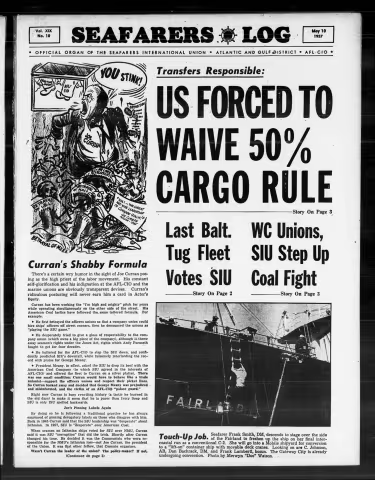
Curran's Shabby Formula
There's a certain wry humor in the sight of Joe Curran pos
ing as the high priest of the labor movement. His constant
self-glorification ^nd his indignation at the AFL-CIO and the
marine unions are obviously transparent devises, Curran's
ridiculous posturing will never earn him a card in Actor's
Equity,
Curran has been working the "I'm high and mighty" pitch for years
while operating simultaneously on the other side of the street. His
American Coal tactics have followed the, same tattered formula. For
example:
• He first betrayed the officers unions so that a company union could
hire ships' officers off street corners, then he denounced the unions as
"playing the SIU game."
• He desperately tried to give a gloss of respectability to the com
pany union (which owns a big piece of the company), although it threw
away seamen's rights under the Jones Act, rights which Andy Furuseth
fought to get for four decades.
• He hollered for the AFL-CIO to slap the SIU down, and confi
dently predicted SIU's downfall, while fulsomely interlarding the rec
ord with praise for George Meany.
• President Meany, in effect, asked the SIU to drop its beef with the
American Coal Company (to which SIU agreed in the interests of
AFL-CIO) and offered the fleet to Curran on a silver platter. There
was one small condition: Curran would have to behave like a trade
nnionist—support the officers nnions and respect their picket lines.
So Curran backed away and decided that George Meany was prejudiced
and misinformed, and the victim of an AFL-CIO "palace guard."
Right now Curran is busy rewriting history (a tactic he learned in
the old days) to make it seem that he is purer than Ivoi'y Soap and
SIU is only ISU spelled backwards.
Joe's Pinning Labels Again
By doing so he is following a traditional practice he has always
employed of pinning derogatory labels on those who disagree with him.
Back in 1945 Curran said that the SIU leadership was "desperate" about
Isthmian. In 1957, SIU is "desperate" over American Coal,
When seamen on Isthmian ships voted for SIU over NMU, Curran
said it was SIU "corruption" that did the trick. Shortly after Curran
bhanged his tune. He decided it was the Communists who were re
sponsible for the NMU's Isthmian loss—not Joe Curran, the president
of the Union, It was tl^at other fellow, that Commie organizer.
Wasn't Curran the leader of the union? The policy-maker? If not,
(Continuea da page 2)
Transfers Responsible:
US FORCED TO
WAIVE 50%
CARGO RULE
Story On Page 3
Last Bait. WC Unions,
Tug Fleet SIU Step Up
Votes SlU Coal Fight
-Story On Page 2 -Story On Page 3
TMM0>h If n l#kla Seafarer Frank Smith, DM, descends to stage over the side
ff UUCn-Up JOU» of the Fairland to freshen up the ship on her final inter-
coastal run as a conventional C-2, She will go into a Mobile shipyard for conversion
to a ''lift-on" container ship with movable deck cranes. Looking on are C, Johnson,
AB, Dan Bachrack, DM, and Frank Lambert!, bosun. The Gateway City is already
undergoing conversion. Photo, by Merwyn "Doc" Watson,
Page Two SEAFARERS LOG May 10. 1957
New Ship To Honor Memory Of Harry Lundeberg
The newly-launched Kaiser Gypsum is shown on her maiden voyage from Japan to the US, The ship
will be renamed the SS Harry Lundeberg in honor of the late secretary-treasurer of the Sailors Union
of the Pacific, replacing an older ship on the same run. She was built in Japan.
Ship Giveaway Bids Rise
WASHINGTON—There were indications this week that the Government will step up the
disposal of its reserve Libertys under terms of the Ship Sales Act of 1946. Foreign nations,
which have cast longing eyes toward the reserve fleet, are quickly getting in their bids.
—~— *• Maritime Administrator
I
Curran's Shabby Formula
(Continued from page 1)
then he admitted by Indirection he was nothing but a stooge tor the
Party.
Just in case the "desperate" and "corrupt" SIU should hand him
another setback In American Coal, you can be sure Curran has picked
out another purge victim. After all, there was one scapegoat for Isth
mian; a few more for his setback by Harry Bridges In the contest for
boss of the CMU; three more in 1954 to cover up the peddling of NMU
membership books; another one in 1956 to excuse his fold-up on the
hiring hall and throwing open the NMU's books to all comers.
Apparently, it wasn't for nothing that a New York Times story com
mented fairly recently on the "quicksands" outside Joe Curran's door.
Our sympathies to NMU national officers who undoubtedly find that
sleep comes hard these nights.
No matter how Curran struggles to conceal, to distort and to rewrite
history It can't be done. He can't wipe out the record of the day that
he hailed the "great and wise leadership of Comrade StaUn" from a
Moscow podium in a Moscow meeting hall. Ho can't destroy the fact
that he called Roosevelt a warmonger, John L. Lewis an ally of Hitler,
Walter Reuther one who played Hitler's game.
He can't wash the record clean of his speeches to free Earl Browder,
to make sure the "Yanks Are Not Coming" during the Nazi-Soviet
honeymoon; to "open up a second front" Immediately afterwards even
though such action would have meant the slaughter of untrained and
under-equipped American troops.
Nor can he destroy the story of his personal role in the "Bring the
GIs Home" campaign. In which the Communists used the NMU as a
spearhead to strip Europe and Asia of American troops and make Rus
sia's path smoother.
Granted that many Americans were part of the game in those days,
aome innocently, some not so innocent. The sincere ones have long
since admitted their error dnd the record is full of their remorse.
When did Joe Curran, In all the millions of words that have poured
from him since, ever repudiate his role In any of these events. When
did he show the sUghtest twinge of guilt, admit that he was wrong or
merely misled?
Does he still maintain that what he did then was right?
Today, Curran plays the same kind of game in a different league.
He portrays himself as a defender of the hiring hall, but he faithfully
maintains a company blacklist for US lines just like It used to be done
In the days of the ISU and the US Shipping Board. Shipowners no
longer need insist on a "flnk book"; Joe Curran keeps the record for
them.
Today he sups at the table of US Lines as an officer of a labor-
management committee that is nothing more than a front for the com
pany's interests. Today he works on behalf of a company union against
the interests of the legitimate marine unions. And only recently he
'bucked the AFL-CIO by supporting the expelled ILA against the
Federation-chartered IBL. Today he tags those who disagree with him
with the same dog-eared labels he used 20 years ago, labels he picked
out of a Communist Party primer.
- Why does Curran rewrite history this way? Why does he pointedly
ignore certain events and periods in his past? Why, instead of tackling
the blacklist and other problems facing his membership does he spend
bis energies attacking the SIU and other unions? The answer is obvi
ous. This is the age-old tactic of diverting attention from internal
difficulties and his own misdeeds by raising an imaginary bogeyman.
It is apparent that the only way Joe Curran can operate Is to pose
as the only defender of the faith and the salvation of the NMU, whereas
In actuality he is the NMU membership's own worst enemy. It was he
who involved NMU with a company union, it was he who had NMU
members cross the AFL-CIO marine officers' picket lines. It was
Curran who fed the NMU membership lies about the meeting with
George Meany. And Curran was the one who turned down Mieany's
proposal when it would have given NMU the coal fleet. No wonder
then, that Curran always has to create an emergency to cover up his
Jr. ti9i(.a7S Jush'iJfit.
Clarence Morse has already
publicly declared {hat he
would like to see every one of the
1,400 "old pots" in the Govern
ment's reserve fleets sold to for
eign interests. And Congress has
displayed a similar inclination
with the apparent approval of the
Administration.
The latest moves along these
lines have been the introduction
of a bill in the House proposing
tlie sale of the 15 sliips—including
eight Libertys—to Guatemala, and
the introduction of joint resolu
tions in the House and Senate pro
posing the sale of six Libertys to
Germany.
A number of other countries, in
cluding Brazil and Korea, have al
ready gotten US tonnage and
pthers are in line, hat in hand.
The Guatemala proposal, in par
ticular, has drawn the Are of one
authoritative spokesman who de
clared that the legislation would
not tie the ships down to Guate
mala's coastwise trade, as did pre
vious laws enacted on Brazil and
Turkey.
No Coastline
Guatemala's shoreline is so
small, this spokesman pointed out,
that 15 ships are more than she
needs. Included in the deal are
the eight Liberty cargo ships, one
Liberty tanker, four Cls and two
Victorys, and this leads to the pos
sibility that Guatemala will sell
the two Victorys foreign to get
enough money to pay for the 13
other vessels.
The joint House-Senate resolu
tion on Germany has so far drawn
less opposition. This would limit
the use of the six Libertys, for
the next seven years, to the trans
portation of coal and/or ore, pur
chased in the US, to Western Eu
ropean ports. The vessels would
be required to operate in ballast
on their return runs to this
country.
Apparently it is the feeling in
Congress, as stated in the joint
resolution, that the Libertys now
in the reserve fleets are of ques
tionable value for defense and are
not readily adaptable to profitable
commercial operation under the
American flag. Their disposal, the
resolution states, would eliminate
further cost to the US for their
storage and upkeep.
MA support for the disposal of
the Libertys amounts to a confes
sion that its much-ballyhooed Lib
erty "upgrading" program is a fail
ure, though some of the ships have
ajttained up to 18 knots.
Sixth Tug Co. Vote
Gives Sitr Clean
Sweep In Baltimore
B.\LTIMORE—Crewniembers of the last of six tug com
panies in the Greater Baltimore area have voted unanimously
in favor of the SIU. Tugmen employed hy Arundel Sand
and Gravel cast 19 ballots for,-*'— —
none against, the SIU Harbor
and Inland Waterways Divi
sion, giving the Union a clean
sweep of the port.
The Arundel vote wound up
series of elections which gave
the SIU a total t)allot margin of
146 to 9 in the harbor. Opposing
the Union was District 50 of the
United Mine Workers which had
urged the tugmen to vote "no un
ion." The overwhelmingly-success
ful Baltimore vote followed an im
pressive HIWD contract victory
among tugmen of G&H Towing.
The agreement won there provided
conditions far superior to those
existing in Baltimore.
In another, separate election in
March, the SIU also scored a clean
sweep, winning 28 to 0 among barge
men and bridgemen of the Western
Maryland Railway Company.
With the Arundel election out of
the way, the SIU is now prepared
to negotiate for substantial gains
In wages and conditions, as well as
welfare protection for the tugmen,
to help close the gap between Bal
timore and other Atlantic and Gulf
ports.
The other five companies which
voted SIU were Curtis Bay Towing,
Harper Towing, Baker and Whitely,
Baltimore Towage and Lighterage
and Atlantic Transport.
These companies represent the
entire tug and barge industry in
the Greater Baltimore district.
They operate approximately 49
tugs and x)ther types of harbor ^
craft. The elections represented
the climax of a year long organiz
ing campaign by the SIU in the
area. .
Select First
2 Victorys
For Isthmian
WASHINGTON — Two Govern
ment-chartered Victory ships will
be put into service for Isthmian
Steamship Company around July
1, following Government approval
of the company's application for
eight such ships. The vessels will
be used on the Persian. Gulf and
India runs.
The two ships selected thus far
are the Selma Victory, now in the
Hudson River reserve anchorage
and tlie Belgium Victory, which is
in the James River fleet. They will
be operated on an 18 month-char
ter in Isthmian's regular berth
service. Six more ships have been
tentatively selected by Isthmian
but final decision has not yet been
made on their disposition.
SCHEDULE OF
SIU MEETINGS
SIU membership meet
ings are held regularly
every two weeks on Wed
nesday nights at 7 PM in
all SIU ports. All Sea
farers ore expected to
attend; those who wish to
be excused should request
permission by telegram
(be sure to include reg
istration number). The
next SIU meetings will be:
July 10
May IS
-May 29
June 12
June 26
Ala. River
Act Boost
To Mobile
MOBILE—^The first major step
in the long-awaited Alabama River
system improvement program was
initiated with the granting of bids
for the construction of a terminal
and loading ramp.
Cal Tanner, port agent, reported
that the terminal site is a small
centrally located river town. On
completion of the terminal, ship
pers in northern Alabama, and in
adjoining states, will be able to
send deep sea cargo straight down
the river to the Port of Mobile to
be transferred to ocean-going ves
sels. Besides being a help in speed
ing the handling of cargo, the ter
minal will also mean many more
tug operations for the SIU Harbor
and Inland Waterways Division.
Although shipping itself has been
fairly slow during the last period,
most Seafarers on the beach have
been able to find relief jobs. About
120 members took various jobs
around the harbor and some 60
more picked up work with MAWD.
There were 15 vessels calling in
to port during the last two weeks.
They were the Del Valle, Del Sol,
Del Mar (Mississippi); the Pointer,
Pioneer, Cavalier, Polaris, Clipper
(Alcoa); Morning Light, Yaka,
Monarch of the Sea, City of Alma,
Azalea City (Waterman); Steel De
signer (Isthmian), and John B.
Kulukundis (Martis).
Prospects for the next period,
he says, look pretty good with
some 14 ships expected in for pay
off or as in-transits. In addition,
the Citrus Packer will take on a
full crew within the next 10 days
after being in the yards for survey
and repairs.
SEAFARERS LOG
M.y 10. I»7 V.I. XW No. 10
PAUL HALL. Secretary Treasurer
HEBBERI BRAND, Editor. BERNARD SEA
MAN, Art Editor. HERMAN ARTHUR. IBWW
SPIVACK. AL MASKIN, JOHN BRAZIL, StaF
Writers. B'.~L MOODT. Gulf Area Repre
sentative.
Publlihed blwaekly at tha haadquartara
of fha Saafarars Intarnatlonal Union, AN
lantic & Gulf District, AFL-CIO, 675 Fourth
Avanua, Brooklyn 32, NY. Tal. HYaclnth
»-6600. Entarad at sacond class matfar
at tha Post Off lea In Brooklyn, NY, undar
tha Act of AVS. 24, 1*12.
120
! ' l.'J ii.'S?" •„ tt.o.iij, -
--" '
10, 195T SEAFARERS LOG Pare Three
With SlU patrolman Ray Oates (2nd from left) looking on, SlU
and SUP deck men line up for the sign-on on the cool ship Martha
Berry in Savannah. In order (I to r) are Karl Schroeder, SlU; John
Munden, SlU; Ed Steenson, SUP; NMU man (felt hat); and Nick
Sargent, SlU. The shipping commissioner (left) was K. A. Jorgen-
son. SlU is still leading NMU in the competition for jobs on all
seven ships crewed so far.
Transfers Compel
Gov't To Bypass
'SO-SO' Ship Law
WASHINGTON—^Thanks to wholesale transfers to foreign flags, the "50-50"
law will probably have to be bypassed this year on bulk cargoes, the International
Cooperation Administration reports. Transfers have so decimated the US tramp
fleet that there are simply
not enough American ves
sels around to carry US
shipping's share of "bulk for
eign aid.
•As a result, for the first
tlm» since the "50-50" principle
was enacted, the US tramp share
of such cargoes may fall below the
minimum set by law in the fiscal
year ending June 30, 1957. The
Sailors, Cooks, Firemen, A&G
Step Up Joint Fight On ACS
With the American Coal organizing drive pushing into the home stretch, the SIU Atlantic
and Gulf District and the three West Coast unions of the SIU's Pacific District have joined
hands to assure coordinated action in the campaign. A coordinating committee has been
formed consisting of the heads
of the A&G District, the Sail
ors Union of the Pacific, the Ma
rine Firemen's Union and the Ma
rine Cooks and Stewards Union.
Upon formation of the commit
tee, its members—Morris Weisber-
ger, secretary-treasurer, SUP; Sam
Bennett, president, MFOW:EdTur-
Turner Bennett
ner, international representative,
MCS, and Paul Hall, secretary-
treasurer, A&G District—issued a
joint statement, which included a
call to oldtimers in each of their
organizations "to participate in this
important American Coal Shipping
Company.
Shipping
"This is a beef," the Joint state
ment said, "in which only oldtimers
can help. The Job cannot be done
by the younger men In the indus
try. All of us know of the solid
oldtimers—good union men—who
can draw on their years of experi
ence at sea to help win this impor
tant campaign, which is being
waged in the interests of sound
trade union principles.
"Each of our organizations—the
Coal Beef Stirs
Sea Vet Action
SUP, the MFOW, the MCS and the
A&G District—was made strong by
the kind of men who are now
needed in the American Coal beef,"
the joint statement continued.
"Many such oldtimers from each of
our unions have already come for
ward and are participating in this
beef. More are needed, and our
unions are asking those oldtimers
who have not done so to con
tact their own union representa
tives who can give them the de
tails on how they can help on this
Joint effort."
Ship Due Next Week
The Joint SUP-MCS-MFOW-A&G
committee emphasized that even
though seven of the company's
ships have been crewed initially,
oldtimers are needed to compete
for seven very important jobs
ICA declared that "a larger number
of waivers of this requirement
may now have to be granted." In
other words, transferred ships and
other foreign flag vessels are now
reaping a harvest of cargo that
would have gone on US tramp ships
if such vessels were available.
The inability of the Government
to locate unemployed US tramps to
carry cargo at today's top-heavy
freight rates substantiates SIU
charges that the ship transfers are
not prompted by hardship. It in
dicates that tramp owners could
make a comfortable living under
the American flag, but prefer the
tax-free status that Liberia offers
them no matter what preferences
they get under the "50-50" law.
In the liner field, the ICA adds,
the "50-50" law is liable to be ob
served because there will be suffi
cient space available.
US Share Declines
The decline in US ships' percent
age of "50-50" cargoes follows a
sharp drop the US-flag share of for
eign commerce generally. Running
between 22 and 25 percent in re
cent years, latest figures show that
US companies are now carrying
little more than 18 percent of the
nation's foreign commerce. The
ideal, as viewed by the authors of
the 1936 Merchant Marine Act un
der which the subsidy program was
established, was for US ships to
aim for half of the country's for
eign trade.
'56 A 'Good Year'
In contrast to the current figure,
the ICA reports that during the
1956 fiscal year US ships carried
more than half the foreign aid ship
ments in all categories. Tramps
got 52 percent of the total of tramp-
type cargoes. Liners got 71 per
cent and tankers, which played
only a minor role in these move
ments, got 76 percent.
Figures for military cargoes show
70 percent moving on US ships
with an average of 60 percent
maintained since the Mutual Se
curity Program began? Other cate
gories of shipments also were in
the vicinity of 60 percent.
In light of the trend, any fur
ther large-scale transfers of US
freight tonnage would largely nul
lify the effect of "50-50" for which
the SIU and other sea unions
fought for many years. The law
permits the various agencies in
volved to waive it when US ships
are not available.
the SAVANNAH—The smoke has finally cleared from
"Battle of the Oldtimers" in the American Coal beef.
Those left "behind from the crewing of' the Martha
Berry and Harry L. Glucks->
man have gone north to Nor-'
folk to try again and are being
joined by seagoing veterans pour
ing in from ports on every coast.
There's been nothing like this
to fire the imagination and spirit
of the oldtimers since Korea, and
before that World War II, when
thousands came out of relkement
and from the comfort of shoreside
jobs to meet the shipping
emergency.
Notir, as in those days, oldtimers
from the SIU, the Sailors Union,
Marine Firemen and Marine Cooks
have been converging on East
Coast ports where the coal ships
have been crewing up since March.
These men remember the long,
bitter struggles of the 20's and
SO's from first-hand experience.
Many are sailing below their
regular ratings just to participate
In this important campaign.
The success of their efforts is
highlighted in the boxscore on the
Jobs put up for competition so far.
96 SIU men are now on the coal
ships compared to 87 from the
NMU. A built-in NMU margin of
six more jobs still holds the count
to 96-93.
Seniority in the industry counts
most in qualifying for the coal jobs
under the Federal hiring order,
and you can't go much further
back than sailors union veterans
like Carl Landberg, who came
east from Seattle with 43 years'
of discharges to his credit. Land
berg threw in and earned a deck
utility's job on the Martha Berry
with ease.
There were others like John
Williams, the oldest of the oldsters
who came here to show their stuff.
One of many men from the Marine
Cooks and Stewards Union to
pitch in on the beef, Williams
produced 48 years of discharges
to land a messman's job on the
Harry L. Glucksman,.
A full half-century of seatime
(Continued on page 18)
Weisberger Hall
aboard the Casimir Pulaski, coming
in next week, as well as for replace
ment jobs that might turn up on
any of the other six American Coal
ships as they come into port.
Many of the West Coast brothers
have already answered the call and
reinforced the A&G District in its
(Continued on page 13)
As the SEAFARERS LOG was
going to press word was received
that a Seafarer on the Martha
Berry had to be replaced be
cause of illness. SIU standby-
eligibles had first call on the
replacement because they had
the seniority under the court
order. Nevertheless, the com
pany awarded the job to an
NMU, making the score 95 to 94.
This follows the developing
pattern of company favoritism
for the NMU in spite of the pro-
cednres speUed out in the court
order. The SIU is preparinff to
take legal action accordingly.
Ist Cook School
Opened By MCS
SAN FRANCISCO—The nation's first training center for
marine cooks and stewards, was opened on May 3 on a 400
acre site in Sonoma County, California.
Dedicated to the mainte-"*"^ ^ "
nance of high cuisine stand
ards, the joint union-manage
ment center was built by the SIU-
affiliated Marine Cooks and Stew
ards Union and the Pacific Mari
time Association, an association of
West Coast, shipowners. The cen
ter will offer tuition-free training
for young men who wish to become
cooks and stewards on Pacific Coast
passenger liners and freighters.
Opening of the center-was hailed
by the SIU in a telegram of con
gratulation from SIU Secretary-
Treasurer Paul Hall which read in
part: "The opening of the MCS
Training School is a very signifi
cant step forward and is a strik
ing symbol of the tremendous prog
ress you people have made in the
brief period you have been func
tioning ... We are confident that
the future will be studded with
equally important gains and bene
fits for our sisters and brothers
who sail under the banner of the
Marine Cooks and Stewards . . ."
• The training program consists of
three-month comprehensive
courses under capable and well-
known instructors in all phases of
cooking, baking, butchering, and
waiting.
The' $500,000 Installation boasts
a rustic style administration and
classroom building, student and
guest duplex cabins, a $50,000 all-
electric kitchen, and cooking and
dining facilities for 200 persons.
The staff of the school includes
administrator Karl Schneider, for
mer passenger liner chief steward
and wartime instructor for the US
Maritime Officers Training School;
chef Constantine Bruckner, former
executive chef of US Lines; meat
cutter Suey M. Chew, graduate of
the National School of Meat Cut
ting and former SS Lurline butch
er, and baker Henry Chinn, well
known craftsman in the culinaiy
arts.
Also Vacation Spot
In addition to using it as a train
ing center, the union has plans to
develop the mountain woodland re
treat into a vacation spot for sea
men and their families and to pro
vide a low cost year-round home
for retired seamen. The former
mountain estate of a wealthy rail
road executive has a trout-stocked
lake, swimming and boating facili
ties, riding paths and a hunting re
serve.
Guest speakers at the dedication
ceremonies which was attended by
some 300 representatives from
Government, Labor and the marl-
time industry included Lieut. Gov
ernor Harold Powers; C. J. Hag-
gerty. Secretary of the California
Federation of Labor; J. Paul St.
Sure, President of the Pacific Mari
time Association; Ed Turner, Mor
ris Weisberger and Sam Bennett
of the Seafarers Pacific District;
John . Hawk, Secretary of the Sea
farers International Union, and
John Hennlng of the State AFL
and neutral trustee of the center.
Pas« Four SEAFARERS LOG May 10. 1957
Health Center impresses Visitors
Visiting delegation of Japanese trade unionists gets a close-up
view of modern x-ray equipment at SlU health center in Brooklyn
as technician Benjamin lannotti explains how it works. They visited
center during State Department-sponsored tour of SlU facilities.
(See feature on health center in centerfold.)
Seatrain Plans
Added Services
The SlU-contracted Seatrain Lines, Inc., has announced
the acquisition of two large waterfront properties at Sa-
wanah, Georgia, and Edgewater, NJ, near its present docks
Graham Brush, the chair-"
man of the board of directors,
stated that the company has
agreed to a 50-year lease with the
Savannah District Authority cov
ering the old Southeastern ship
yard property on the Savannah
The Marine Firemen's Union has
announced that its new hall will
he completed and opened on June
1. The new building, now under
construction, is located at 240
Fremont Street, San Francisco,
"just a stone's throw from the
Sailors Union of the Pacific." The
State of California had condemned
the Union's present building to
make way for the building of a
freeway.
4. t 4.
Burglars broke into the Portland
hall of the Sailors Union of the
Pacific and made off with a clock-
radio from the agent's office and
checks totaling over $2,600. All of
the checks, except one for $200,
have been recovered. The burglars
also attempted to take the televi
sion set, but probably found it too
heavy to cart out and left It at
the door. Two suspects are being
held foig questioning.
t J. - 3^
An AFL-CIO sponsored disability
proposal for increased weekly un
employment disability and hospital
benefits has been voted for by the
California Assembly Finance and
Insurance Committee, the Marine
Cooks and Stewards report. The
bill would increase weekly unem
ployment disability from $40 to
$50, and would raise hospital bene
fits from $10 a day for 12 days to
$12 a day for 20 days. It also calls
for the elimination of a 75 percent
rule under which benefits are
reduced for seasonal workers who
earn more than 75 percent of their
annual wages in any one calendar
quarter.
River and adjacent areas. He also
stated that they had reached an
agreement for all of the waterfront
property of the Archer-Daniels-
Midland Co. at Edgewater, NJ,
just a few hundred feet,from the
present Seatrain terminal.
Expansion Program Underway
These acquisitions. Brush said,
are part of the company's new ex
pansion program. Earlier the com
pany had announced plans for the
building of a new freight ship.
Details as to the type and size of
the vessel have not been releas%d.
Seatrain was a pioneer in the
development of hauling complete
rail freight cars. There is a possi
bility that the new vessel may be
of a type similar to the ships now
being built by Pan-Atlantic Com
pany in its land-sea trailership
operations. These vessels are spe
cially built to accommodate the
stacking of trailers, one on top of
the other, in the vessel's holds.
Although loaded and unloaded in
a similar manner as the freight
cars, the Pan-Atlantic trailer-
trucks have the advantage of not
requiring railroad tracks running
the length of the docks and dock-
side loading installations.
Money Exchange
Rates Listed
The following Is the latest
available listing of official ex
change rates for foreign cur
rencies. Listings are as of
May 9, 1957, and are sub
ject to change without notice.
England, New Zealand, South Africa:
$2.80 per pound aterling.
Australia: $2.24 per pound sterling.
Belgium: 50 francs to the dollar.
Denmark: 14.45 cents per krone.
France: 350 francs to the dollar.
Germany: 4.2 marks to the dollar.
HoUand: 3.7-3.8 guilders to the
dollar.
Italy: 624.8 lire to the dollar.
Norway: 14 cents per krone.
Portugal: 28.75 escudos to the dollar.
Sweden: 19.33 cents per krona.
India: 21 cents per rupee.
Pakistan: 21 cents per rupee.
Argentina: 18 pesos t-. 'he dollar.
BraiU: 5.4 cents per cruzeiro.
Uruguay: 82.63 cents per peso.
Venezuela: 29.85 cents per bolivar.
M in the M...
Caution should be the byword of everyone on o ship. The
flashy grandstand play belongs on the circus lot or the rodeo
arena; it's out of place on a ship and may even endanger the
next guy, who's counting on you to follow the book.
Core in carrying out the routine, day-to-day tasks aboard ship
will always pay dividends. Teamwork among shipmates is what
counts most in bringing the ship, cargo and all personijel safely
into port every time. The crewmember who thinks he can go it
alone not only endangers his own safety, but also boosts the odds
against everyone else.
Once in c while, certainly in an emergency, the job cafis for
something special, and seamen have always proven themselves
equal to the occasion. But in the long run, taking extra chances
when it's not necessary is looking for trouble.
The seaman who knows his job and his ship is the best insurance
against potential disaster, big or small. As the statistics clearly
show, there are enough occasions in this business when you have
to take chances because the chips ore down and there's no
choice. But while things are going smoothly, keep 'em that way.
Trouble never chases anyone; it's always the other way around.
A sailor who's looking for excitement con find it ashore.in
ample quantity between trips. Once you start up the gangway
again, concentrate on the job ahead. That's the best way to be
sure you'll see port again.
- "
Remember
Caution
Pays Off I
j An SlU Ship is a Safe Ship |
May 10. 195T SEAFARERS LOG Paye Fiv*
I'
^ee A-Ship
Commercial
in 7 Years
A commercially-useful atom-
powerad merchant ship may be
closer than is commonly thought.
The US already has atom subs, of
course, and now is building its
first atom-powered merchant ship.
But this is an experimental vessel
and up until now it had been felt
that commercially profitable atom-
powered ships would not appear
for, many years. Now, however, the
weekly publication "Pacific Ship
per" reports that atom-powered
ships will be an "economic reality"
by 1964.
What's more, "Pacific Shipper"
says, both the Isbrandtsen Com
pany and Matson Navigation have
displayed interest in atomic power
and have been given access to
certain confidential and restricted
data of the Atomic Energy Com
mission.
The closeness of commercial
atomic power, the periodical says.
Is one reason why there has been
little opposition to the Govern
ment's cut of shipbuilding funds,
as requested by the MA, from
$941^ million down to a mere $3
million. With the atomic age so
near, vessels built, now could be
out-of-date as soon as they left the
ways.
INPIRING SEAFARER
Question: Do foreign countries and persons bear any resemblance
to the way they are portrayed in American movies or books?
Kern Hills
On Arab
Blacklist
Representatives of the Arab
League have announced in Damas
cus that they will blacklist the SIU-
manned tanker Kern Hills for car
rying oil to Israel. The Kern Hills
made the first voyage to Eilat, Is
rael, opening up the Gulf of Aqaba
to ocean-going vessels. Arab coun
tries have maintained that the
Gulf of Aqaba at the head of the
Red Sea is territorial water of
Egypt and Saudi Arabia and can
not be opjened for Israeli shipping.
The Arab League announcement
means that the Kern Hills would
be barred from all Arab ports in
cluding oil terminals in Saudi
Arabia.
The oil that was delivered in
Eilat came from Iran, which is not
a member of the Arab League. Fol
lowing the furore over the first
voyage, the Arab nations called on
Iran to refuse to supply oil to
the tanker.
At last report, according to
ship's delegate Frank Throp, the
Kern Hills was supposed to make
"three or four" more voyages to
Eilat. No word has been heard of
her whereabouts in the past couple
of weeks.
Another SIU tanker was in the
news last week as the second
American ship to pass through the
Suez Canal since it reopened. The
tanker Ivy, on the way home from
a long siege on the shuttle run,
passed through the canal north
bound following the transit of the
President Jackson of American
President Lines. The Ivy paid
her canal tolls under protest as
American ships have been in
structed to do by the State De
partment.
The Kern Hills voyage came
shortly after the SIU of NA con
vention passed a "freedom of the
seas" resolution calling for free
passage for all ships in the Gulf of
Aqaba and for opening of the Suez
Canal to Israeli, flag shipping.
Sinpllcie Mansan, eh. eook: Gen
erally American actors do portray
foreign persons
' ' ' ' Just as they are.
They do have
some trouble us
ing the same ges
tures, but other
wise there is a
close resem-
blance. I think
they have the
most difficulty in
imitating the Chinese. They may
copy the costumes and scenery, but
not the manners or actions of the
people.
4" t t
C. L. M. Gonzalez. AB; American
authors do a vei-y good job writing
on a foreign
country. Any
good actor should
be able to com
pletely portray
any type of per
son, foreign or
not, right down
to their gestures.
That's part of
their business,
and I think they do a very fine
job at it.
4- 4" 4«
George Hines, FWT: No. Outside
of the direct scenery shots, most
of the American
movies grossly
overstate the con
ditions in these
countries. They
never show these
conditions as bad
as they really
are, but always
make them seem
a lot better, show
the good side always.
4 4 4
Peter Choplinski, OS; I think
Hollywood does a very good job
in imitating the
characteristics of
a foreign coun
try. A good
American actor
can portray any
type of person,
whether he be an
Italian, Egyptian,-
or Chinese. The "
movies try to
copy, as close as possible, the gen
eral conditions of the country.
SF Healthy
On Shipping
SAN FRANCISCO—Shipping In
this area has continued on the
healthy side with some 16 vessels
hitting port during the last two
weeks.
There were two pay-offs with six
vessels signing on, and eight ships
stopped In to be serviced. The
Ocean Evelyn (Ocean Transport)
and Raphael Semmes (Waterman)
paid off while the Afoundrla,
Wacosta, Choctaw (Waterman);
Charles Dunaif (Colonial); Ocean
Evelyn and Ocean Joyce (Ocean
Transport) signed on.
The Hurricane, Wacosta, Choc
taw. Iberville (Waterman); Coe
Victory, Jefferson City Victory
(Victory Carriers); Steel Ar
chitect (Isthmian), and Portmar
(Calmar) were in-transit. All were
in good shape with no beef re
ported.
George Fiance, carp: Shooting
the scenes over there makes the
movies more
realistic. But they
do not portray
the people as
they are. An ac
tor must live in
the country to be
able to correctly
imitate the char
acteristics of the
native. This goes
for books too. If the author never
lived in the country, how can he
write about it?
4 4 4
R. A. Barrett, ch. elect.: There
is a general resemblance. But I
think that they
overplay some
parts, as the
limey accent. It
is only the cock
ney who speaks
with the real
"h" dropping ac
cent, yet our
movies seem to
show that all the
English speak that way, which is
certainly incorrect.
Seafarers Lick
Fire On Kafhryn
SAN JUAN—Seafarers aboard the Bull Line freighter
Kathryn here fought for several hours before they were able
to douse a fire which broke out in a jute cargo in No. 4 hold.
The cause of the fire was^
not known, with spontaneous
combustion considered the
most likely offender.
The fire, which did an estimated
$50,000- damage according to a
company spokesman in San Juan,
broke out on Friday morning,
April 26. Ship's reporter Mike R.
Zelonka wrote that "the fire alarm
bell broke out the officers and men
at 5 AM r.nd immediately crew-
members were at the scene with
fire hoses and
other equipment
ready for use.
"Captain Olsen
and chief mate
Robert Bradford
went down into
the smoke-filled
hold and it was
quickly decided
to cover up the Zelonka
hatch and smoth
er the burning jute with C02. In
this way, together with water
hoses being used on top of the
tarp-covered hatch and on both
sides of the ship, the fire was
finally brought under control.
"I would like to mention the
fact that Captain Olsen expressed
himself as 'gratified with the
swift manner and complete coop
eration of members of the crew.'
We also had excellent cooperation
from the San Juan fire depart
ment 'and the US Coast Guard."
No injuries were reported as a re
sult of the blaze.
The vessel continued on her trip
to Mayaguez, Dominican Republic
and returned to New York without
furthqr Incldeqt,
Short handed?
If a crewmember quits while
a ship is in port, delegates
are asked to contact the hall
immediately for a replace
ment. Fast action on their part
will keep all jobs aboard ship
filled - at all times and elimi
nate the chance of the ship
sailing shorthanded.
Onassis Tankers Fly Coop—
MA Doesn't Seem To Know
WASHINGTON—^US shipping officials are so busy revising the conditions under which
the Onassis interests will transfer 14 ships to Liberia and build three super-duper tankers-
here, that they've apparently lost track of the fact that six of the ships involved became
"runaways" three months ago,"
and a seventh one two weeks
back.
The Maritime Administration has
just disclosed a proposal for so-
called "new conditions" for the
complex ship exchange deal which
is supposed to yielfl one tanker of
100,000 tons and two more about
half as big for US operation. The
construction contract was signed
last December.
Concern expressed during hear
ings on the transfer Issue a few
weeks ago by the House Merchant
Marine Committee produced the
"new" set of conditions. Several
committee members felt that the
orighial transaction-did not have
enough built-in guarantees that the
new ships would ever be built.
Victorys Kept Under US Flag
In essence, the package still calls
for an exchange under which the
SlU-contracted Victory Carriers
Corp. would continue to operate its
fleet of seven Victory ships, plus
the three new tankers when they're
eventually built.
At the same time, the company's
two Libertys and a fleet of 12 tank
ers operated by three other Onas
sis companies, Trafalgar Steam-
^ PHoros
^ ̂foRtes.
•Si. ibtnzY
One of the seven Onassis-owned ships already transferred to
Liberia while the Maritime Administration still debates changes in
conditions for their disposal, the SS Republic is shown with a gash
in her bow from a collision some time ago. She became a "run
away" on Feb. 2, 1957.
ship, US Petroleum Carriers and
Western Tankers would swing over
to the Liberian flag. All but the
Victory Carriers' operation would
be liquidated. The four companies
are under contract to the SIU.
However, more than a month be
fore the House hearings even be
gan, and three months before the
MA produced its proposed "new
conditions" last week, half of the
tankers involved had already gone
foreign.
The parade started on Febru
ary 2 with the Republic and was
followed two days later by the
Federal, thus wiping out Trafal'gar.
By February 28, the Olympic
Games, William A. Burden, Fort
Bridger and Camp Namanu had
followed suit. Then on April 27
the McKittrick Hills joined the
parade. This now leaves Trafalgar
inactive and cuts the US Petro
leum fleet to four ships and that
of Western 'iaukers to one. The
five remaining tankers plus two
Libertys are still to go.
(Congressional concern over
whether the new ships vdll be
built is reinforced by the chang
ing developments in the tanker pic
ture since January 1.
Companies Dump B'ldg Plans
With the tanker boom on the
slow bell, 15 US companies, sev
eral of them SIU operators, have
notified the MA that they have
dropped plans to transfer old ton
nage to foreign registry in return
for building new tankers.
Approval in principle had al
ready been granted in these cases
and others for the transfer of 120
vessels. Including 61 T-2 tankers
and 49 Libertys, in exchange for
the construction of 51 new super
tankers. The cancellations came
from companies which were to
build 16 vessels and transfer about
40 others.
The SIU operators who refused
to use their approval were Triton
Shipping, Panoceanic Tankers,
New Jersey Industries, Webb and
Knapp, Eagle Ocean Transport and
Samuel Wang. In addition. Cities
Service has dropped, for the time
being, plans for construction of
another supertanker.
Pa«o Six SEAFARERS LOG May 10, 1957
! W:,
Tampa Wary
Of. CG Acts
TAMPA—^"The Coast Guard In
Tampa," reports Port Agent Tom
Banning, "is out looking for cases."
In one instance they tried to get
a case against a brother for fight
ing ashore before he was paid off.
The beef was squared away, he
said, warning the brothers that
It shows what the Coast Guard
would do to hang a charge on a
Seafarer if it could.
Activity on the shipping front
Is still good, and promises to con
tinue that way, he said. During the
past period the port had Water
man's City of Alma paying off, and
the Steel Rover, Steel Flyer (Isth
mian), Yaka (Waterman), and Alcoa
Pilgrim (Alcoa) calling into port
while in transit.
The in-transit activity should
start slowing up some. Banning
added, because of the C-25 which
Pan-Atlantic is converting to "dift-
on" containerships. One vessel, the
Gateway City is already under con
version and the Fairland is next.
Accident Victim
Killed in an auto accident on
her way to school, Dolores
Helen Mynett, 6, was the
daughter of Seafarer Mack
O'Neill of Wilmington, Calif.
The family had moved to Wil
mington just a short time be
fore the accident.
US Welfare Fund Control
Seen; Meany Backs Bills
WASHINGTON—^There is little doubt here that the current
session of Congress will produce legislation aimed at Federal
control and inspection of union welfare funds.
After a conference with '
Secretary of Labor Mitchell,
President Eisenhower an
nounced that he was prepared to
submit proposals on this issue to
Congress that should be enacted as
"speedily as possible." He proposed
the registration, reporting and pub
lic disclosure of all data on uniqji
health and welfare funds, and pub
lic disclosure of all other finan
cial reports of unions, includihg
the amount of dues collected, the
amount in the union treasury, and
the salaries of union officials. The
proposed legislation is largely an
outgrowth of the current Senate
investigation into practices of cer
tain unions.
Meany Supports Proposal
AFL-CIO President George
Meany agreed with the President's
proposals, but went even further
on public disclosure of welfare
funds. "We have long favored,"
Mr. Meany said, "legislation even
more sweeping than the pending
administration bill. These health
and welfare plans, whether oper
ated by unions, by management or
by both jointly, are funds held in
trust for the benefit of workers and
Lk. Charles
Labor Cains
In Election
LAKE CHARLES — Labor is
becoming stronger, politically, in
this port, reports Leroy Clarke,
port agent. In the last runoff elec
tions, of the three men running
for the city council, one was a
strong labor advocate, and the
other two, although not outspoken,
are expected to favor the working-
man's side.
The last period has been slack
In job activities in this area, with
enough men on the beach for any
expected jobs, Clarke said. There
were 11 ships In port during the
last two weeks. The Winter Hill,
Chiwawa, CS Miami, Council
Grove, Bradford Island, Royal Oak,
Government Camp, Winter Hill,
Chiwawa (Cities Seiwice); Ideal X
(Pan Atlantic), and the Val Chem
(Valentine). Tfu;
should be completely safeguarded
from any and all corruption and
mismanagement."
These views, however, were net
shared by management. The Na
tional Association of Manufactur
ers, in a report to its members, de
clared that it was entirely in favor
of legislation covering welfare and
health programs administrated by
unions or unions and management
jointly. However it took a different
attitude towards plans adminis
tered by management alone.
Coming under the NAM's fire is
the Douglas bill, submitted by
Senator Paul Douglas (Dem., 111.).
This measure provides for regis
tration of all employe welfare
plans, including those which es
tablished pension programs, with
annual reports to be made to the
Securities and Exchange Commis
sion, and to beneficiaries.
This, NAM complained, "sweeps
all employer benefit programs un
der federal control, regardless of
their type or past history."
NAM Complains
Both the President and the Sec
retary of Labor expressed the view
that care must be maintained in
proposing new regulations. The
legislature should not rush "head
long, impelled by the hysteria of
the moment, to secure punitive leg
islation aimed at undermining or
weakening the general body of or
ganized labor," commented - Mr
Mitchell.
Uhion representatives are con
cerned that amendments further
limiting union activity far beyond
the "intended scope of the original
bill would be tacked on to any
such legislation.
Fight 'Work Law' Moves
Although accepting the Admin
istration's views on Federal inspec
tion, the AFL-CIO is out to keep
any "right to work" measures from
being tacked on to these bills.
Meanwhile in New York, Gover
nor Harriman has approved legisla
tion aimed at tightening state regu
lation of union funds. But in ap
proving the bill, the Governor
charged that the legislature made
"clearly wilful" omissions in the
bill, particularly in failing to in
clude "employer - administered"
funds under the law's scope.
April 17 Through April 30
Registered
Fort
Boston •
New York
Philadelphia ....
Baltimore
Norfolk
Savannah
Tampa
Mobile
New Orleans
Lake Charles....
Houston
Wilmington
San Francisco...
Seattle
•ooeoeeeeeeee#
••••eeeeeeeeee
••••eeeeeeeeee
I'teeeeeeeeeeee
••••eeeeeeeeee
•••••••e*eeeee
••••••eeeeeeee
(•••eeeeeeeeee
(•••••••••eeee
i«*e»eeeeeeeee
Total
Deck
A
16
76
15
58
11
9
7
30
36
11
19
19
20
25
Deck
A
352
Deck
•
3
26
3
14
11
1
3
3
16
7
9
9
14
22
Deck
B
141
8
60
12
45
6
7
9
18
33
18
26
8
16
16
"A"*-
282
•nt.
7
22
7
8
7
2
3
3
IS
12
3
9
14
22
in..
134
stew.
A
5
46
9
28
6
3
4
24
39
6
16
8
15
24
Stew.
A
233
Shipped
Port Deck
A
Boston 5
New York 70
Philadelphia 7
Baltimore 35
Norfolk 9
Savannah 2
Tampa 4
Mobile 24
New Orleans 53
Lake Charles 5
Houston 15
Wilmington 14
San Francisco 15
Seattle 10
Total
Deck
A
268
Deck
B
2
14 .
1
6
1
1
7
0
13
2
10
11
14
8
Deck
B
90
Deck Ing.
C A
Ing. Ing.
B C
Stew. Stew.
A B
0
15
0
4
2
0
1
0
2
0
7
3
1
13
2
49
8
30
3
5
3
11
29
8
19
14
16
9
1
24
2
14
5
0
1
7
14
6
1
9
17
10
0
21
1
9
.2
2
2
12
8
1
7
16
3
12
1
41
5
27
1
1
7
15
32
3
11
9
18
8
2
10
1
11
3
2
2
5
8
1
1
7
9
4
Deck Eng.
C A
48 206
Eng. Ing.
Ill 96
Stew. Stew.
A - B
179 66
itew.
B
4
13
4
15
12
2
2
1
12
2
3
8
7
15
stew.
B
100
stew.
C
1
7
0
2
0
1
0
1
4
1
8
3
3
11
Stew.
C
42
Totel
A
29
182
36
131
23
19
20
72
108
35
61
35
51
65
Total
A
867
Total
B
14
61
14
37
30
5
8
7
43
21
15
26
35
59
Total
B
375
Total
Reg.
43
243
50
168
53
24
28
79
151
56
76
61
86
124
Total
Reg.
1242
Total
A
8
160
20
92
13
8
14
50
114
16
45
37
49
27
Total
A
653
Total
B
5
48
4
31
9
3
10
12
35
9
12
27
40
22
Total
267
Total
Ship.
14
251
25
138
26
14
27
75
163
27
79
86
96
85
Total Total
C Ship.
186 1106
Total
c
1
43
1
15
4
3
3
13
14
2
22
22
7
36
SlU shipping levelled off again during the past two weeks while registration increased.
The total number of men shipped was 1,106. At the same time, 1,242 men registered for jobs.
The decline reflects the unusual sea-sawing pattern of shipping this Spring, when job ac
tivity would normally be ris-"*-
ing. Last period shipping hit
for the past two a high
months.
Five ports still managed to show
gains over the previous report and
three others remained about the
same as before. Those showing
improvements.- were New York,
Baltimore, Norfolk, New Orleans
and San Francisco. Tampa, Mo
bile and Wilmington held to the
status quo which, for Wilmington,
at least, represented top shipping.
On the other hand, Boston,
Philadelphia, Savannah, Lake
Charles, Houston and Seattle all
declined. Philadelphia and Lake
Charles are very quiet, but Hous
ton and Seattle are still busy.
Black Gang Even
Registration and shipping were
virtually even in the black gang
during the period. This also pro
duced a boom for class C men in
the engine department, which ac
counted for more C men shipped
than the deck and steward depart
ments combined.
A seniority breakdown shows
class A men filling 59 percent of
the total jobs, class B about 24 per-
ment and class C the remainder.
This reflected an eight percent
drop in jobs claimed by class A
men, which translated Into gains
for both B and C men.
The following is the forecast port
by port:
Borton: Slow . . . New York:
Good; C men still getting out in
quantity . . . Philadelphia: Fair . ..
Baltimore: Good . . . Norfolk: Fair
. .. Savannah: Slow . . . Tampa: No
change . . . Mobile: Good . .. New
Orleans: Very good . . . Lake
Charles: Should improve ... Hous
ton: Good . . . Wilmington; Veiy
good . . . San Francisco: Good .. .
Seattle: Good.
^Rights' Showdown
Hears In 4 States
Organized labor is now facing the challenge of "right to
work" legislation in the states of Delaware, Connecticut, Ohio
and Illinois. In all of these states, where Republicans are in
control of the legislature, un
ions are getting ready for a
showdown.
Labor hopes are running
high in Delaware that such a
measure would die after sentiment
seemed to turn during hearings
before the State's Revised Statutes
Committee.
Addresses by Clement J. Lemon,
President of the State Federation
of Labor and Rev. Thomas Reese,
Director of the Catholic Welfare
Guild of the Wilmington diocese,
bitterly denounced one clause of
the proposed bill which would bar
an employer from requiring the
payment of union dues.
"All men have an obligation to
join together In an effort to organ
ize—they have the responsibility to
pull their weight," Father Reese
said. "If a law says that no dues
shall be paid, then we are weak
ening the whole power of the un
ion."
Although this bill had two pre
vious readings in the House, it is
questionable that it will ever come
to a vote.
Ohio's measure tends to limit
labor without actually 'outlawing
the union shop. But another meas
ure Is being proposed which would
tightly restrict any union politi
cal activity.
Connecticut Package Seen
In Connecticut, a joint senate-
house committee held hearings on
a "right to work" proposal but re
frained from taking any action. But
the recall of a minimum wage bill
previously reported on by the
House Labor Committee leads many
labor advocates to believe a pack
age deal Is In the offing which will
include a "right to work" proposal.
Labor leaders In Illinois do not
believe the state legislators, long
outspoken against such wreck
measures, would adopt the pro
posed Brydie "right to work law."
The bill, sponsored by Rep. G. Bry
die, who represents a farpiing dis
trict, Is being used, they said, to
offset union proposals for increased
workmen's compensation and for
an effective state minimum wage.
On the other side, New York and
Maryland legislatures failed to vote
on bills which would restrict un
ion activities. In New York a bllL
which would bar organizational
picketing was withdrawn by Its
sponsor after It was found that it
lacked sufficient votes for Its pass
age. The Maryland legislature ad
journed without acting, after hear
ing on a wreck measure.
Although two previous efforts to
repeal Nevada's right to work laws
have failed, a new bill, supported
by several major employer and
state management groups was pro
posed which would replace the
present law with a plan patterned
after the Federal Taft-Hartley Act.
The measure would allow union
shop contracts, but ban picketing
for organizational purposes and
secondary boycotts.
Keep Draft
Board Posted
SIU headquarters urges all
draft-eligible seamen to be
sure they keep their local Se
lective Service boards posted
on all changes of address
through the use of the post
cards finished at all SIU halls
and aboard ships.
Mar 10, 195T SEAFARERS LOG Fage Seven
YOUR DOLLAR'S WORTB
Seafarer's Guide To Better Boyit^
By Sidney Margolius
The High Cost of Renting Money
Some state governments are finally moving to give the public at least
a little protection against the many installment rackets that have
sprung up in recent years. US families have been subjected to an ex
traordinary bilking. A Senate Committee has been investigating the
credit rackets, but the Federal Government is almost powerless to stop
them because most installment purchases take place within state lines.
Only state governments are in a position to blow the whistle on these
gouges. The shame of the states is that unknown to the general public,
their laws permit sharp practices that can expose you to severe financial
damage when you buy a car, household equipment, home repairs,
jewelry, and other goods on time-payment plans.
What buyers rarely realize is that most sharp practices are perfectly
legal in most states, and even where state laws limit the amount of
finance charges on cars, quite high fees are still permissible.
Only 12 states limit finance charges on cars, and only Ohio limits
the charge on all goods, with a new law in New York State also limit
ing the credit charges on all goods beginning Oct. 1. But only seven
of these ,12 put -real muscle in the finance law by requiring that
finance companies be licensed so
an outraged buyer has a place to
air his grievance, and the state a
way to make lenders comply with
the law. These seven are Connecti
cut, Indiana, Maryland, Michigan,
New York, Pennsylvania and Wis
consin. States that put a ceiling on
finance charges on cars, but forgot
to license the finance companies
are California, Kentucky, Nevada,
Ohio and Utah. People in Colo
rado, Maine or New Jersey are
protected only by straw-man laws
that license auto finance compa-
x.'yw' ^ jr limit finance
charges. Such "regulation" is al
together meaningless, the chief
counsel of a leading finance com
pany recently told this writer.
Little Or No Protection
In other states, consumers have
little or no protection St all. There
have been increasing attempts by
some of the more scrupulous finance companies. Better Business Bu
reaus and other civic organizations to secure legislation barring the
more flagrant overcharges. But such proposals are fought hard by
other finance companies and merchants. In New York, for example.
Assemblyman Bernard Dubin had proposed a ceiling of $9 per $100 of
debt on installment goods others than cars. That's a true interest rate
of about 16 percent per annum, and certainly a costly enough fee to pay
for the privilege of paying on time. But sellers and lenders fought for
a ceiling of 13 percent—a true rate of about 24 percent. That's what
many have been charging on installment purchases. The compromise
ceiling set in the new law is $10 per $100, a true rate of about 18 per
cent. This is better than 24 percent but still an expensive way to buy.
In comparison, Ohio limits the finance change to $8 per $100 of debt.
The state ceilings on auto finance charges in Maryland and Kentucky
are so high they actually legalize the excessive charges they were de
signed to curb. They permit finance fees of $9 to $15 per $100 of bal
ance, which is equal to true interest rates of 16 percent on new cars
and up to 27 percent on second-hand vehicles.
Up To 50 Percent
If you live in an unregulated state, you have no protection at all
against sharp operators. The Spokane Better Business Bureau reports
"general confusion" among buyers about whether the finance charges
they pay are legal (they are), while some car dealers "boast they make
more money from 'packs' than on cai-s." The Roanoke, "Va., bureau
has found finance charges of 20 to 42 percent on television sets. In
Texas, 75 percent of the complaints about car purchases reaching the
Houston bureau concern financing charges. One Eastern finance com
pany is known in the trade as customarily charging 50 percent for fi
nancing older used cars. High auto finance rates in some areas of Ten
nessee are similarly notorious. In Nebraska, a nationwide auto finance
company, perturbed by public resentment of excessive charges, pro-
posad legal limits. But local companies successfully opposed the pro
posed lids of $7 to $13 per $100 as "too low," although these are true
interest rates of 13 percent on new cars and up to 27 on older ones.
Call the roll of the other unregulated states and you get similar reports.
States that regulate installment charges also tend to outlaw the blank
contracts that have been making so much trouble for the trusting buy
ers who sigir their names before the dealer fills in the amounts. But
both regulated states as well as the unregulated ones still permit wage-
assignments, a major source of abuses. For example, Chicago has been
so troubled by canvassers who sell goods at factory gates that the
Illinois legislature passed a requirement that the spouse as well as the
wage-earner must sign any wage-assignments. Salesmen had been
pretending the contracts were merely receipts. Unfortunately, the
Governor of the state vetoed this potential protection against hidden
wage-assignments.
After many incidents involving abuses of wage-assignments, credit
jewelry and furnitiure stores in some cities are now trying to police
themselves, legal aid officials report. But in the absence of laws for
bidding blank contracts and concealed wage-assignments, you have lit
tle legal defense against being drygulched from behind a sheet of
paper. For your own guidance, note that the more reputable retailers
and finance companies do not take wage assignments even in states
vtdiere permitted.
WC Unions
Pool Their
Pension $$
SAN FRANCISCO—An agree
ment merging $7 million in retire
ment and pension funds has been
worked out by the SIU Pacific Dis
trict. The agreement affects funds
formerly operated individually by
the Sailors Union of the Pacific,
Marine Firemen's Union and Ma
rine Cooks and Stewards Union in
conjunction with the operators.
The agreement, which has been
approved by the employer trustees
of the funds, will pave the way to
higher pension retirement bene
fits because of lowered costs of
operation and pooling of service
credits. The moneys of the three
funds wiU be merged for invest
ment purposes and central records
will be kept.
The three unions had announced
their intent to pool their resources
at the last SIU of NA convention.
All three deal with the Pacific Ma
ritime Association on the employer
side, representing the greatest
bulk of West Coast shipping.
SIU Baby
Parade
Mrs. Kathleen
Bannister (at left)
is shown propping
up Robert Jr. so
he con put his best
foot forward out
side their New Or
leans home. The
youngster, born in
1955, is now 2.
Seek Limit On
Drugs In Food
WASHINGTON—A biU to re
quire advance testing of chemicals
to establish their safety before
they are used in foods has been
recommended to Congress by the
US Department of Health, Educa
tion and Welfare.
As things stand now, a harmful
chemical food additive could be In
use for years before any action
could be taken to stop it. As a
rule, a minimum of two years of
scientific research is needed before
.any legal proceedings can be
started.
Policing of these matters is
under the supervision of the Food
and Drug Administration which, in
1954, finally won approval of legis
lation to set up controls over
chemical pesticides used on farm
crops and other raw agricultural
commodities.
The proposed bill would require
chemical manufacturers or others
concerned to furnish the FDA
with scientific evidence upholding
the safety of new or existing ad
ditives. Regulations would then
be issued either permitting or bar
ring their use.
Above, Cynthia Faye
Manley, 6 months, strikes a
fetching pose to show off
her new doll. Dad is Ern
est Manley of Miami.
Backed up by mom (not
shown), Naomi Cruz stands
on her own feet at her first
birthday in the Bronx, NY.
Dad Virgilio Cruz is on the
Robin Mowbray.
President Orders Study
Of Oil Import Reduction
WASHINGTON—President Eisenhower has announced that
he will order an investigation into charges by Gordon Gray,
Director of the Office of Defense Mobilization, that imports of
crude oil into the United •
States are a threat to our na- (affect the movements of US flag
tional defense. ' tankers, but a drop in the offshore
Gray advised the President that
increased importation of oil tends
to discourage exploration in this
country for new deposits on which
we would have to depend in time
of war.
Any cut in imports would surely
"Fii-ior a Seafarer!
THE fOOD AAJI> VRxCeSAiaKOVJM
BAffimsANom/yGRi^siucAFeTmi^
TUE M£M3^flS UN\Of\. VPf^
in VMB YoUkBM1HBl4AlL.
runs would undoubtedly have to
be made up by increased use of
coastwise tankers.
If the President finds this to be
a threat, he is required to ask for
a reduction in the amount of oil
that can be imported. He ordered
Gray to explore the possibility of
having the major importers them
selves set voluntary restrictions on
imports. This, it is suggested,
would avoid the harsher solution
of either a legal quota limitation
or of higher tariff charges.
Ten Percent Limit
It had been determined last Oc
tober by the Energy Supplies and
Resources Committee that imports
should be limited to about 10 per
cent of our national production.
This was the ratio that existed in
1954. But, Gray reported, the ra
tio is expected to run close to 18
percent by the second half of this
year. He said the major companies
plan to import 1,216,000 barrels a
day, 510,000 barrels a day over
the 1954 ratio.
While American imports have
quadrupled since 1946, he said, pro
duction has not even doubled.
Robert L. Wood, president of the
Independent Petroleum Association
of America, which represents the
independent companies who have
appealed the question of import
limitations, agreed with Mr. Gray's
findings, but strongly doubted the
probability of a solution through
voluntary action.
•;V-> \
' % I
I
Pare Elcki SEAFARERS LOG
-•'mmjf
May 19, 1957
. ..rrwrww '"•''''*i*>"»wSwSiiMiiaialiail^^
PROTECT
TOUR
THE first union health center in the maritime industry
is now in full operation, giving thorough heod-to-toeu
physical examinations to Seafarers in the Port of
New York. The center, first of four to be operated by-the
Seafarers Welfare Plan Medical Department, has com
plete facilities for such examinations, including x-ray,
electrocardiograph, fluoroscopy and a modern, well-
equipped laboratory. An experienced group of MDs
and technicians staffs the center. The group is headed by
Dr. Joseph Logue, former medical director of the Isthmian
Steamship Company and a veteran of more than three
decades of Naval medical service as surgeon and medi
cal administrator of Navy programs.
Aside from its first-class equipment, the center has
been designed with comfort and attractiveness in mind.
It is fully air-conditioned and decorated in an eye-pleas
ing manner, with none of the chilling atmosphere usually
associated with medical facilities.
The basic function of the center is to detect and prevent
ailments and physical disabilities before they become
serious enough to affect a Seafarer's ability to work. As
such, the center has the welcome mat out for all Seafarers
who hit the port. All they need do to get an examination
is to ask for on appointment through the Union's Welfare
Services Department at headquarters. The small invest
ment in time involved can pay big dividends in protect
ing a Seafarer's most precious personal possession—his
health and well-being.
HEALTH.
r''
1'^
-
• '"V •'
StW':
1
A1 Tanner, Welfare rep. gives
exam slips to (1 to r) R. Eaton, P.
Boyer, H. Kaufman, B. Wagones.
. r • s •
iiiiiiiiir
Seafarer George Berry, electri
cian, enters center for exam. It's
just one block from Union hq.
Hemoglobin test checks iron con
tent of blood, is one of tell-tale in
dicators of general health.
J"
1 * jn
si 'ML.aifllPWIIII
aar. ! i
Benjamin lannotti, ex-ray tech
nician, positions Berry for chest
x-ray.
mimm
^9 aB •/ < ^
Dr. E. J. Thompson runs Berry
through exercise to check on
muscle tone and other reactions.
Mar 10, 1957 SEAFARERS LOG rage Nln«
-'-r.
, -t''
|iii«iiiiipliiiiif
•••-' Jrsf
ailijiii
'
, , ''AV , »».
At left, Seafarers Percy Boyer (center) and Harry Kaufman, ABs, chat
while Bjorn Wagones, electrician, reads magazine in center's roomy, com
fortable lounge. Right, Seafarers James Thompson, (1) and Joseph Kriz.
Old friends of Pete Larsen, Seafarers Kaufman, Boyer and Wagones read
plaque inscription. Plaque and head were cast from original design by
Bernard Seaman, LOG art editor.
Miss Florence Penney of center's
staff checks his card. Appoint
ments hold waits to a minimum.
Lab technician John Gearrity
starts entries on Berry's record
which will be in permanent file.
Gearrity draws blood sample for
serology test, another in the se
ries of routine lab exams.
Urine is checked for specific grav
ity, sugar, albuipen and micro
scopic contents.
Another view of center shows main corridor with doors leading off to va
rious offices and examination rooms. Air conditioning unit is at rear.
Main lounge and reception room leads into corridor.
Drs. Logue (right) and L. C. Kelly
study x-ray plates in viewing
room.
r
V -'A
Boyer gets fluoroscope once-over.
It's used to examine functioning
of internal organs.
standard eye chart test is admin
istered to Berry by technician
Hans Scheelen.
Scheelen administers electrocar
diograph exam to Seafarer Daniel
Seda.
I •
-Blood pressure reading is another
essential phase of an all-around
physical.
Berry undergoes stethescope
check. Cardiograph test is the
routiiiie iori men over 40. -
Eyes, ears, nose and throat get go
ing over at wind-up of the exam
series.
All results in, Berry gets^ clean
bill of health from Dr. Logue the
following day.
• .'v^
• 1
" Ai
••• *]'
. .A
Pagre Tea SEAFARERS LOG May 10, 1957
Phone Co. Plot Too Rank
For Strikebreakers' Tastes
Ever since the trade union movement started making a dent in the United States it was
a commonplace practice for a strikebound company to hire professional strikebreakers. Em
ployers considered themselves perfectly justified in employing squads of strong-arm men,
either full-time company pol
ice or. free-lance operators like
the notorious Pearl BergofE, to
"take care of" picket lines, strike
leaders and union organizers. Then
along came the LaFollette Commit
tee investigation of labor spies and
strikebreakers, the passage of the
National Labor Relations Act and
a changed climate toward unions.
Professional strikebreakers, never
deemed respectable, now had to lie
low. But that doesn't mean that
they went out of business alto
gether.
Just a couple of weeks ago, a
National Labor Relations Board
trial examiner found a company
responsible for violence against
strikers and accused the employer
of hu'ing "investigators" to break
the strike by doing physical harm
to strike leaders. The company is
no fly-by-night operator either. It
is the Ohio Consolidated Telephone
Company of Portsmouth, Ohio, and
the union against whom these tac
tics were directed is the Communi
cations Workers of America. That
the tactics failed to break a V/2-
nionth strike is more the result of
the squeamishness of the "investi
gators" than any let-up by the com
pany on the strikers.
Here in part, is what the Na
tional Labor Relations Board found
•bout the company's conduct:
Investigative Services
"During the latter part of Au
gust . . . Clare Williams, president
of Ohio Consolidated, solicited and
obtained the services of Charles W.
Crouthers, then employed by the
William J. Burns International De
tective Agency, to come to Ports
mouth in his private capacity and
with other operatives to perform
investigation services relating to
the strike.
"Credible testimony of these in
vestigators established that upon
their arrival in Portsmouth they
were urged by the company offi
cials to break the strike by remov
ing from such strike, in any man
ner they saw fit, four named strike
leaders ... by running them down
Dismissing strike problems for the moment, telephone workers
pitched in during a community-wide effort to provide relief for
Kentucky flood sufferers. The Ohio strikers assisted in transferring
relief supplies from small trucks to big highway rigs, then returned
to picketlines when relief work was finished.
with an automobile if necessary."
At subsequent meetings with
company officials, including the
division manager and general man
ager, the investigators were again
urged to "dispose" of the strike
leaders. When they failed to do so,
they were canned by the company.
That wasn't all, the examiner
adds. "The Ohio Consolidated be
gan congregating at the scene of
cable repairs an increasing number
of individuals not previously em
ployed, but brought In from various
parts of the country. District Man
ager Matz testified all these were
'supervisors' . . . Striking linemen
of long experience testified without
contradiction that such repairs re
quired but two men, yet on many
such jobs . . . there would,be a
dozen or more so-called 'super
visors' standing around the job
site ... testimony of certain profes
sional 'investigators' hired by the
company . . . was that officials of
the telephone company urged at
least two to pose as real linemen
and join the crews of 'outsiders'."
Testimony given by one of the
investigators" says in part, "It
was further agreed that Griffith
[the company attorney—Ed.] would
pay him for such services because,
as Crouthers testified without con
tradiction, "they did not want no
record of the Telephone Company
paying me."
When the "investigators" were
dismissed they were each paid $125
Reads Union Paper, Collects
Insurance Refund
Senate hearings have confirmed warnings in union papers includ
ing the SEAFARERS LOG that insurance outfits connected with •
number of leading auto finance companies had been overcharging
buyers for collision insurance. Many finance companies had been
charging buyers the higher rate for young drivers, whether or not
there was a driver under 25 in the family. The average overcharge
was estimated to be $40. One wage-earner who read about this
nationwide gouge in his union's newspaper wrote to his state in
surance department at the state capital and asked if he might be
eligible for a refund since he had financed a car in a recent year
and thought he might have been charged the higher rate for the
insurance. The state insurance officials investigated and found he
had been overcharged. Result: he got back a $10 refund from the
insurance eompany.
for their seiwices. Crouthers. who
was in charge of the "investigators,"
is still trying to collect further
payment on his bill, which he said
amounted to more than $3,000. •
Incidentally, the trial examiners'
findings came in the course of
company unfair labor practice
charges against the union.
Ended 14-Yr. Peace
As to the strike itself, company
action followed the pattern of
union busting. For example, the
company demanded that the CWA
give up the union shop contract,
something which had been in ex
istence for 14 years. In fact, the
examiner noted, "until July, 1956,
and for the preceding"14 years . . .
there had never been a strike of
more than a few hours' duration.
That long and peaceful relationship
came to an abrupt end, however,
upon assumption of control of
Ohio Consolidated by General
Telephone Company of Ohio."
The strike began on July 14, and
continued for 228 days. In the
course of the walkout the governor
of Ohio, then Frank J. Lausche,
asked both parties to submit to
arbitration. The union agreed to,
but the company refused.
It wasn't until February 27,
1957, that a new agreement was
reached. Through all those months
only one striker of the 210 involved
returned to work.
Nothing of a serious nature ac
tually occurred in this strike. But
that does not detract from the
obvious fact that there are still
employers who will not hesitate
to beak a union, one way or an
other, If the opportunity should
arise.
SANTORB (Ora Ncvlgstien), March
11—Chairman, W. RaBOWski; Sacra-
tary, G. Faata. Repair list to be pre
pared. Cups to be returned to pantry,
washed and put away. Return cota
and linen to steward.
ports accepted. New delegate elected.
Motion to remove pump from washing
machine and let water discharge by
gravity. Vote of thanks to steward
dept. for good chow. Discussion on
proper use of washing machine.
ALCOA ROAMER (Alcoa), March 31
—Chairman, none; Secretary, Jl. Klen-
ast. Repair list to be made up. Re
port accepted. Communications read
and posted. Need new fans.
ALCOA ROINTER (Alcoa), March 17
—Chairman, W. Biskat; Secretary, E.
Canlzado. No launch service at Pt.
Cabello. One man missed ship In
Maracalbo. rejoined In Trinidad. Fore-
casUe keys to be Issued In NY. Sick
man's gear to be taken care of by
delegate upon arrival In Mobile. Ship's
fund *26.30. Some disputed overtime.
New delegate elected. Milk situation
In Venezuela to be referred to patrol
man. Repairs to be made before sign-
on. Vote of thanks to stewards dept.
for Job well done.
BATTLB ROCK (USPC), March •—
Chairman, M. Msgel; Secretary, J.
MenvHIe. Drinking to be done ashore,
not aboard ship. Beefs to be handled
among persons involved, not in mess-
haU at meal hour. Ship's fund $53.05.
Some dispute between oilers about
standing watches. Some disputed over
time. New delegate and treasurer
elected.
March 20—Chairman, P. Graenwood;
Secretary, H. Lewis. One man missed
ship. Ship's fund S53.03. Request to
remove one man from SIU—a con
tinuous performer, bad Union mate
rial. Repair lists to be made out. Re
quest variety of fruit juices for night
lunches.
PONCE (Pence Cement), April 0—
Chairman, W. Heater; Secretary, C.
Knowles. All doors and locks repaired
and new washing machine installed.
Ship's fund $22.49. Report accepted.
Take better care of washing machine:
need new library; keep inessroom
cleaner at night.
SUNION (Kea), March 14—Chair
man, J. Flanagan; Secretary, F. Hicks,
Jr. Major repairs made. New dele
gate elected. New secretary-reporter
elected. Some discussion among deck
dept. Few hours disputed overtime.
Report accepted. Laundry to be taken
care of by deck and engine depart
ments; steward dept. to take care of
recreation room. Cots now available.
MASSMAR (Calmar), March 14 —
Chairman, F. Walker; Secretary, H.
Ladyn. New delegate elected. One
man missed ship In Baltimore. Wash
er needs repairing. Need more water
pressure In bathrooms.
OCEAN JOYCE (Mar. Overseas),
March 31—Chairman, J. Brock; Secre
tary, D. Masse. Members who fouled
up will be acted against. Ship's fund
$16.45. Little disputed overtime. Some
conflict In stewards dept. Discussion
concerning steward and baker being
too friendly with captain.
MONARCH OF THE SEAS (Water
man), March 31—Chairman, J. Stew
art; Secretary, L. Jacksen. Two men
short—no time to get replacements.
Need new Ice box. new toasters.
Fumigate ship. Messhall to be sprayed.
Place cups in sink after using.
PENNMAR (Calmar), March 23 —
Chairman, V. Monte; Secretary, W.
Openhorst. New delegate elected—
requested full cooperation in all de
partments. Minor beefs to be settled.
Report accepted. Faucet to be re
paired In steward dept. shower. Prop
er attire to bo worn In messhall.
TOPA TOPA (Waterman), March 17
—Chairman, P. Van Wygerden; Secre
tary, F. Kustura. Reports accepted.
Repair list to be prepared. Start
arrival pool and $20 to be placed in
ship's fund. Return an cups and
glasses to pantry after using.
MONTEBELLO HILLS (Western
Tankras), March 35—Chairman, L. Mc-
Nalr; Secretary, N. Martin. To notify
headquarters regarding fans and atti
tude of chief engineer toward SIU.
Two men missed ship. Copies of log
entries sent to Headquarters. Wash
ing machine repaired. Ship's fund
$8.25. Vote of thanks to steward de
partment. Meetings to be held every
two weeks. SEA'!'A»"r"S LOG to be
circulated.
DEL SUD (Mist.), April 7—Chair
man, C. Llles; Secretary, T. Novak.
Balance on projector $37. All beefs
settled. Ship's fund $37. Man sounded
off to Imqilgratlon Dept. Papers re
voked for six months. New delegate
elected. Request aU monies be paid
out of fund; $50 be given when mem
ber is left in foreign port for reason
beyond his control. Pool's fund to be
donated to baseball fund. Safety sug
gestions and beefs to be given to
delegate. Messroom only to serve
meals. Need microphone for meet
ings. Suggest $2 donation from all
members for ship's fund.
e B NORFOLK (Cities Service),
April 13—Chairman, F. Natale; $ee-
retary, S. Kollna. Reports accepted.
Need flrst-ald kid In engine room.
Menu needs changing. Radiator to
be adjusted In messroom and foc'sle.
ROYAL OAK (Cities Service), April
1—Chairman, W. Funch; Secretary, D.
Beard. Repairs not made. Messhalls
and galley to be painted after tanks
are cleaned. Ship's fund $7.63. Re-
STONY POINT (USPC), March 14—
Chairman, M. Olson; Secretary, J. Sul
livan. New delegate elected. Ship's
fund $15.34. Report accepted. To
contact office about mall ^tuatlon—
no mall since Feb. 8. teclslon to he
made about radio and Iron before
ship transfers flag. Repair list to be
submitted: bathroom 'o be repaired:
need more variety In night lunch.
More cooperation In keepbig messhall
clean after supoer h-ur
KATHRYN (Bull . April 3—Chair
man, W. Ortiz; Secretary, M. Zelowka.
Ship's fund $6. Reports accepted.
HILTON (Bull), March 34—Chair
man, J. Mucia; Secretary, H. Dom-
browskl. Black gang repairs not made
—to be referred to patrolman at pay
off. Receipts to be checked. One man
hospitalized In San Juan; Union noti
fied. Two men missed ship in Ponce.
Reports accepted. New delegate elect
ed. Washing machine to be repaired.
Scuttlebut does not give cold water
at times. To be adjusted.
BIENVILLE (Waterman), March 33
—Chairman, G. Suarez; Secretary, C.
Martin. Few hours disputed overtime.
Repairs made. Two men missed ship.
Ship's fund $18. Motion to have meet
ings between Baltimore and Miami.
Crew voted to hold meetings between
Tampa and New Orleans, port of pay
off. Stores to be taken aboard in
Port Newark. Drain In pantry to be
checked. Vote of tbnnks to delegate
for fine job.
YAKA (Waterman), April 7—Chair
man, J. Howarth; Secretary, C. Burnt.
Few beefs to be settled at payoff.
Pantry-man to see patrolman regard
ing working conditions. One man
sick, to be referred to patrolman. San
Juan hall visited. Cigarettes donated
for men on picket line. Ship's fund
*14.55. Several replacements In San
Francisco. Some disputed overtime.
Reports accepted. Request two wash
downs a week on aft deck. Repair
lists to be prepared. Proper use of
washing machine discussed. Vote of
thanks to steward dept. Delegates to
pick up all books for patrolman at
port of payoff.
ANGELINA (Bull), April 4—Chair
man, C. BuguskI; Secretary, J. Gal
lagher. Ship's fund *51. Some dis
puted overtime. Reports accepted.
Endeavor to get full death benefits
tor brother who was killed on Mission
tanker. Laundry schedule to be post
ed. Recreation room to be kept clean
and neat. Discussion on new safety
pi'ugrani.
BRADFORD ISLAND (Cities Serv
ice), March 25—Chairman, J. Whatlay;
Secretary, J. Parker. Some disputed
overtime. Report accepted. Delegate
elected. Observe safety rules on
smoking. Request action on forward
ing mail by company office.
DEL SOL (Delta), April 3—Chair
man, N. Huff; Secretary, B. Stewart.
Ship's fund $15. Motion to stop carr.y.
ing Kroo boys from Liberia on Delta
Line ships as stevedores. Ship to be
stored for 90 days' supplies; need
more variety in meats. Ship runs
sliort of food. Trips extend to 87-95
days. Discussion oh carrying Kroo
boys on ships taking overtime away
from crew members; cleaning laun
dry; bad wash water; fine jmrform-
ance of crew as a whole—no per
formers.
MCKETTRICK HILLS (Western Tank
ers), March 2—Chairman, J. Hauser;
Secretary, D. Collins. Six men paid
off. Some disputed overtime—to be
settled at payoff.
FLORIDA STATE (Ponce Cement),
March 4—Chairman, D. Wagner; Sec
retary, H. Wills. Request headquar
ters to verify practice of shipping
replacements In Puerto Rico. Ship's
fund $19.08. Some disputed over
time. Baker fired for unsatisfactory
work. Report accepted. Need port
hole fans; hot water Una to washer.
Vote of thanks to delegate and stew-
art dept.
April 7—Chairman, W. Varn; fac-
ratary, H. Will. Lack of cooperation
in Engineering Dept. Matter to be
referred to port agent. Ship's fund
816.20. Report accepted. Ice box door
needs repairing. Vote of thanks to
steward dept. Engine department
beef discussed.
GEO. A. LAWSON (Pann Shipping),
April 5—Chairman, L. Schmidt; Sec
retary, F. Calnan. Fans ordered. Cap
tain to put out blanket draw If ship
is cleared. Ship's fund $13.40. Re
ports accepted. Repair list submitted.
Need fans for hospital; new mat
tresses. Need more milk. Discussion
on traveler's checks in Brazil—big
loss taken when cashed. Request cap
tain take more cash.
SEATRAIN TEXAS (Saatrain), March
34—Chairman, J. Monart; Sacratary,
R. Pappan. Shlp'a fund SM.OO. Some
disputed overtime. Report accepted.
New reporter elected. Boom^ need
painting. Awning to be repaired.
Mfhlle painting soma one cut staging
Una dropping man In water—much
discussion.
May 10. 1957 SEAFARERS LOG Pare Eievea
* Ready To Serve'
Balto Gears
For Pick-lip
In Shipping
BALTIMORE — Shipping has
•lowed down somewhat during the
past period but is expected to pick
up. There were 10 payoffs, 7 sign-
ons and 18 ships in transit during
the last two weeks. "Next period,"
Port Agent Earl Sheppard reports,
"we expect shipping to improve as
•cveral ships are scheduled to pay
off." • ^
The vessels paying off were the
Mankato Victory, (Victory Car
riers); Jean, Emilia (Bull); Cubore,
Feltore, Marore, Venore (Ore);
Chickasaw (Pan-Atlantic), and the
Council Grove (Cities Service).
The Mankato Victory, Chickasaw,
Cubore, Feltore, Marore, Santore
(Ore), and the Oceanstar (Dolphin)
signed on.
Pulling into port to be serviced
were the Alcoa Puritan, Alcoa
Planter, Alcoa Pegasus, Alcoa Poim
ter (Alcoa); Steel Vendor, Steel
Navigator, Steel Chemist (Isth
mian); Evelyn (Bull); Robin Went-
ley, Robin Trent (Seas Shipping);
Warrior (Pan-Atlantic); CS Norfolk
(Cities Service); Calmar, Bethcoas-*
ter (Caimar); Baltore (Ore); Grain
Trader (Grain); and the Carib
Queen (TMT).
Sheppard expressed the Union's
appreciation to the Seafarers in
Baltimore who assisted in the
recently-concluded SlU organizing
campaign among six towboat com
panies. The year-long drive in the
port, he said, was made possible
by the active participation of
Seafarers and rank and file tug-
•jboatmen.
^ That old line about the proof of the pudding ajiplies very
literally to the opening of the Marine Cooks and Stewards
training center. After members of the SIU Pacific District
voted the Communist-dominated stewards outfit out of ex
istence two vears agp, it was up to the new union to show
that it could deliver the goods. Since then the union has
built a new San Francisco headquarters hall, has drafted
a constitution now being voted on in a membership-wide
referendum and has markedly improved its contracts and
conditions. Now the MCS has climaxed its efforts by open
ing a lavish training and recreation center for members
seeking to upgrade themselves and improve their earning
powers.
This Is the kind of forward-looking action which Is the
objective of the unions affiliated with the SIU of NA.
4" $ 4"
Atomic Energy—iHow Close?
The report by the "Pacific Shipper" that atom-powered
merchant ships will be an "economic reality" by 1964 in a way
serves only to cloud the atomic ener^ picture. Previous re
ports from various sources have Indicated that atomic-pow
ered merchant ships will not be commercially feasible for
many years to come. Now there are indications it will be
much sooner.
Perhaps some official agency should clear the air with an in
formed estimate on the future of atomic energy In the mari
time industry.
We believe a definite pronouncement at this time would en
able the maritime industry to more accurately chart its future
course.
4> 4> 4>
No Picnic For Unions
The tactics of the Ohio Consolidated Telephone Company
during the strike of the company's employees in Portsmouth,
O., (see page 10) point up again the readiness of some groups
among management to engage in union-busting.
There are some who are complacent enough to' believe that
labor organization has now reached the stage of maturity.
They believe that the principle of collective bargaining has
now been so firmly established that it is universally accepted
—that it cannot be dislodged.
Unfortunately, this is not so. There are still many who
are eager to take away labor's gains. We find them in the
Ohio telephone company. We find them among the advo
cates of "right-to-work" legislation. Therefore labor must
continue to be vigilant again^; all these forces.
World Labor Groups Seek
UN Action On 'Runaways'
Organized labor is now giving strong support tn a proposal
to have the United Nations take official action against ship
owners who transfer their vessels to foreign flags to evade
the taxes, laws and wage
scales of their own countries.
Such action has been rec
ommended to the UN's General
Assembly by a fact-finding Inter-
Walter P. Reuther and Emil
Mazey were re-elected president
and secretary-treasurer respec
tively of the United Auto Workers
Union at the imion's annual con
vention in Atlantic City. The 3,000
delegates voted to amend the con
stitution to provide for a special
convention next January which
would map plans for forthcoming
contract negotiations with the auto
industry. They also adopted a reso
lution calling for an additional
50 cents per month dues from each
member. The increased contribu-
tio nis to strengthen the union's
financial position in the negotia
tions at which they will seek a
4-day work week with increased
pay.
4" 41 t
The Senate has approved a bill
calling for Federal inspection of
poultry and poultry products along
the lines long sought by the Meat
Cutters Union. The amendment,
which stipulates inspection before
and after slaughter, is designed
for the protection of both the con
sumer and the workers in the
poultry processing industry. The
provisions of the amendment will
not go into effect until Jan. 1, 1959,
although the processors could vol
untarily make themselves subject
to federal inspection one year
earlier.
4 4 4
The Newspaper Guild of New
York is preparing to demand arbi
tration of $1 million in dismissal
claims for some 300 employes of
the defunct Brooklyn Eagle. In
January, 1955, the Guild struck
the Eagle, demanding benefits
equal to those received by em
ployes on New York's other dailies.
The paper went out of business
and refused to pay the severance
claims. When arbitration was re
jected, the Guild went to court,
where it was successful on appeal.
4 4 4
The Nonferrous Metals Council
of the AFL-CIO has called upon
the Federation to charter a new
union to contest bargaining rights
in the industry now held by the
independent Mine, Mill & Smelter
Workers. The Government has
asked the Subversive Activities
Control Board to declare the
MM&SW as Communist infiltrated
and thereby take away the Federal
labor law protection enjoyed by
the union. The United Steelwork-
ers has already claimed jurisdic
tion over the 100,000 members in
the field.
4 4 4
A mfirathon 22-hour final-settle-
ment-or-strike bargaining session
has resulted in a new two-year con
tract between the members of
TWU Local 1 and the Akron (Ohio)
Transportation Company. The con
tract procides for a 20-cent hourly
wage increase and a 4-hour reduc
tion in the work week over the
length of the agreement. It also
calls for increased hospital and in
surance benefits.
4-
national Law Commission which
has been studying the transfer
problem for several years. The
General Assembly's legal commit
tee, in turn, has proposed that a
UN conference he held in Rome
next March to draft a Law of the
Sea concerning ships' nationalities.
This law would stipulate, that
"there must exist a genuine link
between the state (in which the
ship is registered) and the ship."
Both the International Confed-
Some cynics say that US ship
owners transfer their ships for
eign to save on taxes and wages.
But the shipowners are really
big-hearted fellows who are only
trying to do soniebody a good
turn, according to Paul Getty of
Tidewater Oil. Getty, who soon
expects to have 21 tankers un
der the Liberian flag, spoke re
cently at the launching of his
newest tanker in France. "I like
Liberia," Getty said. "It's a nice
little country and I like to help
It out." Getty, who owns pieces
of oil fields in the Near East and
various other enterprises, is re
puted to be one of the world's
richest men. Estimates of his
personal fortune have run to
nearly $900 million.
eration of Free Trade Unions and
the International Transportwork-
ers Federation have thrown their
full weight behind the proposal. In
Canada, where the SIU Canadian
District has been spearheading la
bor's protest against transfers, the
Canadian Labor Congress has call
ed upon the Canadian Government
to support the UN proposal.
Ten Perct_t Affected
Labor's feeling was summed up
bv the ICFTU, which pointed out
that nearly one-tenth of the world's
gross tonnage "is now under flags
with which neither owners nor
crews have links."
The ICFTU called this "a de-
plorable practice which has ex
panded rapidly, and gravely affects
the social rights and interests of
the crewmembers."
Hub Yawns
At Synfheik
'Tea Party'
BOSTON—The Boston Tea Party
had a revival this week, but this
time it was strictly ersatz.
Beantowners got some amuse
ment out of a Chamber of Com
merce gimmick to have a group of
hired hands disguised as Indians
throw crates labeled "Government
Waste," "Tax Duplication" and "In
efficiency in Government" from the
deck of a two-masted schooner.
One observer wisecracked that
"the Chamber left two of its crates
on the dock—the ones labeled
'Pork Barrel' and 'Right to Work
laws'."
On the serious side, job activities
continue to be fair. James Shee-
han, port agent reported three pay
off and sign-ons, the Government
Camp, Bradford Island and Royal
Oak (Cities Service). Among
ships in transit were the Steel
Chemist (Isthmian), Robin Trent
and Robin Mowbray (Robin).
The future outlook pretty
good, Sheehan said, with a couple
of Libertys scheduled in plus the
usual tanker and diner callB;- ' r
P«ffe Twelve SEAFARERS LOG May 10. 195T
LOG-A'RHYTHM:
Rock N' RoH
By E. Wiley Carter
I shipped aboard the Alice Brovon
From the port of Baltimore,
States Marine had chartered her.
So Bloomfield lost the score.
Just one AB was on the board
When I threw in my card,
I thought I wouldn't make It—'
But it really loasn't hard.
She stayed two days around the
port
For me, this wasn't bad.
We then sailed out and headed
South,
And those Texas gals were glad.
The deck gang was a salty bunch,
And most from "Tea Town" yet.
But all in all, the whole darn crew
Was as good as any I've met.
We took off for the West Coast
And had ourselves a time.
Of course, the weather helped a lot.
We were in a sunny clime.
Sailing out of Frisco town
The seas were rough and ready.
We rocked and rolled with Alice
Brown,
And boy'. Was that gal steady!
Wv hit the seas and plowed right
through
The storm got worse and worse,
And as I say, she rocked and rolled
At this we'd shout and curse.
For twenty days and twenty nights
We rocked and rolled our way.
To Yokohama, our first port
We sure had earned our pay.
We did a different rock and roll
In the Land of the Rising Sun,
But this is only half the trip.
So we've off on another one.
Now we can't say how the trip will
end
Though it really doesn't matter.
Our Alice Brown will get us there
With a rock and roll and a splat
ter.
'Sea Spray'-"Red'
CUPID WINS AGAIN
Dan Cupid has thrown another bachelor for a loop, this
time veteran Seafarer Earl D. Pattee. Leap year is over and
gone, so now the boys are tumbling on their own.
Pattee and his bride, Kath-"*"
leen, took the nuptial vows in
Seattle, with fellow Seafarer
John Garber and Miss Vivian Bahr
looking on as witnesses. The cere
mony was followed by a festive
celebration in honor of the newly-
weds.
The photo below was submitted
by the new bridegroom "for the
benefit of my many non-believing
friends." Pattee said he didn't
want anybody to think he was pull
ing their leg about his being mar
ried now, so the picture was set up
as proof of his new status.
For the record, it shows the cou
ple's marriage license backed up
by the witnesses and the bride and
groom. This surely makes things
official. Welcome to the fold,
Earl, and best wishes to you both.
Newlyweds Earl and Kathleen Pattee (right) celebrate after their
marriage in Seattle. Miss Kathleen Bahr and fellow Seafarer John
Garber (2nd from left) were the witnesses at the ceremony.
SlU, A&G District
B.^LTIMORE 1216 E. Baltimore St.
Earl Sheppard. Agent EAstern 7-4900
BOSTON 276 State St.
James Sheehan. Agent Richmond 2-0140
HOUSTON 4202 Canal St.
A. Michelet. Agent Capital 7-6538
LAKE CHARLES. La 1419 Ryan St.
Leroy Clarhe. Agent HEmlock 6-5744
MOBILE 1 South La-wrence St.
Cal Tanner. Agent HEmlock 2-1754
MORGAN CITY 912 Front St.
Tom Gould. Agent Phone 2156
NHTW ORLEANS 523 Bienville St.
Lindsey WiUiami. Agent Tulane 8626
NEW YORK 675 4th Ave.. Brooklyn
HYaclnth 9 0600
NORFOLK 127-129 Bank St.
Ben Rees. Agent MAdlson 2-9834
PHILADELPHIA 337 Market St.
S. CarduUo, Agent Market 7-1635
PUERTA de TIERRA PR 101 Pelayo
Sal Colls. Agent Phone 2-5996
S.4N FRANCISCO 450 Harrison St.
Marty Breithoff. Agent Douglas 2-5475
S.4VANNAH 2 Abercorn St.
E. B. McAuley. Agent
SEATTLE
Jeff GiUette. Agent
TAMPA 1809-1811
Tom Banning, Agent
WIIAIINGTON, Calif 505 Marine Ave,
Reed Humphries. Agent Terminal 4-2874
HE.4.DQUARTERS....675 4th Ave.. Bklyn.
SECRETARY-TREASURER
Paul HaU
ASST. SECRETFARY-TREASURERS
J. Alglna, Deck C. Simmons. Joint
J. Volpian. Eng. W. Hall, Joint
E. Mooney, Std, R. Matthews. Joint
SUP
HONOLULU 16 Merchant St.
Phone 5-8777
PORTLAND 811 SW Oay St.
CApital 3-4336
RICHMOND. Calif..,.810 Macdnnald Ave.
BEacon 2-0925
SAN FRANCISCO 450 Harrison St.
Douglas 2-8363
Adams 3-1728
....2505 1st Ave.
ElUoU 4334
N. Franklin St.
Phone 2-1323
s
Editor,
SEAFARERS LOG,
675 Fourth Ave.,
Brooklyn 32, NY
I would like to receive the SEAFARERS LOG—
please put my nome on your mailing list.
(Prinf Information)
NAME
S STREET ADDRESS
r>
CITY ZONE STATE
TO AVOID DUPLICATION: If you are an old subicribar and hava a changa
of addresi, pleasa giva your formar address belov/s
ADDRESS
! CITY
fa • « • • • I
ZONE STATI
SEATTLE 2505 1st Ave.
Main 0290
WILMINGTON 505 Marine Ave.
Terminal 4-3131
NEW YORK 675 4th Ave., Brooklyn
HYaclnth 9-6165
Canadian District
HALIFAX. NR 128>.4 HoHis St.
Phone 3-8911
MOI4TBEAI. 634 St. James St. West
PLateau 8161
FORT WILLIAM 130 Simpson St.
Ontario Phone: 3-3221
PORT COLBORNE 103 Durham St.
Ontario Phone: 5591
TORONTO. Ontario 272 King St. E.
EMplre 4-5719
VICTORIA. BC 6171i Cormorant St.
E.Mplre 4531
VANCOUVER. BC 298 Main St.
PaclHc 3468
SYDNEY. NS 304 Charlotte St.
Phone: 6346
B.4G0TVILLE, Quebec 20 Elgin St.
Phone: 545
THOROLD. Ontario 52 St. Davids St.
CAnal 7-3202
QUEBEC 85 St. Pierre St.
Quebec Phone: 3-1569
SAINT JOHN 85 Germain St.
NB Phone: 2-5232
Great Lakes District
ALPENA 1215 N. Second Ave.
Phone: 713-J
BUFFALO. NY 180 Main St.
Phone: Cleveland 7391
CLEVELAND......734 Lakeside Ave., NE
Phone: Main 1-0147
DETROIT 1038 3rd St.
Headquarters Phone: Woodward 1-6857
DULUTH 831 W. Michigan St.
Phone: Randolph 2-4110
SOUTH CHICAGO...... 3261 E. 92nd St.
Phone: Essex 5-2410
'Adopt-A-Shlp'
Plan Supported
To the Editor:
To stimulate an interest in the
minds of our future business
men and women concerning the
importance of a strong Ameri
can merchant marine to our
economic welfare and the na
tional defense, the "Women's
Organization for the American
Merchant Marine, Inc." under
took the "Adopt-a-Shlp" project.
By this plan, school classes.
Letters To
The Editor
AU letters to the editor for
publication in the SEAFAR
ERS LOG must be signed
by the writer. Names will
be withheld upon request.
under the supervision of teach
ers, correspond with the master,
officers and crew of their
"adopted" American merchant
ship. Thus the plan reaches not
only the children and their
families but also those who
teach the younger generation,
the educate r s.
The first step in the "Adopt-
a-Ship" plan Is to contact the
steamship companies active in
the US merchant marine and
obtain from them permission
to ask the cooperation of their
captains. The captain of each
vessel Is then approached and,
if he Is sufficiently Interested
in the work to take on the re
sponsibility of answering the
correspondence personally or
through his officers or crew-
members, his ship is "adopted"
by a school listed with the com
mittee. Correspondence from
the ship is sent to the pupils in
care of thj teacher responsible
for the project.
The aim of the plan is to
teach young Americans, our
boys and girls, the necessity of
maintaining an adequate mer
chant marine.
Aboard our ship, the John B.
Waterman, Capt. Wimmer has
been corresponding with stu
dents of the Moulton Junior
High School, Moulton, Iowa. The
captain was considerate enough
to bring this matter to the at
tention of the ship's delegate
and, during our last meeting
aboard, delegate William Wor-
mack explained the importance
of this project to the crew. It
was agreed by all hands that
they will assist the captain in
every way possible.
I am writing th'is article in
the hope that Seafarers aboard
other ships will work' together
as a unit with their ships' offic
ers to assure that this project
can be a success.
Anthony C. Aronica
Ship's reporter
Wants Savings
Plan On Ships
To the Editor:
For the average Seafarer, sav
ing money is a touch and go
affair. Often a ship is in port
only a day or two and getting
time off is impossible.
The plan I propose <or one
similar to it) could alleviate the
inconvenience the average sea
man faces when he tries to save
part of his earnings and would
also encourage savings by mak
ing it so easy. The entire trans
action could take place aboard
ship, either at the sign-on or
payoff.
When the patrolman comes
aboard, anyone who wanted to
start a savings account could
give him a deposit, sign a sig
nature card and would then be
free to make regular deposits.
Once a man had started an
account, a system could, be
worked out to get the deposits
to the bank and a man could put
as much of his earnings away
as he wished each time the
patrolman came aboard. Re
ceipts naturally would be issued
in all cases.
This convenient method
would encourage many to put
their money into a safe place
rather than carry large amounts
of cash on their person.
According to the banking
rules, bankbooks cannot be held
by the bank ^cept by special
permission from the banking
commission. But if permission
could not be obtained to keep
them there, then the book could
either be mailed to-the seaman
or held for him at the local
Union hall.
The Union could advise the
seaman of the number of his
book so that be could still make
deposits although the book was
not actually in his possession.
Allotments to the bank might
possibly be made in the same
way. The question whether a
shipping commissioner would
allow a man to make an allot
ment to an open account could
easily be resolved. To eliminate
confusion, one bank in each
port could be designated to
accept accounts and deposits in
that port.
Bank In Any Port
Once the system had been in
effect for a while, the wrinkles
could be ironed out so that a
man whose home port was New
York could make a deposit to
his New York bank even
if he paid off in Norfolk or any
where else. The deposit could
be forwarded through the SIU
Norfolk branch to New York,
and then transacted In the nor
mal manner.
This would be an' ideal savings
plan for seaman. A man could
sign on at any port in the US
and would not have to go
further than the Union patrol
man at the payoff or sign-on to
start an account or make regular
deposits of his earnings in a
safe place.
Joseph Pasinosky
t 4-
This Explains
Nature-Lovers
To the Editor:
Enclosed is a short item from
our local Texas City paper,
which you might like to print in
the LOG.
A TREE
There's something feminine In
a tree.
It does a strip tease in the
fall.
Goes with bare limbs all winter.
Gets a new outfit every spring,
and
Lives off the saps all winter.
I would like to contribute
some drawings for the LOG, but
would like to know if they have
to concern sea life or more gen
eral subjects. If you can Use
some, what size drawings can I
send which would be suitable
for reproduction?
My hubby has been a seaman
for nearly 17 years and so have
my brothers, so they see the
LOG, too.
Mrs. A! Sandino
(Ed note: Original drawings
- and other material for the LOG
are always welcome, preferably
dealing with some aspect of
maritime life, seamen or trade
unions. The size of the original
is optional, depending on the
artist's own convenience. Black
and white pen and ink or char
coal drawings reproduce best.)
May 10. 1957 SEAF ARERS LOG Pace Tbirteen
fl
m
Wesf Coast Oldfimers Turn To For Coal Jobs
Oldtimers are in the spotlight in
the American Coal beef and are com-,
ing forward to join the fight. De
spite their years, veteran sailors, fire
men and cooks from all coasts are
turning to again to demonstrate the
fighting spirit that helped to build
their unions under the SIUNA ban
ner. They know from bitter experi
ence in the beefs of long ago what
must be done to bring union condi
tions to the ACS fleet. What they
are doing is a tribute to each of the
men participating in this fight.
-
Oldest man to make a job on the two coal ships
crewed in Savannah, MCS veteran John Williams (in
set) is shown cpming down gangway of the Harry
L Glucksman. He had 48 years of discharges.
l^. Aldeguerra of MCS (top), with 42
years' time, and 43-year-man C. A.
Landberg, SUP, sign on the Berry after
defeating competitors.
These SlU oldtimers, all of whom mode jobs on the
Martha Berry, had 113 years' seatime between them.
John Munden, AB (left), has 40 years; Russell Stone,
oiler, 37 years, and Okol Jones, oiler (right), 36 years.
(Continued from page 3) .
battle for tlie coal fleet. A good
number of them are now sailing
aboard American Coal ships.
Seafarers Vote Thanks
Expressing appreciation for the
staunch support offered by the
Wiest Co^st oldtimers, Seafarers at
the last headquarters membership
meeting unanimously endorsed a
vote of thanks to the tliree West
Coast afllliates for their invaluable
assistance. The membership noted
that the action of these- affiliates
has materially assisted the SIU in
maintaining its present job edge of
96 to 93 over the National Maritime
Union.
The arrival of the Casimir Pu
laski in the coming week is one
of two possibly crucial events. The
other is the AFL-CIO Executive
Council meeting which begins May
20. The Council will enter the pic
ture at the request of AFL-CIQ.
President George Meany in a fur
ther effort to resolve the beef.
Meany acted after a second ex
change of correspondence with
NMU President Joseph Curran
over the latter's insistence on mis
representing and distorting Meany's
proposals to settle the beef. At
a meeting in Washington earlier
this year Meany offered a proposed
solution which was acceptable to
the SIU and all the other marine
unions, but was rejected by Curran
even though it would have meant
giving him jurisdiction over the
coal ships. Curran then distorted
the outcome of the meeting to give
the impression that it was the SIU
that had blocked a solution.
Meany To Make Report
When called to account by IMeany
for this misrepresentation Curran
charged the AFL-CIO President
with prejudice and rancor. Meany
for his part announced he intend
ed to place the entire matter be
fore the Executive Council and
added, "I feel that before the Coun
cil decides on its approach to this
matter it should have an oppor
tunity to hear a report from me as
to the efforts I have made to
date."
The key to Curran's refusal of
Meany's offer was a proposal that
he support the AFL-CIO deck and
engine officers unions in their ef
forts to get an American Coal
contract. The officers' contract is
presently held by District 50 of the
United Mine Workers which in
turn owns a one-third share of the
company.
Sea Vets
Respond
In Beef
(Continued from page 3)
won a steward's utility berth on
the Glucksman for Seafarer
William "Professor" McKay of New
Orleans, 69, who turned up dis
charges going back to 1907 to do
it, A Tclativ® youngster. Seafarer
Joseph Savoca came into a Gal
veston shipyard with the Del Alba
and was in Savannah soon after
with 39 years on discharges in his
pocket. He landed an AB's job on
the Glucksman for his efforts.
The arrival of the oldtimers here
stirred up something like a
carnival all over town, although
the sailors tempered their enthusi
asm "far into the night with tall
tales of the long ago in maritime,"
Seafarer Okal Jones reported.
"It's nice to meet your old pals
and shipmates and hash over the
'21 strike ... It all seems sd very
fresh to us who have come so far
since then . . . This beef is our
way of reminding the youngsters
that the struggle never ends even
now in 1957 . . ."
He and other oldtimers in town
for the job competition said that
despite the beef, members of all
unions got along well together. "We
had sailed" with some of them "and
figured this can be settled without
resorting to trouble.
Jones, 55, a "youngster" himself
with only 36 years' seatime, made
an oiler's job on the Martha Berry.
"I have a new name now," he
added. "The doctor who passed us
wanted to know if I was the mascot
since I was the youngest one he
had examined . . . Now they really
call me 'Mascot' . . ."
ALCOA RANGER (Alcoa), April 7—
Chairman, C. Fischer; Secretary, A.
Carpenter. Dispute over delayed sail
ing. Few houra disputed overtime.
Recreation room to be cleaned by
BR and slop sink and laundry room
to be cleaned alternately by OS and
wiper. List to be posted. Laundry
room to be left clean, remove trash.
Check with patrolman about repairs.
Doors to be closed quietly. .
to Ubrary for new ones. Repair list
submitted. One man paid off due to
Illness—sent to hospital. Crew to
stand one hour picket duty in San
Juan. Need new gangway. AU home
steaders on this ship; chow is fine.
Good cooperation among steward de
partment. Ship's fund 114.
RION (Actium), April 7—Chairman,
C. Hepklns; Secretary, H. Moore.
Baker attacked in Bone; Algeria by
MANKATO VICTORY (Victory Car
riers), March 20—Chairman, J. Mce-
han; Secretary, J. Long. Iron or
dered. Beef with chief mate. All
former repairs made. Slop chest sit
uation discussed. Ship's fund S31. SI
to be donated by each new member.
Electrician sent to hospital. Ship
aaUed short-handed. Steward dept.
foc'sles to be painted. Ironing board
cover to be provided.
IRENESTAR (Sea Traders), Jan. 13
—Chairman, G. Campbell; Secretary,
C. Parker. New repair list drawn up.
If no payoff on arrival dqy. draw to
be given. Widow of longshore boss
killed was very grateful for contribu
tion by crew. French people im
pressed with SIU crew and goodwill
gesture toward them. All members
very cooperativo. Ship's fund $10.20.
No beefs—longshore work clarified.
Some disputed overtime. Vote of
thanks to all members in steward
dept. Discussion to start arrival pool
with percentage going to ship's fund.
STEEL VENDOR (Isthmian), March
II—Chairman, H. Ehmsen; Secretary,
V. Orencle. Crew entitled to six days
subsistence while ship in drydoek.
Messhall and rooms will be painted
after top-side painting is finished;
also passageways. Ship's fund $27.01.
One OS paid off in Honolulu. Some
disputed overtime. Reports accepted.
Ship should be fumigated for roaches.
Apple peels and used tea bags to be
dlQosed of. Cups to be returned to
pantry. Put out night lunch at night;
more fresh fruits. New safety rep
resentatives elected. Vote of thanks
to steward dept.
ALCOA RUNNER (Alcoa), April 4—
Chairman, T. Waslluhi lecretary, C.
OoHetpedales. Old books to be sent
on pier-head Jump; to be taken up
with patrolman. Several hours dis
puted overtime. Report accepted.
Bathrooms to be repaired. Post sail
ing board according to agreement.
VAL CHEM (Valentino Tankers),
March 31—Chairman, R. King; Secre
tary, W. Nesta. Delayed sailing time
disputed by captain; will be taken
up with patrolman. Ship's fund $.1Q.3.'5.
Few hours disputed overtime; One
man hospitalized. TV and radio to
be turned off during meal hours.
Radios to be tuned low so men can
sleep. Request different brand of ice
cream.
rotary, J. Brigham. Ship's fund $15.30.
Some disputed overtime. Complaint
on steam lines in foc'sles. New dele
gate elected. Motion to replace old
mattresses and springs—more than
four each trip. Messhall to be left
clean. Vote to be taken before size
able amount of ship's fund is spent.
Discussion on preparation and serv
ice of food. Discussion on C-card
men—were warned to observe rules,
etc.
Vote.of thanks to chief cook. Contact
patrolman about rider attached to
articles regarding statement "north of
equator."
JOHN B. WATERMAN (Watarman),
March 31—Chairman, B. Parker; Sec
retary, A. Aronlca. New delegate and"
treasurer elected. Ship's fund $13.02.
Report accepted. Letter to be sent to
headquarters and Waterman regard
ing bathrooms in quarters back aft.
Medicine cabinets to be installed.
Beefs to be taken up with delegates.
Crew _asked to observe quiet after
midnight. Vote of thanks to steward
dept. for excellent meals prepared
and served.
ALCOA PURITAN (Alcoa), April 7
— Chairman, (none); Secretary, J.
Byrne. Repair lists submitted. Some
disputed overtime. Reports accepted.
One brand of ice cream put aboard
to avoid disputes. Member requested
no smoking in galley by cooks. Safely
measures discussed. Need new steel
hooks on fore and aft housings—old
one rusty. Heavy equipment on fan-
tail needs some attention.
CHILORE (Or* Nav.), April 4 —
Chairman, J. Dalton; Secretary, A.
Nash. Minor beef to be taken up
with patrolman. Ship's fund $321.71.
Reports accepted. New delegate eleet-
' ed. Discussion on shortage of cups,
fresh fruit. Books from Ubrary to b#
returned to recreation room.
unknown seaman. Baker incompetent
and unsatisfactory. Past draws un-
aatisfactory; to be referred to-patrol
man. One man hospitaUzed in Algeria.
Reports accepted. Foc'sles to be paint
ed. Baker not to ship above rating
of galleyman. Check life boats and
gear more often. Foreign money
draws to be discussed with patrol
man. Slop chest to be kept open
later on entering US port. Servicca
of steward dept. to be taken up with
patrolman.
WILD RANGER (Waterman), April
$—Chairman, C. Lawsoiii Secretary,
D, Ruddy. Delegate commented on
excellency of crew regarding con
duct, behavior & working abiUty. Re
quest to divide "time off" equally.
Ship's fund $17.72. Unable to secure
magazines before departure. Reports
accepted. Vacate mcssroom when fin
ished so that others may get chow
in time. Bosun gave brief talk on
suiJieriority of aU hands and ship in
general. Asked everyone to keep up
good work.
STEEL SURVEYOR (Isthmian),
March 27 — Chairman, A. Bankston;
Secretary, F. Shaia. One man hospi
talized in Brazil; Union notified. $10
donated to hospitalized brother. Mag
azines purchased. Ship's fund $20.
Reports accepted. Pantry to be kept
clean. Suggestion to have arrival pool
—half of money to be used for prizes
and half put in ship's fund.
ALCOA PEGASUS (Alcoa), April 13
—Chairman, R. Encarnaclon; Secre
tary, R. Wendell. Check on delayed
saUing last trip. One hour disputed
overtime. Washing macliine to be
kept clean. Keep clothes off valves
in fidley room. Washing machine re
paired. Vote of thanks to steward
dept. Soiled Unen to be placed in
linen locker. Toaster to be used for
toast only, not toasted cheese sand
wiches.
LOSMAR (Calmar), March 24 —
Chairman, W. Avcock; Secretary, J.
Skarvelts. New delegate elected. One
man missed ship—replacement ob
tained. Discussion on steam; port
hole dogs to be repaired. Kood-Ade
to be put out every day. More tea
to be purchased on West Coast.
OCEANSTAR (Triton), April 7 —
Chairman, P. Lolk; Secretary, R.
Perry. Ship's fund $4.80. Alien sail
ing as saloon messman did not obtain
necessary papers to make return trip
—was paid off in Bel-gium. Pots and
pans to be secured in heavy seas.
Messhall to be kept clean at night.
Soiled linen to be placed in locker.
Vote of thanks to steward dept: also
to Senator Magnuson. Washington,
D. C.
GATEWAY CITY (Waterman), March
31—Chairman, B. PuzyskI; Secretary,
H. Carmlchaal. Repair list to be sub
mitted. Ship's fund $3.19. One man
hospitalized in Holland. Two men
logged. Reports accepted.
CHICKASAW (Pan-Atl.), April 4—
Chairman, H. Hastings; Secretary, O.
Beck. Man hospitalized in Miami.
Man missed ship; rejoined in Tampa
MV PONCB (Ponce Cement), Feb.
24—Chairman, P. Miller; Secretary,
O. Knowles. San Juan agent cleared
up overtime beefs; will be paid. Ship's
fund. $22.49, Motion to make collec
tion for ship's fund. Need new wash
ing machine. Locke<$o be repaired
or replaced. Vote of thanks to stew
ard dept. Quiet to bo observed dur
ing meals.
COB VICTORY (Victory Carriers),
March IS—Chairman, D. Barry; Sec-
EMILIA (Bull), April 7—Chairman,
C. Gladhlll; Secretary, R. Jopski. New
delegate and secretary-reporter elect
ed. One beef to be settled by patrol
man. Discussion on distribution of
linen. Steward to distribute linen at
his convenience.
STONY POINT (USPC), April 7—
Chairman, M. Olson; Secretary, J.
Sullivan. Repair list to be prepared.
Ship's fund $19.34. Two hours dis
puted overtime for restriction to ship
in Rto. Need new mattresses. Pump
man's room needs sougeeing and
painting. Foc'sles need sougeeing.
COEUR D'ALENE VICTORY (Vic
tory), April 7—Chairman, L. Lewis;
Secretary, R. McCullock. Draw in Yo
kohama and every 3 days after. Some
men asked for too much money. They
have allotments. Have patrolman see
about master having, personal aerials
taken down. Steward department
given a vote of thanks for good food
and service. All hands return cups
to pantry and keep clean at night.
Excercise more care in use of wash
ing machine.
COUNCIL GROVE (CS), April «—
Chairman, K. Hallman; Secretary, Si.
Voit. New delegate elected. Beef on
Unen. toilets in deck head will not
work. Several fane out of order.
Pare Fourteen SEAFARERS LOG May 10. 19»
Del Norte BB Team Tops BA Nine
The Del Norte "Stars" have apparently won the first round of-the annual rivalry be
tween the SlU crews of the Delta Line passenger wagons and the famed Gimnasia y Esgrima
In the Argentine capital of of Buenos Aires.
According to the first re-^
ports in, the "Stars" took the
initial encounter by a score of
7-4, Teams fielded by one or an
other of the three Delta passenger
ships have for the past seven or
eight years accumulated quite a
few silver trophies by winning the
seasonal series against the Argen
tine sports club.
Last year the Del Sud "Rebels"
took the honors by winning two ma
jor games for the "Friendship
Trophy" on consecutive trips. They
also won an earlier contest to
sweep the series.
According to Seafarer George
McFall, a regular on the Delta
ships, the competition of the past
few years "has promoted improved
inter-American relations plus a lot
'Can-Sliakers'
Have No OK
The membership is again cau
tioned to beware of persons
soliciting funds on ships in be
half of memorials or any other
so-called "worthy causes." No
"can-shakers" or solicitors have
been authoriezd by the SIU.
of good will for Uncle Sam."
Some might say the SIU squads
could promote a lot more friend
ship south of the border if they
lost now and then, but the boys
don't seem to have considered that
possibility and just keep on win
ning.
Part of tfie SIU team from the Del Norte is shown ready to board
a bus for Palermo Park, Buenos Aires, and their latest encounter
with an Argentine club. The SIU "Stars" won 7-4.
SEAIAREKS IN THE HOSPITAES
USPHS HOSPITAL
STATEN ISLAND, NY
Philip Ackroyd
Robert Beliveau
Candido Bonefont
Edw. T. Campbell
James H. Fisher
Arthur J. Fortner
E. V. Gelling
Estell Godfrey
Robert C. Gorbea
Burl. Haire
Cesar Izqulerdo
Alfred Kaju
D. F. Kazlukewlci
James Llppincott
D. P. Ryan-McNeiUe
Ahmed Mehssln
Thomas Moncho
Jan Plorkowskl
Eustaquio Rivera
Jose Rodriguez
Charles B. Roosa
Chow G. Song
Clarence Wallace
BELLEVUE HOSPITAL
NEW YORK, NY
Loyd McGee
USPHS HOSPITAL
SAN FRANCISCO, CALIF.
Noah C. Carver Alonzo M. Mllefskl
Kaj E. Hansen George R. Nichola
Alexander Lcincr R. A. Statham
USPHS HOSPITAL
SEATTLE. WASH.
John H. Dietsch Walter G. Stuck#
Jonas Heidt
USPHS HOSPITAL
MEMPHIS, TENN.
Claude F. Blanks
VA HOSPITAL
ALBERQUERQUE, NM
Charles Burton
USPHS HOSPITAL
FORT WORTH, TEXAS
B. F. Deibler James Lauer
Siegfried Gnittke John C. Palmer
USPHS HOSPITAL
MANHATTAN BEACH
BROOKLYN, NY
Manuel Antonana Ludwig Kristiansen
Eladio Aris Frank J. Kubek
Fortunate Bacomo Frederick Landry
Frank T. Campbell Leonard Leidig
John J. DriscoU Archibald McGuigan
Robert E. Gilbert
William Guenther
Bart E. Guranick
John Haak
Howard Hailey
Taib Hassen
BUly R. Hill
Thomas Isaksen
Ira H. Kilgore
B. J. Martin
Albert MartineUi
Vic Milazzo
Joaquin Miniz
Norman J. Moore
W. P. O'Dea
Ben Omar
G. A. Puissegur
James M. Quinn
^ E A F=- A
PORT O' CAU
675--43V>\vEMcr -12/6 E.BALTi/WaeE
SROOfcru/Al ^AL-7/MoeF
George E. Renale
S. B. Saunders
G. £. Shumaker
Kevin B. Skelly
Henry E. Smith
Stanley F. Sokol
Michael Toth
Harry S. Tuttle
Virgil E. Wllmoth
Pon P. Wing
USPHS HOSPITAL
SAVANNAH, GA.
I. Lopez
M. J. McCormick
Biliie R, Meeks
BiUie Padget
Albert Birt
E. G. Brewer
L. A. DeWitt
R. C. Grimes
Jimmie Littleton
USPHS HOSPITAL
BOSTON, MASS.
August F. Eklund George D. Rourke
Jose E. Leston
MONTEBELLO
CHRONIC DISEASE HOSPITAL
BALTIMORE, MD.
Francisco Bueno
USPHS HOSPITAL
BALTIMORE, MD.
George Amblard Edw. F. McGowan
Charles Cochran
Victor B. Cooper
James R. Dayton
Guy G. Gage
Dan Gentry
Gorman T. Glzae
W. V. Gontarski
James Gustavson
CarroU Harper
Percy Harrelsoq,
Robert Littleton
Patrick Lynch
Walter A. Maas
John Mallnowskl
Francisco Mayo
William Millison
Domingo Orbigoso
Lionel D. Peat
Walter Saichuk
Edw. P. Scherzer
Carl J. Spurck
Harry C. Sullivan
Arnold Tilda
Albert Willis
USPHS HOSPITAL
NEW ORLEANS, LA.
John E. Adams
C. D. Anderson
Louis P. Anderson
WiUiam Bargone
VirgU Coash
Cloise Coats
Ray DeShong
Serio M. DeSosa
William DriscoU
Alfredo Duarte
Lucie R. Eiie
Knud Larsen
William Lawless
Alois F. Mauffray
William Mauldin
Michael Muzio
Randolph RatcliH
F. Regalado
William Scruggs
William Singleton
Toefii Smigielski
Wert A. Spencer
George G. Gordano Rufus Stough
Leon Gordon
Elmer Groue
Sigurd Halvorsen
Joseph F. Harris
William Havelin
Sam Henry
James Hudson
Oliver Kendrick
Edward G. Knapp
Leo Lang
Gerald L. Thaxton
Lonnie R. Tiekle
Pedro Vlllabol
Frank Vivero
Charles A. Wahl
James E. Ward
Richard S. Worley
Salvatore Zammith
D. G. Zerrudo
Jacob Zimmer
USPHS HOSPITAL
NORFOLK, VA.
Francis J. Boner Edward G. Morales
C. D. Crowder George R. Trimyer
Frank HaU Clifford Vaughan
Crew Mourns
Lost Shipmate
To the Editor:
Our voyage to the Far East
having been blemished by trag
edy. We, the crew of the Iber
ville, would like to make known
our deep appreciation to the
captain, John T. E. Sodden, for
his unfailing - performance in
handling the situation when one
of our members was lost at sea.
Within 30 minutes of his
known disappearance, the gen
eral alarm was sounded, the
Letters To
The Editor
All letters to the editor for
publication in the SEAFAR
ERS LOG must be signed
by the writer. Names will
be ibithheld upon request.
entire ship searched, lookouts
were posted at all mast levels
and a boat crew stood by. The
ship returned to the approxi
mate area and a seven-hour
search ensued, during which
time a boat was lowered and
put out to investigate what
turned out to be floating debris
and birds.
The captain also held a
prayer service in the days fol
lowing, with all hands present.
We also wish to pass on. our
condolences to Brother John
W. Smith's family. He will
always be remembered by his
friends, which numbered many
among our ranks.
R. J. Henniinger
Ship's reporter
it t , it
Urges Check
On A-Menace
To the Editor:
Within the last six months or
so I've been reading articles in
several periodicals about the
radioactive fall-out from the
nuclear e.xplosions set oil by the
US and Russia. .
A French scientist has stud
ied the affects of recent radiation
sickness on people in Australia
from eating flsh that migrated
from the bomb testing areas.
He has suggested to the Austral
ian government that all fish
factories be equipped with scin
tillation counters to measure
radioactivity in the flsh being
processed.
In the March 11 issue of
"Time" magazine (page 33), a
Japanese scientist reported that
the average human being con
tains about eight times more
strontium 90 than was reported
in the US.
While this ship, the Afoun-
dria, was in Formosa on the
23rd and 24th of March, we
were hit with the radioactive
rain which got most of I'ormosa.
Since our ship is not equipped
with a counter or a meter, it
was impossible to measure the
amount of fall-out. And the
radio news and newspapers
didn't mention how many units
were involved in the fall-out.
Since scientists cannot be
sure of the prevailing winds,
they cannot be sure where
radioactive rain will fall, or
where "a radioactive fish (53.5
units from Bikini waters) will
migrate. But if a ship at sea
were "hit" with radioactive rain
and was equipped to measure the
amount of fall-out, it could wash
it off with sea water and take
protective measures for the
personnel aboard.
Perhaps the SIU should make
some inquiries into this progres
sively serious situation. Since
strontium 90 cannot be seen,
smelled or tasted, my suggestion
would be to require all ships to
be equipped with a scintillation
counter just like they're now
equipped with fire extinguishers
to fight a fire that one can see,
feel and smell.
Robert N. Walton
4< 4" 4"
Oldtimer Asks
Pals Ts Write
To the Editor:
I am landlocked and sick for
the sea, so I'd like to have the
LOG sent to my, address here
in Kansas City.
I'd also appreciate mail from
any of the boys who sailed on
the Seamagic under Captain
King, from November, 1950, to
December, 1951, or froip any of
my old shipmates. My address
is 917 Tracy St., Kansas City,
Mo.
Best of luck to all the broth
ers. The SIU doesn't need luck,
but thanks for everything.
Vincent "Curley" Mercon
4" 4 4"
Hails Dunaif
Crew's Assist
To the Editor:
I would like to thank the crew
of the Charles C. Dunaif for all
the help they gave my son and
I. My thanks also to Bill, AB,
who bought me a bus ticket to
get back home.
My son is now doing fine. In
the minds of my Wife and I, you
are all real shipmates. Best
wishes for a good trip.
Boh Brookshire
4" 4- 4
Thanks Brothers
In Prisco Hall
To the Editor:
This is an open letter to all
boys in the San Francisco hall.
I'd like to thank each and
every one out there for being
so nice to me while I was there
taking treatment at the US Pub
lic Health Service hospital.
Right now I'm back in Balti
more.
Pat McCann
Burly By Bernard Seaman
May 10, 1057 SEAFARERS LOG Paye Fifteea
All of the follovAng SIU families have received a $200 maternity
benefit plus a $25 bond from the Union in the baby's name:
John Flood Jr., bom April 17,
1957, to Seafarer and Mrs. John T.
Flood, Philadelphia, Pa.
4" 4« 4"
Linda Jean Beiiveau, born April
11, 1957, to Seafarer and Mrs.
Robert Beiiveau, Brooklyn, NY.
4 4 4>
Linda Magaly Valie Vega, born
April 6, 1957, to Seafarer and Mrs.
Oliver V. Ortiz, Sabana Grande,
PR.
i t 4
Thomas Lewis Horton, born
April 15, 1957, to Seafarer and
Mi-s. Henry L, Horton Jr., Plym
outh, NC.
4 4 4
Rose Mary Copado, born March
14, 1957, to Seafarer and Mrs.
Faustino H. Copado, Galveston,
Texas.
.444
Karen Rosalie Dlering, born
Februai-y 12, 1957, to Seafarer and
Mrs. Louis H. Diering Jr., Strat
ford, NJ.
4 4 4
Rob Mathews, bora March 22,
1957, to Seafarer and Mrs. James
R. Mathews, Galveston, Tex.
4 4 4
Carlos Leon Colon, bora March
23, 1957, to Seafarer and Mrs. Leo
pold Colon, Puerta De Tierra, PR.
4 4 4
Paul Joseph Dickens, born April
3, 1957, to Seafarer and Mrs. Wood-
row Dickens, Hammond, La.
4 4 4
Martin Donovan, bora April 10,
1957, to Seafarer and Mrs. Joseph
C. Donovan, Boston, Mass.
4 4 4
Cathy Patricia Hemby, born
February 14, 1957, to Seafarer and
Mrs. Clarence E. Hemby, Tampa,
Fla.
4 4 4
Marc William Friend, born
March 21, 1957, to Seafarer and
Mrs. Allen J. Friend, Brooklyn,
NY.
Last Call For
'57Scholarship
Coming into the home stretch
for the 1957 SIU scholarship
awards, ten Seafarers and eight
Seafarers' children are currently
eligible for the $6,000 four-year
prizes. The panel of educators
which meets annually to -select
award winners will convene during
the third week of June.
Several of the contestants have
already taken the college entrance
examination which is a basic re
quirement for the scholarship and
the remaining members of the
group are scheduled to take the
May 18 exam.
Under the college scholarship
program five awards are presented
each year, one of which is reserved
for a Seafarer. Last year. Seafar
ers won four out of five, the larg
est number taken by crewmembers
to date.
What's Up, Doc?
Toto (right) seems a little put
out by the photographer's at*
tentions, but Seafarer F. T. Di-
. Carlo, chief cook, manages"
to keep her in check.
CG 'Atom Checks' Ships
Entering Boston Harbor
BOSTON—The Coast Guard has announced that it is tight
ening its-security ring around Boston harbor to minimize the
possibility of an unidentified vessel delivering a sneak atomic
attack.
An 83-foot patrol boat will
be stationed at designated
positions at the mouth of the har
bor, according to the weather, to
clear or detain any ship seeking
admission. Signals have been estab
lished which will confirm identi
fication, or order the vessel to
heave to until further identifica
tion may be made.
The white painted boat will ap
proach each vessel as it enters the
harbor. If identification is made,
the Coast Guard boat will display
its international code flag 0 giving
the ship permission to proceed. In
bad weather, or when visibility is
poor, permission may be obtained
by radio from the boat or the Cap-
4-
tain of the Port, or by blinkers.
The Coast Guard warned that no
vessel should proceed into the har
bor without first getting permis
sion. It announced that it will open
fire to prevent any vessel fro.m
entering without giving proper
identification or failing tq heave to.
Since ships must enter by desig-
nated lanes^ outgoing vessels were
alerted to watch for incoming
ships which may be maneuvering
in the identification area.
This will avoid possible mishaps
in any kind of weather. ^
Your Gear
for ship . • • for shore
Whatever you need, in work or dress
gear, your SIU Sea Chest has it. Get top
quality gear at substantial savings by buy
ing at your Union-owned and Union-
operated Sea Chest store.
Sport Coats
Slacks
Dress Shoes
Work Shoes
Socks
Dungarees
Khakis
Frisko Jeens
CPO Shirts
Dress Shirts
Sport Shirts
Belts
Ties
Sweat Shirts
T-Shirts
Shorts
Briefs
Swim Trunks
Sweaters
Sou'westers
Raingear
Caps
Writing Materials
Toiletries
Electric Shavers
Radios
Television
Jewelry
Cameras
luggage
the SEA CHEST
Sub-Chasing Seals Fail;
Pigboafs Lack Fish Scent
STOCKHOLM—A newspaper article has disclosed the in
side story of Sweden's experiments with sub-chasing seals.
The paper announced that the Swedish navy had removed
Itthe "top secret" label from
Personals
And Notices
John A. Dunne
Please contact your sister, Mrs.
A. Bianchini at 1443 Spain Street,
New Orleans, La.
4 4 4
Ex-George Lawson
Will the following former engine
department crewmen of the SS
George A. Lawson please contact
Robert E. Gannon, 825 So. Meyler
St., San Pedro, California: John
Karliss, Clifton J. Lipsey, Claude
S. Jones, Frederick H. Taylor, Har
old A. Damon, Jr., Donald A:
Peterson, Frank Travis, Robert
Fravel, and Louis C. Cevette.
4 4 4
Frank Pannette
Would you please get in touch
with TheUna Wise at Nag's Head,
North Carolina. It is very im
portant.
4 4 4
Ray Herrcra
Alfonso Armada would like you
to get in touch with him on the SS
Santore, Ore Navigation Corp.,
Sparrows Point or at 1700 Thames
Street, Baltimore, Md.
4 4 4-
Charles F. Schuch, would appre
ciate it if any bi-other who owes
him money would please send it as
he sorely needs it. He can be
reached at PO Box 50, Savannah
Beach, Georgia.
4 4 4
B. J. Dzelak
Ex-Steel Designer
Two packages for you are being
held in the SEAFARERS LOG
office.
4 4 4
Wally Maison
EXTREMELY URGENT! Please
contact Bernadine Anroldt, 839 W.
33 Street, Baltimore, Md., imme
diately. Anybody knowing the
above brother's whereabouts please
ihform him of this notice.
4 4 4
Wallace Jenkins
Contact Emory Jenkins,
James Summerall, PO Box
Wabasso, Fla.
4 4 4
James W. Duffy
Get in touch with your draft
what is probably the fishiest
story of World War II.
It is a story of how naval experts
and animal doctors combined their
efforts to train seals to carry ex
plosives and hunt down enemy
submarines.
"Yes, we tried it," a navy spokes
man said, "and you needn't get
flip about it. The seals cooperated
but we couldn't handle the fish."
c/o
227,
Herring Ahoy!
Young seals had been captured
and put through extensive training
at a naval base. There, submarines
were sent down with bundles of
fresh herring tied to them. The
cooperative seals eagerly dove
down after the lunch-bearing subs.
The first part of the project was
successful. But then came the diffi
culties.
For one thing they found that it
was almost impossible to attach the
explosive charges to the smooth
and slippery skins of the seals.
They called in the Royal Institute
of Animal Medicine to devise a
plastic carrier to overcome this
difficulty.
This was done, after a lot of ex
periments with different materials,
and the seals didn't even seem to
mind.
But the next problem was the
stopper. It seems that despite their
intensive training, the seals would
only go down after fish-laden subs.
That ended the project, as nobody
could get herrings to stay around
the subs voluntarily. '
The crew of the Ideal X (Pan-
Atlantic) gave a hearty vote of
thanks in appre
ciation to John
Jellette on his
resigning his po-,
sition as ship's
delegate to assist
in the American
Coal beef. A fine
delegate, they
said, and one
who can be
called upon to do
the crew and the
Jellette
his best
Union.
for
4 4 4
Five months is a long time at
sea, but according to reports from
the Western ' *
Ranger, (North
Atlantic), it's a
pleasure with a
good crew of
cooks and stew-
ards. Bosun
James Adams
said that the food
on board had
greatly improved
since steward Joe
Powers went into the galley and
took over the third cook's job. Add
to that, they reported, a night cook
and baker like Leroy Pierson and
a messman like Bert Wlnfield, both
well known for their fine service,
and you have a very happy crew.
4 4 4
Powers
Easter, like other holidays,
brought a flood of thanks to the
stewards department from many
ships. Most verbose in their ap
preciation of the holiday dinner
were the members of the Seatrain
Savannah, Morning Light (Water
man), Mankato Victory (Vic. Car
riers), Dorothy (Bull) and the Steel
Maker (Isthmian).
'4 4 4
Richard Kavanaugb, 63: Brother
Kavanaugh died
in Baltimore,
Maryland, on
April 10, 1957,
from a heart ail
ment. He joined
the Union August
20. 1947, and
sailed in the en
gine department.
He is survived
by a brother, A1 Kavanaugh, of
Philadelphia, Pennsylvania. Place
of burial is not known.
The quarterly auditing commit
tee elected at the April 17 mem
bership meeting has completed its
assignment for the first quarter of
1957. The committee, whose job
is to audit the
Unions books,
records, bank ac
counts, ' and se
curities, consist
ed, as required,
of two men elect
ed from each of
the three depart
ments, the deck,
steward and en
gine. Committee
members were Edward Anderson,
Warren Cassidy, WUUas Helms.
Robert Joy, Antonio Sctaiavone,
and Bozo Zekencic.
Zekendc
it
SEAFARERS
• OFFICIAL ORGAN OF THE SEAFARERS INTERNATIONAL UNION • ATLANTIC AND GULF DISTRICT • AFL-CIO •
Senate Will Honor
LaFollette, Author
Of Seamen's Act
The au-thor of the 1915 Seamen's Act, Senator Robert La
Follette, Sr., has been honored as one of five outstanding US
Senators whose portraits will be hung in the Senate office
building. The other four chosen were John Calhoun, Henry
Clay and Daniel Webster, a famous trio from the pre-Civil
War Senate, and Senator. Rob-
ert A. Taft.
LaFolMte had a long dis-
tinguisheu career in the Sen
ate, and in his native state of
Wisconsin where the LaFollette
clan dominated political affairs for
many years Such was his follow
ing that he was the only American
leader in the 20th century who suc
cessfully started a third political
p,arty, the Progressive Party. (Not
to be confused with the later Pro
gressive Party of Henry Wallace.)
On that ticket he campaigned for
the presidency in 1924, drawing
just under five million votes com
pared to Calvin Coolidge's 15,700,-
000 and 8 million for Democrat
James Davis.
During his Senate career from
1906 to his death in 1925 LaFol-
Fdllette. He said to the Senator
that he wanted to interest him in
the cause of the American sailor,
and he added that he wanted to
be free. The Senator did not
know what he meant and ques
tioned him further saying surely
there were no slaves under the
American flag, that Lincoln had
changed all of that. Furuseth re
plied, 'Yes; but not for the sailor.'
Senator LaFdllette took an immedi
ate interest in the struggle . . .
"Test after test was carried to
the United States Supreme Court.
The Court ruled against the sea
men, holding the 13th amendment
to the Constitution was intended
to free Negro slaves and that sea
men remained bondmen under the
law."
Finally in 1912, the Seamen's
Act was passed, but was vetoed by
President Taft. It wasn't until
three years later that LaFollette's
and Furuseth's joint endeavor
came to a successful conclusion.
Andrew Furuseth
lette was noted for his champion
ship of liberal causes including
regulation of railroads, the direct
election of US Senators (now in the
17th amendment), women's suf
frage and taxation according to
ability to pay.
It was in December, 1909, that
LaFollette and Furuseth started an
alliance which resulted in the pas
sage of the "Seamen's Bill of
Eights" five years later. As re
ported by his son, Robert LaFol
lette, Jr., "One morning in Decem
ber, 1909, Andy for the first time
went to see Senator Robert M. La-
Water, Water
Everywhere
Water covers an estimated 70
percent of the Earth's surface
in oceans, rivers, lakes and gla
ciers, but that doesn't even take
into account what's hiding be
neath the surface, in the form
" of ice. In Antarctica, where about
90 percent of the world's ice is
believed located, scientists have
just discovered that one US
polar base is resting on 10,000
feet of ice, half of it above sea
level and the rest below. Last
year, some American flyers re
ported ice surfaces as high as
14,000 feet in Antarctica at the
farthest point from tht sea.
This Represents an awful lot of
icecubes, any way you figure it.
US, Poland
Near Pact
For Aid $
WASHINGTON — The United
States has virtually reached agree
ment to offer Poland a $95 million
aid program of farm surpluses and
machinery to bolster her sagging
economy.
The amount is a .substantial in
crease above that offered by the
US earlier and about one-third the
amount originally requested by the
Polish delegation. But it is under
stood that the negotiators were sat
isfied with the aid offer.
Since the pre-sent farm surplus
disposal authority, which author
izes sales to "unfriendly" nations,
is almost exhausted the actual sign
ing of the agreement must await
Congressional passage of an appro
priation which will add $1 billion
to the authority.
Farm Surplus
Of the total amount of the pro
gram, about $80 million will be in
the form of surplus farm commodi
ties, mainly wheat, cotton, fats and
oils, and the rest in mining and
drilling machinery.
The reason for the Polish request
is to enable the government to free
Polish peasants from compulsory
delivery to the government of farm
commodities, especially wheat. A
government reserve stock of wheat
could be used to prevent any sharp
increase in prices in case these
deliveries could not be made.
It was a similar loan and aid
offer from the United States to Yu
goslavia that enabled that nation
to modify her system of compul
sory deliveries, one of the first
steps in her drive to freedom from
Moscow domination.
Named lost week as one of the five US Senators selected for the
Senate Hall of Fame, the late Robert M. LaFollette Sr. (right) was
the author and sparkplug with Andrew Furuseth of the historic Sea
men's Act of 19ii5. He is shown with his son, Sen. Robert M. La-
Follete Jr., in 1924 when he ran for president on an independent
ticket.
Hq Sees Job Spur
In Operators' Plans
NEW YORK—The job outlook for SIU members is on the
upgrade, reports Claude Simmons, port agent. With shipping
booming for the past month and some of the operators in
initial stages of expansion
plans, the improvement is ex
pected to continue.
Job activity has continued on the
upswing with some positions hung
up on the board with no takers for
a couple of days. During the past
period a total of 27 vessels paid
off, 6 signed on and 3 were serv
iced in-transit. The jump in the
number of payoffs accounted for
most of the activity, most of them
with a big turnover in crews, he
added. The Grain Trader taking
on a full crew for her Japan run
also boosted shipping, he said.
Isthmian Charters
Among major developments ac
counting for an expected shipping
rise was the Government's ap
proval of Isthmian's application for
the charter of eight Government-
ovmed Victorys for their India and
Persian Gulf runs.
Also, Seatrain has announced
plans for the purchase of water
front property in Edgewater, New |
Jersey, and Savannah, Georgia, and
for the construction of a hew ves
sel.
The last few editions of the LOG
have reported on Pan-Atlantic's
progress in their new conversion
program. Already underway is the
conversion of the C-2 Gateway City
into a containership. Another SIU-
ccntracted company has disclosed
plans to purchase a number of ad
ditional ships.
All of these reports indicate one
thing; bigger and better SIU ship
ping in the coming montlis.
Vessels in Pond
During the past period the Kath-
ryn, Elizabeth, Arlyn, Beatrice,
Angelina (Bull); Seatrain's New
Jersey, New York, Louisiana,
Texas, Savannah, Georgia; Steel
Navigator, Steel Worker, Steel
Chemist (Isthmian); Pan Oceanic
Transporter (Penn. Nav.); Almena,
Maxton, Ideal X (Pan Atlantic);
Alcoa's Planter, Runner, Pointer;
Mermaid (Metro); Pacific Ocean
(World Carriers); McKettriQk Rills
(Western Tankers); Cantigny CS
Miami (Cities Service) all paid off.
The Robin Wentley (Seas)
Steel Worker, Steel Navigator
(Isthmian); Pan Oceanic Trans
porter (Penn. Nav.); Ocean Ulla
(Ocean Trans.), and the Arickaree
(USPC) signed on.
Simmons requested that the
membership take advantage of the
facilities offered in the newly-
opened health center before it gets
too busy. There is not much of a
delay for appointment right now,
he urged, but things are picking up
very fast.
Steady Upturn
Anticipated in
Seattle's Jobs
SEATTLE—Job activity haa
been good in this port during the
past two weeks, reports Jeff Gil
lette, port agent. There were three
ships paying off, two of them sign
ing on, and four vessels in-transit.
The Auburn (Alba), Wacosta
(Waterman), and Western Ranger
(Denton) paid off. The Wacosta and
Western Ranger later signed on.
Tfie Seamar, Losmar, Marymar
(Calmar) and Afoundria (Water
man) were in port to be serviced.
Next period should be just as good,
Gillette said, with four or'five pay
offs expected thus far.
West Coast
Co. To Buy
Prudential
SAN FRANCISCO—Negotiations
have been virtually completed by
American President Lines for the
acquisition of the Prudential
Steamship Corp. APC is under
contract to the West Coast affiliate
of the SIU. -
Prudential, an NMU contracted
operator, owns three Victorys, has
two more under charter and one in
which it holds an interest.
Although not officially confirmed,
it is reported that APL will make
a cash payment of some $5 million
and assume the mortgage obliga
tions of the steamship corporation.
This is the second large acquisi
tion by American President Lines
in the past year. Late last year it
acquired the fleet of nine vessels
owned and operated by American
Mail Line. The President Lines
now control some 41 vessels and
has seven others which it is now
readying for service.
Prudential operates between
North Atlantic ports and the Medi
terranean.
YOUR
Seafarers Welfare Plan
j Hospital
I BenetU
I
One of the first bene
fits adopted by the Plan,
it entitles Seafarers in the
hospital more than one
week to $21 a week in
benefits for as long as
they are hospital in
patients. The benefits
go to all men who have
worked 90 days or more
in the preceding calendar
year and one day in the
past 90 on SIU ships.
SEAFARERS
INT'L UNION,
A&G DISTRICT
SEAFARERS LOG ••'•M
• OFFICIAL ORGAN OF THE SEAFARERS INTERNATIONAL UNION • ATLANTIC AND GULFJ)ISTRICT • AFL-CIO •
Curran's Shabby Formula
There's a certain wry humor in the sight of Joe Curran pos
ing as the high priest of the labor movement. His constant
self-glorification ^nd his indignation at the AFL-CIO and the
marine unions are obviously transparent devises, Curran's
ridiculous posturing will never earn him a card in Actor's
Equity,
Curran has been working the "I'm high and mighty" pitch for years
while operating simultaneously on the other side of the street. His
American Coal tactics have followed the, same tattered formula. For
example:
• He first betrayed the officers unions so that a company union could
hire ships' officers off street corners, then he denounced the unions as
"playing the SIU game."
• He desperately tried to give a gloss of respectability to the com
pany union (which owns a big piece of the company), although it threw
away seamen's rights under the Jones Act, rights which Andy Furuseth
fought to get for four decades.
• He hollered for the AFL-CIO to slap the SIU down, and confi
dently predicted SIU's downfall, while fulsomely interlarding the rec
ord with praise for George Meany.
• President Meany, in effect, asked the SIU to drop its beef with the
American Coal Company (to which SIU agreed in the interests of
AFL-CIO) and offered the fleet to Curran on a silver platter. There
was one small condition: Curran would have to behave like a trade
nnionist—support the officers nnions and respect their picket lines.
So Curran backed away and decided that George Meany was prejudiced
and misinformed, and the victim of an AFL-CIO "palace guard."
Right now Curran is busy rewriting history (a tactic he learned in
the old days) to make it seem that he is purer than Ivoi'y Soap and
SIU is only ISU spelled backwards.
Joe's Pinning Labels Again
By doing so he is following a traditional practice he has always
employed of pinning derogatory labels on those who disagree with him.
Back in 1945 Curran said that the SIU leadership was "desperate" about
Isthmian. In 1957, SIU is "desperate" over American Coal,
When seamen on Isthmian ships voted for SIU over NMU, Curran
said it was SIU "corruption" that did the trick. Shortly after Curran
bhanged his tune. He decided it was the Communists who were re
sponsible for the NMU's Isthmian loss—not Joe Curran, the president
of the Union, It was tl^at other fellow, that Commie organizer.
Wasn't Curran the leader of the union? The policy-maker? If not,
(Continuea da page 2)
Transfers Responsible:
US FORCED TO
WAIVE 50%
CARGO RULE
Story On Page 3
Last Bait. WC Unions,
Tug Fleet SIU Step Up
Votes SlU Coal Fight
-Story On Page 2 -Story On Page 3
TMM0>h If n l#kla Seafarer Frank Smith, DM, descends to stage over the side
ff UUCn-Up JOU» of the Fairland to freshen up the ship on her final inter-
coastal run as a conventional C-2, She will go into a Mobile shipyard for conversion
to a ''lift-on" container ship with movable deck cranes. Looking on are C, Johnson,
AB, Dan Bachrack, DM, and Frank Lambert!, bosun. The Gateway City is already
undergoing conversion. Photo, by Merwyn "Doc" Watson,
Page Two SEAFARERS LOG May 10. 1957
New Ship To Honor Memory Of Harry Lundeberg
The newly-launched Kaiser Gypsum is shown on her maiden voyage from Japan to the US, The ship
will be renamed the SS Harry Lundeberg in honor of the late secretary-treasurer of the Sailors Union
of the Pacific, replacing an older ship on the same run. She was built in Japan.
Ship Giveaway Bids Rise
WASHINGTON—There were indications this week that the Government will step up the
disposal of its reserve Libertys under terms of the Ship Sales Act of 1946. Foreign nations,
which have cast longing eyes toward the reserve fleet, are quickly getting in their bids.
—~— *• Maritime Administrator
I
Curran's Shabby Formula
(Continued from page 1)
then he admitted by Indirection he was nothing but a stooge tor the
Party.
Just in case the "desperate" and "corrupt" SIU should hand him
another setback In American Coal, you can be sure Curran has picked
out another purge victim. After all, there was one scapegoat for Isth
mian; a few more for his setback by Harry Bridges In the contest for
boss of the CMU; three more in 1954 to cover up the peddling of NMU
membership books; another one in 1956 to excuse his fold-up on the
hiring hall and throwing open the NMU's books to all comers.
Apparently, it wasn't for nothing that a New York Times story com
mented fairly recently on the "quicksands" outside Joe Curran's door.
Our sympathies to NMU national officers who undoubtedly find that
sleep comes hard these nights.
No matter how Curran struggles to conceal, to distort and to rewrite
history It can't be done. He can't wipe out the record of the day that
he hailed the "great and wise leadership of Comrade StaUn" from a
Moscow podium in a Moscow meeting hall. Ho can't destroy the fact
that he called Roosevelt a warmonger, John L. Lewis an ally of Hitler,
Walter Reuther one who played Hitler's game.
He can't wash the record clean of his speeches to free Earl Browder,
to make sure the "Yanks Are Not Coming" during the Nazi-Soviet
honeymoon; to "open up a second front" Immediately afterwards even
though such action would have meant the slaughter of untrained and
under-equipped American troops.
Nor can he destroy the story of his personal role in the "Bring the
GIs Home" campaign. In which the Communists used the NMU as a
spearhead to strip Europe and Asia of American troops and make Rus
sia's path smoother.
Granted that many Americans were part of the game in those days,
aome innocently, some not so innocent. The sincere ones have long
since admitted their error dnd the record is full of their remorse.
When did Joe Curran, In all the millions of words that have poured
from him since, ever repudiate his role In any of these events. When
did he show the sUghtest twinge of guilt, admit that he was wrong or
merely misled?
Does he still maintain that what he did then was right?
Today, Curran plays the same kind of game in a different league.
He portrays himself as a defender of the hiring hall, but he faithfully
maintains a company blacklist for US lines just like It used to be done
In the days of the ISU and the US Shipping Board. Shipowners no
longer need insist on a "flnk book"; Joe Curran keeps the record for
them.
Today he sups at the table of US Lines as an officer of a labor-
management committee that is nothing more than a front for the com
pany's interests. Today he works on behalf of a company union against
the interests of the legitimate marine unions. And only recently he
'bucked the AFL-CIO by supporting the expelled ILA against the
Federation-chartered IBL. Today he tags those who disagree with him
with the same dog-eared labels he used 20 years ago, labels he picked
out of a Communist Party primer.
- Why does Curran rewrite history this way? Why does he pointedly
ignore certain events and periods in his past? Why, instead of tackling
the blacklist and other problems facing his membership does he spend
bis energies attacking the SIU and other unions? The answer is obvi
ous. This is the age-old tactic of diverting attention from internal
difficulties and his own misdeeds by raising an imaginary bogeyman.
It is apparent that the only way Joe Curran can operate Is to pose
as the only defender of the faith and the salvation of the NMU, whereas
In actuality he is the NMU membership's own worst enemy. It was he
who involved NMU with a company union, it was he who had NMU
members cross the AFL-CIO marine officers' picket lines. It was
Curran who fed the NMU membership lies about the meeting with
George Meany. And Curran was the one who turned down Mieany's
proposal when it would have given NMU the coal fleet. No wonder
then, that Curran always has to create an emergency to cover up his
Jr. ti9i(.a7S Jush'iJfit.
Clarence Morse has already
publicly declared {hat he
would like to see every one of the
1,400 "old pots" in the Govern
ment's reserve fleets sold to for
eign interests. And Congress has
displayed a similar inclination
with the apparent approval of the
Administration.
The latest moves along these
lines have been the introduction
of a bill in the House proposing
tlie sale of the 15 sliips—including
eight Libertys—to Guatemala, and
the introduction of joint resolu
tions in the House and Senate pro
posing the sale of six Libertys to
Germany.
A number of other countries, in
cluding Brazil and Korea, have al
ready gotten US tonnage and
pthers are in line, hat in hand.
The Guatemala proposal, in par
ticular, has drawn the Are of one
authoritative spokesman who de
clared that the legislation would
not tie the ships down to Guate
mala's coastwise trade, as did pre
vious laws enacted on Brazil and
Turkey.
No Coastline
Guatemala's shoreline is so
small, this spokesman pointed out,
that 15 ships are more than she
needs. Included in the deal are
the eight Liberty cargo ships, one
Liberty tanker, four Cls and two
Victorys, and this leads to the pos
sibility that Guatemala will sell
the two Victorys foreign to get
enough money to pay for the 13
other vessels.
The joint House-Senate resolu
tion on Germany has so far drawn
less opposition. This would limit
the use of the six Libertys, for
the next seven years, to the trans
portation of coal and/or ore, pur
chased in the US, to Western Eu
ropean ports. The vessels would
be required to operate in ballast
on their return runs to this
country.
Apparently it is the feeling in
Congress, as stated in the joint
resolution, that the Libertys now
in the reserve fleets are of ques
tionable value for defense and are
not readily adaptable to profitable
commercial operation under the
American flag. Their disposal, the
resolution states, would eliminate
further cost to the US for their
storage and upkeep.
MA support for the disposal of
the Libertys amounts to a confes
sion that its much-ballyhooed Lib
erty "upgrading" program is a fail
ure, though some of the ships have
ajttained up to 18 knots.
Sixth Tug Co. Vote
Gives Sitr Clean
Sweep In Baltimore
B.\LTIMORE—Crewniembers of the last of six tug com
panies in the Greater Baltimore area have voted unanimously
in favor of the SIU. Tugmen employed hy Arundel Sand
and Gravel cast 19 ballots for,-*'— —
none against, the SIU Harbor
and Inland Waterways Divi
sion, giving the Union a clean
sweep of the port.
The Arundel vote wound up
series of elections which gave
the SIU a total t)allot margin of
146 to 9 in the harbor. Opposing
the Union was District 50 of the
United Mine Workers which had
urged the tugmen to vote "no un
ion." The overwhelmingly-success
ful Baltimore vote followed an im
pressive HIWD contract victory
among tugmen of G&H Towing.
The agreement won there provided
conditions far superior to those
existing in Baltimore.
In another, separate election in
March, the SIU also scored a clean
sweep, winning 28 to 0 among barge
men and bridgemen of the Western
Maryland Railway Company.
With the Arundel election out of
the way, the SIU is now prepared
to negotiate for substantial gains
In wages and conditions, as well as
welfare protection for the tugmen,
to help close the gap between Bal
timore and other Atlantic and Gulf
ports.
The other five companies which
voted SIU were Curtis Bay Towing,
Harper Towing, Baker and Whitely,
Baltimore Towage and Lighterage
and Atlantic Transport.
These companies represent the
entire tug and barge industry in
the Greater Baltimore district.
They operate approximately 49
tugs and x)ther types of harbor ^
craft. The elections represented
the climax of a year long organiz
ing campaign by the SIU in the
area. .
Select First
2 Victorys
For Isthmian
WASHINGTON — Two Govern
ment-chartered Victory ships will
be put into service for Isthmian
Steamship Company around July
1, following Government approval
of the company's application for
eight such ships. The vessels will
be used on the Persian. Gulf and
India runs.
The two ships selected thus far
are the Selma Victory, now in the
Hudson River reserve anchorage
and tlie Belgium Victory, which is
in the James River fleet. They will
be operated on an 18 month-char
ter in Isthmian's regular berth
service. Six more ships have been
tentatively selected by Isthmian
but final decision has not yet been
made on their disposition.
SCHEDULE OF
SIU MEETINGS
SIU membership meet
ings are held regularly
every two weeks on Wed
nesday nights at 7 PM in
all SIU ports. All Sea
farers ore expected to
attend; those who wish to
be excused should request
permission by telegram
(be sure to include reg
istration number). The
next SIU meetings will be:
July 10
May IS
-May 29
June 12
June 26
Ala. River
Act Boost
To Mobile
MOBILE—^The first major step
in the long-awaited Alabama River
system improvement program was
initiated with the granting of bids
for the construction of a terminal
and loading ramp.
Cal Tanner, port agent, reported
that the terminal site is a small
centrally located river town. On
completion of the terminal, ship
pers in northern Alabama, and in
adjoining states, will be able to
send deep sea cargo straight down
the river to the Port of Mobile to
be transferred to ocean-going ves
sels. Besides being a help in speed
ing the handling of cargo, the ter
minal will also mean many more
tug operations for the SIU Harbor
and Inland Waterways Division.
Although shipping itself has been
fairly slow during the last period,
most Seafarers on the beach have
been able to find relief jobs. About
120 members took various jobs
around the harbor and some 60
more picked up work with MAWD.
There were 15 vessels calling in
to port during the last two weeks.
They were the Del Valle, Del Sol,
Del Mar (Mississippi); the Pointer,
Pioneer, Cavalier, Polaris, Clipper
(Alcoa); Morning Light, Yaka,
Monarch of the Sea, City of Alma,
Azalea City (Waterman); Steel De
signer (Isthmian), and John B.
Kulukundis (Martis).
Prospects for the next period,
he says, look pretty good with
some 14 ships expected in for pay
off or as in-transits. In addition,
the Citrus Packer will take on a
full crew within the next 10 days
after being in the yards for survey
and repairs.
SEAFARERS LOG
M.y 10. I»7 V.I. XW No. 10
PAUL HALL. Secretary Treasurer
HEBBERI BRAND, Editor. BERNARD SEA
MAN, Art Editor. HERMAN ARTHUR. IBWW
SPIVACK. AL MASKIN, JOHN BRAZIL, StaF
Writers. B'.~L MOODT. Gulf Area Repre
sentative.
Publlihed blwaekly at tha haadquartara
of fha Saafarars Intarnatlonal Union, AN
lantic & Gulf District, AFL-CIO, 675 Fourth
Avanua, Brooklyn 32, NY. Tal. HYaclnth
»-6600. Entarad at sacond class matfar
at tha Post Off lea In Brooklyn, NY, undar
tha Act of AVS. 24, 1*12.
120
! ' l.'J ii.'S?" •„ tt.o.iij, -
--" '
10, 195T SEAFARERS LOG Pare Three
With SlU patrolman Ray Oates (2nd from left) looking on, SlU
and SUP deck men line up for the sign-on on the cool ship Martha
Berry in Savannah. In order (I to r) are Karl Schroeder, SlU; John
Munden, SlU; Ed Steenson, SUP; NMU man (felt hat); and Nick
Sargent, SlU. The shipping commissioner (left) was K. A. Jorgen-
son. SlU is still leading NMU in the competition for jobs on all
seven ships crewed so far.
Transfers Compel
Gov't To Bypass
'SO-SO' Ship Law
WASHINGTON—^Thanks to wholesale transfers to foreign flags, the "50-50"
law will probably have to be bypassed this year on bulk cargoes, the International
Cooperation Administration reports. Transfers have so decimated the US tramp
fleet that there are simply
not enough American ves
sels around to carry US
shipping's share of "bulk for
eign aid.
•As a result, for the first
tlm» since the "50-50" principle
was enacted, the US tramp share
of such cargoes may fall below the
minimum set by law in the fiscal
year ending June 30, 1957. The
Sailors, Cooks, Firemen, A&G
Step Up Joint Fight On ACS
With the American Coal organizing drive pushing into the home stretch, the SIU Atlantic
and Gulf District and the three West Coast unions of the SIU's Pacific District have joined
hands to assure coordinated action in the campaign. A coordinating committee has been
formed consisting of the heads
of the A&G District, the Sail
ors Union of the Pacific, the Ma
rine Firemen's Union and the Ma
rine Cooks and Stewards Union.
Upon formation of the commit
tee, its members—Morris Weisber-
ger, secretary-treasurer, SUP; Sam
Bennett, president, MFOW:EdTur-
Turner Bennett
ner, international representative,
MCS, and Paul Hall, secretary-
treasurer, A&G District—issued a
joint statement, which included a
call to oldtimers in each of their
organizations "to participate in this
important American Coal Shipping
Company.
Shipping
"This is a beef," the Joint state
ment said, "in which only oldtimers
can help. The Job cannot be done
by the younger men In the indus
try. All of us know of the solid
oldtimers—good union men—who
can draw on their years of experi
ence at sea to help win this impor
tant campaign, which is being
waged in the interests of sound
trade union principles.
"Each of our organizations—the
Coal Beef Stirs
Sea Vet Action
SUP, the MFOW, the MCS and the
A&G District—was made strong by
the kind of men who are now
needed in the American Coal beef,"
the joint statement continued.
"Many such oldtimers from each of
our unions have already come for
ward and are participating in this
beef. More are needed, and our
unions are asking those oldtimers
who have not done so to con
tact their own union representa
tives who can give them the de
tails on how they can help on this
Joint effort."
Ship Due Next Week
The Joint SUP-MCS-MFOW-A&G
committee emphasized that even
though seven of the company's
ships have been crewed initially,
oldtimers are needed to compete
for seven very important jobs
ICA declared that "a larger number
of waivers of this requirement
may now have to be granted." In
other words, transferred ships and
other foreign flag vessels are now
reaping a harvest of cargo that
would have gone on US tramp ships
if such vessels were available.
The inability of the Government
to locate unemployed US tramps to
carry cargo at today's top-heavy
freight rates substantiates SIU
charges that the ship transfers are
not prompted by hardship. It in
dicates that tramp owners could
make a comfortable living under
the American flag, but prefer the
tax-free status that Liberia offers
them no matter what preferences
they get under the "50-50" law.
In the liner field, the ICA adds,
the "50-50" law is liable to be ob
served because there will be suffi
cient space available.
US Share Declines
The decline in US ships' percent
age of "50-50" cargoes follows a
sharp drop the US-flag share of for
eign commerce generally. Running
between 22 and 25 percent in re
cent years, latest figures show that
US companies are now carrying
little more than 18 percent of the
nation's foreign commerce. The
ideal, as viewed by the authors of
the 1936 Merchant Marine Act un
der which the subsidy program was
established, was for US ships to
aim for half of the country's for
eign trade.
'56 A 'Good Year'
In contrast to the current figure,
the ICA reports that during the
1956 fiscal year US ships carried
more than half the foreign aid ship
ments in all categories. Tramps
got 52 percent of the total of tramp-
type cargoes. Liners got 71 per
cent and tankers, which played
only a minor role in these move
ments, got 76 percent.
Figures for military cargoes show
70 percent moving on US ships
with an average of 60 percent
maintained since the Mutual Se
curity Program began? Other cate
gories of shipments also were in
the vicinity of 60 percent.
In light of the trend, any fur
ther large-scale transfers of US
freight tonnage would largely nul
lify the effect of "50-50" for which
the SIU and other sea unions
fought for many years. The law
permits the various agencies in
volved to waive it when US ships
are not available.
the SAVANNAH—The smoke has finally cleared from
"Battle of the Oldtimers" in the American Coal beef.
Those left "behind from the crewing of' the Martha
Berry and Harry L. Glucks->
man have gone north to Nor-'
folk to try again and are being
joined by seagoing veterans pour
ing in from ports on every coast.
There's been nothing like this
to fire the imagination and spirit
of the oldtimers since Korea, and
before that World War II, when
thousands came out of relkement
and from the comfort of shoreside
jobs to meet the shipping
emergency.
Notir, as in those days, oldtimers
from the SIU, the Sailors Union,
Marine Firemen and Marine Cooks
have been converging on East
Coast ports where the coal ships
have been crewing up since March.
These men remember the long,
bitter struggles of the 20's and
SO's from first-hand experience.
Many are sailing below their
regular ratings just to participate
In this important campaign.
The success of their efforts is
highlighted in the boxscore on the
Jobs put up for competition so far.
96 SIU men are now on the coal
ships compared to 87 from the
NMU. A built-in NMU margin of
six more jobs still holds the count
to 96-93.
Seniority in the industry counts
most in qualifying for the coal jobs
under the Federal hiring order,
and you can't go much further
back than sailors union veterans
like Carl Landberg, who came
east from Seattle with 43 years'
of discharges to his credit. Land
berg threw in and earned a deck
utility's job on the Martha Berry
with ease.
There were others like John
Williams, the oldest of the oldsters
who came here to show their stuff.
One of many men from the Marine
Cooks and Stewards Union to
pitch in on the beef, Williams
produced 48 years of discharges
to land a messman's job on the
Harry L. Glucksman,.
A full half-century of seatime
(Continued on page 18)
Weisberger Hall
aboard the Casimir Pulaski, coming
in next week, as well as for replace
ment jobs that might turn up on
any of the other six American Coal
ships as they come into port.
Many of the West Coast brothers
have already answered the call and
reinforced the A&G District in its
(Continued on page 13)
As the SEAFARERS LOG was
going to press word was received
that a Seafarer on the Martha
Berry had to be replaced be
cause of illness. SIU standby-
eligibles had first call on the
replacement because they had
the seniority under the court
order. Nevertheless, the com
pany awarded the job to an
NMU, making the score 95 to 94.
This follows the developing
pattern of company favoritism
for the NMU in spite of the pro-
cednres speUed out in the court
order. The SIU is preparinff to
take legal action accordingly.
Ist Cook School
Opened By MCS
SAN FRANCISCO—The nation's first training center for
marine cooks and stewards, was opened on May 3 on a 400
acre site in Sonoma County, California.
Dedicated to the mainte-"*"^ ^ "
nance of high cuisine stand
ards, the joint union-manage
ment center was built by the SIU-
affiliated Marine Cooks and Stew
ards Union and the Pacific Mari
time Association, an association of
West Coast, shipowners. The cen
ter will offer tuition-free training
for young men who wish to become
cooks and stewards on Pacific Coast
passenger liners and freighters.
Opening of the center-was hailed
by the SIU in a telegram of con
gratulation from SIU Secretary-
Treasurer Paul Hall which read in
part: "The opening of the MCS
Training School is a very signifi
cant step forward and is a strik
ing symbol of the tremendous prog
ress you people have made in the
brief period you have been func
tioning ... We are confident that
the future will be studded with
equally important gains and bene
fits for our sisters and brothers
who sail under the banner of the
Marine Cooks and Stewards . . ."
• The training program consists of
three-month comprehensive
courses under capable and well-
known instructors in all phases of
cooking, baking, butchering, and
waiting.
The' $500,000 Installation boasts
a rustic style administration and
classroom building, student and
guest duplex cabins, a $50,000 all-
electric kitchen, and cooking and
dining facilities for 200 persons.
The staff of the school includes
administrator Karl Schneider, for
mer passenger liner chief steward
and wartime instructor for the US
Maritime Officers Training School;
chef Constantine Bruckner, former
executive chef of US Lines; meat
cutter Suey M. Chew, graduate of
the National School of Meat Cut
ting and former SS Lurline butch
er, and baker Henry Chinn, well
known craftsman in the culinaiy
arts.
Also Vacation Spot
In addition to using it as a train
ing center, the union has plans to
develop the mountain woodland re
treat into a vacation spot for sea
men and their families and to pro
vide a low cost year-round home
for retired seamen. The former
mountain estate of a wealthy rail
road executive has a trout-stocked
lake, swimming and boating facili
ties, riding paths and a hunting re
serve.
Guest speakers at the dedication
ceremonies which was attended by
some 300 representatives from
Government, Labor and the marl-
time industry included Lieut. Gov
ernor Harold Powers; C. J. Hag-
gerty. Secretary of the California
Federation of Labor; J. Paul St.
Sure, President of the Pacific Mari
time Association; Ed Turner, Mor
ris Weisberger and Sam Bennett
of the Seafarers Pacific District;
John . Hawk, Secretary of the Sea
farers International Union, and
John Hennlng of the State AFL
and neutral trustee of the center.
Pas« Four SEAFARERS LOG May 10. 1957
Health Center impresses Visitors
Visiting delegation of Japanese trade unionists gets a close-up
view of modern x-ray equipment at SlU health center in Brooklyn
as technician Benjamin lannotti explains how it works. They visited
center during State Department-sponsored tour of SlU facilities.
(See feature on health center in centerfold.)
Seatrain Plans
Added Services
The SlU-contracted Seatrain Lines, Inc., has announced
the acquisition of two large waterfront properties at Sa-
wanah, Georgia, and Edgewater, NJ, near its present docks
Graham Brush, the chair-"
man of the board of directors,
stated that the company has
agreed to a 50-year lease with the
Savannah District Authority cov
ering the old Southeastern ship
yard property on the Savannah
The Marine Firemen's Union has
announced that its new hall will
he completed and opened on June
1. The new building, now under
construction, is located at 240
Fremont Street, San Francisco,
"just a stone's throw from the
Sailors Union of the Pacific." The
State of California had condemned
the Union's present building to
make way for the building of a
freeway.
4. t 4.
Burglars broke into the Portland
hall of the Sailors Union of the
Pacific and made off with a clock-
radio from the agent's office and
checks totaling over $2,600. All of
the checks, except one for $200,
have been recovered. The burglars
also attempted to take the televi
sion set, but probably found it too
heavy to cart out and left It at
the door. Two suspects are being
held foig questioning.
t J. - 3^
An AFL-CIO sponsored disability
proposal for increased weekly un
employment disability and hospital
benefits has been voted for by the
California Assembly Finance and
Insurance Committee, the Marine
Cooks and Stewards report. The
bill would increase weekly unem
ployment disability from $40 to
$50, and would raise hospital bene
fits from $10 a day for 12 days to
$12 a day for 20 days. It also calls
for the elimination of a 75 percent
rule under which benefits are
reduced for seasonal workers who
earn more than 75 percent of their
annual wages in any one calendar
quarter.
River and adjacent areas. He also
stated that they had reached an
agreement for all of the waterfront
property of the Archer-Daniels-
Midland Co. at Edgewater, NJ,
just a few hundred feet,from the
present Seatrain terminal.
Expansion Program Underway
These acquisitions. Brush said,
are part of the company's new ex
pansion program. Earlier the com
pany had announced plans for the
building of a new freight ship.
Details as to the type and size of
the vessel have not been releas%d.
Seatrain was a pioneer in the
development of hauling complete
rail freight cars. There is a possi
bility that the new vessel may be
of a type similar to the ships now
being built by Pan-Atlantic Com
pany in its land-sea trailership
operations. These vessels are spe
cially built to accommodate the
stacking of trailers, one on top of
the other, in the vessel's holds.
Although loaded and unloaded in
a similar manner as the freight
cars, the Pan-Atlantic trailer-
trucks have the advantage of not
requiring railroad tracks running
the length of the docks and dock-
side loading installations.
Money Exchange
Rates Listed
The following Is the latest
available listing of official ex
change rates for foreign cur
rencies. Listings are as of
May 9, 1957, and are sub
ject to change without notice.
England, New Zealand, South Africa:
$2.80 per pound aterling.
Australia: $2.24 per pound sterling.
Belgium: 50 francs to the dollar.
Denmark: 14.45 cents per krone.
France: 350 francs to the dollar.
Germany: 4.2 marks to the dollar.
HoUand: 3.7-3.8 guilders to the
dollar.
Italy: 624.8 lire to the dollar.
Norway: 14 cents per krone.
Portugal: 28.75 escudos to the dollar.
Sweden: 19.33 cents per krona.
India: 21 cents per rupee.
Pakistan: 21 cents per rupee.
Argentina: 18 pesos t-. 'he dollar.
BraiU: 5.4 cents per cruzeiro.
Uruguay: 82.63 cents per peso.
Venezuela: 29.85 cents per bolivar.
M in the M...
Caution should be the byword of everyone on o ship. The
flashy grandstand play belongs on the circus lot or the rodeo
arena; it's out of place on a ship and may even endanger the
next guy, who's counting on you to follow the book.
Core in carrying out the routine, day-to-day tasks aboard ship
will always pay dividends. Teamwork among shipmates is what
counts most in bringing the ship, cargo and all personijel safely
into port every time. The crewmember who thinks he can go it
alone not only endangers his own safety, but also boosts the odds
against everyone else.
Once in c while, certainly in an emergency, the job cafis for
something special, and seamen have always proven themselves
equal to the occasion. But in the long run, taking extra chances
when it's not necessary is looking for trouble.
The seaman who knows his job and his ship is the best insurance
against potential disaster, big or small. As the statistics clearly
show, there are enough occasions in this business when you have
to take chances because the chips ore down and there's no
choice. But while things are going smoothly, keep 'em that way.
Trouble never chases anyone; it's always the other way around.
A sailor who's looking for excitement con find it ashore.in
ample quantity between trips. Once you start up the gangway
again, concentrate on the job ahead. That's the best way to be
sure you'll see port again.
- "
Remember
Caution
Pays Off I
j An SlU Ship is a Safe Ship |
May 10. 195T SEAFARERS LOG Paye Fiv*
I'
^ee A-Ship
Commercial
in 7 Years
A commercially-useful atom-
powerad merchant ship may be
closer than is commonly thought.
The US already has atom subs, of
course, and now is building its
first atom-powered merchant ship.
But this is an experimental vessel
and up until now it had been felt
that commercially profitable atom-
powered ships would not appear
for, many years. Now, however, the
weekly publication "Pacific Ship
per" reports that atom-powered
ships will be an "economic reality"
by 1964.
What's more, "Pacific Shipper"
says, both the Isbrandtsen Com
pany and Matson Navigation have
displayed interest in atomic power
and have been given access to
certain confidential and restricted
data of the Atomic Energy Com
mission.
The closeness of commercial
atomic power, the periodical says.
Is one reason why there has been
little opposition to the Govern
ment's cut of shipbuilding funds,
as requested by the MA, from
$941^ million down to a mere $3
million. With the atomic age so
near, vessels built, now could be
out-of-date as soon as they left the
ways.
INPIRING SEAFARER
Question: Do foreign countries and persons bear any resemblance
to the way they are portrayed in American movies or books?
Kern Hills
On Arab
Blacklist
Representatives of the Arab
League have announced in Damas
cus that they will blacklist the SIU-
manned tanker Kern Hills for car
rying oil to Israel. The Kern Hills
made the first voyage to Eilat, Is
rael, opening up the Gulf of Aqaba
to ocean-going vessels. Arab coun
tries have maintained that the
Gulf of Aqaba at the head of the
Red Sea is territorial water of
Egypt and Saudi Arabia and can
not be opjened for Israeli shipping.
The Arab League announcement
means that the Kern Hills would
be barred from all Arab ports in
cluding oil terminals in Saudi
Arabia.
The oil that was delivered in
Eilat came from Iran, which is not
a member of the Arab League. Fol
lowing the furore over the first
voyage, the Arab nations called on
Iran to refuse to supply oil to
the tanker.
At last report, according to
ship's delegate Frank Throp, the
Kern Hills was supposed to make
"three or four" more voyages to
Eilat. No word has been heard of
her whereabouts in the past couple
of weeks.
Another SIU tanker was in the
news last week as the second
American ship to pass through the
Suez Canal since it reopened. The
tanker Ivy, on the way home from
a long siege on the shuttle run,
passed through the canal north
bound following the transit of the
President Jackson of American
President Lines. The Ivy paid
her canal tolls under protest as
American ships have been in
structed to do by the State De
partment.
The Kern Hills voyage came
shortly after the SIU of NA con
vention passed a "freedom of the
seas" resolution calling for free
passage for all ships in the Gulf of
Aqaba and for opening of the Suez
Canal to Israeli, flag shipping.
Sinpllcie Mansan, eh. eook: Gen
erally American actors do portray
foreign persons
' ' ' ' Just as they are.
They do have
some trouble us
ing the same ges
tures, but other
wise there is a
close resem-
blance. I think
they have the
most difficulty in
imitating the Chinese. They may
copy the costumes and scenery, but
not the manners or actions of the
people.
4" t t
C. L. M. Gonzalez. AB; American
authors do a vei-y good job writing
on a foreign
country. Any
good actor should
be able to com
pletely portray
any type of per
son, foreign or
not, right down
to their gestures.
That's part of
their business,
and I think they do a very fine
job at it.
4- 4" 4«
George Hines, FWT: No. Outside
of the direct scenery shots, most
of the American
movies grossly
overstate the con
ditions in these
countries. They
never show these
conditions as bad
as they really
are, but always
make them seem
a lot better, show
the good side always.
4 4 4
Peter Choplinski, OS; I think
Hollywood does a very good job
in imitating the
characteristics of
a foreign coun
try. A good
American actor
can portray any
type of person,
whether he be an
Italian, Egyptian,-
or Chinese. The "
movies try to
copy, as close as possible, the gen
eral conditions of the country.
SF Healthy
On Shipping
SAN FRANCISCO—Shipping In
this area has continued on the
healthy side with some 16 vessels
hitting port during the last two
weeks.
There were two pay-offs with six
vessels signing on, and eight ships
stopped In to be serviced. The
Ocean Evelyn (Ocean Transport)
and Raphael Semmes (Waterman)
paid off while the Afoundrla,
Wacosta, Choctaw (Waterman);
Charles Dunaif (Colonial); Ocean
Evelyn and Ocean Joyce (Ocean
Transport) signed on.
The Hurricane, Wacosta, Choc
taw. Iberville (Waterman); Coe
Victory, Jefferson City Victory
(Victory Carriers); Steel Ar
chitect (Isthmian), and Portmar
(Calmar) were in-transit. All were
in good shape with no beef re
ported.
George Fiance, carp: Shooting
the scenes over there makes the
movies more
realistic. But they
do not portray
the people as
they are. An ac
tor must live in
the country to be
able to correctly
imitate the char
acteristics of the
native. This goes
for books too. If the author never
lived in the country, how can he
write about it?
4 4 4
R. A. Barrett, ch. elect.: There
is a general resemblance. But I
think that they
overplay some
parts, as the
limey accent. It
is only the cock
ney who speaks
with the real
"h" dropping ac
cent, yet our
movies seem to
show that all the
English speak that way, which is
certainly incorrect.
Seafarers Lick
Fire On Kafhryn
SAN JUAN—Seafarers aboard the Bull Line freighter
Kathryn here fought for several hours before they were able
to douse a fire which broke out in a jute cargo in No. 4 hold.
The cause of the fire was^
not known, with spontaneous
combustion considered the
most likely offender.
The fire, which did an estimated
$50,000- damage according to a
company spokesman in San Juan,
broke out on Friday morning,
April 26. Ship's reporter Mike R.
Zelonka wrote that "the fire alarm
bell broke out the officers and men
at 5 AM r.nd immediately crew-
members were at the scene with
fire hoses and
other equipment
ready for use.
"Captain Olsen
and chief mate
Robert Bradford
went down into
the smoke-filled
hold and it was
quickly decided
to cover up the Zelonka
hatch and smoth
er the burning jute with C02. In
this way, together with water
hoses being used on top of the
tarp-covered hatch and on both
sides of the ship, the fire was
finally brought under control.
"I would like to mention the
fact that Captain Olsen expressed
himself as 'gratified with the
swift manner and complete coop
eration of members of the crew.'
We also had excellent cooperation
from the San Juan fire depart
ment 'and the US Coast Guard."
No injuries were reported as a re
sult of the blaze.
The vessel continued on her trip
to Mayaguez, Dominican Republic
and returned to New York without
furthqr Incldeqt,
Short handed?
If a crewmember quits while
a ship is in port, delegates
are asked to contact the hall
immediately for a replace
ment. Fast action on their part
will keep all jobs aboard ship
filled - at all times and elimi
nate the chance of the ship
sailing shorthanded.
Onassis Tankers Fly Coop—
MA Doesn't Seem To Know
WASHINGTON—^US shipping officials are so busy revising the conditions under which
the Onassis interests will transfer 14 ships to Liberia and build three super-duper tankers-
here, that they've apparently lost track of the fact that six of the ships involved became
"runaways" three months ago,"
and a seventh one two weeks
back.
The Maritime Administration has
just disclosed a proposal for so-
called "new conditions" for the
complex ship exchange deal which
is supposed to yielfl one tanker of
100,000 tons and two more about
half as big for US operation. The
construction contract was signed
last December.
Concern expressed during hear
ings on the transfer Issue a few
weeks ago by the House Merchant
Marine Committee produced the
"new" set of conditions. Several
committee members felt that the
orighial transaction-did not have
enough built-in guarantees that the
new ships would ever be built.
Victorys Kept Under US Flag
In essence, the package still calls
for an exchange under which the
SlU-contracted Victory Carriers
Corp. would continue to operate its
fleet of seven Victory ships, plus
the three new tankers when they're
eventually built.
At the same time, the company's
two Libertys and a fleet of 12 tank
ers operated by three other Onas
sis companies, Trafalgar Steam-
^ PHoros
^ ̂foRtes.
•Si. ibtnzY
One of the seven Onassis-owned ships already transferred to
Liberia while the Maritime Administration still debates changes in
conditions for their disposal, the SS Republic is shown with a gash
in her bow from a collision some time ago. She became a "run
away" on Feb. 2, 1957.
ship, US Petroleum Carriers and
Western Tankers would swing over
to the Liberian flag. All but the
Victory Carriers' operation would
be liquidated. The four companies
are under contract to the SIU.
However, more than a month be
fore the House hearings even be
gan, and three months before the
MA produced its proposed "new
conditions" last week, half of the
tankers involved had already gone
foreign.
The parade started on Febru
ary 2 with the Republic and was
followed two days later by the
Federal, thus wiping out Trafal'gar.
By February 28, the Olympic
Games, William A. Burden, Fort
Bridger and Camp Namanu had
followed suit. Then on April 27
the McKittrick Hills joined the
parade. This now leaves Trafalgar
inactive and cuts the US Petro
leum fleet to four ships and that
of Western 'iaukers to one. The
five remaining tankers plus two
Libertys are still to go.
(Congressional concern over
whether the new ships vdll be
built is reinforced by the chang
ing developments in the tanker pic
ture since January 1.
Companies Dump B'ldg Plans
With the tanker boom on the
slow bell, 15 US companies, sev
eral of them SIU operators, have
notified the MA that they have
dropped plans to transfer old ton
nage to foreign registry in return
for building new tankers.
Approval in principle had al
ready been granted in these cases
and others for the transfer of 120
vessels. Including 61 T-2 tankers
and 49 Libertys, in exchange for
the construction of 51 new super
tankers. The cancellations came
from companies which were to
build 16 vessels and transfer about
40 others.
The SIU operators who refused
to use their approval were Triton
Shipping, Panoceanic Tankers,
New Jersey Industries, Webb and
Knapp, Eagle Ocean Transport and
Samuel Wang. In addition. Cities
Service has dropped, for the time
being, plans for construction of
another supertanker.
Pa«o Six SEAFARERS LOG May 10, 1957
! W:,
Tampa Wary
Of. CG Acts
TAMPA—^"The Coast Guard In
Tampa," reports Port Agent Tom
Banning, "is out looking for cases."
In one instance they tried to get
a case against a brother for fight
ing ashore before he was paid off.
The beef was squared away, he
said, warning the brothers that
It shows what the Coast Guard
would do to hang a charge on a
Seafarer if it could.
Activity on the shipping front
Is still good, and promises to con
tinue that way, he said. During the
past period the port had Water
man's City of Alma paying off, and
the Steel Rover, Steel Flyer (Isth
mian), Yaka (Waterman), and Alcoa
Pilgrim (Alcoa) calling into port
while in transit.
The in-transit activity should
start slowing up some. Banning
added, because of the C-25 which
Pan-Atlantic is converting to "dift-
on" containerships. One vessel, the
Gateway City is already under con
version and the Fairland is next.
Accident Victim
Killed in an auto accident on
her way to school, Dolores
Helen Mynett, 6, was the
daughter of Seafarer Mack
O'Neill of Wilmington, Calif.
The family had moved to Wil
mington just a short time be
fore the accident.
US Welfare Fund Control
Seen; Meany Backs Bills
WASHINGTON—^There is little doubt here that the current
session of Congress will produce legislation aimed at Federal
control and inspection of union welfare funds.
After a conference with '
Secretary of Labor Mitchell,
President Eisenhower an
nounced that he was prepared to
submit proposals on this issue to
Congress that should be enacted as
"speedily as possible." He proposed
the registration, reporting and pub
lic disclosure of all data on uniqji
health and welfare funds, and pub
lic disclosure of all other finan
cial reports of unions, includihg
the amount of dues collected, the
amount in the union treasury, and
the salaries of union officials. The
proposed legislation is largely an
outgrowth of the current Senate
investigation into practices of cer
tain unions.
Meany Supports Proposal
AFL-CIO President George
Meany agreed with the President's
proposals, but went even further
on public disclosure of welfare
funds. "We have long favored,"
Mr. Meany said, "legislation even
more sweeping than the pending
administration bill. These health
and welfare plans, whether oper
ated by unions, by management or
by both jointly, are funds held in
trust for the benefit of workers and
Lk. Charles
Labor Cains
In Election
LAKE CHARLES — Labor is
becoming stronger, politically, in
this port, reports Leroy Clarke,
port agent. In the last runoff elec
tions, of the three men running
for the city council, one was a
strong labor advocate, and the
other two, although not outspoken,
are expected to favor the working-
man's side.
The last period has been slack
In job activities in this area, with
enough men on the beach for any
expected jobs, Clarke said. There
were 11 ships In port during the
last two weeks. The Winter Hill,
Chiwawa, CS Miami, Council
Grove, Bradford Island, Royal Oak,
Government Camp, Winter Hill,
Chiwawa (Cities Seiwice); Ideal X
(Pan Atlantic), and the Val Chem
(Valentine). Tfu;
should be completely safeguarded
from any and all corruption and
mismanagement."
These views, however, were net
shared by management. The Na
tional Association of Manufactur
ers, in a report to its members, de
clared that it was entirely in favor
of legislation covering welfare and
health programs administrated by
unions or unions and management
jointly. However it took a different
attitude towards plans adminis
tered by management alone.
Coming under the NAM's fire is
the Douglas bill, submitted by
Senator Paul Douglas (Dem., 111.).
This measure provides for regis
tration of all employe welfare
plans, including those which es
tablished pension programs, with
annual reports to be made to the
Securities and Exchange Commis
sion, and to beneficiaries.
This, NAM complained, "sweeps
all employer benefit programs un
der federal control, regardless of
their type or past history."
NAM Complains
Both the President and the Sec
retary of Labor expressed the view
that care must be maintained in
proposing new regulations. The
legislature should not rush "head
long, impelled by the hysteria of
the moment, to secure punitive leg
islation aimed at undermining or
weakening the general body of or
ganized labor," commented - Mr
Mitchell.
Uhion representatives are con
cerned that amendments further
limiting union activity far beyond
the "intended scope of the original
bill would be tacked on to any
such legislation.
Fight 'Work Law' Moves
Although accepting the Admin
istration's views on Federal inspec
tion, the AFL-CIO is out to keep
any "right to work" measures from
being tacked on to these bills.
Meanwhile in New York, Gover
nor Harriman has approved legisla
tion aimed at tightening state regu
lation of union funds. But in ap
proving the bill, the Governor
charged that the legislature made
"clearly wilful" omissions in the
bill, particularly in failing to in
clude "employer - administered"
funds under the law's scope.
April 17 Through April 30
Registered
Fort
Boston •
New York
Philadelphia ....
Baltimore
Norfolk
Savannah
Tampa
Mobile
New Orleans
Lake Charles....
Houston
Wilmington
San Francisco...
Seattle
•ooeoeeeeeeee#
••••eeeeeeeeee
••••eeeeeeeeee
I'teeeeeeeeeeee
••••eeeeeeeeee
•••••••e*eeeee
••••••eeeeeeee
(•••eeeeeeeeee
(•••••••••eeee
i«*e»eeeeeeeee
Total
Deck
A
16
76
15
58
11
9
7
30
36
11
19
19
20
25
Deck
A
352
Deck
•
3
26
3
14
11
1
3
3
16
7
9
9
14
22
Deck
B
141
8
60
12
45
6
7
9
18
33
18
26
8
16
16
"A"*-
282
•nt.
7
22
7
8
7
2
3
3
IS
12
3
9
14
22
in..
134
stew.
A
5
46
9
28
6
3
4
24
39
6
16
8
15
24
Stew.
A
233
Shipped
Port Deck
A
Boston 5
New York 70
Philadelphia 7
Baltimore 35
Norfolk 9
Savannah 2
Tampa 4
Mobile 24
New Orleans 53
Lake Charles 5
Houston 15
Wilmington 14
San Francisco 15
Seattle 10
Total
Deck
A
268
Deck
B
2
14 .
1
6
1
1
7
0
13
2
10
11
14
8
Deck
B
90
Deck Ing.
C A
Ing. Ing.
B C
Stew. Stew.
A B
0
15
0
4
2
0
1
0
2
0
7
3
1
13
2
49
8
30
3
5
3
11
29
8
19
14
16
9
1
24
2
14
5
0
1
7
14
6
1
9
17
10
0
21
1
9
.2
2
2
12
8
1
7
16
3
12
1
41
5
27
1
1
7
15
32
3
11
9
18
8
2
10
1
11
3
2
2
5
8
1
1
7
9
4
Deck Eng.
C A
48 206
Eng. Ing.
Ill 96
Stew. Stew.
A - B
179 66
itew.
B
4
13
4
15
12
2
2
1
12
2
3
8
7
15
stew.
B
100
stew.
C
1
7
0
2
0
1
0
1
4
1
8
3
3
11
Stew.
C
42
Totel
A
29
182
36
131
23
19
20
72
108
35
61
35
51
65
Total
A
867
Total
B
14
61
14
37
30
5
8
7
43
21
15
26
35
59
Total
B
375
Total
Reg.
43
243
50
168
53
24
28
79
151
56
76
61
86
124
Total
Reg.
1242
Total
A
8
160
20
92
13
8
14
50
114
16
45
37
49
27
Total
A
653
Total
B
5
48
4
31
9
3
10
12
35
9
12
27
40
22
Total
267
Total
Ship.
14
251
25
138
26
14
27
75
163
27
79
86
96
85
Total Total
C Ship.
186 1106
Total
c
1
43
1
15
4
3
3
13
14
2
22
22
7
36
SlU shipping levelled off again during the past two weeks while registration increased.
The total number of men shipped was 1,106. At the same time, 1,242 men registered for jobs.
The decline reflects the unusual sea-sawing pattern of shipping this Spring, when job ac
tivity would normally be ris-"*-
ing. Last period shipping hit
for the past two a high
months.
Five ports still managed to show
gains over the previous report and
three others remained about the
same as before. Those showing
improvements.- were New York,
Baltimore, Norfolk, New Orleans
and San Francisco. Tampa, Mo
bile and Wilmington held to the
status quo which, for Wilmington,
at least, represented top shipping.
On the other hand, Boston,
Philadelphia, Savannah, Lake
Charles, Houston and Seattle all
declined. Philadelphia and Lake
Charles are very quiet, but Hous
ton and Seattle are still busy.
Black Gang Even
Registration and shipping were
virtually even in the black gang
during the period. This also pro
duced a boom for class C men in
the engine department, which ac
counted for more C men shipped
than the deck and steward depart
ments combined.
A seniority breakdown shows
class A men filling 59 percent of
the total jobs, class B about 24 per-
ment and class C the remainder.
This reflected an eight percent
drop in jobs claimed by class A
men, which translated Into gains
for both B and C men.
The following is the forecast port
by port:
Borton: Slow . . . New York:
Good; C men still getting out in
quantity . . . Philadelphia: Fair . ..
Baltimore: Good . . . Norfolk: Fair
. .. Savannah: Slow . . . Tampa: No
change . . . Mobile: Good . .. New
Orleans: Very good . . . Lake
Charles: Should improve ... Hous
ton: Good . . . Wilmington; Veiy
good . . . San Francisco: Good .. .
Seattle: Good.
^Rights' Showdown
Hears In 4 States
Organized labor is now facing the challenge of "right to
work" legislation in the states of Delaware, Connecticut, Ohio
and Illinois. In all of these states, where Republicans are in
control of the legislature, un
ions are getting ready for a
showdown.
Labor hopes are running
high in Delaware that such a
measure would die after sentiment
seemed to turn during hearings
before the State's Revised Statutes
Committee.
Addresses by Clement J. Lemon,
President of the State Federation
of Labor and Rev. Thomas Reese,
Director of the Catholic Welfare
Guild of the Wilmington diocese,
bitterly denounced one clause of
the proposed bill which would bar
an employer from requiring the
payment of union dues.
"All men have an obligation to
join together In an effort to organ
ize—they have the responsibility to
pull their weight," Father Reese
said. "If a law says that no dues
shall be paid, then we are weak
ening the whole power of the un
ion."
Although this bill had two pre
vious readings in the House, it is
questionable that it will ever come
to a vote.
Ohio's measure tends to limit
labor without actually 'outlawing
the union shop. But another meas
ure Is being proposed which would
tightly restrict any union politi
cal activity.
Connecticut Package Seen
In Connecticut, a joint senate-
house committee held hearings on
a "right to work" proposal but re
frained from taking any action. But
the recall of a minimum wage bill
previously reported on by the
House Labor Committee leads many
labor advocates to believe a pack
age deal Is In the offing which will
include a "right to work" proposal.
Labor leaders In Illinois do not
believe the state legislators, long
outspoken against such wreck
measures, would adopt the pro
posed Brydie "right to work law."
The bill, sponsored by Rep. G. Bry
die, who represents a farpiing dis
trict, Is being used, they said, to
offset union proposals for increased
workmen's compensation and for
an effective state minimum wage.
On the other side, New York and
Maryland legislatures failed to vote
on bills which would restrict un
ion activities. In New York a bllL
which would bar organizational
picketing was withdrawn by Its
sponsor after It was found that it
lacked sufficient votes for Its pass
age. The Maryland legislature ad
journed without acting, after hear
ing on a wreck measure.
Although two previous efforts to
repeal Nevada's right to work laws
have failed, a new bill, supported
by several major employer and
state management groups was pro
posed which would replace the
present law with a plan patterned
after the Federal Taft-Hartley Act.
The measure would allow union
shop contracts, but ban picketing
for organizational purposes and
secondary boycotts.
Keep Draft
Board Posted
SIU headquarters urges all
draft-eligible seamen to be
sure they keep their local Se
lective Service boards posted
on all changes of address
through the use of the post
cards finished at all SIU halls
and aboard ships.
Mar 10, 195T SEAFARERS LOG Fage Seven
YOUR DOLLAR'S WORTB
Seafarer's Guide To Better Boyit^
By Sidney Margolius
The High Cost of Renting Money
Some state governments are finally moving to give the public at least
a little protection against the many installment rackets that have
sprung up in recent years. US families have been subjected to an ex
traordinary bilking. A Senate Committee has been investigating the
credit rackets, but the Federal Government is almost powerless to stop
them because most installment purchases take place within state lines.
Only state governments are in a position to blow the whistle on these
gouges. The shame of the states is that unknown to the general public,
their laws permit sharp practices that can expose you to severe financial
damage when you buy a car, household equipment, home repairs,
jewelry, and other goods on time-payment plans.
What buyers rarely realize is that most sharp practices are perfectly
legal in most states, and even where state laws limit the amount of
finance charges on cars, quite high fees are still permissible.
Only 12 states limit finance charges on cars, and only Ohio limits
the charge on all goods, with a new law in New York State also limit
ing the credit charges on all goods beginning Oct. 1. But only seven
of these ,12 put -real muscle in the finance law by requiring that
finance companies be licensed so
an outraged buyer has a place to
air his grievance, and the state a
way to make lenders comply with
the law. These seven are Connecti
cut, Indiana, Maryland, Michigan,
New York, Pennsylvania and Wis
consin. States that put a ceiling on
finance charges on cars, but forgot
to license the finance companies
are California, Kentucky, Nevada,
Ohio and Utah. People in Colo
rado, Maine or New Jersey are
protected only by straw-man laws
that license auto finance compa-
x.'yw' ^ jr limit finance
charges. Such "regulation" is al
together meaningless, the chief
counsel of a leading finance com
pany recently told this writer.
Little Or No Protection
In other states, consumers have
little or no protection St all. There
have been increasing attempts by
some of the more scrupulous finance companies. Better Business Bu
reaus and other civic organizations to secure legislation barring the
more flagrant overcharges. But such proposals are fought hard by
other finance companies and merchants. In New York, for example.
Assemblyman Bernard Dubin had proposed a ceiling of $9 per $100 of
debt on installment goods others than cars. That's a true interest rate
of about 16 percent per annum, and certainly a costly enough fee to pay
for the privilege of paying on time. But sellers and lenders fought for
a ceiling of 13 percent—a true rate of about 24 percent. That's what
many have been charging on installment purchases. The compromise
ceiling set in the new law is $10 per $100, a true rate of about 18 per
cent. This is better than 24 percent but still an expensive way to buy.
In comparison, Ohio limits the finance change to $8 per $100 of debt.
The state ceilings on auto finance charges in Maryland and Kentucky
are so high they actually legalize the excessive charges they were de
signed to curb. They permit finance fees of $9 to $15 per $100 of bal
ance, which is equal to true interest rates of 16 percent on new cars
and up to 27 percent on second-hand vehicles.
Up To 50 Percent
If you live in an unregulated state, you have no protection at all
against sharp operators. The Spokane Better Business Bureau reports
"general confusion" among buyers about whether the finance charges
they pay are legal (they are), while some car dealers "boast they make
more money from 'packs' than on cai-s." The Roanoke, "Va., bureau
has found finance charges of 20 to 42 percent on television sets. In
Texas, 75 percent of the complaints about car purchases reaching the
Houston bureau concern financing charges. One Eastern finance com
pany is known in the trade as customarily charging 50 percent for fi
nancing older used cars. High auto finance rates in some areas of Ten
nessee are similarly notorious. In Nebraska, a nationwide auto finance
company, perturbed by public resentment of excessive charges, pro-
posad legal limits. But local companies successfully opposed the pro
posed lids of $7 to $13 per $100 as "too low," although these are true
interest rates of 13 percent on new cars and up to 27 on older ones.
Call the roll of the other unregulated states and you get similar reports.
States that regulate installment charges also tend to outlaw the blank
contracts that have been making so much trouble for the trusting buy
ers who sigir their names before the dealer fills in the amounts. But
both regulated states as well as the unregulated ones still permit wage-
assignments, a major source of abuses. For example, Chicago has been
so troubled by canvassers who sell goods at factory gates that the
Illinois legislature passed a requirement that the spouse as well as the
wage-earner must sign any wage-assignments. Salesmen had been
pretending the contracts were merely receipts. Unfortunately, the
Governor of the state vetoed this potential protection against hidden
wage-assignments.
After many incidents involving abuses of wage-assignments, credit
jewelry and furnitiure stores in some cities are now trying to police
themselves, legal aid officials report. But in the absence of laws for
bidding blank contracts and concealed wage-assignments, you have lit
tle legal defense against being drygulched from behind a sheet of
paper. For your own guidance, note that the more reputable retailers
and finance companies do not take wage assignments even in states
vtdiere permitted.
WC Unions
Pool Their
Pension $$
SAN FRANCISCO—An agree
ment merging $7 million in retire
ment and pension funds has been
worked out by the SIU Pacific Dis
trict. The agreement affects funds
formerly operated individually by
the Sailors Union of the Pacific,
Marine Firemen's Union and Ma
rine Cooks and Stewards Union in
conjunction with the operators.
The agreement, which has been
approved by the employer trustees
of the funds, will pave the way to
higher pension retirement bene
fits because of lowered costs of
operation and pooling of service
credits. The moneys of the three
funds wiU be merged for invest
ment purposes and central records
will be kept.
The three unions had announced
their intent to pool their resources
at the last SIU of NA convention.
All three deal with the Pacific Ma
ritime Association on the employer
side, representing the greatest
bulk of West Coast shipping.
SIU Baby
Parade
Mrs. Kathleen
Bannister (at left)
is shown propping
up Robert Jr. so
he con put his best
foot forward out
side their New Or
leans home. The
youngster, born in
1955, is now 2.
Seek Limit On
Drugs In Food
WASHINGTON—A biU to re
quire advance testing of chemicals
to establish their safety before
they are used in foods has been
recommended to Congress by the
US Department of Health, Educa
tion and Welfare.
As things stand now, a harmful
chemical food additive could be In
use for years before any action
could be taken to stop it. As a
rule, a minimum of two years of
scientific research is needed before
.any legal proceedings can be
started.
Policing of these matters is
under the supervision of the Food
and Drug Administration which, in
1954, finally won approval of legis
lation to set up controls over
chemical pesticides used on farm
crops and other raw agricultural
commodities.
The proposed bill would require
chemical manufacturers or others
concerned to furnish the FDA
with scientific evidence upholding
the safety of new or existing ad
ditives. Regulations would then
be issued either permitting or bar
ring their use.
Above, Cynthia Faye
Manley, 6 months, strikes a
fetching pose to show off
her new doll. Dad is Ern
est Manley of Miami.
Backed up by mom (not
shown), Naomi Cruz stands
on her own feet at her first
birthday in the Bronx, NY.
Dad Virgilio Cruz is on the
Robin Mowbray.
President Orders Study
Of Oil Import Reduction
WASHINGTON—President Eisenhower has announced that
he will order an investigation into charges by Gordon Gray,
Director of the Office of Defense Mobilization, that imports of
crude oil into the United •
States are a threat to our na- (affect the movements of US flag
tional defense. ' tankers, but a drop in the offshore
Gray advised the President that
increased importation of oil tends
to discourage exploration in this
country for new deposits on which
we would have to depend in time
of war.
Any cut in imports would surely
"Fii-ior a Seafarer!
THE fOOD AAJI> VRxCeSAiaKOVJM
BAffimsANom/yGRi^siucAFeTmi^
TUE M£M3^flS UN\Of\. VPf^
in VMB YoUkBM1HBl4AlL.
runs would undoubtedly have to
be made up by increased use of
coastwise tankers.
If the President finds this to be
a threat, he is required to ask for
a reduction in the amount of oil
that can be imported. He ordered
Gray to explore the possibility of
having the major importers them
selves set voluntary restrictions on
imports. This, it is suggested,
would avoid the harsher solution
of either a legal quota limitation
or of higher tariff charges.
Ten Percent Limit
It had been determined last Oc
tober by the Energy Supplies and
Resources Committee that imports
should be limited to about 10 per
cent of our national production.
This was the ratio that existed in
1954. But, Gray reported, the ra
tio is expected to run close to 18
percent by the second half of this
year. He said the major companies
plan to import 1,216,000 barrels a
day, 510,000 barrels a day over
the 1954 ratio.
While American imports have
quadrupled since 1946, he said, pro
duction has not even doubled.
Robert L. Wood, president of the
Independent Petroleum Association
of America, which represents the
independent companies who have
appealed the question of import
limitations, agreed with Mr. Gray's
findings, but strongly doubted the
probability of a solution through
voluntary action.
•;V-> \
' % I
I
Pare Elcki SEAFARERS LOG
-•'mmjf
May 19, 1957
. ..rrwrww '"•''''*i*>"»wSwSiiMiiaialiail^^
PROTECT
TOUR
THE first union health center in the maritime industry
is now in full operation, giving thorough heod-to-toeu
physical examinations to Seafarers in the Port of
New York. The center, first of four to be operated by-the
Seafarers Welfare Plan Medical Department, has com
plete facilities for such examinations, including x-ray,
electrocardiograph, fluoroscopy and a modern, well-
equipped laboratory. An experienced group of MDs
and technicians staffs the center. The group is headed by
Dr. Joseph Logue, former medical director of the Isthmian
Steamship Company and a veteran of more than three
decades of Naval medical service as surgeon and medi
cal administrator of Navy programs.
Aside from its first-class equipment, the center has
been designed with comfort and attractiveness in mind.
It is fully air-conditioned and decorated in an eye-pleas
ing manner, with none of the chilling atmosphere usually
associated with medical facilities.
The basic function of the center is to detect and prevent
ailments and physical disabilities before they become
serious enough to affect a Seafarer's ability to work. As
such, the center has the welcome mat out for all Seafarers
who hit the port. All they need do to get an examination
is to ask for on appointment through the Union's Welfare
Services Department at headquarters. The small invest
ment in time involved can pay big dividends in protect
ing a Seafarer's most precious personal possession—his
health and well-being.
HEALTH.
r''
1'^
-
• '"V •'
StW':
1
A1 Tanner, Welfare rep. gives
exam slips to (1 to r) R. Eaton, P.
Boyer, H. Kaufman, B. Wagones.
. r • s •
iiiiiiiiir
Seafarer George Berry, electri
cian, enters center for exam. It's
just one block from Union hq.
Hemoglobin test checks iron con
tent of blood, is one of tell-tale in
dicators of general health.
J"
1 * jn
si 'ML.aifllPWIIII
aar. ! i
Benjamin lannotti, ex-ray tech
nician, positions Berry for chest
x-ray.
mimm
^9 aB •/ < ^
Dr. E. J. Thompson runs Berry
through exercise to check on
muscle tone and other reactions.
Mar 10, 1957 SEAFARERS LOG rage Nln«
-'-r.
, -t''
|iii«iiiiipliiiiif
•••-' Jrsf
ailijiii
'
, , ''AV , »».
At left, Seafarers Percy Boyer (center) and Harry Kaufman, ABs, chat
while Bjorn Wagones, electrician, reads magazine in center's roomy, com
fortable lounge. Right, Seafarers James Thompson, (1) and Joseph Kriz.
Old friends of Pete Larsen, Seafarers Kaufman, Boyer and Wagones read
plaque inscription. Plaque and head were cast from original design by
Bernard Seaman, LOG art editor.
Miss Florence Penney of center's
staff checks his card. Appoint
ments hold waits to a minimum.
Lab technician John Gearrity
starts entries on Berry's record
which will be in permanent file.
Gearrity draws blood sample for
serology test, another in the se
ries of routine lab exams.
Urine is checked for specific grav
ity, sugar, albuipen and micro
scopic contents.
Another view of center shows main corridor with doors leading off to va
rious offices and examination rooms. Air conditioning unit is at rear.
Main lounge and reception room leads into corridor.
Drs. Logue (right) and L. C. Kelly
study x-ray plates in viewing
room.
r
V -'A
Boyer gets fluoroscope once-over.
It's used to examine functioning
of internal organs.
standard eye chart test is admin
istered to Berry by technician
Hans Scheelen.
Scheelen administers electrocar
diograph exam to Seafarer Daniel
Seda.
I •
-Blood pressure reading is another
essential phase of an all-around
physical.
Berry undergoes stethescope
check. Cardiograph test is the
routiiiie iori men over 40. -
Eyes, ears, nose and throat get go
ing over at wind-up of the exam
series.
All results in, Berry gets^ clean
bill of health from Dr. Logue the
following day.
• .'v^
• 1
" Ai
••• *]'
. .A
Pagre Tea SEAFARERS LOG May 10, 1957
Phone Co. Plot Too Rank
For Strikebreakers' Tastes
Ever since the trade union movement started making a dent in the United States it was
a commonplace practice for a strikebound company to hire professional strikebreakers. Em
ployers considered themselves perfectly justified in employing squads of strong-arm men,
either full-time company pol
ice or. free-lance operators like
the notorious Pearl BergofE, to
"take care of" picket lines, strike
leaders and union organizers. Then
along came the LaFollette Commit
tee investigation of labor spies and
strikebreakers, the passage of the
National Labor Relations Act and
a changed climate toward unions.
Professional strikebreakers, never
deemed respectable, now had to lie
low. But that doesn't mean that
they went out of business alto
gether.
Just a couple of weeks ago, a
National Labor Relations Board
trial examiner found a company
responsible for violence against
strikers and accused the employer
of hu'ing "investigators" to break
the strike by doing physical harm
to strike leaders. The company is
no fly-by-night operator either. It
is the Ohio Consolidated Telephone
Company of Portsmouth, Ohio, and
the union against whom these tac
tics were directed is the Communi
cations Workers of America. That
the tactics failed to break a V/2-
nionth strike is more the result of
the squeamishness of the "investi
gators" than any let-up by the com
pany on the strikers.
Here in part, is what the Na
tional Labor Relations Board found
•bout the company's conduct:
Investigative Services
"During the latter part of Au
gust . . . Clare Williams, president
of Ohio Consolidated, solicited and
obtained the services of Charles W.
Crouthers, then employed by the
William J. Burns International De
tective Agency, to come to Ports
mouth in his private capacity and
with other operatives to perform
investigation services relating to
the strike.
"Credible testimony of these in
vestigators established that upon
their arrival in Portsmouth they
were urged by the company offi
cials to break the strike by remov
ing from such strike, in any man
ner they saw fit, four named strike
leaders ... by running them down
Dismissing strike problems for the moment, telephone workers
pitched in during a community-wide effort to provide relief for
Kentucky flood sufferers. The Ohio strikers assisted in transferring
relief supplies from small trucks to big highway rigs, then returned
to picketlines when relief work was finished.
with an automobile if necessary."
At subsequent meetings with
company officials, including the
division manager and general man
ager, the investigators were again
urged to "dispose" of the strike
leaders. When they failed to do so,
they were canned by the company.
That wasn't all, the examiner
adds. "The Ohio Consolidated be
gan congregating at the scene of
cable repairs an increasing number
of individuals not previously em
ployed, but brought In from various
parts of the country. District Man
ager Matz testified all these were
'supervisors' . . . Striking linemen
of long experience testified without
contradiction that such repairs re
quired but two men, yet on many
such jobs . . . there would,be a
dozen or more so-called 'super
visors' standing around the job
site ... testimony of certain profes
sional 'investigators' hired by the
company . . . was that officials of
the telephone company urged at
least two to pose as real linemen
and join the crews of 'outsiders'."
Testimony given by one of the
investigators" says in part, "It
was further agreed that Griffith
[the company attorney—Ed.] would
pay him for such services because,
as Crouthers testified without con
tradiction, "they did not want no
record of the Telephone Company
paying me."
When the "investigators" were
dismissed they were each paid $125
Reads Union Paper, Collects
Insurance Refund
Senate hearings have confirmed warnings in union papers includ
ing the SEAFARERS LOG that insurance outfits connected with •
number of leading auto finance companies had been overcharging
buyers for collision insurance. Many finance companies had been
charging buyers the higher rate for young drivers, whether or not
there was a driver under 25 in the family. The average overcharge
was estimated to be $40. One wage-earner who read about this
nationwide gouge in his union's newspaper wrote to his state in
surance department at the state capital and asked if he might be
eligible for a refund since he had financed a car in a recent year
and thought he might have been charged the higher rate for the
insurance. The state insurance officials investigated and found he
had been overcharged. Result: he got back a $10 refund from the
insurance eompany.
for their seiwices. Crouthers. who
was in charge of the "investigators,"
is still trying to collect further
payment on his bill, which he said
amounted to more than $3,000. •
Incidentally, the trial examiners'
findings came in the course of
company unfair labor practice
charges against the union.
Ended 14-Yr. Peace
As to the strike itself, company
action followed the pattern of
union busting. For example, the
company demanded that the CWA
give up the union shop contract,
something which had been in ex
istence for 14 years. In fact, the
examiner noted, "until July, 1956,
and for the preceding"14 years . . .
there had never been a strike of
more than a few hours' duration.
That long and peaceful relationship
came to an abrupt end, however,
upon assumption of control of
Ohio Consolidated by General
Telephone Company of Ohio."
The strike began on July 14, and
continued for 228 days. In the
course of the walkout the governor
of Ohio, then Frank J. Lausche,
asked both parties to submit to
arbitration. The union agreed to,
but the company refused.
It wasn't until February 27,
1957, that a new agreement was
reached. Through all those months
only one striker of the 210 involved
returned to work.
Nothing of a serious nature ac
tually occurred in this strike. But
that does not detract from the
obvious fact that there are still
employers who will not hesitate
to beak a union, one way or an
other, If the opportunity should
arise.
SANTORB (Ora Ncvlgstien), March
11—Chairman, W. RaBOWski; Sacra-
tary, G. Faata. Repair list to be pre
pared. Cups to be returned to pantry,
washed and put away. Return cota
and linen to steward.
ports accepted. New delegate elected.
Motion to remove pump from washing
machine and let water discharge by
gravity. Vote of thanks to steward
dept. for good chow. Discussion on
proper use of washing machine.
ALCOA ROAMER (Alcoa), March 31
—Chairman, none; Secretary, Jl. Klen-
ast. Repair list to be made up. Re
port accepted. Communications read
and posted. Need new fans.
ALCOA ROINTER (Alcoa), March 17
—Chairman, W. Biskat; Secretary, E.
Canlzado. No launch service at Pt.
Cabello. One man missed ship In
Maracalbo. rejoined In Trinidad. Fore-
casUe keys to be Issued In NY. Sick
man's gear to be taken care of by
delegate upon arrival In Mobile. Ship's
fund *26.30. Some disputed overtime.
New delegate elected. Milk situation
In Venezuela to be referred to patrol
man. Repairs to be made before sign-
on. Vote of thanks to stewards dept.
for Job well done.
BATTLB ROCK (USPC), March •—
Chairman, M. Msgel; Secretary, J.
MenvHIe. Drinking to be done ashore,
not aboard ship. Beefs to be handled
among persons involved, not in mess-
haU at meal hour. Ship's fund $53.05.
Some dispute between oilers about
standing watches. Some disputed over
time. New delegate and treasurer
elected.
March 20—Chairman, P. Graenwood;
Secretary, H. Lewis. One man missed
ship. Ship's fund S53.03. Request to
remove one man from SIU—a con
tinuous performer, bad Union mate
rial. Repair lists to be made out. Re
quest variety of fruit juices for night
lunches.
PONCE (Pence Cement), April 0—
Chairman, W. Heater; Secretary, C.
Knowles. All doors and locks repaired
and new washing machine installed.
Ship's fund $22.49. Report accepted.
Take better care of washing machine:
need new library; keep inessroom
cleaner at night.
SUNION (Kea), March 14—Chair
man, J. Flanagan; Secretary, F. Hicks,
Jr. Major repairs made. New dele
gate elected. New secretary-reporter
elected. Some discussion among deck
dept. Few hours disputed overtime.
Report accepted. Laundry to be taken
care of by deck and engine depart
ments; steward dept. to take care of
recreation room. Cots now available.
MASSMAR (Calmar), March 14 —
Chairman, F. Walker; Secretary, H.
Ladyn. New delegate elected. One
man missed ship In Baltimore. Wash
er needs repairing. Need more water
pressure In bathrooms.
OCEAN JOYCE (Mar. Overseas),
March 31—Chairman, J. Brock; Secre
tary, D. Masse. Members who fouled
up will be acted against. Ship's fund
$16.45. Little disputed overtime. Some
conflict In stewards dept. Discussion
concerning steward and baker being
too friendly with captain.
MONARCH OF THE SEAS (Water
man), March 31—Chairman, J. Stew
art; Secretary, L. Jacksen. Two men
short—no time to get replacements.
Need new Ice box. new toasters.
Fumigate ship. Messhall to be sprayed.
Place cups in sink after using.
PENNMAR (Calmar), March 23 —
Chairman, V. Monte; Secretary, W.
Openhorst. New delegate elected—
requested full cooperation in all de
partments. Minor beefs to be settled.
Report accepted. Faucet to be re
paired In steward dept. shower. Prop
er attire to bo worn In messhall.
TOPA TOPA (Waterman), March 17
—Chairman, P. Van Wygerden; Secre
tary, F. Kustura. Reports accepted.
Repair list to be prepared. Start
arrival pool and $20 to be placed in
ship's fund. Return an cups and
glasses to pantry after using.
MONTEBELLO HILLS (Western
Tankras), March 35—Chairman, L. Mc-
Nalr; Secretary, N. Martin. To notify
headquarters regarding fans and atti
tude of chief engineer toward SIU.
Two men missed ship. Copies of log
entries sent to Headquarters. Wash
ing machine repaired. Ship's fund
$8.25. Vote of thanks to steward de
partment. Meetings to be held every
two weeks. SEA'!'A»"r"S LOG to be
circulated.
DEL SUD (Mist.), April 7—Chair
man, C. Llles; Secretary, T. Novak.
Balance on projector $37. All beefs
settled. Ship's fund $37. Man sounded
off to Imqilgratlon Dept. Papers re
voked for six months. New delegate
elected. Request aU monies be paid
out of fund; $50 be given when mem
ber is left in foreign port for reason
beyond his control. Pool's fund to be
donated to baseball fund. Safety sug
gestions and beefs to be given to
delegate. Messroom only to serve
meals. Need microphone for meet
ings. Suggest $2 donation from all
members for ship's fund.
e B NORFOLK (Cities Service),
April 13—Chairman, F. Natale; $ee-
retary, S. Kollna. Reports accepted.
Need flrst-ald kid In engine room.
Menu needs changing. Radiator to
be adjusted In messroom and foc'sle.
ROYAL OAK (Cities Service), April
1—Chairman, W. Funch; Secretary, D.
Beard. Repairs not made. Messhalls
and galley to be painted after tanks
are cleaned. Ship's fund $7.63. Re-
STONY POINT (USPC), March 14—
Chairman, M. Olson; Secretary, J. Sul
livan. New delegate elected. Ship's
fund $15.34. Report accepted. To
contact office about mall ^tuatlon—
no mall since Feb. 8. teclslon to he
made about radio and Iron before
ship transfers flag. Repair list to be
submitted: bathroom 'o be repaired:
need more variety In night lunch.
More cooperation In keepbig messhall
clean after supoer h-ur
KATHRYN (Bull . April 3—Chair
man, W. Ortiz; Secretary, M. Zelowka.
Ship's fund $6. Reports accepted.
HILTON (Bull), March 34—Chair
man, J. Mucia; Secretary, H. Dom-
browskl. Black gang repairs not made
—to be referred to patrolman at pay
off. Receipts to be checked. One man
hospitalized In San Juan; Union noti
fied. Two men missed ship in Ponce.
Reports accepted. New delegate elect
ed. Washing machine to be repaired.
Scuttlebut does not give cold water
at times. To be adjusted.
BIENVILLE (Waterman), March 33
—Chairman, G. Suarez; Secretary, C.
Martin. Few hours disputed overtime.
Repairs made. Two men missed ship.
Ship's fund $18. Motion to have meet
ings between Baltimore and Miami.
Crew voted to hold meetings between
Tampa and New Orleans, port of pay
off. Stores to be taken aboard in
Port Newark. Drain In pantry to be
checked. Vote of tbnnks to delegate
for fine job.
YAKA (Waterman), April 7—Chair
man, J. Howarth; Secretary, C. Burnt.
Few beefs to be settled at payoff.
Pantry-man to see patrolman regard
ing working conditions. One man
sick, to be referred to patrolman. San
Juan hall visited. Cigarettes donated
for men on picket line. Ship's fund
*14.55. Several replacements In San
Francisco. Some disputed overtime.
Reports accepted. Request two wash
downs a week on aft deck. Repair
lists to be prepared. Proper use of
washing machine discussed. Vote of
thanks to steward dept. Delegates to
pick up all books for patrolman at
port of payoff.
ANGELINA (Bull), April 4—Chair
man, C. BuguskI; Secretary, J. Gal
lagher. Ship's fund *51. Some dis
puted overtime. Reports accepted.
Endeavor to get full death benefits
tor brother who was killed on Mission
tanker. Laundry schedule to be post
ed. Recreation room to be kept clean
and neat. Discussion on new safety
pi'ugrani.
BRADFORD ISLAND (Cities Serv
ice), March 25—Chairman, J. Whatlay;
Secretary, J. Parker. Some disputed
overtime. Report accepted. Delegate
elected. Observe safety rules on
smoking. Request action on forward
ing mail by company office.
DEL SOL (Delta), April 3—Chair
man, N. Huff; Secretary, B. Stewart.
Ship's fund $15. Motion to stop carr.y.
ing Kroo boys from Liberia on Delta
Line ships as stevedores. Ship to be
stored for 90 days' supplies; need
more variety in meats. Ship runs
sliort of food. Trips extend to 87-95
days. Discussion oh carrying Kroo
boys on ships taking overtime away
from crew members; cleaning laun
dry; bad wash water; fine jmrform-
ance of crew as a whole—no per
formers.
MCKETTRICK HILLS (Western Tank
ers), March 2—Chairman, J. Hauser;
Secretary, D. Collins. Six men paid
off. Some disputed overtime—to be
settled at payoff.
FLORIDA STATE (Ponce Cement),
March 4—Chairman, D. Wagner; Sec
retary, H. Wills. Request headquar
ters to verify practice of shipping
replacements In Puerto Rico. Ship's
fund $19.08. Some disputed over
time. Baker fired for unsatisfactory
work. Report accepted. Need port
hole fans; hot water Una to washer.
Vote of thanks to delegate and stew-
art dept.
April 7—Chairman, W. Varn; fac-
ratary, H. Will. Lack of cooperation
in Engineering Dept. Matter to be
referred to port agent. Ship's fund
816.20. Report accepted. Ice box door
needs repairing. Vote of thanks to
steward dept. Engine department
beef discussed.
GEO. A. LAWSON (Pann Shipping),
April 5—Chairman, L. Schmidt; Sec
retary, F. Calnan. Fans ordered. Cap
tain to put out blanket draw If ship
is cleared. Ship's fund $13.40. Re
ports accepted. Repair list submitted.
Need fans for hospital; new mat
tresses. Need more milk. Discussion
on traveler's checks in Brazil—big
loss taken when cashed. Request cap
tain take more cash.
SEATRAIN TEXAS (Saatrain), March
34—Chairman, J. Monart; Sacratary,
R. Pappan. Shlp'a fund SM.OO. Some
disputed overtime. Report accepted.
New reporter elected. Boom^ need
painting. Awning to be repaired.
Mfhlle painting soma one cut staging
Una dropping man In water—much
discussion.
May 10. 1957 SEAFARERS LOG Pare Eievea
* Ready To Serve'
Balto Gears
For Pick-lip
In Shipping
BALTIMORE — Shipping has
•lowed down somewhat during the
past period but is expected to pick
up. There were 10 payoffs, 7 sign-
ons and 18 ships in transit during
the last two weeks. "Next period,"
Port Agent Earl Sheppard reports,
"we expect shipping to improve as
•cveral ships are scheduled to pay
off." • ^
The vessels paying off were the
Mankato Victory, (Victory Car
riers); Jean, Emilia (Bull); Cubore,
Feltore, Marore, Venore (Ore);
Chickasaw (Pan-Atlantic), and the
Council Grove (Cities Service).
The Mankato Victory, Chickasaw,
Cubore, Feltore, Marore, Santore
(Ore), and the Oceanstar (Dolphin)
signed on.
Pulling into port to be serviced
were the Alcoa Puritan, Alcoa
Planter, Alcoa Pegasus, Alcoa Poim
ter (Alcoa); Steel Vendor, Steel
Navigator, Steel Chemist (Isth
mian); Evelyn (Bull); Robin Went-
ley, Robin Trent (Seas Shipping);
Warrior (Pan-Atlantic); CS Norfolk
(Cities Service); Calmar, Bethcoas-*
ter (Caimar); Baltore (Ore); Grain
Trader (Grain); and the Carib
Queen (TMT).
Sheppard expressed the Union's
appreciation to the Seafarers in
Baltimore who assisted in the
recently-concluded SlU organizing
campaign among six towboat com
panies. The year-long drive in the
port, he said, was made possible
by the active participation of
Seafarers and rank and file tug-
•jboatmen.
^ That old line about the proof of the pudding ajiplies very
literally to the opening of the Marine Cooks and Stewards
training center. After members of the SIU Pacific District
voted the Communist-dominated stewards outfit out of ex
istence two vears agp, it was up to the new union to show
that it could deliver the goods. Since then the union has
built a new San Francisco headquarters hall, has drafted
a constitution now being voted on in a membership-wide
referendum and has markedly improved its contracts and
conditions. Now the MCS has climaxed its efforts by open
ing a lavish training and recreation center for members
seeking to upgrade themselves and improve their earning
powers.
This Is the kind of forward-looking action which Is the
objective of the unions affiliated with the SIU of NA.
4" $ 4"
Atomic Energy—iHow Close?
The report by the "Pacific Shipper" that atom-powered
merchant ships will be an "economic reality" by 1964 in a way
serves only to cloud the atomic ener^ picture. Previous re
ports from various sources have Indicated that atomic-pow
ered merchant ships will not be commercially feasible for
many years to come. Now there are indications it will be
much sooner.
Perhaps some official agency should clear the air with an in
formed estimate on the future of atomic energy In the mari
time industry.
We believe a definite pronouncement at this time would en
able the maritime industry to more accurately chart its future
course.
4> 4> 4>
No Picnic For Unions
The tactics of the Ohio Consolidated Telephone Company
during the strike of the company's employees in Portsmouth,
O., (see page 10) point up again the readiness of some groups
among management to engage in union-busting.
There are some who are complacent enough to' believe that
labor organization has now reached the stage of maturity.
They believe that the principle of collective bargaining has
now been so firmly established that it is universally accepted
—that it cannot be dislodged.
Unfortunately, this is not so. There are still many who
are eager to take away labor's gains. We find them in the
Ohio telephone company. We find them among the advo
cates of "right-to-work" legislation. Therefore labor must
continue to be vigilant again^; all these forces.
World Labor Groups Seek
UN Action On 'Runaways'
Organized labor is now giving strong support tn a proposal
to have the United Nations take official action against ship
owners who transfer their vessels to foreign flags to evade
the taxes, laws and wage
scales of their own countries.
Such action has been rec
ommended to the UN's General
Assembly by a fact-finding Inter-
Walter P. Reuther and Emil
Mazey were re-elected president
and secretary-treasurer respec
tively of the United Auto Workers
Union at the imion's annual con
vention in Atlantic City. The 3,000
delegates voted to amend the con
stitution to provide for a special
convention next January which
would map plans for forthcoming
contract negotiations with the auto
industry. They also adopted a reso
lution calling for an additional
50 cents per month dues from each
member. The increased contribu-
tio nis to strengthen the union's
financial position in the negotia
tions at which they will seek a
4-day work week with increased
pay.
4" 41 t
The Senate has approved a bill
calling for Federal inspection of
poultry and poultry products along
the lines long sought by the Meat
Cutters Union. The amendment,
which stipulates inspection before
and after slaughter, is designed
for the protection of both the con
sumer and the workers in the
poultry processing industry. The
provisions of the amendment will
not go into effect until Jan. 1, 1959,
although the processors could vol
untarily make themselves subject
to federal inspection one year
earlier.
4 4 4
The Newspaper Guild of New
York is preparing to demand arbi
tration of $1 million in dismissal
claims for some 300 employes of
the defunct Brooklyn Eagle. In
January, 1955, the Guild struck
the Eagle, demanding benefits
equal to those received by em
ployes on New York's other dailies.
The paper went out of business
and refused to pay the severance
claims. When arbitration was re
jected, the Guild went to court,
where it was successful on appeal.
4 4 4
The Nonferrous Metals Council
of the AFL-CIO has called upon
the Federation to charter a new
union to contest bargaining rights
in the industry now held by the
independent Mine, Mill & Smelter
Workers. The Government has
asked the Subversive Activities
Control Board to declare the
MM&SW as Communist infiltrated
and thereby take away the Federal
labor law protection enjoyed by
the union. The United Steelwork-
ers has already claimed jurisdic
tion over the 100,000 members in
the field.
4 4 4
A mfirathon 22-hour final-settle-
ment-or-strike bargaining session
has resulted in a new two-year con
tract between the members of
TWU Local 1 and the Akron (Ohio)
Transportation Company. The con
tract procides for a 20-cent hourly
wage increase and a 4-hour reduc
tion in the work week over the
length of the agreement. It also
calls for increased hospital and in
surance benefits.
4-
national Law Commission which
has been studying the transfer
problem for several years. The
General Assembly's legal commit
tee, in turn, has proposed that a
UN conference he held in Rome
next March to draft a Law of the
Sea concerning ships' nationalities.
This law would stipulate, that
"there must exist a genuine link
between the state (in which the
ship is registered) and the ship."
Both the International Confed-
Some cynics say that US ship
owners transfer their ships for
eign to save on taxes and wages.
But the shipowners are really
big-hearted fellows who are only
trying to do soniebody a good
turn, according to Paul Getty of
Tidewater Oil. Getty, who soon
expects to have 21 tankers un
der the Liberian flag, spoke re
cently at the launching of his
newest tanker in France. "I like
Liberia," Getty said. "It's a nice
little country and I like to help
It out." Getty, who owns pieces
of oil fields in the Near East and
various other enterprises, is re
puted to be one of the world's
richest men. Estimates of his
personal fortune have run to
nearly $900 million.
eration of Free Trade Unions and
the International Transportwork-
ers Federation have thrown their
full weight behind the proposal. In
Canada, where the SIU Canadian
District has been spearheading la
bor's protest against transfers, the
Canadian Labor Congress has call
ed upon the Canadian Government
to support the UN proposal.
Ten Perct_t Affected
Labor's feeling was summed up
bv the ICFTU, which pointed out
that nearly one-tenth of the world's
gross tonnage "is now under flags
with which neither owners nor
crews have links."
The ICFTU called this "a de-
plorable practice which has ex
panded rapidly, and gravely affects
the social rights and interests of
the crewmembers."
Hub Yawns
At Synfheik
'Tea Party'
BOSTON—The Boston Tea Party
had a revival this week, but this
time it was strictly ersatz.
Beantowners got some amuse
ment out of a Chamber of Com
merce gimmick to have a group of
hired hands disguised as Indians
throw crates labeled "Government
Waste," "Tax Duplication" and "In
efficiency in Government" from the
deck of a two-masted schooner.
One observer wisecracked that
"the Chamber left two of its crates
on the dock—the ones labeled
'Pork Barrel' and 'Right to Work
laws'."
On the serious side, job activities
continue to be fair. James Shee-
han, port agent reported three pay
off and sign-ons, the Government
Camp, Bradford Island and Royal
Oak (Cities Service). Among
ships in transit were the Steel
Chemist (Isthmian), Robin Trent
and Robin Mowbray (Robin).
The future outlook pretty
good, Sheehan said, with a couple
of Libertys scheduled in plus the
usual tanker and diner callB;- ' r
P«ffe Twelve SEAFARERS LOG May 10. 195T
LOG-A'RHYTHM:
Rock N' RoH
By E. Wiley Carter
I shipped aboard the Alice Brovon
From the port of Baltimore,
States Marine had chartered her.
So Bloomfield lost the score.
Just one AB was on the board
When I threw in my card,
I thought I wouldn't make It—'
But it really loasn't hard.
She stayed two days around the
port
For me, this wasn't bad.
We then sailed out and headed
South,
And those Texas gals were glad.
The deck gang was a salty bunch,
And most from "Tea Town" yet.
But all in all, the whole darn crew
Was as good as any I've met.
We took off for the West Coast
And had ourselves a time.
Of course, the weather helped a lot.
We were in a sunny clime.
Sailing out of Frisco town
The seas were rough and ready.
We rocked and rolled with Alice
Brown,
And boy'. Was that gal steady!
Wv hit the seas and plowed right
through
The storm got worse and worse,
And as I say, she rocked and rolled
At this we'd shout and curse.
For twenty days and twenty nights
We rocked and rolled our way.
To Yokohama, our first port
We sure had earned our pay.
We did a different rock and roll
In the Land of the Rising Sun,
But this is only half the trip.
So we've off on another one.
Now we can't say how the trip will
end
Though it really doesn't matter.
Our Alice Brown will get us there
With a rock and roll and a splat
ter.
'Sea Spray'-"Red'
CUPID WINS AGAIN
Dan Cupid has thrown another bachelor for a loop, this
time veteran Seafarer Earl D. Pattee. Leap year is over and
gone, so now the boys are tumbling on their own.
Pattee and his bride, Kath-"*"
leen, took the nuptial vows in
Seattle, with fellow Seafarer
John Garber and Miss Vivian Bahr
looking on as witnesses. The cere
mony was followed by a festive
celebration in honor of the newly-
weds.
The photo below was submitted
by the new bridegroom "for the
benefit of my many non-believing
friends." Pattee said he didn't
want anybody to think he was pull
ing their leg about his being mar
ried now, so the picture was set up
as proof of his new status.
For the record, it shows the cou
ple's marriage license backed up
by the witnesses and the bride and
groom. This surely makes things
official. Welcome to the fold,
Earl, and best wishes to you both.
Newlyweds Earl and Kathleen Pattee (right) celebrate after their
marriage in Seattle. Miss Kathleen Bahr and fellow Seafarer John
Garber (2nd from left) were the witnesses at the ceremony.
SlU, A&G District
B.^LTIMORE 1216 E. Baltimore St.
Earl Sheppard. Agent EAstern 7-4900
BOSTON 276 State St.
James Sheehan. Agent Richmond 2-0140
HOUSTON 4202 Canal St.
A. Michelet. Agent Capital 7-6538
LAKE CHARLES. La 1419 Ryan St.
Leroy Clarhe. Agent HEmlock 6-5744
MOBILE 1 South La-wrence St.
Cal Tanner. Agent HEmlock 2-1754
MORGAN CITY 912 Front St.
Tom Gould. Agent Phone 2156
NHTW ORLEANS 523 Bienville St.
Lindsey WiUiami. Agent Tulane 8626
NEW YORK 675 4th Ave.. Brooklyn
HYaclnth 9 0600
NORFOLK 127-129 Bank St.
Ben Rees. Agent MAdlson 2-9834
PHILADELPHIA 337 Market St.
S. CarduUo, Agent Market 7-1635
PUERTA de TIERRA PR 101 Pelayo
Sal Colls. Agent Phone 2-5996
S.4N FRANCISCO 450 Harrison St.
Marty Breithoff. Agent Douglas 2-5475
S.4VANNAH 2 Abercorn St.
E. B. McAuley. Agent
SEATTLE
Jeff GiUette. Agent
TAMPA 1809-1811
Tom Banning, Agent
WIIAIINGTON, Calif 505 Marine Ave,
Reed Humphries. Agent Terminal 4-2874
HE.4.DQUARTERS....675 4th Ave.. Bklyn.
SECRETARY-TREASURER
Paul HaU
ASST. SECRETFARY-TREASURERS
J. Alglna, Deck C. Simmons. Joint
J. Volpian. Eng. W. Hall, Joint
E. Mooney, Std, R. Matthews. Joint
SUP
HONOLULU 16 Merchant St.
Phone 5-8777
PORTLAND 811 SW Oay St.
CApital 3-4336
RICHMOND. Calif..,.810 Macdnnald Ave.
BEacon 2-0925
SAN FRANCISCO 450 Harrison St.
Douglas 2-8363
Adams 3-1728
....2505 1st Ave.
ElUoU 4334
N. Franklin St.
Phone 2-1323
s
Editor,
SEAFARERS LOG,
675 Fourth Ave.,
Brooklyn 32, NY
I would like to receive the SEAFARERS LOG—
please put my nome on your mailing list.
(Prinf Information)
NAME
S STREET ADDRESS
r>
CITY ZONE STATE
TO AVOID DUPLICATION: If you are an old subicribar and hava a changa
of addresi, pleasa giva your formar address belov/s
ADDRESS
! CITY
fa • « • • • I
ZONE STATI
SEATTLE 2505 1st Ave.
Main 0290
WILMINGTON 505 Marine Ave.
Terminal 4-3131
NEW YORK 675 4th Ave., Brooklyn
HYaclnth 9-6165
Canadian District
HALIFAX. NR 128>.4 HoHis St.
Phone 3-8911
MOI4TBEAI. 634 St. James St. West
PLateau 8161
FORT WILLIAM 130 Simpson St.
Ontario Phone: 3-3221
PORT COLBORNE 103 Durham St.
Ontario Phone: 5591
TORONTO. Ontario 272 King St. E.
EMplre 4-5719
VICTORIA. BC 6171i Cormorant St.
E.Mplre 4531
VANCOUVER. BC 298 Main St.
PaclHc 3468
SYDNEY. NS 304 Charlotte St.
Phone: 6346
B.4G0TVILLE, Quebec 20 Elgin St.
Phone: 545
THOROLD. Ontario 52 St. Davids St.
CAnal 7-3202
QUEBEC 85 St. Pierre St.
Quebec Phone: 3-1569
SAINT JOHN 85 Germain St.
NB Phone: 2-5232
Great Lakes District
ALPENA 1215 N. Second Ave.
Phone: 713-J
BUFFALO. NY 180 Main St.
Phone: Cleveland 7391
CLEVELAND......734 Lakeside Ave., NE
Phone: Main 1-0147
DETROIT 1038 3rd St.
Headquarters Phone: Woodward 1-6857
DULUTH 831 W. Michigan St.
Phone: Randolph 2-4110
SOUTH CHICAGO...... 3261 E. 92nd St.
Phone: Essex 5-2410
'Adopt-A-Shlp'
Plan Supported
To the Editor:
To stimulate an interest in the
minds of our future business
men and women concerning the
importance of a strong Ameri
can merchant marine to our
economic welfare and the na
tional defense, the "Women's
Organization for the American
Merchant Marine, Inc." under
took the "Adopt-a-Shlp" project.
By this plan, school classes.
Letters To
The Editor
AU letters to the editor for
publication in the SEAFAR
ERS LOG must be signed
by the writer. Names will
be withheld upon request.
under the supervision of teach
ers, correspond with the master,
officers and crew of their
"adopted" American merchant
ship. Thus the plan reaches not
only the children and their
families but also those who
teach the younger generation,
the educate r s.
The first step in the "Adopt-
a-Ship" plan Is to contact the
steamship companies active in
the US merchant marine and
obtain from them permission
to ask the cooperation of their
captains. The captain of each
vessel Is then approached and,
if he Is sufficiently Interested
in the work to take on the re
sponsibility of answering the
correspondence personally or
through his officers or crew-
members, his ship is "adopted"
by a school listed with the com
mittee. Correspondence from
the ship is sent to the pupils in
care of thj teacher responsible
for the project.
The aim of the plan is to
teach young Americans, our
boys and girls, the necessity of
maintaining an adequate mer
chant marine.
Aboard our ship, the John B.
Waterman, Capt. Wimmer has
been corresponding with stu
dents of the Moulton Junior
High School, Moulton, Iowa. The
captain was considerate enough
to bring this matter to the at
tention of the ship's delegate
and, during our last meeting
aboard, delegate William Wor-
mack explained the importance
of this project to the crew. It
was agreed by all hands that
they will assist the captain in
every way possible.
I am writing th'is article in
the hope that Seafarers aboard
other ships will work' together
as a unit with their ships' offic
ers to assure that this project
can be a success.
Anthony C. Aronica
Ship's reporter
Wants Savings
Plan On Ships
To the Editor:
For the average Seafarer, sav
ing money is a touch and go
affair. Often a ship is in port
only a day or two and getting
time off is impossible.
The plan I propose <or one
similar to it) could alleviate the
inconvenience the average sea
man faces when he tries to save
part of his earnings and would
also encourage savings by mak
ing it so easy. The entire trans
action could take place aboard
ship, either at the sign-on or
payoff.
When the patrolman comes
aboard, anyone who wanted to
start a savings account could
give him a deposit, sign a sig
nature card and would then be
free to make regular deposits.
Once a man had started an
account, a system could, be
worked out to get the deposits
to the bank and a man could put
as much of his earnings away
as he wished each time the
patrolman came aboard. Re
ceipts naturally would be issued
in all cases.
This convenient method
would encourage many to put
their money into a safe place
rather than carry large amounts
of cash on their person.
According to the banking
rules, bankbooks cannot be held
by the bank ^cept by special
permission from the banking
commission. But if permission
could not be obtained to keep
them there, then the book could
either be mailed to-the seaman
or held for him at the local
Union hall.
The Union could advise the
seaman of the number of his
book so that be could still make
deposits although the book was
not actually in his possession.
Allotments to the bank might
possibly be made in the same
way. The question whether a
shipping commissioner would
allow a man to make an allot
ment to an open account could
easily be resolved. To eliminate
confusion, one bank in each
port could be designated to
accept accounts and deposits in
that port.
Bank In Any Port
Once the system had been in
effect for a while, the wrinkles
could be ironed out so that a
man whose home port was New
York could make a deposit to
his New York bank even
if he paid off in Norfolk or any
where else. The deposit could
be forwarded through the SIU
Norfolk branch to New York,
and then transacted In the nor
mal manner.
This would be an' ideal savings
plan for seaman. A man could
sign on at any port in the US
and would not have to go
further than the Union patrol
man at the payoff or sign-on to
start an account or make regular
deposits of his earnings in a
safe place.
Joseph Pasinosky
t 4-
This Explains
Nature-Lovers
To the Editor:
Enclosed is a short item from
our local Texas City paper,
which you might like to print in
the LOG.
A TREE
There's something feminine In
a tree.
It does a strip tease in the
fall.
Goes with bare limbs all winter.
Gets a new outfit every spring,
and
Lives off the saps all winter.
I would like to contribute
some drawings for the LOG, but
would like to know if they have
to concern sea life or more gen
eral subjects. If you can Use
some, what size drawings can I
send which would be suitable
for reproduction?
My hubby has been a seaman
for nearly 17 years and so have
my brothers, so they see the
LOG, too.
Mrs. A! Sandino
(Ed note: Original drawings
- and other material for the LOG
are always welcome, preferably
dealing with some aspect of
maritime life, seamen or trade
unions. The size of the original
is optional, depending on the
artist's own convenience. Black
and white pen and ink or char
coal drawings reproduce best.)
May 10. 1957 SEAF ARERS LOG Pace Tbirteen
fl
m
Wesf Coast Oldfimers Turn To For Coal Jobs
Oldtimers are in the spotlight in
the American Coal beef and are com-,
ing forward to join the fight. De
spite their years, veteran sailors, fire
men and cooks from all coasts are
turning to again to demonstrate the
fighting spirit that helped to build
their unions under the SIUNA ban
ner. They know from bitter experi
ence in the beefs of long ago what
must be done to bring union condi
tions to the ACS fleet. What they
are doing is a tribute to each of the
men participating in this fight.
-
Oldest man to make a job on the two coal ships
crewed in Savannah, MCS veteran John Williams (in
set) is shown cpming down gangway of the Harry
L Glucksman. He had 48 years of discharges.
l^. Aldeguerra of MCS (top), with 42
years' time, and 43-year-man C. A.
Landberg, SUP, sign on the Berry after
defeating competitors.
These SlU oldtimers, all of whom mode jobs on the
Martha Berry, had 113 years' seatime between them.
John Munden, AB (left), has 40 years; Russell Stone,
oiler, 37 years, and Okol Jones, oiler (right), 36 years.
(Continued from page 3) .
battle for tlie coal fleet. A good
number of them are now sailing
aboard American Coal ships.
Seafarers Vote Thanks
Expressing appreciation for the
staunch support offered by the
Wiest Co^st oldtimers, Seafarers at
the last headquarters membership
meeting unanimously endorsed a
vote of thanks to the tliree West
Coast afllliates for their invaluable
assistance. The membership noted
that the action of these- affiliates
has materially assisted the SIU in
maintaining its present job edge of
96 to 93 over the National Maritime
Union.
The arrival of the Casimir Pu
laski in the coming week is one
of two possibly crucial events. The
other is the AFL-CIO Executive
Council meeting which begins May
20. The Council will enter the pic
ture at the request of AFL-CIQ.
President George Meany in a fur
ther effort to resolve the beef.
Meany acted after a second ex
change of correspondence with
NMU President Joseph Curran
over the latter's insistence on mis
representing and distorting Meany's
proposals to settle the beef. At
a meeting in Washington earlier
this year Meany offered a proposed
solution which was acceptable to
the SIU and all the other marine
unions, but was rejected by Curran
even though it would have meant
giving him jurisdiction over the
coal ships. Curran then distorted
the outcome of the meeting to give
the impression that it was the SIU
that had blocked a solution.
Meany To Make Report
When called to account by IMeany
for this misrepresentation Curran
charged the AFL-CIO President
with prejudice and rancor. Meany
for his part announced he intend
ed to place the entire matter be
fore the Executive Council and
added, "I feel that before the Coun
cil decides on its approach to this
matter it should have an oppor
tunity to hear a report from me as
to the efforts I have made to
date."
The key to Curran's refusal of
Meany's offer was a proposal that
he support the AFL-CIO deck and
engine officers unions in their ef
forts to get an American Coal
contract. The officers' contract is
presently held by District 50 of the
United Mine Workers which in
turn owns a one-third share of the
company.
Sea Vets
Respond
In Beef
(Continued from page 3)
won a steward's utility berth on
the Glucksman for Seafarer
William "Professor" McKay of New
Orleans, 69, who turned up dis
charges going back to 1907 to do
it, A Tclativ® youngster. Seafarer
Joseph Savoca came into a Gal
veston shipyard with the Del Alba
and was in Savannah soon after
with 39 years on discharges in his
pocket. He landed an AB's job on
the Glucksman for his efforts.
The arrival of the oldtimers here
stirred up something like a
carnival all over town, although
the sailors tempered their enthusi
asm "far into the night with tall
tales of the long ago in maritime,"
Seafarer Okal Jones reported.
"It's nice to meet your old pals
and shipmates and hash over the
'21 strike ... It all seems sd very
fresh to us who have come so far
since then . . . This beef is our
way of reminding the youngsters
that the struggle never ends even
now in 1957 . . ."
He and other oldtimers in town
for the job competition said that
despite the beef, members of all
unions got along well together. "We
had sailed" with some of them "and
figured this can be settled without
resorting to trouble.
Jones, 55, a "youngster" himself
with only 36 years' seatime, made
an oiler's job on the Martha Berry.
"I have a new name now," he
added. "The doctor who passed us
wanted to know if I was the mascot
since I was the youngest one he
had examined . . . Now they really
call me 'Mascot' . . ."
ALCOA RANGER (Alcoa), April 7—
Chairman, C. Fischer; Secretary, A.
Carpenter. Dispute over delayed sail
ing. Few houra disputed overtime.
Recreation room to be cleaned by
BR and slop sink and laundry room
to be cleaned alternately by OS and
wiper. List to be posted. Laundry
room to be left clean, remove trash.
Check with patrolman about repairs.
Doors to be closed quietly. .
to Ubrary for new ones. Repair list
submitted. One man paid off due to
Illness—sent to hospital. Crew to
stand one hour picket duty in San
Juan. Need new gangway. AU home
steaders on this ship; chow is fine.
Good cooperation among steward de
partment. Ship's fund 114.
RION (Actium), April 7—Chairman,
C. Hepklns; Secretary, H. Moore.
Baker attacked in Bone; Algeria by
MANKATO VICTORY (Victory Car
riers), March 20—Chairman, J. Mce-
han; Secretary, J. Long. Iron or
dered. Beef with chief mate. All
former repairs made. Slop chest sit
uation discussed. Ship's fund S31. SI
to be donated by each new member.
Electrician sent to hospital. Ship
aaUed short-handed. Steward dept.
foc'sles to be painted. Ironing board
cover to be provided.
IRENESTAR (Sea Traders), Jan. 13
—Chairman, G. Campbell; Secretary,
C. Parker. New repair list drawn up.
If no payoff on arrival dqy. draw to
be given. Widow of longshore boss
killed was very grateful for contribu
tion by crew. French people im
pressed with SIU crew and goodwill
gesture toward them. All members
very cooperativo. Ship's fund $10.20.
No beefs—longshore work clarified.
Some disputed overtime. Vote of
thanks to all members in steward
dept. Discussion to start arrival pool
with percentage going to ship's fund.
STEEL VENDOR (Isthmian), March
II—Chairman, H. Ehmsen; Secretary,
V. Orencle. Crew entitled to six days
subsistence while ship in drydoek.
Messhall and rooms will be painted
after top-side painting is finished;
also passageways. Ship's fund $27.01.
One OS paid off in Honolulu. Some
disputed overtime. Reports accepted.
Ship should be fumigated for roaches.
Apple peels and used tea bags to be
dlQosed of. Cups to be returned to
pantry. Put out night lunch at night;
more fresh fruits. New safety rep
resentatives elected. Vote of thanks
to steward dept.
ALCOA RUNNER (Alcoa), April 4—
Chairman, T. Waslluhi lecretary, C.
OoHetpedales. Old books to be sent
on pier-head Jump; to be taken up
with patrolman. Several hours dis
puted overtime. Report accepted.
Bathrooms to be repaired. Post sail
ing board according to agreement.
VAL CHEM (Valentino Tankers),
March 31—Chairman, R. King; Secre
tary, W. Nesta. Delayed sailing time
disputed by captain; will be taken
up with patrolman. Ship's fund $.1Q.3.'5.
Few hours disputed overtime; One
man hospitalized. TV and radio to
be turned off during meal hours.
Radios to be tuned low so men can
sleep. Request different brand of ice
cream.
rotary, J. Brigham. Ship's fund $15.30.
Some disputed overtime. Complaint
on steam lines in foc'sles. New dele
gate elected. Motion to replace old
mattresses and springs—more than
four each trip. Messhall to be left
clean. Vote to be taken before size
able amount of ship's fund is spent.
Discussion on preparation and serv
ice of food. Discussion on C-card
men—were warned to observe rules,
etc.
Vote.of thanks to chief cook. Contact
patrolman about rider attached to
articles regarding statement "north of
equator."
JOHN B. WATERMAN (Watarman),
March 31—Chairman, B. Parker; Sec
retary, A. Aronlca. New delegate and"
treasurer elected. Ship's fund $13.02.
Report accepted. Letter to be sent to
headquarters and Waterman regard
ing bathrooms in quarters back aft.
Medicine cabinets to be installed.
Beefs to be taken up with delegates.
Crew _asked to observe quiet after
midnight. Vote of thanks to steward
dept. for excellent meals prepared
and served.
ALCOA PURITAN (Alcoa), April 7
— Chairman, (none); Secretary, J.
Byrne. Repair lists submitted. Some
disputed overtime. Reports accepted.
One brand of ice cream put aboard
to avoid disputes. Member requested
no smoking in galley by cooks. Safely
measures discussed. Need new steel
hooks on fore and aft housings—old
one rusty. Heavy equipment on fan-
tail needs some attention.
CHILORE (Or* Nav.), April 4 —
Chairman, J. Dalton; Secretary, A.
Nash. Minor beef to be taken up
with patrolman. Ship's fund $321.71.
Reports accepted. New delegate eleet-
' ed. Discussion on shortage of cups,
fresh fruit. Books from Ubrary to b#
returned to recreation room.
unknown seaman. Baker incompetent
and unsatisfactory. Past draws un-
aatisfactory; to be referred to-patrol
man. One man hospitaUzed in Algeria.
Reports accepted. Foc'sles to be paint
ed. Baker not to ship above rating
of galleyman. Check life boats and
gear more often. Foreign money
draws to be discussed with patrol
man. Slop chest to be kept open
later on entering US port. Servicca
of steward dept. to be taken up with
patrolman.
WILD RANGER (Waterman), April
$—Chairman, C. Lawsoiii Secretary,
D, Ruddy. Delegate commented on
excellency of crew regarding con
duct, behavior & working abiUty. Re
quest to divide "time off" equally.
Ship's fund $17.72. Unable to secure
magazines before departure. Reports
accepted. Vacate mcssroom when fin
ished so that others may get chow
in time. Bosun gave brief talk on
suiJieriority of aU hands and ship in
general. Asked everyone to keep up
good work.
STEEL SURVEYOR (Isthmian),
March 27 — Chairman, A. Bankston;
Secretary, F. Shaia. One man hospi
talized in Brazil; Union notified. $10
donated to hospitalized brother. Mag
azines purchased. Ship's fund $20.
Reports accepted. Pantry to be kept
clean. Suggestion to have arrival pool
—half of money to be used for prizes
and half put in ship's fund.
ALCOA PEGASUS (Alcoa), April 13
—Chairman, R. Encarnaclon; Secre
tary, R. Wendell. Check on delayed
saUing last trip. One hour disputed
overtime. Washing macliine to be
kept clean. Keep clothes off valves
in fidley room. Washing machine re
paired. Vote of thanks to steward
dept. Soiled Unen to be placed in
linen locker. Toaster to be used for
toast only, not toasted cheese sand
wiches.
LOSMAR (Calmar), March 24 —
Chairman, W. Avcock; Secretary, J.
Skarvelts. New delegate elected. One
man missed ship—replacement ob
tained. Discussion on steam; port
hole dogs to be repaired. Kood-Ade
to be put out every day. More tea
to be purchased on West Coast.
OCEANSTAR (Triton), April 7 —
Chairman, P. Lolk; Secretary, R.
Perry. Ship's fund $4.80. Alien sail
ing as saloon messman did not obtain
necessary papers to make return trip
—was paid off in Bel-gium. Pots and
pans to be secured in heavy seas.
Messhall to be kept clean at night.
Soiled linen to be placed in locker.
Vote of thanks to steward dept: also
to Senator Magnuson. Washington,
D. C.
GATEWAY CITY (Waterman), March
31—Chairman, B. PuzyskI; Secretary,
H. Carmlchaal. Repair list to be sub
mitted. Ship's fund $3.19. One man
hospitalized in Holland. Two men
logged. Reports accepted.
CHICKASAW (Pan-Atl.), April 4—
Chairman, H. Hastings; Secretary, O.
Beck. Man hospitalized in Miami.
Man missed ship; rejoined in Tampa
MV PONCB (Ponce Cement), Feb.
24—Chairman, P. Miller; Secretary,
O. Knowles. San Juan agent cleared
up overtime beefs; will be paid. Ship's
fund. $22.49, Motion to make collec
tion for ship's fund. Need new wash
ing machine. Locke<$o be repaired
or replaced. Vote of thanks to stew
ard dept. Quiet to bo observed dur
ing meals.
COB VICTORY (Victory Carriers),
March IS—Chairman, D. Barry; Sec-
EMILIA (Bull), April 7—Chairman,
C. Gladhlll; Secretary, R. Jopski. New
delegate and secretary-reporter elect
ed. One beef to be settled by patrol
man. Discussion on distribution of
linen. Steward to distribute linen at
his convenience.
STONY POINT (USPC), April 7—
Chairman, M. Olson; Secretary, J.
Sullivan. Repair list to be prepared.
Ship's fund $19.34. Two hours dis
puted overtime for restriction to ship
in Rto. Need new mattresses. Pump
man's room needs sougeeing and
painting. Foc'sles need sougeeing.
COEUR D'ALENE VICTORY (Vic
tory), April 7—Chairman, L. Lewis;
Secretary, R. McCullock. Draw in Yo
kohama and every 3 days after. Some
men asked for too much money. They
have allotments. Have patrolman see
about master having, personal aerials
taken down. Steward department
given a vote of thanks for good food
and service. All hands return cups
to pantry and keep clean at night.
Excercise more care in use of wash
ing machine.
COUNCIL GROVE (CS), April «—
Chairman, K. Hallman; Secretary, Si.
Voit. New delegate elected. Beef on
Unen. toilets in deck head will not
work. Several fane out of order.
Pare Fourteen SEAFARERS LOG May 10. 19»
Del Norte BB Team Tops BA Nine
The Del Norte "Stars" have apparently won the first round of-the annual rivalry be
tween the SlU crews of the Delta Line passenger wagons and the famed Gimnasia y Esgrima
In the Argentine capital of of Buenos Aires.
According to the first re-^
ports in, the "Stars" took the
initial encounter by a score of
7-4, Teams fielded by one or an
other of the three Delta passenger
ships have for the past seven or
eight years accumulated quite a
few silver trophies by winning the
seasonal series against the Argen
tine sports club.
Last year the Del Sud "Rebels"
took the honors by winning two ma
jor games for the "Friendship
Trophy" on consecutive trips. They
also won an earlier contest to
sweep the series.
According to Seafarer George
McFall, a regular on the Delta
ships, the competition of the past
few years "has promoted improved
inter-American relations plus a lot
'Can-Sliakers'
Have No OK
The membership is again cau
tioned to beware of persons
soliciting funds on ships in be
half of memorials or any other
so-called "worthy causes." No
"can-shakers" or solicitors have
been authoriezd by the SIU.
of good will for Uncle Sam."
Some might say the SIU squads
could promote a lot more friend
ship south of the border if they
lost now and then, but the boys
don't seem to have considered that
possibility and just keep on win
ning.
Part of tfie SIU team from the Del Norte is shown ready to board
a bus for Palermo Park, Buenos Aires, and their latest encounter
with an Argentine club. The SIU "Stars" won 7-4.
SEAIAREKS IN THE HOSPITAES
USPHS HOSPITAL
STATEN ISLAND, NY
Philip Ackroyd
Robert Beliveau
Candido Bonefont
Edw. T. Campbell
James H. Fisher
Arthur J. Fortner
E. V. Gelling
Estell Godfrey
Robert C. Gorbea
Burl. Haire
Cesar Izqulerdo
Alfred Kaju
D. F. Kazlukewlci
James Llppincott
D. P. Ryan-McNeiUe
Ahmed Mehssln
Thomas Moncho
Jan Plorkowskl
Eustaquio Rivera
Jose Rodriguez
Charles B. Roosa
Chow G. Song
Clarence Wallace
BELLEVUE HOSPITAL
NEW YORK, NY
Loyd McGee
USPHS HOSPITAL
SAN FRANCISCO, CALIF.
Noah C. Carver Alonzo M. Mllefskl
Kaj E. Hansen George R. Nichola
Alexander Lcincr R. A. Statham
USPHS HOSPITAL
SEATTLE. WASH.
John H. Dietsch Walter G. Stuck#
Jonas Heidt
USPHS HOSPITAL
MEMPHIS, TENN.
Claude F. Blanks
VA HOSPITAL
ALBERQUERQUE, NM
Charles Burton
USPHS HOSPITAL
FORT WORTH, TEXAS
B. F. Deibler James Lauer
Siegfried Gnittke John C. Palmer
USPHS HOSPITAL
MANHATTAN BEACH
BROOKLYN, NY
Manuel Antonana Ludwig Kristiansen
Eladio Aris Frank J. Kubek
Fortunate Bacomo Frederick Landry
Frank T. Campbell Leonard Leidig
John J. DriscoU Archibald McGuigan
Robert E. Gilbert
William Guenther
Bart E. Guranick
John Haak
Howard Hailey
Taib Hassen
BUly R. Hill
Thomas Isaksen
Ira H. Kilgore
B. J. Martin
Albert MartineUi
Vic Milazzo
Joaquin Miniz
Norman J. Moore
W. P. O'Dea
Ben Omar
G. A. Puissegur
James M. Quinn
^ E A F=- A
PORT O' CAU
675--43V>\vEMcr -12/6 E.BALTi/WaeE
SROOfcru/Al ^AL-7/MoeF
George E. Renale
S. B. Saunders
G. £. Shumaker
Kevin B. Skelly
Henry E. Smith
Stanley F. Sokol
Michael Toth
Harry S. Tuttle
Virgil E. Wllmoth
Pon P. Wing
USPHS HOSPITAL
SAVANNAH, GA.
I. Lopez
M. J. McCormick
Biliie R, Meeks
BiUie Padget
Albert Birt
E. G. Brewer
L. A. DeWitt
R. C. Grimes
Jimmie Littleton
USPHS HOSPITAL
BOSTON, MASS.
August F. Eklund George D. Rourke
Jose E. Leston
MONTEBELLO
CHRONIC DISEASE HOSPITAL
BALTIMORE, MD.
Francisco Bueno
USPHS HOSPITAL
BALTIMORE, MD.
George Amblard Edw. F. McGowan
Charles Cochran
Victor B. Cooper
James R. Dayton
Guy G. Gage
Dan Gentry
Gorman T. Glzae
W. V. Gontarski
James Gustavson
CarroU Harper
Percy Harrelsoq,
Robert Littleton
Patrick Lynch
Walter A. Maas
John Mallnowskl
Francisco Mayo
William Millison
Domingo Orbigoso
Lionel D. Peat
Walter Saichuk
Edw. P. Scherzer
Carl J. Spurck
Harry C. Sullivan
Arnold Tilda
Albert Willis
USPHS HOSPITAL
NEW ORLEANS, LA.
John E. Adams
C. D. Anderson
Louis P. Anderson
WiUiam Bargone
VirgU Coash
Cloise Coats
Ray DeShong
Serio M. DeSosa
William DriscoU
Alfredo Duarte
Lucie R. Eiie
Knud Larsen
William Lawless
Alois F. Mauffray
William Mauldin
Michael Muzio
Randolph RatcliH
F. Regalado
William Scruggs
William Singleton
Toefii Smigielski
Wert A. Spencer
George G. Gordano Rufus Stough
Leon Gordon
Elmer Groue
Sigurd Halvorsen
Joseph F. Harris
William Havelin
Sam Henry
James Hudson
Oliver Kendrick
Edward G. Knapp
Leo Lang
Gerald L. Thaxton
Lonnie R. Tiekle
Pedro Vlllabol
Frank Vivero
Charles A. Wahl
James E. Ward
Richard S. Worley
Salvatore Zammith
D. G. Zerrudo
Jacob Zimmer
USPHS HOSPITAL
NORFOLK, VA.
Francis J. Boner Edward G. Morales
C. D. Crowder George R. Trimyer
Frank HaU Clifford Vaughan
Crew Mourns
Lost Shipmate
To the Editor:
Our voyage to the Far East
having been blemished by trag
edy. We, the crew of the Iber
ville, would like to make known
our deep appreciation to the
captain, John T. E. Sodden, for
his unfailing - performance in
handling the situation when one
of our members was lost at sea.
Within 30 minutes of his
known disappearance, the gen
eral alarm was sounded, the
Letters To
The Editor
All letters to the editor for
publication in the SEAFAR
ERS LOG must be signed
by the writer. Names will
be ibithheld upon request.
entire ship searched, lookouts
were posted at all mast levels
and a boat crew stood by. The
ship returned to the approxi
mate area and a seven-hour
search ensued, during which
time a boat was lowered and
put out to investigate what
turned out to be floating debris
and birds.
The captain also held a
prayer service in the days fol
lowing, with all hands present.
We also wish to pass on. our
condolences to Brother John
W. Smith's family. He will
always be remembered by his
friends, which numbered many
among our ranks.
R. J. Henniinger
Ship's reporter
it t , it
Urges Check
On A-Menace
To the Editor:
Within the last six months or
so I've been reading articles in
several periodicals about the
radioactive fall-out from the
nuclear e.xplosions set oil by the
US and Russia. .
A French scientist has stud
ied the affects of recent radiation
sickness on people in Australia
from eating flsh that migrated
from the bomb testing areas.
He has suggested to the Austral
ian government that all fish
factories be equipped with scin
tillation counters to measure
radioactivity in the flsh being
processed.
In the March 11 issue of
"Time" magazine (page 33), a
Japanese scientist reported that
the average human being con
tains about eight times more
strontium 90 than was reported
in the US.
While this ship, the Afoun-
dria, was in Formosa on the
23rd and 24th of March, we
were hit with the radioactive
rain which got most of I'ormosa.
Since our ship is not equipped
with a counter or a meter, it
was impossible to measure the
amount of fall-out. And the
radio news and newspapers
didn't mention how many units
were involved in the fall-out.
Since scientists cannot be
sure of the prevailing winds,
they cannot be sure where
radioactive rain will fall, or
where "a radioactive fish (53.5
units from Bikini waters) will
migrate. But if a ship at sea
were "hit" with radioactive rain
and was equipped to measure the
amount of fall-out, it could wash
it off with sea water and take
protective measures for the
personnel aboard.
Perhaps the SIU should make
some inquiries into this progres
sively serious situation. Since
strontium 90 cannot be seen,
smelled or tasted, my suggestion
would be to require all ships to
be equipped with a scintillation
counter just like they're now
equipped with fire extinguishers
to fight a fire that one can see,
feel and smell.
Robert N. Walton
4< 4" 4"
Oldtimer Asks
Pals Ts Write
To the Editor:
I am landlocked and sick for
the sea, so I'd like to have the
LOG sent to my, address here
in Kansas City.
I'd also appreciate mail from
any of the boys who sailed on
the Seamagic under Captain
King, from November, 1950, to
December, 1951, or froip any of
my old shipmates. My address
is 917 Tracy St., Kansas City,
Mo.
Best of luck to all the broth
ers. The SIU doesn't need luck,
but thanks for everything.
Vincent "Curley" Mercon
4" 4 4"
Hails Dunaif
Crew's Assist
To the Editor:
I would like to thank the crew
of the Charles C. Dunaif for all
the help they gave my son and
I. My thanks also to Bill, AB,
who bought me a bus ticket to
get back home.
My son is now doing fine. In
the minds of my Wife and I, you
are all real shipmates. Best
wishes for a good trip.
Boh Brookshire
4" 4- 4
Thanks Brothers
In Prisco Hall
To the Editor:
This is an open letter to all
boys in the San Francisco hall.
I'd like to thank each and
every one out there for being
so nice to me while I was there
taking treatment at the US Pub
lic Health Service hospital.
Right now I'm back in Balti
more.
Pat McCann
Burly By Bernard Seaman
May 10, 1057 SEAFARERS LOG Paye Fifteea
All of the follovAng SIU families have received a $200 maternity
benefit plus a $25 bond from the Union in the baby's name:
John Flood Jr., bom April 17,
1957, to Seafarer and Mrs. John T.
Flood, Philadelphia, Pa.
4" 4« 4"
Linda Jean Beiiveau, born April
11, 1957, to Seafarer and Mrs.
Robert Beiiveau, Brooklyn, NY.
4 4 4>
Linda Magaly Valie Vega, born
April 6, 1957, to Seafarer and Mrs.
Oliver V. Ortiz, Sabana Grande,
PR.
i t 4
Thomas Lewis Horton, born
April 15, 1957, to Seafarer and
Mi-s. Henry L, Horton Jr., Plym
outh, NC.
4 4 4
Rose Mary Copado, born March
14, 1957, to Seafarer and Mrs.
Faustino H. Copado, Galveston,
Texas.
.444
Karen Rosalie Dlering, born
Februai-y 12, 1957, to Seafarer and
Mrs. Louis H. Diering Jr., Strat
ford, NJ.
4 4 4
Rob Mathews, bora March 22,
1957, to Seafarer and Mrs. James
R. Mathews, Galveston, Tex.
4 4 4
Carlos Leon Colon, bora March
23, 1957, to Seafarer and Mrs. Leo
pold Colon, Puerta De Tierra, PR.
4 4 4
Paul Joseph Dickens, born April
3, 1957, to Seafarer and Mrs. Wood-
row Dickens, Hammond, La.
4 4 4
Martin Donovan, bora April 10,
1957, to Seafarer and Mrs. Joseph
C. Donovan, Boston, Mass.
4 4 4
Cathy Patricia Hemby, born
February 14, 1957, to Seafarer and
Mrs. Clarence E. Hemby, Tampa,
Fla.
4 4 4
Marc William Friend, born
March 21, 1957, to Seafarer and
Mrs. Allen J. Friend, Brooklyn,
NY.
Last Call For
'57Scholarship
Coming into the home stretch
for the 1957 SIU scholarship
awards, ten Seafarers and eight
Seafarers' children are currently
eligible for the $6,000 four-year
prizes. The panel of educators
which meets annually to -select
award winners will convene during
the third week of June.
Several of the contestants have
already taken the college entrance
examination which is a basic re
quirement for the scholarship and
the remaining members of the
group are scheduled to take the
May 18 exam.
Under the college scholarship
program five awards are presented
each year, one of which is reserved
for a Seafarer. Last year. Seafar
ers won four out of five, the larg
est number taken by crewmembers
to date.
What's Up, Doc?
Toto (right) seems a little put
out by the photographer's at*
tentions, but Seafarer F. T. Di-
. Carlo, chief cook, manages"
to keep her in check.
CG 'Atom Checks' Ships
Entering Boston Harbor
BOSTON—The Coast Guard has announced that it is tight
ening its-security ring around Boston harbor to minimize the
possibility of an unidentified vessel delivering a sneak atomic
attack.
An 83-foot patrol boat will
be stationed at designated
positions at the mouth of the har
bor, according to the weather, to
clear or detain any ship seeking
admission. Signals have been estab
lished which will confirm identi
fication, or order the vessel to
heave to until further identifica
tion may be made.
The white painted boat will ap
proach each vessel as it enters the
harbor. If identification is made,
the Coast Guard boat will display
its international code flag 0 giving
the ship permission to proceed. In
bad weather, or when visibility is
poor, permission may be obtained
by radio from the boat or the Cap-
4-
tain of the Port, or by blinkers.
The Coast Guard warned that no
vessel should proceed into the har
bor without first getting permis
sion. It announced that it will open
fire to prevent any vessel fro.m
entering without giving proper
identification or failing tq heave to.
Since ships must enter by desig-
nated lanes^ outgoing vessels were
alerted to watch for incoming
ships which may be maneuvering
in the identification area.
This will avoid possible mishaps
in any kind of weather. ^
Your Gear
for ship . • • for shore
Whatever you need, in work or dress
gear, your SIU Sea Chest has it. Get top
quality gear at substantial savings by buy
ing at your Union-owned and Union-
operated Sea Chest store.
Sport Coats
Slacks
Dress Shoes
Work Shoes
Socks
Dungarees
Khakis
Frisko Jeens
CPO Shirts
Dress Shirts
Sport Shirts
Belts
Ties
Sweat Shirts
T-Shirts
Shorts
Briefs
Swim Trunks
Sweaters
Sou'westers
Raingear
Caps
Writing Materials
Toiletries
Electric Shavers
Radios
Television
Jewelry
Cameras
luggage
the SEA CHEST
Sub-Chasing Seals Fail;
Pigboafs Lack Fish Scent
STOCKHOLM—A newspaper article has disclosed the in
side story of Sweden's experiments with sub-chasing seals.
The paper announced that the Swedish navy had removed
Itthe "top secret" label from
Personals
And Notices
John A. Dunne
Please contact your sister, Mrs.
A. Bianchini at 1443 Spain Street,
New Orleans, La.
4 4 4
Ex-George Lawson
Will the following former engine
department crewmen of the SS
George A. Lawson please contact
Robert E. Gannon, 825 So. Meyler
St., San Pedro, California: John
Karliss, Clifton J. Lipsey, Claude
S. Jones, Frederick H. Taylor, Har
old A. Damon, Jr., Donald A:
Peterson, Frank Travis, Robert
Fravel, and Louis C. Cevette.
4 4 4
Frank Pannette
Would you please get in touch
with TheUna Wise at Nag's Head,
North Carolina. It is very im
portant.
4 4 4
Ray Herrcra
Alfonso Armada would like you
to get in touch with him on the SS
Santore, Ore Navigation Corp.,
Sparrows Point or at 1700 Thames
Street, Baltimore, Md.
4 4 4-
Charles F. Schuch, would appre
ciate it if any bi-other who owes
him money would please send it as
he sorely needs it. He can be
reached at PO Box 50, Savannah
Beach, Georgia.
4 4 4
B. J. Dzelak
Ex-Steel Designer
Two packages for you are being
held in the SEAFARERS LOG
office.
4 4 4
Wally Maison
EXTREMELY URGENT! Please
contact Bernadine Anroldt, 839 W.
33 Street, Baltimore, Md., imme
diately. Anybody knowing the
above brother's whereabouts please
ihform him of this notice.
4 4 4
Wallace Jenkins
Contact Emory Jenkins,
James Summerall, PO Box
Wabasso, Fla.
4 4 4
James W. Duffy
Get in touch with your draft
what is probably the fishiest
story of World War II.
It is a story of how naval experts
and animal doctors combined their
efforts to train seals to carry ex
plosives and hunt down enemy
submarines.
"Yes, we tried it," a navy spokes
man said, "and you needn't get
flip about it. The seals cooperated
but we couldn't handle the fish."
c/o
227,
Herring Ahoy!
Young seals had been captured
and put through extensive training
at a naval base. There, submarines
were sent down with bundles of
fresh herring tied to them. The
cooperative seals eagerly dove
down after the lunch-bearing subs.
The first part of the project was
successful. But then came the diffi
culties.
For one thing they found that it
was almost impossible to attach the
explosive charges to the smooth
and slippery skins of the seals.
They called in the Royal Institute
of Animal Medicine to devise a
plastic carrier to overcome this
difficulty.
This was done, after a lot of ex
periments with different materials,
and the seals didn't even seem to
mind.
But the next problem was the
stopper. It seems that despite their
intensive training, the seals would
only go down after fish-laden subs.
That ended the project, as nobody
could get herrings to stay around
the subs voluntarily. '
The crew of the Ideal X (Pan-
Atlantic) gave a hearty vote of
thanks in appre
ciation to John
Jellette on his
resigning his po-,
sition as ship's
delegate to assist
in the American
Coal beef. A fine
delegate, they
said, and one
who can be
called upon to do
the crew and the
Jellette
his best
Union.
for
4 4 4
Five months is a long time at
sea, but according to reports from
the Western ' *
Ranger, (North
Atlantic), it's a
pleasure with a
good crew of
cooks and stew-
ards. Bosun
James Adams
said that the food
on board had
greatly improved
since steward Joe
Powers went into the galley and
took over the third cook's job. Add
to that, they reported, a night cook
and baker like Leroy Pierson and
a messman like Bert Wlnfield, both
well known for their fine service,
and you have a very happy crew.
4 4 4
Powers
Easter, like other holidays,
brought a flood of thanks to the
stewards department from many
ships. Most verbose in their ap
preciation of the holiday dinner
were the members of the Seatrain
Savannah, Morning Light (Water
man), Mankato Victory (Vic. Car
riers), Dorothy (Bull) and the Steel
Maker (Isthmian).
'4 4 4
Richard Kavanaugb, 63: Brother
Kavanaugh died
in Baltimore,
Maryland, on
April 10, 1957,
from a heart ail
ment. He joined
the Union August
20. 1947, and
sailed in the en
gine department.
He is survived
by a brother, A1 Kavanaugh, of
Philadelphia, Pennsylvania. Place
of burial is not known.
The quarterly auditing commit
tee elected at the April 17 mem
bership meeting has completed its
assignment for the first quarter of
1957. The committee, whose job
is to audit the
Unions books,
records, bank ac
counts, ' and se
curities, consist
ed, as required,
of two men elect
ed from each of
the three depart
ments, the deck,
steward and en
gine. Committee
members were Edward Anderson,
Warren Cassidy, WUUas Helms.
Robert Joy, Antonio Sctaiavone,
and Bozo Zekencic.
Zekendc
it
SEAFARERS
• OFFICIAL ORGAN OF THE SEAFARERS INTERNATIONAL UNION • ATLANTIC AND GULF DISTRICT • AFL-CIO •
Senate Will Honor
LaFollette, Author
Of Seamen's Act
The au-thor of the 1915 Seamen's Act, Senator Robert La
Follette, Sr., has been honored as one of five outstanding US
Senators whose portraits will be hung in the Senate office
building. The other four chosen were John Calhoun, Henry
Clay and Daniel Webster, a famous trio from the pre-Civil
War Senate, and Senator. Rob-
ert A. Taft.
LaFolMte had a long dis-
tinguisheu career in the Sen
ate, and in his native state of
Wisconsin where the LaFollette
clan dominated political affairs for
many years Such was his follow
ing that he was the only American
leader in the 20th century who suc
cessfully started a third political
p,arty, the Progressive Party. (Not
to be confused with the later Pro
gressive Party of Henry Wallace.)
On that ticket he campaigned for
the presidency in 1924, drawing
just under five million votes com
pared to Calvin Coolidge's 15,700,-
000 and 8 million for Democrat
James Davis.
During his Senate career from
1906 to his death in 1925 LaFol-
Fdllette. He said to the Senator
that he wanted to interest him in
the cause of the American sailor,
and he added that he wanted to
be free. The Senator did not
know what he meant and ques
tioned him further saying surely
there were no slaves under the
American flag, that Lincoln had
changed all of that. Furuseth re
plied, 'Yes; but not for the sailor.'
Senator LaFdllette took an immedi
ate interest in the struggle . . .
"Test after test was carried to
the United States Supreme Court.
The Court ruled against the sea
men, holding the 13th amendment
to the Constitution was intended
to free Negro slaves and that sea
men remained bondmen under the
law."
Finally in 1912, the Seamen's
Act was passed, but was vetoed by
President Taft. It wasn't until
three years later that LaFollette's
and Furuseth's joint endeavor
came to a successful conclusion.
Andrew Furuseth
lette was noted for his champion
ship of liberal causes including
regulation of railroads, the direct
election of US Senators (now in the
17th amendment), women's suf
frage and taxation according to
ability to pay.
It was in December, 1909, that
LaFollette and Furuseth started an
alliance which resulted in the pas
sage of the "Seamen's Bill of
Eights" five years later. As re
ported by his son, Robert LaFol
lette, Jr., "One morning in Decem
ber, 1909, Andy for the first time
went to see Senator Robert M. La-
Water, Water
Everywhere
Water covers an estimated 70
percent of the Earth's surface
in oceans, rivers, lakes and gla
ciers, but that doesn't even take
into account what's hiding be
neath the surface, in the form
" of ice. In Antarctica, where about
90 percent of the world's ice is
believed located, scientists have
just discovered that one US
polar base is resting on 10,000
feet of ice, half of it above sea
level and the rest below. Last
year, some American flyers re
ported ice surfaces as high as
14,000 feet in Antarctica at the
farthest point from tht sea.
This Represents an awful lot of
icecubes, any way you figure it.
US, Poland
Near Pact
For Aid $
WASHINGTON — The United
States has virtually reached agree
ment to offer Poland a $95 million
aid program of farm surpluses and
machinery to bolster her sagging
economy.
The amount is a .substantial in
crease above that offered by the
US earlier and about one-third the
amount originally requested by the
Polish delegation. But it is under
stood that the negotiators were sat
isfied with the aid offer.
Since the pre-sent farm surplus
disposal authority, which author
izes sales to "unfriendly" nations,
is almost exhausted the actual sign
ing of the agreement must await
Congressional passage of an appro
priation which will add $1 billion
to the authority.
Farm Surplus
Of the total amount of the pro
gram, about $80 million will be in
the form of surplus farm commodi
ties, mainly wheat, cotton, fats and
oils, and the rest in mining and
drilling machinery.
The reason for the Polish request
is to enable the government to free
Polish peasants from compulsory
delivery to the government of farm
commodities, especially wheat. A
government reserve stock of wheat
could be used to prevent any sharp
increase in prices in case these
deliveries could not be made.
It was a similar loan and aid
offer from the United States to Yu
goslavia that enabled that nation
to modify her system of compul
sory deliveries, one of the first
steps in her drive to freedom from
Moscow domination.
Named lost week as one of the five US Senators selected for the
Senate Hall of Fame, the late Robert M. LaFollette Sr. (right) was
the author and sparkplug with Andrew Furuseth of the historic Sea
men's Act of 19ii5. He is shown with his son, Sen. Robert M. La-
Follete Jr., in 1924 when he ran for president on an independent
ticket.
Hq Sees Job Spur
In Operators' Plans
NEW YORK—The job outlook for SIU members is on the
upgrade, reports Claude Simmons, port agent. With shipping
booming for the past month and some of the operators in
initial stages of expansion
plans, the improvement is ex
pected to continue.
Job activity has continued on the
upswing with some positions hung
up on the board with no takers for
a couple of days. During the past
period a total of 27 vessels paid
off, 6 signed on and 3 were serv
iced in-transit. The jump in the
number of payoffs accounted for
most of the activity, most of them
with a big turnover in crews, he
added. The Grain Trader taking
on a full crew for her Japan run
also boosted shipping, he said.
Isthmian Charters
Among major developments ac
counting for an expected shipping
rise was the Government's ap
proval of Isthmian's application for
the charter of eight Government-
ovmed Victorys for their India and
Persian Gulf runs.
Also, Seatrain has announced
plans for the purchase of water
front property in Edgewater, New |
Jersey, and Savannah, Georgia, and
for the construction of a hew ves
sel.
The last few editions of the LOG
have reported on Pan-Atlantic's
progress in their new conversion
program. Already underway is the
conversion of the C-2 Gateway City
into a containership. Another SIU-
ccntracted company has disclosed
plans to purchase a number of ad
ditional ships.
All of these reports indicate one
thing; bigger and better SIU ship
ping in the coming montlis.
Vessels in Pond
During the past period the Kath-
ryn, Elizabeth, Arlyn, Beatrice,
Angelina (Bull); Seatrain's New
Jersey, New York, Louisiana,
Texas, Savannah, Georgia; Steel
Navigator, Steel Worker, Steel
Chemist (Isthmian); Pan Oceanic
Transporter (Penn. Nav.); Almena,
Maxton, Ideal X (Pan Atlantic);
Alcoa's Planter, Runner, Pointer;
Mermaid (Metro); Pacific Ocean
(World Carriers); McKettriQk Rills
(Western Tankers); Cantigny CS
Miami (Cities Service) all paid off.
The Robin Wentley (Seas)
Steel Worker, Steel Navigator
(Isthmian); Pan Oceanic Trans
porter (Penn. Nav.); Ocean Ulla
(Ocean Trans.), and the Arickaree
(USPC) signed on.
Simmons requested that the
membership take advantage of the
facilities offered in the newly-
opened health center before it gets
too busy. There is not much of a
delay for appointment right now,
he urged, but things are picking up
very fast.
Steady Upturn
Anticipated in
Seattle's Jobs
SEATTLE—Job activity haa
been good in this port during the
past two weeks, reports Jeff Gil
lette, port agent. There were three
ships paying off, two of them sign
ing on, and four vessels in-transit.
The Auburn (Alba), Wacosta
(Waterman), and Western Ranger
(Denton) paid off. The Wacosta and
Western Ranger later signed on.
Tfie Seamar, Losmar, Marymar
(Calmar) and Afoundria (Water
man) were in port to be serviced.
Next period should be just as good,
Gillette said, with four or'five pay
offs expected thus far.
West Coast
Co. To Buy
Prudential
SAN FRANCISCO—Negotiations
have been virtually completed by
American President Lines for the
acquisition of the Prudential
Steamship Corp. APC is under
contract to the West Coast affiliate
of the SIU. -
Prudential, an NMU contracted
operator, owns three Victorys, has
two more under charter and one in
which it holds an interest.
Although not officially confirmed,
it is reported that APL will make
a cash payment of some $5 million
and assume the mortgage obliga
tions of the steamship corporation.
This is the second large acquisi
tion by American President Lines
in the past year. Late last year it
acquired the fleet of nine vessels
owned and operated by American
Mail Line. The President Lines
now control some 41 vessels and
has seven others which it is now
readying for service.
Prudential operates between
North Atlantic ports and the Medi
terranean.
YOUR
Seafarers Welfare Plan
j Hospital
I BenetU
I
One of the first bene
fits adopted by the Plan,
it entitles Seafarers in the
hospital more than one
week to $21 a week in
benefits for as long as
they are hospital in
patients. The benefits
go to all men who have
worked 90 days or more
in the preceding calendar
year and one day in the
past 90 on SIU ships.
SEAFARERS
INT'L UNION,
A&G DISTRICT