Media
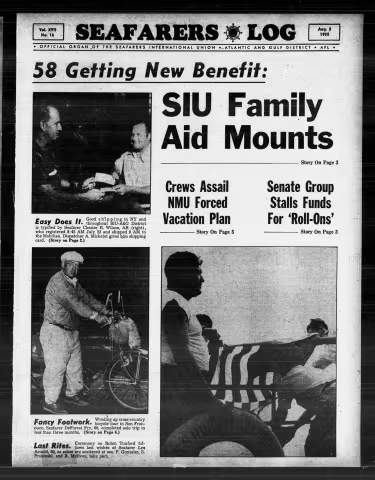
Issue Date
1955-08-05
Volume
17
Issue Number
16
Plaintext
v.' • '•
SEATARiE»S * U>G
• OFFICIAL ORGAN^OF THE SEAFARERS INTERNATIONAL UNION •^ATLANTIC AND GULF DISTRICT • AFL •
58 Getting New Benefit:
Family
Aid Mounts
Story On Page 3
K^mmm f# Good s h 1 p p i ng in NY and
^OSy I/OCS If# throughout SIU-A&G District
is typified by Seafarer Chester B. Wilson, AB (right),
who registered 8:45 AM July 22 and shipped 9 AM to
the Mobilian. Dispatcher A. Michelet gives tjim shipping
card. (Story on Page 2.)
Crews Assail
NMU Forced
Vacation Plan
Story On Page 5
Senate Group
Stalls Funds
For 'Roll-Ons'
Story On Page 3
Winding up cross-country
roficy r OOIWOrK, bicycle tour in San Fran
cisco, Seafarer DeForest Fry, 60, completed solo trip in
less than three months. (Story oh Page 6.)
I Ceremony on Robin Tuxford fol-
BiOSW Iffff lows last wishes of Seafarer Lee
Arnold, 60, as ashes are scattered at sea. P. Gonzales, S.
, Prutfinaki, aod'R* Mi^voy^ take part._>-- , I- -i-L.;"-
-'5^
• "fm
'iW
' •< >!
: r -• -i
Face Twe SEAFARERS L0G ..; - \ Apcurt 6, 195S
i.a^
ISCi
m
[Wr--w-
RIan All-Out
Battle On La.
'Wreck' Law
NEW ORLEANS—^Backed by the militant stand of all SIU
affiliates in this port, AFL unions in the New Orleans Cen
tral Trades and Labor Council have marshalled forces for a
new, all-out battle for repeal
of state legislation outlawing
the union shop.
The result has been the forma
tion of a strong Labor's League
for Political Education under the
auspices of the Central Trades and
Labor Council. The key role of
the SIU in the organization is in
dicated in the naming of Lindsey
J. Williams, SIU port agent here,
as chairman of the executive board.
Composed of many AFL shore-
side unions and all SIU affiliates
represented in the port, the LLPE
includes the SIU-Atlantic & Gulf
District, Sailors Union of the Pa
cific, Marine Firemen and the Ma
rine Allied Workers.
B. Raynal Ariatti, business rep
resentative of the AFL Glaziers
and Glass Workers, was elected
president of the organization.
Other officers include A. P. Stod
dard, secretary-treasurer of the
Louisiana Allied Printing Trades
Council, secretary-treasurer, and
E. H. Burand, Carpenters Union,
vice president.
Aid Labor's Friends
"The primary purpose of the
LLPE will be to aid in the election
of legislators who understand and
support trade union principles
and who will assist us in our ef
forts to achieve repeal of the so-
called 'right-to-work' law which
was passed by the last regular ses
sion of the Louisiana Legislature,"
Williams said.
"A majority of the legislators
from New .Orleans and vicinity are
friendly to labor and voted against
this vicious legislation which out
laws union security clauses in la
bor-management contracts in this
state. A few, however, voted for
the bill and we are aiming at a 100
percent friendly delegation in the
next session."
The New Orleans AFL political
Organization is preparing for the
State primaries in January, 1956,
by setting up a parish-wide pre
cinct organization with labor rep
resentatives in each precinct to
SEAFARERS LOG
Aug. 5. 1955 Vol. XVII, No. 16
PAUL HALL, Secretary-Treasurer
HERBERT BRAND, Editor; RAY DENISON,
Managing Editor; BERNARD SEAMAN, Art
Editor; HERMAN ARTHVR, IRWIN SPIVACK,
Staff Writers; BILL MOODY, Gulf Area
Representative.
Burly Page 13
Editorial Cartoon Page 10
Editorials ..Page 11
Final Dispatch Page 15
Inquiring Seafarer Page 11
Labor Roundup Page 10
Letters Page 15
Meet The Seafarer ......Page 10
Personals . Page 15
Recent Arrivals Page 15
Seafarers In Action Page 10
Shipping Figures Page 4
Your Dollar's Worth ... Page 6
Published biweeRly kr the headquarters
ot the Seafarers International Union, At
lantic & Gulf District, AFL, 675 Fourth
Avenue. Brooklyn 32, NY. Tel. tfYacintli
9-6600. Entered as second class matter
at the Post Office In Brooklyn, NY, under
the Act of Aug. 24, 1912.
work at the task of registering
union men and their families to
vote, and getting out the vote on
election day.
The principal objective of the
LLPE, as set forth in its recently-
adopted constitution, is to encour
age AFL members, their families
and friends to register and vote
and "to inform them of the atti
tudes, records, opinions and vari
ous other actions of candidates for
public office which are of vital
concern to the economic and social
welfare of all working men and
women.
Members of the executive board
of the LLPE and their affiliated
crafts are Willfams, Del Aleman,
Barbers: Ernest Colbert, Laborers;
R. L. Grevemberg, Radio and T-V
Technicians; Curtis Luttrell, Ship
Carpenters; Raymond Lapino,
Teamsters; Sidney LeBlanc, Sheet
Metal Workers; E. L. Bauve, Photo
Engravers; Nick Lapara, Electri
cians; Natale Masi, Butcher Work
ers; Philip Piro, Sign Painters;
Louis Sahuque, Printing Press
men; Francis Tardy, Painters;
John W. Whalen Jr., Machinists,
and Anthony Pohlmah, Carpenters.
Seafarers Phil Reyes (left) and Bob Elliott, steward on the City of Alma (Waterman), discuss
use of electric, household-size percolators instead of the customary restaurant-size coffee
urns under the new SIU feeding program in the Waterman fleet. At right, Floyd Peavy, MM,
serves Jack Bowman, AB, according to the new procedure. Vegetables are served in side
dishes according to the individual order. Reyes is handling the program in Waterman fleet.
SIU Food Plan Popular
With Waterman Crews
NEW ORLEANS—The SIU's new shipboard feeding program, now being extended in the
Waterman fleet, is making a big hit with crew members, judging from comments of Seafar
ers aboard Waterman ships that have hit this phrt.
Seafarer Phil Reyes, a vet--*
eran steward with years of
experience in the Waterman
fleet, is surveying the company's
ships under the direction of the
SIU's Steward Department Com
mittee and is riding the vessels
from port to port to put the new
system into operation.
NY Ship Beefs Dwindle;
Job Boom Continues
NEW YORK—The absence of major beefs serves to
brighten the shipping picture for the headquarters port even
more, as activity continues at a record level.
Jobs remain on the board ^—
with no takers for hours at a
time and, in some cases men to
fill the vacancies can't be routed
out from anywhere.
Indicative of the good shipping
and the well-fed state of the mem
bership is when a bosun's job for
Isthmian stays on the board for
three hours before someone will
take it. Engine and deck depart
ment ratings can ship out of here
most any time of day they choose.
As Assistant Secretary-Treasurer
Claude Simmons puts it, "although
the dispatchers are going nuts try
ing to shanghai men to fill these
jobs, we would rather have a hard
time getting men to fill the jobs
than have a bunch of hungry sailors
on the beach and no jobs for
them. Personally, I would rather
contend with a nutty dispatcher."
The only sour note in the head
quarters picture is the sudden crop
of performing reported on some
ships. Simmons warned, however,
men who get drunk ashore and
then return to disrupt operations
on the ship are putting their own
necks on the chopping block.
In these cases, he pointed, out,
not only will the crewmerabers
take action, but in most cases the
facts have been entered in the
ship's logbook and eventually bring
the Coast Guard down as well. A
recent instance on a Robin Line
ship cost the crewmem^r his sea
men's papers—and his livelihood
with it, through his own miscon
duct.
"Where a man is being hard-
timed or hot being given a square
deal, the Union will go to bat for
him and do everything possible
for him," Simmons stated.
"But when a man deliberately
puts his head out and asks them
to-chop it off, we can do nothing
for him. We urge all of our mem
bers to refrain from doing anything
that will cause their names to be
entered in the logbook- In such
instances where they lose their
chance to go to sea, they will have
nothing to blame except their own
misconduct," he added.
"Our experience so far has
demonstrated to the company that
through the SIU system we are
able to provide the men aboard the
ships with better quality food and
at the same time eliminate waste
in food preparation and serving,"
Reyes said. ^
The program has resulted in ob
taining many new food items for
the ships, including such desirable
foods as fresh frozen vegetables.
Another popular change in feeding
methods has been the installation
of home-size percolators aboard the
vessels with the result that Sea
farers have fresh coffee at all times
without the waste resulting from
the traditional use of large-size
urns.
Regular meetings are being held
between Waterman stewards and
SIU assistant secretary-treasurer
Eddie Mooney, chainhan of the
union committee, to assist Reyes
in briefing the stewards on the
new feeding procedure.
The program has been drafted in
ivritten form apd is being dis
tributed to the Waterman stewards
as was done in the case of Alcoa
and Bull Line ships where the new
procedure already is in operation.
Under the new procedure, all
food is served from the galley to
Going up before headquarters membership for election to
quarterly .financial committee are (left to right); Edward
Hansen, Joseph Malone, Ralph Ewing, Charles Oppenheimer,
Andy Anderson.
order by messmen, who are re
quired to wear white jackets while
serving. All steaks and chops are
grilled to individual order, which
means they come to the table fresh
from the stove without drying out.
Roasts are sliced to order and
served from the galley instead of
being sliced in advance and left
on the steam table until the meal
hour. This permits the use of left
over portions in preparation of
night lunches, the quality of which
has been greatly improved by th«
new method.
Side Dishes
The new Waterman steward de
partment rules require that not
more than one vegetable be served
on the same plate with meat or
other entree. Other vegetables
are served in side dishes.
Bread, butter and milk are
placed on the table not more than
five minutes before the serving of
food. These items now are placed
only on tables where needed. '
Night lunches now include
(Continued on page 15)
SlUNA Will
Attend AFL
Merger Meet
A slx-nian SIU of NA delega
tion will attend a special meeting
of AFL international union officers
in Chicago next week, as part of
the preparation for the AFL-CIO
merger convention in- New York
City later this year.
Selected to attend by SIU of NA
president Harry Lundeberg, in ad
dition to himself, were: John Hawk,
SIU of NA secretary-treasurer;
Paul Hall, A&G District secretary-
treasurer; Morris Weisberger, SUP
New York port agent; Hal Banks,
Canadian District; and Captain
John Fox, Inland Boatmen's Union.
The selections by Lundeberg
were made in accordance with the
decision of the last SIU of NA con
vention which authorized him to
appoint committee members fof
any meetings oq the merger ques-
tioq. i
#.1
Aacnst I, 1»5B SEAFARERS LOG r«c«; Tare*
SlU Family Benefit
Shows Big Increase
In Second Month
All imiles, Seafarer George Meshover (right) picki up two
checks totalling $456 in SlU welfare benefits from SlU wel
fare services rep. Milton Flynn at Union headquarters. The
payments covered a .large part of the cost of medical hospi
tal care for his wife, Rosalie, under the new SlU dependents'
benefits.
US Shipping Boosted
By Foreign Aid Vote
WASHINGTON—^Although foreign aid funds were chopped
down by half a billion, a Senate-House agreement on $2.7 bil
lion appropriations for the 1955-56 year assures cargoes for
hundreds of ships. The vote-*'
continues undiminished the
Government's post-World War
II policy of assisting foreign na
tions with military and economic
aid. All told, the US has spent
$51 billion for this purpose since
the war's end.
At virtually the last minute
Congress made some deep cuts in
the'$3.2 tnilion requested by the
Administration. Both Houses had
authorized this figure with slight
modifications. When it came to
voting the actual money, however,
Congress learned that the Defense
Department, on the eve of the new
fiscal year, suddenly authorized the
spending of $400 millions left over
from last year's $4 billion appro
priation.
Itcvolt In House
This led to a revolt in the House
Appropriations Committee which
felt that money should not be ap
propriated up to the full amount
if the previous year's appropriation
had not been spent.
In actual fact then, the Govern
ment will have over $3 billion for
this purpose this year, the money
just voted and the amount left
from the previous year. Foreign
aid shipments will be in addition
to hundreds of millions in agri
cultural surplus disposal, also cov
ered by the "50r50" law.
and shifting around of agencies,
the foreign aid program has con
tinued without let-up since World
War II. •
In operation for two brief months, the SIU's new dependents' hospital and surgi
cal benefits plan has shown a sharp increase in benefit payments to Seafarers and
their families. The second month's operation saw 24 claims paid to Seafarers in
ports throughout the dis
trict for expenses incurred
in behalf of their wives and
children, with another 29 pay-
meiita now being processed by
the Seafarers Welfare Plan.
In the first' month of • the Plan,
which went into operation on June
1, it handled five payments.
The largest single benefits pay
ment made thus far was for $456
which went to Seafarer George
Meshover of New York, whose wife
spent 29 days in the hospital with
glandular fever.
Seafarers in New Orleans re
ceived the greatest number of July
payments with eight benefits paid.
New York was next with five ben
efits while Mobile and Boston had
three apiece. Other benefits were
paid in San Francisco, Houston,
Lake Charles, Philadelphia and
Puerto Rico.
, Hundreds Yearly
The very sharp increase in pay
ments made and in claims pending
supports the Union's belief that
the hospital and surgical benefits
will assist many hundreds of Sea
farers each year in meeting the
heavy emergency expenses of care
and treatment for their families.
The dependents' benefit covers
wives of Seafarers and unmarried
children under the age of 19. The
Plan has been interpreted to give
Back home in New Orleans
after an appendectomy, it
Carol Ann Bellaflore, 15,
daughter of Seafarer Frank
Marshall, Jr. A major por
tion of the expense of her
operation was paid for by
SlU Welfare Plan.
iiiiiiiiilB''
Artist's conception of the Maritime Administration's proposed "Turnpike" class "roll on-roll ^
ofF" trailership, which would be capable of both side and end loading. The twin screw,
4,400-deadweight-ton vessel is intended mostly for use in the intercoastal and coastwise
service. It would have a speed of 20 knots.
New Agency
The current foreign aid program
will be administered by the new
International Cooperation Admin
istration which replaces the For
eign Operations Administration.
Despite the juggling of names
Meeting Night
Every 2 Weeks
Regular membership meet
ings in SIU headquarters and
at all branches are held every
second Wednesday night at
7 PM. The schedule for the
next few meetings Is as follows:
Aug. 10, Aug 24, Sept. 7.
Trailership Plans Stalled
WASHINGTON—^A delay of several months is likely in plans for the construction of seven
roll-on ships for the SlU-contracted Pan Atlantic Steamship Company. The Pan Atlantic
plans ran into a Congressional roadblock ivhen the Senate Appropriations Committee refused
to consider a $60 million s.up<
plemental appropriation re
quest to build these and other
vessels.
Pan A11 a n t i e had asked ap
proval to trade in its seven C-2s
to the Government as a down pay
ment on the construction of the
new vessels which would be used
in the company's coastwise service.
The seven ships might also be the
predecessors of additional ships of
the same type on an intercoastal
run. Each of them could handle
285 loaded truck trailers.'
The Committee refused to act,
claiming that the Maritime Admin
istration had sufficient uncommit
ted funds from a previous appro
priation to take care of the project.
Committee members said that the
Maritime Administration should
renev^its request in 1956 if It still
needed the funds. Officials of the
agency denied that funds were
available for the "roll-ohs."
The other ships affected by the
Senate committee's action were
five new cargo ships for Lykes
Brothers aiid five for United
States Lines. These ten would have
been built with construction sub
sidies.
A maritime administration
spokesman said that the difficul
ties over money arose because the
plans for the new ships had not
been developed in time for the
regular appropriation bill. By the
time the agency was ready to go to
Congress with the plans it' was
nearly the end of the current ses
sion and the money request had to
be put in the form of a supplemen
tal bill to catch an appropriations
bill that had already passed the
House.
Washington observers agree that
the refusal of Congress to act on
the supplementary funds is a set
back to the merchant marine's
vessel replacement plans and to
"roll-on" plans proposed by sev
eral steamship companies.
coverage to stepchildren of Sea
farers living in his home and to all
children of Seafarefs who are sup
ported by them whether or not they
live under the same roof with the
Seafarer.
The Welfare Plan covers hos
pital room and board at the rate of
$10 a day for a maximum of 31
days in the hospital, as well as
other hospital expenses up to $100.
The Seafarer is responsible for the
finst $50 df this coverage under a
"$50 deductible" policy, with the -
Plan paying the rest up to the max
imum limit.
Also covered are surgical costs
up to a maximum of $300 accord
ing to a schedule of operations
benefits, and doctor's visits to the
hospital in non-surgical cases at the
rate of $4 a day up to 31 days.
Any' Seafarers who have ques
tions about the Plan or who expect
one of their dependents to be hos
pitalized are urged to contact the
nearest SIU port agent. The port
agent will see to it that the claims
procedure is started immediately
and will give the Seafarer or his
family all necessary information
on the benefits.
MAW Signs
Bay Boats
In Baltimore
BALTIMORE—The SlU-af-
filiated Marine Allied Work
ers scored organizational suc
cesses in this port with excursion
vessels and other ships plying
Chesapeake Bay. Contracts have
been signed with the Wilson Line
for the Bay Belle operating from
here, and the Mount Vernon, which
has Washington, DC, as its home
port. Another excursion ship signed
was the Tolchester and progress
is being made with three other
companies, two of them cargo car
riers between here and Virginia.
Shipping in the port has been
going along at an even keel, port
agent Earl Sheppard reports, with
11 ships paying off, seven signing
on and 15 ships stopping in tran
sit. An additional boost to shipping
were jobs which Norfolk was un
able to fill and called on Baltimore
for help. As a result, men weie
moving out of this port with a
minimum of delay.
Very little in the way of beefs
were reported from the ships stop
ping here, and all overtime dis
putes have been settled to the
satisfaction of all concerned.
The MAW activity here is a
counterpart of similar action in
Philadelphia where the MAW also
got a contract covering the Wilson
Line.
Sheppard added that there were
still a number of men in the Balti
more PHS hospital who could use
a visitor to pass some of the idle
hours. The list of hospitalized Sea
farers appears on page 12.
•S,,
. • t'*"-^ '•
•
74
• -.s
•f&'Ji I
31,
•3
- V .v9
'\:i\
• I
;.V;:
r:r Pare Four SEAFARERS LOG Aurust 5. 1955
New Menu Promises Good Eating
m
m-b:'•
Busy at one of the many chores that make up the work of the
chief steward, Seafarer J. K. Parnell types out a menu aboard
the Alcoa Pioneer, while the ship unloads at the Mobile ter
minus of the bauxite run. It appears there was lots of good
feeding in store for the ship's hard-working SlU crew.
Anti-SIU Eye-
Milked US Files
A "private eye" who bumped heads with the SIU and in
dividual Seafarers on various occasions has popped up in the
news again with the indictment of a former US employee for
peddling confidential informa-
tiop about seamen. Hwace
Schmahl -ivas named as the
receiver of confidential Social Se
curity records on seamen's earn
ings allegedly copied from the"files
N' Orleans
Ship Canal
Bill Okayed
WASHINGON—A bill au
thorizing construction of a sea
level channel from New Or
leans to the Gulf of Mexico was
given the green light by two House
committees here last week.
The House Public Works Com
mittee first reported favorably on
the bill which authorizes expendi
ture of up to $83 million for con
structing a 70-mile-long seaway
from the Crescent City to the Gulf.
The channel would be 500 feet long
and 36 feet deep.
Companion bills providing for
the project were introduced in
Congress by Reps. Hale Boggs and
F. Edward Hebert and by Sens.
Russell Long and Allen J. Ellender,
all of Louisiana.
Later in the week, the House
Rules Committee gave right-of-way
to consideration of the measure be
fore adjournment of this session.
The bill still must be considered
by the Senate Public Works Com
mittee. Action will likely be taken
when Congress meets again next
January.
The project calls for construc
tion of a lock in the vicinity of
Meraux, St. Bernard Parish, to per
mit ships to enter and leave the
man made channel at the Missis
sippi River. The channel would
traverse a part of Lake Borgne and
Chandeleur Sound.
Ships would save many hours
and much expense by using such
a channel instead of the present
Mississippi River route with its
many twists and tiu-ns.
sold by George Wolk, former man
ager of the Staten Island, New
York, Social Security office. Wolk
is the target of a 64-count Fed
eral Indictment.
The information, according to
the indictment, was turned over by
Schmahl to his clients, various
steamship and insurance compa
nies, so that they could attempt to
torpedo seamen's claims in per
sonal injury cases.
This is the same Horace
Schmahl who was a prime mover
in the infamous anti-labor appar
atus which was employed by Cities
Service against the SIU during the
fight to organize that company.
The apparatus, since disbanded,
fingered hundreds of Seafarers so
that they were fired or black-list
ed by the company. Schmahl also
tried to uncover information to
smear SIU officials, and did a lit
tle spying on the side on the com
pany's employees.
'In' With Coast Guard
The record of Schmahl's activity
was spelled out in the Senate La
bor sub-committee's report on
Labor-Management relations in
maritime. The report quoted
Schmahl as boasting that Coast
Guard records on seamen were
also an "open book" to him.
Subsequently in May, 1952,
Sehmahl received a great deal of
attention iron? the SEAFARERS
LOG when working on behalf of
a steam.ship company, he attempt
ed to wreck the damage claims of
a blinded Seafarer, Phillip Pron.
Schmahl's tactics consisted of
posing as a non-existent magazine
writer who claimed to be writing
a feature about Pron's experiences.
His object was to trap fron's ship
mates into unwitting written state
ments that Pron always had very
bad eyesight.
Oddly enough, at the time the
LOG was preparing this article,
attorney Benjamin Sterling inter
vened in an attempt to kill the
story. Sterling has since been
identified as a key figure in the
International Longshoremens As
sociation's attempt to win control
of the SIU by heavy cash subsidies
to opposition candidates in the last
SIU elections.
\
SHIPPING ROUND-UP
AND FORECAST
Port
Boston ... X
New York.
Philadelphia
Baltimore
Norfolk
Savannah
Miami
Tampa
Mobile
New Orleans
Lake Charles
Houston
Wilmington
San Francisco
Seattle
Total
JULY 13 THROUGH JULY 26
Registered
Eng.
A
5
78
15
46
11
8
1
8
17
35
7
7
4
11
9
Eng.
262
Shipped
Deck Deck
A B
11 5
103 37
24 5
50 19
11 12
9 5
3 3
5 2—
26 10
28 11
16 4
16 10
11 2
15 10
12 23
Deck Deck
A B
340 158
Eng. Stew. Stew. Total Total Total Eng.
A B A B Reg.
4 6 1 22 10 32
34 59 14 240 85 325
7 12 3 51 15 66
21 30 18 126 58 184
4 3 5 25 21 46
, 11 5 4 22 20 42
4 9 4 13 11 24
2 4 5 17 . 9 26
4 14 5 57 19 76
13 . 29 16 92 • 40 132
9 3 6 26 19 45
19 15 11 S3 41 78
3 6 4 21 •I 30
10 20 12 46 32 78
16 11 12 32 51 83
Stew. Stew. Total Total Total
A B A B Reg.
161 226 120 828 439 1267
Port
Boston
Miami
Tampa
Houston
Wilmington
San Francisco ..........
Deck Deck Deck Eng. Eng. Eng. stew. Stew. stew. Total Total Total Total
A B C A B
Eng.
A B C A B C Ship.
5 2 1 1 0 0 2 0 0 8 2 1 11
79 19 7 66 25 18 52 11 3 197 55 28 280
11 9 0 21 8 4 - 10 8 1 42 25 5 72
42 23 0 27 21 14 14 16 2 83 60 16 159
10 13 8 7 3 16 3 6 11 20 22 35 77
15 7 3 8 8 t) 7 6 6 30 21 9 60
3 2 0 3 2 3 11 4 0 17 8 3 28
3 1 0 5 2 0 5 3 0 13 6 0 19
26 25 1 18 26 5 27 8 0 71 59 6 136
47 14 4 47 14 2 42 19 6 136 47 12 195
11 3 0 7 11 4 3 5 0 21 19 4 44
10 4 0 12 6 0 6 0 0 28 10 0 38
5 3 . 5 1 2 7 1 2 . 1 7 7 13 27
14 9 2 11 8 2 11 9 1 36 26 5 67
15 13 ' 2 9 6 3 10 8 1 34 27 , 6. 67
Deck Deck Deck Eng. Eng. Eng. Stew. Slew. Stew. Total Total Total Total
A C
Eng.
B C A B C A B C Ship.
296 ll7 33 243 142 78 204 105 32 743 394 143 1280
Shipping for the Atlantic and Gulf District continued to show a very favorable pic-
;ure during the past two weeks as a total of 1,280 men were dispatched to jobs. Overall
shipping still maintained a lead over registration, which was 1,267.
Although the shipping fig-|*
ure represented" a drop of over
100 from the previous period,
the dip could be accounted for
almost entirely by the Port of New
York, which still managed to
dispatch nearly 300 jobs.
Furthermore, the shift to a rel
atively high level of activity in
recent weeks for ports like Phila
delphia, Norfolk, Savannah and
Mobile remained undisturbed and
continued in full swing. New Or
leans experienced a spurt upwards,
and Houston came back somewhat
also. Only Baltimore showed a
marked downward trend, since its
figures included a number of men
shipped to jobs in Norfolk.
The good shipping was reflected
particularly in the fact that 13
ports shipped newcomers in class
C, although class C shipping de
clined somewhat percentagewise, to
11 percent of the total. The lack
of available class A and B man
power in these ports spelled good
fortune for the non - seniority
group. ^
In addition the near 2-1 ratio of
class A over class B held firm, wifh
class A accounting for 58 percent
of the total shipping and class B
for 31 percent.
Following is the forecast port by
port:
BOSTON: Future unpredictable.
Short on ABs, shows little pros
pects for unrated men, cooks and
stewards . . . NEW YORK: Still
good; needs manpower ready to
ship. Jobs stay on board 3-4 calls.
PHILADELPHIA: Very good, then
very quiet in same two-week
period. Hard to figure since noth
ing scheduled . . . BALTIMORE:
Slowed down somewhat. Figures
included many shipped for Norfolk.
Short on FWTs . . . NORFOLK:
Excellent situation should keep up.
SAVANNAH: Getting better;
future looks fair . . . MIAMI:
Shipping is due to rise. Registra
tion, shipping run even... TAMPA:
Fair, up a little . . . MOBILE:
Prospects look good. ^ Waterman
ships that have been away starting
River Bill, Bulk Cargo
Cheers Mobile Outlook
MOBILE—Further improvement in the shipping picture
here is expected from several new developments. . A new hill
-passed by the Alabama legislature giving the state control of
navigable rivers is expected^
to encourage local industry
to ship by *river to Mobile in
stead of by rail. At present com
panies shipping by rivers have
faced heavy freight bills to get
their stuff to a seaport outlet.
In addition, port agent Cal Tan
ner sees a shipping pick-up> because
of large bulk cargoes of grain and
coal scheduled to move out of the
port. A third factor in the local
picture is the return of several
Waterman and Alcoa ships to the
port after running out of other
ports in recent months. The Water
man ships had been out on the West
Coast while Alcoa had been using
some of its ships on the sugar run
and is now returning them to the
bauxite trade.
One WatermdVi ship due In here,
the Mobilian, has been sold, but
it is being taken over by another
SlU-contracted operator, the Mari
time Overseas Corporation.
All told there were ten payoffs
and sign-ons in the port, the best
activity in some time, with seven
in transit shipa.
to come in again and no delay on
shipping . . . NEW ORLEANS:
Very good; should stay good.
LAKE CHARLES: Holding up
well; getting a bit short in some
engine rates . . . HOUSTON: Still
slow . . . WILMINGTON: Still fair;
8 in-transits due . . . SAN FRAN
CISCO: Fair; figures up a little . ..
SEATTLE: Always good; several
payoffs due. Heywood Broun com
ing out of lay-up after 20 months.
Tampa Okays
Food System
Aboard Ships
TAMPA — Seafarers here
are enthusiastic about the new
feeding program going into
effect on Waterman ships. The
"new look" for Waterman follows
changes instituted in the Bull Line
and Alcoa fleets earlier to revise
steward department procedures and
introduce more individual, "on
order" service from the galley.
Discussion at the last branch
membership meeting was focussed
on the subject, as Seafarers and
port officiais debated the merits of
the program, which is calculated to
reduce waste while assuring SIU
men continued top feeding at all
times.
Noting the discussion, Tom Ban
ning, SIU port agent, reported s
number of Searfarers hitting the
deck to spoke on the subject, in
cluding W. Brown, E. Hagen and
L. Lopez. The overall consensus
was that the program was a good
irea.
Shipping, mganwhile, continued
at a fair pace during the past two
weeks, and the same is forecast for
the coming period. What activity
there was provided by one lone
payoff, the Arizpa (Wat^^an), and
a half dozen in-trdnsisU^Beefs ran
at a minimum.
• Annut 8, 1958 SEAFARERS LOG Tata Ftr«
Six struck passenger vessels of the Union Steamship Company are hung up at their pier in
Vancouver as SlU Canadian District seamen pulled the pin on the company. Months of stall
ing on a new deep sea contra'ct led to the strike call by 350 Canadian seamen.
Canada Strikes For Hourly Pay
VANCOUVER—After months of negotiations had only resulted in repeated failure to win a
new contract^ some 350 Canadian District members pulled the pin on the tJnion Steamship
Company. The Canadian District struck to win demands for a new hourly wage set-up in
volving wage increases over
the existing monthly wage
system now in effect on the
company's ships.
New Pattern
The Canadian District hopes to
extend the hourly wage system to
all its contracted companies, so
that the outcome of the current
strike may set a new wage pattern
for the shipping industry in that
country. At least one Canadian
steamship operator has already
signed on the hourly wage basis
with a very considerable increase
in monthly take-home pay for the
crewmembers involved.
Union Steamship is a West Coast
operator which runs half-a-dozen
small passenger vessels between
US and Canadian ports. It also
operates dry cargo carriers in the
same trade. The Canadian Sea
farers hung up the ships on the eve
of the July 4 holiday weekend and
have maintained round-the-clock
picket lines ever since.
District officials reported that
the strike has been 100 percent ef
fective from the start with other
Vancouver unions respecting the
SIU picket lines.
The company has made no efforts
(0 run the ships thus far, but has
attempted to get Canadian govern
ment agencies and the courts to
intervene in an effort to weaken
the union's position. At last report,
all these efforts have been unsuc
cessful and the strikers are hold
ing firm.
SIU Action Wins Fuil
Benefits For Sick Men
A dozen ill Seafarers who had to reenter USPHS hospitals
for further treatment will now receive the full hospital bene
fit because the Union went to bat to assure them the $21
weekly payments. In addi-+
tion, most of these men will
get better than $100 in retro
active benefits to the date they re
entered the hospitals.
Affected by the Union's action
are Seafarers suffering from tu
berculosis and other chronic ail
ments. They had been discharged
from various USPHS hospitals in
recent montb|, but had been given
Lake Charles Bids.
For Sales Tax Okay
LAKE CHARLES—^Urging the support of labor for the pro
posal, the City Council here has recommended a one-cent city
sales tax on gross sales and is putting it on the ballot this fall.
• The votes of union men and-f
women licked a similar pro
posal a few years ago, SIU
port agent Leroy Clarke recalls,
because the council refused to
commit the money for specific
Items that were needed in the city.
This time, however, the ballot
Is supposed to state plainly that
the funds Would be used for civic
PNOTOS
^70fZtes>
^oerizY
BlC.
improvements which the city real
ly needs. Clarke pointed out, how
ever, that It is going to be rough
to sell the voters on the issue, par
ticularly after the last fiasco.
He also reported shipping hold
ing at a very firm level, and noted
the beginnings of a shortage in
some engine department ratings.
Although there are wipers on the
port's registrationjlst, wipers' jobs
have been going begging. As a re
sult, openings are 'being filled by
newcomers making their first trip
out. Tanker traffic seems "to be
continuing at a fast pace, despite
the season. .
The labor front provides one de
velopment of its own in the sign
ing between the AFL Metal Trades
Council and the Firestone Tire and
Rubber Company, after many
weeks of negotiations. The con
tract includes a wage increase ret
roactive to April 4 plus several
"fringe" benefits. All hands are
well pleased with the result, from
all indications.
"unfit for duty" ratings, which did
not permit them to go back to
work on ships. Subsequently, the
12 men had to go back to the hos
pital for new extended periods of
treatment.
Under the rules of the Welfare
Plan, Seafarers eligible for the
full weekly benefit need one day's
seatime in the previous 90 days.
Consequently, in "going by the
book" these men were eligible only
for the partial benefit paid to Sea
farers who do not fully qualify.
When notified of the problem,
SIU headquarters felt that appli
cation of the rule to these men
would be an. in justice Inconsistent
with the spirit of the Seafarers
Welfare Plan. The Union pressed
an appeal to the Welfare Plan
trustees on behalf of the men,
pointing out that since they were
"unfit for duty" they could not
possibly ship and gain the neces
sary seatime.
The trustees agreed with the
Union viewpoint, and under the
flexible set-up of the plan were
able to take favorable action for
these men. The action will not ap
ply to men who get a "fit for duty"
on leaving the hospital and then
reenter at a later date.
NMU Men Assail
Forced Vacations
Confirming the SIU's appraisal of the NMU's recently-
negotiated supplemental jobless pay plan and compulsory
vacation package, rumbles of serious cUscontent have arisen
from a number of NMU ships.
In addition, several more
ships' crews have gone on rec
ord condemning the NMU's action
in opening up its membership
books and hiring halls without
prior approval by the membership.
The revolt reached a peak on
the passenger ship United States
where crewmembers twice rejected
the contract by overwhelming
margins. They first turned it down
by a vote of 456 to one at their
July 3 ship's meeting. Subsequent
ly, they resisted tremendous pres
sure applied by NMU officials, in
cluding personal intervention by
NMU President Joseph Curran at
a meeting of-the ship's committee
to sell the plan. They reiterated
their stand by voting down the
contract at a second crew meeting
by 289 to 16.
'Iron Curtain'
The seriousness with which the
NMU regards the United States
vote is indicated by the iron curtain
which the NMU "Pilot" dropped
around the crew's actions. Instead
of reporting the United States
minutes, as it usually does, the
"Pilot" has launched a vitriolic
attack against the crew.
The attack on the US crew was
one of several recent instances in
which Curran has used the "Pilot"
to club into silence both rank and
file members and officials who
have been critical of the recent
disastrous drift of NMU policy.
New NMU troubles loom as
Currdn appears ready to loose the
latest in a series of purges of top
union officials. Slated for axing,
according to the "New York Times "
and other sources, are treasurer
M. Hediey Stone and vice-presi
dent Adrian Duffy, two pro-Curran
stalwarts of many years past.
Hiring Hall Problems
The discontent stirring on NMU
ships and Curran's planned purge
stem directly from the NMU's
abandonment of the maritime hir
ing hall. As pointed out in Secre
tary-Treasurer Paul Hall's report
on guaranteed annual wage in
maritime (SEAFARERS LOG, July
8) the NMU came up with the
supplemental unemployment bene
fit gimmick, plus compulsory vaca
tions, as a way oiit of the difficulty
created by its abandonment of the
hiring hall.
When the NMU opened its hiring
halls and membership books to all
comers, men on the ships froze to
their jobs. The only way to shake
them loose was by compulsory
vacations. To wran this distasteful
idea in an attractive package,
Curran came up with supplemental
jobless pay. In other words, when
men are compelled to sign off for
compulsory vacations they" will get
$4 additional weekly in unemploy
ment insurance until they can get
another ship.
Neither the opening of books
and halls or the compulsory vaca
tion plan was voted on by the
Certificates Speed Welfare f $
Payment of cash benefits to Seafarers under the SIU's hospital
and surgical benefit plan for Seafarers' families will be speeded
up considerably if the Welfare Plan has copies of Seafarers' mar
riage certificates and birth certificates {or their children. '
The marriage certificates and children's birth certificates are
needed tp_ establish proof of eligibility under the Plan. If Sea
farers have photostats of these documents made and turn them in
to the nearest Union office, it will eliminate delays in payment
of benefits.
All " documents will go into Ihe Seafarer's personal file at the
office of the Welfare Plan and are strictly confidential. •
NMU's membership. Although all
other maritime unions in the past
have held referendums on the vaca-r
tion issue. Curran made compulso
ry vacations a part of the contract
anfl concealed the clause from his
membership until the issue of the
"Pilot" appearing two weeks after
the contract was wrapped up.
In announcing the compulsory
vacation plan in the July 7 "Pilot"
Curran declared, "Now with the
signing of the new Employment
Security Plan (Curran's name ,for
supplemental jobless pay) the
brother who faces hardships taking
a vacation will be in a position to
obtain consideration." The con
sideration consists of the $4 a
week additional in unemployment
benefits.
Crewmembers of the United
States and other ships took a dif
ferent view of the matter. As re
ported in the United States min-
(Continued on page 15)
Grain, Coal
Create NO
Ship Beem
NEW ORLEANS — Stimu
lated by a brisk trade in grain
and coal shipments, shipping
in this port is showing signs of a
temporary boom.
Besides the usual general cargo
business, several ships called here
to load grain for foreign ports and
one, the Ocean Dinny (Overseas
Transportation), sailed for Korea
with coal.
Seafarers on the beach were ad
vised by Lindsey J. Williams, New
Orleans port agent, however, that
the upsurge in shipping could not
be expected to continue for any ex
tended period.
"Shipping is good, but it hasn't
reached the point where we can
expect to lay in the gap for a
bosun's job on a Waterman C-2 for
Hamburg," Williams said in his re
port to the regular bi-weekly
membership meeting. "We must
protect our jobs by throwing in for
them when they come up on the
board. For example, we had jobs
left on the board tonight for to
morrow's morning calls. That is the
first time this condition has existed
in this port in months. The best
insurance we have for protecting
our jobs and what we have won
through our united efforts is for
the membership to ship now dur
ing this spurt in business and while
the jobs are open."
During the last two weeks, 10
ships paid off here. Eight signed
on and 21 called in transit. One
hundred and 95 men shipped, in
cluding 23 Class C men, as com
pared with 132 registered.
Men were dispatched from the
hall here to the following ships
which loaded grain for foreign
ports: the Seanan (Stratford Steam
ship Co.), bound for Holland; the
National Liberty (American Water
ways), sailed for Holland; City of
Alma (Waterman, on charter to
States Marine), bound for the Far
East.
The outlook for the future is
good in New Orieans with eight
payoffs scheduled in the next two
weeks.
I • '.at a
.1
i
4 •
. ''S
J
• C»^V/ .r-.-:'^'j: •• "W
Pare Sis SEAFARERS loa :Auffiut S. 1955 V
T^Rmsm
Speed Service
To Indonesia
Seafarers aboard the Steel Archi
tect are launching a new Improved
Isthmian service to the Republic
of Indonesia this week, following
the vessel's departure from New
York.
The new run provides direct
westbound service' to Indonesia
except. for one call at Manila in
the Philippines. The itinerary calls
for sailings from East Coast ports
the first and third week of every
month.
Other Services
Isthmian's other westbound serv
ice will continue to load at East
and West Coast ports for Manila,
Hong Kong, Saigon, Bangkok, Sing
apore, Port Swettenham, Penang
and Belawan Deli. Its regular east-
bound 'round-the-world service will
also continue, with the first In
donesia port of call at Belawan
Deli.
WC Cooks Have-Own Hiring Hails
MCS-AFL New York agent Louis Foyt (back to camera)
calls a job for the P&T Voyager out of the MCS New York
hall. Central registration offices which west coast, cooks
had to use have been abolished as pact talks continue.
Seafarer Bicycles Across Country
After pumping and pushing a bicycle 2,500 miles up and down hill from New York to San
Francisco, veteran Seafarer DeForest Fry is back on New York seeking a different form of
transportation. Fry, a veteran SIU member, is now looking for a ship after a three month
cross-country haul which rates-*''
as an extraordinary way for a
seaman to spend his spare
time.
The 60-year-oid Seafarer, who
sails as cook on SIU vessels, has
made other long distance bicycle
trips before, but none as ambitious
or taxing as the cross country tour.
Equipped with an English bike
with nine speed gears. Fry headed
for the wild west on May 1 after
paying off the Ocean Betty.
"I started out to go to Auburn,
NY, my home town," he said, "but
then I got out on Route 17 which
runs clear across New York State.
I figured that I would go as far as
1 could on 17. Before long I was
headed for Chicago. By the time I
got to Chicago I told myself that
If I could go this far I could go all
the way."
So Fry continued west with his
tool kit, sleeping bag, two water
bags and other gear totaling about
50 pounds strapped to the bike.
He attracted quite a bit of atten
tion en route, which is understand
able, and was interviewed by local
newspapers in Davenport, Iowa;
North Platte, Nebraska, and Au
burn, California, among other
places.
Desert Crossings
The real tough part of the grind
was in the deserts and mountains
of the West. Crossing Utah in the
vicinity of the Great Salt Lake he
had to hoof it 40 miles because of
a stiff west wind. Donner Pass In
California also was tough, a tor
tuous three mile upgrade which he
made, pushing his bike along, in an
hour and '^25 minutes. "When I got
to the top, though," he said, "it
was really something to see."
While most of the trip went
smoothly it was not without mis
haps. He went into a ditch one
time and beiit a wheel and In
Omaha his light English bike broke
down under the load and had to
be replaced by a heavier American-
made model.
Fry admitted that there were
moments of discouragement when
it would have been easy "to grab a
train for San Francisco and pack
the wheel aboard."
His previous trips, while lengthy
enough, don't hold a candle to his
latest exploit. Two yeprs ago on
his vacation he went from New
York to the Thousand Isles on the
St. Lawrence, then to Montreal and
back, approximately 1,800 miles, in
40 days.
Veteran Seaman
Fry, whose seafaring career in
cludes a picketline stretch in the
1921 strike, carried an old ISU
book for years before joining the
SIU back in its earliest days. He
never was a professional bicycle
racer or anything close to one, but
has been riding bikes for recrea
tion as long as he can remember,
"I'll probably continue doing
these trips for a while," he con
cluded, "but I don't think I'U try
to cross the country again."
I LA Crimp Rig ^
Ready To Fold
The ILA's phony "seaman's imion" has virtually breathed
it» last gasp. iCut off from all sources of revenue because of
SIU and ITF action, the disguised crimp rig is on the verge of
closing- down its offices. To
add to its troubles, the outfit
has split right down the mid
dle with the former front man
taking off with the charter and
opening his own Independent oper
ation uptown.
The result is that the "inde
pendent" is sporting the ILA char
ter, and the ILA sea "union" is
left without any kind of status.
The crimp outfit is in such des
perate financial shape that a city
marshal called on it to serve a
summons for payments on its of
fice furniture. Neither Keith Alsop,
defeated SIU Galveston agent, or
William Higgs, expelled SIU mem
ber, the ILA-appointed "officers"
of the outfit, were on hand to re
ceive the summons. Apparently
both of them have pulled out in
search for greener pastures.
Further evidence of the immi
nent passing of the outfit is the
fact that all signs have been re
moved from the doors and win
dows of Its office. The charter
issued to it by ILA President Brad
ley is now in the possession of
Louis Le Doulx, long-time shipping
master for runaway flag ships who
was serving as a front for Higgs
and Alsop until they came out into
the open.
Originally, the ILA "United In-
Make Checks
To'SIU-A&G'
Seafarers*mailing in checks
or money orders to the Union
to cover dues payments are
urged to be siiJe to make all of
them payable to the SIU-A&G
District.
Some Seafarers have sent in
checks and money orders in the
names of Individual headquar
ters officials. This makes for a
problem in bookkeeping which
can be avoided if checks are
made out to the Union directly.
ternational Seamen's Union, Local
1824," had grandiose schemes for
raiding SIU' and other American-
flag unions with the support of
ILA President William Bradley.
The most it ever did in its palmiest
days was to shake down seamen on
foreign flag ships with false prom
ises of representing Them.
In this it ran afoul of the Inter
national Transportworkers Federa
tion, which has opened a drive
among seamen on runaway-flag
ships. The ITF took steps to pro
tect foreign seamen' from the ILA
with the result that this source of
revenue dried up.
All Schemes Fail
Subsequent schemes to pick up a
buck here and there also failed to
pan out and the top leadership of
the ILA quickly took a hands-off
attitude when it carne apparent
that the crimp outfit would have
very tough sledding trying to
harass the SIU.
Alsop and Higgs were part of the
combine, along with former Tampa
port agent Ray White, v/hich served
as an agency for ILA efforts to
unseat SIU Secretary-Treasurer
Paul Hall in the last SIU elections^^
It was reported the ILA put $40,-
000 or more into this effort.
Subsequently White was indicted
for conspiracy to assassinate HalL
James Cobb, who confessed being
hired for thd killing and has been
found guilty, implicated White, his
brother Steely White, still a fugi
tive, and others.
Bergen County authorities were
reportedly told by Cobb that he
was to have been paid for the job
by attorney Benjamin Sterling. It
has been reported that the latter
told a grand jury investigating the
murder attempt that he handled
sums which Bradley gave White
and his associates. Sterling has
been indirectly identified with the
phony seaman's union and an ILA
ship maintenance local sharing the
same office.
YOUR DOLLAR'S WORTH
SEAFARERS GUIDE TO SETTER BUYING
Writ;lien fop
leadlng eipert on
Points About Funefai Costs
On that inevitable day when a family must arrange for
a funeral for one of its members, it generally is poorly
prepared emotionally or financially for the disturbingly
high burial expense with which it is suddenly confronted.
At best, even among reputable funeral establishments,
burying the dead is a high mark-up business. At worst,
there is an unscrupulous fringe of funeral directors who
seriously exploit moderate-income families dazed by their
tragedy and inexperienced in such arrangements. The
Seafarers Welfare Service has found the most noticeable
abuse is the practice among some undertakers of attempt
ing to find out how much insurance the Seafarer's family
has, so they can grab the full value of the insurance policy.
Too, you have to beware of bait advertising Ih the funer
al business just as when you buy a sewing machine, vac
uum cleaner or storm windows from a high-pressure sales
outfit.
Prices Skyrocket
The funeral industry has a peculiar pricing system
based on the price of the casket. According to Rollin
Everett, one of,a group of St. Louis trade unionists who
organized a coopergtive burial plan there several yeai-s
ago, St. Louis unions found that the family that chose the
lowest-cost casket at about $73 got a funeral for $490; if
it chose a $134 casket, the funeral cost would be about
$780; with a $462 bronze casket, the funeral bill would be
$1678. These figures are approximately correct, this writer
has learned from his own investigation. But the peculiar
thing is that the other services vary little. The funeral
director simply makes a progressively high profit on the
family that chooses a more expensive casi%t. Naturally.
there is a tendency to "trade-up" a family, even if only by
the subtle persuasion of exhibiting costlier caskets to a
family that wants to do honor to its dead and is sensitive
to the question of pride and how the casket will appear
to others.
Because of the high markup of the burial industry, and
the abuses practiced by the unscrupulous fringe, unions
and cooperatives many times have tried to set up their own
burial arrangements. Miners have their own funeral homes,
as in Gillespie and West Frankfort, 111., some 'Of which
were organized after mine disasters when some unscrupu
lous undertakers charged unconscionably high prices.
The burial industry fights hard against such arrange
ments by unions. The struggling St. Louis union-organized
co-op has found strong opposition among private directors.
In fact, when I interviewed representatives of the National
Funeral Directors Association recently^ I found—signifi
cantly—that they knew just how many burials were per
formed last year through the St. Louis co-op.
Unions in the casket industry themselves have criticized
the high mark-ups in the industry, and have charged that
some of the more unscrupulous, high-price funeral estab
lishments buy their caskets from non-union factories that
use sweat-shop labor. Currently these unions are cam
paigning to get funeral establishments to^use only union-
made caskets. ' " ,
Co-Ops Much More Reasonable
Cooperative burial groups seem able to offer services at
noticeably less cost than private establishments. The finan
cial statement of the Range Cooperative Federal of Vir
ginia, Minn., shows that its average biudal expense per
case for 1954 was $379. This compares with the approx
imately $600 average cost in a private establishment, as
reported by the industry itself (there are some claims that
average costs charged by private establishments are
higher.
When your own family has a death, ho.w should you
approach this problem? Rollin Everett feels that wage-
earners are increasingly vulnerable to the pressure for ex
pensive burials because of the increased insurance benefits
they now have through their unions. He recommended that
families be educated against "needlessly ornate funerals,
especially if they are buying in the open market where
costs will pyramid with the price of the casket." He sug
gests that a good wooden casket or the lower-priced metal
ones look very presentable.
The National Funeral Directors Association which tries
to maintain reputable standards and good public relations
for the Industry, itself warns families to beware of the
fimeral director who asks how much insurance the de
ceased had. This is the mark of the fringe or unscrupulous
operator.
When the time actually comes, reputable directors them
selves recommend that you bring a friend with you, some
one who is not as emotionally Involved as you are, to help
you select the casket and make the arrangements, as a
restraint on your own emotions.
Ask the funeral director to explain his prices and what
they represent. Don't be reluctant to tell him that thero
are limiting financial circumstances, and that the complete
cost must be within certain limits. After-you have deter
mined what the cost will be^ see that the funeral director
gives you a complete list of the items which he will pro
vide for the funeral and hav-? Blin si|pi.the list: - » •
Awnit %, 19S5 SEAFARERS LOG
BENT'S FORT (CItiM Service), April 10
•^-Chairmen, 0. Slnketi SecretaiVr. L.
Melenton. Difouulon on whether' to ac
cept traveler's checlte or German marks,
as captain wont Issue both. Honey for
telephone calls to the Union hall was
deducted from the ship's fund. There is
a balance in the fund now of S16.6e. As
today was Easter Sunday eggs were col
ored to give each and every member the
Easter spirit.
LAWRENCE VICTORY (MIttlStlppI),
March 20—Chairman, T. Heggarty; Secre
tary, M. Lssperance. Lock should be in
stalled on the library cabinet. Discussion
about laundry room. Sanitary men and
whoever else is around should help to
empty garbage can in same.
. SEAMAR (Calmar), Ahrll IS—Chairman,
J. Samsel; Secretary, F. Miller. W. Haw
thorne reported that the ship's fund has
$20. A motion was made by E. Sheel that
members accept and concur with head
quarters report. Voted 100 percent to
back new SIU hiring hall seniority sys
tem and support AFL in CAMU dispute.
Motion 'made by W. Hawthorne that a
telegram be sent to Harry Lundeberg so
that he will know that this crew is with
him all the way. Carried.
LEWIS EMERY JR. (Victory Carriers),
January 15—Chairman, C. Lawson; Secre
tary, H. Forbes. Delegates report every
thing going smoothly. Steward will issue
linen piece for piece. Recreation room
fill be kept clean by the deck and engine
departments. The galley and ness halls
should be painted out. The steward de
partment given a vote of thanks.
April 19—Chairman, C. Lawson; Secre
tary, H. Mesford. Steward and baker
complained about the stove and both
eay that it is impossible to bake bread
properly. Patrolman made the company
put on 430 loaves of bread. Motion made
by F. Otvas that headquarters investi
gate' delivery of LOGS and mail in Far
East area. Headquarters should investi
gate launch service in Korean ports,
safety conditions, regularity, etc. A mo
tion was made by B. Biiger and carried
that a telegram be sent to Harry Lunde
berg endorsing his stand in withdrawing
from CAMU. The AFL unions' stand on
CAMU dispute and seniority system in
SIU supported unanimously. Bosun goes
on record to compliment whole crew for
eonducting themselves In typical SIU
fashion during voyage.
DEL RIO (Mississippi), April 19—
Chairman, J. Ward; Secretary, J. Schel-
del. Motion made and carried that this
crew go on record to support Lundeberg
In withdrawal from CAMU. Crewmem-
bers in favor of new SIU seniority
system.
DEL VIENTO (Mississippi), April 15—
Chairman, D. Chamblis; Secretary, H.
Boron. Communications read and a mo
tion was iTiaile to aeeept and concur.
Carried unanimously. Crew goes on rec
ord to support AFL unions on CAMU
Issue.. Union's newly-established seniority
system was adopted. Motion made end
carried that we send a telegram to
Brother Lundeberg approving his action
on CAMU dispute.
DEL NORTE (Mississippi), April 14—
Chairman, L. Wessels; Secretary, J. Zlm-
mer. The new SIU seniority syrtem and
the position the AFL unions took on
CAMU dispute approved unanimously.
Motion made and carried that a wire be
sent to Harry Lundeberg backing hira
•11 the way down the line.
YORKMAR (Calmar), April 21—Chair
man, E. Hogge; Secretary, O. Galbeoies.
Motion made by E. Hogge and carried to
accept communications as read. Crew
voted to approve the new SIU hiring
system and support the AFL unions-'on
CAMU issue.
TEXMAR (Calmar), April 21—Chairman,
E. Dore; Secretary, T. Greaney. Motion
made by E. Dore to accept and support
the new seniority system in the SIU.
Carried. J. Cruz made a motion that AFL
stand on CAMU dispute be adopted. Car
ried unanimously.
JEAN (Bull), April 20—Chairman, E.
Stines; Secretary, W. Wheeler. Delegates
reported everything running smoothly.
Motion made and carried to send Harry
Lundeberg a telegram agreeing with the
action he took in Washington. Crew voted
to approve new seniority system and
AFL position on CAMU.
CLAIBORNE (Waterman), April 18—
Chairman, C. Gait; Secretary, H. Copper
smith. Suggestion that repair lists from
each department be submitted to ship's
delegate and turned over to patrolman.
Crewmembers were in 100 percent favor
of adopting newly-established seniority
system in SIU and supporting AFL action
on CAMU issue..
CUBA (P & O), February 3—Chairman,
E. Mooney; Secretary, A. Capote. Ship's
delegate saw the port steward regarding
the new equipment for the galley and
•Iso fans for crew quarters. Suggestion
made that the crew give a vote of thanks
to 'tbe stewardess for her gopj work and
ber excellent consideration toward the
crew. All delegates were asked to make
out repair lists before arrival in Tampa.
Crewmembers suggested that a set of
rules be made to govern the use of the
•hip's fund, and that a limit of $200 be
plajced on same.
officials be contacted abodt this matter.
All fans should be checked at the present
time so as to be in condition for the
summer. The matter of air conditioning
the messhall has been put off many times
by the company.
VAL CHEM (Valentine), February 27—
Chairman, J. Karl; Secretary, L. <'.Hag-
mann. Treasurer reported $126.75 in the
ship's fund. The ship's delegate is sub
mitting^ to the patrolman a report on
the needs of awnings, cots, new fans and
the repairs of fans already aboard. Crew
members were asked to remove clothes
from washing machine when finished
with same. At the present rate of supply
by the company,' it wiU be over a year
before ail the crew will enjoy inner-
spring mattresses.
LA SALLE (Waterman), February 27—
Chairman, G. Bales; Secretary, F. Votto.
All repair lists should be turned in to
the department delegates. No beefs or
complaints aboard.
JEAN (Bull), February 27—Chairman
E. Starns;. Secretary, J. Buccl. Repairs
not yet taken care of will be brought to
the attention of the patrolman. Discus
sion on moving the washing machine
forward. Steward was asked to leave
.out more night lunch, and coffee.
CITRUS PACKER (Waterman), May 2—
Chairman, C. Scott; Secretary, C. Grlg-
gers, Jr. Communications and headquar
ters report read and accepted by entire
crew. Everything going along smoothly
with no beefs.
8BATRAIN NEW JERSEY (Seatrain),
.February 27—Chairman, T. Beatty; Sec
retary, N. A,. Kirk. Chief cook inquired
why he caii't get more supplies, particu
larly bettor grades of meal, and sug
gested that the patrolman and compat^r
ALCOA PURITAN (Alcoa), May 1—
Chairman, C. Parker; Secretary, H. Kll-
mon. The ship's delegate reported that
the icebox door has been repaired. The
minutes of the last meeting were sent
to headquarters and communications
were posted on the bulletin board. Main
tenance for being in drydock will be in
cluded on the payroll and does not have
.to be on the overtime sheets. The sup
per hour can be moved up to 4:30 on
weekends and holidays in port if prop
erly posted ahead of time.
SANTORE (Ore), April 27—Chairman,
E. Gharman; Secretary, N. Abernathy.
Wiper missed ship in Baltimore. New
officers elected. Discussion on the stew
ard delegate's report where a question
was brought up as to why the full- eight
hours overtime cannot be paid on this
payroll when arrival is in the morning
of an overtime day. This matter will
be referred to the boarding patrolman.
Water coolers need fixing as they seldom
are in working order.
IRENESTAR (Triteif), April 25—Chair
man, T. McRanay; Secretary, S. Roth
schild. Washing machine was not re-s
paired last voyage, and a suggestion was
made to get in touch with the chief en
gineer to .have same repaired at sea.
Motion made to have' steward depart
ment clean mess and recreation room
every week and one ordinary seaman
clean washing machine and laundry
space. A motion was made to have extra
fans placed aboard ship as per agree
ment. After being at sea for one month
we are ail looking forward to a little
recreation in port.
AMEROCEAN (Blackchester), February
18—Chairman, H. Jaynes; Secretary, J.
Weiss. Question of mailing addresses for
Korea raised. At the present time the
captain doesn't know and hasn't been in
formed of any by the owners or agetiLs.
A list will be made up between deck,
engine and steward departments for the
cleaning of the laundry and recreation
rooms.
March 27—Chairman, J. Tobin; Secre
tary, J. Weiss. Motion made by Jack
Tobin that we install a family group in
surance plan to be paid for by dues or
welfare. Crew wants to go on record
to accept and install the above motion
and to bring same up at the next head
quarters meeting. Crew was warned that
the Coast Guard is getting rough on
performers.
IBERVILLE (Waterman), April 10—
Chairman, W. Burke; Secretary, T.
Beeker. Money was taken out of the
ship's fund for Coca Cola and there is •
balance in the fund of $23. New hiring
set-up and AFL stand on CAMU dis
pute were approved 100 percent by the
crew. Steward thanked the entire crew
for their cooperation. Repair lists com
mented upon and no action has been
taken on previous lists.
STEEL RECORDER (Isthmian), April 24
—Chairman, T. Martlneau; Secretary, W.
NIchter. Will contact the master to see
if more cigarettes can be obtained on
board. This crew would like two LOGS
sent to each department instead of one.
Crewmembers were asked to return lib
rary books when they are through with
same. Suggestion made that any reso
lutions sent should have enough informa
tion about the subject so everyone wiU
know what they are Voting on; There
were complaints that the LOG didn't cover
the resolution on the hiring hall senior
ity system enough.
ARCHERS HOPE (Cities Service), April
29—Chairman, D. Downey; Secretary, M.
Lonney. Members were asked to turn off
the washing machine after using same.
Motion made by J. Cox and passed that
crew support AFL unions on CAMU is
sue and approve SID on new hiring
set-up.
MOBILIAN (Waterman), April 23—
Chairman, J. Qurns; Secretary, Juan
Oguendo, Jr. Cups should be put in sink
with soapy water. Crewmembers were
asked to keep hands off coffee for the
watches. .Read literature concerning new
system on shipboard meetings and hea(l-
quarters report. .
- MARIE HAMILL (Bloemfleld), May 3—
Chairman, D. Jones; Secretary, B. Cayton.
The ship's delegate explained that this
meeting was called so that crew co^d
discuss the newly adopted SIU seniority
system and Tonsina beef. There is $8
In the treasury, and a suggestion was
made that crew donate a little something
to same at payoff. ' Motion made to send
Harry Lundeberg a telegram assuring
him o? this crew's- full support in CAMU
beef. Carried.
CG 'Profile' Pitch Ignores
Stiff Co. Health Exams
s
MOBILE—Ignoring the competent health examination systems employied by many ship
operators, the US Coast Guard continues to hammer away in efforts ta 'obtain sanction for
its proposed "profiling" system for merchant seamen. The latest issue of the Coast Guard
merchant marine bulletin^
again raises the profiling
subject.
_ The Coast Guard's proposal for
testing physical, mental and moral
standards of working seamen has
been denounced by the SIU as
risking the jobs of seamen at the
whim of bureaucratic controls in a
Government agency. The Union
has charged that the proposed pro
filing standards rest on extremely
dubious pseudo-scientific grounds.
In terms of practical operations, the
system would arm the Coast Guard
with authority to blacklist seamen
because of personal attitudes, past
family history, religious beliefs and
other unrelated items.
Thorough Co. Exams
Many SlU-contracted companies
in fact, make use of a thorough
going system of shipboard and
shoreside physical examinations,
which accomplishes what the Coast
Guard professes to aim for. An ex
ample of such a system is that of
the Alcoa Steamship Company in
Mobile as partially illustrated by
the phothgraphs on this page of
the LOG.
The Alcoa system includes a re
view of previous medical history of
w
^' ' •
Medical history is taken of all applicants for Alcoa^ l°^f*
Here Odis B. Davenport, oiler, is questioned by physician's
assistant, Mrs. June Ewton, at Alcoa Pioneer sign-on. Quiz-
ing covers surgery, epilepsy, heart trouble, ulcers, aiid others.
the seamen, x-ray examinations,
blood tests, and other aspects of a
thorough-going physical examina
tion. Other companies include reg-
Chest X-ray for new men Is a key item in Alcoa's program.
Seafarer Ellis Johnson is lined up for X-ray photo by Miss
Frances Thompson, X-ray technician.
ular electro-cardiograph ̂ examina
tions for some or all of their per
sonnel. Particular emphasis is
placed on new men who have not
sailed with the company before.
A big difference between a com
pany-operated medical program
and the Coast Guard system as far
as seamen are concerned, is tliat
as long as the program is industry-
administered, there are avenues to
protect individual seamen against
arbitrary and unjust treatment.
For example, the SIU contract
specifies that in the event there is
disagreement on the man's fitness
to sail, the Public Health Service
has the final say.
Medical authorities agree that
what is needed in the industry is
more standardization of the medi
cal exam procedure, standardiza
tion which can he accomplished
through Union-management "nego
tiation.
'<1
j
i I
•- '^1
Dr.- Arthur A. Amendola, Alcoa examining physician, applies stiethescopa to Seafarer
W. Dean, OS, (right) isnd iheeb bloioij pressur® of C. Robersen, MM,
George
l^iisre Elgiil
V -r*
iiE/tFARERIIf tod AiiKiuit S. :1»5»
m
•rJlif A
W
A&eft
ill
F
SiSSsia
iiii
At the end of a six-weeic pineapple run to
Hawaii, Seafarers on the Hurricane line up
for their money.
All Beefs Set
II^A'
fe-''
my:
Wy •
•& i,'..
y' % ' •
j£;.l
SsiMffiSSS;:
1
iiiliiiiiiiiP'**
v::;-:-: AX x,^'
AA tmm.
!KK_^
I •. J ELs^' "
||i||i:i||p
J
^*11
•• ' , • •.
; .
:'>:-:V;::V:A:^'.':;':'V'::
'! - .
Crewmember on Ranger signs off articles
while paymaster checks his discharge.
Miii mm
iiii iiiisj
/ mm
NO patrolman Troxclair (I.) sifts Hurricane HQ patrolmen (seated right) check membership books of Seafarers orLkanger and answer any requests for in- INU patrolman Iroxclair U.) sit
formation they might have about Union developments such as the new family benefits under the Welfare Plan. beef with Co. reps, delegates.
Au^sl 19S5 SEAFARERS LOG . Pave Nise
Alcoa Ranger's bosun Vernon Greef explains
deck dep't beef to patrtilman (not shown)
while shipmates listen.
Catching up on latest Union news, Hurricane Seafarers John S. "Red" Burke, Leroy Gulley and S.J. Degree read
the SEAFARERS LOG in the crew messhalL Men were awaiting momentary arrival of shipping commissioner and
company paymaster.
Hurricane sailors (l-r) xare J. Kennedy, B.
Young, D. J. Nelson, R. E. Ward, G. Dean.
Payoff time runs smoothly on the Alcoa Ranger. Crewmember signs off articles in view of company paymaster
while one of ship's officers has payroll vouchers on table ready to be picked up.
i
-
3i
•0
.'S
r
1
w
-'"cii
1
J
•'gl
Pare Ten
i f -«•*. '»•-. ,_ '
SEAFARERS tOG Aornst 5, IdKS
m
I t'ri ••
'Drop That Club'
LaPlant
FRED LaPLANT, FWT
(Ed. note; Material for the fol
lowing was compiled by ship's re
porter Sten T. Zetterman on the
Cecil N. Bean.)
Seafarer Fred "Blackie" La
Plant, on the Cecil N. Bean, tipped
off the attitude of the professional
seaman while sweating out the ter
rible heat of Bombay. Fred was
caustic in his opinions of the port,
but on considering his future, de
clared, "As long as I'm able, I'll
keep on sailing. Who knows, I
might even go back to India."
In other, words, whether he hits
good ports or bad, LaPlant feels
the genuine seaman is only satis
fied if he's on a ship.
The veteran Seafarer was not al
ways a deep sea man. In the
early twenties he
sailed deckhand
on Mississippi
River boats. In
1928 LaPlant was
in Houston when
someone asked
him if he was an
AB. Told that
AB meant able-
bodied, he
agreed, and
found himself at sea on the Man-
gore.
Fred was bitten by the deep-sea
bug and sailed regularly out of
Mobile for many years. He got
an ISU book there in 1935, trans
ferring over to the SIU when it
began in 1938. He is rightfully
proud of his SIU book which car
ries the old book number notation
"G (for Gulf) 83."
Many of the oldtimers of that
day, he recalls, have passed away
and others lost their lives in World
War II, but a number are still pack
ing SIU books.
Blackie's been sailing about as
steadily as a man possibly can. His
longest lay-up was in 1953 when
he had an operation in Durban,
but he went right back to work as
soon as he could.
Given the opportunity, LaPlant
prefers intercoastal runs. Occa
sionally he grabs an offshore ship
"to keep up with the rest of the
world."
Thinking about thd SIU's
achievements LaPlant found it
hard to single out any one item.
"We've made such terrific prog
ress," he said. "But I'd say that
the various welfare benefits includ
ing the hospital-surgery plan for
our wives and kids is certainly
something outstanding."
Lopez
PABLO LOPEZ, cook
Seafarer Pablo Lopez has been
sailing with the SIU for a little
under'four years now, but already
he has the distinction of helping
another maritime union get started,
the "SIU of Indonesia."
The fact that the Indonesian
"SIU" is a going concern derives
from a casual conversation two
years^ ago between Lopez and the
man who now heads Indonesia's
newest union.
Founded on Octo
ber 24, 1954, the
Serikat Palaut
International, as
reported in a
recent issue of
the SEAFARERS
LOG, adopted the
name, motto,
emblem and con
stitution of the
A&G District, in the hope of du
plicating some of the SIU's .^suc-
cesses.
The Indonesian union had its
beginnings when its present top
officer, J. B. Malakas, visited the
Steel Maker in Djakarta in the
hope of getting some information
and help. Malakas struck up a
conversation with Lopez, who is
3rd cook on the same ship right
now, and received what must have
been an extremely convincing des
cription of the SIU and its opera
tions.
As Lopez describes it, "I told him
about the SIU constitution, the
rights of the members, how SIU
contracts worked, the system of
handling beefs and wages and con
ditions on the ships. He listened
very carefully and was much im
pressed."
Malakas left the ship loaded
down with copies of the constitu
tion, contracts and other literature.
The next thing Lopez knew, the
new union was in business.
Lopez keeps in toucb now with
the new union and is hopeful it
will help Indonesian seamen the
same way the SIU aided men on
US ships.
A native of the now-historic
Bataan peninsula in the Philip
pines, Lopez now has his home and
family in Brooklyn. He first started
going to sea in 1947 on MSTS
ships. After four years with MSTS
he began sailing with the SIU in
September, 1951. For a while he
v/as a crewmember of the passen
ger ship Puerto Rico, but now
sticks closely to Isthmian Line
vessels on the Far East run.
Another step toward US labor
merger was completed' with selec
tion of a new name for the merged
organizations. After much discus
sion the joint negotiating commit
tee decided to give recognition to
both AFL and CIO in the new
name by calling the merged labor
organization AFL-CIO. The next
step will be the joint convention
in New York on December 5.
4« 3i»
A major test of union rights to
express opinion through their own
publications and broadcasts is now
in progress. The United Auto Work
ers, CIO, has been indicted for
spending money on its union-spon
sored radio program for political
purposes. The program", which is
a year-round weekly broadcast had
carried the union's opinions, on the
1954 Congressional campaign.
t it 4"
AFL Teamsterg.in New England
broke the back of an employer
lockout in the area when they
signed with severai major com
panies for a 59 cent hourly in
crease over a three-year period.
The number of hours worked will
be reduced from 48 to 40 in the
same period. The Teamsters had
struck .seven firms and employers
retaliated by locfeing out men
working for over 300 companies.
4 4 4
Another Ieng:thy strike in prog
ress is the walkout of 1,500 sugar
refiners, members of the CIO
United Packinghouse Workers, at
two Louisiana sugar refineries. The
refineries are in Reserve and Gra-
mercy, Louisiana, about 40 miles
south of New Orleans. The struck
companies are paying 41 cents an
hour less than refineries on- the
East Coast and have resorted to
court injunctions in attempts to
hamstring the strike.
Bailey
The man who fixes the ship's
washing machine is sure to receive
the grateful praise o{ his shiii-
mates. On board the Lewis Emery
Jr. (Victory Carriers) it was deck
engineer Andrew J. Howard who
put the suds-shaker back into
working order, while the man of
the hour on the Del Mundo (Mis
sissippi) was Seafarer Sam Bailey.
Their services centainly saved a
lot of washboard
blues.
Howard comes
from Georgia
originally but
now lives In
Georgians, Ala
bama. He's 57
and got his Union
book in Mobile
back on June 10,
1944. Bailey is a
Mississippi native from the town
of Mendenhall. He also joined the
Union in 1944 in the Port of New
Orleans. He recently celebrated
his 37th birthday.
4 4 4
Also coming in for citation by
his shipmates on the Emery was
night cook and baker Joseph E.
Caron. They noted that he had to
struggle with a bad bake stove but
turned out the work nonetheless.
Caron is one of the oldest men
still Sciiling actively with the SIU,
since he passed his 77th birthday
last January. He caught his first
SIU ship out of Norfolk f8ur years
ago.
4 4 4
An interesting suggestion comes
from Arthur F. Smith of the Wild
Ranger (Waterman) to deal with
the problem of ship's stores when
the ship is out longer than ex
pected. In the Wild Ranger's case,
the ship was chartered to MSTS
and had been stored for one trip,
but Instead, MSTS kept it out on
the Mediterranean shuttle. The
result was that the steward had
difficulties getting certain types of
stores and equipment.
Purchase From Army
To deal with this Smith proposes
setting up some kind of arrange
ment with MSTS whereby the
skipper would be allowed to pur
chase stores and utensils through
Army commissaries abroad. It
sounds plausible; only purchasing
stores this way would undoubtedly
involve a few thousand yards of
red tape.
Smith, who sails in the engine
department, comes from Australia
originally. He's been an SIU meitf-
ber since April 6, 1944, joining in
the Port of New York.
4 4 4.
Chairmen of the SIU port mem
bership meetings of July 13 were
L. Clark in Houston, R. F. Lyle in
Lake Charles, M.
M. Cross in Wil
mington, M. Ma-
chel in San Fran
cisco, H. Dukes
in Mobile and
A. H. Smith in
Savannah. All
these rank and
file Seafarers
were elected by
the membership
to the top meetings posts along
with other Seafarers chosen as
meeting officers.
4 4 4
The crew of the Portmar (Calmar)
rallied around shoreside union
brothers when they voted to go on
record not to patronize any Horn
and Hardgrt Restaurants on the
East Coast because of their con
sistent opposition to the AFL Res
taurant wiionj
' Frank J. Albore is the delegate
on this ship, with departmental
Stokely
delegates being George L. Hayes,
deck; C. W. Stokely, engine and
John Niemiera, steward.
4 4 4
Ship's delegate
E. E. Hunt on the
Margarett £rown
(Bloomfield) has
been a busy man
recently. In addi-
, tion to his job as
8 h i p's delegate
Hunt pinch-hit as
" ship's treasurer
until a new one
was elected and
raised a few dollars for the ship's
fund/ He also took care of the
ship's library when not busy with
his other duties.
An Oklahoman by birth. Hunt
sails in the engine department on
SIU ships. He became a member
of the Union in New York on May
2, 1952.
Hiint
Speah Out At
^iU Meetings
Under the xxnioa constitu
tion every member attending
a Union meeting is entitled to
nominate himself for the
elected posts to be filled at
the meeting—chairman, read
ing clerk and recording secre
tary. Your Union urges you
to take an active part in meet
ings by taking these posts of
service. "
And, of course, all members
have the right to take the floof
and express their opinions on
any officer's report or issue
under discussion. Seafarers
are urged to hit the deck at
these meetings and let their
shipmates know what's on
their minds.. '
Angrntt^im ' SEAFARERS LOG Tsge Eleves
Labor lloited
The marshalling of AFL forces in New Orleans on'be-
half of repeal of the Louisiana "right-to-work" law as
well as the political education of union members in the
area is a healthy sign.
This united front, which includes the SIU Atlantic
and Gulf District and its affiliates in the forefront, bodes
no good for lawmakers who helped put over this badly-
misnamed piece of legislation. For, in Louisiana, at least,
working men and women are not taking this lying down.
Certainly any so-called "right-to-work" measure
which does not take into account the rights of union
members to protect hard-won gains by'means of a union
shop is bad to the core. Once labor's case is brought out
in the open, chances of repeal are that much brighter,
i, a. i.
Promises Aren't Enough
The unwillingness of the Senate Appropriations Com
mittee to clear the way for funds which would speed the
construction of prototype "roll on-roll off" tcailerships
again leaves the question of the future of the US mer
chant marine up in the air.
Pious declarations of the need for bold new schemes
to revise US shipping accomplish nothing when on the
first-occasion that someone comes along with a workable
idea for reviving the industry he finds the door slammed
in his face.
The lack of action by the Senate group came at the
very end of this year's session. It postpones the building
of the projected trailerships at least until mid-1956. At
a time when outmoded US ships badly need modern
replacements in order to compete favorably, the commit
tee stand is particularly unfortunate. The industry has
long passed the point where it can nourish on promises,
4. i ai
Rx For Seamen
Although its proposals have long been at a standstill,
the dangers of the Coast Guard's plans for renewed con
trols over merchant seamen through a set of brain-body
tests have never subsided.
Thus, the convincing demonstration by steamship
companies like Alcoa that its medical examination pro
gram for seamen is and has been doing the job of pro
tecting ships, cargoes and crews all along is important.
In the absence of such safeguards, the Coast Guard
would likely be quick to act.
Proposals for controls over seamen seem to be a pop
ular diversion these days. The best way to block them
is to show that industry and the unions can handle the
problem on their own,
Fa€e-Uft Boston Hall
BOSTON—The SIU hall in this port has just had itself a
new paint job, and the transformation has everyone happy.
Painters did the place over in line style, making everything
look bright and fresh all over+
again.
The only question now, ac
cording to James Sheehan, SIU
port agent, "is that we hope will
be able to keep the hall looking
this spic and span in the future.
We're sure we'll have the coopera
tion of the membership in this mat
ter, however."
He noted also that the long
standing strike of AFL teamsters
in Boston and all^f Southern New
England had just been settled,
with the drivers winning hourly
Increases ranging from 37 to 50
cents. Boston teamsters came
sway with the 37-cent figure be
cause its wages had always been
higher.
Covers 3-Year Period
Drivers in the rest of the area
netted the 50-cent boost Which,
like the lower figure, is calculated
to be spread over a three-year
period. The increases will pro-
Vide all the drivers with a stand
ard hourly wage of $2;17 at the end
of the three-year period. Some
12,000 drivers were affected.
In other developments, the port
was recently the scene of a visit
from top Washington officials rep
resenting Government departments
that handle the movement of Gov
ernment freight overseas, who
came into the area to inspect har
bor facilities. After an extensive
tour of key Boston installations
both on land and by boat, the
party was reported to be highly
pleased with what it saw, and its
availability for the movement of
Government cargoes through this
port.
It is now hoped that an increase
in US cargo movements from here
will result, thereby boosting ship
ping for the'' port which, as
Sheehan assesses it, is "unpre
dictable." Activity for the past
two weeks was only fair, as the
relatively heavy business for the
previous period dropped off com
pletely.
AB Back To School Via SIU Award
With more than 12 ^ears of seafaring he-
hind him, Seafarer Pickett Lusk, 32, of Hous
ton, Texas, is now looking forward to four'
years of uninterrupted study at the University of
Houston, following a long lapSe in his formal school
ing. Lusk, one of three Seafarers to win one of the
1955 SIU scholarship awards, officially made the win
ner's circle this year after a near-miss in 1954, when
he was chosen as an alternate. As an alternate, he
would have had the opportunity to fill in for one
of the regular four winners last year if any of them
Scholarship, w I n n • r
Pickett Lusk shows
prowess with fishing
rod. Sailfish was
caught in Acapuico,
Mexico, last surtimer.'
Lusk was on three-
month vacation with
wife.
This is the third in a series featuring the 1955
winners of the SIU scholarship awards.
defaulted or dropped out. The chance never present
ed itself, however, and now he's won the SIU award
on his own.
As a matter of fact, he already has his nose to the
grindstone, and has been attending summer school
at the University to get the feel of things once again.
It hasn't been easy, but he's had the constant en
couragement of his wife, who teaches school and has
been urging him to finish his education. "I was de
termined to do this," he points out, "and the SIU
scholarship will make it all possible. Needless to
say, we're both overjoyed over the award."
The lanky 6' 7" Seafarer got in one year at the
University of Alabama back in 1941, after he grad
uated from high School, but soon aftpr World War
II broke out, he began shipping out, and has been
at it ever since.
Was School Athlete
Transplanted from San Francisco
at the age of nine, he had most of
his schooling in the South and,
helped along by his size, took part
in most high school sports. He
played both end and tackle on the
football team, was a natural center
on the basketball squad and high
jumped and ran hurdles on the
track and field team. He modestly
belittles these accomplishments,
notin^that "I was a mediocre ath
lete, though, distinguishing myself
more through size than ability."
His other after-class interests in
cluded the school newspaper, on
which he wound up as feature edi
tor. From early childhood he was
also interested in saddle horses,
and raised and trained several
"promising" colts. He never pur
sued this hobby further, however.
In 1942, Lusk first shipped out
as a purser on a Waterman ship,
but after a couple of trips as
"floating bookkeeper," he decided
Question: A Texas newspoper editor has said that unions
are no longer necessary. What do you think would happen
in the maritime industry if unions bowed out?
Louis CIrignano, wiper: The
shipowners would have a picnic.
They would run
everything their
own way, which
would mean the
end of conditions
we have today.
Anyone who
sailed before 1938
can tell you what
It would be like.
AU the old bar
riers against seamen would go up
again.
t 4"
John Lucas, steward: That editor
doesn't know what he's talking
about if he thinks
the unions can
leave and things
will remain the
same. One thing's
sure, if a war
came, there
wouldn't be an
American seaman
left on our ships.
Cheap foreign
labor would be manning all the
jobs.
4> $
Shelley Lynn, wiper: I Imagine
everything would go back to the
way they were in
the 1920's. No
body would pay
any attention to
beefs and the
shipowners ^uld
be able to step
all over us. The
worse thing that
could happen
would be for the
uniohs^ to closie up shop.
Clarence A. Collins, steward:
Since we got all the conditions we
have today
through the
Union, not from
the shipowners,
we could expect
all these things
to go right out of
the window.
There would be
lower wages,
poorer conditions,
no vacations, no welfare plan, none
of the benefits we have right now.
" * 4^
Genero Gonzales, OS: The unions
are needed all the time because
tiiey are the only
thing stopping
the shipping com
panies from cut
ting down our
conditions. If the
unions were kept
out of the indus
try, It would be
the end of the
first square deal
the seaman has ever had. '
» » 4^
Leon Ryzop, cook: There wouldn't
be any jobs for us, because the
companies would
give the jobs to
whoever they
wanted. We need
IK union in the
shipping busi
ness. I remember
what conditions
were when I
sailed back in
\ 1932. Nobody
could tell the shipowner where to
draw the line.
he was better suited for outdoor
work,
"Luckily, I was on an SIU ship,
and the brothers took me to the
hall in New Orleans, where I joined
the SIU in July, 1943," he recalls.
Eventually he sailed to all theaters
during the war, shipping in all rat
ings in the deck department, most
ly out of the Gulf. He prefers to
sail unlicensed, although he holds
a third mate's ticket also.
One of Lusk's friends and fishing
companions, who is a professor at
the University and lives near his
home, was really astounded when
he told him the size of the scholar
ship. "He" said that the leniency in
course requirements and the gen
eral stipulations make it the finest
undergraduate scholarship he's
ever heard of, and I can certainly
agree with that wholeheartedly."
This fall, Lusk expects to return
to school to major either in Eng
lish or sociology "and if my grades
hold up, I plan to go to graduate
school afterwards. That's prema
ture planning, of course. Mean
while, thanks again to the SIU for
this wonderful opportunity and to
the many brothers with whom I
have sailed through the years who
helped make it all possible."
Seattle Still
Boosts Best
Of Shipping
SEATTLE—This Northwest
port still remains the fair-
haired boy as far as shipping
is concerned. The fine shipping
that has been enjoyed here for
weeks is due to continue with an
other vessel coming out of layup.
The Heywood Broun, a Liberty
which has been inactive for 21
months will take a full crew out of
here and load grain. Port agent
Jeff Gillette has. four other pay
offs on tap for the next two-week
period.
Just to add the whip cream top
ping to it all, Gillette reports beefs
have been kept at a miminum,
"Everyone seems to be doing a
bang-up job," he commented.
Three payoffs, two sign-ons and
ten.in-transits made up the good
shipping picture.
Seattle has always claimed its
shipping was "best in the north
west" and present activity seems to
back It up.
i
'M
/Sti
•;A
P»ge I'weire SEAFAREKS LOG ^ • ' ' ' Ammsl B, 1955
Hamill Humming On
First Tour Of Orient
All appeared to be well on th Marie Hamill at the last count,
as the ship headed out from Yokohama for points further
east. Relieved from the Northern European run iafter a long
stint traveling that lane, the |
vessel now seems due to make
the Orient its home base for
quite a while.
Helping to keep things humming
aboard is the "smiling bosun,"
Mike Rossi, who already yearns
for the night life of New York, but
is learning to live without it for a
spell.
Other nicknamed and misnamed
working "passengers" are Jimmy
"Mobile Ice Cream" Hicks, "Sham
rock" Dugan. "Coffee Beans"
Jones, John "Pizza Pie" Grassi,
"Hot Cakes" Supinski, "Packing
House" Hamm, Chuck "Egg Foo"
Young, "El Toro" Castro, "Radio"
Gonzales, "Silent" Wright, "Boat
Drill" Rydon, "Potato Bug" Reyes,
"Big Hoss" Groseclose, "Robert
"Cowboy" Davis, "Mr. Outside"
Blanchard, Nick "Tequilla" Santos,
"Banjo" Pentullo, "Blackie" Man-
cino, and "many others to numer
ous to mention," reports V. Wil-
kerson, ship's delegate.
Actually what probably hap
pened is that Wilkerson ran out I in the SIU."
of names to pin on the rest of the
boys, and just gave out ^t that
point.
Many Seafarers count among
their varied talents the knack of
pinning the right label on the
right man in all communications to
the LOG. Wilkerson wasn't a
"quitter," he just got exhausted.
Through it all, however, he re
ports a good crew on board, and
weather and food
in the same cate
gory. Books and
rea'ding matter
that were put
aboard by the
SIU Sea Chest in
New Orleans
"were and are
very much appre
ciated and are
Rossi being read by all.
It is really swell to get some mod
ernistic reading on merchant ships,
and not so much of that old long
hair literature," he adds. "Each
and everyone of us sends our re
gards to our officials and brothers
USPHS HOSPITAL
NEW ORLEANS, LA.
T. P. Barbour Leo H. Lang
Julian B. Barrett Tinerman J. Le»
Carol J. Bauman Nils Lornsen
Jlerton Baxter C. R. Nicholson
Charles Bradley Alfonso Olaguibei
Charles E. Brady George li. Olive
J. L. Buckelew Acne V. Olsen
John L. Caldwell R. A. Ratclill
Lloyd T. Callaway Lcroy M. Roberson
Byron Chapman James J. Russell
Calvin DeSilva Thomas A. Scanlon
Peter Devries Benjamin C. Seal
Leo Fontcnot Joseph Sintes
Louis r.iiarino William E. Smith
Vernon Hall Woodrow A. Snead
Earl T. Hardeman Lonnie R. Tickle
E. G. Knapp Dirk Visser
Buska Korolia James E. Ward
Norman L. Krumm David A. Wright
USPHS HOSPITAL
BALTIMORE, MD.
Manuel Antonana Norman T. Jackson
Curt Borman A. E. Johansson
Carl E. Chandler Earley Joyner
Charles Coburn Pablo LaTorre
Baldo Coccla Robert McCorkel
Antonio R. Colon D. McCorkindale
Victor B. Cooper Earl McKendree
A. L. Galdikas Robert G. McKnew
James J. Girolami Mather Mullis
Gorman T. Glaze Nick Mutin
Jack Howard Fred Pittman
Daniel A. Hutto C. N. Summerell
USPHS HOSPITAL
BOSTON, MASS.
Peter King Arnfin A. Oyhui
George E. Murphy
Fish Story
Seafarer Bill Nuckols and
his wife Mickey show off
some of the 40 fish they
caught during his last trip
home to Ansted, W. Va.,
Mrs. Nuckols figures she's
"a jinx" though, because
the week before Bill and his
brother caught 130! Either
way, it's an awful lot of
fish.
USPHS HOSPITAL
GALVESTON. TEXAS
James E. Hodges Harold D. Napier
Ernest L. Magers John E. Tillman
John E. Markopolo
USPHS HOSPITAL
NORFOLK, VA.
E. A. Ainsworth Isaac P. Hancock
H. L. Hadley John H. Richardson
Frank Hall R. E; Waterfield
USPHS HOSPITAL
SAN FRANCISCO, CALIF.
Marcelo B. Belen Raymond W. Frye
Max Byers K. E. Hansen
Roy W. Corns WUliam P. Hunt
E. Donougher Nicholas Korsak
USPHS HOSPITAL
SEATTLE, WASH.
Emery D. CroweU Roy O. Noack
Dominick DiMaio John Ratcliff
Sverre Johannessen Ernest T. Squire
V. K. Ming W. W. Wells
USPHS HOSPITAL
SAVANNAH, GA.
L. U. Albritton Jimmie Littleton
Ronald Canady John L. Sikes
David Evans Jr. Ernest H. Webb
C. E. Foster
USPHS HOSPITAL
DETROIT, MICH.
Tim Burke
USPHS HOSPITAL
MEMPHIS, TENN.
Charles Burton
TRIPLER ARMY HOSP.
HONOLULU, HAWAII
Frank T. Campbell
USPHS HOSPITAL
FORT WORTH, TEXAS
B. F. Deibler Jose Santiago
Albert Kozina Rosendo Serrano
SAILORS SNUG HARBOR
STATEN ISLAND, NY
Joseph Koslusky
USPHS HOSPITAL
STATEN ISLAND. NY
Thomas R. Bach D. Kaim
Dargan Coker Manuel Landron
Thomas D. Dailey Joseph J. Martus
Julio Figueroa George A. Pease
Gerald Fitzjames Perry Roberts
John F. French G. H. Robinson
David Furman Jose Rodriguez
William Glesen Matti Ruusukalllo
Estell Godfrey Kassim Samat
Emllio Isaac Dominick Trevisano
G. W. Johnson K. G. Wetterhorn
USPHS HOSPITAL
MANHATTAN BEACH
BROOKLYN, NY
Edmund Abualy Kaarel Leetmaa
Fortunato Bacomo James R. Lewis
Frank W. Bemrick Arthur Lomas
Claude F. Blanks Francis F. Lynch
Robert L. Booker Joseph D. McGraw
Joseph G. Carr A. McGuigan
Gabriel Coloni H. F. MacDonald.
Mariano Cortez Michael Machusky
Walter W. Denley Vic Mllazzo
John J. DriscoU Eugene T. Nelson
Bart E. Guranit^ Joseph Neubauer
Taib Hasseh James OUare
Joseph Ifsits D. F. Ruggiano
Thomas Isaksen G. E. Shumaker
John W. Keenan Henry E. Smith
J. R. Klemowicz Harry S. Tuttle
Ludwig Kristiansen Virgil E. Wilmoth
Frederick Landry ,Cbe\ K. Zai
James J. Lawlor
Trip Stretches,
Grits Run Out
To the Editor:
Just a few lines to say that.^
everything is going smooth on
the Wild Ranger. We left Mo
bile on the 13th of February
with a load of ammo for Ger
many. We were supposed to
pay off in New York on April
1, but you know MSTS ships.
We have made three shuttles
in the Mediterranean and fi-
Letters
to the
Editor
nally have received our orders
to go home.
We only had six weeks' stores
when we left, and even though
we bought stores in Italy, Spain
and Greece a lot of things have
run out. The thing we miss
most of all is grits. But all in
all everyone has had a fine trip.
We think we have the finest
skipper of the Waterman fleet
aboard here. He is Captain
Emanuel (Pete) Palronas, so all
of you fellows can be sure he is
fair and just. He came ,up
through the foc'sle and was a
good SIU man during that time.
So we say "hats off" to Captain
Pete of the Wild Ranger.
Earl P. McCaskey
Ship's delegate
4" 4"
Feeding Plan
Real By Works
To the Editor:
Human nature being what it
is, everything that was ever
invented was derided when it
was introduced. The crowds that
came down to the riverbank to
see "Fulton's Folly" came in
derision, not acceptance. Our
own Congress turned down the
first armored battleship during
the Civil War.
The Alcoa Ranger had a
somewhat like experience when
Brother Clifton C. Wilson came
aboard for a trip with us. The
smart ones were prone to haw-
haw at the idea of introducing
improvements in the steward
department at no extra cost, but
Cliff won us all over to his side.
He proved to us that efficiency
began at home by showing us
how to do it.
Pays Dividends
Let me tell some of my fel
low chief stewards that if you
are lucky enough to have "Cliff"
make a trip with you don't feel
for one minute that he will
make it a hard trip or that he
will try to dominate your man
agement of your department.
You'll enjoy his company, and
as he has been a dam good
steward in his own right, ah
SIU steward to boot, if you
open up and accept him you'll
receive a bigger dividend than
you expect.
You will differ with him on
some things. He's not inviolate,
he's human. But just take him
as another friend, tell him
where he's right and where you
think he's wrong, at the proper
time, proper place and when
you're alone. He'll take both
sides with a slide rule and before
you are through, you've both
learned something.
Don't worry about his office
report. He's there to help you,
that's the nature of the, guy. He
will make you feel that he's
doing a job he dreamed of to
better living conditions of sea- "
men. It just doesn't mean his
"
own program but all your prob
lems that he will try to help
you with.
I'm stubborn myself, but my
hat is off to a man that is doing
a good job. He sort of made me
feel like I have one more good
friend that I can always ask for
help in any emergency.
Notified Passengers
I thdught so much of Cliff that
I put out a bulletin to the pas
sengers on board here introduc
ing him and telling how he and
his Union are attempting to im
prove standards of shipboard
cooking and feeding for the
men and the passengers.
Headquarters can give us
more of this upgrading stuff.
- We're all for it.
Harry L. Franklin
(Ed. note: Brother Wilson has
been making the rounds of the
Alcoa ships as part of the EWs
program to improve^ standards
of shipboard feeding and the
work of the steward depart-
ments).
4 4 4
Oldtimer Misses '
SIU Shipmates
To the Editor:
Greetings from-a former SIU
brother" now transplanted to the
sunny South. I have been in
various Government hospitals
since 1947 when I left the Sea-
train Texas. Before that I was
aboard several Waterman ships,
and during the latter part of
World War II I sailed with
Alcoa.
I'd sure like to get a copy
of the LOG and see how the
boys I used to know are doing.
I can honestly say that I never
had it so good as when I was
a fortunate member of the SIU,
and I'm sure proud to have been
a brother to the whitecapped
men when we backed up our
Union demands—and got them,
too—through the fair dealing
of our officials.
I hope to hear that old "Rope-
yard" Charlie is stacked up with
plenty of tobacco at Snug Har
bor. I made my last trip with
him sometime in 1945 or 1946
on a Waterman scow.
Also hope Carl Wayne, the
oiler, is doing okay and riding
fair weather. I'd like to hear
from him or any of my old ship
mates.
It sure is a far cry from the
time I passed coal on the old SS
America for $60 per month and
no overtime in 1919. Evans was
chief engineer then, not Paddy
Brennan,
Anyhow, I'll appreciate a copy
of the LOG, as there are many
men here who doubt my stories
of the many benefits of the SIU,
and I'd like to back them up and
also, read the very interesting
news of far places our old gang
gets around to.
Arthur "Pop" Wyler
(Ed. note: Your name has
been added to the LOG mailing
list so that you can receive the
paper regularly.)
4 4 4
Pleaised By Plan
For Dependents
To the Editor:
I am enclosing my enrollment
card for the Welfare Plan. My
wife is the only dependent I
have. It is really a great feel
ing to a fellow to know that his
better half is taken care of in
case anything should happen.
It is fortunate that we belong
to an organization that has the
interest of its membership so at
heart.
Adrian J. Guns
Finds Gripers
Not Real Seamen
To the Editor:
Since its incejjttion in the good
year of Our Lord, 1938, the Sea
farers International Union has
been and always will be a pro
gressive organization.
The Union's officials and
memb'ers haVe always advocated
better conditions for the work
ing seaman.
There are among us, those
who complain that conditions
should be much better. If you
should ever bother to inquire,
you will undoubtedly find out
that these complainers are the
"Johnnie Come-Latelys" in the
industry. About 95 percent of
these characters have po inten
tion of making the sea their
livelihood.
I
Their favorite pastime is to
complain about anything and
everything and never do any
thing to improve their lot. One
of their favorite "sing-songs" is;
How come, so and so has a full
membership?
If you had a mind to ask
them, did you ever help organ
ize Isthmian, Cities Service or
any steamship company? Walk
any picket lines? The invariable
answer is always "no." They
say they were busy visiting
grandma, or going to Uncle Joe's
funeral, or they didn't know
about it — all poor excuses at
best.
Sightseers
You will also find these men
are the sightseers who are on a
cruise as if they were just killing
time until they get the $50 mil
lion or the big job that is going
to open up for them ashore. Or
else they go back to school in
the Fall and engage in some
fabulous career that is going to
put them far above such lowly
creatures as seamen. These are
your chronic complainers.
Without a doubt, upon enter
ing some SIU hall within a year,
I will run into one of these
great men of the future, broke,
hungyy and looking for another
SIU ship to get on and complain
about.
Press Valuable
These poor saps do not seem
to understand the value of SIU
protection. Let them check with
a reliable insurance company
and inquire about a policy that
will give them: A $3,500 death
benefit, $200 (plus bond for
baby) maternity benefit, $35 a
week for life in case' of per
manent injury or bad health, a
guarantee of a job paying at
least $84 a week plus room and
board, hospitalization and sur
gical care for members of the
family and a representative to
see that you get all that's com
ing to you on payday.
In addition, there's an office
in each port equipped with
showers, lockers, recreation
rooms, libraries, cafeterias and
a welfare department, all this
and much more for $80 per year.
I couldn't even begin to
imagine the cost of such a policy
but can safely say it's far more
than 80 clams a year.
I am not trying to preach to
anybody or tell tftem to go to
sea all their lives. But while
they are among us lowly crea
tures who roam the world for
livelihood, they shouldn't con
demn us, but leave us with an
open heart.
We wish them "God speed"
and the very best of good luck '
in all their glorious undertak
ings. If necessary, we will even
give a hel^iing hand along the
way. . '
John y. (Saki Jack) Dolan
XWnst 5. 1055 SEAFARERS lOG Pace Thlrfiei^
Smiles Tell The Sad (Or Glad) Tale
"t guess the smiles show who is winning," captions Seafarer
Oscar Payne, secretary-reporter on the Barbara Frietchie,
who sent in this photo of one of the major recreational activi
ties for the ship, on the Far East run. Pictured iT-r) are Al
Verdon, Bert Winborne, John Allmon, Tony Lipari, Jess Win-
field, Charles Frey.
Antinous Finds Old World New
The 88 Antinous of Pan Atlantic, which has been hugging the East Coast of the U8 for as
long as man can remember, wandered far off her course on the last trip. Whether by acci
dent or design, the ship wound up in Yokohama and other Far East ports giving her home-
lovin' crew a taste of the other
side of the world.
All went fairly well on this
adventure, according to Brother
Maurice "Duke" Duet, except that
some of the boys lost their watches
to the thieving fingers of Korean
sharpers and one brother was se
riously injured by Pusaii street
urchins.
Of Japan, now, that was another
story. But who among us can be
properly eloquent about Japan?
"The one port the crew was
"most eloquent about," he writes,
"was Osaka. Osaka had ewrything
the boys were looking for. Sam
(Davy Crockett) McNiel led most
of the deck gang around since he
Sandcaptain Beef, Beer In Boil
A few weeks back the crew of the Steel Seafarer, sweltering in the Persian Gulf, was
ready to do battle with a few sides of beef for "lebensraum" in the ship's reefer boxes. Now
the beef on the Sandcaptain (steer beef, that is) has to contend with beer bottles for space.
Venezuela may not be the
Persian Gulf when it comes to
heat, but it can put on an im
pressive show of Its own on that
score. It appears that a few crew-
members, to beat the heat, have
been setting themselves up for a
real cool one by putting their-beer
in the ship's meat box.
This practice is strongly ob
jected to by the chief cook who
requests that the meat box no
longer be used for that purpose.
There was no official reaction en
tered into the minutes from ship's
Directory Of
SlU Branches
SlU, A&G District
BALTIMORE 1216 E. BaUimore St.
Earl Sheppard, Agent EAstern 7-4900
BOSTON . 276 State St.
James Sheetian, Agent Richmond 2-0140
HOUSTON . • .4202 Canal St.
C. Tannehill, Acting Agent Capital 7-8538
LAKE CHARLES. La 1419 Ryan St.
Leroy Clarke, Agent HEiiilock 0-3744
MOBILE 1 South Lawrence St.
Cal Tanner, Agent HEmlock 2-1754
NEW ORLEANS 523 BienviUe St.
Lindsey Williams. Agent
MagnoUa 6112-6113
NEW YORK. .. 675 4th Ave., Brooklyn
HYacinth 9-6600
NORFOLK 127 129 Bank St.
Ben Rees, Agent MAdison 2-9834
PHILADELFHIA 337 Market St.
S. CarduUo. Agent Market 7-1635
SAN FRANCISCO ... 450 Harrison St
Leon Johnson, Agent Douglas 2-5475
Marty BreithoR. We.sl Coast Representative
PUERTA de TIERRA PR Pelayo 51—La f
Sal Colls, Agent Phone 2-5996
SAVANNAH . 3 Abercorn St
E. B. McAuIey, Acting Agent Phone 3-1728
SEATTLE 2505 1st Ave.
Jeff Gillette, Agent EUiott 4334
TAMPA . . 1809-1811 N. Franklin St
Tom Banning, Agent Phone 2-1323
WILMINGTON, Calif.... 505 Marine Ave.
Ernest Tilley, Agent Terminal 4-2874
HEADQUARTERS 675 4th Ave., Bklyn.
SECRETARY-TREASURER
Paul Hall
ASST. SECRETARY-TREASURERS
J. Algina, Deck C. Simmons, Joint
J. Volpian, Eng, W. Hall. Joint
E. Mooney, Std. R. Matthews, Joint^
SUP
HONOLULU 16 Merchant St.
Phone 5-8777
PORTLAND 622 N. W. Everett St.
Beacon 4336
RICHMOND, CALIF '. 257 5th St.
Phone 2599
SAN FRANCISCO 450 Harrison St.
Douglas 2-8363
SEATTLE 2505 1st Ave.
Main 0290
WILMINGTON 605 Marine Ave.
Terminal 4-3131
NEW YORK .... 675 4tb Ave., Brooklyn
HYacinth 9-6600
Canadian District
delegate Pete Cemashko or the rest
of the crew.
Just what the cook's objections
were are not specified, but it can
be presumed that cooling beer in
the meat box involved too many
openings and closings of the doors,
with consequent bad effect on the
meat. Or maybe the cook didn't
care for the idea of tripping over
beer cans and bottles.
Come to think of it, it might not
be a bad idea for a can of beer or
two to be accidentally spilled on
the meat. Meat cooked in beer can
be on the' tasty side, it's claimed.
OIK objection to this practice
could come from the beer drinkers
themselves. The temperature in the
HALIFAX, N,8.. .12814 HoUis St.
Phone; 3-8911
MONTREAL 634 St James St. West
PLateau 816]
FORT WILLIAM ... 118V4 Syndicate Ave.
Ontario Phone: 3-3221
PORT COLBORNB .103 Durham St.
Ontario Phone: 5591
TORONTO, Ontario 272 King St. E.
EMpire 4-5719
VICTORIA, EC 617Vi Cormorant St.
Empire 4531
VANCOUVER, EC 298 Main St.
Pacific 7824
SYDNEY, NS 304 Charlotte St.
Phone 6348
BAGOTVILLE, Quebec 20 Elgin St.
Phone: 545
THOROLD, Ontario 52 St. Davids St.
CAnal 7-3202
QUEBEC 113 Cote^De La Montague
Quebec Phone: 2-7078
SAINT JOHN 177 Prince WiUiam St.
NB Phone: 2-5232
Great Lakes District
ALPENA 133 W. netcher
Phone: 1238W
BUFFALO, NY 180 Main St.
Phone: Main 1-0147
CLEVELAND 734 Lakeside Ave., NE
Phone: Cleveland 7391
DETTROIT 1038 3rd St.
Headquarters Phone: Woodward 1-6857
DULUTH... 531 W. Michigan St.
Phone; Melrose 2-4110
SOUTH CHICAGO 3261 E. 82nd St
Phone: Esses 5-2410
Aboard Sandcaptain, Sea
farer Andy Messana shows
off tonsorial handiwork on
. Pete Rivero, who's both
cooler and minus all hair
tonic problems now.
meat box is a wee bit too cool for
beer which can freeze up into a
syrupy consistency. Did you ever
drink beer that's been frozen?
Ugh!
is a veteran of the Far East. For
myself, I put on my dancing shoes
and spotted a dance floor that I
have never seen the equal in
sumptubusness and elegance in
my life. Yes, Osaka was THE
port."
Korea was another side of the
coin, "Duke" mournfully reports,
he says, "is where the Antinous
met its Waterloo. You could smell
the town (Pusan) offshore. Going
ashore no one got out of line but
you had to watch yourself at all
times."
Watches Missing
"I met some boys on the Beaure
gard and they too lost a few
watches. I also met a few SIU boys
in the Army who had dinner
aboard with us. . .Brother Herman
Webber, now first-class private in
the Army, was the Antinous beach
comber. He was the wheel in Pu
san—chief mate on ai) Army tug.
Webber says he is ready to see the
hall again and thanks all the SIU
brothers for everything they have
done for him."
"Duke" has a few compliments
of import to hand out. The ship's
captain. Dean K. Bruch, he reports,
"has done everything in his power
to make this trip a happy one.
Every one on the Antinous can't
find words enough to express how
they respect him.'' The deck de
partment he says, is a fine bunch
with "three of the best daymen a
bosun could ever find in Jimmy
Fuller, Glenn Petersen and Sam
McNiel."
The only sad note in this ac
count is that Duet is going from
bosun to Pvt. He was due for in
duction into the Army upon ar
rival.
'Visits Royalty'
Recalling the visit of Bri
tain's Princess Margaret to
the West Indies last winter.
Seafarer A. Danne of the
Alcoa Pennant submits this
photo of a shipmate, Allen,
AB, standing at the gang
plank of the royal yacht at
Port-of-Spain, Trinidad.
LOG-A-RHYTHM:
Truth And The Young Man
By Thurston Lewis
With clean limb the proud youth
Supple as a sapling young and straight
Emerges new in an aged world, and Truth
Will gather her decorous folds and wait.
His eyes brown springs of Autumn water
View the world with wonder and with hope.
While empires rise and kingdoms totter
Truth flees this cheerful scope.
Bronze glints his close-cropped hair in the sun
His lips unopened rosebuds in Spring;
The warmth of his nature is one
With the warmth the early seasons bring.
His good sense and inherent learning rare
In a world of older more hardened men
Often lays, their follies bare;
Enhances his greater worth within.
When man's estate boasts his full-fledged growth
And Truth esteems his shoulders strong.
She'll place her burden there and loath
He'll follow the inevitable Yoad along
To lead men where the stream of Time will flow
Toward fields which assume, like hope, a brighter glow.
—
Burly The McCoy By Bernard Seaman
rgisiswuAT ,
I CALis- MILKl
- I
r
1
.•'M I
Pare Fourteen SEAFARERS LOG
Seastar's Crew Rates
Stewards Tops In Biz
The much-lauded members of the Seastar's steward depart
ment (front, l-r) include G. Reese, pantryman; D. Crlsfolas,
saloon MM; D. Hill, crew MM; D. Gaskins, BR; rear, C. Mc-
Davies, night cook and baker; Ray Austria, chief cook; C.
West, 3rd cook. Steward Young was not present at the time.
Returning from a long trip to Korea, the SIU crew of the
Seastar have taken to prose and song to shout the praises of
steward Wesley Young and his department.
Judging from the tributes"^
rendered, Young and com
pany kept the Seafarers
aboard in fine spirits through
out the Far East voyage. Just as
an army moves on its stomach, a
letter on behalf of the crew noted,
"so the merchant marine also sails
better on a full stomach." Need
less to say, those on the Seastar
were both full and content at all
times.
In addition to Young, the vote of
ifr-
Barber's Dream
Displaying the underbrush
he's been growing since
November, Seafarer Vin
cent Walrath relaxes in Los
Angeles after paying off
eight-month trip on the
Sweetwater. Barbers
won't touch it without extra
overtime.
thanks was also extended to Ray
(Syngman Rhee) Austria, chief
cook; Ralph (Alibi) McDavies, night
cook and baker; C. (South Atlantic)
West, 3rd cook; D. (Fatman) Hill,
crew messman; G. Reese, pantry
man; D. (Loverboy) Cristolas,
saloon messman, and D. (Taxi-
cab) Gaskins, BR. As nicknames
went on the Seastar, Young was
known to his aficionados as "Louis
the Greek."
The special praise for the stew
ard also extended to chief cook
Austria who "was
always planning
for something
new, with the
able assistance of
3rd cook West.
We -also always
had plenty oi as
sorted parries
for coffeetime
and night lunch
put out by Mc
Davies, the night cook and baker,
such as donuts, pie and such spe
cialties as eggrolls and pizza pie.
"Our messmen were always on
the ball, always polite and oblig
ing. The good food and service to
match kept grumbling of all kinds
to a minimum. If there., was any
special dish that a crewmember
liked especially well, all he had
to do was ask for it and if it were
possible, it would be on the menu
soon enough.
"The gulls did not make out
well at all this trip," the testi
monial concluded.
Young
Editor,
SEAFARERS LOG.
675 Fourth Ave.,
Brooklyn 32, NY
I would like to receive the SEAFARERS LOG—please
put my name on your mailing list, (Print Information)
NAME
STREET ADDRESS
CITY Z^NE STATE
Signed
TO AVOID DUPLICATION: If you are an old subscribar and have a ehtnga
•f address, please give your former address below:
ADDRESS
CITY ...-leaeaeeMaaei ...ZONE STATE
ALCOA PIONEE t (Alcoa), June S—
Chairman, C. Anthony; Secretary, J.
TIflay. It looks lilce a good trip. To
ask patrolman abcut the necessity ol
removing parthole scoops from gang
way while in port.
CHOCTAW (Waterman), Kay 10—
Ciialrman, J. Coude; Secretary, O.
Johnson. Deck delegate saw ma.e
about sougeeing and painting foc'sles.
Motion made and carried 100 percent
to back up Harry LunUeberg on
CAMU. List has been posted showing
rotation of departments cleaning
laundry.
WESTERN TRADER (Western Nav
Igatlon), June 5—Chalrmrn, E. Burton;
Secretary, E. Conrad. Crew to hold
on to customs slips so that things
may be taken ashore without paying
extra duty. Repair list posted. For-
Digest
o£ shiiis'
Meetings
mosa bonus wiU be discussed with
patrolman at payoff.
tilCH POINT VICTORY (Bull), Juna
10—Chairman, R. Millar; Secrelaty, A.
Carter. Motion made and carried to
concur in headquarters communica
tions. Everything running smooth.
ALCOA PIL6RIM (Alcoa), Juna U—
Chairman, B. Locke; Secretary, E.
Williams. San Juan agent said man
must go to-USPHS for final word on
unfit for duty. Communications from
headquarters read and accepted unan
imously. EnroUment cards were al
ready . mailed in.
ALCOA POINTER (Alcoa), Juna 5—
Chairman, J, Hannay; Sacratary, C.
Welch. The coffee urn aboard this
ship is much too large therefore a
new one will be instaUed this trip.
Ail depirtments are runnln" smooth,
crew likes the "New Look," except,
that tables seem to be too small. Mo
tion made and carried to accept and
concur with communications from
headquarters. Vote of thanks given
to steward and his department.
ALCOA ROAMER (Alcoa), Juna 23—
Chairman, V. Smith; Secretary, E.
Marsh. Motion made and carried to
accept and concur unanimously with
headquarters communication.
DEL AIRES (Mlssissippif, Juna *—
Chairman, A. Thompson; SecretaA, H.
Cuenther. Headquarters communica
tions accepted and concurred.
KATHRYN (Bull), June 23—Chair
man, Martin; Secretary, Jones. Mo
tion made and carried that headquar
ters communication be read, accepted,
and concurred unanimously.
ROBIN GRAY (Seas Shipping), June
23—Chairman, Kline; Secretary, Mac-
Donald. Motion made and carried that
communication from headquarters he
accepted and concurred unanimously.
STEEL TRAVELER (isthmian), June
12—Chairman, W. Mitchell; Secretary,
E. Auer. Vote of thanks to ship's
delegate. Recent communications from
headquarters accepted and concurred
unenimously. Motion made and car
ried that air-conditioning he put on
ships on tropical runs. Vote of thank^
to steward department. Brother
Mitchell, Chief Electrician, was given
a vote of thanks for good care of the
washing machine during the voyage.
ALCOA RANGER (Alcoa), May 14—
Chairman, R. Clymer; Secretary, P.
Robertson. A small beef in the black
gang was squared away by the ship's
delegate.
May 12—Chairman, T. Nawrockl;
Secretary, R. Stahl. Discussion on
Welfare Plan. Repair lists turned
over to patrolman. Steward delegate
reported that he Is having trouble
getting the chairs In the messhall
painted.
COUER d'ALENE VICTORY (Victory
Carriers), May 3—Chairman, W. Zaia-
ski; Secretary, C. Taylor. Key for the
pantry and passageWUy will he in the
galley in daytime, and gangway watch
WiU have the key at night. Ship's
delegate talked to the captain about
the draw for Yokohama.
ALCOA PLANTER (Alcoa), June 22
—Chairman, C. Stambul; Secretary, L.
Cunlls. Recent communication from
headquarters read and accepted unan
imously. Everything running smooth
aboard this ship.
ARLYN (Bull), May 31—Chairman,
L. Cillls; Secretary, K. Hatglmlslos.
Ship's delegate elected. The mess-
room is to' be kept locked in Puerto
Rico and more cooperation is to be
given from crew to keep it clean.
June 19—Chairman, L. Gillls; Sec
retary, K. Hatglmisios. Motion made
and carried to have all beefs straight
ened out by the patrolman at payoff.
Crewmemhers to refrain from asso
ciating with officers except in the
line of duty. First Aid kit to be put
in engine , room and remain there all
the time.
DEL SUD (Delta Line), Juna 10—
Chairman, J. Lae; Secretary, C. Mat
ting. Various ways were suggested
to raise funds for the Annual Del
Sud picnic. Ship'* fund $209.46, an
nual picnic fund $008.60. Motion
made and carried to get new movie
screen, speaker, and reel in New Or
leans; and to continue with annual
picnic and make It more private for
SIU brothers and their families.
Librarian asked all brothers to return
all books and magazines.
PRANCES (Bull), Juna 22—Chair
man, V. Fausonn; Secratary, G. Whar-
rlty. Motion made and carried to ac
cept and concur in headquarters
communications unanimously. Ihrery-
thing running smooth.
SEATRAIN GEORGIA (Seatrain),
June 19—Chairman, W. Ncwberg;
Secretary, A. Lamber. No beefs.
Ship's fund consists of $30.50. Wring
er for washing machine is broken,
to be • put on repair list.
June 23—Chairman, W. Morris; Sec
retary, J. DaPonte. This is a real
smooth trip—n& beefs of any kind.
Motion made and carried to accept
headquarters report unanimously.
DEL SANTOS (Mississippi), Juna IX
—Chairman, Waliberg; .Secretary, D.
Marine. Fifty-two dollars spent for
crew party and $29 left in ship's' fund.
One man mis.sed the ship and one
man became ill aboard it. Crews
passageways and showers to he
painted.
ROBIN LOCKSLEY (Seat Shipping),
Juna 22—Chairman, F. Brodrik; Sec
retary, L. Karalemas. /Motion made
and carried that headquarters com
munications be accepted and con
curred. Everything running smooth.
SEATRAIN NEW YORK (Saitraln),
June 20—Chairman, E. DeBautte; Sec
retary, E. DeBautte. New aerial for
TV set bought. Ship's fund contains
$47.80. Steward asked to get variety
of fruit. Washing machine to be kept
cleaii.
ROBIN COODFELLOW (Robin Line),
Mhy 12—Chairman, M. Brlghtwell;
Sscretary, W. Rackiey. No beefs.
Headquarters communications accept
ed and concurred. Ship's delegate
elected. Discussion held on why the
roils are never hot, and the second
cook will see that they are In the
future. Steward requested crew to
take all cots off deck while vessel la
in port.
June 19—Chairman, J. LIppincotI;
Secretary, W. Rackiey. Communica
tion from headquarter." read and ac
cepted unanimously. Repair list to
be turned in as soon as possibly.
Steward requested that crew turn ih
all linen and cots before arriving in
the United States.
SOUTHSTAR (South Atlantic), July
12. Chalrmsii, C. Rice; Secretary, J.
Lapointe. No baefs. Motion made
and carried to accept and concur in
communications from headquarters.
Ship's delegate elected. It was pointed
out that something is to be done
about the sun shacks which are
erected by the winch drivers. It was
suggested that it be brought to the
attention of the ship's officers.
STEEL APPRENTICE (Isthmian),
July —Chairman, A. Jones; Seere-
tary,*J. Vega. Ship is in good shape.
Motion made and carried to accept
and concur headquarters communica
tions. There was a talk on the addi
tional welfare benefits and crew was
instructed to complete and mail en
rollment cards.
SWEETWATER (Petrol), July 19—
Chairman, C. HIM; Secretary, N. Sar-
gent. Ship is in fair shape. Ship's
fund—$12. A few hours disputed
overtime. Motion made and carried
to accept and concur with recent
' communications from headquarters.
DEL MAR (Mississippi), July 14—
Chairman, E. Bates; Secretary, T. Mc-
Lees. Motion made and carried to
accept and concur all communications
from headquarters unanimously.
July 17—Chairman, R. E. Stough;
Secretary, H. R. Ellis. Two men on
charges. Men are to he aboard at
least one hour before .sailing time.
Each department to take one week
to keep crew laundry clean. EnroU
ment cards to he mailed in. Ship's
fund—$292.25. Rotating ship's delegate
from each department, for each trip.
DEL RIO (Mississippi), May
Chairman, G. Pefausky; Secratary, A.
Rudnlckl. Motion made and carried
to accept communication from head
quarters. Speaker in crew mess to
he repaired.
July 3—Chairman, D. Ramsay; See-.
retary, A. Rudnleki. Welfare enroll
ment cards to be completed and
mailed. A collection in the amount
of $35 was made for a headstone for
third mate who died this trip. Vote
of thanks to steward department.
Washing machine needs repair and
crew needs a motor for ice cream
machine.
July 12—Chairman, J. Celssler; Sec
retary, A. Rudnicki. Ttiis meeting
was held to act on communications
from headquarters. This was done
and aU communications were ac
cepted as read and carried' unani
mously.
HURRICANE (Waterman), May 25—
Chairman, J. Longfellow; Secretary,
J. Burke. Repair lists' are ready. This
is a good trip. A vote of thanks to
steward department.
JEAN LAFITTR (Waterman), July
19—Chairman, A, BrancenI; Secratary,
T. Ralney. It was pointed out to crew
that linen would be distributed piece'
by piece. MoUon made and carried to
accept headquarters communication.
WARRIOR TPan-Atlantlc), May 30—
Chairman, D. Dees; Secretary, M.
Elliott. Recent communications from
headquarters accepted and concurred
unanimously. Motion made and car
ried to give SIU Welfare Negotiating
Committee a vote of thanks. Mem
bers ere urged to take good care of
washing machine and tables and
chairs in crews messhaU need re
placement.
.'unc 18—Chairman, C. Owens; Sec-
re;ary, M. Elliott. Motion made to
read, accept and concur unanimously
with headquarters communication.
Enrollment cards to he completed.
Siopchest is still insufficient. Ship's
delegate to see captain about same.
NEVA WEST (Bloomfleid), Juna 12
—Chairman, W. Jones; Secratary, J.
Rially. Ship's delegate spoke to porC
ciaptain about draws and was told
that they would he put out according
to agreement. Motion made and car
ried to accept and concur headquar
ters communication.
SANTORE (Ore Navigation), July I
—Chairman, E. McNab," Secretary, H.
Leiby. Ship's treasurer elected. Ship's
fund $6.82. Motion made and carried
to accept headquarters communica
tions unanimously. More eggs be
used In french toast, menus to im
prove.
SEANAN (Stratford), June 11 —
Chairman, L. Barnes; Secretary, J,
Carey. All repairs taken care of.
Captain requested meeting with
ship's committee every Saturday to
thrash out differences. It has been
agreed that steward departinent is to
take care of recreation room and
the engine and deck departments to
take care of laundry.
.luly 10—Chalrinan, D. Butts; Sec-
re'ary, E. Pappas. One man missed ^
ship in Emden and caught it in Ham-
burg. Some disputed overtime. Mo
tion made ; nd carried to accept and
concur headquarters communications.
ALCOA CLIPPER (Alcoa), May 29
—Chairman, H. Patterson; Secretary,
G. Annls. Anyone who wishes to bring
pets aboard ship must inform the
captain first. Balance in ship's fund
$91.68. Motion made and carried to
accept and concur headquarters com
munications unanimously.
.lune 19—Chairman, Roberti; Sec
retary, Patterson. Food beefs to he
taken up with patrolman. Total of
•hip's treasury $163.18. Motion made
and carried to accept and concur
with communications. Air-condition
ing beef to he taken up with patrol
man. It was suggested that brothers
accept various offices to familiarize
themselves and others with Union
work.
•luly 10—Chairman, R. Roberts; Sec
retary, L. Harqeshelmer. Beef con
cerning air-conditionkig is being taken
care of. Sliin's fund amounts to'
$171.18. Recent communication from
headquarters accepted unanimously.
Motion made and carried thst patrol
man ifispect gangway, and speak to
captain to find out who is informing
him of beefs that do not concern him.
ALCOA PILGRIM (Alcoa), July 10—
Chairman, B. Locke; Secretary, W.
Scott. Recent headquarters commu
nication accepted and concurred.
ALCOA PLANTER (Alcoa), July 9
-Chairman, J. DePrancisce; Secre
tary, J. Kearns. $1 donated to ship's
fund. Motion made and carried to
accept headquarters communications.
DEL CAMPO (Mississippi), June 20
.—Chairman, C. Gautreau; Secretary,
L. Martlndale. Ship's delegate sug
gested that ail the delegates make
up a repair ii.st so that it can he
worked on h.v the iiiiilc and chief en
gineer. A vote of thanks was given
to the steward department for good
services rendered to the crew. Mo
tion made and carried that all bul
letins be posted so that entire crew
can read same.
SEA CLOUD (Seatraders), June 11
—Chairman, E. Crotsky; Secretary, C.
Hartmen. Performing on hoard ship
at Panama and Honolulu must he
slopped. Crewmemhers were asked
to he a little more quiet in the
morning. /
PORT HOSKIN5 (Cities Service),
June 26—Chairman, Charles Martin;
Secretary, B. Webb. Treasurer re
ported $15 in the ship's fund. Ship's
delegate will check the siopchest be
fore ship sails foreign. Old mattresses -
have been replaced.
DEL CAMPO (Mississippi), April 24
-Chairman, P. Taurast; Secretary, L.
Martlndale. Ship's delegate reported
that everything is running in regular
SIU style.
LONG VIEW VICTORY (Victory
Carriers), May 30 — Chairman, B,
Toner; Secretary, M. Pappadskls.
Keys for tlie cook's and messmen's
quarters will he checked and extras
will he made for those who haven't
any.
BIENVILLE (Waterman), June 2«—
Chairman. Al Piontek; Secretary, M.
Machel. One crewmember died in
the Port of Yokohama and a special
report was made up for New York.
Vote of thanks given to the steward
department.
MARYMAR (Caimar), June 30 —
Chairman, Snow; Secratary, Ressko.
There is a balance of $26.28 in the
ship's fund. All cunimunicatioiis and
reports will be posted on the bulletin
board so all crewmemhers can read
same.
EMILIA (Bull), June 19—Chairman,
W. Cressman; Secratary, A. Campbell.
The. ship's delegate asked all hands
to fill in their welfare cards as soon
as possible and turn them in. Treas
urer reported $38 in the ship's fund.
Communications have been posted on
the bulletin hoard for the benefit, of
aU.
BALTORE (Ore), June 10—Chair
man, J. Mehaleu; Secretary, L. Ger-
aghty. A suggestion was made that
a new radio he purchased for the
recreation room from the Sea Chest
and, if possible, secure a ti-ade-in on
present one. One man liable for a
fine for leaving ship after signing,
articles.
AnKOst 5. 1955
•, - ^«>-%,vus
SEAFARERS LOG Fage Fi/teea
ALCOA CLIPPER" <Aleoa), April 17—
Chairman. R. Robarti; Saeratary, O. An-
nit. There was a talk on the movie fund,
for and against same. The ship's delegate
will inquire about family insurance and
report the results at the next meeting.
Balance in the ship's fund S39.21. Reso
lution on the newiyinaugurated hiring
system read and a motion was made and
passed to concur with same. Suggested
that those members of the crew who do
not understand fully the meaning to read
the current LOG. Support of Lundeberg
on CAMU issue approved. Motion made
and passed to have treasurer post list of
donations to movie fund.
mation regarding restriction to ship,
monetary exchange in Korea and shore-
side labor performing riegular seamen's
duties on deck and in engine room.
BRADFORD ISLAND (Uties Service),
April 25—Chairman, G. Fargo; Secretary,
V. Ratcllff. The washing machine wringer
will be sent ashore for repairs. There
is U balance in the ship's fund of S42.53.
The steward department was thanked for
the fine food they put out on voyage.
Crewmembers will wear shirts in mess-
hail during meal hours.
ROBIN SHERWOOD (Seat Shipping),
March 26—Chairman, W. KIrby; Secre
tary, B. Johnson. There is. $14.38 in the
ship's fund. Motion made that each de
partment delegate pick up a repair list
and turn same in to ship's delegate be
fore arrival in Boston. Carried. Men
getting off ship were asked to clean
quarters and turn keys in to department
delegates. Vote of . thanks given to the
steward department and Charles Cant-
well, the baker. Suggestion made that
each crewmember donate something to
the ship's fund.
Digest
of shlps^
Meetings
STONY CREEK (Tankship), March 22—
Chairman, GIbbs; Secretary, Pavlot Vour-
derls. Crew agreed to go along with the
company until ship gets to New York,
i about mattresses, springs, doors, etc. A
new wringer is needed for black gang
washer.
April 10—Chairman, G. Brannan; Sec
retary, C. Gibbs. Motion made and car
ried that J. T. French be turned over to
the patrolman. A vote of thanks was
given to the steward department for a
very good Easter dinner and previous
service. The crew extended their appre
ciation to the officers on board for their
cooperation. Discussion on keeping the
washing machine clean.
ALCOA PEGASUS (Alcoa), April 24—
Chairman, O. Flnkiea; Secretary, W. Yar-
borough. Ship's treasurer reported that
there is S1S.40 in the ship's fund. Screens
should be put in crew messroom. Crew
to find some place to store extra wash
ing machine as it has to be moved from
dry storeroom.
MARIE NAMILL (Bloomfield), April 23
—Chairman, D. Jones; Secretary, H. Hunt.
Ship's delegate reported on men being
logged and what to do about those called
before the Coast Guard in Antwerp. He
asked crew's help in getting a repair list
ready. There is a total of $8 in the
ship's fund. The steward department
was given a vote of thanks for a job
well done.
STEEL WORKER (Isthmian), March 27
—Chairman, W. KatarzynshI; Secretary,
G. Reyes. One man left behind in Djibouti
for hospitalization. The deck department
foc'sles need sougeeing. Both engine and
I steward department personnel would like
I to have their foc'sles painted.
Ship's Reporter Speeds News
On the morning of June 24 the SlU-manned Steel Admiral rescued 186 Philippine passen
gers from the stricken steamer Neptuno which had been beached in a storm. A few days
later, the SEAFARERS LOG office in New York received a full account of the incident with
photographs and newspaper •
clippings so that the crew's
experience could be fully re
ported in the LOG.
The LOG had this information
thanks to ship's secretary-reporter
Bill Besselievre who mailed In the
story and pictures taken by Sea-
ALCOA PARTNER (Alcoa), March 21—
I Chairman, A. Aaron; Secretary, V. Quinn.
! Motion made and carried to see a patrol
! man about repairs. The lockers in the
messman's foc'sle should be replaced.
Suggestion made to honor the union rule
that no man is to enter messhall or pan
try in .shorts.
April 16—Chairman, V. QuInn; Secre
tary, A. Aaron, Suggestion made to
change brands of syrup in New York.
I Water fountain should be kept clean. A
' few minor disputes reported.
ROBIN DONCASTER (Seas Shipping),
March 20—Chairman, A. Arnold; Secre
tary, K. Neumann. Repair lists turned
in and taken care of. Launch service for
entire trip has been inadequate. Top
side has been notified to stay out of crew
quarters. Crewmembers made a resolu
tion that the Robin Doncaster does not
aaU until all beefs are settled.
April 10—Chairman, S. Yodrls; Secre
tary, J. Byrne. A motion was made and
carried to have medicine cabinets in
stalled in crew's foc'sles with mirrors at
tached. Motion made to have company
supply launch service as per agreement,
otherwise reimburse crewmembers for
the sum of $2 per day. It was suggested
that officers get thete own washing ma
chine and a place to do their own laun
dry instead fo using crew's facilities.'
The steward was questioned on running
short of fresh fndt and ice cream and
he stated that the company sends the
stores down at the last day and he does
not have time to check same. The bosun
stated that the messroom and PO. mess
have not been painted for over a year.
May 5—Chairman, F. BressI; SecFetary,
M. Whale. Patrolman reported all re
pairs squared away. Discussion and ex
planation on new SIU welfare plan addi
tions. Crew was in favor of same 200
percent.
OCEAN LOTTE (Maritime Overseas),
March 20—Chairman, T. Connell; Secre-
[ tary, Kaznowsky. Ship's delegate will see
I the first assistant engineer in order to
keep the engine department sailing on
smooth level. Walking conditions from
house to bow above deck cargo is unsafe
and ship's delegate will see the chief
mate or captain about same.
April 8—Chairman, B. Fanovich; Sec-
rotary, Kaznowsky. Repair lists will be
made out. The ship's delegate will see
a patrolman to get a better understand
ing regarding the new Article 2. General
Rules.
CUBORi (Ore), May 1—Chairman, A.
Nickle; Secretary, R. Colyer. Wringer on
washing machine needs fixing. The ship's
delegate will .see the chief engineer about
this in addition to steampipes in wash-
tubs. No beefs on board and everything
running smoothly.
FRANCES (Bull), May 1—Chairman, H.
Singleton; Secretary, E. O'Rourke. Crew
requested a new ice box. Suggestion
made that garbage be dumped aft. Mess-
room will be sprayed more often. The
ship's delegate reported on the new form
for ship's meetings. Contributions will
be collected for the ship's fund.
DEL SUD (Mississippi), April 29—
Chairman, T. Jamas; Secretary, G. Mat
ting. Motion made and carried that this
crew send a telegram to Brother Lunde
berg letting him know that we are behind
him in the CAMU beef.
MARORE (Ore), April 25—Chairman, J.
McLaughlin; Secretary, W. Dawley. Ship's
delegate reported everything in good
shape. Crewmembers were advised to
return cots at the end of trip otherwise
they would be charged for same. A mo
tion was made and passed that a tele
gram be sent to Harry Lundeberg. Crew
approved new SIU seniority system and
AFL action in CAMU dispute 100 percent.
LAWRENCE VICTORY (Mississippi),
April 24—Chairman, C. Kaust; Secretary,
S. Rivera. Headquarters report was read
and posted. Discussion on various matters
for the welfare of all on board. Delegates
elected.
HASTINGS (Waterman), April 10—
Chairman, S. Carlisle; Secretary, J. Wells.
Chewmembers were asked to take care of
the new washing machine: the old one
will be used for work clothes. A new
Iron is needed for the crew. A vote of
thanks was given to the steward depart
ment for the tasty salads put out. All
hands vvere asked to bring coffeb,. cups
back , to the pantry and not leave them
around deck.
SEASTAR— (Triton), April 17—Chair
man, W. Young; Secretary, W. Strlcklln.
There will be plenty of money for draws
In Korea. Logs will not be lifted. Crew
members will sign for keys and pay for
the ones lost. All repair lists wiU be
turned over to the ship's delegate. A
vote of thanks given to the steward de
partment for a job well done.
MICHAEL (J. Carrat), April 17—Chair
man, F. Israel; Secretary, O. Nagy. Ship's
delegate reported to crew about wire'
sent to Union asking that a representa
tive, meet • ship in Miami as wo are going
to sign foreign articles. Wiper injured
on way south was sent to the hospital in
Cuba, Washing machine needs repairing.
There is now a toUl of $14.85 in the
ship's fund.
NATIONAL LIBERTY (National Trade),
no date—Chairman, R. Godwin; Secre
tary, none. Beefs will be referred to
patrolman. Motion made and carried to
hold steward responsible for shortages in
stores if he does not report such short
ages to ship's delegate before ship sails.
Suggestion made that delegates send a
letter to headquarters requesting infor-
MAIDEN CREEK (Waterman), April 20
—Chairman, R. RIed; Secretary, L. Wing.
Crew was told that the captain would
give out the draw in American money.
There was some diPcussion on the ex
change rate on foreign currency in
Korea. A motion was made and carried
that crew of the SS Maiden Creek go on
record to endorse resolutions on newly-
established hiring hall set-up, and to sup
port the position taken by the AFL
unions withdrawing from CAMU. The
steward department was given a vote-of
thanks for a job well done.
ANN MARIE (Bull), April 20—Chair
man, Blondo; Secretary, Kllllgren. The
ship's delegate reported that the laundry
Is not being cleaned properly. The chief
mate will provide a Ijose for washing
laundry room. Crewmembers were
thanked by the ship's delegates for their
cooperation on 'ship's business. A tele
gram was sent to Harry Lundeberg sup
porting him in the action he took con
cerning CAMU. A vote of thanks was
given to the ship's delegate for a job
well done.
DEL VALLE (Mississippi), April 17—
Chairman, R. Jensen; Secretary, J. Wise.
Ship's delegate reported that the biggest
trouble is getting ship painted. Delegate
is taking same up with patrolman or
agent upon arrival in New Orlean«y Re
port concerning hiring hall and seniority
system discussed, and Brother Charles
Johnson made a motion to postpone vot
ing on same until clarification from agent
upon arrival at Tampa. Motion carried
that all SIU ships carrying penalty cargo
regardless of amount shouRTbe paid pen
alty wages, as they stUl have to contend
with bugs and files. A new garbage
shute to replace old one la needed. A
vote of thanks was given to the steward
department for a job well done.
April 25—Chairman, G. Muner; Sacre-
tsry, J. Wise. Headquarters report clari
fied by patrolman per action from min
utes of previous meeting. Motion made
and carried to accept and concur. Car
ried unanimously. Crew voted full ap
proval of new SIU hiring and AFL posi
tion on CAMU issue. A wire was sent
to Brother Lundeberg extending to him
a vote of confidence from the crewmem
bers .aboard this ship.
YAKA (Waterman), April 24—Chair
man, E. CzosnowskI; Secretary, J. Craft.
Discussion on sanitation, Crewmembers'
feel that more agreements should be
placed aboard this ship. All repair lists
should be turned in to the ship's delegate
before arrival in Miami. Warning given
to all by the delegates on the conse
quences of getting "gassed" and perform-
'ing in next port. There is a balance in
the ship's fund of $2.40.
'v:
of the following SIV families
will collect the $200 maternity
benefit plus a $25 bond from the
Union in the baby's name:
David Braxton Brag?, bom June
27, 1955. Parents, Mr. and Mrs.
John S. Bragg, Thunderbolt, Ga.
l" 4"
Lisa Skulstad, bora June 24,
1955. Parents, Mr. and Mrs. Otto
Skulstad, New Milford, N. J.
H t
^Richard Joseph May, born June 22,
1955. Parents, Mr. and Mrs. Rich
ard May, Brooklyn, N. Y.
t> if iff
Michael Gerald Kelly, born July
3, 1955. Parents, Mr. and Mrs.
John Kelly, Jr., Mobile, Ala.
4>
Theresa Ann Butts, bora July
14, 1955. Parents, Mr. and Mrs.
Hurmen Burnell Butts, Mobile,
Ala.
4> 4> j*
Frank Edward Oetgen, Jr., born
June 15, 1955. Parents, Mr. and
Mrs. Frank E. Oetgen, Savannah,
Ga.
t 4> l"
Julie Anne Thrasher, bora June
29, 1955. Parents, Mr. and Mrs.
Julius Thrasher, Alexandria, La.
i
Lacy Dan Deason, bora July 12,
1955. Parents, Mr. and Mrs. Lacy
Deason, Jr., Jasper, Ala.
Besselievre
liiiliiiil
DISPATCH
The deaths of the following Sea
farers have been reported , to the
Seafarers Welfare Plan and the
SIU death benefit is being paid to
their beneficiaries: *
Harvey Brown, 54: A heart at
tack proved fatal to Brother Brown
who died on May
31, 1955, in the
St. Marks Hotel
in Oakland, Cali
fornia. Place of
b u'r i a 1 is not
known. He had
joined the Union
in 1947 in Tampa
and had been
sailing in the en
gine department since that time.
Brother Brown is survived by his
mother, Mrs. Edith Brown of
Tampa, Florida.
^ ^
John C. Maclnnes, 58: Brother
Maclnnes died of natural causes
in the USPHS hospital in Staten
Island, New York. Burial took
place at the Rose Hill Cemetery in
Linden, N. J. Brother Maclnnes
is survived by his brother, Mr.
Donald A. Maclnnes of Garrison,
NY.
t
Robert Hostler, 45: On March 1,
1955, Brother Hostler died of aiiute
poisoning aboard the Orfon Star at
Manila Bay. Burial took place at
the San Lazaro Crenlatory.
farer Francisco Alcain. Besselievre
was elected to the secretary-re
porter's post by his shipmates
under the new shipboard commit
tee system.
Of course, not every ship has
as dramatic an incident to report
as the Admiral
did in this in
stance, but the
Neptuno story is
just one of sev
eral news and
picture items
sent to the LOG
by the secretary-
reporters on the
various SIU
ships.
As the name of the job implies,
the secretary-reporter keeps a rec
ord of newsworthy occurrences
during the voyage and forwards
any information of interest to the
LOG at headquarters.
The purpose of having a secre
tary-reporter on the ships is ob
vious. He helps keep the Union in
formed on what is going on on the
ships and through the medium of
the LOG informs other crews and
Seafarers on the beach about what
is happening on the ships.
All SIU ships are urged to elect
PERSONALS
C. D. Anderson
The above-named man or anyone
knowing his whereabouts are urged
to contact his mother, Mrs. W. A.
Londenberg, 5 Old Burnsville Hill
Road, Asheville, NC.
4 4" 4"
Rudolph Cefaratti
Please contact S. C. Berenholtz,
1209 Court Square Building, Balti
more 2, Md.
4 4 4
Eric Madsen
Plea.se get in touch with Mrs.
A. H. Madsen, c/o Mi's. J. Buzlear,
205 Mott St., New York, NY.
4 4 4'
William R. Dixon
Urgent you contact your wife at
150 Virginia Ave., Uniontown, Pa.,
or call Geneva 8-3957.
4 4 4
Francis A. Warren, Jr.
Please get in touch with your
mother, at 276 East Ave., East Nor-
walk. Conn.
4 4 4
Ladislaus Ziembka
Please contact your niece, Mrs.
Henry Olszewski, 97 Ridge Ave.,
Bridgeport, Conn., as soon as pos
sible.
4 4 4
Russell E. Morrison
Get in touch with your mother at
84 Robey St., Uphams Corner, Dor
chester, Mass.
4 4 4
Charles Achoy
Seymour Savitt
Angel Feliciano
Your gear is being held in the
baggage room at SIU headquarters
in Brooklyn.
4 4 4
Samuel Langham
ex-bosun WW II
Get in touch with Miller Mar
shall, 1424 K Street, Washington,
DC.
a ship's reporter who does not hold
any other ship committee job, so
that he can handle his assignment
in style.
NMU Men Hit
Vacation Rule
(Continued from page 5)
utes one crew spokesman said,
"The Pilot said 'Victory' but we
have won nothing . . . We are now
forced to take vacations . . . Some
time in. 1956 if we are not working
we may ... be given $4 a week if
many other 'ifs' are settled.
"Instead of negotiating with the
shipowners to force us to take ouc
vacations . . . the time would have
been more wisely spent increasing
the length of the vacations" (i.e.,
more vacation money, which is ex
actly the position taken by the
SIU).
The current difficulties between
Curran and Stone, the latter Cur-
ran's right hand man and closest
associate, obviously stem from
Stone's critical attitude on the hir
ing hall issue.
When Curran proposed that the
doors be opened instead of fighting
the NLRB on the hiring issue.
Stone declared:
(You are saying) "to the hun
dreds of thousands that have sea
men's papers that we have 23,000
jobs here, come in boys, stand in
line . .. these officials (Curran and
Company) say, look, you are going
to die anyway, so commit sui
cide ..."
Stone's prediction was fulfilled,
when the NMU was swamped with
thousands upon thousands of regis
trants for jobs, leading in turn to
the compulsory vacations and sup
plementary unemployment insur
ance.
Actually of course, the supple
mentary unemployment plan has
not yet gone into effect since a
one year interval remains between
the signing of the contract and the
effective date of the benefits,
which means that NMU members
receive no benefits at all this year.
Feeding Plan
Popular Item
(Continued from page 2)
such items as sardines, boiled eggs,
sliced leftover roasts, such as pork,
beef and ham, potato salad and
baked beans in addition to the cus
tomary cold cuts and cheese.
Standardization of menus also is
avoided and hot bread and rolls are
baked daily, weather permitting.
Cakes or other pastries are served
at coffee time as often as possible.
Also popular is the setting up of
a special table reserved for men
on watch so they can be served
quickly.
The new rules, Reyes pointed
out, all are designed to promote
greater cleanliness, make food
more attractive in appearance,
quality and taste, and to do away
with over-cooking and over-prepa
ration which accounts for most
shipboard waste.
Sign Enrollment Cards
Seafarers are urged to make a careful double-check when they
fill out their enrollment cards for the new family hospital-surgi
cal benefits provided by the SIU Welfare Plan, because many of
the cards filed so far lack the signature of the Seafarer in
volved to make everything official. The absence of a proper sig
nature at the time of a claim can complicate or delay approval
at the worst possible moment when aid of some kind is actually
needed.
-Hi
OSS
Sv;
1
I-'' '
Iv"'''
i'^ I'^x • ife^.
Is-'-'' '
11''; "'"• •••
11":- -•
hi; ,y
V''"
iS--" ' • •
Vol. XVII
No. 16 SEAFARERS
• OFFICIAL ORGAN OF THE SEAFARERS INTERNATIONAL UNION • ATLANTIC AND GULF DISTRICT • AFL •
Seafarers Rate HigK
iVith II S Customs
American seamen are more honest in their dealings
with US Customs officers than any group of people
who pass through inspection centers on the piers. Cus
toms agents report that there are millionaires who
smuggle for thrills and seamen on foreign vessels
working for coolie wages who have to smuggle, but
complaints registered against American seamen are
extremely rare.
Officials connected with the Customs Collector's
office also point to the fact that they collect daily in
duty charges more from crewmembers as regular duty
than from those who travel as passengers.
"You would be sui'prised at how little comes in com
pared to the number of persons who make foreign voy
ages and plane trips. The amount is negligible," said
one official. "The seamen, however, realize that they
must declare on the ship's curio list the real value of
the articles they wish to bring ashore and that they
cannot fool the Customs men on the piers."
These statements indicate a certain trust in Sea
farers, though Customs men are no less vigilant when
going aboard US-flag freighters and tankers.
Understaffed For Job
The present nationwide staff of 7,500 to 8,000 is
doing a job that needs at least half again as many men.
Recently the Customs staff received a strong assist in
its work through a directive now posted in ports where
US ships dock. Treasury Department officials are lav
ish in their praise of the results and ask Seafarers to
assist in a campaign to wipe out the illicit trade in
narcotics. The directive offers a reward of $500 per
kilogram for information leading to the seizure in a
port in the United States of smuggled heroin.
Assisting ^n this campaign would not only be profita
ble, but it is the duty of eyery Seafarer to his family
and his country. The SIU for many years has main
tained a strong membership-adopted rule which calls
for expulsion of any Seafarer fou.id guilty of smug
gling narcotics. The SIU has been commended in ar
ticles in national magazines for its work in this fight.
The vigilance of alert trade unions. Customs men
and the directives posted in all ports of the world have
noticeably cut down the smuggling of narcotics. "Too
often, though," a Customs officer noted, "you get the
messenger boy and not the actual smuggler. This could
be some poor dupe to whom the lure of easy money is
irresistible."
Squads Spot-Check Ships *
A vigilant enforcement division of the Bureau of
Customs Is constantly sending out search squads to
board ships on a "spot-check" basis or on information
received from overseas, or from the ship's radiogram
as having been learned by the captain. Often these
ships are selected because the port from which* they
sailed has been pinpointed as a known area from which
narcotics are dispersed. This could be a Mediterra
nean port, an Oriental base, or the like. These search
squads, called by one official- "the greatest gang for
finding things," are a yarn unto themselves.
The recently-developed baggage X-ray machine is
proving invaluable both in what it seeks out and dis
covers and as a deterrent to anyone who wants to beat
the tariff laws. This machine has not yet (nor is it ex
pected to be) used on anyone's person. US Customs in
spectors pride themselves on discovering suspicious
bulges in pockets. _
Hollow cigars, hollow canes and fake fountain pens
containing many carats of illicit diamonds are spotted
easily by eagle-eyed inspectors, and are items that are
not even safe to carry if empty. A recent discovery
was a man who wore a skintight vest under his shirt
containing 96 little pockets, each just big enough to
contain a watch movement.
Pets are not permitted ashore unless they come from
a certified "clean" port, and even then you may have
to pay for a veterinarian examination and an inocula
tion. Parakeets or parrots, frequently made pets by
Seafarers, are not allowed ashore. You can take in one
bottle of liquor, but make sure its a quart bottle if you
want the maximum and not a fifth: one bottle only.
Other articles acquired abroad by Seafarers during a
voyage and exclusively for pse during a voyage or
while on shore leave, such as necessary clothing, toi
letries, cameras, watches, razors, and other purely per
sonal effects may be landed. In addition, besides the
quart of alcoholic beverage previously mentioned, the
Seafarer can bring in tobacco products not in excess of
50 cigars or 300 cigarettes or 3 pounds of smoking
tobacco or a proportionate amount of each.
Regulations regarding the landing of articles are ,
necessarily long, boring, printed in .smail tyxie that is
hard on the eyes, and changing so constantly that only
career men in the US Customs office keep up to date
with them.*
Items For Persona! Use
It is sufficient for the Seafarer to realize that he can
bring in "free of diTty and internal revenue tax" ar
ticles that ai-e usually taxable if he declares on the
crew purchase manifest (curio list) they are strictly
for personal or'household use, or as gifts, and that
these do not have a total value of more than $10. This
is in addition to the regular tobacco and alcoholic al
lowance under the law; but should this latter allowance
be exceeded Iftr even as little as $1, or should the value
of the gift item exceed the $10 "then the $10 exemp
tion shall not be allowed and duty or tax shall be col
lected on ALL the articles." -
If you are willing to pay all the fees prescribed by
law, there is no limit on what you can bring in as long
as every article is listed on the curio Ifst and the duty
paid.
A Seafarer is not eligible for treatment as a "return
ing resident" which would allow him $500 worth of
duty-free articles, unless he leaves the vessel without
intention of reshipping on a ship touching on foreign
ports.
There are hundreds of other regulations, but the new.
Seafarer and the old should have, a pretty good idea
of what he can or cannot do. Sometimes, though, a
Seafarer does run into difficulty by forgetting to fill
out a certificate of registration of effects taken aboard
during a voyage.
Protect Purchase of Foreign Items
Included in this could very well be that brand new.
watch or camera or binoculars somebody gave you as
a gift and you didn't think of asking for a sales slip.
If it is of foreign manufacture, and frequently they
are, and is not listed on the certificate that is good for
two years, you may very well lose the article and pay
a fine. An official said, "We cannot be picayune. We
don't have enough men to list every little thing. Sea
farers just have to be careful."
There are thousands of articles like musical instru
ments and perfumes which are subject to objection by
trade mark or,copyright owners. TlMse who do have
such objection to the entry of these articles charge
fees ranging from $1 to $10 for a release to the cus
toms officers. Many times J;hey blame the customs offi
cials for a "racket" they themselves are benefiting by.
If you are charged what you consider an exorbitant fee :
for such a release, call it to the attention of US Cus
toms personnel.
Under Section 584 of the Tariff Act of 1930 as
amended, the master of a ship is responsible for every
thing on that ship being on the manifest. If a crew- •
member causes a master to be penalized, the'^master
looks for that crewmember ^to make good the fine :
which is the appraised value of the merchandise plus
penalties..
For the average Seafarer though. Customs is just ,
one of the necessary routines to be gone through when
his ship hits port. Today with good wages and condi- .
tions crewmembers have far too much at stake in their
jobs to run the risk of a few illicit dollars. They hav«4-
no desire to attempt to outwit the pros in the Customs •
office in a foolish game which would only get them
into hot water.
Two customs agents located this package of narcotics in
the back of a cabinet on a ship arriving in Nqw York from a
European voyage. Approximately two pounds of heroin
were involved.
Gold bars were stowed' in
side car's door panels but
agents spotted attempt.
(Agent's faces masked*)^
Familiar Snow Boy washing powder boxes carried unusual
contents on one ship. Customs agents-found the "soap
powder" consisted of marijuana.
SEATARiE»S * U>G
• OFFICIAL ORGAN^OF THE SEAFARERS INTERNATIONAL UNION •^ATLANTIC AND GULF DISTRICT • AFL •
58 Getting New Benefit:
Family
Aid Mounts
Story On Page 3
K^mmm f# Good s h 1 p p i ng in NY and
^OSy I/OCS If# throughout SIU-A&G District
is typified by Seafarer Chester B. Wilson, AB (right),
who registered 8:45 AM July 22 and shipped 9 AM to
the Mobilian. Dispatcher A. Michelet gives tjim shipping
card. (Story on Page 2.)
Crews Assail
NMU Forced
Vacation Plan
Story On Page 5
Senate Group
Stalls Funds
For 'Roll-Ons'
Story On Page 3
Winding up cross-country
roficy r OOIWOrK, bicycle tour in San Fran
cisco, Seafarer DeForest Fry, 60, completed solo trip in
less than three months. (Story oh Page 6.)
I Ceremony on Robin Tuxford fol-
BiOSW Iffff lows last wishes of Seafarer Lee
Arnold, 60, as ashes are scattered at sea. P. Gonzales, S.
, Prutfinaki, aod'R* Mi^voy^ take part._>-- , I- -i-L.;"-
-'5^
• "fm
'iW
' •< >!
: r -• -i
Face Twe SEAFARERS L0G ..; - \ Apcurt 6, 195S
i.a^
ISCi
m
[Wr--w-
RIan All-Out
Battle On La.
'Wreck' Law
NEW ORLEANS—^Backed by the militant stand of all SIU
affiliates in this port, AFL unions in the New Orleans Cen
tral Trades and Labor Council have marshalled forces for a
new, all-out battle for repeal
of state legislation outlawing
the union shop.
The result has been the forma
tion of a strong Labor's League
for Political Education under the
auspices of the Central Trades and
Labor Council. The key role of
the SIU in the organization is in
dicated in the naming of Lindsey
J. Williams, SIU port agent here,
as chairman of the executive board.
Composed of many AFL shore-
side unions and all SIU affiliates
represented in the port, the LLPE
includes the SIU-Atlantic & Gulf
District, Sailors Union of the Pa
cific, Marine Firemen and the Ma
rine Allied Workers.
B. Raynal Ariatti, business rep
resentative of the AFL Glaziers
and Glass Workers, was elected
president of the organization.
Other officers include A. P. Stod
dard, secretary-treasurer of the
Louisiana Allied Printing Trades
Council, secretary-treasurer, and
E. H. Burand, Carpenters Union,
vice president.
Aid Labor's Friends
"The primary purpose of the
LLPE will be to aid in the election
of legislators who understand and
support trade union principles
and who will assist us in our ef
forts to achieve repeal of the so-
called 'right-to-work' law which
was passed by the last regular ses
sion of the Louisiana Legislature,"
Williams said.
"A majority of the legislators
from New .Orleans and vicinity are
friendly to labor and voted against
this vicious legislation which out
laws union security clauses in la
bor-management contracts in this
state. A few, however, voted for
the bill and we are aiming at a 100
percent friendly delegation in the
next session."
The New Orleans AFL political
Organization is preparing for the
State primaries in January, 1956,
by setting up a parish-wide pre
cinct organization with labor rep
resentatives in each precinct to
SEAFARERS LOG
Aug. 5. 1955 Vol. XVII, No. 16
PAUL HALL, Secretary-Treasurer
HERBERT BRAND, Editor; RAY DENISON,
Managing Editor; BERNARD SEAMAN, Art
Editor; HERMAN ARTHVR, IRWIN SPIVACK,
Staff Writers; BILL MOODY, Gulf Area
Representative.
Burly Page 13
Editorial Cartoon Page 10
Editorials ..Page 11
Final Dispatch Page 15
Inquiring Seafarer Page 11
Labor Roundup Page 10
Letters Page 15
Meet The Seafarer ......Page 10
Personals . Page 15
Recent Arrivals Page 15
Seafarers In Action Page 10
Shipping Figures Page 4
Your Dollar's Worth ... Page 6
Published biweeRly kr the headquarters
ot the Seafarers International Union, At
lantic & Gulf District, AFL, 675 Fourth
Avenue. Brooklyn 32, NY. Tel. tfYacintli
9-6600. Entered as second class matter
at the Post Office In Brooklyn, NY, under
the Act of Aug. 24, 1912.
work at the task of registering
union men and their families to
vote, and getting out the vote on
election day.
The principal objective of the
LLPE, as set forth in its recently-
adopted constitution, is to encour
age AFL members, their families
and friends to register and vote
and "to inform them of the atti
tudes, records, opinions and vari
ous other actions of candidates for
public office which are of vital
concern to the economic and social
welfare of all working men and
women.
Members of the executive board
of the LLPE and their affiliated
crafts are Willfams, Del Aleman,
Barbers: Ernest Colbert, Laborers;
R. L. Grevemberg, Radio and T-V
Technicians; Curtis Luttrell, Ship
Carpenters; Raymond Lapino,
Teamsters; Sidney LeBlanc, Sheet
Metal Workers; E. L. Bauve, Photo
Engravers; Nick Lapara, Electri
cians; Natale Masi, Butcher Work
ers; Philip Piro, Sign Painters;
Louis Sahuque, Printing Press
men; Francis Tardy, Painters;
John W. Whalen Jr., Machinists,
and Anthony Pohlmah, Carpenters.
Seafarers Phil Reyes (left) and Bob Elliott, steward on the City of Alma (Waterman), discuss
use of electric, household-size percolators instead of the customary restaurant-size coffee
urns under the new SIU feeding program in the Waterman fleet. At right, Floyd Peavy, MM,
serves Jack Bowman, AB, according to the new procedure. Vegetables are served in side
dishes according to the individual order. Reyes is handling the program in Waterman fleet.
SIU Food Plan Popular
With Waterman Crews
NEW ORLEANS—The SIU's new shipboard feeding program, now being extended in the
Waterman fleet, is making a big hit with crew members, judging from comments of Seafar
ers aboard Waterman ships that have hit this phrt.
Seafarer Phil Reyes, a vet--*
eran steward with years of
experience in the Waterman
fleet, is surveying the company's
ships under the direction of the
SIU's Steward Department Com
mittee and is riding the vessels
from port to port to put the new
system into operation.
NY Ship Beefs Dwindle;
Job Boom Continues
NEW YORK—The absence of major beefs serves to
brighten the shipping picture for the headquarters port even
more, as activity continues at a record level.
Jobs remain on the board ^—
with no takers for hours at a
time and, in some cases men to
fill the vacancies can't be routed
out from anywhere.
Indicative of the good shipping
and the well-fed state of the mem
bership is when a bosun's job for
Isthmian stays on the board for
three hours before someone will
take it. Engine and deck depart
ment ratings can ship out of here
most any time of day they choose.
As Assistant Secretary-Treasurer
Claude Simmons puts it, "although
the dispatchers are going nuts try
ing to shanghai men to fill these
jobs, we would rather have a hard
time getting men to fill the jobs
than have a bunch of hungry sailors
on the beach and no jobs for
them. Personally, I would rather
contend with a nutty dispatcher."
The only sour note in the head
quarters picture is the sudden crop
of performing reported on some
ships. Simmons warned, however,
men who get drunk ashore and
then return to disrupt operations
on the ship are putting their own
necks on the chopping block.
In these cases, he pointed, out,
not only will the crewmerabers
take action, but in most cases the
facts have been entered in the
ship's logbook and eventually bring
the Coast Guard down as well. A
recent instance on a Robin Line
ship cost the crewmem^r his sea
men's papers—and his livelihood
with it, through his own miscon
duct.
"Where a man is being hard-
timed or hot being given a square
deal, the Union will go to bat for
him and do everything possible
for him," Simmons stated.
"But when a man deliberately
puts his head out and asks them
to-chop it off, we can do nothing
for him. We urge all of our mem
bers to refrain from doing anything
that will cause their names to be
entered in the logbook- In such
instances where they lose their
chance to go to sea, they will have
nothing to blame except their own
misconduct," he added.
"Our experience so far has
demonstrated to the company that
through the SIU system we are
able to provide the men aboard the
ships with better quality food and
at the same time eliminate waste
in food preparation and serving,"
Reyes said. ^
The program has resulted in ob
taining many new food items for
the ships, including such desirable
foods as fresh frozen vegetables.
Another popular change in feeding
methods has been the installation
of home-size percolators aboard the
vessels with the result that Sea
farers have fresh coffee at all times
without the waste resulting from
the traditional use of large-size
urns.
Regular meetings are being held
between Waterman stewards and
SIU assistant secretary-treasurer
Eddie Mooney, chainhan of the
union committee, to assist Reyes
in briefing the stewards on the
new feeding procedure.
The program has been drafted in
ivritten form apd is being dis
tributed to the Waterman stewards
as was done in the case of Alcoa
and Bull Line ships where the new
procedure already is in operation.
Under the new procedure, all
food is served from the galley to
Going up before headquarters membership for election to
quarterly .financial committee are (left to right); Edward
Hansen, Joseph Malone, Ralph Ewing, Charles Oppenheimer,
Andy Anderson.
order by messmen, who are re
quired to wear white jackets while
serving. All steaks and chops are
grilled to individual order, which
means they come to the table fresh
from the stove without drying out.
Roasts are sliced to order and
served from the galley instead of
being sliced in advance and left
on the steam table until the meal
hour. This permits the use of left
over portions in preparation of
night lunches, the quality of which
has been greatly improved by th«
new method.
Side Dishes
The new Waterman steward de
partment rules require that not
more than one vegetable be served
on the same plate with meat or
other entree. Other vegetables
are served in side dishes.
Bread, butter and milk are
placed on the table not more than
five minutes before the serving of
food. These items now are placed
only on tables where needed. '
Night lunches now include
(Continued on page 15)
SlUNA Will
Attend AFL
Merger Meet
A slx-nian SIU of NA delega
tion will attend a special meeting
of AFL international union officers
in Chicago next week, as part of
the preparation for the AFL-CIO
merger convention in- New York
City later this year.
Selected to attend by SIU of NA
president Harry Lundeberg, in ad
dition to himself, were: John Hawk,
SIU of NA secretary-treasurer;
Paul Hall, A&G District secretary-
treasurer; Morris Weisberger, SUP
New York port agent; Hal Banks,
Canadian District; and Captain
John Fox, Inland Boatmen's Union.
The selections by Lundeberg
were made in accordance with the
decision of the last SIU of NA con
vention which authorized him to
appoint committee members fof
any meetings oq the merger ques-
tioq. i
#.1
Aacnst I, 1»5B SEAFARERS LOG r«c«; Tare*
SlU Family Benefit
Shows Big Increase
In Second Month
All imiles, Seafarer George Meshover (right) picki up two
checks totalling $456 in SlU welfare benefits from SlU wel
fare services rep. Milton Flynn at Union headquarters. The
payments covered a .large part of the cost of medical hospi
tal care for his wife, Rosalie, under the new SlU dependents'
benefits.
US Shipping Boosted
By Foreign Aid Vote
WASHINGTON—^Although foreign aid funds were chopped
down by half a billion, a Senate-House agreement on $2.7 bil
lion appropriations for the 1955-56 year assures cargoes for
hundreds of ships. The vote-*'
continues undiminished the
Government's post-World War
II policy of assisting foreign na
tions with military and economic
aid. All told, the US has spent
$51 billion for this purpose since
the war's end.
At virtually the last minute
Congress made some deep cuts in
the'$3.2 tnilion requested by the
Administration. Both Houses had
authorized this figure with slight
modifications. When it came to
voting the actual money, however,
Congress learned that the Defense
Department, on the eve of the new
fiscal year, suddenly authorized the
spending of $400 millions left over
from last year's $4 billion appro
priation.
Itcvolt In House
This led to a revolt in the House
Appropriations Committee which
felt that money should not be ap
propriated up to the full amount
if the previous year's appropriation
had not been spent.
In actual fact then, the Govern
ment will have over $3 billion for
this purpose this year, the money
just voted and the amount left
from the previous year. Foreign
aid shipments will be in addition
to hundreds of millions in agri
cultural surplus disposal, also cov
ered by the "50r50" law.
and shifting around of agencies,
the foreign aid program has con
tinued without let-up since World
War II. •
In operation for two brief months, the SIU's new dependents' hospital and surgi
cal benefits plan has shown a sharp increase in benefit payments to Seafarers and
their families. The second month's operation saw 24 claims paid to Seafarers in
ports throughout the dis
trict for expenses incurred
in behalf of their wives and
children, with another 29 pay-
meiita now being processed by
the Seafarers Welfare Plan.
In the first' month of • the Plan,
which went into operation on June
1, it handled five payments.
The largest single benefits pay
ment made thus far was for $456
which went to Seafarer George
Meshover of New York, whose wife
spent 29 days in the hospital with
glandular fever.
Seafarers in New Orleans re
ceived the greatest number of July
payments with eight benefits paid.
New York was next with five ben
efits while Mobile and Boston had
three apiece. Other benefits were
paid in San Francisco, Houston,
Lake Charles, Philadelphia and
Puerto Rico.
, Hundreds Yearly
The very sharp increase in pay
ments made and in claims pending
supports the Union's belief that
the hospital and surgical benefits
will assist many hundreds of Sea
farers each year in meeting the
heavy emergency expenses of care
and treatment for their families.
The dependents' benefit covers
wives of Seafarers and unmarried
children under the age of 19. The
Plan has been interpreted to give
Back home in New Orleans
after an appendectomy, it
Carol Ann Bellaflore, 15,
daughter of Seafarer Frank
Marshall, Jr. A major por
tion of the expense of her
operation was paid for by
SlU Welfare Plan.
iiiiiiiiilB''
Artist's conception of the Maritime Administration's proposed "Turnpike" class "roll on-roll ^
ofF" trailership, which would be capable of both side and end loading. The twin screw,
4,400-deadweight-ton vessel is intended mostly for use in the intercoastal and coastwise
service. It would have a speed of 20 knots.
New Agency
The current foreign aid program
will be administered by the new
International Cooperation Admin
istration which replaces the For
eign Operations Administration.
Despite the juggling of names
Meeting Night
Every 2 Weeks
Regular membership meet
ings in SIU headquarters and
at all branches are held every
second Wednesday night at
7 PM. The schedule for the
next few meetings Is as follows:
Aug. 10, Aug 24, Sept. 7.
Trailership Plans Stalled
WASHINGTON—^A delay of several months is likely in plans for the construction of seven
roll-on ships for the SlU-contracted Pan Atlantic Steamship Company. The Pan Atlantic
plans ran into a Congressional roadblock ivhen the Senate Appropriations Committee refused
to consider a $60 million s.up<
plemental appropriation re
quest to build these and other
vessels.
Pan A11 a n t i e had asked ap
proval to trade in its seven C-2s
to the Government as a down pay
ment on the construction of the
new vessels which would be used
in the company's coastwise service.
The seven ships might also be the
predecessors of additional ships of
the same type on an intercoastal
run. Each of them could handle
285 loaded truck trailers.'
The Committee refused to act,
claiming that the Maritime Admin
istration had sufficient uncommit
ted funds from a previous appro
priation to take care of the project.
Committee members said that the
Maritime Administration should
renev^its request in 1956 if It still
needed the funds. Officials of the
agency denied that funds were
available for the "roll-ohs."
The other ships affected by the
Senate committee's action were
five new cargo ships for Lykes
Brothers aiid five for United
States Lines. These ten would have
been built with construction sub
sidies.
A maritime administration
spokesman said that the difficul
ties over money arose because the
plans for the new ships had not
been developed in time for the
regular appropriation bill. By the
time the agency was ready to go to
Congress with the plans it' was
nearly the end of the current ses
sion and the money request had to
be put in the form of a supplemen
tal bill to catch an appropriations
bill that had already passed the
House.
Washington observers agree that
the refusal of Congress to act on
the supplementary funds is a set
back to the merchant marine's
vessel replacement plans and to
"roll-on" plans proposed by sev
eral steamship companies.
coverage to stepchildren of Sea
farers living in his home and to all
children of Seafarefs who are sup
ported by them whether or not they
live under the same roof with the
Seafarer.
The Welfare Plan covers hos
pital room and board at the rate of
$10 a day for a maximum of 31
days in the hospital, as well as
other hospital expenses up to $100.
The Seafarer is responsible for the
finst $50 df this coverage under a
"$50 deductible" policy, with the -
Plan paying the rest up to the max
imum limit.
Also covered are surgical costs
up to a maximum of $300 accord
ing to a schedule of operations
benefits, and doctor's visits to the
hospital in non-surgical cases at the
rate of $4 a day up to 31 days.
Any' Seafarers who have ques
tions about the Plan or who expect
one of their dependents to be hos
pitalized are urged to contact the
nearest SIU port agent. The port
agent will see to it that the claims
procedure is started immediately
and will give the Seafarer or his
family all necessary information
on the benefits.
MAW Signs
Bay Boats
In Baltimore
BALTIMORE—The SlU-af-
filiated Marine Allied Work
ers scored organizational suc
cesses in this port with excursion
vessels and other ships plying
Chesapeake Bay. Contracts have
been signed with the Wilson Line
for the Bay Belle operating from
here, and the Mount Vernon, which
has Washington, DC, as its home
port. Another excursion ship signed
was the Tolchester and progress
is being made with three other
companies, two of them cargo car
riers between here and Virginia.
Shipping in the port has been
going along at an even keel, port
agent Earl Sheppard reports, with
11 ships paying off, seven signing
on and 15 ships stopping in tran
sit. An additional boost to shipping
were jobs which Norfolk was un
able to fill and called on Baltimore
for help. As a result, men weie
moving out of this port with a
minimum of delay.
Very little in the way of beefs
were reported from the ships stop
ping here, and all overtime dis
putes have been settled to the
satisfaction of all concerned.
The MAW activity here is a
counterpart of similar action in
Philadelphia where the MAW also
got a contract covering the Wilson
Line.
Sheppard added that there were
still a number of men in the Balti
more PHS hospital who could use
a visitor to pass some of the idle
hours. The list of hospitalized Sea
farers appears on page 12.
•S,,
. • t'*"-^ '•
•
74
• -.s
•f&'Ji I
31,
•3
- V .v9
'\:i\
• I
;.V;:
r:r Pare Four SEAFARERS LOG Aurust 5. 1955
New Menu Promises Good Eating
m
m-b:'•
Busy at one of the many chores that make up the work of the
chief steward, Seafarer J. K. Parnell types out a menu aboard
the Alcoa Pioneer, while the ship unloads at the Mobile ter
minus of the bauxite run. It appears there was lots of good
feeding in store for the ship's hard-working SlU crew.
Anti-SIU Eye-
Milked US Files
A "private eye" who bumped heads with the SIU and in
dividual Seafarers on various occasions has popped up in the
news again with the indictment of a former US employee for
peddling confidential informa-
tiop about seamen. Hwace
Schmahl -ivas named as the
receiver of confidential Social Se
curity records on seamen's earn
ings allegedly copied from the"files
N' Orleans
Ship Canal
Bill Okayed
WASHINGON—A bill au
thorizing construction of a sea
level channel from New Or
leans to the Gulf of Mexico was
given the green light by two House
committees here last week.
The House Public Works Com
mittee first reported favorably on
the bill which authorizes expendi
ture of up to $83 million for con
structing a 70-mile-long seaway
from the Crescent City to the Gulf.
The channel would be 500 feet long
and 36 feet deep.
Companion bills providing for
the project were introduced in
Congress by Reps. Hale Boggs and
F. Edward Hebert and by Sens.
Russell Long and Allen J. Ellender,
all of Louisiana.
Later in the week, the House
Rules Committee gave right-of-way
to consideration of the measure be
fore adjournment of this session.
The bill still must be considered
by the Senate Public Works Com
mittee. Action will likely be taken
when Congress meets again next
January.
The project calls for construc
tion of a lock in the vicinity of
Meraux, St. Bernard Parish, to per
mit ships to enter and leave the
man made channel at the Missis
sippi River. The channel would
traverse a part of Lake Borgne and
Chandeleur Sound.
Ships would save many hours
and much expense by using such
a channel instead of the present
Mississippi River route with its
many twists and tiu-ns.
sold by George Wolk, former man
ager of the Staten Island, New
York, Social Security office. Wolk
is the target of a 64-count Fed
eral Indictment.
The information, according to
the indictment, was turned over by
Schmahl to his clients, various
steamship and insurance compa
nies, so that they could attempt to
torpedo seamen's claims in per
sonal injury cases.
This is the same Horace
Schmahl who was a prime mover
in the infamous anti-labor appar
atus which was employed by Cities
Service against the SIU during the
fight to organize that company.
The apparatus, since disbanded,
fingered hundreds of Seafarers so
that they were fired or black-list
ed by the company. Schmahl also
tried to uncover information to
smear SIU officials, and did a lit
tle spying on the side on the com
pany's employees.
'In' With Coast Guard
The record of Schmahl's activity
was spelled out in the Senate La
bor sub-committee's report on
Labor-Management relations in
maritime. The report quoted
Schmahl as boasting that Coast
Guard records on seamen were
also an "open book" to him.
Subsequently in May, 1952,
Sehmahl received a great deal of
attention iron? the SEAFARERS
LOG when working on behalf of
a steam.ship company, he attempt
ed to wreck the damage claims of
a blinded Seafarer, Phillip Pron.
Schmahl's tactics consisted of
posing as a non-existent magazine
writer who claimed to be writing
a feature about Pron's experiences.
His object was to trap fron's ship
mates into unwitting written state
ments that Pron always had very
bad eyesight.
Oddly enough, at the time the
LOG was preparing this article,
attorney Benjamin Sterling inter
vened in an attempt to kill the
story. Sterling has since been
identified as a key figure in the
International Longshoremens As
sociation's attempt to win control
of the SIU by heavy cash subsidies
to opposition candidates in the last
SIU elections.
\
SHIPPING ROUND-UP
AND FORECAST
Port
Boston ... X
New York.
Philadelphia
Baltimore
Norfolk
Savannah
Miami
Tampa
Mobile
New Orleans
Lake Charles
Houston
Wilmington
San Francisco
Seattle
Total
JULY 13 THROUGH JULY 26
Registered
Eng.
A
5
78
15
46
11
8
1
8
17
35
7
7
4
11
9
Eng.
262
Shipped
Deck Deck
A B
11 5
103 37
24 5
50 19
11 12
9 5
3 3
5 2—
26 10
28 11
16 4
16 10
11 2
15 10
12 23
Deck Deck
A B
340 158
Eng. Stew. Stew. Total Total Total Eng.
A B A B Reg.
4 6 1 22 10 32
34 59 14 240 85 325
7 12 3 51 15 66
21 30 18 126 58 184
4 3 5 25 21 46
, 11 5 4 22 20 42
4 9 4 13 11 24
2 4 5 17 . 9 26
4 14 5 57 19 76
13 . 29 16 92 • 40 132
9 3 6 26 19 45
19 15 11 S3 41 78
3 6 4 21 •I 30
10 20 12 46 32 78
16 11 12 32 51 83
Stew. Stew. Total Total Total
A B A B Reg.
161 226 120 828 439 1267
Port
Boston
Miami
Tampa
Houston
Wilmington
San Francisco ..........
Deck Deck Deck Eng. Eng. Eng. stew. Stew. stew. Total Total Total Total
A B C A B
Eng.
A B C A B C Ship.
5 2 1 1 0 0 2 0 0 8 2 1 11
79 19 7 66 25 18 52 11 3 197 55 28 280
11 9 0 21 8 4 - 10 8 1 42 25 5 72
42 23 0 27 21 14 14 16 2 83 60 16 159
10 13 8 7 3 16 3 6 11 20 22 35 77
15 7 3 8 8 t) 7 6 6 30 21 9 60
3 2 0 3 2 3 11 4 0 17 8 3 28
3 1 0 5 2 0 5 3 0 13 6 0 19
26 25 1 18 26 5 27 8 0 71 59 6 136
47 14 4 47 14 2 42 19 6 136 47 12 195
11 3 0 7 11 4 3 5 0 21 19 4 44
10 4 0 12 6 0 6 0 0 28 10 0 38
5 3 . 5 1 2 7 1 2 . 1 7 7 13 27
14 9 2 11 8 2 11 9 1 36 26 5 67
15 13 ' 2 9 6 3 10 8 1 34 27 , 6. 67
Deck Deck Deck Eng. Eng. Eng. Stew. Slew. Stew. Total Total Total Total
A C
Eng.
B C A B C A B C Ship.
296 ll7 33 243 142 78 204 105 32 743 394 143 1280
Shipping for the Atlantic and Gulf District continued to show a very favorable pic-
;ure during the past two weeks as a total of 1,280 men were dispatched to jobs. Overall
shipping still maintained a lead over registration, which was 1,267.
Although the shipping fig-|*
ure represented" a drop of over
100 from the previous period,
the dip could be accounted for
almost entirely by the Port of New
York, which still managed to
dispatch nearly 300 jobs.
Furthermore, the shift to a rel
atively high level of activity in
recent weeks for ports like Phila
delphia, Norfolk, Savannah and
Mobile remained undisturbed and
continued in full swing. New Or
leans experienced a spurt upwards,
and Houston came back somewhat
also. Only Baltimore showed a
marked downward trend, since its
figures included a number of men
shipped to jobs in Norfolk.
The good shipping was reflected
particularly in the fact that 13
ports shipped newcomers in class
C, although class C shipping de
clined somewhat percentagewise, to
11 percent of the total. The lack
of available class A and B man
power in these ports spelled good
fortune for the non - seniority
group. ^
In addition the near 2-1 ratio of
class A over class B held firm, wifh
class A accounting for 58 percent
of the total shipping and class B
for 31 percent.
Following is the forecast port by
port:
BOSTON: Future unpredictable.
Short on ABs, shows little pros
pects for unrated men, cooks and
stewards . . . NEW YORK: Still
good; needs manpower ready to
ship. Jobs stay on board 3-4 calls.
PHILADELPHIA: Very good, then
very quiet in same two-week
period. Hard to figure since noth
ing scheduled . . . BALTIMORE:
Slowed down somewhat. Figures
included many shipped for Norfolk.
Short on FWTs . . . NORFOLK:
Excellent situation should keep up.
SAVANNAH: Getting better;
future looks fair . . . MIAMI:
Shipping is due to rise. Registra
tion, shipping run even... TAMPA:
Fair, up a little . . . MOBILE:
Prospects look good. ^ Waterman
ships that have been away starting
River Bill, Bulk Cargo
Cheers Mobile Outlook
MOBILE—Further improvement in the shipping picture
here is expected from several new developments. . A new hill
-passed by the Alabama legislature giving the state control of
navigable rivers is expected^
to encourage local industry
to ship by *river to Mobile in
stead of by rail. At present com
panies shipping by rivers have
faced heavy freight bills to get
their stuff to a seaport outlet.
In addition, port agent Cal Tan
ner sees a shipping pick-up> because
of large bulk cargoes of grain and
coal scheduled to move out of the
port. A third factor in the local
picture is the return of several
Waterman and Alcoa ships to the
port after running out of other
ports in recent months. The Water
man ships had been out on the West
Coast while Alcoa had been using
some of its ships on the sugar run
and is now returning them to the
bauxite trade.
One WatermdVi ship due In here,
the Mobilian, has been sold, but
it is being taken over by another
SlU-contracted operator, the Mari
time Overseas Corporation.
All told there were ten payoffs
and sign-ons in the port, the best
activity in some time, with seven
in transit shipa.
to come in again and no delay on
shipping . . . NEW ORLEANS:
Very good; should stay good.
LAKE CHARLES: Holding up
well; getting a bit short in some
engine rates . . . HOUSTON: Still
slow . . . WILMINGTON: Still fair;
8 in-transits due . . . SAN FRAN
CISCO: Fair; figures up a little . ..
SEATTLE: Always good; several
payoffs due. Heywood Broun com
ing out of lay-up after 20 months.
Tampa Okays
Food System
Aboard Ships
TAMPA — Seafarers here
are enthusiastic about the new
feeding program going into
effect on Waterman ships. The
"new look" for Waterman follows
changes instituted in the Bull Line
and Alcoa fleets earlier to revise
steward department procedures and
introduce more individual, "on
order" service from the galley.
Discussion at the last branch
membership meeting was focussed
on the subject, as Seafarers and
port officiais debated the merits of
the program, which is calculated to
reduce waste while assuring SIU
men continued top feeding at all
times.
Noting the discussion, Tom Ban
ning, SIU port agent, reported s
number of Searfarers hitting the
deck to spoke on the subject, in
cluding W. Brown, E. Hagen and
L. Lopez. The overall consensus
was that the program was a good
irea.
Shipping, mganwhile, continued
at a fair pace during the past two
weeks, and the same is forecast for
the coming period. What activity
there was provided by one lone
payoff, the Arizpa (Wat^^an), and
a half dozen in-trdnsisU^Beefs ran
at a minimum.
• Annut 8, 1958 SEAFARERS LOG Tata Ftr«
Six struck passenger vessels of the Union Steamship Company are hung up at their pier in
Vancouver as SlU Canadian District seamen pulled the pin on the company. Months of stall
ing on a new deep sea contra'ct led to the strike call by 350 Canadian seamen.
Canada Strikes For Hourly Pay
VANCOUVER—After months of negotiations had only resulted in repeated failure to win a
new contract^ some 350 Canadian District members pulled the pin on the tJnion Steamship
Company. The Canadian District struck to win demands for a new hourly wage set-up in
volving wage increases over
the existing monthly wage
system now in effect on the
company's ships.
New Pattern
The Canadian District hopes to
extend the hourly wage system to
all its contracted companies, so
that the outcome of the current
strike may set a new wage pattern
for the shipping industry in that
country. At least one Canadian
steamship operator has already
signed on the hourly wage basis
with a very considerable increase
in monthly take-home pay for the
crewmembers involved.
Union Steamship is a West Coast
operator which runs half-a-dozen
small passenger vessels between
US and Canadian ports. It also
operates dry cargo carriers in the
same trade. The Canadian Sea
farers hung up the ships on the eve
of the July 4 holiday weekend and
have maintained round-the-clock
picket lines ever since.
District officials reported that
the strike has been 100 percent ef
fective from the start with other
Vancouver unions respecting the
SIU picket lines.
The company has made no efforts
(0 run the ships thus far, but has
attempted to get Canadian govern
ment agencies and the courts to
intervene in an effort to weaken
the union's position. At last report,
all these efforts have been unsuc
cessful and the strikers are hold
ing firm.
SIU Action Wins Fuil
Benefits For Sick Men
A dozen ill Seafarers who had to reenter USPHS hospitals
for further treatment will now receive the full hospital bene
fit because the Union went to bat to assure them the $21
weekly payments. In addi-+
tion, most of these men will
get better than $100 in retro
active benefits to the date they re
entered the hospitals.
Affected by the Union's action
are Seafarers suffering from tu
berculosis and other chronic ail
ments. They had been discharged
from various USPHS hospitals in
recent montb|, but had been given
Lake Charles Bids.
For Sales Tax Okay
LAKE CHARLES—^Urging the support of labor for the pro
posal, the City Council here has recommended a one-cent city
sales tax on gross sales and is putting it on the ballot this fall.
• The votes of union men and-f
women licked a similar pro
posal a few years ago, SIU
port agent Leroy Clarke recalls,
because the council refused to
commit the money for specific
Items that were needed in the city.
This time, however, the ballot
Is supposed to state plainly that
the funds Would be used for civic
PNOTOS
^70fZtes>
^oerizY
BlC.
improvements which the city real
ly needs. Clarke pointed out, how
ever, that It is going to be rough
to sell the voters on the issue, par
ticularly after the last fiasco.
He also reported shipping hold
ing at a very firm level, and noted
the beginnings of a shortage in
some engine department ratings.
Although there are wipers on the
port's registrationjlst, wipers' jobs
have been going begging. As a re
sult, openings are 'being filled by
newcomers making their first trip
out. Tanker traffic seems "to be
continuing at a fast pace, despite
the season. .
The labor front provides one de
velopment of its own in the sign
ing between the AFL Metal Trades
Council and the Firestone Tire and
Rubber Company, after many
weeks of negotiations. The con
tract includes a wage increase ret
roactive to April 4 plus several
"fringe" benefits. All hands are
well pleased with the result, from
all indications.
"unfit for duty" ratings, which did
not permit them to go back to
work on ships. Subsequently, the
12 men had to go back to the hos
pital for new extended periods of
treatment.
Under the rules of the Welfare
Plan, Seafarers eligible for the
full weekly benefit need one day's
seatime in the previous 90 days.
Consequently, in "going by the
book" these men were eligible only
for the partial benefit paid to Sea
farers who do not fully qualify.
When notified of the problem,
SIU headquarters felt that appli
cation of the rule to these men
would be an. in justice Inconsistent
with the spirit of the Seafarers
Welfare Plan. The Union pressed
an appeal to the Welfare Plan
trustees on behalf of the men,
pointing out that since they were
"unfit for duty" they could not
possibly ship and gain the neces
sary seatime.
The trustees agreed with the
Union viewpoint, and under the
flexible set-up of the plan were
able to take favorable action for
these men. The action will not ap
ply to men who get a "fit for duty"
on leaving the hospital and then
reenter at a later date.
NMU Men Assail
Forced Vacations
Confirming the SIU's appraisal of the NMU's recently-
negotiated supplemental jobless pay plan and compulsory
vacation package, rumbles of serious cUscontent have arisen
from a number of NMU ships.
In addition, several more
ships' crews have gone on rec
ord condemning the NMU's action
in opening up its membership
books and hiring halls without
prior approval by the membership.
The revolt reached a peak on
the passenger ship United States
where crewmembers twice rejected
the contract by overwhelming
margins. They first turned it down
by a vote of 456 to one at their
July 3 ship's meeting. Subsequent
ly, they resisted tremendous pres
sure applied by NMU officials, in
cluding personal intervention by
NMU President Joseph Curran at
a meeting of-the ship's committee
to sell the plan. They reiterated
their stand by voting down the
contract at a second crew meeting
by 289 to 16.
'Iron Curtain'
The seriousness with which the
NMU regards the United States
vote is indicated by the iron curtain
which the NMU "Pilot" dropped
around the crew's actions. Instead
of reporting the United States
minutes, as it usually does, the
"Pilot" has launched a vitriolic
attack against the crew.
The attack on the US crew was
one of several recent instances in
which Curran has used the "Pilot"
to club into silence both rank and
file members and officials who
have been critical of the recent
disastrous drift of NMU policy.
New NMU troubles loom as
Currdn appears ready to loose the
latest in a series of purges of top
union officials. Slated for axing,
according to the "New York Times "
and other sources, are treasurer
M. Hediey Stone and vice-presi
dent Adrian Duffy, two pro-Curran
stalwarts of many years past.
Hiring Hall Problems
The discontent stirring on NMU
ships and Curran's planned purge
stem directly from the NMU's
abandonment of the maritime hir
ing hall. As pointed out in Secre
tary-Treasurer Paul Hall's report
on guaranteed annual wage in
maritime (SEAFARERS LOG, July
8) the NMU came up with the
supplemental unemployment bene
fit gimmick, plus compulsory vaca
tions, as a way oiit of the difficulty
created by its abandonment of the
hiring hall.
When the NMU opened its hiring
halls and membership books to all
comers, men on the ships froze to
their jobs. The only way to shake
them loose was by compulsory
vacations. To wran this distasteful
idea in an attractive package,
Curran came up with supplemental
jobless pay. In other words, when
men are compelled to sign off for
compulsory vacations they" will get
$4 additional weekly in unemploy
ment insurance until they can get
another ship.
Neither the opening of books
and halls or the compulsory vaca
tion plan was voted on by the
Certificates Speed Welfare f $
Payment of cash benefits to Seafarers under the SIU's hospital
and surgical benefit plan for Seafarers' families will be speeded
up considerably if the Welfare Plan has copies of Seafarers' mar
riage certificates and birth certificates {or their children. '
The marriage certificates and children's birth certificates are
needed tp_ establish proof of eligibility under the Plan. If Sea
farers have photostats of these documents made and turn them in
to the nearest Union office, it will eliminate delays in payment
of benefits.
All " documents will go into Ihe Seafarer's personal file at the
office of the Welfare Plan and are strictly confidential. •
NMU's membership. Although all
other maritime unions in the past
have held referendums on the vaca-r
tion issue. Curran made compulso
ry vacations a part of the contract
anfl concealed the clause from his
membership until the issue of the
"Pilot" appearing two weeks after
the contract was wrapped up.
In announcing the compulsory
vacation plan in the July 7 "Pilot"
Curran declared, "Now with the
signing of the new Employment
Security Plan (Curran's name ,for
supplemental jobless pay) the
brother who faces hardships taking
a vacation will be in a position to
obtain consideration." The con
sideration consists of the $4 a
week additional in unemployment
benefits.
Crewmembers of the United
States and other ships took a dif
ferent view of the matter. As re
ported in the United States min-
(Continued on page 15)
Grain, Coal
Create NO
Ship Beem
NEW ORLEANS — Stimu
lated by a brisk trade in grain
and coal shipments, shipping
in this port is showing signs of a
temporary boom.
Besides the usual general cargo
business, several ships called here
to load grain for foreign ports and
one, the Ocean Dinny (Overseas
Transportation), sailed for Korea
with coal.
Seafarers on the beach were ad
vised by Lindsey J. Williams, New
Orleans port agent, however, that
the upsurge in shipping could not
be expected to continue for any ex
tended period.
"Shipping is good, but it hasn't
reached the point where we can
expect to lay in the gap for a
bosun's job on a Waterman C-2 for
Hamburg," Williams said in his re
port to the regular bi-weekly
membership meeting. "We must
protect our jobs by throwing in for
them when they come up on the
board. For example, we had jobs
left on the board tonight for to
morrow's morning calls. That is the
first time this condition has existed
in this port in months. The best
insurance we have for protecting
our jobs and what we have won
through our united efforts is for
the membership to ship now dur
ing this spurt in business and while
the jobs are open."
During the last two weeks, 10
ships paid off here. Eight signed
on and 21 called in transit. One
hundred and 95 men shipped, in
cluding 23 Class C men, as com
pared with 132 registered.
Men were dispatched from the
hall here to the following ships
which loaded grain for foreign
ports: the Seanan (Stratford Steam
ship Co.), bound for Holland; the
National Liberty (American Water
ways), sailed for Holland; City of
Alma (Waterman, on charter to
States Marine), bound for the Far
East.
The outlook for the future is
good in New Orieans with eight
payoffs scheduled in the next two
weeks.
I • '.at a
.1
i
4 •
. ''S
J
• C»^V/ .r-.-:'^'j: •• "W
Pare Sis SEAFARERS loa :Auffiut S. 1955 V
T^Rmsm
Speed Service
To Indonesia
Seafarers aboard the Steel Archi
tect are launching a new Improved
Isthmian service to the Republic
of Indonesia this week, following
the vessel's departure from New
York.
The new run provides direct
westbound service' to Indonesia
except. for one call at Manila in
the Philippines. The itinerary calls
for sailings from East Coast ports
the first and third week of every
month.
Other Services
Isthmian's other westbound serv
ice will continue to load at East
and West Coast ports for Manila,
Hong Kong, Saigon, Bangkok, Sing
apore, Port Swettenham, Penang
and Belawan Deli. Its regular east-
bound 'round-the-world service will
also continue, with the first In
donesia port of call at Belawan
Deli.
WC Cooks Have-Own Hiring Hails
MCS-AFL New York agent Louis Foyt (back to camera)
calls a job for the P&T Voyager out of the MCS New York
hall. Central registration offices which west coast, cooks
had to use have been abolished as pact talks continue.
Seafarer Bicycles Across Country
After pumping and pushing a bicycle 2,500 miles up and down hill from New York to San
Francisco, veteran Seafarer DeForest Fry is back on New York seeking a different form of
transportation. Fry, a veteran SIU member, is now looking for a ship after a three month
cross-country haul which rates-*''
as an extraordinary way for a
seaman to spend his spare
time.
The 60-year-oid Seafarer, who
sails as cook on SIU vessels, has
made other long distance bicycle
trips before, but none as ambitious
or taxing as the cross country tour.
Equipped with an English bike
with nine speed gears. Fry headed
for the wild west on May 1 after
paying off the Ocean Betty.
"I started out to go to Auburn,
NY, my home town," he said, "but
then I got out on Route 17 which
runs clear across New York State.
I figured that I would go as far as
1 could on 17. Before long I was
headed for Chicago. By the time I
got to Chicago I told myself that
If I could go this far I could go all
the way."
So Fry continued west with his
tool kit, sleeping bag, two water
bags and other gear totaling about
50 pounds strapped to the bike.
He attracted quite a bit of atten
tion en route, which is understand
able, and was interviewed by local
newspapers in Davenport, Iowa;
North Platte, Nebraska, and Au
burn, California, among other
places.
Desert Crossings
The real tough part of the grind
was in the deserts and mountains
of the West. Crossing Utah in the
vicinity of the Great Salt Lake he
had to hoof it 40 miles because of
a stiff west wind. Donner Pass In
California also was tough, a tor
tuous three mile upgrade which he
made, pushing his bike along, in an
hour and '^25 minutes. "When I got
to the top, though," he said, "it
was really something to see."
While most of the trip went
smoothly it was not without mis
haps. He went into a ditch one
time and beiit a wheel and In
Omaha his light English bike broke
down under the load and had to
be replaced by a heavier American-
made model.
Fry admitted that there were
moments of discouragement when
it would have been easy "to grab a
train for San Francisco and pack
the wheel aboard."
His previous trips, while lengthy
enough, don't hold a candle to his
latest exploit. Two yeprs ago on
his vacation he went from New
York to the Thousand Isles on the
St. Lawrence, then to Montreal and
back, approximately 1,800 miles, in
40 days.
Veteran Seaman
Fry, whose seafaring career in
cludes a picketline stretch in the
1921 strike, carried an old ISU
book for years before joining the
SIU back in its earliest days. He
never was a professional bicycle
racer or anything close to one, but
has been riding bikes for recrea
tion as long as he can remember,
"I'll probably continue doing
these trips for a while," he con
cluded, "but I don't think I'U try
to cross the country again."
I LA Crimp Rig ^
Ready To Fold
The ILA's phony "seaman's imion" has virtually breathed
it» last gasp. iCut off from all sources of revenue because of
SIU and ITF action, the disguised crimp rig is on the verge of
closing- down its offices. To
add to its troubles, the outfit
has split right down the mid
dle with the former front man
taking off with the charter and
opening his own Independent oper
ation uptown.
The result is that the "inde
pendent" is sporting the ILA char
ter, and the ILA sea "union" is
left without any kind of status.
The crimp outfit is in such des
perate financial shape that a city
marshal called on it to serve a
summons for payments on its of
fice furniture. Neither Keith Alsop,
defeated SIU Galveston agent, or
William Higgs, expelled SIU mem
ber, the ILA-appointed "officers"
of the outfit, were on hand to re
ceive the summons. Apparently
both of them have pulled out in
search for greener pastures.
Further evidence of the immi
nent passing of the outfit is the
fact that all signs have been re
moved from the doors and win
dows of Its office. The charter
issued to it by ILA President Brad
ley is now in the possession of
Louis Le Doulx, long-time shipping
master for runaway flag ships who
was serving as a front for Higgs
and Alsop until they came out into
the open.
Originally, the ILA "United In-
Make Checks
To'SIU-A&G'
Seafarers*mailing in checks
or money orders to the Union
to cover dues payments are
urged to be siiJe to make all of
them payable to the SIU-A&G
District.
Some Seafarers have sent in
checks and money orders in the
names of Individual headquar
ters officials. This makes for a
problem in bookkeeping which
can be avoided if checks are
made out to the Union directly.
ternational Seamen's Union, Local
1824," had grandiose schemes for
raiding SIU' and other American-
flag unions with the support of
ILA President William Bradley.
The most it ever did in its palmiest
days was to shake down seamen on
foreign flag ships with false prom
ises of representing Them.
In this it ran afoul of the Inter
national Transportworkers Federa
tion, which has opened a drive
among seamen on runaway-flag
ships. The ITF took steps to pro
tect foreign seamen' from the ILA
with the result that this source of
revenue dried up.
All Schemes Fail
Subsequent schemes to pick up a
buck here and there also failed to
pan out and the top leadership of
the ILA quickly took a hands-off
attitude when it carne apparent
that the crimp outfit would have
very tough sledding trying to
harass the SIU.
Alsop and Higgs were part of the
combine, along with former Tampa
port agent Ray White, v/hich served
as an agency for ILA efforts to
unseat SIU Secretary-Treasurer
Paul Hall in the last SIU elections^^
It was reported the ILA put $40,-
000 or more into this effort.
Subsequently White was indicted
for conspiracy to assassinate HalL
James Cobb, who confessed being
hired for thd killing and has been
found guilty, implicated White, his
brother Steely White, still a fugi
tive, and others.
Bergen County authorities were
reportedly told by Cobb that he
was to have been paid for the job
by attorney Benjamin Sterling. It
has been reported that the latter
told a grand jury investigating the
murder attempt that he handled
sums which Bradley gave White
and his associates. Sterling has
been indirectly identified with the
phony seaman's union and an ILA
ship maintenance local sharing the
same office.
YOUR DOLLAR'S WORTH
SEAFARERS GUIDE TO SETTER BUYING
Writ;lien fop
leadlng eipert on
Points About Funefai Costs
On that inevitable day when a family must arrange for
a funeral for one of its members, it generally is poorly
prepared emotionally or financially for the disturbingly
high burial expense with which it is suddenly confronted.
At best, even among reputable funeral establishments,
burying the dead is a high mark-up business. At worst,
there is an unscrupulous fringe of funeral directors who
seriously exploit moderate-income families dazed by their
tragedy and inexperienced in such arrangements. The
Seafarers Welfare Service has found the most noticeable
abuse is the practice among some undertakers of attempt
ing to find out how much insurance the Seafarer's family
has, so they can grab the full value of the insurance policy.
Too, you have to beware of bait advertising Ih the funer
al business just as when you buy a sewing machine, vac
uum cleaner or storm windows from a high-pressure sales
outfit.
Prices Skyrocket
The funeral industry has a peculiar pricing system
based on the price of the casket. According to Rollin
Everett, one of,a group of St. Louis trade unionists who
organized a coopergtive burial plan there several yeai-s
ago, St. Louis unions found that the family that chose the
lowest-cost casket at about $73 got a funeral for $490; if
it chose a $134 casket, the funeral cost would be about
$780; with a $462 bronze casket, the funeral bill would be
$1678. These figures are approximately correct, this writer
has learned from his own investigation. But the peculiar
thing is that the other services vary little. The funeral
director simply makes a progressively high profit on the
family that chooses a more expensive casi%t. Naturally.
there is a tendency to "trade-up" a family, even if only by
the subtle persuasion of exhibiting costlier caskets to a
family that wants to do honor to its dead and is sensitive
to the question of pride and how the casket will appear
to others.
Because of the high markup of the burial industry, and
the abuses practiced by the unscrupulous fringe, unions
and cooperatives many times have tried to set up their own
burial arrangements. Miners have their own funeral homes,
as in Gillespie and West Frankfort, 111., some 'Of which
were organized after mine disasters when some unscrupu
lous undertakers charged unconscionably high prices.
The burial industry fights hard against such arrange
ments by unions. The struggling St. Louis union-organized
co-op has found strong opposition among private directors.
In fact, when I interviewed representatives of the National
Funeral Directors Association recently^ I found—signifi
cantly—that they knew just how many burials were per
formed last year through the St. Louis co-op.
Unions in the casket industry themselves have criticized
the high mark-ups in the industry, and have charged that
some of the more unscrupulous, high-price funeral estab
lishments buy their caskets from non-union factories that
use sweat-shop labor. Currently these unions are cam
paigning to get funeral establishments to^use only union-
made caskets. ' " ,
Co-Ops Much More Reasonable
Cooperative burial groups seem able to offer services at
noticeably less cost than private establishments. The finan
cial statement of the Range Cooperative Federal of Vir
ginia, Minn., shows that its average biudal expense per
case for 1954 was $379. This compares with the approx
imately $600 average cost in a private establishment, as
reported by the industry itself (there are some claims that
average costs charged by private establishments are
higher.
When your own family has a death, ho.w should you
approach this problem? Rollin Everett feels that wage-
earners are increasingly vulnerable to the pressure for ex
pensive burials because of the increased insurance benefits
they now have through their unions. He recommended that
families be educated against "needlessly ornate funerals,
especially if they are buying in the open market where
costs will pyramid with the price of the casket." He sug
gests that a good wooden casket or the lower-priced metal
ones look very presentable.
The National Funeral Directors Association which tries
to maintain reputable standards and good public relations
for the Industry, itself warns families to beware of the
fimeral director who asks how much insurance the de
ceased had. This is the mark of the fringe or unscrupulous
operator.
When the time actually comes, reputable directors them
selves recommend that you bring a friend with you, some
one who is not as emotionally Involved as you are, to help
you select the casket and make the arrangements, as a
restraint on your own emotions.
Ask the funeral director to explain his prices and what
they represent. Don't be reluctant to tell him that thero
are limiting financial circumstances, and that the complete
cost must be within certain limits. After-you have deter
mined what the cost will be^ see that the funeral director
gives you a complete list of the items which he will pro
vide for the funeral and hav-? Blin si|pi.the list: - » •
Awnit %, 19S5 SEAFARERS LOG
BENT'S FORT (CItiM Service), April 10
•^-Chairmen, 0. Slnketi SecretaiVr. L.
Melenton. Difouulon on whether' to ac
cept traveler's checlte or German marks,
as captain wont Issue both. Honey for
telephone calls to the Union hall was
deducted from the ship's fund. There is
a balance in the fund now of S16.6e. As
today was Easter Sunday eggs were col
ored to give each and every member the
Easter spirit.
LAWRENCE VICTORY (MIttlStlppI),
March 20—Chairman, T. Heggarty; Secre
tary, M. Lssperance. Lock should be in
stalled on the library cabinet. Discussion
about laundry room. Sanitary men and
whoever else is around should help to
empty garbage can in same.
. SEAMAR (Calmar), Ahrll IS—Chairman,
J. Samsel; Secretary, F. Miller. W. Haw
thorne reported that the ship's fund has
$20. A motion was made by E. Sheel that
members accept and concur with head
quarters report. Voted 100 percent to
back new SIU hiring hall seniority sys
tem and support AFL in CAMU dispute.
Motion 'made by W. Hawthorne that a
telegram be sent to Harry Lundeberg so
that he will know that this crew is with
him all the way. Carried.
LEWIS EMERY JR. (Victory Carriers),
January 15—Chairman, C. Lawson; Secre
tary, H. Forbes. Delegates report every
thing going smoothly. Steward will issue
linen piece for piece. Recreation room
fill be kept clean by the deck and engine
departments. The galley and ness halls
should be painted out. The steward de
partment given a vote of thanks.
April 19—Chairman, C. Lawson; Secre
tary, H. Mesford. Steward and baker
complained about the stove and both
eay that it is impossible to bake bread
properly. Patrolman made the company
put on 430 loaves of bread. Motion made
by F. Otvas that headquarters investi
gate' delivery of LOGS and mail in Far
East area. Headquarters should investi
gate launch service in Korean ports,
safety conditions, regularity, etc. A mo
tion was made by B. Biiger and carried
that a telegram be sent to Harry Lunde
berg endorsing his stand in withdrawing
from CAMU. The AFL unions' stand on
CAMU dispute and seniority system in
SIU supported unanimously. Bosun goes
on record to compliment whole crew for
eonducting themselves In typical SIU
fashion during voyage.
DEL RIO (Mississippi), April 19—
Chairman, J. Ward; Secretary, J. Schel-
del. Motion made and carried that this
crew go on record to support Lundeberg
In withdrawal from CAMU. Crewmem-
bers in favor of new SIU seniority
system.
DEL VIENTO (Mississippi), April 15—
Chairman, D. Chamblis; Secretary, H.
Boron. Communications read and a mo
tion was iTiaile to aeeept and concur.
Carried unanimously. Crew goes on rec
ord to support AFL unions on CAMU
Issue.. Union's newly-established seniority
system was adopted. Motion made end
carried that we send a telegram to
Brother Lundeberg approving his action
on CAMU dispute.
DEL NORTE (Mississippi), April 14—
Chairman, L. Wessels; Secretary, J. Zlm-
mer. The new SIU seniority syrtem and
the position the AFL unions took on
CAMU dispute approved unanimously.
Motion made and carried that a wire be
sent to Harry Lundeberg backing hira
•11 the way down the line.
YORKMAR (Calmar), April 21—Chair
man, E. Hogge; Secretary, O. Galbeoies.
Motion made by E. Hogge and carried to
accept communications as read. Crew
voted to approve the new SIU hiring
system and support the AFL unions-'on
CAMU issue.
TEXMAR (Calmar), April 21—Chairman,
E. Dore; Secretary, T. Greaney. Motion
made by E. Dore to accept and support
the new seniority system in the SIU.
Carried. J. Cruz made a motion that AFL
stand on CAMU dispute be adopted. Car
ried unanimously.
JEAN (Bull), April 20—Chairman, E.
Stines; Secretary, W. Wheeler. Delegates
reported everything running smoothly.
Motion made and carried to send Harry
Lundeberg a telegram agreeing with the
action he took in Washington. Crew voted
to approve new seniority system and
AFL position on CAMU.
CLAIBORNE (Waterman), April 18—
Chairman, C. Gait; Secretary, H. Copper
smith. Suggestion that repair lists from
each department be submitted to ship's
delegate and turned over to patrolman.
Crewmembers were in 100 percent favor
of adopting newly-established seniority
system in SIU and supporting AFL action
on CAMU issue..
CUBA (P & O), February 3—Chairman,
E. Mooney; Secretary, A. Capote. Ship's
delegate saw the port steward regarding
the new equipment for the galley and
•Iso fans for crew quarters. Suggestion
made that the crew give a vote of thanks
to 'tbe stewardess for her gopj work and
ber excellent consideration toward the
crew. All delegates were asked to make
out repair lists before arrival in Tampa.
Crewmembers suggested that a set of
rules be made to govern the use of the
•hip's fund, and that a limit of $200 be
plajced on same.
officials be contacted abodt this matter.
All fans should be checked at the present
time so as to be in condition for the
summer. The matter of air conditioning
the messhall has been put off many times
by the company.
VAL CHEM (Valentine), February 27—
Chairman, J. Karl; Secretary, L. <'.Hag-
mann. Treasurer reported $126.75 in the
ship's fund. The ship's delegate is sub
mitting^ to the patrolman a report on
the needs of awnings, cots, new fans and
the repairs of fans already aboard. Crew
members were asked to remove clothes
from washing machine when finished
with same. At the present rate of supply
by the company,' it wiU be over a year
before ail the crew will enjoy inner-
spring mattresses.
LA SALLE (Waterman), February 27—
Chairman, G. Bales; Secretary, F. Votto.
All repair lists should be turned in to
the department delegates. No beefs or
complaints aboard.
JEAN (Bull), February 27—Chairman
E. Starns;. Secretary, J. Buccl. Repairs
not yet taken care of will be brought to
the attention of the patrolman. Discus
sion on moving the washing machine
forward. Steward was asked to leave
.out more night lunch, and coffee.
CITRUS PACKER (Waterman), May 2—
Chairman, C. Scott; Secretary, C. Grlg-
gers, Jr. Communications and headquar
ters report read and accepted by entire
crew. Everything going along smoothly
with no beefs.
8BATRAIN NEW JERSEY (Seatrain),
.February 27—Chairman, T. Beatty; Sec
retary, N. A,. Kirk. Chief cook inquired
why he caii't get more supplies, particu
larly bettor grades of meal, and sug
gested that the patrolman and compat^r
ALCOA PURITAN (Alcoa), May 1—
Chairman, C. Parker; Secretary, H. Kll-
mon. The ship's delegate reported that
the icebox door has been repaired. The
minutes of the last meeting were sent
to headquarters and communications
were posted on the bulletin board. Main
tenance for being in drydock will be in
cluded on the payroll and does not have
.to be on the overtime sheets. The sup
per hour can be moved up to 4:30 on
weekends and holidays in port if prop
erly posted ahead of time.
SANTORE (Ore), April 27—Chairman,
E. Gharman; Secretary, N. Abernathy.
Wiper missed ship in Baltimore. New
officers elected. Discussion on the stew
ard delegate's report where a question
was brought up as to why the full- eight
hours overtime cannot be paid on this
payroll when arrival is in the morning
of an overtime day. This matter will
be referred to the boarding patrolman.
Water coolers need fixing as they seldom
are in working order.
IRENESTAR (Triteif), April 25—Chair
man, T. McRanay; Secretary, S. Roth
schild. Washing machine was not re-s
paired last voyage, and a suggestion was
made to get in touch with the chief en
gineer to .have same repaired at sea.
Motion made to have' steward depart
ment clean mess and recreation room
every week and one ordinary seaman
clean washing machine and laundry
space. A motion was made to have extra
fans placed aboard ship as per agree
ment. After being at sea for one month
we are ail looking forward to a little
recreation in port.
AMEROCEAN (Blackchester), February
18—Chairman, H. Jaynes; Secretary, J.
Weiss. Question of mailing addresses for
Korea raised. At the present time the
captain doesn't know and hasn't been in
formed of any by the owners or agetiLs.
A list will be made up between deck,
engine and steward departments for the
cleaning of the laundry and recreation
rooms.
March 27—Chairman, J. Tobin; Secre
tary, J. Weiss. Motion made by Jack
Tobin that we install a family group in
surance plan to be paid for by dues or
welfare. Crew wants to go on record
to accept and install the above motion
and to bring same up at the next head
quarters meeting. Crew was warned that
the Coast Guard is getting rough on
performers.
IBERVILLE (Waterman), April 10—
Chairman, W. Burke; Secretary, T.
Beeker. Money was taken out of the
ship's fund for Coca Cola and there is •
balance in the fund of $23. New hiring
set-up and AFL stand on CAMU dis
pute were approved 100 percent by the
crew. Steward thanked the entire crew
for their cooperation. Repair lists com
mented upon and no action has been
taken on previous lists.
STEEL RECORDER (Isthmian), April 24
—Chairman, T. Martlneau; Secretary, W.
NIchter. Will contact the master to see
if more cigarettes can be obtained on
board. This crew would like two LOGS
sent to each department instead of one.
Crewmembers were asked to return lib
rary books when they are through with
same. Suggestion made that any reso
lutions sent should have enough informa
tion about the subject so everyone wiU
know what they are Voting on; There
were complaints that the LOG didn't cover
the resolution on the hiring hall senior
ity system enough.
ARCHERS HOPE (Cities Service), April
29—Chairman, D. Downey; Secretary, M.
Lonney. Members were asked to turn off
the washing machine after using same.
Motion made by J. Cox and passed that
crew support AFL unions on CAMU is
sue and approve SID on new hiring
set-up.
MOBILIAN (Waterman), April 23—
Chairman, J. Qurns; Secretary, Juan
Oguendo, Jr. Cups should be put in sink
with soapy water. Crewmembers were
asked to keep hands off coffee for the
watches. .Read literature concerning new
system on shipboard meetings and hea(l-
quarters report. .
- MARIE HAMILL (Bloemfleld), May 3—
Chairman, D. Jones; Secretary, B. Cayton.
The ship's delegate explained that this
meeting was called so that crew co^d
discuss the newly adopted SIU seniority
system and Tonsina beef. There is $8
In the treasury, and a suggestion was
made that crew donate a little something
to same at payoff. ' Motion made to send
Harry Lundeberg a telegram assuring
him o? this crew's- full support in CAMU
beef. Carried.
CG 'Profile' Pitch Ignores
Stiff Co. Health Exams
s
MOBILE—Ignoring the competent health examination systems employied by many ship
operators, the US Coast Guard continues to hammer away in efforts ta 'obtain sanction for
its proposed "profiling" system for merchant seamen. The latest issue of the Coast Guard
merchant marine bulletin^
again raises the profiling
subject.
_ The Coast Guard's proposal for
testing physical, mental and moral
standards of working seamen has
been denounced by the SIU as
risking the jobs of seamen at the
whim of bureaucratic controls in a
Government agency. The Union
has charged that the proposed pro
filing standards rest on extremely
dubious pseudo-scientific grounds.
In terms of practical operations, the
system would arm the Coast Guard
with authority to blacklist seamen
because of personal attitudes, past
family history, religious beliefs and
other unrelated items.
Thorough Co. Exams
Many SlU-contracted companies
in fact, make use of a thorough
going system of shipboard and
shoreside physical examinations,
which accomplishes what the Coast
Guard professes to aim for. An ex
ample of such a system is that of
the Alcoa Steamship Company in
Mobile as partially illustrated by
the phothgraphs on this page of
the LOG.
The Alcoa system includes a re
view of previous medical history of
w
^' ' •
Medical history is taken of all applicants for Alcoa^ l°^f*
Here Odis B. Davenport, oiler, is questioned by physician's
assistant, Mrs. June Ewton, at Alcoa Pioneer sign-on. Quiz-
ing covers surgery, epilepsy, heart trouble, ulcers, aiid others.
the seamen, x-ray examinations,
blood tests, and other aspects of a
thorough-going physical examina
tion. Other companies include reg-
Chest X-ray for new men Is a key item in Alcoa's program.
Seafarer Ellis Johnson is lined up for X-ray photo by Miss
Frances Thompson, X-ray technician.
ular electro-cardiograph ̂ examina
tions for some or all of their per
sonnel. Particular emphasis is
placed on new men who have not
sailed with the company before.
A big difference between a com
pany-operated medical program
and the Coast Guard system as far
as seamen are concerned, is tliat
as long as the program is industry-
administered, there are avenues to
protect individual seamen against
arbitrary and unjust treatment.
For example, the SIU contract
specifies that in the event there is
disagreement on the man's fitness
to sail, the Public Health Service
has the final say.
Medical authorities agree that
what is needed in the industry is
more standardization of the medi
cal exam procedure, standardiza
tion which can he accomplished
through Union-management "nego
tiation.
'<1
j
i I
•- '^1
Dr.- Arthur A. Amendola, Alcoa examining physician, applies stiethescopa to Seafarer
W. Dean, OS, (right) isnd iheeb bloioij pressur® of C. Robersen, MM,
George
l^iisre Elgiil
V -r*
iiE/tFARERIIf tod AiiKiuit S. :1»5»
m
•rJlif A
W
A&eft
ill
F
SiSSsia
iiii
At the end of a six-weeic pineapple run to
Hawaii, Seafarers on the Hurricane line up
for their money.
All Beefs Set
II^A'
fe-''
my:
Wy •
•& i,'..
y' % ' •
j£;.l
SsiMffiSSS;:
1
iiiliiiiiiiiP'**
v::;-:-: AX x,^'
AA tmm.
!KK_^
I •. J ELs^' "
||i||i:i||p
J
^*11
•• ' , • •.
; .
:'>:-:V;::V:A:^'.':;':'V'::
'! - .
Crewmember on Ranger signs off articles
while paymaster checks his discharge.
Miii mm
iiii iiiisj
/ mm
NO patrolman Troxclair (I.) sifts Hurricane HQ patrolmen (seated right) check membership books of Seafarers orLkanger and answer any requests for in- INU patrolman Iroxclair U.) sit
formation they might have about Union developments such as the new family benefits under the Welfare Plan. beef with Co. reps, delegates.
Au^sl 19S5 SEAFARERS LOG . Pave Nise
Alcoa Ranger's bosun Vernon Greef explains
deck dep't beef to patrtilman (not shown)
while shipmates listen.
Catching up on latest Union news, Hurricane Seafarers John S. "Red" Burke, Leroy Gulley and S.J. Degree read
the SEAFARERS LOG in the crew messhalL Men were awaiting momentary arrival of shipping commissioner and
company paymaster.
Hurricane sailors (l-r) xare J. Kennedy, B.
Young, D. J. Nelson, R. E. Ward, G. Dean.
Payoff time runs smoothly on the Alcoa Ranger. Crewmember signs off articles in view of company paymaster
while one of ship's officers has payroll vouchers on table ready to be picked up.
i
-
3i
•0
.'S
r
1
w
-'"cii
1
J
•'gl
Pare Ten
i f -«•*. '»•-. ,_ '
SEAFARERS tOG Aornst 5, IdKS
m
I t'ri ••
'Drop That Club'
LaPlant
FRED LaPLANT, FWT
(Ed. note; Material for the fol
lowing was compiled by ship's re
porter Sten T. Zetterman on the
Cecil N. Bean.)
Seafarer Fred "Blackie" La
Plant, on the Cecil N. Bean, tipped
off the attitude of the professional
seaman while sweating out the ter
rible heat of Bombay. Fred was
caustic in his opinions of the port,
but on considering his future, de
clared, "As long as I'm able, I'll
keep on sailing. Who knows, I
might even go back to India."
In other, words, whether he hits
good ports or bad, LaPlant feels
the genuine seaman is only satis
fied if he's on a ship.
The veteran Seafarer was not al
ways a deep sea man. In the
early twenties he
sailed deckhand
on Mississippi
River boats. In
1928 LaPlant was
in Houston when
someone asked
him if he was an
AB. Told that
AB meant able-
bodied, he
agreed, and
found himself at sea on the Man-
gore.
Fred was bitten by the deep-sea
bug and sailed regularly out of
Mobile for many years. He got
an ISU book there in 1935, trans
ferring over to the SIU when it
began in 1938. He is rightfully
proud of his SIU book which car
ries the old book number notation
"G (for Gulf) 83."
Many of the oldtimers of that
day, he recalls, have passed away
and others lost their lives in World
War II, but a number are still pack
ing SIU books.
Blackie's been sailing about as
steadily as a man possibly can. His
longest lay-up was in 1953 when
he had an operation in Durban,
but he went right back to work as
soon as he could.
Given the opportunity, LaPlant
prefers intercoastal runs. Occa
sionally he grabs an offshore ship
"to keep up with the rest of the
world."
Thinking about thd SIU's
achievements LaPlant found it
hard to single out any one item.
"We've made such terrific prog
ress," he said. "But I'd say that
the various welfare benefits includ
ing the hospital-surgery plan for
our wives and kids is certainly
something outstanding."
Lopez
PABLO LOPEZ, cook
Seafarer Pablo Lopez has been
sailing with the SIU for a little
under'four years now, but already
he has the distinction of helping
another maritime union get started,
the "SIU of Indonesia."
The fact that the Indonesian
"SIU" is a going concern derives
from a casual conversation two
years^ ago between Lopez and the
man who now heads Indonesia's
newest union.
Founded on Octo
ber 24, 1954, the
Serikat Palaut
International, as
reported in a
recent issue of
the SEAFARERS
LOG, adopted the
name, motto,
emblem and con
stitution of the
A&G District, in the hope of du
plicating some of the SIU's .^suc-
cesses.
The Indonesian union had its
beginnings when its present top
officer, J. B. Malakas, visited the
Steel Maker in Djakarta in the
hope of getting some information
and help. Malakas struck up a
conversation with Lopez, who is
3rd cook on the same ship right
now, and received what must have
been an extremely convincing des
cription of the SIU and its opera
tions.
As Lopez describes it, "I told him
about the SIU constitution, the
rights of the members, how SIU
contracts worked, the system of
handling beefs and wages and con
ditions on the ships. He listened
very carefully and was much im
pressed."
Malakas left the ship loaded
down with copies of the constitu
tion, contracts and other literature.
The next thing Lopez knew, the
new union was in business.
Lopez keeps in toucb now with
the new union and is hopeful it
will help Indonesian seamen the
same way the SIU aided men on
US ships.
A native of the now-historic
Bataan peninsula in the Philip
pines, Lopez now has his home and
family in Brooklyn. He first started
going to sea in 1947 on MSTS
ships. After four years with MSTS
he began sailing with the SIU in
September, 1951. For a while he
v/as a crewmember of the passen
ger ship Puerto Rico, but now
sticks closely to Isthmian Line
vessels on the Far East run.
Another step toward US labor
merger was completed' with selec
tion of a new name for the merged
organizations. After much discus
sion the joint negotiating commit
tee decided to give recognition to
both AFL and CIO in the new
name by calling the merged labor
organization AFL-CIO. The next
step will be the joint convention
in New York on December 5.
4« 3i»
A major test of union rights to
express opinion through their own
publications and broadcasts is now
in progress. The United Auto Work
ers, CIO, has been indicted for
spending money on its union-spon
sored radio program for political
purposes. The program", which is
a year-round weekly broadcast had
carried the union's opinions, on the
1954 Congressional campaign.
t it 4"
AFL Teamsterg.in New England
broke the back of an employer
lockout in the area when they
signed with severai major com
panies for a 59 cent hourly in
crease over a three-year period.
The number of hours worked will
be reduced from 48 to 40 in the
same period. The Teamsters had
struck .seven firms and employers
retaliated by locfeing out men
working for over 300 companies.
4 4 4
Another Ieng:thy strike in prog
ress is the walkout of 1,500 sugar
refiners, members of the CIO
United Packinghouse Workers, at
two Louisiana sugar refineries. The
refineries are in Reserve and Gra-
mercy, Louisiana, about 40 miles
south of New Orleans. The struck
companies are paying 41 cents an
hour less than refineries on- the
East Coast and have resorted to
court injunctions in attempts to
hamstring the strike.
Bailey
The man who fixes the ship's
washing machine is sure to receive
the grateful praise o{ his shiii-
mates. On board the Lewis Emery
Jr. (Victory Carriers) it was deck
engineer Andrew J. Howard who
put the suds-shaker back into
working order, while the man of
the hour on the Del Mundo (Mis
sissippi) was Seafarer Sam Bailey.
Their services centainly saved a
lot of washboard
blues.
Howard comes
from Georgia
originally but
now lives In
Georgians, Ala
bama. He's 57
and got his Union
book in Mobile
back on June 10,
1944. Bailey is a
Mississippi native from the town
of Mendenhall. He also joined the
Union in 1944 in the Port of New
Orleans. He recently celebrated
his 37th birthday.
4 4 4
Also coming in for citation by
his shipmates on the Emery was
night cook and baker Joseph E.
Caron. They noted that he had to
struggle with a bad bake stove but
turned out the work nonetheless.
Caron is one of the oldest men
still Sciiling actively with the SIU,
since he passed his 77th birthday
last January. He caught his first
SIU ship out of Norfolk f8ur years
ago.
4 4 4
An interesting suggestion comes
from Arthur F. Smith of the Wild
Ranger (Waterman) to deal with
the problem of ship's stores when
the ship is out longer than ex
pected. In the Wild Ranger's case,
the ship was chartered to MSTS
and had been stored for one trip,
but Instead, MSTS kept it out on
the Mediterranean shuttle. The
result was that the steward had
difficulties getting certain types of
stores and equipment.
Purchase From Army
To deal with this Smith proposes
setting up some kind of arrange
ment with MSTS whereby the
skipper would be allowed to pur
chase stores and utensils through
Army commissaries abroad. It
sounds plausible; only purchasing
stores this way would undoubtedly
involve a few thousand yards of
red tape.
Smith, who sails in the engine
department, comes from Australia
originally. He's been an SIU meitf-
ber since April 6, 1944, joining in
the Port of New York.
4 4 4.
Chairmen of the SIU port mem
bership meetings of July 13 were
L. Clark in Houston, R. F. Lyle in
Lake Charles, M.
M. Cross in Wil
mington, M. Ma-
chel in San Fran
cisco, H. Dukes
in Mobile and
A. H. Smith in
Savannah. All
these rank and
file Seafarers
were elected by
the membership
to the top meetings posts along
with other Seafarers chosen as
meeting officers.
4 4 4
The crew of the Portmar (Calmar)
rallied around shoreside union
brothers when they voted to go on
record not to patronize any Horn
and Hardgrt Restaurants on the
East Coast because of their con
sistent opposition to the AFL Res
taurant wiionj
' Frank J. Albore is the delegate
on this ship, with departmental
Stokely
delegates being George L. Hayes,
deck; C. W. Stokely, engine and
John Niemiera, steward.
4 4 4
Ship's delegate
E. E. Hunt on the
Margarett £rown
(Bloomfield) has
been a busy man
recently. In addi-
, tion to his job as
8 h i p's delegate
Hunt pinch-hit as
" ship's treasurer
until a new one
was elected and
raised a few dollars for the ship's
fund/ He also took care of the
ship's library when not busy with
his other duties.
An Oklahoman by birth. Hunt
sails in the engine department on
SIU ships. He became a member
of the Union in New York on May
2, 1952.
Hiint
Speah Out At
^iU Meetings
Under the xxnioa constitu
tion every member attending
a Union meeting is entitled to
nominate himself for the
elected posts to be filled at
the meeting—chairman, read
ing clerk and recording secre
tary. Your Union urges you
to take an active part in meet
ings by taking these posts of
service. "
And, of course, all members
have the right to take the floof
and express their opinions on
any officer's report or issue
under discussion. Seafarers
are urged to hit the deck at
these meetings and let their
shipmates know what's on
their minds.. '
Angrntt^im ' SEAFARERS LOG Tsge Eleves
Labor lloited
The marshalling of AFL forces in New Orleans on'be-
half of repeal of the Louisiana "right-to-work" law as
well as the political education of union members in the
area is a healthy sign.
This united front, which includes the SIU Atlantic
and Gulf District and its affiliates in the forefront, bodes
no good for lawmakers who helped put over this badly-
misnamed piece of legislation. For, in Louisiana, at least,
working men and women are not taking this lying down.
Certainly any so-called "right-to-work" measure
which does not take into account the rights of union
members to protect hard-won gains by'means of a union
shop is bad to the core. Once labor's case is brought out
in the open, chances of repeal are that much brighter,
i, a. i.
Promises Aren't Enough
The unwillingness of the Senate Appropriations Com
mittee to clear the way for funds which would speed the
construction of prototype "roll on-roll off" tcailerships
again leaves the question of the future of the US mer
chant marine up in the air.
Pious declarations of the need for bold new schemes
to revise US shipping accomplish nothing when on the
first-occasion that someone comes along with a workable
idea for reviving the industry he finds the door slammed
in his face.
The lack of action by the Senate group came at the
very end of this year's session. It postpones the building
of the projected trailerships at least until mid-1956. At
a time when outmoded US ships badly need modern
replacements in order to compete favorably, the commit
tee stand is particularly unfortunate. The industry has
long passed the point where it can nourish on promises,
4. i ai
Rx For Seamen
Although its proposals have long been at a standstill,
the dangers of the Coast Guard's plans for renewed con
trols over merchant seamen through a set of brain-body
tests have never subsided.
Thus, the convincing demonstration by steamship
companies like Alcoa that its medical examination pro
gram for seamen is and has been doing the job of pro
tecting ships, cargoes and crews all along is important.
In the absence of such safeguards, the Coast Guard
would likely be quick to act.
Proposals for controls over seamen seem to be a pop
ular diversion these days. The best way to block them
is to show that industry and the unions can handle the
problem on their own,
Fa€e-Uft Boston Hall
BOSTON—The SIU hall in this port has just had itself a
new paint job, and the transformation has everyone happy.
Painters did the place over in line style, making everything
look bright and fresh all over+
again.
The only question now, ac
cording to James Sheehan, SIU
port agent, "is that we hope will
be able to keep the hall looking
this spic and span in the future.
We're sure we'll have the coopera
tion of the membership in this mat
ter, however."
He noted also that the long
standing strike of AFL teamsters
in Boston and all^f Southern New
England had just been settled,
with the drivers winning hourly
Increases ranging from 37 to 50
cents. Boston teamsters came
sway with the 37-cent figure be
cause its wages had always been
higher.
Covers 3-Year Period
Drivers in the rest of the area
netted the 50-cent boost Which,
like the lower figure, is calculated
to be spread over a three-year
period. The increases will pro-
Vide all the drivers with a stand
ard hourly wage of $2;17 at the end
of the three-year period. Some
12,000 drivers were affected.
In other developments, the port
was recently the scene of a visit
from top Washington officials rep
resenting Government departments
that handle the movement of Gov
ernment freight overseas, who
came into the area to inspect har
bor facilities. After an extensive
tour of key Boston installations
both on land and by boat, the
party was reported to be highly
pleased with what it saw, and its
availability for the movement of
Government cargoes through this
port.
It is now hoped that an increase
in US cargo movements from here
will result, thereby boosting ship
ping for the'' port which, as
Sheehan assesses it, is "unpre
dictable." Activity for the past
two weeks was only fair, as the
relatively heavy business for the
previous period dropped off com
pletely.
AB Back To School Via SIU Award
With more than 12 ^ears of seafaring he-
hind him, Seafarer Pickett Lusk, 32, of Hous
ton, Texas, is now looking forward to four'
years of uninterrupted study at the University of
Houston, following a long lapSe in his formal school
ing. Lusk, one of three Seafarers to win one of the
1955 SIU scholarship awards, officially made the win
ner's circle this year after a near-miss in 1954, when
he was chosen as an alternate. As an alternate, he
would have had the opportunity to fill in for one
of the regular four winners last year if any of them
Scholarship, w I n n • r
Pickett Lusk shows
prowess with fishing
rod. Sailfish was
caught in Acapuico,
Mexico, last surtimer.'
Lusk was on three-
month vacation with
wife.
This is the third in a series featuring the 1955
winners of the SIU scholarship awards.
defaulted or dropped out. The chance never present
ed itself, however, and now he's won the SIU award
on his own.
As a matter of fact, he already has his nose to the
grindstone, and has been attending summer school
at the University to get the feel of things once again.
It hasn't been easy, but he's had the constant en
couragement of his wife, who teaches school and has
been urging him to finish his education. "I was de
termined to do this," he points out, "and the SIU
scholarship will make it all possible. Needless to
say, we're both overjoyed over the award."
The lanky 6' 7" Seafarer got in one year at the
University of Alabama back in 1941, after he grad
uated from high School, but soon aftpr World War
II broke out, he began shipping out, and has been
at it ever since.
Was School Athlete
Transplanted from San Francisco
at the age of nine, he had most of
his schooling in the South and,
helped along by his size, took part
in most high school sports. He
played both end and tackle on the
football team, was a natural center
on the basketball squad and high
jumped and ran hurdles on the
track and field team. He modestly
belittles these accomplishments,
notin^that "I was a mediocre ath
lete, though, distinguishing myself
more through size than ability."
His other after-class interests in
cluded the school newspaper, on
which he wound up as feature edi
tor. From early childhood he was
also interested in saddle horses,
and raised and trained several
"promising" colts. He never pur
sued this hobby further, however.
In 1942, Lusk first shipped out
as a purser on a Waterman ship,
but after a couple of trips as
"floating bookkeeper," he decided
Question: A Texas newspoper editor has said that unions
are no longer necessary. What do you think would happen
in the maritime industry if unions bowed out?
Louis CIrignano, wiper: The
shipowners would have a picnic.
They would run
everything their
own way, which
would mean the
end of conditions
we have today.
Anyone who
sailed before 1938
can tell you what
It would be like.
AU the old bar
riers against seamen would go up
again.
t 4"
John Lucas, steward: That editor
doesn't know what he's talking
about if he thinks
the unions can
leave and things
will remain the
same. One thing's
sure, if a war
came, there
wouldn't be an
American seaman
left on our ships.
Cheap foreign
labor would be manning all the
jobs.
4> $
Shelley Lynn, wiper: I Imagine
everything would go back to the
way they were in
the 1920's. No
body would pay
any attention to
beefs and the
shipowners ^uld
be able to step
all over us. The
worse thing that
could happen
would be for the
uniohs^ to closie up shop.
Clarence A. Collins, steward:
Since we got all the conditions we
have today
through the
Union, not from
the shipowners,
we could expect
all these things
to go right out of
the window.
There would be
lower wages,
poorer conditions,
no vacations, no welfare plan, none
of the benefits we have right now.
" * 4^
Genero Gonzales, OS: The unions
are needed all the time because
tiiey are the only
thing stopping
the shipping com
panies from cut
ting down our
conditions. If the
unions were kept
out of the indus
try, It would be
the end of the
first square deal
the seaman has ever had. '
» » 4^
Leon Ryzop, cook: There wouldn't
be any jobs for us, because the
companies would
give the jobs to
whoever they
wanted. We need
IK union in the
shipping busi
ness. I remember
what conditions
were when I
sailed back in
\ 1932. Nobody
could tell the shipowner where to
draw the line.
he was better suited for outdoor
work,
"Luckily, I was on an SIU ship,
and the brothers took me to the
hall in New Orleans, where I joined
the SIU in July, 1943," he recalls.
Eventually he sailed to all theaters
during the war, shipping in all rat
ings in the deck department, most
ly out of the Gulf. He prefers to
sail unlicensed, although he holds
a third mate's ticket also.
One of Lusk's friends and fishing
companions, who is a professor at
the University and lives near his
home, was really astounded when
he told him the size of the scholar
ship. "He" said that the leniency in
course requirements and the gen
eral stipulations make it the finest
undergraduate scholarship he's
ever heard of, and I can certainly
agree with that wholeheartedly."
This fall, Lusk expects to return
to school to major either in Eng
lish or sociology "and if my grades
hold up, I plan to go to graduate
school afterwards. That's prema
ture planning, of course. Mean
while, thanks again to the SIU for
this wonderful opportunity and to
the many brothers with whom I
have sailed through the years who
helped make it all possible."
Seattle Still
Boosts Best
Of Shipping
SEATTLE—This Northwest
port still remains the fair-
haired boy as far as shipping
is concerned. The fine shipping
that has been enjoyed here for
weeks is due to continue with an
other vessel coming out of layup.
The Heywood Broun, a Liberty
which has been inactive for 21
months will take a full crew out of
here and load grain. Port agent
Jeff Gillette has. four other pay
offs on tap for the next two-week
period.
Just to add the whip cream top
ping to it all, Gillette reports beefs
have been kept at a miminum,
"Everyone seems to be doing a
bang-up job," he commented.
Three payoffs, two sign-ons and
ten.in-transits made up the good
shipping picture.
Seattle has always claimed its
shipping was "best in the north
west" and present activity seems to
back It up.
i
'M
/Sti
•;A
P»ge I'weire SEAFAREKS LOG ^ • ' ' ' Ammsl B, 1955
Hamill Humming On
First Tour Of Orient
All appeared to be well on th Marie Hamill at the last count,
as the ship headed out from Yokohama for points further
east. Relieved from the Northern European run iafter a long
stint traveling that lane, the |
vessel now seems due to make
the Orient its home base for
quite a while.
Helping to keep things humming
aboard is the "smiling bosun,"
Mike Rossi, who already yearns
for the night life of New York, but
is learning to live without it for a
spell.
Other nicknamed and misnamed
working "passengers" are Jimmy
"Mobile Ice Cream" Hicks, "Sham
rock" Dugan. "Coffee Beans"
Jones, John "Pizza Pie" Grassi,
"Hot Cakes" Supinski, "Packing
House" Hamm, Chuck "Egg Foo"
Young, "El Toro" Castro, "Radio"
Gonzales, "Silent" Wright, "Boat
Drill" Rydon, "Potato Bug" Reyes,
"Big Hoss" Groseclose, "Robert
"Cowboy" Davis, "Mr. Outside"
Blanchard, Nick "Tequilla" Santos,
"Banjo" Pentullo, "Blackie" Man-
cino, and "many others to numer
ous to mention," reports V. Wil-
kerson, ship's delegate.
Actually what probably hap
pened is that Wilkerson ran out I in the SIU."
of names to pin on the rest of the
boys, and just gave out ^t that
point.
Many Seafarers count among
their varied talents the knack of
pinning the right label on the
right man in all communications to
the LOG. Wilkerson wasn't a
"quitter," he just got exhausted.
Through it all, however, he re
ports a good crew on board, and
weather and food
in the same cate
gory. Books and
rea'ding matter
that were put
aboard by the
SIU Sea Chest in
New Orleans
"were and are
very much appre
ciated and are
Rossi being read by all.
It is really swell to get some mod
ernistic reading on merchant ships,
and not so much of that old long
hair literature," he adds. "Each
and everyone of us sends our re
gards to our officials and brothers
USPHS HOSPITAL
NEW ORLEANS, LA.
T. P. Barbour Leo H. Lang
Julian B. Barrett Tinerman J. Le»
Carol J. Bauman Nils Lornsen
Jlerton Baxter C. R. Nicholson
Charles Bradley Alfonso Olaguibei
Charles E. Brady George li. Olive
J. L. Buckelew Acne V. Olsen
John L. Caldwell R. A. Ratclill
Lloyd T. Callaway Lcroy M. Roberson
Byron Chapman James J. Russell
Calvin DeSilva Thomas A. Scanlon
Peter Devries Benjamin C. Seal
Leo Fontcnot Joseph Sintes
Louis r.iiarino William E. Smith
Vernon Hall Woodrow A. Snead
Earl T. Hardeman Lonnie R. Tickle
E. G. Knapp Dirk Visser
Buska Korolia James E. Ward
Norman L. Krumm David A. Wright
USPHS HOSPITAL
BALTIMORE, MD.
Manuel Antonana Norman T. Jackson
Curt Borman A. E. Johansson
Carl E. Chandler Earley Joyner
Charles Coburn Pablo LaTorre
Baldo Coccla Robert McCorkel
Antonio R. Colon D. McCorkindale
Victor B. Cooper Earl McKendree
A. L. Galdikas Robert G. McKnew
James J. Girolami Mather Mullis
Gorman T. Glaze Nick Mutin
Jack Howard Fred Pittman
Daniel A. Hutto C. N. Summerell
USPHS HOSPITAL
BOSTON, MASS.
Peter King Arnfin A. Oyhui
George E. Murphy
Fish Story
Seafarer Bill Nuckols and
his wife Mickey show off
some of the 40 fish they
caught during his last trip
home to Ansted, W. Va.,
Mrs. Nuckols figures she's
"a jinx" though, because
the week before Bill and his
brother caught 130! Either
way, it's an awful lot of
fish.
USPHS HOSPITAL
GALVESTON. TEXAS
James E. Hodges Harold D. Napier
Ernest L. Magers John E. Tillman
John E. Markopolo
USPHS HOSPITAL
NORFOLK, VA.
E. A. Ainsworth Isaac P. Hancock
H. L. Hadley John H. Richardson
Frank Hall R. E; Waterfield
USPHS HOSPITAL
SAN FRANCISCO, CALIF.
Marcelo B. Belen Raymond W. Frye
Max Byers K. E. Hansen
Roy W. Corns WUliam P. Hunt
E. Donougher Nicholas Korsak
USPHS HOSPITAL
SEATTLE, WASH.
Emery D. CroweU Roy O. Noack
Dominick DiMaio John Ratcliff
Sverre Johannessen Ernest T. Squire
V. K. Ming W. W. Wells
USPHS HOSPITAL
SAVANNAH, GA.
L. U. Albritton Jimmie Littleton
Ronald Canady John L. Sikes
David Evans Jr. Ernest H. Webb
C. E. Foster
USPHS HOSPITAL
DETROIT, MICH.
Tim Burke
USPHS HOSPITAL
MEMPHIS, TENN.
Charles Burton
TRIPLER ARMY HOSP.
HONOLULU, HAWAII
Frank T. Campbell
USPHS HOSPITAL
FORT WORTH, TEXAS
B. F. Deibler Jose Santiago
Albert Kozina Rosendo Serrano
SAILORS SNUG HARBOR
STATEN ISLAND, NY
Joseph Koslusky
USPHS HOSPITAL
STATEN ISLAND. NY
Thomas R. Bach D. Kaim
Dargan Coker Manuel Landron
Thomas D. Dailey Joseph J. Martus
Julio Figueroa George A. Pease
Gerald Fitzjames Perry Roberts
John F. French G. H. Robinson
David Furman Jose Rodriguez
William Glesen Matti Ruusukalllo
Estell Godfrey Kassim Samat
Emllio Isaac Dominick Trevisano
G. W. Johnson K. G. Wetterhorn
USPHS HOSPITAL
MANHATTAN BEACH
BROOKLYN, NY
Edmund Abualy Kaarel Leetmaa
Fortunato Bacomo James R. Lewis
Frank W. Bemrick Arthur Lomas
Claude F. Blanks Francis F. Lynch
Robert L. Booker Joseph D. McGraw
Joseph G. Carr A. McGuigan
Gabriel Coloni H. F. MacDonald.
Mariano Cortez Michael Machusky
Walter W. Denley Vic Mllazzo
John J. DriscoU Eugene T. Nelson
Bart E. Guranit^ Joseph Neubauer
Taib Hasseh James OUare
Joseph Ifsits D. F. Ruggiano
Thomas Isaksen G. E. Shumaker
John W. Keenan Henry E. Smith
J. R. Klemowicz Harry S. Tuttle
Ludwig Kristiansen Virgil E. Wilmoth
Frederick Landry ,Cbe\ K. Zai
James J. Lawlor
Trip Stretches,
Grits Run Out
To the Editor:
Just a few lines to say that.^
everything is going smooth on
the Wild Ranger. We left Mo
bile on the 13th of February
with a load of ammo for Ger
many. We were supposed to
pay off in New York on April
1, but you know MSTS ships.
We have made three shuttles
in the Mediterranean and fi-
Letters
to the
Editor
nally have received our orders
to go home.
We only had six weeks' stores
when we left, and even though
we bought stores in Italy, Spain
and Greece a lot of things have
run out. The thing we miss
most of all is grits. But all in
all everyone has had a fine trip.
We think we have the finest
skipper of the Waterman fleet
aboard here. He is Captain
Emanuel (Pete) Palronas, so all
of you fellows can be sure he is
fair and just. He came ,up
through the foc'sle and was a
good SIU man during that time.
So we say "hats off" to Captain
Pete of the Wild Ranger.
Earl P. McCaskey
Ship's delegate
4" 4"
Feeding Plan
Real By Works
To the Editor:
Human nature being what it
is, everything that was ever
invented was derided when it
was introduced. The crowds that
came down to the riverbank to
see "Fulton's Folly" came in
derision, not acceptance. Our
own Congress turned down the
first armored battleship during
the Civil War.
The Alcoa Ranger had a
somewhat like experience when
Brother Clifton C. Wilson came
aboard for a trip with us. The
smart ones were prone to haw-
haw at the idea of introducing
improvements in the steward
department at no extra cost, but
Cliff won us all over to his side.
He proved to us that efficiency
began at home by showing us
how to do it.
Pays Dividends
Let me tell some of my fel
low chief stewards that if you
are lucky enough to have "Cliff"
make a trip with you don't feel
for one minute that he will
make it a hard trip or that he
will try to dominate your man
agement of your department.
You'll enjoy his company, and
as he has been a dam good
steward in his own right, ah
SIU steward to boot, if you
open up and accept him you'll
receive a bigger dividend than
you expect.
You will differ with him on
some things. He's not inviolate,
he's human. But just take him
as another friend, tell him
where he's right and where you
think he's wrong, at the proper
time, proper place and when
you're alone. He'll take both
sides with a slide rule and before
you are through, you've both
learned something.
Don't worry about his office
report. He's there to help you,
that's the nature of the, guy. He
will make you feel that he's
doing a job he dreamed of to
better living conditions of sea- "
men. It just doesn't mean his
"
own program but all your prob
lems that he will try to help
you with.
I'm stubborn myself, but my
hat is off to a man that is doing
a good job. He sort of made me
feel like I have one more good
friend that I can always ask for
help in any emergency.
Notified Passengers
I thdught so much of Cliff that
I put out a bulletin to the pas
sengers on board here introduc
ing him and telling how he and
his Union are attempting to im
prove standards of shipboard
cooking and feeding for the
men and the passengers.
Headquarters can give us
more of this upgrading stuff.
- We're all for it.
Harry L. Franklin
(Ed. note: Brother Wilson has
been making the rounds of the
Alcoa ships as part of the EWs
program to improve^ standards
of shipboard feeding and the
work of the steward depart-
ments).
4 4 4
Oldtimer Misses '
SIU Shipmates
To the Editor:
Greetings from-a former SIU
brother" now transplanted to the
sunny South. I have been in
various Government hospitals
since 1947 when I left the Sea-
train Texas. Before that I was
aboard several Waterman ships,
and during the latter part of
World War II I sailed with
Alcoa.
I'd sure like to get a copy
of the LOG and see how the
boys I used to know are doing.
I can honestly say that I never
had it so good as when I was
a fortunate member of the SIU,
and I'm sure proud to have been
a brother to the whitecapped
men when we backed up our
Union demands—and got them,
too—through the fair dealing
of our officials.
I hope to hear that old "Rope-
yard" Charlie is stacked up with
plenty of tobacco at Snug Har
bor. I made my last trip with
him sometime in 1945 or 1946
on a Waterman scow.
Also hope Carl Wayne, the
oiler, is doing okay and riding
fair weather. I'd like to hear
from him or any of my old ship
mates.
It sure is a far cry from the
time I passed coal on the old SS
America for $60 per month and
no overtime in 1919. Evans was
chief engineer then, not Paddy
Brennan,
Anyhow, I'll appreciate a copy
of the LOG, as there are many
men here who doubt my stories
of the many benefits of the SIU,
and I'd like to back them up and
also, read the very interesting
news of far places our old gang
gets around to.
Arthur "Pop" Wyler
(Ed. note: Your name has
been added to the LOG mailing
list so that you can receive the
paper regularly.)
4 4 4
Pleaised By Plan
For Dependents
To the Editor:
I am enclosing my enrollment
card for the Welfare Plan. My
wife is the only dependent I
have. It is really a great feel
ing to a fellow to know that his
better half is taken care of in
case anything should happen.
It is fortunate that we belong
to an organization that has the
interest of its membership so at
heart.
Adrian J. Guns
Finds Gripers
Not Real Seamen
To the Editor:
Since its incejjttion in the good
year of Our Lord, 1938, the Sea
farers International Union has
been and always will be a pro
gressive organization.
The Union's officials and
memb'ers haVe always advocated
better conditions for the work
ing seaman.
There are among us, those
who complain that conditions
should be much better. If you
should ever bother to inquire,
you will undoubtedly find out
that these complainers are the
"Johnnie Come-Latelys" in the
industry. About 95 percent of
these characters have po inten
tion of making the sea their
livelihood.
I
Their favorite pastime is to
complain about anything and
everything and never do any
thing to improve their lot. One
of their favorite "sing-songs" is;
How come, so and so has a full
membership?
If you had a mind to ask
them, did you ever help organ
ize Isthmian, Cities Service or
any steamship company? Walk
any picket lines? The invariable
answer is always "no." They
say they were busy visiting
grandma, or going to Uncle Joe's
funeral, or they didn't know
about it — all poor excuses at
best.
Sightseers
You will also find these men
are the sightseers who are on a
cruise as if they were just killing
time until they get the $50 mil
lion or the big job that is going
to open up for them ashore. Or
else they go back to school in
the Fall and engage in some
fabulous career that is going to
put them far above such lowly
creatures as seamen. These are
your chronic complainers.
Without a doubt, upon enter
ing some SIU hall within a year,
I will run into one of these
great men of the future, broke,
hungyy and looking for another
SIU ship to get on and complain
about.
Press Valuable
These poor saps do not seem
to understand the value of SIU
protection. Let them check with
a reliable insurance company
and inquire about a policy that
will give them: A $3,500 death
benefit, $200 (plus bond for
baby) maternity benefit, $35 a
week for life in case' of per
manent injury or bad health, a
guarantee of a job paying at
least $84 a week plus room and
board, hospitalization and sur
gical care for members of the
family and a representative to
see that you get all that's com
ing to you on payday.
In addition, there's an office
in each port equipped with
showers, lockers, recreation
rooms, libraries, cafeterias and
a welfare department, all this
and much more for $80 per year.
I couldn't even begin to
imagine the cost of such a policy
but can safely say it's far more
than 80 clams a year.
I am not trying to preach to
anybody or tell tftem to go to
sea all their lives. But while
they are among us lowly crea
tures who roam the world for
livelihood, they shouldn't con
demn us, but leave us with an
open heart.
We wish them "God speed"
and the very best of good luck '
in all their glorious undertak
ings. If necessary, we will even
give a hel^iing hand along the
way. . '
John y. (Saki Jack) Dolan
XWnst 5. 1055 SEAFARERS lOG Pace Thlrfiei^
Smiles Tell The Sad (Or Glad) Tale
"t guess the smiles show who is winning," captions Seafarer
Oscar Payne, secretary-reporter on the Barbara Frietchie,
who sent in this photo of one of the major recreational activi
ties for the ship, on the Far East run. Pictured iT-r) are Al
Verdon, Bert Winborne, John Allmon, Tony Lipari, Jess Win-
field, Charles Frey.
Antinous Finds Old World New
The 88 Antinous of Pan Atlantic, which has been hugging the East Coast of the U8 for as
long as man can remember, wandered far off her course on the last trip. Whether by acci
dent or design, the ship wound up in Yokohama and other Far East ports giving her home-
lovin' crew a taste of the other
side of the world.
All went fairly well on this
adventure, according to Brother
Maurice "Duke" Duet, except that
some of the boys lost their watches
to the thieving fingers of Korean
sharpers and one brother was se
riously injured by Pusaii street
urchins.
Of Japan, now, that was another
story. But who among us can be
properly eloquent about Japan?
"The one port the crew was
"most eloquent about," he writes,
"was Osaka. Osaka had ewrything
the boys were looking for. Sam
(Davy Crockett) McNiel led most
of the deck gang around since he
Sandcaptain Beef, Beer In Boil
A few weeks back the crew of the Steel Seafarer, sweltering in the Persian Gulf, was
ready to do battle with a few sides of beef for "lebensraum" in the ship's reefer boxes. Now
the beef on the Sandcaptain (steer beef, that is) has to contend with beer bottles for space.
Venezuela may not be the
Persian Gulf when it comes to
heat, but it can put on an im
pressive show of Its own on that
score. It appears that a few crew-
members, to beat the heat, have
been setting themselves up for a
real cool one by putting their-beer
in the ship's meat box.
This practice is strongly ob
jected to by the chief cook who
requests that the meat box no
longer be used for that purpose.
There was no official reaction en
tered into the minutes from ship's
Directory Of
SlU Branches
SlU, A&G District
BALTIMORE 1216 E. BaUimore St.
Earl Sheppard, Agent EAstern 7-4900
BOSTON . 276 State St.
James Sheetian, Agent Richmond 2-0140
HOUSTON . • .4202 Canal St.
C. Tannehill, Acting Agent Capital 7-8538
LAKE CHARLES. La 1419 Ryan St.
Leroy Clarke, Agent HEiiilock 0-3744
MOBILE 1 South Lawrence St.
Cal Tanner, Agent HEmlock 2-1754
NEW ORLEANS 523 BienviUe St.
Lindsey Williams. Agent
MagnoUa 6112-6113
NEW YORK. .. 675 4th Ave., Brooklyn
HYacinth 9-6600
NORFOLK 127 129 Bank St.
Ben Rees, Agent MAdison 2-9834
PHILADELFHIA 337 Market St.
S. CarduUo. Agent Market 7-1635
SAN FRANCISCO ... 450 Harrison St
Leon Johnson, Agent Douglas 2-5475
Marty BreithoR. We.sl Coast Representative
PUERTA de TIERRA PR Pelayo 51—La f
Sal Colls, Agent Phone 2-5996
SAVANNAH . 3 Abercorn St
E. B. McAuIey, Acting Agent Phone 3-1728
SEATTLE 2505 1st Ave.
Jeff Gillette, Agent EUiott 4334
TAMPA . . 1809-1811 N. Franklin St
Tom Banning, Agent Phone 2-1323
WILMINGTON, Calif.... 505 Marine Ave.
Ernest Tilley, Agent Terminal 4-2874
HEADQUARTERS 675 4th Ave., Bklyn.
SECRETARY-TREASURER
Paul Hall
ASST. SECRETARY-TREASURERS
J. Algina, Deck C. Simmons, Joint
J. Volpian, Eng, W. Hall. Joint
E. Mooney, Std. R. Matthews, Joint^
SUP
HONOLULU 16 Merchant St.
Phone 5-8777
PORTLAND 622 N. W. Everett St.
Beacon 4336
RICHMOND, CALIF '. 257 5th St.
Phone 2599
SAN FRANCISCO 450 Harrison St.
Douglas 2-8363
SEATTLE 2505 1st Ave.
Main 0290
WILMINGTON 605 Marine Ave.
Terminal 4-3131
NEW YORK .... 675 4tb Ave., Brooklyn
HYacinth 9-6600
Canadian District
delegate Pete Cemashko or the rest
of the crew.
Just what the cook's objections
were are not specified, but it can
be presumed that cooling beer in
the meat box involved too many
openings and closings of the doors,
with consequent bad effect on the
meat. Or maybe the cook didn't
care for the idea of tripping over
beer cans and bottles.
Come to think of it, it might not
be a bad idea for a can of beer or
two to be accidentally spilled on
the meat. Meat cooked in beer can
be on the' tasty side, it's claimed.
OIK objection to this practice
could come from the beer drinkers
themselves. The temperature in the
HALIFAX, N,8.. .12814 HoUis St.
Phone; 3-8911
MONTREAL 634 St James St. West
PLateau 816]
FORT WILLIAM ... 118V4 Syndicate Ave.
Ontario Phone: 3-3221
PORT COLBORNB .103 Durham St.
Ontario Phone: 5591
TORONTO, Ontario 272 King St. E.
EMpire 4-5719
VICTORIA, EC 617Vi Cormorant St.
Empire 4531
VANCOUVER, EC 298 Main St.
Pacific 7824
SYDNEY, NS 304 Charlotte St.
Phone 6348
BAGOTVILLE, Quebec 20 Elgin St.
Phone: 545
THOROLD, Ontario 52 St. Davids St.
CAnal 7-3202
QUEBEC 113 Cote^De La Montague
Quebec Phone: 2-7078
SAINT JOHN 177 Prince WiUiam St.
NB Phone: 2-5232
Great Lakes District
ALPENA 133 W. netcher
Phone: 1238W
BUFFALO, NY 180 Main St.
Phone: Main 1-0147
CLEVELAND 734 Lakeside Ave., NE
Phone: Cleveland 7391
DETTROIT 1038 3rd St.
Headquarters Phone: Woodward 1-6857
DULUTH... 531 W. Michigan St.
Phone; Melrose 2-4110
SOUTH CHICAGO 3261 E. 82nd St
Phone: Esses 5-2410
Aboard Sandcaptain, Sea
farer Andy Messana shows
off tonsorial handiwork on
. Pete Rivero, who's both
cooler and minus all hair
tonic problems now.
meat box is a wee bit too cool for
beer which can freeze up into a
syrupy consistency. Did you ever
drink beer that's been frozen?
Ugh!
is a veteran of the Far East. For
myself, I put on my dancing shoes
and spotted a dance floor that I
have never seen the equal in
sumptubusness and elegance in
my life. Yes, Osaka was THE
port."
Korea was another side of the
coin, "Duke" mournfully reports,
he says, "is where the Antinous
met its Waterloo. You could smell
the town (Pusan) offshore. Going
ashore no one got out of line but
you had to watch yourself at all
times."
Watches Missing
"I met some boys on the Beaure
gard and they too lost a few
watches. I also met a few SIU boys
in the Army who had dinner
aboard with us. . .Brother Herman
Webber, now first-class private in
the Army, was the Antinous beach
comber. He was the wheel in Pu
san—chief mate on ai) Army tug.
Webber says he is ready to see the
hall again and thanks all the SIU
brothers for everything they have
done for him."
"Duke" has a few compliments
of import to hand out. The ship's
captain. Dean K. Bruch, he reports,
"has done everything in his power
to make this trip a happy one.
Every one on the Antinous can't
find words enough to express how
they respect him.'' The deck de
partment he says, is a fine bunch
with "three of the best daymen a
bosun could ever find in Jimmy
Fuller, Glenn Petersen and Sam
McNiel."
The only sad note in this ac
count is that Duet is going from
bosun to Pvt. He was due for in
duction into the Army upon ar
rival.
'Visits Royalty'
Recalling the visit of Bri
tain's Princess Margaret to
the West Indies last winter.
Seafarer A. Danne of the
Alcoa Pennant submits this
photo of a shipmate, Allen,
AB, standing at the gang
plank of the royal yacht at
Port-of-Spain, Trinidad.
LOG-A-RHYTHM:
Truth And The Young Man
By Thurston Lewis
With clean limb the proud youth
Supple as a sapling young and straight
Emerges new in an aged world, and Truth
Will gather her decorous folds and wait.
His eyes brown springs of Autumn water
View the world with wonder and with hope.
While empires rise and kingdoms totter
Truth flees this cheerful scope.
Bronze glints his close-cropped hair in the sun
His lips unopened rosebuds in Spring;
The warmth of his nature is one
With the warmth the early seasons bring.
His good sense and inherent learning rare
In a world of older more hardened men
Often lays, their follies bare;
Enhances his greater worth within.
When man's estate boasts his full-fledged growth
And Truth esteems his shoulders strong.
She'll place her burden there and loath
He'll follow the inevitable Yoad along
To lead men where the stream of Time will flow
Toward fields which assume, like hope, a brighter glow.
—
Burly The McCoy By Bernard Seaman
rgisiswuAT ,
I CALis- MILKl
- I
r
1
.•'M I
Pare Fourteen SEAFARERS LOG
Seastar's Crew Rates
Stewards Tops In Biz
The much-lauded members of the Seastar's steward depart
ment (front, l-r) include G. Reese, pantryman; D. Crlsfolas,
saloon MM; D. Hill, crew MM; D. Gaskins, BR; rear, C. Mc-
Davies, night cook and baker; Ray Austria, chief cook; C.
West, 3rd cook. Steward Young was not present at the time.
Returning from a long trip to Korea, the SIU crew of the
Seastar have taken to prose and song to shout the praises of
steward Wesley Young and his department.
Judging from the tributes"^
rendered, Young and com
pany kept the Seafarers
aboard in fine spirits through
out the Far East voyage. Just as
an army moves on its stomach, a
letter on behalf of the crew noted,
"so the merchant marine also sails
better on a full stomach." Need
less to say, those on the Seastar
were both full and content at all
times.
In addition to Young, the vote of
ifr-
Barber's Dream
Displaying the underbrush
he's been growing since
November, Seafarer Vin
cent Walrath relaxes in Los
Angeles after paying off
eight-month trip on the
Sweetwater. Barbers
won't touch it without extra
overtime.
thanks was also extended to Ray
(Syngman Rhee) Austria, chief
cook; Ralph (Alibi) McDavies, night
cook and baker; C. (South Atlantic)
West, 3rd cook; D. (Fatman) Hill,
crew messman; G. Reese, pantry
man; D. (Loverboy) Cristolas,
saloon messman, and D. (Taxi-
cab) Gaskins, BR. As nicknames
went on the Seastar, Young was
known to his aficionados as "Louis
the Greek."
The special praise for the stew
ard also extended to chief cook
Austria who "was
always planning
for something
new, with the
able assistance of
3rd cook West.
We -also always
had plenty oi as
sorted parries
for coffeetime
and night lunch
put out by Mc
Davies, the night cook and baker,
such as donuts, pie and such spe
cialties as eggrolls and pizza pie.
"Our messmen were always on
the ball, always polite and oblig
ing. The good food and service to
match kept grumbling of all kinds
to a minimum. If there., was any
special dish that a crewmember
liked especially well, all he had
to do was ask for it and if it were
possible, it would be on the menu
soon enough.
"The gulls did not make out
well at all this trip," the testi
monial concluded.
Young
Editor,
SEAFARERS LOG.
675 Fourth Ave.,
Brooklyn 32, NY
I would like to receive the SEAFARERS LOG—please
put my name on your mailing list, (Print Information)
NAME
STREET ADDRESS
CITY Z^NE STATE
Signed
TO AVOID DUPLICATION: If you are an old subscribar and have a ehtnga
•f address, please give your former address below:
ADDRESS
CITY ...-leaeaeeMaaei ...ZONE STATE
ALCOA PIONEE t (Alcoa), June S—
Chairman, C. Anthony; Secretary, J.
TIflay. It looks lilce a good trip. To
ask patrolman abcut the necessity ol
removing parthole scoops from gang
way while in port.
CHOCTAW (Waterman), Kay 10—
Ciialrman, J. Coude; Secretary, O.
Johnson. Deck delegate saw ma.e
about sougeeing and painting foc'sles.
Motion made and carried 100 percent
to back up Harry LunUeberg on
CAMU. List has been posted showing
rotation of departments cleaning
laundry.
WESTERN TRADER (Western Nav
Igatlon), June 5—Chalrmrn, E. Burton;
Secretary, E. Conrad. Crew to hold
on to customs slips so that things
may be taken ashore without paying
extra duty. Repair list posted. For-
Digest
o£ shiiis'
Meetings
mosa bonus wiU be discussed with
patrolman at payoff.
tilCH POINT VICTORY (Bull), Juna
10—Chairman, R. Millar; Secrelaty, A.
Carter. Motion made and carried to
concur in headquarters communica
tions. Everything running smooth.
ALCOA PIL6RIM (Alcoa), Juna U—
Chairman, B. Locke; Secretary, E.
Williams. San Juan agent said man
must go to-USPHS for final word on
unfit for duty. Communications from
headquarters read and accepted unan
imously. EnroUment cards were al
ready . mailed in.
ALCOA POINTER (Alcoa), Juna 5—
Chairman, J, Hannay; Sacratary, C.
Welch. The coffee urn aboard this
ship is much too large therefore a
new one will be instaUed this trip.
Ail depirtments are runnln" smooth,
crew likes the "New Look," except,
that tables seem to be too small. Mo
tion made and carried to accept and
concur with communications from
headquarters. Vote of thanks given
to steward and his department.
ALCOA ROAMER (Alcoa), Juna 23—
Chairman, V. Smith; Secretary, E.
Marsh. Motion made and carried to
accept and concur unanimously with
headquarters communication.
DEL AIRES (Mlssissippif, Juna *—
Chairman, A. Thompson; SecretaA, H.
Cuenther. Headquarters communica
tions accepted and concurred.
KATHRYN (Bull), June 23—Chair
man, Martin; Secretary, Jones. Mo
tion made and carried that headquar
ters communication be read, accepted,
and concurred unanimously.
ROBIN GRAY (Seas Shipping), June
23—Chairman, Kline; Secretary, Mac-
Donald. Motion made and carried that
communication from headquarters he
accepted and concurred unanimously.
STEEL TRAVELER (isthmian), June
12—Chairman, W. Mitchell; Secretary,
E. Auer. Vote of thanks to ship's
delegate. Recent communications from
headquarters accepted and concurred
unenimously. Motion made and car
ried that air-conditioning he put on
ships on tropical runs. Vote of thank^
to steward department. Brother
Mitchell, Chief Electrician, was given
a vote of thanks for good care of the
washing machine during the voyage.
ALCOA RANGER (Alcoa), May 14—
Chairman, R. Clymer; Secretary, P.
Robertson. A small beef in the black
gang was squared away by the ship's
delegate.
May 12—Chairman, T. Nawrockl;
Secretary, R. Stahl. Discussion on
Welfare Plan. Repair lists turned
over to patrolman. Steward delegate
reported that he Is having trouble
getting the chairs In the messhall
painted.
COUER d'ALENE VICTORY (Victory
Carriers), May 3—Chairman, W. Zaia-
ski; Secretary, C. Taylor. Key for the
pantry and passageWUy will he in the
galley in daytime, and gangway watch
WiU have the key at night. Ship's
delegate talked to the captain about
the draw for Yokohama.
ALCOA PLANTER (Alcoa), June 22
—Chairman, C. Stambul; Secretary, L.
Cunlls. Recent communication from
headquarters read and accepted unan
imously. Everything running smooth
aboard this ship.
ARLYN (Bull), May 31—Chairman,
L. Cillls; Secretary, K. Hatglmlslos.
Ship's delegate elected. The mess-
room is to' be kept locked in Puerto
Rico and more cooperation is to be
given from crew to keep it clean.
June 19—Chairman, L. Gillls; Sec
retary, K. Hatglmisios. Motion made
and carried to have all beefs straight
ened out by the patrolman at payoff.
Crewmemhers to refrain from asso
ciating with officers except in the
line of duty. First Aid kit to be put
in engine , room and remain there all
the time.
DEL SUD (Delta Line), Juna 10—
Chairman, J. Lae; Secretary, C. Mat
ting. Various ways were suggested
to raise funds for the Annual Del
Sud picnic. Ship'* fund $209.46, an
nual picnic fund $008.60. Motion
made and carried to get new movie
screen, speaker, and reel in New Or
leans; and to continue with annual
picnic and make It more private for
SIU brothers and their families.
Librarian asked all brothers to return
all books and magazines.
PRANCES (Bull), Juna 22—Chair
man, V. Fausonn; Secratary, G. Whar-
rlty. Motion made and carried to ac
cept and concur in headquarters
communications unanimously. Ihrery-
thing running smooth.
SEATRAIN GEORGIA (Seatrain),
June 19—Chairman, W. Ncwberg;
Secretary, A. Lamber. No beefs.
Ship's fund consists of $30.50. Wring
er for washing machine is broken,
to be • put on repair list.
June 23—Chairman, W. Morris; Sec
retary, J. DaPonte. This is a real
smooth trip—n& beefs of any kind.
Motion made and carried to accept
headquarters report unanimously.
DEL SANTOS (Mississippi), Juna IX
—Chairman, Waliberg; .Secretary, D.
Marine. Fifty-two dollars spent for
crew party and $29 left in ship's' fund.
One man mis.sed the ship and one
man became ill aboard it. Crews
passageways and showers to he
painted.
ROBIN LOCKSLEY (Seat Shipping),
Juna 22—Chairman, F. Brodrik; Sec
retary, L. Karalemas. /Motion made
and carried that headquarters com
munications be accepted and con
curred. Everything running smooth.
SEATRAIN NEW YORK (Saitraln),
June 20—Chairman, E. DeBautte; Sec
retary, E. DeBautte. New aerial for
TV set bought. Ship's fund contains
$47.80. Steward asked to get variety
of fruit. Washing machine to be kept
cleaii.
ROBIN COODFELLOW (Robin Line),
Mhy 12—Chairman, M. Brlghtwell;
Sscretary, W. Rackiey. No beefs.
Headquarters communications accept
ed and concurred. Ship's delegate
elected. Discussion held on why the
roils are never hot, and the second
cook will see that they are In the
future. Steward requested crew to
take all cots off deck while vessel la
in port.
June 19—Chairman, J. LIppincotI;
Secretary, W. Rackiey. Communica
tion from headquarter." read and ac
cepted unanimously. Repair list to
be turned in as soon as possibly.
Steward requested that crew turn ih
all linen and cots before arriving in
the United States.
SOUTHSTAR (South Atlantic), July
12. Chalrmsii, C. Rice; Secretary, J.
Lapointe. No baefs. Motion made
and carried to accept and concur in
communications from headquarters.
Ship's delegate elected. It was pointed
out that something is to be done
about the sun shacks which are
erected by the winch drivers. It was
suggested that it be brought to the
attention of the ship's officers.
STEEL APPRENTICE (Isthmian),
July —Chairman, A. Jones; Seere-
tary,*J. Vega. Ship is in good shape.
Motion made and carried to accept
and concur headquarters communica
tions. There was a talk on the addi
tional welfare benefits and crew was
instructed to complete and mail en
rollment cards.
SWEETWATER (Petrol), July 19—
Chairman, C. HIM; Secretary, N. Sar-
gent. Ship is in fair shape. Ship's
fund—$12. A few hours disputed
overtime. Motion made and carried
to accept and concur with recent
' communications from headquarters.
DEL MAR (Mississippi), July 14—
Chairman, E. Bates; Secretary, T. Mc-
Lees. Motion made and carried to
accept and concur all communications
from headquarters unanimously.
July 17—Chairman, R. E. Stough;
Secretary, H. R. Ellis. Two men on
charges. Men are to he aboard at
least one hour before .sailing time.
Each department to take one week
to keep crew laundry clean. EnroU
ment cards to he mailed in. Ship's
fund—$292.25. Rotating ship's delegate
from each department, for each trip.
DEL RIO (Mississippi), May
Chairman, G. Pefausky; Secratary, A.
Rudnlckl. Motion made and carried
to accept communication from head
quarters. Speaker in crew mess to
he repaired.
July 3—Chairman, D. Ramsay; See-.
retary, A. Rudnleki. Welfare enroll
ment cards to be completed and
mailed. A collection in the amount
of $35 was made for a headstone for
third mate who died this trip. Vote
of thanks to steward department.
Washing machine needs repair and
crew needs a motor for ice cream
machine.
July 12—Chairman, J. Celssler; Sec
retary, A. Rudnicki. Ttiis meeting
was held to act on communications
from headquarters. This was done
and aU communications were ac
cepted as read and carried' unani
mously.
HURRICANE (Waterman), May 25—
Chairman, J. Longfellow; Secretary,
J. Burke. Repair lists' are ready. This
is a good trip. A vote of thanks to
steward department.
JEAN LAFITTR (Waterman), July
19—Chairman, A, BrancenI; Secratary,
T. Ralney. It was pointed out to crew
that linen would be distributed piece'
by piece. MoUon made and carried to
accept headquarters communication.
WARRIOR TPan-Atlantlc), May 30—
Chairman, D. Dees; Secretary, M.
Elliott. Recent communications from
headquarters accepted and concurred
unanimously. Motion made and car
ried to give SIU Welfare Negotiating
Committee a vote of thanks. Mem
bers ere urged to take good care of
washing machine and tables and
chairs in crews messhaU need re
placement.
.'unc 18—Chairman, C. Owens; Sec-
re;ary, M. Elliott. Motion made to
read, accept and concur unanimously
with headquarters communication.
Enrollment cards to he completed.
Siopchest is still insufficient. Ship's
delegate to see captain about same.
NEVA WEST (Bloomfleid), Juna 12
—Chairman, W. Jones; Secratary, J.
Rially. Ship's delegate spoke to porC
ciaptain about draws and was told
that they would he put out according
to agreement. Motion made and car
ried to accept and concur headquar
ters communication.
SANTORE (Ore Navigation), July I
—Chairman, E. McNab," Secretary, H.
Leiby. Ship's treasurer elected. Ship's
fund $6.82. Motion made and carried
to accept headquarters communica
tions unanimously. More eggs be
used In french toast, menus to im
prove.
SEANAN (Stratford), June 11 —
Chairman, L. Barnes; Secretary, J,
Carey. All repairs taken care of.
Captain requested meeting with
ship's committee every Saturday to
thrash out differences. It has been
agreed that steward departinent is to
take care of recreation room and
the engine and deck departments to
take care of laundry.
.luly 10—Chalrinan, D. Butts; Sec-
re'ary, E. Pappas. One man missed ^
ship in Emden and caught it in Ham-
burg. Some disputed overtime. Mo
tion made ; nd carried to accept and
concur headquarters communications.
ALCOA CLIPPER (Alcoa), May 29
—Chairman, H. Patterson; Secretary,
G. Annls. Anyone who wishes to bring
pets aboard ship must inform the
captain first. Balance in ship's fund
$91.68. Motion made and carried to
accept and concur headquarters com
munications unanimously.
.lune 19—Chairman, Roberti; Sec
retary, Patterson. Food beefs to he
taken up with patrolman. Total of
•hip's treasury $163.18. Motion made
and carried to accept and concur
with communications. Air-condition
ing beef to he taken up with patrol
man. It was suggested that brothers
accept various offices to familiarize
themselves and others with Union
work.
•luly 10—Chairman, R. Roberts; Sec
retary, L. Harqeshelmer. Beef con
cerning air-conditionkig is being taken
care of. Sliin's fund amounts to'
$171.18. Recent communication from
headquarters accepted unanimously.
Motion made and carried thst patrol
man ifispect gangway, and speak to
captain to find out who is informing
him of beefs that do not concern him.
ALCOA PILGRIM (Alcoa), July 10—
Chairman, B. Locke; Secretary, W.
Scott. Recent headquarters commu
nication accepted and concurred.
ALCOA PLANTER (Alcoa), July 9
-Chairman, J. DePrancisce; Secre
tary, J. Kearns. $1 donated to ship's
fund. Motion made and carried to
accept headquarters communications.
DEL CAMPO (Mississippi), June 20
.—Chairman, C. Gautreau; Secretary,
L. Martlndale. Ship's delegate sug
gested that ail the delegates make
up a repair ii.st so that it can he
worked on h.v the iiiiilc and chief en
gineer. A vote of thanks was given
to the steward department for good
services rendered to the crew. Mo
tion made and carried that all bul
letins be posted so that entire crew
can read same.
SEA CLOUD (Seatraders), June 11
—Chairman, E. Crotsky; Secretary, C.
Hartmen. Performing on hoard ship
at Panama and Honolulu must he
slopped. Crewmemhers were asked
to he a little more quiet in the
morning. /
PORT HOSKIN5 (Cities Service),
June 26—Chairman, Charles Martin;
Secretary, B. Webb. Treasurer re
ported $15 in the ship's fund. Ship's
delegate will check the siopchest be
fore ship sails foreign. Old mattresses -
have been replaced.
DEL CAMPO (Mississippi), April 24
-Chairman, P. Taurast; Secretary, L.
Martlndale. Ship's delegate reported
that everything is running in regular
SIU style.
LONG VIEW VICTORY (Victory
Carriers), May 30 — Chairman, B,
Toner; Secretary, M. Pappadskls.
Keys for tlie cook's and messmen's
quarters will he checked and extras
will he made for those who haven't
any.
BIENVILLE (Waterman), June 2«—
Chairman. Al Piontek; Secretary, M.
Machel. One crewmember died in
the Port of Yokohama and a special
report was made up for New York.
Vote of thanks given to the steward
department.
MARYMAR (Caimar), June 30 —
Chairman, Snow; Secratary, Ressko.
There is a balance of $26.28 in the
ship's fund. All cunimunicatioiis and
reports will be posted on the bulletin
board so all crewmemhers can read
same.
EMILIA (Bull), June 19—Chairman,
W. Cressman; Secratary, A. Campbell.
The. ship's delegate asked all hands
to fill in their welfare cards as soon
as possible and turn them in. Treas
urer reported $38 in the ship's fund.
Communications have been posted on
the bulletin hoard for the benefit, of
aU.
BALTORE (Ore), June 10—Chair
man, J. Mehaleu; Secretary, L. Ger-
aghty. A suggestion was made that
a new radio he purchased for the
recreation room from the Sea Chest
and, if possible, secure a ti-ade-in on
present one. One man liable for a
fine for leaving ship after signing,
articles.
AnKOst 5. 1955
•, - ^«>-%,vus
SEAFARERS LOG Fage Fi/teea
ALCOA CLIPPER" <Aleoa), April 17—
Chairman. R. Robarti; Saeratary, O. An-
nit. There was a talk on the movie fund,
for and against same. The ship's delegate
will inquire about family insurance and
report the results at the next meeting.
Balance in the ship's fund S39.21. Reso
lution on the newiyinaugurated hiring
system read and a motion was made and
passed to concur with same. Suggested
that those members of the crew who do
not understand fully the meaning to read
the current LOG. Support of Lundeberg
on CAMU issue approved. Motion made
and passed to have treasurer post list of
donations to movie fund.
mation regarding restriction to ship,
monetary exchange in Korea and shore-
side labor performing riegular seamen's
duties on deck and in engine room.
BRADFORD ISLAND (Uties Service),
April 25—Chairman, G. Fargo; Secretary,
V. Ratcllff. The washing machine wringer
will be sent ashore for repairs. There
is U balance in the ship's fund of S42.53.
The steward department was thanked for
the fine food they put out on voyage.
Crewmembers will wear shirts in mess-
hail during meal hours.
ROBIN SHERWOOD (Seat Shipping),
March 26—Chairman, W. KIrby; Secre
tary, B. Johnson. There is. $14.38 in the
ship's fund. Motion made that each de
partment delegate pick up a repair list
and turn same in to ship's delegate be
fore arrival in Boston. Carried. Men
getting off ship were asked to clean
quarters and turn keys in to department
delegates. Vote of . thanks given to the
steward department and Charles Cant-
well, the baker. Suggestion made that
each crewmember donate something to
the ship's fund.
Digest
of shlps^
Meetings
STONY CREEK (Tankship), March 22—
Chairman, GIbbs; Secretary, Pavlot Vour-
derls. Crew agreed to go along with the
company until ship gets to New York,
i about mattresses, springs, doors, etc. A
new wringer is needed for black gang
washer.
April 10—Chairman, G. Brannan; Sec
retary, C. Gibbs. Motion made and car
ried that J. T. French be turned over to
the patrolman. A vote of thanks was
given to the steward department for a
very good Easter dinner and previous
service. The crew extended their appre
ciation to the officers on board for their
cooperation. Discussion on keeping the
washing machine clean.
ALCOA PEGASUS (Alcoa), April 24—
Chairman, O. Flnkiea; Secretary, W. Yar-
borough. Ship's treasurer reported that
there is S1S.40 in the ship's fund. Screens
should be put in crew messroom. Crew
to find some place to store extra wash
ing machine as it has to be moved from
dry storeroom.
MARIE NAMILL (Bloomfield), April 23
—Chairman, D. Jones; Secretary, H. Hunt.
Ship's delegate reported on men being
logged and what to do about those called
before the Coast Guard in Antwerp. He
asked crew's help in getting a repair list
ready. There is a total of $8 in the
ship's fund. The steward department
was given a vote of thanks for a job
well done.
STEEL WORKER (Isthmian), March 27
—Chairman, W. KatarzynshI; Secretary,
G. Reyes. One man left behind in Djibouti
for hospitalization. The deck department
foc'sles need sougeeing. Both engine and
I steward department personnel would like
I to have their foc'sles painted.
Ship's Reporter Speeds News
On the morning of June 24 the SlU-manned Steel Admiral rescued 186 Philippine passen
gers from the stricken steamer Neptuno which had been beached in a storm. A few days
later, the SEAFARERS LOG office in New York received a full account of the incident with
photographs and newspaper •
clippings so that the crew's
experience could be fully re
ported in the LOG.
The LOG had this information
thanks to ship's secretary-reporter
Bill Besselievre who mailed In the
story and pictures taken by Sea-
ALCOA PARTNER (Alcoa), March 21—
I Chairman, A. Aaron; Secretary, V. Quinn.
! Motion made and carried to see a patrol
! man about repairs. The lockers in the
messman's foc'sle should be replaced.
Suggestion made to honor the union rule
that no man is to enter messhall or pan
try in .shorts.
April 16—Chairman, V. QuInn; Secre
tary, A. Aaron, Suggestion made to
change brands of syrup in New York.
I Water fountain should be kept clean. A
' few minor disputes reported.
ROBIN DONCASTER (Seas Shipping),
March 20—Chairman, A. Arnold; Secre
tary, K. Neumann. Repair lists turned
in and taken care of. Launch service for
entire trip has been inadequate. Top
side has been notified to stay out of crew
quarters. Crewmembers made a resolu
tion that the Robin Doncaster does not
aaU until all beefs are settled.
April 10—Chairman, S. Yodrls; Secre
tary, J. Byrne. A motion was made and
carried to have medicine cabinets in
stalled in crew's foc'sles with mirrors at
tached. Motion made to have company
supply launch service as per agreement,
otherwise reimburse crewmembers for
the sum of $2 per day. It was suggested
that officers get thete own washing ma
chine and a place to do their own laun
dry instead fo using crew's facilities.'
The steward was questioned on running
short of fresh fndt and ice cream and
he stated that the company sends the
stores down at the last day and he does
not have time to check same. The bosun
stated that the messroom and PO. mess
have not been painted for over a year.
May 5—Chairman, F. BressI; SecFetary,
M. Whale. Patrolman reported all re
pairs squared away. Discussion and ex
planation on new SIU welfare plan addi
tions. Crew was in favor of same 200
percent.
OCEAN LOTTE (Maritime Overseas),
March 20—Chairman, T. Connell; Secre-
[ tary, Kaznowsky. Ship's delegate will see
I the first assistant engineer in order to
keep the engine department sailing on
smooth level. Walking conditions from
house to bow above deck cargo is unsafe
and ship's delegate will see the chief
mate or captain about same.
April 8—Chairman, B. Fanovich; Sec-
rotary, Kaznowsky. Repair lists will be
made out. The ship's delegate will see
a patrolman to get a better understand
ing regarding the new Article 2. General
Rules.
CUBORi (Ore), May 1—Chairman, A.
Nickle; Secretary, R. Colyer. Wringer on
washing machine needs fixing. The ship's
delegate will .see the chief engineer about
this in addition to steampipes in wash-
tubs. No beefs on board and everything
running smoothly.
FRANCES (Bull), May 1—Chairman, H.
Singleton; Secretary, E. O'Rourke. Crew
requested a new ice box. Suggestion
made that garbage be dumped aft. Mess-
room will be sprayed more often. The
ship's delegate reported on the new form
for ship's meetings. Contributions will
be collected for the ship's fund.
DEL SUD (Mississippi), April 29—
Chairman, T. Jamas; Secretary, G. Mat
ting. Motion made and carried that this
crew send a telegram to Brother Lunde
berg letting him know that we are behind
him in the CAMU beef.
MARORE (Ore), April 25—Chairman, J.
McLaughlin; Secretary, W. Dawley. Ship's
delegate reported everything in good
shape. Crewmembers were advised to
return cots at the end of trip otherwise
they would be charged for same. A mo
tion was made and passed that a tele
gram be sent to Harry Lundeberg. Crew
approved new SIU seniority system and
AFL action in CAMU dispute 100 percent.
LAWRENCE VICTORY (Mississippi),
April 24—Chairman, C. Kaust; Secretary,
S. Rivera. Headquarters report was read
and posted. Discussion on various matters
for the welfare of all on board. Delegates
elected.
HASTINGS (Waterman), April 10—
Chairman, S. Carlisle; Secretary, J. Wells.
Chewmembers were asked to take care of
the new washing machine: the old one
will be used for work clothes. A new
Iron is needed for the crew. A vote of
thanks was given to the steward depart
ment for the tasty salads put out. All
hands vvere asked to bring coffeb,. cups
back , to the pantry and not leave them
around deck.
SEASTAR— (Triton), April 17—Chair
man, W. Young; Secretary, W. Strlcklln.
There will be plenty of money for draws
In Korea. Logs will not be lifted. Crew
members will sign for keys and pay for
the ones lost. All repair lists wiU be
turned over to the ship's delegate. A
vote of thanks given to the steward de
partment for a job well done.
MICHAEL (J. Carrat), April 17—Chair
man, F. Israel; Secretary, O. Nagy. Ship's
delegate reported to crew about wire'
sent to Union asking that a representa
tive, meet • ship in Miami as wo are going
to sign foreign articles. Wiper injured
on way south was sent to the hospital in
Cuba, Washing machine needs repairing.
There is now a toUl of $14.85 in the
ship's fund.
NATIONAL LIBERTY (National Trade),
no date—Chairman, R. Godwin; Secre
tary, none. Beefs will be referred to
patrolman. Motion made and carried to
hold steward responsible for shortages in
stores if he does not report such short
ages to ship's delegate before ship sails.
Suggestion made that delegates send a
letter to headquarters requesting infor-
MAIDEN CREEK (Waterman), April 20
—Chairman, R. RIed; Secretary, L. Wing.
Crew was told that the captain would
give out the draw in American money.
There was some diPcussion on the ex
change rate on foreign currency in
Korea. A motion was made and carried
that crew of the SS Maiden Creek go on
record to endorse resolutions on newly-
established hiring hall set-up, and to sup
port the position taken by the AFL
unions withdrawing from CAMU. The
steward department was given a vote-of
thanks for a job well done.
ANN MARIE (Bull), April 20—Chair
man, Blondo; Secretary, Kllllgren. The
ship's delegate reported that the laundry
Is not being cleaned properly. The chief
mate will provide a Ijose for washing
laundry room. Crewmembers were
thanked by the ship's delegates for their
cooperation on 'ship's business. A tele
gram was sent to Harry Lundeberg sup
porting him in the action he took con
cerning CAMU. A vote of thanks was
given to the ship's delegate for a job
well done.
DEL VALLE (Mississippi), April 17—
Chairman, R. Jensen; Secretary, J. Wise.
Ship's delegate reported that the biggest
trouble is getting ship painted. Delegate
is taking same up with patrolman or
agent upon arrival in New Orlean«y Re
port concerning hiring hall and seniority
system discussed, and Brother Charles
Johnson made a motion to postpone vot
ing on same until clarification from agent
upon arrival at Tampa. Motion carried
that all SIU ships carrying penalty cargo
regardless of amount shouRTbe paid pen
alty wages, as they stUl have to contend
with bugs and files. A new garbage
shute to replace old one la needed. A
vote of thanks was given to the steward
department for a job well done.
April 25—Chairman, G. Muner; Sacre-
tsry, J. Wise. Headquarters report clari
fied by patrolman per action from min
utes of previous meeting. Motion made
and carried to accept and concur. Car
ried unanimously. Crew voted full ap
proval of new SIU hiring and AFL posi
tion on CAMU issue. A wire was sent
to Brother Lundeberg extending to him
a vote of confidence from the crewmem
bers .aboard this ship.
YAKA (Waterman), April 24—Chair
man, E. CzosnowskI; Secretary, J. Craft.
Discussion on sanitation, Crewmembers'
feel that more agreements should be
placed aboard this ship. All repair lists
should be turned in to the ship's delegate
before arrival in Miami. Warning given
to all by the delegates on the conse
quences of getting "gassed" and perform-
'ing in next port. There is a balance in
the ship's fund of $2.40.
'v:
of the following SIV families
will collect the $200 maternity
benefit plus a $25 bond from the
Union in the baby's name:
David Braxton Brag?, bom June
27, 1955. Parents, Mr. and Mrs.
John S. Bragg, Thunderbolt, Ga.
l" 4"
Lisa Skulstad, bora June 24,
1955. Parents, Mr. and Mrs. Otto
Skulstad, New Milford, N. J.
H t
^Richard Joseph May, born June 22,
1955. Parents, Mr. and Mrs. Rich
ard May, Brooklyn, N. Y.
t> if iff
Michael Gerald Kelly, born July
3, 1955. Parents, Mr. and Mrs.
John Kelly, Jr., Mobile, Ala.
4>
Theresa Ann Butts, bora July
14, 1955. Parents, Mr. and Mrs.
Hurmen Burnell Butts, Mobile,
Ala.
4> 4> j*
Frank Edward Oetgen, Jr., born
June 15, 1955. Parents, Mr. and
Mrs. Frank E. Oetgen, Savannah,
Ga.
t 4> l"
Julie Anne Thrasher, bora June
29, 1955. Parents, Mr. and Mrs.
Julius Thrasher, Alexandria, La.
i
Lacy Dan Deason, bora July 12,
1955. Parents, Mr. and Mrs. Lacy
Deason, Jr., Jasper, Ala.
Besselievre
liiiliiiil
DISPATCH
The deaths of the following Sea
farers have been reported , to the
Seafarers Welfare Plan and the
SIU death benefit is being paid to
their beneficiaries: *
Harvey Brown, 54: A heart at
tack proved fatal to Brother Brown
who died on May
31, 1955, in the
St. Marks Hotel
in Oakland, Cali
fornia. Place of
b u'r i a 1 is not
known. He had
joined the Union
in 1947 in Tampa
and had been
sailing in the en
gine department since that time.
Brother Brown is survived by his
mother, Mrs. Edith Brown of
Tampa, Florida.
^ ^
John C. Maclnnes, 58: Brother
Maclnnes died of natural causes
in the USPHS hospital in Staten
Island, New York. Burial took
place at the Rose Hill Cemetery in
Linden, N. J. Brother Maclnnes
is survived by his brother, Mr.
Donald A. Maclnnes of Garrison,
NY.
t
Robert Hostler, 45: On March 1,
1955, Brother Hostler died of aiiute
poisoning aboard the Orfon Star at
Manila Bay. Burial took place at
the San Lazaro Crenlatory.
farer Francisco Alcain. Besselievre
was elected to the secretary-re
porter's post by his shipmates
under the new shipboard commit
tee system.
Of course, not every ship has
as dramatic an incident to report
as the Admiral
did in this in
stance, but the
Neptuno story is
just one of sev
eral news and
picture items
sent to the LOG
by the secretary-
reporters on the
various SIU
ships.
As the name of the job implies,
the secretary-reporter keeps a rec
ord of newsworthy occurrences
during the voyage and forwards
any information of interest to the
LOG at headquarters.
The purpose of having a secre
tary-reporter on the ships is ob
vious. He helps keep the Union in
formed on what is going on on the
ships and through the medium of
the LOG informs other crews and
Seafarers on the beach about what
is happening on the ships.
All SIU ships are urged to elect
PERSONALS
C. D. Anderson
The above-named man or anyone
knowing his whereabouts are urged
to contact his mother, Mrs. W. A.
Londenberg, 5 Old Burnsville Hill
Road, Asheville, NC.
4 4" 4"
Rudolph Cefaratti
Please contact S. C. Berenholtz,
1209 Court Square Building, Balti
more 2, Md.
4 4 4
Eric Madsen
Plea.se get in touch with Mrs.
A. H. Madsen, c/o Mi's. J. Buzlear,
205 Mott St., New York, NY.
4 4 4'
William R. Dixon
Urgent you contact your wife at
150 Virginia Ave., Uniontown, Pa.,
or call Geneva 8-3957.
4 4 4
Francis A. Warren, Jr.
Please get in touch with your
mother, at 276 East Ave., East Nor-
walk. Conn.
4 4 4
Ladislaus Ziembka
Please contact your niece, Mrs.
Henry Olszewski, 97 Ridge Ave.,
Bridgeport, Conn., as soon as pos
sible.
4 4 4
Russell E. Morrison
Get in touch with your mother at
84 Robey St., Uphams Corner, Dor
chester, Mass.
4 4 4
Charles Achoy
Seymour Savitt
Angel Feliciano
Your gear is being held in the
baggage room at SIU headquarters
in Brooklyn.
4 4 4
Samuel Langham
ex-bosun WW II
Get in touch with Miller Mar
shall, 1424 K Street, Washington,
DC.
a ship's reporter who does not hold
any other ship committee job, so
that he can handle his assignment
in style.
NMU Men Hit
Vacation Rule
(Continued from page 5)
utes one crew spokesman said,
"The Pilot said 'Victory' but we
have won nothing . . . We are now
forced to take vacations . . . Some
time in. 1956 if we are not working
we may ... be given $4 a week if
many other 'ifs' are settled.
"Instead of negotiating with the
shipowners to force us to take ouc
vacations . . . the time would have
been more wisely spent increasing
the length of the vacations" (i.e.,
more vacation money, which is ex
actly the position taken by the
SIU).
The current difficulties between
Curran and Stone, the latter Cur-
ran's right hand man and closest
associate, obviously stem from
Stone's critical attitude on the hir
ing hall issue.
When Curran proposed that the
doors be opened instead of fighting
the NLRB on the hiring issue.
Stone declared:
(You are saying) "to the hun
dreds of thousands that have sea
men's papers that we have 23,000
jobs here, come in boys, stand in
line . .. these officials (Curran and
Company) say, look, you are going
to die anyway, so commit sui
cide ..."
Stone's prediction was fulfilled,
when the NMU was swamped with
thousands upon thousands of regis
trants for jobs, leading in turn to
the compulsory vacations and sup
plementary unemployment insur
ance.
Actually of course, the supple
mentary unemployment plan has
not yet gone into effect since a
one year interval remains between
the signing of the contract and the
effective date of the benefits,
which means that NMU members
receive no benefits at all this year.
Feeding Plan
Popular Item
(Continued from page 2)
such items as sardines, boiled eggs,
sliced leftover roasts, such as pork,
beef and ham, potato salad and
baked beans in addition to the cus
tomary cold cuts and cheese.
Standardization of menus also is
avoided and hot bread and rolls are
baked daily, weather permitting.
Cakes or other pastries are served
at coffee time as often as possible.
Also popular is the setting up of
a special table reserved for men
on watch so they can be served
quickly.
The new rules, Reyes pointed
out, all are designed to promote
greater cleanliness, make food
more attractive in appearance,
quality and taste, and to do away
with over-cooking and over-prepa
ration which accounts for most
shipboard waste.
Sign Enrollment Cards
Seafarers are urged to make a careful double-check when they
fill out their enrollment cards for the new family hospital-surgi
cal benefits provided by the SIU Welfare Plan, because many of
the cards filed so far lack the signature of the Seafarer in
volved to make everything official. The absence of a proper sig
nature at the time of a claim can complicate or delay approval
at the worst possible moment when aid of some kind is actually
needed.
-Hi
OSS
Sv;
1
I-'' '
Iv"'''
i'^ I'^x • ife^.
Is-'-'' '
11''; "'"• •••
11":- -•
hi; ,y
V''"
iS--" ' • •
Vol. XVII
No. 16 SEAFARERS
• OFFICIAL ORGAN OF THE SEAFARERS INTERNATIONAL UNION • ATLANTIC AND GULF DISTRICT • AFL •
Seafarers Rate HigK
iVith II S Customs
American seamen are more honest in their dealings
with US Customs officers than any group of people
who pass through inspection centers on the piers. Cus
toms agents report that there are millionaires who
smuggle for thrills and seamen on foreign vessels
working for coolie wages who have to smuggle, but
complaints registered against American seamen are
extremely rare.
Officials connected with the Customs Collector's
office also point to the fact that they collect daily in
duty charges more from crewmembers as regular duty
than from those who travel as passengers.
"You would be sui'prised at how little comes in com
pared to the number of persons who make foreign voy
ages and plane trips. The amount is negligible," said
one official. "The seamen, however, realize that they
must declare on the ship's curio list the real value of
the articles they wish to bring ashore and that they
cannot fool the Customs men on the piers."
These statements indicate a certain trust in Sea
farers, though Customs men are no less vigilant when
going aboard US-flag freighters and tankers.
Understaffed For Job
The present nationwide staff of 7,500 to 8,000 is
doing a job that needs at least half again as many men.
Recently the Customs staff received a strong assist in
its work through a directive now posted in ports where
US ships dock. Treasury Department officials are lav
ish in their praise of the results and ask Seafarers to
assist in a campaign to wipe out the illicit trade in
narcotics. The directive offers a reward of $500 per
kilogram for information leading to the seizure in a
port in the United States of smuggled heroin.
Assisting ^n this campaign would not only be profita
ble, but it is the duty of eyery Seafarer to his family
and his country. The SIU for many years has main
tained a strong membership-adopted rule which calls
for expulsion of any Seafarer fou.id guilty of smug
gling narcotics. The SIU has been commended in ar
ticles in national magazines for its work in this fight.
The vigilance of alert trade unions. Customs men
and the directives posted in all ports of the world have
noticeably cut down the smuggling of narcotics. "Too
often, though," a Customs officer noted, "you get the
messenger boy and not the actual smuggler. This could
be some poor dupe to whom the lure of easy money is
irresistible."
Squads Spot-Check Ships *
A vigilant enforcement division of the Bureau of
Customs Is constantly sending out search squads to
board ships on a "spot-check" basis or on information
received from overseas, or from the ship's radiogram
as having been learned by the captain. Often these
ships are selected because the port from which* they
sailed has been pinpointed as a known area from which
narcotics are dispersed. This could be a Mediterra
nean port, an Oriental base, or the like. These search
squads, called by one official- "the greatest gang for
finding things," are a yarn unto themselves.
The recently-developed baggage X-ray machine is
proving invaluable both in what it seeks out and dis
covers and as a deterrent to anyone who wants to beat
the tariff laws. This machine has not yet (nor is it ex
pected to be) used on anyone's person. US Customs in
spectors pride themselves on discovering suspicious
bulges in pockets. _
Hollow cigars, hollow canes and fake fountain pens
containing many carats of illicit diamonds are spotted
easily by eagle-eyed inspectors, and are items that are
not even safe to carry if empty. A recent discovery
was a man who wore a skintight vest under his shirt
containing 96 little pockets, each just big enough to
contain a watch movement.
Pets are not permitted ashore unless they come from
a certified "clean" port, and even then you may have
to pay for a veterinarian examination and an inocula
tion. Parakeets or parrots, frequently made pets by
Seafarers, are not allowed ashore. You can take in one
bottle of liquor, but make sure its a quart bottle if you
want the maximum and not a fifth: one bottle only.
Other articles acquired abroad by Seafarers during a
voyage and exclusively for pse during a voyage or
while on shore leave, such as necessary clothing, toi
letries, cameras, watches, razors, and other purely per
sonal effects may be landed. In addition, besides the
quart of alcoholic beverage previously mentioned, the
Seafarer can bring in tobacco products not in excess of
50 cigars or 300 cigarettes or 3 pounds of smoking
tobacco or a proportionate amount of each.
Regulations regarding the landing of articles are ,
necessarily long, boring, printed in .smail tyxie that is
hard on the eyes, and changing so constantly that only
career men in the US Customs office keep up to date
with them.*
Items For Persona! Use
It is sufficient for the Seafarer to realize that he can
bring in "free of diTty and internal revenue tax" ar
ticles that ai-e usually taxable if he declares on the
crew purchase manifest (curio list) they are strictly
for personal or'household use, or as gifts, and that
these do not have a total value of more than $10. This
is in addition to the regular tobacco and alcoholic al
lowance under the law; but should this latter allowance
be exceeded Iftr even as little as $1, or should the value
of the gift item exceed the $10 "then the $10 exemp
tion shall not be allowed and duty or tax shall be col
lected on ALL the articles." -
If you are willing to pay all the fees prescribed by
law, there is no limit on what you can bring in as long
as every article is listed on the curio Ifst and the duty
paid.
A Seafarer is not eligible for treatment as a "return
ing resident" which would allow him $500 worth of
duty-free articles, unless he leaves the vessel without
intention of reshipping on a ship touching on foreign
ports.
There are hundreds of other regulations, but the new.
Seafarer and the old should have, a pretty good idea
of what he can or cannot do. Sometimes, though, a
Seafarer does run into difficulty by forgetting to fill
out a certificate of registration of effects taken aboard
during a voyage.
Protect Purchase of Foreign Items
Included in this could very well be that brand new.
watch or camera or binoculars somebody gave you as
a gift and you didn't think of asking for a sales slip.
If it is of foreign manufacture, and frequently they
are, and is not listed on the certificate that is good for
two years, you may very well lose the article and pay
a fine. An official said, "We cannot be picayune. We
don't have enough men to list every little thing. Sea
farers just have to be careful."
There are thousands of articles like musical instru
ments and perfumes which are subject to objection by
trade mark or,copyright owners. TlMse who do have
such objection to the entry of these articles charge
fees ranging from $1 to $10 for a release to the cus
toms officers. Many times J;hey blame the customs offi
cials for a "racket" they themselves are benefiting by.
If you are charged what you consider an exorbitant fee :
for such a release, call it to the attention of US Cus
toms personnel.
Under Section 584 of the Tariff Act of 1930 as
amended, the master of a ship is responsible for every
thing on that ship being on the manifest. If a crew- •
member causes a master to be penalized, the'^master
looks for that crewmember ^to make good the fine :
which is the appraised value of the merchandise plus
penalties..
For the average Seafarer though. Customs is just ,
one of the necessary routines to be gone through when
his ship hits port. Today with good wages and condi- .
tions crewmembers have far too much at stake in their
jobs to run the risk of a few illicit dollars. They hav«4-
no desire to attempt to outwit the pros in the Customs •
office in a foolish game which would only get them
into hot water.
Two customs agents located this package of narcotics in
the back of a cabinet on a ship arriving in Nqw York from a
European voyage. Approximately two pounds of heroin
were involved.
Gold bars were stowed' in
side car's door panels but
agents spotted attempt.
(Agent's faces masked*)^
Familiar Snow Boy washing powder boxes carried unusual
contents on one ship. Customs agents-found the "soap
powder" consisted of marijuana.