Media
Issue Date
1954-04-25
Volume
16
Issue Number
15
Plaintext
Vol. XVI
No. 11 SEAFARERS LOG JHI] r 23
1^ 154 -
• -.5
• ••4:
• ... 4i
•'SS
A . ...
•V
story on Page 3
iH
• ' iV
":-f5
i •
-Ail
• -S
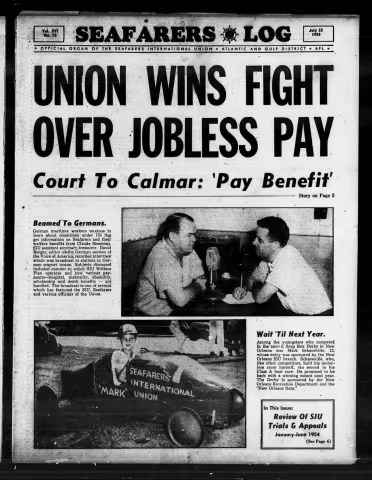
BeametTTo Germans,
German maritime workers -anxious to
learn about conditions under US flag
get information on Seafarers and their
welfare benefits from Claude Simmons,
SIU assistant secretary-treasurer. David'
Berger, editor of^^the German section of
the Voice of America, recorded interview
which was broadcast to stations in Ger
man seaport towns. Subjects discussed
included manner in which SIU Welfare
Plan operates and how. various pay
ments—hospital, maternity, disability,
scholarship and death benefits — are
handled. The broadcast is one of several
which has featured the SIU, Seafarers
and various officials of the Union.
Wait Til Next Year.
Among the youngsters who competed
in the anm^il Soap Box Derby in New
Orleans was Mark Schaneville, 13,
whose entry was sponsored by the New
Orleans SIU branch. Schaneville, who,
like other competitors, built his motor-
less racer himself, ran second in his
Class A heat race. He promised to be
back with a winning mount next year.
The Derby is sponsored by the New
Orleans Recreation Department and the
"New Orleans Item."
„ i, „ „ „
In This Issue:
Review Of SIU
Trie's & Appeals
January-June 1954
(See Page 6)
4 -«i
^1
.V. -.v . Aw tA,,:;/, . , ... # A A
-S..-" -.•Vv - r-- ;
A. finfii'j'ii i'A iin'iVi-'• >/
-
• i'.'.A
Pace Tim SEAFARERS LOG J«|ly ?3. MM ;
.fe
\F -
i;
Congress Supports
New Tanker Bills
~ WASHINGTON—Two major parts of the Government's
maritime program for this year have already cleared most
legislative hurdles and seem likely to wind up on the statute
books before the current ses-
Double Winner Has A Problem
sion of Congress winds up
shortly.
One, a so-called "trade-in-and-
build" tanker measure, has passed
both houses in similar form and
requires only minor adjustments
before going to the President. The
bill would permit private tanker
operators to sell their old .T2s, to
the Government and use the funds
thus obtained to build new ones.
Tlie object of the bill is to re
place the war-built T2s, which are
fast becoming obsolete, with larger
and faster ships which would be
suitable for commercial operation
and also valuable to the nation in
the event of a war or emergency.
The ships bought by the Govern-
Unions Form
CroupingFor
La. Politics
NEW ORLEANS—A permanent
political and legislative arm has
been created by Louisiana trade
unionists with the formation of the
United Labor Organization repre
senting more than 400 AFL, CIO
and independent unidns in this
state.
Establishment of the ULO fol
lowed adjournment of the session
of the Louisiana legislature
which passed a so-called "right-to-
work" law outlawing union secur
ity clauses in contracts between
labor organizations and manage
ment.
"Events of recent months taught
us that political unity is essential
to survival of Louisiana's great la
bor movement," said E. H. "Lige"
Williams, president of the Louisi
ana Federation of Labor and chair
man of the new ULO's executive
committee.
"By projecting ULO into a
permanent aggressive arm of all
Louisiana labor, we are taking the
first step toward a great statewide
organization that will represent
100 percent of labor's objectives
in political elections and legisla
tive sessions," Williams explained.
SEAFARERS LO&
July 23, 1954 Vol. XVI. No. 15
As I See It Page 4
Brother Chairman Page 4
Burly Page 9
Crossword Puzzle Page 10
Did You Know Page 17
Editorials Page 11
Foc'sle Fotographer Page 16
Galley Gleanings Page 17
Inquiring Seafarer Page 10
In The Wake Page 10
Labor Round-Up Page 11
Letters Pages 18, 19
Maritime Page 9
Meet The Seafarer Page 10
Notices, Personals Page 20
On The Job Page 9
Port Reports Pages 14, 15
Quiz Page 16
Seafarers In Action Page 9
Ships' Minutes Pages 20, 21
SIU History Cartoon .... Page 7
Sports Line Page 17
Ten Years Ago Page 10
Top of The News Page 5
Wash. News Letter Page 6
Welfare Benefits Pages 22, 23
Welfare Report Page 8
Your Constitution Page 5
Your Dollar's Worth Page 7
Publlthatf biwttkly at th« baadquarfan
•f (ha aaafaierv Intarnatlonal Union. At
lantic « Ou'J DIttrlct AFL, «75 Fourth
Avanua. •raoklyn-3X NY. Tai. HYacinth
Entarad as sacand clau maHar
at tha Pott OHIca in Braaklyn, NY.,
wndor 'ha A-.i of Aiiawat 34. Itll
ment under this program would be
retired to "the reserve fieet, and
-would ^ovide a sizeable tanker re
serve Tn the event a sudden ship
"break-out" was required.
The second bill, passed by the
House last week in a form directly
opposite to that in which it pre
viously cleared the Senate, deals
with a $150 million tanker program
under which the Navy would build
and own 20 high-speed 25,000-ton
supertankers. Under this measure,
outmoded tankers now operated by
the Navy or the Military Sea Trans
portation Service would be re
placed and also put into the Gov
ernment reserve fleet.
ThuSr both tanker bills would
provide a much-needed boost for
the declining US shipbuilding in
dustry and, at the same time, cre
ate a large tanker reserve.
The difference between the
House and Senate versions of the
Navy tanker bill lies in the House
provision for Navy ownership of
the vessels to be built. The Senate
approved a bill providing for pri
vate coqstruction and ownership of
the new tankers; however, the feel
ing in the House was that it would
be more to the Government's ad
vantage to keep the ownership of
the vessels for itself.
Under the Heuse version, the
ships would be operated by private
companies on a long-term charter
basis, and would be manned by civ
ilian seamen. The Senate bill pro
vides for the ships to be time-chart
ered to the Navy.
A provision of the "trade-in-and
build" measure gives trade-in pref
erence to those tankers which have
been dociunented under the US
flag for the three years immedi
ately preceding passage of the bill.
First Seafarer ever to win two awards in an SIU art contest,
Leif Hope (right) is pictured with his prizes, two award certificates
and two engraved sterling silver cigarette lighters with an SIU
c>mblem, for winning first prize for watercolors and tying for first
i>rize in oils. In the Army, stationed at Fort Dix, NJ, he picked up
his awards during a visit to headquarters with a former shipmate,
Alex Leiter, AB, who sailed with him on his last ship, the Afoundria
(Waterman). Naturally, he doesn't smoke.
Coast Unions
Open Pacts; •
Ask Raises
SAN FRANCISCQ—Seeking a
six percent boost for all ratings,
plus an additional week of vacation
time, the Sailors Union of the Pa
cific aiid the Marine Firemen,
Oilers and Watertenders have
jointly reopened their agreements
with West Coast shipowners.
The SUP-Firemen's action -came
after the companies agreed to give
the CIO Marine Engineers and CIO
Radio Operators a pension plus an
additional week's vacation and
other concessions. The companies
and unions involved will decide by
November 15 the contributions the
owners will make to the pension
funds. • "
Last September, the SUP and
MFOW negotiated a pension pl|in
and a union-operated vacation plan
in lieu of wage increases for their
membership. The action of the
shipowners in giving additional
concessions to the CIO radio .oper
ators and engineers' unions was
citedJby the SUP as upsetting the
basic pattern on the West Coast
and making necessary reopening of
unlicensed contracts.
New Libraries Co Aboard Ships
Representatives of the SIU Sea Chest in all ports will begin stocking all contracted ves
sels with new ships' libraries in the next two weeks, in accord with the'recommendations
expressed by the Union membership during a six-week poll conducted by the SEAFARERS
LOG earlier this year._ — •
' The new library assort
ments reflect the changes
urged by the membership in the
types of books supplied by the
SIU program, which was launched
nearly a year ago, in August, 1953.
Completely new 50-book library
packages are distributed on all
SIU vessels every three months.
The cost of the program is carried
entirely by the Log Fund, at no
extra cost to the membership.
Seafarers gave an ^overwhelming
Your SIIJ Meeting Rights
In order to con dantly remind all SIU members of their con
stitutional rights in SIU membership meetings, the following state
ment is read at the opening of all SIU meetings throughout the
nation.
These are the democratic principles which guide all SIU meet
ings:
Any member present at this meeting and in good standing, who
so desires, has a right to nominate himself to any official meeting
job in this meeting. This also applies to a place on any committee
that may be elected at this meeting.
Any member present in good standing has the right at any
time, if he so desires, to challenge the decision of the chair or
ask for a division of the house on any sucii question^ Any member
may also request a show of books of each man present who may
vote on any question.
Copies of the minutes of, tonight's meeting will be available-in
advance of the next regular meeting in the business office for the
benefit of any member -in good standing who wishes to read or
study same before the next regular meeting commences.
In addition to tonight's minutes being made available, the mem
bership is advised that in each SIU business office where a Port
is maintained in the continental United States, minutes of all SIU
meetings, regular, special, financial, or otherwise are always avail
able to any member in good stapding who desires 'and so requests
to read and study same.
The officials and committeemen who will be elected at our meet
ing here tonight as well as all of our other members present will
be guided in the conduct of this meeting by the following.
li The Union constitution.
2. Majority vote of the membership.
3. Robert's rules for order.
If; in the opinion of any member in good staffding present,
he is denied by this meeting any of the above-mentioned rights,
he is requested .to call this to the attention pf the secrfetary-
treasurer, by registered mail, special delivery, return receipt re
quested, before the next regular meeting so that the secretary-
treasurer will have sufficient time to submit copies of any such
protest and a report on same to the membership at the following
regular membership meeting for action thereon.
In order to establish whether or'not there is a quorum present,
will all of those members in good standing please hold their books
up so that they can be counted.
The membership count shows that there is a quorum present.
Therefore, this meeting will now come to order.
"The first point on the agenda tonight will, be the election of
officials for this meeting.
vote of confidence to the idea of
the, libraries in the opinion poll
which ended April 30, 1954. The
poll was designed to get a sampling
of membership opinion on the
quality and types of books sup
plied, as well as the idea of con
tinuing the library distribution al
together.
Only Two Votes Against
Two lone votes were cast for
ending the program completely,
while 42 percent of the Seafarers
who participated in the poll rec
ommended continuing the libraries
as is, and the remaining 58 percent
urged continuing it with slight
changes in the proportions of the
types of books supplied.
Accordingly, the 50-book pack
ages supplied from now on will
contain 8 Westerns, 16 mysteries,
12 novels, 8 non-fiction, 4 humor
ous books and 2 books on sports.
The poll results showed a major
demand for less Westerns and
more novels and non-fiction. The
proportions were therefore ad
justed, from the previous break
down of 15 Westerns, 15 mj'steries,
10 novels, 4 non-fiction, 4 humor
ous books and 2 sports books.
All books supplied are of the
handy, paper-bound size, and are
MC5 Winner
In Shin Vote
SAN FRANCISCO —The AFL
Marine Cooks and Stewards won
another NLRB election when stew
ard department crewmembers of
the Harpoon voted six to one in
favor of the SlU-affiliated union.
If was one of several recent vote
victories by that union.
The Harpoon- is a Liberty ship
operated by the Shepard Lines. .[AS
MCS-AFL was the only union on
the ballot with Harry Bridges' sup
porters urging a "no-union" vote.
The ship was balloted by mail In
Casablanca.
Meanwhile, the Labor Board kas
thrown out objections to the re>-
suits of the steamschooner. election
which MCS=AFL won by a count of
20 to 2. Certifibation of MCS-i^FL
as bargaining agent is expected in
a few days, after which the union
will negotiate a contract.
distributed through the facilities of
the SIU Sea Chest under an ai>
rangement with Pocketbooks, Inc.,
one of the country's largest dis
tributors of small, paper-bound
volumes.
AFL Dock
Union Sets
Convention
The first convention of tha
American Federation of Labor's
longshore union, the AFL-ILA,
will open in Chicago Monday for
the purpose of drafting a constitu
tion and setting up an autonomous
structure for the new union.
The convention, meeting-at tha
Atlantic Hotel, will be attended by
delegates representing approxi
mately 50,000 longshoremen and
craft workers from ^ the Great
Lakes, rivers ports, Alaska, tha
Pacific Northwest, and locals on
the Gulf and Atlantic Coast who
have swung over from -the old
ILA.
New York Represented
-In addition, AFL-ILA locals in
New York City are sending dele
gates to participate in the de
liberations.
- Although the major busiheki of
thn convention is the' setting tilr,pf
the physical apparatus of Ihb'new
union, a goodrdeal of planning is
slated on the future activities of
the union in the Port of New York.
Control of the port is still at stake,
the National Labor Relations
Board has not yet completed its
count of challenged ballots in the
last port-wide election.
Once the convention has com
pleted its^ worki the five man
board of t^stees appointed by the
AFL to supervise the new. union,
will automatically pass out'of. ex
istence. The AFL itself will no
longer have, authority over the
actions of the organization, al
though it is expected to Offer some
form of financi^ assistance.
•J./ '
A-
Jnlir t», 1954 SEAFARERS LOG PIC* Thre*
Peninsula Mariner Provides Sea-Llff For Aircraft
Docked at the Brookley Air Force Base, Mobile, the new Peninsula Mariner has a deck cargo of
17 jet fighters brought back from the Far East for repairs and overhauling. Peninsula Mariner—spe
cially designed with deck that permits carrying planes intact—is operated by Waterman Steamship
corporation for MSTS.
Dry Cargo Companies Starting
Payment Of Retroactive Wages
Payment of retroactive wages under the SIU dry cargo contract is getting underway as
SIU companies are setting up payrolls and office machinery for dispensing wages due.
Some companies have already started to make-payments, while others expect to do so in
the very near future. The-t
task is a complicated one in and will make payment 'on presen-
light of the fact that retro- tation to any company agent of a
activity extends back to October 1, man's discharges, and filling out of
1953. That means that the average a receipt for each vessel sailed on.
Seafarer will be receiving retro
active pay checks from several
ships and in some instances from
several shipping companies.
Among companies already pay
ing are Seatrain, Bull, South At
lantic and Isthmian. Seatrain Lines
has payrolls ready for all its ships
2 Tanker Go's
Ink New Pact
-Others Due
With two companies already
signed, the Union is making good
progress in its current contract
talks with tanker operators. The
two companies signed are the
Colonial Steamship Corporation
and Oil Carriers Joint Venture.
' Meanwhile, the Union is con
tinuing its talks with the Cities
Service Oil Company and other
tanker companies. The old con
tract with these companies ex
pired Septembet 30, 1953, and the
new contract talks call for all wage
and OT gains to be retroactive to
October 1, 1953.
The new tanker pact is expected
to follow the pattern of the re
cently-negotiated freighter agree
ment in percentage pay and OT
boosts and changes in general and"
working rules. Application of the
, same percentage increases won for
freighter men would preserve the
traditional pay differential in
favor of tankermen.
The freighter agreement calls
for wage boosts ranging from two
to six percent, and new OT rates
ranging from $1.51 to $1.98. The
agreement was ratified by the
membership June 16 and the com
panies. are now paying the new
: rates and also paying off on retro
active pay.
The company has a teletype system
which should make for speedy
handling of checks.
4U But Five Ships
Bull Lines has been mailing out
checks on all but five of its ves
sels, taking them in alphabetical
order. Ships remaining to be paid
are the Mae, Marina, Rosario, Show
Me Mariner and Suzanne.
Crewmembers of any other Bull
Line ships who have not received
their checks should contact the
company because of the possibility
that the .checks have come back in
a change-of-address mixup. Any
Seafarers who have changed their
address and have money coming^ to
them should check with Bull Line's
main office.
The company reports that a
number of checks it has mailed out
have already been returned be
cause the Seafarers for whom they
were intended are no longer at the
address given.
South Atlantic Steamship Com
pany has payrolls completed on its
ships apd the money can be ob
tained by contacting the company
in Savannah. Isthmian Steamship
Company has payrolls ready on
four ships, the Stefel Ranger, Steel
Admiral, Anniston City and
Hoosier Mariner, with more being
readied each week. .
August Payment Date
The majority of companies not
Meeting Night
Everg 2 Weeh»
Regular membership meet
ings in SIU headquarters and
at all branches are held every
second Wednesday night at
7 PM. The schedule for th*
next few meetings is as follows:
July 28, Aug. 11, Aug. 25.
All Seafarers registered on
the shipping list are required
to attend th* meetings.
paying yet expect to begin pay
ments sometime next month. Mis
sissippi Shipping Company is ready
to make payments, via the mails
only, as of August 2 on its com-
(Contlnued on page 20)
Union Wins
Fight For
Jobless Pay
An attempt by a major SlU^-contracted steamship
company to fatten its treasury at the expense of unem
ployed Seafarers has been defeated again through a
unanimous New York State
court ruling in favor of the
SIU. The victory for the men
of the SIU involved the Cal-
mar Steamship Company,
which attempted to deny un
employment insurance benefits to
any man who may leave his ship in
accordance with membership-
adopted Union rules. A similar at
tempt by another SlU-contracted
company was defeated several
years ago.
The current attempt by Calmar
to deny a permitman unemploy
ment insurance stems from the
New York State law which grants
rebates to companies that have low
employee turnovers. By denying-
seamen who pay off their right un
der the unemployment laws Cal
mar hoped to increase its annual
rebate of money from the State.
In ruling in favor of the SIU,
the Appellate Division of the New
York State Supreme Court unan
imously held that the position
taken by the SIU was "fair, rea
sonable and just."
The court ruling held further,
that as far as New York State is
concerned, any permit laid off a
ship under the 60-day rule is en
titled to his unemployment in
surance in this state. This of
course would apply only to com-
SIU Vet Moon Kouns,
42 f Dies Of Heart Attack
NEW ORLEANS—^Martin H. "Moon" Kouns, veteran Sea
farer and a member of the Union staff at the New Orleans
%IU branch died here July 17 of a heart attack. He was 42
years old.
Kouns was stricken while
attempting to push his stalled
automobile on Highway 11 at Irish
Bayou at about 7 PM last Saturday
He had served some time as a tem
porary patrolman and was a door
man at the branch hall for about
eight years. Before that he sailed
in the deck department, as an AB.
On Monday, July 19, at a special
meeting, the New Orleans member
ship requested the hall be closed
the following day, Tuesday, out of
respect for their departed brother.
He was buried Tuesday, following a
funeral at Ransons Funeral Home,
7024 Elysian Fields Avenue, attend
ed by a large delegation of Sea
farers and officials of sister unions
in the area. The hall remained
closed to business the entire day.
A colorful figure, Kouns was
known to his host of friends in the
SIU and particularly in New Or
leans, his home city, simply as
"Moon." Only his intimates knew
his full name.
Early in his lifetime, he was a
professional boxer in the light
heavyweight division. He was famed
locally for having fought a 20-
round draw about 20 years ago
with Kayo Baer on the West Bank,
which was said to have been the
longest bout in the modern history
of New Orleans' boxing,
A master storyteller, he could
produce a yarn on any subject
upon demand. His experiences be
came familiar to readers of the
SEAFARERS LOG through the ef
forts of several brother Seafarers,
principally Percy Boyer, also of
New Orleans, who appointed him
self "historian" on the life and
times of "Moon" Kouns, and peri
odically contributed anecdotes
about Kouns and ais fabulous
career to the LOG
Kouns is survived by two
brothers, Frank, who sails SIU in
the steward department, and John
(Continued on page 20)
panies that have their main office
in the state.
Calmar is now expected to try
tn appeal the case to the Court of
Appeals, the State's highest court,
and eventually to the United
States Supreme Court, nowever,
ttie unanimous nature of the Ap
pellate Division's decision and the
strongly-worded contents of that
decision make it doubtful that the
company will have any success in
overturning it.
A.S a matter of fact, because of
the unanimous decision of the
Court, Calmar now will have to
(Continued on page 20)
Seafarer Martin H. "Moon"
Kouns Is shown as he spoke
his piece dnring a membership
fete in New Orleans.
SIU Witnesses
To Crash Wait
Tug Salvage
MOBILE.—Two SIU members
and three officers of the Alcoa
Clipper (Alcoa), detained by Vene
zuelan authorities in an investiga
tion of a fatal collision involving
the Clipper and a tugboat on June
26, are still waiting to testify
pending completion of efforts to
raise the sunken tugboat.
Company officials here said Sea
farers Joseph Busheed, who was
quartermaster on the wheel watch,
and Maurice Kramer, OS, who was
working on deck at the time of the
mi-shap, as well as Captain Yngvar
Krantz, master; Clyde O. Eddy,
chief mate, and Sam White, first
assistant engineer, had been
moved from La Guaira, scene of
the accident, to Caracas.
The men were being allowed
complete freedom in Caracas. -
where they, were being lodged in
first-class hotels, but were not al
lowed to' leave Venezuela, Alcoa
reported. Salvage equipment was
being rushed from another Vene
zuelan port to raise the tug for ex
amination.
Meanwhile, the Alcoa Clipper
was examined in drydock here at
the completion of her last voyage
and was found to be undamaged.
The Clipper was able to resume
sailing without interrupting her
schedule and is now back on her
regular run to Caribbean ports.
The fatal harbor accident which
i^ being investigated took the lives
of three persons, two men and one
woman, all of them on the tug. The
woman was the wife of the tug
engineer, who also died. The engi
neer's child narrowly escaped
death when the pilot who had been
taken aboard the tug just before
th* accident grabbed the child and
swam ashore.
Following the mishap, which oc
curred in the early dawn, at about
4:30 AM, the Clipper was detained
by Venezuelan authorities for five
days, during which various mem
bers of the crew were taken ashore
for questioning in connection with
the accident. Eventually the ship
was allowed to sail, but the five
crewmembers were still detained.
A relief skipper, Capt. J. M. Cas
tro, Was flown down from Mobile
to bring the ship back.
'. I
•' I M
Al s
I
'.41
ll
'A ::^l
"'''l
•f I
•I
.•111 I
' I
Jl;;
vi"'' •
Fare Four SEAFARERS LOG JolylS. 19M
I!S-
k'.V
|S/
It
p'^' '• •
I
SlU crewmembers, ship's officers and Robin Line officials take part in presentation ceremony as
duplicate of safety award presented to company is turned over to Robin Tuxford captain, for display
aboard the ship. Pictured U-r) are: J. Berger, Isf asst.; L. Thomas, c^ief engineer; C. Wells, assistant
port captain; J. Condon, personnel head; L. Pate, viee president (presenting plaqne); Seafarers O.
Bourne, carpenter, and C. lannoli, bosun; K. Chambers, master; S. Elan, chief mate; H. Wick, Ameri
can Bureau of Shipping; Seafarer W. Marcus, steward; S. Crane, purser; B. Alewine, assistant port
Steward. The ceremony took place aboard the ship at its Brooklyn pier.
Robin Crews Get Safety Award
Seafarers who shipped with Robin Line during 1953 helped pile up an impressive safety
and accident prevention record on the company's ships last year, according to the National
Safety Council.
The achievement in the field
of safety prevention has been
recognized by the Council in
the form of an "Award of Honor"
plaque presented to officials of the
company. Duplicates of the award
are being.placed aboard all Robin
Line ships as they arrive in New
York, with the Robin Tuxford first
to get its award.
Each year the National Safety
Council presents industrial organi
zations which demonstrate unusual
progress and significant improve
ment in reduction of accidents to
personnel with the "Award of
Honor."
Robin Line received the award in
the shipping field as a result of its
1953 record showing a 94 percent
improvement in its accident sever
ity rate and a 59 percent better
ment of its accident frequency rate
as compared to the average of its
1951-52 ratings and the industry's
average for tlie same period. The
accident severity rate represents
days lost. The- frequency rate
means the number of lost time ac
cidents. Consequently, as the fig
ures show, Robiii Line cut down
very sharply on both the number of
accidents and the more serious mis
haps.
Additional recognition in the
safety field came to Robin in the
form of a certificate naniing it a
second place winner in the annuaL
competition among privately-owned
dry cargo and passenger ship lines
as to annual accident frequency
rates. The Matson Navigation Com
pany won first place and United
States Lines took third position.
Permanent, Temporary '50-50'
Bills Gain Ground In Congress
WASHINGTON—Both the permanent and temporary '50-50'
bills are within an eyelash of passing Congress as both Houses
attempt to wind up their business by the end of the month.
With a favorable report from-^
the House Men
Committee in
irchant" Marine
it^ corner, the
Wi/-
In Wilmington, California, for
the moment, but probably not for
long is Seafarer Lee De Parlier,
who sails in the steward depart
ment, and who took a hand in the
running of the port meeting. De
Parlier, who served as recording
secretary for the port meeting, can
be remembered as the man who
stuck out a full 14-month rugged
Persian Gulf shuttle on the Fort
Bridger,-
When the trip ended he was one
of two SIU men left aboard the
tanker. More recently his photo
graphs of the mahogany loadifig
operation on the Gold Coast were
found on the display pages of the
SEAFARERS LOG.
De Parlier, who is 28, comes
originally from North Carolina, and
Joined the SIU in New Orleans on
August 31, 1948.
l" t t
Elected chairman of the Savan
nah port meeting
last week by a
margin of 23 to
20 was Seafarer
James Chasse-
reau of Mount
Pleasant, North
Carolina. Chas-
sereau, who sails
in the engine de-
par tmeqt, has
been i^n SIU
jaember forheai-Iy nix years, Jdin-
.
•ing in the Port of New York on
October 25, 1948. He's 27 years
of age.
- Ilf 'it
Serving as recording secretary
for the Baltimore port meeting is
Seafarer William D. Kenny, who
sails in the steward department.
Kenny, who is a native of Scotland,
joined the SIU in New York on
November 28, 1945. He's 60 years
of age.
it it it •
Down in the Gulf at Lake
Charles, Louisiana, Seafarer James
F. Mapp ran the
Lake Charles
port meeting. A
native of Missis
sippi, he has his
home in the town
of Lexington in
that state. Mapp
sails in the en
gine department
Mapp and has been a
member of the
SIU since May 10, 1941, when he
joined up in New Orleans. He is
62 years old.
Serving as recording secretary at
the meeting, along with Mapp, was
Seaf^er Arthur A. Baker of Ma-
dill, Oklahoma. Baker joined the
Union In New York oti June 2,
1944. He celebrated his 29th bilth-
day this past Wedhesday. '
mwii
jonly remaining obstacle in the way
of a pemanent "50-SO" is a Presi
dential veto. The bill has already
passed the. Senate and seems cer
tain to~ go through the House of
Representatives.
The -temporary "50-50" bill is
the one that deals with this year^
foreign aid appropriations. A "50-
50" provision was included in the
House version of the foreign aid
bill, and the Senate Committee on
Foreign Relations has reported the
bill to the floor of the Senate in
pretty much the same shape as the
House did. Since "50-50" has been
acted on favorably in every year
since the foreign aid program
started, and the Senate has gone
on record for a permanent law, no
trouble is expected in pushing the
foreign aid bill through in its
present form.
The difficulty on permanent "50-
50" lies in the attitude of the
President and the adminlstsation
in general. Spokesmen for the
State Department, the Defense De
partment and other government
agencies had -attacked the bill,
principally on the grounds that it
was objected to by friendly mari
time nations.
Should the President veto the
bill, supporters of "50-50" would
have to muster enough strength
in both House and Senate for a
two-thirds vote to override the
President. In an election year, it's
Mt believed -likely that Congress
wqiild do so.
Further, with th^ isession draw
ing to a close, the President might
be able to veto the ^ bill after
Congress has gone home for the
summer.
Both the maritime unions and
the shipp'inii industry are solidly
Ut)ite<Fin suipport^'f the'blil, ^ ^ '
THE THIRD REPORT ON UNION-CONDUCTED TRIALS AND
appeals since the adoption by the membership of the revised Union
constitution appears on page six of this issue. The membership will
note that in the past-six month period there were very few instances
in which SIU men have found it necessary to bring any of their
brothers up on charges.
Your Union, of course, is well pleased with this state of affairs, since
it reflects a considerably, degree of self-discipline on the part of the
membership as well as the smooth functioning of
the Union's shipboard machinery for settling beefs.
Offhand, headquarters believes it is proper to
draw the conclusion that the shipboard meetings
and our system of ship and departmental delegates
has had much to do with this favorable development.
It means that the Union brothers are settling dif
ferences among themselves in proper fashion and
the few men who. might have a tendency to break
out and perform are being kept in line by their
own shipmates.
i5afeguard Rights
Of course, it always can be expected that from time to time some
men sailing SlU ships will commit some breach of our Uhion rules
and-regulations. . Seamen, being human beings like anybody else, are
bound to have-some bad moments; When that does happen^the melt
involved are assured that their rights are fully protected by the safe
guards written into the Union's trials' procedure.
•Your Union has tried very hard to make it a point of carefully fol
lowing the kind of procedure that every American is entitled to re
ceive when he has his day in court. From experience, it appears that
this attempt has been a successful one.
^ it it ^
AS REQUESTED BY THE MEMBERSHIP, TOUR UNION HAS
made some changes .in the selection of books placed aboard the ships.
After running this library program for a year on an e;Kperimental basis,
it was found that the menvbership was very much satisfied by the way
it was operating, but indicated that they would like a slightly different
selection of reading matter.
Accordingly, arrangements have been made with the publishing
house to give the membership the kind of books that they have re
quested, and the new selections that will be going aboard from now on
will reflect this. '
These books, as you know, are supplied through the LOG fund,
and are put aboard by the Sea Chest representative when he visits the
ship. Each ship is entitled to a 50-book selection every three months.
As always, the membership is invited to let headquar^s know how
they feel about the kind of books being put on board, a'nd about the
way the whole program is being run.
it i 'it
MENTION HAS OFTEN BEEN MADE IN THIS bORNER ABOUT
the operations of the Seafarers Welfare Plan and the kind of programs
that your Welfare Plan has been developing. One of the things your
Union has always been proud of is the fact that it insisted on setting
up a special list when the Welfare Plan' was first agreed on with the
operators, to take care of those ailing Seafarers who would not be cov
ered otherwise. These were the Seafarers who were in the hospital at
the time the Plan was negotiated, and consequently, had no money
paid into the fund on their behalf by the operators.
Normally, under the kind of Welfare Plan administered by an in
surance company, these Seafarers would simply have been left out in
the cold, but your Union could see no justification
in a situation whereby jthey would be in the saipe
ward in the same hospital with other Seafarers who
were receiving benefits—simply because they hap
pened to get sick during the period prior to the
plan's going into effect.
In the last four years that tiie Welfare Plan has
been operating, this special list has shrunk con
siderably as the Seafarers in question were dis
charged or went on their final voyage. But there
are still a handful of Seafarers today, more than
four years after the Plan began, who are receiving their weekly hos
pital beneAl through the special list, just like all the other hospitalized
brothers in the Union.
Certainly, these men, who have been confined for so long a period
of time, deserve the same consideration and need the same assistance,
or more, as the man who is in drydock for two or three weeks. The
Union considers that the establishment of the special list, together
with the unlim^ed feature of our hospital benefits, is one of the sound
est moves ever made under the Welfare Plan.
» it it 'i
OVER THE OBJECTIONS OF THE MARITIME UNloks,
Congress has approved the sale of 12 Government-owned Cl-MAV-1
ships to Brazil. The reasons given for approving this action are that-
It wjll help our relations with Brazil and t^ll help our ships down there
that are being discriminated against (>n berthing and in various other
ways. .
One of the conditions "of the bill is that these ships are to be used
in the local coastwise trade of that country, which means they irill
not be competing in any way with American fia^
operators. However, your Union's position, and that
of the other maritime unions, was that the sale of
ships to a foreign nation is going to increase the
pressure by other countries that are out to get,US
surplus tonnage, and some of these other countries
would be using ships bought from the US to com
pete with our operators.
Consequently, the Union Intends to keep a
weather-ey^ peeled dh futnrd developments dfbng
these lines. It remains to be seen if this parUcu- -
4ar sale wili have any bearing on future actions by our-Governmlent.
V. ... . ,
• ;,-i I."?'!"
WR
July 23. 1954 SEAFARERS LOG nge tnrm
IXDO-CHINA ARMISTICE IS SIGNED—The Indo-China armistice
was signed in Geneva after eight years of bitter warfare. The cease
fire will split the big coastal state of Vietnam between pro-Western
and Communist-led regimes. It will also halt the fighting in Laos.
French Gen. Georges Deteil signed the two accords—one covering
Vietnam and the otber Laos—on behalf of the French-Vietnamese and
the French-Laotian commands, while Gen. Quang Buu signed them
for the Communist-led Vietminh rebels. The signing was a signal vic
tory for French Premier Mendes-France who had staked his govern
ment, dedicated to making the French live within their means, on ob
taining a truce by midnight of the day before the signing.
ti i> t>
US RECOGNIZES NEW GUATEMALA REGIME—The" US granted
formal diplomatic recognition to the new anti-Communist government
of Guatemala, following that country's orderly return to peace. Defeat
for the Communist regime of former president Jacobo Arbenz Guzman
by insurgent forces proved a diplomatic victory for the US, with peace
once more restored in the Western Hemisphere and the sole pro-Com
munist government In Latin America out of business. The governing
military junta led by insurgent leader Lieut. Col. Carlos Castillo Armas,
meanwhile, moved to ease political tensions in the country by pledging
fair treatment, including land reforms, to peasant and labor groups.
EISENHOWER ADMINISTRATION WHIPPED ON HEALTH PLAN
In Washington, the House of Representatives by a vote of nearly 2-1
turned down the President's recommendations for stimulating the
growth of private and non-profit hospital and medical insurance plans.
Liberals termed the program "inadequate" and "poorly drawn," while
conservatives, bolstered by the strenuous objections of the American
Medical Association to any form of aid for medical and hospital in
surance plans, attacked It as a form of "socialized medicine." The de
feat for the Administration came forur days after a national broadcast
from the White House urging passage of the legislation.
4" 4" 4>
LID OFF ON BEEF FOR BRITAIN—After nearly 15 years of gov
ernment control, fresh meat—the last food to go sinc^ wartime con
trols went into effect In 1939—went off the ration lists in Great Britain.
The day decontrol began prices rose almost to the US level, but quickly
tapered off as British housewives immediately shied off from buying.
The weekly ration of fresh meat had been about a pound per person
and, at one time, as low as a half pound.
4i 4 4" .
WORLD COURT RULING AGAINST US STIRS NEW ANTI-UN
FEELING—On the heels of a mild Congressional revolt against the
United Nations on the issue of admitting Red China to the UN, the In
ternational Court of Justice at the Hague stirred new resentment
against the world organization by rulirig against the US on the ques
tion of indemnity awards to 11 UN employees dismissed for having
refused to answer the questions of Senate probers concerning possible
Communist ties. The awards, ranging from $6,000 to $40,000 back pay
and other penalties, would be paid by the UN, about a third of whose
funds are supplied by the US.
4 4> 4>
MCCARTHY ISSUE HEADS FOR A SHOWDOWN—with final re
ports on the stormy McCarthy-Army hearings still weeks away. Repub
lican Sen. Ralph Flanders of Vermont continued to press his case for
etripping Wisconsin GOP Sen. Joe McCarthy of his Senate committee
chairmanships unless the latter purged himself of questions raised by
another Senate unit two years ago on McCarthy's financial transactions.
Meanwhile McCarthy was forced to yield to the insistent demand for a
staff housecleaning and accepted the "resignation" of Roy M. Cohn,
chief counsel of the subcommittee on investigations. He also transferred
the controversial assistant counsel, Don Surine, from the subcommittee
staff to his personal payroll.
YOU oiMf ffAe 8IU
CONSTITUTION
;fRIGHTS -ANb: fSHVaEOSSi M'
f'M !ARE^< ii#!:
• WITH THESE: fTii •
From Article XIII, Section 6
"Before assuminei office, ever/
officer, port agent, and patrol
man shall take the following oatht
'I do solemnly swear that I will
faithfully execute the duties of
of the SlU, and I
will, to the best .of my ability,
protect and preserve the Consti
tution of this Union and the wel
fare of the membership'."
Every elected official upon ossum-,
ing office must take~ this oath,
which he is required to obey com
pletely. Any violation of the oath
would lead to immediate disci
plinary action under the terms of
the Union Constitution/ ,
Ask US Pay Channel Costs
For Runaway-Flag Ore Ships
En-route to the States via Venezuela, a giant 63,000 deadweight ton foreign flag ore
carrier, tHe Ore Chief, is likely to become the center of much controversy in the next few
weeks. The huge vessel, 794 feet long and 116 feet in the beam, is one of three ships built,
or being built, in Japanese^
shipyards to carry ore from
US Steel Corporation's new
iron ore mines in Venezuela to its
plants In the United States.
The ships are owned by National
Bulk Cargo Carriers Inc., which
operates mostly under the Liberian
fiag. As such the Ore Chief falls
into the pattern under which many
ore carriers, tankers, and other
new vessels are placed under for
eign flags in order to avoid US
taxes, wages, manning scales and
other stiff operating requirements.
What makes the Ore Chief more
controversial than other foreign
flag operations is the fact that
Uncle Sam is being asked to foot
a whopping bill for deeper ship
channels so that runaway flag op
erators can bring their giant ore
carriers fully-loaded into the ports
of Philadelphia and Mobile.
Draft Is 40 Feet
The draft of the Ore Chief, fully-
loaded, is 40 feet. The present chan
nel up to the Fairless Steel Works,
US Steel subsidiary, is approxi
mately 25 feet. Uncle Sam is being
asked to spend $87 million on
deepening the channel to 40 feet
so that the huge foreign-flag ore
boats can come in to Fairless Steel.
US Ships Don't Need It
No American-flag dry cargo ship
ping at present has any need for
the 40-foot depth up to Trenton,
since the Delaware River is 35 to
40 feet at the ports of Philadelphia
and Camden, ample depth for
American fiag dry cargo operations.
Dredging Recommended
The Mobile Channel bill, recom
mended by the Army Corps of En
gineers and approved by a House
committee, calls for enlarging the
bar channel to a depth of 42 feet
and a width of 600 feet from its
present 36 by 450 dimensions, and
deepening the Mobile River chan
nel to 40 feet, plus the addition of
two turning basins.
Here the announced purpose of
the work is to make it possible for
US Steel's Tennessee Coal and Iron
Division to bring large foreign-flag
ore boats into Mobile. The company
recently opened a new ore terminal
in the harbor.
In other words, the Government
Leaky Raft, Seasick
Crew=Cancelled
Odd-looking raft on which five amateur sailors hoped to drift from
San Francisco to Hawaii Is shown outside the Golden Gate on
her second day out, with one of her crewmen holding up a fair-
sized fish caught in the Pacific. After six days and a drift of only
62 miles offshore, amid frantic radio messages for someone to "get
us off this damn thing," all five were rescued by a passing freighter
and returned to port.
SAN FRANCISCO—Amid conflicting reports as to whether
or not they were In grave danger, five amateur sailors who had
set out to float to Hawaii on a raft were rescued by a United
Fruit Company freighter, the-*-
Metapan. In six days they had
drifted only 62 miles off shore.
The search was on for the ship
when the Coast Guard started re
ceiving franctic radio messages
from the radio operator calling for
someone to "get us off this damn
thing."
The five men, under the leader
ship of a 38-year-old Mormon
preacher, Devere Baker, were out
to prove that the raft could drift)
to Hawaii and her passengers
could subsist on the resources of
the sea alone. .
Of food • there was -plenty—all
small sharksi As Bakeh ^d, "^e
had shark any time we wanted
it. They were always following
us." What the amateur expedition
failed to consider was two impor
tant factors—the seaworthiness of
the raft, and of the sailors them
selves.
The raft sprung a leak and water
started coming in faster than it
could be bailed. And the radio oper
ator as well as other crewmembers
became very unhappy, seasick
sailors.
At last , reports the Coast Guard
was out to destroy the craft as a
menace to navigation, although
Baker declared that all he had to
do was "caulk that .'seam &nd: We
could try it again."
is being asked to spend almost $93
million largely for the benefit of
runaway fiag operations.. Very lit
tle of this harbor work has any im
mediate benefit for American-flag
operations.
US Steel's Fairless plant is al
ready being. supplied by foreign
flag ore carriers of considerably
smaller dimensions than the Ore
Chief. Obviously a ship drawing 40
feet fully loaded could hardly op
erate economically in a 25-foot
channel such as the Delaware
River now has at the site of the
Fairless plant.
Wants Co. To Pay
To add an odd note to the pro
ceedings, US Steel had been having
a year-long argument with the
Army Corps of Engineers on
whether it should foot part of the
bill for the Delaware River project.
The Corps of Engineers had rec
ommended that the work be done,
but since US Steel is the only ben
eficiary, the Army thought that the
the company should foot half of
the bill.
The company indignantly re
jected the idea that it should pay
even half of its own way. Clifford
Hood, president of US Steel, has
been quoted as saying that to do so
would be to "extend special sub
sidy to a Government project," a
statement which ignores the fact
that the giant steel corporation is
the only beneficiaiy of the project.
As the matter stands now, all US
Steel is being asked to do under
the current bill in the Senate is to
provide a terminal and transfer fa
cilities, as well as a turning basin,
if necessary. The rest of the bill,
$87 million, would be footed by
Uncle Sam, so that the Ore Chief
and its siBter ships will be able to
take full loads into the Fairless
Steel works.
US Lifts Ban,
Okays 12-Shlp
Sale To Brazil
The first major sale of US ships
to foreign nations since a mora
torium on sales was declared
March 1, 1948, has been virtually
completed. Both Houses of Con
gress have approved legislation
calling for the sale to Brazil of 12
Cl-MAV-1 ships for use in that
country's coastwise trade.
The bill was solidly backed by
the Administration and the indus
try on the grounds that sale of the
ships to Brazil would help improve
relations with that country, and
would also help eliminate discrimi
nation against US ships in Brazil
ian ports.
Maritime unions opposed the bill
because it would set a precedent
for the sale of ships to other for
eign nations.
The Ship Sales Act was passed
in 1946 to permit both foreign
fleets and American shipowners to
replenish fleets that had suffered
heavily from war losses. In renew
ing the act on March 1, 1948, Con
gress struck out the section dealing
with sales to foreign nations, whila
the entire Ship Sales Act expired
on January 15, 1951.
Consequently, the sales to Brazil
will be the first US ship sales from
the Govertim.ent-owned fleet in
mor? thz?? six years.
• -.'i
I'-"
Pase Six SEAFARERS LOG July 23. 1954
MA Okays Another Transfer
WASHINGTON—The muddled situation regarding foreign-flag transfers of US dry cargo
vessels took a new twist this month, with,the disclosure that the Maritime Administration
has given permission for another ship transfer despite a previously-announced hold-up on
new transfers pending comple
tion of a Congressional in
quiry.
The Government ship agency
had previously okayed transfers
for three other dry cargo vessels,
and has applications for 80 more
still pending.
Protests against the relaxation
of the restrictions on transfers
SIU NEWSLETTER
from WASHINGTON
earlier this year, led by the SIU
and other maritime unions, helped
bring about the .temporary halt.
Maritime committees in both the
House and Senate held hearings on
the issue. A subsequent report by
the Senate Committee said it
would be premature to approve
transfers until the question of
tramp subsidies was disposed of.
Junkmen Get Mariner
WASHINGTON—Advised to use his own discretion on the
disposition of the stern section of the ill-fated Cornhusker
Mariner, Maritime Administrator Louis S. Rothschild has
again ordered that the ship be-*
scrapped. She is now at
anchor in Sasebo, Japan.
Rothschild's decision calling for
the dismantling of the vessel fol
lowed on the action of the House
Merchant Marine Committee, which
left the disposal of the Cornhusker
completely in his hands. Earlier,
when he first proposed scrapping
of the $10 million ship, the Com
mittee had asked that he hold up
any action pending an inquiry of
the situation.
A two-man House group explored
the possibilities of salvage and re
pair of the vessel, and came up
with a report putting the whole
matter back in the Administrator's
lap. He took it from there, order
ing dismantling of the ship and
salvage of as much of her ma
chinery as possible for use as
spares.
One of the alternatives called
for rebuilding the ship at a cost of
about $2 million, but this was re
jected.
The Cornhusker, which had been
manned by Seafarers and operated
by Robin Line, ran aground in the
harbor of Pusan, Korea, in June,
1953.
The latest ship for which ap
proval to transfer foreign has been
granted is the Nicholas C. H., oper
ated by the SlU-contracted Trident
Transport Corp. which is going
Panamanian. Trident, however, has
promised to buy another ship as a
replacement.
The first three applications ap
proved were for the Omega, oper
ated by the SlU-contracted Omega
Shipping Corp.; the Amerocean or
Amersea, only one of which will be
permitted to transfer, both oper
ated by the SlU-contracted Amer
ocean Steamship Co., Inc., and a
third vessel, the Paul Revere,
operated by a non-SIU company.
The box score on transfer appli
cations, according to present in
formation, is as follows: Applica
tions have been filed for the trans
fer of 89 vessels, but applications
covering five of these, all SIU
ships, were later withdrawn. With
the four already approved, this
leaves a total of 80 applications
still pending.
Names of the five SIU ships for
which applications were later with
drawn are the following: William
H. Carruth (Transfuel), and Albion,
Catherine, Cecil N. Bean and
Frederic N. Collin, all operated by
iDrytrans, Inc.
This third review of trials and appeals con
ducted under the SIU's new constitution
shows a steadily diminishing number of such
procedures since the. constitution went into
effect on October 15, 1952. The review, cover
ing a six month period from January 1 through June
30, 1954, shows just six trials and two appeals. The
small number of cases is indicative of a high degree
of self-discipline and responsibility by SIU crew-
members on the ships.
Regular trials and appeals reports, giving the
membership and the readers of the SEAFARERS
LOG a full accounting of the workings of trial com
mittees, are believed to be without precedent in
the labor movement. The first report was carried
in the July 10, 1953 issue, and a second report was
run in the LOG of January 22, 1954.
Carefully-designed trial procedures provided for
in the SIU constitution call for the election of rank
and file members for each trial at special member
ship meetings. Officials are barred from service on
these committees. The conduct of the trial itself
follows closely the well-known pattern of American
courtroom procedure. All accused members must
get proper notification of charges, and the charges
them.selves have to be read at the membership
meetings to determine their validity under the con
stitution. The accused member has full right of
crpss-examination; as well as the right to confront
accusers and to call witnesses. And he can call on
other Union members who are willing to aid him for
assistance in preparing his defense.
The constitution also specifies certain headings
under which charges can be filed as well as maxi
mum penalties for offenses. Then each member
found guilty has the right of appeal to a rank and
file appeals committee elected in the same manner
as the trial committee, and finally, an appeal to the
international convention.
Of the six cases which came up in the SIU within
the six-month period just ended, the accused were
found innocent in just one of the six. Two cases
were appealed. In one the verdict was upheld and
in the other the sentence was reduced. For purposes
of publication, names of individuals involved are
not used.
4 4 4^
January 28. 1834
Accused: S-365; Accuser: J-lOl.
CharoK: Accused pubUcly announced to his shipmates that
be would not abide by the established rules of the Union.
Trial Committee: M. Whale W-30, E. B. Flowers F-118 V. H.
Benner B-244, C. Palmer P-13. A. CampbeU C-217.
•Jf 2 •» charged. Six months' suspension and
9vO nnCe
^ ^ »
Febnuur SB, 1854
Accuseds F-188S Accusers: F-285, L-ll^ D-311.
Cliargee: Accused carried sterles to eidef engineer and first
gigliMer his SMB and actfAasrttfCraMr Attinst craw and
la heh^i; ef eempanyi Be threatened pcnaU holders witb
loss of permits and hardtiming when ship got back to the
States.
Trial Committee: J. Lucas L.4, A. Johnes J-57, J. Burns
B-191, H. Anderson A-13. J. Falasca F-48.
Findings: Guilty as charged. Six months suspension for each
violation on first count; one year suspension on second count.
(SEE APPEALS).
4" t>
April 8, 1954
Accused: H-408; Accusers: H-1, V-l, A-1.
Charges: After Union's membership officially pledged fuU
support to AFL in its drive to organize longshoremen in
Port of New York accused acted as informer against Union
and consorted with officials of old ILA. Accused, for money
or other considerations of personal gain knowingly gave
them false information to be used to defeat the policies of
the Union and to injure the interests of the membership..
Trial Committee: William Morris M-722, Lawson Evans E-26,
Harry Nelson N-34, Arthur Gilliland G-lll, Robert BeUveau
B-85.
Findings: Guilty as charged. Expulsion on first count, two-
year suspension and $50 fine on second count.
4"
AprU 16. 1954
Accused: V-41, S-392: Accuser: C-1.
Charges: As members of standby gang on Sea Cloud, ac
cused jeopardized Union position in obtaining future standby
work when, along with rest of standby crew, they tried to
coerce company into paying week-end penalty rates to get
work done and caused replacement of standby crew by shore
gang.
Trial CommlHee: Steve Bergeria M-179, Thonlas Murphy
M-648, Michael Burns B-717. Elbert B. Brown B-255, E. B.
Herst H-472.
Findings: Not guilty. Recommendation that guilty man or
men be sought out and brought up on charges.
t
May 6, 1954
Accused: M-259; Accusers: S-840, L-237, D-176, W-36.
Charges: Accused gave orders to BR not to clean engineer's
room because of personal beef with engineer: accused carried
Ules topside and threatened crewmen with losing permits or
being pulled off at payoff; accused agitated crewmembers
against each other by telling tales and refused to answer
crewmembers' questions at shipboard meeting. Accused
threatened 3rd cook with charges if he did not transfer to
pantryman.
Trial Committee: Richard D. McManus M-j72, C. A. Gardner
G-^, Herbert D. Braunstein B-481, Daniel D. Butts B-628,
Thomas Bolton B-609.
Findings: Guilty as charged. Prohibited from shipping as
rtief steward for one year and fined $100. (Motion made New
York membership meeting June 2 to* reduce fine to $58.
Carried in ali ports).
4" 4"
April 22, 1954
Accused: C-419; Accusers: G-76, G-419, B-100.
Charges: While steward on standby pay, accused willfully
painted two utility cabinets in crew messhall, as weU. as
accepting transportation to Mobile and then remaindng on
board ship. Accused deliberately violated Union agreement
to the detriment of the Union.
ir """i;'" ®' Gfosecloso G-63, Francis W.
Keeley K-24. CharUe A. Gedra G-372, Luke A. CiamboU C-12S,
•Albert W. Tacey T-301, James T. Nicholson N-52.
Findings: Guilty as charged. Thirty-day suspension plus $50
fine for each violation, $100 in alL
^ t.
^APPEALSgTO HEADQUARTERS APPEALS COMMITTEE
Appealer: F-188.
Nature of conviction: Six months suspension for each viola-,
tion on one count, one year suspension on second count for
informing on crew and threatening permit men with loss of
permits and hardtiminEa
c CommiHeoiR. G. Cowdrey C-380, John J. Cook
wlSi" D ®' K-209, J. Falrcloth f. Li, Motcnan 11-839.
Findings: Trial committee's verdict upheld.
March 18, 1854
Appoaler: L-433
Nature ef oonvf lure •» oonvictloni Six months suspenslea and $50 Ene
for ^ure to turn to to aervo meala and far tuenlng to in
drunken condition.
-Ai^it Comn^oot O. Paynr P>MS,-W. <F. ScSMalMni
Plnd^ av$»e»$tMs ndaecd *• tbiM RtotflA (
Here's the way the emergency ship repair program would work if
Congress approves the idea before it adjourns.
After a review by Government agencies of the latest mobilization
requirements for vessels in the national defe'hse reserve, the ships
deemed most desirable for repair are those presently converted to mili
tary auxiliaries or scheduled for wartime conversion. Based on early
full mobilization needs, there are about 205 ships which would be in
cluded in any reserve fleet repair program.
In this group of 205 ships, only 17 are Lihertys; 46 are large V4 sea
going tugs; 76 are Victory-type vessels; 42 are S4s; and the remainder
are made up of 2 Pis, 8 small tankers, and 2 distilling ships.
The repair and conversion work, including the breakout and towing
cost of these 205 ships, would cost about $45 million. The government
would hand out the repair contracts to private repair yards on the
basis of the lowest competitive hid. However, if particular repair yards
need work and their bids are not competitive, the Government would
retain authority to negotiate contracts without competitive bidding.
i 4" t
The move to place the Kings Point Merchant Marine Academy on a
par with the Armed Service academies probably will he defeated by
Congress, or, if approved by Congress, may be vetoed by President
Eisenhower.
The project is being pushed by shipowners. Merchant Marine Cadet
Corps, and Alumni Associations, as well as the entire New York dele
gation in Congress. However, on the other hand the Departments of
Navy and Commerce and the Conference of American Maritime Unions
are opposed to the move.
Maritime unions recently told Congress that instead of wasting
money on training of merchant marine officers, it could well he spent
for ship construction and ship operations. Instead of being used to
provide free college educations, the unions took the view that the
money for the upkeep of the Academy could be used to help the Ameri
can merchant marine which is sinking fast.
The Commerce Department, opposing the Academy hill, believes that*
a survey should he made of cadet training programs in relation to other
comparable US Government supported programs, such as the US Coast
Guard Academy. Commerce feels that such a survey may point the
way to consolidation or other changes which would reduce the Govern
ment expense of maintaining federally-assisted facilities for educating
merchant marine officers.
The position of the Navy Department on the bill to place the Mer
chant Marine Academy on a par with West Point and Annapolis is
simply that Navy, neither requires nor desires the operation of any
maritime academy for the sole purpose of producing Naval reserve
officers. The Navy is particularly opposed to a feature in the hill that
would require that cadets at the Academy be appointed midshipmen in
the naval reserve upon graduation from Kings Point.
4i 4i 4i
Since World War II about 109 tankers went out from under the
American flag to the Panamanian flag, of which number 72 constituted
sales of Government-owned ships foreign. Thirty-seven were private
transfers; eight Have been placed under the Greek flag, of which seven
were sales of Government-owned ships, and one constituted a private
transfer.
While information is scant on the advantages of registration under
the Honduran flag, information is available as to Panamanian registry.
Panamanian maritime legislation is designed to encourage ship documen
tation and provide a number of incentives in the form of tax benefits.
Shipping is granted preferential treatment in the Panamanian In
ternal Revenue Code and income obtained from internatiohal operations
is not subject to taxation. Panamanian flagships engaged in interna
tional services are consequently not concerned with depreciation rates,
treatment of capital gains or losses, excess-profits taxes, or any other
similar income-tax matter.
As of June 1,1954, there were a total of 29 oceangoing tankers under
construction in the United States. Of this number 13 are for US flag
operation and seven are for foreign-flag operation. All hut two are
scheduled to he completed in the next five months.
ft 4 4
Once again, the Interstate Commerce Commission, which has juris
diction over railroads, airlines, trucks and doihestic steamship lines, has
shown that it is dominated by the powerful rails. ICC has turned
thumbs down on a plea by intercoastal water lines to reduce freight
rates on a number of commodities which would have made them more
competitive with transcontinental railroads.
The water carriers had insisted that the reductions were necessary
to meet rail competition for westbound'intercoastal traffic, but ICC
went along with the rail argument that the reductions would create
destructive competitive conditions.
4 4 4
Congressional hearings on the competftion encountered by private
operators from the Military Sea Transportation Service have been con
cluded. The situation shapes up something like this—an interim report
probably will he filed by the special House subcommittee which has
been conducting the probe, followed up later by a full-scale report. ..
Back in 1951 the Departments of Defense and Commerce approved a
so-called memorandum of agreement which stated the priority in which
merchant ships would be* used by the military branch of the Govern
ment.
The House subcommittee undoubtedly, as one of its major recom
mendations, will suggest that this working arrangement between De
fense and Commerc be reviewed and brought up to (date, in an effort
to majce 'more use of private shipping by the military. In the absence
of this, the subcommittee may introduce legislation to compel the
Defense Department nqt to overlook the merchant marine in its broad
overseas operations.
Ajf-i.w-,.;
m mm
JTvIy 23. 1954 SEAFARERS LOG Fage Seven
^OVf^DOJULAR'S WORTH
|| =
SEAFARERS GUIDE TO BETTER BUYING
Written exclusively for THE SEAFARERS LOG hy Sidney
Margolius, leading expert on buying.
Toothpaste And Your Teeth
Working families frequently have seriously bad teeth. The fact that
many comparatively-young men and women you meet already have
full dentures is one of the tragic aspects of the inadequate health care
wage-earners often get.
One reason, of course, Is the big expense of dental care in relation
to a working family's earnings. But another is that the public has. been
oversold on the idea that miracle toothpastes can save teeth, and there
fore doesn't practice the proper hygiene and care that are the only
possible ways of preserving teeth. Working families often tend to rely
heavily on sugar products in their diets; sweets are a cheap way to fill
up. Heavy consumption of candy, cakes and soda beverages are be
lieved to play a large part in hastening tooth decay, especially among
children.
Dr. Willard Fleming, head of the dental college of the University of
California in San Francisco recently commented that, "It's like cigar
ettes and lung cancer. Although we have no proof, we have a guilty
conscience that sugar in combination with other factors, is the cause
of tooth decay." He believes that if sugar were reduced or eliminated
In diets, 85 per cent of the people would have a reduction in tooth
decay. Miracle Dentifrices
Because serious dental troubles are so widespread, toothpaste manu
facturers and their advertising agencies have been having a field day
at the public's expense by continually introducing new "miracle" den
tifrices. The public has been led on a costly chase from ammoniated
dentifrices, to chlorophyll, then anti-enzyme pastes, and now, "sur
face-active" detergent pastes.
The truth is, no toothpaste can save teeth, no matter what chemicals
It contains. Dr. Sholom Pearlman, spokesman for the American Dental
Association's testing committee, charges that "the public is being led
to believe that a dentifrice will prevent decay or gum disease. There
Is no acceptable evidence to support such claims, and they are a seri
ous danger to health."
What's important is not what you put on the brush as much as how
often and thoroughly you use that brush. The mechanical action of
your toothbrush is the more important factor in preventing decay.
According to Dr. Fleming, the ammoniated dentifrices, and to a
smaller extent, the anti-enzyme ones, may be relatively small factors
in helping to reduce decay (if the more important factors of proper
brushing and other care are followed).
Your dentist can teach you the proper brushing method. Basically
it consists of cleaning two or three teeth at a time with a down and
outward motion that cleans the spaces between the teeth, as well as
the front, rear and top surfaces. You can use any inexpensive powder
or paste. At one time the American Dental Association used to list
acceptable dentifrices, and its list always included such low-cost prod
ucts as baking soda (bicarbonate of soda) and sodium chloride powder
available at drug stores.
After Every Meal
Besides using the proper brushing inelliod, it's important to clean
teeth after every meal. The bacterial action of food particles can begin
causing decay in as little as 20 minutes. In toothbrushes, dental ex
perts recommend the professional style with the small level head
trimmed straight, that reaches all parLs of the mouth.
So you .can save both mouth and your teeth by staying away from
those 50-cent tubes of miracle toothpastes. A nickel's worth of soda
bicarb (baking soda), a thorough wielding of the brush, and regular
visits to the dentist himself to catch cavities and pyorrhea, are what
will prevent big dentist bills and loss of teeth. Actually pyorrhea robs
us of more teeth than does decay. Pyorrhea is an inflammation of the
sockets of the teeth, leading usually to a loosening of them. It's gen
erally caused by malocclusion (badly placed teeth which rock and jar
each other), missing teeth and tartar accumulation. Sometimes ex
cessive smoking and drinking may cause injury to the gums and sub
sequently pyorrhea.
HQ Recreation Facilities Popular
Being put to good use by Seafarers are the expanded recreational
quarters which have been made available on second deck. Rooms
formerly occupied by offices now each contain two pool tables, as
well as shuffleboard taibles.
PR Dock Tieup Still
On, No Break Seen
SAN JUAN—^Puerto Rico's longshore strike, which began
June 25, neared the end of its first month this week, with
still no settlement in sight. Involved in the beef are some
8,000 AFL dock workers seek--*-" —
ing higher pay and improved
conditions on the piers.
The tie-up of cargo handling has
also halted all shipping to and
from the island, as all companies
serving Puerto Rico stopped oper
ations the day the strike began.
Principally affected by the strike.
Bull Lines *has laid up all of its
ships indefinitely.
In addition. Waterman and Alcoa
service to the island has been sus
pended. Two other companies not
contracted to the SIU, Lykes
Brothers and Pope and Talbot, are
also affected by the dock shutdown.
The Claiborne and Azalea City,
both Waterman vessels, were
caught in the islands by the strike.
At issue in the strike are the
longshoremen's demands for a 25-
cent pay boost retroactive to Janu
ary 1, 1954, the date the old con
tract expired, plus revisions in the
size of gangs working sugar ship
ments and other cargoes. Current
pay rates range from. $1.23 to $1.48
per hour, considerably below the
scales in the States.
The employer group involved in
the negotiations is the Steamship
Association of Puerto Rico, com
posed of Bull Line, Alcoa, Water
man and Lykes Brothers. Some of
them have been accepting cargo
destined for Puerto Rico in New
York and other ports, pending the
end of the walkout. Otherwise, all
are bypassing the island at this
time.
Factories Close
Although some factories have
been forced to shut down and
workers laid off as a result of a
lack of supplies and, in some cases,
heavy stockpiles of finished goods
which can't be moved off the
island, Puerto Rico is not expected
to feel any real pinch for another
few days.
However, if the strike should
continue beyond that time, short
ages in several commodities, in
cluding food-, will really be felt in
many communities. The strike is
being conducted here, in the ports
of Ponce and Mayaguez and in sev
eral smaller ports.
Work Starts
To Prevent
Panama Slide
BALBOA—Seafarers on vessels
passing through the Gaillard Cut
of the Panama Canal this week had
the chance to look in on the be
ginning of a mammoth face-lifting
job, which, got underway Monday.
The work is being done to avert a
potentially dangerous landslide
which could block all traffic
through the Canal.
The $3.4 million operation is de
signed to remove an estimated 2.5
million cubic yards of earth and
rock froin the top and face of Con
tractor's Hill in the Gaillard (for
merly Culebra) Cut of the Canal,
about a dozen miles from here, on
the Pacific side of the Isthmus.
Contractor's Hill has the second
highest elevation, 325 feet, along
the 50-mile Canal route. The level
of the Canal is 85 feet above sea
level at this point.
Fifteen-Month Job
Rigs, power shovels, dump
trucks and other heavy-duty ex
cavation gear have been moved in
to the site for the estimated 15-
month job of digging out the dirt
and rock from the face of the hill.
The aim is to relieve the pressure
from behind a huge 60D-foot crack
which could cause the face of the
hill to topple right into the Canal.
Heavy rains during June caused
the crack to widen still further and
are said to have been the cause of
three minor earth slides last week
on the opposite bank of the Canal
south of Contractor's Hill. One of
them blocked the east half of the
channel in the Cucaracha Reach
for a time and another one later
dumped earth and rock into the
Canal. Fortunately, no ships were
passing these points at the time.
With reasonable care, the major
excavation job which started this
week is not expected to interfere
with normal ship traffic through
the Canal.
Fill That Berth
If a crewmember quits while
a ship is in port, delegates
are asked to contact the hall
immediately for a replace
ment. Fast action on their part
will keep all jobs aboard ship
filled at all times and elimi
nate the chance of the ship
sailing shorthanded.
Cartoon History Of The SIU An SiV Welfare Plan .Vo. 63
After much debate on the subject in the SEAFARERS
LOG, in December, 1949, the SIU opened a drive for
a shipowner-paid welfare fund as part of an all-out
effort to win greater economic protection for the
membership. The negotiations began December 2 un
der a reopening clause unique in SIU agreements.
The Union proposal called for eiiiployer contributions
of 26 cents per man for each day worked beginning
January 1, but left details on the type of benefits and
other items hanging pending agreement on the prin
ciple of the plan. An operator's' committee imme
diately begali studying the merits of the idea^
Signing of a welfare plan agreement by nine" compa
nies on December 28 made the SIU the first sea union
on the Atlantic and Gulf coasts to win a company-
paid welfare set-up for its members. Eventually, all
SlU-contracted operators signed the pact, which in
corporated every one of the Union's demands.
I
%
Pii
, tf."
Pace Eicht SEAFARERS LOG July 23. 1954
51U Award Winner
p
Aiming For MD Tag
"When I •first heard of the SIU's Scholarship Plan, I was
amazed that such an opportunity existed," said Seafarer
Seymour Wallace. "After knocking myself out trying to
make ends meet while going^
to school on my own, this fall
will seem like a breeze."
Wallace, recent recipient of an
SlU scholarship, this June com
pleted his second year of pre-med
fit Long Island University in
Brooklyn capping it off with an A-
Shipmate took this shot of
Seafarer Seymour Wallace on
deck of SIU ship.
minus average. An early interest
In medicine and a shipboard injury
he suffered helped him make his
decision to go to college.
He is attending St. John's Uni
versity in Brooklyn this summer
to study physics and plans to use
his scholarship to enter Columbia
College this fall for further pre-
med study.
This is the second in a series
of feature articies on the four
1954 award winners under the
SIU Schoiarship Plan.
Wallace was one of the three
Seafarers and the son of a Sea
farer who was chosen for the four
$6,000 scholarship awards. When
he resumes study this fali at
Columbia he will be on the
scholarship, which should ease the
financial burden of going to school
and supporting a family.
Wallace was born in New York
and raised in the British West
Indies where his father still oper
ates a plantation of sorts.
"It isn't actually a plantation,"
Wallace says, "for he has only
about 33 acres planted in cotton."
Wallace attended St. Vincent's
.Grammar School at St. Vincent,
British West Indies, and dreamed
of going to medical school. Of
course, as with so many others,
lack of funds prevented him from
pursuing his dream.
Started Sailing In '48
Only 24 years of age, Wallace
started sailing early with the SIU
having joined six years ago. He
sailed - as an AB in the deck de
partment mostly on Mississippi
and Buli Line ships. His fgvorite
run was to South America where
he found good shore leave and a
climate to his liking.
Married now and the father of
a two-year-old girl, Wallace met
his bride in Argentina in 1951. He
gave a lot of credit to his wife for
•helping him over the rough spots
of College and he says that there
werie. plenty of them.
Once while crossing the Atlantic
on a light Liberty, Wallace broke
his'arches and had to go to a po
diatrist. His interest in medicine
was once again aroused and upoiL
inquiry Into the matter he found
that if he could save enough
money from his seafaring, he
might be able to make a go of
medical school on his own.
His original intent upon enter
ing school under his own funds
was to become a podiatrist or foot
doctor. The reason for this he
candidly explains, was the fact
that podiatry requires only two
years of pre-med study and four
years of medical studies. With
limited funds at his disposal, he
decided he could afford only the
shorter course to become a podi
atrist than a general practioner.
Wallace says that even in his
short stretch of seafaring things
have changed a great deal. There
were no such welfare benefits as
there are today a short six years
ago.
Like Gold Mine
'When I first heard about the
SIU's Scholarship Plan, it was like
finding a gold mine," he says. "I
couldn't imagine such a thing as
a $6,000 scholarship. It was like
pie-in-the-sky.
When I see some of the fellows
at school knocking themselves out
over grades to make themselves
eligible for $200 and $300 grants,
really appreciate this wonderful
opportunity offered me," Wallace
says.
Some of the fellows can't be
lieve it when I tell them of bene
fits offered by our Union, especial
ly the educational benefit."
With the winning of the scholar
ship, Wallace now plans for a full
medical course to become a gen
eral practitioner. His plans for the
future are somewhat indefinite but
the winning of the scholarship will
enable him to fullfill his child
hood ambition. He can't thank the
membership enough for the op
portunity they afforded him.
for SIU
MEMBERS!
E\/ef?iimf)Gybu
NEBVIHSSAGBK
ANPSHCWWEAR-
FfiQMATDOjHBftlSH
TOy^SOUWE&IER-
yU-LATSREOAU
S£49(Kr PRICES
your
SEA CHEST
SHORE WEAR i SEA GEAR
SEA GEAR t SHORE WEAR
at SIU HEADQUARTERS
675 -4tli AVE . BROOKLYN
SBAS CASH BENEFITS
Hospital Benefits
Death Benefits
Maternity Benefits
5
SEAFARERS WELFARE, VACATION PLANS
REPORT ON BENEFITS PAID
Froin Xo • ••••
No. Seafarers Receiving Benefits this Period
Average Benefits Paid Each Seafaref
Total Benefits Paid this Period
WELFARE, VACATION BENEFITS PAID THIS PERIOD
Disability Benefits {70P
f
Vacation Benefits
Total i.
la.
a
S±2AL
WELFARE, VACATION BENEFITS PAID PREVIOUSLY
Hospital Benefits Paid Since Tulv 1. 1950 * |
Death Benefits Paid Since Tulv 1. 1950 * ||
Disability Benefits Paid Since May 1. 1952 * ^9^ ̂
Maternity Benefits Paid Since April 1. 1952*
Vacation Benefits Paid Since Feb. 11. 1952 • fcg/-?
Total
Date Benefits Be£«n
0€>\
2Z
WELFARE, VACATION PLAN ASSETS
Cash on Hand
Vacation
Welfare
Estimated Accounts Receivable-
Vacation
Welfare
US Government Bonds (Welfare)
Real Estate (Welfare)
Other Assets — Training Ship (Welfare)
TOTAL ASSETS
LCiVli
1,1??,^
n4t>U
ZL
SX.
2^
£2l
COMMENTS
The amount of •276.10 listed under death*benefits paid
in the two freek period represents a partial payment of
one Seafarer's death benefit. This happens when the
benefit is paid in ihs-ballments rather than in one lunp
sum, as is often requested.
Total deaith benefits paid since the start, slightly
over A years ago, are approaching one (1) million.
/iZg
SubmitttA AI Kerr, Assistant Administmt
... and, remember this...
All these are yours without contributing a single nickel on your part —Collecting SIU bene
fits is easy, whether it's for hospital, birth, disability or death—You get first-rate personal
service immediately, through your Union's representatives.
Joly 2S, 1954 SEA'F ARERS. LOG Page Sine
Latest addition on the ran between England and Australia, tbe
20,000-tou passenger liner Southern Cross will be launched by Queen
Elixabeth II at Belfast, Ireland, on August 17. Built for the Shaw
Saviil Line, the ship is of unusual construction, with jnachinery and
stack at the stern... An electronic selector dcTice that rings bells to
alert olT-duty marine radio operators to emergency calls as well as
reralar messages has been demonstrated by the Breico Electronics
Corp., NYC. The House of Representatives is considering a bill that
would make this .type of device mandatory on virtually all merchant
ships.
. . >4" ^ 4"
Reflecting the drop In deep-sea shipping, Great Lakes vessels carried -
17.5 miilion.tons of iron ore, coal and grain during May, the lowest
tonnage for that month since 1946. This year's flgure^was 5.5 miUion
tons below last year's... Dutch truckers plan to start a special ferry
service from Rotterdam to Britain to carry loaded vehicles in both
directions aboard former wartime landing craft. Fresh vegetables,
fruit, cheese, butter and bacon would thus be moved all the way from
Netherlands farms to London markets in one truck. Rotterdam has
already built an embarkation point for the new ferries.
. 4.
A five-year, 537.5 million project to build a large drydock suitable
for both naval and merchant vessels is being launched by the Vene
zuelan government near the port of Puerto Cabeilo. Large savings for
Venezuelan shipping interests are expected when the job is completed,
since ships in need of repairs now have no similar facilities at home...
Named for the present Secretary of the Treasury, the ore carrier
George M. Humphrey has been launched at Lorain, Ohio. The 710-
foot vessel is only five feet shortec than the longest ship on the Grbat
i^akes, but has the widest beam, 75 feet. She will, have a capacity of
21,000 to.ns in a 24-foot draft.
4^ 4" 4"
Passengers on the" Italian freighter Andrea Gritti had' a fiew bad
moments in Havana recently when oil'floating on the water caught fire
and flames reached the ship. All jumped overboard but were quickly
picked up. No injuries were reported .. A deep-sea diver has located
a sunken Japanese aircraft carrier with about 20 planes still intact on
her deck from World War II—80 feet below the surface of the harbor
at Rabaul, New Guinea. A New Zealand syndicate has disposal rights
for all salvage in Rabaul and Bougainville harbors.
4" S* 4"
Largest ocean-going dry cargo ship ever built in Canada, the 12,700-
ton. Sunrip, featuring an aii-welded aluminum superstructure, was
launched at Quebec last month. She will carry refined bauxite from
Jfamaica to British Columbia on Canada's west coast and return with
cargoes of grain, flour, lumber, fish and newsprint to the Caribbean .. .
The new Italian liner Cristoforo Colombo is due to arrive in New York
tomorrow on her maiden voyage from Genoa. The 29,100-gross-ton
vessel will remain in port a week before leaving for home on July 31.
4" 4* 4" _
Forty-four crewmembers of the 7,346-gross-ton Panamanian freighter
San Mardeno were rescued by a US tanker and an Indian coastal vessel
in the choppy waters off Jaifrabad on the Indian coast last week. The*
San Mardeno sprung a leak after she grounded and sank soon after.
I^oring appeals to leave the doomed ship, Captain C. H. Turner, 55,
went down with the ship>.. .Three ships said to have been bought at
prices well above the prevailing market price are now in service for
the S,oviet Union which, for the past year, has been busily building up
its merchant fleet by construction and purchases of available tonnage
all over the world. The three new additions are a six-year-old steam
turbine Norwegian freighter of 7,180 deadweight tons and two British
cargo ships, one of them launched only four months ago.
4^ 4* 4' •
A 10,000-ton "floating exposition" of Turkish products made with
US aid has arrived at Charleston, SC, after a visit to Miami, and is
atiii due to visit Baltimore, Washington and New York. The Turkish
ship'Tarsus is also carrying some 500 representatives of Turkish cul
tural, social, industrial, business and government activities on its good
will mission... Completion of this year's construction program will give
Western German^ a total of 2.5 million gross registered tons of shi]^
ping in its merchant fleet, bdf official estimates indicate at least an
other million tons are needed to meet the requirements of the German
economy.
4> t
One of the greatest salvage operations in maritime history is near
completion, following the refloating of the burned-out liner Empress
of Canada in Liverpool. The ship, which-burned and capsized 17 months
ago had been lying crippled at Gladstone dock while salvage crews
worked continually to get her seaworthy again.' She was righted and
moved to a drydock for final hull repairs recently. The job has cost
about $1 million to date.. .The 30-vessel fleet of Flota Mercante Gran-
colombiana will gain foiur more ships next year, when construction is
completed on them in yards at Hamburg, Germany. The vessels are
designed for speeds of 14 knots and will be able to carry 5,000 tons of
cargo each.
SEAFARERS
AcflON
Anybody who has shaved on a
hot, humid day knows how the
skin can become irritated from
perspiration afterwards. This is
doubly so for the black gang men
who have to go to work in a hot
engine room.
Ship's delegate Bob Anderson , of
the Robin Sherwood has an idea
that could help deal with the prob
lem. He suggests that camphor ice
be stocked for use by the black
gang so that they can shave before
going on watch without getting
their necks all sore. ' .
Of ^course' the only permanent
.solution to the problem is. to grow
a beard while on board the ship,
something which many Seafarers
are loath to do because it would
cramp their style.
Anders o n, a Massachusetts
native, joined the SIU in the head
quarters port of New York.
4' 41 4>
The business of television on
board ships is getting to be quite
a major project with the Seatrain
New York also putting a set on
board recently.
Most of the reg-
u 1 a r coastwise
ships have sets
purchased by the
crews out of the
ship's fund, and
a few of the off
shore ships are
getting into the
act as well.
On the New
York, Seafarer-Gordon Peck, who
was the electrician on board the
vessel, took care of the installation
of a TV speaker so that the crew-
members could get the sound loud
and clear, along with the picture.
Peck, who is a native of Canada
originally, how makes his home in
the States. He's 29 years old, mar
ried, and joined the SIU in New
York City on October 19, 1949.
Anpther member of that same
Seatrain ship, baker Lewis Riviere,
also came in for special mention
from the crew. They mentioned
that he hadJ}een
doing a very fine
job 'as baker,
putting out cakes
and pastries that
were to the sat
isfaction of the
entire gang.
Riviere c e r-
tainly has ex
perience in his
corner, since he
has been sailing as baker with the
Union ever since it was founded.
He joined the SIU in Boston on
November 30, 1938, and has been
a Seafarer ever since.
The 63-year-old SIU man was a
native of the British West Indies
originally, but now makes his
home in New York City and ships
regularly out of this port.
Peck
Riviero
Life Preservers
It's been a little over 100 year& that maritime law has required ships
to carry life preservers. The first legislation in the Steamboat Act of
.\ugust 30, 1852 provided that vessels carrying passengers "shall also
be provided with a good life preserver, made of suitable material or
float, well adapted to (the purpose, for each and every passenger..'
In the years that followed, additional regulations were written speci
fying the kind of preserver that would be desirable. The Board of
Supervising Inspectors specified that shoulder straps be provided for
all preservers and subsequently, in 1855, that inflated life preservers
are "not reliable that ftom various causes they become in a short time
life preservers in name only."
Cork Block Favored
In 1857 the inspectors condemned tin or other metal for use in pre
servers because of oxidation damage or fragility. From the outset, the
inspectors favored the cork block type pointing out in 1855 that all
aboard the Steamer E. K. Cbllins were rescued when the ship burned
the previous year on the Detroit River. Accordingly the inspectors
recommended that cork filling in the form of blocks>and pieces be used
in preservers but that cork dust or cork shavings were not satisfactory.
The cork block preserver was the only type used up until 1902, al
though a number of changes in design were incorjJorated through the
years. Then the kapok preserver was introduced and approved, only
to have approval withdrawn two years later because it burned easily
and lost its buoyancy in storage.
Slocum Disaster
The General Slocum disaster of 1904 in which 955 lives were lost
focused considerable attention on the life preserver problem. Strict
inspection of many excursion vessels which followed found that large
numbers of preservers had rotted, were not accessibly located or were
fastened so that they could not be removed easily. , \
Also discovered was' the fact that a number of preservers were made
illegally. Instead of having the required weight of cork block, the
preservers were made of compressed. #-anulated cork (in itself illegal)
and were weighted down with iron bars to bring them up to minimum
weight requirements.
The result was that strict regulations were instituted outlawing gran
ulated cork in any shape or form, and kapok preservers as well. Con
gress, in turn, enacted legislation calling for a $2,000 maximum fine
and up to five years imprisonment for weighting preservers with metal.
Standardized testing procedures on new preserveis were set up calling
for submerging the test equipment in fresh water for 43 "hours after
which the jacket had to support a submerged weight of 20 pounds.
The 1915 Seamen's Act, .which was the core of so much beneficial
regulation for seamen, combined and spelled out all the regulations and
added that jackets should be placed at readily-accessible locations
which are plainly indicated.
Kapok Restored
Kapok came back into use as a preserver material in 1918 when
under wartime conditions it demonstrated that softness and pliability
were distinct assets, particularly when a man bad to jump overboard.
Further, the kapok preserver was reversible and held the wearer up
right in the water if unconscious.
Shipping losses in thd first World War made it apparent that a good
preserver should hold an_ unconscious person's face and head out of
the water. The British made this a requirement for their ships and
subsequently it was adopted by the US. The US regulations specified
that the preserver should be made reversible' and the main buoyancy
should be under-the shoulders and around the body in such a manner
as to hold a person wearing it "In a slightly backward reclining posi
tion when in an inert or unconscious condition."
Subsequently, in 1920 the regulations were further altered to sub
ject kapok preservers' to shipboard inspection each year. Those which
did not pass muster were to be condemned. That same year, the balsa
wood preserver came into use.
The Vestris disaster of 1928 renewed the controversy over kapok
versus cork preservers. Many bodies were found after the sinking
wearing cork preservers and floating face downward in the water.
There was a demand that kapok preservers be made mandatory. The
result was increased use of , high grade kapok types.
In 1942, during World War II, the Coast Guard which had taken
over the safety function, added the 25 percent additional rule. This
provides for an extra 25 percent supply over and above the minimum
of one preserver for each person on board, to be stowed on the boat
deck. During war years, the wearing of a kapok preserver at all times
at sea was recommended.
In recent years preservers have been improved considerably through
use of mildew-resistant cover materials, glass fiber filler, and periodic
inspection and testing of every pi-eserver on board. Additional'experi
ments and tests are going on to develop further improvements.
Buriy Somebody'g Gotta Lose By Bernard Seaman
L '^i
yl
i
•:-^l
SEAFARERS LOG Jill# 2S. 1954
gtc-'' ^fe:•
. p''f •• • -.
w
M-
:U.
tf' ' A- •
• iXt. -.
'^k^r 7
IN THE WAKE
Because of its extensive occur
rence throughout the globe in na
live form and the ease with which
it can be hammered or drawn into
a desired shape, copper was known
and used even in ancient times
Alloyed with tin into bronze, it was
the first metallic compound, so
commonly employed before the
days of recorded history that an
extensive period of early civiliza
tion is known as the "Bronze Age.
The Greeks called it chaikos; the
Romans named it aes and used it
from early times for making coins,
The Roman supply came chiefly
from the island of Cyprus, in the
eastern Mediterranean, and to dis
tinguish it from other sources, sup'
plies of the metal from Cyprus be
came known as aes cyprium, and
later just cupnim, which eventu
ally led to the present-day word.
t 4.
The first ship built in the United
States to cross the Atlantic Ocean
is said to have been a pinnace, a
light sailing vessel built by the
Huguenots at Port Royal, South
Carolina^ in 1562. They used it to
return to France in the winter of
1562-63 ... As time went on, wood
en ship construction made it ob
vious that to have the building
ships roofed in was a very' great
advantage. Although it had been
the usual custom in Venice for
nearly a century, and the Swedes
had found the practice valuable,
the custom of building ships under
cover was not introduced in Eng
land until the end of the 18th cen
tury. Before that it had been cus
tomary to build a light roofing over
the ends of the ship to protect the
heels of the forward and after tim
bers while the frame was season
ing. Then, when the ship was
launched, the light roofing was re
moved.
4- i t
Seafaring people have long be
lieved that rats never board a ship
that will have an ill-fated voyage,
and there is another universal
superstition that rats always de
sert a sinking ship as though the
rodents could foresee an impend
ing disaster. Actually, in the early
days, when all ships were made of
wood, rats often gnawed holes in
the wood and then instinctively
rush^ away ^hen water began to
pour in to avoid being drowned.
Mdreover, ifsince the rodents invari
ably settled right in the bottom of
a vessel to avoid contact with hu
mans, they \vere always the first
to know when a ship was begin
ning to draw water and would im
mediately seek a means' of escape
"by rushing to the upper decks and
often right over the side.
i 4" 4
The foundation of a permanent
US Navy came 160 years ago when
President Washington, approved
an act granting the Government
authority to acquire six frigates.
It was decided to construct new
ships instead of buying and patch
ing up old ones, and the final de
signs provided ships that were fast
sailers with high maneuverability,
yet strong enough to carry ord
nance which matched or outweigh
ed any craft of equal class that
they met. First of the six ships
launched was the Constellation,
now the oldest warship in exis
tence except for Nelson's flagship,
HMS Victory. She continued in ac
tive service until after the Ci^l
War and now lies at Boston. This
month Congress voted to return
her to Baltimore, where she was
originally built in 1797, to be main
tained as a national shrine.
4> 4^ »
An oddity to many people is the
fact that the flag of the Secretary
of Commerce, head of the US De
partment of Commerce, features a
white crest on a field of blue show
ing only two things: a three-mast
ed sailing vessel and a lighthouse.
Founded in 1903 as the Depart
ment of Commerce and Labor and
split ten years later to provide for
separate Department of Labor,
the Commerce Department is con
cerned with among other things,
air and rail transport as well as
shipping. Yet the flag, obviously
originated at a time when the rail
roads were certainly operating in
full swing, gives recognition only
to shipping and coastal port activi
ties, as symbolized by the light
house.
ACROSS 2.
1. Narrow Latin
2.
country 3.
7. SIU member
13. 4.
rWaterman) 9.
14. Colony,
W Africa 6.
19. Foe of wooden 7.
ships
7.
16. Mariners' 8.
hobby 9.
18. Discourage 10.
19. Avenue; Abbr. 11.
20. Director
(Isthmian) 12.
22. French coin 17.
Russian Inland 20.
sea
Washington • 21.
ballplayer 23.
Manager Lopez 25.
Full of sub- 27.
stance 28.
Swiss river
South America; 29.
Abbr.
Land's
23.
24.
26.
28.
30.
32.
33.
39.
37.
38.
40.
41.
43.
44.
49.
47.
49.
31.
83.
34.
39.
37.
30.
of Whales
Old Roman
coin
Routes: Ahbr,
Sloppy man
Kind of
freighter
Iowa: Abbr.
12th US
president
Betting com
bination
Upon
Jugs
Coins in Japan
Symbol for
swiftly
Compass point
What the
ocean is
It keeps you
cool
West African
port
Symbol for
illinium
Made of oats
Horse code
symbol
The mouth
Flexible
Lighthouse
Han's name
Mission
• DOWN
C mouth.
Amazon -
"Rock of "
Kind of ship
Island chain in
N Pacific
Near: Dialect
Rip
30.
31.
34.
36.
39..
Cape at
Florida's tip
Jumps
Lad
Small: Scot. '
Declares
Signal from
bridge
A sighting of
shore
Drift
Prober
Be in debt
Allow
Con, <Bs the
water
42. Persian Gulf
port '
44. What we
sail on
46. Close .
48. Port on Honshu
49. Duluth ship
ment
90. Come ashore
91. Former Govt,
agency
32. Compass point
84. Wood sorrel
96. Touchdown:
Slang
58., Arrive: Abbr.
(Puzzle Answer On Page 21)
Question: Do you prefer coast
wise or off-shore runs? (Question
asked in MobUe hail.)
.•
F. A. Widegreen, eheif st^ard:
I'm an off-shol-e man, myself. I
never did like
those coastwise
runs where you
had to be in'and
out of port every
day. or so. Give
me a long voy
age, where
have a,chance to
get some -rest
and can draw
little more money to take home to
the wife.
i 4" t
Leroy Gulley, chief cook: I pre
fer off-shore work. When I'm in
port regularly, I
just can't seem
to save any
money. On an
off-shore run , I
draw a larger
pay check, and
have a chance to
save my spend-
in g money- I
guess it's a little
hard on the family but they seem
to expect it of me.
4f 4' 4^
George N. Kasprzyk, electrician:
don't have any preference. I'd
just as soon
make a short run
as a long one.
What I look for
is the type ship
I'U be on! and
the men I'll be
working with.
There are .good
and bad points
about both coast
wise and offshore runs. To me,
they are equal.
4> 4i 4^
Horace G. Sanford, oilen I defi
nitely like -Offshore work. . Let's
face it, we have
to have money to
live .and on a
nice, long off
shore voyage I
can save the ma-
ority of my pay
and have a nice
bundle to take
home. I -just
can't do that
when I'm in a different port every
few days.
4i . 4> 4i
James M. Foster, bosun: I'll take
either one. I love the sea and like
to sail. A long
voyage doesn't
bother me at all.
On the other
hand, I like a lit
tle fun as much
as the next guy,
and therefore I
can enjoy a stop
in most any port.
Just give me a
anywhere and I'm
MEET THE
SEAFARER
ROY G. WILT, FWT
ship going
happy.
4i 4^ 4"
Wilbur E. Coutan, bosun: Give
me a coastwise trip anytime and
the shorter the
voyage the better
I like it. I
wouldn't say I
get homesick, but
I like to get
home to that
sweet wile of
mine as often as
possible. I just
don't care for
those long ha.uls,
a family man.* ' '
You can call me
Born in Rockingham County, Va.,
Roy G. Wilt has been sailing' off
and on for the past 18 years, and
for the SIU, since Match of 1946.
Wilt's first trip was on the Man-
gore (Ore) out of Baltimore. He
sailed as wiper and ordinary sea
man down to the Gulf.
It was nearly his first and last
trip. Lousy foOd, bed bugs, and
his first trip at sea made for a
rought beginning for a young fel
low of 18.
"We had commeal mush or oat
meal every morning for breakfast
with an occasional piece of bacon
thrown in for good measure," Wilt
says. "I never saw an egg served
to the crew, although we knew they
Were In the chill box and were in
tended for topside."
The Union has changed all that
for good. Wilt says, and it certain
ly helps to know that you are going
to be fed well and taken care of
when you start out a voyage now,
he added.
His first trip was capped with an
additionayncident that might have
ended his sailing days. Since it was'
his first trip and he wanted to
make some money to show his
folks, he was especially anxious to
make good and worked very hard
to get the position and worked
even harder when he was aboard.
Engineer Had Nephew
You can imagine his disgust,
when he-arrived back in Baltimore
to hear from the chief engineer
that the second assistant had a
nephew that wanted to sail. Natur
ally, Wilt was out of a job.
The news really threw him. He
had given up a good job as a ma
chinist's helper in a steel plant and
had banked on making good at this
change of occupation.
For some reason that escapes
him now, he returned, and has
been sailing since. Wilt's memo
ries of the old days are in sharp
contrast to today's conditions.
Looking around the hall. Wilt said
it was sure good to have a comfort
able place to hire from, secure in
the knowledge that when your book
gets old enough a job will come up.
In the old days a buck or two
handed to the shipping agents
helped get a job. If you knew one
of the key ratings on a ship that
came in, you could get a job also.
This was only okay if you had the
few bucks to spare or had connec
tions, but not everybody had. It
certainly was a far cry from the
square way the Union has of hand
ling things now. Wilt says.
During the war. Wilt worked for
a time as a crane operator in a
steel mill near Harrisburg, Pa.,
where he has lived for the past 30
years.
But the lure of the sea held and
it was not long before he was back
sailing in the engine department to
northern Europe and to North Af
rica. Wilt admits there was plenty
of action on both runs, but he
never lost a ship, although the con
voys were plagued by submarine
raiders.
Wilt's last ship was the Wild
Ranger (Waterman) which paid off
in Mobile: He expects to ship out
soon and prefers the northern Eu
ropean runs, especially those that
take in Bremen and Bremerhaven,
Germany.
His favorite stop is Bremen
where he has. made a number of
good friend* that make him at
home when he is shoreside. The
town was about 90 percent leveled
by bombing raids during the war
and is almost a new town now.
Shipping is busy there and the dry-
docks at Bremerhaven are especial
ly activp these days.
Wilt is married and makes his
home in Harrisburg, Pa. He has
three sons and a daughter. The
birth of his youngest son was occa
sion for receiving the Welfare De
partment's maternity benefit which
was a real help.
Wilt said he can never fully ex
press how he feels about the nu-
iherous benefits afforded the Sea
farer under the SIU. His oldest
boy, he pointed out, just graduated •
from grammar school and will en
ter his first year of high school
shortly. The boy has an interest in
mathematics and he has been talk
ing to him about the SIU's scholar
ship plan. There are plenty of good
technical schools near Harrisburg
and this is certainly an opportun
ity for the boy that he wishes he,
had.
Such things as the maternity
benefits, scholarships and the like,
fought for and gained by the SIU
for the membership, he concluded,
help spell security for the working
man.
TEN
President Roosevelt, in a radio
broadcast from his special train at
the Marine Corps base in San
Diego, Calif., accepted his nomina
tion, by the'^ Democratic National
Convention at Chicago for a fourth
term . . . Admiral William F. Hal-
sey, Jr., was succeeded as Com
mander of the South Pacific Allied
Forces by Vice Admiral John
Newton.
4) 4^
The Vichy radio announced the
assassination of Georges Mandel,
former French Minister of the In
terior . . . United States warships
and carrier aircraft of the Pacific
Fleet blasted again at Japanese-
held Guam, shelling and bombing
enemy gun position and the air
field at Orote ... In Italy, Uhited
States troops occupied mountain
positions within three and one-half
miles of Leghorn.
4^ » »
The master of the William Moul
trie of Seas Shipping Company's
Robin Line, manned by a full SIU
crew, was awarded the Russian
Medal for Distinction in Actioii.
The vessel, ran into a force 8 gale
and carried on ai running battle
with a wolf pack of submarines and
enemy aircraft, destroying eight
'eneihy planes and scoring direct
'hits on at least twelve others near
the iTbrth coast of Norway, known
as "suicide alley."
t 4) 4)
After announcing the loss of the
Island of Saipan, Tokyo geid the
Premier Tojo had been succeeded
by General Yoshijiro Umezu as
Chief of Staff of the Japanese
Army ... Russian forces are within
nine miles of Lwow and within 95
miles of Warsaw . . . Adolph Hitler
was slightly burned and bruised at
his headquarters by a bomb which
an assassin, one of a group of Ger
man military officers, flung to
ward him at short range.
t 4^ 4 •
Allied troOps which landed on
Guam July 19 established beach-'
heads on either side of Port Apra,
blew up the Japanese defenses and
drove toward a range of hills in the
Interior.
» 4> t •
'The city of Philadelphia was vir
tually paralyzed with businesses
halting operations due to a flare
up strike in Philadelphia's traction
system. The widespread strike of
6,000 or more employees in th*.
traction system came about after
the hiring of eight Negroes to
make trial runs after a training
period. Negotiators burned tha'
midnight oil in efforts to settle the
strike as quickly as ppssible. >
WU. . ..
July 2S. MS4 SEAFARERS LOG rare Eievea
SEAFARERS LOO
Jaly 23. 19S4 Vol. XVI, Na. 15
Published biweekly by the Seafarers International Union; Atlantic
& Gulf District, -AFL, 675 Fourth Avenue, Brooklyn 32, NY. Tel.
HYacinth 9-6600, Cable Addi-ess: SEAFARERS NEW YORK.
Paul H^L, Seeretary-Treasurer
Editor, HERBERT BRAND; Managing Editor, RAY DENISON; Art Editor/'BERNARD
SEAMAN; Photo Editor/ DANIEL NILVA; Staff Writers, HERMAN ARTHUR. IRWIN
SnvACK, AL MASKIN, NORMAN SMITH, Gulf Area Reporter, Bnx MOODY.
ISO
Foreign Flag Subsidy
As every one knows, American maritime has its troubles
and one of the reasons is the competition suffered from run
away flag operators. As a result, the US section of the in
dustry has had to fight hard for some kind of Government
aid so that it can keep its head above water.
It's a little astonishing then, that huge billion-dollar cor
porations like US Steel can get Congress to vote, millions of
dollars for their own personal port projects designed to
service their giant ore-carriers under the runaway flags.
The latest word is that the Senate is considering an $87
million dollar channel improvement project on the Delaware
River that for all intents and purposes is solely for the benefit
of that one corporation, while the House is set to pass on a
similar, but less costly project, for Mobile, harbor, also de
signed to accommodate these same foreign-flag ore carriers.
As far-as-can be determined, US ship operations have little
or no nee^ for the 40 to 42 foot channel extensions involved
in these expensive projects.
As a matter of fact, at one time US Steel was asked by
the Army Corp of Engineers to pay half the cost of the Dela
ware project, anchwas outraged at the thought of paying half
its own way. The result is that under the present Delaware
bill, the company only has to provide a terminal and transfer
facilities at its Fairless^ plant.
Of course, every maritime body, the SIU included, is in
favor of improving our port facilities. It appears though, that
if Congress is beihg so kind to US Steel, the least it could ask
is that the company register its ore boat subsidiaries under
the US flag.
'Fair and Jnst. '
The unanin\ous decision just handed down by the Appellate
Division of the New York State Supreme Court defeating
an attempt by Calmar to deny a seaman unemployment bene
fits represents a major legal victory for the SIU and the men
who sail SlU-conitracted ships.
This decision, however, is more than simply a legal tri
umph. The legality of the rules adopted by the membership
governing hiring had already been established in a previous
court test. What the court did was to emphasize without a
shadow of a doubt that the SIU way of doing business is
"fair, reasonable and just" and that Calmar had no right
whatsoever to deny- a Seafarer unemployment benefits.^
Its been mentioned many times before in the pages of the
LOG and at membership meetings that the steamship oper
ator will not give up trying to find some way, somehow, of
cutting corners on the Seafarer. In this case, to keep a Jew
dollars in its treasury, the company fought with might and
main to keep a Seafarer from collecting money enough to
keep him in food and shelter until such time as he caught
another ship. That the company was willing, almost anxious,
to assure that the Seafarer involved went hungry so that it
could collect a rebate, simply reflects an ever-present atti
tude in the steamship industry.
V Seafarers recognize that this attitude still exists. But it will
not prevail as long as they maintain a strong Union.
Defying The Sea
With far greater frequency than we care to see, stories keep
appearing in the newspapers regarding men who jeopardize
their own lives and the lives of others by their disregard of
the nature of the sea.
Such a story is the one reported elsewhere in this news
paper -regarding the five men who left San Francisco in an
attempt to drift to Hawaii on a raft.
Seafarers, like all professional seagoing men, know that
the sea is no plaything. They know that safety at sea demands
a knowledge of the sea, and constant vigilance, even while
aboard a 1.0,000-ton ship, let alone a raft. -
There have been men, including members of this Union,
who have braved the sea in small boats. But they had sea
worthy craft, and years of seamanship at their beck and call.
Those amateur sailors on the raft symbolize the abysmal
ignorance of many shoreside people about the destructive
powet-CKE poean waters; . .. . •
Goncalves
Magazine Article
Boosts SIU lAIG
To the Editor:
I recently came upon an inter
esting. article in Nation's Business
entitled "Labor Tells Its Story" by
Booton Herndon. Mr. Herndon
mainly discussed the press in the
labor movement and the impor
tant role it serves for organiza
tional and other purposes.
Being a member of the SIU, I
was happy to see that our own-
LOG was put in the spotlight by
the author. It said, In part:
Distribution Problem
"The labor paper which probably
comes the closest to being all
things to all men is the SIU SEA
FARERS LOG. This paper has
seemingly incredible problems of
content and distribution. An SIU
member might ship out of an east
coast port for the near east, for
example, and then spend two years
on-the Persian Gulf-European run
without ever see
ing an American
newspaper. The
Union feels it is
responsible for
getting to this
man not only the
news of this Un
ion, but news of
his country and
n e w s- of the
worlds
"This the LOG does. But after
getting all this material in the
paper, how will the Union get the
paper to the man? In the case of
the Persian Gulf tanker, SIU air
mails ten copies to the ship at an
intermediate port, say Port Said.
It also airmails copies to American
embassies and consulates and, to
overlook no bets, it puts copies in
taverns in ports all over the world."
Take Notice of SIU...
It's wonderful to .know "that the
outside press and thus the Ameri
can public, as well as big business,
are taking notice of, and learning
what goes on in a union such as
the SIU. We should all be proud
of this fact and thank those re
sponsible such as our officials and
the LOG staff for a job well done
and wish them continued success.
I can remember wha^a pleasure
it was to get the LOG in a foreign
port, particularly if the ship hap
pened to be in a place where there
were no English-language news
papers available. There always
was a fuss about who would be
able to get hold-bf the newspaper
first and find out what was going
on in the Union and in the States
generally.
To all my past shipmates and
friends in the SIU I would like to
say that I just got through taking
my 16 weeks of -training and am
now stationed in Washington, DC,
with the 3rd Infantry Regiment,
the oldest outfit in the Army prob
ably better known to you as the
Honor Guard.
I'm sure anxious tp get out of
this Army and go back to the SIU.
Oh, well, only nineteen more
months to go.
Pvt. Antonio Goncalves
: Co. B 8rd inf. Reg.
Fort Myer,- Va. -
'Dig My Ditch'
AFL printers in New York have
chipped in $35,000 to provide a
home for Carmine Fanelli, a lino
type operator who was crippled in
World War II. Local 6 of the In
ternational Typographical Union
has broken ground for the new
home in Englewood, New Jersey,
with ramps instead of stairways,
and other special equipment so
that Fanelli can get around in his
wheelchair.
i t
New attempts to settle a strike
of AFL and CIO lumber workers
that has shut down the industry in
the Northwest are now underway.
The strike has been going on for
several weeks in the United States
and British Columbia on money
matters. Business magazines have
indicated that lumber interests are
happy-to let the strike run on be
cause the price of lumber has fall
en quite a bit ̂ in the past year.
i i ^
Airline mechanics, members of
the International Association of
Machinists, AFL, are now taking
a national strike ballot. Approxi
mately '20,000 ground service
workers at six major airlines are
now voting. The Union has
charged that airline representa
tives have refused to-negotiate on
union demands.
A 77-year-old cigar maker from
Joliet, Illinois, estimated recently
that he has turned out four million
hand-rolled cigars in 64 years at
the trade. Cigar maker Michael
A. Glennon has been a member of
the Cigar Makers' International
since 1893, three years after he
started work as an apprentice in
the trade.
4" 4i t
Complaining that the company
was trying to double the work load
for oilers in the maintenance de
partment, 4,000 members of the
CIO Packinghouse Workers uKion
have shut down the Ai-mour and
Company meat-packing plant in
Chicago. The men are members of
Local 347 of the ..CIO union. A
union spokesman said that the
load doubling was part of a newly-
established company ineentive
system.
4> 4> ^
Atom plants at Oak lUdge. Ten
nessee, and Paducah, "Kentucky,
have been having their share of
labor troubles recently. Last
week, two CIO unions struck the
plants and then went back to work
as President Eisenhower appoint
ed a fact-finding board under the
Taft-Hartley law. A few da\s
later, AFL laborers at Oak Ridge
went out on a brief strike at two
Oak Ridge construction projects in
a dispute with contractors over
wage scales. The men returned to
work after an appeal from union
leaders.
A last minute agreement be
tween Mohawk Airlines and the
Airline Pilots Association averted
a strike of 73 pilots against the
New York State carrier. The
agreement provided for substan
tial wage increases and changes in
off-duty scheduling. The settle
ment covers 73 pilots.
4 4^
AFL post office unions lost an
other round in their fight for wage
increases, when the House of Rep
resentatives ' turned. „down a five
percent increase for one million
postal workers. The bill repre
sents an agreement between the
administration and the Post Office
unions.
4 4.
New York City's subway system,
operated by the New York Transit
Authority, has reached agreement
with the CIO Transport Workers
Union on a two year contract. The
agreement followed a representa
tion election in which the CIO
union won an overwhelming ma
jority. It provides for official rec
ognition of the union and wage
increases as well. Previously the
authority held that it could not
sign labor contracts because it was
a government agency.
4 4 4
A strike by 10,000 members of
Dodge Local 3 of the United Auto
mobile Workers, CIO, has idled
25,000 additional Chrysler employ
ees in petroit, due to a shortage
of parts caused by plant shut
downs. The walkout was called
over the firing last week of two
UAW members who refused to per
form new jobs as demanded by
the company. The other 25,000
workers became directly affected
by the strike when drivers of inter-
plant trucks, who are members of
the striking local, joined the walk
out, causing parts shortages ia
other plants.
3^1
.5
Fas* Ttrehm
It; -
SEAFARERS LOG " JnlyXS. 1984 July 28. 1984
»:r
• : > ' Vv-:^ 's;:,!'-?;!. V ••. ^ •
US'" THE
-.-•j.ft <. ^ .. ' "
J,. i >r H:
SEAFARERS LOG Pas* Tblrteea
< .
"k: v
ffTS^Pfn)
-\-
. ' . ? % ''V0
The father oi the stern-wheeler, Jonathan Hull's steam-tugjvas tried out on the Avon
in England in 1737. It had a single-acting steam cylinder; a ratchet-gear linked to the
piston gave continuous rotation to the stern paddle-wheel
On July 15, 1783, the Marquis de Jouffroy's paddle steamboat traveled for 15 minutes
against the" current of the Saone River in France. The 150-foot boat had two paddle-
wheels turned by a single horizontal steam-cylinder.
-i
/
k-)T . • ••
Patrick Miller's double-hulled paddle-boat, built in Scotland (1787). Five paddle-
wheels driven by capstans, in tandem between hulls, could be raised out of the water
when sails alone were used. The speed was 4.3 knots with 30 men at the capstans.
' • -.rs • • •- -
In 1788,. a double-hulled boat fitted with a steam engine by Patrick Miller did five
knots. The engine had two vertical open-topped cylinders with pistons connected by
a system of chain^ and pulleys to drive the single paddle-wheel.
The Charlotte jfjundas was tried on the Clyde Canal in 1801. William Symington's
56-foot steamboat had a ten hp engine with a single direct-acting cylinder driving the
stern paddle-wheel. It was operated as a tow-boat for a time.
Tried out on the French river Doubs in 1802, Desblancs' steamboat had a barge-like
hull whose cylinders' horizontal motion was mechanically converted into circular
motion. Arranged on chains, the paddle fioats "traveled like the buckets of a dredge.
Courtesy, of
[BOl
PROPRIETORS
THE ILLUSTRATED LONDON NEWS A SKETCH. Lt4.
(REPRODUCED FROM ISSUES DATED
MARCH 29. NDi TO JUNE S, tM«)
"J. ^
ma
The first commercially-successful steamboat in the US was Robert Fulton's Clermont,
Wiuch made a 150-mile voyage up the Hudson to Albany in 32 hours, ou; August 11/
ISO?. In an 1803 exj^riment, a smaller vessel sank immediately^ - i; -
Henry Bell's Comet appeared in 1812 and ran out of Glasgow a passenger-freight
- steamer until she was wrecked in 1820. The 30-ton, five-knot vesselhad a four hp en-
«nd four jpaddle-whi^ls^^
Second steamship to cross the Atlantic, the Royal William (1833) made the vOyage
from Quebec to Gravesend, England, in 25 days. She followed the American Savan
nah, which used steam only a short part of the way across in 1819,
—f
••I
Pare Fonrteen SEAFARERS LOG Juir ies. 1954
I?-•'• •*i. '•••
I:
. V-'..-
I; ̂ r' \ c :•
:' ••%
¥t
PORTKEPORW.........
reek
Boston:
Lady Cop's Husband
Dies On African Run
The sympathies of all the men
at the Union hall are going out
to Mrs. R. E. Peck of Green Har
bor, who^ husband died recently
aboard the Robin Trent In Africa.
Mrs. Peck is the
only policewom
an in Green Har
bor and has been
on the force for
the past 20 years.
One of her fa
vorite diversions
is reading the
LOG. We are
still awaiting
word from the
Robin Line on what ship and what
date her husband will arrive back
in the States. We are hoping he
will be brought back to Boston so
Mrs. Peck can make arrangements
for having him buried in Massa
chusetts.
R. M. Churchill was taken sick
while working as cashier on the
Evangeline. He got off the ship in
Yarmouth, Nova Scotia, and when
he was brought back to Boston he
was so ill he had to be taken off
the ship in an ambulance. The
marine hospital ambulance was in
Providence so Eastern SS Com
pany ordered a private ambulance
to take him to the Brighton Marine
Hospital.
* Besides Churchill, we have J.
Penswick, F. Alasavich and J.
Garello in the marine hospital.
Shipping StiU Slow
Shipping here continues to be
slow. During the last report period
- we had the Alexandra (Carras) and
Royal Oak and Paoli (Cities Serv
ice) paying off and signing on. In
transit were the Robin Wentley
(Seas Shipping), Antinous and
Choctaw (Waterman), Steel Flyer
(Isthmian) and The Cabins (Cab
ins).
We had a few beefs on the Alex
andra but these were all settled
to the satisfaction of the crew. The
Evangeline has been running
smoothly without any beefs so far.
The delegates are "Shorty" Melan-
son, engine; Ollie "Orion Comet"
Olson, deck, and W. Grant, stew
ard. All of these boys are doing
a very good job.
We are finally getting some sun
shine after two months of rain and
hope this good weather will con
tinue.
James Sheehan
Boston Port Agent
4" t" i
New York:
^ Shipping Fair Despite
Dnil Line Fieet Laynp
New York can boast of having
some of the finest weather in the
country for the past few weeks—
no rain and temperatures in the
low 80's. Just what the beaches,
race tracks and amusement park
operators dream about.
The boys on the beach here have
certainly been able to enjoy
some outside recreation and with
the additional facilities we have
added in the hall, those who enjoy
indoor recreation has found plenty
to occupy their time. They can now
enjoy shooting pool, playing ahuf-
fle board, cards, chess, checkers,
reading from a well-stocked library
or watching the shows or ball
- games in the television theatre.
These facilities are open to the
membership from eight o'clock in
'1, the morning until midnight.
Shipping for the past two weeks
has b^n fairly good for all three
departments,, but you would not
think ro to look in the ball h?re.
We have a large part of the Bull
'Line fleet tied up here due to the
longshoremen's strike in Puerto
Rico and that has added quite a
few men on the beach here.
Laynps Coming Out
These men are all registered to
go back on their respective ships
and will be sent back as soon as
the strike is over in Puerto Rico.
We had one Liberty ship come out
of laj^ip this week, the Transat
lantic (Pacific Waterways), Ship
ping should remain good 'for the
coming period as there are quite a
few ships due in and also a couple
more are expected to be pulled out
of layup.
We paid off a total of 16 ships
in the past two weeks, signed 14
on foreign articles and serviced 16
in-transit ships.
Payoffs
Ships paid off were the Beatrice,
Evelyn and Show Me Mariner
(Bull); the Seatrain Savannah (Sea-
train), the Val Chem (Valentine),
the Bradford Island, Chiwawa and
Government Camp (Cities Service);
the Transatlantic (Pacific Water
ways), the Robin Wentley and Rob
in Goodfellow (Robin); the Choc
taw (Waterman), the Steel Flyer
(Isthmian), the Seatiger (Colonial)
and the Excello (Excello Corp.).
Those ships signing on were the
Robin Tuxford (Robin), the Bar
bara Fritchie (Liberty Navigation),
the Show Me Mariner (Bull) and
the Lawrence Victory (Mississippi).
In-transit ships were the Sea-
trains Louisiana, Texas, New York
and Georgia (Seatrain); the Calmar
and Alamar (Calmar); the Steel
Chemist and Steel Voyager (Isth
mian); the Alcoa Partner (Alcoa),
the Southport (South Atlantic) and
the Topa Topa, Antinous and Fair-
isle (Waterman).
Claude Simmons
Asst. Sec.-Treasurer -
Baltimore:
MJse Only One
Mail Address
Seafarers with beefs regard
ing slow payment of monies
due from various operators in
back wages and disputed over-
tim.e should first check wheth
er they have a proper mailing
address on file with the com
pany. SIU headquarters offi
cials point out that reports
received from several opera
tors show checks have been
mailed to „ one address while
a beef on the same score is
sent from another, thus creat
ing much difficulty in keeping
accounts straight. Seafarers
are urged to use one perma
nent address for mail so that
claims can be checked speedi
ly and payment made right
away.
Shipping Improves
Nearly 100 Per Cent
At long last, I'm glad to report
that shipping has picked up con
siderably and registrations have
fallen off. This is largely due to the
fact that we crewed up the Edith,
Mae and Carolyn (Bull), and the
William A. Carruth (Transfuel) and
had quite a few replacements on
the Compass (Compass).
Even with this spurt in shipping,
we still have a few more ships
around here idle and several of
these, we unqlerstand, will be
crewin^ up within the next two
weeks. Here's hoping this is true.
There have been well over 200
men that have shipped in the past
two week period.
This is approxi
mately 100 more
men shipped than
in the previous
two week period.
Paying off in
the Port of Balti
more in the past
two "weeks were
the Cubore, San-
tore. Baltore, Ve-
nore, Feltore, and Marore (Qre);
the Bethcoaster and Aiamar (Cal
mar), the Steel Chemist (Isthmian)
and the Logans Fort (Cities Serv
ice).
Sign-Ons
MiUer
Sign ons were the Cubore, San-
tore, Venore and Marore (Ore);
the Topa Topa - and Fairland
(Waterman), the Edith and Mae
(Buli), the Steel Chemist (Isthmian)
and the Logans Fort (Cities Serv
ice). . '
Those in transit were the Alcoa
Partner and Alcoa Ranger (AlSda),
the Chickasaw, Wacosta and Anti
nous (Waterman); the Steel Flyer
(Isthmian), the Portmar (Calmar)
and the Robin Wentley of Seas
Shipping. •
The political scene in Maryland
at the present time is in a turmoil,
particularly on the Democratic §ide,
due to the fact,that Mahoney, the
man who ran in the primaries
against Byrd, does not want to
concede defeat, although it is ex
pected Byrd will be ruled the win
ner. The AFL went all out in sup
porting Byrd and there is no
question that the great help that
many Seafarers gave in this cam
paign was an important 'factor.
Real Old Timer
Our man of the week, Brother
John O. Miller, has been a member
of the SIU since 1938. A real old-
timer, he has been a credit to the
SIU, not only "in performing his
own duties, but in his ability to
steer the younger members on a
true course.
He has sailed at every rating in
the deck department and for quite
a number of years has been ship
ping as bosun. "Shorty," as he is
known to his shipmates, has seen
our organization grow from ob
scurity to its present high rating
in the maritime industry.
Earl Sheppard
Baltimore Port Agent
Seattle:
Doom ApiMars Over
As Shipping Slows
The boom in shipping seems to
have dropped off this past two
week period and shipping is more
or less back to normal. At the
time of this report, we do not know
of any more ships coming out of
layup, but it is very likely that a
Liberty or two will come out for
a load of lumber for the east coast
or Japan.
We had no ships pay off during
this last two week period. The
Young America (Waterman) was
diverted to Sari Francisco, the New
York of the west coast.
We slgqed on the Coe Victory
(Victory Carriers), that is we
signed her on "coastwise articles
only because the shipping company
said they were not going to store
the ship in Seattle, but would store
her in San Francisco for the voy
age. A bit of advice to all con
cerned: you can't feed a crew on
promises, therefore, when the
"victualer" says he has plenty of
stores, then, and only after that,
is the titne to sign, and of course,
don't overlook the linen, washing
machine and general repairs.
Ships in transit were • the Ra-
•phael Semmes (Watermani and the
Marymar (Calmar).
^eattle has had plenty of sun-
slHne and the temperature has
been between 60 and 80 degrees.
Another reason may be that some
of the boys are feeding the ponies
at Longacres. (These few generally
ship out pretty quick.). Finally,
some of the members have found
second homes for themselves. Sev
eral got together and rented a boat
house on beautiful Lake Washing
ton and are havini quite a vaca
tion. Luckily, the vacationers are
a mixed lot. I am told they had
quite a port list last week and'had
To pump the bilges. After check
ing a bit, it was found to be not
a leak, but the ice box. The ice
box is on the port side and need
less to say, it was full of beverages,
causing the list.
Jeff Gillette
Seattle Port Agent
Lake Charles:'
A €1 VByfiiDjniitfs n w?rHt%n n
Shipping Figures July
PORT
Boston
New York
Philadelphia
Baltimore
Norfolk
Savannah
Tampa
Mobile
New Orleans
'Galveston
Seattle
San Frandsco .......
Wilmington .....
Total»;^^••
• • • e e.*«
REG. REG. REG. TOTAL SHIP. SHIP. SHIP. TOTAL
DECK ENGINE STEW. BEG. DECK ^ENG. STEW. SHIPPED
28 13 5 46 7 18 8 33
181 150 121 452 81 80 63 224
31 31 16 n 14 . 11 9 34*
87 61 63 211 93 87 ' 73 252
29 11 11 91 13 7 4 24
16 8 t 8 32 10 9 S 24
11 16 19 46 6 9 7 18
43 36 49 123 38 28 43 109
67 65 63 199 V 71 79 107 253
24 34 23 . 81 - 32 21 21 74
39 24 30 93 16 14 11 41
46 32 41 119 89 27 ' 24 86
10 10 8 28, 6
' '
8
612 ^ 491 • 457 ;• 1,960 . 419 Jn [ -•374^^'
*Pii>rl shut down by longshoremen's strike.
Skipper Deefs Go OT
Dal Ha Apis Pays Up .
We had-the Bull Run (Mathias-
en) in here for a couple of days
before she sailed for Argentina,
and again we had a hassle with
our noble friend. (???), Captain
RachaU, over OT. We had some
trouble with this bird last Febru
ary and the Union won then. But
this time he again' thought he
could get away with it just by say
ing "That ain't overtime." But he
finally saw the light and paid the-
OT so he could sign on. Maybe
some day this bird will learn to
quit disputing good OT, but we
doubt it because his type never
learns. There is a fine crew of SIU
men on this ship and they swear
they will bring her in clean if it
is within their power to do so.«
Besides the Bull Run, the Coun
cil Grove (Cities Service) also sail
ed for Argentina, and other ships-
tailing in here were the Cantigriy,
Government Camp, Logans Fort,
Bradford Island, Winter Hill and
Lone Jack, all of Cities Service.
Pumpman In Chair
At last week's meeting we had
Brother J. F. Mapp, chief pump
man, in the chair. He hails from
Mississippi and joined the Union
back in the early days. The Re
cording secretary was Brother A.
Baker, FWT, and both men did a
fine job.
We have no men in the hospital
here at this time. ,
For our Seafarer of the Week
we nominate Brother H. J. Abel,
better known as "Baltimore Whit-
ey." He has been a Union member
for a long time, sailing in the deck
department, and he says the SIU
benefits its men in so many ways
it is hard to say just what its
greatest benefit is.
Our noble Karl "Swede" Hell-
man went fishing the other "night
and reports he caught a tubfull.
He didn't say a tubfull of what,
but we suspect it wasn't fish.
' All is quiet on the labor frorit
here at present, but we are on the
alerTfor the bosses to start trou
ble now that they have got the
"right-to-scab'^ bill passed.
Leroy Clarke
Lake Charles Port Agent
4^
Savannah:
SoHtb Atlanlic Ships
PayOffandSlgaOn
Shipping has been fair in this
port during the past two weeks.
The Southwind and Southland
(South Atlantic) paid off and
Signed on, and in transit were the
Southport (South Atlantic), Fair-
port (Waterman) and Seatrains
Louisiana and Georgia. The Sea
train Georgia called here twice.
Men in the marine hospital are
John H. Morris, Leslie F. Swegan.
<3. F. Wilson, A. F. Meadows, R. C.
Shedd, P. Bland, J. Littleton, W. C.
Bedgood, J. B. Sellers, C. Slater,
L. A. DeWitt, B. Blanchard, J. C.
Moore and G. Menendez.
Jeff Morrison
Savannah Port Agent
%l/RLY
Says: -
July 23, 1954 SEAFARERS LOG rag* Fmeea
PORT ItEPOKJS
Cope
Nfiw Orleans:
Pelicans Kick Mcbile's
Bears All Over Lei
With the usual summer dol
drums having set in, the principal
topics of conversation here just
now are shipping, the New Orleans
Pelicans, the weather and politics
in that order.
Shipping has picked up some
what since our last report and the
outlook for the immediate future
indicates it will continue to be fair.
As for the Pelicans, they are
even hotter right now than the
weather. The birds won eight of
their last nine games on the road
and now are only a half game out
of first place in the Southern As
sociation.
Over the weekend, tljey swamped
the Mobile Bears to sweep a four
game series. For some reason, our
Mobile brothers seem to have lost
Interest in baseball recently. They
don't even want to talk about it.
Well, Mobile is still in the league,
even though the Bears are in sixth
place 16 games
off pace.
The weather
continues to be
hot with the mer
cury hanging be
tween-95 and 100
degrees on most
days. An occa
sional afternoon
shower makes It
• bearable at night,
however.
Quiet Primary
A primary election will be held
in Louisiana July 27, but from all
indications it will be an unusually
quiet election. The-principal races
to be decided involve the US Sen
ate seat occupied by Senator Allen
J. Ellender and the Congressional
office held by Representative Hale
• Boggs. Ellender is opposed by
Frank B. Ellis, an attorney, and
Maurice B. Gatlin will oppose Rep
resentative Boggs.
Among the Seafarers who have
been in dry dock at the USPHS
hospital here for extended periods,
but are now reported to be con
valescing in good style, are D. Kor-
olia, E. E. Brady, S. Cope, A. Qui-
nones, L. R. Tickle, William G.
Moore and E. Samrock,
Those recently admitted include
P. G. Goodman, C. W. Barnett, J.
M. McDavitt, R. L. Skinner and J.
J. Adams.
L. T. Bacon and T. Fields are
back in the hospital for further
treatment after being recently dis
charged.
Payoffs
Ships paid off here in the last
two weeks were the Steel Scientist
(Isthmian), the Del Sud, Del Alba
and Del Oro (Mississippi); the De-
Soto, Iberville, Citrus Packer and
Morning Light (Waterman) and the
Alice Brown (Bloomfield).
Ships calling in-transit included
the Alcoa Cavalier, Alcoa Pennant,
Alcoa Clipper and- Alcoa Pilgrim
(Alcoa); the Andrew Jackson and
Steel Rover (Isthmian), the Del
Sud, Del Santos and Del Oro (Mis
sissippi); the Lafayette (Water
man), the Alice Brown (Bloom-
field), the Lone Jack (Cities Serv
ice), the Seatlger -(Colonial) and
the Seatrains Georgia and Savan
nah (Seatrain).
Lindsey J. WUliams
New Orleans Port Agent
^
Norfolk:
Hamptoii RMds fidls
Shipping was slightly better for
Ibis past- tw0 week period and
liiere winw^ ah Increasing number
of ships coming into Hampton
Roads. Although" most of them
were under foreign flags, some of
them were our own contracted
ships and the shipment of men
was getting better.
Paying off during the last two
weeks were the Lawrence Victory
(Mississippi) and the Royal Oak
(Cities Service).
Ships signing on were the Wa-
costa (Watermanl, the Lawrence
Victory (Mississippi) and the Royal
Oak (Cities Service).
In-transit ships were the Coun
cil Grove and Logans Fort (Cities
Service); Southport (South Atlan
tic), the Steel Advocate, Steel
Rover and Steel Chemist (Isth
mian); the Wacosta (Waterman)
and the Alcoa Ranger and Partner
(Alcoa).
James A. Bullock, patrolman, re
ports that oh his weekly visit to
the USPHS hospital to pay the sea
men their weekly welfare benefits,
that only one man, Anthony ^ca-
turro, is in the hospital at the
present time. '
Ben Rees
Norfolk Port Agent
4. i t.
Galveston:
Neva West Is LaU Up,
Bui Shipping is Gooll
Shipping has been good here
during the past two weeks, with
79 men shipping out in the three
departments. However, the Neva
West (Bloomfield) went into idle
status after she paid off.
The Alexandra (Carras) and
Fort Hoskins (Cities Service) sign
ed on, and in-
transit were the
Southern States
(Southern SS),
Alice Brown
(Bloomfield), Del
Santos (Mississip
pi), The Cabins
(Cabins), V a 1
Chem (Valentine
Tankers), Steel
Navigator (Isth
mian), Paoli and French Creek
(Cities Service) and Seatrains New
Jersey, Savannah, Texas and New
York.
In the marine hospital are C.
Barbosa, Hannison DesHotels,
F. V. Davis and M. P. McDonald.
On the beach are J. Lee,, R.
Ayers, J. Lippincitt, N. Baker,
O. L. Fleet, W. Jones, F. Ryan, S.
Sikes, W. R. Simpson, D. Molina,
W. Brightwell, F. Pedraza, B. Luna,
M. Plyler, R. Meadows, W. Slade,
G. Bales, J. Glenn, E. Puntillo and
P. Rogosch.
Keith Alsop
Galveston Port Agent
Philadelphia:
Fori Shut Bown With
Longshore Lookout
Shipping has been'slow, for the
past two we6ks due to the long
shore strike In Puerto Rico which
has tied up most of the Bull Line
fleet. We are also the victims of a
shut down port due to the local
employers locking, out the long
shoremen over the letter's refusal
to work a ship where there was an
unsettled beef. The outlook for fu
ture shipping depends on the out
come of the Puerto Rico longshore
beef and the local longshore beef.
We are sorry to
report the fatal
accident aboard
the Barbara Frit-
chie ("Liberty
Nav.) in which
Joe Lupton was
instantly killed.
Joe, a former of
ficial in the Port
of Norfolk, will
be sadly missed
by his many friends in the SIU.
Soon after we had received all
the Retails on this accident, and
had left the ship, we were notified
that anotheT serious accident had
occured on the same ship when
Present' Spinney, deck engineer,
was knocked into #3 hold. Brother
Spinney was taken to the Frank-
ford Hospital in Philadelphia and
the next day was visited by repre
sentatives of the SIU Welfare Serv
ices Department, who made sure
that his family was notified and
also saw that he had enough money
to take care of anything he might
want. ^
Here's wishing Brother Spinney
a speedy recovery.'
A. S. Cardullo
Philadelphia Port Agent
i t i
San Francisco:
Lupton
Lee
Crews Asked To Take
Beefs To Delegales
Shipping for the Port of San
Francisco has been fair for the
past two week period but the out
look for the future looks poor.
Ships paid off were the Madaket
and Young America (Waterman)
and the Orion Star (Oil Carriers).
Sign Ons
Ships signing on were the Mada
ket and Jean Lafitte (Waterman)
and the Orion Star (Oil Carriers).
Ships in-transit were the Steel
Maker (Isthmian), the Ocean Ulla
(Ocean Trans.), the Marymar (Cal-
mar) and the Gateway City, Yaka
and Raphael Semmes (Waterman).
Lately, crews paying off and
signing on the various ships around
the area seem to have forgotten
that they have delegates aboard
the ships to take up their beefs
with the patrolman, but instead of
that they come individually with
their various beefs. A lot of times
the patrolman checking on the
beefs finds just a little personality
complaint among the crew or some
times against the officers ^ the
ship.
Personalities are things that we
should not be involved with while
we are discussing ship's business.
You are not only making it hard
on your shipmates and delegates,
but also on the patrolman who has
to settle these beefs. If everyone
will cooperate and take their beefs
to the ship and department dele
gates they will present the beefs to
the boarding patrolman.
Men riding in-transit ships seem
to have forgotten the procedure.
Men coming into port have quite
a few beefs like repairs, and other
items that should have been taken
care of at the last pay off and sign
on. Of course, it is the same old
story from the crews, they were
busy ^oing home to their wives or
families and did not have time to
take care of them. The "next thing
they know the ship has sajled and
the repairs were not done. Most of
these in-transit ships do not have
officers out here, only an agent
who is generally not authorized to
spend sums of money for repairs
that should have been taken cbre
of on the other coast. '
Crew To Blame
Most of the negligence has been
due to the crew paying off without
leaving an adequate repair list for
the boarding patrolman or new
crews. Therefore, when the ship
gets out to sea the new crew does
not have all the things done that
should have been done. To the old
crew leaving the ship, see that an
adequate repair list is left to the
new crew signing on, check before
you sign on and see if you need
any repairs. Also see that the work
requested has been done. If re
pairs have not been made, prompt
ly report same to the boarding pa
trolman who is to sign on your ves
sel. He will get the repairs done
for you.
Oldtimers on the beach include
F. Yotto, F. Martinez, W. Kramer,
W. Bause, C. McKee, J. Worley, J.
Early, W. Harris, C. Newton, F.
Kustra, J. Lefko, P. Robertson, P.
Cheklin and G. Bane.
Men in the marine hospitals in
clude G. H. Leary, S. Bunda, H. R.
Fall, J. Levin, W. Singleton. P. S.
Yuzon, C. Neumaier, J. Childs, O.
Gustavsen, J. Perreira, V. L. Taral-
lo, W. Johnson and P. J. St. Marie.
Tom Banning
San Francisco Port Agent
^ Ml
SIU, A&G District
BALTIMORE . . 14 North Gay St.
Earl Sheppard. Agent Mulberry 4540
BOSTON 276 State St.
James Sheeban, Agent Richmond 2-0140
GALVESTON 2l8t & Mechanic
Keith Alsop, Agent Phone 2-8448
LAKE CHARLES. U .... 1419 Ryan St.
Leroy Clarke. Agent Phone 6-5744
MOBILE ...: 1 South Lawrence St.
Cal Tanner. Agent Phone 2-1754
NEW ORLEANS 523 BlenvlUe St.
Lindsey Williams. Agent
MagnoUa 6112-6113
NEW YORK . 675 4th Ave.. Brooklyn
HYacinth 9-6600
NORFOLK 127-129 Bank St.
Ben Rees. Agent Phone 4-1083
PHILADELPHIA 337 Market St.
8. CarduUo, Agent Market 7-1635
SAN FRANCISCO .... 450 Harrison St.
T, Banning. Agent Douglas 2-5475
Marty Breithoff. West Coast RepresentaUve
PUERTA de TIERRA, PR Pelayo 51—La 5
Sal Colls. Agent Phone 2-5996
SAVANNAH . 2 Abercorn St.
Jeff Morrison. Agent Phone 3-1728
SEATTLE . . 2700 1st Ave.
JeB Gillette. Agent Elliott 4334
TAMPA 1809-1811 N. FrankUn St.
Ray White. Agent Phone 2-1323
WILMINGTON. Calif .. 505 Marine Ave.
Ernest Tilley. Agent Terminal 4-2874
HEADQUARTERS 675 4th Ave.. Bklyn.
SECRETARY-TREASURER
Paul HaU
ASST SECRETARY-TREASURERS -
Robert Matthews Joe Algina
Claude Simmons Joe Volpian
William Hall
SUP
HONOLULU 16 Merchant St.
Phone 5-8777
PORTLAND 522 N. W. Everett St.
Beacon 4336
RICHMOND. CALIF 257 5th St.
Phone 2599
SAN FRANCISCO 450 Harrison St.
Douglas 2-8363
SEATTLE 2505 1st Ave.
Main 0290
WnjiuNGTON 505 Marine Ave.
Terminal 4-3131
NEW YORK 675 4th Ave.. Brooklyn
STerUng 8-4671
Canadian District
MONTREAL ..... 624 St James St. West
i PLateau 8161
HALIFAX. NJB... 128U HoUls St
. .. i Pbonet 3*911
FORT WILLIAM . . 118t& Syndicate Ave.
Ontario Phone: 3-3221
PORT COLBORNE 103 Durham St.
Ontario Phone: 5591
TORONTO. OnUriO 272 King St. E.
EMpire 4-5719
VICTORIA, BC 617V4 Cormorant St.
Empire 4531
VANCOUVER. BC 565 Hamilton St.
PAific 7824
SYDNEY. NS 304 Charlotte St.
Phone 6346
BAGOTVILLE. Quebec 20 Elgin St.
Phone: 545
THOROLD. Ontario 52 St. Davids St.
CAnal 7-3202
QUEBEC 113 Cote De La Montague
Quebec Phone: 2-7078
SAINT JOHN 177 Prince WiUiam St.
NB Phone: 2-5232
Great Lakes District
ALPENA 133 W., Fletcher
Phone: 1238W
BUFFALO. NY 180 Main St.
Phone: Cleveland 7391
CLEVELAND ... 734 Lakeside Ave.. NE
Phone: Main 1-0147
DETROIT 1038 3rd St.
Headquarters Phone: Woodward 1-6857
DULUTH 531 W. Michigan St.
Phone: Melrose 2-4110
SOUTH CHICAGO 3261 E. 83nd St.
Phonoi Essex 6-84M
t
Mobile:
Everybody Happy With
Relroaefive Pay News
Shipping in the port for the past
couple of weeks was not good, but
kept pretty steady with approxi
mately 109 men shipped to regular
jobs and 87 men shipped to vari
ous relief jobs in and around the
harbor. During this last two week
period we had a total of eight pay
offs, five sign ons and seven ships
in-transit.
Ships paying off, all in pretty
good shape, were the Alcoa Pen
nant, Puritan, Clipper, Pilgrim and
Corsair (Alcoa); -the Monarch of
the Sea, Lafayette and Morning
Light (Waterman),'
Signing on again were the Alcoa
Pennant, Puritan, and Pilgrim (Al
coa); the Andrew Jackson (Isth
mian) and the Lafayette (Water
man).
Mississippi In-Transits
In-transit ships were the DeSoto,
Golden City, Iberville and Citrus
1
Packer (Waterman); and the Del
Sol, Del Oro and l^el Santos (Mis
sissippi).
Brothers Willie Reynolds and
William G. Moore are in the New
Orleans marine hospital.
Oldtimers on the beach include
Charley Long, H. Kirkwood, R.
Beswell, F. Kyser, G. Lewis, F.
Kouns, C. Trippe, J. Waith, G. Gon
zales, C. Prevatt, B. Locke and J.
Edlund. /
Retroactive Pay
A report from two of the major
companies made the membership
on the beach feel a little better.
Alcoa said that they would be
ready to pay the retroactive wage
increase by the first of August and
Waterman said that they would be
ready by t ht
15th of August.
When and how to
collect this ret
roactive pay will
be announced in
the SEAFARERS
LOG.
Mobile has one
of the Waterman
ships presently
held up in San
Juan, PR, due to a strike in that
area by the longshoremen. Head
quarters is looking after the inter
ests of the Union during the course
of this strike to see that the mem
bers and their interests are pro
tected.
'Duke of Bourbon Street'
For our Seafarer of the Week we
nominate Anthony Pisani who
joined the SIU in New York in
1947. He originally hails from New
York, but usually ships out of the
Gulf in the various engine room
ratings. Tony, or the "Duke of
Bourbon Street" as he is better
known, says he likes this area bet
ter than New York and that he in
tends to make his home here. His
favorite sport is bowling and walk
ing and he usually spends about
five or six hours a night walking
around the town. He is single, but
says he lias prospects. —
In his opinion, the best of the
Welfare Plan benefits is the dis
ability benefit. Although a young
man himself, Tony says it gives
him something ID look forward to
and the assurance that he will be
looked after in the event of dis
ability.
Carl Tanner
MobUe Port Agent
Pisani
•i
-II ' I
I
_ il
^1
\w^
;5S^v'-^'- •
• •.•« *.:'ri7R(;Tii;':;,- , • •*-••;•.'."'iS;' -'*
rag* SbcteCB SEAFARERS LOG Jidr 9.t, 1954
I J |i
1^
V"
V-
:^r
4-
W:
• K'''
France Is Host To Colden City
The Golden City (Waterman) on a recent European run again saw many familiar scenes of World
War II. Top, left, is a shot of a sunken German transport in the harbor of La Pallice, France. -Top,
right, an amphibious landing craft is hoisted aboard the ship. Bottom, left, are (left to right). Sea
farers Joe Hunt, A1 Arnold, Jim Flanagan and Henry Bilde, of the Golden City. Bottom, right, French
workmen prepare cradle on the deck of the ship for the 100-ton landing craft's trip to the States.
Moonlight Ship Provisioning
Is Calmar's Latest Caper
Calmar ships now and then pop up with a new twist in the handling of ship's stores.
The crew of the Calmar reports the latest one is storing the ship under cover of darkness.
At a recent ship's meeting, the crew brought under discussion the topic of stores and
the>vay they are handled on
the Calmar. During the last
trip, the stores were brought
down to the ship by moonlight and
they were not checked by the stew-
arcTbecause it was nearly midnight
before the stores were safe in the
ice box.
The ship sailed shortly there
after and thus there wasn't any
way of knowing what stores were
put on, whether or not there was
enough stores and whether they
were good or bad.
The crew went on record to have
the stores on before they sign on
and in the daytime so that the
steward can check and see if they
are good or bad and if there is
enough.
Calmar's latest after-dark storing
maneuver, the crew believes, is an
attempt to evade the stringent kind
of check-ups that these ships have
been receiving to make sure~ that
their storing is up to SIU stand
ards.
V - lluit Cortiei'
(1) Twenty-nine percent of a mixed shipment of canned goods on a
vessel is fruit products. If there are 400 tons in the entire shipment,
how many tons of canned vegetables are included?
(2) Which city is the capital of Australia: (a) Sydney, (b) Canberra,
(c) Melbourne, (d) Brisbane?
(3) If a Fahrenheit thermometer reads 212°, what does the Centi
grade thermometer next to it read?
(4) Abner Doubleday and the Marquess of ,Queensbury played prom
inent parts in the early history of two famous sports. With what sport
was each of them connected?
(5) What is the meaning of the word emolument: (a) fnedicine, (b)
celebration, (c) profit, (d) tom^b.
(6) Where is the Morro Castle: (a) Rio de Janeiro, (b) Havana, (c)
Manila, (d) Madrid?
(7) A ship leaves port at noon Tuesday and at the end of 24 hours
covers 300 miles. A aecond ship heading in the same direction leaves
the same port at 9 PM Tuesday and intercepts the first one .at noon
Wednesday. How fast was the second ship going?
(8) Which is the most densely populated state in the US:, (a) New
Jersey, (b) New York,- (c) Rhode Island, (d) Illinois?
(9) In what continenl is Turkey, Europe or Asia?
, (10) If you cut 45 yards of cloth into one-yard pieces, and cut one
yard a minute, how long will it take?
ft J •
(^qix Answers on Page 20)
Colden City
Has Near-Miss
Speaking of arriving in the
States on a ship without a beef,
the crew of the Golden City
(Waterman) nearly arrived in the
States without any beefs and with
out a ship.
While in the Straits of Dover
proceeding towards the English
Channel, the Golden City almost
collided in the fog with a Greek
coastal vessel laying at anchor.
The Greek vessel lay at anchor
and the Golden City was approach
ing on her starboard beam when
she was spotted Just in time. A
hard right was given and then a
hard left to keep the stern from
swinging into the Greek ship as
the Golden City passed the Greek
vessel's bow.
A miss is as good as a mile
though and the Golden fcity
headed for Mobile with the crew
thanking their lucky stars. ' ~
BJTSEAFARERS LOG Photo Editor
(Editor's Note: The SEAFARERS LOG photo editor tvill be glad to
assist Seafarers with their photo problems. Address any questions
to the Photo Editor, c/o the LOG at 675 Fourth Avenue, Brooklyn.
This includes information on how to operate certain types of cameras,
advice on camera purchases, photo-finishing techniques, plus informa
tion on a variety of camera equipment, such as enlargers, flash guns,
etc. Drop the editor a line or if you are around the hall come up
to see him.)
Ever since Daguerre uncapped the first lens to re<rord successfully
a photographic image, scientists have been looking for better and fast
er film emulsions. For many impatient photographers who expect each
emulsion to produce amazing feats of sensitivity over preceding films,
progress may be slow. But it's not. In the characteristics where progress
should be measured—^greater, shadow detail, unblocked highlights, finer
grain structure and tonal range, plus higher emulsion speed—the
scientists have done an amazing job.
The two newest emulsions just introduced, Kodak Royal Pan Sheet
Film and Du Pont Superior Press Film, are important steps in film
progress. Both arp rated by the manufacturers at a speed of 200 day
light and a tungsten rating of 160. Both are designed for the profes
sional photographer who 4s limited by the relatively slow lens of press
cameras as compared with the speed lenses of 35mm cameras. DuPont
literature suggests that ratings up to 1000 can be obtained and.^ives
methods concerning development for such, high speeds. While Kodak's
information contained no such reference to higher ratings, practical
tests proved that both films could yield equally amazing results with
under-exposed and special development.
The most significant feature of both these films is the almost start
ling refusal to block highlights except under the grossest over-exposure
and over-development. This is a key to the possibilities of increased
working speq^s with the new emulsions. Negatives exposed with an
estimated film speed rating of jlOOO were printable. Under normal ex
posure conditions both films gave negatives of remarkably good quality
with a grajn structure apparently jao greater than films of slower
ratings.
Jest quality was obtained from fully exposed Superior Press with
16-D and seven minutg development time while five minutes in DK-50
produced best results tinder similar conditions with Royal Pan. Tests
made under dark green safelights' showed that one five-gecond inspec
tion is possible without fog but any exposure to a safelight for longer
periods w^ injurious. The manufacturers recommend total darkness,
and if you're not used to working under a green safelight it's best to
use the time and temperature method. There's no doubt that both
Royal" and "Superior" will prove to be valuable additions to those
who a.re after maximum speed and good quality.
LOG-A-RHYTHM:
LifHe Things
By M. Dwyer
Think of her face when you're
far away, ^
Tell her you haven't forgot,
A thought a day till you're home
to stay.
Little things mean a lot.
Send her a gift, a card or two,
Pretend that you're swell if
you're not.
And if you should, miss her in
dreams you can kiss her.
Little things mean a lot.
Long for the day you'll be sail
ing back.
Though other arms may embrace
you.
Yearn for the port you can call
your home.
For it will never desert you. ,
Through starry nights or a sunset's
glow.
Remember, she hasn't forgot,-
There'll not be another if you
say you love her.
Little things mean a lot.
New Numbers
For Uq, Phones
The telephone numbers of
all New York headquarters
phones were changed recently
by the telephone company. All
Seafarers calling headquarters
are asked to use the new num
bers to get faster service.
The new headquarters tele
phone number is HYacinth
9-6600.
Top Steward Dept. Poses
Three members of the WacoSta's steward department compli-''
mented for their good food are (left to right) Peter Gonzales, Peter
Loleaq and the night cook and baker, photo by tuia Ramirez. = -
.'"f"H
_ -J' . '•
m
July 23, 1954 SEAFARERS LOG rare sevenieen
HurriGane Sails Again and Again;
Crew Never Knows Where, When
The crew of the Hurricane has dedicated the song "Blues in the Night" to the ship
as their travels never seem to end. From Mobile to San Pedro to Okinawa to Haiphong.
Indo-China, and back to Okinawa and then to Pusan and on to Yokohama and back to
Pusan and'on and on and on.-f
When they arrive in the
land of the Nipponese their
queries to the military, company
agents and MSTS are merely
answered with the reply that it is
a mystery to them where the Hur
ricane is headed next. The ship is
well named it seems, for it is dif
ficult to plot the course of a hur
ricane.
The crew is at a loss to dope out
their next move. No secret cargo is
carried and if they had on board a
load of smoked sausage, they could
have guessed their destination to
be Baltimore, if baked beans, it
might be Boston; red beans or rice,
perhaps New Orleans; corn, surely
Savannah; and last but not least,
perhaps a load of grits for Mobile.
Lieutenant's Orders
However, the ship has not had
any of the above categories and
yet no one knows why, when or
Sign Checks
Right Awag
Seafarers who purchase trav
elers checks, either through
the Union in the ports of New
York and Baltimore or from
any other source, are advised
to take advantage of the pro
tective feature of the checks
by making sure they sign the
checks on the sPot at the time
they buy them. The safety fea
ture of travelers checks calls
for the purchaser to sign them
at the time he buys them and
then again when cashing them
to enable a comparison be
tween the two signatures as a
guard against forgeryj theft or
loss. Failure to sign them at
the time of purchase is a waste
of the protective feature for
which the check fee is paid,
according to the SlU Sea
Chest, which sells travelers
checks as a service to the
membership in New York and
Baltimore.
where they may go next. Same old
stuff, it seems, awaiting the orders
from some second lieutenant.
Lotus "Wheelchair" Stone has
decided to take a long vacation and
may even apply to the Welfare
Fund for a pension. If that should
fall through, he plans to open an
Oriental crockery and rug business
in the deep south. Red House, Jhe
man with the platinum choppers,
has applied for the manager's job
in the said establishment.
Everything has been running
smooth as possible on the ship con
sidering the fact that it has been
more than three months in Asiatic
waters and so far no one has gone
native yet. Mostiof the brothers are
getting very short financially,
though.
It seems the captain is really
tight when it comes to draws and
cigarettes and if he continues as
he has in the past, quite a few of
the men will be able to buy that
chicken ranch that all seamen
dream of, but so few ever see.
The crew sends their thanks for
the receipt of the April LOGS for
it is the only way and means that
they have of keeping In touch with
their union.
Morning Inspection
Raymond "Corncob" Hodges had
to go to the Army hospital because
of an unfortunate accident and
after five days he returned with a
tale of woe. The patients were
awakened each morning at 5 AM
for inspection.
One merchant seamaa had both
ankles in casts and the medics gave
him a large dose of salts. At last
report, he had two sprained wrists
from doing hand springs to the
head.
During the story hour, Oscar
"Easy Money" Lee was telling a
bunch of the youngsters how he
kept young and healthy. During
the conversation he stated that
Father Time had treated his face
with care. This provoked Willy
Egan, chief electrician, to remark.
That Florida has the longest
coastline of any state in the
Union? According to the method
employed by the US Coast and
Geodetic Survey, the general coast
line of Florida, exclusive of islands,
is 1,197 statute- miles—399 on the
Atlantic and 798 on the Gulf of
Mexico.
That as as part of the permanent
record, NY headquarters, as well
as the other ports, maintains com
plete reports of all committees and
officials? On file in headquarters
and the SIU port offices are" rec
ords of all reports made in the
Union.
i" t 4
That because of' an age-old su
perstition, many persons will not
kill a praying mantis, for the
reason that it is holy and bad
luck will befall the one who ex
terminates it? It is also believed
that this insect bears a charm
against evil.
4 $
That the present telephone num
ber for the NY headquarters is
HYacinth 9-6600? The telephone
numbers of all New York head
quarters phones were changed by
the telephone company. Seafarers
calling headquai-ters are asked to
use the new numbers to get faster
service.
$1 i 3^
That the custom of wearing
engagement and wedding rings on
the fourth finger of the left hand
originated in an ancient belief that
a very delicate nerve runs directly
from that finger to the heart?
4"
That it is estimated that there
are from 14 to 18 square feet of
skin on the average adult human
body? Of course the surface asrea
of the Body, which is practically
equivalent to the number of
square feet of skin, varies with
sex, age, height and weight of the
individual.
4i t
That there is more copper in the
United States five-cent piece, com
monly known as the nickel, than
there is in the United States one-
cent piece, commonly known as
the penny? > The five-cent piece
contains 75 per cent of copper and
25 per cent of nickel, that is, 57.87
grains of copper and 19.29 grains
of nickel; while the one-cent piece
contains 95 per Cent of copper, 2.5
per cent of tin and. 2.5 per cent
of zinc, that is, 45.6 grains of
copper and 1.4 grains each of tin
4nd zinc.
"That may be so, but it sure looks
like Mother Nature kicked it
around a bit."
A new wiper was shipped to re
place "SJugger" Ott, who headed
for home under doctor's orders.
The new wiper had been on the
beach so long in Yokohama, he was
giving his food orders to the mess-
man in Japanese. He's doing better
now, he speaks a little English
now, and his profanity is picking
up.
Cigarettes are now being given
to the crewmembers at the rate
of one carton a week and when
some of the boys protested, they
were informed that they should
read the papers, wherein some doc
tors said that smoking causes cer
tain illness. Holy Cow, now these
C-2s have started carrying medical
advisors.
Winter time is still on in Korea
and from the looks of things no
sun has or will shine for some time
to come. The crew doesn't know
when, but it hopes to see the. sun
and the States soon, but they are
not taking any bets that it will in
the near future.
By Spike Marlin
Baseball, fortunately, is one
sport in whieh pre-season form
doesn't always hold uo. at least
not this year. For the first time in
six seasons there is a possibility
that the American League will
have a new titleholder, a welcome
development. And there have been
a number of other equally startling
developments.
The big noise this year, of
course, is being made by the New
York Giants who, at the moment,
are snrartly out in front of the
pack, with only Brooklyn close
enough to make a race of it. The
Giants are where they are princi
pally because of the return of
Willie Mays, who is living up to all
the adjeetives lavished on Mickey
Mantle a few seasons back, and a
very profitable trade; the one in
which they picked up two pitchers,
John Antonelli and Don Liddle,
from Milwaukee in return for
Bobby Thomson. Antonelli has de
veloped as the solid man of the
Giant staff, living up to his early
promise.
Typical Brooklyn Team
Brooklyn, of course, has fielded
a typical Dodger team, good hit,
excellent field, shaky pitch.
The league's disappointments
have been the St. Louis Cardinals,
and to a lesser extent, Milwaukee.
The Cardinals have been doing
amazingly well at the plate, but
the complete collapse of their
pitching, with Gerry Staley the
principal culprit, has mired them
in the second division. Milwau
kee's goose was cooked by the An
tonelli trade and a broken leg suf
fered by Thomson in spring train
ing.
In the American League, Cleve
land has surprised by' showing
strength all along, although New
York is pressing the Indians hard.
The Indians always featured strong
pitching. This year they are being
helped quite a bit. in that depart
ment by a resurgent Bob Feller
and rookie Don Mossi. The Yan
kees are, of course, the team to
beat, but a tipoff on their chances
is that fact that Rizzuto, their key
man, is definitely showing signs of
wear.
For the rest of the league, there
is Chicago, an outside chance on
hustle and good pitching, and five
other clubs who are all battling it
out for last place. It's a very weak
and unbalanced league that has
been further undermined by the
astonishing collapse of the Red
Sox.
This team started the season
with s.uch aces as Williams, Good
man, Kell and Pamell, plus bright
young players like Piersall and
Sammy White. But it has folded
completely under the impact of in
juries and some very questionable
trades.
Crew Raves About Chow On Chiwawa;
Recommends Ship To Ambitious Eaters
Are you underweight? Always hungry? Does nothing seem to fill you up until you fear
you are suffering from malnutrition?
Here's sage advice for you if the above symptoms are yours: ship the Chickasaw. We
have it from our fat corre-4-
spondent that this ship is a
hamburger bandits paradise.
Food on the ship has improved to
such a degree that the mere men
tion of the word causes the crew
to start worrying about their diets
and the conversation turns to talk
of the best means of losing weight.
Cause of all this waist line bulg
ing and pleased smiles are Broth
ers Renshaw McPherson and Earl
Cain who hold down the jobs of
chief cook and second cook respec
tively aboard the well-fed Chicka-
reer, and is well versed in the culi
nary art. McPherson is married,
the father of four children, and
makes his home in Mobile, Ala.
So we say once again, if you are
feeling run down, grab your bar
bells and set your sights to ship
aboard the Chickasaw, and before
you know it you'll be doing setting
up exercises to reduce the pound
age after you have sampled some
of the delicious chow served by
Brothers McPhferson and Cain, tops
in the hash throwing business.
The LOG opens this column as an exchange for stewards, cooks,
bakers and others who'd like to share favored recipes, little-known
cooking and baking hints, dishes with a national flavor and the like,
suitable for shipboard and/or home use. Here's William Smother's
recipe for stewed tomatoes and potatoes, and glazed carrots, as well
as A. Moshers' Korean chop suey.
Nothing will ever replace mother's cooking it seems, and
this is especially true in cooking for large groups. The indi
viduality and little niceties are impossible.
However, each cook or^'
Chief Cook McPherson (Left)
and Second Cook Cain study
a menu.
saw, now engaged in the coastwise
trade and being run on the side as
health camp for Seafarers with
extra-heavy appetites.
Brother Cain has been sailing as
cook and baker for the past 25
years and has been an SIU member
since 1943. He is originally from
Alabama, but now calls Miami his
home.
The Chickasaw's chief cook.
Brother McPherson, is a relative
newcomer to the SIU but a wel
come one. He joined the SIU in
1952, having beemin the restaurant
business before starting liis sea ca-
baker has something up his
sleeve that he can offer that
will help.
William Smothers, 2nd cook, sug
gests a dish that
he can remem
ber as a boy and
that smacks of
home cooking.
It's a simple
thing. Instead of
a side dish of
stewed tomatoes
prepared in the
usual manner
with bread, he
suggests using potato instead.
The potatoes are prepared as
whipped mashed potatoes, but are
allowed to be a bit harder and
buttered. Then they are added to
the stewed canned tomatoes with
a little sugar.
Glazed carrots are another one
of William Smothers favorite
dishes. Just slice carrots length
wise as you would French fried
potatoes. Place them in a pan and
bt-ush them with sugar and butter
Smothers
and put in a hot oven for about 20
minutes.
A. Mosher, who happens to be a
bosun but has his own ideas on
cooking, would like to see more of
the Korean type of chop suey.
Chop some pork up into small
cubes and braise them 6n the top
of the stove.
Then take a head of lettuce,
chop it fine as
you would for
slaw. Add a stalk
of celery and one
or two good sized
carrots cut very
thin i along with
one large onion.
After the pork
bits have been
braised, the vege
tables are added
and the whole is simmered in a
frying pan until soft. Then chopped
mushrooms and salt and pepper
are added and the mixture is al
lowed to simmer again for about
15 minutes more. Then it is ready
to serve.
Mosher
-*•
-•Jl' f.
Page Eighteee SEAFARERS LOG July S3. 1954
Anderson
Uses OT Sheet .
As Army Pin-Up
To the Editor:
I just had the pleasure of spend
ing a three day pass with my
brother and the gang on the Ocean
Lotte (Ocean Trans.) on Its last
trip to Inchon.
It sure was a w":
relief from this
darn Army to eat
some good SIU
chow again. They,
have a darn good
gang on the
Ocean Lotte with
a steward de^
partment that's
hard to beat.
Headed by stew
ard Fred Sullins, and with chief
cook Charlie Foster and baker
Bud Williams, this stewards de
partment puts out chow in the
typical SIU fashion.
I wish to say hello to all my
shipmates and tell them to keep
on writing.
The LOG has been coming right
on time and I sure look forward
to it ever two weeks. By the way,
when aboard the Ocean Lotte I
took an OT sheet and now have
it for a pin-up.
Pfc. Jack Anderson
97th Engr. Co.
APO 971 c/o Postmaster
San Francisco, Calif.
4- l" t
Should Radio In
For Rraw Money
To the Editor:
I think that the Union should
make arrangements with the con
tracted companies that when a
captain radio's the estimated time
of arrival, he also wires in the
amount of money needed for a
draw in case Sufficient funds are
not aboard.
In addition, a draw should be
given out at the earliest opportu
nity for the men that are off watch
instead of at 4 PM.
We arrived here at Long Beach,
Calif., at 6 AM and at 2 PM there
was no money yet. We will leave at
8 PM and the captain had prom
ised us a draw.
He' did not radio how much
money he wanted (at least the
agent had to go back after money
LETTERS'
when he arrived here at 6 AM)
and you can guess how the crew
feels, especially since we are on
oiur way to Saigon, French Indo
china.
I also think that the same thing
should be done in the case of for
eign ports when travelers checks
run out and there is no American
money aboard.
At 2:30 PM the agent finally ar
rived and said he left the money
for the captain aboard the J. B.
Waterman. At 3 PM the captain
still hadn't shown up.
M. McNabb, Jr.
4" 3) 3)
Mate Tarns CooU
To Save On OT
To the Editor:
This may be a new record for
ships being tight on overtime the
deck department of the Cecil N.
Bean, in fact, all departments have
been talking a'bout the captain,
mate and chief engineer being
tight on overtime.
At about 2 AM on June 29th,
the chief mate wished me to do
him a favor by cooking for six
Koreans, who were working in the
ship's holds, some rice.
Two hours, minimum overtime
was too much to save ship's time
and money by
keeping them on
ship. I finally
ggave him, at his
suggestion, about
three pounds of
dry rice to see
what he was go
ing to do with it.
He later asked
for a number 10
can, two five
quart pans and a cover for one
of the pans.
He asked the gangway watch
how to cook rice, etc., and he
cooked it in his room for the six
Koreans and brought the pans back
all cleaned at about 4 AM.
I told him that it might cost him
two hours overtime anyway, and
he has not spoken to me since.
Edmund H. Marsh
'
Marsh
'The Galleon'
Almost every person unfamiliar with ships who sees a model
or picture of an oldtime vessel calls it a galleon, probably be
cause the galleon is the type of vessel most celebrated in litera
ture. It was primarily a war vessel, and enjoyed its greatest suc
cess during the 16th and early 17th centuries. One of the dis
tinctive marks of the galley build was the form of her head. In
stead of the long projecting forecastle of many of the larger
ships of her time, the galleon's forecastle ended at her stem,
(From "The Book of Old Ships" (Doubleday). by Grant and Culver.)
while a slim long beak, similar to that of the galley, projected
far forward. The transom of the stern was square, the poop nar
row, and clench work or skids strengthened the sides, although
in English ships this feature passed out of use at an early date.
The fore and mainmasts were equipped with round tops and car
ried courses and topsails. Galleons also had one and sometimes
two lateen mizzens.
British Seaman
Reeails US Days
To the Editor:
I have been receiving the SEA
FARERS LOG for some months
now and eagerly look forward to
each issue. I am pleased to see the
tremendous improvement that has
taken place aboard American ships,
during the last twenty years.
I only wish I could say the same
for British ships. I sailed on the
old George Washington end the
America and numerous other
American ships when conditions
were really bad. Most of the old
timers will remember big Paddy
Brennan, Jimmy Taylor and Paddy
O'Hare, who sailed in the above
named ships as engineers at the
time. There were different rates of
pay that some ship owners paid,
sometimes a difference of $10 a
month.
Seafaring did not appeal to na
tive born Americans and most
American ships were manned by
foreign seamen. I left the US in
1931 and have been sailing in
British ships up until 1950 with a
few shore spells in between.
I have since tried to get back to
sea, but to no avail. The National
Union of Seamen (most British
seamen call it the National Union
of Shipowners), has refused to
allow me to join the union-and
therefore I cannot ship out like
many hundreds of other British
seamen, whose only crime was
trying to improve conditions aboard
ship.
I think we are the only maritime
nation where the 44-hour-week is
not in force. Instead, they give you
a Sunday at sea. If you have 12
Sundays at sea, 12 days must
elapse before a man can make a
claim in the labor exchange. This
is a great hardship for a married
man.
I am at present unemployed-and
the outlook looks pretty black. I
wonder if it is possible to become
a member of your great union.
This would enable me to get a
relief job aboard American ships
entering this port and maybe get
a chance to ship out. The port of
Liverpool has always been a black
spot for unemployment and more
and more people are becoming
unemployed here.
I was glad to see the stand you
took in behalf of the British sea
men who were recently sent to
prison in Canada because they
wanted an increase in wages. The
NUS refused to do anything to help
these men who are members of
the* NUS, so you can see for your
self what a phony outfit the NUS is.
Incidentally, the operation of
British ships on the Great Lakes
and along the American and Cana
dian coasts should, I imagine, have
a definite effect on American
seamen. If shipowners can operate
British ships, which are consider
ably cheaper to run, they will
do so.
Edward J. Kelly
3J' 3) 3)
Chief Fires Twiee^
Draws 2 Blanhs
To the Editor:
The crew of the Seatrain Louis
iana (Seatrain) went on record at
the ship's meeting to have these
minutes inserted in the LOG:
During the last trip, while the
ship was in Belle Chasse, La., the
chief engineer saw fit to fire the
engine room delegate after the
chief engineer denied the delegate
the right to change over to a va
cant watch even though he had
seniority enough to do so.
A call was sent to the Ne-w Or
leans hall and Whitey T&nnehiU
came on board ship and settled the
beef-to the agreement of all con
cerned. The man in question stay
ed on the ship and changed to the
watch he was entitled to.
After failing to fire the man in
Belle Chasse, La., the chief engi
neer thought he would make an
other attempt and he again fired
the man while the ship was on its
way to Edgewater, NJ, little know
ing that at that time word of the
chief's underhanded tactics had
already reached our New York
officials.'
Before the chief had time to
gloat over his second attempt, the
beef was again settled by our Un
ion officials in New York.
The engine room delegate wants
to thank all the delegates and crew
members for their concern and
participation in this beef.
J. Flannery
Ship's delegate
3) 4> 3)
Seafarers Like
No. Europe Bun
To the Editor:
Well, here I am writing again to
the LOG after completing a trip
to the Mediterranean on the South-
star (South Atlantic). We are now
bound for London, our first port
after leaving Newport News, Va.,
on June 26 on our regular northern
Europe run. We will stop at
Bremen, Hamburg, Rotterdam and
Antwerp.
This sort of trip makes everyone
happy although we also had a fine
trip last voyage when we hit Casa
blanca, Algiers, Tunis, Ryika,
Pireaus and Leghorn.
While in the
port of Casa
blanca, a few of
the crew mem
bers got taken
over by the
Arabs which isn't
at all unusual.
Otherwise, w e
had a fine trip.
One of our
oilers. Tommy
Cooper, got married in Rijeku,
Yugoslavia, and we wish him all
the happiness in the world. The
trip was a very pleasant one and
everybody was happy upon arrival
in Charleston, SC, our first port
and payoff port, to learn we were
going back on our regular run. We
were in London on July 6 and ex
pect to be back in the States by
the middle of August.
I have asked before about send
ing the LOG to my home in Savan
nah, Ga., but so far I haven't re
ceived it, so I'm enclosing my
address again.. I would also like
to obtain a copy of Seafarers in
World War. II.
Edmund K. W. Eriksen
(Ed. note: Your requests are be
ing taken care of accordingly.)
Eriksen
Disabled Man
Praises Welfare
To the Editor:
As you and the membership
know, I am receiving the disability
benefit for which I am very grate
ful as it permits me to lead a
happy normal life.
I wish to thank Walter Siekmann
and his assistant, Toby Flynn, for
their kind and courteous treatment
and at the same time 1 wish to
thank all of the office staff of the
Welfare Services Department," as
they all did their very best'to help
me.
I once thought that the- only
place a person could find sympathy
and understanding was in the dic
tionary, bjit since I have been on
pension, I have changed my mind
about that. I could never get the
sympathy and understanding I get
from the welfare board of the SIU
anywhere else in the world.
The SIU has made great strides
since it was located on Stone
Street. At^ that
time, no one had
any idea that the
SIU would ever
be the best sea
man's union in
the whole world.
As the member
ship knows, their
officials are con
stantly on the
alert to better
regarding wages,
living conditions
and welfare benefits.
So, I wish to say to the member
ship, just as long as we have the
present officials we will continue
to be the best seaman's union in
the world.
I have always been very proud
to be a member of the SIU because
there is not another seaman's union
in the world that *s anywhere near
as good as the SIU. Best of luck to
all the officials and to the mem
bership. Burton J. Frazer
3?" 3) 4'
Ex-Seafarer
Praises SIU
To the Editor:
- I am a retired member of the
SIU and have been receiving the
SEAFARERS LOG since my re
tirement in 1949.
I wish to congratulate the SIU
on their fine achievements and the
victories they have made in the
past and I wish them even more
success in the future.
I am more than confident that
the SIU shall set the pace for all
labor unions as it has done in the
past and maintain the high stand
ards they haVe gained for their
membership.
I also wish to have the LOG sent
to my new address.
Peter Desposito
(Ed. note: Your new address
has been noted and the LOG will
be coming along as usual every
two weeks.)
Frazer
their conditions
overtime, food.
Seafarers Relax On Curacao
Three happy Seafarers enjoying the beach are, left to right, Feliki
Jaroclnski. Chino Soso and A^onane Benavidest - .
July 23. 1954 SEAFARERS LOG Fage Nineteen
Pickett
Greenland Gi
Requests LOO
To the Editor:
I would like very much if you
could arrange to have the LOG
sent to me. I was an active meni-
ber in the Union
from 1944 to
1953 when I got
drafted into the
army. My book is
now retired, but
I will be out of
the army in Octo
ber, 1955.
I am at present
an engineer on a
65-foot tug up at
Narraskak, Greenland. We' plan to
be up here until December and the
LOG is one way to keep in touch
with what is going on in the ship
ping outfits.
Maybe you can send a few back
LOGS as I am behind the times.
Pvt. Lavaiscia L. Pickett
373rd TPC Det 5
APO 858 c/o Postmaster
New York, NY
(Ed. note: The LOG is coming
your way; you will receive it every
two weeks, as published.)
4" 4> 4"
Does Set Seafarer
Off on Wrong Foot
To the Editor:
I'd like to add my two cents to
the campaign to require accident
forms on all SlU ships and to back
up my argument with an example
of what often times happens to
those injured on shipboard.
Brother James M. House was in
jured in a fall from a ladder that
was used as a gangway on the
Southern Districts (Southern) at
San Juan, PR, on the evening of
May 28th. The outpatient clinic at
USPHS hospital at San Juan diag
nosed the case as a slight fracture
and told Brother House to stay off
the foot for a few days.
At Paramaribo, House was sent
to the agent's doctor (I presume)
who told him after x-raying the
toot to rest the foot for eight days.
House followed the doctor's in
structions and was back on his feet«
again three days before entering
Corpus Christi.
Arriving in Corpus Christi,
House had more x-rays taken
which this time, showed a definite
fracture. The doctor then ordered
him off his feet from three to four
weeks.
Varied opinions of the doctors
LETTERS'
involved probably hindered
House's recovery and added to his
confusion, so I urge the member
ship to agree and recommend the
idea of accident forms.
Walter Browning
Ship's deiegate
4" 4' 4"
Crew Tahen
To The Cleaners
To the Editor:
I'd like to call to the attention
of the rest of the membership an
experience I and several others on
the Calmar (Calmar) had recently
while in the Port of New York.
The ship was contacted by one
of these sharp-shooting laundry
outfits which also does dry-clean
ing work for ships in Brooklyn
and the guy who collected our
dirty gear from us was specifically
told we didn't have any dry-clean
ing work for him. As that is a more
expensive operation, he was more
interested in that anyway.
He picked up the clothes and
returned them okay, but the big
kicker was getting our old dunga
rees and wbm-Out cotton pants
back pressed out like fancy dress
pants and with a fancy 65-cent tab
on each to boot. Of course, when
we reminded this character that
we had told him no dry cleaning
and didn't intend to spend 65 cents
to wash out a pair of pants he
just looked at us like we spoke a
foreign language and that was that.
We got stung all right, but
there's no need for others in the-
same position to do so. The name
of the outfit is Half Moon Valet,
921 Washington Ave., Brooklyn,
NY. Watch out for this character
next time you're in Brooklyn.
John H. McEIroy
t 4" 4"
Thanks Company
For Promptness
To the Editor:
Many allotment checks have a
habit of arriving several days late,
but those sent to us from the South
Atlantic Steamship Line, Inc. of
Savannah, Ga., are happy excep
tions.
We receive our checks almost on
the day they are due, via air mail,
and we think the company -should
be commended for its efficiency
and thoughtfulness.
Evelynne Slebert
PoKT-rme ^
PiSOiARSe/
SET CREDIT
WARD VACAHCW
PAY FORALLTIME
WORKED ABCARD
SHIP VOl/ MUST
SET PISCHARSES
FOR PORT T/ME .
THESE AREOViy GIVEA/
U?CN RBQUFSf. TO
SAVE YOURSELF TIME
AND TROUBLE LATER.
A5K FOR A PORT TIME.
DISCHARGE WHENYCU
LEAVE A SHIP.
Seafarer Finds
A Sailor^s Rest
To the Editor:
It would.please me and I'm sure
a great many others in our Union
as well as other unions if every
one was made aware of the ex
istence of the place I write to you
about.
The place is Bond's at 151 Mar
ket Street here in San Francisco.
It is run by a gentleman by the
name of Tom Sullivan. He is
known to be a gentleman by all
Seafarers as well as by all others
who know him.
Tom hag a jar on the bar of his
resfaurant-bar for donations for a
stew pot and let me tell you, this
money is used
for just that
purpose.
When you come
in, you are not
asked for a nickel
or how much
money you have
in your pocket.
You are only
asked to sit down
.and eat all you
want.
To my amazement, I found that
the girl who waited on me was a
working nurse who draws no sal
ary nor wants any. To top it all
off, her husband is a captain of
a T-2 tanker. Something like this
you don't run into everyday and
something like this should be more
appreciated.
The girl's name is Mrs. Penny
Murry and her assistant in the
cooking and dishwashing depart
ment is a chief engineer named
Jerry Awlsman. 'There are a few
others who I have not met as yet
but I intend making their ac
quaintance.
Gentlemen, we of the SIU look
for and-appreciate places like this
as it has always been an SIU pol
icy to help everybody. When peo
ple help us, we certainly let them
know, so I am asking you to please
print this in the LOG and send
this gentleman copies of the LOG
as a great many of our men stop
there.
Dave Barry
4 4)
Ohi This Is The
Army 9 Mr, Jones
To the Editor:
I am writing this letter to ask
you to send the LOG to me regular
ly now. I am a little short of cash
at present but as soon as I am
able to send in a donation I'll
try to send in a donation each
month.
In case some of my former ship
mates are wondering where I am,
I signed two years articles with
good old Uncle Sam in November
1953 and I have been in various
camps until they stuck me up
here at Fort Devens; Mass.
I can't exactly beef too much as
I am a truck driver (Teamsters
Union take note), but what a dif
ference in the pay line. It is cer
tainly unlike any SIU payoff where
you walk up to the paymaster and
skipper, give your name and
Z-number and receive a few hun
dred bucks after a month's trip.
Here you have to walk up and
salute these 90-day wonders, give
your name and serial number and
pick up a lousy 80 or 85 bucks.
Since I joined this non-union
outfit, I have bumped into several
NMU has-beens and they were
glad to see an SIU man suffering
along with them.
I have been shifted around so
much, I don't even unpack my
duffle bags. I know when I do,
they'll decide I am needed .else
where.
The other day I heard « GI
beefing about the chow. I told him
I'd aeoa better chow too. ea SIU
ships. It seems that this joker
sailed with MSTS, so I told him
he ought to be used to this lou.sy
chow by now. Now, this GI won't
even give nie the right time of
day.
The Army it seems has its share
of boot-kissers and brown-nosers.
While I was at Fort Dix, NJ, a
sergeant asked me why I didn't
try for a stripe. I told him, "Sarge,
I came into this army without a
stripe and I won't brown nose to
get one, so I guess I'll leave the
way I came in."
Well, enough of that for a vvhile.
Any cards or letters sent to me
will not only be appreciated, but
I'll try to answer them all, believe
me.
Pvt. Albert M. Pietrowski
Hq and Hq Co. 1st Bn.
278th Reg. Combat Team
Fort Devens, Mass.
4 4 4
Wife Lonesome^
Wants LOG Sent
To the Editor:
I would like very much to re
ceive the SEAFARERS LOG as I
am a seaman's wife and I don't
know too much about this kind of
life.
, I have only been married to my
husband six months and I have
found five of them very lonely as
my husband is making that Far
East run aboard the Hurricane
(Waterman). I find it an awful
lonesome life, but I have memories
to keep me content and a most
wonderful husband to wait for.
So, please send me the LOG as
it will help to keep me company
as well as keep me in contact with
the news of shipping.
Mrs. John J. Knowles
(Ed. note: The LOG trill be
sent to you regularly, 'every two
weeks, jrom now on.)
4 4 4
Urges Credit
Buying Setup
To the Editor:
Thought I'd drop you a line to
see what you think about an idea
of mine.
On the last couple of trips, I
have been thinking of a way to
have us put our
Sea Chest to bet
ter use for the
menibership.
This can be
done by having a
system worked
out for men on
the beach to be
able to buy any
of the stuff they
need while
ashore. I mean a way whefe a man
can buy the same way as he does
in the majority of stores today. In
stallment buying is what I am get
ting at.
This could be done without very
much more added work then is be
ing done already. A brother could
buy some of the stuff he needs while
on the beach, either for himself or
for his home, without having to
buy the things he needs from
"Mark-It-Up-Double Harry" on the
corner.
Since the Sea Chest buys the
better brands, I think this would
work out fine. I think a few para
graphs in the LOG would help bat
this idea around the halls to see if
the membership would approve
such a setup. I also think that the
brothers should set a limit on the
amount of credit which can be
given at one time.
I hope you can print a couple of
lines on this subject as I think it
is a sound idea for furthering the
Sea Chest service to the member
ship.
M. A. "MlkeV Maehel
(Ed. note: This problem is now
under consideration, because of.
many requests.)
, •&/
Maehel
Ramirez
.4ir Replacement
Beef On Wacosta
To the Editor:
The time has come when a man
has to be a sort of a sea lawyer to
be a good delegate aboard any one
of our. ships, and it will come as
no surprise to me if most of the
major unions will come out with a
practical course in the necessary
schooling for handling not only
beefs, complaints and the tricks
that are part of dealing with un
ion labor, but also important tech
nicalities as well. This is especial
ly true when in foreign ports.
For instance, while aboard the
Wacosta (Waterman) in Japan, a
key man was about to be replaced
by a Japanese, who^turned out to
be a better union man than the
man he was to replace. He had
sense enough to come down and
check with me before starting
work.
The man the Japanese replaced
claimed to have been an SIU man
a lot longer than myself, although
if it wasn't for the Japanese, I
never would have known that the
key man had been replaced or
what work had been done.
As it was, I did not oppose the
replacement although it seemed
strange to me.
I merely asked
the first assistant
if the newcomer
in my depart
ment was order
ed by him or had
his approval. The
first assistant act
ed as though he
knew nothing
about the matter
although he admitted in front of
witnesses that he did not order
the replacement. However, as long
as another man was there to re
place him on the job, he gave the
SIU man the day off.
The Japanese, not having been
authorized by the first assistant,
had no business in my department#
and I told him so. Had the first
assistant authorized or ordered the
Japanese replacement I could do
nothing about it.
Is this possible? I later was
told by the same SIU man that I
was taking the delegate's job too
seriously and that I stunk to him
because my action stopped his be
ing replaced by the Japanese sea
man for that day. I honestly was
not too concerned about the mat
ter if the man could prove to me
he had some official permission
because then it would be out of
my hands.
If it is okay to replace this man
without the first assistant's author
ization or knowledge, I would like
to see that we have it officially
printed in our agreement so that
everyone can benefit from it. I be
lieve that if one man can do it,
everyone should be able to.
I have been told there have been
many cases such as this that have
passed the scrutiny of many Union
representatives because no com
plaints were registered topside.
I'd like to have some opinions
on this, not because I have any
thing against the man involved,
but before Hhe matter is forgotten,
I would like to know if this is
right or wrong. This would help
any SIU delegate know where he
stands if this thing is repeated.
If we accept the few cases when
the officers approve of these prac
tices for the benefit of one or two
members, it is easily seen that this
situation would get out of hand.
There has always been some non
union practices going on with
favoritisfh at play, but we have
always been fighting just this type
of thing.
Let's hear some other opinions
on this subject.
Luis A. Ramirez
VEd. note: As a general policy, ^ .
time off should not be taken with- ' ' '
out approval beforehand of a de
partment head, and replacements,
if any, should be ordered through
a union hoR.)
rac« Twen^ SEAFAkERS LOG July S3,1954
k .
r
^.. DIGEST of SHIPS' MEETINGS ... /I
LONI JACK (CItIti Itrvlc*), Jun» •—
ehalrman, Jamat A. Phillips; Secratary,
Edward S. Cravlln. Engineer wiU begin
to work on repair list on the trip south.
$18.12 reported in the ship's treasury.
Motion made and carried that sougeeing
in gaUey, steward department and living
quarters be done and disinfected. Sug
gestion that fantaU be washed down more
Often and that sanitary work be done
properly. Library be requested in next
port.
CHILORE (Ore), June •—Chairmen, P.
Pritx; Secretary, O. Stone. Motion made
that Wiliie Frank Coppage and Joseph L.
Redd, steward department men, be rec
ommended to the agent and patrolman
In Baltimore for permits. Both these
in Norfolk. Repair lists to be made out
by department delegates and turned in
before arrival in ptfrt. After present
soap powder is used up captain has
agreed to order some of a better quality.
CHOCTAW (Watermen), June 3t—Chair
man, Pat Robinson; Secretary, J. SImln-
son. Ship's delegate reported ail beefs
settled in San Francisco. Repair lists
discussed. Vote of thanks given the
steward department for good chow and
service.
a
men shipped through the hall. They do
their work properly and conduct them
selves in a proper Union manner. Laun
dry should be kept clean. Request the
Union for a new Sea Chest library
aboard. Discussion on starting ship's
fund. Leonard A. March and Richard
Foust both Union members were picked
up in the Panama . Canal and brought
back to Baltimore as workaways. Ihey
want to thank the members of the
Chiiore for their cooperation, cigarettes,
etc.
ALCOA PURITAN (Alcoa), June 13—
Chairman, C. Parker; Secretary, M. Simon.
•lie
TRANSATLANTIC (Pacific Waterways),
June 24—Chairman, George Hays; Secre
tary, Dargan O. Coker. The crew was
asked to take better care of the present
toaster due to the fact it had been rough
ly used and it had Just been repaired.
Requests were made for better ventila
tion in the steward department toilets.
There should be a fan placed in the
laundry. Repairs are to be noted and
lists are to be made and given to the
proper authorities. Thanks was given to
the sanitary men who are keeping the
laundry clean, but the crew was re
quested to help concerning this matter.
Words of appreciation were given to the
steward department for the preparation
and, serving of the food. The steward is
to take charge of the slop chest for the
ne.xt voyage. He is to inquire at the New
York office concerning this matter.
One man missed ship in Port of Balti
more. Ship's delegate having trouble
with the mate to see patrolman in Puerto
Rico. All hands asked to wear shirts into
messhail at' ail times. Suggestion made
to see inspector about station bills.
FELTORE—(Ore), June 1(—Chairman,
Bill Sharp; Secretary, Frank Pagane. Mo
tion made to see patrolman about insuf
ficient food supply and keys for foc'sles.
More cups should be put in night mess.
THE CABINS (Mathlasen), June 17—
Chairman, J. R. Mesres; Secretary, J.
Shorten. Motion made that each man do
nate S2 to start a ship's fund; motion
carried. A steam iron will be purchased
Go's Readying
Back Payments
(Continued from page 3)
pany-owned ships. Payments on
Government-owned ships will be
made at a later date. The company
requests that Seafarers send for
applications to its New Orleans
office, in the Hibernia Bank Build
ing.
Other companies that will start
making payments on or about the
first of the month are Alcoa
Steamship Company, Calmar
Steamship Company and the Ore
Steamship Company. August 15 is
the target date for the start of
payments by Waterman and Bloom-
field. Robin Lines is aiming at a
September 1 date for its retroac
tive payrolls.
Reports on other SIU companies
will be forthcoming as soon as
headquarters receives notification
from them.
'Moon' Kouns
Dies Af 42
(Continued from page 3)
B., both of this city, as well as two
sisters, Mrs. Charles Hanning, New
Orleans, and Mrs. Alvin Blount,
Oakland, Calif.
At Tuesday night's Ralph Dupas-
Armand Savoie fight at municipal
auditorium here, attended by 5,000
persons, the crowd stood in a mo
ment of silence in tribute to Moon,
In announcing Moon's death,
Duke Durel, official announcer,
said, "Moon Kouns, a boy who al
ways gave his best in many a pier
six brawl, to the delight of the
fans, and who never in his fighting
career went down for the count,
has been given the final count by
thd great referee, God bless ypu,
Moon. - You will never be for
gotten."
Union Wins
Fight For
Jobless Pay
(Continued from page 3)
request that its appeal be heard,
and the Court of Appeals could
deny the request. If there was a
split decision, the appeal would be
automatically accepted on the com-
parTy's request.
Company Challenged Claim
The case began several months
ago when the permitman in ques
tion applied for unemployment in
surance. The company challenged
his claim, but the unemployment
insurance referee found that he
was entitled to payment in New
York State because the regulations
specify that a man should not be
penalized for abiding by union
rules with respect to taking jobs.
Calmar appealed the case to the
Unemployment Insurance Appeals
Board and lost. Then they went to
the Appellate Division and lost
there. Finally, the company ap
pealed to the highest court, which
said that a determination would
have to be made back at the low
est level, whether the permit sys
tem was reasonable and fair, and
whether the 60-day rule was rea
sonable and fair.
•fhe result was a brand new
hearing before the Unemployment
Insurance Appeals Board at which
statistics were introduced by the
Union to show the variations in
employment in the industry which
made the permit rules necessary.
As a result, the Unemployment In
surance Appeals Board found that
the Union rules to be fair and rea
sonable.
Unwilling to concede, the com-
! pany again appealed the case to
I the Appellate Division, this time
testing the fairness of the permit
system. The result was that the
court held that the permit system
is, in fact, fair, reasonable and
just, and further held that the per
mit system in no way violated the
Taft-Hartley law.
The SIU A&G District was rep
resented by General Counsel Sey
mour W, Miller,
Cups should be put back In pantry after
being used. Ship's delegate to see chief
engineer about hot water situation and
fixing coffee urn. Library books to be
put back in recreation room after being
read.
FORT HOSKINS (CltKi Service), June
19—Chairman, Malcolm Louney; Secre
tary, M. Cllllipie. Motion made and car
ried for the foUowing: Submission of re
pair lists to Include, request extra fans
in foc'sles, check medicine chest con
tents, see that slop chest is adequately
stocked, enough cots to accommodate
crew, mil situation to be discussed with
patrolman in Lake Charles. AU crewmem-
bers should. obtain proper medicinal
shots before leaving the states. The
washing machine needs new agitator and
wringer needs repairing. Discussion was
undertaken by ship's delegate, bookmen
and other brothers stressing the impor
tance and continued value of regular
ship's union meetings.
SEAMONITOR (Excelsior), May 39—
Chairman, Carl C, Lawson; Secretary, S.
ZygarowskI Zygle. Needed repairs were
not taken care of in port. Cooks wiU put
out more night lunch. Crew was asked to
put coffee cups back in sink after they
get through with them. Ship's delegate
spoke about SIU slop chest and read the
letter from union headquarters. Unauthor
ized persons are to be kept out of the
messroom and crew foc'sles. The deck
gang and the engine gang will do the
wash room every other week and the
steward department will do the spare
room every week.
WINTER HILL (Cities Service), June 3«
—Chairman, F. Adklns; Secretary, Dan
Sheehan. Ship's delegate reported no
beefs pending and would like to resign
and elect a new delegate to keep on the
Job. Jess Gindhart elected new. ship's
delegate. Chief cook spoke on ship's
fund, building it up and reported $20 in
the fund at present. Suggestion made to
have a delegate take up collection of SI
per man for same.
WESTERN TRADER (Western Navlga-
tien). May 30—Chairman, C. P. Aycock;
Secretary, L. W. Pepper. G. D. Sims
elected ship's delegate. Discussion about
crew ice box. Some of the heavy ciga
rette smokers asked the ship's delegate
to see the captain about getting extra
cigarettes to tide them over while in the
port of Otaru, Japan. The crew messman
said that he would take care of the rec
reation room if he would be given the
overtime sougeeing same. The washing
machine should be secured to the deck
to keep from sliding around.
June 19—Chairman, C. F. Aycock; Sec
retary, L. W. Pepper. Vermin was found
in galley while at sea and a request was
made for the ship to be fumigated when
it arrives in U. S. port. A motion was
made by the steward that if he did not
make another trip the new steward be
informed about checking his stores be
fore signing on again, and if not satisfied
to contact the SIU agent. Engineers seem
very lax in their duties concerning re
pairs to the extent that most Jobs were
done in a school-boy manner. It was
suggested that the officers of the deck
and engine department be informed to
stop doing crewmembers work. Each del-
rather than th* customary two. Motion
carried not to dispose of television set
in case the ship is inactive and crew is
laid off. Steward department to keep
recreation room clean. Deck department
and engine departments to keep laundry
room clean.
June 13—Chairman, Vic Cover; Secre
tary, A. Veyeuotskl. Vote of thanks to
the men who instsdied television. Steward
to check fruit when it is brought aboard.
Ship's delegate has extra key for laundry
in case one is lost. Arrival pool to be
held twice a trip. Letter sent to head
quarters regarding possiblity of men be
ing excused from Philadetphia to Balti
more shift.
OREMAR (Calmar), May 3S—Chairman,
Elmer C, Barnhlll; Secretary, R. Martini,
The new washing machine should be
taken care of. Crew asked to turn in
overtime right after knocking off to avoid
beefs.
Juna 13—Chairman, Elmer C. Barnhlll;
Secretary, R. Martini. Ship's delegate
will see the chief engineer about heavy
valve for washing machine. There is too
much noise in the passageway. Steward
department given a vote of thanks for
the food served.
CUBORE JOre), June 13—Chairman,
R. Colyer; Sacratary, W, Cain. Recreation
room to be cleaned up after all night
poker games. Crew asked to be more
careful and not overload washing ma
chine. Steward department given unani
mous vote of thanks lor good preparation
of food.
BALTORE (Ore), Juna 31—Chairman,
Charles Kellogg; Secretary, George Prota.
Discussion concerning starting a ship's
fund to buy a radio for the crew's recre
ation room. I. W. Tanner was appointed
to take up a collection of SI per man un-
tU it is paid off. This ship stUl hasn't had
any success in obtaining a ship's library.
ared tl
the stores, and he checked the list and it
seemed all right. Steward said that he
could not take the responsibility of
throwing the eggs over the side. The
chair then stated that he would throw
them over and take the responsibility,
and that this was the lousiest feeding
ship he had ever been on. At this point,
there were so many people talking that
the secretary reminded the chair that it
was about time to return to proper busi
ness. The meeting was adjourned.
June 20—Chairman,. C. O. Stroud; Sec
retary, G. V. Thobe. G. Thobe was elected
ship's delegate. There is no hot water
in the 12-4 deck foc'sle. Suggestion was
made to try to get some cots in Gal
veston.
July S—Chairman, R, Hasklns; Sacra-
MAE (Bull), June 30—Chairman, Wil
liam Morris; Secretary, R. M. Hammond.
All beefs have been squared away. There
is 035.64 in the ship's fund. Five deck
chairs to be bought out of ship's fund.
Lower passageway screen doors to be re-
Keep Those
Letters Coming
With Congress now in ses
sion, Seafarers are urged to
keep on writing their Senators
and Representatives in favor
. of retaining the US Public
Health Service hospitals. The
flow of mail has been heavy
up to now, but from now on. in
- is the time that : it really
• counts, • t . .
egate will explain to the patrolman the
lack of cooperation by (he deck and en
gine department heads. A vote of thanks
was given to the steward department for
very fine service and good chow.
STEEL FLYER (Isthmian), Juna 30—
Chairman, Charles Bush; Secretary,
Charles Heppdolng. Motion made and
carried to have chief engineer have re
pairs made In the galley and if these re
pairs aren't taken care of the ship's dele
gate will see the captain about same.
On arrival in New York ship's delegate
and department delegates will go to head
quarters with a view of having someone
represent the SIU members on the beach
in Honolulu. Steward wiU see about hav
ing the benches in the mess hall paded.
Washing machine is in bad shape and
crew needs a new one. Several arrival
pools to be made for the purpose of buy
ing a television set for the unlicensed
personnel.
STEEL TRAVELER (Isthmian), May 29—
Chairman, Aussie Shrlmpton/ Sacratary,
Charlas J. Hartman. Ship's delegate re
ported a sum of $61 in the ship's fund.
Suggestion made that the ship be fumi
gated for rats when ship returns to New
York.
Juna 7—Chairman, Aussia Shrlmpton;
Sacratary, Charlas J. Hartman, Meeting
called at the suggestion of the New Or
leans union patrolman in order to make
public aU the facts of the bosun being
fired in New Orleans. Vote of thanks ex
tended to Charlie Tannerhill, New Or
leans patrolman, for his handling of the
beef in general. Delegates to make sure
that uncompleted repairs are taken care
of in New York before is-ling on the
new voyage.
June 27—Chairman, W. MHehell; Sec
ratary, Charles Hartman. Suggestion that
all delegates rewrite their department
repair lists as they now stand. $80 re
ported in the ship's fund. Motion made
and carried that each member write to
tlie union slop chest advocating that
credit be granted to dependents of sea
men and their families while they are
serving on board ships. Su.qgestion made
that permit men who wish to apply for
books do so in writing to headquarters.
A working arrangement ghoul 1 be made
by all bands whereby aU unauthorized
persons are kept out of all crew quarters
and messhalls while the ship's in ports.
INES (Bull), May 3$—Chairman, W, B.
Saylors; Secretary, H. . R, - Long. Ship's
delegate reported $378 in ship's fund and
all Is. well. Repair lists to..De- turned in
by each department.' Motion made and
carried to have en* aaeetlng per payoC
paired or replaced. Ship's delegate is to
see the captain about the painting of
rooms and passageways. There are still
a few of the crew that are a little lax on
takirg chances on the arrival pool and it
seems they are the first ones in the mess
hall every night to watch the teiovision
pi (grams. These members were asked to
give a donation to help meet expenses.
YORKMAR (Calmar), June 37—Chair
man, A. Lutey; Secretary, C. Boguckl.
John Jeliette elected ship's delegate and
he asked that ail beefs first be referred
to the department delegate and if not
settled then be brought to the ship's
delegate. New agitator needed on the
washing' machine. Ventilator mushrooms
need to be loosened. ^
MANKATO VICTORY (Victory Carriers),
June 20—Chairman, Clarx; Secretary, Bill
Stark. Brother Clark reported that re
pairs will be made and painting of en
gine quarters was okayed and will be
done this trip. Steward asked that men
be careful with linen this trip as there
was too large a shortage in inventory
last trip. Brothers a.shcd to dress prop
erly in messroom.
BRADFORD ISLAND (Cities Service).
June 18—Chairman, Thomas Cummlngs;
Secretary, Vincent L. Ratcllff. Ship's
delegate reported that request was made
to tiie port steward to have the recrea
tion room fixed up. Doors should not be
slammed in.the engine room, so men
sleeping wiif not be disturbed. Fan re
moved from the 8-12 engine foc'sle should
be replaced. All fans should be checked
and repaired. There is $19 in the ship's
fund.
SEATRAIN LOUISIANA (Ssatrsln),
June 13—Chairman, Dan Robinson; Sec
retary, A. Wllburn. One black gang beef
was taken care of by Union officials in
no time at all. There is $190 now in the
ship's fund.
VAL CHEM (Valentine), June 7—Chair
man, not listed; Secretary, Richard V.
Gelling. Comment was made on the im
provement in food. Philip Rubis was
elected ship's delegate. Vote of thanks
and confidence went to the baker, R.
Geilino. He stated that, as steward dele
gate, he wanted to know any beefs about
the food, instead of beefs being kept a
secret until it was too late. He also said
he would try and take care of special
requests. The. man who bought the cards
last trip will be I-eimbursed from the
ship's fund. There is a total of $146 in
the ship's fund. The plaque has been
purchased and sent on its way.
SEATIGER (Colonial); June $—Chair
man, D, Dickson; Secretary, G. Thobe.
O. Dickson was elected ship's delegate.
Chairman said there was a lot of things
to be straightened out on this ship, such
as, why isn't there some other ketchup
in the messroom and why isn't there any
American meat aboard the ship. Stew
and veal were lousy. Steward said he
Just Joined the ship and there were only
about 60 pounds of veal aboard from
South America. Chairman asked the stew
ard to tthrow some of the South Ameri
can stores overboard, but the . steward
said he was not authorized to do' so, and
would not. Electrician reported that
thefe was only one spare fan abokrd, and
that one was DC.
June ls;-Chalrman, D, Dickson; Secre
tary, O, Thobe, Ship's delegate reported
that there were two logs, which he hopes
.will he, lifted in port. He personally has
not seen the eap.tain, but heard that he
is a good, then to stay away from. Engine
didegate ordered three toilet seat's and
three toilet paper rollers. Other. items
wlU be l^t on the repair Hit, iteward
tsry, C. V. Thobe. AU repairs have been
taken care of, and this is a pretty good
trip. Pumpman asked if we could get a
better grade of ketchup and have less
grease on the eggs. Chair suggested more
variety in the menu. One man wanted
more buttermilk. Electrician was told by
men who repaired ice box that it was
not worth fixing any more. After a gen
eral discussion on the South American
stores, the steward was asked to see the
patrolman about having some of this
stuff replaced with Stateside supplies.
Washing machine in the black gang show
er will be used for working gear and the
machine in the steward's shower for
whites. Pumpman complained about the
cold drinks not being cold enough. Ho
told the steward to put more Ice in them.
The chair reminded him that he brought
the ice up himself, and It was enough,
•nie complainer's reply: "Yeah, it is
enough ice in, but it is not cold enough."
Someone should invent colder ice.
ROBIN WENTLEY (Seas Shipping), June
37—Chairman, John Nash; Secretary, W.
J, Walsh. Ship's Ubrary wUl be turned
over to the ship's delegate for distribu
tion. Ship's delegate wiU contact the
chief mate about having security racks
made for the crew and PO mess, to keep
condiments in place during rough weath
er. If chips is too busy, they wiU be
made by^ the shoreside carpenter. One
man paid off in Capetown. If the com
pany exterminator is too buiiy to service
the ship, the scow should be fumigated.
There was no service on the last voyage
in any port on the Atlantic seaboard.
Locks on doors are to be fixed so they
can be locked in overseas ports.
YORKMAR (Calmer), July $—Chairman,
Karl Chrlslansen; Secretary, S. WImpler.
Captain was given the brand name and
number of the washing machine, to get
spare parts in Long Beach. If this is not
done, agent will be contacted in San
Francisco for immediate action when wo
get there. Deck engineer has the dope
on the electrical work being done by top
side and will contact the Long Beach
agent. Captain has keys for crew foc'sles:
S.50 deposit is required. There is enough
meat*for the usual length trip on hand.
Steward is making requisitions for wet
and dry stores needed. Mushrooms men
tioned at the last meeting have been
opened. Wash basin faucets in the stew
ard department have been repaired, as
requested. There is $94.20 in the ship's
fund, from the raffle, and $23 from the
last trip. Locker in 4-8 foc'sle will prob
ably not be finished. Linen and cots
should be taken off deck before reaching
Long Beach. Iron and ironing board will
be bought.
AMERSEA (Amerocesn), July 7—Chair
man, Al Kassen; Saerelary, George
FInkles. Both the gashounds are to stop,
and will be given one more chance. Jack
Curlew was elected ship's delegate by ac
clamation. Washing machine should be
given a good overhauling and some spare
parts ordered for emergencies. Crew is
very much pleased with the steward and
his department. Ship's delegate will call
for the library and the steward has or
dered cots.
SEAMAR (Calmer), May 33—Chairman,
W. Sibley; Secratary, N. Maffle. There ie
$23 in the ship's fund. John Sullivan wae
elected ship's delegate. Chief engineer
was thanked for his special help on re
pair matters. Recommendation was made
to see if the Union could extend the Wel
fare Flan to help men financially as they
leave the hospital. Cleanliness should be
maintained in passageways and messhail.
Men were asked to be careful of cots.
Hole in a new mattress was brought te
the steward's attention.
July 4-^halrman, W. Sibley; Secretary,
N. Maffle. There is $20.60 in the ship's
fund. One man missed ship in Panama.
His gear was checked and sent on to the
proper authorities. Matter of fresh stores
was explained. Steward was thanked for
his efforts in this matter. Ship's fund will
be turned over to the Baltimore agent for
safekeeping if the ship is laid up. Mo
tion was passed to renew the crew's de
mand for Seafarer slopchest, and to com
pare Seafarers' prices with the ship's cur
rent slopchest prices. Vote of confidence
went to the steward, his department and
especially the baker for a Job well done.
New garbage cait is needed for the pan
try. Repair lists should be made out in
advance. Special thanks went to the
captain for going to bat to get stores that
were needed for the return trip at Van-
couveur .
GOVERNMENT CAMP (Cities Service),
April 8—Chairman, Thomas T, NIeholsf
Secretary, Eitel Robertsen, Getting a new
washing machine was discussed, as the
old one is getting troubleebme. Motion
was passed to raffie off the whole TV set
and (ise the proceeds to purchase a radio
and record player. Ship's delegate wee
aske<| to see If he can get the messhail
painted; There have been several com-
.(ConUnued on page 2i)
i W::-
"c.-sr^sm
July 23, 1954 SEAFARERS VOG Psc* Twenty-one
... DIGEST of SHIPS' MEETINGS ...
(Continued from page 20)
plalnta about poor chow terved aboard
this ship.
May 31—Chairman, 6. O. Nichols; See-
ratary, E. Robertson. Brother McLaugh
lin was elected delegate: Brother Prlme-
aux, ship's treasurer. There have been
complaints on the milk received in Lake
Charles. It soured before we had been
at sea two days. Ship's delegate asked
the men to report any Items that should
CO on the repair list.
STEEL MAKER (Isthmian), July 4—
Chairman, E. 6. Tasko; Sacratary, T. H.
Cordon. Two electric fans were lost or
taken from the electrician's room. Mem
bership Is to cooperate about aerials for
radios. Crew messman promised to im
prove his Work. Captain will be con
tacted about draws in foreign ports,
which should either be in US currency or
travelers' checks. Patrolman will be con
tacted about stores. Members should re
place the top of the washing machine and
make sure that it is clean, after use. Ma
chine should be run for only 20 minutes
at a time. Machine needs a new hose.
Automatic, Shut-off was suggested. Lava
soap will ° replace present pumice soap.
More fresh milk is to be ordered for the
passengers. Canned fruit juice is to be
left out for members who miss breakfast.
. Potato machine is to be removed. More
fish was suggested for meals. Delegates
will check steward's requisition.
as he didnt like the ship or the officers
aboard.
June 10—Chairman, nons; Secrefary,
none. Night cook and baker was reported
to have failed to perform his duties in
Pusan, Korea. He failed to Join the ship
and it sailed shorthanded.
June 30—Chairman, Brown; Secretary,
M. E. Pappadakls. The ship's fund was
disposed of to the satisfaction of all. The
food situation was discussed at the meet
ing and it was decided to report the mat
ter to the Union agent at the port of
payoff. The department delegates are to
draw up a list of all repairs and hand
same to the patrolman.
STEEL SCIENTIST (Isthmian), June 3B
—Chairman, R. Hunt; Sacratary, T. Stev-
anson.' Suggestion, was made that the
Union send more LOGs to ships in for
eign ports, so that we may know more
about Union activities bac khome. There
is a balance of $40.20 in the ship's fund.
ROBIN TUXFORD (Saas Shipping), Juna
IS—Chairman, Elbert N. Monahan; Secre
tary, yyaltar Marcus. Repair list will be
turned over to boarding patrolman in
. New York. Night cook and baker will be
given $35.25 from the ship's fund to get
the record player repaired and get some
new records.
COE VICTORY (Victory Carriers), June
30—Chairman, J. Johnson; Secretary,
George B. Dunn. Deck delegate reported
that mate had work done by shore gang
in. Korea. He has kept a list of this work
and will check with the patrolman in
Seattle. The ship needsi fumigating. Port
hole screens requested.' New cots should
be ordered as summer is here. Fresh
water tanks should be inspected and
cleaned.
DEL SANTOS (Mississippi), June 30—
Chairman, Ed Delaney; Secretary, B. E.
Phillips. Disputed overtime reported on
delayed sailing at Paranagua. Change
brand of beer at next shrimp party. All
of those who have not received checks
from the Mississippi Shipping Company
on back wages were asked to sign on
bulletin board giving names and amount.
The purser will request check for same.
Keep ' recreation room locked in port.
Ship's 'fund has a total of $19.20 in it.
STEEL ADMIRAL (Isthmian), June 30—
Chairman, J; Hanmer; Secretary, M.
Masek. Steward delegate reported a beef*
about pantry man being fired and had to
pay $34 for being off on the day. Wind
chute to be given to rooms since they
are on board. Delegate to see about
the mate standing behind men while they
work. Passenger utility to put down over
time If he has to make up passenger's
room' after 1:00 PM.
JEAN LAFITTE (Waterman), May 4—
Chairman, none; Secretary, none. Cap
tain sent for the chief steward and told
him that the saloon messman changed
places with the crew messman due to the
fact that saloon messman had been drunk
for the past few days and was unable to
serve the officers. After the beef was
discussed by all the saloon messman was
asked if he had anything to say. He
stated that he wanted to get off the ship
NOTICES
French Creek Crewmen
French Creek crewmen who par
ticipated in the salvage o{ a Ger
man vessel in 1950 can collect their
salvage money from the Union's at
torney, Seymour W, Miller, Room
603, 26 Court Street, Brooklyn, NY.
^ if •
Heber B. Guymon
Your international inoculation
and vaccination certificates may be
picked up at the SEAFARERS
LOG office, SIU headquarters.
i i>
Jack Lovett
Pick up a package containing
J your overcoat at the baggage room,
SIU headfiuarters. ••
if t t
Graciano Marllla
Contact the Welfare Services De
partment at headquarters regard
ing your son."^
STEEL ARCHITECT (Isjhmlan), May 33
—Chairman, L. Lewis; Secretary, C. A.
Kress. Ship's delegate reported captain's
warning concerning logging for excessive
drinking and'performing. Letter read to
crew from the Sea Chest on cigarette
distribution. Steward requested that cots
be removed from the deck in port when
not in use. Ship's delegate to see about
garbage removal in port. Complaint
of inadequate ventilation in messmen's
foc'sle. Crew requested periodical serving
of cold supper. ^
Crew asked ship's delegate to contact the
Boston hall for a new library and help
in getting a new washing machine and
the messhall radio repaired. "Yoko," the
ship's dog. attended fire and boat drill
today equipped with a made to order
genuine life jacket.
CHICKASAW (Waterman), July 3 —
Chairman, C. D. Mulloy; Secretary, A.
Danne. Department delegates will ask
each man if he wishes to help support a
movie fund. New crewmembers were
brought up to date on the purchase of
cigarettes through the Sea Chest. In
spection will be made to see that fans are
installed as per the new agreement as
well as the condition of the mattresses.
PAOLI (Cities Service), June 35—Chair
man, W. Reck; Secretary, Arthur Fricks.
$40 on hand in ship's fund. Suggestion
made that this money be used to buy a
radio or for some other worthy purpose.
Foc'sles and passageways left dirty by
shipyard workers.
SEA CLOUD (Seatraders, Inc.), June 30
—Chairman, James Elchenberg; Secre
tary, R. Sanderlin. Captain to give SIC
draw in Suda. Water to be conserved in
the laundry. Letter read from the SIU
Sea Chest about Slop Chest. Most of the
crew think' that there should be some
one from the haU to check the old in
ventory. "
was passed to set up an arrival pool,
with half of the proceeds going to the
ship's fund. Chief mate is to get fantail
decks washed down twice a trip for the
benefit of crewmembers aft. Ship's dele
gate will take up this matter with him.
Steward thanked the crew for their coop
eration in keeping the messhall clean and
returning cups to the pantry. Crewmem
bers gave a vote of thanks to the steward
department for services rendered.
DEL AIRES (Mississippi), June 37—
Chairman, Duke "Red" Hall; Secretary,
J. "Blackle" Connors. Mate stated that
there would be plenty of OT for anyone
who wanted to work, as the ship has to
be cleaned, up after being laid up. Vote
of tiianks went to J. Lee, ship's delegate,
I for a fine job. Chief stewards should see
that more night lunch is put out. Slop-
chest hours should be changed, so as not
to interfere with cofleetime and mealtime
hours and for everyone's convenience.
Crew should keep the laundry and wash
ing machine clean. No food should be
given to native kroo boys, whose food is
provided by the company.
rival. Vote of thanks went to the officialg
for getting us the raise in pay.
ROBIN TUXFORD (Seas Shipping), June
13—Chaltman, Elbert N. Monahan; Sec
retary, Walter Marcus. Motion made to
give the night cook and baker $35.25 from
the ship's fund so the record player can
be repaired and new records purchased.
ALCOA RUNNER (Alcoa), June 30—
Chairman, Clement Do Hospedales; Sec
retary, Yt. Martinez. Deck in passage
ways was not painted •In Mobile; all other
Repairs were made. Patrolman will be
contacted on arrival. Men were warned
about not drinking aboai-d ship. Sugges
tion was made to leave milk in the crew
ice box. and that the steward get fresh
niilk in Puerto Rich if possible. No fresh
•fruits were taken on in New York. Pa
trolman will be contacted in Mobile. Sug
gestion to start a ship's fund will be
taken up at the next meeting. Cups
should be returned to the sink.
SOUTHERN STATES (Southorn), June
37—Chairman, Robert Kyle; Secretary, F.
Johit Johnson. Screens for doors and
port holes should be- repaired as flies
were very bad last trip in Guanica, Puerto
Rico.
PAOLI (Cities service), July 3—Chair
man, A. Fricks; Secretary, A. L. Hahn.
Motion made and carried to refer the
situation of roaches and fumigation of
ship before sailing foreign to boarding
patrolman. Motion to speak to new stew
ard about qew deck cots. An electric
iron will be bought out of ship's fund.
WACOSTA (Waterman), June 19—Chair
man, Luis Ramirez; Secretary, Peter Gon
zalez. Three men missed ship in Kobe.
Captain logged them and later dropped
log. Motion made by the bosun to collect
enough money to pay the radio officer to
whom a previous bosun refused to pay
$7.75. The mail should be handled only
by the ship's delegate or any other dele
gate who is not btisy. Ten men were paid
off in San Francisco at the US Commis
sioner's office and all pains and efforts
were taken by the ship's delegate to have
a patrolman present but they clainred
they were too busy to take care of same.
For the second time this trip the stew
ard's department was complimented for
the good food they prepared.
FRENCH CREEK (Cities Service), June
14—Chairman, W. H. Harrel; Secretary,
Dan Beard. Patrolman will see if a better
brand of soap powder can be obtained.
Some men are still coming into the mess
hall in their shorts. $40 reported in
ship's fund. Motion made and carried
that the company put a new washing
machine aboard for the crew. Depart
ment delegates were asked to make up a
repair list and turn four copies into the
ship's delegate. Radio speaker in crew
mess needs fixing. Suggestion made that
minutes be posted after each meeting.
Clarification needed on the rate of over
time when deck department goes below
gratings in pumproom. Vote of thanks
given the steward department. Crew
shouid take better care of messhall at
night. Extra fans needed In some foc'sles.
Edifbr, , '
SEAFARERS LOG, . • "
675 Fourfh Ave.,
Brooklyn 32, NY "
I would like fo receive the SEAFARERS LOG—-please
put my name on your mailing list. . (Print Information)
DE SOTO (Waterman), June 13—Chair
man, William D. Burke; Secretary, Phil
Reyes. Leonard Crodock was elected
new ship's delegate by acclamation. Mo
tion was passed to affirm our confidence
in our leaders and urge them to continue
givhig every possible help to the AFL-ILA
untfl their organizational campatgn in
every Gulf and Atlantic port is success
fully terminated. All brothers were urged
to emphasize to every longshoreman they
talk to the advantages they will gain
from joining the AFL-ILA. Crew was
reminded of the motion passed at the
last meeting, establishing a ship's fund
by raffling off an article from the Sea
Chest, and using the profit to start a
ship's fund, steward agreed to provide
cold drinks in addition to fresh milk at
suppertime; he said there will be iced
tea or cold fruit-ades. Members were
asked to turn repairs over to delegates.
Vote of thanks went to the steward and
his department for very good service and
food served, as evidenced by many in
creasing waistlines.
BRADFORD ISLAND (Cities Service),
July .1—Chairman, Alphan Fruge; Secre
tary, Vincent Ratcllff. Toasters have not
been fixed and nothing has been done
about the recreation room. J. S. Capps
was elected ship's delegate; P. Ratcliff,
ship's treasurer. There is a $19 balance
in the ship's fund.
IBERVILLE (Waterman), July 4—Chair
man, W. C. McCuistlen; Secretary, George
Suarez. Treasurer reported $28.58 in the
ship's fund at present. Motion was passed
to get two swings for the fantail for
the crew from the ship's fund. Motion
DEL RIO (Mississippi), June 4—Chair
man, W. Champlin; Secretary, Carlos
Ibrain. George Dabronich was elected
ship's delegate. Request was made for
wind scoops for thp messhall and pantry.
A regular coffee pot is wanted, as the
silex type is inconvenient. Hatrack is
needed at -the messroom entrance. Pas
sageways and mcssrooms should be
BARBARA FRITCHIEE (Liberty Nav.),
May 33—Chairman, Robert Miller; Secre
tary, G. Everett. Enough stores should
be taken aboard at storing time to make
1000 extra meals, as that many are fed in
the Philippines. A letter on the sorry
siopchest brought aboard in Norfolk will
be sent. Ship needs fumigation. Repair
lists will be made out before reaching the
West Coast.
June 30—Chairman, Robert Miller; Sec.
retary, Joseph Lupton. AU repairs were
taken care of except the drinking foun
tain, Chief cook.is still not doing his job,
and persists in sending choice cuts of
meats tp the saloon. Deck delegate has
had no cooperation from the mate in try-
1 ing to get the OT evened up, as per con-
I tract. One gashound deliberately missed
i ship in Wilmington, Cal. Several men
I have had to do his work when he took
I time off. No one is to pay off until the
water fountain is fixed. Six new mat-
I tresses should be ordered. Vote of thanks
went to chief steward Canonizado aiid
' night cook and baker Araies for a job
well done, as well as a vote of thanks to
! ail delegates. Crew was reminded to
leave foc'sles clean and orderly.
SEATRAIN GEORGIA (Seatrain), June
30—Chairman, E. H. Searcey; Secretary,
A. Salty See. Everything possible shouid
be done in port to keep out mosquitoes.
painted. Discussion was held on the up
keep of the laundry. Ship will return to
hoihe port next month and will be taken
care of then.
SEATRAIN NEW YORK (Seatrain), June
30—Chairman, Aubrey Smith; Secretary,
Edward J. Riviere. No crewmember is to
go into the messroom in underclothes at
any time. There is a total of $25.86 in
the treasury. Washing machine and mess-
room should be left a little more tidy.
Dishes should be returned to - the mess-
room. Spray guns should be left in the
passageeways so that all crewmembers
can use them when needed.
FRANCES (Bull), July 5—Chairman,
Robert Bowley; Secretary, Monsenato
Saliva. Someone went to the patrolman
about the second electrician being a per-
mitman and having been on the ship for
over the alloted time. This was done
without the knowledge of "the ship's dele
gate. It was later found that this man
has a book pending or applied for. Matter
will be taken up again in New York.
Recommendation was made to the .stew
ard for a cold supper once in a while,
when the ship is in Santo Domingo or
other very warm places, to give the men
in the galley a chance to escape some of
the terrific heat. Chief mate has objected
to putting up an awning over the fantail
because the hurricane season is so near
at hand. Matter will be taken up again
with the mate, and if no action is taken
the matter will be turned over to the
patrolman. Ship's delegate will see the
chief engineer about having a hole cut
in the port side fidley door on the main
deck so the air hose can be led out on
the deck without having the hot air from
the engine room flowing into the crew's
quarters. We will try to get a new wash
ing machine.
ANGELINA (Bull), no date—Cfi-airman,
Richard W. McCarty; Secretary, Harry
, Thrasha, Porter was elected ship's deie-
I gale. Discussion was held on OT for
i working in the chain locker. AH hands
j agreed to donate $3 toward payment of
TV set. .Juice should be on (he table
every morning.^unless there is grapefruit.
KATHRYN (Bull), no date—Chairman,
Anthony Gonzales; Secretary, Mike Ze-
Icnka. Longshoremen should be kept out
[ of the messhall in Puerto Rico. ' Sugges
tion was made to write to the Union
about opening a Union hall in San Juan.
Puzzle Anewer
SBHHUH HGOSSHH
sassa sam
QDS
SBSi] D[2S!S]S DQ
SS3 m\i\m
SQSl BSSiaQS DB
S&aDSIS SSD
SBiiQiSja (DSQass]
NAME • • • • g^B * • • • •. g^B • i
STREET- ADDRESS
CITY .V .;....r:.....t..ZONE .STATE
Signed-- .. ;'.v. .• , • ' ... ' • --' . • - ^ .
,' .TO AVOID'PUPI.ICATION:. if yog arg an old lubicribar and-hava a- ehangg
of addraM,''pl%atg qlvg your formar addrati baiowi
.',,.'j_^^PDRES$ . •••I,,
.-Wi,- wv i-f:! '••••' -v-'.-tl; T----,.-; >4.' •, -..i,
- CITV-v -.or,«i • * Ar;;. -WM I
liuiz Augwere
(1) 284 tons. The fruit products
account for the remaining 116 tons,
which is 29 percent of the total.
(2) (b) Canberra.
(3) 100°.
(4) Abner Doubleday (baseball).
Marquess of Queensbury (prize
fighting).
(5) (c) Profit.
(6) (b) Havana.
(7) 20 knots. It covered the same
distance in 15 hourjs that thie first
one did in a full day. '
(8) fc) Rhode Island. •
. (9) It is , li<- both. Europe and
Asia;-'
SHOW ME MARINER (Bull)-, July 3—
Chairman, Nick Swokia; Secretary, M.
Sterne. Wringer for the machine was
checked and should be ready for the next
trip. Repair list should be checked. List
for laundry detail Will be posted. Dis
cussion was held on attaching shelves to
the bunks for the convenience of the
crew. Lack of Tresh fruit was discussed.
There is a lack of cigarettes and other
items. Patrolman will be asked to
straighten this out. Injured seaman
thanked the crew and captain for the
quick treatment he received this trip in
France, where he was injured and had
to be taken ashore. Injured seaman from
two trips hack still had not been con
tacted by the Union. Washing machine
should be kept clean. Locks should be
put on screen doors to try and keep
shorcside personnel out.
I
IBERVILLE (Waterman), June 33—
Chairman, Charles Lee; Secretary, E.
Kresy. Special meeting was called to
bring to the attention of the crew the
antics of the third mate. This character
recently got a radio and was too lazy or
too cheap to buy and install his own an
tenna. He cut the aerial leading to the
crew's radio in the messhall saying it
was his and put it on his radio, making
it impossible for the crew to use the
radio. Boarding patrolman w-ill be no
tified. to see if he cannot be kept in a
third mate's place. This man has also
made anti-Union remarks.
SEATRAIN SAVANNAH (Seatrain),
June 3$—Chairman, T. Fales; Secretary,
M. Chapman. Retroactive pay will lie
given out at the payoff this trip in Edge-
water, NJ. One man missed ship in Edge-
water. There is $29.16 in the ship's fund.
Brother Darcey thanked the entire mem
bership for the $77 which was given to
him at a special meeting, when he left
the ship due to his mother's death. More
fans are needed in the messman's fbc'sle.
Vote of thanks went to Brother Fales. for
the good job he did as ship's delegate.
ELIZABETH (Bull), June 37—Chairman,
S. FotI; Secretary, Robert Rivera. R.
Rivera was elected ship's delegate. Ten-
day rule wiU remain in effect in case
of lay-up. Repair list will lie made up
before the payoff. Repair items should
be turned over to the delegates. Individu
al salads will be served. Spray guns
should be ordered, as well as enough
milk and rye bread. Night lunch should
be more varied. Card players were asked
to make less noise at night.
SEATRAIN NEW JERSEY (Seatrain),
June 34—Chairman, Norman Kirk; Sacra
tary, John .'Monast. Patrolman will be
contacted about getting the messman's
foc'sle painted. Mate has been giving the
bosun and gang a hard time and using
tools on board.' iBosun saw the captain
about this; There aTe complaints about
the blowers not functioning which will
bg taken up with thg pgtrmman on at-
'•31
'i'- i'. - .
Fred D. Lynum
Thomatra Scott
Contact B. B. Henderson. 635
Hancock Street, Brooklyn, NY. '
if i i
James £. George
Contact your son, James F.. at
503 Seward Street, Watertown, NY.'
i i i>
Teofilo Garcia
Contact Timothy Walsh at 222
West 77th Street, NYC.
4" 4" t
Benjamin W. Sumski
Contact your wife at 41 Marvin
Street, Buffalo, NY.
if if if
Morton Trehern
Contact your mother at 1105 El
der Street, Moss Point, Miss,
if if if
L. W. Don'ille
Contact your mother in Florida.
4* 4 4
Victor E. Johnson
Contact Seamen's Church Insti
tute, 25 South Street, NYC.
if if if
William D. Swain
Contact Mrs. E. Swain at 168 ^
Potter Drive, Mobile, Ala.
if if if
George D. Smith
Contact Mrs. J. C. Smith at
Route 2, Box 23, Adrian, Ga.
4' 4" 4"
€. Mohat
George Shea
George W. Owen, Jr.
Contact Robert F. Reynolds, 350
Sansome Street, San Francisco, re
garding injury to ^artin Prisamcnt
aboard Steel Admiral in August,
1953.
4* 4' 4
Martin Brack
Contact your wife at 1645 84th
Street, Brooklyn, NY.
4« 4* ,
. Thomas Yarbrough
Contact Mrs. Frances Smith at
Box 76, Denton, Ga.
Tom D. Gieorge
Contact Stephen R. Mehringer
concerning your debt, .. J " .
%
.;v
I
' ^
riffs Tweatr-tw* SEAFARERS LOG ^ it. 1954
f:
11
!• I i'''- •
1"
It?-
Wd.'
[•%' -
J
K'
r' ;• /
Alien Visa Rules Eased By US
WASHINGTON—Some slight changes in the rules covering visa requirements for alien
cirewmembers entering the US have been made by the Justice and State Departments in
order to ease hardships. Under existing law, a 11 alien seamen entering the US either on
American or foreign-flag ships-^-
will have to present visas for
admission to the States after
July 1, 1955.
However, most of the changes
are for the benefit of seamen- on
foreign-flag ships, and will be of
little use to men sailing under the
American flag. Consequently,
aliens are still advised to make
every effort to get either a visitor's
visa, or a residence visa, in the
near future.
Some Waivers Permitted
A waiver of the visa require
ments will be permitted where the
crewman is on a vessel proceeding
to the States from a port at which
there is no US consular officer,
and where there is no office at a
nearby port to which a crew list
could be submitted without delay
ing the vessel.
Special Provisions
Waivers will also be permitted
where a vessel is not headed ^or
the States but is diverted to a US
port temporarily, or where a crew-
member w signed on as a replace
ment after che crew list visa was
obtained and a supplementary visa
could not be obtained without de
laying the ship. rv.
The Immigration Service has
made it clear that shipping com
panies are subject to a $1,000 fine
for bringing aliens into the US
without visas.
Certain other waivers are per
mitted between West Indian
Islands, Puerto Rico and' the Vir
gin Islands, as well as between
Mexico, Cuba and tAe United
States.
All alien seamen not now in pos
session of either a visitor's visa or
a residence visa, are advised to
make application for one as soon
as possible because it usually takes
several months to acquire a visa
and complete the necessary docu
ments.
All of the following SIU families
will collect the $200 maternity
benefit plus a $25 bond from the
Union in the boby's name.
Rebecca Diane Cook, born June
4, 1954. Parents, Mr. and Mrs.
James Cook, 809 Keys Road, Ya
kima, Wash.
i t •
Victoria Terraiea Greeff, born
June 7, 1954. Parents, Mr. and
Mrs. Ferdinand C. Greeff, 4712
Aldgate Green, Baltimore 27, Md.
4" 4"
Guy Loring Peck, bom May 23,'
1954. Parents, Mr. and Mrs. Gor
don L. Peck, 124 South Miro, New
Orleans, La.
Jimmie Michael Ailen, born
March 25, 1954. Parents, Mr. and
Mrs. Orestes Allen, General Deliv
ery, Sulphur, La.
^ 4'
Daisy Anavitate, born June 9,
1954. Parents, Mr. and Mrs. Clau-
dio Anavitate, 60 Walworth Street,
Brooklyn, NY.
4i 4" 4
Joseph Mattioii, born June 28,
1954. Parents,^ Mr. and Mrs. Gae-
tano Mattioii, 2461 East First
Street, Brooklyn, NY.
4 4 4
Joseph Charles Wysocki, born
June 5, 1954. Parents, Mr. and
Mrs. Charles Wysocki, 519 East
76th Street, New York, NY.
4 4 4
Benjamin Harrison Kimberiy,
born March 28, 1954. Parents, Mr.
and Mrs. Bernard H. Kimberiy, PO
Box 1018, Galveston, Tex.
4 4 4
Miguel Gonzalez Aivarado, born
April 24, 1954. Parents, Mr. and
Mrs. Genaro Gonzalez, Saint Thom
as, La Playa, Puerto Rico.
4 4 4
Roger Leiand Hail, Jr., born
June 28, 1954. Parents, Mr. and
Who Gets SMV Beaetits ?
Hospital:
Any Seafarer hospitalized as an inpatient for at least one week
is entitled to a weekly benefit of $15 for the full duration of his
hospitalization, providing he h|is worked a minimum of one day
aboard an SlU-contracted vessel in the previous 12 months.
Maternity:
Any Seafarer who has become a father since April 1, 1952,
can receive the $200 maternity benefit payment, plus the Union's
gift of a $25 US Treasury Bond for the child. A copy of the mar
riage certificate and birth certificate is required. If possible, a
discharge from his last ship should Be enclosed. Duplicate pay
ments and bonds will be given in cases of multiple births.
Disability:
Any totally disabled Seafarer, regardless of age, who has seven
years seatime with companies participating in the Welfare Plan,
is eligible for the $25 weekly disability benefit for as long as he is
totall;^ unable to work.
Daath:
Every Seafarer is provided a $2,500 death benefit, which he can
make payable to whomever he chooses, whether related to him or
not. The Seafarer must have worked a minimum of one day aboard
an SlU-contracted vessel during the 12 months prior to his death.
Beneficiary cards are available at all SIU halls. The 1)eneficiary
may be changed at any time.
Scholarship:
Four college scholarships worth a total of $6,000 each are award
ed each year to qualified Seafarers under 35 years old or the chil
dren of Seafarers who meet the educational requirements. Each
scholarship provides a full four-year course of study and may be
used at any college or university chosen by the scholarship student.
All candidates must take the standard College Entrance Board ex
aminations given during the year prior to beginning their college
study, and present discharges showing three years' seatime for a
parent or for themself, in the case of Seafarers under 35. Children
of deceased Seafarers having thre.e years' seatime are also eligible.
Applications and queries on unusual situations should be sent
to the Union Welfare Trustees, c/o SIU Headquarters, 675 Fourth
Ave., Brooklyn 82, NY.
Mrs. Leiand Hall, 704 Madison
Street, Brooklyn, NY.
4 4.4
David Robert Alonzo Figuerea,
born May 29, 1954. Parents, Mr.
and Mrs. Jujio Alonzo Figuerea,
1115 Southern Boulevard, Bronx,
NY.
4 4 4
'Wayne Richard Griffith, born
June 30, 1954. Parents, Mr. and
Mrs. Ray R. Griffith, 48 Emerson
Avenue, Copiague, Long Island,
NY.
4 4 4
John Robert Stangenberg, bom
June 30, 1954. Parents, Mr. and
Mrs. Charles P. Stangenberg, 4204
30th Avenue, Astoria, Long Island,
NY. -
4-4 4
Linda Marina Ladd, born Jone
11, 1954. Parents, Mr. and Mrs.
Robert E. Ladd, 1818 Donovan Ave
nue, Ballingham, Wash.
4 . 4 4,
Bruce Michael Spivey, bom June
22, 1954. Parents, Mr. and Mrs.
Leonard T. Spivey, 350 Soufli Dal
las Court, Baltimore, Md.
4 4 4
Jamie Ann Harnett, bom June
30, 1954. Parents, Mr. and Mrs.
James W. Bamett, 313 Chatham
Street, Mobile, Ala.
4 4 4
Kathryn Grace Wray, bora July
2, 1954. Parents, Mr. and Mrs. Wil
liam J. Wray, 2643 Somnie Avenue,
Norfolk, Va,
in the HOSPITALS
The following list contains the names of hospitalized Seafarers who
are being taken care of by cash benefits from the SIU Welfare Plan.
While the Plan aids them financially, all of these men would welcome
mail and visits from friends and shipmates to pass away the long days
and weeks in a hospital bed. USPHS hospitals allow plenty of time
for visitors. If you're ashore and you see a friend's name on the list,
drop in for a visit. It will be most welcome.
USPHS HOSPITAI,
MANHATTAN BEACH. NV
Fortuno Bacomo
Claude F. Blanks
Robert L. Booker
Thomas B. Bryant.
Joseph G. Carr
Jar Chonx ,
John J. DrlscoII
Matthew Gardiner
Bart E. Gurnaick
John B. Haas
Thomas Isaksen
John W. Keenan
Ludwig Krlstiansen Renato Villata
Frederick Landry Virgil Wllmoth
James J. Lawlor John T. Edwards
USPHS HOSPITAL
STATEN ISLAND, NY
Isaak Bouzin JoJtin Maclnnes
John E. Brady Perfecto Manguel
John J. Brennan Julius Marton
Kaarel Leetmaa
James R. Lewis
Francis F. Lynch
Joseph McGraw
A. McGuigan
David Mcllreath
Frank Mackey
Vic Milazzo
Eugene Nelson
G. E. Shumaker
Henry E. Smith
Harry S. Tuttie
J. T. Moore
James B. Sellers
Randolph Shedd
C. C. Slater
Leslie F. Swegan
Gilbert F. Wilson
Charles Wangle
William E. Neef
' Joseph Neubauer
T. PapoutSoglov
Floro Regalado
Alejandro Reyes
George H. Robinson
Manuel Rodriguez
George D. Rourke
Edwin T. Rushton
Mattl RuusukalUo
Luis Salazar
S. A. Sargeant
Jerome Secrao
Arthur Shaw
Kaare Silvertsen
James R. Thomson
Benjamin Trottie
Clifton Wilson
Stephen ZaVadcson
Charles CantmeU
John ConnoUy
Henry Cur.-ier
Eddie Drlggers
Amedio Fedelle
Jozsef Ferenc
Andrew Franklin
David S. Furman
WiUiara Gardner
Horace GasklU
Estell Godfrey
Corolos Gomez
Joseph Hoffman
John Horn
Samuel Howard
Walton Hudson
Jacobus Hulsman
Vincent Jones
Nils H. Lundquist
E. W. McDavid
James McDevitt
USPHS HOSPITAL
DETROIT, MICH.
Tim Burke
VA HOSPITAL
BALTIMORE, MD.
Leonard J. Frank
ALAMEDA COUNTY HOSPITAL
ALAMEDA, CAL.
William J. Gillick
NATIONAL INSTITUTE OF HEALTH
BETHESDA. MD.
James H. Harker
SAILORS: SNUG HARBOR
STATEN ISLAND, NY*
Joseph Koslusky
USPHS HOSPITAL
FORT WORTH. TEX.
Harold W. Simmons
TEMPLE UNIVERSITY HOSPITAL
PHILADELPHIA. PA.
William J. Turk
PILGRIM STATE HOSPITAL
LONG ISLAND. NY
Arthur-Loraas
EAR AND EYE HOSPITAL
NEW YORK. NY
Walter Gritskl
VA HOSPITAL
NEW ORLEANS. LA.
Allan S. Ritchie D. J. York
GOOD SAMARITAN HOSPITAL
PORTLAND. ORE.
Howard R. Harvey
USPHS HOSPITAL
BOSTON. MASS.
Frank Alasavlch Joseph GareUa
James H. Penswlck
USPHS HOSPITAL
SAVANNAH. GA.
William C. Bedgood G. Menendez
Bothwell Blanchard
Paul Bland
Lucius DeWitt
Herman C. Kemp
Jimmie Littleton
Avis Meadows
USPHS HOSPITAL
NORFOLK. VA. ''
Walter L. Compton Anthony Scaturro
Arthur W. Wroton ,
USPHS HOSPITXL
GALVESTON. TEX.
C. Barbosa M. McDonald
T. A. Cousins John E. Markopold
•Frederick V. Davis Murray A. Plyler
H. Deshotels Blllie C. Ward
USPHS HOSPITAL
SAN FRANCISCO. CAL.
Simon Bunda C. J. Neumaier
Henry J. Childs Joe Perreira
Harry R. Fall W. S. Singleton
Olav Gustavsen PhiUp St. Marie
Walter A. Johnson Vincent R. Tarallo
George H. Leary P. S. Yuzon
Jacob J. Levin .
USPHS HOSPITAL
SEATTLE. WASH.
Luke Ciamboii V. K. Ming
F. Fondila Max Olson
William A. Gaddy Norman F. Plummer
Sverre Johannessen B. L. Smith
James Krohn J. Van Der End#
USPHS HOSPITAL
BALTIMORE. MD.
Thomas ^Ankerson Otis J. Harden
Alexis Benkorl
Aigot Bogren
Lorenzo Brigida
George H. Bryan
Samuel Doyie
Jessie A. Clarke
Albert W. Claude
Robert Cooper
James R. Dodson
•Tohn G. Flynn
Richard Foust
Eddie S. Game
Gorman. Glaze
USPHS HOSPITAL
NEW ORLEANS. LA.
Robert Lambert
Tony Mastantlno
Cornelius Palmer
Colon Rose
Robert W. Scale*
John Talbot
George Warren
John T. Watt
Warren Whitmer
Henrich Wiese
Paul J. Wilkinson
John R. Wilson
James J. Adams
C. W. Barnett
Nicolas Bastes
Charles Brady
William R. Burch
Charles Burton
Owen Butler
Cyril Lowrey
Frank Martin
George Mitchell
J. C. MitcheU
William G. Moore
Arthur Nelson
William D. Ott
McKenley Campbell Stanley L. Palfrey
S. C. Cat regal
R. B. Carrillo
S. Cope
Clarence Crevier
J. D. Dambrino
Emile P. Davies
T. J. Donaldson
Eric R. Eklund
Thomas Fields
Oliver S. Flynn
Frank Gibas
Jack L. Gleason
John L. Hinton
Lyle Hipp
E. G. Knapp
D. Korclia
Thomas Landa
Leo Lang
Jean Lataple
Harry L. Parrot
Harry G. Peek
A. Quinones
John C. r.chm
W. E. Reynold*
James J. Ruth
Edward Samrock
Manuel E. Sanchei
John E. Sanders
J. P. Shaughnessy
Andrew Stauder
J. D. Thomas
Roy R. Thomas
Jack F. Thornburg
Lonnie R. Tickle
Faustina Torres
Joseph P. Traxler
J. E. Ward
D. C. Weaver
Harold A. Laumann John P. Ziinmer
Seafarers Share In 9G Salvage Award
Eleven Seafarers who were members of the crew of an SIU ship which participated in the
salvage of a disabled German motorship back in December, 1950, have shares ranging from
$235.21 to $106.41 still coming to them, following the successful settlement of their salvage
t claim.
The claim arose out of a tow
the Cities Service tanker
French Creek supplied the Ger
man vessel when the latter lost
her propeller in heavy seas some
300 miles from Aruba three and
a half years ago.
$9,000 For, Crew
Nearly $9,000 is being divided
among the ship's crew, both li
censed and unlicensed, with the
heaviest shares going to the mem
bers of the deck department. Each
man's share is proportioned ac
cording to his rating on the ship
at that time.
The paperwork and details of
collecting the money for the men
was handled through the SIU Wel
fare Services Department in con
junction with the staff ot the Un
ion's attorney, Seymour W. Miller.
Men who have monej^ coming to
them include the following: Erling
First two S^eafarers to pick up their share of salvage booty earned H. Anderson, W. B. Blankenship,
aboard the Ffcuch Creek (Cities Service) from tow supplied a dis= Joseph Dodge, Edmund L. Erikson,
abled German motorship in December, 1950, collect their checks Robert Eschrich, Edward Farrell,
after learning of award. Both Eduardo Martinez, fireman (ieft),^ Joseph P. Glavin, Leo F. Gwalth-
and William Lane, FWT (center), got $125.60. Attorney I. G. ney, John Kozar, James Logan.
Seeger, on staff of Union connsel presents checks. John B. Tierney. -
23, 1954
m
SEAFARERS LOG
iWM
Page Twenty-three
SEEDP TME
SEAFARERS
With WALTER SIEKMANN
(News about men In the hospitals and Seafarers receiving SW Wei
fare Benefits will be carried in this column. It is written by Seafarer
Walter Siekmann based on items of interest turned up while he makes
his rounds In his post as Director of Welfare Services.)
When a man gets' hurt on a ship and statements are taken by the
officers as to what happened, it's the normal thing for the man's ship
mates to feel a little, anxious about the injured brother. Consequently,
sometimes members of the crew in their eagerness to be helpful will-
give exaggerated statements about what they saw and what happened.
The result is that- contradictions will,pop up after two or three men
have given their statements.
A considerable amount of doubt is cast over the whole thing by
these contradictions and the injured brother may wind up being de
prived of benefits that would rightfully be his in the first instance.
It's been shown time and again that in the excitement of an accid§pt,
witnesses aren't always able to spot just exactly what happened. That's
v;hy it's so important to be careful about your statements and to put
down only those facts that you are positive of. And with some of the
mates you have aroimd who are more out to confuse than get at the
facts, this is very important.
Be Careful What You Sign
. Under no circumstances should any crewmember sign anything he
doesn't understand or any statement that doesn't contain the accurate
fact of the case. Remember that in 99 cases out of 100 the shipowner
has some kind of responsibility to the injured brother. Once the exact
facts are gotten into the record, you can be sure that the Seafarer will
get all that he is entitled to.' -
4" ;'4> _ 4i
Currently drydocked in the Stamen Island marine hospital is Seafarer
Carlos Gomes, fireman off The Cabins. Gomez, along with Fete Fer-
chief cook on the Steel Chemist, and Robert
Bosworth, AB, is in for treatment of a hernia con
dition. Looks like some of the boys have been run
ning into trouble lifting heavy objects.
Seafarer Warren Smith, recently off the Lawrence
Victory, went into the hospital on July 17 for obser
vation. He was AB on that Mississippi ship. Steward
Abram Goldsmit of the Tagalam, had to call it quite
to sailing temporarily while he gets treatment for a
bladder condition. He's been in the hospital about
four weeks now.
Joseph Pasinosky, utility man on the Rabin Hood,
has been in the hospital since July 14, while Francis Buhl of Weymouth,
Mass., formerly AB on the Steel Surveyor, beat him in there by a day.
Had To Return
Two Seafarers who had been out of the hospital
had to go back in again for further treatment. They
are Frank Napoll and Raymond Myers. Napoli had
to have his shoulder put back in a cast because it
didn't knit properly from injuries he suffered while
fixing the television aerial on the Golden City.
Seafarer Harvey Morris, who lives in Brooklyn,
reports he is feeling better now after having to go
in-for treatment for kidney trouble. Etseban Morales,
AB on the Gateway City, is in for a spell of treat
ment for a heart condition.
Buhl
Seafarer Plans Quiet Rural Life
NEW ORLEANS—Ernest E. Gross, veteran Seafarer who recently qualified' for the
SIU's $25 weekly disability benefits, is looking forward to spending the remainder of his
life in the rural Mississippi area from which he departed 17 years ago to go to sea.
Gross now lives in Newt
Orleans. He plans to remain
here until doctors at the
USPHS hospital release him from
the frequent periodic medical
check-ups now required of him.
Now he wiles away his time be
tween hospital appointments by
visiting friends at the SIU hall
here, chatting with acquaintances
in his neighborhood at 435 Baronne
St. and "going to the movies," his
principal recreation.
One of the first members of the
SIU, Gross came into the Union in
1038 from the old ISU which he
had joined a year earlier. He start
ed his seafaring career in the stew
ard department and shipped in
various ratings in that department
until his sailing days were ended
by recurrent illnesses which in
capacitated him from further ship
board duty.
Started On Railroads
Although a member of seamen's
unions for 17 years, he has been
an AFL member since 1909 when
he started "railroading." He was a
member of the old Order of Rail
road Telegraphers until he left
Mississippi and came to New Or
leans for his trip to sea in 1937 be
cause of mounting unemployment
in the railroad industry during the
depression years. ,
Once he started going to seaj he
Latest Seafarer to receive benefits under the SIU disability benefits
program, Ernest Gross, 65 (left), is informed that his application
for the weekly 525 disability benefit has been approved, by SIU
Welfare Services representative Bill Fredericks, in New Orleans.
A veteran Union member. Gross had been sailing in the steward
department until illness tripped him up.
found sailing was a far more fas
cinating occupation than life as a
station agent and railroad teleg
rapher. "I must admit," he ssid,
"that going to sea is to some extent
a little wilder life than railroad-
Missing Seaman Turned Up
Unconscious In Philadelphia
A Seafarer who mysteriously dropped out of sight leaving
a wife and five children behind was discovered unconscious
in a Philadelphia hospital after a search by the Welfare
Services office. As a result,"* ^
NapoU.
;; -:p • :
FAMILY
liiiiii
- ^
* At
SIU
WELFARE
SERVICES
KMItMER
yOUk FR081EM IS OUR BUSINESS
steps are being taken to assure
the Seafarer's family of some
kind of income pending the out
come of the husband's injury.
The Seafarer had shipped out on
Calmar line vessel, and after
going ashore in Philadelphia dur
ing a stop at that port, had disap
peared without a trace. All efforts
to locate him were fiuitless.
After a " couple of months, the
desperate family appealed to Wel
fare Services to please try and lo
cate the husband, as they were
without funds for the necessities
of life. A notice was first placed
in the Union newspaper, but with
out results.
Shortly afterwards from another
source. Welfare Services learned
that an unidentified seaman was in
a coma at a Philadelphia hospital
as the result of an automqbile acci
dent. The seaman had been picked
up and taken'to the hospital, but
had no papers other than a year
old SIU dispatch card with the
name of an SIU ship on it. Ap
parently he had left his Union
book, his seaman's papers and all
other Identification in his locker
on the ship.
From there it was niatter of
getting the wife dowg to Phijgdel-
phia to Identify the seaman, which
was done.
With the seaman still uncon
scious in the hospital and the fam
ily destitute, Welfare Services
helped the wife get the necessary
documents to give her authority'^fo
collect hospital benefits due her
husband. Other steps are being
taken to get her additional money
due her, and meanwhile the family
will have the hospital benefit in
come to go on.
Financial responsibility for the
accident has been established, and
legal proceedings will be under
taken by the wife to obtain x*edress
from the driver of the automobile.
ing."
Last May 16 when he reached
the age of 65, Gross started draw
ing $54 a month in Federal Old
Age Benefits. That amount plus
the $25 a week he receives in dis
ability payments from the SIU
Welfare Plan has him, in his words,
"all set financially."
"I have seen many improvements
in wages and working conditions
since I started going to sea, but the
disability progi-am is the finest
thing the SIU ever won for sea
men," Gross said. "It assures a
man that he doesn't have to worry
about money matters, and that is a
wonderful thing for someone in my
situation."
Gross has no dependents other
than himself and his only living
near-relative is a sister, Mrs. Kate
Clayton of Houston.
"As soon as I can go back to Mis
sissippi I can live in fine style on
my income, although I am doing all
rigjit now," he said. "I can take it
easy, have any little extra comforts
I want and I'll have plenty of time
to get a cdne pole, head for the
nearest creek and drown a can of
worms w henever the mood strikes
me."
Union Has
Cable Address
Seafarers overseas who want
to get in touch with headquar
ters in a hurry can do so by
cabling the Union at its cable
address, SEAFARERS NEW
YORK.
Use of this address will as
sure speedy transmission on
all messages and faster serv
ice for the men involved.
Auto Bug Bites, Welfare
Services Locates 'Scratch'
Spring and summer are the seasons when the idea of a
new automobile strikes the fancy of many a citizen, be he
a Seafarer or shoreside dweller. Several SIU men have been
bitten by the auto bug in re->
cent weeks, judging from the
number of credit rating re
quests handled by Welfare Services
during that period.
In buying a car, like In the pur
chase of any commodity on the in
stallment plan, Seafarers run into
the usual difficulties arising from
the fact that they do not work for
any one company.
In these instances. Welfare Serv
ices writes a letter to the dealer,
the bank or whoever is involved
and explains that the Seafarer is
entitled to ship out of the hall on
the ships of any SlU-contracted
company. -
The letter is usually enough to
do the trick, and the necessaxy
credit is extended to the Seafarer
without further delay.
The x-esult is that quite a few of
the membex's may be seen riding
ax'ound in their new buggies which
they might otherwise have been
upable to purchase because of the
cx-edit restrictions on seamen.
FINAt DlSPATCl
The death of the following Sea
farer has been reported to the
Seafarers Welfare Plan and the
$2,500 death benefit is being paid
to his beneficiary.
Carl Olof Anderson, 66: On May
20, 1954, Brother Anderson died of
a heart condition in Baltimore,
Md., and was bux-ied in that city.
A member of the SIU since 1938,
Brother Anderson joined the Union
in Nox-fulk and sailed in the deck
department. His estate is admin- -
istered by Orbin Isaac of 1420 East
Baltimore Street, Baltimore, Md.
•^ll
"M
* '
-
'ii '
-\-r* •.
W'
-v^ir \* ^.;" .-^,^•
Mi ,'•
ft::'-: ::^;, • •
1 >^'''-:
Formed two years ago to service Seafarers in
ail matters pertaining to benefits under the Wel
fare Plan, and to assist them in a variety pf other
problems of personal concern, the Welfare Serv
ices Department has proven its value to the mem
bership rhony times over. As such it is a fitting
counterpart to the SlU Welfare Plap which pro
vides cosh benefits for Seafarers,
difficulty, or needs help on any of a score of per
sonal matters, contact with the Welfare Services
office will produce results that are generally un
obtainable by the individual Seafarer with limited
time and resources at hfs disposal.
The large number of Seafarers who received
help from Welfare ServiPes at one time or another
in the past two years is the best testimonial to
Wherever and whenever a Sepfqrer getj^ into the value of this unique Union service.
No. 11 SEAFARERS LOG JHI] r 23
1^ 154 -
• -.5
• ••4:
• ... 4i
•'SS
A . ...
•V
story on Page 3
iH
• ' iV
":-f5
i •
-Ail
• -S
BeametTTo Germans,
German maritime workers -anxious to
learn about conditions under US flag
get information on Seafarers and their
welfare benefits from Claude Simmons,
SIU assistant secretary-treasurer. David'
Berger, editor of^^the German section of
the Voice of America, recorded interview
which was broadcast to stations in Ger
man seaport towns. Subjects discussed
included manner in which SIU Welfare
Plan operates and how. various pay
ments—hospital, maternity, disability,
scholarship and death benefits — are
handled. The broadcast is one of several
which has featured the SIU, Seafarers
and various officials of the Union.
Wait Til Next Year.
Among the youngsters who competed
in the anm^il Soap Box Derby in New
Orleans was Mark Schaneville, 13,
whose entry was sponsored by the New
Orleans SIU branch. Schaneville, who,
like other competitors, built his motor-
less racer himself, ran second in his
Class A heat race. He promised to be
back with a winning mount next year.
The Derby is sponsored by the New
Orleans Recreation Department and the
"New Orleans Item."
„ i, „ „ „
In This Issue:
Review Of SIU
Trie's & Appeals
January-June 1954
(See Page 6)
4 -«i
^1
.V. -.v . Aw tA,,:;/, . , ... # A A
-S..-" -.•Vv - r-- ;
A. finfii'j'ii i'A iin'iVi-'• >/
-
• i'.'.A
Pace Tim SEAFARERS LOG J«|ly ?3. MM ;
.fe
\F -
i;
Congress Supports
New Tanker Bills
~ WASHINGTON—Two major parts of the Government's
maritime program for this year have already cleared most
legislative hurdles and seem likely to wind up on the statute
books before the current ses-
Double Winner Has A Problem
sion of Congress winds up
shortly.
One, a so-called "trade-in-and-
build" tanker measure, has passed
both houses in similar form and
requires only minor adjustments
before going to the President. The
bill would permit private tanker
operators to sell their old .T2s, to
the Government and use the funds
thus obtained to build new ones.
Tlie object of the bill is to re
place the war-built T2s, which are
fast becoming obsolete, with larger
and faster ships which would be
suitable for commercial operation
and also valuable to the nation in
the event of a war or emergency.
The ships bought by the Govern-
Unions Form
CroupingFor
La. Politics
NEW ORLEANS—A permanent
political and legislative arm has
been created by Louisiana trade
unionists with the formation of the
United Labor Organization repre
senting more than 400 AFL, CIO
and independent unidns in this
state.
Establishment of the ULO fol
lowed adjournment of the session
of the Louisiana legislature
which passed a so-called "right-to-
work" law outlawing union secur
ity clauses in contracts between
labor organizations and manage
ment.
"Events of recent months taught
us that political unity is essential
to survival of Louisiana's great la
bor movement," said E. H. "Lige"
Williams, president of the Louisi
ana Federation of Labor and chair
man of the new ULO's executive
committee.
"By projecting ULO into a
permanent aggressive arm of all
Louisiana labor, we are taking the
first step toward a great statewide
organization that will represent
100 percent of labor's objectives
in political elections and legisla
tive sessions," Williams explained.
SEAFARERS LO&
July 23, 1954 Vol. XVI. No. 15
As I See It Page 4
Brother Chairman Page 4
Burly Page 9
Crossword Puzzle Page 10
Did You Know Page 17
Editorials Page 11
Foc'sle Fotographer Page 16
Galley Gleanings Page 17
Inquiring Seafarer Page 10
In The Wake Page 10
Labor Round-Up Page 11
Letters Pages 18, 19
Maritime Page 9
Meet The Seafarer Page 10
Notices, Personals Page 20
On The Job Page 9
Port Reports Pages 14, 15
Quiz Page 16
Seafarers In Action Page 9
Ships' Minutes Pages 20, 21
SIU History Cartoon .... Page 7
Sports Line Page 17
Ten Years Ago Page 10
Top of The News Page 5
Wash. News Letter Page 6
Welfare Benefits Pages 22, 23
Welfare Report Page 8
Your Constitution Page 5
Your Dollar's Worth Page 7
Publlthatf biwttkly at th« baadquarfan
•f (ha aaafaierv Intarnatlonal Union. At
lantic « Ou'J DIttrlct AFL, «75 Fourth
Avanua. •raoklyn-3X NY. Tai. HYacinth
Entarad as sacand clau maHar
at tha Pott OHIca in Braaklyn, NY.,
wndor 'ha A-.i of Aiiawat 34. Itll
ment under this program would be
retired to "the reserve fieet, and
-would ^ovide a sizeable tanker re
serve Tn the event a sudden ship
"break-out" was required.
The second bill, passed by the
House last week in a form directly
opposite to that in which it pre
viously cleared the Senate, deals
with a $150 million tanker program
under which the Navy would build
and own 20 high-speed 25,000-ton
supertankers. Under this measure,
outmoded tankers now operated by
the Navy or the Military Sea Trans
portation Service would be re
placed and also put into the Gov
ernment reserve fleet.
ThuSr both tanker bills would
provide a much-needed boost for
the declining US shipbuilding in
dustry and, at the same time, cre
ate a large tanker reserve.
The difference between the
House and Senate versions of the
Navy tanker bill lies in the House
provision for Navy ownership of
the vessels to be built. The Senate
approved a bill providing for pri
vate coqstruction and ownership of
the new tankers; however, the feel
ing in the House was that it would
be more to the Government's ad
vantage to keep the ownership of
the vessels for itself.
Under the Heuse version, the
ships would be operated by private
companies on a long-term charter
basis, and would be manned by civ
ilian seamen. The Senate bill pro
vides for the ships to be time-chart
ered to the Navy.
A provision of the "trade-in-and
build" measure gives trade-in pref
erence to those tankers which have
been dociunented under the US
flag for the three years immedi
ately preceding passage of the bill.
First Seafarer ever to win two awards in an SIU art contest,
Leif Hope (right) is pictured with his prizes, two award certificates
and two engraved sterling silver cigarette lighters with an SIU
c>mblem, for winning first prize for watercolors and tying for first
i>rize in oils. In the Army, stationed at Fort Dix, NJ, he picked up
his awards during a visit to headquarters with a former shipmate,
Alex Leiter, AB, who sailed with him on his last ship, the Afoundria
(Waterman). Naturally, he doesn't smoke.
Coast Unions
Open Pacts; •
Ask Raises
SAN FRANCISCQ—Seeking a
six percent boost for all ratings,
plus an additional week of vacation
time, the Sailors Union of the Pa
cific aiid the Marine Firemen,
Oilers and Watertenders have
jointly reopened their agreements
with West Coast shipowners.
The SUP-Firemen's action -came
after the companies agreed to give
the CIO Marine Engineers and CIO
Radio Operators a pension plus an
additional week's vacation and
other concessions. The companies
and unions involved will decide by
November 15 the contributions the
owners will make to the pension
funds. • "
Last September, the SUP and
MFOW negotiated a pension pl|in
and a union-operated vacation plan
in lieu of wage increases for their
membership. The action of the
shipowners in giving additional
concessions to the CIO radio .oper
ators and engineers' unions was
citedJby the SUP as upsetting the
basic pattern on the West Coast
and making necessary reopening of
unlicensed contracts.
New Libraries Co Aboard Ships
Representatives of the SIU Sea Chest in all ports will begin stocking all contracted ves
sels with new ships' libraries in the next two weeks, in accord with the'recommendations
expressed by the Union membership during a six-week poll conducted by the SEAFARERS
LOG earlier this year._ — •
' The new library assort
ments reflect the changes
urged by the membership in the
types of books supplied by the
SIU program, which was launched
nearly a year ago, in August, 1953.
Completely new 50-book library
packages are distributed on all
SIU vessels every three months.
The cost of the program is carried
entirely by the Log Fund, at no
extra cost to the membership.
Seafarers gave an ^overwhelming
Your SIIJ Meeting Rights
In order to con dantly remind all SIU members of their con
stitutional rights in SIU membership meetings, the following state
ment is read at the opening of all SIU meetings throughout the
nation.
These are the democratic principles which guide all SIU meet
ings:
Any member present at this meeting and in good standing, who
so desires, has a right to nominate himself to any official meeting
job in this meeting. This also applies to a place on any committee
that may be elected at this meeting.
Any member present in good standing has the right at any
time, if he so desires, to challenge the decision of the chair or
ask for a division of the house on any sucii question^ Any member
may also request a show of books of each man present who may
vote on any question.
Copies of the minutes of, tonight's meeting will be available-in
advance of the next regular meeting in the business office for the
benefit of any member -in good standing who wishes to read or
study same before the next regular meeting commences.
In addition to tonight's minutes being made available, the mem
bership is advised that in each SIU business office where a Port
is maintained in the continental United States, minutes of all SIU
meetings, regular, special, financial, or otherwise are always avail
able to any member in good stapding who desires 'and so requests
to read and study same.
The officials and committeemen who will be elected at our meet
ing here tonight as well as all of our other members present will
be guided in the conduct of this meeting by the following.
li The Union constitution.
2. Majority vote of the membership.
3. Robert's rules for order.
If; in the opinion of any member in good staffding present,
he is denied by this meeting any of the above-mentioned rights,
he is requested .to call this to the attention pf the secrfetary-
treasurer, by registered mail, special delivery, return receipt re
quested, before the next regular meeting so that the secretary-
treasurer will have sufficient time to submit copies of any such
protest and a report on same to the membership at the following
regular membership meeting for action thereon.
In order to establish whether or'not there is a quorum present,
will all of those members in good standing please hold their books
up so that they can be counted.
The membership count shows that there is a quorum present.
Therefore, this meeting will now come to order.
"The first point on the agenda tonight will, be the election of
officials for this meeting.
vote of confidence to the idea of
the, libraries in the opinion poll
which ended April 30, 1954. The
poll was designed to get a sampling
of membership opinion on the
quality and types of books sup
plied, as well as the idea of con
tinuing the library distribution al
together.
Only Two Votes Against
Two lone votes were cast for
ending the program completely,
while 42 percent of the Seafarers
who participated in the poll rec
ommended continuing the libraries
as is, and the remaining 58 percent
urged continuing it with slight
changes in the proportions of the
types of books supplied.
Accordingly, the 50-book pack
ages supplied from now on will
contain 8 Westerns, 16 mysteries,
12 novels, 8 non-fiction, 4 humor
ous books and 2 books on sports.
The poll results showed a major
demand for less Westerns and
more novels and non-fiction. The
proportions were therefore ad
justed, from the previous break
down of 15 Westerns, 15 mj'steries,
10 novels, 4 non-fiction, 4 humor
ous books and 2 sports books.
All books supplied are of the
handy, paper-bound size, and are
MC5 Winner
In Shin Vote
SAN FRANCISCO —The AFL
Marine Cooks and Stewards won
another NLRB election when stew
ard department crewmembers of
the Harpoon voted six to one in
favor of the SlU-affiliated union.
If was one of several recent vote
victories by that union.
The Harpoon- is a Liberty ship
operated by the Shepard Lines. .[AS
MCS-AFL was the only union on
the ballot with Harry Bridges' sup
porters urging a "no-union" vote.
The ship was balloted by mail In
Casablanca.
Meanwhile, the Labor Board kas
thrown out objections to the re>-
suits of the steamschooner. election
which MCS=AFL won by a count of
20 to 2. Certifibation of MCS-i^FL
as bargaining agent is expected in
a few days, after which the union
will negotiate a contract.
distributed through the facilities of
the SIU Sea Chest under an ai>
rangement with Pocketbooks, Inc.,
one of the country's largest dis
tributors of small, paper-bound
volumes.
AFL Dock
Union Sets
Convention
The first convention of tha
American Federation of Labor's
longshore union, the AFL-ILA,
will open in Chicago Monday for
the purpose of drafting a constitu
tion and setting up an autonomous
structure for the new union.
The convention, meeting-at tha
Atlantic Hotel, will be attended by
delegates representing approxi
mately 50,000 longshoremen and
craft workers from ^ the Great
Lakes, rivers ports, Alaska, tha
Pacific Northwest, and locals on
the Gulf and Atlantic Coast who
have swung over from -the old
ILA.
New York Represented
-In addition, AFL-ILA locals in
New York City are sending dele
gates to participate in the de
liberations.
- Although the major busiheki of
thn convention is the' setting tilr,pf
the physical apparatus of Ihb'new
union, a goodrdeal of planning is
slated on the future activities of
the union in the Port of New York.
Control of the port is still at stake,
the National Labor Relations
Board has not yet completed its
count of challenged ballots in the
last port-wide election.
Once the convention has com
pleted its^ worki the five man
board of t^stees appointed by the
AFL to supervise the new. union,
will automatically pass out'of. ex
istence. The AFL itself will no
longer have, authority over the
actions of the organization, al
though it is expected to Offer some
form of financi^ assistance.
•J./ '
A-
Jnlir t», 1954 SEAFARERS LOG PIC* Thre*
Peninsula Mariner Provides Sea-Llff For Aircraft
Docked at the Brookley Air Force Base, Mobile, the new Peninsula Mariner has a deck cargo of
17 jet fighters brought back from the Far East for repairs and overhauling. Peninsula Mariner—spe
cially designed with deck that permits carrying planes intact—is operated by Waterman Steamship
corporation for MSTS.
Dry Cargo Companies Starting
Payment Of Retroactive Wages
Payment of retroactive wages under the SIU dry cargo contract is getting underway as
SIU companies are setting up payrolls and office machinery for dispensing wages due.
Some companies have already started to make-payments, while others expect to do so in
the very near future. The-t
task is a complicated one in and will make payment 'on presen-
light of the fact that retro- tation to any company agent of a
activity extends back to October 1, man's discharges, and filling out of
1953. That means that the average a receipt for each vessel sailed on.
Seafarer will be receiving retro
active pay checks from several
ships and in some instances from
several shipping companies.
Among companies already pay
ing are Seatrain, Bull, South At
lantic and Isthmian. Seatrain Lines
has payrolls ready for all its ships
2 Tanker Go's
Ink New Pact
-Others Due
With two companies already
signed, the Union is making good
progress in its current contract
talks with tanker operators. The
two companies signed are the
Colonial Steamship Corporation
and Oil Carriers Joint Venture.
' Meanwhile, the Union is con
tinuing its talks with the Cities
Service Oil Company and other
tanker companies. The old con
tract with these companies ex
pired Septembet 30, 1953, and the
new contract talks call for all wage
and OT gains to be retroactive to
October 1, 1953.
The new tanker pact is expected
to follow the pattern of the re
cently-negotiated freighter agree
ment in percentage pay and OT
boosts and changes in general and"
working rules. Application of the
, same percentage increases won for
freighter men would preserve the
traditional pay differential in
favor of tankermen.
The freighter agreement calls
for wage boosts ranging from two
to six percent, and new OT rates
ranging from $1.51 to $1.98. The
agreement was ratified by the
membership June 16 and the com
panies. are now paying the new
: rates and also paying off on retro
active pay.
The company has a teletype system
which should make for speedy
handling of checks.
4U But Five Ships
Bull Lines has been mailing out
checks on all but five of its ves
sels, taking them in alphabetical
order. Ships remaining to be paid
are the Mae, Marina, Rosario, Show
Me Mariner and Suzanne.
Crewmembers of any other Bull
Line ships who have not received
their checks should contact the
company because of the possibility
that the .checks have come back in
a change-of-address mixup. Any
Seafarers who have changed their
address and have money coming^ to
them should check with Bull Line's
main office.
The company reports that a
number of checks it has mailed out
have already been returned be
cause the Seafarers for whom they
were intended are no longer at the
address given.
South Atlantic Steamship Com
pany has payrolls completed on its
ships apd the money can be ob
tained by contacting the company
in Savannah. Isthmian Steamship
Company has payrolls ready on
four ships, the Stefel Ranger, Steel
Admiral, Anniston City and
Hoosier Mariner, with more being
readied each week. .
August Payment Date
The majority of companies not
Meeting Night
Everg 2 Weeh»
Regular membership meet
ings in SIU headquarters and
at all branches are held every
second Wednesday night at
7 PM. The schedule for th*
next few meetings is as follows:
July 28, Aug. 11, Aug. 25.
All Seafarers registered on
the shipping list are required
to attend th* meetings.
paying yet expect to begin pay
ments sometime next month. Mis
sissippi Shipping Company is ready
to make payments, via the mails
only, as of August 2 on its com-
(Contlnued on page 20)
Union Wins
Fight For
Jobless Pay
An attempt by a major SlU^-contracted steamship
company to fatten its treasury at the expense of unem
ployed Seafarers has been defeated again through a
unanimous New York State
court ruling in favor of the
SIU. The victory for the men
of the SIU involved the Cal-
mar Steamship Company,
which attempted to deny un
employment insurance benefits to
any man who may leave his ship in
accordance with membership-
adopted Union rules. A similar at
tempt by another SlU-contracted
company was defeated several
years ago.
The current attempt by Calmar
to deny a permitman unemploy
ment insurance stems from the
New York State law which grants
rebates to companies that have low
employee turnovers. By denying-
seamen who pay off their right un
der the unemployment laws Cal
mar hoped to increase its annual
rebate of money from the State.
In ruling in favor of the SIU,
the Appellate Division of the New
York State Supreme Court unan
imously held that the position
taken by the SIU was "fair, rea
sonable and just."
The court ruling held further,
that as far as New York State is
concerned, any permit laid off a
ship under the 60-day rule is en
titled to his unemployment in
surance in this state. This of
course would apply only to com-
SIU Vet Moon Kouns,
42 f Dies Of Heart Attack
NEW ORLEANS—^Martin H. "Moon" Kouns, veteran Sea
farer and a member of the Union staff at the New Orleans
%IU branch died here July 17 of a heart attack. He was 42
years old.
Kouns was stricken while
attempting to push his stalled
automobile on Highway 11 at Irish
Bayou at about 7 PM last Saturday
He had served some time as a tem
porary patrolman and was a door
man at the branch hall for about
eight years. Before that he sailed
in the deck department, as an AB.
On Monday, July 19, at a special
meeting, the New Orleans member
ship requested the hall be closed
the following day, Tuesday, out of
respect for their departed brother.
He was buried Tuesday, following a
funeral at Ransons Funeral Home,
7024 Elysian Fields Avenue, attend
ed by a large delegation of Sea
farers and officials of sister unions
in the area. The hall remained
closed to business the entire day.
A colorful figure, Kouns was
known to his host of friends in the
SIU and particularly in New Or
leans, his home city, simply as
"Moon." Only his intimates knew
his full name.
Early in his lifetime, he was a
professional boxer in the light
heavyweight division. He was famed
locally for having fought a 20-
round draw about 20 years ago
with Kayo Baer on the West Bank,
which was said to have been the
longest bout in the modern history
of New Orleans' boxing,
A master storyteller, he could
produce a yarn on any subject
upon demand. His experiences be
came familiar to readers of the
SEAFARERS LOG through the ef
forts of several brother Seafarers,
principally Percy Boyer, also of
New Orleans, who appointed him
self "historian" on the life and
times of "Moon" Kouns, and peri
odically contributed anecdotes
about Kouns and ais fabulous
career to the LOG
Kouns is survived by two
brothers, Frank, who sails SIU in
the steward department, and John
(Continued on page 20)
panies that have their main office
in the state.
Calmar is now expected to try
tn appeal the case to the Court of
Appeals, the State's highest court,
and eventually to the United
States Supreme Court, nowever,
ttie unanimous nature of the Ap
pellate Division's decision and the
strongly-worded contents of that
decision make it doubtful that the
company will have any success in
overturning it.
A.S a matter of fact, because of
the unanimous decision of the
Court, Calmar now will have to
(Continued on page 20)
Seafarer Martin H. "Moon"
Kouns Is shown as he spoke
his piece dnring a membership
fete in New Orleans.
SIU Witnesses
To Crash Wait
Tug Salvage
MOBILE.—Two SIU members
and three officers of the Alcoa
Clipper (Alcoa), detained by Vene
zuelan authorities in an investiga
tion of a fatal collision involving
the Clipper and a tugboat on June
26, are still waiting to testify
pending completion of efforts to
raise the sunken tugboat.
Company officials here said Sea
farers Joseph Busheed, who was
quartermaster on the wheel watch,
and Maurice Kramer, OS, who was
working on deck at the time of the
mi-shap, as well as Captain Yngvar
Krantz, master; Clyde O. Eddy,
chief mate, and Sam White, first
assistant engineer, had been
moved from La Guaira, scene of
the accident, to Caracas.
The men were being allowed
complete freedom in Caracas. -
where they, were being lodged in
first-class hotels, but were not al
lowed to' leave Venezuela, Alcoa
reported. Salvage equipment was
being rushed from another Vene
zuelan port to raise the tug for ex
amination.
Meanwhile, the Alcoa Clipper
was examined in drydock here at
the completion of her last voyage
and was found to be undamaged.
The Clipper was able to resume
sailing without interrupting her
schedule and is now back on her
regular run to Caribbean ports.
The fatal harbor accident which
i^ being investigated took the lives
of three persons, two men and one
woman, all of them on the tug. The
woman was the wife of the tug
engineer, who also died. The engi
neer's child narrowly escaped
death when the pilot who had been
taken aboard the tug just before
th* accident grabbed the child and
swam ashore.
Following the mishap, which oc
curred in the early dawn, at about
4:30 AM, the Clipper was detained
by Venezuelan authorities for five
days, during which various mem
bers of the crew were taken ashore
for questioning in connection with
the accident. Eventually the ship
was allowed to sail, but the five
crewmembers were still detained.
A relief skipper, Capt. J. M. Cas
tro, Was flown down from Mobile
to bring the ship back.
'. I
•' I M
Al s
I
'.41
ll
'A ::^l
"'''l
•f I
•I
.•111 I
' I
Jl;;
vi"'' •
Fare Four SEAFARERS LOG JolylS. 19M
I!S-
k'.V
|S/
It
p'^' '• •
I
SlU crewmembers, ship's officers and Robin Line officials take part in presentation ceremony as
duplicate of safety award presented to company is turned over to Robin Tuxford captain, for display
aboard the ship. Pictured U-r) are: J. Berger, Isf asst.; L. Thomas, c^ief engineer; C. Wells, assistant
port captain; J. Condon, personnel head; L. Pate, viee president (presenting plaqne); Seafarers O.
Bourne, carpenter, and C. lannoli, bosun; K. Chambers, master; S. Elan, chief mate; H. Wick, Ameri
can Bureau of Shipping; Seafarer W. Marcus, steward; S. Crane, purser; B. Alewine, assistant port
Steward. The ceremony took place aboard the ship at its Brooklyn pier.
Robin Crews Get Safety Award
Seafarers who shipped with Robin Line during 1953 helped pile up an impressive safety
and accident prevention record on the company's ships last year, according to the National
Safety Council.
The achievement in the field
of safety prevention has been
recognized by the Council in
the form of an "Award of Honor"
plaque presented to officials of the
company. Duplicates of the award
are being.placed aboard all Robin
Line ships as they arrive in New
York, with the Robin Tuxford first
to get its award.
Each year the National Safety
Council presents industrial organi
zations which demonstrate unusual
progress and significant improve
ment in reduction of accidents to
personnel with the "Award of
Honor."
Robin Line received the award in
the shipping field as a result of its
1953 record showing a 94 percent
improvement in its accident sever
ity rate and a 59 percent better
ment of its accident frequency rate
as compared to the average of its
1951-52 ratings and the industry's
average for tlie same period. The
accident severity rate represents
days lost. The- frequency rate
means the number of lost time ac
cidents. Consequently, as the fig
ures show, Robiii Line cut down
very sharply on both the number of
accidents and the more serious mis
haps.
Additional recognition in the
safety field came to Robin in the
form of a certificate naniing it a
second place winner in the annuaL
competition among privately-owned
dry cargo and passenger ship lines
as to annual accident frequency
rates. The Matson Navigation Com
pany won first place and United
States Lines took third position.
Permanent, Temporary '50-50'
Bills Gain Ground In Congress
WASHINGTON—Both the permanent and temporary '50-50'
bills are within an eyelash of passing Congress as both Houses
attempt to wind up their business by the end of the month.
With a favorable report from-^
the House Men
Committee in
irchant" Marine
it^ corner, the
Wi/-
In Wilmington, California, for
the moment, but probably not for
long is Seafarer Lee De Parlier,
who sails in the steward depart
ment, and who took a hand in the
running of the port meeting. De
Parlier, who served as recording
secretary for the port meeting, can
be remembered as the man who
stuck out a full 14-month rugged
Persian Gulf shuttle on the Fort
Bridger,-
When the trip ended he was one
of two SIU men left aboard the
tanker. More recently his photo
graphs of the mahogany loadifig
operation on the Gold Coast were
found on the display pages of the
SEAFARERS LOG.
De Parlier, who is 28, comes
originally from North Carolina, and
Joined the SIU in New Orleans on
August 31, 1948.
l" t t
Elected chairman of the Savan
nah port meeting
last week by a
margin of 23 to
20 was Seafarer
James Chasse-
reau of Mount
Pleasant, North
Carolina. Chas-
sereau, who sails
in the engine de-
par tmeqt, has
been i^n SIU
jaember forheai-Iy nix years, Jdin-
.
•ing in the Port of New York on
October 25, 1948. He's 27 years
of age.
- Ilf 'it
Serving as recording secretary
for the Baltimore port meeting is
Seafarer William D. Kenny, who
sails in the steward department.
Kenny, who is a native of Scotland,
joined the SIU in New York on
November 28, 1945. He's 60 years
of age.
it it it •
Down in the Gulf at Lake
Charles, Louisiana, Seafarer James
F. Mapp ran the
Lake Charles
port meeting. A
native of Missis
sippi, he has his
home in the town
of Lexington in
that state. Mapp
sails in the en
gine department
Mapp and has been a
member of the
SIU since May 10, 1941, when he
joined up in New Orleans. He is
62 years old.
Serving as recording secretary at
the meeting, along with Mapp, was
Seaf^er Arthur A. Baker of Ma-
dill, Oklahoma. Baker joined the
Union In New York oti June 2,
1944. He celebrated his 29th bilth-
day this past Wedhesday. '
mwii
jonly remaining obstacle in the way
of a pemanent "50-SO" is a Presi
dential veto. The bill has already
passed the. Senate and seems cer
tain to~ go through the House of
Representatives.
The -temporary "50-50" bill is
the one that deals with this year^
foreign aid appropriations. A "50-
50" provision was included in the
House version of the foreign aid
bill, and the Senate Committee on
Foreign Relations has reported the
bill to the floor of the Senate in
pretty much the same shape as the
House did. Since "50-50" has been
acted on favorably in every year
since the foreign aid program
started, and the Senate has gone
on record for a permanent law, no
trouble is expected in pushing the
foreign aid bill through in its
present form.
The difficulty on permanent "50-
50" lies in the attitude of the
President and the adminlstsation
in general. Spokesmen for the
State Department, the Defense De
partment and other government
agencies had -attacked the bill,
principally on the grounds that it
was objected to by friendly mari
time nations.
Should the President veto the
bill, supporters of "50-50" would
have to muster enough strength
in both House and Senate for a
two-thirds vote to override the
President. In an election year, it's
Mt believed -likely that Congress
wqiild do so.
Further, with th^ isession draw
ing to a close, the President might
be able to veto the ^ bill after
Congress has gone home for the
summer.
Both the maritime unions and
the shipp'inii industry are solidly
Ut)ite<Fin suipport^'f the'blil, ^ ^ '
THE THIRD REPORT ON UNION-CONDUCTED TRIALS AND
appeals since the adoption by the membership of the revised Union
constitution appears on page six of this issue. The membership will
note that in the past-six month period there were very few instances
in which SIU men have found it necessary to bring any of their
brothers up on charges.
Your Union, of course, is well pleased with this state of affairs, since
it reflects a considerably, degree of self-discipline on the part of the
membership as well as the smooth functioning of
the Union's shipboard machinery for settling beefs.
Offhand, headquarters believes it is proper to
draw the conclusion that the shipboard meetings
and our system of ship and departmental delegates
has had much to do with this favorable development.
It means that the Union brothers are settling dif
ferences among themselves in proper fashion and
the few men who. might have a tendency to break
out and perform are being kept in line by their
own shipmates.
i5afeguard Rights
Of course, it always can be expected that from time to time some
men sailing SlU ships will commit some breach of our Uhion rules
and-regulations. . Seamen, being human beings like anybody else, are
bound to have-some bad moments; When that does happen^the melt
involved are assured that their rights are fully protected by the safe
guards written into the Union's trials' procedure.
•Your Union has tried very hard to make it a point of carefully fol
lowing the kind of procedure that every American is entitled to re
ceive when he has his day in court. From experience, it appears that
this attempt has been a successful one.
^ it it ^
AS REQUESTED BY THE MEMBERSHIP, TOUR UNION HAS
made some changes .in the selection of books placed aboard the ships.
After running this library program for a year on an e;Kperimental basis,
it was found that the menvbership was very much satisfied by the way
it was operating, but indicated that they would like a slightly different
selection of reading matter.
Accordingly, arrangements have been made with the publishing
house to give the membership the kind of books that they have re
quested, and the new selections that will be going aboard from now on
will reflect this. '
These books, as you know, are supplied through the LOG fund,
and are put aboard by the Sea Chest representative when he visits the
ship. Each ship is entitled to a 50-book selection every three months.
As always, the membership is invited to let headquar^s know how
they feel about the kind of books being put on board, a'nd about the
way the whole program is being run.
it i 'it
MENTION HAS OFTEN BEEN MADE IN THIS bORNER ABOUT
the operations of the Seafarers Welfare Plan and the kind of programs
that your Welfare Plan has been developing. One of the things your
Union has always been proud of is the fact that it insisted on setting
up a special list when the Welfare Plan' was first agreed on with the
operators, to take care of those ailing Seafarers who would not be cov
ered otherwise. These were the Seafarers who were in the hospital at
the time the Plan was negotiated, and consequently, had no money
paid into the fund on their behalf by the operators.
Normally, under the kind of Welfare Plan administered by an in
surance company, these Seafarers would simply have been left out in
the cold, but your Union could see no justification
in a situation whereby jthey would be in the saipe
ward in the same hospital with other Seafarers who
were receiving benefits—simply because they hap
pened to get sick during the period prior to the
plan's going into effect.
In the last four years that tiie Welfare Plan has
been operating, this special list has shrunk con
siderably as the Seafarers in question were dis
charged or went on their final voyage. But there
are still a handful of Seafarers today, more than
four years after the Plan began, who are receiving their weekly hos
pital beneAl through the special list, just like all the other hospitalized
brothers in the Union.
Certainly, these men, who have been confined for so long a period
of time, deserve the same consideration and need the same assistance,
or more, as the man who is in drydock for two or three weeks. The
Union considers that the establishment of the special list, together
with the unlim^ed feature of our hospital benefits, is one of the sound
est moves ever made under the Welfare Plan.
» it it 'i
OVER THE OBJECTIONS OF THE MARITIME UNloks,
Congress has approved the sale of 12 Government-owned Cl-MAV-1
ships to Brazil. The reasons given for approving this action are that-
It wjll help our relations with Brazil and t^ll help our ships down there
that are being discriminated against (>n berthing and in various other
ways. .
One of the conditions "of the bill is that these ships are to be used
in the local coastwise trade of that country, which means they irill
not be competing in any way with American fia^
operators. However, your Union's position, and that
of the other maritime unions, was that the sale of
ships to a foreign nation is going to increase the
pressure by other countries that are out to get,US
surplus tonnage, and some of these other countries
would be using ships bought from the US to com
pete with our operators.
Consequently, the Union Intends to keep a
weather-ey^ peeled dh futnrd developments dfbng
these lines. It remains to be seen if this parUcu- -
4ar sale wili have any bearing on future actions by our-Governmlent.
V. ... . ,
• ;,-i I."?'!"
WR
July 23. 1954 SEAFARERS LOG nge tnrm
IXDO-CHINA ARMISTICE IS SIGNED—The Indo-China armistice
was signed in Geneva after eight years of bitter warfare. The cease
fire will split the big coastal state of Vietnam between pro-Western
and Communist-led regimes. It will also halt the fighting in Laos.
French Gen. Georges Deteil signed the two accords—one covering
Vietnam and the otber Laos—on behalf of the French-Vietnamese and
the French-Laotian commands, while Gen. Quang Buu signed them
for the Communist-led Vietminh rebels. The signing was a signal vic
tory for French Premier Mendes-France who had staked his govern
ment, dedicated to making the French live within their means, on ob
taining a truce by midnight of the day before the signing.
ti i> t>
US RECOGNIZES NEW GUATEMALA REGIME—The" US granted
formal diplomatic recognition to the new anti-Communist government
of Guatemala, following that country's orderly return to peace. Defeat
for the Communist regime of former president Jacobo Arbenz Guzman
by insurgent forces proved a diplomatic victory for the US, with peace
once more restored in the Western Hemisphere and the sole pro-Com
munist government In Latin America out of business. The governing
military junta led by insurgent leader Lieut. Col. Carlos Castillo Armas,
meanwhile, moved to ease political tensions in the country by pledging
fair treatment, including land reforms, to peasant and labor groups.
EISENHOWER ADMINISTRATION WHIPPED ON HEALTH PLAN
In Washington, the House of Representatives by a vote of nearly 2-1
turned down the President's recommendations for stimulating the
growth of private and non-profit hospital and medical insurance plans.
Liberals termed the program "inadequate" and "poorly drawn," while
conservatives, bolstered by the strenuous objections of the American
Medical Association to any form of aid for medical and hospital in
surance plans, attacked It as a form of "socialized medicine." The de
feat for the Administration came forur days after a national broadcast
from the White House urging passage of the legislation.
4" 4" 4>
LID OFF ON BEEF FOR BRITAIN—After nearly 15 years of gov
ernment control, fresh meat—the last food to go sinc^ wartime con
trols went into effect In 1939—went off the ration lists in Great Britain.
The day decontrol began prices rose almost to the US level, but quickly
tapered off as British housewives immediately shied off from buying.
The weekly ration of fresh meat had been about a pound per person
and, at one time, as low as a half pound.
4i 4 4" .
WORLD COURT RULING AGAINST US STIRS NEW ANTI-UN
FEELING—On the heels of a mild Congressional revolt against the
United Nations on the issue of admitting Red China to the UN, the In
ternational Court of Justice at the Hague stirred new resentment
against the world organization by rulirig against the US on the ques
tion of indemnity awards to 11 UN employees dismissed for having
refused to answer the questions of Senate probers concerning possible
Communist ties. The awards, ranging from $6,000 to $40,000 back pay
and other penalties, would be paid by the UN, about a third of whose
funds are supplied by the US.
4 4> 4>
MCCARTHY ISSUE HEADS FOR A SHOWDOWN—with final re
ports on the stormy McCarthy-Army hearings still weeks away. Repub
lican Sen. Ralph Flanders of Vermont continued to press his case for
etripping Wisconsin GOP Sen. Joe McCarthy of his Senate committee
chairmanships unless the latter purged himself of questions raised by
another Senate unit two years ago on McCarthy's financial transactions.
Meanwhile McCarthy was forced to yield to the insistent demand for a
staff housecleaning and accepted the "resignation" of Roy M. Cohn,
chief counsel of the subcommittee on investigations. He also transferred
the controversial assistant counsel, Don Surine, from the subcommittee
staff to his personal payroll.
YOU oiMf ffAe 8IU
CONSTITUTION
;fRIGHTS -ANb: fSHVaEOSSi M'
f'M !ARE^< ii#!:
• WITH THESE: fTii •
From Article XIII, Section 6
"Before assuminei office, ever/
officer, port agent, and patrol
man shall take the following oatht
'I do solemnly swear that I will
faithfully execute the duties of
of the SlU, and I
will, to the best .of my ability,
protect and preserve the Consti
tution of this Union and the wel
fare of the membership'."
Every elected official upon ossum-,
ing office must take~ this oath,
which he is required to obey com
pletely. Any violation of the oath
would lead to immediate disci
plinary action under the terms of
the Union Constitution/ ,
Ask US Pay Channel Costs
For Runaway-Flag Ore Ships
En-route to the States via Venezuela, a giant 63,000 deadweight ton foreign flag ore
carrier, tHe Ore Chief, is likely to become the center of much controversy in the next few
weeks. The huge vessel, 794 feet long and 116 feet in the beam, is one of three ships built,
or being built, in Japanese^
shipyards to carry ore from
US Steel Corporation's new
iron ore mines in Venezuela to its
plants In the United States.
The ships are owned by National
Bulk Cargo Carriers Inc., which
operates mostly under the Liberian
fiag. As such the Ore Chief falls
into the pattern under which many
ore carriers, tankers, and other
new vessels are placed under for
eign flags in order to avoid US
taxes, wages, manning scales and
other stiff operating requirements.
What makes the Ore Chief more
controversial than other foreign
flag operations is the fact that
Uncle Sam is being asked to foot
a whopping bill for deeper ship
channels so that runaway flag op
erators can bring their giant ore
carriers fully-loaded into the ports
of Philadelphia and Mobile.
Draft Is 40 Feet
The draft of the Ore Chief, fully-
loaded, is 40 feet. The present chan
nel up to the Fairless Steel Works,
US Steel subsidiary, is approxi
mately 25 feet. Uncle Sam is being
asked to spend $87 million on
deepening the channel to 40 feet
so that the huge foreign-flag ore
boats can come in to Fairless Steel.
US Ships Don't Need It
No American-flag dry cargo ship
ping at present has any need for
the 40-foot depth up to Trenton,
since the Delaware River is 35 to
40 feet at the ports of Philadelphia
and Camden, ample depth for
American fiag dry cargo operations.
Dredging Recommended
The Mobile Channel bill, recom
mended by the Army Corps of En
gineers and approved by a House
committee, calls for enlarging the
bar channel to a depth of 42 feet
and a width of 600 feet from its
present 36 by 450 dimensions, and
deepening the Mobile River chan
nel to 40 feet, plus the addition of
two turning basins.
Here the announced purpose of
the work is to make it possible for
US Steel's Tennessee Coal and Iron
Division to bring large foreign-flag
ore boats into Mobile. The company
recently opened a new ore terminal
in the harbor.
In other words, the Government
Leaky Raft, Seasick
Crew=Cancelled
Odd-looking raft on which five amateur sailors hoped to drift from
San Francisco to Hawaii Is shown outside the Golden Gate on
her second day out, with one of her crewmen holding up a fair-
sized fish caught in the Pacific. After six days and a drift of only
62 miles offshore, amid frantic radio messages for someone to "get
us off this damn thing," all five were rescued by a passing freighter
and returned to port.
SAN FRANCISCO—Amid conflicting reports as to whether
or not they were In grave danger, five amateur sailors who had
set out to float to Hawaii on a raft were rescued by a United
Fruit Company freighter, the-*-
Metapan. In six days they had
drifted only 62 miles off shore.
The search was on for the ship
when the Coast Guard started re
ceiving franctic radio messages
from the radio operator calling for
someone to "get us off this damn
thing."
The five men, under the leader
ship of a 38-year-old Mormon
preacher, Devere Baker, were out
to prove that the raft could drift)
to Hawaii and her passengers
could subsist on the resources of
the sea alone. .
Of food • there was -plenty—all
small sharksi As Bakeh ^d, "^e
had shark any time we wanted
it. They were always following
us." What the amateur expedition
failed to consider was two impor
tant factors—the seaworthiness of
the raft, and of the sailors them
selves.
The raft sprung a leak and water
started coming in faster than it
could be bailed. And the radio oper
ator as well as other crewmembers
became very unhappy, seasick
sailors.
At last , reports the Coast Guard
was out to destroy the craft as a
menace to navigation, although
Baker declared that all he had to
do was "caulk that .'seam &nd: We
could try it again."
is being asked to spend almost $93
million largely for the benefit of
runaway fiag operations.. Very lit
tle of this harbor work has any im
mediate benefit for American-flag
operations.
US Steel's Fairless plant is al
ready being. supplied by foreign
flag ore carriers of considerably
smaller dimensions than the Ore
Chief. Obviously a ship drawing 40
feet fully loaded could hardly op
erate economically in a 25-foot
channel such as the Delaware
River now has at the site of the
Fairless plant.
Wants Co. To Pay
To add an odd note to the pro
ceedings, US Steel had been having
a year-long argument with the
Army Corps of Engineers on
whether it should foot part of the
bill for the Delaware River project.
The Corps of Engineers had rec
ommended that the work be done,
but since US Steel is the only ben
eficiary, the Army thought that the
the company should foot half of
the bill.
The company indignantly re
jected the idea that it should pay
even half of its own way. Clifford
Hood, president of US Steel, has
been quoted as saying that to do so
would be to "extend special sub
sidy to a Government project," a
statement which ignores the fact
that the giant steel corporation is
the only beneficiaiy of the project.
As the matter stands now, all US
Steel is being asked to do under
the current bill in the Senate is to
provide a terminal and transfer fa
cilities, as well as a turning basin,
if necessary. The rest of the bill,
$87 million, would be footed by
Uncle Sam, so that the Ore Chief
and its siBter ships will be able to
take full loads into the Fairless
Steel works.
US Lifts Ban,
Okays 12-Shlp
Sale To Brazil
The first major sale of US ships
to foreign nations since a mora
torium on sales was declared
March 1, 1948, has been virtually
completed. Both Houses of Con
gress have approved legislation
calling for the sale to Brazil of 12
Cl-MAV-1 ships for use in that
country's coastwise trade.
The bill was solidly backed by
the Administration and the indus
try on the grounds that sale of the
ships to Brazil would help improve
relations with that country, and
would also help eliminate discrimi
nation against US ships in Brazil
ian ports.
Maritime unions opposed the bill
because it would set a precedent
for the sale of ships to other for
eign nations.
The Ship Sales Act was passed
in 1946 to permit both foreign
fleets and American shipowners to
replenish fleets that had suffered
heavily from war losses. In renew
ing the act on March 1, 1948, Con
gress struck out the section dealing
with sales to foreign nations, whila
the entire Ship Sales Act expired
on January 15, 1951.
Consequently, the sales to Brazil
will be the first US ship sales from
the Govertim.ent-owned fleet in
mor? thz?? six years.
• -.'i
I'-"
Pase Six SEAFARERS LOG July 23. 1954
MA Okays Another Transfer
WASHINGTON—The muddled situation regarding foreign-flag transfers of US dry cargo
vessels took a new twist this month, with,the disclosure that the Maritime Administration
has given permission for another ship transfer despite a previously-announced hold-up on
new transfers pending comple
tion of a Congressional in
quiry.
The Government ship agency
had previously okayed transfers
for three other dry cargo vessels,
and has applications for 80 more
still pending.
Protests against the relaxation
of the restrictions on transfers
SIU NEWSLETTER
from WASHINGTON
earlier this year, led by the SIU
and other maritime unions, helped
bring about the .temporary halt.
Maritime committees in both the
House and Senate held hearings on
the issue. A subsequent report by
the Senate Committee said it
would be premature to approve
transfers until the question of
tramp subsidies was disposed of.
Junkmen Get Mariner
WASHINGTON—Advised to use his own discretion on the
disposition of the stern section of the ill-fated Cornhusker
Mariner, Maritime Administrator Louis S. Rothschild has
again ordered that the ship be-*
scrapped. She is now at
anchor in Sasebo, Japan.
Rothschild's decision calling for
the dismantling of the vessel fol
lowed on the action of the House
Merchant Marine Committee, which
left the disposal of the Cornhusker
completely in his hands. Earlier,
when he first proposed scrapping
of the $10 million ship, the Com
mittee had asked that he hold up
any action pending an inquiry of
the situation.
A two-man House group explored
the possibilities of salvage and re
pair of the vessel, and came up
with a report putting the whole
matter back in the Administrator's
lap. He took it from there, order
ing dismantling of the ship and
salvage of as much of her ma
chinery as possible for use as
spares.
One of the alternatives called
for rebuilding the ship at a cost of
about $2 million, but this was re
jected.
The Cornhusker, which had been
manned by Seafarers and operated
by Robin Line, ran aground in the
harbor of Pusan, Korea, in June,
1953.
The latest ship for which ap
proval to transfer foreign has been
granted is the Nicholas C. H., oper
ated by the SlU-contracted Trident
Transport Corp. which is going
Panamanian. Trident, however, has
promised to buy another ship as a
replacement.
The first three applications ap
proved were for the Omega, oper
ated by the SlU-contracted Omega
Shipping Corp.; the Amerocean or
Amersea, only one of which will be
permitted to transfer, both oper
ated by the SlU-contracted Amer
ocean Steamship Co., Inc., and a
third vessel, the Paul Revere,
operated by a non-SIU company.
The box score on transfer appli
cations, according to present in
formation, is as follows: Applica
tions have been filed for the trans
fer of 89 vessels, but applications
covering five of these, all SIU
ships, were later withdrawn. With
the four already approved, this
leaves a total of 80 applications
still pending.
Names of the five SIU ships for
which applications were later with
drawn are the following: William
H. Carruth (Transfuel), and Albion,
Catherine, Cecil N. Bean and
Frederic N. Collin, all operated by
iDrytrans, Inc.
This third review of trials and appeals con
ducted under the SIU's new constitution
shows a steadily diminishing number of such
procedures since the. constitution went into
effect on October 15, 1952. The review, cover
ing a six month period from January 1 through June
30, 1954, shows just six trials and two appeals. The
small number of cases is indicative of a high degree
of self-discipline and responsibility by SIU crew-
members on the ships.
Regular trials and appeals reports, giving the
membership and the readers of the SEAFARERS
LOG a full accounting of the workings of trial com
mittees, are believed to be without precedent in
the labor movement. The first report was carried
in the July 10, 1953 issue, and a second report was
run in the LOG of January 22, 1954.
Carefully-designed trial procedures provided for
in the SIU constitution call for the election of rank
and file members for each trial at special member
ship meetings. Officials are barred from service on
these committees. The conduct of the trial itself
follows closely the well-known pattern of American
courtroom procedure. All accused members must
get proper notification of charges, and the charges
them.selves have to be read at the membership
meetings to determine their validity under the con
stitution. The accused member has full right of
crpss-examination; as well as the right to confront
accusers and to call witnesses. And he can call on
other Union members who are willing to aid him for
assistance in preparing his defense.
The constitution also specifies certain headings
under which charges can be filed as well as maxi
mum penalties for offenses. Then each member
found guilty has the right of appeal to a rank and
file appeals committee elected in the same manner
as the trial committee, and finally, an appeal to the
international convention.
Of the six cases which came up in the SIU within
the six-month period just ended, the accused were
found innocent in just one of the six. Two cases
were appealed. In one the verdict was upheld and
in the other the sentence was reduced. For purposes
of publication, names of individuals involved are
not used.
4 4 4^
January 28. 1834
Accused: S-365; Accuser: J-lOl.
CharoK: Accused pubUcly announced to his shipmates that
be would not abide by the established rules of the Union.
Trial Committee: M. Whale W-30, E. B. Flowers F-118 V. H.
Benner B-244, C. Palmer P-13. A. CampbeU C-217.
•Jf 2 •» charged. Six months' suspension and
9vO nnCe
^ ^ »
Febnuur SB, 1854
Accuseds F-188S Accusers: F-285, L-ll^ D-311.
Cliargee: Accused carried sterles to eidef engineer and first
gigliMer his SMB and actfAasrttfCraMr Attinst craw and
la heh^i; ef eempanyi Be threatened pcnaU holders witb
loss of permits and hardtiming when ship got back to the
States.
Trial Committee: J. Lucas L.4, A. Johnes J-57, J. Burns
B-191, H. Anderson A-13. J. Falasca F-48.
Findings: Guilty as charged. Six months suspension for each
violation on first count; one year suspension on second count.
(SEE APPEALS).
4" t>
April 8, 1954
Accused: H-408; Accusers: H-1, V-l, A-1.
Charges: After Union's membership officially pledged fuU
support to AFL in its drive to organize longshoremen in
Port of New York accused acted as informer against Union
and consorted with officials of old ILA. Accused, for money
or other considerations of personal gain knowingly gave
them false information to be used to defeat the policies of
the Union and to injure the interests of the membership..
Trial Committee: William Morris M-722, Lawson Evans E-26,
Harry Nelson N-34, Arthur Gilliland G-lll, Robert BeUveau
B-85.
Findings: Guilty as charged. Expulsion on first count, two-
year suspension and $50 fine on second count.
4"
AprU 16. 1954
Accused: V-41, S-392: Accuser: C-1.
Charges: As members of standby gang on Sea Cloud, ac
cused jeopardized Union position in obtaining future standby
work when, along with rest of standby crew, they tried to
coerce company into paying week-end penalty rates to get
work done and caused replacement of standby crew by shore
gang.
Trial CommlHee: Steve Bergeria M-179, Thonlas Murphy
M-648, Michael Burns B-717. Elbert B. Brown B-255, E. B.
Herst H-472.
Findings: Not guilty. Recommendation that guilty man or
men be sought out and brought up on charges.
t
May 6, 1954
Accused: M-259; Accusers: S-840, L-237, D-176, W-36.
Charges: Accused gave orders to BR not to clean engineer's
room because of personal beef with engineer: accused carried
Ules topside and threatened crewmen with losing permits or
being pulled off at payoff; accused agitated crewmembers
against each other by telling tales and refused to answer
crewmembers' questions at shipboard meeting. Accused
threatened 3rd cook with charges if he did not transfer to
pantryman.
Trial Committee: Richard D. McManus M-j72, C. A. Gardner
G-^, Herbert D. Braunstein B-481, Daniel D. Butts B-628,
Thomas Bolton B-609.
Findings: Guilty as charged. Prohibited from shipping as
rtief steward for one year and fined $100. (Motion made New
York membership meeting June 2 to* reduce fine to $58.
Carried in ali ports).
4" 4"
April 22, 1954
Accused: C-419; Accusers: G-76, G-419, B-100.
Charges: While steward on standby pay, accused willfully
painted two utility cabinets in crew messhall, as weU. as
accepting transportation to Mobile and then remaindng on
board ship. Accused deliberately violated Union agreement
to the detriment of the Union.
ir """i;'" ®' Gfosecloso G-63, Francis W.
Keeley K-24. CharUe A. Gedra G-372, Luke A. CiamboU C-12S,
•Albert W. Tacey T-301, James T. Nicholson N-52.
Findings: Guilty as charged. Thirty-day suspension plus $50
fine for each violation, $100 in alL
^ t.
^APPEALSgTO HEADQUARTERS APPEALS COMMITTEE
Appealer: F-188.
Nature of conviction: Six months suspension for each viola-,
tion on one count, one year suspension on second count for
informing on crew and threatening permit men with loss of
permits and hardtiminEa
c CommiHeoiR. G. Cowdrey C-380, John J. Cook
wlSi" D ®' K-209, J. Falrcloth f. Li, Motcnan 11-839.
Findings: Trial committee's verdict upheld.
March 18, 1854
Appoaler: L-433
Nature ef oonvf lure •» oonvictloni Six months suspenslea and $50 Ene
for ^ure to turn to to aervo meala and far tuenlng to in
drunken condition.
-Ai^it Comn^oot O. Paynr P>MS,-W. <F. ScSMalMni
Plnd^ av$»e»$tMs ndaecd *• tbiM RtotflA (
Here's the way the emergency ship repair program would work if
Congress approves the idea before it adjourns.
After a review by Government agencies of the latest mobilization
requirements for vessels in the national defe'hse reserve, the ships
deemed most desirable for repair are those presently converted to mili
tary auxiliaries or scheduled for wartime conversion. Based on early
full mobilization needs, there are about 205 ships which would be in
cluded in any reserve fleet repair program.
In this group of 205 ships, only 17 are Lihertys; 46 are large V4 sea
going tugs; 76 are Victory-type vessels; 42 are S4s; and the remainder
are made up of 2 Pis, 8 small tankers, and 2 distilling ships.
The repair and conversion work, including the breakout and towing
cost of these 205 ships, would cost about $45 million. The government
would hand out the repair contracts to private repair yards on the
basis of the lowest competitive hid. However, if particular repair yards
need work and their bids are not competitive, the Government would
retain authority to negotiate contracts without competitive bidding.
i 4" t
The move to place the Kings Point Merchant Marine Academy on a
par with the Armed Service academies probably will he defeated by
Congress, or, if approved by Congress, may be vetoed by President
Eisenhower.
The project is being pushed by shipowners. Merchant Marine Cadet
Corps, and Alumni Associations, as well as the entire New York dele
gation in Congress. However, on the other hand the Departments of
Navy and Commerce and the Conference of American Maritime Unions
are opposed to the move.
Maritime unions recently told Congress that instead of wasting
money on training of merchant marine officers, it could well he spent
for ship construction and ship operations. Instead of being used to
provide free college educations, the unions took the view that the
money for the upkeep of the Academy could be used to help the Ameri
can merchant marine which is sinking fast.
The Commerce Department, opposing the Academy hill, believes that*
a survey should he made of cadet training programs in relation to other
comparable US Government supported programs, such as the US Coast
Guard Academy. Commerce feels that such a survey may point the
way to consolidation or other changes which would reduce the Govern
ment expense of maintaining federally-assisted facilities for educating
merchant marine officers.
The position of the Navy Department on the bill to place the Mer
chant Marine Academy on a par with West Point and Annapolis is
simply that Navy, neither requires nor desires the operation of any
maritime academy for the sole purpose of producing Naval reserve
officers. The Navy is particularly opposed to a feature in the hill that
would require that cadets at the Academy be appointed midshipmen in
the naval reserve upon graduation from Kings Point.
4i 4i 4i
Since World War II about 109 tankers went out from under the
American flag to the Panamanian flag, of which number 72 constituted
sales of Government-owned ships foreign. Thirty-seven were private
transfers; eight Have been placed under the Greek flag, of which seven
were sales of Government-owned ships, and one constituted a private
transfer.
While information is scant on the advantages of registration under
the Honduran flag, information is available as to Panamanian registry.
Panamanian maritime legislation is designed to encourage ship documen
tation and provide a number of incentives in the form of tax benefits.
Shipping is granted preferential treatment in the Panamanian In
ternal Revenue Code and income obtained from internatiohal operations
is not subject to taxation. Panamanian flagships engaged in interna
tional services are consequently not concerned with depreciation rates,
treatment of capital gains or losses, excess-profits taxes, or any other
similar income-tax matter.
As of June 1,1954, there were a total of 29 oceangoing tankers under
construction in the United States. Of this number 13 are for US flag
operation and seven are for foreign-flag operation. All hut two are
scheduled to he completed in the next five months.
ft 4 4
Once again, the Interstate Commerce Commission, which has juris
diction over railroads, airlines, trucks and doihestic steamship lines, has
shown that it is dominated by the powerful rails. ICC has turned
thumbs down on a plea by intercoastal water lines to reduce freight
rates on a number of commodities which would have made them more
competitive with transcontinental railroads.
The water carriers had insisted that the reductions were necessary
to meet rail competition for westbound'intercoastal traffic, but ICC
went along with the rail argument that the reductions would create
destructive competitive conditions.
4 4 4
Congressional hearings on the competftion encountered by private
operators from the Military Sea Transportation Service have been con
cluded. The situation shapes up something like this—an interim report
probably will he filed by the special House subcommittee which has
been conducting the probe, followed up later by a full-scale report. ..
Back in 1951 the Departments of Defense and Commerce approved a
so-called memorandum of agreement which stated the priority in which
merchant ships would be* used by the military branch of the Govern
ment.
The House subcommittee undoubtedly, as one of its major recom
mendations, will suggest that this working arrangement between De
fense and Commerc be reviewed and brought up to (date, in an effort
to majce 'more use of private shipping by the military. In the absence
of this, the subcommittee may introduce legislation to compel the
Defense Department nqt to overlook the merchant marine in its broad
overseas operations.
Ajf-i.w-,.;
m mm
JTvIy 23. 1954 SEAFARERS LOG Fage Seven
^OVf^DOJULAR'S WORTH
|| =
SEAFARERS GUIDE TO BETTER BUYING
Written exclusively for THE SEAFARERS LOG hy Sidney
Margolius, leading expert on buying.
Toothpaste And Your Teeth
Working families frequently have seriously bad teeth. The fact that
many comparatively-young men and women you meet already have
full dentures is one of the tragic aspects of the inadequate health care
wage-earners often get.
One reason, of course, Is the big expense of dental care in relation
to a working family's earnings. But another is that the public has. been
oversold on the idea that miracle toothpastes can save teeth, and there
fore doesn't practice the proper hygiene and care that are the only
possible ways of preserving teeth. Working families often tend to rely
heavily on sugar products in their diets; sweets are a cheap way to fill
up. Heavy consumption of candy, cakes and soda beverages are be
lieved to play a large part in hastening tooth decay, especially among
children.
Dr. Willard Fleming, head of the dental college of the University of
California in San Francisco recently commented that, "It's like cigar
ettes and lung cancer. Although we have no proof, we have a guilty
conscience that sugar in combination with other factors, is the cause
of tooth decay." He believes that if sugar were reduced or eliminated
In diets, 85 per cent of the people would have a reduction in tooth
decay. Miracle Dentifrices
Because serious dental troubles are so widespread, toothpaste manu
facturers and their advertising agencies have been having a field day
at the public's expense by continually introducing new "miracle" den
tifrices. The public has been led on a costly chase from ammoniated
dentifrices, to chlorophyll, then anti-enzyme pastes, and now, "sur
face-active" detergent pastes.
The truth is, no toothpaste can save teeth, no matter what chemicals
It contains. Dr. Sholom Pearlman, spokesman for the American Dental
Association's testing committee, charges that "the public is being led
to believe that a dentifrice will prevent decay or gum disease. There
Is no acceptable evidence to support such claims, and they are a seri
ous danger to health."
What's important is not what you put on the brush as much as how
often and thoroughly you use that brush. The mechanical action of
your toothbrush is the more important factor in preventing decay.
According to Dr. Fleming, the ammoniated dentifrices, and to a
smaller extent, the anti-enzyme ones, may be relatively small factors
in helping to reduce decay (if the more important factors of proper
brushing and other care are followed).
Your dentist can teach you the proper brushing method. Basically
it consists of cleaning two or three teeth at a time with a down and
outward motion that cleans the spaces between the teeth, as well as
the front, rear and top surfaces. You can use any inexpensive powder
or paste. At one time the American Dental Association used to list
acceptable dentifrices, and its list always included such low-cost prod
ucts as baking soda (bicarbonate of soda) and sodium chloride powder
available at drug stores.
After Every Meal
Besides using the proper brushing inelliod, it's important to clean
teeth after every meal. The bacterial action of food particles can begin
causing decay in as little as 20 minutes. In toothbrushes, dental ex
perts recommend the professional style with the small level head
trimmed straight, that reaches all parLs of the mouth.
So you .can save both mouth and your teeth by staying away from
those 50-cent tubes of miracle toothpastes. A nickel's worth of soda
bicarb (baking soda), a thorough wielding of the brush, and regular
visits to the dentist himself to catch cavities and pyorrhea, are what
will prevent big dentist bills and loss of teeth. Actually pyorrhea robs
us of more teeth than does decay. Pyorrhea is an inflammation of the
sockets of the teeth, leading usually to a loosening of them. It's gen
erally caused by malocclusion (badly placed teeth which rock and jar
each other), missing teeth and tartar accumulation. Sometimes ex
cessive smoking and drinking may cause injury to the gums and sub
sequently pyorrhea.
HQ Recreation Facilities Popular
Being put to good use by Seafarers are the expanded recreational
quarters which have been made available on second deck. Rooms
formerly occupied by offices now each contain two pool tables, as
well as shuffleboard taibles.
PR Dock Tieup Still
On, No Break Seen
SAN JUAN—^Puerto Rico's longshore strike, which began
June 25, neared the end of its first month this week, with
still no settlement in sight. Involved in the beef are some
8,000 AFL dock workers seek--*-" —
ing higher pay and improved
conditions on the piers.
The tie-up of cargo handling has
also halted all shipping to and
from the island, as all companies
serving Puerto Rico stopped oper
ations the day the strike began.
Principally affected by the strike.
Bull Lines *has laid up all of its
ships indefinitely.
In addition. Waterman and Alcoa
service to the island has been sus
pended. Two other companies not
contracted to the SIU, Lykes
Brothers and Pope and Talbot, are
also affected by the dock shutdown.
The Claiborne and Azalea City,
both Waterman vessels, were
caught in the islands by the strike.
At issue in the strike are the
longshoremen's demands for a 25-
cent pay boost retroactive to Janu
ary 1, 1954, the date the old con
tract expired, plus revisions in the
size of gangs working sugar ship
ments and other cargoes. Current
pay rates range from. $1.23 to $1.48
per hour, considerably below the
scales in the States.
The employer group involved in
the negotiations is the Steamship
Association of Puerto Rico, com
posed of Bull Line, Alcoa, Water
man and Lykes Brothers. Some of
them have been accepting cargo
destined for Puerto Rico in New
York and other ports, pending the
end of the walkout. Otherwise, all
are bypassing the island at this
time.
Factories Close
Although some factories have
been forced to shut down and
workers laid off as a result of a
lack of supplies and, in some cases,
heavy stockpiles of finished goods
which can't be moved off the
island, Puerto Rico is not expected
to feel any real pinch for another
few days.
However, if the strike should
continue beyond that time, short
ages in several commodities, in
cluding food-, will really be felt in
many communities. The strike is
being conducted here, in the ports
of Ponce and Mayaguez and in sev
eral smaller ports.
Work Starts
To Prevent
Panama Slide
BALBOA—Seafarers on vessels
passing through the Gaillard Cut
of the Panama Canal this week had
the chance to look in on the be
ginning of a mammoth face-lifting
job, which, got underway Monday.
The work is being done to avert a
potentially dangerous landslide
which could block all traffic
through the Canal.
The $3.4 million operation is de
signed to remove an estimated 2.5
million cubic yards of earth and
rock froin the top and face of Con
tractor's Hill in the Gaillard (for
merly Culebra) Cut of the Canal,
about a dozen miles from here, on
the Pacific side of the Isthmus.
Contractor's Hill has the second
highest elevation, 325 feet, along
the 50-mile Canal route. The level
of the Canal is 85 feet above sea
level at this point.
Fifteen-Month Job
Rigs, power shovels, dump
trucks and other heavy-duty ex
cavation gear have been moved in
to the site for the estimated 15-
month job of digging out the dirt
and rock from the face of the hill.
The aim is to relieve the pressure
from behind a huge 60D-foot crack
which could cause the face of the
hill to topple right into the Canal.
Heavy rains during June caused
the crack to widen still further and
are said to have been the cause of
three minor earth slides last week
on the opposite bank of the Canal
south of Contractor's Hill. One of
them blocked the east half of the
channel in the Cucaracha Reach
for a time and another one later
dumped earth and rock into the
Canal. Fortunately, no ships were
passing these points at the time.
With reasonable care, the major
excavation job which started this
week is not expected to interfere
with normal ship traffic through
the Canal.
Fill That Berth
If a crewmember quits while
a ship is in port, delegates
are asked to contact the hall
immediately for a replace
ment. Fast action on their part
will keep all jobs aboard ship
filled at all times and elimi
nate the chance of the ship
sailing shorthanded.
Cartoon History Of The SIU An SiV Welfare Plan .Vo. 63
After much debate on the subject in the SEAFARERS
LOG, in December, 1949, the SIU opened a drive for
a shipowner-paid welfare fund as part of an all-out
effort to win greater economic protection for the
membership. The negotiations began December 2 un
der a reopening clause unique in SIU agreements.
The Union proposal called for eiiiployer contributions
of 26 cents per man for each day worked beginning
January 1, but left details on the type of benefits and
other items hanging pending agreement on the prin
ciple of the plan. An operator's' committee imme
diately begali studying the merits of the idea^
Signing of a welfare plan agreement by nine" compa
nies on December 28 made the SIU the first sea union
on the Atlantic and Gulf coasts to win a company-
paid welfare set-up for its members. Eventually, all
SlU-contracted operators signed the pact, which in
corporated every one of the Union's demands.
I
%
Pii
, tf."
Pace Eicht SEAFARERS LOG July 23. 1954
51U Award Winner
p
Aiming For MD Tag
"When I •first heard of the SIU's Scholarship Plan, I was
amazed that such an opportunity existed," said Seafarer
Seymour Wallace. "After knocking myself out trying to
make ends meet while going^
to school on my own, this fall
will seem like a breeze."
Wallace, recent recipient of an
SlU scholarship, this June com
pleted his second year of pre-med
fit Long Island University in
Brooklyn capping it off with an A-
Shipmate took this shot of
Seafarer Seymour Wallace on
deck of SIU ship.
minus average. An early interest
In medicine and a shipboard injury
he suffered helped him make his
decision to go to college.
He is attending St. John's Uni
versity in Brooklyn this summer
to study physics and plans to use
his scholarship to enter Columbia
College this fall for further pre-
med study.
This is the second in a series
of feature articies on the four
1954 award winners under the
SIU Schoiarship Plan.
Wallace was one of the three
Seafarers and the son of a Sea
farer who was chosen for the four
$6,000 scholarship awards. When
he resumes study this fali at
Columbia he will be on the
scholarship, which should ease the
financial burden of going to school
and supporting a family.
Wallace was born in New York
and raised in the British West
Indies where his father still oper
ates a plantation of sorts.
"It isn't actually a plantation,"
Wallace says, "for he has only
about 33 acres planted in cotton."
Wallace attended St. Vincent's
.Grammar School at St. Vincent,
British West Indies, and dreamed
of going to medical school. Of
course, as with so many others,
lack of funds prevented him from
pursuing his dream.
Started Sailing In '48
Only 24 years of age, Wallace
started sailing early with the SIU
having joined six years ago. He
sailed - as an AB in the deck de
partment mostly on Mississippi
and Buli Line ships. His fgvorite
run was to South America where
he found good shore leave and a
climate to his liking.
Married now and the father of
a two-year-old girl, Wallace met
his bride in Argentina in 1951. He
gave a lot of credit to his wife for
•helping him over the rough spots
of College and he says that there
werie. plenty of them.
Once while crossing the Atlantic
on a light Liberty, Wallace broke
his'arches and had to go to a po
diatrist. His interest in medicine
was once again aroused and upoiL
inquiry Into the matter he found
that if he could save enough
money from his seafaring, he
might be able to make a go of
medical school on his own.
His original intent upon enter
ing school under his own funds
was to become a podiatrist or foot
doctor. The reason for this he
candidly explains, was the fact
that podiatry requires only two
years of pre-med study and four
years of medical studies. With
limited funds at his disposal, he
decided he could afford only the
shorter course to become a podi
atrist than a general practioner.
Wallace says that even in his
short stretch of seafaring things
have changed a great deal. There
were no such welfare benefits as
there are today a short six years
ago.
Like Gold Mine
'When I first heard about the
SIU's Scholarship Plan, it was like
finding a gold mine," he says. "I
couldn't imagine such a thing as
a $6,000 scholarship. It was like
pie-in-the-sky.
When I see some of the fellows
at school knocking themselves out
over grades to make themselves
eligible for $200 and $300 grants,
really appreciate this wonderful
opportunity offered me," Wallace
says.
Some of the fellows can't be
lieve it when I tell them of bene
fits offered by our Union, especial
ly the educational benefit."
With the winning of the scholar
ship, Wallace now plans for a full
medical course to become a gen
eral practitioner. His plans for the
future are somewhat indefinite but
the winning of the scholarship will
enable him to fullfill his child
hood ambition. He can't thank the
membership enough for the op
portunity they afforded him.
for SIU
MEMBERS!
E\/ef?iimf)Gybu
NEBVIHSSAGBK
ANPSHCWWEAR-
FfiQMATDOjHBftlSH
TOy^SOUWE&IER-
yU-LATSREOAU
S£49(Kr PRICES
your
SEA CHEST
SHORE WEAR i SEA GEAR
SEA GEAR t SHORE WEAR
at SIU HEADQUARTERS
675 -4tli AVE . BROOKLYN
SBAS CASH BENEFITS
Hospital Benefits
Death Benefits
Maternity Benefits
5
SEAFARERS WELFARE, VACATION PLANS
REPORT ON BENEFITS PAID
Froin Xo • ••••
No. Seafarers Receiving Benefits this Period
Average Benefits Paid Each Seafaref
Total Benefits Paid this Period
WELFARE, VACATION BENEFITS PAID THIS PERIOD
Disability Benefits {70P
f
Vacation Benefits
Total i.
la.
a
S±2AL
WELFARE, VACATION BENEFITS PAID PREVIOUSLY
Hospital Benefits Paid Since Tulv 1. 1950 * |
Death Benefits Paid Since Tulv 1. 1950 * ||
Disability Benefits Paid Since May 1. 1952 * ^9^ ̂
Maternity Benefits Paid Since April 1. 1952*
Vacation Benefits Paid Since Feb. 11. 1952 • fcg/-?
Total
Date Benefits Be£«n
0€>\
2Z
WELFARE, VACATION PLAN ASSETS
Cash on Hand
Vacation
Welfare
Estimated Accounts Receivable-
Vacation
Welfare
US Government Bonds (Welfare)
Real Estate (Welfare)
Other Assets — Training Ship (Welfare)
TOTAL ASSETS
LCiVli
1,1??,^
n4t>U
ZL
SX.
2^
£2l
COMMENTS
The amount of •276.10 listed under death*benefits paid
in the two freek period represents a partial payment of
one Seafarer's death benefit. This happens when the
benefit is paid in ihs-ballments rather than in one lunp
sum, as is often requested.
Total deaith benefits paid since the start, slightly
over A years ago, are approaching one (1) million.
/iZg
SubmitttA AI Kerr, Assistant Administmt
... and, remember this...
All these are yours without contributing a single nickel on your part —Collecting SIU bene
fits is easy, whether it's for hospital, birth, disability or death—You get first-rate personal
service immediately, through your Union's representatives.
Joly 2S, 1954 SEA'F ARERS. LOG Page Sine
Latest addition on the ran between England and Australia, tbe
20,000-tou passenger liner Southern Cross will be launched by Queen
Elixabeth II at Belfast, Ireland, on August 17. Built for the Shaw
Saviil Line, the ship is of unusual construction, with jnachinery and
stack at the stern... An electronic selector dcTice that rings bells to
alert olT-duty marine radio operators to emergency calls as well as
reralar messages has been demonstrated by the Breico Electronics
Corp., NYC. The House of Representatives is considering a bill that
would make this .type of device mandatory on virtually all merchant
ships.
. . >4" ^ 4"
Reflecting the drop In deep-sea shipping, Great Lakes vessels carried -
17.5 miilion.tons of iron ore, coal and grain during May, the lowest
tonnage for that month since 1946. This year's flgure^was 5.5 miUion
tons below last year's... Dutch truckers plan to start a special ferry
service from Rotterdam to Britain to carry loaded vehicles in both
directions aboard former wartime landing craft. Fresh vegetables,
fruit, cheese, butter and bacon would thus be moved all the way from
Netherlands farms to London markets in one truck. Rotterdam has
already built an embarkation point for the new ferries.
. 4.
A five-year, 537.5 million project to build a large drydock suitable
for both naval and merchant vessels is being launched by the Vene
zuelan government near the port of Puerto Cabeilo. Large savings for
Venezuelan shipping interests are expected when the job is completed,
since ships in need of repairs now have no similar facilities at home...
Named for the present Secretary of the Treasury, the ore carrier
George M. Humphrey has been launched at Lorain, Ohio. The 710-
foot vessel is only five feet shortec than the longest ship on the Grbat
i^akes, but has the widest beam, 75 feet. She will, have a capacity of
21,000 to.ns in a 24-foot draft.
4^ 4" 4"
Passengers on the" Italian freighter Andrea Gritti had' a fiew bad
moments in Havana recently when oil'floating on the water caught fire
and flames reached the ship. All jumped overboard but were quickly
picked up. No injuries were reported .. A deep-sea diver has located
a sunken Japanese aircraft carrier with about 20 planes still intact on
her deck from World War II—80 feet below the surface of the harbor
at Rabaul, New Guinea. A New Zealand syndicate has disposal rights
for all salvage in Rabaul and Bougainville harbors.
4" S* 4"
Largest ocean-going dry cargo ship ever built in Canada, the 12,700-
ton. Sunrip, featuring an aii-welded aluminum superstructure, was
launched at Quebec last month. She will carry refined bauxite from
Jfamaica to British Columbia on Canada's west coast and return with
cargoes of grain, flour, lumber, fish and newsprint to the Caribbean .. .
The new Italian liner Cristoforo Colombo is due to arrive in New York
tomorrow on her maiden voyage from Genoa. The 29,100-gross-ton
vessel will remain in port a week before leaving for home on July 31.
4" 4* 4" _
Forty-four crewmembers of the 7,346-gross-ton Panamanian freighter
San Mardeno were rescued by a US tanker and an Indian coastal vessel
in the choppy waters off Jaifrabad on the Indian coast last week. The*
San Mardeno sprung a leak after she grounded and sank soon after.
I^oring appeals to leave the doomed ship, Captain C. H. Turner, 55,
went down with the ship>.. .Three ships said to have been bought at
prices well above the prevailing market price are now in service for
the S,oviet Union which, for the past year, has been busily building up
its merchant fleet by construction and purchases of available tonnage
all over the world. The three new additions are a six-year-old steam
turbine Norwegian freighter of 7,180 deadweight tons and two British
cargo ships, one of them launched only four months ago.
4^ 4* 4' •
A 10,000-ton "floating exposition" of Turkish products made with
US aid has arrived at Charleston, SC, after a visit to Miami, and is
atiii due to visit Baltimore, Washington and New York. The Turkish
ship'Tarsus is also carrying some 500 representatives of Turkish cul
tural, social, industrial, business and government activities on its good
will mission... Completion of this year's construction program will give
Western German^ a total of 2.5 million gross registered tons of shi]^
ping in its merchant fleet, bdf official estimates indicate at least an
other million tons are needed to meet the requirements of the German
economy.
4> t
One of the greatest salvage operations in maritime history is near
completion, following the refloating of the burned-out liner Empress
of Canada in Liverpool. The ship, which-burned and capsized 17 months
ago had been lying crippled at Gladstone dock while salvage crews
worked continually to get her seaworthy again.' She was righted and
moved to a drydock for final hull repairs recently. The job has cost
about $1 million to date.. .The 30-vessel fleet of Flota Mercante Gran-
colombiana will gain foiur more ships next year, when construction is
completed on them in yards at Hamburg, Germany. The vessels are
designed for speeds of 14 knots and will be able to carry 5,000 tons of
cargo each.
SEAFARERS
AcflON
Anybody who has shaved on a
hot, humid day knows how the
skin can become irritated from
perspiration afterwards. This is
doubly so for the black gang men
who have to go to work in a hot
engine room.
Ship's delegate Bob Anderson , of
the Robin Sherwood has an idea
that could help deal with the prob
lem. He suggests that camphor ice
be stocked for use by the black
gang so that they can shave before
going on watch without getting
their necks all sore. ' .
Of ^course' the only permanent
.solution to the problem is. to grow
a beard while on board the ship,
something which many Seafarers
are loath to do because it would
cramp their style.
Anders o n, a Massachusetts
native, joined the SIU in the head
quarters port of New York.
4' 41 4>
The business of television on
board ships is getting to be quite
a major project with the Seatrain
New York also putting a set on
board recently.
Most of the reg-
u 1 a r coastwise
ships have sets
purchased by the
crews out of the
ship's fund, and
a few of the off
shore ships are
getting into the
act as well.
On the New
York, Seafarer-Gordon Peck, who
was the electrician on board the
vessel, took care of the installation
of a TV speaker so that the crew-
members could get the sound loud
and clear, along with the picture.
Peck, who is a native of Canada
originally, how makes his home in
the States. He's 29 years old, mar
ried, and joined the SIU in New
York City on October 19, 1949.
Anpther member of that same
Seatrain ship, baker Lewis Riviere,
also came in for special mention
from the crew. They mentioned
that he hadJ}een
doing a very fine
job 'as baker,
putting out cakes
and pastries that
were to the sat
isfaction of the
entire gang.
Riviere c e r-
tainly has ex
perience in his
corner, since he
has been sailing as baker with the
Union ever since it was founded.
He joined the SIU in Boston on
November 30, 1938, and has been
a Seafarer ever since.
The 63-year-old SIU man was a
native of the British West Indies
originally, but now makes his
home in New York City and ships
regularly out of this port.
Peck
Riviero
Life Preservers
It's been a little over 100 year& that maritime law has required ships
to carry life preservers. The first legislation in the Steamboat Act of
.\ugust 30, 1852 provided that vessels carrying passengers "shall also
be provided with a good life preserver, made of suitable material or
float, well adapted to (the purpose, for each and every passenger..'
In the years that followed, additional regulations were written speci
fying the kind of preserver that would be desirable. The Board of
Supervising Inspectors specified that shoulder straps be provided for
all preservers and subsequently, in 1855, that inflated life preservers
are "not reliable that ftom various causes they become in a short time
life preservers in name only."
Cork Block Favored
In 1857 the inspectors condemned tin or other metal for use in pre
servers because of oxidation damage or fragility. From the outset, the
inspectors favored the cork block type pointing out in 1855 that all
aboard the Steamer E. K. Cbllins were rescued when the ship burned
the previous year on the Detroit River. Accordingly the inspectors
recommended that cork filling in the form of blocks>and pieces be used
in preservers but that cork dust or cork shavings were not satisfactory.
The cork block preserver was the only type used up until 1902, al
though a number of changes in design were incorjJorated through the
years. Then the kapok preserver was introduced and approved, only
to have approval withdrawn two years later because it burned easily
and lost its buoyancy in storage.
Slocum Disaster
The General Slocum disaster of 1904 in which 955 lives were lost
focused considerable attention on the life preserver problem. Strict
inspection of many excursion vessels which followed found that large
numbers of preservers had rotted, were not accessibly located or were
fastened so that they could not be removed easily. , \
Also discovered was' the fact that a number of preservers were made
illegally. Instead of having the required weight of cork block, the
preservers were made of compressed. #-anulated cork (in itself illegal)
and were weighted down with iron bars to bring them up to minimum
weight requirements.
The result was that strict regulations were instituted outlawing gran
ulated cork in any shape or form, and kapok preservers as well. Con
gress, in turn, enacted legislation calling for a $2,000 maximum fine
and up to five years imprisonment for weighting preservers with metal.
Standardized testing procedures on new preserveis were set up calling
for submerging the test equipment in fresh water for 43 "hours after
which the jacket had to support a submerged weight of 20 pounds.
The 1915 Seamen's Act, .which was the core of so much beneficial
regulation for seamen, combined and spelled out all the regulations and
added that jackets should be placed at readily-accessible locations
which are plainly indicated.
Kapok Restored
Kapok came back into use as a preserver material in 1918 when
under wartime conditions it demonstrated that softness and pliability
were distinct assets, particularly when a man bad to jump overboard.
Further, the kapok preserver was reversible and held the wearer up
right in the water if unconscious.
Shipping losses in thd first World War made it apparent that a good
preserver should hold an_ unconscious person's face and head out of
the water. The British made this a requirement for their ships and
subsequently it was adopted by the US. The US regulations specified
that the preserver should be made reversible' and the main buoyancy
should be under-the shoulders and around the body in such a manner
as to hold a person wearing it "In a slightly backward reclining posi
tion when in an inert or unconscious condition."
Subsequently, in 1920 the regulations were further altered to sub
ject kapok preservers' to shipboard inspection each year. Those which
did not pass muster were to be condemned. That same year, the balsa
wood preserver came into use.
The Vestris disaster of 1928 renewed the controversy over kapok
versus cork preservers. Many bodies were found after the sinking
wearing cork preservers and floating face downward in the water.
There was a demand that kapok preservers be made mandatory. The
result was increased use of , high grade kapok types.
In 1942, during World War II, the Coast Guard which had taken
over the safety function, added the 25 percent additional rule. This
provides for an extra 25 percent supply over and above the minimum
of one preserver for each person on board, to be stowed on the boat
deck. During war years, the wearing of a kapok preserver at all times
at sea was recommended.
In recent years preservers have been improved considerably through
use of mildew-resistant cover materials, glass fiber filler, and periodic
inspection and testing of every pi-eserver on board. Additional'experi
ments and tests are going on to develop further improvements.
Buriy Somebody'g Gotta Lose By Bernard Seaman
L '^i
yl
i
•:-^l
SEAFARERS LOG Jill# 2S. 1954
gtc-'' ^fe:•
. p''f •• • -.
w
M-
:U.
tf' ' A- •
• iXt. -.
'^k^r 7
IN THE WAKE
Because of its extensive occur
rence throughout the globe in na
live form and the ease with which
it can be hammered or drawn into
a desired shape, copper was known
and used even in ancient times
Alloyed with tin into bronze, it was
the first metallic compound, so
commonly employed before the
days of recorded history that an
extensive period of early civiliza
tion is known as the "Bronze Age.
The Greeks called it chaikos; the
Romans named it aes and used it
from early times for making coins,
The Roman supply came chiefly
from the island of Cyprus, in the
eastern Mediterranean, and to dis
tinguish it from other sources, sup'
plies of the metal from Cyprus be
came known as aes cyprium, and
later just cupnim, which eventu
ally led to the present-day word.
t 4.
The first ship built in the United
States to cross the Atlantic Ocean
is said to have been a pinnace, a
light sailing vessel built by the
Huguenots at Port Royal, South
Carolina^ in 1562. They used it to
return to France in the winter of
1562-63 ... As time went on, wood
en ship construction made it ob
vious that to have the building
ships roofed in was a very' great
advantage. Although it had been
the usual custom in Venice for
nearly a century, and the Swedes
had found the practice valuable,
the custom of building ships under
cover was not introduced in Eng
land until the end of the 18th cen
tury. Before that it had been cus
tomary to build a light roofing over
the ends of the ship to protect the
heels of the forward and after tim
bers while the frame was season
ing. Then, when the ship was
launched, the light roofing was re
moved.
4- i t
Seafaring people have long be
lieved that rats never board a ship
that will have an ill-fated voyage,
and there is another universal
superstition that rats always de
sert a sinking ship as though the
rodents could foresee an impend
ing disaster. Actually, in the early
days, when all ships were made of
wood, rats often gnawed holes in
the wood and then instinctively
rush^ away ^hen water began to
pour in to avoid being drowned.
Mdreover, ifsince the rodents invari
ably settled right in the bottom of
a vessel to avoid contact with hu
mans, they \vere always the first
to know when a ship was begin
ning to draw water and would im
mediately seek a means' of escape
"by rushing to the upper decks and
often right over the side.
i 4" 4
The foundation of a permanent
US Navy came 160 years ago when
President Washington, approved
an act granting the Government
authority to acquire six frigates.
It was decided to construct new
ships instead of buying and patch
ing up old ones, and the final de
signs provided ships that were fast
sailers with high maneuverability,
yet strong enough to carry ord
nance which matched or outweigh
ed any craft of equal class that
they met. First of the six ships
launched was the Constellation,
now the oldest warship in exis
tence except for Nelson's flagship,
HMS Victory. She continued in ac
tive service until after the Ci^l
War and now lies at Boston. This
month Congress voted to return
her to Baltimore, where she was
originally built in 1797, to be main
tained as a national shrine.
4> 4^ »
An oddity to many people is the
fact that the flag of the Secretary
of Commerce, head of the US De
partment of Commerce, features a
white crest on a field of blue show
ing only two things: a three-mast
ed sailing vessel and a lighthouse.
Founded in 1903 as the Depart
ment of Commerce and Labor and
split ten years later to provide for
separate Department of Labor,
the Commerce Department is con
cerned with among other things,
air and rail transport as well as
shipping. Yet the flag, obviously
originated at a time when the rail
roads were certainly operating in
full swing, gives recognition only
to shipping and coastal port activi
ties, as symbolized by the light
house.
ACROSS 2.
1. Narrow Latin
2.
country 3.
7. SIU member
13. 4.
rWaterman) 9.
14. Colony,
W Africa 6.
19. Foe of wooden 7.
ships
7.
16. Mariners' 8.
hobby 9.
18. Discourage 10.
19. Avenue; Abbr. 11.
20. Director
(Isthmian) 12.
22. French coin 17.
Russian Inland 20.
sea
Washington • 21.
ballplayer 23.
Manager Lopez 25.
Full of sub- 27.
stance 28.
Swiss river
South America; 29.
Abbr.
Land's
23.
24.
26.
28.
30.
32.
33.
39.
37.
38.
40.
41.
43.
44.
49.
47.
49.
31.
83.
34.
39.
37.
30.
of Whales
Old Roman
coin
Routes: Ahbr,
Sloppy man
Kind of
freighter
Iowa: Abbr.
12th US
president
Betting com
bination
Upon
Jugs
Coins in Japan
Symbol for
swiftly
Compass point
What the
ocean is
It keeps you
cool
West African
port
Symbol for
illinium
Made of oats
Horse code
symbol
The mouth
Flexible
Lighthouse
Han's name
Mission
• DOWN
C mouth.
Amazon -
"Rock of "
Kind of ship
Island chain in
N Pacific
Near: Dialect
Rip
30.
31.
34.
36.
39..
Cape at
Florida's tip
Jumps
Lad
Small: Scot. '
Declares
Signal from
bridge
A sighting of
shore
Drift
Prober
Be in debt
Allow
Con, <Bs the
water
42. Persian Gulf
port '
44. What we
sail on
46. Close .
48. Port on Honshu
49. Duluth ship
ment
90. Come ashore
91. Former Govt,
agency
32. Compass point
84. Wood sorrel
96. Touchdown:
Slang
58., Arrive: Abbr.
(Puzzle Answer On Page 21)
Question: Do you prefer coast
wise or off-shore runs? (Question
asked in MobUe hail.)
.•
F. A. Widegreen, eheif st^ard:
I'm an off-shol-e man, myself. I
never did like
those coastwise
runs where you
had to be in'and
out of port every
day. or so. Give
me a long voy
age, where
have a,chance to
get some -rest
and can draw
little more money to take home to
the wife.
i 4" t
Leroy Gulley, chief cook: I pre
fer off-shore work. When I'm in
port regularly, I
just can't seem
to save any
money. On an
off-shore run , I
draw a larger
pay check, and
have a chance to
save my spend-
in g money- I
guess it's a little
hard on the family but they seem
to expect it of me.
4f 4' 4^
George N. Kasprzyk, electrician:
don't have any preference. I'd
just as soon
make a short run
as a long one.
What I look for
is the type ship
I'U be on! and
the men I'll be
working with.
There are .good
and bad points
about both coast
wise and offshore runs. To me,
they are equal.
4> 4i 4^
Horace G. Sanford, oilen I defi
nitely like -Offshore work. . Let's
face it, we have
to have money to
live .and on a
nice, long off
shore voyage I
can save the ma-
ority of my pay
and have a nice
bundle to take
home. I -just
can't do that
when I'm in a different port every
few days.
4i . 4> 4i
James M. Foster, bosun: I'll take
either one. I love the sea and like
to sail. A long
voyage doesn't
bother me at all.
On the other
hand, I like a lit
tle fun as much
as the next guy,
and therefore I
can enjoy a stop
in most any port.
Just give me a
anywhere and I'm
MEET THE
SEAFARER
ROY G. WILT, FWT
ship going
happy.
4i 4^ 4"
Wilbur E. Coutan, bosun: Give
me a coastwise trip anytime and
the shorter the
voyage the better
I like it. I
wouldn't say I
get homesick, but
I like to get
home to that
sweet wile of
mine as often as
possible. I just
don't care for
those long ha.uls,
a family man.* ' '
You can call me
Born in Rockingham County, Va.,
Roy G. Wilt has been sailing' off
and on for the past 18 years, and
for the SIU, since Match of 1946.
Wilt's first trip was on the Man-
gore (Ore) out of Baltimore. He
sailed as wiper and ordinary sea
man down to the Gulf.
It was nearly his first and last
trip. Lousy foOd, bed bugs, and
his first trip at sea made for a
rought beginning for a young fel
low of 18.
"We had commeal mush or oat
meal every morning for breakfast
with an occasional piece of bacon
thrown in for good measure," Wilt
says. "I never saw an egg served
to the crew, although we knew they
Were In the chill box and were in
tended for topside."
The Union has changed all that
for good. Wilt says, and it certain
ly helps to know that you are going
to be fed well and taken care of
when you start out a voyage now,
he added.
His first trip was capped with an
additionayncident that might have
ended his sailing days. Since it was'
his first trip and he wanted to
make some money to show his
folks, he was especially anxious to
make good and worked very hard
to get the position and worked
even harder when he was aboard.
Engineer Had Nephew
You can imagine his disgust,
when he-arrived back in Baltimore
to hear from the chief engineer
that the second assistant had a
nephew that wanted to sail. Natur
ally, Wilt was out of a job.
The news really threw him. He
had given up a good job as a ma
chinist's helper in a steel plant and
had banked on making good at this
change of occupation.
For some reason that escapes
him now, he returned, and has
been sailing since. Wilt's memo
ries of the old days are in sharp
contrast to today's conditions.
Looking around the hall. Wilt said
it was sure good to have a comfort
able place to hire from, secure in
the knowledge that when your book
gets old enough a job will come up.
In the old days a buck or two
handed to the shipping agents
helped get a job. If you knew one
of the key ratings on a ship that
came in, you could get a job also.
This was only okay if you had the
few bucks to spare or had connec
tions, but not everybody had. It
certainly was a far cry from the
square way the Union has of hand
ling things now. Wilt says.
During the war. Wilt worked for
a time as a crane operator in a
steel mill near Harrisburg, Pa.,
where he has lived for the past 30
years.
But the lure of the sea held and
it was not long before he was back
sailing in the engine department to
northern Europe and to North Af
rica. Wilt admits there was plenty
of action on both runs, but he
never lost a ship, although the con
voys were plagued by submarine
raiders.
Wilt's last ship was the Wild
Ranger (Waterman) which paid off
in Mobile: He expects to ship out
soon and prefers the northern Eu
ropean runs, especially those that
take in Bremen and Bremerhaven,
Germany.
His favorite stop is Bremen
where he has. made a number of
good friend* that make him at
home when he is shoreside. The
town was about 90 percent leveled
by bombing raids during the war
and is almost a new town now.
Shipping is busy there and the dry-
docks at Bremerhaven are especial
ly activp these days.
Wilt is married and makes his
home in Harrisburg, Pa. He has
three sons and a daughter. The
birth of his youngest son was occa
sion for receiving the Welfare De
partment's maternity benefit which
was a real help.
Wilt said he can never fully ex
press how he feels about the nu-
iherous benefits afforded the Sea
farer under the SIU. His oldest
boy, he pointed out, just graduated •
from grammar school and will en
ter his first year of high school
shortly. The boy has an interest in
mathematics and he has been talk
ing to him about the SIU's scholar
ship plan. There are plenty of good
technical schools near Harrisburg
and this is certainly an opportun
ity for the boy that he wishes he,
had.
Such things as the maternity
benefits, scholarships and the like,
fought for and gained by the SIU
for the membership, he concluded,
help spell security for the working
man.
TEN
President Roosevelt, in a radio
broadcast from his special train at
the Marine Corps base in San
Diego, Calif., accepted his nomina
tion, by the'^ Democratic National
Convention at Chicago for a fourth
term . . . Admiral William F. Hal-
sey, Jr., was succeeded as Com
mander of the South Pacific Allied
Forces by Vice Admiral John
Newton.
4) 4^
The Vichy radio announced the
assassination of Georges Mandel,
former French Minister of the In
terior . . . United States warships
and carrier aircraft of the Pacific
Fleet blasted again at Japanese-
held Guam, shelling and bombing
enemy gun position and the air
field at Orote ... In Italy, Uhited
States troops occupied mountain
positions within three and one-half
miles of Leghorn.
4^ » »
The master of the William Moul
trie of Seas Shipping Company's
Robin Line, manned by a full SIU
crew, was awarded the Russian
Medal for Distinction in Actioii.
The vessel, ran into a force 8 gale
and carried on ai running battle
with a wolf pack of submarines and
enemy aircraft, destroying eight
'eneihy planes and scoring direct
'hits on at least twelve others near
the iTbrth coast of Norway, known
as "suicide alley."
t 4) 4)
After announcing the loss of the
Island of Saipan, Tokyo geid the
Premier Tojo had been succeeded
by General Yoshijiro Umezu as
Chief of Staff of the Japanese
Army ... Russian forces are within
nine miles of Lwow and within 95
miles of Warsaw . . . Adolph Hitler
was slightly burned and bruised at
his headquarters by a bomb which
an assassin, one of a group of Ger
man military officers, flung to
ward him at short range.
t 4^ 4 •
Allied troOps which landed on
Guam July 19 established beach-'
heads on either side of Port Apra,
blew up the Japanese defenses and
drove toward a range of hills in the
Interior.
» 4> t •
'The city of Philadelphia was vir
tually paralyzed with businesses
halting operations due to a flare
up strike in Philadelphia's traction
system. The widespread strike of
6,000 or more employees in th*.
traction system came about after
the hiring of eight Negroes to
make trial runs after a training
period. Negotiators burned tha'
midnight oil in efforts to settle the
strike as quickly as ppssible. >
WU. . ..
July 2S. MS4 SEAFARERS LOG rare Eievea
SEAFARERS LOO
Jaly 23. 19S4 Vol. XVI, Na. 15
Published biweekly by the Seafarers International Union; Atlantic
& Gulf District, -AFL, 675 Fourth Avenue, Brooklyn 32, NY. Tel.
HYacinth 9-6600, Cable Addi-ess: SEAFARERS NEW YORK.
Paul H^L, Seeretary-Treasurer
Editor, HERBERT BRAND; Managing Editor, RAY DENISON; Art Editor/'BERNARD
SEAMAN; Photo Editor/ DANIEL NILVA; Staff Writers, HERMAN ARTHUR. IRWIN
SnvACK, AL MASKIN, NORMAN SMITH, Gulf Area Reporter, Bnx MOODY.
ISO
Foreign Flag Subsidy
As every one knows, American maritime has its troubles
and one of the reasons is the competition suffered from run
away flag operators. As a result, the US section of the in
dustry has had to fight hard for some kind of Government
aid so that it can keep its head above water.
It's a little astonishing then, that huge billion-dollar cor
porations like US Steel can get Congress to vote, millions of
dollars for their own personal port projects designed to
service their giant ore-carriers under the runaway flags.
The latest word is that the Senate is considering an $87
million dollar channel improvement project on the Delaware
River that for all intents and purposes is solely for the benefit
of that one corporation, while the House is set to pass on a
similar, but less costly project, for Mobile, harbor, also de
signed to accommodate these same foreign-flag ore carriers.
As far-as-can be determined, US ship operations have little
or no nee^ for the 40 to 42 foot channel extensions involved
in these expensive projects.
As a matter of fact, at one time US Steel was asked by
the Army Corp of Engineers to pay half the cost of the Dela
ware project, anchwas outraged at the thought of paying half
its own way. The result is that under the present Delaware
bill, the company only has to provide a terminal and transfer
facilities at its Fairless^ plant.
Of course, every maritime body, the SIU included, is in
favor of improving our port facilities. It appears though, that
if Congress is beihg so kind to US Steel, the least it could ask
is that the company register its ore boat subsidiaries under
the US flag.
'Fair and Jnst. '
The unanin\ous decision just handed down by the Appellate
Division of the New York State Supreme Court defeating
an attempt by Calmar to deny a seaman unemployment bene
fits represents a major legal victory for the SIU and the men
who sail SlU-conitracted ships.
This decision, however, is more than simply a legal tri
umph. The legality of the rules adopted by the membership
governing hiring had already been established in a previous
court test. What the court did was to emphasize without a
shadow of a doubt that the SIU way of doing business is
"fair, reasonable and just" and that Calmar had no right
whatsoever to deny- a Seafarer unemployment benefits.^
Its been mentioned many times before in the pages of the
LOG and at membership meetings that the steamship oper
ator will not give up trying to find some way, somehow, of
cutting corners on the Seafarer. In this case, to keep a Jew
dollars in its treasury, the company fought with might and
main to keep a Seafarer from collecting money enough to
keep him in food and shelter until such time as he caught
another ship. That the company was willing, almost anxious,
to assure that the Seafarer involved went hungry so that it
could collect a rebate, simply reflects an ever-present atti
tude in the steamship industry.
V Seafarers recognize that this attitude still exists. But it will
not prevail as long as they maintain a strong Union.
Defying The Sea
With far greater frequency than we care to see, stories keep
appearing in the newspapers regarding men who jeopardize
their own lives and the lives of others by their disregard of
the nature of the sea.
Such a story is the one reported elsewhere in this news
paper -regarding the five men who left San Francisco in an
attempt to drift to Hawaii on a raft.
Seafarers, like all professional seagoing men, know that
the sea is no plaything. They know that safety at sea demands
a knowledge of the sea, and constant vigilance, even while
aboard a 1.0,000-ton ship, let alone a raft. -
There have been men, including members of this Union,
who have braved the sea in small boats. But they had sea
worthy craft, and years of seamanship at their beck and call.
Those amateur sailors on the raft symbolize the abysmal
ignorance of many shoreside people about the destructive
powet-CKE poean waters; . .. . •
Goncalves
Magazine Article
Boosts SIU lAIG
To the Editor:
I recently came upon an inter
esting. article in Nation's Business
entitled "Labor Tells Its Story" by
Booton Herndon. Mr. Herndon
mainly discussed the press in the
labor movement and the impor
tant role it serves for organiza
tional and other purposes.
Being a member of the SIU, I
was happy to see that our own-
LOG was put in the spotlight by
the author. It said, In part:
Distribution Problem
"The labor paper which probably
comes the closest to being all
things to all men is the SIU SEA
FARERS LOG. This paper has
seemingly incredible problems of
content and distribution. An SIU
member might ship out of an east
coast port for the near east, for
example, and then spend two years
on-the Persian Gulf-European run
without ever see
ing an American
newspaper. The
Union feels it is
responsible for
getting to this
man not only the
news of this Un
ion, but news of
his country and
n e w s- of the
worlds
"This the LOG does. But after
getting all this material in the
paper, how will the Union get the
paper to the man? In the case of
the Persian Gulf tanker, SIU air
mails ten copies to the ship at an
intermediate port, say Port Said.
It also airmails copies to American
embassies and consulates and, to
overlook no bets, it puts copies in
taverns in ports all over the world."
Take Notice of SIU...
It's wonderful to .know "that the
outside press and thus the Ameri
can public, as well as big business,
are taking notice of, and learning
what goes on in a union such as
the SIU. We should all be proud
of this fact and thank those re
sponsible such as our officials and
the LOG staff for a job well done
and wish them continued success.
I can remember wha^a pleasure
it was to get the LOG in a foreign
port, particularly if the ship hap
pened to be in a place where there
were no English-language news
papers available. There always
was a fuss about who would be
able to get hold-bf the newspaper
first and find out what was going
on in the Union and in the States
generally.
To all my past shipmates and
friends in the SIU I would like to
say that I just got through taking
my 16 weeks of -training and am
now stationed in Washington, DC,
with the 3rd Infantry Regiment,
the oldest outfit in the Army prob
ably better known to you as the
Honor Guard.
I'm sure anxious tp get out of
this Army and go back to the SIU.
Oh, well, only nineteen more
months to go.
Pvt. Antonio Goncalves
: Co. B 8rd inf. Reg.
Fort Myer,- Va. -
'Dig My Ditch'
AFL printers in New York have
chipped in $35,000 to provide a
home for Carmine Fanelli, a lino
type operator who was crippled in
World War II. Local 6 of the In
ternational Typographical Union
has broken ground for the new
home in Englewood, New Jersey,
with ramps instead of stairways,
and other special equipment so
that Fanelli can get around in his
wheelchair.
i t
New attempts to settle a strike
of AFL and CIO lumber workers
that has shut down the industry in
the Northwest are now underway.
The strike has been going on for
several weeks in the United States
and British Columbia on money
matters. Business magazines have
indicated that lumber interests are
happy-to let the strike run on be
cause the price of lumber has fall
en quite a bit ̂ in the past year.
i i ^
Airline mechanics, members of
the International Association of
Machinists, AFL, are now taking
a national strike ballot. Approxi
mately '20,000 ground service
workers at six major airlines are
now voting. The Union has
charged that airline representa
tives have refused to-negotiate on
union demands.
A 77-year-old cigar maker from
Joliet, Illinois, estimated recently
that he has turned out four million
hand-rolled cigars in 64 years at
the trade. Cigar maker Michael
A. Glennon has been a member of
the Cigar Makers' International
since 1893, three years after he
started work as an apprentice in
the trade.
4" 4i t
Complaining that the company
was trying to double the work load
for oilers in the maintenance de
partment, 4,000 members of the
CIO Packinghouse Workers uKion
have shut down the Ai-mour and
Company meat-packing plant in
Chicago. The men are members of
Local 347 of the ..CIO union. A
union spokesman said that the
load doubling was part of a newly-
established company ineentive
system.
4> 4> ^
Atom plants at Oak lUdge. Ten
nessee, and Paducah, "Kentucky,
have been having their share of
labor troubles recently. Last
week, two CIO unions struck the
plants and then went back to work
as President Eisenhower appoint
ed a fact-finding board under the
Taft-Hartley law. A few da\s
later, AFL laborers at Oak Ridge
went out on a brief strike at two
Oak Ridge construction projects in
a dispute with contractors over
wage scales. The men returned to
work after an appeal from union
leaders.
A last minute agreement be
tween Mohawk Airlines and the
Airline Pilots Association averted
a strike of 73 pilots against the
New York State carrier. The
agreement provided for substan
tial wage increases and changes in
off-duty scheduling. The settle
ment covers 73 pilots.
4 4^
AFL post office unions lost an
other round in their fight for wage
increases, when the House of Rep
resentatives ' turned. „down a five
percent increase for one million
postal workers. The bill repre
sents an agreement between the
administration and the Post Office
unions.
4 4.
New York City's subway system,
operated by the New York Transit
Authority, has reached agreement
with the CIO Transport Workers
Union on a two year contract. The
agreement followed a representa
tion election in which the CIO
union won an overwhelming ma
jority. It provides for official rec
ognition of the union and wage
increases as well. Previously the
authority held that it could not
sign labor contracts because it was
a government agency.
4 4 4
A strike by 10,000 members of
Dodge Local 3 of the United Auto
mobile Workers, CIO, has idled
25,000 additional Chrysler employ
ees in petroit, due to a shortage
of parts caused by plant shut
downs. The walkout was called
over the firing last week of two
UAW members who refused to per
form new jobs as demanded by
the company. The other 25,000
workers became directly affected
by the strike when drivers of inter-
plant trucks, who are members of
the striking local, joined the walk
out, causing parts shortages ia
other plants.
3^1
.5
Fas* Ttrehm
It; -
SEAFARERS LOG " JnlyXS. 1984 July 28. 1984
»:r
• : > ' Vv-:^ 's;:,!'-?;!. V ••. ^ •
US'" THE
-.-•j.ft <. ^ .. ' "
J,. i >r H:
SEAFARERS LOG Pas* Tblrteea
< .
"k: v
ffTS^Pfn)
-\-
. ' . ? % ''V0
The father oi the stern-wheeler, Jonathan Hull's steam-tugjvas tried out on the Avon
in England in 1737. It had a single-acting steam cylinder; a ratchet-gear linked to the
piston gave continuous rotation to the stern paddle-wheel
On July 15, 1783, the Marquis de Jouffroy's paddle steamboat traveled for 15 minutes
against the" current of the Saone River in France. The 150-foot boat had two paddle-
wheels turned by a single horizontal steam-cylinder.
-i
/
k-)T . • ••
Patrick Miller's double-hulled paddle-boat, built in Scotland (1787). Five paddle-
wheels driven by capstans, in tandem between hulls, could be raised out of the water
when sails alone were used. The speed was 4.3 knots with 30 men at the capstans.
' • -.rs • • •- -
In 1788,. a double-hulled boat fitted with a steam engine by Patrick Miller did five
knots. The engine had two vertical open-topped cylinders with pistons connected by
a system of chain^ and pulleys to drive the single paddle-wheel.
The Charlotte jfjundas was tried on the Clyde Canal in 1801. William Symington's
56-foot steamboat had a ten hp engine with a single direct-acting cylinder driving the
stern paddle-wheel. It was operated as a tow-boat for a time.
Tried out on the French river Doubs in 1802, Desblancs' steamboat had a barge-like
hull whose cylinders' horizontal motion was mechanically converted into circular
motion. Arranged on chains, the paddle fioats "traveled like the buckets of a dredge.
Courtesy, of
[BOl
PROPRIETORS
THE ILLUSTRATED LONDON NEWS A SKETCH. Lt4.
(REPRODUCED FROM ISSUES DATED
MARCH 29. NDi TO JUNE S, tM«)
"J. ^
ma
The first commercially-successful steamboat in the US was Robert Fulton's Clermont,
Wiuch made a 150-mile voyage up the Hudson to Albany in 32 hours, ou; August 11/
ISO?. In an 1803 exj^riment, a smaller vessel sank immediately^ - i; -
Henry Bell's Comet appeared in 1812 and ran out of Glasgow a passenger-freight
- steamer until she was wrecked in 1820. The 30-ton, five-knot vesselhad a four hp en-
«nd four jpaddle-whi^ls^^
Second steamship to cross the Atlantic, the Royal William (1833) made the vOyage
from Quebec to Gravesend, England, in 25 days. She followed the American Savan
nah, which used steam only a short part of the way across in 1819,
—f
••I
Pare Fonrteen SEAFARERS LOG Juir ies. 1954
I?-•'• •*i. '•••
I:
. V-'..-
I; ̂ r' \ c :•
:' ••%
¥t
PORTKEPORW.........
reek
Boston:
Lady Cop's Husband
Dies On African Run
The sympathies of all the men
at the Union hall are going out
to Mrs. R. E. Peck of Green Har
bor, who^ husband died recently
aboard the Robin Trent In Africa.
Mrs. Peck is the
only policewom
an in Green Har
bor and has been
on the force for
the past 20 years.
One of her fa
vorite diversions
is reading the
LOG. We are
still awaiting
word from the
Robin Line on what ship and what
date her husband will arrive back
in the States. We are hoping he
will be brought back to Boston so
Mrs. Peck can make arrangements
for having him buried in Massa
chusetts.
R. M. Churchill was taken sick
while working as cashier on the
Evangeline. He got off the ship in
Yarmouth, Nova Scotia, and when
he was brought back to Boston he
was so ill he had to be taken off
the ship in an ambulance. The
marine hospital ambulance was in
Providence so Eastern SS Com
pany ordered a private ambulance
to take him to the Brighton Marine
Hospital.
* Besides Churchill, we have J.
Penswick, F. Alasavich and J.
Garello in the marine hospital.
Shipping StiU Slow
Shipping here continues to be
slow. During the last report period
- we had the Alexandra (Carras) and
Royal Oak and Paoli (Cities Serv
ice) paying off and signing on. In
transit were the Robin Wentley
(Seas Shipping), Antinous and
Choctaw (Waterman), Steel Flyer
(Isthmian) and The Cabins (Cab
ins).
We had a few beefs on the Alex
andra but these were all settled
to the satisfaction of the crew. The
Evangeline has been running
smoothly without any beefs so far.
The delegates are "Shorty" Melan-
son, engine; Ollie "Orion Comet"
Olson, deck, and W. Grant, stew
ard. All of these boys are doing
a very good job.
We are finally getting some sun
shine after two months of rain and
hope this good weather will con
tinue.
James Sheehan
Boston Port Agent
4" t" i
New York:
^ Shipping Fair Despite
Dnil Line Fieet Laynp
New York can boast of having
some of the finest weather in the
country for the past few weeks—
no rain and temperatures in the
low 80's. Just what the beaches,
race tracks and amusement park
operators dream about.
The boys on the beach here have
certainly been able to enjoy
some outside recreation and with
the additional facilities we have
added in the hall, those who enjoy
indoor recreation has found plenty
to occupy their time. They can now
enjoy shooting pool, playing ahuf-
fle board, cards, chess, checkers,
reading from a well-stocked library
or watching the shows or ball
- games in the television theatre.
These facilities are open to the
membership from eight o'clock in
'1, the morning until midnight.
Shipping for the past two weeks
has b^n fairly good for all three
departments,, but you would not
think ro to look in the ball h?re.
We have a large part of the Bull
'Line fleet tied up here due to the
longshoremen's strike in Puerto
Rico and that has added quite a
few men on the beach here.
Laynps Coming Out
These men are all registered to
go back on their respective ships
and will be sent back as soon as
the strike is over in Puerto Rico.
We had one Liberty ship come out
of laj^ip this week, the Transat
lantic (Pacific Waterways), Ship
ping should remain good 'for the
coming period as there are quite a
few ships due in and also a couple
more are expected to be pulled out
of layup.
We paid off a total of 16 ships
in the past two weeks, signed 14
on foreign articles and serviced 16
in-transit ships.
Payoffs
Ships paid off were the Beatrice,
Evelyn and Show Me Mariner
(Bull); the Seatrain Savannah (Sea-
train), the Val Chem (Valentine),
the Bradford Island, Chiwawa and
Government Camp (Cities Service);
the Transatlantic (Pacific Water
ways), the Robin Wentley and Rob
in Goodfellow (Robin); the Choc
taw (Waterman), the Steel Flyer
(Isthmian), the Seatiger (Colonial)
and the Excello (Excello Corp.).
Those ships signing on were the
Robin Tuxford (Robin), the Bar
bara Fritchie (Liberty Navigation),
the Show Me Mariner (Bull) and
the Lawrence Victory (Mississippi).
In-transit ships were the Sea-
trains Louisiana, Texas, New York
and Georgia (Seatrain); the Calmar
and Alamar (Calmar); the Steel
Chemist and Steel Voyager (Isth
mian); the Alcoa Partner (Alcoa),
the Southport (South Atlantic) and
the Topa Topa, Antinous and Fair-
isle (Waterman).
Claude Simmons
Asst. Sec.-Treasurer -
Baltimore:
MJse Only One
Mail Address
Seafarers with beefs regard
ing slow payment of monies
due from various operators in
back wages and disputed over-
tim.e should first check wheth
er they have a proper mailing
address on file with the com
pany. SIU headquarters offi
cials point out that reports
received from several opera
tors show checks have been
mailed to „ one address while
a beef on the same score is
sent from another, thus creat
ing much difficulty in keeping
accounts straight. Seafarers
are urged to use one perma
nent address for mail so that
claims can be checked speedi
ly and payment made right
away.
Shipping Improves
Nearly 100 Per Cent
At long last, I'm glad to report
that shipping has picked up con
siderably and registrations have
fallen off. This is largely due to the
fact that we crewed up the Edith,
Mae and Carolyn (Bull), and the
William A. Carruth (Transfuel) and
had quite a few replacements on
the Compass (Compass).
Even with this spurt in shipping,
we still have a few more ships
around here idle and several of
these, we unqlerstand, will be
crewin^ up within the next two
weeks. Here's hoping this is true.
There have been well over 200
men that have shipped in the past
two week period.
This is approxi
mately 100 more
men shipped than
in the previous
two week period.
Paying off in
the Port of Balti
more in the past
two "weeks were
the Cubore, San-
tore. Baltore, Ve-
nore, Feltore, and Marore (Qre);
the Bethcoaster and Aiamar (Cal
mar), the Steel Chemist (Isthmian)
and the Logans Fort (Cities Serv
ice).
Sign-Ons
MiUer
Sign ons were the Cubore, San-
tore, Venore and Marore (Ore);
the Topa Topa - and Fairland
(Waterman), the Edith and Mae
(Buli), the Steel Chemist (Isthmian)
and the Logans Fort (Cities Serv
ice). . '
Those in transit were the Alcoa
Partner and Alcoa Ranger (AlSda),
the Chickasaw, Wacosta and Anti
nous (Waterman); the Steel Flyer
(Isthmian), the Portmar (Calmar)
and the Robin Wentley of Seas
Shipping. •
The political scene in Maryland
at the present time is in a turmoil,
particularly on the Democratic §ide,
due to the fact,that Mahoney, the
man who ran in the primaries
against Byrd, does not want to
concede defeat, although it is ex
pected Byrd will be ruled the win
ner. The AFL went all out in sup
porting Byrd and there is no
question that the great help that
many Seafarers gave in this cam
paign was an important 'factor.
Real Old Timer
Our man of the week, Brother
John O. Miller, has been a member
of the SIU since 1938. A real old-
timer, he has been a credit to the
SIU, not only "in performing his
own duties, but in his ability to
steer the younger members on a
true course.
He has sailed at every rating in
the deck department and for quite
a number of years has been ship
ping as bosun. "Shorty," as he is
known to his shipmates, has seen
our organization grow from ob
scurity to its present high rating
in the maritime industry.
Earl Sheppard
Baltimore Port Agent
Seattle:
Doom ApiMars Over
As Shipping Slows
The boom in shipping seems to
have dropped off this past two
week period and shipping is more
or less back to normal. At the
time of this report, we do not know
of any more ships coming out of
layup, but it is very likely that a
Liberty or two will come out for
a load of lumber for the east coast
or Japan.
We had no ships pay off during
this last two week period. The
Young America (Waterman) was
diverted to Sari Francisco, the New
York of the west coast.
We slgqed on the Coe Victory
(Victory Carriers), that is we
signed her on "coastwise articles
only because the shipping company
said they were not going to store
the ship in Seattle, but would store
her in San Francisco for the voy
age. A bit of advice to all con
cerned: you can't feed a crew on
promises, therefore, when the
"victualer" says he has plenty of
stores, then, and only after that,
is the titne to sign, and of course,
don't overlook the linen, washing
machine and general repairs.
Ships in transit were • the Ra-
•phael Semmes (Watermani and the
Marymar (Calmar).
^eattle has had plenty of sun-
slHne and the temperature has
been between 60 and 80 degrees.
Another reason may be that some
of the boys are feeding the ponies
at Longacres. (These few generally
ship out pretty quick.). Finally,
some of the members have found
second homes for themselves. Sev
eral got together and rented a boat
house on beautiful Lake Washing
ton and are havini quite a vaca
tion. Luckily, the vacationers are
a mixed lot. I am told they had
quite a port list last week and'had
To pump the bilges. After check
ing a bit, it was found to be not
a leak, but the ice box. The ice
box is on the port side and need
less to say, it was full of beverages,
causing the list.
Jeff Gillette
Seattle Port Agent
Lake Charles:'
A €1 VByfiiDjniitfs n w?rHt%n n
Shipping Figures July
PORT
Boston
New York
Philadelphia
Baltimore
Norfolk
Savannah
Tampa
Mobile
New Orleans
'Galveston
Seattle
San Frandsco .......
Wilmington .....
Total»;^^••
• • • e e.*«
REG. REG. REG. TOTAL SHIP. SHIP. SHIP. TOTAL
DECK ENGINE STEW. BEG. DECK ^ENG. STEW. SHIPPED
28 13 5 46 7 18 8 33
181 150 121 452 81 80 63 224
31 31 16 n 14 . 11 9 34*
87 61 63 211 93 87 ' 73 252
29 11 11 91 13 7 4 24
16 8 t 8 32 10 9 S 24
11 16 19 46 6 9 7 18
43 36 49 123 38 28 43 109
67 65 63 199 V 71 79 107 253
24 34 23 . 81 - 32 21 21 74
39 24 30 93 16 14 11 41
46 32 41 119 89 27 ' 24 86
10 10 8 28, 6
' '
8
612 ^ 491 • 457 ;• 1,960 . 419 Jn [ -•374^^'
*Pii>rl shut down by longshoremen's strike.
Skipper Deefs Go OT
Dal Ha Apis Pays Up .
We had-the Bull Run (Mathias-
en) in here for a couple of days
before she sailed for Argentina,
and again we had a hassle with
our noble friend. (???), Captain
RachaU, over OT. We had some
trouble with this bird last Febru
ary and the Union won then. But
this time he again' thought he
could get away with it just by say
ing "That ain't overtime." But he
finally saw the light and paid the-
OT so he could sign on. Maybe
some day this bird will learn to
quit disputing good OT, but we
doubt it because his type never
learns. There is a fine crew of SIU
men on this ship and they swear
they will bring her in clean if it
is within their power to do so.«
Besides the Bull Run, the Coun
cil Grove (Cities Service) also sail
ed for Argentina, and other ships-
tailing in here were the Cantigriy,
Government Camp, Logans Fort,
Bradford Island, Winter Hill and
Lone Jack, all of Cities Service.
Pumpman In Chair
At last week's meeting we had
Brother J. F. Mapp, chief pump
man, in the chair. He hails from
Mississippi and joined the Union
back in the early days. The Re
cording secretary was Brother A.
Baker, FWT, and both men did a
fine job.
We have no men in the hospital
here at this time. ,
For our Seafarer of the Week
we nominate Brother H. J. Abel,
better known as "Baltimore Whit-
ey." He has been a Union member
for a long time, sailing in the deck
department, and he says the SIU
benefits its men in so many ways
it is hard to say just what its
greatest benefit is.
Our noble Karl "Swede" Hell-
man went fishing the other "night
and reports he caught a tubfull.
He didn't say a tubfull of what,
but we suspect it wasn't fish.
' All is quiet on the labor frorit
here at present, but we are on the
alerTfor the bosses to start trou
ble now that they have got the
"right-to-scab'^ bill passed.
Leroy Clarke
Lake Charles Port Agent
4^
Savannah:
SoHtb Atlanlic Ships
PayOffandSlgaOn
Shipping has been fair in this
port during the past two weeks.
The Southwind and Southland
(South Atlantic) paid off and
Signed on, and in transit were the
Southport (South Atlantic), Fair-
port (Waterman) and Seatrains
Louisiana and Georgia. The Sea
train Georgia called here twice.
Men in the marine hospital are
John H. Morris, Leslie F. Swegan.
<3. F. Wilson, A. F. Meadows, R. C.
Shedd, P. Bland, J. Littleton, W. C.
Bedgood, J. B. Sellers, C. Slater,
L. A. DeWitt, B. Blanchard, J. C.
Moore and G. Menendez.
Jeff Morrison
Savannah Port Agent
%l/RLY
Says: -
July 23, 1954 SEAFARERS LOG rag* Fmeea
PORT ItEPOKJS
Cope
Nfiw Orleans:
Pelicans Kick Mcbile's
Bears All Over Lei
With the usual summer dol
drums having set in, the principal
topics of conversation here just
now are shipping, the New Orleans
Pelicans, the weather and politics
in that order.
Shipping has picked up some
what since our last report and the
outlook for the immediate future
indicates it will continue to be fair.
As for the Pelicans, they are
even hotter right now than the
weather. The birds won eight of
their last nine games on the road
and now are only a half game out
of first place in the Southern As
sociation.
Over the weekend, tljey swamped
the Mobile Bears to sweep a four
game series. For some reason, our
Mobile brothers seem to have lost
Interest in baseball recently. They
don't even want to talk about it.
Well, Mobile is still in the league,
even though the Bears are in sixth
place 16 games
off pace.
The weather
continues to be
hot with the mer
cury hanging be
tween-95 and 100
degrees on most
days. An occa
sional afternoon
shower makes It
• bearable at night,
however.
Quiet Primary
A primary election will be held
in Louisiana July 27, but from all
indications it will be an unusually
quiet election. The-principal races
to be decided involve the US Sen
ate seat occupied by Senator Allen
J. Ellender and the Congressional
office held by Representative Hale
• Boggs. Ellender is opposed by
Frank B. Ellis, an attorney, and
Maurice B. Gatlin will oppose Rep
resentative Boggs.
Among the Seafarers who have
been in dry dock at the USPHS
hospital here for extended periods,
but are now reported to be con
valescing in good style, are D. Kor-
olia, E. E. Brady, S. Cope, A. Qui-
nones, L. R. Tickle, William G.
Moore and E. Samrock,
Those recently admitted include
P. G. Goodman, C. W. Barnett, J.
M. McDavitt, R. L. Skinner and J.
J. Adams.
L. T. Bacon and T. Fields are
back in the hospital for further
treatment after being recently dis
charged.
Payoffs
Ships paid off here in the last
two weeks were the Steel Scientist
(Isthmian), the Del Sud, Del Alba
and Del Oro (Mississippi); the De-
Soto, Iberville, Citrus Packer and
Morning Light (Waterman) and the
Alice Brown (Bloomfield).
Ships calling in-transit included
the Alcoa Cavalier, Alcoa Pennant,
Alcoa Clipper and- Alcoa Pilgrim
(Alcoa); the Andrew Jackson and
Steel Rover (Isthmian), the Del
Sud, Del Santos and Del Oro (Mis
sissippi); the Lafayette (Water
man), the Alice Brown (Bloom-
field), the Lone Jack (Cities Serv
ice), the Seatlger -(Colonial) and
the Seatrains Georgia and Savan
nah (Seatrain).
Lindsey J. WUliams
New Orleans Port Agent
^
Norfolk:
Hamptoii RMds fidls
Shipping was slightly better for
Ibis past- tw0 week period and
liiere winw^ ah Increasing number
of ships coming into Hampton
Roads. Although" most of them
were under foreign flags, some of
them were our own contracted
ships and the shipment of men
was getting better.
Paying off during the last two
weeks were the Lawrence Victory
(Mississippi) and the Royal Oak
(Cities Service).
Ships signing on were the Wa-
costa (Watermanl, the Lawrence
Victory (Mississippi) and the Royal
Oak (Cities Service).
In-transit ships were the Coun
cil Grove and Logans Fort (Cities
Service); Southport (South Atlan
tic), the Steel Advocate, Steel
Rover and Steel Chemist (Isth
mian); the Wacosta (Waterman)
and the Alcoa Ranger and Partner
(Alcoa).
James A. Bullock, patrolman, re
ports that oh his weekly visit to
the USPHS hospital to pay the sea
men their weekly welfare benefits,
that only one man, Anthony ^ca-
turro, is in the hospital at the
present time. '
Ben Rees
Norfolk Port Agent
4. i t.
Galveston:
Neva West Is LaU Up,
Bui Shipping is Gooll
Shipping has been good here
during the past two weeks, with
79 men shipping out in the three
departments. However, the Neva
West (Bloomfield) went into idle
status after she paid off.
The Alexandra (Carras) and
Fort Hoskins (Cities Service) sign
ed on, and in-
transit were the
Southern States
(Southern SS),
Alice Brown
(Bloomfield), Del
Santos (Mississip
pi), The Cabins
(Cabins), V a 1
Chem (Valentine
Tankers), Steel
Navigator (Isth
mian), Paoli and French Creek
(Cities Service) and Seatrains New
Jersey, Savannah, Texas and New
York.
In the marine hospital are C.
Barbosa, Hannison DesHotels,
F. V. Davis and M. P. McDonald.
On the beach are J. Lee,, R.
Ayers, J. Lippincitt, N. Baker,
O. L. Fleet, W. Jones, F. Ryan, S.
Sikes, W. R. Simpson, D. Molina,
W. Brightwell, F. Pedraza, B. Luna,
M. Plyler, R. Meadows, W. Slade,
G. Bales, J. Glenn, E. Puntillo and
P. Rogosch.
Keith Alsop
Galveston Port Agent
Philadelphia:
Fori Shut Bown With
Longshore Lookout
Shipping has been'slow, for the
past two we6ks due to the long
shore strike In Puerto Rico which
has tied up most of the Bull Line
fleet. We are also the victims of a
shut down port due to the local
employers locking, out the long
shoremen over the letter's refusal
to work a ship where there was an
unsettled beef. The outlook for fu
ture shipping depends on the out
come of the Puerto Rico longshore
beef and the local longshore beef.
We are sorry to
report the fatal
accident aboard
the Barbara Frit-
chie ("Liberty
Nav.) in which
Joe Lupton was
instantly killed.
Joe, a former of
ficial in the Port
of Norfolk, will
be sadly missed
by his many friends in the SIU.
Soon after we had received all
the Retails on this accident, and
had left the ship, we were notified
that anotheT serious accident had
occured on the same ship when
Present' Spinney, deck engineer,
was knocked into #3 hold. Brother
Spinney was taken to the Frank-
ford Hospital in Philadelphia and
the next day was visited by repre
sentatives of the SIU Welfare Serv
ices Department, who made sure
that his family was notified and
also saw that he had enough money
to take care of anything he might
want. ^
Here's wishing Brother Spinney
a speedy recovery.'
A. S. Cardullo
Philadelphia Port Agent
i t i
San Francisco:
Lupton
Lee
Crews Asked To Take
Beefs To Delegales
Shipping for the Port of San
Francisco has been fair for the
past two week period but the out
look for the future looks poor.
Ships paid off were the Madaket
and Young America (Waterman)
and the Orion Star (Oil Carriers).
Sign Ons
Ships signing on were the Mada
ket and Jean Lafitte (Waterman)
and the Orion Star (Oil Carriers).
Ships in-transit were the Steel
Maker (Isthmian), the Ocean Ulla
(Ocean Trans.), the Marymar (Cal-
mar) and the Gateway City, Yaka
and Raphael Semmes (Waterman).
Lately, crews paying off and
signing on the various ships around
the area seem to have forgotten
that they have delegates aboard
the ships to take up their beefs
with the patrolman, but instead of
that they come individually with
their various beefs. A lot of times
the patrolman checking on the
beefs finds just a little personality
complaint among the crew or some
times against the officers ^ the
ship.
Personalities are things that we
should not be involved with while
we are discussing ship's business.
You are not only making it hard
on your shipmates and delegates,
but also on the patrolman who has
to settle these beefs. If everyone
will cooperate and take their beefs
to the ship and department dele
gates they will present the beefs to
the boarding patrolman.
Men riding in-transit ships seem
to have forgotten the procedure.
Men coming into port have quite
a few beefs like repairs, and other
items that should have been taken
care of at the last pay off and sign
on. Of course, it is the same old
story from the crews, they were
busy ^oing home to their wives or
families and did not have time to
take care of them. The "next thing
they know the ship has sajled and
the repairs were not done. Most of
these in-transit ships do not have
officers out here, only an agent
who is generally not authorized to
spend sums of money for repairs
that should have been taken cbre
of on the other coast. '
Crew To Blame
Most of the negligence has been
due to the crew paying off without
leaving an adequate repair list for
the boarding patrolman or new
crews. Therefore, when the ship
gets out to sea the new crew does
not have all the things done that
should have been done. To the old
crew leaving the ship, see that an
adequate repair list is left to the
new crew signing on, check before
you sign on and see if you need
any repairs. Also see that the work
requested has been done. If re
pairs have not been made, prompt
ly report same to the boarding pa
trolman who is to sign on your ves
sel. He will get the repairs done
for you.
Oldtimers on the beach include
F. Yotto, F. Martinez, W. Kramer,
W. Bause, C. McKee, J. Worley, J.
Early, W. Harris, C. Newton, F.
Kustra, J. Lefko, P. Robertson, P.
Cheklin and G. Bane.
Men in the marine hospitals in
clude G. H. Leary, S. Bunda, H. R.
Fall, J. Levin, W. Singleton. P. S.
Yuzon, C. Neumaier, J. Childs, O.
Gustavsen, J. Perreira, V. L. Taral-
lo, W. Johnson and P. J. St. Marie.
Tom Banning
San Francisco Port Agent
^ Ml
SIU, A&G District
BALTIMORE . . 14 North Gay St.
Earl Sheppard. Agent Mulberry 4540
BOSTON 276 State St.
James Sheeban, Agent Richmond 2-0140
GALVESTON 2l8t & Mechanic
Keith Alsop, Agent Phone 2-8448
LAKE CHARLES. U .... 1419 Ryan St.
Leroy Clarke. Agent Phone 6-5744
MOBILE ...: 1 South Lawrence St.
Cal Tanner. Agent Phone 2-1754
NEW ORLEANS 523 BlenvlUe St.
Lindsey Williams. Agent
MagnoUa 6112-6113
NEW YORK . 675 4th Ave.. Brooklyn
HYacinth 9-6600
NORFOLK 127-129 Bank St.
Ben Rees. Agent Phone 4-1083
PHILADELPHIA 337 Market St.
8. CarduUo, Agent Market 7-1635
SAN FRANCISCO .... 450 Harrison St.
T, Banning. Agent Douglas 2-5475
Marty Breithoff. West Coast RepresentaUve
PUERTA de TIERRA, PR Pelayo 51—La 5
Sal Colls. Agent Phone 2-5996
SAVANNAH . 2 Abercorn St.
Jeff Morrison. Agent Phone 3-1728
SEATTLE . . 2700 1st Ave.
JeB Gillette. Agent Elliott 4334
TAMPA 1809-1811 N. FrankUn St.
Ray White. Agent Phone 2-1323
WILMINGTON. Calif .. 505 Marine Ave.
Ernest Tilley. Agent Terminal 4-2874
HEADQUARTERS 675 4th Ave.. Bklyn.
SECRETARY-TREASURER
Paul HaU
ASST SECRETARY-TREASURERS -
Robert Matthews Joe Algina
Claude Simmons Joe Volpian
William Hall
SUP
HONOLULU 16 Merchant St.
Phone 5-8777
PORTLAND 522 N. W. Everett St.
Beacon 4336
RICHMOND. CALIF 257 5th St.
Phone 2599
SAN FRANCISCO 450 Harrison St.
Douglas 2-8363
SEATTLE 2505 1st Ave.
Main 0290
WnjiuNGTON 505 Marine Ave.
Terminal 4-3131
NEW YORK 675 4th Ave.. Brooklyn
STerUng 8-4671
Canadian District
MONTREAL ..... 624 St James St. West
i PLateau 8161
HALIFAX. NJB... 128U HoUls St
. .. i Pbonet 3*911
FORT WILLIAM . . 118t& Syndicate Ave.
Ontario Phone: 3-3221
PORT COLBORNE 103 Durham St.
Ontario Phone: 5591
TORONTO. OnUriO 272 King St. E.
EMpire 4-5719
VICTORIA, BC 617V4 Cormorant St.
Empire 4531
VANCOUVER. BC 565 Hamilton St.
PAific 7824
SYDNEY. NS 304 Charlotte St.
Phone 6346
BAGOTVILLE. Quebec 20 Elgin St.
Phone: 545
THOROLD. Ontario 52 St. Davids St.
CAnal 7-3202
QUEBEC 113 Cote De La Montague
Quebec Phone: 2-7078
SAINT JOHN 177 Prince WiUiam St.
NB Phone: 2-5232
Great Lakes District
ALPENA 133 W., Fletcher
Phone: 1238W
BUFFALO. NY 180 Main St.
Phone: Cleveland 7391
CLEVELAND ... 734 Lakeside Ave.. NE
Phone: Main 1-0147
DETROIT 1038 3rd St.
Headquarters Phone: Woodward 1-6857
DULUTH 531 W. Michigan St.
Phone: Melrose 2-4110
SOUTH CHICAGO 3261 E. 83nd St.
Phonoi Essex 6-84M
t
Mobile:
Everybody Happy With
Relroaefive Pay News
Shipping in the port for the past
couple of weeks was not good, but
kept pretty steady with approxi
mately 109 men shipped to regular
jobs and 87 men shipped to vari
ous relief jobs in and around the
harbor. During this last two week
period we had a total of eight pay
offs, five sign ons and seven ships
in-transit.
Ships paying off, all in pretty
good shape, were the Alcoa Pen
nant, Puritan, Clipper, Pilgrim and
Corsair (Alcoa); -the Monarch of
the Sea, Lafayette and Morning
Light (Waterman),'
Signing on again were the Alcoa
Pennant, Puritan, and Pilgrim (Al
coa); the Andrew Jackson (Isth
mian) and the Lafayette (Water
man).
Mississippi In-Transits
In-transit ships were the DeSoto,
Golden City, Iberville and Citrus
1
Packer (Waterman); and the Del
Sol, Del Oro and l^el Santos (Mis
sissippi).
Brothers Willie Reynolds and
William G. Moore are in the New
Orleans marine hospital.
Oldtimers on the beach include
Charley Long, H. Kirkwood, R.
Beswell, F. Kyser, G. Lewis, F.
Kouns, C. Trippe, J. Waith, G. Gon
zales, C. Prevatt, B. Locke and J.
Edlund. /
Retroactive Pay
A report from two of the major
companies made the membership
on the beach feel a little better.
Alcoa said that they would be
ready to pay the retroactive wage
increase by the first of August and
Waterman said that they would be
ready by t ht
15th of August.
When and how to
collect this ret
roactive pay will
be announced in
the SEAFARERS
LOG.
Mobile has one
of the Waterman
ships presently
held up in San
Juan, PR, due to a strike in that
area by the longshoremen. Head
quarters is looking after the inter
ests of the Union during the course
of this strike to see that the mem
bers and their interests are pro
tected.
'Duke of Bourbon Street'
For our Seafarer of the Week we
nominate Anthony Pisani who
joined the SIU in New York in
1947. He originally hails from New
York, but usually ships out of the
Gulf in the various engine room
ratings. Tony, or the "Duke of
Bourbon Street" as he is better
known, says he likes this area bet
ter than New York and that he in
tends to make his home here. His
favorite sport is bowling and walk
ing and he usually spends about
five or six hours a night walking
around the town. He is single, but
says he lias prospects. —
In his opinion, the best of the
Welfare Plan benefits is the dis
ability benefit. Although a young
man himself, Tony says it gives
him something ID look forward to
and the assurance that he will be
looked after in the event of dis
ability.
Carl Tanner
MobUe Port Agent
Pisani
•i
-II ' I
I
_ il
^1
\w^
;5S^v'-^'- •
• •.•« *.:'ri7R(;Tii;':;,- , • •*-••;•.'."'iS;' -'*
rag* SbcteCB SEAFARERS LOG Jidr 9.t, 1954
I J |i
1^
V"
V-
:^r
4-
W:
• K'''
France Is Host To Colden City
The Golden City (Waterman) on a recent European run again saw many familiar scenes of World
War II. Top, left, is a shot of a sunken German transport in the harbor of La Pallice, France. -Top,
right, an amphibious landing craft is hoisted aboard the ship. Bottom, left, are (left to right). Sea
farers Joe Hunt, A1 Arnold, Jim Flanagan and Henry Bilde, of the Golden City. Bottom, right, French
workmen prepare cradle on the deck of the ship for the 100-ton landing craft's trip to the States.
Moonlight Ship Provisioning
Is Calmar's Latest Caper
Calmar ships now and then pop up with a new twist in the handling of ship's stores.
The crew of the Calmar reports the latest one is storing the ship under cover of darkness.
At a recent ship's meeting, the crew brought under discussion the topic of stores and
the>vay they are handled on
the Calmar. During the last
trip, the stores were brought
down to the ship by moonlight and
they were not checked by the stew-
arcTbecause it was nearly midnight
before the stores were safe in the
ice box.
The ship sailed shortly there
after and thus there wasn't any
way of knowing what stores were
put on, whether or not there was
enough stores and whether they
were good or bad.
The crew went on record to have
the stores on before they sign on
and in the daytime so that the
steward can check and see if they
are good or bad and if there is
enough.
Calmar's latest after-dark storing
maneuver, the crew believes, is an
attempt to evade the stringent kind
of check-ups that these ships have
been receiving to make sure~ that
their storing is up to SIU stand
ards.
V - lluit Cortiei'
(1) Twenty-nine percent of a mixed shipment of canned goods on a
vessel is fruit products. If there are 400 tons in the entire shipment,
how many tons of canned vegetables are included?
(2) Which city is the capital of Australia: (a) Sydney, (b) Canberra,
(c) Melbourne, (d) Brisbane?
(3) If a Fahrenheit thermometer reads 212°, what does the Centi
grade thermometer next to it read?
(4) Abner Doubleday and the Marquess of ,Queensbury played prom
inent parts in the early history of two famous sports. With what sport
was each of them connected?
(5) What is the meaning of the word emolument: (a) fnedicine, (b)
celebration, (c) profit, (d) tom^b.
(6) Where is the Morro Castle: (a) Rio de Janeiro, (b) Havana, (c)
Manila, (d) Madrid?
(7) A ship leaves port at noon Tuesday and at the end of 24 hours
covers 300 miles. A aecond ship heading in the same direction leaves
the same port at 9 PM Tuesday and intercepts the first one .at noon
Wednesday. How fast was the second ship going?
(8) Which is the most densely populated state in the US:, (a) New
Jersey, (b) New York,- (c) Rhode Island, (d) Illinois?
(9) In what continenl is Turkey, Europe or Asia?
, (10) If you cut 45 yards of cloth into one-yard pieces, and cut one
yard a minute, how long will it take?
ft J •
(^qix Answers on Page 20)
Colden City
Has Near-Miss
Speaking of arriving in the
States on a ship without a beef,
the crew of the Golden City
(Waterman) nearly arrived in the
States without any beefs and with
out a ship.
While in the Straits of Dover
proceeding towards the English
Channel, the Golden City almost
collided in the fog with a Greek
coastal vessel laying at anchor.
The Greek vessel lay at anchor
and the Golden City was approach
ing on her starboard beam when
she was spotted Just in time. A
hard right was given and then a
hard left to keep the stern from
swinging into the Greek ship as
the Golden City passed the Greek
vessel's bow.
A miss is as good as a mile
though and the Golden fcity
headed for Mobile with the crew
thanking their lucky stars. ' ~
BJTSEAFARERS LOG Photo Editor
(Editor's Note: The SEAFARERS LOG photo editor tvill be glad to
assist Seafarers with their photo problems. Address any questions
to the Photo Editor, c/o the LOG at 675 Fourth Avenue, Brooklyn.
This includes information on how to operate certain types of cameras,
advice on camera purchases, photo-finishing techniques, plus informa
tion on a variety of camera equipment, such as enlargers, flash guns,
etc. Drop the editor a line or if you are around the hall come up
to see him.)
Ever since Daguerre uncapped the first lens to re<rord successfully
a photographic image, scientists have been looking for better and fast
er film emulsions. For many impatient photographers who expect each
emulsion to produce amazing feats of sensitivity over preceding films,
progress may be slow. But it's not. In the characteristics where progress
should be measured—^greater, shadow detail, unblocked highlights, finer
grain structure and tonal range, plus higher emulsion speed—the
scientists have done an amazing job.
The two newest emulsions just introduced, Kodak Royal Pan Sheet
Film and Du Pont Superior Press Film, are important steps in film
progress. Both arp rated by the manufacturers at a speed of 200 day
light and a tungsten rating of 160. Both are designed for the profes
sional photographer who 4s limited by the relatively slow lens of press
cameras as compared with the speed lenses of 35mm cameras. DuPont
literature suggests that ratings up to 1000 can be obtained and.^ives
methods concerning development for such, high speeds. While Kodak's
information contained no such reference to higher ratings, practical
tests proved that both films could yield equally amazing results with
under-exposed and special development.
The most significant feature of both these films is the almost start
ling refusal to block highlights except under the grossest over-exposure
and over-development. This is a key to the possibilities of increased
working speq^s with the new emulsions. Negatives exposed with an
estimated film speed rating of jlOOO were printable. Under normal ex
posure conditions both films gave negatives of remarkably good quality
with a grajn structure apparently jao greater than films of slower
ratings.
Jest quality was obtained from fully exposed Superior Press with
16-D and seven minutg development time while five minutes in DK-50
produced best results tinder similar conditions with Royal Pan. Tests
made under dark green safelights' showed that one five-gecond inspec
tion is possible without fog but any exposure to a safelight for longer
periods w^ injurious. The manufacturers recommend total darkness,
and if you're not used to working under a green safelight it's best to
use the time and temperature method. There's no doubt that both
Royal" and "Superior" will prove to be valuable additions to those
who a.re after maximum speed and good quality.
LOG-A-RHYTHM:
LifHe Things
By M. Dwyer
Think of her face when you're
far away, ^
Tell her you haven't forgot,
A thought a day till you're home
to stay.
Little things mean a lot.
Send her a gift, a card or two,
Pretend that you're swell if
you're not.
And if you should, miss her in
dreams you can kiss her.
Little things mean a lot.
Long for the day you'll be sail
ing back.
Though other arms may embrace
you.
Yearn for the port you can call
your home.
For it will never desert you. ,
Through starry nights or a sunset's
glow.
Remember, she hasn't forgot,-
There'll not be another if you
say you love her.
Little things mean a lot.
New Numbers
For Uq, Phones
The telephone numbers of
all New York headquarters
phones were changed recently
by the telephone company. All
Seafarers calling headquarters
are asked to use the new num
bers to get faster service.
The new headquarters tele
phone number is HYacinth
9-6600.
Top Steward Dept. Poses
Three members of the WacoSta's steward department compli-''
mented for their good food are (left to right) Peter Gonzales, Peter
Loleaq and the night cook and baker, photo by tuia Ramirez. = -
.'"f"H
_ -J' . '•
m
July 23, 1954 SEAFARERS LOG rare sevenieen
HurriGane Sails Again and Again;
Crew Never Knows Where, When
The crew of the Hurricane has dedicated the song "Blues in the Night" to the ship
as their travels never seem to end. From Mobile to San Pedro to Okinawa to Haiphong.
Indo-China, and back to Okinawa and then to Pusan and on to Yokohama and back to
Pusan and'on and on and on.-f
When they arrive in the
land of the Nipponese their
queries to the military, company
agents and MSTS are merely
answered with the reply that it is
a mystery to them where the Hur
ricane is headed next. The ship is
well named it seems, for it is dif
ficult to plot the course of a hur
ricane.
The crew is at a loss to dope out
their next move. No secret cargo is
carried and if they had on board a
load of smoked sausage, they could
have guessed their destination to
be Baltimore, if baked beans, it
might be Boston; red beans or rice,
perhaps New Orleans; corn, surely
Savannah; and last but not least,
perhaps a load of grits for Mobile.
Lieutenant's Orders
However, the ship has not had
any of the above categories and
yet no one knows why, when or
Sign Checks
Right Awag
Seafarers who purchase trav
elers checks, either through
the Union in the ports of New
York and Baltimore or from
any other source, are advised
to take advantage of the pro
tective feature of the checks
by making sure they sign the
checks on the sPot at the time
they buy them. The safety fea
ture of travelers checks calls
for the purchaser to sign them
at the time he buys them and
then again when cashing them
to enable a comparison be
tween the two signatures as a
guard against forgeryj theft or
loss. Failure to sign them at
the time of purchase is a waste
of the protective feature for
which the check fee is paid,
according to the SlU Sea
Chest, which sells travelers
checks as a service to the
membership in New York and
Baltimore.
where they may go next. Same old
stuff, it seems, awaiting the orders
from some second lieutenant.
Lotus "Wheelchair" Stone has
decided to take a long vacation and
may even apply to the Welfare
Fund for a pension. If that should
fall through, he plans to open an
Oriental crockery and rug business
in the deep south. Red House, Jhe
man with the platinum choppers,
has applied for the manager's job
in the said establishment.
Everything has been running
smooth as possible on the ship con
sidering the fact that it has been
more than three months in Asiatic
waters and so far no one has gone
native yet. Mostiof the brothers are
getting very short financially,
though.
It seems the captain is really
tight when it comes to draws and
cigarettes and if he continues as
he has in the past, quite a few of
the men will be able to buy that
chicken ranch that all seamen
dream of, but so few ever see.
The crew sends their thanks for
the receipt of the April LOGS for
it is the only way and means that
they have of keeping In touch with
their union.
Morning Inspection
Raymond "Corncob" Hodges had
to go to the Army hospital because
of an unfortunate accident and
after five days he returned with a
tale of woe. The patients were
awakened each morning at 5 AM
for inspection.
One merchant seamaa had both
ankles in casts and the medics gave
him a large dose of salts. At last
report, he had two sprained wrists
from doing hand springs to the
head.
During the story hour, Oscar
"Easy Money" Lee was telling a
bunch of the youngsters how he
kept young and healthy. During
the conversation he stated that
Father Time had treated his face
with care. This provoked Willy
Egan, chief electrician, to remark.
That Florida has the longest
coastline of any state in the
Union? According to the method
employed by the US Coast and
Geodetic Survey, the general coast
line of Florida, exclusive of islands,
is 1,197 statute- miles—399 on the
Atlantic and 798 on the Gulf of
Mexico.
That as as part of the permanent
record, NY headquarters, as well
as the other ports, maintains com
plete reports of all committees and
officials? On file in headquarters
and the SIU port offices are" rec
ords of all reports made in the
Union.
i" t 4
That because of' an age-old su
perstition, many persons will not
kill a praying mantis, for the
reason that it is holy and bad
luck will befall the one who ex
terminates it? It is also believed
that this insect bears a charm
against evil.
4 $
That the present telephone num
ber for the NY headquarters is
HYacinth 9-6600? The telephone
numbers of all New York head
quarters phones were changed by
the telephone company. Seafarers
calling headquai-ters are asked to
use the new numbers to get faster
service.
$1 i 3^
That the custom of wearing
engagement and wedding rings on
the fourth finger of the left hand
originated in an ancient belief that
a very delicate nerve runs directly
from that finger to the heart?
4"
That it is estimated that there
are from 14 to 18 square feet of
skin on the average adult human
body? Of course the surface asrea
of the Body, which is practically
equivalent to the number of
square feet of skin, varies with
sex, age, height and weight of the
individual.
4i t
That there is more copper in the
United States five-cent piece, com
monly known as the nickel, than
there is in the United States one-
cent piece, commonly known as
the penny? > The five-cent piece
contains 75 per cent of copper and
25 per cent of nickel, that is, 57.87
grains of copper and 19.29 grains
of nickel; while the one-cent piece
contains 95 per Cent of copper, 2.5
per cent of tin and. 2.5 per cent
of zinc, that is, 45.6 grains of
copper and 1.4 grains each of tin
4nd zinc.
"That may be so, but it sure looks
like Mother Nature kicked it
around a bit."
A new wiper was shipped to re
place "SJugger" Ott, who headed
for home under doctor's orders.
The new wiper had been on the
beach so long in Yokohama, he was
giving his food orders to the mess-
man in Japanese. He's doing better
now, he speaks a little English
now, and his profanity is picking
up.
Cigarettes are now being given
to the crewmembers at the rate
of one carton a week and when
some of the boys protested, they
were informed that they should
read the papers, wherein some doc
tors said that smoking causes cer
tain illness. Holy Cow, now these
C-2s have started carrying medical
advisors.
Winter time is still on in Korea
and from the looks of things no
sun has or will shine for some time
to come. The crew doesn't know
when, but it hopes to see the. sun
and the States soon, but they are
not taking any bets that it will in
the near future.
By Spike Marlin
Baseball, fortunately, is one
sport in whieh pre-season form
doesn't always hold uo. at least
not this year. For the first time in
six seasons there is a possibility
that the American League will
have a new titleholder, a welcome
development. And there have been
a number of other equally startling
developments.
The big noise this year, of
course, is being made by the New
York Giants who, at the moment,
are snrartly out in front of the
pack, with only Brooklyn close
enough to make a race of it. The
Giants are where they are princi
pally because of the return of
Willie Mays, who is living up to all
the adjeetives lavished on Mickey
Mantle a few seasons back, and a
very profitable trade; the one in
which they picked up two pitchers,
John Antonelli and Don Liddle,
from Milwaukee in return for
Bobby Thomson. Antonelli has de
veloped as the solid man of the
Giant staff, living up to his early
promise.
Typical Brooklyn Team
Brooklyn, of course, has fielded
a typical Dodger team, good hit,
excellent field, shaky pitch.
The league's disappointments
have been the St. Louis Cardinals,
and to a lesser extent, Milwaukee.
The Cardinals have been doing
amazingly well at the plate, but
the complete collapse of their
pitching, with Gerry Staley the
principal culprit, has mired them
in the second division. Milwau
kee's goose was cooked by the An
tonelli trade and a broken leg suf
fered by Thomson in spring train
ing.
In the American League, Cleve
land has surprised by' showing
strength all along, although New
York is pressing the Indians hard.
The Indians always featured strong
pitching. This year they are being
helped quite a bit. in that depart
ment by a resurgent Bob Feller
and rookie Don Mossi. The Yan
kees are, of course, the team to
beat, but a tipoff on their chances
is that fact that Rizzuto, their key
man, is definitely showing signs of
wear.
For the rest of the league, there
is Chicago, an outside chance on
hustle and good pitching, and five
other clubs who are all battling it
out for last place. It's a very weak
and unbalanced league that has
been further undermined by the
astonishing collapse of the Red
Sox.
This team started the season
with s.uch aces as Williams, Good
man, Kell and Pamell, plus bright
young players like Piersall and
Sammy White. But it has folded
completely under the impact of in
juries and some very questionable
trades.
Crew Raves About Chow On Chiwawa;
Recommends Ship To Ambitious Eaters
Are you underweight? Always hungry? Does nothing seem to fill you up until you fear
you are suffering from malnutrition?
Here's sage advice for you if the above symptoms are yours: ship the Chickasaw. We
have it from our fat corre-4-
spondent that this ship is a
hamburger bandits paradise.
Food on the ship has improved to
such a degree that the mere men
tion of the word causes the crew
to start worrying about their diets
and the conversation turns to talk
of the best means of losing weight.
Cause of all this waist line bulg
ing and pleased smiles are Broth
ers Renshaw McPherson and Earl
Cain who hold down the jobs of
chief cook and second cook respec
tively aboard the well-fed Chicka-
reer, and is well versed in the culi
nary art. McPherson is married,
the father of four children, and
makes his home in Mobile, Ala.
So we say once again, if you are
feeling run down, grab your bar
bells and set your sights to ship
aboard the Chickasaw, and before
you know it you'll be doing setting
up exercises to reduce the pound
age after you have sampled some
of the delicious chow served by
Brothers McPhferson and Cain, tops
in the hash throwing business.
The LOG opens this column as an exchange for stewards, cooks,
bakers and others who'd like to share favored recipes, little-known
cooking and baking hints, dishes with a national flavor and the like,
suitable for shipboard and/or home use. Here's William Smother's
recipe for stewed tomatoes and potatoes, and glazed carrots, as well
as A. Moshers' Korean chop suey.
Nothing will ever replace mother's cooking it seems, and
this is especially true in cooking for large groups. The indi
viduality and little niceties are impossible.
However, each cook or^'
Chief Cook McPherson (Left)
and Second Cook Cain study
a menu.
saw, now engaged in the coastwise
trade and being run on the side as
health camp for Seafarers with
extra-heavy appetites.
Brother Cain has been sailing as
cook and baker for the past 25
years and has been an SIU member
since 1943. He is originally from
Alabama, but now calls Miami his
home.
The Chickasaw's chief cook.
Brother McPherson, is a relative
newcomer to the SIU but a wel
come one. He joined the SIU in
1952, having beemin the restaurant
business before starting liis sea ca-
baker has something up his
sleeve that he can offer that
will help.
William Smothers, 2nd cook, sug
gests a dish that
he can remem
ber as a boy and
that smacks of
home cooking.
It's a simple
thing. Instead of
a side dish of
stewed tomatoes
prepared in the
usual manner
with bread, he
suggests using potato instead.
The potatoes are prepared as
whipped mashed potatoes, but are
allowed to be a bit harder and
buttered. Then they are added to
the stewed canned tomatoes with
a little sugar.
Glazed carrots are another one
of William Smothers favorite
dishes. Just slice carrots length
wise as you would French fried
potatoes. Place them in a pan and
bt-ush them with sugar and butter
Smothers
and put in a hot oven for about 20
minutes.
A. Mosher, who happens to be a
bosun but has his own ideas on
cooking, would like to see more of
the Korean type of chop suey.
Chop some pork up into small
cubes and braise them 6n the top
of the stove.
Then take a head of lettuce,
chop it fine as
you would for
slaw. Add a stalk
of celery and one
or two good sized
carrots cut very
thin i along with
one large onion.
After the pork
bits have been
braised, the vege
tables are added
and the whole is simmered in a
frying pan until soft. Then chopped
mushrooms and salt and pepper
are added and the mixture is al
lowed to simmer again for about
15 minutes more. Then it is ready
to serve.
Mosher
-*•
-•Jl' f.
Page Eighteee SEAFARERS LOG July S3. 1954
Anderson
Uses OT Sheet .
As Army Pin-Up
To the Editor:
I just had the pleasure of spend
ing a three day pass with my
brother and the gang on the Ocean
Lotte (Ocean Trans.) on Its last
trip to Inchon.
It sure was a w":
relief from this
darn Army to eat
some good SIU
chow again. They,
have a darn good
gang on the
Ocean Lotte with
a steward de^
partment that's
hard to beat.
Headed by stew
ard Fred Sullins, and with chief
cook Charlie Foster and baker
Bud Williams, this stewards de
partment puts out chow in the
typical SIU fashion.
I wish to say hello to all my
shipmates and tell them to keep
on writing.
The LOG has been coming right
on time and I sure look forward
to it ever two weeks. By the way,
when aboard the Ocean Lotte I
took an OT sheet and now have
it for a pin-up.
Pfc. Jack Anderson
97th Engr. Co.
APO 971 c/o Postmaster
San Francisco, Calif.
4- l" t
Should Radio In
For Rraw Money
To the Editor:
I think that the Union should
make arrangements with the con
tracted companies that when a
captain radio's the estimated time
of arrival, he also wires in the
amount of money needed for a
draw in case Sufficient funds are
not aboard.
In addition, a draw should be
given out at the earliest opportu
nity for the men that are off watch
instead of at 4 PM.
We arrived here at Long Beach,
Calif., at 6 AM and at 2 PM there
was no money yet. We will leave at
8 PM and the captain had prom
ised us a draw.
He' did not radio how much
money he wanted (at least the
agent had to go back after money
LETTERS'
when he arrived here at 6 AM)
and you can guess how the crew
feels, especially since we are on
oiur way to Saigon, French Indo
china.
I also think that the same thing
should be done in the case of for
eign ports when travelers checks
run out and there is no American
money aboard.
At 2:30 PM the agent finally ar
rived and said he left the money
for the captain aboard the J. B.
Waterman. At 3 PM the captain
still hadn't shown up.
M. McNabb, Jr.
4" 3) 3)
Mate Tarns CooU
To Save On OT
To the Editor:
This may be a new record for
ships being tight on overtime the
deck department of the Cecil N.
Bean, in fact, all departments have
been talking a'bout the captain,
mate and chief engineer being
tight on overtime.
At about 2 AM on June 29th,
the chief mate wished me to do
him a favor by cooking for six
Koreans, who were working in the
ship's holds, some rice.
Two hours, minimum overtime
was too much to save ship's time
and money by
keeping them on
ship. I finally
ggave him, at his
suggestion, about
three pounds of
dry rice to see
what he was go
ing to do with it.
He later asked
for a number 10
can, two five
quart pans and a cover for one
of the pans.
He asked the gangway watch
how to cook rice, etc., and he
cooked it in his room for the six
Koreans and brought the pans back
all cleaned at about 4 AM.
I told him that it might cost him
two hours overtime anyway, and
he has not spoken to me since.
Edmund H. Marsh
'
Marsh
'The Galleon'
Almost every person unfamiliar with ships who sees a model
or picture of an oldtime vessel calls it a galleon, probably be
cause the galleon is the type of vessel most celebrated in litera
ture. It was primarily a war vessel, and enjoyed its greatest suc
cess during the 16th and early 17th centuries. One of the dis
tinctive marks of the galley build was the form of her head. In
stead of the long projecting forecastle of many of the larger
ships of her time, the galleon's forecastle ended at her stem,
(From "The Book of Old Ships" (Doubleday). by Grant and Culver.)
while a slim long beak, similar to that of the galley, projected
far forward. The transom of the stern was square, the poop nar
row, and clench work or skids strengthened the sides, although
in English ships this feature passed out of use at an early date.
The fore and mainmasts were equipped with round tops and car
ried courses and topsails. Galleons also had one and sometimes
two lateen mizzens.
British Seaman
Reeails US Days
To the Editor:
I have been receiving the SEA
FARERS LOG for some months
now and eagerly look forward to
each issue. I am pleased to see the
tremendous improvement that has
taken place aboard American ships,
during the last twenty years.
I only wish I could say the same
for British ships. I sailed on the
old George Washington end the
America and numerous other
American ships when conditions
were really bad. Most of the old
timers will remember big Paddy
Brennan, Jimmy Taylor and Paddy
O'Hare, who sailed in the above
named ships as engineers at the
time. There were different rates of
pay that some ship owners paid,
sometimes a difference of $10 a
month.
Seafaring did not appeal to na
tive born Americans and most
American ships were manned by
foreign seamen. I left the US in
1931 and have been sailing in
British ships up until 1950 with a
few shore spells in between.
I have since tried to get back to
sea, but to no avail. The National
Union of Seamen (most British
seamen call it the National Union
of Shipowners), has refused to
allow me to join the union-and
therefore I cannot ship out like
many hundreds of other British
seamen, whose only crime was
trying to improve conditions aboard
ship.
I think we are the only maritime
nation where the 44-hour-week is
not in force. Instead, they give you
a Sunday at sea. If you have 12
Sundays at sea, 12 days must
elapse before a man can make a
claim in the labor exchange. This
is a great hardship for a married
man.
I am at present unemployed-and
the outlook looks pretty black. I
wonder if it is possible to become
a member of your great union.
This would enable me to get a
relief job aboard American ships
entering this port and maybe get
a chance to ship out. The port of
Liverpool has always been a black
spot for unemployment and more
and more people are becoming
unemployed here.
I was glad to see the stand you
took in behalf of the British sea
men who were recently sent to
prison in Canada because they
wanted an increase in wages. The
NUS refused to do anything to help
these men who are members of
the* NUS, so you can see for your
self what a phony outfit the NUS is.
Incidentally, the operation of
British ships on the Great Lakes
and along the American and Cana
dian coasts should, I imagine, have
a definite effect on American
seamen. If shipowners can operate
British ships, which are consider
ably cheaper to run, they will
do so.
Edward J. Kelly
3J' 3) 3)
Chief Fires Twiee^
Draws 2 Blanhs
To the Editor:
The crew of the Seatrain Louis
iana (Seatrain) went on record at
the ship's meeting to have these
minutes inserted in the LOG:
During the last trip, while the
ship was in Belle Chasse, La., the
chief engineer saw fit to fire the
engine room delegate after the
chief engineer denied the delegate
the right to change over to a va
cant watch even though he had
seniority enough to do so.
A call was sent to the Ne-w Or
leans hall and Whitey T&nnehiU
came on board ship and settled the
beef-to the agreement of all con
cerned. The man in question stay
ed on the ship and changed to the
watch he was entitled to.
After failing to fire the man in
Belle Chasse, La., the chief engi
neer thought he would make an
other attempt and he again fired
the man while the ship was on its
way to Edgewater, NJ, little know
ing that at that time word of the
chief's underhanded tactics had
already reached our New York
officials.'
Before the chief had time to
gloat over his second attempt, the
beef was again settled by our Un
ion officials in New York.
The engine room delegate wants
to thank all the delegates and crew
members for their concern and
participation in this beef.
J. Flannery
Ship's delegate
3) 4> 3)
Seafarers Like
No. Europe Bun
To the Editor:
Well, here I am writing again to
the LOG after completing a trip
to the Mediterranean on the South-
star (South Atlantic). We are now
bound for London, our first port
after leaving Newport News, Va.,
on June 26 on our regular northern
Europe run. We will stop at
Bremen, Hamburg, Rotterdam and
Antwerp.
This sort of trip makes everyone
happy although we also had a fine
trip last voyage when we hit Casa
blanca, Algiers, Tunis, Ryika,
Pireaus and Leghorn.
While in the
port of Casa
blanca, a few of
the crew mem
bers got taken
over by the
Arabs which isn't
at all unusual.
Otherwise, w e
had a fine trip.
One of our
oilers. Tommy
Cooper, got married in Rijeku,
Yugoslavia, and we wish him all
the happiness in the world. The
trip was a very pleasant one and
everybody was happy upon arrival
in Charleston, SC, our first port
and payoff port, to learn we were
going back on our regular run. We
were in London on July 6 and ex
pect to be back in the States by
the middle of August.
I have asked before about send
ing the LOG to my home in Savan
nah, Ga., but so far I haven't re
ceived it, so I'm enclosing my
address again.. I would also like
to obtain a copy of Seafarers in
World War. II.
Edmund K. W. Eriksen
(Ed. note: Your requests are be
ing taken care of accordingly.)
Eriksen
Disabled Man
Praises Welfare
To the Editor:
As you and the membership
know, I am receiving the disability
benefit for which I am very grate
ful as it permits me to lead a
happy normal life.
I wish to thank Walter Siekmann
and his assistant, Toby Flynn, for
their kind and courteous treatment
and at the same time 1 wish to
thank all of the office staff of the
Welfare Services Department," as
they all did their very best'to help
me.
I once thought that the- only
place a person could find sympathy
and understanding was in the dic
tionary, bjit since I have been on
pension, I have changed my mind
about that. I could never get the
sympathy and understanding I get
from the welfare board of the SIU
anywhere else in the world.
The SIU has made great strides
since it was located on Stone
Street. At^ that
time, no one had
any idea that the
SIU would ever
be the best sea
man's union in
the whole world.
As the member
ship knows, their
officials are con
stantly on the
alert to better
regarding wages,
living conditions
and welfare benefits.
So, I wish to say to the member
ship, just as long as we have the
present officials we will continue
to be the best seaman's union in
the world.
I have always been very proud
to be a member of the SIU because
there is not another seaman's union
in the world that *s anywhere near
as good as the SIU. Best of luck to
all the officials and to the mem
bership. Burton J. Frazer
3?" 3) 4'
Ex-Seafarer
Praises SIU
To the Editor:
- I am a retired member of the
SIU and have been receiving the
SEAFARERS LOG since my re
tirement in 1949.
I wish to congratulate the SIU
on their fine achievements and the
victories they have made in the
past and I wish them even more
success in the future.
I am more than confident that
the SIU shall set the pace for all
labor unions as it has done in the
past and maintain the high stand
ards they haVe gained for their
membership.
I also wish to have the LOG sent
to my new address.
Peter Desposito
(Ed. note: Your new address
has been noted and the LOG will
be coming along as usual every
two weeks.)
Frazer
their conditions
overtime, food.
Seafarers Relax On Curacao
Three happy Seafarers enjoying the beach are, left to right, Feliki
Jaroclnski. Chino Soso and A^onane Benavidest - .
July 23. 1954 SEAFARERS LOG Fage Nineteen
Pickett
Greenland Gi
Requests LOO
To the Editor:
I would like very much if you
could arrange to have the LOG
sent to me. I was an active meni-
ber in the Union
from 1944 to
1953 when I got
drafted into the
army. My book is
now retired, but
I will be out of
the army in Octo
ber, 1955.
I am at present
an engineer on a
65-foot tug up at
Narraskak, Greenland. We' plan to
be up here until December and the
LOG is one way to keep in touch
with what is going on in the ship
ping outfits.
Maybe you can send a few back
LOGS as I am behind the times.
Pvt. Lavaiscia L. Pickett
373rd TPC Det 5
APO 858 c/o Postmaster
New York, NY
(Ed. note: The LOG is coming
your way; you will receive it every
two weeks, as published.)
4" 4> 4"
Does Set Seafarer
Off on Wrong Foot
To the Editor:
I'd like to add my two cents to
the campaign to require accident
forms on all SlU ships and to back
up my argument with an example
of what often times happens to
those injured on shipboard.
Brother James M. House was in
jured in a fall from a ladder that
was used as a gangway on the
Southern Districts (Southern) at
San Juan, PR, on the evening of
May 28th. The outpatient clinic at
USPHS hospital at San Juan diag
nosed the case as a slight fracture
and told Brother House to stay off
the foot for a few days.
At Paramaribo, House was sent
to the agent's doctor (I presume)
who told him after x-raying the
toot to rest the foot for eight days.
House followed the doctor's in
structions and was back on his feet«
again three days before entering
Corpus Christi.
Arriving in Corpus Christi,
House had more x-rays taken
which this time, showed a definite
fracture. The doctor then ordered
him off his feet from three to four
weeks.
Varied opinions of the doctors
LETTERS'
involved probably hindered
House's recovery and added to his
confusion, so I urge the member
ship to agree and recommend the
idea of accident forms.
Walter Browning
Ship's deiegate
4" 4' 4"
Crew Tahen
To The Cleaners
To the Editor:
I'd like to call to the attention
of the rest of the membership an
experience I and several others on
the Calmar (Calmar) had recently
while in the Port of New York.
The ship was contacted by one
of these sharp-shooting laundry
outfits which also does dry-clean
ing work for ships in Brooklyn
and the guy who collected our
dirty gear from us was specifically
told we didn't have any dry-clean
ing work for him. As that is a more
expensive operation, he was more
interested in that anyway.
He picked up the clothes and
returned them okay, but the big
kicker was getting our old dunga
rees and wbm-Out cotton pants
back pressed out like fancy dress
pants and with a fancy 65-cent tab
on each to boot. Of course, when
we reminded this character that
we had told him no dry cleaning
and didn't intend to spend 65 cents
to wash out a pair of pants he
just looked at us like we spoke a
foreign language and that was that.
We got stung all right, but
there's no need for others in the-
same position to do so. The name
of the outfit is Half Moon Valet,
921 Washington Ave., Brooklyn,
NY. Watch out for this character
next time you're in Brooklyn.
John H. McEIroy
t 4" 4"
Thanks Company
For Promptness
To the Editor:
Many allotment checks have a
habit of arriving several days late,
but those sent to us from the South
Atlantic Steamship Line, Inc. of
Savannah, Ga., are happy excep
tions.
We receive our checks almost on
the day they are due, via air mail,
and we think the company -should
be commended for its efficiency
and thoughtfulness.
Evelynne Slebert
PoKT-rme ^
PiSOiARSe/
SET CREDIT
WARD VACAHCW
PAY FORALLTIME
WORKED ABCARD
SHIP VOl/ MUST
SET PISCHARSES
FOR PORT T/ME .
THESE AREOViy GIVEA/
U?CN RBQUFSf. TO
SAVE YOURSELF TIME
AND TROUBLE LATER.
A5K FOR A PORT TIME.
DISCHARGE WHENYCU
LEAVE A SHIP.
Seafarer Finds
A Sailor^s Rest
To the Editor:
It would.please me and I'm sure
a great many others in our Union
as well as other unions if every
one was made aware of the ex
istence of the place I write to you
about.
The place is Bond's at 151 Mar
ket Street here in San Francisco.
It is run by a gentleman by the
name of Tom Sullivan. He is
known to be a gentleman by all
Seafarers as well as by all others
who know him.
Tom hag a jar on the bar of his
resfaurant-bar for donations for a
stew pot and let me tell you, this
money is used
for just that
purpose.
When you come
in, you are not
asked for a nickel
or how much
money you have
in your pocket.
You are only
asked to sit down
.and eat all you
want.
To my amazement, I found that
the girl who waited on me was a
working nurse who draws no sal
ary nor wants any. To top it all
off, her husband is a captain of
a T-2 tanker. Something like this
you don't run into everyday and
something like this should be more
appreciated.
The girl's name is Mrs. Penny
Murry and her assistant in the
cooking and dishwashing depart
ment is a chief engineer named
Jerry Awlsman. 'There are a few
others who I have not met as yet
but I intend making their ac
quaintance.
Gentlemen, we of the SIU look
for and-appreciate places like this
as it has always been an SIU pol
icy to help everybody. When peo
ple help us, we certainly let them
know, so I am asking you to please
print this in the LOG and send
this gentleman copies of the LOG
as a great many of our men stop
there.
Dave Barry
4 4)
Ohi This Is The
Army 9 Mr, Jones
To the Editor:
I am writing this letter to ask
you to send the LOG to me regular
ly now. I am a little short of cash
at present but as soon as I am
able to send in a donation I'll
try to send in a donation each
month.
In case some of my former ship
mates are wondering where I am,
I signed two years articles with
good old Uncle Sam in November
1953 and I have been in various
camps until they stuck me up
here at Fort Devens; Mass.
I can't exactly beef too much as
I am a truck driver (Teamsters
Union take note), but what a dif
ference in the pay line. It is cer
tainly unlike any SIU payoff where
you walk up to the paymaster and
skipper, give your name and
Z-number and receive a few hun
dred bucks after a month's trip.
Here you have to walk up and
salute these 90-day wonders, give
your name and serial number and
pick up a lousy 80 or 85 bucks.
Since I joined this non-union
outfit, I have bumped into several
NMU has-beens and they were
glad to see an SIU man suffering
along with them.
I have been shifted around so
much, I don't even unpack my
duffle bags. I know when I do,
they'll decide I am needed .else
where.
The other day I heard « GI
beefing about the chow. I told him
I'd aeoa better chow too. ea SIU
ships. It seems that this joker
sailed with MSTS, so I told him
he ought to be used to this lou.sy
chow by now. Now, this GI won't
even give nie the right time of
day.
The Army it seems has its share
of boot-kissers and brown-nosers.
While I was at Fort Dix, NJ, a
sergeant asked me why I didn't
try for a stripe. I told him, "Sarge,
I came into this army without a
stripe and I won't brown nose to
get one, so I guess I'll leave the
way I came in."
Well, enough of that for a vvhile.
Any cards or letters sent to me
will not only be appreciated, but
I'll try to answer them all, believe
me.
Pvt. Albert M. Pietrowski
Hq and Hq Co. 1st Bn.
278th Reg. Combat Team
Fort Devens, Mass.
4 4 4
Wife Lonesome^
Wants LOG Sent
To the Editor:
I would like very much to re
ceive the SEAFARERS LOG as I
am a seaman's wife and I don't
know too much about this kind of
life.
, I have only been married to my
husband six months and I have
found five of them very lonely as
my husband is making that Far
East run aboard the Hurricane
(Waterman). I find it an awful
lonesome life, but I have memories
to keep me content and a most
wonderful husband to wait for.
So, please send me the LOG as
it will help to keep me company
as well as keep me in contact with
the news of shipping.
Mrs. John J. Knowles
(Ed. note: The LOG trill be
sent to you regularly, 'every two
weeks, jrom now on.)
4 4 4
Urges Credit
Buying Setup
To the Editor:
Thought I'd drop you a line to
see what you think about an idea
of mine.
On the last couple of trips, I
have been thinking of a way to
have us put our
Sea Chest to bet
ter use for the
menibership.
This can be
done by having a
system worked
out for men on
the beach to be
able to buy any
of the stuff they
need while
ashore. I mean a way whefe a man
can buy the same way as he does
in the majority of stores today. In
stallment buying is what I am get
ting at.
This could be done without very
much more added work then is be
ing done already. A brother could
buy some of the stuff he needs while
on the beach, either for himself or
for his home, without having to
buy the things he needs from
"Mark-It-Up-Double Harry" on the
corner.
Since the Sea Chest buys the
better brands, I think this would
work out fine. I think a few para
graphs in the LOG would help bat
this idea around the halls to see if
the membership would approve
such a setup. I also think that the
brothers should set a limit on the
amount of credit which can be
given at one time.
I hope you can print a couple of
lines on this subject as I think it
is a sound idea for furthering the
Sea Chest service to the member
ship.
M. A. "MlkeV Maehel
(Ed. note: This problem is now
under consideration, because of.
many requests.)
, •&/
Maehel
Ramirez
.4ir Replacement
Beef On Wacosta
To the Editor:
The time has come when a man
has to be a sort of a sea lawyer to
be a good delegate aboard any one
of our. ships, and it will come as
no surprise to me if most of the
major unions will come out with a
practical course in the necessary
schooling for handling not only
beefs, complaints and the tricks
that are part of dealing with un
ion labor, but also important tech
nicalities as well. This is especial
ly true when in foreign ports.
For instance, while aboard the
Wacosta (Waterman) in Japan, a
key man was about to be replaced
by a Japanese, who^turned out to
be a better union man than the
man he was to replace. He had
sense enough to come down and
check with me before starting
work.
The man the Japanese replaced
claimed to have been an SIU man
a lot longer than myself, although
if it wasn't for the Japanese, I
never would have known that the
key man had been replaced or
what work had been done.
As it was, I did not oppose the
replacement although it seemed
strange to me.
I merely asked
the first assistant
if the newcomer
in my depart
ment was order
ed by him or had
his approval. The
first assistant act
ed as though he
knew nothing
about the matter
although he admitted in front of
witnesses that he did not order
the replacement. However, as long
as another man was there to re
place him on the job, he gave the
SIU man the day off.
The Japanese, not having been
authorized by the first assistant,
had no business in my department#
and I told him so. Had the first
assistant authorized or ordered the
Japanese replacement I could do
nothing about it.
Is this possible? I later was
told by the same SIU man that I
was taking the delegate's job too
seriously and that I stunk to him
because my action stopped his be
ing replaced by the Japanese sea
man for that day. I honestly was
not too concerned about the mat
ter if the man could prove to me
he had some official permission
because then it would be out of
my hands.
If it is okay to replace this man
without the first assistant's author
ization or knowledge, I would like
to see that we have it officially
printed in our agreement so that
everyone can benefit from it. I be
lieve that if one man can do it,
everyone should be able to.
I have been told there have been
many cases such as this that have
passed the scrutiny of many Union
representatives because no com
plaints were registered topside.
I'd like to have some opinions
on this, not because I have any
thing against the man involved,
but before Hhe matter is forgotten,
I would like to know if this is
right or wrong. This would help
any SIU delegate know where he
stands if this thing is repeated.
If we accept the few cases when
the officers approve of these prac
tices for the benefit of one or two
members, it is easily seen that this
situation would get out of hand.
There has always been some non
union practices going on with
favoritisfh at play, but we have
always been fighting just this type
of thing.
Let's hear some other opinions
on this subject.
Luis A. Ramirez
VEd. note: As a general policy, ^ .
time off should not be taken with- ' ' '
out approval beforehand of a de
partment head, and replacements,
if any, should be ordered through
a union hoR.)
rac« Twen^ SEAFAkERS LOG July S3,1954
k .
r
^.. DIGEST of SHIPS' MEETINGS ... /I
LONI JACK (CItIti Itrvlc*), Jun» •—
ehalrman, Jamat A. Phillips; Secratary,
Edward S. Cravlln. Engineer wiU begin
to work on repair list on the trip south.
$18.12 reported in the ship's treasury.
Motion made and carried that sougeeing
in gaUey, steward department and living
quarters be done and disinfected. Sug
gestion that fantaU be washed down more
Often and that sanitary work be done
properly. Library be requested in next
port.
CHILORE (Ore), June •—Chairmen, P.
Pritx; Secretary, O. Stone. Motion made
that Wiliie Frank Coppage and Joseph L.
Redd, steward department men, be rec
ommended to the agent and patrolman
In Baltimore for permits. Both these
in Norfolk. Repair lists to be made out
by department delegates and turned in
before arrival in ptfrt. After present
soap powder is used up captain has
agreed to order some of a better quality.
CHOCTAW (Watermen), June 3t—Chair
man, Pat Robinson; Secretary, J. SImln-
son. Ship's delegate reported ail beefs
settled in San Francisco. Repair lists
discussed. Vote of thanks given the
steward department for good chow and
service.
a
men shipped through the hall. They do
their work properly and conduct them
selves in a proper Union manner. Laun
dry should be kept clean. Request the
Union for a new Sea Chest library
aboard. Discussion on starting ship's
fund. Leonard A. March and Richard
Foust both Union members were picked
up in the Panama . Canal and brought
back to Baltimore as workaways. Ihey
want to thank the members of the
Chiiore for their cooperation, cigarettes,
etc.
ALCOA PURITAN (Alcoa), June 13—
Chairman, C. Parker; Secretary, M. Simon.
•lie
TRANSATLANTIC (Pacific Waterways),
June 24—Chairman, George Hays; Secre
tary, Dargan O. Coker. The crew was
asked to take better care of the present
toaster due to the fact it had been rough
ly used and it had Just been repaired.
Requests were made for better ventila
tion in the steward department toilets.
There should be a fan placed in the
laundry. Repairs are to be noted and
lists are to be made and given to the
proper authorities. Thanks was given to
the sanitary men who are keeping the
laundry clean, but the crew was re
quested to help concerning this matter.
Words of appreciation were given to the
steward department for the preparation
and, serving of the food. The steward is
to take charge of the slop chest for the
ne.xt voyage. He is to inquire at the New
York office concerning this matter.
One man missed ship in Port of Balti
more. Ship's delegate having trouble
with the mate to see patrolman in Puerto
Rico. All hands asked to wear shirts into
messhail at' ail times. Suggestion made
to see inspector about station bills.
FELTORE—(Ore), June 1(—Chairman,
Bill Sharp; Secretary, Frank Pagane. Mo
tion made to see patrolman about insuf
ficient food supply and keys for foc'sles.
More cups should be put in night mess.
THE CABINS (Mathlasen), June 17—
Chairman, J. R. Mesres; Secretary, J.
Shorten. Motion made that each man do
nate S2 to start a ship's fund; motion
carried. A steam iron will be purchased
Go's Readying
Back Payments
(Continued from page 3)
pany-owned ships. Payments on
Government-owned ships will be
made at a later date. The company
requests that Seafarers send for
applications to its New Orleans
office, in the Hibernia Bank Build
ing.
Other companies that will start
making payments on or about the
first of the month are Alcoa
Steamship Company, Calmar
Steamship Company and the Ore
Steamship Company. August 15 is
the target date for the start of
payments by Waterman and Bloom-
field. Robin Lines is aiming at a
September 1 date for its retroac
tive payrolls.
Reports on other SIU companies
will be forthcoming as soon as
headquarters receives notification
from them.
'Moon' Kouns
Dies Af 42
(Continued from page 3)
B., both of this city, as well as two
sisters, Mrs. Charles Hanning, New
Orleans, and Mrs. Alvin Blount,
Oakland, Calif.
At Tuesday night's Ralph Dupas-
Armand Savoie fight at municipal
auditorium here, attended by 5,000
persons, the crowd stood in a mo
ment of silence in tribute to Moon,
In announcing Moon's death,
Duke Durel, official announcer,
said, "Moon Kouns, a boy who al
ways gave his best in many a pier
six brawl, to the delight of the
fans, and who never in his fighting
career went down for the count,
has been given the final count by
thd great referee, God bless ypu,
Moon. - You will never be for
gotten."
Union Wins
Fight For
Jobless Pay
(Continued from page 3)
request that its appeal be heard,
and the Court of Appeals could
deny the request. If there was a
split decision, the appeal would be
automatically accepted on the com-
parTy's request.
Company Challenged Claim
The case began several months
ago when the permitman in ques
tion applied for unemployment in
surance. The company challenged
his claim, but the unemployment
insurance referee found that he
was entitled to payment in New
York State because the regulations
specify that a man should not be
penalized for abiding by union
rules with respect to taking jobs.
Calmar appealed the case to the
Unemployment Insurance Appeals
Board and lost. Then they went to
the Appellate Division and lost
there. Finally, the company ap
pealed to the highest court, which
said that a determination would
have to be made back at the low
est level, whether the permit sys
tem was reasonable and fair, and
whether the 60-day rule was rea
sonable and fair.
•fhe result was a brand new
hearing before the Unemployment
Insurance Appeals Board at which
statistics were introduced by the
Union to show the variations in
employment in the industry which
made the permit rules necessary.
As a result, the Unemployment In
surance Appeals Board found that
the Union rules to be fair and rea
sonable.
Unwilling to concede, the com-
! pany again appealed the case to
I the Appellate Division, this time
testing the fairness of the permit
system. The result was that the
court held that the permit system
is, in fact, fair, reasonable and
just, and further held that the per
mit system in no way violated the
Taft-Hartley law.
The SIU A&G District was rep
resented by General Counsel Sey
mour W, Miller,
Cups should be put back In pantry after
being used. Ship's delegate to see chief
engineer about hot water situation and
fixing coffee urn. Library books to be
put back in recreation room after being
read.
FORT HOSKINS (CltKi Service), June
19—Chairman, Malcolm Louney; Secre
tary, M. Cllllipie. Motion made and car
ried for the foUowing: Submission of re
pair lists to Include, request extra fans
in foc'sles, check medicine chest con
tents, see that slop chest is adequately
stocked, enough cots to accommodate
crew, mil situation to be discussed with
patrolman in Lake Charles. AU crewmem-
bers should. obtain proper medicinal
shots before leaving the states. The
washing machine needs new agitator and
wringer needs repairing. Discussion was
undertaken by ship's delegate, bookmen
and other brothers stressing the impor
tance and continued value of regular
ship's union meetings.
SEAMONITOR (Excelsior), May 39—
Chairman, Carl C, Lawson; Secretary, S.
ZygarowskI Zygle. Needed repairs were
not taken care of in port. Cooks wiU put
out more night lunch. Crew was asked to
put coffee cups back in sink after they
get through with them. Ship's delegate
spoke about SIU slop chest and read the
letter from union headquarters. Unauthor
ized persons are to be kept out of the
messroom and crew foc'sles. The deck
gang and the engine gang will do the
wash room every other week and the
steward department will do the spare
room every week.
WINTER HILL (Cities Service), June 3«
—Chairman, F. Adklns; Secretary, Dan
Sheehan. Ship's delegate reported no
beefs pending and would like to resign
and elect a new delegate to keep on the
Job. Jess Gindhart elected new. ship's
delegate. Chief cook spoke on ship's
fund, building it up and reported $20 in
the fund at present. Suggestion made to
have a delegate take up collection of SI
per man for same.
WESTERN TRADER (Western Navlga-
tien). May 30—Chairman, C. P. Aycock;
Secretary, L. W. Pepper. G. D. Sims
elected ship's delegate. Discussion about
crew ice box. Some of the heavy ciga
rette smokers asked the ship's delegate
to see the captain about getting extra
cigarettes to tide them over while in the
port of Otaru, Japan. The crew messman
said that he would take care of the rec
reation room if he would be given the
overtime sougeeing same. The washing
machine should be secured to the deck
to keep from sliding around.
June 19—Chairman, C. F. Aycock; Sec
retary, L. W. Pepper. Vermin was found
in galley while at sea and a request was
made for the ship to be fumigated when
it arrives in U. S. port. A motion was
made by the steward that if he did not
make another trip the new steward be
informed about checking his stores be
fore signing on again, and if not satisfied
to contact the SIU agent. Engineers seem
very lax in their duties concerning re
pairs to the extent that most Jobs were
done in a school-boy manner. It was
suggested that the officers of the deck
and engine department be informed to
stop doing crewmembers work. Each del-
rather than th* customary two. Motion
carried not to dispose of television set
in case the ship is inactive and crew is
laid off. Steward department to keep
recreation room clean. Deck department
and engine departments to keep laundry
room clean.
June 13—Chairman, Vic Cover; Secre
tary, A. Veyeuotskl. Vote of thanks to
the men who instsdied television. Steward
to check fruit when it is brought aboard.
Ship's delegate has extra key for laundry
in case one is lost. Arrival pool to be
held twice a trip. Letter sent to head
quarters regarding possiblity of men be
ing excused from Philadetphia to Balti
more shift.
OREMAR (Calmar), May 3S—Chairman,
Elmer C, Barnhlll; Secretary, R. Martini,
The new washing machine should be
taken care of. Crew asked to turn in
overtime right after knocking off to avoid
beefs.
Juna 13—Chairman, Elmer C. Barnhlll;
Secretary, R. Martini. Ship's delegate
will see the chief engineer about heavy
valve for washing machine. There is too
much noise in the passageway. Steward
department given a vote of thanks for
the food served.
CUBORE JOre), June 13—Chairman,
R. Colyer; Sacratary, W, Cain. Recreation
room to be cleaned up after all night
poker games. Crew asked to be more
careful and not overload washing ma
chine. Steward department given unani
mous vote of thanks lor good preparation
of food.
BALTORE (Ore), Juna 31—Chairman,
Charles Kellogg; Secretary, George Prota.
Discussion concerning starting a ship's
fund to buy a radio for the crew's recre
ation room. I. W. Tanner was appointed
to take up a collection of SI per man un-
tU it is paid off. This ship stUl hasn't had
any success in obtaining a ship's library.
ared tl
the stores, and he checked the list and it
seemed all right. Steward said that he
could not take the responsibility of
throwing the eggs over the side. The
chair then stated that he would throw
them over and take the responsibility,
and that this was the lousiest feeding
ship he had ever been on. At this point,
there were so many people talking that
the secretary reminded the chair that it
was about time to return to proper busi
ness. The meeting was adjourned.
June 20—Chairman,. C. O. Stroud; Sec
retary, G. V. Thobe. G. Thobe was elected
ship's delegate. There is no hot water
in the 12-4 deck foc'sle. Suggestion was
made to try to get some cots in Gal
veston.
July S—Chairman, R, Hasklns; Sacra-
MAE (Bull), June 30—Chairman, Wil
liam Morris; Secretary, R. M. Hammond.
All beefs have been squared away. There
is 035.64 in the ship's fund. Five deck
chairs to be bought out of ship's fund.
Lower passageway screen doors to be re-
Keep Those
Letters Coming
With Congress now in ses
sion, Seafarers are urged to
keep on writing their Senators
and Representatives in favor
. of retaining the US Public
Health Service hospitals. The
flow of mail has been heavy
up to now, but from now on. in
- is the time that : it really
• counts, • t . .
egate will explain to the patrolman the
lack of cooperation by (he deck and en
gine department heads. A vote of thanks
was given to the steward department for
very fine service and good chow.
STEEL FLYER (Isthmian), Juna 30—
Chairman, Charles Bush; Secretary,
Charles Heppdolng. Motion made and
carried to have chief engineer have re
pairs made In the galley and if these re
pairs aren't taken care of the ship's dele
gate will see the captain about same.
On arrival in New York ship's delegate
and department delegates will go to head
quarters with a view of having someone
represent the SIU members on the beach
in Honolulu. Steward wiU see about hav
ing the benches in the mess hall paded.
Washing machine is in bad shape and
crew needs a new one. Several arrival
pools to be made for the purpose of buy
ing a television set for the unlicensed
personnel.
STEEL TRAVELER (Isthmian), May 29—
Chairman, Aussie Shrlmpton/ Sacratary,
Charlas J. Hartman. Ship's delegate re
ported a sum of $61 in the ship's fund.
Suggestion made that the ship be fumi
gated for rats when ship returns to New
York.
Juna 7—Chairman, Aussia Shrlmpton;
Sacratary, Charlas J. Hartman, Meeting
called at the suggestion of the New Or
leans union patrolman in order to make
public aU the facts of the bosun being
fired in New Orleans. Vote of thanks ex
tended to Charlie Tannerhill, New Or
leans patrolman, for his handling of the
beef in general. Delegates to make sure
that uncompleted repairs are taken care
of in New York before is-ling on the
new voyage.
June 27—Chairman, W. MHehell; Sec
ratary, Charles Hartman. Suggestion that
all delegates rewrite their department
repair lists as they now stand. $80 re
ported in the ship's fund. Motion made
and carried that each member write to
tlie union slop chest advocating that
credit be granted to dependents of sea
men and their families while they are
serving on board ships. Su.qgestion made
that permit men who wish to apply for
books do so in writing to headquarters.
A working arrangement ghoul 1 be made
by all bands whereby aU unauthorized
persons are kept out of all crew quarters
and messhalls while the ship's in ports.
INES (Bull), May 3$—Chairman, W, B.
Saylors; Secretary, H. . R, - Long. Ship's
delegate reported $378 in ship's fund and
all Is. well. Repair lists to..De- turned in
by each department.' Motion made and
carried to have en* aaeetlng per payoC
paired or replaced. Ship's delegate is to
see the captain about the painting of
rooms and passageways. There are still
a few of the crew that are a little lax on
takirg chances on the arrival pool and it
seems they are the first ones in the mess
hall every night to watch the teiovision
pi (grams. These members were asked to
give a donation to help meet expenses.
YORKMAR (Calmar), June 37—Chair
man, A. Lutey; Secretary, C. Boguckl.
John Jeliette elected ship's delegate and
he asked that ail beefs first be referred
to the department delegate and if not
settled then be brought to the ship's
delegate. New agitator needed on the
washing' machine. Ventilator mushrooms
need to be loosened. ^
MANKATO VICTORY (Victory Carriers),
June 20—Chairman, Clarx; Secretary, Bill
Stark. Brother Clark reported that re
pairs will be made and painting of en
gine quarters was okayed and will be
done this trip. Steward asked that men
be careful with linen this trip as there
was too large a shortage in inventory
last trip. Brothers a.shcd to dress prop
erly in messroom.
BRADFORD ISLAND (Cities Service).
June 18—Chairman, Thomas Cummlngs;
Secretary, Vincent L. Ratcllff. Ship's
delegate reported that request was made
to tiie port steward to have the recrea
tion room fixed up. Doors should not be
slammed in.the engine room, so men
sleeping wiif not be disturbed. Fan re
moved from the 8-12 engine foc'sle should
be replaced. All fans should be checked
and repaired. There is $19 in the ship's
fund.
SEATRAIN LOUISIANA (Ssatrsln),
June 13—Chairman, Dan Robinson; Sec
retary, A. Wllburn. One black gang beef
was taken care of by Union officials in
no time at all. There is $190 now in the
ship's fund.
VAL CHEM (Valentine), June 7—Chair
man, not listed; Secretary, Richard V.
Gelling. Comment was made on the im
provement in food. Philip Rubis was
elected ship's delegate. Vote of thanks
and confidence went to the baker, R.
Geilino. He stated that, as steward dele
gate, he wanted to know any beefs about
the food, instead of beefs being kept a
secret until it was too late. He also said
he would try and take care of special
requests. The. man who bought the cards
last trip will be I-eimbursed from the
ship's fund. There is a total of $146 in
the ship's fund. The plaque has been
purchased and sent on its way.
SEATIGER (Colonial); June $—Chair
man, D, Dickson; Secretary, G. Thobe.
O. Dickson was elected ship's delegate.
Chairman said there was a lot of things
to be straightened out on this ship, such
as, why isn't there some other ketchup
in the messroom and why isn't there any
American meat aboard the ship. Stew
and veal were lousy. Steward said he
Just Joined the ship and there were only
about 60 pounds of veal aboard from
South America. Chairman asked the stew
ard to tthrow some of the South Ameri
can stores overboard, but the . steward
said he was not authorized to do' so, and
would not. Electrician reported that
thefe was only one spare fan abokrd, and
that one was DC.
June ls;-Chalrman, D, Dickson; Secre
tary, O, Thobe, Ship's delegate reported
that there were two logs, which he hopes
.will he, lifted in port. He personally has
not seen the eap.tain, but heard that he
is a good, then to stay away from. Engine
didegate ordered three toilet seat's and
three toilet paper rollers. Other. items
wlU be l^t on the repair Hit, iteward
tsry, C. V. Thobe. AU repairs have been
taken care of, and this is a pretty good
trip. Pumpman asked if we could get a
better grade of ketchup and have less
grease on the eggs. Chair suggested more
variety in the menu. One man wanted
more buttermilk. Electrician was told by
men who repaired ice box that it was
not worth fixing any more. After a gen
eral discussion on the South American
stores, the steward was asked to see the
patrolman about having some of this
stuff replaced with Stateside supplies.
Washing machine in the black gang show
er will be used for working gear and the
machine in the steward's shower for
whites. Pumpman complained about the
cold drinks not being cold enough. Ho
told the steward to put more Ice in them.
The chair reminded him that he brought
the ice up himself, and It was enough,
•nie complainer's reply: "Yeah, it is
enough ice in, but it is not cold enough."
Someone should invent colder ice.
ROBIN WENTLEY (Seas Shipping), June
37—Chairman, John Nash; Secretary, W.
J, Walsh. Ship's Ubrary wUl be turned
over to the ship's delegate for distribu
tion. Ship's delegate wiU contact the
chief mate about having security racks
made for the crew and PO mess, to keep
condiments in place during rough weath
er. If chips is too busy, they wiU be
made by^ the shoreside carpenter. One
man paid off in Capetown. If the com
pany exterminator is too buiiy to service
the ship, the scow should be fumigated.
There was no service on the last voyage
in any port on the Atlantic seaboard.
Locks on doors are to be fixed so they
can be locked in overseas ports.
YORKMAR (Calmer), July $—Chairman,
Karl Chrlslansen; Secretary, S. WImpler.
Captain was given the brand name and
number of the washing machine, to get
spare parts in Long Beach. If this is not
done, agent will be contacted in San
Francisco for immediate action when wo
get there. Deck engineer has the dope
on the electrical work being done by top
side and will contact the Long Beach
agent. Captain has keys for crew foc'sles:
S.50 deposit is required. There is enough
meat*for the usual length trip on hand.
Steward is making requisitions for wet
and dry stores needed. Mushrooms men
tioned at the last meeting have been
opened. Wash basin faucets in the stew
ard department have been repaired, as
requested. There is $94.20 in the ship's
fund, from the raffle, and $23 from the
last trip. Locker in 4-8 foc'sle will prob
ably not be finished. Linen and cots
should be taken off deck before reaching
Long Beach. Iron and ironing board will
be bought.
AMERSEA (Amerocesn), July 7—Chair
man, Al Kassen; Saerelary, George
FInkles. Both the gashounds are to stop,
and will be given one more chance. Jack
Curlew was elected ship's delegate by ac
clamation. Washing machine should be
given a good overhauling and some spare
parts ordered for emergencies. Crew is
very much pleased with the steward and
his department. Ship's delegate will call
for the library and the steward has or
dered cots.
SEAMAR (Calmer), May 33—Chairman,
W. Sibley; Secratary, N. Maffle. There ie
$23 in the ship's fund. John Sullivan wae
elected ship's delegate. Chief engineer
was thanked for his special help on re
pair matters. Recommendation was made
to see if the Union could extend the Wel
fare Flan to help men financially as they
leave the hospital. Cleanliness should be
maintained in passageways and messhail.
Men were asked to be careful of cots.
Hole in a new mattress was brought te
the steward's attention.
July 4-^halrman, W. Sibley; Secretary,
N. Maffle. There is $20.60 in the ship's
fund. One man missed ship in Panama.
His gear was checked and sent on to the
proper authorities. Matter of fresh stores
was explained. Steward was thanked for
his efforts in this matter. Ship's fund will
be turned over to the Baltimore agent for
safekeeping if the ship is laid up. Mo
tion was passed to renew the crew's de
mand for Seafarer slopchest, and to com
pare Seafarers' prices with the ship's cur
rent slopchest prices. Vote of confidence
went to the steward, his department and
especially the baker for a Job well done.
New garbage cait is needed for the pan
try. Repair lists should be made out in
advance. Special thanks went to the
captain for going to bat to get stores that
were needed for the return trip at Van-
couveur .
GOVERNMENT CAMP (Cities Service),
April 8—Chairman, Thomas T, NIeholsf
Secretary, Eitel Robertsen, Getting a new
washing machine was discussed, as the
old one is getting troubleebme. Motion
was passed to raffie off the whole TV set
and (ise the proceeds to purchase a radio
and record player. Ship's delegate wee
aske<| to see If he can get the messhail
painted; There have been several com-
.(ConUnued on page 2i)
i W::-
"c.-sr^sm
July 23, 1954 SEAFARERS VOG Psc* Twenty-one
... DIGEST of SHIPS' MEETINGS ...
(Continued from page 20)
plalnta about poor chow terved aboard
this ship.
May 31—Chairman, 6. O. Nichols; See-
ratary, E. Robertson. Brother McLaugh
lin was elected delegate: Brother Prlme-
aux, ship's treasurer. There have been
complaints on the milk received in Lake
Charles. It soured before we had been
at sea two days. Ship's delegate asked
the men to report any Items that should
CO on the repair list.
STEEL MAKER (Isthmian), July 4—
Chairman, E. 6. Tasko; Sacratary, T. H.
Cordon. Two electric fans were lost or
taken from the electrician's room. Mem
bership Is to cooperate about aerials for
radios. Crew messman promised to im
prove his Work. Captain will be con
tacted about draws in foreign ports,
which should either be in US currency or
travelers' checks. Patrolman will be con
tacted about stores. Members should re
place the top of the washing machine and
make sure that it is clean, after use. Ma
chine should be run for only 20 minutes
at a time. Machine needs a new hose.
Automatic, Shut-off was suggested. Lava
soap will ° replace present pumice soap.
More fresh milk is to be ordered for the
passengers. Canned fruit juice is to be
left out for members who miss breakfast.
. Potato machine is to be removed. More
fish was suggested for meals. Delegates
will check steward's requisition.
as he didnt like the ship or the officers
aboard.
June 10—Chairman, nons; Secrefary,
none. Night cook and baker was reported
to have failed to perform his duties in
Pusan, Korea. He failed to Join the ship
and it sailed shorthanded.
June 30—Chairman, Brown; Secretary,
M. E. Pappadakls. The ship's fund was
disposed of to the satisfaction of all. The
food situation was discussed at the meet
ing and it was decided to report the mat
ter to the Union agent at the port of
payoff. The department delegates are to
draw up a list of all repairs and hand
same to the patrolman.
STEEL SCIENTIST (Isthmian), June 3B
—Chairman, R. Hunt; Sacratary, T. Stev-
anson.' Suggestion, was made that the
Union send more LOGs to ships in for
eign ports, so that we may know more
about Union activities bac khome. There
is a balance of $40.20 in the ship's fund.
ROBIN TUXFORD (Saas Shipping), Juna
IS—Chairman, Elbert N. Monahan; Secre
tary, yyaltar Marcus. Repair list will be
turned over to boarding patrolman in
. New York. Night cook and baker will be
given $35.25 from the ship's fund to get
the record player repaired and get some
new records.
COE VICTORY (Victory Carriers), June
30—Chairman, J. Johnson; Secretary,
George B. Dunn. Deck delegate reported
that mate had work done by shore gang
in. Korea. He has kept a list of this work
and will check with the patrolman in
Seattle. The ship needsi fumigating. Port
hole screens requested.' New cots should
be ordered as summer is here. Fresh
water tanks should be inspected and
cleaned.
DEL SANTOS (Mississippi), June 30—
Chairman, Ed Delaney; Secretary, B. E.
Phillips. Disputed overtime reported on
delayed sailing at Paranagua. Change
brand of beer at next shrimp party. All
of those who have not received checks
from the Mississippi Shipping Company
on back wages were asked to sign on
bulletin board giving names and amount.
The purser will request check for same.
Keep ' recreation room locked in port.
Ship's 'fund has a total of $19.20 in it.
STEEL ADMIRAL (Isthmian), June 30—
Chairman, J; Hanmer; Secretary, M.
Masek. Steward delegate reported a beef*
about pantry man being fired and had to
pay $34 for being off on the day. Wind
chute to be given to rooms since they
are on board. Delegate to see about
the mate standing behind men while they
work. Passenger utility to put down over
time If he has to make up passenger's
room' after 1:00 PM.
JEAN LAFITTE (Waterman), May 4—
Chairman, none; Secretary, none. Cap
tain sent for the chief steward and told
him that the saloon messman changed
places with the crew messman due to the
fact that saloon messman had been drunk
for the past few days and was unable to
serve the officers. After the beef was
discussed by all the saloon messman was
asked if he had anything to say. He
stated that he wanted to get off the ship
NOTICES
French Creek Crewmen
French Creek crewmen who par
ticipated in the salvage o{ a Ger
man vessel in 1950 can collect their
salvage money from the Union's at
torney, Seymour W, Miller, Room
603, 26 Court Street, Brooklyn, NY.
^ if •
Heber B. Guymon
Your international inoculation
and vaccination certificates may be
picked up at the SEAFARERS
LOG office, SIU headquarters.
i i>
Jack Lovett
Pick up a package containing
J your overcoat at the baggage room,
SIU headfiuarters. ••
if t t
Graciano Marllla
Contact the Welfare Services De
partment at headquarters regard
ing your son."^
STEEL ARCHITECT (Isjhmlan), May 33
—Chairman, L. Lewis; Secretary, C. A.
Kress. Ship's delegate reported captain's
warning concerning logging for excessive
drinking and'performing. Letter read to
crew from the Sea Chest on cigarette
distribution. Steward requested that cots
be removed from the deck in port when
not in use. Ship's delegate to see about
garbage removal in port. Complaint
of inadequate ventilation in messmen's
foc'sle. Crew requested periodical serving
of cold supper. ^
Crew asked ship's delegate to contact the
Boston hall for a new library and help
in getting a new washing machine and
the messhall radio repaired. "Yoko," the
ship's dog. attended fire and boat drill
today equipped with a made to order
genuine life jacket.
CHICKASAW (Waterman), July 3 —
Chairman, C. D. Mulloy; Secretary, A.
Danne. Department delegates will ask
each man if he wishes to help support a
movie fund. New crewmembers were
brought up to date on the purchase of
cigarettes through the Sea Chest. In
spection will be made to see that fans are
installed as per the new agreement as
well as the condition of the mattresses.
PAOLI (Cities Service), June 35—Chair
man, W. Reck; Secretary, Arthur Fricks.
$40 on hand in ship's fund. Suggestion
made that this money be used to buy a
radio or for some other worthy purpose.
Foc'sles and passageways left dirty by
shipyard workers.
SEA CLOUD (Seatraders, Inc.), June 30
—Chairman, James Elchenberg; Secre
tary, R. Sanderlin. Captain to give SIC
draw in Suda. Water to be conserved in
the laundry. Letter read from the SIU
Sea Chest about Slop Chest. Most of the
crew think' that there should be some
one from the haU to check the old in
ventory. "
was passed to set up an arrival pool,
with half of the proceeds going to the
ship's fund. Chief mate is to get fantail
decks washed down twice a trip for the
benefit of crewmembers aft. Ship's dele
gate will take up this matter with him.
Steward thanked the crew for their coop
eration in keeping the messhall clean and
returning cups to the pantry. Crewmem
bers gave a vote of thanks to the steward
department for services rendered.
DEL AIRES (Mississippi), June 37—
Chairman, Duke "Red" Hall; Secretary,
J. "Blackle" Connors. Mate stated that
there would be plenty of OT for anyone
who wanted to work, as the ship has to
be cleaned, up after being laid up. Vote
of tiianks went to J. Lee, ship's delegate,
I for a fine job. Chief stewards should see
that more night lunch is put out. Slop-
chest hours should be changed, so as not
to interfere with cofleetime and mealtime
hours and for everyone's convenience.
Crew should keep the laundry and wash
ing machine clean. No food should be
given to native kroo boys, whose food is
provided by the company.
rival. Vote of thanks went to the officialg
for getting us the raise in pay.
ROBIN TUXFORD (Seas Shipping), June
13—Chaltman, Elbert N. Monahan; Sec
retary, Walter Marcus. Motion made to
give the night cook and baker $35.25 from
the ship's fund so the record player can
be repaired and new records purchased.
ALCOA RUNNER (Alcoa), June 30—
Chairman, Clement Do Hospedales; Sec
retary, Yt. Martinez. Deck in passage
ways was not painted •In Mobile; all other
Repairs were made. Patrolman will be
contacted on arrival. Men were warned
about not drinking aboai-d ship. Sugges
tion was made to leave milk in the crew
ice box. and that the steward get fresh
niilk in Puerto Rich if possible. No fresh
•fruits were taken on in New York. Pa
trolman will be contacted in Mobile. Sug
gestion to start a ship's fund will be
taken up at the next meeting. Cups
should be returned to the sink.
SOUTHERN STATES (Southorn), June
37—Chairman, Robert Kyle; Secretary, F.
Johit Johnson. Screens for doors and
port holes should be- repaired as flies
were very bad last trip in Guanica, Puerto
Rico.
PAOLI (Cities service), July 3—Chair
man, A. Fricks; Secretary, A. L. Hahn.
Motion made and carried to refer the
situation of roaches and fumigation of
ship before sailing foreign to boarding
patrolman. Motion to speak to new stew
ard about qew deck cots. An electric
iron will be bought out of ship's fund.
WACOSTA (Waterman), June 19—Chair
man, Luis Ramirez; Secretary, Peter Gon
zalez. Three men missed ship in Kobe.
Captain logged them and later dropped
log. Motion made by the bosun to collect
enough money to pay the radio officer to
whom a previous bosun refused to pay
$7.75. The mail should be handled only
by the ship's delegate or any other dele
gate who is not btisy. Ten men were paid
off in San Francisco at the US Commis
sioner's office and all pains and efforts
were taken by the ship's delegate to have
a patrolman present but they clainred
they were too busy to take care of same.
For the second time this trip the stew
ard's department was complimented for
the good food they prepared.
FRENCH CREEK (Cities Service), June
14—Chairman, W. H. Harrel; Secretary,
Dan Beard. Patrolman will see if a better
brand of soap powder can be obtained.
Some men are still coming into the mess
hall in their shorts. $40 reported in
ship's fund. Motion made and carried
that the company put a new washing
machine aboard for the crew. Depart
ment delegates were asked to make up a
repair list and turn four copies into the
ship's delegate. Radio speaker in crew
mess needs fixing. Suggestion made that
minutes be posted after each meeting.
Clarification needed on the rate of over
time when deck department goes below
gratings in pumproom. Vote of thanks
given the steward department. Crew
shouid take better care of messhall at
night. Extra fans needed In some foc'sles.
Edifbr, , '
SEAFARERS LOG, . • "
675 Fourfh Ave.,
Brooklyn 32, NY "
I would like fo receive the SEAFARERS LOG—-please
put my name on your mailing list. . (Print Information)
DE SOTO (Waterman), June 13—Chair
man, William D. Burke; Secretary, Phil
Reyes. Leonard Crodock was elected
new ship's delegate by acclamation. Mo
tion was passed to affirm our confidence
in our leaders and urge them to continue
givhig every possible help to the AFL-ILA
untfl their organizational campatgn in
every Gulf and Atlantic port is success
fully terminated. All brothers were urged
to emphasize to every longshoreman they
talk to the advantages they will gain
from joining the AFL-ILA. Crew was
reminded of the motion passed at the
last meeting, establishing a ship's fund
by raffling off an article from the Sea
Chest, and using the profit to start a
ship's fund, steward agreed to provide
cold drinks in addition to fresh milk at
suppertime; he said there will be iced
tea or cold fruit-ades. Members were
asked to turn repairs over to delegates.
Vote of thanks went to the steward and
his department for very good service and
food served, as evidenced by many in
creasing waistlines.
BRADFORD ISLAND (Cities Service),
July .1—Chairman, Alphan Fruge; Secre
tary, Vincent Ratcllff. Toasters have not
been fixed and nothing has been done
about the recreation room. J. S. Capps
was elected ship's delegate; P. Ratcliff,
ship's treasurer. There is a $19 balance
in the ship's fund.
IBERVILLE (Waterman), July 4—Chair
man, W. C. McCuistlen; Secretary, George
Suarez. Treasurer reported $28.58 in the
ship's fund at present. Motion was passed
to get two swings for the fantail for
the crew from the ship's fund. Motion
DEL RIO (Mississippi), June 4—Chair
man, W. Champlin; Secretary, Carlos
Ibrain. George Dabronich was elected
ship's delegate. Request was made for
wind scoops for thp messhall and pantry.
A regular coffee pot is wanted, as the
silex type is inconvenient. Hatrack is
needed at -the messroom entrance. Pas
sageways and mcssrooms should be
BARBARA FRITCHIEE (Liberty Nav.),
May 33—Chairman, Robert Miller; Secre
tary, G. Everett. Enough stores should
be taken aboard at storing time to make
1000 extra meals, as that many are fed in
the Philippines. A letter on the sorry
siopchest brought aboard in Norfolk will
be sent. Ship needs fumigation. Repair
lists will be made out before reaching the
West Coast.
June 30—Chairman, Robert Miller; Sec.
retary, Joseph Lupton. AU repairs were
taken care of except the drinking foun
tain, Chief cook.is still not doing his job,
and persists in sending choice cuts of
meats tp the saloon. Deck delegate has
had no cooperation from the mate in try-
1 ing to get the OT evened up, as per con-
I tract. One gashound deliberately missed
i ship in Wilmington, Cal. Several men
I have had to do his work when he took
I time off. No one is to pay off until the
water fountain is fixed. Six new mat-
I tresses should be ordered. Vote of thanks
went to chief steward Canonizado aiid
' night cook and baker Araies for a job
well done, as well as a vote of thanks to
! ail delegates. Crew was reminded to
leave foc'sles clean and orderly.
SEATRAIN GEORGIA (Seatrain), June
30—Chairman, E. H. Searcey; Secretary,
A. Salty See. Everything possible shouid
be done in port to keep out mosquitoes.
painted. Discussion was held on the up
keep of the laundry. Ship will return to
hoihe port next month and will be taken
care of then.
SEATRAIN NEW YORK (Seatrain), June
30—Chairman, Aubrey Smith; Secretary,
Edward J. Riviere. No crewmember is to
go into the messroom in underclothes at
any time. There is a total of $25.86 in
the treasury. Washing machine and mess-
room should be left a little more tidy.
Dishes should be returned to - the mess-
room. Spray guns should be left in the
passageeways so that all crewmembers
can use them when needed.
FRANCES (Bull), July 5—Chairman,
Robert Bowley; Secretary, Monsenato
Saliva. Someone went to the patrolman
about the second electrician being a per-
mitman and having been on the ship for
over the alloted time. This was done
without the knowledge of "the ship's dele
gate. It was later found that this man
has a book pending or applied for. Matter
will be taken up again in New York.
Recommendation was made to the .stew
ard for a cold supper once in a while,
when the ship is in Santo Domingo or
other very warm places, to give the men
in the galley a chance to escape some of
the terrific heat. Chief mate has objected
to putting up an awning over the fantail
because the hurricane season is so near
at hand. Matter will be taken up again
with the mate, and if no action is taken
the matter will be turned over to the
patrolman. Ship's delegate will see the
chief engineer about having a hole cut
in the port side fidley door on the main
deck so the air hose can be led out on
the deck without having the hot air from
the engine room flowing into the crew's
quarters. We will try to get a new wash
ing machine.
ANGELINA (Bull), no date—Cfi-airman,
Richard W. McCarty; Secretary, Harry
, Thrasha, Porter was elected ship's deie-
I gale. Discussion was held on OT for
i working in the chain locker. AH hands
j agreed to donate $3 toward payment of
TV set. .Juice should be on (he table
every morning.^unless there is grapefruit.
KATHRYN (Bull), no date—Chairman,
Anthony Gonzales; Secretary, Mike Ze-
Icnka. Longshoremen should be kept out
[ of the messhall in Puerto Rico. ' Sugges
tion was made to write to the Union
about opening a Union hall in San Juan.
Puzzle Anewer
SBHHUH HGOSSHH
sassa sam
QDS
SBSi] D[2S!S]S DQ
SS3 m\i\m
SQSl BSSiaQS DB
S&aDSIS SSD
SBiiQiSja (DSQass]
NAME • • • • g^B * • • • •. g^B • i
STREET- ADDRESS
CITY .V .;....r:.....t..ZONE .STATE
Signed-- .. ;'.v. .• , • ' ... ' • --' . • - ^ .
,' .TO AVOID'PUPI.ICATION:. if yog arg an old lubicribar and-hava a- ehangg
of addraM,''pl%atg qlvg your formar addrati baiowi
.',,.'j_^^PDRES$ . •••I,,
.-Wi,- wv i-f:! '••••' -v-'.-tl; T----,.-; >4.' •, -..i,
- CITV-v -.or,«i • * Ar;;. -WM I
liuiz Augwere
(1) 284 tons. The fruit products
account for the remaining 116 tons,
which is 29 percent of the total.
(2) (b) Canberra.
(3) 100°.
(4) Abner Doubleday (baseball).
Marquess of Queensbury (prize
fighting).
(5) (c) Profit.
(6) (b) Havana.
(7) 20 knots. It covered the same
distance in 15 hourjs that thie first
one did in a full day. '
(8) fc) Rhode Island. •
. (9) It is , li<- both. Europe and
Asia;-'
SHOW ME MARINER (Bull)-, July 3—
Chairman, Nick Swokia; Secretary, M.
Sterne. Wringer for the machine was
checked and should be ready for the next
trip. Repair list should be checked. List
for laundry detail Will be posted. Dis
cussion was held on attaching shelves to
the bunks for the convenience of the
crew. Lack of Tresh fruit was discussed.
There is a lack of cigarettes and other
items. Patrolman will be asked to
straighten this out. Injured seaman
thanked the crew and captain for the
quick treatment he received this trip in
France, where he was injured and had
to be taken ashore. Injured seaman from
two trips hack still had not been con
tacted by the Union. Washing machine
should be kept clean. Locks should be
put on screen doors to try and keep
shorcside personnel out.
I
IBERVILLE (Waterman), June 33—
Chairman, Charles Lee; Secretary, E.
Kresy. Special meeting was called to
bring to the attention of the crew the
antics of the third mate. This character
recently got a radio and was too lazy or
too cheap to buy and install his own an
tenna. He cut the aerial leading to the
crew's radio in the messhall saying it
was his and put it on his radio, making
it impossible for the crew to use the
radio. Boarding patrolman w-ill be no
tified. to see if he cannot be kept in a
third mate's place. This man has also
made anti-Union remarks.
SEATRAIN SAVANNAH (Seatrain),
June 3$—Chairman, T. Fales; Secretary,
M. Chapman. Retroactive pay will lie
given out at the payoff this trip in Edge-
water, NJ. One man missed ship in Edge-
water. There is $29.16 in the ship's fund.
Brother Darcey thanked the entire mem
bership for the $77 which was given to
him at a special meeting, when he left
the ship due to his mother's death. More
fans are needed in the messman's fbc'sle.
Vote of thanks went to Brother Fales. for
the good job he did as ship's delegate.
ELIZABETH (Bull), June 37—Chairman,
S. FotI; Secretary, Robert Rivera. R.
Rivera was elected ship's delegate. Ten-
day rule wiU remain in effect in case
of lay-up. Repair list will lie made up
before the payoff. Repair items should
be turned over to the delegates. Individu
al salads will be served. Spray guns
should be ordered, as well as enough
milk and rye bread. Night lunch should
be more varied. Card players were asked
to make less noise at night.
SEATRAIN NEW JERSEY (Seatrain),
June 34—Chairman, Norman Kirk; Sacra
tary, John .'Monast. Patrolman will be
contacted about getting the messman's
foc'sle painted. Mate has been giving the
bosun and gang a hard time and using
tools on board.' iBosun saw the captain
about this; There aTe complaints about
the blowers not functioning which will
bg taken up with thg pgtrmman on at-
'•31
'i'- i'. - .
Fred D. Lynum
Thomatra Scott
Contact B. B. Henderson. 635
Hancock Street, Brooklyn, NY. '
if i i
James £. George
Contact your son, James F.. at
503 Seward Street, Watertown, NY.'
i i i>
Teofilo Garcia
Contact Timothy Walsh at 222
West 77th Street, NYC.
4" 4" t
Benjamin W. Sumski
Contact your wife at 41 Marvin
Street, Buffalo, NY.
if if if
Morton Trehern
Contact your mother at 1105 El
der Street, Moss Point, Miss,
if if if
L. W. Don'ille
Contact your mother in Florida.
4* 4 4
Victor E. Johnson
Contact Seamen's Church Insti
tute, 25 South Street, NYC.
if if if
William D. Swain
Contact Mrs. E. Swain at 168 ^
Potter Drive, Mobile, Ala.
if if if
George D. Smith
Contact Mrs. J. C. Smith at
Route 2, Box 23, Adrian, Ga.
4' 4" 4"
€. Mohat
George Shea
George W. Owen, Jr.
Contact Robert F. Reynolds, 350
Sansome Street, San Francisco, re
garding injury to ^artin Prisamcnt
aboard Steel Admiral in August,
1953.
4* 4' 4
Martin Brack
Contact your wife at 1645 84th
Street, Brooklyn, NY.
4« 4* ,
. Thomas Yarbrough
Contact Mrs. Frances Smith at
Box 76, Denton, Ga.
Tom D. Gieorge
Contact Stephen R. Mehringer
concerning your debt, .. J " .
%
.;v
I
' ^
riffs Tweatr-tw* SEAFARERS LOG ^ it. 1954
f:
11
!• I i'''- •
1"
It?-
Wd.'
[•%' -
J
K'
r' ;• /
Alien Visa Rules Eased By US
WASHINGTON—Some slight changes in the rules covering visa requirements for alien
cirewmembers entering the US have been made by the Justice and State Departments in
order to ease hardships. Under existing law, a 11 alien seamen entering the US either on
American or foreign-flag ships-^-
will have to present visas for
admission to the States after
July 1, 1955.
However, most of the changes
are for the benefit of seamen- on
foreign-flag ships, and will be of
little use to men sailing under the
American flag. Consequently,
aliens are still advised to make
every effort to get either a visitor's
visa, or a residence visa, in the
near future.
Some Waivers Permitted
A waiver of the visa require
ments will be permitted where the
crewman is on a vessel proceeding
to the States from a port at which
there is no US consular officer,
and where there is no office at a
nearby port to which a crew list
could be submitted without delay
ing the vessel.
Special Provisions
Waivers will also be permitted
where a vessel is not headed ^or
the States but is diverted to a US
port temporarily, or where a crew-
member w signed on as a replace
ment after che crew list visa was
obtained and a supplementary visa
could not be obtained without de
laying the ship. rv.
The Immigration Service has
made it clear that shipping com
panies are subject to a $1,000 fine
for bringing aliens into the US
without visas.
Certain other waivers are per
mitted between West Indian
Islands, Puerto Rico and' the Vir
gin Islands, as well as between
Mexico, Cuba and tAe United
States.
All alien seamen not now in pos
session of either a visitor's visa or
a residence visa, are advised to
make application for one as soon
as possible because it usually takes
several months to acquire a visa
and complete the necessary docu
ments.
All of the following SIU families
will collect the $200 maternity
benefit plus a $25 bond from the
Union in the boby's name.
Rebecca Diane Cook, born June
4, 1954. Parents, Mr. and Mrs.
James Cook, 809 Keys Road, Ya
kima, Wash.
i t •
Victoria Terraiea Greeff, born
June 7, 1954. Parents, Mr. and
Mrs. Ferdinand C. Greeff, 4712
Aldgate Green, Baltimore 27, Md.
4" 4"
Guy Loring Peck, bom May 23,'
1954. Parents, Mr. and Mrs. Gor
don L. Peck, 124 South Miro, New
Orleans, La.
Jimmie Michael Ailen, born
March 25, 1954. Parents, Mr. and
Mrs. Orestes Allen, General Deliv
ery, Sulphur, La.
^ 4'
Daisy Anavitate, born June 9,
1954. Parents, Mr. and Mrs. Clau-
dio Anavitate, 60 Walworth Street,
Brooklyn, NY.
4i 4" 4
Joseph Mattioii, born June 28,
1954. Parents,^ Mr. and Mrs. Gae-
tano Mattioii, 2461 East First
Street, Brooklyn, NY.
4 4 4
Joseph Charles Wysocki, born
June 5, 1954. Parents, Mr. and
Mrs. Charles Wysocki, 519 East
76th Street, New York, NY.
4 4 4
Benjamin Harrison Kimberiy,
born March 28, 1954. Parents, Mr.
and Mrs. Bernard H. Kimberiy, PO
Box 1018, Galveston, Tex.
4 4 4
Miguel Gonzalez Aivarado, born
April 24, 1954. Parents, Mr. and
Mrs. Genaro Gonzalez, Saint Thom
as, La Playa, Puerto Rico.
4 4 4
Roger Leiand Hail, Jr., born
June 28, 1954. Parents, Mr. and
Who Gets SMV Beaetits ?
Hospital:
Any Seafarer hospitalized as an inpatient for at least one week
is entitled to a weekly benefit of $15 for the full duration of his
hospitalization, providing he h|is worked a minimum of one day
aboard an SlU-contracted vessel in the previous 12 months.
Maternity:
Any Seafarer who has become a father since April 1, 1952,
can receive the $200 maternity benefit payment, plus the Union's
gift of a $25 US Treasury Bond for the child. A copy of the mar
riage certificate and birth certificate is required. If possible, a
discharge from his last ship should Be enclosed. Duplicate pay
ments and bonds will be given in cases of multiple births.
Disability:
Any totally disabled Seafarer, regardless of age, who has seven
years seatime with companies participating in the Welfare Plan,
is eligible for the $25 weekly disability benefit for as long as he is
totall;^ unable to work.
Daath:
Every Seafarer is provided a $2,500 death benefit, which he can
make payable to whomever he chooses, whether related to him or
not. The Seafarer must have worked a minimum of one day aboard
an SlU-contracted vessel during the 12 months prior to his death.
Beneficiary cards are available at all SIU halls. The 1)eneficiary
may be changed at any time.
Scholarship:
Four college scholarships worth a total of $6,000 each are award
ed each year to qualified Seafarers under 35 years old or the chil
dren of Seafarers who meet the educational requirements. Each
scholarship provides a full four-year course of study and may be
used at any college or university chosen by the scholarship student.
All candidates must take the standard College Entrance Board ex
aminations given during the year prior to beginning their college
study, and present discharges showing three years' seatime for a
parent or for themself, in the case of Seafarers under 35. Children
of deceased Seafarers having thre.e years' seatime are also eligible.
Applications and queries on unusual situations should be sent
to the Union Welfare Trustees, c/o SIU Headquarters, 675 Fourth
Ave., Brooklyn 82, NY.
Mrs. Leiand Hall, 704 Madison
Street, Brooklyn, NY.
4 4.4
David Robert Alonzo Figuerea,
born May 29, 1954. Parents, Mr.
and Mrs. Jujio Alonzo Figuerea,
1115 Southern Boulevard, Bronx,
NY.
4 4 4
'Wayne Richard Griffith, born
June 30, 1954. Parents, Mr. and
Mrs. Ray R. Griffith, 48 Emerson
Avenue, Copiague, Long Island,
NY.
4 4 4
John Robert Stangenberg, bom
June 30, 1954. Parents, Mr. and
Mrs. Charles P. Stangenberg, 4204
30th Avenue, Astoria, Long Island,
NY. -
4-4 4
Linda Marina Ladd, born Jone
11, 1954. Parents, Mr. and Mrs.
Robert E. Ladd, 1818 Donovan Ave
nue, Ballingham, Wash.
4 . 4 4,
Bruce Michael Spivey, bom June
22, 1954. Parents, Mr. and Mrs.
Leonard T. Spivey, 350 Soufli Dal
las Court, Baltimore, Md.
4 4 4
Jamie Ann Harnett, bom June
30, 1954. Parents, Mr. and Mrs.
James W. Bamett, 313 Chatham
Street, Mobile, Ala.
4 4 4
Kathryn Grace Wray, bora July
2, 1954. Parents, Mr. and Mrs. Wil
liam J. Wray, 2643 Somnie Avenue,
Norfolk, Va,
in the HOSPITALS
The following list contains the names of hospitalized Seafarers who
are being taken care of by cash benefits from the SIU Welfare Plan.
While the Plan aids them financially, all of these men would welcome
mail and visits from friends and shipmates to pass away the long days
and weeks in a hospital bed. USPHS hospitals allow plenty of time
for visitors. If you're ashore and you see a friend's name on the list,
drop in for a visit. It will be most welcome.
USPHS HOSPITAI,
MANHATTAN BEACH. NV
Fortuno Bacomo
Claude F. Blanks
Robert L. Booker
Thomas B. Bryant.
Joseph G. Carr
Jar Chonx ,
John J. DrlscoII
Matthew Gardiner
Bart E. Gurnaick
John B. Haas
Thomas Isaksen
John W. Keenan
Ludwig Krlstiansen Renato Villata
Frederick Landry Virgil Wllmoth
James J. Lawlor John T. Edwards
USPHS HOSPITAL
STATEN ISLAND, NY
Isaak Bouzin JoJtin Maclnnes
John E. Brady Perfecto Manguel
John J. Brennan Julius Marton
Kaarel Leetmaa
James R. Lewis
Francis F. Lynch
Joseph McGraw
A. McGuigan
David Mcllreath
Frank Mackey
Vic Milazzo
Eugene Nelson
G. E. Shumaker
Henry E. Smith
Harry S. Tuttie
J. T. Moore
James B. Sellers
Randolph Shedd
C. C. Slater
Leslie F. Swegan
Gilbert F. Wilson
Charles Wangle
William E. Neef
' Joseph Neubauer
T. PapoutSoglov
Floro Regalado
Alejandro Reyes
George H. Robinson
Manuel Rodriguez
George D. Rourke
Edwin T. Rushton
Mattl RuusukalUo
Luis Salazar
S. A. Sargeant
Jerome Secrao
Arthur Shaw
Kaare Silvertsen
James R. Thomson
Benjamin Trottie
Clifton Wilson
Stephen ZaVadcson
Charles CantmeU
John ConnoUy
Henry Cur.-ier
Eddie Drlggers
Amedio Fedelle
Jozsef Ferenc
Andrew Franklin
David S. Furman
WiUiara Gardner
Horace GasklU
Estell Godfrey
Corolos Gomez
Joseph Hoffman
John Horn
Samuel Howard
Walton Hudson
Jacobus Hulsman
Vincent Jones
Nils H. Lundquist
E. W. McDavid
James McDevitt
USPHS HOSPITAL
DETROIT, MICH.
Tim Burke
VA HOSPITAL
BALTIMORE, MD.
Leonard J. Frank
ALAMEDA COUNTY HOSPITAL
ALAMEDA, CAL.
William J. Gillick
NATIONAL INSTITUTE OF HEALTH
BETHESDA. MD.
James H. Harker
SAILORS: SNUG HARBOR
STATEN ISLAND, NY*
Joseph Koslusky
USPHS HOSPITAL
FORT WORTH. TEX.
Harold W. Simmons
TEMPLE UNIVERSITY HOSPITAL
PHILADELPHIA. PA.
William J. Turk
PILGRIM STATE HOSPITAL
LONG ISLAND. NY
Arthur-Loraas
EAR AND EYE HOSPITAL
NEW YORK. NY
Walter Gritskl
VA HOSPITAL
NEW ORLEANS. LA.
Allan S. Ritchie D. J. York
GOOD SAMARITAN HOSPITAL
PORTLAND. ORE.
Howard R. Harvey
USPHS HOSPITAL
BOSTON. MASS.
Frank Alasavlch Joseph GareUa
James H. Penswlck
USPHS HOSPITAL
SAVANNAH. GA.
William C. Bedgood G. Menendez
Bothwell Blanchard
Paul Bland
Lucius DeWitt
Herman C. Kemp
Jimmie Littleton
Avis Meadows
USPHS HOSPITAL
NORFOLK. VA. ''
Walter L. Compton Anthony Scaturro
Arthur W. Wroton ,
USPHS HOSPITXL
GALVESTON. TEX.
C. Barbosa M. McDonald
T. A. Cousins John E. Markopold
•Frederick V. Davis Murray A. Plyler
H. Deshotels Blllie C. Ward
USPHS HOSPITAL
SAN FRANCISCO. CAL.
Simon Bunda C. J. Neumaier
Henry J. Childs Joe Perreira
Harry R. Fall W. S. Singleton
Olav Gustavsen PhiUp St. Marie
Walter A. Johnson Vincent R. Tarallo
George H. Leary P. S. Yuzon
Jacob J. Levin .
USPHS HOSPITAL
SEATTLE. WASH.
Luke Ciamboii V. K. Ming
F. Fondila Max Olson
William A. Gaddy Norman F. Plummer
Sverre Johannessen B. L. Smith
James Krohn J. Van Der End#
USPHS HOSPITAL
BALTIMORE. MD.
Thomas ^Ankerson Otis J. Harden
Alexis Benkorl
Aigot Bogren
Lorenzo Brigida
George H. Bryan
Samuel Doyie
Jessie A. Clarke
Albert W. Claude
Robert Cooper
James R. Dodson
•Tohn G. Flynn
Richard Foust
Eddie S. Game
Gorman. Glaze
USPHS HOSPITAL
NEW ORLEANS. LA.
Robert Lambert
Tony Mastantlno
Cornelius Palmer
Colon Rose
Robert W. Scale*
John Talbot
George Warren
John T. Watt
Warren Whitmer
Henrich Wiese
Paul J. Wilkinson
John R. Wilson
James J. Adams
C. W. Barnett
Nicolas Bastes
Charles Brady
William R. Burch
Charles Burton
Owen Butler
Cyril Lowrey
Frank Martin
George Mitchell
J. C. MitcheU
William G. Moore
Arthur Nelson
William D. Ott
McKenley Campbell Stanley L. Palfrey
S. C. Cat regal
R. B. Carrillo
S. Cope
Clarence Crevier
J. D. Dambrino
Emile P. Davies
T. J. Donaldson
Eric R. Eklund
Thomas Fields
Oliver S. Flynn
Frank Gibas
Jack L. Gleason
John L. Hinton
Lyle Hipp
E. G. Knapp
D. Korclia
Thomas Landa
Leo Lang
Jean Lataple
Harry L. Parrot
Harry G. Peek
A. Quinones
John C. r.chm
W. E. Reynold*
James J. Ruth
Edward Samrock
Manuel E. Sanchei
John E. Sanders
J. P. Shaughnessy
Andrew Stauder
J. D. Thomas
Roy R. Thomas
Jack F. Thornburg
Lonnie R. Tickle
Faustina Torres
Joseph P. Traxler
J. E. Ward
D. C. Weaver
Harold A. Laumann John P. Ziinmer
Seafarers Share In 9G Salvage Award
Eleven Seafarers who were members of the crew of an SIU ship which participated in the
salvage of a disabled German motorship back in December, 1950, have shares ranging from
$235.21 to $106.41 still coming to them, following the successful settlement of their salvage
t claim.
The claim arose out of a tow
the Cities Service tanker
French Creek supplied the Ger
man vessel when the latter lost
her propeller in heavy seas some
300 miles from Aruba three and
a half years ago.
$9,000 For, Crew
Nearly $9,000 is being divided
among the ship's crew, both li
censed and unlicensed, with the
heaviest shares going to the mem
bers of the deck department. Each
man's share is proportioned ac
cording to his rating on the ship
at that time.
The paperwork and details of
collecting the money for the men
was handled through the SIU Wel
fare Services Department in con
junction with the staff ot the Un
ion's attorney, Seymour W. Miller.
Men who have monej^ coming to
them include the following: Erling
First two S^eafarers to pick up their share of salvage booty earned H. Anderson, W. B. Blankenship,
aboard the Ffcuch Creek (Cities Service) from tow supplied a dis= Joseph Dodge, Edmund L. Erikson,
abled German motorship in December, 1950, collect their checks Robert Eschrich, Edward Farrell,
after learning of award. Both Eduardo Martinez, fireman (ieft),^ Joseph P. Glavin, Leo F. Gwalth-
and William Lane, FWT (center), got $125.60. Attorney I. G. ney, John Kozar, James Logan.
Seeger, on staff of Union connsel presents checks. John B. Tierney. -
23, 1954
m
SEAFARERS LOG
iWM
Page Twenty-three
SEEDP TME
SEAFARERS
With WALTER SIEKMANN
(News about men In the hospitals and Seafarers receiving SW Wei
fare Benefits will be carried in this column. It is written by Seafarer
Walter Siekmann based on items of interest turned up while he makes
his rounds In his post as Director of Welfare Services.)
When a man gets' hurt on a ship and statements are taken by the
officers as to what happened, it's the normal thing for the man's ship
mates to feel a little, anxious about the injured brother. Consequently,
sometimes members of the crew in their eagerness to be helpful will-
give exaggerated statements about what they saw and what happened.
The result is that- contradictions will,pop up after two or three men
have given their statements.
A considerable amount of doubt is cast over the whole thing by
these contradictions and the injured brother may wind up being de
prived of benefits that would rightfully be his in the first instance.
It's been shown time and again that in the excitement of an accid§pt,
witnesses aren't always able to spot just exactly what happened. That's
v;hy it's so important to be careful about your statements and to put
down only those facts that you are positive of. And with some of the
mates you have aroimd who are more out to confuse than get at the
facts, this is very important.
Be Careful What You Sign
. Under no circumstances should any crewmember sign anything he
doesn't understand or any statement that doesn't contain the accurate
fact of the case. Remember that in 99 cases out of 100 the shipowner
has some kind of responsibility to the injured brother. Once the exact
facts are gotten into the record, you can be sure that the Seafarer will
get all that he is entitled to.' -
4" ;'4> _ 4i
Currently drydocked in the Stamen Island marine hospital is Seafarer
Carlos Gomes, fireman off The Cabins. Gomez, along with Fete Fer-
chief cook on the Steel Chemist, and Robert
Bosworth, AB, is in for treatment of a hernia con
dition. Looks like some of the boys have been run
ning into trouble lifting heavy objects.
Seafarer Warren Smith, recently off the Lawrence
Victory, went into the hospital on July 17 for obser
vation. He was AB on that Mississippi ship. Steward
Abram Goldsmit of the Tagalam, had to call it quite
to sailing temporarily while he gets treatment for a
bladder condition. He's been in the hospital about
four weeks now.
Joseph Pasinosky, utility man on the Rabin Hood,
has been in the hospital since July 14, while Francis Buhl of Weymouth,
Mass., formerly AB on the Steel Surveyor, beat him in there by a day.
Had To Return
Two Seafarers who had been out of the hospital
had to go back in again for further treatment. They
are Frank Napoll and Raymond Myers. Napoli had
to have his shoulder put back in a cast because it
didn't knit properly from injuries he suffered while
fixing the television aerial on the Golden City.
Seafarer Harvey Morris, who lives in Brooklyn,
reports he is feeling better now after having to go
in-for treatment for kidney trouble. Etseban Morales,
AB on the Gateway City, is in for a spell of treat
ment for a heart condition.
Buhl
Seafarer Plans Quiet Rural Life
NEW ORLEANS—Ernest E. Gross, veteran Seafarer who recently qualified' for the
SIU's $25 weekly disability benefits, is looking forward to spending the remainder of his
life in the rural Mississippi area from which he departed 17 years ago to go to sea.
Gross now lives in Newt
Orleans. He plans to remain
here until doctors at the
USPHS hospital release him from
the frequent periodic medical
check-ups now required of him.
Now he wiles away his time be
tween hospital appointments by
visiting friends at the SIU hall
here, chatting with acquaintances
in his neighborhood at 435 Baronne
St. and "going to the movies," his
principal recreation.
One of the first members of the
SIU, Gross came into the Union in
1038 from the old ISU which he
had joined a year earlier. He start
ed his seafaring career in the stew
ard department and shipped in
various ratings in that department
until his sailing days were ended
by recurrent illnesses which in
capacitated him from further ship
board duty.
Started On Railroads
Although a member of seamen's
unions for 17 years, he has been
an AFL member since 1909 when
he started "railroading." He was a
member of the old Order of Rail
road Telegraphers until he left
Mississippi and came to New Or
leans for his trip to sea in 1937 be
cause of mounting unemployment
in the railroad industry during the
depression years. ,
Once he started going to seaj he
Latest Seafarer to receive benefits under the SIU disability benefits
program, Ernest Gross, 65 (left), is informed that his application
for the weekly 525 disability benefit has been approved, by SIU
Welfare Services representative Bill Fredericks, in New Orleans.
A veteran Union member. Gross had been sailing in the steward
department until illness tripped him up.
found sailing was a far more fas
cinating occupation than life as a
station agent and railroad teleg
rapher. "I must admit," he ssid,
"that going to sea is to some extent
a little wilder life than railroad-
Missing Seaman Turned Up
Unconscious In Philadelphia
A Seafarer who mysteriously dropped out of sight leaving
a wife and five children behind was discovered unconscious
in a Philadelphia hospital after a search by the Welfare
Services office. As a result,"* ^
NapoU.
;; -:p • :
FAMILY
liiiiii
- ^
* At
SIU
WELFARE
SERVICES
KMItMER
yOUk FR081EM IS OUR BUSINESS
steps are being taken to assure
the Seafarer's family of some
kind of income pending the out
come of the husband's injury.
The Seafarer had shipped out on
Calmar line vessel, and after
going ashore in Philadelphia dur
ing a stop at that port, had disap
peared without a trace. All efforts
to locate him were fiuitless.
After a " couple of months, the
desperate family appealed to Wel
fare Services to please try and lo
cate the husband, as they were
without funds for the necessities
of life. A notice was first placed
in the Union newspaper, but with
out results.
Shortly afterwards from another
source. Welfare Services learned
that an unidentified seaman was in
a coma at a Philadelphia hospital
as the result of an automqbile acci
dent. The seaman had been picked
up and taken'to the hospital, but
had no papers other than a year
old SIU dispatch card with the
name of an SIU ship on it. Ap
parently he had left his Union
book, his seaman's papers and all
other Identification in his locker
on the ship.
From there it was niatter of
getting the wife dowg to Phijgdel-
phia to Identify the seaman, which
was done.
With the seaman still uncon
scious in the hospital and the fam
ily destitute, Welfare Services
helped the wife get the necessary
documents to give her authority'^fo
collect hospital benefits due her
husband. Other steps are being
taken to get her additional money
due her, and meanwhile the family
will have the hospital benefit in
come to go on.
Financial responsibility for the
accident has been established, and
legal proceedings will be under
taken by the wife to obtain x*edress
from the driver of the automobile.
ing."
Last May 16 when he reached
the age of 65, Gross started draw
ing $54 a month in Federal Old
Age Benefits. That amount plus
the $25 a week he receives in dis
ability payments from the SIU
Welfare Plan has him, in his words,
"all set financially."
"I have seen many improvements
in wages and working conditions
since I started going to sea, but the
disability progi-am is the finest
thing the SIU ever won for sea
men," Gross said. "It assures a
man that he doesn't have to worry
about money matters, and that is a
wonderful thing for someone in my
situation."
Gross has no dependents other
than himself and his only living
near-relative is a sister, Mrs. Kate
Clayton of Houston.
"As soon as I can go back to Mis
sissippi I can live in fine style on
my income, although I am doing all
rigjit now," he said. "I can take it
easy, have any little extra comforts
I want and I'll have plenty of time
to get a cdne pole, head for the
nearest creek and drown a can of
worms w henever the mood strikes
me."
Union Has
Cable Address
Seafarers overseas who want
to get in touch with headquar
ters in a hurry can do so by
cabling the Union at its cable
address, SEAFARERS NEW
YORK.
Use of this address will as
sure speedy transmission on
all messages and faster serv
ice for the men involved.
Auto Bug Bites, Welfare
Services Locates 'Scratch'
Spring and summer are the seasons when the idea of a
new automobile strikes the fancy of many a citizen, be he
a Seafarer or shoreside dweller. Several SIU men have been
bitten by the auto bug in re->
cent weeks, judging from the
number of credit rating re
quests handled by Welfare Services
during that period.
In buying a car, like In the pur
chase of any commodity on the in
stallment plan, Seafarers run into
the usual difficulties arising from
the fact that they do not work for
any one company.
In these instances. Welfare Serv
ices writes a letter to the dealer,
the bank or whoever is involved
and explains that the Seafarer is
entitled to ship out of the hall on
the ships of any SlU-contracted
company. -
The letter is usually enough to
do the trick, and the necessaxy
credit is extended to the Seafarer
without further delay.
The x-esult is that quite a few of
the membex's may be seen riding
ax'ound in their new buggies which
they might otherwise have been
upable to purchase because of the
cx-edit restrictions on seamen.
FINAt DlSPATCl
The death of the following Sea
farer has been reported to the
Seafarers Welfare Plan and the
$2,500 death benefit is being paid
to his beneficiary.
Carl Olof Anderson, 66: On May
20, 1954, Brother Anderson died of
a heart condition in Baltimore,
Md., and was bux-ied in that city.
A member of the SIU since 1938,
Brother Anderson joined the Union
in Nox-fulk and sailed in the deck
department. His estate is admin- -
istered by Orbin Isaac of 1420 East
Baltimore Street, Baltimore, Md.
•^ll
"M
* '
-
'ii '
-\-r* •.
W'
-v^ir \* ^.;" .-^,^•
Mi ,'•
ft::'-: ::^;, • •
1 >^'''-:
Formed two years ago to service Seafarers in
ail matters pertaining to benefits under the Wel
fare Plan, and to assist them in a variety pf other
problems of personal concern, the Welfare Serv
ices Department has proven its value to the mem
bership rhony times over. As such it is a fitting
counterpart to the SlU Welfare Plap which pro
vides cosh benefits for Seafarers,
difficulty, or needs help on any of a score of per
sonal matters, contact with the Welfare Services
office will produce results that are generally un
obtainable by the individual Seafarer with limited
time and resources at hfs disposal.
The large number of Seafarers who received
help from Welfare ServiPes at one time or another
in the past two years is the best testimonial to
Wherever and whenever a Sepfqrer getj^ into the value of this unique Union service.