Media
Issue Date
1953-03-20
Volume
15
Issue Number
6
Plaintext
—_ •••••••••••••.•II...
SEAFARERS LOG Mar. 20
1953
> OfFIGIAL ORGAN OF THE SEAFARERS INTERNATIONAL UNION * ATLANTIC AND GULF DISTglTT , API .
~rrr story On Page 3
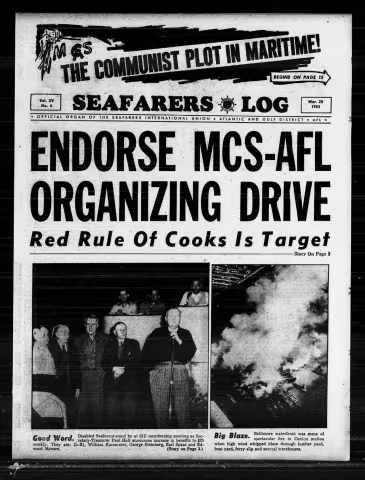
Disabled Seafarers'stand by at SIU membership meeting as Sec-
'• retary-Treasurer Paul Hall announces increase in benefits to $25
weekly. They are: (L-R), William Kammerer, George Steinberg, Earl Spear and Ed
ward Hansen. . • (Story on Page 3.)
Baltimore waterfront was scene of
spectacular fire in Canton section
when high wind whipped blaze through lumber yard,
boat yard, ferry slip and several warehouses.
s!\
' 3 •li
yM
Pace SEAFARtkS LOG Mareh U, 19SS
SlU Convention
Starts Monday,
San Diego Host
Delegates representing more than 70,000 members of the
Seafarers International Union of North America will con
vene in San Diego, California, on Monday, March 23, for the
cixth biennial convention of the Union.
Present at the convention will be representatives of the
eight autonomous districts, in--^
eluding workers In the sea
faring, fishing, canning and
Signs
Bloomfield
Pact;
Back Fay In
The Bloomfield Steamship" 0om-
pany has just signed the new
standard SIU foreign agreement,
an SIU Negotiating Committee has
announced. The company just
signed now? "the committee said,
because it's contract expired this
month, rather than earlier as was
the case with the other freight
operators.
The committee announced, how
ever, that in spite of the fact that
Bloomfield's contiact just expired
this month, the company will pay
the new wage scale retroactive to
November 18, 1952—just as all
the other companies.
The expiration date of the new
Bloomfield contract will be March,
1954, according to the committee.
The committee pointed out that
the company has just been ap
proved for an operating subsidy
which will add more trade routes
to its usual runs. Because of this
subsidy, said the committee, the
company needed the regular 1-year
contract so tliat it could show, on
paper, the Government that it had
• "stable labor situation."
Aside from the expiration date,
the contract is the same as all the
other new standard SIU freight
agreements, regarding working
rules, wages, overtime, and other
provisions.
SEAFARERS LOG
Mar. 20. 1953 Vol. XV. No. A
As I See It Page 4
Committees At Work Page 7
Crossword Puzzle Page 12
Seafarers In Action Page 20
Editorial Page 13
Foc'sle Fotographer Page 23
Galley Gleanings Page 24
Inquiring Seafarer Page 12
In The Wake Page 12
Labor Round-Up Page 13
Letters Pages 25, 26
Maritime .Page 20
Maritime Page 16
Meet The Seafarer.,. Page 12
On The Job Page 20
Personals Page 29
Quiz Page 23
Ship's Minutes Pages 28, 29
SIU History Cartoon . Page 8
Sports Line Page 24
Ten Years Ago Page 12
Top Of The News.........Page 6
Union Talk .Page 8
Wash. News Letter....... .Page 7
Welfare Benefits. • . Pages 30, 31
Welfare Report Page 9
Your Constitution .........Page S
Your Dollar's Worth..... .Page 6
Subllshwi OtwMkly at tha iiaadqiiarfer*
at tha Saafarar* Jataraatlenal Onlaii, At
lantic A Out? Olatrict, APL, 47S Povrth
Avanua. Braalclni S2, NY. Tat STaflins
S-M7I. lirtaratf as sfcaml slats mattar
at^tha PM. O^
vadsr tha Act of Auo»rt M 1911,
allied marine industries in the US
and Canada.
The Atlantic and Gulf District
will be represented at the conven
tion by A&Q Secretary-Treasurer
Paul Hall, who is also first vice-
president of the Interaational, and
three other delegates, Cal Tanner,
Lindsay Williams and Earl Shep-
pard. Moi^s Weisberger, New York
port agent of the Sailors Union
of the Pacific, and an international
vice-president will attend as a rep
resentative of the SUP.
A&G District delegates will pre
sent a detailed report dealing with
the Union's considerable progress
in the last two years. Included in
the report will be the organizing
progress now being made in the
Atlantic tanker fleet The greatly
expanded Union welfare program
will be outlined, including details
of the various benefits offered, the
hospi^jal benefit, $2,500. death ben
efit,'the $225 matumity payment,
the $100 a month disability benefit
and the Union's new scholarship
program calling for four $6,000
scholarship awards yearly.
Building Program
Also to be presented will be in
formation about the Union's new
building program in New York and
Baltimore, the adoption of a new
constitution, the successful com
pletion of new standard contracts,
inter-union developments and many
other items.
It is expected that a delegation
from the Independent Marine Fire
men, Oilers and Watertenders will
attend the convention, to discuss
possible affiliation with the SIU of
NA as an autonomous distHct.
Hoses of the Steel Scientist and CaienttS Fire Department hang down into the No. -t hold of the ship
as officers and crewmemberg gather around to see damage to cargo and vessel caused by the blaze
aboard the Isthmian vesseL The fire lasted for two days and a night.
Seafarers Squelch Blaze^
'Saved Ship/ Ca. Declares
SIU crewmembers aboard the Steel Scientist (Isthmian) came up for praise by the
company and the master of the vessel when quick action saved the ship from almost cer
tain destruction by fire recently. Seafarers turned to fight a roaring blaze which burst out
in the No. 2 hold as the ship
was tied up in Calcutta, ac
cording to a feport by T. W.
Atkins, ship's delegate.
At noon time on February 23
as the ship was about to leave
port, the gangway watch sounded
the fire alarm for the No. 2 hold
and the entire ship's crew went
into action fighting the quick-
starting blaze. Men In the mess-
hall, men off watch, day workers
and every available hand on board
cooperated to put out the fiames
which threatened to spread and
engulf the whole ship. Alert action
by.the crew kept the fire from
gaining "any headway over the diip
and cargo despite burning cease
lessly for two days and a night.
Danger was averted in . the early
moments of the fire, but, although
the emergency was past, careful
vigilance kept the blaze under
controL
New Gear Used
AU the hoses were bropght out
along with equipment from the
new emergency gear locker, but
nneke obscured the origin of the
SIU Needles Atlantic, Forces
Out Bottied-Up Pay Increase
Needled into It by constant pressure from the SIU, the Atlantic Refining Company
finally put out a long-promised pay increase for its seamen March 2, just two days after the
SIU again rapped the company and its self-styled "indfependent imion" for the delay.
The action by the companyt
was quickly recognized as an
obvious attempt to put the
skids on tho SIU campaign, with
many Atlantic men quick to point
out that the pay boost might still
not have come if the SIU hadn't
forced the issue. The increase was
in the w^^'hs since last May when
the AMEU claims it "gave notice"
to the company of ''its intention
to negotiate" a general increase in
base wages and overtime rates.
'Contract' Terms
Under terms of the Atlantic hand
out, virtually all ratings received in
creases providing $5-8 more than
the standard SIU tanker scale, with
ABs, a typical example, pegged at
$311.50.' Base wages for ABs on
SlU-contracted tankers aiV $305.64.
In addition, as part of its gift pack
age, the c^pipany raised overtime
fates to $1.99 and $1.56
The increases in OT hkd the net
affect of immediately canceling
out additional work aboard ship
Which called for overtime for im-
licensed personnel, and meant the
officers wquld also be called on to
fire. Captain Frank Jones, who,
later, was lavish in his praise of
a job well done by a head's up
crew, ofdered the hatch to be
.closed and carbon dioxide was
brought' into the battle, fighting
the fire successfullyi
The COi was used at intervals
during the night, with the Samson
post ventilators covered with can
vas to allow the chemcial agent to
work more efficiently. The finish
ing touches were put on the last
diehard sparks the next day,
squelching them completely, but
not before the hatch was flooded
to the 'tween decks.
The entire crew came in for
high praise by Captain Jones, both
for their personal conduct in time
of emergency and for their top-
notch aid in saving the ship. The
only outward result of the fire,
other than minor damage to the
vessel, was the keeping of the ship
in port for several days longer
than was planned by the com
pany's original schedule.
do this work instead. Since several
Improvements in working rules
were written Into the AMEU-
Atlantic "contract" last fall, less
and less overtime work is done by
the unlicensed crews on the ships.
Welcoming the increase as a
much-needed improvement for the
fleet, the SIU Tanker Organizing
Committee emphasized, however,
that the pay boost "was a trans
parent effort by the company to
blind the men to the actual'losses
they are suffering 'without SIU
contracts and conditions to work
under. Every non-union company
in the book has used this tactic of
throwing a few extra dollars into
the kitty than Union scale calM for^
in an appeal for loyalty from its
employees. Atlantic men have rec
ognized this right off, to their
credit, and they know they are
still a long way from being better
off under their present set-up."
Pay Vouchers 'Shoeklim*
The organizers pci<)led out tiiat
actual SIU pay vouchers dlstaib*
(Continued oh IMge 211 »
Restricted To Ship?
Notify Union Pronto
Delegates of crews that have been restricted to the ships
ia foreign ports should notify SIU headquarters as soon as
possible of the restriction. In that way headquarters wilj be
able to check with authorities-^^
and find out whether or not
the restriction was justified;
The SIU's new standard contract
provides that crewmembers are to
receive overtime when restricted
to ship while in port, unless there
is an official government regula
tion in that port banning shore
leaves. The company is called on
to submit proof of the restriction
in the form of a letter from the
authorities. A letter from the
company agent is not sufficient un
less it contains a copy of the order
^ih question.' .; .
However in some ports these re
strictions have been imposed but
ttie companies have. been unable
to obtain copies of the orders.
Decide Deef Early
In such a case, where the cap
tain claims he cannot produce
proof of the order, delegate
should find out as much about the
situation as possible and notify
headquarters. Headquarters will
then be able to follow up the case
and see if the restriction is Justi
fied or notr In. that w^.^the ques
tion of overtime may be decided
•before the ship gets back to . its
--s _• '
f
Marali f. MSt
, .• "'v^'
• •• ' • ' • •'' ' '-.• ''iTii'/o"'" '••' "' •' • • • '-r '• •''' " "•' ' '•; *'•• ' * ' .
' . . . • . .J.
SEAFARERS LOG f'go Thre»
Puerto Rico
Idled; Ends
Island Run
Departure of the SlU-contracted
cruise ship Puerto Rico yesterday
marked the last-scheduled voyage
of the liner, as Bull Lines an
nounced it was withdrawing the
ship from its service to the West"
Indies, the vessel had been under
contract to the SIU since mid-1949.
Withdrawal of the cruise liner
from service to Puerto Rico will
in no way affect the company's
regular freight service to PR,
Dominican Republic and the Vir-'
gin Islands, the company assured
the Union. Bull Lines operates
more than- 20 miscellaneous types
of vessels, principally Libertys and
C-2s, on the run from New York
to the* Islands.
One lone chance of the vessel's
continuing in service lay .in the re
port that the governments of both
Puerto Rico and the;Virgin Islands
were considering the possibility of
granting a subsidy to keep the
ship' in operation. The company
indicated it could . not keep the
Puerto Rico sailing without con
tinuing to suffer a considerable fi
nancial loss, which might affect its
other runs. The vessel carried
some 7,000 passengers each year.
The cruise ship, which had fea
tured an 11-day round trip to the
three islands, was bought by the
company in March, 1949. She was
the former Borinquen of the old
Porto Rico Line.
Disposition of the ship once she
completes her current voyage has
not yet been determined. She is
expected to pay off March 30 when
she returns to .New York.
Pictured as she was about to
depart on her last scheduled
trip to the Islands, the cruise
ship Puerto Rico will be with
drawn from the service on
March 30.
Endorse MCS-AFL
East Coast Office
Opened in Drive
J ' '
• - :•
Meeting Night
Bverg 2 Weeks
, Regular membership meet
ings in Siy headquarters and
at all branches are held every
second Wiednesdaiy night at
7 PM. The schedule for the
next few theetihgs is as follows:
Marsh 25, April 8, April 22,
•vMay
All' Seafarer registered oh
the shipping list ire required
to ittend fhe^'fii^tlngiv ' • '
Begin $25 Wk.
Seafarers at the last headquarters branch meeting ii sten intently as Earie Hindes, East Coast SIU rep
resentative of the MCS-AFL, reports openiBg of a New York MCS-AFL hail to aid organizing of
stewards departments on West Coast ships. Members voted overwhelming endorsement of MCS-AFL.
A full-scale drive on the Atlantic and Gulf Coast to free members of the Commun
ist-dominated National Union of Marine Cooks and Stewards (independent) from
the iron grip of that.^union was pledged by the SIU membership in all ports at the
March 11 membership meeting. The.pledge coincides with the opening of a New
York office by the SlU-affiliated Marine Cooks and Stewards, AFL, the youthful
| organizationj;hat has made
great headway in the two
y^UB of its existence.
A resolution to that effect,
unanimously adopted by the
membership, points out that
the SIU has been committed tradi
tionally to support all its AFL af
filiates and to break the hold of
the Communist waterfront appara
tus on maritime unions. Conse
quently, the SIU pledges full sup
port-financially, physically and
morally—to the MCS-AFL.
Stewards Revolt
The last remaining sea-gding
union under control of the Com
munist Party is the NUMC&S.
Since 1948. West Coast cooks and
stewards have revolted against
NUMC&S policies and are now op
erating through the MCS-AFL to
organize the stewards dcpartmenti
on West Coast ships.
As the resolution emphasizes, a
(Continued on page 21)
Front row guests at the last headquarters meeting, where they received their first $100 monthly
SIU disability benefits, were (L-R): Seafarers George Steinberg, Earl Spear, Edward Hansen, Joseph
Germano and William Kammerer. With them is SIU Welfare Services Director Walter Siekmann.
Seafarers at the headquarters branch meeting March 11 personally witnessed the be
ginning of payments under the newly-increased SIU disability benefit, as five of their
brothers who qualified for the $25 weekly payrnent received their benefits on the spot.
The disability payment, in-"*^^
creased for the second time
since the benefit pay was
started last May, was raised from
$15 to| $29 .weekly in October..A
meeting between Union and em
ployer .trustees of the Welfare
Plan on March 3 jpaved the way
fqr boosting the payment another
$5 each week, effective as of
March 1. Altogether 20 Seafarers
have qualified' for'fhe -benefit,- and
checlDi ' fbf ^ the' full. amount are
sent to thetfi homes -the beginning
of. each hwnth. /'
' - (PreviauS announcement that ffie
benf^tWM-. IncteaAed: to *$1Q0 U
ipenth-•etiiially uhdm
benefit, since it comes to about
$108.33 on a monthly basis.)
Broadening of the SIU disability
benefit, the only one of Us kind
in the maritime industry, assured
considerable security for the fam
ilies of individual. applicants and
their families,: since its payments
are, in no way tied , to Federal so
cial." secur%. Those receiving" the
benefit who are over 65 are like
wise eligible for that pajnneht
from the. Government.' With the
:$1Q8 from the Sltl, Plan,;
monthly income could run up to
ia < maximum' .;Of $236..p^ <month,
:tax-.-gKe;' ^v •"
members received under the first
Union contracts in the early years.
However, Seafarers do not nec
essarily have to be over 65 to
qualify for the SIU benefit, but
may also qualify due to an illness
or injury, providing they are un
able to work. In order to be eli
gible, however, they must have a
minimum of seven years' seatime
jwith companies now under con
tract to the Union. Applications for
benefits " should be sent to the
trustees 'of the SlU Welfare Plan,
at 11 Broadway, New York City.
Bach case is considered on its own
vmerits-; by -the joint Union-ship
owner :bc«r(i;. ' ;v.
"""".
ot
; 1: (r.yr ,1
I
1
I
31
1
-Vtl
U ''!r 'irf . ,
•Faff* Four SEAFARERS IPG
^'•
iK •
ii-
h'
i
First Throiigfi Lakes With Automobiles
Mataafa, an SIU Great Lakes District ship, steams Into Cleveland with a load of 500 automobiles from
Detroit. It was the first of the lake frei^ters to sail into that port, this year after the ice flows thawed
out on the Great Lakes. Ore boats are expected in from upper lakes later this month.
Curran Raps TB Victims
Destitute NMU members at the Manhattan Beach hospital are up in arms over a snide
attack made on them by NMU President Joseph Curran at a recent New York member
ship meeting. Annoyed because oldtimers at the hospital have been bombarding the NMU
with pleas for financial aid"^
ever since the imion cut off
their hospital benefits, Curran
told the membership that the TB
patients "are making more money
than you'll ever make" by soliciting
help from' the ships.
As proof, he said, "they got $200
off one ship, the Independence."
(The Independence carries an im-
licensed crew of approximately
800, so the contribution amoimts to
about 20 cents a head).
Can't Care for Oldtimers
Previously Curran admitted that
despite planned expansion of the
NMU's welfare set-up it wouldn't
be able to take care of the old-
timers. "Some guys are in the hos
pital since 1940," Curran said,
"there is no law that permits us to
go back that far." ' .
The SIU has gone back^that far
by setting up a special list which
enables all Seafarers to receive hos
pital benefits even those that were
hospitalized long before the Wel
fare Plan began.
$12 a Tear
The Curran statements aroused
considerable indignation among
Manhattan Beach patients. A great
many of them depend exclusively
on contributions from the ships for
cigarette and stamp money ever
since the NMU cut them off with
out a cent in January, 1952. In the
AT SIU HEAlMHIARTERS
4thAva.C2MSflrMUpi
Swop yams or watch the fights
on television with your old ship
mates at the Port O' Call-YOUR
union-owned and union-operated
bar. Bring your friends — where
you're always welcome. And the
tab won't fracture that payoff.
OWNCO AND OfERATa
by lh«
SEAFAREDS INTE»>IATI0t4Al UNION
ATUNTie AND OWF OlSTIUCT MX.
'"J
• . J'...,:..--..
past year these amoimted to about
$12 a man, hardly enough to make
them rich.
The situation stayed that way
throughout the whole of 1952 until
the SEAFARERS LOG on Novem
ber 28 exposed the fact that the
NMU had cut these men off the $5
a month benefit. The official rea
son given was "to eliminate some
of the drain... placed on our
treasury." '
Under the Insurance company
set-up imder which the NMU wel
fare plan operates, the men weren't
eligible for employer-financed ben
efits, Which lim out in 13 weeks
anjrway.
As a result of the LOG story, the
NMU hastily got together with the
shipowners and voted the,men. a
$25 bonus for Christmas, copying a
long-established SIU practice.
As Curran put it in his report,
"We raised hell with the steamship
owners and after a fight we got
them to give $25 to ever^ man in
the hospital who didn't qualify."
He didn't mention who prodded tee
NMU into action on this score.
Throw Mn For
A Meeting Job
Under tee rules of tee SIU,
any member can nominate
himself for meeting chairman,
reading clerh or any other
post that may be up for elec
tion before tee membership.
Including committees, such as
the tallying committees teat
will be chosen at tee i^ext
membership meeting.
Since SIU membership meet
ing officers are elected at the
start of each meeting, those
who wish to run for those
meeting offices can do so.
The Union also welcomes
discussions, suggestions and
motions on the business before
tee .a|eeting. Seafarers are
urged to ^v* the membership
the beneitt of their opiiden»so
that the membership can act
SBCsydliilfljy,
lUISeelt... •
-.
ONE OF THE MOST IMPORTANT JOBS IN THIS UNION OF OCRS,
bar none, is teat of tee ship and department delegates. WhUe tee Union
has an impressive set-up shoreside with halls and facilities in all tee
ports, an equally Important part of the union is tee work of the dele
gates. on the ships. It would be wrong to consider teat tee whole Union
apparatus is ashore. We must consider tee fact teat Seafarers^pend
more time on ships than they do in their Union hills and it is on the
ships Itself that tee Union can do its most effective work.
If anybody doubts the value of tee shipboard setup, let him look at
our new contracts. There he will ..see dozens of clauses teat were
transmitted to headquarters by tee delegates after meeting with their
shipmates and exchanging ideas. There is no doubt that these sugges
tions were of great value to our negotiating committee.
Delegate's Role Growing
The ship's delegate these days is even more important than ever be
cause in tee last few years S greater number of our
ships are out on long runs. This is because of the
Korean situation .where it is not unusual for a ship
to be away from tee States from four to 12 months.
On a trip of this length it is the delegates and tee
shipboard meetings teat serve to represent tee men
as their Union in action. In turn, tee shoreside work
ings of tee Union do their part by being in constant
touch with aU tee ships. The SEAFARERS LOG and
all imiwrtant communications are air-mailed regular
ly, and when an important issue arises, tee Union
does not hesitate to communicate directly by cable or otherwise.
The ships minutes are another important link between headquarters
Md tee ships. They are recorded in tee SEAFARERS LOG and care
fully filed in our records, so that the Union can act on anything that
ap'^ears in them.
Rotating Ship Jobs
Some of our ships have made it a practice to rotate tee ship dele
gate's job between all three departments of tee vessel on succeeding
trips. This is in our mind a sensible practice, as
suring equal representaUon for all departments, and
giving men in one departmmit an opportunity to
learn tee problems of their brothers working* in
the other two departments.
Actually while we have departments on our ships,
which are made necessary by tee nature of the work,
your Union is industrial in nature, and aU depart
ments are practically one. That's one of the reasons
for our Union's strength, which has made possible
our solid contracts and top-notch conditions.
d; $ ^
WE HAVE HAD A COUFLE OF LETTERS RECENTLY FROM THE
Gulf , and here, in New York, thanking the brothers who volunteered to
donate blood and save the lives of Seafarers or their family members
who were ill.'In one case the wife of Brother George Baugh down in
Galveston had to go under the knife and needed a considerable amount
of blood. Several of the brothers ip^ the Galveston hail responded to
the call within a few short hours, donating nine
pints needed to save her life..
In a similar situation in New York, Brother Donald
Dunn writes he was at death's door until Seafarers
here came through with 35 pints of blopd, 30 of
which were given to him to keep him going.
Brother Dunn writes teat "now that the blood
of these men runs through my veins, I am truly
a member of one of tee strongest ))rotherhoods in
tee world, tee Seafarers International Union."
It appears that Brother Dunn really hit thq^ bulls-
eye with teat statement. We are entitled to* puff a little with pride
over these incidents for there are few outfits that could show a response
of this kind in an emergency. It's the true spirit of brotherhood as
displayed by Seafarers, and shows tee secret of our Union's strength.
YOUR UNION WAS CERTAINLY HAPPY TO ANNOUNCE THE
increase in our disability beneffts which is the second one we have
had since this part of our Welfare Plan went into operation less than
a year ago. Some of our oldtimers who are receiving these benefits
were down at our last headquarters membership meeting, and all hands
could see for themselves how pleased they were by the way their
Union is taking care of them.
This disability benefit, as you know, is just one of the many ways
in which your Union is trying to make things more secure for the Sea
farer so that he doesn't have to worry about what will happen to him.
or his family in case something goes wrong.
Welfare $$ on Upgrade
But as we have said so many times in tee past, tee Union is not
going to stop here. Our Welfare Plan's cash and bond reserves are on
tee upgrade, and the recent increase we negotiated with the operators
means that still more money is coming in to this Plan. So from time
to time we are going to take additional steps, maybe to provide new
benefits or increase old ones.
All this takes a little time, naturally, because we want to make sure
that anything we do is sound and worthwhile. It's only after careful
eonslderatlMi teat your Union puts forte these proposals. Then they
have to> be taken up vritfa the employer trustees to gain their approvaL
la amy case, Seafarers can rest assured teat they havent heard tee
last of'tlus-Welfare maiw.and ttutjuore. or Ittttap.lRBnafltB vlU be lorthp
'CoasiBi>'ia the .future. ^
-:i. j-if!:, ir>i-eiOri Uti 'i I i''r
I »e^-Ae>oy • 4 - •
March XO, MSI SEAFARERS LOG Pare Fir*
TV commentator John Wlnrate (light Jacket, holding mike) pre
pares to interview Seafarer Lars Nielsen, (white hat, center), AB
on the Elizabeth, as a technician (right) and cameraman start to
shoot the scene, part of the TV show on the NT waterfront.
SlU Wins New Alien Aid
The Immigration service has announced that alien seamen who fail to leave the US
within the 29 days allowed under the McCarran Act ihay now be granted additional and
reasonable time to depart. 4-
The Government, however,
warned that such additional
time will be granted only if
the alien crewmember has a
"valid" reason for overstaying his
allowed 29 days ashore, like illness
or "other reasons beyond their con
trol."
This announcement closely fol
lows conferences that were held by
top SIU officials with the Depart
ment of Immigration concerning
the McCarran Act as it affects
alien seamen. The SIU has been
the only union jthat has taken any
such action and the only union
which has gone to batior the alien
seamen.
The SIU representatives at the
conferences were: Harry Lunde-
berg, SIU president and secretary-
treasurer of . the SUP; Paul Hall,
SIU first vice-president and secre-
tary-treasurer of the A&G District,
and Morris Weisberger, SIU vice-
president and SUP New York port
agent. •'
At that time, the.SIU represen
tatives pointed out the many ways
that the new law worked hardships
on bona fide alien seamen who
held validated American seamen's
TV Show Stars Seafarers
A complete TV movie series on the operations of the New York, waterfront, featuring Sea
farers aboard and ashore, is being shown on NBC-TV, channel 4, beginning 6:45 PM tonight.
The series is lufder the direction of John Win gate, the Esso News reporter, on the "Behind
the News" program sponsored-^
by the Esso Oil Company. It
will run for seven consecutive
weekday nights at the same time.
The purpose of the series is to
show the complex nature of mari
time and tremendous amount of
wOrk that goes in to the waterfront
industry, on which 700,000 New
Yorkers depend for their liveli
hood, directly or indirectly.
Boarded EUubbth
To get material for the program,
Wingate and an NBC camera crew
spent two full days aboard'the Bull
Line ship Elizabeth, and at the
SIU's New York headquarters.
They also filmed operations in the
Bun Line offices and elsewhere in
the port.
The series opens with filming of
the SlU-manned Elizabeth coming
up thfe Narrows to her berth in
Brooklyn in the early hours of
dawn, and includes shots of Sea
farers at work aboard the vessel
and an interview with Seafarer
Lars Nielsen who explained the
type of work he does. It also in
cludes films of tying up and load
ing and unloading operations.
Going, along with Wingate and
the cameramen were ^lU assistant
secretary-treasurer Lloyd Gardner
and Herb Brand, editor of the
SEAFARERS LOG who were on
hand to advise and assist the NBC
staffmen on the operations of the
ship.
Subsequently the NBC men came
up to the New York hall and filmed
the rotary dipping procedure, as
rOUandwhemB
CONtTlfUriON
rOUi>. R1<3HTS ANO ARP/iit-GES AS
^11 lit I av
YOiS Tinii. .IfA .
'VKfc'tS YA ACO'.JAif^''
"VOt: W.iTH* IMSii- AM;:.
From Articio X, Stction 7
"The Auditing Committee in eadi
Port shoR audit the regulor week
ly financial report of the Port
Agent and, in 'writing, certify or
refuse to certify such report."
In oil SIU ports on elected rank
and file committee makes a full
audit of oR receipts and expenses
weekly. Likewise, the Union's
financial records are always open
to inspection by any member.
well as all the recreation and other
features of the hall—^the cafeteria.
Port O' Call, Sea Chest, poolroom
and so on.
. Interview Simmons
This sequence also includes an
interview with assistant secretary-
treasurer Sonny Simmons who ex
plained the need for setting up
halls of this type for seamen. Sim
mons spc^e of the need for sea
men to have decent shoreside fa
cilities while waiting to ship out in
contrast to the eld days when they
were crnnpelled to hang out in
crimp Joints and waterfront dives
in order to catch a ship.
• The rotary shipping procedure
will be the last part of the seven-
day series and will include an in
terview with a Seafarer who has
just shipped a job off the board in
the SIU hall.
Bull Line office operations will
show the large amount of office de
tail involved In a complex dry car
go operation so as to assure that
shipments arrive on time and in
good shape. -
pat)ers and sailed regularly on US
flag ships.
The Government, at that time,
promised to hold off on deportation
proceedings pending settlement of
official policy, or amendments to
the law to deal with those alien
seamen who hold validated Ameri
can papers and sail US ships.
This announcement that the Im
migration authorities are taking
another step toward trying to ease
the hardships suffered by alien
seamen follows the SIU-Govern-
ment conferences held last month.
The new policy will make it easier
for alien seamen who are ill, or
are unable to ship out within tfao
flowed 29 days because of reasons
beyond their control.
A headquarters spokesman said
that "The SIU will continue to
work to get an even break for tho
alien seamen,' particularly thoso
aliens who hold validated US sea
men's papers, which prove they
have been cleared by the Coast
Guard for security, and those men
who have regularly been sailing
American ships."
Crone, Preussler Die;
1st On SIU Disability
Two of the first Seafarers to qualify for disability benefitg
from the Seafarers Welfare Plan, have signed on for their
last voyage. 4
Otto Paul Preussler, who
was the first Seafarer to col
lect. disability benefits, and
James Crone, who was among the
first few, died within a few weeks
of each othfer, after they had spent
the last months of their life living
peacefully ashore under the SIU
Welfare Plan benefit.
Both "Preussler, known far and
wide as "Uncle Otto," and Crone
had retired from the sea not too
long ago because of age and fail
ing health.
A Century ^of Seafaring
Between them, the two men
could boast a total of almost a
century of Seafaring. Preussler,
who was 66 at the time of his
death had been sailing for 46 years
when he called it quits in Decem-
Crews Can
Demand US
$ In Draws
Pick Up ̂ Shot^
Card At Payott
Seafarers who have taken
the series of inoculations re
quired for certain foreign vby-
•ges are reminded to be sure
to pick up their inoculation
cards from the captain or the
purser when they pay off at
the end of a voyage.
The card should be picked
up by the Seafarer and held
so that it can be presented
when signing on for another
voyage where the "shots" are
required. The inoculation
card is your only proof of hav
ing taken the required shots.
Those men who forget t«
pick up their inoculation card
when .they pay off may find
that they are required to take
all the "shots' again when they
want to sign on for another
such voyage.
Seafarers in any port in the
world are entitled to demand their
draws In US dollars without nm-
ning afoul of local regulations.
However, some countries have
laws requiring that the dollars
must be turned over to local banks
for exchange into local cuirency.
Any dealings outside of the banks
are in violation of local laws.
The SIU's new contract calls for
all money draws in foreign ports
to be issued in American currency
unless the issuance of such cur
rency conflicts with existing local
laws. Some captains have been
claiming that local law prohibts
issuance of dollars. Since dollars
carry much paore purchasing power
than local currency in many ports.
Seafarers have been losing out ac
cordingly.
No Ban On Dollars
The Union made Inquiries with
Government authorities and has
found there is no legal justifica
tion for any captain refusing to is
sue dollars.* After that it is the
Seafarer's responsibility to con
form with local laws regarding the
exchange of the dollars for the lo
cal currency. Where such ex
change is not required at a local
government office or bank, the Sea
farer is.free to spend his dollars
or exchange them in the free
market.
The SEAFARERS LOG wiU
make a further check on which
countries require such exchange at
local banks. The information wlU
be published in a future issue of
the LOG.
her, 1951, because of failing eye
sight and general ill health. During
that time he sailed through three
wars — the Russo-Japanese War,
and World Wars I and II—without
losing a ship. All in all, he served
as cook, steward and baker on 118
different American-flag vessels.
Crone, whose recorded age was
63, began his seafaring career as a
very young boy in his native Ire
land just at the turn of the ceqtury.
Paddy, as he wSs known, was a
deck department man all the way
through and was well-known for
his ability as a bosun.
Preussler's death came on a visit
to Savannah while making plans to
find a,home in that port city. Sine#
his last trip on 'the James H. Price,
in the fall of 1951, he had been liv
ing in Port Orange, Florida, but ho
decided to settle among his many
friends in Savannah.
SIU Arransed Funeral
Since Uncle Otto had no known
survivors, the SIU Department of
Welfare Services Immediately took
steps to assure him a proper funer
al, a standing union procedure in
such cases. Arrangements wero
made to conduct the funeral Serv
ices at the Savannah branch haU.
Approximately 60 Seafarers and
friends of Uncle Otto attended the
final rites. Two SIU ships in port,
the Seatrain New York and the
Seatrain Savannah, sent flowers, ao
did other old acquaintances. Burial
took place at the Sailors Burial
Ground in Savannah.
Crone's death took place in New
Orleans which he had made hie
home for a great many years.
Burial took place in that port city
with many Seafarers from the New
Orleans hajl in attendance.
tt. 1952 sw
5ir,A^' Bf-rGifiA PAiSE 15
't'
• s-'y-
k<^r-
}••
¥
'f
/ •
V'
.'?/-
t:
niCttSfx SEAFARERS ZOC Mardi U, USt
The United Nations Proposed Safety Signs
Danger «t csploilon
Danger i'txptosien
Pfllgro 4e cxplosiin
Danger at Ignition
Danger finpammalion
PtUgr* tft Inflamation
Danger of poisoning
Danger 4'{nt«x(eat!tn
Paligro dt intoxicacion
Danger et ceiroaUn
Danger d> Mires/en
Pdigrp da conrpsite
Dangeiwu zadiatiang
ItM^hiu dmttnum
IUdiadonei>eligf«aw
The Uiilte4 Nations will eonslder at its next meeting, recomraendations that tlM nations of the world
adopt the above warning signs for shipboard display whenever dangerous eargo is carried. As inter
national slgiis, they would be recognised throughout the vaorld.
The SEAFARERS LOG expose of the lack of port security in the US has been used as
the basis of a featured article" in another national magazine, scheduled to Ijit the liewstahds
on March 27. "•
The April issue of "Real,"
will feature a story called "US
Port: Open Doors to Disaster."
The story deals with the way
foreign saboteurs can' enter the US
without any trouble by .traveling
as crewmembers of foreign ships.
The July 9, 1952 issue of the
MMG Welcomes
Stories^ Pies
With the LOG now contain
ing 28 pages, the biggest ever,
there is more room now than
ever before for stories, photos
and letters sent in by the Sea
farers. Several pages of each
issue are devoted to the ext
periences of Seafarers and the
ships they sail as they describe
it themselves.
If you run across anything
of Interest on your voyages, or
Just want to let your friends
know how you're getting along,
drop a few lines to the LOG.
Don't worry too much about
litierary style. We'll patch it
up if it needs patching. And
of course, photos illustrating
the incidents you describe
make them more interesting
for the readers.
Send your stuff to the LOG
at 675 Fourth Avenue, Brook
lyn, NY. If you want any
thing returned after we use it,
we'll do that too.
"Saturday Evening Post" featured
a similar story, based on the LOG
expose. . ,
The story in "Real" also .includes
the LOG exposes concerning the
Communist literature that has
been mailed to seamen on Ameri
can ships, and the fact that at
tempts have been made in foreign
ports to "pump" American seamen
for information concerning ship
ping and crew regulations.
SIU Demonstration
It also tells of the way two Sea
farers, working on the LOG ex
pose, actually demonstrate^ how
easy it would be for saboteurs to
enter the US as foreign seamen.
"Not long ago," says the mag
azine story, "the. SIU put on a
spectacular demonstration to show
the Government, and the public,
just how vulnerable our ports were
to enemy agents.
"The Union put two or Its men
on board an incoming Italian
freighter . . . They passed through
Customs and Immigration without
a word being said to them, then
proceeded to Pennsylvania Station
where they picked up bags at the
checkroom and set out on separate
routes.
"One took his suitcase into the
Hudson railroad tubes, one of the
vital transportation links connect
ing New York with New Jersey,,
and pitched it off the rear end of
the train'"'in the middle of the
tunnel. This bag could easily have
been filled with any number of
well-known high explosive^.
yThe other seaman made his way
to the Kensico. River Reservoir,
main water supply for the" City
of New York, add duniped the
contents of his suitcase—a quantity
of harmless peRets—^into the water.
This could just as easily have been
one of the Soviet's newest devel
opments in germ warfare."
Neglect Shores
The "Real", article also says that
"An all-out attack by saboteurs as
a prelude to war is but one quite
possible consequence of our ^ame-
ful neglect of port security—-the
proper safeguarding of the move
ments of unknown foreign mer
chant seamen, who arrive here
every day and are at complete
liberty to move about wherever
they wish; whenever they wish.
(This, in itself, is more than slight
ly Ironical in view of the fact that
American merchant seamen—some
400,000 strong—must be carefully
'screened', by the Coast Guard for
possible subversive tendencies be
fore they 'are issued 'validated
papers'.)"
. The magazine article goes on to
say, "in tlus country. Communist
agencies have been, driven under
ground, but in the Words of Paul
Hall, head of the Seafarers, they
are 'very much alive and kicking
in labor and maritime.'
" 'Commies never give up try
ing,'he said.
" 'On the ships of four of our
major shipping lines. Red propa
ganda has been sneaked aboard
and disseminated'."
WORLD BUZZES OVER STALIN DEATS—The death of Soviet Pre
mier Josef Stalin from a cerebral hemorrhage was the top news of the
past'two weeks. He was succeeded in his top post by Georgl Malenkov
who had been s'ectetary of the Communist Party, the same post that
Stalin held when he took power. Stalin's death aroused much specu-
-lation In the Western world about a possible struggle for control be
tween Malenkov and other Communist leaders, but in the early days
at least, Malenkov seemed to have everything well under control.
• i t »
HOT PHILIPPINE ELECTION SEEN—12ie PhiUpplne Islands seem
headed for a ding-dong election battle between Incumbent President
Elpidio Quirino and Ramon Maf^ysay, rcMntly resigned head of the
country's armed'forces. Magsaysay, who Is considered largely re
sponsible for the successful campaign against the Conununist-led Huk
insurgenU, is being backed by the opposition Naclonalista Party.
Charges of corruption in the Quirino regime will be a big election issue.
4
RBDS DOWN VS» BRITISH PLANES—On two successive days, Rus
sian-built MIG fighters have shot down plues over West Germany, the
first one an American lighter,
the second a British bomber, in
which six lives were lost. , The
American plane was. downed by.
Czech pilots about seven miles in
side Western Germany; while ̂ he
British were shot down while on a
flight to Berlin. In both cases,-
protests filed have been denied by
the Soviets, who claim violation of
their borders.
t t 4,
HAWAII BID FOR STATE
HOOD OPENS—; Republicans in
Congress took the first steps to- -
wards statehood for Hawaii, with a
favorable vote in thje House of Rep-
resentativesi ' The ' slalehood bill
faces a little rougher going in the
Senate, however. Democrats are
up in arms because normally-
Democratic Alaska was left out in
the cold on statehood, while Hawaii
is expected to add two Republican
Senators to the narrow Republican majority in the Upper House,
i t t .
COSTELLO INDICTED AS TAX EVADER—Frank Costello, key fig
ure in the Senate Crime Investigations and reputed underworld king
pin has been indicted on charges of evading Federal income taxes for
the years 1946 to 1949. Costello is already serving an 18-month sen
tence fbr contempt of the Senate and is now facing denaturalization
and deportation proceedings. '
^ 4 $>
MUNITIONS SHORTAGE SEEN IN KOREA-^-The Senate Armed
Services Committee has unanimously backed charges by Gen. James
Van Fleet that there have been serious shortages of ammunition in
Korea. The committee has been holding hearings on the General's
charges-that these shortages had hamstrung pperations in Korea.
Further investigation of the situation is promised.
' 4. i t
MOONSHINERS CLIPPED IN BROOKLYN—Federal revenuers and
New York police raided a three-decter still at 52nd Street on the Brook
lyn waterfront and found a still capable of turning out 2,500 gallbns
of alcohol daily. The still contained $25,000 worth of equipment.
Raiders estimated that the bootleggers were getting $7 a* gallon for
their product and cheating Uncle Sam out of $14,000 daily in taxes.
Lt Warren G.. Brown of Hen
derson, Colorado, piloted US
plane downed by MIG.
YOUR DOLLAR'S WORTH
SEAFARERS GUIDE TO BETTER BUYING
Written exciuslveiy for
THE SEAFARERS LOG.
by Sidney Margolius/
Leading Expert on buying
How To Buy At Discounts
Do you know what a discount house is? It's a store that
•pecializes in selling below the retail price lists set by
manufacturers of appliances, cameras and other products.
A discount house generally operates in semi-secrecy for
fear of court injunctions, blacklists, and other reprisals
from both makers and competitive retailers. But it does .a
good job of selling standard-quality goods at lower prices
which it's able to do because it generally has a low-rent
location, sells for cash and doesn't spend much on adver
tising. Generally a discount house sells for about 20 per.
cent less than- standard prices.
, Sea Chest owned apd operated by the SIU in SIU
headquarters in Brooklyn, NY, is actually a kind of private
discount house for Seafarers and their families. It gives
discounts of 15-20 per cent on standard brands of work
and ^ess. clothing and shoes, and also on short-wave and
regular band radios, luggage and shaving needs. Unlike
the Sea Chest, a commercial discount house handles very
little clothing, but specialize In television sets, refrigera
tors. washers, ranges, vacuum cleaners, utensils and other
" household equipment, and cameras,. watches and sports
^equipment...;-'
,_.u— ••'icouBt houses are In your •
sell only to people they know, or who come from sources
they know.
There are several ways to get the name of a discount
house: From acquaintances who have bought from dis
count houses; from union locals and central. labor coun
cils who sometimes make arrangements for their members
to get discounts, and from shopping independent and
neighbofliood stores until you find one that will sell to
you at a discount.
Many appliance stores, and even some chains like
Davega and Vim in the East, sell at discounts if the cus
tomer Insists on it. The competition of the discount
houses is getting keener all the time, and these other
stores will often cut a price rather than lose the sale al
together. It's especially easy to get a discount on a TV
set since the dealer also makes, a profit on the installation
and service contract, and is willing to" reduce one profit
to save the other.
'Trade-In* Dlacounto.
Trade-ins are another device for giving discounts. For
appliances, dealers have a ."blue book" which tells the
trade-in valudof each modeL But the "blue book" prices
are purposely low to allow the dealer to impress the 'cus-"-
tomer with h^s generosity when, he effers more.
Following is a list of discount sellers In several cities.
Those in New York T have personally shopped and can
say. are reliable. Those in other cities havtf been cotiApiled
from recent court cases in vdiiclr-manufaiiturers .soU[iditt.tp ^
'.«tMr#in4bMb'-'41*his>''fib)A'seHliiY/4$'dfalcotinfii. Tbert
should be shopped with care (by comparing prices and
specifications of the same goods at other stores) to make
sb»s they still give discounts on standard brands. The
New York firms listed will also give discounts on mail
orders from other towns. Where addresses are not given,
check your local phone book:
New York: Buy Wise Merchandise Co., 115 W. 45th St.;
Bondy Distributors, 220 W. 42nd St.; Standard Brand Dis
tributors, 143 Fonrtq Ave.; Veeds, 31 Madison Ave.
Philadelphia: Civil Service Employes' 'Cooperative Assn.,
812 Chestnut St. (2nd floor); United Fraternal Buyers,
Inc., 1842 LincolmHerbert. Bldg., Broad & Chestnut Sts.
Chicago: Central Home Appliances; Rochelle's (check
phone book); J. Holub & Co., 1893 Milwaukee Ave.; Joseph
Winkler it Co., 671 N. Clark St. -
Wilmington^ Del.: Phil's Distributors.
Los Angeles: Richards Furniture it Appliance Co., 409
W. Pico Blvd.; Matien Associates, 1300 E. Palmer Ave.,
Compton; Masters Mart, 1261 N. Vine St.; Steven Knight
Jewelers, 315 W. Fifth Ave. Also, WiUlam E. Phillips Co.;
Rosriyn Luggage. & TV Shop; Paul S. Light Shop (check
{>hone book for thesel.
Long Beachi Calif: Dooley Hardware Ck>., 5075 Long
Beach' Blvd.
New Orleans: Seafarers' families living in the Crescent
City should look for cut-price values on drugs and other
goods in the Schwegnpim JGiiudt Super Markets, which
have^'jieen n'Tdnder fn flgbtihg price-fixing by manufac
turers of the retail tags on merchandise.
M)^r«Ii SQ, 195S SEAFARERS LOG Page Strem
SIU NEWSLETTER
from WASHINGTON
The .National Labor Relation Board feels that Congress should not
enlarge itS:.role in labor relations because the freedom of Ahiarican
employers abd labor organizations to make their, own collective baro
gains with a minimum of Government totervention stlU seems to the
Board the best road, to.industrial stability.
NLRB recently told the House Education and Labor Co'mmittee that
"we seek not more power, but less."'For many years now, the trend
has been for the Government to encourage collective, bargaining and,
•• therefore, the.NLRB believes that4here should :be. a minimum of Gov-
• ernment intervention- in employer-employee relations. . .
' > ' However, since 1947 over 78,000 cases have been filed with NLRB,
•involving charges of unfair labor practice or. requests for employee
elections.'These do not'include more than 50,000'petitions for elec
tions to authorize a union shop. All cases were filed in the 28 Regional
and sub-Regional offices, which are under the sjipervision of the
General Coun^l. During the period Since, 1947, 3.6% of the cases
arose out of charges of unfair labor practice—.28% against employers,
and the remaining 8% against labor organizations. The other 64%. have-
• been, petitions for elections, by secret ballot; to determine employees
choice of bargaining representatives. . ...
• • , • ti " ' • -i
Many members. of Congress, intere^ed in developing, a merchant
maffne, are a. bit. jittery over the fact that the new Eisrahower Adinin-*
Istration is so slow in offering a maritime legislative program. For" this
reasdn, they have hesitated in venturing too fir into the field, awaiting
the recommendations of the White House. • ,
Tlje 83rd Congress is not moving very fast—at least when it comes
to- constructive legislation. Too many members of Congress are Irt^
terested Only in investigations. Probes are going forward on every
front, particularly in the maritime field. In addition to the investiga
tion of waterfront racketeering, already started by the investigating
. . unit headed by Senator Tobey, New Hampshire, Senate and House
Committees have started new inquiries. On the Senate side. Senator
Joseph R. McCarthy,. Republican of Wisconsin, is looking into the
matter of trading with Red China and other Communist nations.
McCarthy will use his Senate Investigation Subcommittee to study
the operation of. about 96 US war surplus ships, now in the hands
of foreign countries through sale, to determine the extent to \vhich
they may be trading, with Communists.
On the House side. Representative Alvin Weichel is looking into
the matter' of alleged corruptive practices in the maritime field. Weichel
is attempting to show that American shipping companies are using
Government money to make "good will" payments to certain dock
' officials. Representative Weichel is Chairman of the House Merchant
Marine Committee, a group which could use. its talents in a better
way to help promote a strong American merchant marine.
4, 4 4.
While on the iubject of waterfront payments, the Government will
vastly step up its own investigating program in a few months to patrol
port areas in an effort to determine whether Government money, paid
to lines in the form of subsidies, etc., is finding its way into the Jiands
of waterfront officials. If arty of these payments are found to amount
to fraud, the matter will immediately be turned over to the Department
of Justice for prosecution.
A S> i
In an effort to tighten port security, the US Coast Guard has applied
its security rules to all types of water craft which in the course of
their normal operations service or contact vessels, foreign or domestic,
public or merchant, in the navigable waters of the continental US.
On and after July 1, 1953, every person desiring access to vessels
falling within any of the categories listed below, as the master, person
in charge, or member of the crew thereof, shall be required to be in
possession of an identification credential: Towing vessels, barges, and
lighters operating in the navigable waters of the continental US,
including, the Great Lakes' and Western Rivers; and harbor craft,
such as wat^r taxis, junk boats, garbage disposal boats, bum boats,
supply boats, .repair boats, and ship cleaning boats, which in the course
of their normal operations service or contact vessels, foreign or domes
tic, in the navigable waters of the continental US, including the Gteat
Lakes and Westpm Rivers.
The US Coast Guard urges that all masters or members of the crews
of vessels described above who do not have the necessary credentials
submit applioutions therefore as soon as possible in order that the
credentials may be issu«fe in advance of the effective date, namely
July 1, 1953.
- ' • . t ' t> $• '
Former President Harry Truman appointed a Public Advisory Board
for Mutuar Security to study the US foreign trade policy. This Board
now has coQie up with a lengthy report, one recommendation being to
repeal that provision of law requiring that 50% of US aid cargoes
^ be carried in American ships in certain instances. The report, referred
to as the "Bell Report" states that "a high level of US trade, rather
than cargo preference; is the best way to encourage a large merchant
fleet.". Ignored completely is the level of US participation in that trade.
The American Merchant Marine survives basically not on the volume
of US trade so much as that part ,of the volume which it carries. For
Instance, it is , interesting to note that 1926 was a record year for US
trade, and yet that year we carried less than a third of our trade.
The US merchant fleet will not automatically benefit from any in-
crease in US imports. In the last 6 years, when imports increased.from
•' 41 to 84 miUion tons, American-flag- paitfcipation increased by less
than 10 million tons and actually declined from 68 to 45% of the t^l.
Almost all. of the benefit of the tecreased volume accrued to foreign
merchant fleets, in spite ef their badly, depleted supply of ships in
the immediate postwar periods
Art Efitraiii
Richard Anderson, ydper, dis
plays one of two pits which he
brought In for ISiU Art Con
test.
With the deadline still six weeks
away, the pace of „ entries in the
2nd Annual SIU ,Ait Contest was
stepped up in the last few 'days.
In pierson and via the mails, ' Sea
farers are sending in their handi
work in the hopes, of copping one
of the 12 prizes that will be
awarded to winners in each of the
four divisions.
Thus far the majority of entries
have been in the handicrafts sec
tion, with several unusual and in
teresting woodwork and metalwork
specimens.
The contest is open to all Sea
farers in four categories: oils,
watercolors, drawings and handi
crafts. The deadline for entries is
April 30, 1953, after which a panel
of professional judges will select
the Winners.
Entries mailed in should be sent
to Art Editor, c/o SEAFARERS
LOG, 675 4th Avenue, Brooklyn 32,
NY. Be sure to include return ad
dress.
US May Aid Kin
Of'46 Craek-Ulp
Under the terms of a bill that has been mtrodilced by Sen
ator Lester Hill, Democrat of Alabama, the families of thre«
Seafarers who were killed in the crash of a non-scheduled
airliner in 1946 will be given-f ^ J—
financial yelief.
The bill has been intro
duced into the Senate, and is be
ing considered by the Senate Ju
diciary Committee. Under the
terms of the bill, the families will
be paid $lO,O0O each. The Sea
farers were among 27 persons who
died when a Viking Air Transport
Company plane crashed near Rich
mond, Virginia, on May 16, 1946.
In a letter tliis week to Senatbr
Hill, ^Paul Hall, SIU Secretary-
Treasurer, commended the law
maker for presenting this bill to
help the families of these Sea
farers, and said that "it is good to
see that .among our lawmakers are
people such as Senator .Hill who
are looking out for the interests of
the workingman, and willing to in
troduce bills such as this."
The money would be paid to W.
A. Tipton, father of the late H. A.
Tipton, messman; the estate of the
late F. O. Landrum, messman, and
the estate of the late D. E. Mays,
fireman.
The three Seafarers had been
aboard the SS Mayo Brothers,
operated by the Waterman Steam
ship Company. They, had boarded
the ship in Mobile, Alabama, and
had sailed to Antwerp with a load
of coal for European relief.
After delivering the much-need
ed coal to Antwerp, the Mayo
Brothers had returned to New
York. There, the Seafarers had
been paid off. and they then went
to Newafk Airport and caught the
chartered flight to Atlanta, Geor
gia.
The plane apparently developed
SIU COMMITTEES
AT WORK
engine trouble outside, of Rich
mond, Virginia, and crashed short
ly-afterward. It was a DC-3, oper
ated by a non-scheduled airline.
if
.w»r
With Seafarers enjoying the very best wages and conditions
in the industry, an important Union function is to see to it that
the Seafarers hold up their end of the job. Union patrolmen
and delegates are always on"^
hand to insure enforcement of
the contract on the company's
side, but it is equally important
for the men to perform their work
in a proper manner.
It's long been recognized that
when men perform < aboard ships,
miss ships, or are unable to carry
out their jobs properly, the oper«
ators will use these cases as a bar
gaining weapon against the Union.
That's why the membership long
ago went on record to punish the
trouble-breeders and eliminate the
incompetents.
Membership Control
By taking discipline in the
Union's hands, the SIU has assured
membership con
trol of this all-
important func
tion. At the same
time this proce
dure protects
militants from
d i s c r i m ination
and blackballing
by the operators.
' A rank and file
trial committee in
Baltimore- recently heard a case in
which fr cook and baker- was ac
cused by his shipmatea of gross
inefficiency and failure to execute
hia dutieS; to Hie detriment of the
erew. 1?he ceaanUtteOr .cenaistinCiof
4; J-^
Cbstlow
Iverson
Bridges On
Losing End
Of 2 Fights
Harry Bridges is taking a beat
ing from inside and outside his
union.
While the membership of one
of his International Longshore
men's and Warehousemen's Union
locals voted in favor of a "right-
wing opposition slate" for the sec
ond time, the workers in a Cleve
land, Ohio, plant voted to oust
the ILWU as their bargaining
agent.
In San Francisco, the members
of Local 10 of the ILWU elected
Hie "right-wing" slate last Decem
ber. After the election, some "ir
regularities" were "found" in the
voting, and Bridges ordered a new
election. When the results of the
new election were in, the "right-
wing slate" was still elected, and
by a resounding majority.
DP Gets Revenge
Meanwhile, in Cleveland, the
workers in the Great Lakes Box
Co. got sick of the "representa
tion" they were getting from
Bridges. The ILWU staff, said the
workers, let grievances pile up
while the union beat the drum for
contributions for the "Bridges De
fense Fund," and similar deals.
All the time for the union which
was expelled from the CIG for be
ing Communist dominated—was
asking for contributions, it let th»
pay rates in the plant lag far be
hind the rates being paid in near
by plants organized by the United
Paper Workers, CIO.
Zoltein Szentmiklossy, who had
fled from behind the Iron Curtain
to escape the Reds, was violently
opposed to the line that the ILWU
followed, and started a campaign
against Bridges'outfit and in favor
of getting the UPW to go in and
represent the workers.
As a result of his campaign, an
election was held in the plant, and
Bridges' outfit was dumped by •
vote of almost five to one.
i
mmm$m f
/ •
Howard and C. Costlow, found the
man guilty of wilful neglect of his
work. The committee ordered the
man fined and suspended for his
behavior.
Charged Interest
In another unusual case in New
York, a man was accused of loan-
sharking on his shipmates. -Evi
dence was presented that the ac
cused man had"been lending money
to men who were losers in a gam
bling game and charging 20 percent
interest a week. The man in ques
tion admitted the charges, and was
promptly fined
and suspended for
three months,.
This case was
heard by a com
mittee consisting
of R. Smith; W.
Thornton, M. Sta-
chura, W. Frank,
J. Horn and A.
Iverson.
A more com
mon infraction for which men are
charged is deliberately missing a
ship. In one instance out in Wil
mington, California, recently a Sea
farer was charged with missing the
Yorkmar. The man successfully de
fended hhnself by aubmitting evi
dence' that he had been detained
ashore unavoidably and was unable
-to make the vessel; As a: conse-
queiioe' thvehargecFiptft'diWdSMd.iU
%
I?~
li.'S-
Paice Eisht SEAFARERS LOG March 20. 1953
>'w
SlU Ship Dodges Bombs In Korea
The US may have complete control of the sea in the Korean area, but the Red bomb
ers still managed to hit some of the ports every once in a while, according to a Seafarer
who just got back to the States,
Evaristo Rosa, who was an..
oiler on the Ocean Lotte
(Ocean Trans) tells of being in
one air raid while the ship was on
the Japan-Korean shuttle run.
The-Ocean Lotte had picked up
a Ioa4» of' diesel oil in drums In
Japan, and had been ordered to
take the cargo to Suk Chow, a
•mall harbor near the front lines.
The harbor, according to Rosa, is
12 miles north of the 38th Parallel,
in North Korean territory, and just
behind the UN lines.
Weather Rough
"The harbor is very small," said
Rosa, "and the weather was very
rough when we got there. The
mouth of the harbor is filled with
rocks, so'we had a real tough time
getting into the place. Then we
tied up at a make.shift sort of pier.
"The first night we were there,"
he said, "the air raid alarm sounded
and we had a complete blackout.
The air raid alert continued all
night, hut no bombs were dropped.
The next day some North Korean
stevedores came aboard and we
started to discharge the cargo."
The second night, according to
Rosa, "the air raid alarm sounded
again, and everything was blacked
out. The alert continued through
most of the night, and then about
S AM, a couple of Red planes
zoomed in over the harbor and
dropped their bombs.
Bombs Hit Pier
"We heard the bombs drop
and heard them hit something.
Later, we found out that some of
the bombs had hit one of the piers
a little way down the harbor and
had done a lot of damage.
"We discharged cargo the rest
of the day, and then that following
evening, we were ordered to get
out of the harbor as another air
raid alert was sounded.
, "We_^ pulled out of the harbor,
and then dropped the hook some
distance out and just waited for
further orders. We stayed out there
all night, and all of the following
day. Then we were ordered back
Into the harbor, and we discharged
the rest of -our cargo with the
stevedores working' full shifts to
gejt us unloaded as fast as possible."
"There were a few more air raid
alarms while we were there, but
no more Red planes showed up
over the harbor. We unloaded as
fast as we could, and then pulled
out of there as soon as possible."
Under attack by Red planes in the harbor of Suk Chow, Korea,
near the 38th Parallel, the Ocean Lotte escaped uiidamaged. In a
lighter moment on the ship Oiler Evaristo Rosa rides in a Jeep.
StU Opens New Hall
For Port Of Miami
MIAMI—In operation nearly a month, the new SIU hall
here has drawn enthusiastic reaction from Seafarers passing
through the port.'
Opening of the Miami hall
in temporary quarters at the
Dolphin Hotel came after SIU
Secretary-Treasurer Paul Hall ap
pointed Eddie Parr as port agent
to assure 'round the clock servicing
of coastwise vessels as well as the
regularly-scheduled P&O steam
ship Florida.
Previously coverage of the entire
state of Florida had been split be
tween patrolmen working out of
the Tampa and Savannah halls,
with Tampa handling Miami, and
Savannah covering Jacksonville.
Under the present set-up, Miami
will eventually have its own per
manent hall.
Reporting on the first few weeks
of activity at the new SIU branch.
Agent Parr called on crewmembers
of'all ships scheduled to stop in
Miami to notify the Union hall im
mediately of their expected time of
arrival and any possible need for
replacements. He noted that it was
especially difficult to receive itin
erary reports right now.
Have Your Hating
Listed in Book
Bosuns and stewards receiv
ing the new membership book
now being' issued by the Union
are cautioned to make sure
that their ratings are stamped
into the book.
If the book is not stamped
accordingly, the dispatcher
will not ship the man for that
rating. As a result, some men
holding those ratings might
lose out on jobs.
UNION TALK
ly KEITH TERPE
None of us expected that when the Tanker
Organizing- Committee prodded Atlantic and the
AMEU about the tankermen's long-overdue pay in
crease on February 28, we'd see action on it so soon.
But the workings of negotiations on behalf of so-called, "independent
unions" are such that these things can be pushed through in no time at
all. This explains how Atlantic and the AMEU were able to put out an
"agreement" for a pay and overtime increase two days later, on March 2.
- Com!|ined Presaure
The pressure of the SIU, added to the insistent clamOr of the men
in the fleet, forced the appearance of the pay boost at that time, and
there is no doubt that the men would still be waiting for it if the SIU
had not put the heat on. For their part, most Atlantic seamen have/
seen through this obvious company tactic and have laid the credit for
its timely arrival on the SIU. It is a time-honored device of non-union
companies to resort to this type of money pressure in an organizing
campaign, and Atlantic has been no exception to the rule.
By adopting this tactic, the company has again maneuvered itself
into the position of admitting the union-company lihk in the Atlantic
fleet, since everyone knows that no shipowner is going to give away
his pie unless he thinks he stands to lose more by not doing so.
This greater less, naturally, would be "suffered" by having' the SIU
in the fleet to enforce present working rules and obtain better working
conditions generally. But it is one thing to have overtime rules, and
even a higher overtime rate than everybody else, and something else
yet to collect under those rules and accumulate the type* of payoffs
that the men on SlU-contracted ships do. The way it works in At
lantic, the more work that becomes payable with overtime, the less
of that work you're permitted to do. In that fleet, you can't have your
cake and eat it too. ,
Worked Before Too
Of course the wage increase was not the first- benefit obtained by
Atlantic seamen only after considerable prompting by the SIU. A
short time after the official opening of the Union's drive last August,
long-advertised but seldom-enjoyed company services reappeared on
the scene. Shock set in for crewmembers of one ship, the Refiner,
when the company actually provided launch servicp for them at an
chorage off Marcus Hook, as they'd grown accustomed to making their
own arrangements to get ashore when the company continuously failed
to provide it for them. They were quick to realize, however, that even-
this was not granted them out of any benevolence on the part of the
company, but was contrived to offset needling by the SIU on the issue.
Another ship, the Exporter, on a regular five-day Tun between Phila
delphia and Port Arthur, found fresh milk virtually unobtainable until
the "Atlantic Fleet News" called attention to the situation, and the
company finally broke down and put some aboard for the unlicensed
crew. Even so, with only five days between US ports, the milk had
to he rationed, and was available for two meals only. "To be sure, the
saloon was also always well stocked on this item, but the two-pot
system is nothing new in the Atlantic fleet anyway. > A few trips later,
since the crew had not sent a proper "thank-you" note to the home
office for this act of kindness—but had sent one to the SIU via the
"Fleet News"—the cow apparently went dry and fresh milk again dis
appeared from the mess tables.
Education For Newcomers
A'word is in order here concerning the number of ex-Atlantic sea
men and men on vacation from the fleet who took the opportunity
to ship with the SIU and find out conditions first-hand.' These men,
like most Seafarers themselves, have proven to be good salesme'n for
the SIU, as there's nothing so convincing as seeing a thing in operation
yourself. We urge all SIU men to make a special point of explaining
to the Atlantic seamen who come on their ships exactly how an SIU
ship is run. It's a real education for most of them, and quite a switch
from what they've grown used to in Atlantic.
Cartoon History Of The SIU The Commies Found The C3tV No. 33
The Committee for. Maritime Unity was. founded
In 1946 under Joe, Curran and Harry Bridges. After
"^' •;The first Washihgton conference it was clear the
"CMU meant'to takp pver the bargaining powers of
member upioi|«..The> isIU; refused to have any
of thfit t»me bid ^m line. • :
the first action of this organizalioh was the estab-.
lishment of a June 15 strihe deadline, but a struggle '
for control began between Curran and Bridges, with
Bridges holding the upper hand. Bridges—in con
trol of the smaller unions^was seeking to take ovbr
the'NMU. • • ' '. bl'.
The non-conunie groups in the CMU yithdrew
when it was ajiparent. th'ey were sacrificing their
, memberships, leaving only the bedrock Commies
in the organization. The withdrawal of these groups
left the structure of the PMU so full of holes that
%ita'iMUahse ; .l.T-
1
' /yv':
•er^ps^tf^
March 20. 19SS SEAFARERS LOG Page Nina
CASH BENEFITS
WELFARE, VACATION BENEFITS PAID tHIS
— ' /
PERIOD
HosDital Benefits II oou
Death Benefits II OOQ oo
Disabilitv Benefits * Q 1 i>o <90
Maeernitv Benefits 1 n4oo OO
Vacation Benefits 1
Total 11 i 7^C>oo F o
5
SEAFARERS WELFARE, VACATION PLANS
REPORT ON BENEFITS PAID
From ...£/.{.../.£a To M.ff../.£..^. :...
No. Seafarers Recetvinf Benefits this Period
Average Benefits Paid Each Seafarer
Total Benefits Paid this Period 7S-d &0 Fo
WELFARE, VACATION BENEFITS PAID PREVIOUSLY
Hosnital Benefits Paid Since Tulv 1. 1950 * II
Death Benefits Paid Since Tulv 1. 1950 * A-BI
Disabilitv Benefits Paid Since Mav 1. 1952 * LLjo a A
Maeernitv Benefits Paid Since Aoril 1. 1952 * 9/Vo<i o d
Vacation Benefits Paid Since Feb. 11. 1952 • 11/ 9// 9 o4 1 ^
Total |r 5^
* Date Benefits Bessn II
WELFARE, VACATION PLAN ASSETS
Vacation SnL>^
CashooHaod
41% V7
Vacation 51S oot oofi Estimated Accounts Receivable
37^000 e>A
US Government Bonds (Welfare) (49^7^ If-
Real Estate (Welfare) o o
Other Assets - Training Ship (Welfare) totMl
TOTAL ASSETS
Effective March 1, the special disability benefit
for qualifying members was increased from $20 to $25
a week and nine additional members were added to the
list-to receive the weekly allotment, making a total
of 20, Among the new group one memberstakes top
honors in the age department at 80 years• Second
place in the longevity contest went to two other menc-
bers who are 79 years old.
Since the inception of this type of benefit, three
of the members on the original list have died and the
plan has paid the $2,500 death benefit in each instance.
StikmHtt4 A1 Kerr, Ass/^t^t Administrator
•anil, remember this...
All these are yours without contributing a single nickel on your part— Collecting SIU bene
fits is easy, whether it's for hospital, birth, disability or deaith-TrYou get first rate personal
service immediately through your Union's representatives.
S': •
Adrift 3 Days, 28 Men
Rescued By Claiborne
The SlU-manned freighter Claiborne (Waterman) discov
ered and rescued 28 crewmembers of a Liberian tanker, after
the men had spent three days drifting helplessly on the stern
section following the split-up A-—
of their ship by an explosion.
The Claiborne, in addition
to picking up the 28 men about
1,000 miles east of New York,
quickly" radioed the Coast Guafd
to start a search for the missing
bow section of the tanker Angy,
which disappeared with the cap
tain, th,e captain's wife, the three
mates, the radio operator, and
three members of the crew. A
search by'Coast Guard cutters and
planes failed to reveal any trace
of the missing bow section or the
persons that were on it.
The Claiborne, after taking the
28 men off the drifting stern sec
tion, and instituting a search for
the other part of the ship, pro
ceeded to Cherbourg, where she
landed the survivors.
According to the survivors, the
tanker Angy had been ripped apart
by an explosion three days befort*
the Claiborne found them. The
ship had' split aft of the midship
house, so that the radio room went
US Shipping
Aide Begins
Retirement
Captain Elmer T. Hedrick, who
was shipping commissioner of the
Port of Baltimore since 1928, has
retired. He announced that he in
tends to do what most seamen
dream about, and "have a nice
home in the country."
According to the Seafarers in
Baltimore, Captain Hedrick was
known as a man who was usually
fair and square with seamen, and
who treated them decently and
honestly. "He was the kind of ship
ping commissioner," said the Sea
farers, "who could be depended
upon if a seaman was in trouble.
Even if you were in the wrong, you
knew that you could depend on
him fpr-a fair hearing and an hon
est decision."
Captain Hedrick started sailing
back in 1904, when, as he says,
"Things were a lot different. When
I went to sea, the captains on the
ships weren't making as much
money as the messboys are today."
Had Sailing Career
However, he followed the time-
honored route of foc'sle to bridge.
He started sailing as an ordinary
seaman, and worked his way up
through the deck department and
then on up until he had his masters
ticket. In 1928, he became Balti
more's sixteenth shipping commis
sioner, jnd served in that capacity
until his retirement at the end of
last month.
When he first became shipping
commissioner, he pointed out, that
office was a strictly civilian opera
tion, concerned only with the mer
chant marine. It had jurisdiction
over most of the things that hap
pened aboard merchant ships, he
said, including such things as
fights.
However, he said, the Coast
Guard's Marine Inspection Unit
now handles all cases of fights and
like happenings aboard merchant
ships, and for that matter, the
shipping commissioner's office it
self is now under Coast Guard
jurisdiction.
"But," he said, "all seamen have
a desire for a home in the country,
and my days ashore haven't
changed that desire one bit. I've
got a home in Magnolia, right now,
and I plan to fix it up and live
there."
with the bow section. Since the
officers' quarters were in that sec
tion, they, too, disappeared with
the bow.
However, the 28 crewmembers,
whose quarters were in the stern,
found themselves drifting helpless
ly on the storm-tossed Atlantic.
Since the radio room went with
the bow, the, men on the stern sec
tion had no way of contacting the
outside world and calling for help.
They drifted for three days, before
the Claiborne sighted them while
on a regular run to France.
Strong winds 'of up to 40 miles
an hour, whipped up sizable waves,
and were mixed in with snow flur
ries in the area in which the stern
section was found.
The 9,937-gross-ton Liberian
tanker was operating under charter
to the Gulf Oil Corporation. She
was built in 1937 in Germany.
Further details on the rescue
operation, or what happened
aboard the ship to cause an explo
sion have not yet been forthcom
ing, since the radio message from
the Claiborne did not give the de
tails. .
Ship Tie-Up
In Port Rio
Tiie number of ships "stacked
up " in Rio Harbor, Rio De Janeiro,
Brazil, rose to 94 this week as gov
ernment conciliators strove to set
tle a worker slowdown that made
it impossible to load them.
Among the ships affected are
nine large foreign freighters, in
cluding some SlU-contracted ships
of American registry as well as
vessels of Norwegian, Dutch and
British flags waiting for dock
space. Most of the ships snarled in
the tie-up, however, are Brazilian
coastal steamers.
Longshoremen are not actually
striking, but they are refusing to
work the overtime hours needed
to unload the waiting ships. A
port service union issued the "no
overtime" order to support de
mands for a cost-of-living bonus.
Some officials said it is a Commu
nist-inspired attack on Ismael de
Souza, militant anti-Communist
port chief. They said that Duque
de Assis, chief of the union, is de
manding the dismissal of de Souza
as a condition for settling the
strike.
„,u.>
«.lon ,
booW
' ^ I
• M
Face Te> SE ATA RER5 L OG Mardi 20, 1958^
PORT REPORTS.........
- -
Flaherty
Boston:
TV's Godfrey Gompeles
With Shipping Caii
Shipping in this port has con
tinued at about the same pace for
the past two weeks and we expect
that it will stay that way during
the next period, as no»big boom in
shipping is expected.
The ships that paid off were the
Fort Hoskins (Cities Service),
Trinity and Michael (Carras), and
the Ann Marie (Bull). The same
ships signed right back on again.
The in-transits included the Bents
Fort (Cities Service), Marymar
(Calmar), Chickasaw (Waterman^
Steel Admiral (Isthmian), and the
Bobin Trent (Robin).
We had a couple of beefs on the
Marymar, which were settled to
the satisfaction of
all coneerned. On
the Fort Hoskins,
we had a beef
about the men
putting away the
b u 11 e rworthing
machines, and
collected over
time for two men
for this work. On
the Michael, we
had a beef about some work that
the chief mate did, and collected
OT for the men for this work
which should have been theirs, and
also collected some OT for carpen
ter work that the men did in re
pairing the gangways.
Things have been quiet in this
port as far as the Atlantic drive is
concerned, since none of the Atlan
tic ships have pulled in here dur
ing that period. However, we ex
pect that some of our friends on
the Atlantic ships will be visiting
us here at the hall during the next
couple of weeks.
The drive in the Atlantic tanker
fleet Is becoming stronger all the
time. All of the men in the drive
pee the way the wind is blowing,
and know that Atlantic will soon
be under the SIU banner. They are
all glad that it's going that way,
since they know that they'll be able
to count on a lot better deal for
themselves and their families with
SIU wages, working conditions and
welfare benefits. Those things
make a big difference to any work
ing man, especially if he has a
family to think about.
Draft Threatens
Leo. Rams is still waiting for the
draft board's decision on his case,
and everyone around here has
theif fingers crossed for him. C.
Ruggeiro, N. Ritrovato, P. Karas,
J. Whalen and .W. Willridge are all
here on the beach just now, taking
it easy and waiting for a ship that
they like to come along.
In the hospital we have J. D.
Duffy, whose condition is Improv
ing and is in good spirits. We also
have J. J. Flaherty, who is putting
on plenty of weight over there, and
D. S, White, who is moving around
now and is keeping busy with-some
occupational therapy projects now.
T. McCarthy is still trying to make
up his mind about having an op
eration, and is over there as a
walking patient, while G. Smith is
getting lots of needed rest and ex
pects to be out of the hospital
shortly. R. Crowley, who got off
the Ann Mane, is Improving rap
idly, and C.. j. Sweet has just got
ten out of the hospital.
We're having a problem in this
. port as far as the 10 o'clock ship
ping call is concerned. The big
tyrotible is that we're having a lot
of competUion from Arthur God
frey and our television room. The
tnen just- don't want to leave the
TV toom for tfae shipping call.
Wf're still not sure whether it's
CddffiBy and his tike* Or whether
it's Ally Oke doing the hulla-hulla
that keeps everybody at the TV set,
but we're conducting an investiga
tion now to find out what the story
is on the whole thing.
James Sheehan
Boston Port Agent
^
Wilmington:
New York:
Beef On Stores .
Ends In Harmony
Shipping has been good in this
port during the last few weeks,
and looks as if it will cohtinue
that way for some time to come.
We had the following ships in-
transit: the Seamar, Alamar and
Portmar (Calmar), the Yaka, Hast
ings, Raphael Semmes (Water
man), Seawind and Seacloud (Sea-
traders), Jefferson City Victory
(Victory Carriers), G. K. Lawson
(Fan-Oceanie), Strathport (Strath-
more), Massillon 'Victory (Eastern),
Alexandra (Carras), Steel Archi
tect (Isthmian), Robin Mowbray
(Robin), Seavigil (North Seas),
Seatiger (Colonial), and The Cab
ins (Mathiasen).
Stores Beef
We had a little beef on fresh
stores aboard the Seacloud. It
seems the master was not author
ized to buy any stores, and the
company had not appointed any
agent out here, so everything was
pretty well fouled up. However,
we finally contacted the company
directly and had them authorize
the stores, and then got them
aboard the ship before she sailed.
The membership here has really
gone all out in favor of the pro
posed idea for a Seafarer housing
project. They all figure that a set
up like that Is just the thing that
seamen have needed for a long
time, and are very much in favor
of talking the idea over and com
ing up with some definite ideas on
the type of project, etc.
SIU StiU Ahead
One of the members at the last
membership .. meeting here , en
dorsed the idea, pointing out that
the SIU, as usual, is leading the
way in getting better things for
the men and their families.
Thie weather out here has .been
wonderful lately, real nice and
balmy. That may he the reason
that some of the men are hanging
around on the beach so long, and
just taking it easy, although we
hear that the large number of Cal
ifornia beauties also helps In that
respect.
Some of the oldtimers who are
enjoying a stay on the beach just
now include A. Lester, Fred Shaw,
Bill Brown, Red Scanlon, Whitey
Yerke and Jack Walker.
Sam Cohen
Wilmington Port Agent
Oldtimers Hers IJiie
The Disability Raise
Shipping for the past two weeks
has been a little slow in this port.
Although we have had .a large
number of ships entering the port,
the turnover in jobs has not been
very heavy. These payoffs that
the men are getting under the'new
wage scale looks so good to them
that they are sticking around for
more.
We paid off a total of 26 ships,
signed 10 on articles and had 16
ships come through in-transit. The
following are the ships that paid
off: Suzanne, Puerto Rico, Evelyn,
Kathryn, Rosario, Frances, Bea
trice, and Jean (Bull), Steel Advo
cate and"»Steel King (Isthmian),
Seatrain New Jersey and New
York (Seatrain), Afoundria, Wacos-
ta, Jeff Davis, Azalea City, Clai
borne and Hurricane (Waterman),
McKettrick Hills (US-Petroleum),
Rqyal Oak, Council Grove and
French Creek (Cities Service), Sea-
comet (Colonial), Amberstar (Trad
ers), and Western Rancher (West-
em Navigation).
The ships that signed on were
the Steel Rover, Steel Advocate
and Steel Worker (Isthmian); Ala-
wai, -Wacosta, Claiborne and Jeff
Davis (Waterman), Robin Doncast-
er, Robin Hood (Robin), and McKet
trick Hills (US Petroleum).
The in-transits were the Wild
Ranger, Antinous and Chickasaw
(Waterman), Steel Traveler, Steel
Worker, Steel Voyager and Steel
King (Isthmian), Calmar (Calmar),
iSeatrain Texas, Georgia, Savannah
and Louisina (Seatrain), Govern
ment Camp and Archers Hope
(Cities Service), Alcoa Puritan (Al
coa), and Arlyn (BuU).
Ships Clean
All of these ships were paid off
and signed on in clean shape with
only minor beefs which were taken
care of to everyone's satisfaction.
The payoffs seem to be going more
smoothly on all of the ships under
the new contract, and as soon as
we sit down with the operators
and make some necessary clarifica
tions and everybody has a chance
to acquaint themselves with the
contract, we feel that things will
really be smooth on all the ships
and will result in less trouble for
all hands.
We've had quite a few oldtimers
around lately and expressing their
opinions on the latest gains made
by the SIU in addition to the wage
increases and working conditions.
One of the deals that the old-
timers seem to like about the best
is the increased disability benefits
for those who are unable to £o to,
sea and, therefore, are unable to
enjoy-the increased wages.
As one oldtimer who was re
cently put on the disability list
put it, "I'm proud" to belong to a
Union that continues to look out
for its members' interests after
they are no longer able to work
and take an active part in the
Union's affairs."
Another thing that a lot of the
men on the beach are talking
about just now is the housing
project idea that is being kicked
around. The men on the beach
seem to think that it would be a
good deal for Seafarers.to have
some sort of housing project for
themselves and their families.
Claude Simmons
Asst. Sec.-Treas.
^ 4- 4"
Galveston:
Shipping Holds Up
At Same Fair Rate
Shipping in this fair and sunny
port has been fair during the past
period, and we expect that it will
cohtinue that way for a while.
We had the Marie Hamill
(Bloomfield), come in and pay off
here, and then she signed right
back on again. The in-transits visit
ing our fair city were the Michael
(Carras), Fetiulfte (Tanker Sag
Harbor), Southern Cities and
Southern States
(Southern Trad
ing), Seatrains
Louisiana, New
Jersey, Texas and
Georgia (Sea
train), Stonewall
Jackson, Alawai,
LaSalle and Beau
regard (Water
man), and Logans
Fort and Royal
Oak (Cities Service).
One of the men we have taking
it easy on the beach right now is
Roscoe Milton. Roscde joined the
SIU back in 1941, and has been
sailing under the top SIU contracts
ever since that time. He ships as a
bosun out of this great city, and
distinguished himself during the
1946 General Strike up in New
York.
Roscoe is in agreement with the
rest of the membership about the
top-notch protection he gets in the
SIU, and Is enthusiastic about the
welfare benefits that have been
won for the membership.
He says that the wages and con
ditions under the SIU contract are
the best in the industry, but the
welfare benefits are so far out
ahpad of the rest of the Industry
that it's still hard to believe, but
it's good to know the Union is p,ro-
tecting you and your family.
Keith Alsop
Galveston Fort Agent
Lowei7
Milton
siu HAisL mAMcmittw
SIU, A&G District
BALTIMORE 14 North Gay St.
Earl Sheppard, Agent Mulberry 4540
BOSTON . 276 State St.
Jamei Sheehan. Agent Richmond 2-0140
Dispatcher Richmond 2-0141
GALVESTON 308JA 23rd St.
Keith Alsop, Agent Phone 2-8448
LAKE CHARLES. La 1413 Ryan St.
Agent Phone 6-5744
MOBILE .1 South Lawrence St.
Gal Tanner. Agent Phone 2-1754
NEW ORL^S ....... 823 BienvUIe St.
Lmdsey WUliamf. Agent
NEW YORK S7S 4"h'AveIl Br^klm
NORFOLK m^uS'^nii^St?
Pj^AD^I^A.. 337 Market St.
S. CuduUo, -- -S. Card
PORT ABl
lo. Agent Market 7-1633
.THUH 411 Austin St.
Don HUton, Rep. Phone 4-2341
SAN FB^CM®0 450 Harrison SL
T. Banning. Agent Douglas 2-5475
f UraTp de TIERRA, PR...Pela80.51-stop 5
Sal Crtls, ^ent Phone 2-5896
SAVANNAH Atmrcorn St.
f-B^jnUey. Agent , Phone 3-1728
SBATTM........... 2700 1st Ave.
Ray Whiter ASant Phone 2-1323
WILMINGTON; Callt SOS Marine Ave.
Sam Cohen, Agent Terminal 4-2874
HEADQUARTERS....675 4th Ave,. Bklyn.
SECEETABY-TREASUREB
Paul HaU
ASST. SECRETABV-TRBASURER9
Lloyd Gardner
Robert Matthews Claude Simmons
HEADQUARTERS REPRESENTATIVE
... Joe i^ina
SUP
HONOLULU 18 Merchant St.
Phone 8-8777
PORTLAND 833 N. W. Everett St.
Beacon 4338
RICHMOND, CAUr
SAN FRANaSCO.., 480 HUrUon St.
SEATTLE.. .Wl'st'^
Main 0290
WILMINGTON ..........808 Marina Ave.
Terminal 44131
NEW YORK 878 4th Ave., Brook^
STerUng S^OTl
Ccinddian Distrief
MONTREAL.......834 St. James St. West
„ - HArquette 5B0S
HALIFAK. N.S ..r...l28V4 HoUis St.
Phone: 34911
FORT WILLIAM.... 118H Syndicate Ave.
Ontario Phone: 3-3221
PORT COLBORNE 103 Durham St.
Ontario Phone; 8591
TORONTO. .Ontario......86 Colborne St.
Elgin 8719
VICTORIA. BC 617)4 Cormorant St.
Empire 4531
VANCOUVER. BC 868 HamUton St.
Pacific 7824
SYDNEY. NS 304 Charlotte St.
Ph.^r? 6346
BAGOTVILLE. Quebee .20 Elgin St.
Phbne: 848
THOROLD. Ont'ario....'....37 Ormont St.
Phone: 3-3202
QUEBEC 113 Cote Oe La Montague
Quebeo Phone: 3-7078
SAINT JOHN 177 Prince WUUam St.
NB Phone: 33049
Great Lakes District
ALPENA 133 W. Fletcher
Phone; 1238W
BUFF^O. NY.... .180 Main St.
_ . Phone: Cleveland 7391
CLEVELAND......734 Lakeside Ave.. NE
D^ROIT .1039 3rd St.
Headquartera Phone: Woodward 1-6887
OULUTO 831 W. liachigan St.
Phone: Melrose 2-4110
SOUTH CHICAGO... 8261 E. 83nd St.
Phone: Essex 8-2410
New Orleans:
Foreign Shipping
Dominaies This Fori
The analysis in the March 6
issue of the LOG of the present
condition of the US Merchant
Marine was read with a great deal
of interest in this port. Without a
doubt, the condition of our mer-*
chant fleet is the weakest link in
our defense.
A spot survey of shipping in the
Port of New Orleans in mid-March
points up the seriousness of the
situation. During a three-day pe
riod selected at random, 41 ships
arrived in this port. Of these only
six were American flag vessels. The
remaining 35 all were of foreign
registry. Thirteen nations were rep
resented as follows: Norway, 10
ships; Germany, 7; Britain, 5; Hon
duras, 2; Canada, 2; Holland, 2;
and Panama, Brazil, China, Cuba,
Egypt, Ecuador and Argentina, one
each.
Swiss Navy
And in this connection we have
news for those who have spoken in
jest of the "Swiss Navy." Switzer
land, of course,
has no navy, but
the shipping list
here Indicates the
Swiss have a mer
chant fleet Ma
rine listings
included one ves
sel of Swiss reg
istry operating
under charter to-
South Africa.
Marine.
Other foreign flags flown in this
port on that day Included Italy,
Greece, Colombia, France, Liberia,
Panama, Nicaragua and Denmark.
Did we hear anyone ask what's
wrong with shipping?
Shipping has been fair here for
the last two weeks and the outlook
for the immediate future Is good
with nine ships scheduled for pay
off.
During the last two weeks, we
had eight payoffs, three sign-ons
and 17 ships called in transit. Pay
offs were abroad the Del Mundo
and Del Aires (Mississippi), Beau
regard, DeSoto and' Iberville
(Waterman), Catahoula and Cara-
sulle (National Navigation), and
Robin Goodfellow (Robin Lines).
The Del Alba and De4 Campo (Mis
sissippi) and Beauregard (Water
man) signed on. The Corsair, Pa
triot, Cavalier and Folarus (Al
coa), the Steel Rover and Steel
Vendor (Isthmian), and Del Alba
and Del Campo (Mississippi), Sea-
trains Savannah and New Jersey
(Seatrain), the Morning Light,.
Choctaw and Monarch of the
Sea (Waterman), Southern Cities
(Southern Trading), Alice Brown
(Bloomfield), Edith (Bull), and
Julesburg (Terminal Tankers) were
here Ih-transit. •,
Forms Available
We have available for the mem
bership in this port a mimeo
graphed copy of the list published
in the last issue of the LOG of the
progress being made by a member
of SlU-contracted companies on
retroactive wage payments under
the new contract. We also have
available a supply of forms for use
in filing applications for retroac
tive pay.
Seafarers newly admitted to the
USPHS hospital here include
Erwin Vial and Cyril Lowery, re
cently off the Del iSud and Alcoa
Cavalier, respectively, and Bill
Faust. None Is expected to be long
confined.
Former shipments of Brother
Earl Vanney Ijfere- saddened by
news of his death in this city re
cently.' • ••• •'!
Ltndsey J. WiUlim ' f
' New "'Oricans "-Perl
March th. 195S SEAFARERS LOG
• ••
Pare Elerea
......... PORI REPORTS
' ' ' •>••/ •• '•
Snow
Baltimore:
Membersbin Toughens
Missing Ship Action
Shipping has been good for all
hands in this port in all ratings,
and it shouid hold up that way
with members able to ret -out any
time if they are looking for a job
and don't want to \^it around for
a particular run or ship.
We paid off the Bethore, Steel-
ore, Feltore, Baltore, Cubore and
Chilore (Ore), Potrero Hills (Phil
adelphia Marine), Wacosta, Wild
Ranger and Bienville (Waterman),
Calmar (Calmar), Steel Traveler
and" Steel Voyager (Isthmian), and
Mae (Bifli).
The Potrero
HiUs, Steelore,
Feltore, Calmar,
Baltore, Cubore,
Mae, Bienville,
Chilore signed
back on as well
as the Steel
King (Isthmian).
The ships in-
transit were the
DeSoto, Afoun-
dria' and Azalea City (Waterman),
Rosario, Arlyn and Jean (Bull),
Southstar (South Atlantic), Robin
Kettering (Robin), Alcoa Puritan
and Alcoa Runner (Alcoa), and the
Marymar (Calmar).
The membership here at our
last regular membership meeting
went on record to further strength
en Union action regarding men
who miss their ships, particularly
the Ore ships.
Been A Problem
This has been something of a
problem here, since the Ore ships
lay about 17 miles outside , of • the
city and it is tough to get replac^
meiits out there in time to make
the ship. The membership has
no^ served notice that even more
drastic action will.be taken against
men missing these ships, especial
ly if they don't let the Union know
if they decide not to take the ship.
The membership feels that if the
men don't want the jobs, they
shouldn't take them in the first
place.
The agreement calls for all the
men to be aboard an hour befdre
sailing time and ready to turn to,
and that's the way it has to be.
Those few men who hae been foul
ing up will And that the Union is
ready to take even more drastic
action in these cases if. they con
tinue. •
Labor Active
We have been attending the
Baltimore Federation of Labor
meetings here and are proud of
. the" part that labor is playing, to
help the welfare of all the citizens
of this city.
An old SIU man, Peter Ley, just
received word that his application
for disability benefits under the
Seafarers Welfare' Plan has been
approved, and that he'll be getting
his $25 check from the plan every
week. Pete says , he doesn't want
to brag but "between my Social
Security and the disability benefits
from the Welf«ure PJan, I'ni doing
as 'well as a'lot pt the guys in this
town who work 40 hours a week
or more for a living. It's great to
belong to a Unioii that loblm but
for ybii after you're iiot able itp
work' any more."
, Oood Example
Pete says that' he figures that
disabled Seafaren like himself,
who are being helped out by thb'
welfare benefits are tbe> best exh
ample that' any unorganised: wolit*:
ing man can look' at,' since their
. f re living prooLof the-benefit* that
. arc gotten through betonging to. a
''^iom and: (he.«lU:4p.|ki^eiilaiv^
Some of the other oldtimers on
the beach here are Bemie Snow,
George Nutting, Mike Flynn, Tom
"Red" Caugh, Fred Griff, Charlie
Gill, Bill Kennedy and Joe Goude,
who are all waiting for ships they
want.
Some of the men in the hospital
here include: Hubert Cantwell, -Oz-
zie Smith, Robert Rogers, Jeff
Davis and Johnny Sercu. Harry
"Popeye" Cronin has been trans
ferred from the hospital here to
the Marine Hospital in Detroit,
and figures he'll be there for a
while.
Earl Sheppard •
Baltimore Port Agent
t t
Son Francisco:
Members Like Payoffs
Under New Conlraet
Shipping has been fair during
the past two weeks, and it looks as
if it will pick up quite a bit more
during the next couple of weeks.
We had the Seatiger (Colonial),
Young America • (Waterman) and
the John B. Kulukundis (Martis)
in here for payoff. The in-transits
visiting here included the Steel
Architect (Isthmian), Rubin Mow
bray (Robin), J. B. Waterman,
Hastings and Yaka (Waterman),
Alexandra (Carras), Aiamar (Cal
mar) and W. £. Downing (State
Fuel).
The payoffs were smooth and
had very little disputed overtime
involved. All the beefs that did
come . up • were quickly settled.
These ships all paid off under the
new wage scale, and the men sure
could see the difference in the
money that they got. Since we have
the best -wages and the top agree
ment in the industry, let's all .work
together, to stop any performing
that 'may still exist on our-ships.
We have no room for performers
who endanger the gains we have
won and the gains we will make in
the future.
We have R. Schwarz, W. Sikes,
G. Dunn, D. Sorenson, P. Smith,
and C. Johnson among the Sea
farers in the hospital here. ...
All the members in this port
went on record as saying that the
recent increase in the disability
benefi^ is really great. - Although
noiie of the men in this port are
now collecting disability' benefits,
they all feel that it's, like having
an ace. in the hole, since' they know
that if something happens to them
so that they can't work any more,
they'll have the disability benefit
to fall back oh, and that makes a
real difference.
T. E. Banning
San Francisco Port Agent
Mobile:
Nelson
Shipyard Workers Win
A 13-Cent Pay Hike
Shipping has been slightly on
the dull side here*for the last two
weeks, but pressure on the ship
ping list was relieved by calls for
shoregang and Waterman Repair
Yard replacements and towboat
relief jobs. About 60 men were dis-
jpatched to these jobs.
During this period we had 10-
payoffs, seven ships signed on and
five called in-
transit. Alcoa's
Patriot, Runner.
Cavalier, Point
er, Polaris and
Clipper, Water
man's Warrior,
Morning Light
and Monarch of
the Sea and
Eastern Steam
ship Company's
San Mateo "Victory paid off. The
Patriot, Runner, Polaris and Point
er (Alcoa), the Warrior and Choc
taw (Waterman) and San Mateo
Victory (Eastern) signed on. Call
ing in transit were the Chickasaw,
De Soto and LaSalle (Waterman),
the Steel Rover (Isthmian) and the
Alice Brown (Bloomfield).
Shipping is expected to pick up
during the next two weeks with
increased activity anticipated at
the US Naval Magazine at Theo
dore, Ala. Shipping was slowed
almost to a standstill "for several
days at the Theodore docks as a
result of a dispute involving the
longshoremen. Military authorities
had refused to permit ILA dele
gates access to the docks. Such
periiiission has now been granted,
however, and docksMe operations
at Theodore are now back to nor
mal.
Clean Payoff
One of the cleanest, payoffs we
have experienced in this port in
some time was aboard tbe San Ma
teo Victory (Eastern). A lot of
credit for pleasant conditions on
this ship is due to Captain McCar
thy; who still carries his SIU book
and Is one master who sees to it
that the spirit as well as the letter
of the contract is carried out.
The Mobile Branch has extend
ed its sympathy to the families of
Charles F. Nelson and Joseph R.
Byron, who died recently.
Brother Nelson was stricken ill
while serving as^ quartermaster
aboard the Alcoa Cavalier. He was
taken off the ship at Curacao and
flown back to the USPHS hospital
at New Orleans. Later he was re
turned to his' home at Mobile
where he died.
Brother Byron was lost over
board from tlie Alcoa €>lanter
about one mile north of Demarara
lightship.
Another Lost
Word , also was received by
Waterman Steamship Co. that
Brother Eugenio Balboa, FWT,
died aboard the Warhawk while
enroute from Manila to Yokohama.
Full details of the case were lack
ing in the report to the company.
Of interest to Mobilians will be
news that a strike of nearly two
weeks duration which shut down
the big Alabama Dry Dock and
Shipbuilding Co. yards has been
settled. The job action was taken
by the Marine and Shipbuilding
Workers Union to enforce wage
demands during contract negotia
tions. Both sides finally agreed to
a 13-cents-an-hour wage increase.
We are urging ail members in
this port who still have their old
books to apply for their new ones
at once.
Carl Tanner
Mobile Port Agent
t t
Norfolk:
Port Council Takes
Up Teamsters' Beef
Shipping has been slow in this
port during the past two weeks,
and from the looks of things, will
probably stay that way for the next
couple of weeks.
We had the Southport (South
Atlantic), Western Rancher (West-
em Nav.), Petrolite (Tanker Sag
Harbor) and Alcoa Puritan (Alcoa)
in here in-transit. There were few
beefs on any of these ships, and
everything was smooth.
The Hampton Roads Port Council
of the Maritime
Trades Depart
ment has taken
up a beef that
Local 822 of the
Teamsters has
with a trucking
company in this
area. The Team
sters asked tbe
MTD for its sup
port when the
company got stubbam about the
whole thing, and now we are hop
ing for an early victory.
There is a possibility that ship
ping will boom in this port in the
near future. Under the stepped-up
program aid will probably go to
Chinese Nationalists in Formosa,
who are carprlng out attacks on the
Chinese mainland, and to the Viet-
Nam in French Indo-China.
Some of the oldtimers here on
the beach are Fred Murphy, Fritz
Kraul, Snuffy Herswittu, Duke
Wilson and Carl Wilson.
' Ben Rees
Norfolk Port Agent
Wilson
Shipping Figures February 25 to March 11
PQfiT
REG. REG. REG.
DECK ENGIF'E STEW.
Boston . • • o'o g • • o * 0 o'o o o o o o 0
Now* york''aooootiooo*******
Ptiil&SolphlA •*••***•••*«•••
Balt4nioro O 0 0 • t • • o « O.O 4.* • • « * t
Norfolk 0 0 *«•••••••• 40 ••• •
SAVAnniili *•••••••••••••••••,
: ' ... .. c
* '.T^inpll ; •-* * * t • • •;• 91 «,• s'lf
'' r MOOil# '• d •*•••••••••'•• 0 • •
> Now Qrlcflihs *•••• • • • *• • • •
• 'i I ; ' T I , 'f . 1 u t • Ti
1; i.' if i *i.'.f.if.
•'; Coast"'.* .i'i'.*'* !....'. ..'a •>'( '
, 1 -:.tT«ta}ii:;,
22 21
145 162
39 37
102 79
19 .14
' 32 15
89 . V 45
• ' 82 - 97-
H Kf e-v. 1
15
138
28
81
7
11 • ,'»
48
"w:
34
.',84
TOTAL
REG.
58
444
104
262
40
58
SO
152'
257
til
128.
SHIP.
DECK
15
101
51
107
3
28
14
52
SHIP. SHIP. TOTAL
ENG. STEW. SHIPPED
78
15
102
44
83
4
18
10
54
70
28
'iM
9
81
45
87
1
13
12
44
%
57
39
284
140
245
8
57
38
150
229
^ 88
IM
tflU: r622 • 468 ;v::>;-427 -/1,475'
Lynch
Lake Charles:
Members Waillug To
Gef Refroacilve Pay
Things are moving along fin*
and dandy in the beautiful city of
Lake Charles, with shipping hold
ing its own and quite a few of tho
boys getting jobs during the past
two weeks.
Calling in here during the past
period were the Government
Camp, Archers Hope, Chiwawa,
Bents Fort, Winter Htli, Fort Hos-
kins, Paoli, Lone Jack and Council
Grove (Cities Service), the Petro
lite (Tanker Sag Harbor) and tho
Trinity (Carras).
On the Petrolite, when she came
-in from Australia, we found oiio
of our real o!d
members, "Bub-
ba" Bhiel, who is
quite well known
to the ports of
Mobile and New
Orleans. Bubba
looked well and
happy, and re
ported that he
felt so good be
cause the trip
had been a good one, with a good
crew, real SlU-style.
Of course, all the members here
on the beach are watching care
fully to see when the various com
panies are going to start paying
that retroactive pay that the men
have coming. The last issue of the
LOG, which contained a rundown
on some of the companies and
when they would start paying, was
a big help to the men.
Atlantic Strong
Over in our neighboring city of
Port Arthur, the guys are busy
right now fixing up ihe SIU oiTic*
over there. "Moose" Hilton and
Jimmy Kaup are the men who are
doing the job, and a good one at
that. The men in Atlantic aro
really going all out in their support
of the SIU, and you can't blame
them when you compare the con
ditions and wages and other bene
fits; They know that the SIU
means a far better deal for them.
Some of the men on the beach
here just now include R. M.
Thompson, T. O'Mara, "Tex" Alex
ander, Jack Sanders, R. Steinmetz,
W. Craig, M. Galligan, F. Latimer,
and D. Lynch.
Out along the highway, west of
here, things are going along in
great shape, with the contest for
Mayor of Highway 90 coming near
the end. The candidates are really
slugging it out. although we hear
that Honest Ed Parsons has offi
cially withdrawn from the race,
narrowing down the field.
Leroy Clarke
Lake Charles Port Agent
•111***
•s-'i
ru* TWCIT* SEAFARERS IPG JlUtdi IW, lis!
IN THE WAKE
Many of the stories about mer
maids were probably invented by
sailors to amuse their families, but
the myths go on,' probably inspired
by the fact that some marine ani
mals faintly resemble human be
ings when seen at a distance. On a
voyage near Spitzbergen, in 1608,
Henry Hudson reported that two
of his sailors saw a mermaid who
came close to the ship's side and
gazed at them. Above the waist she
appeared to be a woman, Hudson
wrote, but below she was a fish as
big as a halibut and colored like a
speckled mackerel. Actually, what
they probably saw was a seal, an
animal then little known to most
Europeans.
$ $ ^
Stormalong was a legendary fig
ure celebrated in some of the songs
American sailors used to sing dur
ing their work and leisure time,
and many a story grew up around
him. There is story told, for ex
ample, of the time he was quarter
master of the Courser, the world's
largest clipper, and Stormy was
taking his vessel from the North
Sea through the English Channel,
which was just six inches narrower
than the Courser's beam. He sug
gested that if the captain sent ail
hands over to plaster the ship's
side with soap he thought he could
ease her through. It was a tight
passage, but the ship made it, the
Dover cliffs scraping ali the soap
off the starboard side. The cliffs at
that point have been pure white
ever since, it's said.
t> il>
One of the oldest ports of the
world, Piraeus, Greece, was built
about 450 BC and serves as the
port for Athens five miles away. It
originally featured what were
known as the Long Walls, two par
allel walls, about 200 yards apart,
which connected it with Athens
and enabled the capital to receive
supplies during the Peloponnesian
War (431-404 BC). The port con
sisted of three harbors, one for
com vessels, one for merchant
ships in general, and one for wai^
ships. Though the city was strong
ly fortified, the Long Walls, were
destroyed by the Spartans to the
accompaniment of flute music in
404 BC, and the Athenians, unable
to obtain food, finally surrendered.
4 i i)
When something is said to be of
the first water, this is a reference
to a practice originated about three
centuries ago, when diamonds were
graded as first water, second water
and third water, and those of the
first water were considered white
stones of the purest quality. Water
in the sense of luster or brilliancy
as applied to diamonds or pearls
is presumably a meaning borrowed
in translation from Arabic gem
traders, as the same expression is
found in other European languages.
t 4" 3^
Pioneer of the first regular
steamship service between Eng
land and America, which began
in 1840, Samuel Cunard was also
an owner of shares in the Royal
William, first Canadian steamboat
to cross the Atlantic seven years
eariier. Along with others, he
founded the British and North
American Royal MaiPsteam Packet
Company, which later became the
noted Cunard Line . . . The first
marine Diesel engine was of 20
horsepower and. was used in 1902-
03 on a French canal boat. Foim
decades later, a 12,000 horsepower
oil engine was Installed as the pow
er plant of a vessel.
4 3^ 3^
Even the pirates of the 18th cen
tury were not above condemning
the actions of performers and gas-
hounds aboard ship. Old documents
refer to what was known as the
Jamaica discipline, the articles
which were supposed to govern the
routine of pirate ships at that time.
By its terms the captain took two
shares of booty, the officers one
and a half and one and a quarter
according to rank, while the men
shared alike. One article forbid
gambling and the bringing of wo
men aboard ship. It was also stipu
lated that the use of strong drink
was to be indulged in only on deck
after 8 PM. Violators were not
treated very lightly.
MEET THE
SEAFARER
ACROSS
1. The seaman's
friend
4. Good port in
winter
•. West Indies
export
la. Cape in Mass.
13. Indian or
Arctic
14. Bearing of As
cension from
St. Paul Rocks
15. What the
SIU gets
17. Island in
U. River in
England
ai. Samoa port
22. Coming ashore
as. River port in
aL One of Sicily's
24. Port SW oC
if. Prindpla of
4k. vbii tiw an;
44. ficy'niie for
Comedian
Olsen
60. Pacific Island
61. Soak, as flax
DOWN
Harbor,
U
Girl's name
Way to get
15 Across
Pitching
Air Corps;
Abbr.
Seagull
East mouth of
Amazon
Black Sea
port
Boat race
Employ
16.
18.
20.
22.
AUen of
baseball
Bare
African river
Finished
Ore boat from
Duluth
Emma ,
former singer
Type of heav
enly body
New Orleans
at Mardi Gras
de
Acucar. on
Guanabara
Bay
Tanker cargo
Cement; Abbr.
Port. SW
Honshu
87.
23.
26.
27.
Cat or dog
Abbr.
Company:
Free port in
Ciaie
Hopeless:
Slang
AtUck
Backs of
necks
Nice things to
have around
Symbol of
Scotland
Maine capital
Norwegian
port
Mayer.
French
Premier
(Puzzle Answers on Page 20)
Question: Do youethlnk it la wise
for a Seafarer to oirn a home?
(Qu'estion asked in
New Orleans hall).
m
V. D. BnineO, ch. elect: Not only
would it be a benefit to the men
in question, but
it would be good
for the union for
more of the mem
bers to own their
own homes.. It
would help sta
bilize the mem
bership in the
various ports and
there would be
fewer guys shifting from port to
port.
4 4 4
C. D. Roble, utility: I guess it Is
a good thing for the married men,
but I can't see
any advantage to
the single men In
owning homes. I
make New Or
leans my home
poet and I always
stay with the
same people
when 1 come
ashore. That way
I always "feel at home" and It Is
less expensive.
4 4 4
F. A. Patterson, ch. elect: As for
myself, I rent the home I live In,
but I think the
married men. In
particular, should
own their homes.
My problem is
saving enough for
a down payment
with three chil
dren to feed. I
have two boys,
aged three and
ten, and a girl, five, and you know
what that means.
4 4 4
J. C, Picou, steward: I have al
ways wanted to own jny home, but
I have thought it
more important
to see my chil
dren have a good
education. M y
oldest daughter is
a college gradu
ate. The young
est is an honor
student in "high
school and will
be trying for ap SIU scholarship
in another year. -
4 4 4
E. J. Davis, bosun: I think every
one who can swing it should own
a home, but it
takes a lot to get
started on home
ownership these
days. My wife and
I rent our place,
but we are al
ways* talking
about the day
when we can buy.
The only thing
that keeps holding us back is that
down payment.
4 4 4
C. D. Shively, steward: It's nice,
I guess, .for married men to own
ineir homes, but
I can't see- any
advantage in It
for single fellows
like myself. B^en
Z come ariiore, I
always stay In a
hotel bceauiie it
is convsaleat and
ecimfortable. I've
ptever feund any
iieed fir 'AlMiinf adtozir
HARR¥ HASTINGS, chief cook
One Seafarer who Is happy to
be back home in New Orleans la
Harry H^ings, who sails as chief
cook out of the Gulf. Hastings has
just returned from a four-month
trip to the Far East on the City of
Alma (Waterman) which was rem
iniscent of the experiences of many
Seafarers during the hectic years
of World War II.
Consequently as soon as the City
of Alma got back to Seattle where
she paid off, Hastings hopped a fast
train for the Crescent City where
he was happy to see his wife and
two-year-old daughter, Deborah,
after the long voya^
Good ShixMnates
The City of Alma set out for
Japan and Korea last November.
It was a good trip Hastings said,
from the standpoint of pleasant
shipmates and good shipboard con
ditions. "It was the best stewards
department I have ever sailed with
bar none. All the men knew their
work and puUed together with
each other," which made things run
smoothly.'-'
The rough part of the trip con
sisted of 95 days spent shuttling up
and down the Korean coast in the
toughest tj^e of midwinter
weather. Although the vessel
touched port numerous times, none
of the crew was allowed to go
ashore.
Under such difficult circum
stances, Its easy for the men to get
disagreeable and blow off at each
other. That they got a long fine the
way they did shows that it must
have been a topnotch galley gang.
Started With ATS
Although he's only 27 years old,
Harry has quite a bit of sea-going
experience under his belt and has
been in practically every major
port around the world. He caught
his first ship at the age of 18 out
of Mobile. She was an Army Trans
port Service vessel on which he
made two trips. That was enough
to give him a bellyful of non-union
conditions. He grabbed an SIU ship
his next trip out, in 1945, and has
Christmas and New Year's holi
days were spent aboard the ship
like aU the rest. To add to the lack
of shore leave was a good taste of
freezing Korea weather. "It was
bad enough not being allowed to go
ashore, Hastings said, "but the cold
made it worse. Most of the time we
had to stay below decks to keep
from being frozen solid." The
weather seldom got above zero,
which discouraged all but the most
essential topside activities. "The
whole count^ seems to be one big
deep freeze in the wintertime, and
we often wondered how the na
tives kept going."
The only thing that the trip
lacked to keep it from resembling
a Murmansk run were enemy subs
and planes.
been sailing SIU ever since. He's
proud of his SIU membership book
which he received shortly after he
switched to SIU ships.
Once you've been on a non
union ship like I was" he said,
'you can really appreciate what it
means to be a Seafarer and sail
under an SIU contract There's
nothing like it."
Harry comes originally from
Brewton, Alabama, which is not far
from the big port city of Mobile,
Right now he makes his home in
New Orleans where he does most
of his shipping from.
Sailed Passenger Ships
Hastings has sailed on quite a
few of the Alcoa and Mississippi
passenger ships but he doesn't limit
himself to those kind of runs. He's
been aboard tankers, Libertys and
C-2's or practically anything that
floats.
"The kind of ship doesn't make
much difference," he remarked, "as
long as you have a good gang
aboard and an SIU contract to work
under."
Right now Hairy is staying
ashore awhile with his family to
make up for the four months he
was away from home. "I'll be grab
bing another ship soon though," he
said, "but I'll try to get something
that's not nmning to the icebox
country."
TEN YEARS AGO
Washington disclosed that the
City of Flint, an American steam
ship which was the center of a pre
war controversy in 1939 when it
was seized by the Germans^ had
been torpedoed and sunk in the
Atlantic with a loss of 17 of a crew
of 79 . . . Kiska, Japanese post in
the Aleutians, was raided for the
96th time by US planes . . . The
SIU published honor rolls of ships
and men of the Union who con
tributed to the war effort... The
island of Sah Miguel in the Azores
reported the first snowfall there
in 80 years.
4 4 4
President Roosevelt signed legis
lation extending the life of the
Lend-Lease act to June 80, 1944,
after the Senate had approved it
12-0 and the House by 407-6 . * .
BerUn claimed the sinking of 18
ships in an Allied convoy of war
material bound from North Africa
to Britain . . . The BIU won for
seamen of the Union a maximum
of 80 days ashore for 19 weeks or
more of sea time on their last
voyage . • . Rome olaimed one ot
their submgrines aunk the British
liner Empress of Canada which
was cariiyihg trbojps.. .The Senate,
99-24^ passed the Bankhead'John-
son biU reguirlng blanket defer
ment from military draft call of
MfbtciBti «MMed t'ff^mtaiitlaHy
full time" in producing or harvest
ing crops and commodities deemed
essential to the war effort ... US
planes bombed Kiska six times in
one day . . . The Navy announced
that four more Japanese vessels,
including a destroyer and a large
transport, had been sunk and three
other ships damaged by US sub
marines in the Pacific and Far
East.
4 4 4
In North Africa, General Dwight
D. Eisenhower replaced Major
General Lloyd R. FredendaU with
Lieutenant General George S.
Patton, Jr., armored force special
ist, as commander of American
troops on the western Tunisia
front... The SIU fought to have
insurance under the NSLI Act
made available to merchant seamen
as well as to members of the armed
forces . . . Finns were active in
local attacks on the Russians in the
Karelian and Annus Isthmuses ...
Repeated assaults by tanks and
infantry on the southern front
netted tiie Germans two populated
places southeast of Kharkov . . .
German planes bombed Norwich
and Great Yarmouth harbor, losing
three aircraft . ., Frank Nitti,
indicted in New York City as one
oi an aUeged
racketsee^ wsl Immt riwi >to
Anuria a Ohiiip rnOmlk h.
March 2C, IMS SEAFARERS LOG Pare Thlrteea
SEAFARERS ̂ LOG
March 20. 1953 Vol. XV. Na. «
Published biweekly by tha Seafarers International Union, Atlantic
& Gulf District, AFL, 679 Fourth Avenna, Brooklyn 32, NY. TeL
STerling 8-4670.
PatTL HAIX, Secretary-Treaaurer
Editor, HanoniT BSAKDI Managing Editor, RAT DCNISOR; Art Editor,
SEAMAN: Photo Editor, DAwst NILVA: Staff Writer*. HE*MAN AaxBoa. lawn teiVACs.
ART PBRTALL. JERBT BCHSRI GUI/. Area Reporter. Btu. Hoomr.
h 1 * •'„M t.*-*-* « •
Big Forward Step
The establishment of East Coast representation for the
Marine Cooks and Stewards—^AFL is another big step for
ward in the campaign to rid America's ships of the last Com
munist-dominated seagoing union. For too long now, the Na
tional Union of Marine Cooks and Stewards, independent, has
been" operating without hindrance and enthusiastically sup
porting the policies of the Communist international. While
NUMC&S has recently been imder heavy attack, it is only the
MCS-AFL that can do the proper job of putting them out of
business once and for all, and at the same time, giving West
Coast marine cooks and stewards good union representation.
Any other course of action against NUMC&S would leave
the rank and file in the stewards department.at the mercy of
the shipowners. It would not be wise or sufficient to simply
destroy the NUMC&S without replacing it with a strong,
democratic union.
Those who have any doubts about the Communist control
of NUMC&S can quickly dissolve them by reading the de
scription of their operations in this issue. Tliat is why the
SIU, long a champion of clean, militant and anti-Communist
waterfront unionism, is going all out on behalf of MCS-AFL.
$
The JManagement *Line'
These days when a constant complaint of US shipowners
concerns the so-called "high labor cost" of manning their ves
sels, it seems a little strange to see Atlantic Refining go out
of its way to pay a few dollars more than the going scale in
maritime—a scale reached in legitimate contract negotiations
by the SIU and other unions.
But that maneuver cart be quickly explained. As one of
the country's larger tanker fieet operators, Atlantic is current
ly squirming under the pressure of a full-scale SIU organizing
drive. The drive is enjoying considerable success despite the
obvious attempt by the company to buy "regularity" to the
company line from its seamen.
Actually the gesture of passing out wage increases just a
wee bit higher, than the established pattern in the industry
indicates that for Atlantic, and perhaps many other com
panies, the beefs and moans about "high labor costs" are just
so much window dressing. After all, it's expected of man
agement to talk that way.
4 4 4
No Excnse on $ $
When the SIU negotiated its new standard contract it in
cluded k provision calling for all draws in foreign ports to
be paid in American dollars, wherever possible. However,
some skippers are trying to wriggle out of this provision by
claiming that it just isn't legal in certain ports.
The SIU has moved into this situation quickly in line with
its standard program of rapid and effective contract enforce
ment. As far as can be determined there is no excuse for
any skipper not to dish out the dollars. What may exist are
local laws calling for the money to be exchanged at desig
nated local banks.
If the ship's delegates will notify the Union immediately
of anj(. problems on this score, the Union will take steps to
solve them so that this beef, like others, can be chalked
off speedily for the benefit of Seafarers.
4 4 4
Two Oldtimers Hie
Two veteran Seafarers, James "Paddy" Crone, and Otto
"Uncle Otto" Preussler, passed away in recent weeks. • Both
Of them were members of the SIU since its earliest days and
were known far and wide by hundreds of Seafarers in all
ports.
The passing of old shipmates is always tinged with regret
for those who knew them. But at least Paddy's and Otto's
last days were spent in relative comfort. Thpy, like-other
disabled seamen who can no longer work, were receiving
regular assistance from the SIU Welfare Plan in the form of
monthly disability payments.
Before this Plan, the disabled i^afafer had to depend on
the uncertain mercies of state, or local charities with all the
humiliation .that it entailed. It's good to know that staunch
Seafaring men like Uncle Otto and Paddy Crone could count
on aid from the Union they helped build before they took
,tJv?jc 4hal ypy^. .
LEUER
of the
WEEK
Girardeau
Disability Chech'
For Old Seafarer
To the Editor:
My husband just received his
check for his disability benefit,
and the letter telling him that
he'll be getting the check every
month. We cannot thank the Union
enough for the help that this check
gives to us. I am so thankful that
my husband, William Girardeau,
had his application for the dis
ability benefit approved.
We were both overjoyed to find
out, now that he is disabled and
no longer able
to go to sea and
earn a living,
that we will be
getting this won
derful help from
the SIU.
Before we
found out that his
disability applica
tion was ap
proved, he was
telling me that he was thinking
about going into Snug Harlmr, be
cause he couldn't work any more,
and we had no money coming in.
He thought that it was the only
thing left for him.
But the thought of him going
into Snug Harbor was too much
for me. He has been going to sea
for 40 years, and has been leav
ing me alone to go to sea during
that time, and I couldn't think of
him leaving me again now that he
is disabled, and living in Snug
Harbor. That would have meant
that he was leaving me again, be
cause I could not go to Snug Har
bor with him.
The night when we talked about
Snug Harbor, we both prayed. We
prayed every night after that, hop
ing that something would come up
that would let us stay together,
and then the letter came from the
Union saying that he would be
getting the disability benefit every
month. May God bless the Union
and the Welfare Plan.
- Now, my husband has an en
tirely different outlook on life. He
is 73 now, and the thought of go
ing into Snug Harbor had just
taken all the adibition out of him.
Now that he is getting the dis
ability money every month, he has
hope once more.
When it gets warmer, he plans
to go into the city to see some of
his old friends, and plans to raise
little extrg money so that we
can buy a few chickens. He says
that if we can get enough to buy
a few chickens, we can raise them
and the" extra income will help a
lot. Before he got the disability
pay, he had no hope, no plans for
the future. Now he is happy, and
is planning to raise chickens.
He would also like to have the
LOG sent to him. He is feeling
better than when he came home.
He sa3^ to give his regards to the
rest the fellows. Once more,
God bless the Union. Anytime
that anyone from the Union comes
to the Cape, please ask them to
stop by and see him.
Mrs. Olive Giradeau
(Ed note: Your name has been
added to the LOG mailing list, and
will be sent to you every -two
weeks.)
'We'll Take The Low Road!'
ROUND
More than 10,000 members of
the CIO United Auto Workers in
71 Detroit tool-and-die shops 1*0-
ceived an improvement in their
pension protection through agree
ment between Locals 155 and 157
and the Automotive Tool and Die
Manufacturers Association. About
30 workers already retired under
the plan, in operation since 1950,
have received increased checks
with the improvements re
troactive to Jan. 1, 1952. A study
ordered by the Joint Union-Man
agement Board of Administration
found that the employer contribu
tions of eight cents an hour were
big enough to provide the higher
benefits on a sound actuarial basis.
4 4 4
The first 1953 agreement won oy
the CIO United Rubber Workers,
and the first major labor^anage-
ment settlement this year, has
been signed with Goodyear Rubber
Co. The new two-year contract, an
nounced by URW President L. S.
Buckmaster, includes triple time
for work performed on any of six
paid holidays; renewal and clari
fication of the full union shop pro
vision negotiated two years ago^ a
clause providing for two weeks' va
cation after three years of service,
instead of five years; and liberali
zation of clauses governing recall
requirements, leaves of absence,
severance pay, off-standard pay,
wage application and safety and
health provisions.
4 4 4
In an industry-wide pact cover
ing 2,300 warehouse employees of
Philadelphia food firms, the AFL
Teamsters won an acioss-the-board
increase of $6 a week and
a $3 weekly contribution for each
employee to the Teamsters Wel
fare Fund, starting July 1. Besides
the general increase, the agree*
ment, which runs to March 1, 1955,
provides for a $4 differential for
afternoon shift workers, $3 for eve
ning shift, and an additional $4 to
lift operators and coolermen after
one year.
4 4 4
Jobless workers in January re
ceived $94,360,000, largest monthly
increase since August, the Depart
ment of Labor reported. Total
benefits in December were $66,-
086,600. An average of 853,600 per-
spns ^gpt. un^my(}loymen^ insurance
paymVnls"' Mc^tvS^" In Jartusry."
The increase, the Department re
ported, was due to seasonal decline
in building, lumber ^d retail
trades; layoffs in food, tobacco, tex
tile, and apparel; and temporary
shutdowns for retooling in the auto
industry.
4 4 4
A pay raise of nine cents an
hour retroactive to last Oct. 1 has
been won for some 1,300 members
of the AFL Chemical Workers in
a contract with Colgate-Palmolive-
Peet Co. which includes several un
usual improvements. One gives
workers a 15-minute rest and smok
ing "break" during the first and
last half of each 8-hour shift.
Union ~ grievance procedure also
won $8,739 in back pay for 25
women laid off during slack sea
sons without regard to seniority.
Hourly pay under the new scale
runs from $2.82 for soap boilers
down to $1.53 for women in the
plant's toiletries section.
4 4 4
In the first contract to be ne
gotiated in any major printing
center since the ending of wage
controls, 5,000 members of the
Typographical union employed by
commercial printing plants won a
weekly wage increase of $3.50 for
journeymen compositors and an
additional $2.50 in welfare bene
fits in New York.
What Communist-con
trolled maritime
union said! "In
like Harry Bridges
lies the future of
the la\)or movement
of this country."?^
.^•:-;=\:.\ .VinVMiHcMi
•i<^ .
5: .,•
If...
9- •nw^WT'^,'^^
SEAFARERS LOG • •iJ.4.'!.xJ**.-}'Z^ :. Mil**
= '"'^^[''•^K.- V'-Sfv K;,
I it. "
r
' M'.i-
'v'-!i:
One of the least publicized agencies of the United
States Government U the arm of the .US Public Health
Service, which handles quarantine Inspection of incom-
, ing ships.
Pledged to prevent the entry .into the United States
of serious contagious diseases. Inspectors are on the
constant lookout for five principal diseases and g host
of others not subject to quarantine. The five quarantin-
able diseases are cholera, yellow fever, bubonic plague,
smallpox and typhus. Enlisted in the search are quaran
tine and sanitary inspectors working as a team aboard
ships entering US ports.
Inspection Tour
To show a typical team in action, the SEAFARERS
LOG went along last week as it inspected the SIU crew
of the Claiborne, a Waterman Line ship, as she lay in
the Narrows off New York City.
It was a Friday afternoon and the sun was low in
the sky when the motor launch of the Quarantine Sta
tion at Rosebank, Staten Island, pulled away from the
little wooden -pier and headed for the Claiborne. The
wind had risen and the launch churned through a
choppy sea as the tide came in from the. Atlantic.
Makes For Ship ^
At the helm of the launch. Captain Ross swung its
nose out toward the Atlantic before making a wide,
sweeping turn to come alongside the ship with the
tide at his back. Seafarers aisoard the vessel, many of
whom were invisible from the launch as they worked
below decks, paid little attention to the small craft
bobbing on the waves.
With the launch nearing the port ladder, deckhands
aboard the Claiborne tossed a rope to the deck of the
•mailer vessel for the purpose of securing it while the
Inspecting team was boarding. The high-running sea
nagged at the sides of the vessels, tossing them to
gether and apart according to its whims until the rope
was secure. Then the Quarantine and Sanitary inspec
tors, along with Customs and Immigration officials went
up the ladder. The inspection was about to begin.
Straight to the office of the captain went the four-
man brigade, following standard operating procedure.
There the master of the vessel handed over a certified
list of crewmembers to the inspectors, and vouched
for the health of the men on board, none of whom
had been ill anywhere along the line as the vessel
stopped at five foreign ports—Bremen, Bremerhaven,
Rotterdam, Antwerp and La Pallice, France. This done,
the inspectors headed for the saloon mess and set up
shop.
Show Shot Cards
The Seafarers filed in, through, ahd out of the room
In a steady stream, halting only for inspection of their
Immunization or "shot" cards, or a few words with
the Immigration or Custom men when it proved neces
sary. The inspection procedure went off while the crew
went about its job of bringing the ship into port.
One of the oilers, who was unaware of what was go
ing on in the saloon mess, was dragged out of a shower
to stand inspection wearing nothing more than & towel
about his dripping body. Immunization card in hand,
he filed through the room and emerged on the other
side to go on about the business of showering, from
which he was abruptly interrupted by the US Govern
ment.
Wiper Stalls Show
Asleep in his foc'sle as the legal wheels of Govern
ment revolved about him, another Seafarer, this time
a wiper, ran the gauntlet of inspectors after being rude
ly awakened from dreams of home and payoff. With
officials anxiously awaiting his arrival, the drowsy wiper
finally entered the saloon mess after the chief mate
and several other seamen were dispatched to his room.
All was not so easily accomplished, however, for the
wiper had forgotten his card. Faced with the prospect
of a series of "shots," the wiper bolted to his foc'sle
and returned with the precious record. He returned
happily to his sack, unburdened by thoughts of the
needle. -
The second mate, on the other, hand, v/as more than
anxious to submit to the needle,. He volunteered for a .
vaccination, three years having elapsed since'the last
vaccine, although*he* did not.have his card to prove
his claim. Shoving' aside aU matters of foi^al procc-
dui«,,he decided' to.have his arm pinprickcd, just in
- case. It wajs a painless* procediure--^U except the neei.
dlihg he took i^m crew^membetrs; for having beien the
lone seaman tprunde^o 'tde rigors of .the medicos.
*guiitar^'Jiispectioh •'
While the quarantine processing of. the men was
in its various stages of progress, the Sanitary inspec
tor, Walter Beschner, had the steward department and
the rest of the ship under his surveillance. Buttonhol
ing the steward, the two men made a cook's tour of
the galley, storerooms, messhalls, holds and other por
tions of the ship where rodents and roaches might hava
left their mark upon the ship and the men. Nothing
turning up, the ship and the men got off with a clean
bill of health.
In 1798 the United States set up ihe Marine Hos
pital Service as a federal agency to give hospital care
to men of the merchant marine and the Navy. Eighty
years later, in 1878, the present system was derived
from the old beginnings, changing its name to the Pub
lic Health Service in the process of transformation.
Only two states at the present time. New York and
Massachusetts, hold six quarantinable diseases to be
such, while the other 46 states of the nation no longer
include leprosy in this category because of its mini
mum possibility of communication. Ailments coming
under the inspecting processes of this agency include
anthrax, chickenpox, cholera, dengue, diphtheria, infec
tious encephalitis, measles, meningococcus meningitis,
plague, poliomyelitis, psittacossis, -scarlet fever, small
pox, streptococcic sore throat, typhoid fever, typhus
or yellow fever.
Warning Flag
The pennant which flies on all ships under quaran
tine at the Rosebank station, the yellow or "Q" flag,
has its beginning in the year 1710 when British regula
tions required foreign ships to fly- a yellow flag. This
colorful ensign warned other ships to keep away from
the newcomers until such time as they could be in
spected. At night, a red and white lantern is used in
lieu of the flag.
All ships coming from all foreign nations making
New York their first port of call in the US are subject
to inspection at Rosebank with the exception of vessels
coming from Canada, Newfoundland, the Islands of St'-
Pierre and Miquelon, Iceland, Greenland, the West
Coast of Lower California, Cuba, the Bahama Islands,
the Canal Zone, the Bermuda Islands, Aruba "and Cura- _
cao. Stringent regulations in these areas, often under
US jurisdiction, make it possible for ships coming from
their ports to pass through the-Narrbws without under
going inspection. This offers untold relief to the sta
tion, which handles better than 13 ships every day
of the year. ,
New York Station
The Quarantine station in New York, last of many ,
state-owned facilities to come under federal supervi
sion, was purchased from the State of New, York at a
cost of more than $1 mUlion in March, 1921. It serves
a multiple purpose, servicing the oiily port in the! US
which has Quarantine, Immigration and Customs officials
boarding ships at the same time as they lay at anchor
in the Narrows. Passengers, as well as ship and crew^
come under the watchful eyes of the three services.
• Once in the Narrows, crewmembers are subject to
a peculiar 6ccupational malady known as "channel
fever," or the desire to get off the ship and home while
the getting is good. All Seafarers suffer the same symp
toms—uneasiness of the hypodermic, anxiety, a desire
to sign off the vessel and be on their way, and a gen
eral queasiness in the vicinity, of their stomachs which
even the highest running seas Cannot produce.
Soon,, however, the waiting is over. The ship and
the crew are free to continue on their separate ways, '
parting company or not, according to the whims of
the Seafarer, as the vessel pulls into one of many piers
lining the New York waterfront. Another trip com-
plet«^. Another payoff. Anqther clean bill .of health.
Thft Quarantine launch ileft foreground) lies in its
berth at the Quarantine Station before taking the in
spection party out to the Claiborne (Waterman).
The Quarantine flag
and the US flag fly from,
the station.
Capt. Ross pilots the
launch out to the Clai
borne.
Edward J, Taylor, (left), chief steward; watches as
y/alter Beschner, sardtary hispector, goes through the
storeroioms to see that no vermin are aboard.
v:
WW-
SEAFARERS « LOG
I.'- -*;• - i r ff/ik- .
' 4^,.,.
Vol. XV, No. 6 March 20, 1953 Pare IS
.safety
Vyi
(iq
c^'H
m^:Pi
i- Mr-
\i % %
\S{',
• ' .
:•••!./'lii:' ,i'V
It seems hard to believe that at this late stage of the game an American trade
union openly controlled by the Communist Party apparatus could be operating
full scale on US ships. Yet such is the situation in the National Union of Marine
Cooks ai\d Stewards (independent) which for the last 18 years has faithfully fol
lowed every devious twist and turn of Communist Party policy down to the pres
ent moment.
For the members of the union, this has meant the sternest possible policy of repres
sion to keep them in line for an obviously unpopular, union program. For other maritime
unions and the nation at large, it means a comfortable nesting place for the once all-
mighty, and ^still dangerous. Communist Party waterfront apparatus. ^
Just how well this apparatus"^
r-i^' m- • a ;
••• '' - : -l i r i ./: ̂
-'-i; J" - Uf&V -"i. 1^'.. t 'M •i I,, . f - .tv. » 5^
has done its work for the
Soviet cause is indicated by
a typical congratulatory message
sent to the union on its 50th anni
versary, May, 1951, by V. Vavilkin
and P. Kireev, heads ot dummy
Russian trade unions.
"We wish success," the Russians
cabled, "in strengthening the ranks
of your union in struggle for vital
interests of working people for
maintenance of peace."
In other words, Soviet leaders
looked with considerable pride and
favor on the activities of NUMC&S
in furthering the Communist line.
Bid for Power
At one time the Communist
waterfront apparatus, now confined
to NUMC&S and to Harry Bridges'
longshore union, came close to con
trolling the entire maritime indus
try in the US and fcanada. It was
the vigilance and opposition of the
Seafarers International Union that
defeated this movement, which
reached its high tide in 1946 and
1947 as the so-called "Committee
for MariUme Unity."
The CMU was a short-lived "fed
eration" of several maritime unions
imder the joint chairmanship of
Joe Curran and Harry Bridges. The
Committee For . Maritime Unity
broke up, after it tried to raid the
AFL maritime unions. The CMU
drive against the AFL'was launch
ed in Coos Ray,.. Oregon, against
^0 SUP^ thu SiUPidught eit the
naMen ghd ilistxte^
took equally strong countermeas-
ures on the East Coast. The solid
AFL front spelled the early doom
of the CP-dominated CMU.
The accuracy of the AFL unions
was soon echoed from within the
QMU. Joe Curran in pulling his
NMU out blasted the outfit as "an
attempt to put Bridges in control
of all member unions and launch
a raid on the AFL unions."
CMU Went Under
Subsequently the CMU went un
der, and the waterfront section of
the Communist Party has lost
ground steadily in one union after
another. But in the NUMC&S it
still holds all under its sway. And
it is on the backs of that union
and the West Coast longshoremen
that the Communists have repeat
edly attempted to reconstruct a na
tional marine federation.
Thanks to SIU action in previous
years, the Party's waterfront stiffs
are no longer in a position to but
tonhole Seafarers ashore or on the
ships and shove the latest Kremlin
line under their noses.- They may
have been ousted from control of
the National Maritime Union, de
feated in the Masters, Mates and
Pilots, the American Communica
tions Association and many other
unions but they are still trouble
some.
Since the NUMC&S is a West
Coast union, its greatest strength
is on that coast, but it maintains
halls and apparatus all along the
Eastern Seaboard as well, biding
its time again, no doubt, in the
hope that some day it will be
strong enough to take another
crack at the SIU. Meanwhile the
only Communist activity on East
Coast ships consists of spurts of
mimeographed propaganda under
various headings calling for sea
men to back Red China and sup
port the Soviet line on Korea.
Since the NUMC&S is the sole re
maining-link in the once-powerful
Communist waterfront section
here, it is safe to assume that it is
the distribution agent for this
.propaganda.
Out on the West Coast. NUMC&S
is far more active. The Commu
nist apparatus in NUMC&S is
financing and publishing the West
Coast Sailors Journal, supposedly
put out by a rank-and-file group in
the Sailors Union of the Pacific, an
SIU affiliate.
The Journal is patterned after
many similar Communist publica-
This story of the Communist^ Party and the National
Union of Marine Cooks & Stewards (Independent) was
prepared by the staff of tSEAFAHEBS LOG and the Sea
farers International Union, A&G District, on the basis of
carefolly collected evidence. As such it represents the
combined efforts of persons thoroughly familiar with all
phases of the maritime Indnsti^.
' Page Sixteen SEAFARERS LOG March 20, 1953
tions that have appeared in the
past, such as the Rank and File
Pilot in the NMU, the Dockers
News and others. Ostensibly it is
supposed to air the complaints of
unnamed rank-and-filers against
the SUP. But the Journal gives it
self away by parroting the stand
ard Communist line.
Its program, which appears in
•very issue, calls for "unity" with
other maritime unions (meaning
under Harry Bridges), and de
nounces Coast - Guard security
screening of- men on the shij)s.
While this tips off the informed
seaman where the Journal comes
from, it appears that the Commu
nist apparatus is more interesting
In promoting its line than in mak
ing the JournJl an effective
weapon for sowing seeds of dis-
sention
•In any case, the fiction that the"
West Coast Sailors Journal is put
out by sailors is well-developed.
While the columns of the official
NUMC&S paper are filled with at
tacks on the SUP paralleling the
West Coast Sailors Journal, the
NUMC&S paper is careful not to
make any mention of the Journal.
Its silence shows up the ties be
tween the two more clearly than
words.
Strike Sabotage
More serious than the West
Coast Sailors Journal's petty snip
ing at the SUP was its attempted
sabotage of the 63-day SUP strike
last summer. While the SUP was
fighting a single-handed battle
against the combined opposition of
the shipowners, Harry Bridges and
NUMC&S, the West Coast Sailors
Journal echoed all the Bridges-
NUMC&S-shipowner charges
against the SUP. It was an ob
vious attempt to disrupt the strike.
For example, the West Coast
Sailors Joumal of July 25, 1952,
has a story headed: "Member&hip
Opposes Phony Strike." The Jour
nal ridiculed the idea that there
was any justification for the walk
out. When the strike ended with
increases in base pay, overtime
and an agreement saving hundreds
of Sailors jobs on loading of stores
and shore gang work, the Journal
beefed about the settlement It
"wasn't necessary" to strike to lick
the Bridges-NUMC&S-shipowner
combine. "A mere strike vote was
sufficient to overcome the dollar
hungry shipowners," said the anon
ymous Journal.
It's no coincidence that the same
complaint appeared in the "Dis
patcher," Harry Bridges newspa
per and in the NUMC&S "Voice,"
where the strike was called a bom
beef. Among trade unions }t is a
cardinal sin for a union to rap an
other union's legitimate economic
strike in the course of that strike.
Pattern of Control
Just how the Communist Party
apparatus got control of the
NUMC&S is typical of the opera
tions of the Communists, within
unions. It is a well worn pattern.
First you get into power in a "pop
ular front" cSmbination with other
groups. Then you change the con
stitution to centralize all power in
a council or "Politburo." Once in
power you utilize the union's
money and manpower to further
the Communist cause.
On one side, the membership is
flooded with Comniunist litera
ture and Communist propaganda,
much of which the union purchases
through Communist bookshops and
from Communist publishing firms.
Story Of A CP-Run Union
This is the story of the Communist Party apparatus that is
in control of the National Union of 'Marine Cooks and Stew
ards, a union composed of steward department personnel sail
ing west coast ships—how the"
apparatus took full control,
how it operates, and how it
affects all of maritime labor.
The NUMC&S from the time it
became an effective force on the
waterfront, has been under the
Communist thumb. It has sup
ported each and every policy of
the Communist Party faithfully,
throughout World War 11, the post
war years and Korea. Those in
the union who have spoken up
against that policy have been
dumped, expelled and blacklisted.
Quickie Revision
The, Communist apparatus as
sured itself of full control through
Itk quickie revision of the consti
tution in 1945, centering all control
of union policy, finances and ad
ministration in the hands of a gen
eral council. The membership was
left powerless. Those who led the
protest against these changes were
ekpelled from the union.
As a result of this and other re
pressive moves, a revolt broke out
in the NUMC&S five years ago.
For a" long time, honest rank and
file members of the union attempt
ed in vain to fight the Communist
Party apparatus from the inside.
But this proved, futile as the Com
munist-dominated machine criisl\ed
all those who opposed it. Other
members realized early that the
only .way to fight the apparatus
was from the outside. This l^d to
the chartering of the MCS-AFL
wliich has become the r.illyin'g
point for all West Coast cooks andj pages.
stewards interested in decent, dem
ocratic trade unionism.
A series of court decisions has
also shaken the NUMC&S, paving
the way for MCS-AFL men to re
ceive equal hiring rights, and com
pensating men who were black
balled out of the union.
Counter-Attack
To counter the growing strength
of MCS-AFL, the international
Communist apparatus has attacked
the Communist Party's n^ost pow
erful enemy on the West Coast,
the rank and file of the Sailors
Union of the Pacific—in itself a
principal affiliate of the powerful
anti-Communist Seafarers Interna-
tipnal Union. Up until now that
rank and file has been a most po
tent force behind MCS-AFL.
This attack Is being conducted
through the medium of the so-
called "West Coast Sailors Jour
nal," a clandestine, anonymous
newspaper designed to sow seeds
of doubt and confusion in the ranks
of the Sailors Union, simply to try
to add a few more days of life to
the dying waterfront section of the
Communist Party.
But despite this tactic and all
the other oft-used schemes of the
CP on the waterfront," the fate of
NUMC&S is sealed. It is only a
question of time before the Com
munist apparatus will "be forced
to pull out, leaving behind it the
wreckage of what once was
union.
The story of this Communist plot
in US maritime is revealed in these
Then the union shakes down the
membership for various Commu
nist party funds through assess
ments and "voluntary contribu
tions." And, of course, the mem
bership can always be turned out
in force for political picketlines,
delegiations and mass meetings ar
ranged by the Communist Party.
While the NUMC&S, like other
Communist - controlled unions,
makes a show of fighting for pork-
chops, the porkchops are sacrificed
whenever they collide with Com
munist Party policy. Strikes and
Job actions ^11 be called for po
litical reasons, hut when Commun'
1st policy dictates "cooperation"
with shipowners, that, cooperation
will be offered without reservation.
Communist unions may be militant
on behalf of members of the ml
ing clique, but those who oppose
them quickly get a quick shuffle
and are blackballed from their
jobs. -
"Another major function of~ a
Communist-controlled "union is to
provide jobs for Communist Party
hacks. Usually this is done through
lavish education and welfare de
partments.' The Party hacks work
there fof a few months and sud
denly turn out to be union mem
bers and run for office. All of
this took place in NUMC&S.
Rebuilt By Bridges
The NUMC&S was originally
formed in 1901, but it wasn't un
til 1936 that it >^on recognition
as bargaining agent on the West
Coast. This took place after the
1936 maritime strike, when likq,
two years before, the dying
NUMC&S was revitalized through
support given it by Harry Bridges
and the longshoremen. It was in
that same year, 1936, that Hugh
Bryson, no\t president of the un
ion, appeared on the scene.
Nobody seems to know whether
or not Bryson ever actually went
to sea. He first came to notice at*
the tender age of 19' or 20 when he
turned up as assistant editor of
the union newspaper. It's prqbable
that he was, placed in that spot di
rectly with the possible formality
of one quick trip. All available evi
dence points to the fact that he
was planted there by Harry
Bridges.
West
. raiUIHn IT KAMK ANB.nil MIM •ns — lAiLou' UHION or THI rMmc
V01.l,Na.a « e SAN ntANOICD, JULY V, IM
. ItadMlto OWMB Fhoaqr StAt.
SiUon Ihloo wuk M nbuia
htmt, •M.ookdilioM Ng BMbtr if
*• SiOon Udoa
MccMiT to foceg UM tkipowom to
MO to pgr Konmit IITM* It tin took tat Uo
rflhoSoifaaVaiooDOai
coolu usioa — tho MOES.ArL. which b ww o
ocfuiioikn. Why doo'i miell iho Mihw ~
MEN WHO GO TO SEA nm A UVOfOr
Thb
The West. Coast Sailors .Journal first made its appearance
in the middle of the SUP's 63-day strike last, summer. It
also came out at the same time that the Government jvas sub
jecting the NUMC&S to a*
thorough-going investigation.
From the slick, professional
manner in which it is produced
and the efficient network of dis
tribution, it is obvious, that the
Journal is not the product of work
ing Sailors. Rather it bears all
the earmarks of the Comniunist
apparatus that has been respon
sible for such well-known Commu
nist "rank and file" publications
as the Dockers News and the Rank
and File NMU Pilot.
The program of the West Coast
Sailors Journal and other material
n the newspaper coincides neatly
with the announced policies of the
NUMC&S as expressed in their
official newspaper, the Voice. It
includes among other items a pica
for unity of maritime unions with
Bridges , Communist - dommatcd,
West Coast longshore union under.
the setup of one vote for each lo
cal. This would pe^it Bridges
to rule all of maritime since his is
the only union that has locals. The
West Coast Sailors Journal al.so
takes a stand against Coast Guard
screening. The NUMC&S stands
alone_.among sea-going maritime
Vnions on these two positions.
The main purpose of the West
Coast Sailors Jpumal iS' to divert
the strength and energy of the
rank and file Sailors from the cam
paign against NUMC&S. Since the
rank and file of the Sailors .Union
is the most powerful foe of Com
munist influence on the West Coast
Waterfront, this purpose is de-
signOd to give the Communist ap
paratus • breathing space to cori-,
solidate their defense.
Speedy Promotion
Bryson was such a success as an
editor that he suddenly jumped to
the position of assistant secretary-
treasurer. Subsequently, in No
vember, 1945, he became -vice-
president. (He got this joh by ap
pointment from the union's gen
eral council, the "politburo"
which had just started function
ing.) The general council was the
key in the Communist rigging of
the new union constitution, de
signed to remove control from the
membership arid place it in a-small
and easily-controlled group.
. In 1947, Bryson reached the top
of the heap with the retirement
of Eugene Burke, an elderly offi
cial who had been connected with
the union for 46 years. - '
The cornerstone of Communist
control of the NUMC&S vks the
new constitution of 194S which
completely changed the union's
mode of operation. The old con
stitution provided careful and or
derly procedure for handling;
amendments. The membership
was supposed to be notified Well
in advance of proposed changes,
and then was. to vote on them in
a six-week referendum.
Since the United States was in
the final stages of the war against
Japan, the overwhelming majority
of NUMC&S members were on the.
high seas. Yet the union news
paper containing the proposed
amendments was airmailed to only
200 of the 1,200 ships the union was
manning. And with the union
convention set in July, the paper
was mailed late in June. Small
wonder that the rank-and-file had
little to say at the convention and
little chance to vote on the
changes.
The amendments provided for
the creation of the general council
which was to exercise all .union • •
powers between conventions, tak
ing control out of the membership
hands. The new body ruled all un
ion funds, salaries ,and expense ap-
eounts and governed all ports and
port agents. All membership con
trol of funds through auditing and
banking committees was abolished,
The "politburo" was in control and
the membership was out of the
picture.
Opposition Throttled
Once in full command, the Com
munist apparatus set about con
verting the NUMC&S into an open
Communist party operation. Mem
bership opposition was throttled by
the all-powerful general council.
Those who refused to knuckle un
der were thoroughly worked over.
Ever since 1934 NUMC&S policies
had faithfully reflected the dictates
of the Comintern or Cominform as
the case may be; Under the new
set-up the apparatus could follow
th^ line without hindrance.
For instance, in June 1939, the
NUMG&S called for the halting of
"fascist aggressors" in Europe. But
in August, 1939, Russia and the
Nazis signed a mutual defense padt.
The NUMC&S immediately de
nounced the "imperialist war" and
vowed that the "Yanks are not
coming."
NAfter Hitler attacked Russia in
June, 1941, the "imperialist war"
became a "people's war." Then the
Bi^son-NUMC&S slogan overnight
became "the Yanks are not coming
—too late!" Then came the short-
Loa Goldblatt (left) important Communist Party functionary: who
gerved at secretary df the Coimnlttee for Maritime Unity, lAdww lip'.
chatting with NUAfC&S pfexy Hugh Bryton, bach in the palmy i
o-- " —o„. .0... ^
•VY
days when the Party was rtdlny Urh en the waterfreiit> r
. S. .aryft *• ^ r ^.4^iy. s 'jl
March 20. 195S SEAFARERS LOG PaffC SeTcnteea
budget tuul ̂
^sts of war mounts^
i a« nations to unrtf-..TS »«. •-
^MAirrnn DfOb
* '" "(trod !•. "'"*
on common p
\ tew™,'!., i;,i»iu.) I '""TM KOTC»>
"" 'OfCfi
IS' •« .S" "* Oric„^7"-; " 1^ * • •-
["par#
kT""'.™
I vi«l Nn"*
lotrt I
[CIMUOC*-
, fbtimp^
\> ort^e the
\h
v.,.M^^ » Ir
tl^FBl
-"«". if h« M
This typical selection of
stories from the NUMC&S
Voice, shows how that union's
official newspaper consistent
ly piays up the Communist
Party line. Most of these sub
jects stressed in the Voice
have nothing to do with trade
union issues as such, unless
they happen to be a defense
of the activities of Commu
nists in trade unions.
Many issues are so loaded
down with Communist propa
ganda that the' problems of
the rank and file are pushed
down into back pages, or ig
nored altogether.
lived honeymoon with capitalism in
1944 and 1945 following the Big
Three agreement at Teheran.
Third Party
With the war's end, the cracks
soon appeared between the Soviet
Union and the West. The union de
nounced US moves to halt Com
munism in Europe and Asia—^the
defense of Greece and Turkey, the
Marshall Plan, aid to Nationalist
China and so on. By 1948 the Mar
shall Plan was getting under way
and a definite break had taken
place between the US and the Sd-
viet Union. The Communist strat
egy qalled for the formation of a
third party, the Progressive Party,
to combat US foreign policy.
Immediately the entire structure
of NUMC&S was converted into a
Communist Party political ma
chine. In order to get on the ballot
In California, the Progressive Party
needed 438,000 signatures. Union
members were put to work collect
ing both signatures and cash, those
who refused to cooperate or were
actively onposed, got a short shuf
fle from the union. It was then that
the expulsions and blacklistings be
gan on a large scale, with opposi
tion to the union policy blossoming
on the ships.
Through the newspaper and
through shipboard meetings the
union took every opportunity to re
peat, the line. Typical of their atti
tude was the line laid down for
shipboard educational sessions on
the "meaning of imperialism."
"Imperialism" turned out to be
the policy of "American big busi
ness and the Government" which
keeps "the wages and living condi
tions of American workers from
rising, especially those of maritime
workers." This was all tied in
somehow with the US support of
"the reactionary Governments of
Greece, Turkey, China and the
Philippines."
Called "Red Scare"
The NUMC&S union newspaper
really got excited though when the
Communist Party leaders were ar
rested in August, 1948. It called
the arrests "an attempt to whip the
nation into an unprecedented Red
scare." It cited the "proud records"
of the Communist leaders' includ
ing, "Eugene Dennis, general sec
retary, former seainan," and others.
Ed^ie Tangen, union secretary-
treasurer declared that the attack
on the Communist Party "is an at
tack on our living standards, our
liberties, our union."
Naturally when the North Ko
reans attacked in June, 1950, the
union leadership quickly pushed
through a resolullon denouncing
President Truman's order to resist
the attack. Subsequently In Its Is
sue of December 22,1950, the union
newspaper exulted: "NUMC&S
Stand on Korea was right . . . the
United States has lost the war in
Korea."
The continued adherence of the
NUMC&S and other unions to the
Communist Party line even after
the invasion of South Korea was
too much for the national CIO to
stomach. These Commie unions
were brought up on charges before
the CIO and were expelled on Au
gust 29, 1950.
The attacks on the various Gov
ernment aid programs, the sever
ing of ties with the CIO and all
other anions taken on behalf of
Communist policy weakened the
union and in some instances were
detrimental to the maritime indus
try.
These attacks showed that when
pork chops conflict with Commun
ist policy, pork chops always lose
out. On a strict bread and butter
basis, much of the maritime Indusr
try depended on these programs,
such as the Marshall Plan, that the
NUMC&S was doing Its best to
destroy.
Despite the tight control of the
union exercised through the gen
eral council, Bryson and company,
much like their superiors in the
Soviet Union, felt the need to sup
press all expressions of opposition.
It was not only men who actively
opposed their rule who got worked
over. Anybody who disagreed with
the line of the Progressive Party,
Korea or a multitude of other sub
jects was given the same treat
ment..
For example, two NUMC&S
members who proposed- a ship
board resolution attacking the Pro
gressive Party were brought up on
charges, accused, df all things, of
trying to "split the union." An-
otl^r man was suspended for four
months and fined ^250 for saying
he supported the US stand on
Korea.
One of the most famous cases
involved Lysbeth Rawsthome,
known throughout the industry on
the West Coast as the "Duchess."
The MC&S And The Party Line
Since the Communists took control of the NUMC&S back
in the '30's the union has been a 100 percent orthodox follower
of the Communist party line. As such it has taken all the
switches necessary to keep on-
the Communist track. It has
also participated very active
ly in Communist political cam
paigns, with its greatest effort
coming in the Progressive Party
election campaign in |1948, when
Henry Wallace ran for President.
The NUMC&S has heavily solicit
ed its membership" for iponey for
various Communist causes. Its
halls and ships have become
distribution point for Communist
literature, and its books are bought
in Communist bookshops.
Here is a brief resume of the
NUMC&S stand on various foreign
and domestic policy matters, which
are on the record in the Union's
own newspaper.
* In 1939, the union backed the
fight against Hitlerism.
* After the Russian-German
agreelnent August, 1939, it de
nounced the subsequent outbreak
of war as an "imperialist struggle."
* In June, 1941, after Germany
attacked Russia, it hailed the con
flict as the "worker's war."
* In 1944, following the Big
Three agreement at Teheran, it
applauded cooperation with capi
talism.
» After World War II's end, it
assailed the British for fighting an
attempted Communist coup in
Greece, in 1945.
It attacked the Nationalist
Government in China when fight
ing broke out with the Communists
there.
* It denounced President Tru
man's 1947 program of aid for
Greece and Turkey.
* It savagely attacked the Mar
shall Plan and all subsequent pro
grams of aid to Europe and Asia.
* It called the arrest of the
Communist Party leaders an "at
tack on trade unions.'"'
• It backed the Communist
seizure of Czechoslovakia.
• It led the Progressive Party
fight in California in 1948, going
all out for the presidential can
didacy of Henry Wallace, who has
since repudiated the Progressive
Party.
• It fought this country's re
armament program.
• It denounced the United Na
tions' action in Korea.
• It was expelled from the CIO
for consistently supporting Com
munist policy.
• It sought recognition for
Communist China.
• It supported the Communist-
incited power drives in Indo-China
and Malaya.
• It slammed the North Atlantic
Treaty Organization which is the
grouping of all free countries, and
all attempts to'build a European
Army.
• It joined with Bridges' ILWU
as the only two maritime unions
to oppose the US Security screen
ing program—which was also the
official position of the Communist
party in the US.
» It has consistently stated that
to be anti-Communist is to be anti-
labor.
The list of NUMC&S statements
on behalf of Communist -policy
could go on indefinitely. On the
waterfront too, the NUMC&S has
faithfully endorsee all of Harry
Bridges' actions, including his at
tempts to rebuild the ill-fated
Committee for Maritime Unity.
Naturally it has defended Bridges
against all criticism and all legal
actions by the US Government,
and is currently fighting his de
portation as is the ILWU.
She had been going to sea as a
stewardess since 1931, and on
March 18, 1948, the union news
paper described her in these glow
ing terms:
"Pride and joy of the SS Aleu
tian is nurse-stewardess Lysbeth
Rawsthome . . . one of the most
beloved personages on the Seattle
waterfront ... an active union
member she doesn't hesitate to tell
all and sundry the benefits of mem
bership and participation in such
a fine union as the MCS . ..
"Her splendid record ... has en
deared her to all hands ..."
Changed Tune
The union sang a different tune
though, when the "Duchess" sup
ported a resolution condemning
Communism that was passed
aboard the steamship Denali. When
the ship got back to Seattle a un
ion official filed charges against her.
She was accused of supporting anti-
NUMC&S policy, suspended from
the union and fined.
On April 11, 1951, the "Duchess"
told the Seattle NIMC&S mem
bership:
"This membership is being con
trolled by people who cannot
again go to sea, as our Govern
ment has found them to be enemies
of our way of life. These people
are cancers of the trade union
movement and are fast destroying
this organization . . ."
The "Duchess" could speak her
piece without fear of being
Fred Stlison of .NUMCftS (right) grimaces at camera as he is sngpped outside of
a maritime meeting that took place in New Orleans Communist hslL At left,
James Jacksoh, then head of the Communist Party in the South talks, to reporter,
whHo liouisiana Communist chief, Manny. Levin, stands hy.
This shot was taken in course of maritime meeting in New Orleans Communist
hq. Included among those in photo are Walter Jones and McCartney, NUMC&S
men who attended along with representatives of other red-rnied unions including
Hairy Bridges' longshore union, active in the city at tho ttipe.
'.fy • a
•J -
' J
t •
'/J
•vV
'~1
-^1
• V"
K71?'
pi^.-.:-,-r Ml :r.-v^p,t»v' •-
Pace Elgbteev SEAFARERS IPG. |lMch,gO, 19{}?
• 'J
IS-*"
Isii •-
t^-' m
. 1-
-" ?:•.'> •.' /• •''
'.S4;'-'' ;• .
dumped, but her twenty-year
career as a stewardess was at an
end. Others were even less for
tunate. They lost their jobs and
sot worked over in the bargain.
The union saw to it that they did
not ship. When they got on board
through some other means, the
ships were job-actioned and other
steps taken tq get them off the
vessels.
In other words, American citi-
sens who spcfke out in support of
the American system of democracy
or expressed preference for a po
litical party other than the Com
munist were busted and black
balled. They couldn't get on
NiJMC&S ships, and the NUMC&S
even attempted to keep them off
the waterfront altogether by cir
culating lists to other maritime
unions.
In strahge contrast. Communist
Party hacks in NUMC&S who have
been denied clearance by Uie Coast
Guard as poor security risks had
access to most of the ships and
the docks where they have been
able to do hatchet work for the
union. This is a situation which
certainly merits a second look by
the Coast Guard in iight of this
country's announced policy of
keeping Communists off the ships
and dockside installations.
Resentment against Communist
control had grown steadily ever
since' the ~ Communist -iniipired
quickie amendment of the
NUMC&S constitution. It became
increasingly strong during the
year-long campaign for the Pro
gressive Party in 1948 when the
whole union apparatus was con
verted into a Communist Party
campaign machine and members
were pressured for contributions
and deluged with propaganda.
The net result was the forma
tion of anti-communist groups
which eventually got together as
the MCS-AFL. This new union
was chartered by the Seafarers In
ternational Union as another one
of its many affiliates ita the mari
time industry. In its early days
as a new and small group, it
cotmted heavily on support from
the SUP, which is the SIU affili
ate in the West Coast best able to
help out. The SUP with its mili
tant, union-conscious rank and file
did much to aid the stewards who
broke with the NUMC&S, helping
to put the new union on its feet.
The formation of the MCS-AFL
and internal opposition groups
roused the . Communist apparatus
to even greater fury. Anybody
even suspected of association with
them was given the butt end of
the billy. They were expelled bod
ily from the union, without the for
mality of trial or charges. A typi
cal example was NUMC&S mem
ber Wiilard S. Francis who was
seen going into an SUP hall. When
he was so foolhardy as to attend
an NUMC&S meeting afterwards
he was singled out for attack on
the floor of the meeting. A . dozen
men went to work on him with
clubs and threw him down a flight
of stairs out of the building.
A similar fate befell Lester
Boatwright when he r^fagalh^d
Bryson for the tmion>p^denGy.
After the Korean War b^ke but,
it was'Boatwright who^fbdOSbted
a resolution on'the Lurljfne ^a-
demning the union's support of the
North Koreans. Boatwright alsb
was responsible, with other rank
and file NUMC&S members on the
West Coast for the formation of
the Committee to Combat Com
munist influence. The union's an
swer in its newspaper "Voice" was
as follows:
"No member of the Committee
to Combat Communist Influence
Within the NUMC&S shall con
tinue to hold membership . .
Beat Wife Too
Boatwright was brought iip on
trial, suspended and fined. He and
others continued to fight the lead
ership and were threatened for dis
tributing literature. Finally on
February 19,1951, two men trapped
Boatwright lin front of his home.
They worked him over thoroughly,
and when his wife attempted to
intervene she, too, was badly
beaten by the Communist Party
hatchet men.
When these tactics proved insuf
ficient to quell the gi'owing
strength of the opposition both
within the union and in the MCS-
AFL, the NUMC&S started on a
new tack. It bided its time until
the SUP was locked in a struggle
with the shipowners last summer.
In the middle of the strike the
West Coast Sailors Journal made
its appearance.
The anomymous journal, which
displays all the characteristic Com'
munlst touches of character assas
sination, serves the NUMC&S in
several ways. Basicaiiy the
NUMC&S is in a desperate posi
tion. It has to rain time and ret
some of the pressure off its back.
It knows that it can't possibly hope
to defeat the AFL but what it can
do, (and is trying hard to do) is
divert the pressure put on it by
the rank and file of an AFL group,
who have been very effectivo anti
Communists, but who are also rid
ing the same ships as the NUMC&S
men.
This-- diversion—^the Communist
Party hopes—can be accomplished
by raising doubt confusion in the
rank and file as to the policy of
the SUP, so that these men—the
rank and file membership—^the
most vigorous and most capable
fighters against 'Communism on
the Pacific Coast, will not apply
fullfpree ©n the NUMC&S.
Smokescreen Campaigij^
At the same time, such a smoke
screen campaign of diversion could
lessen the aid that Sailors are giv
ing. their fellow unionists in the
MCS-AFL, and take the pressure
off NUMC&S from that quarter. So
the Communist Party hopes.
That's why the West Coast Sail
ors Journal has consistently ridi
culed the policies of the SUP,
criticized its operations and in
other ways attempted to sidetrack'
the SUP membership.
This type of Communist Party
tactic is not hew or uiiusuai. Right
pow it is in its own small way
a reflection of the Communist
tactic on a larger scale in world
affairs. Just as the Soviet Union is
using Red China in Korea «to tie
down US strength and try to divert
attention from its world-wide
manipulations in other quarters, so
the Communist, waterfront appara
tus is using the West Coast Sailors
Journal in the ranks of the Sailors
Union. It's a well-known fact of
Communist procedure that the
Communist Party overlords hot
only decide on grand strategy, but
also on tlie tactics that ail theh-
underlings are to use at a given
time anywhere, no matter what
the situation.
While capable of these harassing
tactics tbere is no doubt' that the
NUMC&S days are numbered. It
has its back to the wall and IS
under fire from all sides. The MCS-
AFL is slowly but surely making
headway. So inevitably, the
NUMC&S will be compelled to give
up the ghost.
Bryson: CP 'Bright Bo/
Hugh Brvson, the president of the National Union of
Marine Cooks and Stewards, Independent, is one of the least-
known figuriei in the open Conamunist Party- operatiQns,.
Much of his background is-f
well-shrouded in mystery and
little attention has been paid
to his activities, unlike the glaring
spotlight that has been placed on
Harry Bridges, Ben Gold and
other much-publicized Communist
union leaders. Part of the reason
for this apparently lies in the fact
that he has operated in Bridges'
shadow.
What is definitely known about
Bryson is that he was a protege
of Bridges who got his start
through the West Coast longshore
leader. Through the years he has
consistently served Bridges in all
his operations. Since Bryson is an
American citizen and Bridges is
not, Bryson has had much greater
freedom of movement. He has
been qble to move around to
American territories such as Alas
ka and Hawaii and to foreign
coiAtrles on behalf of the World
Federation of Trade Unions, 'the
Soviet-dominated labor federation.
That's something , that Bridges
couldn't do. He was also able to
participate actively, in the Pro
gressive Party election campaign'.
Bryson as one of the "bright
young men," of the Communist
movement whs first placed in a
job as assistant editor of the
NUMC&S newspaper either by
Bridges, or With his consent. He
claims to have, gone to sea as a
cook for a few years, but there is
considerable doubt on this score,
particularly since he has been an
NUMC&S employee or official
ever since he was 19 or 20 yeare
old. It's possible that he may have
made one or two trips just so he
could show he had seaman's pa
pers and had been to sea.
With Bridges pulling the strings,
Hugh Bryson
Bryson quickly became assistant
secretary-treasurer, vice-president
and theh president 'of the
NUMC&S. For a while, he was on
the, direct payroll of the World
Federation of Trade Unions, whose
membership consists . iinost^ of
Gommunist-run unions in the So
viet Union and in its satellite
countries like Poland, Hungary
and Czechoslovakia.^ Consequentiy
being on its payroU was not far
removed from being on the pay
roll of the Soviet Union itself.
One of Brysdn's more roeent ac
tivities on the international plane
was. his tour of Scandinavia two •
years ago in au effort to get long- J
shoremen to dump American arma
aid-
Here in the US he fits neatly '
into the Bridges "defense triangle"
of California, Alaska..and HawaiL
With the longshoremen shoreside,
and the NUMC&S men on the
ships commuting between these
three areas, the Communist net
work has been able to prosper and
survive.
StiU the story of the NUMC&S
and the way It. operates should
prove an object lesson for all la
bor. Maritime workers in the SIU,
with their long experience and suc-
cesa in . fighting the waterfront
Communists, can recognize the op
erations of the NUMC&S for what
the^ are, whether expressed
through a West Coast Sailors Jour
nal, or some other tactic. The
maritime workers know how to deal
with these tactics. But where these
moves are exposed to light'here,
chances are that the Communist
apparatus is hard at work in sim
ilar fashion in other fields, in this
country and elsewhere in the
world.
To sum np, there is nothing the
Communist-controiied NUMC&S
would like more now than for the
non-Communist waterfront unions
to relax their fight and stand by.
That's why ail SIU affiliates on
botj^ coasts are applying their full
energies in a common effort to root
out this last stronghold of Com
munism on American ships. »
We as Seafarers know how the
Communist tactic of speaking
through dummy fronts, character
assassination and smear, suppres
sion of free speech and intimida
tion are used by the Communist'
Party to delude people. We hope
that others like us in the tradf
union moveme;nt who are interest
ed in free, democratic labor will
take heed of what has been re
vealed in this story. If the ttory in
any way enlightens and illumi
nates, it/has served its^urposo
weU.
" 1
Ji
Marpk St. U8S
:.;:, •!j;.prrr r/r^-..
$EAr ARERS LOG Face NincfecB.
•': '-s^r ^ •• 4-' '•--ilV . .• •' •. -; '
hB do<^ and some of the buildings of the Rosebank Quarantine Station at Staten Island,
l Y, make a pretty picture with the name laid out on the lawn where passing ships can see
' as they enter New York. .
Captain Tucker, the doctor in charge of the Quarantine
Service in the New York area, makes his headquarters
at the Rosebank Station on Staten Island, New York.
lie Claiborne flier the yellow The Claiborne deck gang works to
luarantine flag (in circle) as the lower the gangway as the launch
] spection party approaches. comes alongside the vessel.
A. A. Alfaro, Quarantine Officer
(L), checks papers of Seafarers C.
Fediw, OS, and M. Rozalski, AB.
J. Coulson, 2nd mate (left), gets
stuck by Alfaro when the check
shows he needed a new vaccination.
TT: 7
. M
4'
I 1
* \
A. Alfaro, Quarantine Officer (left), watches A Captain F. Myrdahl (right) of the Clai- • ,
rn« signs the crew list In center, backgroiipd, E.. Higgms, Immigration Insj^tor, doet' ^
Their job done, the party leaves the ^ip. Left to right
are Alfaro, Quarantine Officer; Higgins, Inamigration;
A H^sph, Customs; and Beschner, Sanitation. >
<
'J
^:'4 •
•:-. X-'
• r.
f. • '-.a;-','-.
Fv« Twentr SEAFARERS LOG Mudi SO, loss
The United States jumped from seventh to fourth place among the
leading shipbuilding countries of the world last year, launching 64 ships
of 467,545 gross tons, according to statistics made public by Lloyds
Register of Shipping. The US output represented an increase over
1951 of 301,662 gross tons, made up chiefiy of the Mariner-class cargo
ships developed by the Maritime Administration, 10 great ore-carriers
for the Great Lakes trade and a sizable tanker program. All but some
6,000 tons of the new bottoms were steamships. The leading countries
in gross tonnage produced in 1952, were, in order: Great Britain and
Northern Ireland, Japan, Germany, US, Sweden, the Netherlands,
France, Italy, Denmark, and Norway. The largest ship launched last
year was the 22,000-ten liner Kungsholm, now being outfitted in Hol
land. Of total iaunchings last year, 829 were motor ships and 236 were
steam propelled.
ijt it
The House of Representatives' Merchant Marine Committee started
hearings on reported payments by ship operators to dock union
officials on the New York waterfront. Aivin F. Weichel, Ohio 'He-
pubiican committee chairman, said in a statement that the. committee
wanted to find Mit how public money paid in the form of subsidies
to ship operators was being used.
New Jersey was all but ready, after months of indecision, to approve
the Army Engineers' plans for deepening the Delaware River, channel
to a depth of 4U feet as far north as the Trenton Marine Terminal.
Only minor difficulties remain to be worked oi}t before the plan is
put in operation, such as the responsibility, of the state in the event
the channel deepening results in some harm to underground water
supplies, and protection of river property from erosion while the
channel is being deepened.
3^ t t
The 10,508-ton Panamanian tanker Caitez Durban and the 6,791-ton
Italian freighter Atlanta collided off Yokohama Harhor, causing 50 terns
of bulk oil cargo to be lost through a smaU hole rent by the collision
. . . When the freighter James Watt steamed into Buffalo Harbor on
March 2, it marked the earliest opening in the history of the Great
Lakes shipping season. The earliest previous starting date was March 9.
i t
Sagstad Shipyards in Seattle, Wash., received a contract from the
Navy for construction .of 2^ aircraft rescue boats ... A request by
Interstate Commerce .Commission examiner Walter' McCloud recom
mended that the Isbrandtsen Company be granted eastbound rights to
transport cargo from 28 West Coast ports to 15 Atlantic ports, in
cluding New York . . . The Blohm & Voss Shipyards of Hamburg,
reorganized and renamed Sternwerder Industrie Aktiengcseilschaft,
one of the greatest shipbuilding concerns in the world until dismantled
by the British, received permission from the Allied Military Security.
Board to construct and repair floating docks and repair merchant
ships. It has neither the capacity nor the permission, at the present
time, to build new ships.
t ^ i
The Japanese whaling fleet lost a 9,500-foB refrigerated whaling ship
worth nearly $2.5 miiiion last week and the Japanese have abandoned
any more whaling this season. The ship lost was the Settsu Mam, which
was abandoned after a desperate four-day batffe to save her when she
Jammed in the Antarctic ice pack. The Settsu Mara, her engine room
flooded, had 4,000 tons of whale meat and large quantities of fuel oil
and equipment on board when she foundered.
4^ 4
The Atnerican-Hawaiian Steamship Company, the oldest operator
in the intercoastal steamship business and one of- the senior lines of
the American merchant marine, suspended service temporarily. The
decision, based on growing operating costs and stpadily reducing
revenues, marked one more step in the dissolutiofn of a once-majdr
segment of the American Merchant marine ... US Marshal Charles
Eldridge had more than 69 tons of ocean catfish on big hands when,
under his direction, the Government seized the Riverside Freezer &
Cold Storage Company in Tiverton, RI, on a Federal libel from the
US Food and Drug. Administration. The Goveinment alleged some
of the frozen fish were decomposed and therefore adulterated within
the meaning of the pure food and drug statute. Eldridge is not quite
sure what to do with the cold fish.
t" 4" it
The American merchant marine—safest afloat—still has the second
highest accident rate of any American industry, the Marine Index Bureau
reported. In 1952 there were 56,071 eases of illness or Injury and 192
deaths aboard American ships. A total of 119 of these fatalities were
among the 32,791 injuries registered with insurance companies for the
year. Injuries to the back, head and extremities are the mosi^reqnent
in the industry and the most costly, the burean noted. Unlicensed
personnel accounted for 19,457 sick reports and 20,858 injuries.
Spivey
SEAFARERS
ACTION
Some ship's delegates are so
popular with the crew that they
find themselves
"drafted" for an
other term of
service. That's
what happened
to Jesse T. Spi
vey, Jr. on the
Southwind
(South Atlantic)
recently. Spivey
" tried to resign
saying that by
rights a new delegate should be
elected every time the vessel
makes another voyage, but the
crewmembers overruled him. They
reelected him by acclamation, add
ing that he had been doing a fine
Job. and they wanted to keep him
at it.
Jesse is one of the Georgia
Spiveys, making his home in
Mystic. He's 45 years old and has
been a member of the SIU since
November, 1947, .when he joined'
in the port of New Orleans.
^ $ 4^
The readiness of Seafarers to
lend a hand M a^ brother who is in
trouble is illustrated by a recent
incident on the tanker Camas.
Meadows (US Petroleum Carriers.)
One of the men on the ship re
ceived word that one of ills chil
dren had died. He had to fly home
immediately'at his own expense.
Seafarer Frank Brodzik stepped
into the breach asking the crew
to chip in and help the brother
pay the transportation expense. A
collection was taken up accord
ingly whloh helped get him home
for the funeral.
Brodzik has been an SIU mem
ber fob almost ten years, joining
in New York 'City in December,
1943. Frank is a native New
Yorker, who still lives in the city.
He's 50 years old and sails with
the deck gang.
t ^ 4"
Handling the ship's fund on the
Seatrain New York these days is
Seafarer Ray Sweeney, one of the
Union'.s old-
timers. At the
last shipboard
meeting Sweeney
reported a bal
ance of $33.78
in the fund
which is used to
buy recreational
material for the
crew, among
other purposes.
Ray holds an SIU Union book for
14 years, having first joined the
Union in Mobile, Alabama, on
March 5, 1939.
Sweeney is an Alabaman by
birth but now makes his home with
his wife, Mary, in Galveston,
Texas, one of the regular ports of
call for Seatrain's coastwise ships.
Sweeney
Tying Up Loose Ends
With use of ropes on ships so widespread, its ~^extremely important
for the safety and efficiency of the ship that every seaman be reason
ably skilled at making basic rope splices and tying Important knots,
as well as the general care and handling of both fiber and wire rope
of various kinds.
Rope has a multitude of uses on ships, in nuMudng, handling cargo,
lashing, rigging, stages, bosun's chairs, and so on. Skill in care and
handling of rope can be gained only, by actual practical application.
It simply can't be learned from books or pictures. But a little back
ground information about the different types of fiber and wire rope
and tiieir uses can be helpful.
Older Rope Weakens
Fiber rope is manufactured from any one of a number of plants-
cotton, flax, hemp, coir and Manila.- The fibers are well-impregnated
with oil which Is designed to protect them against the effects of heat
and moistiure. Obviously then, the older a fiber rope is the less its
strength, since the oil tends >^o dry out. There's no way of telling
that a fiber rope is weak, unlike a wire rope, whose strands will show
signs, of wear. As a general principle, it's best not to put the maximum
load on a rope that has been under constant use.
Most rope used on ships is Manila because it resists salt water better
than any other variety. It comes principally from the Philippines.
Hemp or sisal rope, much of which comes from the US and Mexico,
is often tarred and used for standing rigging, as the tarred^hemp will
last longer than other rope under bad weather conditions. However,
hemp is not as strong as Manila and it becomes hard from the tar.
Other fiber ropes have little use on hoard ship, although cotton cordage
is common Jn very small sizes.
Standard fiber rope is made up of three strands, which in turn con
sist of. a niunber of yarns (or ^eads) twisted together. On merchant
ships, lines, are measured by threads up to 21-thread, after which it
is measured by the circumference of the rope. Anything that is more
than five inches around is classified as a hawser.
Opposite Twists
In constructing fiber rope, each successive operation is twisted in
the opposite direction. Most rope is twisted in a right-handed direc
tion, which means that the stan^
spiral upward to the' right when
the rope^ is held vertically. This
is called the lay of the rope. To
manufacture rope with a right-
handed lay, the yarns are first
twisted id a right-handed direction
to make the strands. The strands
are then twisted left-handed, and
the rope, made up usually of three
strands, twisted right-handed.
Sometimes the three stranded
ropes will be used as the strands
of another, larger rope, which will « ^
then emerge as a left - handed hawser. Rope that has more than
three strands, will usually have a line in the center which helps keep
the round shape of the rope.
In addition to the right-handed and left-handed lay of the rope, the
lays vary according to the amount of twist end the direction of It. Rope
will then be hard laid, regular laid, soft laid, boltrope, and aailmakeri
lay, with the softer-laid rope usually stronger, but the hard-laid rope
is better for resisting constant chafing.
Wire Has Hemp Center
Wire rope is usually made of six strands around a hemp rope, or
another wire rope in the center. The strands of a wire rope consist
of from seven to 37 wires each. These wires are drawn from a variety
of metals, blue center steel, plow steel, cast steel, iron, copper or
bronze. Wire rope used for standing rigging or other conditions in
volving exposure to weather is galvanized, or if subject to bending
around drums is covered by special lubricants designed to saturate the
hemp center and coat all wires thoroughly.
If the wires and strands are laid in the same direction, the rope Is
known as lang lay rope; when laid in opposite directions, it is called
regular lay rope. In any case, the manufacture of wire rope is charac
terized by great care in laying each wire and strand imder uniform
tension. Otherwise, some strands would be carrying more of the load
than others, and the rope Itself would be weakened.
In recent years a new type of rope has made its appearance which
makes use of nylon fibers. This rope is supifosed to have fine long-
wearing qualities and great flexibility. It has not yet come into wide
spread use yet in commercial operations. ,
Burly ^Getting T0 Kmow.You • BR BerHwrd Seanmmi
• -'v* -
SEAFARERS LOG Pic# TiTcirty^ii*
5IU Backs MC5-AFL Drive
To Free Red-Ruied Cooks
Memben of Miarisilpprs SIU-MAW shoreranr, Seofareri Vlo
Miorana, Cyril Hennlnr and Icnace Decareau tfeft to rUbt) attach
a cargo hook to a new aluminum gangway before twinging It
alongside the Del Sud at the Poydrat St. wharf In New Orleans.
Gangway Rig
No Problem
To SIU-MAW
NEW ORLEANS — Employing
SIU "know how" in typical fash
ion, the SIU-MAW shore gang here
recently completed a project that
required employment of the cour
age and technical skill traditional
with Seafarers.
0
The Job in question was installa
tion of shinigg new aluminum
gangways on Mississippi Shipping
Co. passenger ships which make
this their home port. The exacting
Job was completed in jig time and
without a hitch by the shoregang,
manned this year for the first time
by Seafarers working under a con
tract negotiated by the Marine Al-
Ued Workers, an SIU affiliate.
The new gangways, installed on
the Del Norte, Del Sud and Del
Mar are a decided Improvement
over those formerly used, company
officials said. Light in weight (1900
pounds as compared to 5500), they
are easier to handle, have desirable
safety features not included in the
original models and are consid
ered to be of greater strength.
They were constructed in Balti
more by the Washington Alumi
num Co. and were shipped here
for installation, a Job which com
pany officials thought would re
quire specialized attention until
Seafarer William P. Fleming, shore
gang bosun, asked that bis crew
be given a chance at the task.
What was a difficult and hazard
ous tmdertaking was made to look
easy once the shoregang's crew of
hard-working, temporarily-ashore
Seafarers took over, demonstrating
once again how the technical
knowledge and skill provided by
Unlon-maimed idioregangs is pro
ducing results add, at the same
time, Helping to take the pressore
Off: shipping lists In the major
Gulf ports.
(Continued from page 3)
victory for the MCS-AFL would be
a "victory for the free trade ipiion
movement, and would consequent
ly enable thousands of democratic-
minded members of the MCS to
function as a body of free trade-
unionists ..."
Former NCMC&S Official
Representing the MCS-AFL on
the East Coast is Earle Hinds, vet
eran stewards department mem
ber. Hinds formerly was an offi
cial in the NUMC&S in the port
of New Orleans until he. like so
many others, broke with the Com
munist apparatus that was dom
inating the union and turning it to
its own ends.
Hinds began his sea-gqing career
back in 1933 and sailed on and off
with NUMC&S from that time
through the end of World War II.
As East Coast representative for
MCS-AFL he will organize West
Coast ships on the intercoastal
runs and give representation 'to
MCS-AFL members on beefs and
welfare matters.
The MCS-AFL was chartered on
April 15, 1951, as an outgrowth of
a growing rebellion within the
ranks of NURIC&S.-^This was first
organized in 1948 under the ban
ner of the Pacific Marine Stewards
Union, Independent, when. It be
came Increasingly clear that
NUMC&S would stdp at nothing to
whip its members in line for the
Communist program.
Step Up Repression
As the new union grew, the
NUMC&S stepped up its program
of repression. More and more
members were blacklisted from
their Jobs, ousted from the union
and dumped, for opposing the po
litical rule of their union. When
it became clear that West Coast
stewards wanted "out" from
NUMC&S, the independent union
received an SIU-AFL charter.
At present, MCS-AFL is operat
ing under decision of the Federal
Courts which ordered the Pacific
Maritime Association and the
NUMC&S to halt their black-baU-
ing of opposition members. Con
sequently a joint hiring hall has
been set up through which mem
bers of both unions have been
shipping, pending determination of
a bargaining agent for West Coast
stewards.
Contacts In East
Approximately 1,000 AFL mem
bers have shipped through the
hiring hall and are now aboard
PMA ships. The opeoiing of the
New York hall means that the AFL
will now be able to contact the
ships on all coasts and further ex
tend its campaign among steward
department members.
The full text of the resolution
New aluminum gangway on the Del Sod Is made secure by Seafarers Ralph Piehet, Paul Boudreaux
and Joe Folse (left to right), perched alongside tiie boat deck rail. Boudreaux had reason to be happy
about the new gangways, since he nearly lost his life last year when the gangway on the sister ship
Del Mar gave way and dunked him In the drink while the ship was clearing Santos, Brazil.
It WIS fovch and gn at this stage of the Job. as Seafareis Joe Folso
TORUI NMhlt hnng OB ^ the D«l Bod'H boat deck whilo
itBi|i|lM IMyanm" •• ir«<nnf dPifc
-• --AVANV;'.
Proper Repair.
Lists Meip Ail
The settlement of repair
lists means a lot to the men
who stay aboard a ship, and to
the new crew that comes
aboard. Just as the repair list
made out by the previous
crew means a lot to you.
Because repairs mean a lot
to your comfort and living
conditions aboard ship^ they
should be handled in the
proper fartiion.
Each department delegate
must make out three copies of
his repair list
The ship's delegate should
gave one copy to the head of
the department concerned, one
copy to the company represen
tative, and one copy to the
Union patrolman.
In this way, everyone has a
copy d the repair list and
there Is a rtiecfc te aaake gore
the wwk le done^
adopted by the Union's member
ship foUows:
RESOLUTION ON AID TO AFL
MARINE COOKS
WHEREAS, the Marine Cooks
and Stewards, AFL, affiliated with
the Seafarers International Union,
has opened an office in the Port
of New York for the purpose of
implenwnting its organizing drive
among stewards department per
sonnel on West Coast-contracted
American flag ships, and
•WHEREAS, the MCS-AFL. will
push this organizing drive in all
East and Gulf ports in conjunction
with the drive that is now being
conducted on the West Coast, and
WHEREAS, the Seafarers Inter
national Union, Atlantic and Gulf
District, AFL, is traditionally com
mitted to a policy of vigorous sup
port to all AFL-affiJiated unions,
particularly those involved in con
flict with Communist-dominated
organizations in the trade union
movement, and
WHEREAS, a victory for the
MCS-AFL would* be a victory for
pie free trade union movement,
and would consequently enable
thousands of democratic-minded
members of the MC&S to function
as a body of free trade unionists,
THEREFOREjBE IT RESOLVED
that the membership of the Sea
farers International Union, Atlan
tic and Gulf District, AFL, in reg
ular membership meeting assem
bled, does hereby go on record to
record to reaffirm its complete
support of the program of the
MCS-AFL, and
BE IT FURTHER RESOLVED
that the SIU, A&G District here
by pledges full support—^finan
cially, physically and morally—to
the MCS-AFL, toward attaining its
objectives.
SIU Forces
Pay Boost
In Atlantic
(Continued from page 2)
uted throughout tlie fleet shocked
the unorganized men, as few of
them imagined how much of a
money loss they were actually
suffering.
"Overtime has traditionally
spelled the difference between a
Union and non-union payoff," they
noted, "to the point where it very
often nearly equals base pay. This
is the product of good working
rules plus constant enforcement
of these rules. Since the so-
called "independent union" can't
hope to match the OT in a Union
payoff, it always plays up base
pay."
Loophole In Raise
Part of the pay package was a
loophole making the increase re
troactive to September 1, 1952, but
only for men who were still work
ing for the company on March 2,
1953, when the "agreement" was
reached. Almost 100 Atlantic Sea
men discriminatorily fired
since last September will not be
able to collect anything due to tills
provision. The SIU expects to
challenge this clause when the
time comes that Atlantic has to of
fer reinstatement plus back wages
to these men under thn rules «f
theli^lesrd.
••1
•iji
•
f.- .»-*
J, %:• %-
f--
iii "•
•i
rft;
Par« Twenty-tw* SEAFARERS LOG Manh 2», im
i;
11
z
'?/
py?.
f-
f' *.
j.- -,- V,
iiv=" •
5'-.,
IK.
. "K-r , •
•|^vh
iW'"-'- • . •:
Seafarer Tackles Some Big Fish
And He Lands A Record-Breaker
Fish come in all sizes, particularly around Africa, and lots of Seafarers enjoy hauling a
few of the finned swimmers out of the water. However, Seafarer Manuel Cotty is the type
of fisherman who isn't interested unless the fish weighs more than he does.
Manuel was aboard the
Robin Locksley, according to
M. E. Watson, another of the
Lock-sley's crew, when the ship hit
Africa. During the ship's stay,
Manuel managed to land two fish
—with a total weight of 352
pounds.
When the Locksley dropped
anchor at. Meira Mocambique, to
load manganese ore for almost a
full week, the crew took to fishing,
among other things. Several of the
crew, including Forrest Carson,
chief cook, landed a load of catfish,
which the crew enjoyed at a sub
sequent meal.
Unusual Tackle
However, Manuel wandered over
to a group of fishermen on the
nearby dock. While inspecting the
equipment they were using, Manuel
and Watson were amazed to see
some lines the size of heaving lines
tied to a railroad butt stop. The
usual cracks about- "fishing for
whales?" and "want to use our
windlass to land the monsters?"
followed.
While they were talking, the slip
'knots in the "heaving line" sud
denly straightened outt indicating
that a fish was on the other end
of the line. Thien, to the amaze
ment-of Manuel and Watson, the
fish just snapped the heaving line
as if it was string.
This decided Manuel. He was
going to catch one of these mon
sters. Using a whole Boston mack
erel for bait, Manuel rigged up a
heavy line and dropped it over the
bow on the dock side. Then he
began an all-night vigil, watching
the slip knots for signs of a strike.
The line was anchored to a'bilge
breather.'
Manuel Cotty poses with the second huge Grouper he caught off
the Robin Locksley. It wreighed 150 pounds and was a record-
breaking catch for the port of Lourenzo Marques, experts said.
••
':
Along about 6 AMi Manuel saw
the knots straighten out, and the
line strain. He began pulling. The
mate who was on watch at the
gangway and the second engineer
both ran to his rescue and began
heaving on the line.. Manuel later
reported the three of them were
almost pulled over the side.
Captain Helps
The three worked the line aft,
and finally a man on the dock got
a hold on it and held the fish until
Manuel got to the dock and took
over the fight once more. Mean
while, even the captain got in on
the act, as he got a Jacobs ladder
and rigged it from the dock for
Manuel's use.
While the mate, second engineer
and captain held the line, Manuel
took a second line and went down
the ladder to'fight the fish in the
water; By this time the fish was
at the surface, so Manuel was able
.to secure the second line to him
after getting slapped around a
little by the tail. Then, using both
lines, the group hauled the fish up
on the dock.
It was a large grouper that
weighed 175 pounds. Manuel
weighs 139. The local fishermen
reported that it was the second
largest fish they had ever heard
of being taken in that port. The
largest had been cjught 14 years
ago and had weighed 255 pounds.
Crew Ea^ It
Manuel turned down a cash offer
of $32 for the fish and donated it
to the crew mess. The cook and
Johnnie DeLong, galley utility,
cleaned It and dressed it down, and
the crew > had some delicious
. ^ouper the next day.
Howevef, Maqiiel wiish't satisfied.
«. jpei. wanted b jfcl arrecii^drbreakinff
At left, Manuel stands by the' 175-pound Grouper he eanght. At
right, he climbs back up a Jacob's ladder after going Into the water
and making a second line fast to the still fighting fish.
fish. He waited until the ship
anchored at Laurenco Mafques and
then, using the same line and bait,
started fishing again.
It wasn't long before he got
another strike. He fought the fish
for a while, then got some help
from some of the crew. A Jacobs
ladder was rigged over the stem
this time, and Manuel went down
after the fish again.
This time the fish was a little
more lively, and Manuel got bat
tered around some by the fish as
he hung on the- ladder, chest high
in the water, and tried to make a
second line fast to the active fish.
Lands It ,
He finally made it, and the
grouper was hoisted over the stem.
This second fish weighed 150
pounds. The size-of it brought a
reporter and photographer from
the local paper hurrying down to
the ship to get a story On (ho
monster. " ' ; '
After looking the fish over, the
reporter told Manuel that it was
the largest fish that had ever been
taken *ln the port, and established
a new record. He looked a little
surprised, however, when Manuel
told him about going dOwh the
ladder Into the water to fight the
fish and attach the second line.
According to 'Watson, the r^
porter told Manuel that in most
cases In that area, a group of
sharks will always show lip and
attack any large fish once It Is
caught on a line and is close to
death. ' ^
After that. Manuel decided to
stop fishing for the big ones, but
he was satisfied. He had caught a
record^reaklng fish.
A Cool One In Yokohama
:ciaude Bailey took this ehot- ef ilL-R) Btiilcy. diler; jKUrbf. OS;
j Sawyer, ch.: elee.; -Byan...oller; -Holley. MS/ and i-ee Of the Worth:
'Platte Victory enjoying,a.coolmner-la the Yolkoluime Sbmen^i Gbb.
That If yon walk forward in a
moving tx-ain you are actually mov
ing faster than the train? For ex
ample, if two people board the
back of a train before it starts,
and one of them walks through the
train to the front until it stops, he
would wind up much further Tor-
ward than the other. He would have
traveled in the same time than his
friend, the part of the train his
friend was in or any part of the
train altogether.
t t
That an easy test for determin
ing if an obeet is made of gold or
silver is to see if it is attracted by
a magnet? A magnet attracts iron
and steel and the alloys that make
magnets, but gold and silver do not
make magnets, nor are they at
tracted by magnets.
i; S. t
That under the SIU agreement if
a specified paid holiday occurs on
a Saturday, the Monday following
is to be observed as that holiday?
This means holiday pay is due
when a holiday falls on either a
Saturday or a Sunday. Seafarers
will enjoy the benefits of this pro
vision twice in 1953, 90 Memorial
Day (May 30) and Independence
Day "(July 4).
t t 4
That there are only about 9,000
stars in the whole sky that are
visible to the naked eye? Most
people imagine they can see mil
lions of stars in the sky when it is
c\par, byt this is impossible. We
can't even see all of the sky at any
one time, but only about half of it.
$
That bees can't even hear their
own humming? There are a few
insects that can hear, but the great
er number, including files, cannot
hear at all. Every imaginabTe
sound has been tried, and insects*
with the exception of -very few
kinds, take no notice of it. The
highest string of a violin' has been
scraped an inch away from bees
and they paid no attention.
^
That no as^essiuenk can be levied
in the SIU unless the membership
is polled on the issue by a secret
ballot? The SIU constitution spe-
cificaBy requires further that the
assessment must be approved by a
two-thirds majority of all the valid
votes cast.
4) 3) t
That Samuel Morse did not in
vent the telegraphic code that
bears his name? Morse invented the
telegraph itself, but it was his co
worker on the telegraph, Alfred
'Vail, who actually Invented the
code for the instrument.
$1 $1
That newspapers are called
gazettes because people used to
have to pay a gazetta to read them?
The newspaper in its modern form
is usually regarded as beginning in
1566, when the government of
•Venice, Italy, issued written news-
sheets and exhibited them in the
streets. Anyone was allowed to
read them on payment of a small
coin called a gazetta, and eventu
ally tlfe news-sheets themselves be
came known as gazettes.
4" l" 3)
That you can obtain bound vol
umes of the SEAFARERS LOG tor
1952 or for any year back to 1946
for $4 each. These handsome, hard
cover volumes contain are suitable
for any home or ship's library, and
can be ordered from SIU head
quarters.
Harmony On Ocean Ulla Starts
A Mutual Adrniration Society
During the last week, two letters arrived at the LOG office
from the Ocean Ulla (Ocean Trans.) which give a pretty good
indication of how things are going on the ship, botli with the
crew and the officers. From-*'
the two letters, it looks as if
the Ocean Ulla is having a
good trip.
The first, letter received was
from the • ship's delegate, John
Cisiecki, who was speaking for the
crew. 'He sald;'lJVe. the crewmem-
ben of the Ocean Ulla have had
pleasant trip here In the Far
East. There haven't been any
gripes or beefs to talk about and
this is one of the most harmonious
Tirews we have ever sailed with.
"Topside is tops. Captain Fred
erick Howland and Chief Mate
Charles Braca are
fine men who un-
derstand the
problems - of a
sailor. They can't
be beat as qffi-
cers.
!'We. took on
stores' in Moji.
Everything i s
ClslecU J**;! ice cream, which
we don't recommend to any ship.
The other stores are Grade A.
"We wish to take this opportu
nity to pay our last respects to
Lawrence 'Red' Healy, who was
always a good UniOn brother."
Second Letter ;
: A. few days later, another letter
a^ved from the Ocean Ulla. "This
one came from the first .assist^t,
James B. Davis, who saM, "As
first assistant of the; Ocean VUe,
I take pleasure In stating that no
matter how iong or hoW far a man
goes to sea, he would have a tough
time findihg a grpup^ mcfiiaf fine
as the-ones we have on-th^ ehtp.
These meh are fictebdiy ind elR-'
cient in every respect. I couldn't
ask for a better-bunch ̂ f men.
"For Union men, they can't be
true meaning of the yufds 'Union
brothers.' I am proud to have
such men working for me."
In addition to the two letters,
which show-how well everything is
'going on the Ocean Ulla, the min
utes of the shipboard meetings
aboard the vessel also give a good
indication that the trip is a pleas-'-
ant one.
The minutes show that there are
few, if any beefs on the ships, and
also give a vote of thanks to the
stewards department for the good
food that has been served on the-
shlp.
^ What with good food, a stewards
department that's on the ball and
the fact that the officers and the
crew are getting along so well to
gether, It looks as if the Ocean
Ulla Is really enjoying "smooth
sailing."
Number Oii
IH^eting Excuses
Seafarers sending telegrams
or Jetters to the New York
headquarters dispatcher asking
to be excused from attending
headquarters membership
meetiqgs must Include the reg
istration number of their . •
' shipping card in the message.
jProm now on,if the numberJ
is hot included, the excuse can- :
j not be . accepted by the dia?;
.'•naitcbgr..;,.; .
...r. . :
March 20» IMS SEAFARERS LOG Tag* Twenty-tlire#
By SEAFARERS LOQ Photo Editor
When a famous camera manufacturer like Graflex adds an Inexpen
sive twin-lens reflex camera to its line, you can rest assured the quality
Is such that it will add to rather than detract from its reputation for
fine photographic equipment. Seafarers who've been drooling over the
RoUelflex but no cash to end the drool should examine this new prod
uct of Graflex.
Not long ago Graflex purchased the Ciroflex line and has Introduced
the Graflex "22"—a redesigned, Improved version replacing the dis
continued Ciroflex. The new "22" has definite quality and budget ap
peal to a large segment of newcomers and amateurs in photography.
The camera is precision-made and lists at $89.50. With the discount
that is available to our members you can add a case; flashgun, film and
flashbulbs. It comes fitted with a Graftar color-corrected, coated lens
with a speed of f 3.5. The viewing lens has a speed of f 3.2 so that you
get a bright image on the ground glass. A field lens under the ground
glass gives a brilliant image clear into the comers. Its focusing range
Is three feet to infinity, and a built-in magnifier aids critical focusing.
The flash s3mchronized shutter is of the self-setting type with speeds
from 1/10 through 1/200 of a second with settings for bulb and time.
The shutter is color-coded for proper flashbulb delays at the different
speeds. The strobe flashers won't be disappointed either. The 1/200
of a second setting is "synched" for eieftronic flash.
The "22" uses 120 roll film giving 12 square negatives of 2V4 inches.
The camera is easy to load, the film being advanced manually by cen
tering the exposure number-in a red window in the back. The window
has a spring-loaded slide which closes after use and prevents chance
film fogging. The focusing hood has an eye-level finder for action
shooting. Smartly styled with chrome, the camera is available in a
choice of covering—either black leather or the new slick, silver-grey.
The ever ready case is also available in this new silver-grey. Flash
guns available may be attached to the camera while in the case. We've
seen some 30x40-inch blow-ups taken with the "22" which indicate an
excellent sharp cutting lens. While this new reflex hasn't some of the
features of the expensive reflex cameras, remember that it's less than
one-third their cost and can still do as good work.
t
Seagoing shutter bugs on the South American run can now feel safe
in having their equipment repaired in some of the camera shops down
that way. Willoughby's of New. York has made arrangements with a
nUhiber of shops in South America to honor their guarantees of equip
ment purchased from them. Some of these shops are:
Cassio Muniz, Rio and San Paulo.
Mizzola & Co., Lima.
Greinsu, Buenos Aires.
El Globo, Curacao.
Micron, Caracas.
Sailor Rags Sees Brotherhood By I. R«ytt
A
Remember that if your guarantee still holds, and it usually does for
one year, there won't be any charge. . •
LOG-A-RHYTHM:
Hen's To You
By Harry Wolowitz
Hello boys, just a few lines to you,
Merry Christmas, Happy New Year, too.
We just arrived and had a nice trip.
But that's not unusual on a Delta ship.
Christmas in Rio, a tourist's treat.
The good old Delta line is hard to beat.
New Year's in BA, love that town.
Charcoal broiled steaks, tender ahd brown.
The ship is deserted, all hands ashore.
Drunk as a skunk, calling for more.
It's nothing ncto, you've been on tjiis ship.
The same old stuff on every trip.
*
V ^ These ships as a whole are hard to beat.
Air conditioned so you beat the heat.
Cold beer and movies, any old time.
You get all these sailing the Delta line.
Callahan is ship's delegate, sassy and fat.
With that satisfied look, a contented cat.
Doing all right, puts his douph away.
He's one who will have it some day.
Bradley the iteward'is right on the ballj '
Keeps his gang happy, overtime and all.
What a headache, wouldn't be in his shges,
I'm doing all right drinkirj^p his booze. . 1$
Curley the bartender's a busy man.
Selling cold beer by the ease or can,
A square, guy, still he gets beat each trip.
There's always a lout on every ship.
• • V,-"
f -W, -; .•JT ; .•
tr'a/v-i-v.
Well, goOd-bye, thy relief , is here,
f I'll take a shouier, then a few beers,- - \:u'0 r '
Before I end, all the best to you, ^
From'this poet, and the Del Mar
SlU Crew Helps Out GIs In Korea
Writing paper afid candles may seem like pretty unimportant things when you're thinking
about a war, but apparently they can mean a lot to the guys who are fighting that war.
The crew of this Seatrain Louisiana was quick to do something about that, once they
learned that the GIs in Korea
needed writing paper and
candles. Santos P. Garcia, the
ship's delegate, reports that the
Louisiana's crew read a "letter to
the editor" In the "NY DaUy News"
asj^g for writing paper and can
dles.
. Things Scarce
The letter had . been written a
lieutenant- in an infantry regiment
in Korea. He explained that writ
ing paper was tough to get in
Korea, and that, since most of the
dugouts used by the troops were
Sunshine Boys
not equipped with electricity, can
dles were also very welcome.
Garcia said that the crew took
up the letter at
the Louisiana's
next shipboard
SIU meeting
under good and
welfare, and that
the crew voted
unanimously to
send some writ
ing paper and
candles to their
buddies and rela
tives over in Korea. Paul Ulrich
was elected to get some with the
ship's fund.
The crew also wrote a letter to
the lieutenant explaining that they
had taken this action so the men
Ulrich
"will be able to write home and to
read their mall while they are in
some foxhole or dugout, or iwher-
ever they may be where there isn't
any light."
"We would like you to know,**
said the Louisiana's crew, "that we
are 100 percent behind you over
there," and said that they were
helping by keeping American mer
chant ships sailing.
"We figure," said the crew, "that
it's the little things like this that
really make the - difference in a
man's morale. The main things are
usually taken care of, but the
small, insignificant things can
mean an awful lot if they just
aren't available, and that's the way
it probably is with the writing
paper and candles."
Quiz Corner
Raymond LaBombard (right)
and an unidentified shipmate
; sun themselves aboard the
Afoundris (Watennaxi). ^ -
(1) What name on the US Declaration of Independence has become
a symbol for. all signatures? Was it (John Adams), (Benjamin Frank
lin), (John Hancock) or (Thomas Jefferson)?
(2) After a man bought a car, he resold it for $1,200 plus half the
amount he paid for it If he wound up making $300 on the deal, how
much did he pay for the car originally?
(3) ^at ball game and city in Wisconsin have the same name?
(4) Which weighs more, a cubic foot of ice or a cubic foot of water?
•(S) The vegetable canned in the largest volume in the US .is the
(beet), (carrot), (pea), (tomato)? .
(6) What did the little dog look like in the song which begins "Oh
whece oh where is my little dog gone"?
(7) How many years did a man live who was bom in 50 BC and died,
on his birOiday in 4 AD?
. (8) According to the Bible, %rhat giant stood "six cubits and a span"
ior a little over 11 feet tall?
(9) Are the three monkeys See No Evil, Hear No Evil, Speak No
Evil part of the cultum of (Brazil), (Germany), (Japan), or (India)?
(10) Tom :and Frank can complete a certain job in, six days. Tom
can do it nlone in two weeks. How long would it take Frank to do it
alone? , . . ,
' (Quiz Answers on Page'29J
1'
1^-
f-
P:
r *. p '
*>~
P-\-
l--' • • %•'
s
'tl
Pare Tw«nty-foar SEAFARERS LOG March 29, 195S
Seafarer Re-United With Brother
On A Special Leave From Front
• f Bv Spiktr Martin
.Back in the early '30's big'Cal
It isn't often that a man has a chance, to spend time withWs brother, fresh back'from the i Hubbard, all 270^pounds of. him
front lines in Korea, .but Seafarer'Evaristo RoSa, oiler on the Ocean Lotte, is one man who j *
« had that good fortune. , ' * ' """
Kosa was sailing on the
shuttle between Japan and
Korea, carrying the supplies .to
our forces there, when his ship
pulled into Pusan. Rosa says that
the first thing he did after dock
ing was to get to a telephone and
call the Red Cross there. He told
them that his brother was in the
Army and was stationed some
where in Korea, but he didn't know
where.
Told To Wait
4fter giving ihem all the infor
mation, Rosa was told to wait a
day or two and they would try
to-find his brother for him. Rosa
went back to his job and waited.
"You know, we weren't allowed Off
the ship over- there, he said, but
I was very lucky that there was
a phone on the dock and the MP
on duty let me go down on the
dock and use it."
The day after he phoned the
Red Cross, Rosa says, be got a note
delivered to the ship telling him.
his brother was up in the front
lines, but was being granted a spe
cial leave to get to Pusan and visit
him.
Good News
"The next day I was down in
the engine room when one of the
guys came down and told me my
brother was up on deck. Boy, I
flew out of the engine room. You
can imagine how good it felt to
see him again. We sat and talked
and talked for a while.
"Then we got hold of a bottle,
and had a drink to celebrate the
occasion. He had three days be
fore he had to go back to his out
fit. That night, we broke out the
bottle after supper, and the crew
had a drink with us. It was a real
fine party to celebrate seeing my
- brother again.
'• "Then Angel, my brother, and I
went,to Captain Hoskins, and told
him that my brother was on leave
from the front lines to visit me
and had three days off, so the cap
tain was real fine and said it would
be okay for Angel to stay aboard
the ship for the three days. Max
Lipkin, the chief steward, and the
At upper left. Seafarer Evaristo Rosa (right), poses with his brother,
PFC Angel Rosa. At upper right, Evaristo pours * drink to cele
brate, and, bottom, Evaristo (right) and his brother (second from
right) are joined by the crew to celebratd.
4-
and best pro football tackle in the
business. In his prime_ with, the
Green . Bay Packers "he was quite-
a terror.' One day we saw him take
out three nien on one play simply
by jSvrf,ngihg his huge bulk side
ways in the path of onrushing
enemy players. That was when he
was considered a fading veteran,
a mere shadow of.bU former self.
. Even before his football days
were done, Hubbard turned to
umpiring for a living. He proved
quite successful -at keeping the
peace on the diamond and has been
umpiring with distinction in the
American Leagiicr for the past 17
years.
No Arguments
Nobody, argued with Hubbard
when he was a football player,-and
if he has his way, nobody will be
arguing with him this season either.
Hubbard has been largely respon
sible for a new American League
ruling which says there must be
no ,more beefing by players,
coaches or managers, on. ball and
strike calls.
' It seems that AL League Presi
dent Harridge and his staff of
umpires are worried that the im
partial arbiters are not getting the
proper respect they deserve. Not
only do the ballplayers fail to tip
their hats to Hubbard and Com
pany, but on numerous occasions
they show insulting disregard of
the umpire's wisdom by implying
that they don't even know where
the strike zone is. From now on,
things will be different. Umpires"
will be treated with deference, or
else its gonna cost 'em plenty.
Ham Actors' Feast
It's agreed that there have been
too many showy displays of temper
by managers and players since
television came in. Such notable
hahi actors as Jimmy Dykes in
Philadelphia and Leo Durocher in
New -York take advantage of the
free television time by sticking
their profiles in camera rahge with
tiresome monotony. They have
perfected a three-stage routine
which consists of a) dashing up to
the plate and throwing their hats
oh the ground; b) standing arms
akimbo, jaw jutting out in the
umpire's face and mouth yacking
furiously; c) walking away shaking
their heads dolefully and throwing
up their hands in disgust.
Faced with this well-developed
talent the umpires have come off
second best. Their acting is neither
versatile nor eye-catching. All they
can do is stroll away as if they were
promenading on a Sunday morning,
or straighteh up indignantly and
point to the clubhouse..
J Obviously what's needed is not
a new rule, but. better performance
on the umpire's part. Hubbard is
Ideal for the role. The next time
a runty 185-pouudeF challenges big
Cal's word he should pick -up the
interloper by the scruff of the neck
and shake him violently until he
desists. That way: the umpires
would take the center of the stage,
and no players would challengo
them anymore.
rest of the crew were also wonder
ful and made my brother's visit
a very pleasant one.
"On the second day that we were
there, 1 had on some old Army
clothes, so my brother and I went
off the ship and into Pusan. The
seamen aren't allowed off the ships,
but with the Army clothes on, the
guards at the gate thought I was
a soldier and let me. out.
".We walked around Pusan and
saw some of the sights, and had a
real fine time. I didn't see any sort
of trouble or anything that would
make it unsafe for a seaman to
go ashore. It was a very interest
ing experience."
Crewmembers of Steel A(dmiral Help
Aged Blind Mother Of Dead Shipmate
The crew of the Steel Admiral, (isthmian) gave a demonstration of brotherhood, SIU
style, on the ship's last 'round-the-world trip*, after a brother Seafarer died aboard the ship
in San Fr rancisco.
Seafarer • Raymond Long,
the delegates reported, died in
his sleep :while the ship was
in port. Afterward, when the vessel
was on its way to the Far East,
the crew got together and decided
that Long's mother migjit be able
to use some extra money in addi
tion to the $2,500 SIU Death Bene
fit that she would be getting from
the Seafarers Welfare Plan.
Mother Blind
It seems, the crew said, that
Long's mother was old .and blind,
and that she lived" in a small vil
lage outside of Penang, in the Ma
layan Straits." Since the ship was
scheduled to call at Penang, the
delegates decided that they would
visit her. The crew got together
and gave a total of 500 Straits
Dollars, which is $165 in US cur
rency. As the delegates reported,
"everybody. from master to wiper
contributed." "
When the ship left Singapore and
headed for Penang, the delegates
got busy. .Jdsthew Bruno, deck dele
gate; Charles Hartman, steward
delegate; Barney Spedil,' engine
delegate, and ponald Rood, ship's
delegate, all decided to make tjie
trip together.
Agent Helps ^
They reported that the company
agent in Penang made arrange
ments so that they would have a
car to use to go out to the village,
about ei^f miles from Penang, and
also supplied the - delegates with
an inteii>reter, Waas Osman.
"We went out theye," said the
delegates, "representing the rank
and file of the Seafarers Interna
tional Union. We had sailed with
the woman's son,- and we wanted
to help make her feel better." ^ ,
"When we geg to: the Village,"
they said, "we were met by the
head man, and he escorted lis to
the house. It was very sad to see
the poor old mother, blind and
unable to see us. She was so
filled with grief that she couldn't
talk to us either. -We presented
the gift from the crew, hoping
our little token would help, and
then left with sadness in our
hearts.
"But we all feel better" that we
were able to visit the mother of
one of our departed shipmates, and
help make things a little bit
easier for her."
The LOG opens this column as an exchange for stewards, cooks,
bakers and others who'd like to share favored food recipes. Uttle-knovon
cooking and baking hints, dishes with a national flavor and the Hke,
suitable for shipboard and/or home use. Here's chief cook Mike Mil
ler's reqipe for Tonuito Surprise, -f = ^
After sailing in the steward's de
partment for the past 15 years,
Mike Miller is convinced that the
crews ofiall ships like to get some
thing a little bit different to eat
every so often. "
"As long as it's a little out of the
ordinary," he says, "the crews will
usually go for'it."
They get tired of
the plain, usual
foods all the time,
even if it's the
top quality steak
and chops. They
like a change."
With this in
mind, Mike gives
his recipe for
"Tomato Sur
prise." For a crew of 36 men, he
says, take, about 40 tomatoes to. al
low for a couple of seconds. SUce
the top off the tomatde's in a way
that the tops can be replaced later
U5ed as coveri
Then;, hollow odt a little more
thap .a third, of the inside of the
tomatoes.^ Once this is done, you
MiUer
take five pounds of meat, cooked
tender and ground. Equal parts of
beef, pork and veal makes the best
combination for this type of dish.
Then, add about one pound of
cooked rice and one and a half
quarts of cream sauce to the meat.
Mix this thoroughly, adding salt
and pepper to taste while mixing.
- Mix Thoroughly
Once this has been thoroughly
mixed, stuff the hollowed-out to
matoes with the mixture. Once the
tomatoes have been stuffed, re
place the tops of the tomatoes as
covers.
Sprinkle parmesian cheese liber
ally over the tops of the tomatoes.
Then, pop the stuffed tomatoes in
a hot oven, between 400 and 450
degrees, and let them stay in just
long enough to brown. This should
take less than six or seven minutes,
since any longer time in a hot
oven will bum the cheese.
As soon as they are browned,
take them out, aiid serve them pip
ing hot. You'll have a dish, says
Mike, that the entire , crew will en
joy, since it's tender and tasty.
q*., - . / • , .
•i'A-a'l v. V. --
SEAFARERS LOG Pagre Twenty-fiv*
Story
Union Has Passed
A Crucial Year
To the Editor:
Yeti, brothers the year of 1952
has gone and 1953 is here with
some of the greatest gains that
could be expected of any labor
organization. As our Secretary-
Treasittcr summarized in this col
umn, H should make every Sea
farer proud to belong to -such' a
great labor Union. Of course, the
determined efforts of the member
ship has made, it possible to be
what it is today.
Slopchest ImproTement
This is not the stopping point.
Every member has to be ready at
all times to car
ry the principles
of the SIU to all
the unorganized
fn the maritime
as well as all
other fields.
Since the Un
ion has started
issuing the slop-
chests the
men are guaran
teed satisfaction with what they
buy, and the motaey saving goes
a long way. l^is has proven the
Union can run its own business
without interference from the out-
aid(^' which has made the public
sit up and take notice.
Welfare Plan Tops All
In my opinion the Welfare Plan
was the greatest achievement that
could be made, especially for the
future, when we will have our ho
tels and restaurents for the mem
bership's use; Then you will be
able to go ashore with^ the feeling
that you will not be taken for a
sucker, as has been the case in the
past. Yes, brothers, it is a good
feeling to know that the seaman's
life is about up to par with any
one's ashore, and It will get better
as time goes on.
* Under this present administra
tion we can't afford to let a minute
go idle; we have to be on our toes
watching every move that is made,
to sfop any movement that might
be a binderance to us in the fu-
• ture. I believe the time is ripe for
a change in the maritime laws, to
bring the merchant marine up to
present-day levels.
Here's hoping everyone will
make an all-out effort to make
more gains-this year than last
D. D. Story
ft t
MJOG Can Assist
World Tolerance
To the Editon
All over the world the people in
general believe that we Americans
are capitalistic, even to the tune
of seamen who labor for a living.
The reason is obvious because
they believe if you live in the
United States you are wealthy, eat
well, live high, spend freely, dress'
well.
Howevisr, it is good policy to
distribute our LOG. After reading
It to others far afield in other
lands, it will reach many people,
for world understanding that most
Americans do really work for" a
living, regardless of what tasks we
have to perform.
Sir Charles Oppenheimer
SiU Blood Donors
Help Save A Life
To the Editor:
Three Weeks ago. I arrived home
In Galveston from New York for
a vacation and found my wife in
St. Mary's Hospital for a major op
eration.
She was in critical need of blood
for transfusions—nine pints, of-a
very rare type. After recovering
from, the shock of learning about
her condition I hurried to the SIU
hall here in Galveston and told my
story, asking for blood donors for
my wife. ' -
^ Seafarers Respond
; About four hours'after ihis was
honoaaced In the hail she
L E ITER S
ing given the first pint of blood,
donated by Frank Dodd of 2705
Louisiana Street, Houston, Tex.;
several more men then contrib
uted, so the nine pints were made
up.
, I wish to thank these real bud
dies of a Seafarer, so that they may
know that we are forever grateful
to them for their kindness. Also,
thanks to the dispatcher and agent,
for their help in making our needs
known to the men on the beach.
George Baugh
ft ft ft -
Men Sleepless In
Sweltering Bunks
To the Editor:
We the crewmen of the Jean La-
fitte, a Waterman C-2, have a beef
about a condition in the forward
two foc'sles of the crew's quarters
aft. The inboard bulkheads of these
two foc'sles house the fan and heat
er unit. When the heat is turned
on these bulkheads become intoler
ably hot. A man with a bunk adja
cent, upon any contact with the
bulkhead, is immediately awakened
and finds sleep nearly impossible.
We hope that all.brothers sailing
these Waterman-typfe C-2s will join
us in this beef so that in the near
future some kind of remedy can be
worked out to the satisfaction of
all concerned.
Signed by 14 Crewmembers
' of the Jean Lafitte
ft ft ft
Bel Monte Claims
Deal Good Crew
To the Editor:
Just a word from the Little
Queen (Del Monte). On this scow
we have one of
the best bunches
that you will find
on any SIU ship.
I myself know
thU for « fact.
. All three depart
ments are true
Seafarers. There
are no logs and
everybody turns
to.
Good Feeder
In my stewards department I am
fortunate in having Tommy Beatty
as chef and Carl Treitler as night
baker. They came from the Del
Sud. After two years on the Queen
the boys just wanted a freighter
for' a change. For a country boy
like myself, trying to make a good
feeder out of it, I take great pleas
ure in having such fine cooks, l^he
old man passed the word around
that this ship is feeding better than
the passenger ships.
I saw Red Simmons, who is
steward on Del Aires in Santos
on our way south. Same old Red.
Here's hoping everything con-t
tinues as it has in the past for the
best voyage I have made since
leaving the strawberry woods.
Alton R. Booth
ft ft ft
Seconds Plans
In LOG^s Column
To the Editor:
I have just finished reading the
March 6th issue of the LOG, and
"As I See It" by Paul Hall seems
to me to be just what any. working
man should have in his dreams for
his family.
I myself am not married, but of
\course I will be some day. And if
am . able 'to go back to sea, I
wouldn't want anymore satisfac
tion while I'm away than to know
my family was being taken care-of
in such a manner. /
Edmund Blosser
(Ed Jiotc: Brother Blosser re
fers to the column which dis
cussed the possibility of planning
some sort of housing 'project for
Seafarers and their families and
asked the membership to send
their tdeds on the subject to the
LOG so'the idea 'could be' fully
discussedkp^i '-•rv,-.' Vi'i*---
Booth
mm
Terry
Thanks Union
For Sick Aid
To the Editor:
I would like to take this oppor
tunity to thank everyone connected
with the SIU and especially every
one in the New York hall for tak
ing care of me after I injured my
self on the Seatrain Savannah re
cently.
I hurt my foot when I slipped
on the starboard
ladder. The in
jury is gone now
and I have the
Union to thank
for caring for me
while I was re
covering from my
injury. It" is the
first time I have
been in the New
York hall, and I
think it is one of the best I have
ever seen in my life.
I am proud to be in the SIU
and I am looking forward to getn
ting back to New Orleans and then
shipping out again.
/Dharles Terry
ft ^ft ft
LOG Acquires
Another Header
To the Editor:
I wish to say that, you have the
best union paper; I like it very
much and wish you to send it to
my house. I don't get to see it
often, for my boy friend isn't on
the beach too often«.^but when he
does come in I make him hurry
and get me a LOG, for that is the
only way I know what is happen
ing. He is a bookman.and ail he
talks about is that he belongs to
the best Union in the world.
Greta B. Bush
ft ft ft
Feels Contract
Is Unfair TO OS
To the Editor:
Since the new wage scale has
gone into effect, I feel a great in
justice is,being done the ordinary
seamen aboard our contracted
ships.
Since the ABs now make, with
their OT, over $65 a month more
than the ordinaries, some stipula
tions should be made whereby the
OS's work doesn't coincide with
the AB's. I.feel the OS should not
have to stand a half-hour wheel
watch two out of three days and
also an hour-and-20 minute watch
at night. True, the OS is supposed
to be learning but in eases like
mine and many more, who have
years of Sea time, I feel we are
being misused.
I feel sure there will be plenty
of pro and con on this matter.
Edward Vf. Ketscbke'
ft ft ft
Candidate For
Mayor Withdraws
To the Editor:
I wish to inform my many
friends and former shipmates that
I have withdrawn as a candidate
for mayor of Highway 90 and the
territory west of Lfke Charles, in
favor of Honest Tex Alexander and
Honest Swede Hellman.
I wish to thank Jim Cheshire,
Joe C!ares and Leroy Clarke for
their confidence in m& during my
recent campaign.
Honest Ed Parsons
Becalls Humor
Of Smiling Bosun
To the Editor:
Well, I'm sailing on. the bauxite
run right now, and doing pretty
well, but I've been thinking about
my old pal, Mike Rossi, who is_
better known as the "Smiling
Bosun." His Irish humor made me
think about the
following routine:
There's only
two things to
worry about — if
i you're rich or
poor, and if you're
rich, there's noth
ing to worry
about.
If you're poor,
there's only two
things to worry about—if you're
sick or well, and if you're well,
there's nothing to worry about.
If you're sick, there's only two
things to worry about—if you'll live
or die, and if you live there's noth
ing to-worry about.
If you die, there's only two things
to worry about—if you're going to
Heaven or to Hell, and if you're
going to Heaven, there's nothing to
worry about, and if you're going
to Hell you'll meet so' many friends
that you'll be so busy shaking
hands that you won't .have time to
worry.
Percy Boyer
SSiiKi
Boyer
Kronmel
The Rugged Del Sol Deck Dept
Seafarer William Cameron sends in this shot df the rugged mem
bers of the MV Dei Sol deck department Kneeling is T'ettus,
OS. Standing, front row, left to right: Berthiaumie, OS; Wolff,
AB; Brindley, AB. and Harwel, DM. Back row, left to right: Siade.
AB; Sheldon, AB; HemYf bosun; Lewis, AB and Burdick, AB.-
Hot Issues Scare '
LOG9 He Claims
To the Editor: .
I've been critical (which is mj
prerogative) of many policies set
down by the LOG. Namely, the
reluctance in putting down the
story of Seafarers.
As a travelogue, the LOG has
been very successful. Tell you
about some market place in Tim
buktu' that sells oranges and you
publish it imme
diately. But on
the other hand,
when you receive
a story about
American boys
getting their
heads beaten in
these ports, you
crawl back in a
dark corner.
Believe me, I
am not complaining about my first
letter, the beef about our boys
getting mugged and humiliated in
Port Elizabeth and Durban.
The truth of the matter is that
I refused to write anything at first,
but only after the ship's delegate
and the boys involved in these
incidents asked me to. They wanted
to protest this outrageous conduct
by South African hoodlums and
they asked me to write to the LOG.
I told them you wouldn't do it,
that it was too "hot" for you and
I was right in the long run. Some
thing about being outside Beira a
day after Christmas appeared in
the January 23 issue.
Since the LOG is reaching so
many shoreside people (Seafarers'
families, friends, etc.) I feel it is
only fair to let them know what
their sons, husbands and boy
friends have to cope with out here
and maybe our return to home
would be made much easier if our
friends understood us just a little
better.
Harry Kronmel
(Ed. note: The LOG will stand
on its record for handling "hat"
issues and will continue to pub
licize all instances where Seafarers
are given a raw deal.)
ft ft ft
Union News Kept
GPs Spirits Up
To the Editor:
Having returned from Germany
and awaiting my separation from
the Army, I take this time to thank
the staff members of the SEA
FARERS LOG for the excellent
service rendered to me while
there.
I was never without news of the
Union and my Seafarer friends.
The LOG kept my .spirits up and
provided me with hours of reading
pleasure, and many of my GI
friends kept the paper moving so
that it was usually tattered and
worn before the next issue arrived.
Most of them, being married men,
were amazed at the maternity
benefits given by the Union; I was
amazed also.
I hope to return to the sea in a
short time, so I would appreciate
it if you would send the LOG to
my home address from now on.
Thank you again and continued
success and advances to the LOG
and the SIU.
Leslie R. Bell
(Ed. note: Your change of ad
dress has been noted by the LOG'S
mailing department.)
All-SIU Family
Enjoys The lAIG
To the Editor:
Before I was married to A. L.
Miller, two months ago, I used to
read the LOG. My son, foster son,
brother, and two nephews, as well
as my husband are members of the
SIU and I really like the LOG, so
will you please send it to me.
Mrs. Allen L, Miller
(Ed note: Your name has been
added to our mailing list; you toil!
receive the LOG every 1UH> weeks,
as published.).
.••rv7fiiy:»r'--^^.-'V t^^py—ry^
fti4i V4ffa Twenterrf* SEAFARERS LOG March 2Q, 195S
|:
I
It
m\.
Kgf'--:--\ . m-
-
Buzelewski
IKceded Repairs
i^ot Aeing Dane
To the Editor:
There are quite a few repairs
here, on the Fort Mdger that have
i" to be done by the
engine depart
ment and haven't
been done as yet
They teU us that
we cannot do any
thing about it be
cause our Union
is in New York
and not over
here, in Don-
genes, France
where the ship is running.
I guess we will have to wait till
this ship gets back to the States;
we also have quite a few hours of
-disputed overtime.
John A. Buielewski
SiV Hogpital Aid
Tops All IJttions
To the Editor:
After years of saiUng on almost
anything that floats, I've been laid
up on my back for almost nine
months and have had ample time
to judge what it is to belong to an
organization that goes out for its
members in every way, especially
the unfortunate ones who wind up
in the hospital. We are certainly
not forgotten.
Besides Walter Siekmann there
have been four or five other Union
delegates who made the hospital
and there hasn't been a time that
they didn't offer and want to help
us out, within reason.
Even the hospital workers and
other uiiion men here envy us. I
had often heard remarks that we
belong to one of the best unions.
As for myself, words are almost
inadequate to explain. It does
something to you that you will al
ways remember.
I am over the hump now and
soon I should be ready to go. What
the membership and officials have
accomplished so far and what can
and will be done in the future
makes a man feel proud to be part
of the organization.
William Herman
Welfare^ Dept.
Highly Praised
To the Editor:
Attending the bi-monthly meet
ings in the Port of New York, I have
been intrigued, but well, by the
various phases of these meetings,
and particularly so by that of the
Department of Welfare, whose
functions have made possible the
many benefits currently enjoyed by
our aggregation.
Verily, verily these benefits
cometh like tmto
the white rabbit
plucked from out
the magician's
hat.
I look forward
eagerly to each
meeting with
acute anticipa
tion, asking my
self, what next is
in the offing? The
suspense of it all captivates the
imagination.
Our Department of Welfare
seemingly is a veritable Houdini,
conjuring these heretofore non
existent benefits from its bag of
tricks. All of which should be at
present common knowledge among
the membership. I^me of them,
thanks, be unto this department's
"hat and rabbit-like performance,"
.have already l»en the happy re
cipients of such benefits.
- . Cafeteria Saving
Director of Welfare Walter Siek-
. mamirseeminglj has aq inexhausti^
We wwrce ", of, -choice morsels to
dish out kt-these ^riodical meet
ings. incidrat«lW> 'hii mentioning
eefeteria books now avail-
certuw^ a
are jem to
X E I T E R S
Cothran
And since eating Ik a must—^well,
brothers," you figure it out. Mates,
if that isn't consideration for our
welfare, then I'm all fouled up like
fire and boat drill.
Compare the difference in con
ditions had by the older vintage of
Barnacle Bills, whose existence
was plagued by finks, crimps and
Shanghai plotters, etc., with those
of his present-day constituents, and
I am reasonably sure there will be
a concerted voice of praise and ap
preciation for this great Union of
ours and its Department of Wel
fare.
Charles W. Cothran
t • 4" 4"
Clear Sailing^
Despite The Flu
To the Editor:
Well, so far this has. been a very
good trip on the Hurricane, de
spite the fact that some of the
crew—^two mates and one engineer
—have the flu. However, the chief
mate was always there with the
21-gauge needle for the boys. But
it sure has not taken away any
one's appetite. We have one AB
with the initials DK, who can sure
put away the steaks and ice cream.
It's nothing for him to eat—and I
mean eat, with no waste—^ten
steaks and vegetables, twelve plates
of ice cream. After all, he is only
a small boy—^285 pounds.
Well, the boys are going to give
the French girls a break this time
in Cherbourg. From there we go
to our old standbys in Bremer-
haven, Germany.
We are going to lose, one good
shipmate this time in France,
George Smithers. His mother is
very sick in Australia' so he is go
ing home. We all say good luck
and hurry back.
Crew of the Hurricane
4" 4
Royal Oak Helps
Disabled Sister
To the Editor:
We had something a little dif
ferent from the regular -routine
happen on the Royal Oak recently.
The Archers Hope,, also a Cities
Service ship, had its power plant
fail off the coast, and using the
battery powered emergency radio,
it called for help and the badly
needed parts.
The Royal Oak seemed to be the
only ship nearby that had the
parts, so we sailed 40 miles off our
course and met the Archers Hope.
The Chiwawa was ^Iso there to
help if needed.
There was a launch that had
been sent out from shore, so we
took the pacts, some kind of in
jector, and made them fast to a
life jacket and a lifering. Then the
parts were put over the side and
floated to the launch.
The launch fished the parts out
of the water, and took them over
to the Archers Hope. After the re
pairs were made, all three ships
continued on their way.
WUUam Calefato
Money Exchange
Rates Listed
The following is the latest
available listing of official ex
change rates for foreign cur
rencies. Listings are as of
March 19, 1953 . and are Sub
ject to change without notice..
England. New Zealand. South Atrleai
$2.80 per pound aterling.
Australlai S2.24 per pound aterllns.
Belgium: 'SO franca to ..the dollar.
Denmark: 14.45 cents per krone.
France: 350 franCa to the dollar.
Germany: 4.2 Uarka to the dollar.
Holland: 3.80 fulldera to the doUar.
Italy: 625 Ure to the doUar.
Norway: 14 cents per krone.
Portugal: 28'.7S.eacudoa to the dollar.
Sweden: 19.33 cents per krone.
.todla: .21-cents per rupee.
Pakistan: 30.2 .cents per rupee.
Argentina: 14.2 pesos to the dollar.
Bradl: 5.4 cents per cruzeiro.
Uhlguay: S2.'63 cents per peso.
Venezuela; 20.85 cents per bolivar.
Fancy Work
This shot by "Doc" Watson
shows Bert Shannon, .AB, on
the Chickasaw with the sail
ing board he painted. ,
Seamen^s Draft
Should Re Danned
To the Editor:
I have encountered a problem
that countless other brothers have
been sharing these past seven or
eight years. Yes, the draft board
is trying to grab me, as they have
done to so many seamen.
I'm writing this in the hopes
that my suggestion will benefit
others-in the future, even though
it may. be too late to help me out.
Our Unidn has become a powerful
leader in the maritime world and
labor in general. Why can't we
get some sort of legislation through
Washington to protect us from (he
force of a draft?
All of us who sailed during the
war years, were cast aside from
any and all GI rights. We were
called mercenaries and draft dodg
ers. We knew and the name-call
ers knew the pisks that were inr
volved and thai those "fabulous
payoffs" were just so n^ch malar-
irhls folephete dut wutiam
w ITisJIsUiig .«he Nrti
the mitec tB'the itealiM '^rehen.'
key. We have had to fight every
inch of the way against Govern
ment agencies as Well as the com
panies to secure the marvelous
benefits which we now enjoy.
Trained Seamen Wasted
We are still delivering the goods,
with, many men having returned
to sea' as soon as the distress call
went out The shortages were nfet,
only to^ have ~good Sill men,
trained in their trade, sent fhto
khaki as raw recruits.
This is my way of- blowing off
a head'of steam'that has been
building tip for quite a few years.
I hope you can find enough logic
among the bitterness to have the
SIU take the lead again and secure
equal rights for seamen.
I hope I may continue to sail,
or if drafted, retufn to the finest
contracted ships afloat. We are
all very proud of our Uniod and
the wonderful way it Works. Keep
up the good work.
John A. Leavens, Jr.
4 a, ^ "
Housing Project
Worthy SitJ Goal
To the Editor:
For a great many years the
chiseling landlords have Used just
about every trick in 4he book to
take advantage of the Seafarer
whose calling carries him, and his
family occasionally, to various ship
ping ports along the eastern and
western seaboards. Some use the
buy the furniture" angle while
others demand an outrageous un
der-the-table commission for a rat-
trap apartment.
Ineligible For City Projects
I was caught in a similar pre
dicament about six. years ago when
the house where
we were living
was sold. Conse
quently we were
forced to move.
We could not ob
tain admittance
to a city project
because my base
pay was too high.
The city does not
take into consid
eration the intermittent employ
ment of seamen. Along came our
great opportunity: two furnished
rooms for almost $75 a month. Five
of us slept cozily in one of these
rooms.
Special Conditions Needed
If there was a housing project
for Seafarers and their families
such situations would not arise,
because the project would be made
to fit the Seafarer, not the Sea
farer knocked out of shape to fit
the project.
A uon-sectarlan chapel, medical
clinic, day nursery, playgrounds,
community' center and handymen
on the premises would bd a great
convenience, ' depending on the
site of tite project. Such a plan
would improve the standard of liv
ing of Seafarers and make us a
little more civic-minded.
The SIU has moved ahead gain
fully for - the membership and
their families by death, disability,
hospital, maternity benefits and
scholarships. The strength of any
movement is the extent of its or
ganization. Let us strive to make
this, another SIU first in industry.
Bay Brault
To Send Entries
To ArPContesd
to file Bdltor:
. -'B^at has really taken .my eye
in the present tssde is the; comthg
art cdntMt. .During the next feW
weeks, 1'will ^ using ̂ y spare
time in peparing thw or four
exhibits, m wood carving, sign let-
terldi|^:joil p«bttthg8. v My contri-
butiotts will be sent as a gift' tp'
the SIU,' Nothing'Is for sale; they
vrill hecfHne DlMh^
Brault
/
Army Sidetracks
Cargo For Hatch
TotheEdi^r:.
Well, here we are on fhe ̂ Hurri-
cane, a Waterman ship, in-the Bort
of Cherbourg. It tooks like an all-
SIU port hero today—the South-
wind, the Maiden Creek imd our
selves.
No Dutch Tfip r
We were very disappointed in
not going to Holland this trip.
According to the
last issue of the
LOG, we were to
be the' first ship
to take supplies
to Holland after
the flood. , But
as the tugboat
strike • was on
and we were go-
Eriksen ing to thd Army
basq, 'and we all
know how the Army operates, they
refused to take general cargo in
the Army base, so we had to dis
charge all our cargo at Pier 6, Bush
Terminal and only take Army
cargo for France and Germany. I
think it was a lousy trkk pulled
by the Army, as the Dutch people
need all -the help they- can get and
we were -able to take the cargo.
We haven't even got a full load this
trip—no deck cargo at all.
Well, the Mobilian is taking all
the cargo, so it's going on an' SIU
ship anyway.
So far the trip has been fine;
we had a fair crossing and expect
to be back in the States again
around March 10th. That's all the
report from France, so smooth
sailing to all.
Edmund K. W. Ertksen
' .4 ^ . 4
Seafarer Sends
Contest Entry
To the Editor:
I am sending a miniature tele
graph made of brass which I wish
to enter in the second annual Sea
farers art contest in the handi
crafts class. It is the first lathe
work I have ever done In a ma
chine shop. It took me approxi
mately ten hours to complete it.
I have been sailing SIU ships
since March 1, 1046 as FOW in the
engine department. I proudly sa-.
lute the good old SIU for all the
good conditions to protect me
while I'm on my job as well as •
when I'm home.'
Casper McLemore
4 4 4
Union Rrothers
Saved His Life
To The Editor:
A short time ago I lay in: the •
hospital on what might have been
my deathbed, had it not been for
the aid I received from my brothers
of the Union. This life-giving aid
came in the form of blood dona
tions, volunteered by 35 Seafarers
on very short notice. I believe a
request was made for volunteers
during the hourly shipping calls.
These men probably never knew
exactly what Seafarer it was who
was in need of this blood; WIQT ho
needed it, or whether he lived or
died.
Well, the happy end to this
bloody siege was that I did live
through two major operations, dur
ing which I; needed thirty pints
of blood. Today I am almost com-
pletriy restored to normal health.
It is a. reassuring, and strength-
edlng fueling, to luiow that you
hgve a, common'bond with men
tvhom: you )iave nev^ met; and
probably never wiU meet. J' ;Now
that the blood of ithesg; med iruns
in- my veins, I «m''fi4jiy » mb^ber
<rf 'one ^ file- atrehgest irbither-
hoode in the world, the Seafarers
DfieraMUfiial IAII4B. AFL.'!
-•Hi,
"MaicM tt. Itn SEAFARERS LOG rare -i-wcBty-scTM
/I
Seafarers and others in the maritime industry are accustomed to the sight of an ocean
going freight train as carried by the SlU-manned Seatrains. But they would do a quick
double-take if they ever saw the reverse—an ocean-going ship carried across land on a huge
railroad ilatcar.
A plan for this unusual mode of transporta tion was once seriously considered by the Con
gress of the United States, be-4
fore the building of the Pan
ama Canal. It called for ships
to b« hauled across the Tehuiante-
pec Isthmus in Mexico, a 'distance
of 134 milies, so as to save thie long
8,000rmile journey involved in go
ing intercoastai around South
America.
Used On Canal Boats
• Nor was this proposal the fanci
ful work of'a deluded crackpot. It
was a carefully-thought-out scheme
by one of America's best-known
and most -respected engineers
James Buchanan Eads, the father
of the port of New Orleans.
Eads never had a chance to
prove his plan. Its basic defect was
that he seriously underestimated
the potential size and weight of
ocean-going ships as weli as over
estimating the potential pulling
power of steam locomotives. But
the idea itself wasn't pulled out of
thin air. A- similar system had been
used to transfer small canal boats
across Appalachian passes from
one stream to another. And mod
ern engineers have succeeded in
moving good - sized apartment
houses several blocks on flatcars
without damage.
All this is a far cry though, from
Eads' plan for hauling vessels up to
6,000 tons total weight, 134 miles
up grades and around curves. It
took a' good deal of imagination
to dream up a proposal of this
kind, but Eads was one engineer
whose daring engineering feats had
brought him fame and honor. Con
sequently he was listened to with
respect when he-submitted the
seemingly-impossible transit pro
posal.
Eads Mad first won attention dur
ing the Civil War when he de
signed ai\,d built 11 ironclad ships
for the US Navy. But most of his
work was done .in and around the
Mississippi River. He invented a
diving bell that he used in salvag
ing of wrecked riveyboats. He was
responsible for the'construction of
a bridge across the river at St
Louis consisting of three steel
arches. This was considered a tri
umph of engineering and a tre
mendous advance in bridge design.
' Developed New Orleans
But his most lasting claim to
fame rests on his success in making
a major ocean port out of New
Orleans. He designed and con
structed a system of jetties Jn the
South Pass of the Mississippi that
in cjffect compelled the river to
dredge its own channel. It was the
first major victory in the still-
continuing battle to give New Or
leans clear passage to the open
sea, 100 miles down-rivier.
The Eads jetties were completed
in 1879, and the restless engineer
then looked for new fields to con
quer. For maiiy years past, pro
posals had been coming thick and
fast to build a canal for ocean
going ships somewhere between
the narrow waist of Mexico and
South America. This discussion
had been tremendously stimulated
by the successful opening of the
Suez Canal in 1869. A Congres
sional Committee, entitled the
House Committee on Interoceanic
Canals, had been appointed to hold
hearings on the best possible plan
for crossing the land barrier be
tween the Caribbean and the Pa
cific.
Summit 738 Feet
It was "to this committee that
Eads submitted his design in 1881.
His original plan called for the
construction of a railroad roadbed
across the Tehauntcpec Isthmus
carrying 12 parallel inails. The
roadbed would have to cross a
summit 738 feet high. At either
end of the railroad would be two
terminals each of which would con
tain a large sunken steel , pontoon,
3,000 feet long and 30 feet deep.
The 12 parallel rails would run
directly to the water's edge.
When a ship came into the ter
minal for transit across land, an
empty "cradle," or huge, modified
flatcar large enough to carry the
ship, would be hauled into place
on rails at the bottom of the dock
directly over the pontoon. The
ship would then be floated into
place and made secinre;
Set Of Buttresses
Powerful pumps would pump out
the pontoon until the ship's keel
would settle and come into con
tact with the keel block of the
cradle. The next step in Eads' plan
called for installation of hydraulic
rams to push up a series of long
arms set in the fioor of the cradle
along its full length on each side.
These arm supports would come
flush against the sides and bottom
of the ship. They would be topped
off by a block surfaced with rub
ber, 'and each block would have
a universal joint so that the face
of the block would fit snugly
against the curve of the hull. These
supports would assure that the
ship's weight would be distributed
evenly. The cradle proper would
be 300 feet long and 50-60 feet
wide, designed to support a total
weight of 6,000 tons.
Once the supports were locked
into place, the entire assembly-
cradle, ship ana all—^would be
hooked to two powerful locomo
tives. The locomotives would run
on the four outer rails, while the
eight inner rails would be used for
tenders.
Subsequently, Eads modified the
plan to call for three locomotives,
so as to provide additional power.
He estimated that the entire as
sembly could' travel at ten to 12
miles and hour, making the com
plete transit in 13 to 16 hours'
time.
Floating Turntables
^ An additional problem that Eads
had to face was that of rugged
terrain. His proposed ~ railroad
would have to make quite a few
sharp turns. Obviously, if the
vessel had to go around a sharp
curve, its weight would be con
centrated on one set of side sup
ports. To handle this problem, the
plan called for floating turntables
at curves in the road. In other
words, the trackage at. that point
would pivot on a turning center
point, swinging the whole assembly
in the new direction. Eads also
added a series of sidings to the
plan that would permit ships to
pass eaeh other and make emer
gency repairs.
In 1880, Eads set out convincing
the Mexican and'American govern
ments to adopt his proposal. The
Mexican government awarded him
a concession for the plan, but this
didn't mean very much as it only
amounted to a permit to go ahead
with construction, provided that
money was forthcoming. For this
reason, Eads appeared before the
House Committee on Interoceanic
Canals on behalf of his plan. He
claimed that it would cost half of
the construction costs of a canal*
and further, would take advantage
of the shortest possible route be
tween the East and West Coasts.
Plan Reported Favorably
Coming from a man of Eads rep
utation, the plan attracted wide
discussion. In February 1881 a
majority of the House Committee
voted in favor of a bill to incorpo
rate Eads' plan into any final ar
rangement for transiting the land
barrier. But that was as far as it
got. The French promoter, de Les-
seps, builder of Suez, soon took
the play away. He was setting up
a company to build a canal through
Panama, to be financed by sales of
stock. Since he asked for no Gov
ernment appropriation, he won the
support of the US in this project.
Eads kept pressuring for his
plan in subsequent years, but at
tracted no financial support. He
died in 1887, and his dream of
hauling ocean steamers across the
isthmus died with him. But his
earlier accomplishments are still
recognized by his profession and
his bust stands in the Hall of
Fame at New York University,
along with other great Americans.
r Drawing shows EadsVpIaa for floating turntable to accomplish changes in direction; ' '
, . > The crade would rest on the turntable and thr^hole assentbly would swing around.' "
arm suppertS^iidiili&r foJ^^ing buttressed . ^
Cross-schctioii drawing shows first stage of operation
with ship resting on cradle on top of underwater steel
' ponthon. (^ pontoon Would be at each terminus of
i- .
It
•r.'-
|f I,:-...'
*-'• I";
rac* Twenty-dclil SE^F^JIERS LOG March It, ItSt '
... DIGEST of SHIPS' MEETINGS ...
DOROTHY (BttH). FabnNIV 1J—Cftllr-
iMii, L«wt«M »««r«»ar». J. Crut ;^ph
Merkel was elected skip's delfts by ac-
clamaUon. Ship's delegate wUl see the
patrolman about hot water In port.
Laiger lockers are needed in all crew s
quarters. Crew should cooperate In keep-
tng the recreation room clean.
EUOENIR (Ore)/ February iJ—Chair
man, C. Hagai Secretary, R. C. Morris-
•He. Deck engineer wants something
dene about the steam pipes running
through his room. He says it Is too hot
to sleep when the steam Is on. Repair
ust wiU be made up. so repairs can be
made during the trU>. Keys for all rooms
Munild be obtained in Honolulu. Captain
will be contacted about obtalidng more
^res for the slopchest In Honolulu.
Lockers, portholes and gaskets need re-
pidring. Vote of thanks went to the
stewards department for the good Job
that they are doing.
SEACLIFF (Coral), January 10—Chair
man, John DImitrladls; Secretary, C. B.
Jensen. R. Smith was elected ship's del
egate. Deck department will take care
of the recreation room and the laundry.
Men should be sure they know how to
operate the washing machine before they
use it. Passageways should be cleaned.
Captain wUI be seen about getting an ad
vance in US currency at sea before ar
rival. if possible.
made on the next trip. Steward asked
for cooperation in not wasting coffee.
EVELYN (Bull), February ^3—Chair
man, J. Tulwllsri Secretary, E, C. Dacey,
Charlie Schrunk was elected ship's del
egate. Repair list will be made up and
turned over to the ship's delegate be
fore arrival ha New York. Lower pas
sageway needs painting and water-tight
doors need to be fixed. Steward put in
a requisition for a new washing nuchlne.
LONE JACK (Cities Service), February
15—Chairman, Dennis Downey; Secretary,
Michael Tcth. There is a balance of
$15.08 in the ship's fund. One AB paid
off at the last minutes vacancy will be
filled at the next-port. One man missed
ship and the work was divided among
the stewards department and handled
efficiently. Bernard Maer was elected
ship's delegate unanimously. Washing
machine needs servicing. New members
will donate SI to the ship's fund at each
port where a. draw is in effect. This don
ation is not to exceed $2 a month.
ALCOA PIL<$RIM (Alcoa), January 18—
Chairman, Danzey; Secretary, B. L, Win
ston. Three men who left in San Juan
will be reported to the patrolman. Dan
zey was elected ship's delegate; Cecil
Wiggins, deck delegate. Leftover food
^oiUd not be left all over the ship.
Bread should be baked fresh every day.
Ship's delegate wiU see If a small dona
tion can be made up for the two men
left in San Juan.
February 15—Chairman, J. L. Danzey:
Secretary, C. R. Bevell. Vote of thanksj
went to a member ship for the true
SIU manner of 'helping a brother in
trouble in San Juan. Steward will make
up a list for the cleaning of the laundry.
Ship's delegate will check to see that it
Is kept clean at all times. General dis
cussion was held with the steward on
the food. Ship's delegate wil check the
drinking water fountain ahtl the heads,
te see that they are fixed before the
ship sails.
AMES VICTORY. (Victory Carriers),
January 11—Chairman, William J. Smith;
Secretary, H. Stivers. Sinks in the pan
try and galley are to be fixed In Japan
if the ship stays there more than three
days. If they are not fixed, the crew
will go on subsistence all the way back
to the States. Crew's pantry ice box
should be fixed also. Each department
should take turns in keeping the mess-
room and recreation room and laundry
clean. Vote of thanks went to the ne
gotiations committee for a Job well done
•n our new agreement
February II—Cheirmaii, William J.
Smith; Secretary, A. F. NoHSge. Tiling
of one bathroom will be repaired by the
bosun. Sinks were partiaUy repaired In
Japan, but not as planned. TlUs wiU be
taken up at the payoff with the agent
There were many beefs ia the three de
partments and with the captain, chief
mate, chief engineer and steward. Agent
at port of payoff will be given full de
tails of this voyage. In regard to the
anti-union attitude adopted by the above
men. Member did not want to *500800
galley and pantry toward'Uie-end of the
voyage. Steward had inadequate stores
for the voyage. Ice cream was very old.
EVELYN (Bull), February S—Chairman,
W. ReM; Secretary, E. C. Dacey. Keys
was elected ship's delegate. The ship's
dog win be taken to the veterinarian and
the bill paid for out of the ship's fund.
Water-tight doors below need fixing.
Steward wiU put in a requisition for a
new washing machine, with the old one
kept for heavy clothes. Han who missed
ship will be reported to the .patrolman.
Vote of thanks went to the steward and
the cooks. Ship's fund was reported on
and the report accepted.
SWEETWATER (Metro Fetroleum),
February 15—Chairman, C. W.- Emanuel;
Secretary, John R. Tllley. Crew mess
chairs have been repaired: radio needs
more work done on it. (Hiief mate's at
titude to men on deck win be reported
to headquarters, as talking hasn't had
much effect on him. Cold water system
should be repaired on deck so that crew-
members don't have to go clear to the
messhall for a drink of safe drinking
water that is not hot. Delegates will
make up a repair list and give a copy to
the captain before arrival In port. Copy
will also be given to the patrolman and
the next crew. Sailing board was posted
five different tmes before sailing on Lin
coin's Birthday in Texas City; the crew
feels they are entitled to remuneration
for the inconvenience.
mi
IS s .
! if-k
CAROLYN (Bull), February 31—Chair
man, M. Gordlls; Secretary, W. C. (Pat)
Murphy. All delegates wUl turn in a re
pair list before leaving Puerto Rico so
that necessary repairs...can be made in
due time. 12-4 fireman .-•'miplalned about
noises In the passageways and the music
box in the next foc'sle. All agreed to
keep noises down as much as possible.
MONROE (Bull). - February 36—Chair
man, Esteban Ruiz; Secretary, B. Fried
man. B. FTIedman was elected ship's
delegate by acclamation: Ship's delegate
will see the chief engineer about repair
ing the coffee urn and water cooler. Pa
trolman will be contacted about fixing or
replacing all crew's-lockers. Deck watch
portholes and door, should fie fixed.
Enough keys for the crew should l^e
STEEL CHEMIST (Islhmlah), February
S—Chairman, N. Swokia; Secretary, A.
W. Saden Watar. Two men missed ship
in Oakland; the patrolman was notified.
N. Swokia was elected ship's delegate.
Captain will be asked by the ship's del
egate for a draw in American money the
day before arrival at Manila. Request
for cushions for the bench in the crew's
messruuin will be graiiled next trip.
Crew wy warned to keep pantry, mess-
Tooma and passageways locked in for
eign ports.
OLYMPIC GAMES (Western Tankers),
January 31—Chairman, M. Muchallk; Sec
retary, R. Garrod. Restrictions- on shore
leave in Sidon were read; the captain
will try to obtain leave if possible. Dis
cussion was held on putting light on the
washing machine switch. Engine depart
ment head will be used by the black
gang only. There it $60.25 In the ship's
fund. The crew's radio needs a new
filter.
February 31—Chairman, J. T. Rcntz;
Secretary, J. F. Ryan. There is S52.2n in
the ship's fund. Repair Ust wiU be made
up before reaching port. Ship needs fu
migating. Ship's Ubrazy needs new books.
^Can'Shaherg^
Have No OK
The membership is again
cautioned to beware ol persons
soliciting funds on ships in be-
half of memorials or any other '
so-called "worthy causes."
No "can-shakers" or soUcl-
tora have received authoriza
tion from SIU headquarters to
collect funds. The National
Foundation for Infantile Pa
ralysis is the only charitable
organization which has re
ceived membership endorse
ment. Funds for this cause
are collected through normal
Union channels at the pay-off.
Receipts are Issued on the spot.
SEAPENDER (Orion), February 35—
Chairman, W. Pezan; Sacratary, Hem-
sley M. Gulnlar. J. Rpos was elected
ship's delegate by acclamation. Captain
will be contacted on painting the crew's
quarters, showers and toilets. Motion
was passed to get extra coffee, sugar
and milk to give to the- soldiers when
ever they come along or ask for a cup
of coffee without having to say no. which
is a great insult to any of them when
refused. The captain will have to con
tact the port commanding officer about
this. Vote of thanks went to the stew
ards department from all hands for the
excellent manner in which the food was
prepared and served, also the service.
FURPLESTAR (Triton), January
Chairman, B. KIlby; Sacrotary, M. Smith.
Old man agreed to have messmen's
rooms painted. All but tho deck has
been done in th« cooks' room. Recrea
tion and messroom win be done on the
way home. One man miseed s^ in San
Pedro. Chief engineer wUl b« contacted
about painting blackgang foc'sles. Chairs
in messroom dioald be fixed. Captain
WiU be contacted by the ship's delegate
about getting the deck In the cooks' room
painted, as the mats rafuMd to let the
bosun do it. Locker doors Hmuld be
fixed so they can be locked, or else keys
should be made for all foc'sles. Clothes
should be taken off Hues when dry.
Scupper plate In bladcgang shower needs
fixing. The entire crew sincerely wishes
to thank the Wilmington agent for Uie
fine Job he did In helping the crew ob
tain additional stores, slopchest Items
and new replacement.
February 31—Chairman, Joseph Wll-
atxak; Secretary, J. Lonsfallew. Water
was turned off for twelve hours. Crew
will put In for overtime since there was
no shore leave In Korea. Motion was
passed to see the American Consul about
getting sufficient stores in Japan. SUP
patrolman in Japan will be contacted.
Ileck showers wiU be fixed, as well as
stewards department's and showers, heads
and deck head. Light bulbs are needed
In stewards department head and shower.
MesshaU and recreation room ahould be
kept clean. Chief engineer will be con-
tacted by the ship's delegate about soap.
Slup s delegate wUI see the captain about
getting winter gear for the slopchest in
Japan.
VENDOR (Isthmian), February
15—Chalman, Samuel N. Doyle; Secre
tary, V. O. Orenclo. Steward and his de
partment were tbanke;! for putting out
good. weU-seasoned food and for saUsfac-
tory service as well as cooperation ren-
.8® pantry
With dirty hands or improperly dressed
to pick up food. Steward informed the
membership that anyone U free to enter
tpe galley but- they must observe the
rules. As for eating before regular meal
hours, this is perfectly permissible, for
the rtip is our home while we are sall-
Ing he^especlally la port, when a broth
er is off duty and wants to go ashore
provided, however
that the cooks are finished cooking. It
was suggested that the standby make
coffee over the weekend.
Novsmber 3—Chairman, Charlas Boyd;
Secretary, Feter Patrick, Ship'* dele.wte
« new washing machine
Jn New York; no dice. Steward reported
that he received good stores for the voy
age. Frart Brodzilr was elected ship's
S*" acclamation.- SuggerUan was
WfS, we, prcw, h«ep AP4
messhall clean at night. Stewards depart
ment was praised by the crew for fine
cooperation.
January 35—Chairman, Robert Wll-
llamii Sserctsry, Fctsr Patrick. Captain
was told not to scratch out overtime
when Jt was disputed. Motion was made
to keep unauthorised persons off tha ship
in all ports with the help of the gang
way watchman. Ship's delegate asked
the crew to help the unfortunate brother
who lost a child and had to fiy home at
his own expense. Crew was asked for
donations to help pay for transportation.
Captain is willing to cooperate in sending
money to Brother Charles Boyd, former
bosun.
t
passageways. Captain will be contacted
about mailing letters for the crew. Fid-
ley door needs repairing. Discussion was
held on the draw list for Singapore.
January IS—Chairman, E. R. Smith;
Secretary, John Latalla. Vote of thanks
went to the stewards department. All
fresh water tanks will be Inspected In
the States, and than cleaned and relined
properly, if necessary, so that the next
crew does not have to drink rusty water
and wash in rusty water. WeevU-lnfested
flour should be condemned. AO extra
linen should be turned in.
SEATRAIN SAVANNAH (Seatralnl
February 5—Chairman, T. -J. Constatlne;
Secretary, C. Harsrovas. One :man missed
ship In .Savannah. Diaeussion was held
on raffling the radio and putting the
money in the ship's fund.
SEATRAIN NEW JERSEY (Seatrain),
February 33—Chairman, Sir Charles; Sec
retary , S. U. Johnson. The engine de
partment has sailed short for tliree trips.
One man missed ship in Texas City and
one was fired in New York. There is a
S21.60 balance in the ship's fund; broth
ers were asked to make donations at the
payoffs. Crew will notify the boarding
patrolman through the departmental del
egates about the cuts on various atores
for the stewards department. Ship's del
egate should see the patrolman about
getting a new wringer for the waahingi
machine; it has been on the repair list
for three months. All cups should be
returned to the mesdiall after .use.
SOUTHWIND (SouHi Atlantic), Feb
ruary S—Chairman, B. Bryant; Secretary;
L. E. Harris. BR and three sanitary men
will keep the recreation room, laundry
and slsp sink clean. The crew gave the
two wipers a vote of thanks for keeping
the recreation room clean smce the voy
age started.
February 15—Chairman, C. Thompson;
Secretary, Fernando R. Roa. Carpentry
work disputed in the deck department
will be brought to the agent's attention
upon arrival in the States. Motion was
passed to turn in the repair list before
the ship reaches the States and not to
sign on until it has been completely com
plied with. Crew will ask the agent to
have the chief mate post a price list of
slopchest articles on the bulletin board.
CITY OP ALMA (Waterman), October
4—Chairman, Harry B. Hastings; 'Bacre-
tary, Harry Huston: One man missed
Ship in. Mobile. Side lights on after deck
are to be turned on after dark. Washing
machine should b« unplugged after use.
Laundry diould be kept clean. Morning
and evening chipping back aft and on
the boat deck should be alternated. Tex
Frances was elected ^p's delegate.
December t—Chairman, Harry Huston;
Secrotsry, Harry Hastings. Murphy was
elected ship's ^legate. Patrolman will
be- contacted abont member to be
brought up on chargea. Fan room aft
will be locked and the deck engineer
will keep the key ao no one can tamper
with the beat valves. Hot and cold water
bade aft Is screwed up.
January 34—Chairmen, Harry Hufteiw
Secretary, MIfca Tewnsand. Rooms should
be cleaned up at the payoff. Patrolman
will be contacted on e few beefs. One
man missed ship in Knrc, Japan; the en
gine department is now two men shart.
Charge agataist the member who missed
ship under suspicious ctFcumstances will
stand. 'All keys- are to be handed to de
partment delegates. Vote of thanks went
to the stewards department. AU extra
linen should be turned In .for inventory.
Steiyard thanked the crew far coopera
tion when linen ran out; all hands should
make sure to collect two weeks' pay in
lieu of clean Bnen.
DEL ALBA (Mississippi), February S—
Chairman, J. W. Arellanes; SecrMary, P.
B: Oppedahl. Fresh fruit came aboard In
Argentina. -A wiper missed the ship Jn
Santos going south and later rejoined en
the return trip te Santoa. One AB was
sent home aboard a passenger ship dne
to mneas. Motion urea passed that -the
company should fnmiah washing ma
chine parts ao they can be repaired at
sea er while Is foreign ports: THacaasiaa
was held on short-handed crews shifting
ship. Patrolman wlU be contacted of the
purser's lack of <»(9eratlon and of tho
insufficient stores that czhne.aboard. AU
shonld help in kaeping drinking fonn-
taJna clean. One third of the ship's fond
wll! go for baseball gear another third
for magazines and records: there Is
S29.10 In the ship's fund at present.
SEAMAR (Calmar),. December
Chairman, John Marshall; Secratary, J.
E. Lulsn. Ship's delegate should contact
the eaptain about the drain in the crew's
laundry.
January 4—Chalrmad, Jot's M«?«i!aUf
Sacratary, J, B. Lutan. Motion was made,
to sen the old washing machine and put
the money in the ship's fund. . Motion
was made to get regular iced tea glasses.
Ship's defagete- should contact the cap
tain about the hot situation, which
should also be taken up with the pa
trolman.
STEEL ARCHITECT (Istiuttlan), Novsm
ber 30-^Chalrman. Pete Lanpan; Sacra
tary, John Latalla. Oiseustloa was* held
on laundt service In Semargng. Shlp's-
delegate ahouM see the eaptalh about
ke.eBlng.,«it«itlli(»rlsed persona out of Uie
POTRERO HILLS (Martrade), Fabruary
11—Chairman, K. C. Smith; Secretary, A.
Varborough. Washing machine should be
left clean after use. Ship's delegate will
caU a lawyer in Galveston about a for
mer crewmember; radiogram arrived re
questing this.
KATHRYN (Bull), February S—Chair
man, Luis Ramlraz; Sacratary, Gorgs
Burkt. Suggestion was made to paint the
meuroom.
TRINITY (Carras), January It—Chair
man, Harold Wilson; Sacratary, Clam
Matte. One member missed ship in Hous
ton. Tex. T. J. Moore waa elected ship's
delegate. Motion was made to try to get
the washing machine repaired. Blank re
pair list WiU be posted in the mysshaU,
Scuttlebutts on crew's deck will be put
in working order. Patrolman will be con
tacted about obtaining watch foc'sles for
engine department. Feet should be kept
off the chairs in the messhall. Messman
should put out ash trays at night. Tables
and cpunters ahould be left dean after
Use at night, Brother Pcdcrsen vi
elected treasurer.
Fabruary 7—Chairman, Joa Burnt; Sec
retary, Thomas J. Moore. New washing
machine motor was installed. First aid
kit is needed for the engine room. Medi
cine chest wUl be checked. Beef about
the potatoes wiU be cleared up.
work don* by the man. One nun from
each d^artment will claan tha laundir*
Fabruary S—Chairman, RonaM .i.
Barnas; Secretary, Thamaa J. Durfcln. Re
pair list of the laat trip waa completud.
Men were naked ta keep their feet off
the chalra In the meacroom. Recreation
haU ahould be cleaned. Men ware aaked
not to bang doora when othera are aileep.
Stewards department men will be in.
formed of late meals. MesthaU ahould
bo kept clean. Vota of ttaanka went to
tha engine ntility for fixing'the washing
madilne. New stainless ateel coffee urn
is needed for tha crew'a meaa.
cot VICTORY (Victory Carrlori), Feb
ruary t—Chairman, not llitad; Sacratary,
M. Iwastko. Due to dangerous workine
conditions on deck a motion was mado
and aeconded that the repair list be
made out. All standing and running gear
on deck la to be checked and over
hauled. Hasp on locker is to be renewed
and both fans repaired. Locks will be
checked and repaired, as weU as flush
valves, drain plugs. AU showers and
heads wiU be painted. Second cook and
baker was praised for exceUent work
performed In the gaUey. Spitting in th«
drinking fountain wUl not be tolerated.
Medical suppUea should be checked. First
aid kit is, needed in the engine room.
Coffee urit. table, baker's closet door
need repairing, as weU as the steam pip«
behind the gaUey sink, water faucets la
the pantry and gaUey.
iL
SEATRAIN GEORGIA (Seatrain), Feb
ruary 15—Chairman, Jamas LIpplncoHl
Sacratary, Charlas Wysockl. James Lip-
pincott was elected ship's delegate by ac
clamation, due to the death of the pre
ceding ship's delegate. Several mattress
es win be replaced. Motion was passed
to buy flowers for Brother Farge's fun
eral.
BEATRICE (Bull), January 35—Chair
man, Francisco Cornlor; Socratary, Wil
liam Ortiz. New chalra are needed In
the messhalL Members should wait for
messmen to serve them inatead of helP'
Ing themselvea.
ROYAL OAK (CItloa Barvica), February
13—Chairman, Robert J. Peters; Secre
tary, Carl Kammar. Uetidn''was pamed
to have the washing machine put aboard.
Something eheuld be done about the
filthy, rusty water the crew baa been
drinking. Coffee brand should be
changed. SUP'S fund ahould be buUt up
by a SI donatisa from ea^ man. Fec'slee
should be tidied up. More mattresaei are
needed. Unas Hiould be stewed aft after
each trip and the po<9 deck ahould be
washed down. No less than six men
should be used to stew Hnee. Bosun and
mate are not to be aUowed to run the
winch.
RENTS FORT (Cttlaa Service), Febru
ary II—Chairman, Vincent Kleklrlea;
Secratary, B. F. Bria. There Is $41.60 in
the ship's fund. SUp** delegate will see
the steward about putting out more cold
drinks inatead of ao much water. Patrol
man win be contacted about aUmmed
evaporated milk. Discnasion was held* en
poor quaUty mgals and menus: there Is
too much veal and lamb. Jlomiiiy diould
be gotten. First sM Ut is needed for
the engine room. Restch powder should
be put out. Watch Is te be aerved first.
Washing machine should be turned off
after use.
AFOUNDRIA (Waterman), February *
-Chairman, Patar Oenzalet; Secretary,
Bob Sliappard. Beef en the lack of heat
in New York «ne Uglit will be brougbt
to the patrolman's attention. DIacttaslun
was held on the new waahinc machine.
Electrician wiU Urder some new ports.
Steward will put ice on order for the
new macMne in New York. .Uitomatlc
machine la recommended.
CATHERINE (Dry Trans),. February t
Chairman, Frank NaMuklA'' Sacratary,
Jamas O. Wsltsr. Discusslcm was held
on being properly dressed in the mess
hall. and bel^ u little quieter in the
meaahall at night.
CANTIGNY (Cities SCrvlce). February
15—Chairman, Phllllpi; Sscretsry, Ver
non Manuel. It was suggested that the
chief cook follow the menu. The sup's
delegate should see tha old man about
rettumlng the locker to the BE.
COBUR d'ALINE VICTORV (VIctery
CarriaM), Dacamber. SF-v.Chalrman, Van
Whitney;, Sacratary, E- Barnas. Eepafr
list wHl :be made out ti&d Pj.'ned In.
There was discussion (m eoEhe boing
carried to the bridge, the- OuaUty of
canned food und imw tgUecIeti* for the
messroom. A vote ot. tlumkR went to
the atewarde'depaitueBt from the erew
for the good food feri^,jn!l,l^^;^,
COUNCIL GROVS (Cities Service), Feb
ruary 17—Chairman, H. M. Cennall; Sac
ratary, R. D. Tapman. One man miased
aUp In Port Arthur. Tex. H. M. ConneU
was elected ship's delegate. Deck head
scupper and toUet need repairing. Tha
bosun is doing machinist and carpenter
work. Discussion was held on the la-
suing of linen.
MDNTEBELLO HILLS (Western Tank-
*ri), February 15—Chairman, Lswrancoi
Campbell; Sacratary, Steven Boguckl.
Ship's delegate spoke on the rusty water
and will see the captain again about
having tanks cemented. There Is a SSa
balance In the sUp'a fund. All men
should donate SI toward the purchase of
a recording macUne for the crew. Men
dumping garbage should go to the very
end of the stem and not near sleeping
quarter portholes. CUef cook was asked
if he can Improve on the food situattoni
oiHcert and crew hava complained.
STEEL ROVER (Isthmian), January 3f
—Chairman, Charles (Red) Hall; Secro
tsry, C. Matthews. There Is a balance of
$11.49 in tho sUp's fUnd, after $13-60 waa
spent for taoUday refreshments: S5 loaned
te a crewmember, $.10 for phone calL
Gese of the man who walked off the sUp
In Honolulu wlU be referred to the p^
trolman. A msa hurt on the Steel Mekeg
signed on as a passanger utility at Hon
olulu for return to the meiiffand. Eougom
ing and painting, of the engine depart
ment rooms will be put on the repair
list. SUp's fund ahould be- increased to
cover emergencies. New washing ma
cUne, to be provided by the company.
Aould Im put on the stowardTi requisl-
tfon* and the present one* owned by the
crew, ahould be stored. Engine delegate
reports notUng can be done about gobs
of oil coming from the showers.
SEA GALE (Soatraders), January It—
Chairman, B. Snow; Secratary, P. Lynch,
Ship's delegate reported that he bad cau
tioned the first assistant engUeer about
'doing the winpr's work. B. Snow was
elected ship's" delegate by accUmaUon.
Messroom wiU be locked In port and tho
keys given to the messman or pantry^
man: at night they will be turned over
to the gangway watch. AB crewmembers
were asked to cooperate In keeping tho'
messroom clean at Ugfat.-' Some brothers
have been leaving cups, sugar bowla^
spoons, etc. on the messroom tables:
Crew has gone on record as being very
weU pleased with the baked goods, so
they would like the baker to put out
larger portions. Eeport win be made to
the cUef engineer about the washing ina-
cUna. The bosun explained that It wag .
a minor repair that he could take care
of in five minutes.
ROBIN KETTERING (Robin), Pebraery
B-^halrmsn, BIng Miller; Sacrotary,
Juan Oquendo, Jr. One man was take*
off the ship to go to the hospital on Jan
uary 30th in Capetown. South Afirica.
One man missed sUp In Port EUzabeth,
and it wHl go on record that the captain
three doctors verify the . fact thai
this man was not sick and able to worE
while U Capetown, when man camo
aboard. Army cots should be turned
back fo the steward at the end of the
voyage: All beds should be stripped of-
linen. wUch should be turned over to
the steward before the men get off the
sUp.
FRANCes (Bull), February is—Chalrv
man, P. Lorli; Secratary, J. H. IHIett.
Members were asked not to tamper with
the messroom clock. Brother Figaro wag
left In Porto Plata aick. Patrolman wUI'
te no^d of tbe repairg that have not >
been doiiei,.deIeg4tes wiU pfSs tUg beSf -
md tee that zhpalrs are completed.
SUZANNE (SuMV SMO^ ht-g^halr-
mn, Jimmy Jenggr •gliSlMfl wir'ilstetf.
Messman eon(pla|i||d. AbefNt^jSivM.'being;--
missing. Beef wim^iiir Jeiw^ilBif mat*'
,wlU be taken
Mareh U, 195S SEAFARERS LOG Fa(« Twentf-nlnff
.. . DIGEST of SHIPS' MEETINGS ...
(Continued from page 28)
maA tha chief mate. Chairman aucgeited
that aomeona pick up aducaUonal Utera-
tora «t the halt
ILIZAHTR (iull), February 22—
Chairmaib R. Rivera; Sacratary, Lult.eil.
One man waa left behind in New York
and another in San Juan> aick. There
was no launch service in. Ponce. Chief
mate refused to issue passes. Matter will
ha taken up with the patrolman. Pantojaa
was elected ship's delesate.'Electriciaa'a
attention was brought to the fans that
need fixing. Steward waa asked to have
more fresh fruit.
ROBIN KETTERINO (Robin), Dacambar
7—Chairman, Bing Millar; Sacratary,
Robert D. Phifar. Bing Miller was elected
ship's delegate by acclamation. Electric
toaster will be fixed. Iron plug should be
left in the laundry.
MARGARET BROWN (Bioomfleid), Jan
uary IS—Chairman, J. Rellly; Sacratary,
E. R. Harrison. T. James was elected
ship's delegate by unanimous vote. Deck
and black. gang will clean the laundry:
stewards department, tha recreation
room.
SEATHUNDER (Orion), no date—Chair
man, John A. Zlarals; Secretary, William
J. Anderson. A few minor repairs wlU
be fixed as soon as possible; petty beefs
will be kept to ourselves.
BRADFORD ISLAND (Citlat Service),
February 2J—Chairman, Glenn Lawson;
PERSONAI.S
James Smith
Please contact your sister, Beu-
lah Smith, 1618 Ovid Street, Hons-
ton, Texas.
t. i.
Johnny Burk
Get in touch with Julian T. Le-
linski, RD 1, Glenmore, East Liv
erpool, Ohio, concerning ship
wreck of Citrus Packer.
Wesely E. Bingham
Contact C. R. (Robb) Robertson
at the USPHS Hospital, Staten Isl
and, NY, Ward 5F.
Arthur Bassett
Important that you contact Leo
A. Wolf, Jr., 2903 Closhell Road,
Mobile, Alabama.
J" 4" t>
James J. Bentley
Your father died. Urgent that
you get in touch with your brother
Wesley, at Route No. 2, Newton,
NC.
t t t
Ralph Aqullla PhUipp
Important that you contact your
draft board immediately.
tit
Tony Liparl
It is important that you get in
touch with your brother Frank
Immediately.
t t t
Raphael Maldonado
An old shipmate recently dis
charged from sSrvlce wants you to
write to him. He is Thomas F.
O'Reilly, Seaman's Church Insti
tute, 25 South Street, NY 4, NY.
t t t .
Bennie Cecil Ham
Your brother is worried about
you. 'Phone 4-6154 or write to Mrs.
Ruby Floyd, -2509 East Gwinnett
St, Savannah, «Ga.
t t t
. WRllace Lew Ashford
Contrary to any rumors you may
have heard, your father is still
•live. Your parents want to hear
from you. Write to Mr. and Mrs.
G. W. AsMord, 2602 N. Florida,
Joplin, Mo!
t . t t
Thomas Drlseoll
Have learned of your law suit.
Will give statement to your lawyer
when I get to Boston. Thomas F.
"Whitey" Daly.
t t t
Richard Rawliaga
Communicate with your lawyers
In your suit against the Stephen
MaUory by calling collect Bitten-
house 6-8800 In order to take steps
to execute releases and obtain
money whldi Is coming to you.
Leo Kane
Please eontaet Albert Peterson,
t8a West 4i3rd . Street, New York.;
.NY,.- as soon M ....
Sgcrgtgry. Reb«rt Mygrs. Ther« Is S31.M
IB Uw ship's fund. Fairohnan wUl be
asked about the overtime beef with the
mate and englBeer. Plumbing will be
checked. Captain Edwards Mounhand got
a vote of thanks for treaUng tho crew
so weU.
AFOUNDRIA (Watsnnan), Fobruary 24
—Chairman. Wiley E. ParroH; Secretary,
Bob Sheppard. New washing machine
was brought aboard and installed at the
end of tho last trip: it was reported
working very wefl. Delegates wlU make
out and turn in repair lists. Discussion
was held abont the beef on heat in the
foc'sles. ICngineer maintains that some
unauthorized person or persona are open
ing and closing valves,
SEATRAiN LOUISIANA (Seafrain), Jan
uary 25—Chairman, W. F. Mualler; Sec
rets ry, Tom Bowers. There is $66.73 in
the ship's fund. Suggestion was made to
send candies and writing paper to the
l)oyS in Korea. Paul Uirich was elected
to do this. Suggestion was made to try
and get wall desks in aU rooms. Bosun
should make a mail box for the crew
messroom. Cabinet over the sink should
be moved, as it is in the way when dish
es are washed in the messroom. More
side dishes are needed. A vote of thanks
went to the ship's delegate for the good
work he is 'doing in buUding up- the
ship's fund. The steward «nd his depart
ment got a vote of thanka for their good
^ork.
JOHN B. WATiRMAM (Wat.rman),
Fobruary 7—Chairman. Waltar Sibley;
Sacratary, Thomas A. Jackson. Walter
Sibley was elected ship's delegate. l.aun-
dry room, washing machine and recrea
tion room should be kept clean, lackers
on the repair list were not fixed. Steward
was asked why the food ran out last
night. Lockers wiU be fixed in San Fran
cisco. Cots should not be left on the
deck after use. Vote of thanks went to
the stewards department for a good job.
STEEL SEAFARER (isthmian). Febru
ary 1—Chairman, Oano Flowers; Sacra
tary, F. Nolan. Old ship's delegate went
to tho hospital and Gene Flowers was
iinanini<msly elected in his place. Matter
of member who got oil in Penang be
cause of illness will be looked into by
the Union: man has not been receiving
allowance or subsistence and asked that
the patrolman be notified. Stores should
be checked before leaving the States on
tho next voyage. Bedsprlngs wUl be
checked for repairs or replacement. Men
were asked to keep newly painted mess-
rooms clean.
INES (Bull), no dafo—Chairman, Isaac
Antonio; Sacrelary, R. J. Joopalcl. C. In-
man was elected ship's delegate. Member
who missed ship twice will be referred
to the patrolman. Delegates were asked
to go around and coUect.ior a donation
to the American Seamen's Fund Society.
Recreation room should be kept a little
cleaner for everyone'a benefit.
THE CABINS (Mathlasen), February «
—Chairman, D. Hints; Sacratary, M. E.
Raid. The cooking is unsatisfactory. Chief
cook is getting off voluntarily in Texas.
Locks and keya for all foc'sles should be
furnished.
GOVERNMENT CAMP (Cities Service).
February 20—Chairman, 6. B. Gillespie;
Secretary, F. Semple. Chief engineer
will be contacted regarding working in
the engine room before 8:00 AM, which
disturbs the watch's sleep. General minor
repair list will be given to the Lake
Charles patrolman. Vote of thanks went
to the chief cook and the "Second cook
and baker for good output of grub.
HURRICANE (Waterman), February 15
—Chairman, A. Anderson; Secretary, D.
Kissel. A1 Niinebeag was elected ship's
delegate by acclamation. Members should
return cups and dirty dishes to the pan
try after use. Messroom should be kept
clean for tho next watch. Tablecloths
should not be used by card players.
MARGARET BROWN (Bioomfleid), Feb
ruary •—Chairman, H. C. Hutcherson;
Sacratary, J. RIelly. Captain refused to
have messhall or stewards department
passageways sougeed at the regular over
time rate. Patrolmen should make sure
that crew'a quarters are painted out next
Quiz Answer
(1) John Hancock.
(2) $1,800.
(3) LaCrosse.
(4) The water.
(6) The tomato,
(6) "His ears cut short and his
tail cut Ions."
(7) 53 years,
(8) GoUath,
(8) Japan.
(10) 10^ days.
Puzzle Answer
SaSBffl SQDGss [laQQisaiia
Hatsannia HBOHGn
•S SDIBD
ana EIIGSSI^ saa
aaffis HaraGQS mm
aaca Gi]0f:'!ns
Kua aaiasa DEB
•!.r rr 1
Don't Send Your
Baggage COD
Seafarers have again bran
warned not to send their bag
gage COD to any Union halL
No Union hall can accept de
livery of any baggage where
express charges have not been
prepaid.
Men who send ba^age COD
to Union halls face the pros
pect of having to go to a lot
of trouble and red tape with
the Railway Express COL All
COD baggage—^regardless of
the port—goes to the local ex
press office, where it is held
by the express company until
claimed.
Seafarers who want to be
sure of getting their baggage
when they want it, can send it
to any Union hall provided
they prepay the shipping
charges.
voyage. Stewards department got a vote
of thanks for good chow and service dur
ing the trip. Discussion was held about
a fight between the third mate and an
AH. Rooms should be cleaned before
leaving the ship.
STEEL ARCHITECT (Isthmian), Feb
ruary 17—Chairman, Charlei Scofiald;
Sacratary, A. Hltas. Ship's delegate wiU
see if fresh water tanks have been
cleaned. One man paid oS because his
wife is sick in the hospital. Captain told
the deck department delegate he didn't
lecoguize a ship's delegate. The Norfolk
agent waa notified; he said he would caU
Isthmian aild instruct them to teU the
captain that aU SIU ships carry a ship's
delegate. Mate doesn't want to turn the
watch to on deck on holidays and- week
ends when securing for sea. The Long
Beach patrolman will be asked to
straighten him but. Motion was made to
leave the watch's coffee for the watch.
Messhall should be kept clean. John
Ward, OS who hurt his back aboard ship,
was wished a speedy recovery.
ALCOA PURITAN (Alcoa), February 21
—Chairman, J. Mahalov; Secretary, J.
Strlngfellow. First assistant should be
asked for hot water in the crew pantry
for washing dishes. Washing machine
should be secured.
MALDEN VICTORY (Mississippi), Feb
ruary 8—Chairman, Hunt; Secretary, Ly
ons. Everything is shipshape: repairs and
painting were taken care of. Repairs that
cannot be taken care of at sea wlU )>e
turned over to the Union agent. Steward
reported that the port steward in Seattle
would not get aU of the stores he or
dered. T. G. Lyons was elected ship's
delegate. Electrician said he would check
and repair the washing machine, if pos
sible. Mirrors wiU be put in aU crew's
foc'sles. There should be more variety
in the menu. Steward agreed to coop
erate. Patrolman will contact the port
agent to see about getting more and
greater supply of stores. Members agreed
to keep the laundry, day room and rec
reation room clean. Thanks were given
to the night cook and baker by the
ship's crew.
, I.., (.
SEACOMET (Orion), February 1—Chair
man, F. Hagin; Secretary, R. Bowley.
Copies of the repair list wiU go to the
captain, the port engineer and the pa
trolman. There is a balance of S26.50 in
the ship's fund. Morgan was elected
ship's delegate by acclamation. Bed but
ter WiU be condemned. More fruit should
be left out at night, and more juice for
breakfast. Coolcing of the chow should
be improved. The messroom is in poor
shape and needs painting. Foc'sles were
left in bad shape after previous voyages.
Rooms should be painted ae per repair
Ust. Passenger seamen being repatriated
will be fed in the recreation room.
February 12—Chairman, Morgan; Sec
retary, Robert Bowley. Crew should be
more careful of new stores coming
aboard as some ice crean and milk was
left overnight in New York. Enquiry will
be made into slopchest requirements.
CHRISTOS M. (Marine Shipping), Feb
ruary It—Chairman, James Smith; Sec-
retsry> Tony Wotllyk. Trouble with the
mate will be taken up when the ship
arrives in port. Repair list will be made
up. Next crew should be told to have
spare parts for the washing machine, and
see that it has a general overhauling be
fore tha ship saUs. Larger light bulbs
diottld bo put in the heads and riiowers
NOTICES
JamcB DraaelBeG
Your certicate of dlBchacge from
tho Caroljn la being held for you
In the New York halL
» t
Will the permit holder of itceU>t
number ' Gia24B pleue (centact
^BeadfwutiKi.
SO that tho men can see to shave. AH
hands should bo sure to cbUect their
vaccination cards from the chief mate.
AU hands gave a vote of thanks to F.
Boyne, the ship's delegate, for the won
derful Job he has done.
ALCOA PATRIOT (Alcoa), February I
—Chairman, R. D. Schwarz; Secretary, L.
W. Nichols. Discussion was held on con
traband picked up by the Customs in
MobUe. Contraband cost wiU be paid to
the captain out of the ship's ftmd.
ANNE BUTLER (Bioomfleid), February
8—Chairman, Walter ZaIeskI; Sccrstary,
M. Flood. Ship's delegate saw tho chief
engineer about engine room showers and
heads. He turned wipers to and painted
them. Overtime beef should be turned
over to the patrolman by the deck de
partment. Sanitary men were reminded
to do their sanitary work the way it
should be done: every SIU ship is a clean
ship. At this point the ship's delegate
told the membership to read the "agree
ment once in a whUe and leave the sex
stories alone for a change.
January IS—Chairman, Walter laleski;
Secretary, W. Srubol. Steward reported
a slight beef with the old man about
sougeeing the passageways: the old man
is coming jiround alow but sure. Chief
engineer wUl be contacted about a hot
*ater line for the crew's washing ma
chine. Ship's delegate is on the ball. He
saw the chief engineer and he took care
of it. Steward doesn't want anyone to go
in the boxes and storerooms.
SEATRAIN TEXAS (Sestraln), Febru
ary 15—Chairman, D. Whitney; Secre
tary, e. Goldstein. Matter of quarters for
the third cook wiU be discussed with the
patrolman.
OREMAR (Ore), February 15—Chair
man, Lloyd Thomas; Secretary, John
Taurln. Washroom beef is cropping up
every trip. Men using machines leave
them in bad shape. One AB missed the
ship sailing day. Second cook took sick
and was hospitalized in CbUe: first cook
worked his way down to a messman.
Steward wiU order 15 new piUows. Stew
ard says he receives less than half the
amounta he orders. Vote of thanks went
to the stewards department for weU-
prepared and tasty food, courteous serv
ice. Our steward, Dioscere MUitar is a
very good steward.
OREENSTAR (Triton), February 15—
Chairman, David Barry; Secretary, Don
ald Alt. It was agreed that the stewards
department wiU clean the after part of
the main passageway. Slhip's delegate
wUi check with the steward on stores
when he gives the captain his order.
Members entering the messrooM should
wear proper dothlng. Laundry room
should be cleaned by all three depart
ments. Men should shut off the washing
machine before leaving the laundry
room.
NEYWOOD BROUN (Victory Carriers),
November 30—Chairman, John Noggle;
Secretary, William Alvaro. John Hoggie
was elected ship's delegate. Anyone
caught carrying tales topside wiU be
brought up on charges. Repair lists will
be made up by each department and
turned over to the ship's delegate. Per
formers WiU be brought up on charges.
Engine and deck departments wiU keep
the wash room clean at aU times: stew
ards department wiU keep the recreation
room clean.
NEYWOOD BROUN (Victory Carriers),
January 26—Chairman, John Heggle; Sec
retary, John R. Butler. One man missed
ship at San Pedro. Discussion was held
on performers, their being brought up on
charges and fined. Ship's delegate should
get in touch with the captain and see
about fixing the stove in the gaUey.
Empty coke bottles should he turned
over to the steward. Baker should try
to rectify his bread a Lit as the dough
on the inside is stUl cold. From now on
baker wUl put bread in the oven to take
the chili out. Night lunch should be
more varied and the baker should try
to bake a cake now and then for coffee
time, or have cookies. Thanks went to
the negotiations committee for a swell
job on the contracts that we have just
gotten.
VENORB (Ore), January 10—Chairman,
Douglas CIsuucn; Secretary, Al Chysna.
Ship's delegates wUI get the ship's fund
nmney from the captain to buy maga
zines. Albert Chysna was elected ship's
delegate by acclamation. ScuUery should
be kept clean: washing machine ihould
be fixed when new parts arrive next trip.
Cold drinks wiU be served when the ice
machine is working. Crew was told to
take cai-e of crockery. Deck delegate wiU
see the mate about painting deck in the
OS foc'slc.
RAPHAEL SEMMES (Waterman), Feb-
ruary-S—Chairman, Kay Sherrebcck; Sec
retary, Warren Messenger. Men were
not paying attention to routine work
whUe in port. Headquarters should be
given a vote of thanks for the new pay
raise and the new contract they nego
tiated. Discussion was held on engine
department foc'sles. Exce* linen In the
lockers shotUd be turhed in before the
payoff. Repair list was read. Discussion
was held on getting innerspring mat
tresses. Suggestion was made that mem
bers contribute to the March of Dimes
at payoff.
MASSMAR (Calmar), February I—•
Chairman, C. Senoff; Secretary, Robert
Pritchard, Ship's sanitation system wUl
be checked. Frozen foods seemed to go
over well with the whole crew. Vote of
thanks went from the crew to the stew
ards department. Crew messman thanked
the crew for being good to work with.
CNILORE (Ore). February II—Chair
man, John Morris; Secretary, Walter Fo-
garty. Hssplta! patients' rontn will ha
taken care of by BR. AU cots Miould be
numbered and rettimed to the steward
at the end of the voyage. Stopper is to
be put in the pantry sink, as weU as
dish rags. Company should' be contacted
about the shortage of stores on board
at Sparrows Point, Md.
MAE (Bull), February 21—Chairman,
Ban Wilton: Secretary, N. (Tiny) Ken
nedy. There is S33 in the ship's ftmd.
An arrival pool wUl be made up—S20 for
the winner and tlO for the ship's ftmd.
Repair Ust wUl be made up and given to
the patrolman. Discussion was held on
the chief cook's room not being painted
as it should have been last trip. Ship's
delegate says there was a misunderstand
ing about who would giVe the order to
have it done. It wUl be done for sure
next trip, though. Discussion was held
on making keys for aU rooms; each man
wiU put up a S.50 deposit, which wiU be
returned when he leaves the ship. Ship's
delegate wiU be responsible for this. -
Ship's delegate wUl buy two cribbage
boards and . cards from the ship's fund.
EDITH (Bull), February 22—Chairman,
Larry Zaienski; Sacratary, L. Rizto. Re
pair Ust wUl be made up. First assistant
is stUl giving the black gang a hard time.
He expects men to do extra favors in
return for time off. Patrolman wiU be
contacted again. OS and wiper need mop
buckets. Laundry was discussed.
STEEL SEAFARER (Isthmian), Febru
ary 11—Chairman, O. Flowers; Secretary,
A. Aaron. Patrolman has taken care of
everything. One man was refused peni-
ciUin by the mate. He stated that he
had swoUen tonsils and 103 degrees of
fever and was only given two aspirins.
One man was entlHed to three days of
rest, which he did not get. The doctor's
slip with instructions which was given to
a member was violated. Gangway watch
es should be maintained in the States as
per agreement. Chief engineer wiU be
contacted about the vents in the crew's
rooms.
CUBORE (Ore), February 18—Chair
man, F. Clawson; Secretary, E. W. West
moreland. Captain promised action on
wind chutes. Fans were cleaned and
checked. Motion was passed to have one
person in each department take up the
coUection for the March of Dimes at the
payoff. This wUi be given to the ship's
delegate to turn over to the patrolman.
Ship's delegate should see the patrol
man about having more fruit put aboard.
Soup can should be placed in the crew's
coffee kitchen so each man can wash his
cup and hang it up after using it.
February 27—Chairman, T. J. Lewis;
Secretary, E. W. Westmoreland, Jr. Sug
gestion was made to get some Union Ut-
erature.
Editor,
SEAFARERS LOG,
675 Fourth Ave.,
Brooklyn 32, NY
I would like to receive the SEAFARERS LOG—please
put my name on your mailing list. (Print Information)
NAME
STREET ADDRESS
CITY .ZONE STATE
Signed *. •
TO AVOID DUfiiCATIONi If yen srg BB OIJ itibterlbar BBII hay* B tliaiiqa
•f adtlrgu, plgBig fhrt yoar fgrmtr aJdrgti btlowi
AODRISS U —
CITf .20NI ..JTATI
•• • • . ! X:-,' V-:: : . ..
•7 .
r. .>
lh\
, t:-r
\ i--
•il-'-
m.
r»f Thirty SEAFARERS LOG St. mt
Showin' 'Em. Off In Savannah
Seafarer Clem E. Mosely's second youngster has her eyes wide open even though big brother Bruce
closed up under the flashbulb. Daughter Gail Hortense was bom February 2, and brought with her
the usual SIU welcome in the form of a $200 maternity benefit and $25 bond.
AH oi the following SW families
toill collect the $200 maternity
benefit plus a $25 bond from the
Union in the baby's name.
Daniel Earl Cronsell, bom Feb-
raary 14, 1953. Parents, Mr. and
Mrs; Earl V; Cronsell, 4585 Park
Avenue, Bronx, NY.
t. A i
Jeffrey Mark Bauer, born Janu
ary 31, 1953. Parents, Mr. and Mrs.
George R. Bauer, 801 Darthmouth
Road, Apt. B, Baltimore, Md.
t 4" it
Aliluz Colon Cruz, born Febm<
ary 14, 1953. Parents, Mr. and Mrs.
Luis Cruz, 63 Taylor Street, Brook
lyn, NY.
i t, t,
•Janice Naomi Wells, born De
cember 5, 1952. Parents, Mr. and
Mrs. Edward L. Wefls, 2809 Freret
Street, New Orleans, La.
4 $
Billy James Hoover, born No
vember 19, 1952. Parents, Mr. and
Mrs. Daniel Benjamin Hoover,
Route 1, Ponchatoula, La.
4 4 4
Donna Gayle Baker, born Janu
ary 30, 1953. Parents, Mr. and Mrs.
Alfred J. Baker, 1030 East Lake
Parker Drive, Lakeland, Fla.
4 4 4
John Joseph Murphy, bom Feb
ruary 10, 1953. Parents, Mr. and
Mrs. John Francis Murphy, 161 - 30
Jewel Avenue, Flushing, Queens,
NY.
4 4 4
Brenda Diane Roberson, bom
January 24, 1953. Parents, Mr. and
Mrs. Charles V. Roberson, 2726
Mills Street, Mobile Ala.
4 4 4
Edward Kary Casey, bom De
cember 30,1952. Parents, Mr. and
Mrs. Alfred H. Casey, Northamp
ton, Mass.
4 4 4
Andrew A. Kustas, bom Febra-
ary 14,1953. Parents, Mr. and Mrs.
Thomas Kustas. 83 Hamilton Place,
New York, NY.
4 4 4
Roth Padilla, bom Febmary 11,
1953. Parents. Mr. and Mrs. Euse-
bid Padilla, 338 - 2nd Street, Brook
lyn, NY.
4 4 4
Carol Ami Lynn, born Decem
ber 15, 1952. Parents, Mr. and Mrs.
Allen B. Lynn, Route 2, Box 215,
Callov/ay, Fla.
4 4 "4
• Susan Elaine' Btevlns, bom Jan-
Uifry 29,' 1953. Parents, Mr. and
Mrs. Edward: L.: Btevlns, 3601
Chamberlayne Avenue, Richmond,
Va. • •
JetUh FMurtdlh Land, Sri, bbra
W^mur it/ nsfiT «areiits,^ Mr.
and Mrs. Josiah F. Land, 108 Oak
Avenue, Tampa, Fla.
4 4 4
Gary Wayne Callaway, born Feb
ruary 2, 1953., Parents, Mr. and
Mrs. Herman C. Callaway, 2113V^
Fern Street, New Orleans, La.
4 4 4
Raymond Scully, bom Febmary
4, 1953. Parents, Mr. and Mrs.
Adrien Louis Edward Scully, 4720
Dryades Street, New Orleans, La.
4 4 4
Stewart Daniel Cash, born Feb
ruary 13, 1953. Parents, Mr. and
Mrs. Joseph S* Cash, 120 Banks
Street, Winthrop, Mass.
4 4 4
Fletcher Christian, born Febru
ary 9, 1953. Parents, Mr. and Mrs.
Edwin Christian, 308 Norway Ave
nue, South Beach, Staten Island,
NY.
4 4 4>
Margaret McGill, born February
11, 1953. Parents, Mr. and Mrs.
Josiah McGiU, 2434 East Gordon
Street, Philadelphia, Pa.
4; 4 4
Christy Lynn Washington, born
Febmary 27, 1953. Parents, Mr.
and Mrs. Hiarold D. Washington,
2374 Lime Avenue, Long Beach 6,
Cal.
- 4 4 4
Marcia Lou Evans, born May 31,
1952.' Parents, Mr. and Mrs. Law
rence E. Evans, St. Elizabeth School
of Nursing, Yakima, Wash.
4 4 4
Gregory Charles Nelson, born
January 26,1953. Parents, Mr. and
Mrs. Donald C. Nelson, 3010 White
Avenue, Baltimore, Md.
4 4 4
Kathleen Laura Chamberlain,
born February 16, 1953. Parents,
Mr. and Mrs. Vincent P. Chamberr
lain, 3 Lexington Avenue, East
Boston, Mass.
4 4 4"
Jeanetta Ann Hathorae, bom
January 4, 1953. Parents, Mr. and
Mrs. Arnold E. Hathome, Route
2, P. O. Box 40 B, Bogflusa, La.
4 ,4 4
Judy Kay Smith, born December
16, 1952. Parents, Mr. and Mrs.
John F. Smith, 901 - 24th Street,
Covington, La.
4 4 4
William BJarae Mills, born Fe'n-
mary 20, 1953. Parents. Mr. and
Mrs. William R. Mills, 4121 - 7th
Avenue, Brooklyn, NY.-
4 4 4
Doreen MePhee,- born Febrtiaiy
15, 1953. Parents, Mr.: and Mrs.
Joseph D. McPhee, 166 Fair Street,
Paterison, NJ.
4-"-4"4
Tiakla Martene Cain, borii June
15; 1992. Pitthit«,- l(tt. nnd • Mrs.
Vance S. Cain, Bayou La Batre,
Ala.
4 4 4
Merta Celsa Lopez, born Novem
ber 27, 1952. Parents, Mr. and Mrs.
Genaro W. Lopez, 80 Pampanos,
Bego Alto, Puerto Rico.
4 4 4.
Russell Deshotels, bom January
29, 1953. Parents, Mr, and Mrs.
Jeffrey Joseph Deshotels, Route 1,
Box 66, Westlake, La.
4 4,4
Kamoce Faye Ikerd, born Janu
ary 30, 1953. Parents, Mr. and Mrs.
Donald J. Ikerd, 2326 17th Avenue,
Gulfport, Miss.
4 4 4
Daniel Israel Fuclch, bom Feb
ruary 22, 1953. Parents, Mr. and
Mrs. Joseph L. Fuclch, 2703 Pauger
Street, New Orleans, La.
4 4 4
Karen Ann Herbst, born June 3,
1952. Parents, Mr. and Mrs,
Robert L. Herbst, 4923 Avenue N,
Galveston, Tex.
4 4 4
Linda Marie Pease, born Feb
ruary 7, 1953. Parents, Mr. and
Mrs. Edwin C. Pease, Box 3, Men-
don Road, Cumberland Hill, RI.
4.44
Miguel Angel Oquendo, bom
December 27, 1952. Parents, Mr.
and Mrs, Juan Oquendo, 1829
Lexington Avenue, New York, NY.
4 4 4
Joan Bonlta Smith, Febmary 20,
1953. Parents, Mr. and Mrs. Harold
M. Smith, 208 East 4tb Street.
Washington, NC.
4 4 4
Roy Edward Cain, Jr., boin Feb
ruary 19, 1953. Parents, Mr. and
Mrs. Roy Cain, 305 North Jackson
Street, Mobile, Ala.
in the HOSPITALS
The following list contains the names of hospitalized Seafarers who
are being taken care of by cash benefits from the SW Welfare Plan.
While the Plan aids them financially, all of these men would welcome
mail and visits from friends and shipmates to pass away the long days
and weeks in a hospital bed. USPHS hospitals-allow plenty of time
for visitors. If you're ashore and you see a friend's name on the list,
drop in for a visit. It will be most welcome.
USPHS HOSPITAI.
BALTIMORE, MD.
T. L. Ankcrion
Roland R. BeU
Earl A. Bink
Hubert Cantwell
Carl E. Chandler
JeU Davis
David E. Emerlck
W. H. Puchinisky
Edwin B. Rhoads
Robert D. Settle
David F. Sykes
Charles D. Stennet
Michael Jablonskl
Oswald Smith
Stuart M. Ginsburg Ulysses Santiago
Floyd M. Hansen Charles Pedersen
Albert Hawkins Earl McKendree
William McCuistion Jerry Greenberg
Cecil E. Manning Eugene Graves
Hugh K. Mansfield Harry J. Cronin
William MeUon Wmiarn Brewer
VA.JIOSPITAL
NEW ORLEANS, LA
Frank Grmetta
USPHS HOSPITAL
BOSTON. MASS.
Robert Crowley George S. Smith
John A. Duffy' Charles J. Sweet
John J. Flaherty Donald S. White
Tim McCarthy
USPHS HOSPITAL
GALVESTON. TEX.
Joseph S. Buckley Frank Morris
P. J. Carpovich Frank E. Nelson
Warren W. Currier Robert A. Pace
C. E. Dudley
Joseph Fusilier
Stacy P. Hart
Glenn W. Hines
E. Jeanfreau
Pat H. Jones
CUfford A. SewcU
S. D. Newman
A. W. Keane
E. C. HUl
Lyles D. Brunson
J. L. Buckelew
Robert L. Butler
Herman H. Casas
Richard Clearman
S. Cope
Rogelio Cruz
Wilson V{. Deal
B. D. Foster
M. W. Gardiner
ELmest E. Gross
James H. Jones
Leonard Kay
Leo H. Lang
Edward B. Lowe
John E. Mayrbat
C. R. Nicholson
Robert M. Peel
D. W. Ravesies
USPHS HOSPITAL
NEW ORLEANS, LA
Luther C. Seidle
E. C. Shaffer
E. Silverstin
E. R. SmaUwood .
WUey Tait
Tedd R. Terrington
Carlos Troncoso
Erwin Vial
Clarence J. Mills
Gilbert Trosclair
Henry S. Sosa
James Sauviac
Barron £. Phillips
H. P. Myers
Jerry M. MiUer
Cyril Lowrey
C. M. Hawkins
Charles Gregory
WiUiam E. Roberts J. V. Dupre
G. H. Robinson Earl L. Brittain
Michael Romalho
USPHS HOSPITAL
NORFOLK. VA.
WilUam Guthrie . S. E! Roundjgee .
Leslie M. Jackson Norman E. Wroton
Luis Lopez Fritz J. Krai^
USPHS HOSPITAL
SAN FRANCISCO. CAL.
George B. Dunn
OUie English
Carol A. Johnsoa
King Yao Fong
James McKenzie
Joseph McNulty
Raymond Moody
Joseph J. Nappo
Steve Oleszczuk
Rudolf Schwarz
NorfiUe O. sues
Peter Smith
D. K. T. Sorensen
Teodore Urbina
USPHS HOSPITAL
STATEN ISLAND, NY-
James B. Gardner
CharUe A. Gedra
Nathan Goldfinger
Earl Gonyea
Joe carl Griggs
James W. HamUton
Ralph Hayes
William Herman
W. T. Atchasoa
Melvln Bass
Allen Batchelor
Bibencio BUlaroza
James C. Blake
Marcle Boyles
ArdeU Burkett
Maurice Biirnstine
Angel CarrasquUlo Fred Hbhenberger
Hoy W. Corns PhiUip Korol
Walter W. Dbnley Ludwlg Kristainsen
Beresford Edwards Kailmierz Krol
Jose . G. Espinoza .Thomas J. Kustas
Louis Ferraro Allan L. Lake
elements Floras Robert J. Lester
John Mike Frango Victor Litardl
John Galvin William E. Logan
Another Baltimore Entry
dn ̂ pley is Gregqiy- Chsriei NebojA bt1iltt. ind> \
Mrs. iJoMld €. Ntlidn Of the tegrapU rity; i^'ogpiy WM Wflijbmod-'
with tho tuiUd SIG wf2^
M. Lubiejewski
Charles G. MUIer
Michael Miller
John B. MoUni
Harry Morton
Alfred Mueller
John Ripley
Sergio Rivera
C. R. Robertson
Juan Rodriguez
Virgil Sandberg
Ture Sandstroih
Leonard G. Murphy Norval J. Schlager
Frank Nering
Abe Partner
Oiav E. Pedersen
William E. Pepper
Pablo E. Perez
Ralph C.- Perry
Michael Plskun
Heinrich Rabba
Catalina Ramos
Pedro Reyes
T. L. Simonds
Stanley J. SolskI
Clifford M. StClalr
Michael Stokaylo
Russell Sypher
Betram Tomiin
S. Wagcnmaker
Grant Wilson, Jr.
Melvin Mueller
VA HOSPITAL
BALTIMORE. MD.
•Leonard Franks
USPHS HOSPITAL
MANHATTAN BEACH, BROOKLYN. NY
Victor Arevalo < Frederick Landry
Robert Atmore James J. Lawior-
Rupert A. Blake Martin Linsky
Edmund C. Blosser Francis F. Lynch
Walter Chalk Harry F. McDonald
Charles M. Davison David Mcllreath
Emlllo Deigado Claude A. Markell
Antonio M. Diaz Clifford Mlddleton
John J. Driscoll Vic Milazzo
Ehirique Ferrer John R. Murdoch
Robert Gilbert Eugene T. Nelson
Bart E. Gurnnick Pedro O. Peralto
Peter Gvozdioh G. E. Shumaker
John B. Haas Robert Sizemore
John K.. Keenan Henry E. Smith
Leo Kulakowski
VA HOSPITAL
BRONX. NY
Nemesio Qulnones
GREENPOINT HOSPITAL
BROOKLYN. NY
August -Valentine
USPHS HOSPITAL
SAVANN.^. OA.
Warner W. Allred Jack D. Morrison
G. M. Bennett
Lucius A. DeWitt
Russell H. Eagle
L. T. MCUOwau
J. T. Hoore
John H. Morris
Harold F. Holmes
Avery W. Carter
M. E, Newman
Bernard Wolfman
USPHS HOSPITAL
FORT WORTH. TEX.
Joseph P. Wise . George H. Green
USPHS HOSPITAL
SEATTLE, WASH.
Frank E. Anderson George D. Rourke
E. A. Martell Alfred Johanseh
W. J. Meeh'an Thomas Downie •
Joseph Neubauer B. C. Richardson
' CITY' HOSPITAL
WELFARE ISLAND, NY
Lawrence Du^au
SAILOR'S 'SNUG HARBOR
STATEN ISLAND, NY
Joseph Koslusky
USPHS HOSPITAL
MEMPHIS. TENN.
C. D. SOilvely
^mEr'(ou^^oLom?'^
MATESAr-mesiiicm
WM
ATTWEUAJlpM^iALU
47H4VEANP207HSr.
/NBlBOOfcfLYAl.SWAP
YARAlSANDVyfiSiTCM
THEP/SmSOA^TV.
//EW LOW PRICES
4Npya«2EAU^>S
WELCOME/lERE AT
WROWA/PLACe.
QhWBP4NDC*eRAra>:
V: ii'e; •
•5
March M, ^51 SE AF ARERS LOG Page Thlriy-ou*
SEEDP THE
SEAFARERS
With WALTER SIEKMANN
(iVeuja about men in the hospitals and Seafarers receiving SIV WSl
fare Benefits toill be carried in this column. It is written by Seafarer
Walter Siekmann based on items of interest turned up while he makes
his rounds in his post as Director of Welfare Services.)
Back for another operation in a string of surgical events Is Vic
LitardI, The Seafarer who has had a pretty rough time of it these past
few months, is once again in the tlSFHS hospital on Staten Island.
He underwent a long period of recuperation in the
hospital, was released for a short time, and is now
hack in for additional treatment.
Vic has always been a level-headed guy, and the
long inactivity caused *by his illness did not work
any great hardship on him or his family, becausb
he saved his money for a rainy day. It is a simple
lesson in dollars and sense. Take care of your money
and it will take care of you in tiijie of need. It is a
lesson other Seafarers should take to heart for their
•wp good and for the protection of their loved ones.
LitardI Harry Cronin, recently shifted from the Marine
Hospital in Baltimore to Detroit, sends his best regards to all the
membership and to his spebial friends in the Unlon.^ Harry has been
In the hospital for quite awhile and is getting to
know his way around. He is getting along in fine
style. He writes that he ran into an oldtimer in the
SIU whom he has known for a long time — Tim
Burke from Alabama.
Another Seafarer who dropped a line to the Wel
fare offices is George Dunn, now in a hospital in
San Frandisco, Cal. In his'letter George wrote that
he got off on the West Coast recently and went al-
-most directly, to the hospital. It seems as if the strain
of some recent habd luck took its toll on his body
and George came down with a case of ulcers. He
ought to be up and around in a little while and shipping all over the
globe as he usually does.
Tripped by a temporary ailment of the body, Harold (Ace) Arlinghaus,
recently of the Wild Ranger, is now a patient in the USPHS hospital
on Staten Island. He expects to be in there about four or five weeks.
Arlinghaus would appreciate any mail or personal call from Seafarers
who would care to take time out from their activities to spread a bit
of cheer.
Charles Simmoi!^ looking as hale and hearty as ever, is back on the
beach in New York. He sends his regards to all his Union buddies
and wishes them the best of everything. It won't be long now before
he ships out along with other SIU pals.
DUBB
FINAL DISPATCH
The deaths of the following
Seafarers have been reported to
the Seafarers Welfare Plan and
12,500 death benefits are being
paid to benefidariesm
Samuel Crowiher, 40: Lobar
pneumonia proved fatal to Brother
Crowther, who died in the Beek-
man Downtown Hospital, New
York, NY, on December 27, 1952.
A member of the SIU since May,
1951, he sailed as an AB in the
deck" department. Brother Crow
ther was buried at the Rose Hill
Cemetery, Linden, NJ. He is sur
vived by Patricia Henry Crowther.
^ ^ »
Marcus H. Dean, 54: Brother
Dean suffered a brain injury and
died at the Marine Hospital, Balti
more, Md. on October 31, 1952.
He had been a member of the
stewards department and sailed
Sitb since December, 1938.'Brother
Dean was buried at the Key West
Florida Cemetery, Key West, Fla.;
he leaves his sister, Salome Dean
of 621 Thomas Street, Key yfest,
Fla.'
» 4^ $
Allen P. AntUl, 64: Bronchopneu
monia proved fatal to Brother An-
till on February 20, 1953, in New
Orleans. A member of the SIU
since 1947, when he Joined up in
New Orleans, he sailed as third
cook in the stewards department.
He leaves his wife, Mrs. Florence
. Antill, 917 Valance Street, New
Orleans, La.
, 4^ . ^
Elmer A. La Frage, 42: On Feb-
.ruary 14. 1953, Brother La Frage
died aboard ship of an overdose of
nemhuMdLfiind was Jmiled at sea.|Slii
A membey of the deck department
since February, 1939, he sailed
from New York and held the rat-'
ings of bosun and AB. He is
survived by his niece, Carolyn
Louise La Frage, of Abbotsburg,
NC.
» » »
Mahlon David Watt, 50: A mem
ber of the engine department for
the past six years. Brother Watt
died of tuberculosis on December
6, 1952, at the USPHS Hospital,
Baltimore, Md., and was buried in
Baltimore. He joined the SIU in
Baltimore.
» i 4»
William N. Sale, 50: Pneumonia
caused the death of Brother Sale
on February 18, 1953. Be died at
the USPHS HospiUl in Baltimore,
Md., and was buried at South Port
Cemeteiy, Houston, Tex. Brother
Sale sailed as an AB in the deck
department. Surviving is his sister,
Anne M. Whalley, Route 5, Box 162,
Houston, Tex.
• 4> •
Roman Rombalski, 27: On Sep
tember 22 Brother Rombalski was
drowned at the West Slip G.N. Ore
Dock, Superior, Wis. He was buried
at St Peter and Paul Cemetery,
Independence, Wis. 4Re is survived
by Julia Rombalski, Independence,
Wis. . •
• ^
James H. I^onkwllert Brother
Shonkwiler was lost 4 sea between
Forta Lesa and Rio oe Janelxo on
November. 28, 1952,, Off the Del
Santos. He had beisn as
steward from New York since May
13, 1952. Survitdng is Dorothy
'lonkwilsri--.,..'./^. .
Old Age $ Paid Between Trips
Seafarers who are over 65 but are still active in the maritime industry can collect some of.
their Social Security benefits under certain conditions. The nature of the seafar.ng trade
makes it possible for older Seafarers who don't like to work a full year to get benefits for*
those months in which they*
are taking it easy ashore.
SIU Welfare Services points
out that quite a few of the old-
timers have the habit of just taking
a few trips a year,, because the
work is a little too tough for them
to take bll year round. Several
quick trips or a couple of longer
ones usually provide them with
enough money to get by the rest
of the time, thanks to^good wages
and overtime enjoyed under SIU
contracts.
5120 Limit
Many of the oldtimers don't
realize though, that they can col
lect their old age payments for the
months that' they are ashore be
tween trips. Then if they want to
go out to sea again for a voyage,
the benefits are cut off only during
those months in which they earn
more than $50. The old age pay
ments make it possible for them to
take longer layoffs if they want to.
Since the Social Security pay
ments range up to a maximum of
$120 a month, with the average
payment around $50 or $60 a
month in most instances, they
come in very handy for the older
man who no longer puts in a full
year's work. The larger benefits go
to married men whose wives are
also over 65. The maximum for
one person is $85 a month with the
wife getting half that ainount if
she is eligible.
Then of course in those rare
cases where a Seafarer is over 75
and still sailing, he can work full
time and still collect the Social
Security while he is working.
That's because the law doesn't set
any income limit on a man over
How to Apply
For Birth Pay
Applications for the mater
nity benefit must be supported
by the following documents:
• Your marriage certificate.
• Baby's birth certificate dat
ing Mrth after April 1, 1952.
• The discharge from the last
ship you sailed on before the
baby was born.
Processing of all applica
tions can be speeded up by at
least three days if photostatic
copies of the three documents
are sent in. Applications
should be made to Union Wel
fare Trustees, c/o SIU head
quarters, 675 Fourth Avenue,
B'klyn 32, NY.
Vorm OAH-70<« n-m
rSDBEAL gECDBlTYAOENOT
WAGE STATEMENT REQUEST
ACCOUNT NVMBEA
SOCIAL SxctnuTT ADHiHUTBAnoN,
Bureau of 01d-A(e and SuiriTOtf Iniuranee,
Bamrnori t, Md. DATE OF MRTH
(Mootb) (Diy) (Ttv)
PletM aeod me * eUtement et the wagee recorded in mj Old-Age and Survivcre
Inranuice Account.
Name{M«
Prloter Type Ntme
Md
Addresi
Ufa Ink
Street and number.
City, P. O. sone, and Sute.,
Sign your name ae usiudly written.
(Do not print)
WARNINGI Sisn four own noma onlf. Wlwavcr foltalf rnreMnh Hial ha is
Ilia porsen wli«« name and accouni number appear obmra M subiact lo $1,000
lina or 1 rear impnionmafrt or boHi.
If your name has been changed from thai shown on your account number card,
please copy your name below exactly as it appears on that card.
These standard forms can be used to check up on the amount of
wages recorded to a man's credit by the Social Security Admin
istration. Seamen working for many different companies will find
these cards useful in making sure they get full credit for wages
earned.
75. There are a very small num
ber of men in the Union who are
doing just that.'
. Whether a seaman is ready to
retire or not, he should make ap
plication for his Social Security
benefits as soon as he passes his
65th birthday. That way he can
get all the requirements out of the
way, so that he can collect benefits
whenever he stops working. Other
wise he might be delayed in get
ting benefits or possibly lose out on
some money that would be due
him.
Seafarers have found that the
Federal Security Agency has been
very cooperative in giving seamen
the information they need on tile
subject and getting them squared
away. Those oldtimers who want
to apply for benefits should go di
rect to their nearest Social Secur
ity field office. If they have any
difficulty locating the proper of
fice, or in filling out the necessary
forms, Welfare Services will be
happy to lend them a hand.
While the Seafarer is receiving
the Federal benefit, ne is also al
lowed to receive any Union benefits
that might be coming to him such
as the Union hospital benefit and
the disability benefit. Other out
side income he might have through
working is limited to $50 a month.
Incidentally widow.s of Seafarers
can in certain circumstances collect
survivors' benefit from the Govern
ment. Here too, injuiry can be
made through any Social Security
field office.
Oidtihier Collects Maintenance
Thanks To Prompt SIU Action
The SIU Union contract provides for $8 daily maintenance
and cure whenever a Seafarer becomes ill or injured aboard a
ship. But sometimes a question arises as to whether the ail
ment was a new one or one-4—
that the man had beforehand.
That's where Welfare Service
comes in to see to it that the man"
involved collects maintenance that's
coming to him.
One such case recently involved
Seafarer B. A. "Dutch" Zielinski,
an oldtimer who has been going to
sea for a great many years. Zielin-
Last Rites In SIU Hail
The Rev. Hany J. Pearson stands beside coffin of "Uncle Otto"
Preussler In .{Bavaniiah branch hall. Services took place in the hall
with Scalarer-frtcndg. of the dciceasedl attending. Story on Rage 5.
ski's last job was on the Sand Cap
tain, the Construction Aggregates
sandboat. The ship was working in
the Narrows between Brooklyn and
Staten Island on a gas pipeline lay-
ing project. Zielinski was aboard
her about ten days when he suf
fered a heart attack.
He spent 12 weeks in the Staten
Island USPHS hospital receiving
treatment and then was discharged
for out-patient care. Since he was
still unable to return to work he
applied for maintenance and cure.
The company balked at paying the
money, claiming that his illness
was the result of a previous condi
tion for which they weren't re
sponsible.
That's where the Union stepped
into the picture as a matter of siir-
ple contract enforcement. Th*
Union pointed out that the com
pany had accepted the man and if
he was well enough to work for ten
days as deck engineer, then he was
not to be considered ill before he
went on board.
As a result the company finally
yielded on the issue and paid
Zielinski 41 days' maintenance and
cure at $8.00 a day, amounting to
$328 in all.
"The Union certainly did a swell
job for me," Zielinski said, "and I
want to thank all the officials that
took care of my case. That goes
especially for the ones who planned
and set up this Welfare Services
Department.
"I've been in this Union a long
time and 1 can tell you that there's
nobody that does a job like the
SIU. Anything you say about the
SIU can't he toq good;" :,
. I
.-icW^i^Vr^^'- : • '•^•' •• '• '
• -'• .- •
IIK
\l\^
B
m:
iV".
I i. ij .1'- .^,
J>' y^-rr'
• r:/
•Ji''-"
Mar. 20
1953
Pitching In. Python Paradise.
fornia gets set to rig a bosun's chair, all in tha line of
a day's work. Photo by James Parker.
Handling a pair of harmless' pythons; on ; a snake
farm in Durban, South Africa, is Doc Watson, an
SIU electrician who knows how to "short-circuit" any dangerous tendencies which
may still reside in the captive crushars. An interested zookeeper looks on.
A b o a r d"^ the
Paoli on the Tank Top Time.
run to Japan OS Davis strips down and ap
plies some elbow grease while giving a fresh
coat of paint to a tank top.
Reunion. Seafarer D. K. Nunn and
his mother held a ship
board meeting on the Stonewall Jackson the
last time the vessel was in Galveston. He
wanted to show her a good SlU-Style ship.
Bang-Up Bosun
aboard the Del Alba, who ships out of the
Gulf, is busy doing a top-notch job as deck
top kick on the vessel.
• OFFICIAL ORGAN OF T H E S E A FA R E R S I N TE R N AT I O N A L UNION • ATLANTIC A N D G U L F D I S T R I C T • AFL •
•I •
Sweet Stew. Some of the boys in the steward department of the Del AJba
take time out from their chores to pose for the camera. ShQvdh
left to right, back row, are: Pedro Sanchez, Fred Shaia, John Graves and Paid Cap>
ten In the^same order in the front row are Julius and .Bill Vsm. | s j ;
*11 ewe tlmeweJi * GtMeyman McFaid Aboafd the
VJll/ %MP0a. paoU on the way to Japan
X ' smples some of the top-grade chow put, out hy the
<;, :|.;ifhipV d^artment,.:!Photo
SEAFARERS LOG Mar. 20
1953
> OfFIGIAL ORGAN OF THE SEAFARERS INTERNATIONAL UNION * ATLANTIC AND GULF DISTglTT , API .
~rrr story On Page 3
Disabled Seafarers'stand by at SIU membership meeting as Sec-
'• retary-Treasurer Paul Hall announces increase in benefits to $25
weekly. They are: (L-R), William Kammerer, George Steinberg, Earl Spear and Ed
ward Hansen. . • (Story on Page 3.)
Baltimore waterfront was scene of
spectacular fire in Canton section
when high wind whipped blaze through lumber yard,
boat yard, ferry slip and several warehouses.
s!\
' 3 •li
yM
Pace SEAFARtkS LOG Mareh U, 19SS
SlU Convention
Starts Monday,
San Diego Host
Delegates representing more than 70,000 members of the
Seafarers International Union of North America will con
vene in San Diego, California, on Monday, March 23, for the
cixth biennial convention of the Union.
Present at the convention will be representatives of the
eight autonomous districts, in--^
eluding workers In the sea
faring, fishing, canning and
Signs
Bloomfield
Pact;
Back Fay In
The Bloomfield Steamship" 0om-
pany has just signed the new
standard SIU foreign agreement,
an SIU Negotiating Committee has
announced. The company just
signed now? "the committee said,
because it's contract expired this
month, rather than earlier as was
the case with the other freight
operators.
The committee announced, how
ever, that in spite of the fact that
Bloomfield's contiact just expired
this month, the company will pay
the new wage scale retroactive to
November 18, 1952—just as all
the other companies.
The expiration date of the new
Bloomfield contract will be March,
1954, according to the committee.
The committee pointed out that
the company has just been ap
proved for an operating subsidy
which will add more trade routes
to its usual runs. Because of this
subsidy, said the committee, the
company needed the regular 1-year
contract so tliat it could show, on
paper, the Government that it had
• "stable labor situation."
Aside from the expiration date,
the contract is the same as all the
other new standard SIU freight
agreements, regarding working
rules, wages, overtime, and other
provisions.
SEAFARERS LOG
Mar. 20. 1953 Vol. XV. No. A
As I See It Page 4
Committees At Work Page 7
Crossword Puzzle Page 12
Seafarers In Action Page 20
Editorial Page 13
Foc'sle Fotographer Page 23
Galley Gleanings Page 24
Inquiring Seafarer Page 12
In The Wake Page 12
Labor Round-Up Page 13
Letters Pages 25, 26
Maritime .Page 20
Maritime Page 16
Meet The Seafarer.,. Page 12
On The Job Page 20
Personals Page 29
Quiz Page 23
Ship's Minutes Pages 28, 29
SIU History Cartoon . Page 8
Sports Line Page 24
Ten Years Ago Page 12
Top Of The News.........Page 6
Union Talk .Page 8
Wash. News Letter....... .Page 7
Welfare Benefits. • . Pages 30, 31
Welfare Report Page 9
Your Constitution .........Page S
Your Dollar's Worth..... .Page 6
Subllshwi OtwMkly at tha iiaadqiiarfer*
at tha Saafarar* Jataraatlenal Onlaii, At
lantic A Out? Olatrict, APL, 47S Povrth
Avanua. Braalclni S2, NY. Tat STaflins
S-M7I. lirtaratf as sfcaml slats mattar
at^tha PM. O^
vadsr tha Act of Auo»rt M 1911,
allied marine industries in the US
and Canada.
The Atlantic and Gulf District
will be represented at the conven
tion by A&Q Secretary-Treasurer
Paul Hall, who is also first vice-
president of the Interaational, and
three other delegates, Cal Tanner,
Lindsay Williams and Earl Shep-
pard. Moi^s Weisberger, New York
port agent of the Sailors Union
of the Pacific, and an international
vice-president will attend as a rep
resentative of the SUP.
A&G District delegates will pre
sent a detailed report dealing with
the Union's considerable progress
in the last two years. Included in
the report will be the organizing
progress now being made in the
Atlantic tanker fleet The greatly
expanded Union welfare program
will be outlined, including details
of the various benefits offered, the
hospi^jal benefit, $2,500. death ben
efit,'the $225 matumity payment,
the $100 a month disability benefit
and the Union's new scholarship
program calling for four $6,000
scholarship awards yearly.
Building Program
Also to be presented will be in
formation about the Union's new
building program in New York and
Baltimore, the adoption of a new
constitution, the successful com
pletion of new standard contracts,
inter-union developments and many
other items.
It is expected that a delegation
from the Independent Marine Fire
men, Oilers and Watertenders will
attend the convention, to discuss
possible affiliation with the SIU of
NA as an autonomous distHct.
Hoses of the Steel Scientist and CaienttS Fire Department hang down into the No. -t hold of the ship
as officers and crewmemberg gather around to see damage to cargo and vessel caused by the blaze
aboard the Isthmian vesseL The fire lasted for two days and a night.
Seafarers Squelch Blaze^
'Saved Ship/ Ca. Declares
SIU crewmembers aboard the Steel Scientist (Isthmian) came up for praise by the
company and the master of the vessel when quick action saved the ship from almost cer
tain destruction by fire recently. Seafarers turned to fight a roaring blaze which burst out
in the No. 2 hold as the ship
was tied up in Calcutta, ac
cording to a feport by T. W.
Atkins, ship's delegate.
At noon time on February 23
as the ship was about to leave
port, the gangway watch sounded
the fire alarm for the No. 2 hold
and the entire ship's crew went
into action fighting the quick-
starting blaze. Men In the mess-
hall, men off watch, day workers
and every available hand on board
cooperated to put out the fiames
which threatened to spread and
engulf the whole ship. Alert action
by.the crew kept the fire from
gaining "any headway over the diip
and cargo despite burning cease
lessly for two days and a night.
Danger was averted in . the early
moments of the fire, but, although
the emergency was past, careful
vigilance kept the blaze under
controL
New Gear Used
AU the hoses were bropght out
along with equipment from the
new emergency gear locker, but
nneke obscured the origin of the
SIU Needles Atlantic, Forces
Out Bottied-Up Pay Increase
Needled into It by constant pressure from the SIU, the Atlantic Refining Company
finally put out a long-promised pay increase for its seamen March 2, just two days after the
SIU again rapped the company and its self-styled "indfependent imion" for the delay.
The action by the companyt
was quickly recognized as an
obvious attempt to put the
skids on tho SIU campaign, with
many Atlantic men quick to point
out that the pay boost might still
not have come if the SIU hadn't
forced the issue. The increase was
in the w^^'hs since last May when
the AMEU claims it "gave notice"
to the company of ''its intention
to negotiate" a general increase in
base wages and overtime rates.
'Contract' Terms
Under terms of the Atlantic hand
out, virtually all ratings received in
creases providing $5-8 more than
the standard SIU tanker scale, with
ABs, a typical example, pegged at
$311.50.' Base wages for ABs on
SlU-contracted tankers aiV $305.64.
In addition, as part of its gift pack
age, the c^pipany raised overtime
fates to $1.99 and $1.56
The increases in OT hkd the net
affect of immediately canceling
out additional work aboard ship
Which called for overtime for im-
licensed personnel, and meant the
officers wquld also be called on to
fire. Captain Frank Jones, who,
later, was lavish in his praise of
a job well done by a head's up
crew, ofdered the hatch to be
.closed and carbon dioxide was
brought' into the battle, fighting
the fire successfullyi
The COi was used at intervals
during the night, with the Samson
post ventilators covered with can
vas to allow the chemcial agent to
work more efficiently. The finish
ing touches were put on the last
diehard sparks the next day,
squelching them completely, but
not before the hatch was flooded
to the 'tween decks.
The entire crew came in for
high praise by Captain Jones, both
for their personal conduct in time
of emergency and for their top-
notch aid in saving the ship. The
only outward result of the fire,
other than minor damage to the
vessel, was the keeping of the ship
in port for several days longer
than was planned by the com
pany's original schedule.
do this work instead. Since several
Improvements in working rules
were written Into the AMEU-
Atlantic "contract" last fall, less
and less overtime work is done by
the unlicensed crews on the ships.
Welcoming the increase as a
much-needed improvement for the
fleet, the SIU Tanker Organizing
Committee emphasized, however,
that the pay boost "was a trans
parent effort by the company to
blind the men to the actual'losses
they are suffering 'without SIU
contracts and conditions to work
under. Every non-union company
in the book has used this tactic of
throwing a few extra dollars into
the kitty than Union scale calM for^
in an appeal for loyalty from its
employees. Atlantic men have rec
ognized this right off, to their
credit, and they know they are
still a long way from being better
off under their present set-up."
Pay Vouchers 'Shoeklim*
The organizers pci<)led out tiiat
actual SIU pay vouchers dlstaib*
(Continued oh IMge 211 »
Restricted To Ship?
Notify Union Pronto
Delegates of crews that have been restricted to the ships
ia foreign ports should notify SIU headquarters as soon as
possible of the restriction. In that way headquarters wilj be
able to check with authorities-^^
and find out whether or not
the restriction was justified;
The SIU's new standard contract
provides that crewmembers are to
receive overtime when restricted
to ship while in port, unless there
is an official government regula
tion in that port banning shore
leaves. The company is called on
to submit proof of the restriction
in the form of a letter from the
authorities. A letter from the
company agent is not sufficient un
less it contains a copy of the order
^ih question.' .; .
However in some ports these re
strictions have been imposed but
ttie companies have. been unable
to obtain copies of the orders.
Decide Deef Early
In such a case, where the cap
tain claims he cannot produce
proof of the order, delegate
should find out as much about the
situation as possible and notify
headquarters. Headquarters will
then be able to follow up the case
and see if the restriction is Justi
fied or notr In. that w^.^the ques
tion of overtime may be decided
•before the ship gets back to . its
--s _• '
f
Marali f. MSt
, .• "'v^'
• •• ' • ' • •'' ' '-.• ''iTii'/o"'" '••' "' •' • • • '-r '• •''' " "•' ' '•; *'•• ' * ' .
' . . . • . .J.
SEAFARERS LOG f'go Thre»
Puerto Rico
Idled; Ends
Island Run
Departure of the SlU-contracted
cruise ship Puerto Rico yesterday
marked the last-scheduled voyage
of the liner, as Bull Lines an
nounced it was withdrawing the
ship from its service to the West"
Indies, the vessel had been under
contract to the SIU since mid-1949.
Withdrawal of the cruise liner
from service to Puerto Rico will
in no way affect the company's
regular freight service to PR,
Dominican Republic and the Vir-'
gin Islands, the company assured
the Union. Bull Lines operates
more than- 20 miscellaneous types
of vessels, principally Libertys and
C-2s, on the run from New York
to the* Islands.
One lone chance of the vessel's
continuing in service lay .in the re
port that the governments of both
Puerto Rico and the;Virgin Islands
were considering the possibility of
granting a subsidy to keep the
ship' in operation. The company
indicated it could . not keep the
Puerto Rico sailing without con
tinuing to suffer a considerable fi
nancial loss, which might affect its
other runs. The vessel carried
some 7,000 passengers each year.
The cruise ship, which had fea
tured an 11-day round trip to the
three islands, was bought by the
company in March, 1949. She was
the former Borinquen of the old
Porto Rico Line.
Disposition of the ship once she
completes her current voyage has
not yet been determined. She is
expected to pay off March 30 when
she returns to .New York.
Pictured as she was about to
depart on her last scheduled
trip to the Islands, the cruise
ship Puerto Rico will be with
drawn from the service on
March 30.
Endorse MCS-AFL
East Coast Office
Opened in Drive
J ' '
• - :•
Meeting Night
Bverg 2 Weeks
, Regular membership meet
ings in Siy headquarters and
at all branches are held every
second Wiednesdaiy night at
7 PM. The schedule for the
next few theetihgs is as follows:
Marsh 25, April 8, April 22,
•vMay
All' Seafarer registered oh
the shipping list ire required
to ittend fhe^'fii^tlngiv ' • '
Begin $25 Wk.
Seafarers at the last headquarters branch meeting ii sten intently as Earie Hindes, East Coast SIU rep
resentative of the MCS-AFL, reports openiBg of a New York MCS-AFL hail to aid organizing of
stewards departments on West Coast ships. Members voted overwhelming endorsement of MCS-AFL.
A full-scale drive on the Atlantic and Gulf Coast to free members of the Commun
ist-dominated National Union of Marine Cooks and Stewards (independent) from
the iron grip of that.^union was pledged by the SIU membership in all ports at the
March 11 membership meeting. The.pledge coincides with the opening of a New
York office by the SlU-affiliated Marine Cooks and Stewards, AFL, the youthful
| organizationj;hat has made
great headway in the two
y^UB of its existence.
A resolution to that effect,
unanimously adopted by the
membership, points out that
the SIU has been committed tradi
tionally to support all its AFL af
filiates and to break the hold of
the Communist waterfront appara
tus on maritime unions. Conse
quently, the SIU pledges full sup
port-financially, physically and
morally—to the MCS-AFL.
Stewards Revolt
The last remaining sea-gding
union under control of the Com
munist Party is the NUMC&S.
Since 1948. West Coast cooks and
stewards have revolted against
NUMC&S policies and are now op
erating through the MCS-AFL to
organize the stewards dcpartmenti
on West Coast ships.
As the resolution emphasizes, a
(Continued on page 21)
Front row guests at the last headquarters meeting, where they received their first $100 monthly
SIU disability benefits, were (L-R): Seafarers George Steinberg, Earl Spear, Edward Hansen, Joseph
Germano and William Kammerer. With them is SIU Welfare Services Director Walter Siekmann.
Seafarers at the headquarters branch meeting March 11 personally witnessed the be
ginning of payments under the newly-increased SIU disability benefit, as five of their
brothers who qualified for the $25 weekly payrnent received their benefits on the spot.
The disability payment, in-"*^^
creased for the second time
since the benefit pay was
started last May, was raised from
$15 to| $29 .weekly in October..A
meeting between Union and em
ployer .trustees of the Welfare
Plan on March 3 jpaved the way
fqr boosting the payment another
$5 each week, effective as of
March 1. Altogether 20 Seafarers
have qualified' for'fhe -benefit,- and
checlDi ' fbf ^ the' full. amount are
sent to thetfi homes -the beginning
of. each hwnth. /'
' - (PreviauS announcement that ffie
benf^tWM-. IncteaAed: to *$1Q0 U
ipenth-•etiiially uhdm
benefit, since it comes to about
$108.33 on a monthly basis.)
Broadening of the SIU disability
benefit, the only one of Us kind
in the maritime industry, assured
considerable security for the fam
ilies of individual. applicants and
their families,: since its payments
are, in no way tied , to Federal so
cial." secur%. Those receiving" the
benefit who are over 65 are like
wise eligible for that pajnneht
from the. Government.' With the
:$1Q8 from the Sltl, Plan,;
monthly income could run up to
ia < maximum' .;Of $236..p^ <month,
:tax-.-gKe;' ^v •"
members received under the first
Union contracts in the early years.
However, Seafarers do not nec
essarily have to be over 65 to
qualify for the SIU benefit, but
may also qualify due to an illness
or injury, providing they are un
able to work. In order to be eli
gible, however, they must have a
minimum of seven years' seatime
jwith companies now under con
tract to the Union. Applications for
benefits " should be sent to the
trustees 'of the SlU Welfare Plan,
at 11 Broadway, New York City.
Bach case is considered on its own
vmerits-; by -the joint Union-ship
owner :bc«r(i;. ' ;v.
"""".
ot
; 1: (r.yr ,1
I
1
I
31
1
-Vtl
U ''!r 'irf . ,
•Faff* Four SEAFARERS IPG
^'•
iK •
ii-
h'
i
First Throiigfi Lakes With Automobiles
Mataafa, an SIU Great Lakes District ship, steams Into Cleveland with a load of 500 automobiles from
Detroit. It was the first of the lake frei^ters to sail into that port, this year after the ice flows thawed
out on the Great Lakes. Ore boats are expected in from upper lakes later this month.
Curran Raps TB Victims
Destitute NMU members at the Manhattan Beach hospital are up in arms over a snide
attack made on them by NMU President Joseph Curran at a recent New York member
ship meeting. Annoyed because oldtimers at the hospital have been bombarding the NMU
with pleas for financial aid"^
ever since the imion cut off
their hospital benefits, Curran
told the membership that the TB
patients "are making more money
than you'll ever make" by soliciting
help from' the ships.
As proof, he said, "they got $200
off one ship, the Independence."
(The Independence carries an im-
licensed crew of approximately
800, so the contribution amoimts to
about 20 cents a head).
Can't Care for Oldtimers
Previously Curran admitted that
despite planned expansion of the
NMU's welfare set-up it wouldn't
be able to take care of the old-
timers. "Some guys are in the hos
pital since 1940," Curran said,
"there is no law that permits us to
go back that far." ' .
The SIU has gone back^that far
by setting up a special list which
enables all Seafarers to receive hos
pital benefits even those that were
hospitalized long before the Wel
fare Plan began.
$12 a Tear
The Curran statements aroused
considerable indignation among
Manhattan Beach patients. A great
many of them depend exclusively
on contributions from the ships for
cigarette and stamp money ever
since the NMU cut them off with
out a cent in January, 1952. In the
AT SIU HEAlMHIARTERS
4thAva.C2MSflrMUpi
Swop yams or watch the fights
on television with your old ship
mates at the Port O' Call-YOUR
union-owned and union-operated
bar. Bring your friends — where
you're always welcome. And the
tab won't fracture that payoff.
OWNCO AND OfERATa
by lh«
SEAFAREDS INTE»>IATI0t4Al UNION
ATUNTie AND OWF OlSTIUCT MX.
'"J
• . J'...,:..--..
past year these amoimted to about
$12 a man, hardly enough to make
them rich.
The situation stayed that way
throughout the whole of 1952 until
the SEAFARERS LOG on Novem
ber 28 exposed the fact that the
NMU had cut these men off the $5
a month benefit. The official rea
son given was "to eliminate some
of the drain... placed on our
treasury." '
Under the Insurance company
set-up imder which the NMU wel
fare plan operates, the men weren't
eligible for employer-financed ben
efits, Which lim out in 13 weeks
anjrway.
As a result of the LOG story, the
NMU hastily got together with the
shipowners and voted the,men. a
$25 bonus for Christmas, copying a
long-established SIU practice.
As Curran put it in his report,
"We raised hell with the steamship
owners and after a fight we got
them to give $25 to ever^ man in
the hospital who didn't qualify."
He didn't mention who prodded tee
NMU into action on this score.
Throw Mn For
A Meeting Job
Under tee rules of tee SIU,
any member can nominate
himself for meeting chairman,
reading clerh or any other
post that may be up for elec
tion before tee membership.
Including committees, such as
the tallying committees teat
will be chosen at tee i^ext
membership meeting.
Since SIU membership meet
ing officers are elected at the
start of each meeting, those
who wish to run for those
meeting offices can do so.
The Union also welcomes
discussions, suggestions and
motions on the business before
tee .a|eeting. Seafarers are
urged to ^v* the membership
the beneitt of their opiiden»so
that the membership can act
SBCsydliilfljy,
lUISeelt... •
-.
ONE OF THE MOST IMPORTANT JOBS IN THIS UNION OF OCRS,
bar none, is teat of tee ship and department delegates. WhUe tee Union
has an impressive set-up shoreside with halls and facilities in all tee
ports, an equally Important part of the union is tee work of the dele
gates. on the ships. It would be wrong to consider teat tee whole Union
apparatus is ashore. We must consider tee fact teat Seafarers^pend
more time on ships than they do in their Union hills and it is on the
ships Itself that tee Union can do its most effective work.
If anybody doubts the value of tee shipboard setup, let him look at
our new contracts. There he will ..see dozens of clauses teat were
transmitted to headquarters by tee delegates after meeting with their
shipmates and exchanging ideas. There is no doubt that these sugges
tions were of great value to our negotiating committee.
Delegate's Role Growing
The ship's delegate these days is even more important than ever be
cause in tee last few years S greater number of our
ships are out on long runs. This is because of the
Korean situation .where it is not unusual for a ship
to be away from tee States from four to 12 months.
On a trip of this length it is the delegates and tee
shipboard meetings teat serve to represent tee men
as their Union in action. In turn, tee shoreside work
ings of tee Union do their part by being in constant
touch with aU tee ships. The SEAFARERS LOG and
all imiwrtant communications are air-mailed regular
ly, and when an important issue arises, tee Union
does not hesitate to communicate directly by cable or otherwise.
The ships minutes are another important link between headquarters
Md tee ships. They are recorded in tee SEAFARERS LOG and care
fully filed in our records, so that the Union can act on anything that
ap'^ears in them.
Rotating Ship Jobs
Some of our ships have made it a practice to rotate tee ship dele
gate's job between all three departments of tee vessel on succeeding
trips. This is in our mind a sensible practice, as
suring equal representaUon for all departments, and
giving men in one departmmit an opportunity to
learn tee problems of their brothers working* in
the other two departments.
Actually while we have departments on our ships,
which are made necessary by tee nature of the work,
your Union is industrial in nature, and aU depart
ments are practically one. That's one of the reasons
for our Union's strength, which has made possible
our solid contracts and top-notch conditions.
d; $ ^
WE HAVE HAD A COUFLE OF LETTERS RECENTLY FROM THE
Gulf , and here, in New York, thanking the brothers who volunteered to
donate blood and save the lives of Seafarers or their family members
who were ill.'In one case the wife of Brother George Baugh down in
Galveston had to go under the knife and needed a considerable amount
of blood. Several of the brothers ip^ the Galveston hail responded to
the call within a few short hours, donating nine
pints needed to save her life..
In a similar situation in New York, Brother Donald
Dunn writes he was at death's door until Seafarers
here came through with 35 pints of blopd, 30 of
which were given to him to keep him going.
Brother Dunn writes teat "now that the blood
of these men runs through my veins, I am truly
a member of one of tee strongest ))rotherhoods in
tee world, tee Seafarers International Union."
It appears that Brother Dunn really hit thq^ bulls-
eye with teat statement. We are entitled to* puff a little with pride
over these incidents for there are few outfits that could show a response
of this kind in an emergency. It's the true spirit of brotherhood as
displayed by Seafarers, and shows tee secret of our Union's strength.
YOUR UNION WAS CERTAINLY HAPPY TO ANNOUNCE THE
increase in our disability beneffts which is the second one we have
had since this part of our Welfare Plan went into operation less than
a year ago. Some of our oldtimers who are receiving these benefits
were down at our last headquarters membership meeting, and all hands
could see for themselves how pleased they were by the way their
Union is taking care of them.
This disability benefit, as you know, is just one of the many ways
in which your Union is trying to make things more secure for the Sea
farer so that he doesn't have to worry about what will happen to him.
or his family in case something goes wrong.
Welfare $$ on Upgrade
But as we have said so many times in tee past, tee Union is not
going to stop here. Our Welfare Plan's cash and bond reserves are on
tee upgrade, and the recent increase we negotiated with the operators
means that still more money is coming in to this Plan. So from time
to time we are going to take additional steps, maybe to provide new
benefits or increase old ones.
All this takes a little time, naturally, because we want to make sure
that anything we do is sound and worthwhile. It's only after careful
eonslderatlMi teat your Union puts forte these proposals. Then they
have to> be taken up vritfa the employer trustees to gain their approvaL
la amy case, Seafarers can rest assured teat they havent heard tee
last of'tlus-Welfare maiw.and ttutjuore. or Ittttap.lRBnafltB vlU be lorthp
'CoasiBi>'ia the .future. ^
-:i. j-if!:, ir>i-eiOri Uti 'i I i''r
I »e^-Ae>oy • 4 - •
March XO, MSI SEAFARERS LOG Pare Fir*
TV commentator John Wlnrate (light Jacket, holding mike) pre
pares to interview Seafarer Lars Nielsen, (white hat, center), AB
on the Elizabeth, as a technician (right) and cameraman start to
shoot the scene, part of the TV show on the NT waterfront.
SlU Wins New Alien Aid
The Immigration service has announced that alien seamen who fail to leave the US
within the 29 days allowed under the McCarran Act ihay now be granted additional and
reasonable time to depart. 4-
The Government, however,
warned that such additional
time will be granted only if
the alien crewmember has a
"valid" reason for overstaying his
allowed 29 days ashore, like illness
or "other reasons beyond their con
trol."
This announcement closely fol
lows conferences that were held by
top SIU officials with the Depart
ment of Immigration concerning
the McCarran Act as it affects
alien seamen. The SIU has been
the only union jthat has taken any
such action and the only union
which has gone to batior the alien
seamen.
The SIU representatives at the
conferences were: Harry Lunde-
berg, SIU president and secretary-
treasurer of . the SUP; Paul Hall,
SIU first vice-president and secre-
tary-treasurer of the A&G District,
and Morris Weisberger, SIU vice-
president and SUP New York port
agent. •'
At that time, the.SIU represen
tatives pointed out the many ways
that the new law worked hardships
on bona fide alien seamen who
held validated American seamen's
TV Show Stars Seafarers
A complete TV movie series on the operations of the New York, waterfront, featuring Sea
farers aboard and ashore, is being shown on NBC-TV, channel 4, beginning 6:45 PM tonight.
The series is lufder the direction of John Win gate, the Esso News reporter, on the "Behind
the News" program sponsored-^
by the Esso Oil Company. It
will run for seven consecutive
weekday nights at the same time.
The purpose of the series is to
show the complex nature of mari
time and tremendous amount of
wOrk that goes in to the waterfront
industry, on which 700,000 New
Yorkers depend for their liveli
hood, directly or indirectly.
Boarded EUubbth
To get material for the program,
Wingate and an NBC camera crew
spent two full days aboard'the Bull
Line ship Elizabeth, and at the
SIU's New York headquarters.
They also filmed operations in the
Bun Line offices and elsewhere in
the port.
The series opens with filming of
the SlU-manned Elizabeth coming
up thfe Narrows to her berth in
Brooklyn in the early hours of
dawn, and includes shots of Sea
farers at work aboard the vessel
and an interview with Seafarer
Lars Nielsen who explained the
type of work he does. It also in
cludes films of tying up and load
ing and unloading operations.
Going, along with Wingate and
the cameramen were ^lU assistant
secretary-treasurer Lloyd Gardner
and Herb Brand, editor of the
SEAFARERS LOG who were on
hand to advise and assist the NBC
staffmen on the operations of the
ship.
Subsequently the NBC men came
up to the New York hall and filmed
the rotary dipping procedure, as
rOUandwhemB
CONtTlfUriON
rOUi>. R1<3HTS ANO ARP/iit-GES AS
^11 lit I av
YOiS Tinii. .IfA .
'VKfc'tS YA ACO'.JAif^''
"VOt: W.iTH* IMSii- AM;:.
From Articio X, Stction 7
"The Auditing Committee in eadi
Port shoR audit the regulor week
ly financial report of the Port
Agent and, in 'writing, certify or
refuse to certify such report."
In oil SIU ports on elected rank
and file committee makes a full
audit of oR receipts and expenses
weekly. Likewise, the Union's
financial records are always open
to inspection by any member.
well as all the recreation and other
features of the hall—^the cafeteria.
Port O' Call, Sea Chest, poolroom
and so on.
. Interview Simmons
This sequence also includes an
interview with assistant secretary-
treasurer Sonny Simmons who ex
plained the need for setting up
halls of this type for seamen. Sim
mons spc^e of the need for sea
men to have decent shoreside fa
cilities while waiting to ship out in
contrast to the eld days when they
were crnnpelled to hang out in
crimp Joints and waterfront dives
in order to catch a ship.
• The rotary shipping procedure
will be the last part of the seven-
day series and will include an in
terview with a Seafarer who has
just shipped a job off the board in
the SIU hall.
Bull Line office operations will
show the large amount of office de
tail involved In a complex dry car
go operation so as to assure that
shipments arrive on time and in
good shape. -
pat)ers and sailed regularly on US
flag ships.
The Government, at that time,
promised to hold off on deportation
proceedings pending settlement of
official policy, or amendments to
the law to deal with those alien
seamen who hold validated Ameri
can papers and sail US ships.
This announcement that the Im
migration authorities are taking
another step toward trying to ease
the hardships suffered by alien
seamen follows the SIU-Govern-
ment conferences held last month.
The new policy will make it easier
for alien seamen who are ill, or
are unable to ship out within tfao
flowed 29 days because of reasons
beyond their control.
A headquarters spokesman said
that "The SIU will continue to
work to get an even break for tho
alien seamen,' particularly thoso
aliens who hold validated US sea
men's papers, which prove they
have been cleared by the Coast
Guard for security, and those men
who have regularly been sailing
American ships."
Crone, Preussler Die;
1st On SIU Disability
Two of the first Seafarers to qualify for disability benefitg
from the Seafarers Welfare Plan, have signed on for their
last voyage. 4
Otto Paul Preussler, who
was the first Seafarer to col
lect. disability benefits, and
James Crone, who was among the
first few, died within a few weeks
of each othfer, after they had spent
the last months of their life living
peacefully ashore under the SIU
Welfare Plan benefit.
Both "Preussler, known far and
wide as "Uncle Otto," and Crone
had retired from the sea not too
long ago because of age and fail
ing health.
A Century ^of Seafaring
Between them, the two men
could boast a total of almost a
century of Seafaring. Preussler,
who was 66 at the time of his
death had been sailing for 46 years
when he called it quits in Decem-
Crews Can
Demand US
$ In Draws
Pick Up ̂ Shot^
Card At Payott
Seafarers who have taken
the series of inoculations re
quired for certain foreign vby-
•ges are reminded to be sure
to pick up their inoculation
cards from the captain or the
purser when they pay off at
the end of a voyage.
The card should be picked
up by the Seafarer and held
so that it can be presented
when signing on for another
voyage where the "shots" are
required. The inoculation
card is your only proof of hav
ing taken the required shots.
Those men who forget t«
pick up their inoculation card
when .they pay off may find
that they are required to take
all the "shots' again when they
want to sign on for another
such voyage.
Seafarers in any port in the
world are entitled to demand their
draws In US dollars without nm-
ning afoul of local regulations.
However, some countries have
laws requiring that the dollars
must be turned over to local banks
for exchange into local cuirency.
Any dealings outside of the banks
are in violation of local laws.
The SIU's new contract calls for
all money draws in foreign ports
to be issued in American currency
unless the issuance of such cur
rency conflicts with existing local
laws. Some captains have been
claiming that local law prohibts
issuance of dollars. Since dollars
carry much paore purchasing power
than local currency in many ports.
Seafarers have been losing out ac
cordingly.
No Ban On Dollars
The Union made Inquiries with
Government authorities and has
found there is no legal justifica
tion for any captain refusing to is
sue dollars.* After that it is the
Seafarer's responsibility to con
form with local laws regarding the
exchange of the dollars for the lo
cal currency. Where such ex
change is not required at a local
government office or bank, the Sea
farer is.free to spend his dollars
or exchange them in the free
market.
The SEAFARERS LOG wiU
make a further check on which
countries require such exchange at
local banks. The information wlU
be published in a future issue of
the LOG.
her, 1951, because of failing eye
sight and general ill health. During
that time he sailed through three
wars — the Russo-Japanese War,
and World Wars I and II—without
losing a ship. All in all, he served
as cook, steward and baker on 118
different American-flag vessels.
Crone, whose recorded age was
63, began his seafaring career as a
very young boy in his native Ire
land just at the turn of the ceqtury.
Paddy, as he wSs known, was a
deck department man all the way
through and was well-known for
his ability as a bosun.
Preussler's death came on a visit
to Savannah while making plans to
find a,home in that port city. Sine#
his last trip on 'the James H. Price,
in the fall of 1951, he had been liv
ing in Port Orange, Florida, but ho
decided to settle among his many
friends in Savannah.
SIU Arransed Funeral
Since Uncle Otto had no known
survivors, the SIU Department of
Welfare Services Immediately took
steps to assure him a proper funer
al, a standing union procedure in
such cases. Arrangements wero
made to conduct the funeral Serv
ices at the Savannah branch haU.
Approximately 60 Seafarers and
friends of Uncle Otto attended the
final rites. Two SIU ships in port,
the Seatrain New York and the
Seatrain Savannah, sent flowers, ao
did other old acquaintances. Burial
took place at the Sailors Burial
Ground in Savannah.
Crone's death took place in New
Orleans which he had made hie
home for a great many years.
Burial took place in that port city
with many Seafarers from the New
Orleans hajl in attendance.
tt. 1952 sw
5ir,A^' Bf-rGifiA PAiSE 15
't'
• s-'y-
k<^r-
}••
¥
'f
/ •
V'
.'?/-
t:
niCttSfx SEAFARERS ZOC Mardi U, USt
The United Nations Proposed Safety Signs
Danger «t csploilon
Danger i'txptosien
Pfllgro 4e cxplosiin
Danger at Ignition
Danger finpammalion
PtUgr* tft Inflamation
Danger of poisoning
Danger 4'{nt«x(eat!tn
Paligro dt intoxicacion
Danger et ceiroaUn
Danger d> Mires/en
Pdigrp da conrpsite
Dangeiwu zadiatiang
ItM^hiu dmttnum
IUdiadonei>eligf«aw
The Uiilte4 Nations will eonslder at its next meeting, recomraendations that tlM nations of the world
adopt the above warning signs for shipboard display whenever dangerous eargo is carried. As inter
national slgiis, they would be recognised throughout the vaorld.
The SEAFARERS LOG expose of the lack of port security in the US has been used as
the basis of a featured article" in another national magazine, scheduled to Ijit the liewstahds
on March 27. "•
The April issue of "Real,"
will feature a story called "US
Port: Open Doors to Disaster."
The story deals with the way
foreign saboteurs can' enter the US
without any trouble by .traveling
as crewmembers of foreign ships.
The July 9, 1952 issue of the
MMG Welcomes
Stories^ Pies
With the LOG now contain
ing 28 pages, the biggest ever,
there is more room now than
ever before for stories, photos
and letters sent in by the Sea
farers. Several pages of each
issue are devoted to the ext
periences of Seafarers and the
ships they sail as they describe
it themselves.
If you run across anything
of Interest on your voyages, or
Just want to let your friends
know how you're getting along,
drop a few lines to the LOG.
Don't worry too much about
litierary style. We'll patch it
up if it needs patching. And
of course, photos illustrating
the incidents you describe
make them more interesting
for the readers.
Send your stuff to the LOG
at 675 Fourth Avenue, Brook
lyn, NY. If you want any
thing returned after we use it,
we'll do that too.
"Saturday Evening Post" featured
a similar story, based on the LOG
expose. . ,
The story in "Real" also .includes
the LOG exposes concerning the
Communist literature that has
been mailed to seamen on Ameri
can ships, and the fact that at
tempts have been made in foreign
ports to "pump" American seamen
for information concerning ship
ping and crew regulations.
SIU Demonstration
It also tells of the way two Sea
farers, working on the LOG ex
pose, actually demonstrate^ how
easy it would be for saboteurs to
enter the US as foreign seamen.
"Not long ago," says the mag
azine story, "the. SIU put on a
spectacular demonstration to show
the Government, and the public,
just how vulnerable our ports were
to enemy agents.
"The Union put two or Its men
on board an incoming Italian
freighter . . . They passed through
Customs and Immigration without
a word being said to them, then
proceeded to Pennsylvania Station
where they picked up bags at the
checkroom and set out on separate
routes.
"One took his suitcase into the
Hudson railroad tubes, one of the
vital transportation links connect
ing New York with New Jersey,,
and pitched it off the rear end of
the train'"'in the middle of the
tunnel. This bag could easily have
been filled with any number of
well-known high explosive^.
yThe other seaman made his way
to the Kensico. River Reservoir,
main water supply for the" City
of New York, add duniped the
contents of his suitcase—a quantity
of harmless peRets—^into the water.
This could just as easily have been
one of the Soviet's newest devel
opments in germ warfare."
Neglect Shores
The "Real", article also says that
"An all-out attack by saboteurs as
a prelude to war is but one quite
possible consequence of our ^ame-
ful neglect of port security—-the
proper safeguarding of the move
ments of unknown foreign mer
chant seamen, who arrive here
every day and are at complete
liberty to move about wherever
they wish; whenever they wish.
(This, in itself, is more than slight
ly Ironical in view of the fact that
American merchant seamen—some
400,000 strong—must be carefully
'screened', by the Coast Guard for
possible subversive tendencies be
fore they 'are issued 'validated
papers'.)"
. The magazine article goes on to
say, "in tlus country. Communist
agencies have been, driven under
ground, but in the Words of Paul
Hall, head of the Seafarers, they
are 'very much alive and kicking
in labor and maritime.'
" 'Commies never give up try
ing,'he said.
" 'On the ships of four of our
major shipping lines. Red propa
ganda has been sneaked aboard
and disseminated'."
WORLD BUZZES OVER STALIN DEATS—The death of Soviet Pre
mier Josef Stalin from a cerebral hemorrhage was the top news of the
past'two weeks. He was succeeded in his top post by Georgl Malenkov
who had been s'ectetary of the Communist Party, the same post that
Stalin held when he took power. Stalin's death aroused much specu-
-lation In the Western world about a possible struggle for control be
tween Malenkov and other Communist leaders, but in the early days
at least, Malenkov seemed to have everything well under control.
• i t »
HOT PHILIPPINE ELECTION SEEN—12ie PhiUpplne Islands seem
headed for a ding-dong election battle between Incumbent President
Elpidio Quirino and Ramon Maf^ysay, rcMntly resigned head of the
country's armed'forces. Magsaysay, who Is considered largely re
sponsible for the successful campaign against the Conununist-led Huk
insurgenU, is being backed by the opposition Naclonalista Party.
Charges of corruption in the Quirino regime will be a big election issue.
4
RBDS DOWN VS» BRITISH PLANES—On two successive days, Rus
sian-built MIG fighters have shot down plues over West Germany, the
first one an American lighter,
the second a British bomber, in
which six lives were lost. , The
American plane was. downed by.
Czech pilots about seven miles in
side Western Germany; while ̂ he
British were shot down while on a
flight to Berlin. In both cases,-
protests filed have been denied by
the Soviets, who claim violation of
their borders.
t t 4,
HAWAII BID FOR STATE
HOOD OPENS—; Republicans in
Congress took the first steps to- -
wards statehood for Hawaii, with a
favorable vote in thje House of Rep-
resentativesi ' The ' slalehood bill
faces a little rougher going in the
Senate, however. Democrats are
up in arms because normally-
Democratic Alaska was left out in
the cold on statehood, while Hawaii
is expected to add two Republican
Senators to the narrow Republican majority in the Upper House,
i t t .
COSTELLO INDICTED AS TAX EVADER—Frank Costello, key fig
ure in the Senate Crime Investigations and reputed underworld king
pin has been indicted on charges of evading Federal income taxes for
the years 1946 to 1949. Costello is already serving an 18-month sen
tence fbr contempt of the Senate and is now facing denaturalization
and deportation proceedings. '
^ 4 $>
MUNITIONS SHORTAGE SEEN IN KOREA-^-The Senate Armed
Services Committee has unanimously backed charges by Gen. James
Van Fleet that there have been serious shortages of ammunition in
Korea. The committee has been holding hearings on the General's
charges-that these shortages had hamstrung pperations in Korea.
Further investigation of the situation is promised.
' 4. i t
MOONSHINERS CLIPPED IN BROOKLYN—Federal revenuers and
New York police raided a three-decter still at 52nd Street on the Brook
lyn waterfront and found a still capable of turning out 2,500 gallbns
of alcohol daily. The still contained $25,000 worth of equipment.
Raiders estimated that the bootleggers were getting $7 a* gallon for
their product and cheating Uncle Sam out of $14,000 daily in taxes.
Lt Warren G.. Brown of Hen
derson, Colorado, piloted US
plane downed by MIG.
YOUR DOLLAR'S WORTH
SEAFARERS GUIDE TO BETTER BUYING
Written exciuslveiy for
THE SEAFARERS LOG.
by Sidney Margolius/
Leading Expert on buying
How To Buy At Discounts
Do you know what a discount house is? It's a store that
•pecializes in selling below the retail price lists set by
manufacturers of appliances, cameras and other products.
A discount house generally operates in semi-secrecy for
fear of court injunctions, blacklists, and other reprisals
from both makers and competitive retailers. But it does .a
good job of selling standard-quality goods at lower prices
which it's able to do because it generally has a low-rent
location, sells for cash and doesn't spend much on adver
tising. Generally a discount house sells for about 20 per.
cent less than- standard prices.
, Sea Chest owned apd operated by the SIU in SIU
headquarters in Brooklyn, NY, is actually a kind of private
discount house for Seafarers and their families. It gives
discounts of 15-20 per cent on standard brands of work
and ^ess. clothing and shoes, and also on short-wave and
regular band radios, luggage and shaving needs. Unlike
the Sea Chest, a commercial discount house handles very
little clothing, but specialize In television sets, refrigera
tors. washers, ranges, vacuum cleaners, utensils and other
" household equipment, and cameras,. watches and sports
^equipment...;-'
,_.u— ••'icouBt houses are In your •
sell only to people they know, or who come from sources
they know.
There are several ways to get the name of a discount
house: From acquaintances who have bought from dis
count houses; from union locals and central. labor coun
cils who sometimes make arrangements for their members
to get discounts, and from shopping independent and
neighbofliood stores until you find one that will sell to
you at a discount.
Many appliance stores, and even some chains like
Davega and Vim in the East, sell at discounts if the cus
tomer Insists on it. The competition of the discount
houses is getting keener all the time, and these other
stores will often cut a price rather than lose the sale al
together. It's especially easy to get a discount on a TV
set since the dealer also makes, a profit on the installation
and service contract, and is willing to" reduce one profit
to save the other.
'Trade-In* Dlacounto.
Trade-ins are another device for giving discounts. For
appliances, dealers have a ."blue book" which tells the
trade-in valudof each modeL But the "blue book" prices
are purposely low to allow the dealer to impress the 'cus-"-
tomer with h^s generosity when, he effers more.
Following is a list of discount sellers In several cities.
Those in New York T have personally shopped and can
say. are reliable. Those in other cities havtf been cotiApiled
from recent court cases in vdiiclr-manufaiiturers .soU[iditt.tp ^
'.«tMr#in4bMb'-'41*his>''fib)A'seHliiY/4$'dfalcotinfii. Tbert
should be shopped with care (by comparing prices and
specifications of the same goods at other stores) to make
sb»s they still give discounts on standard brands. The
New York firms listed will also give discounts on mail
orders from other towns. Where addresses are not given,
check your local phone book:
New York: Buy Wise Merchandise Co., 115 W. 45th St.;
Bondy Distributors, 220 W. 42nd St.; Standard Brand Dis
tributors, 143 Fonrtq Ave.; Veeds, 31 Madison Ave.
Philadelphia: Civil Service Employes' 'Cooperative Assn.,
812 Chestnut St. (2nd floor); United Fraternal Buyers,
Inc., 1842 LincolmHerbert. Bldg., Broad & Chestnut Sts.
Chicago: Central Home Appliances; Rochelle's (check
phone book); J. Holub & Co., 1893 Milwaukee Ave.; Joseph
Winkler it Co., 671 N. Clark St. -
Wilmington^ Del.: Phil's Distributors.
Los Angeles: Richards Furniture it Appliance Co., 409
W. Pico Blvd.; Matien Associates, 1300 E. Palmer Ave.,
Compton; Masters Mart, 1261 N. Vine St.; Steven Knight
Jewelers, 315 W. Fifth Ave. Also, WiUlam E. Phillips Co.;
Rosriyn Luggage. & TV Shop; Paul S. Light Shop (check
{>hone book for thesel.
Long Beachi Calif: Dooley Hardware Ck>., 5075 Long
Beach' Blvd.
New Orleans: Seafarers' families living in the Crescent
City should look for cut-price values on drugs and other
goods in the Schwegnpim JGiiudt Super Markets, which
have^'jieen n'Tdnder fn flgbtihg price-fixing by manufac
turers of the retail tags on merchandise.
M)^r«Ii SQ, 195S SEAFARERS LOG Page Strem
SIU NEWSLETTER
from WASHINGTON
The .National Labor Relation Board feels that Congress should not
enlarge itS:.role in labor relations because the freedom of Ahiarican
employers abd labor organizations to make their, own collective baro
gains with a minimum of Government totervention stlU seems to the
Board the best road, to.industrial stability.
NLRB recently told the House Education and Labor Co'mmittee that
"we seek not more power, but less."'For many years now, the trend
has been for the Government to encourage collective, bargaining and,
•• therefore, the.NLRB believes that4here should :be. a minimum of Gov-
• ernment intervention- in employer-employee relations. . .
' > ' However, since 1947 over 78,000 cases have been filed with NLRB,
•involving charges of unfair labor practice or. requests for employee
elections.'These do not'include more than 50,000'petitions for elec
tions to authorize a union shop. All cases were filed in the 28 Regional
and sub-Regional offices, which are under the sjipervision of the
General Coun^l. During the period Since, 1947, 3.6% of the cases
arose out of charges of unfair labor practice—.28% against employers,
and the remaining 8% against labor organizations. The other 64%. have-
• been, petitions for elections, by secret ballot; to determine employees
choice of bargaining representatives. . ...
• • , • ti " ' • -i
Many members. of Congress, intere^ed in developing, a merchant
maffne, are a. bit. jittery over the fact that the new Eisrahower Adinin-*
Istration is so slow in offering a maritime legislative program. For" this
reasdn, they have hesitated in venturing too fir into the field, awaiting
the recommendations of the White House. • ,
Tlje 83rd Congress is not moving very fast—at least when it comes
to- constructive legislation. Too many members of Congress are Irt^
terested Only in investigations. Probes are going forward on every
front, particularly in the maritime field. In addition to the investiga
tion of waterfront racketeering, already started by the investigating
. . unit headed by Senator Tobey, New Hampshire, Senate and House
Committees have started new inquiries. On the Senate side. Senator
Joseph R. McCarthy,. Republican of Wisconsin, is looking into the
matter of trading with Red China and other Communist nations.
McCarthy will use his Senate Investigation Subcommittee to study
the operation of. about 96 US war surplus ships, now in the hands
of foreign countries through sale, to determine the extent to \vhich
they may be trading, with Communists.
On the House side. Representative Alvin Weichel is looking into
the matter' of alleged corruptive practices in the maritime field. Weichel
is attempting to show that American shipping companies are using
Government money to make "good will" payments to certain dock
' officials. Representative Weichel is Chairman of the House Merchant
Marine Committee, a group which could use. its talents in a better
way to help promote a strong American merchant marine.
4, 4 4.
While on the iubject of waterfront payments, the Government will
vastly step up its own investigating program in a few months to patrol
port areas in an effort to determine whether Government money, paid
to lines in the form of subsidies, etc., is finding its way into the Jiands
of waterfront officials. If arty of these payments are found to amount
to fraud, the matter will immediately be turned over to the Department
of Justice for prosecution.
A S> i
In an effort to tighten port security, the US Coast Guard has applied
its security rules to all types of water craft which in the course of
their normal operations service or contact vessels, foreign or domestic,
public or merchant, in the navigable waters of the continental US.
On and after July 1, 1953, every person desiring access to vessels
falling within any of the categories listed below, as the master, person
in charge, or member of the crew thereof, shall be required to be in
possession of an identification credential: Towing vessels, barges, and
lighters operating in the navigable waters of the continental US,
including, the Great Lakes' and Western Rivers; and harbor craft,
such as wat^r taxis, junk boats, garbage disposal boats, bum boats,
supply boats, .repair boats, and ship cleaning boats, which in the course
of their normal operations service or contact vessels, foreign or domes
tic, in the navigable waters of the continental US, including the Gteat
Lakes and Westpm Rivers.
The US Coast Guard urges that all masters or members of the crews
of vessels described above who do not have the necessary credentials
submit applioutions therefore as soon as possible in order that the
credentials may be issu«fe in advance of the effective date, namely
July 1, 1953.
- ' • . t ' t> $• '
Former President Harry Truman appointed a Public Advisory Board
for Mutuar Security to study the US foreign trade policy. This Board
now has coQie up with a lengthy report, one recommendation being to
repeal that provision of law requiring that 50% of US aid cargoes
^ be carried in American ships in certain instances. The report, referred
to as the "Bell Report" states that "a high level of US trade, rather
than cargo preference; is the best way to encourage a large merchant
fleet.". Ignored completely is the level of US participation in that trade.
The American Merchant Marine survives basically not on the volume
of US trade so much as that part ,of the volume which it carries. For
Instance, it is , interesting to note that 1926 was a record year for US
trade, and yet that year we carried less than a third of our trade.
The US merchant fleet will not automatically benefit from any in-
crease in US imports. In the last 6 years, when imports increased.from
•' 41 to 84 miUion tons, American-flag- paitfcipation increased by less
than 10 million tons and actually declined from 68 to 45% of the t^l.
Almost all. of the benefit of the tecreased volume accrued to foreign
merchant fleets, in spite ef their badly, depleted supply of ships in
the immediate postwar periods
Art Efitraiii
Richard Anderson, ydper, dis
plays one of two pits which he
brought In for ISiU Art Con
test.
With the deadline still six weeks
away, the pace of „ entries in the
2nd Annual SIU ,Ait Contest was
stepped up in the last few 'days.
In pierson and via the mails, ' Sea
farers are sending in their handi
work in the hopes, of copping one
of the 12 prizes that will be
awarded to winners in each of the
four divisions.
Thus far the majority of entries
have been in the handicrafts sec
tion, with several unusual and in
teresting woodwork and metalwork
specimens.
The contest is open to all Sea
farers in four categories: oils,
watercolors, drawings and handi
crafts. The deadline for entries is
April 30, 1953, after which a panel
of professional judges will select
the Winners.
Entries mailed in should be sent
to Art Editor, c/o SEAFARERS
LOG, 675 4th Avenue, Brooklyn 32,
NY. Be sure to include return ad
dress.
US May Aid Kin
Of'46 Craek-Ulp
Under the terms of a bill that has been mtrodilced by Sen
ator Lester Hill, Democrat of Alabama, the families of thre«
Seafarers who were killed in the crash of a non-scheduled
airliner in 1946 will be given-f ^ J—
financial yelief.
The bill has been intro
duced into the Senate, and is be
ing considered by the Senate Ju
diciary Committee. Under the
terms of the bill, the families will
be paid $lO,O0O each. The Sea
farers were among 27 persons who
died when a Viking Air Transport
Company plane crashed near Rich
mond, Virginia, on May 16, 1946.
In a letter tliis week to Senatbr
Hill, ^Paul Hall, SIU Secretary-
Treasurer, commended the law
maker for presenting this bill to
help the families of these Sea
farers, and said that "it is good to
see that .among our lawmakers are
people such as Senator .Hill who
are looking out for the interests of
the workingman, and willing to in
troduce bills such as this."
The money would be paid to W.
A. Tipton, father of the late H. A.
Tipton, messman; the estate of the
late F. O. Landrum, messman, and
the estate of the late D. E. Mays,
fireman.
The three Seafarers had been
aboard the SS Mayo Brothers,
operated by the Waterman Steam
ship Company. They, had boarded
the ship in Mobile, Alabama, and
had sailed to Antwerp with a load
of coal for European relief.
After delivering the much-need
ed coal to Antwerp, the Mayo
Brothers had returned to New
York. There, the Seafarers had
been paid off. and they then went
to Newafk Airport and caught the
chartered flight to Atlanta, Geor
gia.
The plane apparently developed
SIU COMMITTEES
AT WORK
engine trouble outside, of Rich
mond, Virginia, and crashed short
ly-afterward. It was a DC-3, oper
ated by a non-scheduled airline.
if
.w»r
With Seafarers enjoying the very best wages and conditions
in the industry, an important Union function is to see to it that
the Seafarers hold up their end of the job. Union patrolmen
and delegates are always on"^
hand to insure enforcement of
the contract on the company's
side, but it is equally important
for the men to perform their work
in a proper manner.
It's long been recognized that
when men perform < aboard ships,
miss ships, or are unable to carry
out their jobs properly, the oper«
ators will use these cases as a bar
gaining weapon against the Union.
That's why the membership long
ago went on record to punish the
trouble-breeders and eliminate the
incompetents.
Membership Control
By taking discipline in the
Union's hands, the SIU has assured
membership con
trol of this all-
important func
tion. At the same
time this proce
dure protects
militants from
d i s c r i m ination
and blackballing
by the operators.
' A rank and file
trial committee in
Baltimore- recently heard a case in
which fr cook and baker- was ac
cused by his shipmatea of gross
inefficiency and failure to execute
hia dutieS; to Hie detriment of the
erew. 1?he ceaanUtteOr .cenaistinCiof
4; J-^
Cbstlow
Iverson
Bridges On
Losing End
Of 2 Fights
Harry Bridges is taking a beat
ing from inside and outside his
union.
While the membership of one
of his International Longshore
men's and Warehousemen's Union
locals voted in favor of a "right-
wing opposition slate" for the sec
ond time, the workers in a Cleve
land, Ohio, plant voted to oust
the ILWU as their bargaining
agent.
In San Francisco, the members
of Local 10 of the ILWU elected
Hie "right-wing" slate last Decem
ber. After the election, some "ir
regularities" were "found" in the
voting, and Bridges ordered a new
election. When the results of the
new election were in, the "right-
wing slate" was still elected, and
by a resounding majority.
DP Gets Revenge
Meanwhile, in Cleveland, the
workers in the Great Lakes Box
Co. got sick of the "representa
tion" they were getting from
Bridges. The ILWU staff, said the
workers, let grievances pile up
while the union beat the drum for
contributions for the "Bridges De
fense Fund," and similar deals.
All the time for the union which
was expelled from the CIG for be
ing Communist dominated—was
asking for contributions, it let th»
pay rates in the plant lag far be
hind the rates being paid in near
by plants organized by the United
Paper Workers, CIO.
Zoltein Szentmiklossy, who had
fled from behind the Iron Curtain
to escape the Reds, was violently
opposed to the line that the ILWU
followed, and started a campaign
against Bridges'outfit and in favor
of getting the UPW to go in and
represent the workers.
As a result of his campaign, an
election was held in the plant, and
Bridges' outfit was dumped by •
vote of almost five to one.
i
mmm$m f
/ •
Howard and C. Costlow, found the
man guilty of wilful neglect of his
work. The committee ordered the
man fined and suspended for his
behavior.
Charged Interest
In another unusual case in New
York, a man was accused of loan-
sharking on his shipmates. -Evi
dence was presented that the ac
cused man had"been lending money
to men who were losers in a gam
bling game and charging 20 percent
interest a week. The man in ques
tion admitted the charges, and was
promptly fined
and suspended for
three months,.
This case was
heard by a com
mittee consisting
of R. Smith; W.
Thornton, M. Sta-
chura, W. Frank,
J. Horn and A.
Iverson.
A more com
mon infraction for which men are
charged is deliberately missing a
ship. In one instance out in Wil
mington, California, recently a Sea
farer was charged with missing the
Yorkmar. The man successfully de
fended hhnself by aubmitting evi
dence' that he had been detained
ashore unavoidably and was unable
-to make the vessel; As a: conse-
queiioe' thvehargecFiptft'diWdSMd.iU
%
I?~
li.'S-
Paice Eisht SEAFARERS LOG March 20. 1953
>'w
SlU Ship Dodges Bombs In Korea
The US may have complete control of the sea in the Korean area, but the Red bomb
ers still managed to hit some of the ports every once in a while, according to a Seafarer
who just got back to the States,
Evaristo Rosa, who was an..
oiler on the Ocean Lotte
(Ocean Trans) tells of being in
one air raid while the ship was on
the Japan-Korean shuttle run.
The-Ocean Lotte had picked up
a Ioa4» of' diesel oil in drums In
Japan, and had been ordered to
take the cargo to Suk Chow, a
•mall harbor near the front lines.
The harbor, according to Rosa, is
12 miles north of the 38th Parallel,
in North Korean territory, and just
behind the UN lines.
Weather Rough
"The harbor is very small," said
Rosa, "and the weather was very
rough when we got there. The
mouth of the harbor is filled with
rocks, so'we had a real tough time
getting into the place. Then we
tied up at a make.shift sort of pier.
"The first night we were there,"
he said, "the air raid alarm sounded
and we had a complete blackout.
The air raid alert continued all
night, hut no bombs were dropped.
The next day some North Korean
stevedores came aboard and we
started to discharge the cargo."
The second night, according to
Rosa, "the air raid alarm sounded
again, and everything was blacked
out. The alert continued through
most of the night, and then about
S AM, a couple of Red planes
zoomed in over the harbor and
dropped their bombs.
Bombs Hit Pier
"We heard the bombs drop
and heard them hit something.
Later, we found out that some of
the bombs had hit one of the piers
a little way down the harbor and
had done a lot of damage.
"We discharged cargo the rest
of the day, and then that following
evening, we were ordered to get
out of the harbor as another air
raid alert was sounded.
, "We_^ pulled out of the harbor,
and then dropped the hook some
distance out and just waited for
further orders. We stayed out there
all night, and all of the following
day. Then we were ordered back
Into the harbor, and we discharged
the rest of -our cargo with the
stevedores working' full shifts to
gejt us unloaded as fast as possible."
"There were a few more air raid
alarms while we were there, but
no more Red planes showed up
over the harbor. We unloaded as
fast as we could, and then pulled
out of there as soon as possible."
Under attack by Red planes in the harbor of Suk Chow, Korea,
near the 38th Parallel, the Ocean Lotte escaped uiidamaged. In a
lighter moment on the ship Oiler Evaristo Rosa rides in a Jeep.
StU Opens New Hall
For Port Of Miami
MIAMI—In operation nearly a month, the new SIU hall
here has drawn enthusiastic reaction from Seafarers passing
through the port.'
Opening of the Miami hall
in temporary quarters at the
Dolphin Hotel came after SIU
Secretary-Treasurer Paul Hall ap
pointed Eddie Parr as port agent
to assure 'round the clock servicing
of coastwise vessels as well as the
regularly-scheduled P&O steam
ship Florida.
Previously coverage of the entire
state of Florida had been split be
tween patrolmen working out of
the Tampa and Savannah halls,
with Tampa handling Miami, and
Savannah covering Jacksonville.
Under the present set-up, Miami
will eventually have its own per
manent hall.
Reporting on the first few weeks
of activity at the new SIU branch.
Agent Parr called on crewmembers
of'all ships scheduled to stop in
Miami to notify the Union hall im
mediately of their expected time of
arrival and any possible need for
replacements. He noted that it was
especially difficult to receive itin
erary reports right now.
Have Your Hating
Listed in Book
Bosuns and stewards receiv
ing the new membership book
now being' issued by the Union
are cautioned to make sure
that their ratings are stamped
into the book.
If the book is not stamped
accordingly, the dispatcher
will not ship the man for that
rating. As a result, some men
holding those ratings might
lose out on jobs.
UNION TALK
ly KEITH TERPE
None of us expected that when the Tanker
Organizing- Committee prodded Atlantic and the
AMEU about the tankermen's long-overdue pay in
crease on February 28, we'd see action on it so soon.
But the workings of negotiations on behalf of so-called, "independent
unions" are such that these things can be pushed through in no time at
all. This explains how Atlantic and the AMEU were able to put out an
"agreement" for a pay and overtime increase two days later, on March 2.
- Com!|ined Presaure
The pressure of the SIU, added to the insistent clamOr of the men
in the fleet, forced the appearance of the pay boost at that time, and
there is no doubt that the men would still be waiting for it if the SIU
had not put the heat on. For their part, most Atlantic seamen have/
seen through this obvious company tactic and have laid the credit for
its timely arrival on the SIU. It is a time-honored device of non-union
companies to resort to this type of money pressure in an organizing
campaign, and Atlantic has been no exception to the rule.
By adopting this tactic, the company has again maneuvered itself
into the position of admitting the union-company lihk in the Atlantic
fleet, since everyone knows that no shipowner is going to give away
his pie unless he thinks he stands to lose more by not doing so.
This greater less, naturally, would be "suffered" by having' the SIU
in the fleet to enforce present working rules and obtain better working
conditions generally. But it is one thing to have overtime rules, and
even a higher overtime rate than everybody else, and something else
yet to collect under those rules and accumulate the type* of payoffs
that the men on SlU-contracted ships do. The way it works in At
lantic, the more work that becomes payable with overtime, the less
of that work you're permitted to do. In that fleet, you can't have your
cake and eat it too. ,
Worked Before Too
Of course the wage increase was not the first- benefit obtained by
Atlantic seamen only after considerable prompting by the SIU. A
short time after the official opening of the Union's drive last August,
long-advertised but seldom-enjoyed company services reappeared on
the scene. Shock set in for crewmembers of one ship, the Refiner,
when the company actually provided launch servicp for them at an
chorage off Marcus Hook, as they'd grown accustomed to making their
own arrangements to get ashore when the company continuously failed
to provide it for them. They were quick to realize, however, that even-
this was not granted them out of any benevolence on the part of the
company, but was contrived to offset needling by the SIU on the issue.
Another ship, the Exporter, on a regular five-day Tun between Phila
delphia and Port Arthur, found fresh milk virtually unobtainable until
the "Atlantic Fleet News" called attention to the situation, and the
company finally broke down and put some aboard for the unlicensed
crew. Even so, with only five days between US ports, the milk had
to he rationed, and was available for two meals only. "To be sure, the
saloon was also always well stocked on this item, but the two-pot
system is nothing new in the Atlantic fleet anyway. > A few trips later,
since the crew had not sent a proper "thank-you" note to the home
office for this act of kindness—but had sent one to the SIU via the
"Fleet News"—the cow apparently went dry and fresh milk again dis
appeared from the mess tables.
Education For Newcomers
A'word is in order here concerning the number of ex-Atlantic sea
men and men on vacation from the fleet who took the opportunity
to ship with the SIU and find out conditions first-hand.' These men,
like most Seafarers themselves, have proven to be good salesme'n for
the SIU, as there's nothing so convincing as seeing a thing in operation
yourself. We urge all SIU men to make a special point of explaining
to the Atlantic seamen who come on their ships exactly how an SIU
ship is run. It's a real education for most of them, and quite a switch
from what they've grown used to in Atlantic.
Cartoon History Of The SIU The Commies Found The C3tV No. 33
The Committee for. Maritime Unity was. founded
In 1946 under Joe, Curran and Harry Bridges. After
"^' •;The first Washihgton conference it was clear the
"CMU meant'to takp pver the bargaining powers of
member upioi|«..The> isIU; refused to have any
of thfit t»me bid ^m line. • :
the first action of this organizalioh was the estab-.
lishment of a June 15 strihe deadline, but a struggle '
for control began between Curran and Bridges, with
Bridges holding the upper hand. Bridges—in con
trol of the smaller unions^was seeking to take ovbr
the'NMU. • • ' '. bl'.
The non-conunie groups in the CMU yithdrew
when it was ajiparent. th'ey were sacrificing their
, memberships, leaving only the bedrock Commies
in the organization. The withdrawal of these groups
left the structure of the PMU so full of holes that
%ita'iMUahse ; .l.T-
1
' /yv':
•er^ps^tf^
March 20. 19SS SEAFARERS LOG Page Nina
CASH BENEFITS
WELFARE, VACATION BENEFITS PAID tHIS
— ' /
PERIOD
HosDital Benefits II oou
Death Benefits II OOQ oo
Disabilitv Benefits * Q 1 i>o <90
Maeernitv Benefits 1 n4oo OO
Vacation Benefits 1
Total 11 i 7^C>oo F o
5
SEAFARERS WELFARE, VACATION PLANS
REPORT ON BENEFITS PAID
From ...£/.{.../.£a To M.ff../.£..^. :...
No. Seafarers Recetvinf Benefits this Period
Average Benefits Paid Each Seafarer
Total Benefits Paid this Period 7S-d &0 Fo
WELFARE, VACATION BENEFITS PAID PREVIOUSLY
Hosnital Benefits Paid Since Tulv 1. 1950 * II
Death Benefits Paid Since Tulv 1. 1950 * A-BI
Disabilitv Benefits Paid Since Mav 1. 1952 * LLjo a A
Maeernitv Benefits Paid Since Aoril 1. 1952 * 9/Vo<i o d
Vacation Benefits Paid Since Feb. 11. 1952 • 11/ 9// 9 o4 1 ^
Total |r 5^
* Date Benefits Bessn II
WELFARE, VACATION PLAN ASSETS
Vacation SnL>^
CashooHaod
41% V7
Vacation 51S oot oofi Estimated Accounts Receivable
37^000 e>A
US Government Bonds (Welfare) (49^7^ If-
Real Estate (Welfare) o o
Other Assets - Training Ship (Welfare) totMl
TOTAL ASSETS
Effective March 1, the special disability benefit
for qualifying members was increased from $20 to $25
a week and nine additional members were added to the
list-to receive the weekly allotment, making a total
of 20, Among the new group one memberstakes top
honors in the age department at 80 years• Second
place in the longevity contest went to two other menc-
bers who are 79 years old.
Since the inception of this type of benefit, three
of the members on the original list have died and the
plan has paid the $2,500 death benefit in each instance.
StikmHtt4 A1 Kerr, Ass/^t^t Administrator
•anil, remember this...
All these are yours without contributing a single nickel on your part— Collecting SIU bene
fits is easy, whether it's for hospital, birth, disability or deaith-TrYou get first rate personal
service immediately through your Union's representatives.
S': •
Adrift 3 Days, 28 Men
Rescued By Claiborne
The SlU-manned freighter Claiborne (Waterman) discov
ered and rescued 28 crewmembers of a Liberian tanker, after
the men had spent three days drifting helplessly on the stern
section following the split-up A-—
of their ship by an explosion.
The Claiborne, in addition
to picking up the 28 men about
1,000 miles east of New York,
quickly" radioed the Coast Guafd
to start a search for the missing
bow section of the tanker Angy,
which disappeared with the cap
tain, th,e captain's wife, the three
mates, the radio operator, and
three members of the crew. A
search by'Coast Guard cutters and
planes failed to reveal any trace
of the missing bow section or the
persons that were on it.
The Claiborne, after taking the
28 men off the drifting stern sec
tion, and instituting a search for
the other part of the ship, pro
ceeded to Cherbourg, where she
landed the survivors.
According to the survivors, the
tanker Angy had been ripped apart
by an explosion three days befort*
the Claiborne found them. The
ship had' split aft of the midship
house, so that the radio room went
US Shipping
Aide Begins
Retirement
Captain Elmer T. Hedrick, who
was shipping commissioner of the
Port of Baltimore since 1928, has
retired. He announced that he in
tends to do what most seamen
dream about, and "have a nice
home in the country."
According to the Seafarers in
Baltimore, Captain Hedrick was
known as a man who was usually
fair and square with seamen, and
who treated them decently and
honestly. "He was the kind of ship
ping commissioner," said the Sea
farers, "who could be depended
upon if a seaman was in trouble.
Even if you were in the wrong, you
knew that you could depend on
him fpr-a fair hearing and an hon
est decision."
Captain Hedrick started sailing
back in 1904, when, as he says,
"Things were a lot different. When
I went to sea, the captains on the
ships weren't making as much
money as the messboys are today."
Had Sailing Career
However, he followed the time-
honored route of foc'sle to bridge.
He started sailing as an ordinary
seaman, and worked his way up
through the deck department and
then on up until he had his masters
ticket. In 1928, he became Balti
more's sixteenth shipping commis
sioner, jnd served in that capacity
until his retirement at the end of
last month.
When he first became shipping
commissioner, he pointed out, that
office was a strictly civilian opera
tion, concerned only with the mer
chant marine. It had jurisdiction
over most of the things that hap
pened aboard merchant ships, he
said, including such things as
fights.
However, he said, the Coast
Guard's Marine Inspection Unit
now handles all cases of fights and
like happenings aboard merchant
ships, and for that matter, the
shipping commissioner's office it
self is now under Coast Guard
jurisdiction.
"But," he said, "all seamen have
a desire for a home in the country,
and my days ashore haven't
changed that desire one bit. I've
got a home in Magnolia, right now,
and I plan to fix it up and live
there."
with the bow section. Since the
officers' quarters were in that sec
tion, they, too, disappeared with
the bow.
However, the 28 crewmembers,
whose quarters were in the stern,
found themselves drifting helpless
ly on the storm-tossed Atlantic.
Since the radio room went with
the bow, the, men on the stern sec
tion had no way of contacting the
outside world and calling for help.
They drifted for three days, before
the Claiborne sighted them while
on a regular run to France.
Strong winds 'of up to 40 miles
an hour, whipped up sizable waves,
and were mixed in with snow flur
ries in the area in which the stern
section was found.
The 9,937-gross-ton Liberian
tanker was operating under charter
to the Gulf Oil Corporation. She
was built in 1937 in Germany.
Further details on the rescue
operation, or what happened
aboard the ship to cause an explo
sion have not yet been forthcom
ing, since the radio message from
the Claiborne did not give the de
tails. .
Ship Tie-Up
In Port Rio
Tiie number of ships "stacked
up " in Rio Harbor, Rio De Janeiro,
Brazil, rose to 94 this week as gov
ernment conciliators strove to set
tle a worker slowdown that made
it impossible to load them.
Among the ships affected are
nine large foreign freighters, in
cluding some SlU-contracted ships
of American registry as well as
vessels of Norwegian, Dutch and
British flags waiting for dock
space. Most of the ships snarled in
the tie-up, however, are Brazilian
coastal steamers.
Longshoremen are not actually
striking, but they are refusing to
work the overtime hours needed
to unload the waiting ships. A
port service union issued the "no
overtime" order to support de
mands for a cost-of-living bonus.
Some officials said it is a Commu
nist-inspired attack on Ismael de
Souza, militant anti-Communist
port chief. They said that Duque
de Assis, chief of the union, is de
manding the dismissal of de Souza
as a condition for settling the
strike.
„,u.>
«.lon ,
booW
' ^ I
• M
Face Te> SE ATA RER5 L OG Mardi 20, 1958^
PORT REPORTS.........
- -
Flaherty
Boston:
TV's Godfrey Gompeles
With Shipping Caii
Shipping in this port has con
tinued at about the same pace for
the past two weeks and we expect
that it will stay that way during
the next period, as no»big boom in
shipping is expected.
The ships that paid off were the
Fort Hoskins (Cities Service),
Trinity and Michael (Carras), and
the Ann Marie (Bull). The same
ships signed right back on again.
The in-transits included the Bents
Fort (Cities Service), Marymar
(Calmar), Chickasaw (Waterman^
Steel Admiral (Isthmian), and the
Bobin Trent (Robin).
We had a couple of beefs on the
Marymar, which were settled to
the satisfaction of
all coneerned. On
the Fort Hoskins,
we had a beef
about the men
putting away the
b u 11 e rworthing
machines, and
collected over
time for two men
for this work. On
the Michael, we
had a beef about some work that
the chief mate did, and collected
OT for the men for this work
which should have been theirs, and
also collected some OT for carpen
ter work that the men did in re
pairing the gangways.
Things have been quiet in this
port as far as the Atlantic drive is
concerned, since none of the Atlan
tic ships have pulled in here dur
ing that period. However, we ex
pect that some of our friends on
the Atlantic ships will be visiting
us here at the hall during the next
couple of weeks.
The drive in the Atlantic tanker
fleet Is becoming stronger all the
time. All of the men in the drive
pee the way the wind is blowing,
and know that Atlantic will soon
be under the SIU banner. They are
all glad that it's going that way,
since they know that they'll be able
to count on a lot better deal for
themselves and their families with
SIU wages, working conditions and
welfare benefits. Those things
make a big difference to any work
ing man, especially if he has a
family to think about.
Draft Threatens
Leo. Rams is still waiting for the
draft board's decision on his case,
and everyone around here has
theif fingers crossed for him. C.
Ruggeiro, N. Ritrovato, P. Karas,
J. Whalen and .W. Willridge are all
here on the beach just now, taking
it easy and waiting for a ship that
they like to come along.
In the hospital we have J. D.
Duffy, whose condition is Improv
ing and is in good spirits. We also
have J. J. Flaherty, who is putting
on plenty of weight over there, and
D. S, White, who is moving around
now and is keeping busy with-some
occupational therapy projects now.
T. McCarthy is still trying to make
up his mind about having an op
eration, and is over there as a
walking patient, while G. Smith is
getting lots of needed rest and ex
pects to be out of the hospital
shortly. R. Crowley, who got off
the Ann Mane, is Improving rap
idly, and C.. j. Sweet has just got
ten out of the hospital.
We're having a problem in this
. port as far as the 10 o'clock ship
ping call is concerned. The big
tyrotible is that we're having a lot
of competUion from Arthur God
frey and our television room. The
tnen just- don't want to leave the
TV toom for tfae shipping call.
Wf're still not sure whether it's
CddffiBy and his tike* Or whether
it's Ally Oke doing the hulla-hulla
that keeps everybody at the TV set,
but we're conducting an investiga
tion now to find out what the story
is on the whole thing.
James Sheehan
Boston Port Agent
^
Wilmington:
New York:
Beef On Stores .
Ends In Harmony
Shipping has been good in this
port during the last few weeks,
and looks as if it will cohtinue
that way for some time to come.
We had the following ships in-
transit: the Seamar, Alamar and
Portmar (Calmar), the Yaka, Hast
ings, Raphael Semmes (Water
man), Seawind and Seacloud (Sea-
traders), Jefferson City Victory
(Victory Carriers), G. K. Lawson
(Fan-Oceanie), Strathport (Strath-
more), Massillon 'Victory (Eastern),
Alexandra (Carras), Steel Archi
tect (Isthmian), Robin Mowbray
(Robin), Seavigil (North Seas),
Seatiger (Colonial), and The Cab
ins (Mathiasen).
Stores Beef
We had a little beef on fresh
stores aboard the Seacloud. It
seems the master was not author
ized to buy any stores, and the
company had not appointed any
agent out here, so everything was
pretty well fouled up. However,
we finally contacted the company
directly and had them authorize
the stores, and then got them
aboard the ship before she sailed.
The membership here has really
gone all out in favor of the pro
posed idea for a Seafarer housing
project. They all figure that a set
up like that Is just the thing that
seamen have needed for a long
time, and are very much in favor
of talking the idea over and com
ing up with some definite ideas on
the type of project, etc.
SIU StiU Ahead
One of the members at the last
membership .. meeting here , en
dorsed the idea, pointing out that
the SIU, as usual, is leading the
way in getting better things for
the men and their families.
Thie weather out here has .been
wonderful lately, real nice and
balmy. That may he the reason
that some of the men are hanging
around on the beach so long, and
just taking it easy, although we
hear that the large number of Cal
ifornia beauties also helps In that
respect.
Some of the oldtimers who are
enjoying a stay on the beach just
now include A. Lester, Fred Shaw,
Bill Brown, Red Scanlon, Whitey
Yerke and Jack Walker.
Sam Cohen
Wilmington Port Agent
Oldtimers Hers IJiie
The Disability Raise
Shipping for the past two weeks
has been a little slow in this port.
Although we have had .a large
number of ships entering the port,
the turnover in jobs has not been
very heavy. These payoffs that
the men are getting under the'new
wage scale looks so good to them
that they are sticking around for
more.
We paid off a total of 26 ships,
signed 10 on articles and had 16
ships come through in-transit. The
following are the ships that paid
off: Suzanne, Puerto Rico, Evelyn,
Kathryn, Rosario, Frances, Bea
trice, and Jean (Bull), Steel Advo
cate and"»Steel King (Isthmian),
Seatrain New Jersey and New
York (Seatrain), Afoundria, Wacos-
ta, Jeff Davis, Azalea City, Clai
borne and Hurricane (Waterman),
McKettrick Hills (US-Petroleum),
Rqyal Oak, Council Grove and
French Creek (Cities Service), Sea-
comet (Colonial), Amberstar (Trad
ers), and Western Rancher (West-
em Navigation).
The ships that signed on were
the Steel Rover, Steel Advocate
and Steel Worker (Isthmian); Ala-
wai, -Wacosta, Claiborne and Jeff
Davis (Waterman), Robin Doncast-
er, Robin Hood (Robin), and McKet
trick Hills (US Petroleum).
The in-transits were the Wild
Ranger, Antinous and Chickasaw
(Waterman), Steel Traveler, Steel
Worker, Steel Voyager and Steel
King (Isthmian), Calmar (Calmar),
iSeatrain Texas, Georgia, Savannah
and Louisina (Seatrain), Govern
ment Camp and Archers Hope
(Cities Service), Alcoa Puritan (Al
coa), and Arlyn (BuU).
Ships Clean
All of these ships were paid off
and signed on in clean shape with
only minor beefs which were taken
care of to everyone's satisfaction.
The payoffs seem to be going more
smoothly on all of the ships under
the new contract, and as soon as
we sit down with the operators
and make some necessary clarifica
tions and everybody has a chance
to acquaint themselves with the
contract, we feel that things will
really be smooth on all the ships
and will result in less trouble for
all hands.
We've had quite a few oldtimers
around lately and expressing their
opinions on the latest gains made
by the SIU in addition to the wage
increases and working conditions.
One of the deals that the old-
timers seem to like about the best
is the increased disability benefits
for those who are unable to £o to,
sea and, therefore, are unable to
enjoy-the increased wages.
As one oldtimer who was re
cently put on the disability list
put it, "I'm proud" to belong to a
Union that continues to look out
for its members' interests after
they are no longer able to work
and take an active part in the
Union's affairs."
Another thing that a lot of the
men on the beach are talking
about just now is the housing
project idea that is being kicked
around. The men on the beach
seem to think that it would be a
good deal for Seafarers.to have
some sort of housing project for
themselves and their families.
Claude Simmons
Asst. Sec.-Treas.
^ 4- 4"
Galveston:
Shipping Holds Up
At Same Fair Rate
Shipping in this fair and sunny
port has been fair during the past
period, and we expect that it will
cohtinue that way for a while.
We had the Marie Hamill
(Bloomfield), come in and pay off
here, and then she signed right
back on again. The in-transits visit
ing our fair city were the Michael
(Carras), Fetiulfte (Tanker Sag
Harbor), Southern Cities and
Southern States
(Southern Trad
ing), Seatrains
Louisiana, New
Jersey, Texas and
Georgia (Sea
train), Stonewall
Jackson, Alawai,
LaSalle and Beau
regard (Water
man), and Logans
Fort and Royal
Oak (Cities Service).
One of the men we have taking
it easy on the beach right now is
Roscoe Milton. Roscde joined the
SIU back in 1941, and has been
sailing under the top SIU contracts
ever since that time. He ships as a
bosun out of this great city, and
distinguished himself during the
1946 General Strike up in New
York.
Roscoe is in agreement with the
rest of the membership about the
top-notch protection he gets in the
SIU, and Is enthusiastic about the
welfare benefits that have been
won for the membership.
He says that the wages and con
ditions under the SIU contract are
the best in the industry, but the
welfare benefits are so far out
ahpad of the rest of the Industry
that it's still hard to believe, but
it's good to know the Union is p,ro-
tecting you and your family.
Keith Alsop
Galveston Fort Agent
Lowei7
Milton
siu HAisL mAMcmittw
SIU, A&G District
BALTIMORE 14 North Gay St.
Earl Sheppard, Agent Mulberry 4540
BOSTON . 276 State St.
Jamei Sheehan. Agent Richmond 2-0140
Dispatcher Richmond 2-0141
GALVESTON 308JA 23rd St.
Keith Alsop, Agent Phone 2-8448
LAKE CHARLES. La 1413 Ryan St.
Agent Phone 6-5744
MOBILE .1 South Lawrence St.
Gal Tanner. Agent Phone 2-1754
NEW ORL^S ....... 823 BienvUIe St.
Lmdsey WUliamf. Agent
NEW YORK S7S 4"h'AveIl Br^klm
NORFOLK m^uS'^nii^St?
Pj^AD^I^A.. 337 Market St.
S. CuduUo, -- -S. Card
PORT ABl
lo. Agent Market 7-1633
.THUH 411 Austin St.
Don HUton, Rep. Phone 4-2341
SAN FB^CM®0 450 Harrison SL
T. Banning. Agent Douglas 2-5475
f UraTp de TIERRA, PR...Pela80.51-stop 5
Sal Crtls, ^ent Phone 2-5896
SAVANNAH Atmrcorn St.
f-B^jnUey. Agent , Phone 3-1728
SBATTM........... 2700 1st Ave.
Ray Whiter ASant Phone 2-1323
WILMINGTON; Callt SOS Marine Ave.
Sam Cohen, Agent Terminal 4-2874
HEADQUARTERS....675 4th Ave,. Bklyn.
SECEETABY-TREASUREB
Paul HaU
ASST. SECRETABV-TRBASURER9
Lloyd Gardner
Robert Matthews Claude Simmons
HEADQUARTERS REPRESENTATIVE
... Joe i^ina
SUP
HONOLULU 18 Merchant St.
Phone 8-8777
PORTLAND 833 N. W. Everett St.
Beacon 4338
RICHMOND, CAUr
SAN FRANaSCO.., 480 HUrUon St.
SEATTLE.. .Wl'st'^
Main 0290
WILMINGTON ..........808 Marina Ave.
Terminal 44131
NEW YORK 878 4th Ave., Brook^
STerUng S^OTl
Ccinddian Distrief
MONTREAL.......834 St. James St. West
„ - HArquette 5B0S
HALIFAK. N.S ..r...l28V4 HoUis St.
Phone: 34911
FORT WILLIAM.... 118H Syndicate Ave.
Ontario Phone: 3-3221
PORT COLBORNE 103 Durham St.
Ontario Phone; 8591
TORONTO. .Ontario......86 Colborne St.
Elgin 8719
VICTORIA. BC 617)4 Cormorant St.
Empire 4531
VANCOUVER. BC 868 HamUton St.
Pacific 7824
SYDNEY. NS 304 Charlotte St.
Ph.^r? 6346
BAGOTVILLE. Quebee .20 Elgin St.
Phbne: 848
THOROLD. Ont'ario....'....37 Ormont St.
Phone: 3-3202
QUEBEC 113 Cote Oe La Montague
Quebeo Phone: 3-7078
SAINT JOHN 177 Prince WUUam St.
NB Phone: 33049
Great Lakes District
ALPENA 133 W. Fletcher
Phone; 1238W
BUFF^O. NY.... .180 Main St.
_ . Phone: Cleveland 7391
CLEVELAND......734 Lakeside Ave.. NE
D^ROIT .1039 3rd St.
Headquartera Phone: Woodward 1-6887
OULUTO 831 W. liachigan St.
Phone: Melrose 2-4110
SOUTH CHICAGO... 8261 E. 83nd St.
Phone: Essex 8-2410
New Orleans:
Foreign Shipping
Dominaies This Fori
The analysis in the March 6
issue of the LOG of the present
condition of the US Merchant
Marine was read with a great deal
of interest in this port. Without a
doubt, the condition of our mer-*
chant fleet is the weakest link in
our defense.
A spot survey of shipping in the
Port of New Orleans in mid-March
points up the seriousness of the
situation. During a three-day pe
riod selected at random, 41 ships
arrived in this port. Of these only
six were American flag vessels. The
remaining 35 all were of foreign
registry. Thirteen nations were rep
resented as follows: Norway, 10
ships; Germany, 7; Britain, 5; Hon
duras, 2; Canada, 2; Holland, 2;
and Panama, Brazil, China, Cuba,
Egypt, Ecuador and Argentina, one
each.
Swiss Navy
And in this connection we have
news for those who have spoken in
jest of the "Swiss Navy." Switzer
land, of course,
has no navy, but
the shipping list
here Indicates the
Swiss have a mer
chant fleet Ma
rine listings
included one ves
sel of Swiss reg
istry operating
under charter to-
South Africa.
Marine.
Other foreign flags flown in this
port on that day Included Italy,
Greece, Colombia, France, Liberia,
Panama, Nicaragua and Denmark.
Did we hear anyone ask what's
wrong with shipping?
Shipping has been fair here for
the last two weeks and the outlook
for the immediate future Is good
with nine ships scheduled for pay
off.
During the last two weeks, we
had eight payoffs, three sign-ons
and 17 ships called in transit. Pay
offs were abroad the Del Mundo
and Del Aires (Mississippi), Beau
regard, DeSoto and' Iberville
(Waterman), Catahoula and Cara-
sulle (National Navigation), and
Robin Goodfellow (Robin Lines).
The Del Alba and De4 Campo (Mis
sissippi) and Beauregard (Water
man) signed on. The Corsair, Pa
triot, Cavalier and Folarus (Al
coa), the Steel Rover and Steel
Vendor (Isthmian), and Del Alba
and Del Campo (Mississippi), Sea-
trains Savannah and New Jersey
(Seatrain), the Morning Light,.
Choctaw and Monarch of the
Sea (Waterman), Southern Cities
(Southern Trading), Alice Brown
(Bloomfield), Edith (Bull), and
Julesburg (Terminal Tankers) were
here Ih-transit. •,
Forms Available
We have available for the mem
bership in this port a mimeo
graphed copy of the list published
in the last issue of the LOG of the
progress being made by a member
of SlU-contracted companies on
retroactive wage payments under
the new contract. We also have
available a supply of forms for use
in filing applications for retroac
tive pay.
Seafarers newly admitted to the
USPHS hospital here include
Erwin Vial and Cyril Lowery, re
cently off the Del iSud and Alcoa
Cavalier, respectively, and Bill
Faust. None Is expected to be long
confined.
Former shipments of Brother
Earl Vanney Ijfere- saddened by
news of his death in this city re
cently.' • ••• •'!
Ltndsey J. WiUlim ' f
' New "'Oricans "-Perl
March th. 195S SEAFARERS LOG
• ••
Pare Elerea
......... PORI REPORTS
' ' ' •>••/ •• '•
Snow
Baltimore:
Membersbin Toughens
Missing Ship Action
Shipping has been good for all
hands in this port in all ratings,
and it shouid hold up that way
with members able to ret -out any
time if they are looking for a job
and don't want to \^it around for
a particular run or ship.
We paid off the Bethore, Steel-
ore, Feltore, Baltore, Cubore and
Chilore (Ore), Potrero Hills (Phil
adelphia Marine), Wacosta, Wild
Ranger and Bienville (Waterman),
Calmar (Calmar), Steel Traveler
and" Steel Voyager (Isthmian), and
Mae (Bifli).
The Potrero
HiUs, Steelore,
Feltore, Calmar,
Baltore, Cubore,
Mae, Bienville,
Chilore signed
back on as well
as the Steel
King (Isthmian).
The ships in-
transit were the
DeSoto, Afoun-
dria' and Azalea City (Waterman),
Rosario, Arlyn and Jean (Bull),
Southstar (South Atlantic), Robin
Kettering (Robin), Alcoa Puritan
and Alcoa Runner (Alcoa), and the
Marymar (Calmar).
The membership here at our
last regular membership meeting
went on record to further strength
en Union action regarding men
who miss their ships, particularly
the Ore ships.
Been A Problem
This has been something of a
problem here, since the Ore ships
lay about 17 miles outside , of • the
city and it is tough to get replac^
meiits out there in time to make
the ship. The membership has
no^ served notice that even more
drastic action will.be taken against
men missing these ships, especial
ly if they don't let the Union know
if they decide not to take the ship.
The membership feels that if the
men don't want the jobs, they
shouldn't take them in the first
place.
The agreement calls for all the
men to be aboard an hour befdre
sailing time and ready to turn to,
and that's the way it has to be.
Those few men who hae been foul
ing up will And that the Union is
ready to take even more drastic
action in these cases if. they con
tinue. •
Labor Active
We have been attending the
Baltimore Federation of Labor
meetings here and are proud of
. the" part that labor is playing, to
help the welfare of all the citizens
of this city.
An old SIU man, Peter Ley, just
received word that his application
for disability benefits under the
Seafarers Welfare' Plan has been
approved, and that he'll be getting
his $25 check from the plan every
week. Pete says , he doesn't want
to brag but "between my Social
Security and the disability benefits
from the Welf«ure PJan, I'ni doing
as 'well as a'lot pt the guys in this
town who work 40 hours a week
or more for a living. It's great to
belong to a Unioii that loblm but
for ybii after you're iiot able itp
work' any more."
, Oood Example
Pete says that' he figures that
disabled Seafaren like himself,
who are being helped out by thb'
welfare benefits are tbe> best exh
ample that' any unorganised: wolit*:
ing man can look' at,' since their
. f re living prooLof the-benefit* that
. arc gotten through betonging to. a
''^iom and: (he.«lU:4p.|ki^eiilaiv^
Some of the other oldtimers on
the beach here are Bemie Snow,
George Nutting, Mike Flynn, Tom
"Red" Caugh, Fred Griff, Charlie
Gill, Bill Kennedy and Joe Goude,
who are all waiting for ships they
want.
Some of the men in the hospital
here include: Hubert Cantwell, -Oz-
zie Smith, Robert Rogers, Jeff
Davis and Johnny Sercu. Harry
"Popeye" Cronin has been trans
ferred from the hospital here to
the Marine Hospital in Detroit,
and figures he'll be there for a
while.
Earl Sheppard •
Baltimore Port Agent
t t
Son Francisco:
Members Like Payoffs
Under New Conlraet
Shipping has been fair during
the past two weeks, and it looks as
if it will pick up quite a bit more
during the next couple of weeks.
We had the Seatiger (Colonial),
Young America • (Waterman) and
the John B. Kulukundis (Martis)
in here for payoff. The in-transits
visiting here included the Steel
Architect (Isthmian), Rubin Mow
bray (Robin), J. B. Waterman,
Hastings and Yaka (Waterman),
Alexandra (Carras), Aiamar (Cal
mar) and W. £. Downing (State
Fuel).
The payoffs were smooth and
had very little disputed overtime
involved. All the beefs that did
come . up • were quickly settled.
These ships all paid off under the
new wage scale, and the men sure
could see the difference in the
money that they got. Since we have
the best -wages and the top agree
ment in the industry, let's all .work
together, to stop any performing
that 'may still exist on our-ships.
We have no room for performers
who endanger the gains we have
won and the gains we will make in
the future.
We have R. Schwarz, W. Sikes,
G. Dunn, D. Sorenson, P. Smith,
and C. Johnson among the Sea
farers in the hospital here. ...
All the members in this port
went on record as saying that the
recent increase in the disability
benefi^ is really great. - Although
noiie of the men in this port are
now collecting disability' benefits,
they all feel that it's, like having
an ace. in the hole, since' they know
that if something happens to them
so that they can't work any more,
they'll have the disability benefit
to fall back oh, and that makes a
real difference.
T. E. Banning
San Francisco Port Agent
Mobile:
Nelson
Shipyard Workers Win
A 13-Cent Pay Hike
Shipping has been slightly on
the dull side here*for the last two
weeks, but pressure on the ship
ping list was relieved by calls for
shoregang and Waterman Repair
Yard replacements and towboat
relief jobs. About 60 men were dis-
jpatched to these jobs.
During this period we had 10-
payoffs, seven ships signed on and
five called in-
transit. Alcoa's
Patriot, Runner.
Cavalier, Point
er, Polaris and
Clipper, Water
man's Warrior,
Morning Light
and Monarch of
the Sea and
Eastern Steam
ship Company's
San Mateo "Victory paid off. The
Patriot, Runner, Polaris and Point
er (Alcoa), the Warrior and Choc
taw (Waterman) and San Mateo
Victory (Eastern) signed on. Call
ing in transit were the Chickasaw,
De Soto and LaSalle (Waterman),
the Steel Rover (Isthmian) and the
Alice Brown (Bloomfield).
Shipping is expected to pick up
during the next two weeks with
increased activity anticipated at
the US Naval Magazine at Theo
dore, Ala. Shipping was slowed
almost to a standstill "for several
days at the Theodore docks as a
result of a dispute involving the
longshoremen. Military authorities
had refused to permit ILA dele
gates access to the docks. Such
periiiission has now been granted,
however, and docksMe operations
at Theodore are now back to nor
mal.
Clean Payoff
One of the cleanest, payoffs we
have experienced in this port in
some time was aboard tbe San Ma
teo Victory (Eastern). A lot of
credit for pleasant conditions on
this ship is due to Captain McCar
thy; who still carries his SIU book
and Is one master who sees to it
that the spirit as well as the letter
of the contract is carried out.
The Mobile Branch has extend
ed its sympathy to the families of
Charles F. Nelson and Joseph R.
Byron, who died recently.
Brother Nelson was stricken ill
while serving as^ quartermaster
aboard the Alcoa Cavalier. He was
taken off the ship at Curacao and
flown back to the USPHS hospital
at New Orleans. Later he was re
turned to his' home at Mobile
where he died.
Brother Byron was lost over
board from tlie Alcoa €>lanter
about one mile north of Demarara
lightship.
Another Lost
Word , also was received by
Waterman Steamship Co. that
Brother Eugenio Balboa, FWT,
died aboard the Warhawk while
enroute from Manila to Yokohama.
Full details of the case were lack
ing in the report to the company.
Of interest to Mobilians will be
news that a strike of nearly two
weeks duration which shut down
the big Alabama Dry Dock and
Shipbuilding Co. yards has been
settled. The job action was taken
by the Marine and Shipbuilding
Workers Union to enforce wage
demands during contract negotia
tions. Both sides finally agreed to
a 13-cents-an-hour wage increase.
We are urging ail members in
this port who still have their old
books to apply for their new ones
at once.
Carl Tanner
Mobile Port Agent
t t
Norfolk:
Port Council Takes
Up Teamsters' Beef
Shipping has been slow in this
port during the past two weeks,
and from the looks of things, will
probably stay that way for the next
couple of weeks.
We had the Southport (South
Atlantic), Western Rancher (West-
em Nav.), Petrolite (Tanker Sag
Harbor) and Alcoa Puritan (Alcoa)
in here in-transit. There were few
beefs on any of these ships, and
everything was smooth.
The Hampton Roads Port Council
of the Maritime
Trades Depart
ment has taken
up a beef that
Local 822 of the
Teamsters has
with a trucking
company in this
area. The Team
sters asked tbe
MTD for its sup
port when the
company got stubbam about the
whole thing, and now we are hop
ing for an early victory.
There is a possibility that ship
ping will boom in this port in the
near future. Under the stepped-up
program aid will probably go to
Chinese Nationalists in Formosa,
who are carprlng out attacks on the
Chinese mainland, and to the Viet-
Nam in French Indo-China.
Some of the oldtimers here on
the beach are Fred Murphy, Fritz
Kraul, Snuffy Herswittu, Duke
Wilson and Carl Wilson.
' Ben Rees
Norfolk Port Agent
Wilson
Shipping Figures February 25 to March 11
PQfiT
REG. REG. REG.
DECK ENGIF'E STEW.
Boston . • • o'o g • • o * 0 o'o o o o o o 0
Now* york''aooootiooo*******
Ptiil&SolphlA •*••***•••*«•••
Balt4nioro O 0 0 • t • • o « O.O 4.* • • « * t
Norfolk 0 0 *«•••••••• 40 ••• •
SAVAnniili *•••••••••••••••••,
: ' ... .. c
* '.T^inpll ; •-* * * t • • •;• 91 «,• s'lf
'' r MOOil# '• d •*•••••••••'•• 0 • •
> Now Qrlcflihs *•••• • • • *• • • •
• 'i I ; ' T I , 'f . 1 u t • Ti
1; i.' if i *i.'.f.if.
•'; Coast"'.* .i'i'.*'* !....'. ..'a •>'( '
, 1 -:.tT«ta}ii:;,
22 21
145 162
39 37
102 79
19 .14
' 32 15
89 . V 45
• ' 82 - 97-
H Kf e-v. 1
15
138
28
81
7
11 • ,'»
48
"w:
34
.',84
TOTAL
REG.
58
444
104
262
40
58
SO
152'
257
til
128.
SHIP.
DECK
15
101
51
107
3
28
14
52
SHIP. SHIP. TOTAL
ENG. STEW. SHIPPED
78
15
102
44
83
4
18
10
54
70
28
'iM
9
81
45
87
1
13
12
44
%
57
39
284
140
245
8
57
38
150
229
^ 88
IM
tflU: r622 • 468 ;v::>;-427 -/1,475'
Lynch
Lake Charles:
Members Waillug To
Gef Refroacilve Pay
Things are moving along fin*
and dandy in the beautiful city of
Lake Charles, with shipping hold
ing its own and quite a few of tho
boys getting jobs during the past
two weeks.
Calling in here during the past
period were the Government
Camp, Archers Hope, Chiwawa,
Bents Fort, Winter Htli, Fort Hos-
kins, Paoli, Lone Jack and Council
Grove (Cities Service), the Petro
lite (Tanker Sag Harbor) and tho
Trinity (Carras).
On the Petrolite, when she came
-in from Australia, we found oiio
of our real o!d
members, "Bub-
ba" Bhiel, who is
quite well known
to the ports of
Mobile and New
Orleans. Bubba
looked well and
happy, and re
ported that he
felt so good be
cause the trip
had been a good one, with a good
crew, real SlU-style.
Of course, all the members here
on the beach are watching care
fully to see when the various com
panies are going to start paying
that retroactive pay that the men
have coming. The last issue of the
LOG, which contained a rundown
on some of the companies and
when they would start paying, was
a big help to the men.
Atlantic Strong
Over in our neighboring city of
Port Arthur, the guys are busy
right now fixing up ihe SIU oiTic*
over there. "Moose" Hilton and
Jimmy Kaup are the men who are
doing the job, and a good one at
that. The men in Atlantic aro
really going all out in their support
of the SIU, and you can't blame
them when you compare the con
ditions and wages and other bene
fits; They know that the SIU
means a far better deal for them.
Some of the men on the beach
here just now include R. M.
Thompson, T. O'Mara, "Tex" Alex
ander, Jack Sanders, R. Steinmetz,
W. Craig, M. Galligan, F. Latimer,
and D. Lynch.
Out along the highway, west of
here, things are going along in
great shape, with the contest for
Mayor of Highway 90 coming near
the end. The candidates are really
slugging it out. although we hear
that Honest Ed Parsons has offi
cially withdrawn from the race,
narrowing down the field.
Leroy Clarke
Lake Charles Port Agent
•111***
•s-'i
ru* TWCIT* SEAFARERS IPG JlUtdi IW, lis!
IN THE WAKE
Many of the stories about mer
maids were probably invented by
sailors to amuse their families, but
the myths go on,' probably inspired
by the fact that some marine ani
mals faintly resemble human be
ings when seen at a distance. On a
voyage near Spitzbergen, in 1608,
Henry Hudson reported that two
of his sailors saw a mermaid who
came close to the ship's side and
gazed at them. Above the waist she
appeared to be a woman, Hudson
wrote, but below she was a fish as
big as a halibut and colored like a
speckled mackerel. Actually, what
they probably saw was a seal, an
animal then little known to most
Europeans.
$ $ ^
Stormalong was a legendary fig
ure celebrated in some of the songs
American sailors used to sing dur
ing their work and leisure time,
and many a story grew up around
him. There is story told, for ex
ample, of the time he was quarter
master of the Courser, the world's
largest clipper, and Stormy was
taking his vessel from the North
Sea through the English Channel,
which was just six inches narrower
than the Courser's beam. He sug
gested that if the captain sent ail
hands over to plaster the ship's
side with soap he thought he could
ease her through. It was a tight
passage, but the ship made it, the
Dover cliffs scraping ali the soap
off the starboard side. The cliffs at
that point have been pure white
ever since, it's said.
t> il>
One of the oldest ports of the
world, Piraeus, Greece, was built
about 450 BC and serves as the
port for Athens five miles away. It
originally featured what were
known as the Long Walls, two par
allel walls, about 200 yards apart,
which connected it with Athens
and enabled the capital to receive
supplies during the Peloponnesian
War (431-404 BC). The port con
sisted of three harbors, one for
com vessels, one for merchant
ships in general, and one for wai^
ships. Though the city was strong
ly fortified, the Long Walls, were
destroyed by the Spartans to the
accompaniment of flute music in
404 BC, and the Athenians, unable
to obtain food, finally surrendered.
4 i i)
When something is said to be of
the first water, this is a reference
to a practice originated about three
centuries ago, when diamonds were
graded as first water, second water
and third water, and those of the
first water were considered white
stones of the purest quality. Water
in the sense of luster or brilliancy
as applied to diamonds or pearls
is presumably a meaning borrowed
in translation from Arabic gem
traders, as the same expression is
found in other European languages.
t 4" 3^
Pioneer of the first regular
steamship service between Eng
land and America, which began
in 1840, Samuel Cunard was also
an owner of shares in the Royal
William, first Canadian steamboat
to cross the Atlantic seven years
eariier. Along with others, he
founded the British and North
American Royal MaiPsteam Packet
Company, which later became the
noted Cunard Line . . . The first
marine Diesel engine was of 20
horsepower and. was used in 1902-
03 on a French canal boat. Foim
decades later, a 12,000 horsepower
oil engine was Installed as the pow
er plant of a vessel.
4 3^ 3^
Even the pirates of the 18th cen
tury were not above condemning
the actions of performers and gas-
hounds aboard ship. Old documents
refer to what was known as the
Jamaica discipline, the articles
which were supposed to govern the
routine of pirate ships at that time.
By its terms the captain took two
shares of booty, the officers one
and a half and one and a quarter
according to rank, while the men
shared alike. One article forbid
gambling and the bringing of wo
men aboard ship. It was also stipu
lated that the use of strong drink
was to be indulged in only on deck
after 8 PM. Violators were not
treated very lightly.
MEET THE
SEAFARER
ACROSS
1. The seaman's
friend
4. Good port in
winter
•. West Indies
export
la. Cape in Mass.
13. Indian or
Arctic
14. Bearing of As
cension from
St. Paul Rocks
15. What the
SIU gets
17. Island in
U. River in
England
ai. Samoa port
22. Coming ashore
as. River port in
aL One of Sicily's
24. Port SW oC
if. Prindpla of
4k. vbii tiw an;
44. ficy'niie for
Comedian
Olsen
60. Pacific Island
61. Soak, as flax
DOWN
Harbor,
U
Girl's name
Way to get
15 Across
Pitching
Air Corps;
Abbr.
Seagull
East mouth of
Amazon
Black Sea
port
Boat race
Employ
16.
18.
20.
22.
AUen of
baseball
Bare
African river
Finished
Ore boat from
Duluth
Emma ,
former singer
Type of heav
enly body
New Orleans
at Mardi Gras
de
Acucar. on
Guanabara
Bay
Tanker cargo
Cement; Abbr.
Port. SW
Honshu
87.
23.
26.
27.
Cat or dog
Abbr.
Company:
Free port in
Ciaie
Hopeless:
Slang
AtUck
Backs of
necks
Nice things to
have around
Symbol of
Scotland
Maine capital
Norwegian
port
Mayer.
French
Premier
(Puzzle Answers on Page 20)
Question: Do youethlnk it la wise
for a Seafarer to oirn a home?
(Qu'estion asked in
New Orleans hall).
m
V. D. BnineO, ch. elect: Not only
would it be a benefit to the men
in question, but
it would be good
for the union for
more of the mem
bers to own their
own homes.. It
would help sta
bilize the mem
bership in the
various ports and
there would be
fewer guys shifting from port to
port.
4 4 4
C. D. Roble, utility: I guess it Is
a good thing for the married men,
but I can't see
any advantage to
the single men In
owning homes. I
make New Or
leans my home
poet and I always
stay with the
same people
when 1 come
ashore. That way
I always "feel at home" and It Is
less expensive.
4 4 4
F. A. Patterson, ch. elect: As for
myself, I rent the home I live In,
but I think the
married men. In
particular, should
own their homes.
My problem is
saving enough for
a down payment
with three chil
dren to feed. I
have two boys,
aged three and
ten, and a girl, five, and you know
what that means.
4 4 4
J. C, Picou, steward: I have al
ways wanted to own jny home, but
I have thought it
more important
to see my chil
dren have a good
education. M y
oldest daughter is
a college gradu
ate. The young
est is an honor
student in "high
school and will
be trying for ap SIU scholarship
in another year. -
4 4 4
E. J. Davis, bosun: I think every
one who can swing it should own
a home, but it
takes a lot to get
started on home
ownership these
days. My wife and
I rent our place,
but we are al
ways* talking
about the day
when we can buy.
The only thing
that keeps holding us back is that
down payment.
4 4 4
C. D. Shively, steward: It's nice,
I guess, .for married men to own
ineir homes, but
I can't see- any
advantage in It
for single fellows
like myself. B^en
Z come ariiore, I
always stay In a
hotel bceauiie it
is convsaleat and
ecimfortable. I've
ptever feund any
iieed fir 'AlMiinf adtozir
HARR¥ HASTINGS, chief cook
One Seafarer who Is happy to
be back home in New Orleans la
Harry H^ings, who sails as chief
cook out of the Gulf. Hastings has
just returned from a four-month
trip to the Far East on the City of
Alma (Waterman) which was rem
iniscent of the experiences of many
Seafarers during the hectic years
of World War II.
Consequently as soon as the City
of Alma got back to Seattle where
she paid off, Hastings hopped a fast
train for the Crescent City where
he was happy to see his wife and
two-year-old daughter, Deborah,
after the long voya^
Good ShixMnates
The City of Alma set out for
Japan and Korea last November.
It was a good trip Hastings said,
from the standpoint of pleasant
shipmates and good shipboard con
ditions. "It was the best stewards
department I have ever sailed with
bar none. All the men knew their
work and puUed together with
each other," which made things run
smoothly.'-'
The rough part of the trip con
sisted of 95 days spent shuttling up
and down the Korean coast in the
toughest tj^e of midwinter
weather. Although the vessel
touched port numerous times, none
of the crew was allowed to go
ashore.
Under such difficult circum
stances, Its easy for the men to get
disagreeable and blow off at each
other. That they got a long fine the
way they did shows that it must
have been a topnotch galley gang.
Started With ATS
Although he's only 27 years old,
Harry has quite a bit of sea-going
experience under his belt and has
been in practically every major
port around the world. He caught
his first ship at the age of 18 out
of Mobile. She was an Army Trans
port Service vessel on which he
made two trips. That was enough
to give him a bellyful of non-union
conditions. He grabbed an SIU ship
his next trip out, in 1945, and has
Christmas and New Year's holi
days were spent aboard the ship
like aU the rest. To add to the lack
of shore leave was a good taste of
freezing Korea weather. "It was
bad enough not being allowed to go
ashore, Hastings said, "but the cold
made it worse. Most of the time we
had to stay below decks to keep
from being frozen solid." The
weather seldom got above zero,
which discouraged all but the most
essential topside activities. "The
whole count^ seems to be one big
deep freeze in the wintertime, and
we often wondered how the na
tives kept going."
The only thing that the trip
lacked to keep it from resembling
a Murmansk run were enemy subs
and planes.
been sailing SIU ever since. He's
proud of his SIU membership book
which he received shortly after he
switched to SIU ships.
Once you've been on a non
union ship like I was" he said,
'you can really appreciate what it
means to be a Seafarer and sail
under an SIU contract There's
nothing like it."
Harry comes originally from
Brewton, Alabama, which is not far
from the big port city of Mobile,
Right now he makes his home in
New Orleans where he does most
of his shipping from.
Sailed Passenger Ships
Hastings has sailed on quite a
few of the Alcoa and Mississippi
passenger ships but he doesn't limit
himself to those kind of runs. He's
been aboard tankers, Libertys and
C-2's or practically anything that
floats.
"The kind of ship doesn't make
much difference," he remarked, "as
long as you have a good gang
aboard and an SIU contract to work
under."
Right now Hairy is staying
ashore awhile with his family to
make up for the four months he
was away from home. "I'll be grab
bing another ship soon though," he
said, "but I'll try to get something
that's not nmning to the icebox
country."
TEN YEARS AGO
Washington disclosed that the
City of Flint, an American steam
ship which was the center of a pre
war controversy in 1939 when it
was seized by the Germans^ had
been torpedoed and sunk in the
Atlantic with a loss of 17 of a crew
of 79 . . . Kiska, Japanese post in
the Aleutians, was raided for the
96th time by US planes . . . The
SIU published honor rolls of ships
and men of the Union who con
tributed to the war effort... The
island of Sah Miguel in the Azores
reported the first snowfall there
in 80 years.
4 4 4
President Roosevelt signed legis
lation extending the life of the
Lend-Lease act to June 80, 1944,
after the Senate had approved it
12-0 and the House by 407-6 . * .
BerUn claimed the sinking of 18
ships in an Allied convoy of war
material bound from North Africa
to Britain . . . The BIU won for
seamen of the Union a maximum
of 80 days ashore for 19 weeks or
more of sea time on their last
voyage . • . Rome olaimed one ot
their submgrines aunk the British
liner Empress of Canada which
was cariiyihg trbojps.. .The Senate,
99-24^ passed the Bankhead'John-
son biU reguirlng blanket defer
ment from military draft call of
MfbtciBti «MMed t'ff^mtaiitlaHy
full time" in producing or harvest
ing crops and commodities deemed
essential to the war effort ... US
planes bombed Kiska six times in
one day . . . The Navy announced
that four more Japanese vessels,
including a destroyer and a large
transport, had been sunk and three
other ships damaged by US sub
marines in the Pacific and Far
East.
4 4 4
In North Africa, General Dwight
D. Eisenhower replaced Major
General Lloyd R. FredendaU with
Lieutenant General George S.
Patton, Jr., armored force special
ist, as commander of American
troops on the western Tunisia
front... The SIU fought to have
insurance under the NSLI Act
made available to merchant seamen
as well as to members of the armed
forces . . . Finns were active in
local attacks on the Russians in the
Karelian and Annus Isthmuses ...
Repeated assaults by tanks and
infantry on the southern front
netted tiie Germans two populated
places southeast of Kharkov . . .
German planes bombed Norwich
and Great Yarmouth harbor, losing
three aircraft . ., Frank Nitti,
indicted in New York City as one
oi an aUeged
racketsee^ wsl Immt riwi >to
Anuria a Ohiiip rnOmlk h.
March 2C, IMS SEAFARERS LOG Pare Thlrteea
SEAFARERS ̂ LOG
March 20. 1953 Vol. XV. Na. «
Published biweekly by tha Seafarers International Union, Atlantic
& Gulf District, AFL, 679 Fourth Avenna, Brooklyn 32, NY. TeL
STerling 8-4670.
PatTL HAIX, Secretary-Treaaurer
Editor, HanoniT BSAKDI Managing Editor, RAT DCNISOR; Art Editor,
SEAMAN: Photo Editor, DAwst NILVA: Staff Writer*. HE*MAN AaxBoa. lawn teiVACs.
ART PBRTALL. JERBT BCHSRI GUI/. Area Reporter. Btu. Hoomr.
h 1 * •'„M t.*-*-* « •
Big Forward Step
The establishment of East Coast representation for the
Marine Cooks and Stewards—^AFL is another big step for
ward in the campaign to rid America's ships of the last Com
munist-dominated seagoing union. For too long now, the Na
tional Union of Marine Cooks and Stewards, independent, has
been" operating without hindrance and enthusiastically sup
porting the policies of the Communist international. While
NUMC&S has recently been imder heavy attack, it is only the
MCS-AFL that can do the proper job of putting them out of
business once and for all, and at the same time, giving West
Coast marine cooks and stewards good union representation.
Any other course of action against NUMC&S would leave
the rank and file in the stewards department.at the mercy of
the shipowners. It would not be wise or sufficient to simply
destroy the NUMC&S without replacing it with a strong,
democratic union.
Those who have any doubts about the Communist control
of NUMC&S can quickly dissolve them by reading the de
scription of their operations in this issue. Tliat is why the
SIU, long a champion of clean, militant and anti-Communist
waterfront unionism, is going all out on behalf of MCS-AFL.
$
The JManagement *Line'
These days when a constant complaint of US shipowners
concerns the so-called "high labor cost" of manning their ves
sels, it seems a little strange to see Atlantic Refining go out
of its way to pay a few dollars more than the going scale in
maritime—a scale reached in legitimate contract negotiations
by the SIU and other unions.
But that maneuver cart be quickly explained. As one of
the country's larger tanker fieet operators, Atlantic is current
ly squirming under the pressure of a full-scale SIU organizing
drive. The drive is enjoying considerable success despite the
obvious attempt by the company to buy "regularity" to the
company line from its seamen.
Actually the gesture of passing out wage increases just a
wee bit higher, than the established pattern in the industry
indicates that for Atlantic, and perhaps many other com
panies, the beefs and moans about "high labor costs" are just
so much window dressing. After all, it's expected of man
agement to talk that way.
4 4 4
No Excnse on $ $
When the SIU negotiated its new standard contract it in
cluded k provision calling for all draws in foreign ports to
be paid in American dollars, wherever possible. However,
some skippers are trying to wriggle out of this provision by
claiming that it just isn't legal in certain ports.
The SIU has moved into this situation quickly in line with
its standard program of rapid and effective contract enforce
ment. As far as can be determined there is no excuse for
any skipper not to dish out the dollars. What may exist are
local laws calling for the money to be exchanged at desig
nated local banks.
If the ship's delegates will notify the Union immediately
of anj(. problems on this score, the Union will take steps to
solve them so that this beef, like others, can be chalked
off speedily for the benefit of Seafarers.
4 4 4
Two Oldtimers Hie
Two veteran Seafarers, James "Paddy" Crone, and Otto
"Uncle Otto" Preussler, passed away in recent weeks. • Both
Of them were members of the SIU since its earliest days and
were known far and wide by hundreds of Seafarers in all
ports.
The passing of old shipmates is always tinged with regret
for those who knew them. But at least Paddy's and Otto's
last days were spent in relative comfort. Thpy, like-other
disabled seamen who can no longer work, were receiving
regular assistance from the SIU Welfare Plan in the form of
monthly disability payments.
Before this Plan, the disabled i^afafer had to depend on
the uncertain mercies of state, or local charities with all the
humiliation .that it entailed. It's good to know that staunch
Seafaring men like Uncle Otto and Paddy Crone could count
on aid from the Union they helped build before they took
,tJv?jc 4hal ypy^. .
LEUER
of the
WEEK
Girardeau
Disability Chech'
For Old Seafarer
To the Editor:
My husband just received his
check for his disability benefit,
and the letter telling him that
he'll be getting the check every
month. We cannot thank the Union
enough for the help that this check
gives to us. I am so thankful that
my husband, William Girardeau,
had his application for the dis
ability benefit approved.
We were both overjoyed to find
out, now that he is disabled and
no longer able
to go to sea and
earn a living,
that we will be
getting this won
derful help from
the SIU.
Before we
found out that his
disability applica
tion was ap
proved, he was
telling me that he was thinking
about going into Snug Harlmr, be
cause he couldn't work any more,
and we had no money coming in.
He thought that it was the only
thing left for him.
But the thought of him going
into Snug Harbor was too much
for me. He has been going to sea
for 40 years, and has been leav
ing me alone to go to sea during
that time, and I couldn't think of
him leaving me again now that he
is disabled, and living in Snug
Harbor. That would have meant
that he was leaving me again, be
cause I could not go to Snug Har
bor with him.
The night when we talked about
Snug Harbor, we both prayed. We
prayed every night after that, hop
ing that something would come up
that would let us stay together,
and then the letter came from the
Union saying that he would be
getting the disability benefit every
month. May God bless the Union
and the Welfare Plan.
- Now, my husband has an en
tirely different outlook on life. He
is 73 now, and the thought of go
ing into Snug Harbor had just
taken all the adibition out of him.
Now that he is getting the dis
ability money every month, he has
hope once more.
When it gets warmer, he plans
to go into the city to see some of
his old friends, and plans to raise
little extrg money so that we
can buy a few chickens. He says
that if we can get enough to buy
a few chickens, we can raise them
and the" extra income will help a
lot. Before he got the disability
pay, he had no hope, no plans for
the future. Now he is happy, and
is planning to raise chickens.
He would also like to have the
LOG sent to him. He is feeling
better than when he came home.
He sa3^ to give his regards to the
rest the fellows. Once more,
God bless the Union. Anytime
that anyone from the Union comes
to the Cape, please ask them to
stop by and see him.
Mrs. Olive Giradeau
(Ed note: Your name has been
added to the LOG mailing list, and
will be sent to you every -two
weeks.)
'We'll Take The Low Road!'
ROUND
More than 10,000 members of
the CIO United Auto Workers in
71 Detroit tool-and-die shops 1*0-
ceived an improvement in their
pension protection through agree
ment between Locals 155 and 157
and the Automotive Tool and Die
Manufacturers Association. About
30 workers already retired under
the plan, in operation since 1950,
have received increased checks
with the improvements re
troactive to Jan. 1, 1952. A study
ordered by the Joint Union-Man
agement Board of Administration
found that the employer contribu
tions of eight cents an hour were
big enough to provide the higher
benefits on a sound actuarial basis.
4 4 4
The first 1953 agreement won oy
the CIO United Rubber Workers,
and the first major labor^anage-
ment settlement this year, has
been signed with Goodyear Rubber
Co. The new two-year contract, an
nounced by URW President L. S.
Buckmaster, includes triple time
for work performed on any of six
paid holidays; renewal and clari
fication of the full union shop pro
vision negotiated two years ago^ a
clause providing for two weeks' va
cation after three years of service,
instead of five years; and liberali
zation of clauses governing recall
requirements, leaves of absence,
severance pay, off-standard pay,
wage application and safety and
health provisions.
4 4 4
In an industry-wide pact cover
ing 2,300 warehouse employees of
Philadelphia food firms, the AFL
Teamsters won an acioss-the-board
increase of $6 a week and
a $3 weekly contribution for each
employee to the Teamsters Wel
fare Fund, starting July 1. Besides
the general increase, the agree*
ment, which runs to March 1, 1955,
provides for a $4 differential for
afternoon shift workers, $3 for eve
ning shift, and an additional $4 to
lift operators and coolermen after
one year.
4 4 4
Jobless workers in January re
ceived $94,360,000, largest monthly
increase since August, the Depart
ment of Labor reported. Total
benefits in December were $66,-
086,600. An average of 853,600 per-
spns ^gpt. un^my(}loymen^ insurance
paymVnls"' Mc^tvS^" In Jartusry."
The increase, the Department re
ported, was due to seasonal decline
in building, lumber ^d retail
trades; layoffs in food, tobacco, tex
tile, and apparel; and temporary
shutdowns for retooling in the auto
industry.
4 4 4
A pay raise of nine cents an
hour retroactive to last Oct. 1 has
been won for some 1,300 members
of the AFL Chemical Workers in
a contract with Colgate-Palmolive-
Peet Co. which includes several un
usual improvements. One gives
workers a 15-minute rest and smok
ing "break" during the first and
last half of each 8-hour shift.
Union ~ grievance procedure also
won $8,739 in back pay for 25
women laid off during slack sea
sons without regard to seniority.
Hourly pay under the new scale
runs from $2.82 for soap boilers
down to $1.53 for women in the
plant's toiletries section.
4 4 4
In the first contract to be ne
gotiated in any major printing
center since the ending of wage
controls, 5,000 members of the
Typographical union employed by
commercial printing plants won a
weekly wage increase of $3.50 for
journeymen compositors and an
additional $2.50 in welfare bene
fits in New York.
What Communist-con
trolled maritime
union said! "In
like Harry Bridges
lies the future of
the la\)or movement
of this country."?^
.^•:-;=\:.\ .VinVMiHcMi
•i<^ .
5: .,•
If...
9- •nw^WT'^,'^^
SEAFARERS LOG • •iJ.4.'!.xJ**.-}'Z^ :. Mil**
= '"'^^[''•^K.- V'-Sfv K;,
I it. "
r
' M'.i-
'v'-!i:
One of the least publicized agencies of the United
States Government U the arm of the .US Public Health
Service, which handles quarantine Inspection of incom-
, ing ships.
Pledged to prevent the entry .into the United States
of serious contagious diseases. Inspectors are on the
constant lookout for five principal diseases and g host
of others not subject to quarantine. The five quarantin-
able diseases are cholera, yellow fever, bubonic plague,
smallpox and typhus. Enlisted in the search are quaran
tine and sanitary inspectors working as a team aboard
ships entering US ports.
Inspection Tour
To show a typical team in action, the SEAFARERS
LOG went along last week as it inspected the SIU crew
of the Claiborne, a Waterman Line ship, as she lay in
the Narrows off New York City.
It was a Friday afternoon and the sun was low in
the sky when the motor launch of the Quarantine Sta
tion at Rosebank, Staten Island, pulled away from the
little wooden -pier and headed for the Claiborne. The
wind had risen and the launch churned through a
choppy sea as the tide came in from the. Atlantic.
Makes For Ship ^
At the helm of the launch. Captain Ross swung its
nose out toward the Atlantic before making a wide,
sweeping turn to come alongside the ship with the
tide at his back. Seafarers aisoard the vessel, many of
whom were invisible from the launch as they worked
below decks, paid little attention to the small craft
bobbing on the waves.
With the launch nearing the port ladder, deckhands
aboard the Claiborne tossed a rope to the deck of the
•mailer vessel for the purpose of securing it while the
Inspecting team was boarding. The high-running sea
nagged at the sides of the vessels, tossing them to
gether and apart according to its whims until the rope
was secure. Then the Quarantine and Sanitary inspec
tors, along with Customs and Immigration officials went
up the ladder. The inspection was about to begin.
Straight to the office of the captain went the four-
man brigade, following standard operating procedure.
There the master of the vessel handed over a certified
list of crewmembers to the inspectors, and vouched
for the health of the men on board, none of whom
had been ill anywhere along the line as the vessel
stopped at five foreign ports—Bremen, Bremerhaven,
Rotterdam, Antwerp and La Pallice, France. This done,
the inspectors headed for the saloon mess and set up
shop.
Show Shot Cards
The Seafarers filed in, through, ahd out of the room
In a steady stream, halting only for inspection of their
Immunization or "shot" cards, or a few words with
the Immigration or Custom men when it proved neces
sary. The inspection procedure went off while the crew
went about its job of bringing the ship into port.
One of the oilers, who was unaware of what was go
ing on in the saloon mess, was dragged out of a shower
to stand inspection wearing nothing more than & towel
about his dripping body. Immunization card in hand,
he filed through the room and emerged on the other
side to go on about the business of showering, from
which he was abruptly interrupted by the US Govern
ment.
Wiper Stalls Show
Asleep in his foc'sle as the legal wheels of Govern
ment revolved about him, another Seafarer, this time
a wiper, ran the gauntlet of inspectors after being rude
ly awakened from dreams of home and payoff. With
officials anxiously awaiting his arrival, the drowsy wiper
finally entered the saloon mess after the chief mate
and several other seamen were dispatched to his room.
All was not so easily accomplished, however, for the
wiper had forgotten his card. Faced with the prospect
of a series of "shots," the wiper bolted to his foc'sle
and returned with the precious record. He returned
happily to his sack, unburdened by thoughts of the
needle. -
The second mate, on the other, hand, v/as more than
anxious to submit to the needle,. He volunteered for a .
vaccination, three years having elapsed since'the last
vaccine, although*he* did not.have his card to prove
his claim. Shoving' aside aU matters of foi^al procc-
dui«,,he decided' to.have his arm pinprickcd, just in
- case. It wajs a painless* procediure--^U except the neei.
dlihg he took i^m crew^membetrs; for having beien the
lone seaman tprunde^o 'tde rigors of .the medicos.
*guiitar^'Jiispectioh •'
While the quarantine processing of. the men was
in its various stages of progress, the Sanitary inspec
tor, Walter Beschner, had the steward department and
the rest of the ship under his surveillance. Buttonhol
ing the steward, the two men made a cook's tour of
the galley, storerooms, messhalls, holds and other por
tions of the ship where rodents and roaches might hava
left their mark upon the ship and the men. Nothing
turning up, the ship and the men got off with a clean
bill of health.
In 1798 the United States set up ihe Marine Hos
pital Service as a federal agency to give hospital care
to men of the merchant marine and the Navy. Eighty
years later, in 1878, the present system was derived
from the old beginnings, changing its name to the Pub
lic Health Service in the process of transformation.
Only two states at the present time. New York and
Massachusetts, hold six quarantinable diseases to be
such, while the other 46 states of the nation no longer
include leprosy in this category because of its mini
mum possibility of communication. Ailments coming
under the inspecting processes of this agency include
anthrax, chickenpox, cholera, dengue, diphtheria, infec
tious encephalitis, measles, meningococcus meningitis,
plague, poliomyelitis, psittacossis, -scarlet fever, small
pox, streptococcic sore throat, typhoid fever, typhus
or yellow fever.
Warning Flag
The pennant which flies on all ships under quaran
tine at the Rosebank station, the yellow or "Q" flag,
has its beginning in the year 1710 when British regula
tions required foreign ships to fly- a yellow flag. This
colorful ensign warned other ships to keep away from
the newcomers until such time as they could be in
spected. At night, a red and white lantern is used in
lieu of the flag.
All ships coming from all foreign nations making
New York their first port of call in the US are subject
to inspection at Rosebank with the exception of vessels
coming from Canada, Newfoundland, the Islands of St'-
Pierre and Miquelon, Iceland, Greenland, the West
Coast of Lower California, Cuba, the Bahama Islands,
the Canal Zone, the Bermuda Islands, Aruba "and Cura- _
cao. Stringent regulations in these areas, often under
US jurisdiction, make it possible for ships coming from
their ports to pass through the-Narrbws without under
going inspection. This offers untold relief to the sta
tion, which handles better than 13 ships every day
of the year. ,
New York Station
The Quarantine station in New York, last of many ,
state-owned facilities to come under federal supervi
sion, was purchased from the State of New, York at a
cost of more than $1 mUlion in March, 1921. It serves
a multiple purpose, servicing the oiily port in the! US
which has Quarantine, Immigration and Customs officials
boarding ships at the same time as they lay at anchor
in the Narrows. Passengers, as well as ship and crew^
come under the watchful eyes of the three services.
• Once in the Narrows, crewmembers are subject to
a peculiar 6ccupational malady known as "channel
fever," or the desire to get off the ship and home while
the getting is good. All Seafarers suffer the same symp
toms—uneasiness of the hypodermic, anxiety, a desire
to sign off the vessel and be on their way, and a gen
eral queasiness in the vicinity, of their stomachs which
even the highest running seas Cannot produce.
Soon,, however, the waiting is over. The ship and
the crew are free to continue on their separate ways, '
parting company or not, according to the whims of
the Seafarer, as the vessel pulls into one of many piers
lining the New York waterfront. Another trip com-
plet«^. Another payoff. Anqther clean bill .of health.
Thft Quarantine launch ileft foreground) lies in its
berth at the Quarantine Station before taking the in
spection party out to the Claiborne (Waterman).
The Quarantine flag
and the US flag fly from,
the station.
Capt. Ross pilots the
launch out to the Clai
borne.
Edward J, Taylor, (left), chief steward; watches as
y/alter Beschner, sardtary hispector, goes through the
storeroioms to see that no vermin are aboard.
v:
WW-
SEAFARERS « LOG
I.'- -*;• - i r ff/ik- .
' 4^,.,.
Vol. XV, No. 6 March 20, 1953 Pare IS
.safety
Vyi
(iq
c^'H
m^:Pi
i- Mr-
\i % %
\S{',
• ' .
:•••!./'lii:' ,i'V
It seems hard to believe that at this late stage of the game an American trade
union openly controlled by the Communist Party apparatus could be operating
full scale on US ships. Yet such is the situation in the National Union of Marine
Cooks ai\d Stewards (independent) which for the last 18 years has faithfully fol
lowed every devious twist and turn of Communist Party policy down to the pres
ent moment.
For the members of the union, this has meant the sternest possible policy of repres
sion to keep them in line for an obviously unpopular, union program. For other maritime
unions and the nation at large, it means a comfortable nesting place for the once all-
mighty, and ^still dangerous. Communist Party waterfront apparatus. ^
Just how well this apparatus"^
r-i^' m- • a ;
••• '' - : -l i r i ./: ̂
-'-i; J" - Uf&V -"i. 1^'.. t 'M •i I,, . f - .tv. » 5^
has done its work for the
Soviet cause is indicated by
a typical congratulatory message
sent to the union on its 50th anni
versary, May, 1951, by V. Vavilkin
and P. Kireev, heads ot dummy
Russian trade unions.
"We wish success," the Russians
cabled, "in strengthening the ranks
of your union in struggle for vital
interests of working people for
maintenance of peace."
In other words, Soviet leaders
looked with considerable pride and
favor on the activities of NUMC&S
in furthering the Communist line.
Bid for Power
At one time the Communist
waterfront apparatus, now confined
to NUMC&S and to Harry Bridges'
longshore union, came close to con
trolling the entire maritime indus
try in the US and fcanada. It was
the vigilance and opposition of the
Seafarers International Union that
defeated this movement, which
reached its high tide in 1946 and
1947 as the so-called "Committee
for MariUme Unity."
The CMU was a short-lived "fed
eration" of several maritime unions
imder the joint chairmanship of
Joe Curran and Harry Bridges. The
Committee For . Maritime Unity
broke up, after it tried to raid the
AFL maritime unions. The CMU
drive against the AFL'was launch
ed in Coos Ray,.. Oregon, against
^0 SUP^ thu SiUPidught eit the
naMen ghd ilistxte^
took equally strong countermeas-
ures on the East Coast. The solid
AFL front spelled the early doom
of the CP-dominated CMU.
The accuracy of the AFL unions
was soon echoed from within the
QMU. Joe Curran in pulling his
NMU out blasted the outfit as "an
attempt to put Bridges in control
of all member unions and launch
a raid on the AFL unions."
CMU Went Under
Subsequently the CMU went un
der, and the waterfront section of
the Communist Party has lost
ground steadily in one union after
another. But in the NUMC&S it
still holds all under its sway. And
it is on the backs of that union
and the West Coast longshoremen
that the Communists have repeat
edly attempted to reconstruct a na
tional marine federation.
Thanks to SIU action in previous
years, the Party's waterfront stiffs
are no longer in a position to but
tonhole Seafarers ashore or on the
ships and shove the latest Kremlin
line under their noses.- They may
have been ousted from control of
the National Maritime Union, de
feated in the Masters, Mates and
Pilots, the American Communica
tions Association and many other
unions but they are still trouble
some.
Since the NUMC&S is a West
Coast union, its greatest strength
is on that coast, but it maintains
halls and apparatus all along the
Eastern Seaboard as well, biding
its time again, no doubt, in the
hope that some day it will be
strong enough to take another
crack at the SIU. Meanwhile the
only Communist activity on East
Coast ships consists of spurts of
mimeographed propaganda under
various headings calling for sea
men to back Red China and sup
port the Soviet line on Korea.
Since the NUMC&S is the sole re
maining-link in the once-powerful
Communist waterfront section
here, it is safe to assume that it is
the distribution agent for this
.propaganda.
Out on the West Coast. NUMC&S
is far more active. The Commu
nist apparatus in NUMC&S is
financing and publishing the West
Coast Sailors Journal, supposedly
put out by a rank-and-file group in
the Sailors Union of the Pacific, an
SIU affiliate.
The Journal is patterned after
many similar Communist publica-
This story of the Communist^ Party and the National
Union of Marine Cooks & Stewards (Independent) was
prepared by the staff of tSEAFAHEBS LOG and the Sea
farers International Union, A&G District, on the basis of
carefolly collected evidence. As such it represents the
combined efforts of persons thoroughly familiar with all
phases of the maritime Indnsti^.
' Page Sixteen SEAFARERS LOG March 20, 1953
tions that have appeared in the
past, such as the Rank and File
Pilot in the NMU, the Dockers
News and others. Ostensibly it is
supposed to air the complaints of
unnamed rank-and-filers against
the SUP. But the Journal gives it
self away by parroting the stand
ard Communist line.
Its program, which appears in
•very issue, calls for "unity" with
other maritime unions (meaning
under Harry Bridges), and de
nounces Coast - Guard security
screening of- men on the shij)s.
While this tips off the informed
seaman where the Journal comes
from, it appears that the Commu
nist apparatus is more interesting
In promoting its line than in mak
ing the JournJl an effective
weapon for sowing seeds of dis-
sention
•In any case, the fiction that the"
West Coast Sailors Journal is put
out by sailors is well-developed.
While the columns of the official
NUMC&S paper are filled with at
tacks on the SUP paralleling the
West Coast Sailors Journal, the
NUMC&S paper is careful not to
make any mention of the Journal.
Its silence shows up the ties be
tween the two more clearly than
words.
Strike Sabotage
More serious than the West
Coast Sailors Journal's petty snip
ing at the SUP was its attempted
sabotage of the 63-day SUP strike
last summer. While the SUP was
fighting a single-handed battle
against the combined opposition of
the shipowners, Harry Bridges and
NUMC&S, the West Coast Sailors
Journal echoed all the Bridges-
NUMC&S-shipowner charges
against the SUP. It was an ob
vious attempt to disrupt the strike.
For example, the West Coast
Sailors Joumal of July 25, 1952,
has a story headed: "Member&hip
Opposes Phony Strike." The Jour
nal ridiculed the idea that there
was any justification for the walk
out. When the strike ended with
increases in base pay, overtime
and an agreement saving hundreds
of Sailors jobs on loading of stores
and shore gang work, the Journal
beefed about the settlement It
"wasn't necessary" to strike to lick
the Bridges-NUMC&S-shipowner
combine. "A mere strike vote was
sufficient to overcome the dollar
hungry shipowners," said the anon
ymous Journal.
It's no coincidence that the same
complaint appeared in the "Dis
patcher," Harry Bridges newspa
per and in the NUMC&S "Voice,"
where the strike was called a bom
beef. Among trade unions }t is a
cardinal sin for a union to rap an
other union's legitimate economic
strike in the course of that strike.
Pattern of Control
Just how the Communist Party
apparatus got control of the
NUMC&S is typical of the opera
tions of the Communists, within
unions. It is a well worn pattern.
First you get into power in a "pop
ular front" cSmbination with other
groups. Then you change the con
stitution to centralize all power in
a council or "Politburo." Once in
power you utilize the union's
money and manpower to further
the Communist cause.
On one side, the membership is
flooded with Comniunist litera
ture and Communist propaganda,
much of which the union purchases
through Communist bookshops and
from Communist publishing firms.
Story Of A CP-Run Union
This is the story of the Communist Party apparatus that is
in control of the National Union of 'Marine Cooks and Stew
ards, a union composed of steward department personnel sail
ing west coast ships—how the"
apparatus took full control,
how it operates, and how it
affects all of maritime labor.
The NUMC&S from the time it
became an effective force on the
waterfront, has been under the
Communist thumb. It has sup
ported each and every policy of
the Communist Party faithfully,
throughout World War 11, the post
war years and Korea. Those in
the union who have spoken up
against that policy have been
dumped, expelled and blacklisted.
Quickie Revision
The, Communist apparatus as
sured itself of full control through
Itk quickie revision of the consti
tution in 1945, centering all control
of union policy, finances and ad
ministration in the hands of a gen
eral council. The membership was
left powerless. Those who led the
protest against these changes were
ekpelled from the union.
As a result of this and other re
pressive moves, a revolt broke out
in the NUMC&S five years ago.
For a" long time, honest rank and
file members of the union attempt
ed in vain to fight the Communist
Party apparatus from the inside.
But this proved, futile as the Com
munist-dominated machine criisl\ed
all those who opposed it. Other
members realized early that the
only .way to fight the apparatus
was from the outside. This l^d to
the chartering of the MCS-AFL
wliich has become the r.illyin'g
point for all West Coast cooks andj pages.
stewards interested in decent, dem
ocratic trade unionism.
A series of court decisions has
also shaken the NUMC&S, paving
the way for MCS-AFL men to re
ceive equal hiring rights, and com
pensating men who were black
balled out of the union.
Counter-Attack
To counter the growing strength
of MCS-AFL, the international
Communist apparatus has attacked
the Communist Party's n^ost pow
erful enemy on the West Coast,
the rank and file of the Sailors
Union of the Pacific—in itself a
principal affiliate of the powerful
anti-Communist Seafarers Interna-
tipnal Union. Up until now that
rank and file has been a most po
tent force behind MCS-AFL.
This attack Is being conducted
through the medium of the so-
called "West Coast Sailors Jour
nal," a clandestine, anonymous
newspaper designed to sow seeds
of doubt and confusion in the ranks
of the Sailors Union, simply to try
to add a few more days of life to
the dying waterfront section of the
Communist Party.
But despite this tactic and all
the other oft-used schemes of the
CP on the waterfront," the fate of
NUMC&S is sealed. It is only a
question of time before the Com
munist apparatus will "be forced
to pull out, leaving behind it the
wreckage of what once was
union.
The story of this Communist plot
in US maritime is revealed in these
Then the union shakes down the
membership for various Commu
nist party funds through assess
ments and "voluntary contribu
tions." And, of course, the mem
bership can always be turned out
in force for political picketlines,
delegiations and mass meetings ar
ranged by the Communist Party.
While the NUMC&S, like other
Communist - controlled unions,
makes a show of fighting for pork-
chops, the porkchops are sacrificed
whenever they collide with Com
munist Party policy. Strikes and
Job actions ^11 be called for po
litical reasons, hut when Commun'
1st policy dictates "cooperation"
with shipowners, that, cooperation
will be offered without reservation.
Communist unions may be militant
on behalf of members of the ml
ing clique, but those who oppose
them quickly get a quick shuffle
and are blackballed from their
jobs. -
"Another major function of~ a
Communist-controlled "union is to
provide jobs for Communist Party
hacks. Usually this is done through
lavish education and welfare de
partments.' The Party hacks work
there fof a few months and sud
denly turn out to be union mem
bers and run for office. All of
this took place in NUMC&S.
Rebuilt By Bridges
The NUMC&S was originally
formed in 1901, but it wasn't un
til 1936 that it >^on recognition
as bargaining agent on the West
Coast. This took place after the
1936 maritime strike, when likq,
two years before, the dying
NUMC&S was revitalized through
support given it by Harry Bridges
and the longshoremen. It was in
that same year, 1936, that Hugh
Bryson, no\t president of the un
ion, appeared on the scene.
Nobody seems to know whether
or not Bryson ever actually went
to sea. He first came to notice at*
the tender age of 19' or 20 when he
turned up as assistant editor of
the union newspaper. It's prqbable
that he was, placed in that spot di
rectly with the possible formality
of one quick trip. All available evi
dence points to the fact that he
was planted there by Harry
Bridges.
West
. raiUIHn IT KAMK ANB.nil MIM •ns — lAiLou' UHION or THI rMmc
V01.l,Na.a « e SAN ntANOICD, JULY V, IM
. ItadMlto OWMB Fhoaqr StAt.
SiUon Ihloo wuk M nbuia
htmt, •M.ookdilioM Ng BMbtr if
*• SiOon Udoa
MccMiT to foceg UM tkipowom to
MO to pgr Konmit IITM* It tin took tat Uo
rflhoSoifaaVaiooDOai
coolu usioa — tho MOES.ArL. which b ww o
ocfuiioikn. Why doo'i miell iho Mihw ~
MEN WHO GO TO SEA nm A UVOfOr
Thb
The West. Coast Sailors .Journal first made its appearance
in the middle of the SUP's 63-day strike last, summer. It
also came out at the same time that the Government jvas sub
jecting the NUMC&S to a*
thorough-going investigation.
From the slick, professional
manner in which it is produced
and the efficient network of dis
tribution, it is obvious, that the
Journal is not the product of work
ing Sailors. Rather it bears all
the earmarks of the Comniunist
apparatus that has been respon
sible for such well-known Commu
nist "rank and file" publications
as the Dockers News and the Rank
and File NMU Pilot.
The program of the West Coast
Sailors Journal and other material
n the newspaper coincides neatly
with the announced policies of the
NUMC&S as expressed in their
official newspaper, the Voice. It
includes among other items a pica
for unity of maritime unions with
Bridges , Communist - dommatcd,
West Coast longshore union under.
the setup of one vote for each lo
cal. This would pe^it Bridges
to rule all of maritime since his is
the only union that has locals. The
West Coast Sailors Journal al.so
takes a stand against Coast Guard
screening. The NUMC&S stands
alone_.among sea-going maritime
Vnions on these two positions.
The main purpose of the West
Coast Sailors Jpumal iS' to divert
the strength and energy of the
rank and file Sailors from the cam
paign against NUMC&S. Since the
rank and file of the Sailors .Union
is the most powerful foe of Com
munist influence on the West Coast
Waterfront, this purpose is de-
signOd to give the Communist ap
paratus • breathing space to cori-,
solidate their defense.
Speedy Promotion
Bryson was such a success as an
editor that he suddenly jumped to
the position of assistant secretary-
treasurer. Subsequently, in No
vember, 1945, he became -vice-
president. (He got this joh by ap
pointment from the union's gen
eral council, the "politburo"
which had just started function
ing.) The general council was the
key in the Communist rigging of
the new union constitution, de
signed to remove control from the
membership arid place it in a-small
and easily-controlled group.
. In 1947, Bryson reached the top
of the heap with the retirement
of Eugene Burke, an elderly offi
cial who had been connected with
the union for 46 years. - '
The cornerstone of Communist
control of the NUMC&S vks the
new constitution of 194S which
completely changed the union's
mode of operation. The old con
stitution provided careful and or
derly procedure for handling;
amendments. The membership
was supposed to be notified Well
in advance of proposed changes,
and then was. to vote on them in
a six-week referendum.
Since the United States was in
the final stages of the war against
Japan, the overwhelming majority
of NUMC&S members were on the.
high seas. Yet the union news
paper containing the proposed
amendments was airmailed to only
200 of the 1,200 ships the union was
manning. And with the union
convention set in July, the paper
was mailed late in June. Small
wonder that the rank-and-file had
little to say at the convention and
little chance to vote on the
changes.
The amendments provided for
the creation of the general council
which was to exercise all .union • •
powers between conventions, tak
ing control out of the membership
hands. The new body ruled all un
ion funds, salaries ,and expense ap-
eounts and governed all ports and
port agents. All membership con
trol of funds through auditing and
banking committees was abolished,
The "politburo" was in control and
the membership was out of the
picture.
Opposition Throttled
Once in full command, the Com
munist apparatus set about con
verting the NUMC&S into an open
Communist party operation. Mem
bership opposition was throttled by
the all-powerful general council.
Those who refused to knuckle un
der were thoroughly worked over.
Ever since 1934 NUMC&S policies
had faithfully reflected the dictates
of the Comintern or Cominform as
the case may be; Under the new
set-up the apparatus could follow
th^ line without hindrance.
For instance, in June 1939, the
NUMG&S called for the halting of
"fascist aggressors" in Europe. But
in August, 1939, Russia and the
Nazis signed a mutual defense padt.
The NUMC&S immediately de
nounced the "imperialist war" and
vowed that the "Yanks are not
coming."
NAfter Hitler attacked Russia in
June, 1941, the "imperialist war"
became a "people's war." Then the
Bi^son-NUMC&S slogan overnight
became "the Yanks are not coming
—too late!" Then came the short-
Loa Goldblatt (left) important Communist Party functionary: who
gerved at secretary df the Coimnlttee for Maritime Unity, lAdww lip'.
chatting with NUAfC&S pfexy Hugh Bryton, bach in the palmy i
o-- " —o„. .0... ^
•VY
days when the Party was rtdlny Urh en the waterfreiit> r
. S. .aryft *• ^ r ^.4^iy. s 'jl
March 20. 195S SEAFARERS LOG PaffC SeTcnteea
budget tuul ̂
^sts of war mounts^
i a« nations to unrtf-..TS »«. •-
^MAirrnn DfOb
* '" "(trod !•. "'"*
on common p
\ tew™,'!., i;,i»iu.) I '""TM KOTC»>
"" 'OfCfi
IS' •« .S" "* Oric„^7"-; " 1^ * • •-
["par#
kT""'.™
I vi«l Nn"*
lotrt I
[CIMUOC*-
, fbtimp^
\> ort^e the
\h
v.,.M^^ » Ir
tl^FBl
-"«". if h« M
This typical selection of
stories from the NUMC&S
Voice, shows how that union's
official newspaper consistent
ly piays up the Communist
Party line. Most of these sub
jects stressed in the Voice
have nothing to do with trade
union issues as such, unless
they happen to be a defense
of the activities of Commu
nists in trade unions.
Many issues are so loaded
down with Communist propa
ganda that the' problems of
the rank and file are pushed
down into back pages, or ig
nored altogether.
lived honeymoon with capitalism in
1944 and 1945 following the Big
Three agreement at Teheran.
Third Party
With the war's end, the cracks
soon appeared between the Soviet
Union and the West. The union de
nounced US moves to halt Com
munism in Europe and Asia—^the
defense of Greece and Turkey, the
Marshall Plan, aid to Nationalist
China and so on. By 1948 the Mar
shall Plan was getting under way
and a definite break had taken
place between the US and the Sd-
viet Union. The Communist strat
egy qalled for the formation of a
third party, the Progressive Party,
to combat US foreign policy.
Immediately the entire structure
of NUMC&S was converted into a
Communist Party political ma
chine. In order to get on the ballot
In California, the Progressive Party
needed 438,000 signatures. Union
members were put to work collect
ing both signatures and cash, those
who refused to cooperate or were
actively onposed, got a short shuf
fle from the union. It was then that
the expulsions and blacklistings be
gan on a large scale, with opposi
tion to the union policy blossoming
on the ships.
Through the newspaper and
through shipboard meetings the
union took every opportunity to re
peat, the line. Typical of their atti
tude was the line laid down for
shipboard educational sessions on
the "meaning of imperialism."
"Imperialism" turned out to be
the policy of "American big busi
ness and the Government" which
keeps "the wages and living condi
tions of American workers from
rising, especially those of maritime
workers." This was all tied in
somehow with the US support of
"the reactionary Governments of
Greece, Turkey, China and the
Philippines."
Called "Red Scare"
The NUMC&S union newspaper
really got excited though when the
Communist Party leaders were ar
rested in August, 1948. It called
the arrests "an attempt to whip the
nation into an unprecedented Red
scare." It cited the "proud records"
of the Communist leaders' includ
ing, "Eugene Dennis, general sec
retary, former seainan," and others.
Ed^ie Tangen, union secretary-
treasurer declared that the attack
on the Communist Party "is an at
tack on our living standards, our
liberties, our union."
Naturally when the North Ko
reans attacked in June, 1950, the
union leadership quickly pushed
through a resolullon denouncing
President Truman's order to resist
the attack. Subsequently In Its Is
sue of December 22,1950, the union
newspaper exulted: "NUMC&S
Stand on Korea was right . . . the
United States has lost the war in
Korea."
The continued adherence of the
NUMC&S and other unions to the
Communist Party line even after
the invasion of South Korea was
too much for the national CIO to
stomach. These Commie unions
were brought up on charges before
the CIO and were expelled on Au
gust 29, 1950.
The attacks on the various Gov
ernment aid programs, the sever
ing of ties with the CIO and all
other anions taken on behalf of
Communist policy weakened the
union and in some instances were
detrimental to the maritime indus
try.
These attacks showed that when
pork chops conflict with Commun
ist policy, pork chops always lose
out. On a strict bread and butter
basis, much of the maritime Indusr
try depended on these programs,
such as the Marshall Plan, that the
NUMC&S was doing Its best to
destroy.
Despite the tight control of the
union exercised through the gen
eral council, Bryson and company,
much like their superiors in the
Soviet Union, felt the need to sup
press all expressions of opposition.
It was not only men who actively
opposed their rule who got worked
over. Anybody who disagreed with
the line of the Progressive Party,
Korea or a multitude of other sub
jects was given the same treat
ment..
For example, two NUMC&S
members who proposed- a ship
board resolution attacking the Pro
gressive Party were brought up on
charges, accused, df all things, of
trying to "split the union." An-
otl^r man was suspended for four
months and fined ^250 for saying
he supported the US stand on
Korea.
One of the most famous cases
involved Lysbeth Rawsthome,
known throughout the industry on
the West Coast as the "Duchess."
The MC&S And The Party Line
Since the Communists took control of the NUMC&S back
in the '30's the union has been a 100 percent orthodox follower
of the Communist party line. As such it has taken all the
switches necessary to keep on-
the Communist track. It has
also participated very active
ly in Communist political cam
paigns, with its greatest effort
coming in the Progressive Party
election campaign in |1948, when
Henry Wallace ran for President.
The NUMC&S has heavily solicit
ed its membership" for iponey for
various Communist causes. Its
halls and ships have become
distribution point for Communist
literature, and its books are bought
in Communist bookshops.
Here is a brief resume of the
NUMC&S stand on various foreign
and domestic policy matters, which
are on the record in the Union's
own newspaper.
* In 1939, the union backed the
fight against Hitlerism.
* After the Russian-German
agreelnent August, 1939, it de
nounced the subsequent outbreak
of war as an "imperialist struggle."
* In June, 1941, after Germany
attacked Russia, it hailed the con
flict as the "worker's war."
* In 1944, following the Big
Three agreement at Teheran, it
applauded cooperation with capi
talism.
» After World War II's end, it
assailed the British for fighting an
attempted Communist coup in
Greece, in 1945.
It attacked the Nationalist
Government in China when fight
ing broke out with the Communists
there.
* It denounced President Tru
man's 1947 program of aid for
Greece and Turkey.
* It savagely attacked the Mar
shall Plan and all subsequent pro
grams of aid to Europe and Asia.
* It called the arrest of the
Communist Party leaders an "at
tack on trade unions.'"'
• It backed the Communist
seizure of Czechoslovakia.
• It led the Progressive Party
fight in California in 1948, going
all out for the presidential can
didacy of Henry Wallace, who has
since repudiated the Progressive
Party.
• It fought this country's re
armament program.
• It denounced the United Na
tions' action in Korea.
• It was expelled from the CIO
for consistently supporting Com
munist policy.
• It sought recognition for
Communist China.
• It supported the Communist-
incited power drives in Indo-China
and Malaya.
• It slammed the North Atlantic
Treaty Organization which is the
grouping of all free countries, and
all attempts to'build a European
Army.
• It joined with Bridges' ILWU
as the only two maritime unions
to oppose the US Security screen
ing program—which was also the
official position of the Communist
party in the US.
» It has consistently stated that
to be anti-Communist is to be anti-
labor.
The list of NUMC&S statements
on behalf of Communist -policy
could go on indefinitely. On the
waterfront too, the NUMC&S has
faithfully endorsee all of Harry
Bridges' actions, including his at
tempts to rebuild the ill-fated
Committee for Maritime Unity.
Naturally it has defended Bridges
against all criticism and all legal
actions by the US Government,
and is currently fighting his de
portation as is the ILWU.
She had been going to sea as a
stewardess since 1931, and on
March 18, 1948, the union news
paper described her in these glow
ing terms:
"Pride and joy of the SS Aleu
tian is nurse-stewardess Lysbeth
Rawsthome . . . one of the most
beloved personages on the Seattle
waterfront ... an active union
member she doesn't hesitate to tell
all and sundry the benefits of mem
bership and participation in such
a fine union as the MCS . ..
"Her splendid record ... has en
deared her to all hands ..."
Changed Tune
The union sang a different tune
though, when the "Duchess" sup
ported a resolution condemning
Communism that was passed
aboard the steamship Denali. When
the ship got back to Seattle a un
ion official filed charges against her.
She was accused of supporting anti-
NUMC&S policy, suspended from
the union and fined.
On April 11, 1951, the "Duchess"
told the Seattle NIMC&S mem
bership:
"This membership is being con
trolled by people who cannot
again go to sea, as our Govern
ment has found them to be enemies
of our way of life. These people
are cancers of the trade union
movement and are fast destroying
this organization . . ."
The "Duchess" could speak her
piece without fear of being
Fred Stlison of .NUMCftS (right) grimaces at camera as he is sngpped outside of
a maritime meeting that took place in New Orleans Communist hslL At left,
James Jacksoh, then head of the Communist Party in the South talks, to reporter,
whHo liouisiana Communist chief, Manny. Levin, stands hy.
This shot was taken in course of maritime meeting in New Orleans Communist
hq. Included among those in photo are Walter Jones and McCartney, NUMC&S
men who attended along with representatives of other red-rnied unions including
Hairy Bridges' longshore union, active in the city at tho ttipe.
'.fy • a
•J -
' J
t •
'/J
•vV
'~1
-^1
• V"
K71?'
pi^.-.:-,-r Ml :r.-v^p,t»v' •-
Pace Elgbteev SEAFARERS IPG. |lMch,gO, 19{}?
• 'J
IS-*"
Isii •-
t^-' m
. 1-
-" ?:•.'> •.' /• •''
'.S4;'-'' ;• .
dumped, but her twenty-year
career as a stewardess was at an
end. Others were even less for
tunate. They lost their jobs and
sot worked over in the bargain.
The union saw to it that they did
not ship. When they got on board
through some other means, the
ships were job-actioned and other
steps taken tq get them off the
vessels.
In other words, American citi-
sens who spcfke out in support of
the American system of democracy
or expressed preference for a po
litical party other than the Com
munist were busted and black
balled. They couldn't get on
NiJMC&S ships, and the NUMC&S
even attempted to keep them off
the waterfront altogether by cir
culating lists to other maritime
unions.
In strahge contrast. Communist
Party hacks in NUMC&S who have
been denied clearance by Uie Coast
Guard as poor security risks had
access to most of the ships and
the docks where they have been
able to do hatchet work for the
union. This is a situation which
certainly merits a second look by
the Coast Guard in iight of this
country's announced policy of
keeping Communists off the ships
and dockside installations.
Resentment against Communist
control had grown steadily ever
since' the ~ Communist -iniipired
quickie amendment of the
NUMC&S constitution. It became
increasingly strong during the
year-long campaign for the Pro
gressive Party in 1948 when the
whole union apparatus was con
verted into a Communist Party
campaign machine and members
were pressured for contributions
and deluged with propaganda.
The net result was the forma
tion of anti-communist groups
which eventually got together as
the MCS-AFL. This new union
was chartered by the Seafarers In
ternational Union as another one
of its many affiliates ita the mari
time industry. In its early days
as a new and small group, it
cotmted heavily on support from
the SUP, which is the SIU affili
ate in the West Coast best able to
help out. The SUP with its mili
tant, union-conscious rank and file
did much to aid the stewards who
broke with the NUMC&S, helping
to put the new union on its feet.
The formation of the MCS-AFL
and internal opposition groups
roused the . Communist apparatus
to even greater fury. Anybody
even suspected of association with
them was given the butt end of
the billy. They were expelled bod
ily from the union, without the for
mality of trial or charges. A typi
cal example was NUMC&S mem
ber Wiilard S. Francis who was
seen going into an SUP hall. When
he was so foolhardy as to attend
an NUMC&S meeting afterwards
he was singled out for attack on
the floor of the meeting. A . dozen
men went to work on him with
clubs and threw him down a flight
of stairs out of the building.
A similar fate befell Lester
Boatwright when he r^fagalh^d
Bryson for the tmion>p^denGy.
After the Korean War b^ke but,
it was'Boatwright who^fbdOSbted
a resolution on'the Lurljfne ^a-
demning the union's support of the
North Koreans. Boatwright alsb
was responsible, with other rank
and file NUMC&S members on the
West Coast for the formation of
the Committee to Combat Com
munist influence. The union's an
swer in its newspaper "Voice" was
as follows:
"No member of the Committee
to Combat Communist Influence
Within the NUMC&S shall con
tinue to hold membership . .
Beat Wife Too
Boatwright was brought iip on
trial, suspended and fined. He and
others continued to fight the lead
ership and were threatened for dis
tributing literature. Finally on
February 19,1951, two men trapped
Boatwright lin front of his home.
They worked him over thoroughly,
and when his wife attempted to
intervene she, too, was badly
beaten by the Communist Party
hatchet men.
When these tactics proved insuf
ficient to quell the gi'owing
strength of the opposition both
within the union and in the MCS-
AFL, the NUMC&S started on a
new tack. It bided its time until
the SUP was locked in a struggle
with the shipowners last summer.
In the middle of the strike the
West Coast Sailors Journal made
its appearance.
The anomymous journal, which
displays all the characteristic Com'
munlst touches of character assas
sination, serves the NUMC&S in
several ways. Basicaiiy the
NUMC&S is in a desperate posi
tion. It has to rain time and ret
some of the pressure off its back.
It knows that it can't possibly hope
to defeat the AFL but what it can
do, (and is trying hard to do) is
divert the pressure put on it by
the rank and file of an AFL group,
who have been very effectivo anti
Communists, but who are also rid
ing the same ships as the NUMC&S
men.
This-- diversion—^the Communist
Party hopes—can be accomplished
by raising doubt confusion in the
rank and file as to the policy of
the SUP, so that these men—the
rank and file membership—^the
most vigorous and most capable
fighters against 'Communism on
the Pacific Coast, will not apply
fullfpree ©n the NUMC&S.
Smokescreen Campaigij^
At the same time, such a smoke
screen campaign of diversion could
lessen the aid that Sailors are giv
ing. their fellow unionists in the
MCS-AFL, and take the pressure
off NUMC&S from that quarter. So
the Communist Party hopes.
That's why the West Coast Sail
ors Journal has consistently ridi
culed the policies of the SUP,
criticized its operations and in
other ways attempted to sidetrack'
the SUP membership.
This type of Communist Party
tactic is not hew or uiiusuai. Right
pow it is in its own small way
a reflection of the Communist
tactic on a larger scale in world
affairs. Just as the Soviet Union is
using Red China in Korea «to tie
down US strength and try to divert
attention from its world-wide
manipulations in other quarters, so
the Communist, waterfront appara
tus is using the West Coast Sailors
Journal in the ranks of the Sailors
Union. It's a well-known fact of
Communist procedure that the
Communist Party overlords hot
only decide on grand strategy, but
also on tlie tactics that ail theh-
underlings are to use at a given
time anywhere, no matter what
the situation.
While capable of these harassing
tactics tbere is no doubt' that the
NUMC&S days are numbered. It
has its back to the wall and IS
under fire from all sides. The MCS-
AFL is slowly but surely making
headway. So inevitably, the
NUMC&S will be compelled to give
up the ghost.
Bryson: CP 'Bright Bo/
Hugh Brvson, the president of the National Union of
Marine Cooks and Stewards, Independent, is one of the least-
known figuriei in the open Conamunist Party- operatiQns,.
Much of his background is-f
well-shrouded in mystery and
little attention has been paid
to his activities, unlike the glaring
spotlight that has been placed on
Harry Bridges, Ben Gold and
other much-publicized Communist
union leaders. Part of the reason
for this apparently lies in the fact
that he has operated in Bridges'
shadow.
What is definitely known about
Bryson is that he was a protege
of Bridges who got his start
through the West Coast longshore
leader. Through the years he has
consistently served Bridges in all
his operations. Since Bryson is an
American citizen and Bridges is
not, Bryson has had much greater
freedom of movement. He has
been qble to move around to
American territories such as Alas
ka and Hawaii and to foreign
coiAtrles on behalf of the World
Federation of Trade Unions, 'the
Soviet-dominated labor federation.
That's something , that Bridges
couldn't do. He was also able to
participate actively, in the Pro
gressive Party election campaign'.
Bryson as one of the "bright
young men," of the Communist
movement whs first placed in a
job as assistant editor of the
NUMC&S newspaper either by
Bridges, or With his consent. He
claims to have, gone to sea as a
cook for a few years, but there is
considerable doubt on this score,
particularly since he has been an
NUMC&S employee or official
ever since he was 19 or 20 yeare
old. It's possible that he may have
made one or two trips just so he
could show he had seaman's pa
pers and had been to sea.
With Bridges pulling the strings,
Hugh Bryson
Bryson quickly became assistant
secretary-treasurer, vice-president
and theh president 'of the
NUMC&S. For a while, he was on
the, direct payroll of the World
Federation of Trade Unions, whose
membership consists . iinost^ of
Gommunist-run unions in the So
viet Union and in its satellite
countries like Poland, Hungary
and Czechoslovakia.^ Consequentiy
being on its payroU was not far
removed from being on the pay
roll of the Soviet Union itself.
One of Brysdn's more roeent ac
tivities on the international plane
was. his tour of Scandinavia two •
years ago in au effort to get long- J
shoremen to dump American arma
aid-
Here in the US he fits neatly '
into the Bridges "defense triangle"
of California, Alaska..and HawaiL
With the longshoremen shoreside,
and the NUMC&S men on the
ships commuting between these
three areas, the Communist net
work has been able to prosper and
survive.
StiU the story of the NUMC&S
and the way It. operates should
prove an object lesson for all la
bor. Maritime workers in the SIU,
with their long experience and suc-
cesa in . fighting the waterfront
Communists, can recognize the op
erations of the NUMC&S for what
the^ are, whether expressed
through a West Coast Sailors Jour
nal, or some other tactic. The
maritime workers know how to deal
with these tactics. But where these
moves are exposed to light'here,
chances are that the Communist
apparatus is hard at work in sim
ilar fashion in other fields, in this
country and elsewhere in the
world.
To sum np, there is nothing the
Communist-controiied NUMC&S
would like more now than for the
non-Communist waterfront unions
to relax their fight and stand by.
That's why ail SIU affiliates on
botj^ coasts are applying their full
energies in a common effort to root
out this last stronghold of Com
munism on American ships. »
We as Seafarers know how the
Communist tactic of speaking
through dummy fronts, character
assassination and smear, suppres
sion of free speech and intimida
tion are used by the Communist'
Party to delude people. We hope
that others like us in the tradf
union moveme;nt who are interest
ed in free, democratic labor will
take heed of what has been re
vealed in this story. If the ttory in
any way enlightens and illumi
nates, it/has served its^urposo
weU.
" 1
Ji
Marpk St. U8S
:.;:, •!j;.prrr r/r^-..
$EAr ARERS LOG Face NincfecB.
•': '-s^r ^ •• 4-' '•--ilV . .• •' •. -; '
hB do<^ and some of the buildings of the Rosebank Quarantine Station at Staten Island,
l Y, make a pretty picture with the name laid out on the lawn where passing ships can see
' as they enter New York. .
Captain Tucker, the doctor in charge of the Quarantine
Service in the New York area, makes his headquarters
at the Rosebank Station on Staten Island, New York.
lie Claiborne flier the yellow The Claiborne deck gang works to
luarantine flag (in circle) as the lower the gangway as the launch
] spection party approaches. comes alongside the vessel.
A. A. Alfaro, Quarantine Officer
(L), checks papers of Seafarers C.
Fediw, OS, and M. Rozalski, AB.
J. Coulson, 2nd mate (left), gets
stuck by Alfaro when the check
shows he needed a new vaccination.
TT: 7
. M
4'
I 1
* \
A. Alfaro, Quarantine Officer (left), watches A Captain F. Myrdahl (right) of the Clai- • ,
rn« signs the crew list In center, backgroiipd, E.. Higgms, Immigration Insj^tor, doet' ^
Their job done, the party leaves the ^ip. Left to right
are Alfaro, Quarantine Officer; Higgins, Inamigration;
A H^sph, Customs; and Beschner, Sanitation. >
<
'J
^:'4 •
•:-. X-'
• r.
f. • '-.a;-','-.
Fv« Twentr SEAFARERS LOG Mudi SO, loss
The United States jumped from seventh to fourth place among the
leading shipbuilding countries of the world last year, launching 64 ships
of 467,545 gross tons, according to statistics made public by Lloyds
Register of Shipping. The US output represented an increase over
1951 of 301,662 gross tons, made up chiefiy of the Mariner-class cargo
ships developed by the Maritime Administration, 10 great ore-carriers
for the Great Lakes trade and a sizable tanker program. All but some
6,000 tons of the new bottoms were steamships. The leading countries
in gross tonnage produced in 1952, were, in order: Great Britain and
Northern Ireland, Japan, Germany, US, Sweden, the Netherlands,
France, Italy, Denmark, and Norway. The largest ship launched last
year was the 22,000-ten liner Kungsholm, now being outfitted in Hol
land. Of total iaunchings last year, 829 were motor ships and 236 were
steam propelled.
ijt it
The House of Representatives' Merchant Marine Committee started
hearings on reported payments by ship operators to dock union
officials on the New York waterfront. Aivin F. Weichel, Ohio 'He-
pubiican committee chairman, said in a statement that the. committee
wanted to find Mit how public money paid in the form of subsidies
to ship operators was being used.
New Jersey was all but ready, after months of indecision, to approve
the Army Engineers' plans for deepening the Delaware River, channel
to a depth of 4U feet as far north as the Trenton Marine Terminal.
Only minor difficulties remain to be worked oi}t before the plan is
put in operation, such as the responsibility, of the state in the event
the channel deepening results in some harm to underground water
supplies, and protection of river property from erosion while the
channel is being deepened.
3^ t t
The 10,508-ton Panamanian tanker Caitez Durban and the 6,791-ton
Italian freighter Atlanta collided off Yokohama Harhor, causing 50 terns
of bulk oil cargo to be lost through a smaU hole rent by the collision
. . . When the freighter James Watt steamed into Buffalo Harbor on
March 2, it marked the earliest opening in the history of the Great
Lakes shipping season. The earliest previous starting date was March 9.
i t
Sagstad Shipyards in Seattle, Wash., received a contract from the
Navy for construction .of 2^ aircraft rescue boats ... A request by
Interstate Commerce .Commission examiner Walter' McCloud recom
mended that the Isbrandtsen Company be granted eastbound rights to
transport cargo from 28 West Coast ports to 15 Atlantic ports, in
cluding New York . . . The Blohm & Voss Shipyards of Hamburg,
reorganized and renamed Sternwerder Industrie Aktiengcseilschaft,
one of the greatest shipbuilding concerns in the world until dismantled
by the British, received permission from the Allied Military Security.
Board to construct and repair floating docks and repair merchant
ships. It has neither the capacity nor the permission, at the present
time, to build new ships.
t ^ i
The Japanese whaling fleet lost a 9,500-foB refrigerated whaling ship
worth nearly $2.5 miiiion last week and the Japanese have abandoned
any more whaling this season. The ship lost was the Settsu Mam, which
was abandoned after a desperate four-day batffe to save her when she
Jammed in the Antarctic ice pack. The Settsu Mara, her engine room
flooded, had 4,000 tons of whale meat and large quantities of fuel oil
and equipment on board when she foundered.
4^ 4
The Atnerican-Hawaiian Steamship Company, the oldest operator
in the intercoastal steamship business and one of- the senior lines of
the American merchant marine, suspended service temporarily. The
decision, based on growing operating costs and stpadily reducing
revenues, marked one more step in the dissolutiofn of a once-majdr
segment of the American Merchant marine ... US Marshal Charles
Eldridge had more than 69 tons of ocean catfish on big hands when,
under his direction, the Government seized the Riverside Freezer &
Cold Storage Company in Tiverton, RI, on a Federal libel from the
US Food and Drug. Administration. The Goveinment alleged some
of the frozen fish were decomposed and therefore adulterated within
the meaning of the pure food and drug statute. Eldridge is not quite
sure what to do with the cold fish.
t" 4" it
The American merchant marine—safest afloat—still has the second
highest accident rate of any American industry, the Marine Index Bureau
reported. In 1952 there were 56,071 eases of illness or Injury and 192
deaths aboard American ships. A total of 119 of these fatalities were
among the 32,791 injuries registered with insurance companies for the
year. Injuries to the back, head and extremities are the mosi^reqnent
in the industry and the most costly, the burean noted. Unlicensed
personnel accounted for 19,457 sick reports and 20,858 injuries.
Spivey
SEAFARERS
ACTION
Some ship's delegates are so
popular with the crew that they
find themselves
"drafted" for an
other term of
service. That's
what happened
to Jesse T. Spi
vey, Jr. on the
Southwind
(South Atlantic)
recently. Spivey
" tried to resign
saying that by
rights a new delegate should be
elected every time the vessel
makes another voyage, but the
crewmembers overruled him. They
reelected him by acclamation, add
ing that he had been doing a fine
Job. and they wanted to keep him
at it.
Jesse is one of the Georgia
Spiveys, making his home in
Mystic. He's 45 years old and has
been a member of the SIU since
November, 1947, .when he joined'
in the port of New Orleans.
^ $ 4^
The readiness of Seafarers to
lend a hand M a^ brother who is in
trouble is illustrated by a recent
incident on the tanker Camas.
Meadows (US Petroleum Carriers.)
One of the men on the ship re
ceived word that one of ills chil
dren had died. He had to fly home
immediately'at his own expense.
Seafarer Frank Brodzik stepped
into the breach asking the crew
to chip in and help the brother
pay the transportation expense. A
collection was taken up accord
ingly whloh helped get him home
for the funeral.
Brodzik has been an SIU mem
ber fob almost ten years, joining
in New York 'City in December,
1943. Frank is a native New
Yorker, who still lives in the city.
He's 50 years old and sails with
the deck gang.
t ^ 4"
Handling the ship's fund on the
Seatrain New York these days is
Seafarer Ray Sweeney, one of the
Union'.s old-
timers. At the
last shipboard
meeting Sweeney
reported a bal
ance of $33.78
in the fund
which is used to
buy recreational
material for the
crew, among
other purposes.
Ray holds an SIU Union book for
14 years, having first joined the
Union in Mobile, Alabama, on
March 5, 1939.
Sweeney is an Alabaman by
birth but now makes his home with
his wife, Mary, in Galveston,
Texas, one of the regular ports of
call for Seatrain's coastwise ships.
Sweeney
Tying Up Loose Ends
With use of ropes on ships so widespread, its ~^extremely important
for the safety and efficiency of the ship that every seaman be reason
ably skilled at making basic rope splices and tying Important knots,
as well as the general care and handling of both fiber and wire rope
of various kinds.
Rope has a multitude of uses on ships, in nuMudng, handling cargo,
lashing, rigging, stages, bosun's chairs, and so on. Skill in care and
handling of rope can be gained only, by actual practical application.
It simply can't be learned from books or pictures. But a little back
ground information about the different types of fiber and wire rope
and tiieir uses can be helpful.
Older Rope Weakens
Fiber rope is manufactured from any one of a number of plants-
cotton, flax, hemp, coir and Manila.- The fibers are well-impregnated
with oil which Is designed to protect them against the effects of heat
and moistiure. Obviously then, the older a fiber rope is the less its
strength, since the oil tends >^o dry out. There's no way of telling
that a fiber rope is weak, unlike a wire rope, whose strands will show
signs, of wear. As a general principle, it's best not to put the maximum
load on a rope that has been under constant use.
Most rope used on ships is Manila because it resists salt water better
than any other variety. It comes principally from the Philippines.
Hemp or sisal rope, much of which comes from the US and Mexico,
is often tarred and used for standing rigging, as the tarred^hemp will
last longer than other rope under bad weather conditions. However,
hemp is not as strong as Manila and it becomes hard from the tar.
Other fiber ropes have little use on hoard ship, although cotton cordage
is common Jn very small sizes.
Standard fiber rope is made up of three strands, which in turn con
sist of. a niunber of yarns (or ^eads) twisted together. On merchant
ships, lines, are measured by threads up to 21-thread, after which it
is measured by the circumference of the rope. Anything that is more
than five inches around is classified as a hawser.
Opposite Twists
In constructing fiber rope, each successive operation is twisted in
the opposite direction. Most rope is twisted in a right-handed direc
tion, which means that the stan^
spiral upward to the' right when
the rope^ is held vertically. This
is called the lay of the rope. To
manufacture rope with a right-
handed lay, the yarns are first
twisted id a right-handed direction
to make the strands. The strands
are then twisted left-handed, and
the rope, made up usually of three
strands, twisted right-handed.
Sometimes the three stranded
ropes will be used as the strands
of another, larger rope, which will « ^
then emerge as a left - handed hawser. Rope that has more than
three strands, will usually have a line in the center which helps keep
the round shape of the rope.
In addition to the right-handed and left-handed lay of the rope, the
lays vary according to the amount of twist end the direction of It. Rope
will then be hard laid, regular laid, soft laid, boltrope, and aailmakeri
lay, with the softer-laid rope usually stronger, but the hard-laid rope
is better for resisting constant chafing.
Wire Has Hemp Center
Wire rope is usually made of six strands around a hemp rope, or
another wire rope in the center. The strands of a wire rope consist
of from seven to 37 wires each. These wires are drawn from a variety
of metals, blue center steel, plow steel, cast steel, iron, copper or
bronze. Wire rope used for standing rigging or other conditions in
volving exposure to weather is galvanized, or if subject to bending
around drums is covered by special lubricants designed to saturate the
hemp center and coat all wires thoroughly.
If the wires and strands are laid in the same direction, the rope Is
known as lang lay rope; when laid in opposite directions, it is called
regular lay rope. In any case, the manufacture of wire rope is charac
terized by great care in laying each wire and strand imder uniform
tension. Otherwise, some strands would be carrying more of the load
than others, and the rope Itself would be weakened.
In recent years a new type of rope has made its appearance which
makes use of nylon fibers. This rope is supifosed to have fine long-
wearing qualities and great flexibility. It has not yet come into wide
spread use yet in commercial operations. ,
Burly ^Getting T0 Kmow.You • BR BerHwrd Seanmmi
• -'v* -
SEAFARERS LOG Pic# TiTcirty^ii*
5IU Backs MC5-AFL Drive
To Free Red-Ruied Cooks
Memben of Miarisilpprs SIU-MAW shoreranr, Seofareri Vlo
Miorana, Cyril Hennlnr and Icnace Decareau tfeft to rUbt) attach
a cargo hook to a new aluminum gangway before twinging It
alongside the Del Sud at the Poydrat St. wharf In New Orleans.
Gangway Rig
No Problem
To SIU-MAW
NEW ORLEANS — Employing
SIU "know how" in typical fash
ion, the SIU-MAW shore gang here
recently completed a project that
required employment of the cour
age and technical skill traditional
with Seafarers.
0
The Job in question was installa
tion of shinigg new aluminum
gangways on Mississippi Shipping
Co. passenger ships which make
this their home port. The exacting
Job was completed in jig time and
without a hitch by the shoregang,
manned this year for the first time
by Seafarers working under a con
tract negotiated by the Marine Al-
Ued Workers, an SIU affiliate.
The new gangways, installed on
the Del Norte, Del Sud and Del
Mar are a decided Improvement
over those formerly used, company
officials said. Light in weight (1900
pounds as compared to 5500), they
are easier to handle, have desirable
safety features not included in the
original models and are consid
ered to be of greater strength.
They were constructed in Balti
more by the Washington Alumi
num Co. and were shipped here
for installation, a Job which com
pany officials thought would re
quire specialized attention until
Seafarer William P. Fleming, shore
gang bosun, asked that bis crew
be given a chance at the task.
What was a difficult and hazard
ous tmdertaking was made to look
easy once the shoregang's crew of
hard-working, temporarily-ashore
Seafarers took over, demonstrating
once again how the technical
knowledge and skill provided by
Unlon-maimed idioregangs is pro
ducing results add, at the same
time, Helping to take the pressore
Off: shipping lists In the major
Gulf ports.
(Continued from page 3)
victory for the MCS-AFL would be
a "victory for the free trade ipiion
movement, and would consequent
ly enable thousands of democratic-
minded members of the MCS to
function as a body of free trade-
unionists ..."
Former NCMC&S Official
Representing the MCS-AFL on
the East Coast is Earle Hinds, vet
eran stewards department mem
ber. Hinds formerly was an offi
cial in the NUMC&S in the port
of New Orleans until he. like so
many others, broke with the Com
munist apparatus that was dom
inating the union and turning it to
its own ends.
Hinds began his sea-gqing career
back in 1933 and sailed on and off
with NUMC&S from that time
through the end of World War II.
As East Coast representative for
MCS-AFL he will organize West
Coast ships on the intercoastal
runs and give representation 'to
MCS-AFL members on beefs and
welfare matters.
The MCS-AFL was chartered on
April 15, 1951, as an outgrowth of
a growing rebellion within the
ranks of NURIC&S.-^This was first
organized in 1948 under the ban
ner of the Pacific Marine Stewards
Union, Independent, when. It be
came Increasingly clear that
NUMC&S would stdp at nothing to
whip its members in line for the
Communist program.
Step Up Repression
As the new union grew, the
NUMC&S stepped up its program
of repression. More and more
members were blacklisted from
their Jobs, ousted from the union
and dumped, for opposing the po
litical rule of their union. When
it became clear that West Coast
stewards wanted "out" from
NUMC&S, the independent union
received an SIU-AFL charter.
At present, MCS-AFL is operat
ing under decision of the Federal
Courts which ordered the Pacific
Maritime Association and the
NUMC&S to halt their black-baU-
ing of opposition members. Con
sequently a joint hiring hall has
been set up through which mem
bers of both unions have been
shipping, pending determination of
a bargaining agent for West Coast
stewards.
Contacts In East
Approximately 1,000 AFL mem
bers have shipped through the
hiring hall and are now aboard
PMA ships. The opeoiing of the
New York hall means that the AFL
will now be able to contact the
ships on all coasts and further ex
tend its campaign among steward
department members.
The full text of the resolution
New aluminum gangway on the Del Sod Is made secure by Seafarers Ralph Piehet, Paul Boudreaux
and Joe Folse (left to right), perched alongside tiie boat deck rail. Boudreaux had reason to be happy
about the new gangways, since he nearly lost his life last year when the gangway on the sister ship
Del Mar gave way and dunked him In the drink while the ship was clearing Santos, Brazil.
It WIS fovch and gn at this stage of the Job. as Seafareis Joe Folso
TORUI NMhlt hnng OB ^ the D«l Bod'H boat deck whilo
itBi|i|lM IMyanm" •• ir«<nnf dPifc
-• --AVANV;'.
Proper Repair.
Lists Meip Ail
The settlement of repair
lists means a lot to the men
who stay aboard a ship, and to
the new crew that comes
aboard. Just as the repair list
made out by the previous
crew means a lot to you.
Because repairs mean a lot
to your comfort and living
conditions aboard ship^ they
should be handled in the
proper fartiion.
Each department delegate
must make out three copies of
his repair list
The ship's delegate should
gave one copy to the head of
the department concerned, one
copy to the company represen
tative, and one copy to the
Union patrolman.
In this way, everyone has a
copy d the repair list and
there Is a rtiecfc te aaake gore
the wwk le done^
adopted by the Union's member
ship foUows:
RESOLUTION ON AID TO AFL
MARINE COOKS
WHEREAS, the Marine Cooks
and Stewards, AFL, affiliated with
the Seafarers International Union,
has opened an office in the Port
of New York for the purpose of
implenwnting its organizing drive
among stewards department per
sonnel on West Coast-contracted
American flag ships, and
•WHEREAS, the MCS-AFL. will
push this organizing drive in all
East and Gulf ports in conjunction
with the drive that is now being
conducted on the West Coast, and
WHEREAS, the Seafarers Inter
national Union, Atlantic and Gulf
District, AFL, is traditionally com
mitted to a policy of vigorous sup
port to all AFL-affiJiated unions,
particularly those involved in con
flict with Communist-dominated
organizations in the trade union
movement, and
WHEREAS, a victory for the
MCS-AFL would* be a victory for
pie free trade union movement,
and would consequently enable
thousands of democratic-minded
members of the MC&S to function
as a body of free trade unionists,
THEREFOREjBE IT RESOLVED
that the membership of the Sea
farers International Union, Atlan
tic and Gulf District, AFL, in reg
ular membership meeting assem
bled, does hereby go on record to
record to reaffirm its complete
support of the program of the
MCS-AFL, and
BE IT FURTHER RESOLVED
that the SIU, A&G District here
by pledges full support—^finan
cially, physically and morally—to
the MCS-AFL, toward attaining its
objectives.
SIU Forces
Pay Boost
In Atlantic
(Continued from page 2)
uted throughout tlie fleet shocked
the unorganized men, as few of
them imagined how much of a
money loss they were actually
suffering.
"Overtime has traditionally
spelled the difference between a
Union and non-union payoff," they
noted, "to the point where it very
often nearly equals base pay. This
is the product of good working
rules plus constant enforcement
of these rules. Since the so-
called "independent union" can't
hope to match the OT in a Union
payoff, it always plays up base
pay."
Loophole In Raise
Part of the pay package was a
loophole making the increase re
troactive to September 1, 1952, but
only for men who were still work
ing for the company on March 2,
1953, when the "agreement" was
reached. Almost 100 Atlantic Sea
men discriminatorily fired
since last September will not be
able to collect anything due to tills
provision. The SIU expects to
challenge this clause when the
time comes that Atlantic has to of
fer reinstatement plus back wages
to these men under thn rules «f
theli^lesrd.
••1
•iji
•
f.- .»-*
J, %:• %-
f--
iii "•
•i
rft;
Par« Twenty-tw* SEAFARERS LOG Manh 2», im
i;
11
z
'?/
py?.
f-
f' *.
j.- -,- V,
iiv=" •
5'-.,
IK.
. "K-r , •
•|^vh
iW'"-'- • . •:
Seafarer Tackles Some Big Fish
And He Lands A Record-Breaker
Fish come in all sizes, particularly around Africa, and lots of Seafarers enjoy hauling a
few of the finned swimmers out of the water. However, Seafarer Manuel Cotty is the type
of fisherman who isn't interested unless the fish weighs more than he does.
Manuel was aboard the
Robin Locksley, according to
M. E. Watson, another of the
Lock-sley's crew, when the ship hit
Africa. During the ship's stay,
Manuel managed to land two fish
—with a total weight of 352
pounds.
When the Locksley dropped
anchor at. Meira Mocambique, to
load manganese ore for almost a
full week, the crew took to fishing,
among other things. Several of the
crew, including Forrest Carson,
chief cook, landed a load of catfish,
which the crew enjoyed at a sub
sequent meal.
Unusual Tackle
However, Manuel wandered over
to a group of fishermen on the
nearby dock. While inspecting the
equipment they were using, Manuel
and Watson were amazed to see
some lines the size of heaving lines
tied to a railroad butt stop. The
usual cracks about- "fishing for
whales?" and "want to use our
windlass to land the monsters?"
followed.
While they were talking, the slip
'knots in the "heaving line" sud
denly straightened outt indicating
that a fish was on the other end
of the line. Thien, to the amaze
ment-of Manuel and Watson, the
fish just snapped the heaving line
as if it was string.
This decided Manuel. He was
going to catch one of these mon
sters. Using a whole Boston mack
erel for bait, Manuel rigged up a
heavy line and dropped it over the
bow on the dock side. Then he
began an all-night vigil, watching
the slip knots for signs of a strike.
The line was anchored to a'bilge
breather.'
Manuel Cotty poses with the second huge Grouper he caught off
the Robin Locksley. It wreighed 150 pounds and was a record-
breaking catch for the port of Lourenzo Marques, experts said.
••
':
Along about 6 AMi Manuel saw
the knots straighten out, and the
line strain. He began pulling. The
mate who was on watch at the
gangway and the second engineer
both ran to his rescue and began
heaving on the line.. Manuel later
reported the three of them were
almost pulled over the side.
Captain Helps
The three worked the line aft,
and finally a man on the dock got
a hold on it and held the fish until
Manuel got to the dock and took
over the fight once more. Mean
while, even the captain got in on
the act, as he got a Jacobs ladder
and rigged it from the dock for
Manuel's use.
While the mate, second engineer
and captain held the line, Manuel
took a second line and went down
the ladder to'fight the fish in the
water; By this time the fish was
at the surface, so Manuel was able
.to secure the second line to him
after getting slapped around a
little by the tail. Then, using both
lines, the group hauled the fish up
on the dock.
It was a large grouper that
weighed 175 pounds. Manuel
weighs 139. The local fishermen
reported that it was the second
largest fish they had ever heard
of being taken in that port. The
largest had been cjught 14 years
ago and had weighed 255 pounds.
Crew Ea^ It
Manuel turned down a cash offer
of $32 for the fish and donated it
to the crew mess. The cook and
Johnnie DeLong, galley utility,
cleaned It and dressed it down, and
the crew > had some delicious
. ^ouper the next day.
Howevef, Maqiiel wiish't satisfied.
«. jpei. wanted b jfcl arrecii^drbreakinff
At left, Manuel stands by the' 175-pound Grouper he eanght. At
right, he climbs back up a Jacob's ladder after going Into the water
and making a second line fast to the still fighting fish.
fish. He waited until the ship
anchored at Laurenco Mafques and
then, using the same line and bait,
started fishing again.
It wasn't long before he got
another strike. He fought the fish
for a while, then got some help
from some of the crew. A Jacobs
ladder was rigged over the stem
this time, and Manuel went down
after the fish again.
This time the fish was a little
more lively, and Manuel got bat
tered around some by the fish as
he hung on the- ladder, chest high
in the water, and tried to make a
second line fast to the active fish.
Lands It ,
He finally made it, and the
grouper was hoisted over the stem.
This second fish weighed 150
pounds. The size-of it brought a
reporter and photographer from
the local paper hurrying down to
the ship to get a story On (ho
monster. " ' ; '
After looking the fish over, the
reporter told Manuel that it was
the largest fish that had ever been
taken *ln the port, and established
a new record. He looked a little
surprised, however, when Manuel
told him about going dOwh the
ladder Into the water to fight the
fish and attach the second line.
According to 'Watson, the r^
porter told Manuel that in most
cases In that area, a group of
sharks will always show lip and
attack any large fish once It Is
caught on a line and is close to
death. ' ^
After that. Manuel decided to
stop fishing for the big ones, but
he was satisfied. He had caught a
record^reaklng fish.
A Cool One In Yokohama
:ciaude Bailey took this ehot- ef ilL-R) Btiilcy. diler; jKUrbf. OS;
j Sawyer, ch.: elee.; -Byan...oller; -Holley. MS/ and i-ee Of the Worth:
'Platte Victory enjoying,a.coolmner-la the Yolkoluime Sbmen^i Gbb.
That If yon walk forward in a
moving tx-ain you are actually mov
ing faster than the train? For ex
ample, if two people board the
back of a train before it starts,
and one of them walks through the
train to the front until it stops, he
would wind up much further Tor-
ward than the other. He would have
traveled in the same time than his
friend, the part of the train his
friend was in or any part of the
train altogether.
t t
That an easy test for determin
ing if an obeet is made of gold or
silver is to see if it is attracted by
a magnet? A magnet attracts iron
and steel and the alloys that make
magnets, but gold and silver do not
make magnets, nor are they at
tracted by magnets.
i; S. t
That under the SIU agreement if
a specified paid holiday occurs on
a Saturday, the Monday following
is to be observed as that holiday?
This means holiday pay is due
when a holiday falls on either a
Saturday or a Sunday. Seafarers
will enjoy the benefits of this pro
vision twice in 1953, 90 Memorial
Day (May 30) and Independence
Day "(July 4).
t t 4
That there are only about 9,000
stars in the whole sky that are
visible to the naked eye? Most
people imagine they can see mil
lions of stars in the sky when it is
c\par, byt this is impossible. We
can't even see all of the sky at any
one time, but only about half of it.
$
That bees can't even hear their
own humming? There are a few
insects that can hear, but the great
er number, including files, cannot
hear at all. Every imaginabTe
sound has been tried, and insects*
with the exception of -very few
kinds, take no notice of it. The
highest string of a violin' has been
scraped an inch away from bees
and they paid no attention.
^
That no as^essiuenk can be levied
in the SIU unless the membership
is polled on the issue by a secret
ballot? The SIU constitution spe-
cificaBy requires further that the
assessment must be approved by a
two-thirds majority of all the valid
votes cast.
4) 3) t
That Samuel Morse did not in
vent the telegraphic code that
bears his name? Morse invented the
telegraph itself, but it was his co
worker on the telegraph, Alfred
'Vail, who actually Invented the
code for the instrument.
$1 $1
That newspapers are called
gazettes because people used to
have to pay a gazetta to read them?
The newspaper in its modern form
is usually regarded as beginning in
1566, when the government of
•Venice, Italy, issued written news-
sheets and exhibited them in the
streets. Anyone was allowed to
read them on payment of a small
coin called a gazetta, and eventu
ally tlfe news-sheets themselves be
came known as gazettes.
4" l" 3)
That you can obtain bound vol
umes of the SEAFARERS LOG tor
1952 or for any year back to 1946
for $4 each. These handsome, hard
cover volumes contain are suitable
for any home or ship's library, and
can be ordered from SIU head
quarters.
Harmony On Ocean Ulla Starts
A Mutual Adrniration Society
During the last week, two letters arrived at the LOG office
from the Ocean Ulla (Ocean Trans.) which give a pretty good
indication of how things are going on the ship, botli with the
crew and the officers. From-*'
the two letters, it looks as if
the Ocean Ulla is having a
good trip.
The first, letter received was
from the • ship's delegate, John
Cisiecki, who was speaking for the
crew. 'He sald;'lJVe. the crewmem-
ben of the Ocean Ulla have had
pleasant trip here In the Far
East. There haven't been any
gripes or beefs to talk about and
this is one of the most harmonious
Tirews we have ever sailed with.
"Topside is tops. Captain Fred
erick Howland and Chief Mate
Charles Braca are
fine men who un-
derstand the
problems - of a
sailor. They can't
be beat as qffi-
cers.
!'We. took on
stores' in Moji.
Everything i s
ClslecU J**;! ice cream, which
we don't recommend to any ship.
The other stores are Grade A.
"We wish to take this opportu
nity to pay our last respects to
Lawrence 'Red' Healy, who was
always a good UniOn brother."
Second Letter ;
: A. few days later, another letter
a^ved from the Ocean Ulla. "This
one came from the first .assist^t,
James B. Davis, who saM, "As
first assistant of the; Ocean VUe,
I take pleasure In stating that no
matter how iong or hoW far a man
goes to sea, he would have a tough
time findihg a grpup^ mcfiiaf fine
as the-ones we have on-th^ ehtp.
These meh are fictebdiy ind elR-'
cient in every respect. I couldn't
ask for a better-bunch ̂ f men.
"For Union men, they can't be
true meaning of the yufds 'Union
brothers.' I am proud to have
such men working for me."
In addition to the two letters,
which show-how well everything is
'going on the Ocean Ulla, the min
utes of the shipboard meetings
aboard the vessel also give a good
indication that the trip is a pleas-'-
ant one.
The minutes show that there are
few, if any beefs on the ships, and
also give a vote of thanks to the
stewards department for the good
food that has been served on the-
shlp.
^ What with good food, a stewards
department that's on the ball and
the fact that the officers and the
crew are getting along so well to
gether, It looks as if the Ocean
Ulla Is really enjoying "smooth
sailing."
Number Oii
IH^eting Excuses
Seafarers sending telegrams
or Jetters to the New York
headquarters dispatcher asking
to be excused from attending
headquarters membership
meetiqgs must Include the reg
istration number of their . •
' shipping card in the message.
jProm now on,if the numberJ
is hot included, the excuse can- :
j not be . accepted by the dia?;
.'•naitcbgr..;,.; .
...r. . :
March 20» IMS SEAFARERS LOG Tag* Twenty-tlire#
By SEAFARERS LOQ Photo Editor
When a famous camera manufacturer like Graflex adds an Inexpen
sive twin-lens reflex camera to its line, you can rest assured the quality
Is such that it will add to rather than detract from its reputation for
fine photographic equipment. Seafarers who've been drooling over the
RoUelflex but no cash to end the drool should examine this new prod
uct of Graflex.
Not long ago Graflex purchased the Ciroflex line and has Introduced
the Graflex "22"—a redesigned, Improved version replacing the dis
continued Ciroflex. The new "22" has definite quality and budget ap
peal to a large segment of newcomers and amateurs in photography.
The camera is precision-made and lists at $89.50. With the discount
that is available to our members you can add a case; flashgun, film and
flashbulbs. It comes fitted with a Graftar color-corrected, coated lens
with a speed of f 3.5. The viewing lens has a speed of f 3.2 so that you
get a bright image on the ground glass. A field lens under the ground
glass gives a brilliant image clear into the comers. Its focusing range
Is three feet to infinity, and a built-in magnifier aids critical focusing.
The flash s3mchronized shutter is of the self-setting type with speeds
from 1/10 through 1/200 of a second with settings for bulb and time.
The shutter is color-coded for proper flashbulb delays at the different
speeds. The strobe flashers won't be disappointed either. The 1/200
of a second setting is "synched" for eieftronic flash.
The "22" uses 120 roll film giving 12 square negatives of 2V4 inches.
The camera is easy to load, the film being advanced manually by cen
tering the exposure number-in a red window in the back. The window
has a spring-loaded slide which closes after use and prevents chance
film fogging. The focusing hood has an eye-level finder for action
shooting. Smartly styled with chrome, the camera is available in a
choice of covering—either black leather or the new slick, silver-grey.
The ever ready case is also available in this new silver-grey. Flash
guns available may be attached to the camera while in the case. We've
seen some 30x40-inch blow-ups taken with the "22" which indicate an
excellent sharp cutting lens. While this new reflex hasn't some of the
features of the expensive reflex cameras, remember that it's less than
one-third their cost and can still do as good work.
t
Seagoing shutter bugs on the South American run can now feel safe
in having their equipment repaired in some of the camera shops down
that way. Willoughby's of New. York has made arrangements with a
nUhiber of shops in South America to honor their guarantees of equip
ment purchased from them. Some of these shops are:
Cassio Muniz, Rio and San Paulo.
Mizzola & Co., Lima.
Greinsu, Buenos Aires.
El Globo, Curacao.
Micron, Caracas.
Sailor Rags Sees Brotherhood By I. R«ytt
A
Remember that if your guarantee still holds, and it usually does for
one year, there won't be any charge. . •
LOG-A-RHYTHM:
Hen's To You
By Harry Wolowitz
Hello boys, just a few lines to you,
Merry Christmas, Happy New Year, too.
We just arrived and had a nice trip.
But that's not unusual on a Delta ship.
Christmas in Rio, a tourist's treat.
The good old Delta line is hard to beat.
New Year's in BA, love that town.
Charcoal broiled steaks, tender ahd brown.
The ship is deserted, all hands ashore.
Drunk as a skunk, calling for more.
It's nothing ncto, you've been on tjiis ship.
The same old stuff on every trip.
*
V ^ These ships as a whole are hard to beat.
Air conditioned so you beat the heat.
Cold beer and movies, any old time.
You get all these sailing the Delta line.
Callahan is ship's delegate, sassy and fat.
With that satisfied look, a contented cat.
Doing all right, puts his douph away.
He's one who will have it some day.
Bradley the iteward'is right on the ballj '
Keeps his gang happy, overtime and all.
What a headache, wouldn't be in his shges,
I'm doing all right drinkirj^p his booze. . 1$
Curley the bartender's a busy man.
Selling cold beer by the ease or can,
A square, guy, still he gets beat each trip.
There's always a lout on every ship.
• • V,-"
f -W, -; .•JT ; .•
tr'a/v-i-v.
Well, goOd-bye, thy relief , is here,
f I'll take a shouier, then a few beers,- - \:u'0 r '
Before I end, all the best to you, ^
From'this poet, and the Del Mar
SlU Crew Helps Out GIs In Korea
Writing paper afid candles may seem like pretty unimportant things when you're thinking
about a war, but apparently they can mean a lot to the guys who are fighting that war.
The crew of this Seatrain Louisiana was quick to do something about that, once they
learned that the GIs in Korea
needed writing paper and
candles. Santos P. Garcia, the
ship's delegate, reports that the
Louisiana's crew read a "letter to
the editor" In the "NY DaUy News"
asj^g for writing paper and can
dles.
. Things Scarce
The letter had . been written a
lieutenant- in an infantry regiment
in Korea. He explained that writ
ing paper was tough to get in
Korea, and that, since most of the
dugouts used by the troops were
Sunshine Boys
not equipped with electricity, can
dles were also very welcome.
Garcia said that the crew took
up the letter at
the Louisiana's
next shipboard
SIU meeting
under good and
welfare, and that
the crew voted
unanimously to
send some writ
ing paper and
candles to their
buddies and rela
tives over in Korea. Paul Ulrich
was elected to get some with the
ship's fund.
The crew also wrote a letter to
the lieutenant explaining that they
had taken this action so the men
Ulrich
"will be able to write home and to
read their mall while they are in
some foxhole or dugout, or iwher-
ever they may be where there isn't
any light."
"We would like you to know,**
said the Louisiana's crew, "that we
are 100 percent behind you over
there," and said that they were
helping by keeping American mer
chant ships sailing.
"We figure," said the crew, "that
it's the little things like this that
really make the - difference in a
man's morale. The main things are
usually taken care of, but the
small, insignificant things can
mean an awful lot if they just
aren't available, and that's the way
it probably is with the writing
paper and candles."
Quiz Corner
Raymond LaBombard (right)
and an unidentified shipmate
; sun themselves aboard the
Afoundris (Watennaxi). ^ -
(1) What name on the US Declaration of Independence has become
a symbol for. all signatures? Was it (John Adams), (Benjamin Frank
lin), (John Hancock) or (Thomas Jefferson)?
(2) After a man bought a car, he resold it for $1,200 plus half the
amount he paid for it If he wound up making $300 on the deal, how
much did he pay for the car originally?
(3) ^at ball game and city in Wisconsin have the same name?
(4) Which weighs more, a cubic foot of ice or a cubic foot of water?
•(S) The vegetable canned in the largest volume in the US .is the
(beet), (carrot), (pea), (tomato)? .
(6) What did the little dog look like in the song which begins "Oh
whece oh where is my little dog gone"?
(7) How many years did a man live who was bom in 50 BC and died,
on his birOiday in 4 AD?
. (8) According to the Bible, %rhat giant stood "six cubits and a span"
ior a little over 11 feet tall?
(9) Are the three monkeys See No Evil, Hear No Evil, Speak No
Evil part of the cultum of (Brazil), (Germany), (Japan), or (India)?
(10) Tom :and Frank can complete a certain job in, six days. Tom
can do it nlone in two weeks. How long would it take Frank to do it
alone? , . . ,
' (Quiz Answers on Page'29J
1'
1^-
f-
P:
r *. p '
*>~
P-\-
l--' • • %•'
s
'tl
Pare Tw«nty-foar SEAFARERS LOG March 29, 195S
Seafarer Re-United With Brother
On A Special Leave From Front
• f Bv Spiktr Martin
.Back in the early '30's big'Cal
It isn't often that a man has a chance, to spend time withWs brother, fresh back'from the i Hubbard, all 270^pounds of. him
front lines in Korea, .but Seafarer'Evaristo RoSa, oiler on the Ocean Lotte, is one man who j *
« had that good fortune. , ' * ' """
Kosa was sailing on the
shuttle between Japan and
Korea, carrying the supplies .to
our forces there, when his ship
pulled into Pusan. Rosa says that
the first thing he did after dock
ing was to get to a telephone and
call the Red Cross there. He told
them that his brother was in the
Army and was stationed some
where in Korea, but he didn't know
where.
Told To Wait
4fter giving ihem all the infor
mation, Rosa was told to wait a
day or two and they would try
to-find his brother for him. Rosa
went back to his job and waited.
"You know, we weren't allowed Off
the ship over- there, he said, but
I was very lucky that there was
a phone on the dock and the MP
on duty let me go down on the
dock and use it."
The day after he phoned the
Red Cross, Rosa says, be got a note
delivered to the ship telling him.
his brother was up in the front
lines, but was being granted a spe
cial leave to get to Pusan and visit
him.
Good News
"The next day I was down in
the engine room when one of the
guys came down and told me my
brother was up on deck. Boy, I
flew out of the engine room. You
can imagine how good it felt to
see him again. We sat and talked
and talked for a while.
"Then we got hold of a bottle,
and had a drink to celebrate the
occasion. He had three days be
fore he had to go back to his out
fit. That night, we broke out the
bottle after supper, and the crew
had a drink with us. It was a real
fine party to celebrate seeing my
- brother again.
'• "Then Angel, my brother, and I
went,to Captain Hoskins, and told
him that my brother was on leave
from the front lines to visit me
and had three days off, so the cap
tain was real fine and said it would
be okay for Angel to stay aboard
the ship for the three days. Max
Lipkin, the chief steward, and the
At upper left. Seafarer Evaristo Rosa (right), poses with his brother,
PFC Angel Rosa. At upper right, Evaristo pours * drink to cele
brate, and, bottom, Evaristo (right) and his brother (second from
right) are joined by the crew to celebratd.
4-
and best pro football tackle in the
business. In his prime_ with, the
Green . Bay Packers "he was quite-
a terror.' One day we saw him take
out three nien on one play simply
by jSvrf,ngihg his huge bulk side
ways in the path of onrushing
enemy players. That was when he
was considered a fading veteran,
a mere shadow of.bU former self.
. Even before his football days
were done, Hubbard turned to
umpiring for a living. He proved
quite successful -at keeping the
peace on the diamond and has been
umpiring with distinction in the
American Leagiicr for the past 17
years.
No Arguments
Nobody, argued with Hubbard
when he was a football player,-and
if he has his way, nobody will be
arguing with him this season either.
Hubbard has been largely respon
sible for a new American League
ruling which says there must be
no ,more beefing by players,
coaches or managers, on. ball and
strike calls.
' It seems that AL League Presi
dent Harridge and his staff of
umpires are worried that the im
partial arbiters are not getting the
proper respect they deserve. Not
only do the ballplayers fail to tip
their hats to Hubbard and Com
pany, but on numerous occasions
they show insulting disregard of
the umpire's wisdom by implying
that they don't even know where
the strike zone is. From now on,
things will be different. Umpires"
will be treated with deference, or
else its gonna cost 'em plenty.
Ham Actors' Feast
It's agreed that there have been
too many showy displays of temper
by managers and players since
television came in. Such notable
hahi actors as Jimmy Dykes in
Philadelphia and Leo Durocher in
New -York take advantage of the
free television time by sticking
their profiles in camera rahge with
tiresome monotony. They have
perfected a three-stage routine
which consists of a) dashing up to
the plate and throwing their hats
oh the ground; b) standing arms
akimbo, jaw jutting out in the
umpire's face and mouth yacking
furiously; c) walking away shaking
their heads dolefully and throwing
up their hands in disgust.
Faced with this well-developed
talent the umpires have come off
second best. Their acting is neither
versatile nor eye-catching. All they
can do is stroll away as if they were
promenading on a Sunday morning,
or straighteh up indignantly and
point to the clubhouse..
J Obviously what's needed is not
a new rule, but. better performance
on the umpire's part. Hubbard is
Ideal for the role. The next time
a runty 185-pouudeF challenges big
Cal's word he should pick -up the
interloper by the scruff of the neck
and shake him violently until he
desists. That way: the umpires
would take the center of the stage,
and no players would challengo
them anymore.
rest of the crew were also wonder
ful and made my brother's visit
a very pleasant one.
"On the second day that we were
there, 1 had on some old Army
clothes, so my brother and I went
off the ship and into Pusan. The
seamen aren't allowed off the ships,
but with the Army clothes on, the
guards at the gate thought I was
a soldier and let me. out.
".We walked around Pusan and
saw some of the sights, and had a
real fine time. I didn't see any sort
of trouble or anything that would
make it unsafe for a seaman to
go ashore. It was a very interest
ing experience."
Crewmembers of Steel A(dmiral Help
Aged Blind Mother Of Dead Shipmate
The crew of the Steel Admiral, (isthmian) gave a demonstration of brotherhood, SIU
style, on the ship's last 'round-the-world trip*, after a brother Seafarer died aboard the ship
in San Fr rancisco.
Seafarer • Raymond Long,
the delegates reported, died in
his sleep :while the ship was
in port. Afterward, when the vessel
was on its way to the Far East,
the crew got together and decided
that Long's mother migjit be able
to use some extra money in addi
tion to the $2,500 SIU Death Bene
fit that she would be getting from
the Seafarers Welfare Plan.
Mother Blind
It seems, the crew said, that
Long's mother was old .and blind,
and that she lived" in a small vil
lage outside of Penang, in the Ma
layan Straits." Since the ship was
scheduled to call at Penang, the
delegates decided that they would
visit her. The crew got together
and gave a total of 500 Straits
Dollars, which is $165 in US cur
rency. As the delegates reported,
"everybody. from master to wiper
contributed." "
When the ship left Singapore and
headed for Penang, the delegates
got busy. .Jdsthew Bruno, deck dele
gate; Charles Hartman, steward
delegate; Barney Spedil,' engine
delegate, and ponald Rood, ship's
delegate, all decided to make tjie
trip together.
Agent Helps ^
They reported that the company
agent in Penang made arrange
ments so that they would have a
car to use to go out to the village,
about ei^f miles from Penang, and
also supplied the - delegates with
an inteii>reter, Waas Osman.
"We went out theye," said the
delegates, "representing the rank
and file of the Seafarers Interna
tional Union. We had sailed with
the woman's son,- and we wanted
to help make her feel better." ^ ,
"When we geg to: the Village,"
they said, "we were met by the
head man, and he escorted lis to
the house. It was very sad to see
the poor old mother, blind and
unable to see us. She was so
filled with grief that she couldn't
talk to us either. -We presented
the gift from the crew, hoping
our little token would help, and
then left with sadness in our
hearts.
"But we all feel better" that we
were able to visit the mother of
one of our departed shipmates, and
help make things a little bit
easier for her."
The LOG opens this column as an exchange for stewards, cooks,
bakers and others who'd like to share favored food recipes. Uttle-knovon
cooking and baking hints, dishes with a national flavor and the Hke,
suitable for shipboard and/or home use. Here's chief cook Mike Mil
ler's reqipe for Tonuito Surprise, -f = ^
After sailing in the steward's de
partment for the past 15 years,
Mike Miller is convinced that the
crews ofiall ships like to get some
thing a little bit different to eat
every so often. "
"As long as it's a little out of the
ordinary," he says, "the crews will
usually go for'it."
They get tired of
the plain, usual
foods all the time,
even if it's the
top quality steak
and chops. They
like a change."
With this in
mind, Mike gives
his recipe for
"Tomato Sur
prise." For a crew of 36 men, he
says, take, about 40 tomatoes to. al
low for a couple of seconds. SUce
the top off the tomatde's in a way
that the tops can be replaced later
U5ed as coveri
Then;, hollow odt a little more
thap .a third, of the inside of the
tomatoes.^ Once this is done, you
MiUer
take five pounds of meat, cooked
tender and ground. Equal parts of
beef, pork and veal makes the best
combination for this type of dish.
Then, add about one pound of
cooked rice and one and a half
quarts of cream sauce to the meat.
Mix this thoroughly, adding salt
and pepper to taste while mixing.
- Mix Thoroughly
Once this has been thoroughly
mixed, stuff the hollowed-out to
matoes with the mixture. Once the
tomatoes have been stuffed, re
place the tops of the tomatoes as
covers.
Sprinkle parmesian cheese liber
ally over the tops of the tomatoes.
Then, pop the stuffed tomatoes in
a hot oven, between 400 and 450
degrees, and let them stay in just
long enough to brown. This should
take less than six or seven minutes,
since any longer time in a hot
oven will bum the cheese.
As soon as they are browned,
take them out, aiid serve them pip
ing hot. You'll have a dish, says
Mike, that the entire , crew will en
joy, since it's tender and tasty.
q*., - . / • , .
•i'A-a'l v. V. --
SEAFARERS LOG Pagre Twenty-fiv*
Story
Union Has Passed
A Crucial Year
To the Editor:
Yeti, brothers the year of 1952
has gone and 1953 is here with
some of the greatest gains that
could be expected of any labor
organization. As our Secretary-
Treasittcr summarized in this col
umn, H should make every Sea
farer proud to belong to -such' a
great labor Union. Of course, the
determined efforts of the member
ship has made, it possible to be
what it is today.
Slopchest ImproTement
This is not the stopping point.
Every member has to be ready at
all times to car
ry the principles
of the SIU to all
the unorganized
fn the maritime
as well as all
other fields.
Since the Un
ion has started
issuing the slop-
chests the
men are guaran
teed satisfaction with what they
buy, and the motaey saving goes
a long way. l^is has proven the
Union can run its own business
without interference from the out-
aid(^' which has made the public
sit up and take notice.
Welfare Plan Tops All
In my opinion the Welfare Plan
was the greatest achievement that
could be made, especially for the
future, when we will have our ho
tels and restaurents for the mem
bership's use; Then you will be
able to go ashore with^ the feeling
that you will not be taken for a
sucker, as has been the case in the
past. Yes, brothers, it is a good
feeling to know that the seaman's
life is about up to par with any
one's ashore, and It will get better
as time goes on.
* Under this present administra
tion we can't afford to let a minute
go idle; we have to be on our toes
watching every move that is made,
to sfop any movement that might
be a binderance to us in the fu-
• ture. I believe the time is ripe for
a change in the maritime laws, to
bring the merchant marine up to
present-day levels.
Here's hoping everyone will
make an all-out effort to make
more gains-this year than last
D. D. Story
ft t
MJOG Can Assist
World Tolerance
To the Editon
All over the world the people in
general believe that we Americans
are capitalistic, even to the tune
of seamen who labor for a living.
The reason is obvious because
they believe if you live in the
United States you are wealthy, eat
well, live high, spend freely, dress'
well.
Howevisr, it is good policy to
distribute our LOG. After reading
It to others far afield in other
lands, it will reach many people,
for world understanding that most
Americans do really work for" a
living, regardless of what tasks we
have to perform.
Sir Charles Oppenheimer
SiU Blood Donors
Help Save A Life
To the Editor:
Three Weeks ago. I arrived home
In Galveston from New York for
a vacation and found my wife in
St. Mary's Hospital for a major op
eration.
She was in critical need of blood
for transfusions—nine pints, of-a
very rare type. After recovering
from, the shock of learning about
her condition I hurried to the SIU
hall here in Galveston and told my
story, asking for blood donors for
my wife. ' -
^ Seafarers Respond
; About four hours'after ihis was
honoaaced In the hail she
L E ITER S
ing given the first pint of blood,
donated by Frank Dodd of 2705
Louisiana Street, Houston, Tex.;
several more men then contrib
uted, so the nine pints were made
up.
, I wish to thank these real bud
dies of a Seafarer, so that they may
know that we are forever grateful
to them for their kindness. Also,
thanks to the dispatcher and agent,
for their help in making our needs
known to the men on the beach.
George Baugh
ft ft ft -
Men Sleepless In
Sweltering Bunks
To the Editor:
We the crewmen of the Jean La-
fitte, a Waterman C-2, have a beef
about a condition in the forward
two foc'sles of the crew's quarters
aft. The inboard bulkheads of these
two foc'sles house the fan and heat
er unit. When the heat is turned
on these bulkheads become intoler
ably hot. A man with a bunk adja
cent, upon any contact with the
bulkhead, is immediately awakened
and finds sleep nearly impossible.
We hope that all.brothers sailing
these Waterman-typfe C-2s will join
us in this beef so that in the near
future some kind of remedy can be
worked out to the satisfaction of
all concerned.
Signed by 14 Crewmembers
' of the Jean Lafitte
ft ft ft
Bel Monte Claims
Deal Good Crew
To the Editor:
Just a word from the Little
Queen (Del Monte). On this scow
we have one of
the best bunches
that you will find
on any SIU ship.
I myself know
thU for « fact.
. All three depart
ments are true
Seafarers. There
are no logs and
everybody turns
to.
Good Feeder
In my stewards department I am
fortunate in having Tommy Beatty
as chef and Carl Treitler as night
baker. They came from the Del
Sud. After two years on the Queen
the boys just wanted a freighter
for' a change. For a country boy
like myself, trying to make a good
feeder out of it, I take great pleas
ure in having such fine cooks, l^he
old man passed the word around
that this ship is feeding better than
the passenger ships.
I saw Red Simmons, who is
steward on Del Aires in Santos
on our way south. Same old Red.
Here's hoping everything con-t
tinues as it has in the past for the
best voyage I have made since
leaving the strawberry woods.
Alton R. Booth
ft ft ft
Seconds Plans
In LOG^s Column
To the Editor:
I have just finished reading the
March 6th issue of the LOG, and
"As I See It" by Paul Hall seems
to me to be just what any. working
man should have in his dreams for
his family.
I myself am not married, but of
\course I will be some day. And if
am . able 'to go back to sea, I
wouldn't want anymore satisfac
tion while I'm away than to know
my family was being taken care-of
in such a manner. /
Edmund Blosser
(Ed Jiotc: Brother Blosser re
fers to the column which dis
cussed the possibility of planning
some sort of housing 'project for
Seafarers and their families and
asked the membership to send
their tdeds on the subject to the
LOG so'the idea 'could be' fully
discussedkp^i '-•rv,-.' Vi'i*---
Booth
mm
Terry
Thanks Union
For Sick Aid
To the Editor:
I would like to take this oppor
tunity to thank everyone connected
with the SIU and especially every
one in the New York hall for tak
ing care of me after I injured my
self on the Seatrain Savannah re
cently.
I hurt my foot when I slipped
on the starboard
ladder. The in
jury is gone now
and I have the
Union to thank
for caring for me
while I was re
covering from my
injury. It" is the
first time I have
been in the New
York hall, and I
think it is one of the best I have
ever seen in my life.
I am proud to be in the SIU
and I am looking forward to getn
ting back to New Orleans and then
shipping out again.
/Dharles Terry
ft ^ft ft
LOG Acquires
Another Header
To the Editor:
I wish to say that, you have the
best union paper; I like it very
much and wish you to send it to
my house. I don't get to see it
often, for my boy friend isn't on
the beach too often«.^but when he
does come in I make him hurry
and get me a LOG, for that is the
only way I know what is happen
ing. He is a bookman.and ail he
talks about is that he belongs to
the best Union in the world.
Greta B. Bush
ft ft ft
Feels Contract
Is Unfair TO OS
To the Editor:
Since the new wage scale has
gone into effect, I feel a great in
justice is,being done the ordinary
seamen aboard our contracted
ships.
Since the ABs now make, with
their OT, over $65 a month more
than the ordinaries, some stipula
tions should be made whereby the
OS's work doesn't coincide with
the AB's. I.feel the OS should not
have to stand a half-hour wheel
watch two out of three days and
also an hour-and-20 minute watch
at night. True, the OS is supposed
to be learning but in eases like
mine and many more, who have
years of Sea time, I feel we are
being misused.
I feel sure there will be plenty
of pro and con on this matter.
Edward Vf. Ketscbke'
ft ft ft
Candidate For
Mayor Withdraws
To the Editor:
I wish to inform my many
friends and former shipmates that
I have withdrawn as a candidate
for mayor of Highway 90 and the
territory west of Lfke Charles, in
favor of Honest Tex Alexander and
Honest Swede Hellman.
I wish to thank Jim Cheshire,
Joe C!ares and Leroy Clarke for
their confidence in m& during my
recent campaign.
Honest Ed Parsons
Becalls Humor
Of Smiling Bosun
To the Editor:
Well, I'm sailing on. the bauxite
run right now, and doing pretty
well, but I've been thinking about
my old pal, Mike Rossi, who is_
better known as the "Smiling
Bosun." His Irish humor made me
think about the
following routine:
There's only
two things to
worry about — if
i you're rich or
poor, and if you're
rich, there's noth
ing to worry
about.
If you're poor,
there's only two
things to worry about—if you're
sick or well, and if you're well,
there's nothing to worry about.
If you're sick, there's only two
things to worry about—if you'll live
or die, and if you live there's noth
ing to-worry about.
If you die, there's only two things
to worry about—if you're going to
Heaven or to Hell, and if you're
going to Heaven, there's nothing to
worry about, and if you're going
to Hell you'll meet so' many friends
that you'll be so busy shaking
hands that you won't .have time to
worry.
Percy Boyer
SSiiKi
Boyer
Kronmel
The Rugged Del Sol Deck Dept
Seafarer William Cameron sends in this shot df the rugged mem
bers of the MV Dei Sol deck department Kneeling is T'ettus,
OS. Standing, front row, left to right: Berthiaumie, OS; Wolff,
AB; Brindley, AB. and Harwel, DM. Back row, left to right: Siade.
AB; Sheldon, AB; HemYf bosun; Lewis, AB and Burdick, AB.-
Hot Issues Scare '
LOG9 He Claims
To the Editor: .
I've been critical (which is mj
prerogative) of many policies set
down by the LOG. Namely, the
reluctance in putting down the
story of Seafarers.
As a travelogue, the LOG has
been very successful. Tell you
about some market place in Tim
buktu' that sells oranges and you
publish it imme
diately. But on
the other hand,
when you receive
a story about
American boys
getting their
heads beaten in
these ports, you
crawl back in a
dark corner.
Believe me, I
am not complaining about my first
letter, the beef about our boys
getting mugged and humiliated in
Port Elizabeth and Durban.
The truth of the matter is that
I refused to write anything at first,
but only after the ship's delegate
and the boys involved in these
incidents asked me to. They wanted
to protest this outrageous conduct
by South African hoodlums and
they asked me to write to the LOG.
I told them you wouldn't do it,
that it was too "hot" for you and
I was right in the long run. Some
thing about being outside Beira a
day after Christmas appeared in
the January 23 issue.
Since the LOG is reaching so
many shoreside people (Seafarers'
families, friends, etc.) I feel it is
only fair to let them know what
their sons, husbands and boy
friends have to cope with out here
and maybe our return to home
would be made much easier if our
friends understood us just a little
better.
Harry Kronmel
(Ed. note: The LOG will stand
on its record for handling "hat"
issues and will continue to pub
licize all instances where Seafarers
are given a raw deal.)
ft ft ft
Union News Kept
GPs Spirits Up
To the Editor:
Having returned from Germany
and awaiting my separation from
the Army, I take this time to thank
the staff members of the SEA
FARERS LOG for the excellent
service rendered to me while
there.
I was never without news of the
Union and my Seafarer friends.
The LOG kept my .spirits up and
provided me with hours of reading
pleasure, and many of my GI
friends kept the paper moving so
that it was usually tattered and
worn before the next issue arrived.
Most of them, being married men,
were amazed at the maternity
benefits given by the Union; I was
amazed also.
I hope to return to the sea in a
short time, so I would appreciate
it if you would send the LOG to
my home address from now on.
Thank you again and continued
success and advances to the LOG
and the SIU.
Leslie R. Bell
(Ed. note: Your change of ad
dress has been noted by the LOG'S
mailing department.)
All-SIU Family
Enjoys The lAIG
To the Editor:
Before I was married to A. L.
Miller, two months ago, I used to
read the LOG. My son, foster son,
brother, and two nephews, as well
as my husband are members of the
SIU and I really like the LOG, so
will you please send it to me.
Mrs. Allen L, Miller
(Ed note: Your name has been
added to our mailing list; you toil!
receive the LOG every 1UH> weeks,
as published.).
.••rv7fiiy:»r'--^^.-'V t^^py—ry^
fti4i V4ffa Twenterrf* SEAFARERS LOG March 2Q, 195S
|:
I
It
m\.
Kgf'--:--\ . m-
-
Buzelewski
IKceded Repairs
i^ot Aeing Dane
To the Editor:
There are quite a few repairs
here, on the Fort Mdger that have
i" to be done by the
engine depart
ment and haven't
been done as yet
They teU us that
we cannot do any
thing about it be
cause our Union
is in New York
and not over
here, in Don-
genes, France
where the ship is running.
I guess we will have to wait till
this ship gets back to the States;
we also have quite a few hours of
-disputed overtime.
John A. Buielewski
SiV Hogpital Aid
Tops All IJttions
To the Editor:
After years of saiUng on almost
anything that floats, I've been laid
up on my back for almost nine
months and have had ample time
to judge what it is to belong to an
organization that goes out for its
members in every way, especially
the unfortunate ones who wind up
in the hospital. We are certainly
not forgotten.
Besides Walter Siekmann there
have been four or five other Union
delegates who made the hospital
and there hasn't been a time that
they didn't offer and want to help
us out, within reason.
Even the hospital workers and
other uiiion men here envy us. I
had often heard remarks that we
belong to one of the best unions.
As for myself, words are almost
inadequate to explain. It does
something to you that you will al
ways remember.
I am over the hump now and
soon I should be ready to go. What
the membership and officials have
accomplished so far and what can
and will be done in the future
makes a man feel proud to be part
of the organization.
William Herman
Welfare^ Dept.
Highly Praised
To the Editor:
Attending the bi-monthly meet
ings in the Port of New York, I have
been intrigued, but well, by the
various phases of these meetings,
and particularly so by that of the
Department of Welfare, whose
functions have made possible the
many benefits currently enjoyed by
our aggregation.
Verily, verily these benefits
cometh like tmto
the white rabbit
plucked from out
the magician's
hat.
I look forward
eagerly to each
meeting with
acute anticipa
tion, asking my
self, what next is
in the offing? The
suspense of it all captivates the
imagination.
Our Department of Welfare
seemingly is a veritable Houdini,
conjuring these heretofore non
existent benefits from its bag of
tricks. All of which should be at
present common knowledge among
the membership. I^me of them,
thanks, be unto this department's
"hat and rabbit-like performance,"
.have already l»en the happy re
cipients of such benefits.
- . Cafeteria Saving
Director of Welfare Walter Siek-
. mamirseeminglj has aq inexhausti^
We wwrce ", of, -choice morsels to
dish out kt-these ^riodical meet
ings. incidrat«lW> 'hii mentioning
eefeteria books now avail-
certuw^ a
are jem to
X E I T E R S
Cothran
And since eating Ik a must—^well,
brothers," you figure it out. Mates,
if that isn't consideration for our
welfare, then I'm all fouled up like
fire and boat drill.
Compare the difference in con
ditions had by the older vintage of
Barnacle Bills, whose existence
was plagued by finks, crimps and
Shanghai plotters, etc., with those
of his present-day constituents, and
I am reasonably sure there will be
a concerted voice of praise and ap
preciation for this great Union of
ours and its Department of Wel
fare.
Charles W. Cothran
t • 4" 4"
Clear Sailing^
Despite The Flu
To the Editor:
Well, so far this has. been a very
good trip on the Hurricane, de
spite the fact that some of the
crew—^two mates and one engineer
—have the flu. However, the chief
mate was always there with the
21-gauge needle for the boys. But
it sure has not taken away any
one's appetite. We have one AB
with the initials DK, who can sure
put away the steaks and ice cream.
It's nothing for him to eat—and I
mean eat, with no waste—^ten
steaks and vegetables, twelve plates
of ice cream. After all, he is only
a small boy—^285 pounds.
Well, the boys are going to give
the French girls a break this time
in Cherbourg. From there we go
to our old standbys in Bremer-
haven, Germany.
We are going to lose, one good
shipmate this time in France,
George Smithers. His mother is
very sick in Australia' so he is go
ing home. We all say good luck
and hurry back.
Crew of the Hurricane
4" 4
Royal Oak Helps
Disabled Sister
To the Editor:
We had something a little dif
ferent from the regular -routine
happen on the Royal Oak recently.
The Archers Hope,, also a Cities
Service ship, had its power plant
fail off the coast, and using the
battery powered emergency radio,
it called for help and the badly
needed parts.
The Royal Oak seemed to be the
only ship nearby that had the
parts, so we sailed 40 miles off our
course and met the Archers Hope.
The Chiwawa was ^Iso there to
help if needed.
There was a launch that had
been sent out from shore, so we
took the pacts, some kind of in
jector, and made them fast to a
life jacket and a lifering. Then the
parts were put over the side and
floated to the launch.
The launch fished the parts out
of the water, and took them over
to the Archers Hope. After the re
pairs were made, all three ships
continued on their way.
WUUam Calefato
Money Exchange
Rates Listed
The following is the latest
available listing of official ex
change rates for foreign cur
rencies. Listings are as of
March 19, 1953 . and are Sub
ject to change without notice..
England. New Zealand. South Atrleai
$2.80 per pound aterling.
Australlai S2.24 per pound aterllns.
Belgium: 'SO franca to ..the dollar.
Denmark: 14.45 cents per krone.
France: 350 franCa to the dollar.
Germany: 4.2 Uarka to the dollar.
Holland: 3.80 fulldera to the doUar.
Italy: 625 Ure to the doUar.
Norway: 14 cents per krone.
Portugal: 28'.7S.eacudoa to the dollar.
Sweden: 19.33 cents per krone.
.todla: .21-cents per rupee.
Pakistan: 30.2 .cents per rupee.
Argentina: 14.2 pesos to the dollar.
Bradl: 5.4 cents per cruzeiro.
Uhlguay: S2.'63 cents per peso.
Venezuela; 20.85 cents per bolivar.
Fancy Work
This shot by "Doc" Watson
shows Bert Shannon, .AB, on
the Chickasaw with the sail
ing board he painted. ,
Seamen^s Draft
Should Re Danned
To the Editor:
I have encountered a problem
that countless other brothers have
been sharing these past seven or
eight years. Yes, the draft board
is trying to grab me, as they have
done to so many seamen.
I'm writing this in the hopes
that my suggestion will benefit
others-in the future, even though
it may. be too late to help me out.
Our Unidn has become a powerful
leader in the maritime world and
labor in general. Why can't we
get some sort of legislation through
Washington to protect us from (he
force of a draft?
All of us who sailed during the
war years, were cast aside from
any and all GI rights. We were
called mercenaries and draft dodg
ers. We knew and the name-call
ers knew the pisks that were inr
volved and thai those "fabulous
payoffs" were just so n^ch malar-
irhls folephete dut wutiam
w ITisJIsUiig .«he Nrti
the mitec tB'the itealiM '^rehen.'
key. We have had to fight every
inch of the way against Govern
ment agencies as Well as the com
panies to secure the marvelous
benefits which we now enjoy.
Trained Seamen Wasted
We are still delivering the goods,
with, many men having returned
to sea' as soon as the distress call
went out The shortages were nfet,
only to^ have ~good Sill men,
trained in their trade, sent fhto
khaki as raw recruits.
This is my way of- blowing off
a head'of steam'that has been
building tip for quite a few years.
I hope you can find enough logic
among the bitterness to have the
SIU take the lead again and secure
equal rights for seamen.
I hope I may continue to sail,
or if drafted, retufn to the finest
contracted ships afloat. We are
all very proud of our Uniod and
the wonderful way it Works. Keep
up the good work.
John A. Leavens, Jr.
4 a, ^ "
Housing Project
Worthy SitJ Goal
To the Editor:
For a great many years the
chiseling landlords have Used just
about every trick in 4he book to
take advantage of the Seafarer
whose calling carries him, and his
family occasionally, to various ship
ping ports along the eastern and
western seaboards. Some use the
buy the furniture" angle while
others demand an outrageous un
der-the-table commission for a rat-
trap apartment.
Ineligible For City Projects
I was caught in a similar pre
dicament about six. years ago when
the house where
we were living
was sold. Conse
quently we were
forced to move.
We could not ob
tain admittance
to a city project
because my base
pay was too high.
The city does not
take into consid
eration the intermittent employ
ment of seamen. Along came our
great opportunity: two furnished
rooms for almost $75 a month. Five
of us slept cozily in one of these
rooms.
Special Conditions Needed
If there was a housing project
for Seafarers and their families
such situations would not arise,
because the project would be made
to fit the Seafarer, not the Sea
farer knocked out of shape to fit
the project.
A uon-sectarlan chapel, medical
clinic, day nursery, playgrounds,
community' center and handymen
on the premises would bd a great
convenience, ' depending on the
site of tite project. Such a plan
would improve the standard of liv
ing of Seafarers and make us a
little more civic-minded.
The SIU has moved ahead gain
fully for - the membership and
their families by death, disability,
hospital, maternity benefits and
scholarships. The strength of any
movement is the extent of its or
ganization. Let us strive to make
this, another SIU first in industry.
Bay Brault
To Send Entries
To ArPContesd
to file Bdltor:
. -'B^at has really taken .my eye
in the present tssde is the; comthg
art cdntMt. .During the next feW
weeks, 1'will ^ using ̂ y spare
time in peparing thw or four
exhibits, m wood carving, sign let-
terldi|^:joil p«bttthg8. v My contri-
butiotts will be sent as a gift' tp'
the SIU,' Nothing'Is for sale; they
vrill hecfHne DlMh^
Brault
/
Army Sidetracks
Cargo For Hatch
TotheEdi^r:.
Well, here we are on fhe ̂ Hurri-
cane, a Waterman ship, in-the Bort
of Cherbourg. It tooks like an all-
SIU port hero today—the South-
wind, the Maiden Creek imd our
selves.
No Dutch Tfip r
We were very disappointed in
not going to Holland this trip.
According to the
last issue of the
LOG, we were to
be the' first ship
to take supplies
to Holland after
the flood. , But
as the tugboat
strike • was on
and we were go-
Eriksen ing to thd Army
basq, 'and we all
know how the Army operates, they
refused to take general cargo in
the Army base, so we had to dis
charge all our cargo at Pier 6, Bush
Terminal and only take Army
cargo for France and Germany. I
think it was a lousy trkk pulled
by the Army, as the Dutch people
need all -the help they- can get and
we were -able to take the cargo.
We haven't even got a full load this
trip—no deck cargo at all.
Well, the Mobilian is taking all
the cargo, so it's going on an' SIU
ship anyway.
So far the trip has been fine;
we had a fair crossing and expect
to be back in the States again
around March 10th. That's all the
report from France, so smooth
sailing to all.
Edmund K. W. Ertksen
' .4 ^ . 4
Seafarer Sends
Contest Entry
To the Editor:
I am sending a miniature tele
graph made of brass which I wish
to enter in the second annual Sea
farers art contest in the handi
crafts class. It is the first lathe
work I have ever done In a ma
chine shop. It took me approxi
mately ten hours to complete it.
I have been sailing SIU ships
since March 1, 1046 as FOW in the
engine department. I proudly sa-.
lute the good old SIU for all the
good conditions to protect me
while I'm on my job as well as •
when I'm home.'
Casper McLemore
4 4 4
Union Rrothers
Saved His Life
To The Editor:
A short time ago I lay in: the •
hospital on what might have been
my deathbed, had it not been for
the aid I received from my brothers
of the Union. This life-giving aid
came in the form of blood dona
tions, volunteered by 35 Seafarers
on very short notice. I believe a
request was made for volunteers
during the hourly shipping calls.
These men probably never knew
exactly what Seafarer it was who
was in need of this blood; WIQT ho
needed it, or whether he lived or
died.
Well, the happy end to this
bloody siege was that I did live
through two major operations, dur
ing which I; needed thirty pints
of blood. Today I am almost com-
pletriy restored to normal health.
It is a. reassuring, and strength-
edlng fueling, to luiow that you
hgve a, common'bond with men
tvhom: you )iave nev^ met; and
probably never wiU meet. J' ;Now
that the blood of ithesg; med iruns
in- my veins, I «m''fi4jiy » mb^ber
<rf 'one ^ file- atrehgest irbither-
hoode in the world, the Seafarers
DfieraMUfiial IAII4B. AFL.'!
-•Hi,
"MaicM tt. Itn SEAFARERS LOG rare -i-wcBty-scTM
/I
Seafarers and others in the maritime industry are accustomed to the sight of an ocean
going freight train as carried by the SlU-manned Seatrains. But they would do a quick
double-take if they ever saw the reverse—an ocean-going ship carried across land on a huge
railroad ilatcar.
A plan for this unusual mode of transporta tion was once seriously considered by the Con
gress of the United States, be-4
fore the building of the Pan
ama Canal. It called for ships
to b« hauled across the Tehuiante-
pec Isthmus in Mexico, a 'distance
of 134 milies, so as to save thie long
8,000rmile journey involved in go
ing intercoastai around South
America.
Used On Canal Boats
• Nor was this proposal the fanci
ful work of'a deluded crackpot. It
was a carefully-thought-out scheme
by one of America's best-known
and most -respected engineers
James Buchanan Eads, the father
of the port of New Orleans.
Eads never had a chance to
prove his plan. Its basic defect was
that he seriously underestimated
the potential size and weight of
ocean-going ships as weli as over
estimating the potential pulling
power of steam locomotives. But
the idea itself wasn't pulled out of
thin air. A- similar system had been
used to transfer small canal boats
across Appalachian passes from
one stream to another. And mod
ern engineers have succeeded in
moving good - sized apartment
houses several blocks on flatcars
without damage.
All this is a far cry though, from
Eads' plan for hauling vessels up to
6,000 tons total weight, 134 miles
up grades and around curves. It
took a' good deal of imagination
to dream up a proposal of this
kind, but Eads was one engineer
whose daring engineering feats had
brought him fame and honor. Con
sequently he was listened to with
respect when he-submitted the
seemingly-impossible transit pro
posal.
Eads Mad first won attention dur
ing the Civil War when he de
signed ai\,d built 11 ironclad ships
for the US Navy. But most of his
work was done .in and around the
Mississippi River. He invented a
diving bell that he used in salvag
ing of wrecked riveyboats. He was
responsible for the'construction of
a bridge across the river at St
Louis consisting of three steel
arches. This was considered a tri
umph of engineering and a tre
mendous advance in bridge design.
' Developed New Orleans
But his most lasting claim to
fame rests on his success in making
a major ocean port out of New
Orleans. He designed and con
structed a system of jetties Jn the
South Pass of the Mississippi that
in cjffect compelled the river to
dredge its own channel. It was the
first major victory in the still-
continuing battle to give New Or
leans clear passage to the open
sea, 100 miles down-rivier.
The Eads jetties were completed
in 1879, and the restless engineer
then looked for new fields to con
quer. For maiiy years past, pro
posals had been coming thick and
fast to build a canal for ocean
going ships somewhere between
the narrow waist of Mexico and
South America. This discussion
had been tremendously stimulated
by the successful opening of the
Suez Canal in 1869. A Congres
sional Committee, entitled the
House Committee on Interoceanic
Canals, had been appointed to hold
hearings on the best possible plan
for crossing the land barrier be
tween the Caribbean and the Pa
cific.
Summit 738 Feet
It was "to this committee that
Eads submitted his design in 1881.
His original plan called for the
construction of a railroad roadbed
across the Tehauntcpec Isthmus
carrying 12 parallel inails. The
roadbed would have to cross a
summit 738 feet high. At either
end of the railroad would be two
terminals each of which would con
tain a large sunken steel , pontoon,
3,000 feet long and 30 feet deep.
The 12 parallel rails would run
directly to the water's edge.
When a ship came into the ter
minal for transit across land, an
empty "cradle," or huge, modified
flatcar large enough to carry the
ship, would be hauled into place
on rails at the bottom of the dock
directly over the pontoon. The
ship would then be floated into
place and made secinre;
Set Of Buttresses
Powerful pumps would pump out
the pontoon until the ship's keel
would settle and come into con
tact with the keel block of the
cradle. The next step in Eads' plan
called for installation of hydraulic
rams to push up a series of long
arms set in the fioor of the cradle
along its full length on each side.
These arm supports would come
flush against the sides and bottom
of the ship. They would be topped
off by a block surfaced with rub
ber, 'and each block would have
a universal joint so that the face
of the block would fit snugly
against the curve of the hull. These
supports would assure that the
ship's weight would be distributed
evenly. The cradle proper would
be 300 feet long and 50-60 feet
wide, designed to support a total
weight of 6,000 tons.
Once the supports were locked
into place, the entire assembly-
cradle, ship ana all—^would be
hooked to two powerful locomo
tives. The locomotives would run
on the four outer rails, while the
eight inner rails would be used for
tenders.
Subsequently, Eads modified the
plan to call for three locomotives,
so as to provide additional power.
He estimated that the entire as
sembly could' travel at ten to 12
miles and hour, making the com
plete transit in 13 to 16 hours'
time.
Floating Turntables
^ An additional problem that Eads
had to face was that of rugged
terrain. His proposed ~ railroad
would have to make quite a few
sharp turns. Obviously, if the
vessel had to go around a sharp
curve, its weight would be con
centrated on one set of side sup
ports. To handle this problem, the
plan called for floating turntables
at curves in the road. In other
words, the trackage at. that point
would pivot on a turning center
point, swinging the whole assembly
in the new direction. Eads also
added a series of sidings to the
plan that would permit ships to
pass eaeh other and make emer
gency repairs.
In 1880, Eads set out convincing
the Mexican and'American govern
ments to adopt his proposal. The
Mexican government awarded him
a concession for the plan, but this
didn't mean very much as it only
amounted to a permit to go ahead
with construction, provided that
money was forthcoming. For this
reason, Eads appeared before the
House Committee on Interoceanic
Canals on behalf of his plan. He
claimed that it would cost half of
the construction costs of a canal*
and further, would take advantage
of the shortest possible route be
tween the East and West Coasts.
Plan Reported Favorably
Coming from a man of Eads rep
utation, the plan attracted wide
discussion. In February 1881 a
majority of the House Committee
voted in favor of a bill to incorpo
rate Eads' plan into any final ar
rangement for transiting the land
barrier. But that was as far as it
got. The French promoter, de Les-
seps, builder of Suez, soon took
the play away. He was setting up
a company to build a canal through
Panama, to be financed by sales of
stock. Since he asked for no Gov
ernment appropriation, he won the
support of the US in this project.
Eads kept pressuring for his
plan in subsequent years, but at
tracted no financial support. He
died in 1887, and his dream of
hauling ocean steamers across the
isthmus died with him. But his
earlier accomplishments are still
recognized by his profession and
his bust stands in the Hall of
Fame at New York University,
along with other great Americans.
r Drawing shows EadsVpIaa for floating turntable to accomplish changes in direction; ' '
, . > The crade would rest on the turntable and thr^hole assentbly would swing around.' "
arm suppertS^iidiili&r foJ^^ing buttressed . ^
Cross-schctioii drawing shows first stage of operation
with ship resting on cradle on top of underwater steel
' ponthon. (^ pontoon Would be at each terminus of
i- .
It
•r.'-
|f I,:-...'
*-'• I";
rac* Twenty-dclil SE^F^JIERS LOG March It, ItSt '
... DIGEST of SHIPS' MEETINGS ...
DOROTHY (BttH). FabnNIV 1J—Cftllr-
iMii, L«wt«M »««r«»ar». J. Crut ;^ph
Merkel was elected skip's delfts by ac-
clamaUon. Ship's delegate wUl see the
patrolman about hot water In port.
Laiger lockers are needed in all crew s
quarters. Crew should cooperate In keep-
tng the recreation room clean.
EUOENIR (Ore)/ February iJ—Chair
man, C. Hagai Secretary, R. C. Morris-
•He. Deck engineer wants something
dene about the steam pipes running
through his room. He says it Is too hot
to sleep when the steam Is on. Repair
ust wiU be made up. so repairs can be
made during the trU>. Keys for all rooms
Munild be obtained in Honolulu. Captain
will be contacted about obtalidng more
^res for the slopchest In Honolulu.
Lockers, portholes and gaskets need re-
pidring. Vote of thanks went to the
stewards department for the good Job
that they are doing.
SEACLIFF (Coral), January 10—Chair
man, John DImitrladls; Secretary, C. B.
Jensen. R. Smith was elected ship's del
egate. Deck department will take care
of the recreation room and the laundry.
Men should be sure they know how to
operate the washing machine before they
use it. Passageways should be cleaned.
Captain wUI be seen about getting an ad
vance in US currency at sea before ar
rival. if possible.
made on the next trip. Steward asked
for cooperation in not wasting coffee.
EVELYN (Bull), February ^3—Chair
man, J. Tulwllsri Secretary, E, C. Dacey,
Charlie Schrunk was elected ship's del
egate. Repair list will be made up and
turned over to the ship's delegate be
fore arrival ha New York. Lower pas
sageway needs painting and water-tight
doors need to be fixed. Steward put in
a requisition for a new washing nuchlne.
LONE JACK (Cities Service), February
15—Chairman, Dennis Downey; Secretary,
Michael Tcth. There is a balance of
$15.08 in the ship's fund. One AB paid
off at the last minutes vacancy will be
filled at the next-port. One man missed
ship and the work was divided among
the stewards department and handled
efficiently. Bernard Maer was elected
ship's delegate unanimously. Washing
machine needs servicing. New members
will donate SI to the ship's fund at each
port where a. draw is in effect. This don
ation is not to exceed $2 a month.
ALCOA PIL<$RIM (Alcoa), January 18—
Chairman, Danzey; Secretary, B. L, Win
ston. Three men who left in San Juan
will be reported to the patrolman. Dan
zey was elected ship's delegate; Cecil
Wiggins, deck delegate. Leftover food
^oiUd not be left all over the ship.
Bread should be baked fresh every day.
Ship's delegate wiU see If a small dona
tion can be made up for the two men
left in San Juan.
February 15—Chairman, J. L. Danzey:
Secretary, C. R. Bevell. Vote of thanksj
went to a member ship for the true
SIU manner of 'helping a brother in
trouble in San Juan. Steward will make
up a list for the cleaning of the laundry.
Ship's delegate will check to see that it
Is kept clean at all times. General dis
cussion was held with the steward on
the food. Ship's delegate wil check the
drinking water fountain ahtl the heads,
te see that they are fixed before the
ship sails.
AMES VICTORY. (Victory Carriers),
January 11—Chairman, William J. Smith;
Secretary, H. Stivers. Sinks in the pan
try and galley are to be fixed In Japan
if the ship stays there more than three
days. If they are not fixed, the crew
will go on subsistence all the way back
to the States. Crew's pantry ice box
should be fixed also. Each department
should take turns in keeping the mess-
room and recreation room and laundry
clean. Vote of thanks went to the ne
gotiations committee for a Job well done
•n our new agreement
February II—Cheirmaii, William J.
Smith; Secretary, A. F. NoHSge. Tiling
of one bathroom will be repaired by the
bosun. Sinks were partiaUy repaired In
Japan, but not as planned. TlUs wiU be
taken up at the payoff with the agent
There were many beefs ia the three de
partments and with the captain, chief
mate, chief engineer and steward. Agent
at port of payoff will be given full de
tails of this voyage. In regard to the
anti-union attitude adopted by the above
men. Member did not want to *500800
galley and pantry toward'Uie-end of the
voyage. Steward had inadequate stores
for the voyage. Ice cream was very old.
EVELYN (Bull), February S—Chairman,
W. ReM; Secretary, E. C. Dacey. Keys
was elected ship's delegate. The ship's
dog win be taken to the veterinarian and
the bill paid for out of the ship's fund.
Water-tight doors below need fixing.
Steward wiU put in a requisition for a
new washing machine, with the old one
kept for heavy clothes. Han who missed
ship will be reported to the .patrolman.
Vote of thanks went to the steward and
the cooks. Ship's fund was reported on
and the report accepted.
SWEETWATER (Metro Fetroleum),
February 15—Chairman, C. W.- Emanuel;
Secretary, John R. Tllley. Crew mess
chairs have been repaired: radio needs
more work done on it. (Hiief mate's at
titude to men on deck win be reported
to headquarters, as talking hasn't had
much effect on him. Cold water system
should be repaired on deck so that crew-
members don't have to go clear to the
messhall for a drink of safe drinking
water that is not hot. Delegates will
make up a repair list and give a copy to
the captain before arrival In port. Copy
will also be given to the patrolman and
the next crew. Sailing board was posted
five different tmes before sailing on Lin
coin's Birthday in Texas City; the crew
feels they are entitled to remuneration
for the inconvenience.
mi
IS s .
! if-k
CAROLYN (Bull), February 31—Chair
man, M. Gordlls; Secretary, W. C. (Pat)
Murphy. All delegates wUl turn in a re
pair list before leaving Puerto Rico so
that necessary repairs...can be made in
due time. 12-4 fireman .-•'miplalned about
noises In the passageways and the music
box in the next foc'sle. All agreed to
keep noises down as much as possible.
MONROE (Bull). - February 36—Chair
man, Esteban Ruiz; Secretary, B. Fried
man. B. FTIedman was elected ship's
delegate by acclamation: Ship's delegate
will see the chief engineer about repair
ing the coffee urn and water cooler. Pa
trolman will be contacted about fixing or
replacing all crew's-lockers. Deck watch
portholes and door, should fie fixed.
Enough keys for the crew should l^e
STEEL CHEMIST (Islhmlah), February
S—Chairman, N. Swokia; Secretary, A.
W. Saden Watar. Two men missed ship
in Oakland; the patrolman was notified.
N. Swokia was elected ship's delegate.
Captain will be asked by the ship's del
egate for a draw in American money the
day before arrival at Manila. Request
for cushions for the bench in the crew's
messruuin will be graiiled next trip.
Crew wy warned to keep pantry, mess-
Tooma and passageways locked in for
eign ports.
OLYMPIC GAMES (Western Tankers),
January 31—Chairman, M. Muchallk; Sec
retary, R. Garrod. Restrictions- on shore
leave in Sidon were read; the captain
will try to obtain leave if possible. Dis
cussion was held on putting light on the
washing machine switch. Engine depart
ment head will be used by the black
gang only. There it $60.25 In the ship's
fund. The crew's radio needs a new
filter.
February 31—Chairman, J. T. Rcntz;
Secretary, J. F. Ryan. There is S52.2n in
the ship's fund. Repair Ust wiU be made
up before reaching port. Ship needs fu
migating. Ship's Ubrazy needs new books.
^Can'Shaherg^
Have No OK
The membership is again
cautioned to beware ol persons
soliciting funds on ships in be-
half of memorials or any other '
so-called "worthy causes."
No "can-shakers" or soUcl-
tora have received authoriza
tion from SIU headquarters to
collect funds. The National
Foundation for Infantile Pa
ralysis is the only charitable
organization which has re
ceived membership endorse
ment. Funds for this cause
are collected through normal
Union channels at the pay-off.
Receipts are Issued on the spot.
SEAPENDER (Orion), February 35—
Chairman, W. Pezan; Sacratary, Hem-
sley M. Gulnlar. J. Rpos was elected
ship's delegate by acclamation. Captain
will be contacted on painting the crew's
quarters, showers and toilets. Motion
was passed to get extra coffee, sugar
and milk to give to the- soldiers when
ever they come along or ask for a cup
of coffee without having to say no. which
is a great insult to any of them when
refused. The captain will have to con
tact the port commanding officer about
this. Vote of thanks went to the stew
ards department from all hands for the
excellent manner in which the food was
prepared and served, also the service.
FURPLESTAR (Triton), January
Chairman, B. KIlby; Sacrotary, M. Smith.
Old man agreed to have messmen's
rooms painted. All but tho deck has
been done in th« cooks' room. Recrea
tion and messroom win be done on the
way home. One man miseed s^ in San
Pedro. Chief engineer wUl b« contacted
about painting blackgang foc'sles. Chairs
in messroom dioald be fixed. Captain
WiU be contacted by the ship's delegate
about getting the deck In the cooks' room
painted, as the mats rafuMd to let the
bosun do it. Locker doors Hmuld be
fixed so they can be locked, or else keys
should be made for all foc'sles. Clothes
should be taken off Hues when dry.
Scupper plate In bladcgang shower needs
fixing. The entire crew sincerely wishes
to thank the Wilmington agent for Uie
fine Job he did In helping the crew ob
tain additional stores, slopchest Items
and new replacement.
February 31—Chairman, Joseph Wll-
atxak; Secretary, J. Lonsfallew. Water
was turned off for twelve hours. Crew
will put In for overtime since there was
no shore leave In Korea. Motion was
passed to see the American Consul about
getting sufficient stores in Japan. SUP
patrolman in Japan will be contacted.
Ileck showers wiU be fixed, as well as
stewards department's and showers, heads
and deck head. Light bulbs are needed
In stewards department head and shower.
MesshaU and recreation room ahould be
kept clean. Chief engineer will be con-
tacted by the ship's delegate about soap.
Slup s delegate wUI see the captain about
getting winter gear for the slopchest in
Japan.
VENDOR (Isthmian), February
15—Chalman, Samuel N. Doyle; Secre
tary, V. O. Orenclo. Steward and his de
partment were tbanke;! for putting out
good. weU-seasoned food and for saUsfac-
tory service as well as cooperation ren-
.8® pantry
With dirty hands or improperly dressed
to pick up food. Steward informed the
membership that anyone U free to enter
tpe galley but- they must observe the
rules. As for eating before regular meal
hours, this is perfectly permissible, for
the rtip is our home while we are sall-
Ing he^especlally la port, when a broth
er is off duty and wants to go ashore
provided, however
that the cooks are finished cooking. It
was suggested that the standby make
coffee over the weekend.
Novsmber 3—Chairman, Charlas Boyd;
Secretary, Feter Patrick, Ship'* dele.wte
« new washing machine
Jn New York; no dice. Steward reported
that he received good stores for the voy
age. Frart Brodzilr was elected ship's
S*" acclamation.- SuggerUan was
WfS, we, prcw, h«ep AP4
messhall clean at night. Stewards depart
ment was praised by the crew for fine
cooperation.
January 35—Chairman, Robert Wll-
llamii Sserctsry, Fctsr Patrick. Captain
was told not to scratch out overtime
when Jt was disputed. Motion was made
to keep unauthorised persons off tha ship
in all ports with the help of the gang
way watchman. Ship's delegate asked
the crew to help the unfortunate brother
who lost a child and had to fiy home at
his own expense. Crew was asked for
donations to help pay for transportation.
Captain is willing to cooperate in sending
money to Brother Charles Boyd, former
bosun.
t
passageways. Captain will be contacted
about mailing letters for the crew. Fid-
ley door needs repairing. Discussion was
held on the draw list for Singapore.
January IS—Chairman, E. R. Smith;
Secretary, John Latalla. Vote of thanks
went to the stewards department. All
fresh water tanks will be Inspected In
the States, and than cleaned and relined
properly, if necessary, so that the next
crew does not have to drink rusty water
and wash in rusty water. WeevU-lnfested
flour should be condemned. AO extra
linen should be turned in.
SEATRAIN SAVANNAH (Seatralnl
February 5—Chairman, T. -J. Constatlne;
Secretary, C. Harsrovas. One :man missed
ship In .Savannah. Diaeussion was held
on raffling the radio and putting the
money in the ship's fund.
SEATRAIN NEW JERSEY (Seatrain),
February 33—Chairman, Sir Charles; Sec
retary , S. U. Johnson. The engine de
partment has sailed short for tliree trips.
One man missed ship in Texas City and
one was fired in New York. There is a
S21.60 balance in the ship's fund; broth
ers were asked to make donations at the
payoffs. Crew will notify the boarding
patrolman through the departmental del
egates about the cuts on various atores
for the stewards department. Ship's del
egate should see the patrolman about
getting a new wringer for the waahingi
machine; it has been on the repair list
for three months. All cups should be
returned to the mesdiall after .use.
SOUTHWIND (SouHi Atlantic), Feb
ruary S—Chairman, B. Bryant; Secretary;
L. E. Harris. BR and three sanitary men
will keep the recreation room, laundry
and slsp sink clean. The crew gave the
two wipers a vote of thanks for keeping
the recreation room clean smce the voy
age started.
February 15—Chairman, C. Thompson;
Secretary, Fernando R. Roa. Carpentry
work disputed in the deck department
will be brought to the agent's attention
upon arrival in the States. Motion was
passed to turn in the repair list before
the ship reaches the States and not to
sign on until it has been completely com
plied with. Crew will ask the agent to
have the chief mate post a price list of
slopchest articles on the bulletin board.
CITY OP ALMA (Waterman), October
4—Chairman, Harry B. Hastings; 'Bacre-
tary, Harry Huston: One man missed
Ship in. Mobile. Side lights on after deck
are to be turned on after dark. Washing
machine should b« unplugged after use.
Laundry diould be kept clean. Morning
and evening chipping back aft and on
the boat deck should be alternated. Tex
Frances was elected ^p's delegate.
December t—Chairman, Harry Huston;
Secrotsry, Harry Hastings. Murphy was
elected ship's ^legate. Patrolman will
be- contacted abont member to be
brought up on chargea. Fan room aft
will be locked and the deck engineer
will keep the key ao no one can tamper
with the beat valves. Hot and cold water
bade aft Is screwed up.
January 34—Chairmen, Harry Hufteiw
Secretary, MIfca Tewnsand. Rooms should
be cleaned up at the payoff. Patrolman
will be contacted on e few beefs. One
man missed ship in Knrc, Japan; the en
gine department is now two men shart.
Charge agataist the member who missed
ship under suspicious ctFcumstances will
stand. 'All keys- are to be handed to de
partment delegates. Vote of thanks went
to the stewards department. AU extra
linen should be turned In .for inventory.
Steiyard thanked the crew far coopera
tion when linen ran out; all hands should
make sure to collect two weeks' pay in
lieu of clean Bnen.
DEL ALBA (Mississippi), February S—
Chairman, J. W. Arellanes; SecrMary, P.
B: Oppedahl. Fresh fruit came aboard In
Argentina. -A wiper missed the ship Jn
Santos going south and later rejoined en
the return trip te Santoa. One AB was
sent home aboard a passenger ship dne
to mneas. Motion urea passed that -the
company should fnmiah washing ma
chine parts ao they can be repaired at
sea er while Is foreign ports: THacaasiaa
was held on short-handed crews shifting
ship. Patrolman wlU be contacted of the
purser's lack of <»(9eratlon and of tho
insufficient stores that czhne.aboard. AU
shonld help in kaeping drinking fonn-
taJna clean. One third of the ship's fond
wll! go for baseball gear another third
for magazines and records: there Is
S29.10 In the ship's fund at present.
SEAMAR (Calmar),. December
Chairman, John Marshall; Secratary, J.
E. Lulsn. Ship's delegate should contact
the eaptain about the drain in the crew's
laundry.
January 4—Chalrmad, Jot's M«?«i!aUf
Sacratary, J, B. Lutan. Motion was made,
to sen the old washing machine and put
the money in the ship's fund. . Motion
was made to get regular iced tea glasses.
Ship's defagete- should contact the cap
tain about the hot situation, which
should also be taken up with the pa
trolman.
STEEL ARCHITECT (Istiuttlan), Novsm
ber 30-^Chalrman. Pete Lanpan; Sacra
tary, John Latalla. Oiseustloa was* held
on laundt service In Semargng. Shlp's-
delegate ahouM see the eaptalh about
ke.eBlng.,«it«itlli(»rlsed persona out of Uie
POTRERO HILLS (Martrade), Fabruary
11—Chairman, K. C. Smith; Secretary, A.
Varborough. Washing machine should be
left clean after use. Ship's delegate will
caU a lawyer in Galveston about a for
mer crewmember; radiogram arrived re
questing this.
KATHRYN (Bull), February S—Chair
man, Luis Ramlraz; Sacratary, Gorgs
Burkt. Suggestion was made to paint the
meuroom.
TRINITY (Carras), January It—Chair
man, Harold Wilson; Sacratary, Clam
Matte. One member missed ship in Hous
ton. Tex. T. J. Moore waa elected ship's
delegate. Motion was made to try to get
the washing machine repaired. Blank re
pair list WiU be posted in the mysshaU,
Scuttlebutts on crew's deck will be put
in working order. Patrolman will be con
tacted about obtaining watch foc'sles for
engine department. Feet should be kept
off the chairs in the messhall. Messman
should put out ash trays at night. Tables
and cpunters ahould be left dean after
Use at night, Brother Pcdcrsen vi
elected treasurer.
Fabruary 7—Chairman, Joa Burnt; Sec
retary, Thomas J. Moore. New washing
machine motor was installed. First aid
kit is needed for the engine room. Medi
cine chest wUl be checked. Beef about
the potatoes wiU be cleared up.
work don* by the man. One nun from
each d^artment will claan tha laundir*
Fabruary S—Chairman, RonaM .i.
Barnas; Secretary, Thamaa J. Durfcln. Re
pair list of the laat trip waa completud.
Men were naked ta keep their feet off
the chalra In the meacroom. Recreation
haU ahould be cleaned. Men ware aaked
not to bang doora when othera are aileep.
Stewards department men will be in.
formed of late meals. MesthaU ahould
bo kept clean. Vota of ttaanka went to
tha engine ntility for fixing'the washing
madilne. New stainless ateel coffee urn
is needed for tha crew'a meaa.
cot VICTORY (Victory Carrlori), Feb
ruary t—Chairman, not llitad; Sacratary,
M. Iwastko. Due to dangerous workine
conditions on deck a motion was mado
and aeconded that the repair list be
made out. All standing and running gear
on deck la to be checked and over
hauled. Hasp on locker is to be renewed
and both fans repaired. Locks will be
checked and repaired, as weU as flush
valves, drain plugs. AU showers and
heads wiU be painted. Second cook and
baker was praised for exceUent work
performed In the gaUey. Spitting in th«
drinking fountain wUl not be tolerated.
Medical suppUea should be checked. First
aid kit is, needed in the engine room.
Coffee urit. table, baker's closet door
need repairing, as weU as the steam pip«
behind the gaUey sink, water faucets la
the pantry and gaUey.
iL
SEATRAIN GEORGIA (Seatrain), Feb
ruary 15—Chairman, Jamas LIpplncoHl
Sacratary, Charlas Wysockl. James Lip-
pincott was elected ship's delegate by ac
clamation, due to the death of the pre
ceding ship's delegate. Several mattress
es win be replaced. Motion was passed
to buy flowers for Brother Farge's fun
eral.
BEATRICE (Bull), January 35—Chair
man, Francisco Cornlor; Socratary, Wil
liam Ortiz. New chalra are needed In
the messhalL Members should wait for
messmen to serve them inatead of helP'
Ing themselvea.
ROYAL OAK (CItloa Barvica), February
13—Chairman, Robert J. Peters; Secre
tary, Carl Kammar. Uetidn''was pamed
to have the washing machine put aboard.
Something eheuld be done about the
filthy, rusty water the crew baa been
drinking. Coffee brand should be
changed. SUP'S fund ahould be buUt up
by a SI donatisa from ea^ man. Fec'slee
should be tidied up. More mattresaei are
needed. Unas Hiould be stewed aft after
each trip and the po<9 deck ahould be
washed down. No less than six men
should be used to stew Hnee. Bosun and
mate are not to be aUowed to run the
winch.
RENTS FORT (Cttlaa Service), Febru
ary II—Chairman, Vincent Kleklrlea;
Secratary, B. F. Bria. There Is $41.60 in
the ship's fund. SUp** delegate will see
the steward about putting out more cold
drinks inatead of ao much water. Patrol
man win be contacted about aUmmed
evaporated milk. Discnasion was held* en
poor quaUty mgals and menus: there Is
too much veal and lamb. Jlomiiiy diould
be gotten. First sM Ut is needed for
the engine room. Restch powder should
be put out. Watch Is te be aerved first.
Washing machine should be turned off
after use.
AFOUNDRIA (Waterman), February *
-Chairman, Patar Oenzalet; Secretary,
Bob Sliappard. Beef en the lack of heat
in New York «ne Uglit will be brougbt
to the patrolman's attention. DIacttaslun
was held on the new waahinc machine.
Electrician wiU Urder some new ports.
Steward will put ice on order for the
new macMne in New York. .Uitomatlc
machine la recommended.
CATHERINE (Dry Trans),. February t
Chairman, Frank NaMuklA'' Sacratary,
Jamas O. Wsltsr. Discusslcm was held
on being properly dressed in the mess
hall. and bel^ u little quieter in the
meaahall at night.
CANTIGNY (Cities SCrvlce). February
15—Chairman, Phllllpi; Sscretsry, Ver
non Manuel. It was suggested that the
chief cook follow the menu. The sup's
delegate should see tha old man about
rettumlng the locker to the BE.
COBUR d'ALINE VICTORV (VIctery
CarriaM), Dacamber. SF-v.Chalrman, Van
Whitney;, Sacratary, E- Barnas. Eepafr
list wHl :be made out ti&d Pj.'ned In.
There was discussion (m eoEhe boing
carried to the bridge, the- OuaUty of
canned food und imw tgUecIeti* for the
messroom. A vote ot. tlumkR went to
the atewarde'depaitueBt from the erew
for the good food feri^,jn!l,l^^;^,
COUNCIL GROVS (Cities Service), Feb
ruary 17—Chairman, H. M. Cennall; Sac
ratary, R. D. Tapman. One man miased
aUp In Port Arthur. Tex. H. M. ConneU
was elected ship's delegate. Deck head
scupper and toUet need repairing. Tha
bosun is doing machinist and carpenter
work. Discussion was held on the la-
suing of linen.
MDNTEBELLO HILLS (Western Tank-
*ri), February 15—Chairman, Lswrancoi
Campbell; Sacratary, Steven Boguckl.
Ship's delegate spoke on the rusty water
and will see the captain again about
having tanks cemented. There Is a SSa
balance In the sUp'a fund. All men
should donate SI toward the purchase of
a recording macUne for the crew. Men
dumping garbage should go to the very
end of the stem and not near sleeping
quarter portholes. CUef cook was asked
if he can Improve on the food situattoni
oiHcert and crew hava complained.
STEEL ROVER (Isthmian), January 3f
—Chairman, Charles (Red) Hall; Secro
tsry, C. Matthews. There Is a balance of
$11.49 in tho sUp's fUnd, after $13-60 waa
spent for taoUday refreshments: S5 loaned
te a crewmember, $.10 for phone calL
Gese of the man who walked off the sUp
In Honolulu wlU be referred to the p^
trolman. A msa hurt on the Steel Mekeg
signed on as a passanger utility at Hon
olulu for return to the meiiffand. Eougom
ing and painting, of the engine depart
ment rooms will be put on the repair
list. SUp's fund ahould be- increased to
cover emergencies. New washing ma
cUne, to be provided by the company.
Aould Im put on the stowardTi requisl-
tfon* and the present one* owned by the
crew, ahould be stored. Engine delegate
reports notUng can be done about gobs
of oil coming from the showers.
SEA GALE (Soatraders), January It—
Chairman, B. Snow; Secratary, P. Lynch,
Ship's delegate reported that he bad cau
tioned the first assistant engUeer about
'doing the winpr's work. B. Snow was
elected ship's" delegate by accUmaUon.
Messroom wiU be locked In port and tho
keys given to the messman or pantry^
man: at night they will be turned over
to the gangway watch. AB crewmembers
were asked to cooperate In keeping tho'
messroom clean at Ugfat.-' Some brothers
have been leaving cups, sugar bowla^
spoons, etc. on the messroom tables:
Crew has gone on record as being very
weU pleased with the baked goods, so
they would like the baker to put out
larger portions. Eeport win be made to
the cUef engineer about the washing ina-
cUna. The bosun explained that It wag .
a minor repair that he could take care
of in five minutes.
ROBIN KETTERING (Robin), Pebraery
B-^halrmsn, BIng Miller; Sacrotary,
Juan Oquendo, Jr. One man was take*
off the ship to go to the hospital on Jan
uary 30th in Capetown. South Afirica.
One man missed sUp In Port EUzabeth,
and it wHl go on record that the captain
three doctors verify the . fact thai
this man was not sick and able to worE
while U Capetown, when man camo
aboard. Army cots should be turned
back fo the steward at the end of the
voyage: All beds should be stripped of-
linen. wUch should be turned over to
the steward before the men get off the
sUp.
FRANCes (Bull), February is—Chalrv
man, P. Lorli; Secratary, J. H. IHIett.
Members were asked not to tamper with
the messroom clock. Brother Figaro wag
left In Porto Plata aick. Patrolman wUI'
te no^d of tbe repairg that have not >
been doiiei,.deIeg4tes wiU pfSs tUg beSf -
md tee that zhpalrs are completed.
SUZANNE (SuMV SMO^ ht-g^halr-
mn, Jimmy Jenggr •gliSlMfl wir'ilstetf.
Messman eon(pla|i||d. AbefNt^jSivM.'being;--
missing. Beef wim^iiir Jeiw^ilBif mat*'
,wlU be taken
Mareh U, 195S SEAFARERS LOG Fa(« Twentf-nlnff
.. . DIGEST of SHIPS' MEETINGS ...
(Continued from page 28)
maA tha chief mate. Chairman aucgeited
that aomeona pick up aducaUonal Utera-
tora «t the halt
ILIZAHTR (iull), February 22—
Chairmaib R. Rivera; Sacratary, Lult.eil.
One man waa left behind in New York
and another in San Juan> aick. There
was no launch service in. Ponce. Chief
mate refused to issue passes. Matter will
ha taken up with the patrolman. Pantojaa
was elected ship's delesate.'Electriciaa'a
attention was brought to the fans that
need fixing. Steward waa asked to have
more fresh fruit.
ROBIN KETTERINO (Robin), Dacambar
7—Chairman, Bing Millar; Sacratary,
Robert D. Phifar. Bing Miller was elected
ship's delegate by acclamation. Electric
toaster will be fixed. Iron plug should be
left in the laundry.
MARGARET BROWN (Bioomfleid), Jan
uary IS—Chairman, J. Rellly; Sacratary,
E. R. Harrison. T. James was elected
ship's delegate by unanimous vote. Deck
and black. gang will clean the laundry:
stewards department, tha recreation
room.
SEATHUNDER (Orion), no date—Chair
man, John A. Zlarals; Secretary, William
J. Anderson. A few minor repairs wlU
be fixed as soon as possible; petty beefs
will be kept to ourselves.
BRADFORD ISLAND (Citlat Service),
February 2J—Chairman, Glenn Lawson;
PERSONAI.S
James Smith
Please contact your sister, Beu-
lah Smith, 1618 Ovid Street, Hons-
ton, Texas.
t. i.
Johnny Burk
Get in touch with Julian T. Le-
linski, RD 1, Glenmore, East Liv
erpool, Ohio, concerning ship
wreck of Citrus Packer.
Wesely E. Bingham
Contact C. R. (Robb) Robertson
at the USPHS Hospital, Staten Isl
and, NY, Ward 5F.
Arthur Bassett
Important that you contact Leo
A. Wolf, Jr., 2903 Closhell Road,
Mobile, Alabama.
J" 4" t>
James J. Bentley
Your father died. Urgent that
you get in touch with your brother
Wesley, at Route No. 2, Newton,
NC.
t t t
Ralph Aqullla PhUipp
Important that you contact your
draft board immediately.
tit
Tony Liparl
It is important that you get in
touch with your brother Frank
Immediately.
t t t
Raphael Maldonado
An old shipmate recently dis
charged from sSrvlce wants you to
write to him. He is Thomas F.
O'Reilly, Seaman's Church Insti
tute, 25 South Street, NY 4, NY.
t t t .
Bennie Cecil Ham
Your brother is worried about
you. 'Phone 4-6154 or write to Mrs.
Ruby Floyd, -2509 East Gwinnett
St, Savannah, «Ga.
t t t
. WRllace Lew Ashford
Contrary to any rumors you may
have heard, your father is still
•live. Your parents want to hear
from you. Write to Mr. and Mrs.
G. W. AsMord, 2602 N. Florida,
Joplin, Mo!
t . t t
Thomas Drlseoll
Have learned of your law suit.
Will give statement to your lawyer
when I get to Boston. Thomas F.
"Whitey" Daly.
t t t
Richard Rawliaga
Communicate with your lawyers
In your suit against the Stephen
MaUory by calling collect Bitten-
house 6-8800 In order to take steps
to execute releases and obtain
money whldi Is coming to you.
Leo Kane
Please eontaet Albert Peterson,
t8a West 4i3rd . Street, New York.;
.NY,.- as soon M ....
Sgcrgtgry. Reb«rt Mygrs. Ther« Is S31.M
IB Uw ship's fund. Fairohnan wUl be
asked about the overtime beef with the
mate and englBeer. Plumbing will be
checked. Captain Edwards Mounhand got
a vote of thanks for treaUng tho crew
so weU.
AFOUNDRIA (Watsnnan), Fobruary 24
—Chairman. Wiley E. ParroH; Secretary,
Bob Sheppard. New washing machine
was brought aboard and installed at the
end of tho last trip: it was reported
working very wefl. Delegates wlU make
out and turn in repair lists. Discussion
was held abont the beef on heat in the
foc'sles. ICngineer maintains that some
unauthorized person or persona are open
ing and closing valves,
SEATRAiN LOUISIANA (Seafrain), Jan
uary 25—Chairman, W. F. Mualler; Sec
rets ry, Tom Bowers. There is $66.73 in
the ship's fund. Suggestion was made to
send candies and writing paper to the
l)oyS in Korea. Paul Uirich was elected
to do this. Suggestion was made to try
and get wall desks in aU rooms. Bosun
should make a mail box for the crew
messroom. Cabinet over the sink should
be moved, as it is in the way when dish
es are washed in the messroom. More
side dishes are needed. A vote of thanks
went to the ship's delegate for the good
work he is 'doing in buUding up- the
ship's fund. The steward «nd his depart
ment got a vote of thanka for their good
^ork.
JOHN B. WATiRMAM (Wat.rman),
Fobruary 7—Chairman. Waltar Sibley;
Sacratary, Thomas A. Jackson. Walter
Sibley was elected ship's delegate. l.aun-
dry room, washing machine and recrea
tion room should be kept clean, lackers
on the repair list were not fixed. Steward
was asked why the food ran out last
night. Lockers wiU be fixed in San Fran
cisco. Cots should not be left on the
deck after use. Vote of thanks went to
the stewards department for a good job.
STEEL SEAFARER (isthmian). Febru
ary 1—Chairman, Oano Flowers; Sacra
tary, F. Nolan. Old ship's delegate went
to tho hospital and Gene Flowers was
iinanini<msly elected in his place. Matter
of member who got oil in Penang be
cause of illness will be looked into by
the Union: man has not been receiving
allowance or subsistence and asked that
the patrolman be notified. Stores should
be checked before leaving the States on
tho next voyage. Bedsprlngs wUl be
checked for repairs or replacement. Men
were asked to keep newly painted mess-
rooms clean.
INES (Bull), no dafo—Chairman, Isaac
Antonio; Sacrelary, R. J. Joopalcl. C. In-
man was elected ship's delegate. Member
who missed ship twice will be referred
to the patrolman. Delegates were asked
to go around and coUect.ior a donation
to the American Seamen's Fund Society.
Recreation room should be kept a little
cleaner for everyone'a benefit.
THE CABINS (Mathlasen), February «
—Chairman, D. Hints; Sacratary, M. E.
Raid. The cooking is unsatisfactory. Chief
cook is getting off voluntarily in Texas.
Locks and keya for all foc'sles should be
furnished.
GOVERNMENT CAMP (Cities Service).
February 20—Chairman, 6. B. Gillespie;
Secretary, F. Semple. Chief engineer
will be contacted regarding working in
the engine room before 8:00 AM, which
disturbs the watch's sleep. General minor
repair list will be given to the Lake
Charles patrolman. Vote of thanks went
to the chief cook and the "Second cook
and baker for good output of grub.
HURRICANE (Waterman), February 15
—Chairman, A. Anderson; Secretary, D.
Kissel. A1 Niinebeag was elected ship's
delegate by acclamation. Members should
return cups and dirty dishes to the pan
try after use. Messroom should be kept
clean for tho next watch. Tablecloths
should not be used by card players.
MARGARET BROWN (Bioomfleid), Feb
ruary •—Chairman, H. C. Hutcherson;
Sacratary, J. RIelly. Captain refused to
have messhall or stewards department
passageways sougeed at the regular over
time rate. Patrolmen should make sure
that crew'a quarters are painted out next
Quiz Answer
(1) John Hancock.
(2) $1,800.
(3) LaCrosse.
(4) The water.
(6) The tomato,
(6) "His ears cut short and his
tail cut Ions."
(7) 53 years,
(8) GoUath,
(8) Japan.
(10) 10^ days.
Puzzle Answer
SaSBffl SQDGss [laQQisaiia
Hatsannia HBOHGn
•S SDIBD
ana EIIGSSI^ saa
aaffis HaraGQS mm
aaca Gi]0f:'!ns
Kua aaiasa DEB
•!.r rr 1
Don't Send Your
Baggage COD
Seafarers have again bran
warned not to send their bag
gage COD to any Union halL
No Union hall can accept de
livery of any baggage where
express charges have not been
prepaid.
Men who send ba^age COD
to Union halls face the pros
pect of having to go to a lot
of trouble and red tape with
the Railway Express COL All
COD baggage—^regardless of
the port—goes to the local ex
press office, where it is held
by the express company until
claimed.
Seafarers who want to be
sure of getting their baggage
when they want it, can send it
to any Union hall provided
they prepay the shipping
charges.
voyage. Stewards department got a vote
of thanks for good chow and service dur
ing the trip. Discussion was held about
a fight between the third mate and an
AH. Rooms should be cleaned before
leaving the ship.
STEEL ARCHITECT (Isthmian), Feb
ruary 17—Chairman, Charlei Scofiald;
Sacratary, A. Hltas. Ship's delegate wiU
see if fresh water tanks have been
cleaned. One man paid oS because his
wife is sick in the hospital. Captain told
the deck department delegate he didn't
lecoguize a ship's delegate. The Norfolk
agent waa notified; he said he would caU
Isthmian aild instruct them to teU the
captain that aU SIU ships carry a ship's
delegate. Mate doesn't want to turn the
watch to on deck on holidays and- week
ends when securing for sea. The Long
Beach patrolman will be asked to
straighten him but. Motion was made to
leave the watch's coffee for the watch.
Messhall should be kept clean. John
Ward, OS who hurt his back aboard ship,
was wished a speedy recovery.
ALCOA PURITAN (Alcoa), February 21
—Chairman, J. Mahalov; Secretary, J.
Strlngfellow. First assistant should be
asked for hot water in the crew pantry
for washing dishes. Washing machine
should be secured.
MALDEN VICTORY (Mississippi), Feb
ruary 8—Chairman, Hunt; Secretary, Ly
ons. Everything is shipshape: repairs and
painting were taken care of. Repairs that
cannot be taken care of at sea wlU )>e
turned over to the Union agent. Steward
reported that the port steward in Seattle
would not get aU of the stores he or
dered. T. G. Lyons was elected ship's
delegate. Electrician said he would check
and repair the washing machine, if pos
sible. Mirrors wiU be put in aU crew's
foc'sles. There should be more variety
in the menu. Steward agreed to coop
erate. Patrolman will contact the port
agent to see about getting more and
greater supply of stores. Members agreed
to keep the laundry, day room and rec
reation room clean. Thanks were given
to the night cook and baker by the
ship's crew.
, I.., (.
SEACOMET (Orion), February 1—Chair
man, F. Hagin; Secretary, R. Bowley.
Copies of the repair list wiU go to the
captain, the port engineer and the pa
trolman. There is a balance of S26.50 in
the ship's fund. Morgan was elected
ship's delegate by acclamation. Bed but
ter WiU be condemned. More fruit should
be left out at night, and more juice for
breakfast. Coolcing of the chow should
be improved. The messroom is in poor
shape and needs painting. Foc'sles were
left in bad shape after previous voyages.
Rooms should be painted ae per repair
Ust. Passenger seamen being repatriated
will be fed in the recreation room.
February 12—Chairman, Morgan; Sec
retary, Robert Bowley. Crew should be
more careful of new stores coming
aboard as some ice crean and milk was
left overnight in New York. Enquiry will
be made into slopchest requirements.
CHRISTOS M. (Marine Shipping), Feb
ruary It—Chairman, James Smith; Sec-
retsry> Tony Wotllyk. Trouble with the
mate will be taken up when the ship
arrives in port. Repair list will be made
up. Next crew should be told to have
spare parts for the washing machine, and
see that it has a general overhauling be
fore tha ship saUs. Larger light bulbs
diottld bo put in the heads and riiowers
NOTICES
JamcB DraaelBeG
Your certicate of dlBchacge from
tho Caroljn la being held for you
In the New York halL
» t
Will the permit holder of itceU>t
number ' Gia24B pleue (centact
^BeadfwutiKi.
SO that tho men can see to shave. AH
hands should bo sure to cbUect their
vaccination cards from the chief mate.
AU hands gave a vote of thanks to F.
Boyne, the ship's delegate, for the won
derful Job he has done.
ALCOA PATRIOT (Alcoa), February I
—Chairman, R. D. Schwarz; Secretary, L.
W. Nichols. Discussion was held on con
traband picked up by the Customs in
MobUe. Contraband cost wiU be paid to
the captain out of the ship's ftmd.
ANNE BUTLER (Bioomfleid), February
8—Chairman, Walter ZaIeskI; Sccrstary,
M. Flood. Ship's delegate saw tho chief
engineer about engine room showers and
heads. He turned wipers to and painted
them. Overtime beef should be turned
over to the patrolman by the deck de
partment. Sanitary men were reminded
to do their sanitary work the way it
should be done: every SIU ship is a clean
ship. At this point the ship's delegate
told the membership to read the "agree
ment once in a whUe and leave the sex
stories alone for a change.
January IS—Chairman, Walter laleski;
Secretary, W. Srubol. Steward reported
a slight beef with the old man about
sougeeing the passageways: the old man
is coming jiround alow but sure. Chief
engineer wUl be contacted about a hot
*ater line for the crew's washing ma
chine. Ship's delegate is on the ball. He
saw the chief engineer and he took care
of it. Steward doesn't want anyone to go
in the boxes and storerooms.
SEATRAIN TEXAS (Sestraln), Febru
ary 15—Chairman, D. Whitney; Secre
tary, e. Goldstein. Matter of quarters for
the third cook wiU be discussed with the
patrolman.
OREMAR (Ore), February 15—Chair
man, Lloyd Thomas; Secretary, John
Taurln. Washroom beef is cropping up
every trip. Men using machines leave
them in bad shape. One AB missed the
ship sailing day. Second cook took sick
and was hospitalized in CbUe: first cook
worked his way down to a messman.
Steward wiU order 15 new piUows. Stew
ard says he receives less than half the
amounta he orders. Vote of thanks went
to the stewards department for weU-
prepared and tasty food, courteous serv
ice. Our steward, Dioscere MUitar is a
very good steward.
OREENSTAR (Triton), February 15—
Chairman, David Barry; Secretary, Don
ald Alt. It was agreed that the stewards
department wiU clean the after part of
the main passageway. Slhip's delegate
wUi check with the steward on stores
when he gives the captain his order.
Members entering the messrooM should
wear proper dothlng. Laundry room
should be cleaned by all three depart
ments. Men should shut off the washing
machine before leaving the laundry
room.
NEYWOOD BROUN (Victory Carriers),
November 30—Chairman, John Noggle;
Secretary, William Alvaro. John Hoggie
was elected ship's delegate. Anyone
caught carrying tales topside wiU be
brought up on charges. Repair lists will
be made up by each department and
turned over to the ship's delegate. Per
formers WiU be brought up on charges.
Engine and deck departments wiU keep
the wash room clean at aU times: stew
ards department wiU keep the recreation
room clean.
NEYWOOD BROUN (Victory Carriers),
January 26—Chairman, John Heggle; Sec
retary, John R. Butler. One man missed
ship at San Pedro. Discussion was held
on performers, their being brought up on
charges and fined. Ship's delegate should
get in touch with the captain and see
about fixing the stove in the gaUey.
Empty coke bottles should he turned
over to the steward. Baker should try
to rectify his bread a Lit as the dough
on the inside is stUl cold. From now on
baker wUl put bread in the oven to take
the chili out. Night lunch should be
more varied and the baker should try
to bake a cake now and then for coffee
time, or have cookies. Thanks went to
the negotiations committee for a swell
job on the contracts that we have just
gotten.
VENORB (Ore), January 10—Chairman,
Douglas CIsuucn; Secretary, Al Chysna.
Ship's delegates wUI get the ship's fund
nmney from the captain to buy maga
zines. Albert Chysna was elected ship's
delegate by acclamation. ScuUery should
be kept clean: washing machine ihould
be fixed when new parts arrive next trip.
Cold drinks wiU be served when the ice
machine is working. Crew was told to
take cai-e of crockery. Deck delegate wiU
see the mate about painting deck in the
OS foc'slc.
RAPHAEL SEMMES (Waterman), Feb-
ruary-S—Chairman, Kay Sherrebcck; Sec
retary, Warren Messenger. Men were
not paying attention to routine work
whUe in port. Headquarters should be
given a vote of thanks for the new pay
raise and the new contract they nego
tiated. Discussion was held on engine
department foc'sles. Exce* linen In the
lockers shotUd be turhed in before the
payoff. Repair list was read. Discussion
was held on getting innerspring mat
tresses. Suggestion was made that mem
bers contribute to the March of Dimes
at payoff.
MASSMAR (Calmar), February I—•
Chairman, C. Senoff; Secretary, Robert
Pritchard, Ship's sanitation system wUl
be checked. Frozen foods seemed to go
over well with the whole crew. Vote of
thanks went from the crew to the stew
ards department. Crew messman thanked
the crew for being good to work with.
CNILORE (Ore). February II—Chair
man, John Morris; Secretary, Walter Fo-
garty. Hssplta! patients' rontn will ha
taken care of by BR. AU cots Miould be
numbered and rettimed to the steward
at the end of the voyage. Stopper is to
be put in the pantry sink, as weU as
dish rags. Company should' be contacted
about the shortage of stores on board
at Sparrows Point, Md.
MAE (Bull), February 21—Chairman,
Ban Wilton: Secretary, N. (Tiny) Ken
nedy. There is S33 in the ship's ftmd.
An arrival pool wUl be made up—S20 for
the winner and tlO for the ship's ftmd.
Repair Ust wUl be made up and given to
the patrolman. Discussion was held on
the chief cook's room not being painted
as it should have been last trip. Ship's
delegate says there was a misunderstand
ing about who would giVe the order to
have it done. It wUl be done for sure
next trip, though. Discussion was held
on making keys for aU rooms; each man
wiU put up a S.50 deposit, which wiU be
returned when he leaves the ship. Ship's
delegate wiU be responsible for this. -
Ship's delegate wUl buy two cribbage
boards and . cards from the ship's fund.
EDITH (Bull), February 22—Chairman,
Larry Zaienski; Sacratary, L. Rizto. Re
pair Ust wUl be made up. First assistant
is stUl giving the black gang a hard time.
He expects men to do extra favors in
return for time off. Patrolman wiU be
contacted again. OS and wiper need mop
buckets. Laundry was discussed.
STEEL SEAFARER (Isthmian), Febru
ary 11—Chairman, O. Flowers; Secretary,
A. Aaron. Patrolman has taken care of
everything. One man was refused peni-
ciUin by the mate. He stated that he
had swoUen tonsils and 103 degrees of
fever and was only given two aspirins.
One man was entlHed to three days of
rest, which he did not get. The doctor's
slip with instructions which was given to
a member was violated. Gangway watch
es should be maintained in the States as
per agreement. Chief engineer wiU be
contacted about the vents in the crew's
rooms.
CUBORE (Ore), February 18—Chair
man, F. Clawson; Secretary, E. W. West
moreland. Captain promised action on
wind chutes. Fans were cleaned and
checked. Motion was passed to have one
person in each department take up the
coUection for the March of Dimes at the
payoff. This wUi be given to the ship's
delegate to turn over to the patrolman.
Ship's delegate should see the patrol
man about having more fruit put aboard.
Soup can should be placed in the crew's
coffee kitchen so each man can wash his
cup and hang it up after using it.
February 27—Chairman, T. J. Lewis;
Secretary, E. W. Westmoreland, Jr. Sug
gestion was made to get some Union Ut-
erature.
Editor,
SEAFARERS LOG,
675 Fourth Ave.,
Brooklyn 32, NY
I would like to receive the SEAFARERS LOG—please
put my name on your mailing list. (Print Information)
NAME
STREET ADDRESS
CITY .ZONE STATE
Signed *. •
TO AVOID DUfiiCATIONi If yen srg BB OIJ itibterlbar BBII hay* B tliaiiqa
•f adtlrgu, plgBig fhrt yoar fgrmtr aJdrgti btlowi
AODRISS U —
CITf .20NI ..JTATI
•• • • . ! X:-,' V-:: : . ..
•7 .
r. .>
lh\
, t:-r
\ i--
•il-'-
m.
r»f Thirty SEAFARERS LOG St. mt
Showin' 'Em. Off In Savannah
Seafarer Clem E. Mosely's second youngster has her eyes wide open even though big brother Bruce
closed up under the flashbulb. Daughter Gail Hortense was bom February 2, and brought with her
the usual SIU welcome in the form of a $200 maternity benefit and $25 bond.
AH oi the following SW families
toill collect the $200 maternity
benefit plus a $25 bond from the
Union in the baby's name.
Daniel Earl Cronsell, bom Feb-
raary 14, 1953. Parents, Mr. and
Mrs; Earl V; Cronsell, 4585 Park
Avenue, Bronx, NY.
t. A i
Jeffrey Mark Bauer, born Janu
ary 31, 1953. Parents, Mr. and Mrs.
George R. Bauer, 801 Darthmouth
Road, Apt. B, Baltimore, Md.
t 4" it
Aliluz Colon Cruz, born Febm<
ary 14, 1953. Parents, Mr. and Mrs.
Luis Cruz, 63 Taylor Street, Brook
lyn, NY.
i t, t,
•Janice Naomi Wells, born De
cember 5, 1952. Parents, Mr. and
Mrs. Edward L. Wefls, 2809 Freret
Street, New Orleans, La.
4 $
Billy James Hoover, born No
vember 19, 1952. Parents, Mr. and
Mrs. Daniel Benjamin Hoover,
Route 1, Ponchatoula, La.
4 4 4
Donna Gayle Baker, born Janu
ary 30, 1953. Parents, Mr. and Mrs.
Alfred J. Baker, 1030 East Lake
Parker Drive, Lakeland, Fla.
4 4 4
John Joseph Murphy, bom Feb
ruary 10, 1953. Parents, Mr. and
Mrs. John Francis Murphy, 161 - 30
Jewel Avenue, Flushing, Queens,
NY.
4 4 4
Brenda Diane Roberson, bom
January 24, 1953. Parents, Mr. and
Mrs. Charles V. Roberson, 2726
Mills Street, Mobile Ala.
4 4 4
Edward Kary Casey, bom De
cember 30,1952. Parents, Mr. and
Mrs. Alfred H. Casey, Northamp
ton, Mass.
4 4 4
Andrew A. Kustas, bom Febra-
ary 14,1953. Parents, Mr. and Mrs.
Thomas Kustas. 83 Hamilton Place,
New York, NY.
4 4 4
Roth Padilla, bom Febmary 11,
1953. Parents. Mr. and Mrs. Euse-
bid Padilla, 338 - 2nd Street, Brook
lyn, NY.
4 4 4
Carol Ami Lynn, born Decem
ber 15, 1952. Parents, Mr. and Mrs.
Allen B. Lynn, Route 2, Box 215,
Callov/ay, Fla.
4 4 "4
• Susan Elaine' Btevlns, bom Jan-
Uifry 29,' 1953. Parents, Mr. and
Mrs. Edward: L.: Btevlns, 3601
Chamberlayne Avenue, Richmond,
Va. • •
JetUh FMurtdlh Land, Sri, bbra
W^mur it/ nsfiT «areiits,^ Mr.
and Mrs. Josiah F. Land, 108 Oak
Avenue, Tampa, Fla.
4 4 4
Gary Wayne Callaway, born Feb
ruary 2, 1953., Parents, Mr. and
Mrs. Herman C. Callaway, 2113V^
Fern Street, New Orleans, La.
4 4 4
Raymond Scully, bom Febmary
4, 1953. Parents, Mr. and Mrs.
Adrien Louis Edward Scully, 4720
Dryades Street, New Orleans, La.
4 4 4
Stewart Daniel Cash, born Feb
ruary 13, 1953. Parents, Mr. and
Mrs. Joseph S* Cash, 120 Banks
Street, Winthrop, Mass.
4 4 4
Fletcher Christian, born Febru
ary 9, 1953. Parents, Mr. and Mrs.
Edwin Christian, 308 Norway Ave
nue, South Beach, Staten Island,
NY.
4 4 4>
Margaret McGill, born February
11, 1953. Parents, Mr. and Mrs.
Josiah McGiU, 2434 East Gordon
Street, Philadelphia, Pa.
4; 4 4
Christy Lynn Washington, born
Febmary 27, 1953. Parents, Mr.
and Mrs. Hiarold D. Washington,
2374 Lime Avenue, Long Beach 6,
Cal.
- 4 4 4
Marcia Lou Evans, born May 31,
1952.' Parents, Mr. and Mrs. Law
rence E. Evans, St. Elizabeth School
of Nursing, Yakima, Wash.
4 4 4
Gregory Charles Nelson, born
January 26,1953. Parents, Mr. and
Mrs. Donald C. Nelson, 3010 White
Avenue, Baltimore, Md.
4 4 4
Kathleen Laura Chamberlain,
born February 16, 1953. Parents,
Mr. and Mrs. Vincent P. Chamberr
lain, 3 Lexington Avenue, East
Boston, Mass.
4 4 4"
Jeanetta Ann Hathorae, bom
January 4, 1953. Parents, Mr. and
Mrs. Arnold E. Hathome, Route
2, P. O. Box 40 B, Bogflusa, La.
4 ,4 4
Judy Kay Smith, born December
16, 1952. Parents, Mr. and Mrs.
John F. Smith, 901 - 24th Street,
Covington, La.
4 4 4
William BJarae Mills, born Fe'n-
mary 20, 1953. Parents. Mr. and
Mrs. William R. Mills, 4121 - 7th
Avenue, Brooklyn, NY.-
4 4 4
Doreen MePhee,- born Febrtiaiy
15, 1953. Parents, Mr.: and Mrs.
Joseph D. McPhee, 166 Fair Street,
Paterison, NJ.
4-"-4"4
Tiakla Martene Cain, borii June
15; 1992. Pitthit«,- l(tt. nnd • Mrs.
Vance S. Cain, Bayou La Batre,
Ala.
4 4 4
Merta Celsa Lopez, born Novem
ber 27, 1952. Parents, Mr. and Mrs.
Genaro W. Lopez, 80 Pampanos,
Bego Alto, Puerto Rico.
4 4 4.
Russell Deshotels, bom January
29, 1953. Parents, Mr, and Mrs.
Jeffrey Joseph Deshotels, Route 1,
Box 66, Westlake, La.
4 4,4
Kamoce Faye Ikerd, born Janu
ary 30, 1953. Parents, Mr. and Mrs.
Donald J. Ikerd, 2326 17th Avenue,
Gulfport, Miss.
4 4 4
Daniel Israel Fuclch, bom Feb
ruary 22, 1953. Parents, Mr. and
Mrs. Joseph L. Fuclch, 2703 Pauger
Street, New Orleans, La.
4 4 4
Karen Ann Herbst, born June 3,
1952. Parents, Mr. and Mrs,
Robert L. Herbst, 4923 Avenue N,
Galveston, Tex.
4 4 4
Linda Marie Pease, born Feb
ruary 7, 1953. Parents, Mr. and
Mrs. Edwin C. Pease, Box 3, Men-
don Road, Cumberland Hill, RI.
4.44
Miguel Angel Oquendo, bom
December 27, 1952. Parents, Mr.
and Mrs, Juan Oquendo, 1829
Lexington Avenue, New York, NY.
4 4 4
Joan Bonlta Smith, Febmary 20,
1953. Parents, Mr. and Mrs. Harold
M. Smith, 208 East 4tb Street.
Washington, NC.
4 4 4
Roy Edward Cain, Jr., boin Feb
ruary 19, 1953. Parents, Mr. and
Mrs. Roy Cain, 305 North Jackson
Street, Mobile, Ala.
in the HOSPITALS
The following list contains the names of hospitalized Seafarers who
are being taken care of by cash benefits from the SW Welfare Plan.
While the Plan aids them financially, all of these men would welcome
mail and visits from friends and shipmates to pass away the long days
and weeks in a hospital bed. USPHS hospitals-allow plenty of time
for visitors. If you're ashore and you see a friend's name on the list,
drop in for a visit. It will be most welcome.
USPHS HOSPITAI.
BALTIMORE, MD.
T. L. Ankcrion
Roland R. BeU
Earl A. Bink
Hubert Cantwell
Carl E. Chandler
JeU Davis
David E. Emerlck
W. H. Puchinisky
Edwin B. Rhoads
Robert D. Settle
David F. Sykes
Charles D. Stennet
Michael Jablonskl
Oswald Smith
Stuart M. Ginsburg Ulysses Santiago
Floyd M. Hansen Charles Pedersen
Albert Hawkins Earl McKendree
William McCuistion Jerry Greenberg
Cecil E. Manning Eugene Graves
Hugh K. Mansfield Harry J. Cronin
William MeUon Wmiarn Brewer
VA.JIOSPITAL
NEW ORLEANS, LA
Frank Grmetta
USPHS HOSPITAL
BOSTON. MASS.
Robert Crowley George S. Smith
John A. Duffy' Charles J. Sweet
John J. Flaherty Donald S. White
Tim McCarthy
USPHS HOSPITAL
GALVESTON. TEX.
Joseph S. Buckley Frank Morris
P. J. Carpovich Frank E. Nelson
Warren W. Currier Robert A. Pace
C. E. Dudley
Joseph Fusilier
Stacy P. Hart
Glenn W. Hines
E. Jeanfreau
Pat H. Jones
CUfford A. SewcU
S. D. Newman
A. W. Keane
E. C. HUl
Lyles D. Brunson
J. L. Buckelew
Robert L. Butler
Herman H. Casas
Richard Clearman
S. Cope
Rogelio Cruz
Wilson V{. Deal
B. D. Foster
M. W. Gardiner
ELmest E. Gross
James H. Jones
Leonard Kay
Leo H. Lang
Edward B. Lowe
John E. Mayrbat
C. R. Nicholson
Robert M. Peel
D. W. Ravesies
USPHS HOSPITAL
NEW ORLEANS, LA
Luther C. Seidle
E. C. Shaffer
E. Silverstin
E. R. SmaUwood .
WUey Tait
Tedd R. Terrington
Carlos Troncoso
Erwin Vial
Clarence J. Mills
Gilbert Trosclair
Henry S. Sosa
James Sauviac
Barron £. Phillips
H. P. Myers
Jerry M. MiUer
Cyril Lowrey
C. M. Hawkins
Charles Gregory
WiUiam E. Roberts J. V. Dupre
G. H. Robinson Earl L. Brittain
Michael Romalho
USPHS HOSPITAL
NORFOLK. VA.
WilUam Guthrie . S. E! Roundjgee .
Leslie M. Jackson Norman E. Wroton
Luis Lopez Fritz J. Krai^
USPHS HOSPITAL
SAN FRANCISCO. CAL.
George B. Dunn
OUie English
Carol A. Johnsoa
King Yao Fong
James McKenzie
Joseph McNulty
Raymond Moody
Joseph J. Nappo
Steve Oleszczuk
Rudolf Schwarz
NorfiUe O. sues
Peter Smith
D. K. T. Sorensen
Teodore Urbina
USPHS HOSPITAL
STATEN ISLAND, NY-
James B. Gardner
CharUe A. Gedra
Nathan Goldfinger
Earl Gonyea
Joe carl Griggs
James W. HamUton
Ralph Hayes
William Herman
W. T. Atchasoa
Melvln Bass
Allen Batchelor
Bibencio BUlaroza
James C. Blake
Marcle Boyles
ArdeU Burkett
Maurice Biirnstine
Angel CarrasquUlo Fred Hbhenberger
Hoy W. Corns PhiUip Korol
Walter W. Dbnley Ludwlg Kristainsen
Beresford Edwards Kailmierz Krol
Jose . G. Espinoza .Thomas J. Kustas
Louis Ferraro Allan L. Lake
elements Floras Robert J. Lester
John Mike Frango Victor Litardl
John Galvin William E. Logan
Another Baltimore Entry
dn ̂ pley is Gregqiy- Chsriei NebojA bt1iltt. ind> \
Mrs. iJoMld €. Ntlidn Of the tegrapU rity; i^'ogpiy WM Wflijbmod-'
with tho tuiUd SIG wf2^
M. Lubiejewski
Charles G. MUIer
Michael Miller
John B. MoUni
Harry Morton
Alfred Mueller
John Ripley
Sergio Rivera
C. R. Robertson
Juan Rodriguez
Virgil Sandberg
Ture Sandstroih
Leonard G. Murphy Norval J. Schlager
Frank Nering
Abe Partner
Oiav E. Pedersen
William E. Pepper
Pablo E. Perez
Ralph C.- Perry
Michael Plskun
Heinrich Rabba
Catalina Ramos
Pedro Reyes
T. L. Simonds
Stanley J. SolskI
Clifford M. StClalr
Michael Stokaylo
Russell Sypher
Betram Tomiin
S. Wagcnmaker
Grant Wilson, Jr.
Melvin Mueller
VA HOSPITAL
BALTIMORE. MD.
•Leonard Franks
USPHS HOSPITAL
MANHATTAN BEACH, BROOKLYN. NY
Victor Arevalo < Frederick Landry
Robert Atmore James J. Lawior-
Rupert A. Blake Martin Linsky
Edmund C. Blosser Francis F. Lynch
Walter Chalk Harry F. McDonald
Charles M. Davison David Mcllreath
Emlllo Deigado Claude A. Markell
Antonio M. Diaz Clifford Mlddleton
John J. Driscoll Vic Milazzo
Ehirique Ferrer John R. Murdoch
Robert Gilbert Eugene T. Nelson
Bart E. Gurnnick Pedro O. Peralto
Peter Gvozdioh G. E. Shumaker
John B. Haas Robert Sizemore
John K.. Keenan Henry E. Smith
Leo Kulakowski
VA HOSPITAL
BRONX. NY
Nemesio Qulnones
GREENPOINT HOSPITAL
BROOKLYN. NY
August -Valentine
USPHS HOSPITAL
SAVANN.^. OA.
Warner W. Allred Jack D. Morrison
G. M. Bennett
Lucius A. DeWitt
Russell H. Eagle
L. T. MCUOwau
J. T. Hoore
John H. Morris
Harold F. Holmes
Avery W. Carter
M. E, Newman
Bernard Wolfman
USPHS HOSPITAL
FORT WORTH. TEX.
Joseph P. Wise . George H. Green
USPHS HOSPITAL
SEATTLE, WASH.
Frank E. Anderson George D. Rourke
E. A. Martell Alfred Johanseh
W. J. Meeh'an Thomas Downie •
Joseph Neubauer B. C. Richardson
' CITY' HOSPITAL
WELFARE ISLAND, NY
Lawrence Du^au
SAILOR'S 'SNUG HARBOR
STATEN ISLAND, NY
Joseph Koslusky
USPHS HOSPITAL
MEMPHIS. TENN.
C. D. SOilvely
^mEr'(ou^^oLom?'^
MATESAr-mesiiicm
WM
ATTWEUAJlpM^iALU
47H4VEANP207HSr.
/NBlBOOfcfLYAl.SWAP
YARAlSANDVyfiSiTCM
THEP/SmSOA^TV.
//EW LOW PRICES
4Npya«2EAU^>S
WELCOME/lERE AT
WROWA/PLACe.
QhWBP4NDC*eRAra>:
V: ii'e; •
•5
March M, ^51 SE AF ARERS LOG Page Thlriy-ou*
SEEDP THE
SEAFARERS
With WALTER SIEKMANN
(iVeuja about men in the hospitals and Seafarers receiving SIV WSl
fare Benefits toill be carried in this column. It is written by Seafarer
Walter Siekmann based on items of interest turned up while he makes
his rounds in his post as Director of Welfare Services.)
Back for another operation in a string of surgical events Is Vic
LitardI, The Seafarer who has had a pretty rough time of it these past
few months, is once again in the tlSFHS hospital on Staten Island.
He underwent a long period of recuperation in the
hospital, was released for a short time, and is now
hack in for additional treatment.
Vic has always been a level-headed guy, and the
long inactivity caused *by his illness did not work
any great hardship on him or his family, becausb
he saved his money for a rainy day. It is a simple
lesson in dollars and sense. Take care of your money
and it will take care of you in tiijie of need. It is a
lesson other Seafarers should take to heart for their
•wp good and for the protection of their loved ones.
LitardI Harry Cronin, recently shifted from the Marine
Hospital in Baltimore to Detroit, sends his best regards to all the
membership and to his spebial friends in the Unlon.^ Harry has been
In the hospital for quite awhile and is getting to
know his way around. He is getting along in fine
style. He writes that he ran into an oldtimer in the
SIU whom he has known for a long time — Tim
Burke from Alabama.
Another Seafarer who dropped a line to the Wel
fare offices is George Dunn, now in a hospital in
San Frandisco, Cal. In his'letter George wrote that
he got off on the West Coast recently and went al-
-most directly, to the hospital. It seems as if the strain
of some recent habd luck took its toll on his body
and George came down with a case of ulcers. He
ought to be up and around in a little while and shipping all over the
globe as he usually does.
Tripped by a temporary ailment of the body, Harold (Ace) Arlinghaus,
recently of the Wild Ranger, is now a patient in the USPHS hospital
on Staten Island. He expects to be in there about four or five weeks.
Arlinghaus would appreciate any mail or personal call from Seafarers
who would care to take time out from their activities to spread a bit
of cheer.
Charles Simmoi!^ looking as hale and hearty as ever, is back on the
beach in New York. He sends his regards to all his Union buddies
and wishes them the best of everything. It won't be long now before
he ships out along with other SIU pals.
DUBB
FINAL DISPATCH
The deaths of the following
Seafarers have been reported to
the Seafarers Welfare Plan and
12,500 death benefits are being
paid to benefidariesm
Samuel Crowiher, 40: Lobar
pneumonia proved fatal to Brother
Crowther, who died in the Beek-
man Downtown Hospital, New
York, NY, on December 27, 1952.
A member of the SIU since May,
1951, he sailed as an AB in the
deck" department. Brother Crow
ther was buried at the Rose Hill
Cemetery, Linden, NJ. He is sur
vived by Patricia Henry Crowther.
^ ^ »
Marcus H. Dean, 54: Brother
Dean suffered a brain injury and
died at the Marine Hospital, Balti
more, Md. on October 31, 1952.
He had been a member of the
stewards department and sailed
Sitb since December, 1938.'Brother
Dean was buried at the Key West
Florida Cemetery, Key West, Fla.;
he leaves his sister, Salome Dean
of 621 Thomas Street, Key yfest,
Fla.'
» 4^ $
Allen P. AntUl, 64: Bronchopneu
monia proved fatal to Brother An-
till on February 20, 1953, in New
Orleans. A member of the SIU
since 1947, when he Joined up in
New Orleans, he sailed as third
cook in the stewards department.
He leaves his wife, Mrs. Florence
. Antill, 917 Valance Street, New
Orleans, La.
, 4^ . ^
Elmer A. La Frage, 42: On Feb-
.ruary 14. 1953, Brother La Frage
died aboard ship of an overdose of
nemhuMdLfiind was Jmiled at sea.|Slii
A membey of the deck department
since February, 1939, he sailed
from New York and held the rat-'
ings of bosun and AB. He is
survived by his niece, Carolyn
Louise La Frage, of Abbotsburg,
NC.
» » »
Mahlon David Watt, 50: A mem
ber of the engine department for
the past six years. Brother Watt
died of tuberculosis on December
6, 1952, at the USPHS Hospital,
Baltimore, Md., and was buried in
Baltimore. He joined the SIU in
Baltimore.
» i 4»
William N. Sale, 50: Pneumonia
caused the death of Brother Sale
on February 18, 1953. Be died at
the USPHS HospiUl in Baltimore,
Md., and was buried at South Port
Cemeteiy, Houston, Tex. Brother
Sale sailed as an AB in the deck
department. Surviving is his sister,
Anne M. Whalley, Route 5, Box 162,
Houston, Tex.
• 4> •
Roman Rombalski, 27: On Sep
tember 22 Brother Rombalski was
drowned at the West Slip G.N. Ore
Dock, Superior, Wis. He was buried
at St Peter and Paul Cemetery,
Independence, Wis. 4Re is survived
by Julia Rombalski, Independence,
Wis. . •
• ^
James H. I^onkwllert Brother
Shonkwiler was lost 4 sea between
Forta Lesa and Rio oe Janelxo on
November. 28, 1952,, Off the Del
Santos. He had beisn as
steward from New York since May
13, 1952. Survitdng is Dorothy
'lonkwilsri--.,..'./^. .
Old Age $ Paid Between Trips
Seafarers who are over 65 but are still active in the maritime industry can collect some of.
their Social Security benefits under certain conditions. The nature of the seafar.ng trade
makes it possible for older Seafarers who don't like to work a full year to get benefits for*
those months in which they*
are taking it easy ashore.
SIU Welfare Services points
out that quite a few of the old-
timers have the habit of just taking
a few trips a year,, because the
work is a little too tough for them
to take bll year round. Several
quick trips or a couple of longer
ones usually provide them with
enough money to get by the rest
of the time, thanks to^good wages
and overtime enjoyed under SIU
contracts.
5120 Limit
Many of the oldtimers don't
realize though, that they can col
lect their old age payments for the
months that' they are ashore be
tween trips. Then if they want to
go out to sea again for a voyage,
the benefits are cut off only during
those months in which they earn
more than $50. The old age pay
ments make it possible for them to
take longer layoffs if they want to.
Since the Social Security pay
ments range up to a maximum of
$120 a month, with the average
payment around $50 or $60 a
month in most instances, they
come in very handy for the older
man who no longer puts in a full
year's work. The larger benefits go
to married men whose wives are
also over 65. The maximum for
one person is $85 a month with the
wife getting half that ainount if
she is eligible.
Then of course in those rare
cases where a Seafarer is over 75
and still sailing, he can work full
time and still collect the Social
Security while he is working.
That's because the law doesn't set
any income limit on a man over
How to Apply
For Birth Pay
Applications for the mater
nity benefit must be supported
by the following documents:
• Your marriage certificate.
• Baby's birth certificate dat
ing Mrth after April 1, 1952.
• The discharge from the last
ship you sailed on before the
baby was born.
Processing of all applica
tions can be speeded up by at
least three days if photostatic
copies of the three documents
are sent in. Applications
should be made to Union Wel
fare Trustees, c/o SIU head
quarters, 675 Fourth Avenue,
B'klyn 32, NY.
Vorm OAH-70<« n-m
rSDBEAL gECDBlTYAOENOT
WAGE STATEMENT REQUEST
ACCOUNT NVMBEA
SOCIAL SxctnuTT ADHiHUTBAnoN,
Bureau of 01d-A(e and SuiriTOtf Iniuranee,
Bamrnori t, Md. DATE OF MRTH
(Mootb) (Diy) (Ttv)
PletM aeod me * eUtement et the wagee recorded in mj Old-Age and Survivcre
Inranuice Account.
Name{M«
Prloter Type Ntme
Md
Addresi
Ufa Ink
Street and number.
City, P. O. sone, and Sute.,
Sign your name ae usiudly written.
(Do not print)
WARNINGI Sisn four own noma onlf. Wlwavcr foltalf rnreMnh Hial ha is
Ilia porsen wli«« name and accouni number appear obmra M subiact lo $1,000
lina or 1 rear impnionmafrt or boHi.
If your name has been changed from thai shown on your account number card,
please copy your name below exactly as it appears on that card.
These standard forms can be used to check up on the amount of
wages recorded to a man's credit by the Social Security Admin
istration. Seamen working for many different companies will find
these cards useful in making sure they get full credit for wages
earned.
75. There are a very small num
ber of men in the Union who are
doing just that.'
. Whether a seaman is ready to
retire or not, he should make ap
plication for his Social Security
benefits as soon as he passes his
65th birthday. That way he can
get all the requirements out of the
way, so that he can collect benefits
whenever he stops working. Other
wise he might be delayed in get
ting benefits or possibly lose out on
some money that would be due
him.
Seafarers have found that the
Federal Security Agency has been
very cooperative in giving seamen
the information they need on tile
subject and getting them squared
away. Those oldtimers who want
to apply for benefits should go di
rect to their nearest Social Secur
ity field office. If they have any
difficulty locating the proper of
fice, or in filling out the necessary
forms, Welfare Services will be
happy to lend them a hand.
While the Seafarer is receiving
the Federal benefit, ne is also al
lowed to receive any Union benefits
that might be coming to him such
as the Union hospital benefit and
the disability benefit. Other out
side income he might have through
working is limited to $50 a month.
Incidentally widow.s of Seafarers
can in certain circumstances collect
survivors' benefit from the Govern
ment. Here too, injuiry can be
made through any Social Security
field office.
Oidtihier Collects Maintenance
Thanks To Prompt SIU Action
The SIU Union contract provides for $8 daily maintenance
and cure whenever a Seafarer becomes ill or injured aboard a
ship. But sometimes a question arises as to whether the ail
ment was a new one or one-4—
that the man had beforehand.
That's where Welfare Service
comes in to see to it that the man"
involved collects maintenance that's
coming to him.
One such case recently involved
Seafarer B. A. "Dutch" Zielinski,
an oldtimer who has been going to
sea for a great many years. Zielin-
Last Rites In SIU Hail
The Rev. Hany J. Pearson stands beside coffin of "Uncle Otto"
Preussler In .{Bavaniiah branch hall. Services took place in the hall
with Scalarer-frtcndg. of the dciceasedl attending. Story on Rage 5.
ski's last job was on the Sand Cap
tain, the Construction Aggregates
sandboat. The ship was working in
the Narrows between Brooklyn and
Staten Island on a gas pipeline lay-
ing project. Zielinski was aboard
her about ten days when he suf
fered a heart attack.
He spent 12 weeks in the Staten
Island USPHS hospital receiving
treatment and then was discharged
for out-patient care. Since he was
still unable to return to work he
applied for maintenance and cure.
The company balked at paying the
money, claiming that his illness
was the result of a previous condi
tion for which they weren't re
sponsible.
That's where the Union stepped
into the picture as a matter of siir-
ple contract enforcement. Th*
Union pointed out that the com
pany had accepted the man and if
he was well enough to work for ten
days as deck engineer, then he was
not to be considered ill before he
went on board.
As a result the company finally
yielded on the issue and paid
Zielinski 41 days' maintenance and
cure at $8.00 a day, amounting to
$328 in all.
"The Union certainly did a swell
job for me," Zielinski said, "and I
want to thank all the officials that
took care of my case. That goes
especially for the ones who planned
and set up this Welfare Services
Department.
"I've been in this Union a long
time and 1 can tell you that there's
nobody that does a job like the
SIU. Anything you say about the
SIU can't he toq good;" :,
. I
.-icW^i^Vr^^'- : • '•^•' •• '• '
• -'• .- •
IIK
\l\^
B
m:
iV".
I i. ij .1'- .^,
J>' y^-rr'
• r:/
•Ji''-"
Mar. 20
1953
Pitching In. Python Paradise.
fornia gets set to rig a bosun's chair, all in tha line of
a day's work. Photo by James Parker.
Handling a pair of harmless' pythons; on ; a snake
farm in Durban, South Africa, is Doc Watson, an
SIU electrician who knows how to "short-circuit" any dangerous tendencies which
may still reside in the captive crushars. An interested zookeeper looks on.
A b o a r d"^ the
Paoli on the Tank Top Time.
run to Japan OS Davis strips down and ap
plies some elbow grease while giving a fresh
coat of paint to a tank top.
Reunion. Seafarer D. K. Nunn and
his mother held a ship
board meeting on the Stonewall Jackson the
last time the vessel was in Galveston. He
wanted to show her a good SlU-Style ship.
Bang-Up Bosun
aboard the Del Alba, who ships out of the
Gulf, is busy doing a top-notch job as deck
top kick on the vessel.
• OFFICIAL ORGAN OF T H E S E A FA R E R S I N TE R N AT I O N A L UNION • ATLANTIC A N D G U L F D I S T R I C T • AFL •
•I •
Sweet Stew. Some of the boys in the steward department of the Del AJba
take time out from their chores to pose for the camera. ShQvdh
left to right, back row, are: Pedro Sanchez, Fred Shaia, John Graves and Paid Cap>
ten In the^same order in the front row are Julius and .Bill Vsm. | s j ;
*11 ewe tlmeweJi * GtMeyman McFaid Aboafd the
VJll/ %MP0a. paoU on the way to Japan
X ' smples some of the top-grade chow put, out hy the
<;, :|.;ifhipV d^artment,.:!Photo