Media
Issue Date
1951-04-06
Volume
13
Issue Number
7
Plaintext
Official Organ of the Atlantic and Gulf District, Seafarers International Union of North America
VOL. XIII NEW YORK. N. Y.. FRIDAY. APRIL 6. 1951 No. 7
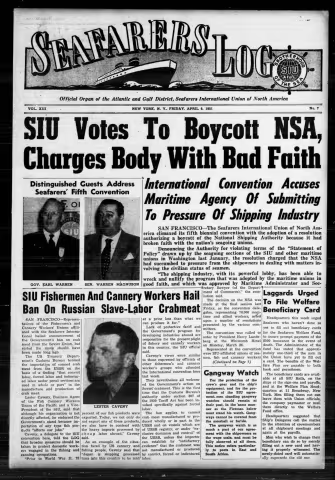
SlU Votes To Boycott NSA
Choiges Body With Bod Foith
Distinguished Guests Address
Seafarers' Fifth Convention
GOV. EARL WARREN SEN. WARREN MAGNUSON
SlU Fishermen And Cannery Workers Hall
Ban On Russian SlaveLabor Crabmeat
International Convention Aaases
Maritime Agenry Of Submitting
To Pressure Of Shipping Industry
SAN FRANCISCO—The Seafarers International Union of North Am
erica climaxed its fifth biennial convention with the adoption of a resolution
authorizing a boycott of the National Shipping Authority because it had
broken faith with the nation's seagoing unions.
Denouncing the Authority for violating terms of the "Statement of
Policy" drawn up by the seagoing sections of the SIU and other maritime
unions in Washington last January, the resolution charged that the NSA
had succumbed to pressure from the shipowners in dealing with matters in
volving the civilian status of seamen.
"The shipping industry, with its powerful lobby, has been able to
wreck and nullify the program that was adopted by the maritime unions in
good faith, and which was approved by Maritime Administrator and Sec
*retary Sawyer (of the Depart*^
Laggards Urged
To File Welfare
Beneficiary Card
SAN FRANCISCO—Represen
tatives of the Fishermen's and
Cannery Workers' Unions affili
ated with the Seafarers Interna
tional hailed announcement of
the Government's ban on crab
mea^t from the Soviet Union, but
stated the mov^ should have
been made long iago.
The US Treasury Depart
ment's Customs Bureau banned
the importation of canned crab
meat from the USSR on the
basis of a finding "that convict
labors forced labor and indentur
ed labor under penal sections are
used in whole or part" in the
manufacture and production of
crab meat.
Lester Caveny, Business Agent
of the Fish Cannery Workers
Union of the Pacific and a Vice
President of the SIU, said that
although his organization is not
directly affected, he endorsed the
Government's stand because im
portation of any type fish pro
ducts "affects our jobs."
Caveny, a delegate to the SIU
convention here, told the LOG
that broader measures should be
taken to protect domestic work
ers engaged in the fishing and
canning occupations.
"Prior to World War 11, 75
LESTER CAVENY
percent of our fish products were
exported. Today, we not only do
not export any of these products,
we also have to contend with
the heavy imports processed by
cheap labor abroad," Caveny
said.
As an example of the situa
tion faced by US cannery and
fishing people, Caveny said that
"Japan is shipping processed
tuna into this country to be sold
at a price less .than what we
can produce it for."
Lack of protective ifariff and
the Government's program for
developing industries abroad are
responsible for the present plight
of fishery and cannery workers
in this country, the SIU official
said.
Caveny's views were similar
to those expressed by officials of
other fishermen's and cannery
worker's groups who attended
the International convention here
last week.
They nevertheless all welcom
ed the Government's action on
Sovief crabmeat. This is the first
time that the Customs Bureau's
authority under section 307 of
the 1930 Tariff Act has been in
voked specifically against forced
labor.
The ban applies to canned
crab meat manufactured or pro
duced wholly or in part in the
USSR and on vessels which are
of USSR registry, or under "ex
clusive dominion and control" of
the USSR, unless the importer
can establish by "satisfactory
evidence" that the crabmeat was
not manufactured or produced
by convict, forced or indentured
labor.
ment of Commerce)," the reso
lution said.
The decision on the NSA was
made at the final session last
Friday, as the convention dele
gates, representing 70,000 m^
time and allied workers, acted
upon a number of resolutions
presented by the various com
mittees.
The convention was called to
order by President Harry Lunde
berg at the Whitcomb Hotel
on Monday, March 26.
Represented at the convention
were SlUaffiliated unions of sea
men, fish and cannery workers
(Cdntinued on Page 3)
Gangway Watch
For the protection of the
crew's gear and the ship's
equipment, and for the pro
tection of the SIU agree
ment. men standing gangway
watches should remain at
their post, in the *same man
ner as the Fireman below
must stand his watch. Gang
ways cannot be covered from
the messhall or foc'sle.
The gangway watch is as
much a part of our agree
ment with the shipowners as
the wage scale, and must be
fully observed at all times.
This notice refers particular
ly to ports in East and'
^uih Africa.
Headquarters this week urged
Seafarers who haven't done so
yet to fill out beneficiary cards
for the Seafarers Welfare Fund,
to insure prompt payment of the
$500 insurance in the event of
death. The Administrator of the
fund has stated that approxi
mately onethird of the men in
the Union have yet to fill out
a card. The benefits of the Wel
fare Plan are payable to botll
book and permitmen.
The beneficiary cards are avail
able at aU SIU Halls, on the
ships at the signons and payoffe,
and at the Welfare Plan Head
quarters at 11 Broadway, New
York. Men filling them out can
leave them with Union officials,
the company paymaster or mail
them directly to the Welfare
Fund office.
Headquarters suggested that
Ship's Delegates call the matter
to the attention of crewmembers
at all shipboard meetings and
again at the payoffs.
Men who wish to change their
beneficiary can do so by merely
filling out a new card and hav
ing it properly witnessed. The
newlydated card will automatic
ally supersede tlie old one.
• m
. I itfii'iMMitBaifiiilriti
Page Two THE SEAFARERS LOG Friday/April 6, 1951
i: .
li'
SEAFARERS LOG
Published Every Other Week by the
SEAFARERS INTERNATIONAL UNION
OF NORTH AMERICA
Atlantic and Gulf District
Afiilialed wilh ihe American Federaiion of Labor
At 51 Beaver Street, New York 4, N. Y.
HAnover 22784
Reentered as second class matter August 2, 1949, at the Post
Office in New York, N.Y., under the Act of August 24, 1912.
267
If:
Protecting Our Rights
The SIU's announced boycott of the National Ship
ping Authority dramatically demonstrates the Union's
refusal to play patsy to any sellout of American seamen.
The announcement, adopted by the SIU's fifth biennial
convention, made it clear to all that the Union's historical
role as the pacesetter for American seamen was still being
maintained.
The background of the SIU's beef is this: The mari
time unions met in Washington with shipowners early
this year and drafted a statement of policy, which found
approval from the head of the Maritime Administration
and the Secretary of Commerce.
In an atmosphere which suggested good relations, the
unions were assured participatioij "in determining all
policies of the NSA and be active administrators in charge
of matters affecting maritime personnel." Outstanding in
the statement was the paragraph "the operation of mer
chant vessels shall be carried out in a manner which will
preserve the civilian status of merchant seamen and all
their rights intact."
But the unions were only being given lip service.
Admiral Cochrane's proposed General Agency Agree
ment issued repently makes no mention of preserving the
civilian status of seamen, an omission that the SIU charges
was brought about by pressure from the shipowners' pow
erful lobby. The rights and privileges seamen enjoy under
the Jones Act, particularly the right to trial by jury in
claim cases, would be lost to seamen.
It's a dollars and cents proposition to the shipowners,
gnd as usual the guy being victimized is the seaman.
The maritime industry has a high injury rate. Insur
ance premiums are high. Putting the load of claim cases
on the Government would leave that much more of the
melon for the shipowners to cut for themselves. But the
SIU is having no part of it. Rather than kowtow to the
NSA's program, the SIU is pulHng out of the picture
completely. Rather than be windowdressing for an agency
that disregards the rights of seamen, the SIU will carry
its fight for seamen elsewhere. Congress has before it now
bills that would guarantee by faw the rights of seamen to
civilian status while working aboard GAA ships. The SIU
will press for their passage.
The civilian status of merchant seamen is traditional,
But here a tradition is being trodden upon. Hiring Halls
are traditional, too. Even Senator Taft says the Hiring
Hall is a necessity for the efficient operation of the ships,
"but will this hinder the men who see in a national emerg
ency a chance to destroy the backbone of the unions and
the other benefits seamen enjoy?
The working man is getting it in the Aeck in the
present organization of Governmental agencies in Wash
ington. In the production setup, labor has been given a
back seat; in price control, he's given nothing except
higher prices; in wage control, he's saddled. The pattern
dleveloping in the National Shipping Administration and
the Federal Maritime Board bears a strong resemblance
to the general short shrift labor has been getting in
Washington.
Unless the maritime unions are called in and given
genuine functions in the administration, and the seamen
of America given a guarantee of their rights, the men who
make up 95 percent of the industry will have no voice in
Government, or, at most, serve as dupes for the decisions
made in the back rooms by Government representatives
and shipping officials..
Every union in maritime should expose the falseness
of the present governmental set up by withdrawing im
mediately. The preservation of seamen's rights does not^
lie along the path of siirrender, • .
• '.'iC'J'
'• .J'"
'T. '•
STATEN ISLAND
A. FORMISANO
A. McGUIGAN
F. CARDOZA
JOHN BARRON
N. DORPMONT
J. KOSLUSKY
H. ADAMS
S. LANZA
EUGENE MILANESI
S. C. CUNNINGTON
JOHN SLAMAN
J. B. ALLMON
H. DA SILVA
G. BARGGREN
F. LANE
G. D. ROURKE
J. CHRISTIE
D. ROMALO
G. ARNOLD
J. J. FERREIRA
J. KELLY
EMILIO DI PIETRO
KYLE C. CROWE
PHILIP PRON
ERIC JOSEPH
WALTER JOHNSON
T. WRONA
E. BORGE
H. H. EDWARDS
J. CALLISTO
U. MERJUDIO
O. HOLMES
MIKE PETERSON
H. HARPER •
G. SANDLUND
C. SANCHEZ
C. DOWNEY
J. H. HURD
J. CUELLES
3/ 3/
BEEKMAN HOSPITAL
G. BRAXTON
4. ft 4.
GALVESTON
RALPH A, HOLLAND
W. E. WADE
E. D. HODGE
ANGELO MACIEL
ft ft ft
MOBILE
EUGENE PLAHN
TIM BURKE
JAMES H. JONES .
B. A. CHRISTENSEN
BALTIMORE
ARNOLD E. THOMPSON ^
WILLIAM D. WEISE
JOSEPH F. SCHUMSKY
THOMAS F. MUNGO
DANIEL BISSETT
A. WRIGHT
ft ft ft
NEW ORLEANS
WILSON O. CARA
J, A. CHAPMAN
ROGELIO CRUZ
H. E. GRANT
E. E. GROSS
L. A. HOLMES
D. D. KELLY
HUGH F. LAGAN
LEO LANG
0. H. IVIANIFOLD
T. E. MAYNES
KARL RAANA
CLAUDE RAY
S. P. SCHIEFFLER
H. SCHOLES
ROBERT W. THOMPSON
LONNIE TICKLE
1. VANTE .
ft ft ft
ELLIS ISLAND
GUY G, GAGE
ft ft "ft
SALISBURY
MICHAEL J. LUCAS
ft ft ft
FT. WORTH
E. J. NAVARRE
ft ft ft
FT. STANTON
HENRY THURMAN ,
DONALD MCDONALD '
GIDLOW WOODS
SILVESTER WALKER
ft ft ft X
MEMPHIS
JOHN B. HEGARTY
R. A. RATCLIFF
CLARENCE D. SHIVELY
ft ft ft
MANHATTAN BEACH
B. T. KNEW
J. J. DRISCOLL
V. MILAZZO
J. ASHURST
E. LOPEZ ^
J. T. EDWARDS ;
A. LOMAS x: '
T. P. SULLIVAN '
J. DE JESUS
R. A. BLAKE
M. BRUNO • '
E. EERRER : t ̂
P. VORKE
J. PADZIK
F. W. GRIMES* aV
R. F. LARSEN
A. MAKRIS
JOHN W. KEENAN
ft ft ft
NORFOLK
JAMES T. TANNEHILL
ERWIN T. GREGORY
S. ft ft
SAN JUAN
JUAN SANCHEZ
RAMON LUIS SERRANO
ALLAN L. HANDE
RALPH W. LEAVY
JUAN DE LA PAZ
CARLOS MATT
JOSEPH H. FUSSELL
GEORGH LITCHFIELD
ft ft ft
SAVANNAH
R. C. BENNETT
O. PREUSSLER"
R. W. CARROLLTON
R. L. FIELDS
SAN FRANCISCO
BJORNE GRANBERG
E. PRITCHARD
JAMES HODO
C. L. MOATS
JAMES R. LEWIS
CHAS. W. JOHNSON
JAMES R. PORTER
H. McGRATH
M. M. LESPERANCE
A. CAUDRA
H. HILL
D. J. GORMAN
W. A. OSWINKLE
J •
1:
'Ai
'A:
.A) • •
''f.
i!.
• • ;"i
'I
ft ft ft
BOSTON
F. DIRKSMEYER
G. A. ROSE
E. GARDNER
A. LEVA
R. LUFLIN
i,,.
• : I • :
li:
Friday. ApzU 6. 1951 THE SEAFARERS LOG Page Three
US Maritime industry Couid Not Operate
Without Union Hiring Haiis: Magnuson
(Continued from Page 1) *
and miscellaneous maritime crafts
from the United States, Canada
and Alaska.
In its boycott action, the SIU
said that the representatives of
its seagoing districts who par
ticipated in the drafting of the
«aaritime program in Washing
ton, were withdrawing "all our
pledges and signatures from said
document (Statement of Policy),"
and that it would call on all
unions to do likewise.
One of the immediate effects
of the boycott will be noted in
the composition of the National
Shipping Authority, positions in
which were to have been held
by two labor representatives, one
each from an American FedeM
tion of Labor union and a CIO
organization. In notifying AFL
President William Green of its
action, the SIU will urge him
not to designate a'representative
on the NSA.
• The boycott resolution was
submitted to the convention del
egates by the Seamen's Organi
zational and Grievance Commit
tee.
Other recommendations pre
sented by this committee which
were concurred in by the con
vention delegates included as
sistance to the International
Transportworkers Federation, a
call for more equitable alloca
tion of reactivatedvessels by the
Federal Maritime Board, denial
of autonomy requests from the
Great Lakes and Canadian Dis
tricts, reaffirmation of the policy
of interDistrict cooperation, and
referral of the entire matter of
civilian status of seamen to the
Executive Board for further con
sideration and action.
In one of the principal con
vention addresses, the delegates
heard United States Senator War
ren G. Magnuson express con
fidence that the maritime imion
Hiring Halls will be legalized
and that bona fide, active sea
men will be made draft exempt.
HIRING HALL ESSENTIAL
Senator Magnuson, who stop
ped at the SIU convention en
route to Japan, where he will
discuss a supplemental fishing
and shipping treaty with the Ja
panese, declared that "the mari
time industry couldn't operate
without the Hiring Halls. Every
one in the industry knows it,
including the shipowners."
He added that even Senator
Robert Taft recognized the sta
bilizing influence of the Union
Hiring Halls on the maritime in
dustry and that the Ohio legis
lator now favored passage of the
Magnuson amendment to the
TaftHartley Law which would
legalize the Hiring Hall arrange
ment.
Senator Magnuson also sup
ported the SIU's contention that
the General Agency Agreement
drawn up by the National Ship
ping Authority is a real threat
to the rights of merchant seamen.
Under terms of the Agency
Agreement, Magnuson said that
there "is danger of seamen be:,
coming employees of the Govern
ment. Under GAA the independ
ence of seamen would be threat
ened."
Despite the fact that much re
mains to be done .^ivp the
merchant marine the recognition
Unions Represented At Conyention
SAILORS UNION OF THE PACIFIC—Delegates: Harry Lundeberg, Harry Johnson,
Donald Brown, Ed Turner, Jack Dwyer, Maxie Weisbarth, William Benz, Charles
Brenner and Morris Weisberger.
ATLANTIC & GULF DISTRICT. SIUNA—Delegates; Paul Hall, Lloyd Gardner, Lind
sey Williams, Cal Tanner, Frenchy Michelet, William Rentz, Harold Fischer and Jeff
Morrison.
SEAFARERS INTERNATIONAL UNION. CANADIAN DISTRICT—Delegates: Les Green,
Norman G. Cunningham, Richard M. Deely and Hal C. Banks.
CANADIAN NAVIGATORS & ENGINEERS FEDERATION—Delegate: Michael H. Davey.
INLAND BOATMEN'S UNION OF THE PACIFIC—Delegates: John M. Fox, Roger Ran
dall, Lawrence Amell and Allen Wearing. Alternates: Lawrence Plummer, Ralph Gold
smith, Max Wedekind and Robert Hargens.
SEAFARERS' GUARDS & WATCHMEN'S UNION—Delegates: W. S. Brown and Wil
liam B. Piatt. Alternates: E. E. McCary and A. D. Hannegan.
CANNERY WORKERS & FISHERMEN'S UNION—Delegates: Lester Balinger, Frank
Currier and George Ledesma.
CANNERY WORKERS UNION OF THE PACIFIC—Delegates: James Waugh, Andrea
U, Gomez, Joe M. Ortega. Ira Nash. Charles Parker and Loudine Roberts.
SEINE & LINE FISHERMEN'S UNION OF SAN PEDRO—Delegates: John Calise and
Vincent Teora.
AFL FISH CANNERY WORKERS' UNION OF THE PACIFIC. MONTEREY COUNTY—
Delegates: Lester A. Caveny and Joseph Perry.
SEINE & LINE FISHERMEN'S UNION OF* MONTEREY—Delegates: John CriveUo and
Nino Billed.
FISH' CANNERY WORKERS' 8e FISHERMEN'S UNION OF THE PACIFIC (San Fran
cisco & Moss Landing Bay Area)—^Delegates: George Issel and Lillian Taffeli. Alter
nate: Charles Snyder.
NEWPORT FISH PLANT WORKERS OF NEWPORT. OREGON—Delegate: Edwina Nel
son. Alternate: Nell Walters.
GREAT LAKES DISTRICT. SIUNA—Delegate: Fred Famen.
MARINE ALLIED WORKERS OF THE ATLANTIC 8e GULF. NY—Delegate: Lindsey
Williams.
MOBILE BAY SEAFOOD UNION. Bayou La Batre. Ala,—Delegate: Cal Tanner, proxy.
GULF COAST SHRIMPERS & OYSTERMEN'S ASS'N.. Biloxi. Miss.—Delegate: Cal Tan
ner, proxy.
ATLANTIC FISHERMEN'S UNION. Boston Mass.—Delegate: Pat McHugh.
STAFF OFFICERS ASSOCIATION. IJY—Delegate: Tom HiU.
BROTHERHOOD OF MARINE ENGINEERS. NY—Delegate: Morris Weisberger.
Affiliated Unions which for various reasons were unable to send delegates to convention:
UNITED CANNERY WORKERS. Kodiak. Alaska.
SHOALWATER BAY OYSTER WORKERS. Nahcotta. Washington.
CODFISH WORKERS UNION. Seattle. Washington.
WRANGELL CANNERY WORKERS OF ALASKA. WrangeU. Alaska.
CONANICUT INLAND BOATMEN'S UNION. Jamestown. Rhode Island.
UNITED FISHERMEN OF ALASKA. Kodiak. Alaska.
ALASKA MARINE DISTRICT UNION. Sitka. Alaska.
UNITED FISHERMEN OF LOWER COOK INLET. Seldovia. Alaska.
it deserves in our national econ
omy, Senator Magnuson said that
the attitude of Congress has
changed considerably in the past
two years.
"Much has been accomplished,"
he said. "We have taken the
merchant marine from its or
phan stage and raised it to a
level where the American people
und'.ntand it."
Previously, the Congress treat
ed the merchant marine as
though it were an economic bur
den, Magnuson explained. He
added that the national legisla
tors disliked the idea of grant
ing subsidies to the merchant
ships.
"After all," the Washington
Senator pointed out, "the mer
chant marine costs less to subsi
dize than Cheddar cheese."
In support of this statement.
• 'he disclosed that the Govern
ment spent 50 million dollars to
subsidize cheddar cheese last
year, while it granted only 42
million dollars in subsidies for
the American shipping fleet.
Interest in the welfare of mer
chant seamen and a healthy mar
itime industry was also express
ed by California's Governor, Earl
Warren, who officially welcomed
the SIU delegates to the port of
San Francisco.
Governor Warren scored the
lack of a stable US merchant
marine, saying that .the Govern
ment only showed an interest in
this vital industry in times of
national emergency. He discussed
the role of the seafaring indus
try in the progress of the nation
and placed particular emphasis
on the part it played in the de
velopment of California. "Had it
not been for this," Warren said,
"California would be 50 years
behind its present status.
"A bigger merchant marine
means we can carry on more in
timate relations with the rest of
the world—and that would give
us all a greater chance for win,
ning peace throughout the
world."
BACKS FISHERMEN AIDS
In addition to the decisions
affecting the seagoing affiliates
of the SIU, the convention acted
favorablyv on a series of resolu
tions designed to beneflt members
employed in the fishing industry.
One of these would make it
legal for fishermen to set the
price of fish through negotiation
with seafood dealers. The con
vention went on record to seek
support for legislation that would
exempt fishermen from prosecu
tion tmder the Sherman anti
trust law's ban against price
fixing. This step was advocated
as a means of providing the
fishermen with a more stable in
come than is presently possible.
Another resolution, prompted
by the deaths of 51 members of
the SlUaffiliated Atlantic Fish
ermen's Union who drowned
when four boats sank, demand
ed more rigid inspection of fish
ing craft and the installation of
improved safety devices.
Also adopted was a resolution
to increase the per capita tax
of the member imions by 10
cents a month to meet the step
(Continued on Page
Delegates And Welfare Director Report
CAPTAIN JOHN F03C"
Inland Boaiman's Union
HAL C. BANKS
SIU Canadian District
PAT McHUGH
Atlantic Fishermen's Union
» MAX HARRISON
Seafarers Welfare Plan
'Page Four THE SEAFARERS LOG Friday, April 6, 1951
SlU Big Help
To AFL Unioii
In Savannah
By E. B. TILLEY
SAVANNAH—The first laun
dry in this city to display the
union label came under contract
this week, greatly as a result of
the role played by the SIU in
support of the AFL Laundry
Workers.
The allunion firm, Hahne's
Laundry, signed up as a result
of an organizing drive by the
Laundry "Workers International
Union which, in cohjunctioffwith
the SIU here, brought home to
management the benefit of hav
ing a contract for its employees.
In aiding the Laundry Work
ers, the SIU requested ships'
crews and Seafarers in this port
to send their laundry to this firm
and not to a strikeboimd laun
dry or other shops handling the
struck firm's work. The business
that resulted obviously had a
strong effect on the firm's head
as the contract was signed in
an atmosphere of good will.
PATRONIZE UNION SHOP
We are now asking other SIU
crews hitting this city to send
their work to the one union
laundry in town, Hahne's Laun
dry.
Also on the labor front, we are
still cautioning members to by
pass Yellow Cabs. Although the
teamsters lost their strike against
this firm, we are still not going
to lessen our support for the
Teamsters. The other taxi finn.
Garden City Cabs, is still not
unionized, but we have reason
to believe they will be signed
shortly.
Here at the Hall .we have had
a letdown in sliipping, but we
expect another rush in a week
or so when a couple of Liberty
ships for South Atlantic will be
crewed here. That's the story
from this port for this week.
Boneyard Ships
Boom Shipping
Jn Port Mohiie
By GAL TANNER
MOBILE — Shipping in. this
port for the past two weeks has
"been very good, largely because
of the crewing of three ships
from the laidup fleet. The ships
are the Lloyd S. Carlson, Bloom
field; Phillip Barbour and Wil
liam Tyler Page, Waterman.
We don't expect any slack in
the tempo either, as the coming
two weeks promise to be very
bright with shipping booming.
Nine ships are definitely due to
hit port for payoffs and replace
ments, and there is a good
chance that three more boneyard
ships will take crews here. "They
are the Frank Spencer, Bloom
field; Martin McCarver, Water
man, and the North Piatt Vic
tory, Mississippi.
With this prospect staring us
in the face there will be few
men who won't be able to get
out with little difficulty, al
; though we always manage, even
in times of booming shipping, to
maintain our reserved of man
power.
The few members who do read this col
umn may have noticed (who knows) that at
times there is a bit of humor — ? — and
yet, at times the seriousness of upholding
good Unionism is evident in this oddsand
ends column. I was struck by the deep feel
ing which was expressed by an article in
the "London Farmer.'' The article, which
concerned the local baseball team, stated,
"T G , for many seasons the regular
guardian of the keystone sack will be on
the coaching lines this year. His sparkling
play will be missed, but it's nice to know
that he is still with us." The London Farm
er is a prison newspaper—and a damn good
one, too.
A maritime magazine, Oceanite, deplores
conditions aboard Indiaflag ships which dis
courage officers (what about the crew) from
staying at sea. It suggests that the officers
be allowed to cany their wives along. As if
they weren't getting enough of a certain
treatment already. . . . "For your informa
tion department"—The preacher who occa
sionally pinch hits as elevator operator in
the New York Hall wishes to be known as
an "indoor chauffeur." Some brass, eh?
Did you know that MSTStransported car
goes are not included when computing the
minimum fifty percent cargo to be carried
in American bottoms, as required by law
where European Recovery goods are con
cerned? A tribute to the fight the SIU put
up when that program's administrator tried
to send a larger percentage over in foreign
bottoms. Also a tribute to certain Congress
men who fought to see this law passed—
protecting the American Merchant Marine.
In the same vein. Senators Magnuson and
O'Connor have presented a bill which would
enforce this same fffty percent measure to
all cargoes sent abroad under a US loan,
grant, or on credit.
One of our Union's shining examples
wishes to be heard ,about something that
can't be heard. This is his story: A deaf
mute husband and wife were arguing in
sign language. The old lady gave him a
first class bawling out, her fingers flying a
mUe a minute. Just as he raised his hards
to answer, she put the lights out. . . . Joe
Falasca, aboard the Royal Oak, trying to
find ways to spend the bigger part of those
twelvemonth articles more pleasantly. . . .
Red Leonard, who already holds such rat
ings as Pumpman and Machinist, spending
a bit of time ashore taking ah Electrician's
course. That's the spirit!
Realizing the danger of being called an
atheist, I must say that I refuse to pray
while aboard ship. Listen to what happened
to one guy who could: His ship was sinking
fast, when the Captain asked who could
pray. This poor soul started spieling off a
first class prayer, when the Old Man butted
in and said, "You'll have to do better than
that; we're short one life jacket.
Everyone on the dredges, including the
company, is wondering how they can oper
ate, without "Hose Nose" Gardner. That
character has been aboard every one of those
dredges, including the Sand Craft, which
sank in NY Harbor. Incidentally^ what
happened to that. "Vanishing American"
who couldn't swim a lick while aboard the
Craft when she went down? . . . The Labor
Press Association, which provides daily
news service for labor papers, printed ex
cerpts of statements made in answer to the
Inquiring Photographer's question in the last
.issue of the LOG concerning the type of
shipmate we can do without. All ten men
involved had parts of their statements men
tioned. .
Bill Murphy, who is well over sixty, re
tired his book the other day, but insisted
he be put on the reserve manpower list—
just in case. . . . "Sailor Jack" Delaney and
Sidney Day are stuck with the SS Barbara
Fritchie for twelve months. They intend to
buy out Duke's share in Duke's Bar under
the Baltimore Hall when they get back. Oh,
well, what's money—^when you don't have
it in the first place?
If you are not a tanker seamen, you might
wish to know that 35 percent of the oil in
dustry's products are transported by water.
Deisel propelled units account for less than
twenty percent of the tanker fleet, but have
nevertheless made great gains in the last
ten years. Furthermore, seventy percent of
the world's tanker fleet of 27,615,000 dead
weight tons is not over ten years old. One
half of this amount consists of T2, Liberty
and other World War II US built tankers.
Oh, yeah, the experts forecast, when those
ships first came out, that the T2 would be
only good for ten to twelve years. Why,, do
people blush? . .' . In closing, I wish to
apologize to the fifteen or sixteen thousand
members whose names have not been men
tioned in this bunch of So long.
Kefauver Show
Rates High With
SIU In Philiy
B7 STEVE CARDULLO
PHILADELPHIA — Shipping
has held steady in this busy port
for another two weeks as the"
Brothers come in and go out in^
a steady stream. As long as they"
continue to go out as fast as
they come in everything will be
okay with us.
A lot of the boys have rfluct
antly thrown in their cards late
ly and taken jobs much against
their will—they were; eifjoying'
themselves here watching the
big shot bookies and numbers
men parade before the Kefauver
Committee. All around, the boys
vote it the most popular pro^
gram on television and it surer
played havoc with the cribbage.
games. Most guys wore afraid to
riff a deck of cards for fear some
investigator would hear them.
What with the Kefauver Com
mittee working and the Mari
time Commission investigation.
and the Philadelphia police in
vestigation going oh, it looks
like e V e r y o n e's investigating,
everyone else.
Right now we plan to investi?
gate our Dispatcher. We got a
report that he paid 18 cents over
the standard price for a broom
and dustpan for use around the
Hall. Watch next week's LOG
for the trial results.
DIEHARDS
Despite the end of Kefauver
Komedies and the continuation
of good shipping, our old stand
bys, Reds Healy anc^ Jim Doris,
are still with us. These old face?
will be with us until the mold
gathers on their shipping cards
and they reluctantly toss them
in and go to work.
We heard from Oneeyed Pete
DiPietro, who is in the Staten
Island Hospital. He's taking a
rest cure, he says, and asks us
if we know where there is a
better paradise on earth. "All
this and beautiful nurses, too,"
Pete says.
Korean War„ European Aid Spur Shipping
The steady upsurge in Ameri
can shipping since the beginning
of the conflict in Korea continues
with ships being taken from the
boneyard weekly for recondition
ing. This week the last Victory
in the layup fleet was removed
and close to 100 Liberty ships
have been, or are scheduled to"
be, taken out.
To man the extra ships the
SIU has been called upon. to
supply hundreds of skilled crew
members, a feat that was per
formed without interruption of
any sailings, eithei military or
commercial.
The rise in the usectf Govern
mentbwnai ships^ jcoupled with
the sale early this year of over
100 Governmentowned ships to
private companies, has brought
a reverse in the Steady decline
of the American merchant ma
rine, which was down to 1100
privatelyowned ships during
1950. Following th6 sale, the SIU
signed up 14 new steamship com
panies and crewed their ships.
The first effect of the Korean
War was to cause the diverting
of privatelyowned ships — both
from commercial rims and idle
status—^to the carrying of mili
tary goods to Far Eastern bases.
This operation alone brought
about the use of almost 40 SIU
contracted ships. Within a few
weeks. Governmentowned ships
were withdrawn from the lay
up fleet and committed to the
operation, Amany of them crewed
by the SIU.
In recent weeks about half of
the privatelyowned ships that
were chartered to the Govern
ment to support the "Korean War
have been returned to regular
trade, their places being taken
by the ships from the layup
fleet.
ATLANTIC PACT
The inauguration of aid to At
lantic Pact countries put another
burden on the merchant marine
in recent months, and has neces
sitated withdrawing of large
numbers of ships from the lay
up fleet. This operation is still
requiring more ships from the
idle fleet. .
For the SIU, over 20 formerly
laidup Victory ships have SIU
crews aboard in service of the
Korean War, and within the past
few weeks 11 ships have been
assigned to SlU'contracted com
panies for use in carrying EGA
and military aid cargoes to Eur
ope. The number 6f ships in this
service is expected to increase.
Despite the number assigned
to the SIU, Union officials feel
that the proportion is far small
er than the Union is entitled to
and is able to handle.
The " recent rise in shipping
has also caused Isthmian Steam
ship Company, an SlUcontrac^
ed outfit, to withdraw its plaz(s
to dispose of its four old Chick
asawtype ships. The ships haye
been returned to regular service.
Friday. April 6. 1951 THE SEAFARERS LOG Page Five
A&G
Executive Board Actions, 19491951
MAY, 1949
1. Authorized granting of a Charter to
BROTHERHOOD OF MARINE ENGIN
EERS, upon request of former active mem
.bers ̂ f the Atlantic and Gulf District and
Sailors Union of the Pacific now sailing as
Engineers.
2. Authorized granting Charter to MA
RINE ALLIED WORKERS OF THE AT
LANTIC AND GULF COASTS, upon re
quest of First VicePresident Paul Hall.
3. Granting of full autonomy to the Great
Lakes District referred to the Executive
Board by the SIU 4th Biennial Convention.
Decision of Board was to lay the matter
over to the 5th Biennial Convention.
JUNE, 1949
4. Authorized $900.00 donation to Teach
er's Organizational Campaign, headed by
Kay Bell, upon appeal from California State
Federation of Labor.
5. Authorized $5000.00 donation to Free
Trade Union Committee, upon appeal for
contributions froni William Green, Presi
dent American Federation of Labor.
6. Authorized granting Charter to UN
ITED CANNERY WORKERS OF LOWER
COOK INLET, upon request of A1 Owens,
Secretary of United Fishermen's Union of
Cook Inlet.
JULY, 1949
V. Authorized payment of expenses for
European Delegation while in USA> regard
ing ITF problems and Panamanian Boycott.
SEPTEMBER, 1949
8. AFL Convention, St. Paul, Minnesota.
Harry Lundeberg, Paul Hall, Morris Weis
berger, Pat McHugh, James Waugh and
Duke Dushane attended. Three resolutions
submitted to the Convention by the Sea
farers International Union of NA were
adopted.
NOVEMBER, 1949
9. Authorized granting of Charter to CA
NADIAN MARINE ENGINEERS ASSOCI
ATION, upon request from Hal C^ Banks,
SIU Representative in Canada.
DECEMBER, 1949
10. Granted Charter to the GULF COAST
SHRIMPERS AND OYSTERMEN'S ASSO
CIATION, Biloxi, Mississippi, upon request
of VicePresident Cal Tanner and Organ
izer Urban Bosarge.
APRIL, 1950
11. Donation of $5000.00 to ITF, upon
their appeal for funds to combat coi^mtm
ist party disruptive activities in the trade
union movement in Europe.
MAY, 1950
12. Granted Charter to SEAFOOD WORK
ERS ASSOCIATION OF THE GULF, Biloxi,
Mississippi, upon request of Organizer Ur
ban Bosarge.
JULY, 1950
13. Granted Charter to ALASKA MA
RINE DISTRICT UNION OF FISHERMEN,
CANNERY WORKERS AND ALLIED
TRADES, Sitka, Alaska, upon request from
Kenneth and Peter C. Nielsen.
SEPTEMBER, 1950
14. Granted Charter to FISH PLANT
WORKERS UNION OF NEWPORT, ORE
GON, upon request of Puget Sound Or
ganizer.
15. Authorized Charter to STAFF OF
FICERS ASSOCIATION OF AMERICA,
and granted them jurisdiction on the East
and Gulf Coasts over Pursers. Jurisdiction
was previously held by American Merchant
Marine Staff Officers Assocication, and was
revoked upon recommendation of John
Hawk.
16. American Federation of Labor Con
vention, Houston, Texas. John Fox, Hal C.
Banks, Matthew Dushane and Andrea
Gomez attended.
NOVEMBER, 1950
1,7. Granted Charter to FISHERIES AND
ALLIED INDUSTRIES, Brooklyn, New
York, upon recommendation of Vice Presi
dents Paul Hall, Morris Weisberger and Cal
Tanner.
* (Continued from Page 3)
pedup organizing and legislative
activities of the International,
and to offset the increased costs
of operation caused by the price
rise since last convention.
In the course of the SIU con
vention, the affiliated organiza
tions submitted reports of their
activities during the past two
years. Marked interest was shown
in the report of the Atlantic and
Gulf District which was pre
sented by Delegates Paul Hall,
Lindsey Williams, Cal Tanner,
William Rentz, Jeff Morrison,
Harold Fischer and Lloyd Gard
ner.
The A&G District report noted
the increase in the number of
contracted ships since the last
convention and listed 78 active
offshore steamship companies in
the passenger, freight, tanker
and other special type of opera
tions, with which it has work
ing agreements.
EXPLAINS WELFARE PLAN
A highlight of the A&G report
was an outline of the Seafarers
Welfare Plan from the time it
was conceived through the last
regular auditing period ended
December 1950.
The A&G delegation entered
iftto the record the findings of
the Senate Labor subcommit
tee's report on the precontract
antiunion activities of the Cities
Service Oil Company. "AH un
ions should be made aware of
this case inasmuch as in the fu
ture, the pattern could be fol
lowed by other companies in the
event' they decided to take on
any of our District unions in
any effort to crush«;them," the
A&G report stated.
Reports were also presented by
the various International vice
presidents, dealing with their ac
tivities in behalf of the interna
tional organization. VicePresi
dents Paul Hall and Morris Weis
berger drew up a joint report
because the proximity of their
District offices on the East Coast
permitted them to work together
on almost every International
problem to which they were as
signed.
Capetown Was Once A Vegetable Garden
Seafarers who journey to
South Africa today aboard the
ships of the Robin Line find in
Capetown all the cosmopolitan
features of New York or any
other major city of the north.
The towering modern buildings,
first class roads and up to date
transportation facilities . make
Capetown a modern metropolis
second to none.
But how .many Seafarers know
that the first purpose of Cape
town was as a vegetable garden
for replenishing ships enroute
from Europe to India?
About the same time that the
Dutch were establishing a colony
on Manhattan island, a Dutch
merchant company established a
beachhead in Capetown and
built a fort. They planted a
vegetable garden, with the view
in mind of rehabilitating the
scurvyridden crews that arrived
from Europe, a run that took
about six months in those days
of nonrefrigerated lockers.
Today the vegetable garden is
no more, but the site remains as
a botanical garden, one of the
most pleasing features of Cape
town.
Many other features of South
Africa's key city remain just as
they did when the Dutch held
power there.
Table Mountain, lying on the
southern part of the bay, has
impresseti Seafarers since the
days when, before Columbus, the
Portuguese rounded the cape,
which offered a "good hope" of
reaching India by sea." Adjacent
to the mountain are the Twelve
Apostles, the mountain peaks
that form the western side of
Table Mountain.
The city itself is a fascinating
blend of old and new. Narrow
thoroughfares recall the early
Dutch days, as do the names of
many streets, while in the older
parts of the city there remain
many Dutch and Georgian build
ings, often standing next to shops
and offices built in modern style.
The contrast will, be even
greater soon; as the city begins
its building expansion on the
huge new area recently reclaim
ed from the waters of Table
Bay.
OLD FORTRESS
One link to the past is the old
Capetown Castle. Built in the
form of a fivepointed star, it
is a classic of the sev
enteenth century fortress, for
this castle sheltered the first
colonists from attack by hostile
natives and wild animals.
Capetown's history in many
ways, parallels thatof NewYork.
Early in the development of the
city, the Dutch moved off from
the Cape into the plains to be
come farmers and left the City
to the English who were inter
ested in it from a strategic
standpoint. The English later
colonized the area.
When the Dutch—or Boers, as
they called themselves — found
themselves at odds with the Eng
lish, they packed their belong
ings and stowed them in covered
wagons. They set out over the
plains, crossed the mountains
and founded the Free State and
Transvaal.
• Also, like in our country, a
rash for the minerals of the
earth speeded up the colonization
of the land. First the famous
Kimberley diamond strike
brought thousands of fortune
seekers from all over the world.
Twenty years later a gold rush
brought additional thousands.
Most of the adventurers stayed
to make their living in less spe
culative ways. All of them
brought with them the culture
and ways of Europe and made
the Cape area European in every
way.
Strangely enough there are no
real natives left, in South Africa.
Like the American Indians, who
pitched their tepees on Man
hattan Island and were slowly
driven inland, the bushmen who
lived on the Cape when the
Dutch came are now almost ex
tinct. Their descendants, how
ever, can still be seen in the
Kalahari Desert and wandering
tribes of a race, now extinct in
its original purity, known as the
Hottentots.
NOT YET TAMED
Seafarers who travel the loop
from Capetown to Port Eliza
beth, East London and Durban
in the Union of South Africa
can attest to the modern cities
and culture very much like out
own, but despite the progress
made, the lower continent has
by no means been tamed.
Only a few miles from the
port cities of electric lights, gay
night life and modern plumbing
are the wild lands, and jungle
beasts still roam at large, and
along the highways travelers
find it wi.se to stay in their au
tomobiles "after dark.
1949
In the convention's final hours,
the delegates elected the Inter
national officers who will serve
until 1953. The officers elected
and the District Unions they
represent are:
President — Harry Lundeberg,
SecretaryTreasurer of the Sail
ors Union of the Pacific; First
VicePresident—Paul Hall, Sec
retaryTreasurer of the Atlantic
and Gulf District; VicePresi
dents— Morris Weisberger, East
Coast Representative of the Sail
ors Union of the Pacific; An
drea Gomez, Cannery Workers
Union of the Pacific; Pat Mc
Hugh, President of the Atlantic
Fishermen's Union; Cal Tanner,
Gulf Coast Representative of the
Atlantic and Gulf District; Les
Caveny, Fish Cannery Workers
Union of the Pacific, Monterey
County; Captain John Fo^
President of the Inland Boat
men's Union; Lester Ballinger ol
the Cannery Workers and Fish
ermen's Union; and Hal Banks,
Director of the Canadian Dis
trict. Banks was elected by vir
tue of the convention's decision
to give the Canadian District
representation on the executive
board. John Hawk was reelect
ed International SecretaryTrea
surer.
The officials named constitute
the SIU's executive board, which
is empowered by the Constitu
tion to act on matters of im
portance in between conventions.
The delegates named San
Diego, California, as the con
vention city for 1953, after it
had been proposed by delegates
from the Fishing and Cannery ,
Workers from that area.
New York Boom
Keeps Patrolmen
Really Hustling
By EARL SHEPPARD
NEW YORK — Shipping has
continued good in this port dur
ing the past two weeks. We
have had the routine number of
beefs and all have been settled
in quick time. With these new
companies being formed, their
ships are calling at piers and
towns around this harbor that
we never heard of before, so the
Patrolmen have been really
hustling. From the wilds of New
Jersey to the oil docks of New
Haven the ships have been get
ting representation and the Pa
trolmen have been seeing coun
try unvisited since the end of
World War II.
During this period we had 2S
payoffs and 12 signons. Not bad
at all.
We have sent a letter to all
companies concerning the con
troversial Thanksgiving Day beef.
We notified them that from now
on the Union will recognize the
fourth Thursday in November as
the regular Thanksgiving Holi
day.
This point came up because
several beefs have arisen over
this holiday. In some instances
crews have celebrated Thanks
giving one Thursday and other
crews another Thursday. In one
or two isolated cases the crew
on the same ship split up, with
half celebrating on one day, and
the other half on another.
This jumble should be ended
now. Thanksgiving Day for the
Seafarers is the fourth Thui'sday
in November.
:!• •
Page Six THE SEAFARERS LOG Friday. ApxU 6, 1851
iPetroleum For Europe's Industry
Fort Hoskins Crew Rides
The Persian Gulf Shuttle
It's not often that a Cities Service ship ventures too far
from the coastwise milk run to Aruba and Lake Charles,
but last October the Fort Hoskins headed for that far land
of the Persian Gulf area and shuttled oil to European ports
for four months. These excellent shots taken by Frank Flan
agan show that the departure from the norm didn't faze
the crew one bit. In fact, Frank Gasper, crewmember who
dropped the pics off at the LOG office, reported that the
Hoskins had a clean trip all the way, with no trouble in
any port.
Gasper reported that at the end of the shuttling mission
the majority of the crew stayed aboard—they'd found a
good functioning unit and wanted to keep it operating.
As many of the crew as could be puUed from fheir duties line up for a formal portrait.
The warm sun of the Sues region seemed to agree with the boys as they shed shirts to get the
benefit of the sun on their winterwhitened lorsra.
Those other guys can risk getting sunburned
if they want to, but Chuck Wysocki is having
none of it. AB on the ship, he pauses in hU
work to admire his craftsmanship and at the
same time oblige Brother Flanagan's photo
snapping tour of the ship.
Feztopped Seafarer G. J. Boroski hasn't gone
native, despite the hair shirt he bravely dis
plays, risking his all to the ways of those wily
little black insects. That background isn't an
Egyptian scene, it's an' oriental blanket a crew
member put up to lend proper atmosphere.
A sporty threesome relax against the rail and dare Brother
Flanagan to shoot them. Left to right, Jimmy Ott, Fireman;
Frank Throp, Deck Maintenance, and A1 Gregory, Wiper. The.
novel cigarette holder was Throp's way of protecting his bit
of carefully cultivated chin shrubbery.
ti a
^ y ' 1
' mmm0
% /• '
F'
SaBB P' ^ .
' •
III
feliii ' "i
' ' W
1
A snappy looking Stewards Department lined up when Flanagan asked for a pose. Left to
right the boys are. Bob Lopez, George Lothrop, Charlie, Chief Cook; Carl Bartolo, BR; Bill
Costin, ^nd Cook, and Andy Casano, Saloon Messman. With these chaps behind the stoves it's
easy'to see why the crew stayed with the ship.
"So, what do you want?" seems to be Frank Caspar's
thought as he stares right back at the camera. Caspar, AB, had
nothing but praiBe for the fine way the crew handled itself
during the long trip. He reports that the Hoskins was the first
shuttling tanker to leave Hamburg with a full crew in many
a moon.
.i..rrida7. April 6, 1951
' • • '." ' ^• • ^• "• '• ' ^r '. ,, \ ^
THE SEAFARER S LOG ^ Page Seven
ife''"
SHIPS' MINUTES flND NEWS
A Prize In Pastry SIU Crews Played Epic Role
In Korean Evacuation By Sea
From behind a curtain of military censorship is slo\^ unfolding a
story of almost unbelievable achievement in the evacuation of soldiers and
civilians from North Korea by American merchant ships during the UN
withdrawal late in December. The story is one of closeup support and aid
to the harrassed troops in*
Proud meuibers of the Alcoa Partner's Stewards Depart
ment display a very edible ship's model turned out by Baker
Joseph Warfield, standing right. A note accompanying the
photo said that the Cooks "really know their stuff." Others in
the picture axe, kneeling, left to right, Ralph CoUins, Messman;
Thomas Robinson, Messman. Charles Starling, Pantry Utility,
and Antione> Johnson, Utility. Standing are Percy Thompson,
Chief Cook; Joseph Hall, 2nd Cook; Joseph Williams, Utility;
William Daniels, Messihan, and Wariield.
Appeal To Men On Ships
Made By March Of Dimes
With .this week's LOG being |previous years and to top the
mailed to all SIU ships will go total contributed last year.
the annyal SIU appeal to crews
in behalf of the March of Dimes,
the one organization dependent
upon public funds that has the
full endorsement of the SIU.
Seafarers are being called up
on to match their generosity of
The organization has stated
that it is in need of record funds
to carry on its campaign against
the ravages of polio, which
strikes thousands yearly and
shows little sign of slackening
in its proportions.
The organization directs the
doiikted fimds into direct treat
ment of those stricken and to
research toward solving the mysj
tery and providing a cure.
Close to home for Seafarers is
the case of Gene Milanesi, form
er crewmember o^ the SS Steel
Apprentice, who was stricken
several months ago with the
disease. Now being treated in
Staten Island Marine Hospital,
he expects, lo regain his health,
except for his right leg, on which
he will have to wear a brace,
ized frorn. the SS Montebello The methods employed and or
Hills in that port recently and j thopedic equipment used in Mi
were happily surprised to find lanesi's case were developed im
themselves visited by the owner der research grants made by the
of the Top Hat, Mr. C. J. Vleu,March of Dimes.
the Hungnam beachhead
area followed by the remov
al of thousands of personnel
b y civilianmanned mer
chant ships, one of which
carried the unbetievable
number of 14,410 persons.
A specific report as to how
the tremendous undertaking was
accomplished has not been re
leased to date, but stories com
ing in have been pieced together
to give a picture of a dozen or
so merchant ships, many of them
• SlUmanned, carrying 105,000
itroops, 100,000 civilians, 17,500
vehicles and 350,000 tons of ma
Iterial to Pusan in a little more
ithan two weeks.
I From official" Navy sources the
bnly clue that such an operation
took place are the cryptic let
ters of commendation to the
Crease It Up
Top Hat Bar
In Rotterdam
Tops, Says Bush
Seafarer C. H. Bush believes
that when a good thing is found
the rest of the Seafarers should
be told about it, that's why he's
boosting the Top Hat Bar in
Rotterdam. '
Brother Bush, along with
George Quinofies, were hospital
• gels, his wife and daughter. As in the past the crews will
The boys' spirits were raised receive scrolls provided by the
by their 'visit and fruit, maga
zines and cigarettes were left
to while away the time until
I'ecovery.
Quinones is still in the hospi
tal in Rotterdam, but Bush is
back to sing the praise of the
Top Hat and its proprietor.
The bar. Bush stated, is friend
ly and the prices reasonable.
"Nice and quiet for sociable
drinking with no one hanging
pn your neck," he stated. "But
if you want company and feel
in a real sociable "mood, there
is a good crowd of, congenial
people aroxmd. The ̂ LOG is on
hand, too."
The address is: V. Oldenbarne
veldstraat, 138 Rotterdam, Hol
land.
fimd upon which they can in
scribe their names. The fimds
and the scrolls are to be turned
over to the Patrolmen and the
money collected from all SIU
ships • forwarded to the fund at
one time.
Send Those Minutes
Send in the minutes of
your ship's meeting to the
New York Hall. Only in that
way can the membership act
on your recommendations,
and then the minutes can be
printed in the LOG for the
tmnefit of all other SIU
crews.
Brother Devlin> Electrician,
aboard the Alcoa Pioneer, gets
stopped by the camera while
making his rounds with the
grease pot.
freighters, passed on by the Mili
tary Sea Transport Service.
According to the Skipper of
one of the transports used in the
evacuation, the convoy was pre
peded into Hungnam by mine
sweepers and then herded close
to shore while the warships took
up positions to the north, and
south and awaited the arrival of
the marines and infantry re
treating from the Chongjun Re
servoir area.
COVERING FIRE
No hurricane ever approached
the screaming bedlam produced
by the warships that protected
the evacuation, the Skipper re
Tated. For five days and nights
the cruisers and destroyers sent
a steady stream of five to eight
shells tearing into communist
positions rimming the shrinking
beachhead. In turn, communist
artillery thundered into the area
and around the convoy.
The arrival of thetroops at
the dockside was a sight the
crewmembers of the ships in the
convoy wiU never forget. Sold
iers came aboard right from the
front with hand grenades still
pinned to their uniforms for in
stant use, their guns as ready
and their equipment covered
with mud and dirt. Some were
wounded and ill.
Arnong the ships participat
ing in the operation was the
Waterman C2 Madaket, which
was the last ship to leave Hung
nam on Christmas day. She sail
ed under small arms fire from
the enemy with more than 11,000
evacuees aboard. A sister ship
the Choctaw sailed ahead of her.
Also present at the beachhead
were the Robin Gray and the
Robin Kirk, both of which were
called upon to eyacuate person
nel under heavy gunfire.
The most complete story of
the ordeal came from the crew
of the Meredith Victory. Built
to carry a crew of 50 and 12
passengers, she transported 14,410
Koreans on the threeday run
from Himgnam to Pusan.
gers and during the war car
ried 15,000 troops as her peak
load.
Of the Meredith Victory's thou
sands, children were not count
ed, though they were in large
numbers. One crewmember sta
ted, "There I stood with babies
all around me, and something do
ing every minute." Five women
gave birth in the first 24 hours.
The sight of the Meredith Vic
tory arriving at Pusan startled
even the toughest troop officers
used to seeing overpacked ships.
One Navy transport officer de
scribed it as follows:
"When we first saw the ship
we couldn't figure out what in
the world it had on deck. From :
a distance it was simply a dark,
solid mass. As the ship came
nearer we could see it was hu
man beings. They were packed
so close you wondered how they
could breathe. And there wasn't
a sound from them. They just
stood there, silently, waiting. Un
less you saw it you couldn't be'
lieve it."
SOUTHWIND SERVES
Another SlUcrewed ship that
received commendation from
Rear Admiral J. Doule, Com
mander of Task Force 90, the
evacuation force, was the SS
Southwind, of South Atlantic.
The Southwind was called upon
to move 7,000 soldiers and ma
rines from the Hungnam area.
The epic of Hungnam was re
peated in the evacuation of In
chon on the West Coast where
the Waterman ship Noonday
moved out 5,000 South Koreans
and the Citrus Packer figured
in the movement of personnel
and equipment.
Upon completion of the tre
mendous job, the work done by
the merchant ships was summed
up appropriately by Admiral
Callaghan, Navy spokesman, who
stated, "Such support is indica
tive of the contribution which
the American merchant marine
has so often made to the na
tional security through its as >
The Queen Elizabeth, world's' sistance to the United States v
largest ship, has a passenger ca j Navy in the fulfillment of its
pacity of just over 2,000 passen _ mission."
. Photo shows a C2 class merchant ship. SlUmanned C2's SS Madaket, Chocttuv, Noonday,
Citrus Packer and Southwind participated in the evacuation of civilian and UN forces from
North Korea, during which the Madaket carri^ over 11,000 persons at one lime.
\ 1 . . V
wm 'J T. :f
Pas* Eight THE SEAF4RERS LOG Friday^ April A 1851
Saga Of '24 Hurricane Is Top Tale
In Brother's Family Of Seagoers
^ >4%
As far back as Pat Gainey can
remember his family has been
going to sea, but he's ready to
match his experience in a 1924
hurricane off Cape Hatteras with
the best of theirs. He'd b'e
matching his story with a host
of seagoing relatives near and
far, plus three brothers who
sailed in recent years. Pat, or
Samuel, as he's known formally,
is sure though thatthe experi
ence that befell him and 89 other
crewmembers aboard the 4mast
ed Ida S. Dow can't be topped.
Back in those days Pat was
deck hand on the Dow, one of
the few schooners still plying
the coastwise trade, and with
three years of seatime under his
belt considered himself as hav
ing seen all the ocean and wea
ther could offer.
It was autunrn when the Dow
put out of Tampa for Boston
with a load of lumber. Her hblds
full, she carried a heavy deck
load of lumber and it was all
the deck gang could do to keep
everything ship shape as she
nosed around Florida and head
ed for the north.
deck with his camera, a small
brownie, and snapped pictures;
one by one, as the ship nearec
them.
But the men of the Dow were
not to go down before the steam
er. Slowly the ship lumbered
'"''Kililii
PAT GAINEY
BLOW STRUCK
Off Hatteras the hurricane
struck. Full force, the winds tore
through the ship. Deck hands
scurried aloft and trimmed the
sails. On deck another group
worked rapidly to batten down
the deck load. Hour after hoiu'
Pat and his mates worked to
save the ship and the cargo, but
it was soon evident that the
deck load wasn't going to ride
out the blow.
As the ship twisted and turn
ed in the gale the lines holding
the cargo snapped one by one,
whipping across the decks with
force enough to cut a man in
half. The gale picked the lum
ber up and, like toothpicks, scat
tered it to the winds, sweeping
the deck clear. Miraculously no
one was hit.
Clear of the deck load the
hands turned to on deck to save
what they could of the ship as
she floundered helpless in the
mountainous waves and scream
ing winds.
Hour after hour the ship creak
ed and groaned as the winds
rose and fell.
Little by little the ship began
to give before the storm. First
the dingy was swept away, then
the whaleboat was smashed when
the lumber flew over the side.
Horror stricken the crew
watched the storm take its toll
One by one three of the four jibs
were lost and the saUs were
torn to shreds as they lay tight
4o the spars.
Weakened from the long fight
the crew watched almost without
hope as the storm continued
without any let up. At one mom
ent in the storm the crew thought
the end had come. From behind
a mountainous wave rose a
steamship, bearing down on them
under full steam. The men of
the Dow watched as the steam
ship sighted the schooner and
S fought to give the sailing ship
a clear berth as every roll of
the seas brought them closer.
away and in a few minutes was
gone behind the waves.
Finally after 48 hours the
storm blew away. Redeyed and
hungry the men turned to to
survey the damage and their
losses. The ship had been hard
hit, but nary a man had been
injured or lost. Pat says it was
only good seamanship that saved
the men, as one misstep could be
fatal.
The ship hadn't made out so
well. The deck gang made what
emergency repairs could be ef
fected and replaced the shred
ded canvas with the spare set
carried and brought her into
Boston. "Everybody kissed the
groimd after that one," Pat said
The experience didn't keep
Pat from sailing schooners
though. He put in three more
years before the mast until jobs
on sailing ships went the way of
the horse and buggy and gas
lights.
He turned to sailing the iron
ships and was one of the. first of
the band of hardy seamen to
organize into what is now the
A&G District of the SIU.
He's been sailing steady since,
except for a twoyear spell in
the hospital when he suffered
a heart ailment. During the war
he was aboard the E. G. Hall,
the first merchant ship to touch
Manila after its liberation. The
Hall had fought its way through
a wave of suicide planes, one of
which crashed on deck of an
adjacent"^ ship.
His most recent ship was the
Salem Maritime, Cities Service,
and he's now waiting around the
New York Hall for a Bosun's
job to come up. "I don't care
what it is or where it's going so
ong as it moves," says Pat.
• i: '
vJ 'iy
Send 'Em In
Don't hold your pictures
and stories of shipboard acti
vities. Mail thenr to the Sea
farers Log. 51 Beaver St.,
New York 4, N. Y. If you
haven't the time or don't feel
in the mood, just forward de
tails. We'll do the rest. Pic
tures will be returned if you
wish.
Rebellion
By ROBERT G. PATTISON
I'll travel alone round this mad world,
man's accepted rule ignore.
The inspiring sight of the flag unfurled
will stir my heart no more.
For a woman's love I've nought but scorn,
all women are untrue.
And ^e happy home wKere I was born ' '
expects so much of you. , ,
The loyal friend who by your side
sticks through thick and thin.
When you turn around should the need arise
you'll find anyone but him;
For wealth and glory I have no yen,
they are only chains that bind,
Though gold makes slaves of other men
and glory turn their mind.
Give me the world to amble round,
the sky and oceans blue,
I'll take my women as they are found
and leave with nought to rue.
I'll make my home where I hang my hat,
I'll pay no tax or rent.
For the world is mine, come nb piatter what,
I'll still be pleasure bent.
There are no duties, toil or fears
for these are all manmade.
There's only beauty, and happy tears,
if you can make the grade.
So I'll cast aside our civilized code,
its burden and its grind.
With a heart that's light without its load
" and a free imshackled mind.
• vJN
A Steamer In The Throes Of A Hurricane
' ̂ ACTION SHOTS
Pat, for some reason he has
>t been able to discover in the
jars since, found himself on
Pat Gainey caught this shot of a Spanish passenger ship as she hove near the hurricane
battered Ida' S. Dow in 1924. Looking at the picture Pat remarked, "In that storm she couldn't
help us and only meant danger in case we rammed. That's one time when in distress that an
other ship nearby didn't mean good news."
Mother M. L. Crew Aids Greek Islanders
The SIU crew aboard the SS
Mother M.L. this week received
the thanks of the residents of
a small island in the Aegean sea
for a financial contribution made
several weeks ago in their be
half.
The men of the ship donated
$39 at an earlier payoff for the
residents of Oinoussai, a Greek
island which has as its resi
dents mostly the wives and or
phans of seamen lost during
World War II.
The letter of thanks was re
ceived by Captain Leon Lemos,
Port Captain of Eagle Ocean
Transport Company, owners of
the Mother M.L. The letter,
written by the President of the
island, thanked the men for the
money, which will be used for
"the relief of our people who
Ships Delegates
Aboard ship the arm of the
Union is the Ships and De
partment Delegates. A good
crew, for its own protection,
picks its Delegates #arly, and
carefully. Have you and your
ship^tes elected your Dele
gates? If not, do it noVrl
have, been tried hard and suf
fered most during the long years
of World War II."
According to Captain Lemos,
the island lost 156 out of 650 of
its adult men during the war
and has been faced with a se
vere task of . rebuilding its
school and providing for the in
habitants. Persons who spent
their youth on the island and
left to seek their fortunes else
where have assumed a moral ob
ligation to aid their home island.
The action by the crew came
about when the officers donated
$211 to the fimS and asked the
crew if they cared to join in.
Seafarer Stephen J. Mogan,
longtime member of the Union
died in New . Orleans recently,
the LOG has been informed.
Brother Mogan held book num
ber 337 and had been in the
SIU since 1940.
Born in Massachusetts in 1898
he had been going to sea for
over 25 years, serving as a
Fireman. During the past ten'
years he had sailed primarily
out of Gulf ports.
His beneficiary card listed
Matthew Mogan, a brother, as
his next of kin.
4. S. 4
A member almost since the
inception of the SIU, Ollie C.
Blake, 47, died March 2 at the
Seamen's Church Institute in
New York of pneumonia. He
carried Book No. 3547.
Brother Blake was an AB and
had participated in most of the
strikes and beefs that: arose dur
inghis years in the SIU.
He is survived by his mother,
Mr. G. C. Finch, of Richmond,
Virginia.
t &
Ricardo Guzman died in Sta
ten Island Marine Hospital on
March 6 the LOG has been in
formed. Brother Guzman held
Book Number 35533 and sailed
in the Stewards Department.
He was 50 years old at the
time of his death. He is survived
by his, wife .Mercides, who lives
in Brooklyn. .
• 7r P^iPPPPfflSPfP^
WiMxf* April 6. mi THE SEAFARERS LOG Page Nine
Digested Minutes Of SlU Ship Meetings
GREENSTAR (Traden Steam
ship), Feb. 12— Chairman. W,
Sibley; Secretary, J. Dorry. Del
egates ieported number of books
and permits in their departments.
Ship's Delegate pointed out to
the new men that if they did
not understand aijything about
the Union to see their Delegate
\ and he would help them out
Discussion held on keeping laun
dry clean.
iSf if Zf
SEATHUNDER (Colonial). Feb.
IZ—Chairman, W. Reidy; Secre
tary, I. Smilowitz. Delegates re
ported all okay. Delegates to
make out forms giving upgrad
ing details on each crewmem
ber. Registration of aliens ex
plained and notice posted on
bulletin board.
i I X
PONCE (Puerto Rico Marine),
Feb. 24 — Chairman, Bennett;
Secretuy, Miranda. Delegates
reported ho beefs. Discussion on
Headquarters letter concerning
unloading cargo and shore leave.
Motion carried to accept. Vote
made to take $25 from ship's
fund toward a fund for Brother
Milanese who was stricken with
polio.
SOUTHWIND (South Atlantic),
Feb. 10—Chairman, James Prest
wood; Secretary, Ray Rife. Dele
gates reported number of bO'oks
and permits in their departments.
Motion carried to have slopchest
checked and repair list ready
when ship hits Norfolk. Discusi
sion on ship's fund. Ship's Dele
gate to take care of all beefs
to avoid confusion.
XXX
ALGONQUIN VICTORY (St.
Lawrence Navigations Feb. 14—
Chairman; John Jellette; Secre
tary, A. Campbell. Delegates re
ported no beefs. Discussion on
facilities in new building. Sug
gestions listed and sent to Head
quarters.
VONTfOUL upoas /)
sY
r'M.
INCLUDE YOUR
OLD ADDRESS
WHEN NOJ\FYir4G
TUB LOG OF A
CUANGB OF
ADDRESS.
fX
W
XXX
OREMAR (Ore), Feb. 18 —
Chairman, Victor Cover; Secre
tary, O. Guerrero. Delegates re
ported everything smooth, ex
cept some penalty hours in each
department. Letter from Head
quarters read concerning time
ashore and unloading of cargo.
Second Cook criticized for poor
baking.
LYNN VlCTCRY^DolphinTri
ton), March 8 — Chairman, L.
Nicholas; Secretary, Gavin. Dele
gates reported all smooth. Pre
cautionary safety measures to be
taken with cargo outlined to,
crew. Steward reported he would
have to cut down on food be
cause of waste, though he would
accept any suggestions for any
. dish liked by the cre^i^.
/ XXX
SANTORE (0#e), Feb. 20 —
Chairman, S. Clark; Secretary,
E. Morris. Delegates reported
number of books and permits
in their departments. Cortiplete
agreement was registered on time
ashore and unloading cargo let
ters from Headquarters. Sugges
tion made to see Chief Engineer
concerning ice box repairs.
XXX
OLYMPIC GAMES (Pacific
Tankers), Jan. 7 — Chairman,
James Rose; Secretary, A1 De
Forest. Delegates reported no
beefs. A new slopchest had beeii
promised for the ship the next
time she hits Trinidad. Request
made that airmail copy of LOG
be passed around for entire crew
to enjoy.
4« S<
STEEL ADVOCATE (Isth
mian), Feb. 28—Chairman, Ralph
Kismul; Secretary, A1 Whitmer.
Delegates reported minor beefs,
otherwise all in order. Beef
raised on inadequate linen for
bunks.
t 4. 4.
WACOSTA (Waterman), Feb.
4 — Chairman, R. Kelly; Secre
tary, L. Lott. Delegates reported
no beefs, some disputed over
time in Deck and Stewards De
partments. Heads to be repaired
in first port.
Feb. 18—Chairman, De Angel
lo; Secretary, Woods. Motion car
ried not to payoff until all beefs
are settled. Hospital to be check
ed for quantity and quality.
Stewards Department given a
vote of thanks for the fine work
done.
4 44
MONARCH OF THE SEAS
(Waterman), March 4—Chairman,
E. Vatis; Secretary, L. Moore.
Delegates reported all okay.
Crew voted against purchase of
a new washing machine. Motion
carried to adopt time off and un
loading cargo letters from Head
quarters.
ANDREW ^JACKSON (Water
man), March 4—Chairman, Bob
Barrett; Secretary, H. Pitkofsky.
Beef on Captain telling Steward
to knock off Passeilger Utility on
Sunday while on day work. Dis
cussion on matter.
STONEWALL^JACKSON (Wa
terman), March 6 — Chairman,
Jerry Palmer; Secretary, A. Fry.
Headquarters letters read con
cerning unloading cargo and time
off. Motiori^ carried to withhold
vote on statement on cargo un
loading until arrival in New York
where Headquarters can clarify
the issue.
4 4 4
CITY OF*ALMA (Waterman),
Feb. 17—Chairman, Robert Moy
lan; Secretary, Gerald Artiaco.
Delegates reported all in order.
Discussion on Deck Departmerit
sanitary work man who has not
been doing his job. Suggestion
made that each department's
sanitary man take turns in keep
ing laundry clean.
4 4 4
LASALLE (Waterman), March
3 — Chairman, Joseph Shaugh
nessy; Secretary, Charles Rogers.
Stewards Delegate raised ques
tion as to whether or not pulling
ice from ice machine was over
time or not. Repair list made up
by all departments and present
ed to various department heads.
Motion carried that meetings be
held every two weeks, as crews
change more often, than on off
shore ships.
4 4 4
JEFF DAVIS (Waterman). Jan.
30—Chairman, R. Bowley; Secre
tary, D. Fitzpatrick. Lengthy dis
cussion on food situation. Ship's
fund reported at $27.50. Repair
list to be started and added to
during trip.
FAIRHOPE (Waterman), Feb.
18—Chairman, Lionel Gormandy;
Secretary, C. Daggett. Motion
carried that each Delegate turn
in his repair list to Ship's Dele
gate. Motion carried to have Pa
trolman contact 1st Assistant and
Chief Mate concerning painting
of crew's quarters and passage
ways.
4 4 4
AMES VICTORY (Victory Car
riers), Feb. 25—Chairman, Earl
Spear; Secretary, Stanley Scott.
Delegates reported no beefs.
Suggestion made that food be
improved. Men were asked to
come to messroom properly
dressed.
4 4 4
NIKOKLIS (Dolphin). Feb. 11
—Chairman, Joseph Lipton; Sec
retary, S. Solski. Delegates re
ported all running smoothly. Dis
cussion on Union letter on time
ashore and unloading cargo. Vote
of thanks given Stewards De
partment for fine work. A new
library to be brought aboard in
first US port.
4 4 4
CAPE MOHICAN (Mar
Ancha), Jan. 29—Chairman, Wil
liam Mollison; Secretary, Harry
Franklin. Delegates reported no
beefs, some disputed overtime.
Patrolman to be asked whether
or not cargo of lamp black is
penalty cargo. Motion carried
to have ship's heating system
checked.
Feb. 14—Chairman, A. Muhal
ski; Secretary, Harry Franklin.
Delegates" reported number of
oooks and permits in their de
partments. Motion carried to con
cur with the "Guide for Stew
ards Departments."
4 4 4
PONCE DE LEON (Waterman),
Feb. 4—Chairman, Leo Movall;
Secretary. A. Kuberski. Dele
gates reported all in order. Vote
of thanks given Stewards De
partment for the fine food serv
ed. Motion carried to refer to
the Negotiating Committee the
transportation issue on the West
Coast when a ship pays off in
either Seattle or Long Beach.
Feb. 22—Chairman, Frank Mc
Guire; Secretary, A. Kuberski.
Ship's Delegate read Headquar
ters letter on unloading cargo
and time off ashore. Motion car
ried to accept unanimously. Del
egates reported number of books
and perrnits in their ,departments..
Ship's Fund reported to contain
$40.94.
4 4 4
COUNCIL GROVE (Cities Sep
vice), March 10 — Chairman*
George Schmidt; Secretary, T.
Gavin. Delegates reported num
ber of books and permits in
their departments. Motion car
ried to see Patrolman concern
ing individual rooms for watches
in engine department. Motion
carried to see Patrolman for copy
of constitution and bylaws and
other educational material.
Directory Of SIU Halls
SIU, A&G District
BALTIMORE 14 North Cay St.
William Rentz, Agent Mulberry 4540
BOSTON 276 State St.
Ben. Lawsoh, Agent Richmond 20140
Dispatcher Richmond 20141
GALVESTON....' 308^4—23rd St.
Keith Alaop, Agent Phone 28448
LAl^ CHARLES. L« 1419 Ryan St.
Keith Terpe, Agent
MOBILE 1 South Lawrence St.
Gal Tanner, Agent Phone 21754
NEW ORLEANS 523 Bienville St.
Lindaey Wjlliama, Agent
Magnolia 61126113
NEW YORK 51 Beaver St.
HAnover 22784
NORFOLK 127129 Bank St.
Ben Rees, Agent Phone 41083
PHILADELPHIA 337 Market St.
S. Cardullo, Agent Market 71635
SAN FRANCISCO 450 Harrison St.
Lloyd Gardner, Agent Douglas 25475
SAN JUAN, PR 252 Ponce de Leon
Sal Colls, Agent
SAVANNAH .,,.2 Abercorn St.
E. B. Tilley, Agent Phone 31728
SEATTLE 2700 let Ave.
Ray Oates, Agent Seneca 4570
TAMPA 18091811 N. Franklin St.
Ray White, Agent Phone 21323
WILMINGTON, Calif.,,. 440 Avalon Blvd.
Jeff Morrison, Agent Terminal 42874
HEADQUARTERS. .51 Beaver St., N.V.C,
SECRETARYTREASURER
Paul Hall
ASST. SECRETARYTR^URER
Enrl Sheppard
HEADQUARTERS REPRESENTATIVES
Joe Algina Robert Matthews
Joseph Volpian
SUP
HONOLULU 16 Merchant St.
Phone 58777
PORTLAND Ill W. Burnside St.
I Beacon 4336
RICHMOND, Calif 257 5th St.
Phone 2599
SAN FRANCISCO 450 Harrison St.
Douglas 28363
SEATTLE 86 Seneca St.
Main 0290
WILMINGTON 440 Avalon Blvd.
Terminal 43131
Canadian District
MONTREAL 463 McGill St.
MArquette 5909
HALIFAX \2B'A Hollis St.
Phone 38911
FORT WILLIAM. .118^4 Syndicate Ave.
Ontario Phone 33221
PORT COLBORNE 103 Durham St.
Phone 5591
TORONTO 66 Colborne St.
Elgin 5719
VICTORIA 6I7J4 Cormorant St.
Empire 4531
VANCOUVER 565 Hamilton St.
Pacific 7824
SYDNEY 304 Charlotte St
Phone 6346
HEADQUARTERS 463 McGlll St.
Montreal MAra.uatte 73 77
XXX
ARCHERS HOPE (Cities Set
vice), March 9 — Chairman, B.
WiUjiams; Secretary, S. Lipschitz.
Delegates reported on books arid
permits in their departments.
Deck Delegate reported 22 hours
of disputed overtime. When crew
is restricted to ship in a foreign
port because of quarantine, a
notice is to be requested from
the Master so there will be no
doubt as to whether or not the
crew shall put in for overtime
for being restricted to the ship.
XXX
FELTORE (Ore), Feb. 28 —
Chairman, R. Langford; Secre
tary, E. Abies. • Special meeting
held to discuss unloading cargo
and time off issues sept to the
ship by Headquarters mail. Crew
unanimously in favor of both
issues. Discussion on Electrician's
letter listing necessary repairs, .
XXX
BULL RUN (Mathiasen), Feb.
25—Chairman, J. Burrows; Sec
retary, T. McLemore. Delegates
reported the number of books
and permits in their departments.
Motion carried to have ship fu
migated in the next port. Beef
raised on poor menus and lack
of fresh vegetables. Steward
asked not to use leftovers.
XXX
MARINA (Bull), Feb. 19 —
Chairman, W. Szczepanski; Sec
retary, E. Tart. Delegates re
ported all in order. Motions car
ried to concur with two issues
on time off and unloading cargo.
Motion carried to concur with.
Stewards Department guide.
XXX
CUBORE (Ore). March 5 —
Chairman, Imohundra; Secretary,
J. Kahl. Delegates reported all
okay. Motion carried to send
crew a list of men leaving to
the Baltimore Hall from Pan
ama. An educational talk held
• on the sanitary work.
XXX
LONE JACK (Cities Service),
March 3—Chairman, Albert Wea
ver; Secretary, Bernard Kimber
ly. Ship's Delegate reported one
engineering book had been
bought out of ship's fund. Dele
gates reported number of books
and permits in their departments.
Motion carried to buy records
from ship's fund. Crewmembers
urged to fill out Welfare Fund
blanks.
March 10 — Chairman, Roy
Lundquist; Secretary, Bernard
Kimberly. Delegates reported
(Continued on Page 12)
Page Ten THE S E AF ARE RS LOG Friday. April 6. 1951
THE MEMBERSHIP SPEAKS I. •
Steward Sees SIU School
As Way To Improved Menus
's Cone A'Sailing
Ss'
To ihe Editor:
This has been a longer trip
than usual, so it was only re
cently that I got arovmd to
reading Frenchy Michelet's Stew
ard Department Guide and learn
ing of the SIU's intention to
set up a school for Stewards De
partment men.
The Union has picked a top
notch man in Frenchy to head
the school and he has my best
wishes, for there is no doubt
but that we are always in need
of first rate Stewards Depart
ment men.
I know from personalexperi
ence that some of the Cooks
who come aboard these ships
think that roast beef, roast pork,
com beef and cabbage, beef
stew and gravy made of white
wash cooked on top of the stove
constitute a ship's menu. They
slop it on a plate with gravy
running over the side. "What's
the difference," they say. "Sail
ors don't care." That's the at
titude of some I have come in
contact with.
WRONG THINKER
Strangely enough, the fellow
who feels this way usually thinks
he is a good Chef.
I
When a Steward puts on the
menu chtlets, croquettes, stuffed
peppers, shepherd's pie or other
items utilized from left over
meats, he gets hard looks. The
crewmembers shy from anything
that hit a meat grinder. But these
dishes are first rate.
Some Cooks never heard of
garnishes. Parsley, lemons and
a few more items make a plate
look palatable and give the food
greater flavor. Some think lemons
are only for iced tea.
In rendering fat I had one
guy tell me they don't do that
any more. Of course I always do
tljat myself and then I know it
won't hit the deep six.
NO CHEF HE
Here's one for the books: I
had a Chef on one ship—at least
he told me he was a Chef—so
I put.roast prime rib of beef au
jiis on the bill, and as we were
in' port I couldn't pay too much
attention to him. I figured he
was no graduate of Sheepshead
Bay and therefore probably knew
his job. But it isn't always a
beautifully bound book that
makes the perfect story.
.By the time I got around to
finding out how he was doing I
learned he had taken the beau
tiful rib and was cutting it like
a piece of boloney. To aidd in
juix he had dumped the rich
; sediment in the garbage can
and had made au jus from water,
wox'cheshire sauce and kitchen
bouquet." All that wonderful, na
tural gravy thrown away.
Well, to keep my dignity I
called him into my room and
really laced him down for foul
ing up. After that I kept an eye
on Mm. The next time we had
a rib of beef I cut it myself and
showed him how to make a real
au jus. *
Just because the crew isn't
on the guest list of the Ritz or
the Waldorf is no reason why
the food can't be prepared and
served in the finest fashion pos
sible. Sloppy service has no
place on an SIU ship.
On this ship, the Carolyn,
whenever I put something on the
menu I tell my Chief Cook, who
is a fine man, to ask me if there
is anything he does not under
stand. Several times I have gone
into the galley to help him get
going.
The Stewards Department's ef
forts are well appreciated, too.
On here we have a good bunch
topside and all is running
smooth. The same was true on
the Trinity, my previous ship.
Once again I'd like to con
gratulate Brother Michelet for
doing a fine job on a matter
that has long needed handling.
George Seeberger
Wearing nautical attire for the occasion, the sons of Sea
farer Leo Feher pose for the camera. They are Tommy. ZVz,
and Leo. Jr., IVi years old. Their.proud father is now aboard
the SS Sea Cloud: the boys are with their mother in Weehaw
ken. New Jetsey.
Monarch Nine In Spring Training Camp
Readies For Games In Southern Circuit
To the Editor:
The formidable Monarchs, con
querors of the powerful Marina
baseball club, serve notice to all
baseball teams in the Carribean
that they are ready to defend
their mythical crown.
Manager L. B. Moore has an
nounced that the first workout
was held at "Sixto Escobar" Sta
dium on Monday, March 26 and
the results were "promising."
Having lost several outstand
ing players, the Monarchs will
be rebuilding their ranks. How
ever, several newcomers are on
hand who show promise. Among
them is C. N. Mclnis, veteran
of several campaigns with var
ious Alcoa clubs in the Sunshine
League. Mac is bidding for a
starting assignment on the
mound staff. He still possesses
that high hard one and should
he develop his curve, he would
prove invaluable to the club.
Also striving for a berth as
starter is a young rookie of con
siderable promise, "Chainbreak
er" Summerlin. "Chains," al
though a little erratic at times,
has a fast one that jumps. Given
a little experience this boy
should go places.
Holding down the catching as
signment is that old pro, Jimmie
Bartlett. Jimmie doesn't have
the luster of the mound aces
but he is a strong clutch player
and a reliable handler of pitch
ers for those close innings. He
also has a reputation as a strong
clutch hitter.
WHO'S ON FIRST?
At the moment first base as
sigmnent seems to be a toss up
between Manager Moore and
"Hose Nose" Beloy. Should
Moore find that Father Time has
slowed him down, he will step
aside for the "Nose.''
Around the keystone sack are
two classy performers in the
persons of Chico Carraisquillo
and Tommie Sanchez. Should
both boys live up to expecta
tions there should be a new
record set for double plays".
The hot corner at the naoment
is in doubt. Manager Moore is
desperately trying to get a heavy
hitting third baseman in a trade,
but failing in this will attempt
to convert one of his fiychasers
into a third sacker.
In the outfield Andy Andrews,
Pete Melich, "King Kong" Kim
brel and Whity Palmer will
battle it out. Andrews wields a
potent bat and was instrumental
in giving the Marina nine the
lopsided shellacking they took.
Kimbrel, a big strapping rook
ie, has all the requisites of a
long ban hitter. Both Pete Me
lich and "Whity Palmer, although
comparatively light hitters, are
speedsters. AU four should see
a lot of action this season.
Assisting L. B. Moore in his
managerial duties will be "Hon
est Sam" "Fatis, who has accept
ed a coaching job."
Manager Moore, when queried
as to what he thought his team's
chances were, voiced cautious
optimism, saying, "At .the mo
ment we don't appear to have the
strength we put in the field last
year, but with ,a bit of season
ing I think we'U be able to
handle the strongest opposition."
Managers who wish to book
their teams for exhibition games
against the Monarchs can get in
touch with the team's publicity
director and office manager, E.
N. Mclnis, c/o SS Monarch of
the Seas, Waterman Steamship
Corjjoration, Mobile, Alabama.
E. N. Mclnis
Enroute to their training camp in Puerto Rico. Six mem
bers of the Mj?narch squad horse around a bit on deck. Left
standing. Tommie Sanchez. L. B. Moore. Pete
N. Mclnis. Kneeling are Jimmie Bartlett and
to right are.
Melich and E.
Andy Andrews.
Cooperation
Settles Beef
On Del Valle
To the Editor:
This trip the Captain and Chie^
Engineer are taking their vaca
tions from the Del "V"alle, and,
when they left they ordered
their replacements not to change,
a thing. JVe've had only one ma
jor beef'to date.
The Chief Steward came to
me recently and told me that
the ship's doctor was interfer
ing with the work of his depart
ment and had called the atten
tion of the Captain to a bad
spot on the deck of the saloon.
The spot, I know, cannot be re
medied, but tire Captain called
the Steward into the saloon and
called him down before the ship's
doctor and a couple of passen
gers.
With the Deck Delegate I ap
proached the Captain on the mat
ter and he stated, "I called the
Steward down a bit, but did it
in a joking way. It seems that
he took it serious. Will you see
to it that the Steward does not
use obscene language in the pres
ence of the passengers."
I told the Captain I would,
speak to the Steward about his
language and in turn I asked that
he talk to the Ship's doctor about
interfering with the work of the
crew. The Captain gave me his
word he would attend to the
matter.
I spoke to the Steward in a
brotherly way about his lang
uage, and since' the incident
everything has been fine.
In the event we have any
more trouble with' the doctor,
we will'^call a special meeting
and send the Hall the results.
All other shipboard beefs have
been handled with ease anjd with
a great deal of clean cooperation
from the officers and crew.
T. R. Gonzalez
Boyer Reveals
Another Champ
In SIU Ranks
'S fi
1
To the Editor: '.('A
. Now that Moon Kouns has
ben well covered by LOG pub
licity on his ring exploits, let's
give another Brother a little
mention. Did you know that YAc
Miorana is also an exleather
pusher? "Vic was a good one, too^
and even held the Southern
Featherweight title.
Today you don't hear much
about the Southern titles, but in
Vic's day the Southern titles
drew plenty of water because
every oneand his brother was
fighting for a living.
Vic fisticuffed his way under
the name of Vic Moran, and is
a cousin to the wellknown Pal
Moran, who three times fought
Bepny L.eonard, the great light
weight champion of the world.
Pal also stood toe to toe with
the great Lew Tendler on two
occasions.
Pfescy Boyas
Friday, April 6, 1951 THE SEAFARERS LOG Page Eleven
Smallpox Scare
Confines Reyes
In Ceylon Hospital
To the Editor:
I have just been discharged
from the Infectious Disease Hos
pital here in Colombo, Ceylon
after 14 days of confinement,,
"during which the doctors found
nothing wrong with me. The
company doctor sent me to the
hospital from the Alcoa Puritan
—on charter to Isthmian—when
he thought I had smallpox.
We had one case on the ship
and two days later I came down
with a cold and fan a fever of
105' degrees. This was enough
for the doctor to send me to the
hospital, though I still don't think
that was enough reason. ^
If it hadn't been for the Amer
ican Consul, to whom I com
plained, I would have starved to
death in the hospital. I couldn't
eat the food they gave me and
the facilities were very poor. It's
a wonder I didn't catch smallpox
in the hospital.
STILL HEALTHY
Confab On Ship's Problems
I'm out of the hospital now
and, fortunately, still healthy,
but i am worried about my wife.
I don't know how she is going
to get along until I get back on
my feet. The American consul
has my money, but it is only
$200 and he is going to spnd her
half.
I feel that because some com
pany official got his wind up, I
^ave been made to suffer and
my wife too.
Despite this situation the com
pany has put me up in a nice
hotel and I'll probably be on my
way" home soon on an Isthmian
ship. The American consul here
is a very nice fellow and is will
ing to do anything to help any
one who gets stranded. The com
pany agent and some of the fel
lows who work for him are also
nice fellows. They deserve a bit
of praise in the LOG, too.
Juan Reyes
(Ed. Note: For the safety of
the crew it was necessary to
take you from the ship. It was
the only thing the doctor could
do under the circumstances.
For you it was uncomfortable,
and for the company expen
sive? however, you will not
suffer financially as the law
specifies that you will receive
wages to the end of the. Alcoa
Puritan's voyage.)
Dawn Of Unionism Brought
Justice To Seamen: Legge
A crewmember holds the floor while the men of the Car
roll Victory discuss shipboard problems. At the time the ship
was off Korea. A South Atlantic chartered ship, she was in
Far Eastern weders for over six months. Photo was submitted
to the LOG by crewmember D. D. Story.
Member Who Won Labor Scholarship
Urges Brothers To Go After Award
To the Editor:
As a member of the SIU who
spent the years '4849 at Ruskin
College, Oxford, I would like to
say a few words about the labor
scholarship being offered this
year. First off, it should be made
clear that the requirements for
application are not at all. dif
ficult. No college degrees or ex
perience are needed. A high
school diploma would help, but
one of the fellows who Was there
with me had not even gone to
high school. The scholarship com
mittee is interested in the ap
plicant's sincerity of purpose and
good judgement, much more than
his academic record.
The main purpose of the schol
arship is to acquaint an Ameri
can union member with the labor
movement in Britain so that he
can develop a broader outlook
on the union movement as a
whole. It is assumed that upon
his return to this country his
loyalty to the labor movement
will have been strengthened and
his outlook . widened. Speaking
for myself, I think the experience
has done just that.
The studies consist of the his
tory and problems of labor in
Britain and the "world; political
problems facing the working peo
ple, economic theory and prac
tice, etc. There is plenty of lee
way given for the study of
special subjects, so that a Sea
farer, for instance, could study
the economics of the maritime
industry, if he so wished.
The bulk of the students at
the college come from British
unions, although there is a good
sprinkling of people from all
over the world. The college is
not interested in a person's race,
creed, or color.
Because most of the students
ai'e regular fellows, I found that
the Americans had very little
difficulty adjusting. As a matter
of fact, some enduring friend
ships were formed.
PUBS. TOO
In addition to the studies, of
course, there's plenty of room
for leisure and fun. Oxford's full
of pubs, and some of our best
bull sessions took place with
pint in hand. The college pro
vides a bike for each of the
students, and a bijfe ride in the
English countryside can be
heck of a lot of fun, especially
when there's a five or six hun
dredjear old inn on the other
end.
Weekend trips to London can
be taken, and during the Christ
mas and Easter holidays, there's
plenty Of time for excursions to
the continent.
All in all, I can say the ex
perience was mighty worthwhile
and enjoyable. The financial al
lotment isn't all that it could
be, and it would be advisable to
take along some spare funds, but
it would be a mistake to let that
stop anyone from applying. When
I was there, we received 200
pounds, of which 125 covered
room, board, and tuition. The
grant has been raised since then,
and now offers 250 pounds ($710),
j which is a considerable improve
1 ment in terms of the British
cost of living.
I For any SIU member who is
; deeply interested in the labor
movement, and who can afford
to take a year out for study, I
would strongly recommend ap
; plication for the Ruskin College
scholarship.
Irwin Suall
Juan y before he wes hospiialized from the Alcot Puritan.
(Ed. Note: Interested Seafar
ers can get applications by
writing to the committee on
Ruskin College Labor Schol
arships, 2 West 45th Street.
New York. Deadline for filing
applications ie May 1.)
To the Editor:
America has followed behind
other nations in maritime devel
opments. Although our potential
for ship building and operation
has long been known, American
trade and commerce has been
carried mainly in foreign bot
toms. Britain's economy is based
on shipping. The history of mari
time developments is the history
of world developments. Com
merce found its way to every
port of the world on ships. Sea
men were, and are today the
prime movers of world civiliza
tion.
We have read the history of
the rise of British shipping, of
the press gangs, slianghaing, cat
'o nine tails, flogging, keel haul
ing, brig and irons and worse
for the least infraction of rules
made by powermad Captains.
Seamen were at the mercy of
these martinets for long periods
of time when voyages lasted
years. All this we know. This
knowledge we cherish for the
simple reason that the past
teaches us—and it will never
happen again. That is a primary
purpose behind unionism—to see
to it that such conditions never
happen again.
SALT HORSE
For food, the seamen were fed
salt horse, or salt junk, which
came aboard in casks and hard
tack. These were weevily after
a few weeks at sea. This food
was dished out in whacks to
each man of the crew. Even if
his stomach retched and revolted
at this coarse fare there was no
relief. It was eat it or die. The
Captain ruled his officers aft
and' served the portions to each.
Although there was better fare
for officers and special cooking,
lere, too, the Old Man served
with an iron hand.
The Yankee clippers were i"ep
licas of the British system in
^everything but name. Woe to the
seaman who dared to complain
of the food on these ships. There
was always a Mate ready to taste
it and pronounce it good, with
an eye to the approval of the
Captain. This brave seaman was
marked for special care.
Rum was dished out as a ra
Suggests More
Candidates In
A&G Elections
To the Editor:
We should have at least a
half dozen candidates for each
office at general Union elections.
The incumbents may be fine gen
tlemen, but others equally as
good ought to be found in a
union of this size.
I ask the membership to con
sider that thought this year.
I will not stand for office, nor
will any of my friends.
William C. Kennedy
(Ed. Note: Brother Kennedy
^ should take Brother Kennedy's
advice. Every year qualified
members are urged, at Branch
meetings and through the
LOG, to throw in for office.
The method of nomination in
the A&G District could not
be simpler: Any man who
meets the constitutional pro
visions, and most do, can
nominate himself.}
tion to kill the foul poisons of
the food and lime juice was
added to prevent scurvy.
The islands and coasts of the
entire world have been marked
by the graves of seamen who
died during the course of these
voyages, if they were not buried'
at sea. As ships must sail and
death, decimating a crew, added
intolerable hardship and even
danger to ships and cargoes, some
care was given to the problem
of keeping seamen alive and at
work within the limits of starv
ation. Thus, the rum and lime
juice.
A SHORT LIFE
The sanctimonious Captain?
and bucko Mates did not desist
from their brutality in any way.
The better shape a crew was in,
the harder they were driven
and the end of a voyage saw
the survivors worn out. The life
of a seaman was a short one—
a man was old at forty if he sur
vived that long.
The sailing ships were replaced
by steam. England expanded its
trade and commerce. Hanging
at the yardarm for mutiny gave
way to lesser punishment. This
was no concession to morality or
religion on the part of owners
or government. It was based
upon the necessity to man the
expanding steamdriven merchant
fleets. Who would go to sea
under the infamous system?
They were forced to adopt semi
hvunan measures as a means of
manning the vessels to expand
Britain's trade.
Thus we see that pounds and
shillings were the motives that
humanized the British maritime
industry. The new status meant
that seamen were no longer to
be regarded as beasts but as
men. Thus was progiess born—
under the poundsterling sign.
This did not mean that sea
men were free. There were no
unions to represent the seamen
then. They were still at the
mercy of the employers who
shackled them securely.
CONDITIONS SAME
The Fink Book was born. The
twowatch system was maintain
ed. Seamen stood watches four
on and four off. The twopot
system of feeding was retained.
Curry and rice and rotten stews
replaced salt junk because steam
ships meant voyages made in
less time over longer distances.
The seamen still slept on straw
filled ticks on an iron bunk and
drew their whack of rations. ^
Seamen "theoretically" now
had recourse to law under the
Board of Trade Rules and Reg
ulations. Those who studied their
rights, however, were singled out
by Captains and officers as dan
gerous men and "Sea Lawyers."
This was a supposed contempt
uous term which they hurled at
every seaman who demanded bis
rights. As yet unions had not
been born of maritime necessity.
The deception of rights under
the Rules and Regulations per
sisted for a long time and slow
ed down the birth of maritime
unions. Only when the truth be
came universally known and ac
cepted, that there was little jus
tice for an individual under the
owner controlled and dominated
Board of Trade did the idea of
unionism to enforce justice begiii
to sink into the minds of sea
men. .
John Legge
'ill' IV• j'l'i'MSliiiiiiiii"
Page Twelre THE SEAFARERS LOG Friday. April 6. 1951
Digested Minutes Of SlU Ship Meetings
(Continued from Page 9)
; number of books and permits
in their departments. Members
asked to write down any recom
mendations they may have for
improving the safety aboard ship.
Ship's Delegate reported that
safety meeting would be held
on southbound trip with either
three ship's officers at crew's
meeting or a meeting of the
delegates with the ship's officers,
i 4, i
SALEM MARITIME (Cities
Service), March 4 — Chairman,
Henry Buckner; Secretary, John
Powers. Action taken on sugges
tions for new Hall and request
that men go for higher ratings.
Suggestion made that a petition
be drawn up for 120 quarts'of
milk, as are carried on SIU
ships. Steward Department
thanked for fine work.
March 18—Chairman, Vernon
Street: Secretary, H. Zum. Dele
gates reported no major beefs.
Motion carried to get more milk
aboard. Ship's Delegate reported
that the literature sent to ship
should be read for a better un
derstanding of the work aboard
ship and cooperation within
crew. Discussion on sailing board.
X % X
ROYAL OAK (Cities Service),
March 7—Chairman, Willis; Sec
retary, Harry Zeikel. Ship's Del
e^te reported a request by crew
that more bonus be paid. Dele
gates reported number of books
and permits in their departments.
Suggestion made to collect all
old books and notify AMMLA
for a new library. Captain to be
asked for a fantail awning.
Every Man A Reporter
Every Seafarer aboard aUp la right where the news
ia breaking. What goes on aboard SZUcontracted ships
and the activities of their crewmembers can make inter
esting reading.
All you have to do to translirio Hiese activities into
stories or reports to be read by the rest of the member
ship is to Jot down the facts and forward thmn to the
SEAFARERS LOG. If you can turn out a good yam.
that's fine. But if you think you can't, then all you need
do is write down the details end weH take care of the
rest.
Pictures ̂ ei£^ten the interest of a story, so if you
have snapshots taken on your voyage, send them along
too.
Let's make every Seafarer a reporter. Submit your
stuff to the SEAFARERS LOG. 51 Beaver Street. New
York 4. N. Y.
XXX
STEEL RECORDER (Islh
mian), Feb. 18 — Chairman, C.
Kausl; Secretary^ D. Harmon.
Delegates' reports accepted. Chief
Cook reported no rail on aft
side of ladder to ice box. Item
to be entered in records of safe
ty meeting.
XXX
JEFFERSON CITY VICTORY
(Victory Carriers), Jan. 14 —
Chairman, G. Mcintosh; Secre
t{uy. John Gates. Delegates re
pented everything okay, except
naeded clarification on overtime
for crossing international date
line on Sunday. Discussion on
method of issuing linen. Discus
sion on having no heat on star
board side of ship.
XXX
CAMAS MEADOWS (US Pe
troleum Carriers), Feb. 18 —
Chairman, Marion Luska; Sec
retary, Pat Murphy. Headquar
tets conununications on unloads
ing cargo and time ashore read
and accepted. Motion carried that
men who missed ship be report
ed to Headquarters.
XXX
BOBIN KETTERING (Seas
Shipping), Jan. 21 — Chairman,
John Tilley; Secretary, William
Pepper. Delegates reported
. everything in good shape. Thanks
given to acting delegate who
took over and handled the ship's
fund when the previous dele
gate got off. Request made that
crewmembers stay out of pantry
while meals are being served.
XXX
SOUTHPORT (South Atlantic),
Feb, 7—Chairman, J. Bragg; Sec
retary, G. Sfoxy. Delegates' re
ports accepted. Discussion on
juices and fresh fruit. Motion
carried that greater cleanliness
in messroom and pantry be ob
served.
XXX
STEEL ROVER (Isthmian),
Feb. 12—Chairman, Parth Epemi
gen; Secretary, James Kelly.
: Delegates reported disputed ov
ertime for Electrician and Car
penter. Discussion and acceptance
of Headquarters letter on time
ashore and imloading cargo. Mo
tion carried that fans be put
aboard.
XXX
SOUTHERN CITIES (South
em Trading), Feb. 13 — Chair
man, Walter Terry; Secretary,
Bob Brown. Delegates reported
on the men in their departments.
Repair list to be rechecked be
fore vessel goes to shipyard. Sug
gestion made that instructions be
drawn up for men doing sani
tary work. William Coslello el
ected as Ship's Delegate to re
place member who got off in
Houston. Meeting forms to be
picked up in next port having
an SIU Hall.
XXX
WANDA (Epiphany Tankers),
Feb. 22—Chairman, Frank Nigro;
Secretary, R. Wagner. Delegates
reported disputed overtime in
Deck^ and Engine Departments.
Vote of thanks given the Stew
ards Department for the great
improvement in food and serv
ice.
XXX
EVELYN (Bull), Feb. 21 —
Chairman, Charles Benway; Sec
retary, C. Brown. Delegates re
ported the number of books and
permits in their departments.
Motion carried to see Patrol
man about keeping pantry clean.
Each man to donate 50 cents
toward getting washing machine
repaired.
XXX
ROBIN HOOD (Seas Shipping),
Feb. 18 — Chairman, H. Fried
man; Secretary, Joseph Harri
man. Delegates reported over
time not being" equally distri
buted in Stewards Department.
Motion carried that negotiating
committee consider transporta
tion between West Coast ports.
Discussion on proper attire for
food handlers.'
XXX
STEEL ADMIRAL (Isthmian),
Feb. 12 — Chairman, Henry
Cooke; Secretary, Roy Alston.
Delegates reported all okay. Each
member to donate $2 toward
piurchasp of a new washing ma
chine. Discussion on illness of
Black Gang Delegate, who claim
ed not enough care from Mate.
Hospital'to be cleaned before any
ill crev/members are admitted.
ALCOA POLARIS (Alcoa),
Jan. 20 Chairman, Thomas
Gould; Secretary, William Oliver.
Deck Delegate reported a few
hours of disputed overtime, other
departments okay. Discussion on
letter written by three crew
members. Crewmembers tried to
get other men to sign letter as
a petition. Ship's Delegate stat
ed he knew nothing about the
letter and was asked to resign.
XXX
OLYMPIC GAMES (Pacific
Tankers), Feb. 18 — Chairman,
James Rose; Secretary, A1 De
Fbrest. Ship's Delegate reported
that the Captain wished to thank
the crew for its cooperation dur
ng voyage. Letters read concern
ing unloading cargo and time
off. Suggestion made, that payoff
be speeded up by Delegates with
dues to be paid clearly marked.
XXX
FRANCES (BuU), Feb. 19 —•
Chairman, T. Ferrara; Secretary,
D. Herliby. Delegates elected.
Motion carried to get an elec
tric heater for crew messhall.
Steward to ask for new inner
spring mattresses.
DEL CAMPO (bfissisrippi),
Pri>. 11—Chairman, D. Ramsey;
Secretary, L. EOand. Delegates
reported no beefs on board. Ship's
Delegates elected in line with
policy of rotating job every three
trips. Retiring Delegate given
vote of thanks.
XXX
MADAKET (Waterman), Jan.
28—Chairman, Lonnie Cole; Sec
retary. George Clarke. Delegates
reported number of books and
permits in their departments.
Chief Mate to be seen about pro
viding a desk in Chief and Night
Cook's room.
ft » ft
DESOTO (Waterman), Feb. 25
— Chairman, Hex^erson John;
Secretary, Philip Reyes. Letter
from Headquarters read concern
ing time ashore and unloading
of cargo. Suggestion made that
waiver on unloading cargo made
to apply also to areas where
comniunists tie up the docks for
political reasons. Suggestion
made that tables be set during
dinner and supper to avoid wait
ing? '
Feb. 11 — Chairman, Ikekela;
Secretary, Philip Reyes. Dele
gates reported all in order. Men
who have suggestions for new
building to offer them to the
secretary for transmission to
Headquarters. Brother Reyes
given a vote of thanks for his
efforts in raising money for for
mer crewmember Jolm Ellison,
whose wife died.
ft ft ft
CITY OF ALMA (Waterman),
Feb. 17 — Chairman, Robert
Moylan; Secretary, Gerald Art
iaco. Delegates reported all over
time straight. Discussion on poor
work being done by sanitary
man. New delegate to be elected
in Stewards Department as pres
ent delegate does not understand
job.
XXX
CHOCTAW (Waterman), Feb.
12—Chairman, J. Stickney; Sec
retary, William Bruton. Ship's
Delegate reported load of pen
alty cargo, creosoted lumber,
loaded in Pusan and discharged
in Kobi. Motion carried that per
formers be brought before crew
for disciplinary action. Motion
carried that Union look into mail
service as ship is under MSTS
charter and is getting very little
mail.
ft ft ft
FAIRISLE (Waterman), (date
not given)—Chairman, P. Nau
jalis; Secretary, James Cliton.
Deck Delegate reported some dis
purted overtime. Motion cartied
that repair list be completed.
New crew to be instructed" to '
have clock repaired and placed
in crew's lounge. Vote of thanks .
given Stewards Department for ,
fine food and service.
ft ft ft
CHICKASAW (Waterman).:
Feb. 22 — Chairman, Warren
Hodges; Secretary, James Byrne.
Delegates elected. Ship's Dele
gate requested that men having
qualifications, go up for their '
ratings. Motion carried to pur
chase a steam iron. Steward
asked crew to take better care '
of cups as there is a shortage. '
Chief Steward asked to supply '
tablecloth to crew mess during '
rough weather. Complaint regis •
tered about Chief Mate inter
fering with deck gang while
working under the Bosun's or
ders.
ft ft ft
SEABEAVER (Colonial), March
i — Chairman, Emerson Spauld '
ing; Secretary, James Boy kin. '
Men leaving ship to notify Skip '
per 24 hours before ship reaches '
port. Delegates reported on num
ber of books and permits in their "
departments. Motion carried to
notify Union concerning men
performing in Poft Arthur. New /
screens and fans to be put •
aboard.
ft ft ft
WILLIAM A. M. BURDEN
(Pacific Tainkers), March 12 —
Chairman, John Hauser; Secre '
tary, A1 OMalley. Delegates re
ported a new brand of coffee
needed and a new electric water
cooler needed in messhall. Re
pair list made up to be sent to
Headquarters. Motion carried
that ship be fumigated and a
better night Ivmch be put out.
Notice To AH SIU Membere
The SEAFARERS LOG as the official publication of the Sea
farers International Union is available to all members who wish
to have it sent to their home free of charge for the enjoyment of
their families and themselves when ashore. If you deshe to have
the LOG sent to you earii week address cards are on hand at every
SIU branch for this purpose.
However, for those who are at sea or at a distance from a SIU
hdi, the LOG Reproduces below the form used to request the LOG,
which you can fill ou^ detach and send to; SEAFARERS LOG, 51
Beaver Street, New York 4, N. Y;
PLEASE PRINT INFORMATION
To the Editor:
I would like the SEAFARERS LCXx mailed to the
address below:
Name
Street Address
City Zone. State
Signed
Book Nb^^ .
ft ft ft
NIKOKLIS (Dolphin). March
10 — Chairman, M. McCoskey;
Secretary, C. Gill. Delegates re
ported no beefs. Motion carried
that if any department, has beefs
to be settled they are to be set
tled within the department, and
if satisfaction cannot be had,
then the matter is to be brouglit
to the crew meeting. Motion car
ried to coordinate all ship's
clocks. Motion carried for the
Cooks to season the food better.
Suggestion made that night
lunch be changed.
XXX
MONTEBELLO HILLS (Paci
fic Tankers), Feb. 4—Chairman.
Joe McChroder; Secretary, Arthur
Brown. Delegates reported all
okay. Discussion on purchasing
milk in Le Havre. Discussion on
keeping coffee grounds out of
sink.
Feb. 18—Chairman, Joe Mc
Grodbr; (Secretary not given).
Ship's Delegate reported inilk
has 'been purchased without any
trouble. Delegate reported a min
or beef over crew messman.
Ship's Delegate asked to see
Captain and teli. him to hold the
crew mail until the Ship's Dele
gate calls for it.
Friday. ApzU 6, 1951 THE SEAFARERS LOG Page Thirteen
1'^ .
J V . u
1^"
Scroggin Dips His Pen
In Red (Campbell) Ink
To the Editor:
Having noticed an outcropping of wouldbe Red Campbells in
the LOG lately I herewith submit my imitation of the old master,
this being an account of the wanderings of the good ship Robin
Hood. (The Bosun's girl friend thinks it's a pirate ship.).
We signed on in Seattle, November 10, 1950. It was there I
ran into an old friend who was getting married. He was from
Mobile. Some of us hung around and threw red beans' and rice
as they came out of the church.
The trip to Japan was uneventful. Steve, the crewmessman,
was the first man on the dock at Yokohama. He was talking to
a cpuple of girls and they must have asked him how long the
ship would be in port because he kept saying, "Short time, short
time." There were no casualties among the crew at Yokohama
except for a few colds caused by running aroimd in stocking feet
so much.
After visiting the Pearl of the Pacific — Pusan, and also Hung
riam we finally dropped anchor in Sasebo Harbor, Japan, to await
the whims of the Navy. When a ship is under control of the
miiitaiy there's always secrecy and lots of rumors start flying about
the next assignment. The Steward said we were to relieve the
Missouri at Hungnam. The deck department delegate thought
wemight shuttle between the inner and outer harbor at Yoko
hama. As it turned out, we picked up a load of refugees—^five
thousand of them—at Inchon. The Chief Cook was happy for
awhile. He kept muttering to himself, "Five thousand meals, three
times a day at fifty cents a meal makes . ._. " When he found
out it would "never hoppen" he put the chow in a big pot and
told them to divide it up five thousand ways.
Actually, the crew did all it could to help the miserable mass
of humanity, and there was good feeling all around when the
refugees were packed on the LST. Just before shoving off they
gave us three cheers and a tiger.
The Robin Hood was a changed ship after so many passengers
and so few sanitary facilities so we thought about changing the
name. . Moose suggested "City of Norfolk." Moose is the Ship's
Delegate. If you didn't know him you'd want to run. He's a
friendly fellow, fortunately. Back home Moose belongs to a society
called "The Loyal and Fraternal Order of Humans."
After a residence of one month in Sasebo we headed back
to the States. This has been a good ship, apparently the only one
where the Chief Mate doesn't even own a whip. We had the
good fortune to get ashore in Panama, using the ship's lifeboat. We
had a little trouble finding the small boat landing and we must
have looked like shipwreck survivors, crowded to fhe gunwales,
with the lantern in the bow. When we finally spied a dockworker,
some wit yelled, "Which way to Panama City."
A few long days more and we paid off in Baltimore March 9,
and the crew scattered to the four winds.
Alvin Scroggin
Flynn Sees No Respect For Mates
Who Hold Double Standard On Ship
To the Editor:
It was several years ago that
I read in Jack London's book,
"The Cruise of the Snark," of a
man learning navigation becom
ing one helluva person to get
along with. This particular man
was as average 4n his ways as
most men were, but having tack
led navigation and learned it to
some degree he now felt super
ior to other men. The man's su
periority was a deliberate aloof
ness that carried an tmconcealed
condescension. So irritated was
London by his friend's change
of manner that he gave him the
boot and learned navigation
enough to chart his own boat.
I "can understand a natural
pride in learning something, but
the superiority that chagrins a
London because it rests on vanity
is just as, despicable to a sea
man who has sailed with Mates
who, owing to their position as
officers, have tried to make
themselves more important than
they are entitled to be regarded.
It is, of course, a good, thing
for a ship that the officers are
regatded with respect, and it is
even better for the ship when
respect is mutual between offi
cers and crew. By respect
mean the kind that is ungrudg
ingly given because the men are
decent and do their jobs as be
fits their rating.
MAKE RESPECT RECIPROCAL
To my mind it is unfortunate
that a man is an officer and not
at the same time a gentleman.
Though an officer rose from the
foc'sle to be where he is this
does not lessen his personal re
sponsibility to conduct himself
in a manner we call square. By
the same token it does not lessen
the personal responsibility of the
unlicensed crewmember to con
duct himself in a manner we
deem as square.
Great Idea, Hospitalized Brother
Says Of Welfare Bond Purchase
To the Editor:
I've been here in the Puerto
Rico Marine Hospital for three
weeks and I can't tell in words
of all the attention that has been
given to every SIU man who is
in this institution with me.
The staff has been very atten
tive—Drs. Mayer, Phelps, Spring
er, all the" nurses and the utili
ties.
The men who are in the hos
pitah are Juan Sanchez, Ramon
Xiuis Serrano, Allah L. Hande,
Ralph W. Leavy, Juan de la
Paz, Carlos Matt, Joseph H. Fus
sell and myself.U
Food, linen, medicine and care
.are excellent here. One of the
hospital utility men is Mr. Vir
gilio. You can really depend on
him.
From the SIU Hall we have
been receiving the SEAFARERS
LOG regularly. The last one we
received is dated February 23
and in it we read: "Welfai'e
Plan Invests 500Gs in Govern
ment Bonds.'.'
That's great. It is a 100 per
cent SIU idea that is a good in
vestment for all hands and the
good old USA.
Speaking of everyone around
here, we are all good and ready
to ship out anywhere, anytime
under our SIU flag.
George~ Litchfield
Hubby's Sailing, Wife Wants Log
To the Editor:
. My husband is pn SIU mem
ber and is now sailing oh. one
of the Union's ships. Through
him I have become interested in
the movements of the Union and
the news you put in the SEA
>ARERS LOG.
I would be very gratefifl if
you woiiid send me the LOG so
I could read it and send it on
to my husband.
My congratulations to you on
your new Union Hall in Brook
lyn. —7
Mrs. L. Gooch
(Ed. Note: Okay, but it '
might be better for you to
hold on to them for him to
read at his leisure all SIU
ships are sent the .LOG.)
Half Soldier, Half Civvy,
Laments Hubeny, In Service
To the Editor:
«
I will drop a few lines to let
some of the boys of draft age
know how the Army is.
I was pulled off the SS Alamar
in New London, Conn. After
spending a few weeks in Fort
Devens, Mass., we were shipped
down here to Fort Jackson, S. C.
I took a lot of tests and did
very well. I even got to take
the officer's candidate test and
they put me in the infantry. Of
course, this place has none of
the comforts of home. If anyone
says the Ore or Calmar Lines'
feed is bad, he should try some
of the stuff we get.
We live in tents, haven't got
any linen or pillows and hardly
any clothes. Lots of the guys are
still wearing civilian clothes. I
am still wearing my own shirts.
Half of this division is made up
of a National Guard outfit from
Alabama.
If anybody who reads this is
going to be drafted, I would say
that the Air Corps or the Navy
is the best bet. I guess that's
enough complaining for now.
Will you please send the LOG
to the address given below.
Pvt. Albert Hubeny
Co. G. 200th Inf. 31st Div.
Fort Jackson. S. C.
I was impressed to write these
remarks by observing a certain
manner in the Mates on the last
ship I was on. This was an at
titude of servility towards the
Captain, who was indeed respect
ed and well liked by the crew,
because he was a Skipper and
a man without pose; but the
Mates adopted a submissive air
before him that was disgusting
to watch. As though the "old
man" was conscious, no doubt,
that this was a streak of beha
vior that could not be deprecia
ted, he called them "Mister" or
"Second Mate," such as the man
may be.
However, when it came to
dealing with the crew, the First
and Third Mates were not timid:
the Chief Mate woidd threaten
to fire a man, foul up the Deck
Delegate by collecting overtime
sheets singly from each man, be
near the messroom door to see
that coffee time didn't go over
a fraction of fifteen minutes. I've
heard the 3rd Mate speak to the
Captain in a little boy's voice,
but roar like a traffic cop when
he wanted the deck gang to;
breast the ship into the pier.
These are little things, but .sea
men don't judge depreciatingly
if they are accidental to a man's
character.
To sum up: if the Mates want
to act like buckos, at least make
themselves believable to the un
licensed deck men by conducting
themselves like officers when
speaking to the Captain. It's not
necessary to be a yelling bucko
to show how good a Mate is,
but speaking to the crew in a
tone of voice that is not unlike
the one he speaks to the Cap
tain with is a fair indication
that the Mate is truly an officer
to be respected.
John J. Flynn
Victor And Vanquished In Sunshine League
The victorious Del Sud team
poses holding the reward for
their hard won 1716 edging,
of the Del Mundo squad. No
names were included, but H.
Williams, who sent the LOG
the photos, said Frenchy Blan
chard was the big gun. both.
in batting and hitting.
No rematching of the teams
has been set. but the Del Sud
squad payed tribute to the
Del Mundo boys when they
stated a return game might go
the other way. so well match!
ed were the teams.
Del Mundo teamsters got the
same reward for their efforts,
a cooling bottle of suds. The
squad was the first to take to
the diamond wearing the Del
Mundo colors and promises to
be one of the finest in the
Sunshine League.
Starring for Ihe losers was
J. P. Rilley, who hit success
fully seven times out of seven.
The 3rd Engineer, who pitched,
allowed only two hits.
The Del Mundo squad was
the only team to bring about
a double play. Williams. Scotty
to Morrow,
• xi
• ;il
Page Fourteen THE SEAFARERS lOG Friday, April 6. 1951
ei
Operation A Success,
Seafarer Sees Again
'Brotherhood Of The Sea!'
The "miracle" which Seafarer
Phil Pron dreamed of through
out 11 months of virtual blind
ness came true this week. The
24yearold SIU member could
see because doctors had success
fully transplanted the cornea
from the eye of an unselfish
Union Brother.
Sharing Brother Pron's happi
ness over the success of the
delicate operation was Eric Jo
seph, who gave up his right eye
in the hope of restoring vision
for the fellow Seafarer he had
met for the first time only a
month ago.
When doctors removed the
bandages from Pron's right eye
in the Staten Island Marine
Hospital last Tuesday for the
first test of their efforts, Phil
shouted excitedly:
. "I can see!"
FURTHER TESTS
Surgeons who assisted Dr. Ru
dolph Aebli, of New York Uni
versity's Post Graduate Medical
School, in the operation on
March 28 said it will be another
week before further tests can
be made to determine exactly
how well Pron will be able to
see with Joseph's eye. The band
ages have been put back on un
til then.
Joseph, whose right eye was
replaced with an artificial one
after the surgery, met Pron five
weeks ago in the Marine Hospi
tal. He offered to donate the
cornea of his right eye after
learning of Pron's plight.
Though both Pron and Joseph
had been sailing aboard SIU
contracted ships for the past
four years, they had never be
fore met each other until they
occupied adjoining beds in the
Staten Island hospitaL
Doctors said they were willing
to try the experiment. A year
of advanced treatment had fail
ed" to restore Philip's sight and
unless a cornea could be suc
cessfully transplanted to one of
his eyes there was little hope
of saving him from total blind
ness.
GOOD CORNEA
Eric's cornea was in perfect
condition. Only the retina of his
right eye was damaged, a result
of injuries sustained in his prize
ring days.
Following the operation, Pron's
eyes were bandaged and for a
week both men waited hope
fully, imtil the bandages were
removed temporarily on Tues
day.
Pron said that he could never
properly thank his benefactor.
Joseph merely replied: "It's won
derful that he can see again.
I'm glad that 1 have been able
to help him.
Pron had been undergoing
treatment in the Marine Hos
pital ever since being admitted
in May of last year. His eye
sight began failing after an in
jury received on last May 11
while a crewmember aboard the
SS Robin Trent. He paid off
the vessel in Philadelphia where
doctors advised him to go
straight to the Staten Island Ma
rine Hospital, which he entered
on May 23.
Doctors who removed the
bandages from Pron's eye this
week were optimistic. They said
they believed the operation was
successful and expressed the
hope that Pron's sight in the
one eye would be restored fully
in the near future.
Seafarer Phil P^on (left), whose sight has been restoired
after operation in which Union Brother Eric Joseph (right)
gave up his right eye, is shown with his benefactor as they
"appeared at the New York Hall prior to undergoing the deli
cat© surgery.
NY Piers Outmoded,
Need ModerRization
A recently concluded survey
of New York's pier facilities has
disclosed that the Port has a
sufficient number of piers, but
a great number of them are
hopelessly outmoded and inade
quate for present day commerce.
The critical analysis of wa
terfront facilities was made by
the mayorappointed Joint Com
mittee on Port Industry and City
Planning Commission. The com
mittee had been charged with
the task of determining to what
extent, if any, waterfront in
stallations were impeding the or
derly flow of cargo through this
port.
The Committee's findings con
tained the warning that within
the not too distant future the in
adequacy of waterfront and pier *
facilities will become serious. To
delay any modernization, the
committee warned, will be at the
risk of transferring of steamship
operations to other ports where
adequate facilities are known to
be conducive to economical ope
rating costs.
Blood Oiled Ships In Those Days
By LOUIS GOFFIN
Continuing from the March
23rd issue, we are resuming our
tale of a couple of trips that 1
made on the coalbuming SS
Philadelphia in the early part
of 1920.
The scheduled sailings were at
12 noon on Satui'days, and the
first port was Cherbourg, France,
which was a mail stop. We also
unloaded passengers, east bound,
and took mail, baggage, and pas
sengers west bound.
The main port was Southamp
ton, England, where we stopped
for four days. The trip east
bound was fairly uneventful; the
weather was good, the work was
hard, and we had very little
time for play.
All in all, it looked like noth
ing would happen and there
would be nothing to write about,
which showed, my inexperience
in going to sea. But happen it
did, on the first night in South
ampton.
When we arrived everything
was nice and peaceable. We went
through the routine of lining up
for our money draws, hitting
the bathroom for the usual go
ingashore baths and, dolling up
in our best gear, ashore we
went.
Like all other sailors, we head
ed for the nearest gin mills. In
these places we found plenty
of company, both male and fe
male, and during the open hours
of these pubs we were merry
and gay, drinking, singing, and
having a merry time.
FEELING NO PAIN
Since the pubs closed at 11 PM,
and having found no female
company worth the while, we
headed back to the ship, that
is, the guy who played the vio
lin in the smalltime band we
had aboard and myself.
We were in a good and happy
mood, and we strolled up to the
dock singing and feeling fine
when we ran into our first
trouble, a big, coalburning Fire
man, all gassed up, with a hat
red for aU guys who wore straw
hats.
The guy with me was wearing
one at the time, and. when we
got close this Fireman saw the
hat, and let out a bellow. He
leaped for the violin player, and
swept the hat off of his head,
hollering that he hated straw
hats, and that anybody that
wore one—^well, we didn't wait
to ask him his reason, but took
off in a run for the gangway.
The Master atArms let us by,
but when the Fireman came, he
would not let him aboard, and
when the Fireman swung on
him, he just let go with a right
and down the gangway went the
Fireman. Luckily for him, he did
not roll off into the Southamp
ton harb(n.
I parted company with the
band player, and headed for the
Glory Hole. As I went down the
companionway, I slid into a big
puddle of blood. There was
blood everywhere, on the wall,
the deck, and even on the over
head. As I got further down to
the quarters, I heard grunts and
moans, and there was a couple
of guys " banging each other
around.
Their shirts were torn; blood
covered them almost from head
to toe, and around them were
a few other guys urging them
on. This lasted until the Master
atArms arrived, and broke it
up. I managed to get to my bunk
and, falling in, clothes and all,
I passed opt, happy that I was
still alive.
BLOODY MOTIF
The sort of thing that I just
related was nothing new, and
I was to find this out in days
that passed. Fights took place
all over the ship and ashore.
Blood was the main color of the
quarters, and I vowed toat if
I ever got back to New York
alive that this was going to be
my last trip. From that time on,
like every other sailor, every
trip was going to be my last,
but they never were.
It seems that the Firemen and
Coalpassers had a rule, wherein
the watches changed every third
or fourth trip. This was due to
US Losing Ground In Passenger Fleet Field
The United States is losing
groimd in the international race
aimed at restoration of the
world's merchant passenger ves
sel fieet to its preWorld War II
size, according to a report by the
National Federation of American
Shipping.
In a study of world merchant
passenger vessel construction,
the report noted that while the
Stars and Stripes flew over 8
percent of the world's passenger
fleet prior to World War II, to
day it flies over only 5 percent.
It also pointed out that while
foreign nations are building or
have under contract 07 passen
gercarrying vessels of close to
1,000,000 gross tons, the United
States is building only two pas
senger ships totaling 71,719 gross
tons.
The study showed that at the
beginning of 1951 the world's
merchant passenger vessel fieet
was 75 percent by number and
70 percent by gross tonnage of
its preWorld War II level of
1,500 ships of 12 million gross
tons.
That other nations are doing
a far better job than the United
States in rebuilding their pas
senger fleets is evidenced by the
fact that upon completion of
present construction, the United
Ku?gdom wiU have about 92 per
cent of her prewar passenger
tonnage; the Netherlands will
have about 78 percent, and
France, 76 percent. Among the
smaller maritime nations, Argen
tina will have increased her pas
senger fieet ten times over her
prewar level.
BELOW PREWAR
The study showed that the
United States, after completion
of ships imder construction, will
have only 62 percent of her pre
war tonnage, or slightly more
relatively than Italy, which will
soon have over 54 percent of her
prewar passenger fieet.
Among all the maritime na
tions of the world, the United
States ranks only fifth in the
amount of gross toimage of pas
senger vessels being constructed,
and a poor .eleventh in numbers
of such ships being built. In
contrast the United Kingdom is
in first place, followed by France,
Italy and Argentina.
The Federation stated that a
long range shipping bill to pro
mote the building and operation
of a larger and better balanced
US merchant marine, and par
ticularly to overcome the present
deficiency in passenger carrying
vessels, has been reintroduced in
the US Senate by Senators Mag
nuson and O'Connor.
It added that: "Passengercar
rying ships are necessary, not
only for the current level of in
ternational travel, but vital and
integral parts of our national de
fense system as convertible
troopships."
the fact that under this ruling it
would give each watch a chance
to go ashore at different hours,
and also allow for the men to
get full meals—the 124 watch
very seldom awoke for break
fast, and the 48 very seldom
got up for dinner.
As it happened, the 124 watch
was ready to swing over and
take the 48 watch. However,
for some reason that I wasn't
aware of, this did not happen,
and when we were homeward
bound the men on this watch de
cided to play sick, until the
w^tch was changed.
Each one in turn went to the
Chief Engineeer, and asked to
see the Doctor. Since there'^as
an unusual number of men sick,
the Chief kind of wised up, and
he told the men to get back down
the fireroom. They went back,
but slowed down in their work,
and pretty soon the ship slowed
down due to lack of steam.
The Chief hollered down to
the Firemen to raise the steam,
but all they answered was that
they were sick, and they were
coming up to ̂ the Doctor, the
truth being that the only '^ing
that would cure their sickness
was a switch to the 48 watch.
DIGGING FOR TROUBLE
As they came up the ladder
from the fireroom, they spotted
the Chief. He was so big that
he blocked up the passageway.
He had a shovel in his hands,
and hollered that the first guy
that tried to pass was going to
be busted with this shovel.
Well, to make a long story
short, six guys really did see
the Doctor, for busted up heads.
The rest became quite well, and
headed back to the fireroom; the
steam came up, hnd it wasn't
long before we were on our
way back home.
From the above you can see
what the Firemen had to contend
with in those days—^tough Chiefs
bad working conditions, lousy
quarters, and the hell hole of
those big coalburners that really
looked like Satan's quarters.
We have no more coalburners
sailing under the SIU, and for
the benefit of the recently made
seamen, the romantic tales of the
old coalburners are a lot of
hooey. ^
t^iday. April 8r IBSl THESEAFARERSLO G Page Fifteen
Minutes Of A&G Branch Meetings in Brief
NEW ORLEANS — Chairman,
LeRoy Clarke, 2306S; Recording
Secretary, Henry Gerdes, 23362:
Reading Clerk, Buck Stephens,
76.
Charges against two men read
and accepted. Headquarters fi
nancial reports for March 3 and
10 read and accepted. Minutes
of branches holding meetings
read and accepted. San Francis
co new business read and motion
carried to refer to Headquarters
committee. Acting Agent Buck
*<0^^
A&G Shipping From March 14 To March 28
REG. RE& REG. TOTAL SHIPPED SHIPPED SHIPPED TOTAL
PORT DECK ENG. STWDS. REG. DECK ENG. STWDS. SHIPPED
Boston. 31 18 10 59 17 12 5 34
New York. 117 117 90 324 174 169 92 435
Philadelphia ... ... 27 28 23 78 48 32 30 110
Baltimore.. 112 85 54 251 130 96 82 308
Norfolk......... ..... 21 22 12 55 15 21 11 47
Savannah 12 12 12 36 4 2 5 11
Tampa 8 8 7 23 14 12 16 42
Mobile.'. :.. 51 46 44 141 59 57 45 161
New Orleans 171 68 84 323 146 119 136. 401
Galveston. 35 29 28 92 59 47 36 142
West Coast......... 66 45 31 142 29 22 32 83
GRAND TOTAL..... 651 478 395 1,524 695 589 490 1,774
Stephens reported that the port
was in good order. He reported
no ships have sailed short or
have been delayed for lack of
crewmembers. He reported that
a contract had been signed with
Blobmfield Steamship Company
and the port had furnished crews
to two of the companies eight
ships. He also reported that he
was still working on the plan to
build up a blood bank within
the SIU for aid to ill members
and their families. Motion car
ried to concur in request of Sam
]M[erkerson. Resolution from
Headquarters concerning unauth
orized boarding of SIU ships ac
cepted. Motion carried to adjourn
at 8:10 with 215 members pres
ent.
BALTIMOM Chairman, A.
$lansbury, 4663; Recording Sec
retary, G. Maslerson, 20297:
Reading Clerk, L. Johnson, 108.
. I^inutes of meetings held In
other Branches read and accept
ed. Communications from men
asking to be excused were re
ferred to the Dispatcher. Resolu
tion read in reference to un
authorized men boarding ships.
Accepted and concurred in. Act
ings Agent Johnson reported on
Union's action against a com
pany having a ship in Baltimore.
m
Shipping reported excellent. Mo
tion carried that hall remain
open 24 hours a day during bee:
with steamship company. Motion
carried that a strike committee
be electeif and cards be arranged
for picket duty. Motion carried
that the shipping list be dis
pensed with during the present
time as shipping is good. One
minute of silence observed for
Brothers lost at sea. Meeting ad
journed at 8:15 with 180 mem
bers present.
S. 4.
MOBILE—Chairman, L. Neira,
26393; Recording Secretary, J.
Carroll, 14; Reading Clerk, R.
Jordan, 71.
Headquarters report read and
accepted. Minutes of Branches
holding meetings read and ac
cepted. Agent reported that ship
ping would be very good in the
coming two weeks. He reported
that the SIU will crew up three
ships in Mobile shortly, one each
for Bloomfieldr Watenii^ and
Mississippi. The assembled Bro
thers were urged to. take the
jobs as soon as they appear on
the board. Resolution from Head
quarters concerning other than
crewmembers and officials board
ing SIU ships read and accepted, carried to give a vote of con
Men living across the Bay were
excused as the high waters have
closed the road. Various subjects
were discussed under Good and
MIKE (Red) DAHLEY
Get in touch with Pvt. James
E. McNamara, RA19395235, .^try
A, 94th AAA AW Bn (S.P.),\Fort
Bliss, Texas.
L. GRAY DEHAVEN
You are asked to write to
Ruth, 1016 St. Paul Street, Bal
timore, Md.
% % %
LESTER J. KEYES >
' Get in touch with your draft
board.
^
STANLEY BOSSICH
Your, gear is being held for
you at the Lake Charles SIU
HaU, 1419 Ryan Street.
4. 4. ^
SIDNEY L. WILSON
Write to your mother at 6 N.
Cedar Street, Mobile, Ala.
4* ^ ^
RAYMOND VAUGHAN
• Your gear is being held for
you by A. H. L. Korbey, 905 18th
Street, Galveston, Texas. ^ ,
LESLIE AMES
Contact your "father at Staten
Island Marine Hospital, Ward
4B.
4* 4* 4*
CHARLES HUMPHRE
Contact Benjamin Rubackin,
2785 University Ave., Bronx 68,
New York, from whom you pur
chased a 1947 Pontiac in 1948.
4* 4" 4»
DAVID HOOPER
You are asked to write Pvt.
Earl Ensor, 1042092, Platoon 207,
Company N. Fourth Rec. Train
ing Bn., Parris Island, S.C.
,4. 4. 4
HERBERT G. WHITE
Your aunt is seriously ill and
asks you to get in touch with
her at once at 418 Big Hill
Avenue, Richmond, Ky.
4> 4* 4*
THOMAS L. TEEARS
Your wife asks you to contact
her as soon as possible at 368
1st Street, San Francisco, Calif.
Telephone EXbrook 26015.
Welfare. Meeting adjourned at 8
P.M. with 250 members present,
i 4, t
GALVESTON — No meeting
held because of a lack of a
quorum.
4. 4. 4.
BOSTON—Chairman, B. Law
son, 894; (Recording Secretary
and Reading Clerk, not giVeri.)
Minutes of meetings held in
other branches read and accept
ed. SecretaryTreasurer's Finan
cial Report of March 3, 10 read
and accepted. Motion carried to
accept and concur in commimi
cation concerning Sam Merker
son. Agent's report accepted. One
minute of silence for brothers
lost at sea.
4i 4* 4*
PHILADELPHIA — Chairman,
D. HalL 43372; Recording Secre
tory, L. Allen. 32700.
Minutes of meetings held in
other Branches read and accept
ed. Resolution concerning men
other than crew and union offi
cials going aboard ships without
clearance from Hall read and ac
cepted. One minute of silence ob
served. Meeting adjourned at
7:50 with 125 members present.
4> 4* 4
SAN FRANCISCO—Chairman,
L. A. Gardner, 3697; Recording
Secretary, H. Fischer, 59; Read
ing Clerk, Jeff Morrison, 34213.
Minutes of meetings held in
other Branches read and accept
ed. Agent Gardner reported on
prospects for shipping during
coming two weeks. He also re
ported on the convention and its
prospects of improving the c6n
fidence to the officials of Seattle,
Wilmington and San Francisco
for their work on the west coast.
Meeting adjourned at 7:50 with
141 members present.
TAMPA—No meeting held be
cause of a lack of a quorum.
4. i i
NORFOLK — Chairman, Ben
Rees, 95; Recording Secretary, J.
Bullock, 4757.
No quorum present for regular
meeting. Special meeting called
to receive the report and recom
mendations of the special com
mittee elected earlier to report
on necessary repairs to the Nor
folk Hall. Committee's report ac
cepted and contract let to a
building firm to do the work.
Meeting adjourned with 23 mem
bers present.
5, t. t
SAVANNAH — Chairman, E.
Tilley, 75; Recording Secretary,
1. Peacock, 36795; Reading Clerk,
J. Sweet, 23499.
Minutes of meetings held in
other Branches read and accept
ed. Motion carried to accept San
Francisco minutes and refer New
Business to Negotiating Commit
tee. Resolution from New York
read and accepted xmanimously.
Agent Tilley reported that he
gress made with this laundry as
the SIU was almost completely
responsible for the willingness of
the management to cooperate
with the Laimdry Workers. He
urged all members to patronize
Hahne's Laundry and to have
their brother Seafarers use the
laundry when their ships hit
Savannah. Charges and decision
against one member read and ac
cepted. Meeting ^adjourned at
8:15 with 29 members present.
3^4 4'
NEW YORK — Chairman, R.
Matthews, 154; Recording Secre
tary, E. Mooney, 46671; Reading
Clerk, J. Arabasz, 29836.
Minutes of meetings held in
outports read and accepted. Mo
tion carried to refer the San
7,'. jj n'!
ditions foP merchant seamen. He
introduced Agents William Rentz
of Baltimore and Jeff Morrison
of Wilmington, who were in
town for the convention. Motion
carried to concur in Headquar
ters resolution concerning board
ing of SIU ships by unauthor
ized persons. Motion carried to
concur in request of Sam Mer
kerson. Motion carried to accept
S e c r e taryTreasurer's financial
report. One minute of silence
for Brothers lost at sea. Motion
expects the port to provide men
for two new Liberty ships South
Atlantic is crewing. He also re
ported that Savannah now has
the first 100 percent xmion laun
dry in the city.. He reported that
Hahne's Laundry had signed an
agreement with the Laundry
Workers. He stated that the SIU
had a special interest , in the pro
Francisco New Business to the
negotiating committee and accept
the balance of the minutes. Com
munication from Sam Merkerson,
requesting to change from the
Engine Department to the Stew
ards Department, accepted and
approved. Charges against five
men read and referred to a trial
committee. Motion carried that
the Union send a telegram to
the Fifth Biennial Convention of
the SIU wishing the delegates
best wishes toward their job in
planning the future of our or
ganization. Under Good and Wel
fare there was discussion on men
going aboard newly organized
ships being governed by the
regular SIU policy. Assistant Sec
retaryTreasurer Earl Sheppard
reported on the activities of the
SIU delegation at the SIU con
vention. He notified the mem
bers that the SIU was taking ac
tion against two companies, Am
erocean in New York and Ocean
Towing in Baltimore. Both com
panies had promised verbally to
sign with the SIU and then sign
ed with the NMU. He annoimc
ed the signing of two compan
ies: Bloomfield, which will op
erate five Victories and three
Liberty ships, and Liberty Navi
gation, which has one Liberty.
He also reported that the new
Hall was coming along fine, oc
cupancy to be expected on or
before the first of June. Shep
pard also recommended that be
cause of the present emergency.
Headquarters be given the right
to relax the 60day rule for per
mitmen. Meeting adjourned at 8
PM with 501 members present.
Union Wreckers Warned
The SIU is on record that charges will be placed against
men guilty of being the following:
PILFERERS: Men who walk off ships with crew's equip
ment or ship's gear, such as sheets, towels, ship's stores, cargo,
etc» for sale ashore.
WEEDHOUNDS: Men who are in the possession of or
who use marijuana or other narcotics on board an BlU ship
or in the vicinity of an SIU HaU.
GASHOUND PERFORMERS: Men who Jeopardize the
safety of their shipmates by drinking while at work on a ship
or who turn to in a drunken condition. Those who disrupt the
operation of a ship, the payoff or signon by being gassed up.
All Seafarers, members and officials alike, are under
obligation to place charges against these types of characters.
This Union was built of, by and for seamen. Seafarers
fought many long and bloody fights to obtain the wages and
conditions we now enjoy. For the first time in the history of
the maritime industry a seaman can support himself and
famUy in a decent and independent manner. The SIU does
not tolerate the jeopardizing of these conditions by the actions
of irresponsibles.
Page Sixteen TIHE SEAFARERS lOG Erfdaz. April 6, 1891
I1;'
m] mi
W'P "'
• X
WHAT
itWMK..
Ifv
p./
\
QUESTION: From your experience, what type of beef arises most often aboard ship?
WILLIAM GANNON. Elect.; SAM JOSEPH. DM:
Beefs arising over distor
tions of the agreement by
crewmembers seems to head
the list of shipboard woes. It
seems that the agreement
like an income tax blank —
confuses everyone, and every
one wants to work it his way.
Clcurifications are definitely
needed, especially of those
provisions that are very vague
to everyone, like the sailing
board. I know it is impossible
to write a contract so that it
reads easily and is clear to
everyone, yet at the same
time satisfies the legal eagles
of the companies, but if clari '
iications were spelled out for
the majority of the rules a
great number of beefs would
be eliminated once and for all.
Every ship I go aboard the
same old beef takes up ninety
percent of the meeting time:
Should we buy a washing ma
chine. should we repiiir the
old one. who left the machine
dirty, who busted up the mo
tor and so on. If the crew
finally decides one way or an
other on what it is going to
do about the washing machine
then comes the matter of rais
ing the moitey to do it. I've
found that the crews of Alcoa
and Waterman ships take good
care of the machines (other
crews probably do as well. too),
but on some ships the money
is spent for a machine and
then all the time i$ spent beef
ing about the machine's opera
tion. care* and maintenance.
GEORGE LEIDMANN, AB:
Delayed sailing fouls up the
works every time. The loss of
time and the penalty hours to
be collected puts everyone on
a merrygoround as soon as
the beef is brought up. Every
ship I've been on. especially
coastwise, the beef has crop,
ped up and I'm sure it will
be cropping up for a long time
to come unless something is
done to correct the situation.
Tankers are the worst offend
ers. but freighters, too. cause
their share of woe. The whole
matter should be more cut
and dry and less open to in
terpretation. The exact time
and for whom the overtime
begins when a crew returns
for sailing should be in black
and white.
JOHN ZIEREIS. Bosun:
Overtime causes the great
est number of beefs and will
continue to do so as long as
overtime is paid. It's a part of
every man's job to work ov
ertime and thus beefs are sure
to arise out of a crew of 30
men. whereas a departmental
beef would only involve * a
third of that number at the
most. Usually the overtime
beefs are caused by a misun
derstanding of the agreement.
Despite the fact that the
agreement is clear on the mat
ter there are still those who
interpret the clauses in their
own way. I think a little
study of the agreements so as
to understand them better
would lessen these unnecessary
beefs.
H. A. ANDERSON. Bosun:
Some guys who know their
beef isn't legitimate overtime
still persist in putting it down.
This beef comes up time and
time again, though the men
know that the matter has been
settled long ago. They confuse
the Patrolmen, they bother the
delegates and they hold up the
rest of the crew from paying
off. They expect a Patrolman
to drop his duties and iighf
their bum beef. One beef
came up this trip where a
Fireman stood 22 hours in pprt
and put in for triple overtime.
Naturally the beef was n6
good, but he insisted on push<:
ing it. This sort of beefing
comes up a lot and doesn't do
a thing toward making a paiy
off a happy occasion,
ED. BARRON. Oiler:
I've yet to find a ship where
a beef between the Firemen
didn't take up a lot of time
at the payoff. Of course I'm
an engine department man and
see this beef crop up. but it
seems to be right there at the
head of the beef list every
trip. Specifically the Firemen
are always fighting about split
ting cargo overtime. Different
versions have been given as to
its distribution, but no final
rule has ever been made. I
thin£: a clarification should be
made to clear this one up. On
my last trip the entire four
months were spent by the
Firemen arguing about their
overtime and I almost went
^ jMudcy Ustening to them.
REINO PELASOFA. FWT:
The beefs I run into all the
time seem to be equally di
vided among food, shore leave,
time off and overtime. How
ever. most of the beefs in these
matters eure usually minor and
are always settled with ease
and the ship runs smoothly.
The one that comes up most
often seems to be overtime,
and especially cargo overtime.
Until the ship hits port there
are arguments pro and con
about who gets what and why.
These beefs are usually settled
to the satisfaction of all. but
they seem to be the most
common. Of course, variety
is the spice of life, so I like
to see an unusual beef come
up occasionally — it shows
everyone is thiiAing.
CHARLIE GEDRA. MM:
It seems that on every ship
I've been on there is always
some sort of beef about the
food, it's either "too salty." or
"unappetizing" or ''it stinks."
I think you'll find that the ma
jority of cooks in the SIU are
the best afloat and the crews
should bear with them a bit
more. Maybe the food ̂ oesn't
taste like Mom used to pre
pare. but it is a great deal
better than some I've tasted in
restaurants that charged an
arm and a leg. The Cooks are
trying their best and the crews
should be a bit more tolerant.
I know I've gotten a bellyful
of hearing the guys squawk
about food that was. to me.
Brst class.
Me RICHELSONs Bosun:
The beef that crops up a lot
and causes an awful lot of
trouble is the arrangement
whereby different ports work
under different rules and un
der different interpretations of
the agreement. This isn't true
of all ports, but it true of
enough of them to throw a
monkey wrench in the mach
inery. I've found that an over
time beef can be given a differ
ent clarification in at least
. three different cases, one port
it is okay and in the next it
is no good. The ' switching
around causes a lot of corifu
sion and puts the delegates cmd
everyone in a position of won
dering just what the contract
means in that case. I'd sug
gest a committee be set up
in Headquarters to clear up
this.
BILL DOYLE. Nt. CookBk.:
The sailing board is the beef
that is always cropping up. It
seems that the board is chang
ed more than a woman's mind.
It is not clear who gets th9
overtime even after it has
been decided that overtime is
collectable. Another example
of the confusion this brings
came up recently when our
ship sailed exactly two hours
after. the time listed on the
board. We were told we
couldn't collect because the
time elapsed was not two
hours and one minute. The
whole thing is confusing to
everyone, including the dele
gates and Patrolnien. By the
way. when a ship is sailing be
tween 8 AM and 5 PM. how
far ahead does the board have
to be posted"? (Ed. Note: 8
hours.)
VOL. XIII NEW YORK. N. Y.. FRIDAY. APRIL 6. 1951 No. 7
SlU Votes To Boycott NSA
Choiges Body With Bod Foith
Distinguished Guests Address
Seafarers' Fifth Convention
GOV. EARL WARREN SEN. WARREN MAGNUSON
SlU Fishermen And Cannery Workers Hall
Ban On Russian SlaveLabor Crabmeat
International Convention Aaases
Maritime Agenry Of Submitting
To Pressure Of Shipping Industry
SAN FRANCISCO—The Seafarers International Union of North Am
erica climaxed its fifth biennial convention with the adoption of a resolution
authorizing a boycott of the National Shipping Authority because it had
broken faith with the nation's seagoing unions.
Denouncing the Authority for violating terms of the "Statement of
Policy" drawn up by the seagoing sections of the SIU and other maritime
unions in Washington last January, the resolution charged that the NSA
had succumbed to pressure from the shipowners in dealing with matters in
volving the civilian status of seamen.
"The shipping industry, with its powerful lobby, has been able to
wreck and nullify the program that was adopted by the maritime unions in
good faith, and which was approved by Maritime Administrator and Sec
*retary Sawyer (of the Depart*^
Laggards Urged
To File Welfare
Beneficiary Card
SAN FRANCISCO—Represen
tatives of the Fishermen's and
Cannery Workers' Unions affili
ated with the Seafarers Interna
tional hailed announcement of
the Government's ban on crab
mea^t from the Soviet Union, but
stated the mov^ should have
been made long iago.
The US Treasury Depart
ment's Customs Bureau banned
the importation of canned crab
meat from the USSR on the
basis of a finding "that convict
labors forced labor and indentur
ed labor under penal sections are
used in whole or part" in the
manufacture and production of
crab meat.
Lester Caveny, Business Agent
of the Fish Cannery Workers
Union of the Pacific and a Vice
President of the SIU, said that
although his organization is not
directly affected, he endorsed the
Government's stand because im
portation of any type fish pro
ducts "affects our jobs."
Caveny, a delegate to the SIU
convention here, told the LOG
that broader measures should be
taken to protect domestic work
ers engaged in the fishing and
canning occupations.
"Prior to World War 11, 75
LESTER CAVENY
percent of our fish products were
exported. Today, we not only do
not export any of these products,
we also have to contend with
the heavy imports processed by
cheap labor abroad," Caveny
said.
As an example of the situa
tion faced by US cannery and
fishing people, Caveny said that
"Japan is shipping processed
tuna into this country to be sold
at a price less .than what we
can produce it for."
Lack of protective ifariff and
the Government's program for
developing industries abroad are
responsible for the present plight
of fishery and cannery workers
in this country, the SIU official
said.
Caveny's views were similar
to those expressed by officials of
other fishermen's and cannery
worker's groups who attended
the International convention here
last week.
They nevertheless all welcom
ed the Government's action on
Sovief crabmeat. This is the first
time that the Customs Bureau's
authority under section 307 of
the 1930 Tariff Act has been in
voked specifically against forced
labor.
The ban applies to canned
crab meat manufactured or pro
duced wholly or in part in the
USSR and on vessels which are
of USSR registry, or under "ex
clusive dominion and control" of
the USSR, unless the importer
can establish by "satisfactory
evidence" that the crabmeat was
not manufactured or produced
by convict, forced or indentured
labor.
ment of Commerce)," the reso
lution said.
The decision on the NSA was
made at the final session last
Friday, as the convention dele
gates, representing 70,000 m^
time and allied workers, acted
upon a number of resolutions
presented by the various com
mittees.
The convention was called to
order by President Harry Lunde
berg at the Whitcomb Hotel
on Monday, March 26.
Represented at the convention
were SlUaffiliated unions of sea
men, fish and cannery workers
(Cdntinued on Page 3)
Gangway Watch
For the protection of the
crew's gear and the ship's
equipment, and for the pro
tection of the SIU agree
ment. men standing gangway
watches should remain at
their post, in the *same man
ner as the Fireman below
must stand his watch. Gang
ways cannot be covered from
the messhall or foc'sle.
The gangway watch is as
much a part of our agree
ment with the shipowners as
the wage scale, and must be
fully observed at all times.
This notice refers particular
ly to ports in East and'
^uih Africa.
Headquarters this week urged
Seafarers who haven't done so
yet to fill out beneficiary cards
for the Seafarers Welfare Fund,
to insure prompt payment of the
$500 insurance in the event of
death. The Administrator of the
fund has stated that approxi
mately onethird of the men in
the Union have yet to fill out
a card. The benefits of the Wel
fare Plan are payable to botll
book and permitmen.
The beneficiary cards are avail
able at aU SIU Halls, on the
ships at the signons and payoffe,
and at the Welfare Plan Head
quarters at 11 Broadway, New
York. Men filling them out can
leave them with Union officials,
the company paymaster or mail
them directly to the Welfare
Fund office.
Headquarters suggested that
Ship's Delegates call the matter
to the attention of crewmembers
at all shipboard meetings and
again at the payoffs.
Men who wish to change their
beneficiary can do so by merely
filling out a new card and hav
ing it properly witnessed. The
newlydated card will automatic
ally supersede tlie old one.
• m
. I itfii'iMMitBaifiiilriti
Page Two THE SEAFARERS LOG Friday/April 6, 1951
i: .
li'
SEAFARERS LOG
Published Every Other Week by the
SEAFARERS INTERNATIONAL UNION
OF NORTH AMERICA
Atlantic and Gulf District
Afiilialed wilh ihe American Federaiion of Labor
At 51 Beaver Street, New York 4, N. Y.
HAnover 22784
Reentered as second class matter August 2, 1949, at the Post
Office in New York, N.Y., under the Act of August 24, 1912.
267
If:
Protecting Our Rights
The SIU's announced boycott of the National Ship
ping Authority dramatically demonstrates the Union's
refusal to play patsy to any sellout of American seamen.
The announcement, adopted by the SIU's fifth biennial
convention, made it clear to all that the Union's historical
role as the pacesetter for American seamen was still being
maintained.
The background of the SIU's beef is this: The mari
time unions met in Washington with shipowners early
this year and drafted a statement of policy, which found
approval from the head of the Maritime Administration
and the Secretary of Commerce.
In an atmosphere which suggested good relations, the
unions were assured participatioij "in determining all
policies of the NSA and be active administrators in charge
of matters affecting maritime personnel." Outstanding in
the statement was the paragraph "the operation of mer
chant vessels shall be carried out in a manner which will
preserve the civilian status of merchant seamen and all
their rights intact."
But the unions were only being given lip service.
Admiral Cochrane's proposed General Agency Agree
ment issued repently makes no mention of preserving the
civilian status of seamen, an omission that the SIU charges
was brought about by pressure from the shipowners' pow
erful lobby. The rights and privileges seamen enjoy under
the Jones Act, particularly the right to trial by jury in
claim cases, would be lost to seamen.
It's a dollars and cents proposition to the shipowners,
gnd as usual the guy being victimized is the seaman.
The maritime industry has a high injury rate. Insur
ance premiums are high. Putting the load of claim cases
on the Government would leave that much more of the
melon for the shipowners to cut for themselves. But the
SIU is having no part of it. Rather than kowtow to the
NSA's program, the SIU is pulHng out of the picture
completely. Rather than be windowdressing for an agency
that disregards the rights of seamen, the SIU will carry
its fight for seamen elsewhere. Congress has before it now
bills that would guarantee by faw the rights of seamen to
civilian status while working aboard GAA ships. The SIU
will press for their passage.
The civilian status of merchant seamen is traditional,
But here a tradition is being trodden upon. Hiring Halls
are traditional, too. Even Senator Taft says the Hiring
Hall is a necessity for the efficient operation of the ships,
"but will this hinder the men who see in a national emerg
ency a chance to destroy the backbone of the unions and
the other benefits seamen enjoy?
The working man is getting it in the Aeck in the
present organization of Governmental agencies in Wash
ington. In the production setup, labor has been given a
back seat; in price control, he's given nothing except
higher prices; in wage control, he's saddled. The pattern
dleveloping in the National Shipping Administration and
the Federal Maritime Board bears a strong resemblance
to the general short shrift labor has been getting in
Washington.
Unless the maritime unions are called in and given
genuine functions in the administration, and the seamen
of America given a guarantee of their rights, the men who
make up 95 percent of the industry will have no voice in
Government, or, at most, serve as dupes for the decisions
made in the back rooms by Government representatives
and shipping officials..
Every union in maritime should expose the falseness
of the present governmental set up by withdrawing im
mediately. The preservation of seamen's rights does not^
lie along the path of siirrender, • .
• '.'iC'J'
'• .J'"
'T. '•
STATEN ISLAND
A. FORMISANO
A. McGUIGAN
F. CARDOZA
JOHN BARRON
N. DORPMONT
J. KOSLUSKY
H. ADAMS
S. LANZA
EUGENE MILANESI
S. C. CUNNINGTON
JOHN SLAMAN
J. B. ALLMON
H. DA SILVA
G. BARGGREN
F. LANE
G. D. ROURKE
J. CHRISTIE
D. ROMALO
G. ARNOLD
J. J. FERREIRA
J. KELLY
EMILIO DI PIETRO
KYLE C. CROWE
PHILIP PRON
ERIC JOSEPH
WALTER JOHNSON
T. WRONA
E. BORGE
H. H. EDWARDS
J. CALLISTO
U. MERJUDIO
O. HOLMES
MIKE PETERSON
H. HARPER •
G. SANDLUND
C. SANCHEZ
C. DOWNEY
J. H. HURD
J. CUELLES
3/ 3/
BEEKMAN HOSPITAL
G. BRAXTON
4. ft 4.
GALVESTON
RALPH A, HOLLAND
W. E. WADE
E. D. HODGE
ANGELO MACIEL
ft ft ft
MOBILE
EUGENE PLAHN
TIM BURKE
JAMES H. JONES .
B. A. CHRISTENSEN
BALTIMORE
ARNOLD E. THOMPSON ^
WILLIAM D. WEISE
JOSEPH F. SCHUMSKY
THOMAS F. MUNGO
DANIEL BISSETT
A. WRIGHT
ft ft ft
NEW ORLEANS
WILSON O. CARA
J, A. CHAPMAN
ROGELIO CRUZ
H. E. GRANT
E. E. GROSS
L. A. HOLMES
D. D. KELLY
HUGH F. LAGAN
LEO LANG
0. H. IVIANIFOLD
T. E. MAYNES
KARL RAANA
CLAUDE RAY
S. P. SCHIEFFLER
H. SCHOLES
ROBERT W. THOMPSON
LONNIE TICKLE
1. VANTE .
ft ft ft
ELLIS ISLAND
GUY G, GAGE
ft ft "ft
SALISBURY
MICHAEL J. LUCAS
ft ft ft
FT. WORTH
E. J. NAVARRE
ft ft ft
FT. STANTON
HENRY THURMAN ,
DONALD MCDONALD '
GIDLOW WOODS
SILVESTER WALKER
ft ft ft X
MEMPHIS
JOHN B. HEGARTY
R. A. RATCLIFF
CLARENCE D. SHIVELY
ft ft ft
MANHATTAN BEACH
B. T. KNEW
J. J. DRISCOLL
V. MILAZZO
J. ASHURST
E. LOPEZ ^
J. T. EDWARDS ;
A. LOMAS x: '
T. P. SULLIVAN '
J. DE JESUS
R. A. BLAKE
M. BRUNO • '
E. EERRER : t ̂
P. VORKE
J. PADZIK
F. W. GRIMES* aV
R. F. LARSEN
A. MAKRIS
JOHN W. KEENAN
ft ft ft
NORFOLK
JAMES T. TANNEHILL
ERWIN T. GREGORY
S. ft ft
SAN JUAN
JUAN SANCHEZ
RAMON LUIS SERRANO
ALLAN L. HANDE
RALPH W. LEAVY
JUAN DE LA PAZ
CARLOS MATT
JOSEPH H. FUSSELL
GEORGH LITCHFIELD
ft ft ft
SAVANNAH
R. C. BENNETT
O. PREUSSLER"
R. W. CARROLLTON
R. L. FIELDS
SAN FRANCISCO
BJORNE GRANBERG
E. PRITCHARD
JAMES HODO
C. L. MOATS
JAMES R. LEWIS
CHAS. W. JOHNSON
JAMES R. PORTER
H. McGRATH
M. M. LESPERANCE
A. CAUDRA
H. HILL
D. J. GORMAN
W. A. OSWINKLE
J •
1:
'Ai
'A:
.A) • •
''f.
i!.
• • ;"i
'I
ft ft ft
BOSTON
F. DIRKSMEYER
G. A. ROSE
E. GARDNER
A. LEVA
R. LUFLIN
i,,.
• : I • :
li:
Friday. ApzU 6. 1951 THE SEAFARERS LOG Page Three
US Maritime industry Couid Not Operate
Without Union Hiring Haiis: Magnuson
(Continued from Page 1) *
and miscellaneous maritime crafts
from the United States, Canada
and Alaska.
In its boycott action, the SIU
said that the representatives of
its seagoing districts who par
ticipated in the drafting of the
«aaritime program in Washing
ton, were withdrawing "all our
pledges and signatures from said
document (Statement of Policy),"
and that it would call on all
unions to do likewise.
One of the immediate effects
of the boycott will be noted in
the composition of the National
Shipping Authority, positions in
which were to have been held
by two labor representatives, one
each from an American FedeM
tion of Labor union and a CIO
organization. In notifying AFL
President William Green of its
action, the SIU will urge him
not to designate a'representative
on the NSA.
• The boycott resolution was
submitted to the convention del
egates by the Seamen's Organi
zational and Grievance Commit
tee.
Other recommendations pre
sented by this committee which
were concurred in by the con
vention delegates included as
sistance to the International
Transportworkers Federation, a
call for more equitable alloca
tion of reactivatedvessels by the
Federal Maritime Board, denial
of autonomy requests from the
Great Lakes and Canadian Dis
tricts, reaffirmation of the policy
of interDistrict cooperation, and
referral of the entire matter of
civilian status of seamen to the
Executive Board for further con
sideration and action.
In one of the principal con
vention addresses, the delegates
heard United States Senator War
ren G. Magnuson express con
fidence that the maritime imion
Hiring Halls will be legalized
and that bona fide, active sea
men will be made draft exempt.
HIRING HALL ESSENTIAL
Senator Magnuson, who stop
ped at the SIU convention en
route to Japan, where he will
discuss a supplemental fishing
and shipping treaty with the Ja
panese, declared that "the mari
time industry couldn't operate
without the Hiring Halls. Every
one in the industry knows it,
including the shipowners."
He added that even Senator
Robert Taft recognized the sta
bilizing influence of the Union
Hiring Halls on the maritime in
dustry and that the Ohio legis
lator now favored passage of the
Magnuson amendment to the
TaftHartley Law which would
legalize the Hiring Hall arrange
ment.
Senator Magnuson also sup
ported the SIU's contention that
the General Agency Agreement
drawn up by the National Ship
ping Authority is a real threat
to the rights of merchant seamen.
Under terms of the Agency
Agreement, Magnuson said that
there "is danger of seamen be:,
coming employees of the Govern
ment. Under GAA the independ
ence of seamen would be threat
ened."
Despite the fact that much re
mains to be done .^ivp the
merchant marine the recognition
Unions Represented At Conyention
SAILORS UNION OF THE PACIFIC—Delegates: Harry Lundeberg, Harry Johnson,
Donald Brown, Ed Turner, Jack Dwyer, Maxie Weisbarth, William Benz, Charles
Brenner and Morris Weisberger.
ATLANTIC & GULF DISTRICT. SIUNA—Delegates; Paul Hall, Lloyd Gardner, Lind
sey Williams, Cal Tanner, Frenchy Michelet, William Rentz, Harold Fischer and Jeff
Morrison.
SEAFARERS INTERNATIONAL UNION. CANADIAN DISTRICT—Delegates: Les Green,
Norman G. Cunningham, Richard M. Deely and Hal C. Banks.
CANADIAN NAVIGATORS & ENGINEERS FEDERATION—Delegate: Michael H. Davey.
INLAND BOATMEN'S UNION OF THE PACIFIC—Delegates: John M. Fox, Roger Ran
dall, Lawrence Amell and Allen Wearing. Alternates: Lawrence Plummer, Ralph Gold
smith, Max Wedekind and Robert Hargens.
SEAFARERS' GUARDS & WATCHMEN'S UNION—Delegates: W. S. Brown and Wil
liam B. Piatt. Alternates: E. E. McCary and A. D. Hannegan.
CANNERY WORKERS & FISHERMEN'S UNION—Delegates: Lester Balinger, Frank
Currier and George Ledesma.
CANNERY WORKERS UNION OF THE PACIFIC—Delegates: James Waugh, Andrea
U, Gomez, Joe M. Ortega. Ira Nash. Charles Parker and Loudine Roberts.
SEINE & LINE FISHERMEN'S UNION OF SAN PEDRO—Delegates: John Calise and
Vincent Teora.
AFL FISH CANNERY WORKERS' UNION OF THE PACIFIC. MONTEREY COUNTY—
Delegates: Lester A. Caveny and Joseph Perry.
SEINE & LINE FISHERMEN'S UNION OF* MONTEREY—Delegates: John CriveUo and
Nino Billed.
FISH' CANNERY WORKERS' 8e FISHERMEN'S UNION OF THE PACIFIC (San Fran
cisco & Moss Landing Bay Area)—^Delegates: George Issel and Lillian Taffeli. Alter
nate: Charles Snyder.
NEWPORT FISH PLANT WORKERS OF NEWPORT. OREGON—Delegate: Edwina Nel
son. Alternate: Nell Walters.
GREAT LAKES DISTRICT. SIUNA—Delegate: Fred Famen.
MARINE ALLIED WORKERS OF THE ATLANTIC 8e GULF. NY—Delegate: Lindsey
Williams.
MOBILE BAY SEAFOOD UNION. Bayou La Batre. Ala,—Delegate: Cal Tanner, proxy.
GULF COAST SHRIMPERS & OYSTERMEN'S ASS'N.. Biloxi. Miss.—Delegate: Cal Tan
ner, proxy.
ATLANTIC FISHERMEN'S UNION. Boston Mass.—Delegate: Pat McHugh.
STAFF OFFICERS ASSOCIATION. IJY—Delegate: Tom HiU.
BROTHERHOOD OF MARINE ENGINEERS. NY—Delegate: Morris Weisberger.
Affiliated Unions which for various reasons were unable to send delegates to convention:
UNITED CANNERY WORKERS. Kodiak. Alaska.
SHOALWATER BAY OYSTER WORKERS. Nahcotta. Washington.
CODFISH WORKERS UNION. Seattle. Washington.
WRANGELL CANNERY WORKERS OF ALASKA. WrangeU. Alaska.
CONANICUT INLAND BOATMEN'S UNION. Jamestown. Rhode Island.
UNITED FISHERMEN OF ALASKA. Kodiak. Alaska.
ALASKA MARINE DISTRICT UNION. Sitka. Alaska.
UNITED FISHERMEN OF LOWER COOK INLET. Seldovia. Alaska.
it deserves in our national econ
omy, Senator Magnuson said that
the attitude of Congress has
changed considerably in the past
two years.
"Much has been accomplished,"
he said. "We have taken the
merchant marine from its or
phan stage and raised it to a
level where the American people
und'.ntand it."
Previously, the Congress treat
ed the merchant marine as
though it were an economic bur
den, Magnuson explained. He
added that the national legisla
tors disliked the idea of grant
ing subsidies to the merchant
ships.
"After all," the Washington
Senator pointed out, "the mer
chant marine costs less to subsi
dize than Cheddar cheese."
In support of this statement.
• 'he disclosed that the Govern
ment spent 50 million dollars to
subsidize cheddar cheese last
year, while it granted only 42
million dollars in subsidies for
the American shipping fleet.
Interest in the welfare of mer
chant seamen and a healthy mar
itime industry was also express
ed by California's Governor, Earl
Warren, who officially welcomed
the SIU delegates to the port of
San Francisco.
Governor Warren scored the
lack of a stable US merchant
marine, saying that .the Govern
ment only showed an interest in
this vital industry in times of
national emergency. He discussed
the role of the seafaring indus
try in the progress of the nation
and placed particular emphasis
on the part it played in the de
velopment of California. "Had it
not been for this," Warren said,
"California would be 50 years
behind its present status.
"A bigger merchant marine
means we can carry on more in
timate relations with the rest of
the world—and that would give
us all a greater chance for win,
ning peace throughout the
world."
BACKS FISHERMEN AIDS
In addition to the decisions
affecting the seagoing affiliates
of the SIU, the convention acted
favorablyv on a series of resolu
tions designed to beneflt members
employed in the fishing industry.
One of these would make it
legal for fishermen to set the
price of fish through negotiation
with seafood dealers. The con
vention went on record to seek
support for legislation that would
exempt fishermen from prosecu
tion tmder the Sherman anti
trust law's ban against price
fixing. This step was advocated
as a means of providing the
fishermen with a more stable in
come than is presently possible.
Another resolution, prompted
by the deaths of 51 members of
the SlUaffiliated Atlantic Fish
ermen's Union who drowned
when four boats sank, demand
ed more rigid inspection of fish
ing craft and the installation of
improved safety devices.
Also adopted was a resolution
to increase the per capita tax
of the member imions by 10
cents a month to meet the step
(Continued on Page
Delegates And Welfare Director Report
CAPTAIN JOHN F03C"
Inland Boaiman's Union
HAL C. BANKS
SIU Canadian District
PAT McHUGH
Atlantic Fishermen's Union
» MAX HARRISON
Seafarers Welfare Plan
'Page Four THE SEAFARERS LOG Friday, April 6, 1951
SlU Big Help
To AFL Unioii
In Savannah
By E. B. TILLEY
SAVANNAH—The first laun
dry in this city to display the
union label came under contract
this week, greatly as a result of
the role played by the SIU in
support of the AFL Laundry
Workers.
The allunion firm, Hahne's
Laundry, signed up as a result
of an organizing drive by the
Laundry "Workers International
Union which, in cohjunctioffwith
the SIU here, brought home to
management the benefit of hav
ing a contract for its employees.
In aiding the Laundry Work
ers, the SIU requested ships'
crews and Seafarers in this port
to send their laundry to this firm
and not to a strikeboimd laun
dry or other shops handling the
struck firm's work. The business
that resulted obviously had a
strong effect on the firm's head
as the contract was signed in
an atmosphere of good will.
PATRONIZE UNION SHOP
We are now asking other SIU
crews hitting this city to send
their work to the one union
laundry in town, Hahne's Laun
dry.
Also on the labor front, we are
still cautioning members to by
pass Yellow Cabs. Although the
teamsters lost their strike against
this firm, we are still not going
to lessen our support for the
Teamsters. The other taxi finn.
Garden City Cabs, is still not
unionized, but we have reason
to believe they will be signed
shortly.
Here at the Hall .we have had
a letdown in sliipping, but we
expect another rush in a week
or so when a couple of Liberty
ships for South Atlantic will be
crewed here. That's the story
from this port for this week.
Boneyard Ships
Boom Shipping
Jn Port Mohiie
By GAL TANNER
MOBILE — Shipping in. this
port for the past two weeks has
"been very good, largely because
of the crewing of three ships
from the laidup fleet. The ships
are the Lloyd S. Carlson, Bloom
field; Phillip Barbour and Wil
liam Tyler Page, Waterman.
We don't expect any slack in
the tempo either, as the coming
two weeks promise to be very
bright with shipping booming.
Nine ships are definitely due to
hit port for payoffs and replace
ments, and there is a good
chance that three more boneyard
ships will take crews here. "They
are the Frank Spencer, Bloom
field; Martin McCarver, Water
man, and the North Piatt Vic
tory, Mississippi.
With this prospect staring us
in the face there will be few
men who won't be able to get
out with little difficulty, al
; though we always manage, even
in times of booming shipping, to
maintain our reserved of man
power.
The few members who do read this col
umn may have noticed (who knows) that at
times there is a bit of humor — ? — and
yet, at times the seriousness of upholding
good Unionism is evident in this oddsand
ends column. I was struck by the deep feel
ing which was expressed by an article in
the "London Farmer.'' The article, which
concerned the local baseball team, stated,
"T G , for many seasons the regular
guardian of the keystone sack will be on
the coaching lines this year. His sparkling
play will be missed, but it's nice to know
that he is still with us." The London Farm
er is a prison newspaper—and a damn good
one, too.
A maritime magazine, Oceanite, deplores
conditions aboard Indiaflag ships which dis
courage officers (what about the crew) from
staying at sea. It suggests that the officers
be allowed to cany their wives along. As if
they weren't getting enough of a certain
treatment already. . . . "For your informa
tion department"—The preacher who occa
sionally pinch hits as elevator operator in
the New York Hall wishes to be known as
an "indoor chauffeur." Some brass, eh?
Did you know that MSTStransported car
goes are not included when computing the
minimum fifty percent cargo to be carried
in American bottoms, as required by law
where European Recovery goods are con
cerned? A tribute to the fight the SIU put
up when that program's administrator tried
to send a larger percentage over in foreign
bottoms. Also a tribute to certain Congress
men who fought to see this law passed—
protecting the American Merchant Marine.
In the same vein. Senators Magnuson and
O'Connor have presented a bill which would
enforce this same fffty percent measure to
all cargoes sent abroad under a US loan,
grant, or on credit.
One of our Union's shining examples
wishes to be heard ,about something that
can't be heard. This is his story: A deaf
mute husband and wife were arguing in
sign language. The old lady gave him a
first class bawling out, her fingers flying a
mUe a minute. Just as he raised his hards
to answer, she put the lights out. . . . Joe
Falasca, aboard the Royal Oak, trying to
find ways to spend the bigger part of those
twelvemonth articles more pleasantly. . . .
Red Leonard, who already holds such rat
ings as Pumpman and Machinist, spending
a bit of time ashore taking ah Electrician's
course. That's the spirit!
Realizing the danger of being called an
atheist, I must say that I refuse to pray
while aboard ship. Listen to what happened
to one guy who could: His ship was sinking
fast, when the Captain asked who could
pray. This poor soul started spieling off a
first class prayer, when the Old Man butted
in and said, "You'll have to do better than
that; we're short one life jacket.
Everyone on the dredges, including the
company, is wondering how they can oper
ate, without "Hose Nose" Gardner. That
character has been aboard every one of those
dredges, including the Sand Craft, which
sank in NY Harbor. Incidentally^ what
happened to that. "Vanishing American"
who couldn't swim a lick while aboard the
Craft when she went down? . . . The Labor
Press Association, which provides daily
news service for labor papers, printed ex
cerpts of statements made in answer to the
Inquiring Photographer's question in the last
.issue of the LOG concerning the type of
shipmate we can do without. All ten men
involved had parts of their statements men
tioned. .
Bill Murphy, who is well over sixty, re
tired his book the other day, but insisted
he be put on the reserve manpower list—
just in case. . . . "Sailor Jack" Delaney and
Sidney Day are stuck with the SS Barbara
Fritchie for twelve months. They intend to
buy out Duke's share in Duke's Bar under
the Baltimore Hall when they get back. Oh,
well, what's money—^when you don't have
it in the first place?
If you are not a tanker seamen, you might
wish to know that 35 percent of the oil in
dustry's products are transported by water.
Deisel propelled units account for less than
twenty percent of the tanker fleet, but have
nevertheless made great gains in the last
ten years. Furthermore, seventy percent of
the world's tanker fleet of 27,615,000 dead
weight tons is not over ten years old. One
half of this amount consists of T2, Liberty
and other World War II US built tankers.
Oh, yeah, the experts forecast, when those
ships first came out, that the T2 would be
only good for ten to twelve years. Why,, do
people blush? . .' . In closing, I wish to
apologize to the fifteen or sixteen thousand
members whose names have not been men
tioned in this bunch of So long.
Kefauver Show
Rates High With
SIU In Philiy
B7 STEVE CARDULLO
PHILADELPHIA — Shipping
has held steady in this busy port
for another two weeks as the"
Brothers come in and go out in^
a steady stream. As long as they"
continue to go out as fast as
they come in everything will be
okay with us.
A lot of the boys have rfluct
antly thrown in their cards late
ly and taken jobs much against
their will—they were; eifjoying'
themselves here watching the
big shot bookies and numbers
men parade before the Kefauver
Committee. All around, the boys
vote it the most popular pro^
gram on television and it surer
played havoc with the cribbage.
games. Most guys wore afraid to
riff a deck of cards for fear some
investigator would hear them.
What with the Kefauver Com
mittee working and the Mari
time Commission investigation.
and the Philadelphia police in
vestigation going oh, it looks
like e V e r y o n e's investigating,
everyone else.
Right now we plan to investi?
gate our Dispatcher. We got a
report that he paid 18 cents over
the standard price for a broom
and dustpan for use around the
Hall. Watch next week's LOG
for the trial results.
DIEHARDS
Despite the end of Kefauver
Komedies and the continuation
of good shipping, our old stand
bys, Reds Healy anc^ Jim Doris,
are still with us. These old face?
will be with us until the mold
gathers on their shipping cards
and they reluctantly toss them
in and go to work.
We heard from Oneeyed Pete
DiPietro, who is in the Staten
Island Hospital. He's taking a
rest cure, he says, and asks us
if we know where there is a
better paradise on earth. "All
this and beautiful nurses, too,"
Pete says.
Korean War„ European Aid Spur Shipping
The steady upsurge in Ameri
can shipping since the beginning
of the conflict in Korea continues
with ships being taken from the
boneyard weekly for recondition
ing. This week the last Victory
in the layup fleet was removed
and close to 100 Liberty ships
have been, or are scheduled to"
be, taken out.
To man the extra ships the
SIU has been called upon. to
supply hundreds of skilled crew
members, a feat that was per
formed without interruption of
any sailings, eithei military or
commercial.
The rise in the usectf Govern
mentbwnai ships^ jcoupled with
the sale early this year of over
100 Governmentowned ships to
private companies, has brought
a reverse in the Steady decline
of the American merchant ma
rine, which was down to 1100
privatelyowned ships during
1950. Following th6 sale, the SIU
signed up 14 new steamship com
panies and crewed their ships.
The first effect of the Korean
War was to cause the diverting
of privatelyowned ships — both
from commercial rims and idle
status—^to the carrying of mili
tary goods to Far Eastern bases.
This operation alone brought
about the use of almost 40 SIU
contracted ships. Within a few
weeks. Governmentowned ships
were withdrawn from the lay
up fleet and committed to the
operation, Amany of them crewed
by the SIU.
In recent weeks about half of
the privatelyowned ships that
were chartered to the Govern
ment to support the "Korean War
have been returned to regular
trade, their places being taken
by the ships from the layup
fleet.
ATLANTIC PACT
The inauguration of aid to At
lantic Pact countries put another
burden on the merchant marine
in recent months, and has neces
sitated withdrawing of large
numbers of ships from the lay
up fleet. This operation is still
requiring more ships from the
idle fleet. .
For the SIU, over 20 formerly
laidup Victory ships have SIU
crews aboard in service of the
Korean War, and within the past
few weeks 11 ships have been
assigned to SlU'contracted com
panies for use in carrying EGA
and military aid cargoes to Eur
ope. The number 6f ships in this
service is expected to increase.
Despite the number assigned
to the SIU, Union officials feel
that the proportion is far small
er than the Union is entitled to
and is able to handle.
The " recent rise in shipping
has also caused Isthmian Steam
ship Company, an SlUcontrac^
ed outfit, to withdraw its plaz(s
to dispose of its four old Chick
asawtype ships. The ships haye
been returned to regular service.
Friday. April 6. 1951 THE SEAFARERS LOG Page Five
A&G
Executive Board Actions, 19491951
MAY, 1949
1. Authorized granting of a Charter to
BROTHERHOOD OF MARINE ENGIN
EERS, upon request of former active mem
.bers ̂ f the Atlantic and Gulf District and
Sailors Union of the Pacific now sailing as
Engineers.
2. Authorized granting Charter to MA
RINE ALLIED WORKERS OF THE AT
LANTIC AND GULF COASTS, upon re
quest of First VicePresident Paul Hall.
3. Granting of full autonomy to the Great
Lakes District referred to the Executive
Board by the SIU 4th Biennial Convention.
Decision of Board was to lay the matter
over to the 5th Biennial Convention.
JUNE, 1949
4. Authorized $900.00 donation to Teach
er's Organizational Campaign, headed by
Kay Bell, upon appeal from California State
Federation of Labor.
5. Authorized $5000.00 donation to Free
Trade Union Committee, upon appeal for
contributions froni William Green, Presi
dent American Federation of Labor.
6. Authorized granting Charter to UN
ITED CANNERY WORKERS OF LOWER
COOK INLET, upon request of A1 Owens,
Secretary of United Fishermen's Union of
Cook Inlet.
JULY, 1949
V. Authorized payment of expenses for
European Delegation while in USA> regard
ing ITF problems and Panamanian Boycott.
SEPTEMBER, 1949
8. AFL Convention, St. Paul, Minnesota.
Harry Lundeberg, Paul Hall, Morris Weis
berger, Pat McHugh, James Waugh and
Duke Dushane attended. Three resolutions
submitted to the Convention by the Sea
farers International Union of NA were
adopted.
NOVEMBER, 1949
9. Authorized granting of Charter to CA
NADIAN MARINE ENGINEERS ASSOCI
ATION, upon request from Hal C^ Banks,
SIU Representative in Canada.
DECEMBER, 1949
10. Granted Charter to the GULF COAST
SHRIMPERS AND OYSTERMEN'S ASSO
CIATION, Biloxi, Mississippi, upon request
of VicePresident Cal Tanner and Organ
izer Urban Bosarge.
APRIL, 1950
11. Donation of $5000.00 to ITF, upon
their appeal for funds to combat coi^mtm
ist party disruptive activities in the trade
union movement in Europe.
MAY, 1950
12. Granted Charter to SEAFOOD WORK
ERS ASSOCIATION OF THE GULF, Biloxi,
Mississippi, upon request of Organizer Ur
ban Bosarge.
JULY, 1950
13. Granted Charter to ALASKA MA
RINE DISTRICT UNION OF FISHERMEN,
CANNERY WORKERS AND ALLIED
TRADES, Sitka, Alaska, upon request from
Kenneth and Peter C. Nielsen.
SEPTEMBER, 1950
14. Granted Charter to FISH PLANT
WORKERS UNION OF NEWPORT, ORE
GON, upon request of Puget Sound Or
ganizer.
15. Authorized Charter to STAFF OF
FICERS ASSOCIATION OF AMERICA,
and granted them jurisdiction on the East
and Gulf Coasts over Pursers. Jurisdiction
was previously held by American Merchant
Marine Staff Officers Assocication, and was
revoked upon recommendation of John
Hawk.
16. American Federation of Labor Con
vention, Houston, Texas. John Fox, Hal C.
Banks, Matthew Dushane and Andrea
Gomez attended.
NOVEMBER, 1950
1,7. Granted Charter to FISHERIES AND
ALLIED INDUSTRIES, Brooklyn, New
York, upon recommendation of Vice Presi
dents Paul Hall, Morris Weisberger and Cal
Tanner.
* (Continued from Page 3)
pedup organizing and legislative
activities of the International,
and to offset the increased costs
of operation caused by the price
rise since last convention.
In the course of the SIU con
vention, the affiliated organiza
tions submitted reports of their
activities during the past two
years. Marked interest was shown
in the report of the Atlantic and
Gulf District which was pre
sented by Delegates Paul Hall,
Lindsey Williams, Cal Tanner,
William Rentz, Jeff Morrison,
Harold Fischer and Lloyd Gard
ner.
The A&G District report noted
the increase in the number of
contracted ships since the last
convention and listed 78 active
offshore steamship companies in
the passenger, freight, tanker
and other special type of opera
tions, with which it has work
ing agreements.
EXPLAINS WELFARE PLAN
A highlight of the A&G report
was an outline of the Seafarers
Welfare Plan from the time it
was conceived through the last
regular auditing period ended
December 1950.
The A&G delegation entered
iftto the record the findings of
the Senate Labor subcommit
tee's report on the precontract
antiunion activities of the Cities
Service Oil Company. "AH un
ions should be made aware of
this case inasmuch as in the fu
ture, the pattern could be fol
lowed by other companies in the
event' they decided to take on
any of our District unions in
any effort to crush«;them," the
A&G report stated.
Reports were also presented by
the various International vice
presidents, dealing with their ac
tivities in behalf of the interna
tional organization. VicePresi
dents Paul Hall and Morris Weis
berger drew up a joint report
because the proximity of their
District offices on the East Coast
permitted them to work together
on almost every International
problem to which they were as
signed.
Capetown Was Once A Vegetable Garden
Seafarers who journey to
South Africa today aboard the
ships of the Robin Line find in
Capetown all the cosmopolitan
features of New York or any
other major city of the north.
The towering modern buildings,
first class roads and up to date
transportation facilities . make
Capetown a modern metropolis
second to none.
But how .many Seafarers know
that the first purpose of Cape
town was as a vegetable garden
for replenishing ships enroute
from Europe to India?
About the same time that the
Dutch were establishing a colony
on Manhattan island, a Dutch
merchant company established a
beachhead in Capetown and
built a fort. They planted a
vegetable garden, with the view
in mind of rehabilitating the
scurvyridden crews that arrived
from Europe, a run that took
about six months in those days
of nonrefrigerated lockers.
Today the vegetable garden is
no more, but the site remains as
a botanical garden, one of the
most pleasing features of Cape
town.
Many other features of South
Africa's key city remain just as
they did when the Dutch held
power there.
Table Mountain, lying on the
southern part of the bay, has
impresseti Seafarers since the
days when, before Columbus, the
Portuguese rounded the cape,
which offered a "good hope" of
reaching India by sea." Adjacent
to the mountain are the Twelve
Apostles, the mountain peaks
that form the western side of
Table Mountain.
The city itself is a fascinating
blend of old and new. Narrow
thoroughfares recall the early
Dutch days, as do the names of
many streets, while in the older
parts of the city there remain
many Dutch and Georgian build
ings, often standing next to shops
and offices built in modern style.
The contrast will, be even
greater soon; as the city begins
its building expansion on the
huge new area recently reclaim
ed from the waters of Table
Bay.
OLD FORTRESS
One link to the past is the old
Capetown Castle. Built in the
form of a fivepointed star, it
is a classic of the sev
enteenth century fortress, for
this castle sheltered the first
colonists from attack by hostile
natives and wild animals.
Capetown's history in many
ways, parallels thatof NewYork.
Early in the development of the
city, the Dutch moved off from
the Cape into the plains to be
come farmers and left the City
to the English who were inter
ested in it from a strategic
standpoint. The English later
colonized the area.
When the Dutch—or Boers, as
they called themselves — found
themselves at odds with the Eng
lish, they packed their belong
ings and stowed them in covered
wagons. They set out over the
plains, crossed the mountains
and founded the Free State and
Transvaal.
• Also, like in our country, a
rash for the minerals of the
earth speeded up the colonization
of the land. First the famous
Kimberley diamond strike
brought thousands of fortune
seekers from all over the world.
Twenty years later a gold rush
brought additional thousands.
Most of the adventurers stayed
to make their living in less spe
culative ways. All of them
brought with them the culture
and ways of Europe and made
the Cape area European in every
way.
Strangely enough there are no
real natives left, in South Africa.
Like the American Indians, who
pitched their tepees on Man
hattan Island and were slowly
driven inland, the bushmen who
lived on the Cape when the
Dutch came are now almost ex
tinct. Their descendants, how
ever, can still be seen in the
Kalahari Desert and wandering
tribes of a race, now extinct in
its original purity, known as the
Hottentots.
NOT YET TAMED
Seafarers who travel the loop
from Capetown to Port Eliza
beth, East London and Durban
in the Union of South Africa
can attest to the modern cities
and culture very much like out
own, but despite the progress
made, the lower continent has
by no means been tamed.
Only a few miles from the
port cities of electric lights, gay
night life and modern plumbing
are the wild lands, and jungle
beasts still roam at large, and
along the highways travelers
find it wi.se to stay in their au
tomobiles "after dark.
1949
In the convention's final hours,
the delegates elected the Inter
national officers who will serve
until 1953. The officers elected
and the District Unions they
represent are:
President — Harry Lundeberg,
SecretaryTreasurer of the Sail
ors Union of the Pacific; First
VicePresident—Paul Hall, Sec
retaryTreasurer of the Atlantic
and Gulf District; VicePresi
dents— Morris Weisberger, East
Coast Representative of the Sail
ors Union of the Pacific; An
drea Gomez, Cannery Workers
Union of the Pacific; Pat Mc
Hugh, President of the Atlantic
Fishermen's Union; Cal Tanner,
Gulf Coast Representative of the
Atlantic and Gulf District; Les
Caveny, Fish Cannery Workers
Union of the Pacific, Monterey
County; Captain John Fo^
President of the Inland Boat
men's Union; Lester Ballinger ol
the Cannery Workers and Fish
ermen's Union; and Hal Banks,
Director of the Canadian Dis
trict. Banks was elected by vir
tue of the convention's decision
to give the Canadian District
representation on the executive
board. John Hawk was reelect
ed International SecretaryTrea
surer.
The officials named constitute
the SIU's executive board, which
is empowered by the Constitu
tion to act on matters of im
portance in between conventions.
The delegates named San
Diego, California, as the con
vention city for 1953, after it
had been proposed by delegates
from the Fishing and Cannery ,
Workers from that area.
New York Boom
Keeps Patrolmen
Really Hustling
By EARL SHEPPARD
NEW YORK — Shipping has
continued good in this port dur
ing the past two weeks. We
have had the routine number of
beefs and all have been settled
in quick time. With these new
companies being formed, their
ships are calling at piers and
towns around this harbor that
we never heard of before, so the
Patrolmen have been really
hustling. From the wilds of New
Jersey to the oil docks of New
Haven the ships have been get
ting representation and the Pa
trolmen have been seeing coun
try unvisited since the end of
World War II.
During this period we had 2S
payoffs and 12 signons. Not bad
at all.
We have sent a letter to all
companies concerning the con
troversial Thanksgiving Day beef.
We notified them that from now
on the Union will recognize the
fourth Thursday in November as
the regular Thanksgiving Holi
day.
This point came up because
several beefs have arisen over
this holiday. In some instances
crews have celebrated Thanks
giving one Thursday and other
crews another Thursday. In one
or two isolated cases the crew
on the same ship split up, with
half celebrating on one day, and
the other half on another.
This jumble should be ended
now. Thanksgiving Day for the
Seafarers is the fourth Thui'sday
in November.
:!• •
Page Six THE SEAFARERS LOG Friday. ApxU 6, 1851
iPetroleum For Europe's Industry
Fort Hoskins Crew Rides
The Persian Gulf Shuttle
It's not often that a Cities Service ship ventures too far
from the coastwise milk run to Aruba and Lake Charles,
but last October the Fort Hoskins headed for that far land
of the Persian Gulf area and shuttled oil to European ports
for four months. These excellent shots taken by Frank Flan
agan show that the departure from the norm didn't faze
the crew one bit. In fact, Frank Gasper, crewmember who
dropped the pics off at the LOG office, reported that the
Hoskins had a clean trip all the way, with no trouble in
any port.
Gasper reported that at the end of the shuttling mission
the majority of the crew stayed aboard—they'd found a
good functioning unit and wanted to keep it operating.
As many of the crew as could be puUed from fheir duties line up for a formal portrait.
The warm sun of the Sues region seemed to agree with the boys as they shed shirts to get the
benefit of the sun on their winterwhitened lorsra.
Those other guys can risk getting sunburned
if they want to, but Chuck Wysocki is having
none of it. AB on the ship, he pauses in hU
work to admire his craftsmanship and at the
same time oblige Brother Flanagan's photo
snapping tour of the ship.
Feztopped Seafarer G. J. Boroski hasn't gone
native, despite the hair shirt he bravely dis
plays, risking his all to the ways of those wily
little black insects. That background isn't an
Egyptian scene, it's an' oriental blanket a crew
member put up to lend proper atmosphere.
A sporty threesome relax against the rail and dare Brother
Flanagan to shoot them. Left to right, Jimmy Ott, Fireman;
Frank Throp, Deck Maintenance, and A1 Gregory, Wiper. The.
novel cigarette holder was Throp's way of protecting his bit
of carefully cultivated chin shrubbery.
ti a
^ y ' 1
' mmm0
% /• '
F'
SaBB P' ^ .
' •
III
feliii ' "i
' ' W
1
A snappy looking Stewards Department lined up when Flanagan asked for a pose. Left to
right the boys are. Bob Lopez, George Lothrop, Charlie, Chief Cook; Carl Bartolo, BR; Bill
Costin, ^nd Cook, and Andy Casano, Saloon Messman. With these chaps behind the stoves it's
easy'to see why the crew stayed with the ship.
"So, what do you want?" seems to be Frank Caspar's
thought as he stares right back at the camera. Caspar, AB, had
nothing but praiBe for the fine way the crew handled itself
during the long trip. He reports that the Hoskins was the first
shuttling tanker to leave Hamburg with a full crew in many
a moon.
.i..rrida7. April 6, 1951
' • • '." ' ^• • ^• "• '• ' ^r '. ,, \ ^
THE SEAFARER S LOG ^ Page Seven
ife''"
SHIPS' MINUTES flND NEWS
A Prize In Pastry SIU Crews Played Epic Role
In Korean Evacuation By Sea
From behind a curtain of military censorship is slo\^ unfolding a
story of almost unbelievable achievement in the evacuation of soldiers and
civilians from North Korea by American merchant ships during the UN
withdrawal late in December. The story is one of closeup support and aid
to the harrassed troops in*
Proud meuibers of the Alcoa Partner's Stewards Depart
ment display a very edible ship's model turned out by Baker
Joseph Warfield, standing right. A note accompanying the
photo said that the Cooks "really know their stuff." Others in
the picture axe, kneeling, left to right, Ralph CoUins, Messman;
Thomas Robinson, Messman. Charles Starling, Pantry Utility,
and Antione> Johnson, Utility. Standing are Percy Thompson,
Chief Cook; Joseph Hall, 2nd Cook; Joseph Williams, Utility;
William Daniels, Messihan, and Wariield.
Appeal To Men On Ships
Made By March Of Dimes
With .this week's LOG being |previous years and to top the
mailed to all SIU ships will go total contributed last year.
the annyal SIU appeal to crews
in behalf of the March of Dimes,
the one organization dependent
upon public funds that has the
full endorsement of the SIU.
Seafarers are being called up
on to match their generosity of
The organization has stated
that it is in need of record funds
to carry on its campaign against
the ravages of polio, which
strikes thousands yearly and
shows little sign of slackening
in its proportions.
The organization directs the
doiikted fimds into direct treat
ment of those stricken and to
research toward solving the mysj
tery and providing a cure.
Close to home for Seafarers is
the case of Gene Milanesi, form
er crewmember o^ the SS Steel
Apprentice, who was stricken
several months ago with the
disease. Now being treated in
Staten Island Marine Hospital,
he expects, lo regain his health,
except for his right leg, on which
he will have to wear a brace,
ized frorn. the SS Montebello The methods employed and or
Hills in that port recently and j thopedic equipment used in Mi
were happily surprised to find lanesi's case were developed im
themselves visited by the owner der research grants made by the
of the Top Hat, Mr. C. J. Vleu,March of Dimes.
the Hungnam beachhead
area followed by the remov
al of thousands of personnel
b y civilianmanned mer
chant ships, one of which
carried the unbetievable
number of 14,410 persons.
A specific report as to how
the tremendous undertaking was
accomplished has not been re
leased to date, but stories com
ing in have been pieced together
to give a picture of a dozen or
so merchant ships, many of them
• SlUmanned, carrying 105,000
itroops, 100,000 civilians, 17,500
vehicles and 350,000 tons of ma
Iterial to Pusan in a little more
ithan two weeks.
I From official" Navy sources the
bnly clue that such an operation
took place are the cryptic let
ters of commendation to the
Crease It Up
Top Hat Bar
In Rotterdam
Tops, Says Bush
Seafarer C. H. Bush believes
that when a good thing is found
the rest of the Seafarers should
be told about it, that's why he's
boosting the Top Hat Bar in
Rotterdam. '
Brother Bush, along with
George Quinofies, were hospital
• gels, his wife and daughter. As in the past the crews will
The boys' spirits were raised receive scrolls provided by the
by their 'visit and fruit, maga
zines and cigarettes were left
to while away the time until
I'ecovery.
Quinones is still in the hospi
tal in Rotterdam, but Bush is
back to sing the praise of the
Top Hat and its proprietor.
The bar. Bush stated, is friend
ly and the prices reasonable.
"Nice and quiet for sociable
drinking with no one hanging
pn your neck," he stated. "But
if you want company and feel
in a real sociable "mood, there
is a good crowd of, congenial
people aroxmd. The ̂ LOG is on
hand, too."
The address is: V. Oldenbarne
veldstraat, 138 Rotterdam, Hol
land.
fimd upon which they can in
scribe their names. The fimds
and the scrolls are to be turned
over to the Patrolmen and the
money collected from all SIU
ships • forwarded to the fund at
one time.
Send Those Minutes
Send in the minutes of
your ship's meeting to the
New York Hall. Only in that
way can the membership act
on your recommendations,
and then the minutes can be
printed in the LOG for the
tmnefit of all other SIU
crews.
Brother Devlin> Electrician,
aboard the Alcoa Pioneer, gets
stopped by the camera while
making his rounds with the
grease pot.
freighters, passed on by the Mili
tary Sea Transport Service.
According to the Skipper of
one of the transports used in the
evacuation, the convoy was pre
peded into Hungnam by mine
sweepers and then herded close
to shore while the warships took
up positions to the north, and
south and awaited the arrival of
the marines and infantry re
treating from the Chongjun Re
servoir area.
COVERING FIRE
No hurricane ever approached
the screaming bedlam produced
by the warships that protected
the evacuation, the Skipper re
Tated. For five days and nights
the cruisers and destroyers sent
a steady stream of five to eight
shells tearing into communist
positions rimming the shrinking
beachhead. In turn, communist
artillery thundered into the area
and around the convoy.
The arrival of thetroops at
the dockside was a sight the
crewmembers of the ships in the
convoy wiU never forget. Sold
iers came aboard right from the
front with hand grenades still
pinned to their uniforms for in
stant use, their guns as ready
and their equipment covered
with mud and dirt. Some were
wounded and ill.
Arnong the ships participat
ing in the operation was the
Waterman C2 Madaket, which
was the last ship to leave Hung
nam on Christmas day. She sail
ed under small arms fire from
the enemy with more than 11,000
evacuees aboard. A sister ship
the Choctaw sailed ahead of her.
Also present at the beachhead
were the Robin Gray and the
Robin Kirk, both of which were
called upon to eyacuate person
nel under heavy gunfire.
The most complete story of
the ordeal came from the crew
of the Meredith Victory. Built
to carry a crew of 50 and 12
passengers, she transported 14,410
Koreans on the threeday run
from Himgnam to Pusan.
gers and during the war car
ried 15,000 troops as her peak
load.
Of the Meredith Victory's thou
sands, children were not count
ed, though they were in large
numbers. One crewmember sta
ted, "There I stood with babies
all around me, and something do
ing every minute." Five women
gave birth in the first 24 hours.
The sight of the Meredith Vic
tory arriving at Pusan startled
even the toughest troop officers
used to seeing overpacked ships.
One Navy transport officer de
scribed it as follows:
"When we first saw the ship
we couldn't figure out what in
the world it had on deck. From :
a distance it was simply a dark,
solid mass. As the ship came
nearer we could see it was hu
man beings. They were packed
so close you wondered how they
could breathe. And there wasn't
a sound from them. They just
stood there, silently, waiting. Un
less you saw it you couldn't be'
lieve it."
SOUTHWIND SERVES
Another SlUcrewed ship that
received commendation from
Rear Admiral J. Doule, Com
mander of Task Force 90, the
evacuation force, was the SS
Southwind, of South Atlantic.
The Southwind was called upon
to move 7,000 soldiers and ma
rines from the Hungnam area.
The epic of Hungnam was re
peated in the evacuation of In
chon on the West Coast where
the Waterman ship Noonday
moved out 5,000 South Koreans
and the Citrus Packer figured
in the movement of personnel
and equipment.
Upon completion of the tre
mendous job, the work done by
the merchant ships was summed
up appropriately by Admiral
Callaghan, Navy spokesman, who
stated, "Such support is indica
tive of the contribution which
the American merchant marine
has so often made to the na
tional security through its as >
The Queen Elizabeth, world's' sistance to the United States v
largest ship, has a passenger ca j Navy in the fulfillment of its
pacity of just over 2,000 passen _ mission."
. Photo shows a C2 class merchant ship. SlUmanned C2's SS Madaket, Chocttuv, Noonday,
Citrus Packer and Southwind participated in the evacuation of civilian and UN forces from
North Korea, during which the Madaket carri^ over 11,000 persons at one lime.
\ 1 . . V
wm 'J T. :f
Pas* Eight THE SEAF4RERS LOG Friday^ April A 1851
Saga Of '24 Hurricane Is Top Tale
In Brother's Family Of Seagoers
^ >4%
As far back as Pat Gainey can
remember his family has been
going to sea, but he's ready to
match his experience in a 1924
hurricane off Cape Hatteras with
the best of theirs. He'd b'e
matching his story with a host
of seagoing relatives near and
far, plus three brothers who
sailed in recent years. Pat, or
Samuel, as he's known formally,
is sure though thatthe experi
ence that befell him and 89 other
crewmembers aboard the 4mast
ed Ida S. Dow can't be topped.
Back in those days Pat was
deck hand on the Dow, one of
the few schooners still plying
the coastwise trade, and with
three years of seatime under his
belt considered himself as hav
ing seen all the ocean and wea
ther could offer.
It was autunrn when the Dow
put out of Tampa for Boston
with a load of lumber. Her hblds
full, she carried a heavy deck
load of lumber and it was all
the deck gang could do to keep
everything ship shape as she
nosed around Florida and head
ed for the north.
deck with his camera, a small
brownie, and snapped pictures;
one by one, as the ship nearec
them.
But the men of the Dow were
not to go down before the steam
er. Slowly the ship lumbered
'"''Kililii
PAT GAINEY
BLOW STRUCK
Off Hatteras the hurricane
struck. Full force, the winds tore
through the ship. Deck hands
scurried aloft and trimmed the
sails. On deck another group
worked rapidly to batten down
the deck load. Hour after hoiu'
Pat and his mates worked to
save the ship and the cargo, but
it was soon evident that the
deck load wasn't going to ride
out the blow.
As the ship twisted and turn
ed in the gale the lines holding
the cargo snapped one by one,
whipping across the decks with
force enough to cut a man in
half. The gale picked the lum
ber up and, like toothpicks, scat
tered it to the winds, sweeping
the deck clear. Miraculously no
one was hit.
Clear of the deck load the
hands turned to on deck to save
what they could of the ship as
she floundered helpless in the
mountainous waves and scream
ing winds.
Hour after hour the ship creak
ed and groaned as the winds
rose and fell.
Little by little the ship began
to give before the storm. First
the dingy was swept away, then
the whaleboat was smashed when
the lumber flew over the side.
Horror stricken the crew
watched the storm take its toll
One by one three of the four jibs
were lost and the saUs were
torn to shreds as they lay tight
4o the spars.
Weakened from the long fight
the crew watched almost without
hope as the storm continued
without any let up. At one mom
ent in the storm the crew thought
the end had come. From behind
a mountainous wave rose a
steamship, bearing down on them
under full steam. The men of
the Dow watched as the steam
ship sighted the schooner and
S fought to give the sailing ship
a clear berth as every roll of
the seas brought them closer.
away and in a few minutes was
gone behind the waves.
Finally after 48 hours the
storm blew away. Redeyed and
hungry the men turned to to
survey the damage and their
losses. The ship had been hard
hit, but nary a man had been
injured or lost. Pat says it was
only good seamanship that saved
the men, as one misstep could be
fatal.
The ship hadn't made out so
well. The deck gang made what
emergency repairs could be ef
fected and replaced the shred
ded canvas with the spare set
carried and brought her into
Boston. "Everybody kissed the
groimd after that one," Pat said
The experience didn't keep
Pat from sailing schooners
though. He put in three more
years before the mast until jobs
on sailing ships went the way of
the horse and buggy and gas
lights.
He turned to sailing the iron
ships and was one of the. first of
the band of hardy seamen to
organize into what is now the
A&G District of the SIU.
He's been sailing steady since,
except for a twoyear spell in
the hospital when he suffered
a heart ailment. During the war
he was aboard the E. G. Hall,
the first merchant ship to touch
Manila after its liberation. The
Hall had fought its way through
a wave of suicide planes, one of
which crashed on deck of an
adjacent"^ ship.
His most recent ship was the
Salem Maritime, Cities Service,
and he's now waiting around the
New York Hall for a Bosun's
job to come up. "I don't care
what it is or where it's going so
ong as it moves," says Pat.
• i: '
vJ 'iy
Send 'Em In
Don't hold your pictures
and stories of shipboard acti
vities. Mail thenr to the Sea
farers Log. 51 Beaver St.,
New York 4, N. Y. If you
haven't the time or don't feel
in the mood, just forward de
tails. We'll do the rest. Pic
tures will be returned if you
wish.
Rebellion
By ROBERT G. PATTISON
I'll travel alone round this mad world,
man's accepted rule ignore.
The inspiring sight of the flag unfurled
will stir my heart no more.
For a woman's love I've nought but scorn,
all women are untrue.
And ^e happy home wKere I was born ' '
expects so much of you. , ,
The loyal friend who by your side
sticks through thick and thin.
When you turn around should the need arise
you'll find anyone but him;
For wealth and glory I have no yen,
they are only chains that bind,
Though gold makes slaves of other men
and glory turn their mind.
Give me the world to amble round,
the sky and oceans blue,
I'll take my women as they are found
and leave with nought to rue.
I'll make my home where I hang my hat,
I'll pay no tax or rent.
For the world is mine, come nb piatter what,
I'll still be pleasure bent.
There are no duties, toil or fears
for these are all manmade.
There's only beauty, and happy tears,
if you can make the grade.
So I'll cast aside our civilized code,
its burden and its grind.
With a heart that's light without its load
" and a free imshackled mind.
• vJN
A Steamer In The Throes Of A Hurricane
' ̂ ACTION SHOTS
Pat, for some reason he has
>t been able to discover in the
jars since, found himself on
Pat Gainey caught this shot of a Spanish passenger ship as she hove near the hurricane
battered Ida' S. Dow in 1924. Looking at the picture Pat remarked, "In that storm she couldn't
help us and only meant danger in case we rammed. That's one time when in distress that an
other ship nearby didn't mean good news."
Mother M. L. Crew Aids Greek Islanders
The SIU crew aboard the SS
Mother M.L. this week received
the thanks of the residents of
a small island in the Aegean sea
for a financial contribution made
several weeks ago in their be
half.
The men of the ship donated
$39 at an earlier payoff for the
residents of Oinoussai, a Greek
island which has as its resi
dents mostly the wives and or
phans of seamen lost during
World War II.
The letter of thanks was re
ceived by Captain Leon Lemos,
Port Captain of Eagle Ocean
Transport Company, owners of
the Mother M.L. The letter,
written by the President of the
island, thanked the men for the
money, which will be used for
"the relief of our people who
Ships Delegates
Aboard ship the arm of the
Union is the Ships and De
partment Delegates. A good
crew, for its own protection,
picks its Delegates #arly, and
carefully. Have you and your
ship^tes elected your Dele
gates? If not, do it noVrl
have, been tried hard and suf
fered most during the long years
of World War II."
According to Captain Lemos,
the island lost 156 out of 650 of
its adult men during the war
and has been faced with a se
vere task of . rebuilding its
school and providing for the in
habitants. Persons who spent
their youth on the island and
left to seek their fortunes else
where have assumed a moral ob
ligation to aid their home island.
The action by the crew came
about when the officers donated
$211 to the fimS and asked the
crew if they cared to join in.
Seafarer Stephen J. Mogan,
longtime member of the Union
died in New . Orleans recently,
the LOG has been informed.
Brother Mogan held book num
ber 337 and had been in the
SIU since 1940.
Born in Massachusetts in 1898
he had been going to sea for
over 25 years, serving as a
Fireman. During the past ten'
years he had sailed primarily
out of Gulf ports.
His beneficiary card listed
Matthew Mogan, a brother, as
his next of kin.
4. S. 4
A member almost since the
inception of the SIU, Ollie C.
Blake, 47, died March 2 at the
Seamen's Church Institute in
New York of pneumonia. He
carried Book No. 3547.
Brother Blake was an AB and
had participated in most of the
strikes and beefs that: arose dur
inghis years in the SIU.
He is survived by his mother,
Mr. G. C. Finch, of Richmond,
Virginia.
t &
Ricardo Guzman died in Sta
ten Island Marine Hospital on
March 6 the LOG has been in
formed. Brother Guzman held
Book Number 35533 and sailed
in the Stewards Department.
He was 50 years old at the
time of his death. He is survived
by his, wife .Mercides, who lives
in Brooklyn. .
• 7r P^iPPPPfflSPfP^
WiMxf* April 6. mi THE SEAFARERS LOG Page Nine
Digested Minutes Of SlU Ship Meetings
GREENSTAR (Traden Steam
ship), Feb. 12— Chairman. W,
Sibley; Secretary, J. Dorry. Del
egates ieported number of books
and permits in their departments.
Ship's Delegate pointed out to
the new men that if they did
not understand aijything about
the Union to see their Delegate
\ and he would help them out
Discussion held on keeping laun
dry clean.
iSf if Zf
SEATHUNDER (Colonial). Feb.
IZ—Chairman, W. Reidy; Secre
tary, I. Smilowitz. Delegates re
ported all okay. Delegates to
make out forms giving upgrad
ing details on each crewmem
ber. Registration of aliens ex
plained and notice posted on
bulletin board.
i I X
PONCE (Puerto Rico Marine),
Feb. 24 — Chairman, Bennett;
Secretuy, Miranda. Delegates
reported ho beefs. Discussion on
Headquarters letter concerning
unloading cargo and shore leave.
Motion carried to accept. Vote
made to take $25 from ship's
fund toward a fund for Brother
Milanese who was stricken with
polio.
SOUTHWIND (South Atlantic),
Feb. 10—Chairman, James Prest
wood; Secretary, Ray Rife. Dele
gates reported number of bO'oks
and permits in their departments.
Motion carried to have slopchest
checked and repair list ready
when ship hits Norfolk. Discusi
sion on ship's fund. Ship's Dele
gate to take care of all beefs
to avoid confusion.
XXX
ALGONQUIN VICTORY (St.
Lawrence Navigations Feb. 14—
Chairman; John Jellette; Secre
tary, A. Campbell. Delegates re
ported no beefs. Discussion on
facilities in new building. Sug
gestions listed and sent to Head
quarters.
VONTfOUL upoas /)
sY
r'M.
INCLUDE YOUR
OLD ADDRESS
WHEN NOJ\FYir4G
TUB LOG OF A
CUANGB OF
ADDRESS.
fX
W
XXX
OREMAR (Ore), Feb. 18 —
Chairman, Victor Cover; Secre
tary, O. Guerrero. Delegates re
ported everything smooth, ex
cept some penalty hours in each
department. Letter from Head
quarters read concerning time
ashore and unloading of cargo.
Second Cook criticized for poor
baking.
LYNN VlCTCRY^DolphinTri
ton), March 8 — Chairman, L.
Nicholas; Secretary, Gavin. Dele
gates reported all smooth. Pre
cautionary safety measures to be
taken with cargo outlined to,
crew. Steward reported he would
have to cut down on food be
cause of waste, though he would
accept any suggestions for any
. dish liked by the cre^i^.
/ XXX
SANTORE (0#e), Feb. 20 —
Chairman, S. Clark; Secretary,
E. Morris. Delegates reported
number of books and permits
in their departments. Cortiplete
agreement was registered on time
ashore and unloading cargo let
ters from Headquarters. Sugges
tion made to see Chief Engineer
concerning ice box repairs.
XXX
OLYMPIC GAMES (Pacific
Tankers), Jan. 7 — Chairman,
James Rose; Secretary, A1 De
Forest. Delegates reported no
beefs. A new slopchest had beeii
promised for the ship the next
time she hits Trinidad. Request
made that airmail copy of LOG
be passed around for entire crew
to enjoy.
4« S<
STEEL ADVOCATE (Isth
mian), Feb. 28—Chairman, Ralph
Kismul; Secretary, A1 Whitmer.
Delegates reported minor beefs,
otherwise all in order. Beef
raised on inadequate linen for
bunks.
t 4. 4.
WACOSTA (Waterman), Feb.
4 — Chairman, R. Kelly; Secre
tary, L. Lott. Delegates reported
no beefs, some disputed over
time in Deck and Stewards De
partments. Heads to be repaired
in first port.
Feb. 18—Chairman, De Angel
lo; Secretary, Woods. Motion car
ried not to payoff until all beefs
are settled. Hospital to be check
ed for quantity and quality.
Stewards Department given a
vote of thanks for the fine work
done.
4 44
MONARCH OF THE SEAS
(Waterman), March 4—Chairman,
E. Vatis; Secretary, L. Moore.
Delegates reported all okay.
Crew voted against purchase of
a new washing machine. Motion
carried to adopt time off and un
loading cargo letters from Head
quarters.
ANDREW ^JACKSON (Water
man), March 4—Chairman, Bob
Barrett; Secretary, H. Pitkofsky.
Beef on Captain telling Steward
to knock off Passeilger Utility on
Sunday while on day work. Dis
cussion on matter.
STONEWALL^JACKSON (Wa
terman), March 6 — Chairman,
Jerry Palmer; Secretary, A. Fry.
Headquarters letters read con
cerning unloading cargo and time
off. Motiori^ carried to withhold
vote on statement on cargo un
loading until arrival in New York
where Headquarters can clarify
the issue.
4 4 4
CITY OF*ALMA (Waterman),
Feb. 17—Chairman, Robert Moy
lan; Secretary, Gerald Artiaco.
Delegates reported all in order.
Discussion on Deck Departmerit
sanitary work man who has not
been doing his job. Suggestion
made that each department's
sanitary man take turns in keep
ing laundry clean.
4 4 4
LASALLE (Waterman), March
3 — Chairman, Joseph Shaugh
nessy; Secretary, Charles Rogers.
Stewards Delegate raised ques
tion as to whether or not pulling
ice from ice machine was over
time or not. Repair list made up
by all departments and present
ed to various department heads.
Motion carried that meetings be
held every two weeks, as crews
change more often, than on off
shore ships.
4 4 4
JEFF DAVIS (Waterman). Jan.
30—Chairman, R. Bowley; Secre
tary, D. Fitzpatrick. Lengthy dis
cussion on food situation. Ship's
fund reported at $27.50. Repair
list to be started and added to
during trip.
FAIRHOPE (Waterman), Feb.
18—Chairman, Lionel Gormandy;
Secretary, C. Daggett. Motion
carried that each Delegate turn
in his repair list to Ship's Dele
gate. Motion carried to have Pa
trolman contact 1st Assistant and
Chief Mate concerning painting
of crew's quarters and passage
ways.
4 4 4
AMES VICTORY (Victory Car
riers), Feb. 25—Chairman, Earl
Spear; Secretary, Stanley Scott.
Delegates reported no beefs.
Suggestion made that food be
improved. Men were asked to
come to messroom properly
dressed.
4 4 4
NIKOKLIS (Dolphin). Feb. 11
—Chairman, Joseph Lipton; Sec
retary, S. Solski. Delegates re
ported all running smoothly. Dis
cussion on Union letter on time
ashore and unloading cargo. Vote
of thanks given Stewards De
partment for fine work. A new
library to be brought aboard in
first US port.
4 4 4
CAPE MOHICAN (Mar
Ancha), Jan. 29—Chairman, Wil
liam Mollison; Secretary, Harry
Franklin. Delegates reported no
beefs, some disputed overtime.
Patrolman to be asked whether
or not cargo of lamp black is
penalty cargo. Motion carried
to have ship's heating system
checked.
Feb. 14—Chairman, A. Muhal
ski; Secretary, Harry Franklin.
Delegates" reported number of
oooks and permits in their de
partments. Motion carried to con
cur with the "Guide for Stew
ards Departments."
4 4 4
PONCE DE LEON (Waterman),
Feb. 4—Chairman, Leo Movall;
Secretary. A. Kuberski. Dele
gates reported all in order. Vote
of thanks given Stewards De
partment for the fine food serv
ed. Motion carried to refer to
the Negotiating Committee the
transportation issue on the West
Coast when a ship pays off in
either Seattle or Long Beach.
Feb. 22—Chairman, Frank Mc
Guire; Secretary, A. Kuberski.
Ship's Delegate read Headquar
ters letter on unloading cargo
and time off ashore. Motion car
ried to accept unanimously. Del
egates reported number of books
and perrnits in their ,departments..
Ship's Fund reported to contain
$40.94.
4 4 4
COUNCIL GROVE (Cities Sep
vice), March 10 — Chairman*
George Schmidt; Secretary, T.
Gavin. Delegates reported num
ber of books and permits in
their departments. Motion car
ried to see Patrolman concern
ing individual rooms for watches
in engine department. Motion
carried to see Patrolman for copy
of constitution and bylaws and
other educational material.
Directory Of SIU Halls
SIU, A&G District
BALTIMORE 14 North Cay St.
William Rentz, Agent Mulberry 4540
BOSTON 276 State St.
Ben. Lawsoh, Agent Richmond 20140
Dispatcher Richmond 20141
GALVESTON....' 308^4—23rd St.
Keith Alaop, Agent Phone 28448
LAl^ CHARLES. L« 1419 Ryan St.
Keith Terpe, Agent
MOBILE 1 South Lawrence St.
Gal Tanner, Agent Phone 21754
NEW ORLEANS 523 Bienville St.
Lindaey Wjlliama, Agent
Magnolia 61126113
NEW YORK 51 Beaver St.
HAnover 22784
NORFOLK 127129 Bank St.
Ben Rees, Agent Phone 41083
PHILADELPHIA 337 Market St.
S. Cardullo, Agent Market 71635
SAN FRANCISCO 450 Harrison St.
Lloyd Gardner, Agent Douglas 25475
SAN JUAN, PR 252 Ponce de Leon
Sal Colls, Agent
SAVANNAH .,,.2 Abercorn St.
E. B. Tilley, Agent Phone 31728
SEATTLE 2700 let Ave.
Ray Oates, Agent Seneca 4570
TAMPA 18091811 N. Franklin St.
Ray White, Agent Phone 21323
WILMINGTON, Calif.,,. 440 Avalon Blvd.
Jeff Morrison, Agent Terminal 42874
HEADQUARTERS. .51 Beaver St., N.V.C,
SECRETARYTREASURER
Paul Hall
ASST. SECRETARYTR^URER
Enrl Sheppard
HEADQUARTERS REPRESENTATIVES
Joe Algina Robert Matthews
Joseph Volpian
SUP
HONOLULU 16 Merchant St.
Phone 58777
PORTLAND Ill W. Burnside St.
I Beacon 4336
RICHMOND, Calif 257 5th St.
Phone 2599
SAN FRANCISCO 450 Harrison St.
Douglas 28363
SEATTLE 86 Seneca St.
Main 0290
WILMINGTON 440 Avalon Blvd.
Terminal 43131
Canadian District
MONTREAL 463 McGill St.
MArquette 5909
HALIFAX \2B'A Hollis St.
Phone 38911
FORT WILLIAM. .118^4 Syndicate Ave.
Ontario Phone 33221
PORT COLBORNE 103 Durham St.
Phone 5591
TORONTO 66 Colborne St.
Elgin 5719
VICTORIA 6I7J4 Cormorant St.
Empire 4531
VANCOUVER 565 Hamilton St.
Pacific 7824
SYDNEY 304 Charlotte St
Phone 6346
HEADQUARTERS 463 McGlll St.
Montreal MAra.uatte 73 77
XXX
ARCHERS HOPE (Cities Set
vice), March 9 — Chairman, B.
WiUjiams; Secretary, S. Lipschitz.
Delegates reported on books arid
permits in their departments.
Deck Delegate reported 22 hours
of disputed overtime. When crew
is restricted to ship in a foreign
port because of quarantine, a
notice is to be requested from
the Master so there will be no
doubt as to whether or not the
crew shall put in for overtime
for being restricted to the ship.
XXX
FELTORE (Ore), Feb. 28 —
Chairman, R. Langford; Secre
tary, E. Abies. • Special meeting
held to discuss unloading cargo
and time off issues sept to the
ship by Headquarters mail. Crew
unanimously in favor of both
issues. Discussion on Electrician's
letter listing necessary repairs, .
XXX
BULL RUN (Mathiasen), Feb.
25—Chairman, J. Burrows; Sec
retary, T. McLemore. Delegates
reported the number of books
and permits in their departments.
Motion carried to have ship fu
migated in the next port. Beef
raised on poor menus and lack
of fresh vegetables. Steward
asked not to use leftovers.
XXX
MARINA (Bull), Feb. 19 —
Chairman, W. Szczepanski; Sec
retary, E. Tart. Delegates re
ported all in order. Motions car
ried to concur with two issues
on time off and unloading cargo.
Motion carried to concur with.
Stewards Department guide.
XXX
CUBORE (Ore). March 5 —
Chairman, Imohundra; Secretary,
J. Kahl. Delegates reported all
okay. Motion carried to send
crew a list of men leaving to
the Baltimore Hall from Pan
ama. An educational talk held
• on the sanitary work.
XXX
LONE JACK (Cities Service),
March 3—Chairman, Albert Wea
ver; Secretary, Bernard Kimber
ly. Ship's Delegate reported one
engineering book had been
bought out of ship's fund. Dele
gates reported number of books
and permits in their departments.
Motion carried to buy records
from ship's fund. Crewmembers
urged to fill out Welfare Fund
blanks.
March 10 — Chairman, Roy
Lundquist; Secretary, Bernard
Kimberly. Delegates reported
(Continued on Page 12)
Page Ten THE S E AF ARE RS LOG Friday. April 6. 1951
THE MEMBERSHIP SPEAKS I. •
Steward Sees SIU School
As Way To Improved Menus
's Cone A'Sailing
Ss'
To ihe Editor:
This has been a longer trip
than usual, so it was only re
cently that I got arovmd to
reading Frenchy Michelet's Stew
ard Department Guide and learn
ing of the SIU's intention to
set up a school for Stewards De
partment men.
The Union has picked a top
notch man in Frenchy to head
the school and he has my best
wishes, for there is no doubt
but that we are always in need
of first rate Stewards Depart
ment men.
I know from personalexperi
ence that some of the Cooks
who come aboard these ships
think that roast beef, roast pork,
com beef and cabbage, beef
stew and gravy made of white
wash cooked on top of the stove
constitute a ship's menu. They
slop it on a plate with gravy
running over the side. "What's
the difference," they say. "Sail
ors don't care." That's the at
titude of some I have come in
contact with.
WRONG THINKER
Strangely enough, the fellow
who feels this way usually thinks
he is a good Chef.
I
When a Steward puts on the
menu chtlets, croquettes, stuffed
peppers, shepherd's pie or other
items utilized from left over
meats, he gets hard looks. The
crewmembers shy from anything
that hit a meat grinder. But these
dishes are first rate.
Some Cooks never heard of
garnishes. Parsley, lemons and
a few more items make a plate
look palatable and give the food
greater flavor. Some think lemons
are only for iced tea.
In rendering fat I had one
guy tell me they don't do that
any more. Of course I always do
tljat myself and then I know it
won't hit the deep six.
NO CHEF HE
Here's one for the books: I
had a Chef on one ship—at least
he told me he was a Chef—so
I put.roast prime rib of beef au
jiis on the bill, and as we were
in' port I couldn't pay too much
attention to him. I figured he
was no graduate of Sheepshead
Bay and therefore probably knew
his job. But it isn't always a
beautifully bound book that
makes the perfect story.
.By the time I got around to
finding out how he was doing I
learned he had taken the beau
tiful rib and was cutting it like
a piece of boloney. To aidd in
juix he had dumped the rich
; sediment in the garbage can
and had made au jus from water,
wox'cheshire sauce and kitchen
bouquet." All that wonderful, na
tural gravy thrown away.
Well, to keep my dignity I
called him into my room and
really laced him down for foul
ing up. After that I kept an eye
on Mm. The next time we had
a rib of beef I cut it myself and
showed him how to make a real
au jus. *
Just because the crew isn't
on the guest list of the Ritz or
the Waldorf is no reason why
the food can't be prepared and
served in the finest fashion pos
sible. Sloppy service has no
place on an SIU ship.
On this ship, the Carolyn,
whenever I put something on the
menu I tell my Chief Cook, who
is a fine man, to ask me if there
is anything he does not under
stand. Several times I have gone
into the galley to help him get
going.
The Stewards Department's ef
forts are well appreciated, too.
On here we have a good bunch
topside and all is running
smooth. The same was true on
the Trinity, my previous ship.
Once again I'd like to con
gratulate Brother Michelet for
doing a fine job on a matter
that has long needed handling.
George Seeberger
Wearing nautical attire for the occasion, the sons of Sea
farer Leo Feher pose for the camera. They are Tommy. ZVz,
and Leo. Jr., IVi years old. Their.proud father is now aboard
the SS Sea Cloud: the boys are with their mother in Weehaw
ken. New Jetsey.
Monarch Nine In Spring Training Camp
Readies For Games In Southern Circuit
To the Editor:
The formidable Monarchs, con
querors of the powerful Marina
baseball club, serve notice to all
baseball teams in the Carribean
that they are ready to defend
their mythical crown.
Manager L. B. Moore has an
nounced that the first workout
was held at "Sixto Escobar" Sta
dium on Monday, March 26 and
the results were "promising."
Having lost several outstand
ing players, the Monarchs will
be rebuilding their ranks. How
ever, several newcomers are on
hand who show promise. Among
them is C. N. Mclnis, veteran
of several campaigns with var
ious Alcoa clubs in the Sunshine
League. Mac is bidding for a
starting assignment on the
mound staff. He still possesses
that high hard one and should
he develop his curve, he would
prove invaluable to the club.
Also striving for a berth as
starter is a young rookie of con
siderable promise, "Chainbreak
er" Summerlin. "Chains," al
though a little erratic at times,
has a fast one that jumps. Given
a little experience this boy
should go places.
Holding down the catching as
signment is that old pro, Jimmie
Bartlett. Jimmie doesn't have
the luster of the mound aces
but he is a strong clutch player
and a reliable handler of pitch
ers for those close innings. He
also has a reputation as a strong
clutch hitter.
WHO'S ON FIRST?
At the moment first base as
sigmnent seems to be a toss up
between Manager Moore and
"Hose Nose" Beloy. Should
Moore find that Father Time has
slowed him down, he will step
aside for the "Nose.''
Around the keystone sack are
two classy performers in the
persons of Chico Carraisquillo
and Tommie Sanchez. Should
both boys live up to expecta
tions there should be a new
record set for double plays".
The hot corner at the naoment
is in doubt. Manager Moore is
desperately trying to get a heavy
hitting third baseman in a trade,
but failing in this will attempt
to convert one of his fiychasers
into a third sacker.
In the outfield Andy Andrews,
Pete Melich, "King Kong" Kim
brel and Whity Palmer will
battle it out. Andrews wields a
potent bat and was instrumental
in giving the Marina nine the
lopsided shellacking they took.
Kimbrel, a big strapping rook
ie, has all the requisites of a
long ban hitter. Both Pete Me
lich and "Whity Palmer, although
comparatively light hitters, are
speedsters. AU four should see
a lot of action this season.
Assisting L. B. Moore in his
managerial duties will be "Hon
est Sam" "Fatis, who has accept
ed a coaching job."
Manager Moore, when queried
as to what he thought his team's
chances were, voiced cautious
optimism, saying, "At .the mo
ment we don't appear to have the
strength we put in the field last
year, but with ,a bit of season
ing I think we'U be able to
handle the strongest opposition."
Managers who wish to book
their teams for exhibition games
against the Monarchs can get in
touch with the team's publicity
director and office manager, E.
N. Mclnis, c/o SS Monarch of
the Seas, Waterman Steamship
Corjjoration, Mobile, Alabama.
E. N. Mclnis
Enroute to their training camp in Puerto Rico. Six mem
bers of the Mj?narch squad horse around a bit on deck. Left
standing. Tommie Sanchez. L. B. Moore. Pete
N. Mclnis. Kneeling are Jimmie Bartlett and
to right are.
Melich and E.
Andy Andrews.
Cooperation
Settles Beef
On Del Valle
To the Editor:
This trip the Captain and Chie^
Engineer are taking their vaca
tions from the Del "V"alle, and,
when they left they ordered
their replacements not to change,
a thing. JVe've had only one ma
jor beef'to date.
The Chief Steward came to
me recently and told me that
the ship's doctor was interfer
ing with the work of his depart
ment and had called the atten
tion of the Captain to a bad
spot on the deck of the saloon.
The spot, I know, cannot be re
medied, but tire Captain called
the Steward into the saloon and
called him down before the ship's
doctor and a couple of passen
gers.
With the Deck Delegate I ap
proached the Captain on the mat
ter and he stated, "I called the
Steward down a bit, but did it
in a joking way. It seems that
he took it serious. Will you see
to it that the Steward does not
use obscene language in the pres
ence of the passengers."
I told the Captain I would,
speak to the Steward about his
language and in turn I asked that
he talk to the Ship's doctor about
interfering with the work of the
crew. The Captain gave me his
word he would attend to the
matter.
I spoke to the Steward in a
brotherly way about his lang
uage, and since' the incident
everything has been fine.
In the event we have any
more trouble with' the doctor,
we will'^call a special meeting
and send the Hall the results.
All other shipboard beefs have
been handled with ease anjd with
a great deal of clean cooperation
from the officers and crew.
T. R. Gonzalez
Boyer Reveals
Another Champ
In SIU Ranks
'S fi
1
To the Editor: '.('A
. Now that Moon Kouns has
ben well covered by LOG pub
licity on his ring exploits, let's
give another Brother a little
mention. Did you know that YAc
Miorana is also an exleather
pusher? "Vic was a good one, too^
and even held the Southern
Featherweight title.
Today you don't hear much
about the Southern titles, but in
Vic's day the Southern titles
drew plenty of water because
every oneand his brother was
fighting for a living.
Vic fisticuffed his way under
the name of Vic Moran, and is
a cousin to the wellknown Pal
Moran, who three times fought
Bepny L.eonard, the great light
weight champion of the world.
Pal also stood toe to toe with
the great Lew Tendler on two
occasions.
Pfescy Boyas
Friday, April 6, 1951 THE SEAFARERS LOG Page Eleven
Smallpox Scare
Confines Reyes
In Ceylon Hospital
To the Editor:
I have just been discharged
from the Infectious Disease Hos
pital here in Colombo, Ceylon
after 14 days of confinement,,
"during which the doctors found
nothing wrong with me. The
company doctor sent me to the
hospital from the Alcoa Puritan
—on charter to Isthmian—when
he thought I had smallpox.
We had one case on the ship
and two days later I came down
with a cold and fan a fever of
105' degrees. This was enough
for the doctor to send me to the
hospital, though I still don't think
that was enough reason. ^
If it hadn't been for the Amer
ican Consul, to whom I com
plained, I would have starved to
death in the hospital. I couldn't
eat the food they gave me and
the facilities were very poor. It's
a wonder I didn't catch smallpox
in the hospital.
STILL HEALTHY
Confab On Ship's Problems
I'm out of the hospital now
and, fortunately, still healthy,
but i am worried about my wife.
I don't know how she is going
to get along until I get back on
my feet. The American consul
has my money, but it is only
$200 and he is going to spnd her
half.
I feel that because some com
pany official got his wind up, I
^ave been made to suffer and
my wife too.
Despite this situation the com
pany has put me up in a nice
hotel and I'll probably be on my
way" home soon on an Isthmian
ship. The American consul here
is a very nice fellow and is will
ing to do anything to help any
one who gets stranded. The com
pany agent and some of the fel
lows who work for him are also
nice fellows. They deserve a bit
of praise in the LOG, too.
Juan Reyes
(Ed. Note: For the safety of
the crew it was necessary to
take you from the ship. It was
the only thing the doctor could
do under the circumstances.
For you it was uncomfortable,
and for the company expen
sive? however, you will not
suffer financially as the law
specifies that you will receive
wages to the end of the. Alcoa
Puritan's voyage.)
Dawn Of Unionism Brought
Justice To Seamen: Legge
A crewmember holds the floor while the men of the Car
roll Victory discuss shipboard problems. At the time the ship
was off Korea. A South Atlantic chartered ship, she was in
Far Eastern weders for over six months. Photo was submitted
to the LOG by crewmember D. D. Story.
Member Who Won Labor Scholarship
Urges Brothers To Go After Award
To the Editor:
As a member of the SIU who
spent the years '4849 at Ruskin
College, Oxford, I would like to
say a few words about the labor
scholarship being offered this
year. First off, it should be made
clear that the requirements for
application are not at all. dif
ficult. No college degrees or ex
perience are needed. A high
school diploma would help, but
one of the fellows who Was there
with me had not even gone to
high school. The scholarship com
mittee is interested in the ap
plicant's sincerity of purpose and
good judgement, much more than
his academic record.
The main purpose of the schol
arship is to acquaint an Ameri
can union member with the labor
movement in Britain so that he
can develop a broader outlook
on the union movement as a
whole. It is assumed that upon
his return to this country his
loyalty to the labor movement
will have been strengthened and
his outlook . widened. Speaking
for myself, I think the experience
has done just that.
The studies consist of the his
tory and problems of labor in
Britain and the "world; political
problems facing the working peo
ple, economic theory and prac
tice, etc. There is plenty of lee
way given for the study of
special subjects, so that a Sea
farer, for instance, could study
the economics of the maritime
industry, if he so wished.
The bulk of the students at
the college come from British
unions, although there is a good
sprinkling of people from all
over the world. The college is
not interested in a person's race,
creed, or color.
Because most of the students
ai'e regular fellows, I found that
the Americans had very little
difficulty adjusting. As a matter
of fact, some enduring friend
ships were formed.
PUBS. TOO
In addition to the studies, of
course, there's plenty of room
for leisure and fun. Oxford's full
of pubs, and some of our best
bull sessions took place with
pint in hand. The college pro
vides a bike for each of the
students, and a bijfe ride in the
English countryside can be
heck of a lot of fun, especially
when there's a five or six hun
dredjear old inn on the other
end.
Weekend trips to London can
be taken, and during the Christ
mas and Easter holidays, there's
plenty Of time for excursions to
the continent.
All in all, I can say the ex
perience was mighty worthwhile
and enjoyable. The financial al
lotment isn't all that it could
be, and it would be advisable to
take along some spare funds, but
it would be a mistake to let that
stop anyone from applying. When
I was there, we received 200
pounds, of which 125 covered
room, board, and tuition. The
grant has been raised since then,
and now offers 250 pounds ($710),
j which is a considerable improve
1 ment in terms of the British
cost of living.
I For any SIU member who is
; deeply interested in the labor
movement, and who can afford
to take a year out for study, I
would strongly recommend ap
; plication for the Ruskin College
scholarship.
Irwin Suall
Juan y before he wes hospiialized from the Alcot Puritan.
(Ed. Note: Interested Seafar
ers can get applications by
writing to the committee on
Ruskin College Labor Schol
arships, 2 West 45th Street.
New York. Deadline for filing
applications ie May 1.)
To the Editor:
America has followed behind
other nations in maritime devel
opments. Although our potential
for ship building and operation
has long been known, American
trade and commerce has been
carried mainly in foreign bot
toms. Britain's economy is based
on shipping. The history of mari
time developments is the history
of world developments. Com
merce found its way to every
port of the world on ships. Sea
men were, and are today the
prime movers of world civiliza
tion.
We have read the history of
the rise of British shipping, of
the press gangs, slianghaing, cat
'o nine tails, flogging, keel haul
ing, brig and irons and worse
for the least infraction of rules
made by powermad Captains.
Seamen were at the mercy of
these martinets for long periods
of time when voyages lasted
years. All this we know. This
knowledge we cherish for the
simple reason that the past
teaches us—and it will never
happen again. That is a primary
purpose behind unionism—to see
to it that such conditions never
happen again.
SALT HORSE
For food, the seamen were fed
salt horse, or salt junk, which
came aboard in casks and hard
tack. These were weevily after
a few weeks at sea. This food
was dished out in whacks to
each man of the crew. Even if
his stomach retched and revolted
at this coarse fare there was no
relief. It was eat it or die. The
Captain ruled his officers aft
and' served the portions to each.
Although there was better fare
for officers and special cooking,
lere, too, the Old Man served
with an iron hand.
The Yankee clippers were i"ep
licas of the British system in
^everything but name. Woe to the
seaman who dared to complain
of the food on these ships. There
was always a Mate ready to taste
it and pronounce it good, with
an eye to the approval of the
Captain. This brave seaman was
marked for special care.
Rum was dished out as a ra
Suggests More
Candidates In
A&G Elections
To the Editor:
We should have at least a
half dozen candidates for each
office at general Union elections.
The incumbents may be fine gen
tlemen, but others equally as
good ought to be found in a
union of this size.
I ask the membership to con
sider that thought this year.
I will not stand for office, nor
will any of my friends.
William C. Kennedy
(Ed. Note: Brother Kennedy
^ should take Brother Kennedy's
advice. Every year qualified
members are urged, at Branch
meetings and through the
LOG, to throw in for office.
The method of nomination in
the A&G District could not
be simpler: Any man who
meets the constitutional pro
visions, and most do, can
nominate himself.}
tion to kill the foul poisons of
the food and lime juice was
added to prevent scurvy.
The islands and coasts of the
entire world have been marked
by the graves of seamen who
died during the course of these
voyages, if they were not buried'
at sea. As ships must sail and
death, decimating a crew, added
intolerable hardship and even
danger to ships and cargoes, some
care was given to the problem
of keeping seamen alive and at
work within the limits of starv
ation. Thus, the rum and lime
juice.
A SHORT LIFE
The sanctimonious Captain?
and bucko Mates did not desist
from their brutality in any way.
The better shape a crew was in,
the harder they were driven
and the end of a voyage saw
the survivors worn out. The life
of a seaman was a short one—
a man was old at forty if he sur
vived that long.
The sailing ships were replaced
by steam. England expanded its
trade and commerce. Hanging
at the yardarm for mutiny gave
way to lesser punishment. This
was no concession to morality or
religion on the part of owners
or government. It was based
upon the necessity to man the
expanding steamdriven merchant
fleets. Who would go to sea
under the infamous system?
They were forced to adopt semi
hvunan measures as a means of
manning the vessels to expand
Britain's trade.
Thus we see that pounds and
shillings were the motives that
humanized the British maritime
industry. The new status meant
that seamen were no longer to
be regarded as beasts but as
men. Thus was progiess born—
under the poundsterling sign.
This did not mean that sea
men were free. There were no
unions to represent the seamen
then. They were still at the
mercy of the employers who
shackled them securely.
CONDITIONS SAME
The Fink Book was born. The
twowatch system was maintain
ed. Seamen stood watches four
on and four off. The twopot
system of feeding was retained.
Curry and rice and rotten stews
replaced salt junk because steam
ships meant voyages made in
less time over longer distances.
The seamen still slept on straw
filled ticks on an iron bunk and
drew their whack of rations. ^
Seamen "theoretically" now
had recourse to law under the
Board of Trade Rules and Reg
ulations. Those who studied their
rights, however, were singled out
by Captains and officers as dan
gerous men and "Sea Lawyers."
This was a supposed contempt
uous term which they hurled at
every seaman who demanded bis
rights. As yet unions had not
been born of maritime necessity.
The deception of rights under
the Rules and Regulations per
sisted for a long time and slow
ed down the birth of maritime
unions. Only when the truth be
came universally known and ac
cepted, that there was little jus
tice for an individual under the
owner controlled and dominated
Board of Trade did the idea of
unionism to enforce justice begiii
to sink into the minds of sea
men. .
John Legge
'ill' IV• j'l'i'MSliiiiiiiii"
Page Twelre THE SEAFARERS LOG Friday. April 6. 1951
Digested Minutes Of SlU Ship Meetings
(Continued from Page 9)
; number of books and permits
in their departments. Members
asked to write down any recom
mendations they may have for
improving the safety aboard ship.
Ship's Delegate reported that
safety meeting would be held
on southbound trip with either
three ship's officers at crew's
meeting or a meeting of the
delegates with the ship's officers,
i 4, i
SALEM MARITIME (Cities
Service), March 4 — Chairman,
Henry Buckner; Secretary, John
Powers. Action taken on sugges
tions for new Hall and request
that men go for higher ratings.
Suggestion made that a petition
be drawn up for 120 quarts'of
milk, as are carried on SIU
ships. Steward Department
thanked for fine work.
March 18—Chairman, Vernon
Street: Secretary, H. Zum. Dele
gates reported no major beefs.
Motion carried to get more milk
aboard. Ship's Delegate reported
that the literature sent to ship
should be read for a better un
derstanding of the work aboard
ship and cooperation within
crew. Discussion on sailing board.
X % X
ROYAL OAK (Cities Service),
March 7—Chairman, Willis; Sec
retary, Harry Zeikel. Ship's Del
e^te reported a request by crew
that more bonus be paid. Dele
gates reported number of books
and permits in their departments.
Suggestion made to collect all
old books and notify AMMLA
for a new library. Captain to be
asked for a fantail awning.
Every Man A Reporter
Every Seafarer aboard aUp la right where the news
ia breaking. What goes on aboard SZUcontracted ships
and the activities of their crewmembers can make inter
esting reading.
All you have to do to translirio Hiese activities into
stories or reports to be read by the rest of the member
ship is to Jot down the facts and forward thmn to the
SEAFARERS LOG. If you can turn out a good yam.
that's fine. But if you think you can't, then all you need
do is write down the details end weH take care of the
rest.
Pictures ̂ ei£^ten the interest of a story, so if you
have snapshots taken on your voyage, send them along
too.
Let's make every Seafarer a reporter. Submit your
stuff to the SEAFARERS LOG. 51 Beaver Street. New
York 4. N. Y.
XXX
STEEL RECORDER (Islh
mian), Feb. 18 — Chairman, C.
Kausl; Secretary^ D. Harmon.
Delegates' reports accepted. Chief
Cook reported no rail on aft
side of ladder to ice box. Item
to be entered in records of safe
ty meeting.
XXX
JEFFERSON CITY VICTORY
(Victory Carriers), Jan. 14 —
Chairman, G. Mcintosh; Secre
t{uy. John Gates. Delegates re
pented everything okay, except
naeded clarification on overtime
for crossing international date
line on Sunday. Discussion on
method of issuing linen. Discus
sion on having no heat on star
board side of ship.
XXX
CAMAS MEADOWS (US Pe
troleum Carriers), Feb. 18 —
Chairman, Marion Luska; Sec
retary, Pat Murphy. Headquar
tets conununications on unloads
ing cargo and time ashore read
and accepted. Motion carried that
men who missed ship be report
ed to Headquarters.
XXX
BOBIN KETTERING (Seas
Shipping), Jan. 21 — Chairman,
John Tilley; Secretary, William
Pepper. Delegates reported
. everything in good shape. Thanks
given to acting delegate who
took over and handled the ship's
fund when the previous dele
gate got off. Request made that
crewmembers stay out of pantry
while meals are being served.
XXX
SOUTHPORT (South Atlantic),
Feb, 7—Chairman, J. Bragg; Sec
retary, G. Sfoxy. Delegates' re
ports accepted. Discussion on
juices and fresh fruit. Motion
carried that greater cleanliness
in messroom and pantry be ob
served.
XXX
STEEL ROVER (Isthmian),
Feb. 12—Chairman, Parth Epemi
gen; Secretary, James Kelly.
: Delegates reported disputed ov
ertime for Electrician and Car
penter. Discussion and acceptance
of Headquarters letter on time
ashore and imloading cargo. Mo
tion carried that fans be put
aboard.
XXX
SOUTHERN CITIES (South
em Trading), Feb. 13 — Chair
man, Walter Terry; Secretary,
Bob Brown. Delegates reported
on the men in their departments.
Repair list to be rechecked be
fore vessel goes to shipyard. Sug
gestion made that instructions be
drawn up for men doing sani
tary work. William Coslello el
ected as Ship's Delegate to re
place member who got off in
Houston. Meeting forms to be
picked up in next port having
an SIU Hall.
XXX
WANDA (Epiphany Tankers),
Feb. 22—Chairman, Frank Nigro;
Secretary, R. Wagner. Delegates
reported disputed overtime in
Deck^ and Engine Departments.
Vote of thanks given the Stew
ards Department for the great
improvement in food and serv
ice.
XXX
EVELYN (Bull), Feb. 21 —
Chairman, Charles Benway; Sec
retary, C. Brown. Delegates re
ported the number of books and
permits in their departments.
Motion carried to see Patrol
man about keeping pantry clean.
Each man to donate 50 cents
toward getting washing machine
repaired.
XXX
ROBIN HOOD (Seas Shipping),
Feb. 18 — Chairman, H. Fried
man; Secretary, Joseph Harri
man. Delegates reported over
time not being" equally distri
buted in Stewards Department.
Motion carried that negotiating
committee consider transporta
tion between West Coast ports.
Discussion on proper attire for
food handlers.'
XXX
STEEL ADMIRAL (Isthmian),
Feb. 12 — Chairman, Henry
Cooke; Secretary, Roy Alston.
Delegates reported all okay. Each
member to donate $2 toward
piurchasp of a new washing ma
chine. Discussion on illness of
Black Gang Delegate, who claim
ed not enough care from Mate.
Hospital'to be cleaned before any
ill crev/members are admitted.
ALCOA POLARIS (Alcoa),
Jan. 20 Chairman, Thomas
Gould; Secretary, William Oliver.
Deck Delegate reported a few
hours of disputed overtime, other
departments okay. Discussion on
letter written by three crew
members. Crewmembers tried to
get other men to sign letter as
a petition. Ship's Delegate stat
ed he knew nothing about the
letter and was asked to resign.
XXX
OLYMPIC GAMES (Pacific
Tankers), Feb. 18 — Chairman,
James Rose; Secretary, A1 De
Fbrest. Ship's Delegate reported
that the Captain wished to thank
the crew for its cooperation dur
ng voyage. Letters read concern
ing unloading cargo and time
off. Suggestion made, that payoff
be speeded up by Delegates with
dues to be paid clearly marked.
XXX
FRANCES (BuU), Feb. 19 —•
Chairman, T. Ferrara; Secretary,
D. Herliby. Delegates elected.
Motion carried to get an elec
tric heater for crew messhall.
Steward to ask for new inner
spring mattresses.
DEL CAMPO (bfissisrippi),
Pri>. 11—Chairman, D. Ramsey;
Secretary, L. EOand. Delegates
reported no beefs on board. Ship's
Delegates elected in line with
policy of rotating job every three
trips. Retiring Delegate given
vote of thanks.
XXX
MADAKET (Waterman), Jan.
28—Chairman, Lonnie Cole; Sec
retary. George Clarke. Delegates
reported number of books and
permits in their departments.
Chief Mate to be seen about pro
viding a desk in Chief and Night
Cook's room.
ft » ft
DESOTO (Waterman), Feb. 25
— Chairman, Hex^erson John;
Secretary, Philip Reyes. Letter
from Headquarters read concern
ing time ashore and unloading
of cargo. Suggestion made that
waiver on unloading cargo made
to apply also to areas where
comniunists tie up the docks for
political reasons. Suggestion
made that tables be set during
dinner and supper to avoid wait
ing? '
Feb. 11 — Chairman, Ikekela;
Secretary, Philip Reyes. Dele
gates reported all in order. Men
who have suggestions for new
building to offer them to the
secretary for transmission to
Headquarters. Brother Reyes
given a vote of thanks for his
efforts in raising money for for
mer crewmember Jolm Ellison,
whose wife died.
ft ft ft
CITY OF ALMA (Waterman),
Feb. 17 — Chairman, Robert
Moylan; Secretary, Gerald Art
iaco. Delegates reported all over
time straight. Discussion on poor
work being done by sanitary
man. New delegate to be elected
in Stewards Department as pres
ent delegate does not understand
job.
XXX
CHOCTAW (Waterman), Feb.
12—Chairman, J. Stickney; Sec
retary, William Bruton. Ship's
Delegate reported load of pen
alty cargo, creosoted lumber,
loaded in Pusan and discharged
in Kobi. Motion carried that per
formers be brought before crew
for disciplinary action. Motion
carried that Union look into mail
service as ship is under MSTS
charter and is getting very little
mail.
ft ft ft
FAIRISLE (Waterman), (date
not given)—Chairman, P. Nau
jalis; Secretary, James Cliton.
Deck Delegate reported some dis
purted overtime. Motion cartied
that repair list be completed.
New crew to be instructed" to '
have clock repaired and placed
in crew's lounge. Vote of thanks .
given Stewards Department for ,
fine food and service.
ft ft ft
CHICKASAW (Waterman).:
Feb. 22 — Chairman, Warren
Hodges; Secretary, James Byrne.
Delegates elected. Ship's Dele
gate requested that men having
qualifications, go up for their '
ratings. Motion carried to pur
chase a steam iron. Steward
asked crew to take better care '
of cups as there is a shortage. '
Chief Steward asked to supply '
tablecloth to crew mess during '
rough weather. Complaint regis •
tered about Chief Mate inter
fering with deck gang while
working under the Bosun's or
ders.
ft ft ft
SEABEAVER (Colonial), March
i — Chairman, Emerson Spauld '
ing; Secretary, James Boy kin. '
Men leaving ship to notify Skip '
per 24 hours before ship reaches '
port. Delegates reported on num
ber of books and permits in their "
departments. Motion carried to
notify Union concerning men
performing in Poft Arthur. New /
screens and fans to be put •
aboard.
ft ft ft
WILLIAM A. M. BURDEN
(Pacific Tainkers), March 12 —
Chairman, John Hauser; Secre '
tary, A1 OMalley. Delegates re
ported a new brand of coffee
needed and a new electric water
cooler needed in messhall. Re
pair list made up to be sent to
Headquarters. Motion carried
that ship be fumigated and a
better night Ivmch be put out.
Notice To AH SIU Membere
The SEAFARERS LOG as the official publication of the Sea
farers International Union is available to all members who wish
to have it sent to their home free of charge for the enjoyment of
their families and themselves when ashore. If you deshe to have
the LOG sent to you earii week address cards are on hand at every
SIU branch for this purpose.
However, for those who are at sea or at a distance from a SIU
hdi, the LOG Reproduces below the form used to request the LOG,
which you can fill ou^ detach and send to; SEAFARERS LOG, 51
Beaver Street, New York 4, N. Y;
PLEASE PRINT INFORMATION
To the Editor:
I would like the SEAFARERS LCXx mailed to the
address below:
Name
Street Address
City Zone. State
Signed
Book Nb^^ .
ft ft ft
NIKOKLIS (Dolphin). March
10 — Chairman, M. McCoskey;
Secretary, C. Gill. Delegates re
ported no beefs. Motion carried
that if any department, has beefs
to be settled they are to be set
tled within the department, and
if satisfaction cannot be had,
then the matter is to be brouglit
to the crew meeting. Motion car
ried to coordinate all ship's
clocks. Motion carried for the
Cooks to season the food better.
Suggestion made that night
lunch be changed.
XXX
MONTEBELLO HILLS (Paci
fic Tankers), Feb. 4—Chairman.
Joe McChroder; Secretary, Arthur
Brown. Delegates reported all
okay. Discussion on purchasing
milk in Le Havre. Discussion on
keeping coffee grounds out of
sink.
Feb. 18—Chairman, Joe Mc
Grodbr; (Secretary not given).
Ship's Delegate reported inilk
has 'been purchased without any
trouble. Delegate reported a min
or beef over crew messman.
Ship's Delegate asked to see
Captain and teli. him to hold the
crew mail until the Ship's Dele
gate calls for it.
Friday. ApzU 6, 1951 THE SEAFARERS LOG Page Thirteen
1'^ .
J V . u
1^"
Scroggin Dips His Pen
In Red (Campbell) Ink
To the Editor:
Having noticed an outcropping of wouldbe Red Campbells in
the LOG lately I herewith submit my imitation of the old master,
this being an account of the wanderings of the good ship Robin
Hood. (The Bosun's girl friend thinks it's a pirate ship.).
We signed on in Seattle, November 10, 1950. It was there I
ran into an old friend who was getting married. He was from
Mobile. Some of us hung around and threw red beans' and rice
as they came out of the church.
The trip to Japan was uneventful. Steve, the crewmessman,
was the first man on the dock at Yokohama. He was talking to
a cpuple of girls and they must have asked him how long the
ship would be in port because he kept saying, "Short time, short
time." There were no casualties among the crew at Yokohama
except for a few colds caused by running aroimd in stocking feet
so much.
After visiting the Pearl of the Pacific — Pusan, and also Hung
riam we finally dropped anchor in Sasebo Harbor, Japan, to await
the whims of the Navy. When a ship is under control of the
miiitaiy there's always secrecy and lots of rumors start flying about
the next assignment. The Steward said we were to relieve the
Missouri at Hungnam. The deck department delegate thought
wemight shuttle between the inner and outer harbor at Yoko
hama. As it turned out, we picked up a load of refugees—^five
thousand of them—at Inchon. The Chief Cook was happy for
awhile. He kept muttering to himself, "Five thousand meals, three
times a day at fifty cents a meal makes . ._. " When he found
out it would "never hoppen" he put the chow in a big pot and
told them to divide it up five thousand ways.
Actually, the crew did all it could to help the miserable mass
of humanity, and there was good feeling all around when the
refugees were packed on the LST. Just before shoving off they
gave us three cheers and a tiger.
The Robin Hood was a changed ship after so many passengers
and so few sanitary facilities so we thought about changing the
name. . Moose suggested "City of Norfolk." Moose is the Ship's
Delegate. If you didn't know him you'd want to run. He's a
friendly fellow, fortunately. Back home Moose belongs to a society
called "The Loyal and Fraternal Order of Humans."
After a residence of one month in Sasebo we headed back
to the States. This has been a good ship, apparently the only one
where the Chief Mate doesn't even own a whip. We had the
good fortune to get ashore in Panama, using the ship's lifeboat. We
had a little trouble finding the small boat landing and we must
have looked like shipwreck survivors, crowded to fhe gunwales,
with the lantern in the bow. When we finally spied a dockworker,
some wit yelled, "Which way to Panama City."
A few long days more and we paid off in Baltimore March 9,
and the crew scattered to the four winds.
Alvin Scroggin
Flynn Sees No Respect For Mates
Who Hold Double Standard On Ship
To the Editor:
It was several years ago that
I read in Jack London's book,
"The Cruise of the Snark," of a
man learning navigation becom
ing one helluva person to get
along with. This particular man
was as average 4n his ways as
most men were, but having tack
led navigation and learned it to
some degree he now felt super
ior to other men. The man's su
periority was a deliberate aloof
ness that carried an tmconcealed
condescension. So irritated was
London by his friend's change
of manner that he gave him the
boot and learned navigation
enough to chart his own boat.
I "can understand a natural
pride in learning something, but
the superiority that chagrins a
London because it rests on vanity
is just as, despicable to a sea
man who has sailed with Mates
who, owing to their position as
officers, have tried to make
themselves more important than
they are entitled to be regarded.
It is, of course, a good, thing
for a ship that the officers are
regatded with respect, and it is
even better for the ship when
respect is mutual between offi
cers and crew. By respect
mean the kind that is ungrudg
ingly given because the men are
decent and do their jobs as be
fits their rating.
MAKE RESPECT RECIPROCAL
To my mind it is unfortunate
that a man is an officer and not
at the same time a gentleman.
Though an officer rose from the
foc'sle to be where he is this
does not lessen his personal re
sponsibility to conduct himself
in a manner we call square. By
the same token it does not lessen
the personal responsibility of the
unlicensed crewmember to con
duct himself in a manner we
deem as square.
Great Idea, Hospitalized Brother
Says Of Welfare Bond Purchase
To the Editor:
I've been here in the Puerto
Rico Marine Hospital for three
weeks and I can't tell in words
of all the attention that has been
given to every SIU man who is
in this institution with me.
The staff has been very atten
tive—Drs. Mayer, Phelps, Spring
er, all the" nurses and the utili
ties.
The men who are in the hos
pitah are Juan Sanchez, Ramon
Xiuis Serrano, Allah L. Hande,
Ralph W. Leavy, Juan de la
Paz, Carlos Matt, Joseph H. Fus
sell and myself.U
Food, linen, medicine and care
.are excellent here. One of the
hospital utility men is Mr. Vir
gilio. You can really depend on
him.
From the SIU Hall we have
been receiving the SEAFARERS
LOG regularly. The last one we
received is dated February 23
and in it we read: "Welfai'e
Plan Invests 500Gs in Govern
ment Bonds.'.'
That's great. It is a 100 per
cent SIU idea that is a good in
vestment for all hands and the
good old USA.
Speaking of everyone around
here, we are all good and ready
to ship out anywhere, anytime
under our SIU flag.
George~ Litchfield
Hubby's Sailing, Wife Wants Log
To the Editor:
. My husband is pn SIU mem
ber and is now sailing oh. one
of the Union's ships. Through
him I have become interested in
the movements of the Union and
the news you put in the SEA
>ARERS LOG.
I would be very gratefifl if
you woiiid send me the LOG so
I could read it and send it on
to my husband.
My congratulations to you on
your new Union Hall in Brook
lyn. —7
Mrs. L. Gooch
(Ed. Note: Okay, but it '
might be better for you to
hold on to them for him to
read at his leisure all SIU
ships are sent the .LOG.)
Half Soldier, Half Civvy,
Laments Hubeny, In Service
To the Editor:
«
I will drop a few lines to let
some of the boys of draft age
know how the Army is.
I was pulled off the SS Alamar
in New London, Conn. After
spending a few weeks in Fort
Devens, Mass., we were shipped
down here to Fort Jackson, S. C.
I took a lot of tests and did
very well. I even got to take
the officer's candidate test and
they put me in the infantry. Of
course, this place has none of
the comforts of home. If anyone
says the Ore or Calmar Lines'
feed is bad, he should try some
of the stuff we get.
We live in tents, haven't got
any linen or pillows and hardly
any clothes. Lots of the guys are
still wearing civilian clothes. I
am still wearing my own shirts.
Half of this division is made up
of a National Guard outfit from
Alabama.
If anybody who reads this is
going to be drafted, I would say
that the Air Corps or the Navy
is the best bet. I guess that's
enough complaining for now.
Will you please send the LOG
to the address given below.
Pvt. Albert Hubeny
Co. G. 200th Inf. 31st Div.
Fort Jackson. S. C.
I was impressed to write these
remarks by observing a certain
manner in the Mates on the last
ship I was on. This was an at
titude of servility towards the
Captain, who was indeed respect
ed and well liked by the crew,
because he was a Skipper and
a man without pose; but the
Mates adopted a submissive air
before him that was disgusting
to watch. As though the "old
man" was conscious, no doubt,
that this was a streak of beha
vior that could not be deprecia
ted, he called them "Mister" or
"Second Mate," such as the man
may be.
However, when it came to
dealing with the crew, the First
and Third Mates were not timid:
the Chief Mate woidd threaten
to fire a man, foul up the Deck
Delegate by collecting overtime
sheets singly from each man, be
near the messroom door to see
that coffee time didn't go over
a fraction of fifteen minutes. I've
heard the 3rd Mate speak to the
Captain in a little boy's voice,
but roar like a traffic cop when
he wanted the deck gang to;
breast the ship into the pier.
These are little things, but .sea
men don't judge depreciatingly
if they are accidental to a man's
character.
To sum up: if the Mates want
to act like buckos, at least make
themselves believable to the un
licensed deck men by conducting
themselves like officers when
speaking to the Captain. It's not
necessary to be a yelling bucko
to show how good a Mate is,
but speaking to the crew in a
tone of voice that is not unlike
the one he speaks to the Cap
tain with is a fair indication
that the Mate is truly an officer
to be respected.
John J. Flynn
Victor And Vanquished In Sunshine League
The victorious Del Sud team
poses holding the reward for
their hard won 1716 edging,
of the Del Mundo squad. No
names were included, but H.
Williams, who sent the LOG
the photos, said Frenchy Blan
chard was the big gun. both.
in batting and hitting.
No rematching of the teams
has been set. but the Del Sud
squad payed tribute to the
Del Mundo boys when they
stated a return game might go
the other way. so well match!
ed were the teams.
Del Mundo teamsters got the
same reward for their efforts,
a cooling bottle of suds. The
squad was the first to take to
the diamond wearing the Del
Mundo colors and promises to
be one of the finest in the
Sunshine League.
Starring for Ihe losers was
J. P. Rilley, who hit success
fully seven times out of seven.
The 3rd Engineer, who pitched,
allowed only two hits.
The Del Mundo squad was
the only team to bring about
a double play. Williams. Scotty
to Morrow,
• xi
• ;il
Page Fourteen THE SEAFARERS lOG Friday, April 6. 1951
ei
Operation A Success,
Seafarer Sees Again
'Brotherhood Of The Sea!'
The "miracle" which Seafarer
Phil Pron dreamed of through
out 11 months of virtual blind
ness came true this week. The
24yearold SIU member could
see because doctors had success
fully transplanted the cornea
from the eye of an unselfish
Union Brother.
Sharing Brother Pron's happi
ness over the success of the
delicate operation was Eric Jo
seph, who gave up his right eye
in the hope of restoring vision
for the fellow Seafarer he had
met for the first time only a
month ago.
When doctors removed the
bandages from Pron's right eye
in the Staten Island Marine
Hospital last Tuesday for the
first test of their efforts, Phil
shouted excitedly:
. "I can see!"
FURTHER TESTS
Surgeons who assisted Dr. Ru
dolph Aebli, of New York Uni
versity's Post Graduate Medical
School, in the operation on
March 28 said it will be another
week before further tests can
be made to determine exactly
how well Pron will be able to
see with Joseph's eye. The band
ages have been put back on un
til then.
Joseph, whose right eye was
replaced with an artificial one
after the surgery, met Pron five
weeks ago in the Marine Hospi
tal. He offered to donate the
cornea of his right eye after
learning of Pron's plight.
Though both Pron and Joseph
had been sailing aboard SIU
contracted ships for the past
four years, they had never be
fore met each other until they
occupied adjoining beds in the
Staten Island hospitaL
Doctors said they were willing
to try the experiment. A year
of advanced treatment had fail
ed" to restore Philip's sight and
unless a cornea could be suc
cessfully transplanted to one of
his eyes there was little hope
of saving him from total blind
ness.
GOOD CORNEA
Eric's cornea was in perfect
condition. Only the retina of his
right eye was damaged, a result
of injuries sustained in his prize
ring days.
Following the operation, Pron's
eyes were bandaged and for a
week both men waited hope
fully, imtil the bandages were
removed temporarily on Tues
day.
Pron said that he could never
properly thank his benefactor.
Joseph merely replied: "It's won
derful that he can see again.
I'm glad that 1 have been able
to help him.
Pron had been undergoing
treatment in the Marine Hos
pital ever since being admitted
in May of last year. His eye
sight began failing after an in
jury received on last May 11
while a crewmember aboard the
SS Robin Trent. He paid off
the vessel in Philadelphia where
doctors advised him to go
straight to the Staten Island Ma
rine Hospital, which he entered
on May 23.
Doctors who removed the
bandages from Pron's eye this
week were optimistic. They said
they believed the operation was
successful and expressed the
hope that Pron's sight in the
one eye would be restored fully
in the near future.
Seafarer Phil P^on (left), whose sight has been restoired
after operation in which Union Brother Eric Joseph (right)
gave up his right eye, is shown with his benefactor as they
"appeared at the New York Hall prior to undergoing the deli
cat© surgery.
NY Piers Outmoded,
Need ModerRization
A recently concluded survey
of New York's pier facilities has
disclosed that the Port has a
sufficient number of piers, but
a great number of them are
hopelessly outmoded and inade
quate for present day commerce.
The critical analysis of wa
terfront facilities was made by
the mayorappointed Joint Com
mittee on Port Industry and City
Planning Commission. The com
mittee had been charged with
the task of determining to what
extent, if any, waterfront in
stallations were impeding the or
derly flow of cargo through this
port.
The Committee's findings con
tained the warning that within
the not too distant future the in
adequacy of waterfront and pier *
facilities will become serious. To
delay any modernization, the
committee warned, will be at the
risk of transferring of steamship
operations to other ports where
adequate facilities are known to
be conducive to economical ope
rating costs.
Blood Oiled Ships In Those Days
By LOUIS GOFFIN
Continuing from the March
23rd issue, we are resuming our
tale of a couple of trips that 1
made on the coalbuming SS
Philadelphia in the early part
of 1920.
The scheduled sailings were at
12 noon on Satui'days, and the
first port was Cherbourg, France,
which was a mail stop. We also
unloaded passengers, east bound,
and took mail, baggage, and pas
sengers west bound.
The main port was Southamp
ton, England, where we stopped
for four days. The trip east
bound was fairly uneventful; the
weather was good, the work was
hard, and we had very little
time for play.
All in all, it looked like noth
ing would happen and there
would be nothing to write about,
which showed, my inexperience
in going to sea. But happen it
did, on the first night in South
ampton.
When we arrived everything
was nice and peaceable. We went
through the routine of lining up
for our money draws, hitting
the bathroom for the usual go
ingashore baths and, dolling up
in our best gear, ashore we
went.
Like all other sailors, we head
ed for the nearest gin mills. In
these places we found plenty
of company, both male and fe
male, and during the open hours
of these pubs we were merry
and gay, drinking, singing, and
having a merry time.
FEELING NO PAIN
Since the pubs closed at 11 PM,
and having found no female
company worth the while, we
headed back to the ship, that
is, the guy who played the vio
lin in the smalltime band we
had aboard and myself.
We were in a good and happy
mood, and we strolled up to the
dock singing and feeling fine
when we ran into our first
trouble, a big, coalburning Fire
man, all gassed up, with a hat
red for aU guys who wore straw
hats.
The guy with me was wearing
one at the time, and. when we
got close this Fireman saw the
hat, and let out a bellow. He
leaped for the violin player, and
swept the hat off of his head,
hollering that he hated straw
hats, and that anybody that
wore one—^well, we didn't wait
to ask him his reason, but took
off in a run for the gangway.
The Master atArms let us by,
but when the Fireman came, he
would not let him aboard, and
when the Fireman swung on
him, he just let go with a right
and down the gangway went the
Fireman. Luckily for him, he did
not roll off into the Southamp
ton harb(n.
I parted company with the
band player, and headed for the
Glory Hole. As I went down the
companionway, I slid into a big
puddle of blood. There was
blood everywhere, on the wall,
the deck, and even on the over
head. As I got further down to
the quarters, I heard grunts and
moans, and there was a couple
of guys " banging each other
around.
Their shirts were torn; blood
covered them almost from head
to toe, and around them were
a few other guys urging them
on. This lasted until the Master
atArms arrived, and broke it
up. I managed to get to my bunk
and, falling in, clothes and all,
I passed opt, happy that I was
still alive.
BLOODY MOTIF
The sort of thing that I just
related was nothing new, and
I was to find this out in days
that passed. Fights took place
all over the ship and ashore.
Blood was the main color of the
quarters, and I vowed toat if
I ever got back to New York
alive that this was going to be
my last trip. From that time on,
like every other sailor, every
trip was going to be my last,
but they never were.
It seems that the Firemen and
Coalpassers had a rule, wherein
the watches changed every third
or fourth trip. This was due to
US Losing Ground In Passenger Fleet Field
The United States is losing
groimd in the international race
aimed at restoration of the
world's merchant passenger ves
sel fieet to its preWorld War II
size, according to a report by the
National Federation of American
Shipping.
In a study of world merchant
passenger vessel construction,
the report noted that while the
Stars and Stripes flew over 8
percent of the world's passenger
fleet prior to World War II, to
day it flies over only 5 percent.
It also pointed out that while
foreign nations are building or
have under contract 07 passen
gercarrying vessels of close to
1,000,000 gross tons, the United
States is building only two pas
senger ships totaling 71,719 gross
tons.
The study showed that at the
beginning of 1951 the world's
merchant passenger vessel fieet
was 75 percent by number and
70 percent by gross tonnage of
its preWorld War II level of
1,500 ships of 12 million gross
tons.
That other nations are doing
a far better job than the United
States in rebuilding their pas
senger fleets is evidenced by the
fact that upon completion of
present construction, the United
Ku?gdom wiU have about 92 per
cent of her prewar passenger
tonnage; the Netherlands will
have about 78 percent, and
France, 76 percent. Among the
smaller maritime nations, Argen
tina will have increased her pas
senger fieet ten times over her
prewar level.
BELOW PREWAR
The study showed that the
United States, after completion
of ships imder construction, will
have only 62 percent of her pre
war tonnage, or slightly more
relatively than Italy, which will
soon have over 54 percent of her
prewar passenger fieet.
Among all the maritime na
tions of the world, the United
States ranks only fifth in the
amount of gross toimage of pas
senger vessels being constructed,
and a poor .eleventh in numbers
of such ships being built. In
contrast the United Kingdom is
in first place, followed by France,
Italy and Argentina.
The Federation stated that a
long range shipping bill to pro
mote the building and operation
of a larger and better balanced
US merchant marine, and par
ticularly to overcome the present
deficiency in passenger carrying
vessels, has been reintroduced in
the US Senate by Senators Mag
nuson and O'Connor.
It added that: "Passengercar
rying ships are necessary, not
only for the current level of in
ternational travel, but vital and
integral parts of our national de
fense system as convertible
troopships."
the fact that under this ruling it
would give each watch a chance
to go ashore at different hours,
and also allow for the men to
get full meals—the 124 watch
very seldom awoke for break
fast, and the 48 very seldom
got up for dinner.
As it happened, the 124 watch
was ready to swing over and
take the 48 watch. However,
for some reason that I wasn't
aware of, this did not happen,
and when we were homeward
bound the men on this watch de
cided to play sick, until the
w^tch was changed.
Each one in turn went to the
Chief Engineeer, and asked to
see the Doctor. Since there'^as
an unusual number of men sick,
the Chief kind of wised up, and
he told the men to get back down
the fireroom. They went back,
but slowed down in their work,
and pretty soon the ship slowed
down due to lack of steam.
The Chief hollered down to
the Firemen to raise the steam,
but all they answered was that
they were sick, and they were
coming up to ̂ the Doctor, the
truth being that the only '^ing
that would cure their sickness
was a switch to the 48 watch.
DIGGING FOR TROUBLE
As they came up the ladder
from the fireroom, they spotted
the Chief. He was so big that
he blocked up the passageway.
He had a shovel in his hands,
and hollered that the first guy
that tried to pass was going to
be busted with this shovel.
Well, to make a long story
short, six guys really did see
the Doctor, for busted up heads.
The rest became quite well, and
headed back to the fireroom; the
steam came up, hnd it wasn't
long before we were on our
way back home.
From the above you can see
what the Firemen had to contend
with in those days—^tough Chiefs
bad working conditions, lousy
quarters, and the hell hole of
those big coalburners that really
looked like Satan's quarters.
We have no more coalburners
sailing under the SIU, and for
the benefit of the recently made
seamen, the romantic tales of the
old coalburners are a lot of
hooey. ^
t^iday. April 8r IBSl THESEAFARERSLO G Page Fifteen
Minutes Of A&G Branch Meetings in Brief
NEW ORLEANS — Chairman,
LeRoy Clarke, 2306S; Recording
Secretary, Henry Gerdes, 23362:
Reading Clerk, Buck Stephens,
76.
Charges against two men read
and accepted. Headquarters fi
nancial reports for March 3 and
10 read and accepted. Minutes
of branches holding meetings
read and accepted. San Francis
co new business read and motion
carried to refer to Headquarters
committee. Acting Agent Buck
*<0^^
A&G Shipping From March 14 To March 28
REG. RE& REG. TOTAL SHIPPED SHIPPED SHIPPED TOTAL
PORT DECK ENG. STWDS. REG. DECK ENG. STWDS. SHIPPED
Boston. 31 18 10 59 17 12 5 34
New York. 117 117 90 324 174 169 92 435
Philadelphia ... ... 27 28 23 78 48 32 30 110
Baltimore.. 112 85 54 251 130 96 82 308
Norfolk......... ..... 21 22 12 55 15 21 11 47
Savannah 12 12 12 36 4 2 5 11
Tampa 8 8 7 23 14 12 16 42
Mobile.'. :.. 51 46 44 141 59 57 45 161
New Orleans 171 68 84 323 146 119 136. 401
Galveston. 35 29 28 92 59 47 36 142
West Coast......... 66 45 31 142 29 22 32 83
GRAND TOTAL..... 651 478 395 1,524 695 589 490 1,774
Stephens reported that the port
was in good order. He reported
no ships have sailed short or
have been delayed for lack of
crewmembers. He reported that
a contract had been signed with
Blobmfield Steamship Company
and the port had furnished crews
to two of the companies eight
ships. He also reported that he
was still working on the plan to
build up a blood bank within
the SIU for aid to ill members
and their families. Motion car
ried to concur in request of Sam
]M[erkerson. Resolution from
Headquarters concerning unauth
orized boarding of SIU ships ac
cepted. Motion carried to adjourn
at 8:10 with 215 members pres
ent.
BALTIMOM Chairman, A.
$lansbury, 4663; Recording Sec
retary, G. Maslerson, 20297:
Reading Clerk, L. Johnson, 108.
. I^inutes of meetings held In
other Branches read and accept
ed. Communications from men
asking to be excused were re
ferred to the Dispatcher. Resolu
tion read in reference to un
authorized men boarding ships.
Accepted and concurred in. Act
ings Agent Johnson reported on
Union's action against a com
pany having a ship in Baltimore.
m
Shipping reported excellent. Mo
tion carried that hall remain
open 24 hours a day during bee:
with steamship company. Motion
carried that a strike committee
be electeif and cards be arranged
for picket duty. Motion carried
that the shipping list be dis
pensed with during the present
time as shipping is good. One
minute of silence observed for
Brothers lost at sea. Meeting ad
journed at 8:15 with 180 mem
bers present.
S. 4.
MOBILE—Chairman, L. Neira,
26393; Recording Secretary, J.
Carroll, 14; Reading Clerk, R.
Jordan, 71.
Headquarters report read and
accepted. Minutes of Branches
holding meetings read and ac
cepted. Agent reported that ship
ping would be very good in the
coming two weeks. He reported
that the SIU will crew up three
ships in Mobile shortly, one each
for Bloomfieldr Watenii^ and
Mississippi. The assembled Bro
thers were urged to. take the
jobs as soon as they appear on
the board. Resolution from Head
quarters concerning other than
crewmembers and officials board
ing SIU ships read and accepted, carried to give a vote of con
Men living across the Bay were
excused as the high waters have
closed the road. Various subjects
were discussed under Good and
MIKE (Red) DAHLEY
Get in touch with Pvt. James
E. McNamara, RA19395235, .^try
A, 94th AAA AW Bn (S.P.),\Fort
Bliss, Texas.
L. GRAY DEHAVEN
You are asked to write to
Ruth, 1016 St. Paul Street, Bal
timore, Md.
% % %
LESTER J. KEYES >
' Get in touch with your draft
board.
^
STANLEY BOSSICH
Your, gear is being held for
you at the Lake Charles SIU
HaU, 1419 Ryan Street.
4. 4. ^
SIDNEY L. WILSON
Write to your mother at 6 N.
Cedar Street, Mobile, Ala.
4* ^ ^
RAYMOND VAUGHAN
• Your gear is being held for
you by A. H. L. Korbey, 905 18th
Street, Galveston, Texas. ^ ,
LESLIE AMES
Contact your "father at Staten
Island Marine Hospital, Ward
4B.
4* 4* 4*
CHARLES HUMPHRE
Contact Benjamin Rubackin,
2785 University Ave., Bronx 68,
New York, from whom you pur
chased a 1947 Pontiac in 1948.
4* 4" 4»
DAVID HOOPER
You are asked to write Pvt.
Earl Ensor, 1042092, Platoon 207,
Company N. Fourth Rec. Train
ing Bn., Parris Island, S.C.
,4. 4. 4
HERBERT G. WHITE
Your aunt is seriously ill and
asks you to get in touch with
her at once at 418 Big Hill
Avenue, Richmond, Ky.
4> 4* 4*
THOMAS L. TEEARS
Your wife asks you to contact
her as soon as possible at 368
1st Street, San Francisco, Calif.
Telephone EXbrook 26015.
Welfare. Meeting adjourned at 8
P.M. with 250 members present,
i 4, t
GALVESTON — No meeting
held because of a lack of a
quorum.
4. 4. 4.
BOSTON—Chairman, B. Law
son, 894; (Recording Secretary
and Reading Clerk, not giVeri.)
Minutes of meetings held in
other branches read and accept
ed. SecretaryTreasurer's Finan
cial Report of March 3, 10 read
and accepted. Motion carried to
accept and concur in commimi
cation concerning Sam Merker
son. Agent's report accepted. One
minute of silence for brothers
lost at sea.
4i 4* 4*
PHILADELPHIA — Chairman,
D. HalL 43372; Recording Secre
tory, L. Allen. 32700.
Minutes of meetings held in
other Branches read and accept
ed. Resolution concerning men
other than crew and union offi
cials going aboard ships without
clearance from Hall read and ac
cepted. One minute of silence ob
served. Meeting adjourned at
7:50 with 125 members present.
4> 4* 4
SAN FRANCISCO—Chairman,
L. A. Gardner, 3697; Recording
Secretary, H. Fischer, 59; Read
ing Clerk, Jeff Morrison, 34213.
Minutes of meetings held in
other Branches read and accept
ed. Agent Gardner reported on
prospects for shipping during
coming two weeks. He also re
ported on the convention and its
prospects of improving the c6n
fidence to the officials of Seattle,
Wilmington and San Francisco
for their work on the west coast.
Meeting adjourned at 7:50 with
141 members present.
TAMPA—No meeting held be
cause of a lack of a quorum.
4. i i
NORFOLK — Chairman, Ben
Rees, 95; Recording Secretary, J.
Bullock, 4757.
No quorum present for regular
meeting. Special meeting called
to receive the report and recom
mendations of the special com
mittee elected earlier to report
on necessary repairs to the Nor
folk Hall. Committee's report ac
cepted and contract let to a
building firm to do the work.
Meeting adjourned with 23 mem
bers present.
5, t. t
SAVANNAH — Chairman, E.
Tilley, 75; Recording Secretary,
1. Peacock, 36795; Reading Clerk,
J. Sweet, 23499.
Minutes of meetings held in
other Branches read and accept
ed. Motion carried to accept San
Francisco minutes and refer New
Business to Negotiating Commit
tee. Resolution from New York
read and accepted xmanimously.
Agent Tilley reported that he
gress made with this laundry as
the SIU was almost completely
responsible for the willingness of
the management to cooperate
with the Laimdry Workers. He
urged all members to patronize
Hahne's Laundry and to have
their brother Seafarers use the
laundry when their ships hit
Savannah. Charges and decision
against one member read and ac
cepted. Meeting ^adjourned at
8:15 with 29 members present.
3^4 4'
NEW YORK — Chairman, R.
Matthews, 154; Recording Secre
tary, E. Mooney, 46671; Reading
Clerk, J. Arabasz, 29836.
Minutes of meetings held in
outports read and accepted. Mo
tion carried to refer the San
7,'. jj n'!
ditions foP merchant seamen. He
introduced Agents William Rentz
of Baltimore and Jeff Morrison
of Wilmington, who were in
town for the convention. Motion
carried to concur in Headquar
ters resolution concerning board
ing of SIU ships by unauthor
ized persons. Motion carried to
concur in request of Sam Mer
kerson. Motion carried to accept
S e c r e taryTreasurer's financial
report. One minute of silence
for Brothers lost at sea. Motion
expects the port to provide men
for two new Liberty ships South
Atlantic is crewing. He also re
ported that Savannah now has
the first 100 percent xmion laun
dry in the city.. He reported that
Hahne's Laundry had signed an
agreement with the Laundry
Workers. He stated that the SIU
had a special interest , in the pro
Francisco New Business to the
negotiating committee and accept
the balance of the minutes. Com
munication from Sam Merkerson,
requesting to change from the
Engine Department to the Stew
ards Department, accepted and
approved. Charges against five
men read and referred to a trial
committee. Motion carried that
the Union send a telegram to
the Fifth Biennial Convention of
the SIU wishing the delegates
best wishes toward their job in
planning the future of our or
ganization. Under Good and Wel
fare there was discussion on men
going aboard newly organized
ships being governed by the
regular SIU policy. Assistant Sec
retaryTreasurer Earl Sheppard
reported on the activities of the
SIU delegation at the SIU con
vention. He notified the mem
bers that the SIU was taking ac
tion against two companies, Am
erocean in New York and Ocean
Towing in Baltimore. Both com
panies had promised verbally to
sign with the SIU and then sign
ed with the NMU. He annoimc
ed the signing of two compan
ies: Bloomfield, which will op
erate five Victories and three
Liberty ships, and Liberty Navi
gation, which has one Liberty.
He also reported that the new
Hall was coming along fine, oc
cupancy to be expected on or
before the first of June. Shep
pard also recommended that be
cause of the present emergency.
Headquarters be given the right
to relax the 60day rule for per
mitmen. Meeting adjourned at 8
PM with 501 members present.
Union Wreckers Warned
The SIU is on record that charges will be placed against
men guilty of being the following:
PILFERERS: Men who walk off ships with crew's equip
ment or ship's gear, such as sheets, towels, ship's stores, cargo,
etc» for sale ashore.
WEEDHOUNDS: Men who are in the possession of or
who use marijuana or other narcotics on board an BlU ship
or in the vicinity of an SIU HaU.
GASHOUND PERFORMERS: Men who Jeopardize the
safety of their shipmates by drinking while at work on a ship
or who turn to in a drunken condition. Those who disrupt the
operation of a ship, the payoff or signon by being gassed up.
All Seafarers, members and officials alike, are under
obligation to place charges against these types of characters.
This Union was built of, by and for seamen. Seafarers
fought many long and bloody fights to obtain the wages and
conditions we now enjoy. For the first time in the history of
the maritime industry a seaman can support himself and
famUy in a decent and independent manner. The SIU does
not tolerate the jeopardizing of these conditions by the actions
of irresponsibles.
Page Sixteen TIHE SEAFARERS lOG Erfdaz. April 6, 1891
I1;'
m] mi
W'P "'
• X
WHAT
itWMK..
Ifv
p./
\
QUESTION: From your experience, what type of beef arises most often aboard ship?
WILLIAM GANNON. Elect.; SAM JOSEPH. DM:
Beefs arising over distor
tions of the agreement by
crewmembers seems to head
the list of shipboard woes. It
seems that the agreement
like an income tax blank —
confuses everyone, and every
one wants to work it his way.
Clcurifications are definitely
needed, especially of those
provisions that are very vague
to everyone, like the sailing
board. I know it is impossible
to write a contract so that it
reads easily and is clear to
everyone, yet at the same
time satisfies the legal eagles
of the companies, but if clari '
iications were spelled out for
the majority of the rules a
great number of beefs would
be eliminated once and for all.
Every ship I go aboard the
same old beef takes up ninety
percent of the meeting time:
Should we buy a washing ma
chine. should we repiiir the
old one. who left the machine
dirty, who busted up the mo
tor and so on. If the crew
finally decides one way or an
other on what it is going to
do about the washing machine
then comes the matter of rais
ing the moitey to do it. I've
found that the crews of Alcoa
and Waterman ships take good
care of the machines (other
crews probably do as well. too),
but on some ships the money
is spent for a machine and
then all the time i$ spent beef
ing about the machine's opera
tion. care* and maintenance.
GEORGE LEIDMANN, AB:
Delayed sailing fouls up the
works every time. The loss of
time and the penalty hours to
be collected puts everyone on
a merrygoround as soon as
the beef is brought up. Every
ship I've been on. especially
coastwise, the beef has crop,
ped up and I'm sure it will
be cropping up for a long time
to come unless something is
done to correct the situation.
Tankers are the worst offend
ers. but freighters, too. cause
their share of woe. The whole
matter should be more cut
and dry and less open to in
terpretation. The exact time
and for whom the overtime
begins when a crew returns
for sailing should be in black
and white.
JOHN ZIEREIS. Bosun:
Overtime causes the great
est number of beefs and will
continue to do so as long as
overtime is paid. It's a part of
every man's job to work ov
ertime and thus beefs are sure
to arise out of a crew of 30
men. whereas a departmental
beef would only involve * a
third of that number at the
most. Usually the overtime
beefs are caused by a misun
derstanding of the agreement.
Despite the fact that the
agreement is clear on the mat
ter there are still those who
interpret the clauses in their
own way. I think a little
study of the agreements so as
to understand them better
would lessen these unnecessary
beefs.
H. A. ANDERSON. Bosun:
Some guys who know their
beef isn't legitimate overtime
still persist in putting it down.
This beef comes up time and
time again, though the men
know that the matter has been
settled long ago. They confuse
the Patrolmen, they bother the
delegates and they hold up the
rest of the crew from paying
off. They expect a Patrolman
to drop his duties and iighf
their bum beef. One beef
came up this trip where a
Fireman stood 22 hours in pprt
and put in for triple overtime.
Naturally the beef was n6
good, but he insisted on push<:
ing it. This sort of beefing
comes up a lot and doesn't do
a thing toward making a paiy
off a happy occasion,
ED. BARRON. Oiler:
I've yet to find a ship where
a beef between the Firemen
didn't take up a lot of time
at the payoff. Of course I'm
an engine department man and
see this beef crop up. but it
seems to be right there at the
head of the beef list every
trip. Specifically the Firemen
are always fighting about split
ting cargo overtime. Different
versions have been given as to
its distribution, but no final
rule has ever been made. I
thin£: a clarification should be
made to clear this one up. On
my last trip the entire four
months were spent by the
Firemen arguing about their
overtime and I almost went
^ jMudcy Ustening to them.
REINO PELASOFA. FWT:
The beefs I run into all the
time seem to be equally di
vided among food, shore leave,
time off and overtime. How
ever. most of the beefs in these
matters eure usually minor and
are always settled with ease
and the ship runs smoothly.
The one that comes up most
often seems to be overtime,
and especially cargo overtime.
Until the ship hits port there
are arguments pro and con
about who gets what and why.
These beefs are usually settled
to the satisfaction of all. but
they seem to be the most
common. Of course, variety
is the spice of life, so I like
to see an unusual beef come
up occasionally — it shows
everyone is thiiAing.
CHARLIE GEDRA. MM:
It seems that on every ship
I've been on there is always
some sort of beef about the
food, it's either "too salty." or
"unappetizing" or ''it stinks."
I think you'll find that the ma
jority of cooks in the SIU are
the best afloat and the crews
should bear with them a bit
more. Maybe the food ̂ oesn't
taste like Mom used to pre
pare. but it is a great deal
better than some I've tasted in
restaurants that charged an
arm and a leg. The Cooks are
trying their best and the crews
should be a bit more tolerant.
I know I've gotten a bellyful
of hearing the guys squawk
about food that was. to me.
Brst class.
Me RICHELSONs Bosun:
The beef that crops up a lot
and causes an awful lot of
trouble is the arrangement
whereby different ports work
under different rules and un
der different interpretations of
the agreement. This isn't true
of all ports, but it true of
enough of them to throw a
monkey wrench in the mach
inery. I've found that an over
time beef can be given a differ
ent clarification in at least
. three different cases, one port
it is okay and in the next it
is no good. The ' switching
around causes a lot of corifu
sion and puts the delegates cmd
everyone in a position of won
dering just what the contract
means in that case. I'd sug
gest a committee be set up
in Headquarters to clear up
this.
BILL DOYLE. Nt. CookBk.:
The sailing board is the beef
that is always cropping up. It
seems that the board is chang
ed more than a woman's mind.
It is not clear who gets th9
overtime even after it has
been decided that overtime is
collectable. Another example
of the confusion this brings
came up recently when our
ship sailed exactly two hours
after. the time listed on the
board. We were told we
couldn't collect because the
time elapsed was not two
hours and one minute. The
whole thing is confusing to
everyone, including the dele
gates and Patrolnien. By the
way. when a ship is sailing be
tween 8 AM and 5 PM. how
far ahead does the board have
to be posted"? (Ed. Note: 8
hours.)