Media
Issue Date
1950-11-24
Volume
12
Issue Number
23
Plaintext
: •
1.* '.'^ .r,;r.V4is.'^'t ii"^. ^
' ' • • • '.. ,
•
Official Organ of the AtlanUc and Gitlf District, Seafarers International Union of North America
L^
VOL. XII HEW YORK. N. Y„ FRIDAY. NOVEMBER 24. 1950 No. 23
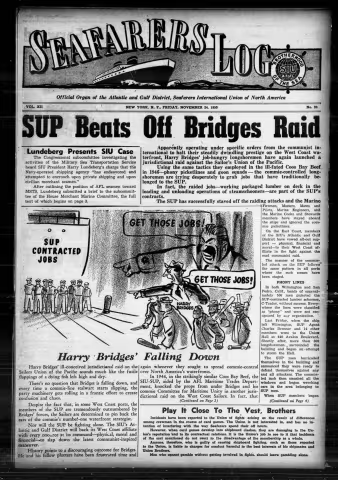
SUP Beats Off Bridges Baid
ILundeiserg Presents SiU Case
The Congressional subcomfnittee investigating the
activities of the Military Sea Transportation Service
heard SIU President Harry Lundeberg's charge that the
Navyoperated shipping agency "has endeavored and
attempted to encroach upon private shipping and upon
civilian merchant seamen."
After outlining the position of AFL seameii toward
MSTS, Lundeberg submitted a brief to the subcommit
tee of the House Merchant Marine Committee, the full
text of which begins on page 3. ,
,c.::• ̂
I:. '•
jf Harry Bridges' illconceived jurisdictional raid^on the
Sailors Union of the Pacific sounds much like the futile
flappings of a dying fish left high and dry.
There's no question that Bridges is falling down, and
^very time a commieline stalwart starts slipping, the
party machinery gets rolling in a frantic effort to create
confusion and chaos.
Despite the fact that, in some "West Coast ports, the
members of the SUP are tremendously outnumbered by
Bridges' forces, the Sailors are determined to pin back the
ears of th^ commie's numbefone waterfront strategist.
Nor will the SUP be fighting^^ alone. The SIU's At
lantic and Gulf District will back its West Coast affiliate
with every resource af its command—^physical, moral and
financial—»to slap down the latest communistinspired
maneuver. • ' '
History points to a discouraging oiitcome for Bridges.
He and his fellow plotters have been frustrated time and
Apparently operating under specific orders from the communist in«
ternational to halt their steadily dwindling prestige on the West Coast wa
terfront, Harry Bridges' jobhungry longshoremen have again launched a
jurisdictional raid against the Sailor's Union of the Pacific.
Using the same tactics they employed in the ilMated Coos Bay Beef
in 1946—phony picketlines and goon squads — the commiecontrolled long
shoremen are trying desperately to grab jobs that have traditionally be
longed to the SUP.
In fact, the raided jobs—^working packaged lumber on deck in the
loading and unloading operations of steamschooners—are part of the SUP's
contracts.
The SUP has successfully staved off the raiding attacks and the Marine
t Firemen, Masters, Mates and
Pilots, Marine Engineers, arid
the Marine Cooks and Stewards
members have stayed aboard
the ships and ignored the com?
mie picketlines.
On the East Coast, members
of the SIU's Atlantic and Gulf
District have vowed allout sup
port — physical, financial and
moral—to their West Coast af
filiate in the fight against the
mad communist raid.
The manner of the comiriie
led attack on the SUP follows'
the same pattern in all ports
where the mob scenes have
been staged.
PHONY LINES
In both Wilmington and San
Pedro, Calif., bands of approxi
mately 500 men picketed the
SUPcontracted lumber schooner,
CTrader, without success. Every ;
where the lines were classified
as "phony" and were not rec
ognized by any organization. '
Last Friday, when the ship
left Wilmington, SUP Agent'
Charles Brenner and 14 other
members went to the UniOTt
Hall at 440 Avalon Boulevard.
Shortly after, more than 300
longshoremen., surrounded the
building and began an ̂ attempt
to storm the Hall.
The SUP men barricaded
themselves in the building and
announced they were ready to
defend themselves against any
and all attackers. The commie
led mob then smashed all the
windows and began wrecking
cars in the area belonging to
SUP men.
When SUP members began
(Continued on Page 4)
Falling Down
again whenever they sought to spread commiecontrol
over North America's waterfronts.
In 1946, in the strikingly similar Coos Bay Beef, the
SIUSUP, aided by the AFL Maritime Trades Depart
ment, knocked the props from under Bridges and his
commie Committee for Maritime Unity in another juris
dictional raid on the West Coast Sailors. In fact, that
(Continued on Page 2)
Play it Close To The Vest, Brothers
»
Incidenls have been reported to the Union of fights arising as the result of differences
among crewmen in the course of card games. The Union is not interested in. and has no in
tention of interfering with the way Seafarers spend their off hours.
However, when card games develop into shipboard clashes, they are damaging to the Un
ion's reputation hnd to its contractual relations. It is the Union's job to see to it that incidents
of the sort mentioned do not react to the disadvantage of the membership as a whole.
Anyone, therefore, who is guilty of causii^g shipboard fighting, such as those reported
to the Union, is Uable to charges for conduct harmful to the best interests of his shipmates and
Union Brothers.
Men who cannot gamble without getting involved in fights, should leave gambling alone.
. .r:3
T
' Page Two T HE SE AF ARERS LO G Friday. November 24. 1950
I??';. SEAFARERS LOG
Published Every Other Week by the
SEAFARERS. INTERNATIONAL UNION
OF NORTH AMERICA
Atlantic and Gulf District
Aifiliaied with the American Federation of Labor
At 51 Beaver Street, New York 4, N. Y.
HAnover 22784
Reentered as second class matter August 2, 1949; at the Post
Office in New York, N,Y., under the Act of August 24, 1912. %
267
Wr •
i
Bridges' Falling Down '
(Continued from Page 1)
encounter spelled the finish of the CMU, which the com
mies had fashioned as an instrument for putting the US
waterfront under their domination. • • ,
The current raid, aimed at SUPmanned lumber
fiteamschooners, is an effort to ojgice again grab jobs that
are traditionally and contractually those of the West
Coast Sailors.
Oddly enough, Bridges has been given aid and com.
fort by a California professor, who has acceded to Bridges'
request that he arbitrate the issue. How people professing
disgust with communist methods and tactics, on one hand,
can be duped into helping their cause is beyond under
standing. Maybe it's the result of living too long in an
ivy tower. ̂
Feeble^i^rts like these will not alter the outcome of
Bridges' indefensible move.
The SIU has called the shots on Bridges before. Call
ing it aga'm, we'd say his raid on the SUP looks as though
his jig is tip.
Commie 'Education'
From now on everyone in the Soviet Zone of Ger
many is going to be a red head. But the color of a guy's
hair doesn't have a thing to do with it. It's what's inside
of the cranium that the commies are concerned about.
So to properly fill German heads with the official
red blend of history, the director of the Ministry of
^Popular Education of SaxonyAnhalt has issued a direc
tive that will govern education in the schools there.
Here are excerpts froni the line he laid down:
Organization of schools in the Eastern zone must be
carried out according to purely Eastern ideas. For this
reason, the teaching' methods of the Soviet Union will be.
the guiding influence in the schools of the Eastern zone.
The term "military heroism" must take on quite a
different form from that which prevailed hitherto. Our
soldiers are not heroes, for they fought neither in defense
of their country nor in support of the high ideals of the
noblest in man.
They may only be pitied as the unfortunate victims
of the false policies of a false tyranny. Men like Bismarck,
Moltke, Hindenburg and Frederick the Great do not de
serve to be looked upon as heores. The Russian soldiers
and military leaders, on the other hand, are heroes in the
true sense of the Word, for they defended a fatherland that
had been treacherously attacked. These are the lines on
which history lessons should be given.
Every teacher must combat militarism.
' When dealing with the question of the occupation
force it must be borne in mind that the Russians are
here as defenders of their country, which we after all
attacked without justification and laid waste. Therefore
it is obvious that we really must show some understanding
• toward the occupation force, unpleasant though it is, and
respect it. It is nonsense to talk,about freedom. Nobody
is free, for everyone is dependent on his needs, his sur
roundings and the conditions under which he lives.
Every teacher must be political.
In politics the SED (Socialist Unity or Communist
party)—and the SED alone can claim the right to do so—
will give the lead. Other parties must follow its lead.
Every teacher must first and foremost be an official
of the SED and therefore be politically active. A political
ly active teacher is of more value than an old teacher,
however good the latter may be pedagogicall>'. It is the
degree of his political activity that decides the value of
any teacher.
ONt MINO ONi VOICS : • '
GALVESTON
J. J. EZELL
BEN SUMSKI
L. COHEN
A. MACIEL
T. C. MICKEY
» » «
^BALTIMORE
WESLEY YOUNG
FRANK NERING
WILLIAM. WOLFE
SAMUEL DRURY
E. J. BRADLEY
G. MINISTERI
JACK HOWARD •
WALTER HACKETT
J. G. HARRIS
M. D. WATT
R. R. WINGERT
JOHN A. MORRIS
TIMOTHY. SULLIVAN
ROBERT DILLON
FRED L. PITTMAN
JOSEPH PILUTO
% %
BOSTON
R. LUFLIN .
CHARLES F; DWYER
1S> t>
CSP iTTT P
JOSEPH McNULTY
JOHN WARD
WALTER YERKE
FRED ENGLAND
MALCOLM CROSS.
NEW ORLEANS
E. J. ALBINSKI
JAMES E. BELL .
N. BOSSANYI
CHARLES A. BROWN
B. P. BURKE
JOHN L. CALDWELL
WILSON O. CARA
B, F. CHAPMAN
S. P. COPE
R. CRUZ
L. DONALD
ALBERT GATEWOOD
HARRY GERDES
K. GUNDERSON
G. HARDWIO
WILHAM HERNANDEZ
L. A. HOLMES
D. D. KELLFY
H. F. LAGAN
LEO LANG
M. E. NEWMAN
K. RAANA
WILLIAM ROCHELLE
CHARLES THOMPSON
L. TICKLE
T. ULINSKI,
^ t,
SAVANNAH
LEO KODURAND
L. C. SHEDD.
W. VAUGHAN
its.'
ELLIS ISLAND
G. C. GAGE
M. COLLINS
B. T. KNEW
i t 4>
SAN FRANCISCO
JOSEPH SAXTON
JAMES H. BRANDON
GEORGE H. NOLES
J. H. EMORY
E. E. RITCHIE
DONALD P. GELINAS
EDWARD L. PRITCHARD
JAMES R. LEVfIS
W. WATSON
JAMES HODO
THOMAS J. CONNELL
. 9^ * a ^
STATEN ISLAHD
R. P. NIEVES
F. KUBEK
D. KOROLIA
J.LUCAS
J. MOLINI
B. RAMIREZ • ;
J. HANSON
L. HOLLIDAY r
R. GRESHAM . ,
C. FIGUEROA
B. DARLEY
J. QUIMERA
H. J. MOORE _ '
YOir TZANG
E. SPAULDING
C. HANSEN
B. JURKOWSKI . , f
C. EZELL
A. VASQUEZ
S. GLYPTIS
D. GARDNER
R. CHRISTOPHER
Staten Island Hospital
You can cbntact your Hos
pital delegate at the Staten
Island Hospital at the follow
ing times:
Tuesday — 1:30 to 3:30 prnv
(on 5th and 6th floors.)
Thursday — 1:30 to 3:30 puxi.,
(on 3rd and 4th floors.) '
Saturday — 1:30 to 3:30 pan*
(on 1st ancl 2nd floors.) .
MANHATTAN BEACH
A. LOMAS
V. CHESNER
W. PADGETT
J. PADZIK
R. CABRERA
H. TUTTLE
V. MILAZZO
M. BRUNO
P. VORKE
J. J. DRISCOLL
J. H. ASHURST
J. SPAULDING
J. T. EDWARDS
J. LIGHTFOOT
E. FERIfflR
R. A. BLAKE
E. LOPEZ
S. BURGSTROM : '
Bill Padgett, SIU delegate at Maa^
hattan Beach Hospital, can be contacts
ed from 34:30 PM every day on thS
second deck, West Side, Wwd X«
ft 4 i • •
' MOBILE ^ '
• W. E. ALPIN
. TIM BURKE
ft ft ft
> FORT STANTON. 1J.M.
GIDLOW WOODS
A. MCDONALD
R. A. RADCLIFF
S. WALKER
H. THURMAN
• W. MEEHAN
ft ft a
,
"v I .. .'•
:1 • • j . •
PONCE, PUERTO RICO '
R. V. SUAREZ 1
Jridoy* XfeTMnber 24, 1950 TRE SEAF A RE RS L O G
Seafarers States Its Case Against MSTSJ
(Tesiimony of SIU Presideiii Harry Lundeborg
before Congreasional Investigatiiig Committee
to San Francisco.) —
'»The A^wiean' Seamen have serious grievances'
against the action, of the Military Sea^ Transpor
tation Service in its declared policy of bypassing
bona fide American seamen.
The MSTS" was established in August 1949
i^ough a directive of' the Secretary Defense,
Effecting a consolidation of all military sea trans
portation facilities with the Department of the
Wavy.
It is our observation that since the establish
snent of the MSTS, this organization has en
deavored and attempted to microach upon pri
vate shipping and upon civilian merchant seamen.
• When the war started in Korea, it became im
mediately necessary to use quite a. large fleet of
knerchant vessels for the purpose of carrying
supplies to our armedforces. One of the first
• ttungs the MSTS did was to go out on the mark
et and charter a number of foreign ships —
among them Greek and Panamanian ships. When
bur organization immediately protested this ac
tion oh the part of the MSTS, we received from
Admiral Callahan and Assistant Secretary of the
Na\^ in Washington, D.C., various and sundry
excuses stating that there were not enough
American ships available and that they had to
have certain types of vessels to handle certain
types, of equipment, etc.
These, of course, were just alibis and not legiti
mate excuses, because, in the first place, the
ships which the MSTS chartered were mostly
Liberty ships, which are rigged the same as any
other vessel. They are not any better' equipped
to handle special types of cargoes than any other
American ships. As a matter of fact, they are all
exAmerican ships built in this country.
It was also stated that no American vessels
were available. This seemsmighty peculiar to us
in view of the fact, particularly on the Pacific
Coast,, there are huge fleets laid up in the San
Francisco Bay, in the Columbia River and in the
Puget Sound areas and anyone knows it doesn't
ti^e a lifetime to refit a Liberty ship ready for
jiervice. As a matter of fact, some of the foreign
j^ps chartered by the MSTS were lying around
on the Pacific Coast for weeks afterwards, wait
ing for cargo. So these excuses do not hold water
,with us. ~ .
After our vigorous protest against this prac
tice had been taken up in the proper quarters in
Washington, it became evident that the MSTS
discontinued the policy of chartering foreign ves
sels. I might say though, while on this subject,
that a British ship was loading military supplies
in San Diego for Korea. When the ship was ready
to leave, the coolie crew (nationals of India) re
fused to sail the ship because of communist agi^
tators among the crew. Consequently,, the ship
was delayed while the British operators attempt
ed to fly in replacements.
While on the subject of foreign ships, it is very
idlear that no screening was done and no attempt
was made to check these foreign ships as to
whether or not they carried agents of foreign
countries.
; On the other hand, American civilian crews
iBailIng into those waters were screened by the
fBL the Naval Intelligence and the Cbast Guayd.
It seems mighty peculiar to us that on one hand
file authorities should insist on such a severe
screening for American civilian crews, while on
the other hand they allow ships under a foreign
fiag to sail in.there without the crews being
screened or checked up on as to the safety of
toeir handling American military supplies des
tined for the battle areas of Korea.
Whether or not the MSTS knows this, it is a
Wellknown fact that crews sailing in Pana
Ihanian ships are composed of the cheapest type
bf men picked up in waterfront ports aU over
the world, add coutain many communists. As a
|natter>d£^ fact, it is also known, that the Soviet
Government owns quite a niunber of Panamanian
ships indirectly under subterfuge eorporations.
That has been exposed in national/magazines, so
if the MSTS does not know this it is sadly lack
ing in its dutiee, and chaptering these types of
ships with. these types of crews constitutes a
menace, tothe national security, which indicates
negligence on .the part of the MSTS.
We further find that when a large number of
, American vessels , were taken out of the layup
fleet to be reactivated for the purpose of carry
ing supplies and troops to Korea and to the war
fronts in the Orient, many of these ships taken
out, instead of being handled in the usual man
ner by private operators with civilian crews sail
ing under collective bargaining agreements, they
were immediately taken ovr by MSTS. MSTS
carried on their expansion program and decided
they would operate them directly themselves.
This, we protested to Washington for many
reasons: It was very evident, particularly in San
Francisco, that the MSTS did not have qualified
seamen to man these vessels. Consequently, they
went out on the open market, outside of Ban
Francisco, and picked up socalled "seamen,"
flew them into San Francisco, housed them in
the Y.M.C.A. on the San Francisco waterfront,
kept, them there imtil they placed them in the
vessels they intended to operate. They also ad
vertised in the papers for seamen. This is where
our particular objection comes in.
At that particular time, in the port of San
Francisco there were conservatively over 3,000
qualified, bona fide, loyal American seamen ready
and available to man any type of ship, but not
withstanding this fact, the MSTS saw fit to fly
to this Coast a motley crew of incompetent men
to man their ships. We notified Admiral Callahan
of the MSTS in Washington, D.C., that we were
willing, able and qualified to man any and all
ships they needed seamen for and we were able
to furnish them with Icyal American seamen.
However, this was to no avail.
We can only take the position that the overall
policy of the MSTS, whoever is concocting this
particular policy, is definitely hostile to organ
ized seamen. When we spoke about 3,000 seamen
being available in the port of San Francisco
alone, with a possible 6,000 seamen or more
available on the Pacific Coast, we naturally
meant seamen who are affiliated with various
labor organizations. These loyal American sea
men were on the beach, looking for worlc. As a
matter of fact, some of them, or most of them,
had been out of work for many months due to
the sharply reduced American Merchant Marine
in the past years.
Now when we go back some years to the Sec
ond World War and dig up the records, we find
very clearly that practically all war material,
gasoline, and a large majority of troops were
carried in ships operated by Union seamen. For
instance, all the large passenger vessels on this
Coast were operated by Union seamen. As a mat
ter of fact, the Queen Elizabeth, the British
ship, and other British ships that were carrying
war supplies during the last war were operated
by British union seamen.
The record of the American seamen during
the last war and alsn during the first world war
is very clear. The American seamen sailed ships
into all waters, regardless of the danger involved,
and the heavy toll taken of American seamen
in loss of lives proves that they were ready ̂ d
willing to sail ships wherever they were called
upon to. sail them. The same condition prevails
today, with the exception now it is very evident
that the MSTS has no intention of utilizing
trained personnel, and we can only assume that
the MSTS and the policy makers of same are
hostile to American union seamen.
I have had occasion to read a letter sent by
Assistant Secretary of the Navy, John T. Koeh,
ler, to Congressman John Shelley of Csdifornia,"
dated October 3, 1950, supposedly in reply to, a
letter sent; to the Assistant Secretary by the
Congressman September 6, 1950. I quote from the
letter:
"There is a necessity to provide ships for tro<^
transport and the movement of certain kinds ol
equipment and material for which privately
owned shipping is either unavailable or unsuit
able. Secondly, it is essential to have a niicleua
fleet of auxiliary vessels to be employed in peace'
time for supply missions and available for as^
signment to the mobile support of the fleets dur.
ing emergencies. Finally, an experienced ope»*
ating and administrative organization must be
maintained in peacetime to serve as an essential
base of rapid expansion required by i^^ar or
other national emergencies."
Comment: This statement by Mr. Koehler tells
quite a story. First of all, there is no merit to
the argument that privately owned ships are" not
available and are not suitable, because privately
operated ships are equipped with gear capable
of handling any type of material, heavy machin
ery, etc. In other words, they can handle any,
type of cargo. They did it during the last .war.
Why can't they do it during this war? Secondly,
as we have stated before, there is a large number
of American ships available. In regard tO the
movement of certain equipment and material,^
private ships and private seamen can handle any
kind of material and equipment any place in the
world.
As for Mr. Koehler's comment that "an experi
enced operating and administrative organization
must be maintained," this, we contend, is just
eye wash, because who are more qualified and
experienced to administer and operate vessels'
than private operators who do this year in and
year out and who, naturally, in private competi
tion must, • of necessity, develop the finest type
of operation in order to survive?
The MSTS, or any other Government service,'
could not qualify alongside a private concern in :
any type of industry because there is no compe
tition in Government operations. A Government
employee usually takes a lackadaisical, easy go
ing, attitude, which does not develop sharp, fast
and qualified operations.
'Mr. Koehler definitely lays down a policy
which we are opposed to: "The developing of a>
nucleus fleel ofauxiliary vessels by the MSTS
to be employed in peacetime for supply mis
sions." We maintain that this is not only unneces
sary but it is a waste of the taxpayers' money.
^A cargo vessel operated by the MSTS under
Mr. Koehler's plan will carry a certain amount
of supplies to certain military outposts. In most
cases, it will come back to the Continental United
States empty. This is a very expensive operation.
On the other hand, a privately owned vessel may"
take half of its cargo in military supplies to mil
itary outposts. The rest of the vfessel can be'
filled up with general cargo, if there aren't
enough military supplies, going in the same di^
rection. Upon the discharge of military supplies,
these vessels would go to nearby ports in the^
area and attempt to get cargo back to the UnitedP
States. Consequently, cargo in privately operated"
ships could be sent much cheaper to the gain
of the taxpayers.
Mr. Koehler states: "An operation of this mag
nitude was not accomplished, however, without
the fullest and closest kind of cooperation be:
tween the various segments of the maritime in
dustry and the Maritime Administration itself."
This is the first time we have heard that there,
was close cooperation between anyone. Every^
shipowner that we have talked to has complain
ed bitterly. The only reason they haven't com
plained officially is that they are afraid they wiU^
lose whatever little cargo they already handle
for the Army and Navy.
However, to my knowledge, there is no Union
which has cooperated closely with the MSTS,
except that all Unions have offered to furnish,
the MSTS with qualified, bona fide seamen at the
prevailing wage rates and conditions under col
(Continued on Page 10) '^1 • m
Page Four THE SEAFARERS LOG Friday, November 1950
Bridges Thrown
For Loss In New
Raid Against SUP
(Continued from Page 1) (Whitney, was reported badly
arriving the following morning
the longshoremen dispersed.
In Coos Bay SUP Agent Jo
hansen and Whitey Benz were
attackect by approximately 25
Bridges men. JTohansen suffered
three broken ribs and internal
injuries which will keep him
laid up for some time.
One SUP member, off the MT
Work Starts On
Now HQ BuiUing
The hammering and chipping
of construction gangs at work
this week in the SIU Atlantic
and Gulf District's new Head
quarters building were welcome
sounds to Seafarers anxious to
enjoy the benefits of their own,
fullyequipped, modem Hall in
the Port of New York.
The alteration job on the
structure, located on Fourth
Avenue, between 20th and 21st
Streets, near the waterfront in
Brooklyn, got imder way fol
lowing the awarding of the con
; tract to the, Leeds Construction
Company.
According to present esti
mates, the project is expected
to be completed and the build
ing, ready for occupancy aroxmd
the latter paft of March, 1951.
The renovation job is under
the supervision of Seafarer
Prenchy Michelet, who acted in
a similar capacity during the
renovation of the SIU Hall in
New Orleans two years ago.
Details of work involved in
transforming the present struc
ture into modem, comfortable
and suitable quarters and of the
facilities that will be available
for the membership upon the
job's completion will be made
Imown in the next issue of the
SEAFARERS LOG.
beaten by 'longshoremen after
entering a ginmiU alone and
unaware of the situation.
The Bridges' group attempted
to call in a Dr. Paul Prasow, a
University of Southern Califor
nia professor to "arbitrate" the
issue. The SUP flatly turned
down the "arbitration" offer, as
that of a "ddgooder knowing
nothing of the basic issues,"
stating that no one was qualified
"to arbitrate away work that
traditionally belongs to and has
been SUP members' jobs."
As far as the SUP is con
cerned the issue is pure and
simple. The Bridges' outfit is
facing a problem of conserving
its strengtji in face of reports
that the CIO intends to put a
dual organization into the long
shore field.
Since the CIO national body
threw Bridges' imion and other
commiecontrolled outfits out of
the organization. Bridges has
met with several communistline
labor officials to discuss setting
up their own group.
The current facesaving effort
of Bridges in raiding the SUP
steamschooners is reminiscent of
the Coos Bay Beef in 1946. At
that time Bridges ordered mem
bers of his union to refuse to
unload cargo from the SUP
contracted SS Mello Franco, in
Coos Bay, Ore. He demanded
that the ship be manned by a
crew representing the Committee
for Maritime Unity, a group of
the redled CIO unions.
Retaliatory pressure by the
AFL Maritime Trades Depart
ment on the East Coast against
the CIO . outfits in the CMU re
sulted in Bridges calling off the
CooS Bay raid.
This defeat was one of the
factors that lead to the subse
quent abandonment of the CMU.
Hank's Fund still growing. If you haven't
helped yet, see the port Agent. . . . "Baltimore
Bob""McCullough trying to'make a midtown
street resemble East Baltimore Street. Two more
beers ought to do it. . . . One of our Union
Brothers insists that the membership know the
answer to the riddle: "What is it a man does
standing up, a woman sitting down, and a dog
on three legs." The answer, according to him,
is shake hands. What com. . . . Did you know
that the "mortality rate" (turnover in piecards)
has averaged twentyfive percent, since the Union
started?
It goes without saying, that everyone is impa
tient for the new Union HaU in Brooklyn to be
opened. It will be several months yet, but all
the waiting Will be worthwhile. We understand
that there are even going to be doors in the
'joint. . . . Will the member who ' cruised the
second deck in New York, telling friends that
the Union just signed with a new twelveship
company, please see the SecretaryTreasurer and
let hiih in on the secret?
You can start in the Norwegian Merchant Ma
rine as a Deck Boy if you are fifleen years
young. You must then work Vour way up to
Ordinary Seaman, then become a LightHand,
then an AB and finaUy you can sail Bosun, by
which time you wish you hadn't started at all.
^1,
. . . The 'wind just blew Vince Kelleher into
town, but it didn't blow the wind out of Vincje,"
who can talk your ear off.
My happiness went sour this week. A news
paper headline read, "Settle Suit Over Peddlei's
WilL" 1 thought for sure that Westbrpok Peddl jr"
had diedr but it was just some poor peddler;
IncidentaUy, inflation is reaUy here. That poor
peddler only had $114,000. . . . John Iglebelik
still waiting for One of Waterman's Antwerj)
RotterdamBremen runs. . . . Contrary to other
expressed opinions, the real reason that Bosups
get grey, is because of old age.
A1 Clouse, John Hunt, Glen Lawson and BilU
Datzko among those recently shipping into Cities
Service's Lake Charles Specials.. Incidentjilly,
you have tankeritis. Lake Charles is a gpod .pla<[e
to ship from. Keith Terpe is the Union's repr(!
sentative there. . . . The SEAFARERS LOG s
compiling a series of articles in which it intenc is
to give facts, figures, places, etc. relative to buy
ing rugs, trinkets, souvenirs, wallets, etc. and
getting your money's worth. In other wordk
when you buy some piece of merchandise in a
foreign land, you'wUl be in a position to knoV
if the product is genuine, approximately whit
grade of product it is, what the best country or
port to buy such ah item is, etc. If you have
any in formation or special talent which will
help the LOG do a first class job on such ^
series of articles, contact the Editor of the LOCjl,
either in person or by mail.
NY High Court Turns Dowh
Appeal Of ExPermitmeh
In an imanimous decision
handed down on November 14,
the Appellate Division of the
New York Supreme Court turn
ed down the appeal of 29 for
mer permit men for an injunc
tion and damages against the
SIU, Atlantic and Gulf District.
The ruling of the court, com
posed of Justices Glennon, Dore,
Cohen, Callahan and Shientag,
upheld a decision rendered last
year by Supreme Court Referee
Isidor Wasservogel, dismissing
Shipping Slow, But OTBeefs Keep NY Busy
IKJ
By JOE ALGINA
NEW YORK — Although we
handled seventeen ships for pay
offs, the week was a slow one
in this port. Despite the slow
ness of shipping the Patrolmen
had plenty to keep them busy.
On one ship, the SS Steel Ad
miral, the Patrolman ran into
overtime beefs aplenty in all de
partments. He put in a full day
on the ship, but got it all squar
ed away in the crew's favor.
The Mate on the ship had
given the crew a good share of
the grief. He ̂ wailed that the
SIU had fouled up the agree
ment so that it /was impossible
for him to even paint out his
own room. He told a crewmem
ber that no matter what he did
the crew watched him like a
hawk and puts down for over
time.
The Mate thought he was Gen
eral MacArthmr or something, as
the crew says he told them "I'll
turn to who I want when I
tyant to. If there are any beefs,
put in for overtime. Fm Chief
Mate on here and I want all
my orders carried out. If I tell
you to drj^ a boom, then drop
it!"
The boom was dropped on the
Mate when the overtime was to
talled and collected by the crew.
lAfelTE HEADQUARTERS
I'd like to urge crews on long
trips who don't find everything
running smoothly to keep cool
and not blow their tops. Instead,
they should write a letter to
Headquarters giving us the beef.
We'll try to straighten it out
with the company or give an
interpretation of the agreement,
Whichever is needed. It's hard
to communicate back and forth.
but many times Headquarters years.
has been able this way to clear
up a shipload of beefs before tjie
trip was too far gone. .
We've had a complaint recent
ly concerning crewmembers
smoking while their ship lay at
ammunition docks. This is a very
explosive matter, and I'm not
kidding. ThCTe are ̂ areas set
aside for, men to smoke. If a
guy doesn't cai'e what happens
to him, he should at least con
sider the other guy who might
want to live a couple more
Shipping Still Good In Seattle
By RAY GATES
SEATTLE — News from the
port of Seattle is still very good
as far as shipping goes. We had
a welcome invasion of about a
dozen bookmen from Mobile, who
came overland to Seattle to
ship. When this edition hits the
street all of them will have
shipped. '
The boys from Mobile have
some beefs about the, Seattle
weather which is starting to get
a little chilly. The main beef is
that they can not find a restaur
ant in town that serves grits.
Tlie shipping picture for the
next few weeks looks very gpod.
The Robin Goodfellow will be
in off the Korean shuttlerun
after a fourmonth trip, and will
take a full crew,:
We may also get a Victory
ship in from a long trip to pay
off. We can not get any advance
information from the companies
on their arrivals, but the crews
have been keeping in touch with
the Hall through the mail.
Any bookmen wanting to drift
this way will find it good skip
ping, and wiU not have to wait
too long for a job.
the original suit for injunction
and $250,000 in damages.
The 29 men claimed that they
had been illegally expeUed from
the Union.
In effect, the decision of the
Appellate Division held that the
plaintiffs are not, and never
were, members of the Union, and
consequently do not possess the
rights of members. Accordingly,
they cannot insist on the same
procedures that members can.
The Aiitellate Division's deci
sion marked the fifth time that
the 29 plaintiffs were denied
action against the SIU. In addi
tion to Referee Wasservogel's.
dismissal of the damage suit last
year, three applications for tem
porary injunctions were refused
by the courts.
In affirming Referee "iyasser
vogel's decision, the Appellate
Division justices also awarded
to the Union court costs involved
in the litigation.
The Union's case was prepared
and presented by Seymour Mil
ler of the law firm ofBenjamin
Sterling of New York City.
Referee Wasservogel's decision,
affirmed by the Appellate Divf
sion, said in part:
"The evidence clearly indicates
that plaintiffs were merely per
mit holders in the Union and as
such were granted the privilege
of working on unionaffiliated
ships only in the event that no
book members were available
for employment . , . In accept
ing the permits, plaintiffs vol
untarily accepted their qualified
employment of temporal^ Union
sanction. ...
"In the absence of any allega
tions and proof of malice of con
spiracy/the court may riot con
cern itself with the motives of
the Union or the propriety • of
the action taken, and wiU riot
interfere in the internal affairs
of the Union on behal' of per
sona who admittedly niver held
i
membership books in the oi
ganization. ...
. . Nothing in the recor
warrants the conclusion that de
fendant's officers or member
acted with fraudulent intent dr
in bad faith in withdrawing per
mit cards from plaintiffs. Under
these circumstances plaintiff'
claim for damages may not b
sustained. Judgment is rendere
for the defendant dismissing 131
complaint on its merits ...
a
Mobile Expects
Better Shipping
By CAL TANNER f
MOBILE—During the past twi
weeks shipping in the port of
Mobile has been extremely slow,"
with only two offshore ships
paying off and taking just a fevr
replacements.
The next two weeks look litof
they will be somewhat betteri
with the Anjinous, Morning
Light, De Soto, IMbbilian and,
the Wild Ranger, for Waterrriari;
the Patriot, Clipper, Roarner/
Planter, and the Alcoa Corsair,'
Alcoa Company, due to hit this.i
port for payoff and replace j
ments.
We stijl have plenty of men
on the beach and probably will!
have for quite awhile, unlesir
shipping picks up quite' a bi;
in the next few weeks. ;
We have received reports froni;
Seattle that shipping is verj \
good out there, and that if afty"
one would like to get out sooiT
to go to • that" port and they
would have a good chance tc it
grab a ship.
We would like to remind th«!.
members who are coming intt
Mobile, if 'they haven't Vdtfec
yet, to please come to the'HSlt
and do so before they leave
town.
Frid^jT' Noyembcx 24, 1950 • V.ur* THE S E APA RERS LO 6 Page F!«»
From A Seafarer's Album
Seafarer Juaa Colpe is convinced that one picture is
.worth a thousand words. Ever since he began sailing SIU
contracted ships many years ago, he's been accumulating
a pictorial record of his voyages. As a result he already
has a volunjinous album, which he siys he'll keep expand
ing at the conclusion of his trips.
Colpe also frequently. contributes shipboard photos
to the SEAFARERS LOG. Those appearing on this page
Were taken by the seafaring cameraman on a few of his
most recent trips.
Photographer Colpe through! the wheel would make a
Vgood prop for a photo of ]Luis Diaz, AB. The result is this
I salty scene, which Colpe regards as one of the best shots
on the Inez.
• .• • • a
• • ^1 af. I
It was chilly in Turkey
when the Inez called at Istan
bul so Luis^ an OS. broke
out his cold weather gear and
had Colpe shoot him just for
the record.
Colpe titled this shot "Wishful Thinking." Chief Cook
Keno demonstrates what he thinks would be an ideal setup
—being able to keep the galley going by manipulating the
winch controls.
' Coh^ the Near East port of Beirut, Lebanon, these
Ibree Inez crewmen came out on deck to see the sights.. Left
tn.righti Juan Colpe. (the photograpber). Chief Cook Keno,
v«hd^'See^d.'C(x^^FwN^ ^
This shot is a feminder of a recent trip made by Colpe aboard the SS Alcoa^ Polaris. The
trio—Juan Usera, OS; Carmelo Aponte, Wiper, and Ramon Santiago, Carjwnter—were just loaf
ing; it on thiAr. time oK aa the vessel smoothly rode the seas one day oN Bermuda.
Page Six THE S E AE A RE^R g LOG Ttidaf, iMNmb^ 2|;'I9M
SHIPS'MINVTES flMD NEWS
ggv
lift.
%
Encounter With Whale Was More Exciting
Than Entry Into War Zone, Seafarer Says
One of the first Seafarers to return to the States after a voyage to Korea is
Thomas Parrett, former Utilityman aboard the SS Jefferson City Victory, but to him
the trip to the battle zone packed none of the excitement expected. It was just another
trip. ,
THE NAVIGATOR'S JUST OFF THE PRESS
IK
Despite the fact that his ship
delivered its cargo to Pusan at
the time when the United Na
tions forces were making a last
ditch stand less than 30 miles
away, Parrett found the port had
the unmistakable appearance of
a big army base, but hardly the
supply heart from which a bitter
life and death struggle was be
ing fought in the nearby hills.
SWIPING
The 37yearold, veteran of
wartime vdyages through the
Mediterranean and Atlantic in
the late war^as prepared to find
a port under seige with the ap
pearance of front line operations;
instead he found Army long
shoremen and South Koreans
working on the piers with no
sign of concern. The people of
Pusan too, Parrett observed,
showed the nonchalance o f
people thousands of miles away
from danger. Despite the peace
ful appearance soldiers told Par
rett that snipers occasionally
drew a bead on those working
along the docks.
There were no restrictions
against going ashore and roam
ing around, though crews were
required to bo aboard ship after
dark. Entertainment offered was
sparse in the port compared to
other Far Eastern stopping place,
but according to crewmembers
who had been there before the
shipping started, Pusan was nev
er .much of a place for shore
leave.
When Parrett's ship arrived in
Pusan early in September after
its hunyup trip from New Or
free and continued on its way.
Following the loading of army
cargo in Honolulu, the ship re
turned to New Orleans, where
Parrett paid off on November 1.
When asked if he cared to
return to Korea, Parrett shook
his head and answered "Not for
me. I'd rathe): go to a part of
the world where there is some
excitement."
Final Dispatch
THOMAS PAHRETT
leans, they found ahead of them
the SS Black Eagle and SS Rob
in Goodfellow, both SlUcrewed
ships operating on the shuttle
run between Pusan and Yoko
hapia.
While the ship unloaded, Par
rett saw other vessels discharging
Scotch and Australian troops,
though by far the greatest num
ber of • soldiers debarking were
GI's from American transports
Almost all of the ships Parret;
saw tied up in the port were
American, with a smattering of
British vessels.
After three daysin Korea the
ship left for Yokohama, where
orders were received to proceed
to Honolulu. Enroute to Hawaii
the ship experienced its only
noteworthy incident, according to
Parrett. A whale got fouled up
in the ship's propeller. After a
tussle, the ship worked its way
Retired Member Randall Makes
Mucho Chips — 'Taters, That Is
Not all Texans make their chips in the oil business.
For instance, retired Seafarer William Randall makes his
out of potatoes down in Rip de Janiero.
Bill's got a thriving little ent
terprise in the Brazilian Big
Town, where his potato chips, or
batatas fritas, may be had in
the best cafes, restaurants and
bars.
fe . Brother Randall, sells and ad
vertises his product under the
trade name "Familiares," and ac
cording to reports reaching the
LOG, they are "the best' in
town."
A former Chief Cook, Bill
sailed on the Delta ships Norte,
Mundo and Sud and other ves
sels whose home port is New
Orleans.
Although he hails from Spur,
"Texas, Brother Randall is quite
at home in Rio. He got married
down there two years ago and
he's becoming an accomplished
speaker of Portuguese. •
; >Bill makes it a pointJ;o meet keep tab on the doings of his
the Delta ships occasionally as many friends and former ship
they come into Rio, so he can mates in the SIU.
WILLIAM RANDALL
Twentytwo year old Seafarer
Ruel L. Smith died at sea, 175
miles out of Galveston, Texas,
on September 27 of pneumonia.
Smith was serving as Engine
Maintenance aboard the USNT
Mission San Fernando.
The young Seafarer had been
a member of the SIU since 1948,
when he joined in New York.
His home was Waco, Texas.
According to the statement of
a fellow crewmember. Smith
complained of feeling ill the day
prior' to his death but thought
it was nothing serious. When the
acuteness of his illness was no
ted a seaplane was called for,
but Smith died before the plane
arrived.
t. S. t, ^
Malcolm D. Getchell, died in
Baltimore Marine Hospital on
October 23 following an opera
tion. Brother Getchell was 26
years old. A member of the deck
department, Getchell joined the
SIU in 1946 in BaUimore. He is
survived by his parents of
Meadsville, Pa.
t, i S'
Seafarers of the Wilmington
Branch on October 13 attended
the funeral services for Seafarer
Randolph Schreiber who died in
St. Mary's Hospital on October
10. The 60yearold Seafarer
succumbed to a chronic illness.
Schreiber had been a member
of the SIU since 1947 and sailed
in the Stewards Department.
He is survived by ̂ brother,
Rajnnond, of Dayton, Ohio.
Sailing Short
All delegates'' aboard SIU
ships are urged to make cer
tain thai every ship is fully
manned before it leaves port.
If the companyfries to vio
late the contract manning
scale by sailing short, the
ship's delegate should call
the nearest tfnion Hall im.
mediately. '
The Union will take im
mediate action to see that
our agreements are observed
to' the' letter as it does
whenever violations are :re
ported.
Know your contract and
report all violations to the
Union right away.
a onepag6 edition of chitchat
put out by an anonymous editor
aboard the SS Topa Topa.
The November edition of the
Gooneybird News, was the sec
ond and last. The anonymous
editor didn?t^say why he was
making his farewell in the ship
board publication business, but
it is hoped that some enterpris
ing Seafarer will resume its pub
lication on the next voyage.
With the Gooneybird's fare
Seafarer In Khaki
Bobby Daigrepont Bell Boy aboard the SS Del Norte,
displays latest edition of the Navigator, shipboard publica
tion of the vessel's unlicensed crewmembers.
Topa Topa Gooneybird News
Flies Off After 2 Editions
Shipboard newspaper activity continues to flourish
on SIU ships. The principal development in this
field this month was the rollicking but brief appearance
of the Gooneybird NewsReview,* . ..
well came an improved Advo=
cate, publication of the SIU
crew aboard the SS Puerto *Ricd.
Printed on a new mimeograph,:
recently purchased out' of the
ship's fund, the November 12,:ik
sue of the Advocate, ̂certainly
appears to be one of the most
attractive allaroimd jobs yet at
tairfed.
In addition to the customary
advertising from spots in porfs
visited by the Puerto Rico, the
Advocate contains gossip items
in sufficient quantity to satisfy
the most inquisitive crewmemr
ben,.'
The Advocate has its serious
side, too, as evidenced by the
sensible frontpage editorial urg
ing all hands to cast their ballots
in the Union elections now vbeing
held in all A&G District ports.
5 Tugs Haul Tlni
Off Rocks ,
Near CHjerbourg
The "SlUmanned SS Tini, a
Carras Liberty ship, resumed her
course, after having run aground
on the rocks off Cap de la Hague;
near Cherbourg, this week; i .
The fini was refloated by fiv,e
tugs, which towed her intd La
Sagine, sheltered anchorage west
of Cherboug Roads, and ran her
onto a sandbank to keep her se
cure oyernight.
Bound for Cherbourg, Ant
werp, Rotterdam and Bremen,
the Tini was loaded with' 4,000
tons of military supp.lies, jncludr
ing .37 Sherman tgnlis.,:,
Robert Guzman, former SIU
member now with the US
Army in Germany, has his
Dad. Hector • Guzman, carry
ing on for him, as a sailing
nian. Like his son, the* elder
Guzman is a member of the
Seafarers,. He. sails in . the
Deck Department.
Friday, NovembA 24, 1850 THE SE AP ARERS LO G Page Seven
Digesteil Minutes Of SiU Ship Meetings
STONY CREEK. Oct. 15 —
Chairman. Richard Bauer: Secre
tary. Oscar Payne. Delegates el
ected. Proposal made to stgrt a
ship's fund toward renting film
for projector owned by a crew
member. Motion Carrie^ to have
new mattresses ordered in Texas;
44. 4."
ANDREW JACKSON. Oct.
Chairman. L. Phillips; Secretary.
C. Cousins. Delegates reported
no beefs. Letter from Headquar
ters concerning Cities Service
read. Motion carried to write a
letter to Senator Murray tbank
iiig bim for bis committee's ef
forts in behalf of seamen.
4. 4.
PENNMAR. Sept. 24 — Chair
man. Kase; Secretary. L. Van
Evera. Delegates reported num
ber of books and permits in
their departments. Crewmembers
voted to donate $1 toward fund
for welfare of crew. Each de
partment Delegate to make up a
repair list and submit it to
Ship's Delegate.
4 4 4.
LONE JACK, Oct. 28_Chair.
man. Willieun Tradewell: Secre
tary. Chester Lohr. Delegates re
ported number of books and per
mits in their departments. Repair
list made up and approved. Book
shelf and beach chairs to be
purchased from ship's fund.
444,
WANDA. Nov. 5 —Chairman,
W. Lawton; Secretary. F. John
son. Delegates' Reports accepted.
Suggestipn made that ship be
fqmigated before next trip. Dis
cussion on new wage scale. Del
egates advised crew 40 keep rec
ord of all overtinie after October
15. Ship's fund now stands at
$15. Ship's Delegate reported that
ship was qn par with other SIU
contracted vessels and no mem Frank Robertson. Discussion on
ber need hesitate about shipping' new Coast Guard papers. Sug
l>ooK cr to
please inclzideybur • *
mxmbey.
imeiliereaTfe
men. ctJiilT.
meorsimikir'
names, £0X1 infohi
" jiiibn. fe ixeedfiA,
Ksep the
T^ecords
and cpjoid.
delay a:^
ConfoSian..
had sent a letter to Senator
Murray in behalf of the 'crew,
giving thanks for the fine job
done in the investigation of the
Cities Service antiuriion' prac
tices. Delegates' duties explained
to crew. Crew asked to cooperate
in turnfhg in dirty linen on time.
Steward asked if crew wished
to suggest changes in menus. No
changes requested.
4. t t
ROYAL OAK. Nov. 11—Chair
man. Paul Ulrich; Secretary.
aboard her.
4 4 4
MARORE. Sept. 24— Chair
man. J. Gergorus; Secretary. W.
Bl^eslie. Delegates reported
number of books and permits in
tl^eir departments. Suggestion
made that coffee urn in night
pantry get a thorough cleaning.
Department delegates to rnake
up repair lists to be given to
Ship's Delegate.
4 4 4
TRINITY. Oct. 22—Chairman,
C. Hullun; Secretary. K. Hatgi
misios. Deck Delegate reported
small overtime beef. Other Dele
gates reported all in order. Mo
tion carried to elect a commit
tee of three to draft a resolu
tion regarding Coast Guard inter
ference in signing on, and speed
ing up of payoff. Each Depart
ment to make up a repair list,
ft ft ft
WINTER HILL. Nov. 1—Chair
man. D. M. Irvine; Secretary. R.
P^y. Ship's Delegate reported
that money had been sent to J.
Fleming's sister. Stewards and
Deck Delegate reported disputed
overtime up to 36 hours. Irvine
elected: Ship's Delegate. One
crewmember who had been a dis
credit to the ship was voted to
be given another chance,
ft ft ft
SEATRAIN NEW JERSEY.
Oit. 25—Chairman. Walter Beye
lef; ' Secretary, Vinceht Monte.
Ship's Dehjgate reported that he
gesti^n riiade to purchase a radio
for messroom out of ship's fund.
Crewmembers urged to return
glasses to messhall as messmen
are being caused inconvenience.
Skipper given a vote of thanks
for providing an ample slop
chest during the voyage,
ft ft ft
PAOLI, Nov. 4—Chairman, .R.
La Peinte; SMretary. B. Richard
son, Deck Delegate reported that
sailors entering pumproom
should put dqwn for overtime.
Motion carried to rotate the
cleaning of the recreation room
among the three departments.
Ship's Delegate to see Captain
about obtaining draw in Ameri
can money in Canada.
ft ft ft
ALAWAI. Oct, 30—Chairman,
E. Moyd; Secretary. A. Phillips.
Delegates reported no disputed
overtime or beefs. Statement of
2nd Cook to be referred to Pa
trolman in San Francisco. Mem
bers to take up collection for a
new washing machine.
relary, William Morris. Delegates
reported no beefs. Motion car
ried for the Deck Delegate to see
Mate to determine who gives
the men orders, the Bosun or
the Mates. brief talk on the
history of the SIU organizing
drive and the contract given by
Brothers Weaver and Morris,
ft ft ft
BEATRICE. Nov. 5 — Chair
man. Claude Fisher; Secretary,
George Rutherford. Delegates re
ported all in order. Motion car
ried that Ship's Delegate see Pa
trolman concerning larger fans
for the rooms that need them.
Delegates told to adhere closely
to Union rules on time permits
are allowed aboard ship.
. t;'ft ft
JOHN STAGG. Nov. 1 Chair
man. William Prince; Secretary.
Chris Karas. Delegates reported
on number of books and per
mits in their departments. Mo
tion carried that crew Tjack up
the Steward in seeing that addi
tional stores b^ placed aboard
'or the next trip ' and that no
one signs on unless the stores are
put aboard.
ft ft ft ;
LOGANS FORT. Ndv. 3 —
Chttirman, Orvis Bobichsixj Sec
4 ft ft
STEEL MAKER. Oct. 28 —
Chairman, E. Landley; Secretary,
T. Concepcion. Ship's Delegate
reported $20 in ship's fund. En
gine Delegate reported disputed
overtime; other departments
okay. Departmental Delegates
told to turn in repair lists to
Ship's, Delegate. Steward asked
to order homogenized milk,
ft ft ft
GOLDEN CITY. Oct. 8—Chair
man. J. Mitchell; Secretary. Otto
Hoepner. Delegate reported ship's
fund standing at $108. New wash
ing machine purchased from
Maritime Electric Corp. for $108.
Motion made to continue ship's
fund; 17 in favpr of it, 11 against
it. Motion carried that no mem
bers are to make private deals
with department heads for over
time work. Motion carried that
ship be secured for sea before
leaving port for the safety of
the Deck Department. Rule.was
violated on last trip to Europe.
4 4 4
TADDEI. Nov. 5 — Chairman,
Bernard J. Curran; Secretary.
Stanley Stucoski. Delegates re
potted everything running
smoothly. Suggestion made that
more cigarettes be put aboard
for next trip.
4 ft 4
JEFFERSON CITY VICTORY.
Oct. 29 — Chairman. Workman;
Secretary. Spivey. All Delegates
reported disputed overtime. Mo
tion carried to have Patrolman
clarify work done by Electrician
by chipping inside winches. Gen
eral alarm bells to be checked
for volume. Ship's Delegate gave
a short tqlk on unionism. Vpte
of thanks given Steward for
serving of chow.
4 ft ft
OREMAR, Oct. 15—Chcurman,
C. Gibbs; Secretary, B. Bobbins.
Delegates reported number of
books and permits in their de
partments. Ventilation on ship
to be improved. Air ducts to be
cleaned. Wipers' foc'sle has been
painted and Oilers' foc'sle is next.
4 4 4
SEA THUNDER. Oct. 19 —
Chairman. W. Reidy; Secretary.
N. Peterson. Delegates reported
aU in good standing. Motion car
ried that delegates make repair
list and check slopchest with the
Captain. Tarpaulin muster
brought $4.37 to cover mailing
costs.
4 4 4
FRENCH CREEK, Oct. 29 —
Chairman. H. McCoskey; Secre
tary, J. Baxter. Delegates report
ed all in order. Motion carried
to write letter to Senator James
Murray thanking him for inves
tigation of Cities Service's anti
labor. activities. Each crewmem
ber to donate $1 to ship's fund
at first draw. Departmental Del
egates to make their repair lists
in quadruplicate.
Short talk given on men assum
ing responsibility of office in
conducting shipboard meetings.
Letter to Senator Murray read;''
and approved by'crew.
ft ft ft
STEEL ADMIRAL, Oct. 29 —
Chairman, S. Evanchuck; Secre
tary. T. Freeland. Deck Dele
gate reported 522 hours disputed
overtime. Foc'sles not being
painted out. Entire" ship has about
1,000 hours of disputed over
time. Steward to either bring
up man on charges or forget his
beef against the mgn. in his de
partment. *
ft ft ft
ANGELINA. Nov. 2 — Chair
man. William Davies;. Secretary*
Arthur Marini. Delegates report
ed everything okay. Motion car
ried to refer matter of man paid
off in Puerto Rico to New York
Patrolman.
ft 4 ft
DESOTO. Oct. 22—Chairman.
Maurice Olson; Secretary. Philip
Reyes. Deck Delegate reported
he had received clarification on
delayed sailing. Other depart
ments reported to be running
okay. Motion carried that a letter
of thanks, be sent to Senator
Murray in appreciation f)i the
efforts of his committee in ex
posing the illegal activities of
the Cities Service Oil Company.
Crewmembers discussed short
comings of heating system aft.
ft ft ft
DEL VALLE. Oct. 29—Chair
man. M. McCarty; Secretary. M.
C. Gaddy. Letter • sent to Sena
tor Murray from Rio giving the
crew's thanks for his committee's
work in the Cities Service case.
Suggestion made to make up an
arrival pool for the old washing
machine at $1 a chance. Crew
member's beef about being given
two days off to go to the marine
hospital to be referred to Pa
trolman. Suggestion made that
all ventilators be blown out.
ft ft ft
PORTMAR, Oct. 4—Chairman.
G. Douglas; Secretary. C. BedelL
Delegates reported on number of
books and permits in their de
partments. Motion carried that
each man donate 25 cents to Car
penter to reimburse him for the
wringer oh washing machine.
4 4 4
ARCHERS HOPE. Oct. 18 —
Chairman, R. Q'Rourke; Secre
tary. K. Bowe. Delegates report
ed few minor beefs. Motion car
ried to make up a ship's fund.
Motion carried to check slop
chest before next trip to see if
sufficient clothing is aboard.
^ ^
CITRUS PACKER. Oct. 24 N
Chairman, Henry Dukes; Secre
tary. G. O'CoBiior. Delegates re
ported everything satisfactory.
Several members talked on Un
ion brotherhood and conduct;
and the importance of having
regular meetings aboard ship.
4 4 4
JEAN, Oct. 8—Chairman, Jo
Jo Touart; Secretary. John Dur
kin. Delegates reported every
thing in good shape. Crewmem
bers urged to writ6 Senator Mur
ray for the work his committee
has done in behalf of American
tankermen. Three departments
to cobperate in leaving laundry
clean. Crew expressed its thanks
for receiving the LOG by mail
and voiced their ai>preciation for
the wage increase.
4 4 4
SALEM MARITIME. Oct. 24—
Chairman. S. Deir; Secretary.
William Burke. Delegates report
ed no Leets of major importance.
4 4 4
ROBIN GOODFELLOW, Nov.
3 — Chairman, Charles Gardia;
Secretary (not given). Delegates
reported disputed overtime in
all departrhents. Army men re
ported as doing some of the
Stewards Department overtime.
Motion carried to see heads of
departments to find out what
is di.sputed in the overtime. More
efficient marking of overtime
sheets asked of depai'tment
heads.
4 4 4
GOVERNMENT CAMP. Nov.
5—Chairman, J. Luplon; Secre
tary, H. Goodfried. Delegates re
ports made and accepted. Ship's
fund reported at $26; each man ,
to contribute $1 at payoff. Mag
azine subscriptions to be pur
chased from ship's fund. Ertke.
crew asked to cooperate at fire
and boat drill.
4 ft ft
EDITH. Nov. 9—Chairman. W.
Reid; Secretary. L. Rizzo. Dele
gates reported some disputed
overtime. Delegates to be reim
bursed for cost of transportation.
to and from the Union Hall. Dis
cussion on getting' decks and!
foc'sles painted. ,,
Page E^hi
, I'.v" • •
THE SE A P A RE RS LOG FridaiTt KoTAnDIm 1(4. 1950
THE MEMBEBSmP SPEAKS
Shelley Urges Immediate Probe
Of Military Sea Trai^port Service
p
To the Editor: .
Enclosed please find a copy of
ilr the portion of the Congressional
pecord containing the remarks
of Representative John F. Shelley
nf California on the Military Sea
Transportation Service before, the
House of Representatives.
Congressman Shelley's view of
the MSTS should be of interest
to seamen, because he blasted
the attempts of that organiza
tion to exercise military control
over the shipping industry,
which he declared is strictly ci
vilian in character.
Shelley told the House that the
"highhandeS manner in Which
policy makers are bypassing and
sidetracking the private mer
chant marine in the present
crisis."
The California, Congressman's
concern over the MSTS opera
tions Was shown throughout his
speech, part of which follows:
GREEN CREWS
"MSTS has taken over large
numbers ̂ ships and are at
tempting to man them with green
crews, hired from the streets
and placed in temporary civil
service ratings. They do not have
the necessary berthing, dock and
loading facilities to expeditious
ly handle the cargoes they are
appropriating to themselves. With
inexperienced crews and dock
side personnel, supplies do not
get proper handling. Their ships
are lying idle waiting for bertlis
and cargo. All this, with priv
ately owned ships and facilities
unused; and with a desperate
need for the most efficient pos
sible dispatching of materiel "and
troops. It seems evident that
MSTS has seen fit to begin build
ing up a shipping empire of
their own with the intention of
perpetuating it.
"This is not the whole story:
The Navy's Transportation Serv
ice has now under charter a
large number of foreign ships,
operated by foreign crews, and
engaged in logistics operations
vital to the security of the Uni
ted States. I have endeavored
for weeks to obtain a satisfac
tdiy explanation as ito why this
bolicy is being continued. I have
been told that they needed ships
quickly and that they needed
fast ships.
NO EXPLANATION
"This explanation does not
tell me why so many foreigp
Liberty ships, sold at giveaway
prices by this Government after
EWorld War II, are included
among those foreign ^ips on
"'• ^charter. Besides taking needed
0 business and jobs away from
our own operators and seamen,
this foreignship operation has
^ even more serious side.
"Shortly after; United Nations
intervention in Korea our mari
time unions and private opera
tors vqluntariUy set up a pro
gram for screening every man
military transport in orders^at
Communists and subVersH^
might be weeded out. This ,3»as
a recognized, necessity to protect
our ships and supplies and t)&e
lives of our men.
"The program was approved
by the Government and is ope
rated by the Coast Guard. What
becomes of that program when
MSTS turns over whole vital
operations to ships manned by
foreign crews from countries
which may be hotbedsof com
munism, and where no provi
sions are made to investigate or
screen the personnel?
SKIDROW HIRING
"Further, tl^e civil service
crews hired from the skidrows
of our port cities undergo no
screening. They not only lack
experience and bungle opera
tions, but there undoubtedly are
among them planted spies and
saboteurs , bent on destroying us.
And, while this goes on our mar
itime hiring h^s are full of
loyal, unemployed Americans
who know how to do the job.'
The Congressman also stated
that he had' called upon the
House Armed Services Commit
tee and House Merchant Marine
Committee to make a thorough
investigation of the MSTS prac
tices and recommend legislation
to correct its harmful aspects.
By the way, the MSTS fink
herders have not been so active
around here since the blast
against them appeared in the
SEAFARERS LOG.
I had a phone call from Mr.
Lytel, the head of the Seamen's
YMCA here in Seattle, beefing
about that part of the LOG
writeup, which stated that the
YMCA shipi)ed 1,400 men to
MSTS. The, way it should have
read was that the Seamen's
YMCA reports that 1,400 men
have shipped through MSTS
since the Korean War—^from the
Puget Sound and^ Seattle area.
As we, understand it, Mr. Ly
tel does not encourage men to
ship through MSTS, but goes
along with the maritime unions.
Ray^ Gates, Agent
Seattle SIU Braaoh
TV Or Not TV For Kiddies I
Lfet Papa (Who Pays) Decide
To the Editor:
"There are some things a son
or daughter won't .tell you!"
That's ti^e big headline of full
page advmisemeplis appearing in
the news]^ers last week de
signed to^iame American par
ents into laying television sets
for their youngsters.
The advertisers, the American
Television Deeders and Manu
facturers, are now using the kids
as a» springboard for increasing
the demand for TV sets.
Anyone who doesn't run out
and buy a set after reading the
ad can consider himself an ir
i redeemable louse*, intent upon
New Orleans SIU Members
Back Beef Of AFL Butchers
To the Editor:
Enclosed please find copy of
the front page of a recent edition
of New Orleans States news
paper. As you can see the SIU
was helping the AFL Butchers
Union here. •
The Butchers have a legitimate
beef and some. Seafarers who
were voluntarily helping on the
picketline were hauled off by
the police.
The Butchers dre most grate
ful .to us of the SIU for our sup
port and guarantee us their sup
port wherever and whenever
they can help. Our Port Agent,
Lindsey Williams, and Buck
Stephens really did a job in this
beef. ~
PICKET CAPTAIN
I was out on thW line as a
picket captain, and I want to
lai?.
say that the boys on the picket
line were a credit to the SIU.
They upheld the SIU's reputa
tion for being a militant organi
zation, and the friend of all labor
unions when they need help.
W. E. Lanning, international
representative for the AFL But
chers Union, was quoterf in the
newspapers here as being indig
nant over the police's move.
The paper quoted him further
as follows:
'The SIU men came over to
help us out.," he (Lanning de
clared.
'We still think this is a dem
ocratic country. And we think
we have a . right to peaceftd
picketing. That's exactly what
it was."
George H. McFall
New Orleans
Strathcape Weathers Tilt With Hurricane
torpedoing the hopes, ambitiorts
and social stability of American
youth.
Your sevenyearold son may
complain, says the ad, that "The
kids were mean and Won't play
with me!" Then the ad starts
shaking a finger at you and
beating you down to the sizeof
the selfish cur that you are, with:
"Do you expect him to blurt
out the' truth—that he's really
ashamed to be with the gangr.^
that he feels left out beceuise he
doesnt see the television shows
they see, know the things they
know?"
And down in the. lower corner
of the page the Television Mami;
facturers provide the authority
for their parental lashings.
There's la testimonial by a cetf
tain Angelo Patri, "Noted Bey
havorist and Authority on Child
Guidance," who finds it extremec'
ly. profitable to guide kids into
owningtheir own TV sets.
Says the noted Angelo.:
"Youngsters need television for
their morale as much as they
need fresh air and sunshine for
theirhealth. ... It is practicaUy
impossible for lioys and girls to
'hold their own' with friends and
schoolmates tmless television is
available to them. Of course
there would be no conflict tf
parents brought television into
the home. . . .'' .
But getting TV sets into aU
American homes is not a bad
idea. I'm for American working
men and women getting and eny
joying all the benefits of scien
tific research and accomplish
ment. On that score I'm probably
in agreement with the manufac
turers.
The only big fly in the oint
ment ̂is this: how are all Amer
ican workers going to manage
to ante up around $200 or $300
for the sunshinebringing TV
gadget?
Is American industry willing
to increase its payroU so that its
employees can respond to presi
sures made upon th§m by indus
try's advertising?
If so, then there's no problem^
And there will be no furthet
need for using the poor kids as
hostages for TV sets.
Frank (Blackie) Oiyos
STEEL CHEMIST
CREW CAN'T MIX
ANY IN CALCUTTA
1
• • f
Friction is something thai doesn't exist aboard the SlUmanned Strathcape. In this typical;
scene of go9d shipboard fellowship are (left to right): Captain~A. Loucas; Charles Martin, Bo
sun,Dick Hemingson, DM; Jack Swles, AB, and Steve Zubbvitch.
jack boarding a ship engaged in ( its engineers.
To the Editor:
^Just a few lines to let you
know we're alive and .kicking
on the SS Strathcape, now in
Eire.
The trip got off to a walloping
start in Houston,' where the
MEBA tried to force recognition
of their union on this company,
which had already recognised
the BME as bargaining agent for
• SSvv.
They tried to keep the long;
shoremen from finishing their
loading but the beef was straight
ened out and the ship sailed
without any delay. This was
strictly a phony ''beef on the
part of the MMA. '
The trip since Hoi:^n has
been smooth outside 'of a hurri
cane which we got mijced up in
in thp North Adfflrtic. *
. Thecooperation between of
ficers and crew on this ship
couldn't be better. All the Mates
and a few of the engineers are
former SIU men. Captain A.
Loucas "is a square shooter from
beginning to end, and any creW
sailing with him may expect a
pleasant trip..
Dick Heming»>n
To the Editor:
" I
arrived.' The Steel Chemist
here in Cplciitta on' Labor Day
where we expect'to spend about
two weeks. Then we head for
New York, arriving' there about
October 19, just a few days fi»m ;;
mv 65th birthday.
The crew of this deepsea race
horse is a great and fine onei No^
performers, and all fine seamen. ;
The ship is like a home, except :
of course, that there are no
mamas. •
India is .dry and there is very; r
little hot stuff around . here, so
the lads wiU drink .cdeacola.Mi
So what! • ;
r M «> if Uncle'* QtloFreUBsler^ j
SS'Sieel
i • /
Fridayr NoVexnbex 34. 1950 THE SEAFARERS LOG Page Nine
SEAFARERARTIST SAW IT THIS WAY Quality Of Members' Labor
Held SIU Bargaining Point
.::s
To Ihe Edilor:
Much has been said, and much
more remains to be said about
the benefits of a Union contract.
There's no time limit on it, but
those benefits were not given to
us—they were earned the hard
way and were deserved. And
these benefits will last as long
as we continue to earn and de
serve them.
It is easy (too easy) to say
I'm going to do as little as I
can get away with, and if the
boss doesn't like it to heck with
him!"
That kind of an attitude may
work if you're in business for
yourself (although I doubt it)
but the fact is that as long as
you are working for somebody,
you'll have a boss.
And the boss has to be satis
fied with the way you do your
job, or you won't have a job.
That has always been true, and
always will be true—^union or
no union.
From the decks of the SS Hurricane* Norman Maifie. AB. sketched this v|ew of the
French freighter Aquataine unloadixig cargo onto lighters in Hamburg, Germany.
Brother Requests Clarification Of Rates
For Overtime Under New Wage Increase
I To the Editor:
Since our new wage scale went
into effect I have heard quite a
few arguments, both pro and con,
as to tTie rate of overtime for
Derk Maintenance men and Sec
ond Cooks.
As per the wage scale in the
October 13 issue of the SEA
FARERS LOG, these men are
entitled to $1.54 per hour for
overtime pay. This 1 can see as
In The Army Now,
Buleca's Busy
From Bell To Bell
To the Editor:
Just dropping a line to the
LOG to let all my buddies know
that I'm in the Army. 1 have
been in Fort Dix, N. J., for two
weeks and there sure is a big
diflference in life here and sail
ing. , .
I'm in a field artillery outfit
and, boy, do they keep you go
ing. They get you up at 4:30
AM and they keep you. going
until 5 PM. Then after you eat
supper they usually have you
cleaning up the barracks 'until
at least 8 or 9 PM. And I do
mean, they keep you going.
The chow over here isn't even
as good as it was on a Cities
Service ship before it was or
ganized. You get very little of
it anyway.
They say I'm going to stay
here for 14 weeks. 1 hope yop
will publish this letter so all
my • buddies will know where
I'm at. My address is as follows:
Sc. Chas. Bulsci, US '5102077S
Bai. Gi 34ih Field Artille^
60th Infantry Reg., 9th Div.
Fbrt Dix, N, J.
a great benefit to them because
they are usually the low men.
And whereas this concerns
quite a few of our SIU Brothers
1 would like to get a clarifica
tion on this matter, to be printed
in the LOG for the benefit of
our Brothers who sail in these
ratings.
Star Wells
SS Robin Trent
Yokohama. Japan
' P.S.: Since the outbreak of the
war in Korea there has been a
large number of our ships hitting
this port. None of them have
been able to get any fresh copies
of thei LOG. So how about send
ing a few to the USS here in
Yokohama?
(Ed. Note: The publication
of the new wage scale in the
October 13 issue of the LOG
contained an ecror in the over
time demaxcEition point. This
error was corrected in the No
vember 10 issue of the LOG.
Here are the overtime rates
under the new wage scale,
once again:
(On freightships, the ovet
lime rate is $1.22 per hour
for ratings receiving under
$282.47 per month, and $1.54
for ratings getting over that
amount. The standby rate is
$1.64 for an 8hour day with
timeandahalf for overtime
and Saturdays and Sundays.
On tankers, the overtime rate
is $1.22 for ratings under
$258.24 and $1.54 for those
above that figure.
(Beginning with the Novem
ber 24 issue, copies of the LOG
will be sent to the USS in
Yokohama.)
Know Your Union,
CS Crewmember
Tells Shipmates
To the Editor:
This is addressed to Union
men who are not just book car
riers.
After a recent voyage on the
French Creek, the palatial liner
of Cities Service, 1 went to the
SIU Hall on Beaver Street and
got my book. It was a good
feeling, too.
The line of stuff that had been
put out by the phonies that the
Union will use you and then
thr,ow you overboard was just
a iot of antiunion propaganda.
You men riding unorganized
ships, look your hand over. Go
to the SIU Halls and get ac
quainted. 1 had the pleasure of
meeting Bull Sheppard, Johmiy
Arabasz, Walt Siekmann and
Frenchy Ruf on my visit to the
Hall.
Bill Manley, by the way, was
in Corpus to meet his boy Pete.
1 am going back out on a Cities
Service ship.
Lee Arnold
A union is only as good as
the men who belong to' it. The
only thing its members have to
sell is their labor—your labor.
And since the price of an article
depends on its quality, it is up
to us to see that the quality of
the product we are asking our
Union to sell for us is as high
es we can make it.
Then we'U have a firstclass
reason to boost our prices.
Frank Robertson
(new member)
SS Royal Oak
Cities Service Oil Co.
Lauds Union
For Defense
Of Crewmen
The following letter was re
ceived recently by Sal Colls,
SIU Agent in Puerto Rico,
from Marion Ladwig. a form
er Seafarer now with the law
firni of Mullinax. Wells and
Ball, of Dallas, general coun
sel to the Texas State Federa
tion of Labor:
Dear Sir:
Having been in the SIU my
self, I listened with great pride
for the organization when my
twin brother. Bill Ladwig, told
about your actions as Port Agent
in San Juan, standing up against
the ship captain and the steam
ship company for a single crew
member, a Union Brother.
1 should like to express my
personal gratitude to you for
your courage in opposing what
you considered an unjust charge
against him.
BiU also relate^ to me the. ,
example of real union solidarity
when the local longshoremen's
union back the SIU in its "beef
one hundred per cent. If you
could let me have the name of
the local agent for that union
in order that I may add my
thanks, 1 certainly should ap
preciate it.
if you are ever in Texas,
please drop by to see some fel M'
low AFL'ers in Dallas.
FraternaUy yours,
Marion C. Ladwig
LogARhythm
A TOAST TO THE SEA
By C. B. WARD
Steward Says Rest Coiiies
Easy With InnerSprings
To the Editor:
As Steward it has been my
experience that putting inner
spring mattresses aboard ship
for the unlicensed personnel has
not only saved the companies
money but it was greatly ap
preciated by the crews.
I'm sure that, as_ 1 have seen
before, the crews wDl take prop
er care of these innerspring
mattresses. Also whfn they get
more satiisfactory rest our Bro
thers will have greater ease of
mind. T, E. Maynek
Here's a toast to the sea
That we never see,
For all the hum and humdrum
, Of its pure montony.
'Tis poof Jack, alack.
On watch he must go,
Be it on lookout
Or to heir down below. '"T
She runs like a clock.
And we are the hands.
Bound to go round
As long as time standsr^
Your gay sailor lad
Is the one that's ashore,
'Til it's all hands aboard
For the rat race once more.
One would gather from this,
Be he that unwise.
That a sorrier life
But to grumble and gripe
Is a sailor's way of play.
He would be at a loss.
If it were ever taken away.
1
While we're prisoners all.
Our warden the sea
Has been known to smile.
When so often we flee.
For she gives us parole,
On our own honor bright.
Knowing we'll return
As sure as there's daylight.
Though the sea grows wider.
The longer the wake streams.
There is no known boimdary.
To a sailor man's dreams.
Each new port's, a discovery,
And the past is astern,
To be broke out in memory,
No one could devise. When the long days return.
Mm
• • ' • rf,;
PagK Teir THE SEAFARERS LOG ^ '' FrMajv NbT«Bd3MHr 2<ii iSSitf;
Its
• ;; V;.
irii
(Continued from Page 3)
lectiyp bargaining agreements. Yes, indeed, the
American Unions did cooperate, but there was
no cooperation whatsoever from the MSTS, so
we can only assume that Mr. Koehler is attempt
the law, namely, the nunibr of certified Abie
Bodied seamen carried, a seaman must sail three
years' apprenticeship. He must take an exami
nation and a rigid physical examination before
he is certified. Evidently Mr. Koehler does not
ing to convey the impression that everybody is know that a ship is not considered seaworthy the vessel was west of the 180th mwidian as well
happy and agreeable to this program, which is imless the whole personnel of the ship is qual as a 100 percent basic wage bonus and a $100
so. ^ ified and experienced. He either doesn't know or harbor attack bonus. In addition to the abovbi
We quote again from Mr. Koehler's letter: doesn't care. It is very evident that a bunch of
"Perhaps in no other area has so much misunder incompetent men have been hired to man MS'tS
tlonal extra eompenwtd^n over and ̂ above the
base wage, overtime pay and penalty pay by
virtue of provisions for the payment of bonusei
under certain, conditions. Men in both services
were entitledr to an aditional $2.50 per day while
}i::
lil"
i!8i .
It: .
\
standing arismi as in the area involving MSTS
procedures in recruiting necessary seagoing per
sonnel. Fi»t of all, in securing such personnel
MSTS is governed by the rules and regulations
of the Civil Service Commission, The criticism
directed at MSTS on this score may only be ex
plained by a failure to accept this fact. Therefore,
the claim that MSTS 'interposes' an unsatisfac
tory form of employment on seagoing personnel
is, of course, without merit."
This statement of Mr. Koehler is certainly
vague and ambiguous. First of all, as we have
stated before, the MSTS has never attempted to
get qualified bona fide seamen. They have by
passed them. Secondly, when they hire their so
called "seamen," they give them a. temporary
civil service status. There is no guarantee that
these men they have engaged will be given a
• peimanent civil service status. As a matter of
fact, many of the men they have engaged have
only lasted for a trip—and sometimes less. They
have been fired or laid off.
It is definitely imderstood by each and every
one that when the socalled "emergency," which
created the situation, in the mind'of Mr. Koehler
and his advisors, is over, the civil, service status
of the seamen employed by the MSTS will also
be over. Who is kidding who?
We are definitely and openly criticizing the
MSTS and we refuse to accept what Mr. Koehler
describes as facts. We contend that these are
just coverup alibis.
I am quoting again from Mr. Koehler's letter:
"A Coast Guard certificate or license of profi
ciency is a prerequisite to employment, and, un
der no circumstances, are any personnel, re
cponsible for the safety of the ships, such ds
masters, mates, or senior engineering officers,
permitted to sail without the certificates."
vessels without regard for rules and regulations.
In the record of this Committee, there is a let
ter submitted by one Eugene So^nden, who was
employed as a Bos'n's Mate aboard the BENEV
OLENCE which was sunk in the Golden Gate as
a result of a collision, with the loss of many lives.
Mr. Sowden points out definitely and conclu
sively in his letter that this ship was not sea
worthy; that it didn't adhere to the safety rules
or regulations in regard to eqmpment; that the
lifeboat gear was out of order. Mr. Sowden brings
out that the lifeboats were mamied by men who
didn't know how to latmch them and the results
of their inefficiency is proven by the disaster
regardless* of whether or not one believes Mr.
Sowden's statement.
The fact remains that only one lifeboat was
launched. It was also definitely established that
one of the officers in his testimony before the
Coast Guard stated that the lifeboat could not
be lowered because there was not any power to
do so, in spite of the' fact that the vessel had
gravity davits on the life boats.
In Sowden's statement, it is very clear that
the crew was incompetent. Furthermore, after
the BENEVOLENCE disaster, the' MSTS in
structed the crew to go to Alameda to apply to
the Maritime Commission Training. School for
instruction in handling life boats. It is evident
they would not have had to send their crew for
instructions in the handling of life boats, had
they been qualified to begin with.
WAGES AND CONDITIONS
The MSTS is utterly and completely disre
garding the law they are supposed to operate
under ;as far as wages and conditions for seamen
are concerned.
war risk insurance of $10,000 was afforded to
each man. These bonuses became effective for
employees of the MSTS on September 1, 1950
and were in effect In private oporaBono sincd
June in respect to Korea and Formosa knd from
Aiigust in rospect to the $10,000 insurance cov
erage.
"The greater number of fringe benefits pto
vided by the contract between the SUP and the
Pacific Maritime Association resulted In remiulu
oration in addition to the base rate to unicXl
members in amounts approximating 60 to 150
percent of the base wage of $226 per month a*
contrasted with the more limited scope of thii
beh^ts available to ABs in /Government em
ploye which approximated 20 percent to a maxi
mum of 33 percent of the base wage and waa
paid to such crew members.over and above thel£
basic wage. The evidence showed that this re
sulted in a monthly wage'of $450 to $500 fbtf
union members as contrasted with a wage of
approximately $300 for Government seamen iii
the AB classification.
• * •
"In this respect it is also noteworthy that the
differences in remuneration with which we are
involved in the instant case have come about
through th failure of the Governmental agency
to carry out the mandates of Subdivision 8, Sec
tion 201 of Title II of the Federal Classification
Act of 1949 which provides that the wageis of
crews on Government vessels be fixed and ad^
justed as nearly as consistent with the public
interest and in accordance with the prevailing
rate and practice In the maritime industry. NO'
such survey of prevailing salaries has been made
by the MSTS. the last such survey having besn
conducted by the Army Transport Service in> |
19471948. If the action dictated by this provisions
of the law had been carried out the variance ihrj
the benefits and remuneration between employ' . , , , , , Theyhave failed to carry out the mandates of ^
This, indeed, shows how little Mr. Koehler Subdivision 8, Section 291 of Title II of the Fed MSTS and the private operators mi^
knows about the safety of sliips at sea and it ^^al Classification Act of 1949 whicl; provides hav® so great/'
shows a total disregard of safety at sea by the
whole MSTS. When they say, "Under no circum
stances are masters, mates, or senior engineer
ing officers permitted to sail without certifi
cates." this acknowledges our contention that all
the rest of the personnel aboard an ayerage
MSTS vessel, such as ablebodied seamen, ̂inli
censed engineroom crews, and stewards depart
ment personnel, are not qualified seameii with
certificates.
In case Mr. Koehler does not know it, each
vessel, depending upon its classification, size and
type, according to the United States law,, must
carry so many qualified, certified lifebM men.
provides
that the wages of ^crews of Government vessels
be fix^ and adjusted as nearly as consistent
with the public interest and in accordance with
tbe. preyailing rate and practice in the Maritime
industry. .
Our organization had occasion to appear before
the State of CaMomia Department of Employ
ment Service, Division of Appeals, San Francisco
District. A public hearing was held September
... No comment is needed on Mr. Gilson's decision.'
It is selfexplanatory. I am furnishing your Com'
mittee with a complete copy of his decision^
which is attached to this Statement.
CONCLUSIONS
1. The American seamen urgently request that
the MSTS and its functions be definitely estab
lished by law and limited to handling troop
26th, 27t^ and 28tb before a duly appointed transports in the event there are no privately
Referee, 1^. Donald Gilson. Appearing for the operated passenger ships being committed t<r
Union in our protest against the Department of that service.
Employment for refusing un«mployment benefits 2. We request that the MSTS be prohibited by,
to our men because had refused to accept • law from functioning as common carriers, carryt
^ the deck department, for mstance, every Able employment from jhe MSTS was Attorney Scully , ing supplies to mihtary outposts. It is a dupHca
^dmd seaman must be a quahfied and certified from the A^^^
Meboat man. Likewise, all the rated personnel behalf of the Union.
I
Iw
in the engine department must be so.
Does Mr. Koehler think than in an emergency
ihe mates, the senior engineers and the master
are enough to handle the safety of, say for in
stance, thousands of wounded troops iu a troop
ship? Dees Mr. Koehler know what it takes to
launch life boats, to man life boats, and to handle
life boats?, E^deatly not.
We have definite proof and knowledge that if
There were tw;o attorneys opposing our con
tention from thje Department of Empl(^ment.
There were approximately seveq witnesses from
the MSTS in varjous executive capacities appear
ing for the Department of Employment, their
tion and a waste of the taxpayers' money as
well as an infringement upon private enterprise"
and private shipping.
3. We request that the MSTS definitely live ujfe
to the law of the land instead of bypassing it?
as they have up to date.
4. We ̂ ggest that any and all manpower need
contention being that the MSTS did not violate ed by the MSTS be employed from available
their and that the conditions and wages manpower sources in the vicinity of the operas
were gpc^, if not better in the MSTS. tion of the MSTS. For instance, in San FrancisCUi
Mr. ,|)onald Gilson,, Referee for the State of there were thousands" of available bona fide, cer*^
the MSTS can get certified, qualified men, they California, in his decision dated October 10 cer , tified men.
will take them, but the records show they have tainly^eld with the Union and disregarded all
hired plenty of incompetent drifters to man their testimony by the MSTS as not being factuaL
ships. An American seaman sailing in a privately I quote the following from the decision of Mr.
operated ship must adhere to the strictest regu Gilson:
lations and to a certificate system. For instance, "The evidence iurShsr showed ihel boih the
in order to sail as an AblerBodied seaman, which employment wlBi the L;STS and the employ
is one thing: that makes a vessel, seaworthy under meni under union juris^ciidn involved^ addi
The MSTS should have contacted the Unions)
to furnish them with manpower under the pre'
vailing collective bargaining agreements. W#
'^recommend to the Committee , that a clear lavi^
be made allowing the MSTS to sl^ collecilve
bargaining agreem^ots with bona fide American
seamen's'unions.:/'\
> T FrWIy. ifoyembM 24, 1950
f . . • "• i , '.C' • ,t • • . ^ v;' /
;? THE S E AF AHERS LOG Page Eleren
M :m
Minutes Of A&G Branch Meetings In. Brief
NEW ORLEANS — Ohairman,
Lindsey Williams, 21550? Record
iatg Secretary. Bill Fredericks,
94: ..Jleading Clerk, Buck Ste
phens, 76.
A&€ SSSpping From Nov. F To Nov. IS
PORT
Motion carried to accept
charges as read and refer to
elected Trial Conunittee. Head
quarters financial report read
and approved. Minutes of all
Branches read and concurred in.
Agent reported that affairs of
port were in good shape, and
that shipping had picked up a
httle since last >meeting. During
period since, there were six pay
offs and. six signons and ap
proximately 25 ships intransit;
Communications read and mo
tions carried to concur. Motion
carried to concur in Headquar
ters report ^as read. Reinstatd^
ment committee recommended
that Fred Easter be allowed to
reactivate his book. John C.
Rehm took the Union Oath of
Obligation. Motion carried that
requests for extensions be re
ferred to elected committee.
^ Meeting adjourned at 8:25 PM,
With 285 members present.
i % .
; BALTIMORE — Chairman. A1
Sitansbury, 4683; Recording Sec
retary, G. A. Masterson. 20277:
Beading Clerk, Leon Johnston,
108.
Oath of Obligation adminis
tfered to John W. Rombo and
Leon G. Sexton. No charges.
Minutes of other Branch meet
ings read and approved. Motion
carried to refer excuses to the
Dispatcher, Agent said that ship
ping had been comparatively
sioW for this .port. Motion by R.
G. Roe, seconded by several,
that any member dispatched to
any Ore ship at Sparrows Point
tb_ replace man who has signed
.^ticles, and who fails to report
to Ship one hour before sched
tiled sailing time, as per agree
ment, ̂ shall be paid four days'
pay, instead of the present two
days' pay—providing the origin
ad crewmember who signed on
Articles wants to make the voy
age. Motion carried. Meeting ad
journed at 8:10 PM, with 350
members present..
^
SAVANNAH—Chairman. E. B.
Tilley, 75: Recording Secretary.
T. W. Burke, 36802; Reading
P^rk, A. Smith, 36970. *
Motion carried to suspend
regular order of business, to elect
a Trial Committee. Following
Were elected to serve: C. Schuch,
.R. Bennett, R. L. Booker, F.
Kagelmacher, W. Sanders and
E, H. Searcey. SecretaryTrea
surer's financial report read and
ajpproved. Minutes of other
Branch meetings read and con
curred in. Communications: Mo
tion carried to accept lettet from
Brotherhood of Teamsters, Local
897, asking members not to use
Yellow Cabs as long as they are
being struck. Contents of letter
from Trades and Labor Assem
bly of Savannah laid over to
New Business. Tilley. reported
that Agent Bryant is in Jack
^pville to meet SS Council
Grove. Trial Committee's report
read, along with Ballotting Com
hiittee'sireport: Motions carfi I
New York
Philadelphia
Baltimore
Norfolk.
Savannah
Tampa .t.
Mobile.
• REG. REG. REG.
DECK ENG. STWOS.
13 5 11
112 78 78
35 ' 17 20
112 73 69
13 10 8
8 7 3
TOTAL
REG.
29
268
72
254
31
18
New Orleans..
Galveston
39
48
25
63
(No Figures Received)
West Coast
GRAND TOTAL. 468
24
41
31
52
338
29
60
18
51
347
92
149
'74
166
1,153
SHIPPED
DECX
10
90
23
I 51
7
2
(No
17
61
22
56
339
SHIPPED SHIPPED TOTAL
ENG. STWDS. SHIPPED
6 4 20
70 58 218
12 22 57
56 40 147.
8 2 17
4 2 8
gures Received) k
13 17 47
57 71 189
20 13 55
65 42 163
311 271 921
to accept committees' reports.
Motion carried that $50 be do
nated to AFL Trades and La
bor Assembly of Savannah, as
other imions have, to enable
TLA to help sponsor Weekly
radio program for organized la
bor. Meeting adjourned at 8:20
PM, with 37 members present,
t 4.
PHILADELPHIA — Chair
man. E. Abualy, 7047; Record
ing Secrettiry, H, Larson. 92:
Reading Clerk, H. Gerie. 26783.
Minutes of previous meetings
in all Branches read and ap
proved. Motion carried to ac
cept SecretaryTreasurer's finan
cial report as read. Headquar
ters report to the membership
read and approved. Agent dis
cussed shipping, which had been
rather slow during past two
weeks. Excuses from members
absent from meeting were re
ferred to the Dispatcher. Meet
ing adjourned at 7:45 PM.
t »
SAN FRANCISCO—Chairman,
Lloyd Gardner, 3697: Recording
Secretary, H. J. Fischer, 59.
Chairman explained that since
there were not enough members
present to constitute a quorum,
the meeting had been called to
check shipping cards until 7:30
PM. Conhnittee also asked to
check and audit books for week.
Membership was reminded that
Union elections are now being
conducted.
4 4 4>
MOBILE—Chairman, O. Ste
vens^ 115; Recording Secretary,
F. Drozak, 46030: Reading Clerk.
R. Jordan. 71.
Motion carried to concur, in
SecretaryTreasurer's financial
report. Minutes of meetings in
other Branch reports read and
approved. Port Agent discussed
shipping in this port during the
to accept. Minutes of meetings
in other Branches read and ap
proved. Agent spoke on shipping
situation here. Meeting adjourn
ed at 7:35 ?M.
4 4 4
NORFOLK — Chairman, Ben
Rees. 95: Recording Secretary,
James A. Bullock, 4747.
Chairman pointed out that in
view of fact that no quorpm was
present, a special meeting would
be held to check shipping cards.
Motion carried that all excuses
be referred to Dispatcher. Meet
ing adjourned at 7:30 with 16
members present.
% X
BOSTON—Chairman, B. Law
son. 894: Recording Secretary.
D. Sheehan. 22856: . Reading
Clerk, J. Panlier, 20071.'
Reading of SecretaryTreasur
er's financial report and Head
quarters report to the member
ship. Motions carried to accept
reports. Minutes of meetings in
other Branches read and con
curred in. Agent discussed ship
ping; report concurred in. Meet
ing adjourned at 7:30 PM, with
65 members present.
4 4 4
NEW YjORK—Chairman, Ed
Mooney, 46671: Recording Sec
retary. Freddie Stewart, 4935:
Reading Clerk. John Arabasz.
29836.
Motion carried to accept Sec
retaryTreasurer's financial re
port. Minutes of other Branch
meetings read and approved.
Port Agent ssud that, although
17ship payoffs had been hand
led in port during past two
week shipping period, shipping
the beef, and it will be straight
ened out with the company or
an interpretation given, wmlch
ever is needed. In Headquarters
report to the membership, Sec
retaryTreasurer said that a conr
ference had been scheduled in
Washington by Coast Guard two
weeks hence to discuss security
program. SlU will attend, he
said, and meanwhile will pur
sue a .policy of "wait and see."
SecretaryTreasurer read Lind
sey Williams* final report as
retiring Director of Organize
had been slow. Beefs, however,
kept Patrolmen busy, but all
were eventually squared a Aay.
Be. ̂ mged crews on long trips
not • to blow their tops when all
isn't running smoothly. Instead,
he advised that they write to
Headquarters, fully describing
tion. Following this he announc
ed that specifications on new
building had been made known
and bids called for, with six
firms submitting estimates. He
then read Committee's report
and recommendations contained
therein. SecretaryTreasurer sta
ted that the Appellate Division
of New York State Supreme
Court had unanimously upheld
opinion of Court in dismissing
suit of 29 former permitmen
who had entered suit against
Union for $250,000. He said this
was the fifth time the courts
had turned down attempts of
these men to win support of
their qction. Court also awarded
court costs to the Union. Mo
tion carried to concur in Head
quarters report. Following re
port there was open and lengthy
discussion on subject of new
building, with Committee giving
answers to «11 questions raised.
Meeting adjourned at 8:05 PM,
with 1,150 members present.
.>• 51
M
past twoweek shipping period.
Motion' carried to accept Ballot
ing Committee's report. Oath of
Obligation administered to T. T.
Nickerson, Ben Hubbard and
Tom Henry Brown.
4^4*
GALVESTON — Chairman.
Keith Alsop, 7311; Recording
Secretary, Ralph Willieims:
Reading Clerk, C. M. Tannehilh
25922. * _
Motion carried to accept Headr
quarters report to the member;
ship and SecretaryTreasurer's
financial report. Instruct'w.s to
bidders read and motion carried
Personal effects, papers ,and
permit are being held for the
following men at the SIU Hall,
450 Harrison Street, San Fran
cisco, California:
W, C. GOODEN
DORENCE HINTON
CONRAD SHIRLEY '
ROGER C. WHITLEY
WILLIAM E.. HOLLAND.
'4 4 4
GLEN CURL .
Get in touch with your wife
immediately.
4 4 4
WACLAW LUESCHNER
SOLOMAN BISHAW ' .
Get in touch immediately with
Jack Doyle, 419 California Street,
San Fi'ancisco California.
4 4 4
W. R. DIXOK
You are asked to telephone
Jessica Dixon, 68 Pershing Ter
race, Uniontown, Pennsylvania.
Uhiontown 6109 M.
4 4 4
TOMAS MARTINEZ
Contact Philip Dorfman, 225
South 15th Street, Philadelphia,
Pennsylvania, concerning your
case.
4 4 4
EDWARD CARPEJTTER
Your mother and niece are
^'Worried about yoiT^hd ask that
you write them in Tdm^.
STANI^Y SCOTT
MIKE KENNEDY
Get in touch with Higgins &
Pamess,. 92.JLiberty Street, New
York City, concerning the acci
dait of Tommy Langon of the
SS Steel Mariner.
4 4 4
I&RVEY MARTIN
Your wife asks that you write
her at 60 Golden Street, New
London, Connecticut.
4.4 4'
MAX LONGFELLOW
(jet in touch with your
nephew, Harold Witherow, at 39
Creed Street, Struthers, Ohio.
4 4 4
RICHARD (Redj CORNETT
Write Ted Vargas at 328 Mer
cer Strefet, Princeton, West Vir
ginia.
4 4 4
RICHARD J. EGAN
Get in touch with the Pruden
tial Insurance Company of New
ark, New Jersey or Mrs. Shirley
We'ssel, . Seamen's Church Insti
tute, 25 South Street, New York.
4 4 4
JC^EPH C. LEVACK
Get intouch with your draft
board.
" V" ^
DONA)^. C. REDMAN
Contact • Silas B. Axtell, 15
Moore StreefJ'New York City.
WALTER STOVALL
DIXIE PETERS
Write Carl Neilson, US Marine
Hospital, Chicago, Illinois.
4 4 4
The Saloon Messman of the
SS Marymar from April to
July, 1950 is asked to contact
W. Meehan, 312 Franklin Ave.,
Norfolk, Va. .
Checks for the following men
are being held at the New York
Hall:
Newell Greenhaw, James Sea
ly, Stanley Partyka, Raymond
Donway, Andrew Ahlstrom, Har
old G^en, William O'Dea, II,
Fred Paul, Frederick J. Durham,
Julio Colon, Aurelio Suarez,
Joseph Demuth, Juan Delgado,
John Early and Jesus V. Garcia.
. Also Thomas C. Lockwood,
William S. Porter, Philip P.
Guimond, Francis E. Perry,
Lawrence Durham, Clyde PHn
ney, Louis Sten Brrkeland, Al
bert Buck, Erick Borgh, Ken
netli Singh, W. A. Henley, Jr.
and Joseph Zitoli.
Its
• '. '• .
|>?f ;
liilSI ^
mj s; ;..
^r''.*;?': •
' ̂A.: ^
..ill
^IX" .
.QUESTION: This is the 12th anniversary of the SIU. What do you think is the greatest
single achievement made by the Union? _
1/ •
If• • '
S"
,..4'.
R. L. (Blackie) ABBEY. Bosun; WALTER BEYER, FWTJ
Name one other union in
maritime that has a job for
every bookmember? There
aren't any. The other unions
have gotten our better con
ditions and wages, usually by
hanging onto our coattmls, but
hone of them can boast of hav
ing a job for every member.
The chance to get a ship with
in a reasonable eimount of
lime and go to work, which
is the main purpose of the
union, is guaranteed the book
members of the SIU. Our set>
up is the envy of all other
seamen; that's why the Cities
Service seamen quickly saw
the advantages of the SIU and
voted overwhelmingly for the
SIU.
Our base pay of today shows
our biggest gain in the dozen
years we have been in exist
ence. Today I get $248.41 in
base pay. Back in 1940 whei^
I joined the union I got. $55
a month and overtime was 75
cents an hour. The Union was
just warming up then and has
certainly put up steam since
those days. I think the SIU
has brought wages up to a
point where rated men aboard
a ship now enjoy approxi
mately the equivalent pay re
ceived by skilled craftsmen in
industry ashore. This certainly
wasn't the case when I started
sailing. The Union's done a
darn good job.
P. McCANN, Nt. CookBkr.:
The outstanding SIU
achievement to me—and I've
seen a lot of them—was the
1941 Bonus Strike when the
SIU won the first 100 percent
bonus for sealing in the war
areas. ̂This union set the pat
tern by winning the first war
bonus and it resulted in sea
men being paid for the terri
fic dangers they faced. Today
the same bonus is being paid
in some areas, and it all goes
back to the strike we waged
to win it. At that time a lot
of weak sisters said the Union
was biting oN more than it
could chew in hitting the
bricks, but events have proved
them wrong.
M. GOTTSCHALK, Stwd.:
I've been in the SIU since
1940 and started sailing in
1912 for $15 a month. I can
remember working 16 or 18
hours a day, doing two or
three different jobs without
OT. The eighthour day is the
biggest gain we've made, plus
overtime payments. Improved
shipboard conditions rate high,
too. Tin utensils, straw mat
tresses we had to provide our
selves and lousy food we had
to eat in our foc'sles are, for
tunately, behind us, thanks to
the union. Without the union
we'd still be lugging a "don
key's breakfast" aboard and
working around the clock.
RODERICK SMITH, Bosun:
I can think of a lot of vic
tories over bum conditions and
poor wages, but for sheer de
termination and guts my hat's
off to the SIU's victory over
Cities Service. Cities Service
was the first major unorgan
ized oil company to fall to the ^
drive of a union, and despite
many attempts by other un
ions, We were the first to
break the company's solid
front. This could well be an
opening wedge into &e ' en
tire tanker field and bring un
ion representation to thousands
of seamen who even todaY
have to endure the bum con
ditions we haven't seen in
years. .
ii;
JOHN JELLETTE, Stwd.:
I've been around during
these years the SIU has grown
and won greater benefits for
thp membership, and I'm hard
put to put my finger on the
specific one that rates tops.
Probably to us oldtimers the
inception of the 40hour week
with time and a half for ov
ertime stands out more them
anything else. That put an
end to himdreds of abuses and
at leeist put a limit on the
lime a seeunan could be made
lo work. Bum chow, blue lin
en, crowded foc'sles and all
those abuses of the past are
gone now. All these vi^ories
should >a given credit,, too,
BOBBY R. LYNN, AB.:
I cannot speak for the en
tire 12 yeeurs of the SIU's ex
istence. I haven't been going
to sea anywhere near that
number of years, but from
what I experienced in sailing
nonunion ships in this day
and age, there is a world of
difference that offers some
comparison. I came into the
SIU in 1949 as a result of the
Cities Service organizing drive.
The big thing to me—equal
to the better wages—is the
representation the men get on
the ships and the equal rights
men have to ship in. the union
hiring hall. Those advantages
stand out like shining lights.
MARIANO ARROYO, Bosun: D. S. GARDNER, Stwd.
The SIU is the only union I
ever belonged to and I'm proud
of my lyok. I've been a mem
ber for eleven years and had
the opportunity to see the
wage scale climb up, year af>
ter year, until we now live
in the, same comforts as well
paid working men ashore.
There's no doubt that the ter
rific boost in wages has been
the biggest achievement of the
union. Bettering the wages of
its members is a iinion's prim
ary role, trnd the SIU has
done thS in a manner no other
union anywhere can equal. Can.
you think of any shoreside
union that beats us?
The terrific betterment of
pay, without a doubt. I've been
in the Union since its incep
tion and first went to sea in
1904. I was paid $4 a month
for working in the galley, no
limit on hours per' day. If it
weren't for the union we'd
probably be getting less than
$30 a month and glad to get
it. Nobody ever gave the sea,
men anything. I have to laugh
sometimes at thg youngsters
who make a trip or two and
then bellyache about a couple
of nunor matters. They should
have been around in the days
when it didn't pay to even
beef or you'd be fired. . ,
GEORGE STEINBERG, Stwd.:
Ifs hard to point to one ffar
licular gain, there so many,
and many of them are depend
ent upon the other. I tMnk
the hiring hall was 6ur big
gest gain. Without the hiring
hall we would be unable to
really become united to fight
for wage increases and better
conditions. I've been, sailjing
since 1918 and saw seamen get
good conditions during the
first world war only to lose
them after the way because
they couldn't stay united. Af :
ter this war we had our hiring
halL We stayed united and we
kept our conditio^ and even
improved on them. ^
1.* '.'^ .r,;r.V4is.'^'t ii"^. ^
' ' • • • '.. ,
•
Official Organ of the AtlanUc and Gitlf District, Seafarers International Union of North America
L^
VOL. XII HEW YORK. N. Y„ FRIDAY. NOVEMBER 24. 1950 No. 23
SUP Beats Off Bridges Baid
ILundeiserg Presents SiU Case
The Congressional subcomfnittee investigating the
activities of the Military Sea Transportation Service
heard SIU President Harry Lundeberg's charge that the
Navyoperated shipping agency "has endeavored and
attempted to encroach upon private shipping and upon
civilian merchant seamen."
After outlining the position of AFL seameii toward
MSTS, Lundeberg submitted a brief to the subcommit
tee of the House Merchant Marine Committee, the full
text of which begins on page 3. ,
,c.::• ̂
I:. '•
jf Harry Bridges' illconceived jurisdictional raid^on the
Sailors Union of the Pacific sounds much like the futile
flappings of a dying fish left high and dry.
There's no question that Bridges is falling down, and
^very time a commieline stalwart starts slipping, the
party machinery gets rolling in a frantic effort to create
confusion and chaos.
Despite the fact that, in some "West Coast ports, the
members of the SUP are tremendously outnumbered by
Bridges' forces, the Sailors are determined to pin back the
ears of th^ commie's numbefone waterfront strategist.
Nor will the SUP be fighting^^ alone. The SIU's At
lantic and Gulf District will back its West Coast affiliate
with every resource af its command—^physical, moral and
financial—»to slap down the latest communistinspired
maneuver. • ' '
History points to a discouraging oiitcome for Bridges.
He and his fellow plotters have been frustrated time and
Apparently operating under specific orders from the communist in«
ternational to halt their steadily dwindling prestige on the West Coast wa
terfront, Harry Bridges' jobhungry longshoremen have again launched a
jurisdictional raid against the Sailor's Union of the Pacific.
Using the same tactics they employed in the ilMated Coos Bay Beef
in 1946—phony picketlines and goon squads — the commiecontrolled long
shoremen are trying desperately to grab jobs that have traditionally be
longed to the SUP.
In fact, the raided jobs—^working packaged lumber on deck in the
loading and unloading operations of steamschooners—are part of the SUP's
contracts.
The SUP has successfully staved off the raiding attacks and the Marine
t Firemen, Masters, Mates and
Pilots, Marine Engineers, arid
the Marine Cooks and Stewards
members have stayed aboard
the ships and ignored the com?
mie picketlines.
On the East Coast, members
of the SIU's Atlantic and Gulf
District have vowed allout sup
port — physical, financial and
moral—to their West Coast af
filiate in the fight against the
mad communist raid.
The manner of the comiriie
led attack on the SUP follows'
the same pattern in all ports
where the mob scenes have
been staged.
PHONY LINES
In both Wilmington and San
Pedro, Calif., bands of approxi
mately 500 men picketed the
SUPcontracted lumber schooner,
CTrader, without success. Every ;
where the lines were classified
as "phony" and were not rec
ognized by any organization. '
Last Friday, when the ship
left Wilmington, SUP Agent'
Charles Brenner and 14 other
members went to the UniOTt
Hall at 440 Avalon Boulevard.
Shortly after, more than 300
longshoremen., surrounded the
building and began an ̂ attempt
to storm the Hall.
The SUP men barricaded
themselves in the building and
announced they were ready to
defend themselves against any
and all attackers. The commie
led mob then smashed all the
windows and began wrecking
cars in the area belonging to
SUP men.
When SUP members began
(Continued on Page 4)
Falling Down
again whenever they sought to spread commiecontrol
over North America's waterfronts.
In 1946, in the strikingly similar Coos Bay Beef, the
SIUSUP, aided by the AFL Maritime Trades Depart
ment, knocked the props from under Bridges and his
commie Committee for Maritime Unity in another juris
dictional raid on the West Coast Sailors. In fact, that
(Continued on Page 2)
Play it Close To The Vest, Brothers
»
Incidenls have been reported to the Union of fights arising as the result of differences
among crewmen in the course of card games. The Union is not interested in. and has no in
tention of interfering with the way Seafarers spend their off hours.
However, when card games develop into shipboard clashes, they are damaging to the Un
ion's reputation hnd to its contractual relations. It is the Union's job to see to it that incidents
of the sort mentioned do not react to the disadvantage of the membership as a whole.
Anyone, therefore, who is guilty of causii^g shipboard fighting, such as those reported
to the Union, is Uable to charges for conduct harmful to the best interests of his shipmates and
Union Brothers.
Men who cannot gamble without getting involved in fights, should leave gambling alone.
. .r:3
T
' Page Two T HE SE AF ARERS LO G Friday. November 24. 1950
I??';. SEAFARERS LOG
Published Every Other Week by the
SEAFARERS. INTERNATIONAL UNION
OF NORTH AMERICA
Atlantic and Gulf District
Aifiliaied with the American Federation of Labor
At 51 Beaver Street, New York 4, N. Y.
HAnover 22784
Reentered as second class matter August 2, 1949; at the Post
Office in New York, N,Y., under the Act of August 24, 1912. %
267
Wr •
i
Bridges' Falling Down '
(Continued from Page 1)
encounter spelled the finish of the CMU, which the com
mies had fashioned as an instrument for putting the US
waterfront under their domination. • • ,
The current raid, aimed at SUPmanned lumber
fiteamschooners, is an effort to ojgice again grab jobs that
are traditionally and contractually those of the West
Coast Sailors.
Oddly enough, Bridges has been given aid and com.
fort by a California professor, who has acceded to Bridges'
request that he arbitrate the issue. How people professing
disgust with communist methods and tactics, on one hand,
can be duped into helping their cause is beyond under
standing. Maybe it's the result of living too long in an
ivy tower. ̂
Feeble^i^rts like these will not alter the outcome of
Bridges' indefensible move.
The SIU has called the shots on Bridges before. Call
ing it aga'm, we'd say his raid on the SUP looks as though
his jig is tip.
Commie 'Education'
From now on everyone in the Soviet Zone of Ger
many is going to be a red head. But the color of a guy's
hair doesn't have a thing to do with it. It's what's inside
of the cranium that the commies are concerned about.
So to properly fill German heads with the official
red blend of history, the director of the Ministry of
^Popular Education of SaxonyAnhalt has issued a direc
tive that will govern education in the schools there.
Here are excerpts froni the line he laid down:
Organization of schools in the Eastern zone must be
carried out according to purely Eastern ideas. For this
reason, the teaching' methods of the Soviet Union will be.
the guiding influence in the schools of the Eastern zone.
The term "military heroism" must take on quite a
different form from that which prevailed hitherto. Our
soldiers are not heroes, for they fought neither in defense
of their country nor in support of the high ideals of the
noblest in man.
They may only be pitied as the unfortunate victims
of the false policies of a false tyranny. Men like Bismarck,
Moltke, Hindenburg and Frederick the Great do not de
serve to be looked upon as heores. The Russian soldiers
and military leaders, on the other hand, are heroes in the
true sense of the Word, for they defended a fatherland that
had been treacherously attacked. These are the lines on
which history lessons should be given.
Every teacher must combat militarism.
' When dealing with the question of the occupation
force it must be borne in mind that the Russians are
here as defenders of their country, which we after all
attacked without justification and laid waste. Therefore
it is obvious that we really must show some understanding
• toward the occupation force, unpleasant though it is, and
respect it. It is nonsense to talk,about freedom. Nobody
is free, for everyone is dependent on his needs, his sur
roundings and the conditions under which he lives.
Every teacher must be political.
In politics the SED (Socialist Unity or Communist
party)—and the SED alone can claim the right to do so—
will give the lead. Other parties must follow its lead.
Every teacher must first and foremost be an official
of the SED and therefore be politically active. A political
ly active teacher is of more value than an old teacher,
however good the latter may be pedagogicall>'. It is the
degree of his political activity that decides the value of
any teacher.
ONt MINO ONi VOICS : • '
GALVESTON
J. J. EZELL
BEN SUMSKI
L. COHEN
A. MACIEL
T. C. MICKEY
» » «
^BALTIMORE
WESLEY YOUNG
FRANK NERING
WILLIAM. WOLFE
SAMUEL DRURY
E. J. BRADLEY
G. MINISTERI
JACK HOWARD •
WALTER HACKETT
J. G. HARRIS
M. D. WATT
R. R. WINGERT
JOHN A. MORRIS
TIMOTHY. SULLIVAN
ROBERT DILLON
FRED L. PITTMAN
JOSEPH PILUTO
% %
BOSTON
R. LUFLIN .
CHARLES F; DWYER
1S> t>
CSP iTTT P
JOSEPH McNULTY
JOHN WARD
WALTER YERKE
FRED ENGLAND
MALCOLM CROSS.
NEW ORLEANS
E. J. ALBINSKI
JAMES E. BELL .
N. BOSSANYI
CHARLES A. BROWN
B. P. BURKE
JOHN L. CALDWELL
WILSON O. CARA
B, F. CHAPMAN
S. P. COPE
R. CRUZ
L. DONALD
ALBERT GATEWOOD
HARRY GERDES
K. GUNDERSON
G. HARDWIO
WILHAM HERNANDEZ
L. A. HOLMES
D. D. KELLFY
H. F. LAGAN
LEO LANG
M. E. NEWMAN
K. RAANA
WILLIAM ROCHELLE
CHARLES THOMPSON
L. TICKLE
T. ULINSKI,
^ t,
SAVANNAH
LEO KODURAND
L. C. SHEDD.
W. VAUGHAN
its.'
ELLIS ISLAND
G. C. GAGE
M. COLLINS
B. T. KNEW
i t 4>
SAN FRANCISCO
JOSEPH SAXTON
JAMES H. BRANDON
GEORGE H. NOLES
J. H. EMORY
E. E. RITCHIE
DONALD P. GELINAS
EDWARD L. PRITCHARD
JAMES R. LEVfIS
W. WATSON
JAMES HODO
THOMAS J. CONNELL
. 9^ * a ^
STATEN ISLAHD
R. P. NIEVES
F. KUBEK
D. KOROLIA
J.LUCAS
J. MOLINI
B. RAMIREZ • ;
J. HANSON
L. HOLLIDAY r
R. GRESHAM . ,
C. FIGUEROA
B. DARLEY
J. QUIMERA
H. J. MOORE _ '
YOir TZANG
E. SPAULDING
C. HANSEN
B. JURKOWSKI . , f
C. EZELL
A. VASQUEZ
S. GLYPTIS
D. GARDNER
R. CHRISTOPHER
Staten Island Hospital
You can cbntact your Hos
pital delegate at the Staten
Island Hospital at the follow
ing times:
Tuesday — 1:30 to 3:30 prnv
(on 5th and 6th floors.)
Thursday — 1:30 to 3:30 puxi.,
(on 3rd and 4th floors.) '
Saturday — 1:30 to 3:30 pan*
(on 1st ancl 2nd floors.) .
MANHATTAN BEACH
A. LOMAS
V. CHESNER
W. PADGETT
J. PADZIK
R. CABRERA
H. TUTTLE
V. MILAZZO
M. BRUNO
P. VORKE
J. J. DRISCOLL
J. H. ASHURST
J. SPAULDING
J. T. EDWARDS
J. LIGHTFOOT
E. FERIfflR
R. A. BLAKE
E. LOPEZ
S. BURGSTROM : '
Bill Padgett, SIU delegate at Maa^
hattan Beach Hospital, can be contacts
ed from 34:30 PM every day on thS
second deck, West Side, Wwd X«
ft 4 i • •
' MOBILE ^ '
• W. E. ALPIN
. TIM BURKE
ft ft ft
> FORT STANTON. 1J.M.
GIDLOW WOODS
A. MCDONALD
R. A. RADCLIFF
S. WALKER
H. THURMAN
• W. MEEHAN
ft ft a
,
"v I .. .'•
:1 • • j . •
PONCE, PUERTO RICO '
R. V. SUAREZ 1
Jridoy* XfeTMnber 24, 1950 TRE SEAF A RE RS L O G
Seafarers States Its Case Against MSTSJ
(Tesiimony of SIU Presideiii Harry Lundeborg
before Congreasional Investigatiiig Committee
to San Francisco.) —
'»The A^wiean' Seamen have serious grievances'
against the action, of the Military Sea^ Transpor
tation Service in its declared policy of bypassing
bona fide American seamen.
The MSTS" was established in August 1949
i^ough a directive of' the Secretary Defense,
Effecting a consolidation of all military sea trans
portation facilities with the Department of the
Wavy.
It is our observation that since the establish
snent of the MSTS, this organization has en
deavored and attempted to microach upon pri
vate shipping and upon civilian merchant seamen.
• When the war started in Korea, it became im
mediately necessary to use quite a. large fleet of
knerchant vessels for the purpose of carrying
supplies to our armedforces. One of the first
• ttungs the MSTS did was to go out on the mark
et and charter a number of foreign ships —
among them Greek and Panamanian ships. When
bur organization immediately protested this ac
tion oh the part of the MSTS, we received from
Admiral Callahan and Assistant Secretary of the
Na\^ in Washington, D.C., various and sundry
excuses stating that there were not enough
American ships available and that they had to
have certain types of vessels to handle certain
types, of equipment, etc.
These, of course, were just alibis and not legiti
mate excuses, because, in the first place, the
ships which the MSTS chartered were mostly
Liberty ships, which are rigged the same as any
other vessel. They are not any better' equipped
to handle special types of cargoes than any other
American ships. As a matter of fact, they are all
exAmerican ships built in this country.
It was also stated that no American vessels
were available. This seemsmighty peculiar to us
in view of the fact, particularly on the Pacific
Coast,, there are huge fleets laid up in the San
Francisco Bay, in the Columbia River and in the
Puget Sound areas and anyone knows it doesn't
ti^e a lifetime to refit a Liberty ship ready for
jiervice. As a matter of fact, some of the foreign
j^ps chartered by the MSTS were lying around
on the Pacific Coast for weeks afterwards, wait
ing for cargo. So these excuses do not hold water
,with us. ~ .
After our vigorous protest against this prac
tice had been taken up in the proper quarters in
Washington, it became evident that the MSTS
discontinued the policy of chartering foreign ves
sels. I might say though, while on this subject,
that a British ship was loading military supplies
in San Diego for Korea. When the ship was ready
to leave, the coolie crew (nationals of India) re
fused to sail the ship because of communist agi^
tators among the crew. Consequently,, the ship
was delayed while the British operators attempt
ed to fly in replacements.
While on the subject of foreign ships, it is very
idlear that no screening was done and no attempt
was made to check these foreign ships as to
whether or not they carried agents of foreign
countries.
; On the other hand, American civilian crews
iBailIng into those waters were screened by the
fBL the Naval Intelligence and the Cbast Guayd.
It seems mighty peculiar to us that on one hand
file authorities should insist on such a severe
screening for American civilian crews, while on
the other hand they allow ships under a foreign
fiag to sail in.there without the crews being
screened or checked up on as to the safety of
toeir handling American military supplies des
tined for the battle areas of Korea.
Whether or not the MSTS knows this, it is a
Wellknown fact that crews sailing in Pana
Ihanian ships are composed of the cheapest type
bf men picked up in waterfront ports aU over
the world, add coutain many communists. As a
|natter>d£^ fact, it is also known, that the Soviet
Government owns quite a niunber of Panamanian
ships indirectly under subterfuge eorporations.
That has been exposed in national/magazines, so
if the MSTS does not know this it is sadly lack
ing in its dutiee, and chaptering these types of
ships with. these types of crews constitutes a
menace, tothe national security, which indicates
negligence on .the part of the MSTS.
We further find that when a large number of
, American vessels , were taken out of the layup
fleet to be reactivated for the purpose of carry
ing supplies and troops to Korea and to the war
fronts in the Orient, many of these ships taken
out, instead of being handled in the usual man
ner by private operators with civilian crews sail
ing under collective bargaining agreements, they
were immediately taken ovr by MSTS. MSTS
carried on their expansion program and decided
they would operate them directly themselves.
This, we protested to Washington for many
reasons: It was very evident, particularly in San
Francisco, that the MSTS did not have qualified
seamen to man these vessels. Consequently, they
went out on the open market, outside of Ban
Francisco, and picked up socalled "seamen,"
flew them into San Francisco, housed them in
the Y.M.C.A. on the San Francisco waterfront,
kept, them there imtil they placed them in the
vessels they intended to operate. They also ad
vertised in the papers for seamen. This is where
our particular objection comes in.
At that particular time, in the port of San
Francisco there were conservatively over 3,000
qualified, bona fide, loyal American seamen ready
and available to man any type of ship, but not
withstanding this fact, the MSTS saw fit to fly
to this Coast a motley crew of incompetent men
to man their ships. We notified Admiral Callahan
of the MSTS in Washington, D.C., that we were
willing, able and qualified to man any and all
ships they needed seamen for and we were able
to furnish them with Icyal American seamen.
However, this was to no avail.
We can only take the position that the overall
policy of the MSTS, whoever is concocting this
particular policy, is definitely hostile to organ
ized seamen. When we spoke about 3,000 seamen
being available in the port of San Francisco
alone, with a possible 6,000 seamen or more
available on the Pacific Coast, we naturally
meant seamen who are affiliated with various
labor organizations. These loyal American sea
men were on the beach, looking for worlc. As a
matter of fact, some of them, or most of them,
had been out of work for many months due to
the sharply reduced American Merchant Marine
in the past years.
Now when we go back some years to the Sec
ond World War and dig up the records, we find
very clearly that practically all war material,
gasoline, and a large majority of troops were
carried in ships operated by Union seamen. For
instance, all the large passenger vessels on this
Coast were operated by Union seamen. As a mat
ter of fact, the Queen Elizabeth, the British
ship, and other British ships that were carrying
war supplies during the last war were operated
by British union seamen.
The record of the American seamen during
the last war and alsn during the first world war
is very clear. The American seamen sailed ships
into all waters, regardless of the danger involved,
and the heavy toll taken of American seamen
in loss of lives proves that they were ready ̂ d
willing to sail ships wherever they were called
upon to. sail them. The same condition prevails
today, with the exception now it is very evident
that the MSTS has no intention of utilizing
trained personnel, and we can only assume that
the MSTS and the policy makers of same are
hostile to American union seamen.
I have had occasion to read a letter sent by
Assistant Secretary of the Navy, John T. Koeh,
ler, to Congressman John Shelley of Csdifornia,"
dated October 3, 1950, supposedly in reply to, a
letter sent; to the Assistant Secretary by the
Congressman September 6, 1950. I quote from the
letter:
"There is a necessity to provide ships for tro<^
transport and the movement of certain kinds ol
equipment and material for which privately
owned shipping is either unavailable or unsuit
able. Secondly, it is essential to have a niicleua
fleet of auxiliary vessels to be employed in peace'
time for supply missions and available for as^
signment to the mobile support of the fleets dur.
ing emergencies. Finally, an experienced ope»*
ating and administrative organization must be
maintained in peacetime to serve as an essential
base of rapid expansion required by i^^ar or
other national emergencies."
Comment: This statement by Mr. Koehler tells
quite a story. First of all, there is no merit to
the argument that privately owned ships are" not
available and are not suitable, because privately
operated ships are equipped with gear capable
of handling any type of material, heavy machin
ery, etc. In other words, they can handle any,
type of cargo. They did it during the last .war.
Why can't they do it during this war? Secondly,
as we have stated before, there is a large number
of American ships available. In regard tO the
movement of certain equipment and material,^
private ships and private seamen can handle any
kind of material and equipment any place in the
world.
As for Mr. Koehler's comment that "an experi
enced operating and administrative organization
must be maintained," this, we contend, is just
eye wash, because who are more qualified and
experienced to administer and operate vessels'
than private operators who do this year in and
year out and who, naturally, in private competi
tion must, • of necessity, develop the finest type
of operation in order to survive?
The MSTS, or any other Government service,'
could not qualify alongside a private concern in :
any type of industry because there is no compe
tition in Government operations. A Government
employee usually takes a lackadaisical, easy go
ing, attitude, which does not develop sharp, fast
and qualified operations.
'Mr. Koehler definitely lays down a policy
which we are opposed to: "The developing of a>
nucleus fleel ofauxiliary vessels by the MSTS
to be employed in peacetime for supply mis
sions." We maintain that this is not only unneces
sary but it is a waste of the taxpayers' money.
^A cargo vessel operated by the MSTS under
Mr. Koehler's plan will carry a certain amount
of supplies to certain military outposts. In most
cases, it will come back to the Continental United
States empty. This is a very expensive operation.
On the other hand, a privately owned vessel may"
take half of its cargo in military supplies to mil
itary outposts. The rest of the vfessel can be'
filled up with general cargo, if there aren't
enough military supplies, going in the same di^
rection. Upon the discharge of military supplies,
these vessels would go to nearby ports in the^
area and attempt to get cargo back to the UnitedP
States. Consequently, cargo in privately operated"
ships could be sent much cheaper to the gain
of the taxpayers.
Mr. Koehler states: "An operation of this mag
nitude was not accomplished, however, without
the fullest and closest kind of cooperation be:
tween the various segments of the maritime in
dustry and the Maritime Administration itself."
This is the first time we have heard that there,
was close cooperation between anyone. Every^
shipowner that we have talked to has complain
ed bitterly. The only reason they haven't com
plained officially is that they are afraid they wiU^
lose whatever little cargo they already handle
for the Army and Navy.
However, to my knowledge, there is no Union
which has cooperated closely with the MSTS,
except that all Unions have offered to furnish,
the MSTS with qualified, bona fide seamen at the
prevailing wage rates and conditions under col
(Continued on Page 10) '^1 • m
Page Four THE SEAFARERS LOG Friday, November 1950
Bridges Thrown
For Loss In New
Raid Against SUP
(Continued from Page 1) (Whitney, was reported badly
arriving the following morning
the longshoremen dispersed.
In Coos Bay SUP Agent Jo
hansen and Whitey Benz were
attackect by approximately 25
Bridges men. JTohansen suffered
three broken ribs and internal
injuries which will keep him
laid up for some time.
One SUP member, off the MT
Work Starts On
Now HQ BuiUing
The hammering and chipping
of construction gangs at work
this week in the SIU Atlantic
and Gulf District's new Head
quarters building were welcome
sounds to Seafarers anxious to
enjoy the benefits of their own,
fullyequipped, modem Hall in
the Port of New York.
The alteration job on the
structure, located on Fourth
Avenue, between 20th and 21st
Streets, near the waterfront in
Brooklyn, got imder way fol
lowing the awarding of the con
; tract to the, Leeds Construction
Company.
According to present esti
mates, the project is expected
to be completed and the build
ing, ready for occupancy aroxmd
the latter paft of March, 1951.
The renovation job is under
the supervision of Seafarer
Prenchy Michelet, who acted in
a similar capacity during the
renovation of the SIU Hall in
New Orleans two years ago.
Details of work involved in
transforming the present struc
ture into modem, comfortable
and suitable quarters and of the
facilities that will be available
for the membership upon the
job's completion will be made
Imown in the next issue of the
SEAFARERS LOG.
beaten by 'longshoremen after
entering a ginmiU alone and
unaware of the situation.
The Bridges' group attempted
to call in a Dr. Paul Prasow, a
University of Southern Califor
nia professor to "arbitrate" the
issue. The SUP flatly turned
down the "arbitration" offer, as
that of a "ddgooder knowing
nothing of the basic issues,"
stating that no one was qualified
"to arbitrate away work that
traditionally belongs to and has
been SUP members' jobs."
As far as the SUP is con
cerned the issue is pure and
simple. The Bridges' outfit is
facing a problem of conserving
its strengtji in face of reports
that the CIO intends to put a
dual organization into the long
shore field.
Since the CIO national body
threw Bridges' imion and other
commiecontrolled outfits out of
the organization. Bridges has
met with several communistline
labor officials to discuss setting
up their own group.
The current facesaving effort
of Bridges in raiding the SUP
steamschooners is reminiscent of
the Coos Bay Beef in 1946. At
that time Bridges ordered mem
bers of his union to refuse to
unload cargo from the SUP
contracted SS Mello Franco, in
Coos Bay, Ore. He demanded
that the ship be manned by a
crew representing the Committee
for Maritime Unity, a group of
the redled CIO unions.
Retaliatory pressure by the
AFL Maritime Trades Depart
ment on the East Coast against
the CIO . outfits in the CMU re
sulted in Bridges calling off the
CooS Bay raid.
This defeat was one of the
factors that lead to the subse
quent abandonment of the CMU.
Hank's Fund still growing. If you haven't
helped yet, see the port Agent. . . . "Baltimore
Bob""McCullough trying to'make a midtown
street resemble East Baltimore Street. Two more
beers ought to do it. . . . One of our Union
Brothers insists that the membership know the
answer to the riddle: "What is it a man does
standing up, a woman sitting down, and a dog
on three legs." The answer, according to him,
is shake hands. What com. . . . Did you know
that the "mortality rate" (turnover in piecards)
has averaged twentyfive percent, since the Union
started?
It goes without saying, that everyone is impa
tient for the new Union HaU in Brooklyn to be
opened. It will be several months yet, but all
the waiting Will be worthwhile. We understand
that there are even going to be doors in the
'joint. . . . Will the member who ' cruised the
second deck in New York, telling friends that
the Union just signed with a new twelveship
company, please see the SecretaryTreasurer and
let hiih in on the secret?
You can start in the Norwegian Merchant Ma
rine as a Deck Boy if you are fifleen years
young. You must then work Vour way up to
Ordinary Seaman, then become a LightHand,
then an AB and finaUy you can sail Bosun, by
which time you wish you hadn't started at all.
^1,
. . . The 'wind just blew Vince Kelleher into
town, but it didn't blow the wind out of Vincje,"
who can talk your ear off.
My happiness went sour this week. A news
paper headline read, "Settle Suit Over Peddlei's
WilL" 1 thought for sure that Westbrpok Peddl jr"
had diedr but it was just some poor peddler;
IncidentaUy, inflation is reaUy here. That poor
peddler only had $114,000. . . . John Iglebelik
still waiting for One of Waterman's Antwerj)
RotterdamBremen runs. . . . Contrary to other
expressed opinions, the real reason that Bosups
get grey, is because of old age.
A1 Clouse, John Hunt, Glen Lawson and BilU
Datzko among those recently shipping into Cities
Service's Lake Charles Specials.. Incidentjilly,
you have tankeritis. Lake Charles is a gpod .pla<[e
to ship from. Keith Terpe is the Union's repr(!
sentative there. . . . The SEAFARERS LOG s
compiling a series of articles in which it intenc is
to give facts, figures, places, etc. relative to buy
ing rugs, trinkets, souvenirs, wallets, etc. and
getting your money's worth. In other wordk
when you buy some piece of merchandise in a
foreign land, you'wUl be in a position to knoV
if the product is genuine, approximately whit
grade of product it is, what the best country or
port to buy such ah item is, etc. If you have
any in formation or special talent which will
help the LOG do a first class job on such ^
series of articles, contact the Editor of the LOCjl,
either in person or by mail.
NY High Court Turns Dowh
Appeal Of ExPermitmeh
In an imanimous decision
handed down on November 14,
the Appellate Division of the
New York Supreme Court turn
ed down the appeal of 29 for
mer permit men for an injunc
tion and damages against the
SIU, Atlantic and Gulf District.
The ruling of the court, com
posed of Justices Glennon, Dore,
Cohen, Callahan and Shientag,
upheld a decision rendered last
year by Supreme Court Referee
Isidor Wasservogel, dismissing
Shipping Slow, But OTBeefs Keep NY Busy
IKJ
By JOE ALGINA
NEW YORK — Although we
handled seventeen ships for pay
offs, the week was a slow one
in this port. Despite the slow
ness of shipping the Patrolmen
had plenty to keep them busy.
On one ship, the SS Steel Ad
miral, the Patrolman ran into
overtime beefs aplenty in all de
partments. He put in a full day
on the ship, but got it all squar
ed away in the crew's favor.
The Mate on the ship had
given the crew a good share of
the grief. He ̂ wailed that the
SIU had fouled up the agree
ment so that it /was impossible
for him to even paint out his
own room. He told a crewmem
ber that no matter what he did
the crew watched him like a
hawk and puts down for over
time.
The Mate thought he was Gen
eral MacArthmr or something, as
the crew says he told them "I'll
turn to who I want when I
tyant to. If there are any beefs,
put in for overtime. Fm Chief
Mate on here and I want all
my orders carried out. If I tell
you to drj^ a boom, then drop
it!"
The boom was dropped on the
Mate when the overtime was to
talled and collected by the crew.
lAfelTE HEADQUARTERS
I'd like to urge crews on long
trips who don't find everything
running smoothly to keep cool
and not blow their tops. Instead,
they should write a letter to
Headquarters giving us the beef.
We'll try to straighten it out
with the company or give an
interpretation of the agreement,
Whichever is needed. It's hard
to communicate back and forth.
but many times Headquarters years.
has been able this way to clear
up a shipload of beefs before tjie
trip was too far gone. .
We've had a complaint recent
ly concerning crewmembers
smoking while their ship lay at
ammunition docks. This is a very
explosive matter, and I'm not
kidding. ThCTe are ̂ areas set
aside for, men to smoke. If a
guy doesn't cai'e what happens
to him, he should at least con
sider the other guy who might
want to live a couple more
Shipping Still Good In Seattle
By RAY GATES
SEATTLE — News from the
port of Seattle is still very good
as far as shipping goes. We had
a welcome invasion of about a
dozen bookmen from Mobile, who
came overland to Seattle to
ship. When this edition hits the
street all of them will have
shipped. '
The boys from Mobile have
some beefs about the, Seattle
weather which is starting to get
a little chilly. The main beef is
that they can not find a restaur
ant in town that serves grits.
Tlie shipping picture for the
next few weeks looks very gpod.
The Robin Goodfellow will be
in off the Korean shuttlerun
after a fourmonth trip, and will
take a full crew,:
We may also get a Victory
ship in from a long trip to pay
off. We can not get any advance
information from the companies
on their arrivals, but the crews
have been keeping in touch with
the Hall through the mail.
Any bookmen wanting to drift
this way will find it good skip
ping, and wiU not have to wait
too long for a job.
the original suit for injunction
and $250,000 in damages.
The 29 men claimed that they
had been illegally expeUed from
the Union.
In effect, the decision of the
Appellate Division held that the
plaintiffs are not, and never
were, members of the Union, and
consequently do not possess the
rights of members. Accordingly,
they cannot insist on the same
procedures that members can.
The Aiitellate Division's deci
sion marked the fifth time that
the 29 plaintiffs were denied
action against the SIU. In addi
tion to Referee Wasservogel's.
dismissal of the damage suit last
year, three applications for tem
porary injunctions were refused
by the courts.
In affirming Referee "iyasser
vogel's decision, the Appellate
Division justices also awarded
to the Union court costs involved
in the litigation.
The Union's case was prepared
and presented by Seymour Mil
ler of the law firm ofBenjamin
Sterling of New York City.
Referee Wasservogel's decision,
affirmed by the Appellate Divf
sion, said in part:
"The evidence clearly indicates
that plaintiffs were merely per
mit holders in the Union and as
such were granted the privilege
of working on unionaffiliated
ships only in the event that no
book members were available
for employment . , . In accept
ing the permits, plaintiffs vol
untarily accepted their qualified
employment of temporal^ Union
sanction. ...
"In the absence of any allega
tions and proof of malice of con
spiracy/the court may riot con
cern itself with the motives of
the Union or the propriety • of
the action taken, and wiU riot
interfere in the internal affairs
of the Union on behal' of per
sona who admittedly niver held
i
membership books in the oi
ganization. ...
. . Nothing in the recor
warrants the conclusion that de
fendant's officers or member
acted with fraudulent intent dr
in bad faith in withdrawing per
mit cards from plaintiffs. Under
these circumstances plaintiff'
claim for damages may not b
sustained. Judgment is rendere
for the defendant dismissing 131
complaint on its merits ...
a
Mobile Expects
Better Shipping
By CAL TANNER f
MOBILE—During the past twi
weeks shipping in the port of
Mobile has been extremely slow,"
with only two offshore ships
paying off and taking just a fevr
replacements.
The next two weeks look litof
they will be somewhat betteri
with the Anjinous, Morning
Light, De Soto, IMbbilian and,
the Wild Ranger, for Waterrriari;
the Patriot, Clipper, Roarner/
Planter, and the Alcoa Corsair,'
Alcoa Company, due to hit this.i
port for payoff and replace j
ments.
We stijl have plenty of men
on the beach and probably will!
have for quite awhile, unlesir
shipping picks up quite' a bi;
in the next few weeks. ;
We have received reports froni;
Seattle that shipping is verj \
good out there, and that if afty"
one would like to get out sooiT
to go to • that" port and they
would have a good chance tc it
grab a ship.
We would like to remind th«!.
members who are coming intt
Mobile, if 'they haven't Vdtfec
yet, to please come to the'HSlt
and do so before they leave
town.
Frid^jT' Noyembcx 24, 1950 • V.ur* THE S E APA RERS LO 6 Page F!«»
From A Seafarer's Album
Seafarer Juaa Colpe is convinced that one picture is
.worth a thousand words. Ever since he began sailing SIU
contracted ships many years ago, he's been accumulating
a pictorial record of his voyages. As a result he already
has a volunjinous album, which he siys he'll keep expand
ing at the conclusion of his trips.
Colpe also frequently. contributes shipboard photos
to the SEAFARERS LOG. Those appearing on this page
Were taken by the seafaring cameraman on a few of his
most recent trips.
Photographer Colpe through! the wheel would make a
Vgood prop for a photo of ]Luis Diaz, AB. The result is this
I salty scene, which Colpe regards as one of the best shots
on the Inez.
• .• • • a
• • ^1 af. I
It was chilly in Turkey
when the Inez called at Istan
bul so Luis^ an OS. broke
out his cold weather gear and
had Colpe shoot him just for
the record.
Colpe titled this shot "Wishful Thinking." Chief Cook
Keno demonstrates what he thinks would be an ideal setup
—being able to keep the galley going by manipulating the
winch controls.
' Coh^ the Near East port of Beirut, Lebanon, these
Ibree Inez crewmen came out on deck to see the sights.. Left
tn.righti Juan Colpe. (the photograpber). Chief Cook Keno,
v«hd^'See^d.'C(x^^FwN^ ^
This shot is a feminder of a recent trip made by Colpe aboard the SS Alcoa^ Polaris. The
trio—Juan Usera, OS; Carmelo Aponte, Wiper, and Ramon Santiago, Carjwnter—were just loaf
ing; it on thiAr. time oK aa the vessel smoothly rode the seas one day oN Bermuda.
Page Six THE S E AE A RE^R g LOG Ttidaf, iMNmb^ 2|;'I9M
SHIPS'MINVTES flMD NEWS
ggv
lift.
%
Encounter With Whale Was More Exciting
Than Entry Into War Zone, Seafarer Says
One of the first Seafarers to return to the States after a voyage to Korea is
Thomas Parrett, former Utilityman aboard the SS Jefferson City Victory, but to him
the trip to the battle zone packed none of the excitement expected. It was just another
trip. ,
THE NAVIGATOR'S JUST OFF THE PRESS
IK
Despite the fact that his ship
delivered its cargo to Pusan at
the time when the United Na
tions forces were making a last
ditch stand less than 30 miles
away, Parrett found the port had
the unmistakable appearance of
a big army base, but hardly the
supply heart from which a bitter
life and death struggle was be
ing fought in the nearby hills.
SWIPING
The 37yearold, veteran of
wartime vdyages through the
Mediterranean and Atlantic in
the late war^as prepared to find
a port under seige with the ap
pearance of front line operations;
instead he found Army long
shoremen and South Koreans
working on the piers with no
sign of concern. The people of
Pusan too, Parrett observed,
showed the nonchalance o f
people thousands of miles away
from danger. Despite the peace
ful appearance soldiers told Par
rett that snipers occasionally
drew a bead on those working
along the docks.
There were no restrictions
against going ashore and roam
ing around, though crews were
required to bo aboard ship after
dark. Entertainment offered was
sparse in the port compared to
other Far Eastern stopping place,
but according to crewmembers
who had been there before the
shipping started, Pusan was nev
er .much of a place for shore
leave.
When Parrett's ship arrived in
Pusan early in September after
its hunyup trip from New Or
free and continued on its way.
Following the loading of army
cargo in Honolulu, the ship re
turned to New Orleans, where
Parrett paid off on November 1.
When asked if he cared to
return to Korea, Parrett shook
his head and answered "Not for
me. I'd rathe): go to a part of
the world where there is some
excitement."
Final Dispatch
THOMAS PAHRETT
leans, they found ahead of them
the SS Black Eagle and SS Rob
in Goodfellow, both SlUcrewed
ships operating on the shuttle
run between Pusan and Yoko
hapia.
While the ship unloaded, Par
rett saw other vessels discharging
Scotch and Australian troops,
though by far the greatest num
ber of • soldiers debarking were
GI's from American transports
Almost all of the ships Parret;
saw tied up in the port were
American, with a smattering of
British vessels.
After three daysin Korea the
ship left for Yokohama, where
orders were received to proceed
to Honolulu. Enroute to Hawaii
the ship experienced its only
noteworthy incident, according to
Parrett. A whale got fouled up
in the ship's propeller. After a
tussle, the ship worked its way
Retired Member Randall Makes
Mucho Chips — 'Taters, That Is
Not all Texans make their chips in the oil business.
For instance, retired Seafarer William Randall makes his
out of potatoes down in Rip de Janiero.
Bill's got a thriving little ent
terprise in the Brazilian Big
Town, where his potato chips, or
batatas fritas, may be had in
the best cafes, restaurants and
bars.
fe . Brother Randall, sells and ad
vertises his product under the
trade name "Familiares," and ac
cording to reports reaching the
LOG, they are "the best' in
town."
A former Chief Cook, Bill
sailed on the Delta ships Norte,
Mundo and Sud and other ves
sels whose home port is New
Orleans.
Although he hails from Spur,
"Texas, Brother Randall is quite
at home in Rio. He got married
down there two years ago and
he's becoming an accomplished
speaker of Portuguese. •
; >Bill makes it a pointJ;o meet keep tab on the doings of his
the Delta ships occasionally as many friends and former ship
they come into Rio, so he can mates in the SIU.
WILLIAM RANDALL
Twentytwo year old Seafarer
Ruel L. Smith died at sea, 175
miles out of Galveston, Texas,
on September 27 of pneumonia.
Smith was serving as Engine
Maintenance aboard the USNT
Mission San Fernando.
The young Seafarer had been
a member of the SIU since 1948,
when he joined in New York.
His home was Waco, Texas.
According to the statement of
a fellow crewmember. Smith
complained of feeling ill the day
prior' to his death but thought
it was nothing serious. When the
acuteness of his illness was no
ted a seaplane was called for,
but Smith died before the plane
arrived.
t. S. t, ^
Malcolm D. Getchell, died in
Baltimore Marine Hospital on
October 23 following an opera
tion. Brother Getchell was 26
years old. A member of the deck
department, Getchell joined the
SIU in 1946 in BaUimore. He is
survived by his parents of
Meadsville, Pa.
t, i S'
Seafarers of the Wilmington
Branch on October 13 attended
the funeral services for Seafarer
Randolph Schreiber who died in
St. Mary's Hospital on October
10. The 60yearold Seafarer
succumbed to a chronic illness.
Schreiber had been a member
of the SIU since 1947 and sailed
in the Stewards Department.
He is survived by ̂ brother,
Rajnnond, of Dayton, Ohio.
Sailing Short
All delegates'' aboard SIU
ships are urged to make cer
tain thai every ship is fully
manned before it leaves port.
If the companyfries to vio
late the contract manning
scale by sailing short, the
ship's delegate should call
the nearest tfnion Hall im.
mediately. '
The Union will take im
mediate action to see that
our agreements are observed
to' the' letter as it does
whenever violations are :re
ported.
Know your contract and
report all violations to the
Union right away.
a onepag6 edition of chitchat
put out by an anonymous editor
aboard the SS Topa Topa.
The November edition of the
Gooneybird News, was the sec
ond and last. The anonymous
editor didn?t^say why he was
making his farewell in the ship
board publication business, but
it is hoped that some enterpris
ing Seafarer will resume its pub
lication on the next voyage.
With the Gooneybird's fare
Seafarer In Khaki
Bobby Daigrepont Bell Boy aboard the SS Del Norte,
displays latest edition of the Navigator, shipboard publica
tion of the vessel's unlicensed crewmembers.
Topa Topa Gooneybird News
Flies Off After 2 Editions
Shipboard newspaper activity continues to flourish
on SIU ships. The principal development in this
field this month was the rollicking but brief appearance
of the Gooneybird NewsReview,* . ..
well came an improved Advo=
cate, publication of the SIU
crew aboard the SS Puerto *Ricd.
Printed on a new mimeograph,:
recently purchased out' of the
ship's fund, the November 12,:ik
sue of the Advocate, ̂certainly
appears to be one of the most
attractive allaroimd jobs yet at
tairfed.
In addition to the customary
advertising from spots in porfs
visited by the Puerto Rico, the
Advocate contains gossip items
in sufficient quantity to satisfy
the most inquisitive crewmemr
ben,.'
The Advocate has its serious
side, too, as evidenced by the
sensible frontpage editorial urg
ing all hands to cast their ballots
in the Union elections now vbeing
held in all A&G District ports.
5 Tugs Haul Tlni
Off Rocks ,
Near CHjerbourg
The "SlUmanned SS Tini, a
Carras Liberty ship, resumed her
course, after having run aground
on the rocks off Cap de la Hague;
near Cherbourg, this week; i .
The fini was refloated by fiv,e
tugs, which towed her intd La
Sagine, sheltered anchorage west
of Cherboug Roads, and ran her
onto a sandbank to keep her se
cure oyernight.
Bound for Cherbourg, Ant
werp, Rotterdam and Bremen,
the Tini was loaded with' 4,000
tons of military supp.lies, jncludr
ing .37 Sherman tgnlis.,:,
Robert Guzman, former SIU
member now with the US
Army in Germany, has his
Dad. Hector • Guzman, carry
ing on for him, as a sailing
nian. Like his son, the* elder
Guzman is a member of the
Seafarers,. He. sails in . the
Deck Department.
Friday, NovembA 24, 1850 THE SE AP ARERS LO G Page Seven
Digesteil Minutes Of SiU Ship Meetings
STONY CREEK. Oct. 15 —
Chairman. Richard Bauer: Secre
tary. Oscar Payne. Delegates el
ected. Proposal made to stgrt a
ship's fund toward renting film
for projector owned by a crew
member. Motion Carrie^ to have
new mattresses ordered in Texas;
44. 4."
ANDREW JACKSON. Oct.
Chairman. L. Phillips; Secretary.
C. Cousins. Delegates reported
no beefs. Letter from Headquar
ters concerning Cities Service
read. Motion carried to write a
letter to Senator Murray tbank
iiig bim for bis committee's ef
forts in behalf of seamen.
4. 4.
PENNMAR. Sept. 24 — Chair
man. Kase; Secretary. L. Van
Evera. Delegates reported num
ber of books and permits in
their departments. Crewmembers
voted to donate $1 toward fund
for welfare of crew. Each de
partment Delegate to make up a
repair list and submit it to
Ship's Delegate.
4 4 4.
LONE JACK, Oct. 28_Chair.
man. Willieun Tradewell: Secre
tary. Chester Lohr. Delegates re
ported number of books and per
mits in their departments. Repair
list made up and approved. Book
shelf and beach chairs to be
purchased from ship's fund.
444,
WANDA. Nov. 5 —Chairman,
W. Lawton; Secretary. F. John
son. Delegates' Reports accepted.
Suggestipn made that ship be
fqmigated before next trip. Dis
cussion on new wage scale. Del
egates advised crew 40 keep rec
ord of all overtinie after October
15. Ship's fund now stands at
$15. Ship's Delegate reported that
ship was qn par with other SIU
contracted vessels and no mem Frank Robertson. Discussion on
ber need hesitate about shipping' new Coast Guard papers. Sug
l>ooK cr to
please inclzideybur • *
mxmbey.
imeiliereaTfe
men. ctJiilT.
meorsimikir'
names, £0X1 infohi
" jiiibn. fe ixeedfiA,
Ksep the
T^ecords
and cpjoid.
delay a:^
ConfoSian..
had sent a letter to Senator
Murray in behalf of the 'crew,
giving thanks for the fine job
done in the investigation of the
Cities Service antiuriion' prac
tices. Delegates' duties explained
to crew. Crew asked to cooperate
in turnfhg in dirty linen on time.
Steward asked if crew wished
to suggest changes in menus. No
changes requested.
4. t t
ROYAL OAK. Nov. 11—Chair
man. Paul Ulrich; Secretary.
aboard her.
4 4 4
MARORE. Sept. 24— Chair
man. J. Gergorus; Secretary. W.
Bl^eslie. Delegates reported
number of books and permits in
tl^eir departments. Suggestion
made that coffee urn in night
pantry get a thorough cleaning.
Department delegates to rnake
up repair lists to be given to
Ship's Delegate.
4 4 4
TRINITY. Oct. 22—Chairman,
C. Hullun; Secretary. K. Hatgi
misios. Deck Delegate reported
small overtime beef. Other Dele
gates reported all in order. Mo
tion carried to elect a commit
tee of three to draft a resolu
tion regarding Coast Guard inter
ference in signing on, and speed
ing up of payoff. Each Depart
ment to make up a repair list,
ft ft ft
WINTER HILL. Nov. 1—Chair
man. D. M. Irvine; Secretary. R.
P^y. Ship's Delegate reported
that money had been sent to J.
Fleming's sister. Stewards and
Deck Delegate reported disputed
overtime up to 36 hours. Irvine
elected: Ship's Delegate. One
crewmember who had been a dis
credit to the ship was voted to
be given another chance,
ft ft ft
SEATRAIN NEW JERSEY.
Oit. 25—Chairman. Walter Beye
lef; ' Secretary, Vinceht Monte.
Ship's Dehjgate reported that he
gesti^n riiade to purchase a radio
for messroom out of ship's fund.
Crewmembers urged to return
glasses to messhall as messmen
are being caused inconvenience.
Skipper given a vote of thanks
for providing an ample slop
chest during the voyage,
ft ft ft
PAOLI, Nov. 4—Chairman, .R.
La Peinte; SMretary. B. Richard
son, Deck Delegate reported that
sailors entering pumproom
should put dqwn for overtime.
Motion carried to rotate the
cleaning of the recreation room
among the three departments.
Ship's Delegate to see Captain
about obtaining draw in Ameri
can money in Canada.
ft ft ft
ALAWAI. Oct, 30—Chairman,
E. Moyd; Secretary. A. Phillips.
Delegates reported no disputed
overtime or beefs. Statement of
2nd Cook to be referred to Pa
trolman in San Francisco. Mem
bers to take up collection for a
new washing machine.
relary, William Morris. Delegates
reported no beefs. Motion car
ried for the Deck Delegate to see
Mate to determine who gives
the men orders, the Bosun or
the Mates. brief talk on the
history of the SIU organizing
drive and the contract given by
Brothers Weaver and Morris,
ft ft ft
BEATRICE. Nov. 5 — Chair
man. Claude Fisher; Secretary,
George Rutherford. Delegates re
ported all in order. Motion car
ried that Ship's Delegate see Pa
trolman concerning larger fans
for the rooms that need them.
Delegates told to adhere closely
to Union rules on time permits
are allowed aboard ship.
. t;'ft ft
JOHN STAGG. Nov. 1 Chair
man. William Prince; Secretary.
Chris Karas. Delegates reported
on number of books and per
mits in their departments. Mo
tion carried that crew Tjack up
the Steward in seeing that addi
tional stores b^ placed aboard
'or the next trip ' and that no
one signs on unless the stores are
put aboard.
ft ft ft ;
LOGANS FORT. Ndv. 3 —
Chttirman, Orvis Bobichsixj Sec
4 ft ft
STEEL MAKER. Oct. 28 —
Chairman, E. Landley; Secretary,
T. Concepcion. Ship's Delegate
reported $20 in ship's fund. En
gine Delegate reported disputed
overtime; other departments
okay. Departmental Delegates
told to turn in repair lists to
Ship's, Delegate. Steward asked
to order homogenized milk,
ft ft ft
GOLDEN CITY. Oct. 8—Chair
man. J. Mitchell; Secretary. Otto
Hoepner. Delegate reported ship's
fund standing at $108. New wash
ing machine purchased from
Maritime Electric Corp. for $108.
Motion made to continue ship's
fund; 17 in favpr of it, 11 against
it. Motion carried that no mem
bers are to make private deals
with department heads for over
time work. Motion carried that
ship be secured for sea before
leaving port for the safety of
the Deck Department. Rule.was
violated on last trip to Europe.
4 4 4
TADDEI. Nov. 5 — Chairman,
Bernard J. Curran; Secretary.
Stanley Stucoski. Delegates re
potted everything running
smoothly. Suggestion made that
more cigarettes be put aboard
for next trip.
4 ft 4
JEFFERSON CITY VICTORY.
Oct. 29 — Chairman. Workman;
Secretary. Spivey. All Delegates
reported disputed overtime. Mo
tion carried to have Patrolman
clarify work done by Electrician
by chipping inside winches. Gen
eral alarm bells to be checked
for volume. Ship's Delegate gave
a short tqlk on unionism. Vpte
of thanks given Steward for
serving of chow.
4 ft ft
OREMAR, Oct. 15—Chcurman,
C. Gibbs; Secretary, B. Bobbins.
Delegates reported number of
books and permits in their de
partments. Ventilation on ship
to be improved. Air ducts to be
cleaned. Wipers' foc'sle has been
painted and Oilers' foc'sle is next.
4 4 4
SEA THUNDER. Oct. 19 —
Chairman. W. Reidy; Secretary.
N. Peterson. Delegates reported
aU in good standing. Motion car
ried that delegates make repair
list and check slopchest with the
Captain. Tarpaulin muster
brought $4.37 to cover mailing
costs.
4 4 4
FRENCH CREEK, Oct. 29 —
Chairman. H. McCoskey; Secre
tary, J. Baxter. Delegates report
ed all in order. Motion carried
to write letter to Senator James
Murray thanking him for inves
tigation of Cities Service's anti
labor. activities. Each crewmem
ber to donate $1 to ship's fund
at first draw. Departmental Del
egates to make their repair lists
in quadruplicate.
Short talk given on men assum
ing responsibility of office in
conducting shipboard meetings.
Letter to Senator Murray read;''
and approved by'crew.
ft ft ft
STEEL ADMIRAL, Oct. 29 —
Chairman, S. Evanchuck; Secre
tary. T. Freeland. Deck Dele
gate reported 522 hours disputed
overtime. Foc'sles not being
painted out. Entire" ship has about
1,000 hours of disputed over
time. Steward to either bring
up man on charges or forget his
beef against the mgn. in his de
partment. *
ft ft ft
ANGELINA. Nov. 2 — Chair
man. William Davies;. Secretary*
Arthur Marini. Delegates report
ed everything okay. Motion car
ried to refer matter of man paid
off in Puerto Rico to New York
Patrolman.
ft 4 ft
DESOTO. Oct. 22—Chairman.
Maurice Olson; Secretary. Philip
Reyes. Deck Delegate reported
he had received clarification on
delayed sailing. Other depart
ments reported to be running
okay. Motion carried that a letter
of thanks, be sent to Senator
Murray in appreciation f)i the
efforts of his committee in ex
posing the illegal activities of
the Cities Service Oil Company.
Crewmembers discussed short
comings of heating system aft.
ft ft ft
DEL VALLE. Oct. 29—Chair
man. M. McCarty; Secretary. M.
C. Gaddy. Letter • sent to Sena
tor Murray from Rio giving the
crew's thanks for his committee's
work in the Cities Service case.
Suggestion made to make up an
arrival pool for the old washing
machine at $1 a chance. Crew
member's beef about being given
two days off to go to the marine
hospital to be referred to Pa
trolman. Suggestion made that
all ventilators be blown out.
ft ft ft
PORTMAR, Oct. 4—Chairman.
G. Douglas; Secretary. C. BedelL
Delegates reported on number of
books and permits in their de
partments. Motion carried that
each man donate 25 cents to Car
penter to reimburse him for the
wringer oh washing machine.
4 4 4
ARCHERS HOPE. Oct. 18 —
Chairman, R. Q'Rourke; Secre
tary. K. Bowe. Delegates report
ed few minor beefs. Motion car
ried to make up a ship's fund.
Motion carried to check slop
chest before next trip to see if
sufficient clothing is aboard.
^ ^
CITRUS PACKER. Oct. 24 N
Chairman, Henry Dukes; Secre
tary. G. O'CoBiior. Delegates re
ported everything satisfactory.
Several members talked on Un
ion brotherhood and conduct;
and the importance of having
regular meetings aboard ship.
4 4 4
JEAN, Oct. 8—Chairman, Jo
Jo Touart; Secretary. John Dur
kin. Delegates reported every
thing in good shape. Crewmem
bers urged to writ6 Senator Mur
ray for the work his committee
has done in behalf of American
tankermen. Three departments
to cobperate in leaving laundry
clean. Crew expressed its thanks
for receiving the LOG by mail
and voiced their ai>preciation for
the wage increase.
4 4 4
SALEM MARITIME. Oct. 24—
Chairman. S. Deir; Secretary.
William Burke. Delegates report
ed no Leets of major importance.
4 4 4
ROBIN GOODFELLOW, Nov.
3 — Chairman, Charles Gardia;
Secretary (not given). Delegates
reported disputed overtime in
all departrhents. Army men re
ported as doing some of the
Stewards Department overtime.
Motion carried to see heads of
departments to find out what
is di.sputed in the overtime. More
efficient marking of overtime
sheets asked of depai'tment
heads.
4 4 4
GOVERNMENT CAMP. Nov.
5—Chairman, J. Luplon; Secre
tary, H. Goodfried. Delegates re
ports made and accepted. Ship's
fund reported at $26; each man ,
to contribute $1 at payoff. Mag
azine subscriptions to be pur
chased from ship's fund. Ertke.
crew asked to cooperate at fire
and boat drill.
4 ft ft
EDITH. Nov. 9—Chairman. W.
Reid; Secretary. L. Rizzo. Dele
gates reported some disputed
overtime. Delegates to be reim
bursed for cost of transportation.
to and from the Union Hall. Dis
cussion on getting' decks and!
foc'sles painted. ,,
Page E^hi
, I'.v" • •
THE SE A P A RE RS LOG FridaiTt KoTAnDIm 1(4. 1950
THE MEMBEBSmP SPEAKS
Shelley Urges Immediate Probe
Of Military Sea Trai^port Service
p
To the Editor: .
Enclosed please find a copy of
ilr the portion of the Congressional
pecord containing the remarks
of Representative John F. Shelley
nf California on the Military Sea
Transportation Service before, the
House of Representatives.
Congressman Shelley's view of
the MSTS should be of interest
to seamen, because he blasted
the attempts of that organiza
tion to exercise military control
over the shipping industry,
which he declared is strictly ci
vilian in character.
Shelley told the House that the
"highhandeS manner in Which
policy makers are bypassing and
sidetracking the private mer
chant marine in the present
crisis."
The California, Congressman's
concern over the MSTS opera
tions Was shown throughout his
speech, part of which follows:
GREEN CREWS
"MSTS has taken over large
numbers ̂ ships and are at
tempting to man them with green
crews, hired from the streets
and placed in temporary civil
service ratings. They do not have
the necessary berthing, dock and
loading facilities to expeditious
ly handle the cargoes they are
appropriating to themselves. With
inexperienced crews and dock
side personnel, supplies do not
get proper handling. Their ships
are lying idle waiting for bertlis
and cargo. All this, with priv
ately owned ships and facilities
unused; and with a desperate
need for the most efficient pos
sible dispatching of materiel "and
troops. It seems evident that
MSTS has seen fit to begin build
ing up a shipping empire of
their own with the intention of
perpetuating it.
"This is not the whole story:
The Navy's Transportation Serv
ice has now under charter a
large number of foreign ships,
operated by foreign crews, and
engaged in logistics operations
vital to the security of the Uni
ted States. I have endeavored
for weeks to obtain a satisfac
tdiy explanation as ito why this
bolicy is being continued. I have
been told that they needed ships
quickly and that they needed
fast ships.
NO EXPLANATION
"This explanation does not
tell me why so many foreigp
Liberty ships, sold at giveaway
prices by this Government after
EWorld War II, are included
among those foreign ^ips on
"'• ^charter. Besides taking needed
0 business and jobs away from
our own operators and seamen,
this foreignship operation has
^ even more serious side.
"Shortly after; United Nations
intervention in Korea our mari
time unions and private opera
tors vqluntariUy set up a pro
gram for screening every man
military transport in orders^at
Communists and subVersH^
might be weeded out. This ,3»as
a recognized, necessity to protect
our ships and supplies and t)&e
lives of our men.
"The program was approved
by the Government and is ope
rated by the Coast Guard. What
becomes of that program when
MSTS turns over whole vital
operations to ships manned by
foreign crews from countries
which may be hotbedsof com
munism, and where no provi
sions are made to investigate or
screen the personnel?
SKIDROW HIRING
"Further, tl^e civil service
crews hired from the skidrows
of our port cities undergo no
screening. They not only lack
experience and bungle opera
tions, but there undoubtedly are
among them planted spies and
saboteurs , bent on destroying us.
And, while this goes on our mar
itime hiring h^s are full of
loyal, unemployed Americans
who know how to do the job.'
The Congressman also stated
that he had' called upon the
House Armed Services Commit
tee and House Merchant Marine
Committee to make a thorough
investigation of the MSTS prac
tices and recommend legislation
to correct its harmful aspects.
By the way, the MSTS fink
herders have not been so active
around here since the blast
against them appeared in the
SEAFARERS LOG.
I had a phone call from Mr.
Lytel, the head of the Seamen's
YMCA here in Seattle, beefing
about that part of the LOG
writeup, which stated that the
YMCA shipi)ed 1,400 men to
MSTS. The, way it should have
read was that the Seamen's
YMCA reports that 1,400 men
have shipped through MSTS
since the Korean War—^from the
Puget Sound and^ Seattle area.
As we, understand it, Mr. Ly
tel does not encourage men to
ship through MSTS, but goes
along with the maritime unions.
Ray^ Gates, Agent
Seattle SIU Braaoh
TV Or Not TV For Kiddies I
Lfet Papa (Who Pays) Decide
To the Editor:
"There are some things a son
or daughter won't .tell you!"
That's ti^e big headline of full
page advmisemeplis appearing in
the news]^ers last week de
signed to^iame American par
ents into laying television sets
for their youngsters.
The advertisers, the American
Television Deeders and Manu
facturers, are now using the kids
as a» springboard for increasing
the demand for TV sets.
Anyone who doesn't run out
and buy a set after reading the
ad can consider himself an ir
i redeemable louse*, intent upon
New Orleans SIU Members
Back Beef Of AFL Butchers
To the Editor:
Enclosed please find copy of
the front page of a recent edition
of New Orleans States news
paper. As you can see the SIU
was helping the AFL Butchers
Union here. •
The Butchers have a legitimate
beef and some. Seafarers who
were voluntarily helping on the
picketline were hauled off by
the police.
The Butchers dre most grate
ful .to us of the SIU for our sup
port and guarantee us their sup
port wherever and whenever
they can help. Our Port Agent,
Lindsey Williams, and Buck
Stephens really did a job in this
beef. ~
PICKET CAPTAIN
I was out on thW line as a
picket captain, and I want to
lai?.
say that the boys on the picket
line were a credit to the SIU.
They upheld the SIU's reputa
tion for being a militant organi
zation, and the friend of all labor
unions when they need help.
W. E. Lanning, international
representative for the AFL But
chers Union, was quoterf in the
newspapers here as being indig
nant over the police's move.
The paper quoted him further
as follows:
'The SIU men came over to
help us out.," he (Lanning de
clared.
'We still think this is a dem
ocratic country. And we think
we have a . right to peaceftd
picketing. That's exactly what
it was."
George H. McFall
New Orleans
Strathcape Weathers Tilt With Hurricane
torpedoing the hopes, ambitiorts
and social stability of American
youth.
Your sevenyearold son may
complain, says the ad, that "The
kids were mean and Won't play
with me!" Then the ad starts
shaking a finger at you and
beating you down to the sizeof
the selfish cur that you are, with:
"Do you expect him to blurt
out the' truth—that he's really
ashamed to be with the gangr.^
that he feels left out beceuise he
doesnt see the television shows
they see, know the things they
know?"
And down in the. lower corner
of the page the Television Mami;
facturers provide the authority
for their parental lashings.
There's la testimonial by a cetf
tain Angelo Patri, "Noted Bey
havorist and Authority on Child
Guidance," who finds it extremec'
ly. profitable to guide kids into
owningtheir own TV sets.
Says the noted Angelo.:
"Youngsters need television for
their morale as much as they
need fresh air and sunshine for
theirhealth. ... It is practicaUy
impossible for lioys and girls to
'hold their own' with friends and
schoolmates tmless television is
available to them. Of course
there would be no conflict tf
parents brought television into
the home. . . .'' .
But getting TV sets into aU
American homes is not a bad
idea. I'm for American working
men and women getting and eny
joying all the benefits of scien
tific research and accomplish
ment. On that score I'm probably
in agreement with the manufac
turers.
The only big fly in the oint
ment ̂is this: how are all Amer
ican workers going to manage
to ante up around $200 or $300
for the sunshinebringing TV
gadget?
Is American industry willing
to increase its payroU so that its
employees can respond to presi
sures made upon th§m by indus
try's advertising?
If so, then there's no problem^
And there will be no furthet
need for using the poor kids as
hostages for TV sets.
Frank (Blackie) Oiyos
STEEL CHEMIST
CREW CAN'T MIX
ANY IN CALCUTTA
1
• • f
Friction is something thai doesn't exist aboard the SlUmanned Strathcape. In this typical;
scene of go9d shipboard fellowship are (left to right): Captain~A. Loucas; Charles Martin, Bo
sun,Dick Hemingson, DM; Jack Swles, AB, and Steve Zubbvitch.
jack boarding a ship engaged in ( its engineers.
To the Editor:
^Just a few lines to let you
know we're alive and .kicking
on the SS Strathcape, now in
Eire.
The trip got off to a walloping
start in Houston,' where the
MEBA tried to force recognition
of their union on this company,
which had already recognised
the BME as bargaining agent for
• SSvv.
They tried to keep the long;
shoremen from finishing their
loading but the beef was straight
ened out and the ship sailed
without any delay. This was
strictly a phony ''beef on the
part of the MMA. '
The trip since Hoi:^n has
been smooth outside 'of a hurri
cane which we got mijced up in
in thp North Adfflrtic. *
. Thecooperation between of
ficers and crew on this ship
couldn't be better. All the Mates
and a few of the engineers are
former SIU men. Captain A.
Loucas "is a square shooter from
beginning to end, and any creW
sailing with him may expect a
pleasant trip..
Dick Heming»>n
To the Editor:
" I
arrived.' The Steel Chemist
here in Cplciitta on' Labor Day
where we expect'to spend about
two weeks. Then we head for
New York, arriving' there about
October 19, just a few days fi»m ;;
mv 65th birthday.
The crew of this deepsea race
horse is a great and fine onei No^
performers, and all fine seamen. ;
The ship is like a home, except :
of course, that there are no
mamas. •
India is .dry and there is very; r
little hot stuff around . here, so
the lads wiU drink .cdeacola.Mi
So what! • ;
r M «> if Uncle'* QtloFreUBsler^ j
SS'Sieel
i • /
Fridayr NoVexnbex 34. 1950 THE SEAFARERS LOG Page Nine
SEAFARERARTIST SAW IT THIS WAY Quality Of Members' Labor
Held SIU Bargaining Point
.::s
To Ihe Edilor:
Much has been said, and much
more remains to be said about
the benefits of a Union contract.
There's no time limit on it, but
those benefits were not given to
us—they were earned the hard
way and were deserved. And
these benefits will last as long
as we continue to earn and de
serve them.
It is easy (too easy) to say
I'm going to do as little as I
can get away with, and if the
boss doesn't like it to heck with
him!"
That kind of an attitude may
work if you're in business for
yourself (although I doubt it)
but the fact is that as long as
you are working for somebody,
you'll have a boss.
And the boss has to be satis
fied with the way you do your
job, or you won't have a job.
That has always been true, and
always will be true—^union or
no union.
From the decks of the SS Hurricane* Norman Maifie. AB. sketched this v|ew of the
French freighter Aquataine unloadixig cargo onto lighters in Hamburg, Germany.
Brother Requests Clarification Of Rates
For Overtime Under New Wage Increase
I To the Editor:
Since our new wage scale went
into effect I have heard quite a
few arguments, both pro and con,
as to tTie rate of overtime for
Derk Maintenance men and Sec
ond Cooks.
As per the wage scale in the
October 13 issue of the SEA
FARERS LOG, these men are
entitled to $1.54 per hour for
overtime pay. This 1 can see as
In The Army Now,
Buleca's Busy
From Bell To Bell
To the Editor:
Just dropping a line to the
LOG to let all my buddies know
that I'm in the Army. 1 have
been in Fort Dix, N. J., for two
weeks and there sure is a big
diflference in life here and sail
ing. , .
I'm in a field artillery outfit
and, boy, do they keep you go
ing. They get you up at 4:30
AM and they keep you. going
until 5 PM. Then after you eat
supper they usually have you
cleaning up the barracks 'until
at least 8 or 9 PM. And I do
mean, they keep you going.
The chow over here isn't even
as good as it was on a Cities
Service ship before it was or
ganized. You get very little of
it anyway.
They say I'm going to stay
here for 14 weeks. 1 hope yop
will publish this letter so all
my • buddies will know where
I'm at. My address is as follows:
Sc. Chas. Bulsci, US '5102077S
Bai. Gi 34ih Field Artille^
60th Infantry Reg., 9th Div.
Fbrt Dix, N, J.
a great benefit to them because
they are usually the low men.
And whereas this concerns
quite a few of our SIU Brothers
1 would like to get a clarifica
tion on this matter, to be printed
in the LOG for the benefit of
our Brothers who sail in these
ratings.
Star Wells
SS Robin Trent
Yokohama. Japan
' P.S.: Since the outbreak of the
war in Korea there has been a
large number of our ships hitting
this port. None of them have
been able to get any fresh copies
of thei LOG. So how about send
ing a few to the USS here in
Yokohama?
(Ed. Note: The publication
of the new wage scale in the
October 13 issue of the LOG
contained an ecror in the over
time demaxcEition point. This
error was corrected in the No
vember 10 issue of the LOG.
Here are the overtime rates
under the new wage scale,
once again:
(On freightships, the ovet
lime rate is $1.22 per hour
for ratings receiving under
$282.47 per month, and $1.54
for ratings getting over that
amount. The standby rate is
$1.64 for an 8hour day with
timeandahalf for overtime
and Saturdays and Sundays.
On tankers, the overtime rate
is $1.22 for ratings under
$258.24 and $1.54 for those
above that figure.
(Beginning with the Novem
ber 24 issue, copies of the LOG
will be sent to the USS in
Yokohama.)
Know Your Union,
CS Crewmember
Tells Shipmates
To the Editor:
This is addressed to Union
men who are not just book car
riers.
After a recent voyage on the
French Creek, the palatial liner
of Cities Service, 1 went to the
SIU Hall on Beaver Street and
got my book. It was a good
feeling, too.
The line of stuff that had been
put out by the phonies that the
Union will use you and then
thr,ow you overboard was just
a iot of antiunion propaganda.
You men riding unorganized
ships, look your hand over. Go
to the SIU Halls and get ac
quainted. 1 had the pleasure of
meeting Bull Sheppard, Johmiy
Arabasz, Walt Siekmann and
Frenchy Ruf on my visit to the
Hall.
Bill Manley, by the way, was
in Corpus to meet his boy Pete.
1 am going back out on a Cities
Service ship.
Lee Arnold
A union is only as good as
the men who belong to' it. The
only thing its members have to
sell is their labor—your labor.
And since the price of an article
depends on its quality, it is up
to us to see that the quality of
the product we are asking our
Union to sell for us is as high
es we can make it.
Then we'U have a firstclass
reason to boost our prices.
Frank Robertson
(new member)
SS Royal Oak
Cities Service Oil Co.
Lauds Union
For Defense
Of Crewmen
The following letter was re
ceived recently by Sal Colls,
SIU Agent in Puerto Rico,
from Marion Ladwig. a form
er Seafarer now with the law
firni of Mullinax. Wells and
Ball, of Dallas, general coun
sel to the Texas State Federa
tion of Labor:
Dear Sir:
Having been in the SIU my
self, I listened with great pride
for the organization when my
twin brother. Bill Ladwig, told
about your actions as Port Agent
in San Juan, standing up against
the ship captain and the steam
ship company for a single crew
member, a Union Brother.
1 should like to express my
personal gratitude to you for
your courage in opposing what
you considered an unjust charge
against him.
BiU also relate^ to me the. ,
example of real union solidarity
when the local longshoremen's
union back the SIU in its "beef
one hundred per cent. If you
could let me have the name of
the local agent for that union
in order that I may add my
thanks, 1 certainly should ap
preciate it.
if you are ever in Texas,
please drop by to see some fel M'
low AFL'ers in Dallas.
FraternaUy yours,
Marion C. Ladwig
LogARhythm
A TOAST TO THE SEA
By C. B. WARD
Steward Says Rest Coiiies
Easy With InnerSprings
To the Editor:
As Steward it has been my
experience that putting inner
spring mattresses aboard ship
for the unlicensed personnel has
not only saved the companies
money but it was greatly ap
preciated by the crews.
I'm sure that, as_ 1 have seen
before, the crews wDl take prop
er care of these innerspring
mattresses. Also whfn they get
more satiisfactory rest our Bro
thers will have greater ease of
mind. T, E. Maynek
Here's a toast to the sea
That we never see,
For all the hum and humdrum
, Of its pure montony.
'Tis poof Jack, alack.
On watch he must go,
Be it on lookout
Or to heir down below. '"T
She runs like a clock.
And we are the hands.
Bound to go round
As long as time standsr^
Your gay sailor lad
Is the one that's ashore,
'Til it's all hands aboard
For the rat race once more.
One would gather from this,
Be he that unwise.
That a sorrier life
But to grumble and gripe
Is a sailor's way of play.
He would be at a loss.
If it were ever taken away.
1
While we're prisoners all.
Our warden the sea
Has been known to smile.
When so often we flee.
For she gives us parole,
On our own honor bright.
Knowing we'll return
As sure as there's daylight.
Though the sea grows wider.
The longer the wake streams.
There is no known boimdary.
To a sailor man's dreams.
Each new port's, a discovery,
And the past is astern,
To be broke out in memory,
No one could devise. When the long days return.
Mm
• • ' • rf,;
PagK Teir THE SEAFARERS LOG ^ '' FrMajv NbT«Bd3MHr 2<ii iSSitf;
Its
• ;; V;.
irii
(Continued from Page 3)
lectiyp bargaining agreements. Yes, indeed, the
American Unions did cooperate, but there was
no cooperation whatsoever from the MSTS, so
we can only assume that Mr. Koehler is attempt
the law, namely, the nunibr of certified Abie
Bodied seamen carried, a seaman must sail three
years' apprenticeship. He must take an exami
nation and a rigid physical examination before
he is certified. Evidently Mr. Koehler does not
ing to convey the impression that everybody is know that a ship is not considered seaworthy the vessel was west of the 180th mwidian as well
happy and agreeable to this program, which is imless the whole personnel of the ship is qual as a 100 percent basic wage bonus and a $100
so. ^ ified and experienced. He either doesn't know or harbor attack bonus. In addition to the abovbi
We quote again from Mr. Koehler's letter: doesn't care. It is very evident that a bunch of
"Perhaps in no other area has so much misunder incompetent men have been hired to man MS'tS
tlonal extra eompenwtd^n over and ̂ above the
base wage, overtime pay and penalty pay by
virtue of provisions for the payment of bonusei
under certain, conditions. Men in both services
were entitledr to an aditional $2.50 per day while
}i::
lil"
i!8i .
It: .
\
standing arismi as in the area involving MSTS
procedures in recruiting necessary seagoing per
sonnel. Fi»t of all, in securing such personnel
MSTS is governed by the rules and regulations
of the Civil Service Commission, The criticism
directed at MSTS on this score may only be ex
plained by a failure to accept this fact. Therefore,
the claim that MSTS 'interposes' an unsatisfac
tory form of employment on seagoing personnel
is, of course, without merit."
This statement of Mr. Koehler is certainly
vague and ambiguous. First of all, as we have
stated before, the MSTS has never attempted to
get qualified bona fide seamen. They have by
passed them. Secondly, when they hire their so
called "seamen," they give them a. temporary
civil service status. There is no guarantee that
these men they have engaged will be given a
• peimanent civil service status. As a matter of
fact, many of the men they have engaged have
only lasted for a trip—and sometimes less. They
have been fired or laid off.
It is definitely imderstood by each and every
one that when the socalled "emergency," which
created the situation, in the mind'of Mr. Koehler
and his advisors, is over, the civil, service status
of the seamen employed by the MSTS will also
be over. Who is kidding who?
We are definitely and openly criticizing the
MSTS and we refuse to accept what Mr. Koehler
describes as facts. We contend that these are
just coverup alibis.
I am quoting again from Mr. Koehler's letter:
"A Coast Guard certificate or license of profi
ciency is a prerequisite to employment, and, un
der no circumstances, are any personnel, re
cponsible for the safety of the ships, such ds
masters, mates, or senior engineering officers,
permitted to sail without the certificates."
vessels without regard for rules and regulations.
In the record of this Committee, there is a let
ter submitted by one Eugene So^nden, who was
employed as a Bos'n's Mate aboard the BENEV
OLENCE which was sunk in the Golden Gate as
a result of a collision, with the loss of many lives.
Mr. Sowden points out definitely and conclu
sively in his letter that this ship was not sea
worthy; that it didn't adhere to the safety rules
or regulations in regard to eqmpment; that the
lifeboat gear was out of order. Mr. Sowden brings
out that the lifeboats were mamied by men who
didn't know how to latmch them and the results
of their inefficiency is proven by the disaster
regardless* of whether or not one believes Mr.
Sowden's statement.
The fact remains that only one lifeboat was
launched. It was also definitely established that
one of the officers in his testimony before the
Coast Guard stated that the lifeboat could not
be lowered because there was not any power to
do so, in spite of the' fact that the vessel had
gravity davits on the life boats.
In Sowden's statement, it is very clear that
the crew was incompetent. Furthermore, after
the BENEVOLENCE disaster, the' MSTS in
structed the crew to go to Alameda to apply to
the Maritime Commission Training. School for
instruction in handling life boats. It is evident
they would not have had to send their crew for
instructions in the handling of life boats, had
they been qualified to begin with.
WAGES AND CONDITIONS
The MSTS is utterly and completely disre
garding the law they are supposed to operate
under ;as far as wages and conditions for seamen
are concerned.
war risk insurance of $10,000 was afforded to
each man. These bonuses became effective for
employees of the MSTS on September 1, 1950
and were in effect In private oporaBono sincd
June in respect to Korea and Formosa knd from
Aiigust in rospect to the $10,000 insurance cov
erage.
"The greater number of fringe benefits pto
vided by the contract between the SUP and the
Pacific Maritime Association resulted In remiulu
oration in addition to the base rate to unicXl
members in amounts approximating 60 to 150
percent of the base wage of $226 per month a*
contrasted with the more limited scope of thii
beh^ts available to ABs in /Government em
ploye which approximated 20 percent to a maxi
mum of 33 percent of the base wage and waa
paid to such crew members.over and above thel£
basic wage. The evidence showed that this re
sulted in a monthly wage'of $450 to $500 fbtf
union members as contrasted with a wage of
approximately $300 for Government seamen iii
the AB classification.
• * •
"In this respect it is also noteworthy that the
differences in remuneration with which we are
involved in the instant case have come about
through th failure of the Governmental agency
to carry out the mandates of Subdivision 8, Sec
tion 201 of Title II of the Federal Classification
Act of 1949 which provides that the wageis of
crews on Government vessels be fixed and ad^
justed as nearly as consistent with the public
interest and in accordance with the prevailing
rate and practice In the maritime industry. NO'
such survey of prevailing salaries has been made
by the MSTS. the last such survey having besn
conducted by the Army Transport Service in> |
19471948. If the action dictated by this provisions
of the law had been carried out the variance ihrj
the benefits and remuneration between employ' . , , , , , Theyhave failed to carry out the mandates of ^
This, indeed, shows how little Mr. Koehler Subdivision 8, Section 291 of Title II of the Fed MSTS and the private operators mi^
knows about the safety of sliips at sea and it ^^al Classification Act of 1949 whicl; provides hav® so great/'
shows a total disregard of safety at sea by the
whole MSTS. When they say, "Under no circum
stances are masters, mates, or senior engineer
ing officers permitted to sail without certifi
cates." this acknowledges our contention that all
the rest of the personnel aboard an ayerage
MSTS vessel, such as ablebodied seamen, ̂inli
censed engineroom crews, and stewards depart
ment personnel, are not qualified seameii with
certificates.
In case Mr. Koehler does not know it, each
vessel, depending upon its classification, size and
type, according to the United States law,, must
carry so many qualified, certified lifebM men.
provides
that the wages of ^crews of Government vessels
be fix^ and adjusted as nearly as consistent
with the public interest and in accordance with
tbe. preyailing rate and practice in the Maritime
industry. .
Our organization had occasion to appear before
the State of CaMomia Department of Employ
ment Service, Division of Appeals, San Francisco
District. A public hearing was held September
... No comment is needed on Mr. Gilson's decision.'
It is selfexplanatory. I am furnishing your Com'
mittee with a complete copy of his decision^
which is attached to this Statement.
CONCLUSIONS
1. The American seamen urgently request that
the MSTS and its functions be definitely estab
lished by law and limited to handling troop
26th, 27t^ and 28tb before a duly appointed transports in the event there are no privately
Referee, 1^. Donald Gilson. Appearing for the operated passenger ships being committed t<r
Union in our protest against the Department of that service.
Employment for refusing un«mployment benefits 2. We request that the MSTS be prohibited by,
to our men because had refused to accept • law from functioning as common carriers, carryt
^ the deck department, for mstance, every Able employment from jhe MSTS was Attorney Scully , ing supplies to mihtary outposts. It is a dupHca
^dmd seaman must be a quahfied and certified from the A^^^
Meboat man. Likewise, all the rated personnel behalf of the Union.
I
Iw
in the engine department must be so.
Does Mr. Koehler think than in an emergency
ihe mates, the senior engineers and the master
are enough to handle the safety of, say for in
stance, thousands of wounded troops iu a troop
ship? Dees Mr. Koehler know what it takes to
launch life boats, to man life boats, and to handle
life boats?, E^deatly not.
We have definite proof and knowledge that if
There were tw;o attorneys opposing our con
tention from thje Department of Empl(^ment.
There were approximately seveq witnesses from
the MSTS in varjous executive capacities appear
ing for the Department of Employment, their
tion and a waste of the taxpayers' money as
well as an infringement upon private enterprise"
and private shipping.
3. We request that the MSTS definitely live ujfe
to the law of the land instead of bypassing it?
as they have up to date.
4. We ̂ ggest that any and all manpower need
contention being that the MSTS did not violate ed by the MSTS be employed from available
their and that the conditions and wages manpower sources in the vicinity of the operas
were gpc^, if not better in the MSTS. tion of the MSTS. For instance, in San FrancisCUi
Mr. ,|)onald Gilson,, Referee for the State of there were thousands" of available bona fide, cer*^
the MSTS can get certified, qualified men, they California, in his decision dated October 10 cer , tified men.
will take them, but the records show they have tainly^eld with the Union and disregarded all
hired plenty of incompetent drifters to man their testimony by the MSTS as not being factuaL
ships. An American seaman sailing in a privately I quote the following from the decision of Mr.
operated ship must adhere to the strictest regu Gilson:
lations and to a certificate system. For instance, "The evidence iurShsr showed ihel boih the
in order to sail as an AblerBodied seaman, which employment wlBi the L;STS and the employ
is one thing: that makes a vessel, seaworthy under meni under union juris^ciidn involved^ addi
The MSTS should have contacted the Unions)
to furnish them with manpower under the pre'
vailing collective bargaining agreements. W#
'^recommend to the Committee , that a clear lavi^
be made allowing the MSTS to sl^ collecilve
bargaining agreem^ots with bona fide American
seamen's'unions.:/'\
> T FrWIy. ifoyembM 24, 1950
f . . • "• i , '.C' • ,t • • . ^ v;' /
;? THE S E AF AHERS LOG Page Eleren
M :m
Minutes Of A&G Branch Meetings In. Brief
NEW ORLEANS — Ohairman,
Lindsey Williams, 21550? Record
iatg Secretary. Bill Fredericks,
94: ..Jleading Clerk, Buck Ste
phens, 76.
A&€ SSSpping From Nov. F To Nov. IS
PORT
Motion carried to accept
charges as read and refer to
elected Trial Conunittee. Head
quarters financial report read
and approved. Minutes of all
Branches read and concurred in.
Agent reported that affairs of
port were in good shape, and
that shipping had picked up a
httle since last >meeting. During
period since, there were six pay
offs and. six signons and ap
proximately 25 ships intransit;
Communications read and mo
tions carried to concur. Motion
carried to concur in Headquar
ters report ^as read. Reinstatd^
ment committee recommended
that Fred Easter be allowed to
reactivate his book. John C.
Rehm took the Union Oath of
Obligation. Motion carried that
requests for extensions be re
ferred to elected committee.
^ Meeting adjourned at 8:25 PM,
With 285 members present.
i % .
; BALTIMORE — Chairman. A1
Sitansbury, 4683; Recording Sec
retary, G. A. Masterson. 20277:
Beading Clerk, Leon Johnston,
108.
Oath of Obligation adminis
tfered to John W. Rombo and
Leon G. Sexton. No charges.
Minutes of other Branch meet
ings read and approved. Motion
carried to refer excuses to the
Dispatcher, Agent said that ship
ping had been comparatively
sioW for this .port. Motion by R.
G. Roe, seconded by several,
that any member dispatched to
any Ore ship at Sparrows Point
tb_ replace man who has signed
.^ticles, and who fails to report
to Ship one hour before sched
tiled sailing time, as per agree
ment, ̂ shall be paid four days'
pay, instead of the present two
days' pay—providing the origin
ad crewmember who signed on
Articles wants to make the voy
age. Motion carried. Meeting ad
journed at 8:10 PM, with 350
members present..
^
SAVANNAH—Chairman. E. B.
Tilley, 75: Recording Secretary.
T. W. Burke, 36802; Reading
P^rk, A. Smith, 36970. *
Motion carried to suspend
regular order of business, to elect
a Trial Committee. Following
Were elected to serve: C. Schuch,
.R. Bennett, R. L. Booker, F.
Kagelmacher, W. Sanders and
E, H. Searcey. SecretaryTrea
surer's financial report read and
ajpproved. Minutes of other
Branch meetings read and con
curred in. Communications: Mo
tion carried to accept lettet from
Brotherhood of Teamsters, Local
897, asking members not to use
Yellow Cabs as long as they are
being struck. Contents of letter
from Trades and Labor Assem
bly of Savannah laid over to
New Business. Tilley. reported
that Agent Bryant is in Jack
^pville to meet SS Council
Grove. Trial Committee's report
read, along with Ballotting Com
hiittee'sireport: Motions carfi I
New York
Philadelphia
Baltimore
Norfolk.
Savannah
Tampa .t.
Mobile.
• REG. REG. REG.
DECK ENG. STWOS.
13 5 11
112 78 78
35 ' 17 20
112 73 69
13 10 8
8 7 3
TOTAL
REG.
29
268
72
254
31
18
New Orleans..
Galveston
39
48
25
63
(No Figures Received)
West Coast
GRAND TOTAL. 468
24
41
31
52
338
29
60
18
51
347
92
149
'74
166
1,153
SHIPPED
DECX
10
90
23
I 51
7
2
(No
17
61
22
56
339
SHIPPED SHIPPED TOTAL
ENG. STWDS. SHIPPED
6 4 20
70 58 218
12 22 57
56 40 147.
8 2 17
4 2 8
gures Received) k
13 17 47
57 71 189
20 13 55
65 42 163
311 271 921
to accept committees' reports.
Motion carried that $50 be do
nated to AFL Trades and La
bor Assembly of Savannah, as
other imions have, to enable
TLA to help sponsor Weekly
radio program for organized la
bor. Meeting adjourned at 8:20
PM, with 37 members present,
t 4.
PHILADELPHIA — Chair
man. E. Abualy, 7047; Record
ing Secrettiry, H, Larson. 92:
Reading Clerk, H. Gerie. 26783.
Minutes of previous meetings
in all Branches read and ap
proved. Motion carried to ac
cept SecretaryTreasurer's finan
cial report as read. Headquar
ters report to the membership
read and approved. Agent dis
cussed shipping, which had been
rather slow during past two
weeks. Excuses from members
absent from meeting were re
ferred to the Dispatcher. Meet
ing adjourned at 7:45 PM.
t »
SAN FRANCISCO—Chairman,
Lloyd Gardner, 3697: Recording
Secretary, H. J. Fischer, 59.
Chairman explained that since
there were not enough members
present to constitute a quorum,
the meeting had been called to
check shipping cards until 7:30
PM. Conhnittee also asked to
check and audit books for week.
Membership was reminded that
Union elections are now being
conducted.
4 4 4>
MOBILE—Chairman, O. Ste
vens^ 115; Recording Secretary,
F. Drozak, 46030: Reading Clerk.
R. Jordan. 71.
Motion carried to concur, in
SecretaryTreasurer's financial
report. Minutes of meetings in
other Branch reports read and
approved. Port Agent discussed
shipping in this port during the
to accept. Minutes of meetings
in other Branches read and ap
proved. Agent spoke on shipping
situation here. Meeting adjourn
ed at 7:35 ?M.
4 4 4
NORFOLK — Chairman, Ben
Rees. 95: Recording Secretary,
James A. Bullock, 4747.
Chairman pointed out that in
view of fact that no quorpm was
present, a special meeting would
be held to check shipping cards.
Motion carried that all excuses
be referred to Dispatcher. Meet
ing adjourned at 7:30 with 16
members present.
% X
BOSTON—Chairman, B. Law
son. 894: Recording Secretary.
D. Sheehan. 22856: . Reading
Clerk, J. Panlier, 20071.'
Reading of SecretaryTreasur
er's financial report and Head
quarters report to the member
ship. Motions carried to accept
reports. Minutes of meetings in
other Branches read and con
curred in. Agent discussed ship
ping; report concurred in. Meet
ing adjourned at 7:30 PM, with
65 members present.
4 4 4
NEW YjORK—Chairman, Ed
Mooney, 46671: Recording Sec
retary. Freddie Stewart, 4935:
Reading Clerk. John Arabasz.
29836.
Motion carried to accept Sec
retaryTreasurer's financial re
port. Minutes of other Branch
meetings read and approved.
Port Agent ssud that, although
17ship payoffs had been hand
led in port during past two
week shipping period, shipping
the beef, and it will be straight
ened out with the company or
an interpretation given, wmlch
ever is needed. In Headquarters
report to the membership, Sec
retaryTreasurer said that a conr
ference had been scheduled in
Washington by Coast Guard two
weeks hence to discuss security
program. SlU will attend, he
said, and meanwhile will pur
sue a .policy of "wait and see."
SecretaryTreasurer read Lind
sey Williams* final report as
retiring Director of Organize
had been slow. Beefs, however,
kept Patrolmen busy, but all
were eventually squared a Aay.
Be. ̂ mged crews on long trips
not • to blow their tops when all
isn't running smoothly. Instead,
he advised that they write to
Headquarters, fully describing
tion. Following this he announc
ed that specifications on new
building had been made known
and bids called for, with six
firms submitting estimates. He
then read Committee's report
and recommendations contained
therein. SecretaryTreasurer sta
ted that the Appellate Division
of New York State Supreme
Court had unanimously upheld
opinion of Court in dismissing
suit of 29 former permitmen
who had entered suit against
Union for $250,000. He said this
was the fifth time the courts
had turned down attempts of
these men to win support of
their qction. Court also awarded
court costs to the Union. Mo
tion carried to concur in Head
quarters report. Following re
port there was open and lengthy
discussion on subject of new
building, with Committee giving
answers to «11 questions raised.
Meeting adjourned at 8:05 PM,
with 1,150 members present.
.>• 51
M
past twoweek shipping period.
Motion' carried to accept Ballot
ing Committee's report. Oath of
Obligation administered to T. T.
Nickerson, Ben Hubbard and
Tom Henry Brown.
4^4*
GALVESTON — Chairman.
Keith Alsop, 7311; Recording
Secretary, Ralph Willieims:
Reading Clerk, C. M. Tannehilh
25922. * _
Motion carried to accept Headr
quarters report to the member;
ship and SecretaryTreasurer's
financial report. Instruct'w.s to
bidders read and motion carried
Personal effects, papers ,and
permit are being held for the
following men at the SIU Hall,
450 Harrison Street, San Fran
cisco, California:
W, C. GOODEN
DORENCE HINTON
CONRAD SHIRLEY '
ROGER C. WHITLEY
WILLIAM E.. HOLLAND.
'4 4 4
GLEN CURL .
Get in touch with your wife
immediately.
4 4 4
WACLAW LUESCHNER
SOLOMAN BISHAW ' .
Get in touch immediately with
Jack Doyle, 419 California Street,
San Fi'ancisco California.
4 4 4
W. R. DIXOK
You are asked to telephone
Jessica Dixon, 68 Pershing Ter
race, Uniontown, Pennsylvania.
Uhiontown 6109 M.
4 4 4
TOMAS MARTINEZ
Contact Philip Dorfman, 225
South 15th Street, Philadelphia,
Pennsylvania, concerning your
case.
4 4 4
EDWARD CARPEJTTER
Your mother and niece are
^'Worried about yoiT^hd ask that
you write them in Tdm^.
STANI^Y SCOTT
MIKE KENNEDY
Get in touch with Higgins &
Pamess,. 92.JLiberty Street, New
York City, concerning the acci
dait of Tommy Langon of the
SS Steel Mariner.
4 4 4
I&RVEY MARTIN
Your wife asks that you write
her at 60 Golden Street, New
London, Connecticut.
4.4 4'
MAX LONGFELLOW
(jet in touch with your
nephew, Harold Witherow, at 39
Creed Street, Struthers, Ohio.
4 4 4
RICHARD (Redj CORNETT
Write Ted Vargas at 328 Mer
cer Strefet, Princeton, West Vir
ginia.
4 4 4
RICHARD J. EGAN
Get in touch with the Pruden
tial Insurance Company of New
ark, New Jersey or Mrs. Shirley
We'ssel, . Seamen's Church Insti
tute, 25 South Street, New York.
4 4 4
JC^EPH C. LEVACK
Get intouch with your draft
board.
" V" ^
DONA)^. C. REDMAN
Contact • Silas B. Axtell, 15
Moore StreefJ'New York City.
WALTER STOVALL
DIXIE PETERS
Write Carl Neilson, US Marine
Hospital, Chicago, Illinois.
4 4 4
The Saloon Messman of the
SS Marymar from April to
July, 1950 is asked to contact
W. Meehan, 312 Franklin Ave.,
Norfolk, Va. .
Checks for the following men
are being held at the New York
Hall:
Newell Greenhaw, James Sea
ly, Stanley Partyka, Raymond
Donway, Andrew Ahlstrom, Har
old G^en, William O'Dea, II,
Fred Paul, Frederick J. Durham,
Julio Colon, Aurelio Suarez,
Joseph Demuth, Juan Delgado,
John Early and Jesus V. Garcia.
. Also Thomas C. Lockwood,
William S. Porter, Philip P.
Guimond, Francis E. Perry,
Lawrence Durham, Clyde PHn
ney, Louis Sten Brrkeland, Al
bert Buck, Erick Borgh, Ken
netli Singh, W. A. Henley, Jr.
and Joseph Zitoli.
Its
• '. '• .
|>?f ;
liilSI ^
mj s; ;..
^r''.*;?': •
' ̂A.: ^
..ill
^IX" .
.QUESTION: This is the 12th anniversary of the SIU. What do you think is the greatest
single achievement made by the Union? _
1/ •
If• • '
S"
,..4'.
R. L. (Blackie) ABBEY. Bosun; WALTER BEYER, FWTJ
Name one other union in
maritime that has a job for
every bookmember? There
aren't any. The other unions
have gotten our better con
ditions and wages, usually by
hanging onto our coattmls, but
hone of them can boast of hav
ing a job for every member.
The chance to get a ship with
in a reasonable eimount of
lime and go to work, which
is the main purpose of the
union, is guaranteed the book
members of the SIU. Our set>
up is the envy of all other
seamen; that's why the Cities
Service seamen quickly saw
the advantages of the SIU and
voted overwhelmingly for the
SIU.
Our base pay of today shows
our biggest gain in the dozen
years we have been in exist
ence. Today I get $248.41 in
base pay. Back in 1940 whei^
I joined the union I got. $55
a month and overtime was 75
cents an hour. The Union was
just warming up then and has
certainly put up steam since
those days. I think the SIU
has brought wages up to a
point where rated men aboard
a ship now enjoy approxi
mately the equivalent pay re
ceived by skilled craftsmen in
industry ashore. This certainly
wasn't the case when I started
sailing. The Union's done a
darn good job.
P. McCANN, Nt. CookBkr.:
The outstanding SIU
achievement to me—and I've
seen a lot of them—was the
1941 Bonus Strike when the
SIU won the first 100 percent
bonus for sealing in the war
areas. ̂This union set the pat
tern by winning the first war
bonus and it resulted in sea
men being paid for the terri
fic dangers they faced. Today
the same bonus is being paid
in some areas, and it all goes
back to the strike we waged
to win it. At that time a lot
of weak sisters said the Union
was biting oN more than it
could chew in hitting the
bricks, but events have proved
them wrong.
M. GOTTSCHALK, Stwd.:
I've been in the SIU since
1940 and started sailing in
1912 for $15 a month. I can
remember working 16 or 18
hours a day, doing two or
three different jobs without
OT. The eighthour day is the
biggest gain we've made, plus
overtime payments. Improved
shipboard conditions rate high,
too. Tin utensils, straw mat
tresses we had to provide our
selves and lousy food we had
to eat in our foc'sles are, for
tunately, behind us, thanks to
the union. Without the union
we'd still be lugging a "don
key's breakfast" aboard and
working around the clock.
RODERICK SMITH, Bosun:
I can think of a lot of vic
tories over bum conditions and
poor wages, but for sheer de
termination and guts my hat's
off to the SIU's victory over
Cities Service. Cities Service
was the first major unorgan
ized oil company to fall to the ^
drive of a union, and despite
many attempts by other un
ions, We were the first to
break the company's solid
front. This could well be an
opening wedge into &e ' en
tire tanker field and bring un
ion representation to thousands
of seamen who even todaY
have to endure the bum con
ditions we haven't seen in
years. .
ii;
JOHN JELLETTE, Stwd.:
I've been around during
these years the SIU has grown
and won greater benefits for
thp membership, and I'm hard
put to put my finger on the
specific one that rates tops.
Probably to us oldtimers the
inception of the 40hour week
with time and a half for ov
ertime stands out more them
anything else. That put an
end to himdreds of abuses and
at leeist put a limit on the
lime a seeunan could be made
lo work. Bum chow, blue lin
en, crowded foc'sles and all
those abuses of the past are
gone now. All these vi^ories
should >a given credit,, too,
BOBBY R. LYNN, AB.:
I cannot speak for the en
tire 12 yeeurs of the SIU's ex
istence. I haven't been going
to sea anywhere near that
number of years, but from
what I experienced in sailing
nonunion ships in this day
and age, there is a world of
difference that offers some
comparison. I came into the
SIU in 1949 as a result of the
Cities Service organizing drive.
The big thing to me—equal
to the better wages—is the
representation the men get on
the ships and the equal rights
men have to ship in. the union
hiring hall. Those advantages
stand out like shining lights.
MARIANO ARROYO, Bosun: D. S. GARDNER, Stwd.
The SIU is the only union I
ever belonged to and I'm proud
of my lyok. I've been a mem
ber for eleven years and had
the opportunity to see the
wage scale climb up, year af>
ter year, until we now live
in the, same comforts as well
paid working men ashore.
There's no doubt that the ter
rific boost in wages has been
the biggest achievement of the
union. Bettering the wages of
its members is a iinion's prim
ary role, trnd the SIU has
done thS in a manner no other
union anywhere can equal. Can.
you think of any shoreside
union that beats us?
The terrific betterment of
pay, without a doubt. I've been
in the Union since its incep
tion and first went to sea in
1904. I was paid $4 a month
for working in the galley, no
limit on hours per' day. If it
weren't for the union we'd
probably be getting less than
$30 a month and glad to get
it. Nobody ever gave the sea,
men anything. I have to laugh
sometimes at thg youngsters
who make a trip or two and
then bellyache about a couple
of nunor matters. They should
have been around in the days
when it didn't pay to even
beef or you'd be fired. . ,
GEORGE STEINBERG, Stwd.:
Ifs hard to point to one ffar
licular gain, there so many,
and many of them are depend
ent upon the other. I tMnk
the hiring hall was 6ur big
gest gain. Without the hiring
hall we would be unable to
really become united to fight
for wage increases and better
conditions. I've been, sailjing
since 1918 and saw seamen get
good conditions during the
first world war only to lose
them after the way because
they couldn't stay united. Af :
ter this war we had our hiring
halL We stayed united and we
kept our conditio^ and even
improved on them. ^