Media
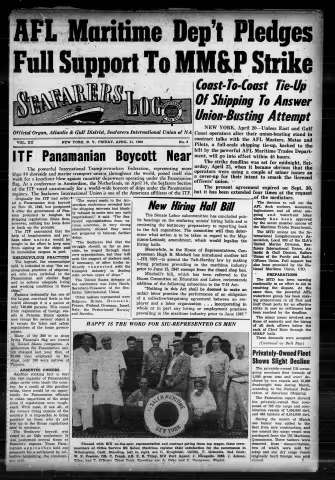
Issue Date
1950-04-21
Volume
12
Issue Number
8
Plaintext
Official'Orgm, Atlantic & Gulf District, Seafarers International Union of NA
VOL. XII NEW YORK. N. Y.. FRIDAY, APRIL 21. 1950 No. 8
ITF Panamanian Boycott Noar
The powerful International. Transport workers Federation, representing more
than 80 shoreside and marine transport'unions throughout the world, poised itself this
we^ek for a knockout blow, against runaway shipowners operating under the Panamanian
flag. At a conference in Amsterdam, the Netherlands, on April 18, the Seafarers Section
of the ITF. voted unanimously for a worldwide boycott of ships under the Panamanian
registry. The Seafarers International Union is one of the American affiliates of the ITF.
Originally the ITF had ordert
ed a Panamanian ship boycott
on Nov. 25, 1948, but postponed
it after the government of Pan
ama proipised to toughen its
shipping regulations. Since then,
, however, nothing has been done
to back up tlae promise.
The ITF annoimced that the
help of longshoremen and per
haps other unions would be
sought in the effort to keep men
from signing on the ships and
to immobilize cargoes in port.
UNSCRUPULOUS PRACTICES
The boycott, the communique
said, is intended to stop "the un
scrupulous practices of shipown
ers who have switched to the
Panamanian and similar flags
and to enforce adeiquate living
and working conditions in these
ships."
Panama technically has one of
the largest merchant fleets in the
world although it is a pation of
only 746,000 persons. This comes
from registration of foreign ves
sels in Panama. Union spokes
men charge the owners' object is
to escape the labor and safety
regulations of the home govern
^"m"ents,
' ... Many of the 800 or so ships
r flying Panama's flag are owned
V by United States companies. A
• spokesman, forPanamanian sail
"^qrS' Charged last year that, of
The report made^ to the Am
sterdam conference revealed how
the'shipping interests had blank
ly refused ta enter into any such
negotiations," it said. "The Sea
farers' representatives from va
rious countries, in very strong
statements, ' showed they were
not prepared to tolerate further
delay.
"The Seafarers feel that the
struggle should, as far as pos
sible, be waged through their
ownr organizations, but they will
seek the support of dockers and,
if necessary, of other trades in
directly connected with" the
transport industry in dealing
with certain .types of ships."
The United States delegate at
the conference was John Hawk,
SecretaryTreasurer of the Sea
farers International Union.
Other nations represented were
Belgium, Britain, Denmark,
France, Finland, Germany, Israel,
Italy, • the Netherlands Norway
and Sweden.
New Hiring Hall Bill
The Senate Labor subcommittee has concluded pub
lic hearings on the seafaring unions' hiring halls and is
reviewing the testimony preparatory to reporting back
to the full copimittee. The committee will then deter
inine what action is to be taken in regard to the Mag
nusonLesinski amendment, which would legalize the
hiring halls.
Meanwhile, in the House of Representatives, Con
gressman Hugh B. Mitchell has introduced another bill
7807—^to amend the TaftHartley law by making
hiring practices prevailing in the maritime industry
prior to June 15, 1947 exempt from the closed shop ban.
Mitchell's bill^ which has been referred to the
House Committee on Education and Labor, recommends
addition of the following subsection to the T^H Act:
"Nothing in this Act shall be deemed to make an
unfair labor practice the performance of an obligation
of a collectivebargaining agreement between an em
ployer and a labor organization ... incorporating in
whole or in part any hiring or employment practices
prevailing in the maritime industry prior to June 1947."
CoastToCoast TieUp
Of Shipping To Answer
UnionBusting Attempt
NEW YORK, April 20—Unless East and Gulf
Coast operators alter their unionbunting stand in
contract talks with the AFL Masters, Mates and
Pilots, a fullscale shipping tieup, backed to the
hilt by the powerful AFL Maritime Trades Depart
ment, will go into effect within 48 hours.
The strike deadline was set for midnight, Sat
urday," April 22, when it became obvious that the
operators were using a couple of minor issues as
a coverup for their intent to smash the licensed
officers' union.
The present agreement expired on Sept. 30,
but it has been extended four times at the request
1^^ the mediators.
The decision to call out the
HAPPY IS THE WORD FOR SIU-REPRESENTED CS MEN
50,900 men employed on the
'"^1':— only 130 were natives of
I 'Phriama.
i 1 ABSENTEE OWNERS
Another striking fact is that
. the vast majority of Panamanian
• ships never even touch the coun
try. As a result pf this peculiar
setup, there would be no oppor
tunity for Panamanian officials
^ to make inspections of the ships
evpn if regulations were tough
! ened. With most, if not all, of
the owners living outside of the
country it is impossible to bring
piessdre. oh. those who du not
' live! lip. to the flimsy regulations
hhW iri existence,
i "The 'Seafarers' boycott was
voted "at an Oslo conference. It
waa postponed several times at
' Panama's request. These Pana
manian approaches held out
prospects for a settlement by col
lective bargaining, the communi
que said.
Pleased With SIU onthespot, representation and contract giving them top wages, these crew
members of. Cities Service SB Salem Maritime, register their satisfaction ioi the cameraman in
Wilmington, Calif. Standing, left to right, are C. Krupinski, Utility, F. Goniales, 2nd Cook:
W. P. Preston, OS; C. Frank, AB; E. B. Tilley, SIU Port Agent; J. Peragallo, MM; J. Adams,^
Oiler«"pnd T. ©'Brie?*. Chief Cook, swe A. Ortw and C. Ceropreso,
AFL dock workers, teamsters,
tugboatmen and all other sea
going and waterfront labor
already has been approved
by the seven member xmions of
the Maritime Trades Department.
The MTD unions are the In
temational Longshoremen's As
sociation, Local 333 of the ILA's
United Marine Division, Sea
farers Ihtemational Union, At
lantic Se Gulf District Sailors
Union of the Pacific and Radio
Officers Union. Full support has
also been promised by the Na
tional Maritime Union, CIO.
PREPARATIONS
The MTD has been meeting
continually in an effort to aid in
resolving the dispute. At the
same time, the powerful AFL
waterfront group has been mak
ing preparations in all East and
Gulf Coast ports for an effective
strike in case no settlement has
been reached by the deadline.
The minor issues involved are
those of seniority and the hiring
of all deck officers below the
rank of Chief Mate through the
MM&P halls.
These demands were accepted
{Continued on Back Page)
• II, ...
PrivatelyOwned Fleet
Shows Slight Decline
The privatelyowned US ocean
going merchant fleet (vessels of
1,000 gross tons and over) de
clined by two vessels and 15,000
deadweight tons during March,
according to the National Fede
ration of American Shipping.
The Federation report showed
the privatelyowned fleet com
posed of 732 dry cargo and com
bination vessels of 7,356,000 dwt.
and 463 tankers of 6,810,000 dwt.
During the month of March
one tanker was added to the
fleet from new construction, and
one coastal dry cargo vessel was
purchased from the US Maritime
Commission. Three tankers were
removed. from ^ docmrnentation,
two of which were sold for
scrap and one dry cargo vessel
originally built foreign was sold
ab.road. f
• ' V;. . .
|||:!':;i/: Page Two THB SI? A FA RE RSL 0^ ^MmrVA^l U. IB60
iHl}'
MM^A:
Vil • ̂ '
\
1%.:
mM
Sm^RERS LOG
Published Every Other Week by the
SEAFARERS INTERNATIONAL UNION
OF NORTH AMERICA
Atlantic and Gulf District
Affiliated with the American Fedefation of Labor
* At 51 Beaver Street, New York 4, N. Yi^ ;
HAnover 22784 *
Reentered as second class matter August 2, 1949, 'at the Post
Office in New York, "N.Y., under the Act of August 24, 1912.
267
|5j'r,'
TJ^ 7, . •
te/'
mx
^S' •
il%:
' Shipowners Attack
\ V . •
The stalemate between the AFL Masters, Mates and
Tilots and the East and Gulf Coast steamship operators,
^hich is just two days away from erupting into a nation
wide tieup of US shipping as the LOG goes to press, is
more than just a contract dispute.
Despite several extensions by the union of the con
tract that expired last fall, and the vigorous efforts of the
'. Federal Mediation and Conciliation Service, the parties are
no closer to agreement than the day they started out.
On the surface, the principal issues are the MM&P
demands for recognition of seniority, md the hiring of all
.deck officers below the rank of Chief Mate through the
' .union halls.
Out on the West Coast, where the MM&P has a
tightlyknit organization, the operators granted these
same demands in a. contract negotiated last October. The
agreement has operated satisfactorily for both sides, and
certainly has not been a hardship on the operators there*
The East and Gulf Coast, operators have refused to
budge an ihch, however. In nixing the union's demands,
they have said such an agreement "would usurp mana^ge
ment's prerogative to hire its representatives," and that
the operators couldn't be expected to accept the language
uf contracts "negotiated elsewhere."
All of which is just a lot of highsounding malarkey
that isneither fish nor fowl as far as the issues are con
cerned.
Every experienced maritime observer is convinced
• that the operators are getting set to try to bust the union.
There is no other conclusion that can be drawn from their
^stubborn attitude inasmuch as some of these same opera
tors, who have interests on the West Coast (Moore
McCormack is one) have accepted there what they are
rejecting on the East Coast.
As a result, the East and Gulf Coast shipowners are
precipitating a paralysis of US shipping.
The powerful AFL Maritime Trades Department,
composed of the Seafarers International Union, the Sailors
Union of the Pacific, Radio Officers Union, the Interna
tional Longshoremen's Association, ILA Tugboatmen, has
moved into action and announced full support of the
affiliated MM&P. In addition, the CIO National Maritime
Union has promised to respect all picketlines.
If the Saturday midnight strike deadline set by the
AFL deck officers rolls around without an agreement be
ing reached, US shipping will be locked up tight. ^
.None of the unions concerned with this beef wants
to see a strike develop. In fact they are demonstrating a
deeper concern for the welfare of the US merchant marine
than the operators. But the AFL waterfront unions are
not going to stand by while 38 steamship operators go to
work at smashing one of its members.
The busting of the MM&P apparently .has been a
longtime desire of the shipowners who have been encour
aged and aided by the government's policy of flooding the
industry with officers.
Despite the acute unemployment plaguing the indus
tryr the US Maritime Schools and state merchant marine
academies have been turning out more and more candidates
for jobs as ship's officers.
.Perhaps with the expiration of the MM&P contract
the shipowners figured this was the ripe'moment to step
in and smash the union.
If the shipowners have.no such intention, they can
prove it by'knuckling down v/ith the Goverimient con
ciliators and the MM&P and resolving the dispute.
Otherwise, the responsibility for the consequences is
• tHeirs. •
It would be the rare man without an ulcer
these days, if the news were really as black as
the headlines. Take this issue of the LOG, for
example, and you read that the East Coast opera
tors are trying to bust the AFL Masters, Mates
and Pilots. Then, further down the page, there
is an item that the International Transportwork
ers federation, with which we are affiliated, is
finally going ahead with its worldwide boycott
of Panamanian flag ships.
Then, of course, there are the small things like
the monthbymonth shrinking of the US mer
chant .^marine and, along with it, the decline of
shipping and jobs. And, if you really want to
be a worry wart, there's the fact that the Head
quarters building in New York is about to be
sold from imder us, and we have to get ourselves
a new Hall. There are other things too—enough
to give ulcers to yotu: ulcers, but we won't go~^
into them now, and save them for a rainy day.
ONE AT A TIME
But, as we hinted before, things aren't as black
as the printer's ink makes them out to'be. Let's •
take these items one* by one and examine them
so that we can prorate our worrying.
First of all, there's the MM&P beef There is
no question but that the operators are making
their first real try at breaking maritime unionism.
If they are successful here, they will move on
to some other union and try to knock us
off one by one. But the joker here—'for them,
that is—^is that they aren't going to take on the
MM&P all alone. The AFL Maritime Trades De
partment has seen through this maneuver and,
instead of fighting just oiie sm^l outfit, the East
Coast operators will find the entire strength of
the MTD lined up solidly behind the mates—
which puts an .^entirely different'color to this
horse.
Standing solidly behind the MM&P, shoulder^
to shoiUder, are the SHI, the SUP, the longshore
men, the radio operators, ahd the. tugboatmen.
In addition, the CIO National Maritime Union
has promised to respect the picketlines, if the
operators decide to go ahead with their Operation
Openshop.' And that's a pretty sOlid lineup, asj
the operators found out many times before.
GOOD PRECEDENT
Although the MTD wasn't officially in exist
ence then, remember what the imited strength
of the AFL maritime unions was able to do in
the 1946 General Strike? §ure, it's no fun hitting
the bricks, but there is no reason, why we
shouldn't come out the winner in this one, and
make maritime unionism just that much stronger.
On this Panamanian boycott deal, practically
every maritime union outside of the iron curtain
win be a participant, and those shipowners who
jumped to Panamanian registry to avoid tax^»
safety standards and the prevailing wage scales
wUl soon find themselves behind the financial
eightball.
If carried to a successful conclusion—and there
is no real reason wiiy it shouldn't he—a lot of
these ships wiU swing back .to the American
flag, taking care of some of the other problems
mentioned above. Those that go to other foreign
flags will 'at least hot offer the ciffthroat com
petition to American, shipping and jobs that
these unorganized, uninspected, cooliewage ships
now present.
As for the Headquarters building, that may be
a blessing in disguise, if contemplated, plans*go
through. There's 'no point in going into details
now, but the new Hall will be tops, and provide
the membership pwith many vservices that are
impossible in the present cramped quarters. De
tails will be given when we definitely have the
building, because many of the things planned de
pend on the site of the building. But, one thing
is sure, liobody wUl be disappointed.
Feelbetter?
• : fMdCi;:'Myia n> 'IWllj::;.::; 5:Sip!^ , 5_.jE. ̂ ;^|? IJ E RS LOG '
. ...,- mmim^
Page Tiue» ;;V.E|
A Way Of Life • • • Tit
-M
The year was. 186&. America's seamen were
still finding most of their jobs aboard sailing
ships—steamdriven vessels having yet to make
their clean sweep oi the seas. President Andrew
Johnson was being impeached by Congress. And,
in San Francisco's Turnverein Hall, a band of
hardy sailing ship seamen formed the first mari
time union in America, the Seamen's Society of
the Pacific Coast.
"^e Society's life was short, but in its exist
ence it wrote into the record the first demand
of American seamen for the most cherished of all
union possessions: the union hiring halL
Following the Society, other unions, associa"
tions and brotherhoods were formed and dis
solved, each one having sought to bring to the
men who sailed the ships the right to equalize
the jobs available through a system of equal job
distribution.
Some were partly succesful, others failed; yet,
wherever seamai met, the talk always turned to
the hiring hall. Firing every discussion was the
seaman's deepseated hatred of the crimps.
THE CRIMP
To a seaman a crimp was the lowest form of
animal life. He operated, the shipping office,
often in conjimction with a boarding house, and
in his hands rested whether or not a seaman
would get another job. If he ran a boarding
house, the seaman'knew he'd better take a room
if he wanted^'a ship. The quarters offered by
the crimp were crowded and vermininfested,
the food and liquor poor, and the cost high.
The seaman's small pay was soon gone, and he
found himself in debt to the crimp. When the
bill became high, the crimp put him on a ship,
having made arrangements first with the ship's
master to have advanced to him the money owed
by the seaman. It was possible, under the law
at the time, to advance a seaman's creditors up
to four mtmths of a seaman's unearned wages.
If the crimp didh^ run a boarding house, he
usually had a business of some sort, and the sea
man sooii learned the best patrons got jobs the
quickest, and cm the" best ships. Seamen who
didn't throw their business to a crimp had to
take their chances on the piers, msdcing the long
hikes daily from pier to pier in the hope a berth
was open and the captain the sort of a man who
did his own hiring.
But whether a man patronized a crimp or
tramped the waterfront, his chances of getting a
ship were small if he was known to have ideas
about unions. "Troublemakers" weren't wanted.
But despite the chances of being blacklisted
with the crimps and skippers, men with ideas
about unions continued to increase. Stung by
the injustice of the laws of the day, swindled by
greedy crimps and abused by sadistic skippers,
the men turned eagerly to every movement for
union among seamen against their common
enemies.
In 1885, the Coast Seamen's Union was formed
and,'three months later, had marshalled enough
strength among seamen to boycott ships hiring
men from sources other than the union hall. The
movement was successful for awhile, but the
union was unable to check on all ships and
gradually the boycott evaporated.
OTHER BENEFITS
The desire "^of the seamen for the hiring hall
extended beyond the establishment of a system
of job distribution. The seamen felt that once
the hiring hall was set up, and all seamen ga
thered together in the firm bond of brotherhood
for their jobs, the union would be better" pre
pared to improve the conditjoixs on the ships
and force a fight on the maritime laws, which
made seamen virtual slaves.
Under the law, seamen were bound to their
ships and for a man to. quit meant the forfeiture
of all of his personal effects and any wages due
him. Under this law, shL^. istei's made life
miserable for the seaman, hoping he would quit,
thus saving the shipowner the man's wages. Of
ten the skipper owned his own ship.
The seaman could also be arrested by the ship's
master without a warrant; could be imprisoned
for desertion; could be docked one day's pay for
each hour of tardiness, and could be fined $10
a day for harboring a deserter.
It was not until the turn of the century that
flogging was abolished by law, but not until
passage of the Seamen's Act in 1915 was the
law actually enforced. Under the wording of
sea laws, seamen were "reckoned neither among
' the living nor among the dead."
Without a hiring hall, the seamen were with
out unity to fight intolerable conditions. Greedy
shipowners stuffed every available bit of space,
including the crew's fo^sle, with cargo, leaving
no room for sleeping or mess facilities. Crew
members had to throw the straw mattress they
cairied with them wherever they could find a
bit of open space, and ihey took their meals
where they slept.
The miserable, illv«ntilated quarters, jammed
with the bodies of unwashed men—water was
rationed to four quarts a day—^made a perfect
medium for disease. Seamen, who because of
their outdoor work should have been one of the
healthiest occupation groups, suffered one of the
highest percentages of tuberculosis.
The intolerable conditions aboard ships also
led to the most inhuman of all ,seafairing prac
tices: shanghaiing.
HELL SHIPS
Certain vessels bore reputations for having un
usually brutal officers and extremely bad condi
tions, where the crews were treated as animals.
On these ships, the men were worked until they
dropped. The food was slop and the disease rate
high. For minor infractions—or merely at the
whim of a sadistic skipper—men were triced up,
beaten and often horsewhipped to death. These
ships were avoided by seamen, no matter how
much they needed work.
Because replacements were always necessary,
and no volunteers were forthcoming, the new
men could be had only by kidnapping, a job
that fell to the ship's officers and cooperative
crimps.
A prospective crewmember would be be •
friended, phed with liquor until in a stupor, and
then dragged aboard ship during the night. If
time was short, a seaman • would be set upon
in a dark street and beaten insensible. Others
—guilty of some petty law violation—^would be
forced aboard by crimps with the threat that
they would be turned over to the police. At any
rate, when daWn broke the ship would be at
sea and a full crew Would be aboard.
Such a voyage was that of the Sunrise, which
sailed from New York to San Francisco in 1873.
Unlike most such voyages, it ended in court
with the conviction of the captain and mate, a
feat made possible by the crusading work of
the "San Francisco Post." The record has the
following to. say of the voyage:
"As soon as the Sunrise got into the stream,
the brutalities upon the crew commenced, and
did not end until she took a pilot off the Golden
Gate. They were knocked down, kicked, beaten
with ropes' ends, iron belaying pins, tar buckets,
staves, or anything that came handy. But the
favorite punishment of the captain and his mate
seems to have been the horrible torture known
as tricing up, which consists of ironing a man
by the wrists, passing a rope .around the irons,
and hoisting him up until his toes barely touch
the deck.
"They were tortured on the Sunrise in this
way for six, eight and ten hours for trivial of
fenses, or for no offenses at all . . . These men
were maltreated in every possible "way—beaten
and kicked until they were a mass of bruises
and disc'plored flesh, hung up by the wrists imtil
their hands were black, kept without sleep and
set to the hardest and most impossible tasks.
"One . . . escaped from his torture two days
after the vessel left Sandy Hook by going over
board. A second one . . . followed his example
soon afterward; a third, a boy of about 17, found
in the sea a refuge on the morning of July 4th
—the anniversary of the great declaration of
freedom and equality."
Establishment of a hiring hall thus meant more
than democratic hiring, it also stood as the door
to improved shipboard conditions, freedom Jrom
disease and oppressive maritime laws.
EARLY UNIONISM
The first strong wave of unionism in maritime
sprung up shortly after the Sailors Union of
the Pacific was founded in 1885. Within a few
years the Marine Cooks Union was formed and
the Marine Firemen had organized. In 1893 the
three organizations became loose affiliates in
the International Seamen's Union, AFL.
In 1891 the Sailors Union of the Pacific set up
the first union shipping office, which bore a
semblance to the hiring hall of today; but it
was 1902 before the first formal working and
wage agreement with the shipowners association
was signed. Wages became $35 a month. The ship
owners in San Francisco agreed to maintain their
own shipping office and use no crimps. In the
outports the union was to furnish the crews. A
committee of owners and seamen was set up
to adjust grievances.
In the following years before World War I, the
unions grew steadily, with wage agreements re
newed regularly with wage iDOOsts. In 1917 wages
had risen to $60 a month, plus overtime and
bonuses."
A great deal of the advancements made during
these years must be credited to job actions,
whereby a crew went aboard a ship and, being
dissatisfied with conditions, waited vmtil the ship
was about to sail, then threw their luggage
the dock and pilpd off. The imion, informed of
the situation, invariably was unable to find a
crew available imtil the shipowner adjusted the
grievance. When the grievance had been adjusted,
the union furnished the company a crew for
the ship.
The use of job action was made possible by ^
the Seamen's Act of 1915, which abolished im, ;
prisonment of seamen for jumping ship in Ameri ?
can ports, and allowed him to collect all money
due. The seaman only forfeited his personal ;
effects left aboard. Passage of this law is attri
buted to the tireless efforts of Andrew Furuseth,
Secretary of the Sailors Union of the Pacific,
who spent almost his entire life in Washington
lobbying for fairer laws for seamen. Furuseth,
for his efforts to liberate seamen under the law,
h&s been termed "the Abraham Lincoln of the
J} seas.
WORLD WAR I
The First World War brought maritime union
ism to new heights, but was followed by a
swift downfall.
When the United States entered the First
World War, ninetyfive percent of the seamen
in America were members of the unions and
wages had risen to $75 per month. Conditions
were good, jobs plentiful and the costplus opera
tions of the shipowners gave them little reason
to fight the union demands.
With the end of the war and the heavy slump
in shipping which followed, the unions found
themselves with their backs to the wall, forced
to fight to maintain standards against the ship-
owners and a hostile government. Large num-
bers of war-trained seamen,. who had not gonir
through the battles for union conditions, stood
ready to,man the ships in the event the unions
struck against the proposed cut in wages and
increase in working hours. The government was
(Continued on Page 4)
V,
Pag* Four TBE S E A F A k E R S LOG Friday, April 21. 1950^
The Union Hiring HallA Way Of Life
(Contitmed from Fage 3)
prepared to send men to struck ships through its ship of San Francisco in all occupations and
of the national guard, the entire union member ships to issue the books, the seamen revolted and
hiring hall, which had been set up to dispatch
men to governmentowned ships.
The International Seamen's Union struck May
1, 1921 and the curtain dropped on maritime
unionism for thirteen years. The shipowners, at
the urging of the government, refused to back
down on their demands for a slash.
The government, in the person of theUnited
States Shipping Board, also stipulated that the
unions would no longer have the right to have
Patrolmen at signons and payoffs. As ships hit
United States ports, and were abandoned by their
crews, the US Shipping Board promptly dis
patched scab crews through its hiring halls. To
swing any wavering shipowners back into line,
fljp chairman of the Shipping Board announced
to the companies that, if imy of them signed
6n the union's terms, the Board would take
away from them any governmentowned ships
they were operating.
The odds against the union were too much.
Possessing a membership of over 100,000 men
when the strike came off, the membership rapid
dwindled to 23,000. At the end of two months
the union capitulated; the men returned to the
ships with only a shell of a imion remaining
and no contract.
THE INBETWEEN YEARS . ^ " '•
The years following were rough for seamen.
The crimp became king again. Conditions on
the ships worsened, with thousands of American
bom seamen leaving the seas. Crews were re
duced to the minimum set by law, the hours of
trades went on a general strike. The waterfront
strike ended shortly thereafter, with the seamen
and the longshoremen returning, to their jobs
with their ease before arbitrators.
Most important of all, the 1934 strike had re
united the seamen into S. force strong enough
tcr press for its demands through job actions
and the aggressiveness of the men the seamen,
elected to fight the dayto^day battle from the
union offices ashore.
By 1935, job actions put the hiring hall back
into operation. Men refused to ship except
through the union hiring hall. If a man came
aboard a ship from any other source, the crew
formed a welcoming committee for him. Ship's
delegates were set up, and a member from each
department elected to represent the men in dis
putes with the company.
The shipowners, seeing the futility of their
fight, recognized the hiring hall as fact, and
gave up their resistence to* having the hiring
hall clause written into the* contract.
In this period of resurging unionism, the Na
tional Maritime Union, CIO, was born, and
shortly after the Seafarers International Uriibn,
AFL, ^ame into existence. The big drive was
on. In maritime the trend was away irom craft
unions and toward the formation of all men in
the three departments into one union of un
licensed men.
Simultaneously with the establishment of the
hiring hall, conditions on the ships improved.
Union action brought about abolition of "blue
linen"—a blue bedsheet given the seaman when
refused to accept them. Crews on all coasts made ;
it clear that they would not accept the book',
under any conditions. The movement became
so strong that the government had to back
down.
The hiring hall continued to survive the on
slaughts of its enemies and gradually the unions
signed up the nonimion operators, until all but
a handful of the steamship companies were com
mitted to call the union hall for their men. '
WORLD WAR II
^ . Then war came. Overnight America's merchant
fieet doubled, quadrupled and swelled until the
prewar fieet of 1090 ships had grown to 5500.
Seamen were at a premium, and, the imions,
through their hiring halls, dispatched thousands
of men to crew the slups. Skilled men were not
available in the large numbers needed. The
government turned thousands of hastily trained
men from, its training schools. The Sailors Union
of the Pacific set up its own training school and
sent over 500 imiontrained seamen to its con
tracted ships. .
Men who before the war had been ABs and
Oilers became Mates, Skippers and Engineers.
The tremendous number of men needed to sup
ply the ships strained to the limit the facilities
of the union hiring halls, yet the union Icnew
that to let the men be hired outside its offices
would mean a breakdown of its hardearned
security of the hiring hall.
Seamen who had been torpedoed, strafed and
shelled on the perilous Atlantic nm to Mur
mansk, through the Suez Canal to Malta, through
work were boosted to 90 without the payment of he signed on, which was supposed to serve as the subinfested waters to England and through
overtime.
The "workaway" came into being; a man
signed on the ship for a pennyamonth pay. He
did all the work of the crew but received nothing.
His break came when one of the regular crew
members left the ship and he assumed the man's
job. Another practice, was for college students to
sigh on as crewmembers to work their way to
Europe for the summer, thus denying seamen
jobs.
Miserable food, crowded foc'sles were back
again. The seaman lugged his straw mattress
with him when he signed on a ship, and with
his personal belongings he carried eating uten
sils and canned milk for coffee. Conditions con
tinued to deteriorate, with wage cuts coming an
nually until 1934, when the longshoremen on
the west coast resisted the slide downward and
called a strike. The seamen hitting west coast
bed linen as long as the trip lasted.
The "donkey's breakfast," or straw mattress,
was discarded and the cojtipanies forced to sup
ply mattresses. Crockery was supplied by the
company, and the men were, given ample room
for eating apart from their sleeping quarters.
"Uboat Lane" along the Atlantic coast, came
back again and again to take out ships fresh
from the shipyards.
Unescorted, sparsely armed and slow, the Ships
lumbered across the waters to deliver the much
needed lendlease cargoes and, later, America's
Gradually, through the initiative of individual armies and war materials. By the end of hostili
crews in job actions and through the union m ties, 6,028 seamen had lost their lives in the
negotiations, the working conditions aboard the war, a percentage loss higher than suffered by
ships improved.
Certain tasks outside the realm of ordinary
work became penalty work, for which overtime
was paid. Cleaning tanks, doing work ordinarily
done by longshoremen, and working beyond the
stipulated number of hours were among the
penalty jobs spelled out in the contracts.
The better living for seamen was not without
opposition, however. In J938, the government
announced that it was going to operate hiring
ports piled off the ships, and declared themselves halls and in several ports put them into opera
on strike for a coptract embodying a wage in
crease and reestablishment of the hiring ball.
THE 1934 STRIKE
Thus began the toughest and bloodiest strike
in maritime history. Oh March 5, the strike
began and, through the ensuing weeks, the em
ployers turned to desperate measures to drive
the men back to the docks ̂ nd the ships.
Thugs were imported to beat up on pickets, the
city police went to work with their nightsticks,
putting hundreds of beaten strikers in jaiL The
new^apers hollered "civil war" and called for
extreme measures. Bands of vigilantes descended
on the strikers wherever they' found the odds
to their favor.
The tension rose until, on July 5, in the
"Battle of Rincon Hill," San Francisco police
opened fire on a seamen's meeting, killing two
men and wounding 105 others. The national
guard was called out against the strikers, and
barricades were set up . in the streets, ̂ e city
of San Francisco took on the appearance df war
time. The strikers, however, were not seeWng
p! battle, being content to keep ships, tied up
and the strike in effect.
But the seamen had help, too. In support of
tion. The halls were shortlived, for the seamen
met them with job actions whenever a replace
ment supplied from the government hiring hall
tried to board a ship.
THE FINK BOOK
Defeated in its effort to smash the hiring hall,
the antiunion forces in the government—at the
urging of the employers—came up with a neat
device for keeping militant men off the ships:
the Copeland Book, referred to by seamen as
the Fink Book.
The book was designed to replace the usual
any of the armed forces. But the job was done.
LAYUPS AND SALES
The end of hostilities saw a cut back in mari
time operations on a scale imequalled in any
other industry. iUmost with the signing of the
armistice, ships began making their last run to
the "boneyard," the layup fleet. The govern
ment, which had built most of the ships and
chartered them to private operators, found the
shipowners reluctant to stay in operation on a
large scale. Some companies, which had operated
as many as fifty ships, went out of business en
tirely, the fat, guaranteed profits of wartime
gone.
The full effect on employment wasn't felt fot
nearly four years, as thousands of men who
entered the merchant marine during the war
returned to their homes, farms and schools. The
government, concerned with the growing layup
fleet, attempted to dispose* of its ships by offer
ing them for sale at a small percentage of their
original price.
The American shipowners were slow to take
practice of giving a seaman a separate discharge up^ the government on its offer, but the steam.
at the end of the each voyage. Instead, he was ship operators of foreign countries were definite
to be issued a book in which each discharge was ly interested. Ships were sold wholesale to ope
to be listed and, next to it, a space for the skip rators in all the countries of the world,
per's comments on the man's ability. Hundreds of ships were sold to operators list
Thus, instead of a seaman receiving /separate ing Panama and Honduras as their home offices,
discharges, all of his sea service would be listed Actually, the ships were primarily owned. by
in the book for "a prospective employer to see. . American interests, but registered ih Panama
Men who had made short trips, left their ships and crewed by Europeans and Asiatics. Their
regularly and who were given imsatisfactory purpose w^ to evade the American safety laws,
ratings from skippers were easily spotted and American shipyard costs and American crew
refused when applying for jobs. If the man was
sent from a hiring hall, the employer would
Ipid some pretense for refusing him.
Ife the strikers, and as a protest ui the ogling out ;|^ When government representatives came aboard
wages. ,
By January 1, 1950,"the government had di&
posed of 1,006 ships in its layrup flert. American
^Continued on Page 5)
Fsidtty. April 8i; i960 T BE S E A F A RERS td
AU Three DeRartments Share
In NeW York's Fail' Shipping
By JOE ALGINA
WEW YORK^hipping out of
I the Port of New York was
Ipretty fair during the past two
I weeks for all departments. The
black gang had a slight edge
lover the deck and stewards in
inumber of men shipped.
This does not mean, however,
I that anyone shotdd rush off in
[the direction of NewYpfk. There
I are approximately QOOr men reg
Jistered—about, evenly divided in
I the ' three departments. That's
I about average for the port, as
I a rule.
Most of the past period's pay
joffs were smooth, and all beefs
I were settled satisfactorily. Ships
Ipaying oif were:
Tankers Give Hypo
lib Boston Shipping
By BEN LAWSON
BOSTON—Shipping was • just
fair/ in the Beantowni although
a number of ships paid off and
approximately a halfdozen
otherb called intransit during
the past two weeks.
Thepayoff ships were all tank
ers: the SS .Alexandra, and SS
Trinity, Carras, and the SS Bepts
Fort,, SS Fort Hoskins, and SS
Royal Oak, Cities Service. i All
of these vessels signed on again.
With the way the Cities Ser
vice ships are hitting^this area,
and witii the Yarmouth and
Evangeline scheduled to begin
crewing up in about six weeks,
shipping ought, to be pretty good
up, this way. •
Elizabeth, Puerto Rico, Suz
anne, Caroline, Frances, Bull;
Topo Topa, Hurricane, Choetaw,
Chickasaw, Jean LaFitte, Water
man; Steel Designer, Steel Work
er, Steel Chemist, Isthmian; Rob
in Kirk, Robin Kettering, Seas
Shipping; Southwind, South At
lantic; Chrysstar, Triton; John
Stagg, MarTrade; Elly, Sea
Trades; Black Eagle, Orion; Sea
ttain New York and the Sand
craft, which came In from the
West Coast.
The Eastern Steamship Lines
will put the Evangeline into
cruise service beginning July 1.
The vessels will make a series
of ten weekly cruises to Nassau,
leaving every , Saturday from
Pier 18, North River, and will
return to New, York the next
Friday by way of the Grand
Bahama Island.
The^ Bernstein Shipping Com
pany. is still awaiting final word
on its. bid for operations and
conversion subsidies on two pas
senger ships for the European
run.
Meanwhile, . the company is
placing a ship in the trade imder
Panamanian registry (on a tem
porary basis) so. that it can build
up its bookings.
If there had been swifter ac
tion on the Bernstein applica
tions, there would have been no
need for the Panamanian flag
operation. This is one. of the' les
'sons this nation should learn in
making decisions affecting its
merchant marine.
Sailing Short
All delegates aboard SIU
ships are urged to make cer
tain that every sh^ is fully
manned before it leaves port.
If the company tries to vio
late the contract manning
scale by sailing short, the
ship's delegate should call
the nearest Union Hall im
mediately.
The Union will take im
mediate *kctiott to see that
our agreements are observed
to the > letter as it doM
whatever violations are re
ported.
Know your contract and
report aU violations to the
Union right away.
M Slow, Says Port Savannah
w By E. M. BRYANT
SAVANNAH—No matter how
you say it, shipping is still slow
ih this port.
There were only a coupleof
5layoffs in the last shipping pe
iod, th^ being the SS South
port, South Atlantic, and the SS
Strathmore, a Liberty tanker
Which was sent by the company
into dry dock to be reconverted
to a dry cargo carrier. The
Strathmore will be in the dry
dock for about 45 days.
The Southport showed up as a
rpighty clean ship, manned by
a headsup crew of bookmem
bers.' Not a single beef was car
tried apoard this'vessel.
Intransit we had the SS
MOA/JIB Mat Keeps RelOng Ahng
By CAD TANNER
MOBILE — Shipping in this
port for the last couple of weeks
has been dead slow, with ap
proximately forty»five bookmen
and six permits shipped for ihe
twoweek period. In addition to
these, we had approximately
forty relief jobs on tugs and
deep sea ships.
Ships paying off during the
last two weeks were the Mon
arch of the Sea,. Fairport, Ala
wai, Morning Light, Antinous,
Wild Ranger, all Watermbn; the
Clipper and Corsair of Alcoa, and
the Sanford B. Dole, Mar Trade.
Signing on were the Monarch
of the ̂ Sea, Alawai, Clipper,
Fairport, Morning Light, Antin
ous, Sanford B. Dole, and the
Wild Ranger. All signons and
payoffs were smooth, with only
a few minor beefs on any of
them.
Intransit for the period were
the Bull Rim, Mathiasen tanker ;
Chickasaw, Alcoa Rimner, Caha
ba, SUP tanker, and the Lasalle.
All intransit jobs were con
tacted and necessary replace
ments furnishfedi
Biggest thing around Alabama
this last week was the Alabama
State Federatiori of Labor con
vention in Montgomery the,j,first
three days of the week. As usual
the SIU delegates were there,
apd were elected on all the im
portant committees for the com
ing year. The convention went
on record to endorse candidates
lyho were favorable to labor in
the coming May primaries.
Kyska, SS Iberville, and SS
Azalea City, all Waterman ships;
SS Steel Surveyor and SS Steel
Chemist, Isthmian, and the SS
Jean, Bull Lines. None of these
ships had any beefs, either.
Aniong those waiting to ship
out of this port at the moment
are Brothers A. J. Bullard, W.
Breedlove, Tommy Wickham,
Mike Kavanaugh and Marvin
Swords.
I
UNION SHOP
We'd like to advise all Chief
Stewards that when ordering
supplies in Savannah, they
should order NBC bread and
crackers, as it is the only or
ganized bakery in the city. ^
The Hall here has been paint
ed and is looking fine. We've
purchased a phonographradio
combination from Brother
Tommy Moore, who gave us a
bargain. This addition helps,
make this HaU one of the finest
in the South—and one of the
cleanest, we proud to add.
The Garden City Cab Company
sold out, so we have no organized
union taxi service in this city.
The new owner keeps giving the
Teamsters local the rvmaround,
although he is supposed to be
an old railroad man. We expect
to hear something definite on
the imion's efforts to get a con
tract in a short time.
Three of our Brothers are in
the local Marine Hospital: J.
Maxey, J. (Chubby) Morris and
Carl Smithj SUP. Stop in and
pay these Brothers a visit if
you have a few moments in this
port. It'll: go a loni: way in
cheering them up.
1
1. m I
ill
(Continued from Page 4)
j pperators ptirchased 693 ships to replace outof
date vessels and those lost in the^ war.. Foreign
operators, representing 34 nations, purchased
l,li3 ships. Still in the layup fleet are 2,189
ships, all but 51 being warbuilt ships. America's
[merchant marine now numbers 1,164 ships—only
74 more than before the war — and is still
dropping.
MARITIME TOPAY
With the heavy shipping of wartime only a
memory, seamen today find the hiring hall their
one consolation. The number, of jobs being fewer
than the men available, the seamen know that
what jobs become available will be offered thehx
on an equal basis.
They^know the jobs that become available will
be called, into the hall, where they can wait
in leisure, knowing that eventually their job
will come up "on the board." No trudging the
waterfront, no putting up at a crimp boarding
house, no buying the ^oddy merchandise of a
business mancrimp. If a job is to be had, the
man with the longest time in waiting will get
the job. Waiting'for his turn is the" only price
he pays.
But, just as it h^s dogged the existence of
every seajnan, the thfeat to the hiring h^ re
mains ever over them. The unions today are too
strong for the employers to attempt to hire
their men from crimps or off the piers. The
biggest threat today comes from the TaftHartley
Law> which bans the hiring hall. In a recent
court case, the Supreme Court upheld the law
by declaring illegal the hiring halT operated on
the Great Lakes by the National Maritimh Union.
The Supreme Court's decision is the hiring hall's
severest blow , since 1934;
To the men of the Seafarers International
Union,the hiring hall is their most prized posses
sion, as: union msn. Shipowners, contracted to the
imion have stated their complete satisfaction
with the operation of the Biting haH and with
tBe men suppli^ by the union.
The Hiring Hail
The present contract, under the provision
covering employment, reads in part: "To assure
maximum harmonious relations and in ojder to
obtain the best qualified employees with the
least risk of a delay in the scheduled departmre
of any vessel, the company agrees to secure all
unlicensed personnel through the hiring hall of
the union."
HIRING HALL SUPPORT
The hiringhall is not without friends, how
ever.
Recently, to acquaint the country's lawmakers
with the union's operations, several congressmen
toured the SI¥'s facilities and later commented'
favorably in the Congressional Record. One Con
gressman, Isidore Bollinger (Dem., N.Y.), stated,
"because of problems peculiar to the maritime
industry, the union hiring halls have injected
stability into the industry and have given to
seafaring men a pfoper dignity arid security
that was impossible urider the previous hiring
practices. "The union hiring hall wiped out crimp
halls and shanghaiing and the maritime industry
is better off for it. . .
"The Seafarers point out that the destruction
of the union hiring hall would wipe'out many
hard won gains realized by organized seamen
over the past ten years, and. chaos, confusion and;
all the sordid conditions that are now part of
an inglorious history would return. And |here is
sound basis for this prediction.
"The Congress of the United States cap act to
avert sttch a calamity. I believe all legislators
share with me the desire to see our natiop move
forward, not backward. I believe, therefore, that
it is incumbent upon us to exempt the maritime
unions from the dosed shop ban. It is in the
seamen's, the industry's and the nation's^ntere&t
that we do so;'*
In agreement with Gbngresspian Dojilinger,
t* » ' V
Senator Warren , Magnuson and Representative
John Lesinski have introducedi a bill in congress
to exempt maritime unions from the Taft
Hartley ban. Despite a great deal of support for
the measure in both Houses of Congress, mari
time union leaders are not optimistic over its
enactment into law.
The seamen feel that, outside a full repeal of
the TaftHartley Law, their greatest hope for
retention of the hiring hall, and the multitude
of benefits derived from it, lies in an allout fight
against any attempt by shipowners "or the gov
ernment to weaken in any wayor destroy the
hiring hall in its present form. The seamen are
determined that in no way, and by no dictate,
will they give up the cornerstone of maritime
union independence. .
America's maritime unions have always ope
rated independently of one another in the sign
ing of contracts, organizing companies and con
ducting strikes, with no concerted action by all
unions other than the usual respect of one an
other's picketlines. But, now, the unions—^AFL,
CIO and Independent—representing over 170,000
seamen, are. united in their determination to
maintain the strong right arm of unionism. ^
History has taught them that the end of the
hiring hall means the end of a way of life. Clean,
wellventilated foc'sles, first grade food, fresh
Unen weekly, a 40hour week at sea, and union
representation constsmtly at their call, spell a
way of life for America's seamen today, equal
to that of craftsmoa in shoreside industries.
The union hiring hall has made it possible for
the seaman to become a respected member of
the community, to enjoy the h:uits of his labor,
to hold his head high and be proud of his trade^
He is determined that no one will relegate him"
again to the state of the seaman a gaaeration or
two ago, as it was characterized by Andrew
Furuseth: "You can put me in: jail but you cannot
give = me narrower quarters than as a seaman
I have always had. You cannot give me coarser
food than I have always eaten. You cannot ihake
,me Ibnelier than I have always been."
^ ^ ^ TiivNim
i
Page Six.
• ;• ; z'' ,\ .. /.,
T H E S E ̂ F A^ R E R S L O G ficidaY. jipril 21/19S0
SBIPS' MIMUTES AMD N^S
r,
Del Norte News Sheet
Makes Shipboard^Debut
charting a course dedicated to the best interests of
its readers and the Union, the SS Del Norte Navigator
made its initial appearance as the monthly j^ublicatioa of
ship's unhcensed personnel.
Edited and printed at sea, the
Navigator is being published "for
the dissemination of shipboard
news,, discussions of ideas and
actions within our Union per
tinent to our welfare, Snd for
instruction and entertainment,
according to the statement of
policy made by Thurston Lewis,
editor.
The first issue of the Naviga
tor contains nine neatly mimeo
graphed sheets of editorial mat
ter, stories of the crew's sports
activities, cartoons, news items,
poetry and a gossip coltunn deal
ing with hipboard personalities.
The name pf the paper was
selected from a number submit
ted by crewmembers. The suc
cessful entry, the Navigator, was
offered by Gottfried (Tex) Met
ting, AB Maintenance aboard the
hlississippi passenger vesseL Met
ting was awarded the tendollar
prue set up by the judges for
the winning name.
Metting joined the SIU in
1943, and according to the Del
Norte Navigator has been active
in several organizing campaigns,
including Isthmian and US Wa
terways. He has served as dele
gate on many ships and "has
proved himself to be a good ship
njate at aU times." Before join
ing the SIU, Metting was a mem
ber of the AFL Brotherhood of
Hallway Clerks.
The Del Norte Navigator's
s^rts page features the victories
scored by the Crew baseball
team over two teams from the,
^gentine. In their first game
of the season, the Del Norts de
feated a strong team from San
Isidro at Buenos Aires, 25 to 19.
The second win was registered
over Gimnasia y Esgrima, 4 to
3.
The Navigator also carried the
news of the death of Seafarer
Richard Bramble, Third Electri porters. j.
"T«x" Melting, who won the
cash award offered to the Del
Norte crewman submitting the
most suitable name for the
shipboard paper.
cian on the Del Norte, at th^
British Hospital in Buenos Aires
on March 16.
Bramble, who was 45 years
old, was a jnember of the SIU
since 1947, holding Book No.
51199. He is survived by his wife,
two sons and a daughter of
Norfolk, Va.
Del Norte crewmen sent a •
large floral wreath to the fune
ral, and the Navigator said that
"all hands mourned the passing,
of Brother Gamble, who was a
good shipmate, wellliked and
always willing to cooperate with
his shipmates."
Staff members of the new
shipboard publication, in addi
tion to Editor Lewis, are: Gabe
Myrick, associate editor; Jimmy
Darouse, sports editor; E. Reyes,
art editor; R. E. Holland, direc
tor; C. A. (Red) Hanc'ock, ad
vertising manager, ahd Dick
Martinez, Juan Gerala, Tommy
Scoper, Coolidge Campbell, Pat
Frango and Daniel Kelley, re
porters.
SMOOTH SAILORS
These crewmembers of the SS Fort Bridger believe in
traveling light. In case anyone doesn't recogn^e them without
their customary locks, kneeling (left to right) are D. Desei,
Bosun; Red Faircloth, Engine Utility; Ollie Olivera, AB; Bing
Cotol, AB. Standing are Jake Fidew, AB; P. Arthrofer, DM;
Red Korsak, OS; Buzz Celkos, MM and Chuck Bogucki. DM.
Photo was senf from Cete, France.
Wemick Anxious
For Chance To "; ;
Wrestle In N.Y.
Seafarer Abe Wernick is hop ;|
ing to get a . wrestler's license ;
in New York so he can show ;
the folks in his home state that
he can tangle with the best in
the giunt 'n' groan game!
Abe, who has • been sailing •
since 1940, joined the SIU in
1943 in Baltimore. He says that
he started his wrestling career
at a' carnival in, India back in "
1940 while a crewmember aboard
a ship calling there.
Since that time. Aba says, he
has wrestled all over the world.
As an amateur he won 32 bouts'
and lost five, he told the LOG.
'Load Of Lard Sets Pattern
On Southland's Smooth Trip
Loaded, with lard and live tig
ers, blackbirds and turtles, the
SS Southland was due to arrive
Europe this week to begin
discharging her diversified car
go.
According to crewmember Ed
mund Erikseh, the voyage was
^smooth, despite the presence of
the striped cats, who came
aboard in Jacksonville. The tig
ers—seven of them—destined for
the Hagenbeck Circus in Ham
burg, made the trip on the after
deck alongside of No. 4 portside
hatch. In cages, of course.
From Jacksonville, the South
land headed for Wilmin,gton,
where she picked up the first
shipment of lard to be sent from
the port. A total of 1,624,000
pounds were loaded on the South
Atlantic ship for ultimate" con
sumption 'by Emopeans as part
of the Marshall Plan aid pro
gram.
The Southland left for Emope,
after a call at Newport News, on
March 25. She averaged 400
The Del Norte's baseball squad lines up for a pregame photo in Buenos .Aires. Kneeling
(left to right): B, Browning, S. Candela, B. Domiuicis, R, Boyd, W. Smith. B. Collins. Standing:
CampbelL Rineay, Rags Mailho, J. NeweU, D. Eaton, J. AUar^ V. JKeedck, R WUti^, S.
Eddy.and Leon. /
miles a day to Antwerp, Bel
gium, arriving there on April 7,
accordifig to JEriksen.
The trip was notable for its
smoothness, the crewmember re
ported. The big cats behaved
themselves, thanks to the efforts
of a Ringling Brothers circus
trainer and his assisjtant, who
made the crossing with them. As
for the lard, you'd never know
it was aboard, said Eriksen.
The turtles slept most of the
way and the blackbirds didn't
try to snip off any noses, on ac
count of all hands kept their dis
tances. These specimens were
slated to replenish the Hamburg
zoo, which was pretty well
cleaned out by the war.
Best of aU, Eriksen said, was
the Southland's chow, especially
on Thmsdays and Sundays, when
the mess table "looks like some
thing in the WaldorfAstoria."
ABE WERNICK
) '
A middlewieght. Brother Wer
nick keeps in shape by working
out aboard ship.
Last December, Abe matched
grips with Johnson Smith in a
mat contest in New Orleans, he
recalled. He threw Smith in that
one.
Wemick is an expert in jiu
jitsui, having been trained in
that manly art by Japanese in
structors. He holds a certificfite
testifying to his ability as a rib
buster.
Voice Of Oke Sea
By "SALTY DICK'
The wedding bells are ringing Ipud here in New
Orleans. George Duxworth heard the bells about three
moiy:hs ago. Our "friend, Jack (3obb, is also married, and
he and his wife have adoptedg
a child and are residing in ^
giers, across the river from New
Orleans.
It has been reported that Tex
Krohn's favorite remark is "All
gashovmds should go!" . . . Rarry
Hastings is serving ̂ as Ship's
Delegate aboard an Alcoa ship
and doing a fine job , . . No
mentioning any names, but a
certain waiter, who hails from
up North and now sails out of
the Gulf wears flashy nylon
shorts.
Caspar Stevens is one of the
better known members of the
SIU, but dam few would recog
nize him by that name". I'm
speaking of "Buck" Stephens.
In Brazil, when a native calls
you pao duro (stale "bread) he
means you're a cheap skate ...
Emmet Stephens wants Joe. Vol
pian and his other friends to
know he got married last Dec.
17. He's still sailing, though.
Who is the young" man work
ing on a Delta passenger, ship,
who is met every time he arrives
at Poydras dock by a beautiful
senorita in a green buick?
The best sandwich salesman
along the New Orleans docks is
Hugh Dick, who is now on a
ship headed, for: the land of
manana. • • v:'' "
f^day. April^l, 19S0
^:lil^",:.r ~ •
THE SEAFARERS LOG Page Seven
Dlgesteil Minutes Of SlU Shiu Meetings || ~
FAIHLAND, Jan. 29 — Harry . gate reported 17 hours overtime »!' |/ f WyP# FAIRLAND. Jan. 29 — Harry
Galphin. Chairman;' Grady Fair
cloth. Secretary. Delegates re,
ported on disputed overtime am
book standings. No beefs were
i^eicorded. General discussion on
two tripcarders and motion car
ried recommending them for Un
ion permits if shoreside officials
Bee fit. Discussion on March of
Dimes during which it was an
nounced that someone would be
present at payoff to accept dona
tions. Ship's Delegate said he
would discuss water situation
with Patrolman.
t. % *
GATEWAY CITY. Feb. 12—
6am Drury, Chairman; J, Riley,
Uecretary. No beefs in any of the
departments. Motion carried that
each man clean laundry wh^
finished washing clothes. Ship's
Delegate to see Captain about
having ship's radio turned on at
certain intervals throughout the
day. Under Good and Welfare
the following suggestions were
made: That more night lunch be
available; that table cloths be
kept clean as possible, and that
all esxtra linen be turned in.
2 2 2
ROBIN MOWBRAY, Feb. 12
—John SamseL Chairman; Amos
Baum, Secretary. No beefs
aboard ship. Motions carried: To
permit two cadets to use new
washing machine purchased by
the crew; That money left over
from purchase of 'washing ma
chine be used to buy baseball
equipment for use by all hands.
B6sun Eaxl Oppel gave a talk
on safety, emphasizing the no
smoking rule while explosive
cargo is being unloaded and the
need for action to prevent per
sonal injimies. Ship's Delegate
Samsel joined in the discussion.
Considerable interest has been
• shown in these safety talks.
2 2 ^2
ALCOA PEGASUS, Feb. 13—
J. T. Spivey, Chairman; D. Clark,
Secretary. Engine Delegate re
ported that one man had been
left in Barbadoes as a result of
illness. Crew voted' unanimously
to expell Trotskyites and com
munists. Discussion on compul
sbry vacations. Members said
they thought it good idea to ro
tate jobs, especially on passen
ger* ships. Many members spoke
out against credit unions, citing
specific instances where other
unions had experienced failme
of men to meet notes> Others
held that credit vuiions are not
adaptable to seamen's way of
life. Vote was 100 per cent
against the idea.
2 2 2
TRINITY, Feb. 4—J. B. Bar
nelt. Chairman; C. L. Brown,
Secretary. No beefs reported by
department delegates. Ship's
Delegate O. W. Rhoads' resigna
tion accepted with vote of thanks
for job well done. Delegate to
see Port Captain about changing
foc'sles for Black Gang so they
can be called out without dis
turbing all men. Agreed that
delegates collect funds for ex
penditures for telephone calls,
telegrams and so forth made in
carrying out their duties.
BALTORE,^ Feb.^12 — E. L.
Eriksen, Chairman; J. Taylor,
Secretary. J. W. Busmurski, el
ected Ship's Delegate/ Motion
f carried that Baltimore Hall be
if* notified of member jumping ship
at Sparrows Point, causing Deck
Department to sail shorthanded.
Stewards Department was given
vote of thanks for wellprepared
food and excellent service. Crew
voted to allow J. KusmiAki. who
was acting Bosun, to remain in
that capacity aboard this ship
if he so desires. Suggested that
if time permits. Ship's Delegate
to see about exchanging library
books, and that heads of de
partments be asked about sou
geeing crew's lounge.
2 2 2
EDITH, Feb. 13 — Woodrow
Reid. Chairman; Louis Riszo,
Secretary. Delegates' reports ac
cepted. Witt elected Ship's Dele
gate. Old linen locker given to
Deck gang by Steward for stow
ing heavy gear and luggage to
relieve congestion in rooms.
Night Cook and Baker requests
124 watch to call him on time.
Crew asked to clean up after
themselves during the night.
Prolonged discussion on March
of Dimes drive to fight polio.
Delegates to take up collection
and turn it over to Ship's Dele
gate so it will be ready for the
Patrolman at the payoff.
2 2 2
STEEL NAVIGATOR, Feb. 5
—^R. F. Ransome, Chairman; D.
MaxweU, Secretary. Delegates
reported some disputed overtime
n Deck and Stewards Depart
ments. Motions carried: To have
delegates check slopchest and
see that lava soap is ordered;
that each member using washing
machine, contribute twp dollars
to ship's fund for iJpkeep. In
discussion on washing machine.
Electrician volunteered to check
price of new motor, also to see
Chief Engineer or Captain to
find out if discount could be had
by ordering through shipchand
er. Rec room to be used for
card playing and bull sessions.
gate reported 17 hours overtime
in Engine Department had been
adjusted and will be paid; small
beef pending in Deck, and mat
ter of chairs needing reuphol
stering will be taken care of in
New Orleans. Bill Gray resigned
as Ship's Delegate and thanked
all hands for the cooperation he
had received in the job. Election
of delegates, with following men
designated: Bill Gray, Ship's
Delegate; Morion Trehan, Deck;
Clark, Engin6; Foniain, Stewards.
2 22
ALCOA PLANTER, Feb. 8—
Percy Boyer, Chairman; H. Gal
lagher, Secretary. Ship's Dele
gate reported that beefs on slop
chest, draws and promotion of
Wiper will be turned over to
Patrolman. Crew to get together
and suggest sizes and quantities
of items needed for slopchest on
next trip. Recommended that
collection be taken up for pur
chase of washing machine.
Thanks given to Stewards De
partment for fine food and ex
cellent * service during entire
trip; special thanks to Baker for
delicious bread. Old crewmem
befs told they should not get
the idea they run the ship or
are entitled to special favors
all hands to be treated exactly
aljke.
IT?BfiOWERS iM THE MARINE
^ HOSPITALS ALL SAY THAT
TWE. OA/E THINS TWEY WANT —
BESIDES OUT— IS TO HEAR
ERO/M THEIR OLD SHIPMATES .
SO VAlHV A/OT TAKE TIME. Jt?
DROP THEM A LINE /
IT'S GOOD MEDICINE /
im
• • • • 'til
22 2
WARRIOR, Feb. 12—F. P. Jef
fords. Chairman; Gordon H. Bil
bo, Secretary. Motion carried
that Andy Gowder take full re
sponsibility to see to the twodol
lar donation from each crew
member to the March of Dimes.
Each delegate to Collect from his
respective department. Steward
to collect from topside. Receipt
to be i>osted on bulletin board.
Delegates reported everything
shipshape. Each delegate to
check his department for repair
list. Some action to be taken in
regard to Night Cook and Ba
ker's and Chief Cook's room,
since it is too small. To be taken
jp with Patrolman on arrival
and Master to be notified of our
action. ' •
2 2 2
SEATHAIN NEW JERSEY —
Ray Perry, Chairman; Pbiil
O'Connor, SsCTetary. Ship's Dde
2 2 2
STEEL CHEMIST, Feb. 4—E.
Anderson, Chairman; J. L. Ya
kush. Secretary. Ship's Delegate
reported that he had spoken to
Captain about imsafe gangway.
Captain said matter would have
to be taken up on return to the
States. Crew went on record un
animously against communist
and other splinter group dis
rupters in the SIU._ Ship's Dele
gate was told that shore gang
will paint the quarters and that
if anyonsshas anything to say
against it, the matter would have
to be taken up upon return and
a report made to the Patrolman.
No beefs pending.
2 2 2
ALCOA CAVALIER, Feb. 12
• "Tex Krohn, Chairman; Andy
Stephens, Secretary. Overtime
disputes reported in Deck and
Engine Departments. Motion car
ried making it obligatory for all
hands to attend ship's meetings,
vote was 38 for, 20 against. Sug
gested that action be taken to
put another handrail along lad
der leading from the door near
the galley to our deck. Suggested,
that Messman be compensated
for cleaning up the messhall af
ter the movies. Men were re
minde'd that contributions for
ship's fund should be turned
over to Ship's Delegate.
2 2 2
EVELYN, Feb. 5—E. R. SmUh,
Chairman; C. Mitchell, Secre
tary. All delegates reported
everything in good order. Mo
tion carried to discuss and draw
up a statement concerning com
pulsory vacations after one
year's service on a ship. Motion
carried to buy a washing ma
chine with voluntary contribu
tions. Charles Bedell elected
Ship's Delegate. General opin
ion on ship is that vacations
should be taken when due. Sug
gested that three delegates con
tinue to check iceboxes regular
ly. Suggested that Steward check
to find out about new sinks for
Stewards Department.
CUT and RUN
by Hank
FLASH NEWS—The SS Sandcraft, the dredge from the West
Coastj has two oldtimers aboard. They are Nick Yacislyn, the
New Yorker, and Brother Bob Fall ... So far there have been no
reports from any SIU ships saying they have spotted flying saucers
over any of the seven seas in the world . . . Two pf the most
important issues for the ftiembership continues to be the "battle
for the hiring hall" and the "vacation rule" . . . Shipping here in
New York is picking up slightly—in fact, should be getting better,
we believe—and the membership here is as active as ever in
helping out in various.things which are important for the SIU . . .
Richard Pujos, who has been helping out, just grabbed a tanker.
Good tankering, Richard ... Abe Partner and Brother R. J.
Mikutal have been giving a hand with whatever there was to
do . . . Brother Niedomeyer, the artist who drew the picture of
the SS Colabee, just sailed into town.
2 2 2
Steve Piliak, the welldressed guy, is in town . . . Red Shea,
a happy guy, is now voyaging aboard the tanker, SS Bull
Run . . . Tony Apalino, another good imion man, says the
best nms he can think of is grabbing a scow for the Mediter
ranean ports or, as second choice — the European run ...
Timmy McCarthy is in town, smiling as ever . . . We are
wishing speedy recovery to Brother N. A. Cobb who is going
to be drydocked for about halfayear over in Holland, Michi
gan . . . Tony Zalewski, who has been sailing tankers every
now and then, is in town with his cigar . . . Other Brothers in
town axe: Mitchell Milefski, Fred Paul, Bill Dunham, Big
. Dutch Bolz . . . Andy Havrilla and Eddie "1 Save Coins, Too"
Saul shipped out on an Alcoa scow . . . Next trip will be better
for Charles Dutch Palmer. He's hoping he won't have hospi
talization again and have to get off the ship ... A few weeks
ago, the West Coast Brother, Rqd Beers was in town . . . Pete
Gonzalez, the Cook without a cookbook, is off the SS Puerto
Rico for one trip.
2 2 2
Eddie Nooney and Ray Queen grabbed the SS Black Eagle
on the Eiuropean run. Two humorous guys who will grab any
scow, any run . . . Brother John Nelson just came back from
Rotterdam and other ports. In Rotterdam he saw some beautifully
made ship models of squareriggers which were not priced too
expensively . . . Here are some of the best stewards department
Brothers who are anchored in this town—Michael Gottschalk, De
Forest Fry, Robert Rogerson, Frank Wall, George Kittchner,. Harry
Earl, and Peter Naujalis.
2 2 2
The membership in our halls and aboard ships throughout
the world have realized that the question of boycotting the
Panamanian ships—ships owned and operated profitably by
American steamship companies — has been endangering the
number of American ships operating and providing the neces
sary jobs and conditions for American seamen.. The present
situation of great unemployment for American seamen is to
quite an extent due to these Panamanian ships operating in
competition with American ships and American crews. This
is an excellent example of why every member of the SIU is
anxiously protecting the SIU against various threats to our
existence fighting the commies so they can't disrupt our
programs—helping other unions who need aid, etc. When any
membqa protects his union, he is protecting his job, his condi
tions, and the security he has from the hiring haU, which the
TaftHartley law is outlawing.
Page Eis^ r HE' S EAF A RE RS lt>G nm^
THE MEMBERSHIP i^AKS
!•
idea Of Vacation Rule
Viewed As Fair To All
To' ilw Edilor:
After reading all these opin
ions on compulsory vacations, I
found none made me so mad as
that of Mrs. Mary Masters, which
appeared in the LOG of Mar.
10, 1950.
; • I would like to know if her
husband is married to a ship or
to her. I would sure like to see
my husband once in awhile.
How about you other wives?
• IVfrs. Masters asks: "Suppose
: aseaman's wife is expecting a
baby in April. He wants to take
his vacation at that time. Would
Sf ; it be right to compel him to
take his vacation in February
or March?"
15 OFF SCHEDULE
K I say suppose he does get his
i vacation in February or March?
! What more could you ask for?
' Babies do not always show up
at the correct time. Maybe your
j! 'husband even gets his vacation
I' in April and he wants to be
5 back on the ship in May. Okasr,
so your baby decides to wait un
til May. It has happened, you
know. Are you any better off?
5 Compulsory vacations don't
I? mean you have to stay on a ship
1 for a year, you know. If you
h/^ant to see grandpa or grandma,
5 i i have hubby get off his ship and
, go see them.
; If it is so important to go
: anywhere at a particular time
f of the year, as some seem to
15 vfliink, then your vacation pay
^ J isn't so important.
5 Any man who lays down on
the job just because he know.s
.ihe is getting off the ship when
Khe reaches, port isn't much of a
fUhion Brother.
relieve them during the vaca
tions. ^ ""S'
. Have you ever seen the con
stitution and bylaws of the
SIU? If so, you must knOw the
second paragraph of the pre
amble, which says:
"Whatever right belongs to
one member belongs to all mem
bers alike, as long as they re
main in good standing in the
Union."
Here's to winning the, vote on
compulsory vacations.
Mrs. Ellen Mize
(Ed. Note: Mrs. Mize is the
wife of Seafarer Cyril Mize.)
Neponsit SIU Men
Ask Increase In
Hospital Benefit
To the Editor: »
On behalf of our members in
the hospitals, I wish to suggest
that an immediate increase in
benefits would be in order. •
Three doUars a week for so
called hospital expenses are in
WBICH ONE HAS TbE PONY?
It doesn't mattm: really because these hardridihg Brothers
believe in the rotary system. They're Dickie (left) and Eddie,
sons of Seafarer Joe Brookes of Philadelphia. Their grand
father was the late Eddie Lynch, former SIU Patrolman who
passed away recently in the Baltimore Marine HospitaL
Nagels Becomes US Citizen^
Suggests Firm Alien Stand
I#
| BETTER CHANCE
With compulsory vacations a
j| maiv will stand a much better
j 5 chance of getting, another ship
i when his vacation is over.
Seamen have known for many
years that they were paying off
at the next port and they didn't
become careless because of it.
Mrs. Masters suggests that the
menibership. allow seamen to
take their vacations and then
retuin tn them after the vaca
tion is over. Other seamen would
sufficient. A package of cigar
ettes each day at 20 cent a pack,
a few stamps and stationery and
a daily paper rxm into more than
three dollars a week, leaving no
margin.
I imderstand that an increase
is contemplated for about Sep
tember or October, when the
hospital fund is expected to be
paid from the Welfare Fimd.
In the meantime, however, I
feel our present hospital fuifd
can pay five dollars per week
and still leave a good balance.
Until the time the Welfare fimd
takes over I am sure our mem
bership would be 100 percent in
favor of this increase without
red tape, delay or voting.
A resolution tnging this in
crease has been adopted by SIU
members in this hospital.
WiUiam A. Padgett
US Marina. Hospital
Neponsit, L. I.
(Ed. note: This letter was al
so signed by 15 other book
members hospitalized in Ne
ponui.)
To the Editor:
I have been reading up on the
alien situation in the April T
.issue of the SEAFARERS LOG
and I would like to say some
thing about if.
I was an alien myself until
March 13 of this year. On that
diay I had the pleasure of chang
ing my citizenship to American,
thaidc God.
Before I became a citizen of
this country, however, I once
heard another alien say: "Citi
zenship? To heck with it. I got
my five years but I'll ride the
gravy train and let them pay
the taxes."
That hurt bad, because at that
particular time I was in the
midst of taking out my papers
and if it hadn't been for the fact
that we were on an SIU ship,
I think I would have knocked
the guy in the kisser.
I would like to make a sug
gestion to general headquarters
that somehow or other a check
be made and that those aliens
who have their seatime be
Iduntly askfed what their inten
tions are in connection with ob
taining their citizenship.
If they want to take out their
Family Security Hinges On Continued Use
Of Hiring Halls, Says Seafarer's Mother
To ibe Editor:
Please let one mother add her
voice to the protest of the mem
bers of the SIU regarding the
recent lower court ruling that
the Hiring Halls were a viola
tion, of the TaftHartley Act.
I have always regarded the
' .ifine spirit of fair playand the
ii good sportsmanship in the ope
ratibii of these halls as truly in
5 the American tradition.
; We mothers and wives of mer
^ichant seamen have had the as
surance, with rotary shipping as
conducted in the SIU Hiring
Halls, that our menfolk would
be given a fair chance for a
ship whenever they paid off a
ship and came home to their
families.
END OF SECURITY
With the Hiring Halls out of
.operation and the chance of dis^
crimination and favpritism. in
shipping, we feel t|jat our se
jcurity would be gone,
. Are we going to dread seeing
cur loved ones leave the ships
to come home for the rare visits
we now have? What would be
their chances of getting andther
ship, wit hthe Hiring Halls gone?
With answers so varied and
our feeling of comfort at stake,
I think every mother and wife
should protest this outrage
against personal security and
liberty.
Mrs. Anne C. Verner
Ocean Springs, Miss
(Ed. Note: Mrs. Verner is
the nveihei; ol Seafairer Frank
L. Vemer.) •
paperl, I would suggest we help
them in every way possible. But
if they don't, or^if they are way
over five years and have done
nothing more about it, I suggest
that they be barred or kicked
out.
Jack Nagels
Eoga^ Grateful
For Brothers'
'Life Saving' Aid
*
To the Editor:
I wish to thank my Union
Brothers for all they have done
for me during my illness here
in the Savannah Marine Hospi
tal. If it had not been for my
Brothers and SIU Port Agent
Bud Bryant, I might not be alive
today, so I want you all to know
how grateful I am.
When I am discharged from
the hospital I hope to thank each
one of you personally. I also
want you to know that, any time
any of you nieed similar help,
ail you need do is caU upon me.
The hospital people were
amazed at the response of the
Mood donors and everybody has
been very complimentary about
the Union because of it.
I. would like very much to
have this put in the. LOG as I
dion't know how else I can show
my deep appreciation for every
thing.
H. L. Rogers;
Send Those Minutes
Aend in the minutes of
your ship's meeting to the
New York HalL Only in that
way can the membership act
on your reconimsndations,
and then the minutes can be
printed in the LOG for the
benefit of a!!^ otheir SIU
cknwa... •
Nobody Will Deny 5
Shipping Pace In 5
Savannah Is Slow
To the Editor:
It's a long time since you got
a letter from me and it's a
long time since 1 got a job. First .
Ill let you know that shipping
in Savannah is miserable..
In the last edition of the LO(?,
the Savannah port report men >
tioned good shipping in Savan
nah. The story is misleading to
Seafarers.
I am out of work and hunting
for a job since Oct. 5, 1949 and •
twice went to. the bottom of the r
shipping list here. Since Decern .
bar 1948 we shipped out of the i
Hall one Steward, one Third
Cook and several messboys in
the Stewards Department.
Is that good shipping?
The port of Savannah is full :
of ships — Norwegian, English,_^
Greek, tankers, Lykes Brothers'
and of every t3T)e, except SIU • :
ship^.
Stay away from Savannah.
Olto PreusslSr
(Ed. Note: Savaimah port
reporta have consistently men
turned the fact, that shipping, in
^ Jhat port'has been, badi Brother
Preuuler is obviously referring
to the report which staled thatw
shipping improved slightly dur
ing the period it cevesedi but.
eddied that "shipping is slow
neverthriess." As for foreign
ships, like the Norwegian
which pay $4Q a month for a
Wiper's job, Savannah is no
different from any of the other
ports, except it is smaller
and the problem is therefore
accentiuted. This is partly the
result of the government's;
faRuze to xscognize the acute
ness of the problem of the US
merchant marine, epmething ̂
unions have no control over
or. responsibility for.)
BOYER BREAKS OUT -
MORE FACTS ON
HISTORY OF 'MOON*
To the Editor: '
People often ask what part of
New Orleans Moon Koims, thai
Bing Crosby of the SIU, comes
from. Th6 fact is that Moon does
not come from New Orleans.
He's just a big, overgrown coun
try boy.
Moon was bom in a little one
horse to'wn near Shrevepprt, La.,
Mid moved to New Orleans, when
he was a pup (six years old).
He was brought up on the' down
town side of .. Canal Street and
for the past 12 years has hung
his hat in the frish Channel
(uptown side). But Moon claims
that doesn't make him an Irish
man.
He's always bragging about
being a fullblooded Cherokee
liidiaiij and tliat orie of liis aii
cestors made Sitting BuU get up >
Midrtra/•
' WW'
FridSf, A.i^ 81, 1980 THE SEAFARERS LOG Page Nine
Europe Run Nourishes
Red Campbell's Gripes
To Ihe Editor!
Being of found mind and body, and having the papers to
prove it, why do I start a new year under the Waterman baniur?
With a mild blare of trumpets, an(i under a shower of hominy
grits I took my services to the SS City of Alma. I'm overpaid but
I'm worth it. Waterman is the type of company you don't like or
dislike, you either hate it or .ybu don't know it. I don't know what
I'd do without them, but I'd rather. • '
This trip biting your naUs is absolutely necessary to nourish
ment. In ^ome ports we have to borrow garbage from other ships
so people will think we are eating. In the future please send your
CARE packages tothe nearest Waterman ship. As for the linen
'on these ships, I'm not saying it's vmdersized, but Waterman is
the only outfit that gets its laundry done by "DiDee Service, Inc."
>Our towels are so thin they only have one side. Another item
John B turns his back on are the repair lists. I know there's a
leaky pipe over my seat in the messroom.
Everyday I eat the same bowl of soup three times. My bunk
light is so low I have to read imder the pillow. The escape panel
in our foc'sle couldn't be kicked out by the AllAmerican back
fleld. In bad weather we run a rodeo back aft. We get thrown
up in the air so much we're asking the Patrolman to collect us
flight pay.
Before heading for Nothem Europe we made a coastwise run
through the Gulf. The favorite port seemed to be Galveston. The
daily stream of crew members to Post Office St. was flmazing.
What's more amazing they're never canying any mail. The choice
hangout is the ? ? ? Club. It's an imderground affair catering to
moles and prairie dogs. And what a tough spot it is. They close
on Sundays so they can pump the blood out of the cellar. One
Vacation Rule Advocate Says Seamen,
Shore Workers Face Different Problems
minor defect is the poor ventilation. One night there was so much
smoke they had to groimd the balloon dancer jfor three hours.
Our ports of call in Europe were La Havre, Dunkerque, Brem
en, Rotterdam and Antwerp. Being a firm believer in the North
Atlantic Pact I withhold any condemnations of our friends to the
East For recreational purposes on the way over the crew conduct
ed the famous tobacco test with slop chest cigarettes. The outcome,
seven out of 10 preferred Camels—the other three preferred
women.
The trip progressed with only a few minor injuries. One AB
lost, the tip of his tongue. He was licking the bowl in the Mix
master and forgot to shut the motor off. However, at present we
are confronted with a. serious situation. Half the crew has diarrhea,
the other half has constipation—gad! If we could only strike a
happy medium.
Red Campbell
To the Editor:
I have written previously on
the vacation issue, but at the
time the controversy was yet in
the embryonic stage. Since then
the issue has broadened consid
erably and as more members and
nonmembers are taking an in
terest in the proposal and new
facts presented, 1 would like to
comment further.
In the first place, 1 notice that
some of the arguments especial
ly those submitted by wives of
somfe members, have a tendency
4o classify the occupation of a
/eaman the same as that of
shoreside workers. Such is def
initely not the case. We must
not ignore the fact. that a sea^
man's occupation differs from
that of any other in that his va
cation cannot be arranged for
<r<
any specific time of the year, but
rather he must adjust his plans
to the time of the year his va
cation falls due.
In practically ^y other in
dustry, employees are not re
quired to work over the Christ
mas holidays and they can cele
brate at home with their families
and friends, but a seaman may
be half waf around the world
at that time of the year and
Christmas is just another nostal
gic day to him.
As for a man wishing to take
a certain time of the year off,
if the situation is so desperate
he should be willing to forfeit
the time he has accumulated for
a vacation. In any case a man
should always be entitled to the
privilege of putting in the time
needed to be eligible for a vaca
tion, even if the circumstances
Uncle Sam Asleep At Post
In World Shipbuilding Race
To the Editor:
Betrayed by President Tru
man, deceived by Maritime Com
mission, disliked by the landlub
bers in Senate and Congress, dis
criminated against by our ex
porters and importers, prejudiced
against by our newspaper edit
ors—^we, the American seamen,
a himdredthousand of us, who
kept the ships sailing through
the war, are on the beach and
no longer wanted to man our
ships. American seamen, used as
a commodity in wartime, have
been displaced by foreigners in
peacetime.
Twice, in two World Wars,
our government has appealed to
our patriotism to man the ships,
to sail them across the ocean in
convoys, to sally forth from port
and brave the subinfested sea,
making sortie after sortie.
And twice, too, after the two
World Wars, our government
has betrayed us in a manner in
compatible with honor and dig
nity of the United States. Gone
foreign, given away on the sly.
are a 1,000 of our Libertys; 2,000
others are up the river, rotting
away. "While a 100odd tramps
are only left, begging for car
goes and crying, in vain, for
subsidies.
y
Meantime, one of the mightiest
empires in the world, stretching
from Behring Straits to Berlin
Bridgehead, is busy building
ships and subs, and will have in
1952 a thousand schnorkels on
the job and infesting the seas.
R. J. Peterson
JUleo, Now h lie Mmme IhspNa/s
These are the Union Brothers currently in the marine hospitals.
Agents. These Brothers find time hanging
JDo whitf you can to cheer them up by
as reported by the Port
heavily on iheir hands,
writing them.
Hospital Patients
When entering the hospital
notify the delegates by post
card. giving your name and •
the number of your ward.
Staten Island Hospital
/ou can contact your Hos
pital delegate at the Staten
Island Hospital at the follow
ing times:
Tuesday — 1:30 to 3:30 p.m.
(on 5th and 6th .floors.)
Thursday — 1:30 to 3:30 pun.
(on 3rd and 4th floors.)
Saturday — 1:30 to 3:30 p.m.
(on 1st and 2nd floors.)
BALTIMORE MARINE HOSP.
J. R. CNAGEY
M. J. LUCAS
R. FREY
H. DUFFY
J. TAURIN
C. HANSON
E. MATHEWS
S, SHACK
J. MACK
W. D. WARMACK
L. T. CAMPBELL
M. D. WATT '
J. YUKNAS
BTATEN IIL^^D^HOSPITAL
C. ESOLAN
HENRY WATSON
FREDERICK PEACE
J. F. GAMBLICH
J. BLOMGREN ,
J. B. PURVIS
J. H. O'DANIELS JR.
C. P. SLIM THOMPSON
C. W. GOODWYN
HENRY BECKMAN
T. MAYNES
FRANK KUBEK
THOMAS FRAZONE
F. M. OTT
S. INTEGRA
JOHN WYMOND
E. Y. BULIKA
A. VEIERA
H. J. OUT
O. P. OAKLEY
MICHAEL PARACHIV
T. F. R02UM
NEPONtlT^H^PITAL
WILLIAM PADGETT
MATTHEW BRUNO
MALVIN COLLINS
JAMES RUSSELL.
R. A. BLAKE
1 EStlBAN LOPEZ
JOHN PADZIK
J.. DRISCOLL •
JOHN T. EDWARDS
FRED ZI5IGER
V. FERRER
R. A. LILLAK
R. BLATTINO
JIMINEY
TULL
ELI DUTCHEN
ft ft
NEW ORLEANS HOSP.
J. LYONS
w; HANSTUCH
R. CRUZ
E. NAVARRE
F. LANDRY
H. F. LAGAN
L. WILLIS
L.LANG
J. H. FORT
T. A. CARROLL
C. EJfeLL
A. O. ROY
G. NEWMAN
O. NORM
L. GOLEMDIEWSKI
A. J. LAPEROUSE
A. F. KOTHE
R. N. FRENCy
L. TICKLE
M. FIELDS
J. HULL
E. W. WALDEN
W. CARROLL
ft ft ft
SAVANNAH HOSPITAL
J. MAXEY
J. (CHUBBY) DAVIS "
CARL SMITH
ft ft ft
BOSTON HOSPIT^
FRANK ALASAVICH
PETER KOGOY
Erazo Convalescing
In His Brooklyn Home
To the Editor:
1 want to thank all the Union
Brother^ who called upon me
while 1 was in the Staten Is
land Marine Hospital.
1 imderwent two operations
and was discharged on March
28. 1 lost a^few pounds, but 1
feel okay now.
I'll be home for the next 45
days, so I'd like my friends and
former shipmates to visit me at
my home at 17 Moore St.,
Brooklyn, New York.
Brother Palmer has also been
discharged from the hospital and
Tony Viera was operated on.
Pedro J. Erazo
make it necessary for him to
exceed the 12month clause.
Secondly, since it seems defi
nitely agreed by everyone that
homesteaders comprise only a
very small segment of our mem
bership, it necessarily follows
that a compulsory vacation rule
would be in the best interests of
the majority.
Most homesteaders will home
stead only on certain ships and
runs. Their attitude seems to be:
"To hell with everyone else, hoo
ray for me." Is that good unior?
ism? If they get off a ship after
a year they will not be left with
out a job like a shoreside worker.
Their names will go on the
shipping list and they can catch
a ship as well as the next man.
Their pay wiU be the same.
1 don't think the company will
shed any tears if you leave and
if a man is so much in demand
by a company he can get a li
cense and stand a good chance
of sailing topside, where we
have a good example of what
homesteading leads to.
The men who homestead make
it tough for the members who
like to get 6ff occasionally to
visit their wives and children or
friends.
I agree with the member with
a large family who wrote to th»
LOG that if a man cannot put
enough aside in a year to last
him until he gets another ship^
then something is wrong in Den
mark.
1 don't know of any member
of ofu: Union who is indispen
sable. There are many competent
men, also with wives and chil
dren who, 1 am sure, will be able
to fill the vacancies when they
take vacations. It is a recipro
cal proposition. There are other
companies and other ships.
Admittedly, compulsory vaca
tions will not create jobs, but
it will bring about a better turn '
over in the jobs we already havet.
1 feel sure that if we are not
trying to live beyond our means;
or are, not trying to get ritai
quick and are not too selfi^
about letting our Brother mem
bers take their turn on thosp
"certain jobs," we will all get ̂
along imder the 12month vaca •
tion ruling.
Let's vote for it!
Fred T. Miller
SS Kenyon Victory
ABOARD A WATERMAN SHIP
These SIU crewmembers of the SS Beauregard took ad
vantage of clear skies to get together for a "shot" on deck.
Photo was taken for the LOG by Joseph L. Duke, Junior
X Third Assistant on the vessel.
.mm"'"
Pa#B Ten LOG '
Mm' r,. The Seafarers In War
xM;
1
W: W-:
' r/r
%!'. ' • • v
V.'il
111
»•
? I!
.V:
frf.rj'
UK:
By JOHN BUNKER
Caribbean Camiyal
(Part Two)
Although Uboats liked best to bag a baiixite
ship or a tanker, because these cargoes were so
vital to the war effort, they weren't at all
choosey about their targets—and molasses tank
ers got sunk as well as more "vital" prey during
the war in the Caribbean and the Gulf in 1942.
The SS Catahoula of the Cuba Distilling Com
pany, a favorite among SIU men who liked the
senorita rvm, was hit on April 5, to be followed
by its sister ship the SS Carrabulle on May 26.
There was a full load of molasses in the tanks
of the Catahoula, as she stood north from San
Pedro de Macoris, Dominican Republic, toward
Wilmington, Del., in the late afternoon of a warm
clear day over a lazy, beautiful sea.
Two men were on lookout, but they couldn't
jsee the sub waiting for them against the glare
, of the setting sun. The first torpedo hit on the
port side in a terrific blast that blew up the deck
plates, loosened the engine room bulkheads and
, carried away the catwalk.
PITCHED BATTLE
Being one of the first ships equipped in some
fashion to fight back against the subs, the general
alarm was sounded; and a complement of Navy
gunners manned their machine guns so well that
the inquisitive Sub had its periscopa shot away—
or so it seemed from the deck of the tanker.
Not a bit daunted by the prospect of fighting
a raider with .30 caliber pellets, the guncrew
fired away till they consumed 200 rounds.
But four minutes after the first torpedo, the
sub let them have another, which found its mark
forward of the bridge to starboard—showing that
the wary Uboat had made a quick circuit around
the ship for its second try.
After this hit, the Catahoula lost no time go
ing down, and was under water fore and aft in
little more than 60 seconds.
Two of the crew had been, killed in the first
Ifiast, and five more were crushed when the
:stack fell athwart the starboard lifeboat.
One lifeboat and one raft on the port side got
away safely and, thanks to Sparks having stuck
by his post to get off four calls for help, 38 sur
vivors were rescued the next day by , the USS
Sturtevant.
Heroism of the Radio Operator and the tragic
death of the Skipper and 23 men marked the
^"sinking of the Carrabulle, which tried bravely
to escape from a Uboat on the night of May 26,
while en route from Good Hope, La., to San
.Juan, Puerto Rico, with a cargo of emulsified
liquid asphalt.
The first they knew of a Uboat's presence was
the moan of a siren and the crack of a shot
across the bow.
CLOSE RANGE
In a moment or two, they saw the raider little
more than a ship's length off the beam, where it
opened fire on them with a light gun, throwing
shell after shell into the defenseless tanker while
the general alarm summoned all hands to the
boats and the order was given to abandon ship.
Th^ lowered away as the nearby Uboat mov
ed around to the port side and opened fire again,
the shells hitting in rapid succession against
deck house and bridge.
As the first boat pulled away from the ship's
side, the Uboat commander hailed them from
the conning tower.
"Are you all right?" he asked. . "
They shouted "no"—that another boat was
still preparing to cast off. They heard several
plnen, laughing on the raider's de<d£, even while a
second torpedo streaked past them and hea'cled
for the^ lifeboat that was jiist now shipping its
;pars beside the sinking Carrabulle.
The men in the boat probably never saw the
torpedo till it was all but on top of them, and
then there was only time for a startled cry or
two.
The steel tube bulleted through the lifeboat,
and hit the steel hull of the tanker in an ex
plosion that stifiled all cries or shouts for help,
blowing boat and men into a myriad torn pieces
of human bodies and flying steel.
It was one of the few known cases in which
German submarines deliberately attacked life
boat occupants from American ships.
SIX SOS CALLS
Before the Carrabulle sank, Sparks managed
to get out six SOS calls, then ran out of the
radio shack onto the flooded deck and jumped
overboard just as she went under.
Brave were the men who volunteered to sail
their old, unarmed ships through "Uboat Lake"
in early 1942.
On the 20th of May, the George Calvert, a
Bull Line Liberty, Was sunk • ith a loSs of,
three men while bouiid for Bandar Shapur with
9,116 tons of war supplies for the Russians.
Another Bull Line ship, the Major Wheeler,
disappeared m the Caribb^m to become an un
solved mystery of the sea.
And there was the City of Alma of the Water
man Company, en route from Port of Spain,
Trinidad, to Baltimore on June 2, when she was
hit by just one torpedo from an unseen submar
ine.
Ripping a 40foot hole in the hull, the "tinfish"
almost sliced the freighter m two, and she sank
so speedily that ten men were saved only be
cause they had jumped clear when she plimged,
later climbing aboard a Tferaft which had
broken loose and floated free. ;
Sparks was caught in his shack, sending out
calls for help. The Skipper, Second Mate, Chief
Engineer, First, Second and Third Assistant En
gineers and 22 other crewmen were lost on the
City of Alma.
The little Millinocket, Bull Line, was warned
of the proximity of a marauding sub, but too
late to save herseK.
It was five minutes past five in the afternoon
when Steward Ernest Oxley stopped by the wire
less room^and read a message which had just
come in from San Juan. The radiogram warned
that a submarii^ was in their vicinity.
And correct it was, for Steward Oxley had no
more than read the warning of danger when the
ship shuddered from a torpedo explosion in the
starboard side aimd^ps.
Oxley ran out on dedc to see the Skipper, the
Chief and the First Mate running toward the
life rafts, with the Captain shouting "Let go ^e
rafts. It's our only chance. Let go the rafts."
tr % %
The SS Santore got hers just
outside of an Atlantic port and
capsiaed in 3 thinutetf, trapping
the biaek gang below deck. For
tunate help was dose by, and
the majority of the crew was
saved. Chi the righf is a Coast
Guard fmat picking SIU men
out of the water. For some of
die cr^, this was their second
sinking.
Uboat Lake was a happy
huntidg ground for nasi subs,
and the ocean floor was merally
covered with American si^M—
and American seamen. But how
ever short were the ,odds against
them—and they were ior many,
many months unarm^ and un
escorted—there was no lade df
seanim to carry suppBes~ and
arms to all corners of the werld
wide battlefront.
That was the last he saw of the trio, for they
went down' with the ship.
On watch below, when the torpedo hit, was
the 4^ to 8; Second Assistant Franc& Amberger,
Fireman Robert Baylis and Oiler Joe Lewnuk.
Joe escaped — miraculously, it seemed — by
climbing up the emergency cable ladder to the
engineroom skylight before the engineroom
flooded and the Millinocket settled by the stern.
Seamen could i^er tell when their ship might
get hit during these hectic days, for subs gave
no warning.
Captain Homer Lanford was pulling the
whistle cord of the SS Del Mxmdo, to turn a
convoy into the old Bahama passage off Cuba,
when this Mississippi Shipping Cor^pany freight
er got a torpedo in the engineroom, killing all
hands below.
An old "Hog," the Del Mundo was "commo
dore" of a 38^ip fleet, and was carrying 30
Polish women war refugees as passengers. A
number of other ships were sunk in the same
attack, covering the sea with a maze of floating
debris.
Captain William B. Sillars, of the Waterman
freighter Afoundria, sensed pending disaster to^ J
his slilp on May 5, 1942, when the vessel was
hit by a.sub in midafternoon off the northwest
coast of Haiti. ' >
SENSED DANGER
He bad come on to the bridge just a few min
utes before, saying to Second Mate James Chat
field, *T feel t^t right now we are at the most
dangerous stage of our trip. Keep a very good
lookout!"
The Afoundria had a load of bombs up forward
and a cargo of beans aft. Fortimately, the tor
pedo hit among the beans. All hands were saved..
By the end of July, submarine sinkings in the
Caritibean and the Gulf of Mexico had, been
drastically cut, but ships continued to go down
in these waters right up to the end of the war,
and among them were freighters manned by,
SIU crews.
It is, unfortunately, impossible in this account
even to mention all of the Union's contracted
ships that went down in these tropic waters, but
not to be forgotten are some of the "oldtimers,"
including the Barbara, sunk with considerable
loss oflife among passengers and crews; the
Alcoa Carrier, Alcoa Partner, Edith, Lebore,
Alaskan and Antinous.
Another episode of the role of SIU crews in
World War XI will appear in the nei^t issue of
the SEAFARERS LOG.
it
4.
% %•
_
f;r. > rriday. AprU:^.'WSO' ^ g g. g ̂ A PAR EM S LOG Page Elerei^
NEW ORLEANS — Chairman.
Leroy Clarke, 23062; Jlecording
SecreiaxT, George Allen, 114;
Reading Clerk, Buck Stephens,
76.
Minutes of all Brandi meet
ings read and approved. Secre
taryTreasurer's financial report
read and accepted. Agent re
ported that shipping had picked
up since last meeting but had
not reached heights enjoyed in
previous months. There were
seven payoffs, six signons and
more than 20 ships hitting here
intransit. The latter helped
shipping, as about 15 of the in
transits took replacements. The
Del Mundo came out of the ship
yard and took almost a full crew.
The outlook for the coming two
weeks is not too good, with only
eight scheduled payoffs; Two of
' these ships" are heading for the
boneyard. The Seatrain Havana
is still in Havana locked in by
trouble between the company
and the railroads there. SIU del
egates attended the Louisiana
State Federation of Labor meet
ing. Delegates from the Lake
Charles area praised the SIU in
that place during the Cities Ser
vice beef, and the Agent said
they deserve a vote of thanks
• ' US assets to the Union. He said
that Bisso tugmen are stUl on
strike, which is 90 percent effec
tive' with longshoremen, the
companies and the NMJJ coope
rating with the M^W. Volimteer
pickets are still needed, he said.
Brother Warren urged all hands
eligible to register for local el
ections so that support can be
given to friends of organized la
'bor. Motion carried to allow Ste
' phen Miskow, who was behind in
assessment, to register. Motion
earried to accept committed^ rec,
• onunendatiohs to permit four
members to reactivate their
'books. Five members took the
Union Oath of Obligation. Under
Good and Welfare, there was dis
. cussion on need for registering to
vote, the Cities Service beef, the
MM&P beef. Meeting adjourned
. at 8:20 PM, with 390 members
present.
4 4 4
BOSTON —Chairman, A. For
que, 48462; Recording Secretary,
Ben Lawson, 694; Reading Clerk,
B. Murphy, 39427.
A&G Shipping From March 29 To April 12
PORT REG. REG. REG, TOTAL SHIPPED SHIPPED SHIPPED TOTAL
DECK ENG. STWDS. REG. DECK EN& StWDS. SHIPPED
Boston 20 16 15 ' 51 7 7 11 . 25
New York.,. 104 . 94 91 289 82 104 84 270
Philadelphia....: 15 • 20 22 57 13 13 9 35
Baltimore 92 106 98 . ^ 296 89 83 55 227
Norfolk.......„ 26 34 .24 84 2 — 1 3
Savannah:...... 6 8 2 . 16 5 5 1 11
Tampa ' (No Figures Received) (No Figures Received)
Mobile.. .: 32 33 29 94 17 18 14 49
New Orleans....,, 44 41 81 166 74 69 99 242
Galveston. 43 30 32 105 ^ 27 19 21 67
West Coast 21 27 19 67 • ' ' 19 24 17 60
TOTAL 403 409 413 1,225 335 342 312 989
compulsory vacations to be sub
mitted to Hea(iqu^ters for use
in setting up ballot. Elected were
R. Gibbs, H.~L. M«Grath, Deck;
J. Davis, R. L. McKenzie, En
gine; E. Cjordon, F. Orjales,
Steward. Motion carried to per
mit SUP Branch lo move into
Baltimore SIU Hall. Meeting ad
jburned at 8:15 PM, with 340
membeiis present.
^
MOBILE — Chairman, J. Car
roll, 14; Recording Secretary, H.
J. Fischer, 59; Reading Clerk,
J. Ward. .
Minutes of other Branch meet
ings read and accepted. Port
Agent reported on shipping pros
pects for the coming two weeks,
listing the vessels slated to hit
the port. He reported on the
threeday State Federation of
Labor Convention which he and
other SIU delegates attended in
Montgomery. He also informed
meeting that he and other SIU
officials would attend a confer
ence aimed at getting some of
the ECA cargoes down into Gulf
ports for shipment abroad. Mo
tion carried to accept Headquar
ters report ^nd SecretaryTrea
surer's financial report. Meeting
adjourned at 7:40 PM, with 282
members in attendance.
i. ^ ^
SAVANNAH—Chairman, Jeff
Gilleile, 37060; Recording Secre
tary, J. B. Sellers, 38401; Read
ing, Clerk, E. M. Bryant, 25606.
Minutes of previous meetings
in all Branches read and accept
ed. Motion carried to concur in.
Minutes of other Branch meet
ings read and approved. Head
quarters report to the member
ship read and concurred in. Ag
ent discussed shipping in the
Port of Boston, which has been
fair. Motion carried to accept
Secretary Treasurer's' financial
report. Meeting adjourned at
7:35 PM, with 120 members pres
ent. ,
BALTIMORE —Chairman, A1
Btansbury, 4663; Recording Sec
retary, G. A. Masthrson, 20297;
Reading Clerk, J. Beresford,
3860.
Motion carried to suspend reg
ular prder of business and go in
to obligations and charges. Wil
liam T. EUwood took the Union
Oath of Obligation. Charges
were read and trial committees
findings were, concurred in.
Branch minutes read and ap
proved. Several men excused
from meeting. Motion carried to
concur in Headquarters report.
Port Agentdiscussed .shipping.
He said thait SUP wished to move
into the ̂ alfimore Hall because
of the adverse conditions in ship
. ping. Motion carried to elect
port committee frorp floor of
meeting to draft, resolution on
SecretaryTreasurer's financial
report. Agent said that shipping
is stiU slow in this port. Sched
uled to arrive in the coming
twoweek, period are the Topa
Topa, Alawai, Inez, Southstar
and the SUPcontracted Hawai
ian Retailer. Motion carried to
concur in Headquarters Report.
Two men were excused from
the meeting. Under Good and
Welfare, it was stressed that
time is growing short for those
who have not yet registered to
vote in the coming local elec
tions. A large • ,turnout of the
labor vote is important in order
to elect candidates friendly to
organized labor.
a." 4; 4.
PHILADELPHIA — Chairman.
A. S. Cardtdlo, 24599; Recording
Secretary, Don Rood, 41130;
Reading Clerk, D. Hall, 43272.
Minutes of other Branch meet
ings were read and accepted.
Motions carried to accept Secre
taryTreasurer's financial report
and Headquarters report to the
memberslup. Agent reported that
shipping has slowed down a bit
these past two weeks, but that
the 'affairs of the port were in
good shape otherwise., Charges
were read and approved. Motion
canied to concur in committee's
findings on member accused of
conduct unbecoming a Union
man. Sent to a vessel as a re
lief Fireman, this man accepted
the pay, then disappeared with
out performing any work. Com
mittee suspended him for 90
days and ruled that he not be
sent on any relief jobs for
period of two years.
a> i
NORFOLK — Chairman. J. S.
White. 56; Recording Secretary,
Ben Rees, 95; Reading Clerk,
Glen Lawson, 39560.
Minutes of all previous Branch
meetings read and accepted. Mo
tion carried to concur in Head
quarters report to the member
ship. Secreta'TyTreasurer's fin
ancial report read and approved.
Port Agent discussed in detail
the set up for servicing Cities
Service ships entering this port.
He pointed out that since there
are only two CS company agents
on the Atlantic Coast—^Norfolk
and Boston—with proper care
this would mean a lot of jobs
for this post and the Union. Mo
tion carried to concur in Head
quarters' Reinstatement Commit
tee's report. Excuses were re
ferr^ to the Dispatcher. Motion
carried to elect two SIU Brothers
to attend Virginia State Federa
tion of Labor convention in Roa
noke. Elected were J. A. Bullock
and J. S. White. Under Godd
and Welfare there was discussion
on servicing Cities Service ships.
A number of good ideas were
advanced. Meeting adjourned at
7T50 PM, with 84 members'
present.
G AL VES TO N — Chairman,
Keith Alsop. 7311; Recording
Secretary, C. M. TannehiU,
25922; Reading Clerk, R. WU
bum. 37739.
Motions carried to concur in
Headquarters report and Secre
taryTreasurer's financial report.
Agent discussed shipping in this
port. Motion carried to buy new
watercooler for the Branch Hall.
Meeting adjourned at 7:20 PM.
* * *
NEW YORK—Chairman, Lloyd
Gardner, 3697; Recording Secre
tary, Freddie Stewart, 4935;
Reading Clerk, Eddie Mooney,
46671.
Minutes of other Branch meet
ings read and approved, Secre
taryTreasurer's financial report
read and concurred in. Port Ag
ent discussed shipping in the
port, which he described as fair.
Charges read and referred to a
trial committee. Headquarters re
port recommended that commit^
tee be elected to handle vacatiop
clause beef. Committee to be
elected within* one week and
that it also be authorized to
function as the Quarterly Fin
ance Committee. The report said
also that negotiations with Cit
ies Service on working rules
were in progress, with only five
points remaining to be settled.
In order to give CS crewmen
protection on the working rules
as soon as possible, it was rec
ommended that pact be signed,
exclusive of the points in dis
agreement, rather than hold it
up imtil each one had been dealt
with. Progress was also reported
on "the welfare fund talks and ;
the details of the plan should'
be ready for presentation to the
membership within a short time.
The possibility of a strike on
the waterfront as a result of
the East and Gulf Coast ,opera
tors refusal to give MM&P the
contract in effect on the West
Coast was discussed in the re
port. It was reported that the'
AFL Maritime Trades Depart
ment had pledged all out sup
port of any strike that might be
called in view of the fact that
the operators stall is based! on
a desire to smash the union. The
strike deadline has been set for
midnight, Saturday, April 22,
Motion carried to conciu in
Headquarters report. Motion (by
Oppenheimer) carried instructing
negotiating committee to work
toward a vacation clause where
by payments will be computed
on the basis of a minimum of
90 days service, instead of the
sixmonth clause now in effect.
Under Good and Welfare, there
was discussion on a variety of
subjects of Union interest. Meet
ing adjourned at 8:30 PM.
AVIT ARDOIN
Write at once to Miss IsabeUe
Vidrine, Route 3, Box 33, Ville
Platte, Louisiana.
* * * \
HENRY MEYERS
C. Sheridan asks that you call
him at Still well 44930 in New
York City. '
GERALD J. ARTIACO
"Please write and send your
address again; it has been mis
placed: Mary."
HENRY BECKMAN
This Brother is now in Ward
5B, Staten Island Marine Hos
pital and asks that his former
shipmates visit him when in
New York.
* * *
ROBERT (Bob) DAVIS
Get in touch with Pvt. Frank
J. Schutz, RA 18354141, Hq., Hq.
ife Sev. Co., 67th Med. Tank Bn
Camp Hood, Texas.
* * *
JAMES H. SISIARER
A. J. Merz, Claims Agent for
Triton Shipping Company, asks
that you get in touch with him.
* * *
ARMANDO DE FERMO
"Mother is very ill. Please
write, home at once: Sister Yo
landa."
* * *
SAMUEL F. BRUNSON
Write your mother at Fair ax,
S. C.
• * * *
RUSSELL E. INSCOE
Get in touch with Frank R.
Klein, 5 Court Square, Long Is
land City 1, N. Y., as soon as
possible.
* * *
• ALLEN MYREX
Contact your home in Garden
dale, Alabama. There is serious
illness in .the family.'
* * *
WILLIAM STYDINGER
Important you . contact Ade
laide Becker, 713 S. Clinton
Street, Baltimore 24, Maryland.
Youi' mother is ill.
ROBERT EDWARD MORAWITZ
Get in touch with your Local
Board, No. 3, 400 E. Lombard
Street, Baltimore2, Maryland ma"
mediately, inasmuch as they .jj
have you listed as "delinquent."
* * *
MILTON KURKEMILIS
EDDY BURNETT
Please contact Benjamin B. j]
Sterling or Marvin Schwartz at
42 Broadway, New Yoric, im
mediately.
* * *
MIKE ZEGLEN
"Write to me c/o the New
Orleans Hall. Your mother wants
to hear from you, *oo: Eddie
Pendzimaz."
* * *
AMILIO SIERRA
Contact Department of Wei
fare, 157 E. 67 Street, New York
21, New York.
4*4 •
LESTER MCHUGH
Sidney J. Swearingen, 412
Harwood, Orlando, Florida, has
some of your belongings and
would like to send them to you.
4 4 4
JUSTO R. VELAZQUEZ/
Contact Rose Velazquez, 311
W. 29 Street, New York City,
regarding your mother.
4 4 4
NORBERT PRUSZKA
Your parents are worried about
you.
lipieyM
SS TINI
(OcL. 1949 Jan.. 1950) '
The following crewmembers
have money due them: G.
Champlin, DM; J. McGuffer,
Oiler; A. Ramos, FWT; W.Sing
leton, Wiper; J. Bertiard, Wiper*
H. Conneil, MM, and O. Richard,
MM Get in touch with Mr. Paul
Castelli, Paymaster, Carf^ Ltd.,
24 State Street, New York 4^
New York.
Page Twelve TEE SEAFARERS LOG i>idir> Ai^ lie 1950
& • '
i
¥.:i
ir
m-¥'
II/'
w^- -.
MTD Pledges
Full Support
To Officers
{Continued from Page 1)
by the West Coast operators in
• contract negotiations , with the
; MM&P last October, and have
; been in effect ever since with
out causing any hardship to the
shipowners there.
Spokesman for the East Coast
operators—some of whom have
interests on the West Coast and
signed contracts there — answer
, this fact by simply stating that
they cannot be expected to ac
cept agreements "negotiated
elsewhere."
The shipowners' bad faith has
been demonstrated by a series
of cables and telegrams they
have been sending to skippers
at sea, telling them the union is
in no position to conduct a strike
and that their ranks are divided.
MTD STATEMENT
The position of the AFL wa
terfront unions was set forth in
a statement released by John
Owens, executive secretary of
the MTD./The statement said
that the member unions of^ the
MTD, "after due deliberaiion,
agreed that the committee for
the companies and agents is de
termined to smash the AFL li
censed officers' union."
The demands of the MM&P
are "reasonable and fully within
the ability of the shipowners to
meet," the statement continued.
"The MM&P is not asking for
anything that has not been
granted on the West Coast, and
which have caused no hardship
to the operators there."
"In view of the shipowners'
unionbusting stand, the MTD—
whose position is endorsed by
AFL President. William Green—
is immediately calling upon all
of its affiliates ir: all US ports
to set machinery in motion for
complete, allout support when
the MM&P issues its strike call,"
the MTD official said.
DAVID SIEGAL
President
JOSEPH RODRIGUEZ
See'yTreas.
JOHN GREEN
General Orgeniwr
LEW GUCK
Labor Chief
Dining Room Dept.
JOE LINDER
VicePresident
FRANK BOTTACCINI
Business Agent
MAX FREED
' Business Agent
BASIL KALFIDES
Business Agent
MORRIS ZWIRN
Business Agent
JACK WOLFSON
Business Agent
(Banquet Dept.)
Bartenders Dept.
JACK KENNEDY
VicePresident
JOHN H. GARDNER
Organizer
DICK MARTIN
Bus. AgentOrganizer
FRANK McGUIRE
Bus. AgentOrganizer
J4otei ̂ ̂ ^dlaUrant lA^orheri ^
J!ocJ flo. 16
Hofaf and Katfauranf Employees and Barftndert infsrnoftowol Union
• / Affiliated wilh the Amsrieon FsdsroWon of labor
752 Eighth Avenue, New York 19, N. Y. ' .
^ (of 46lh St.) .
v ' : V Tslsphone: Circle 69585
»ii« • "y
Manjh 31s 1950
nion
Ur. Foul Balls eeoreta^treasurer ^ . . lU .
Seafarers hxteroatlonal Union ^\
51 Beaver Street >
Hew York City ' "
Dear Sir and Brotheri
On behalf of the offioers and meE^ers of Looal 16 allow ae
to express our dee^ appreoiation for the splendid cooperation
you axtd your, aeobers gave us in helping to win the Howard ^
Johnson strike*
This strike was in many ways a orUolal one for our union*
These employers were tpying to reestablish an open shops hourly
wage type of operation which was eliaiuated aany years ago on
Broadway* Had they succeeded * they would have iape riled the
wage standards and conditions of thousands of union workers*
That this did not happen is a tribute tothe staunch support
we reeeived from Brother A1 Bernstein and all the other nerabers
• of the SIU irtio were in there pitching With us for the duration
of the strike* Their action was in the best traditions of
trade unionism*
Once again with many* many thanks for your outstanding
support* I remain* /
DS/ha President
egal ^
Time and again the SIU membership's policy of aiding fellowtrade unionists in legitimate
beefs has proved a vital factor in smashing employers' attempts to destroy hardwon wages and
conditions. The above letter, from the president of a union that has accomplished much in the
drive to wipe, out substandard conditions in its industry, should fill Seafarers with pride. As the
letter states, "their action was in the best tradition of trade unionism."
The policy of interunion cooperation, so religiously followed .by the SIU, is imperativs in
protecting the interests of all organized workers. A defeat for any trade union is a defeat
ultimately felt by all trade union members.
The West Coast CIO long*
shoremen has. been practically
shorn ofits top communist of
ficials as a result of Harry
Bridges' conviction on "a perjury
charge bj^ a Federal Court jury
in San Francisco two weeks ago.
The Frisco jury found Bridgea^sj
guilty of lying that he was not
a communist when he obtained
American citizenship. Convicted
with Bridges were two other top
leaders of the International
Longshoremen's and Warehouse^
men's Union, CIO, who h!ad
helped him to gel his naturali
zation fraudulently. They are
James R. Robertson, first vice
president and Henry Schmidt,
international representative.
Although Bridges had evaded
the US government for the past
ten years, he found the going
hard in his attempts to win con
trol of the entire US waterfront
for the communists.
BLOCKED BRIDGES
Acting" with other AFL mari
time organizations, the Seafarers
International Union repeatedly
smashed the powerseeking
moves of the commies and theic
number one waterfront tactician^
Back in 1946, when Bridges
made his strongest bid for con
trol of the US maritime industry
by forming the Committee for
Maritime Unitjt, composed of the
CIO maritime unions, the SIU
led the fight that ended in the
CMC's collapse.
Legal maneuvers will undoubt
edly delay Bridges' deportation.
If and when he is finally ousted
from the US, he will probably
continue his waterfront activities
in behalf of the communists
from another sector. Bridges is
president of the World Federa
tion of Maritime Unions, set up
and controlled by the commu
nistdominated unions in Europe.
Formidable opposition awaits
Bridges in that capacity, too, for
the powerful International Trans
portworkers Federation, w i t hi
which the SIU is affiliated, is
prepared to lock horns with the
commies whenever they attempt
to ^ash any of the free and
democratic waterfront unions or
disrupt the flow of goods be
tween the world's democracies.
free Trade Union Body Launches
Battle for WorldWide Democracy
p''V'.
tem
WASHINGTONrThe strongest
: effort in world history to unite
free labor of all nations is im
derway. ^
This was revealed by J. H.
Oldenbroek, secretarygeneral of
the 3monthsold International
Confederatioh of Free Trade
Unions, on his first official visit
to the United States.
— The campaign is planned for
at least 3 years and will reach
into Asia, Africa, the Near and
Middle East, South America and
countries behi^ the Iron Cur
tain. These are some of the
steps already authorized:
1. Dispatch of a mission to the
Par East and Southeast Asia for
a 2month investigation of social
and trade union conditions.
_ 2. Establishment :n that part
of the world a training college
for trade unionists, to operate
for 3 years at least.
3. Opening of wellstaffed of
fices in New York and Geneva
to work with the United Nations,
International Labor Organiza
tion, United Nations Educational,
Scientific and Cultural Organiza
tion and other world bodies.
ARMS AID
4. Assure delivery of Ameri
can arms to .western European
democracies with the aid of
working agreements with Inter
national Transport Workers Fed
eration and other trade secre
tariats.
5. Carry the message of free
democratic labor behind the Iron
Curtain to the non^communist
peoples of Czechoslovakia, Po
land, Roumania, Esthonia, Lat
via, Lithuania. "They are not
communist, they are just under
an iron heel," Mr. Oldenbroek
said.
Mr. Oldenbroek emphasized
that all of these things will be
carried out without, imposing
anything on peoples or nations.
"We are not imposing any
thing," he said. "We will assist
them so that they rnay teeich
themselves and get necessary in
fluence in public life.
Mr. Oldenbroek said the new
Confederation is prepared to
work with governments.
"But we are also prepared to
criticize governments," he said.
"That distinguishes us from the
World Federation of Trade
Unions which is prepared to cri
ticize (Mily those governments
which' don't take orders from
Moscow.
"We commend the' American
government for the European
Recovery Program and Atlantic
Pact. We criticize the American
government when it tries to
establish relations with Franco
Spain."
The new Confederation speaks
for more than 50,000,000 workers
in 53 nStions, including the AFL
and CIO in the United States.
irS A SMALL WORLD
Just a few days before this scene, Frenchy Michelet (left)
and Eddie Mooney were thousands of nules apart. But their
ships hit New York at the same time and here they iire as
chairman and reading clerk at the Mar, 29 mating.
VOL. XII NEW YORK. N. Y.. FRIDAY, APRIL 21. 1950 No. 8
ITF Panamanian Boycott Noar
The powerful International. Transport workers Federation, representing more
than 80 shoreside and marine transport'unions throughout the world, poised itself this
we^ek for a knockout blow, against runaway shipowners operating under the Panamanian
flag. At a conference in Amsterdam, the Netherlands, on April 18, the Seafarers Section
of the ITF. voted unanimously for a worldwide boycott of ships under the Panamanian
registry. The Seafarers International Union is one of the American affiliates of the ITF.
Originally the ITF had ordert
ed a Panamanian ship boycott
on Nov. 25, 1948, but postponed
it after the government of Pan
ama proipised to toughen its
shipping regulations. Since then,
, however, nothing has been done
to back up tlae promise.
The ITF annoimced that the
help of longshoremen and per
haps other unions would be
sought in the effort to keep men
from signing on the ships and
to immobilize cargoes in port.
UNSCRUPULOUS PRACTICES
The boycott, the communique
said, is intended to stop "the un
scrupulous practices of shipown
ers who have switched to the
Panamanian and similar flags
and to enforce adeiquate living
and working conditions in these
ships."
Panama technically has one of
the largest merchant fleets in the
world although it is a pation of
only 746,000 persons. This comes
from registration of foreign ves
sels in Panama. Union spokes
men charge the owners' object is
to escape the labor and safety
regulations of the home govern
^"m"ents,
' ... Many of the 800 or so ships
r flying Panama's flag are owned
V by United States companies. A
• spokesman, forPanamanian sail
"^qrS' Charged last year that, of
The report made^ to the Am
sterdam conference revealed how
the'shipping interests had blank
ly refused ta enter into any such
negotiations," it said. "The Sea
farers' representatives from va
rious countries, in very strong
statements, ' showed they were
not prepared to tolerate further
delay.
"The Seafarers feel that the
struggle should, as far as pos
sible, be waged through their
ownr organizations, but they will
seek the support of dockers and,
if necessary, of other trades in
directly connected with" the
transport industry in dealing
with certain .types of ships."
The United States delegate at
the conference was John Hawk,
SecretaryTreasurer of the Sea
farers International Union.
Other nations represented were
Belgium, Britain, Denmark,
France, Finland, Germany, Israel,
Italy, • the Netherlands Norway
and Sweden.
New Hiring Hall Bill
The Senate Labor subcommittee has concluded pub
lic hearings on the seafaring unions' hiring halls and is
reviewing the testimony preparatory to reporting back
to the full copimittee. The committee will then deter
inine what action is to be taken in regard to the Mag
nusonLesinski amendment, which would legalize the
hiring halls.
Meanwhile, in the House of Representatives, Con
gressman Hugh B. Mitchell has introduced another bill
7807—^to amend the TaftHartley law by making
hiring practices prevailing in the maritime industry
prior to June 15, 1947 exempt from the closed shop ban.
Mitchell's bill^ which has been referred to the
House Committee on Education and Labor, recommends
addition of the following subsection to the T^H Act:
"Nothing in this Act shall be deemed to make an
unfair labor practice the performance of an obligation
of a collectivebargaining agreement between an em
ployer and a labor organization ... incorporating in
whole or in part any hiring or employment practices
prevailing in the maritime industry prior to June 1947."
CoastToCoast TieUp
Of Shipping To Answer
UnionBusting Attempt
NEW YORK, April 20—Unless East and Gulf
Coast operators alter their unionbunting stand in
contract talks with the AFL Masters, Mates and
Pilots, a fullscale shipping tieup, backed to the
hilt by the powerful AFL Maritime Trades Depart
ment, will go into effect within 48 hours.
The strike deadline was set for midnight, Sat
urday," April 22, when it became obvious that the
operators were using a couple of minor issues as
a coverup for their intent to smash the licensed
officers' union.
The present agreement expired on Sept. 30,
but it has been extended four times at the request
1^^ the mediators.
The decision to call out the
HAPPY IS THE WORD FOR SIU-REPRESENTED CS MEN
50,900 men employed on the
'"^1':— only 130 were natives of
I 'Phriama.
i 1 ABSENTEE OWNERS
Another striking fact is that
. the vast majority of Panamanian
• ships never even touch the coun
try. As a result pf this peculiar
setup, there would be no oppor
tunity for Panamanian officials
^ to make inspections of the ships
evpn if regulations were tough
! ened. With most, if not all, of
the owners living outside of the
country it is impossible to bring
piessdre. oh. those who du not
' live! lip. to the flimsy regulations
hhW iri existence,
i "The 'Seafarers' boycott was
voted "at an Oslo conference. It
waa postponed several times at
' Panama's request. These Pana
manian approaches held out
prospects for a settlement by col
lective bargaining, the communi
que said.
Pleased With SIU onthespot, representation and contract giving them top wages, these crew
members of. Cities Service SB Salem Maritime, register their satisfaction ioi the cameraman in
Wilmington, Calif. Standing, left to right, are C. Krupinski, Utility, F. Goniales, 2nd Cook:
W. P. Preston, OS; C. Frank, AB; E. B. Tilley, SIU Port Agent; J. Peragallo, MM; J. Adams,^
Oiler«"pnd T. ©'Brie?*. Chief Cook, swe A. Ortw and C. Ceropreso,
AFL dock workers, teamsters,
tugboatmen and all other sea
going and waterfront labor
already has been approved
by the seven member xmions of
the Maritime Trades Department.
The MTD unions are the In
temational Longshoremen's As
sociation, Local 333 of the ILA's
United Marine Division, Sea
farers Ihtemational Union, At
lantic Se Gulf District Sailors
Union of the Pacific and Radio
Officers Union. Full support has
also been promised by the Na
tional Maritime Union, CIO.
PREPARATIONS
The MTD has been meeting
continually in an effort to aid in
resolving the dispute. At the
same time, the powerful AFL
waterfront group has been mak
ing preparations in all East and
Gulf Coast ports for an effective
strike in case no settlement has
been reached by the deadline.
The minor issues involved are
those of seniority and the hiring
of all deck officers below the
rank of Chief Mate through the
MM&P halls.
These demands were accepted
{Continued on Back Page)
• II, ...
PrivatelyOwned Fleet
Shows Slight Decline
The privatelyowned US ocean
going merchant fleet (vessels of
1,000 gross tons and over) de
clined by two vessels and 15,000
deadweight tons during March,
according to the National Fede
ration of American Shipping.
The Federation report showed
the privatelyowned fleet com
posed of 732 dry cargo and com
bination vessels of 7,356,000 dwt.
and 463 tankers of 6,810,000 dwt.
During the month of March
one tanker was added to the
fleet from new construction, and
one coastal dry cargo vessel was
purchased from the US Maritime
Commission. Three tankers were
removed. from ^ docmrnentation,
two of which were sold for
scrap and one dry cargo vessel
originally built foreign was sold
ab.road. f
• ' V;. . .
|||:!':;i/: Page Two THB SI? A FA RE RSL 0^ ^MmrVA^l U. IB60
iHl}'
MM^A:
Vil • ̂ '
\
1%.:
mM
Sm^RERS LOG
Published Every Other Week by the
SEAFARERS INTERNATIONAL UNION
OF NORTH AMERICA
Atlantic and Gulf District
Affiliated with the American Fedefation of Labor
* At 51 Beaver Street, New York 4, N. Yi^ ;
HAnover 22784 *
Reentered as second class matter August 2, 1949, 'at the Post
Office in New York, "N.Y., under the Act of August 24, 1912.
267
|5j'r,'
TJ^ 7, . •
te/'
mx
^S' •
il%:
' Shipowners Attack
\ V . •
The stalemate between the AFL Masters, Mates and
Tilots and the East and Gulf Coast steamship operators,
^hich is just two days away from erupting into a nation
wide tieup of US shipping as the LOG goes to press, is
more than just a contract dispute.
Despite several extensions by the union of the con
tract that expired last fall, and the vigorous efforts of the
'. Federal Mediation and Conciliation Service, the parties are
no closer to agreement than the day they started out.
On the surface, the principal issues are the MM&P
demands for recognition of seniority, md the hiring of all
.deck officers below the rank of Chief Mate through the
' .union halls.
Out on the West Coast, where the MM&P has a
tightlyknit organization, the operators granted these
same demands in a. contract negotiated last October. The
agreement has operated satisfactorily for both sides, and
certainly has not been a hardship on the operators there*
The East and Gulf Coast, operators have refused to
budge an ihch, however. In nixing the union's demands,
they have said such an agreement "would usurp mana^ge
ment's prerogative to hire its representatives," and that
the operators couldn't be expected to accept the language
uf contracts "negotiated elsewhere."
All of which is just a lot of highsounding malarkey
that isneither fish nor fowl as far as the issues are con
cerned.
Every experienced maritime observer is convinced
• that the operators are getting set to try to bust the union.
There is no other conclusion that can be drawn from their
^stubborn attitude inasmuch as some of these same opera
tors, who have interests on the West Coast (Moore
McCormack is one) have accepted there what they are
rejecting on the East Coast.
As a result, the East and Gulf Coast shipowners are
precipitating a paralysis of US shipping.
The powerful AFL Maritime Trades Department,
composed of the Seafarers International Union, the Sailors
Union of the Pacific, Radio Officers Union, the Interna
tional Longshoremen's Association, ILA Tugboatmen, has
moved into action and announced full support of the
affiliated MM&P. In addition, the CIO National Maritime
Union has promised to respect all picketlines.
If the Saturday midnight strike deadline set by the
AFL deck officers rolls around without an agreement be
ing reached, US shipping will be locked up tight. ^
.None of the unions concerned with this beef wants
to see a strike develop. In fact they are demonstrating a
deeper concern for the welfare of the US merchant marine
than the operators. But the AFL waterfront unions are
not going to stand by while 38 steamship operators go to
work at smashing one of its members.
The busting of the MM&P apparently .has been a
longtime desire of the shipowners who have been encour
aged and aided by the government's policy of flooding the
industry with officers.
Despite the acute unemployment plaguing the indus
tryr the US Maritime Schools and state merchant marine
academies have been turning out more and more candidates
for jobs as ship's officers.
.Perhaps with the expiration of the MM&P contract
the shipowners figured this was the ripe'moment to step
in and smash the union.
If the shipowners have.no such intention, they can
prove it by'knuckling down v/ith the Goverimient con
ciliators and the MM&P and resolving the dispute.
Otherwise, the responsibility for the consequences is
• tHeirs. •
It would be the rare man without an ulcer
these days, if the news were really as black as
the headlines. Take this issue of the LOG, for
example, and you read that the East Coast opera
tors are trying to bust the AFL Masters, Mates
and Pilots. Then, further down the page, there
is an item that the International Transportwork
ers federation, with which we are affiliated, is
finally going ahead with its worldwide boycott
of Panamanian flag ships.
Then, of course, there are the small things like
the monthbymonth shrinking of the US mer
chant .^marine and, along with it, the decline of
shipping and jobs. And, if you really want to
be a worry wart, there's the fact that the Head
quarters building in New York is about to be
sold from imder us, and we have to get ourselves
a new Hall. There are other things too—enough
to give ulcers to yotu: ulcers, but we won't go~^
into them now, and save them for a rainy day.
ONE AT A TIME
But, as we hinted before, things aren't as black
as the printer's ink makes them out to'be. Let's •
take these items one* by one and examine them
so that we can prorate our worrying.
First of all, there's the MM&P beef There is
no question but that the operators are making
their first real try at breaking maritime unionism.
If they are successful here, they will move on
to some other union and try to knock us
off one by one. But the joker here—'for them,
that is—^is that they aren't going to take on the
MM&P all alone. The AFL Maritime Trades De
partment has seen through this maneuver and,
instead of fighting just oiie sm^l outfit, the East
Coast operators will find the entire strength of
the MTD lined up solidly behind the mates—
which puts an .^entirely different'color to this
horse.
Standing solidly behind the MM&P, shoulder^
to shoiUder, are the SHI, the SUP, the longshore
men, the radio operators, ahd the. tugboatmen.
In addition, the CIO National Maritime Union
has promised to respect the picketlines, if the
operators decide to go ahead with their Operation
Openshop.' And that's a pretty sOlid lineup, asj
the operators found out many times before.
GOOD PRECEDENT
Although the MTD wasn't officially in exist
ence then, remember what the imited strength
of the AFL maritime unions was able to do in
the 1946 General Strike? §ure, it's no fun hitting
the bricks, but there is no reason, why we
shouldn't come out the winner in this one, and
make maritime unionism just that much stronger.
On this Panamanian boycott deal, practically
every maritime union outside of the iron curtain
win be a participant, and those shipowners who
jumped to Panamanian registry to avoid tax^»
safety standards and the prevailing wage scales
wUl soon find themselves behind the financial
eightball.
If carried to a successful conclusion—and there
is no real reason wiiy it shouldn't he—a lot of
these ships wiU swing back .to the American
flag, taking care of some of the other problems
mentioned above. Those that go to other foreign
flags will 'at least hot offer the ciffthroat com
petition to American, shipping and jobs that
these unorganized, uninspected, cooliewage ships
now present.
As for the Headquarters building, that may be
a blessing in disguise, if contemplated, plans*go
through. There's 'no point in going into details
now, but the new Hall will be tops, and provide
the membership pwith many vservices that are
impossible in the present cramped quarters. De
tails will be given when we definitely have the
building, because many of the things planned de
pend on the site of the building. But, one thing
is sure, liobody wUl be disappointed.
Feelbetter?
• : fMdCi;:'Myia n> 'IWllj::;.::; 5:Sip!^ , 5_.jE. ̂ ;^|? IJ E RS LOG '
. ...,- mmim^
Page Tiue» ;;V.E|
A Way Of Life • • • Tit
-M
The year was. 186&. America's seamen were
still finding most of their jobs aboard sailing
ships—steamdriven vessels having yet to make
their clean sweep oi the seas. President Andrew
Johnson was being impeached by Congress. And,
in San Francisco's Turnverein Hall, a band of
hardy sailing ship seamen formed the first mari
time union in America, the Seamen's Society of
the Pacific Coast.
"^e Society's life was short, but in its exist
ence it wrote into the record the first demand
of American seamen for the most cherished of all
union possessions: the union hiring halL
Following the Society, other unions, associa"
tions and brotherhoods were formed and dis
solved, each one having sought to bring to the
men who sailed the ships the right to equalize
the jobs available through a system of equal job
distribution.
Some were partly succesful, others failed; yet,
wherever seamai met, the talk always turned to
the hiring hall. Firing every discussion was the
seaman's deepseated hatred of the crimps.
THE CRIMP
To a seaman a crimp was the lowest form of
animal life. He operated, the shipping office,
often in conjimction with a boarding house, and
in his hands rested whether or not a seaman
would get another job. If he ran a boarding
house, the seaman'knew he'd better take a room
if he wanted^'a ship. The quarters offered by
the crimp were crowded and vermininfested,
the food and liquor poor, and the cost high.
The seaman's small pay was soon gone, and he
found himself in debt to the crimp. When the
bill became high, the crimp put him on a ship,
having made arrangements first with the ship's
master to have advanced to him the money owed
by the seaman. It was possible, under the law
at the time, to advance a seaman's creditors up
to four mtmths of a seaman's unearned wages.
If the crimp didh^ run a boarding house, he
usually had a business of some sort, and the sea
man sooii learned the best patrons got jobs the
quickest, and cm the" best ships. Seamen who
didn't throw their business to a crimp had to
take their chances on the piers, msdcing the long
hikes daily from pier to pier in the hope a berth
was open and the captain the sort of a man who
did his own hiring.
But whether a man patronized a crimp or
tramped the waterfront, his chances of getting a
ship were small if he was known to have ideas
about unions. "Troublemakers" weren't wanted.
But despite the chances of being blacklisted
with the crimps and skippers, men with ideas
about unions continued to increase. Stung by
the injustice of the laws of the day, swindled by
greedy crimps and abused by sadistic skippers,
the men turned eagerly to every movement for
union among seamen against their common
enemies.
In 1885, the Coast Seamen's Union was formed
and,'three months later, had marshalled enough
strength among seamen to boycott ships hiring
men from sources other than the union hall. The
movement was successful for awhile, but the
union was unable to check on all ships and
gradually the boycott evaporated.
OTHER BENEFITS
The desire "^of the seamen for the hiring hall
extended beyond the establishment of a system
of job distribution. The seamen felt that once
the hiring hall was set up, and all seamen ga
thered together in the firm bond of brotherhood
for their jobs, the union would be better" pre
pared to improve the conditjoixs on the ships
and force a fight on the maritime laws, which
made seamen virtual slaves.
Under the law, seamen were bound to their
ships and for a man to. quit meant the forfeiture
of all of his personal effects and any wages due
him. Under this law, shL^. istei's made life
miserable for the seaman, hoping he would quit,
thus saving the shipowner the man's wages. Of
ten the skipper owned his own ship.
The seaman could also be arrested by the ship's
master without a warrant; could be imprisoned
for desertion; could be docked one day's pay for
each hour of tardiness, and could be fined $10
a day for harboring a deserter.
It was not until the turn of the century that
flogging was abolished by law, but not until
passage of the Seamen's Act in 1915 was the
law actually enforced. Under the wording of
sea laws, seamen were "reckoned neither among
' the living nor among the dead."
Without a hiring hall, the seamen were with
out unity to fight intolerable conditions. Greedy
shipowners stuffed every available bit of space,
including the crew's fo^sle, with cargo, leaving
no room for sleeping or mess facilities. Crew
members had to throw the straw mattress they
cairied with them wherever they could find a
bit of open space, and ihey took their meals
where they slept.
The miserable, illv«ntilated quarters, jammed
with the bodies of unwashed men—water was
rationed to four quarts a day—^made a perfect
medium for disease. Seamen, who because of
their outdoor work should have been one of the
healthiest occupation groups, suffered one of the
highest percentages of tuberculosis.
The intolerable conditions aboard ships also
led to the most inhuman of all ,seafairing prac
tices: shanghaiing.
HELL SHIPS
Certain vessels bore reputations for having un
usually brutal officers and extremely bad condi
tions, where the crews were treated as animals.
On these ships, the men were worked until they
dropped. The food was slop and the disease rate
high. For minor infractions—or merely at the
whim of a sadistic skipper—men were triced up,
beaten and often horsewhipped to death. These
ships were avoided by seamen, no matter how
much they needed work.
Because replacements were always necessary,
and no volunteers were forthcoming, the new
men could be had only by kidnapping, a job
that fell to the ship's officers and cooperative
crimps.
A prospective crewmember would be be •
friended, phed with liquor until in a stupor, and
then dragged aboard ship during the night. If
time was short, a seaman • would be set upon
in a dark street and beaten insensible. Others
—guilty of some petty law violation—^would be
forced aboard by crimps with the threat that
they would be turned over to the police. At any
rate, when daWn broke the ship would be at
sea and a full crew Would be aboard.
Such a voyage was that of the Sunrise, which
sailed from New York to San Francisco in 1873.
Unlike most such voyages, it ended in court
with the conviction of the captain and mate, a
feat made possible by the crusading work of
the "San Francisco Post." The record has the
following to. say of the voyage:
"As soon as the Sunrise got into the stream,
the brutalities upon the crew commenced, and
did not end until she took a pilot off the Golden
Gate. They were knocked down, kicked, beaten
with ropes' ends, iron belaying pins, tar buckets,
staves, or anything that came handy. But the
favorite punishment of the captain and his mate
seems to have been the horrible torture known
as tricing up, which consists of ironing a man
by the wrists, passing a rope .around the irons,
and hoisting him up until his toes barely touch
the deck.
"They were tortured on the Sunrise in this
way for six, eight and ten hours for trivial of
fenses, or for no offenses at all . . . These men
were maltreated in every possible "way—beaten
and kicked until they were a mass of bruises
and disc'plored flesh, hung up by the wrists imtil
their hands were black, kept without sleep and
set to the hardest and most impossible tasks.
"One . . . escaped from his torture two days
after the vessel left Sandy Hook by going over
board. A second one . . . followed his example
soon afterward; a third, a boy of about 17, found
in the sea a refuge on the morning of July 4th
—the anniversary of the great declaration of
freedom and equality."
Establishment of a hiring hall thus meant more
than democratic hiring, it also stood as the door
to improved shipboard conditions, freedom Jrom
disease and oppressive maritime laws.
EARLY UNIONISM
The first strong wave of unionism in maritime
sprung up shortly after the Sailors Union of
the Pacific was founded in 1885. Within a few
years the Marine Cooks Union was formed and
the Marine Firemen had organized. In 1893 the
three organizations became loose affiliates in
the International Seamen's Union, AFL.
In 1891 the Sailors Union of the Pacific set up
the first union shipping office, which bore a
semblance to the hiring hall of today; but it
was 1902 before the first formal working and
wage agreement with the shipowners association
was signed. Wages became $35 a month. The ship
owners in San Francisco agreed to maintain their
own shipping office and use no crimps. In the
outports the union was to furnish the crews. A
committee of owners and seamen was set up
to adjust grievances.
In the following years before World War I, the
unions grew steadily, with wage agreements re
newed regularly with wage iDOOsts. In 1917 wages
had risen to $60 a month, plus overtime and
bonuses."
A great deal of the advancements made during
these years must be credited to job actions,
whereby a crew went aboard a ship and, being
dissatisfied with conditions, waited vmtil the ship
was about to sail, then threw their luggage
the dock and pilpd off. The imion, informed of
the situation, invariably was unable to find a
crew available imtil the shipowner adjusted the
grievance. When the grievance had been adjusted,
the union furnished the company a crew for
the ship.
The use of job action was made possible by ^
the Seamen's Act of 1915, which abolished im, ;
prisonment of seamen for jumping ship in Ameri ?
can ports, and allowed him to collect all money
due. The seaman only forfeited his personal ;
effects left aboard. Passage of this law is attri
buted to the tireless efforts of Andrew Furuseth,
Secretary of the Sailors Union of the Pacific,
who spent almost his entire life in Washington
lobbying for fairer laws for seamen. Furuseth,
for his efforts to liberate seamen under the law,
h&s been termed "the Abraham Lincoln of the
J} seas.
WORLD WAR I
The First World War brought maritime union
ism to new heights, but was followed by a
swift downfall.
When the United States entered the First
World War, ninetyfive percent of the seamen
in America were members of the unions and
wages had risen to $75 per month. Conditions
were good, jobs plentiful and the costplus opera
tions of the shipowners gave them little reason
to fight the union demands.
With the end of the war and the heavy slump
in shipping which followed, the unions found
themselves with their backs to the wall, forced
to fight to maintain standards against the ship-
owners and a hostile government. Large num-
bers of war-trained seamen,. who had not gonir
through the battles for union conditions, stood
ready to,man the ships in the event the unions
struck against the proposed cut in wages and
increase in working hours. The government was
(Continued on Page 4)
V,
Pag* Four TBE S E A F A k E R S LOG Friday, April 21. 1950^
The Union Hiring HallA Way Of Life
(Contitmed from Fage 3)
prepared to send men to struck ships through its ship of San Francisco in all occupations and
of the national guard, the entire union member ships to issue the books, the seamen revolted and
hiring hall, which had been set up to dispatch
men to governmentowned ships.
The International Seamen's Union struck May
1, 1921 and the curtain dropped on maritime
unionism for thirteen years. The shipowners, at
the urging of the government, refused to back
down on their demands for a slash.
The government, in the person of theUnited
States Shipping Board, also stipulated that the
unions would no longer have the right to have
Patrolmen at signons and payoffs. As ships hit
United States ports, and were abandoned by their
crews, the US Shipping Board promptly dis
patched scab crews through its hiring halls. To
swing any wavering shipowners back into line,
fljp chairman of the Shipping Board announced
to the companies that, if imy of them signed
6n the union's terms, the Board would take
away from them any governmentowned ships
they were operating.
The odds against the union were too much.
Possessing a membership of over 100,000 men
when the strike came off, the membership rapid
dwindled to 23,000. At the end of two months
the union capitulated; the men returned to the
ships with only a shell of a imion remaining
and no contract.
THE INBETWEEN YEARS . ^ " '•
The years following were rough for seamen.
The crimp became king again. Conditions on
the ships worsened, with thousands of American
bom seamen leaving the seas. Crews were re
duced to the minimum set by law, the hours of
trades went on a general strike. The waterfront
strike ended shortly thereafter, with the seamen
and the longshoremen returning, to their jobs
with their ease before arbitrators.
Most important of all, the 1934 strike had re
united the seamen into S. force strong enough
tcr press for its demands through job actions
and the aggressiveness of the men the seamen,
elected to fight the dayto^day battle from the
union offices ashore.
By 1935, job actions put the hiring hall back
into operation. Men refused to ship except
through the union hiring hall. If a man came
aboard a ship from any other source, the crew
formed a welcoming committee for him. Ship's
delegates were set up, and a member from each
department elected to represent the men in dis
putes with the company.
The shipowners, seeing the futility of their
fight, recognized the hiring hall as fact, and
gave up their resistence to* having the hiring
hall clause written into the* contract.
In this period of resurging unionism, the Na
tional Maritime Union, CIO, was born, and
shortly after the Seafarers International Uriibn,
AFL, ^ame into existence. The big drive was
on. In maritime the trend was away irom craft
unions and toward the formation of all men in
the three departments into one union of un
licensed men.
Simultaneously with the establishment of the
hiring hall, conditions on the ships improved.
Union action brought about abolition of "blue
linen"—a blue bedsheet given the seaman when
refused to accept them. Crews on all coasts made ;
it clear that they would not accept the book',
under any conditions. The movement became
so strong that the government had to back
down.
The hiring hall continued to survive the on
slaughts of its enemies and gradually the unions
signed up the nonimion operators, until all but
a handful of the steamship companies were com
mitted to call the union hall for their men. '
WORLD WAR II
^ . Then war came. Overnight America's merchant
fieet doubled, quadrupled and swelled until the
prewar fieet of 1090 ships had grown to 5500.
Seamen were at a premium, and, the imions,
through their hiring halls, dispatched thousands
of men to crew the slups. Skilled men were not
available in the large numbers needed. The
government turned thousands of hastily trained
men from, its training schools. The Sailors Union
of the Pacific set up its own training school and
sent over 500 imiontrained seamen to its con
tracted ships. .
Men who before the war had been ABs and
Oilers became Mates, Skippers and Engineers.
The tremendous number of men needed to sup
ply the ships strained to the limit the facilities
of the union hiring halls, yet the union Icnew
that to let the men be hired outside its offices
would mean a breakdown of its hardearned
security of the hiring hall.
Seamen who had been torpedoed, strafed and
shelled on the perilous Atlantic nm to Mur
mansk, through the Suez Canal to Malta, through
work were boosted to 90 without the payment of he signed on, which was supposed to serve as the subinfested waters to England and through
overtime.
The "workaway" came into being; a man
signed on the ship for a pennyamonth pay. He
did all the work of the crew but received nothing.
His break came when one of the regular crew
members left the ship and he assumed the man's
job. Another practice, was for college students to
sigh on as crewmembers to work their way to
Europe for the summer, thus denying seamen
jobs.
Miserable food, crowded foc'sles were back
again. The seaman lugged his straw mattress
with him when he signed on a ship, and with
his personal belongings he carried eating uten
sils and canned milk for coffee. Conditions con
tinued to deteriorate, with wage cuts coming an
nually until 1934, when the longshoremen on
the west coast resisted the slide downward and
called a strike. The seamen hitting west coast
bed linen as long as the trip lasted.
The "donkey's breakfast," or straw mattress,
was discarded and the cojtipanies forced to sup
ply mattresses. Crockery was supplied by the
company, and the men were, given ample room
for eating apart from their sleeping quarters.
"Uboat Lane" along the Atlantic coast, came
back again and again to take out ships fresh
from the shipyards.
Unescorted, sparsely armed and slow, the Ships
lumbered across the waters to deliver the much
needed lendlease cargoes and, later, America's
Gradually, through the initiative of individual armies and war materials. By the end of hostili
crews in job actions and through the union m ties, 6,028 seamen had lost their lives in the
negotiations, the working conditions aboard the war, a percentage loss higher than suffered by
ships improved.
Certain tasks outside the realm of ordinary
work became penalty work, for which overtime
was paid. Cleaning tanks, doing work ordinarily
done by longshoremen, and working beyond the
stipulated number of hours were among the
penalty jobs spelled out in the contracts.
The better living for seamen was not without
opposition, however. In J938, the government
announced that it was going to operate hiring
ports piled off the ships, and declared themselves halls and in several ports put them into opera
on strike for a coptract embodying a wage in
crease and reestablishment of the hiring ball.
THE 1934 STRIKE
Thus began the toughest and bloodiest strike
in maritime history. Oh March 5, the strike
began and, through the ensuing weeks, the em
ployers turned to desperate measures to drive
the men back to the docks ̂ nd the ships.
Thugs were imported to beat up on pickets, the
city police went to work with their nightsticks,
putting hundreds of beaten strikers in jaiL The
new^apers hollered "civil war" and called for
extreme measures. Bands of vigilantes descended
on the strikers wherever they' found the odds
to their favor.
The tension rose until, on July 5, in the
"Battle of Rincon Hill," San Francisco police
opened fire on a seamen's meeting, killing two
men and wounding 105 others. The national
guard was called out against the strikers, and
barricades were set up . in the streets, ̂ e city
of San Francisco took on the appearance df war
time. The strikers, however, were not seeWng
p! battle, being content to keep ships, tied up
and the strike in effect.
But the seamen had help, too. In support of
tion. The halls were shortlived, for the seamen
met them with job actions whenever a replace
ment supplied from the government hiring hall
tried to board a ship.
THE FINK BOOK
Defeated in its effort to smash the hiring hall,
the antiunion forces in the government—at the
urging of the employers—came up with a neat
device for keeping militant men off the ships:
the Copeland Book, referred to by seamen as
the Fink Book.
The book was designed to replace the usual
any of the armed forces. But the job was done.
LAYUPS AND SALES
The end of hostilities saw a cut back in mari
time operations on a scale imequalled in any
other industry. iUmost with the signing of the
armistice, ships began making their last run to
the "boneyard," the layup fleet. The govern
ment, which had built most of the ships and
chartered them to private operators, found the
shipowners reluctant to stay in operation on a
large scale. Some companies, which had operated
as many as fifty ships, went out of business en
tirely, the fat, guaranteed profits of wartime
gone.
The full effect on employment wasn't felt fot
nearly four years, as thousands of men who
entered the merchant marine during the war
returned to their homes, farms and schools. The
government, concerned with the growing layup
fleet, attempted to dispose* of its ships by offer
ing them for sale at a small percentage of their
original price.
The American shipowners were slow to take
practice of giving a seaman a separate discharge up^ the government on its offer, but the steam.
at the end of the each voyage. Instead, he was ship operators of foreign countries were definite
to be issued a book in which each discharge was ly interested. Ships were sold wholesale to ope
to be listed and, next to it, a space for the skip rators in all the countries of the world,
per's comments on the man's ability. Hundreds of ships were sold to operators list
Thus, instead of a seaman receiving /separate ing Panama and Honduras as their home offices,
discharges, all of his sea service would be listed Actually, the ships were primarily owned. by
in the book for "a prospective employer to see. . American interests, but registered ih Panama
Men who had made short trips, left their ships and crewed by Europeans and Asiatics. Their
regularly and who were given imsatisfactory purpose w^ to evade the American safety laws,
ratings from skippers were easily spotted and American shipyard costs and American crew
refused when applying for jobs. If the man was
sent from a hiring hall, the employer would
Ipid some pretense for refusing him.
Ife the strikers, and as a protest ui the ogling out ;|^ When government representatives came aboard
wages. ,
By January 1, 1950,"the government had di&
posed of 1,006 ships in its layrup flert. American
^Continued on Page 5)
Fsidtty. April 8i; i960 T BE S E A F A RERS td
AU Three DeRartments Share
In NeW York's Fail' Shipping
By JOE ALGINA
WEW YORK^hipping out of
I the Port of New York was
Ipretty fair during the past two
I weeks for all departments. The
black gang had a slight edge
lover the deck and stewards in
inumber of men shipped.
This does not mean, however,
I that anyone shotdd rush off in
[the direction of NewYpfk. There
I are approximately QOOr men reg
Jistered—about, evenly divided in
I the ' three departments. That's
I about average for the port, as
I a rule.
Most of the past period's pay
joffs were smooth, and all beefs
I were settled satisfactorily. Ships
Ipaying oif were:
Tankers Give Hypo
lib Boston Shipping
By BEN LAWSON
BOSTON—Shipping was • just
fair/ in the Beantowni although
a number of ships paid off and
approximately a halfdozen
otherb called intransit during
the past two weeks.
Thepayoff ships were all tank
ers: the SS .Alexandra, and SS
Trinity, Carras, and the SS Bepts
Fort,, SS Fort Hoskins, and SS
Royal Oak, Cities Service. i All
of these vessels signed on again.
With the way the Cities Ser
vice ships are hitting^this area,
and witii the Yarmouth and
Evangeline scheduled to begin
crewing up in about six weeks,
shipping ought, to be pretty good
up, this way. •
Elizabeth, Puerto Rico, Suz
anne, Caroline, Frances, Bull;
Topo Topa, Hurricane, Choetaw,
Chickasaw, Jean LaFitte, Water
man; Steel Designer, Steel Work
er, Steel Chemist, Isthmian; Rob
in Kirk, Robin Kettering, Seas
Shipping; Southwind, South At
lantic; Chrysstar, Triton; John
Stagg, MarTrade; Elly, Sea
Trades; Black Eagle, Orion; Sea
ttain New York and the Sand
craft, which came In from the
West Coast.
The Eastern Steamship Lines
will put the Evangeline into
cruise service beginning July 1.
The vessels will make a series
of ten weekly cruises to Nassau,
leaving every , Saturday from
Pier 18, North River, and will
return to New, York the next
Friday by way of the Grand
Bahama Island.
The^ Bernstein Shipping Com
pany. is still awaiting final word
on its. bid for operations and
conversion subsidies on two pas
senger ships for the European
run.
Meanwhile, . the company is
placing a ship in the trade imder
Panamanian registry (on a tem
porary basis) so. that it can build
up its bookings.
If there had been swifter ac
tion on the Bernstein applica
tions, there would have been no
need for the Panamanian flag
operation. This is one. of the' les
'sons this nation should learn in
making decisions affecting its
merchant marine.
Sailing Short
All delegates aboard SIU
ships are urged to make cer
tain that every sh^ is fully
manned before it leaves port.
If the company tries to vio
late the contract manning
scale by sailing short, the
ship's delegate should call
the nearest Union Hall im
mediately.
The Union will take im
mediate *kctiott to see that
our agreements are observed
to the > letter as it doM
whatever violations are re
ported.
Know your contract and
report aU violations to the
Union right away.
M Slow, Says Port Savannah
w By E. M. BRYANT
SAVANNAH—No matter how
you say it, shipping is still slow
ih this port.
There were only a coupleof
5layoffs in the last shipping pe
iod, th^ being the SS South
port, South Atlantic, and the SS
Strathmore, a Liberty tanker
Which was sent by the company
into dry dock to be reconverted
to a dry cargo carrier. The
Strathmore will be in the dry
dock for about 45 days.
The Southport showed up as a
rpighty clean ship, manned by
a headsup crew of bookmem
bers.' Not a single beef was car
tried apoard this'vessel.
Intransit we had the SS
MOA/JIB Mat Keeps RelOng Ahng
By CAD TANNER
MOBILE — Shipping in this
port for the last couple of weeks
has been dead slow, with ap
proximately forty»five bookmen
and six permits shipped for ihe
twoweek period. In addition to
these, we had approximately
forty relief jobs on tugs and
deep sea ships.
Ships paying off during the
last two weeks were the Mon
arch of the Sea,. Fairport, Ala
wai, Morning Light, Antinous,
Wild Ranger, all Watermbn; the
Clipper and Corsair of Alcoa, and
the Sanford B. Dole, Mar Trade.
Signing on were the Monarch
of the ̂ Sea, Alawai, Clipper,
Fairport, Morning Light, Antin
ous, Sanford B. Dole, and the
Wild Ranger. All signons and
payoffs were smooth, with only
a few minor beefs on any of
them.
Intransit for the period were
the Bull Rim, Mathiasen tanker ;
Chickasaw, Alcoa Rimner, Caha
ba, SUP tanker, and the Lasalle.
All intransit jobs were con
tacted and necessary replace
ments furnishfedi
Biggest thing around Alabama
this last week was the Alabama
State Federatiori of Labor con
vention in Montgomery the,j,first
three days of the week. As usual
the SIU delegates were there,
apd were elected on all the im
portant committees for the com
ing year. The convention went
on record to endorse candidates
lyho were favorable to labor in
the coming May primaries.
Kyska, SS Iberville, and SS
Azalea City, all Waterman ships;
SS Steel Surveyor and SS Steel
Chemist, Isthmian, and the SS
Jean, Bull Lines. None of these
ships had any beefs, either.
Aniong those waiting to ship
out of this port at the moment
are Brothers A. J. Bullard, W.
Breedlove, Tommy Wickham,
Mike Kavanaugh and Marvin
Swords.
I
UNION SHOP
We'd like to advise all Chief
Stewards that when ordering
supplies in Savannah, they
should order NBC bread and
crackers, as it is the only or
ganized bakery in the city. ^
The Hall here has been paint
ed and is looking fine. We've
purchased a phonographradio
combination from Brother
Tommy Moore, who gave us a
bargain. This addition helps,
make this HaU one of the finest
in the South—and one of the
cleanest, we proud to add.
The Garden City Cab Company
sold out, so we have no organized
union taxi service in this city.
The new owner keeps giving the
Teamsters local the rvmaround,
although he is supposed to be
an old railroad man. We expect
to hear something definite on
the imion's efforts to get a con
tract in a short time.
Three of our Brothers are in
the local Marine Hospital: J.
Maxey, J. (Chubby) Morris and
Carl Smithj SUP. Stop in and
pay these Brothers a visit if
you have a few moments in this
port. It'll: go a loni: way in
cheering them up.
1
1. m I
ill
(Continued from Page 4)
j pperators ptirchased 693 ships to replace outof
date vessels and those lost in the^ war.. Foreign
operators, representing 34 nations, purchased
l,li3 ships. Still in the layup fleet are 2,189
ships, all but 51 being warbuilt ships. America's
[merchant marine now numbers 1,164 ships—only
74 more than before the war — and is still
dropping.
MARITIME TOPAY
With the heavy shipping of wartime only a
memory, seamen today find the hiring hall their
one consolation. The number, of jobs being fewer
than the men available, the seamen know that
what jobs become available will be offered thehx
on an equal basis.
They^know the jobs that become available will
be called, into the hall, where they can wait
in leisure, knowing that eventually their job
will come up "on the board." No trudging the
waterfront, no putting up at a crimp boarding
house, no buying the ^oddy merchandise of a
business mancrimp. If a job is to be had, the
man with the longest time in waiting will get
the job. Waiting'for his turn is the" only price
he pays.
But, just as it h^s dogged the existence of
every seajnan, the thfeat to the hiring h^ re
mains ever over them. The unions today are too
strong for the employers to attempt to hire
their men from crimps or off the piers. The
biggest threat today comes from the TaftHartley
Law> which bans the hiring hall. In a recent
court case, the Supreme Court upheld the law
by declaring illegal the hiring halT operated on
the Great Lakes by the National Maritimh Union.
The Supreme Court's decision is the hiring hall's
severest blow , since 1934;
To the men of the Seafarers International
Union,the hiring hall is their most prized posses
sion, as: union msn. Shipowners, contracted to the
imion have stated their complete satisfaction
with the operation of the Biting haH and with
tBe men suppli^ by the union.
The Hiring Hail
The present contract, under the provision
covering employment, reads in part: "To assure
maximum harmonious relations and in ojder to
obtain the best qualified employees with the
least risk of a delay in the scheduled departmre
of any vessel, the company agrees to secure all
unlicensed personnel through the hiring hall of
the union."
HIRING HALL SUPPORT
The hiringhall is not without friends, how
ever.
Recently, to acquaint the country's lawmakers
with the union's operations, several congressmen
toured the SI¥'s facilities and later commented'
favorably in the Congressional Record. One Con
gressman, Isidore Bollinger (Dem., N.Y.), stated,
"because of problems peculiar to the maritime
industry, the union hiring halls have injected
stability into the industry and have given to
seafaring men a pfoper dignity arid security
that was impossible urider the previous hiring
practices. "The union hiring hall wiped out crimp
halls and shanghaiing and the maritime industry
is better off for it. . .
"The Seafarers point out that the destruction
of the union hiring hall would wipe'out many
hard won gains realized by organized seamen
over the past ten years, and. chaos, confusion and;
all the sordid conditions that are now part of
an inglorious history would return. And |here is
sound basis for this prediction.
"The Congress of the United States cap act to
avert sttch a calamity. I believe all legislators
share with me the desire to see our natiop move
forward, not backward. I believe, therefore, that
it is incumbent upon us to exempt the maritime
unions from the dosed shop ban. It is in the
seamen's, the industry's and the nation's^ntere&t
that we do so;'*
In agreement with Gbngresspian Dojilinger,
t* » ' V
Senator Warren , Magnuson and Representative
John Lesinski have introducedi a bill in congress
to exempt maritime unions from the Taft
Hartley ban. Despite a great deal of support for
the measure in both Houses of Congress, mari
time union leaders are not optimistic over its
enactment into law.
The seamen feel that, outside a full repeal of
the TaftHartley Law, their greatest hope for
retention of the hiring hall, and the multitude
of benefits derived from it, lies in an allout fight
against any attempt by shipowners "or the gov
ernment to weaken in any wayor destroy the
hiring hall in its present form. The seamen are
determined that in no way, and by no dictate,
will they give up the cornerstone of maritime
union independence. .
America's maritime unions have always ope
rated independently of one another in the sign
ing of contracts, organizing companies and con
ducting strikes, with no concerted action by all
unions other than the usual respect of one an
other's picketlines. But, now, the unions—^AFL,
CIO and Independent—representing over 170,000
seamen, are. united in their determination to
maintain the strong right arm of unionism. ^
History has taught them that the end of the
hiring hall means the end of a way of life. Clean,
wellventilated foc'sles, first grade food, fresh
Unen weekly, a 40hour week at sea, and union
representation constsmtly at their call, spell a
way of life for America's seamen today, equal
to that of craftsmoa in shoreside industries.
The union hiring hall has made it possible for
the seaman to become a respected member of
the community, to enjoy the h:uits of his labor,
to hold his head high and be proud of his trade^
He is determined that no one will relegate him"
again to the state of the seaman a gaaeration or
two ago, as it was characterized by Andrew
Furuseth: "You can put me in: jail but you cannot
give = me narrower quarters than as a seaman
I have always had. You cannot give me coarser
food than I have always eaten. You cannot ihake
,me Ibnelier than I have always been."
^ ^ ^ TiivNim
i
Page Six.
• ;• ; z'' ,\ .. /.,
T H E S E ̂ F A^ R E R S L O G ficidaY. jipril 21/19S0
SBIPS' MIMUTES AMD N^S
r,
Del Norte News Sheet
Makes Shipboard^Debut
charting a course dedicated to the best interests of
its readers and the Union, the SS Del Norte Navigator
made its initial appearance as the monthly j^ublicatioa of
ship's unhcensed personnel.
Edited and printed at sea, the
Navigator is being published "for
the dissemination of shipboard
news,, discussions of ideas and
actions within our Union per
tinent to our welfare, Snd for
instruction and entertainment,
according to the statement of
policy made by Thurston Lewis,
editor.
The first issue of the Naviga
tor contains nine neatly mimeo
graphed sheets of editorial mat
ter, stories of the crew's sports
activities, cartoons, news items,
poetry and a gossip coltunn deal
ing with hipboard personalities.
The name pf the paper was
selected from a number submit
ted by crewmembers. The suc
cessful entry, the Navigator, was
offered by Gottfried (Tex) Met
ting, AB Maintenance aboard the
hlississippi passenger vesseL Met
ting was awarded the tendollar
prue set up by the judges for
the winning name.
Metting joined the SIU in
1943, and according to the Del
Norte Navigator has been active
in several organizing campaigns,
including Isthmian and US Wa
terways. He has served as dele
gate on many ships and "has
proved himself to be a good ship
njate at aU times." Before join
ing the SIU, Metting was a mem
ber of the AFL Brotherhood of
Hallway Clerks.
The Del Norte Navigator's
s^rts page features the victories
scored by the Crew baseball
team over two teams from the,
^gentine. In their first game
of the season, the Del Norts de
feated a strong team from San
Isidro at Buenos Aires, 25 to 19.
The second win was registered
over Gimnasia y Esgrima, 4 to
3.
The Navigator also carried the
news of the death of Seafarer
Richard Bramble, Third Electri porters. j.
"T«x" Melting, who won the
cash award offered to the Del
Norte crewman submitting the
most suitable name for the
shipboard paper.
cian on the Del Norte, at th^
British Hospital in Buenos Aires
on March 16.
Bramble, who was 45 years
old, was a jnember of the SIU
since 1947, holding Book No.
51199. He is survived by his wife,
two sons and a daughter of
Norfolk, Va.
Del Norte crewmen sent a •
large floral wreath to the fune
ral, and the Navigator said that
"all hands mourned the passing,
of Brother Gamble, who was a
good shipmate, wellliked and
always willing to cooperate with
his shipmates."
Staff members of the new
shipboard publication, in addi
tion to Editor Lewis, are: Gabe
Myrick, associate editor; Jimmy
Darouse, sports editor; E. Reyes,
art editor; R. E. Holland, direc
tor; C. A. (Red) Hanc'ock, ad
vertising manager, ahd Dick
Martinez, Juan Gerala, Tommy
Scoper, Coolidge Campbell, Pat
Frango and Daniel Kelley, re
porters.
SMOOTH SAILORS
These crewmembers of the SS Fort Bridger believe in
traveling light. In case anyone doesn't recogn^e them without
their customary locks, kneeling (left to right) are D. Desei,
Bosun; Red Faircloth, Engine Utility; Ollie Olivera, AB; Bing
Cotol, AB. Standing are Jake Fidew, AB; P. Arthrofer, DM;
Red Korsak, OS; Buzz Celkos, MM and Chuck Bogucki. DM.
Photo was senf from Cete, France.
Wemick Anxious
For Chance To "; ;
Wrestle In N.Y.
Seafarer Abe Wernick is hop ;|
ing to get a . wrestler's license ;
in New York so he can show ;
the folks in his home state that
he can tangle with the best in
the giunt 'n' groan game!
Abe, who has • been sailing •
since 1940, joined the SIU in
1943 in Baltimore. He says that
he started his wrestling career
at a' carnival in, India back in "
1940 while a crewmember aboard
a ship calling there.
Since that time. Aba says, he
has wrestled all over the world.
As an amateur he won 32 bouts'
and lost five, he told the LOG.
'Load Of Lard Sets Pattern
On Southland's Smooth Trip
Loaded, with lard and live tig
ers, blackbirds and turtles, the
SS Southland was due to arrive
Europe this week to begin
discharging her diversified car
go.
According to crewmember Ed
mund Erikseh, the voyage was
^smooth, despite the presence of
the striped cats, who came
aboard in Jacksonville. The tig
ers—seven of them—destined for
the Hagenbeck Circus in Ham
burg, made the trip on the after
deck alongside of No. 4 portside
hatch. In cages, of course.
From Jacksonville, the South
land headed for Wilmin,gton,
where she picked up the first
shipment of lard to be sent from
the port. A total of 1,624,000
pounds were loaded on the South
Atlantic ship for ultimate" con
sumption 'by Emopeans as part
of the Marshall Plan aid pro
gram.
The Southland left for Emope,
after a call at Newport News, on
March 25. She averaged 400
The Del Norte's baseball squad lines up for a pregame photo in Buenos .Aires. Kneeling
(left to right): B, Browning, S. Candela, B. Domiuicis, R, Boyd, W. Smith. B. Collins. Standing:
CampbelL Rineay, Rags Mailho, J. NeweU, D. Eaton, J. AUar^ V. JKeedck, R WUti^, S.
Eddy.and Leon. /
miles a day to Antwerp, Bel
gium, arriving there on April 7,
accordifig to JEriksen.
The trip was notable for its
smoothness, the crewmember re
ported. The big cats behaved
themselves, thanks to the efforts
of a Ringling Brothers circus
trainer and his assisjtant, who
made the crossing with them. As
for the lard, you'd never know
it was aboard, said Eriksen.
The turtles slept most of the
way and the blackbirds didn't
try to snip off any noses, on ac
count of all hands kept their dis
tances. These specimens were
slated to replenish the Hamburg
zoo, which was pretty well
cleaned out by the war.
Best of aU, Eriksen said, was
the Southland's chow, especially
on Thmsdays and Sundays, when
the mess table "looks like some
thing in the WaldorfAstoria."
ABE WERNICK
) '
A middlewieght. Brother Wer
nick keeps in shape by working
out aboard ship.
Last December, Abe matched
grips with Johnson Smith in a
mat contest in New Orleans, he
recalled. He threw Smith in that
one.
Wemick is an expert in jiu
jitsui, having been trained in
that manly art by Japanese in
structors. He holds a certificfite
testifying to his ability as a rib
buster.
Voice Of Oke Sea
By "SALTY DICK'
The wedding bells are ringing Ipud here in New
Orleans. George Duxworth heard the bells about three
moiy:hs ago. Our "friend, Jack (3obb, is also married, and
he and his wife have adoptedg
a child and are residing in ^
giers, across the river from New
Orleans.
It has been reported that Tex
Krohn's favorite remark is "All
gashovmds should go!" . . . Rarry
Hastings is serving ̂ as Ship's
Delegate aboard an Alcoa ship
and doing a fine job , . . No
mentioning any names, but a
certain waiter, who hails from
up North and now sails out of
the Gulf wears flashy nylon
shorts.
Caspar Stevens is one of the
better known members of the
SIU, but dam few would recog
nize him by that name". I'm
speaking of "Buck" Stephens.
In Brazil, when a native calls
you pao duro (stale "bread) he
means you're a cheap skate ...
Emmet Stephens wants Joe. Vol
pian and his other friends to
know he got married last Dec.
17. He's still sailing, though.
Who is the young" man work
ing on a Delta passenger, ship,
who is met every time he arrives
at Poydras dock by a beautiful
senorita in a green buick?
The best sandwich salesman
along the New Orleans docks is
Hugh Dick, who is now on a
ship headed, for: the land of
manana. • • v:'' "
f^day. April^l, 19S0
^:lil^",:.r ~ •
THE SEAFARERS LOG Page Seven
Dlgesteil Minutes Of SlU Shiu Meetings || ~
FAIHLAND, Jan. 29 — Harry . gate reported 17 hours overtime »!' |/ f WyP# FAIRLAND. Jan. 29 — Harry
Galphin. Chairman;' Grady Fair
cloth. Secretary. Delegates re,
ported on disputed overtime am
book standings. No beefs were
i^eicorded. General discussion on
two tripcarders and motion car
ried recommending them for Un
ion permits if shoreside officials
Bee fit. Discussion on March of
Dimes during which it was an
nounced that someone would be
present at payoff to accept dona
tions. Ship's Delegate said he
would discuss water situation
with Patrolman.
t. % *
GATEWAY CITY. Feb. 12—
6am Drury, Chairman; J, Riley,
Uecretary. No beefs in any of the
departments. Motion carried that
each man clean laundry wh^
finished washing clothes. Ship's
Delegate to see Captain about
having ship's radio turned on at
certain intervals throughout the
day. Under Good and Welfare
the following suggestions were
made: That more night lunch be
available; that table cloths be
kept clean as possible, and that
all esxtra linen be turned in.
2 2 2
ROBIN MOWBRAY, Feb. 12
—John SamseL Chairman; Amos
Baum, Secretary. No beefs
aboard ship. Motions carried: To
permit two cadets to use new
washing machine purchased by
the crew; That money left over
from purchase of 'washing ma
chine be used to buy baseball
equipment for use by all hands.
B6sun Eaxl Oppel gave a talk
on safety, emphasizing the no
smoking rule while explosive
cargo is being unloaded and the
need for action to prevent per
sonal injimies. Ship's Delegate
Samsel joined in the discussion.
Considerable interest has been
• shown in these safety talks.
2 2 ^2
ALCOA PEGASUS, Feb. 13—
J. T. Spivey, Chairman; D. Clark,
Secretary. Engine Delegate re
ported that one man had been
left in Barbadoes as a result of
illness. Crew voted' unanimously
to expell Trotskyites and com
munists. Discussion on compul
sbry vacations. Members said
they thought it good idea to ro
tate jobs, especially on passen
ger* ships. Many members spoke
out against credit unions, citing
specific instances where other
unions had experienced failme
of men to meet notes> Others
held that credit vuiions are not
adaptable to seamen's way of
life. Vote was 100 per cent
against the idea.
2 2 2
TRINITY, Feb. 4—J. B. Bar
nelt. Chairman; C. L. Brown,
Secretary. No beefs reported by
department delegates. Ship's
Delegate O. W. Rhoads' resigna
tion accepted with vote of thanks
for job well done. Delegate to
see Port Captain about changing
foc'sles for Black Gang so they
can be called out without dis
turbing all men. Agreed that
delegates collect funds for ex
penditures for telephone calls,
telegrams and so forth made in
carrying out their duties.
BALTORE,^ Feb.^12 — E. L.
Eriksen, Chairman; J. Taylor,
Secretary. J. W. Busmurski, el
ected Ship's Delegate/ Motion
f carried that Baltimore Hall be
if* notified of member jumping ship
at Sparrows Point, causing Deck
Department to sail shorthanded.
Stewards Department was given
vote of thanks for wellprepared
food and excellent service. Crew
voted to allow J. KusmiAki. who
was acting Bosun, to remain in
that capacity aboard this ship
if he so desires. Suggested that
if time permits. Ship's Delegate
to see about exchanging library
books, and that heads of de
partments be asked about sou
geeing crew's lounge.
2 2 2
EDITH, Feb. 13 — Woodrow
Reid. Chairman; Louis Riszo,
Secretary. Delegates' reports ac
cepted. Witt elected Ship's Dele
gate. Old linen locker given to
Deck gang by Steward for stow
ing heavy gear and luggage to
relieve congestion in rooms.
Night Cook and Baker requests
124 watch to call him on time.
Crew asked to clean up after
themselves during the night.
Prolonged discussion on March
of Dimes drive to fight polio.
Delegates to take up collection
and turn it over to Ship's Dele
gate so it will be ready for the
Patrolman at the payoff.
2 2 2
STEEL NAVIGATOR, Feb. 5
—^R. F. Ransome, Chairman; D.
MaxweU, Secretary. Delegates
reported some disputed overtime
n Deck and Stewards Depart
ments. Motions carried: To have
delegates check slopchest and
see that lava soap is ordered;
that each member using washing
machine, contribute twp dollars
to ship's fund for iJpkeep. In
discussion on washing machine.
Electrician volunteered to check
price of new motor, also to see
Chief Engineer or Captain to
find out if discount could be had
by ordering through shipchand
er. Rec room to be used for
card playing and bull sessions.
gate reported 17 hours overtime
in Engine Department had been
adjusted and will be paid; small
beef pending in Deck, and mat
ter of chairs needing reuphol
stering will be taken care of in
New Orleans. Bill Gray resigned
as Ship's Delegate and thanked
all hands for the cooperation he
had received in the job. Election
of delegates, with following men
designated: Bill Gray, Ship's
Delegate; Morion Trehan, Deck;
Clark, Engin6; Foniain, Stewards.
2 22
ALCOA PLANTER, Feb. 8—
Percy Boyer, Chairman; H. Gal
lagher, Secretary. Ship's Dele
gate reported that beefs on slop
chest, draws and promotion of
Wiper will be turned over to
Patrolman. Crew to get together
and suggest sizes and quantities
of items needed for slopchest on
next trip. Recommended that
collection be taken up for pur
chase of washing machine.
Thanks given to Stewards De
partment for fine food and ex
cellent * service during entire
trip; special thanks to Baker for
delicious bread. Old crewmem
befs told they should not get
the idea they run the ship or
are entitled to special favors
all hands to be treated exactly
aljke.
IT?BfiOWERS iM THE MARINE
^ HOSPITALS ALL SAY THAT
TWE. OA/E THINS TWEY WANT —
BESIDES OUT— IS TO HEAR
ERO/M THEIR OLD SHIPMATES .
SO VAlHV A/OT TAKE TIME. Jt?
DROP THEM A LINE /
IT'S GOOD MEDICINE /
im
• • • • 'til
22 2
WARRIOR, Feb. 12—F. P. Jef
fords. Chairman; Gordon H. Bil
bo, Secretary. Motion carried
that Andy Gowder take full re
sponsibility to see to the twodol
lar donation from each crew
member to the March of Dimes.
Each delegate to Collect from his
respective department. Steward
to collect from topside. Receipt
to be i>osted on bulletin board.
Delegates reported everything
shipshape. Each delegate to
check his department for repair
list. Some action to be taken in
regard to Night Cook and Ba
ker's and Chief Cook's room,
since it is too small. To be taken
jp with Patrolman on arrival
and Master to be notified of our
action. ' •
2 2 2
SEATHAIN NEW JERSEY —
Ray Perry, Chairman; Pbiil
O'Connor, SsCTetary. Ship's Dde
2 2 2
STEEL CHEMIST, Feb. 4—E.
Anderson, Chairman; J. L. Ya
kush. Secretary. Ship's Delegate
reported that he had spoken to
Captain about imsafe gangway.
Captain said matter would have
to be taken up on return to the
States. Crew went on record un
animously against communist
and other splinter group dis
rupters in the SIU._ Ship's Dele
gate was told that shore gang
will paint the quarters and that
if anyonsshas anything to say
against it, the matter would have
to be taken up upon return and
a report made to the Patrolman.
No beefs pending.
2 2 2
ALCOA CAVALIER, Feb. 12
• "Tex Krohn, Chairman; Andy
Stephens, Secretary. Overtime
disputes reported in Deck and
Engine Departments. Motion car
ried making it obligatory for all
hands to attend ship's meetings,
vote was 38 for, 20 against. Sug
gested that action be taken to
put another handrail along lad
der leading from the door near
the galley to our deck. Suggested,
that Messman be compensated
for cleaning up the messhall af
ter the movies. Men were re
minde'd that contributions for
ship's fund should be turned
over to Ship's Delegate.
2 2 2
EVELYN, Feb. 5—E. R. SmUh,
Chairman; C. Mitchell, Secre
tary. All delegates reported
everything in good order. Mo
tion carried to discuss and draw
up a statement concerning com
pulsory vacations after one
year's service on a ship. Motion
carried to buy a washing ma
chine with voluntary contribu
tions. Charles Bedell elected
Ship's Delegate. General opin
ion on ship is that vacations
should be taken when due. Sug
gested that three delegates con
tinue to check iceboxes regular
ly. Suggested that Steward check
to find out about new sinks for
Stewards Department.
CUT and RUN
by Hank
FLASH NEWS—The SS Sandcraft, the dredge from the West
Coastj has two oldtimers aboard. They are Nick Yacislyn, the
New Yorker, and Brother Bob Fall ... So far there have been no
reports from any SIU ships saying they have spotted flying saucers
over any of the seven seas in the world . . . Two pf the most
important issues for the ftiembership continues to be the "battle
for the hiring hall" and the "vacation rule" . . . Shipping here in
New York is picking up slightly—in fact, should be getting better,
we believe—and the membership here is as active as ever in
helping out in various.things which are important for the SIU . . .
Richard Pujos, who has been helping out, just grabbed a tanker.
Good tankering, Richard ... Abe Partner and Brother R. J.
Mikutal have been giving a hand with whatever there was to
do . . . Brother Niedomeyer, the artist who drew the picture of
the SS Colabee, just sailed into town.
2 2 2
Steve Piliak, the welldressed guy, is in town . . . Red Shea,
a happy guy, is now voyaging aboard the tanker, SS Bull
Run . . . Tony Apalino, another good imion man, says the
best nms he can think of is grabbing a scow for the Mediter
ranean ports or, as second choice — the European run ...
Timmy McCarthy is in town, smiling as ever . . . We are
wishing speedy recovery to Brother N. A. Cobb who is going
to be drydocked for about halfayear over in Holland, Michi
gan . . . Tony Zalewski, who has been sailing tankers every
now and then, is in town with his cigar . . . Other Brothers in
town axe: Mitchell Milefski, Fred Paul, Bill Dunham, Big
. Dutch Bolz . . . Andy Havrilla and Eddie "1 Save Coins, Too"
Saul shipped out on an Alcoa scow . . . Next trip will be better
for Charles Dutch Palmer. He's hoping he won't have hospi
talization again and have to get off the ship ... A few weeks
ago, the West Coast Brother, Rqd Beers was in town . . . Pete
Gonzalez, the Cook without a cookbook, is off the SS Puerto
Rico for one trip.
2 2 2
Eddie Nooney and Ray Queen grabbed the SS Black Eagle
on the Eiuropean run. Two humorous guys who will grab any
scow, any run . . . Brother John Nelson just came back from
Rotterdam and other ports. In Rotterdam he saw some beautifully
made ship models of squareriggers which were not priced too
expensively . . . Here are some of the best stewards department
Brothers who are anchored in this town—Michael Gottschalk, De
Forest Fry, Robert Rogerson, Frank Wall, George Kittchner,. Harry
Earl, and Peter Naujalis.
2 2 2
The membership in our halls and aboard ships throughout
the world have realized that the question of boycotting the
Panamanian ships—ships owned and operated profitably by
American steamship companies — has been endangering the
number of American ships operating and providing the neces
sary jobs and conditions for American seamen.. The present
situation of great unemployment for American seamen is to
quite an extent due to these Panamanian ships operating in
competition with American ships and American crews. This
is an excellent example of why every member of the SIU is
anxiously protecting the SIU against various threats to our
existence fighting the commies so they can't disrupt our
programs—helping other unions who need aid, etc. When any
membqa protects his union, he is protecting his job, his condi
tions, and the security he has from the hiring haU, which the
TaftHartley law is outlawing.
Page Eis^ r HE' S EAF A RE RS lt>G nm^
THE MEMBERSHIP i^AKS
!•
idea Of Vacation Rule
Viewed As Fair To All
To' ilw Edilor:
After reading all these opin
ions on compulsory vacations, I
found none made me so mad as
that of Mrs. Mary Masters, which
appeared in the LOG of Mar.
10, 1950.
; • I would like to know if her
husband is married to a ship or
to her. I would sure like to see
my husband once in awhile.
How about you other wives?
• IVfrs. Masters asks: "Suppose
: aseaman's wife is expecting a
baby in April. He wants to take
his vacation at that time. Would
Sf ; it be right to compel him to
take his vacation in February
or March?"
15 OFF SCHEDULE
K I say suppose he does get his
i vacation in February or March?
! What more could you ask for?
' Babies do not always show up
at the correct time. Maybe your
j! 'husband even gets his vacation
I' in April and he wants to be
5 back on the ship in May. Okasr,
so your baby decides to wait un
til May. It has happened, you
know. Are you any better off?
5 Compulsory vacations don't
I? mean you have to stay on a ship
1 for a year, you know. If you
h/^ant to see grandpa or grandma,
5 i i have hubby get off his ship and
, go see them.
; If it is so important to go
: anywhere at a particular time
f of the year, as some seem to
15 vfliink, then your vacation pay
^ J isn't so important.
5 Any man who lays down on
the job just because he know.s
.ihe is getting off the ship when
Khe reaches, port isn't much of a
fUhion Brother.
relieve them during the vaca
tions. ^ ""S'
. Have you ever seen the con
stitution and bylaws of the
SIU? If so, you must knOw the
second paragraph of the pre
amble, which says:
"Whatever right belongs to
one member belongs to all mem
bers alike, as long as they re
main in good standing in the
Union."
Here's to winning the, vote on
compulsory vacations.
Mrs. Ellen Mize
(Ed. Note: Mrs. Mize is the
wife of Seafarer Cyril Mize.)
Neponsit SIU Men
Ask Increase In
Hospital Benefit
To the Editor: »
On behalf of our members in
the hospitals, I wish to suggest
that an immediate increase in
benefits would be in order. •
Three doUars a week for so
called hospital expenses are in
WBICH ONE HAS TbE PONY?
It doesn't mattm: really because these hardridihg Brothers
believe in the rotary system. They're Dickie (left) and Eddie,
sons of Seafarer Joe Brookes of Philadelphia. Their grand
father was the late Eddie Lynch, former SIU Patrolman who
passed away recently in the Baltimore Marine HospitaL
Nagels Becomes US Citizen^
Suggests Firm Alien Stand
I#
| BETTER CHANCE
With compulsory vacations a
j| maiv will stand a much better
j 5 chance of getting, another ship
i when his vacation is over.
Seamen have known for many
years that they were paying off
at the next port and they didn't
become careless because of it.
Mrs. Masters suggests that the
menibership. allow seamen to
take their vacations and then
retuin tn them after the vaca
tion is over. Other seamen would
sufficient. A package of cigar
ettes each day at 20 cent a pack,
a few stamps and stationery and
a daily paper rxm into more than
three dollars a week, leaving no
margin.
I imderstand that an increase
is contemplated for about Sep
tember or October, when the
hospital fund is expected to be
paid from the Welfare Fimd.
In the meantime, however, I
feel our present hospital fuifd
can pay five dollars per week
and still leave a good balance.
Until the time the Welfare fimd
takes over I am sure our mem
bership would be 100 percent in
favor of this increase without
red tape, delay or voting.
A resolution tnging this in
crease has been adopted by SIU
members in this hospital.
WiUiam A. Padgett
US Marina. Hospital
Neponsit, L. I.
(Ed. note: This letter was al
so signed by 15 other book
members hospitalized in Ne
ponui.)
To the Editor:
I have been reading up on the
alien situation in the April T
.issue of the SEAFARERS LOG
and I would like to say some
thing about if.
I was an alien myself until
March 13 of this year. On that
diay I had the pleasure of chang
ing my citizenship to American,
thaidc God.
Before I became a citizen of
this country, however, I once
heard another alien say: "Citi
zenship? To heck with it. I got
my five years but I'll ride the
gravy train and let them pay
the taxes."
That hurt bad, because at that
particular time I was in the
midst of taking out my papers
and if it hadn't been for the fact
that we were on an SIU ship,
I think I would have knocked
the guy in the kisser.
I would like to make a sug
gestion to general headquarters
that somehow or other a check
be made and that those aliens
who have their seatime be
Iduntly askfed what their inten
tions are in connection with ob
taining their citizenship.
If they want to take out their
Family Security Hinges On Continued Use
Of Hiring Halls, Says Seafarer's Mother
To ibe Editor:
Please let one mother add her
voice to the protest of the mem
bers of the SIU regarding the
recent lower court ruling that
the Hiring Halls were a viola
tion, of the TaftHartley Act.
I have always regarded the
' .ifine spirit of fair playand the
ii good sportsmanship in the ope
ratibii of these halls as truly in
5 the American tradition.
; We mothers and wives of mer
^ichant seamen have had the as
surance, with rotary shipping as
conducted in the SIU Hiring
Halls, that our menfolk would
be given a fair chance for a
ship whenever they paid off a
ship and came home to their
families.
END OF SECURITY
With the Hiring Halls out of
.operation and the chance of dis^
crimination and favpritism. in
shipping, we feel t|jat our se
jcurity would be gone,
. Are we going to dread seeing
cur loved ones leave the ships
to come home for the rare visits
we now have? What would be
their chances of getting andther
ship, wit hthe Hiring Halls gone?
With answers so varied and
our feeling of comfort at stake,
I think every mother and wife
should protest this outrage
against personal security and
liberty.
Mrs. Anne C. Verner
Ocean Springs, Miss
(Ed. Note: Mrs. Verner is
the nveihei; ol Seafairer Frank
L. Vemer.) •
paperl, I would suggest we help
them in every way possible. But
if they don't, or^if they are way
over five years and have done
nothing more about it, I suggest
that they be barred or kicked
out.
Jack Nagels
Eoga^ Grateful
For Brothers'
'Life Saving' Aid
*
To the Editor:
I wish to thank my Union
Brothers for all they have done
for me during my illness here
in the Savannah Marine Hospi
tal. If it had not been for my
Brothers and SIU Port Agent
Bud Bryant, I might not be alive
today, so I want you all to know
how grateful I am.
When I am discharged from
the hospital I hope to thank each
one of you personally. I also
want you to know that, any time
any of you nieed similar help,
ail you need do is caU upon me.
The hospital people were
amazed at the response of the
Mood donors and everybody has
been very complimentary about
the Union because of it.
I. would like very much to
have this put in the. LOG as I
dion't know how else I can show
my deep appreciation for every
thing.
H. L. Rogers;
Send Those Minutes
Aend in the minutes of
your ship's meeting to the
New York HalL Only in that
way can the membership act
on your reconimsndations,
and then the minutes can be
printed in the LOG for the
benefit of a!!^ otheir SIU
cknwa... •
Nobody Will Deny 5
Shipping Pace In 5
Savannah Is Slow
To the Editor:
It's a long time since you got
a letter from me and it's a
long time since 1 got a job. First .
Ill let you know that shipping
in Savannah is miserable..
In the last edition of the LO(?,
the Savannah port report men >
tioned good shipping in Savan
nah. The story is misleading to
Seafarers.
I am out of work and hunting
for a job since Oct. 5, 1949 and •
twice went to. the bottom of the r
shipping list here. Since Decern .
bar 1948 we shipped out of the i
Hall one Steward, one Third
Cook and several messboys in
the Stewards Department.
Is that good shipping?
The port of Savannah is full :
of ships — Norwegian, English,_^
Greek, tankers, Lykes Brothers'
and of every t3T)e, except SIU • :
ship^.
Stay away from Savannah.
Olto PreusslSr
(Ed. Note: Savaimah port
reporta have consistently men
turned the fact, that shipping, in
^ Jhat port'has been, badi Brother
Preuuler is obviously referring
to the report which staled thatw
shipping improved slightly dur
ing the period it cevesedi but.
eddied that "shipping is slow
neverthriess." As for foreign
ships, like the Norwegian
which pay $4Q a month for a
Wiper's job, Savannah is no
different from any of the other
ports, except it is smaller
and the problem is therefore
accentiuted. This is partly the
result of the government's;
faRuze to xscognize the acute
ness of the problem of the US
merchant marine, epmething ̂
unions have no control over
or. responsibility for.)
BOYER BREAKS OUT -
MORE FACTS ON
HISTORY OF 'MOON*
To the Editor: '
People often ask what part of
New Orleans Moon Koims, thai
Bing Crosby of the SIU, comes
from. Th6 fact is that Moon does
not come from New Orleans.
He's just a big, overgrown coun
try boy.
Moon was bom in a little one
horse to'wn near Shrevepprt, La.,
Mid moved to New Orleans, when
he was a pup (six years old).
He was brought up on the' down
town side of .. Canal Street and
for the past 12 years has hung
his hat in the frish Channel
(uptown side). But Moon claims
that doesn't make him an Irish
man.
He's always bragging about
being a fullblooded Cherokee
liidiaiij and tliat orie of liis aii
cestors made Sitting BuU get up >
Midrtra/•
' WW'
FridSf, A.i^ 81, 1980 THE SEAFARERS LOG Page Nine
Europe Run Nourishes
Red Campbell's Gripes
To Ihe Editor!
Being of found mind and body, and having the papers to
prove it, why do I start a new year under the Waterman baniur?
With a mild blare of trumpets, an(i under a shower of hominy
grits I took my services to the SS City of Alma. I'm overpaid but
I'm worth it. Waterman is the type of company you don't like or
dislike, you either hate it or .ybu don't know it. I don't know what
I'd do without them, but I'd rather. • '
This trip biting your naUs is absolutely necessary to nourish
ment. In ^ome ports we have to borrow garbage from other ships
so people will think we are eating. In the future please send your
CARE packages tothe nearest Waterman ship. As for the linen
'on these ships, I'm not saying it's vmdersized, but Waterman is
the only outfit that gets its laundry done by "DiDee Service, Inc."
>Our towels are so thin they only have one side. Another item
John B turns his back on are the repair lists. I know there's a
leaky pipe over my seat in the messroom.
Everyday I eat the same bowl of soup three times. My bunk
light is so low I have to read imder the pillow. The escape panel
in our foc'sle couldn't be kicked out by the AllAmerican back
fleld. In bad weather we run a rodeo back aft. We get thrown
up in the air so much we're asking the Patrolman to collect us
flight pay.
Before heading for Nothem Europe we made a coastwise run
through the Gulf. The favorite port seemed to be Galveston. The
daily stream of crew members to Post Office St. was flmazing.
What's more amazing they're never canying any mail. The choice
hangout is the ? ? ? Club. It's an imderground affair catering to
moles and prairie dogs. And what a tough spot it is. They close
on Sundays so they can pump the blood out of the cellar. One
Vacation Rule Advocate Says Seamen,
Shore Workers Face Different Problems
minor defect is the poor ventilation. One night there was so much
smoke they had to groimd the balloon dancer jfor three hours.
Our ports of call in Europe were La Havre, Dunkerque, Brem
en, Rotterdam and Antwerp. Being a firm believer in the North
Atlantic Pact I withhold any condemnations of our friends to the
East For recreational purposes on the way over the crew conduct
ed the famous tobacco test with slop chest cigarettes. The outcome,
seven out of 10 preferred Camels—the other three preferred
women.
The trip progressed with only a few minor injuries. One AB
lost, the tip of his tongue. He was licking the bowl in the Mix
master and forgot to shut the motor off. However, at present we
are confronted with a. serious situation. Half the crew has diarrhea,
the other half has constipation—gad! If we could only strike a
happy medium.
Red Campbell
To the Editor:
I have written previously on
the vacation issue, but at the
time the controversy was yet in
the embryonic stage. Since then
the issue has broadened consid
erably and as more members and
nonmembers are taking an in
terest in the proposal and new
facts presented, 1 would like to
comment further.
In the first place, 1 notice that
some of the arguments especial
ly those submitted by wives of
somfe members, have a tendency
4o classify the occupation of a
/eaman the same as that of
shoreside workers. Such is def
initely not the case. We must
not ignore the fact. that a sea^
man's occupation differs from
that of any other in that his va
cation cannot be arranged for
<r<
any specific time of the year, but
rather he must adjust his plans
to the time of the year his va
cation falls due.
In practically ^y other in
dustry, employees are not re
quired to work over the Christ
mas holidays and they can cele
brate at home with their families
and friends, but a seaman may
be half waf around the world
at that time of the year and
Christmas is just another nostal
gic day to him.
As for a man wishing to take
a certain time of the year off,
if the situation is so desperate
he should be willing to forfeit
the time he has accumulated for
a vacation. In any case a man
should always be entitled to the
privilege of putting in the time
needed to be eligible for a vaca
tion, even if the circumstances
Uncle Sam Asleep At Post
In World Shipbuilding Race
To the Editor:
Betrayed by President Tru
man, deceived by Maritime Com
mission, disliked by the landlub
bers in Senate and Congress, dis
criminated against by our ex
porters and importers, prejudiced
against by our newspaper edit
ors—^we, the American seamen,
a himdredthousand of us, who
kept the ships sailing through
the war, are on the beach and
no longer wanted to man our
ships. American seamen, used as
a commodity in wartime, have
been displaced by foreigners in
peacetime.
Twice, in two World Wars,
our government has appealed to
our patriotism to man the ships,
to sail them across the ocean in
convoys, to sally forth from port
and brave the subinfested sea,
making sortie after sortie.
And twice, too, after the two
World Wars, our government
has betrayed us in a manner in
compatible with honor and dig
nity of the United States. Gone
foreign, given away on the sly.
are a 1,000 of our Libertys; 2,000
others are up the river, rotting
away. "While a 100odd tramps
are only left, begging for car
goes and crying, in vain, for
subsidies.
y
Meantime, one of the mightiest
empires in the world, stretching
from Behring Straits to Berlin
Bridgehead, is busy building
ships and subs, and will have in
1952 a thousand schnorkels on
the job and infesting the seas.
R. J. Peterson
JUleo, Now h lie Mmme IhspNa/s
These are the Union Brothers currently in the marine hospitals.
Agents. These Brothers find time hanging
JDo whitf you can to cheer them up by
as reported by the Port
heavily on iheir hands,
writing them.
Hospital Patients
When entering the hospital
notify the delegates by post
card. giving your name and •
the number of your ward.
Staten Island Hospital
/ou can contact your Hos
pital delegate at the Staten
Island Hospital at the follow
ing times:
Tuesday — 1:30 to 3:30 p.m.
(on 5th and 6th .floors.)
Thursday — 1:30 to 3:30 pun.
(on 3rd and 4th floors.)
Saturday — 1:30 to 3:30 p.m.
(on 1st and 2nd floors.)
BALTIMORE MARINE HOSP.
J. R. CNAGEY
M. J. LUCAS
R. FREY
H. DUFFY
J. TAURIN
C. HANSON
E. MATHEWS
S, SHACK
J. MACK
W. D. WARMACK
L. T. CAMPBELL
M. D. WATT '
J. YUKNAS
BTATEN IIL^^D^HOSPITAL
C. ESOLAN
HENRY WATSON
FREDERICK PEACE
J. F. GAMBLICH
J. BLOMGREN ,
J. B. PURVIS
J. H. O'DANIELS JR.
C. P. SLIM THOMPSON
C. W. GOODWYN
HENRY BECKMAN
T. MAYNES
FRANK KUBEK
THOMAS FRAZONE
F. M. OTT
S. INTEGRA
JOHN WYMOND
E. Y. BULIKA
A. VEIERA
H. J. OUT
O. P. OAKLEY
MICHAEL PARACHIV
T. F. R02UM
NEPONtlT^H^PITAL
WILLIAM PADGETT
MATTHEW BRUNO
MALVIN COLLINS
JAMES RUSSELL.
R. A. BLAKE
1 EStlBAN LOPEZ
JOHN PADZIK
J.. DRISCOLL •
JOHN T. EDWARDS
FRED ZI5IGER
V. FERRER
R. A. LILLAK
R. BLATTINO
JIMINEY
TULL
ELI DUTCHEN
ft ft
NEW ORLEANS HOSP.
J. LYONS
w; HANSTUCH
R. CRUZ
E. NAVARRE
F. LANDRY
H. F. LAGAN
L. WILLIS
L.LANG
J. H. FORT
T. A. CARROLL
C. EJfeLL
A. O. ROY
G. NEWMAN
O. NORM
L. GOLEMDIEWSKI
A. J. LAPEROUSE
A. F. KOTHE
R. N. FRENCy
L. TICKLE
M. FIELDS
J. HULL
E. W. WALDEN
W. CARROLL
ft ft ft
SAVANNAH HOSPITAL
J. MAXEY
J. (CHUBBY) DAVIS "
CARL SMITH
ft ft ft
BOSTON HOSPIT^
FRANK ALASAVICH
PETER KOGOY
Erazo Convalescing
In His Brooklyn Home
To the Editor:
1 want to thank all the Union
Brother^ who called upon me
while 1 was in the Staten Is
land Marine Hospital.
1 imderwent two operations
and was discharged on March
28. 1 lost a^few pounds, but 1
feel okay now.
I'll be home for the next 45
days, so I'd like my friends and
former shipmates to visit me at
my home at 17 Moore St.,
Brooklyn, New York.
Brother Palmer has also been
discharged from the hospital and
Tony Viera was operated on.
Pedro J. Erazo
make it necessary for him to
exceed the 12month clause.
Secondly, since it seems defi
nitely agreed by everyone that
homesteaders comprise only a
very small segment of our mem
bership, it necessarily follows
that a compulsory vacation rule
would be in the best interests of
the majority.
Most homesteaders will home
stead only on certain ships and
runs. Their attitude seems to be:
"To hell with everyone else, hoo
ray for me." Is that good unior?
ism? If they get off a ship after
a year they will not be left with
out a job like a shoreside worker.
Their names will go on the
shipping list and they can catch
a ship as well as the next man.
Their pay wiU be the same.
1 don't think the company will
shed any tears if you leave and
if a man is so much in demand
by a company he can get a li
cense and stand a good chance
of sailing topside, where we
have a good example of what
homesteading leads to.
The men who homestead make
it tough for the members who
like to get 6ff occasionally to
visit their wives and children or
friends.
I agree with the member with
a large family who wrote to th»
LOG that if a man cannot put
enough aside in a year to last
him until he gets another ship^
then something is wrong in Den
mark.
1 don't know of any member
of ofu: Union who is indispen
sable. There are many competent
men, also with wives and chil
dren who, 1 am sure, will be able
to fill the vacancies when they
take vacations. It is a recipro
cal proposition. There are other
companies and other ships.
Admittedly, compulsory vaca
tions will not create jobs, but
it will bring about a better turn '
over in the jobs we already havet.
1 feel sure that if we are not
trying to live beyond our means;
or are, not trying to get ritai
quick and are not too selfi^
about letting our Brother mem
bers take their turn on thosp
"certain jobs," we will all get ̂
along imder the 12month vaca •
tion ruling.
Let's vote for it!
Fred T. Miller
SS Kenyon Victory
ABOARD A WATERMAN SHIP
These SIU crewmembers of the SS Beauregard took ad
vantage of clear skies to get together for a "shot" on deck.
Photo was taken for the LOG by Joseph L. Duke, Junior
X Third Assistant on the vessel.
.mm"'"
Pa#B Ten LOG '
Mm' r,. The Seafarers In War
xM;
1
W: W-:
' r/r
%!'. ' • • v
V.'il
111
»•
? I!
.V:
frf.rj'
UK:
By JOHN BUNKER
Caribbean Camiyal
(Part Two)
Although Uboats liked best to bag a baiixite
ship or a tanker, because these cargoes were so
vital to the war effort, they weren't at all
choosey about their targets—and molasses tank
ers got sunk as well as more "vital" prey during
the war in the Caribbean and the Gulf in 1942.
The SS Catahoula of the Cuba Distilling Com
pany, a favorite among SIU men who liked the
senorita rvm, was hit on April 5, to be followed
by its sister ship the SS Carrabulle on May 26.
There was a full load of molasses in the tanks
of the Catahoula, as she stood north from San
Pedro de Macoris, Dominican Republic, toward
Wilmington, Del., in the late afternoon of a warm
clear day over a lazy, beautiful sea.
Two men were on lookout, but they couldn't
jsee the sub waiting for them against the glare
, of the setting sun. The first torpedo hit on the
port side in a terrific blast that blew up the deck
plates, loosened the engine room bulkheads and
, carried away the catwalk.
PITCHED BATTLE
Being one of the first ships equipped in some
fashion to fight back against the subs, the general
alarm was sounded; and a complement of Navy
gunners manned their machine guns so well that
the inquisitive Sub had its periscopa shot away—
or so it seemed from the deck of the tanker.
Not a bit daunted by the prospect of fighting
a raider with .30 caliber pellets, the guncrew
fired away till they consumed 200 rounds.
But four minutes after the first torpedo, the
sub let them have another, which found its mark
forward of the bridge to starboard—showing that
the wary Uboat had made a quick circuit around
the ship for its second try.
After this hit, the Catahoula lost no time go
ing down, and was under water fore and aft in
little more than 60 seconds.
Two of the crew had been, killed in the first
Ifiast, and five more were crushed when the
:stack fell athwart the starboard lifeboat.
One lifeboat and one raft on the port side got
away safely and, thanks to Sparks having stuck
by his post to get off four calls for help, 38 sur
vivors were rescued the next day by , the USS
Sturtevant.
Heroism of the Radio Operator and the tragic
death of the Skipper and 23 men marked the
^"sinking of the Carrabulle, which tried bravely
to escape from a Uboat on the night of May 26,
while en route from Good Hope, La., to San
.Juan, Puerto Rico, with a cargo of emulsified
liquid asphalt.
The first they knew of a Uboat's presence was
the moan of a siren and the crack of a shot
across the bow.
CLOSE RANGE
In a moment or two, they saw the raider little
more than a ship's length off the beam, where it
opened fire on them with a light gun, throwing
shell after shell into the defenseless tanker while
the general alarm summoned all hands to the
boats and the order was given to abandon ship.
Th^ lowered away as the nearby Uboat mov
ed around to the port side and opened fire again,
the shells hitting in rapid succession against
deck house and bridge.
As the first boat pulled away from the ship's
side, the Uboat commander hailed them from
the conning tower.
"Are you all right?" he asked. . "
They shouted "no"—that another boat was
still preparing to cast off. They heard several
plnen, laughing on the raider's de<d£, even while a
second torpedo streaked past them and hea'cled
for the^ lifeboat that was jiist now shipping its
;pars beside the sinking Carrabulle.
The men in the boat probably never saw the
torpedo till it was all but on top of them, and
then there was only time for a startled cry or
two.
The steel tube bulleted through the lifeboat,
and hit the steel hull of the tanker in an ex
plosion that stifiled all cries or shouts for help,
blowing boat and men into a myriad torn pieces
of human bodies and flying steel.
It was one of the few known cases in which
German submarines deliberately attacked life
boat occupants from American ships.
SIX SOS CALLS
Before the Carrabulle sank, Sparks managed
to get out six SOS calls, then ran out of the
radio shack onto the flooded deck and jumped
overboard just as she went under.
Brave were the men who volunteered to sail
their old, unarmed ships through "Uboat Lake"
in early 1942.
On the 20th of May, the George Calvert, a
Bull Line Liberty, Was sunk • ith a loSs of,
three men while bouiid for Bandar Shapur with
9,116 tons of war supplies for the Russians.
Another Bull Line ship, the Major Wheeler,
disappeared m the Caribb^m to become an un
solved mystery of the sea.
And there was the City of Alma of the Water
man Company, en route from Port of Spain,
Trinidad, to Baltimore on June 2, when she was
hit by just one torpedo from an unseen submar
ine.
Ripping a 40foot hole in the hull, the "tinfish"
almost sliced the freighter m two, and she sank
so speedily that ten men were saved only be
cause they had jumped clear when she plimged,
later climbing aboard a Tferaft which had
broken loose and floated free. ;
Sparks was caught in his shack, sending out
calls for help. The Skipper, Second Mate, Chief
Engineer, First, Second and Third Assistant En
gineers and 22 other crewmen were lost on the
City of Alma.
The little Millinocket, Bull Line, was warned
of the proximity of a marauding sub, but too
late to save herseK.
It was five minutes past five in the afternoon
when Steward Ernest Oxley stopped by the wire
less room^and read a message which had just
come in from San Juan. The radiogram warned
that a submarii^ was in their vicinity.
And correct it was, for Steward Oxley had no
more than read the warning of danger when the
ship shuddered from a torpedo explosion in the
starboard side aimd^ps.
Oxley ran out on dedc to see the Skipper, the
Chief and the First Mate running toward the
life rafts, with the Captain shouting "Let go ^e
rafts. It's our only chance. Let go the rafts."
tr % %
The SS Santore got hers just
outside of an Atlantic port and
capsiaed in 3 thinutetf, trapping
the biaek gang below deck. For
tunate help was dose by, and
the majority of the crew was
saved. Chi the righf is a Coast
Guard fmat picking SIU men
out of the water. For some of
die cr^, this was their second
sinking.
Uboat Lake was a happy
huntidg ground for nasi subs,
and the ocean floor was merally
covered with American si^M—
and American seamen. But how
ever short were the ,odds against
them—and they were ior many,
many months unarm^ and un
escorted—there was no lade df
seanim to carry suppBes~ and
arms to all corners of the werld
wide battlefront.
That was the last he saw of the trio, for they
went down' with the ship.
On watch below, when the torpedo hit, was
the 4^ to 8; Second Assistant Franc& Amberger,
Fireman Robert Baylis and Oiler Joe Lewnuk.
Joe escaped — miraculously, it seemed — by
climbing up the emergency cable ladder to the
engineroom skylight before the engineroom
flooded and the Millinocket settled by the stern.
Seamen could i^er tell when their ship might
get hit during these hectic days, for subs gave
no warning.
Captain Homer Lanford was pulling the
whistle cord of the SS Del Mxmdo, to turn a
convoy into the old Bahama passage off Cuba,
when this Mississippi Shipping Cor^pany freight
er got a torpedo in the engineroom, killing all
hands below.
An old "Hog," the Del Mundo was "commo
dore" of a 38^ip fleet, and was carrying 30
Polish women war refugees as passengers. A
number of other ships were sunk in the same
attack, covering the sea with a maze of floating
debris.
Captain William B. Sillars, of the Waterman
freighter Afoundria, sensed pending disaster to^ J
his slilp on May 5, 1942, when the vessel was
hit by a.sub in midafternoon off the northwest
coast of Haiti. ' >
SENSED DANGER
He bad come on to the bridge just a few min
utes before, saying to Second Mate James Chat
field, *T feel t^t right now we are at the most
dangerous stage of our trip. Keep a very good
lookout!"
The Afoundria had a load of bombs up forward
and a cargo of beans aft. Fortimately, the tor
pedo hit among the beans. All hands were saved..
By the end of July, submarine sinkings in the
Caritibean and the Gulf of Mexico had, been
drastically cut, but ships continued to go down
in these waters right up to the end of the war,
and among them were freighters manned by,
SIU crews.
It is, unfortunately, impossible in this account
even to mention all of the Union's contracted
ships that went down in these tropic waters, but
not to be forgotten are some of the "oldtimers,"
including the Barbara, sunk with considerable
loss oflife among passengers and crews; the
Alcoa Carrier, Alcoa Partner, Edith, Lebore,
Alaskan and Antinous.
Another episode of the role of SIU crews in
World War XI will appear in the nei^t issue of
the SEAFARERS LOG.
it
4.
% %•
_
f;r. > rriday. AprU:^.'WSO' ^ g g. g ̂ A PAR EM S LOG Page Elerei^
NEW ORLEANS — Chairman.
Leroy Clarke, 23062; Jlecording
SecreiaxT, George Allen, 114;
Reading Clerk, Buck Stephens,
76.
Minutes of all Brandi meet
ings read and approved. Secre
taryTreasurer's financial report
read and accepted. Agent re
ported that shipping had picked
up since last meeting but had
not reached heights enjoyed in
previous months. There were
seven payoffs, six signons and
more than 20 ships hitting here
intransit. The latter helped
shipping, as about 15 of the in
transits took replacements. The
Del Mundo came out of the ship
yard and took almost a full crew.
The outlook for the coming two
weeks is not too good, with only
eight scheduled payoffs; Two of
' these ships" are heading for the
boneyard. The Seatrain Havana
is still in Havana locked in by
trouble between the company
and the railroads there. SIU del
egates attended the Louisiana
State Federation of Labor meet
ing. Delegates from the Lake
Charles area praised the SIU in
that place during the Cities Ser
vice beef, and the Agent said
they deserve a vote of thanks
• ' US assets to the Union. He said
that Bisso tugmen are stUl on
strike, which is 90 percent effec
tive' with longshoremen, the
companies and the NMJJ coope
rating with the M^W. Volimteer
pickets are still needed, he said.
Brother Warren urged all hands
eligible to register for local el
ections so that support can be
given to friends of organized la
'bor. Motion carried to allow Ste
' phen Miskow, who was behind in
assessment, to register. Motion
earried to accept committed^ rec,
• onunendatiohs to permit four
members to reactivate their
'books. Five members took the
Union Oath of Obligation. Under
Good and Welfare, there was dis
. cussion on need for registering to
vote, the Cities Service beef, the
MM&P beef. Meeting adjourned
. at 8:20 PM, with 390 members
present.
4 4 4
BOSTON —Chairman, A. For
que, 48462; Recording Secretary,
Ben Lawson, 694; Reading Clerk,
B. Murphy, 39427.
A&G Shipping From March 29 To April 12
PORT REG. REG. REG, TOTAL SHIPPED SHIPPED SHIPPED TOTAL
DECK ENG. STWDS. REG. DECK EN& StWDS. SHIPPED
Boston 20 16 15 ' 51 7 7 11 . 25
New York.,. 104 . 94 91 289 82 104 84 270
Philadelphia....: 15 • 20 22 57 13 13 9 35
Baltimore 92 106 98 . ^ 296 89 83 55 227
Norfolk.......„ 26 34 .24 84 2 — 1 3
Savannah:...... 6 8 2 . 16 5 5 1 11
Tampa ' (No Figures Received) (No Figures Received)
Mobile.. .: 32 33 29 94 17 18 14 49
New Orleans....,, 44 41 81 166 74 69 99 242
Galveston. 43 30 32 105 ^ 27 19 21 67
West Coast 21 27 19 67 • ' ' 19 24 17 60
TOTAL 403 409 413 1,225 335 342 312 989
compulsory vacations to be sub
mitted to Hea(iqu^ters for use
in setting up ballot. Elected were
R. Gibbs, H.~L. M«Grath, Deck;
J. Davis, R. L. McKenzie, En
gine; E. Cjordon, F. Orjales,
Steward. Motion carried to per
mit SUP Branch lo move into
Baltimore SIU Hall. Meeting ad
jburned at 8:15 PM, with 340
membeiis present.
^
MOBILE — Chairman, J. Car
roll, 14; Recording Secretary, H.
J. Fischer, 59; Reading Clerk,
J. Ward. .
Minutes of other Branch meet
ings read and accepted. Port
Agent reported on shipping pros
pects for the coming two weeks,
listing the vessels slated to hit
the port. He reported on the
threeday State Federation of
Labor Convention which he and
other SIU delegates attended in
Montgomery. He also informed
meeting that he and other SIU
officials would attend a confer
ence aimed at getting some of
the ECA cargoes down into Gulf
ports for shipment abroad. Mo
tion carried to accept Headquar
ters report ^nd SecretaryTrea
surer's financial report. Meeting
adjourned at 7:40 PM, with 282
members in attendance.
i. ^ ^
SAVANNAH—Chairman, Jeff
Gilleile, 37060; Recording Secre
tary, J. B. Sellers, 38401; Read
ing, Clerk, E. M. Bryant, 25606.
Minutes of previous meetings
in all Branches read and accept
ed. Motion carried to concur in.
Minutes of other Branch meet
ings read and approved. Head
quarters report to the member
ship read and concurred in. Ag
ent discussed shipping in the
Port of Boston, which has been
fair. Motion carried to accept
Secretary Treasurer's' financial
report. Meeting adjourned at
7:35 PM, with 120 members pres
ent. ,
BALTIMORE —Chairman, A1
Btansbury, 4663; Recording Sec
retary, G. A. Masthrson, 20297;
Reading Clerk, J. Beresford,
3860.
Motion carried to suspend reg
ular prder of business and go in
to obligations and charges. Wil
liam T. EUwood took the Union
Oath of Obligation. Charges
were read and trial committees
findings were, concurred in.
Branch minutes read and ap
proved. Several men excused
from meeting. Motion carried to
concur in Headquarters report.
Port Agentdiscussed .shipping.
He said thait SUP wished to move
into the ̂ alfimore Hall because
of the adverse conditions in ship
. ping. Motion carried to elect
port committee frorp floor of
meeting to draft, resolution on
SecretaryTreasurer's financial
report. Agent said that shipping
is stiU slow in this port. Sched
uled to arrive in the coming
twoweek, period are the Topa
Topa, Alawai, Inez, Southstar
and the SUPcontracted Hawai
ian Retailer. Motion carried to
concur in Headquarters Report.
Two men were excused from
the meeting. Under Good and
Welfare, it was stressed that
time is growing short for those
who have not yet registered to
vote in the coming local elec
tions. A large • ,turnout of the
labor vote is important in order
to elect candidates friendly to
organized labor.
a." 4; 4.
PHILADELPHIA — Chairman.
A. S. Cardtdlo, 24599; Recording
Secretary, Don Rood, 41130;
Reading Clerk, D. Hall, 43272.
Minutes of other Branch meet
ings were read and accepted.
Motions carried to accept Secre
taryTreasurer's financial report
and Headquarters report to the
memberslup. Agent reported that
shipping has slowed down a bit
these past two weeks, but that
the 'affairs of the port were in
good shape otherwise., Charges
were read and approved. Motion
canied to concur in committee's
findings on member accused of
conduct unbecoming a Union
man. Sent to a vessel as a re
lief Fireman, this man accepted
the pay, then disappeared with
out performing any work. Com
mittee suspended him for 90
days and ruled that he not be
sent on any relief jobs for
period of two years.
a> i
NORFOLK — Chairman. J. S.
White. 56; Recording Secretary,
Ben Rees, 95; Reading Clerk,
Glen Lawson, 39560.
Minutes of all previous Branch
meetings read and accepted. Mo
tion carried to concur in Head
quarters report to the member
ship. Secreta'TyTreasurer's fin
ancial report read and approved.
Port Agent discussed in detail
the set up for servicing Cities
Service ships entering this port.
He pointed out that since there
are only two CS company agents
on the Atlantic Coast—^Norfolk
and Boston—with proper care
this would mean a lot of jobs
for this post and the Union. Mo
tion carried to concur in Head
quarters' Reinstatement Commit
tee's report. Excuses were re
ferr^ to the Dispatcher. Motion
carried to elect two SIU Brothers
to attend Virginia State Federa
tion of Labor convention in Roa
noke. Elected were J. A. Bullock
and J. S. White. Under Godd
and Welfare there was discussion
on servicing Cities Service ships.
A number of good ideas were
advanced. Meeting adjourned at
7T50 PM, with 84 members'
present.
G AL VES TO N — Chairman,
Keith Alsop. 7311; Recording
Secretary, C. M. TannehiU,
25922; Reading Clerk, R. WU
bum. 37739.
Motions carried to concur in
Headquarters report and Secre
taryTreasurer's financial report.
Agent discussed shipping in this
port. Motion carried to buy new
watercooler for the Branch Hall.
Meeting adjourned at 7:20 PM.
* * *
NEW YORK—Chairman, Lloyd
Gardner, 3697; Recording Secre
tary, Freddie Stewart, 4935;
Reading Clerk, Eddie Mooney,
46671.
Minutes of other Branch meet
ings read and approved, Secre
taryTreasurer's financial report
read and concurred in. Port Ag
ent discussed shipping in the
port, which he described as fair.
Charges read and referred to a
trial committee. Headquarters re
port recommended that commit^
tee be elected to handle vacatiop
clause beef. Committee to be
elected within* one week and
that it also be authorized to
function as the Quarterly Fin
ance Committee. The report said
also that negotiations with Cit
ies Service on working rules
were in progress, with only five
points remaining to be settled.
In order to give CS crewmen
protection on the working rules
as soon as possible, it was rec
ommended that pact be signed,
exclusive of the points in dis
agreement, rather than hold it
up imtil each one had been dealt
with. Progress was also reported
on "the welfare fund talks and ;
the details of the plan should'
be ready for presentation to the
membership within a short time.
The possibility of a strike on
the waterfront as a result of
the East and Gulf Coast ,opera
tors refusal to give MM&P the
contract in effect on the West
Coast was discussed in the re
port. It was reported that the'
AFL Maritime Trades Depart
ment had pledged all out sup
port of any strike that might be
called in view of the fact that
the operators stall is based! on
a desire to smash the union. The
strike deadline has been set for
midnight, Saturday, April 22,
Motion carried to conciu in
Headquarters report. Motion (by
Oppenheimer) carried instructing
negotiating committee to work
toward a vacation clause where
by payments will be computed
on the basis of a minimum of
90 days service, instead of the
sixmonth clause now in effect.
Under Good and Welfare, there
was discussion on a variety of
subjects of Union interest. Meet
ing adjourned at 8:30 PM.
AVIT ARDOIN
Write at once to Miss IsabeUe
Vidrine, Route 3, Box 33, Ville
Platte, Louisiana.
* * * \
HENRY MEYERS
C. Sheridan asks that you call
him at Still well 44930 in New
York City. '
GERALD J. ARTIACO
"Please write and send your
address again; it has been mis
placed: Mary."
HENRY BECKMAN
This Brother is now in Ward
5B, Staten Island Marine Hos
pital and asks that his former
shipmates visit him when in
New York.
* * *
ROBERT (Bob) DAVIS
Get in touch with Pvt. Frank
J. Schutz, RA 18354141, Hq., Hq.
ife Sev. Co., 67th Med. Tank Bn
Camp Hood, Texas.
* * *
JAMES H. SISIARER
A. J. Merz, Claims Agent for
Triton Shipping Company, asks
that you get in touch with him.
* * *
ARMANDO DE FERMO
"Mother is very ill. Please
write, home at once: Sister Yo
landa."
* * *
SAMUEL F. BRUNSON
Write your mother at Fair ax,
S. C.
• * * *
RUSSELL E. INSCOE
Get in touch with Frank R.
Klein, 5 Court Square, Long Is
land City 1, N. Y., as soon as
possible.
* * *
• ALLEN MYREX
Contact your home in Garden
dale, Alabama. There is serious
illness in .the family.'
* * *
WILLIAM STYDINGER
Important you . contact Ade
laide Becker, 713 S. Clinton
Street, Baltimore 24, Maryland.
Youi' mother is ill.
ROBERT EDWARD MORAWITZ
Get in touch with your Local
Board, No. 3, 400 E. Lombard
Street, Baltimore2, Maryland ma"
mediately, inasmuch as they .jj
have you listed as "delinquent."
* * *
MILTON KURKEMILIS
EDDY BURNETT
Please contact Benjamin B. j]
Sterling or Marvin Schwartz at
42 Broadway, New Yoric, im
mediately.
* * *
MIKE ZEGLEN
"Write to me c/o the New
Orleans Hall. Your mother wants
to hear from you, *oo: Eddie
Pendzimaz."
* * *
AMILIO SIERRA
Contact Department of Wei
fare, 157 E. 67 Street, New York
21, New York.
4*4 •
LESTER MCHUGH
Sidney J. Swearingen, 412
Harwood, Orlando, Florida, has
some of your belongings and
would like to send them to you.
4 4 4
JUSTO R. VELAZQUEZ/
Contact Rose Velazquez, 311
W. 29 Street, New York City,
regarding your mother.
4 4 4
NORBERT PRUSZKA
Your parents are worried about
you.
lipieyM
SS TINI
(OcL. 1949 Jan.. 1950) '
The following crewmembers
have money due them: G.
Champlin, DM; J. McGuffer,
Oiler; A. Ramos, FWT; W.Sing
leton, Wiper; J. Bertiard, Wiper*
H. Conneil, MM, and O. Richard,
MM Get in touch with Mr. Paul
Castelli, Paymaster, Carf^ Ltd.,
24 State Street, New York 4^
New York.
Page Twelve TEE SEAFARERS LOG i>idir> Ai^ lie 1950
& • '
i
¥.:i
ir
m-¥'
II/'
w^- -.
MTD Pledges
Full Support
To Officers
{Continued from Page 1)
by the West Coast operators in
• contract negotiations , with the
; MM&P last October, and have
; been in effect ever since with
out causing any hardship to the
shipowners there.
Spokesman for the East Coast
operators—some of whom have
interests on the West Coast and
signed contracts there — answer
, this fact by simply stating that
they cannot be expected to ac
cept agreements "negotiated
elsewhere."
The shipowners' bad faith has
been demonstrated by a series
of cables and telegrams they
have been sending to skippers
at sea, telling them the union is
in no position to conduct a strike
and that their ranks are divided.
MTD STATEMENT
The position of the AFL wa
terfront unions was set forth in
a statement released by John
Owens, executive secretary of
the MTD./The statement said
that the member unions of^ the
MTD, "after due deliberaiion,
agreed that the committee for
the companies and agents is de
termined to smash the AFL li
censed officers' union."
The demands of the MM&P
are "reasonable and fully within
the ability of the shipowners to
meet," the statement continued.
"The MM&P is not asking for
anything that has not been
granted on the West Coast, and
which have caused no hardship
to the operators there."
"In view of the shipowners'
unionbusting stand, the MTD—
whose position is endorsed by
AFL President. William Green—
is immediately calling upon all
of its affiliates ir: all US ports
to set machinery in motion for
complete, allout support when
the MM&P issues its strike call,"
the MTD official said.
DAVID SIEGAL
President
JOSEPH RODRIGUEZ
See'yTreas.
JOHN GREEN
General Orgeniwr
LEW GUCK
Labor Chief
Dining Room Dept.
JOE LINDER
VicePresident
FRANK BOTTACCINI
Business Agent
MAX FREED
' Business Agent
BASIL KALFIDES
Business Agent
MORRIS ZWIRN
Business Agent
JACK WOLFSON
Business Agent
(Banquet Dept.)
Bartenders Dept.
JACK KENNEDY
VicePresident
JOHN H. GARDNER
Organizer
DICK MARTIN
Bus. AgentOrganizer
FRANK McGUIRE
Bus. AgentOrganizer
J4otei ̂ ̂ ^dlaUrant lA^orheri ^
J!ocJ flo. 16
Hofaf and Katfauranf Employees and Barftndert infsrnoftowol Union
• / Affiliated wilh the Amsrieon FsdsroWon of labor
752 Eighth Avenue, New York 19, N. Y. ' .
^ (of 46lh St.) .
v ' : V Tslsphone: Circle 69585
»ii« • "y
Manjh 31s 1950
nion
Ur. Foul Balls eeoreta^treasurer ^ . . lU .
Seafarers hxteroatlonal Union ^\
51 Beaver Street >
Hew York City ' "
Dear Sir and Brotheri
On behalf of the offioers and meE^ers of Looal 16 allow ae
to express our dee^ appreoiation for the splendid cooperation
you axtd your, aeobers gave us in helping to win the Howard ^
Johnson strike*
This strike was in many ways a orUolal one for our union*
These employers were tpying to reestablish an open shops hourly
wage type of operation which was eliaiuated aany years ago on
Broadway* Had they succeeded * they would have iape riled the
wage standards and conditions of thousands of union workers*
That this did not happen is a tribute tothe staunch support
we reeeived from Brother A1 Bernstein and all the other nerabers
• of the SIU irtio were in there pitching With us for the duration
of the strike* Their action was in the best traditions of
trade unionism*
Once again with many* many thanks for your outstanding
support* I remain* /
DS/ha President
egal ^
Time and again the SIU membership's policy of aiding fellowtrade unionists in legitimate
beefs has proved a vital factor in smashing employers' attempts to destroy hardwon wages and
conditions. The above letter, from the president of a union that has accomplished much in the
drive to wipe, out substandard conditions in its industry, should fill Seafarers with pride. As the
letter states, "their action was in the best tradition of trade unionism."
The policy of interunion cooperation, so religiously followed .by the SIU, is imperativs in
protecting the interests of all organized workers. A defeat for any trade union is a defeat
ultimately felt by all trade union members.
The West Coast CIO long*
shoremen has. been practically
shorn ofits top communist of
ficials as a result of Harry
Bridges' conviction on "a perjury
charge bj^ a Federal Court jury
in San Francisco two weeks ago.
The Frisco jury found Bridgea^sj
guilty of lying that he was not
a communist when he obtained
American citizenship. Convicted
with Bridges were two other top
leaders of the International
Longshoremen's and Warehouse^
men's Union, CIO, who h!ad
helped him to gel his naturali
zation fraudulently. They are
James R. Robertson, first vice
president and Henry Schmidt,
international representative.
Although Bridges had evaded
the US government for the past
ten years, he found the going
hard in his attempts to win con
trol of the entire US waterfront
for the communists.
BLOCKED BRIDGES
Acting" with other AFL mari
time organizations, the Seafarers
International Union repeatedly
smashed the powerseeking
moves of the commies and theic
number one waterfront tactician^
Back in 1946, when Bridges
made his strongest bid for con
trol of the US maritime industry
by forming the Committee for
Maritime Unitjt, composed of the
CIO maritime unions, the SIU
led the fight that ended in the
CMC's collapse.
Legal maneuvers will undoubt
edly delay Bridges' deportation.
If and when he is finally ousted
from the US, he will probably
continue his waterfront activities
in behalf of the communists
from another sector. Bridges is
president of the World Federa
tion of Maritime Unions, set up
and controlled by the commu
nistdominated unions in Europe.
Formidable opposition awaits
Bridges in that capacity, too, for
the powerful International Trans
portworkers Federation, w i t hi
which the SIU is affiliated, is
prepared to lock horns with the
commies whenever they attempt
to ^ash any of the free and
democratic waterfront unions or
disrupt the flow of goods be
tween the world's democracies.
free Trade Union Body Launches
Battle for WorldWide Democracy
p''V'.
tem
WASHINGTONrThe strongest
: effort in world history to unite
free labor of all nations is im
derway. ^
This was revealed by J. H.
Oldenbroek, secretarygeneral of
the 3monthsold International
Confederatioh of Free Trade
Unions, on his first official visit
to the United States.
— The campaign is planned for
at least 3 years and will reach
into Asia, Africa, the Near and
Middle East, South America and
countries behi^ the Iron Cur
tain. These are some of the
steps already authorized:
1. Dispatch of a mission to the
Par East and Southeast Asia for
a 2month investigation of social
and trade union conditions.
_ 2. Establishment :n that part
of the world a training college
for trade unionists, to operate
for 3 years at least.
3. Opening of wellstaffed of
fices in New York and Geneva
to work with the United Nations,
International Labor Organiza
tion, United Nations Educational,
Scientific and Cultural Organiza
tion and other world bodies.
ARMS AID
4. Assure delivery of Ameri
can arms to .western European
democracies with the aid of
working agreements with Inter
national Transport Workers Fed
eration and other trade secre
tariats.
5. Carry the message of free
democratic labor behind the Iron
Curtain to the non^communist
peoples of Czechoslovakia, Po
land, Roumania, Esthonia, Lat
via, Lithuania. "They are not
communist, they are just under
an iron heel," Mr. Oldenbroek
said.
Mr. Oldenbroek emphasized
that all of these things will be
carried out without, imposing
anything on peoples or nations.
"We are not imposing any
thing," he said. "We will assist
them so that they rnay teeich
themselves and get necessary in
fluence in public life.
Mr. Oldenbroek said the new
Confederation is prepared to
work with governments.
"But we are also prepared to
criticize governments," he said.
"That distinguishes us from the
World Federation of Trade
Unions which is prepared to cri
ticize (Mily those governments
which' don't take orders from
Moscow.
"We commend the' American
government for the European
Recovery Program and Atlantic
Pact. We criticize the American
government when it tries to
establish relations with Franco
Spain."
The new Confederation speaks
for more than 50,000,000 workers
in 53 nStions, including the AFL
and CIO in the United States.
irS A SMALL WORLD
Just a few days before this scene, Frenchy Michelet (left)
and Eddie Mooney were thousands of nules apart. But their
ships hit New York at the same time and here they iire as
chairman and reading clerk at the Mar, 29 mating.