Media
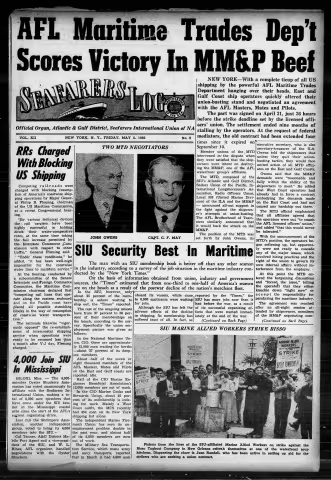
Issue Date
1950-05-05
Volume
12
Issue Number
9
Plaintext
AFL Tindes Dep't
Scores Victory h HH&P Beof
Official Organ, Atlantic & Gulf District, Seafarers International Union of NA
VOL. XII NEW YORK, N. Y., FRIDAY. MAY 5, 1950 No. 9
RRs Charged
With Bio Aing
US Shipping
Competing railroads were
charged with blocking resump
tion of America's coastwise ship
ping operations by Major Gener
al Philip B. Fleming, chairman
of;the US Maritime Commission,
at I a; recent Cbngressioiwl hear
ing. '
, "By., various technical deWees
the rail carriers . haVe been
hii^ly f successful in holding
dbwii 'their watercbmpetitiVe
rates, at the same time taking
the full increase permitted by
the Interstate Commerce JllJom
mission with respect to other
traffic," General Fleming said.
"Under these conditions," he
added, "it has been wellnigh
impossible for the coastwise
water lines to maintain service.
' At "the hearing. Conducted by
a subcommittee of the Senate
Interstate and ̂ Foreign Commerce
Committee, the Maritime Com
mission chaiman declared that
"competing rail lines that ope
rate along the eastern seaboard
bnd on the Pacific coast have
placed all possible stumbling
blocks in. the way of resumption
of coastwise water transporta
tion,"
The railroads likewise "vigor
ously opposed" the reestablish
ihent of intercoastal shipping
service' when operations were
ready to be resumed less ^an
a month after VJ day, Fleming
charged."^
TWO MTD NEGOTIATORS
I NEW YORK—^With a complete tieup of all US
shipping by the powerful AFL Maritime Trades
Department hanging over their heads, East and
Gulf Coast ship operators quickly altered their
unionbusting stand and negotiated an agreement
with the AFL Masters, Mates and Pilots.
The pact was signed on April 21, just ,36 hours
before the strike deadline set by the licensed offi
cers* union. The settlement ended nine months of
stalling by the operators. At the request of federal
mediators, the old contract had been extended four
times since it expired on''
4.m Join m
In Mksissipp!
BILOXI, Miss. — The 4,000
member Oyster Shuckers Asso
ciation has voted unanimously to
. affiliate with the Seafarers In
ternational Union, making a to
tal of 8,000 new members that
have come under the SltJ ban^
rier in the Mississippi : coastal
area since the start of the AFL's
citfrent organizing drive.
Last fall the Shrimpers Assof
dation, another independent
group, voted to bring its 4,000
members into the SIU.
"Cail Tanner, A&G District Mo
bile Port Agent and a vicepresi
dent of the SIU, and W. L.
Hines, AFL organizer, handled
riegotiations with the Oyster
Shuckers.
JOHN OWENS CAJ>T. a F. MAY
September 30.
Member unions of the MTD
intervened in' the dispute when
they were satisfied that the ship
owners were intent on destroy
ing the MM&P, one of the AFL
waterfront group's affiliates.
The MTD, composed of the
SIU's Atlantic and Gulf District,
Sailors Union of the Pacific, In
ternational Longshoremen's As
sociation, Radio Officers Union,
Local 333 (United Marine Divi
sion) of the ILA and the MM&P
• — announced allout support in
the fight against the shipown
er's attempts at unionbusting.
;The AFL Brotherhood of Team
isters similarly announced that
• it . would buck the attack on the
iMM&P.
'The position of the MTD was
set forth by Johfi Owens, its
SIU Security Best In Maritime
The man with an SIU membership book is better off than any other seaman
in the industry, according to a survey of the job situation in the maritime industry con
ducted by the "New York Times."
Orr the basis of information obtained from union^ industry and government
sources, the "Times" estimated that from onethird to onehaif of America's seamen
are on the beach as a result of the postwar decline of the nation's merchant fleet.
In the SIU, however, only®
about 25 percent of the mem
bership is ashore waiting to
ship out, the "Times" reported.
The rest of the seagoing unions
have from 37 percent to 50 per
cent of their memberships on
the beach, according to the sur
vey. Specifically the union em
ployment picture was given as
follows:
In the National Maritime Un
ion, CIO, there are approximate
ly 15,000 men waiting for berths
—about 37 percent of its deep
sea members.
About .half of the seven or
eight thousand members of the
AFL Masters, Mates and Pilots
on the East and Gulf coasts are
reported idle.
Half of the CIO Marine En
gineers Beneficial Association's
2,000 members are out of work.
In the CIO Marine Cooks and
Stewards Union, about 35 per
cent "of its membership is look
ing for work. Mainly a West
Coast outfit; the MCS recently
had 454 mfen on its New York
shipping list alone.
" The independent Marine Fire
men's Union has seen its un
employment problem double in
the past" year, and 'almost half
of its 5,000 members are now
out of work.
liie Military Sea Transporta
tion Service, which mans army
and navy transports, reported
that in March it had 4,600 men
aboard its vessels, while close
to 6,000 applicants were waiting
for jobs.
Although the SIU has felt the
adverse effects of the decline
in shipping, its membership has
suffered least of all. In fact, as
reported by the "Times," the
SIU has more jobs now than it
had before the war, as a result
of its successful organizing ef
forts that were started immed
iately at the end of the war.
(Continued on Back Page)
executive secretary, who is also
secretarytreasurer of the ILA.
Owens told the shipowners that
unless they quit their union
busting tactics, they would face
united action of all MTD affili
ates on the East and Gulf Coasts.
Owens said that the MM&P
demands were "reasonable and
fully within the ability of the
shipowners to meet." He added
that West Coast operators had
already had in force a contract
embodying the demands made
on the East Coast and had not
caused any hardship out there. '
The MTD official emphasized
that all affiliates agreed that
the operators were out "to smash
the AFL licensed officers' union,"
and added "that this would never
be tolerated."
With the announcement of the
MTD's position, the operators be
gan softening up, but apparent
ly were not ready to concede
any of the major issues, which
involved hiring practices and the
right of the union to govern its
own internal affairs without in
terference from the employeri v
At this point the MTD en
tered the bargaining discussion^
and "forced the issue," telling
the operated that they either
knuckle down "right now" or
accept the responsibility for
paralyzing the maritime industry.
The agreement was reached
after an allnight session at
tended by shipowners, members
of the MM&P negotiating com
(Continued on Back Page^
SIU MARINE ALLIED WORKERS STRIKE BISSO
Pickets from the lines of the SIUaifiHaled Marine Allied Workers on strike against the
Bisso Tugboat Company in New Orleans refresh themselves at one of the waterfront soup
kitchens. Dispensing the chovr is Jean RandalL who has been active in setting up aid for the
strikers who are seeking a union contract.
Pag© Two TUB SUA F ARE RS LQQ ]4a^ 5, iaSi>
SEAFARERS LOG
Published Every Other W^ek by the
SEAFARERS INTERNATIONAL UNION
OF NORTH AMERICA
Atlantic an4 Gulf District
..f
Affiliated with the American Federation of Labor
At 51 Beaver Street, New York 4, N. y.
HAnover 22784 • ^
•
Reentered as second class matter August 2, 1949, at the Post
Office in New York, N.Y., under ffie Act of August 24, 1912.
267
I
The Commies Try Again
Give the devil his due—yoti can't discourage the
commies. Like malignant bacteria, they look for, anc
take advantage of, the slightest opening. •
Out on the West Coast 6 maritime unions^2 from
Bridges' longshoremen, the MC&S, the NMU and the
MFOWW (3 commie outfits, one^ possible—the NMU—
and one innocent, the MFOWW) have gotten together,
ostensibly to relieve the unemployment situation in mari
time. Nobody could offer much objection to two of their
demands: increasing unemployment benefits and the es
tablishment of a WPAlike Maritime Works Project.
But the third demand shows the fine hand of the
commies, and once again the , MFOWW seems to have
fallen for the fasttalking commies (How many times
can you get raped!)—immediate trade with Red China.
This last is a small refinement of the current numberone
, commie slogan, immediate recognition and aid to China.
Perhaps resumption of trade with China would help
relieve, although to a small degree only, maritime unem
ployment. But if the comrades were really interested in
promoting foreign trade to help American seamen, then
why do the commies:
1. Oppose the Marshall Plan which is responsible for
more American shipping than 6 Red Chinas would;
2. Oppose the European Arms Aid Program, which is
Beginning to provide jobs for American seamen;
3. Oppose a loan and a trade agreement with Yugo
slavia;
4. Oppose any kind of aid to Franco's Spain, which
p is not any more totalitarian than Russia or Red China?
The answers are obvious enough. The above countries
; are ^nemies of the international communist movement,
and the commies are against any kind of aid to them, al
though the countries in the first twQ categories art!
democracies.
As for Red China, she is Stalin's bastion in the Bast,
and therefore must be built up—especially with capitalist
help—and all of the current communist propaganda is
aimed in this direction.
; V It is no surprise that once again the commies are
trying to use the American labor movement for Stalin's
i purposes. They're in that business. But how is it that the
j MFOWW gets taken in, time and again?
Credit Unions An Answer To Loan Sharks
• . • V .
1^ Main Line Of Defense
fe; Once again the AFL Maritime Trades Department
has demonstrated that it is the most powerful trade union
b^ on the US waterfront.
By effecting a settlement of the long drawnout con
' tract dispute between the East* and Gulf Coast operators
and the AFL Masters, Mates and Pilots, the MTD suc
ceeded in transforming what had been an obvious effort
to smash the licensed officers' union into a sweeping
contract victory for the union.
MTD representatives entered the negotiation sessions
and made the issue clear to the operators: Either quit
stalling and resolve the issues—^which in themselves were
no cause for such protracted talks^—or accept responsibility
for crippling US shipping.
The operators got ^e pitch, talked turkey on the
double and the contract resulted, just 36 hours before
Vthe strike was to have begun.
i" Each succeeding victory scored by the MTD since
its organization three years ago has contributed to its
strength as a stabilizing factor on the waterfront. The
memberships of its affiliated unions can rest ecntent in,
the knowledge that they are not alone against their foes. :viding the member with cash,
A Michigan State College jiro
fesfior bought a car for $1,720
and paid off the loan in less
than 30 days. But when he took
out the loan he was charged
ii210 interest—and got no refund
for the interest paid in advance.
^at kind of auto sales gougr
ing has brought down the wrath
of a special Michigan investigat
ing committee. Up in arms at
gouging practices that, it esti
mates, is costing Michigan car
buyers $25 million annually, the
committee has urged Governor
Williams to take steps to stop
such abuses.
A spotlight of publicity has
been focussed on this amazing
gouging on the part of a rela
tively few auto dealers in Mich
igan. But much less publicity
has been brought on the quiet,
but effective solution to much
of this and other abuse by small
loan operators—financing through
credit unions.
UNIQNIST3 SAVE
For example, the Detroit News
paper Industrial Credit Union,
jvhose membership is open to
both AFL and CIO unionists in
the Detroit newspaper trades, has
saved, its members thousands of
dollars in charges qn consumer
financing, including auto loans.
It does so simply by charging
the member 1 percent a month
on the unpaid balance of his
loan—or the equivalent of $6.50
on each $100 borrowed and re
paid in 12 equal monthly pay
ments.
If the member pays off his
loan ahead of' time, he pays in
terest only on the cuiiuunl he
actually used for exactly the
time he used it. Also, by pro
it enables him to bargain for his
purchases more effectively.
As estimated 50 percent or
more of Michigan's 327 credit
unions—owned and operated *by
church, fraternal, community,
school, farm industrial, govern
ment, utility and cooperative
groups—make auto loans.
Whether they do or not, and
the number of loans made, de
pends on the size ofthe credit
union. But the important thing
is'^that thousands of Michigan
wage earners have ah, easy way
out of the vicious circle of auto
sales gougers—and gougers in
other merchandising lines.
Credit union financing—^which
means saving your money and
borrowing it from yomself and
your associates—^has many extra
ordinary advantages that only
become clear when you realize
you're dealing with yourself.
Theseadvantages help to ex
plain the updeniable fact that
credit uniqns are the nation's
fastest growing type of small
loan operation in the US today.
Credit union financing pro
tects borrowers against trick
clauses and hidden overcharges
which take millions out of their
pockets each year.
And just as iiftportant, most
credit unions also provide loan
protection insurance. This in
sures the life of the borrower
to the amount of the unpaid bal
ance of his loan.
In case" of the borrower's death
all security pledged is released.
No widow or other heir, of co
signer is faced with the obli
gation.
. Nor is the borrower, if ho be
comes permanently disai?led and
the credit union carries, as most
do, the loan protection policy
which covers, disability as well
as life
Both are made available by
the credit unjonowned and con
trolled CUNA Mutual Insurance
Society.
In the, case of the college pro
fessor who started this story,
the $21Q interest he paid on
the $720 loan for less than 30
days, the Detroit News pointed
out, would have amounted tp an
interest rate of 3,088 percent a
year.
No such fantastic interest
charges are possible in credit
union financing. You pay no
set amount of interest or extra
charges. You pay only the ad,
vertised rate, a low percent of
the unpaid balance at "simple,
inter^t."
SIMPLE INTEREST
"Simple interest" is the ac,
tual charge for the use of the
m^uey, as the credit union doe®,
computed op an annual basis.
The Nvwa said the Michigaii
investigating cdmmittee "found
few buyers who understood that
a $10 interest charge on a $100
loan was a 10 percent charge
only if the loan were kept fop
a year, that if it were repaid in
6 months it became a 20 percent
charge."
This type of deception, of
course, is not found in credit
union operations, where there Js
no incentive to cheat.
Protection of this kin^is im
mensely valuable to" borrowers!
who tend to "get mixed up in
hidden clauses, legal phrasing,
etp., and who do not underf
stand finanee teams very. well.
In a credit union there is notk^
ing to conceal and no ^abora^
terms to follow.
r^M E 'SE:AF A RE RS L 0 G
'• m
Pago Three
BEAT TAFTHARTLEYITESy&AYS BINE&
AFL Special Representative Lewis Hines stresses need for
organized labor's participation in Congreerional elections tn
effect r^al of the TaftHartler law in talk at crew^ meeting
aboard the SS Puerto Rico at sea. Labor has been forced
into politics by its enemies, he said.
—photo bp Jim Colder
MHSt Whip TH At Polish
AFL Rep Tells Puerte Rico Crew
The TaftHartley law is the
greatest s i thg 1 e unionbusting
weapon ever placed in the hands
of organized labor's enemies,
Lewis Hines,. special representa
tive of the American Federation
of Labor, declared at a regular
shipboard meeting of the SIU
manned SS Puerto Rico.
To combat the vicioxis TH
law, it is imperative that all la
boring men and women use their
votes to elect.to Congress people
committed to its repeal, Hines
said.
NO CHOrCE
"Labor has been forced into
politics," the AFL representative
explained to the crew meeting,
held April 16, adding that if it
responded wisely, at. the polls,
"labor will have won one of its
most important battles."
Hines, . who was aboard the
Bull Lines ship en route to
Puerto Rico for a study of Island
labor conditions, said that all of
the AFL unions' great strides in
behalf of American workers were
in jeopardy because the TH
law had taken away the closed
shop, restricted picketing and
strike activities and was threat
ening the existence of the hiring
halls.
As a result, he continued, la
bor is at the mercy of the Na
tional Association of Manufac
turers, Wall Street and other
powerful antilabor groups.
Hines was accompanied to the
crew meeting by Harry Weiss,
an official of the United States
Department of Labor, who was
making the trip to Puerto Rico
with him.
Calls For Government AU Ta Tramp Shipping
By CAPT. NICHOLAS MANOLIS
(As Port Captain for the Orion
Steamship Company and a vet
eran of many years' experience
in shipping. Captain Manolis can
be considered an authority on
matters concerning the American
merchant marine. Although he
speaks from the shipowners'
viewpoint, which many times
conflicts with those of maritime
labor; we believe that the read
ers of the LOG will find this a
strong argument for tramp sub
sidies interesting.)
The greatest portionof Ameri
can privately owped tramp ves
sels are wartime built (Liberty
type) which, at present, are on
their way to effective devalua
tion in the international trade.
This is due to the recent de
valuation of currency by the
European maritime nations,
"Which not only devaluated the
operating cost of the ships but
the property as well.
For example, a vessel in the
British market prior to devalua
tion was worth 106,000 pounds
at $4.03 or $403,000; the same
• vessel at the current rate of
exchange, $2.80, is worth drily
$280,000.
GUT government sold the Lib
erties to American 6"wners for
$550,000; the majority of o'wn
ers have worked their ships for
, a period of two years or less,
and during" this period rates
Have sharply declined, making
it impossible for >the owners to
show any gain or profit.
However, their ships are mort
gaged Ify the government. What
"Will happen if tjiese private
fleets are laid up or become idle
due to the strong international
competition?
Will these vessels revert to
the 'government at a complete
loss to the owners, and as a re
sult of which the future of Am
erican shipping^ will be discour
aged?
Are we planning to avoid a
repetition of our past mistakes
which restricted American ship
ping to its coast and intercoastal
waters only?
During World War I, it cost
the United States four billion
dollars to pjurchase and build up
a merchant marine of twenty
million tons. At die end of the
twenties we had only a "20. per
cent active fleet.
During World War II, we spent
twenty billion dollars to build
in a hurry a merchant fleet to
solve the problem "of cmrrying
the goods needed to "win the
wax*.
The greatest portion of this
fleet, 2,030 ships, is laidup in
groups of hundreds' in a few
concentrated rivers and, with the
unsettled world conditions, this
fleet could be scuttled or sabo
taged within a few hours.
This would leave us with no
means of transportation in the
event of an emergency apd little
or rio opportunity. to again build
ships, as our industrial centers
will be the targets of future
conflicts.
The only available transporta
tion at our disposal would be
the ships scattered, at sea and
in ports—or, in other ^ords, the
ships which are in operation and
ready to rriove.
The laidup fleet is maintained
at a tremendous amount of
money and, in an emergency
when needed, it will take in
calculable millions to put them
to sea.
While" we do not want to
monopolize world ocean com
merce, we are entitled to a large
share of it. As a great industrial
nation we can become a great
maritime expert if we properly
organize our industry, keep our
seamen trained, and employ sys
tematically those steamship, com
panies which are building up
their administrative abilities,
and which will benefit thp" fu
ture of our national maritime
interest.
Again, we believe that due to
the progress made by other
maritime nations in the moder
nization of their vessels—^liners
and tramps alike—our govern
ment must adopt a policy of
aiding the differences in cdsts
of operation between American
tramp owners and that of for
eign, thereby enabling our people
to recover their investment and,
at the same time, encourage
them to assume their responsi
bility of shipowners in the con
tinuation of improving their fu
ture. shipping entf^prise with
new tonnage.
For this reason .we believe
that the HR 6719, Assistance to
Tramp Shipping, introduced by
the late Otis S. Bland, should go
before Congress for adoption. If
not, some other means of aid
must be set up by the govern
ment to maintain an active Mer
chant American Fleet. •
After the department delegates
had presented their reports to
the meeting, a motion carried to.
forego regular procedure so that
Hines could address the session.
The AFL guest was introduced
by meeting chairman Edward
Mooney, Ship's Delegate.
GREETINGS
In accepting the floor, Hines
expressed pleasure at the oppor
tunity of attending a shipboard
session. He extended to the crew
the! greetings of William Green,
president of the AFL, which is
now celebrating the 100th anni
versary of the birth of its first
president, Samuel Gompers.
At the conclusion of Hines'
address, the meeting observed
the traditional one minute of
silence in memory of those Uii'
ion members lost at sea, and
then adjourned.
Puerto " Rico crewmembers
have had a number of top AFIi
officials and Government legis
lators present at their shipboard
meetings, among them a Con
gressional conunittee which
visited the islands last Novem
ber for a study similar to that
undertaken by Brother Hines.
LEGISLATORS
Members of the committee,
headed by Rep. John Lesinski,
chairman of the House Commit .
tee on Labor and Education, in
cluded Representatives Augustine
Kelley, Charles Howell, Harold
Velde, Carroll D. Kearns and
general coimsel John Forsythe.
They were accompanied by Wal
ter Mason, AFL legislative rep
resentative.
Upon their return to the States,
the committee members sent let
ters to the Union and the Buli>
Lines, «lauding "the excellent ,
service provided to the passem
gers of the ship by every mem
ber of the ship's company."
.n|
Do You Have Questions On Social Security?
I have Iwo Social Security
numbers. Will having two num
bers aitfeet the benefits payable
to me al 65, or to my survivors
in case of my death?
A worker should have qnly
one Social Security number dyr
ing his liifetime. Tf he loses his
Social Security card, he should
apply for a duplicate. If you
have two different numbers, you
should go tb your nearest So
cial Security office to have one
cancelled' so that both accounts
can be combined. If you do not
have the accouilts cleared in this
manner, it is possible that you^
or, a menriber of .your family
might lose benefits because all
of your credits are not com
bined.
My wife is younger than I am.
Does this mean that I must wait
umil she is 65 " before ' retiring,
so that she can be entitled to
wife's benefits on my account? *
No. You may retire at age 65.
If your wife is" not 65 at the
time, she must wait until she is
age 65 before she can draw her
own bbnefit. Remember that this
beneflt does not come automatic
ally—she must file claim when
she reaches age 65.
If I die before I am age 65,
insured under Social Security,
and if my wife gets a lump sum.
does this mean that my account
is closed tmd no future benefits
Lrv peysbla?
There are many misconceptions, misunderstandings
and "just plain notrknowing as far as the provisions of
the Social Security Act are concerned. This article at
tempts to clear up some of the questions most fre
quently asked. Brothers who have other questions as to
ben^s, eligibility, etc., are urged to send them in to
the LOG, and we. will get the straight dope from the
experts of the Social Security Administration, who also
answered the following inquiries.
" No. If at the time of your
death your wife is under dge
65, and you left no minor chil
dren in her care she gets a
lump sum. If she doesn't re
marry, she can be entitled to
monthly benefits at age 65, if
she files an application at that
time.
I have worked in employment
covwed by the Social Security
Act since it started. How can I
find out how much could be pay
able on my account al the pres
ent time? I am nearly 65.
' You can obtain a statement
of your account .by getting a
postcard from the local Security
office. Fill in the card and mail
it. It is addressed to the Ac
counting Office of the Social Se
curity Administration. When
you receive the statement, take
it to the local office, and they
vrillfigure yoUr benefit and an
swer all of ybur questions.
1 Worked tor the firsi three
years after Social Security went
into effect in employment cov
ered by the law and then started
a business for myself. ̂ Last year
I returned to Social Security em
ploymenl. Do I lose the credits
I eamed those first three years?
No. All employment that you
Have had under Social Security
remains credited to youi" ac
count.
Last year I paid Social Se
curity tax on an income of over
$3,000, eamed from two sep
arate employers. Since the law
states that I can receive credit
for only the first $3,000 of in
come in any one calendar year,
do I have the right to request a
rebate of the tax overpaid?
Yes, you can secure a claim
Form SF843 and SS9a from the
local United States Collector of
Internal Revenue Office. The
Collector's office will assistyou
in completing yqur claim so that
you ^might obtain the refund.
These claims should be filed im
mediately at the end of each
year.
My father retired from em
ployment covered by the Social
Security Law in 1945. after he
became age 65. Since that time
he has worked in employment
not covered by the law. He
works as a caretaker of a church.
He has never filed for Social
Security benefits. Is he entitled'
to such benefits?
He should visit the local So
cial Security Off.ice immediately.
If they find that he is insured
under Social Security, they will
advise him to file a claim. Since
he no longer works in"*a job cov
ered by Social Security, ..he may
draw benefits regardless of the
size of his income from his pres
ent employment. Since the bene i
fits are only retroactive for three
months, he may have lost a con
siderable amount of benefits b#»
cause he did not file in 1945. ' 1
' How old must a person be :
before he can get a Social Se!* ^
curity Number?
There is no age limitation. It
you work in employment cover
ed by Social Security you must "
have a number. The State De "
partment of Labor regulates em
ployment ages for different types "
of jobs. Each state has its own,
laws in,this respect.
Page Four THE SEAF ARE RS LOG Friday, May 5, 195P
li K'
a;
"i!
'f
4 Cities Serviee
tankers Payoff
In Boston Area
By BEN LAWSON
BOSTON—Among the payoffs
in this area during the past two
weeks were four Cities Service
tknkers.
The vessels and the points of
payoff were the SS Council
Grove, in Portland, Maine; the
SS Archers Hope, in Providence,
and the SS Cantigny and SS
Lone Jack in Boston.
Other payoffs were the SS Ann
: Marie, Bull Lines, and SS W. E.
' Downing, States Fuel.
The Lone Jack and Council
Grove signed on again. Other ac
tivity in the port included in
transit calls by the SS Steel
Worker, SS Steel Seafarer, Isth
mian; SS Kyska and SS Azalea
City, Waterman.
Everything went smoothly
aboard these ships, except for a
couple of overtime disputes on
the Steel Seafarer and a few
Brothers who thought/they could
gas it up all theywanted to in
port and not turn to. All these
men have to do now is tell their
troubles to a trial committee.
The overtime dispute will be
handled at the payoff port.
There are a couple of hundred
men on the beach up here, but
we still had to send to New
York for about 20 men in the
past two weeks. With the Yar
mouth and the Evangeline tak
ing over 200 guys, and the sum
mer boats getting under way
soon, shipping should be good iri
these parts.
In fact, we are hoping that
things will begin to hum in
about two weeks.
'A Constmt Sonne Of Comfort'
5 Ships InTrapsit,
But Only One Payoff
For Port Savannah
By E. M. BRYANT
SAVANNAH—South Atlantic's
p, SS Southstar paid off and sign
|l||/ ed on here last week after a few
beefs had been straightened out
in SIU style.
Among the.beefs settled were
some disputed overtime and a
matter of coffee supplyf which
the eorupany agreed to increase.
^ Intransit ships calling here
were the Ala^i, Topa Topa,
Waterman; JeaiC Inez, Bull, and
the Hawaiian, a Matson ship
contracted to the SUP.
The crew of the Southstar do
nated. 38 dollars to the SEA
FARERS LOG.
LOSSES
A couple of SIU Brothers in
this port had, some tough luck
last weekf C. W. Thompson's
mother died in Jacksonville and
C. (Buddy) Reynolds' sister died
in Savannah. Wreaths were sent
to the funerals by the Union.
Among those waiting to ship
at present are Brothers R.
Gt^es, R.; Bennett, M. Wick
ham and W. C. Sanders.
The Teamsters Union has re^
guested all unions to ask their
members not to use Garden City
^ taxis in^ Savannah. This outfit
is still gjving the cab drivers
local 'a runaround on their de
mand for a contract.
The Patrolman and myself are
planning to hire ourselves out
to the farmers as rainmakers.
We have a new method. All we
P?? ' do is prepare to go fishing and
^ J—bingo,' there's a cloudburst.
UNION OF CARE EMPIOYEES
30 KMB snnr, mw YMK I, H. T.
. >
AprU 12, 1950
Mr. Paul Hall, Secretary
Seaferera International Union - A.F.of Jlu
51 Baaver.St.
New York, N.I. - _ .
Dear Sir and Brother:
Ve would like to inform you that at the last meeting of the Union of
CABE Enployees, the membership voted to use the facilities of Sdiwartz'a
Restaurant in the future as the permanent meeting place for our Union.
Vhile we are of course pleased to have reached this stage of financial
self-assurance, we have not forgotten that the assistance we received
from fellow-unionists, notably from S.I.U., helped make this possible.
The Officers and membership Join me, at this time, in offering our sin-
cerest thanks to S.I.D. for the countless services you have rendered us
during almost three years of our existence. Ve recall with gratitude
that in the initial stages of our developement, the knowledge that we
could always rely upon your cooperation, was a constant scource of com-
fort to us. It was this spirit of fraternal good-will that we drew .upon
to help us build a good Union in the idilte collar field. Ve think you
will be interested to know that we have Just concluded negotiations on*
our third and best contract.
Vhile we know full well that we can never repay you for all the consir
derations, both moral and material, idiich you have shown us through
these years, we would, with deepest humility, welcome any opportunity
to be of future service to you.
Fraternally Yours
Sonia Alloy '
Secretaiy, U.C.E.
Log Subscribers
Readers notifying the SEA
FARERS LOG of a change in
mailing address are re
quested to indude their old
address along with the new.
In addition to making eader
the switchover It wiU also
guarantee imintemipted
mailing service.
All notifications of change
of addres^ should be ad
dressed to the EdUor. SEA
FARERS LOG. 51 Beaver
Street. New York 4. N. Y.
Discovered Early,
Cancer is Curable
While advanced cancer is near
ly always fatal, early cancer is
one of the most curable of all
diseases, says the New York City
Cancer Committee.
Thus, cancer control starts
with the individual. Every man
and woman should have a com
plete physical examination each
year. Women over 40 should be
examined twice a year.
Most importantly, every person
should learn to recognize the
seven danger signals that may
mean cancer. See your doctor if
any of these signs appear:
(1) Any sore that does not
heal;
(2) A lump or thickening in
the breast or elsewhere;
(3) Unusual bleeding or dis
charge;
(4) Any change in a wart or
mole;
. (5) Persistent indigestion
difficulty in swallowing;
(6)' Persistent /hoarseness
cough;
(7) Any change in normal
bowel habifs. .
Ueuf Ywk Shying Hits low.
But Hopes ^ BmA Pkk-Hp
By JOE ALGINA
or
or
NEW YORK—The props were
knocked from under this port's
activity the past couple of weeks
and shipping dropped to a low
for the year. We're not making
any predictions for the coming
weeks; we'd rather wait and let
the shipping figures give the cor
rect picture. But we're hoping
for the better, of course.
Getting down to the scows,
here are the ships that paid oij;
Kathryn, Puerto ̂ ico, Beatrice,
Mae and Elizabeth, Bull; Steel
Surveyor and Steel Seafarer,
Isthmian; Fairland, Claiborne
and J. B. Waterman, Waterman;
Algonquin Victory, St. Lawrence
fJavigation; i c h a e Is, Carras;
Marymar, Calrhar; Lake George,
US Petroleum, and the Seatrains
Texas, Havana and New Jersey.
SIGNONS
Signing on were tfie Elly, Sea
traders; Choctaw, Waterman;
Steel Worker, Isthmian; Robin
Wentley, Seas; Algonquin Vic
tory, Lake George, Michaels,
Steel Seafarer and the Seatrain
and Bull Lines ships that were
on coastwise.
That brings us to unemploy
ment insurance about which we
have a., bit of advice for those
men who are, about to file for
benefits. It is advisable to keep
your payoff slips andto carry
them with you when you go to
the unemployment insurance of
fice to sign up for the weekly
insurance payments.
In this way you'll have a )cec
ord of your earnings on you and
won't' haW to dah all around
town trying to find out this in
foi;mation and thereby possibly
causing delay in getting yovir
checks.
Speaking of keeping things of
yalue, let's remember to hold on
to our Union books as though
they meant everything that they
represent.
The Union book is your living
• hold on to it. If some guys
lost their seamen's papers as of
ten_ as they have their Union
books they'd spend 10 years
waiting around before getting
things lined up so they could
ship out.
Pqit Baltimore
No Longer Haven
For Job Seekers
By WILLIAM (Ctirly) RENTZ
BALTIMORE — Men are com
ing into Baltimore from other
ports in the mistaken idea that
shipping is better here at the
moment than it is elsewhere.
Normally, Baltimore is a good
port but it has been affected by
the decline in the industry's ac
tivities. • /
This past week things were
quiet and although we^ expect a
slight improvement dining the
coming two weeks, due to sched
uled Ore Line payoffs, we don't
look for anything near what is
necessary to relieve the situation.
PAYOFFS
Payoffs during the past period
were the Evelyn, Bethore, Steel
Fabricator, Ponce deLeon, Bull
Run, Cubore, and Robin Went
ley. ,
Signing rn were the Bethore,
Cubore, Marore and Fimore. In
addition to these vessels, the fol
lowing called at the port on in
transit status: Thomas Sim Lee,
Chickasaw, Algonquin Victory,
Robin Kettering, Seamar, Steel
Designer, Jean La Fitte, Edith,
Angelina, Steel Worker, Carolyn,
Antinous and the Government
Camp,
In view of the current ship
ping situation, a word of advice:
If anyone wants to come to Bal
timore to ship, he should make
sure he can afford a stretch on
the beach. It may be a little
while before he can ship out.
In fact, the smart thing to do
is to stay as near to home as
you can until better shipping
sets in.
MM&P BEEF
The SIU here in the. Port of
Baltimore was geared and ready
to go, as were the rest of the
AFL Maritime Trade Department
affiliates, if the Masters, Mates
and Pilots beef hadn't been set
tled.
The victory of the MM&P in
getting a good contract is a
tribute to the typo of support
they received from the MTD
unions. The Baltimore local of
the MM&P, through its represen
tatives, thanked the SIU mem
bership personally at our last
regular meeting for the splendid
and effective backing they gave
throughout the dispute.
f
How To Kill A Union
1. Stay aw^y from your meetings by all means.
2. If and when you do go;; be sure to come in late
and mumble about what's already taken place be
fore your arrival. , ^
3 Kick and howl if you aren't appointed on Commit
tees, but if "the buck is passed to you," then re
fuse to serve.
4. Don't contribute anything except malicious criti
cism when asked for your ̂ opinion on an issue.
Don't get "rooked" in on any, work details. *
Complain constantly about those who DO the
work, pointing out that your union is run by a
"clique."
Never discuss the functions of your union until
you need its help.
8. Accuse active members of being "office seekers."
9. Look for soreheads with whom you can join in an
effort to create dimnslon.
0. Lag behind in . your dnek until threatened with sus
pension, then declare you are discriminated agaihst;
—(Kentucky Labor Journal)
5.
8.
7.
Fridiy. May^. 19S0 - T H E SE AF ARE RS LO G Fdg» Ftye
The Seafarers In World War II
.. ./
By JOHN BUNKER
The Russian Run
Chapter 5
As long as men who sailed in World War II
still go to sea, there will be told stirring tales of
the Russian run—the long, cold, hazardous voy
age to Murmansk and the ports of the White Sea,
Close to 350 American ships made the run to
Russia with bombs, guns, tanks, ammunition,
gasoline, beans, bandages, dried eggs, sugar,
shoes, grain, and even gin for the big brass.
Up to March of 1943, 32 American ships out
of 143 setting out for the Barents Sea had been
lost. Many of these, and not a few of those lost
later, were manned by men of the SIU, for the
number of ships crewed by Seafarers on the
legendary run to Russia was'almost legion; _
. Greatest danger on this northern voyage camb
when the" convoys approached North Cape, the
Arctic tip of Scandinavia, which posed the last
great hurdle before they reached their destina
tion on the upper rim of the world.
Some convoys delivered their cargoes without
loss, but most of them saw action from planes^
subs, and Nazi surface craft. Added to this were
the natural hazards of bitter cold," storms, ice
and fog.
Nearly every ship setting out for Russia was
given a load pf explosives to carry: anywhere
froin several hundred to a thousand tons. It was
"sudden death" that could—and more than once
did—send ship and crew to kingdomcome in a
sudden fearful roar.
Seamen in convoy PQ18, which included the
Schoharie, Virginia Dare, William Moultrie, and
other SIU sliips, will never forget the end of the
freighter Mary Luckenbach.
WIPED OFF THE SEA
During a heavy air attack^ a torpedo bomber
either crashed on her deck or dropped its tor
pedo like a bomb. No one cAn ever tell exactly
what happened, for the ve^el was completely
obliterated.
When the TOliam Moultrie steamed over the
spot (she was in column behind the Luckenbach)
crewmen could not spot a single bit of wreck
age from theunfortunate vessel — not even a
board or a shattered piece of liferaft.
The Skipper of the nearby freighter St. Olaf
entered in his log that the Mary Luckenbach
"flew into a million parts. like a giant hand
grenade."
Following the famous "Fourth of July" convoy
— which was decimated by planes and subs
when deserted by its escort—convoy PQ18 was
heavily protected, but still had to fight its way
through to the White Sea. ^
Of 40 merchant ships in this convoy, 13 were
sunk in bitter attacks that included as many as
40 torpedo bombers at one ̂ time, and which
lasted even to tbe moment the fleet arrived in
Archangel. "
Sailing the "road to Russia" was frequently
quite exasperating to crews whose ships either
sat at anchor for weary, uneventful weeks, or
weiit wandering around over the ocean as though
there was not the least hurry about delivery for
their cargoes of war.
BEAUREGARD TAKER THE "ROAD"
Captain William Patterson and his SIU crew
took the Waterman Company's SS Beauregard,
out of New York for Halifax on May 1, 1942,
joining an eightknot convoy from there to Hull,
England, where the cargo was taken out and
the ship reloaded with tanks and other equip
Tnent for which .the ;|ussians "were said to be in
desperate' and urgent need.
By September, the Beauregard was in Lock
Ewe, Scotland. Then to Glasgow for some re
pairs. After that to Belfast, where the crew were
Authors Acknowledgement
The writer was greatly assisted in obtaining
the facts concerning many of the incidents in
this war story of the SlU through the coopera
tion of Captain W. N. Mansfield of the Office of
Naval Operations, War Records Section; and to
Captain Frank Rusk of the Records and Awards
Division of the US Maritime Commission^ both
in Washington, D.C. They kindly allowed the
writer to refer to official fil^s to check the his
tory of many of these ships.
surprised to meet 12 other ships of the original
group with which they had left the States. To
Russia now? Not at all, for the dispatch of ships
in those days was not so simple as all that.
It was nowthe middle of October, and during
the next eight weeks the tired old Beauregard
was sent, in turn, to Kirkwall, the Firth o' Forth,
and Edinburgh, where the outmoded tanks were
taken off and replaced with newer models.
Sailing for Russia at long last, the ship ar
rived in Murmansk on Christmas Day, and then
on for a month the crew sweated out 130 air
raids, shooting down one Nazi bomber with a
rocket gun.
BACK AFTER 11 MONTHS
The Beauregard returned to the States just
one month shor/of a yearlong trip.
Other SrU ships, like the Schoharie and the
Gateway City, wasted weeks in cruising between
Scotland and Iceland, or laying idle at Reykjavik.
The Gateway City rode at her anchor chain
for 107 days in Iceland while the crew, who
were forbidden to go ashore lest they divulge
matters of "military importance" to JVxis spies,
made skiffs out of dunnage and paddled around
to other ships in the harbor, including the
Russians.
The "Russkies" liked checkers and chess, mid
the men from the Gateway City answered many
challenges from the Russian crewmen (and wo^
men).
I',
On those ships in the 1942 convoys which had '
guncrews, the Navy personnel was seldom more |
than ten or twelve men at the most, and their
armament was usually of popgun caliber. ,{
The SlUmanned Alcoa Banner sailed to Rus ; »
sia in convoy PQ16, being defended by a pro •
digious battery of five .30caliber machine guns
and a Navy guncrew of two men!
This convoy had plenty of use for guns, too,
for it was attacked 25 times en route from Ice
land. Among the ships it lost was the SIU. :
crewed Alamar, sunk about the same time as the ^
SS Syros, which blew up when a torpedo nosed
into its load of TNT. ^
MASSMAR HITS MINE
En route back from Russia, the Massmar
(SIU) struck a mine, along with the John Ran
dolph and the Heffron. Men of this convoy will
always be grateful for the heroic work of the
French corvette Roselys, which rescued 180 men
from sinking ships.
There were many other SIU ships omthe run
to Russia—ships like lihe Alcoa Rambler, Alcoa
Cadet, Topa Topa and the old Bayou Chico—
which saw action aplenty, but it is not ^(ossible
here to do honor to them all, though they aH
richly deserve to be equally well remembered._
Whatever the ship, their crews shared alike
the hazards of this Arctic run and, while 1942
was the peak year for los.ses in ships and men,
there were casualties right up into 1945, with
some of the heaviest attacks being launched by
the Germans in this last year of the war.
The return trip from Russia was hardly less
arduous than the run north; for a sunk ship,
as far as the Nazis were concerned, meant one
less bottom for supplying the Russians, and they
let no opportunities go by to bag ships home
ward bound from the White Sea.
Such was the fate of the SS Puerto Rican
(SIUSUP), which had delivered her freight and
was headed back for Iceland early in 1943, with
3,500 tons of ore under hatches.
She lost the convoy in a violent storm on
(Continued on Page Iff)
"4'
Numbed by the freezing, stormy sea, two survivors of a torpedoed US transport are saved
from sure death by the speedy arrival of the Coast Guard cutter Bibb. The transpoii. the for
mer liner Henry'R. Mallory, was sunk on route to Iceland early in 1943 by a Nazi Uboat.
JHore than 300 seamen and troops were lost. . .
!v"'^''';j'?^'''^ '• • 'f''^
|::''• 1P^ijpl Six '4' • T H E S E A F'A R E R S LOG Fr?day. May 5, 1950
AMDMSWS
FastMoving Recorder Crew
Pulls Officer From Red Sea
Thanks to the lightninglike response of the Steel
^ Recorder's SIU crew to the cry of "man overboard," the
Isthmian vessel's Junior Third Engineer is alive and kicking
tcK^ay. The lifesaving episodet
SEAFARERARTIST AND HIS CANVAS
occurred on March 22 in the
Red Sea en route to Bombay,
. according to Seafarer Dick Cum
mings.
Here's the story as Brother
Cummings reconstructed it in a
letter to the LOG forwarded
from Calcutta on April 8:
: Thursday,. March 22, started
out to be just another day aboard
If
ISfe*
Lifeboat returns to Steel
Ip; Recorder with rescued officer;
the SS Steel Recorder, as she
was cruising through the Red
Sea on her way to Bombay and
ports east.
ON THE JOB
The Deck Gang was busy over
hauling gear and putting the
ship in firstclass shape; the
Bladk Gang men were doing
their jobs with quiet efficiency
and the Stewards Department
was just finishing up its morn
ing round of duties.
Suddenly and dramatically
from midships on the boat deck
came the cry only too well
known to many sailors: "Man
overboard!"
Seemingly with the speed of
light the whole shipboard pic
ture changed. Werk was stopped
immediately, tools were dropped
and from all parts of the ship
SIU crewmen raced for the life
boats on the leeward side, tossing
several lifebuoys over the side
as they went.
BOAT MANNED
The Deck Gang manned the
boat commanded by Chief Offi
cer Cornwell. Others stood by to
lower the boat into the water
and the rest of the men poster
themselves at vantage points to
spot the victim.
Bill Weise of the Stewards De
partment sighted the man, who
turned out to be the Junior Third
Engineer, and reported to the
Captain. The ship was swung
around quickly and brought to
a position from which the res
cue boat was lowered.
After a short, hard pull, the
Junior was reached, He was
hauled into the boat, which was
then rowed back to the ship's
side and hoisted aboard.
SPEEDY PERFORMANCE
Captain Walsh complimented
the crew for a job well done. He
revealed that the rescue, from
the time of the first cry of "man
overboard" to. the moment he
was picked up, totalled but 18
minutes. The speedy, action was
especially impressive in view of
the choppy seas and the strong
wind that prevailed.
The Skipper then declared the
rest of the day to he'a holiday
and the good ship Steel Recordei
again headed for Bombay and
ports east.
Commented Brother Cum
mings: "The saga wound up with
a happy ending in more ways
than one."
To pass; time {dx>ard ship Brother Bob Neidemeyer does
what comes! naturally—painting with oils. Above he shows
one of his latest efforts, done while he was a crewmember
on an SIU ship. It's a scene of a farm in Germany. Bob has
hed no formal art training.
VoUe Of DL Sea
By "SALTY DJCK'
Milton Mailho is wellknown in the Gulf, but not
by his proper name. All the boys call him "Rags." He was
so nicknamed because he made a trip around the world
with one pair of pants. But tog—^ 1—^
day he travels with an assort
ment of suits.
In the near future you may
see a new product in Rio de
Janeiro put out by a ~ former
SIU seaman. More details on
this later. . . . The New Orleans
Branch has a butterfly picture
(second largest in the world) on
the third deck. It was donated
by the Del Norte crew. ... If
you must buy a wrist watch or
a camera, get it at Curacao.
Prank Bachot once owned a
bakery but he loved the sea so
miich he turneU over the busi
ness to his son. . . . "Dad's Book
Store" at 1026 Louisiana Ave.,
New Orleans, is owned by a
former Seafarer.
SS Jackson Crew
Favors Voluntary
Vacation Rule
Crewmembers of the SS Stone
wall Jackson have drafted a
resolution favoring voluntary
resignation by men who have
put in one year aboard con
tracted ships.
The resolution, drawn up by
Robert High, John Cantrell and
Jerry Palmer, was .offered for*
consideration by the Headquar
ters Committee in drafting the
final ballot,on the question of a
vacation rule, and is reported
to represent the sentiments of
the majority of the Jackson
crew.
. RESOLUTION
Text of the resolution follows:
Whereas: The American ship..;
ping industry has diminished ;
since the close of World War ll
and from all present indications
it appears that the policy of the
government bureaus, especially
the Maritime Commission, tends
to point to a smaller merchant
marine, and
Whereas: It has been the poli
cy of the SIU to maintain Union
security, which, in reality, is job
security, and
Whereas:* This course of ac
tion will continue to warrant
job assurance for all, and
Whereas: Continuous seatime
on the same vessel in excess of
one year may tend to deter a
man from his full responsibility
in the enforcement of his Union
contract; and realizing a Union'? ,
strength is entirely dependent
upon its weUinformed militant. '
membership; then to insure a
better balanced organization, •
Therefore, Be It Resolved:
Tliat every man who has a vaca
tion due him under SIU General
'Contract, voluntarily quit the
vessel and accept vacation pay.
Crew of the rescue boat gathers on deck after completing
task. Front row, left to right: R. H. Bunes, AB; J. Dimas, AB;
R. Kanuniski DM; rear: E. Mabee, OS; S. Birkland, AB;
Burton, Wiper; C. Umtieet, AB; T. Banning. DM; R. Cum
mings, Carpenter, and Cpmwell. Chief Mate. Photos submitted
by E. Sims and Barnes.
Crew Meetings In Full Swing On CS Ships
Cities Service crewmen are taking full advantage of their contractuallyguar
anteed right to independent, democratic discussions "and decisions involving their ship
board welfare. As a result, min$
utes of crew meetings aboard
the company's tankers are reach
ing the LOG office regularly.
The proceedings give evidence
of the responsibility typical of
alert and competent Union crews.
On the SS Government Camp,
for instance, the minutes of the
April 9 session, chaired by G.
M. Kotsomitis, and recorded by
D. Boza,xsaid that the delegates
reported no disputes and "all
departments rtmning smooth."
For the benefit of newer SIU
members. Union shipping rules
and the drawing up of agendas
for ship's meetings was discussed.
Also discussed were the Union
procedures in handling beefs at
sea and ashore.
It wias suggested at the meet
ing that repair lists be dmwn
up by the department delegates
and submitted to the Ship's
Delegate for proper action. Bro
ther Kotsomitis was elected as
representative of the Govern
ment Camp's unlicensed person
nel.
At the April 15 shipboard
meeting aboard the SS Bradford
Island, the crew held elections
for the delegates jobs, with the
following men being designated:
Erben Scott, Deck; Mike Lenches,
Steward; Peter Walsh, Engine,
and Cleveland Farnham, Ship's.
Among the motions carried at
the meeting were one offered .by
Air and seconded by Walsh that
a tencent fine be" imposed on
men failing to comply with
courtesy regulations in the crew's
mess. Proceeds from the fines, it
was agreed, would go into the
ship's fund and thence to hospi
talized men in Marine Hospitals
at point of discharge.
The Bradford Island meeting
closed with a suggestion from
Brother Walsh that men return
ing from shore leave show con
sideration for those asleep by
entering the foc'sle quietly.
Chris Keller, is taking a rest
after, a yearlong Persian Gulf
trip on the. Cities Service
tanker French Creek. On
learning of the SIU contract.
Keller said his almost three
years on CS ships proved
worthwhile.
Friday. May 5, 1950 THE SEAFARERS LOG Page Seven
Digested Minutes Of SiU Ship Meetings
YOUNG AMERICA. Feb. 12—
George Sorenson. Chairman;
George Johnson. Secretary. Mo
tion carried that matter of ad
ditional storeroom space for
Stewards Department he left
fully in the hands of the board
ing Patrolman. Discussion helc
on effects of Trotskyites. in our
Union and it was pointed out
that it is bad to have small
cliques in a Union whose mem
bership is pledged to stand and
act together for the best welfare
of the organization. Ship's Fund
recommended but no action ta
• ken.
t t 4
MANKATO VICTORY. (No
date) — A n g e 1 o Cinquerana.
. Chairman; Sylvester Zygarow
aky. Secretary. Ship's Delegate
. reported that all beefs had been
settled to crew's satisfaction. De
partment delegates reported./
Brother Stone suggested that all
painting be done by Deck men.
Hill suggested that we see Cap
tain about getting foc'sles paint
ed this trip. All hands cautioned
to see sailing board before going
ashore and fulfilling agreement
by returning one hour before
sailing time.
» » »
STEEL WORKER. Feb. 20—
W. Borreson; Chairman; J. be
Poo. Secretary. Ship's Delegate
reported that icfeboxes were
dirty; everything in other de
partments okay. Motion carried
that Steward see that iceboxes
are cleaned and kept'that way.
Steward to make menus and
Chief Cook to abide by them:
Under Education, Union pamph
lets on "Charges" and Depart
mental Delegates Duties" Were
read and discussed.
t X 9.
ROBIN KETTERING. Feb. 20
—Elbert Hoggei. Chairman; John
Tilley. Secretary. Delegates' re
ports: Larry Laronde. Deck, said
his department was running
smoothly, except for 10 hours
OT to be turned over to Patrol
man; Bame]^ Speegle. Engine,
said a couple of men had missed
watches and that it will be re
^rted to Patrolman; Stanley
Cooper. Stewards, reported
smooth sailing; Harry Willough
by. Ship's Delegate said no beefs
had been reported to him. Wil
loughby resigned and John Til
ley was elected to succeed him.
Motion carried to turn report of
men missing watches over to
Patrolman., Members reminded
to return all excess linen for in
ventory before returniiig to
states.
Tucker discussed possibility of
getting decks painted in crew's
quarters and passageways. (Has
since been accomplished). Rigby
asks more cooperation in keep
ing heads tidy. Member asked
for discussion on Trotskyites.
James Tucker, well versed m la
bor movement, who ran for Un
ion office in last election, spoke.
He said there was no need for
pressure groups or cliques in
SIU. He asked for resolution
condeming such groups. Lively
discussion followed and resolu
tion was adopted unanimously.
Crew purchased new washing
machine and sent bill of sale to
New Orleans Hall for safe keep
ing in case ship is ^aid up.
ALGONQUIN VICTORY. Feb.
19 — E. Mulford. Chairman; R.
Cantor. Secretary. Delegates re
ported no beefs, with aU book
members aboard. Discussion on
code and unions. Information
posted on bulletin board • for
crewmen to study. Discussion on
period a man should be allowed
to stay aboard ship. Twothirds
of crew voted against setting
time limit. Motion carried to con
tinue discussion and count of
men showed 12 men were against
rule, four favored it and four
had no definite opinion.
Bulletin sent out by LOG and
which has been reaching ship
regularly at Port Said.
i t X
WILLIAM H. CARRUTH. Feb.
26 — Gillis. Chainnan; Hansen.
Secretary. Department delegate/
reported everything okay except
for a few overtime beefs. Mo
tion (by Pinkowski. seconded by
Moss) carried that repair list be
posted in recreation hall. Discus
sion on laundry. Matter was re
ferred to repair list."
XXX
MOTHER M. L., Feb. 26—Er
nie Maytield. Chairman; Dick
Lyon. Secretary. Delegates re
ported no beefs in any of the
departments. Radiogram sent to
Headquarters announcing unan
imous vote favoring ouster of
Trotskyites and commie splinter
groups from SIU. Headquarters
and New Orleans Branch inform
ed of difficulties in obtaining
payment of penalty cargo and
area bonuses. Repair list to be
posted. '
B
XXX
SEAMAR. Mar. 12iT. Clough.
Chairman; Roy Lundquist..Secre
tary. Motion carried that case of
crewmember who has been abu
sive to Union men be referred to
I New York Hall upon arrival.
I j^otion (by Cavender) that Deck
I and Engine departments clean
I recreation room for remainder of
this trip and that next trip all
I departments alternate at the job.
XXX
DEL SANTOS. Feb. 15—James
I Tucker. Chairman; Charles Frey.
Secretary. Dave Ramsey elected
Ship's Delegate by acclamatioh.
XXX
STEEL VOYAQEa Feb. 19—
E. A. MarteU. Chairman; T. Mc
Gann. Secretary. Resolution on
rest periods was read, also Ar
ticle 2, Seption 35 of contract.
After much discussion, motion
carried that this resolution be
signed and forwarded to head
quarters for presentation at all
shoreside meetings. Under Edu
cation, the booklet "How to Con
duct A Meeting Shipboard and
Ashore" was read knd discussed.
XXX
TRINITY. Feb. 18—J. Ander
son. Chairman; P. Piascik. Secre
tary. Ship's Delegate said $10.25
was in ships fund. Discussed
case of Brother Collins who had
been hurt. Motion carried to
send letter to Collins' mother,
and to appoint department dele
gates to act as committee to
handle . contributions rnade
fund tor Brother Collins.
XXX
PETROLITE. Feb^ 22 —
Perez. Chairman; H. Rosenstiel.
Sec;;^ary. Ship's Delegate re
port^ that Captain would hire
only Americans when available
for replacements. No beefs in
any of the departments. Discus
sion on First Assistant spending
coffee time in crew's mess. Crew
voiced appreciation of Overseas
to
V.
XXX
ARLYN. Feb. 12—Bill Mackin.
Chairman; J. (Lonnie) Lonski.
Secretary. No beefs. Motions car
ried: To make three copies of
repair list for Patrolman, Master
and department delegate; to get
popup toaster and replace re
frigerator; to have departments
share in cleaning laundry, with
delegates to make up schedule.
Ed Bayne elected Ship's Dele
gate. Discussion on food under
Good and Welfare.
XXX'
BETHORE. Feb. 19—S. Fuller.
Chairman; Robert Atmore, Sec
retary. No beefs. Motion carried
to accept Ship's Delegate's resig
nation and that no election be
held until new crew boards ves
sel. Under CJood and Welfare
several members blew their tops
about the food situation, a re
quest for a messhall clock was
made and it was recommended
that keys be made for the
foc'sle.
XXX
CUSORE. Feb. 13—J. V. Bis
sonnet. Chairman: W. A. House.
Secretary. Delegates reported no
beefs. Motion carried to find out
if ship called Union for two
Wipers last trip and if call was
made for AB this trip. W. M.
Fields discussed history of the
SIU and the hard fights it h^s
waged to attain our present
wage, living and working condi
tions. He stressed fact that all
hands should bring up beefs at
shipboard and shoreside meet
ings, rather than gripe about
them in nonunion atmospheres.
Old book rnembers were remind
ed of their responsibility to
teach new members to be good
Union men.
YOU APf eUGlBLE FOR UMEMPZbVMEA/T
INSUfWCE, RB3l9TtR IVITH THE UNB^APLO^
AiE^lT OFFIGE AS SooN AS HIT THe BEACH,
SO, IF JOBS ARE" SLOW /N COAHN& YOO WCW Y
30, OOIHS HOURSELF OUTOF^^OAJBY TO
WHICH you ARE £HTl TlEV. ^
X X X ^
DEL SUD. Feb. 19 —Leonard
Munna, Chairman; George Mc
FaU, Secretary. Ship's delegate
reported that Captain likes
cleanliness of ship. Delegates re
ported on contributions received
for March of Dimes. Motions
carried: that we spend $75 on
baseball Equipment; that wash
ing machine be repaired as soon
as possible; that we purchase
SIU film and obtain all SIU
litei'ature.
The newspapers stated that the communists had a miserable
May Day parade here in New York. The only thing these comic
rats didn't show parading was all of their disrupters of maritime
unions. Truth is, communist troubles in or against maritime unions
are almost entirely eXtinct—but still dangerous. . . . Flash Newft^
Brother Don Rundblad's buddy. Ken Beckerich, who is aboard
the Seatrain New Jersey right now, is shaping up his paUettes,
brushes and paints for the wall mural he's going to paint in Jack
Parker's place, the "Sea Hawk'" down in New Orleans. Good
luck. Ken. . . . Brother Don Smith, , who says he "hasn't seen his
shipmates Ozzie Okray and Leo Siarkowski for some tihie, is here
in New York. . . . A1 Lopez, who has been on the New York
beach for some time, is waiting for that good old Germany ixm.
. , Steve Pitiak left this town for the West Coast. . . . John
Calhoun is down in Mobile and right on top of the shipping
list, we're informed.
% X . X
Brother Ray Kaiser, who has been hospitalized, writes
that he is now Jn the port" of Savannah. . . . Brother Albert
Fields is one of the guys here in New York helping out with
whatever there is to do. And so is Brother Donald Rood, the
electrician with a mustache. What, no beard? . . . John Santos
is in town right now. . . . Robby Willoughby is out there in
San Francisco where he says shipping isn't so slow. It's hardly
^oving at all. Could be so. . . . One of the Brothers aboard
the Meredith Victory mentions that the Singai>ore Bar in
Singapore is a general hangout for all SIU Brothers. Other
places which will be getting LOGs also are—the Lighthouse
Bar in Houston, Texas, the De Poste Hotel Bar in. Port De
Bouc. France; the Seamen's Overseas Recreation Center in
Pusan. Korea, and the L. Pleysier Cafe in Rotterdam. Nether
lands.
XXX
A letter from Brother Donald Hall from San Juan says he's on
the "sugar shuttle" run with the SS Tini. The run hits the ports
of Cuba, Puerto Rico, Germany and Trieste and Don says he'll be
shuttling four more months. Don also mentions with appreciation
the fact that the SS Tini has received the Overseas Bulletin in
nearly every port they hit. ... Brother Charles Murphy, the
oldtimer from Massachusetts, is aboard the SS Topa Topa. . . .
Brother Donald Trefethen might be still here in New York. ...
Steward "Ziggy" Zygardwski sailed into this town last week.
Probably staying aboard for another trip. . . . One of the typicaUy
good SIU men is Brother Chris Keller who sailed into our port
recently after dogging down a year's voyage organizing. A vote
of thanks, indeed, to a Brother who has done a tough job well.
To the membership this is a perfect examp^ of how and why
the SIU is stronger in jobs and financially than any of the othei
maritime unions. . . \ We're informed via the grunts and groans
grabline that Brother Duke Livingston, the wrestler, shipped out
recently. Just now there is another wrestler in town. Brother
Frank Boyne. Doing,any more canvassing. Brother Boyne? .
X X X
The SEAFARERS LOG will be sailing free of cost to the
homes of the following Brothers: Steve Magyar of New York.
W. C. Craven of North Carolina. Victor Brunell of Louisiana.
Harold Grabee of Massachusetts. S. C. Millward of NEw Jersey,
Charles Schrunk of Florida. William T^ey of Pennsylvania. ^
.John McKarek of New York. Domingo Jai^tin of New York,
y/illard Edwards of Georgia. George Peterson of Texas.
• .V
i
mi •
Page Eight THE S EAE ARE RS L OC Friday; May t i960
s;. THE MEMBERSBIP SPEAKS
i;
ef?
m' m
m.
¥
i:
• • r>v' •
Ite:
K
*Tex' Retires From Romance
After One Scorching Fling
To the Editor:
After being on the beach in
San Francisco a couple of weeks,
I decided to try my liick with
the feminine species> here in this
great city. I decided to try my
luck at dancing in the El Patio,
one of the most elaborate danc
ing establishments in San Fran
cisco.
Being the bashful type, I 'did
not know exactly how to go
about asking a young lady for
a dance. When I arrived at El
Patio the lights were turned
down low and the orchestra was
playing soft beautiful music
which we members of the young
er generation really enjoy.
Finally I decided to ask a
yoimg lady for a dance. I had
previously seen this girl standing
bn the dance floor and she ap
peared to be of Spanish decent,
which was okay with me.
PLENTY OF NAME
While dancing with her I
thought it would be a good idea
to get her name so that we could
become better acquainted. She
whispered into my ear: "My
name is Conchita Marqiyta Rosita
Pepita Lolita Juanita Lopez, I
think. But you can call me Pan
cho, no."
h; .' *
With a name like that I fig
tired the girl's parents must
have had a lot of friends. Back
home people call me Tex. Tex
is my maiden name, Tex is. But
I didn't tell you what this girl
looked like.
She had the most beautiful
eyes you ever saw. One was
black, the other was blue, so
you could take your pick. She
also had a beautiful set of t^eth.
One pointed north, the other due
south.
Boy could that gal kiss. 1 ask
ed her where she learned to kiss
like that and she said that where
she came from people called her
hot lips Conchita, because when
she kissed them she branded
Hello, Daddy!
them at the >880(16 time. I sure
believed her.
I went to her ranch a couple
of days ago to do a little bit of
horseback riding, and she came
out to the corral to meet me. At
first I thought she was bowleg
ged, so I asked her if she walk
ed like that all the time.
SIZZLING EPISODE
It seems she had an accident
a couple of weeks before while
she was in El Paso. She had gone
out to watch the cowboys do a
little bit of branding and by ac
cident she sat down square on
a branding iron. That just goes
to show you how horses affect
some people.
And speaking of branding
irons, that gal sure put her
brand on me. She kissed me
goodbye when I left and evi
dently she wore her lipstick in
layers, because I am still try
ing to get the dahiiied stuff off.
I guess I'll have to leave this
love life to the Casanovas around
here who are more hep to thfe
modem girls than I am. "
Clyde L. (Shotgun) Still
REAL FLORIDA SUNSHINE
Meet fouryeazold Susan ahd twbyedteld EdUratd, two
bright spots in the life of ^Itl member and Mrs. Edward
Cole of Tampa. The youngsters are giving a couple of coco
nuts a ride before tearing them to piieces.
Kyska Shipmate Eulogizes Late Carl Reiss
As 'Honest And Ejf^emplary Union Member'
To the Editor:
No wonder Seafeurer Pal
Fra.>igo proudly carries this
photo with him wherever he
sails. The pert little lady on
the telephone is his daughter
G^l> who says Pat "is the
sweetest Daddy in the world."
At the general meeting in
New York the other hi^t I was
greeted by a Brother I know
only as George, ^ a Fireman on
the Kyska. I had paid off the
Kyska a month ago and Georgte
just recently paid off her. After
an* exchange of information on
shipmates and shipping condi
tions George asked trie if I had
heard.
No, I didn't hear!
"Well, Carl Reiss is dead!—in
Georgetown—the engineer call
ed him in the morning.
The little more I gleaned frpm
George was that apparently it
was heart failure.
I remember Carl Reiss' best,
as I believe most of the Seafarers
on the Kyska's last foreign trip
will, in that beef in which oiie
of the Electrician's alleged jobs,
according to the captain of this
vessel, was to install light bulbs
in the mast and range lights.
Reiss balked at the idea of the
Electrician climbing the mast to
instaU the bulbs, naturally.
Reiss wrote an account of this
incident for the LOG and it was
read by the chairman at a ship's
meeting; it later appeared in
the LOG of March 10. Some of
the confusion that stemmed from
Reiss' refusal to do Able Sea
man's work was that the two
experienced deck men who re
moved the masthead light casing
thought they should get the
overtime for' doing an Elec
trician's job. This beef, as Reiss
explained in his letter, was fi
nally ironed^put in New Orleans
and ,was a vindication of his
stand.
Correlated with this beef of
Reiss' at this same ship's meet
ing was one that had to do with
a dog aboard the ship. It would
take up too much space to go
into detail about this issue, but
one Brother stated (and this is
the significant part of this beef
that at a general meeting in
New York a motion was passed
that no Brother shoulci bring an
animal aboard the ship. Some
of the Brothers said they remAn
bered when this motion was
passed. The majority of the
Brothers present said they could
not recall any such motion.
The upshot of these beefs,
which are really, trivial ones,
^ut nevertheless had a few guys
blowing their top are that some
confqsion is bound to come about
when there is no accoimt in the
various union literature of p'ast
motions made to guide Brothers
when they have a problem, and
say, if a point of contention oc
curs while the ship is in a for
eign port the men will have to
wait till they come back to the
states to get their beef settled,
or send a telegram to Headquar
ters advising them about their
beef.
I think if the Educational
Committee of the Seafarers puts
out a pamphlet chronicling all
the motions ever made in each
port, giving the gist of each mo
tion and pack this pamphlet in
a delegate's kit,a lot of unneces
sary confusion will be removed.
I started this letter with the
intention of giving some senti
ments of Carl Reiss as a ship
mate and Union Brother. I found
him a quiet man, somewhat shy,
yet open in manner and friend
ly towards all. He was moderate
m his views and yet could be
fiercely militant, as in the beef
described above;"yet he was in
no way harsh or haranguing. I
never heard him' say a bad
word against anyone. ^
Ih years' he was about 50 and
looked ̂ quite strong. He served
12 years on American ships and
at Che time served in the Ger
man Navy. He was an exemp
lary Union man. The quality that
struck me most about him was
his honesty in speech and action.
John J. Flynn
Bar In C^olombia
Using USS Sign
Not Authorized
To the Editor:
We write you because Of
mounting complaints received, in
this headquarters from members
of merchant crews who go
ashore in the port of Buenaven
tura, Colombia. The complaints
relate to a bar catering to sea
men in the port, which is be
ing operated falsely, the reports
indicate, under the name of the
United Seamen's Service, Inc.
. Our information is that the
owners of the building which we
occupied imtil Sept. 1948 havte
continued to nm a seaman's bar
on the premises, with a USS
neon sign a little distance from
the enterprise still being used.
A year ago, we requested that
the sign be removed.
Current complaints from sea
men regarding this operation
center around exploitation of.
patrons ih terms of service, of
change manipulation and prices
charged for food, drink and sou
vfenirs. Many seamen are utf.
aware of the fact that we no
Itmger have any connection with
the Buenaventura center and we
novv feel forced to inform' sea
men generally that the USS has
absolutely no connection, despite
the. neon light.
We hope you will cooperate ih
helping to get this information
to aU seamen by publishing thife
letter in the SEAFARERS LOG:
Otto J. Hicks
Executive Director
I United Seamen's Service
Afea Now la The Mmiae Hosidtak
NEW ORLEANS HOSP.
J. LYONS
W. HANSTUCH '
E. J. NAVARRE
R. CRUZ
L. WILLIS
L. LANG
H. F. LAGAN
P. DANDRY
D. D. KELLY
A. F. KOTHE
J. H. FORT .
R. RICHARDSON ' •
c. c. GATES
O. NORM
G. NEWMAN
W. W. MOORE
E. C. ROBINSON
L. TICKLE
J. TUTWILER
R. TINDELL
% % %
STATEN ISLAND HOSPITAL
C. ESOLAN
H. E. GRANT
" J. BLOMGREN
T. BARRACLIFF ^ ^
. LOUI& CIRIGNANO
G. CASTRO
HENRY WATSON
J. L. LIKNES
T. F. ROZUM
ASTERIO DELGADA
J. B. PURVIS
C. P. THOMPSON . 1
T. E. MAYNES ' : !
W. REID
EDURADO BALBOA
EUSTACH BULIK
T. H. BYUS
ROBERT DOUGLAS
^ E. A. HANSEN
FRANK KUBEK . '
H. V. NIELSEN 1 \
HARRY PRYTULAK^
F. D. BERTHOLD . (
ARNE BPORNSSON ^
C. W. PALMER
A. T. PAPPAGOLLS
t Si
SAN FRANCISCO HOSP. ,
OTTO L. STIFFANSSON
CARL L. SHOTTER "
WILLIAM T. VAUGHN
ED PRITCHARD
T. ISAAKSEN •
H. R. PITT
4 Si 4.
BALTIMORE HOSPITAL
R. PERRY
M. J. LUCAS
E. F. LAMB
• R. FREY
T, "MACK ,
E. JANASKO ,
J. TAURIN
D.P.CARROLL \ ^
A. DUFFY ' I
C.HANSON
T. MORIARITY ;
M. D. WATr V. ,
tit....
. • BOSTON HOBBlTj|kkt!^S;#
FRANK ALASAVICH^ ^
FxidMT. Mar S, 1950 THE SEAFARERS LOG Page Nine
Strength At
TH, He Says
1^0 Ihe Editor:
I wish to express my opinion
'on the major issue at hand.
While we are arguing the vaca
tion rule and other ones, I think
we should concentrate pur en
ergies at present against the
.TaftHartley law.
I suggest that every Branch
meeting pass resolutions against
the law and the members
.to. fight it. ^la as each ship
arrives to call meetings for the
same purpose. These resolutions
iand petitions should be present
I ed to members of the Senate.
All of the members should also
I Write letters to their Congress
men in behalf of all organized
[labor. I will write my own
enator (Claude Pepper of Flor
I Ida), who has always been a
I Strong advocate of labor.
They well know that the Hir
I ing Hall is the very nucleus of
I our organization and if the law
stands on trying to dp away
j with it, there will be a nation
wide tieup of the shipping in
dustry as we well know what
Working conditions and hiring
practices were back in the days
before we really became organ
I ized.
At present we are at least en
joying a fair wage and rotary
system of shipping, which is fair
to one and all. The companies
I benefit by being able to get
STEEL SEAFARERS AT WORK
H. Clemens. AB. and Ski Pugaczewski splicing' standing
part of wire on a topping lift block aboard the SS Steel
Seafarer at sea. Cameraman's name was not subpiitted so
we're imable to give him his due credit^
Vacation Rule Idea Laid
To Men Eyeing Special Runs
To the Editor:
%
I think that before voting on
the compulsory vacation issue
the onetrippers, or '"antihome
steaders," should take a second
look at the shipping figures pub
lished in the LOG.
An average of approximately
one thousand men per two
week period are being shipped
in all SrU Branches. Such a fig
ure amoxmts to two jobs per
year for every member. Taking
this into consideration I can't
possibly conceive why such aus
tere measures as compelling a
man to take a vacation, whether
he wants one or not, should be
taken.
UNION CHEATED SECURITY
The Union, through its own
efforts, created jobs and security
for the membership and enabled
a member to work as long as
he chose, subject to only him
self and his obligations.
Dutchy Moore Reconsiders Vacation Issue,
Decides To Vote Against Compulsory Rule
competent men at a moment's
notice and the members don't
have to hunt a ship, but wait at
the Hall until one arrives.
We know shipping is a little
slow at present in sortie ports
but it would be ruination to go
back to the old days of hiring
front the dock.
We have a swell Union and
how is the time for all good
Union men to get together on
this major problem by throwing
oim voting strength against Sen
ator Taft and his law for the
good of all unions.
Me^anwhile, to all my buddies,
a cheery hello and I hope to be
but of the drydock soon.
' WiUiam D. Warmack
Baltimore Marine Hosp.
To the Editor:
Since my last letter from the
SS Robin Hood, I have been
shipping around the good old
Gulf, riding some of our choice
passenger liners, hot on the trail
of the homesteaders, local cli
ques and any other reasons why
we should vote for the enforced
vacation rule.
I have really been hot for this
issue as have "Salty Dick," Bro
ther Bill Champlin and many
others. But now I must confess
that after thorough and careful
investigation and long consider
ation I am forced to the conclu
sion that the resolution wouldn't
work. And what is worse, if
passed, would be a constant
feource of; danger to the Union's
internal security.
GIVES REASONS
Here is why: A guy goes on a
ship for a year, is weUliked by
officers and crew and is a good
Union man. After a year he is
forced off. What happens?
You take his job off the board
with intentions to make your
year. You gre a good fellow,
just as capable and efficient as
he was, maybe better. Does
everyone welcome you with
open arms? Why sure—^with a
knife in each hand. You rolled
their buddy, see what I mean?
'He will be on top of the list
when the ship gets back, all set
to bump you off. That is easily
arranged with the head of the
departmerrt. After all, you can't
please a person who has you
struck out before you get up to
bat.
This is only human nature.
Millionnaires call it "social
rights" and exclude everyone
from their clubs who do not be
long to the "magic circle." If you
don't believe it try to walk into
one of their swanky clubs and
see how quick you bet bounced
out on the old ear.
Such things as this are sure
to keep everybody in an uproar,
feuding and fighting among
themselves until they lose sight
of tb© ball.
WOULD MAKE IT TOUGH
Another thing is that I have
come acfoss more Brothers to
whom it would cause real finan
cial distress than I formerly
realized. One example right here
in the IJpw Orleans Marine Hos
pital should make all SIU men
proud. A certain Brother, with
whom I made two trips here in
the Gulf, has an invalided son
who requires a constant nurse.
His wife works but the combin
ed wages are not enough to pay
the son's expenses.
I never heard' a complaint
from the Brother while on the
ship and only found out his cir
cumstances accidentally when I
had to enter the hospital. His
expenses have been going on for
many months and there is prac
tically no hope for his son's re
covery. My hat is off to this
Brother, who doesn't want his
name mentioned.
There are many more cases
that would cause similar hard
ship if the rule passed, so let's
try and be fair about the thing.
There must be a better solution
to the problem. There are lots of
xmorganized companies that
would mean more jobs. Let's try
to get some more of the tanker
companies on the East Coast.
When the vacation resolution
comes up for a vote I want to
be on record as "agin it."
. W. W. (Dutchy) Moore
Marine Hospital
New Orleans. La.
From all appearances, a pre
judice against "homesteaders" by
men who like to make one or
two trips only, has developed.
From what I can see, unless
these one or two trippers can
go to the Hall and get a ship
right then and there after hav
ing spent 'their money (usually
in a week or two) proclaim
shipping as being "lousy" and
blame the slump on the so
called homesteaders.
JOBS AVAILABLE
We don't need a 12monttt
shipping rule, for the simple
fact that a member can easily
ship out within the aUoted three
months allowed by the shipping
card. While on the beach re
cently for about two months in
Baltimore, where, according t»
some people, shipping is at aa
alltime low and, consequently,
antihomesteaders are having a
field day, I observed that some
of the members most vehemently
in favor of the 12month rule
were passing up jobs right and
left. Their feeble answer was
that it wasn't their kind of ship,
a work house, or not the desired
run.
There are many easier and
more desirable ways of creating
jobs than by subjecting ourselves
to regimentation and austere rul
ings. For example, we can out
law overtime performed by men
off watch and increase the day
workers in all departments.
Hoping I have touched the
chord of bitter reasoning and
understanding and helped to
make up some of the members'
m^ds, I thank you for being
able to voice my opinion on this
very important matter.
J. Laurilzen
SS Monzoe
Check It— But Good
Check the slop chest be
fore your boat sails. Make
sure that the slop chest con
tains an adequate supply of
all the things you are liable
to need. If it doesn't, call the
Union Hall immediately.
MAFFIE SKETCHES HIGBLIQHT OF HURRICANE MISHAP
Seafarers Thank N.O. Shops
For Supporting MA W Strike
ITO the Editor: • ^
As most SIU men in the Gulf
[area know, our affiliate, the Ma
rine AUied Workers, are striking
[the Bisso Towboat Conltany and
iwe have been helping them.
All picketing and strike duty
voluntary. For the past sev
iral weeks'% have been on the
icket line, helping these Broth
irs, and we have received gen
erous contribu^jons from num
erous places, patronized by SIU
men in New Orleans.
Since we have no better way
of letting all Seafarers know of
these contributors and who they
are, I am sending a list of some
of them for publication in the
LOG:
Rusty's Inn, 417 Jackson Ave
nue; Jean's Ship Light Bar, 339
Chartres Street; Sgt. Hand's Aus
tin Inn, 416 Chartres Street;
Spotlight Bar, 340 Bourbon
Street; Baumer's Bar, .517 Bien
ville Street, and the Council
Bar, 300 Chartres Street.
All of us here in New Orleans
who are participating in this
beef wish to thank these fine
people and I think this is about
the best way.
Bobby D6M
J.J. ^
When the Waterman freighter SS Hurricane ran aground off Fire Island in New York har
bor last month, crewmember Norman Maifie scurried for his drawing materials. The scene
shown above was sketched by^MafSe the following day as the Hurricane's passengerswere
removed from ihe ship. Lying astern is the salvage tug Curb, with a Coast Guard cutter on
the horizon and a Navy blimp hovering over ihe scene.
.: r
Page Ten T H B S EA FA RE RS LOG Fridar. Mar 5; liM)
(Contintied from Page 5)
March 6, and by the night of March 9 th^ gales
had not abated. The Puerto Rican was proceed
ing alone against a bitter cc)ld wind and freezing
' spray when, at 10 PM, she was hit.
Loaded deep with ore, the ship sank so fast
that there was no chance to launch the boats.
Perhaps they couldn't have been launched any
way, for the davits were coated with ice.
There wasn't much chance of a man surviving
• in such weather, but those who were afloat after
the ship went down clung to pieces of wreckage.
.Several of them climbed aboard a liferaft; others
clung to the icy keel of an upturned lifeboat
which had been torn from the davits.
It was an epic of pure, raw courage by men
who would not give up.
BITTERENDERS
By morning Bob Howard and George Reilly,
ABs, several gunners, AB Robert Kaley, an Eng
lishman, Joe Disange and Fireman August Wal
lenhaupt were still fighting the huge seas and
the cold—^fighting to live, though there seemed
no chance of their ever being found.
But courage alone, even for men brave as these,^
was not enough. One by one they were swept
away by the battering seas, till, after two days,"
only two of them were left.
One was dead, frozen with a death grip on
the pitching liferaft. The other. Fireman Wallen
, haupt, clung to life, with a superhuman tenacity.
And a miracle (for surely in that wild, tumb
ling ocean swept by snow squalls and curtained
by spray, a miracle it was) rewarded this coura
geous seaman for his fight.
The British destroyer St. Elistin, making a
'final sweep of the area in its search for the lost
: Puerto Rican, sighted the raft and its brave
occuparit. He alone survived his ship — one of
many that never came back from the Russian
run.
1
Pp;.
HfiW
li?.'
• Mr:..
TJSft •
Aim of. the Angelina
Chapter 6
(( IS a "A hero," said the poet Rupert Hughes,
man plus."
There were m^y heroes among men of the
SIU during World War II—men who accomplish
ed feats of selfsacrifice; who did acts of courage
beyond the ordinary call of duty.
There were men such as ABs Tom Crawford
and Joseph Squires. of the freighter Maiden
Creek! ' . ^
They stayed behind on the Maiden Creek to
fend the falls and get the lifeboats away when
^s Waterman ship
foundered off Block
Island in December
of 1942, losing their
lives for the safety
of their shipmates.
And there were
men like Seafarer
Per Lyklce, whose
able boathand
ling that night,
throu^ huge waves
amd gale winds, won
from the Navy a
commendation for
./• 'extraordinary
courage and sea
rnanship." Those
who survived owed
their lives to Lykke.
' • And not to be forgotten are the sev^n sailors
who manned a lifeboat from the SS John How
ard Payne (SUP), risking their lives in dangerous
seas to rescue men from an Army bomber
forced.down in the Pacific.
Count as heroes, too, those merchant ,crew
PER LYKKE
men who jumped overboard from the SS Edwin
T. Meredith (SUP) to^ rescue exhavisted survivors
from the sinking transport Cape San Juan.
Or the crewbtten who manned! a gun on the
SS Joseph Pulitzer for fouf days and iughts at
Gela, Sicily, when the regular Navy gunners
were all wounded by a bqmb.
Yes, they were heroes, these and many more.
But if anywhei» in the annals of World War
II there was "a man plus" it was sUent Gi^tave
Aim, carpentef of the SlUmanned steamship
Angelina of the Bull Line.
Huge seas that were 35 feet high and ran 300
feet from crest to crest had separated tibis ship
from a westbouhft convoyN frpm England on the
17th of October, 1942, • . ,
Just before midnight, when the 8 to 12 Oiler
had called the watch, and the Third Assistant
was making the last notation in the engineroom
log, a torpedo hit the Angelina amidships, blow
ing up the starboard boiler, flooding the engine
spaces, and putting out. all the lights as tlfe
dynamos sputtered to a stppj ̂
The Angelina was soon abandoned, and 43 of
the crew crowded intojone lifeboat, which threat
ened momentarily to be smashed ageuni^t the
sinking hulk as they tried to get away.
Captain W. S. Goodman and the gunnery offi
cer climbed over the side onto a raft^ for the
lifeboat was already too full and could not hold
them all.
.OVERWHELMING SEA
Somehow the boat pushed off from the ship
without being crushed or capsized, but hardly
had the men taken a dozen good pulls at the
oars, before the boat broached and a huge com
berrolled down onto, them with the suddenness
of a fast express. They saw the mountain of
water momentarily just before it hit.
"Lookout," someone yelled, "here's where' we
swim."
Rolling hard over, the boat teetered for a mo
ment and then capsized.
When the churning comber had" swept pn few
er than half of the original 45 still groped for a
hold on the uptimied craft.
For a while they talked a little to each other,
calling out names of their shipmates to find out
who had been lost.
But conversation was brief, for the sea was
drubbing them unmercifully.
Several men left the boat and swam back to
the halfsubmerged Angelina, hoping to climb
aboard and aw%it rescue, but a'second torpedo'
hit the freighter^just as they neared its side,
sinking the ship and drawing the swimmers
down with her as she sank..
Back on the uptumed lifeboat some of the
cold! benumbed survivcars despaired of rescue
but it was Gustaye Ahn, the carpenter, who
urged them to hang on,
INDOMITABLE SPIRIT
"Don't give up," he kept sayiiig. "Don't give
up. There's always a chance. Hang on. Hang on
a While longer." .
During the grueling, hours of the night, a
destroyer passed within a stone's throw but no
one on the warship saw them or heard their
desperate cries.
It was then that one of t^le . gunners gave up
and drifted away from the boat, but Gus Aim ,
struck out against the pounding seas and hauled
the boy back. ,
The rescue ship Bury and a corvette had re
sponded to the Angelina's SOS and had picked
up the men on the raft before midnight; but it
was not until dawn that they spotted the life
boat, by how with ofily a handful of smrvivors
still clinging to the grab rails on the bottom.
While the corvette dumped pil to windward of
the boat, Captain L. E. Brown of the Bury man1
euvered his little vessel witiiin a line's throw of|
tlte capsized craft.
Bltown counted five men on the wall
lowing lifeboat, bpt what amazed him was the I
superhuman exhibit of dogged stamina and cour
age by one of those seabeaten five: Gustave]
Aim, the carpenter.
Qne man would be washed off and then anrl
oihmr, but each time this man Aim, by feats of [
great" courage and strength, managed to haul|
them back aboard the lifeboat's bottom.
PRECISION SEAMANSHIP
While the rescue ship pitched and rolled. Cap
tain Bfown managed to get alongside the cap
sized boat. It was a precarious moment—a time
for faultless thinking, for a miscue at the wheel
or a roll of the Bury at the wrong moment and
the survivors in the water would be crushed
the plunging vessel.
But Captain Brown knew his ship, and on the
Hfeboat Gus Aim summoned up what seemed to
be superhuman determination and courage.
When they threw him a line from the Bury,
he stretched out an a^ to get it. Twice the line
was thrown and twice it missed, but on the
third try Aim grabbed the vital strands of hemp
and made them fast around one of the holdrods.
Minutes counted now. It was obvious that Aim,
strong as he was, could not take care of his
battered shipmates much longer.
As the big carpenter held one exhausted man
on tjie grab rails, another one was swept off. He
would have been lost had not the Bury, with
Captain Brown at the helm, darted up so elose
to the Struggling seaman that one Of the vessel's
crew reached over the side, grabbed his life
jacket, and dragged him aboard on the crest of |
a sea.
His halfconscious companions being ,too weak
• even to know what was transpiring Aim caught
five more lines that were thrown to him, securing
each one in turn around the chest of a shipmate
and freeing the man from his hold on the boat
when the Bury was ready to pull him in.
SUPERHUMAN SACRIFICE
It would have been exhausting work even
for a man who had not already spent the entire
night in the water, much less for this seaman
who had consumed so much of his strength so
that others of the crew could live till rescue
artived. ^ •
When a line was finally thrown to Aim him
self, lie.was almost too exhausted to secure it
around his own waist. It seemed like hours be
fore he could summon up sufficient strength to
secure the knot and wave for them to haul him
aboard.
All this time Captain Brown kept his^ship
within a few feet of the castaways, but Aim was
too weak now to help himself and when the
Bury edged closer ̂ to try and swing him aboard,
he was hit several times by the side of the ship.
Once he went down, choking with water, but
the sea could not claim such a man as this and
they fished him finally onto the deck, bruised,
bleeding .and covered with oil—exhausted to the
point of semiconsciousness—but still very much
alive. After they gave him a shot of brandy he
passed out "like a light."
Gustave Ahn was awarded the Distinguished^
Service Medal of the merchant marine. Wrote
the Bury's Captain Brown to the United States
Maritime Commissioh: "I feel honored to have
played a part in the rescue of a man'with suclfc
spirit. He is a true American."
Anoiher episode of the role jof l»IU crews
World War IT win* appear in the next issue pf
the SEAFARERS LOG. . i
l\
• • .V
.,1, •
', Hut 5< mo THE SEAFARERS LOG Page Eleven
Miiiiites Of A&G Branch Meetings In Brief
NORFOLK — Chairman, Ben
Nees, 95; Recording Secreiary.
James Bullock, 4747; Reading
Clerk, Glen Lawson, 39580.
Motions carried to accept min
utes of other Branch meetings
as read. Headquarters report
read and concurred in. Agent
reported thai the shipping sit
uation is acute in this port and
talked at length on the arms aid
program and recent actions of
Qongress that might affect the
port. Motion carried to accept
Headquarters Reinstatement
Committee's report. Vernon Por
ter of the committee studying
the servicing of Cities Service
ships in this port, reported the
plan worked out. Motion carried
to concur i^i kis report. Excuses
referred to the Dispatcher. Meet
Ifag adjourned at 7:40 PM, with
80 members present.
4 4 4
NEW ORLEANS — Chairman,
Lindsay Williams, 21550; Record
ing Secretary, Herman Trox
clair, 8743; Reading Clerk, Buck
Stephens, 76.
Minutes of all previous Branch
meetings read and accepted. Sec
retaryTreasurer's financial re
port read and approved. Agent
said that affairs of port were in
good shape, but that shipping
was pretty bad. Prospects for the
coming two weeks are not good
as two, scheduled payoffs are go
ing into the boneyard. Since last
meeting he said there had Tieen
six payoffs and six signons,
with around 20 ships intransit.
The Bisso tug strike is still on
and is effective. The AFL Mari
time Trades Department is back
ing the Marine Allied Workers
in this beef, he said. The Agent
announced that 35 members had
turned in suggestions for 'the
oneyear vacation rule, and they
will be "submitted to the 'Head
quarter.®! ComTpittee. Director of
^Organization Williams., made a
detailed report on the Cities
Service drive. He also stressed
the need for a large registration
and vote by union people. Tele
gram from' MM&P thanking us
for aid in recent dispute was
piead. Jack Fitzgerald took Union
Oath of Obligation. Meeting ad
journed at 8:45 PM; 415 members
present.
4 4 4
SAN FRANCISCO—ChairmM,
Jeff Morrison, 34213; Recording
Secretary, A. B. Bailey, 7410;
Reading Clerk. Tex Krohn, 34819.
Motions carried to accept pre
vious meetings' minutes of all
Branches, Headquarters report
and SecretaryTreasurer's finan
AStG Shipping From Aprii 12 To April 26
PORT
Boston
New York.
Philadelphia ^
Baltimore.™
Norfolk
Savannah.....!..
Tampa :
Mobile ,.
New brleans....!
Galveston...... ...
West Coast
TOTAL
REG. REG. REG. TOTAL SHIPPED SHIPPED SHIPPED TOTAL
DECK ENG. STWD3. REG. DECK ENG. STWDS. SHIPPED
20 13 24 57 8 5 2 15
119 111 111 341 79 75 59 213
17 24 22 • 63 15 13 17 45
71 84 "63 218 62 40 . 144
26 29 25 80 2 — — 2
11 5 5 21 6 4 3 13
12 9 15 ^ 36 23 15 17 55
28 25 22 75 ^ 9 21 20 50
36 48 62 146 49 52 69 170
24 30 25 79 21 23 15 59
37 41 32 110 35 39 28 102
401 419 406 1,226 309 0
0
272 868 ^
Ghale, F. Abbott, S. Cohen, B.
Wiseman. Trial Committee re
ports read and concurred in.
Telegram from Capt. May of
MM&P' thanking utf for aid in
his union's beef was read and
approved. Meeting adjourned at
8 PM, with 27 bookmembers
present.
4 4 4
MOBILE — Chairman, D. L.
Parker, 160; Recording Secre
tary, J. Carroll, 14; Reading
Clerk, H. J. Fischer, 59.
Minutes of other Branch meet
ings of previous week read and
accepted. Agent mentioned the
ships scheduled to arrive in this
port during the coming two
weeks. He announced that the
MM&P had signed a contract
without having to hit the bricks
and that many important gains,
had been won. The Agent charg
ed that the Dixiecrats were re
sponsible for the fact that not
a single Marshall Plan cargo had
moved from the Port of Mobile.
Mazzatta, T. Curran, R. Day, I.
Rundgren, M. Sjtabile. Motion
carried to ele^t a committee
from floor to draft resolution on
compulsory vacation and submit
its proposal to Headquarters.
Following were elected: Deck—
E. Olson, F. Burns; Engine—W.
Prine, J. McLaughlin; Stewards
—S. Bayne, C. Moss. Meeting
Qial report. Agent said that shii^
pjng continued slow for the port
but that WUflGhgton" and Seat
tle had good weeks. Seattle still
needs men as they have three
more payoffs for this week.
Shipping for the, next two weeks
dqesn't lock too good, as mqst
qf the scheduled arrivals are jn
transits. Trial and Ihccuse Com
He urged qualified voters to back
the slate endorsed by the AFL's
LLPE, adding that a solid front
by organized labor would be a
strong factor *in increasing our
economic strength. He concluded
his report by asking members
for suggestions for setting up
the recreation room. Motio.n car
ried to send a flored wreath to,
the funeral of H. Durant of the
SS Del Mar. Meeting adjourned
at 7:40 PM, with 250 members
present.
4 4 4
PHILADELPHIA ^ Chairman,
A. CarduUo. 24599: Recording
Segret^, D,. H^,* 43372; Read
ing Clerk, H. Larsen, 92>
Previous meetings' minutes of
all Branches read and approved.
Agent discussed shipping during
the past two weeks and men
tioned prospects for the perioci
ahead. Motion (by T. Fusco) car
ried that Branch send wreath to
funeral of Bill Rooney's father.
Rooney is organizer for the Ma
chinist's Union in philly. Mo
tions carried to accept Secretary
Treasurer's financial report and
Headquartersreport as read. Ex
cuses referred to Dispatcher.
Meeting adjourned at 8 PM.
/ 4 4 4
BOSTON—Chairman. T. Flem
ing. 30821; Recording Secreiary,
B. Lawson. 894; Reading Clerk,
H. CaBlunan. 40383.
Minutes of all meetings 6f pre
vious week read and appioved.
Motionscarried to accept Head
quarters and SeapetaryTreasyr
er's financial reports. Oath of
pjittee elected: J. Burke, (S, IG" • ligation administered to G.
adjourned at 7:35 PM, with 200
members present.
4 4 4
GALVESTON — Chairman,
Keith Alsop, 7311; Recording
Secretary, C. M. Tannehill, 25922;
Reading Clerk, R. E. Willburn,
37739.
Minutes of previous Galveston
and other Branch meetings read
and approved. Motions carried
to concur in Headquarters and
Secretary Treasurer's financial
reports as read. Agent discussed
shipping in this port. Meeting
adjourned at 7:18 PM.
4 4 4
NEW YORK—Chairman. John
Arabasz, 29836; Recording Sec
retary, Freddie Stewart, 4935;
Reading Clerk, Eddie Mooney,
46671.
Minutes of previous Branch
meetings read and accepted. Mo
tion carried to accept Secretary
Treasurer's financial report. Ag
ent' said that shipping had hit a
snag and slowed up considerably
during the past two weeks.
Charges were read and referred
to an . elected trial committee.
Headquarters report'told of set
tlement of the MM&P contract
dispute, as a result of the AFL
Maritime Trades Department in
tervention. In course of the. re
port, the SecretaryTreasurer
read a telegram from Capt. May,
national head of the MM&P,
thanking SIU for its effective
role in bringing the beef to a
peaceful conclusion. Secretary
Treasurer also discussed the pro
gress of the welfare plan nego
tiations, which he said were
Hearing agreement on details in
volving administration, eligibility
and types of payments. He also
announced that the committee
had finally inspected a building
that was ample for holding
Headquarters offices and . the
New York Branch.' It was the
first of the scores of buildings
that had been inspected that
was satisfactory in size, location
and price. He suggested that
members go out to take a look
at the place, located at 4th Ave.,
and 21st St., in Brooklyn, just
a few blocks from the water
front area where most SIU ships
tie up. Motion carried that more
chairs be placed on the second
deck to seat the overflow at
meetings.
.4 4 4
BALTIMORE—Chairman, Wil
liam Renlz, 28445; Recording
Secretary. G. A. Masterson.
20297; Reading Clerk, A1 Stans
biury, 4683.
Minutes of previous meetings
in ail Branches read and ap
pjoved. Motion carried to con
cur in SecretaryTreasurer's fin
ancial report. Communications
from Idasters, Mates and Pilots,
thanking SIU for helping to set
tle their contract dispute, were
read and accepted. Port Agent
said that shipping is slow and
indications are that it will con
tinue that way for some time. He
reported that he and representa
tives of ILA longshoremen and
tugboatmen had called on Sena
tor .Tydings in Washington to
discuss possibility of diverting
more cargo into the Port of
Baltimore. He said the sugges
tion was received favorably. H.
T. Kirk and Jimmie DeRocoa
of Local 14 of the MM&P spoke
m
m
1
:1
:i\
to the membership and expressed
the thanks of their organization
for the allout support the SIU
had lined up in the event of
strike. They stated l^at as a
result of this support they had
secured a satisfactory agreement.
Meeting adjourned at 8:10 PM,
with 410 members present.
4 4 4
SAVANNAH —Chairman, Jeff
Gillette, 37060; Recording Sec
retary, J. Floyd, 50633; Reading
Clerk, A. Smith, 36970.
SecretaryTreasurer's finan
cial report read and approved.
Agent stated that shipping had
been slow. He said that the .AFL
Teamsters Union had requested
all union members not to use
Garden City taxis in this port as
the owners are still giving the
cab drivers a runaround on
their requests for a contract.
Minutes of previous Brencb
meetings read and accepted,
Chargea reports were read and
referred to a trial committee,
Elected to the trial committee
were A. O. Roy, A. J. BuUard,
H. Shuman, C. W. Thompspn,
L. A. DeWitt. Under Good and
Welfare several members hit the
deck to discuss compulsory va.
cations. Meeting adjourned at
8:10 PM, with 65 members pres
ent.
^i]
I • I
ii
JOSE Z. DEHEZA
Your brother Angeles, 508
East 145th Street, Bronx, New
York, is anxious .to hear from
you.
4 4 4
HENRY A. ANDERBPN
Get in touch with your sister:
Mrs. M. • B. Newton, 116—13th
Street, N.E., Washington 2, D.C.
SS WINTER HILL
Will crew members who bave
knowledge of or information re
garding illness of Edwin P.
iErewer on board this vessel
please communicate with Her
man Rabson, 42 Broadway, New
York 4, New York ^
E. SHORTY MEEKS
Write to Carl Williams, 1309
Azel Avenue, Hamilton, Ohio.
4 4 4
ROLAND BRUCE CORNELL
Contact Abraham Weisberg, 38
Park Row, New York, N. Y.
WILLIAM *F. ELLIOTT, JR.
Yoiu: mother is ill and is most
anxious to hear from you. Con
tact her at once.
4 4 4
JAMES TRUESDALE
Contact Barbara Coffee, Social
Worker, Department of Public
Welfare, 327 St, Paul PIa9e, Bal
timore 2, Maryland.
. 4 4 4
WILLIAM HOWARD KING
Contact your wife. She is an
xious to hear from you.
4 4 4".
SS SEATRAIN NEW ORLEANS
SIU members in the Now Or
leans Marine Hospital wish ia
thank the crew for their recent
gift of a carton of cigarettes
given to eaeh of them.
4 4 4 j
GEORGE FIENCE
Write to Luis A. Tavres, Apt,
24, 1618 West 101 St., New Yoxk;
City.
SS MOSOIL
Men who were aboard this;
ship in April 1948 and who havs
the eightday bonus paynient
eoming to them can collect it
by calling in person or writing
tq the company office. Federal
Motorship Corp.,
New York Qitjf,
30 Broad St.,
Page Twelve i* isf E S E ALF A RE! RS LOG iPriday, May ». 1950
MTD Power
Nips Attack
By Operators
(Continued from Page 1)
mittee and representatives of
the MTD's other affiliates.
In addition to Owens, those
who took an active jjart in bring
ing the dispute to a successful
i. conclusion were Harry Hassel
gren and Pat Connolly of the
. TT.A; Bill Bradley, Louis Zeig
ler and Red O'Hara of the ILA'i
tugboat local 333; Paul Hall o:
the SIU, and Morris Weisberger
of the SUP. Representing the
AFL Teamsters were Dave
Freschetteand Gene O'Rourke.
As a result of the concerted
action of the AFL marine un
ions, the MM&P won a sweeping
^ victory. The new contract pro
vides for conditions never be
fore obtained.
Most important of the newly
f won conditions, according to
Captain C, F. May, .national pres
; ident, who headed the MM&P
negotiating committee, are those
relating ^ hiripg procedures
. The companies are now re
quired to hire in their home
ports 50 percent of relief day
and night mates through the
union offices.
S : In all other ports, the com
' panies must obtain all relief day
' and night mates from the union
I? offices. Only one home port will
be recognized for each company.
MUST CALL UNION
The new contract also pro
vides that the company, after
exhausting its supply of em
ployees with seniority, must call
the union for all necessary re
placements.
Among other gains scored by
the MM&P.. are those involving
pilotage, weekly pasonents of
maintenance , and cure benefits,
pension and welfare fundi cloth
ing allowances; an increase of
from $5 to $10 for masters
? shifting vessels, whether they
are "dead" or "live" ships.
Sl^ortly after the agreement
wag signed, the fellowing tele
gram was received by MTD
iecretary Owens from Captain
May:
"Arrived at satisfactory agree
ment today. This could not
have been accomplished with
out your splendid assistance and
support. Membership of" our or
ganization conveys to you and
your affiliated union our sincere
thanks and gratitude."
Serving with Capt. May on
the MM&P Negotiating Commit
tee were Captains May, F. W.
; Higginbotham, A. E. Oliver, W.
C. Ash, W. J. Van Buren, W.
CosteUo, D. D. Dibble, H. F.
Kirk and Christiansen.
ne 'GooJ OU Days' Of Id^or Sphs Retuiw • v/ x.. • • •
'.'i:
-m-
The Labor spy
With Us Again
By Murroy Keinpton_
Kew MiorK Post
NEW YORK, FRIDAY, APRIL 28, 1950
A lot of my betters have been pointing out lately that this Is
thg year of mass nostalgia'. Th6 college chicks are shingling their
hair and.dancing the Charleston; the bigtime hoods are back on
the picture pages with nothing Improved but their tailoring, and
the Chicago Cubs are leading the National League.
And now the labor spy is coming back. The first three months
of this year have, produced more cases of industrial espionage than
we've had since the labor spy was purportedly pickled for good in
the files of the old La Foliettc Committee. .
Right here in New York, the National Labor Relations Board
has charged a major oil company with "engaging in espionage
over the activities" of the AFL seafarprs union.
The oil company spent three years combatting the sailors'
campaign to unionize its tanker fleet. The gamey nature of its
crusade has been a scandal on the waterfront /tor the last two
years. Here are some of the things the company is alleged to have
done and they're reportedly documented in sickening detail in the
NLRB's files. , /
* • •
1. The company set up its own private union to combat the
seafarers. Its organizer was a cheif stewaird, who had done the
same sort of Job for another tanker company against the CIO
in 1938.
He was, if Sen. Wherry is interested, the victim of somewhat
exotic sexual drives and those were his undoing. The AFL caught
him on shipboard with a" young sailor in flagrante delicto. He
retired from his recruitment efforts shortly thereafter.
2. The company hired an ambitious young lawyer to help its
campaign. He in turn is alleged to have put at least three labor
spies on his payrolL One of them was a wellknown waterfront
character who had been similarly employed against the National
Maritime Union in 1938. ,
t
' Since then, he had supposedly reformed and would on occa
sion stop in at the AFLsailors' hall and exchange gossip. He
made* it his busines.s to Ulk at length and regularly with the
union's officers .'<nd relayco to his boss whatever intein'^>.nce ifu'v
let drop. Betiveen times, he shipped on board the company's
tankers; supposedly as a volunteer AFL organizer, and put j the
^ger onNUnion men.
3. The company even had' room on its payroll for ah anti
Communist expert, a category which includes more dockside drift
ers than there are current members of the waterfront section of.
the Communist Party. He ifayored its records with, exposes of the
leaders of the AFL union, all of whom have been vigorous ami
Communists for years.
4. To forestall the organizing campaign, the company . is
charged with firing more than 200 men on suspicion of AFL sym
pathies. When a sailor applied for a berth on one of its ships! he
was asked to name the last ten vessels on which he'd sailed. If
one of them wa.s a union ship, he was blacktialled.
' ' e e *
On occasion, when an ACT, man had succeeded in getting on
board ship and passing out leaflets undetected, the company would
.fire the whole crew in retaliation. '
The extraordinary thing about allthis is that the AFL beat
the compa.ny by overwhelming majorities in an NLRB election,
,But it cost, the union thousands of dollars; what the company paid
for defsiit we'll never know.
This is not an isoiated case. The National Labor Relations
Board has just charged the United Aircraft Corp. with using em
ployes to spy on meetings of the International Assn. of Machinists
lodges in its Hartford. Conn:, plant.
• c • •
United Aircraft's major customer is the United States govern
ment. These charges of industriai espionage are backed by affi
.davits; if they ieSiistained at NLRB hearings next month, we fax
payers will have the uncomfortable knowledge that we've been
paying for at least one spy sy.sfcm and one of the seamiest, thereis.
And out in Toledo, one businessman is publicly bragging tliiat
he has transcripts of supposedly confidentiai meetings Of the Ire ^
g.^nal staff of the CIO auto workers. i
Apparently some indusirialist.s still haven't gotten beyond the
UUck Bcllom. .
Reproduced permission from the "New York Post" of April 28, 1950. Copyrighted 1050, Now York Fost' Cbrpbriition.
Overseas Wins
Four weeks ago, in place of the usual multilithed Overseas
Bulletin, the SIU airmailed the outside four pages of the
regular SE;^ARERS LOG to all contracted ships. The crews
were asked what they thought of the LOG, and whether it
should replace the Bulletin.
TJhe response to date has been overwhelmingly in favor of
the new setup. runmng four to one among the, almost 100 ships
to mail replies.
OveraU, the majority of crews felt the Overseas Edition Of
the LOG gave them a more complete picture of Union activities
than was contained in the Bulletin. So, Brothers, it's the Over
seas Edition of the LOG now.
SIU Provides Best Security
Of All Unions In Maritime
(Continued from Page I)
During the war and in the
good shipping period immedi
ately. following, the SIU fore
saw the unemployment problem
that would confront the indus
try. and planp'ed accordingly. It
refrained from issuing books in
wholesale fashion.
Seafarers Helps Afl RestOHWit Uaiou Wia Saike
First Arms Aid Cargo
Oiiloaded In Norway
(ITF)—^The first ship with a
cargo of Atlantic Pact weapons
from the United States was un
loaded at Oslo, without incident,,
by longshoremen, members of a
Norwegian • Dockers Union, affili
ated with the International
Transportworkers' Federation.
* The work was done cheerfully.
Notwithstanding the "WFTU In
ternational Maritime Department
inropagandsT statements, the com
jnunists and fellow travellers
werg unsuccessful in rallying any
dockers at their meetings for the
purpose of sabotaging the' At
iaiitic Pact shipments.
The plaque reproduced here
was presented this week to A&G
District SecretaryTreasurer Paul
Hall by David Siegel, president
of Local 16 of the AFL Hotel
and Restaurant Workers Union,
as a tribute to the SIU member
ship for their aid in halting a
unionbusting attempt in the res"
taurant field.
Approximately 200 Seafarers
in the Port of New York aided
their fellow AFL unionists in
the successful strike which was
called when the employers sought
to reestablish an open shop and
the hourly wage type of opera
tion eliminated by the Restaur
ant Workers in the Broadway
area many years ago.
The strike was in many ways
a crucial one for the Restaurant
Workers Union. Siegel said, with
the wage standards and condi
tions of thousands of union work
ers imperiled by, the employer's
stand. ,
The success of the sfrike was
due in large measure to "the
splendid cooperation of the SIU
members who were in there
pitcbling with us," the Restaurant
Workers Union official said.
The siu cautiously kei>t the
issuance of books in proportion,
to the number of jobs available,'
so that its membership would
enjoy a favorable ratio of jobs
to bookmembers.
At present the ratio stapds at
about 9 jobs for not r quite
11 bopkmembers. For ,a long
time the SIU was successful in
holding the ratio at the enviable
figure of onetoone.
No other union in the industry
enjoys such a comparatively fa
vorable bookstorjobs ratio, as
the "Times" survey" indicates.
The paper coipmented:
"Many of the unions opened:
their books without reseryatiom
and now have a large labor sur'
plus. Other unions" (and herd
the reference is obyiously i;o the
SIU) "gave many of their] new
members limited membership,*,
allowing full status only to those
for whom there were perm(anent:
jobs. This, has softened the ef
fects of the recession for those
senior' members who enjoy 'full,
book membership'." ^
5050 Rale Observed
In EGA Shl|Hnents
• Almost 57 percent of the
European aid cargoes iri the
mi<lpart of ,1949 moved in] Am
erican bottoms, the Economic
Cooperation Administratioid haa
announced.
Under a provision incorporated
in the EGA law.J^st year at the
insistence of the SIU and other
maritime unions, at least hiilf of
the Marshall Plan supplies must
be shipped on US flag ships
Scores Victory h HH&P Beof
Official Organ, Atlantic & Gulf District, Seafarers International Union of NA
VOL. XII NEW YORK, N. Y., FRIDAY. MAY 5, 1950 No. 9
RRs Charged
With Bio Aing
US Shipping
Competing railroads were
charged with blocking resump
tion of America's coastwise ship
ping operations by Major Gener
al Philip B. Fleming, chairman
of;the US Maritime Commission,
at I a; recent Cbngressioiwl hear
ing. '
, "By., various technical deWees
the rail carriers . haVe been
hii^ly f successful in holding
dbwii 'their watercbmpetitiVe
rates, at the same time taking
the full increase permitted by
the Interstate Commerce JllJom
mission with respect to other
traffic," General Fleming said.
"Under these conditions," he
added, "it has been wellnigh
impossible for the coastwise
water lines to maintain service.
' At "the hearing. Conducted by
a subcommittee of the Senate
Interstate and ̂ Foreign Commerce
Committee, the Maritime Com
mission chaiman declared that
"competing rail lines that ope
rate along the eastern seaboard
bnd on the Pacific coast have
placed all possible stumbling
blocks in. the way of resumption
of coastwise water transporta
tion,"
The railroads likewise "vigor
ously opposed" the reestablish
ihent of intercoastal shipping
service' when operations were
ready to be resumed less ^an
a month after VJ day, Fleming
charged."^
TWO MTD NEGOTIATORS
I NEW YORK—^With a complete tieup of all US
shipping by the powerful AFL Maritime Trades
Department hanging over their heads, East and
Gulf Coast ship operators quickly altered their
unionbusting stand and negotiated an agreement
with the AFL Masters, Mates and Pilots.
The pact was signed on April 21, just ,36 hours
before the strike deadline set by the licensed offi
cers* union. The settlement ended nine months of
stalling by the operators. At the request of federal
mediators, the old contract had been extended four
times since it expired on''
4.m Join m
In Mksissipp!
BILOXI, Miss. — The 4,000
member Oyster Shuckers Asso
ciation has voted unanimously to
. affiliate with the Seafarers In
ternational Union, making a to
tal of 8,000 new members that
have come under the SltJ ban^
rier in the Mississippi : coastal
area since the start of the AFL's
citfrent organizing drive.
Last fall the Shrimpers Assof
dation, another independent
group, voted to bring its 4,000
members into the SIU.
"Cail Tanner, A&G District Mo
bile Port Agent and a vicepresi
dent of the SIU, and W. L.
Hines, AFL organizer, handled
riegotiations with the Oyster
Shuckers.
JOHN OWENS CAJ>T. a F. MAY
September 30.
Member unions of the MTD
intervened in' the dispute when
they were satisfied that the ship
owners were intent on destroy
ing the MM&P, one of the AFL
waterfront group's affiliates.
The MTD, composed of the
SIU's Atlantic and Gulf District,
Sailors Union of the Pacific, In
ternational Longshoremen's As
sociation, Radio Officers Union,
Local 333 (United Marine Divi
sion) of the ILA and the MM&P
• — announced allout support in
the fight against the shipown
er's attempts at unionbusting.
;The AFL Brotherhood of Team
isters similarly announced that
• it . would buck the attack on the
iMM&P.
'The position of the MTD was
set forth by Johfi Owens, its
SIU Security Best In Maritime
The man with an SIU membership book is better off than any other seaman
in the industry, according to a survey of the job situation in the maritime industry con
ducted by the "New York Times."
Orr the basis of information obtained from union^ industry and government
sources, the "Times" estimated that from onethird to onehaif of America's seamen
are on the beach as a result of the postwar decline of the nation's merchant fleet.
In the SIU, however, only®
about 25 percent of the mem
bership is ashore waiting to
ship out, the "Times" reported.
The rest of the seagoing unions
have from 37 percent to 50 per
cent of their memberships on
the beach, according to the sur
vey. Specifically the union em
ployment picture was given as
follows:
In the National Maritime Un
ion, CIO, there are approximate
ly 15,000 men waiting for berths
—about 37 percent of its deep
sea members.
About .half of the seven or
eight thousand members of the
AFL Masters, Mates and Pilots
on the East and Gulf coasts are
reported idle.
Half of the CIO Marine En
gineers Beneficial Association's
2,000 members are out of work.
In the CIO Marine Cooks and
Stewards Union, about 35 per
cent "of its membership is look
ing for work. Mainly a West
Coast outfit; the MCS recently
had 454 mfen on its New York
shipping list alone.
" The independent Marine Fire
men's Union has seen its un
employment problem double in
the past" year, and 'almost half
of its 5,000 members are now
out of work.
liie Military Sea Transporta
tion Service, which mans army
and navy transports, reported
that in March it had 4,600 men
aboard its vessels, while close
to 6,000 applicants were waiting
for jobs.
Although the SIU has felt the
adverse effects of the decline
in shipping, its membership has
suffered least of all. In fact, as
reported by the "Times," the
SIU has more jobs now than it
had before the war, as a result
of its successful organizing ef
forts that were started immed
iately at the end of the war.
(Continued on Back Page)
executive secretary, who is also
secretarytreasurer of the ILA.
Owens told the shipowners that
unless they quit their union
busting tactics, they would face
united action of all MTD affili
ates on the East and Gulf Coasts.
Owens said that the MM&P
demands were "reasonable and
fully within the ability of the
shipowners to meet." He added
that West Coast operators had
already had in force a contract
embodying the demands made
on the East Coast and had not
caused any hardship out there. '
The MTD official emphasized
that all affiliates agreed that
the operators were out "to smash
the AFL licensed officers' union,"
and added "that this would never
be tolerated."
With the announcement of the
MTD's position, the operators be
gan softening up, but apparent
ly were not ready to concede
any of the major issues, which
involved hiring practices and the
right of the union to govern its
own internal affairs without in
terference from the employeri v
At this point the MTD en
tered the bargaining discussion^
and "forced the issue," telling
the operated that they either
knuckle down "right now" or
accept the responsibility for
paralyzing the maritime industry.
The agreement was reached
after an allnight session at
tended by shipowners, members
of the MM&P negotiating com
(Continued on Back Page^
SIU MARINE ALLIED WORKERS STRIKE BISSO
Pickets from the lines of the SIUaifiHaled Marine Allied Workers on strike against the
Bisso Tugboat Company in New Orleans refresh themselves at one of the waterfront soup
kitchens. Dispensing the chovr is Jean RandalL who has been active in setting up aid for the
strikers who are seeking a union contract.
Pag© Two TUB SUA F ARE RS LQQ ]4a^ 5, iaSi>
SEAFARERS LOG
Published Every Other W^ek by the
SEAFARERS INTERNATIONAL UNION
OF NORTH AMERICA
Atlantic an4 Gulf District
..f
Affiliated with the American Federation of Labor
At 51 Beaver Street, New York 4, N. y.
HAnover 22784 • ^
•
Reentered as second class matter August 2, 1949, at the Post
Office in New York, N.Y., under ffie Act of August 24, 1912.
267
I
The Commies Try Again
Give the devil his due—yoti can't discourage the
commies. Like malignant bacteria, they look for, anc
take advantage of, the slightest opening. •
Out on the West Coast 6 maritime unions^2 from
Bridges' longshoremen, the MC&S, the NMU and the
MFOWW (3 commie outfits, one^ possible—the NMU—
and one innocent, the MFOWW) have gotten together,
ostensibly to relieve the unemployment situation in mari
time. Nobody could offer much objection to two of their
demands: increasing unemployment benefits and the es
tablishment of a WPAlike Maritime Works Project.
But the third demand shows the fine hand of the
commies, and once again the , MFOWW seems to have
fallen for the fasttalking commies (How many times
can you get raped!)—immediate trade with Red China.
This last is a small refinement of the current numberone
, commie slogan, immediate recognition and aid to China.
Perhaps resumption of trade with China would help
relieve, although to a small degree only, maritime unem
ployment. But if the comrades were really interested in
promoting foreign trade to help American seamen, then
why do the commies:
1. Oppose the Marshall Plan which is responsible for
more American shipping than 6 Red Chinas would;
2. Oppose the European Arms Aid Program, which is
Beginning to provide jobs for American seamen;
3. Oppose a loan and a trade agreement with Yugo
slavia;
4. Oppose any kind of aid to Franco's Spain, which
p is not any more totalitarian than Russia or Red China?
The answers are obvious enough. The above countries
; are ^nemies of the international communist movement,
and the commies are against any kind of aid to them, al
though the countries in the first twQ categories art!
democracies.
As for Red China, she is Stalin's bastion in the Bast,
and therefore must be built up—especially with capitalist
help—and all of the current communist propaganda is
aimed in this direction.
; V It is no surprise that once again the commies are
trying to use the American labor movement for Stalin's
i purposes. They're in that business. But how is it that the
j MFOWW gets taken in, time and again?
Credit Unions An Answer To Loan Sharks
• . • V .
1^ Main Line Of Defense
fe; Once again the AFL Maritime Trades Department
has demonstrated that it is the most powerful trade union
b^ on the US waterfront.
By effecting a settlement of the long drawnout con
' tract dispute between the East* and Gulf Coast operators
and the AFL Masters, Mates and Pilots, the MTD suc
ceeded in transforming what had been an obvious effort
to smash the licensed officers' union into a sweeping
contract victory for the union.
MTD representatives entered the negotiation sessions
and made the issue clear to the operators: Either quit
stalling and resolve the issues—^which in themselves were
no cause for such protracted talks^—or accept responsibility
for crippling US shipping.
The operators got ^e pitch, talked turkey on the
double and the contract resulted, just 36 hours before
Vthe strike was to have begun.
i" Each succeeding victory scored by the MTD since
its organization three years ago has contributed to its
strength as a stabilizing factor on the waterfront. The
memberships of its affiliated unions can rest ecntent in,
the knowledge that they are not alone against their foes. :viding the member with cash,
A Michigan State College jiro
fesfior bought a car for $1,720
and paid off the loan in less
than 30 days. But when he took
out the loan he was charged
ii210 interest—and got no refund
for the interest paid in advance.
^at kind of auto sales gougr
ing has brought down the wrath
of a special Michigan investigat
ing committee. Up in arms at
gouging practices that, it esti
mates, is costing Michigan car
buyers $25 million annually, the
committee has urged Governor
Williams to take steps to stop
such abuses.
A spotlight of publicity has
been focussed on this amazing
gouging on the part of a rela
tively few auto dealers in Mich
igan. But much less publicity
has been brought on the quiet,
but effective solution to much
of this and other abuse by small
loan operators—financing through
credit unions.
UNIQNIST3 SAVE
For example, the Detroit News
paper Industrial Credit Union,
jvhose membership is open to
both AFL and CIO unionists in
the Detroit newspaper trades, has
saved, its members thousands of
dollars in charges qn consumer
financing, including auto loans.
It does so simply by charging
the member 1 percent a month
on the unpaid balance of his
loan—or the equivalent of $6.50
on each $100 borrowed and re
paid in 12 equal monthly pay
ments.
If the member pays off his
loan ahead of' time, he pays in
terest only on the cuiiuunl he
actually used for exactly the
time he used it. Also, by pro
it enables him to bargain for his
purchases more effectively.
As estimated 50 percent or
more of Michigan's 327 credit
unions—owned and operated *by
church, fraternal, community,
school, farm industrial, govern
ment, utility and cooperative
groups—make auto loans.
Whether they do or not, and
the number of loans made, de
pends on the size ofthe credit
union. But the important thing
is'^that thousands of Michigan
wage earners have ah, easy way
out of the vicious circle of auto
sales gougers—and gougers in
other merchandising lines.
Credit union financing—^which
means saving your money and
borrowing it from yomself and
your associates—^has many extra
ordinary advantages that only
become clear when you realize
you're dealing with yourself.
Theseadvantages help to ex
plain the updeniable fact that
credit uniqns are the nation's
fastest growing type of small
loan operation in the US today.
Credit union financing pro
tects borrowers against trick
clauses and hidden overcharges
which take millions out of their
pockets each year.
And just as iiftportant, most
credit unions also provide loan
protection insurance. This in
sures the life of the borrower
to the amount of the unpaid bal
ance of his loan.
In case" of the borrower's death
all security pledged is released.
No widow or other heir, of co
signer is faced with the obli
gation.
. Nor is the borrower, if ho be
comes permanently disai?led and
the credit union carries, as most
do, the loan protection policy
which covers, disability as well
as life
Both are made available by
the credit unjonowned and con
trolled CUNA Mutual Insurance
Society.
In the, case of the college pro
fessor who started this story,
the $21Q interest he paid on
the $720 loan for less than 30
days, the Detroit News pointed
out, would have amounted tp an
interest rate of 3,088 percent a
year.
No such fantastic interest
charges are possible in credit
union financing. You pay no
set amount of interest or extra
charges. You pay only the ad,
vertised rate, a low percent of
the unpaid balance at "simple,
inter^t."
SIMPLE INTEREST
"Simple interest" is the ac,
tual charge for the use of the
m^uey, as the credit union doe®,
computed op an annual basis.
The Nvwa said the Michigaii
investigating cdmmittee "found
few buyers who understood that
a $10 interest charge on a $100
loan was a 10 percent charge
only if the loan were kept fop
a year, that if it were repaid in
6 months it became a 20 percent
charge."
This type of deception, of
course, is not found in credit
union operations, where there Js
no incentive to cheat.
Protection of this kin^is im
mensely valuable to" borrowers!
who tend to "get mixed up in
hidden clauses, legal phrasing,
etp., and who do not underf
stand finanee teams very. well.
In a credit union there is notk^
ing to conceal and no ^abora^
terms to follow.
r^M E 'SE:AF A RE RS L 0 G
'• m
Pago Three
BEAT TAFTHARTLEYITESy&AYS BINE&
AFL Special Representative Lewis Hines stresses need for
organized labor's participation in Congreerional elections tn
effect r^al of the TaftHartler law in talk at crew^ meeting
aboard the SS Puerto Rico at sea. Labor has been forced
into politics by its enemies, he said.
—photo bp Jim Colder
MHSt Whip TH At Polish
AFL Rep Tells Puerte Rico Crew
The TaftHartley law is the
greatest s i thg 1 e unionbusting
weapon ever placed in the hands
of organized labor's enemies,
Lewis Hines,. special representa
tive of the American Federation
of Labor, declared at a regular
shipboard meeting of the SIU
manned SS Puerto Rico.
To combat the vicioxis TH
law, it is imperative that all la
boring men and women use their
votes to elect.to Congress people
committed to its repeal, Hines
said.
NO CHOrCE
"Labor has been forced into
politics," the AFL representative
explained to the crew meeting,
held April 16, adding that if it
responded wisely, at. the polls,
"labor will have won one of its
most important battles."
Hines, . who was aboard the
Bull Lines ship en route to
Puerto Rico for a study of Island
labor conditions, said that all of
the AFL unions' great strides in
behalf of American workers were
in jeopardy because the TH
law had taken away the closed
shop, restricted picketing and
strike activities and was threat
ening the existence of the hiring
halls.
As a result, he continued, la
bor is at the mercy of the Na
tional Association of Manufac
turers, Wall Street and other
powerful antilabor groups.
Hines was accompanied to the
crew meeting by Harry Weiss,
an official of the United States
Department of Labor, who was
making the trip to Puerto Rico
with him.
Calls For Government AU Ta Tramp Shipping
By CAPT. NICHOLAS MANOLIS
(As Port Captain for the Orion
Steamship Company and a vet
eran of many years' experience
in shipping. Captain Manolis can
be considered an authority on
matters concerning the American
merchant marine. Although he
speaks from the shipowners'
viewpoint, which many times
conflicts with those of maritime
labor; we believe that the read
ers of the LOG will find this a
strong argument for tramp sub
sidies interesting.)
The greatest portionof Ameri
can privately owped tramp ves
sels are wartime built (Liberty
type) which, at present, are on
their way to effective devalua
tion in the international trade.
This is due to the recent de
valuation of currency by the
European maritime nations,
"Which not only devaluated the
operating cost of the ships but
the property as well.
For example, a vessel in the
British market prior to devalua
tion was worth 106,000 pounds
at $4.03 or $403,000; the same
• vessel at the current rate of
exchange, $2.80, is worth drily
$280,000.
GUT government sold the Lib
erties to American 6"wners for
$550,000; the majority of o'wn
ers have worked their ships for
, a period of two years or less,
and during" this period rates
Have sharply declined, making
it impossible for >the owners to
show any gain or profit.
However, their ships are mort
gaged Ify the government. What
"Will happen if tjiese private
fleets are laid up or become idle
due to the strong international
competition?
Will these vessels revert to
the 'government at a complete
loss to the owners, and as a re
sult of which the future of Am
erican shipping^ will be discour
aged?
Are we planning to avoid a
repetition of our past mistakes
which restricted American ship
ping to its coast and intercoastal
waters only?
During World War I, it cost
the United States four billion
dollars to pjurchase and build up
a merchant marine of twenty
million tons. At die end of the
twenties we had only a "20. per
cent active fleet.
During World War II, we spent
twenty billion dollars to build
in a hurry a merchant fleet to
solve the problem "of cmrrying
the goods needed to "win the
wax*.
The greatest portion of this
fleet, 2,030 ships, is laidup in
groups of hundreds' in a few
concentrated rivers and, with the
unsettled world conditions, this
fleet could be scuttled or sabo
taged within a few hours.
This would leave us with no
means of transportation in the
event of an emergency apd little
or rio opportunity. to again build
ships, as our industrial centers
will be the targets of future
conflicts.
The only available transporta
tion at our disposal would be
the ships scattered, at sea and
in ports—or, in other ^ords, the
ships which are in operation and
ready to rriove.
The laidup fleet is maintained
at a tremendous amount of
money and, in an emergency
when needed, it will take in
calculable millions to put them
to sea.
While" we do not want to
monopolize world ocean com
merce, we are entitled to a large
share of it. As a great industrial
nation we can become a great
maritime expert if we properly
organize our industry, keep our
seamen trained, and employ sys
tematically those steamship, com
panies which are building up
their administrative abilities,
and which will benefit thp" fu
ture of our national maritime
interest.
Again, we believe that due to
the progress made by other
maritime nations in the moder
nization of their vessels—^liners
and tramps alike—our govern
ment must adopt a policy of
aiding the differences in cdsts
of operation between American
tramp owners and that of for
eign, thereby enabling our people
to recover their investment and,
at the same time, encourage
them to assume their responsi
bility of shipowners in the con
tinuation of improving their fu
ture. shipping entf^prise with
new tonnage.
For this reason .we believe
that the HR 6719, Assistance to
Tramp Shipping, introduced by
the late Otis S. Bland, should go
before Congress for adoption. If
not, some other means of aid
must be set up by the govern
ment to maintain an active Mer
chant American Fleet. •
After the department delegates
had presented their reports to
the meeting, a motion carried to.
forego regular procedure so that
Hines could address the session.
The AFL guest was introduced
by meeting chairman Edward
Mooney, Ship's Delegate.
GREETINGS
In accepting the floor, Hines
expressed pleasure at the oppor
tunity of attending a shipboard
session. He extended to the crew
the! greetings of William Green,
president of the AFL, which is
now celebrating the 100th anni
versary of the birth of its first
president, Samuel Gompers.
At the conclusion of Hines'
address, the meeting observed
the traditional one minute of
silence in memory of those Uii'
ion members lost at sea, and
then adjourned.
Puerto " Rico crewmembers
have had a number of top AFIi
officials and Government legis
lators present at their shipboard
meetings, among them a Con
gressional conunittee which
visited the islands last Novem
ber for a study similar to that
undertaken by Brother Hines.
LEGISLATORS
Members of the committee,
headed by Rep. John Lesinski,
chairman of the House Commit .
tee on Labor and Education, in
cluded Representatives Augustine
Kelley, Charles Howell, Harold
Velde, Carroll D. Kearns and
general coimsel John Forsythe.
They were accompanied by Wal
ter Mason, AFL legislative rep
resentative.
Upon their return to the States,
the committee members sent let
ters to the Union and the Buli>
Lines, «lauding "the excellent ,
service provided to the passem
gers of the ship by every mem
ber of the ship's company."
.n|
Do You Have Questions On Social Security?
I have Iwo Social Security
numbers. Will having two num
bers aitfeet the benefits payable
to me al 65, or to my survivors
in case of my death?
A worker should have qnly
one Social Security number dyr
ing his liifetime. Tf he loses his
Social Security card, he should
apply for a duplicate. If you
have two different numbers, you
should go tb your nearest So
cial Security office to have one
cancelled' so that both accounts
can be combined. If you do not
have the accouilts cleared in this
manner, it is possible that you^
or, a menriber of .your family
might lose benefits because all
of your credits are not com
bined.
My wife is younger than I am.
Does this mean that I must wait
umil she is 65 " before ' retiring,
so that she can be entitled to
wife's benefits on my account? *
No. You may retire at age 65.
If your wife is" not 65 at the
time, she must wait until she is
age 65 before she can draw her
own bbnefit. Remember that this
beneflt does not come automatic
ally—she must file claim when
she reaches age 65.
If I die before I am age 65,
insured under Social Security,
and if my wife gets a lump sum.
does this mean that my account
is closed tmd no future benefits
Lrv peysbla?
There are many misconceptions, misunderstandings
and "just plain notrknowing as far as the provisions of
the Social Security Act are concerned. This article at
tempts to clear up some of the questions most fre
quently asked. Brothers who have other questions as to
ben^s, eligibility, etc., are urged to send them in to
the LOG, and we. will get the straight dope from the
experts of the Social Security Administration, who also
answered the following inquiries.
" No. If at the time of your
death your wife is under dge
65, and you left no minor chil
dren in her care she gets a
lump sum. If she doesn't re
marry, she can be entitled to
monthly benefits at age 65, if
she files an application at that
time.
I have worked in employment
covwed by the Social Security
Act since it started. How can I
find out how much could be pay
able on my account al the pres
ent time? I am nearly 65.
' You can obtain a statement
of your account .by getting a
postcard from the local Security
office. Fill in the card and mail
it. It is addressed to the Ac
counting Office of the Social Se
curity Administration. When
you receive the statement, take
it to the local office, and they
vrillfigure yoUr benefit and an
swer all of ybur questions.
1 Worked tor the firsi three
years after Social Security went
into effect in employment cov
ered by the law and then started
a business for myself. ̂ Last year
I returned to Social Security em
ploymenl. Do I lose the credits
I eamed those first three years?
No. All employment that you
Have had under Social Security
remains credited to youi" ac
count.
Last year I paid Social Se
curity tax on an income of over
$3,000, eamed from two sep
arate employers. Since the law
states that I can receive credit
for only the first $3,000 of in
come in any one calendar year,
do I have the right to request a
rebate of the tax overpaid?
Yes, you can secure a claim
Form SF843 and SS9a from the
local United States Collector of
Internal Revenue Office. The
Collector's office will assistyou
in completing yqur claim so that
you ^might obtain the refund.
These claims should be filed im
mediately at the end of each
year.
My father retired from em
ployment covered by the Social
Security Law in 1945. after he
became age 65. Since that time
he has worked in employment
not covered by the law. He
works as a caretaker of a church.
He has never filed for Social
Security benefits. Is he entitled'
to such benefits?
He should visit the local So
cial Security Off.ice immediately.
If they find that he is insured
under Social Security, they will
advise him to file a claim. Since
he no longer works in"*a job cov
ered by Social Security, ..he may
draw benefits regardless of the
size of his income from his pres
ent employment. Since the bene i
fits are only retroactive for three
months, he may have lost a con
siderable amount of benefits b#»
cause he did not file in 1945. ' 1
' How old must a person be :
before he can get a Social Se!* ^
curity Number?
There is no age limitation. It
you work in employment cover
ed by Social Security you must "
have a number. The State De "
partment of Labor regulates em
ployment ages for different types "
of jobs. Each state has its own,
laws in,this respect.
Page Four THE SEAF ARE RS LOG Friday, May 5, 195P
li K'
a;
"i!
'f
4 Cities Serviee
tankers Payoff
In Boston Area
By BEN LAWSON
BOSTON—Among the payoffs
in this area during the past two
weeks were four Cities Service
tknkers.
The vessels and the points of
payoff were the SS Council
Grove, in Portland, Maine; the
SS Archers Hope, in Providence,
and the SS Cantigny and SS
Lone Jack in Boston.
Other payoffs were the SS Ann
: Marie, Bull Lines, and SS W. E.
' Downing, States Fuel.
The Lone Jack and Council
Grove signed on again. Other ac
tivity in the port included in
transit calls by the SS Steel
Worker, SS Steel Seafarer, Isth
mian; SS Kyska and SS Azalea
City, Waterman.
Everything went smoothly
aboard these ships, except for a
couple of overtime disputes on
the Steel Seafarer and a few
Brothers who thought/they could
gas it up all theywanted to in
port and not turn to. All these
men have to do now is tell their
troubles to a trial committee.
The overtime dispute will be
handled at the payoff port.
There are a couple of hundred
men on the beach up here, but
we still had to send to New
York for about 20 men in the
past two weeks. With the Yar
mouth and the Evangeline tak
ing over 200 guys, and the sum
mer boats getting under way
soon, shipping should be good iri
these parts.
In fact, we are hoping that
things will begin to hum in
about two weeks.
'A Constmt Sonne Of Comfort'
5 Ships InTrapsit,
But Only One Payoff
For Port Savannah
By E. M. BRYANT
SAVANNAH—South Atlantic's
p, SS Southstar paid off and sign
|l||/ ed on here last week after a few
beefs had been straightened out
in SIU style.
Among the.beefs settled were
some disputed overtime and a
matter of coffee supplyf which
the eorupany agreed to increase.
^ Intransit ships calling here
were the Ala^i, Topa Topa,
Waterman; JeaiC Inez, Bull, and
the Hawaiian, a Matson ship
contracted to the SUP.
The crew of the Southstar do
nated. 38 dollars to the SEA
FARERS LOG.
LOSSES
A couple of SIU Brothers in
this port had, some tough luck
last weekf C. W. Thompson's
mother died in Jacksonville and
C. (Buddy) Reynolds' sister died
in Savannah. Wreaths were sent
to the funerals by the Union.
Among those waiting to ship
at present are Brothers R.
Gt^es, R.; Bennett, M. Wick
ham and W. C. Sanders.
The Teamsters Union has re^
guested all unions to ask their
members not to use Garden City
^ taxis in^ Savannah. This outfit
is still gjving the cab drivers
local 'a runaround on their de
mand for a contract.
The Patrolman and myself are
planning to hire ourselves out
to the farmers as rainmakers.
We have a new method. All we
P?? ' do is prepare to go fishing and
^ J—bingo,' there's a cloudburst.
UNION OF CARE EMPIOYEES
30 KMB snnr, mw YMK I, H. T.
. >
AprU 12, 1950
Mr. Paul Hall, Secretary
Seaferera International Union - A.F.of Jlu
51 Baaver.St.
New York, N.I. - _ .
Dear Sir and Brother:
Ve would like to inform you that at the last meeting of the Union of
CABE Enployees, the membership voted to use the facilities of Sdiwartz'a
Restaurant in the future as the permanent meeting place for our Union.
Vhile we are of course pleased to have reached this stage of financial
self-assurance, we have not forgotten that the assistance we received
from fellow-unionists, notably from S.I.U., helped make this possible.
The Officers and membership Join me, at this time, in offering our sin-
cerest thanks to S.I.D. for the countless services you have rendered us
during almost three years of our existence. Ve recall with gratitude
that in the initial stages of our developement, the knowledge that we
could always rely upon your cooperation, was a constant scource of com-
fort to us. It was this spirit of fraternal good-will that we drew .upon
to help us build a good Union in the idilte collar field. Ve think you
will be interested to know that we have Just concluded negotiations on*
our third and best contract.
Vhile we know full well that we can never repay you for all the consir
derations, both moral and material, idiich you have shown us through
these years, we would, with deepest humility, welcome any opportunity
to be of future service to you.
Fraternally Yours
Sonia Alloy '
Secretaiy, U.C.E.
Log Subscribers
Readers notifying the SEA
FARERS LOG of a change in
mailing address are re
quested to indude their old
address along with the new.
In addition to making eader
the switchover It wiU also
guarantee imintemipted
mailing service.
All notifications of change
of addres^ should be ad
dressed to the EdUor. SEA
FARERS LOG. 51 Beaver
Street. New York 4. N. Y.
Discovered Early,
Cancer is Curable
While advanced cancer is near
ly always fatal, early cancer is
one of the most curable of all
diseases, says the New York City
Cancer Committee.
Thus, cancer control starts
with the individual. Every man
and woman should have a com
plete physical examination each
year. Women over 40 should be
examined twice a year.
Most importantly, every person
should learn to recognize the
seven danger signals that may
mean cancer. See your doctor if
any of these signs appear:
(1) Any sore that does not
heal;
(2) A lump or thickening in
the breast or elsewhere;
(3) Unusual bleeding or dis
charge;
(4) Any change in a wart or
mole;
. (5) Persistent indigestion
difficulty in swallowing;
(6)' Persistent /hoarseness
cough;
(7) Any change in normal
bowel habifs. .
Ueuf Ywk Shying Hits low.
But Hopes ^ BmA Pkk-Hp
By JOE ALGINA
or
or
NEW YORK—The props were
knocked from under this port's
activity the past couple of weeks
and shipping dropped to a low
for the year. We're not making
any predictions for the coming
weeks; we'd rather wait and let
the shipping figures give the cor
rect picture. But we're hoping
for the better, of course.
Getting down to the scows,
here are the ships that paid oij;
Kathryn, Puerto ̂ ico, Beatrice,
Mae and Elizabeth, Bull; Steel
Surveyor and Steel Seafarer,
Isthmian; Fairland, Claiborne
and J. B. Waterman, Waterman;
Algonquin Victory, St. Lawrence
fJavigation; i c h a e Is, Carras;
Marymar, Calrhar; Lake George,
US Petroleum, and the Seatrains
Texas, Havana and New Jersey.
SIGNONS
Signing on were tfie Elly, Sea
traders; Choctaw, Waterman;
Steel Worker, Isthmian; Robin
Wentley, Seas; Algonquin Vic
tory, Lake George, Michaels,
Steel Seafarer and the Seatrain
and Bull Lines ships that were
on coastwise.
That brings us to unemploy
ment insurance about which we
have a., bit of advice for those
men who are, about to file for
benefits. It is advisable to keep
your payoff slips andto carry
them with you when you go to
the unemployment insurance of
fice to sign up for the weekly
insurance payments.
In this way you'll have a )cec
ord of your earnings on you and
won't' haW to dah all around
town trying to find out this in
foi;mation and thereby possibly
causing delay in getting yovir
checks.
Speaking of keeping things of
yalue, let's remember to hold on
to our Union books as though
they meant everything that they
represent.
The Union book is your living
• hold on to it. If some guys
lost their seamen's papers as of
ten_ as they have their Union
books they'd spend 10 years
waiting around before getting
things lined up so they could
ship out.
Pqit Baltimore
No Longer Haven
For Job Seekers
By WILLIAM (Ctirly) RENTZ
BALTIMORE — Men are com
ing into Baltimore from other
ports in the mistaken idea that
shipping is better here at the
moment than it is elsewhere.
Normally, Baltimore is a good
port but it has been affected by
the decline in the industry's ac
tivities. • /
This past week things were
quiet and although we^ expect a
slight improvement dining the
coming two weeks, due to sched
uled Ore Line payoffs, we don't
look for anything near what is
necessary to relieve the situation.
PAYOFFS
Payoffs during the past period
were the Evelyn, Bethore, Steel
Fabricator, Ponce deLeon, Bull
Run, Cubore, and Robin Went
ley. ,
Signing rn were the Bethore,
Cubore, Marore and Fimore. In
addition to these vessels, the fol
lowing called at the port on in
transit status: Thomas Sim Lee,
Chickasaw, Algonquin Victory,
Robin Kettering, Seamar, Steel
Designer, Jean La Fitte, Edith,
Angelina, Steel Worker, Carolyn,
Antinous and the Government
Camp,
In view of the current ship
ping situation, a word of advice:
If anyone wants to come to Bal
timore to ship, he should make
sure he can afford a stretch on
the beach. It may be a little
while before he can ship out.
In fact, the smart thing to do
is to stay as near to home as
you can until better shipping
sets in.
MM&P BEEF
The SIU here in the. Port of
Baltimore was geared and ready
to go, as were the rest of the
AFL Maritime Trade Department
affiliates, if the Masters, Mates
and Pilots beef hadn't been set
tled.
The victory of the MM&P in
getting a good contract is a
tribute to the typo of support
they received from the MTD
unions. The Baltimore local of
the MM&P, through its represen
tatives, thanked the SIU mem
bership personally at our last
regular meeting for the splendid
and effective backing they gave
throughout the dispute.
f
How To Kill A Union
1. Stay aw^y from your meetings by all means.
2. If and when you do go;; be sure to come in late
and mumble about what's already taken place be
fore your arrival. , ^
3 Kick and howl if you aren't appointed on Commit
tees, but if "the buck is passed to you," then re
fuse to serve.
4. Don't contribute anything except malicious criti
cism when asked for your ̂ opinion on an issue.
Don't get "rooked" in on any, work details. *
Complain constantly about those who DO the
work, pointing out that your union is run by a
"clique."
Never discuss the functions of your union until
you need its help.
8. Accuse active members of being "office seekers."
9. Look for soreheads with whom you can join in an
effort to create dimnslon.
0. Lag behind in . your dnek until threatened with sus
pension, then declare you are discriminated agaihst;
—(Kentucky Labor Journal)
5.
8.
7.
Fridiy. May^. 19S0 - T H E SE AF ARE RS LO G Fdg» Ftye
The Seafarers In World War II
.. ./
By JOHN BUNKER
The Russian Run
Chapter 5
As long as men who sailed in World War II
still go to sea, there will be told stirring tales of
the Russian run—the long, cold, hazardous voy
age to Murmansk and the ports of the White Sea,
Close to 350 American ships made the run to
Russia with bombs, guns, tanks, ammunition,
gasoline, beans, bandages, dried eggs, sugar,
shoes, grain, and even gin for the big brass.
Up to March of 1943, 32 American ships out
of 143 setting out for the Barents Sea had been
lost. Many of these, and not a few of those lost
later, were manned by men of the SIU, for the
number of ships crewed by Seafarers on the
legendary run to Russia was'almost legion; _
. Greatest danger on this northern voyage camb
when the" convoys approached North Cape, the
Arctic tip of Scandinavia, which posed the last
great hurdle before they reached their destina
tion on the upper rim of the world.
Some convoys delivered their cargoes without
loss, but most of them saw action from planes^
subs, and Nazi surface craft. Added to this were
the natural hazards of bitter cold," storms, ice
and fog.
Nearly every ship setting out for Russia was
given a load pf explosives to carry: anywhere
froin several hundred to a thousand tons. It was
"sudden death" that could—and more than once
did—send ship and crew to kingdomcome in a
sudden fearful roar.
Seamen in convoy PQ18, which included the
Schoharie, Virginia Dare, William Moultrie, and
other SIU sliips, will never forget the end of the
freighter Mary Luckenbach.
WIPED OFF THE SEA
During a heavy air attack^ a torpedo bomber
either crashed on her deck or dropped its tor
pedo like a bomb. No one cAn ever tell exactly
what happened, for the ve^el was completely
obliterated.
When the TOliam Moultrie steamed over the
spot (she was in column behind the Luckenbach)
crewmen could not spot a single bit of wreck
age from theunfortunate vessel — not even a
board or a shattered piece of liferaft.
The Skipper of the nearby freighter St. Olaf
entered in his log that the Mary Luckenbach
"flew into a million parts. like a giant hand
grenade."
Following the famous "Fourth of July" convoy
— which was decimated by planes and subs
when deserted by its escort—convoy PQ18 was
heavily protected, but still had to fight its way
through to the White Sea. ^
Of 40 merchant ships in this convoy, 13 were
sunk in bitter attacks that included as many as
40 torpedo bombers at one ̂ time, and which
lasted even to tbe moment the fleet arrived in
Archangel. "
Sailing the "road to Russia" was frequently
quite exasperating to crews whose ships either
sat at anchor for weary, uneventful weeks, or
weiit wandering around over the ocean as though
there was not the least hurry about delivery for
their cargoes of war.
BEAUREGARD TAKER THE "ROAD"
Captain William Patterson and his SIU crew
took the Waterman Company's SS Beauregard,
out of New York for Halifax on May 1, 1942,
joining an eightknot convoy from there to Hull,
England, where the cargo was taken out and
the ship reloaded with tanks and other equip
Tnent for which .the ;|ussians "were said to be in
desperate' and urgent need.
By September, the Beauregard was in Lock
Ewe, Scotland. Then to Glasgow for some re
pairs. After that to Belfast, where the crew were
Authors Acknowledgement
The writer was greatly assisted in obtaining
the facts concerning many of the incidents in
this war story of the SlU through the coopera
tion of Captain W. N. Mansfield of the Office of
Naval Operations, War Records Section; and to
Captain Frank Rusk of the Records and Awards
Division of the US Maritime Commission^ both
in Washington, D.C. They kindly allowed the
writer to refer to official fil^s to check the his
tory of many of these ships.
surprised to meet 12 other ships of the original
group with which they had left the States. To
Russia now? Not at all, for the dispatch of ships
in those days was not so simple as all that.
It was nowthe middle of October, and during
the next eight weeks the tired old Beauregard
was sent, in turn, to Kirkwall, the Firth o' Forth,
and Edinburgh, where the outmoded tanks were
taken off and replaced with newer models.
Sailing for Russia at long last, the ship ar
rived in Murmansk on Christmas Day, and then
on for a month the crew sweated out 130 air
raids, shooting down one Nazi bomber with a
rocket gun.
BACK AFTER 11 MONTHS
The Beauregard returned to the States just
one month shor/of a yearlong trip.
Other SrU ships, like the Schoharie and the
Gateway City, wasted weeks in cruising between
Scotland and Iceland, or laying idle at Reykjavik.
The Gateway City rode at her anchor chain
for 107 days in Iceland while the crew, who
were forbidden to go ashore lest they divulge
matters of "military importance" to JVxis spies,
made skiffs out of dunnage and paddled around
to other ships in the harbor, including the
Russians.
The "Russkies" liked checkers and chess, mid
the men from the Gateway City answered many
challenges from the Russian crewmen (and wo^
men).
I',
On those ships in the 1942 convoys which had '
guncrews, the Navy personnel was seldom more |
than ten or twelve men at the most, and their
armament was usually of popgun caliber. ,{
The SlUmanned Alcoa Banner sailed to Rus ; »
sia in convoy PQ16, being defended by a pro •
digious battery of five .30caliber machine guns
and a Navy guncrew of two men!
This convoy had plenty of use for guns, too,
for it was attacked 25 times en route from Ice
land. Among the ships it lost was the SIU. :
crewed Alamar, sunk about the same time as the ^
SS Syros, which blew up when a torpedo nosed
into its load of TNT. ^
MASSMAR HITS MINE
En route back from Russia, the Massmar
(SIU) struck a mine, along with the John Ran
dolph and the Heffron. Men of this convoy will
always be grateful for the heroic work of the
French corvette Roselys, which rescued 180 men
from sinking ships.
There were many other SIU ships omthe run
to Russia—ships like lihe Alcoa Rambler, Alcoa
Cadet, Topa Topa and the old Bayou Chico—
which saw action aplenty, but it is not ^(ossible
here to do honor to them all, though they aH
richly deserve to be equally well remembered._
Whatever the ship, their crews shared alike
the hazards of this Arctic run and, while 1942
was the peak year for los.ses in ships and men,
there were casualties right up into 1945, with
some of the heaviest attacks being launched by
the Germans in this last year of the war.
The return trip from Russia was hardly less
arduous than the run north; for a sunk ship,
as far as the Nazis were concerned, meant one
less bottom for supplying the Russians, and they
let no opportunities go by to bag ships home
ward bound from the White Sea.
Such was the fate of the SS Puerto Rican
(SIUSUP), which had delivered her freight and
was headed back for Iceland early in 1943, with
3,500 tons of ore under hatches.
She lost the convoy in a violent storm on
(Continued on Page Iff)
"4'
Numbed by the freezing, stormy sea, two survivors of a torpedoed US transport are saved
from sure death by the speedy arrival of the Coast Guard cutter Bibb. The transpoii. the for
mer liner Henry'R. Mallory, was sunk on route to Iceland early in 1943 by a Nazi Uboat.
JHore than 300 seamen and troops were lost. . .
!v"'^''';j'?^'''^ '• • 'f''^
|::''• 1P^ijpl Six '4' • T H E S E A F'A R E R S LOG Fr?day. May 5, 1950
AMDMSWS
FastMoving Recorder Crew
Pulls Officer From Red Sea
Thanks to the lightninglike response of the Steel
^ Recorder's SIU crew to the cry of "man overboard," the
Isthmian vessel's Junior Third Engineer is alive and kicking
tcK^ay. The lifesaving episodet
SEAFARERARTIST AND HIS CANVAS
occurred on March 22 in the
Red Sea en route to Bombay,
. according to Seafarer Dick Cum
mings.
Here's the story as Brother
Cummings reconstructed it in a
letter to the LOG forwarded
from Calcutta on April 8:
: Thursday,. March 22, started
out to be just another day aboard
If
ISfe*
Lifeboat returns to Steel
Ip; Recorder with rescued officer;
the SS Steel Recorder, as she
was cruising through the Red
Sea on her way to Bombay and
ports east.
ON THE JOB
The Deck Gang was busy over
hauling gear and putting the
ship in firstclass shape; the
Bladk Gang men were doing
their jobs with quiet efficiency
and the Stewards Department
was just finishing up its morn
ing round of duties.
Suddenly and dramatically
from midships on the boat deck
came the cry only too well
known to many sailors: "Man
overboard!"
Seemingly with the speed of
light the whole shipboard pic
ture changed. Werk was stopped
immediately, tools were dropped
and from all parts of the ship
SIU crewmen raced for the life
boats on the leeward side, tossing
several lifebuoys over the side
as they went.
BOAT MANNED
The Deck Gang manned the
boat commanded by Chief Offi
cer Cornwell. Others stood by to
lower the boat into the water
and the rest of the men poster
themselves at vantage points to
spot the victim.
Bill Weise of the Stewards De
partment sighted the man, who
turned out to be the Junior Third
Engineer, and reported to the
Captain. The ship was swung
around quickly and brought to
a position from which the res
cue boat was lowered.
After a short, hard pull, the
Junior was reached, He was
hauled into the boat, which was
then rowed back to the ship's
side and hoisted aboard.
SPEEDY PERFORMANCE
Captain Walsh complimented
the crew for a job well done. He
revealed that the rescue, from
the time of the first cry of "man
overboard" to. the moment he
was picked up, totalled but 18
minutes. The speedy, action was
especially impressive in view of
the choppy seas and the strong
wind that prevailed.
The Skipper then declared the
rest of the day to he'a holiday
and the good ship Steel Recordei
again headed for Bombay and
ports east.
Commented Brother Cum
mings: "The saga wound up with
a happy ending in more ways
than one."
To pass; time {dx>ard ship Brother Bob Neidemeyer does
what comes! naturally—painting with oils. Above he shows
one of his latest efforts, done while he was a crewmember
on an SIU ship. It's a scene of a farm in Germany. Bob has
hed no formal art training.
VoUe Of DL Sea
By "SALTY DJCK'
Milton Mailho is wellknown in the Gulf, but not
by his proper name. All the boys call him "Rags." He was
so nicknamed because he made a trip around the world
with one pair of pants. But tog—^ 1—^
day he travels with an assort
ment of suits.
In the near future you may
see a new product in Rio de
Janeiro put out by a ~ former
SIU seaman. More details on
this later. . . . The New Orleans
Branch has a butterfly picture
(second largest in the world) on
the third deck. It was donated
by the Del Norte crew. ... If
you must buy a wrist watch or
a camera, get it at Curacao.
Prank Bachot once owned a
bakery but he loved the sea so
miich he turneU over the busi
ness to his son. . . . "Dad's Book
Store" at 1026 Louisiana Ave.,
New Orleans, is owned by a
former Seafarer.
SS Jackson Crew
Favors Voluntary
Vacation Rule
Crewmembers of the SS Stone
wall Jackson have drafted a
resolution favoring voluntary
resignation by men who have
put in one year aboard con
tracted ships.
The resolution, drawn up by
Robert High, John Cantrell and
Jerry Palmer, was .offered for*
consideration by the Headquar
ters Committee in drafting the
final ballot,on the question of a
vacation rule, and is reported
to represent the sentiments of
the majority of the Jackson
crew.
. RESOLUTION
Text of the resolution follows:
Whereas: The American ship..;
ping industry has diminished ;
since the close of World War ll
and from all present indications
it appears that the policy of the
government bureaus, especially
the Maritime Commission, tends
to point to a smaller merchant
marine, and
Whereas: It has been the poli
cy of the SIU to maintain Union
security, which, in reality, is job
security, and
Whereas:* This course of ac
tion will continue to warrant
job assurance for all, and
Whereas: Continuous seatime
on the same vessel in excess of
one year may tend to deter a
man from his full responsibility
in the enforcement of his Union
contract; and realizing a Union'? ,
strength is entirely dependent
upon its weUinformed militant. '
membership; then to insure a
better balanced organization, •
Therefore, Be It Resolved:
Tliat every man who has a vaca
tion due him under SIU General
'Contract, voluntarily quit the
vessel and accept vacation pay.
Crew of the rescue boat gathers on deck after completing
task. Front row, left to right: R. H. Bunes, AB; J. Dimas, AB;
R. Kanuniski DM; rear: E. Mabee, OS; S. Birkland, AB;
Burton, Wiper; C. Umtieet, AB; T. Banning. DM; R. Cum
mings, Carpenter, and Cpmwell. Chief Mate. Photos submitted
by E. Sims and Barnes.
Crew Meetings In Full Swing On CS Ships
Cities Service crewmen are taking full advantage of their contractuallyguar
anteed right to independent, democratic discussions "and decisions involving their ship
board welfare. As a result, min$
utes of crew meetings aboard
the company's tankers are reach
ing the LOG office regularly.
The proceedings give evidence
of the responsibility typical of
alert and competent Union crews.
On the SS Government Camp,
for instance, the minutes of the
April 9 session, chaired by G.
M. Kotsomitis, and recorded by
D. Boza,xsaid that the delegates
reported no disputes and "all
departments rtmning smooth."
For the benefit of newer SIU
members. Union shipping rules
and the drawing up of agendas
for ship's meetings was discussed.
Also discussed were the Union
procedures in handling beefs at
sea and ashore.
It wias suggested at the meet
ing that repair lists be dmwn
up by the department delegates
and submitted to the Ship's
Delegate for proper action. Bro
ther Kotsomitis was elected as
representative of the Govern
ment Camp's unlicensed person
nel.
At the April 15 shipboard
meeting aboard the SS Bradford
Island, the crew held elections
for the delegates jobs, with the
following men being designated:
Erben Scott, Deck; Mike Lenches,
Steward; Peter Walsh, Engine,
and Cleveland Farnham, Ship's.
Among the motions carried at
the meeting were one offered .by
Air and seconded by Walsh that
a tencent fine be" imposed on
men failing to comply with
courtesy regulations in the crew's
mess. Proceeds from the fines, it
was agreed, would go into the
ship's fund and thence to hospi
talized men in Marine Hospitals
at point of discharge.
The Bradford Island meeting
closed with a suggestion from
Brother Walsh that men return
ing from shore leave show con
sideration for those asleep by
entering the foc'sle quietly.
Chris Keller, is taking a rest
after, a yearlong Persian Gulf
trip on the. Cities Service
tanker French Creek. On
learning of the SIU contract.
Keller said his almost three
years on CS ships proved
worthwhile.
Friday. May 5, 1950 THE SEAFARERS LOG Page Seven
Digested Minutes Of SiU Ship Meetings
YOUNG AMERICA. Feb. 12—
George Sorenson. Chairman;
George Johnson. Secretary. Mo
tion carried that matter of ad
ditional storeroom space for
Stewards Department he left
fully in the hands of the board
ing Patrolman. Discussion helc
on effects of Trotskyites. in our
Union and it was pointed out
that it is bad to have small
cliques in a Union whose mem
bership is pledged to stand and
act together for the best welfare
of the organization. Ship's Fund
recommended but no action ta
• ken.
t t 4
MANKATO VICTORY. (No
date) — A n g e 1 o Cinquerana.
. Chairman; Sylvester Zygarow
aky. Secretary. Ship's Delegate
. reported that all beefs had been
settled to crew's satisfaction. De
partment delegates reported./
Brother Stone suggested that all
painting be done by Deck men.
Hill suggested that we see Cap
tain about getting foc'sles paint
ed this trip. All hands cautioned
to see sailing board before going
ashore and fulfilling agreement
by returning one hour before
sailing time.
» » »
STEEL WORKER. Feb. 20—
W. Borreson; Chairman; J. be
Poo. Secretary. Ship's Delegate
reported that icfeboxes were
dirty; everything in other de
partments okay. Motion carried
that Steward see that iceboxes
are cleaned and kept'that way.
Steward to make menus and
Chief Cook to abide by them:
Under Education, Union pamph
lets on "Charges" and Depart
mental Delegates Duties" Were
read and discussed.
t X 9.
ROBIN KETTERING. Feb. 20
—Elbert Hoggei. Chairman; John
Tilley. Secretary. Delegates' re
ports: Larry Laronde. Deck, said
his department was running
smoothly, except for 10 hours
OT to be turned over to Patrol
man; Bame]^ Speegle. Engine,
said a couple of men had missed
watches and that it will be re
^rted to Patrolman; Stanley
Cooper. Stewards, reported
smooth sailing; Harry Willough
by. Ship's Delegate said no beefs
had been reported to him. Wil
loughby resigned and John Til
ley was elected to succeed him.
Motion carried to turn report of
men missing watches over to
Patrolman., Members reminded
to return all excess linen for in
ventory before returniiig to
states.
Tucker discussed possibility of
getting decks painted in crew's
quarters and passageways. (Has
since been accomplished). Rigby
asks more cooperation in keep
ing heads tidy. Member asked
for discussion on Trotskyites.
James Tucker, well versed m la
bor movement, who ran for Un
ion office in last election, spoke.
He said there was no need for
pressure groups or cliques in
SIU. He asked for resolution
condeming such groups. Lively
discussion followed and resolu
tion was adopted unanimously.
Crew purchased new washing
machine and sent bill of sale to
New Orleans Hall for safe keep
ing in case ship is ^aid up.
ALGONQUIN VICTORY. Feb.
19 — E. Mulford. Chairman; R.
Cantor. Secretary. Delegates re
ported no beefs, with aU book
members aboard. Discussion on
code and unions. Information
posted on bulletin board • for
crewmen to study. Discussion on
period a man should be allowed
to stay aboard ship. Twothirds
of crew voted against setting
time limit. Motion carried to con
tinue discussion and count of
men showed 12 men were against
rule, four favored it and four
had no definite opinion.
Bulletin sent out by LOG and
which has been reaching ship
regularly at Port Said.
i t X
WILLIAM H. CARRUTH. Feb.
26 — Gillis. Chainnan; Hansen.
Secretary. Department delegate/
reported everything okay except
for a few overtime beefs. Mo
tion (by Pinkowski. seconded by
Moss) carried that repair list be
posted in recreation hall. Discus
sion on laundry. Matter was re
ferred to repair list."
XXX
MOTHER M. L., Feb. 26—Er
nie Maytield. Chairman; Dick
Lyon. Secretary. Delegates re
ported no beefs in any of the
departments. Radiogram sent to
Headquarters announcing unan
imous vote favoring ouster of
Trotskyites and commie splinter
groups from SIU. Headquarters
and New Orleans Branch inform
ed of difficulties in obtaining
payment of penalty cargo and
area bonuses. Repair list to be
posted. '
B
XXX
SEAMAR. Mar. 12iT. Clough.
Chairman; Roy Lundquist..Secre
tary. Motion carried that case of
crewmember who has been abu
sive to Union men be referred to
I New York Hall upon arrival.
I j^otion (by Cavender) that Deck
I and Engine departments clean
I recreation room for remainder of
this trip and that next trip all
I departments alternate at the job.
XXX
DEL SANTOS. Feb. 15—James
I Tucker. Chairman; Charles Frey.
Secretary. Dave Ramsey elected
Ship's Delegate by acclamatioh.
XXX
STEEL VOYAQEa Feb. 19—
E. A. MarteU. Chairman; T. Mc
Gann. Secretary. Resolution on
rest periods was read, also Ar
ticle 2, Seption 35 of contract.
After much discussion, motion
carried that this resolution be
signed and forwarded to head
quarters for presentation at all
shoreside meetings. Under Edu
cation, the booklet "How to Con
duct A Meeting Shipboard and
Ashore" was read knd discussed.
XXX
TRINITY. Feb. 18—J. Ander
son. Chairman; P. Piascik. Secre
tary. Ship's Delegate said $10.25
was in ships fund. Discussed
case of Brother Collins who had
been hurt. Motion carried to
send letter to Collins' mother,
and to appoint department dele
gates to act as committee to
handle . contributions rnade
fund tor Brother Collins.
XXX
PETROLITE. Feb^ 22 —
Perez. Chairman; H. Rosenstiel.
Sec;;^ary. Ship's Delegate re
port^ that Captain would hire
only Americans when available
for replacements. No beefs in
any of the departments. Discus
sion on First Assistant spending
coffee time in crew's mess. Crew
voiced appreciation of Overseas
to
V.
XXX
ARLYN. Feb. 12—Bill Mackin.
Chairman; J. (Lonnie) Lonski.
Secretary. No beefs. Motions car
ried: To make three copies of
repair list for Patrolman, Master
and department delegate; to get
popup toaster and replace re
frigerator; to have departments
share in cleaning laundry, with
delegates to make up schedule.
Ed Bayne elected Ship's Dele
gate. Discussion on food under
Good and Welfare.
XXX'
BETHORE. Feb. 19—S. Fuller.
Chairman; Robert Atmore, Sec
retary. No beefs. Motion carried
to accept Ship's Delegate's resig
nation and that no election be
held until new crew boards ves
sel. Under CJood and Welfare
several members blew their tops
about the food situation, a re
quest for a messhall clock was
made and it was recommended
that keys be made for the
foc'sle.
XXX
CUSORE. Feb. 13—J. V. Bis
sonnet. Chairman: W. A. House.
Secretary. Delegates reported no
beefs. Motion carried to find out
if ship called Union for two
Wipers last trip and if call was
made for AB this trip. W. M.
Fields discussed history of the
SIU and the hard fights it h^s
waged to attain our present
wage, living and working condi
tions. He stressed fact that all
hands should bring up beefs at
shipboard and shoreside meet
ings, rather than gripe about
them in nonunion atmospheres.
Old book rnembers were remind
ed of their responsibility to
teach new members to be good
Union men.
YOU APf eUGlBLE FOR UMEMPZbVMEA/T
INSUfWCE, RB3l9TtR IVITH THE UNB^APLO^
AiE^lT OFFIGE AS SooN AS HIT THe BEACH,
SO, IF JOBS ARE" SLOW /N COAHN& YOO WCW Y
30, OOIHS HOURSELF OUTOF^^OAJBY TO
WHICH you ARE £HTl TlEV. ^
X X X ^
DEL SUD. Feb. 19 —Leonard
Munna, Chairman; George Mc
FaU, Secretary. Ship's delegate
reported that Captain likes
cleanliness of ship. Delegates re
ported on contributions received
for March of Dimes. Motions
carried: that we spend $75 on
baseball Equipment; that wash
ing machine be repaired as soon
as possible; that we purchase
SIU film and obtain all SIU
litei'ature.
The newspapers stated that the communists had a miserable
May Day parade here in New York. The only thing these comic
rats didn't show parading was all of their disrupters of maritime
unions. Truth is, communist troubles in or against maritime unions
are almost entirely eXtinct—but still dangerous. . . . Flash Newft^
Brother Don Rundblad's buddy. Ken Beckerich, who is aboard
the Seatrain New Jersey right now, is shaping up his paUettes,
brushes and paints for the wall mural he's going to paint in Jack
Parker's place, the "Sea Hawk'" down in New Orleans. Good
luck. Ken. . . . Brother Don Smith, , who says he "hasn't seen his
shipmates Ozzie Okray and Leo Siarkowski for some tihie, is here
in New York. . . . A1 Lopez, who has been on the New York
beach for some time, is waiting for that good old Germany ixm.
. , Steve Pitiak left this town for the West Coast. . . . John
Calhoun is down in Mobile and right on top of the shipping
list, we're informed.
% X . X
Brother Ray Kaiser, who has been hospitalized, writes
that he is now Jn the port" of Savannah. . . . Brother Albert
Fields is one of the guys here in New York helping out with
whatever there is to do. And so is Brother Donald Rood, the
electrician with a mustache. What, no beard? . . . John Santos
is in town right now. . . . Robby Willoughby is out there in
San Francisco where he says shipping isn't so slow. It's hardly
^oving at all. Could be so. . . . One of the Brothers aboard
the Meredith Victory mentions that the Singai>ore Bar in
Singapore is a general hangout for all SIU Brothers. Other
places which will be getting LOGs also are—the Lighthouse
Bar in Houston, Texas, the De Poste Hotel Bar in. Port De
Bouc. France; the Seamen's Overseas Recreation Center in
Pusan. Korea, and the L. Pleysier Cafe in Rotterdam. Nether
lands.
XXX
A letter from Brother Donald Hall from San Juan says he's on
the "sugar shuttle" run with the SS Tini. The run hits the ports
of Cuba, Puerto Rico, Germany and Trieste and Don says he'll be
shuttling four more months. Don also mentions with appreciation
the fact that the SS Tini has received the Overseas Bulletin in
nearly every port they hit. ... Brother Charles Murphy, the
oldtimer from Massachusetts, is aboard the SS Topa Topa. . . .
Brother Donald Trefethen might be still here in New York. ...
Steward "Ziggy" Zygardwski sailed into this town last week.
Probably staying aboard for another trip. . . . One of the typicaUy
good SIU men is Brother Chris Keller who sailed into our port
recently after dogging down a year's voyage organizing. A vote
of thanks, indeed, to a Brother who has done a tough job well.
To the membership this is a perfect examp^ of how and why
the SIU is stronger in jobs and financially than any of the othei
maritime unions. . . \ We're informed via the grunts and groans
grabline that Brother Duke Livingston, the wrestler, shipped out
recently. Just now there is another wrestler in town. Brother
Frank Boyne. Doing,any more canvassing. Brother Boyne? .
X X X
The SEAFARERS LOG will be sailing free of cost to the
homes of the following Brothers: Steve Magyar of New York.
W. C. Craven of North Carolina. Victor Brunell of Louisiana.
Harold Grabee of Massachusetts. S. C. Millward of NEw Jersey,
Charles Schrunk of Florida. William T^ey of Pennsylvania. ^
.John McKarek of New York. Domingo Jai^tin of New York,
y/illard Edwards of Georgia. George Peterson of Texas.
• .V
i
mi •
Page Eight THE S EAE ARE RS L OC Friday; May t i960
s;. THE MEMBERSBIP SPEAKS
i;
ef?
m' m
m.
¥
i:
• • r>v' •
Ite:
K
*Tex' Retires From Romance
After One Scorching Fling
To the Editor:
After being on the beach in
San Francisco a couple of weeks,
I decided to try my liick with
the feminine species> here in this
great city. I decided to try my
luck at dancing in the El Patio,
one of the most elaborate danc
ing establishments in San Fran
cisco.
Being the bashful type, I 'did
not know exactly how to go
about asking a young lady for
a dance. When I arrived at El
Patio the lights were turned
down low and the orchestra was
playing soft beautiful music
which we members of the young
er generation really enjoy.
Finally I decided to ask a
yoimg lady for a dance. I had
previously seen this girl standing
bn the dance floor and she ap
peared to be of Spanish decent,
which was okay with me.
PLENTY OF NAME
While dancing with her I
thought it would be a good idea
to get her name so that we could
become better acquainted. She
whispered into my ear: "My
name is Conchita Marqiyta Rosita
Pepita Lolita Juanita Lopez, I
think. But you can call me Pan
cho, no."
h; .' *
With a name like that I fig
tired the girl's parents must
have had a lot of friends. Back
home people call me Tex. Tex
is my maiden name, Tex is. But
I didn't tell you what this girl
looked like.
She had the most beautiful
eyes you ever saw. One was
black, the other was blue, so
you could take your pick. She
also had a beautiful set of t^eth.
One pointed north, the other due
south.
Boy could that gal kiss. 1 ask
ed her where she learned to kiss
like that and she said that where
she came from people called her
hot lips Conchita, because when
she kissed them she branded
Hello, Daddy!
them at the >880(16 time. I sure
believed her.
I went to her ranch a couple
of days ago to do a little bit of
horseback riding, and she came
out to the corral to meet me. At
first I thought she was bowleg
ged, so I asked her if she walk
ed like that all the time.
SIZZLING EPISODE
It seems she had an accident
a couple of weeks before while
she was in El Paso. She had gone
out to watch the cowboys do a
little bit of branding and by ac
cident she sat down square on
a branding iron. That just goes
to show you how horses affect
some people.
And speaking of branding
irons, that gal sure put her
brand on me. She kissed me
goodbye when I left and evi
dently she wore her lipstick in
layers, because I am still try
ing to get the dahiiied stuff off.
I guess I'll have to leave this
love life to the Casanovas around
here who are more hep to thfe
modem girls than I am. "
Clyde L. (Shotgun) Still
REAL FLORIDA SUNSHINE
Meet fouryeazold Susan ahd twbyedteld EdUratd, two
bright spots in the life of ^Itl member and Mrs. Edward
Cole of Tampa. The youngsters are giving a couple of coco
nuts a ride before tearing them to piieces.
Kyska Shipmate Eulogizes Late Carl Reiss
As 'Honest And Ejf^emplary Union Member'
To the Editor:
No wonder Seafeurer Pal
Fra.>igo proudly carries this
photo with him wherever he
sails. The pert little lady on
the telephone is his daughter
G^l> who says Pat "is the
sweetest Daddy in the world."
At the general meeting in
New York the other hi^t I was
greeted by a Brother I know
only as George, ^ a Fireman on
the Kyska. I had paid off the
Kyska a month ago and Georgte
just recently paid off her. After
an* exchange of information on
shipmates and shipping condi
tions George asked trie if I had
heard.
No, I didn't hear!
"Well, Carl Reiss is dead!—in
Georgetown—the engineer call
ed him in the morning.
The little more I gleaned frpm
George was that apparently it
was heart failure.
I remember Carl Reiss' best,
as I believe most of the Seafarers
on the Kyska's last foreign trip
will, in that beef in which oiie
of the Electrician's alleged jobs,
according to the captain of this
vessel, was to install light bulbs
in the mast and range lights.
Reiss balked at the idea of the
Electrician climbing the mast to
instaU the bulbs, naturally.
Reiss wrote an account of this
incident for the LOG and it was
read by the chairman at a ship's
meeting; it later appeared in
the LOG of March 10. Some of
the confusion that stemmed from
Reiss' refusal to do Able Sea
man's work was that the two
experienced deck men who re
moved the masthead light casing
thought they should get the
overtime for' doing an Elec
trician's job. This beef, as Reiss
explained in his letter, was fi
nally ironed^put in New Orleans
and ,was a vindication of his
stand.
Correlated with this beef of
Reiss' at this same ship's meet
ing was one that had to do with
a dog aboard the ship. It would
take up too much space to go
into detail about this issue, but
one Brother stated (and this is
the significant part of this beef
that at a general meeting in
New York a motion was passed
that no Brother shoulci bring an
animal aboard the ship. Some
of the Brothers said they remAn
bered when this motion was
passed. The majority of the
Brothers present said they could
not recall any such motion.
The upshot of these beefs,
which are really, trivial ones,
^ut nevertheless had a few guys
blowing their top are that some
confqsion is bound to come about
when there is no accoimt in the
various union literature of p'ast
motions made to guide Brothers
when they have a problem, and
say, if a point of contention oc
curs while the ship is in a for
eign port the men will have to
wait till they come back to the
states to get their beef settled,
or send a telegram to Headquar
ters advising them about their
beef.
I think if the Educational
Committee of the Seafarers puts
out a pamphlet chronicling all
the motions ever made in each
port, giving the gist of each mo
tion and pack this pamphlet in
a delegate's kit,a lot of unneces
sary confusion will be removed.
I started this letter with the
intention of giving some senti
ments of Carl Reiss as a ship
mate and Union Brother. I found
him a quiet man, somewhat shy,
yet open in manner and friend
ly towards all. He was moderate
m his views and yet could be
fiercely militant, as in the beef
described above;"yet he was in
no way harsh or haranguing. I
never heard him' say a bad
word against anyone. ^
Ih years' he was about 50 and
looked ̂ quite strong. He served
12 years on American ships and
at Che time served in the Ger
man Navy. He was an exemp
lary Union man. The quality that
struck me most about him was
his honesty in speech and action.
John J. Flynn
Bar In C^olombia
Using USS Sign
Not Authorized
To the Editor:
We write you because Of
mounting complaints received, in
this headquarters from members
of merchant crews who go
ashore in the port of Buenaven
tura, Colombia. The complaints
relate to a bar catering to sea
men in the port, which is be
ing operated falsely, the reports
indicate, under the name of the
United Seamen's Service, Inc.
. Our information is that the
owners of the building which we
occupied imtil Sept. 1948 havte
continued to nm a seaman's bar
on the premises, with a USS
neon sign a little distance from
the enterprise still being used.
A year ago, we requested that
the sign be removed.
Current complaints from sea
men regarding this operation
center around exploitation of.
patrons ih terms of service, of
change manipulation and prices
charged for food, drink and sou
vfenirs. Many seamen are utf.
aware of the fact that we no
Itmger have any connection with
the Buenaventura center and we
novv feel forced to inform' sea
men generally that the USS has
absolutely no connection, despite
the. neon light.
We hope you will cooperate ih
helping to get this information
to aU seamen by publishing thife
letter in the SEAFARERS LOG:
Otto J. Hicks
Executive Director
I United Seamen's Service
Afea Now la The Mmiae Hosidtak
NEW ORLEANS HOSP.
J. LYONS
W. HANSTUCH '
E. J. NAVARRE
R. CRUZ
L. WILLIS
L. LANG
H. F. LAGAN
P. DANDRY
D. D. KELLY
A. F. KOTHE
J. H. FORT .
R. RICHARDSON ' •
c. c. GATES
O. NORM
G. NEWMAN
W. W. MOORE
E. C. ROBINSON
L. TICKLE
J. TUTWILER
R. TINDELL
% % %
STATEN ISLAND HOSPITAL
C. ESOLAN
H. E. GRANT
" J. BLOMGREN
T. BARRACLIFF ^ ^
. LOUI& CIRIGNANO
G. CASTRO
HENRY WATSON
J. L. LIKNES
T. F. ROZUM
ASTERIO DELGADA
J. B. PURVIS
C. P. THOMPSON . 1
T. E. MAYNES ' : !
W. REID
EDURADO BALBOA
EUSTACH BULIK
T. H. BYUS
ROBERT DOUGLAS
^ E. A. HANSEN
FRANK KUBEK . '
H. V. NIELSEN 1 \
HARRY PRYTULAK^
F. D. BERTHOLD . (
ARNE BPORNSSON ^
C. W. PALMER
A. T. PAPPAGOLLS
t Si
SAN FRANCISCO HOSP. ,
OTTO L. STIFFANSSON
CARL L. SHOTTER "
WILLIAM T. VAUGHN
ED PRITCHARD
T. ISAAKSEN •
H. R. PITT
4 Si 4.
BALTIMORE HOSPITAL
R. PERRY
M. J. LUCAS
E. F. LAMB
• R. FREY
T, "MACK ,
E. JANASKO ,
J. TAURIN
D.P.CARROLL \ ^
A. DUFFY ' I
C.HANSON
T. MORIARITY ;
M. D. WATr V. ,
tit....
. • BOSTON HOBBlTj|kkt!^S;#
FRANK ALASAVICH^ ^
FxidMT. Mar S, 1950 THE SEAFARERS LOG Page Nine
Strength At
TH, He Says
1^0 Ihe Editor:
I wish to express my opinion
'on the major issue at hand.
While we are arguing the vaca
tion rule and other ones, I think
we should concentrate pur en
ergies at present against the
.TaftHartley law.
I suggest that every Branch
meeting pass resolutions against
the law and the members
.to. fight it. ^la as each ship
arrives to call meetings for the
same purpose. These resolutions
iand petitions should be present
I ed to members of the Senate.
All of the members should also
I Write letters to their Congress
men in behalf of all organized
[labor. I will write my own
enator (Claude Pepper of Flor
I Ida), who has always been a
I Strong advocate of labor.
They well know that the Hir
I ing Hall is the very nucleus of
I our organization and if the law
stands on trying to dp away
j with it, there will be a nation
wide tieup of the shipping in
dustry as we well know what
Working conditions and hiring
practices were back in the days
before we really became organ
I ized.
At present we are at least en
joying a fair wage and rotary
system of shipping, which is fair
to one and all. The companies
I benefit by being able to get
STEEL SEAFARERS AT WORK
H. Clemens. AB. and Ski Pugaczewski splicing' standing
part of wire on a topping lift block aboard the SS Steel
Seafarer at sea. Cameraman's name was not subpiitted so
we're imable to give him his due credit^
Vacation Rule Idea Laid
To Men Eyeing Special Runs
To the Editor:
%
I think that before voting on
the compulsory vacation issue
the onetrippers, or '"antihome
steaders," should take a second
look at the shipping figures pub
lished in the LOG.
An average of approximately
one thousand men per two
week period are being shipped
in all SrU Branches. Such a fig
ure amoxmts to two jobs per
year for every member. Taking
this into consideration I can't
possibly conceive why such aus
tere measures as compelling a
man to take a vacation, whether
he wants one or not, should be
taken.
UNION CHEATED SECURITY
The Union, through its own
efforts, created jobs and security
for the membership and enabled
a member to work as long as
he chose, subject to only him
self and his obligations.
Dutchy Moore Reconsiders Vacation Issue,
Decides To Vote Against Compulsory Rule
competent men at a moment's
notice and the members don't
have to hunt a ship, but wait at
the Hall until one arrives.
We know shipping is a little
slow at present in sortie ports
but it would be ruination to go
back to the old days of hiring
front the dock.
We have a swell Union and
how is the time for all good
Union men to get together on
this major problem by throwing
oim voting strength against Sen
ator Taft and his law for the
good of all unions.
Me^anwhile, to all my buddies,
a cheery hello and I hope to be
but of the drydock soon.
' WiUiam D. Warmack
Baltimore Marine Hosp.
To the Editor:
Since my last letter from the
SS Robin Hood, I have been
shipping around the good old
Gulf, riding some of our choice
passenger liners, hot on the trail
of the homesteaders, local cli
ques and any other reasons why
we should vote for the enforced
vacation rule.
I have really been hot for this
issue as have "Salty Dick," Bro
ther Bill Champlin and many
others. But now I must confess
that after thorough and careful
investigation and long consider
ation I am forced to the conclu
sion that the resolution wouldn't
work. And what is worse, if
passed, would be a constant
feource of; danger to the Union's
internal security.
GIVES REASONS
Here is why: A guy goes on a
ship for a year, is weUliked by
officers and crew and is a good
Union man. After a year he is
forced off. What happens?
You take his job off the board
with intentions to make your
year. You gre a good fellow,
just as capable and efficient as
he was, maybe better. Does
everyone welcome you with
open arms? Why sure—^with a
knife in each hand. You rolled
their buddy, see what I mean?
'He will be on top of the list
when the ship gets back, all set
to bump you off. That is easily
arranged with the head of the
departmerrt. After all, you can't
please a person who has you
struck out before you get up to
bat.
This is only human nature.
Millionnaires call it "social
rights" and exclude everyone
from their clubs who do not be
long to the "magic circle." If you
don't believe it try to walk into
one of their swanky clubs and
see how quick you bet bounced
out on the old ear.
Such things as this are sure
to keep everybody in an uproar,
feuding and fighting among
themselves until they lose sight
of tb© ball.
WOULD MAKE IT TOUGH
Another thing is that I have
come acfoss more Brothers to
whom it would cause real finan
cial distress than I formerly
realized. One example right here
in the IJpw Orleans Marine Hos
pital should make all SIU men
proud. A certain Brother, with
whom I made two trips here in
the Gulf, has an invalided son
who requires a constant nurse.
His wife works but the combin
ed wages are not enough to pay
the son's expenses.
I never heard' a complaint
from the Brother while on the
ship and only found out his cir
cumstances accidentally when I
had to enter the hospital. His
expenses have been going on for
many months and there is prac
tically no hope for his son's re
covery. My hat is off to this
Brother, who doesn't want his
name mentioned.
There are many more cases
that would cause similar hard
ship if the rule passed, so let's
try and be fair about the thing.
There must be a better solution
to the problem. There are lots of
xmorganized companies that
would mean more jobs. Let's try
to get some more of the tanker
companies on the East Coast.
When the vacation resolution
comes up for a vote I want to
be on record as "agin it."
. W. W. (Dutchy) Moore
Marine Hospital
New Orleans. La.
From all appearances, a pre
judice against "homesteaders" by
men who like to make one or
two trips only, has developed.
From what I can see, unless
these one or two trippers can
go to the Hall and get a ship
right then and there after hav
ing spent 'their money (usually
in a week or two) proclaim
shipping as being "lousy" and
blame the slump on the so
called homesteaders.
JOBS AVAILABLE
We don't need a 12monttt
shipping rule, for the simple
fact that a member can easily
ship out within the aUoted three
months allowed by the shipping
card. While on the beach re
cently for about two months in
Baltimore, where, according t»
some people, shipping is at aa
alltime low and, consequently,
antihomesteaders are having a
field day, I observed that some
of the members most vehemently
in favor of the 12month rule
were passing up jobs right and
left. Their feeble answer was
that it wasn't their kind of ship,
a work house, or not the desired
run.
There are many easier and
more desirable ways of creating
jobs than by subjecting ourselves
to regimentation and austere rul
ings. For example, we can out
law overtime performed by men
off watch and increase the day
workers in all departments.
Hoping I have touched the
chord of bitter reasoning and
understanding and helped to
make up some of the members'
m^ds, I thank you for being
able to voice my opinion on this
very important matter.
J. Laurilzen
SS Monzoe
Check It— But Good
Check the slop chest be
fore your boat sails. Make
sure that the slop chest con
tains an adequate supply of
all the things you are liable
to need. If it doesn't, call the
Union Hall immediately.
MAFFIE SKETCHES HIGBLIQHT OF HURRICANE MISHAP
Seafarers Thank N.O. Shops
For Supporting MA W Strike
ITO the Editor: • ^
As most SIU men in the Gulf
[area know, our affiliate, the Ma
rine AUied Workers, are striking
[the Bisso Towboat Conltany and
iwe have been helping them.
All picketing and strike duty
voluntary. For the past sev
iral weeks'% have been on the
icket line, helping these Broth
irs, and we have received gen
erous contribu^jons from num
erous places, patronized by SIU
men in New Orleans.
Since we have no better way
of letting all Seafarers know of
these contributors and who they
are, I am sending a list of some
of them for publication in the
LOG:
Rusty's Inn, 417 Jackson Ave
nue; Jean's Ship Light Bar, 339
Chartres Street; Sgt. Hand's Aus
tin Inn, 416 Chartres Street;
Spotlight Bar, 340 Bourbon
Street; Baumer's Bar, .517 Bien
ville Street, and the Council
Bar, 300 Chartres Street.
All of us here in New Orleans
who are participating in this
beef wish to thank these fine
people and I think this is about
the best way.
Bobby D6M
J.J. ^
When the Waterman freighter SS Hurricane ran aground off Fire Island in New York har
bor last month, crewmember Norman Maifie scurried for his drawing materials. The scene
shown above was sketched by^MafSe the following day as the Hurricane's passengerswere
removed from ihe ship. Lying astern is the salvage tug Curb, with a Coast Guard cutter on
the horizon and a Navy blimp hovering over ihe scene.
.: r
Page Ten T H B S EA FA RE RS LOG Fridar. Mar 5; liM)
(Contintied from Page 5)
March 6, and by the night of March 9 th^ gales
had not abated. The Puerto Rican was proceed
ing alone against a bitter cc)ld wind and freezing
' spray when, at 10 PM, she was hit.
Loaded deep with ore, the ship sank so fast
that there was no chance to launch the boats.
Perhaps they couldn't have been launched any
way, for the davits were coated with ice.
There wasn't much chance of a man surviving
• in such weather, but those who were afloat after
the ship went down clung to pieces of wreckage.
.Several of them climbed aboard a liferaft; others
clung to the icy keel of an upturned lifeboat
which had been torn from the davits.
It was an epic of pure, raw courage by men
who would not give up.
BITTERENDERS
By morning Bob Howard and George Reilly,
ABs, several gunners, AB Robert Kaley, an Eng
lishman, Joe Disange and Fireman August Wal
lenhaupt were still fighting the huge seas and
the cold—^fighting to live, though there seemed
no chance of their ever being found.
But courage alone, even for men brave as these,^
was not enough. One by one they were swept
away by the battering seas, till, after two days,"
only two of them were left.
One was dead, frozen with a death grip on
the pitching liferaft. The other. Fireman Wallen
, haupt, clung to life, with a superhuman tenacity.
And a miracle (for surely in that wild, tumb
ling ocean swept by snow squalls and curtained
by spray, a miracle it was) rewarded this coura
geous seaman for his fight.
The British destroyer St. Elistin, making a
'final sweep of the area in its search for the lost
: Puerto Rican, sighted the raft and its brave
occuparit. He alone survived his ship — one of
many that never came back from the Russian
run.
1
Pp;.
HfiW
li?.'
• Mr:..
TJSft •
Aim of. the Angelina
Chapter 6
(( IS a "A hero," said the poet Rupert Hughes,
man plus."
There were m^y heroes among men of the
SIU during World War II—men who accomplish
ed feats of selfsacrifice; who did acts of courage
beyond the ordinary call of duty.
There were men such as ABs Tom Crawford
and Joseph Squires. of the freighter Maiden
Creek! ' . ^
They stayed behind on the Maiden Creek to
fend the falls and get the lifeboats away when
^s Waterman ship
foundered off Block
Island in December
of 1942, losing their
lives for the safety
of their shipmates.
And there were
men like Seafarer
Per Lyklce, whose
able boathand
ling that night,
throu^ huge waves
amd gale winds, won
from the Navy a
commendation for
./• 'extraordinary
courage and sea
rnanship." Those
who survived owed
their lives to Lykke.
' • And not to be forgotten are the sev^n sailors
who manned a lifeboat from the SS John How
ard Payne (SUP), risking their lives in dangerous
seas to rescue men from an Army bomber
forced.down in the Pacific.
Count as heroes, too, those merchant ,crew
PER LYKKE
men who jumped overboard from the SS Edwin
T. Meredith (SUP) to^ rescue exhavisted survivors
from the sinking transport Cape San Juan.
Or the crewbtten who manned! a gun on the
SS Joseph Pulitzer for fouf days and iughts at
Gela, Sicily, when the regular Navy gunners
were all wounded by a bqmb.
Yes, they were heroes, these and many more.
But if anywhei» in the annals of World War
II there was "a man plus" it was sUent Gi^tave
Aim, carpentef of the SlUmanned steamship
Angelina of the Bull Line.
Huge seas that were 35 feet high and ran 300
feet from crest to crest had separated tibis ship
from a westbouhft convoyN frpm England on the
17th of October, 1942, • . ,
Just before midnight, when the 8 to 12 Oiler
had called the watch, and the Third Assistant
was making the last notation in the engineroom
log, a torpedo hit the Angelina amidships, blow
ing up the starboard boiler, flooding the engine
spaces, and putting out. all the lights as tlfe
dynamos sputtered to a stppj ̂
The Angelina was soon abandoned, and 43 of
the crew crowded intojone lifeboat, which threat
ened momentarily to be smashed ageuni^t the
sinking hulk as they tried to get away.
Captain W. S. Goodman and the gunnery offi
cer climbed over the side onto a raft^ for the
lifeboat was already too full and could not hold
them all.
.OVERWHELMING SEA
Somehow the boat pushed off from the ship
without being crushed or capsized, but hardly
had the men taken a dozen good pulls at the
oars, before the boat broached and a huge com
berrolled down onto, them with the suddenness
of a fast express. They saw the mountain of
water momentarily just before it hit.
"Lookout," someone yelled, "here's where' we
swim."
Rolling hard over, the boat teetered for a mo
ment and then capsized.
When the churning comber had" swept pn few
er than half of the original 45 still groped for a
hold on the uptimied craft.
For a while they talked a little to each other,
calling out names of their shipmates to find out
who had been lost.
But conversation was brief, for the sea was
drubbing them unmercifully.
Several men left the boat and swam back to
the halfsubmerged Angelina, hoping to climb
aboard and aw%it rescue, but a'second torpedo'
hit the freighter^just as they neared its side,
sinking the ship and drawing the swimmers
down with her as she sank..
Back on the uptumed lifeboat some of the
cold! benumbed survivcars despaired of rescue
but it was Gustaye Ahn, the carpenter, who
urged them to hang on,
INDOMITABLE SPIRIT
"Don't give up," he kept sayiiig. "Don't give
up. There's always a chance. Hang on. Hang on
a While longer." .
During the grueling, hours of the night, a
destroyer passed within a stone's throw but no
one on the warship saw them or heard their
desperate cries.
It was then that one of t^le . gunners gave up
and drifted away from the boat, but Gus Aim ,
struck out against the pounding seas and hauled
the boy back. ,
The rescue ship Bury and a corvette had re
sponded to the Angelina's SOS and had picked
up the men on the raft before midnight; but it
was not until dawn that they spotted the life
boat, by how with ofily a handful of smrvivors
still clinging to the grab rails on the bottom.
While the corvette dumped pil to windward of
the boat, Captain L. E. Brown of the Bury man1
euvered his little vessel witiiin a line's throw of|
tlte capsized craft.
Bltown counted five men on the wall
lowing lifeboat, bpt what amazed him was the I
superhuman exhibit of dogged stamina and cour
age by one of those seabeaten five: Gustave]
Aim, the carpenter.
Qne man would be washed off and then anrl
oihmr, but each time this man Aim, by feats of [
great" courage and strength, managed to haul|
them back aboard the lifeboat's bottom.
PRECISION SEAMANSHIP
While the rescue ship pitched and rolled. Cap
tain Bfown managed to get alongside the cap
sized boat. It was a precarious moment—a time
for faultless thinking, for a miscue at the wheel
or a roll of the Bury at the wrong moment and
the survivors in the water would be crushed
the plunging vessel.
But Captain Brown knew his ship, and on the
Hfeboat Gus Aim summoned up what seemed to
be superhuman determination and courage.
When they threw him a line from the Bury,
he stretched out an a^ to get it. Twice the line
was thrown and twice it missed, but on the
third try Aim grabbed the vital strands of hemp
and made them fast around one of the holdrods.
Minutes counted now. It was obvious that Aim,
strong as he was, could not take care of his
battered shipmates much longer.
As the big carpenter held one exhausted man
on tjie grab rails, another one was swept off. He
would have been lost had not the Bury, with
Captain Brown at the helm, darted up so elose
to the Struggling seaman that one Of the vessel's
crew reached over the side, grabbed his life
jacket, and dragged him aboard on the crest of |
a sea.
His halfconscious companions being ,too weak
• even to know what was transpiring Aim caught
five more lines that were thrown to him, securing
each one in turn around the chest of a shipmate
and freeing the man from his hold on the boat
when the Bury was ready to pull him in.
SUPERHUMAN SACRIFICE
It would have been exhausting work even
for a man who had not already spent the entire
night in the water, much less for this seaman
who had consumed so much of his strength so
that others of the crew could live till rescue
artived. ^ •
When a line was finally thrown to Aim him
self, lie.was almost too exhausted to secure it
around his own waist. It seemed like hours be
fore he could summon up sufficient strength to
secure the knot and wave for them to haul him
aboard.
All this time Captain Brown kept his^ship
within a few feet of the castaways, but Aim was
too weak now to help himself and when the
Bury edged closer ̂ to try and swing him aboard,
he was hit several times by the side of the ship.
Once he went down, choking with water, but
the sea could not claim such a man as this and
they fished him finally onto the deck, bruised,
bleeding .and covered with oil—exhausted to the
point of semiconsciousness—but still very much
alive. After they gave him a shot of brandy he
passed out "like a light."
Gustave Ahn was awarded the Distinguished^
Service Medal of the merchant marine. Wrote
the Bury's Captain Brown to the United States
Maritime Commissioh: "I feel honored to have
played a part in the rescue of a man'with suclfc
spirit. He is a true American."
Anoiher episode of the role jof l»IU crews
World War IT win* appear in the next issue pf
the SEAFARERS LOG. . i
l\
• • .V
.,1, •
', Hut 5< mo THE SEAFARERS LOG Page Eleven
Miiiiites Of A&G Branch Meetings In Brief
NORFOLK — Chairman, Ben
Nees, 95; Recording Secreiary.
James Bullock, 4747; Reading
Clerk, Glen Lawson, 39580.
Motions carried to accept min
utes of other Branch meetings
as read. Headquarters report
read and concurred in. Agent
reported thai the shipping sit
uation is acute in this port and
talked at length on the arms aid
program and recent actions of
Qongress that might affect the
port. Motion carried to accept
Headquarters Reinstatement
Committee's report. Vernon Por
ter of the committee studying
the servicing of Cities Service
ships in this port, reported the
plan worked out. Motion carried
to concur i^i kis report. Excuses
referred to the Dispatcher. Meet
Ifag adjourned at 7:40 PM, with
80 members present.
4 4 4
NEW ORLEANS — Chairman,
Lindsay Williams, 21550; Record
ing Secretary, Herman Trox
clair, 8743; Reading Clerk, Buck
Stephens, 76.
Minutes of all previous Branch
meetings read and accepted. Sec
retaryTreasurer's financial re
port read and approved. Agent
said that affairs of port were in
good shape, but that shipping
was pretty bad. Prospects for the
coming two weeks are not good
as two, scheduled payoffs are go
ing into the boneyard. Since last
meeting he said there had Tieen
six payoffs and six signons,
with around 20 ships intransit.
The Bisso tug strike is still on
and is effective. The AFL Mari
time Trades Department is back
ing the Marine Allied Workers
in this beef, he said. The Agent
announced that 35 members had
turned in suggestions for 'the
oneyear vacation rule, and they
will be "submitted to the 'Head
quarter.®! ComTpittee. Director of
^Organization Williams., made a
detailed report on the Cities
Service drive. He also stressed
the need for a large registration
and vote by union people. Tele
gram from' MM&P thanking us
for aid in recent dispute was
piead. Jack Fitzgerald took Union
Oath of Obligation. Meeting ad
journed at 8:45 PM; 415 members
present.
4 4 4
SAN FRANCISCO—ChairmM,
Jeff Morrison, 34213; Recording
Secretary, A. B. Bailey, 7410;
Reading Clerk. Tex Krohn, 34819.
Motions carried to accept pre
vious meetings' minutes of all
Branches, Headquarters report
and SecretaryTreasurer's finan
AStG Shipping From Aprii 12 To April 26
PORT
Boston
New York.
Philadelphia ^
Baltimore.™
Norfolk
Savannah.....!..
Tampa :
Mobile ,.
New brleans....!
Galveston...... ...
West Coast
TOTAL
REG. REG. REG. TOTAL SHIPPED SHIPPED SHIPPED TOTAL
DECK ENG. STWD3. REG. DECK ENG. STWDS. SHIPPED
20 13 24 57 8 5 2 15
119 111 111 341 79 75 59 213
17 24 22 • 63 15 13 17 45
71 84 "63 218 62 40 . 144
26 29 25 80 2 — — 2
11 5 5 21 6 4 3 13
12 9 15 ^ 36 23 15 17 55
28 25 22 75 ^ 9 21 20 50
36 48 62 146 49 52 69 170
24 30 25 79 21 23 15 59
37 41 32 110 35 39 28 102
401 419 406 1,226 309 0
0
272 868 ^
Ghale, F. Abbott, S. Cohen, B.
Wiseman. Trial Committee re
ports read and concurred in.
Telegram from Capt. May of
MM&P' thanking utf for aid in
his union's beef was read and
approved. Meeting adjourned at
8 PM, with 27 bookmembers
present.
4 4 4
MOBILE — Chairman, D. L.
Parker, 160; Recording Secre
tary, J. Carroll, 14; Reading
Clerk, H. J. Fischer, 59.
Minutes of other Branch meet
ings of previous week read and
accepted. Agent mentioned the
ships scheduled to arrive in this
port during the coming two
weeks. He announced that the
MM&P had signed a contract
without having to hit the bricks
and that many important gains,
had been won. The Agent charg
ed that the Dixiecrats were re
sponsible for the fact that not
a single Marshall Plan cargo had
moved from the Port of Mobile.
Mazzatta, T. Curran, R. Day, I.
Rundgren, M. Sjtabile. Motion
carried to ele^t a committee
from floor to draft resolution on
compulsory vacation and submit
its proposal to Headquarters.
Following were elected: Deck—
E. Olson, F. Burns; Engine—W.
Prine, J. McLaughlin; Stewards
—S. Bayne, C. Moss. Meeting
Qial report. Agent said that shii^
pjng continued slow for the port
but that WUflGhgton" and Seat
tle had good weeks. Seattle still
needs men as they have three
more payoffs for this week.
Shipping for the, next two weeks
dqesn't lock too good, as mqst
qf the scheduled arrivals are jn
transits. Trial and Ihccuse Com
He urged qualified voters to back
the slate endorsed by the AFL's
LLPE, adding that a solid front
by organized labor would be a
strong factor *in increasing our
economic strength. He concluded
his report by asking members
for suggestions for setting up
the recreation room. Motio.n car
ried to send a flored wreath to,
the funeral of H. Durant of the
SS Del Mar. Meeting adjourned
at 7:40 PM, with 250 members
present.
4 4 4
PHILADELPHIA ^ Chairman,
A. CarduUo. 24599: Recording
Segret^, D,. H^,* 43372; Read
ing Clerk, H. Larsen, 92>
Previous meetings' minutes of
all Branches read and approved.
Agent discussed shipping during
the past two weeks and men
tioned prospects for the perioci
ahead. Motion (by T. Fusco) car
ried that Branch send wreath to
funeral of Bill Rooney's father.
Rooney is organizer for the Ma
chinist's Union in philly. Mo
tions carried to accept Secretary
Treasurer's financial report and
Headquartersreport as read. Ex
cuses referred to Dispatcher.
Meeting adjourned at 8 PM.
/ 4 4 4
BOSTON—Chairman. T. Flem
ing. 30821; Recording Secreiary,
B. Lawson. 894; Reading Clerk,
H. CaBlunan. 40383.
Minutes of all meetings 6f pre
vious week read and appioved.
Motionscarried to accept Head
quarters and SeapetaryTreasyr
er's financial reports. Oath of
pjittee elected: J. Burke, (S, IG" • ligation administered to G.
adjourned at 7:35 PM, with 200
members present.
4 4 4
GALVESTON — Chairman,
Keith Alsop, 7311; Recording
Secretary, C. M. Tannehill, 25922;
Reading Clerk, R. E. Willburn,
37739.
Minutes of previous Galveston
and other Branch meetings read
and approved. Motions carried
to concur in Headquarters and
Secretary Treasurer's financial
reports as read. Agent discussed
shipping in this port. Meeting
adjourned at 7:18 PM.
4 4 4
NEW YORK—Chairman. John
Arabasz, 29836; Recording Sec
retary, Freddie Stewart, 4935;
Reading Clerk, Eddie Mooney,
46671.
Minutes of previous Branch
meetings read and accepted. Mo
tion carried to accept Secretary
Treasurer's financial report. Ag
ent' said that shipping had hit a
snag and slowed up considerably
during the past two weeks.
Charges were read and referred
to an . elected trial committee.
Headquarters report'told of set
tlement of the MM&P contract
dispute, as a result of the AFL
Maritime Trades Department in
tervention. In course of the. re
port, the SecretaryTreasurer
read a telegram from Capt. May,
national head of the MM&P,
thanking SIU for its effective
role in bringing the beef to a
peaceful conclusion. Secretary
Treasurer also discussed the pro
gress of the welfare plan nego
tiations, which he said were
Hearing agreement on details in
volving administration, eligibility
and types of payments. He also
announced that the committee
had finally inspected a building
that was ample for holding
Headquarters offices and . the
New York Branch.' It was the
first of the scores of buildings
that had been inspected that
was satisfactory in size, location
and price. He suggested that
members go out to take a look
at the place, located at 4th Ave.,
and 21st St., in Brooklyn, just
a few blocks from the water
front area where most SIU ships
tie up. Motion carried that more
chairs be placed on the second
deck to seat the overflow at
meetings.
.4 4 4
BALTIMORE—Chairman, Wil
liam Renlz, 28445; Recording
Secretary. G. A. Masterson.
20297; Reading Clerk, A1 Stans
biury, 4683.
Minutes of previous meetings
in ail Branches read and ap
pjoved. Motion carried to con
cur in SecretaryTreasurer's fin
ancial report. Communications
from Idasters, Mates and Pilots,
thanking SIU for helping to set
tle their contract dispute, were
read and accepted. Port Agent
said that shipping is slow and
indications are that it will con
tinue that way for some time. He
reported that he and representa
tives of ILA longshoremen and
tugboatmen had called on Sena
tor .Tydings in Washington to
discuss possibility of diverting
more cargo into the Port of
Baltimore. He said the sugges
tion was received favorably. H.
T. Kirk and Jimmie DeRocoa
of Local 14 of the MM&P spoke
m
m
1
:1
:i\
to the membership and expressed
the thanks of their organization
for the allout support the SIU
had lined up in the event of
strike. They stated l^at as a
result of this support they had
secured a satisfactory agreement.
Meeting adjourned at 8:10 PM,
with 410 members present.
4 4 4
SAVANNAH —Chairman, Jeff
Gillette, 37060; Recording Sec
retary, J. Floyd, 50633; Reading
Clerk, A. Smith, 36970.
SecretaryTreasurer's finan
cial report read and approved.
Agent stated that shipping had
been slow. He said that the .AFL
Teamsters Union had requested
all union members not to use
Garden City taxis in this port as
the owners are still giving the
cab drivers a runaround on
their requests for a contract.
Minutes of previous Brencb
meetings read and accepted,
Chargea reports were read and
referred to a trial committee,
Elected to the trial committee
were A. O. Roy, A. J. BuUard,
H. Shuman, C. W. Thompspn,
L. A. DeWitt. Under Good and
Welfare several members hit the
deck to discuss compulsory va.
cations. Meeting adjourned at
8:10 PM, with 65 members pres
ent.
^i]
I • I
ii
JOSE Z. DEHEZA
Your brother Angeles, 508
East 145th Street, Bronx, New
York, is anxious .to hear from
you.
4 4 4
HENRY A. ANDERBPN
Get in touch with your sister:
Mrs. M. • B. Newton, 116—13th
Street, N.E., Washington 2, D.C.
SS WINTER HILL
Will crew members who bave
knowledge of or information re
garding illness of Edwin P.
iErewer on board this vessel
please communicate with Her
man Rabson, 42 Broadway, New
York 4, New York ^
E. SHORTY MEEKS
Write to Carl Williams, 1309
Azel Avenue, Hamilton, Ohio.
4 4 4
ROLAND BRUCE CORNELL
Contact Abraham Weisberg, 38
Park Row, New York, N. Y.
WILLIAM *F. ELLIOTT, JR.
Yoiu: mother is ill and is most
anxious to hear from you. Con
tact her at once.
4 4 4
JAMES TRUESDALE
Contact Barbara Coffee, Social
Worker, Department of Public
Welfare, 327 St, Paul PIa9e, Bal
timore 2, Maryland.
. 4 4 4
WILLIAM HOWARD KING
Contact your wife. She is an
xious to hear from you.
4 4 4".
SS SEATRAIN NEW ORLEANS
SIU members in the Now Or
leans Marine Hospital wish ia
thank the crew for their recent
gift of a carton of cigarettes
given to eaeh of them.
4 4 4 j
GEORGE FIENCE
Write to Luis A. Tavres, Apt,
24, 1618 West 101 St., New Yoxk;
City.
SS MOSOIL
Men who were aboard this;
ship in April 1948 and who havs
the eightday bonus paynient
eoming to them can collect it
by calling in person or writing
tq the company office. Federal
Motorship Corp.,
New York Qitjf,
30 Broad St.,
Page Twelve i* isf E S E ALF A RE! RS LOG iPriday, May ». 1950
MTD Power
Nips Attack
By Operators
(Continued from Page 1)
mittee and representatives of
the MTD's other affiliates.
In addition to Owens, those
who took an active jjart in bring
ing the dispute to a successful
i. conclusion were Harry Hassel
gren and Pat Connolly of the
. TT.A; Bill Bradley, Louis Zeig
ler and Red O'Hara of the ILA'i
tugboat local 333; Paul Hall o:
the SIU, and Morris Weisberger
of the SUP. Representing the
AFL Teamsters were Dave
Freschetteand Gene O'Rourke.
As a result of the concerted
action of the AFL marine un
ions, the MM&P won a sweeping
^ victory. The new contract pro
vides for conditions never be
fore obtained.
Most important of the newly
f won conditions, according to
Captain C, F. May, .national pres
; ident, who headed the MM&P
negotiating committee, are those
relating ^ hiripg procedures
. The companies are now re
quired to hire in their home
ports 50 percent of relief day
and night mates through the
union offices.
S : In all other ports, the com
' panies must obtain all relief day
' and night mates from the union
I? offices. Only one home port will
be recognized for each company.
MUST CALL UNION
The new contract also pro
vides that the company, after
exhausting its supply of em
ployees with seniority, must call
the union for all necessary re
placements.
Among other gains scored by
the MM&P.. are those involving
pilotage, weekly pasonents of
maintenance , and cure benefits,
pension and welfare fundi cloth
ing allowances; an increase of
from $5 to $10 for masters
? shifting vessels, whether they
are "dead" or "live" ships.
Sl^ortly after the agreement
wag signed, the fellowing tele
gram was received by MTD
iecretary Owens from Captain
May:
"Arrived at satisfactory agree
ment today. This could not
have been accomplished with
out your splendid assistance and
support. Membership of" our or
ganization conveys to you and
your affiliated union our sincere
thanks and gratitude."
Serving with Capt. May on
the MM&P Negotiating Commit
tee were Captains May, F. W.
; Higginbotham, A. E. Oliver, W.
C. Ash, W. J. Van Buren, W.
CosteUo, D. D. Dibble, H. F.
Kirk and Christiansen.
ne 'GooJ OU Days' Of Id^or Sphs Retuiw • v/ x.. • • •
'.'i:
-m-
The Labor spy
With Us Again
By Murroy Keinpton_
Kew MiorK Post
NEW YORK, FRIDAY, APRIL 28, 1950
A lot of my betters have been pointing out lately that this Is
thg year of mass nostalgia'. Th6 college chicks are shingling their
hair and.dancing the Charleston; the bigtime hoods are back on
the picture pages with nothing Improved but their tailoring, and
the Chicago Cubs are leading the National League.
And now the labor spy is coming back. The first three months
of this year have, produced more cases of industrial espionage than
we've had since the labor spy was purportedly pickled for good in
the files of the old La Foliettc Committee. .
Right here in New York, the National Labor Relations Board
has charged a major oil company with "engaging in espionage
over the activities" of the AFL seafarprs union.
The oil company spent three years combatting the sailors'
campaign to unionize its tanker fleet. The gamey nature of its
crusade has been a scandal on the waterfront /tor the last two
years. Here are some of the things the company is alleged to have
done and they're reportedly documented in sickening detail in the
NLRB's files. , /
* • •
1. The company set up its own private union to combat the
seafarers. Its organizer was a cheif stewaird, who had done the
same sort of Job for another tanker company against the CIO
in 1938.
He was, if Sen. Wherry is interested, the victim of somewhat
exotic sexual drives and those were his undoing. The AFL caught
him on shipboard with a" young sailor in flagrante delicto. He
retired from his recruitment efforts shortly thereafter.
2. The company hired an ambitious young lawyer to help its
campaign. He in turn is alleged to have put at least three labor
spies on his payrolL One of them was a wellknown waterfront
character who had been similarly employed against the National
Maritime Union in 1938. ,
t
' Since then, he had supposedly reformed and would on occa
sion stop in at the AFLsailors' hall and exchange gossip. He
made* it his busines.s to Ulk at length and regularly with the
union's officers .'<nd relayco to his boss whatever intein'^>.nce ifu'v
let drop. Betiveen times, he shipped on board the company's
tankers; supposedly as a volunteer AFL organizer, and put j the
^ger onNUnion men.
3. The company even had' room on its payroll for ah anti
Communist expert, a category which includes more dockside drift
ers than there are current members of the waterfront section of.
the Communist Party. He ifayored its records with, exposes of the
leaders of the AFL union, all of whom have been vigorous ami
Communists for years.
4. To forestall the organizing campaign, the company . is
charged with firing more than 200 men on suspicion of AFL sym
pathies. When a sailor applied for a berth on one of its ships! he
was asked to name the last ten vessels on which he'd sailed. If
one of them wa.s a union ship, he was blacktialled.
' ' e e *
On occasion, when an ACT, man had succeeded in getting on
board ship and passing out leaflets undetected, the company would
.fire the whole crew in retaliation. '
The extraordinary thing about allthis is that the AFL beat
the compa.ny by overwhelming majorities in an NLRB election,
,But it cost, the union thousands of dollars; what the company paid
for defsiit we'll never know.
This is not an isoiated case. The National Labor Relations
Board has just charged the United Aircraft Corp. with using em
ployes to spy on meetings of the International Assn. of Machinists
lodges in its Hartford. Conn:, plant.
• c • •
United Aircraft's major customer is the United States govern
ment. These charges of industriai espionage are backed by affi
.davits; if they ieSiistained at NLRB hearings next month, we fax
payers will have the uncomfortable knowledge that we've been
paying for at least one spy sy.sfcm and one of the seamiest, thereis.
And out in Toledo, one businessman is publicly bragging tliiat
he has transcripts of supposedly confidentiai meetings Of the Ire ^
g.^nal staff of the CIO auto workers. i
Apparently some indusirialist.s still haven't gotten beyond the
UUck Bcllom. .
Reproduced permission from the "New York Post" of April 28, 1950. Copyrighted 1050, Now York Fost' Cbrpbriition.
Overseas Wins
Four weeks ago, in place of the usual multilithed Overseas
Bulletin, the SIU airmailed the outside four pages of the
regular SE;^ARERS LOG to all contracted ships. The crews
were asked what they thought of the LOG, and whether it
should replace the Bulletin.
TJhe response to date has been overwhelmingly in favor of
the new setup. runmng four to one among the, almost 100 ships
to mail replies.
OveraU, the majority of crews felt the Overseas Edition Of
the LOG gave them a more complete picture of Union activities
than was contained in the Bulletin. So, Brothers, it's the Over
seas Edition of the LOG now.
SIU Provides Best Security
Of All Unions In Maritime
(Continued from Page I)
During the war and in the
good shipping period immedi
ately. following, the SIU fore
saw the unemployment problem
that would confront the indus
try. and planp'ed accordingly. It
refrained from issuing books in
wholesale fashion.
Seafarers Helps Afl RestOHWit Uaiou Wia Saike
First Arms Aid Cargo
Oiiloaded In Norway
(ITF)—^The first ship with a
cargo of Atlantic Pact weapons
from the United States was un
loaded at Oslo, without incident,,
by longshoremen, members of a
Norwegian • Dockers Union, affili
ated with the International
Transportworkers' Federation.
* The work was done cheerfully.
Notwithstanding the "WFTU In
ternational Maritime Department
inropagandsT statements, the com
jnunists and fellow travellers
werg unsuccessful in rallying any
dockers at their meetings for the
purpose of sabotaging the' At
iaiitic Pact shipments.
The plaque reproduced here
was presented this week to A&G
District SecretaryTreasurer Paul
Hall by David Siegel, president
of Local 16 of the AFL Hotel
and Restaurant Workers Union,
as a tribute to the SIU member
ship for their aid in halting a
unionbusting attempt in the res"
taurant field.
Approximately 200 Seafarers
in the Port of New York aided
their fellow AFL unionists in
the successful strike which was
called when the employers sought
to reestablish an open shop and
the hourly wage type of opera
tion eliminated by the Restaur
ant Workers in the Broadway
area many years ago.
The strike was in many ways
a crucial one for the Restaurant
Workers Union. Siegel said, with
the wage standards and condi
tions of thousands of union work
ers imperiled by, the employer's
stand. ,
The success of the sfrike was
due in large measure to "the
splendid cooperation of the SIU
members who were in there
pitcbling with us," the Restaurant
Workers Union official said.
The siu cautiously kei>t the
issuance of books in proportion,
to the number of jobs available,'
so that its membership would
enjoy a favorable ratio of jobs
to bookmembers.
At present the ratio stapds at
about 9 jobs for not r quite
11 bopkmembers. For ,a long
time the SIU was successful in
holding the ratio at the enviable
figure of onetoone.
No other union in the industry
enjoys such a comparatively fa
vorable bookstorjobs ratio, as
the "Times" survey" indicates.
The paper coipmented:
"Many of the unions opened:
their books without reseryatiom
and now have a large labor sur'
plus. Other unions" (and herd
the reference is obyiously i;o the
SIU) "gave many of their] new
members limited membership,*,
allowing full status only to those
for whom there were perm(anent:
jobs. This, has softened the ef
fects of the recession for those
senior' members who enjoy 'full,
book membership'." ^
5050 Rale Observed
In EGA Shl|Hnents
• Almost 57 percent of the
European aid cargoes iri the
mi<lpart of ,1949 moved in] Am
erican bottoms, the Economic
Cooperation Administratioid haa
announced.
Under a provision incorporated
in the EGA law.J^st year at the
insistence of the SIU and other
maritime unions, at least hiilf of
the Marshall Plan supplies must
be shipped on US flag ships