Media
Issue Date
1950-03-24
Volume
12
Issue Number
6
Plaintext
"irjwr
.• • kt v.'.*; .r>~?V'v'
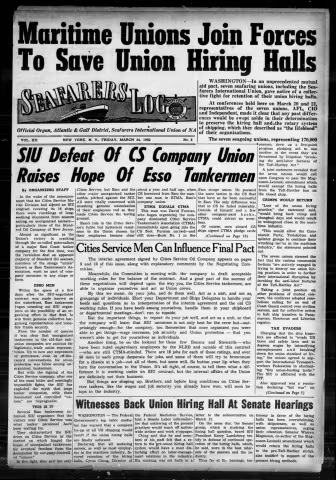
Maritime Uniims Join Forces
To Save Union Hiring Halls
Official Organ, Atlantic & Gulf District, Seafarers International Union of NA
VOL. XII NEW YORK, N. Y., FRIDAY, MARCH 24. 1950 No. 6
Sm Defeat Of CS Company Union
Raises Hope Of Esse Tankemen
By ORGANIZING STAFF
In the wake of the announce
ment that the Cities Service Ma
rine Division had signed an SIU
• ' contract covering its 16 ships,
there were rumblings of long
seething discontent from seamen
sailing on unorganized tjuikers—
particularly those of the Stand
ard Oil Company of New Jersey.
Almost as significant as the
Union's victory in cracking
through the socalled paternalism
of a niajor East Coast tanker
company for the first time, was
the revelation that an apparent
majority of Standard Oil seamen,
members of the stooge "union"
known as Esso Tankermen's As
sociation, want no part of com
pany unionism in any shape or
form.
ESSO MEN
Within the space of a few
days after, the , SlUnegotiated
contract was made known on
the waterfront, Esso tankermen
began sounding out SIU organ
izers on tJiG possibility of an or
ganizing effort in that fleet, to
win them genuine collective bar
gaining representation and bona
fide Union security.
From the number of queries
it was clear that unorganized
tankermen in the oldline anti
union companies are anxious for
legitimate, trade union represen
'tation. Up to now any expression
of preferenccj even in offthe
record conversations, for union
protection was taboo among un
organized tankermen.
But. with the signing of the
Cities Service company, after one
of the most bitter and seemingly
impossible fights, the SIU has
exploded the myth that large
tanker companies, with . their
dominated and controlled "un
ions," are impregnable.
THIS IS IT
Several Esso tankermen in
formed SIU organizers that the
victory over Cities Service was
what tanker personnel have
been waiting fon
They characterized the SIU
drive on Cities Service as the
contest on which hinged the
hopes of unorganized tankermen
for eventual freedom from the
domination by conipanycontroll
ed "unions."
in this fight,they saw not only
Cities Service, but Esso and the
other major unorganized tanker
outfits, pitched against the SIU.
All were vitally concerned with
smashing genuine unionization
of their employees and so they
made Cities Service the testing
ground.
Esso's role in the Cities Serv
ice's futile but hysterical resist
ance to the Union chosen by
their employees became clear
about a year and half ago, when
CS borrowed from Esso the num
ber one man in ETMA, Esso's
company union.
ETMA EQUALS CTMA
This man was David Furman,
who began organizing the com
pany dominated Cities Service
Tankermen's Association (CTMA)
immediately upon going into the
CS fleet. Furman carried—and
still does—^Book. No. 1 in the
Fsso stooge union. He pursued
the same tactics in the CS fleet
that have so far been successful
in Esso. The only difference was
that in CS he failed miserably.
Outside of himself and a few
other compranypaid hacks,
CTMA could attract no mem
bers.
Of course, men aboard CS
ships signed CTMA pledge cards
(Continued on Page 10)
Cities Service Men Can Influence Final Pact
The interim agreement signed by Cities Service Oil Company appears on pages
9 and 19 of this issue, along with explanatory comments by the Negotiating Com
mittee.
Meanwhile, the Committee is meeting with the company to draft acceptable
working rules for the balance of the contract. And a good part of the success of
these negotiations will depend upon the way you, the Cities Service tankermen, are
able to organize yourselves and act as Union crews.
By this we mean: do your jobs, and do them well. Act as a unit, and not as^
groupings of individuals. Elect your Department and Ships Delegates to handle your
beefs and questions as to interpretation of the interim agreement and the old CS
working rules. If you have beefs among yourselves, handle them in your shipboard
or departmental meetings—don't run to topside.
But the important things, to repeat: do your job well, and act as a unit, so that
the company will learn that SIU unionism is not only best for the crew but—sur
prisingly enough—;for the company, too. Remember that once organized you were
able to get things—wage increases, job security and Union protection — that you
weren't able to get for yourselves as individuals.
Another thing, be on the lookout for those few Bosuns and Stewards — who
have been ruled supervisory employees by the NLRB and outside of this contract
—who are still CTMAminded. There are 16 jobs for each of these ratings, and over
50 men in each group desperate for jobs, and some of them will try to brownnose
for a chance at a job—not all of them, but some will. So button your lip when they
turn the conversation to the Union. It's all right, of course, to , tell them what a dif
ference it is. working under ^n SIU contract, but the internal affairs of the Union
are definitely not their business.
But^ things are shaping up. Brothers, and before long conditions on Cities Ser
vice tankers, like the wages and job security you already have won, will soon be
tops in the industry.
St
WASHINGTON—In an unprecedented mutual
aid pact, seven seafaring unions, including the Sea
farers International Union, gave notice of a collec
tive fight for retention of their union hiring halls.
At conferences held here on March 20 and 21,
representatives of the seven unions, AFL, CIO
and Independent, made it clear that any past differ
ences would be swept aside in their determination
to preserve the hiring hall and«the rotary system
of shipping, which they described as "the lifeblood"*.
of their organizations.
The seven seagoing unions, representing 170,000;
• seamen, drew up a fivepoint
program pledging aid to one
another in the event they are
threatened by litigation "invok
ing the antilabor features o£
the TaftHartley Act."
A joint statement revealed that
the seven Unions would call
upon Congress to pass the Mag
nusonLesinski amendment which
would exempt the hiring halla
from the TaftHartley ban on
the closed shop.
CRIMPS WOULD RETURN
"Loss of the union hiring
practice," the statement said,
"would bring back crimp and
shanghaii days and would result
in widespread chaos in the mari
time industry.
"This would aUow the Com
munist Party, Trotskyites and
splinter groups to continue their
wrecking tactics in the maritime
industry," the statement pointed
out.
The seven unions stressed the
fact that the various communist
factions "are actively engaged in
trying to destroy our union hir
ing practices in order to further
their international disruption by
invoking the antilabor features
of the TaftHartley Act."
Taking a joint position on
other problems of mutual con
cern, the conferees adopted reso
lutions calling for an end of
Coast Guard control over civilian
seamen, and for collective acUon
to halt ship transfers to Pana
manian, Honduran and liberian
registry.
TAX EVADERS
Charging that the ship trans
fers are effected to "evade US
taxes and safety laws and to
depress wages by intensifying
unemployment and breaking
down the union standard of liv
ing," the unions agreed to sup
port the International Transport
workers Federation in eliminat
ing "this unionbusting tactic."
The' SIU is affiliated with the
ITF.
Also approved was a resolu
tion declaring "hot war" on
(Continued on Page 3)
Vi
i
Witnesses Back Union Hiring Haii At Senate Hearings
WASHINGTON — The Federal
Government's top labor media
tor has warned that a complete
tieup of all US shipping would
result if the union hiring halls
are finally outlawed.
Declaring that all seafaring
unions, as well as most employ
ers in the maritime industry, fa
vored retention of the hiring
halls, Cyrus Ching, Director of
the Federal Mediation " Service,
told a Senate Labor subcom'mit
tee that outlawing of the present
practices would touch off nation
wide strikes and work stoppages.
Ching said that he and mem
bers of his ̂ staff felt that a re
turn to the preunion hiring hall
system would have a most dis
turbing effect on labormanage
ment relations in the industry;
His warning was set forth in a
letter to the subcommittee on
March 21.
On the same day, the Senate
group, which is studying the
hiring hall question, heard SIU
President Harry Lundeberg tes
tify in defense of continued ope
ration of the hiring halls, which,
he said, were in the best inter
ests of the seamen and the in
dustry.
Thus far at th<. hearings, tes
timony in favor of the hiring
halls has been overwhelming,
with shipowners, as well .as
union representatives, urging
their retention. Senator Warren
Magnuson, coauthor of the Mag
nusonLesinski amendment which
would return the hiring halls
to the preTaftHartley statui,
also testified in support of the
present hiring methods.
• i
I^age Two
rM'', :. • VK::". • • ..• ; • ' • • • .V'irn
HE SE A F A R E RS L O G ,'• • >* .1; f'
SEAFARERS LOG
Published Every Other Week by the
SEAFARERS INTERNATIONAL UNION
OF NORTH AMERICA
Atlantic and Gulf District
Afiiliated with the American Federation of Lahor
At 51 Beaver Street, New York 4, N. Y.
HAnover 22784
Reentered as second class matter August 2, 1949, at the Post
Office in New York, N.Y., under the Act of August 24, 1912.
267
w
Outmoded—And Outvoted
No matter how uptodate they try to dress up their
company sponsored "unions," the oldline, antiunion*
tanker outfits cannot conceal the mustiness of their trap
pings. • )> \
A company union is a company union, no matter
how you look at it, and there's something about these
slickly conceived straitjackets that smells of a dirty deal
for the seamen they're designed for.
What makes the smell particularly easy to detect is
that the last remaining sponsors of the company "union"
ip the maritime field are the powerful and sprawling oil
companies.
While their methods of industrial operations and
their public relations policies are among the most efficient
and streamlined in the world, they still employ an out
moded paternalism in their labor relations.
But no matter how they strain to appear benevolent,
the fact remains that they are giving the seamen who sail
their ships the short end of the stick.
»
Oil companies. Standard Oil of New Jersey among
them, have a notorious history of exploitation. In their
presentday operations, however, 'they expend considerable
energy and funds to inform the public—and their workers
—that they arc good guys.
The cleverlyturned phrases of their newspaper, maga
f 2ine and radio advertisements always say, in effect: "We're
;; for a better America." "Our knowhow benefits our
workers and the public."
To which the seamen on their tankers would reply:
^^Malarkey!"
If they had good sound knowhow in . their relations
with their tankermen, these companies would take their
coinpany unions, wrap them in bindings and allow their
employees a free voice in choosing their own representation.
The vast majority of the American maritime industry
—of which these oil tanker outfits are a part, whether
they like it or not—has accepted the role of the bona
fide trade union in labormanagement relations. They have
accepted it because their employees chose them in order
to get decent wages and working conditions and, just as
a. important, decent and equitable treatment, without fear
• • of intimidation, blacklisting and all the other horrors
inherent in company unionism.
Oil companies—like Standard, with~jts stooge Esso
Tanker Men's Association—support the company "union"
as a means of staving off what they regard as the threat
of genuine trade union representation for their personnel.
^ In fact, Esso is so concerned with this threat that it threw
the resources of its ETMA behind the Cities Service
f Tanker Men's Association, when the latter was spawned
„ to confuse and intimidate CS seamen who wanted the
lSIU as their agent.
CTMA didn't last long. "She" was old and almost
lifeless even when she was born. Unorganized seamen just
don't want anything to do with selfish, deceitful company
1^: jpaternalism. And Esso employees, bound down by ETMA
' against their will, are already freely expressing their desire
1throw off the bonds of company unionism.
Company unionism, drilling for oil by hand, is
5 outmoded and belongs in tk§ past.
m
Men Now h The Mtm HespHoh
These are the Union Brothers currently in the marino hospitals,
as reported by the Port Agents. These Brothers find time hanging
heavily on th^ hands. Do what yeu can to cheer them up by
writing them.
STATEN ISLAND HOSPITAL
EDWIN C. ROBINSON'
THOMAS DALY
I. SANTINO
N. ROBERTSON
C. E. SANCHEZ
V. E. JOHNSON '
JAMES W. BARMES
H. J. OUT
MEYER CZRERWINSKI
K. JENSEN
JAMES HILLIER
C. P. (Slim) THOMPSON
JOHN P. PURVIS
J. H. DANIELS
J. F. GAMBLICH
H. WEBBER
T. E. MAYNES
A. RODRIQUEZ
B. T. lOWE
C. ESOLAN
A. GARCIA
^ % X %
NEPONSIT HOSPITAL
WILLIAM PADGETT
MATTHEW BRUNO
JOSE de JESUS
JON LANCASTER
R. E. LUFLIN
E. STEBAN LOPEZ
PEDRO G. ORTIZ
R. REDEST ;
R. A. RATCLIFF:;.;i^"l5lS''tr
R. A. BLAKE • • .
L. BALLESTERO
JOHN T. EDWARDS
• E. FERRER
I. H. FRENCH
JOSEPH SILLAK
LUIS TORRES
FRED ZESIGER
PADZIX
JOHN i. DRISCOLL
NEW ORLEANS HOSPITAL.
R. LANGFORD
G. NOLES
W. HANTUSCH
JR. CRUZ
g. J. NAVARRE
J: DENNIS
F.LANDRY
H. F. LAGAN
L. LANG
L. WILLIS "
H. D. McKAY
B. W. BIGGS
G. ROUSE
C. EZELL
G. NEWMAN
O. HOWELL
E: J. SPODASR
C. LYONS
A. L. RICHAUX
L. GOLEMBIEWSKl
A. STRACHEN
D. TICKLE
J. CAEOLAN
.'• \T
J. McNULTY
B. L. KRIEG
W. WALKER
C. NEUMAIER
W. MEEHAM
L. KNICKERBACKER,
W. LAMB
W. HAYES
W. CARROLL
RN. FRENCH
if tr
BALTIMORE HOSPITAL
I. WILLOUGHBY
M. J, LUCAS
W. G. WHITMER
M. B. BROWN
V. L. STANKIEWICZ
M, P. PROCKAK
W. S. WARMACK
J. DAVIS
E. F. LAMB
D. HAUGHT
W. G. ALSTON
J. A. SHEA
G. BELL
T. KIISKI .
D. C. BREASHEARS
t 4 »
BOSTON MARINE HOSPITAL
ROBERT COLLINS
JERRY O'BYRNE
FRANK ALASAVICH
F. FAGAN
BEN GORY
PETER KOGOY
CHARLIE MCCARTHY
F. VIGEANT
% ^ %
SAN FRANCISCQ HOSPITAL
W. SILVERTHORNE
G. W. GHALE
J. JELLETTE
^ g >
SAVANNAH HOSPITAL
J. MAXEY
G. T. WOLFE
^ IIPIPITAL MOBILE
TIM BURKE
,G. FORWOpD p. rpRWOOD
J. ASHURST . '
Maz^ 24, 1950 THE S E AF ARE RS LO G Page Three
=23
tki Hbiag HaUs
We realize that' certain forces of the National
Associatioh of Manufacturers, Chamber of Com
merce, shipowners and other enemies of organiz
ed labor are fully determined to destroy trade
unionism in the maritime industry by utilization
of the TaftHartley Act.
We know that the Communist Party, the So
cialist Workers Party—known as Trotskyites—
as well as other splinter groups, also are actively
engaged in trying to destroy our union hiring
practices in order to furthef {heir international
disruption, by invoking the antilabor features
of the TaftHartley Act.
We recognize the fact that the loss of the
union hiring practice for any maritime union
Would set in motion the forces to throw seamen
back to roaming the docks for jobs, kickbacks,
and bring back crimp and shanghai days; and
would also result in widespread chaos in the
maritime industry. This would also allow the
Communist Party, Trotskyites and splinter
groups to continue their wrecking tactics in the
maritime industry.
Therefore, we the assembled representatives
bf seamen's unions in conference at the Congres
sional Hotel, Washington, D.C., on Monday,
March 20, 1950, unanimously agree upon the fol
lowing program:
1. That we notify all seamen, trade unions.
Shipowners and the public that we are united
bn this matter of fighting to retain the hiring
practice for seamen's unions.
2. That we call upon Congress to pass the
MagnusonLesinski amendment to the TaftHart
ley Act now before them, to make the hiring
Jjfactices of seafaring unions as they existed
prior to June 15, 1947, not an unfair practice
under the Act.
3. That we unanimously agree not to use the
antilabor provisions of the Taft:Hartley Act
fegaihst each other, and each union agrees that
it Will give no aid and comfort to any group or
individuals of any other union using tha Taft
Hartley Act in litigation against a union. Such
cases shallbe regarded as internal matters of
the union involved. ^
4i That we will aid each union to the best bf
bur ability when such matters arise.
5. We call upon all seamen of all unions, and
all trade unionists from all industries, regard
less of affiliation,; to support this program fot
the defense of the hiring practice which is the
lifeblood of the maritime unions.
Oa Ship Trmsfets
This Conference has noted with great alarm
the continuous tfahsfef of American ships to
Panamanian, Liberian ahd Honduran flags, while
retaining American ownership.
We have made it clear to Government bodies
and the Congress that this serious condition has
resulted from the desire of shipowners to evade
tax and safety laws of the United States, and
^ depress wages of American seamen through
intensifying unemployment among American sea
men hoping, thereby, to destroy American, sea
ihen's unions by depressing the standard of liVihg
gained by them through their unions.
It is the considered opinion of this Conference
that the only solution to this serioUs question is
that ail American seamen's unions, together
with the labor movement generally, must take
Collective action to put an end to this condition
as quickly as possible.
Further, this Conference recognizes the splen
did work done in this question on a worldwide
basis by the International Transportworkers Fed
eration and hails the meeting to be held i::2 Am
Bterdam in April, and We will cooperate in &very
• way to have the ITF Gonfetence sueeessfuiiy
develop a program to eliminate this uriionbust
Ing tactic M world maritime circler
Washington Conference
Oa thiii page are the dbciaions arrived at by
the Seamen's Conference held In Washington
March 20 and 21, The following unions and their
r^resentatiVes, speaking for more than 170,000
AFL, Cip and Independent seamen, were in
attendance:
SEAFARERS iNTERMAtlONAL UNION
(APL): Harry Lundeberg, Paul Hall, Morris
Weisberger and Matthew DUshane.
NATIONAL MARITIME UNION (CIO): Joe
Curran, Neil Hanley and M. Hedley Stone.
NATIONAL ORGANIZATION MASTERS.
MATES & PILOTS (AFL); C. F. May. E. W.
Higginbotham and William C. Ash.
MARINE ENGINEERS BENEFICIAL ASSO.
CIATION (CIO): H. L. Daggett, Frank A. Sayre
and R. Meriwether.
MARINE FIREMEN. OILERS. WATERTEND
ERS AND WIPERS (IND.) Vincent Malone and
Ernest G. Ramsey.
AMERICAN RADIO ASSOCIATION (CIO):
W. R. Steinberg and Joe Rubin.
RADIO OFFICERS UNION (AFL): Andrew
Macfibneld,
On US Coas t Guard
We, as representatives of the seamen's unions,
have thoroughly discussed and given serious
consideration to the plight of the American sea
men, who, although civilian employees, are in
the unique position of being under the regulation
and control of a military establishment of the
United States Government, the United States
Coast Guard.
The administration of numerous provisions of
Federal law affecting the rights and obligations
of American seamen, by the United States ship
ping Commissioner and the Bureau of Marine
Inspection and Navigation, traditionally and for
over fifty years until 1942, has been a function
of the United States Department of Commerce,
effectuated by civilian personnel.
Early in 1942, as a temporary war measure,
these offices were, by Executive Order of the
President of the United States, transferred from
the United States Department of Commerce to
the Commandant of the United States Coast
Guard, then under the direction and supervision
bf the Secretary bf the Navy.
At the end of the year 1945, the United States
Coast Guard was returned to the Department of
the Treasury, but the office of the United States
Shipping Commissioner and the Bureau of Ma
rine Inspection and Navigation were not separ
ated from the United States Coast Guard nor
returned to civilian control under the United
States Department of Commerce, but, on the con
trary, were by Executive Order embraced per
manently within the United States Coast Guard.
As a consequence, American seamen, fomlerly
and for many years under the regulation and
control of civilian personnel of the DepartiJient
of Commerce, are and will continue to be sub
ject to the extremely rigid regulation and control
and wholly unsuitable—and often arbitrary and
unrealistic—processes of military establishihent
in respect to matters which should be regulated
by civilians, in accordance with principles and
procedures adapted to civilian employees.
Recognizing the serious position of the Anieri
can seamen as a result of the present policy of
supervision being exercised by the military or
ganization, the Coast Guard, over civilian mer
chant seamen, the unions in this Conference
representing AFL and CIO will proceed imifted
iately to bring to the attention of the Presidents
of both organizations the need for immediate
action, and suggest to them that they seek an
immediate meeting with President Truman for
the purpose of obtaining speedy action on this
important question.
(h Curopeaa Aid
In discussing the position of the working class
in Western Europe, with regards to the econqmic
reconstruction of their countries and the defense
of their free democratic regime, we are aware,
from personal observation of the fact, that the
Communist Party and Communist trade union
stooges under the orders of the Cominform have
tried, and are trying, to disrupt these countries
by creating chaos and by using violence, in
order that the Marshall Aid Plan and the Atlan^.
tic Pact may not have their full effect.
We seamen's representatives, therefore, pledge
ourselves completely in support of the Marshall
Aid countries, and of those subscribing to the
Atlantic Pact, for we are. convinced that only
through these instruments will democratic West
ern Europe be reconstructed and be placed in
a position to maintain democracy, freedom and
liberty as we here in our country understand
and enjoy its benefits.
We further shall endeavor to give every pos
sible assistance to the European Free Trade Un
ion Movement in its struggle against communis
tic dictatorship, and to carry the goods to their
countries under the Marshall Aid Plan and the
Atlantic Pact.
Further, we shall call upon the American Fed
eration of Labor and the Congress of Industrial
Organizations, and through these channels upon
the International Federation of Free Trade ̂ n
ions, with fhe view to holding in the United
States, at the earliest possible and most conven
ient time, a conference of all American Trans
port Workers Trade Unions, in conjunction with
the International Transportworkers Federation,
in order to formulate the necessary measures to
be taken to counteract the disruptive and sub
versive activities of the communists in Eurbpe
and elsewhere in the transport industry.
Maritime Unions Act To Save Hiring Halls
(CoHtiHued ft&M Page 1)
European communists trying to
block jhe flow of Marshall Plan
goods and Atlantic Pact arms to
the Western democracies.
The union representatives blasted
the communists and their "stooges"
overseas, who, they said, were
"using violence" to crush the demo
cratic nations of Europe.
, They supported an appeal from
Qmer Becu, Belgian secretarygen
eral of the ITF, for a program of
action by American workers to
combat the propaganda being
spread by communistdominated
European traiisport unions.
• Becu reported that the commie
led unions in Europe were spread
ing the lie that American seamen
were opposed to the Marshall Plan
and the Atlantic Defense Treaty.
Representatives of the AFL and
GIO unions participating in the
conference said they would call
upon the presidents of their re
spective organizations to set up a
conference of all American trans
port workers' unions to back tlieir
anticommunist drive.
Meanwhile, they pledged support
to the European trade unions "in
their struggle against communist
dictatorship," and stated theil* in
tention of continuing to carry Mar
shall Plan cargoes and arms aid
to tlieir countries.
• ]
4i\
Represented at the conference
were the Seafaiers International
Union, Radio Officers Union, ^nd
the Masters, Mates and Pilots, all
AFL; National Maritime Unjon,
American Radio Association, and
Marine Engineers Beneficial Affso |
elation, all'CIO, and the Maijine :
Firemen's Union, Independent.
Not present at the sessions were
the Marine Cooks and Stewardls^
Union and Harry Bridges' Inter aa^
tional' Longshoremen's and Wore ;^
housemen's Union, both CIO. These
two were not'invited because tliey
follow the line laid down by the
communists.
Pa0« Four THE S E AF ARE R S LO G ^ March 24. 1950
Slow Shipping
Baltimore
I®
By WM. (Curly) RENTZ
I#
BALTIMORE — There's been
no change from the slow ship
ping that has gripped this port
for the past month or so. But
we're still hoping for an im
provement.
A number of ships paid off
here in the past two weeks, but
the rub lies in the fact that most
of them went elsewhere to sign
s' on. Among them were some Ore
, ships, Bull Lines scows, and
isthmian vessels. Ihere were
I "also a few ships intransit.
I Biggest beef of the week con
. cemed a crewmember of the
Allegheny* Victory. The crew of
the ship beefed that this man
had fouled up repeatedly
throughout the trip, but when
payoff time rolled around they
aU took off and nobody was
around to press charges.
PROTECT YOUR JOB
We all have a big stake in
om: Union, and we cannot allow
foulups to jeopardize the gen
eral welfare of the membership.
Unless we are willing to accept
the responsibility of maintain
ing discipline aboard the ships,
there is not much use in beefing.
: All other beefs were of a rou
tine nature, and were settled
If aboard the sl^s before the pay
offs.
Otherwise everything is going
smoothly in this port.
Now that Cities Service has
signed the Cities Service agree
ment, let us not forget what a
difficult fight it was to win this
beef. The men that sailed these
ships, and stuck it out in face
of hardtiming by the company,
deserve loads of praise. We can
thank these men for doing a
swell job for the cause of good
trade unionism and for the ben
efit of the imorganized seamen.
SIU Legal Advisors In Cities Service Negotiations
I ,
C. PAUL BARKER BENJAMIN STERLING MARVIN SCHWARTZ
In the successful fight to bring the Cities Service Oil Company's Marine Division under
Union contract, the SIU was aided by the able legal counsel of C. Paul Barker. Benjamin
Sterling and Marvin Schwartz. Their role throughout the negotiations was qf invaluable aid in
bringing the difficult and protracted struggle to peaceful settlement. ^
Barker is associated with the firm of Hirsch, Greene and Barker, specialists in labor law,
with offices in New. Orleans and Baton Rouge, La.
Benjamin Sterling and Marvin Schwartz are with the New York firm of Benjamin B.
Sterling, proctorsinadmiralty.
New York Shipping Foiiows Nationai Trend
By JOE ALGINA
fe
Mr.
ii
Tankers Are Big Help
To Boston Seafarers
By BEN LAWSON
BOSTON—^This was a fair
week for us, with four tankers
and a freighter honoring us with
payoffs. Three of the tankers
signed on here. In addition, we
had six freighters intransit.
The tankers were the Alex
' andra, Michael and Trinity, Car
ras; the W. E. Downing, Mathia
sen; the Ann Marie, BuU, was
the freight ship payoff.
The intransit ships were the
Greeley Victory, Mobilian and
Canton Victory, Waterman; the
Robin Doncaster, Robin; the
Queens Victory, Isthmian, and
the Yorkmar, Calmar. All ships
were handled swiftly, with no
beefs hanging fire when they
left port.
WANNA YACHT?
With Spring beginning to be
felt around here, Alex Olson,
who has hibernated here during
the winter, is beginning to think
of putting his yacht into service
and touring the ^ters here
iv abouts for the summer. Alec is
W Waiting for his old pal and
# watchmate, Don Hodge, to hose
into this port and sign articles
fii for a summer's cruise.
The mother of Bobby Clark,
who was badly injured in a fall
on the Trinitj', has asked us to
pass along her . thanks to the
Trinity crew for their donation.
She reports that the money came
In handy.
NEW YORK—Shipping slowed
down to a walk in this port last
week, but every port in the US
seems to be having the same
trouble.
Bull Line ships on continuous
articles that paid off were the
Inez, Puerto Rico, Evelyn, Su
zanne and Kathryn. Other pay
offs were the Ponce de Leon,
Chickasaw, Alawai, Waterman;
Robin Doncaster; Algonquin Vic
tory, St. Lawrence Navigation;
Bull Run, Mathiasen; Chrysstar,
Triton; Seatrain New York;
Harry T., Palmer, and the
Queens Victory, Isthmian, which
has been returned to the Mari
time Commission.
Signons were the Robin "Tux
ford, Angelina, Ponce de Leon'
and the Collins, Dry Transporta
tion, wliieh came out of la;>rup
last week.
Most of the ships coming into
New York are in good shape and
there are few beefs of any con
sequence.
BERNSTEIN ASKS BIDS
The Bernstein Shipping Com
panyhas received an okay from
the Maritime Commission to so
licit bids from shipyards on re
conversion of two former army
transports, which the company
would like to place in the Eu
ropean passenger trade under
subsidy. Invitations for bidding
will probably go out this week.
Probably every one of us has
run into an outfit that uses that
old gag about "it's on account
of the unions," whenever they
have to cover up some of their
own faults and inefficiency.
We've heard quite a few in
stances of this type in the past
couple of weeks, and it might be
a good idea for union men and
their fam|lies to show how
phony this stuff is.
For example, we know of a
guy who purchased something
from a Store here a short while
back and, when he retinned it
because it was faulty merchan
dise, the salesman said: "This job
was turned out by union guys,
and you know how it is. You
can't say anything to them."
That's, so much, malarkey and
it's more of a downright lie to
day than it ever was. Union
workers take v pride in their
as much conscious of the need
for doing a good job as the em
ployers—if not more so.
If a company ̂has a himk of
punk "merchandise, let it stand
on its own feet and accept the
responsibility.
It's a pretty small guy that
wiU try to blame it on his
workers, and then cry that he
couldn't say anything to them.
It's the kind of whispering cam
paign that should be nailed
down, right away.
^
Death Suikes Few h Mobik
By CAL TANNER
MOBILE—Shipping in Mobile
for the past couple of weeks has
been slow. We had eight payoffs
and' eight signons, in addition
to three ships intransit, during
the twoweek period just ended.
The payoffs were the Cavalier,
Clipper, Partner, Pegasus, Alcoa;
Monarch of the Sea, Antinous,
Mobilian and Fairhope, Water
man. These* ships all signed on
again.
Intransit were the Del San
tos, Greeley Victory and the
Chickasaw.
All payoffs and signons were
smooth, with only a few minor
beefs, all of which. were settled
to the satisfaction of all con
cerned. The intransit jobs were
contacted and aU necessary re
placements were shipped from
the HaU.
In the Marine Hospital this
week are the following Brothers:
Tim Burke, G. Forwood, J. Ash
urst arid L. Wilkerson.
In addition to the regular jobs
we shipped about 35 men to
relief jobs over the past two
weeks, and short as some might
be these are always a good thing
to have^ available.
Seafarers in this port extended
their deepest sympathies to the
families of fbur Union men who
died here in the past week.
Services were held in the
Cathedral of the Immaculate
Conception for Brothers Clement
Mayers and George D. Arnim,
who drowned when their fishing
boat overturned in the Mobile
Bay. The families of these men
in Trinidad were unable to pay
for retujrii ef the bodies, so Sea
farers in this port donated funds
for the burial,' along with a lo
cal mortician.
FLOWERS SENT
Flowers were contributed by
the Alcoa and Waterman Steam
ship Companies, Mobile florists
and the hostesses of the Catho
lic Maritime Club. Burial plots
were offered by the Catholic
Cemetery.
Lee Yarborough was killed in
an autornobile accident and Bro
ther R. Nicholas pas^d away in
Mobile last week.
I Crewmembers of the following
ships donated to the funeral ex
penses: Alcoa Clipper, Alcoa
Pegasus, Azalea City, Noonday
and Morning Light.
Good Shippiiig
For Savaimah
By E. M. BRYANT
SAVANNAH — Shipping, has
been pretty good for this port
during the past twoweek period,
we're mighty happy to report.
The SS Southland payed off
and signed on, and the SS Steel
Director, Isthmian; and the SS
Carrabula, Cuba Distilling, came
in as intransits.
There was a beef involving the
Chief Mate on the Steel Director
but since she came in after five
o'clock and sailed at 7 AM,
there wasn't much we could do
about it. "When we got down to
the ship at 8 PM, most of the
gang was ashore. The ship is
going to Galveston to payoff.
Curt Starke, the Seafarer who
once worked for the Bamum and
Bailey circus, is on the SS South
land and he wishes to say
"h6llo" to all his old shipmates.
There has been some question
as to whether or not a motion
can be introduced at a regular
meeting to change the shipping
rules or amend the constitution,
and we'd like the LOG to pub
lish the answer for the informa
tion of all the Brothers.
(Ed. Note: Changes in ship
ing rules tmd amendments to
the constitution can only be
effected by Unionwide refer
endum. as required by the
constitution. The procedure is
for a resolution to be intro
duced, stating the proposed
change or amendment and rec
ommending that it be placed
on a referendum ballot. If the
membership votes favorably on
the resolution after action at
the regular meetings in all
ports, the question can then
be submitted to a referendum
vote up and down the coast.)
One Ship Is Ho Boom,
Sairs Philadelphia
By STEVE CARDULLO
PHILADELPHIA — A strong
shot in the arm to the slow
shipping in the port was the ar
rival of the Lake George, which
paid off after a sevenmonthtrip.
She took a full crew and helped
somewhat to cut the hecvy back
log of men on the beach here.
However, we still have a couple
of himdred men waiting around
for jobs. One vessel • doesn't
make a shipping boom.
The joy at the news that the
SIU had signed the Cities Ser
vice Oil Company contract is
still being felt around this port.
Some men coming in haven't
heard the news, and it's a big
fat smile that spreads across
their faces when we tell them
that Cities Service, too, is SIU.
Politics Holds Center Of Stage In Tampa
By RAY WHITE
TAMPA—^We're continuing to
enjoy a good turnover of men
on the ships hitting this port,
though shipping in general has
slowed down somewhat from the
tempo held for the past two
months. If shipping doesn't lag
any further, this port won't com>
plain too loudly.
The political picture here is
becoming clearer now, with a
great deal of interest being
shown by the voting j)ublic.
Senator Pepper, labor's friend
MniMi.
, work, a::*! i' • Jnions are just in Florida, la facing a tough
bunch lined up .against him, in
cluding the National Association
of Manufacturers, the chambers
of commerce, the .medical ,so
cieties and the big money boys.
There's going to be an awful lot
of heat generated before this
battle ends.
WINNING FORM
Senator Pepper, being the
friend of labor, makes no bones
about his position. He's allout
for repeal of the TaftHartley
Law and all infringements on
labor groups. Pepper has. held
his Senate .seat for 14 years on
around here must believe in him.
He's having his toughest cam
paign of his career, however.
One of the fivp men in the
race is J. Tom Watson, the
father of the Watson Law,,Flo
rida's little TaftHartley Law.
He isn't given much of a chance,
as everyone looks upon him as a
crackpot.
Winning Cities Service will
probably help thisstate a bit,
though not this port. A lot of
Cities Service ships hit Jackson
ville. But wherever they touch,
the important thing is that we've
this piatiom, so the people)won, and they are ali burs now.
u THE 3 E At AnMlis LOG Page Filre
The Seafarers In
By JOHN BUNKER
Chapter Two
There was a chill breeze and a long, glassy
swell on the sea, as the SlUmanned Seatrain
Texas came upr the Carolina coast at full speed
in the morning of January 19, 1942.
Captain Albert Dalzell was on the bridge and
every officer and unlicensed man aboard was on
the alert, for Sparks had been receiving mes
sages of ships being attacked by submarines.
During the night there had been flashes of
gunfire on the "horizon and, though they sup
posed it was practice fire by the Navy or Coast
Guard, they were taking no chances. The ship
was holding as close to the shore as safe navi
gation would permit.
The officer of the watch had just taken a
bearing on Wimble Shoals buoy, when a call
came* from the lookout that there was ̂ Creckage
"on the water ahead.
Captain Dalzell got his glasses and swept the
sea in the direction toward which the lookout
had pointed. There were small black specks bob
bing on the long swells and, as he focused more
clearly on the area, he saw a man's hand wave
from one of the bits of flotsam.
it waved again, weakly. All he could see was
the hand, for the man's head and shoulders were
'too close to the water.
Turning to the Mate, the Skipper ordered a
boat prepared for lowering. The engine room
tele^ph jingled as speed was decreased, and
the freighter ran swiftly up on the scattered
wreckage noW becoming more visible.
They could see pieces of boards and shattered
odds and ends of ship's fittings strewn for a
mile here and there across the undulating water,
but careful scrutiny through the glasses revealed
only five bodies amid the debris. One man was
holding onto the frame of a wheelhouse door.
As the Seatrain Texas came to a stop, the
lifeboat was put quickly over the side in the
wellcoordinated movements of a veteran crew
and was soon pulling through the watersoaked
wreckage.
. The boat's crew worked fast, for Captain Dal
zell couldn't endanger his vessel and her crew
a minute longer than was necessary. For all they
knew, a submarine was watching every move
ment they made.
The men stopped at one wavewashed col
lection of flotsam, lifted an inert body aboard
and then went to another, where a grimy sea
man half lifted himself out of the water, trying
to grip the gunwales of the boat.
STRONG HANDS HELP
Strong hands bore him to safety, while those
on the Seatrain's bridge used megaphones to
direct the crew to where a third and a fourth
body could be. seen halfalive, halfdead in the
winter sea.
In a matter of minutes the boatmen had done
their work, and were back at the vessel's side
to be hoisted aboard with their human cargo.
At first the survivors were too weak to talk
but, when they had been warmed with hot cof
fee and wrapped in blankets, they revealed that
their ship had been the City of Atlanta.
They told how the onetime passenger vessel
had been torpedoed without warning early that
morning—^how she had gone down so fast that
there had hardly been time to jump over^the
side . . . how the burning hulk had rolled over
to starboard onto the only lifeboat that cleared
the ship, crushing its unfortunate men beneath
' the sea. .
For a . while after the sinking, they recounted,
some Of the crew had floated around on bits of
wreckage while they joked and sang in at
tempt to keep their spirits up.
Then, one by one, all but five of them had
sunk beneath the cold, dark waters. And of the
. vBve who Were still afloat at dayoreak, only three
Two of the three survivors
of tho City of Atlanta^Rob
ert S. FennelL Jr., Oiler, and
Second Mate George Tavelle
—congratulato each other on
their escape, as they recuper
ate in St. Mary's Hospital in.
Hoboken, N.J. The City of
Atlanta was torpedoed and
sunk on. January 19. 1942, off
the Carolinas, taking with
her 39 lives.
were alive When the Seatrain Texas hove by.
The others lay astride their bits of wreckage,
but had died spmetime during the morning
hours. '
Living to tell the story of the City of Atlanta,
one of the most costly sinkings along the Atlantic
coast, were Oiler Robert Fennell, Jr., Seaman
Earl Dowdy; and Second Mate George Tavelle.
Captain Albert Dalzell and Chief Engineer
Tom Kenney of the JSeatrain Texas heard their
story without wanting to believe it could be
, true. . .
TRAGIC COINCIDENCE
For the Chief it was a hard story to hear. His
father.was Chief Engineer of the City of Atlanta.
Both dc^t. Dalzell and Chief Kehney had
started their seafaring careers on the City of
Atlanta many years before, when she Was a well
known coastwise passenger liner. Capt. Dalzell's
father had commanded her for many years be
fore Capt. Leemon UrqUehart took over.
"Uboat lane" they called Atlantic coastal
waters now. Nazi submarines ambled down the
seaboard on sinking sprees that cost hundreds of
lives, and sent scores of ships to the bottom with
a huge loss in precious cargoes.
There was no naval defense worthy of the
name, and it was to be five months yet before
the first convoy was organized for the protection
of shipping along the seaboard, in the Gulf and
the Caribbean. Merchant ships, in the meantime,
sailed unescorted and, in most cases, unarmed—
with the Uboats so bold they shelled their prey
even within sight of the Delaware Capes.
As the rate of sinkings increased, no seaman
could be sure that his ship would reach its des
tination. Legion were those that didn't, but they
kept sailing, nonetheless, and none of them idled
in port for lack of crews. In some cases there
were even more men willing to "ship out" at
SIU Halls than there were ships for them to sail.
At the old New York Hall of the SIU, at num
ber two !§tone Street,, across from famous Bowl
ing Green, men reported for the hourly "calls"
as though there was no war within ten thousand
miles. They manned" the ships and kept the
cargoes moving..
On January 25th, torpedoes struck again, sink
ing the 550 foot Venore off Cape Hatteras with
a Toss of 18 men. She, too, was a well known
SIU ship.
The end of this vessel is dramatically told in
the terse, urgent calls for help sent out by her
radio operator.
At 12;47 a.m. he flashed this SOS: "Two
crashes so far. Will keep informed. Think swim
ming soon."
This call came two minutes later: "Torpedoed
twice. Ship still afloat but listing badly. Captain
requests assistance immediately." He then gave
the ship's position a number of times.
The third andlast message was heard at 1:22
a.m.; "Cannot stay afloat .much longer."
No more reports came through, for soon after
the radio man had tapped out this message on il
his key the Venore sank and Sparks, true to the
traditions of his calling, stayed at his post too
long to escape.
Several lifeboats were launched by the Yen i
ore's crew and the survivors were picked up |
38 hours later.
Sinking declined along the Atlantic seaboard
after coastal convoys were inaugurated in May
of 1942, but the Uboats prowled these waters
off and on right up till the end of the war.
in fact, the collier Black Point was torpedoed
just a few miles from the big naval base at
Newport, R. I., on the fifth of May, 1945, the.
last American ship to be lost in the war.
Many more SIU vessels were to be numbered
among the 154 Allied ships sunk along the coast "
and in the northwest Atlantic between January
and June of 1942.
Among them were the Robin Hood, . Alcoa
Guide, Oakmar, Marore, Major Wheeler and
Pipestone County. The Major Wheeler—of the
Bull Line—completely disappeared, never to be
heard from again, while the Robin Line Pipe
stone County, a wellliked freighter among men
who sailed SIU ships, was sunk en route from
Trinidad to Boston, about 200 miles due west of
Bermuda. Two of her boats spent 16 days at sea
before being picked up.
CHILORE GETS IT
Uboats continued, their attacks ̂ despite the
use of convoys,and the SlUmanned Chilore of
the Ore Shipping Company was hit while in b
heavily protected convoy under escort of sur
face ships, planes and blimps.
Known as convoy KS 520, this fleet of 19 mer
chantmen left Lynnhaven Roads in the Chesa
peake on July 14, 1942. When it was off Cape
Hatteras the next day it ran into a flock of
torpedoes.
No one even saw a tin fish until the Chilore }
got smacked, to be followed a minute or so later
by the tanker Mowinckel. The BiuefieldSj a sniall
Nicaraguan freighter carrying explosives, was
blown up while the escort ran around dropping
depth charges and the escorting bombers spat j
te^ed the water with bombs and machine gun
fire.
It was the freighter Unicoi, however, which
got credit for sinking the doughty sub, along
with an Army patrol bomber.
" The Chilore and Mowinckel dropped out of )
the convoy and headed for the nearby shore
under their own power, but both of them ran |j
into a minefield and suffered more explosions. I
The big Chilore capsized and sank while being J
towed toward Baltimore several days later. ^ '
Azioiher • episode of the role of SIU crews in |
World War II will appear in the next issue of
the SEAFARERS LOG.
IP • Pag» Si*
1_ =
T H E SEAFARER S L O G Friday, March 24, 1950
\
MINUTES AND NEWS
Isthmian Crew Rescues
Survivor Of Sunken
Greek Ship In Red Sea
Headsup thinking and efficient seamanship by
group of Steel Fabricator Seafarers saved the life, of an
Arab seaman, whose vessel sank in the Red Sea on Feb. 11
with the loss of four lives.
&
fl.
The rescued seaman, Ahmed
ben Adree, was a member of the
crew of the SS Kid, a Greek
ship which went to the bottom
shortly after high winds caused
it to founder. Tankers in the
vicinity picked'up the other sur
vivors.
A report from the Steel Fabri
cator, forwarded from Calcutta,
said the Isthmian ship was pro
ceeding smoothly in the Red
Sea at 10 AM, when SIU crew
members spotted pieces of cargo
floating in the water.
"MAN OVERBOARD"
"Several of us were looking
at the floating cargo," the re
port ^id, "when we heard the
Chief Cook shout 'Man over
board.'
"The Chief Cook was on his
toes. He grabbed a life ring and
threw it to the fellow in the wa
ter. He threw perfectly and the
Ting landed directly in front of
the victim."
Steei Fabricator crewmen im
mediately sent word to the
bridge and the Captain ordered
the verael to circle ben Adree
while the life boat was being
laimched.
"When we got him aboard,"
the report continued, "we gave
him hot food, put him to' bed
for the rest of the trip. Then
some of the fellows went to the
Steward who nms the slopchest
and told him to give the rescued
man some new clothes, which
the crew would pay for, and
cigarettes and candy."
Lifeboat returns to the Steel
Fabricator with the rescued
crewman. •
Aboard the Steel Fabricator
during the rescue was Wilson
Sweeney, economic officer of the
US Consulate General in Cal
cutta. Mr. Sweeney said he was
proud of the SIU crew, and
hailed their action in the follow
ing lettei addressed to Union
Headquarters:
"The efficiency and seaman
ship displayed by the officers and
crew of the SS Steel Fabricator,
while rescuing a survivor of
the Greek ship SS Kid, which
foundered and sank on Febru
ary 11 in the Red Sea, makes me
feel proud of our American Mer
chant Marine and the . members
of the SIU'crew."
PROUD HOLDERS OF UNBEATEN SOFTBALL RECORD
Members of the Marina Sluggers pose for photographer V. Swanson, Chief Cook, after they
beat the team representing the SS Beatrice in'Mayaguez. Kneeling (left to right):Dickerson,
OS; Downey, MM; Wafkins. Oiler; Wagner, OS; Olive, AB. Standing: Port Steward, Doyle,
Bosun; Anderson, 3rd Cook; McCatey, MM; Carrera, Ch. Mate; Capt. Callas (holding bat); Shot
well,. 3rd Mate, and Gireaux, AB. *
Marina Sluggers Belt Beatrice Bums, 1411
In 'Battle Of The Bull Lines Titans'
In a Softball contest hdfalded as the "Battle of the Bull Line Titans," the SS
Marina Sluggers notched another victory^ in their unblemished record, downing the
SS Beatrice Bums 14 to 11, under a blazing sun on a Mayaguez, P.R., sandlot.
The allSeafarers games was* ! ! : ^
.''S'cra/n Bub' Costs Seafarer
up in the island" port, according
;o Bosun Doyle of the Marina.,
Doyle, whose report of the
game was packed with all the
skillful bombast and elegance of
Barnum and Bailey press ag
' ' i
Wearinfj^'the sweai shirt and. dungarees presented to him
by Steel Fabricator crewmen shortly after they hauled him
out of the Red. Sea. SS Kid crewmember Ahmed ben Adree
pcses with his rescuers on the deck of the Isthmian ship in
Ckdcutta. Nick Brancala is on hie right and Ring Miller on
the left.
ent's advance notice, said that
after the game "both the vic
torious Marina Sluggers and the
defeated gladiators of the Bfea
trice proceeded to the Seafood
Bar, where a cold one was en
joyed by one and alL
"Be it also written . that we
are proud of our achievements
on the diamond," Doyle declared.
While he was at it, the Mar
ina's Bosun issued a challenge
to all "Bull Lines and Water
man crews on the Rum arid Coke
run to be our guest at a game of
Softball.
"May the best team emerge
victorious," Doyle said, but he
quickly followed that up with
the advice that "five will get you
ten that we will win."
The unbeaten Marina Sluggers
might be interested to know that
the crew of the SS Puerto Rico
are also hunting for competition
on the ball field. P. San Miguel
is booking the PR's games.
Brother Doyle, meet Brother
San Miguel—aiid mai" the beat
team emerge victorious!
$85; Bub' Was Customs Man
You can't judge a book by its cover, nor a customs
inspector by his clothes, Flugo Echevarria, 2nd Cook
on the SS Lilica, Dolphin Steamship Corp., learned to his
.sorrow—.$85 worth—^recently inf
Bone, North Africa.
The expensive experience
which befell Hugo has since been
roundly criticized by the entire
Lilica crew as a racket to en
trap seamen performing their
duty.
The sad situation came about
while Hugo, busy in the galley,
noticed a seedylooking charac
ter sampling the choice bits of
fare being readied for the crew's
lunch. Hugo, in his best French,
told the guy to take a powder
and stay out of" the mtssroom.
The intruder took the hint and
scrammed. But he didn't scram
far. . '
INDIGNANT
The guy hightailed it up to
the Skipper and demanded that
Hugo be thrown in the hoose
gow. Producing his credentials,
he lamented that he, a customs
inspector in, the service of the
French government, need not be
subjected to such abuse. His
pride had been severely dented,
and could only* be salved it
Brother Echevmria were in
stalled in the local cooler. But,
of course, . a small fine would
serve just as well.
The Skipper looked the guy's
papers over, and called for Hugo
to 'come topside to explain his
actions.
The guy being a customs man
was news to him, Hugo explain
ed to the Skipper. When he saw
the guy dipping into the. crew's
food and chased, him put he was
only carrying out a crew reso
lution to keep all unauthorized
persons from the messhall.
The man had not identified
himself and, not being a mind
reader, had figured him for a
local sharpie helping himself to
a free meal. Customs inspectors,
Hugo pointed out, always wore
uniforms and identified them
selves before nosing around.
PAY OR ELSE »
But it was a losing proposi
tion fpr Hugo. He had his choice
of riding a bunk in jail Or
coughing up 30,000 francs. He
paid the fine. /
When the crew heard the de .
tails,, of the quickie trial, con
viction and fine, a special meet
ing was called and a resolution
drafted, condemning the actions
of the customs and accused the
Bone government boys of vic
timizing American seamen—who
were merely protecting ship's
property.
The crew also pointed out that
during the ship's 15day stay in
Bizerte, a nearby French port,
they had no trouble with the
customs men, who wore uni
forms and identified themselves
when coming aboard.
The crew concluded its state*
ment with the warning that
other crews hitting this North
African port would be wise to
look twice before chasing a
shaggylooking character away
from the stew pot. It might be
another guy. with a price tt« ;
on his pride..
ik M!
Fridajr* 16S0
»
THE SEAFARERS LOG Page Seven
Digesteid Minutes Of SlU Ship Meetings
KYSKA, Jaiu 8 —C. Collixu,
Chairman; J. J. Flynn, Secretary.
Some disputed ovrtime in Deck
and Engine Departments; none
in Stewards. Motion by J.
Abrams to keep Mates and En
gineers out of messroom. Some
felt, such a rule would create
ill feeling, others that it was
okay for Mate on gangway to
come for coffee, Abrams said one
of the officers carried tales to
saloon. Vote was 12 to 10 ask
ing this particular officer to
keep out.
» »
PETHOLITE, Jan. 7—V. Perer.
Chairman; H. M. Rosenstiel, Sec
retary. Ship's Delegate spoke to
Captain and repopted understand
ing that officers will not do any
more painting in their quarters.
Crew^s decks have been painted
and port hole dogs freed. No
beefs in any of the departments,
delegates Teported. Motion (by
J. Bourgeois, seconded by Jesse
Sturm), to see Captain about
painting crew's mess and recrea
tiph^ roomi Steward reported on
status of ship's welfare fund.
Discussion on leaks in cargo
lines. Crewmen urged to make
sure tanks ai'e gas free before
they enter them. Earl Gonyea
suggested crew thank Stewards
Department for excellent holiday
dinners.
ft 4.
CORAL SEA, Feb. 28 —Joe
iBarron, Chairman; A1 De Forest,
Secretary. Ship's Delegate ex
plained that library hadn't been
changed because of limited time
in each port.\ He asked that pri
vately purchased books be put
in library after owner has read
them. Blackie Connors thanked
Deck men for cleaning up laim
dry. He said he and Deck Dele
gate Briandies will try to ex
change library in Genoa. No
beefs reported by department
delegates. Motion carried to lock
laundry room while in port. Un
der Education, Ship's Delegate
Connors said that this was first
time gangway watches have
been allowed and urged every
one to do a good job and be
sure he has relief before leav
ing. Brandies stressed fact that
no stores are to be sold or
traded. Joe Barron cautioned
men about Greek and Turkish
regulations on cigarettes and
money. Under Good and Welfare
it was agreed by all that each
member be personally respon
sible for the cleanliness of the
laundry before he leaves it.
egate explained the rules re
garding transportation. Discus
sion on painting of alleyways
and it was agreed that spot
sougeeing would take dare of
the vessel's needs. Under Good
and Welfare crew indicated ap
proval of a one year rule gov
erning 'stays aboard one ship,
after which vacation with pay
should be taken. Deck Delegate
reminded men that there is a no
smoking rule on deck for the
safety of the crew and ship,
ft ft ft
BALTORE, Jan. 8—Edmond L.
Eriksen. Chairman; M. Bunker,
Secretary. Delegates reports were
accepted. Eriksen moved that
two men who had missed ship
be referred to Baltimore Hall.
Suggested that coffee urn be
kept clean at all times. Wiper
and Ordinary to continue mak
ing coffee. Copies of repair list
to be sent to company offices in
Baltimore and New York.
ft ft ft
DEL NORTE, Feb. 19—Thurs
ton Lewis, Chairm.'sn; C. A.
Bradley, Secretary. Ship's Dele
gate reminded Brothers they
must Tie aboard one ho'u before
sailing time and urged them to
settle all minor beefs with their
departmental delegates. Depart
ment delegates also reported. Mo
tion (by Lewis) carried • recom
mending that ship's newspaper
be published. Ship's treasurer
reported that $18.44 wiis on hand
in ship's fund. Crew had do
nated $78 to March of Dimes.
Motion by King carried to re
strict use of ship's funds to
purposes originally agreed upon.
Ballard C. Browning elected
Athletic Director. Discussion on
lifeboat drills and the duties of
each man during the exercise,
ft ft ft
STRATHMORE, Jan. 15 —
Frank Walaska, Chairman; G.
Butonkoff, Secraiwy. Ship's Del
ft ft ft
ALCOA PLANTER, Jan. 13—
Percy Boyer, Chairman; Hugh
Gallagher, Secretary. Delegates
reported no beefs. Suggested by
Sentis that that system be work
ed out between department to
keep laundry room clean. Nord
strdm urged crewmembers.to live
up to Agreements reached at
shipboard meetings. Steward told
members that if they had any
special dishes which they have
not been getting to report it to
him. Boyer asked all hands to
cooperate in keeping down noise
in passageways during the day
time.
ft ft ft
TRINITY, Jan. 16 — C. L.
Brown, Chairman; Pete Piascik,
Secretary. Ship's Delegate .re
ported that some of the needed
repairs had been taken care of.
Department delegates reported
that there were no beers pend
ing, Discussion on pay differen
tial between Second Cook and
Night Cook and Baker. Suggest
ed that noise in passageways be
cut down at night.
ft ft ft
MARYMAR, Jan. 15 —James
Rose, Chairman; Robert Mott.
Secretary. Delegates reports ac
cepted. AntiTrbtskyite resolu
tion was read and adopted un
animously. Delegates'^to visit all
foc'sles in their' departments and
make list of needed repairs in
three copies,., to be given to de
partment head, Patrolman and
one to be retained by delegate.
ft ft ft
PONCE, Jan. 21—Robert Ri
vera, Chairman; James Waller.
Secretary. Department delegates
Reported no beefs. Robert Rivera
elected Ship's Delegate. Motion
carried that men on sanitary
work be required to do job in
conformance with Union rules
and failure to do so shall make
them liable to fine. Resolution de
claring Socialist Workers (Trot
skyite) Party as dual and hostile
to. Union read and adopted un
animously. Suggested that radio
be placed in chart room where
it may be used by crew. Special
vote of thanks given *to Stewards
Department for fine chow put
out by them.
ft ft ft
SEATRAIN TEXAS, Jan. 22—
Frank Prezalu, Chairman; John
Messick, Secretary. No beefs in
Deck Department, one in Engine
and 40 hours disputed overtime
in Stewards. Motion carried call
ing for painting in all foc'sles.
Under 'education there was dis
cussion and clarification on two
major issues now before Union
membership: compulsory vaca
tions and credit unions. Arrange
ments made to call Seamen's
Church Institute for new library
books. One minute of silence in
memory of departed Brothers,
ft ft ft
WARRIOR, Jan. 8 — Ray
Queen, Chairman; Gordon Bilbo,
Secretary. Three hours disputed
overtime' in Deck Department,
no beefs in the others. Ted
Hodges to carry on as Ship's
Delegate until oncoming crew
elects new man. Patrolman to be
notified of need for repairs, as
they are unseaworthy at present.
Motion carried to have clock in
stalled in recreation room. Mo
tion carried to givb Seton La
Locheur, who is paying off, a
vote of thanks for his services
as Ship's Delegate. Delegates to
draw up letter about good con
dition aboard the Warrior and
send it to the SEAFARERS LOG.
ft ft ft
ROBIN KETTERING, Jan. 15
—Elbert Hogge, Chairman; John
TUIey, Secretary. Harry WUl
oughby elected Ship's Delegate.
No beefs pending in Deck and
Stewards departments, with
everything okay in Engine de
partment with exception of a
few hours disputed, overtime.
Motion carried calling for sched
ule agreeable to all hands on
cleaning of laundry room. After
discussion ' it was agreed that
departments would rotate on
weekly basis in attending to this
job. Motion carried to approach
all department heads on questibn
of painting foc'sle decks. Sug
gested that men show considera
tion of others at all times while
aboard ship.
yfZB SnuLVOiNG BUSIMESS AT THE SAMm
OIS> enAATD , aRXSEfZ THE 194.9 "EoUAfO
StOLUME. OF THE SEATAJdBQS ICX3
YoUfZSElF OR. YOUR LIBRARY.
ONE VEAR.CF SlU HiSTDRy FOR ONOi
^ROM 51 BE<\VER STREET
MBVSl YORK 4, Af.y.. PAY POSrAQE.
ft ft ft
LAFAYETTE, Jan. 15—C. Au
bert. Chairman; R. Eden, Secre
tary. Ship's Delegate reported
everything shipshape. Few hours
disputed overtime in Deck De
partment, but all okay in others.
Motion by Quint, seconded by
Tamlin, to have new chairs put
in messroom and to have them
fastened to deck. Motion (by
Marsh, seconded by Keel) car
ried to see if some place can
not be designated for placing
books and magazines. Marsh
and other members of Stewards
Department were thanked for
their fine efforts. Marsh dischss
ed dangers of Trotskyites to
unionism. Crew went on record
n favor of expulsion of these
enemies bf the Union. One min
ute of silence in memory of de
parted Union... Brothers.
The most serious topic of discussion among the SIU mem
bership ashore and aboard ships throughout the world continues
to be the Hiring Hall. Throughout the nation in the homes of
parents, wives and relatives (who read the LOG thoroughly)
there is also an intense and disturbed feeling about this Taft
Hartley and Supreme Court "monkey business" of destroying the
maritime Hiring Hall . . . There's good AFL news on Beaver
Street, for the girls and guys of Local 16, Hotel and Restaurant
Employees. They won their strike against the high class restau*
rant across from our Union Hall . . . Canasta is not a new "Souse"
American dance but an exciting card game and we'll bet some
SlU ship has already preferred canasta instead of hearts, poker,
blackjack, pinochle, bridge or cribbage . . . Cities Service Com
pany is SIU, too—and it sure provides the best tanker runs, ac
cording to many SIU tanker sailors.
ft ft ft
One of the Brothers was wishing Harry Banner, "Big" '
John Carey, the Bosun, Duke Wade, the Cook; Pete King emd
Pete Bush were all in New York. For "pete's sake," sounds
like jin oldtimer's reunion which is something which hardly •
ever happens . . . Looking good with a cigar and a smile for
all. Brother Ray Queen just sailed in after many months away
from this hamburger burg of a town . . . Brother E. Anderson,
oldtimer and Electrician, has been helping out for some time.
Brother Anderson, a prolific reader, says he's just finished
reading a fine book, the biography of Sigmund Romberg.
Music, music, music . . . Another Brother who had been
helping out for more than a month and a half burning up a
typewriter and whatever other work there was to do, is now
happily out at sea. His name is Nick De Semtis and a true
SIU man he is.
ft ft ft
Eddie Saul,van artist with the quips (the only brush he owns,
however, decorates his face) is studying pipes—the shipboard lines
in the. engineroqm which are always leaking. Good luck, Eddie,
towards nonleaking refrigeration engineering ... Norman Maffie,
the talented artist, grabbed a scow about a month ago . . . John
Wunderlich, a talented writer with many articles logged in the
LOG, has had everything good happen to him since he quit the
landlubbing shipchandling business. He turned 4;o getting married
(five months ago) and has just left Galveston, Texas, aboard the
SS War Hawk boimd for the Far East. May the mystic mysteries
of the Far East guide weU, John. Congratulations and happiness
on the.sea of matrimony.
ft ft ft
It's sure good lo hear thai the Winona Bar on Sledman .
Street in Houston, Texas, is a good place towards SIU guys. .
They're now on the list to receive LOGS, too . . . From Mobile :
we have received a letter from Brother Joseph A. Ryan who
has written the following excellent poem:
A SEAMAN'S DREAM
Forgotten people we are, one and all
outcasts to everyone, small and tall
We deliver the goods, day after day
that they will survive, in the distance away
Our risks unheard of, our hazards untold
that the real unfortunate, may see a new world
Will we never be recognized, by smart or unschooled
will our tasks and attempts, be always overruled
Itn awakening now, with a smile and a gleam
There's only one answer—it's just a Seaman's Dream!
. :.K,r ...v,
THE StAF ARE RS LOG ' ki»sii a«, iSItt
THE MEMBERSHIP SPEAKS
Use Of Training Ships
Blasted By Wunderlich
m
li^H
IW"
m'
;r To the Editor:
This is intended as an answer
to John Bunker's article on the
use of sailing ships as training
vessels, which appeared in the
LOG of Jan. 13; 1950.
^ First of all, I wish to extend
liiy sincere compliments to John
Bunker for his contributions to
the.'advancement of information
concerning the merchant marine.
We are, indeed, in need of more
articles informing the public of
the need for a large and modem
American merchant fleet, in
peacetime, as well as in national
; .emerg^cies.
Though I differ 'with Bunker
in regard to the use of sailing
ships as training vessels, no dis
respect for his opinion is meant.
. Although disagreeing with him
in this instance, I still agr6§'
'^th his general purpose.
RAISED IN SEAPORT
I had my first encounter* with
the sea and its men in. Norway.
Although I was bom in Brook
lyn, I was raised in a small sea
port on the southern coast of
Norway. Arendal is the name
and it is in the county (Fyike)
of West Agder. Like the United
States, Norway has sectional di
visions as South, North, Middle
West, etc. The part where I was
brought up is called the Sor
landet, or Southland, which was
the name of the training vessel
on which the youngsters in that
part of Norway got their pre
liminary training as seamen.
We also had the training ship
Christian Radich in the Eastem
part of Norway, and the Stats
rad Lemkulh, which is the prop
erty of the western part of Nor
way.
My objection to their use is
not only the fact that these ships
are obsolete and of no value in
a marine education. The family
of a cadet on those ships has to
contribute to the expenses of
training the men. Consequently
the average youngster you will
find on them is not the kind of
ia boy who has an honest desire
^o make a career of the sea.
Quite the opposite. These train
ing ships haye become the dump
ing grounds for the wild young
sters from, welltodo families.
They are onboafd tmwillingly
and have but one ambition—to
get back ashore as soon as the
head of their families believe
they have reformed.
Due to that fact; most of the
men coming aboard a merchant
vessel from a schoolship are
treated with contempt, which
most of them do their utmost
to live up to.
ANTIUNION TRAINING
Second, but not the least im
portant, is 'the fact that the
yoimgsters, while in training are
taught to believe in their su
periority over the ordinary sea
farer, and are alsc solidly indoc
trinated in antiunionism in all
of its various forms.
I have also spent time in the
various Maritime Training Sta
tions here in the US. In my
opinion, the only practical solu
tion to the problem of training
merchant seamen is to let them
learn right on board ship under
actual conditions with the men
who know the score, whether
they go as Wiper, Messman, OS
or galley boy.
Let them leam the way of
seamanship on the ships oh
which they are to serve in the
future. Then we can rest assured
they will develop into not only
competent seamen, but also good
shipmates and true union bro
thers in tiii great tradition of
seafarers throughout the marl*
time world.
1
J^ui T, Wi^delich, Jr.
SS War Hawk
SEVEN OF DEL NORTECS COMPLEMENT
Dick Marlines submilted fibis, phdtd Ut a sample of typical
Sealare» aboard the SlU pisseiiger ^p. Standing, left fe
ri^. Brothers Russelb Nunesi Fafnandta, Poplar and Suares.
Kneeling are E. Reyes, whoie Oartoehi oeeasiiMially appear
in the LOG, and Goe.
Lacks Convinciiig Argument, Seafarer Says
To The Editor:
I was very much amazed in
reading the LOG of February lO'
the resolution adopted by 25
members of the crew on the SS
The Cabins, proposing a fivedol
lar assessment * to finance' the
publication of the LOG.
The only two reasons that the
resolution gives to support the
idea of a fivedollar assessment
are that the LOG is an annual
drain on the General Fund and
that the voluntary contributions
are being paid by only some of
the Brothers.
Let us examine these reasons
and see if they are xeaJ enough
for the SIU membership to
assess themselves five dollars an
nually. Is the LOG a drain on
the General Fund? By that to
say, as the resolution implies,
money is taken from the Gen
eral Fund to maintain the LOG.
All right, but does the publica
tion of the LOG continually di
minish the money in the Gen
eral Fund without the money
being replaced and in fact the
fund growing by the yearly as
sessment of ten dollars for each
seaman?
There is a drain to be sure
but so is a wife at home with
children while the husband is on
a ship earning money to support
them. And is he not compensat
ed by a home to ..go to when he
can get . off a ship and the* love
of his family?
Is not the pleasure of smoking
a drain on a man's total wages
for a year, but is he not com
pensated for it by the enjoyment
he derives from smoking? Even
serious thinking is a drain of
energy from one's mind and I'm
afrciid there has been , little
thinking going into the making
of this resolution.
LOVELY GIRLS DEPARTMENT
Looking cute as all get out in her new Outfit, the gal on
the left is redheaded Marilyn Willianut, four months, daughter
of Mr. and Mrs. Walter Williams of Brooklyn. The daring
damsel on the right who appears to be right la style with
an offthe'^shoulder gown. Is Carol Mpordsikaria, whose parents
ere Mr. and Mrs. Bill Mpontsikaris of New Bedford* Mass.
Both fathers are Seafarers, of course. : :
I The resolution jiist gives the
bare statement that the LOG is
a drain on a fund for which we
assess oui^elves ten dollars and
which is expressly for, opera
tional uses of the Union. We can
say that the maintainance of
SlU Hails, the wages of officials,
the buying of equipment neces
sary for the Union" and the in
numerable pamphlets arid leaf
lets printed by the Union is also
a drain on the General Fund
What bothers me is that the
Brothers that drew Up this reso
lution assume conditions to be
so on which they haven't offered
the slightest facts to back up
their argument for another as
sessment.
FACTS LACKING
J believe it desiiable that be'
fore this resolution ever gets to
a referendum vote Headquarters
could tell us just how much the
voluntary contributions made to
the LOG defray the cost of pub
lishing it. Let us get some facts
before we assume something to
be true. I've never read any
burst of passion injhe LOG be
fore on the subject of the LOG
being a ruinous drain on the
General Fund, and I want more
to go on than this fuzzy written
resolution.
Of the other reason that we
must have an assessment be
cause voluntary contributions to
the LOG are made by only some
of the Brothers. I believe that
those who gladly contribute to
the LOG do so because they en
joy its features; those who con
tribute, but do so because a
Patrolman is asking him directly
for a donation for the LOG,
In closing I <fo not believe it
is the custom with unions to
have their members pay a speci
fic money for reading the union's
paper. A Brother paying his dues
and assessments pays for the.
right of reading his union's' lit
erature without another .assess
ment superimposed on this.
John J. Flynii;
Log'A'Rhythms
My Lord's Prayer
By MARY LOU FARLEY
CS Pact Hailed
As Boost To
Cause Of Unionism
To the Editor:'
Congratulations to the SIU on
the Cities Service victory—the
signing by the Company of an
SIU. contract and its immediate
monetary gains—not to speak of
modern working rules and con
ditions to follow.
The men who sailed these
ships and stuck to their guns in
the face of all opposition, are, to
be honored. They have given
Unionism a tremendous boost.
This should convince the luke^
warm fence sitters inside or out
side Union ranks that genuine
Unionism pays off in concrete
results an4 that Unionism a le
SIU type is in the forefront of
the fight for freedom and pork
chops in the maritime industry.'
The power of unity and pur
pose, of correct leadership poli
cies and membership backing
plus determination, i.e., plain
damned stubborness, is there for
all the world to see.
Once more — congratulations.
No longer need a seaman haunt
the company office and be sub=
ject to a secret blacklist in thfe
hands of men who control hiS
life and those O'f his loved ones,
God Bless the Siy, Yours has
been a magnificent fight. ^
,Wittderittg
Our Father, who are in heaven.
You know I'm not too bad, ̂
But there comes at certain
feeling
That always leaves me sad*
1 shouldn't say this. Father,
But somehow I know it's
true.
That when my life has just
begun,
YouTl take me up to you.
I'm not afraid of dying
And going ̂ up above*
But Lord, you know just how
I feel.
Bemuse I'm now in love.
I love this boy, deair Fatheri
So. please, don't let us part.
It isn't just puppy love,
IPs really from Rie heart.
He's different from the pthef
boys, •
He's kind beyond cottipare.
That's why, my Godr 1 don't
want to start
To climb those golden stairs*
If you don't want the sun to
shine.
Or the moon on lovers' lane*
You very easily turn tlMm off,.
And maybe let it rain.
So if when I am older.
You decide my day ha* coma,
Give me a little warning,
Before my hatfle's done.
So, God of mine, please ha
fair.
Don't let this prayer go by.
Read and think it over.
Oh God, I don't want to die.
if
it'; I
iSi;i
111
I•
Friday, Muck1^1, I960 THE SEAFARERS t OG Page Nine
Cities Service Interim Contract Anaiyzed
DATE OF AGREEMENT
MARCH 10, 1950
, Interim Agreement made this ioth day of March
1950, by and between CITIES SERVICE OIL COM
PANY OF PENNSYLVANIA, MARINE DIVISION,
(hereinafter called the Company) and the SEAFARERS
INTERNATIONAL UNION OF NORTH AMERICA}
ATLANTIC AND GULF DISTRICT, (hereinafter
called the Union) affiliated with the AMERICAN
FEDERATION OF LABOR.
Article 1. Recognition. The Company recognizes
the Union as the exclusive collective bargaining rep
resentative for the unlicensed personnel (excluding
Stewards, Pursers, Boatswains) employed aboard the
vessels of the Company or vessels bareboat chartered
to the Company where the Company furnishes the
crew.
COMMENT: For the first time. Cities Service sea
men have a bona fide trade union to represent
them in their negoRations with the company on
wages, conditions and working rules, and to handle
their grievances.
Article 2. Employment. The Company will not dis
criminate in hiring unlicensed personnel, or in their
tenure in employment, between Union men and Non
Union men. The Company will notify the Union in
Ports where men are required as far in advance as
possible when any unlicensed men are to be employed
SO that the Union may send men having the qualifica
tioqs for the jobs to be filled. As between applicants
having comparable qualifications, the Company will
give preference to those applicants for jobs who have
seniority with the Company as hereinafter defined.
If the Union considers the Company's rejection of any
applicant for a vacancy tO' have been discriminatory
.because of Union membership, or without just cause,
it shall be dealt with imder the grievance procedure
and the Union agrees that such rejection or resort to
the grievance procedure shall not cause any vessel
to be delayed.
Unlicensed personnel when applying for employment
shall submit to such physical examination as may be
prescribed by the Company and shall submit from
• time to time thereafter to such physical examination
as may be required by the Company. FaUme to pass
any such physical examination sh41l be sufficient cause
to prevent employment or to "^ause termination of
employment; provided, that if Jhe Union feels that the
Company doctor has .unfairly discriminated against or
unjustly rejected a member of the unlicensed person
nel, it shall be dealt with as a grievance; and, pro
vided further, that the Union will not interfere with
or delay any vessel because of such grievance.
Nothing contained in this agreement shall be con
strued to prevent, the discharge of any member of the
unlicensed personnel, who, in the opinion of the
Company is not satisfactory; provided, however, that if
the Union feels that any such discharge is discrimina
tory or without just cause, it shall be dealt with as
a grievance; and, provided further, that the Union
will not interfere with or delay any vessel because
of such discharge.
Nothing in this Article is to be construed to mean
that the Union will, Jn any manner, interfere with the
Company in its free selection, transfer or retaining of
employees with seniority as hereinafter defined.
COMMENT: This clause delinitely puis an end lo
discrimination in hiring. Men sent down to the com
pany from the Hall have to be accepted or rejected
on the basis of experience and .ability. Whenever
the Union feels that a man has been rejected or'
fired arbitrarily, it can invoke the grievance pro
cedure (Article 8 of this agreement) under which
he may be awarded "reimbursement for any loss of
wages and benefits."
Article 3." Passes. The Company shall furnish ap
propriate passes to autliorized representatives of the
Union to board the vessels of the Company for the
purpose of conducting legitimate business with mem
bers of the Union in the unlicensed crew's messrobm
or recreational facilities. Any pass shall be revocable
by the Company at any time for cause. Not more than
;two passholders shall be allowed aboard al^y vessel
of the Company at the same time. The Union'guaran
tees that its authorized representatives to whom such
passes are issued will not interfere with or retard
the work of the vessel.*
COMMENT: Whenever ' a Cities Service tanker
* docks in or near an SIU port, it will be visited by
SIU representatives, who will handTe whatever beefs
the crew may have and clarify misinterpretations of
the working rules.
' Article 4. Hours of Work. Work in Port and at Sea.
(a) Overtime shall be paid for all work performed
by unlicensed personnel in port or at sea on any of
the nine (D) holidays specified in this Agreement;
provided, however, that in the case of holidays at
sea falling on Sunday, the following Monday shall
be deemed , a holiday'and no double overtime shall be
. paid on holidays falling on Sunday. •
COMMENT: Holidays that fell on Simdays (as
they did last Christmas and New Year's) were
lost to Cities Service crewmen. From now on men
on CS tankers will be fully protected in this
matter.
(b) The work week in port shall be forty (40) hours
per week. It is understood for the purpose of this
paragraph all work performed in port on Saturdays,
Sundays and recognized holidays shall be paid for
at the overtime rate.
COMMENT: Under the old conditions, CS men
worked 44 hours a week in port, and got no over
time for work done up to Saturday noon.
(c) At sea the hours of work shall be fortyeight
(48) hours per week for men standing watches. It is
imderstood that for the purpose of this paragraph
Sundays at sea .shall be considered the overtime day,
that is to say, all work performed on Sunday at sea
shall be paid for at the overtime rate.
(d) Engine and Deck Day Men at Sea. The work
week for the unlicensed Deck and Engine personnel
who do not stand watches shaU be fortyfour (44)
hours per week (8 a.m. to 5 p.m. weekdays and 8 a.m.
to 12 noon Saturdays).
(e) Eight (8) Hour Day. Except for emergencies, no
member of the imlicensed personnel will be required
to work more than eight (8) hours in 'any one day
without the payment of overtime.
COMMENT: For the first time there is a definite,
fleetwide rule as to hours of work. Before this
agreen^ent, this was generally left up to the indi
vidual Masters or Department heads, with little—
if any—overtime for work in excess of 8 hours.
Even when overtime was promised, it was seldom
paid. This practice has been halted for good.
(f) Stewards Department. The Stewards Department
shaU be required to work eight (8) hoiurs per day in
a spread of twelve (12) hours. For the purpose of
this section, any work performed at sea on Sundays
or holidays and in port on Saturdays, Sundays and
holidays shall be paid for at the overtime rate of
pay. The schedule of working horns for the Stewards
Department personnel to be worked out during bar
gaining sessions on balance of this contract.
COMMENT: Stewards Department men would work
whenever, wherever and as long as the Steward's
pleasure demanded, with little or no overtime.
(g) The following days shaR be recognized as
holidays:
New Year's Day Independence Day
Lincoln's Birthday Labor Day
Washington's Birthday Armistice Day
Memorial Day Thanksgiving Day
Christmas Day
COMMENT: If there ever was a company fleet
wide policy on holidays, it was never followed.
The N^ter would recognise or ignore holidays, de^
pmding on his mood. Many a Cities Service sea <
man has worked Fourth of July or Christmas at
the regular rate. Now the men are assured of nine
recognised holidays, the same as the men on other
SlUcontracted ships.
Article 5. Wage Scales.
Deck Department: •
Able Seaman .....$233.00
Deck Maintenance—^AB 251,00
Ordinary Seaman 203.50
Deck Maintenance—OS 227.50
Pumpman
Machinist
Oiler
F.W.T. ....
Wiper
Chief Cook
Engine Department:
$313.00
313.00
.V 233.00
............u..........M................................. 233.00
......H......H..................M......H............... 227.50
Stewards Depa^ment:
$274.50
2nd Cook and Baker 245.00
Galley Man 203.50
Messman 197.50
COMMENT: All CS tankerihen under this contract
. have won increases ranging from $13 to $36.50,
something they could not do while they were un
oi^ganised.
Article 6. Overtime Rate. Overtime rate for un
licensed men covered by this Agreement whose base
salary is imder $235.73 per month shall be $1.15 per
hour, and for those whose base salary is $235.73 per
month and over shaU be $1.45 per hour.
COMMENT: Formerly, the tmlicensed personnel
(except Stewards, who do not come under this
contract) gof $1.15 per hour for overtime—when
they got it. Under this Article, five different rating*
will make 30 cents more an hour for overtime.
Article 7. Ship's Delegate. One (1) man in each
department on each vessel shall be recognized as
delegate for his department. Such delegates are privil
eged to present to their superior officers, ̂ on behalf
of the members in their department, facts and opin
ions concerning any working conditions si)ecified in
this Agreement wherein adjustment is thought proper
There may also be a ship's delegate who shall be
privileged to present to the Master, on behalf of the
unlicensed personnel, facts and opinions concerning
any working conditions in this Agreement wherein
adjustment is thought proper.
COMMENT: For the first time. Cities Service tan
kermen will have aroundtheclock Union represen
tation. Unlike the appointed stoogy CTMA "dele
gates," the men the crew elects as Department Dele
gates and Ship Delegate will do the best they can
to see that the agreement is lived up to. If they
cannot, they will turn the facts over to the boarding
Patrolmen,, who will carry on^ The shipboard Dele
gates are, the first line—and the backbone—of the
Union's defenses, so be sure to choose men who
know the contract and, preferably, men who have
had previous experience in this matter.
Article 8. Grievance Procedure. For the adjustment
of grievances arising under this agreement which can
not satisfactorily be adjusted aboard the vessel, there
shall be established a port committee in the Home port
(New York) consisting of a representative or repre
sentatives of the Unipn and of the Company's shore
operating staff. This port Committee shall be ready
to meet on 24 hours' notice to either party any day,
Monday through Friday, between 9:00 A.M. and 5:00
P.M., holidays excluded, and shall endeavor to arrive
at a prompt and fair adjustment of each grievance.
In the decision or settlement of all matters sub
mitted to the port Committee, the Union and the
Company, irrespective of the number of their repre
sentatives, shall each have one vote.
In the event the port Committee is imable to ad
just said grievance within 48 hours, either the Union
or the Company may, within 30 days thereafter, sub
mit the same to arbitration as hereinafter provided^
If such question shall not be so submitted to arbitra
tion within such 30 days, it shall be considered closed
In the event arbitration be desired by either party,
it shall notify the other party in writing as herein
above provided, stating the question to be submitted
to "arbitration. Within 15 days after receipt by such
other party of such notice in writing, the Company
and the Union shall jointly submit such grievance
to arbitration in New York under the volimtary rules
of the American Aribitration Association. Insofar as
applicable to the particular grievance submitted to
arbitration, the arbitrator shall have authority to in_
terpret and apply the provisions of this agreement,
but he shall not have authority to alter or amend this
agreement in any respect whatsoever; the arbitrator
shall have the authority to order reimbursement fOT
any loss of wages or any other benefit to which he
might be entitled under this agreement to the encb
ployee concerned in the grievance so submitted to
arbitration hereunder. The determination of the griev
ance by the arbitrator shall be final and binding upon
the Company, the Union, or any employee concerned
therein. The costs of any such arbitration shall be
shared equally by the Company and the Union.
COMMENT: This Article guarantees that grievances
which cannot be settled aboard ship will not die
an unnatural death. A decision must be reached on
all beefs, whether through the Port Committee or
arbitration. So Cities Service men now know that
if they have a good beef, they will get satisfac
tion; and that, since there are definite time limits
set, the beef cannot be strangled by red tape and
inaction.
Article 9. Term of Agreement. This agreement shaU
take effect as of the date hereinabove first set forth
and shall remain in effect until February l5th, 1951,
and from year to year thereafter unless either party
shall give written notice of its election toi amend co
terminate this agreement to the other party at least
60 days before the expiration date of this agreement
or the expiration of any such annual extension there
of. Within ten (10) days after the giving of any such
notice of election to amend, the party giving such
notice shall submit its proposed changes in writing
to the other party.
Either the Company or the Union may request that
negotiations be opened for designated changes in the
wage scales set forth herein on or at any time after
this agreement has' been in effect for" six moulhs by
giving at least 30 days' prior written notice to the
. other party of the desire of the party giving such notice
to negotiate a change in such wage scale. No su(d>
(Continued on Page 10)
;i1
'i^J
THE SEAFARERS LOG Friday. March 24.
Service Interim Contract Analyzed
(Contftmed from Page 9)
request shall be deemed cause for tenUinatibn. of this
agreement or of any provision thereof. If the parties
shEill fail to agree upon the requested change in the
wage scale, the provisions of this agreement shall con
tinue in effect throughout the balance of the terms
of this agreement, and such failure to agree shall not
constitute a grievance under the provisions of this
agreement, nor shall it be referred to arbitration or
mediation.
COMMENT: This provides the machinery for fb
opening the contract for wage increases and changes
in Working niles.
Article 10. Seniority.
1.—Present employees as used herein shall mean
iaU men in the Unit presently serving in the fleet
including those now on vacation, sick leave or author
ized leave.
±—^Employment in the fleet shall not be broken
because of vacation, sick leave or authorized leave.
The Union shall be promptly notified when any such
authorized leave has been granted.
3.—^AU present employees may remain in employ
ment unless they quit or are discharged for cause. '
4—If any such present employee quits and later
applies for reinstatement he shall have preference if
he has 24 iponths sea service in the fleet, between
March 10th, 1947 and March 10th, 1950.
COMMENT: Cities Service seamen bh authorized
leave are guaranteed that their jobs are waiting for
them when they come back. No waiting or boot
licking, the jobs are thuirs when they want them.
Eveh those men who imposed the SlU are protected
in their job by this fair and liberal BIU contract,
giving them*a chemce to see how deinociratic union
ism really works for all seamen.
Article 11. Membership in the Uzuon. The Union
agrees to extend membership to present employees,
as defined in subdivision 1 of Article 10, covered by
this Agreement on the same terms and conditions as
are available to all other applicants for membership.
COMMENT: Every man now in the employ of
Cities Service can join and have all the privileges
of membership in the SIU. If they choose, they
can sail on any one of the SlUContraieted ships, to
all parts of the world, under the finest conditions
and highest wages in maritime.
Article 12. Compleliohs of Full Contract, immedi
ately upon the signing of this Interim Agreement, the
Company and the Union will meet to bargain with
respect to working rules and other conditions of
employment. When a fuU Agreement has been" reached
with respect to such working rules and other condi
tions of employment, such Agreement shall be incor
porated with and made part of this Interim Agree
ment.
Failure to reach a full agreement on working rules
and other conditions of employment by April 8th,
1950, shall free the Union or the Company frottl ad
herence to Item No. 13 of this Interim Agteement,
unless it is mutually agreed to furthfer extend the
date for agreement.
WhUe the negotiations for a full agreement are in
progress, all the Company's working rules and other
c'Snditions of employment, not expressly provided for
herein, shall continue in full force and effect.
COMMENT: Even now, the Union and the com
pany are meeting to work out a new set of work
ing rtiles for the Cities Service tankers by April
8, 1950. Until that time, the old company working
rules still maintain. If full agreement is not reached
by that date—unless the time Is extended by both
parties—^the Union is released from its no strike
pledge, which is covered by Article 13, below.
Article 13. No Strike or Lockout. While this interim
agreement or any extension thereof, is in effect, the
Company agrees that there will be no lockout; the
Union agrees that neither it nor any of its members
shall engage in, or in any way encourage or sanction
any strike or any other group action which shall inter
rupt or interffere with the Company's operations.^
CITIES SERVICE OIL COMPANY OF PENNA.
BY: (s) ̂ Chas. R. Johnson
Labor Relations Director
SEAFARERS INTERNATIONAL UNION,
A.&G. DISTRICT (A.F.ofL.)
BY: (s) John Arabasz
BY:^S) Lindsey j. Williams ' f
^BY: (S) George Ruf
BY: (s) Paul Hall J k ^
BY: (s) Robert A. Matthews 1 V
BY: (s) Lioyd Gardner .
£sso Nien Look To SIU To Mork Tinis^ To Stooge Vnion'
• 'if, i
tl'i
li":
Wr
t•
(Continued from Page 1)
and the SIU sympathizers were
jao exception. This was a must
if they hoped to remain in the
fleet. But as events have proved,
the CTMA membership lists were
ho indication of its strength, just
as'the Esso Tankermen's Associa
tion membership lists are no in
dication of sentiment among the
men in the Esso fleet today.
Esso's active role in helping
' tlities Service fight the genuine
union preferences of its seamen
has been substantiated in innu
merable other instances.
When Cities Service was fran
tically trying to keep men with
tinion sympathies off its ships,
Esso stepped into the breach and
screened CS job applicants in
its State Street offices in New
York City. But Esso was no
more successful than was Cities
iService and proSlU men slipped
through their careful antiunion
Bcrem just as they did up on
. Fine Street, for it is virtually
inrpossible to obtain competent
seamen today without taking
men of definite proUnion senti
ment.
AFRAID OF SIU
In fronting for CS, Esso was
naturally figuring that if it
fought the SIU in the Cities
Service fleet it Would stave off
the immediate possibility of the
SIU going into Esso ships.
As men in the Esso fleet have
pointed out, this is sufficient
evidence of the fact that the
company is merely using ETMA
to crush the inevitable prefer
ences of its unlicensed persohhel.
if there were no ties between
Standard OH of N§w Jersey and
ETMA, the conlpany would have
remained aloof, it Would have
shown no Interest ih the outcome
of the Slti drive on Cities Serv
ice, one way or the other.
Rut Esso was fighting its own
diitiimion battle as well. A vic
tory in Cities Service for the
€aus6 Of legitimate trade union
ism might well be a forecast
of things to come in its own
fleet and the other Uiiargaiilz
ed fleets ih the tanker field.
The hand of Esso was further
^vealed during the Cities Sea v
ice battle by the striking paral
lel between CTMA and ETMA.
Both used the syrupy paternal
ism that is concocted to cover
Up the rank plot to chisel sea
men out of decent conditions and
a free voice in the settling of
their problems with management.
But let Ernest Bossert, who
was employed as a tankerman by
Esso for many years, tell it:
"This company imion (CTMA)
was organized along the same
lines as the Esso Tankermen's
Association, which is the stooge
union of Standard Oil of New
Jersey.
NO SUBSTITUTE
"Don't be fooled by any of
these company outfits that might
be formed principally to keep
the Unions out, Uhd are hot for
the seamen's benefit. They can
never take the i»lace of a mili
tant Union such as the 8lU,"
Bossert warned Cities Service
seamen wjien CTMA Was form
ed.
"In fact," said BoSsert, "ofte
of their main objectives is a
blacklist,system against militant
men who might have the coiu:
age to. speak out and demand
anything for the employees —
something Which the company
looks upon with great disfavor;
'Having been an employee of
Standard Oil of New Jersejr for
yeare, I feel that I can speak
with authority about this com
pany and their stooge, Esso
Tankermen's Association.
"To begin with, all patrolmen
^d executives of the Esso
Tankermen's Association are on
the company payroll and they
are, with few exceptions, the
same executives year in and year
out. They have been so since
its inception.
"Standard Oil of New Jersey is
prbbahly one of the largest and
most efficiently organized cor
porations in the world. They
khow the power of organization.
They also know the power of an
efficiently organized and militant
union such as the SIU.
"They fear it and will go to
great lengths in preventing or
ganization of their workers by
sueh a Union. They have insti
tuted elaborate and costly sys
tems of service bonuses, and
other concessions and seemingly
liberal policies.
"Ih some insthhees they even
surpass conditions on Unioh
Cohtracted Vessels; They have
clever highpaid lawyers to draw
Up union contracts and working
rules closely Simulating our
Union contracts;
"The Word 'simulating' above
is used advisedly because, while
these contracts appear on the
surface as equal, to Union con
tracts, a Close study of them
will reveal glaring evasions and
inconsistehcies. in a final analy
sis they have nothing at aU, ex
cept what is to the advantage to
the company.
"!ln illustrate just one Of mahy
meaningless clauses/in their Con
tract, which simiilates union
Ctmtracts, there is this clause:
'There Shall m one fuil un
broken hour for meals for each
man,'
"But, and here is the joker,
there is absolutely no provision
for a penalty in the event this
'full tmbroken hour' for each
man for each meal is not al
lowed.
"The writer, on one occasion,
personally asked the ETMA Pa
trolman, Sam Royal, for a clari
fication of this particular clause.
I told him it had been the prac
tice to. call us out during our
meal hours, and asked him if
there was any penalty provision.
"He replied that no penalty
could be claimed and nothing
could be done about it.,
"I take this one clause to illus^"
trate the difference between the
Union contract and these phony
Contracts. The Union contract
has the above clause also, but
there are penalty provisions
which give it strength.
"If 'We arb interrupted in our
meals, we get one hour over
time, and ohe additional hour
overtime as a penalty for the in
terruption. 'Without this penalty
provision, the Clause itself is
meaningless.
• ''About two years ago their
shrewd company lawyers drew
up an entirely neW contract,
which is a miaSterpiecfe in the
company interests.
'T Say company lawyers drew
up this contract, beCaUse I am
certain that neither Sain Royal
FIRST fO SHIP FROM SIU TO CS ~
ibb ti§it) hdams as shflfws~SIU OiganizlBk
Kaiih Teip* tMppiug tard maJHttg him tB* flzst nmit to ba
to a Ciflto thi|n tha flatam Mirlliina.
nor any of the "executives" of
the Esso Tankermen's Associa
tion has the ability or the in
genuity to conceive anything so
neat.
"However, I do know that only
those having membership in the
Esso Tankermen's Association
were eligible to vote. And I do
know also that this Esso Tank
ermen's Association represents
only a very small minority Of
\he men sailing Esso ships."
• What Ernest Bossert had to
say about ETMA and compafly
paternalism are the sentiments
expressed by the Esso tanke'r
men who have been contacting
SIU orgamzers these past couple
of Weeks. The men are hep, to
the factthat the company prfe
tends to giVe them something
with the right hand and then
takes it away with the left.
READY FOR SIU
But for the first time, Esso
tankermen, inspired by the vic
tory of their fellow tankermen
in the Cities Service fleet, aye
inclined to shake off the yoke
of companysponsored unionism.
The SrU organizing staff stands
ready to help them obtain the
free voice they seek, along with
freedom from blacklists, intimi
dation and company domination
over every aspect of shipboard
life.
Other Essb tankermCn who are
interested ih the brand of legi
timate trade unidn representa
tion that is responsible for the
high standard of wages arid
working conditions ih the Arn
erican merchant marine—^the un
organized tahker ships included
—should feel free to call updn
the SIU orgamzing staff at arty
time for infomiation.
All queries will' be kept in
strict confidence. ESso men wish
ing infPtmation to be mailed to
them should give their private
mailing address. A pledge card
appears onthe back page of this
issue.
In view of the recent devel'
opments in the tanker field, it
appeats that much may be
wfitteh by uhorgahi2ied tahker
men en the drtve for eeohoftilc
freedtaa. v '
yfe?
24/1860 T HE SB M: F A RE R S LOG paa9 pleroii
Minutes Of A&G Brench Meetings In Brief
BOSTON—Chairman, T. Flem
ing, 30821; Recording Secretary,
9* Lawson. 894; Reading Clerk,
9, Murphy, 39427.
Minutes of previous meetings
ip all Branches read and ap
proved, with exception of mo
tion to nonconcur with Phila
delphia's and Galveston's New
Business. Agent reported on. the
^tuation in regard to shipping.
PatrolmanDispatcher also re
ported on activities for the pre
vious two weeks. Nev. lysigned
interim agreement between SIU
and Cities Service Oil Company
was read and a motion carried
to concur in it; One nonute of
silence in memory of departed
Union Brothers. Motion carried
t§ adjourn meeting at C PM,
with 75 members in attendance
4. "S. i
PHILADELPHIA — Chairman,
A> S. CarduUo, 24599; Recording
Spcretary, A^ M. Brancont
1|0848; Reading Clerk, Don Hall,
48272.
Minutes of last meetings in
ajl ports were read and approv
Motion carried to accept Ag
ent's report, which outlined
shipping prospects for the com
ing two weeks. Motion carried
tp make a collection for Brother
D. Rose, Book No. 3139, whose
home was destroyed by fire re
cently. SecretaryTreasurer's fin
ancial report was read and ap
proved. Communications from
men seeking to be excused from
the meeting were referred to
the Dispatcher. Charges prefer
red against a crewmember of
the Steel Scientist accused of
drunkenness and failure to do
his job aboard ship were read,
along with Trigl Committee's
ruling that he be placed on sus
pension for one year. Meeting
adjourned at 8:10 PM.
4 » »
BALTIMORE—Chairman, WU
l^m Renlz, 26445; Recording
si^etary, G. A. Maslerson,
28297; Reading Clerk, A1 Slans
biiiry, 4683.
Motion carried to suspend
regular order of business and
go into obligations and charges.
Charges and Trial Committee's
findings in case of member
aboard the Allegheny Victory
were read and approved. Minutes
o( meetings in other Branches
Wfere read and concurred in. Mo
tion carried to refer all com
munications from men seeking to
• ^be excused from meeting to the
Dispatcher. Communication from
Headquarters announcing signing
o| an agreement with the Cities
Service Oil Company was read
and approved. Resolution from
Sgvannah Branch was tabled
u^til matter was fully discussed
by membership through mediuin
o| the S5AFARERS LOG. Port
Agent said that shipping had
been slow and prospects are not
bright for the immediate days
ahead. He thanked all hands for
standing by until midnight on
Friday, Mar. 10 imtil word of
the Cities Service settlement had
been received. Motion carried to
accept Hospital Committee's re
port. Under Good and Welfare
there was much discussion in
reference to the Cities Service
agreement just signed. Meeting
adjourned at 8:10 PM, with 360
members present.
4 4 4
GALVEST^ — C h a i r man,
Keith Alsw, 7311; Recording
Secretary, R. Wilbum, 37739;
Reading Clerk, 3. Doggett. 50892.
Minutes of previous Galveston
meeting and SecretaryTreasur
A&G Shipping From Manh I To Marth IS
REG. REG. REG. TOTAL SHIPPED SHIPPED SHIPPED TOTAL
PORT DECK ENG. STWDS. REG. DECK ENG. STWDS. SHIPPED
Boston ; 26 11 15 52 14 19 15 48
New York 101 98 89 288 73 61 60 194
Philadelphia..... 37 34 41 112 18 27 29 • 74
Baltimore 73 48 55 176 50 45 57 152
Norfolk... 32 42 27 . 101 • 1 2 3
Savannah. ......... 8 7 6 21 7 1 4 12
Tampa 16 14 14 44 15 12 11 38
New Orleans 27 26 29 82 ' 21 20 17 58
Mobile..... 41 54 76 171 38 54 64 156
Galveston .' 57 40 22 119 5 4 14 23
West Coast 17 29 18 64 11 22 12 45
GRAND TOTAL 435 403 392 1,230 253 267 283 803
er's financial report were read
and approved. Other Branch min
utes also read and approved,
Port Agent spoke briefiy on ship
ping in this port. Charges were,
read and Trial Committee's find
ing. were accepted. Motion car
ried to accept resolution offered
by Savannah Branch, recom
mending penalities for missing
ship. One minute of silence in
memory of departed Union Bro
thers. Meeting adjourned at
7:30 PM.
4 4 4
NORFOLK—Chairman, J. S.
White,. 56; Recording Secretary.
J. A. Bullock, 4747; Reading
Clerk, James Webb, 46306.
Minutes of previous meeting
in Norfolk and other Branches
read and approved, except for
motion to nonconcur with Sa
vannah resolution_.regarding pen
alties all around in cases of men
missing ship. SecretaryTreasur
er's financial report read and
approved. Agent pointed out
that interim agreement signed
Mar. 10 with Cities Service Oil
Company was most significant
victory won by any maritime
union. He read the story of the
Cities Service agreement from
the SEAFARERS LOG of Mar.
10 and said he had mapped out
a plan whereby some CS ships
might be induced to payoff in
Norfolk, as a means of providing
job opportunities for the compe
tent men in this port. Commiyii
cation read from Brother D.
Rose, whose home burned down
leaving him, his wife and eight
children destitute. Motion car
ried recommending that anyone
desiring to chip in to help this
Brother out see the Disf>atcher.
Requests for excuses from meet
ing were referred to the Dis
patcher. Motion carried that we
nonconcur with resolution from
Savannah concerning shipping
rule on missing ship. Meeting
adjourned at 7:50 PM with 101
members present.
4 4 4
SAN FRANCISCO—Chairman.
Jeff Morrison, 34213; Recording
Secretary, D. C. Jones, 116;
Reading Clerk, S. C. White,
38302.
San Francisco minutes of pre
vious mating and Secretary
Treasurer's financial report read
and approved. With exception of
motion to nonconcur with Phil
adelphia New Business, minutes
of all Branch meetings were ap
proved after they had been
read. Port Agent said that shipr
ping had been dead slow, with
the intransits calling for very
few replacements. Prospects for
the next two weeks appear much
brighter, he said, as quite a few
ships are scheduled to arrive.
Seattle may do well if several
developments result in new pay
offs coming into that port. Trial
and Excuse Committee was el
ected from the floor. Headquar
ters Reinstatement Committee's
report and.Trial Committee's re
port were read and concurred in.
Motion carried to give rising
vote of thanks to Headquarters
for job well done in getting
Cities Service to agree to 'con
tract. Motion carried to adjourn
at 8 PM, with 39 members pres
ent.
4 4 4
NEW ORLEANS^— Chairman.
Frenchy Michelel, ̂ 1184; Record
ing Secretary, Johnny Johnston,
53; Reading Clerk, Buck Ste
phens, 76.
New Orleans' previous meet
ing minutes read and approved.
Motion carried to accept charges
as read and refer them to a
Trial Committee, which was el
ected from the floor. New Or
leans financial report and Sec
retaryTreasurer's financial re
port read and approved. Trial
Conunittee's findings read and
concurred in. Minutes of other
Branch meetings read and ac
cepted. Agent reported that
shipping had fallen off and that
it is not expected to ^ick up
for the next two weeks. Since
the last meeting there were six
payoffs, seven signons and
about 25 ships intransit in this
port. He also discussed the sign
ing of the Cities Service agree
ment and recommended that per
mit members who had stood by
in Lake Charles be given con
sideration for their efforts. Di
rector of Organization Lindsey
Williams outlined the CS beef
and discussed the principal points
in the contract. Motion carried
to give Brother Williams a vote
of thanks and confidence for his
work in bringing CS imder the
SIU banner. Motion carried to
accept conununication from Paul
Hall, SecretaryTreasurer, an
nouncing signing of CS agree
ment. Collection,, of $105 was
taken up for Brother D. W. Rose,
whose home burned down, leav
ing his eight children, his wife
and himself without quarters.
Thomas Atkins and Adolph Sad
enwater took the Union Oath of
Obligation. Motion (by Nagel)
carried that no more cards be
extended over 90 days unless
thoroughly investigated by a
committee. Meeting adjourned at
8:45 PM, with 545 members
present.
4 4 4
TAMP,A — Chairman, Ray
Wiiite, 57; Recording Secretary,
J.^. Jones, 2898; Reading Clerk,
A. 3. Baker, 32313.
Minutes of all Branch meet
ings"'read and approved. Port
Agent discussed shipping. Com
munication read from Secretary
Treasurer announcing signing of
Cities Service agreement. Mo
tion carried to awept with vpte
of thanks to organizing staff. Mo
tion carried 4o concur in Savan
nah resolution concerning miss
ing of ship and catching it in the
next port. Complaint against
member of Chickasaw crew was
referred to a Trial Committee.
Committee later reported back
that man is to be subject to a
fine for conduct harmful to his
Union Brothers; motion carried
to concur in committee's report.
SecretaryTreasurer's financial
report read and approved. Under
Good and Welfare several speak
ers explained hardships men rid
ing Cities Service had^ experi
enced and all hands felt that
volunteer organizers deserved
the highest praise for their ef
forts.
4 4 4
MOBILErChairman, L. Neira.
26393; Recording Secretary,
James L. Carroll, 14; Reading
Clerk, H. J. Fischer, 59.
Motions carried to concur
with minutes of previous Branch
meetings in all ports. Agent re
ported on the possibilities for
shipping for the coming two
weeks. He announced the death
of four SIU men during the
past week: Lee Yarborough, Cle
ment Mayer, George Arnim and
Ruben Nicholas. Volimteprs to
serve as pallbearers for Arnim's
and Mayer's funerals were re
quested. He called membership's
attention to fact that De Luxe
cabs are nonunion and that
Teamsters asked support by hav
ing members refuse to ride
them. Motion carried to give
vote of confidence to Director of
.Organization, Negotiating Com
mittee and Strike Committee
for a very capable job all had
done in getting Cities Service
to agree to contract. Meeting ad
journed at 7:55 PM, with 400
members present.
4 4 4
SAVANNAH ̂ Chairman. Jeff
Gillette, 37060; Recording Secre
tary, L. E. Hodges. 255; Reading
Clerk, J. B. Sellers, 36401.
Savannah Branch minutes and
Secretary Treasurer's financial
report read and approved. Min
utes of other Branch meetings
read and concurred in, with ex
ception of motions to noncon
cur with Philadelphia New Busi
ness that jobs be posted ten
minutes before calling time; and
recommendation that a Brother
be allowed to change his regis
tration, inasmuch as there is a
regular procedure for making
such a cKange. Telegram from
SecretaryTreasurer Hall an^
nouncing signing of interim
agreement with Cities Service
was read and motion carried to
accept. Motion canied to go on
record to elect fiveman conun.it
tee to hear charges and act on
excuses for lateness. Motion car
ried tp elect sixdnen cpnunittee,
two from each department, tp
make recommendations to Head
quarters as to procedure to be
used on excuses. Meeting ad
journed with 50 members presr
ent. ,
4 4 4
NEW YORK—Chairman, Lloyd
Gardner, 3697; Recording Secre?
lary, Freddie Stewart, 4935;
Reading Clerk, Charlie Hay
mond, 98.
Minutes of meetings in all
Branches read and accepted, with
exception of motion to noncon
cur with Philadelphia New Busi
ness recommending that jobs be
posted ten minutes before the
hourly call. In discussion, speakr
ers pointed out that as soon as
job comes in, it should be posted
as per shipping rules. Motion
carried to refer Savannah reso
lution on p>enalties for missing
ship back to that Branch for
clarification. Port Agent stated
thet shipping had managed to
hold its own during the past
twoweek period. In Headquarr ̂
ters report, SecretaryTreasurer
gave a picture of the develop^
ments leading to the signing of
the Cities Service agreement. He
pointed out how the SIU's repur.
tation for helping other unions
had been of tremendous advanr
tage in obtaining allout sup
port from AFL refinery and al
lied workers in the South and
from CIO oil workers in the
East and West. He said these
people were standing by up to
the moment the contract was
signed and were ready to re
spect SIU picket lines, if a
strike was called. The pro •
posed rule on compulsory vacar
tions has been roimdly discussed
m the LOG for many months and
t is expected that the question
will be put to a Unionwide
referendum to allow the memt
aership to decide which way it
wants to go on this matter, he
concluded. Charges were read
and referred to a trial commit
tee. Motion carried to allow
! 3rother extension of shipping'
card because of his mother's
serious illness. Meeting adjourned
at 8 PM.
EILERT E. (Eric) NATVIG
"Fred died last September.
Jean is in need of money: John
Robertson."
4 4 4
DONALD TOWNSEND
Your sister, Mrs. Glenn Skeels,
5027 Long Branch Avenue, San
Diego 7, California, is trying to
locate you.
4 4 4
WOODROW W. MOORE
Write to your niece. Miss
Lillian Moore, Box 692, South
Hill, Virginia.
4 4 4
LOUIS S. WTTTEN
Write to your wife at once.
She reports an emergency: Route
1, c/o H. D. Duke, Dalton,
Georgia.
4 4 4
GEORGE A. BUBKE
Your motl^ asks that you
write her at Box 95, Mass,
Michigan.
4 4 4 cAfiRoyu i, iiou#m8
Your mother is vesy iU. Ypur
father asks that you write at
"^'fl
I
Page Tw^ve THE SEAFARERS LOG FxidaF, March 24, 1950
1/ • • • K •
IL'.
i^rt
W'
I
|! £
lit!
• • ' •
If?:
11115 15 WHATfME Ori^5ffSl^T/|AlKaeA1&y
HA>^ JUST T^ROoeH AH SlU MeSOymo ODHlKAer
The right to choose from any of uhe thousands of jobs on SIU
freight ships« passenger ships, tankers, and towboats.
VLOS,,.
IHE PB3Tl!;CTI0N OF £HE SEAFARERS INTERKAIIOUAL ONION
WffATP0>0li
!• No overtime*
f <
^€So TAAJKSRM^ : SIU fi«5
iVtRoosH ccvv«MMy
UNtOti AlME M TUe TAtiKeR FlEitD .
SKSA' THIS pi.EPse CAeo AATD
• teUP yoOftSBLy/BS Ger QBC.
Uftriy, THF iVoRKmilS CCVVDmoAfS,
/wo vAlio/J PfiarearioM JHAT&^
T/Wl<eRA1AAJ W/AWTS ...
' vVi' • ' .
3.
to foreign registry?) ^
No representation to ^eak fbr
your beefs.
4. 1 fleet shot throi:igh and throiigh
with company and ETMA spies.
5. A "union" idiich is companydomin
ated and. run by nonseamen, idio
have neither insist nor interest
in your problems as active tank
ermen*
6. Favoritism and discrimination in
„ hiring • — and firing*
• .• f
This pledge card will be held strictly
confidential by the SIU, until the time
comes to take positive action. Mean-
while, if you want to hear from us,
toclose your private mailing address,
and we will write to you in a plain
envelope, to protect you from the
company spies..
OROANIZKO IMS
SV THS SAiLOflS UNION
OP THK PACIFIC
1
'Affiliated with American Pederaion of Labor
PLEDGE CARD
' r W/r • < ' I
'i I
1, hereby designate, appoint and authorize the SEAFARERS' INTERNATIONAL
UNION OF NORTH AMERICA to represent me in any and all negotiations relative
CO collective bargaining with my present or any future employer.
This authorization shall continue in full force and effea until I have revoked same \
by written revocation delivered to die SecretaryTreasurer of said Union.
S. S.
Company...
'Signature,
Rating....
..Date..
I '
»a*i
4m
.• • kt v.'.*; .r>~?V'v'
Maritime Uniims Join Forces
To Save Union Hiring Halls
Official Organ, Atlantic & Gulf District, Seafarers International Union of NA
VOL. XII NEW YORK, N. Y., FRIDAY, MARCH 24. 1950 No. 6
Sm Defeat Of CS Company Union
Raises Hope Of Esse Tankemen
By ORGANIZING STAFF
In the wake of the announce
ment that the Cities Service Ma
rine Division had signed an SIU
• ' contract covering its 16 ships,
there were rumblings of long
seething discontent from seamen
sailing on unorganized tjuikers—
particularly those of the Stand
ard Oil Company of New Jersey.
Almost as significant as the
Union's victory in cracking
through the socalled paternalism
of a niajor East Coast tanker
company for the first time, was
the revelation that an apparent
majority of Standard Oil seamen,
members of the stooge "union"
known as Esso Tankermen's As
sociation, want no part of com
pany unionism in any shape or
form.
ESSO MEN
Within the space of a few
days after, the , SlUnegotiated
contract was made known on
the waterfront, Esso tankermen
began sounding out SIU organ
izers on tJiG possibility of an or
ganizing effort in that fleet, to
win them genuine collective bar
gaining representation and bona
fide Union security.
From the number of queries
it was clear that unorganized
tankermen in the oldline anti
union companies are anxious for
legitimate, trade union represen
'tation. Up to now any expression
of preferenccj even in offthe
record conversations, for union
protection was taboo among un
organized tankermen.
But. with the signing of the
Cities Service company, after one
of the most bitter and seemingly
impossible fights, the SIU has
exploded the myth that large
tanker companies, with . their
dominated and controlled "un
ions," are impregnable.
THIS IS IT
Several Esso tankermen in
formed SIU organizers that the
victory over Cities Service was
what tanker personnel have
been waiting fon
They characterized the SIU
drive on Cities Service as the
contest on which hinged the
hopes of unorganized tankermen
for eventual freedom from the
domination by conipanycontroll
ed "unions."
in this fight,they saw not only
Cities Service, but Esso and the
other major unorganized tanker
outfits, pitched against the SIU.
All were vitally concerned with
smashing genuine unionization
of their employees and so they
made Cities Service the testing
ground.
Esso's role in the Cities Serv
ice's futile but hysterical resist
ance to the Union chosen by
their employees became clear
about a year and half ago, when
CS borrowed from Esso the num
ber one man in ETMA, Esso's
company union.
ETMA EQUALS CTMA
This man was David Furman,
who began organizing the com
pany dominated Cities Service
Tankermen's Association (CTMA)
immediately upon going into the
CS fleet. Furman carried—and
still does—^Book. No. 1 in the
Fsso stooge union. He pursued
the same tactics in the CS fleet
that have so far been successful
in Esso. The only difference was
that in CS he failed miserably.
Outside of himself and a few
other compranypaid hacks,
CTMA could attract no mem
bers.
Of course, men aboard CS
ships signed CTMA pledge cards
(Continued on Page 10)
Cities Service Men Can Influence Final Pact
The interim agreement signed by Cities Service Oil Company appears on pages
9 and 19 of this issue, along with explanatory comments by the Negotiating Com
mittee.
Meanwhile, the Committee is meeting with the company to draft acceptable
working rules for the balance of the contract. And a good part of the success of
these negotiations will depend upon the way you, the Cities Service tankermen, are
able to organize yourselves and act as Union crews.
By this we mean: do your jobs, and do them well. Act as a unit, and not as^
groupings of individuals. Elect your Department and Ships Delegates to handle your
beefs and questions as to interpretation of the interim agreement and the old CS
working rules. If you have beefs among yourselves, handle them in your shipboard
or departmental meetings—don't run to topside.
But the important things, to repeat: do your job well, and act as a unit, so that
the company will learn that SIU unionism is not only best for the crew but—sur
prisingly enough—;for the company, too. Remember that once organized you were
able to get things—wage increases, job security and Union protection — that you
weren't able to get for yourselves as individuals.
Another thing, be on the lookout for those few Bosuns and Stewards — who
have been ruled supervisory employees by the NLRB and outside of this contract
—who are still CTMAminded. There are 16 jobs for each of these ratings, and over
50 men in each group desperate for jobs, and some of them will try to brownnose
for a chance at a job—not all of them, but some will. So button your lip when they
turn the conversation to the Union. It's all right, of course, to , tell them what a dif
ference it is. working under ^n SIU contract, but the internal affairs of the Union
are definitely not their business.
But^ things are shaping up. Brothers, and before long conditions on Cities Ser
vice tankers, like the wages and job security you already have won, will soon be
tops in the industry.
St
WASHINGTON—In an unprecedented mutual
aid pact, seven seafaring unions, including the Sea
farers International Union, gave notice of a collec
tive fight for retention of their union hiring halls.
At conferences held here on March 20 and 21,
representatives of the seven unions, AFL, CIO
and Independent, made it clear that any past differ
ences would be swept aside in their determination
to preserve the hiring hall and«the rotary system
of shipping, which they described as "the lifeblood"*.
of their organizations.
The seven seagoing unions, representing 170,000;
• seamen, drew up a fivepoint
program pledging aid to one
another in the event they are
threatened by litigation "invok
ing the antilabor features o£
the TaftHartley Act."
A joint statement revealed that
the seven Unions would call
upon Congress to pass the Mag
nusonLesinski amendment which
would exempt the hiring halla
from the TaftHartley ban on
the closed shop.
CRIMPS WOULD RETURN
"Loss of the union hiring
practice," the statement said,
"would bring back crimp and
shanghaii days and would result
in widespread chaos in the mari
time industry.
"This would aUow the Com
munist Party, Trotskyites and
splinter groups to continue their
wrecking tactics in the maritime
industry," the statement pointed
out.
The seven unions stressed the
fact that the various communist
factions "are actively engaged in
trying to destroy our union hir
ing practices in order to further
their international disruption by
invoking the antilabor features
of the TaftHartley Act."
Taking a joint position on
other problems of mutual con
cern, the conferees adopted reso
lutions calling for an end of
Coast Guard control over civilian
seamen, and for collective acUon
to halt ship transfers to Pana
manian, Honduran and liberian
registry.
TAX EVADERS
Charging that the ship trans
fers are effected to "evade US
taxes and safety laws and to
depress wages by intensifying
unemployment and breaking
down the union standard of liv
ing," the unions agreed to sup
port the International Transport
workers Federation in eliminat
ing "this unionbusting tactic."
The' SIU is affiliated with the
ITF.
Also approved was a resolu
tion declaring "hot war" on
(Continued on Page 3)
Vi
i
Witnesses Back Union Hiring Haii At Senate Hearings
WASHINGTON — The Federal
Government's top labor media
tor has warned that a complete
tieup of all US shipping would
result if the union hiring halls
are finally outlawed.
Declaring that all seafaring
unions, as well as most employ
ers in the maritime industry, fa
vored retention of the hiring
halls, Cyrus Ching, Director of
the Federal Mediation " Service,
told a Senate Labor subcom'mit
tee that outlawing of the present
practices would touch off nation
wide strikes and work stoppages.
Ching said that he and mem
bers of his ̂ staff felt that a re
turn to the preunion hiring hall
system would have a most dis
turbing effect on labormanage
ment relations in the industry;
His warning was set forth in a
letter to the subcommittee on
March 21.
On the same day, the Senate
group, which is studying the
hiring hall question, heard SIU
President Harry Lundeberg tes
tify in defense of continued ope
ration of the hiring halls, which,
he said, were in the best inter
ests of the seamen and the in
dustry.
Thus far at th<. hearings, tes
timony in favor of the hiring
halls has been overwhelming,
with shipowners, as well .as
union representatives, urging
their retention. Senator Warren
Magnuson, coauthor of the Mag
nusonLesinski amendment which
would return the hiring halls
to the preTaftHartley statui,
also testified in support of the
present hiring methods.
• i
I^age Two
rM'', :. • VK::". • • ..• ; • ' • • • .V'irn
HE SE A F A R E RS L O G ,'• • >* .1; f'
SEAFARERS LOG
Published Every Other Week by the
SEAFARERS INTERNATIONAL UNION
OF NORTH AMERICA
Atlantic and Gulf District
Afiiliated with the American Federation of Lahor
At 51 Beaver Street, New York 4, N. Y.
HAnover 22784
Reentered as second class matter August 2, 1949, at the Post
Office in New York, N.Y., under the Act of August 24, 1912.
267
w
Outmoded—And Outvoted
No matter how uptodate they try to dress up their
company sponsored "unions," the oldline, antiunion*
tanker outfits cannot conceal the mustiness of their trap
pings. • )> \
A company union is a company union, no matter
how you look at it, and there's something about these
slickly conceived straitjackets that smells of a dirty deal
for the seamen they're designed for.
What makes the smell particularly easy to detect is
that the last remaining sponsors of the company "union"
ip the maritime field are the powerful and sprawling oil
companies.
While their methods of industrial operations and
their public relations policies are among the most efficient
and streamlined in the world, they still employ an out
moded paternalism in their labor relations.
But no matter how they strain to appear benevolent,
the fact remains that they are giving the seamen who sail
their ships the short end of the stick.
»
Oil companies. Standard Oil of New Jersey among
them, have a notorious history of exploitation. In their
presentday operations, however, 'they expend considerable
energy and funds to inform the public—and their workers
—that they arc good guys.
The cleverlyturned phrases of their newspaper, maga
f 2ine and radio advertisements always say, in effect: "We're
;; for a better America." "Our knowhow benefits our
workers and the public."
To which the seamen on their tankers would reply:
^^Malarkey!"
If they had good sound knowhow in . their relations
with their tankermen, these companies would take their
coinpany unions, wrap them in bindings and allow their
employees a free voice in choosing their own representation.
The vast majority of the American maritime industry
—of which these oil tanker outfits are a part, whether
they like it or not—has accepted the role of the bona
fide trade union in labormanagement relations. They have
accepted it because their employees chose them in order
to get decent wages and working conditions and, just as
a. important, decent and equitable treatment, without fear
• • of intimidation, blacklisting and all the other horrors
inherent in company unionism.
Oil companies—like Standard, with~jts stooge Esso
Tanker Men's Association—support the company "union"
as a means of staving off what they regard as the threat
of genuine trade union representation for their personnel.
^ In fact, Esso is so concerned with this threat that it threw
the resources of its ETMA behind the Cities Service
f Tanker Men's Association, when the latter was spawned
„ to confuse and intimidate CS seamen who wanted the
lSIU as their agent.
CTMA didn't last long. "She" was old and almost
lifeless even when she was born. Unorganized seamen just
don't want anything to do with selfish, deceitful company
1^: jpaternalism. And Esso employees, bound down by ETMA
' against their will, are already freely expressing their desire
1throw off the bonds of company unionism.
Company unionism, drilling for oil by hand, is
5 outmoded and belongs in tk§ past.
m
Men Now h The Mtm HespHoh
These are the Union Brothers currently in the marino hospitals,
as reported by the Port Agents. These Brothers find time hanging
heavily on th^ hands. Do what yeu can to cheer them up by
writing them.
STATEN ISLAND HOSPITAL
EDWIN C. ROBINSON'
THOMAS DALY
I. SANTINO
N. ROBERTSON
C. E. SANCHEZ
V. E. JOHNSON '
JAMES W. BARMES
H. J. OUT
MEYER CZRERWINSKI
K. JENSEN
JAMES HILLIER
C. P. (Slim) THOMPSON
JOHN P. PURVIS
J. H. DANIELS
J. F. GAMBLICH
H. WEBBER
T. E. MAYNES
A. RODRIQUEZ
B. T. lOWE
C. ESOLAN
A. GARCIA
^ % X %
NEPONSIT HOSPITAL
WILLIAM PADGETT
MATTHEW BRUNO
JOSE de JESUS
JON LANCASTER
R. E. LUFLIN
E. STEBAN LOPEZ
PEDRO G. ORTIZ
R. REDEST ;
R. A. RATCLIFF:;.;i^"l5lS''tr
R. A. BLAKE • • .
L. BALLESTERO
JOHN T. EDWARDS
• E. FERRER
I. H. FRENCH
JOSEPH SILLAK
LUIS TORRES
FRED ZESIGER
PADZIX
JOHN i. DRISCOLL
NEW ORLEANS HOSPITAL.
R. LANGFORD
G. NOLES
W. HANTUSCH
JR. CRUZ
g. J. NAVARRE
J: DENNIS
F.LANDRY
H. F. LAGAN
L. LANG
L. WILLIS "
H. D. McKAY
B. W. BIGGS
G. ROUSE
C. EZELL
G. NEWMAN
O. HOWELL
E: J. SPODASR
C. LYONS
A. L. RICHAUX
L. GOLEMBIEWSKl
A. STRACHEN
D. TICKLE
J. CAEOLAN
.'• \T
J. McNULTY
B. L. KRIEG
W. WALKER
C. NEUMAIER
W. MEEHAM
L. KNICKERBACKER,
W. LAMB
W. HAYES
W. CARROLL
RN. FRENCH
if tr
BALTIMORE HOSPITAL
I. WILLOUGHBY
M. J, LUCAS
W. G. WHITMER
M. B. BROWN
V. L. STANKIEWICZ
M, P. PROCKAK
W. S. WARMACK
J. DAVIS
E. F. LAMB
D. HAUGHT
W. G. ALSTON
J. A. SHEA
G. BELL
T. KIISKI .
D. C. BREASHEARS
t 4 »
BOSTON MARINE HOSPITAL
ROBERT COLLINS
JERRY O'BYRNE
FRANK ALASAVICH
F. FAGAN
BEN GORY
PETER KOGOY
CHARLIE MCCARTHY
F. VIGEANT
% ^ %
SAN FRANCISCQ HOSPITAL
W. SILVERTHORNE
G. W. GHALE
J. JELLETTE
^ g >
SAVANNAH HOSPITAL
J. MAXEY
G. T. WOLFE
^ IIPIPITAL MOBILE
TIM BURKE
,G. FORWOpD p. rpRWOOD
J. ASHURST . '
Maz^ 24, 1950 THE S E AF ARE RS LO G Page Three
=23
tki Hbiag HaUs
We realize that' certain forces of the National
Associatioh of Manufacturers, Chamber of Com
merce, shipowners and other enemies of organiz
ed labor are fully determined to destroy trade
unionism in the maritime industry by utilization
of the TaftHartley Act.
We know that the Communist Party, the So
cialist Workers Party—known as Trotskyites—
as well as other splinter groups, also are actively
engaged in trying to destroy our union hiring
practices in order to furthef {heir international
disruption, by invoking the antilabor features
of the TaftHartley Act.
We recognize the fact that the loss of the
union hiring practice for any maritime union
Would set in motion the forces to throw seamen
back to roaming the docks for jobs, kickbacks,
and bring back crimp and shanghai days; and
would also result in widespread chaos in the
maritime industry. This would also allow the
Communist Party, Trotskyites and splinter
groups to continue their wrecking tactics in the
maritime industry.
Therefore, we the assembled representatives
bf seamen's unions in conference at the Congres
sional Hotel, Washington, D.C., on Monday,
March 20, 1950, unanimously agree upon the fol
lowing program:
1. That we notify all seamen, trade unions.
Shipowners and the public that we are united
bn this matter of fighting to retain the hiring
practice for seamen's unions.
2. That we call upon Congress to pass the
MagnusonLesinski amendment to the TaftHart
ley Act now before them, to make the hiring
Jjfactices of seafaring unions as they existed
prior to June 15, 1947, not an unfair practice
under the Act.
3. That we unanimously agree not to use the
antilabor provisions of the Taft:Hartley Act
fegaihst each other, and each union agrees that
it Will give no aid and comfort to any group or
individuals of any other union using tha Taft
Hartley Act in litigation against a union. Such
cases shallbe regarded as internal matters of
the union involved. ^
4i That we will aid each union to the best bf
bur ability when such matters arise.
5. We call upon all seamen of all unions, and
all trade unionists from all industries, regard
less of affiliation,; to support this program fot
the defense of the hiring practice which is the
lifeblood of the maritime unions.
Oa Ship Trmsfets
This Conference has noted with great alarm
the continuous tfahsfef of American ships to
Panamanian, Liberian ahd Honduran flags, while
retaining American ownership.
We have made it clear to Government bodies
and the Congress that this serious condition has
resulted from the desire of shipowners to evade
tax and safety laws of the United States, and
^ depress wages of American seamen through
intensifying unemployment among American sea
men hoping, thereby, to destroy American, sea
ihen's unions by depressing the standard of liVihg
gained by them through their unions.
It is the considered opinion of this Conference
that the only solution to this serioUs question is
that ail American seamen's unions, together
with the labor movement generally, must take
Collective action to put an end to this condition
as quickly as possible.
Further, this Conference recognizes the splen
did work done in this question on a worldwide
basis by the International Transportworkers Fed
eration and hails the meeting to be held i::2 Am
Bterdam in April, and We will cooperate in &very
• way to have the ITF Gonfetence sueeessfuiiy
develop a program to eliminate this uriionbust
Ing tactic M world maritime circler
Washington Conference
Oa thiii page are the dbciaions arrived at by
the Seamen's Conference held In Washington
March 20 and 21, The following unions and their
r^resentatiVes, speaking for more than 170,000
AFL, Cip and Independent seamen, were in
attendance:
SEAFARERS iNTERMAtlONAL UNION
(APL): Harry Lundeberg, Paul Hall, Morris
Weisberger and Matthew DUshane.
NATIONAL MARITIME UNION (CIO): Joe
Curran, Neil Hanley and M. Hedley Stone.
NATIONAL ORGANIZATION MASTERS.
MATES & PILOTS (AFL); C. F. May. E. W.
Higginbotham and William C. Ash.
MARINE ENGINEERS BENEFICIAL ASSO.
CIATION (CIO): H. L. Daggett, Frank A. Sayre
and R. Meriwether.
MARINE FIREMEN. OILERS. WATERTEND
ERS AND WIPERS (IND.) Vincent Malone and
Ernest G. Ramsey.
AMERICAN RADIO ASSOCIATION (CIO):
W. R. Steinberg and Joe Rubin.
RADIO OFFICERS UNION (AFL): Andrew
Macfibneld,
On US Coas t Guard
We, as representatives of the seamen's unions,
have thoroughly discussed and given serious
consideration to the plight of the American sea
men, who, although civilian employees, are in
the unique position of being under the regulation
and control of a military establishment of the
United States Government, the United States
Coast Guard.
The administration of numerous provisions of
Federal law affecting the rights and obligations
of American seamen, by the United States ship
ping Commissioner and the Bureau of Marine
Inspection and Navigation, traditionally and for
over fifty years until 1942, has been a function
of the United States Department of Commerce,
effectuated by civilian personnel.
Early in 1942, as a temporary war measure,
these offices were, by Executive Order of the
President of the United States, transferred from
the United States Department of Commerce to
the Commandant of the United States Coast
Guard, then under the direction and supervision
bf the Secretary bf the Navy.
At the end of the year 1945, the United States
Coast Guard was returned to the Department of
the Treasury, but the office of the United States
Shipping Commissioner and the Bureau of Ma
rine Inspection and Navigation were not separ
ated from the United States Coast Guard nor
returned to civilian control under the United
States Department of Commerce, but, on the con
trary, were by Executive Order embraced per
manently within the United States Coast Guard.
As a consequence, American seamen, fomlerly
and for many years under the regulation and
control of civilian personnel of the DepartiJient
of Commerce, are and will continue to be sub
ject to the extremely rigid regulation and control
and wholly unsuitable—and often arbitrary and
unrealistic—processes of military establishihent
in respect to matters which should be regulated
by civilians, in accordance with principles and
procedures adapted to civilian employees.
Recognizing the serious position of the Anieri
can seamen as a result of the present policy of
supervision being exercised by the military or
ganization, the Coast Guard, over civilian mer
chant seamen, the unions in this Conference
representing AFL and CIO will proceed imifted
iately to bring to the attention of the Presidents
of both organizations the need for immediate
action, and suggest to them that they seek an
immediate meeting with President Truman for
the purpose of obtaining speedy action on this
important question.
(h Curopeaa Aid
In discussing the position of the working class
in Western Europe, with regards to the econqmic
reconstruction of their countries and the defense
of their free democratic regime, we are aware,
from personal observation of the fact, that the
Communist Party and Communist trade union
stooges under the orders of the Cominform have
tried, and are trying, to disrupt these countries
by creating chaos and by using violence, in
order that the Marshall Aid Plan and the Atlan^.
tic Pact may not have their full effect.
We seamen's representatives, therefore, pledge
ourselves completely in support of the Marshall
Aid countries, and of those subscribing to the
Atlantic Pact, for we are. convinced that only
through these instruments will democratic West
ern Europe be reconstructed and be placed in
a position to maintain democracy, freedom and
liberty as we here in our country understand
and enjoy its benefits.
We further shall endeavor to give every pos
sible assistance to the European Free Trade Un
ion Movement in its struggle against communis
tic dictatorship, and to carry the goods to their
countries under the Marshall Aid Plan and the
Atlantic Pact.
Further, we shall call upon the American Fed
eration of Labor and the Congress of Industrial
Organizations, and through these channels upon
the International Federation of Free Trade ̂ n
ions, with fhe view to holding in the United
States, at the earliest possible and most conven
ient time, a conference of all American Trans
port Workers Trade Unions, in conjunction with
the International Transportworkers Federation,
in order to formulate the necessary measures to
be taken to counteract the disruptive and sub
versive activities of the communists in Eurbpe
and elsewhere in the transport industry.
Maritime Unions Act To Save Hiring Halls
(CoHtiHued ft&M Page 1)
European communists trying to
block jhe flow of Marshall Plan
goods and Atlantic Pact arms to
the Western democracies.
The union representatives blasted
the communists and their "stooges"
overseas, who, they said, were
"using violence" to crush the demo
cratic nations of Europe.
, They supported an appeal from
Qmer Becu, Belgian secretarygen
eral of the ITF, for a program of
action by American workers to
combat the propaganda being
spread by communistdominated
European traiisport unions.
• Becu reported that the commie
led unions in Europe were spread
ing the lie that American seamen
were opposed to the Marshall Plan
and the Atlantic Defense Treaty.
Representatives of the AFL and
GIO unions participating in the
conference said they would call
upon the presidents of their re
spective organizations to set up a
conference of all American trans
port workers' unions to back tlieir
anticommunist drive.
Meanwhile, they pledged support
to the European trade unions "in
their struggle against communist
dictatorship," and stated theil* in
tention of continuing to carry Mar
shall Plan cargoes and arms aid
to tlieir countries.
• ]
4i\
Represented at the conference
were the Seafaiers International
Union, Radio Officers Union, ^nd
the Masters, Mates and Pilots, all
AFL; National Maritime Unjon,
American Radio Association, and
Marine Engineers Beneficial Affso |
elation, all'CIO, and the Maijine :
Firemen's Union, Independent.
Not present at the sessions were
the Marine Cooks and Stewardls^
Union and Harry Bridges' Inter aa^
tional' Longshoremen's and Wore ;^
housemen's Union, both CIO. These
two were not'invited because tliey
follow the line laid down by the
communists.
Pa0« Four THE S E AF ARE R S LO G ^ March 24. 1950
Slow Shipping
Baltimore
I®
By WM. (Curly) RENTZ
I#
BALTIMORE — There's been
no change from the slow ship
ping that has gripped this port
for the past month or so. But
we're still hoping for an im
provement.
A number of ships paid off
here in the past two weeks, but
the rub lies in the fact that most
of them went elsewhere to sign
s' on. Among them were some Ore
, ships, Bull Lines scows, and
isthmian vessels. Ihere were
I "also a few ships intransit.
I Biggest beef of the week con
. cemed a crewmember of the
Allegheny* Victory. The crew of
the ship beefed that this man
had fouled up repeatedly
throughout the trip, but when
payoff time rolled around they
aU took off and nobody was
around to press charges.
PROTECT YOUR JOB
We all have a big stake in
om: Union, and we cannot allow
foulups to jeopardize the gen
eral welfare of the membership.
Unless we are willing to accept
the responsibility of maintain
ing discipline aboard the ships,
there is not much use in beefing.
: All other beefs were of a rou
tine nature, and were settled
If aboard the sl^s before the pay
offs.
Otherwise everything is going
smoothly in this port.
Now that Cities Service has
signed the Cities Service agree
ment, let us not forget what a
difficult fight it was to win this
beef. The men that sailed these
ships, and stuck it out in face
of hardtiming by the company,
deserve loads of praise. We can
thank these men for doing a
swell job for the cause of good
trade unionism and for the ben
efit of the imorganized seamen.
SIU Legal Advisors In Cities Service Negotiations
I ,
C. PAUL BARKER BENJAMIN STERLING MARVIN SCHWARTZ
In the successful fight to bring the Cities Service Oil Company's Marine Division under
Union contract, the SIU was aided by the able legal counsel of C. Paul Barker. Benjamin
Sterling and Marvin Schwartz. Their role throughout the negotiations was qf invaluable aid in
bringing the difficult and protracted struggle to peaceful settlement. ^
Barker is associated with the firm of Hirsch, Greene and Barker, specialists in labor law,
with offices in New. Orleans and Baton Rouge, La.
Benjamin Sterling and Marvin Schwartz are with the New York firm of Benjamin B.
Sterling, proctorsinadmiralty.
New York Shipping Foiiows Nationai Trend
By JOE ALGINA
fe
Mr.
ii
Tankers Are Big Help
To Boston Seafarers
By BEN LAWSON
BOSTON—^This was a fair
week for us, with four tankers
and a freighter honoring us with
payoffs. Three of the tankers
signed on here. In addition, we
had six freighters intransit.
The tankers were the Alex
' andra, Michael and Trinity, Car
ras; the W. E. Downing, Mathia
sen; the Ann Marie, BuU, was
the freight ship payoff.
The intransit ships were the
Greeley Victory, Mobilian and
Canton Victory, Waterman; the
Robin Doncaster, Robin; the
Queens Victory, Isthmian, and
the Yorkmar, Calmar. All ships
were handled swiftly, with no
beefs hanging fire when they
left port.
WANNA YACHT?
With Spring beginning to be
felt around here, Alex Olson,
who has hibernated here during
the winter, is beginning to think
of putting his yacht into service
and touring the ^ters here
iv abouts for the summer. Alec is
W Waiting for his old pal and
# watchmate, Don Hodge, to hose
into this port and sign articles
fii for a summer's cruise.
The mother of Bobby Clark,
who was badly injured in a fall
on the Trinitj', has asked us to
pass along her . thanks to the
Trinity crew for their donation.
She reports that the money came
In handy.
NEW YORK—Shipping slowed
down to a walk in this port last
week, but every port in the US
seems to be having the same
trouble.
Bull Line ships on continuous
articles that paid off were the
Inez, Puerto Rico, Evelyn, Su
zanne and Kathryn. Other pay
offs were the Ponce de Leon,
Chickasaw, Alawai, Waterman;
Robin Doncaster; Algonquin Vic
tory, St. Lawrence Navigation;
Bull Run, Mathiasen; Chrysstar,
Triton; Seatrain New York;
Harry T., Palmer, and the
Queens Victory, Isthmian, which
has been returned to the Mari
time Commission.
Signons were the Robin "Tux
ford, Angelina, Ponce de Leon'
and the Collins, Dry Transporta
tion, wliieh came out of la;>rup
last week.
Most of the ships coming into
New York are in good shape and
there are few beefs of any con
sequence.
BERNSTEIN ASKS BIDS
The Bernstein Shipping Com
panyhas received an okay from
the Maritime Commission to so
licit bids from shipyards on re
conversion of two former army
transports, which the company
would like to place in the Eu
ropean passenger trade under
subsidy. Invitations for bidding
will probably go out this week.
Probably every one of us has
run into an outfit that uses that
old gag about "it's on account
of the unions," whenever they
have to cover up some of their
own faults and inefficiency.
We've heard quite a few in
stances of this type in the past
couple of weeks, and it might be
a good idea for union men and
their fam|lies to show how
phony this stuff is.
For example, we know of a
guy who purchased something
from a Store here a short while
back and, when he retinned it
because it was faulty merchan
dise, the salesman said: "This job
was turned out by union guys,
and you know how it is. You
can't say anything to them."
That's, so much, malarkey and
it's more of a downright lie to
day than it ever was. Union
workers take v pride in their
as much conscious of the need
for doing a good job as the em
ployers—if not more so.
If a company ̂has a himk of
punk "merchandise, let it stand
on its own feet and accept the
responsibility.
It's a pretty small guy that
wiU try to blame it on his
workers, and then cry that he
couldn't say anything to them.
It's the kind of whispering cam
paign that should be nailed
down, right away.
^
Death Suikes Few h Mobik
By CAL TANNER
MOBILE—Shipping in Mobile
for the past couple of weeks has
been slow. We had eight payoffs
and' eight signons, in addition
to three ships intransit, during
the twoweek period just ended.
The payoffs were the Cavalier,
Clipper, Partner, Pegasus, Alcoa;
Monarch of the Sea, Antinous,
Mobilian and Fairhope, Water
man. These* ships all signed on
again.
Intransit were the Del San
tos, Greeley Victory and the
Chickasaw.
All payoffs and signons were
smooth, with only a few minor
beefs, all of which. were settled
to the satisfaction of all con
cerned. The intransit jobs were
contacted and aU necessary re
placements were shipped from
the HaU.
In the Marine Hospital this
week are the following Brothers:
Tim Burke, G. Forwood, J. Ash
urst arid L. Wilkerson.
In addition to the regular jobs
we shipped about 35 men to
relief jobs over the past two
weeks, and short as some might
be these are always a good thing
to have^ available.
Seafarers in this port extended
their deepest sympathies to the
families of fbur Union men who
died here in the past week.
Services were held in the
Cathedral of the Immaculate
Conception for Brothers Clement
Mayers and George D. Arnim,
who drowned when their fishing
boat overturned in the Mobile
Bay. The families of these men
in Trinidad were unable to pay
for retujrii ef the bodies, so Sea
farers in this port donated funds
for the burial,' along with a lo
cal mortician.
FLOWERS SENT
Flowers were contributed by
the Alcoa and Waterman Steam
ship Companies, Mobile florists
and the hostesses of the Catho
lic Maritime Club. Burial plots
were offered by the Catholic
Cemetery.
Lee Yarborough was killed in
an autornobile accident and Bro
ther R. Nicholas pas^d away in
Mobile last week.
I Crewmembers of the following
ships donated to the funeral ex
penses: Alcoa Clipper, Alcoa
Pegasus, Azalea City, Noonday
and Morning Light.
Good Shippiiig
For Savaimah
By E. M. BRYANT
SAVANNAH — Shipping, has
been pretty good for this port
during the past twoweek period,
we're mighty happy to report.
The SS Southland payed off
and signed on, and the SS Steel
Director, Isthmian; and the SS
Carrabula, Cuba Distilling, came
in as intransits.
There was a beef involving the
Chief Mate on the Steel Director
but since she came in after five
o'clock and sailed at 7 AM,
there wasn't much we could do
about it. "When we got down to
the ship at 8 PM, most of the
gang was ashore. The ship is
going to Galveston to payoff.
Curt Starke, the Seafarer who
once worked for the Bamum and
Bailey circus, is on the SS South
land and he wishes to say
"h6llo" to all his old shipmates.
There has been some question
as to whether or not a motion
can be introduced at a regular
meeting to change the shipping
rules or amend the constitution,
and we'd like the LOG to pub
lish the answer for the informa
tion of all the Brothers.
(Ed. Note: Changes in ship
ing rules tmd amendments to
the constitution can only be
effected by Unionwide refer
endum. as required by the
constitution. The procedure is
for a resolution to be intro
duced, stating the proposed
change or amendment and rec
ommending that it be placed
on a referendum ballot. If the
membership votes favorably on
the resolution after action at
the regular meetings in all
ports, the question can then
be submitted to a referendum
vote up and down the coast.)
One Ship Is Ho Boom,
Sairs Philadelphia
By STEVE CARDULLO
PHILADELPHIA — A strong
shot in the arm to the slow
shipping in the port was the ar
rival of the Lake George, which
paid off after a sevenmonthtrip.
She took a full crew and helped
somewhat to cut the hecvy back
log of men on the beach here.
However, we still have a couple
of himdred men waiting around
for jobs. One vessel • doesn't
make a shipping boom.
The joy at the news that the
SIU had signed the Cities Ser
vice Oil Company contract is
still being felt around this port.
Some men coming in haven't
heard the news, and it's a big
fat smile that spreads across
their faces when we tell them
that Cities Service, too, is SIU.
Politics Holds Center Of Stage In Tampa
By RAY WHITE
TAMPA—^We're continuing to
enjoy a good turnover of men
on the ships hitting this port,
though shipping in general has
slowed down somewhat from the
tempo held for the past two
months. If shipping doesn't lag
any further, this port won't com>
plain too loudly.
The political picture here is
becoming clearer now, with a
great deal of interest being
shown by the voting j)ublic.
Senator Pepper, labor's friend
MniMi.
, work, a::*! i' • Jnions are just in Florida, la facing a tough
bunch lined up .against him, in
cluding the National Association
of Manufacturers, the chambers
of commerce, the .medical ,so
cieties and the big money boys.
There's going to be an awful lot
of heat generated before this
battle ends.
WINNING FORM
Senator Pepper, being the
friend of labor, makes no bones
about his position. He's allout
for repeal of the TaftHartley
Law and all infringements on
labor groups. Pepper has. held
his Senate .seat for 14 years on
around here must believe in him.
He's having his toughest cam
paign of his career, however.
One of the fivp men in the
race is J. Tom Watson, the
father of the Watson Law,,Flo
rida's little TaftHartley Law.
He isn't given much of a chance,
as everyone looks upon him as a
crackpot.
Winning Cities Service will
probably help thisstate a bit,
though not this port. A lot of
Cities Service ships hit Jackson
ville. But wherever they touch,
the important thing is that we've
this piatiom, so the people)won, and they are ali burs now.
u THE 3 E At AnMlis LOG Page Filre
The Seafarers In
By JOHN BUNKER
Chapter Two
There was a chill breeze and a long, glassy
swell on the sea, as the SlUmanned Seatrain
Texas came upr the Carolina coast at full speed
in the morning of January 19, 1942.
Captain Albert Dalzell was on the bridge and
every officer and unlicensed man aboard was on
the alert, for Sparks had been receiving mes
sages of ships being attacked by submarines.
During the night there had been flashes of
gunfire on the "horizon and, though they sup
posed it was practice fire by the Navy or Coast
Guard, they were taking no chances. The ship
was holding as close to the shore as safe navi
gation would permit.
The officer of the watch had just taken a
bearing on Wimble Shoals buoy, when a call
came* from the lookout that there was ̂ Creckage
"on the water ahead.
Captain Dalzell got his glasses and swept the
sea in the direction toward which the lookout
had pointed. There were small black specks bob
bing on the long swells and, as he focused more
clearly on the area, he saw a man's hand wave
from one of the bits of flotsam.
it waved again, weakly. All he could see was
the hand, for the man's head and shoulders were
'too close to the water.
Turning to the Mate, the Skipper ordered a
boat prepared for lowering. The engine room
tele^ph jingled as speed was decreased, and
the freighter ran swiftly up on the scattered
wreckage noW becoming more visible.
They could see pieces of boards and shattered
odds and ends of ship's fittings strewn for a
mile here and there across the undulating water,
but careful scrutiny through the glasses revealed
only five bodies amid the debris. One man was
holding onto the frame of a wheelhouse door.
As the Seatrain Texas came to a stop, the
lifeboat was put quickly over the side in the
wellcoordinated movements of a veteran crew
and was soon pulling through the watersoaked
wreckage.
. The boat's crew worked fast, for Captain Dal
zell couldn't endanger his vessel and her crew
a minute longer than was necessary. For all they
knew, a submarine was watching every move
ment they made.
The men stopped at one wavewashed col
lection of flotsam, lifted an inert body aboard
and then went to another, where a grimy sea
man half lifted himself out of the water, trying
to grip the gunwales of the boat.
STRONG HANDS HELP
Strong hands bore him to safety, while those
on the Seatrain's bridge used megaphones to
direct the crew to where a third and a fourth
body could be. seen halfalive, halfdead in the
winter sea.
In a matter of minutes the boatmen had done
their work, and were back at the vessel's side
to be hoisted aboard with their human cargo.
At first the survivors were too weak to talk
but, when they had been warmed with hot cof
fee and wrapped in blankets, they revealed that
their ship had been the City of Atlanta.
They told how the onetime passenger vessel
had been torpedoed without warning early that
morning—^how she had gone down so fast that
there had hardly been time to jump over^the
side . . . how the burning hulk had rolled over
to starboard onto the only lifeboat that cleared
the ship, crushing its unfortunate men beneath
' the sea. .
For a . while after the sinking, they recounted,
some Of the crew had floated around on bits of
wreckage while they joked and sang in at
tempt to keep their spirits up.
Then, one by one, all but five of them had
sunk beneath the cold, dark waters. And of the
. vBve who Were still afloat at dayoreak, only three
Two of the three survivors
of tho City of Atlanta^Rob
ert S. FennelL Jr., Oiler, and
Second Mate George Tavelle
—congratulato each other on
their escape, as they recuper
ate in St. Mary's Hospital in.
Hoboken, N.J. The City of
Atlanta was torpedoed and
sunk on. January 19. 1942, off
the Carolinas, taking with
her 39 lives.
were alive When the Seatrain Texas hove by.
The others lay astride their bits of wreckage,
but had died spmetime during the morning
hours. '
Living to tell the story of the City of Atlanta,
one of the most costly sinkings along the Atlantic
coast, were Oiler Robert Fennell, Jr., Seaman
Earl Dowdy; and Second Mate George Tavelle.
Captain Albert Dalzell and Chief Engineer
Tom Kenney of the JSeatrain Texas heard their
story without wanting to believe it could be
, true. . .
TRAGIC COINCIDENCE
For the Chief it was a hard story to hear. His
father.was Chief Engineer of the City of Atlanta.
Both dc^t. Dalzell and Chief Kehney had
started their seafaring careers on the City of
Atlanta many years before, when she Was a well
known coastwise passenger liner. Capt. Dalzell's
father had commanded her for many years be
fore Capt. Leemon UrqUehart took over.
"Uboat lane" they called Atlantic coastal
waters now. Nazi submarines ambled down the
seaboard on sinking sprees that cost hundreds of
lives, and sent scores of ships to the bottom with
a huge loss in precious cargoes.
There was no naval defense worthy of the
name, and it was to be five months yet before
the first convoy was organized for the protection
of shipping along the seaboard, in the Gulf and
the Caribbean. Merchant ships, in the meantime,
sailed unescorted and, in most cases, unarmed—
with the Uboats so bold they shelled their prey
even within sight of the Delaware Capes.
As the rate of sinkings increased, no seaman
could be sure that his ship would reach its des
tination. Legion were those that didn't, but they
kept sailing, nonetheless, and none of them idled
in port for lack of crews. In some cases there
were even more men willing to "ship out" at
SIU Halls than there were ships for them to sail.
At the old New York Hall of the SIU, at num
ber two !§tone Street,, across from famous Bowl
ing Green, men reported for the hourly "calls"
as though there was no war within ten thousand
miles. They manned" the ships and kept the
cargoes moving..
On January 25th, torpedoes struck again, sink
ing the 550 foot Venore off Cape Hatteras with
a Toss of 18 men. She, too, was a well known
SIU ship.
The end of this vessel is dramatically told in
the terse, urgent calls for help sent out by her
radio operator.
At 12;47 a.m. he flashed this SOS: "Two
crashes so far. Will keep informed. Think swim
ming soon."
This call came two minutes later: "Torpedoed
twice. Ship still afloat but listing badly. Captain
requests assistance immediately." He then gave
the ship's position a number of times.
The third andlast message was heard at 1:22
a.m.; "Cannot stay afloat .much longer."
No more reports came through, for soon after
the radio man had tapped out this message on il
his key the Venore sank and Sparks, true to the
traditions of his calling, stayed at his post too
long to escape.
Several lifeboats were launched by the Yen i
ore's crew and the survivors were picked up |
38 hours later.
Sinking declined along the Atlantic seaboard
after coastal convoys were inaugurated in May
of 1942, but the Uboats prowled these waters
off and on right up till the end of the war.
in fact, the collier Black Point was torpedoed
just a few miles from the big naval base at
Newport, R. I., on the fifth of May, 1945, the.
last American ship to be lost in the war.
Many more SIU vessels were to be numbered
among the 154 Allied ships sunk along the coast "
and in the northwest Atlantic between January
and June of 1942.
Among them were the Robin Hood, . Alcoa
Guide, Oakmar, Marore, Major Wheeler and
Pipestone County. The Major Wheeler—of the
Bull Line—completely disappeared, never to be
heard from again, while the Robin Line Pipe
stone County, a wellliked freighter among men
who sailed SIU ships, was sunk en route from
Trinidad to Boston, about 200 miles due west of
Bermuda. Two of her boats spent 16 days at sea
before being picked up.
CHILORE GETS IT
Uboats continued, their attacks ̂ despite the
use of convoys,and the SlUmanned Chilore of
the Ore Shipping Company was hit while in b
heavily protected convoy under escort of sur
face ships, planes and blimps.
Known as convoy KS 520, this fleet of 19 mer
chantmen left Lynnhaven Roads in the Chesa
peake on July 14, 1942. When it was off Cape
Hatteras the next day it ran into a flock of
torpedoes.
No one even saw a tin fish until the Chilore }
got smacked, to be followed a minute or so later
by the tanker Mowinckel. The BiuefieldSj a sniall
Nicaraguan freighter carrying explosives, was
blown up while the escort ran around dropping
depth charges and the escorting bombers spat j
te^ed the water with bombs and machine gun
fire.
It was the freighter Unicoi, however, which
got credit for sinking the doughty sub, along
with an Army patrol bomber.
" The Chilore and Mowinckel dropped out of )
the convoy and headed for the nearby shore
under their own power, but both of them ran |j
into a minefield and suffered more explosions. I
The big Chilore capsized and sank while being J
towed toward Baltimore several days later. ^ '
Azioiher • episode of the role of SIU crews in |
World War II will appear in the next issue of
the SEAFARERS LOG.
IP • Pag» Si*
1_ =
T H E SEAFARER S L O G Friday, March 24, 1950
\
MINUTES AND NEWS
Isthmian Crew Rescues
Survivor Of Sunken
Greek Ship In Red Sea
Headsup thinking and efficient seamanship by
group of Steel Fabricator Seafarers saved the life, of an
Arab seaman, whose vessel sank in the Red Sea on Feb. 11
with the loss of four lives.
&
fl.
The rescued seaman, Ahmed
ben Adree, was a member of the
crew of the SS Kid, a Greek
ship which went to the bottom
shortly after high winds caused
it to founder. Tankers in the
vicinity picked'up the other sur
vivors.
A report from the Steel Fabri
cator, forwarded from Calcutta,
said the Isthmian ship was pro
ceeding smoothly in the Red
Sea at 10 AM, when SIU crew
members spotted pieces of cargo
floating in the water.
"MAN OVERBOARD"
"Several of us were looking
at the floating cargo," the re
port ^id, "when we heard the
Chief Cook shout 'Man over
board.'
"The Chief Cook was on his
toes. He grabbed a life ring and
threw it to the fellow in the wa
ter. He threw perfectly and the
Ting landed directly in front of
the victim."
Steei Fabricator crewmen im
mediately sent word to the
bridge and the Captain ordered
the verael to circle ben Adree
while the life boat was being
laimched.
"When we got him aboard,"
the report continued, "we gave
him hot food, put him to' bed
for the rest of the trip. Then
some of the fellows went to the
Steward who nms the slopchest
and told him to give the rescued
man some new clothes, which
the crew would pay for, and
cigarettes and candy."
Lifeboat returns to the Steel
Fabricator with the rescued
crewman. •
Aboard the Steel Fabricator
during the rescue was Wilson
Sweeney, economic officer of the
US Consulate General in Cal
cutta. Mr. Sweeney said he was
proud of the SIU crew, and
hailed their action in the follow
ing lettei addressed to Union
Headquarters:
"The efficiency and seaman
ship displayed by the officers and
crew of the SS Steel Fabricator,
while rescuing a survivor of
the Greek ship SS Kid, which
foundered and sank on Febru
ary 11 in the Red Sea, makes me
feel proud of our American Mer
chant Marine and the . members
of the SIU'crew."
PROUD HOLDERS OF UNBEATEN SOFTBALL RECORD
Members of the Marina Sluggers pose for photographer V. Swanson, Chief Cook, after they
beat the team representing the SS Beatrice in'Mayaguez. Kneeling (left to right):Dickerson,
OS; Downey, MM; Wafkins. Oiler; Wagner, OS; Olive, AB. Standing: Port Steward, Doyle,
Bosun; Anderson, 3rd Cook; McCatey, MM; Carrera, Ch. Mate; Capt. Callas (holding bat); Shot
well,. 3rd Mate, and Gireaux, AB. *
Marina Sluggers Belt Beatrice Bums, 1411
In 'Battle Of The Bull Lines Titans'
In a Softball contest hdfalded as the "Battle of the Bull Line Titans," the SS
Marina Sluggers notched another victory^ in their unblemished record, downing the
SS Beatrice Bums 14 to 11, under a blazing sun on a Mayaguez, P.R., sandlot.
The allSeafarers games was* ! ! : ^
.''S'cra/n Bub' Costs Seafarer
up in the island" port, according
;o Bosun Doyle of the Marina.,
Doyle, whose report of the
game was packed with all the
skillful bombast and elegance of
Barnum and Bailey press ag
' ' i
Wearinfj^'the sweai shirt and. dungarees presented to him
by Steel Fabricator crewmen shortly after they hauled him
out of the Red. Sea. SS Kid crewmember Ahmed ben Adree
pcses with his rescuers on the deck of the Isthmian ship in
Ckdcutta. Nick Brancala is on hie right and Ring Miller on
the left.
ent's advance notice, said that
after the game "both the vic
torious Marina Sluggers and the
defeated gladiators of the Bfea
trice proceeded to the Seafood
Bar, where a cold one was en
joyed by one and alL
"Be it also written . that we
are proud of our achievements
on the diamond," Doyle declared.
While he was at it, the Mar
ina's Bosun issued a challenge
to all "Bull Lines and Water
man crews on the Rum arid Coke
run to be our guest at a game of
Softball.
"May the best team emerge
victorious," Doyle said, but he
quickly followed that up with
the advice that "five will get you
ten that we will win."
The unbeaten Marina Sluggers
might be interested to know that
the crew of the SS Puerto Rico
are also hunting for competition
on the ball field. P. San Miguel
is booking the PR's games.
Brother Doyle, meet Brother
San Miguel—aiid mai" the beat
team emerge victorious!
$85; Bub' Was Customs Man
You can't judge a book by its cover, nor a customs
inspector by his clothes, Flugo Echevarria, 2nd Cook
on the SS Lilica, Dolphin Steamship Corp., learned to his
.sorrow—.$85 worth—^recently inf
Bone, North Africa.
The expensive experience
which befell Hugo has since been
roundly criticized by the entire
Lilica crew as a racket to en
trap seamen performing their
duty.
The sad situation came about
while Hugo, busy in the galley,
noticed a seedylooking charac
ter sampling the choice bits of
fare being readied for the crew's
lunch. Hugo, in his best French,
told the guy to take a powder
and stay out of" the mtssroom.
The intruder took the hint and
scrammed. But he didn't scram
far. . '
INDIGNANT
The guy hightailed it up to
the Skipper and demanded that
Hugo be thrown in the hoose
gow. Producing his credentials,
he lamented that he, a customs
inspector in, the service of the
French government, need not be
subjected to such abuse. His
pride had been severely dented,
and could only* be salved it
Brother Echevmria were in
stalled in the local cooler. But,
of course, . a small fine would
serve just as well.
The Skipper looked the guy's
papers over, and called for Hugo
to 'come topside to explain his
actions.
The guy being a customs man
was news to him, Hugo explain
ed to the Skipper. When he saw
the guy dipping into the. crew's
food and chased, him put he was
only carrying out a crew reso
lution to keep all unauthorized
persons from the messhall.
The man had not identified
himself and, not being a mind
reader, had figured him for a
local sharpie helping himself to
a free meal. Customs inspectors,
Hugo pointed out, always wore
uniforms and identified them
selves before nosing around.
PAY OR ELSE »
But it was a losing proposi
tion fpr Hugo. He had his choice
of riding a bunk in jail Or
coughing up 30,000 francs. He
paid the fine. /
When the crew heard the de .
tails,, of the quickie trial, con
viction and fine, a special meet
ing was called and a resolution
drafted, condemning the actions
of the customs and accused the
Bone government boys of vic
timizing American seamen—who
were merely protecting ship's
property.
The crew also pointed out that
during the ship's 15day stay in
Bizerte, a nearby French port,
they had no trouble with the
customs men, who wore uni
forms and identified themselves
when coming aboard.
The crew concluded its state*
ment with the warning that
other crews hitting this North
African port would be wise to
look twice before chasing a
shaggylooking character away
from the stew pot. It might be
another guy. with a price tt« ;
on his pride..
ik M!
Fridajr* 16S0
»
THE SEAFARERS LOG Page Seven
Digesteid Minutes Of SlU Ship Meetings
KYSKA, Jaiu 8 —C. Collixu,
Chairman; J. J. Flynn, Secretary.
Some disputed ovrtime in Deck
and Engine Departments; none
in Stewards. Motion by J.
Abrams to keep Mates and En
gineers out of messroom. Some
felt, such a rule would create
ill feeling, others that it was
okay for Mate on gangway to
come for coffee, Abrams said one
of the officers carried tales to
saloon. Vote was 12 to 10 ask
ing this particular officer to
keep out.
» »
PETHOLITE, Jan. 7—V. Perer.
Chairman; H. M. Rosenstiel, Sec
retary. Ship's Delegate spoke to
Captain and repopted understand
ing that officers will not do any
more painting in their quarters.
Crew^s decks have been painted
and port hole dogs freed. No
beefs in any of the departments,
delegates Teported. Motion (by
J. Bourgeois, seconded by Jesse
Sturm), to see Captain about
painting crew's mess and recrea
tiph^ roomi Steward reported on
status of ship's welfare fund.
Discussion on leaks in cargo
lines. Crewmen urged to make
sure tanks ai'e gas free before
they enter them. Earl Gonyea
suggested crew thank Stewards
Department for excellent holiday
dinners.
ft 4.
CORAL SEA, Feb. 28 —Joe
iBarron, Chairman; A1 De Forest,
Secretary. Ship's Delegate ex
plained that library hadn't been
changed because of limited time
in each port.\ He asked that pri
vately purchased books be put
in library after owner has read
them. Blackie Connors thanked
Deck men for cleaning up laim
dry. He said he and Deck Dele
gate Briandies will try to ex
change library in Genoa. No
beefs reported by department
delegates. Motion carried to lock
laundry room while in port. Un
der Education, Ship's Delegate
Connors said that this was first
time gangway watches have
been allowed and urged every
one to do a good job and be
sure he has relief before leav
ing. Brandies stressed fact that
no stores are to be sold or
traded. Joe Barron cautioned
men about Greek and Turkish
regulations on cigarettes and
money. Under Good and Welfare
it was agreed by all that each
member be personally respon
sible for the cleanliness of the
laundry before he leaves it.
egate explained the rules re
garding transportation. Discus
sion on painting of alleyways
and it was agreed that spot
sougeeing would take dare of
the vessel's needs. Under Good
and Welfare crew indicated ap
proval of a one year rule gov
erning 'stays aboard one ship,
after which vacation with pay
should be taken. Deck Delegate
reminded men that there is a no
smoking rule on deck for the
safety of the crew and ship,
ft ft ft
BALTORE, Jan. 8—Edmond L.
Eriksen. Chairman; M. Bunker,
Secretary. Delegates reports were
accepted. Eriksen moved that
two men who had missed ship
be referred to Baltimore Hall.
Suggested that coffee urn be
kept clean at all times. Wiper
and Ordinary to continue mak
ing coffee. Copies of repair list
to be sent to company offices in
Baltimore and New York.
ft ft ft
DEL NORTE, Feb. 19—Thurs
ton Lewis, Chairm.'sn; C. A.
Bradley, Secretary. Ship's Dele
gate reminded Brothers they
must Tie aboard one ho'u before
sailing time and urged them to
settle all minor beefs with their
departmental delegates. Depart
ment delegates also reported. Mo
tion (by Lewis) carried • recom
mending that ship's newspaper
be published. Ship's treasurer
reported that $18.44 wiis on hand
in ship's fund. Crew had do
nated $78 to March of Dimes.
Motion by King carried to re
strict use of ship's funds to
purposes originally agreed upon.
Ballard C. Browning elected
Athletic Director. Discussion on
lifeboat drills and the duties of
each man during the exercise,
ft ft ft
STRATHMORE, Jan. 15 —
Frank Walaska, Chairman; G.
Butonkoff, Secraiwy. Ship's Del
ft ft ft
ALCOA PLANTER, Jan. 13—
Percy Boyer, Chairman; Hugh
Gallagher, Secretary. Delegates
reported no beefs. Suggested by
Sentis that that system be work
ed out between department to
keep laundry room clean. Nord
strdm urged crewmembers.to live
up to Agreements reached at
shipboard meetings. Steward told
members that if they had any
special dishes which they have
not been getting to report it to
him. Boyer asked all hands to
cooperate in keeping down noise
in passageways during the day
time.
ft ft ft
TRINITY, Jan. 16 — C. L.
Brown, Chairman; Pete Piascik,
Secretary. Ship's Delegate .re
ported that some of the needed
repairs had been taken care of.
Department delegates reported
that there were no beers pend
ing, Discussion on pay differen
tial between Second Cook and
Night Cook and Baker. Suggest
ed that noise in passageways be
cut down at night.
ft ft ft
MARYMAR, Jan. 15 —James
Rose, Chairman; Robert Mott.
Secretary. Delegates reports ac
cepted. AntiTrbtskyite resolu
tion was read and adopted un
animously. Delegates'^to visit all
foc'sles in their' departments and
make list of needed repairs in
three copies,., to be given to de
partment head, Patrolman and
one to be retained by delegate.
ft ft ft
PONCE, Jan. 21—Robert Ri
vera, Chairman; James Waller.
Secretary. Department delegates
Reported no beefs. Robert Rivera
elected Ship's Delegate. Motion
carried that men on sanitary
work be required to do job in
conformance with Union rules
and failure to do so shall make
them liable to fine. Resolution de
claring Socialist Workers (Trot
skyite) Party as dual and hostile
to. Union read and adopted un
animously. Suggested that radio
be placed in chart room where
it may be used by crew. Special
vote of thanks given *to Stewards
Department for fine chow put
out by them.
ft ft ft
SEATRAIN TEXAS, Jan. 22—
Frank Prezalu, Chairman; John
Messick, Secretary. No beefs in
Deck Department, one in Engine
and 40 hours disputed overtime
in Stewards. Motion carried call
ing for painting in all foc'sles.
Under 'education there was dis
cussion and clarification on two
major issues now before Union
membership: compulsory vaca
tions and credit unions. Arrange
ments made to call Seamen's
Church Institute for new library
books. One minute of silence in
memory of departed Brothers,
ft ft ft
WARRIOR, Jan. 8 — Ray
Queen, Chairman; Gordon Bilbo,
Secretary. Three hours disputed
overtime' in Deck Department,
no beefs in the others. Ted
Hodges to carry on as Ship's
Delegate until oncoming crew
elects new man. Patrolman to be
notified of need for repairs, as
they are unseaworthy at present.
Motion carried to have clock in
stalled in recreation room. Mo
tion carried to givb Seton La
Locheur, who is paying off, a
vote of thanks for his services
as Ship's Delegate. Delegates to
draw up letter about good con
dition aboard the Warrior and
send it to the SEAFARERS LOG.
ft ft ft
ROBIN KETTERING, Jan. 15
—Elbert Hogge, Chairman; John
TUIey, Secretary. Harry WUl
oughby elected Ship's Delegate.
No beefs pending in Deck and
Stewards departments, with
everything okay in Engine de
partment with exception of a
few hours disputed, overtime.
Motion carried calling for sched
ule agreeable to all hands on
cleaning of laundry room. After
discussion ' it was agreed that
departments would rotate on
weekly basis in attending to this
job. Motion carried to approach
all department heads on questibn
of painting foc'sle decks. Sug
gested that men show considera
tion of others at all times while
aboard ship.
yfZB SnuLVOiNG BUSIMESS AT THE SAMm
OIS> enAATD , aRXSEfZ THE 194.9 "EoUAfO
StOLUME. OF THE SEATAJdBQS ICX3
YoUfZSElF OR. YOUR LIBRARY.
ONE VEAR.CF SlU HiSTDRy FOR ONOi
^ROM 51 BE<\VER STREET
MBVSl YORK 4, Af.y.. PAY POSrAQE.
ft ft ft
LAFAYETTE, Jan. 15—C. Au
bert. Chairman; R. Eden, Secre
tary. Ship's Delegate reported
everything shipshape. Few hours
disputed overtime in Deck De
partment, but all okay in others.
Motion by Quint, seconded by
Tamlin, to have new chairs put
in messroom and to have them
fastened to deck. Motion (by
Marsh, seconded by Keel) car
ried to see if some place can
not be designated for placing
books and magazines. Marsh
and other members of Stewards
Department were thanked for
their fine efforts. Marsh dischss
ed dangers of Trotskyites to
unionism. Crew went on record
n favor of expulsion of these
enemies bf the Union. One min
ute of silence in memory of de
parted Union... Brothers.
The most serious topic of discussion among the SIU mem
bership ashore and aboard ships throughout the world continues
to be the Hiring Hall. Throughout the nation in the homes of
parents, wives and relatives (who read the LOG thoroughly)
there is also an intense and disturbed feeling about this Taft
Hartley and Supreme Court "monkey business" of destroying the
maritime Hiring Hall . . . There's good AFL news on Beaver
Street, for the girls and guys of Local 16, Hotel and Restaurant
Employees. They won their strike against the high class restau*
rant across from our Union Hall . . . Canasta is not a new "Souse"
American dance but an exciting card game and we'll bet some
SlU ship has already preferred canasta instead of hearts, poker,
blackjack, pinochle, bridge or cribbage . . . Cities Service Com
pany is SIU, too—and it sure provides the best tanker runs, ac
cording to many SIU tanker sailors.
ft ft ft
One of the Brothers was wishing Harry Banner, "Big" '
John Carey, the Bosun, Duke Wade, the Cook; Pete King emd
Pete Bush were all in New York. For "pete's sake," sounds
like jin oldtimer's reunion which is something which hardly •
ever happens . . . Looking good with a cigar and a smile for
all. Brother Ray Queen just sailed in after many months away
from this hamburger burg of a town . . . Brother E. Anderson,
oldtimer and Electrician, has been helping out for some time.
Brother Anderson, a prolific reader, says he's just finished
reading a fine book, the biography of Sigmund Romberg.
Music, music, music . . . Another Brother who had been
helping out for more than a month and a half burning up a
typewriter and whatever other work there was to do, is now
happily out at sea. His name is Nick De Semtis and a true
SIU man he is.
ft ft ft
Eddie Saul,van artist with the quips (the only brush he owns,
however, decorates his face) is studying pipes—the shipboard lines
in the. engineroqm which are always leaking. Good luck, Eddie,
towards nonleaking refrigeration engineering ... Norman Maffie,
the talented artist, grabbed a scow about a month ago . . . John
Wunderlich, a talented writer with many articles logged in the
LOG, has had everything good happen to him since he quit the
landlubbing shipchandling business. He turned 4;o getting married
(five months ago) and has just left Galveston, Texas, aboard the
SS War Hawk boimd for the Far East. May the mystic mysteries
of the Far East guide weU, John. Congratulations and happiness
on the.sea of matrimony.
ft ft ft
It's sure good lo hear thai the Winona Bar on Sledman .
Street in Houston, Texas, is a good place towards SIU guys. .
They're now on the list to receive LOGS, too . . . From Mobile :
we have received a letter from Brother Joseph A. Ryan who
has written the following excellent poem:
A SEAMAN'S DREAM
Forgotten people we are, one and all
outcasts to everyone, small and tall
We deliver the goods, day after day
that they will survive, in the distance away
Our risks unheard of, our hazards untold
that the real unfortunate, may see a new world
Will we never be recognized, by smart or unschooled
will our tasks and attempts, be always overruled
Itn awakening now, with a smile and a gleam
There's only one answer—it's just a Seaman's Dream!
. :.K,r ...v,
THE StAF ARE RS LOG ' ki»sii a«, iSItt
THE MEMBERSHIP SPEAKS
Use Of Training Ships
Blasted By Wunderlich
m
li^H
IW"
m'
;r To the Editor:
This is intended as an answer
to John Bunker's article on the
use of sailing ships as training
vessels, which appeared in the
LOG of Jan. 13; 1950.
^ First of all, I wish to extend
liiy sincere compliments to John
Bunker for his contributions to
the.'advancement of information
concerning the merchant marine.
We are, indeed, in need of more
articles informing the public of
the need for a large and modem
American merchant fleet, in
peacetime, as well as in national
; .emerg^cies.
Though I differ 'with Bunker
in regard to the use of sailing
ships as training vessels, no dis
respect for his opinion is meant.
. Although disagreeing with him
in this instance, I still agr6§'
'^th his general purpose.
RAISED IN SEAPORT
I had my first encounter* with
the sea and its men in. Norway.
Although I was bom in Brook
lyn, I was raised in a small sea
port on the southern coast of
Norway. Arendal is the name
and it is in the county (Fyike)
of West Agder. Like the United
States, Norway has sectional di
visions as South, North, Middle
West, etc. The part where I was
brought up is called the Sor
landet, or Southland, which was
the name of the training vessel
on which the youngsters in that
part of Norway got their pre
liminary training as seamen.
We also had the training ship
Christian Radich in the Eastem
part of Norway, and the Stats
rad Lemkulh, which is the prop
erty of the western part of Nor
way.
My objection to their use is
not only the fact that these ships
are obsolete and of no value in
a marine education. The family
of a cadet on those ships has to
contribute to the expenses of
training the men. Consequently
the average youngster you will
find on them is not the kind of
ia boy who has an honest desire
^o make a career of the sea.
Quite the opposite. These train
ing ships haye become the dump
ing grounds for the wild young
sters from, welltodo families.
They are onboafd tmwillingly
and have but one ambition—to
get back ashore as soon as the
head of their families believe
they have reformed.
Due to that fact; most of the
men coming aboard a merchant
vessel from a schoolship are
treated with contempt, which
most of them do their utmost
to live up to.
ANTIUNION TRAINING
Second, but not the least im
portant, is 'the fact that the
yoimgsters, while in training are
taught to believe in their su
periority over the ordinary sea
farer, and are alsc solidly indoc
trinated in antiunionism in all
of its various forms.
I have also spent time in the
various Maritime Training Sta
tions here in the US. In my
opinion, the only practical solu
tion to the problem of training
merchant seamen is to let them
learn right on board ship under
actual conditions with the men
who know the score, whether
they go as Wiper, Messman, OS
or galley boy.
Let them leam the way of
seamanship on the ships oh
which they are to serve in the
future. Then we can rest assured
they will develop into not only
competent seamen, but also good
shipmates and true union bro
thers in tiii great tradition of
seafarers throughout the marl*
time world.
1
J^ui T, Wi^delich, Jr.
SS War Hawk
SEVEN OF DEL NORTECS COMPLEMENT
Dick Marlines submilted fibis, phdtd Ut a sample of typical
Sealare» aboard the SlU pisseiiger ^p. Standing, left fe
ri^. Brothers Russelb Nunesi Fafnandta, Poplar and Suares.
Kneeling are E. Reyes, whoie Oartoehi oeeasiiMially appear
in the LOG, and Goe.
Lacks Convinciiig Argument, Seafarer Says
To The Editor:
I was very much amazed in
reading the LOG of February lO'
the resolution adopted by 25
members of the crew on the SS
The Cabins, proposing a fivedol
lar assessment * to finance' the
publication of the LOG.
The only two reasons that the
resolution gives to support the
idea of a fivedollar assessment
are that the LOG is an annual
drain on the General Fund and
that the voluntary contributions
are being paid by only some of
the Brothers.
Let us examine these reasons
and see if they are xeaJ enough
for the SIU membership to
assess themselves five dollars an
nually. Is the LOG a drain on
the General Fund? By that to
say, as the resolution implies,
money is taken from the Gen
eral Fund to maintain the LOG.
All right, but does the publica
tion of the LOG continually di
minish the money in the Gen
eral Fund without the money
being replaced and in fact the
fund growing by the yearly as
sessment of ten dollars for each
seaman?
There is a drain to be sure
but so is a wife at home with
children while the husband is on
a ship earning money to support
them. And is he not compensat
ed by a home to ..go to when he
can get . off a ship and the* love
of his family?
Is not the pleasure of smoking
a drain on a man's total wages
for a year, but is he not com
pensated for it by the enjoyment
he derives from smoking? Even
serious thinking is a drain of
energy from one's mind and I'm
afrciid there has been , little
thinking going into the making
of this resolution.
LOVELY GIRLS DEPARTMENT
Looking cute as all get out in her new Outfit, the gal on
the left is redheaded Marilyn Willianut, four months, daughter
of Mr. and Mrs. Walter Williams of Brooklyn. The daring
damsel on the right who appears to be right la style with
an offthe'^shoulder gown. Is Carol Mpordsikaria, whose parents
ere Mr. and Mrs. Bill Mpontsikaris of New Bedford* Mass.
Both fathers are Seafarers, of course. : :
I The resolution jiist gives the
bare statement that the LOG is
a drain on a fund for which we
assess oui^elves ten dollars and
which is expressly for, opera
tional uses of the Union. We can
say that the maintainance of
SlU Hails, the wages of officials,
the buying of equipment neces
sary for the Union" and the in
numerable pamphlets arid leaf
lets printed by the Union is also
a drain on the General Fund
What bothers me is that the
Brothers that drew Up this reso
lution assume conditions to be
so on which they haven't offered
the slightest facts to back up
their argument for another as
sessment.
FACTS LACKING
J believe it desiiable that be'
fore this resolution ever gets to
a referendum vote Headquarters
could tell us just how much the
voluntary contributions made to
the LOG defray the cost of pub
lishing it. Let us get some facts
before we assume something to
be true. I've never read any
burst of passion injhe LOG be
fore on the subject of the LOG
being a ruinous drain on the
General Fund, and I want more
to go on than this fuzzy written
resolution.
Of the other reason that we
must have an assessment be
cause voluntary contributions to
the LOG are made by only some
of the Brothers. I believe that
those who gladly contribute to
the LOG do so because they en
joy its features; those who con
tribute, but do so because a
Patrolman is asking him directly
for a donation for the LOG,
In closing I <fo not believe it
is the custom with unions to
have their members pay a speci
fic money for reading the union's
paper. A Brother paying his dues
and assessments pays for the.
right of reading his union's' lit
erature without another .assess
ment superimposed on this.
John J. Flynii;
Log'A'Rhythms
My Lord's Prayer
By MARY LOU FARLEY
CS Pact Hailed
As Boost To
Cause Of Unionism
To the Editor:'
Congratulations to the SIU on
the Cities Service victory—the
signing by the Company of an
SIU. contract and its immediate
monetary gains—not to speak of
modern working rules and con
ditions to follow.
The men who sailed these
ships and stuck to their guns in
the face of all opposition, are, to
be honored. They have given
Unionism a tremendous boost.
This should convince the luke^
warm fence sitters inside or out
side Union ranks that genuine
Unionism pays off in concrete
results an4 that Unionism a le
SIU type is in the forefront of
the fight for freedom and pork
chops in the maritime industry.'
The power of unity and pur
pose, of correct leadership poli
cies and membership backing
plus determination, i.e., plain
damned stubborness, is there for
all the world to see.
Once more — congratulations.
No longer need a seaman haunt
the company office and be sub=
ject to a secret blacklist in thfe
hands of men who control hiS
life and those O'f his loved ones,
God Bless the Siy, Yours has
been a magnificent fight. ^
,Wittderittg
Our Father, who are in heaven.
You know I'm not too bad, ̂
But there comes at certain
feeling
That always leaves me sad*
1 shouldn't say this. Father,
But somehow I know it's
true.
That when my life has just
begun,
YouTl take me up to you.
I'm not afraid of dying
And going ̂ up above*
But Lord, you know just how
I feel.
Bemuse I'm now in love.
I love this boy, deair Fatheri
So. please, don't let us part.
It isn't just puppy love,
IPs really from Rie heart.
He's different from the pthef
boys, •
He's kind beyond cottipare.
That's why, my Godr 1 don't
want to start
To climb those golden stairs*
If you don't want the sun to
shine.
Or the moon on lovers' lane*
You very easily turn tlMm off,.
And maybe let it rain.
So if when I am older.
You decide my day ha* coma,
Give me a little warning,
Before my hatfle's done.
So, God of mine, please ha
fair.
Don't let this prayer go by.
Read and think it over.
Oh God, I don't want to die.
if
it'; I
iSi;i
111
I•
Friday, Muck1^1, I960 THE SEAFARERS t OG Page Nine
Cities Service Interim Contract Anaiyzed
DATE OF AGREEMENT
MARCH 10, 1950
, Interim Agreement made this ioth day of March
1950, by and between CITIES SERVICE OIL COM
PANY OF PENNSYLVANIA, MARINE DIVISION,
(hereinafter called the Company) and the SEAFARERS
INTERNATIONAL UNION OF NORTH AMERICA}
ATLANTIC AND GULF DISTRICT, (hereinafter
called the Union) affiliated with the AMERICAN
FEDERATION OF LABOR.
Article 1. Recognition. The Company recognizes
the Union as the exclusive collective bargaining rep
resentative for the unlicensed personnel (excluding
Stewards, Pursers, Boatswains) employed aboard the
vessels of the Company or vessels bareboat chartered
to the Company where the Company furnishes the
crew.
COMMENT: For the first time. Cities Service sea
men have a bona fide trade union to represent
them in their negoRations with the company on
wages, conditions and working rules, and to handle
their grievances.
Article 2. Employment. The Company will not dis
criminate in hiring unlicensed personnel, or in their
tenure in employment, between Union men and Non
Union men. The Company will notify the Union in
Ports where men are required as far in advance as
possible when any unlicensed men are to be employed
SO that the Union may send men having the qualifica
tioqs for the jobs to be filled. As between applicants
having comparable qualifications, the Company will
give preference to those applicants for jobs who have
seniority with the Company as hereinafter defined.
If the Union considers the Company's rejection of any
applicant for a vacancy tO' have been discriminatory
.because of Union membership, or without just cause,
it shall be dealt with imder the grievance procedure
and the Union agrees that such rejection or resort to
the grievance procedure shall not cause any vessel
to be delayed.
Unlicensed personnel when applying for employment
shall submit to such physical examination as may be
prescribed by the Company and shall submit from
• time to time thereafter to such physical examination
as may be required by the Company. FaUme to pass
any such physical examination sh41l be sufficient cause
to prevent employment or to "^ause termination of
employment; provided, that if Jhe Union feels that the
Company doctor has .unfairly discriminated against or
unjustly rejected a member of the unlicensed person
nel, it shall be dealt with as a grievance; and, pro
vided further, that the Union will not interfere with
or delay any vessel because of such grievance.
Nothing contained in this agreement shall be con
strued to prevent, the discharge of any member of the
unlicensed personnel, who, in the opinion of the
Company is not satisfactory; provided, however, that if
the Union feels that any such discharge is discrimina
tory or without just cause, it shall be dealt with as
a grievance; and, provided further, that the Union
will not interfere with or delay any vessel because
of such discharge.
Nothing in this Article is to be construed to mean
that the Union will, Jn any manner, interfere with the
Company in its free selection, transfer or retaining of
employees with seniority as hereinafter defined.
COMMENT: This clause delinitely puis an end lo
discrimination in hiring. Men sent down to the com
pany from the Hall have to be accepted or rejected
on the basis of experience and .ability. Whenever
the Union feels that a man has been rejected or'
fired arbitrarily, it can invoke the grievance pro
cedure (Article 8 of this agreement) under which
he may be awarded "reimbursement for any loss of
wages and benefits."
Article 3." Passes. The Company shall furnish ap
propriate passes to autliorized representatives of the
Union to board the vessels of the Company for the
purpose of conducting legitimate business with mem
bers of the Union in the unlicensed crew's messrobm
or recreational facilities. Any pass shall be revocable
by the Company at any time for cause. Not more than
;two passholders shall be allowed aboard al^y vessel
of the Company at the same time. The Union'guaran
tees that its authorized representatives to whom such
passes are issued will not interfere with or retard
the work of the vessel.*
COMMENT: Whenever ' a Cities Service tanker
* docks in or near an SIU port, it will be visited by
SIU representatives, who will handTe whatever beefs
the crew may have and clarify misinterpretations of
the working rules.
' Article 4. Hours of Work. Work in Port and at Sea.
(a) Overtime shall be paid for all work performed
by unlicensed personnel in port or at sea on any of
the nine (D) holidays specified in this Agreement;
provided, however, that in the case of holidays at
sea falling on Sunday, the following Monday shall
be deemed , a holiday'and no double overtime shall be
. paid on holidays falling on Sunday. •
COMMENT: Holidays that fell on Simdays (as
they did last Christmas and New Year's) were
lost to Cities Service crewmen. From now on men
on CS tankers will be fully protected in this
matter.
(b) The work week in port shall be forty (40) hours
per week. It is understood for the purpose of this
paragraph all work performed in port on Saturdays,
Sundays and recognized holidays shall be paid for
at the overtime rate.
COMMENT: Under the old conditions, CS men
worked 44 hours a week in port, and got no over
time for work done up to Saturday noon.
(c) At sea the hours of work shall be fortyeight
(48) hours per week for men standing watches. It is
imderstood that for the purpose of this paragraph
Sundays at sea .shall be considered the overtime day,
that is to say, all work performed on Sunday at sea
shall be paid for at the overtime rate.
(d) Engine and Deck Day Men at Sea. The work
week for the unlicensed Deck and Engine personnel
who do not stand watches shaU be fortyfour (44)
hours per week (8 a.m. to 5 p.m. weekdays and 8 a.m.
to 12 noon Saturdays).
(e) Eight (8) Hour Day. Except for emergencies, no
member of the imlicensed personnel will be required
to work more than eight (8) hours in 'any one day
without the payment of overtime.
COMMENT: For the first time there is a definite,
fleetwide rule as to hours of work. Before this
agreen^ent, this was generally left up to the indi
vidual Masters or Department heads, with little—
if any—overtime for work in excess of 8 hours.
Even when overtime was promised, it was seldom
paid. This practice has been halted for good.
(f) Stewards Department. The Stewards Department
shaU be required to work eight (8) hoiurs per day in
a spread of twelve (12) hours. For the purpose of
this section, any work performed at sea on Sundays
or holidays and in port on Saturdays, Sundays and
holidays shall be paid for at the overtime rate of
pay. The schedule of working horns for the Stewards
Department personnel to be worked out during bar
gaining sessions on balance of this contract.
COMMENT: Stewards Department men would work
whenever, wherever and as long as the Steward's
pleasure demanded, with little or no overtime.
(g) The following days shaR be recognized as
holidays:
New Year's Day Independence Day
Lincoln's Birthday Labor Day
Washington's Birthday Armistice Day
Memorial Day Thanksgiving Day
Christmas Day
COMMENT: If there ever was a company fleet
wide policy on holidays, it was never followed.
The N^ter would recognise or ignore holidays, de^
pmding on his mood. Many a Cities Service sea <
man has worked Fourth of July or Christmas at
the regular rate. Now the men are assured of nine
recognised holidays, the same as the men on other
SlUcontracted ships.
Article 5. Wage Scales.
Deck Department: •
Able Seaman .....$233.00
Deck Maintenance—^AB 251,00
Ordinary Seaman 203.50
Deck Maintenance—OS 227.50
Pumpman
Machinist
Oiler
F.W.T. ....
Wiper
Chief Cook
Engine Department:
$313.00
313.00
.V 233.00
............u..........M................................. 233.00
......H......H..................M......H............... 227.50
Stewards Depa^ment:
$274.50
2nd Cook and Baker 245.00
Galley Man 203.50
Messman 197.50
COMMENT: All CS tankerihen under this contract
. have won increases ranging from $13 to $36.50,
something they could not do while they were un
oi^ganised.
Article 6. Overtime Rate. Overtime rate for un
licensed men covered by this Agreement whose base
salary is imder $235.73 per month shall be $1.15 per
hour, and for those whose base salary is $235.73 per
month and over shaU be $1.45 per hour.
COMMENT: Formerly, the tmlicensed personnel
(except Stewards, who do not come under this
contract) gof $1.15 per hour for overtime—when
they got it. Under this Article, five different rating*
will make 30 cents more an hour for overtime.
Article 7. Ship's Delegate. One (1) man in each
department on each vessel shall be recognized as
delegate for his department. Such delegates are privil
eged to present to their superior officers, ̂ on behalf
of the members in their department, facts and opin
ions concerning any working conditions si)ecified in
this Agreement wherein adjustment is thought proper
There may also be a ship's delegate who shall be
privileged to present to the Master, on behalf of the
unlicensed personnel, facts and opinions concerning
any working conditions in this Agreement wherein
adjustment is thought proper.
COMMENT: For the first time. Cities Service tan
kermen will have aroundtheclock Union represen
tation. Unlike the appointed stoogy CTMA "dele
gates," the men the crew elects as Department Dele
gates and Ship Delegate will do the best they can
to see that the agreement is lived up to. If they
cannot, they will turn the facts over to the boarding
Patrolmen,, who will carry on^ The shipboard Dele
gates are, the first line—and the backbone—of the
Union's defenses, so be sure to choose men who
know the contract and, preferably, men who have
had previous experience in this matter.
Article 8. Grievance Procedure. For the adjustment
of grievances arising under this agreement which can
not satisfactorily be adjusted aboard the vessel, there
shall be established a port committee in the Home port
(New York) consisting of a representative or repre
sentatives of the Unipn and of the Company's shore
operating staff. This port Committee shall be ready
to meet on 24 hours' notice to either party any day,
Monday through Friday, between 9:00 A.M. and 5:00
P.M., holidays excluded, and shall endeavor to arrive
at a prompt and fair adjustment of each grievance.
In the decision or settlement of all matters sub
mitted to the port Committee, the Union and the
Company, irrespective of the number of their repre
sentatives, shall each have one vote.
In the event the port Committee is imable to ad
just said grievance within 48 hours, either the Union
or the Company may, within 30 days thereafter, sub
mit the same to arbitration as hereinafter provided^
If such question shall not be so submitted to arbitra
tion within such 30 days, it shall be considered closed
In the event arbitration be desired by either party,
it shall notify the other party in writing as herein
above provided, stating the question to be submitted
to "arbitration. Within 15 days after receipt by such
other party of such notice in writing, the Company
and the Union shall jointly submit such grievance
to arbitration in New York under the volimtary rules
of the American Aribitration Association. Insofar as
applicable to the particular grievance submitted to
arbitration, the arbitrator shall have authority to in_
terpret and apply the provisions of this agreement,
but he shall not have authority to alter or amend this
agreement in any respect whatsoever; the arbitrator
shall have the authority to order reimbursement fOT
any loss of wages or any other benefit to which he
might be entitled under this agreement to the encb
ployee concerned in the grievance so submitted to
arbitration hereunder. The determination of the griev
ance by the arbitrator shall be final and binding upon
the Company, the Union, or any employee concerned
therein. The costs of any such arbitration shall be
shared equally by the Company and the Union.
COMMENT: This Article guarantees that grievances
which cannot be settled aboard ship will not die
an unnatural death. A decision must be reached on
all beefs, whether through the Port Committee or
arbitration. So Cities Service men now know that
if they have a good beef, they will get satisfac
tion; and that, since there are definite time limits
set, the beef cannot be strangled by red tape and
inaction.
Article 9. Term of Agreement. This agreement shaU
take effect as of the date hereinabove first set forth
and shall remain in effect until February l5th, 1951,
and from year to year thereafter unless either party
shall give written notice of its election toi amend co
terminate this agreement to the other party at least
60 days before the expiration date of this agreement
or the expiration of any such annual extension there
of. Within ten (10) days after the giving of any such
notice of election to amend, the party giving such
notice shall submit its proposed changes in writing
to the other party.
Either the Company or the Union may request that
negotiations be opened for designated changes in the
wage scales set forth herein on or at any time after
this agreement has' been in effect for" six moulhs by
giving at least 30 days' prior written notice to the
. other party of the desire of the party giving such notice
to negotiate a change in such wage scale. No su(d>
(Continued on Page 10)
;i1
'i^J
THE SEAFARERS LOG Friday. March 24.
Service Interim Contract Analyzed
(Contftmed from Page 9)
request shall be deemed cause for tenUinatibn. of this
agreement or of any provision thereof. If the parties
shEill fail to agree upon the requested change in the
wage scale, the provisions of this agreement shall con
tinue in effect throughout the balance of the terms
of this agreement, and such failure to agree shall not
constitute a grievance under the provisions of this
agreement, nor shall it be referred to arbitration or
mediation.
COMMENT: This provides the machinery for fb
opening the contract for wage increases and changes
in Working niles.
Article 10. Seniority.
1.—Present employees as used herein shall mean
iaU men in the Unit presently serving in the fleet
including those now on vacation, sick leave or author
ized leave.
±—^Employment in the fleet shall not be broken
because of vacation, sick leave or authorized leave.
The Union shall be promptly notified when any such
authorized leave has been granted.
3.—^AU present employees may remain in employ
ment unless they quit or are discharged for cause. '
4—If any such present employee quits and later
applies for reinstatement he shall have preference if
he has 24 iponths sea service in the fleet, between
March 10th, 1947 and March 10th, 1950.
COMMENT: Cities Service seamen bh authorized
leave are guaranteed that their jobs are waiting for
them when they come back. No waiting or boot
licking, the jobs are thuirs when they want them.
Eveh those men who imposed the SlU are protected
in their job by this fair and liberal BIU contract,
giving them*a chemce to see how deinociratic union
ism really works for all seamen.
Article 11. Membership in the Uzuon. The Union
agrees to extend membership to present employees,
as defined in subdivision 1 of Article 10, covered by
this Agreement on the same terms and conditions as
are available to all other applicants for membership.
COMMENT: Every man now in the employ of
Cities Service can join and have all the privileges
of membership in the SIU. If they choose, they
can sail on any one of the SlUContraieted ships, to
all parts of the world, under the finest conditions
and highest wages in maritime.
Article 12. Compleliohs of Full Contract, immedi
ately upon the signing of this Interim Agreement, the
Company and the Union will meet to bargain with
respect to working rules and other conditions of
employment. When a fuU Agreement has been" reached
with respect to such working rules and other condi
tions of employment, such Agreement shall be incor
porated with and made part of this Interim Agree
ment.
Failure to reach a full agreement on working rules
and other conditions of employment by April 8th,
1950, shall free the Union or the Company frottl ad
herence to Item No. 13 of this Interim Agteement,
unless it is mutually agreed to furthfer extend the
date for agreement.
WhUe the negotiations for a full agreement are in
progress, all the Company's working rules and other
c'Snditions of employment, not expressly provided for
herein, shall continue in full force and effect.
COMMENT: Even now, the Union and the com
pany are meeting to work out a new set of work
ing rtiles for the Cities Service tankers by April
8, 1950. Until that time, the old company working
rules still maintain. If full agreement is not reached
by that date—unless the time Is extended by both
parties—^the Union is released from its no strike
pledge, which is covered by Article 13, below.
Article 13. No Strike or Lockout. While this interim
agreement or any extension thereof, is in effect, the
Company agrees that there will be no lockout; the
Union agrees that neither it nor any of its members
shall engage in, or in any way encourage or sanction
any strike or any other group action which shall inter
rupt or interffere with the Company's operations.^
CITIES SERVICE OIL COMPANY OF PENNA.
BY: (s) ̂ Chas. R. Johnson
Labor Relations Director
SEAFARERS INTERNATIONAL UNION,
A.&G. DISTRICT (A.F.ofL.)
BY: (s) John Arabasz
BY:^S) Lindsey j. Williams ' f
^BY: (S) George Ruf
BY: (s) Paul Hall J k ^
BY: (s) Robert A. Matthews 1 V
BY: (s) Lioyd Gardner .
£sso Nien Look To SIU To Mork Tinis^ To Stooge Vnion'
• 'if, i
tl'i
li":
Wr
t•
(Continued from Page 1)
and the SIU sympathizers were
jao exception. This was a must
if they hoped to remain in the
fleet. But as events have proved,
the CTMA membership lists were
ho indication of its strength, just
as'the Esso Tankermen's Associa
tion membership lists are no in
dication of sentiment among the
men in the Esso fleet today.
Esso's active role in helping
' tlities Service fight the genuine
union preferences of its seamen
has been substantiated in innu
merable other instances.
When Cities Service was fran
tically trying to keep men with
tinion sympathies off its ships,
Esso stepped into the breach and
screened CS job applicants in
its State Street offices in New
York City. But Esso was no
more successful than was Cities
iService and proSlU men slipped
through their careful antiunion
Bcrem just as they did up on
. Fine Street, for it is virtually
inrpossible to obtain competent
seamen today without taking
men of definite proUnion senti
ment.
AFRAID OF SIU
In fronting for CS, Esso was
naturally figuring that if it
fought the SIU in the Cities
Service fleet it Would stave off
the immediate possibility of the
SIU going into Esso ships.
As men in the Esso fleet have
pointed out, this is sufficient
evidence of the fact that the
company is merely using ETMA
to crush the inevitable prefer
ences of its unlicensed persohhel.
if there were no ties between
Standard OH of N§w Jersey and
ETMA, the conlpany would have
remained aloof, it Would have
shown no Interest ih the outcome
of the Slti drive on Cities Serv
ice, one way or the other.
Rut Esso was fighting its own
diitiimion battle as well. A vic
tory in Cities Service for the
€aus6 Of legitimate trade union
ism might well be a forecast
of things to come in its own
fleet and the other Uiiargaiilz
ed fleets ih the tanker field.
The hand of Esso was further
^vealed during the Cities Sea v
ice battle by the striking paral
lel between CTMA and ETMA.
Both used the syrupy paternal
ism that is concocted to cover
Up the rank plot to chisel sea
men out of decent conditions and
a free voice in the settling of
their problems with management.
But let Ernest Bossert, who
was employed as a tankerman by
Esso for many years, tell it:
"This company imion (CTMA)
was organized along the same
lines as the Esso Tankermen's
Association, which is the stooge
union of Standard Oil of New
Jersey.
NO SUBSTITUTE
"Don't be fooled by any of
these company outfits that might
be formed principally to keep
the Unions out, Uhd are hot for
the seamen's benefit. They can
never take the i»lace of a mili
tant Union such as the 8lU,"
Bossert warned Cities Service
seamen wjien CTMA Was form
ed.
"In fact," said BoSsert, "ofte
of their main objectives is a
blacklist,system against militant
men who might have the coiu:
age to. speak out and demand
anything for the employees —
something Which the company
looks upon with great disfavor;
'Having been an employee of
Standard Oil of New Jersejr for
yeare, I feel that I can speak
with authority about this com
pany and their stooge, Esso
Tankermen's Association.
"To begin with, all patrolmen
^d executives of the Esso
Tankermen's Association are on
the company payroll and they
are, with few exceptions, the
same executives year in and year
out. They have been so since
its inception.
"Standard Oil of New Jersey is
prbbahly one of the largest and
most efficiently organized cor
porations in the world. They
khow the power of organization.
They also know the power of an
efficiently organized and militant
union such as the SIU.
"They fear it and will go to
great lengths in preventing or
ganization of their workers by
sueh a Union. They have insti
tuted elaborate and costly sys
tems of service bonuses, and
other concessions and seemingly
liberal policies.
"Ih some insthhees they even
surpass conditions on Unioh
Cohtracted Vessels; They have
clever highpaid lawyers to draw
Up union contracts and working
rules closely Simulating our
Union contracts;
"The Word 'simulating' above
is used advisedly because, while
these contracts appear on the
surface as equal, to Union con
tracts, a Close study of them
will reveal glaring evasions and
inconsistehcies. in a final analy
sis they have nothing at aU, ex
cept what is to the advantage to
the company.
"!ln illustrate just one Of mahy
meaningless clauses/in their Con
tract, which simiilates union
Ctmtracts, there is this clause:
'There Shall m one fuil un
broken hour for meals for each
man,'
"But, and here is the joker,
there is absolutely no provision
for a penalty in the event this
'full tmbroken hour' for each
man for each meal is not al
lowed.
"The writer, on one occasion,
personally asked the ETMA Pa
trolman, Sam Royal, for a clari
fication of this particular clause.
I told him it had been the prac
tice to. call us out during our
meal hours, and asked him if
there was any penalty provision.
"He replied that no penalty
could be claimed and nothing
could be done about it.,
"I take this one clause to illus^"
trate the difference between the
Union contract and these phony
Contracts. The Union contract
has the above clause also, but
there are penalty provisions
which give it strength.
"If 'We arb interrupted in our
meals, we get one hour over
time, and ohe additional hour
overtime as a penalty for the in
terruption. 'Without this penalty
provision, the Clause itself is
meaningless.
• ''About two years ago their
shrewd company lawyers drew
up an entirely neW contract,
which is a miaSterpiecfe in the
company interests.
'T Say company lawyers drew
up this contract, beCaUse I am
certain that neither Sain Royal
FIRST fO SHIP FROM SIU TO CS ~
ibb ti§it) hdams as shflfws~SIU OiganizlBk
Kaiih Teip* tMppiug tard maJHttg him tB* flzst nmit to ba
to a Ciflto thi|n tha flatam Mirlliina.
nor any of the "executives" of
the Esso Tankermen's Associa
tion has the ability or the in
genuity to conceive anything so
neat.
"However, I do know that only
those having membership in the
Esso Tankermen's Association
were eligible to vote. And I do
know also that this Esso Tank
ermen's Association represents
only a very small minority Of
\he men sailing Esso ships."
• What Ernest Bossert had to
say about ETMA and compafly
paternalism are the sentiments
expressed by the Esso tanke'r
men who have been contacting
SIU orgamzers these past couple
of Weeks. The men are hep, to
the factthat the company prfe
tends to giVe them something
with the right hand and then
takes it away with the left.
READY FOR SIU
But for the first time, Esso
tankermen, inspired by the vic
tory of their fellow tankermen
in the Cities Service fleet, aye
inclined to shake off the yoke
of companysponsored unionism.
The SrU organizing staff stands
ready to help them obtain the
free voice they seek, along with
freedom from blacklists, intimi
dation and company domination
over every aspect of shipboard
life.
Other Essb tankermCn who are
interested ih the brand of legi
timate trade unidn representa
tion that is responsible for the
high standard of wages arid
working conditions ih the Arn
erican merchant marine—^the un
organized tahker ships included
—should feel free to call updn
the SIU orgamzing staff at arty
time for infomiation.
All queries will' be kept in
strict confidence. ESso men wish
ing infPtmation to be mailed to
them should give their private
mailing address. A pledge card
appears onthe back page of this
issue.
In view of the recent devel'
opments in the tanker field, it
appeats that much may be
wfitteh by uhorgahi2ied tahker
men en the drtve for eeohoftilc
freedtaa. v '
yfe?
24/1860 T HE SB M: F A RE R S LOG paa9 pleroii
Minutes Of A&G Brench Meetings In Brief
BOSTON—Chairman, T. Flem
ing, 30821; Recording Secretary,
9* Lawson. 894; Reading Clerk,
9, Murphy, 39427.
Minutes of previous meetings
ip all Branches read and ap
proved, with exception of mo
tion to nonconcur with Phila
delphia's and Galveston's New
Business. Agent reported on. the
^tuation in regard to shipping.
PatrolmanDispatcher also re
ported on activities for the pre
vious two weeks. Nev. lysigned
interim agreement between SIU
and Cities Service Oil Company
was read and a motion carried
to concur in it; One nonute of
silence in memory of departed
Union Brothers. Motion carried
t§ adjourn meeting at C PM,
with 75 members in attendance
4. "S. i
PHILADELPHIA — Chairman,
A> S. CarduUo, 24599; Recording
Spcretary, A^ M. Brancont
1|0848; Reading Clerk, Don Hall,
48272.
Minutes of last meetings in
ajl ports were read and approv
Motion carried to accept Ag
ent's report, which outlined
shipping prospects for the com
ing two weeks. Motion carried
tp make a collection for Brother
D. Rose, Book No. 3139, whose
home was destroyed by fire re
cently. SecretaryTreasurer's fin
ancial report was read and ap
proved. Communications from
men seeking to be excused from
the meeting were referred to
the Dispatcher. Charges prefer
red against a crewmember of
the Steel Scientist accused of
drunkenness and failure to do
his job aboard ship were read,
along with Trigl Committee's
ruling that he be placed on sus
pension for one year. Meeting
adjourned at 8:10 PM.
4 » »
BALTIMORE—Chairman, WU
l^m Renlz, 26445; Recording
si^etary, G. A. Maslerson,
28297; Reading Clerk, A1 Slans
biiiry, 4683.
Motion carried to suspend
regular order of business and
go into obligations and charges.
Charges and Trial Committee's
findings in case of member
aboard the Allegheny Victory
were read and approved. Minutes
o( meetings in other Branches
Wfere read and concurred in. Mo
tion carried to refer all com
munications from men seeking to
• ^be excused from meeting to the
Dispatcher. Communication from
Headquarters announcing signing
o| an agreement with the Cities
Service Oil Company was read
and approved. Resolution from
Sgvannah Branch was tabled
u^til matter was fully discussed
by membership through mediuin
o| the S5AFARERS LOG. Port
Agent said that shipping had
been slow and prospects are not
bright for the immediate days
ahead. He thanked all hands for
standing by until midnight on
Friday, Mar. 10 imtil word of
the Cities Service settlement had
been received. Motion carried to
accept Hospital Committee's re
port. Under Good and Welfare
there was much discussion in
reference to the Cities Service
agreement just signed. Meeting
adjourned at 8:10 PM, with 360
members present.
4 4 4
GALVEST^ — C h a i r man,
Keith Alsw, 7311; Recording
Secretary, R. Wilbum, 37739;
Reading Clerk, 3. Doggett. 50892.
Minutes of previous Galveston
meeting and SecretaryTreasur
A&G Shipping From Manh I To Marth IS
REG. REG. REG. TOTAL SHIPPED SHIPPED SHIPPED TOTAL
PORT DECK ENG. STWDS. REG. DECK ENG. STWDS. SHIPPED
Boston ; 26 11 15 52 14 19 15 48
New York 101 98 89 288 73 61 60 194
Philadelphia..... 37 34 41 112 18 27 29 • 74
Baltimore 73 48 55 176 50 45 57 152
Norfolk... 32 42 27 . 101 • 1 2 3
Savannah. ......... 8 7 6 21 7 1 4 12
Tampa 16 14 14 44 15 12 11 38
New Orleans 27 26 29 82 ' 21 20 17 58
Mobile..... 41 54 76 171 38 54 64 156
Galveston .' 57 40 22 119 5 4 14 23
West Coast 17 29 18 64 11 22 12 45
GRAND TOTAL 435 403 392 1,230 253 267 283 803
er's financial report were read
and approved. Other Branch min
utes also read and approved,
Port Agent spoke briefiy on ship
ping in this port. Charges were,
read and Trial Committee's find
ing. were accepted. Motion car
ried to accept resolution offered
by Savannah Branch, recom
mending penalities for missing
ship. One minute of silence in
memory of departed Union Bro
thers. Meeting adjourned at
7:30 PM.
4 4 4
NORFOLK—Chairman, J. S.
White,. 56; Recording Secretary.
J. A. Bullock, 4747; Reading
Clerk, James Webb, 46306.
Minutes of previous meeting
in Norfolk and other Branches
read and approved, except for
motion to nonconcur with Sa
vannah resolution_.regarding pen
alties all around in cases of men
missing ship. SecretaryTreasur
er's financial report read and
approved. Agent pointed out
that interim agreement signed
Mar. 10 with Cities Service Oil
Company was most significant
victory won by any maritime
union. He read the story of the
Cities Service agreement from
the SEAFARERS LOG of Mar.
10 and said he had mapped out
a plan whereby some CS ships
might be induced to payoff in
Norfolk, as a means of providing
job opportunities for the compe
tent men in this port. Commiyii
cation read from Brother D.
Rose, whose home burned down
leaving him, his wife and eight
children destitute. Motion car
ried recommending that anyone
desiring to chip in to help this
Brother out see the Disf>atcher.
Requests for excuses from meet
ing were referred to the Dis
patcher. Motion carried that we
nonconcur with resolution from
Savannah concerning shipping
rule on missing ship. Meeting
adjourned at 7:50 PM with 101
members present.
4 4 4
SAN FRANCISCO—Chairman.
Jeff Morrison, 34213; Recording
Secretary, D. C. Jones, 116;
Reading Clerk, S. C. White,
38302.
San Francisco minutes of pre
vious mating and Secretary
Treasurer's financial report read
and approved. With exception of
motion to nonconcur with Phil
adelphia New Business, minutes
of all Branch meetings were ap
proved after they had been
read. Port Agent said that shipr
ping had been dead slow, with
the intransits calling for very
few replacements. Prospects for
the next two weeks appear much
brighter, he said, as quite a few
ships are scheduled to arrive.
Seattle may do well if several
developments result in new pay
offs coming into that port. Trial
and Excuse Committee was el
ected from the floor. Headquar
ters Reinstatement Committee's
report and.Trial Committee's re
port were read and concurred in.
Motion carried to give rising
vote of thanks to Headquarters
for job well done in getting
Cities Service to agree to 'con
tract. Motion carried to adjourn
at 8 PM, with 39 members pres
ent.
4 4 4
NEW ORLEANS^— Chairman.
Frenchy Michelel, ̂ 1184; Record
ing Secretary, Johnny Johnston,
53; Reading Clerk, Buck Ste
phens, 76.
New Orleans' previous meet
ing minutes read and approved.
Motion carried to accept charges
as read and refer them to a
Trial Committee, which was el
ected from the floor. New Or
leans financial report and Sec
retaryTreasurer's financial re
port read and approved. Trial
Conunittee's findings read and
concurred in. Minutes of other
Branch meetings read and ac
cepted. Agent reported that
shipping had fallen off and that
it is not expected to ^ick up
for the next two weeks. Since
the last meeting there were six
payoffs, seven signons and
about 25 ships intransit in this
port. He also discussed the sign
ing of the Cities Service agree
ment and recommended that per
mit members who had stood by
in Lake Charles be given con
sideration for their efforts. Di
rector of Organization Lindsey
Williams outlined the CS beef
and discussed the principal points
in the contract. Motion carried
to give Brother Williams a vote
of thanks and confidence for his
work in bringing CS imder the
SIU banner. Motion carried to
accept conununication from Paul
Hall, SecretaryTreasurer, an
nouncing signing of CS agree
ment. Collection,, of $105 was
taken up for Brother D. W. Rose,
whose home burned down, leav
ing his eight children, his wife
and himself without quarters.
Thomas Atkins and Adolph Sad
enwater took the Union Oath of
Obligation. Motion (by Nagel)
carried that no more cards be
extended over 90 days unless
thoroughly investigated by a
committee. Meeting adjourned at
8:45 PM, with 545 members
present.
4 4 4
TAMP,A — Chairman, Ray
Wiiite, 57; Recording Secretary,
J.^. Jones, 2898; Reading Clerk,
A. 3. Baker, 32313.
Minutes of all Branch meet
ings"'read and approved. Port
Agent discussed shipping. Com
munication read from Secretary
Treasurer announcing signing of
Cities Service agreement. Mo
tion carried to awept with vpte
of thanks to organizing staff. Mo
tion carried 4o concur in Savan
nah resolution concerning miss
ing of ship and catching it in the
next port. Complaint against
member of Chickasaw crew was
referred to a Trial Committee.
Committee later reported back
that man is to be subject to a
fine for conduct harmful to his
Union Brothers; motion carried
to concur in committee's report.
SecretaryTreasurer's financial
report read and approved. Under
Good and Welfare several speak
ers explained hardships men rid
ing Cities Service had^ experi
enced and all hands felt that
volunteer organizers deserved
the highest praise for their ef
forts.
4 4 4
MOBILErChairman, L. Neira.
26393; Recording Secretary,
James L. Carroll, 14; Reading
Clerk, H. J. Fischer, 59.
Motions carried to concur
with minutes of previous Branch
meetings in all ports. Agent re
ported on the possibilities for
shipping for the coming two
weeks. He announced the death
of four SIU men during the
past week: Lee Yarborough, Cle
ment Mayer, George Arnim and
Ruben Nicholas. Volimteprs to
serve as pallbearers for Arnim's
and Mayer's funerals were re
quested. He called membership's
attention to fact that De Luxe
cabs are nonunion and that
Teamsters asked support by hav
ing members refuse to ride
them. Motion carried to give
vote of confidence to Director of
.Organization, Negotiating Com
mittee and Strike Committee
for a very capable job all had
done in getting Cities Service
to agree to contract. Meeting ad
journed at 7:55 PM, with 400
members present.
4 4 4
SAVANNAH ̂ Chairman. Jeff
Gillette, 37060; Recording Secre
tary, L. E. Hodges. 255; Reading
Clerk, J. B. Sellers, 36401.
Savannah Branch minutes and
Secretary Treasurer's financial
report read and approved. Min
utes of other Branch meetings
read and concurred in, with ex
ception of motions to noncon
cur with Philadelphia New Busi
ness that jobs be posted ten
minutes before calling time; and
recommendation that a Brother
be allowed to change his regis
tration, inasmuch as there is a
regular procedure for making
such a cKange. Telegram from
SecretaryTreasurer Hall an^
nouncing signing of interim
agreement with Cities Service
was read and motion carried to
accept. Motion canied to go on
record to elect fiveman conun.it
tee to hear charges and act on
excuses for lateness. Motion car
ried tp elect sixdnen cpnunittee,
two from each department, tp
make recommendations to Head
quarters as to procedure to be
used on excuses. Meeting ad
journed with 50 members presr
ent. ,
4 4 4
NEW YORK—Chairman, Lloyd
Gardner, 3697; Recording Secre?
lary, Freddie Stewart, 4935;
Reading Clerk, Charlie Hay
mond, 98.
Minutes of meetings in all
Branches read and accepted, with
exception of motion to noncon
cur with Philadelphia New Busi
ness recommending that jobs be
posted ten minutes before the
hourly call. In discussion, speakr
ers pointed out that as soon as
job comes in, it should be posted
as per shipping rules. Motion
carried to refer Savannah reso
lution on p>enalties for missing
ship back to that Branch for
clarification. Port Agent stated
thet shipping had managed to
hold its own during the past
twoweek period. In Headquarr ̂
ters report, SecretaryTreasurer
gave a picture of the develop^
ments leading to the signing of
the Cities Service agreement. He
pointed out how the SIU's repur.
tation for helping other unions
had been of tremendous advanr
tage in obtaining allout sup
port from AFL refinery and al
lied workers in the South and
from CIO oil workers in the
East and West. He said these
people were standing by up to
the moment the contract was
signed and were ready to re
spect SIU picket lines, if a
strike was called. The pro •
posed rule on compulsory vacar
tions has been roimdly discussed
m the LOG for many months and
t is expected that the question
will be put to a Unionwide
referendum to allow the memt
aership to decide which way it
wants to go on this matter, he
concluded. Charges were read
and referred to a trial commit
tee. Motion carried to allow
! 3rother extension of shipping'
card because of his mother's
serious illness. Meeting adjourned
at 8 PM.
EILERT E. (Eric) NATVIG
"Fred died last September.
Jean is in need of money: John
Robertson."
4 4 4
DONALD TOWNSEND
Your sister, Mrs. Glenn Skeels,
5027 Long Branch Avenue, San
Diego 7, California, is trying to
locate you.
4 4 4
WOODROW W. MOORE
Write to your niece. Miss
Lillian Moore, Box 692, South
Hill, Virginia.
4 4 4
LOUIS S. WTTTEN
Write to your wife at once.
She reports an emergency: Route
1, c/o H. D. Duke, Dalton,
Georgia.
4 4 4
GEORGE A. BUBKE
Your motl^ asks that you
write her at Box 95, Mass,
Michigan.
4 4 4 cAfiRoyu i, iiou#m8
Your mother is vesy iU. Ypur
father asks that you write at
"^'fl
I
Page Tw^ve THE SEAFARERS LOG FxidaF, March 24, 1950
1/ • • • K •
IL'.
i^rt
W'
I
|! £
lit!
• • ' •
If?:
11115 15 WHATfME Ori^5ffSl^T/|AlKaeA1&y
HA>^ JUST T^ROoeH AH SlU MeSOymo ODHlKAer
The right to choose from any of uhe thousands of jobs on SIU
freight ships« passenger ships, tankers, and towboats.
VLOS,,.
IHE PB3Tl!;CTI0N OF £HE SEAFARERS INTERKAIIOUAL ONION
WffATP0>0li
!• No overtime*
f <
^€So TAAJKSRM^ : SIU fi«5
iVtRoosH ccvv«MMy
UNtOti AlME M TUe TAtiKeR FlEitD .
SKSA' THIS pi.EPse CAeo AATD
• teUP yoOftSBLy/BS Ger QBC.
Uftriy, THF iVoRKmilS CCVVDmoAfS,
/wo vAlio/J PfiarearioM JHAT&^
T/Wl<eRA1AAJ W/AWTS ...
' vVi' • ' .
3.
to foreign registry?) ^
No representation to ^eak fbr
your beefs.
4. 1 fleet shot throi:igh and throiigh
with company and ETMA spies.
5. A "union" idiich is companydomin
ated and. run by nonseamen, idio
have neither insist nor interest
in your problems as active tank
ermen*
6. Favoritism and discrimination in
„ hiring • — and firing*
• .• f
This pledge card will be held strictly
confidential by the SIU, until the time
comes to take positive action. Mean-
while, if you want to hear from us,
toclose your private mailing address,
and we will write to you in a plain
envelope, to protect you from the
company spies..
OROANIZKO IMS
SV THS SAiLOflS UNION
OP THK PACIFIC
1
'Affiliated with American Pederaion of Labor
PLEDGE CARD
' r W/r • < ' I
'i I
1, hereby designate, appoint and authorize the SEAFARERS' INTERNATIONAL
UNION OF NORTH AMERICA to represent me in any and all negotiations relative
CO collective bargaining with my present or any future employer.
This authorization shall continue in full force and effea until I have revoked same \
by written revocation delivered to die SecretaryTreasurer of said Union.
S. S.
Company...
'Signature,
Rating....
..Date..
I '
»a*i
4m